2026 Spring/Summer Dames Discovery

Page 1


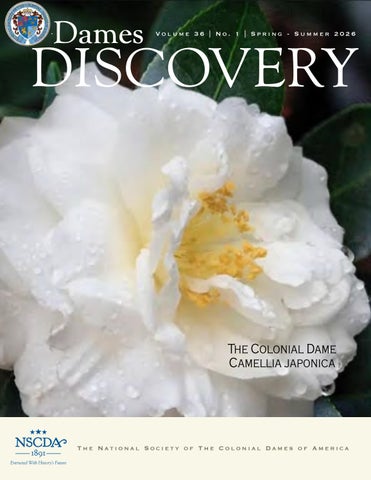
The Colonial Dame Camellia japonica

AMERICA’S 250th: CELEBRATING TOGETHER

The semiquincentennial: Two hundred and fifty years after the Declaration of Independence, we invite you to experience American history as a living conversation. Through meticulously curated exhibitions and immersive programming, the Dames transform the revolutionary era into an enduring dialogue with the past.

Since its founding, the NSCDA has safeguarded precious artifacts of our nation's beginning. As America approaches its 250th anniversary, we stand ready to illuminate the past with renewed purpose.

From the first colonial settlements to the birth of independence, our heritage speaks of vision, sacrifice and the pursuit of transcendent ideals. This legacy endures in the historic properties we preserve, the documents we protect and the stories we share. We honor America's founding, not merely with nostalgia, but with the courage to carry its highest ideals forward.

HISTORIC PROPERTIES AND COLLECTIONS

Preserving America's historic properties and collections with singular dedication. From colonial estates to national landmarks, each reflects our commitment to excellence and authenticity.

CORPORATE SOCIETIES

CELEBRATION

Honoring the founding of our nation through coast-to-coast celebrations. Each commemoration reflects the significance of this momentous occasion.

President

Mary Heyward Mundy

Executive Director

Gloria E. Kenyon

Editor

Jennie Kinkead Leavell

Copy Editors

Margaret “Peggy” DeStefano

Jean Perkins

Susan Walker

Email jkl@qx.net

WEB

www.nscda.org

Please follow the NSCDA on your favorite social media.

Dames Discovery is published in spring and fall for the members of The National Society of The Colonial Dames of America.

Submission

Dames Discovery accepts submissions from Corporate Societies.NSCDA assumes no responsibility for statements made or opinions expressed by contributing writers and artists. While every care is taken to ensure information is correct at time of printing, it is subject to change and NSDCA takes no responsibility for omissions or errors. NSCDA reserves the right to edit and place all content.

DISCOVER

Editor’s Notes

President’s Message

Stewards of a Living Legacy

Dear Dames:

As our nation approaches the 250th anniversary of American independence, we are reminded that history is not simply something we inherit—it is something we steward. The American story lives not only in documents and monuments, but also in the historic homes, gardens, artifacts, and traditions that connect us to the lives of those who came before us.

John Adams once wrote, “Posterity! You will never know how much it cost the present generation to preserve your freedom.” His words remind us that every generation bears responsibility for safeguarding what it has received and passing it forward with care.

For 135 years, the NSCDA has embraced that responsibility. Through the preservation of historic places, the care of collections, and the scholarship and educational programs supported by our members, Dames have helped ensure that the story of our nation remains accessible and meaningful to the public.

Today, that work finds renewed visibility through Great American Treasures, our nationwide network of historic properties where history truly happened. Few members realize the remarkable scale of this stewardship. Collectively, the NSCDA owns or supports more historic properties open to the public than any organization in the United States except the National Park Service. From colonial homes and gardens to collections that illuminate the daily lives of earlier Americans, these sites invite visitors to step inside the spaces where the American story unfolded.

Preservation, however, is more than maintaining historic buildings as museums. To remain meaningful, historic places must continue to engage the present as well as honor the past. Interpretations evolve, scholarships deepen and new audiences bring fresh

perspectives. When historic sites welcome these conversations, they remain vibrant places of learning and reflection rather than silent witnesses to history.

As the nation prepares to mark its semiquincentennial, Great American Treasures sites across the country are helping communities explore the meaning of America’s founding through exhibitions, programs, and initiatives such as the Passport to Preservation.

This issue of Dames Discovery highlights many examples of that stewardship in action. Restoration projects, gardens carefully tended, and collections thoughtfully interpreted all demonstrate the enduring commitment of Dames across our Corporate Societies. Each effort reflects the belief that preservation is not merely about protecting the past, but about ensuring that future generations can engage with it in meaningful ways.

We are also expanding the stories we tell. The Founding Females initiative continues to uncover and document the lives of women whose contributions shaped colonial society and the early American republic. From entrepreneurs and printers to estate managers and civic leaders, these women remind us that the American story has always been richer and more complex than earlier histories sometimes recognized.

While we commemorate the nation’s founding, the most enduring tributes to the American experiment will be the places preserved and the stories thoughtfully shared with the public.

Stewardship of these places and stories is ultimately an act of generosity toward the future. Through our work, the Dames continue our mission begun in 1891—ensuring that the history entrusted to our care remains alive to inform and inspire generations yet to come.

Thank you for being a Dame,

Editor’s Notes

Editor’s Notes

Happy spring and good wishes for a prosperous and satisfactory summer! We certainly deserve it after a very cold winter.

A Look Inside this Issue

About the cover, let me introduce you to the Camellia japonica ‘Colonial Dame’. It was named in honor of the NSCDA and chosen because it symbolizes appeal, attraction, endurance, tradition, and refinement — qualities the Society wishes to reflect. The camellia is typically a formal, rose-shaped pink flower, often blooming in late winter to early spring. The flowers are usually large and conspicuous, around five inches in diameter. Camellias became strongly associated with historic American gardens, especially in the South, which also ties neatly to the Dames’ Colonial-minded preservation, programming and patriotic efforts. The Camellia is not only ornamental, its leaves have been used to produce tea as well as seed oils for cooking and cosmetics.

As a preface to the first five pages of related articles we ask, What does it mean to truly know a place — to feel its provenance, to trace the hands that shaped it? That is the question at the heart of five related articles in this issue. Inside, we take you to the stories that make Great American Treasures unlike anything else in the world of historic preservation. Meet two remarkable women whose lives are woven into the fabric of our museum properties today — their connection to these sites is as vivid and alive as the history we steward. We explore the lecture series illuminating the pages of our newly launched book, Great American Treasures, where each talk pulls a fresh thread from the rich cloth of American heritage. And as the nation prepares to mark its 250th year, we find ourselves in extraordinary company. Among the signers of the Declaration of Independence are names that appear not only at our museum properties, but also on the register of ancestors that binds our members to this founding moment. We hope you find in these pages what we find in our properties: history that does not sit quietly behind glass, but reaches out and takes you by the hand.

The rest of this issue is full of pieces sure to entertain and inform. We celebrate the 250 by 250 Founding Female initiative to add 250 female qualifying ancestors by July 4th, 2026, in recognition of the semiquincentennial. We have surpassed that number and now have 303 approved qualifying female ancestors on the national Register of Ancestors (ROA) as of March 1st! Be certain to read the related article on inspiring colonial women entrepreneurs in this issue.

The president of the Friends of Sulgrave Manor sent in an interesting article about George Washington’s vow to never step on British soil. With deference to that resolve, his statue at Sulgrave famously stands on earth imported from his Virginia estate at Mount Vernon.

Staff member Augie Czeschin wrote about the Great American Treasures preservation projects from around the U.S. There are 75+ GAT houses and structures. To encourage exploration and connection, the NSCDA is pleased to introduce the Passport to Preservation. With the passport, visitors can travel to participating historic sites, learn their stories, and collect stamps along the way. This program offers a tangible way to engage with history while supporting NSCDA’s preservation efforts nationwide. Also, there are some exciting Dames products that you will soon be able to order: the 250 Scarf and the Colonial Dame Courage Pendant. The scarf is on re-order and the pendant can be custom designed.

Last, but ever so important, Betsy Kirkland Cahill’s presentation at the 2025 Charleston NSCDA Convention is reprinted in full with her permission. She gave a great talk about Dames, women, places and preservation.

So read on, dear Dames. I hope you enjoy this issue as much as I enjoyed putting it together.

Great American Stories

Great american treasures: Women PreservinG History since 1891

There are moments in history when the reminders we create, the paths we forge and the stories we preserve reveal something essential about who we are as a people.

In celebration of America’s 250th, this lecture series invites us to look closer, to lean in and to discover the kaleidoscope of curatorial handiwork in Great American Treasures (GAT).

The National Society of the Colonial Dames of America offers us preservation in practice in this binge-worthy video collaboration between Mission Outreach’s Lecture Series and Museum Alliance’s Great American Treasures.

2025–2026 Food For tHouGHt Lecture series

Great American Treasures | August Czeschin

An examination of Great American Treasures—the monuments and museums that endure across generations to illuminate the American story. August shares the essentials of our flagship public initiative and shows how Dames champion the legacies that deserve our care.

From Then to Now: How We Got Here | Sally Connelly

An institutional history offering an insider's perspective on the strategic decisions that shaped the organization's trajectory. Sally examines the visionary underpinnings of our historic preservation work and its enduring cultural impact.

Furniture Fit for a Queen | Amy Hudson Henderson

A study of material culture revealing the artistry and ambition embedded in American decorative arts. Amy demonstrates how furniture illuminates the aspirations of a young nation finding its voice in the work of craftsmanship.

Telling Disability Histories in Historic House Museums | Nicole Belolan

An investigation of overlooked narratives through the lens of Boston's Prescott House. Nicole examines how disability history resides within historic spaces and claims its rightful place in public interpretation and scholarly discourse.

Origins of Creole Cuisine | Anastacia Scott-Mealey

A historical analysis of the Hermann-Grima House kitchen, tracing how enslaved cooks synthesized French and West African culinary techniques. Anastacia examines the intersection of European imperialism and American slavery in the genesis of Creole cuisine.

The Post Office and Community in Sheridan, Wyoming | Alison Bazylinski

An exploration of civic architecture and community formation in the American West. Alison examines persistent patterns in how tradition and landscape establish social cohesion in frontier settlements.

Explore our Lecture Library at www.nscda.org: Lecture Library – Food for Thought 2024, 2025-2026: Media > Lecture Library

These resources are ideal for enriching membership meetings, facilitating small group discussion or deepening your personal knowledge.

Great American Stories

FoundinG FemaLes oF WiLton and stenton

FoundinG FemaLes ProFiLes t Wo Women WHose Lives HeLPed sH aPe t He FoundinG oF america. today, Great american treasures House museums Preserve t Heir stories.

Anne Carter Harrison Randolph of Wilton (VA)

On 27 July 1769, Anne Carter Harrison Randolph affixed her name to the Association for Non-Importation of British Goods—a gesture both domestic and seditious. Widowed since 1761, having married William Randolph of Wilton some three decades prior, she transformed the feminine sphere of household consumption into an instrument of imperial resistance. Her signature in Clementina Rind's Virginia Gazette stands alongside other Virginia ladies who understood that boycotting tea and textiles could unsettle an empire as effectively as muskets. History records grander rebellions, yet here were women wielding their purchasing power—quietly, deliberately, and with full knowledge that empires often collapse not from external siege but from the withdrawal of everyday consent. Learn more about Wilton.

Dinah of Stenton (PA)

Dinah (c.1732-1805) claimed her freedom on April 15, 1776—a declaration of independence that predated the nation's by mere months. Born into bondage and gifted to Hannah Emlen Logan as a child, she navigated enslavement's cruelties with remarkable agency. When Dinah requested manumission, the Logans granted it, yet she chose to remain, likely for her grandson Cyrus, transforming paid servitude into something shaped by her own determination. Wartime and the deaths of William and Hannah Logan left Dinah in charge at Stenton in the fall 1777. After the Battle of Germantown, her quick thinking protected the estate from British destruction—a loyalty born not from ownership but from her own will. She requested and earned burial in the garden she'd tended, her autonomy honored even in death. Through Cyrus as well as oral, written and published tradition, her resilience endures. Learn more about Stenton.

The Founding Females Initiative has spectacularly exceeded its goal: 305 new entries are currently on the Register of Ancestors, beyond the 250 targeted for the semiquincentennial.

These carefully vetted additions now serve as documented NSCDA membership pathways for prospective members.

The endeavor reflects what the Dames have long understood—that history's silences sometimes indicate archival oversights rather than absent lives.

Find additional resources at www.nscda.org: Female ancestor lists & videos: Committees > Founding Females Initiative > Resources > Genealogy > 250 by 250 Biographies: Ancestry > Founding Females Index

Great American Patriots

siGners oF t He decL aration oF indePendence in Great american treasures

Museum Alliance Committee

The Declaration of Independence was written by visionaries, signed by patriots, and its legacy preserved in places you can visit today. Great American Treasures connects you to all three: the homes of two signers, the estate of the Founding Father whose ideas shaped the document, and a site that holds nearly every signer’s autograph. These are just a few of the Founding Fathers honored at www.greatamericantreasures.org

William Whipple | New Hampshire Moffatt-Ladd House & Garden, Portsmouth

William Whipple made history twice at the Moffatt-Ladd House, where he lived with his wife, Katharine Moffatt. After signing the Declaration of Independence in 1776, Whipple returned home to Portsmouth and—together with his enslaved servant Prince Whipple—planted horse chestnut trees from Philadelphia near the front entrance. One of these magnificent trees still stands today, a living witness to our nation's founding.

Whipple's commitment to freedom extended beyond political liberty. After fighting as a brigadier general in the Revolutionary War, he freed Prince Whipple, believing that no man could fight for freedom while holding another in bondage.

Stephen Hopkins | Rhode Island

Stephen Hopkins House, Providence

Stephen Hopkins brought Rhode Island's voice to one of history's most consequential moments. A self-educated merchant who rose to serve 10 terms as governor, Hopkins signed the Declaration of Independence in 1776 at nearly 70 years old, afflicted with what was likely Parkinson's disease. His hands shook as he put pen to parchment, but his resolve did not: “My hand trembles,” he reportedly said, “but my heart does not.”

The Stephen Hopkins House, the oldest remaining home in Providence, was Hopkins's residence for over four decades. George Washington visited on April 5, 1776, while Hopkins was away in Philadelphia attending the Continental Congress. Left to host the General, Hopkins's daughter-in-law reportedly refused borrowed finery from relatives, saying that what was good enough for her father

was good enough for Washington. Today, visitors can walk through the home where a Founding Father lived and see the very bedroom where General Washington slept.

George Mason | Virginia Gunston Hall, Mason Neck

While George Mason's name does not appear on the Declaration of Independence, his words and ideas are woven throughout it. Mason was the principal author of the Virginia Declaration of Rights (1776), the groundbreaking document that directly influenced Thomas Jefferson as he drafted the Declaration of Independence.

Known as the "Father of the Bill of Rights," Mason championed the fundamental freedoms that define American democracy. His Georgian mansion, Gunston Hall, stands as a testament to this visionary Founding Father who believed that all government power derives from the people, a revolutionary idea that continues to shape our nation today.

The Octagon House | San Francisco, California

The 56 men who signed the Declaration of Independence pledged their lives, their fortunes, and their sacred honor. At the Octagon House in San Francisco, nearly all of their signatures survive. Built in 1861 and preserved by the California Society, the house holds one of the most remarkable autograph collections in the nation: a tangible record of the moment ordinary men made an extraordinary commitment.

Today, visitors can stand before the names of the Founders and feel the weight of what they signed. The Octagon House reminds us that the Declaration was not just a document — it was a promise, made by real people, in their own hand.

Great American Patriots

siGners oF t He decL aration oF indePendence on t He nscda reGister oF ancestors

Through the NSCDA Register of Ancestors, Colonial Dames trace their lineage to 40 of the 56 who signed the Declaration of Independence, a meaningful connection as we approach America's 250th anniversary. From Delaware's George Read, who signed four foundational documents, to Pennsylvania's Benjamin Franklin, Massachusetts' John Adams, and Virginia's Thomas Jefferson and Richard Henry Lee—these founders' stories continue through their descendants who work to preserve American history.

tHe 40 oF 56 siGners, state by state

Delaware: George Read and Thomas McKean

Connecticut: Roger Sherman, William Williams and Oliver Wolcott

Georgia: George Walton

Maryland: Samuel Chase and William Paca

Massachusetts: John Adams, Robert Treat Paine and Elbridge Gerry

New Hampshire: Josiah Bartlett and Matthew Thornton

New Jersey: Abraham Clark, John Hart, Richard Stockton, and John Witherspoon

New York: Lewis Morris, Philip Livingston, Francis Lewis, and William Floyd

North Carolina: William Hooper

Pennsylvania: George Clymer, Benjamin Franklin, Robert Morris, John Morton, Benjamin Rush, George Ross and George Taylor

Rhode Island: Stephen Hopkins and William Ellery

South Carolina: Edward Rutledge, Arthur Middleton, Thomas Lynch, Thomas Heyward

Virginia: Richard Henry Lee, Carter Braxton, Benjamin Harrison, Thomas Jefferson and Thomas Nelson, Jr.

A Living Legacy

The Register of Ancestors documents the enduring bonds across generations. These lineages show that the ideals of 1776 aren't dusty history—they live on in the families who preserve them, in the stories passed down through centuries and in the historic properties safeguarded for future generations.

Great American Collections

sHoW and sH are:

treasures 250

The California Lady of The Dumbarton House Board

In celebration of America’s 250th, The NSCDA Museum Alliance Committee (MAC) has launched a special project called “TREASURES 250.”

This project is designed to highlight the diversity of the collections held at the NSCDA Great American Treasure sites across the nation. Our goal is to increase awareness of the NSCDA mission of preservation, and increase visitation at our GAT historic sites.

Drawing from the collections of over 60 of our NSCDA GAT house museums, the Museum Alliance Committee will select a total of 250 historically significant objects from across the nation. These fascinating objects will then be compiled into a digital list with a picture of each unique object and description of its historic importance and provenance. This list of pictures and descriptions of our 250 Treasures will be posted on our GAT website and distributed to each of our state societies’ Museum Alliance Chairs and GAT directors.

In June 2025, we began contacting the curators at each of our GAT properties, asking what they consider to be masterpieces of their collection. As of January 1, 2026, we have heard from of 36 of our GAT sites and our digital list has grown to 137 objects of historic significance. We are more than half-way toward our goal of 250!

Dumbarton House Curator of Collections and Archives, Isabella Kiedrowski, has created a spreadsheet with all the pictures and descriptions of these items as they are sent in from our GAT Directors and NSCDA MAC chairs.

The digital list includes pictures and descriptions of an amazing variety of items from portraits to pistols, samplers to sofas, and table top telescopes to traveling trunks. Personal items include George Washington’s silver camp tumbler, George Mason’s family crest ring, John Hancock’s horse drawn town carriage, Dolley Madison’s Court presentation dress, bronze casts of Abraham Lincoln’s face and hands, and Herbert Hoover’s fishing rod.

What treasures are on exhibit at your state society? Help us ensure all NSCDA GAT properties are represented in this important NSCDA Treasures 250 project.

Please encourage your state society Great American Treasures director and NSCDA Museum Alliance chair to submit pictures and descriptions of four to five objects from each of your GAT collections and email to: sarahcheatwole@gmail.com

The Deadline for all submissions to the TREASURES 250 project is May 1, 2026.

Have you ever wanted to give a very special gift to a family member or friend who already has everything she or he could wish for? Something that doesn’t take up space but would also be useful? Have you ever given a donation to an organization in honor of or in memory of a special person in your life?

Many Dames designate honoraria and memorials when they give to the Annual Appeal and to the Dumbarton House Fund for the Future. In Fiscal Year 2025, a record number of tribute gifts to the $2 million campaign recognized special Dames.

The Perfect Gift

Two such gifts had a huge impact on the fundraising for the Dumbarton House Fund for the Future. David Haley, son of Arkansas Dame Joanne Riddick, gave $100,000 in honor of Joanne. Ted Eagles, brother of Maryland Dame Anne Crocker (Nancy) Eagles, directed a $150,000 gift from her estate in memory of Nancy. This particular gift was used as a challenge grant to encourage our members to reach the $1.5 million goal for the Dumbarton House Fund for the Future. When the gift was delivered, it was double the pledged amount!

David Haley reflected on his gift in honor of his mother. Among his earliest memories of Joanne’s involvement with the Dames were the nights and weekends she devoted to reading student essays for the Congressional Essay Contest. Although time-intensive, it was a very rewarding role as she witnessed the special experience that the Dames made possible for the students. As a member of a family with four generations of Dames including her mother, her daughter, her niece, and her granddaughters, Joanne has served in many leadership roles: Secretary, Treasurer, and President of the Arkansas Society; National Congressional Seminar Consultant; and NSCDA National Recording Secretary. She was also named to the Roll of Honor. With her attendance at local, regional, and national meetings, she has enjoyed her friendships with other Dames, many of whom have become life-long friends including former National President and Arkansas Dame Stuart Cobb.

Several years ago, David asked Joanne to share with him a list of organizations that would benefit from a special gift to meet a

specific need. Dumbarton House was on that list. When he learned of the special $2 million campaign with its emphasis on raising funds for the Dumbarton House Fund for the Future, he talked with Joanne about supporting this effort. He is pleased to have honored her service to the Dames, and Joanne is so happy that Dumbarton House benefits from his gift.

Reminiscing about his sister’s involvement with the Dames, Ted Eagles said that Nancy especially appreciated the friends she made and the organization’s patriotic emphasis. Living in Washington, DC, she could have joined any of several societies. Although her mother was a Virginia Dame, she enjoyed the Maryland Dames and joined that society. She immediately put her talents as a teacher to use, serving on the society’s scholarship committee. She was a 46- year member, having joined the Dames in 1978 and remaining a Dame until her death in 2024.

Before her death, Ted discussed the organizations that mattered to Nancy. As a result, not only did he direct $300,000 to the Dumbarton House Fund for the Future, but he also directed legacy gifts to the Maryland Society museum property, Mount Clare, and to the Friends of Sulgrave Manor. We are most thankful that he worked with Nancy to fulfill her desire to provide these gifts and that he considered the Dames to be trustworthy stewards of her gifts.

All gifts that you give to the NSCDA Annual Appeal or to the Dumbarton House Fund for the Future have an impact on the work of our society, and we invite you to consider honoraria and memorial gifts. Not only will you feel a sense of personal satisfaction in joining the many Dames who support the NSCDA, but you will also honor others with your tribute gifts.

Please make out your check to NSCDA and send it to:

Edith Laurencin

NSCDA National Headquarters Dumbarton House 2715 Q Street NW Washington, DC 20007-3071

Founding Female Entrepreneurs of Colonial America

by 250 Founding Females Initiative Virginia and Indiana Societies

When the Dames first defined qualifying ancestors, their advisors were elite male relatives -lawyers, physicians, educators, government officials and veterans who saw themselves and the nation’s founders as “great men.” Within this worldview, women were invisible as historical actors, and it never occurred to these men or to the founding Dames to recognize women as qualifying ancestors. Yet, modern scholarship shows that women were central to colonial economic life, sustaining households, communities, and trade networks from Jamestown onward and providing the essential foundation for colonial growth and political development.

Colonial women labored continuously in every sphere of survival—producing and preserving food, caring for livestock, creating textiles from raw materials, making candles, managing households, providing medical care, and bearing and raising children. This work was fundamental to colonial economies yet routinely dismissed as merely domestic. Although women’s experiences varied by region, class, and legal status, most faced limited education, early marriage, high child and maternal mortality, short life expectancy, and legal subordination under coverture. Nevertheless, within these constraints of law, custom, religion, and daily hardship, many women transcended expectations to become entrepreneurs and business leaders. These achievements the NSCDA now seeks to recognize by expanding the Register of Ancestors.

Most female business owners were widows or unmarried women, whose legal status allowed greater economic independence. Most married women worked beside their husbands and assumed control of enterprises after their deaths. Through inheritance, licensing, or special legal provisions, women owned and managed a range of commercial ventures, demonstrating that female entrepreneurship was a persistent, if often overlooked, feature of colonial society.

While women rarely shaped laws in legislative halls, they played a vital role in shaping public life through print. Ann Smith Franklin became Rhode Island’s first official female printer and helped estab-

lish one of America’s longest-running newspapers; Sarah Updike Goddard expanded a family printing enterprise into publishing, bookselling, and postal service; Mary Katherine Goddard printed the first Declaration of Independence naming the signers; Clementina Rind served as public printer for Virginia while publishing The Virginia Gazette; and Elizabeth Timothy produced newspapers, laws, and currency in South Carolina. Together, these women influenced colonial, political and cultural life.

Colonial women frequently owned and operated taverns and inns, which were central to social, political, and economic life in early America, serving not only alcohol but also food, lodging, entertainment, and space for community gathering. Far from marginal businesses, taverns were hubs of influence, often patronized by prominent figures. In some regions women operated as many as 40 percent of these establishments. Among the most notable is Christina Campbell who successfully managed multiple taverns around Williamsburg — including the famed Christiana Campbell’s Tavern, which still operates in Colonial Williamsburg and was frequented by Virginia’s political elite, including George Washington.

Colonial women owned and operated an extraordinary range of businesses. Ann Marwood Durant is the first known woman to act as an attorney in a North Carolina court. She successfully brought suit for unpaid wages in 1673 and frequently represented her husband in legal matters. Elizabeth Worsham Kennon of Virginia became a ferry owner and operator after her husband’s death. Elizabeth “Betsy” Griscom Ross of Pennsylvania was a professional seamstress and is remembered for her role in making the first American flag. Justina Margaretha Schnertzel Hoff also of Pennsylvania was a lifelong clockmaker who ran the family business for 37 years. Margaret Hardenbroeck Rudolphus de Vries Philipse of New Sweden was an internationally active shipowner and trader who was widely regarded as one of the most enterprising capitalists of her era. Martha Tunstall Smith of Long Island, New York helped her husband establish a sizable whaling business. She owned and

operated her own whaleboat and successfully managed the business after her husband’s death.

Although roughly 10 percent of the colonial population held the greatest wealth, it is often assumed that women in these families did not work and lived lives of leisure, an image that rarely reflects the realities of early colonial life. Particularly in the formative years of the colonies, and even later within established social hierarchies, many wealthy women exercised significant economic authority, especially as widows who assumed control of family estates and often increased their prosperity. Elizabeth Rockhold Todd and Sarah Phelps Todd of Maryland, related by marriage, were widow estate holders who managed large tobacco operations after their husbands’ deaths, overseeing cultivation and sales across extensive acreage. Both successfully increased their estate values.

Hannah Callowhill Penn, second wife of William Penn of Pennsylvania, administered the affairs of the province after her husband’s stroke and death. She successfully defended his will against legal challenge and served as Acting Proprietor from 1712 until her death in 1726. She was the first woman in American history to

The Founding Females initiative has spectacularly exceeded its goal: 303 entries are currently on the Register of Ancestors, surpassing the 250 targeted for the Semiquincentennial.

hold formal political authority. Abigail Minis was a member of one of the earliest Jewish families to arrive in Georgia. Her husband quickly became a land owner, merchant-shipper, and mercantile business owner. After his death, Abigail continued to manage all of his businesses and on her own amassed large land holdings in Savannah including seven farms consisting of pine, sheep and cattle operations. By the age of 16, Eliza Lucas Pinckney of South Carolina managed multiple plantations producing timber, tar and rice. She pioneered indigo cultivation as a major colonial export. Indigo dye produced one-third the total value of the colony’s exports before the Revolutionary War.

As you can see from this extensive list, our Founding Females were very much involved in the formation of our great nation. And, as Gloria Kenyon, our new National Executive Director, said in her letter to the hiring committee: “...we no longer see women’s influential sphere as ‘the home’ but rather encounter the soft power of women to effect changes in our world.”

Our Founding Females have absolutely proven that fact.

Soil Matters!

Americans revere George Washington as the “Father of the Nation,” honoring his leadership that steered the new republic after inde pendence was declared from Great Britain in 1776. As the United States approaches the 250th anniversary of that defining moment, it is fitting to remember that Washington’s story is rooted in Brit ain: his fifth great-grandfather acquired the Tudor home we now know as Sulgrave Manor in Northamptonshire. Later, his second great-grandfather John Washington left the island for a better life in the colony of Virginia in the mid-1600’s.

Washington’s leadership not only led American forces to victory in the War of Independence but also shaped the founding framework of the nation. He helped guide the creation of the U.S. Constitu tion and, in 1789, became the country’s first president. The birth of the United States was likewise a pivotal event in British history, marking the loss of its most significant colony while ultimately laying the groundwork for a lasting transatlantic partnership.

By the early twentieth century, Britain and the United States had enjoyed more than a century of peace. In that spirit, philanthropists funded the restoration of Sulgrave Manor as a museum and enduring memorial to the “special relationship” between the two nations.

To commemorate the anniversary of the Declaration of Independence, Sulgrave Manor has crafted a symbolic tribute rooted in both history and legend. According to a popular (though likely apocryphal) story, Washington vowed never to set foot on British soil. In deference to that tale, his statue famously stands on earth imported from his Virginia estate at Mount Vernon.

Building on this symbolism, John Gerber, president of the Friends of the Washington Statue, raised $1.4 million to restore and rededicate the London monument in 2025 and conceived an additional gesture. As Alison Ray, CEO of Sulgrave Manor, explained, “Gerber has been collecting clay soil from Sulgrave to place in a time capsule that will be buried this spring beneath the plaza of the Washington Monument. In a poetic sense, the founding president will “stand” on British soil for the first time.”

Some may think that is a controversial move and that Washington's vow should be respected, but Gerber disagrees. "If you ask the head of Mount Vernon who is a great expert on Washington, he will say that Washington never said that. he But it's a great story!"

Alison Ray believes Washington “would be quite happy to be standing on soil from his ancestors’ home at Sulgrave. Even after becoming president, he was very quick to work with Britain and to say that everyone should be friendly and peaceful towards each other.”

Gerber added: "Americans love the special relationship between the US and Britain and know the great ties between our countries." The capsule was presented to the US government in a special ceremony at Mount Vernon in January of this year, attended by the United Kingdom’s Deputy Prime Minister, David Lammy. "George Washington was a pioneer, a fighter and a visionary," he said.

"He was absolutely determined that the United States should be independent and free and that is what he achieved. I think the idea of a time capsule is very beautiful, because that, of course, looks not just to the past but also to the future.”

Soil Matters!

On the banks of the Wabash River, at the very southwestern tip of Indiana, history is alive and well at the David Lenz House and garden in historic New Harmony. The well preserved garden, with its orderly beds of herbs, vegetables and perennials are what would have been grown in the early 1800’s by the Harmonist community. The Lenz Garden today is always one of the most popular stops on the joint University of Southern Indiana’s Historic & Indiana State Museum tours.

In addition to the 4-square garden design and surrounding perennial borders, in 2021 the dye garden was established with support from the Historic New Harmony Beautification Grant. The utopian community, known for self-sufficiency, utilized plants such as Japanese indigo, Hopi black sunflowers, Dyer’s chamomile, coreopsis, and zinnia, making dye for yarn and cloth. Two cherry trees were also added to the garden, as well as total restoration of the primitive style fence surrounding it.

During the years the Lenz Garden has continued to radiate “green energy” to all its regional, national and international visitors from every corner of the world. Continual maintenance required for wildlife issues and drought pose challenges with many raccoons and a skunk becoming residents of the state of Indiana! Our much valued gardener and landscape designer, Kent Schutte created age appropriate protective structures around each square garden out of willow stems to keep critters at bay while keeping the gardens visually appealing. Some of our more enthusiastic Dames spent a weekend replacing chinking on the barn in the garden. That’s about the time we also commissioned a local woodcrafter to build a garden bench, suitably appropriate of course!

Sit a Spell in the Lenz Garden!

Expansion plans for the garden went forward in 2025 with the planting of five peach trees and three holly trees. The small lawn within was leveled and reseeded and a perennial shade bed was added along the back of the house. New structures were built

to protect pole beans, flax, indigo, asparagus, comfrey, costmary and cucumbers.

We look forward to 2026, as owners and stewards of the David Lenz House and Garden, doing what we can to help refresh all of the flower beds, reset brick borders and plant the new shade garden. Come and sit a spell in the Lenz Garden!

Preservation in Action

The joys and aches of home ownership!

Vereen Woodward and Connie Baldwin Museum Alliance Committee Members Texas and South Carolina Societies

As members of the NSCDA, each of us is honored to be the “owner” of many homes, big and small, from the Eastern Seaboard across to the West Coast and then to Hawaii.

Saving the home of George Washington’s English ancestors with funds from a national campaign and partnering with English preservationists to open it as a museum?

We’ve done that!

Saving a 158-year-old, eight sided house from demolition by moving it across the street?

We’ve done that!

Rediscovering and researching the site of an eighteenth century fort and trading post, thus turning an empty field into a lively outdoor historical site?

Yes, we’ve done that too!

For 135 years, NSCDA members have been champions, caretakers, stewards, and rescuers of history. With over 250 past projects completed, it is a fitting number of achievements in this semiquincentennial year. Today we protect and maintain more than 75 homes, museums and monuments.

So what are we doing now?

“Preservation in Action” continues to take place at GAT sites across the country!

Restoring and refreshing houses encourages visits and public engagement

• Oregon’s Hoover Minthorn House Museum has created a ninteenth century apoth cary and kitchen garden to further illustrate the women’s domain.

•Historic Rosedale in North Carolina is installing a memorialgarden, providing a quiet place to learn and reflect on the African American legacy of the site.

• New Hampshire’s Moffatt-Ladd House and Garden recently completed restoration of the Yellow Chamber, returning the room’s colors and finishes to their 18th-century appearance by using surviving fabric fragments, original paint, period inventories, and emerging technologies.

• Work at West Virginia’s Craik-Patton House in 2025 focused on remediating the soffit and fascia along the roof, thus protecting the north side of the Greek Revival home for the future.

Equally important, but often hidden, is structural work

• Dumbarton House, our national headquarters in Washington, DC, has begun work on a new HVAC system to ensure proper temperature and humidity control for the house itself, its collections, the staff, and all visitors.

• The Glessner House in Chicago, Illinois installed a geothermal system in 2024 and, after one year, is realizing significant savings on energy bills.

• The Andrew Low House Museum in Savannah, Georgia recently completed restoration of the original decorative cast iron balconies on the façade, reflecting the craftsmanship and elegance that define the historic 1849 site.

• Replacing a 1970s perimeter fence, the Joel Lane House in Raleigh, North Carolina installed a new cedar picket fence with pine posts to provide long term durability and protection for the property, while respecting the historic character of the site and enhancing the visual experience for visitors.

• In preparation for installing a new cedar roof, the 1752 Joseph Webb House in Wethersfield, Connecticut, replaced deteriorated historic bricks and repointed mortar joints using a historically appropriate lime-based mortar made from lime, sand, and river mud.

• Recovery and preservation have defined early 2026 at Tennessee’s Historic Travellers Rest, as debris from Winter Storm Fern was cleared from the site while progress continued on the porch restoration project already underway.

Since 1891, all state societies of the NSCDA have promoted public interest in America’s rich, diverse history by preserving a curated collection of buildings, gardens, and monuments where history actually happened. Every Dame shares “ownership” in more than 75 Great American Treasures sites.

Great American Treasures Passport to Preservation Explore America’s 250! by experiencing the Nation’s Historic Places

Great American Treasures has launched Passport to Preservation, a travel program to encourage travelers to visit our historic sites, learn their stories, and earn stamps to commemorate their visit. Visitors can post selfies, compete for the number of sites visited and earn recognition as history lovers. Whether visiting one site or many, the Passport to Preservation offers a tangible way to engage with history and NSCDA’s preservation efforts nationwide in our Great American Treasures locations.

This new initiative invites visitors to travel to participating historic sites, learn their stories, and collect stamps along the way. Whether visiting one site or many, the passport offers a tangible way to engage with history while supporting NSCDA’s preservation efforts nationwide.

As the nation approaches the 250th anniversary of American independence, these sites are alive with programs, exhibitions, and community activities that bring the Revolutionary era and its lasting impact into focus. From family-friendly events to scholarly interpretation, the Great American Treasures are offering meaningful ways to engage with history between now and July 4, 2026.

In this milestone year, Passport to Preservation celebrates what it means to be American by encouraging discovery, curiosity, and stewardship. Passports will be available at many Great American Treasures sites, so be sure to pick one up as you begin your journey. We hope it inspires visitors to step inside these historic places, take part in their programs, and experience firsthand the stories that continue to shape our shared national heritage.

The NSCDA Celebration 250! Scarf Plan to Reserve Yours X

The NSCDA Celebration 250! Scarf has been a huge success!

We have been able to place a limited reorder.

This is great news and we want to get the word out!

Be on the look-out for the official order link once it goes live on the national NSCDA website.

Introducing the Colonial Courage Dame Pendant

Introducing the Colonial Courage Dame Pendant — created to celebrate America’s 250th Anniversary. She is a symbol of courage, sisterhood, and shared beginnings, honoring the brave women whose devotion helped shape our nation. Worn with pride, she celebrates our bond as Dames and inspires connection, conversation, and the continued growth of our Society.

Each pendant is individually crafted and may be customized in a variety of metals, with or without stones, to reflect personal preference. Optional chains are available, as well as bail enhancers designed to clip over pearls or wider chains. A pin option is also offered. Engraving is available. Pendant size: Classic- 1 inch with custom sizing available.

Due to current fluctuations in the metal markets, pricing will be quoted at the time of order. Ten percent (10%) of each pendant

purchase will be added as a donation to the NSCDA, capped at $250 per item.

Let us celebrate our heritage together and honor the beauty of being a Dame. To place an order or request a personalized quote, please contact:

Thomas Makowski T. Makowski Company https://tmakowski.com Ema,il: service@tmakowski.com

Important: Prior to any purchase, your membership must be verified by our National Registrar, Gail Faherty. Please email Gail at Damesregistrar@gmail.com with your name, address, Society, and national number so verification can be sent to the jeweler.

Unnamed Furies: Women, Places and Preservation

Keynote Address to The National Society of the Colonial Dames of America

The Charleston Convention, October 18, 2025

Betsy Kirkland Cahill

Good evening. It’s an honor to welcome you to Charleston and to the Francis Marion Hotel, once known as the “Grande Dame” of the Carolinas. The Francis Marion opened in 1924, and in the Roaring Twenties it was the place to be in Charleston. Just as it is tonight!

In fact, my great-grandparents hosted a lavish debutante ball here for my grandmother on Christmas Eve 1929, with dinner served to 400 guests in the dining room at midnight (a timetable I’m glad you did not follow!). The News & Courier described it as the “gayest night of a gay season.”

As the decades wore on, the Swamp Fox declined. Under the leadership of Steve Dopp, the Francis Marion has risen again, earning multiple awards from the National Trust for Historic Preservation. (As have the Dames, who in 2000 received the Trustee Emeritus Award for their exemplary stewardship!)

operate the Hotel de Paris in Georgetown CO, that grand Victorian-era hotel erected during the heyday of Colorado’s mining industry. Like its shape-shifting founder, Louis DuPuy, who was a seminary dropout, army deserter, and newspaper reporter, the hotel has had many lives: boarding house, residence, restaurant, and showroom for traveling salesmen.

There’s a bonus Trust connection here: in 1879, the railroad magnate and robber baron Jay Gould – whose Lyndhurst mansion is also a National Trust site – ate dinner at the hotel with some fellow tycoons, the nine of them collectively worth more than $200 million -- then. The National Trust’s website regularly promotes not only the Hotel de Paris, but many other Colonial Dames’ sites – 30 hits last time I looked.

When Connie Baldwin called to ask if I would consider speaking to you about women in preservation, I didn’t hesitate to accept. Because from South Carolina’s Ann Pamela Cunningham to Louise du Pont Crowninshield, from the National Association of Colored Women’s Clubs in Anacostia to Charleston’s Society for the Preservation of Old Dwellings, women have been at the forefront of preservation in this country for nearly 175 years. Tonight, I want to reflect on the legacy of some of these women, to share with you how that legacy has inspired my work in preservation, and to ponder what it means for us today.

Now, anyone who has anything to do with preservation knows that it is quite an intertwined world. So I’ll take a moment to celebrate a few of the ties that bind the National Trust, the city of Charleston, and the Colonial Dames.

As you know, the Dames and the Trust work in partnership to

Locally, I’ll start with the obvious: the Powder Magazine, the state’s oldest building, which you all rescued in 1913. In 2013, to celebrate the building’s tricentennial and its century of stewardship by the South Carolina chapter [sic], the Preservation Society conferred on the Dames its highest honor, the Susan Pringle Frost Award. And we are all delighted that the Powder Magazine has re-opened to the public.

Finally, there is an interesting link between Charleston and the Ximenez-Fatio House in St. Augustine, which I’ll come back to.

The National Trust for Historic Preservation. The Preservation Society of Charleston. The National Society of the Colonial Dames of America.

Three august organizations. Three worthy missions. Three quaint, even antiquated names. As I thought about these organizations and their missions, I found myself thinking about the nicknames we’ve conferred upon them.

The Trust. The Society. The Dames: these nicknames embody the values that undergird the preservation movement. The “Trust” communicates the integrity and authenticity with which preservationists approach their work. The “Society” speaks to collaboration and community, so fundamental to successful preservation.

Drayton’s connection to our house had been suspected but never proven. During the renovation, however, we found in the fireboxes several blue Delft tiles with unique patterns, patterns that exist in only two places, Drayton Hall and our house. This established the link beyond a doubt, and research is ongoing to discern what each house can tell us about the other.

The “Dames” – well, I consulted Volume IV of my prized 20-volume Oxford English Dictionary to ensure that I understood the full resonance of this word. I emerged from this lexicographical adventure having learned that as a force in our language and in our lives, the dame has been around since 1225. For eight hundred years, she has been, among other things, ruler, housewife, mother, teacher.

To me, a dame is a woman of importance, a woman who gets things done, a woman who shares her knowledge and passion, a woman who casts her net of caring over the world. And you have been doing this and more since you first came to life in Philadelphia more than 130 years ago. Now, Charleston’s mayor of 40 years, Joe Riley, used to say that the most dreadful words a speaker could utter were “Let me tell you something about myself.” I speak them reluctantly. But I want to share a brief account of how I became involved in preservation, because it’s a not uncommon story. And because it incorporates the two foundational principles of preservation, the power of place and the importance of community.

Fifteen years ago, when my husband and I returned to Charleston after more than 30 years of living away, we moved with our children into a house that held both historical and personal significance. Historically, our home is the town house of John Drayton, the wealthy planter who built Drayton Hall, that Palladian marvel on the Ashley River – another Trust site.

The personal significance is that this was my childhood home and has been in my family for several generations. Having grown up there, I thought I knew the house. But the extensive work we undertook with our remarkable architect, Glenn Keyes, and our dedicated contractor, Moby Marks, dramatically expanded my knowledge. Opening up walls, pulling up floorboards, excavating a basement we never knew was there: all this gave me new perspectives on the house where I had done my homework, practiced the piano, played with our beagles, and fought with my two sisters.

To leave as a daughter and to return as a wife, and a mother – and still a daughter, as my parents had moved to the kitchen house on the property – made me even more mindful of the generations that had walked those floorboards and dwelt in those rooms before me. It was an object lesson in the power of place, that first principle of preservation.

The second concern of historic preservation is the importance of strong communities. Here again, our move back to Charleston galvanized me. For as we settled in and developed a rhythm of family life, I became increasingly dismayed about what was happening to the city I loved.

A cruise terminal proposed at the edge of the Historic District. Big ugly buildings under construction (that’s a technical preservation term), a slew of demolitions granted, a seemingly endless stream of hotels being approved. And an explosion in tourism that was com-

promising life for the residents. I saw only one group standing up for Charleston – it was the Preservation Society. I became a member and haven’t looked back.

Now in the 15 years that I’ve been involved, the work of preservation in Charleston and around the country has had a remarkable expansion, as we continue to broaden our understanding of what is worthy of preserving.

For example, the preservation groups here collaborated with other organizations to help gain protections for post-Civil-War African American settlement communities, such as Phillips Community in Mt. Pleasant. The Preservation Society has led the way in documenting black burial grounds, which in some cases are the only tangible access black communities have to their histories. The attention we have given to the immigrant businesses of Upper King Street – Lebanese, Chinese, Polish, Greek – has enriched the interpretation of Charleston’s past.

Preservation in Charleston now extends well north of Broad – not to mention east and west. Our geographic scope includes John’s Island, West Ashley, Sullivan’s Island, and North Charleston. Preservation is also addressing the threats that climate disasters pose to historic buildings and neighborhoods. You may have heard about plans for a seawall, or “Battery extension,” to protect Charleston, but that’s only one of the efforts around coastal resilience. The recent collaboration between the Society and the City to create a detailed Resilience Guidance document for homeowners has made, pardon the pun, quite a splash.

Although the work may have evolved, at the heart of all preservation we find the same values: stewardship, caring, generosity, and unselfishness. Indeed, other than motherhood, preservation is the most unselfish work I’ve ever been involved in, because it is basically a gesture of generosity towards the future. We excavate, interpret, and advocate for the places of the past precisely so that we can build a better future. To me, this ethic of stewardship that transcends self is the consummate preservation value. And it is on abundant display in this room tonight.

Every preservation story – past, present, and future – pretty much boils down to this: someone cared. Someone was generous. Someone stepped up. And it is well-attested that in this country, women have been at the forefront of that stepping up. There are certainly sociological and historical reasons for this, not least among them the women’s clubs of the nineteenth century that allowed women to get out of the house and mingle with other women in socially acceptable ways. As social interaction engendered social action, these pioneering women took up the causes of temperance, abolition, and moral reform, subsequently turning to women’s suffrage and historic preservation.

For those “ur-preservationists,” [sic] saving places was principally an act of patriotism. Ann Pamela Cunningham was the author of this patriotic approach, as she rallied the “Ladies of the South” and others to acquire and restore Mount Vernon. The same spirit of patriotism pervaded many of the early organizations, including the Daughters of the American Revolution, the National Society of the Colonial Dames of America, and many other state or local organizations that worked to save places central to the nation’s narrative. As my Trust colleague Tom Mayes wrote, “These places inspired people about American history and American institutions, while also acting to form an American identity.”

For Charleston’s early preservationists, of course, patriotism was purely a local affair. Susan Pringle Frost, who advocated over five decades for Charleston’s “dwelling places,” was animated chiefly by a personal feeling for the spirit of this city. And while Miss Frost may receive the lioness’s share of credit for launching the grassroots preservation movement in 1920, when she convened a group of 32 citizens in a Charleston drawing room to save the Manigault House, she was not alone by any means.

There was the unsung heroine Nell Pringle, who with her long-suffering husband, Ernest, underwrote the purchase of the Manigault House at a time when money was scarce in Charleston. She carried that burden for years, mostly unsupported by the nascent Society that she had helped found. Her unselfishness and her perseverance in the face of great hardship kept the young preservation movement alive at a crucial juncture.

There was Elizabeth O’Neil Verner, the renowned Charleston artist, who was constantly on the alert for any threats to her “subjects,” namely the buildings and streetscapes that she captured in her art. She never passed up an opportunity to communicate their importance — writing letters, giving lectures, famously attending a fund-raising rally in her wheelchair when she was in her 90s.

There was Dorothy Legge, the “Great Persuader,” as a PSC president dubbed her, who worked alongside Sue Frost in the ‘20s and ‘30s to restore decaying historic homes on the peninsula. Finding her pièce de résistance in the Colonel Othniel Beale House at 99 and 101 East Bay, Mrs. Legge was the impetus for the restoration of the neighborhood we now call Rainbow Row (a moniker she herself disliked).

Then there were those twin forces of nature, Liz Young and Jane Thornhill. Feisty, fearless, and formidable, they served as successive presidents of the Preservation Society. Of the extensive lore that surrounds these two, the best story involves – naturally – a bulldozer. In 1971, Liz and Jane got wind of the imminent demolition of an historic building on the campus of their alma mater, the College of Charleston. Arm in arm, they marched up to the campus and blocked the bulldozer. The story is that the bulldozer driver leaned out of his cab and yelled, “Is that you, Liz?”

Each of these women showed herself to be a true dame: resourceful, engaged, generous, persistent, and collaborative. And that’s just in Charleston! There are countless stories of women around the country taking up the challenge of preservation with style, with strength, and with tenacity.

Consider Dana Crawford of Denver, known as the Dragon Lady, who in the 1960s and ‘70s wielded her forceful personality and great charm to bring about the renovation of a block of wobbly warehouses on Skid Row, creating Larimer Square, Denver’s first historic district. For decades afterward, she worked tirelessly to revitalize many other buildings and neighborhoods in Denver.

Or Texan heiress and visionary Ima Hogg, who not only restored and furnished several important properties like Bayou Bend and the Varner Plantation, but also led the effort to codify the work of preservation in her state and built bridges between the national preservation movement and the Texas preservation community.

There is Camille Strachan, who with her husband Duncan (and her seven children) fought with creativity and verve from the 1970s on to protect vulnerable neighborhoods in New Orleans from highway development and urban renewal. There is Houston’s Jackie Bostic, who led the Friends of Emancipation Park in their successful effort to restore a historic landmark park so important to black history in Texas.

And there was the group of dedicated women in Los Angeles who in the 1980s reclaimed and commemorated women’s contributions to the urban landscape, including an African American midwife’s homestead and a hall used by Latina garment workers.

The Dames, too, have their own rich history of women stepping up to save places of meaning, demonstrating preservation values in action. You’ve modeled collaboration, assembling a network of Great American Treasures to share information, exchange best practices, and identify resources.

You’ve manifested an ability to get things done, say, in Delaware: deconstructing the “Little Church” that was constructed in 1740, so that it could be moved without interfering with trolley lines.

You’ve documented the historical record with integrity in Alabama: for seven decades, the period rooms of Mobile’s Condé Charlotte House Museum have illuminated American history by interpreting the influence of the five nations that have flown their flags over the city.

You’ve demonstrated integrity in Georgia, where in Savannah, the Georgia chapter [sic] erected a second memorial to the Creek Indian Tomochichi when the first one was bulldozed to make way for a monument to Georgia’s railroad pioneer William Washington Gordon. (I will note that the chapter [sic] president who led this project was Gordon’s daughter-in-law Nellie – which must have made for

interesting conversation at Sunday dinner!)

In Texas, you’ve fulfilled a commitment to inclusive storytelling through the “Slave Quarters Project,” enriching the interpretation of Austin’s Neill-Cochran House with the previously untold narratives of the enslaved. You have exemplified, in every chapter [sic] and every project you have taken on, the caring and resourcefulness that characterize the best work in preservation.

Now to return to that interesting Charleston connection, let’s briefly detour to the 1798 Ximenez-Fatio House in St. Augustine, which features a long line of enterprising women, starting with Margaret Brebner Cook of Charleston, who assumed ownership of the building in the 1830s when women were not much in the way of owning property. Louisa Fatio, a subsequent and still-more-enterprising owner, established a fashionable boarding house known as Miss Fatio’s, and the house flourished for many years under her management.

In a time when history feels a bit up for grabs, and “facts,” such as they are, are disputed, places can ground us. But they need people to convey their truths, to tell the stories they house in all their rich variety and contradiction: suffering and joy, bondage and freedom, despair and hope, setbacks and victories. These are the stories of our country. And the work of preservation, in part, is to animate these places by protecting them and sharing with the public the values and the histories.

In his 1977 novel Lancelot, the Southern novelist Walker Percy considers the moral depravity of the age through the eyes of his mentally unstable protagonist, Lancelot Andrewes Lamar. Although Percy himself was a place-haunted author, he criticizes historic preservation as he saw it then practiced. At one point, Lancelot asks incredulously, “Did you know that the South and for all I know the entire USA is full of demonic women who, driven by as yet unnamed furies, are desperately restoring and preserving places, buildings?”

As you no doubt know, the afterlife of this house continued the legacy of female enterprise: the Florida Dames purchased the property in 1939, in the middle of the Depression, and began repair and restoration work soon thereafter. For almost 10 years, these stalwart women spent weekends scrubbing windows, cleaning debris, renovating fireplace mantels, lime-washing walls and ceilings, and repairing the grand staircase. I like to envision that band of dames showing up with their mops and limewash, their trash bags and dental tools – what fun it must have been to scour and restore every inch of the house together. The power of place, and the creation of community.

An African American midwife’s homestead in California. In Charleston, a rice planter’s antebellum mansion. A row of warehouses in Denver. These places, in all their variety, contain memories of past lives. Understanding the stories they tell helps us to form our own identity. These places show us in their bricks and balconies, their mantels and moldings, their furnishings and fenestrations, how life was then. And as we reflect on those patterns of life, we might begin to understand our own world differently. We might expand our sense of possibility for the future.

Well, one man’s “unnamed furies” are another woman’s “values.” And the values that drive us – yes, sometimes with a fury! – include generosity: because preservation demands a lot of us. They include caring: because places need and deserve our love and concern. They include persistence: because developers are tenacious and deep-pocketed, and bureaucracies are cumbersome, and courts don’t always get it. And they include stewardship: because we take on these places not for our own greater glory, but to enable future generations to know the past so that they, too, can imagine and create a better future.

From Ann Pamela through Sue and Nell and Dana all the way up to the assembled company here tonight, women have been preserving and guarding places all over this country, for decade upon decade. We do this work of place-keeping because we care. We go to battle for a decaying mansion, a crumbling corner shop, a dilapidated church, because places can reveal to us where we’ve been in the past, where we are in this moment, and where we might go in the future. For lovers and keepers of history, can there be any more important work?

PLANNED GIVING

Legacy Circle

The Legacy Circle recognizes those visionary donors whose planned gifts secure the enduring mission of the NSCDA. Through bequests, trusts and beneficiary designations, these individuals ensure that future generations will continue to benefit from our dedication to American history education, historic preservation and patriotic service.

We invite you to join this tradition of enlightened philanthropy and become part of a legacy that transcends time.

Legacy Circle Members

Candy Ainsworth

Rebecca Alford

Jodie Allen

Katy Amling

Helen Arnold

Sandi Atkinson

Connie Baldwin

Kristine Bartley

Meg Beasley

Mary Bohls

Jane Boylin

Karen Buckley

Barbara Callahan

Katherine Cammack

Stuart Cobb

Malinda Coleman

Sally Congdon

Lucinda Conger

Catherine Cooper

Arrington Cox

Jeri Crawford

Anna Duff

Melissa Eason

Anna Ehlert

Mary Fields

Liz Forman

Maureen Gibbons

Caroline Goedhart

Lynn Goldsmith

Mary Gordon

Janie Grantham

Philip Heeth Grantham

Laura Gray

Betsy Greene

Priscilla Grew

Kendall Stewart Hartman

Mary Flagg Haugh

Dorinda Hawkins

Carrie Hawley

Carla Haynes-Clowe

Sarah Heatwole

Mary Hickok

Holly Hunt

Lyn Hunt

Mimi Hurst

Christine Jones

Virginia Keller

Ashley Lawrence

Stanzi Lucy

LuAn McGinnis

Susan McNulty

Marcy Moody

Mary Mundy

Brenda Nardi

Suzanne Nicholson

Nancy Nimick †

Rachel O’Dwyer

Peri Pepmueller

Jean Perkins

Mona-Tate Powell

Bonnie Reilly

Dora Rogers

Jessica Schmidt

Peggy Shaver

Sally Smith

Sally Smyser

Frances Smyth

Karen Stetler

Edith Stickney

Lisa Street

Muffy Stuart

Bobsie Swift

Wendy Tackett

Louise Tausché

Sue Tempero

Susan Walker

Isabel Wallop

Linda Kay White

Caro Williams

Barbara Wright

Kathleen Wu

Ryder S. Wyatt

NSCDA gratefully acknowledges bequests received between September 1, 2025 and January 31, 2026 from Anne C. (Nancy) Eagles, Martha G. Mason, and Nancy C. Nimick.

† Deceased

NSCDA ANNUAL APPEAL 2025 - 2026

Supporting Excellence in Historic Preservation, Education and Patriotic Service

GIVING PRIORITIES

NSCDA Annual Appeal

Gifts support the annual operating expenses of the NSCDA and Dumbarton House, along with ongoing preservation and education initiatives.

Dumbarton House Fund for the Future

Donors ensure the preservation of Dumbarton House for the benefit of generations to come. The 224-year-old house, with its gardens and historic collections, is the only nationally owned NSCDA property.

Online

Scan the QR code for online giving or go to nscda.org/ support.

WAYS TO GIVE

Telephone

Call NSCDA Director of Advancement Megan Judt (202) 337-2288 Ext. 2237.

By Mail

NSCDA 2715 Q Street NW Washington, DC 20007

We encourage online giving for the most efficient processing and timely acknowledgment of your generosity.

ADDITIONAL TYPES OF GIFTS

Gifts of Securities

Gifts of appreciated stocks or securities are easy to make and provide great tax benefits.

Tax-Advantaged Retirement Plan Assets

Maximize your support and minimize taxes through IRA distributions, retirement plan assets or life insurance. A Planned Gift

Leave a legacy of generosity with an estate gift that helps meet your philanthropic goals.

TO LEARN MORE

Explore your giving opportunities by visiting nscda.org/support. Or contact NSCDA Director of Advancement Megan Judt at MeganJudt@nscda.org or (202) 337-2288 Ext. 2237 to discuss giving strategies that are most meaningful and convenient for you.

Fiscal year ends August 31, 2026 | The NSCDA is a 501(c)(3) nonprofit organization.

Tax ID: 53 - 0224364

Turn static files into dynamic content formats.

Create a flipbook