Spring 2026
Face to Face Issue 80 Head of Membership Ivi Varda Editor Daniel Hausherr Copy Editor Elisabeth Ingles Designer Annabel Dalziel All images, National Portrait Gallery, London and © National Portrait Gallery, London unless stated
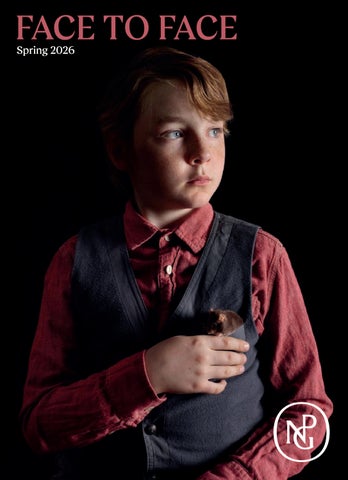
Cover image – Oliver & Mrs. Nibbles, by Catherine Opie, 2012, will feature in Catherine Opie: To Be Seen from 5 March 2026 © Catherine Opie, courtesy Regen Projects, Los Angeles; Lehmann Maupin, New York, Hong Kong, London, and Seoul; Thomas Dane Gallery.
npg.org.uk Gallery Switchboard 020 7306 0055
Back cover image (detail) – Marilyn Monroe at a Press Conference at the Savoy Hotel in London by Larry Burrows, 1956 (NPG x137340), will be on display in Marilyn Monroe: A Portrait from 4 June 2026. © Larry Burrows Collection.
The Gallery is committed to reducing our environmental impact. This magazine is fully recyclable and has been produced by a certified carbon balanced printer. Their Partnership with the World Land Trust is helping to preserve and protect carbon-rich habitats around the world.
From the Head of Membership Ivi Varda
As I write, we are well into winter, and the Gallery is very busy with visitors and Members enjoying the warm atmosphere, our exhibitions, happenings and offers. Yet, behind the scenes, we’re already deep into preparations for an extremely exciting spring. We open the new season with two remarkable exhibitions: Lucian Freud: Drawing into Painting (Members’ preview Wednesday 11 February) and Catherine Opie: To Be Seen (Members’ preview Tuesday 4 March). Discover the riveting conversation between Freud’s daughter and frequent sitter, Bella, with curator Sarah Howgate on pages 12–17. What was it like to pose for your father for an evening and then head with him to the Zanzibar Club after hours at the age of 16? Bella’s memories, as a daughter and frequent sitter, offer an intimate glimpse into the unique bond and shared moments with her father. We are equally thrilled to present the UK’s first major exhibition of American artist Catherine Opie: To Be Seen. For over 35 years, Opie has used photography to explore and assert her queer identity. Her work challenges who we see and how we see them, as well as how style and everyday life become powerful expressions of self, while expanding the visual history of queer representation and the aesthetics of portraiture. Next time you are in the Gallery head up to Room 8 to seek out the portraits of the members of the Kit-cat Club. These portraits, painted by Sir Godfrey Kneller between the late 1690s and the 1720s, are of a lively circle of 42 members who met at the tavern of Christopher Cat – namesake of both the club and his famous meat pies – where they debated fiercely, gossiped freely, drank generously, and helped shape politics, culture and society. I’d love to have been
Above right – Ivi Varda infront of Lord Byron by Richard Westall, 1813, (NPG 4243). On display in Room 17 (Floor 3).
a fly on the wall and shared that experience! Spring also brings a vibrant programme of events: curator tours of both special exhibitions exclusive to Members, tours about lovers and artists, weekend workshops to master the techniques of drawing and painting, a National Women’s Day celebration focusing on the Brontë sisters, lunchtime lectures and exciting In Conversations with Bella Freud and Catherine Opie. And if you’re on the hunt for the perfect present, look no further: we now offer Gift Membership vouchers. Think of it as giving someone a year-long pass to everything the Gallery has to offer, only they get to choose when to activate it and have the freedom to dive into our Collection, exhibitions and events exactly when it suits them. Enjoy the season and see you in the Gallery, Ivi x 1
Celebrate Mother’s Day at The Portrait Restaurant This Mother’s Day, elevate your celebration on Sunday 15 March with an unforgettable dining experience at The Portrait Restaurant. Our special Mother’s Day menu has been thoughtfully crafted to celebrate the very best of the season with delicate starters, chef’s favourites and best-selling seasonal creations, including the classic Sunday Roast featuring tender Cumbrian Blue Grey Beef or Herdwick Lamb Saddle. Adding a truly memorable touch, a talented artist will be on hand to create portraits of mothers and daughters, making your visit even more special. Whether marking the day with family or friends, The Portrait Restaurant provides the perfect backdrop for honouring the remarkable women who inspire and nurture us every day. For more information and booking details: theportraitrestaurant.com/mothers-dayat-the-portrait-restaurant
Portrait Contemporaries Designed for patrons aged 25 to 45, this exciting new community unlocks insider access to the Gallery. Meet emerging artists and sitters at opening-night exhibition parties, and enjoy curator-led talks and enriching art trips, all while connecting with like-minded individuals who share a passion for art and culture.
Photo: © Jack Baile
To enquire about becoming a Founding Member, please email Genevieve Drinkwater, Patrons Manager: gdrinkwater@npg.org.uk
Above – Dame Tracey Emin (detail) by Julian Broad, 26 April 2000 (NPG x139553) © Julian Broad / National Portrait Gallery, London.
Contributors Stuart Ager Senior Conservation Manager Clare Freestone Curator, Photography Nitasha Giran Curatorial Assistant Sarah Howgate Senior Curator, Contemporary Collections Catharine MacLeod Senior Curator, 17th-Century Collections Melanie Pilbrow Head of International Programmes
Bella Freud
Bella Freud, a former sitter for her late father Lucian Freud, is a lauded designer. Establishing her namesake label in 1990, she has moved between the mediums of clothing design, interior design, perfume making, filmmaking and publishing. She has shot three films directed by the actor John Malkovich; printed a magazine entitled Memo with the late Anita Pallenberg; and designed limited-edition knitwear with singersongwriter Nick Cave. Her own clothing designs have garnered a cult following among the likes of Kate Moss, Tilda Swinton, Juliette Lewis, Zadie Smith, Sienna Miller, Gabrielle Union, Olivia Wilde and Rebecca Hall. She is the creator and presenter of the podcast Fashion Neurosis.
Durval Mariano
Durval Mariano is a semi-retired music journalist who found a new way to express his love of the arts through nearly three years with the Visitor Experience team at the National Portrait Gallery. His historical interests centre on Britain from the early Stuart court to the Regency, a period he returns to often.
Right and top (detail)– Bella Freud by Bronwyn Kidd, 1998 (NPG x87577) © Bronwyn Kidd.
3
My Favourite Portrait by Durval Mariano, Visitor Experience Assistant
George Villiers, 1st Duke of Buckingham – Dressing the Part ‘[H]e appears poised between movement and pose. You can almost hear the rustle of silk or see a feather shift. ’
Right – George Villiers, 1st Duke of Buckingham by the studio of William Larkin, c.1616 (NPG 3840). On display in Room 3 (Floor 3).
4
Whenever I think of George Villiers, 1st Duke of Buckingham, I almost never picture him completely still. Even in his most formal portraits – Larkin’s precise, jewelled compositions or Mytens’s cooler, more deliberate studies – he appears poised between movement and pose. You can almost hear the rustle of silk or see a feather shift. That sense of motion is, for me, part of his long-lasting appeal. Villiers understood that clothing was never merely decorative; it was a declaration, and sometimes a calculated one. At the early Stuart court, attire carried meaning far beyond the surface. A doublet could flatter or challenge; a particular fabric or shade could offer allegiance before a man had spoken a single line. Villiers mastered this visual language with remarkable fluency. His velvets, pearls, lace and embroidery never seem extravagant for their own sake. Instead, they read as intentional choices – part of the careful grammar through which he shaped his place close to the centre of power. What strikes me each time I look at him in these portraits is how confidently he wears the idea of visibility. He seems to know that being seen was one of his greatest political tools. Clothing, in his hands, becomes a way of directing the gaze, of telling a story about confidence, charm and undeniable self-assurance. Yet no discussion of Villiers is complete without acknowledging something more intimate. He was not merely King James I’s favourite; he was the King’s companion in a deeper, more personal sense. That closeness lingers in the portraits: the steadiness of his eyes, the relaxed boldness of his posture, the almost tender opulence of what he wears. He looks like a man who understood he was admired, envied and, above all, loved. To speak of Villiers is to recognise the moment fashion and power began to walk so closely together.
COLLECTION NEWS 6
Artist’s friendship portraits join Collection by Stuart Ager, Senior Conservation Manager
A pair of striking portraits by the distinguished British artist Sir William Menzies Coldstream recently came to the Gallery on long-term loan. Both form part of a group of portraits made between 1936 and 1939 representing young writers and poets. The first is of Christopher Isherwood, best known for Goodbye to Berlin (1939), on which the musical Cabaret (1966) was based. He wrote frankly about his experience as a queer man in Britain and the US, including A Single Man (1964). He frequently collaborated with his friend W.H. Auden. The second is of Louis MacNeice, a Northern Irish poet, lecturer and scriptwriter whose works include Autumn Journal (1939). He collaborated with W.H. Auden on Letters from Iceland. Both sitters are currently only represented by works in the photographic reference collection. The Isherwood portrait presents an opportunity to represent one of the most pioneering writers of the 20th century in a more substantial form. The portrait of MacNeice is unfinished, but the face is sufficiently worked up to present a characterful study and provides an insight into Coldstream’s working process. Coldstream’s work is not currently represented in the Gallery’s Collection, a significant gap. He founded the influential Euston Road School
of painting in the 1930s, which emphasised naturalism and realism in reaction to more avant-garde movements. His students included the artist Euan Uglow. He taught a perspectival measuring system through marks on the canvas, a distinctive feature of his work and that of many of his students. He became director of the Slade School of Art in 1949. Both paintings require conservation treatment. They are executed on fine plain-weave canvas attached to a timber stretcher. Isherwood’s stretcher is damaged beyond repair and requires replacing. The tacking margins are brittle. ‘Striplining’ is probably required, in which strengthening strips of new canvas are added to the tacking edges. Canvas tension for both paintings is inadequate: slackness and strong undulations can be seen dramatically under raking light. Using heat and moisture the deformations will be reduced. Tension will be further improved by gently expanding the stretcher frame. Isherwood’s canvas has pin-hole punctures surrounded by circular abrasions in all four corners, suggesting that the work was secured with thumb tacks at some point. MacNeice’s canvas has two small tears above the sitter’s head, which can be repaired.
Paint layers have been applied thinly over primed canvas using regular vertical strokes. The layers are generally secure; however, both paintings have scattered paint losses and scrapes, and Isherwood has areas of fragile cracking. Cleaning methods will be tested, and flaking and unstable paint will be consolidated and losses retouched. The existing picture frames are unremarkable and neither original nor contemporary. Referencing Coldstream’s paintings held in public collections and by his descendants, the artist’s framing practices will be researched and reproduction frames fabricated. We are grateful to the American Friends of the National Portrait Gallery for their generous support of the conservation treatment and for the long-term loan to the Gallery. Both portraits will be displayed from March 2026 in Room 27, which includes a focus on pre-war and wartime writers. Thank you to colleagues who contributed to this article: Rosie Broadley, Joint-Head of Curatorial & Senior Curator of 20th-Century Collections; Sally Higgs, Painting Conservation Manager; Georgia Perkins, Philanthropy Manager.
Left – (Frederick) Louis MacNeice, c.1937 (NPG L306); Christopher Isherwood, 1937 (NPG L305) by Sir William Menzies Coldstream, both before conservation treatment. Both © The estate of Sir William Coldstream. All Rights Reserved 2025 / Bridgeman Images. Lent by American Friends of the National Portrait Gallery (London) Foundation, Inc.: Gift of John-Christopher Spender.
Above – Abigail Granville, Painting Conservator, undertaking surface cleaning on both portraits. Right – Sir William Menzies Coldstream (detail) by Harry Diamond, August 1975 (NPG x210045).
7
8
New Acquisition – Henry Marsh by Nitasha Giran, Curatorial Assistant
On a chilly afternoon in November 2024, Tanya Bentley, Contemporary Curator, and I made a visit to an artist’s studio in south London. We were warmly greeted by Alex Rooney, the London-based artist who devotes his time to portraiture. He handed us both a cup of tea and ushered us towards a covered work on an easel. With a dramatic flourish he removed the cloth – bringing us face to face with a moving portrait of the British neurosurgeon Henry Marsh, CBE, FRCS. Modest in size, but powerful, the painting depicts Marsh in complete surgical dress, his gloved hands respectfully clasped one over the other and his face downcast. Medical professionals are not the typical subjects of contemporary painting, but they are a common theme in Rooney’s oeuvre. When asked if he received a commission to paint the surgeon, Rooney explained that he approached him to sit for the portrait because Marsh had treated Rooney’s father. Unaccustomed to keeping still over long periods of time, Marsh was a rather reluctant sitter. Using a ‘sight-size technique’, a method where Rooney placed the canvas directly next to Marsh so that they appeared to be the same size, Rooney completed the portrait using multiple compositional studies from life. He also decided to change the surgical gloves from yellow to blue. On seeing the finished work, Marsh’s family were delighted with the likeness and the humility of the pose. Marsh is celebrated for his significant contribution to neurosurgery in the NHS and charitable work abroad. The portrait was painted the year he retired as the senior
consultant neurosurgeon at St George’s Hospital in London – one of the largest specialist neurosurgery units in the UK. His pioneering work includes leading the development of ‘awake craniotomy’ – a procedure where the patient is awake during surgery. Since 1992, he has also worked with neurosurgeons across the former Soviet Union, particularly in Ukraine, to bring neurological advances to local populations. In a recent BBC broadcast, Confessions of a Brain Surgeon (August 2025), Marsh speaks about his shift from being a powerful surgeon to a vulnerable patient following a diagnosis of prostate cancer after his retirement, and the new perspective that the experience has brought to the profession to which he has devoted his life. As neither artist nor sitter is currently represented in the National Portrait Gallery’s Collection, we were thrilled to be contacted by Rooney, who generously offered the portrait as a gift. As Marsh is a living ‘history maker’ we are excited to display this new acquisition in Room 33, History Makers Now – a contemporary space dedicated to displaying living sitters, including new acquisitions such as Deborah Levy by Paul Heber-Percy and Adam Pearson by Tim Benson. Since a changeover of the room display in November 2025, Henry Marsh now sits in a cluster hang of paintings and photography on the ground floor of the Gallery. The medical profession is under-represented in the Contemporary Collection, so we are excited that this portrait will be one of the first visitors will encounter on arrival. Do come and take a look!
Left – Henry Marsh by Alex Rooney, 2015 (NPG 7213). On display in Room 33 (Floor 0) © Alex Rooney, 2015.
9
Meat pies and wigs
by Catharine MacLeod, Senior Curator, 17th-Century Collections
At the end of World War II, the National Portrait Gallery received a remarkable gift from the Art Fund charity (then the National Art-Collections Fund): a group of 42 portraits of members of the Kit-cat Club. These were painted by Sir Godfrey Kneller, the most prominent and prolific portrait painter of his day, between the late 1690s and the early 1720s. The club was named after Christopher Cat, the owner of a tavern where the members initially met, but it was perhaps more specifically a reference to his famous meat pies, known as Kit-cats. Club members ate and drank plentifully at the meetings, discussed, gossiped and argued. Some of the key movers and shakers of their time, they influenced politics, culture and society in both short-term and long-term ways. What tied them together was their broad Above – Jacob Tonson I by Sir Godfrey Kneller, Bt, 1717 (NPG 3230). On display in Room 8 (Floor 3).
10
political affiliation as ‘Whigs’. Their political priorities included constraints on the monarch’s power, toleration of non-conformist religion and the succession of the Hanoverian George I to the throne, ensuring a Protestant monarchy. But the Kit-cat Club was much more than a political pressure-group. After the accession of William III and Mary II to the throne in 1688, the centre of cultural patronage shifted from the Court to the City. Clubs – almost all exclusively male – were formed to make things happen. The members of this club provided crucial support for the arts, in particular literature and drama. Famous members included Sir John Vanbrugh, the playwright and architect; William Congreve, the playwright; and Robert Walpole, 1st Earl of Orford, who became the first Prime Minister. Vanbrugh and Congreve went into partnership to build and run the new Queen’s Theatre on the Haymarket, raising money from other Kit-cat members. Vanbrugh designed the building. Another member, the powerful politician John Somers, Baron Somers, was, in his spare time, a keen book collector and patron of writers. He chose to be painted with an early-18th-century edition of Edmund Spenser’s The Faerie Queene, dedicated to him and published by Jacob Tonson, founder and secretary of the Kit-cat Club. Somers’s portrait, like the others in the group, was painted as a gift for Tonson, in return for his organising and hosting the club. Tonson was the most important publisher of his day, and from 1703 he displayed the portraits together in a purpose-built gallery at his house in Barn Elms, then on the outskirts of London. Together, these paintings gave the impression of the cultured, civilised society that Tonson intended the club to be. But not all the members lived up to his aspirations. Charles Lennox, 1st Duke of Richmond and Lennox, was neither literary nor political, but as an illegitimate son of King Charles II, his connections opened doors. He died young, probably of alcoholism. And the short life of Charles Mohun, 4th Baron Mohun, peppered with violence, ended with his death in a duel.
Left – Charles Lennox, 1st Duke of Richmond and Lennox by Sir Godfrey Kneller, Bt, c.1703 (NPG 3221). On display in Room 8 (Floor 3). Inset – Detail of X-ray showing that Charles Lennox, 1st Duke of Richmond and Lennox, was originally painted wearing a soft cap.
Moreover, strong political opinions, fuelled by alcohol, occasionally led to fights breaking out at club dinners. Most portraits at that time were painted on a limited range of standard-sized canvases, but Kneller used a new size, 36 x 28 inches (92 x 71 cm) for the club’s portraits; it came to be known as ‘Kit-cat size’. It maintained the intimacy of a head-and-shoulders portrait, while allowing for a greater variety of poses and accessories. All the sitters are posed differently, and under the wigs that many of them wear, their faces are individualised and characterful. Tonson’s nephew had the portraits framed in matching gilt frames, which they still have. While the paintings are generally in good condition, some need conservation, and many have old, discoloured, yellow varnishes that should be removed. Conservation of some of them before the Gallery re-opening in 2023 revealed fascinating secrets beneath the surface. X-rays show the Duke of Richmond and Lennox, for example, originally wore a soft cap. Clearly judged not to give a grand enough impression, it was replaced in the final paint layers by a magnificent wig. Robert Walpole, seen today in a brown coat with gold braid, was originally dressed in scarlet. The red pigment in a glaze layer on top of the brown has disappeared almost altogether due to long exposure to light. Its original colour is preserved in a strip along the bottom of the canvas that was protected by the frame rebate. On other paintings, details, including Kneller’s signature, have re-emerged clearly after the removal of discoloured varnish. As the rest of the portraits are cleaned and conserved over the coming months and years, more secrets will undoubtedly emerge about the portraits of this fascinating club.
Left – Robert Walpole, 1st Earl of Orford by Sir Godfrey Kneller, Bt, c.1715 (NPG 3220). On display in Room 8 (Floor 3). Inset – Detail of the bottom of the canvas revealing the original red pigment which had been preserved by the frame rebate.
11
EXHIBITIONS
Lucian Freud: Drawing into Painting Bella Freud and Sarah Howgate in conversation
On 31 March 2025, the designer Bella Freud spoke with Sarah Howgate, the curator of Lucian Freud: Drawing into Painting, in front of a live audience about her experience of sitting for her father. This is an edited transcript of the conversation. The full conversation can be found in the National Portrait Gallery publication that accompanies the exhibition.
Right – Baby on a Green Sofa (detail), 1961
© The Lucian Freud Archive. All Rights Reserved 2026 / Bridgeman Images.
12
Sarah Howgate: I want to begin with a quote from Lucian Freud, which I think captures his attitude to his life and art: ‘My work is purely autobiographical. It is about myself and my surroundings. I work from the people that interest me, and that I care about and think about, in rooms that I live in and know. I use the people to invent my pictures with and I can work more freely when they’re there.’ So, Bella, you’ve been the subject of paintings, drawings and etchings. The first portrait that Lucian made of you was a small painting when you were only six months old. Could you tell us a little bit more about your experience of sitting for him? Bella Freud: Well, I suppose it was how I got to know my father, because I didn’t grow up with him. When I left home and moved to London, when I was 16, I knew I wanted to sit for him because it was clearly something that he enjoyed very much and, if you could be a good sitter, you had a special place [in his life] and I wanted to have that. It’s not often that you can see something that you can do when you’re a teenager that’s useful, and so I thought: ‘I’d like to do that.’ I hoped that that could happen, and it did.
Did you find sitting for him quite daunting to begin with? No, it was kind of exciting because he always made everything interesting when you were sitting. Nothing about him was conventional, so there wouldn’t be tons of things in the fridge, but there would be one thing that you liked, and the fact that he would remember that thing was always exciting. Lucian made many portraits of you over the years. How do you think your relationship changed during that time? I think I was about 17 when I first sat for him. It was a night painting, so I’d arrive when the light was beginning to go. We’d have some tea, read
the papers and then we’d start. Quite often, we’d work until about midnight, and then we’d go to a club. There was this place called Zanzibar, which was an early private members’ club. Now there are millions, but back then it was so exciting. I’d never been anywhere like that. Occasionally there’d be really interesting people there. One time we met [the actor] John Hurt, and he was so drunk he could hardly speak, but it was still thrilling. And people, sort of late-night people, would be there. I remember one time John Edwards, Francis Bacon’s friend, was celebrating his boyfriend coming out of prison. If you didn’t have any money or you’d forgotten your chequebook, the owners had an enormous cheque-book that you could just write in. I suppose, as I got older, I was more keen to go home to bed, but in the early days it was fun, and interesting things
Left – Test etching for Bella in her Pluto T-shirt, 1995 (NPG 7196).
National Portrait Gallery, London. © The Lucian Freud Archive. All Rights Reserved 2026 / Bridgeman Images.
14
Right – Bella in her Pluto T-shirt, 1995 (NPG 7195).
National Portrait Gallery, London. © The Lucian Freud Archive. All Rights Reserved 2026 / Bridgeman Images.
would always happen. But the main thing was the painting. Whatever was going on in my life, I would leave all my concerns at the door and be there and be focused. It was like suspending my preoccupations. I learnt a lot from watching how dedicated he was to making a painting work. Occasionally, things would go wrong, but he never gave up, he never stopped, he just intensified and then, as a sitter, my willing it to work out would intensify. I felt like if I just willed it to go okay, I would contribute to that. I’d like to ask you about the etching Bella in her Pluto T-shirt (1995), which he worked on for quite a long period of time. There are several different states of that etching, and he erased your face a few times. He couldn’t quite get it
to work. That must have been a very intensive period of sitting. It was really unusual for that to happen. And it was quite interesting, in a way, to see that not everything came out right, and how to deal with something when it doesn’t. There wasn’t much I could do about it, really. Sometimes he would ‘scrap’ something, as he called it, and then start again. And this time he just didn’t. At that time, I was working quite hard, so I didn’t mind what was going on as long as it was progressing, and I felt like I was part of that. Eventually, it was good. I wanted to talk a little bit about the Lucian Freud Archive at the National Portrait Gallery. We’ve looked together at the sketchbooks in the Archive, and you’ve always had fascinating 15
16
insights. I wonder if you can talk about how you felt when you saw them for the first time? Because you hadn’t really had the opportunity to look at them closely when he was alive, it must have been quite a powerful experience. Yes, things were kept in drawers in his studio, it was very much an artist’s room. He had these plan-chests with shallow drawers and, every now and then, he’d go and take out a sketchbook. He didn’t sketch a lot, you know, outside of the painting. When he was starting, sometimes he would, and it was a very different kind of focus on the sitter when he did that. He looked at you in a different way. It was a different feeling of preparation. Sometimes he showed me the occasional thing, but when I saw them all it was so moving because a lot of the sketchbooks are from before I was born and they’re just so full of life. There were so many very, very good drawings and so much movement and feeling in them all. It was very affecting and reminded me of lots of things that I’d forgotten about. For some reason when I was with him, I was so present at that moment that I often can’t remember things that happened because I was just there, and then they just fell out of my mind afterwards. So, seeing the sketchbooks, and how much work was around, and how a drawing that might seem completely unrelated could be found in a painting somewhere else, made me feel very close to him. Speaking of the sketchbooks, we have some sketches which relate to one of Lucian’s most ambitious paintings, Large Interior, W11 (after Watteau) (1981 – 3), for which you sat. This was one of his most complex figure paintings. I wonder if you could talk about your experience of sitting for this painting, and whether at the time you were aware of how important it was? Well, I knew it was an ambitious thing because his whole preparation was a bit different. Also, the idea of working from another painting wasn’t the way he normally worked. But he never used the word ‘important’. There were a lot of figures, but we only all sat together maybe three times – I can’t remember exactly – but most of the time when I was sitting, I was sitting next to Celia Paul Left – Girl with Roses, 1947 – 8. British Council Collection © The Lucian Freud Archive. All Rights Reserved 2026 / Bridgeman Images.
or I would sit on my own. My memory is also that, because it was a day painting, and I was sitting up and I was playing this wretched mandolin thing, my pose was quite uncomfortable and I was [usually] very good at finding a pose where I was comfortable, so I knew I wouldn’t twitch too much. I remember that it was hot in the studio and I wore this dress that had gold thread in it, which was really uncomfortable. Because I used to play the guitar, I’d arrange my fingers in this authentic way, which I regretted. But it was amazing to watch [the painting being made]. I suppose it wasn’t really until it was heading towards being finished, and all the bits of the plant and the other things went in, that I had a sense of its amazingness. You just got wrapped up in being in it and that was the thrill of it. It must have been wonderful. Finally, I just want to talk a little bit about Lucian and fashion. First of all, the line drawing logo that he designed for your label and how that came about. I knew that you needed to have logos. I thought I’d ask him if he’d write my name because he had this very distinctive writing. He had a sketchbook in a break – he didn’t normally have a sketchbook, as I said. But then, after about 20 minutes, he handed me this page and it had this perfect little drawing. This sort of wonky square with a little drawing of Pluto [his pet whippet] in the middle, and ‘Bella’ and ‘Freud’ above and below, and it was just so perfect. Oddly, the drawing of Pluto that he did was the only thing that really works well as a design. It works as a knitted design and as a print. He did this, and it was so specific, and it was lovely to have part of his work in my work. The logo is all over the place – I’ve got it on my jumper and my key-ring right here – and it just lends itself really well. It’s quite playful but it has an intensity.
Lucian Freud: Drawing into Painting will be on display from 12 February until 4 May 2026, Exhibition Gallery (Floor 0). Lead Supporter: the Huo Family Foundation. Supported by: The Elizabeth Cayzer Charitable Trust, the International Music and Art Foundation, Acquavella Galleries, Rothschild & Co and the Tavolozza Foundation. With additional support from: John and Inge Fleming and the Gray Collection Trust.
17
Writers Revealed by Melanie Pilbrow, Head of International Programmes Readers have long been captivated by the lives and appearances of writers. Writers Revealed was born in 2018 from the idea of bringing together the National Portrait Gallery’s extraordinary collection of author portraits with the words of those very writers. From Shakespeare, Jane Austen, the Brontë Sisters and Charles Dickens to Kazuo Ishiguro, T.S. Eliot, Salman Rushdie, J.K. Rowling and Bernardine Evaristo, the list of literary titans represented is remarkable. Most are depicted by portraits made in their lifetime, offering glimpses of both their public personas and private selves. Curious about what might emerge from reuniting these portraits with their writings,
18
curators Catharine MacLeod and Alexandra Ault embarked on a deep exploration of the Gallery’s Collection alongside the British Library’s holdings. The result is an extraordinary international exhibition that opened earlier this year at Home of the Arts (HoTA) in Australia, before travelling to the Busan Museum in South Korea; its final stop will be at the Shanghai Museum in March 2026. When key works from the British Library could no longer travel, a generous coalition of private collectors and institutions stepped forward to lend exceptional pieces – including Shakespeare’s First Folio and the handwritten manuscript of Charles Dickens’s Great Expectations. For the first time ever, visitors can see the Gallery’s portraits displayed side-by-side with original manuscripts, letters and documents. This pairing allows us to feel as though we are entering into a conversation with the authors – seeing their faces, reading their words, and getting to know them as real individuals shaped by their times. As with so many special exhibitions, its journey has been a long one, working collaboratively with the British Library, carrying on development work during the Covid pandemic and building
‘For the first time ever, visitors can see the Gallery’s portraits displayed side-by-side with original manuscripts, letters and documents. ’
relationships with new touring partners. Working in partnership to create an exhibition is an enlightening experience but necessarily lengthens the development process. In parallel, the Gallery sought international partners to host the exhibition, with the aim of reaching the broadest possible audience – including those who may never travel to the UK – to offer them the chance to meet literary heroes face to face. In the UK, the stories and research that emerged from this exhibition can be enjoyed through the beautifully illustrated book Writers Revealed: Treasures from the British Library and the National Portrait Gallery, London. One of the great joys of international collaboration is seeing our Collection through the lens of other cultures. Shakespeare, studied in schools by over half the world’s population, remains the most internationally recognised figure in British culture, prompting excitement in both South Korea and China. Perhaps more surprisingly, we learned that Daniel Defoe is particularly beloved in South Korea, J.R.R. Tolkien in China, while the works of Virginia Woolf and the Brontë Sisters enjoy wide readership across Asia. The exhibition also offers the chance to rediscover writers such as Fanny Burney, Aphra Behn, Olaudah Equiano and Una Marson, brilliant authors whose fame faded in the 20th century but whose voices and stories deserve to be heard once again. We invite you to join us on this fascinating journey that blends portraiture and literature, revealing how art and writing can illuminate each other. To explore more, pick up a copy of the book mentioned above. We would like to extend our heartfelt thanks to our partners at the British Library, and to our generous lenders – without their support and cooperation this project would not have been possible: Blackie House Library and Museum, Edinburgh; Durham University; University of Leeds; University of Nottingham; Peter Harrington Rare Books, London and New York; Senate House Library, University of London; The Wisbech and Fenland Museum; The Wordsworth Trust, Grasmere, and many private collections from across the UK. Far left – Writers Revealed exhibition at Busan Museum, South Korea; the exhibition being installed. Both © Busan Museum. Left from top – Writers Revealed at the Home of the Arts, Queensland, Australia; Writers Revealed poster, Busan Museum. © Busan Museum.
19
Seeing Catherine Opie by Clare Freestone, Curator, Photography
Catherine Opie is an artist who asks questions of the National Portrait Gallery. As we gain momentum under our first female director and work to fulfil our aim to be a truly national gallery for everyone, the staging of Catherine Opie: To Be Seen is pertinent. In October 2024 I was lucky enough to spend several days with Opie in her Los Angeles studio going through the exhibition selection and discussing the narrative in what is her meticulous site-specific curation of photographic portraits made since the 1990s. From the outset Opie wanted to engage with what it means to show her portraits within our institution. She has collaborated with the architect and designer Katy Barkan to create an exhibition space which disrupts the architecture of the Gallery and the inherent orderliness of Ewan Christian’s 1890s design. 20
The exhibition begins with the inception of Opie as a photographer – a self-portrait aged nine made with a Kodak instamatic. Opie’s flexed muscles and strong stance anticipate a determination to perform her own desired Queer identity and to develop a practice dedicated to questioning who is represented and how. In 1980s San Francisco, Opie’s grounding in documentary photography at the Art Institute was set against a backdrop of vibrant activism and the devastating impact of the AIDS epidemic. She developed the critical approach to her practice through further studies at the California Institute of the Arts – ushering in her first major work piece Being and Having in 1991. In 13 individual photographs friends from her lesbian community adorned with moustaches are mug-shot against vibrant yellow. Staring at us, closely framed and badged, are
Left – Being and Having, 1991
© Catherine Opie, courtesy Regen Projects, Los Angeles; Lehmann Maupin, New York, Hong Kong, London, and Seoul; Thomas Dane Gallery; and Peder Lund, Oslo. Photo: Evan Bedford.
Below from left – Robert Sidney, 1st Earl of Leicester by Daniël van den Queborn, c.1588 (NPG 1862). Robert Blanchon, 1996
© Catherine Opie, courtesy Thomas Dane Gallery; Regen Projects, Los Angeles; Lehmann Maupin, New York, Hong Kong, London, and Seoul.
Chicken, Chief, Jake and others resisting gender categorisation, in a piece that became connected with agenda-setting of Queer theory and the performative nature of gender. Ultimately Opie sought to treat her community with respect and care, and through depiction validate its position: a substantiation here reinforced on the Gallery’s walls. Opie continued to do this through Portraits (1993–7) – a selection of which is shown in the exhibition and as interventions in permanent collection galleries. Outside Room 16 Opie’s portrayal of Robert Blanchon’s subversive styling is thrown into dialogue with Tudor courtier Robert Sidney’s sideways fashioning of his mandilion (a type of jacket). Together they testify the styling of one’s identity through clothing and bodily adornments as a reading of portraits. Close by are works by Hans Holbein, a direct inspiration for Opie’s 1990s series. Inspired by the 16thcentury painter’s precise renderings of the court of Henry VIII, Opie ennobled her friends using a 5 x 4-inch camera, posing her subjects against seamless, coloured backgrounds and
21
capturing every fleshy detail. Full-length portraits of radical art performers, shown in Room 28, assert themselves against representations of British political figures whose policies suppressed LGBTQ+ rights, while other Portraits hang in the exhibition space alongside unposed intimate portraits of Girlfriends from Opie’s archive. In the exhibition space, Opie, after 35 years of practice, deliberately conflates series to generate new connections. The youthful bravado of Opie’s post-game High School Football(ers) (2007–9) becomes a thin disguise of individual masculine vulnerability, while Surfers (2003) 22
appear as distant silhouettes on an opaque ocean, communed by the sublime. What makes us connect with each other and feel a sense of belonging? Opie asks. Her work welcomes a sense of connection for visitors unaccustomed to recognising themselves on gallery walls. From 1995–8 Opie made a series of tender portraits of lesbian families enacting their normal lives at home – the ordinary was revolutionary. Domestic was Opie’s reaction to the absence of Queer lives in the visual language of home-life and care. Opie portrays Flipper, Tanya, Chloe & Harriet (1995) posed around their kitchen table;
Left – Abdul, 2008 Below – Flipper, Tanya, Chloe & Harriet, San Francisco, California, 1995. Both © Catherine Opie, courtesy Regen Projects, Los Angeles; Lehmann Maupin, New York, Hong Kong, London, and Seoul; Thomas Dane Gallery.
their coffee cups, newspaper and flowers in a vase attest to the everydayness of this chosen family. In Self-portrait/Nursing (2004), Opie depicts herself breast-feeding her son, having found her own desired family idyll, her real, scarred and tattooed body proudly reclaiming motherhood from illusions of pious devotion. Elsewhere, Opie’s camera observations of the American political spectrum are juxtaposed. Catherine Opie: To Be Seen offers a woven personal and universal history: a site-specific exploration of questions of representation, (national) identity and the aesthetics of portraiture; concerns that sit at the heart of the National Portrait Gallery. Catherine Opie: To Be Seen will be on display from 5 March until 31 May 2026, Exhibition Gallery (Floor 2) and various rooms throughout the Gallery.
23
DATES FOR YOUR DIARY
Exclusive Members’ Events portraits on this exclusive Members’ tour with Senior Storyteller Daniel Hausherr.
Members’ Early Morning View Tuesday 31 March 9.00–10.30
Lucian Freud: Drawing into Painting and Catherine Opie: To be Seen Booking opens 18 February 2026 / Free
Members’ Exhibition Curator’s Tour Friday 27 March 18.30–19.30
Catherine Opie: To Be Seen
Booking required / £25 Join this exclusive Members’ only tour of the exhibition Catherine Opie: To Be Seen, with the National Portrait Gallery’s Curator of Photography Clare Freestone.
Members’ Afternoon Previews
New Members’ Welcome Tours
Wednesday 4 February 14.00–17.00
Tuesdays 10 February, 10 March, 7 April, 5 May 16.00–17.00 No RSVP required / Free
Catherine Opie: To be Seen
Booking opens 22 January 2026 / Free Wednesday 11 February 14.00–17.00
Lucian Freud: Drawing into Painting
Booking opens 22 December 2025 / Free Wednesday 3 June 14.00–17.00
Marylin Monroe: A Portrait
Booking opens opens 24 April 2026 / Free Wednesday 24 June 14.00–17.00 Don’t forget Members receive a special 15% discount in the shop during the private views.
24
Herbert Smith Freehills Kramer Portrait Award 2026 Booking opens 18 May 2026 / Free
Members’ Tours Friday 13 February 18.00–19.30
The Art of Love
Booking required / £25 Join artist Lauren Godfrey to explore the stories of passion, devotion and desire hidden within the National Portrait Gallery’s Collection. Friday 13 March 18.00–19.30
National Portrait Gallery Stories: The Artists
Booking required / £25 Discover the artists behind some of the Gallery’s most famous
Members’ Evening Class Friday 10 April 18.00–20.00
Life Drawing
Booking required / £80 This intimate evening class takes inspiration from Lucian Freud: Drawing into Painting. You’ll explore the mediums Freud employed to create his celebrated works on paper, including charcoal, ink, conte and crayon, while drawing from life under expert guidance from figurative artist Kim Scouller.
Members’ Late Monday 20 April 18.30–20.30
Lucian Freud: Drawing into Painting and Catherine Opie: To be Seen Booking opens 20 May 2026 / Free
Public Events Lunchtime Lectures
In Conversation
Thursday 5 March 13.00–14.00
Friday 27 February 19.00–20.00
Booking required / Members £8
Booking required / Members (livestream) £8 or (in-person) £12
Let me in: The Brontës in Bricks and Mortar Join authors Ann Dinsdale and Sharon Wright as we celebrate International Women’s Day and explore the story of the iconic and much-loved Brontë portrait in the National Portrait Gallery’s Collection. Thursday 16 April 13.00–14.00
A History of Sex in Victorian Britain and the British Empire Booking required / Members £8
Dr Catherine Phipps will present her new research on the history of sex and sex work in 19th-century London, in reference to portraits of the historical figures in the Gallery’s Collection.
Tour and Tasting Saturday 14 February 10.00–12.00
Art of Champagne Tour and Tasting Booking required / Members £73.95
Senior Storyteller Daniel Hausherr starts the morning off with a tour of works from the Collection related to St Valentine’s Day. After the tour, head to The Portrait Restaurant for a Champagne Masterclass hosted by Martin Dibben, Searcys’ Master of Champagne.
Bella Freud In Conversation
Join Sarah Howgate, Senior Curator, Contemporary Collections and curator of Lucian Freud: Drawing into Painting in conversation with Bella Freud, fashion designer and daughter of Lucian Freud, to discuss her experiences sitting for her father, the works created, and the stories behind them. Friday 6 March 19.00–20.00
Catherine Opie In Conversation
Booking required / Members (livestream) £8 or (in-person) £12 Over the past 30 years, Opie has explored and positioned the portrait in numerous contexts and visual formats. Conceptually rigorous and formally executed, her photographs make visible queer communities, mentors and collaborators, children, surfers, high school footballers, political crowds and Opie herself, through self-portraiture. Through this livestreamed conversation Opie will introduce the exhibition she has curated for the National Portrait Gallery, the first major display of her work in the UK.
Opposite page – David Hockney, 2002 © The Lucian Freud Archive. All Rights Reserved 2026 / Bridgeman Images.
This page, from top right – The Brontë Sisters (Anne Brontë; Emily Brontë; Charlotte Brontë) by Patrick Branwell Brontë, c.1834 (NPG 1725). Self-portrait by Sir Anthony van Dyck, c.1640 (NPG 6987). On display in Room 4 (Floor 3).
25
Public Events Weekend Workshops Saturday 21 February 11.00–17.00
Lucian Freud: Drawing into Painting Booking required / Members £100
Take inspiration from Lucian Freud’s expressive works on paper in this one-day workshop exploring materials and techniques that Freud employed in his portraits, including conte, chalk, crayons and charcoal. Teaching artist Amanda Holiday will guide you through warm-up exercises, mark-making experiments and detail drawing from life, all the way to a final piece to take home at the end of the day. (All materials provided.) Saturday 28 February and Sunday 1 March 11.00–17.00
Discover self-portraiture
Booking required / Members £200 Inspired by the preparatory drawings Freud would create before committing works to canvas, participants in this workshop will spend two days discovering the art of self-portraiture, led by figurative artist Rachel Mercer.
Saturday 18 April 11.00–17.00
To be Seen: Explore Queer representation and identity in photography Booking required / Members £100
Inspired by current exhibition Catherine Opie: To Be Seen, explore queer representation and identity in photography through this one-day digital photography workshop with photographer Kate Peters. (All materials and equipment will be provided.)
Evening Lecture Friday 1 May 19.00–20.00
Catherine Opie In Context
Booking required / Members £8 Join photographic historian Flora Dunster for a contextual lecture exploring queer representation in photography.
National Portrait Gallery Stories Fridays 6 February, 20 March and 17 April 18.00–19.00 Booking required / Members £10 Join our Senior Storyteller, Daniel Hausherr, for an exclusive highlights tour of the Gallery where you will hear some of the most incredible stories that the Gallery has to offer.
Booking is recommended as numbers are limited for some events. You can find full booking details online. To book your event visit my.npg.org.uk or RSVP with your name and Membership number to mevents@npg.org.uk
26
Upcoming Exhibitions Lucian Freud: Drawing into Painting
12 February to 4 May 2026
Catherine Opie: To Be Seen
5 March to 31 May 2026
Marilyn Monroe: A Portrait
4 June to 6 September 2026
Herbert Smith Freehills Kramer Portrait Award 2026 25 June to 7 October 2026
Tim Walker’s Fairyland: Love and Legends Opens 8 October 2026
Taylor Wessing Photo Portrait Prize 2026
Opens 5 November 2026 npg.org.uk/whats on
Opposite page, from top – Divinity Fudge, 1997 © Catherine Opie, courtesy Regen Projects, Los Angeles; Lehmann Maupin, New York, Hong Kong, London, and Seoul; Thomas Dane Gallery.
Life drawing workshop in the Art Studio. Photo © Dave Parry.
This page, above – Marilyn Monroe by Cecil Beaton, 22 February 1956 (NPG x40269) © Cecil Beaton Archive / Condé Nast.
Left – Harry Keita as Delphinium Fairy by Tim Walker, 2022 © Tim Walker, 2025.
27
New Publications
Members’ Benefits • Unlimited free entry to our wide range of world-class exhibitions
Lucian Freud: Drawing into Painting Hardback £40 Paperback £29.95 (NPG exclusive)
• See exhibitions before the public and during dedicated Members-only viewing hours • Special ticketed events programme, made just for Members • Priority booking and discounts on Gallery talks and events
Catherine Opie: To Be Seen Hardback £40 Photo: © Jack Baile
Writers Revealed Hardback £24.94
• 10% discounts at our Audrey Green café, Larry’s Bar and The Portrait Restaurant • Exclusive pop-up Members’ Lounge at Larry’s Bar, open 11.00 to 17.00 daily Photo: © David Parry
• 10% discounts in our shops plus priority access to special collaborations and limited editions • Free subscription to Face to Face magazine and access to exclusive digital content
Don’t forget that as Gallery Supporters you can enjoy 10% off every time you shop! Just show your Membership card in-store or enter your exclusive Members’ code online. npgshop.org.uk
28
‘Making these things for the NPG show is a different way of working with my father again. Imagining what he would find interesting and amusing. I would sometimes show him ideas for collections I was making, now I am making something for him.’ – Bella Freud
fashion, interiors, perfumery, filmmaking, and publishing. Bella’s distinctive visual identity is in part inherited. She cites her father Lucian’s grey flannel Huntsman suits, handmade shirts, and paint-splattered chef trousers as early sartorial influences. For Bella, design is about distilling an emotion into a statement, and her clothing has garnered a cult following, worn by notable figures such as Kate Moss, Julianne Moore, Scarlett Johansson, Sienna Miller, and Zadie Smith. The range will be available online and in-store from Thursday 12 February 2026. Please keep an eye on your inbox for updates and your invite to the Membership preview.
Photo (detail): © Lynette Garland, 2025
To coincide with our upcoming exhibition Lucian Freud: Drawing into Painting, we are delighted to announce a new collaborative range with designer Bella Freud. The range consists of a cap and a t-shirt featuring handwriting and a sketch by Lucian Freud, both taken from notebooks, now held in the NPG archive, and a T-shirt, tote bag, zipped pouch, and sketchbook featuring the phrase ‘Everything is a Portrait’ – a quote from Lucian Freud, written in Bella’s distinctive handwritten style. Since establishing her eponymous label in 1990, Bella Freud has redefined what it means to be a designer, moving seamlessly across
IN OUR SHOP
Exclusive new range: NPG x Bella Freud