Autumn 2026
Face to Face Issue 82 Head of Membership Ivi Varda Editor Daniel Hausherr Copy Editor Elisabeth Ingles Designer Annabel Dalziel All images, National Portrait Gallery, London and © National Portrait Gallery, London unless stated
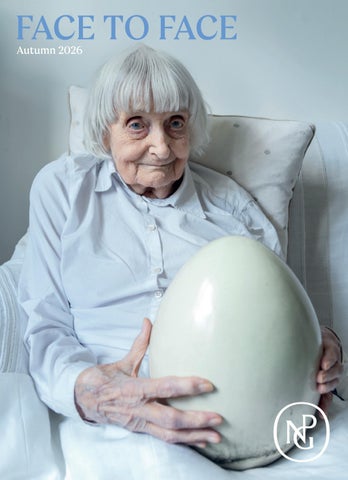
Cover image – Maureen Duffy (1933–2026) and Her Giant Egg, London, 2025 by Tim Walker, will feature in Tim Walker’s Fairyland: Love and Legends from 8 October 2026 © Tim Walker.
npg.org.uk Gallery Switchboard 020 7306 0055
Back cover image – Young Girl at a Window by Mary Cassatt, 1883, will feature in Mary Cassatt: Radical Impressionist from 11 March 2027 The Gallery is committed to reducing our environmental impact. This magazine is fully recyclable and has been produced by a certified carbon balanced printer. Their Partnership with the World Land Trust is helping to preserve and protect carbon-rich habitats around the world.
© National Gallery of Art, Washington, Corcoran Collection.
From the Head of Membership Ivi Varda
Autumn is my favourite season: exhibition announcements, plans for the year ahead, the countdown to Christmas, a chill in the air, and new shows opening all make it a wonderful time to visit the National Portrait Gallery. The much-anticipated exhibition Tim Walker’s Fairyland: Love and Legends opens to Members on 9 October. In this show, the celebrated photographer explores queer identity and community, with love at its heart, using photography as a portal into a fantasy realm – his personal ‘Fairyland’ – where everyone is free to be themselves. Look out for portraits of Tim’s close friends and collaborators: the people who have supported him throughout his life and career, and on whose shoulders great movements and histories have been built. Opening to Members on 3 November, the Winston Taylor Photo Portrait Prize also celebrates photography as an art form that connects people to one another. The exhibition presents new work by talented professional and amateur photographers alongside established practitioners from 55 countries, showcasing the best in contemporary photography. From nearly 4,000 entries, the judges selected 56 finalists representing 13 countries. Read more on page 18 before visiting the exhibition. We also invite you to see our latest new acquisitions: a portrait of Ada Lovelace and another of Harry Styles. Ada Lovelace, the mathematician and computer pioneer, is featured in two daguerreotypes, the first successful genre of photographs, which capture images in silver with higher resolution than our retinas can resolve. We will see her exactly as she appeared the day the daguerreotypes were taken, displayed in
Room 20 in Bride of Science: Ada Lovelace, her circle and women pioneers, launching on Ada Lovelace Day on 13 October. Shot in Italy by celebrated documentary photographer Martin Parr and gifted to the Gallery, the portrait of Harry Styles exudes joy and carefree spirit. Read more on page 9 about this gift from Styles and Parr. Our autumn events programme is bursting with activities. See pages 24 and 25 for full details, including highlights such as Legacy Week (19–23 October), a drop-in drawing session with artist Es Devlin (2 October), and our Members’ Christmas Celebration (30 November): an exclusive evening of tours, activities, surprises, music and exhibitions to mark the start of the festive season. Have a great autumn and see you at the Gallery, Ivi x
1
Every visit to the National Portrait Gallery is a personal one. Among the portraits of artists, writers, scientists, leaders and cultural icons, there is often one face that draws us back. From Boleyn to Bowie, Mandela to Malala, each portrait holds a history that should be shared: because these stories inspire, challenge and move us, helping us to understand who we are and where we’ve come from. By leaving a gift in your Will, you can help to ensure that these remarkable portraits and the rich history they represent are cared for, shared and brought to life for generations to come. Legacy Week
This October, the Gallery will mark Legacy Week (19–23 October) with a programme of free events exploring the lasting impact of gifts in Wills in shaping the Gallery, and ensuring that the portraits and stories that matter most continue to inspire. Whether you’ve already included the Gallery in your Will or are thinking of leaving a gift and want to find out more, Legacy Week is a chance to reflect on the enduring power of portraiture and how the stories that have shaped you can become a part of your own. – Christelle Bonda
Fundraising Manager, Legacy Giving For more information, please contact the Legacy Team at legacy@npg.org.uk or +44 (0)20 7321 6273. More about gifts in Wills at npg.org.uk/legacy Right – Model in front of Judi Dench by Alessandro Raho, 2004 (NPG 6671) © David Parry. On display in Room 30 (Floor 1).
LEGACY
The Stories We Return to
Contributors
Christelle Bonda Fundraising Manager, Legacy Giving Genevieve Drinkwater Patrons Manager Brandei Estes Senior Curator, Photographs Clare Freestone Curator, Photography Ruby Rees-Sheridan Assistant Curator, Photography
Photo: © Michael Bright
Charlotte Bolland Senior Curator, Research and 16th-Century Collections
Susanna Brown
Susanna Brown is a writer, curator, and Senior Lecturer at University of the Arts London. She worked in the Photographs Collection at the National Portrait Gallery from 2004 to 2008 and returns as an external curator for the exhibition Tim Walker’s Fairyland: Love and Legends. She has created exhibitions of historic and contemporary art and photography for organisations including Chanel Nexus Hall, Tokyo; Chimei Museum, Tainan; J. Paul Getty Museum, Los Angeles; Palazzo Reale, Milan; and V&A, London.
Björn Saven CBE
Currently Chairman of Jarla Invest, Björn Saven founded IK Investment Partners in 1989 and served as Chairman & Chief Executive. His previous roles include 12 years with the Esselte Group in Sweden, the UK and the USA, and two years at Gulf Oil in the 1970s. He has an MBA from Harvard Business School and a degree from the Stockholm School of Economics. A former trustee of the National Portrait Gallery and Tommy’s (the UK pre-natal care charity), he now serves on the board of the Heart/ Lung Foundation of Sweden and the industrial advisory board of the European Spallation Source Project in Lund, in which the UK is a participant. He has honorary doctorates from the Stockholm School of Economics and Business, the Swedish School of Economics and Business in Helsinki, and the Institute of Technology at Lund University. In addition to his CBE, he has been awarded a number of national honours including HM the King of Sweden’s gold medal 12th size in the Seraphim band, Commander Grand Cross of Portugal and Officier de la légion d’honneur of France.
3
My Favourite Portrait by Björn Saven CBE
Few paintings embody an encounter between worlds as compellingly as Joshua Reynolds’s Portrait of Mai. I was privileged to serve as a Trustee of the National Portrait Gallery when, in 2023, the Gallery and the Getty Museum came together in an unprecedented partnership to secure the painting for public ownership. I was fortunate also to contribute personally to its acquisition. To be given the opportunity to play a part in preserving this extraordinary work was a great honour and a continuing source of pride. Mai’s story is as remarkable as the painting. Born on Raiatea around 1753, he lost his father and his family’s lands during a conflict with neighbouring Bora Bora and fled to Tahiti. When the opportunity arose to travel to Britain as part of Captain Cook’s second Pacific expedition, Mai had an objective of his own: to seek British weapons and support, which might enable him to recover his family’s position and to avenge their losses. Arriving in England in 1774, the first Polynesian visitor to Britain became a sensation. Intelligent, charming and self-possessed, he moved through Georgian society with remarkable ease and was presented to George III. Reynolds, at the height of his powers, recognised a subject worthy of his grandest manner. On his own initiative he painted Mai, producing a monumental portrait that became one of the most celebrated of the Royal Academy exhibition of 1776. 4
Mai adopts a striking presence and assurance. His pose recalls classical sculpture, while Reynolds also emphasises his Polynesian origins: a traditional tapa, or bark-cloth sash, forms part of his flowing costume, and his tattooed hands remain clearly visible. Reynolds valued the painting so highly that he retained it in his studio until his death. In 1776 Mai sailed again with Cook, this time on the explorer’s third and final Pacific voyage. Cook returned him to Huahine in the Society Islands in 1777, before continuing on the voyage that would end with Cook’s death in Hawaii in 1779. For me, as a Swede with UK roots, there is also a pleasing Swedish thread: Cook’s voyages belonged to the great scientific Enlightenment in which Sweden played an important role. Daniel Solander, a pupil of Linnaeus, sailed on Cook’s first expedition; another Linnaean Swede, Anders Sparrman, joined his second – the voyage on which Mai entered this extraordinary story.
Right – Portrait of Mai (Omai) by Sir Joshua Reynolds, c.1776
(NPG 7153). Purchased jointly by the Board of Trustees of the National Portrait
Gallery and the J. Paul Getty Trust, 2023, with support from the National Heritage Memorial Fund, Art Fund and other generous supporters.
Portrait of Mai by Sir Joshua Reynolds is currently on display at the Getty Museum, Los Angeles, until 2029.
COLLECTION NEWS 6
‘What a puzzling picture’: Researching an important double portrait from Penshurst Place by Charlotte Bolland, Senior Curator, Research and 16th-Century Collections
Left – Portrait of two unidentified youths by an unknown artist, 1626 (NPG L307 Portfolio) © National Portrait
Gallery, London. Lent by Viscount De L’Isle from his private collection at Penshurst Place, Kent, 2025.
Right – The Public Study Room.
In January 1969, Sir Roy Strong visited Penshurst Place in Kent. As he was writing detailed notes while surveying the collection, his eye was caught by an unusual double portrait. Dated 1626, it showed two teenage boys at full length standing side by side. One of the sitters was identified as Prince Rupert, nephew of Charles I; the other, who was of African heritage, as his page. Strong made no comment on the boys’ identities and did not suggest an attribution, but it seems he spent some time staring up at the painting, as he felt compelled to note: ‘What a puzzling picture.’ Seeing the painting high on the wall on a visit to Penshurst more than 50 years later, I shared Strong’s view, for the composition was unusual and the artist’s style hard to place. However, as an early full-length portrait of a sitter of African heritage, it was evident that the painting warranted further study. In recent years researchers have drawn attention, long overdue, to the lives of people of African heritage in Britain over time. This is a subject to which the Gallery can make a particular contribution, as the Archive’s British Portraits Records series holds images of hundreds of thousands of portraits in public and private collections around the world. These include many historic images of people from the global majority, but the images are often difficult to find, particularly if the sitter is unidentified. An ambitious survey of the records, generously funded by The Pilgrim Trust and the Samuel H. Kress Foundation, is helping to make these images more accessible. It was in the context of this survey that I was eager to research the Penshurst double portrait in depth. Working in close collaboration with the Sidney family, and with generous funding from the Idlewild Trust and Historic Houses, we have been able to bring the portrait to the Gallery’s conservation studio for technical analysis and conservation treatment. Of crucial importance to the search for the boys’ biographies is the
confirmation that the inscriptions dating the portrait to 1626 and stating that the boy on the left is in his 13th year are original to the portrait but that the inscription identifying the boy as ‘Prince Rupert’ is a later addition. Work has begun to try to identify the sitters. Could they be connected to the Sidney family through the networks of Sir Thomas Smythe or Robert Rich, Earl of Warwick, and thereby to the colonial enterprise of the Virginia Company? Are there signifiers of identity in the portrait, such as the red and gold livery colours of the boy on the right, the prominent golden spur of the boy on the left, or the hunting scene in the background? These are just some of the questions that I will be considering over the coming year with colleagues in the Curatorial and Conservation teams, with the Sidney family at Penshurst, and in consultation with researchers with diverse areas of expertise. I very much hope that we will be able to solve the puzzle together. The portrait will be on display in Room 4 (Floor 3) from 17 September 2026. The resources of the Archive Survey Project are available in the Public Study Room, open Tuesday– Thursday; to make an appointment to use them please email archive@npg.org.uk.
7
Ada Lovelace’s Poetical Science Tim Lindholm, software engineer, daguerreotype enthusiast and donor, speaks to Clare Freestone, Curator, Photography, about why three very early photographs of the computer pioneer Ada Lovelace are so meaningful Tim, first, we have you and your wife, painter Lucy Gaylord-Lindholm, to thank that the National Portrait Gallery has three daguerreotypes of Ada Lovelace (1815–1852) in our Collection. Two are the only known photographs of her from life. They will be displayed in Room 20 in Bride of Science: Ada Lovelace, her circle and women pioneers, in time for Ada Lovelace Day on 13 October. Could you sum up the magic of these three tiny photographs and what they mean to you? Daguerreotypes are indeed magical – Victorian nanotechnology! Before 1839 one’s likeness was made via drawing or painting. Daguerreotypes capture images in silver, by the action of light reflected from a sitter, with higher resolution than our retinas can resolve. Ada is as though in the next room, exactly as she appeared that day. What was your entry into the world of Ada Lovelace and Charles Babbage, whose Analytical Engine her ‘notes’ transformed into what would later be recognised as the first programmable computer?
As a student in the 1980s I studied mathematics and philosophy. I didn’t aspire to be a ‘computer person’ but gravitated towards the mathematical foundations of computing and the philosophy of Artificial Intelligence. There I encountered Babbage (1791–1871) and Ada, who was the daughter of Lord Byron, though he never knew her. I was fascinated by the depth of their insights, even though these were never fully implemented, and the tragedy of the work being effectively forgotten. How did your passion for early photography begin? In 1998 my parents sent Lucy and me a book on daguerreotypes. Shortly afterwards we were eating in a Mexican restaurant in Albany, California. I looked out of the window and was surprised to see a large marquee sign: ‘DAGUERREOTYPES’. There has probably not been another such sign since the 1850s! After lunch we went across the street…. Being an esteemed software engineer yourself, how would you define Ada’s contribution to our world, in a nutshell? Babbage and Ada’s work in computing machines was rediscovered and reappraised only at the beginning of the 1970s. Automatic computing had been independently discovered and implemented using electronic components – rather than brass gears – yielding a group of engineers capable of evaluating the earlier work. Ada is sometimes called the first programmer, for her description of the steps of an algorithm in an appendix to her translation of a paper on the Analytical Engine by the Italian engineer Luigi Menabrea. While her ‘note’ doesn’t really constitute a program, in it she invented a formalism for the precise description of computational processes, something that would be familiar to millions of programmers today. Bride of Science: Ada Lovelace, her circle and women pioneers will be on display from 19 October 2026 in Room 20 (Floor 2).
8
New Acquisition – Harry Styles by Ruby Rees-Sheridan, Assistant Curator, Photography
Left – Ada Lovelace by Antoine Claudet, c.1843 (NPG P2111). Above – Harry Styles by Martin Parr, 2024 (NPG P2120). © Martin Parr / Magnum Photos.
Known for his fabulous fashion sense and hits like ‘Watermelon Sugar’, Harry Styles is one of the UK’s biggest pop stars. Whilst taking a break from performing in 2024, he was joined for a summer in Italy by the celebrated documentary photographer Martin Parr, who created this joyful portrait of the singer in his distinctive closeup, snapshot style. Although the photograph was featured on the cover of the Sunday Times magazine earlier this year, it was not originally created for publication, resulting in a carefree informality. The National Portrait Gallery was thrilled to acquire the portrait as a joint gift from Styles and Parr, with the kind support of The Martin Parr Foundation and the DMB agency. An admirer of Parr’s work, Styles has said, ‘I love his lens, the way he looks at the quieter side of British culture and sees something special.’ The photographer, who passed away in 2025, was the subject of a major exhibition at the Gallery in 2019. This acquisition marks the eighth work by Parr to enter the Collection. 9
Portrait Contemporaries Genevieve Drinkwater, Patrons Manager, meets Photographer and Portrait Contemporary Serena Brown
Serena Brown is a London-based photographer specialising in portraiture, fashion, sport and culture. Her work captures people and communities with a candid, intimate approach. Here, she reflects on her creative journey, her involvement in Portrait Contemporaries (the National Portrait Gallery’s new programme for patrons aged 25–45), and the importance of bringing fresh perspectives and new voices into cultural institutions. Hi Serena! Please tell us about how you first became involved with the NPG. My connection began when I entered the Winston Taylor Portrait Prize in 2022, where I went on to win the inaugural commission
prize. I made a portrait of clean-air activist Dr Rosamund Adoo-Kissi-Debrah, which is now part of the Gallery’s permanent collection. Since then, Rosamund and I have continued to collaborate with the Gallery through talks and events, including our recent Art of Awareness conversation. It’s been so special to see that relationship continue to grow beyond the original commission. What inspired you to get involved in Portrait Contemporaries? I’ve loved being part of the group because it’s given me the opportunity to experience the breadth of what the Gallery has to offer, from exhibition previews and artists’ talks to studio visits and trips. As a photographer, I’m naturally curious about people and their stories, so being part of a community of artists, curators and people who are passionate about portraiture has been really enriching. It’s also been a great way to meet people from different creative backgrounds whom I probably wouldn’t have crossed paths with otherwise.
Left – Rosamund Adoo-Kissi-Debrah with her children Robert and Sophia by Serena Brown, 14 June 2024 (NPG x203056) © Serena Brown, June 2024.
Above and opposite page – Serena Brown at Tracey Emin’s café, A Perfect Place to Grow; Portrait Contemporaries enjoying the Tracey Emin’s Foundation in Margate. All photos by Mariana Pires.
10
What has been your most memorable experience as a Portrait Contemporary so far? Our trip to Margate has definitely been one of my highlights. Having such invaluable access to Turner Contemporary, the Carl Freedman Gallery and Tracey Emin’s Foundation (pictured above) was really memorable. Hearing directly from the artists and exploring their studios in such an intimate setting felt extraordinarily special and it’s something I wouldn’t have had the opportunity to do otherwise. What impact do you think young patrons can have on the future of the Gallery? I think young patrons help to keep institutions like the NPG connected to contemporary culture. They bring fresh perspectives, champion new voices and help to make the Gallery feel accessible to wider audiences. The more diverse the community supporting the Gallery, the richer the conversations around portraiture become. The contributions from Portrait Contemporaries help to fund learning
programmes for diverse audiences and access for young people, making it easier for new audiences to engage with the Gallery for the first time. Making art and culture accessible at a young age is so important, and it’s exciting to be part of a programme that actively invests in the Gallery’s future audiences. What would you say to someone considering joining the programme? I’d say: don’t feel you need an art background to join. One of the best things about Portrait Contemporaries is the mix of people involved – everyone brings something different. If you’re curious about art, photography and culture, and want to meet interesting people while supporting the work of the Gallery, it’s such a brilliant programme to be part of. I’ve learnt so much simply by turning up and being open to the experiences it offers. To find out more about Portrait Contemporaries (everyone is welcome!), email pcpatrons@npg.org.uk.
11
EXHIBITIONS
Right – Andrew Lumsden (1941–2023) (after Nicholas Hilliard), London, 2023 © Tim Walker.
Curating Tim Walker’s Fairyland: Love and Legends by Susanna Brown, Curator In spring last year Tim Walker and I spent a day discussing possible titles for his exhibition of new photographs, which opens at the NPG on 9 October. We began with a game of sorts, filling dozens of little Post-it notes with individual words that communicated the themes of this vast project … words about activism and protest, about pride and respect, about freedom and acceptance, about performance and creativity, about desire and passion. We arranged the words across the studio wall in various configurations, and potential titles gradually began to emerge. It soon became clear that one of the most essential words was LOVE. This is an exhibition about love in all its forms and the power of connection between friends, chosen families, couples and communities. It’s an exhibition about legends, too, in both senses of that word: legends meaning the stories passed from one generation to another, and legends meaning inspirational people. One such person is Maureen Duffy, the great storyteller with wide blue eyes pictured 12
at the age of 91 on the cover of this magazine. Walker showed me his precious copy of Duffy’s book The Erotic World of Faery (1972), inscribed to him when they met, and he told me about his own lifelong fascination with fairies. When Duffy died in May, I devoted an afternoon to reading her poems and was transported to a lyrical landscape where ancient, medieval and modern worlds seem to co-exist. Her lovers and friends walk alongside characters from history and mythology – the Greek poet Sappho; Eros, god of love; the oak nymph Eurydice – while dragons, unicorns, hawks and nightingales soar above. Nature is ever present and whole seasons are compressed into stanzas. The more poems I read, the more I understood why Walker felt an affinity with Duffy. They explore many similar themes through their chosen media, and both build environments where the real and the imaginary combine. Walker’s portrait project began in 2020. Out strolling in Highbury Fields in London, he noticed a small plaque marking the spot where
the first gay rights demonstration in Britain took place. On 27 November 1970, 150 members of the Gay Liberation Front held a torchlight rally against police harassment. The date of their demonstration was the same day Walker was born, and the coincidence sparked his interest. Who were these activists, where were they now? He began to contact some of those early trailblazers, inviting them to his studio to be photographed. Some suggested people they thought he might want to meet next, and so the portrait sittings unfurled organically, expanding to include not only the Highbury Fields protesters, but also subsequent generations of Queer figures admired by Walker. Many people brought personal and symbolic items along to the studio – banners, books, badges, medals – and these objects add another layer of meaning to their portraits. Some are lucky talismans or souvenirs, others represent battles hard-won or lives tragically lost. Jane Anderson, consultant physician and chair of the National AIDS Trust, brought her stethoscope and a bejewelled red ribbon designed by Andrew Logan in response to losing friends to the disease in the 1980s. Julian Hows, one of the ‘Brixton Faeries’ of the 1970s, brought the teapot once used to store
communal kitty money in his first squat. Filmmaker Isaac Julien clasped a conch shell, a motif from his pioneering film Looking for Langston (1989). Duffy chose a giant egg, and its presence calls to mind surreal and fantastical images by two of Walker’s favourite painters, Hieronymus Bosch (c.1450–1516) and Leonora Carrington (1917–2011), for whom the egg carried a history of alchemic symbolism. It seems particularly poignant that, near the end of her life, Duffy held this emblem of new life, renewal and hope, perhaps symbolically handing this over to the viewer and the next generations. Walker has a huge knowledge of art history and his references to painting are frequent. The portraits of journalist Andrew Lumsden and Stonewall co-founder Olivette Cole-Wilson were inspired by works by Nicholas Hilliard (1547–1619) and Hans Holbein the Younger (c.1497–1543). As Walker explains, ‘Holbein and Hilliard memorialised the movers and shakers of the Tudor aristocracy for hundreds of years to come. The trailblazers I photographed made history and deserve to be on our gallery walls too. I call them my “queeristocracy”.’ He often asked sitters if they wanted to be photographed as themselves or someone else,
Left – Olivette Cole–Wilson and Blackbird, London, 2025 ©Tim Walker.
Above right – Liz Carr as Elizabeth I, All-Paper Costume: Sophie Lincoln, London, 2024 ©Tim Walker. Right – Queen Elizabeth I (‘The Ditchley Portrait’) by Marcus Gheeraerts the Younger, c.1592 (NPG 2561).
14
and, perhaps not surprisingly, several actors chose to pose in character. Fiona Shaw donned fistfuls of vintage rings and a faux fur coat to portray Edith Sitwell; Tilda Swinton wore one of her dresses from Sally Potter’s queer cult classic Orlando (1992); and Liz Carr played the role of her namesake Elizabeth I. Carr explained that unimaginative teachers always cast her as a monarch in school plays because, as a wheelchair user, she came with her own throne. For Liz, this portrait was an opportunity to reclaim that in the most fabulous way. Look closely at the picture and you’ll notice that everything in it is made of paper: the room, the dress, the little dog, even the earrings. Costume designer Sophie Lincoln based her dress on the Ditchley Portrait by Marcus Gheeraerts the Younger, printing each element separately and forming the paper into a three-dimensional gown so that the Elizabethan skirt hoops could fall perfectly over Liz’s electric wheelchair.
Regular NPG visitors will remember Walker’s work from the exhibition Vogue 100: A Century of Style in 2016. In Fairyland, photography enthusiasts will notice the visual links to his forebears at the magazine, including the queer photographers Cecil Beaton (1904–1980) and Richard Avedon (1923–2004). When he was still a teenager, Walker interned at the Vogue Archive and helped organise the huge collection of Beaton’s historic fashion pictures. In its flamboyant staging and magnificent costuming, his photograph of Paul O’Grady and Julian Clary as the Glitter Queens nods to Beaton’s love of camp. Elsewhere in Fairyland, portraits are set against seamless white paper reminiscent of the plain backdrops favoured by Avedon, whom Walker assisted in the 1990s in New York. At first glance, they might be described as an homage to his mentor, but look more closely and you will discover that combination of tenderness and puckishness that is uniquely Walker’s. 15
Top – Paul O’Grady (1955–2023) and Julian Clary as the Glitter Queens, with Harry Browse, Rae and Liam Elias as the Glitter Boys, London, 2022. Above from left – Aphra and Jo Barwick, Siobhan Fahey and Emily Witham, East Sussex, 2024; Harry Keita as Delphinium Fairy, London, 2022. Opposite page from top left – Ben Whishaw in Crystal Prism, London, 2020; Kae Tempest, London, 2023. All © Tim Walker.
16
I’ve been moved to tears more than once in the process of curating the exhibition, and I expect visitors will be moved when they step into the Gallery. My eyes welled up looking at the photo of a smiling five-year-old Tim in his fairy wings as he explained to me how the word ‘fairy’ became a cruel playground taunt not many years later. I wept reading the catalogue essay by Russell T. Davies about the 1980s HIV/AIDS crisis and the tales of suffering and care that pierced his heart as he wrote It’s A Sin. I cried when Caroline Paige talked with me about her experiences as the first openly transgender serving officer in the British Armed Forces. Grief and loss are part of this story, but so is joy. Avedon remarked, ‘Photography for me has always been a sort of double-sided mirror. The one side reflecting my subject, the other reflecting myself.’ Walker uses Avedon’s metaphor to expand on his ambitions for Fairyland: ‘If photography is a mirror of the photographer as well as the subject, this is me owning my sexuality with pride and joy.’ When you visit the exhibition, or even before you arrive, I encourage you to listen to the free
audio guide on the Bloomberg Connects app. We invited the sitters themselves to share the stories behind the photographs. Making a portrait with an artist of Walker’s calibre might be daunting, even for a seasoned performer, but his kindness quickly puts people at ease, as Kae Tempest explains on the audio guide: ‘As soon as I got there, I felt this huge warmth coming from Tim, and this dedication to his craft that made me feel so safe, because it felt like a collaboration between artists and that’s something I love to do. Something about Tim’s care made me feel I was with community, and that it was OK for me to show up and be beautiful.’ And that is Tim Walker’s extraordinary gift, he sees the magic and the beauty in the infinite variety of humankind and celebrates that beauty with his camera.
Tim Walker’s Fairyland: Love and Legends will be on display from 9 October 2026 until 7 February 2027, Exhibition Gallery (Floor 0). Presented with Pandora.
17
Winston Taylor Photo Portrait Prize 2026 by Brandei Estes, Senior Curator, Photographs
This year marks the 19th edition of the Winston Taylor Photo Portrait Prize, the annual global portrait photography competition, which saw nearly 1,500 photographers from 55 countries submit almost 4,000 photographs. From these, the judges selected 56 works by photographers from 13 countries, brought together in an exhibition that, for me, is defined by an overarching sense of connection and respect for the sitters, stories and places represented. Right – Maurizia, Torre Annunziata from his series TRA,by Roman Manfredi, 2025 © Roman Manfredi.
Opposite page – Wendy and Summer by Morgan Lieberman, 2025 © Morgan Lieberman.
18
One of the great pleasures of judging this year’s Prize was the time it gave me to really look. To spend time with these photographs, to return to them, and to debate and discuss them with my fellow judges was deeply rewarding. What struck me most, and what stayed with me throughout the process, was just how hopeful the exhibition feels. There is a warmth and a generosity to so many of the works, and an overriding sense of portrait photography as a means of connection. For me, a great portrait is never simply about how somebody looks. It is an encounter between photographer and sitter, but also between the person within the photograph and us, the viewers. The works I found myself returning to are very different in approach but share something important: each photographer has approached their sitter with grace and respect, allowing them to be seen without trying to define them.
Roman Manfredi’s portrait Maurizia, Torre Annunziata, 2025, from his series TRA, embodies this beautifully. Photographed in Naples in front of a neighbourhood devotional shrine, Maurizia feels completely connected to the place around her. Manfredi’s project explores gender-variant lives, but Maurizia is never reduced to her gender identity. Instead, identity becomes inseparable from place and lived experience. We are invited to meet Maurizia rather than explain her. I felt a similar generosity in Morgan Lieberman’s double portrait Wendy and Summer, 2025. Lieberman met the couple through Lex, an app for the LGBTQ+ community, and what began as a photographic encounter developed through conversation and friendship. There is an ease between the sitters that feels genuine rather than performed for the camera. It is intimate, but never intrusive. 19
Connection takes a different form in Charlie J. Doherty’s Odira & Tau, 2025. Doherty first met Odira and his son Tau at Brockwell Lido – they were strangers to him. What I find so affecting about the resulting portrait is its restraint. It does not try to tell us everything about fatherhood; instead, we understand their relationship through a moment of closeness. Sometimes the smallest gestures tell us the most. Avery Moss-White’s portrait Tora-i, 2025, brings another dimension to this idea of connection: time. They’ve been friends for a decade, and Moss-White has made a portrait of Tora each year. I love the idea of portraiture becoming part of the rhythm of a friendship, marking the passage of time and the lives of both photographer and sitter. The image becomes less a record of a single moment than part of an ongoing conversation. Joanangelo Molinari’s portrait Amit in the Studio, 2026, approaches the relationship between photographer and sitter from another
20
direction. A campaigner who has spoken publicly about living with facial difference, Amit wanted to be photographed honestly and directly. The portrait never asks us for sympathy. Instead, he meets our gaze with complete presence. There is agency in how he chooses to be seen, and respect in how the photographer gives him that space. Jermain Cikic’s João e Maria, 2025, a portrait of a father cradling his child, perhaps expresses the central feeling of the exhibition most simply. There is such tenderness in the gesture of one person holding another. The photograph does not need to announce its intimacy: we feel it. Among works exploring very different lives and experiences, it brings us back to something fundamental: our capacity to care for one another. Looking through these photographs, I kept returning to the idea that portraiture can create a space for recognition. Photography can challenge assumptions and give visibility, but it
can also allow us to encounter someone whose experience may be entirely different from our own and still find a point of connection. That, for me, is what makes this year’s exhibition feel so hopeful. Not because these photographs suggest that life is uncomplicated – many contain difficult histories and experiences – but because of the trust and generosity with which people have chosen to photograph one another. After spending so much time with these works, I came away reminded of portrait photography’s extraordinary ability to bring us closer. At a moment when it can feel easier to focus on what separates us, these photographs ask us to do something wonderfully simple: to stop, look at another person, and find a point of connection. Winston Taylor Photo Portrait Prize will be on display from 5 November 2026 until 17 January 2027, Exhibition Gallery (Floor 2). Supported by Winston Taylor.
Far left – Odira & Tau by Charlie J. Doherty, 2025 © Charlie J Doherty.
Left – Tora-i by Avery MossWhite, 2025 © Avery Moss-White. Above – Amit in the Studio, by Joanangelo Molinari, 2026 © Joanangelo Molinari.
Right – João e Maria by Jermain Cikic, 2025 © Jermain Cikic.
21
Patrons help to support all that we do at the NPG, from new acquisitions to learning programmes for diverse audiences. Join this community of passionate supporters and enjoy invitations to opening night private views, behind-the-scenes tours, and curated art trips. Highlights this autumn include a preview tour of Tim Walker’s Fairyland: Love and Legends, and an in-conversation between artist Kaye Donachie and renowned fashion designer Erdem Moralioglu. To learn more, and to receive the latest events programme, please email patrons@npg.org.uk.
PATRONS
Become a Patron
Cocktails and Live Jazz at the National Portrait Gallery Larry’s
Photo: © Jack Baile
By night, Larry’s transforms into an intimate drinking spot in one of London’s most unique heritage settings. The bar sits beneath the Gallery in a space originally built for coal storage in 1896, creating an atmospheric setting where historic architecture meets a refined, contemporary cocktail and dining experience. Enjoy live jazz every Wednesday to Saturday, and seasonal dining and cocktail menus.
Evening Dining at the National Portrait Gallery The Portrait Restaurant by Richard Corrigan
NPG Members receive 10% discount in all Gallery hospitality outlets. Find out more at npg.org.uk/visit/eat-and-drink
Photo: © Melisa Coppola
The Portrait Restaurant is a contemporary British and Irish dining destination with renowned chef Richard Corrigan at the helm. Situated on the fourth floor of the Gallery, The Portrait offers an all-day menu that celebrates the finest flavours of the British Isles while providing diners with spectacular views across Trafalgar Square and beyond.
DATES FOR YOUR DIARY
Exclusive Members’ Events New Members’ Welcome Tours Tuesdays 20 October, 17 November, 15 December 2026, 12 January 2027 16.00–17.00 Limited spaces – Booking recommended / Free
Members’ Talks Friday 25 September 19.00–20.00
Under the Microscope: Researching the National Portrait Gallery’s Horenbout Miniatures Booking required / £15
Join the Gallery’s Painting Conservation Manager Sally Higgs for this exclusive behind-thescenes talk exploring Sally’s research into the Gallery’s Collection of Horenbout miniatures. Friday 6 November 19.00–20.00
Discoveries in the Archive: Revealing Phillis Wheatley
Booking required / £15 Join researcher Sarah Okpokam for this special members-only talk about the fascinating story of 18th-Century American poet Phillis Wheatley.
Members’ Previews
Members’ Events
Friday 9 October 10.30–13.00
Friday 27 November 18.30–19.15
Free
Booking required / £20
Tim Walker’s Fairyland: Love and Legends Wednesday 4 November 14.00–17.00
Winston Taylor Photo Portrait Prize 2026 Free
Wednesday 10 February 2027 14.00–17.00
Peter Blake: Pop Art Life
Booking opens 18 December 2026 / Free Wednesday 10 March 2027 14.00–17.00
Mary Cassatt: Radical Impressionist Booking opens 29 January 2027 / Free
Members’ Tour Thursday 15 October 13.00–14.30
Historical and Queer portraits at the National Portrait Gallery Booking required / £25 Join Jon Sleigh as he delivers a themed tour of the National Portrait Gallery’s Collection.
Curator-led tour of Winston Taylor Photo Portrait Prize 2026 Join the Gallery’s Senior Curator of Photographs, Brandei Estes, for this exclusive Members’ only curator-led tour. Monday 30 November 18.45–21.30
Members’ Christmas Late
Early bird booking opens 30 September 2026 / £25 Full price booking opens 15 October 2006 / £28 Ticket includes a complimentary drink A magical evening of music, exhibitions, workshops and behind-the-scenes tours.
Members’ National Portrait Gallery Stories Friday 11 December 17.00–18.30
Feuds and Fights
Booking required / £25 Join this exclusive Members’ tour with Senior Storyteller Daniel Hausherr, and discover tales of some of the Collection’s most famous feuds and fights. Friday 22 January 18.00–19.30
The Queens
Booking required / £25 Discover the untold stories of Britain’s royal queens on this exclusive Members’ tour with Senior Storyteller Daniel Hausherr.
Members’ Early Morning View Monday 11 January 2027 9.00–10.30
Tim Walker’s Fairyland: Love and Legends and Winston Taylor Photo Portrait Prize 2026
Booking opens 1 December 2026 / Free
24
Public Events National Portrait Gallery Stories
Photography Masterclasses
Friday 25 September, Friday 20 November 18.00–19.00 Members £18
Saturday 10 October 11.00–17.00
Join our Senior Storyteller, Daniel Hausherr, for an exclusive highlights tour of the Gallery where you will hear some of the most incredible tales that the Gallery has to offer.
Sensual Activism and the queer body with Ajamu X Booking required / Members £112.50
Friday 2 October 18.00–20.00
Join us for a photography workshop led by contemporary photographer, and sitter in the Tim Walker’s Fairyland: Love and Legends exhibition, Ajamu X.
Free event
Saturday 14 November 11.00–17.00
Drawing Class
Drop-in Drawing with Es Devlin Begin your weekend by creating your own work of art at our friendly and welcoming drawing event, inspired by the world’s largest collection of portraits including Es Devlin’s collective digital portrait at the National Portrait Gallery. Suitable for all levels of experience, from complete beginners to accomplished artists. All materials are provided.
Tim Walker, Movement and photography Booking required / Members £112.50
Join us for a special one-day photography masterclass on capturing movement in photography, led by Tim Walker.
Legacy Week Monday 19 October to Friday 23 October Free Legacy Week is a chance to reflect on the enduring power of portraiture. Join us for a programme of free talks and tours exploring the lasting impact of gifts in Wills in shaping the Gallery, and ensuring that the portraits and stories that matter most continue to inspire.
Lunchtime Lectures Thursday 5 November 13.00–14.00
Serious Pleasures: The Life of Stephen Tennant
Thursday 19 November 13.00–14.00
Curator’s Introduction to the Winston Taylor Photo Portrait Prize 2026
Booking required / Members £9
Booking required / Members £9
Join award-winning author Philip Hoare for this special lunchtime lecture on Stephen Tennant.
Join the Gallery’s Senior Curator of Photographs, Brandei Estes, as she introduces this year’s Winston Taylor Photo Portrait Prize 2026.
Left – Queen Mary I attributed to Lucas Horenbout (or Hornebolte), c.1525 (NPG 6453). Above right – George Villiers, 1st Duke of Buckingham by the studio of William Larkin, c.1616 (NPG 3840).
Don’t forget Members receive a special 15% discount in the Gallery shops during Members’ private views.
25
Public Events In Conversation Friday 23 October 19.00–20.00
Activism and Advocacy for Queer culture Booking required / Members £13.50
Join Lady Phyll and Lisa Power in conversation, chaired by Travis Alabanza, all of whom are featured as sitters in the exhibition Tim Walker’s Fairyland: Love and Legends. Friday 27 November 19.00–20.00
Alice Loxton
Booking required / Members £13.50 Don’t miss acclaimed historian and social media star Alice Loxton as we celebrate the publication of her latest book, A History of Britain in 21 Paintings.
Friday 11 December 19.00–20.00
Telling Queer Stories Booking required / Members £18
Join Miriam Margolyes and Labi Siffre for a discussion around the importance of telling Queer stories.
Champagne Tasting and Tour Saturday 12 December 10.00–12.00
The Art of Champagne – A festive celebration Booking required / Members £82
Explore the origins of the festive season as told through the Gallery’s own Collection. The morning continues in The Portrait Restaurant with a Champagne tasting.
Tea Tour and Tasting Sunday 1 November & Sunday 22 November 14.00–16.00
Time for Tea – Gallery tour and cream tea experience Booking required / Members £36
Today tea is an iconic drink in Britain, but that was not always the case. From its origins as a health drink from China, to a domestic treat for wealthy women, and then to the everyday ‘cuppa’ favoured by all, Time for Tea will delve into the fascinating history of tea, told through the portraits in the National Portrait Gallery Collection. Enjoy a one-hour Gallery tour led by Senior Storyteller, Daniel Hausherr. Following the tour, you will be escorted to Larry’s Dining and Bar for a traditional cream tea and tea of your choice with freshly baked scones (plain & raisin), house raspberry conserve and Dorset clotted cream.
Left – Miriam Margolyes, Clapham Cream Teas, London, 2023 by Tim Walker © Tim Walker. Above – Catherine of Braganza by or after Dirck Stoop, c.1660–1661 (NPG 2563).
Book your event at my.npg.org.uk or RSVP with your name and Membership number to mevents@npg.org.uk
26
Upcoming Exhibitions Peter Blake: Pop Art Life
11 February to 31 May 2027
Mary Cassatt: Radical Impressionist
11 March to 13 June 2027
Herbert Smith Freehills Kramer Portrait Award Opens 24 June 2027
Frank Auerbach
Opens 14 October 2027
Winston Taylor Photo Portrait Prize Opens 4 November 2027 npg.org.uk/whats on
Left – Woman in a Loge by Mary Cassatt, 1879 © Philadelphia Museum of Art. Top – Michael Eavis by Peter Blake, 2022 (NPG 7132). Above – Helen Gillespie (‘Head of Helen Gillespie’) by Frank Auerbach, 1962–1964 (NPG 7152) © Estate of the artist, courtesy of Frankie Rossi Art Projects.
27
New Publications
Members’ Benefits • Unlimited free entry to our wide range of world-class exhibitions
Tim Walker’s Fairyland: Love and Legends Paperback £35
• See exhibitions before the public and during dedicated Members-only viewing hours
The publication includes an extended interview between Tim Walker and curator Susanna Brown, discussing the motivations behind the project and Walker’s personal and photographic journey over the past three decades. Insightful essays by Travis Alabanza, Russell T. Davies, Shon Faye, Lisa Power and Joelle Taylor reflect on themes central to the exhibition, including the history of activism, the AIDS crisis, love and relationships within the LGBTQ+ community.
• Special ticketed events programme, made just for Members
Winston Taylor Photo Portrait Prize 2026
• Priority booking and discounts on Gallery talks and events
Paperback £18.95
This book provides a unique opportunity to see an inspiring range of portraits from contemporary photographers selected from thousands of submissions.
• 10% discounts at our Audrey Green café, Larry’s Bar and The Portrait Restaurant • Exclusive pop-up Members’ Lounge at Larry’s Bar, open 11.00 to 17.00 daily Photo: © Sam Walton.
Mary Cassatt: Radical Impressionist Hardback £40
Mary Cassatt: Radical Impressionist is a richly illustrated publication on the life and work of the Impressionist artist, exploring her portraits, innovative prints, and groundbreaking vision of modern womanhood, published ahead of the Spring 2027 exhibition.
• 10% discounts in our shops plus priority access to special collaborations and limited editions • Free subscription to Face to Face magazine and access to exclusive digital content
Don’t forget that as Gallery Supporters you can enjoy 10% off every time you shop! Just show your Membership card in-store or enter your exclusive Members’ code online. npgshop.org.uk
28
Our shop is your first choice for all things Christmas. Select your gifts and decorations from our carefully curated collection whilst also supporting your favourite gallery. npgshop.org.uk
IN OUR SHOP
Spend well this Christmas