


KAYLYNNEBANTOM
“No child should have to choose between learning and hunger.” So said Cheraldine Vanacore, a Blisters for Bread Charity Family Fun
Walk participant for over 10 years The annual Blisters for Bread Charity Family Fun
Walk is an initiative by the Peninsula School Feeding Association (PSFA), 67-yearold non-profit organisation that aims to address hunger among learners
It provides daily nutritious meals to learners in over 100 schools in the province
For Vanacore child hunger is a topic that lies close to her heart as she comes from a disadvantaged background
For her, taking part in the event is a way of giving back
“This is personal to me I come from a background where I didn’t have much It was exciting for me to go to school and to get a meal Taking part in the walk is a reminder to me that I can make a difference in a small way ”
Vanacore said she cannot wait for this year ' s Blisters for Bread, which
returns to the Green Point Common Sports Ground on Sunday 31 August
“I am looking forward to completing the walk again this year I wish there were more organisations doing initiatives like this It’s a reminder that hunger is real I know how it feels to have nothing ” Online entries are now open, and participation is limited to 8 000 walkers Registration closes at midnight on Sunday 17 August
Every participant will be presented with a commemorative medal as a token of PSFA’s appreciation for taking part in this meaningful cause
In addition, thanks to the generous support of its hydration partner, Coca-Cola Peninsula Beverages, complimentary refreshments will be available to all walkers, ensuring everyone stays refreshed and energised throughout the day
The Green Point Common Sports Ground will come alive with live music performances from Cape
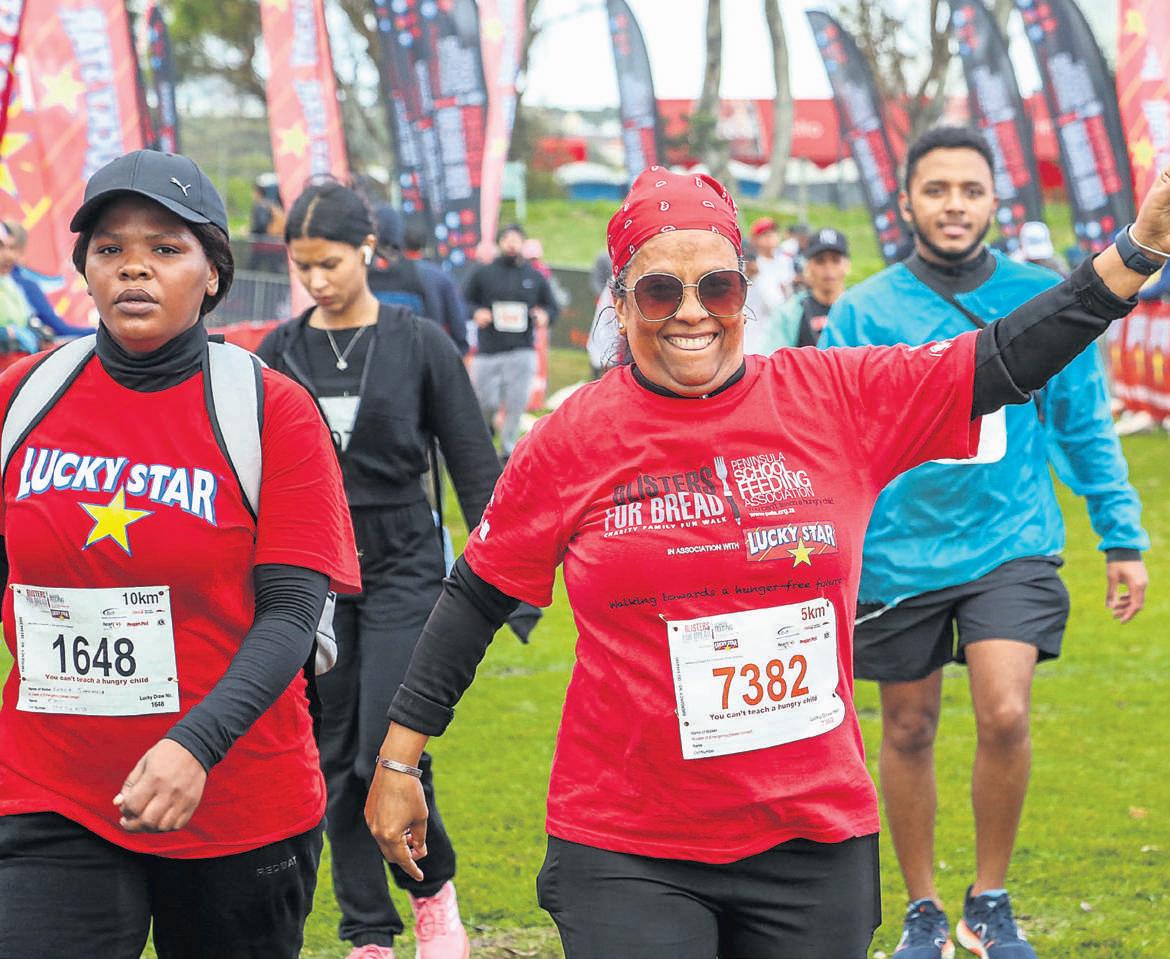
Town’s top local artists, family-friendly entertainment, food stalls and loads of activities for kids and grown-ups alike
Petrina Pakoe, director of PSFA, said Blisters for Bread is more than just an event but a “heartfelt movement” Every Rand raised and every kilometre walked helps
As measles cases surge in parts of the country, health experts are urging residents to check their vaccination status and ensure their children are protected
Although the outbreak is currently concentrated in Gauteng, where 181 laboratory-confirmed cases were reported between January and mid-June, public health professionals warn that under-vaccinated communities in the Western Cape remain vulnerable
VACCINATIONKEYTOSTOPPING
MEASLES
Professor Talitha Crowley, a public health expert and head of the academic division at the University of the Western Cape’s School of Nursing, says the best way to prevent measles from spreading is through high vaccination coverage
“To stop a measles outbreak, we need 95% of the community vacci-
nated,” she explained
“Right now, too many children in some parts of the country are going unvaccinated, and that’s dangerous ”
UNDERSTANDINGMEASLES
Measles is one of the most contagious viruses known to medicine It spreads through the air when an infected person coughs or sneezes and can linger in the air or on surfaces for up to two hours
The disease starts with symptoms like fever, cough, runny nose, and red, watery eyes, followed by a red rash that spreads from the face to the rest of the body
By the time the rash appears, the person is already in the most contagious stage
“Measles can cause serious complications, especially in babies, malnourished children, and people with weak immune systems,” said Crowley
“These include pneumonia, diarrhoea, blindness, brain inflammation, and even death ”
The good news, according to Crowley, is that the Cape Metropole increased its under-five immunisation coverage to 90% early this year This was achieved through targeted catch-up campaigns in clinics and schools
However, she cautioned that no community is completely safe until everyone is covered
“Even one unvaccinated child in a class can lead to an outbreak,” she said
“We need to keep those numbers up and reach the last 5 to 10% of families who might have missed a dose ”
Vaccination against measles is free at all public clinics and hospitals in Cape Town as part of the Expanded Programme on Immunisation (EPI) Routine measles vaccines are given at 6 months
Every year on 18 July we celebrate Nelson Mandela’s legacy with what has come to be known as “67 minutes of service” We’re encouraged to do something good for someone else whether that means handing out sandwiches, planting vegetables, or reading to children
Across Cape Town, schools, NGOs, churches, and companies show up with paint brushes, black bags, and donated goods
It’s beautiful in many ways, the spirit of generosity, the momentary unity, the desire to do good
But it’s also fleeting
Because the very next day, life goes back to normal Those who were hungry are hungry again
That over-crowded shelter remains underfunded The crèche with fresh coats of paint still has too few teachers And many of us who gave
our 67 minutes feel like we ’ ve done enough, until next year
But what Madiba stood for cannot be captured in one symbolic act a year He gave 67 years of his life to building a more just, equal and democratic South Africa He went to prison, endured unimaginable sacrifice, and still emerged with a commitment to peace, dignity, and inclusion If we really want to honour him, we have to live his values the other 364 days of the year, too Ubuntu, the African philosophy that reminds us I am because you are, is not about charity It’s not about dropping off pre-loved clothes or taking a selfie at a soup kitchen It’s a way of life Ubuntu calls us to see the humanity in others It asks us to act with compassion, but also with responsibility, to build communities where no one is left behind, and where justice is more than just a word on a wall
The truth is, many of us are struggling Some of us live in backyards or shacks where the rain leaks through the roof Others are unem-
ployed, or work long hours for little pay Some are raising children on their own Others are trying to rebuild after losing everything to gang violence, addiction, or crime In this country, most people live close to the edge And that makes it even more important that we don’t turn Mandela Day into a performance for the privileged We need to be asking harder questions: Why do people still queue for water in 2025? Why are libraries closing in places where children desperately need safe spaces to read? Why do government clinics run out of medication, and why is GBV still an everyday reality for so many women and girls? Madiba did not fight for a South Africa where injustice is normalised He believed in dignity, and dignity means access, fairness, and care, for everyone, not just a few
If we really want to honour his legacy, we have to treat each other with dignity every day, not just on Mandela Day That means greeting
and 12 months Public vaccination sites include City health clinics and district hospitals like Khayelitsha District Hospital, Mitchell's Plain, and Karl Bremer
VACCINESWORKANDSAVELIVES
“Just one dose of the measles vaccine gives around 93% protection
Two doses increase this to about 97%,” Crowley said
While rare, vaccinated individuals can still get measles, but their symptoms are usually mild and far less contagious
With school holidays and winter illnesses on the rise, the public is being urged to stay alert
“Measles is preventable If we all do our part, Cape Town can avoid the suffering we ’ re seeing elsewhere,” said Crowley . For information on your nearest clinic, call 0800 923 922 or visit www westerncape gov za/ facilities
the people we walk past on the street It means treating the person who collects our bins or cleans our children’s schools with the same respect as we do a manager It means checking in on an elderly neighbour It means challenging corruption when we see it, whether in government or in our own communities Mandela’s legacy isn’t just a history lesson It’s a living challenge to all of us
So yes, let’s keep Mandela Day Let’s keep the 67 minutes But let’s not stop there Let’s make kindness a habit, not an event Let’s make justice part of our daily thinking, not just our yearly branding Let’s teach our children not only to give, but to ask why some people always need to receive Because the truth is, 67 minutes is just the beginning South Africa needs 365 days of Ubuntu
That’s how we honour Madiba, not with moments, but with movement Not with charity, but with change


NAMHLAMONAKALI
As the cost of living continues to climb South Africans are being urged to take stock of their financial habits, particularly during July, National Savings Month.
Run annually by the South African Savings Institute (Sasi), the campaign aims to promote a culture of saving and long-term financial planning, particularly in lower- and middle-income communities where debt and unemployment remain high
This year focuses on small but consistent actions that can improve household financial resilience
Experts say that even modest savings can protect families during emergencies, reduce reliance on credit and help break intergenerational cycles of poverty
According to recent data from Statistics South Africa the personal savings rate in the country remains worryingly low, with many people spending more than they earn and struggling with high levels of consumer debt Speaking to People’s Post, Gerald Mwandiambira, interim chief executive officer of Sasi and a financial wellness coach, said the message of National Savings Month is especially urgent this year “People are under pressure, especially with food prices, petrol costs and electricity bills going up, ” he said “ But it’s still possible to save, even if it’s just R20 a week The principle is about starting small and staying consistent ” Mwandiambira said saving is not only about money, but about mindset “We need to change the narrative that saving is only for the wealthy It’s about building dignity, options and freedom from crisis living Saving R10 a day is better than nothing at all ”
Many South Africans, however, say the current economic climate makes saving feel impossible
SAVING BUILDS DIGNITY, OPTIONS AND FREEDOM FROM CRISIS LIVING.
“I’m a single mother and don’t always have extra money after rent, food and school fees,” said Sinazo Klaas from Newlands
“But I’ve started putting coins in a bottle at the end of the day It helped me cover taxi fare last month when my child was sick ”
The South African Reserve Bank has also acknowledged the importance of household savings for long-term economic growth, noting that low savings rates make the country more dependent on foreign investment and vulnerable to global shocks
Local NGOs and financial-literacy organisations have used National Savings Month as an opportunity to host workshops in schools, churches and community centres These sessions often teach budgeting basics, understanding credit and how to open low-fee bank accounts Mwandiambira encouraged households to have open conversations about money
“Talk to your children, your spouse, even your friends We need to normalise conversations about budgeting, debt and planning Financial literacy is a survival skill ”
National Savings Month is also a reminder that financial empowerment is tied to broader structural issues
Advocates say more needs to be done by government and private institutions to create jobs, reduce inequality and offer better consumer protection
But while the challenges are many the call to action remains the same: start where you are, with what you have
“It’s not about how much you save, but about starting Saving, even in small ways, is a form of self-respect,” Mwandiambira concluded
FORM 3A - NOTICE OF APPLICATIONS FOR LIQUOR LICENCES IN TERMS OF SECTION 37(1) OF THE WESTERN CAPE LIQUOR ACT,2008 – [REG 10(1)]
Notice is hereby given that the following applications for liquor licences have been lodged with the Western Cape Liquor Authority (the Authority) and with the designated liquor officers at the indicated South African Police Service offices The applications concerned may up to and including the 28th day from the date of publication of the application upon request and free of charge be inspected by any person at the offices of the Authority or the designated liquor officer listedhereunder Copies of an application can be obtained from the Authority after payment of the prescribed fee Objections and representations must be lodged in writing with the Authority and the designated liquor officer in accordance with section 39 of the Act
VORM 3A - KENNISGEWING VAN AANSOEKE OM DRANKLISENSIES INGEVOLGE ARTIKEL 37(1)
VAN DIE WES-KAAPSE DRANKWET,2008 – [REG 10(1)]
Hiermee word kennis gegee dat die volgende aansoeke om dranklisensies ingedien is by die Wes-Kaapse Drankowerheid (die Owerheid) en] by die aangewese drankbeamptes by die aangeduide Suid-Afrikaanse Polisiedienskantore Die betrokke aansoeke kan, tot en met die 28ste dag vanaf die datum van publikasie van die aansoek op versoek en gratis deur enige persoon besigtig word by die kantore van die Owerheid of die aangewese drankbeampte hieronder gelys Afskrifte van n aansoek kan by die Owerheid verkry word na betaling van die voorgeskrewe fooi Besware en vertoë moet ooreenkomstig artikel 39 van die Wet skriftelik by die Owerheid en die aangewese drankbeampte ingedien word
IFOMU 3A - ISAZISO SOKUFAKWA KWESICELO SEPHEPHA MVUME NGOKWECANDELO 37(1) LOMTHETHO WOTYWALA WENTSHONA KOLONI KA-2008 – [UMGAQO 10(1)] Isaziso siyanikezelwa ukuba ezi zicelo zilandelayo zamaphepha mvume otywala zifakiwe kwabasemaGunyeni ezoTywala eNtshona Koloni (abasemaGunyeni) nakumagosa ajongene nemiba engotywala kwii-ofisi ezixeliweyo zeeNkonzo zamaPolisa aseMzantsi Afrika Izicelo ekubhekiselelwa kuzo zingakwazi kwiintsuku ezingamashumi amabini anesibhozo (28) ukususela ngomhla wokupapashwa kwesi sicelo, xa eceliwe kwaye simahla, ziye kuhlolwa nguye nawuphi umntu okwi-Ofisi esemaGunyeni okanye yegosa elijongene nemiba engotywala elixelwe apha ngezantsi Iikopi zesicelo zingafumaneka kwabasemaGunyeni emva kwentlawulo emiselweyo Uchaso neengxelo ezixhasayo ezibhaliweyo zingafakwa kwabasemaGunyeni nakwigosa elijongene nemiba engotywala ngokwecandelo 39 loMthetho
No Full name of applicant
Volle naam van aansoeker
Igama elipheleleyo lomfaki-sicelo
Name under which business will be conducted
Naam waaronder besigheid bedryf sal word
Igama ishishini eza kushishina phantsi kwalo
Address of the proposed premises
Adres van die voorgenome perseel
Idilesi yesakhiwo
Kind of licence applied for Tipe lisensie waarom aansoek gedoen word
Uhlobo lwephepha mvume olucelayo
South African Police Services designated liquor officer office where the application has been lodged


Suid-Afrikaanse Polisiedienskantoor van die aangewese drankbeampte waar die aansoek ingedien is i-Ofisi yeGosa elijongene nemiba engotywala yeeNkonzo zamaPolisa eMzantsi Afrika apho isicelo sifakwe khona
DESIRÉERORKE
Bringing an urgent application to the Western Cape High Court, the South African Property Owners’ Association (Sapoa) is taking a stand against what it views as an unfair burden on ratepayers, challenging three property-linked tariffs recently introduced by the City of Cape Town in its 2025-’26 budget.
These include a new cleaning levy and fixed charges for water and sanitation services, all calculated based on the value of a property rather than actual usage Sapoa argues this approach disproportionately affects certain property owners as well as the public at large and
SAPOA CONSIDERS THE TARIFFS A FORM OF PROPERTY RATES AS THEY ARE LINKED TO PROPERTY VALUE,BUT POINTS OUT THAT THEY DO NOT COMPLY WITH THE PROPERTY RATES ACT.
Sapoa says a continued rise in municipal costs has a significant detrimental effect on the costs of occupancy faced by tenants in commercial re
Sapoa argues that property owners who invested in alternative water systems to reduce consumption after the Day Zero crisis are now being penalised These improvements raise property values which, under the new tariff system, results in higher water charges, a move Sapoa calls irrational
The old, traditional methods, calculating usage “ as a percentage of the relevant property's water consumption charges meant there was some correlation between the property's water use and its sanitation use, ” Gopal said “There is, however, no rational connection between the cost of delivering sanitation services to residents and property value ”
In response to the High Court application, Cape Town Mayor Geordin Hill-Lewis said Sapoa’s attempt to stop Cape Town's pro-poor budget is to put profits ahead of people “Sapoa represents the country's wealthiest and largest property owners, mainly shopping-mall owners The City simply cannot agree that wealthy property owners should be charged the same as lower-income or middle-class households This would be regressive, placing a disproportionate burden on ordinary families ” This, he said, is why fixed charges apply, because all must contribute, not just those who can't invest in alternative water and electricity sources











Post is distributed every Tuesday and reach an estimated 419 650 readers