The member magazine for your Wildlife Trust
Summer 2026
Nottinghamshire Wild Life Q&A WITH JACK SCARBOROUGH Discover behind the scenes of the water vole project with Officer Jack
STOATALLY DIFFERENT How to tell a stoat from a weasel
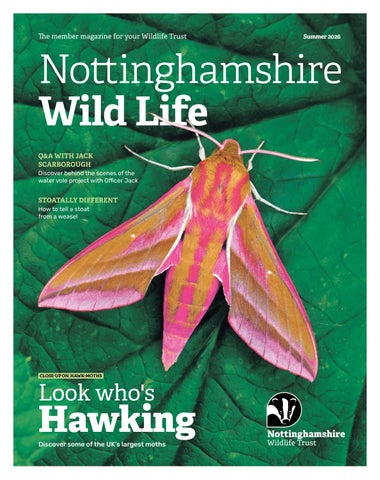
CLOSE-UP ON: HAWK-MOTHS
Look who's
Hawking Discover some of the UK’s largest moths
Nottinghamshire Wildlife Trust
CONTENTS
Notes from the Chief Executive Celebrating seven decades of success – and a national treasure with very special local links. On Thursday April 30 we were joined by partner organisations to mark the 60 th Anniversary of the opening of Attenborough Nature Reserve by Sir David Attenborough back in 1966. Many of our guests represented organisations we’ve worked with since the earliest days of the fight to save this special nature reserve and the formation of the Trust itself. th
The celebration provided a chance to reflect on the determination of those early campaigners to prevent Attenborough’s former quarry lagoons being filled with ash from Radcliffe-on-Soar power station. We also reflected on what the reserve means to so many people and paid tribute to the countless volunteers who have made a difference down the years and those that continue to help care for and shape the reserve today. Given that he opened both the reserve and Nature Centre and launched our Lifeline Appeal to buy the reserve, we also raised a toast to Sir David Attenborough to mark his 100th birthday and his unique contribution to nature conservation.
A year of celebration Given the importance of Attenborough Nature Reserve for people and wildlife and its unique place in our history – providing the platform and confidence for us to go and save many more precious sites and to connect generations of Nottinghamshire folk with nature - we plan a year of celebrations, so do check out the members’ e-newsletter and website for details.
Over the years we have developed significantly and are proud to have a growing supporter and staff base which represents a huge amount of skill, talent, passion and resources that we must ensure we're using as effectively as possible to achieve our mission. Following input from staff, senior leaders and Trustees in the second half of last year, we have recently completed a review of our staff structure, teams and roles to best deliver our strategic goals. Our aim is to build on what’s already good, including our financial resilience, and our substantial achievements to date. The changes are grounded in our strategy and values to direct our resources to achieve our three equally important strategic goals - Wilder Places, Wilder Lives and Thriving Together to the best of our collective ability. You may have seen advertisements for a number of new roles, including new directors, to complete our updated structure which will enable us to deliver more impact with our resources; that our teams are properly equipped and supported to deliver our ambitious plans for a wilder Nottinghamshire for all and that we are able to better plan and invest for the future. With key roles still to be filled, it will take some time for the new structure to bed in, but we are excited at the prospect of developing new ways of working, continuing to grow as a team and working together to deliver more for people and nature across the county. We look forward to providing more details at the AGM and in our Winter issue of Nottinghamshire Wild Life.
Paul Wilkinson Chief Executive
Fit for the Future Since those formative days in the 1960s, fighting to save Attenborough Nature Reserve and build a charity to stand up for wildlife across the county, the Trust has continually evolved to reflect current challenges and opportunities.
Contents 3 Your wild summer
Bat watching begins with Dr Kim Wallis of Essex Wildlife Trust.
4 Invite reptiles into your garden
A six step guide to welcoming reptiles into your garden.
6 Local news
Catch up with the work around Natural Flood Management we are rolling out in the county alongside updates from three of our Business Partners.
7 UK news
News across the UK within the Wildlife Trust movement.
8 Wild reserves
Celebrating anniversaries! From Sir David Attenborough's 100th birthday to Attenborough Nature Reserve's 60th Anniversary and more!
10 Scouring the seabed
Get to the bottom of bottom trawling with Daniele Clifford, Marine Conservation Officer for The Wildlife Trusts.
12 Q&A with Jack Scarborough
Discover behind the scenes of the Water Vole project with Project Officer Jack.
14 H is for hawk-moth
Discover some magnificent moths with Barry Henwood, co-author of Field Guide to the Caterpillars of Great Britain and Ireland and volunteer with Devon Wildlife Trust.
15 Spot the difference
Could you tell the differences between a stoat and a weasel? We help you out if not!
How you can get involved
Contributions
Volunteer
Dedication leaves
See what role could suit you on our website. nottinghamshirewildlife.org/ volunteering-opportunities
Commemorate a celebration with a dedication leaf. nottinghamshirewildlife.org/dedications
Editorial enquiries and contributions to: Rachel Rutherford communications@nottswt.co.uk
£
Donate We can’t do it without your support! Donate via our website donation form. nottinghamshirewildlife.org/donate
Include a gift in your will
£
Play your part in raising awareness for a Wilder Future, Wilder Nottinghamshire. nottinghamshirewildlife.org/campaigns
Nottinghamshire Wildlife Trust, The Old Ragged School, Brook Street, Nottingham NG1 1EA Tel: 0115 958 8242 Email: info@nottswt.co.uk Web: nottinghamshirewildlife.org
Join in our events
Front Cover: Elephant hawk-moth © David Kjaer, naturepl.com
Campaign
This will help future generations to enjoy nature in Nottinghamshire as you have done. nottinghamshirewildlife.org/gifts-wills
Keep an eye on our website for updates about our events. nottinghamshirewildlife.org/events
Visit a reserve
Social media
Explore a new site or revisit a favourite one! nottinghamshirewildlife.org/nature-reserves
Keep informed and join in with the regular wildlife updates online via Facebook, Bluesky or Instagram and LinkedIn
Online shopping
E-newsletter
Get your bird food delivered straight to your door, as well as other wildlife products and homeware. nottinghamshirewildlife.org/shop
For more regular updates about Nottinghamshire wildlife make sure the Membership team has your email consent. Email membership@nottswt.co.uk
2
Nottinghamshire Wild Life | Summer 2026
Copy deadline: Monday 14th September 2026
Consultant Editor: Tom Hibbert Consultant Designer: Ben Cook The views expressed in this publication are not necessarily those of the Wildlife Trust or its Council Published by: Nottinghamshire Wildlife Trust Editor: Rachel Rutherford A Company Limited by Guarantee Registered in England No. 748865 Reg. Charity No. 224168 Designed & Produced by Optima Graphic Design Consultants Limited optimadesign.co.uk
nottinghamshirewildlife.org
YOUR WILD SUMMER BROWN LONG-EARED BAT © TOM MARSHALL
YOUR WILD SUMMER:
Bat watching begins BATS HOLD A SPECIAL PLACE in my heart. There is nothing better than watching a bat weave, dive and dance across the skyline, or seeing them emerge from their roosts (home in bat speak). Here are my top tips to begin your bat watching journey. The best time to see bats is around dusk, in warm and calm weather conditions. During the summer, female bats form maternity roosts to raise their young (called pups). Amazingly, the pups are born approximately one third of their mum’s size. Eyes up! Bats need bugs and rely on natural features such as hedgerows, woodlands and water bodies to feed and to navigate. Find these features and you’ll find bats around them.
Consider flight style and habitat. Bats displaying amazing acrobatics in your garden are most likely to be a pipistrelle species. Bats flying low over water are most likely to be Daubenton’s bats. There are many things you can do to help protect and attract bats including creating a wildlife pond (no fish please!), putting up a bat box, reducing lighting around your house and keeping cats inside at peak bat activity periods (dawn and dusk and particularly in late summer when young are learning to fly).
Eyes down! You don’t need any equipment to enjoy bat watching, but it can help you identify them. Bat detectors turn bat echolocation calls into sounds we can hear. Each bat species produces a slightly different sound, which can be used to identify the species.
Dr Kim Wallis, head of nature reserves and natural capital for Essex Wildlife Trust, has been a bat rehabilitator for over 20 years
Bat bases Discover some top spots for bat watching at wtru.st/see-bats
NottinghamshireWildlifeTrust
@nottswildlife.bsky.social
@nottinghamshirewildlife
@Nottinghamshirewildlifetrust
Nottinghamshire Wild Life | Summer 2026
3
WILDER PLACES COMMON LIZARD © AMY LEWIS
STEP BY STEP
Invite reptiles
into your garden
1
2
3
4
5
6
Open the gates The first step is to make sure reptiles (and other wildlife) can get into your garden. A hedge is a better garden boundary for wildlife than a fence, providing shelter and letting small animals pass through. If a hedge isn’t an option, consider cutting a small hole in the bottom of your fence.
Start composting Composting is more than just a great way to recycle garden waste. Slow-worms will slither through a compost heap in search of slugs. It might even serve as a natural incubator for the eggs of a grass snake—avoid turning compost from June to late September to avoid damaging them. Place your heap in a sunny spot, ideally by a hedge or long grass.
Make a splash Nothing attracts wildlife like water. Add a pond to your garden, wildlife will come. If you’re lucky, grass snakes might even hunt there, searching for frogs and other amphibians. They’re excellent swimmers, wriggling through the water with ease.
Let your grass grow Leave an area of lawn to grow wild, providing cover for reptiles. If you need to cut some long grass, walk through it first to give any hiding reptiles the chance to move.
Roaming reptiles Reptiles aren’t a guarantee in a garden. They’re more likely to move in if you live beside suitable habitat, such as a railway embankment or heathland. But the steps you take for reptiles will benefit many of your other wild neighbours, too.
4
Nottinghamshire Wild Life | Summer 2026
Offer a sunbed Reptiles bask to raise their body temperature. Grass snakes and common lizards like open spots, so a sun-drenched rock or log could be perfect. Slow-worms prefer to warm up under cover. A piece of slate, wooden board or roofing felt could make a great slow-worm sauna. Place it in a south-facing, sunny position, on top of vegetation rather than bare ground.
Pile up logs A log pile is the ultimate multi-use facility. It can offer shelter for reptiles to hide away over winter, attract insects and other wildlife that reptiles feed on, and provide a prominent perch for basking in the sunlight.
Snake or fake Get tips for separating snakes from the snake-like slow-worm at wildlifetrusts.org/identify-snakes
nottinghamshirewildlife.org
WILDER LIVES IMAGE © ORSON ESQUIVEL
Louis VI
Tap into the sounds of nature with musician, zoologist and new Wildlife Trust ambassador
WHY ARE NATURAL SOUNDS so important to you? Nature has always been my safe place. But it’s only in the last five years I’ve come to understand how sound connects us to nature. We are evolutionarily hardwired to nature’s sonic language. The sounds of birds, frogs and insects all trigger our parasympathetic pathway to make us feel relaxed. But modern life often drowns this out. Our ancestors survived by listening to nature. Sounds can tell you where to find food, water, safety— but also danger. Silence often meant a predator was around. By drowning out nature, we’re forcing ourselves to live in that “danger silence” and the evolutionary stress that comes with it.
How has nature influenced your music? Music likely predated human language, inspired by sounds from nature. So nature has influenced all music, not just mine. Nature is the original artist. That’s why I was honoured to be one of the first musicians to feature nature as an official artist in my music, alongside Brian Eno and his charity Earthpercent.
What excites you as a new Wildlife Trust ambassador? I’m really excited about reframing what “nature” is in the UK. Showing that Nature Ain’t a Luxury (the title of my film with The Wildlife Trusts) but a necessity. I hope it awakens a sleeping herd of young people, particularly from lower economic backgrounds and diasporas, to reconnect to nature. But on a bigger level, I hope we put nature at the heart of our national identity and culture. We can bring nature back, restore our wild places and make nature a source of immense national pride.
What message would you like to send as an ambassador? Nature is for all of us, no matter where you live or what you look like. It’s your right because you are an animal that evolved as part of nature. We all need it to be healthy, not just the people that can afford to get into it. I hope young people see me, a mixed race guy, from a rough part of North London that's had all the experiences that they have had and yet is a massive nature geek; and see themselves. It doesn't have to be a massive step, but you need nature and it needs you. Start by listening—even if it's listening online on headphones first, you can go to my website (natureaintaluxury.com) there's loads there, or come to one of my exhibitions if the real thing is hard to hear in your area. But soon I promise you won't be able to help seeking it out in the real world, and you'll know it because, guess what, we're all fluent in nature, it just takes listening a little again to reignite that fluency.
Hear more from Louis VI in his TED Talk Louis VI: The language you're fluent in— but forgot how to hear at: wtru.st/Louis-VI-TED-Talk
NottinghamshireWildlifeTrust
@nottswildlife.bsky.social
@nottinghamshirewildlife
@Nottinghamshirewildlifetrust
Nottinghamshire Wild Life | Summer 2026
5
NOTTINGHAMSHIRE
LOCAL NEWS
Leaky dam © Ian Higginson
Ben Clutterbuck Farr Park Event ©
Harnessing nature to reduce threat of flooding for homes After campaigning for more resources to be invested in Natural Flood Management, we are very excited to have the opportunity to demonstrate the benefits for both people and nature. The delivery of work to reduce the threat of flooding for homes and businesses through our £1.1 million Saving Shireoaks & Worksop through Natural Flood Management (NFM) project is progressing well. This important project is funded by the Environment Agency as part of the £25 million Natural Flood Management Programme. In addition to reducing flood risk, NFM schemes can provide habitat for wildlife, improve air and water quality and enhance community greenspaces. The project aims to harness natural process to help reduce the impact of flooding in the River Ryton catchment area by slowing river flows and boosting flood storage capacity by reconnecting the watercourses to their floodplains – to reduce risks to communities that have been significantly affected by flooding in recent years. By working at catchment level on six connected watercourses, and across county and district borders, we have identified opportunities to create natural features including new woodland planting, ponds and ‘leaky dams’ – which hold back and gradually release water after
Amber Woodcock (Marketing and Communications Executive, trentbarton) Emily Patrick of Nottinghamshire Wildlife Trust and Scarlet McCourt (Marketing and Communications Manager, trentbarton)
6
periods of high rainfall. In addition to the River Ryton, the project is focused on Anston Brook, Bondhay Dyke, Darfoulds Dyke, Pudding Dyke and Bull Brook. Interventions designed to reduce flood risk whilst also delivering benefits for nature have also been delivered. Work has been completed along Pudding Dyke, Anston Brook and Dafoulds Dyke – all tributaries of the River Ryton. 115 leaky dams to increase capacity and slow flow, have been created so far, along with a new pond and new areas of woodland incorporating almost 2,500 trees. At Shireoaks Colliery, 58 leaky dams have been installed with plans for a new pond, shallow scrapes and ditch improvements, a new hedge and tree planting. Speaking about this first phase of delivery Project Manager Ian Higginson said: “The schemes delivered so far highlight the importance of partnership and community engagement. We’re delighted that over 80 volunteers supported the tree planting adjacent to Anston Brook – supported by partners such as Rotherham Metropolitan Borough Council & Anston Parish Council. Similarly, the support of Nottinghamshire County Council and the Friends of Woodlands and Coachwood Green were invaluable at Shireoaks Colliery - as was the support of Explore Manufacturing at Darfoulds Brook.”
Explore Manufa cturing staff at Idle Valley Nature Reserve
NFM project pipeline Alongside a busy period of delivery, partners including Nottinghamshire County Council and Bassetlaw District Council have also shaped proposals for features along the Bondhay Dyke, the River Ryton and Bull Brook. The team, supported by project partners, also held two successful community consultation sessions at Farr Park to help shape plans for further schemes. The project is now at an exciting stage, with more schemes almost ready to begin. This includes work on farmland, made possible by the team’s efforts to build trust with local landowners. We are also building a strong evidence base to track the positive impact of the work, inform future schemes across the county, and demonstrate how naturebased solutions can protect communities while supporting vital nature recovery. The project is being delivered by Nottinghamshire and Derbyshire Wildlife Trusts in partnership with Nottinghamshire County Council and University of East London. More information about the project can be found online at nottinghamshirewildlife.org/ natural-flood-management or via scanning the qr code.
Wildflower area at Mayborn offices
trentbarton
Explore Manufacturing
Mayborn
We’re pleased to announce that trentbarton are continuing their Gold Investor in Nature partnership with our Trust. Alongside supporting our work, trentbarton aims to raise awareness of ways people can access nature reserves more sustainably through their bus routes by adding extra signposting within their explorer guides and through their social media channels.
We’re delighted to continue our partnership with Explore Manufacturing. It’s already been an exciting start to the year collaborating as part of our Natural Flood Management programme to support alleviating flooding in the Rhodesia and Worksop areas through the installation of leaky dams on their site. We've also welcomed their employees for a wellbeing walk as part of their Hearts and Minds Week activities in May at Idle Vally Nature Reserve.
Thank you Mayborn for another year of business partnership. After winning their Wilder Business Award 2025 and receiving advice from our team as to further ways they can make their site ‘Wilder’ Mayborn are off to a great start this year getting involved in No Mow May, as well as installing Swift boxes to hopefully attract and support this red listed bird.
Nottinghamshire Wild Life | Summer 2026
nottinghamshirewildlife.org
UK
UK NEWS CORNISH BEAVER RELEASE © BEAVER TRUST, ELEPHANT HAWK-MOTH © MARGARET HOLLAND, OSPREY © ANDY ROUSE/2020VISION, OAK SEEDLING © ALAN PRICE
Q&A
Head of Public Affairs for The Wildlife Trusts, Matthew Browne tells us why the UK Government needs to give nature more respect.
Nature matters HOW HAVE ENVIRONMENTAL PROTECTIONS come under threat this spring? The UK Government has been fruitlessly looking for growth amidst a pile of shredded nature protections. Some people in power have fallen for the myth that if nature protections are reduced, growth will follow. Last year’s Planning and Infrastructure Act attempted environmental deregulation and hot on its heels came the Nuclear Regulatory Review. The Review made recommendations to increase nuclear power deployment, including proposals to change the law to make it easier for developers to cause damage to wildlife.
Beavering away
T
HIS SPRING, THERE WERE several important moments for Britain’s beavers. In February, Cornwall Wildlife Trust released two pairs of beavers into Cornish river catchments. This was the first wild beaver release in England to go through the formal application process. Wildlife Trusts are involved in over twenty beaver reintroduction programmes and hope to release around 100 beavers in the near future. The south of England is currently the beaver hotspot, with ten more Wildlife Trust projects in Devon, Dorset, Isle of White and Kent given the go ahead by Natural England to apply for wild release licences after a successful process of Expression of Interest. Many neighbouring Wildlife Trusts have also teamed up to form beaver partnerships, working across catchment areas. This includes groups for the Severn, Humber, Thames, and East Anglia. This approach will make it possible to release larger numbers of beavers, creating healthier populations with more genetic diversity. A few weeks later, on the 4th of March, new legislation from the Welsh Government came into force, recognising beavers as a native species and granting them protected status. This is a major milestone for restoring beavers in Wales, bringing legislation in line with the protection afforded to beavers elsewhere in
Britain. The beaver was granted protected status in Scotland in 2019 and England in 2022. Alicia Leow-Dyke, Welsh Beaver Project officer for the Wildlife Trusts in Wales, says: “We have been working towards this goal of legal protection for beavers in Wales for many years, so we are delighted with this brilliant outcome. Beavers play a vital role in our ecosystems and formally recognising them as a native species is the right thing to do. We thank the Welsh Government for listening to all the evidence and making the right decision.” Beavers are ecosystem engineers, meaning they alter the landscape in which they live and bring benefits to the wildlife around them. The wetlands they create help to reduce flooding, improve water quality and store carbon. They also provide a home for a wealth of wildlife, including water shrews, water voles, otters, kingfishers, dragonflies and fish. Bringing beavers back to Britain isn't just the reintroduction of a species, it's the reintroduction of an entire ecosystem that's been lost. Their return can help tackle both the nature crisis and the climate crisis.
Why was the Nuclear Regulatory Review flawed? The Review’s nature recommendations stemmed from a flawed case study of the Hinkley C nuclear project. The case study minimised the project’s environmental impact, claiming that only 550 fish would be killed per year when the real number was well over 4.5 million, and maximised the costs of the measures needed to avoid these outcomes. These distortions were intended to portray nature protections as an unreasonable burden. In reality, nature protections and the mitigation measures they require typically cost only 0.1% of the budget of a nuclear project. How did people react to this news? Nature lovers in their thousands wrote to their MPs to tell them that weakening nature protections would do little to nothing to boost nuclear deployment, but would risk the current nature crisis turning into a catastrophe. Many MPs listened and acted. Over 120 parliamentarians urged the UK Government not to proceed with the nature recommendations from the review. The UK Government has pulled back on some changes, but is there still cause for concern? This pressure paid off. In March the UK Government announced that it would not legislate to weaken the laws that protect wildlife. However, it did commit to issuing new guidance on how those laws should be applied. Whilst we have successfully defended the legal core of nature protections, Ministers are still tinkering around the edges. What happens next? The Wildlife Trusts continue to make it clear to the UK Government that nature protections are not blockers to growth, but rather are the guarantors of the wild spaces that we need to maintain and restore if we are to avoid ecosystem collapse. Such collapse threatens unparalleled environmental, social and economic disruption. Thank you for standing with us, as we continue to warn those in power that diminishing nature protections will have disastrous consequences.
See the moment beavers were released into Cornish rivers at wtru.st/Cornish-beaver-release
UNDERSTORY
Go wild for moths
Nature’s new champions
Through the Wild About Gardens partnership, The Wildlife Trusts and the RHS are encouraging gardeners to make space for moths. These incredible insects are important pollinators, a vital link in many food chains and an indicator of healthy environments. wildaboutgardens.org.uk Leicestershire and Rutland Wildlife Trust is celebrating
30 years
of the Rutland Osprey Project, which brought these brilliant birds back to England. NottinghamshireWildlifeTrust
Keep up to date with current affairs from Matt and members of the team at wtru.st/Public-Affairs
Actor, ecologist and podcaster David Oakes has stepped up from ambassador to vice president of The Wildlife Trusts, following years of support. The Wildlife Trusts also welcomed two new ambassadors: Inka Cresswell, a marine biologist and ocean wildlife filmmaker; and Louis VI, a musician, zoologist and nature activist. tru.st/ambassadors
More than
250,000
records of squirrels have been collected by Saving Scotland’s Red Squirrels, a partnership project led by the Scottish Wildlife Trust.
@nottswildlife.bsky.social
4
ways your support is making a difference
@nottinghamshirewildlife
Cornwall Wildlife Trust planted the first of around
@Nottinghamshirewildlifetrust
28,000
trees on an ambitious project to restore temperate rainforest in south east Cornwall.
Norfolk Wildlife Trust purchased
336 acres
in Wood Norton for one of the most significant habitat creation projects in their 100-year history.
Nottinghamshire Wild Life | Summer 2026
7
NOTTINGHAMSHIRE
WILD RESERVES ATTENBOROUGH NATURE RESERVE © NOTTINGHAMSHIRE WILDLIFE TRUST
Our wild reserves
David Attenborough at 1966 opening of Attenborough Nature Reserve © Nottingham Guardian
Joint ‘Attenborough’ celebration Back in April we held a special joint ‘Attenborough’ celebration to mark the 60th Anniversary of the opening of 1 Attenborough Nature Reserve in 1966 by none other than Sir David Attenborough - and the 100th birthday of this national treasure. Guests from organisations that have played a key role in the work of the Trust over the past sixty years gathered, along with the Lord Lieutenant of Nottinghamshire, Prof. Veronica Pickering, 60 years to the day since Sir David, President Emeritus of The Wildlife Trusts and an Hon. life Member of Nottinghamshire Wildlife Trust, opened the reserve. The celebration enabled us to thank the groups that were involved in the early days of the reserve and to pay tribute
8
Nottinghamshire Wild Life | Summer 2026
to the countless volunteers and supporters that have contributed down the decades. Speaking at the event our Chief Executive Paul Wilkinson said: “The reserve exists because people recognised that nature isn’t a nice to have, it is necessary for our wellbeing. As well as valuing the site and its wildlife, the community stood up for what it believed in – helping to save and ultimately shape the unique nature reserve that so many value and benefit from today.” As part of our year-long celebrations, the reserve will host a three-day ‘Wild Weekend’ from 28-31 August with walks, talks, activities and a BBQ – we’d love to see you.
Further details about events at the reserve and across the county can be found at nottinghamshirewildlife.org/events
f. Veronica Pickering The Lord Lieutenant, Pro Executive of ief Ch , with Paul Wilkinson st cutting the Tru e dlif Wil re Nottinghamshi orough Nature cake to celebrate Attenb . ary Reserve's 60th Annivers
nottinghamshirewildlife.org
NOTTINGHAMSHIRE
WILD RESERVES A year of anniversaries
Featured reserves 1 Attenborough Nature Reserve 2 Farndon Willow Holt
Saving Attenborough’s habitats back in the 1960s was a springboard for our efforts to save sites across the county and five of those sites also have special anniversaries in 2026. 2 Farndon Willow Holt on the banks of the Trent in Farndon Village once provided willow rods for Newark’s basket making industry. 40 years ago, we purchased the site from the National Trust following a mix up in the Will of its former owners who had intended to leave the reserve to us! 30 years ago this year, we acquired both 3 Aldercar Flash - part of the Erewash Meadows complex managed in partnership with Derbyshire Wildlife Trust and 4 Ploughman Wood - one of the finest ancient Woodlands in the south of the County. 25 years ago, both 5 Beacon Hill Conservation Park at Newark and 6 Misson Carr became Trust reserves – two very different sites that highlight the wonderful diversity of our estate. Beacon Hill enables people with the opportunity to spend time in nature right on the edge of town, whilst Misson Carr, formerly a bombing range, is a remnant of fen woodland, one of the rarest habitats in the county.
3 Aldercar Flash (Erewash Meadows) 4 Ploughman Wood 5 Beacon Hill Conservation Park 6 Misson Carr 7 Skylarks 8 Besthorpe 9 Idle Valley Nature Reserve Farndon Willow holts links with the reserve’s productive past are maintained through the harvesting of Cricket Bat willows © Meg McKay
6
9
Welcome boost for wetland reserves We are delighted that the Access Foundation has awarded the Trust £5,000 to support us in caring for and enhancing wetlands across Nottinghamshire. Wetlands provide valuable services for our environment, including helping to moderate the effects of climate change. As well as being amazing wildlife habitats, they support people’s wellbeing, by enabling them to connect with nature. Sadly, 90% of the UK’s wetlands have disappeared in the last 100 years, and we have lost a staggering 45% of reed bed habitat, one of the richest natural carbon sinks. Rising temperatures coupled with the potential loss of coastal habitats means that inland wetlands are now more important than ever.
Turtle Dove
Reserves that will benefit from the support include 1 Attenborough Nature Reserve and 7 Skylarks in the south, 8 Besthorpe, not far from Newark and our largest site, 9 Idle Valley Nature Reserve near Retford. Improved habitats with regular maintenance can provide greater biodiversity alongside water control and increased carbon capture. Maintaining and enhancing these sites is a 365-day challenge requiring significant resources. The support of the Access Foundation provides a real boost for efforts to support rare and threatened species such as bitterns, turtle dove and redshank. It will also help ensure that our nature reserves remain accessible and welcoming to visitors.
8
2
3
5
4 7 1
kers © Mike Vic
Bittern at Attenb
orough © Andy Co pe
NottinghamshireWildlifeTrust
@nottswildlife.bsky.social
Idle Valley Neatholme scrape sunrise © Agnes Kiemel
@nottinghamshirewildlife
@Nottinghamshirewildlifetrust
Nottinghamshire Wild Life | Summer 2026
9
UK SMALL-SPOTTED CATSHARK © HENLEY SPIERS NATUREPL.COM
Scouring the
Seabed
Small-spotted catshark These small sharks are found all around our coasts, sticking close to the seafloor. They are often accidentally caught during bottom trawling.
Get to the bottom of bottom trawling with Daniele Clifford, marine conservation officer for The Wildlife Trusts.
I’ve known about the impacts of bottom trawling for years. But like many others, last year I sat in the cinema watching Ocean with David Attenborough, stunned to see the reality of this fishing method on the big screen. The giant net and heavy chains bulldozing the seafloor, stirring up sediment and destroying the burrows of countless creatures in seconds. Fish and other wildlife of all shapes, sizes and ages swimming for their lives… only to be sucked into the vast yawning net and later discarded, dead, back into the sea. This incredible footage has stuck with me and millions of others around the world. For too long the impacts of bottom trawling have been out of sight and out of mind. Thankfully the tide is starting to turn, but we still have a long way to go.
10
Nottinghamshire Wild Life | Summer 2026
What is bottom trawling? Bottom trawling is a method of fishing that drags heavy nets and chains along the seafloor. It is used to catch fish or shellfish that live within or just above the seabed. Bottom trawling is largely used as it enables fishers to catch large amounts of high-value fish, including whitefish like cod, haddock and hake, and flatfish such as halibut and sole. Shellfish like nephrops and shrimp are also targeted using this method.
Discards and destruction Fishers using bottom trawling often only want to capture one or two fish species (the ‘target species’), but the nets catch almost everything within their path. Everything the fishers don’t want is thrown back into the sea (called ‘discards’). This may be more than three quarters of the catch! These discarded fish and other wildlife may be killed, injured or at least extremely stressed by the process. Intensive trawling also causes damage to the seabed. It reduces the diversity of wildlife, wiping out long-lived species, damaging or removing fragile reef-forming animals and destroying the 3D structures they create. The many surfaces and crevices of a healthy seabed provide key nursery, feeding and refuge areas for wildlife, including commercially important fish and shellfish. When these are destroyed, entire ecosystems begin to unravel. There are potential implications for the climate, too. It’s estimated that there are around 240 million tonnes of
carbon in the top 10 cm of seabed sediments in the UK and Isle of Man’s seas—mostly in our marvellous marine mud. When trawling disturbs sensitive carbon-rich sediments, it risks releasing this carbon. Our seas are a shared resource. Unsustainable fishing not only harms wildlife, but also the other people and economies that rely on healthy seas for their livelihoods, cultures and recreation.
Seabed sanctuaries The UK has 377 Marine Protected Areas (MPAs), created to protect special habitats and wildlife at sea. This is an impressive number, but sadly many still allow damaging activities within them. Some progress has been made, but many MPAs with important seabed habitats are still partially or totally open to bottom trawling. This needs to change. Our marine ecosystems can bounce back spectacularly when properly protected. Banning bottom trawling in MPAs would be a strong step in the right direction. There’s a wealth of scientific evidence that shows well managed and enforced MPAs are a vital tool for restoring ocean health. But they are only effective if damaging activities are not allowed within them. The Wildlife Trusts have been campaigning for the banning of bottom trawling in seabed MPAs since these special sites were designated, many more than 10 years ago. Recently, we have seen some progress, but we need to keep the pressure up!
nottinghamshirewildlife.org
UK ATLANTIC COD © ALEX MUSTARD, NATUREPL.COM, NORWAY LOBSTER © PAUL NAYLOR, SEA PEN © ALEX MUSTARD/ 2020VISION, SCALLOP FISHING © ALEX MUSTARD/2020VISION, BEFORE AND AFTER PHOTOS © COAST/HOWARD WOOD, THORNBACK RAY © PAUL NAYLOR.
What you can do • If you eat fish, use The Good Fish Guide (www.mcsuk.org/ goodfishguide/) to choose more sustainable seafood. • Write to your MP and ask them to support banning bottom trawling in Marine Protected Areas and a just transition for fisheries.
Norway lobster
prawns, they live in rops or Dublin Bay Also known as neph wls to make scampi. geted by bottom tra burrows and are tar
• Sign up for our Friends of Marine newsletter to stay up to date with marine news and ways you can help protect our seas: wtru.st/marine-mailing
Before
After
A healthy seabed in its natural state.
A seabed destroyed by bottom trawling.
Fair and sustainable future for fisheries Protecting our seas doesn’t mean leaving fishers behind. We need a just transition where fishing communities, scientists, governments and other stakeholders work together to shape the future of fishing across our wider seas. This includes finding innovative ways to reduce the environmental impact of fishing gears and practices, as well as supporting and incentivising fishers to transition to these more sustainable methods. This is essential, not just for wildlife and carbon, but for the people who depend on our seas.
Cod Bottom trawling is oft en used to target cod , which is one of the UK's most popular commercial fish es.
Progress in the UK so far: Scotland
Sea pen
ned ls that resemble old-fashio Sea pens are colonial anima ance and urb dist l sica phy to e abl quills. They are highly vulner ling. impacted by bottom traw
Northern Ireland Some progress has been made for inshore MPAs, but offshore sites remain unprotected.
Wales
Bottom trawling is only banned from one area, around Skomer Island.
Thornback ray These beautiful rays may be targeted or accid entally caught in bottom trawls.
NottinghamshireWildlifeTrust
@nottswildlife.bsky.social
@nottinghamshirewildlife
@Nottinghamshirewildlifetrust
Bottom trawling was banned from certain areas of Scottish offshore MPAs in October 2025. However, gaps remain and there have been delays in implementing bans in inshore MPAs.
England
Progress is slowly being made for offshore seabed MPAs in England, thanks to the 18,000 people who responded to our call to action in Summer 2025 asking the Government to ban bottom trawling in these sites. Gaps remain in inshore MPAs.
Nottinghamshire Wild Life | Summer 2026
11
NOTTINGHAMSHIRE
Thanks to our Water Vole Project, the much-loved water vole, immortalised as Ratty in The Wind in the Willows, is making a comeback in Nottinghamshire. Jack Scarborough, Water Vole Project Officer talks us through the project.
Q&A
with Jack Scarborough, Water Vole Project Officer REC
A water vole exploring cau ght on the same camera trap as the badger shown to the right.
nces
differe ra. Helps to show the A rat caught on came ter voles. between rats and wa
A badger exploring the water's edge at Idle Valley Nature Reserve.
12
Nottinghamshire Wild Life | Summer 2026
nottinghamshirewildlife.org
NOTTINGHAMSHIRE
Jack, as a Water Vole Project Officer, what do your day to day tasks look like? No day is the same apart from the start and that’s checking my mobile alerts to see if a mink trap has been set off. That’s important to ensure we check the trap as soon as possible to release what has been caught such as polecats (one of the most common native mammals that we've discovered via this project and are much more widespread than previously known), water birds, even a rabbit, a hedgehog and recently a fox cub! As a team, we decide who is in the best position to attend the trap. So that could be the trained landowner, volunteer or project team member using the grid reference number of the trap to find it along with local parking information and photos. It’s always handy to have a stick to knock back the brambles if the trap has been in position for a while without going off and become overgrown. Traps can be floating on water, so it is a careful job to hook it back to the bank without rushing and then checking the contents. Mink are humanely dispatched straight away, measured and sexed then bagged up and weighed, before being labelled and sent to Waterlife Recovery Trust. They are the pioneers of mink trapping and advisors to projects such as ours. East Anglia was cleared of mink within four to five years using their methodology. Waterlife Recovery is a science-led organisation with links to Cambridge University who can carry out tooth aging tests and mink genetics research. This provides information on local mink population dynamics and the stage the project is at in comparison regarding eradication. They are also the source of the mink lures for mink enticement in the traps to reduce catching any other wildlife. Once the trap has been emptied it is reset and returned to its location. Any animals other than mink are quickly and safely released in the same location that they were trapped.
How many mink traps does the team monitor? Currently we have 166 traps out, so having remote devices to alert us that the traps are going off is vital to help keep the project cost effective and for saving time checking them all. We’ve recently had one trap that had been set for over 2 years without it catching anything, but the first mink was caught with it in April this year.
How widely spread are they across the county? Not all areas of the county are covered, and we are always looking for more areas to put them out.
The area around Idle Valley Nature Reserve is heavily covered as is Attenborough Nature Reserve as the Trent is a super highway for mink!
So, we are leading the way to some extent!
So, after checking the traps, what’s next in your day?
We are confident (but inconclusive right now) that we have offspring of our released water voles expanding out into the River Idle. Wardens have seen the water vole in the river and it seems to like its local mink trap! However, we will know more if we can analyse the latrine samples for a genetic profile. We do not have any other recent records of water voles on the River Idle along the reserve, just some historical records.
We tend to visit landowners to discuss putting out new traps or tie it in with habitat work such as the creation of ponds, ditches and bankside habitats. All ideal for water voles to burrow in and feed, but also helps other wildlife too such as invertebrates, frogs, newts, fish, ducks, wading birds and many more. We also discuss buffer strips to limit livestock grazing by waterways, allowing vegetation to grow back for water voles. Buffer strips also help prevent run off and erosion from hooves.
Any other tasks? The team carry out surveys of ditches looked after by Water Management Consortium. Pre planted coir mats have been installed at intervals on the ditch network at Idle Valley to enhance flora and fauna for wildlife. We’re looking to encourage a wider range of species to thrive there and increase biodiversity. The mats also help to reseed along the water way.
Are the results of the surveys looking good? Yes, the surveys are showing good results despite a drought after installing the coir mats last year. They are growing back after the second year of installation. Gypsywort flowers are spreading in the vicinity, and we are looking out for signs of water vole.
How do you monitor the water vole population? Apart from the two times we have released water voles into the beaver enclosure at Idle Valley we do not get to see the very animal we are trying to support very often unless caught on camera traps. We use latrine rafts which provides samples to monitor genetics. This can provide a baseline of our current population of water voles. There was a low genetic diversity to begin with but with our introduced water voles, we are expecting, in time, for these to help increase diversity. Nottingham Trent University is looking for funding for a PhD student to be able to study this with us in future. If we can monitor them for several years, we hope to see if the released and existing populations merge, but it will be a trial as not much is currently known about this interaction.
What we do know is the released population of water voles has shown evidence of their expansion in the beaver enclosure. Which is positive news.
Why are water voles so important to have on the reserve? Water voles are an ecosystem engineer. Their generalist diet and grazing habits increases the biodiversity of bankside flora and old burrows are used by other species such as kingfishers. Sadly, water voles have a short life span, averaging just 7 months but this gives plenty of time to breed and grow the population to sustain it. Water voles are key prey species to maintain the food chain for owls, herons, egrets, bitterns, badgers, foxes and stoats. The list goes on!
This does sound counter intuitive at first! Yes, it may do but American mink are a far bigger threat and a non-native species unbalancing the eco system. The reason mink are such a threat to water voles is because they share the riparian (water's edge) habitat and the females are small enough to hunt within water vole burrows, which otters and polecats cannot.
What do you feel has been your greatest achievement to date with the project personally? The weirdest moment was seeing on Google Maps all the ponds that were created! But we have a lot more we want to achieve. On the habitat side we haven't done as much recently due to funding constraints, however we have completed another 3 sinuous ditches at Idle Valley (in the south of the reserve this time) adding another approximately 270m.
More information of the outcomes of the project to date can be seen on the dedicated web page: nottinghamshirewildlife.org/ water-vole-recovery-project/outcomes
Recovering Nottinghamshire’s Water Voles hes. ated ditc newly cre e th f o e ing on uck utilis A tufted d
A fox caught on came
ra trap.
NottinghamshireWildlifeTrust
@nottswildlife.bsky.social
@nottinghamshirewildlife
@Nottinghamshirewildlifetrust
Scan the QR code to donate, or visit nottinghamshirewildlife.org/appeals/ water-voles
Nottinghamshire Wild Life | Summer 2026
13
WILDER PLACES
3SEE
Common in southern England and south Wales. Caterpillars feed on a variety of woody plants, especially ash and privet.
to
Migratory, reaching all parts of the UK. Frequently seen nectaring at flowers, hovering like a hummingbird. Caterpillars feed on bedstraws.
Spurn National Nature Reserve Yorkshire Wildlife Trust This peninsula on the Yorkshire coast isn’t just great for migrant birds, but migrant moths too. Following southerly winds, look out for humming-bird hawk-moths or, if you’re really lucky, something much rarer, such as convolvulus or death’s-head hawk-moths.
Common throughout the UK. Caterpillars feed on poplars and willows.
Where: Kilnsea, HU12 0UH
Scarce and mostly found in southern and eastern parts of England, especially on heathland and woodland rides. Caterpillars feed on honeysuckle.
Folly Farm Avon Wildlife Trust The woodland and wildflower meadows are home to lots of moths, including elephant hawkmoths. Adults are regularly attracted to lights during surveys, but you might find a chunky caterpillar crossing a path in late summer.
H
Where: Bristol, BS39 4DW
Slievenacloy Nature Reserve Ulster Wildlife This grassland paradise in the Belfast Hills is Ulster Wildlife’s largest nature reserve. It’s home to a stunning variety of wildlife, including visiting humming-bird hawk-moths and the rare narrowbordered bee hawk-moth.
is for
hawk-moth
Found in woodland and heathland across England, but away from the far west and north. Caterpillars feed mainly on Scots pine.
Where: Lisburn, BT28 3TE Discover some magnificent moths with Barry Henwood, co-author of Field Guide to the Caterpillars of Great Britain and Ireland and volunteer with Devon Wildlife Trust ONE OF MY EARLIEST MEMORIES of moths is astonishment at finding a poplar hawk-moth on a fence. This encounter helped spark a life-long interest. The group of moths known as hawk-moths includes the largest species found in the UK. They’re a diverse group, but one characteristic they all share is that the caterpillar has a horn at the end of its abdomen. 14
Nottinghamshire Wild Life | Summer 2026
We have nine resident species, with a further nine migrating here from Europe. But of these migrants, only the hummingbird hawkmoth is able to survive our winters. Most spectacular is the death’shead hawk-moth, an uncommon migrant. Its short, stubby tongue is specialised for taking honey from the nests of honey bees. It emits an audible squeak, thought to be a form of communication that helps it cheat the bees. Some hawk-moths fly by day, such as the two species of bee hawk-moth and the hummingbird hawk-moth, but the majority fly by night. Some do not feed as adults, but those that do act as pollinators and can distribute the pollen over very long distances. The hummingbird hawk-moth, for example, has the potential for bringing pollen from France. nottinghamshirewildlife.org
MOTH IMAGES © IAIN H LEACH, STOAT © RICHARD STEEL/2020VISION, WEASEL © ELLIOT SMITH
Stoat
Mustela erminea Coat The division between the brown back and pale belly is neat
2.2 cm
Common over much of England and Wales, local in Northern Ireland. Caterpillars feed mainly on willows and apple.
Tracks larger footprints with a more irregular heel pad
2 cm
Length Around 24-31 cm body length, with a 9-14 cm tail Weight 140-445 g (males are around twice as heavy as females) Tail Long, with a bushy black tip Movement Often bounds along with a strongly arched back Diet mostly eats rabbits, as well as rodents, birds and their eggs and other food
Common throughout most of the UK. Most frequently found in gardens as a caterpillar feeding on willowherbs or fuchsias.
Weasel
Mustela nivalis
V
T A O T S SEL A E W ini se m e h t als rate sepa y mamm o t t How t migh bu
Length Around 17-22 cm body length, with a 3-5 cm tail
Weight 55-131 g (males are around twice as heavy as females) Tail shorter than a stoat’s and completely brown
Movement usually scurries low to the ground
Common over much of England and parts of Wales. Caterpillars feed mainly on elms and lime, including in urban areas.
@nottswildlife.bsky.social
1.3 cm
Diet Specialises in hunting mice and voles, but may also eat small rabbits, birds and their eggs and other food
The night-flying adults are attracted by lights, but you may find them resting by day, perhaps on fence posts or trees. They are camouflaged, but if disturbed by a bird some species flash their colourful hindwings. The poplar hawk-moth displays a red patch, whilst the eyed hawk-moth reveals bright colours and eye spots. These serve to startle the bird and make it flee. The elephant hawk-moth is particularly colourful, but more often its caterpillar is found in gardens. It has a swollen first abdominal segment and large eye spots, giving the illusion of a snake. Caterpillars of other species can be found by searching their foodplants and looking for stripped leaves on branches or their droppings beneath.
NottinghamshireWildlifeTrust
Coat The division between the brown back and pale belly is jagged and patchy
1 cm
Tracks smaller footprints with a more rounded heel pad
@nottinghamshirewildlife
@Nottinghamshirewildlifetrust
Nottinghamshire Wild Life | Summer 2026
15
Recovering Nottinghamshire’s Water Voles Water vole © Terry Whittaker2020VISION
We are aiming to raise £25,000 by 30th September to invest in habitat restoration and protection across the county. ort: Your donation could supp
© Nottinghamshire Wildlife Trust
© Rachel Rutherford
© Rachel Rutherford
Riverbank habitat restoration,
Pond and ditch creation
Species surveying programmes
such as planting diverse, water vole friendly plant species along the bank, as well as installing fencing to control where our nature grazing herd and flock graze, creating more habitat for water voles.
at sites like Attenborough and Idle Valley nature reserves, building habitats that can become home to tiny invertebrates, as well as water voles, supporting a sustainable food chain.
on our nature reserves such as latrine rafts, so that we can monitor how we are turning the tide on species loss, as well as continue investing in measures to keep populations afloat.
Your support can help us shape the future of water voles in Nottinghamshire. Thank you.
Discover more about our Water Voles appeal nottinghamshirewildlife.org/appeals/water-voles
Registered office: The Old Ragged School, Brook St, Nottingham NG1 1EA | Registered in England & Wales: no. 748865. Charity no.224168