Titan Titan Times Times
Editor-in-ChiefStatement|January2026
MY LATEST BOOK
By: Minh lai Editor-in-Chief,Junior
Hello,NDCommunity!
My name is Minh Lai, and I am currently a Junior
As part of my final statement as Editor-in-Chief of the Titan Times, I would like to personally share with all of you a piece I have dedicated a lot of time andenergytowards.
On January 3rd, after years of writing and planning out my first novel—and second book—I was able to finally achieve what I thought would never happen! Getting a fantasy book published was definitely a struggle, especially when it consists of nearly eight hundred pages. However, the experience was worth it despite the many struggles endured. I learned a great deal not just from the creative process but so too amid having to plan out a consistent schedule and retain as much motivation as was necessary to achievemygoal.

cartography software—Inkarnate—filling it with various regions and drawing bordersshortlyaftersoastodemarcatethe frontiers of each country When that was done, I assigned names to said countries and began formulating individual backstories. Different civilizations were inspiredoffrealonesandcontainedstories that could easily be woven together to form the immediate context behind the actual timeline of the book. Ethnic groups were made with their own cultures, clothing, traditions, backgrounds, ways of speaking, and values. Real-life animals, plants, and other aspects of nature and their interactions with humans were modified and changed to be more mystical. When the equivalent of a few hundred years of history for each culture was finished, I began drafting names inspired off languages like Latin, Hindi, andArabic, using them to label characters andplaces.
BecauseIlovedhistory,Ireliedheavilyon it for inspiration. Events from all over the world and from different periods helped me synthesize plotlines and complex and interesting backstories. Past figures likewise became the reflections for the kings and queens and the nobles and peasants who appeared in my book. And, of course, to make my fantasy novel— well—fantasyinnature,Iaddedelements
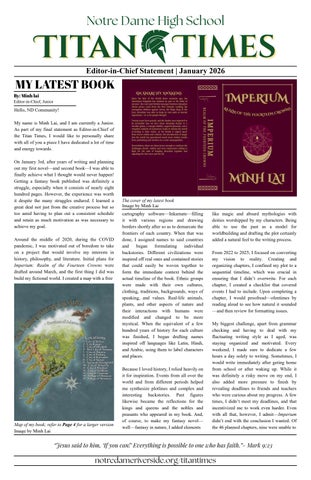
Around the middle of 2020, during the COVID pandemic, I was motivated out of boredom to take on a project that would involve my interests in history, philosophy, and literature. Initial plans for Imperium: Realm of the Fourteen Crowns were drafted around March, and the first thing I did was buildmyfictionalworld.Icreatedamapwithafree “Jesus said to him, ‘If you can!’ Everything is possible to one who has faith.”- Mark 9:23
like magic and absurd mythologies with deities worshipped by my characters. Being able to use the past as a model for worldbuilding and drafting the plot certainly addedanaturalfeeltothewritingprocess.
From 2022 to 2025, I focused on converting my vision to reality. Creating and organizing chapters, I confined my plot to a sequential timeline, which was crucial in ensuring that I didn’t overwrite. For each chapter, I created a checklist that covered events I had to include. Upon completing a chapter, I would proofread—ofentimes by reading aloud to see how natural it sounded —andthenreviewforformattingissues.

My biggest challenge, apart from grammar checking and having to deal with my fluctuating writing style as I aged, was staying organized and motivated. Every weekend, I made sure to dedicate a few hours a day solely to writing. Sometimes, I would write immediately after geting home from school or after waking up. While it was definitely a risky move on my end, I also added more pressure to finish by revealing deadlines to friends and teachers who were curious about my progress. A few times, I didn’t meet my deadlines, and that incentivized me to work even harder. Even with all that, however, I admit—Imperium didn’t end with the conclusion I wanted. Of the46plannedchapters,ninewereunableto

be finished due to time constraints. That being said, I blended the plotlines of those chapters into other sections of the book—which itself gave me decent results. I mean—I did publish in the end, and I’m more than happy with how farImanagedtoget.
When the manuscript was done, I revised pages and rewrote sections that I didn’t like until I was satisfied. Because my book also included a fictional language and several dialects, it became a second responsibility to ensure that the grammar and syntax of said language and its dialects were consistent and accurately depicted (though, I do regret not making a dictionary for my readers and a pronunciation guide).There were a few times I inserted old names no longer in use or mixed up cities, characters, and cultures. In other instances, I misused words a few hundred times (this is not an exaggeration), and now, I realize how lucky I was to care enough to search up definitions and update my vocabulary
Regardless—when all that was over, I reviewed my manuscript one final time, focusing more on the formatting. Honestly, writing was the easy part; constantly rereading and being paranoid of catching a single mistake in a document you thought already perfect was worse. Sometimes, it felt like torture and a complete waste of time. Being able to fulfill quotas eventually was solely contingent on me reminding myself of how far I came and how much time I would have truly wasted if I just gave up on this project. Had I abandonedmygoalofpublishing,allthe
headaches I went through and the days I sacrificed would have been for nothing. It may be hard to visualize if you aren’t interested in writing, but believe me when I say that the monotomyofitallcaneasilydriveyouinsane!
After New Year’s Eve, I began designing the cover, which was the easiest part. Just like during the editing process, I couldn’t hire anyone to help me. Still, I put together a title and created—on my own—a depiction of a symbol described many times in the book used by the antagonists: the Mark of Faradon.After that, I wrote up a quick summary and slapped it on the back part of the cover A few sizing adjustments later, I uploaded both my Microsoft Word file and cover image to Amazon’s Kindle Direct Publishing, the service used by most independently published authors,andawaitedapproval.
On January 3rd, my book, Imperium: Realm of the Fourteen Crowns, was finally on the market, marking the end of a tiresome but worthwhile journey 793 pages and 251,903 words later, I fulfilled one of my biggest goals, which was to publish a second book before leaving high school. Earlier, I noted how much I learned from this experience alone. Not only was this journey a personal evaluation of my imagination and passion for writing, it was a measure of how far I could reach if I remained adamant on achieving a milestone. I also learned how important it was to manage one’s time wisely—given how little time we all ultimately have—and to stick to a reliable routine.Ahard work ethic was clearly valuable aswellasalittlebitofpressure.Asanauthor
whohadtoworkentirelyontheirownandplan things out accordingly, keeping good notes and exercising attention to detail quickly proved to benecessitiesforsucceeding.
WHAT’STHESTORY?
Imperium: Realm of the Fourteen Crowns focuses on the Kingdom of Alrashiya, the land whose supreme dynasty has guided Arrenor for the three hundred years following the War of Imperium, or the Imzakir Centuries before the main story takes place, the first wizards landed on the shores of southeast Arrenor, and upon being admired for their inhumane strength and powers, mankind enslaved them and forced them to bear offspring who could destroy their adversaries. The wizards, however, revolted and formed an empire in the East that ravaged the world for nearly twenty years under the guidance of their Mage King, Arvon, and his Twelve Mages of Faradon. The Alrashiyans led the effort to put down the force of angered and destructive wizards, but byvictory’s dawn, magic had already spread to the rest of the world. Now, they remain at the top of Arrenor, but in a position that grows more precarious each passing day. As the East rises again and corruption diminishes the temperance of the Alrashiyan Crown to unforgivable levels, nobles, generals, and commoners will clash to gain control with the hope of steering their realm’s way back onto the path of supremacy. From the death of Alrashiya’s hated queen will emerge the forces of the Tetrarchy, the invading East—united under a warring coalition—and a band of angered peasants undertheguidanceofaboynamedAshirsan.
“Jesus said to him, ‘If you can!’ Everything is possible to one who has faith.”- Mark 9:23


BookLink

Book Link
Book Maps

Links to Maps
“Jesus said to him, ‘If you can!’ Everything is possible to one who has faith.”- Mark 9:23