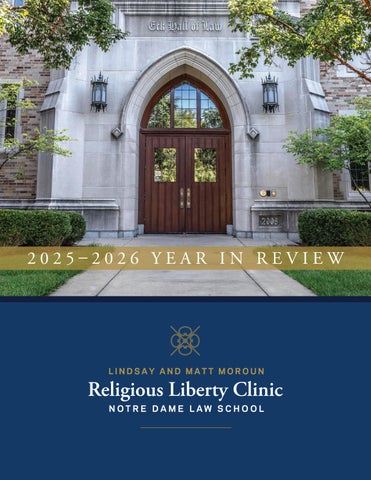
2025–2026 YEAR IN REVIEW
TA B L E O F C O N T E N TS
A b o u t U s ............................................................... 3 O u r L e g a l Wo r k .................................................. 5 N e w s a n d E v e n t s . . . . . . . . . . . . . . . . . . . . . . . . . . . . . . . . . . . . . . . . . . . . . . . . 15 S t u d e n t a n d A l u m n i N e w s . . . . . . . . . . . . . . . . . . . . . . . . . . . . . . 19 C l i n i c F a c u l t y a n d S t a f f . . . . . . . . . . . . . . . . . . . . . . . . . . . . . . . . . 22
“Without freedom of conscience—to believe, and then to live our lives as our beliefs require us— nothing else matters.” G. Marcus Cole,
1
Joseph A. Matson Dean and Professor of Law
2
ABOUT US Lindsay and Matt Moroun Religious Liberty Clinic
Letter from the Director
Notre Dame Law School’s Lindsay and Matt Moroun Religious Liberty Clinic is a teaching law practice and one of the world’s leading academic institutions dedicated to promoting and defending religious freedom. Within Notre Dame’s Catholic tradition, the Clinic integrates teaching, research, and service to stand as a source of advocacy, counsel, scholarship, and hope in defense of the fundamental right to religious freedom for all people.
In its fifth year, our Religious Liberty Clinic continued to make great strides for religious freedom. Our team of attorneys had the privilege to work with our largest group of law students yet as they represented clients in litigation, advised religious institutions facing complex organizational challenges, and advocated for religious communities facing persecution.
Nonprofit Advising
Students serve a variety of religious nonprofit organizations by advising them on tax, corporate, transactional, employment, and strategic issues.
Global Religious Persecution and Immigration
Students work on issues related to international religious persecution, including representing clients seeking asylum in the United States and assisting government officials and other organizations to investigate and address these issues in other countries.
Through our work, we help further the mission of Notre Dame Law School to form students who will serve their communities with competence and compassion as a powerful force for good in the world.
Events and Programming
Legal Work
In addition to our student-led legal work, the Lindsay and Matt Moroun Religious Liberty Clinic hosts a number of events and programs that promote engagement with pressing issues related to religious freedom. The Clinic has organized a broad variety of programs, including conferences, academic lectures, book launches, film screenings, and more.
Under the guidance of Law School faculty and staff, students in the Clinic work on a variety of pro bono legal matters to promote religious freedom for all people. Our work promotes not only the freedom for people to hold religious beliefs but also their fundamental right to express those beliefs and live according to them.
In addition to the Clinic’s programs, the Law School annually hosts the Notre Dame Religious Liberty Summit, which convenes leading scholars, advocates, and religious leaders for conversations about the future of religious liberty in the U.S. and around the world.
Our students engage in legal work across three different practice groups:
Litigation
We are proud to share some of the year’s highlights. They include a trip to Washington, D.C., where students briefed federal officials on the protection of religious minorities abroad, efforts to reorganize Catholic diocesan legal structures to protect parish resources, and the long-fought return of our client Stephen Jarrard to his voluntary prison ministry after years of exclusion based on his beliefs. We also hosted a number of events with advocates, scholars, and faith leaders to examine pressing challenges in religious freedom. As we reflect on the past five years, we remain grateful to the colleagues, advisors, benefactors, and friends who have made our work possible. We look forward to building on these accomplishments and continuing the Clinic’s critical work in the years to come. In Notre Dame, John Meiser Associate Clinical Professor of Law Faculty Director, Lindsay and Matt Moroun Religious Liberty Clinic
Students represent individuals and organizations in defense of their religious freedom before all levels of U.S. courts and administrative agencies.
3
4
OUR LEGAL WORK Case Update: Clinic Secures Settlement Allowing Client to Return to Jail Ministry Jarrard v. Sheriff of Polk County (11th Cir.) Following a nearly decade-long expulsion based on his religious beliefs, Stephen Jarrard resumed his volunteer ministry at the Polk County Jail in Georgia. Jail officials had long barred Jarrard from the ministry program because they personally disagreed with Jarrard’s views on baptism. The Clinic represented Jarrard in his successful appeal to the U.S. Court of Appeals for the Eleventh Circuit. This past year, the Clinic secured a settlement allowing him to return to his ministry in the jail. Jarrard has served as a volunteer minister in Georgia jails and prisons for nearly 20 years. Through his ministry, he shares the Gospel by engaging interested prisoners in discussions about the Bible. “Many of the people I minister to have reached the end of the road with their lifestyles,” said Jarrard. “They aren’t just looking for a way out of jail; they’re looking for a way to transform their lives.”
“My wife and I didn’t have the money to fight, so to have organizations like Notre Dame’s Clinic is a blessing.” Stephen Jarrard 5
Litigation Beginning in 2016, jail officials banned Jarrard from the ministry program. As a member of the Church of Christ, Jarrard believes that baptism is necessary for salvation and must be performed by full immersion. In 2019, County Sheriff Johnny Moats told Jarrard in writing that those views were not welcome in the jail because they contradicted Moats’s own interpretation of the Bible and the jail’s “stance” on baptism. In January 2020, Jarrard sued county officials, challenging his exclusion under the First Amendment. The district court dismissed his claims, reasoning that Jarrard’s religious expression was the County’s own speech to control. Led by John Meiser and Meredith Kessler, the Clinic represented Jarrard in his appeal of that decision alongside co-counsel Zack Greenamyre of Mitchell Shapiro Greenamyre & Funt, LLP and Gerald Weber of Law Offices of Gerry Weber, LLC. In September 2024, the
Eleventh Circuit reversed the lower court’s decision, holding that the First Amendment prohibits government officials from excluding Jarrard because they disagree with his beliefs. The court returned the case for trial to determine whether Jarrard was excluded for that impermissible reason. After the appellate victory, the parties reached a settlement permitting Jarrard to return to the jail’s ministry program. The County also agreed to pay Jarrard an undisclosed sum of money. Students from the Clinic participated in every stage of the case, from drafting briefs to helping prepare for oral argument to negotiating a resolution. Jarrard expressed deep gratitude for the Clinic’s legal representation that led to his return to the ministry program. “I am humbled to share the Gospel with others and to work to bring them together in Christ,” said Jarrard.
Strategic Counseling In addition to its representation in court, our Clinic counsels religious individuals and organizations facing a variety of threats to their religious freedom. Over the past year, our Clinic counseled religious organizations challenging denials of property tax exemptions, facing burdensome regulations, and navigating the developing landscape of Establishment Clause doctrine. This work gives our students the opportunity to directly advise clients on their rights and the legal issues they face.
6
OUR LEGAL WORK
Fi g h t i n g R e l i g i o u s Pe r s e c u t i o n
Promoting International Religious Freedom to Honor the Dead
Advocating for Religious Minorities Before the U.S. Commission on International Religious Freedom
Our Clinic contributed to a 2026 United Nations thematic report examining how freedom of religion or belief relates to death and the dignified treatment of the deceased. The report, authored by UN Special Rapporteur on Freedom of Religion or Belief Nazila Ghanea, affirms that protections for religious liberty do not end with death. These protections extend to the ability to carry out funeral rites, maintain burial sites, and honor the deceased in accordance with religious traditions. Under the guidance of Kimberlie Orr and Domenic Canonico, our students conducted comparative legal research that directly informed the report. This research addressed state restrictions of these practices, discrimination against religious minorities, and the impact of conflict and displacement. It also considered how governments regulate or interfere with burial rites, often invoking public health, security, or administrative justifications and imposing burdens that disproportionately affect minority communities. This work highlights the need for critical yet often overlooked protections that ensure religious communities can honor their dead in accordance with their religious beliefs.
Securing Protection for Religious Persecution: Asylum Advocacy Our Clinic represents asylum seekers fleeing religious persecution and other forms of targeted violence, providing direct legal services in matters before U.S. Citizenship and Immigration Services and Immigration Court. Through this work, students develop practical skills in client interviewing, legal research and writing, evidentiary development, and oral advocacy while working closely with clients navigating complex protection systems. This year, we advocated for individuals seeking affirmative asylum, defended individuals facing deportation, and helped individuals seeking adjustment of status to permanent resident.
7
In April, Clinic students traveled to Washington, D.C., to advocate for the protection of religious minorities in Syria in a presentation to the U.S. Commission on International Religious Freedom.
“Traveling to Washington, D.C. to present our work to USCIRF was a uniquely special way to end the year.”
Led by Kimberlie Orr, Clinic students presented a briefing on protecting religious minorities in post-Assad Syria. The presentation emphasized the importance of prioritizing religious freedom and minority inclusion during Syria’s political transition. Syria’s long-term stability depends on meaningful integration of religious minorities into political, educational, and other institutions. The briefing highlighted significant risks if these communities are not protected.
Aleah Schrock ‘27 J.D.
USCIRF officials have underscored the importance of protecting religious freedom in Syria. They welcomed the Clinic’s engagement and continue to explore ways the United States can support efforts to promote Syrians’ religious freedom.
8
OUR LEGAL WORK Counseling Catholic Dioceses on Corporate Structure This year, our Clinic advised several Catholic dioceses reorganizing their corporate structures to separately incorporate individual parishes. Dioceses in the United States historically placed all their assets, including parishes, into a single entity called a corporation sole. But this structure creates significant risk by placing all diocesan assets into one entity. To mitigate this risk, the Vatican has long requested that U.S. dioceses replace the corporation sole with separate parish corporations wherever state law allows churches to incorporate. Today, all U.S. jurisdictions permit churches to incorporate—but some dioceses remain corporations sole.
Separately incorporating parishes offers several critical advantages:
• Alignment of Civil and Canon Law: Under a corporation sole, the bishop civilly owns individual parish assets. But canon law understands parishes as separate juridic persons with their own assets. Separate incorporation under civil law better reflects that canonical understanding by allowing parishes to maintain their assets.
Nonprofit Advising Advising Faith-Based Organizations Our Clinic provides legal services to religious nonprofit organizations throughout the country. Clinic students counsel these organizations on a wide variety of transactional needs, including tax compliance, corporate governance, employment policies, and strategic planning. This year, our Clinic worked with dozens of organizations from a variety of faith traditions, including churches and houses of worship, faith-based schools, religious organizations, and ministry programs. Our Clinic assisted these organizations by forming nonprofit corporations, preparing tax exemption applications, drafting and revising articles of incorporation, bylaws, and loan and grant agreements, and analyzing a range of corporate, structure, and trust law matters.
• Good Governance: Individual parish corporations promote good governance. Nonprofit corporations are governed by officers and boards of directors or their members, who must ensure that the nonprofit like a parish complies with relevant federal and state laws—for example, those that require restricted gifts to be used according to donor intent. Although the law distributes governance responsibilities in nonprofit corporations, bishops may retain individual control of parish corporations by serving as the sole member and appointing each parish’s directors and officers.
Under the guidance of Brendan Wilson and Brett Cavanaugh, our Clinic supported dioceses moving toward a more diffuse operating structure. This model is consistent with modern corporate practice, reflects the Catholic understanding of subsidiarity, and helps to protect the temporal goods of the Church.
• Asset Protection: Nonprofit corporations generally cannot be involuntarily included in a bankruptcy estate. Unlike corporations sole, which expose all parish assets to creditors because they legally belong to the diocese, separate parish corporations protect individual parish assets from a bankruptcy proceeding against the diocese. Our Clinic advises dioceses across the country as they consider restructuring their organizations to separately incorporate individual parishes and then counsels them throughout the process. This year, we helped the Diocese of Kalamazoo and the Diocese of Toledo navigate their restructuring efforts. Along the way, our students advised on a variety of issues, including general corporate governance and financial, contractual, and employment law matters.
9
“Each of our clients has a compelling story, driven by his or her own conscience and pursuit of God’s will. Their lives are an inspiration to me and a reminder that I should use my career in support of just causes.”
John Burke ‘27 J.D.
10
OUR LEGAL WORK
Amicus Support Defending Religious Determinations of How to Steward Church Property
Amicus Filings In addition to our work on behalf of parties to litigation, our Clinic routinely files amicus curiae (“friend of the court”) briefs to weigh in on an array of important cases around the country. Over the past academic year, we filed ten amicus briefs in state and federal courts, including three in the U.S. Supreme Court. Representing people and organizations of many faith traditions, these briefs advocated for religious freedom across a variety of contexts, including religious expression in the public square and the workplace, an end to religious discrimination in public-benefit programs and land-use regulations, and the priority of federally protected rights in our constitutional system.
Protecting Jewish Communities from Religious Discrimination Lost Lake Holdings LLC v. Town of Forestburgh (2d Cir.) In December, our Clinic filed an amicus brief in the U.S. Court of Appeals for the Second Circuit in a case challenging a town’s concerted efforts to prevent the construction of a residential community for Hasidic Jewish families in Forestburgh, New York.
According to the allegations, town officials and residents reacted with open hostility after learning that developers purchased a shovel-ready property to construct a Hasidic community. The developers allege that local officials imposed escalating administrative demands that increased project costs by millions of dollars and delayed construction. They challenged that discrimination under federal civil rights laws, including the Fair Housing Act. After the district court found that they must continue to pursue local administrative remedies, the developers appealed to the Second Circuit. Led by John Meiser and Meredith Kessler, our Clinic filed an amicus brief on behalf of four organizations devoted to protecting the rights of Jewish communities: Agudath Israel of America, the Jewish Coalition for Religious Liberty, the National Council of Young Israel, and the Jewish Community Council of Sullivan County. The brief argues that further administrative efforts would be futile given the Town’s animosity toward the Hasidic developers. It urges the Second Circuit to take account of that blatant anti-Semistism when assessing whether the Town has dug in its heels against the developers.
11
St. Philip Neri Catholic Church v. Indianapolis Historic Preservation Commission (S.D. Ind.) In April, our Clinic filed an amicus brief on behalf of Notre Dame Law School Associate Professor of Law Rev. Patrick E. Reidy, C.S.C. The brief urges a federal court to reject a local government’s efforts to prevent a Catholic parish in Indianapolis from stewarding its church property as its religious beliefs require. After the Archdiocese of Indianapolis made the pastoral decision to merge two parishes, local Church authorities relegated the former Holy Cross church to “profane but not sordid use”—a process known as deconsecration under canon law. To fulfill their canonical obligations to ensure that the once-consecrated church building is never put to “sordid” use, parish leaders made the difficult decision to demolish the building.
The Indianapolis Historic Preservation Commission foreclosed that decision by landmarking the building. Along the way, several commissioners publicly questioned and criticized the religious authorities’ decision. Led by John Meiser and Meredith Kessler, the amicus brief demonstrates that the First Amendment does not tolerate this intrusion into the parish’s religious determinations. Government officials may not substitute their own judgment or second-guess these decisions of religious leaders on matters of faith and doctrine.
“Across the country, faith communities are discerning how their assets might serve the needs of a changing world. Local governments can help faith communities that seek to unlock underutilized land and buildings in caring for their neighbors. But they cannot tell faith communities what their theological or moral convictions require in stewardship of church property.” Rev. Patrick Reidy, C.S.C
12
OUR LEGAL WORK
U.S. Supreme Court
Ending Religious Discrimination in Public-Benefit Programs
Supporting Religious Rights in Prison
St. Mary Catholic Parish v. Roy (U.S.)
Landor v. Louisiana Department of Corrections and Public Safety (U.S.)
This year, our Clinic filed an amicus brief urging the U.S. Supreme Court to put an end to states’ efforts to evade the First Amendment’s protection against religious discrimination. The case challenges Colorado’s attachment of religiously onerous conditions to its universal preschool program. Colorado conditions participation in the program in ways that force out many faith-based schools. Although the program does not explicitly exclude religious schools, it nonetheless denies certain schools access to otherwise available funding based on their religious exercise.
The Clinic’s brief draws attention to a growing tactic through which states have adopted laws like Colorado’s in an effort to “outmaneuver” and undermine Supreme Court cases prohibiting religious discrimination. Three times in the last nine years, the Supreme Court has struck down efforts to exclude religious institutions from otherwise available funding programs. Each time, the brief argues, opponents of the Court’s decisions have sought to riddle them with holes, requiring the Court to intervene time and again. The brief contends that Colorado’s program represents the latest—and an increasingly common—line of attack against the Supreme Court’s decisions. The brief highlights laws across the country that have imposed gerrymandered conditions that essentially burden only certain religious schools, purposely driving them out of public-aid programs. Under the supervision of John Meiser and Meredith Kessler, the Clinic filed the brief on behalf of a coalition of organizations that work to advance religious freedom and other constitutionally protected liberties, promote educational opportunity, and protect the rights of religious educators and the families they serve, including the Notre Dame Law School Education Law Project, the Islam and Religious Freedom Action Team (a part of the Religious Freedom Institute), the Jewish Coalition for Religious Liberty, and the Manhattan Institute for Policy Research. The Supreme Court granted certiorari and will hear the case during its 2026-2027 Term.
13
Our Clinic has filed several amicus briefs in support of Damon Landor, a Rastafarian prisoner seeking monetary damages against state prison officials who forcibly shaved his dreadlocks against his religious beliefs. Landor’s case asks whether the federal Religious Land Use and Institutionalized Persons Act provides monetary damages against individual state officials. Most recently, the Clinic filed an amicus brief in the U.S. Supreme Court, which is set to decide Landor’s case during its 2025-2026 Term.
Case Commentary Beyond its legal advocacy, the Clinic seeks to engage the academy and the public in research, conversation, and reflection exploring the fundamental right to religious freedom. Together, these efforts reflect the Clinic’s commitment not only to litigation and advocacy, but also to shaping public understanding of religious freedom issues nationwide.
Just weeks before his scheduled release, Louisiana prison officials restrained Landor and shaved his hair despite an existing court decision holding that the state’s grooming policy violated federal law. After lower courts concluded that RLUIPA does not authorize damages against individual officers and dismissed Landor’s claims, the Supreme Court agreed to hear the case.
In addition to our amicus filings, Clinic attorneys contributed to national conversations about the case. John Meiser appeared on a Bloomberg Law podcast discussing the broader implications of the case for religious liberty and prisoners’ rights, and Meredith Kessler participated in a Federalist Society webinar analyzing the oral argument before the U.S. Supreme Court.
Led by John Meiser, Meredith Kessler, and Domenic Canonico, our Clinic has filed amicus briefs on behalf of a coalition of faith-based and civil rights organizations that includes the Sikh Coalition, the Jewish Coalition for Religious Liberty, the Bruderhof, and CLEAR.
Listen to the Bloomberg podcast
The Clinic’s most recent brief demonstrates that monetary damages are essential to the effective functioning of the remedial scheme Congress enacted in RLUIPA. It also makes clear that the availability of damages is especially important for incarcerated religious minorities.
View the Federalist Society webinar
14
NEWS and EVENTS Allen Hertzke on Why Religious Freedom Matters
Bishop Kevin C. Rhoades Speaks about the Catholic Church’s Teaching on Immigration and Religious Freedom In November, the Clinic welcomed Most Rev. Kevin C. Rhoades, Bishop of Fort Wayne–South Bend, for a lecture discussing the urgent issues at the intersection of religious liberty and immigration in the United States.
Just days before the event, the United States Conference of Catholic Bishops released a “special message” calling on citizens and public officials to recognize the fundamental dignity of all persons and to establish an immigration system that promotes the common good. Drawing on his experience as former chair of the USCCB’s Committee for Religious Liberty, Bishop Rhoades highlighted growing pressures facing both immigrants and the faith-based ministries that serve them—an area the bishops have identified as a top concern. In his remarks, Bishop Rhoades lamented recent political actions undermining religious organizations’ charitable works, including efforts to restrict religious charities’ access to public funding for charitable work
“We must preserve the freedom of Catholics and other people of faith to assist their communities and meet migrants’ basic human needs.” Bishop Kevin C. Rhoades
15
and government investigations into Catholic ministries that serve immigrant communities. He emphasized that these actions undermine the freedom of religious institutions to offer essential humanitarian aid. “We must preserve the freedom of Catholics and other people of faith to assist their communities and meet migrants’ basic human needs,” Bishop Rhoades said. The Bishop also described infringements of immigrants’ own religious exercise. For example, the federal government rescinded its longstanding policy that generally proscribed immigration arrests in houses of worship and other sensitive locations. He also noted reports of clergy being denied access to immigration facilities to provide sacraments and pastoral care to those in detention. The address reinforced the importance of the students’ work in the Clinic and the role they will play as future lawyers who can serve those caught in complex political issues. Bishop Rhoades emphasized the need for lawyers in particular to advocate for human dignity and the common good. He concluded by urging attendees to work for policies that welcome those escaping war, violence, poverty, and persecution around the world.
The Clinic hosted a discussion with Allen Hertzke on his new book, Why Religious Freedom Matters: Human Rights and Human Flourishing. At the heart of Hertzke’s book is the idea that religious freedom is inseparable from human dignity. In his remarks, Hertzke emphasized that religious freedom protects “the right to be who you are” and to live according to one’s deepest convictions. Because religion touches on what individuals hold as ultimate, he argued, restrictions on religious expression strike at the core of human personhood. The conversation was enriched by reflections from political science professors Karrie Koesel and Daniel Philpott. In her response, Koesel emphasized the global relevance of Hertzke’s work, particularly in light of rising religious restrictions and shifting patterns of belief. “Religious freedom deserves our sustained attention,” she said, noting that it remains under pressure in both authoritarian and democratic contexts. Philpott highlighted Hertzke’s approach of grounding his argument in social scientific evidence. He described the book as a “profound bridge-building” effort that demonstrates how religious freedom contributes to widely shared social goods.
16
NEWS and EVENTS Religious Liberty Advocacy: From the U.S. Supreme Court to the Global Stage
Notre Dame Law School Hosts Fifth Annual Religious Liberty Summit Focused on “Political Authority, Civil Society, and Religious Freedom”
Mark Rienzi on the U.S. Supreme Court The Clinic hosted Mark Rienzi, president and CEO of the Becket Fund for Religious Liberty, for a lecture examining how the U.S. Supreme Court under Chief Justice John Roberts has reshaped religious liberty doctrine over the past 15 years.
“If we’re going to live together in a diverse society, the answer can’t be crushing people who disagree with us.”
Rienzi, who is also a professor at the Catholic University of America’s Columbus School of Law, brought his perspective as both a scholar and a practitioner to the discussion. He routinely litigates before the U.S. Supreme Court, where he has won a series of important First Amendment cases. Rienzi challenged the common perception that the Court’s decisions reflect partisan outcomes. Instead, he argued, the Court has pursued a broad, pluralistic framework that protects people of all faiths. Rienzi highlighted key doctrinal shifts in interpreting the First Amendment’s Establishment Clause and Free Exercise Clause that ensure that broad protection. Rienzi’s remarks included a central refrain: religious liberty as a cornerstone for peaceful pluralism. More than 100 global scholars, faith leaders, and advocates gathered in Dublin, Ireland for the fifth annual Notre Dame Religious Liberty Summit from June 22-25, 2025. Hosted by the Law School, the Summit featured more than 20 speakers discussing the challenges of religious freedom worldwide.
Mark Rienzi
Kelsey Zorzi on Global Religious Freedom The Clinic welcomed Kelsey Zorzi, senior counsel and director of advocacy for global religious freedom at ADF International, for a presentation on high-stakes religious freedom cases around the world. Zorzi traced the development of religious liberty protections within the broader framework of international human rights law. She described the foundational work by the United Nations and the later International Covenant on Civil and Political Rights. She emphasized that the ICCPR acknowledges certain limitations, including interests in public safety and order, that governments increasingly invoke to justify restrictions on religious exercise. Using pending cases in Nigeria, Algeria, Turkey, and Finland, Zorzi demonstrated that strategic litigation and international advocacy can both shape the daily lives of religious communities and advance religious freedom protections more broadly. 17
and scholarship. Dr. Russell Hittinger received the 2025 Religious Liberty Scholarship Award. A leading Catholic intellectual, Hittinger has made foundational contributions to the understanding of religious freedom, natural law, and Catholic social teaching.
Under the theme of “Political Authority, Civil Society, and Religious Freedom,” the event addressed a variety of issues, including suppression of religion in the global south, combating religious oppression by powerful states, and persecution of Christians worldwide.
“These cases are not just about individual defendants. They’re about the principles that will govern religious freedom for entire societies.” Kelsey Zorzi
Keynote speakers included Archbishop Bashar Warda of Erbil, a powerful voice for youth and marginalized communities in Iraq, and Rabbi Dr. Meir Soloveichik, whose leadership and scholarship have left a lasting impact on American religious life. The Law School presented the 2025 Notre Dame Prize for Religious Liberty to Michael McConnell of Stanford Law School. A former federal judge and influential constitutional law scholar, McConnell has shaped religious liberty law through his advocacy 18
STUDENT and ALUMNI NEWS Judicial Clerkships Notre Dame Law School is among the top five law schools in the nation for placing students in judicial clerkships. More than 26% of the Class of 2026 graduated with a federal clerkship, and another 5% will clerk at a state court. Religious Liberty Clinic students have been particularly successful in securing clerkships. 18 of the 26 students from the Class of 2026 —nearly 70%—who participated in the Clinic as a 2L or 3L will clerk for at least one judge over the next few years.
Clinic Alumna Clerking for the U.S. Supreme Court
Former Clinic Students Win Legal Writing Awards
A Notre Dame Law School graduate and former member of the Religious Liberty Clinic secured a clerkship for the upcoming term at the Supreme Court of the United States, one of the most prestigious and competitive opportunities available to lawyers.
Olivia Rogers ’23 J.D. Rogers, a 2023 graduate of Notre Dame Law School and member of the Religious Liberty Clinic during her 2L and 3L years, will serve as a law clerk to Justice Amy Coney Barrett during the 2026-27 Supreme Court Term. Rogers previously served as a law clerk to Judge Kevin Newsom
Steven Tu
Olivia Rogers
of the U.S. Court of Appeals for the Eleventh Circuit and Judge David Stras of the U.S. Court of Appeals for the Eighth Circuit. Rogers has also practiced as an associate at Consovoy McCarthy PLLC.
Clinic Student Earns Top Academic Prize A former Religious Liberty Clinic student earned the Farabaugh Prize, one of the Law School’s top three academic awards, for the Class of 2026.
Simon Brake
Simon Brake ‘26 J.D., a member of the Religious Liberty Clinic during his 2L year, was awarded first place in the J. Reuben Clark Law Society’s Religious Liberty Student Writing Competition for his paper, “Are Religious Nondiscrimination Clauses Religion-Neutral?” Steven Tu ‘26 J.D., a member of the Religious Liberty Clinic during his 2L and 3L years, received multiple writing honors during his time at Notre Dame. He was awarded the William T. Kirby Award for excellence in
Zachary Pearson
19
Dennis Wieboldt ‘26 J.D., a member of the Religious Liberty Clinic during his 2L year who is also pursuing a Ph.D. in history at Notre Dame, won the A. Harold Weber Writing Award for excellence in essay writing.
Dennis Wieboldt
Clinic Graduates Honored for Service and Leadership Clinic students in the Class of 2026 earned graduation prizes recognizing their outstanding leadership and service during law school, including:
Zachary Pearson ‘26 J.D. First awarded in 1927, the Farabaugh Prize recognizes a member of the graduating class who displays high scholarship in law. Pearson will clerk for Judge Julius Richardson of the U.S. Court of Appeals for the Fourth Circuit.
legal writing during his 1L year and for excellence in brief writing during his 3L year. Tu also won the Arthur Abel Writing Competition, which recognizes outstanding legal writing for the Notre Dame Law Review, received the award for Best Brief in the 2025 Justice Amy Coney Barrett Moot Court Tournament, and won first place in the Notre Dame Law School Program on Church, State & Society annual writing competition, which is open to law students across the country.
Veronica Maska and Dennis Wieboldt: Received the Patricia O’Hara Scholarship and Leadership Award for combining excellence in scholarship and leadership. John Shaughnessy: Received the Captain O. McLean Law School Community Citizenship Award for outstanding contributions to the lives of Notre Dame Law School students.
Veronica Maska
John Shaughnessy
20
2025-2026 Clinic Faculty and Staff G. Marcus Cole
Kimberlie Orr
Joseph A. Matson Dean and Professor of Law
Staff Attorney and Global Religious Persecution Section Co-Instructor Term Teaching Professor of Law
John Meiser Faculty Director Associate Clinical Professor of Law
Domenic Canonico Legal Fellow
Meredith Holland Kessler Managing Attorney and Litigation Section Co-Instructor Term Teaching Professor of Law
Brett Cavanaugh
Brendan Wilson
Marketing Communications Specialist
Transactional Legal Fellow
Elyse Maldonado
Nonprofit Advising Section Co-Instructor Adjunct Professor of Law
CONTACT US Lindsay and Matt Moroun Religious Liberty Clinic Notre Dame Law School 1338 Biolchini Hall Notre Dame, IN 46556 religiousliberty@nd.edu
Thank You to Our Friends As we reflect on this past academic year and look to the next, we thank our generous benefactors, advisors, and colleagues. Their steadfast commitment and generosity of time and spirit inspire our work promoting and defending religious freedom for all people. We especially thank the many faculty at Notre Dame Law School who have supported our work through their scholarship, teaching, and collaboration.
21
22
23