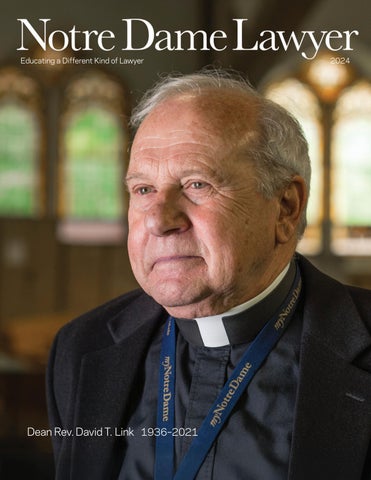
Educating a Different Kind of Lawyer
2024
Dean Rev. David T. Link 1936–2021 Notre Dame Lawyer | 2024
1
2024
Notre Dame Lawyer is a magazine published each year for the Notre Dame Law School community of alumni, friends, and supporters.
Dear Notre Dame Lawyers and Friends, Welcome to the new Notre Dame Lawyer! After an absence of six years, we have decided to relaunch our magazine, utilizing environmentally friendly materials. We found that while we can post news and events digitally, some of what is happening at Notre Dame Law School will not reach our alumni, friends, and benefactors unless they search for it.
47
We hope that you will find this a great way to keep up with what is new and exciting at Notre Dame, as well as with our alumni, faculty, and students.
7 11
Cover
Alumni Profiles
17 The Legacy of Dean David T. Link
with the Condemned: 15 Walking Dale Recinella
Features
School of Thought: 25 New Craig Watz
the Headlines: 11 Beyond Exoneration Justice Clinic
Immigrants Find a Better 41 Helping Life in America: Matthew DiCianni
the Frontlines: 31 From Global Human Rights Clinic
the Call for Help: 43 Answering Dan and Daria Absher
37 Special Education Law Clinic
Different Kind of Lawyer: 47 AJoAnn Chávez
3 News Briefs 63 Faculty News The Mark of Responsible Forestry www.fsc.org SGSH-COC-002249
1
Notre Dame Lawyer | 2024
Business Advocacy: 52 Driving Stephanie Maloney, Audrey Beck, Tara Morrissey
of Service, Advocacy, 55 AandLife Courage: John Lancaster
57 The Visionary: Cynthia Hardy
17 Editor Denise Wager Managing Editor Arienne L. Calingo Assistant Editor Elyse Paul ’21 MNA
Designers Gwen Frederickson Kristina Craig Printing Service Printers
Copyeditor Kathe Brunton
Law Alumni Program Manager Tammye Radke Raster ’92 J.D.
Contributing Writers Jonathan Bailey Kathe Brunton Arienne L. Calingo Libbey Detcher ’24 MNA Andrew Faught Emily Halnon Madeleine Sophie Miller ’27 Elyse Paul ’21 MNA Quinn Sanderson ’26 Denise Wager Chuck Williams
Academic Advancement Director Jason Stoller ’08
Photographers Matt Cashore Kurt Gerber Barbara Johnston Jennifer Mayo Je’nine May Casey Patrick Damora Regala Peter Ringenberg
Marketing Communications Director Denise Wager
Change of Address 1341 Biolchini Hall Notre Dame, IN 46556
39
A lot has happened since the last issue of Notre Dame Lawyer, including the Law School’s response to the COVID-19 pandemic, visits by five Justices of the Supreme Court of the United States, record numbers of federal clerkships, record-breaking applications for our London Law Programme, and the highest-performing incoming classes in the history of Notre Dame Law School. We have also witnessed the creation of the Lindsay and Matt Moroun Religious Liberty Clinic as part of the Notre Dame Religious Liberty Initiative, our new, nationally recognized Exoneration Justice Clinic, our Special Education Clinic, and the world’s leading Global Human Rights Clinic. We have also established our first competitive moot court competition, the Justice Amy Coney Barrett Moot Court Tournament, with a final round judged by three federal judges, including Supreme Court Justice Brett Kavanaugh. This tournament is named after our most illustrious alumna, who was appointed to the Supreme Court of the United States in 2020. While all of the foregoing events are noteworthy hallmarks in the history of Notre Dame Law School, one of the most significant was the passing of former Dean David T. Link. Fr. Dave passed away on October 28, 2021. He left an indelible mark on the Law School, and on me. I met then Dean David Link in November 1996, as I was interviewing for my first position as a law professor. As he tried to recruit me to Notre Dame, he told me repeatedly, “You are Catholic, and you belong here.” Although I started my career at Stanford Law School in California, we stayed in touch. He was a reliable source of guidance and sage advice. After 24 years as Dean of Notre Dame Law School, founding President of Notre Dame Australia, and founding Dean of the Law School at the University of St. Thomas, and countless honorary doctorates, Dave Link stepped down to devote himself to the care of his wife Barbara at the end of her life. After Barbara passed away, he became a priest, and immersed himself in his ministry in the prisons of northern Indiana. I will never forget the words he spoke to me on my very first day in the office as Dean of Notre Dame Law School in July 2019. With his characteristic grin, he said, “I knew that I would get you here eventually—this is where you belong.” This first new issue is dedicated to the impact of David T. Link, the man who designed the Notre Dame Doctoral gown and coined the phrase “a different kind of lawyer.” While we use that phrase to guide what we strive to do here at Notre Dame Law School, there has been no person who it describes better than David T. Link. Yours in Notre Dame,
Comments For questions or comments about the magazine, please e-mail Tammye Radke Raster at traster@nd.edu. law.nd.edu
G. Marcus Cole The Joseph A. Matson Dean & Professor of Law
Notre Dame Lawyer | 2024
2
News Briefs Insights from the Bench: Justices Kagan, Kavanaugh, and Barrett Visit Notre Dame Throughout the past few years, Notre Dame Law School has welcomed several Supreme Court Justices, each enriching the Law School community with thoughtful perspectives on the law and judiciary. U.S. Supreme Court Justice Brett
She emphasized the Court’s role in
Kavanaugh spoke at the 2023 Notre
protecting democratic structures and
Dame Law Review Federal Courts
highlighted the importance of civil
Symposium, discussing various topics
discourse. Kagan’s visit to Notre Dame
including administrative law, the
provided a rare opportunity to learn
Chevron doctrine, and his experiences
from a Justice committed to protecting
on the Supreme Court.
and advancing democratic principles.
In a conversation with Dean G. Marcus
U.S. Supreme Court Justice Amy Coney
Cole, Kavanaugh described how his
Barrett ‘97 J.D. and Israel Supreme
Catholic education has shaped his
Court Justice Alex Stein visited Notre
commitment to judicial integrity,
Dame Law School earlier this year to
underscoring principles of empathy,
discuss legal interpretation within their
careful reasoning, and respect for various
respective legal systems.
perspectives. He also spoke about the unique relationship the nine justices have, highlighting their shared spirit of compromise and congeniality that guides them in assembling an opinion. He has also taught two short courses at the Law (top to bottom) U.S. Supreme Court Justice Brett Kavanaugh judges the Justice Amy Coney Barrett Moot Court Tournament finals with Judge Elizabeth Branch and Judge Gerald Pappert ’88 J.D. U.S. Supreme Court Justice Elena Kagan visits and co-teaches a 1L criminal law class. U.S. Supreme Court Justice Amy Coney Barrett and Israel Supreme Court Justice Alex Stein discuss legal interpretation.
3
Notre Dame Lawyer | 2024
School over the past year.
Justice Stein advocated for a strict, positivist approach to Israeli law, stressing judges’ adherence to existing laws without introducing new rules. Justice Barrett, an originalist
Notre Dame Law Review Celebrates 100 Years The 2024–25 academic year marks the centennial of the Notre Dame Law Review, celebrating 100 years of exceptional legal scholarship. To commemorate the milestone, the Law Review hosted a weekend celebration in October, bringing together alumni, faculty, and current students for several events, including an editors-in-chief panel discussion. The panel featured former editors-in-chief: Judge Thomas D. Schroeder ’84 J.D., U.S. District Court Judge for the Middle District of North Carolina; Anthony J. Bellia Jr. ’94 J.D., O’Toole Professor of Constitutional Law at Notre Dame Law School; and Leon F. DeJulius Jr. ’02 J.D., New York Partner-in-Charge at Jones Day. Professor Derek Muller ’07 J.D. delivered opening remarks, and the panel was moderated by Alicia Armstrong, current editor-in-chief of the Notre Dame Law Review.
W H E R E N D L AW ’ S C L AS S O F 2 0 2 3 W O R KS Graduates from the Class of 2023* secured jobs in 31 states and Washington, D.C. On average, more than 135 employers across nearly 60 markets in over 30 states hire Notre Dame Law graduates each year.
165
compared constitutional and statutory interpretation in the U.S., highlighting
Law School this November to judge the
the U.S. Constitution’s strength through
final round of the inaugural Justice Amy
its concise nature. Barrett also taught
Coney Barrett Moot Court Tournament.
two short courses to students over the
C L E R KS H I PS
Jobs requiring bar passage or J.D. advantage
Secured at federal, state, and local courts
Big Law Firms (more than 100 attorneys)
Kagan visited Notre Dame, where she
These visits from the Justices
co-taught a criminal law class and
underscore Notre Dame Law School’s
9%
joined Dean Cole for a live-streamed
deep-seated commitment to fostering
talk to launch the 2023-24 Notre Dame
dialogues on the role of law and the
Forum on “The Future of Democracy.”
judiciary, offering law students unique
Kagan shared insights into democracy,
access to some of the nation’s most
originalism, and judicial responsibility.
influential legal minds.
52
E M P LOY E D
50%
past year.
U.S. Supreme Court Justice Elena
97
%
J . D . G R A D UAT E S
in constitutional interpretation,
Kavanaugh returned to Notre Dame
Notre Dame Law Review editor-in-chief Alicia Armstrong and former editors-in-chief Leon F. DeJulius Jr., Judge Thomas D. Schroeder, and Anthony J. Bellia Jr.
Other Law Firms
10%
Government/Public Interest
$170k M E D I A N SA L A RY
24%
Clerkships
4%
Business/Industry
2%
Education Sector
*1% pursuing a full-time graduate program
Notre Dame Lawyer | 2024
4
NEWS BRIEFS
A Pathway to Prestigious Clerkships ND Law School has a strong tradition of placing graduates in prestigious judicial clerkships, which provide invaluable experience, mentorship, and a jumpstart to legal careers. Recent graduates like Dominique Marino Giuliano ’23 J.D., who clerked for Judge John Blakey ’88, ’92 J.D.,
Supreme Court Clerks
of clerking. “I’ve gained invaluable insights into judicial decisionmaking and developed skills I’ll carry throughout my career,” Giuliano said. Judge Paul Matey of the U.S. Court Dominique Marino Giuliano
Jaylen Amaker
Each year, our students and alumni and specialized courts across the
clerked for Judge David J. Hale of the
country, with notable placements
U.S. District Court for the Western
at the U.S. Supreme Court. In
District of Kentucky and later Judge
recent years, the Law School has
Denny Chin of the U.S. Court of
consistently ranked among the top
Appeals for the Second Circuit,
law schools nationally for federal
has also seen the value of clerking.
clerkships. In 2023, 18% of our
“I applied for a clerkship because I
graduates secured federal clerkships
value mentorship. Judges are the best
for the term immediately following
of the profession, and I wanted the
their graduation, placing the Law
opportunity to learn at the hands of a
School fourth in the nation for federal
master,” Amaker said.
consecutive year.
success in securing clerkships. No matter a student’s intended path
Law School’s Career Development
within the law, clerkships provide
Office, which now includes a full-time
invaluable experience and mentorship
staff member dedicated to supporting
in the early stages of their legal
students and alumni in their pursuit
career,” said Vincent Versagli, director
of clerkships, as well as the faculty-
of the career development office.
Professor Nicole Stelle Garnett. Our faculty members—many of whom have clerked in the U.S. Supreme Court or other federal courts— offer personalized guidance, mock interviews, and concentrated classes to prepare students for their clerkship.
5
“We are very proud of our students’
This success is thanks in part to the
led clerkship committee, chaired by
Notre Dame Lawyer | 2024
Elizabeth Totzke
the 2026-27 term. Jaylen Amaker ’22 J.D., who has
clerkship placement for the second
Kari Lorentson
of Appeals for the Third Circuit during
secure clerkships in federal, state,
With a growing number of graduates pursuing clerkships, Notre Dame continues to build on its reputation as a leading law school for judicial placements, helping students open doors to careers in some of the country’s most prestigious courts.
This fall, the Law School was delighted to welcome the Class of 2027 to campus as the newest members of the Notre Dame Law community.
highlight the long-term benefits
She will clerk a second time with
Meet the Class of 2027
185
MEMBERS IN THE 2027 J.D. CLASS
3.83
MEDIAN UNDERGRADUATE GPA
MEDIAN LSAT SCORE
3.92 – 75th percentile 3.73 – 25th percentile
170 – 75th percentile 164 – 25th percentile
50
169
%
Christian Burset
Rev. Patrick Reidy, C.S.C.
Kari Lorentson ’19 J.D. and Elizabeth Totzke ’22 J.D. are clerking for Justice Amy Coney Barrett during the 2024-25 term. They are joined by two Notre Dame Law School faculty members on the Court this term: Professor Christian Burset, who is clerking for Justice Neil Gorsuch, and Associate Professor Rev. Patrick Reidy, C.S.C., ’08, who is clerking for Justice Brett Kavanaugh. Over the past six terms, six Notre Dame Law alumni have served as clerks at the Supreme Court. In addition to Lorentson and Totzke, Laura Wolk ’16 J.D. clerked for Justice Clarence Thomas, Audrey Beck ’17 J.D. clerked for Justice Brett Kavanaugh, Alexa Baltes ’17 J.D. clerked for Justice Brett Kavanaugh, and Timothy Bradley ’20 J.D. clerked for Justice Amy Coney Barrett.
WOMEN
STATES PLUS WASHINGTON, D.C. REPRESENTED
STUDENTS OF COLOR
114
64
18
36
UNDERGRADUATE COLLEGES AND UNIVERSITIES REPRESENTED
36
29
%
%
FIRST-GENERATION COLLEGE STUDENTS
%
CATHOLIC
%
DIRECT FROM UNDERGRADUATE 40% – 1-3 years out from undergraduate 24% – 3+ years out from undergraduate
New Intellectual Property Externship This past spring, the Law School launched a new Intellectual Property (IP) Externship, offering students the opportunity to represent small businesses in patent, trademark, and copyright matters. Alumna Jenna Tracy ’19 J.D., an IP and trademark attorney at Lowenstein Sandler, spearheads the program. During her time in law school, Jenna took every available IP course and participated in the Intellectual Property and Entrepreneurship Clinic. Inspired by her experiences, she was eager to give back and help current students gain similar opportunities. The semester-long program combines a weekly seminar with practical client work, focusing on skills such as case management, attorney-client relationships, and substantive IP law. The externship provides a valuable
Jenna Tracy leads the first externship class last spring.
bridge to students between classroom learning and the practice of IP law.
Notre Dame Lawyer | 2024
6
NEWS BRIEFS
Dean Cole
Honors and Awards
G. Marcus Cole Reappointed as Dean G. Marcus Cole was reappointed as the Joseph A. Matson Dean and Professor of Law at Notre Dame Law School for a second five-year term, beginning on July 1, 2024. Since assuming the role as dean in 2019, Dean Cole has significantly enhanced the Law School’s programs and diversity. Under his leadership, the Law School has seen major growth and innovation, including the creation of the Lindsay and Matt Moroun Religious Liberty Clinic, which advocates for religious freedom in U.S. and international courts, including the U.S. Supreme Court. In 2020, Dean Cole launched the Exoneration Justice Clinic, which focuses on securing justice for the wrongfully convicted and has doubled its
Dean Cole has also expanded Notre Dame’s global footprint through the Global Lawyering Initiative, positioning the Law School as a leader in international legal education. This initiative has expanded exchange programs worldwide, including in the Global South, and bolstered programs such as the highly successful London Law Programme. Additionally, Dean Cole has overseen the enrollment of the most diverse student bodies in the Law School’s history. Under his leadership, the Law School has fostered a culture of dignity and respect, preparing students to meet the challenges of being a Notre Dame lawyer and to serve the world with integrity and compassion.
capacity to support clients through substantial grants. Last year, the Law
“I am the most blessed man in the world that I get to be part of this amazing
School opened the Global Human Rights Clinic, amplifying its impact on
community,” Dean Cole said after his reappointment. “We strive to be a force
human rights issues globally.
for good in service to God, His people, and Our Lady’s University.”
Received the St.Thomas More Medal by Lord Nicolas Windsor, cousin of King Charles III, and inducted into the Fellowship of God’s Good Servant at Stonyhurst College (during address to the House of Lords, London, 2024) Awarded the Dignitatis Humanae Award by the University of St. Thomas School of Law, 2024 IBJ Media’s Indiana 250, list of the state’s most influential and impactful leaders (2024, 2023) The American College of Bankruptcy, inducted in 2022
Hadiah Mabry, a third-year
Last year, Mabry’s husband was
student, was selected to receive
diagnosed with cancer, and many
Expanded Global Reach with Three New Partnerships
the prestigious Peter A.R. Lardy
noted how she continued to offer
Scholarship Award for the 2024-
encouragement and support to her
Notre Dame Law School
a Law School delegation to South
provide invaluable opportunities
25 academic year. The award,
peers while navigating her
significantly expanded its global
Africa that coincided with the 50th
for faculty and students to engage
established by the Notre Dame Law
own challenges.
academic reach through new
anniversary of the formation of
in research and study at leading
partnership agreements over
the Law School’s LL.M. Program in
global institutions.
the last year with the University
International Human Rights Law.
Lardy Scholarship Award: Hadiah Mabry
Class of 1975, honors the memory of their classmate Peter Lardy, who passed away from cancer during his third year of law school. It is presented annually to a rising third-year student who exemplifies courage, love, and understanding toward others. The scholarship includes significant tuition assistance for the recipient’s final year of law school.
7
“Receiving the Lardy Scholarship
Lucerne, and Paris-Panthéon-Assas
said. “It is a confirmation of God’s
University. These collaborations will
goodness and faithfulness in my
foster greater international study,
life.” In addition to her strength and
research, and faculty exchanges,
generosity, Mabry is known for her commitment to service. She was drawn to law school as a means to help others, and she has been involved in the Lindsay and Matt Moroun Religious Liberty Clinic, the
Mabry, who was nominated by
Education Law Forum, the Notre
members of the Law School
Dame Law Review, the St. Thomas
community, was praised for
More Society, and the Women’s
her unwavering kindness, deep
Legal Forum. After graduation,
commitment to her Catholic faith,
Mabry will clerk for the Honorable
and ability to remain graceful amid
Joan Larsen in the U.S. Court of
immense personal difficulty.
Appeals for the Sixth Circuit.
Notre Dame Lawyer | 2024
of Cape Town, the University of
is an incredible honor,” Mabry
Mabry reflects on her experience at Notre Dame, saying, “Being a ‘different kind of lawyer’ means seeing your client with innate human dignity, equal before God. I am so incredibly grateful to be at Notre Dame. There is no place else in the world where I’d rather be.”
aligning with the Law School’s commitment to global academic excellence and its Global
Notre Dame’s partnerships with the University of Lucerne and Paris-Panthéon-Assas University similarly aim to enhance academic exchanges and collaborative research. The memorandum of understanding with Lucerne will
Lawyering Initiative.
strengthen faculty and student
The partnership with the University
agreement with Paris-Panthéon-
of Cape Town marks a historic
Assas continues to foster
milestone in the Law School’s
opportunities for joint projects and
international efforts. The agreement
international collaborations.
focuses on faculty collaboration and joint research, particularly in the field of human rights law. This partnership follows a 2023 visit by
exchanges, while the renewed
These strategic partnerships not only enhance Notre Dame’s international presence, but also
Professor Michael Addo, Professor Erika George, Associate Dean Paul Miller, Dean G. Marcus Cole, Dean Danwood Chirwa (UCT), Professor Christine Venter, and Professor Fatima Khan (UCT) after signing the partnership agreement.
Notre Dame Lawyer | 2024
8
NEWS BRIEFS
Notre Dame Law School Religious Liberty Clinic Named the Lindsay and Matt Moroun Religious Liberty Clinic Notre Dame Law School announced that its Religious Liberty Clinic will now be named the Lindsay and Matt Moroun Religious Liberty Clinic, in recognition of the Morouns’ significant gift. The announcement was made during
The Clinic provides students with
the fourth annual Notre Dame
hands-on experience in promoting
Religious Liberty Summit, which
religious freedom, both domestically
brings together global leaders in
and abroad. Recent projects include
religious freedom from a variety of
advocating for Indigenous religious
diverse sectors. University President
rights, representing immigrants
Rev. Robert A. Dowd, C.S.C.
seeking asylum from religious
dedicated and blessed the newly
persecution, fighting religious
renamed Clinic in the presence of
discrimination, defending religious
the Moroun family and Clinic faculty
exercise in prison, and supporting
and staff.
ministries in Africa.
Established in 2020, the Clinic
Professor John Meiser ’07, ’10 J.D.,
is focused on defending religious Notre Dame President Rev. Robert A. Dowd, C.S.C. blessing the newly renamed Lindsay and Matt Moroun Religious Liberty Clinic.
freedom. It represents individuals and organizations from all faith traditions, working to protect the constitutional right to religious belief and practice. “Without the Morouns’ vision and
“Without the Morouns’ vision and leadership, we could not have initiated or sustained this crucial work. Their generosity and commitment to faith as a guiding principle have been central to our success.” – DEAN G. MARCUS COLE
leadership, we could not have initiated or sustained this crucial work,” said Dean G. Marcus Cole. “Their generosity and commitment to faith as a guiding principle have
their sacred site would violate the
the U.S. Supreme Court. The Clinic’s
and Matt Moroun Religious Liberty
Religious Freedom Restoration Act,
briefs highlight that the destruction
Clinic has filed several amicus
a federal law that offers heightened
of Oak Flat, and the courts’ failure to
briefs urging courts to recognize
protections for religious exercise.
enjoin it, perpetuates a long history
that Indigenous sacred sites are entitled to the same religious liberty protections as all other houses of
Since 2021, the Lindsay and Matt Moroun Religious Liberty Clinic has
of disregard for Native peoples and their sacred sites.
worship under federal law.
filed several amicus briefs on behalf
In November 2024, the Emmy
of a variety of Indigenous groups
Award-winning series What Would
Oak Flat, known by the Apache
and leaders dedicated to protecting
You Fight For? spotlighted the
people as Chi’chil Biłdagoteel,
Native American cultural heritage
Clinic’s work in protecting Oak Flat.
is an area in Arizona that
and legal rights. This fall, the Clinic
The feature aired on NBC Sports
contains hundreds of Indigenous
filed a brief in support of Apache
during a Notre Dame football game.
archaeological sites and burial
Stronghold’s request for review in
grounds. Revered by Native tribes as a place where holy springs flow from the earth and where holy beings reside, Apaches have long worshiped and held religious ceremonies there.
support, which has enabled students
In 2014, Congress mandated the
to participate in meaningful legal
transfer of the land to Resolution
work protecting religious freedoms.
Copper, a foreign-owned mining
“I am deeply grateful to the Moroun
company, which threatens to
family, whose generosity has
destroy the site and turn it into a
enabled us to give our students
massive crater. Apache Stronghold,
unparalleled opportunities to serve
a coalition of Apaches and others
people in need and to participate in
seeking to preserve Oak Flat, sued
this critical work to protect our most
the government to stop the transfer.
foundational freedom.”
They argue that destruction of
The Morouns, passionate advocates for religious freedom, believe Notre Dame is the ideal institution for advancing this mission. “Notre
Wendsler Nosie Sr., leader of Apache Stronghold, and Marcus Cole, dean of Notre Dame Law School, embrace in Washington, D.C., amidst a coalition of Apaches and others seeking to preserve Oak Flat.
Dame has always shown that faith and freedom are integral to the pursuit of truth,” they said. “We are proud to support the Clinic and its to live according to their beliefs.”
Notre Dame Lawyer | 2024
gratitude to the Morouns for their
Notre Dame Law School’s Lindsay
been central to our success.”
work to defend every person’s right
9
director of the Clinic, expressed
Notre Dame Law School’s Fight to Protect Oak Flat from Destruction
John Meiser, director of the Religious Liberty Clinic disusses a case with student fellows.
Scan the QR code to view the full story and video.
Notre Dame Lawyer | 2024
10
E X O N E R AT I O N J U S T I C E C L I N I C
BEYOND THE HEADLINES:
Restoring Humanity to the Wrongfully Convicted by Arienne L. Calingo
A former student, Tia Paulette ’18 J.D., approached Gurulé and told him that the exoneration stories he shared inspired her to establish a new student organization, the Notre Dame Exoneration Project. At one of their first events, the Exoneration Project brought exoneree Keith Cooper and his attorney, Adjunct Professor of Law Elliot Slosar, to campus. In 1996, Cooper was wrongfully imprisoned for an armed robbery in Elkhart, Indiana. In 2017, he was pardoned by Indiana Gov. Eric Holcomb, making him the first person in the state to be pardoned based on actual innocence alone. Gurulé said, “The room was packed, with students standing in the aisles and at the back of the classroom. Keith shared how his conviction profoundly affected his family, leaving them homeless for a significant period, and spoke about the broader implications for his wife and children. He also addressed the challenges of reentry after a wrongful conviction. “The classroom was silent. Students were visibly moved, some brought to tears,” Gurulé added. “Keith’s story powerfully humanized the experience of wrongful conviction.” Following Cooper’s talk, Slosar invited law students to assist in investigating corruption cases in Elkhart County, where gross police misconduct had led to a troubling pattern of wrongful convictions. This volunteer work laid the foundation for the Wrongful Conviction Externship. Under the mentorship of Gurulé and Slosar, the program allowed law students to represent wrongfully convicted clients in Northern Indiana while earning academic credit.
Andy Royer, the Exoneration Justice Clinic’s first client to be exonerated.
Interest in the Exoneration Project surged, with participation growing from just five students to over 200. In August 2020, Gurulé took the next step by establishing a stand-alone clinic—the Exoneration Justice Clinic (EJC)—and has served as its director. The EJC was established with the enthusiastic support of Dean G. Marcus Cole, who made its creation one of his earliest priorities.
The newspaper articles always began the same way: a headline about justice finally being served, accompanied by photographs of exonerees stepping out of prison, embracing their family members for the first time in years. As a former prosecutor for the U.S. Department of Justice, Professor Jimmy Gurulé was no stranger to the complexities of the criminal justice system. But those moments captured in newspapers or on CNN reports began to shift his perspective, serving as a stark reminder that beneath the laws lay profoundly human experiences—stories of wrongfully convicted individuals whose lives were irrevocably changed by a tragic miscarriage of justice. Driven by these stories, Gurulé shared some of them with his Criminal Law class, urging first-year students to think critically beyond their required readings and grapple with the emotional and mental burden of a broken criminal justice system.
11
Notre Dame Lawyer | 2024
“The student interest and involvement have continued to grow,” said Gurulé. “Next semester, we will have the largest enrollment in the EJC’s history, with 25 law students and 13 undergraduate students enrolled in the Clinic.” Since 2021, the EJC has also welcomed summer interns consisting of Notre Dame law students, undergraduate students from Notre Dame and St. Olaf College in Minnesota, and foreign exchange students from Strathmore Law School in Kenya. The interns work primarily on intake cases, allowing them to review several requests for legal representation and make recommendations. They also assist in ongoing EJC cases. The EJC’s work is centered around three pillars: advocacy through client-based investigation and litigation, reentry through supporting post-exoneration transition (the Clinic hired a reentry coordinator through a gift from audiochuck), and prevention through legislative reform to reduce wrongful convictions. The following snapshots of EJC cases, projects, and achievements capture the Clinic’s impactful work and the meaningful changes it has driven.
EJC staff attorneys Kevin Murphy ’14 J.D. (m), Katie Takeuchi ’20 J.D. (l), and Lenora Popken ‘20 J.D. (r), returned to Notre Dame Law School with a shared commitment to advocate for the wrongfully convicted and stand against police misconduct. Murphy was the first staff attorney hired by the EJC. He previously worked at Jenner & Block LLP, where he maintained an active pro bono practice, focusing on postconviction and criminal defense cases that changed the course of his career. Takeuchi previously represented a young widow whose husband was killed by a MiamiDade County police officer as a result of misconduct. Popken has been involved with the Clinic in every phase of its development. She volunteered with the Notre Dame Exoneration Project, participated in the Wrongful Conviction Externship, and was a student in the Clinic during her time in law school. She had the opportunity to participate in a post-conviction evidentiary hearing on behalf of Andrew Royer. Anne Peterson ’93, ’02 J.D., also returned to the Law School as the EJC’s legal assistant.
Notre Dame Lawyer | 2024
12
E X O N E R AT I O N J U S T I C E C L I N I C
“In wrongful conviction cases, not only is an innocent
person convicted and deprived of his freedom for a crime that he did not commit, but the real killer remains at large and is not held accountable. So, really, it’s a double
”
tragedy and injustice to society.
-Jimmy Gurulé, Founding Faculty Director, Notre Dame Exoneration Justice Clinic
Exoneration of Andy Royer In 2021, the Wrongful Conviction Externship, the predecessor to the EJC, played an instrumental role in the exoneration of Andy Royer, who spent 16 years in prison for a murder he did not commit. Royer was the EJC’s first client to be exonerated. Royer was wrongfully convicted in a 2002 murder case in Elkhart, Indiana, involving the strangulation of an elderly woman in his apartment building. Throughout his imprisonment, he maintained that
Elkhart police exploited his mental disability to coerce a false confession. He was officially exonerated when a judge granted the Elkhart County prosecutor’s motion to dismiss the murder charge against him. According to Gurulé, Royer’s confession was coerced, illegal, and inadmissible. Although he was interrogated for two days, only 61 minutes of his statement were recorded. Faculty and students worked on Royer’s case for years, beginning in 2017. Students contributed at every stage of the process to overturn his conviction, from conducting early investigations to drafting a successive petition for post-conviction relief, participating in an evidentiary hearing, and preparing for appellate proceedings. Program for the Defense of Mexican Nationals in Criminal Matters in the United States
Kevin Murphy, Anthony Bedolla, and Professor Jimmy Gurulé at an EJC event celebrating Anthony Bedolla’s exoneration.
13
Notre Dame Lawyer | 2024
In December 2023, the EJC received a groundbreaking $3 million grant from Mexico’s Ministry of Foreign Affairs to administer the Program for the Defense of Mexican Nationals in Criminal Matters in the United States (PDM). This grant, the largest ever awarded to a Notre Dame Law School clinic, followed a national search by the
Mexican government for an innocence clinic to represent wrongfully convicted Mexican Nationals in the United States.
Adjunct Professor Elliot Slosar, left, and Professor Jimmy Gurulé speak to media about Andy Royer’s exoneration.
The EJC is now collaborating with the 53 Mexican Consulate Offices across the country to overturn the wrongful convictions of Mexican nationals in the United States. These individuals often face significant challenges, such as language barriers and limited understanding of their constitutional rights, which can lead to false confessions or coerced statements. Through this program, the Clinic reviews claims of actual innocence and provides pre-trial legal assistance. “The EJC is the only law clinic in the country receiving funding from a foreign government to represent foreign nationals nationwide,” said Gurulé. Exoneration of Anthony Bedolla Anthony Bedolla, a Mexican national and EJC client, was exonerated in August 2024 after spending 14 years in prison for crimes he did not commit. In February 2010, following a bench trial, he was convicted of a murder and related drug offense, and was sentenced to 45 years in prison. The Marion County Superior Court vacated his convictions after new evidence cleared him of the crimes. The EJC investigated this case in collaboration with the Marion County Prosecutor’s Office (MCPO) Conviction Integrity Unit (CIU) for almost two years. This is the first collaboration between the EJC and the MCPO’s CIU. Gurulé stated that the Indianapolis Metropolitan Police Department engaged in gross police misconduct by withholding substantial exculpatory
subjected to DNA testing and analysis be preserved for 20 years from the date that the defendant’s conviction becomes final. This legislation ensures that biological evidence that could prove a defendant’s innocence is available for DNA testing.
evidence of an alternative suspect, the real killer. The department also withheld exculpatory evidence that would have seriously undermined the credibility of the critical prosecution witness in the case. The lead detective testified falsely at trial and during a deposition, which led to Bedolla’s wrongful conviction. The Marion County Superior Court granted a written motion filed by the State to dismiss the pending criminal charges against Bedolla with prejudice, officially exonerating Bedolla. Indiana Supreme Court Rules in Favor of EJC Clients In August 2024, the Indiana Supreme Court ruled in favor of four EJC clients, holding that they are entitled to have their cases heard by a new judge. This decision stems from EJC cases in Elkhart County involving Iris Seabolt, Reginald Dillard, Leon Tyson, and Pink Robinson, who allege they were wrongfully convicted due in part to systemic police and prosecutorial misconduct.
This major legal victory reflects years of effort by EJC staff and students, who filed the first motion for recusal in May 2021. Students participated in every stage of litigating the issues, from arguing for recusal before the trial judge, to drafting appellate briefs, to preparing for the oral argument in the Indiana Supreme Court. Throughout this process, the EJC remained committed to ensuring that the Clinic’s clients would one day have their day in court before a fair and impartial tribunal. Legislative Reform The EJC has contributed to three major pieces of legislation in Indiana aimed at reducing the rate of wrongful convictions. The EJC worked with the Innocence Project and IU McKinney School of Law Wrongful Conviction Clinic in Indiana to enact evidence preservation legislation. In July 2022, H.B. 1144 was enacted into law, which requires that certain evidence in the possession or control of an Indiana law enforcement agency that could be
The EJC also played a role in advancing a bill that prohibits Indiana law enforcement officers from lying to juveniles during interrogations to secure confessions. Currently, the EJC is working on a third piece of legislation addressing eyewitness identification. The bill would require Indiana law enforcement to follow the “core four” best practices, scientifically proven to improve the accuracy of witness identification and already adopted by most states. The EJC is cautiously optimistic that the legislation will pass this session. The Exoneration Justice Clinic stands as a powerful testament to the transformative impact of legal advocacy, education, and reform. Through its unwavering commitment to justice, the Clinic not only overturns wrongful convictions, but also fosters systemic change while inspiring the next generation of legal professionals. The Clinic’s work restores the humanity behind the headlines and reminds us that the fight for justice is as vital as it is profoundly human, allowing exonerees to finally embrace a future once stolen from them.
Notre Dame Lawyer | 2024
14
Dale Recinella Provides Mercy and Healing on Florida’s Death Row by Andrew Faught
with them for this process, if necessary, all the way to the end.” That Recinella is here at all—he’s now in his 26th year counseling Florida death row inmates as a lay chaplain— was never a foregone conclusion. After graduating from Notre Dame Law School, he worked as a finance lawyer for Ford Motor Credit Company in its World headquarters complex in Dearborn, Michigan, before moving to Tallahassee as public finance counsel on deals to finance schools, hospitals, and other public projects. It was as a parishioner at Good Shepherd Catholic Church in Tallahassee where Recinella began to consider the Bible’s “rich young lawyer story,” in which Jesus tells a wealthy man that serving others is paramount to financial wealth. The story struck a chord.
Catholic News Service
Recinella volunteered for a local organization that helped AIDS victims and those dying of cancer and other terminal illnesses, which introduced him to the death and dying ministry. He’s a familiar face to the 288 condemned men lining death row at Florida State Prison, where a man’s lone remaining right lets him choose the means for his own demise: the electric chair or lethal injection. Dale Recinella ’76 J.D. is a smiling father figure who is less interested in what brought a person to this desolate place than he is in assuring an inmate of God’s unbidden mercy. He starts his conversations the same way: What would you like God to do for you today? And then, he listens. Perhaps surprisingly, the inmates speak not
15
Notre Dame Lawyer | 2024
just of their concerns for their spouse and children, but also for the families of their victim and for prison staff members. Their own stories are often characterized by fatherless homes, poverty, violence, and, at times, a loss of hope. “As I engage on this walk, a spiritual walk with a man who’s stamped with an expiration date, we are allowing the Holy Spirit to fill in what is missing,” Recinella said. “I find myself wanting to get to know them better, wanting to reflect on how much God loves them, and I want to try to be faithful to the commitment I’ve made to be there
A chaplain at Apalachee Correctional Institution near Tallahassee heard about Recinella’s efforts and asked if he could be a prayer partner for inmates with AIDS, cancer, and other terminal illnesses. In 1998, when his wife Susan got a new job, the couple moved east, outside Jacksonville, where Dale introduced himself to their new pastor at St. Mary’s of Macclenny Catholic Church. Fr. Joe ministered to men on death row at the nearby prisons. “He put a hand on each of my shoulders and said, ‘I’ve been praying
for 15 years for you to get here. What took you so long?’” Recinella recalled. “In that moment, it gelled that this was not an accident.” He added, “He was exuberant to find out about my prior prison ministry experience. Within a month, I was walking with him along the corridors of death row, cell to cell, greeting every man by name, gradually learning about their families and their lives.” This calling, it turns out, is a natural extension of Recinella’s time at Notre Dame Law School, where he learned an important lesson, a message conveyed in no small part by Fr. Ted Hesburgh, former president of Notre Dame: “Compassion without competence is a cruel hoax.” “One of the things that they drilled into us at Notre Dame Law School was, you’ve got to do the work to know how to help,” said Recinella, who in 2021 was the first recipient of the Guardian of Life Award from the Pontifical Academy for Life. “You’ve got to know what is needed to make things better, and you have a duty to equip yourself with the tools to do that.” Recinella took two classes on tax law from Dean Link, both at 8 a.m. Link was efficient and no-nonsense as he taught his charges about deductions and rules for property transactions. “He didn’t waste any words, and he was very precise,” Recinella said. “He was marvelous.” While Recinella doesn’t practice law on death row, he’s constantly using his legal acumen with inmates in order to understand their struggles with the appeals process.
“I’m there to help them carry the water spiritually, but my background legally makes it possible for me to enter into their struggles in a much deeper way,” he said. Recinella meets with inmates for up to an hour in a room normally reserved for lawyers. Given the length of the appeals process, he’s been meeting with some inmates for more than 20 years. The get-togethers don’t hew to any structure. Recinella is guided by a singular mission: “to bring the church’s healing and the church’s forgiveness to this entire complex of human suffering.” “I let the inmate lead the pace,” he said. “They’re responding to the spiritual needs and the needs for healing and understanding that are coming from within them.” Over the years, Recinella has formed relationships with hundreds of condemned men. He shares Catholic sacramental traditions with the inmates until the time of their death. “Many of the men in those final days develop a depth of peace as they have felt reconciled through Christ and through the sacraments,” Recinella said. “It’s a real process of allowing the person in front of me to show me who they are and what they need. But it’s done in prayer and it’s done with the hope of healing for them and for everyone that’s affected by this.” On the day of an execution— Recinella has witnessed 20 executions—Susan is available for moral support to the family of the condemned. Afterward, the Recinellas often meet with family members at a nearby Catholic church “as they try to
close this day in a spiritual context,” Recinella said. They will sometimes share a meal. Recinella, who has written four books on prison ministry and the death penalty and spirituality, seeks his own spiritual guidance due to the “secondary trauma” of the work he does. But he is undeterred. “We are surrounded by good people who need accompaniment and encouragement as they face the challenges in their own life,” he said. “Whether they’re in a nursing home, or a prison, or in the streets, they usually appreciate the presence and assistance of a friend, especially a friend who will listen to their stories, validate their journey, and pray with them for God’s help and guidance.”
Photos courtesy of Catholic Mobilizing Network
Walking with the Condemned
Dale Recinella was honored with the Archbishop Fiorenza Dignity & Life Award by Catholic Mobilizing Network in October 2024 at the Vatican Embassy (Apostolic Nuncio), on World Day Against the Death Penalty. (left to right) Jeanette May, Dale Recinella, His Eminence Cardinal Christoph Pierre, Susan Recinella.
Notre Dame Lawyer | 2024
16
D E A N D AV I D T. L I N K
The Legacy of Dean David Link: A Different Kind of Lawyer by Denise Wager
Notre Dame Law School alumni from the 1970s through the 1990s all knew Dean David Link—a man whose influence on the school is both enduring and legendary. His legacy continues to shape the Law School today. The annual Public Interest Banquet is named in his honor, and Dean Marcus Cole often mentions his name when addressing incoming students. It was under Dean Link’s leadership that the phrase and ethos “a different kind of lawyer” first became central to the Law School’s identity. And Dean Link was just that—a different kind of lawyer. His vision for the Law School, and the role of lawyers in society, continues to resonate.
Return to Notre Dame A double Domer, Link graduated from Notre Dame in 1958 and the Law School in 1961 before starting his career at the U.S. Department of the 17
Notre Dame Lawyer | 2024
Treasury. He later became a partner in the Chicago office of Winston and Strawn. In 1970, encouraged by his classmate and friend, then Dean Thomas Shaffer ’61 J.D., Link made the pivotal decision to return to Notre Dame to teach federal income tax and corporate tax law.
lessons he learned help explain how he promoted the Law School with such great enthusiasm, describing it as filled with “corridors of creativity.” This passion was indicative of Link’s broader vision to make the Law School a dynamic, globally engaged institution.
He became associate dean in 1972. Then in 1975, Notre Dame President Rev. Theodore M. Hesburgh, C.S.C. appointed him as Notre Dame Law School’s eighth dean—a position he held for 24 years.
“He truly believed in his heart that the Law School was a special and unique place,” Bauer noted. Together they set out to implement some of those ideas, such as expanding the global footprint of the Law School by establishing the LL.M. program, supporting the London Law Programme, which at the time was both a summer and year-round program, and establishing a summer program in Tokyo.
A Vision for Transformation “Dave was incredibly creative, outgoing, enthusiastic, and full of ideas,” said Joseph Bauer, emeritus professor of law and longtime friend who served as associate dean twice with Link. Bauer recalled how Link spoke with pride of his father operating a car dealership. The
Professor Emerita Patricia O’Hara ’74 J.D. was a student when Link taught, and he later recruited her to join the faculty, making her among the first women professors at the Law School.
Reflecting on his impact, O’Hara recalled Link as a visionary who placed the Law School on the map nationally. As she put it, Link believed “If you can dream it, you can do it.” Brian Short ’72, ’75 J.D., a student of Link’s, a long-time member of the Law School Advisory Council, and a friend, characterized Link as committed. “Dave was all in … there was one level of commitment with Dave and he tried to inspire others to feel the same way as well.” While Link took great pride in Notre Dame being a teaching institution, the school had a far less visible presence as a research institution in Dean Link’s early years. Bauer recalled that Link convinced Father Hesburgh to eliminate the then summer law program, arguing that it would give faculty more time for writing and research. This move led to a significant boost in the Law School’s scholarly output. Link articulated his vision in his writings: “The future of the Law School depends on strengthening long-term commitments to teaching and to ethical examination of the law, sustaining the current emphasis on research, and continuing the selection process for choosing the best possible student body and faculty.” The impact of this vision was far-reaching. Link once explained, “If we’re as good as we think we are, and if we really have a special message and values, then we should be training all kinds of people for all kinds of practices.” When reflecting on Notre Dame Law School in the mid-1980s, Link emphasized the distinctive nature of a Notre Dame legal education and
the tremendous sense of change since 1970. He saw an orientation toward the value questions involved in the law as the defining characteristic of the Law School. “The moral and ethical questions are raised here with the same intensity that substantive and procedural issues are,” he said. “There are simply very few law schools that do it to the same degree.”
Building the Maserati of Law Schools When Link became Dean, the Law School had around 450 students and a relatively large student-to-faculty ratio. His vision was to elevate not just its size, but its quality and standards. Matt Barrett ’82, ’85 J.D., a former student and later a colleague, remembered that St. Thomas More and Atticus Finch were two of Link’s favorite lawyer heroes. He remembered that in an effort to capture Notre Dame’s distinctiveness, Link liked to say that other law schools built fine cars, while Notre Dame built Maseratis. “Link worked to enhance the Law School’s reputation,” said Barrett, “proclaiming at every opportunity that Notre Dame Law School taught ethics through the ‘pervasive method.’”
Notre Dame. Several years later Link and Jacobs procured a gift from John Sandner, a University trustee and Law School alumnus, to purchase the entire Chicago Bar Association library collection. “It was transformational in terms of what Roger did. And what we were able to do with the expanded space was really significant,” said Bauer. In 1988, Link was named the first Joseph A. Matson Chair at the Law School, a position later held by his
“ If we’re as good as we
think we are, and if we really have a special message and values, then we should be training all kinds of people for all kinds of
”
practices.
Under Dean Link’s leadership, the Law School experienced significant growth. He oversaw two major building renovations, including doubling the library’s size. The library holdings were smaller than those of peer institutions, and part of the expansion focused on increasing space to support increased volume count. Link also persuaded Roger Jacobs, then a librarian at the U.S. Supreme Court, to leave his job and join Notre Dame Lawyer | 2024
18
D E A N D AV I D T. L I N K
“ We can and should our lawyers.
”
successors, including current Dean G. Marcus Cole. The chair was established in memory of Joseph Matson, a Notre Dame alumnus who tragically died in a 1944 Air Force training accident.
Creating a Family Atmosphere As Dean Link transformed the academic side of the Law School, he was equally committed to creating a supportive, tight-knit community at Notre Dame. Getting to know the students was very important to him. As dean, he taught the required first-year ethics course on professional responsibility to all students, ensuring they knew him as both a teacher and a dean. His door was open to students, faculty, and staff. “He had a great relationship with all his students, especially many of the older ones who had just returned from the Vietnam war. He was dedicated to ensuring that no one fell behind,” said Short. Link and his wife Barbara fostered community spirit. Faculty and their spouses would often come to student parties and events. Bauer and Barrett both recalled school picnics and faculty parties hosted at the Links’ Lilac Road home at the beginning and end of the year, complete with pickup basketball games with Link right
in the middle of things (and on at least one occasion winding up in the emergency room). Frank Julian ’82 J.D., a long-time member of the Law School Advisory Council and NDLA Board, was a first-year student in Link’s ethics course. He said Link encouraged students to get outside the Law School and experience everything the broader University had to offer. Julian said that Link even organized a yearly fall pep rally for students in the then Biolchini basement complete with head football coach Dan Devine, the band, and cheerleaders. A running joke emerged around Link’s standard response to complaints, which was that he’d form a committee to look into it. As Julian recalled, “You may never hear the results of the committee. And the joke was if anything went wrong at the Law School people would say, ‘Go see the dean and he will form a committee to study that!’” O’Hara, who succeeded Link as dean in 1999, recalled that Link was very pastoral—genuinely caring for both students and faculty, and offering steady support and guidance. His belief in nurturing the whole person, not just the professional, was central to his leadership.
Ethics: The Heart of a Different Kind of Lawyer Dean Link’s views on legal education were grounded in his belief that ethics must be integral to every aspect of training. He was outspoken about the need for law schools to produce lawyers who prioritized justice over profit. In a 1995 Chicago Tribune article, he wrote: “We can and should begin with a commitment to ethics in the training of our lawyers. It is incumbent upon our nation’s law schools to develop lawyers who believe their primary responsibility is to bring about justice and peace between litigants, rather than strive for monstrous-sized verdicts, who put a greater emphasis on the beginning rather than the end of the Aristotelian formula.” “Ethics,” he said, “was not an appendage to law, it is at the very heart of the matter, and must become part and parcel of the entire program [in law school].” To develop a new kind of lawyer, law schools must prioritize ethics. This requirement involves recruiting students with strong leadership and moral foundations, hiring faculty committed to ethics, Photo courtesy Brian Short
begin with a commitment to ethics in the training of
Dean Link visiting the dean of the Havana Law School, 1977.
19
Notre Dame Lawyer | 2024
social justice, and peace, and creating a curriculum that integrates moral philosophy and social justice while ensuring legal competency. “It means a return to the roots of the legal profession as one of healing.” “Dean Link felt ethics was the backbone to being the different kind of lawyer that we educate at Notre Dame,” said Julian. Link’s vision for the Law School was a place that was more than the law. Son David Link ’81, ’86 J.D. said, “He saw the law as a healing profession, that it should be more than the technical part. He wanted to inspire students to practice law in a different way and focus on the whole client.” Short agreed, saying, “He saw lawyers as problem-solving agents; that was really important to him.”
Service Beyond Campus Link’s commitment to service could not be contained within the confines of campus. Perhaps one of his most significant community contributions came in 1988 when Link and J. D’Arcy Chisholm, then Associate Director of the University’s Institute for Pastoral and Social Ministry, helped found the Center For The Homeless in downtown South Bend. With local community leaders, they purchased a former men’s clothing store, aiming to transform it into a 24-hour service center for people who were homeless. According to a 1988 South Bend Tribune article, the project goal was to provide under one roof the many types of services homeless individuals
need to prepare themselves for independent living. The project gained crucial support from Notre Dame President and good friend Rev. Edward Malloy, who arranged financing for the purchase and renovation of the building after Link and his partners contributed their own earnest money. Just as they had envisioned, the Center For The Homeless became a nationwide model. He also helped establish the World Law Institute, served as chairman of various ABA committees, chaired the Indiana State Ethics Commission, and was a board member of JustLife, a national organization espousing a consistent life ethic. He also volunteered with Habitat for Humanity and, at the strong urging of his wife Barbara, he began volunteering at the Michigan City prison. It would foreshadow what would come later in his life after Notre Dame.
trators, faculty members, students, and alumni. Yet, incredibly, never once did I hear Dave raise his voice in anger—not even on the golf course! He had an uncanny ability to defuse tense situations with a calm reaction, to steer discussions within civil boundaries, and to deploy deftly his gentle, often self-deprecating, sense of humor.” In a 1999 Notre Dame Lawyer article honoring Link’s retirement, former Dean Tom Shaffer noted … “The main thing I remember from the first years of Dave’s deanship … is the special grace that led him to cherish the people around him.”
Bauer reflected, “His commitment to family, faith, and the institution manifested in the things he said and the things he did.” Julian put it simply: “He lived his life to do good for fellow human beings.”
Equanimity and Kindness Professor Emeritus of Law Tex Dutile ’65 J.D. was a close friend and colleague with Link for a half-century and spoke of his equanimity and kindness. “I have spent literally thousands of hours with him in both social and professional settings— including countless (and sometimes endless!) meetings with adminis-
Dutile said that Link was invariably kind, treating a student visiting his office as well as he would the Provost. “He cared about the difficulties, illnesses, and challenges of everyone around him: student, faculty, administration, or staff. He always made the time to listen patiently to those who sought his counsel or help.” His caring nature was evident through countless visits to hospitalized members of the community.
Notre Dame Lawyer | 2024
20
R E V. D AV I D T. L I N K
Dutile said that it was these pervasive qualities, equanimity and kindness, that he feels contributed mightily to Link’s success, both personal and professional. “They constituted as he brilliantly navigated his way among all his ‘constituencies.’ They constitute an integral part of his towering legacy.”
An Enduring Legacy In his final years as dean, Link focused on research and scholarship about “Healing and the Law,” sponsored by the Fetzer Institute. His vision of law as a healing profession became central to his legacy. Link’s son David said his dad loved Notre Dame because “you can do things here that you can’t do at other places. He could have this vision for a different type of lawyer. And the Law School and Notre Dame was a place for him to nurture justice, healing, and promote socially responsible careers.” Dean Link’s children (David C. Link, ’81, ’86 J.D., Mary Esparza ’83,
Maureen Favorite ’84, and Teran Trauernicht ’96, Notre Dame undergraduates) captured his essence: “Teaching and building the program at the Law School may have been his greatest passions, second only to his wife and family. He thrived on connecting with students and took pride in nurturing a ‘different kind of lawyer’—one defined by accessibility and a personal touch, which set him apart from many of his peers.” They also highlighted his strong commitment to creating a diverse faculty, one that embraced a variety of cultures, ethnicities, beliefs, and perspectives to foster a well-rounded, real-world environment of academic opportunity and debate. Many of these values and lessons came from Fr. Ted Hesburgh, his mentor and role model at Notre Dame. Fr. Hesburgh, who served as University president during Link’s time as a student and the first half of his tenure as dean, also became a father figure to
He loved Our Lady and was dedicated to her mission of providing a faith-based education—one that challenged his students to use their advocacy to share God’s kindness, love, and understanding, urging them to fiercely love their neighbors and walk in their shoes.
”
”
-Children of Dean Link
21
Notre Dame Lawyer | 2024
Link after his own father passed away while Link was an undergraduate. In addition to his deep respect for Fr. Hesburgh’s leadership and civil rights work, Link’s family believes this experience shaped the kind of dean he became—one who valued getting to know and supporting the lives and struggles of his students. Dean Cole credited Link with framing the focus of Notre Dame Law School today. In a 2021 article in the South Bend Tribune, Dean Cole said that Link’s impact can still be felt at the Law School. “[His impact] is deeply ingrained in everything we do. Everything is a reflection of his Catholic faith, to the people, and to the law. “We train a different kind of lawyer,” Dean Cole added. “Different,” according to him, meant the kind of lawyer Link was—“committed to service and others.” “To have survived in higher education, to have been a superb manager of the faculty, and to have served that long in one place is truly remarkable—it just doesn’t happen today,” said Short. During his tenure at the Law School, Link served as the founding president and vice chancellor of the University of Notre Dame in Perth, Australia. After Notre Dame, he went on to be founding dean of the University of St. Thomas College of Law, and deputy vice chancellor and provost of the University of St. Augustine in Johannesburg, South Africa.
Then came the next chapter.
From Law School Dean to a Priest Dedicated to Prison Ministry “His work in the prisons saved his life.” These words of David Link ’81, ’86 J.D., Dean Link’s son, reflect on the profound impact his father’s second vocation would have as a priest and prison minister. This work became his purpose for the remainder of his life. Link’s transformation began in 2003 after the death of his beloved wife Barbara. For decades, he had been known as the dean of Notre Dame Law School—a respected educator, tax attorney, and leader. David and Barbara were admired by many for their deep, loving partnership, and as a model of faith and service. Her death was a devastating blow, and sent Link searching for new meaning and purpose in the wake of his grief. He found his new calling in an unexpected place, the prison system, where he served as a Catholic priest and advocate for those society had forgotten. His work in the prisons quickly became not just a job, but a passion. It was a new mission, a natural extension of the values he had lived and championed throughout his career, including during his time at Notre Dame, where he had dedicated the Law School to “educate a different kind of lawyer.” Link carried
these same principles into his ministry, embracing restorative justice and working to heal the broken lives of those who were incarcerated.
presence and guidance throughout his days after her passing,” said Maureen along with her siblings, David, Mary Esparza ‘83, and Teran Trauernicht ‘96.
When he told friends he intended to become a priest, he shared that it was Barbara who had encouraged him to pursue this path. “He would certainly say that every good and meaningful decision in his life was made with my mother’s loving, gentle guidance and spirit,” said his daughter Maureen Favorite ‘84. “Together, they were an incredible example of true faith in action. He continued to feel her
In a 2018 interview with The Criterion about the circumstances that led him to become a priest, Link reflected on the way his path unfolded. His early involvement in the prison system began while still the dean at Notre Dame. Link said it was Barbara who first suggested he consider prison ministry. Initially skeptical, Link visited a prison to lecture, only to find himself deeply moved by the inmates’ insights.
Notre Dame Lawyer | 2024
22
R E V. D AV I D T. L I N K “They had deep thoughts, and I really enjoyed it,” he recalled in an interview with the South Bend Tribune. Link initially thought about becoming a deacon, and describes his progression toward the priesthood as a conspiracy. “It was a combination of my late wife, Fr. Ted Hesburgh, the Holy Spirit, and my bishop. The four of them got together and decided they wanted me to become a priest.”
This part of my life as a priest is to serve the least, the last, the lost, and the lonely. I’m a servant.
”
-Rev. David T. Link
Later, Bishop Dale Melczek of the Gary Diocese offered him an opportunity, asking if he would be interested in becoming the chaplain for the seven northern Indiana prisons. In 2008, at the age of 71, Link was ordained a Catholic priest after completing an accelerated seminary program. His prison ministry began in earnest as he worked with prisoners in northern Indiana, including at the maximum-security Indiana State Prison in Michigan City. At first, he served as a chaplain, leading Mass and providing counsel. But soon, he transitioned to
23
Notre Dame Lawyer | 2024
volunteer status, choosing to remove the administrative burdens of his paid position to focus more fully on healing and restorative justice reform. Almost daily, Fr. Link would visit the prisons, offering a compassionate ear to those needing guidance. In these one-on-one counseling sessions, he found his true calling. His commitment to his ministry was unwavering. As current Dean Marcus Cole recalled, Fr. Link once told him, “They don’t get a day off, so why should I?” If he wasn’t visiting the prison, he was corresponding with inmates or working on prison reform— studying, writing, or speaking about it. The impact on the men he served was profound. He wasn’t just a priest to them—he was a friend, a confidant, and a mentor. The prisoners, whom he affectionately referred to as “brothers,” called him “Doc.” But they respected him not for his titles and accomplishments, but for his genuine care and commitment to their well-being. “You could see it. It was clear how much of an impact he had. I met a number of the guys [in prison] and saw how much they loved him,” said his son David Link, recalling his experiences visiting the prisons. “He loved the men he was working with in the prison. He advocated for people who never before had someone in their corner. They became different people with his influence.” Fr. Link’s daughters also shared that many of the men in the prison looked up to him as a father figure. “Many had abusive or absent fathers and never had a nurturing parent who cared for
them unconditionally,” they said. “He provided them with a model of what a loving father could be.” Fr. Link’s “brothers” impacted him as deeply as he impacted them. Link’s family said, “The only way we can think to describe it is that while he had spent a lifetime in service and had designed many programs to help the vulnerable, we don’t think he ever felt the immensity of their struggle until he walked with them.” “In his prison work, he was one-on-one with real broken lives, often with unimaginable stories of how they ended up there. The task of turning that despair and hopelessness into something loving and life-giving was overwhelming at times. He was amazingly resilient and perpetually optimistic—but the pain and prejudice he witnessed there shook him to his core. But in typical fashion, this just made him more determined to make a difference in their lives,” his children said. The success of Fr. Link’s prison ministry was evident in the heartfelt letters and reflections he and his family received, as well as in the men’s stories shared in the book Camerado, I Give You My Hand. They revered him not as a lawyer or an academic, but as something much simpler—his choice to be there, present with them. “I think it was the fact that a man of his status, for lack of a better word, would choose to be with them,” said his children. Fr. Link’s ability to counsel on marriage and family—topics deeply personal to him as a husband and father—was a unique and central part of his ministry. “Unlike the typical priest, he could
provide real-life experience and insight in his counsel,” his daughters shared. “This was a most purposeful and profound gift to give.” As his involvement in prison ministry deepened, Fr. Link became increasingly passionate about criminal justice reform. He went on to create his “Crime Peace Plan,” a 10-point proposal designed to address systemic issues within the criminal justice system, emphasizing rehabilitation over punishment and restorative justice practices. He gave talks on prison reform, including issues such as the death penalty and parole reform. The more Fr. Link worked with the prisoners, the more he became convinced that the current system was fatally flawed. “He focused more on healing than on punishment,” said his children. “That became his guiding principle.” As he reflected on his approach to prison ministry, he said to The Criterion, “My heart is next to the heart of those prisoners. No question about it. When I started this, I assumed these were bad people. They’re not bad people. They’re children of God, and I’m their friend. This is why God has put me on Earth—to be their friend, their mentor, to let them know someone cares about them. God cares about them, and he uses me to express that care.”
the COVID-19 pandemic halted many prison visits, he continued preparing himself mentally and physically for his return. He kept revising his 10-point plan, stressing the need for reform in the parole system. “We ought to substitute the mission of healing for the mission of punishment,” he said. Fr. Link’s work in the prisons, and his unwavering belief in the power of redemption, remained his life’s mission until the end. “I love what I do,” he once said. “I hope to do it until I die.” David added, “When our mom was gone, it gave him a lot—his last years were very rich.” His legacy is one of transformation— both of himself and the countless lives he touched within the prison system. From law school dean, to a priest devoted to restorative justice, David Link’s journey is a testament to the power of faith, compassion, and the
belief that everyone—no matter their past—deserves a second chance. In an interview Fr. Link downplayed his lifelong accomplishments, saying, “It was all just preparation for what I’m doing now. If you would have predicted that my wife would pass, that I would go to the seminary, that I would end up serving maximumsecurity prisoners, I would have thought that was a sign of a mental breakdown you had. And I would have tried to find you a good doctor. None of that was in my plan. But it turns out it was in God’s plan.” This sense of purpose was central to his philosophy; as he once said, “Your vocation is what you do to make a living. Your purpose in life is what you do to make living worthwhile.” Rev. David T. Link, the Joseph A. Matson Dean Emeritus of Notre Dame Law School, passed away on October 28, 2021, at the age of 85.
Despite the challenges and emotional toll of working in the prison system, Fr. Link remained committed to his calling. Even in his final months, as
With special thanks to the family of Fr. Link, his colleagues, friends, classmates, Notre Dame alumni, and his brothers for helping tell his story. Notre Dame Lawyer | 2024
24
”
R E V. D AV I D T. L I N K
A New School of Thought: Craig Watz
by Andrew Faught
Law School, rang in Watz’s ears,
Classes are designed to provide
encouraging him with a kind of moral
students with a “basic foundation”
imperative: “I harkened back to his
of knowledge. The effort has been
comment to grab the bull by the
approved by the Higher Learning
horns and take advantage of things
Commission, which allows Rockhurst
that are presented to you so that you
to confer the degrees.
can make a difference.” “I immediately said yes,” Watz adds. Six years later, the Companions in Chillicothe provides accredited
Last August, in a commencement celebration at Chillicothe, the program feted its first 11 graduates: five residential and six staff students.
college degrees to its detainees. The
Watz’s work has always been a way
The call went out from the president’s
first “residential students,” as they
to “promote justice,” he says. “Dean
office at Rockhurst University in
are called, earned an associate’s
Link was an inspiration and truly lived
Kansas City, Mo. Someone at the
degree in liberal studies last August.
out his words. He not only talked the
Jesuit institution was needed to
The program, which is funded by
talk, he certainly walked the walk in
create a degree program at the
grants and private donations, also
the area of working for justice and
Chillicothe Correctional Center, more
is available to the prison’s 570 staff
imparting in others the passion to do
than two hours northeast of campus.
members. Classes are capped at 20
what’s right within the law.
New to teaching after a 23-year
students per course.
“That rang true to me. When I started
career with the FBI, Craig Watz
Participants, who are required to
law school, I thought you had to
’84, ’87 J.D. figured he could offer
have a high school diploma or GED,
be either a corporate attorney or
criminal justice classes at the
are given a Rockhurst T-shirt upon
a law firm attorney. That never sat
1,500-inmate, all-women’s prison.
acceptance into the program, which
well with me because I didn’t have
In the spring of 2017, he offered his
they are encouraged to wear to class.
those interests. I remember Dean
services to the president, Fr. Thomas Curran, to teach a course as part of the program. Curran had other ideas. “He said, ‘We would like you to start
“As they walk through that door,” Watz says, “they’re no longer a prisoner. They’re a Rockhurst student, and they are part of that Jesuit tradition around the world.”
the program,’” Watz recalls. “I was
One course per semester is offered,
taken aback, because this was a huge
once a week, which is why it takes six
endeavor and something that had to
years to complete the 60 credit hours
be started from scratch. Rockhurst
necessary to obtain an associate’s
didn’t have any prior experience
degree. The curriculum centers on
working in a prison environment.”
math, science, philosophy, theology,
It was then that the words of David Link, former dean of Notre Dame
25
Championing Public Interest:
Notre Dame Lawyer | 2024
English, and the social sciences. Watz will teach a criminal justice class in the spring.
Link saying, ‘Don’t worry about that. Worry about learning the law and understanding the law and all of its nuances, because then you can promote justice.” With the FBI, Watz worked organized crime, public corruption and white-collar crime and counterterrorism. His job wasn’t to arrest people, he explains, but rather to “promote justice.” “It’s about holding people accountable for what they’ve done, but it’s also about ensuring those individuals who are under investigation are treated fairly,” he says.
Watz earned an undergraduate degree in English at Notre Dame, and he considered for a time going
Rev. David T. Link Public Interest Banquet
to medical school or teaching. Not sure of a path, his parents suggested law school, where he’d go on to take a criminal law course from Professor G. Robert Blakey, who helped craft the Racketeer Influenced and Corrupt Organization (RICO) Act that targeted, and effectively dismantled, organized crime syndicates. Blakey played wiretap recordings for his students, regaling them with stories of his time working for the U.S. Attorney’s Office. Still not sure what he wanted to do, Watz clerked for a judge in Alaska and he worked, briefly, for a Minneapolis law firm. And then he saw a want ad in the newspaper for a position with the FBI. He applied and was hired. Today, he continues to practice his legal and life sensibilities as director of the Companions Program at Chillicothe. It’s a logical progression in Watz’s professional and spiritual life. “These individuals are not on this journey alone,” he says. “We walk with them, we work with them. We are their companions throughout this journey. I’m passionate about the program being one that is empowering. It’s this whole concept of a shared humanity, that we are all brothers and sisters accompanying each other along the way, working together.”
In October, Notre Dame Law School held the third annual Rev. David T. Link Public Interest Banquet, organized by the Public Interest Leadership Council, a group of student leaders from the student public interest organizations. The event honored former Dean Fr. David Link’s legacy of service to God, humanity, and the Notre Dame community. Professor Michael Jenuwine and alumna Gaëlle Colas ’17 J.D. were recognized for exemplifying his commitment to public service. At the event, Dean G. Marcus Cole remarked, “I want to honor him (Dean Link) with my life, but I also want to honor him with this dinner tonight. I know that all of you who dedicate yourselves to public service and public interest are carrying on the legacy he began here.” Professor Michael Jenuwine received the South Bend Community Award for his advocacy of disadvantaged communities and his work as a licensed attorney and clinical psychologist. He directs the Law School’s Applied Mediation Clinic, where he mentors students in civil and domestic mediation cases across Indiana and Michigan. In his remarks, Jenuwine highlighted the privilege of working at an institution with a central Catholic mission and praised Notre Dame students for their commitment to justice. Gaëlle Colas received the Rev. David T. Link Impact Award in recognition of her work with the Migrant Farmworker Project at Florida Rural Legal Services. Since graduating from Notre Dame, Colas has focused on wage and hour law, employment discrimination, farmworker housing, and transportation safety. She has upheld Fr. Link’s values of compassion and justice throughout her career.
Notre Dame Lawyer | 2024
26
My story is simple but was professionally life-changing. As a 3L, I was trying to decide among a few law firm offers. I grew up in a small town with no lawyers in my family. I knew I wanted to do trial work but was unsure where and with what kind of firm. I consulted Dean Link and while I didn’t fully understand or appreciate his advice then, it helped shape my future. He said, “Pat, you can always go from the big firm to the small firm, but it’s much more difficult to go from the small firm to the big firm.” I joined Baker & McKenzie and practiced there for 45 years until my retirement in 2017! J. Patrick Herald ’72 J.D.
tossed a touchdown pass to win. We all felt Fr. Dave took his magic with him! Mary Mertens James ’81 J.D.
In 1973, the Law School had just been renovated, including a first-ever video studio to train advocates. As a first-year student with a television degree from Northwestern, I saw Professor Link instructing some flummoxed students on how to operate the video equipment. One student had a camera pointed up at the ceiling lights. I stuck my head in and said, “Get the camera out of the lights.” Blank looks. I walked over, tilted the camera down, and capped the The first day I met Dean lens, commenting, “You’ll Link, his words had a burn the vidicon tube.” In profound impact on my rapid staccato, Link said, career as an attorney“Who are you? What do litigant, assistant attorney general, circuit court judge, you know? Do you want a job?” A man on the and adjunct professor. He said, “Professionalism is a high-tech edge with a need to take action! That was a core class at Notre Dame. talent reflected in almost There is a reason for that. We intend to inculcate everything he did! professionalism in you so Jerald Fritz ’76 J.D. it becomes second nature
and promoting ethical conduct in law. After graduation, I followed Dean Link’s example, working with the Chicago Bar Association on ethics initiatives, including a report on sexual misconduct in the legal profession. This work led to the creation of Illinois Rule of Professional Conduct 1.8 (j), which prohibits lawyers from engaging in sexual relations with clients. The “Dean Link effect” lives on in Notre Dame law graduates who continue to uphold ethical standards and advance the profession with integrity and compassion. Mary Ambrose-Gerak ’84 J.D.
One summer many years ago, my high school son Matt (who later went to Notre Dame) and I visited the campus. I walked over to the Law School to see if anyone was there. Dean Link was in his office—and it happened to be his very last day on the job. Despite that, he gave us a tour of the building with the enthusiasm of someone just beginning their work. I was amazed. He told me that during his time as dean, he had never taken a vacation and was living proof of the saying, “If you love what you do, you’ll never work a day in your life.” Noel James Augustyn ’74 J.D.
Dean Link was the only professor who could have made the ‘taxation’ course palatable. One day he told us that a tax lawyer always carries his Tax Code in his
Professor Link enabled me to suspend disbelief and come to the shared realization that there actually was logic and intentionality behind the IRC and tax rules and incentives. For me, he was the “tax whisperer.” This view later colored my interpretation of the application of all statutes by empowering and impelling me to query,
right hand and only takes it out to shake hands with another tax lawyer, but then immediately returns it to his right hand. Paul Smith ’76 J.D.
“What is the purpose or goal of this statute, law, or regulation?” Dave was foundationally brilliant and enlightening. Steven Martinek ’74 J.D.
When I started my first law class in 1996, Dean Link presented a film to us that he said would be instructive in our law careers and that we should reflect and take notice of the issues raised in the film. The movie was To Kill A Mockingbird, starring Gregory Peck as a man of integrity, law, and truth. Dean Link was cut from the same cloth. Daniel Stephen Hollman ’99 J.D.
During orientation week, the Links hosted us at their home. He had a basketball hoop, and I challenged him to a game of H.O.R.S.E. If I won, I got to be the dean. I won—with trick shots and opposite-hand layups. During my years at Notre Dame, I often reminded him of the bet. I wanted to be “Dean Smith,” after the famous Kansas coach, because I was from Kansas. We joked about it often. I was a 3L without a job when he called me. “Kate,
Dean David Link’s kind and gentle spirit made him a true peacemaker. Richard Bovey ’71 J.D.
you don’t have a job, do you?” No, Dean, can I have yours from the bet? He said, “No, but how about a big firm in Detroit with a few ND lawyers?” I got an offer, so I think the bet worked in my favor. Kathryn Smith ’93 J.D. While I was a student from 1974 to 1977, Prof. Broderick, “the Chief,” threw pep rallies in the Law School lounge the Fridays before football games. He brought in a couple of football players, and we had a small law school band. Professor Dutile played the piano and Dean Link played the kazoo. I was a fellow member of the kazoo band. Professor Dutile led the crowd in predicting a 0 for the opposition and a huge score such as 54 or so for Notre Dame.” Kathleen S. DeMetz ’77 J.D. Dean Link was an advisor to an independent counsel that I worked for as my first job out of law school.
I was an ND undergrad when I was accepted to ND Law School. I was apprehensive because I considered it a corporate and business-oriented school, while I was focused on public service. I made an appointment to talk with Dean Link. As I explained my dilemma, he interrupted to say how important it was to have students like me at ND Law and how valued we were. He implored me to come, saying it would make a difference. When I did, I learned how right he was. I could not have been happier. Judge David J. Dreyer ’80 J.D.
flying jets was invaluable. I was more mature and thrived at Notre Dame Law and earned a federal district court clerkship, which launched my law In my first year of law career. A classmate also school, I was a student in introduced me to Mary Dean Link’s ethics class. Westervelt (‘99) and now I enjoyed his class and he we’re happily married. had a great sense of humor. Had Dean Link not been I value him for what he so compassionate, none of taught us first-years about this would have happened. legal ethics. B. Patrick Costello Jr. ’02 Maurice McFarlin ’84 J.D. J.D. class especially well, for I personally selected each one of you.” Greg Murphy ’79 J.D.
Dean Link was the only professor who could have possibly made tax law interesting to me. He had a grant from Mead Corp. to help develop what became Lexus. He had a hard drive containing 10 years of Ohio Supreme I took Federal Taxation Court opinions and a tiny with Dean Link when black-and-white monitor. he was a professor, but I had the chance to play more importantly, I was with it. He published a babysitter for Mr. and several pieces on the theme Mrs. Link when they were of the lawyer as a healer. out of town on weekends. That work aligned with I lived on campus, and he would pick me up and then A Notre Dame undergrad, my own efforts to explore I was accepted into the Law how alternative dispute bring me back at the end resolution principles of the weekend. He was an School in 1990. However, my father (ND ’49) had could be applied to excellent professor! been a Naval aviator before solving problems. Carmen L. León ’73 J.D. becoming an attorney. I Jack Ubinger ’73 J.D. secretly dreamed of flying Once, during law school, I was sitting on the steps leading up to the law library. I was teary-eyed, for a variety of reasons. Dean Link saw me and sat down next to me. He just sat with me. After a few minutes, he asked, “Can I help?” By sitting with me, he let me know that I was not alone. God bless the man. Steve Robles ’76 J.D.
Your vocation is what you do to make a living
because if you do not Every Sunday evening, base everything you do in there was a Mass tenets of professionalism, downstairs. One night, nothing you do as a lawyer Dean Link sat next to me. will mean a thing.” I’ve I am not Catholic, and so much of the proceedings tried to live by his words throughout my career and were a mystery. I told Dean passed them along to every Link that I didn’t really know what I was doing. student I’ve mentored in He smiled warmly and the past 43 years. said that was okay, because Our Class of 1981 held an most Catholics didn’t informal reunion in 2010, either. I immediately felt scheduled around the welcomed. Notre Dame vs. Michigan Grant Brenna ’93 J.D. State away football game, with a game-watch Dean Link championed party on campus. Fr. “pervasive ethics training,” Dave attended, and we making ethics a core part enjoyed swapping stories. of every class and instilling When ND went ahead in sense of moral responovertime, he took his leave, asibility. His belief in the saying, “Well, I think nobility law shaped they have it well in hand!” graduatesoflike me, who Sadly, faked a dedicated 27 the Spartans Notre Dame Lawyer | 2024 their careers to field goal, and the holder teaching business ethics
When we weren’t expecting visitors, the office was very casual—t-shirt and jeans. One day, Dean Link shows up wearing one of his signature tailored suits. They called me in for a meeting, and I felt woefully underdressed. He, knowing I was an ND Law grad, greeted me warmly. Then he said, “When I was growing up, my father always wore a shirt and tie. Even in his home office, when anyone would go in to see him, he would get up and put on his jacket.” He looked at me, and I felt two inches tall. But I learned an important lesson that day about always presenting yourself as an ND Lawyer. Dan Hall ’00 J.D.
The welcoming party at the Deans’ home before we started school was fantastic. It set a tone of friendship and community. 35 years later, a number of us were invited back, this time by his son Dave, our classmate, to celebrate Mass in the same living room. It was an amazing experience. Dave was his altar server, and Fr. Dean gave a homily on forgiveness and rehabilitation. A different kind of life indeed. Tim Reynolds ’86 J.D. At one of our class (1979) reunions I asked Dean Link, “Do you remember me?” He answered, “Yes, I do, Greg. I remember your
jets for the Navy before In Professional Respongoing to law school. I sibility class, Dean Link asked Dean Link for a year impressed on us the deferment to volunteer importance of winning with the Holy Cross the client’s confidence Associates and apply for and taking the problem the Navy’s Aviation Officer from them. I always have Candidate School. Dean followed this in practice. Link graciously granted About 20 years in, it me the deferment. When I dawned on me that this is was accepted into the Navy, what Simon of Cyrene did I wrote Dean Link asking in the Fifth Station of the for another deferment until Cross: He took the cross my service was complete. from Christ and carried it. A former Navy JAG, he Since then I have regarded graciously responded: “As Simon of Cyrene as the long as I am Dean here, model of what I do as a you will have a spot in this lawyer. I also look to St. Law School.” Elated, I Thomas More for courage. joined the Navy and flew Stephen Dunn ’85 J.D. jets off aircraft carriers. Seven years later, Dean Link welcomed me back, and I matriculated in 28 Notre Dame Lawyer | 2024 the fall of 1999. My time
to Romania behind the Iron Curtain. We missed a few classes, then were told Assistant Dean Link would address us that afternoon. In a somber tone, he explained that Professor Rice had been “detained” by Soviet authorities. He assured us the U.S. government was working to secure his release, but the University could not delay our education. They had arranged for local attorneys I first met David Link when to teach the class, and today we would begin with he coached his son’s Irish the help of two second-year Youth hockey team in the early 1970s. I was a hockey law students. referee and an undergrad The second-year students at Notre Dame. He always began teaching but 45 wore a plaid jacket and minutes into the class, they was one of the most got into a heated discussion cordial and knowledgeable with a female student. coaches in the league. I was She said, “I don’t have to astounded to learn that he take this!” and stormed out. Half of us, wide-eyed, was the dean of the Law considered walking out School. Years later, a good with her. When the class friend was ministering to ended, we found our two death-row inmates at the second-year “teachers” Indiana state penitentiary laughing with the student in Michigan City. He they had “humiliated”—in encountered Dean Link fact, another second-year there and spoke highly of him. I reunited with Dean student—and Assistant Dean Link, all part of the Link at a Notre Dame prank. (Professor Rice was football game in the indeed in Romania, but 2000s and shared stories he was not detained. He
into the Law School’s Loan Repayment Assistance Program, and by example, modeled what I hope remains the Law School’s commitment to service by co-founding what became the Center For The Dean Link inspired me Homeless, volunteering with his visibility to at numerous Habitat students, leadership, for Humanity builds, and the way he lived his and chaplaining within faith. I got to know him the Indiana State Prison while volunteering on the system. overnight shift at the South Bend homeless shelter. The Matt Barrett ‘82, ‘85 J.D. other law students and I were struck by his humility, He was a kind, caring dedication, and compassion leader who always found for the homeless, as well as ways to help students his efforts to help them find achieve their goals. Dean a more stable life. Link was known for saying yes to most financial requests, though he would A criminal incident occurred during my second add, “but I need to check with Captain McLean year. When he heard of it, first.” he immediately contacted my roommates and me What stands out most is and invited us to live with a story from one of our him and Mrs. Link for benefactors. He started the semester. What law school dean makes such an an emergency fund after sharing how, as a student, offer? He stayed in touch he had once been low throughout the trial to on funds and turned to make sure we were okay. Dean Link for help. Dean When Fr. Dave later joined Link used his own money the prison ministry in my to support him, and the diocese, we saw each student later gave back
with him. It was a privilege to know him. Mark K. Johnson
other several times, and he counseled me on the incident as my priest. I will always be grateful to Dean Link/Fr. Dave for setting an example of living faith. He inspired me to live a life of faith, compassion, kindness, and forgiveness. Suzy Mulshine ’89 J.D.
Rev. David Link served as the celebrant for my mother’s memorial Mass in the Law School chapel in May 2018. During his homily, he focused on the beauty she brought into the world by her career as a beautician. Insightful perspective from a former law firm attorney but not totally surprising from his soul. Steve Chavez ’77 J.D.
level, Dave had a profound and immeasurable impact on my life and legal career. I am so grateful to have known Fr. David Link. Jimmy Gurulé, Faculty
to send the message that Legal Ethics were central to becoming a Notre Dame lawyer. What more powerful way to do that than by having the dean teach the class?
Link and Associate Dean McLean encouraged me to apply to Notre Dame Law in 1983, despite the challenges of my injury, including leg braces, crutches, and using only my left hand. Timothy J. Rooney ’82 J.D. At Notre Dame Law, I met my wife, now Joan Flood He and his son Davy Mauel. I am forever grateful for the impact Dean Link, volunteered to help me Associate Dean McLean, paint the apartment my and the Law School had on family and I were moving my life. into at the start of my John Mauel ’86 J.D. second year of law school. We also really enjoyed playing on the Law My father, the late School basketball and flag Honorable Daniel R. Webber ‘61 J.D., was a football teams together and socializing afterwards, classmate of Dean Link and Professor Tom Shaffer. celebrating our victories! Dame meant a great Fr. Link was a man of great Notre deal to him. In 1990, faith, honor, loyalty to his my father passed away wife and children, and to unexpectedly at age 53. the spirit of the law. As A few years later, after dean, he was committed to completing my first year making Notre Dame one of at Cooley Law School, I the very best law schools in decided to apply to transfer the country. He became one to Notre Dame Law. I was and began in of my very best friends and accepted 1995. During orientation, remained so long after my I stopped by Dean Link’s law school years ended. It office to thank him for was a true blessing to have any help he may have known him. offered with my transfer. He invited me in, made Judge William J. Zloch me feel welcome, and ’74 J.D. put me at ease in my new surroundings.
intended for me to become the first African American woman on the Supreme Court, and I knew he would want to be part of that historical moment. He suggested it might be Judge Ann Williams, though he said he could be wrong. Soon after, I received my acceptance! Two years later, I was the MC for the BLSA Banquet and introduced Dean Link. As he took the podium to honor Judge Ann Williams, he shared the story of our first encounter. He said, “But what Dorphine didn’t know was that after leaving my office, God showed up and SHE instructed me to admit Dorphine as soon as possible!” The room erupted in laughter, and Dean Link shrugged and said, “True story.” I loved Dean Link—his wit was only surpassed by his kindness, wise counsel, and dedication to sending us out to become not just any lawyer, but a Notre Dame Lawyer. E. Dorphine Payne ’98 J.D. I will never forget how Dean Link’s care and attention positively
His heart was broken open when he lost his wife Barbara. In his grief, he dedicated his life to others through priesthood. That was a “wow.” He was really “all in.” On another note, Dean Link was a great tipper! I waited tables at the Morris Inn to pay for law school, and every waitress wanted to wait on him. We knew the good (and the bad) tippers. Sheila O’Brien ’77, ’80 J.D. Dean Fr. Link always sought ways to connect with people and make them feel valued. I experienced this when he interviewed me for my position in 1998, sharing his vision for the Law School and the role technology played in his work and for aspiring lawyers. A story shared by a first-year student illustrates his impact. This student from California, the child of immigrant parents, planned to withdraw, feeling he’d made the wrong decision. On his way to inform the associate dean, he ran into Dean Link, who gave him an inspiring pep talk, expressing how
Your purpose in life is what you do to make living worthwhile Dean Link taught our ethics class. It was such an amazing experience as a first-year law student to have THE dean teaching your class. I remember the marketing materials for the law school were about educating a “different kind of lawyer” and Dean Link embodied that tagline well! Tricia Hoffman-Simanek ’01 J.D.
returned a few days later.) Joel Dowley ’77 J.D.
Dean Link emphasized that lawyers should be peacemakers and problemsolvers. That’s a principle that I tried to follow in private practice and one that I now emphasize from the bench. Mark Telloyan ’98 J.D.
Dave dedicated every day of his life to serving others. As dean of the Law School, he recruited, educated, and inspired by example Dean Link was many noble thousands of law students. things—but also a bit of As a priest, he served as a prankster. In 1974, as a spiritual adviser and first-year law students, mentor to thousands of our torts professor went 29 Notre Dame Lawyer Indiana | 2024 inmates seeking on a United Nations trip redemption. On a personal
Dave Link was the dean when Notre Dame hired me and awarded tenure to me, so I am grateful that he gave me the opportunity to return to Notre Dame as a faculty member and to teach for 32 years. I try to attend the Link Award Dinner because Dean Fr. Link expanded the Law School’s clinical program, secured the original funding for what evolved
by starting the fund. That same fund continues to help students today. Dean Link believed in giving back and helping others. I am a better person because of the influence he had on my life. Tina Jankowski, Law School staff He came to ND from Winston & Strawn, the firm I later joined, creating a unique bond he always made sure I felt. It said a lot about him that, despite his responsibilities as dean, he took the time to teach Legal Ethics to the entire first-year class. It was important for him to build relationships with all the students, and he wanted
Dean Link and Notre Dame helped me during a difficult and critical stage of my life. Between my junior and senior years at Harvard, I suffered a C5/C6 spinal cord injury in a car accident and was initially diagnosed as a complete quadriplegic. After six months of rehabilitation, I regained some use of my arms and legs and returned to Harvard as a quadriparetic, graduating in 1983. My childhood home was a few blocks from Dean Link’s and across from Associate Dean Bill “Captain” McLean’s. I knew some of Dean Link’s children and I started mowing Associate Dean McLean’s lawn. Both Dean
A few years ago, I drove to Notre Dame for a memorial gathering for Professor Shaffer. While at the Law School, I saw Dean Link and after reintroducing myself, he immediately remembered me and asked about my practice and my family, including my mother Judy, whom he also remembered. I’ll never forget that moment or Dean Link’s kindness. Daniel P. Webber ’97 J.D.
influenced my life. During glad he was to have him my senior year I learned at Notre Dame and how uniquely suited he was to I was waitlisted at nearly every law school, including use his ND Law education to make a positive impact. ND Law, because LSAC As Dean Link walked away, had lost my check and missed sending my scores. the student felt energized Despite over-enrollment, and recommitted to his Dean Link did everything goals. He not only stayed he could to help, even for his degree but now inviting me to orientation dedicates his law practice weekend in case a spot to protecting the rights of opened. When it didn’t, immigrant workers and he assured me I was first their communities. on the list for next year or Dan Manier ’87, ’93 M.N.A., could transfer. I returned Law School staff Becoming an attorney was to ND Law the following year, and the rest is history. more than an occupation I’m grateful for Dean for me—it was a calling Link being in my corner, from God, and I believed he intended my learning to opening the door when it begin at Notre Dame. After seemed shut, and showing submitting my application, me that detours can lead to the best outcomes. I met with Dean Link. I 30 Dame Lawyer | law.nd.edu/deanlink 2024 shared that I felt the Lord More at: Michael Whitton ’89, Notre ’92 J.D.
GLOBAL HUMAN RIGHTS CLINIC
Maria Ressa, a Nobel Peace Prize-winning journalist, receives a relentless onslaught of online threats each week—threats that have escalated to physical attacks, coordinated harassment, and incessant public smears. Yet she is not alone. In many countries, women journalists, activists, and human rights defenders face similar daily risks, often with little recourse. Notre Dame Law School’s new Global Human Rights Clinic has taken on Ressa’s case and many like it, fighting to secure justice for those most vulnerable to targeted violence around the world. Through cases like these, the Clinic goes beyond classrooms and courtrooms, offering Notre Dame Law students a chance to participate in global human rights advocacy on the frontlines. Led by Professor Diane Desierto, the Global Human Rights Clinic focuses on three core functions essential to the professional formation of students—representation, education, and advocacy. Through collaboration with a network of alumni and partner organizations around the world, students engage in real-world lawyering experiences by representing individuals, organizations, and groups combating human rights violations worldwide; through human rights training and education with national courts and judiciaries, international organizations, and Human Rights LL.M. alumni partners; and via opportunities to assist with advocacy for legislative and legal reforms to promote human rights on a global scale.
FROM THE FRONTLINES:
Notre Dame Law School’s Global Human Rights Clinic Takes on the World’s Toughest Human Rights Challenges
The Global Human Rights Clinic also collaborates on continuing research and field investigation projects with the U.N. Office of the High Commissioner for Human Rights, UNICEF Innocenti, the Inter-American Commission on Human Rights, the Organization of American States, and other agencies and offices within the United Nations. The Clinic is currently engaged in 22 cases and matters spanning Latin America, the Caribbean, Asia, Africa, and Europe, tackling some of the world’s most pressing human rights issues. The following case snapshots offer a closer look at the global scope, breadth, and impact of the Clinic’s work.
Maria Ressa and Professor Diane Desierto meet at Notre Dame Law School’s Kresge Law Library, home to the Global Human Rights Clinic.
by Arienne L. Calingo
31
Notre Dame Lawyer | 2024
Notre Dame Lawyer | 2024
32
GLOBAL HUMAN RIGHTS CLINIC
NOBEL PEACE PRIZE-WINNING JOURNALIST MARIA RESSA AND THE INTERNATIONAL CENTER FOR JOURNALISTS Representing Maria Ressa and the International Center for Journalists, the Global Human Rights Clinic is tackling the alarming rise of online violence against women journalists. This abuse, pervasive and deliberate, aims to intimidate, humiliate, and silence women like Ressa, who have committed their careers to uncovering truths. Online harassment takes many forms—coordinated smears, threats, and relentless attacks that spill over into offline violence, all intended to discredit women journalists and chill public discourse. The Clinic’s initial legal opinion addresses this critical issue, outlining possible legal remedies for Ressa and other women journalists around the world. The Clinic underscores that threats against women in journalism are not only personal; they are attacks on democratic processes and the right to reliable information, and they cannot be normalized or overlooked as part of the media landscape.
“
We are truly witnessing the strength of
community and collaboration, as nothing galvanizes our human rights lawyers more than the prospect of working together in the much-needed global defense of human rights, anchored in the best pedagogic and intellectual traditions developed and cultivated at
Maria Ressa speaks at the University of Notre Dame, reflecting on her evolution as a social media advocate and democracy defender.
”
Notre Dame Law School.
–Diane Desierto, Founding Faculty Director, Notre Dame Global Human Rights Clinic
“
The global climate change hearings
were a singular opportunity to answer a defining issue of our time: Given their duties to us as human persons, what obligations must our governments have to deal with the world-deranging effects climate change has wrought and will work on the world? It is exceedingly difficult to think of a question whose legal and practical meaning is more
”
urgent and worthwhile.
–Harry Weeks ’25 J.D. The Notre Dame Law School Global Human Rights Clinic is pictured during its participation in the 166th Regular Session of the Inter-American Court of Human Rights, held in Barbados in April 2024.
INTER-AMERICAN COURT OF HUMAN RIGHTS ADVISORY PROCEEDINGS ON HUMAN RIGHTS AND THE CLIMATE EMERGENCY In April 2024, the Global Human Rights Clinic participated in the 166th Regular Session of the Inter-American Court of Human Rights in Barbados, where the Court held a public hearing on “The Climate Emergency and Human Rights,” an Advisory Opinion Request submitted by the Republics of Colombia and Chile. The Clinic, along with the Notre Dame Reparations Design and Compliance Lab, submitted an expert brief. Professors Diane Desierto and Francisco Urbina made the oral arguments, responding to questions on topics such as the interpretation of international treaties, the principle of proportionality, and the climate crisis’s impact on human rights. The Clinic proposed recommendations for human rights audits of States’ Nationally Determined Contributions (NDCs) and emphasized the need for the 2025 NDCs to align with obligations under the American Convention on Human Rights.
UKRAINIAN GREEK REDEMPTORIST CATHOLIC CHURCH In June 2024, the Global Human Rights Clinic helped secure the release of two Ukrainian Greek Catholic Church priests, Fr. Bohdan Geleta and Fr. Ivan Levytskyi, held by occupying Russian Federation forces on false charges of terrorism. The Clinic began working on the case in January 2024 when Fr. Volodymyr Boreiko, the provincial superior of Lviv Province of the Congregation of the Most Holy Redeemer, engaged them as counsel. From January to April 2024, the Clinic coordinated multiple international efforts on behalf of the Ukrainian Greek Catholic Church, submitting legal analyses, witness testimony, and confidential communications to organizations including the International Commission on Missing Persons, the International Committee of the Red Cross, and the U.N. Office of the High Commissioner for Human Rights. The Clinic also held meetings in Geneva, New York, and Washington, D.C. to push for action on the case. Desierto stated that the Clinic later received letters from the Ukraine government and the International Commission on Missing Persons, congratulating the Clinic and expressing gratitude for the Clinic’s valuable work.
As the world faces ever-growing human rights challenges, the Global Human Rights Clinic continues to serve as a beacon of hope and advocacy driving legal change and global impact. In the process, Notre Dame Law students gain invaluable real-world experience while contributing to a legacy of justice and human dignity. The fight for human rights is far from over, but with each case, the Global Human Rights Clinic takes a bold step toward a more just and equitable world, making a tangible difference in the lives of those whose voices too often go unheard.
Desierto said that the public hearing was the most inclusive international proceeding, welcoming participation from States, international organizations, civil society organizations, and renowned experts in climate change and human rights law. 33
Notre Dame Lawyer | 2024
Notre Dame Lawyer | 2024
34
love thee
35
Notre Dame Lawyer | 2024
Notre Dame Lawyer | 2024
36
Special Education Law Clinic Launched to Support Families of Children with Disabilities
S P E C I A L E D U C AT I O N L AW C L I N I C
“The Clinic
by Elyse Paul
Notre Dame Law School launched a new Special Education Law Clinic aimed at helping parents advocate for children with disabilities. The Clinic serves as both a vital resource for families and an enriching educational opportunity for law students, who gain hands-on experience in special education law while making a meaningful impact on their community. The Clinic embodies Notre Dame’s commitment to service and justice, ensuring that these
Veronica Webb ‘23 J.D. and Christina Jones ‘16 J.D.
37
Notre Dame Lawyer | 2024
children are treated with dignity and respect. Professor Christina Jones, a 2016 ND Law graduate, returned to the Law School to direct the Clinic. The new Special Education Clinic holds personal significance for Jones. Her journey into disability advocacy began when she was a child, organizing a walk-a-thon to raise funds for her autistic cousin’s school. Through this experience, she learned firsthand the importance of fighting for the rights of individuals with disabilities. An attorney with extensive experience in disability advocacy, Jones leads the Clinic in providing pro bono legal services to families navigating the complexities of special education law. Veronica Webb, a 2023 graduate of Notre Dame Law School, is the Clinic’s legal fellow. A licensed attorney and an occupational therapist, Webb works closely with Jones and Clinic students to serve the community. Law students, under the supervision of the Clinic, assist parents and children with a wide range of physical and mental disabilities.
Their work spans the entire special education process—from advocating for eligibility for services to addressing disputes over Individualized Education Plans (IEPs), behavioral issues, and school accommodations. “The Clinic empowers parents to advocate for their children, offering support in meetings with school officials, mediations, and even in filing complaints when necessary,” said Jones. “We want to help families ensure that their children receive the services, support, and education they deserve under the law.” One of the key elements of the Clinic is its emphasis on hands-on learning for law students. Students not only assist with legal research and case preparation, but they also represent families directly in meetings with school administrators and in IEP negotiations. They gain invaluable experience dealing with the often complex intersection of law, education, and disability. Second-year law student Tim Wieckowski has gained a better understanding of the complex education law while working with
the Clinic. “As a parent myself, I understand that innate drive and desire to do everything feasible to ensure one’s child is set up to live the best life possible,” said Wieckowski. “The Clinic has allowed me to tap into that understanding and experience the fulfillment of harnessing the skills provided by the Law School and the Clinic to guide families through the intricacies of special education law, making meaningful, real-world impacts on their lives.” The Clinic also focuses on military families, many of whom face unique challenges in accessing special education services due to frequent relocations. Through Jones’ previous work with the Marine Corps’ Exceptional Family Member Program, the Clinic is well-positioned to assist military families, providing a rare but critical service to this often-overlooked group. “Disability rights and education advocacy are core to Notre Dame’s mission of service to others,” said Jones. “Our Clinic is an opportunity
for students to use their legal training to make a real difference in the lives of children and families, while also learning about the broader societal issues that affect children with disabilities.” As the Clinic grows, Jones hopes to expand its reach and continue to partner with other initiatives at Notre Dame, including the Alliance for Catholic Education’s focus on inclusive education. By doing so, the Clinic aims to ensure that children with disabilities are not only integrated into the educational system but also welcomed and supported by schools, faith-based communities, and society at large.
empowers parents to advocate for their children, offering support in meetings with school officials, mediations, and even in filing complaints when necessary.” –Professor Christina Jones
There are only a handful of special education-related clinics at law schools around the country. Notre Dame’s Special Education Law Clinic hopes to be a forerunner in helping bridge the gap for families, students, and schools, while also preparing the next generation of lawyers to advocate for justice and equity in the classroom and beyond.
Notre Dame Lawyer | 2024
38
Class of 1984 The Class of 1984 held its 40th reunion during the 2024 Homecoming weekend. Approximately 40 classmates returned to campus to celebrate! Classmates reconnected during a reception on Friday evening, the annual tailgate on Saturday, and a special class Mass on Sunday.
Class of 1974 The Class of 1974 celebrated its 50th reunion during the weekend of June 1. The class reunion committee organized a welcome dinner, a class Mass, and a dinner reception complete with a slideshow presentation from their law school years.
39
Notre Dame Lawyer | 2024
Notre Dame Lawyer | 2024
40
A LU M N I PROF I L E
Helping Immigrants Find a Better Life in America: Matthew DiCianni
by Kathe Brunton
Given the opportunity, Matthew DiCianni ’13 J.D. would devote most of his time to pro bono issues, like the asylum case he won in 2023.
A labor and employment attorney in Chicago for Cozen O’Connor, DiCianni’s attraction to the firm came in part because of their commitment to pro bono work. His own passion for helping others was sparked by four years of global travel wedged between receiving his bachelor of arts degree in political science and government and entering law school. First, he took a job teaching English in South Korea, then joined friends to travel across Southeast Asia and Australia. That three-year journey led to his return to the U.S. and acceptance into Notre Dame Law School. But before settling down in South Bend, DiCianni decided to take six months and again teach English, this time in Honduras. Fluent in Spanish, he returned home again.
41
Notre Dame Lawyer | 2024
But he never forgot the abject poverty he witnessed. In the Philippines, one scene in particular gutted him: a mother and her three children subsisting on a raft in a river in the middle of a city, begging for food. He came to realize just how fortunate his upbringing had been in Naperville, Illinois. Pondering the Philippine family’s living conditions was a “There but for the grace of God, go I” moment. “I knew I wanted to do something to help impoverished people. I just didn’t quite know what it was,” he said. Entering Notre Dame Law School, DiCianni found that his time abroad helped focus his purpose as a lawyer. The Law School encouraged his interest, with its emphasis on the human condition and Catholic Social Teaching. “It was apparent from day one that Notre Dame’s mission was not just to provide you with a great legal education, which it did, but to also ensure that its graduates had a solid moral foundation,” he said. “When I got to Notre Dame, I knew it was a different kind of law school.” The 2023 pro bono case involved a young mother and her son, who had fled El Salvador. A boy in their neighborhood had been horrifically murdered after refusing to join the
notorious MS-13 gang. Ten years old, the son now was being likewise threatened. Armed gang members came to their home. With a slitting motion across the throat before they left, they indicated that only two choices remained. Join or die. The mother and son found a third. Hours later, with only the clothes on their back and little else, they left family and friends in the dark of night to make their way to America. A week-long trek via foot, car, bus and a raft that almost capsized finally brought them to the U.S.-Mexico border. Exhausted, depleted, they applied for asylum then made their way to Chicago where other family lived. Cozen O’Connor took on their asylum case through the National Immigrant Justice Center. The mother gained steady employment, the boy attended school and learned English, and in time they were able to move to a better apartment. Over the course of six years, they diligently followed every requirement asked of them as asylum seekers. Finally, their day in court came. DiCianni was with them. He had had to find a unique circumstance— an immutable characteristic—under which to argue their case, since the mere threat of death was not enough. In addition, they faced a judge who was known to grant asylum
sparingly. But DiCianni prevailed and at the moment of the judge’s announcement, the mother burst into tears. “It was one of the most inspiring things I’ve ever seen,” DiCianni recalled. “She kept saying, ‘Thank you, God, thank you, God. This is the greatest country on earth. I am so happy to be an American and I know I’m going to be a good citizen.’ “So much of my work is helping big companies. It’s a bit impersonal, but here my work had a tangible impact on a particular person.” Cozen O’Connor, he said, makes it easy for their attorneys to be engaged in pro bono work. “I really like focusing on helping people from Central America, because I lived there for a time. I feel like I understand the community and the culture and I speak the language and that’s where I can be of the most help. But I’d really love it if one day after I retire, I’m able to focus
exclusively on pro bono work.” Being a different kind of lawyer for DiCianni doesn’t mean making as much money as he can or scoring a high-profile position. “What I want to do is ultimately help people who have not been as fortunate as I have. The idea of giving back was something that was emphasized strongly throughout my time at Notre Dame, and it’s something I’ve carried with me into my legal practice.” Reflecting further, he added, “It’s truly shocking the kinds of situations that people are forced to deal with. They’re really not that different from you or me. I easily could have been that person facing terrible circumstances.” Currently, DiCianni is representing a 23-year-old man from Guatemala. When the young man was 9 years old, a gang member broke into their house and murdered many members of his family. He was shot
“ So much of my
work is helping big companies. It’s a bit impersonal, but here my work had a tangible impact on a particular person.
”
-Matt DiCianni
but survived. Scheduled to testify against the gang member, he began receiving death threats. At 15, he fled Guatemala, finished high school in the U.S., attends college part time and holds a job. It’s been a long eight years waiting for his case to come before the court. “It’s just insane how backlogged the immigrant courts are,” DiCianni added. DiCianni’s diligence and commitment has not gone unnoticed. In 2023, the National Immigrant Justice Center awarded him their Rising Stars Award for “demonstrating extraordinary commitment to ensuring access to justice for immigrants.” But DiCianni finds his true rewards elsewhere, in the joy of helping others whose lives have been less fortunate than his own.
Notre Dame Lawyer | 2024
42
A LU M N I PROF I L E
Answering the Call for Help: Dan and Daria Absher ND Law Alums Launched a Nonprofit to Support Ukrainian Women and Children
by Emily Halnon
“It’s different when you actually meet people and can hear their stories and see just how much the support means to them,” said Daria. “Spending time in the region helps us be the best stewards of donations and support to Ukrainians, so we can make sure it’s going to people who actually need it.”
Dan and Daria (l) with their Refuse to Quit partners, Jamie and Sue Colbourne (r), as well as two Ukrainian women, Nataliya, Victoria (m), in Romania in 2022.
When Dan ’83 J.D. and Daria Nacheff Absher ’83 J.D. went to Romania in July 2022, they met a Ukrainian woman who had to flee her home after Russia invaded. The young mom had a 10-month-old son who had been hospitalized in the intensive care unit for 22 days after experiencing complications from heart surgery. The woman couldn’t afford the special formula she needed to feed her son, and the hospital didn’t provide basic necessities like food, water, and diapers. When the Abshers heard this woman needed help, they
43
Notre Dame Lawyer | 2024
searched the city of Bucharest for the right formula and bought several bottles, along with other supplies to help her and her child get by while they were struggling. This story highlights why the Abshers have traveled to Eastern Europe as part of their efforts to provide humanitarian aid to Ukrainians. The pair helped found a nonprofit, called Refuse to Quit, to support people affected by Russia’s invasion of Ukraine, and they’ve found that spending time on-the-ground in the region helps them identify meaningful opportunities for financial and volunteer assistance.
After Russia invaded Ukraine in February 2022, Dan got a call from their friend Jamie Colbourne, who had seen the devastation in Ukraine and felt compelled to do something. He wanted to start a nonprofit to help the war-ravaged country by providing food, toiletries, shelter, jobs, transportation, and medical supplies to those in need—and he wanted the Abshers to join him and his wife Sue in doing so. The Abshers had also been watching footage of women and children fleeing Ukraine and felt called to respond. The Abshers have six children and they hated the idea of families getting separated by the war. They’ve both been involved in other efforts to help children and families through organizations like the Court Appointed Special Advocate (CASA) program and Amara. And they believed
that starting a nonprofit could be a powerful way to help Ukrainians, especially women and children who have been displaced by the war and separated from their families. They say this kind of service is a big part of why Notre Dame Law School was such a good fit for them. “We’ve always aligned with the school’s values to help those in need,” said Daria, who added that she grew up with a single mother who was committed to helping others and always did things like hand out gifts to lower-income kids during the holidays. On that first trip to the region in July 2022, they landed in Romania with eight large duffel bags full of donated clothes, shoes, and toiletries. They brought the supplies to a convention center that served thousands of displaced Ukrainians and spent hours handing them out to families in need, many of whom had fled the country with nothing. They also visited children’s hospitals, orphanages, and soup kitchens, and spent several days meeting and helping families and children in villages across Ukraine and Romania. Between the four founders, the group has made five trips to visit Ukraine and the major nations that have welcomed over a million refugees from Ukraine, including Austria, Poland, and Romania. Their time in the area has enabled them to get a better sense of what aid is most needed and allowed them to ensure the organization’s dollars are getting put to good use. They fund
all their own travel so that 100% of their donations are going directly to people who need help. They’ve also fostered relationships with Ukrainian people and organizations, including a woman, Natalyia, who was their interpreter and driver in Ukraine and the other countries they’ve visited. They’ve stayed in touch with Natalyia and other connections throughout the war, which has empowered them to find meaningful opportunities to provide financial and volunteer support, both while they’re on the ground and when they’re back in Washington state. Sometimes their connections share stories about individuals who need direct support, like the young mom in the hospital in Bucharest. Or, a woman whose son’s heart surgery had been delayed by a bombing. When the group heard about her situation during that same trip in 2022, they were able to cover the costs of the procedure so her son could get the critical care he needed. Other times, they hear about institutions or neighborhoods that need financial support. They recently invested in the hydrotherapy center at Ohmatdyt, the largest children’s hospital in Kyiv, and funded generators for families who experience frequent power disruptions from the constant bombings in Ukraine. Over the last two years, Refuse to Quit has donated tens of thousands of dollars to people and organizations in Ukraine, including MOM plus ME, which used the funds to supply diapers, baby food, and medicine
to young orphans, and City of Goodness, a Ukrainian foundation that helps provide housing and transportation to homeless mothers and children. They’ve also purchased thousands of pounds of food and had friends in Ukraine distribute it to over 1,000 displaced Ukrainians.
“ It’s different when
you actually meet people and can hear their stories and see just how much the support means to them.
”
-Daria Absher
Their model of humanitarian aid has also allowed them to see the outpouring of support for Ukrainians while the war drags on and continues to devastate civilians. They worry that the world will forget about Ukraine and its people as the conflict stretches on but they feel encouraged by the kindness and generosity they’ve witnessed. “We feel a lot of hope when we’re over there because we see so many people who have answered the call for help,” said Dan. “People are showing up for Ukrainians in incredible ways, and seeing that support has made an everlasting imprint on my heart.”
Notre Dame Lawyer | 2024
44
Celebrating Connection: Highlights from Notre Dame Lawyer Alumni Events Indy Annual Summer Reception In June, the 11th annual ND Lawyer Meet and Greet Outdoor Reception took place in Indianapolis.Thank you to Nancy and Mark Gargula, members of ND Law’s Class of 1981, for opening their home every year for our alumni and current students to connect and network.
A Look Back with Jack Swarbrick In June, Notre Dame New York Lawyers and students gathered for an evening at the Union League Club. Jack Swarbrick ’76, athletics director emeritus, joined Dean Cole for a fireside chat. Swarbrick shared insights about how his legal training shaped his career, and legal challenges
BLSA Alumni Weekend The Notre Dame Black Law Students
Association celebrated its 51st Alumni Reunion weekend in March. The banquet included a cocktail reception, student and alumni awards, and a keynote address and fireside chat featuring alumna Kym Worthy ’84 J.D.
Meet the Employers
The Career Development Office hosted its annual 1L Meet the Employers Reception, which saw a turnout of over 80% of the 1L class. Representatives from 53 law firms and five government agencies attended the reception to meet our students, with almost 70% of them being ND Law graduates.
facing college athletics today.
Navigating the New World of College Athletics In May, Dean Cole sat down with new Notre Dame Athletics Director Pete Bevacqua ’93 for an event with Notre Dame Chicago Lawyers and students. Prior to their conversation, Judge John R. Blakey ’88, ’92 J.D. of the U.S. District Court for the Northern District of Illinois, presented an ethics CLE to alumni on “The Ethics of an Unprepared Cross-Examination.”
Los Angeles BBQ Alumni and students in the Los Angeles area gathered for a social and networking event. Thank you to David and Hon. Barbara Scheper, members of the Class of 1985, for graciously hosting the gathering.
Winter Break: Galilee
In the Galilee Program, first-year students explore ways to integrate public interest work into their legal careers. Students join groups and travel to legal markets across the country where they connect with lawyers and judges, many of whom are alumni, who provide invaluable insights into the realm of public interest law. Thank you to all of our alumni groups who host our students each year.
San Diego/San Francisco: An Evening with Dean Cole
Last winter, Dean Cole and alumni director Tammye Raster visited alumni in San Diego and the San Francisco Bay Area. Buchalter San Diego, along with Tracy Warren ’99 J.D., hosted a fantastic social for a large group of San Diego alumni. While in San Francisco, Jones Day and Peggy Ward ’95 organized a wonderful evening for our Bay Area alumni. We extend our thanks to our gracious hosts.
45
Notre Dame Lawyer | 2024
Notre Dame Lawyer | 2024
46
A LU M N I PROF I L E
A Different Kind of Lawyer: JoAnn Chávez
“ The most surefire
by Emily Halnon
The Chávez family never had much when she was growing up in southwest Detroit. Her parents were just teenagers when they had her and had no money to their names. Her mother always pieced together minimum wage jobs and her father ended up working in the automotive industry, where he had to put in long and demanding hours on the assembly line. He was laid off frequently and he struggled with alcoholism until he passed away in his mid-40s. “He knew what it meant to really struggle,” Chávez remembered. Despite facing constant financial hardship, he took on immense debt to pay for his daughter to attend a
47
Notre Dame Lawyer | 2024
JoAnn Chávez ’86, ’90 J.D. didn’t grow up in a family full of college-educated people. Neither of her parents even finished high school. But her father always pushed the idea of college because he believed it was the best path to long-term success and he wanted his children to have a more secure life than he did.
Her service to these communities has become one of the most important pillars of her work because she knows just how valuable and life-changing a college degree can be—and she wants to give more Hispanic and first-generation students the chance to discover that for themselves.
private Catholic high school because he thought it would better position her to get into college.
portfolio for DTE Energy before she was promoted to her current role in 2019.
“He wasn’t formally educated but he was smart and he knew that a college education could make a real difference for his children,” she said. “When I got into Notre Dame, he was so excited, it was like he got into Notre Dame.”
Now, she’s using her success to empower young Hispanic people and other first-generation students to access a college education because she knows how transformative a college degree can be. Chávez sits on several nonprofit boards, including the DTE Energy Foundation, where she uses her voice to advocate for young people and economic equity. She has designed and launched multiple programs to provide resources, support, and opportunities to underserved students so they can pursue college degrees and find economic success through their careers.
“The most surefire way out of poverty is a bachelor’s degree,” she said. “I want to empower young Latinos to maximize their potential in life through education.”
On the other side of earning two degrees from the University of Notre Dame, Chávez is senior vice president and chief legal officer for DTE Energy, a Detroit-based diversified energy company that develops and manages energy-related businesses and services nationwide. She’s one of few Latina general counsels in the country associated with a Fortune 500 company, and has earned a spot on Forbes’ 50 over 50 List and named one of the Most Powerful Latinas by the Association of Latino Professionals for America. She has more than 25 years of experience in tax law and she managed a $3 billion tax
She’s received numerous awards for her philanthropic work, including this year’s Notre Dame Alumni Association Reynolds Award, to be presented in the spring of 2025, in recognition of her exceptional efforts to help youth better their quality of life.
From Southwest Detroit to South Bend Chávez almost didn’t even apply to Notre Dame. It was only on her radar because one of her classmates was applying and she figured she might as well, too. At the time, she didn’t know anything about Notre Dame or South Bend, Indiana. But after she toured the campus, the University quickly rose to the top of her list. “I felt an immediate sense of belonging,” she said. “Even though, at the time, almost no one looked like me.” She remembers seeing just one other Latina on campus. And since women had only been officially attending Notre Dame for 10 years when she enrolled in 1982, men more than tripled the number of women at the University.
She didn’t have many female Hispanic role models to look up to—at Notre Dame or beyond. But she wasn’t going to let that stop her from aspiring to do big things in the world. She pursued leadership roles across campus, serving as a social commissioner, hall president, and resident advisor. She crafted a vision board and imagined herself building the kind of life and financial security that she never knew as a child.
way out of poverty is a bachelor’s degree,” she said. “I want to empower young Latinos to maximize their potential in life through education.
”
When she showed up on campus, she had a thrifted manual typewriter and she sewed her own clothes. She had two pairs of shoes, both from Kmart. She worked in the dining hall and took on student loans to pay for her education. However, she remained steadfast in her belief that a college education was a good investment in her future. Chávez majored in accounting because it promised a good rate of employment, though she’d always thought about becoming a lawyer because she’d been argumentative and outspoken since she was young. She remembered her grandmother telling her she should go into law after watching countless episodes of the legal drama starring defense attorney Perry Mason. At the time, she didn’t realize how expansive a law career can be. Once she realized how much she could do with a law degree, she wanted to return to school to earn a second degree.
JoAnn meets with students as part of “Network Your Way to Work,” a career development programming event.
Notre Dame Lawyer | 2024
48
ALUMNI PROFILE
“ Because of my Notre Dame education and
But, of course, to declare something isn’t enough to make it happen. She prides herself on being a hard worker and savvy businesswoman. At 5’4”, she doesn’t take up much physical space, but she’s learned how to thrive in spaces that weren’t designed for Latinos or women. She’s resourceful and skilled at figuring out how to seize opportunities for upward mobility.
the urging of my father, David Albert Chavez, I have been able to reach a socio-economic position which has changed my life, my children’s lives, and my family’s lives. This professional success coupled with the pride of knowing where I come from has empowered me to make an impact on my Detroit Latino Community.” After working at Chase Bank in New York City for a year, she returned to Notre Dame for law school, where she again felt grounded in her decision to be at the institution. She loved that her class was incredibly diverse and that she met students from different races, ethnicities, and socioeconomic backgrounds. While she heard stories about a cutthroat atmosphere at other law schools, that was never her experience at Notre Dame. She enjoyed the sense of camaraderie with her fellow students and felt the school instilled strong values of integrity and love. She attributes much of that to the leadership of Dean David Link, who oversaw the Law School during Chávez’s time as a law student. “We got a phenomenal technical education, but it always felt like Notre Dame was about more than that,” she said. “We were a small community of remarkably
49
Notre Dame Lawyer | 2024
good humans who learned how to integrate the values and teachings of Jesus into our education and work.” As those values solidified for Chávez, she found herself drawn to the segments of law that would allow her to fight for underserved and disadvantaged communities. She spent a summer representing migrant farmworkers and another working in a public defender’s office in Washington, D.C. “My father was always an activist and encouraged me to use my voice,” Chávez said, noting that he held leadership roles in his union. “He told me, ‘Never forget where you came from.’” Chávez embraced that advice and never forgot that she was a Latina woman who came from very little. That background has shaped her career path and advocacy work for decades.
Earning a Seat at the Big Table While Chávez has always been a dreamer, she’s also practical. She knew she needed economic security herself to be a strong voice for others. And she’s discovered that she can do more for her community when she collaborates with big law and corporations than she could on the outside. “I realized I can be an activist from inside a corporate system,” she said. “And I can utilize my seat at the big tables to make a difference and be a voice for those who don’t have one.” She leveraged her accounting background into tax law and worked her way up the corporate ladder for over two decades. When she started her career at Price Waterhouse, she remembers meeting the first female partner and thinking, “I’m going to be her one day.”
“No one teaches you the things you need to know to get ahead,” she said. “I’ve learned how to create my own path to success so I can earn roles that were never made for me.” She’s spent most of her career being among the first or the only Latina or woman to hold her position. She was named an international tax partner for KPMG LLP and then vice president of legal and chief tax officer at DTE Energy in 2016 before getting promoted to her current role in 2019, when she became just the sixth Latina in the country to be the general counsel for a Fortune 500 Company.
No matter how much she’s advanced in her career, she’s stayed tethered to her identity and background—and rooted in her desire to help others find their paths to success. While she was a partner at KPMG, her sister was struggling with substance abuse, so Chávez moved back to Michigan to help raise her three children, who were between the ages of 4 and 6. Their father was in and out of prison, the oldest child had been hospitalized with crack cocaine in her system, and the others had been exposed to drugs and alcohol throughout their childhoods as well. Chávez became their official guardian and stepped down from KPMG to focus on parenting the three kids. “They were three high-risk kids who needed everything I could give,” she said. “They didn’t have a great start in life and I wanted them to have a better upbringing than we did.” When DTE Energy recruited her a few years later, she knew taking
the job wouldn’t be easy but the kids were more settled and she was determined to make it work. She found the support she needed to balance work and parenting. She called on her faith to carry her through, just like it had through many other challenges and hardships, like her childhood and the death of her father. As she lost several people in her life to substance abuse, including her father, sister, and uncle, she was painfully aware of the different path she could have taken from her low-income upbringing and believed divine intervention helped save her.
Chávez was a 2024 Hispanic Heritage Month honoree for her work with the Michigan Hispanic Collaborative by Ilitch Sports + Entertainment’s Game Changers series recognizing community leaders making a difference in metro Detroit.
Notre Dame Lawyer | 2024
50
ALUMNI PROFILE
A LU M N I PROF I L E “I don’t feel shame in where I came from,” she said. “My story gives me energy to keep fighting for opportunities so I can show the next generation that where we start doesn’t define where we end up.”
Creating Opportunities for Others to Succeed For many years, Chávez supported the causes she believed in through financial donations. But once she took on her current role at DTE Energy, she wanted to do even more because it was obvious that certain communities needed more help. She’d seen how few Latinos were in similar professions in the corporate world. And she knew that in Detroit, fewer than 8% of Latinos had a bachelor’s degree. “It was clear that we need to do more to educate our community so we can create opportunities for the next generation,” she said. “I want to help break the cycle of intergenerational Hispanic poverty by helping more kids access education and economic empowerment.”
who have interned with DTE Energy’s legal department. And she founded the Michigan Hispanic Collaborative, which provides academic and career support to Hispanic juniors and seniors so they can identify a path to a college degree. She also frequently shares her personal story with many high school and college groups to help them recognize that they deserve, and can achieve, their own success. “I want to help them to see themselves in my story and feel a sense of belonging,” she said. “And I want them to know that they can break down their own barriers, even if it feels hard or impossible to believe that they can.” Chávez also established the Chávez Family Law Fellowship in 2015 to support Hispanic students at Notre Dame Law School. She was honored by the Law School’s Hispanic Law Student Association with the Graciela
Olivarez Award in 2016, in recognition of contributions to the Hispanic community. “My Notre Dame education changed my life,” she said. “I want to make sure other young Hispanic students can achieve the same success that I have.”
“You can’t be what you can’t see,” she said. “I’ve been so blessed on my path but it’s been a tough journey. I want to make it a less difficult path for everyone coming behind me.”
Chávez was honored with the Graciela Olivarez Award by ND Law’s Hispanic Law Student Association, pictured with faculty, students, and guests.
Notre Dame Lawyer | 2024
The Law School alumnae are making significant strides at the U.S. Chamber Litigation Center, where they play key roles in advocating for business and free enterprise in federal and state courts.
Much of Chavez’s work revolves around introducing young students to different career paths and colleges so they can see themselves in those spaces. She hopes she’s fostering the next generation of CEOs, college presidents, and lawyers by empowering kids to believe they belong in any school or job they want to pursue— and giving them the tools they need to do it.
Chávez has immersed herself in DTE’s philanthropic work and launched two initiatives to help disadvantaged communities. She designed the DTE Summer Talent Exposure Program, which connects underserved students with internships and other career opportunities, including first-generation Notre Dame Law students
51
Photo furnished by the U.S. Chamber Litigation Center
Driving Business Advocacy at the U.S. Chamber Litigation Center: Stephanie Maloney, Audrey Beck, Tara Morrissey
Audrey Beck ’17 J.D., counsel (l); Stephanie Maloney ’14 J.D., chief of staff and associate chief counsel (m); and Tara Morrissey ’07 J.D., senior vice president and deputy chief counsel (r), represent the Chamber—the world’s largest business federation—and its members in lawsuits challenging restrictive laws and regulations. They have filed more than 20 lawsuits over the past few years against a host of federal agencies and several states. “Let’s just say that our administrative law classes have come in handy!” said Maloney. “Our cases often present cutting-edge legal issues around statutory interpretation, the Administrative Procedure Act, and the First Amendment. And it’s exciting to rack up wins against regulatory action, and to move the law in a positive direction.”
In addition to their own lawsuits, they file over 200 amicus briefs every year in courts across the country on virtually every issue impacting business. They have a robust Supreme Court practice, having filed an amicus brief in almost 40% of this past term’s cases. They also regularly organize and host moot courts to help Supreme Court advocates prepare for oral arguments. They get involved in many of the biggest cases at the Court, from SEC v. Jarkesy, in which the Court agreed with the Chamber that SEC civil enforcement proceedings violate the Seventh Amendment right to a civil jury trial, to Loper Bright Enterprises v. Raimondo, which did away with Chevron deference. “Working at the Litigation Center, we have the opportunity to advocate not for a single client on case-specific legal questions, but for the entire business community on strategic issues of nationwide importance. And we can’t think of better preparation for this work than our time at Notre Dame Law School,” said Beck, Maloney, and Morrissey in a joint statement.
The Law School is distinguished by professors who are deeply committed to both teaching the law and supporting their students’ development. Beck, Maloney, and Morrissey expressed that this dedication left a lasting impact on them, guiding their growth academically, professionally, and personally. “Notre Dame is truly home to a different kind of lawyer. It’s that view of law as a vocation, and the type of lawyer it cultivates, that draws Notre Dame students to study together, celebrate Irish football together, and eventually go on to work together. It’s one of the real gifts of our time at Notre Dame,” they shared. Since graduating, Beck, Maloney, and Morrissey have continued to turn to the Notre Dame network for fellowship, role models, and invaluable advice. For them, it’s this enduring sense of community and shared values that truly sets Notre Dame apart.
Notre Dame Lawyer | 2024
52
It was great to see so many alumni at our annual Homecoming Weekend on October 11-12. More than 500 alumni and guests returned to campus to join in the festivities.
BLSA FIRESIDE CHAT The Black Law Students Association hosted a fireside chat, “Still in the Game,” with panelists Max Siegel ’86, ’92 J.D., USA Track & Field; Dianhann Billings-Burford, Ross Initiative in Sports for Equality; and Ndidi Opia Massay ’93 J.D., CBS Sports. The panel was moderated by Jackie Wilson ’07 J.D., BSE Global.
AI AND THE FUTURE OF LAW PANEL Dean G. Marcus Cole moderated a discussion with Harvey AI executives Alex Schnepf and Patrick Manion ’18 J.D., as well as Timothy Dondanville ‘16 J.D. from Mayer Brown about how AI is transforming the legal landscape in practice and education.
ANNUAL 1L/ALUMNI MIXER First-year students had the opportunity to meet and network with many of our alumni during our Friday mixer.
LAW REVIEW 100 The 2024–25 school year marks the centennial anniversary of Notre Dame Law Review’s exceptional legal scholarship. The Law Review celebrated 100 years by inviting former Law Review alumni for a weekend of celebration, including an editors-in-chief discussion with panelists Judge Thomas D. Schroeder ’84 J.D., Anthony J. Bellia Jr. ’94 J.D., and Leon F. DeJulius Jr. ’02.
HOMECOMING TAILGATE On Saturday, we hosted our annual Homecoming tailgate, which included food, fellowship, and a live performance from the Irish bagpipers before a big win over Stanford on the gridiron!
53
Notre Dame Lawyer | 2024
Notre Dame Lawyer | 2024
54
A LU M N I PROF I L E
A Life of Service, Advocacy, and Courage: John Lancaster
by Chuck Williams, Elyse Paul
From Vietnam War Hero to Disability Rights Leader John Lancaster ’67, ’74 J.D. has a story of resilience, courage, and an unwavering commitment to justice. A Vietnam War veteran who endured life-changing injuries, Lancaster went on to become a pioneering advocate for people with disabilities, transforming the way the world views accessibility and civil rights.
His extraordinary journey, from leading troops in combat to leading the charge for disability rights, embodies the spirit of service and sacrifice that transcends battlefields and extends into the everyday fight for equality and dignity. Lancaster’s path to advocacy began in the tumult of the Vietnam War. After graduating from the University of Notre Dame in 1967, Lancaster was commissioned as a second lieutenant in the United States Marine Corps, where he was deployed to Vietnam. At just 23 years old, he found himself leading a platoon of Marines during the bloody Tet Offensive, one of the largest military campaigns of the war. On May 5, 1968, Lancaster’s platoon came under attack by a combined force of Viet Cong and
55
Notre Dame Lawyer | 2024
North Vietnamese Regulars. As the battle raged, Lancaster made a fateful decision that would change the course of his life. Hearing one of his men cry out in pain, Lancaster dashed forward into the chaos of enemy fire, attempting to rescue his wounded soldiers. His act of selflessness came at a great cost. Bullets tore through his chest, punctured both of his lungs, and shattered his spine, leaving him paralyzed from the waist down. His heroism earned him the Bronze Star with Combat V, but Lancaster’s battle was far from over. He was faced not just with recovering from the physical trauma of war, but with navigating a world that was largely unprepared for the needs of people with disabilities. After months of recovery, Lancaster returned to the United States. However, he quickly realized that the challenges he faced as a disabled veteran extended beyond his injuries. America’s public spaces— train stations, buses, government buildings, even restaurants—were inaccessible to him and countless others like him. For someone who
had given so much for his country, this lack of basic accessibility was a profound and personal affront. Lancaster chose to channel his frustrations into action. Lancaster’s first major battle for disability rights came when he applied to law school at his alma mater, Notre Dame. At the time, the Law School’s historic 1930s building was not wheelchair accessible, and the dean, while acknowledging Lancaster’s qualifications, informed him that the school could not accept him due to the lack of accommodations. Lancaster, however, was resolute. “You do not need to worry,” he said. “I will get into the building the same way I got in today, and I will bring my own seat.” This determination earned him a place in the Class of 1974, where he went on to earn his J.D. and further solidified his place in the fight for disability rights. In the years that followed, Lancaster’s professional life became a testament to his passion for justice. His experience as a disabled veteran opened his eyes to the systemic
discrimination faced by people with disabilities, not only in physical access to public spaces, but also in employment, education, and healthcare. He began working for the Paralyzed Veterans of America, where he helped draft cutting-edge legislation that would pave the way for comprehensive civil rights protections for disabled individuals. Lancaster’s most notable contribution to this cause came in the form of his involvement in the passage and implementation of the Americans with Disabilities Act (ADA) in 1990. The ADA was a landmark civil rights law that prohibited discrimination against people with disabilities in all public life, including employment, transportation, and public accommodations. Lancaster played a key role in educating businesses, governments, and advocacy groups about the law’s provisions, traveling to all 50 states to ensure its successful rollout. The ADA has since become a cornerstone of disability rights law in the United States, dramatically improving the lives of millions of people with disabilities. Lancaster’s impact wasn’t confined to the United States. In the early 2000s, he returned to Vietnam to work on behalf of disabled veterans—many of whom, like him, had been injured during the Tet Offensive. This time, however, the veterans he worked with were not only American allies, but also former enemies. Lancaster’s connection with Manh Tuan, a disabled North Vietnamese veteran, became a powerful symbol of reconciliation. Tuan, who had been paralyzed by an American bullet in the same battle that left Lancaster disabled, became one of
Lancaster’s closest friends. Together, they advocated for the rights of disabled veterans in Vietnam, working to establish better legal protections, accessibility, and services for those who had served in the war. Their work, funded by the U.S. Agency for International Development (USAID), was groundbreaking in a country that had long neglected the needs of its disabled population. Lancaster’s time in Vietnam was a deeply personal and transformative chapter, one that demonstrated his belief in the power of healing and shared humanity across even the most bitter divides. Lancaster’s work continues to inspire disability advocates and veterans alike. He has served in leadership roles with numerous organizations, including the National Council on Independent Living, the U.S. Institute of Peace, and Humanity & Inclusion. In addition, his expertise and advocacy efforts have helped shape national and international policies that have improved the lives of disabled individuals worldwide. Though Lancaster was honored in 2023 by the Notre Dame Law Association with the Father William Lewers Award—recognizing his “distinguished service” and “commitment to civil and human rights”—his focus remains on the future. He remains an outspoken advocate for the rights of people with disabilities, particularly veterans, and continues to work on policies that promote accessibility, inclusion, and economic independence.
disability rights is about human dignity. It’s about making sure that every person, regardless of their abilities, has the opportunity to participate fully in society.” John Lancaster’s life serves as a testament to the power of perseverance and compassion. From the horrors of war to the ongoing battle for civil rights, he has never stopped fighting for justice, for accessibility, and the inherent dignity of every person. His story is one of triumph over adversity, of turning personal pain into global change, and of demonstrating that true heroes are those who, despite their struggles, dedicate their lives to making the world a better place for others.
“ I’ve always believed
that the fight for disability rights is about human dignity. It’s about making sure that every person, regardless of their abilities, has the opportunity to participate fully in society.
”
-John Lancaster
As Lancaster himself said, “I’ve always believed that the fight for Notre Dame Lawyer | 2024
56
A LU M N I PROF I L E
The Visionary: Cynthia Hardy
When Cynthia Hardy ’90 J.D. left for Louisiana’s Xavier University in 1983, she did so with only $12 in her pocket. The small-town girl, who grew up in a housing development in Meridian, Mississippi, with five siblings and a mother who worked as a maid, didn’t know much about a “career,” and she hadn’t seen any individuals she could model her career after. However, her focus on academic excellence, drive to succeed, and belief in unlimited possibilities eventually led her to become global head of agency for AIG’s $5+ billion retail sales channel and CEO and founder of Pivot Global Partners, LLC. It also led to her developing a vision for professional and community impact that she’s making happen today. Hardy’s business, Pivot Global Partners, started as a boutique management consulting firm specializing in organizational transformation. The Atlanta-based firm now focuses on what Hardy describes as the most essential foundation of any organization: its people.
57
Notre Dame Lawyer | 2024
Pivot delivers through a combination of quantitative and qualitative diagnostic tools, coaching, interactive sessions, and simulations—all closely designed to equip talent to achieve their personal goals and meet their organization’s goals. Pivot helps mid-level managers to C-suite executives and their teams assess and strengthen their leadership with greater self-knowledge, confidence, empathy, and openness. This customized development, Hardy explains, directly impacts organizational cohesiveness, trust, and the team’s ability to reach critical goals. It also directly positions organizations to be more creative in understanding and meeting the needs of customers and clients. “You can have big budgets and great strategies, but none of that matters if you don’t have great talent and invest in your people,” she said. This desire to build and strengthen relationships beyond that of transactional value not only served a pivotal role in Hardy’s career trajectory. It is the basis for her life philosophy. Hardy graduated from law school and took a job at Jones, Day, Reavis & Pogue as a litigation associate before working as a claims attorney with Progressive Insurance. It was during her time at Progressive that Hardy— immersed as an attorney in handling financial institution directors and officers, fidelity bonds, and other professional liability claims—went in a different direction, pursuing a role as a business leader driving profit and loss (P&L). While taking a more nontraditional path after earning her J.D. degree,
by Libbey Detcher
Hardy credits Notre Dame Law School for setting her up for success and her law degree for expanding both the scope and impact of her personal and professional work. “I understood early on that law would provide a solid foundation to move into other career spaces, given the critical thinking, analytical, strategic, and client-related skills you gain in law,” she said. “I also understood over time that I had a powerful platform from which I could ‘lift and raise.’ By that I mean I could elevate client excellence, young professionals’ development, and the community education initiatives about which I’m passionate.” The pivot Hardy made relatively early in her career prepared the little girl from Mississippi’s Queen City to rapidly move up the corporate ladder. Her path included ever-increasing responsibility in P&L roles, ranging from vice president of product management at The Harford and president of encompass insurance, all the way to global head of agency for AIG. In early 2021, Hardy published her book, Crossing Meridians: Engineering Disruption to Become a More Effective Leader, leveraging her experience and insights to lay out a self-directed path to leadership for readers. The book has since become an Amazon bestseller and was critically acclaimed. Hardy’s progression is more the exception than the rule. Recognizing that, Hardy is making sure to leverage her accomplishments, access, and network to empower kids and young adults like herself—those who are starting from humble beginnings and
believe they have the innate ability to do something greater with some guidance and help from those who care. The same passion that led Hardy to create one of the most effective firms in leadership and innovation inspired her to serve others. Her passion for, and commitment to, helping others perhaps is most evident in the many mentoring relationships Hardy has had over the last 30+ years. And, when she’s not helping clients through Pivot or mentoring, Hardy’s philanthropic leadership has included serving as a board director for nonprofit organizations focused mainly on education and empowerment, including during times of transition and reorganization. These organizations include Communities in Schools Chicago, the Institute of Student Achievement in New York, the Boys and Girls Club of Harlem, the National Women’s History Museum in Washington, D.C., and the World Trade Center in Atlanta. Whenever asked what drives her, Hardy readily says it is her faith. “Everything that I believe is possible hinges on my faith. The outreach I do, the sense of responsibility I feel for others, the passion for what I do, and the ‘compassion in action’ that I try to practice all directly derive from my faith,” Hardy explained. “We all have something to offer that can help others. I often ask myself how, through my personal and professional work, I can enrich, empower, and equip others. I believe I’m on a path to do just that, and I’m bringing a lot of fire to that mission!”
Notre Dame Law Association Board Confers the Edward Murphy Award Upon the Hon. William H. Baughman In the summer of 2024, the Notre Dame Law Association Board honored Judge William H. Baughman ’74 J.D. with the prestigious Edward Murphy Award, recognizing his exceptional contributions to the legal profession and Notre Dame Law School. The award is named in honor of Professor Edward Murphy, a beloved and respected teacher at Notre Dame Law School who lived his Catholic faith daily, and it recognizes outstanding Notre Dame lawyers in private practice who have demonstrated excellence in the legal profession, upheld high standards of competence and compassion, and embodied the moral and religious values central to Notre Dame. A federal magistrate judge for the Northern District of Ohio from 2000 to 2022, Judge Baughman was known for his judicial acumen, integrity, and exceptional demeanor. But it was Judge Baughman’s dedication to mentorship that was one of the defining features of his profession as he helped launch the careers of many Notre Dame lawyers. His love for teaching coupled with his dedication to the Law School’s mission of “educating a different kind of lawyer” motivated him to travel to campus to serve for nearly two decades as a visiting faculty member in the Intensive Trial Advocacy Program. Yet, it was Judge Baughman’s vision in 2006 to cofound the Cleveland Lawyers Alumni Committee, the first of its kind within the Notre Dame Law Association, that may have been his greatest contribution to Notre Dame Law School and his fellow alumni. This initiative has since become a model for the formation of other regional Law Alumni Committees, greatly enhancing the Notre Dame Law Association’s mission of fostering connections among Notre Dame Lawyers nationwide. Patricia O’Hara, professor emerita of law and a 1974 classmate of Judge Baughman, visited with the judge and his wife, Maryan, at their home in Cleveland in June to present the award. Professor O’Hara remarked: It was a privilege to have the opportunity to present the plaque for the Edward Murphy Award to my dear friend of 50+ years and read the citation from the NDLA Board that so beautifully captured Bill’s many professional accomplishments, as well as his generous contributions to the Law School over the years – notably, his regular campus visits to teach in the Intensive Trial Advocacy program, his pivotal role in forming the Cleveland Lawyers Alumni Committee, and his counsel to many students searching for employment opportunities in Cleveland. On a personal note, Bill prayed me through many significant situations during my years in Student Affairs and my tenure as dean. We spent a wonderful evening reminiscing about our time together at NDLS as Bill donned the yellow 50-year reunion cap I brought him, and as his wife, Maryan, placed the Murphy Plaque and Citation in a prominent spot in their home to share with the families of their son and daughter during visits home. Judge Baughman passed away on July 6, 2024, at the age of 75. Notre Dame Lawyer | 2024
58
Stay conne cted with us. Dear Notre Dame Lawyers,
Dear Fellow Notre Dame Lawyers,
Your decision to attend Notre Dame Law School was not a three-year decision, but rather a
The Notre Dame Law Association exists to engage Notre Dame’s legendary alumni network to
lifetime decision! Whether you graduated four years ago or 40 years ago, we encourage you
assist Notre Dame Law School in fulfilling its essential mission of educating a different kind of
to engage in one of the world’s most vibrant alumni communities—Notre Dame Lawyers! Our
lawyer. Every graduate of the Law School is a member of the NDLA, and all lawyers who are
alumni community is extraordinary as we consider a Notre Dame Lawyer to be any lawyer who
graduates of the University are invited and encouraged to join. There are no dues. Over 13,000
has a Notre Dame degree—whether it’s a degree from the Law School or another degree from
Notre Dame Lawyers are members of the NDLA worldwide.
the University.
We all benefited tremendously from our time as students at Notre Dame, and our relationships
The Law School’s Alumni Relations Office works closely with alumni leaders to help Notre
with fellow alumni have enriched many of us personally and professionally. I am indebted to a
Dame Lawyers remain connected with each other and with the Law School. Click on the QR
Notre Dame Lawyer for my first job out of law school. It is the NDLA’s mission to channel the
code on the following page to learn more about the Notre Dame Law Association Board, which includes directors from regions across the country, and the 30-plus Notre Dame Lawyer Committees that serve under the Notre Dame Clubs. The Alumni Relations Office coordinates with these alumni leaders to host networking and professional development events in cities across the country. These present amazing opportunities to build relationships with alumni and students. Additionally, the Alumni Relations Office hosts many wonderful occasions back on campus to reminisce and reconnect with classmates and colleagues during Law Homecoming and Reunion Weekends. I hope you enjoy viewing our alumni pages in this magazine which highlight some of our events this past year and it encourages you to join us in the future! Thank you for sending us your many career and professional achievement updates. We regularly share these in Alumni Notes on our website and our alumni love to view these posts! Click on the QR code at the bottom of this page to see what your fellow alumni are up to! Lastly, please stay connected with Notre Dame Law School so you can take advantage of the amazing network and the many opportunities offered to our Notre Dame Lawyers! Log in to myNotreDame at my.nd.edu to check your profile information. You can also contact me with updates at traster@nd.edu or 574-631-6891.
outstanding students, mentoring students and young alumni as they embark on their law careers, assisting them when possible with securing employment, and fostering in our alumni communities a spirit of solidarity, friendship, and dedication to the Law School and the University. Notre Dame Lawyer Committees, which have been organized by NDLA members and local Notre Dame Clubs in more than 30 cities and regions nationwide, work to provide opportunities in your own communities to meet with and encourage potential students to choose Notre Dame Law School, to share your professional experiences and advice with others who could benefit from it, and to enjoy the special fellowship we share as Domers. Events sponsored by the Lawyer Committees have included continuing legal education seminars, Hesburgh lectures, mock interview sessions, meet-and-greet receptions, meetings, fellowship with students during their Galilee Program experience in your cities, and student send-off parties. Please click on the QR code below to contact your Regional Representative on the NDLA Board, Tammye Radke Raster ’92 J.D., Law Alumni Program Manager, or me to get involved in your Notre Dame Lawyer Committee, contact one of us and we will work with you and your local Notre Dame Club to get one started. Please join us in the exciting, fun, and rewarding work of passing on the benefits of our Notre Dame education to the next generation of Notre Dame Lawyers.
Tammye Radke Raster ’92 J.D. Law Alumni Program Manager
Go Irish!
law.nd.edu/alumniboard
Alumni Notes!
If you would like to submit an Alumni Note, please email your update to lawalum@nd.edu. Scan the QR code at the left to view Alumni Notes. law.nd.edu/alumninotes
Notre Dame Lawyer | 2024
With this in mind, the NDLA focuses its efforts primarily on helping the Law School recruit
local Notre Dame Lawyer Committee. And if you live and work somewhere where there is not yet a
Go Irish!
59
immense potential of our law alumni community to pay these benefits forward in a meaningful way.
In Notre Dame, Joseph Karaszewski ’88 J.D. President, Notre Dame Law Association
NDLA Leadership Please view NDLA board members and leadership for ND Lawyer committees. law.nd.edu/alumniboard
Notre Dame Lawyer | 2024
60
Changing This summer and fall, the Law School made significant updates to some of its key spaces. Our new Reception Hall, formerly the Law Review office, is a significant addition to Biolchini Hall. Retaining its original Gothic windows (pictured below), the hall preserves the historic charm of the space. Featuring stairs that lead down to a terrace, the hall will primarily host receptions and pre-event gatherings. The main entrance is near the Biolchini classrooms, and the hall spans roughly 600 square feet.
Spaces Purposeful Design: The Story Behind the Commons’ New Tables
Photo courtesy Purposeful Design
The new handcrafted tables in the Commons, installed just before the semester began, carry a deeply meaningful story, thanks to Purposeful Design, a nonprofit, faith-based organization based in Indianapolis. Purposeful Design is more than just a furniture manufacturer—it’s a ministry focused on rebuilding the lives of men facing homelessness, addiction, and incarceration. Through job training in custom furniture making, Purposeful Design equips individuals with valuable work and life skills like discipline, trustworthiness, and relationship-building. Most importantly, it offers the men the gift of work, helping them regain purpose and dignity. David Palmer, founder of Purposeful Design, explained, “We hire men coming out of struggles and train them to make handcrafted furniture, which we sell to create a revenue stream to fund the jobs.” This approach offers men a path to lasting change and renewed purpose. Each piece of furniture is custom-made to the client’s specifications, from solid wood and wood species to stain, finish, and dimensions. Whether for hospitals, schools, or businesses, the pieces represent not just craftsmanship but also the resilience of men who have overcome addiction and instability. Each sale generates revenue to support Purposeful Design’s mission, creating a sustainable cycle of hope. The new Law Review office provides a larger, more functional space for students. At 130 square feet, it is larger than the previous office space and includes a separate meeting area and workroom. The office is conveniently located next to the student computer lab.
61
Notre Dame Lawyer | 2024
The faculty library has been updated with modern furniture, including a large table designed for faculty fellowship.
The Law School’s partnership with Purposeful Design is a reminder of the impact that purposeful work, faith, and community can have on individuals seeking a fresh start. As Palmer puts it, “We’re not just making furniture; we’re making a difference in the lives of the men who craft it.”
Inspired by what you have read? You can support Purposeful Design through the influence of purchase orders, donating to their cause, or connecting in other ways at
www.pdindy.com.
Notre Dame Lawyer | 2024
62
Faculty News
Tenure: Patrick Corrigan and Marah Stith McLeod In July 2024, Professors Patrick Corrigan and Marah Stith McLeod were granted tenure and promoted to full professors of law.
Derek Muller: Shaping Election Law Dialogue as a Scholar and CNN Contributor
MARAH STITH MCLEOD teaches
focuses on how laws and legal
criminal law, criminal procedure,
institutions shape capital markets
and plea bargaining. Her research
and transactional structures, with
focuses on legal and ethical issues
a focus on issues related to initial
in these areas, with particular
public offerings (IPOs), banking,
attention to the distribution of
and venture capital. His article
decisional power in the criminal
“Footloose with Greenshoes?
justice system and the theory and
Can Underwriters Profit from IPO
practice of criminal punishment,
Underpricing?” was selected for
including the death penalty.
As the 2024 presidential election season drew to a
high-profile cases and legal matters. His insights helped
close, one name stood out for his expertise in election
clarify topics, including Virginia’s voter purge, Elon Musk’s
law: Professor DEREK MULLER ‘07 J.D. Renowned for his
financial contributions to voters, Nevada’s handling of
research on the administration of federal elections, Muller
late-arriving ballots, and absentee voting in battleground
specializes in the intersection of state laws and federal
states. Muller also highlighted how changes to voter rolls
election rules, including voting rights, election subversion,
and other state actions can create confusion and fuel legal
and judicial oversight. His recent work focuses on how
challenges, underscoring the need for clear, consistent
statement by the Consumer Financial Protection Bureau.
courts can prevent state officials from undermining election
election administration. Despite his high-profile media role,
results and on strategies for reducing the growing volume
Muller remains committed to his primary work as a professor
Corrigan teaches business associations, securities
make criminal justice decisions more transparent and aligned
of election-related litigation. In the months leading up to
and researcher at the Law School. He most recently
regulation, and a seminar on venture capital financings and
with public morality and fairness, and has critiqued the
Election Day, Muller became a sought-after media resource,
taught Election Law in the fall 2024. He views his media
initial public offerings.
routinization of criminal sentencing.
offering expert analysis on complex legal issues. As a CNN
contributions as a service to both the University and the
legal contributor, he provided insights and commentary on
public, aiming to make complex legal issues more accessible.
Michael Addo Advocates for Prisoners’ Human Rights MICHAEL ADDO, director of the Notre Dame London Law Programme, gained a deep interest in
advocating for the human rights of prisoners during Ghana’s compulsory National Service program, through which he served at the Ghana Prisons Service. There, Addo witnessed firsthand the precarious conditions that prisoners face—an experience that fueled his commitment to pursuing postgraduate work at the intersection of prison reform and human rights.
reprint by the Defense Law Journal and cited by the U.S. Securities and Exchange Commission in a final rule. His work has also been referenced in SEC final orders and in a policy
statutes and criminal procedures. She has examined how to
and Eastern Europe. Last year, the Law School launched an annual gathering that brings together Catholic law faculties and scholars from the region, fostering intellectual exchange Catholic mission.
UK, Addo highlights key differences in prisoner treatment and oversight.
democratic legitimacy, and humanity of American criminal
Catholic legal education, with a particular focus on Central
and collaboration among those who share Notre Dame’s
and pathways to address systemic issues. By contrasting approaches in South Africa and the
democracy, McLeod’s scholarship focuses on the rationality,
Notre Dame Law School is making a profound impact on
collaborating with another university and two civil society NGOs in South Africa and the United project examines the structural characteristics of private prisons, the impact on human rights,
Inspired by twin commitments to human dignity and
St. Catherine’s Circle Advances Catholic Legal Education in Europe
Today, Addo continues to research safeguarding the human rights of prisoners. He is Kingdom on a comparative study of human rights oversight in private detention facilities. The
The second St. Catherine’s Circle conference, held in June at Pázmány Péter Catholic University in Budapest, brought together scholars from universities in Croatia, Ukraine,
St. Catherine’s Circle serves as an annual forum for scholars from diverse backgrounds to discuss best practices, research, and teaching methods within a Catholic framework. This year’s conference centered on the role of Catholic identity in student formation, both in and outside
Poland, Georgia, and the United States. Over three days,
the classroom.
In April 2024, Addo led a conference at the University of Cape Town, titled “Monitoring Privately
participants explored the future of Catholic legal education,
Run Detention Centres: What We Don’t Know.” Together with project partners, he presented
its distinctive mission, and how it can shape the next
The group’s shared mission has led to meaningful
findings on human rights concerns in private prisons and explored mechanisms to improve
generation of lawyers.
oversight and accountability. Addo has also facilitated workshops in Johannesburg and London as part of this ongoing work, and aims to support companies in developing policies that uphold human rights in private detention settings.
63
PATRICK CORRIGAN’S research
Notre Dame Lawyer | 2024
The conference was led by Professors JEFFREY POJANOWSKI, PAOLO CAROZZA, NICOLE STELLE GARNETT, and REV. PATRICK REIDY, C.S.C. ‘08.
partnerships, with universities reflecting on how their Catholic identity informs their approach to legal education. Funded by the Nanovic Institute for European Studies and Notre Dame Law School, the conference has become a cornerstone of the Law School’s international outreach effort.
Notre Dame Lawyer | 2024
64
Faculty News
Five Newly Appointed Endowed Professorships
Retiring Faculty: Nell Newton and Gerard Bradley
In the past two years, five faculty members have been awarded endowed professorships.
Notre Dame Law School honors Professor and former Dean Nell Newton and Professor Gerard Bradley for their lasting impact on the school and its students following their retirements earlier this year. NELL JESSUP NEWTON’S decade of leadership has left a mark
Perhaps one of Newton’s greatest legacies lies in her work to
on both the institution and its students. Newton served as
enhance the well-being of students. She played a pivotal role
PROFESSOR SAMUEL BRAY
the 10th dean of the Law School from 2009 to 2019.
in expanding the Career Development Office and increasing
John N. Matthews
the Law School’s Loan Repayment Assistance Program
Professor of Law
Newton’s tenure was marked by innovation, growth, and an unwavering commitment to students. She led efforts to expand the faculty, hiring 20 of the current full-time professors and enhancing the curricula in areas like business law, international law, and intellectual property.
by more than 500%. These efforts helped Notre Dame graduates not only find fulfilling careers but also ensure that those pursuing public interest law were supported long after graduation. Beyond her administrative duties, Newton continued to teach during her time as dean, offering courses in contract law and supervising the D.C. externship program. Newton’s legacy of leadership, academic excellence, and deep care for students will continue to shape Notre Dame Law School. Her tenure not only strengthened the institution’s standing in the legal community but also ensured that the Law School remains a place where students can flourish.
Gerard Bradley
PROFESSOR RANDY KOZEL
Bradley’s career also included significant roles outside the classroom. A respected public intellectual, he was including a two-day event hosted by Notre Dame in August 2024 in his honor. The conference brought together peers, former students, and scholars to reflect
GERRY BRADLEY’S influence extends beyond the classroom as
Leading scholars discussed key themes in Gerry’s work,
a scholar, educator, and tireless advocate for the integration
including his views on morals legislation and free speech,
of faith and law.
church-state relations, the role of moral reasoning in
courses in Legal Ethics, Constitutional Law, and Criminal Procedure. He directed the Natural Law Institute with fellow Nell Jessup Newton
scholar John Finnis and co-edited The American Journal of Jurisprudence, shaping the conversation on legal philosophy
interview with Gerry reflecting on his career.
PROFESSOR JEFF POJANOWSKI
Professor of Law
impact on the Law School and its community.
based education and its transformative role in the legal
new locations in Chicago and Washington, D.C. She also spearheaded the development of interdisciplinary programs, such as a dual J.D./MBA degree, and expanded Notre Dame’s international footprint with student exchange programs in China, Chile, and Italy.
addressed in his numerous books and articles. His writings emphasizing the critical role of faith in the practice of law. As he once said, “You see as if face to face,” referring to the comprehensive vision that Catholic legal education provides, natural context.
Notre Dame Lawyer | 2024
Biolchini Family
profession. His work will continue to inspire future generations of legal scholars committed to pursuing truth and justice.
on Catholic higher education were especially influential,
equipping students to view law in its fullest moral and
65
by longtime colleagues, including John Finnis, and an
focused on providing students with greater opportunities
church-state relations, and morality in the law—topics he has
Professor of Law
featured a dinner and reception in his honor, with toasts
Bradley’s influence is a testament to the power of faith-
Bradley’s scholarship explored themes of religious liberty,
Robert and Marion Short
purposes of Catholic higher education. The event also
for decades. His work, both as a scholar and a mentor, left an
programs grew exponentially, from just two to 12, including
PROFESSOR PAUL MILLER
constitutional law, and his views on the nature and
In addition to strengthening the academic offerings, Newton for practical experience. The Law School’s externship
Professor of Law
frequently invited to speak at conferences and seminars,
on his contributions to Catholic legal thought.
Joining Notre Dame’s faculty in 1992, Bradley taught
Fritz Duda Family
PROFESSOR O. CARTER SNEAD
The Law School honors additional faculty who retired between 2020 and 2022 Matthew Barrett
Patricia O’Hara
Judith Fox
Warren Rees
Inaugural Charles E. Rice Professor of Law
Dwight King
Notre Dame Lawyer | 2024
66
Faculty News
Stephen Yelderman returns to ND Law
Mary Ellen O’Connell Advances Justice and Peace Across Borders
leave of absence where he served as Asso-
Roger Alford Defends Consumer Rights and Challenges Big Tech
ciate General Counsel at Coinbase, a digital
PROFESSOR ROGER ALFORD didn’t start his career expecting
PROFESSOR STEPHEN YELDERMAN, Director
of the Program on Intellectual Property & Technology Law, recently returned from a
currency wallet and platform for transacting
PROFESSOR MARY ELLEN O’CONNELL specializes in international law
with digital currencies. This time working at
on the use of force, dispute resolution, and legal theory. From South Korea to South Africa, her work offers renewed ways of thinking about achieving justice and peace through law.
Coinbase provided Yelderman an invaluable opportunity to deepen his scholarship, particularly in the areas of intellectual property,
Recently, O’Connell participated in the panel “Opening Questions in
blockchain, competition, and data privacy.
Governing AI” at a conference cosponsored by the Global Commission on Responsible AI in the Military Domain and South Africa’s Defense
to challenge tech giants like Google. He was merely drawn to the idea of working on behalf of those harmed by government or corporate abuse. Whether in the classroom, private consulting, or government agencies, Roger Alford would prove to be a staunch defender for consumer rights in the field of antitrust. “I was fascinated by the possibility of working within
AI Research Unit.
institutions that knew how incremental change can occur.
O’Connell also appeared on DW Deutsche Welle to discuss U.N.
positive change, I thought it was better to work inside the
Rather than working outside the system to seek to promote
Secretary-General Guterres’ visit to Kazan, Russia for the BRICS Summit, emphasizing diplomacy, international law, and challenges like
system as a lawyer to work for positive change,” he said.
unlawful military force and human rights violations.
Since 2012, Roger Alford has taught students in the areas
Through her scholarship, O’Connell drives solutions to global
civil litigation—but that’s the tip of the iceberg when it
of antitrust, international law, arbitration, and transnational
challenges while promoting justice.
comes to his CV. Early in Alford’s career, he clerked for Judge James
Notre Dame Law School Welcomes New Faculty CHRISTINA JONES ’16 J.D. joined the
HALEY PROCTOR has joined the
Law School as an associate clinical
Law School as an associate
professor of law and inaugural director
professor of law. She teaches and
of the Law School’s Special Education
Buckley at the D.C. Circuit in the mid-1990s and then worked for the Iran-United States Claims Tribunal in The Hague, Netherlands, resolving claims brought by American companies against the Islamic Republic of Iran. He also spent two years in Zurich, Switzerland, working for an
Following his tenure at the DOJ in 2019, he began consulting for the Texas attorney general in a bipartisan lawsuit brought by 17 states alleging that Google abused its monopoly power in the digital advertising markets. “To have monopoly control over the buy side, the sell side, and the exchange in the middle to harm its own clients is fundamentally problematic,” Alford said of lawsuits against Google in particular. In 2023 Alford was an expert witness on behalf of plaintiffs in a lawsuit that led to a $1.8 billion judgment and settlement against the National Association of Realtors and the largest real estate brokerage companies. That lawsuit resulted in a fundamental
international tribunal that resolved dormant Swiss bank
change in how residential homes are bought and sold.
writes on procedure, evidence,
accounts held by Holocaust survivors and their heirs.
Alford also has testified on numerous occasions before
Clinic. Her career has focused on
constitutional law, and federal courts. Her scholarship explores
From 2017 to 2019, Alford served as a deputy assistant
the Senate Judiciary Committee on the anticompetitive
special education and disability law and rights. Most recently, she represented
the connections between judicial
military families in special education
and administrative procedures
and disability rights matters as the
and the powers that legislators,
U.S. Marine Corps’ inaugural attorney
administrators, and courts
for Exceptional Family Members in the
exercise. Before coming to ND
National Capital Region. For five years,
Law, she was a faculty fellow at
Jones taught and directed the Special Education Advocacy
the University of Missouri School of Law and the
Clinic at William & Mary Law School. Prior to teaching, she
Kinder Institute for Constitutional Democracy. She
was awarded a Bank of America Foundation Postgraduate
previously practiced law at Cooper & Kirk PLLC.
Community Sustainability Fellowship to work at The Arc
Proctor also served as a clerk to Justice Clarence
of the United States in Washington, D.C. Jones earned
Thomas of the U.S. Supreme Court and Judge
her J.D. from Notre Dame Law School and earned a B.S.
Thomas Griffith of the U.S. Court of Appeals for the
degree from the University of California, Berkeley.
D.C. Circuit. She received her J.D. from Yale Law
attorney general at the U.S. Department of Justice’s Antitrust Division. In this role, he was responsible for negotiating with dozens of other countries to promote procedural fairness in the enforcement of antitrust laws. “The best and most influential part of the job was
conduct of Big Tech companies, the real estate industry, and the credit card industry. “Academics seek to influence policy, so the opportunity to testify before the Senate Judiciary Committee and to work at the Department of Justice are just amazing opportunities to
negotiating an international agreement with 70 countries
directly influence government policy.”
to promote fundamental due process in the enforcement
In addition to Professor Alford’s impressive resume of
of antitrust laws around the world,” Alford said of his time at the Department of Justice. In the spring of 2019, the Department of Justice’s Antitrust Division was a founding member in implementing a new Framework on Competition Agency Procedures, which was adopted by the International Competition Network.
multidisciplinary accomplishments, he also serves as a faculty fellow for the Kellogg Institute for International Studies, Nanovic Institute for European Studies, Pulte Institute for Global Development, and Notre Dame Law School’s Human Rights Clinic and the Lindsay and Matt Moroun Clinic.
School and a B.A from Yale College.
67
Notre Dame Lawyer | 2024
Notre Dame Lawyer | 2024
68
In Memoriam
Roger F. Jacobs (1937-2024) Roger F. Jacobs, professor emeritus of law and former associate dean and director of the Kresge Law Library, passed away on April 17, 2024, at the age of 87.
A U.S. Navy veteran, Jacobs graduated from the University of Detroit, later earning a Master of Library Science from the University of Michigan and a J.D. from the University of Detroit. He made significant contributions to law librarianship, serving as the founding law librarian at the University of Windsor and Southern Illinois University before becoming librarian of the Supreme Court of the United States in 1978. In 1985, Dean David T. Link persuaded Jacobs to leave the Supreme Court and join Notre Dame Law School as director of the Kresge Law Library and professor of law. At Notre Dame, Jacobs played a transformative role, expanding the library’s collection, acquiring the Chicago Bar Association’s holdings through a major gift, and establishing 34 named library endowments. He also led the library’s redesign during the renovation of Biolchini Hall in the early 2000s. Jacobs was widely recognized for his professional accomplishments, including receiving the Marian Gould Gallagher Distinguished Service Award from the American Association of Law Libraries (AALL) and induction into its Hall of Fame. At Notre Dame, he received the President’s Award in 2000 for his service to
the University and the Grenville Clark Award in 2001 for his volunteer work advancing peace and human rights. Known for his visionary leadership, Jacobs was instrumental in guiding the Kresge Law Library into the digital age and mentoring countless staff members throughout their careers. He also served as president of both the Canadian Association of Law Libraries and the American Association of Law Libraries. Beyond his professional work, Jacobs was deeply committed to community service, notably leading the St. Vincent de Paul Society in South Bend for nearly 30 years alongside his wife Alice. Roger is survived by his wife, children, grandchildren, and many others whose lives were touched by his generosity and dedication. His legacy of excellence, service, and mentorship will continue to resonate within the Notre Dame Law School community and beyond. Scan the QR code to read a tribute by Ed Edmonds, director emeritus of the Kresge Law Library and professor of law, that includes other memories from former faculty and staff.
Support the Order of St. Thomas More Notre Dame Law School is a proud, tight-knit family, and the bond between our students and alumni is unique. It’s what inspires our alumni to become champions of the ND Law experience as members of the Order of St. Thomas More (OSTM). Last year, the Order of St. Thomas More raised an incredible $2.8M. This year, 100% of all contributions will be used exclusively for financial aid, ensuring that more students can access a Notre Dame Law School education.
As the nation’s oldest Catholic law school, Notre Dame Law School embodies the mission of St. Thomas More—to serve humanity with unwavering ethical and moral standards, fostering education in justice and law. Thanks to the generosity of our members, we can provide critical financial assistance to students, making their dream of a mission-driven legal education a reality.
Become a member today! giving.nd.edu/ostm
Contact Paige S. Jackson Associate Director, Law and Graduate Business, Annual Giving pjackso4@nd.edu 574-631-4394
69
Notre Dame Lawyer | 2024
Notre Dame Lawyer | 2024
70
1337 Biolchini Hall of Law Notre Dame, IN 46556
71
Notre Dame Lawyer | 2024
NON-PROFIT ORG U.S. POSTAGE PAID SOUTH BEND, IN PERMIT NO. 7