Welcome Hawk Owls! We are excited to have you join our community of learners at Northwestern Michigan College!
At NMC, we are committed to improving the lives of people and strengthening the fabric of our region through the power of education. I feel privileged to be able to serve and be a steward of such an awesome, profound mission.
As a servant leader, my role is primarily to assist in the accomplishments and fulfillment of the hopes and expectations of others, especially you, our students. As a possibilitarian, I am dedicated to helping others to think and act beyond boundaries, and to achieve more than was originally imagined. Student success is our collective charge. Everything we do is designed to help you succeed! Whether you are coming to NMC to get the skills you need to advance your career, transfer to a 4-year college or university, or receive specialized training, our outstanding employees are here to help you achieve your goals.
NMC has many reasons to be proud, including awarding more than $1 million in scholarships each year, being top in the state for shortterm study abroad, and offering several nationally recognized specialty programs. But most of all, we are proud of you. I look forward to helping you “Be What’s Possible” during your time at Northwestern Michigan College and beyond.
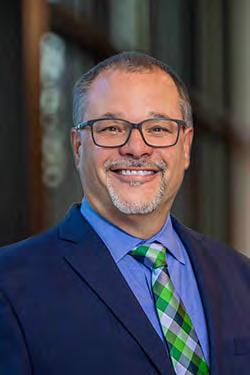
Nick Nissley, Ed. D. President
NORTHWESTERN MICHIGAN COLLEGE
Front Street Campus
1701 East Front Street
Traverse City, Michigan 49686 (231) 995-1000 or (231) 995-1038 TDD
(Telecommunications Device for the Deaf)
Call toll-free (800) 748-0566 www.nmc.edu
NMC Board of Trustees
Laura J. Oblinger — Chair
Mark B. Keely Vice Chair
Chris M. Bott Secretary
Andrew K. Robitshek Treasurer
Pamela T. Horne
Kenneth E. Warner
Kennard R. Weaver
Chair Emeritus
James J. Beckett, 1962-1996 Chair, 1980-1994
Trustee Emeritus
Shirley S. Okerstrom, 1978-2000 Chair, 1994-1997
NMC President
Nick Nissley, Ed.D.
Mission
We deliver lifelong learning opportunities to transform lives and enrich our communities.
Institutional Accreditation
Accredited by the Higher Learning Commission and a member of the North Central Association. 230 S. LaSalle St., Suite 7-500 Chicago, IL 60604 (800) 621-7440 www.hlcommission.org (https://www.hlcommission.org/)
Program Accreditations
• Accreditation Commission for Education in Nursing (https://www.acenursing.org/)
• American Culinary Federation (https://www.acfchefs.org/ACF/Education/Enrollment/Postsecondary/ACF/Education/Enrollment/Postsecondary/ #MI)
• American Dental Association Commission on Dental Accreditation (https://coda.ada.org/)
• Bureau of Automotive Regulation -State of Michigan
• Commission on Accreditation of Allied Health Education Programs as recommended by the Accreditation Review Council on Education in Surgical Technology and Surgical Assisting (http://www.arcstsa.org/)
• Electrical Apprenticeship Program with the State of Michigan (https://www.michigan.gov/lara/bureau-list/bcc/sections/licensing-section/examlic/electrical-examination-licensing-registration-application-information/)
• Federal Aviation Administration (https://www.faa.gov/training_testing/schools/) / Federal Aviation Regulation Part 141 approved
• Great Lakes Maritime Academy approved by the United States Coast Guard as regulated and audited by the United States Maritime Administration
• Michigan Board of Nursing (https://www.michigan.gov/lara/bureau-list/bpl/health/hp-lic-health-prof/nursing/lic-info/nursing-educationprograms/)
• Michigan Commission on Law Enforcement Standards (https://www.michigan.gov/mcoles/)
• National Center for Construction Education & Research (https://www.nccer.org/)
Non-Discrimination Policy
Northwestern Michigan College does not discriminate in admission, campus activities, education, employment, housing, public accommodation or public service on the basis of age, color, creed, disability, handicap, height, marital or familial status, national origin, political affiliation, race, religion, sex, sexual orientation, service in the military, veteran’s status, weight, or any other legally protected status under federal, state, or local law. No act of retaliation shall occur to any person making a charge, filing a complaint, testifying or participating in any discrimination investigation or proceeding.
This catalog is in effect starting Fall Semester 2025 through Summer Semester 2026. The contents of this catalog are accurate at the time of publishing, March 2025. The NMC Board of Trustees reserves the right to make changes without notice.
Uncrewed Aerial Systems Technology, Associate of Applied Science 137
Uncrewed Aerial Systems, Certificate of Achievement (Level I) 138
Business 139
Accounting -Fraud Investigation, Associate in Applied Science Degree 151
Accounting, Associate in Applied Science Degree -General 152
Accounting, Certificate of Achievement (Level II) 153
Business Administration, Associate in Applied Science Degree
Business Administration - Online, Associate in Applied Science Degree 154 156
Computer Information Technology -Assistant Developer, Certificate of Achievement (Level I) 157
Computer Information Technology -Assistant Web Developer, Certificate of Achievement (Level I) 157
Computer Information Technology -Associate Developer, Certificate of Achievement (Level II) 158
Computer Information Technology -Associate Web Developer, Certificate of Achievement (Level II) 159
Computer Information Technology -Computer Support Specialist, Certificate of Achievement (Level I) 159
Computer Information Technology -Computer Support Specialist, Certificate of Achievement (Level II) 160
Computer Information Technology -Cybersecurity Specialist, Certificate of Achievement (Level I) 161
Computer Information Technology -Developer, Associate in Applied Science Degree 161
Computer Information Technology -Industry Certifications 163
Computer Information Technology -Infrastructure and Security, Associate in Applied Science Degree 164
Computer Information Technology -Infrastructure Specialist I, Certificate of Achievement (Level I) 166
Computer Information Technology -Infrastructure Specialist II, Certificate of Achievement (Level II) 166
Computer Information Technology -Microsoft Office™ Applications Specialist, Certificate of Achievement (Level I)
Computer Information Technology -Infrastructure Specialist III, Certificate of Achievement (Level III) 167 168
Computer Information Technology -Web Developer, Certificate of Achievement (Level III) .............................................................. 169
Culinary Arts -Great Lakes Culinary Institute, Associate in Applied Science Degree 169
Culinary Arts -Great Lakes Culinary Institute, Baking & Pastry Arts Certificate of Achievement (Level II) 171
Culinary Arts - Great Lakes Culinary Institute, Certificate of
Culinary Arts -Great Lakes Culinary Institute, Certificate of Achievement (Level III) 172
Culinary Arts -Great Lakes Culinary Institute, Maritime Certificate (Level II) 173
Culinary Arts -Great Lakes Culinary Institute, Sports Performance Nutrition, Certificate of Achievement (Level II) 174
Digital Administration and Marketing, Certificate of Achievement (Level I) 175
Esports Management, Certificate of Achievement (Level I) 176
Office Administration, Certificate of Achievement (Level II) 176
Technical Management Administration, Associate in Applied Science Degree
Dental Assistant, Associate in Applied Science Degree
Dental Assistant, Certificate of Achievement (Level
Early Childhood Education, Associate in Applied Science Degree 277
Early Childhood Education, Certificate of Achievement (Level II) 278
Early Childhood Education CDA Cohort 278
Law Enforcement, Associate in Applied Science Degree 279
Law Enforcement, Certificate of Achievement (Level II) 280
Technical 281
Automotive -Automotive Service Technology, Associate in Applied Science Degree 291
Manufacturing Apprenticeship, Certificate of Achievement (Level II)
Manufacturing Technology, Associate in Applied Science
Surveying, Associate in Applied Science Degree
Welding Technology, Associate in Applied Science Degree
Welding Technology, Certificate of Achievement (Level I)
Welding Technology, Certificate of Achievement (Level II)
Marine Technology, Bachelor of Science
Water Quality & Environmental Technology, Associate in Applied Science Degree
ACADEMIC CALENDAR
2025-2026 Academic Calendar
Fall Semester 2025
Event Date
Registration Begins
Wednesday, March 12, 2025
Tuition Payment Due Tuesday, July 29
NMC Opening Conference (Faculty and Staff)
Tuesday, August 19
Classes Begin Saturday, August 23
Drop Dates for Main Session
Labor Day Holiday -No Classes
Enrollment Report Day
NMC October Conference -No Classes Day or Evening
Saturday, August 23 -Tuesday, September 2
Saturday, August 30 -Monday, September 1
Wednesday, September 3
Tuesday, October 14
Registration for Spring & Summer 2026 Semesters Begins Wednesday, October 15
Thanksgiving Holiday -No Classes
Wednesday, November 26 (5 p.m.) -Sunday, November 30
Classes End Saturday, December 13
Grades Entered by 11 a.m.
Christmas/New Year's Holiday
Spring Semester 2026
Wednesday, December 17
Wednesday, December 24 -Thursday, January 1, 2026
Event Date
Registration Begins Wednesday, October 15, 2025
Tuition Payment Due
NMC January Conference (Faculty and Staff)
Tuesday, December 4, 2025
Tuesday, January 6, 2026
Classes Begin Saturday, January 10
Drop Dates for Main Session Saturday, January 10 -Monday, January 20
Enrollment Report Day
Registration for Fall 2026 Semester Begins
Wednesday, January 21
Wednesday, March 11
Spring Break -No Classes Monday, March 30 -Sunday, April 5
Honors and Leadership Convocation Friday, May 1
Commencement
Saturday, May 2
Classes End Saturday, May 2
Grades Entered by 11 a.m.
Summer Session 2026
Wednesday, May 6
Event Date
Registration Begins Wednesday, October 15, 2025
Tuition Payment Due Tuesday, April 14, 2026
12-Week Session Begins Saturday, May 9
Drop Dates for 12-Week Session
Saturday, May 19 -Monday, May 18
Memorial Day Holiday -No Classes Monday, May 25
8-Week Session Begins Thursday, June 11
Drop Dates for 8-Week Session Thursday, June 11 -Tuesday, June 16
Enrollment Report Day Wednesday, June 17
Independence Day Holiday -No Classes Friday, July 3
Payment for Fall 2026 Semester Due Tuesday, July 28
Classes End Friday, August 7
Grades Entered by 11 a.m.
Wednesday, August 12
GENERAL EDUCATION
Philosophy
General Education at Northwestern Michigan College promotes the acquisition of knowledge, skills, and attitudes needed to function effectively in a changing world. This fosters intellectual curiosity, essential to lifelong learning.
Outcomes
To ensure students experience the benefits of our philosophy of general education, the faculty of NMC commits to instilling these practices throughout the curriculum.
Communication: Students will practice effective communication with an awareness of audience and sense of purpose.
Critical Thinking: Students will skillfully conceptualize, apply, analyze, synthesize, and evaluate information gathered from observation, experience, reflection, reasoning, or communication.
Quantitative Reasoning: Students will accurately use numbers, symbols, measurements, properties, and the relationships of quantities to make sound decisions, judgments, and/or predictions.
Social Responsibility: Students will cultivate greater understanding of social complexity and cultural diversity to prepare them to contribute to social justice and/or environmental sustainability in regional, national, or global communities.
Assessment
General Education outcomes are measured in several ways:
• Each year faculty members assess student achievement of the General Education Outcomes their courses support.
• The Office of Research, Planning & Effectiveness aggregates institutional data so that faculty and departments can assess the level of achievement represented by the student work.
• Graduates are surveyed annually and are asked to provide their perceptions of achieving the General Education Outcomes.
• The faculty and teaching staff are charged with using the results of assessment to make curricular improvements.
DEGREES & CERTIFICATES
NMC students may select from several educational options. Associate degrees, bachelor degrees, and certificates are awarded to those students who complete a prescribed set of courses in specific areas of study. Many programs, especially in occupational areas, also lead to additional career licenses or certifications. Maritime programs require four years of full-time study, including summer sessions, and result in a bachelor’s degree at NMC. Associate degree programs generally take two years of full-time study to complete. Certificate programs range 16-59 credits.
NMC offers the following degree and certificate options:
• Certificate of Achievement Programs
• Associate in Applied Science (AAS)
• Associate Degree in Nursing (ADN)
• Associate in General Studies (AGS)
• Associate in Science and Arts (ASA)
• Associate of Science in Engineering (ASE)
• Bachelor of Science (BS)
Earning a Second Associate Degree
Students may earn additional degrees at NMC. A minimum of 15 earned hours (credits) shall be earned from NMC in addition to the required credits for the previous degree.
Students seeking an additional associate degree shall be governed by the following stipulations:
• Students may earn only one Associate in Science and Arts degree
• Students may earn the Associate in General Studies degree only as their first associate degree with the exception of students who are enrolled in the AGS/Pre-ADN, AGS/Pre-PN, AGS/Pre-Dental or AGS/ Pre-Surgical Tech program
• Program requirements for the additional degree will be based on the catalog that is in effect when the student officially switches to the new program
• Previous credits will be evaluated by the Records Office for transfer to the additional degree as applicable
• This policy does not apply to certificates
Reverse Transfer
A transfer student may complete an associate’s degree concurrent with his or her pursuit of a bachelor’s degree. This process is called reverse transfer. It enables NMC students who transfer to a four-year institution before completing an associate’s degree to use coursework and credits earned at the transfer school to fulfill degree requirements at NMC.
Students enrolled at one of NMC’s Reverse Transfer partners should submit the appropriate Reverse Transfer Release form to the partner school’s Office of the Registrar. Students enrolled at non-partner schools may also reverse transfer credits. To begin the process, submit a transcript from the four-year institution to NMC. After review, NMC will inform students of their successful degree completion, or whether they have unsatisfied degree requirements remaining.
For more information, go to www.nmc.edu/student-services/recordsregistration/reverse-transfer.html (http://www.nmc.edu/student-services/ records-registration/reverse-transfer.html)
Cultural Perspective/Diversity
Students will evaluate connections between worldviews, power structures, and experiences of multiple cultures historically or in contemporary contexts.
In order for NMC graduates to engage as educated and informed citizens of a diverse society, students pursuing the ASA, AGS, and BS degrees are required to take one Cultural Perspective/Diversity course.
Certificate Requirements
Certificate Programs typically include specialty courses and may include some general education requirements. In most cases, they are designed for concentrated proficiency in specialized areas. Certificates may range from 16 to 59 credit hours as established by individual program areas and/or the Curriculum Committee. Many certificate courses may apply toward an associate degree.
Certificate Program requirements include:
1. A specified group of credit hours in an area of specialization, as determined by the appropriate NMC academic area. These three levels are possible:
• Level I: A minimum of 16 credits in a specialty area;
• Level II: A minimum of 30 credits in a specialty area;
• Level III: A minimum of 45 credits in a specialty area.
2. A minimum cumulative grade point average of 2.0. Higher GPA standards may be required for specific courses within individual academic areas.
3. Level I and II certificate programs require that a minimum of eight credit hours be completed at NMC (this may be waived in extenuating circumstances; contact the registrar). Level III certificate programs require that a minimum of 12 credit hours be completed at NMC (this may be waived in extenuating circumstances; contact the registrar).
4. Competency testing by the responsible academic area if the course work was not completed at NMC.
*Competency credit: Students with competency in a specific area should consult with their program coordinator for possible testing and/or credit
Certificate programs are listed in the Occupational Programs section of this catalog.
GROUP 1 & 2 COURSES
Group 1 General Education courses are designed to enhance skills and
knowledge for students to succeed in academic, career and life goals. Students pursuing a two-year degree will need to fulfill specific general
education requirements by selecting courses from Group 1 based
the
degree requirements listed on the following pages. The Group 1 courses
are listed below.
Group 2 courses are all remaining 100-level courses or above, which
may fulfill occupational specialty program requirements, major area
requirements, and elective requirements for degree and certificate
programs.
One Cultural Perspective/Diversity course
required
the ASA,
and BS degrees. To meet this requirement, choose any of these courses
or a 100-level French, German, or Spanish course.
Group 1 Courses
Group
DEGREE REQUIREMENTS
• Associate Degree in Nursing (ADN) (p. 17)
• Associate in Applied Science Degree (AAS) (p. 16)
• Associate in General Studies Degree (AGS) (p. 15)
• Associate in Science & Arts Degree (ASA) (p. 14)
• Associate of Science in Engineering (ASE) (https://catalog.nmc.edu/ program-information/degree-requirements/engineering-ase/)
• Bachelor of Science (BS) (p. 18)
ASSOCIATE IN SCIENCE & ARTS DEGREE (ASA)
The Associate in Science and Arts degree is generally pursued by students who are planning to transfer to a four-year college or university to complete a baccalaureate degree. Students who want to explore the curriculum also frequently pursue the ASA degree.
Course Title
General Education Requirements
Minimum 30 Group 1
2.0
Humanities
Two Group 1 classes from different departments: art, history, 6 humanities, literature, music, philosophy, second-year foreign language Mathematics
One Group 1 mathematics class 1 3 Science
Two Group 1 classes from different departments: astronomy, biology, 6 chemistry, environmental science, physics. One class must include a lecture/lab
Social Science
Two Group 1 classes from different departments: anthropology, 6 economics, geography, political science, psychology, sociology Electives
A combination of credits from Group 1 or Group 2 to equal the 1 minimum earned credits for the degree.
1 MTH 120 Mathematical Explorations or higher
Total Degree Credits: Minimum of 60 earned semester credits
Group 1 and 2 courses (p. 11)
Completing the General Education Requirements of 30 credits will qualify for the Michigan Transfer Agreement (MTA).
Other Requirements
• Complete a minimum of 60 credit hours with a 2.0 or higher cumulative grade point average.
• Complete one course designated as Cultural Perspective/Diversity.
• Complete a minimum 15 of the 60 credits through NMC classes.
Notes
• A maximum of two physical education credits, two professional development seminar credits, and four Academic Service Learning Internship credits may be used toward a degree.
• Courses with numbers below 100 level do not count toward graduation, but the grades do count toward your cumulative GPA. They may be prerequisites for other courses needed to complete
degree or certificate requirements and may add to the total number of credits taken. Review course prerequisites carefully.
• For elective courses to count toward graduation, a course must be completed with a grade of 1.0 or higher.
• To receive the MTA with the ASA, a minimum grade of 2.0 is required for all General Education Requirements. CLEP and Military Credit cannot be counted toward the MTA.
ASSOCIATE IN GENERAL STUDIES DEGREE (AGS)
The Associate in General Studies Degree is designed for students interested in obtaining a degree that can be customized based on varying areas of interest.
Note: This degree is not designed to meet the needs of the transfer student. Consult an advisor to discuss your educational goals and determine if this degree is right for you.
one of the following:
credit courses in the college curriculum for a combined total of no less than 60 earned semester hours.
Competency Required 1
1 Math Competency may be fulfilled by completing MTH 100 Quantitative Literacy with a grade of 2.0 or higher, or placement into any math course higher than MTH 100.
Total Degree Credits: Minimum of 60
Group 1 and 2 courses (p. 11)
Other Requirements
• Complete at least 60 credit hours with a 2.0 or higher cumulative grade point average.
• Complete one course designated as Cultural Perspective/Diversity.
• Complete a minimum of 15 of the 60 credits through NMC classes.
Notes
• A maximum of two physical education credits, two professional development seminar credits, and four Academic Service Learning Internship credits may be used toward a degree.
• Courses with numbers below 100 level do not count toward graduation, but the grades do count toward your cumulative GPA. They may be prerequisites for other courses needed to complete degree or certificate requirements and may add to the total number of credits taken. Review course prerequisites carefully.
• To count toward graduation, a course must be completed with a grade of 1.0 or higher, unless otherwise stated.
ASSOCIATE IN APPLIED
SCIENCE DEGREE (AAS)
The Associate in Applied Science degree is generally pursued by those students who plan to enter the workforce following graduation from NMC. A career specialty emphasis is the dominant characteristic of the Applied Science Degree. Although some students pursuing the AAS degree may transfer to a four-year college or university to pursue a baccalaureate degree, many AAS courses are not granted transfer equivalency credit at Michigan universities. Students considering the AAS degree who may wish to transfer should see an advisor.
one of the
1 Program of Study may specify.
2 Math Competency may be fulfilled by completing MTH 100 Quantitative Literacy with a grade of 2.0, or placement into any math course higher than MTH 100.
Program of Study may specify a higher level of math. See appropriate program pages for math requirements.
Total Degree Credits: Minimum of 60
Group 1 and 2 Courses
Other Requirements
• Complete at least 60 credit hours with a 2.0 or higher cumulative grade point average.
• Complete a minimum of 15 of the 60 credits through NMC classes.
Notes
• A maximum of two physical education credits, two professional development seminar credits, and four Academic Service Learning Internship credits may be used toward a degree.
• Courses with numbers below 100 level do not count toward graduation, but the grades do count toward your cumulative GPA. They may be prerequisites for other courses needed to complete degree or certificate requirements and may add to the total number of credits taken. Review course prerequisites carefully.
• To count toward graduation, a course must be completed with a
grade of 1.0 or higher, unless otherwise stated.
ASSOCIATE DEGREE IN NURSING (ADN)
The Associate Degree in Nursing program is generally pursued by those students who plan to enter the nursing workforce following graduation. After successful completion of this program, graduates take the National Council Licensure Examination (NCLEX-RN). With passing scores, graduates are awarded licensure as a Registered Nurse.
Some students pursuing the ADN degree may decide to transfer to a fouryear college or university to pursue a baccalaureate degree. Students considering the ADN degree who may wish to transfer should see an advisor.
degree or certificate requirements and may add to the total number of credits taken. Review course prerequisites carefully.
• To count toward graduation, a course must be completed with a grade of 1.0 or higher. Grades of 2.0 or higher are required for ENG 111 English Composition and PSY 101 Introduction to Psychology. Grades of 2.5 or higher are required for each of the courses in the Anatomy and Physiology sequence (BIO 227 Human Anatomy & Physiology I, BIO 228 Human Anatomy & Physiology II).
1 As listed in the Associate Degree in Nursing Program requirements.
2 Math Competency may be fulfilled in one of two ways:
• Placement scores into MTH 121 College Algebra or higher, or
• Successful completion of MTH 111 Intermediate Algebra or MTH 120 Mathematical Explorations with a grade of 2.0 or higher. If required, completion of MTH 111 Intermediate Algebra will add 4 additional credits/contacts to the program, or completion of MTH 120 Mathematical Explorations will add 3 additional credits/ contact to the program.
Total Degree Credits: Minimum of 64-70
Other Requirements
• Complete a minimum of 64 credit hours with a cumulative grade point average of 2.0.
• Complete each nursing course at 2.5 or higher.
• Complete a minimum of 16 degree credits through NMC classes.
Notes
• A maximum of two physical education credits, two professional development seminar credits, and four Academic Service Learning Internship credits may be used toward a degree.
• Courses with numbers below 100 level do not count toward graduation, but the grades do count toward your cumulative GPA. They may be prerequisites for other courses needed to complete
BACHELOR OF SCIENCE (BS)
The Bachelor of Science (BS) is for students whose goal is to pursue a select professional field of study at the baccalaureate level. The program requirements for Maritime Deck Officer, Maritime Engineering Officer, Maritime Power System and Marine Technology vary and are listed on their program specific pages.
Course Title
General Education Requirements
Minimum 24-35 Group 1 credits with at least a 2.0 grade for each 24-35 course
ENG 112 English Composition
ENG 220 Technical Writing Humanities
Group 1 Humanities course. 1 Science
Group 1 Science lecture/lab course. 1 Social Science
Group 1 Social Science course. 1 Major Area Requirements
2
1 Program of Study will specify.
2 Math Competency may be fulfilled in one of two ways:
• Placement scores into MTH 121 College Algebra, or higher, or
• Successful completion of MTH 111 Intermediate Algebra with a grade of 2.0 or higher. Total Degree Credits: Minimum of 120
Other Requirements
• Complete a minimum of 120 credit hours with a minimum grade of 2.0 or higher in all required courses.
• Complete one course designated as Cultural Perspective/Diversity, see program of study requirements.
• Complete a minimum 30 of the 120 credits through NMC courses.
COURSE LEARNING OPTIONS
Experiential Learning Institute
Experiential learning provides you with real-world and hands-on opportunities preparing yourself for an everchanging and diverse world. The purpose of experiential learning is to actively engage you through relevant and ongoing experience, critical problem-solving, and reflective practices. Those who engage in experiential learning are more likely to persist through their college experience, graduate, and become lifelong, self-directed learners. The Experiential Learning Institute (ELI) exists to expand experiential learning college-wide. The Institute collaborates with both on-campus and community stakeholders to engage you and the community, locally, nationally, and globally. This connects the community and NMC by seeking creative partnerships, serving ongoing community needs, and preparing you for future employment.
Internship opportunities are offered for students who wish to integrate academics with professional work experience. Students can earn college credit while working in positions related to their academic and career goals. Contact the Office Manager in the academic area where you would like to pursue your internship.
The nEXt (NMC EXperience Transcript) Endorsement is a transcriptlevel recognition that awards you for participating in various curricular and extracurricular activities at NMC. It is designed to help you develop essential personal and professional skills for work and life readiness. To earn the nEXt Endorsement, you must accumulate a minimum of 100 points by participating in activities across three tiers: Master (minimum 50 points), Discover (minimum 30 points), and Explore (minimum 20 points). You must also complete a Capstone Reflection at the NMC ELI Learning Symposium or another designated time and develop a nEXt Resume. Activities that earn nEXt points include Experiential Learning Designated (ELD) courses, study abroad, internships, service-learning projects, leadership roles, workshops, attending events, volunteering, and more.
The nEXt endorsement offers several benefits, including the development of valuable soft skills such as communication, problem-solving, and collaboration. These skills are highly sought after by employers and can enhance your career readiness. Additionally, nEXt allows you to stand out from the crowd, showcasing your commitment to holistic development and providing a competitive edge in the job market. You may also have the opportunity to unlock exclusive scholarships or other opportunities designed for nEXt applicants. The program also promotes personal growth, allowing you to explore your interests and discover new passions. Finally, the nEXt endorsement is a valuable credential, and it can serve
as a way to showcase accomplishments beyond a traditional academic record.
For more information and to apply for the nEXt Endorsement, go to https://www.nmc.edu/experiential-learning/index.html (https:// www.nmc.edu/experiential-learning/)
Find Experiential Learning Designated (ELD) courses on the searchable schedule. For instructions, visit https://www.nmc.edu/experientiallearning/students.html
Seeking to prepare students with a foundation to create a broader understanding of the world in which we live, International Services includes:
Global Endorsement
NMC offers a Global Endorsement on the college transcript for students who have acquired a minimum of 100 Global Endorsement points prior to graduation. Depending on one’s degree, points may be earned in a variety of ways, but must be made up of a minimum number in each of the three following categories: academic coursework, on-and off-campus global experiences, and international events. Visit the International Services web page for complete details on the requirements needed to complete the endorsement. For a list of qualifying courses please visit https://www.nmc.edu/student-services/international-services/ global-endorsement/index.html (https://www.nmc.edu/student-services/ international-services/global-endorsement/).
Study Abroad
The office of International Services and Service Learning offers shortterm opportunities to multiple destinations affiliated with various academic programs. NMC is the leading community college for short term faculty-led study abroad in Michigan. Since 2014, we have sent over 600 students (approx. 65 per year) to 26 different countries on NMC faculty-led programs. Over 20 different disciplines have participated. Unique programs have included: coral reef mapping in Indonesia, unmanned aerial system work with banana farms in Costa Rica, audio technology study in Ireland, archeology in England and Wales, creative writing and journalism in Guatemala, sustainable energy in Denmark, restaurant development and menu planning in Ecuador, biology work in South Africa, and working with refugees in Greece and Morocco. NMC students have also participated in four-month Internships in Morocco, Costa Rica, Taiwan, India and Brazil. Check online for current opportunities.
Global Events on Campus
International Affairs Forum lectures, Dennos Museum Center concerts and exhibits and more. Current events are posted online.
Service learning
Service Learning is an initiative to instill a sense of civic responsibility in students. It’s volunteerism with a learning twist, centered on the benefits students receive while providing services to their community and/or college. It is an opportunity for students to explore career or interest areas, apply classroom theory to a real situation, and gain practical experience for resume building. Up to four service learning elective
credits can be applied to graduation. Students may also do non-credit volunteering using the same process. Information: (231) 995-2527.
Prior service
Articulation with the student’s high school and the NMC Registrar Is required for students desiring one academic credit for at least 32 hours of prior service. Such service must include a reflection piece (journal, blog, vlog, presentation, report, etc.) with a specific organization, e.g., Big Brothers Big Sisters. The verification process will include a recording of accumulated hours, interview with field supervisor, timesheets, approval forms, or other forms of agreement/communication between the student and the community partner. Following approval, an Independent Study #297 will be affixed to the academic transcript. Prior service will be assigned as a general elective.
current or potential service
Specific academic service credits are acquired through an independent study one-credit course (course #297) via existing disciplines. Requirements of the student, community sponsor, and academic coordinator are listed in the Academic Service Learning Agreement form. A total of 32 hours are needed to accrue 1-credit. A recording of accumulated hours and a reflection piece are also required.
A maximum of four credits of academic service learning internships may count toward a degree. Fulfillment of an honors contract within an existing course can also provide a student with service learning hours on their transcript; however, no additional credits will be granted.
Michigan Transfer Agreement (MTA)
In an effort to improve the transferability of college courses between Michigan public community colleges and universities, MTA took effect beginning the fall of 2014. Students who began prior to fall of 2014 will be able to complete the existing MACRAO agreement until the end of summer 2019. If a student already has the MACRAO agreement stamp on their transcript it is expected that the receiving institution will still honor it.
To fulfill the Michigan Transfer Agreement (MTA) students must successfully complete at least 30 Group 1 semester credit hours. Students must earn a grade of 2.0 or higher in each MTA course in order for it to count toward the minimum MTA requirements. Credits are distributed as follows:
• English Composition: Two courses -6 credits.
• Humanities: Two Group 1 courses (at least 6 credits) from 2 subject areas excluding studio and performance classes.
• Mathematics: One Group 1 course – 3 credits – MTH 120 Mathematical Explorations or higher.
• Natural Sciences: Two Group 1 courses (at least 6 credits) from 2 subject areas. One course must include a lecture/lab.
• Social Sciences: Two Group 1 courses (at least 6 credits) from 2 subject areas.
Students are required to complete at least one for-credit course at NMC before requesting the MTA Satisfied endorsement. It must be a college level course but need not be from the areas represented in the MTA. When students have completed the MTA requirements, they should notify the NMC Records Office so their transcripts will be noted “MTA
SATISFIED.” Students are not required to complete an associate degree in order to satisfy the MTA.
Some students select a course of study that requires a four-year degree, of which two years may be completed at NMC through completion of the Associate in Science and Arts degree (ASA). Students completing the ASA will also complete the MTA. However, please note that College Level Examination Program (CLEP), International Baccalaureate (IB), and DANTES Subject Standardized Test (DSST) are not applicable to the MTA at this time. Advanced Placement (AP) will be accepted toward the MTA. Visit www.nmc.edu/student-services/records-registration/ policies/michigan-transfer-agreement.html (http://www.nmc.edu/ student-services/records-registration/policies/michigan-transferagreement.html) for additional information.
TRANSFER OPTIONS
Accounting
NMC Code 733
The Accounting Program contains a blend of specialized classes and liberal arts studies to prepare students for today’s competitive, complex, and changing business world. Students who plan to pursue a bachelor’s degree should refer to NMC’s degree requirements for the Associate in Science and Arts (ASA) degree. Also, transfer students should familiarize themselves with the requirements of the school where they plan to complete their bachelor’s degree. Students interested in a bachelor’s degree may also elect to stay in Traverse City and transfer to the University Center.
Anthropology
Anthropology is the study of humanity. Archaeology is the study of the material humans leave behind. Students planning to pursue degrees in anthropology or archaeology at four-year colleges or universities should take these courses. Introduction to Cultural Anthropology (ANT 113 Intro to Cultural Anthropology) is a required course for many areas of study.
NMC offers specialty courses in Nautical and Underwater Archaeology that may not be found at larger institutions. The Nautical Archaeology Society courses that are taught at NMC offer an internationally recognized certificate in nautical archaeology. This area of study can include field-work and research activities in northwestern Michigan, as well as application of advanced technologies. Students planning careers in the following field may find these courses useful: offshore oil and gas industry, underwater search and recovery (such as police divers), maritime and naval, university research, homeland security, commercial surveying, remote sensing (applied water-related technologies), cultural heritage development and management. Contact Mark Holley for more information at mholley@nmc.edu. See course descriptions (p. 25) beginning with ANT.
Art/Fine Arts
NMC Code 711
The Fine Arts and Visual Communications courses are designed for students who plan to transfer to a four-year college or university for a Bachelor’s or Master’s degree in Fine Arts (BFA or MFA). Careers for students specializing in Fine Arts include education, museum/ gallery management, commercial illustration, animation and character development, film and graphic arts.
Students specializing in Fine Arts while completing an Associate in Science and Arts degree at NMC will pursue a program of study which includes Drawing, 2-D Design and 3-D Design while offering tracks in Fine Studio Arts and Ceramics, Illustration, Photo, Animation/Character Design, Photography, Visual Communications, Painting and Art History. Students are urged to discuss course selection early with transfer schools since portfolio requirements for admission vary.
Astronomy
NMC Code 717
NMC offers courses that focus on Observational, Planetary, and Stellar Astronomy. Students planning on transferring to pursue a bachelor’s
degree in this area should also take coursework in Mathematics and Physics. See course descriptions (p. 25).
Biology
NMC Code 702
Individuals planning to pursue a bachelor’s degree in Biology should select from courses beginning with BIO. In addition, students should select courses in Math, Chemistry and Physics. See course descriptions. (p. 25)
Business Administration
NMC Code 734
Students planning to pursue a four-year degree in Business Administration should follow NMC’s degree requirements for the ASA and familiarize themselves with the requirements of the school of choice for their bachelor’s degree.
Chemistry
NMC Code 727
Students planning to pursue a bachelor’s degree in Chemistry will choose coursework that includes credits selected from courses beginning with CHM. See course descriptions (p. 25). In addition to taking Chemistry courses, students with an emphasis in Chemistry gain a solid background in Math and Physics.
Communications
NMC Code 704
Communications as a separate field of study may include a variety of careers and specialties, ranging from media and public relations to technical writing. It is also an important component of other programs of study or careers, including computer science, human services, health occupations and art therapy.
Criminal Justice
NMC Code 706
A degree in criminal justice will open doors to career opportunities at the local, state, and national levels, as the field increasingly seeks collegeeducated professionals. Students planning to pursue a four-year degree in Criminal Justice should check the transfer guides of their preferred schools, as their requirements may vary.
NMC and Ferris State University (FSU) have partnered to offer the Bachelor of Science degree in Criminal Justice where students complete 85 credits at NMC and 35 credits at FSU, which can be completed at the University Center in Traverse City.
NMC also offers a Criminal Justice program in collaboration with other colleges through the Michigan Colleges Online. Visit www.nmc.edu/ online (http://www.nmc.edu/online/) for current information on the status of this program, the courses, program requirements, or articulation agreements.
Dance
NMC Code 707
Students wishing to pursue an interest in the field of dance should take courses beginning with DNC and consult with an advisor and the dance faculty member before their first semester at NMC. See course descriptions (p. 25).
Early Childhood Education
NMC Code 722
Early Childhood Education courses are designed to prepare students to work with children and their families in early care and education settings. Students may seek a career as the director of a child care program, a paraprofessional/teacher’s aide in the school system, a lead teacher in a daycare/preschool setting, a daycare teacher’s aide, or preparing for a bachelor’s degree in Early Childhood Education. If you are pursuing elementary education, please consult the Elementary Education transfer guide from the transfer school or see an advisor.
Economics
NMC Code 732
The most basic and enduring strength of economics is that it provides a logical and orderly way of analyzing contemporary economic issues. It draws upon geography, history, philosophy, and mathematics to address topics ranging from how an individual, household or firm, can make rational decisions regarding spending, saving, investment and profits to how a society can make optimal decisions regarding economic growth, inflation, unemployment, trade, and environment. As a result, economics is widely recognized as a solid background for many jobs and professions in the private and public sectors. Students interested in this field of study will select courses beginning with ECO. See course descriptions (p. 25).
Education
NMC Code 708
NMC offers two introductory courses related to the field of elementary and secondary education. The Introduction to Teaching course serves as a primer to teaching as a career, and the Educating the Exceptional Child course is designed to address the complexity of understanding and teaching the exceptional child (one with special needs, disabilities and differing abilities including the gifted and talented). Both courses prepare students for further study in education at transfer institutions. Transfer requirements may vary. Go to www.nmc.edu/advising (http:// www.nmc.edu/advising/) to view NMC transfer guides.
Engineering - ASA
NMC Code 709
The NMC engineering curriculum parallels engineering programs offered during the first two years at other colleges and universities. Traditionally, these first two years emphasize the tools and theories that provide background for all engineering fields. Students are required to meet with an Advisor for completion of this degree.
ENGINEERING - ASE
NMC Code 736
NMC offers an intensive Associate of Science in Engineering transfer degree that is intended to prepare students for transfer to a fouryear engineering program. The NMC engineering curriculum parallels engineering programs offered during the first two years at other colleges
and universities. Traditionally, these first two years emphasize the tools and theories that provide background for all engineering fields. Students are required to meet with an advisor for completion of this degree.
ENGLISH
NMC Code 710
Students wishing to concentrate their studies in the field of English may be preparing for careers in writing or teaching. English is also crucial to many other careers since writing and reading are high-demand skills in most professions. Students planning to transfer to complete a bachelor’s degree in English should pursue an Associate in Science and Arts degree program that includes credits selected from among the courses beginning with ENG. See course descriptions (p. 25).
Environmental Science
NMC Code 717
The study of Environmental Science includes courses in Geology, Biology, Meteorology, Chemistry, Soils, Oceanography and Watershed Science. Students planning on transferring to pursue a bachelor’s degree in any of these areas will choose a program of study which includes courses selected from those beginning with ENV. See course descriptions (p. 25). Students are encouraged to contact a faculty member in the Science department to learn more about employment opportunities and for assistance with class scheduling.
Freshwater Studies
NMC Code 590
Students planning to transfer to complete a bachelor’s degree in Freshwater Studies should follow NMC’s ASA degree requirements. Students are strongly encouraged to consult a Freshwater Studies advisor for scheduling guidelines and degree selection.
Geography
NMC Code 726
NMC offers coursework in Physical Geography and Introduction to Geography. Regional courses are also offered that focus on the United States and Canada and the world. In addition, a tools course concentrating on Geographic Information Systems (GIS) is offered. Students planning on pursuing a rewarding career in Geography are encouraged to meet with the Geography Department Head for help in course selection. See course descriptions (p. 25) for GEO courses.
Geology
NMC Code 717
Students interested in pursuing a career as a Geologist will take Environmental Studies courses, including Physical and Historical Geology. In addition, students will complete coursework in Chemistry, Physics, and Math.
History
NMC Code 730
As a separate field of study within the humanities, history will prepare students to enter secondary education, journalism, the archival and museum professions, and a variety of public history positions upon completion of at least a bachelor’s degree. It will also prepare students
for entering professional and graduate schools in law and in fields that will enable graduates to teach and do research in institutions of higher learning.
Liberal Arts/Science
NMC Code 712
Students interested in transferring to pursue a bachelor’s degree should enroll in the General Liberal Arts/Science area of study if they are undecided. Students planning on pursuing this avenue will select at least 30 credits of Group 1 courses.
Mathematics
NMC Code 715
Students planning on transferring to complete a bachelor's degree in Mathematics will pursue coursework that includes Calculus I, Calculus II, Calculus III, and Differential Equations. Other suggested courses could include Problems & Princ. of Physics I and Problems & Princ. of Physics II.
Music
NMC Code 716
Professional opportunities for a skilled musician are endless in that music, in some way, touches our lives every day in many ways. The study of music offers a vast variety of career options including: music education, instrumental music, vocal performance, conducting, composing, music for worship, music business, instrument making and repair, music publishing, music communications, recording industry, an in the TV and radio industry.
NMC offers students the opportunity to complete the first two years of music-major coursework in a creative and supportive environment. Students receive individualized instruction from our dynamic faculty in classes designed for students’ success. Standard music-major coursework includes: Music Theory, Sight Singing and Ear Training, Group Piano Instruction, Applied Instruction (private lessons), and participation in NMC Music Ensembles. Upon successful completion of the two-year program, students will have earned an Associate in Science and the Arts degree that is transferable to most four-year institutions of higher learning.
NMC also offers many opportunities for those students pursuing nonmusic degree paths, but interested in continuing their participation in a music program. Any NMC student (music-major or not) may enroll for Applied Instruction and may participate in any of our NMC Music Ensembles: NMC Chamber Singers, NMC Grand Traverse Chorale, NMC Concert Band, NMC Jazz Ensemble, and the NMC Vocal Jazz Ensemble. Other opportunities (chamber groups, percussion ensembles, jazz combos, etc.) are also available for interested NMC students.
Philosophy and Religion
NMC Code 729
Careers in the fields of philosophy and religion include college teaching and research, secondary education, as well as positions as ministers, priests, or rabbis. Other potential careers for those who specialize in religion are pastoral administration, religious education, church office management, and church mission work. The fields of clinical
medicine and medical research as well as commercial business fields like accounting are employing ethicists, a specialized branch of philosophy.
Students planning to transfer to a four-year college or university to major in philosophy or religion may complete basic coursework while at NMC. That coursework will include credits selected from those courses that begin with PHL. See course descriptions (p. 25).
Physics
NMC Code 717
Students planning to transfer to complete a bachelor’s degree in physics will pursue coursework, which includes PHY 221 Problems & Princ.of Physics I & PHY 222 Prob. & Princ. of Physics II, with Calculus I, II, & III, Differential Equations, and General Chemistry I & II.
Plant Science, Applied
Fruit and Vegetable Crop Management NMC Code 581
Landscape Management NMC Code 582
Viticulture NMC Code 580
Students planning to transfer to complete a four-year degree in Horticulture should follow a general education curriculum with courses in science, including Chemistry and Biology. In addition, students may take technical courses in soils, plants and plant diseases from Michigan State University, and can do so here at NMC.
Political Science
NMC Code 725
Political science as a field includes the study of American politics, comparative politics, international relations, political theory, and political economy. Undergraduate courses in political science are an important component of any liberal arts education as students gain important knowledge concerning the political structures that shape our world. Courses in political science are especially useful for students pursing careers or advanced degrees in public policy, law, business, economics, social work, education, history, and, of course, politics. Bachelor’s and graduate degrees in political science and public policy offer career opportunities in a variety of areas such as education, policy research, law, and international business. Students interested in political science courses select courses that begin with PLS. See course descriptions (p. 25).
Pre-Law
NMC Code 718
Pre-Law is a major often selected by students interested in pursuing careers in government or law.
Pre-Med, Pre-Dental, Pre-Vet
NMC Code 713
The Pre-Professional program prepares the student for continuing study in a number of medical professional fields, including Pre-PA, Pre-Vet, PreDental, and Pre-Med. While there is no Pre-Professional degree, students interested in the medical profession will typically major in Biology, Chemistry or Psychology.
Psychology
NMC Code 724
Students interested in the following fields of psychology, such as counseling, social work, research or teaching, may select from courses such as Introduction to Psychology, Introduction to Social Psychology, Developmental Psychology, Human Sexuality, Abnormal Psychology, Psychology of Personality and Psychology of Adjustment.
Social Work
NMC Code 723
The social work courses are designed to transfer to other four-year schools with certified social work programs. It is specifically designed to fit into the Ferris State University Social Work Program at the University Center in Traverse City and on the Ferris main campus in Big Rapids. When choosing this program of study, it is highly recommended to meet with the social work coordinator; call (231) 995-1294. This will assist you in building a program that will transfer smoothly. Social work is a rapidly growing field that employs people in many different areas of work and requires very specific training and coursework. Students interested in this field of study will select courses from among those beginning with SWK. See course descriptions (p. 25).
Sociology
NMC Code 720
Sociology is the study of the social context of human behavior. It includes the study of social change; socialization of group attributes such as social class, race, gender and age; and the workings of our social institutions. Courses in sociology are an important component of any liberal arts education, especially involving critical thinking and an understanding of diversity. It is also a major study for those interested in a wide variety of careers including teaching, social work,public policy, criminal justice, law, non-profit organizations, and social research. Students interested in sociology courses select courses that begin with SOC. See course descriptions (p. 25).
World Languages
NMC Code 731
World Languages as a field of study at NMC includes specialization in American Sign Language and Spanish. In a world of international telecommunications and interdependent economies, language specialization is an important component for those planning careers in business, communication, or teaching.
COURSE DESCRIPTIONS
Courses A-Z
A
• Accounting (ACC) (p. 27)
• Advanced Scientific Research (ASR) (p. 28)
• Allied Health (HAH) (p. 28)
• American Sign Language (ASL) (p. 29)
• Anishinaabemowin (ANI) (p. 29)
• Anthropology (ANT) (p. 29)
• Art (ART) (p. 30)
• Astronomy (AST) (p. 32)
• Audio Technology (AUD) (p. 33)
• Automotive Technology (AT) (p. 35)
• Aviation Flight (AVF) (p. 37)
• Aviation Ground (AVG) (p. 38)
B
• Biology (BIO) (p. 40)
• Business Administration (BUS) (p. 42)
C
• Carpentry (CAR) (p. 43)
• Chemistry (CHM) (p. 44)
• Communications (COM) (p. 45)
• Computer Info Technology (CIT) (p. 45)
• Construction Management (CMT) (p. 50)
• Criminal Justice (CJ) (p. 50)
• Culinary Arts (CUL) (p. 51)
D
• Dance (DNC) (p. 55)
• Dental Assistant (HDA) (p. 55)
• Drafting and Design (DD) (p. 57)
E
• Early Childhood Education (ECE) (p. 58)
• Economics (ECO) (p. 59)
• Education (EDU) (p. 60)
• Electrical/Electronics Tech (EET) (p. 60)
• Electrician (ELE) (p. 62)
• Engineering (EGR) (p. 63)
• English (ENG) (p. 65)
• Environmental Sciences (ENV) (p. 67)
• Esports (ESP) (p. 69)
G
• Geography (GEO) (p. 70)
H
• Heating and Ventilation (HVA) (p. 71)
• History (HST) (p. 71)
• Humanities (HUM) (p. 73)
L
• Law Enforcement (LWE) (p. 74)
M
• Management (MGT) (p. 75)
• Manufacturing Technologies (MFG) (p. 76)
• Maritime-Deck (MDK) (p. 77)
• Maritime-Engine (MNG) (p. 80)
• Marketing (MKT) (p. 83)
• Mathematics (MTH) (p. 84)
• Music (MUS) (p. 86)
N
• Naval Science (MNS) (p. 110)
• Nursing (HNR) (p. 110)
P
• Philosophy (PHL) (p. 112)
• Physics (PHY) (p. 114)
• Plumbing (PLU) (p. 115)
• Political Science (PLS) (p. 115)
• Professional Development (HPD) (p. 116)
• Psychology (PSY) (p. 116)
R
• Renewable Energy (EGY) (p. 117)
• Robotics and Automation (RAM) (p. 117)
S
• Social Work (SWK) (p. 118)
• Sociology (SOC) (p. 118)
• Spanish (SPN) (p. 119)
• Surgical Technology (SRG) (p. 120)
• Surveying (SVR) (p. 121)
T
• Theater (THR) (p. 122)
U
• Uncrewed Aerial Systems (UAS) (p. 122)
V
• Visual Communication Arts (VCA) (p. 123)
W
• Water Studies Institute (WSI) (p. 126)
• Welding Process Technology (WPT) (p. 128)
Information Course Prefixes by Academic Area
Aviation
Prefix
Academic Area
AVF Aviation Flight
AVG Aviation Ground
UAS Unmanned Aerial Systems
Business
Prefix
Academic Area
ACC Accounting
BUS Business Administration
CIT Computer Information Technology
CUL Culinary Arts
ESP Esports
MGT Management
MKT Marketing
Communications
Prefix
ASL
Academic Area
World Language -American Sign Language
COM Communications
ENG English
FRN
GRM
SPN
World Language -French
World Language -German
World Language -Spanish
THR Theater
Health Occupations
Prefix
Academic Area
HAH Allied Health
HDA Dental Assistant
HNR Nursing
HPD Health Professional Development
SRG Surgical Technology
Humanities
Prefix
Academic Area
ART Art
AUD Audio Technology
DNC Dance
HST History
HUM Humanities
MUS Music
PHL Philosophy
VCA Visual Communications
Maritime
Prefix
MDK
MNG
MNS
Science and Mathematics
Prefix
AST
BIO
CHM
EGR
ENV
MTH
PHY
Social Sciences
Prefix
ANT
CJ
ECE
ECO
EDU
GEO
LWE
PLS
PSY
SOC
SWK
Technical
Prefix
AT DD
CAR
CMT
EET
EGY
ELE
HVA
MFG
PLU
RAM
SVR
WPT
Water Studies
Prefix
WSI
Academic Area
Maritime-Deck
Maritime-Engineering
Naval Science
Academic Area
Astronomy
Biology
Chemistry
Engineering
Environmental Science
Mathematics
Physics
Academic Area
Anthropology
Criminal Justice
Early Childhood Education
Economics
Education
Geography
Law Enforcement
Political Science
Psychology
Sociology
Social Work
Academic Area
Automotive
Drafting and Design
Carpentry Technology
Construction Management
Electronical/Electronics Technology
Renewable Energty
Electrical Technology
HVAC/R Technology
Manufacturing Technology
Plumbing Technology
Robotics and Automation
Surveying
Welding Process Technology
Academic Area
Water Studies
Reading a Course Description
The semester credit hours followed by (contact hours) are listed below the title of the course description. Student tuition, in most cases, is based
on the course contact hour. Exceptions are MDK, MNG, MNS, Applied Music, Ensembles and private lessons. At the end of the description the course is identified by group number.
In addition to the courses listed in this section, each instructional area within Northwestern Michigan College may offer the following courses:
291 Special Topics
Seminars, lectures, etc. on a selected topic within a field are sometimes offered as special courses. Students may enroll in more than one Special Topics offering but not all four-year schools accept special topics credits. Group 2 course.
293 Study Abroad
Study Abroad courses provide students with the opportunity to travel to a specified destination affiliated with a corresponding course. This course will serve to integrate the student learning experience and provide a sense of cultural perspective, diversity and regional awareness. Students will explore unique areas around the world while applying disciplinespecific course content. Along with course registration, an additional application process and GPA requirements are mandatory before final travel approval will be given. Group 2 course.
297 Independent Study
Independent Study provides students the opportunity to explore a topic of study in greater breadth and depth than would be possible in an established College course. Students must seek faculty approval and complete a formal contract that stipulates the student learning outcomes, the activities that will help the student meet those outcomes, and the methods and measures to be employed to assess the student's performance. The Independent Study will appear on the student's transcript under the appropriate disciplinary prefix followed by 297. Group 2 course.
Accounting (ACC)
ACC 121 -Accounting Principles I
Credit Hours: 4, Contact Hours: 4
Division: Business
Introduction to financial accounting covering the accounting cycle, preparation of financial statements, and accounting for merchandising operations. It includes accounting for cash, receivables, inventory, property plant and equipment, current liabilities, payroll, long-term liabilities and corporations. Group 2 course. Quantitative Reasoning. Required Prerequisite(s): Placement into MTH 011/111 or higher, or completion of MTH 100 with a 2.0 or better.
Recommended Prerequisite(s): BUS 105
ACC 123 -Accounting Principles II
Credit Hours: 4, Contact Hours: 4
Division: Business
Continuation of ACC 121. Introduction of the role of accounting information in the planning and decision-making of business organizations. Includes managerial accounting, costing of products, planning and budgeting, performance measurement, control of organizational activities, decision making, profitability analysis, statement of cash flows, and financial statement analysis. Group 2 course. Quantitative Reasoning.
Required Prerequisite(s): ACC 121
Recommended Prerequisite(s): MTH 111
ACC 199 -Accounting Practicum
Credit Hours: 3, Contact Hours: 3
Division: Business
This course is a hands-on, immersive accounting experience. It is taught in a seminar format which extends and draws upon knowledge gained in previous courses. Students will utilize spreadsheet software and perform all accounting functions in Quickbooks, beginning with company set-up, processing all monthly transactions, preparing monthly financial reports, analyzing financial position and performance, developing flexible budgets and performing pro forma financial modeling. This course requires students to have an electronic device capable of processing Quickbooks as well as spreadsheet software. Students are required to bring their own device to class. Group 2 course. Quantitative Reasoning.
A detailed analysis of the content of financial statements covering problems related to revenue recognition, time value of money, cash, receivables, and inventories including calculation and analysis of financial ratios. US and international reporting standards are compared. The course begins with a brief review of the fundamental accounting process. Group 2 course. Students should also have competency in algebra at the intermediate level. Quantitative Reasoning.
Required Prerequisite(s): ACC 122 or ACC 123.
Recommended Prerequisite(s): Students should possess the ability to write business communications, such as research memos and reports to management
ACC 222 -Intermediate Accounting II
Credit Hours: 4, Contact Hours: 4
Division: Business
A detailed analysis of the content of financial statements covering problems related to property, plant and equipment, investments, current liabilities and contingencies, bonds and long-term notes, leases, income taxes, and shareholders' equity. US and international reporting standards are compared. Group 2 course. Students should also have competency in algebra at the intermediate level. Quantitative Reasoning.
Required Prerequisite(s): ACC 221.
Recommended Prerequisite(s): Students should possess the ability to write business communications, such as research memos and reports to management
ACC 223 -Cost Accounting
Credit Hours: 4, Contact Hours: 4
Division: Business
This course explores cost accounting from a managerial perspective. Job costing, activity-based costing, and process costing are analyzed. Budgeting and variance analysis for management control are examined. Cost volume-profit analysis, inventory costing and capacity, and inventory management techniques are investigated. Group 2 course. Quantitative Reasoning.
Required Prerequisite(s): ACC 122 or ACC 123
Recommended Prerequisite(s): MTH 111
ACC 231 -Federal Income Tax Problems
Credit Hours: 3, Contact Hours: 3
Division: Business
In this course, the student will learn income tax practices and procedures necessary to prepare an accurate individual income tax return. Basic tax research and planning will be incorporated. Payroll tax laws and procedures will be examined including computing wages and withholdings, computing unemployment taxes and analyzing and journalizing payroll transactions. The course includes preparation of individual and payroll tax returns. Group 2 course. Quantitative Reasoning.
Required Prerequisite(s): ACC 123
ACC 241 -Principles Fraud Examination
Credit Hours: 3, Contact Hours: 3
Division: Business
This course is an introduction to the field of fraud examination. Topics include types of fraud, the fraud triangle theory, fraud prevention and detection, investigation techniques, and the resolution of fraud. Students will analyze real-world cases and perform research. Group 2 course. Critical Thinking -Direct.
Required Prerequisite(s): ACC 123 with a 2.0 or higher.
Recommended Prerequisite(s): ACC 221, ACC 222, ENG 112; critical reading ability is beneficial
ACC 290 -Accounting Internship
Credit Hours: 3, Contact Hours: 3
Division: Business
The purpose of the internship is to provide on-the-job training for the student who wishes to pursue a career in Accounting. The internship will be customized to meet the learning needs of the student and the job requirements of the sponsoring firm. Students spend 10-15 hours per week in this paid or unpaid, supervised on-the-job training experience. In addition to the required 50 hours per credit in a work site, students will meet with the Experiential Coordinator as needed throughout the semester for internship support and feedback, review of professional employment documents and an internship exit interview. Students must apply one month prior to the semester in which they will complete the internship. Group 2 course.
Required Prerequisite(s): 12 semester credits in accounting in addition to a spreadsheet course. This internship requires the approval of the accounting instructor, a GPA of 3.0 in accounting and a minimum of eight hours per week spent on-site.
This course will introduce students to informatics in health care and, in particular, nursing. Students will enhance their ability to use modern informatics such as computer and Internet resources as well as Electronic Medical Record (EMR) software, in the health care environment. This course will be offered in a hybrid online and face-toface format. Group 2 course.
Required Prerequisite(s): Admission to ADN, PN, or LPN Completion nursing programs
Recommended Prerequisite(s): HNR 102 may be taken concurrently
HAH 101 -Medical Terminology
Credit Hours: 3, Contact Hours: 3
Division: Health Occupations
The student will learn the basic construction of medical words through the use of medical prefixes, suffixes, combining vowels and root words. This foundation will facilitate the understanding of new medical vocabulary encountered in other course work or work situations. Group 2 course.
HAH 120 -Infection Control
Credit Hours: 2, Contact Hours: 2
Division: Health Occupations
The course details the structure of infectious organisms and mechanisms of disease transmission, including host defenses against disease and specific diseases of concern to dental and medical personnel. In addition, the course provides an overview of MIOSHA (Michigan Occupational Safety and Health Administration) regulations and occupational safety measures as they relate to the dental and medical fields. Group 2 course.
American Sign Language (ASL)
ASL 101 -American Sign Language I
Credit Hours: 4, Contact Hours: 4
Division: Communications
ASL 101 introduces students to the language and culture of Deaf people in the United States and most of Canada. This course will focus on building vocabulary and dialogue structures needed for introductory conversations about purposeful topics, the use of nonmanual grammatical markers such as facial expression, use of fingers spelling and numbers, and an introduction to the rich history and culture of the Deaf community. Students will participate in interactive classroom activities. Group 2 course. Communications -Direct, Critical ThinkingDirect, Degree Req:Cultural Persp/Div.
Recommended Prerequisite(s): Students will be required to communicate in sign language; need a minimal amount of technological knowledge and skill to take advantage of outside-of-class requirements; and need internet access as much of the course is supported by Moodle
ASL 102 -American Sign Language II
Credit Hours: 4, Contact Hours: 4
Division: Communications
ASL 102 furthers student knowledge and experience of the language and culture of Deaf people in the United States and most of Canada. The introduction of additional vocabulary and grammar structures furthers students' ability to communicate meaningfully with ASL users. Students will develop greater insight into the Deaf culture through the context of ASL literature and current topics relevant to the Deaf community are explored. While developing communication skills, students will simultaneously mature in their understanding of the Deaf experience. Group 2 course. Communications -Direct, Critical Thinking -Direct, Degree Req:Cultural Persp/Div.
Required Prerequisite(s): ASL 101 or instructor permission
Recommended Prerequisite(s): Students will be required to communicate in sign language; need a minimal amount of technological knowledge and skill to take advantage of outside-of-class requirements; and need internet access as much of the course is supported by Moodle
ASL 103 -American Sign Language III
Credit Hours: 4, Contact Hours: 4
Division: Communications
ASL 103 is a continuation of ASL 101 and ASL 102, expanding the emphasis on ASL grammar, vocabulary development, and Deaf culture. Dialogue, short stories, narratives, and short conversation, both receptive and expressive, will be featured throughout the course. Meaningful conversational topic development is emphasized. Group 2 course.
Required Prerequisite(s): ASL 102 or instructor permission
Recommended Prerequisite(s): Students will be required to communicate in sign language; need a minimal amount of technological knowledge and skill to take advantage of outside-of-class requirements; and need internet access as much of the course is supported by Moodle
ASL 104 -American Sign Language IV
Credit Hours: 4, Contact Hours: 4
Division: Communications
ASL 104 is a continuation of ASL 101, ASL 102, and ASL 103. Students will further develop ASL grammar, vocabulary development, and Deaf culture. Dialogue, short stories, narratives, and short conversation, both receptive and expressive, will be featured through the course. Meaningful conversational topic development is emphasized. Group 2 course. Communications -Direct, Critical Thinking -Direct, Degree Req:Cultural Persp/Div.
Required Prerequisite(s): ASL 103 or instructor permission
Recommended Prerequisite(s): Students will be required to communicate in sign language; need a minimal amount of technological knowledge and skill to take advantage of outside-of-class requirements; need to be able to play a course-required DVD; and need internet access as much of the course is supported by Moodle
Anishinaabemowin (ANI)
ANI 101 -Elementary Anishinaabemowin I
Credit Hours: 4, Contact Hours: 4
Division: Communications
This course represents a comprehensive introduction to the Anishinaabemowin language for the true beginner. Students will develop the ability to communicate in Anishinaabemowin in everyday practical situations while acquiring some of the necessary skills for reading, writing, listening, and speaking. Cultural topics are integrated into each unit. Group 2 course. You will need a minimal ability using technology to take advantage of outside of class requirements. CommunicationsDirect, Critical Thinking -Direct, Degree Req:Cultural Persp/Div.
Recommended Prerequisite(s): You will be required to read, write, listen, and speak in Anishinaabemowin
ANI 102 -Elementary Anishinaabemowin II
Credit Hours: 4, Contact Hours: 4
Division: Communications
ANI 102 is a continuation of ANI 101 and focuses on the expansion of the communication skills of reading, writing, listening, and speaking. Cultural topics are integrated into each unit. Group 2 course. You will need a minimal ability using technology to take advantage of outside of class requirements. Communications -Direct, Critical Thinking -Direct, Degree Req:Cultural Persp/Div.
Required Prerequisite(s): ANI 101 with a minimum grade of 2.0 or instructor permission.
Recommended Prerequisite(s): You will be required to read, write, listen, and speak in Anishinaabemowin
Anthropology (ANT)
ANT 102 -Underwater Archaeology
Credit Hours: 3, Contact Hours: 3
Division: Social Science
This course will provide students with an introduction to theory, method, technologies, and practice in underwater archaeology, with case studies of prehistoric and historical sites worldwide, including the Michigan Great Lakes. This is a lecture-based course that provides a specialization in anthropology and the applied social sciences. This course also qualifies for NAS Part 3 credits. No diving is required. Group 2 course. Communications -Direct, Critical Thinking -Direct.
Recommended Prerequisite(s): ENG 99 or placement into ENG 11/111
ANT 113 -Intro to Cultural Anthropology
Credit Hours: 3, Contact Hours: 3
Division: Social Science
The study of the role of society and culture in humankind's adaptation to a variety of environments is the focus of this course. A variety of cultures are studied, utilizing cross-cultural comparisons. This is an introductory course which provides a broad overview of the four fields of anthropology with some concentration on archaeology. Among topics considered are field methods, theories of cultural evolution, the family, kinship, economics, religion, political organization and language. Group 1 course. Communications -Direct, Critical Thinking -Direct, Degree Req:Cultural Persp/Div.
Required Prerequisite(s): ENG 99 or placement into ENG 11/111
ANT 201 -Nautical Archaeology I
Credit Hours: 3, Contact Hours: 3
Division: Social Science
This is an entry level course to the Nautical Archaeology Society Training Program and is aimed at introducing nautical archaeology to divers and non-divers, and promoting their interest in the subject. It provides the basic training in archaeological survey and project management with the aim of teaching students how to design, plan and run their own field work projects. The curriculum will be presented in the classroom and in an open water setting (or foreshore site for non-divers) in the field. Group 2 course. The minimum diving qualification level for those taking part in the pool exercises is CMAS 1-Star or equivalent, e.g., BSAC Ocean Diver, SAA Open Water Diver, or PADI Open Water. Communications -Direct, Critical Thinking -Direct, Quantitative Reasoning, Degree Req:Cultural Persp/Div. Required Prerequisite(s): ENG 99/108 or placement into ENG 11/111.
Recommended Prerequisite(s): ANT 102
ANT 202 -Nautical Archaeology II
Credit Hours: 3, Contact Hours: 3
Division: Social Science
This is a field archaeology course that allows students the opportunity to practice skills they learned in ANT 201. Students will design and execute a maritime archaeology project in the Grand Traverse region or other maritime landscape. Students may also participate in larger projects during special summer field schools hosted at NMC and abroad. Beach projects will be developed for non divers. The course will be offered throughout the summer semester on a flexible time schedule and is based on individual availability and weather conditions. Group 2 course. Communications -Direct, Critical Thinking -Direct, Quantitative Reasoning, Degree Req:Cultural Persp/Div, Infused: Writing Intensive. Recommended Prerequisite(s): ANT 201, ENG 99/108 or placement into ENG 11/111
Art (ART)
ART 100 -Art Appreciation
Credit Hours: 3, Contact Hours: 3
Division: Humanities
Art Appreciation is a course which allows for a great deal of exploration into the world of art as we see it. The course provides an avenue for understanding this world by investigating technique, media, idea, personal expression and meaning. In examining personal expression, surrounding issues and their effect upon society will also be analyzed. Students in this course will develop a foundation for understanding art through analytical observation, examination, interpretation and writing about art. Group 1 course. Critical Thinking -Direct.
ART 111 -History of Western Art I
Credit Hours: 4, Contact Hours: 4
Division: Humanities
The course will introduce major trends of Western Art from Pre-History through Greece, Rome and the Middle Ages. Significant works of painting, sculpture and architecture will be presented within the social, political and cultural context of each period. Group 1 course. Critical ThinkingDirect, Degree Req:Cultural Persp/Div.
Recommended Prerequisite(s): ENG 111
ART 112 -History of Western Art II
Credit Hours: 4, Contact Hours: 4
Division: Humanities
This course is designed to introduce major trends in Western Art from the Renaissance through Modernism to the present. Significant works of painting, sculpture and architecture will be presented within the social, political and cultural context of each period. Group 1 course. Critical Thinking -Direct, Degree Req:Cultural Persp/Div.
Recommended Prerequisite(s): ENG 111
ART 121 -Drawing I
Credit Hours: 3, Contact Hours: 4
Division: Humanities
Drawing I introduces basic skills and materials for drawing objects, still life compositions and the live model representationally from direct observation. Students will learn to recognize and incorporate perspective cues in their drawings to accurately convey the size, shape and spatial position of their subjects, as well as methods for calibrating their proportions and for judging and conveying the intensity and textural qualities of their illumination. Graphite, charcoal and colored chalks will be used. Group 2 course. Critical Thinking -Direct.
Recommended Prerequisite(s): Students are encouraged to have good reading skills or seek help
ART 122 -Drawing II
Credit Hours: 3, Contact Hours: 4
Division: Humanities
This course will explore advanced methods and concepts in drawing, including those affecting the representation of light and color, the composition and arrangement of pictorial elements, and the effective utilization of media beyond those used in Drawing I. Assignments will include still lifes, imagined scenes/objects, landscape and life drawing. Group 2 course.
Required Prerequisite(s): ART 121
Recommended Prerequisite(s): Students are encouraged to have good reading skills or seek help
ART 131 -2-D Design
Credit Hours: 3, Contact Hours: 4
Division: Humanities
A problem-solving course covering the elements and principles of design. This course will study the concepts and theory of two-dimensional design, pattern, and color as they apply to visual perception and communication. The application and utilization of these concepts will be explored during the semester. Group 2 course.
Recommended Prerequisite(s): Students are encouraged to have good reading skills or seek help
ART 132 -3-D Design
Credit Hours: 3, Contact Hours: 4
Division: Humanities
This course will introduce the basics of three-dimensional design and creation. It will cover elements and principles of design, visual perception, and the application of these concepts in a 3-D art setting. A wide variety of materials and their functions will be explored in this course. Group 2 course.
Recommended Prerequisite(s): Students are encouraged to have good reading skills or seek help
ART 151 -Ceramics I
Credit Hours: 3, Contact Hours: 4
Division: Humanities
This course is an introduction to the ceramic art medium. It provides students with the opportunity to explore a variety of hand-building techniques while also introducing the pottery wheel. Included will be an exploration into the diverse array of historic/contemporary ceramic artists, glazing for high and low fire applications, clay making, and kiln loading and unloading. All other general studio practices and safety will also be covered. Group 2 course.
ART 152 -Ceramics II
Credit Hours: 3, Contact Hours: 4
Division: Humanities
This course is a continued exploration into the ceramic medium. Students will primarily utilize the potter's wheel as a tool to create ceramic forms/objects. An investigation into function, utility, and surface adornment will be explored as will basic glaze chemistry and firing operations. Expanding individuality in the understanding of advanced technique and sensitivity to form will be expected. Group 2 course.
Required Prerequisite(s): ART 151
ART 160 -Professional Practices
Credit Hours: 3, Contact Hours: 4
Division: Humanities
This course presents the professional/business side of art. Students will engage in grant writing, applications for exhibitions, and documentation of personal research. Students will have the opportunity to talk with gallerists, curators, and visiting artists throughout the semester. Students will work to develop their professional portfolios and artist statements, as well as learn the skills required for shipping and exhibiting work. Group 1 Course. Communications -Direct, Critical Thinking -Direct, Degree Req:Cultural Persp/Div, Infused: Writing Intensive.
ART 161 -Painting I
Credit Hours: 3, Contact Hours: 4
Division: Humanities
The course is designed to introduce students to the fundamental concepts and techniques of oil painting. Students will spend the first part of the semester gaining skill with the medium by focusing on formal aspects of visual art and becoming more visually perceptive and technically competent by learning to see and represent shape, value, edge, and color. During the second part of the semester, students will use the technical skills they’ve acquired to create visual artworks by focusing on composition, style, and content. *Preferred Prerequisite: ART 121 (Drawing I). Group 2 course. Critical Thinking -Direct.
Recommended Prerequisite(s): Students are encouraged to have good reading skills or seek help
ART 162 -Painting II
Credit Hours: 3, Contact Hours: 4
Division: Humanities
This course is structured to help students develop a visual language through their paintings. It is designed to build upon the painting fundamentals learned in Painting 1. Students will spend class time honing their skills with the formal attributes of visual art through the medium of oil paint. Group 2 course. Students are encouraged to have good reading skills or seek help. Critical Thinking -Direct.
Recommended Prerequisite(s): Drawing 1 ART 121 and Painting 1 ART 161 are preferred
ART 165 -Watercolor Painting I
Credit Hours: 3, Contact Hours: 4
Division: Humanities
An introduction to the techniques and materials of watercolor painting. Includes use of creative effects, additive and subtractive approaches, and mixing of color to create effective paintings in a step-by-step manner. Group 2 course. Critical Thinking -Direct.
ART 166 -Watercolor Painting II
Credit Hours: 3, Contact Hours: 4
Division: Humanities
Watercolor II deals with advanced problems in watercolor painting with special emphasis on individual development and creativity particularly in the area of compositional conceptualization. Group 2 course. Critical Thinking -Direct.
Required Prerequisite(s): ART 165
ART 174 -Digital Photography I
Credit Hours: 3, Contact Hours: 4
Division: Humanities
The student will gain a strong understanding of manual exposure with a digital camera, working in camera raw, digital workflow, and natural light. Students are introduced to the artistic principles of aesthetics, composition, color, and applying those principles to the digital photography medium. Students also work in post processing with lightroom, photoshop, and output to digital prints. Group 2 course. Critical Thinking -Direct.
ART 181 -Printmaking I
Credit Hours: 3, Contact Hours: 4
Division: Humanities
Printmaking I is an introductory survey course that introduces the student to a variety of print media including monotype, relief, intaglio, and lithography. Students will gain knowledge of the history, conception, production and presentation of achromatic prints, and proficiency in proofing and editioning. Group 2 course. Critical Thinking -Direct.
Recommended Prerequisite(s): Students are encouraged to have good reading skills or seek help
ART 182 -Printmaking II
Credit Hours: 3, Contact Hours: 4
Division: Humanities
Printmaking II expands on processes and concepts explored in Printmaking I with the emphasis on refining technical skills and conceptual development. Students will choose from more complex techniques including lithography, reduction relief prints, and multi-color intaglio prints. Students will explore contemporary printing techniques and issues. Group 2 course. Critical Thinking -Direct.
Required Prerequisite(s): ART 181
Recommended Prerequisite(s): Students are encouraged to have good reading skills or seek help
ART 191 -Sculpture I
Credit Hours: 3, Contact Hours: 4
Division: Humanities
This course is an introduction to sculpture. An understanding of 3D Design, elements and principles, and their applications will be explored. Students will be exposed to a variety of materials (wood, wax, plaster… etc) and processes through which they will learn how to speak about and render objects in 3-D. Group 2 course.
ART 213 -Modern Art History
Credit Hours: 3, Contact Hours: 3
Division: Humanities
This course examines the history of art from the beginning of the 20th century to present. Emphasis is placed on the continuing connection between modern art movements and the relationship of art to current social and cultural contexts. Group 1 course. Communications -Direct, Critical Thinking -Direct, Degree Req:Cultural Persp/Div, Infused: Writing Intensive.
Recommended Prerequisite(s): ENG 111
ART 221 -Life Drawing I
Credit Hours: 3, Contact Hours: 4
Division: Humanities
Life Drawing I focuses on the representation of the human form as observed from live models. Methods for conveying, swiftly and yet also accurately, the visual and anatomical complexities of a live model will be learned. Poses of both longer and shorter duration will provide opportunities for gaining practice in contemporary and “classical” variations of these methods, and also for explorations in the use of varied drawing materials, including graphite, charcoal, colored chalks and ink applied with both pen and brush. Group 2 course. Critical ThinkingDirect.
Required Prerequisite(s): ART 121
Recommended Prerequisite(s): Students are encouraged to have good reading skills or seek help
ART 222 -Life Drawing II
Credit Hours: 3, Contact Hours: 4
Division: Humanities
Life Drawing II is an advanced study of problems in drawing the human figure in multiple views and in longer studies with an accent on composition and dealing not only with the model but the environment the model is in. Life Drawing II will include the introduction of color and wet media. Group 2 course. Critical Thinking -Direct.
Required Prerequisite(s): ART 221
Recommended Prerequisite(s): Students are encouraged to have good reading skills or seek help
ART 274 -Digital Photography II
Credit Hours: 3, Contact Hours: 4
Division: Humanities
Digital Photography II is an intermediate photography course covering advanced techniques in capturing & processing of photographs in the digital form. Specific topics will include image enhancement by use of software programs (Adobe Lightroom & Photoshop), color management, in depth artistic principles and expression for a photographic series, and output to digital prints. Students also work in studio with professional studio lighting to create work in the commercial and portrait genres. Group 2 course.
Required Prerequisite(s): ART 174
ART 290A -Academic/Service Internship
Credit Hours: 1-4, Contact Hours: 1-4
Division: Humanities
ART 290C -Academic/Service Internship
Credit Hours: 1-4, Contact Hours: 1-4
Division: Humanities
Critical Thinking -Direct.
ART 293 -Art Study Abroad
Credit Hours: 1, Contact Hours: 1
Division: Humanities
In this class, students are provided the opportunity to travel to a specified destination affiliated with the corresponding art non-trip course. This course will serve to integrate the student learning experience and provide a sense of cultural perspective, diversity and regional awareness. The course is an opportunity for students to explore other areas around the world while applying discipline-specific course content. For a more specific course description, please review the course description of the associated non-trip course. Group 2 course.
Required Prerequisite(s): ART 100, or ART 111, or ART 112, or ART 121, or ART 131, or ART 132, or ART 161, or ART 162, or ART 165, or ART 166, or ART 174, or ART 213, or ART 221, or ART 222
Astronomy (AST)
AST 100 -Observational Astronomy
Credit Hours: 2, Contact Hours: 2
Division: Science Math
This course is an introduction to astronomy. The goal of this course is to acquaint the student with the constellations, solar system objects and their motions, the celestial sphere concept and co-ordinate system. Stars, star clusters, nebulae and galaxies are also studied. Students will use naked-eye observations as well as telescopes, spectrograph, photometer and CCD camera to observe and report findings. Each session includes training in the operation of astronomical equipment. Group 2 course.
Recommended Prerequisite(s): ENG 111, MTH 100
AST 109 -Planetary Astronomy
Credit Hours: 4, Contact Hours: 5
Division: Science Math
Characteristics and properties of the solar system and its components are presented to students in the context of the history of discovery. This information is integrated with student observational data to develop a mathematical model in the laboratory. The model is developed by incorporating equations used to compute characteristics and properties of solar system components. The model is utilized by students to encourage understanding of why the solar system has evolved to its current state by evaluating the effects of changes in values of fundamental measured properties and characteristics. Group 1 lab course. Group 1 course. Critical Thinking -Direct.
Required Prerequisite(s): MTH 111; ENG 11/111 or ENG 111 may be taken concurrently
Corequisites: AST 109L
AST 109L -Planetary Astronomy Lab
Credit Hours: 0, Contact Hours: 0
Division: Science Math
See AST 109 for course description. Corequisites: AST 109
AST 119 -Astronomy
Credit Hours: 4, Contact Hours: 5
Division: Science Math
History of discovery of the nature of the cosmos and its contents is the format utilized to develop understanding of the nature of stars and the universe, and the physical principles determining this nature. These principles underlie our proficiency for prediction of the nature of the universe and our ability to make observations of our universe. The principles are analyzed by means of a student developed mathematical model incorporating the quantitative relationships derived by physicists and astronomers. Observations provide students with the sky knowledge and data necessary for prediction of stellar characteristics. Group 1 lab course. Group 1 course. Critical Thinking -Direct.
Required Prerequisite(s): MTH 111; ENG 11/111 or ENG 111 may be taken concurrently
Corequisites: AST 119L
AST 119L -Astronomy Lab
Credit Hours: 0, Contact Hours: 0
Division: Science Math
See AST 119 for course description. Corequisites: AST 119
Audio Technology (AUD)
AUD 100 -Applied Music -Audio Tech
Credit Hours: 2, Contact Hours: 2
Division: Humanities
This course consists of one-on-one mentoring in audio technology with our NMC Audio Technology staff. It is designed to customize the audio tech training experience for each student, helping to identify interests and aptitude, or to provide tutoring as needed. Group 2 course.
AUD 100B -Applied Music -Audio Tech
Credit Hours: 2, Contact Hours: 2
Division: Humanities
This course consists of one-on-one mentoring in audio technology with our NMC Audio Technology Staff. It is designed to customize the audio tech training experience for each student, helping to identify interests and aptitude, or to provide tutoring as needed. Group 2 course.
Required Prerequisite(s): AUD 100
AUD 100C -Applied Music -Audio Tech
Credit Hours: 2, Contact Hours: 2
Division: Humanities
The course consists of one-on-one mentoring in audio technology with our NMC Audio Technology Staff. It is designed to customize the audio tech training experience for each student, helping to identify interests and aptitude, or to provide tutoring as needed. Group 2 course.
Required Prerequisite(s): AUD 100B
AUD 100D -Applied Music -Audio Tech
Credit Hours: 1-2, Contact Hours: 1-2
Division: Humanities
This course consists of one-on-one mentoring in audio technology with our NMC Audio Technology Staff. It is designed to customize the audio tech training experience for each student, helping to identify interests and aptitude, or to provide tutoring as needed. Group 2 course.
Required Prerequisite(s): AUD 100C
AUD 100E -Applied Music -Audio Tech
Credit Hours: 2, Contact Hours: 2
Division: Humanities
This course consists of one-on-one mentoring in audio technology with our NMC Audio Technology Staff. It is designed to customize the audio tech training experience for each student, helping to identify interests and aptitude, or to provide tutoring as needed. Group 2 course.
Required Prerequisite(s): AUD 100D
AUD 100F -Applied Music -Audio Tech
Credit Hours: 2, Contact Hours: 2
Division: Humanities
This course consists of one-on-one mentoring in audio technology with our NMC Audio Technology Staff. It is designed to customize the audio tech training experience for each student, helping to identify interests and aptitude, or to provide tutoring as needed. Group 2 course.
Required Prerequisite(s): AUD 100E
AUD 101 -Theory for Studio Engineers
Credit Hours: 2, Contact Hours: 2
Division: Humanities
This course is a study of song forms, notation of rhythms, chord symbols, key and time signatures, and familiarization with lead sheets and scores as commonly used in Pop and Jazz. This course will provide students the knowledge needed to work in a variety of musical genres and mediums. Group 2 course.
AUD 110 -Studio Recording I
Credit Hours: 2, Contact Hours: 2
Division: Humanities
This course is a combination of the study of audio and recording theory with instruction and practice in audio studio recording techniques. There is an emphasis on developing skills in the use of current technology. Group 2 course.
AUD 111 -Studio Recording II
Credit Hours: 2, Contact Hours: 2
Division: Humanities
This course is a study of audio signal processing theory, history, and application using current industry standard technology. There is an emphasis on developing skills in the operation of hardware and software to manipulate digital audio recordings. Group 2 course.
Required Prerequisite(s): AUD 110 with a grade of 2.0 or higher.
AUD 112 -Introduction to Ableton Live
Credit Hours: 2, Contact Hours: 2
Division: Humanities
This course provides an in-depth exploration of Ableton Live, a leading software for music production, composition, and live performance, catering to aspiring producers and performers. Students will gain hands-on experience with the software’s interface, learning essential techniques in MIDI and audio recording, sampling, synthesis, mixing, and mastering, while also building skills in both studio and live settings. The curriculum combines theoretical knowledge with practical applications, guiding students in creating original compositions, remixes, and live sets, and emphasizes critical listening skills to analyze diverse genres and production techniques effectively. Group 2 course. Critical ThinkingDirect, Quantitative Reasoning.
AUD 114 -Introduction to Music Business
Credit Hours: 2, Contact Hours: 2
Division: Humanities
This course offers students an in-depth exploration into the multifaceted world of music business, providing a comprehensive understanding of its historical evolution, current structures, and future trends. Through a blend of theoretical study, practical applications, case analyses, and industry insights, students will navigate key components such as music publishing, record labels, artist management, digital transformation, licensing, marketing, and international markets. Group 2 course. Communications -Direct, Critical Thinking -Direct, Quantitative Reasoning.
AUD 120 -Digital Audio I
Credit Hours: 2, Contact Hours: 2
Division: Humanities
This course is an introduction to digital audio theory and application through the use of digital audio workstations (DAWs), specifically Logic Pro X (Apple). Students will use Logic Pro to record, edit, and mix audio and MIDI. There is an emphasis on the concept of signal flow that will translate to other DAWs in future courses. Group 2 course.
AUD 121 -Digital Audio II
Credit Hours: 2, Contact Hours: 2
Division: Humanities
Digital Audio II is the continuation of AUD 120, Digital Audio I. This course will introduce students to Pro Tools (Avid), the industry-leader digital audio software and hardware. Students can achieve Pro Tools User-Level Certification upon the successful completion of both the midterm and final exams. Group 2 course.
Required Prerequisite(s): AUD 120 with a grade of 2.0 or higher.
AUD 122 -Audio for Film, TV, and Gaming
Credit Hours: 2, Contact Hours: 2
Division: Humanities
This comprehensive course explores audio production for film, television, and video games, combining theory with hands-on practice to teach sound design, music composition, dialogue recording, and postproduction. Students learn to use digital audio workstations (DAWs), various microphones, and advanced mixing techniques, while exploring specialized topics like interactive audio for games, surround sound, and adaptive audio design. Through case studies, industry guest lectures, and project-based assignments, students gain insights into real-world applications and trends. By course end, they’ll have a versatile skill set for audio recording, editing, and mixing, with a deep understanding of industry demands and career pathways. Group 2 course. Communications -Direct, Critical Thinking -Direct, Quantitative Reasoning.
Required Prerequisite(s): AUD 120 with a final grade of 2.0 or higher.
AUD 124 -Music Production & Songwriting
Credit Hours: 2, Contact Hours: 2
Division: Humanities
This course delves deep into the art and science of songwriting and music production, offering students a comprehensive understanding of the creative and technical processes involved in crafting compelling musical compositions. Designed for aspiring songwriters, producers, and musicians, this course combines theoretical knowledge with hands-on experience, providing students with the skills and confidence to express their musical ideas effectively. Group 2 course. Communications -Direct, Critical Thinking -Direct, Quantitative Reasoning.
Required Prerequisite(s): AUD 120 with a final grade of 2.0 or higher.
AUD 130 -Live Sound I
Credit Hours: 2, Contact Hours: 2
Division: Humanities
This course is an introduction to live sound techniques, including basic properties of sound, sound equipment, signal flow, and system engineering. Group 2 course.
AUD 131 -Live Sound II
Credit Hours: 2, Contact Hours: 2
Division: Humanities
This course is a continuation of live sound techniques, including acoustic properties of sound, sound equipment, signal flow, and system engineering. Group 2 course.
Required Prerequisite(s): AUD 130 with a grade of 2.0 or higher.
AUD 132 -Audiotronics and Acoustics
Credit Hours: 2, Contact Hours: 2
Division: Humanities
This course is designed to provide students with comprehensive, practical, and theoretical knowledge in various facets of audio technology. This collegiate-level course integrates hands-on training with theoretical instruction, focusing on essential skills such as soldering techniques, basic electronics principles, audio equipment maintenance and repair, and fundamentals of acoustics. Through a combination of lectures, demonstrations, laboratory exercises, and real-world projects, students will gain proficiency in audio equipment handling, troubleshooting, repair, and optimization. Group 2 course. Communications -Direct, Critical Thinking -Direct, Quantitative Reasoning.
Required Prerequisite(s): AUD110
AUD 210 -Studio Recording III
Credit Hours: 2, Contact Hours: 2
Division: Humanities
This course builds on the topics covered in AUD 110 and AUD 111, focusing on the refining and addition of skills in digital audio recording. Students develop competencies in working with hardware and software in audio project-based settings. Group 2 course.
Required Prerequisite(s): AUD 111 with a grade of 2.0 or higher.
AUD 220 -Digital Audio III
Credit Hours: 2, Contact Hours: 2
Division: Humanities
Digital Audio III is the continuation of AUD 121, Digital Audio II. This course further explores MIDI and audio recording and editing in Logic and Pro Tools, and also delves into an exploration of software sound synthesizers and sampler instruments found in Digital Audio Workstations. Group 2 course.
Required Prerequisite(s): AUD 121 with a grade of 2.0 or higher.
AUD 230 -Live Sound III
Credit Hours: 2, Contact Hours: 2
Division: Humanities
This course is an advanced exploration of live sound techniques, including room acoustics, digital sound equipment, software analysis, and system engineering. Group 2 course.
Required Prerequisite(s): AUD 131 with a grade of 2.0 or higher.
AUD 240 -Studio Recording IV
Credit Hours: 2, Contact Hours: 2
Division: Humanities
This advanced course offers an in-depth study of recording and mixing techniques used in professional audio production, covering topics like room acoustics, microphone techniques, Digital Audio Workstation (DAW) proficiency, and dynamic processing. Students will gain handson experience through exercises, projects, and real-world scenarios, with specialized modules on vocal production, instrumental arrangement, and mixing challenges. Blending theoretical lectures, workshops, industry guest sessions, and collaboration, the curriculum equips students to confidently approach complex audio projects, preparing them for careers in music production, sound engineering, and related fields within today’s competitive industry. Group 2 course. Communications -Direct, Critical Thinking -Direct, Quantitative Reasoning.
Required Prerequisite(s): AUD 210 with a final grade of 2.0 or higher
AUD 250 -Audio Tech Practicum
Credit Hours: 3, Contact Hours: 3
Division: Humanities
This course is designed to give students practical experience in digital audio recording. Students participate in a variety of recording situations using various hardware and software recording techniques. Students apply techniques used in previous recording and digital audio courses. Group 2 course.
Required Prerequisite(s): AUD 111, AUD 121, AUD 131 all with a final grade of 2.0 or higher.
AUD 260 -Audio Tech Internship
Credit Hours: 3, Contact Hours: 3
Division: Humanities
This course is required for the Associate of Applied Science degree in Audio Technology. The purpose of the internship is to provide on-the-job experience for the student who wishes to pursue a career in audio related fields. The internship will be customized to meet the learning needs of the student and the job requirements of the sponsoring firms. Students must apply one month prior to the semester in which they will complete the internship. Group 2 course.
Required Prerequisite(s): AUD 210, AUD 220, 230, and AUD 250, all with a final grade of 2.0 or higher.
AUD 270 -Audio Tech Final Project
Credit Hours: 3, Contact Hours: 3
Division: Humanities
This course is required for the Associate of Applied Science degree in Audio Technology. The purpose of the Audio Tech Final Project course is to provide in-depth intensive training experience in an area of specialization in audio technology. The student will be paired with staff in their area of expertise. Examples are Audio for Worship, Mastering, Audio for Film, Scoring, etc. Group 2 course.
Required Prerequisite(s): AUD 210, AUD 220, AUD 230, and AUD 250 all with a grade of 2.0 or higher.
AUD 293 -Audio Technology Study Abroad
Credit Hours: 1, Contact Hours: 1
Division: Humanities
In this class, students are provided the opportunity to travel to a specified destination affiliated with the corresponding audio technology nontrip course. This course will serve to integrate the student learning experience and provide a sense of cultural perspective, diversity and regional awareness. The course is an opportunity for students to explore other areas around the world while applying discipline-specific course content. For a more specific course description, please review the course description of the associated non-trip course. Group 2 course.
Required Prerequisite(s): AUD 100, or AUD 110, or AUD 120, or AUD 130
Automotive Technology (AT)
AT 100 -Automotive Service Basics
Credit Hours: 3, Contact Hours: 4
Division: Technical
This is the first course in the Automotive Service Program. Engine theory, cooling systems, and lube requirements will be covered. Bolts, micrometers and basic specialty tools are integrated into the class. Training in the use of acetylene torch equipment will be taught along with its use in the automotive field. The student will learn general shop organization, types of service, and cost and returns by department. Time will be devoted to employer-employee and customer relations, and instruction in the use of the service manual. Group 2 course.
Recommended Prerequisite(s): ENG 99/108
AT 110 -Automotive Brake Systems
Credit Hours: 5.5, Contact Hours: 8
Division: Technical
This course covers theory, components, nomenclature, and service of automotive brake systems. Students will use standard skills to diagnose hydraulic systems, drum and disk brakes, power assist units and systems. The study and repair of modern ABS systems along with the replacement of associated parts such as wheel bearings will also be covered. Group 2 course. Critical Thinking -Direct.
Required Prerequisite(s): AT 100-may be taken concurrently
AT 120 -Automotive Electrical I
Credit Hours: 5, Contact Hours: 8
Division: Technical
This course covers basic electricity, circuits, testing equipment, and solid state electronics. Group 2 course. Critical Thinking -Direct.
Required Prerequisite(s): AT 100-may be taken concurrently
AT 130 -Engine Performance I
Credit Hours: 5, Contact Hours: 8
Division: Technical
This course is designed to familiarize the student with the theory and operation of the automotive ignition system and fuel system. Group 2 course. Critical Thinking -Direct.
Required Prerequisite(s): AT 220
AT 140 -Suspension and Steering
Credit Hours: 4, Contact Hours: 6
Division: Technical
This course is designed to familiarize the student with the nomenclature, theory, and service techniques for the modern steering and suspension system. Group 2 course. Critical Thinking -Direct.
Required Prerequisite(s): AT 100-may be taken concurrently
AT 150 -Automatic Transmissions
Credit Hours: 6, Contact Hours: 9
Division: Technical
This course is designed to familiarize the student with hydraulic theory, internal transmission powerflow, electronic control and torque converter operation. All aspects of transmission operation will be covered as well as removal, overhaul, and installation procedures. Students will remove, dyno-test, and install actual failed units in the lab. Group 2 course. Critical Thinking -Direct.
This course covers the theory, construction, and repair of the four stroke automotive engine. This will include the proper use of compression leakage and test equipment, precision measuring tools, special engine tools and valve grinding equipment. Group 2 course. Critical ThinkingDirect.
Required Prerequisite(s): AT 100-may be taken concurrently
AT 170 -Heating and Air Conditioning
Credit Hours: 4, Contact Hours: 6
Division: Technical
This course covers the principles of refrigeration with emphasis on the particular problems of application to automotive air conditioning. The course also covers automotive heating systems which include heater cores, blower motors, vent systems and the electronic controls for them. The student will learn how to use refrigerant recovery and charging equipment and will have hands-on experience in the lab with that equipment. Group 2 course. Critical Thinking -Direct.
Required Prerequisite(s): AT 120
AT 180 -Manual Drivetrain and Axles
Credit Hours: 6, Contact Hours: 9
Division: Technical
This course covers the basic operating principles, construction, power flow and repair of clutches, manual transaxles, and drive shafts. Differential theory and overhaul will be covered including ring and pinion replacement and set up. Group 2 course. Critical Thinking -Direct.
Required Prerequisite(s): AT 100-may be taken concurrently
AT 210 -Hybrid Technology
Credit Hours: 4, Contact Hours: 6
Division: Technical
This course provides a comprehensive systems overview of the operating principles, maintenance, and service of hybrid electric vehicles. Group 2 course. Critical Thinking -Direct.
Required Prerequisite(s): AT 130 or Certification in Electrical and Engine Tune Up.
AT 220 -Automotive Electrical II
Credit Hours: 5, Contact Hours: 8
Division: Technical
This course covers advanced automotive electronics with the emphasis placed on operation, troubleshooting, and repair of lighting, gauges, accessories, and power option circuits. Body hardware is covered including diagnostics of modern systems with body control modules. Group 2 course. Critical Thinking -Direct.
Required Prerequisite(s): AT 120
AT 230 -Engine Performance II
Credit Hours: 4.5, Contact Hours: 7
Division: Technical
This course covers computerized engine controls including the latest emission control systems. The student will become proficient with the use of scanners, scopes, and the latest engine analyzers. The art of diagnostics and troubleshooting will be stressed. The student will have hands-on experience in this area including practice using the computer as a source of information. Group 2 course. Critical Thinking -Direct.
Required Prerequisite(s): AT 130
AT 290 -Automotive Internship
Credit Hours: 3, Contact Hours: 3
Division: Technical
The purpose of the internship is to provide on-the-job training for the student who wishes to pursue a career in a technical field of study. The internship will be customized to meet the learning needs of the student and the job requirements of the sponsoring firm. Students spend 10-15 hours per week in this paid, supervised on-the-job training experience. In addition to the required 50 hours at a work site, students participate in semi-monthly seminars. Students must apply one month prior to the semester in which they will complete the internship. Group 2 course.
Required Prerequisite(s): 30 credits of program specific courses with a GPA of 2.0 or higher.
Aviation Flight (AVF)
AVF 111 -Private Flight
Credit Hours: 5, Contact Hours: 5
Division: Aviation
A flight course structured to provide a minimum of 40 dual and solo flight hours to meet the aeronautical experience requirements for a private pilot. Upon completion of this course, the student will have attained the FAA Private Pilot Rating. Course requires 42.4 hours of flight time, 8.0 hours of pre/post, and 17.5 hours of ground instruction. Hourly rates effective August 2024 are $60/hour for ground instruction and $259/hour for the aircraft and flight instructor. Group 2 course.
A flight course designed to meet the aeronautical experience requirements for the FAA Instrument check ride. Upon completion of this course, the student will have attained the FAA Instrument Rating. Course requires 39.8 flight hours, 9.8 hours of pre/post, and 17.7 hours of ground instruction. Hourly rates effective August 2024 are $60/hour for ground instruction and $259/hour for the aircraft and flight instructor. Group 2 course.
Required Prerequisite(s): Private Pilot Rating; AVF 111 and AVG 101
AVF 230 -Commercial Flight I
Credit Hours: 2, Contact Hours: 2
Division: Aviation
The student will advance their skills required by the FAA to obtain a Commercial Pilot Certificate. They will gain experience in different aircraft with the opportunity to gain a Tailwheel Endorsement or Seaplane Rating. Students will increase their instrument proficiency while conducting cross country flights. Course requires 35 flight hours, 6 of pre/post, and 7 hours of ground instruction. Hourly rates effective August 2024 are $60/hour for ground instruction and $259/hour for the aircraft and flight instructor. Group 2 course.
Required Prerequisite(s): AVF 130 or AVF 132 and AVG 252, both with a 2.0 or better or equivalent rating.
AVF 232 -Commercial Flight II
Credit Hours: 3, Contact Hours: 3
Division: Aviation
A flight course structured to provide dual and solo flight hours to partially fulfill the flight hour requirements for the FAA Commercial Pilot Certificate. This course will provide a review of VFR cross-country navigation procedures and introduce the student to multi-engine flight. Course requires 35.4 flight hours, 3.0 hours of pre/post, and 27.8 hours of ground instruction. Hourly rates effective August 2024 are $60/hour for single-engine ground instruction and $70/hour for multi-engine flight instruction and $259/hour for the single aircraft and flight instructor and $375/hour for the multi-engine aircraft and instructor. Group 2 course. Required Prerequisite(s): AVF 230 -may be taken concurrently.
AVF 234 -Commercial Flight III
Credit Hours: 2, Contact Hours: 2
Division: Aviation
This course is the last of three flight courses required to obtain the FAA Commercial Pilot Certificate. This course consists of flight hours with an emphasis on commercial flight maneuvers in preparation for the Commercial Pilot FAA Practical Test. Upon completion of this course, the student will have attained the FAA Commercial Pilot Certificate. Course requires 24.6 flight hours, 3.6 hours of pre/post, and 8.0 hours of ground instruction. Hourly rates effective August 2024 are $60/hour for ground instruction and $259/hour for the aircraft and flight instructor. Group 2 course.
Required Prerequisite(s): AVF 232 with a 2.0 or better.
AVF 271 -Multi-Engine Flight
Credit Hours: 2, Contact Hours: 1
Division: Aviation
This flight course is designed to give the student the aeronautical knowledge, proficiency, and experience required to meet the FAA Practical Test Standards for the Private or Commercial Multi-engine rating. Upon completion of this course, the student will have attained the FAA Multiengine Land Rating. Course requires 7.5 flight hours, 3 hour of pre/post, and 4.5 ground hour. Hourly rates effective August 2023 are $70/hour for ground instruction and $367/hour for the aircraft and flight instructor. Group 2 course.
Required Prerequisite(s): AVF 234 with a 2.0 or better.
AVF 272 -Multi Engine Instructor
Credit Hours: 2, Contact Hours: 2
Division: Aviation
In this course, the student will learn the skills to be a Certified Multi Engine Flight Instructor (MEI). They will master the skills of the Private and Commercial Pilot ratings. In addition, they will learn how to be an effective teacher and understand all FAA rules and regulations that accompany being an instructor. Course requires 5 flight hours, 1.3 hours of pre/post, and 5 hours of ground instruction. Hourly rates for effective August 2024 are $70/hour for ground instruction and $375/hour for the aircraft and flight instructor. Group 2 course.
Required Prerequisite(s): AVF 382
AVF 274 -Tailwheel Flight
Credit Hours: 1, Contact Hours: 1
Division: Aviation
This course is designed to provide the student with the skills, knowledge, and experience to receive a logbook endorsement to fly tailwheel aircraft. Course requires 4 flight hours, and 1 hour of pre/post. Hourly rate effective August 2024 is $240/hour for the aircraft and flight instructor. Pilot weight restrictions may apply in this aircraft. Group 2 course.
Required Prerequisite(s): AVF 111 and AVG 101 -both with a 2.0 or better.
AVF 275 -Seaplane Flight
Credit Hours: 2, Contact Hours: 2
Division: Aviation
In this course, the student will gain the skills, knowledge, and experience to receive endorsement for the FAA Practical Test. Students will learn in a Piper Super Cub on floats as they demonstrate maneuvers and landings. Course requires 5 flight hours, 1.2 hours of pre/post, and 1 hour of ground instruction. Hourly rates effective August 2024 are $60/hour for ground instruction and $240/hour for the aircraft and flight instructor. Pilot weight restrictions may apply in this aircraft. Group 2 course.
Required Prerequisite(s): AVF 234 with a 2.0 or better.
AVF 283 -Upset Maneuver Training
Credit Hours: 1, Contact Hours: 1
Division: Aviation
In this course, the student will learn the foundations to safely perform basic aerobatic maneuvers. Also, the student will gain confidence and skills necessary to recover from various unusual flight attitudes that will increase the students' overall flight safety. Course requires 6 flight hours, 1.5 hours of pre/post, and 2 hours of ground instruction. Hourly rates effective August 2024 are $60/hour for ground instruction and $240/hour for the aircraft and flight instructor. Pilot weight restrictions may apply in this aircraft. Group 2 course.
Required Prerequisite(s): AVF 111 and AVG 101, both with a 2.0 or better.
AVF 284 -Instrument Flight Instructor
Credit Hours: 2, Contact Hours: 2
Division: Aviation
The student perfects both teaching and instrument flying skills while sitting in the right seat of the cockpit. The student develops the knowledge and ability to teach others instrument flying procedures. Course requires 6 flight hours, 1.2 hours of pre/post, and 8 hours of ground instruction. Hourly rates effective August 2024 are $60/hour for ground instruction and $259/hour for the aircraft and flight instructor. Group 2 course.
Required Prerequisite(s): AVF 382 with a 2.0 or better.
AVF 382 -Flight Instructor Rating
Credit Hours: 4, Contact Hours: 4
Division: Aviation
In this course, the student will learn the skills to be a Certified Flight Instructor (CFI). They will master the skills of the Private and Commercial Pilot ratings. In addition, they will learn how to be an effective teacher and understand all FAA rules and regulations that accompany being an instructor. Course requires 18 flight hours, 4.5 hours of pre/post, and 20 hours of ground instruction. Hourly rates for effective August 2024 are $60/hour for ground instruction and $259/hour for the aircraft and flight instructor. Pilot weight restrictions may apply in training aircraft. Group 2 course.
Required Prerequisite(s): AVF 234, AVG 251, AVG 252, AVG 381 all with a 3.0 or better; complete pre-admittance exam with 80% or better; NMC transcript with a GPA of 3.0 or higher; no policy violations or suspensions with NMC; complete letter of interest to the Chief Flight Instructor declaring interest in CFI training at NMC; preference given to students with 2 or fewer failed stage checks and/or practical tests; approval by staff based on review on these qualifications. Required enrollment in AVF 382.
Aviation Ground (AVG)
AVG 101 -Private Ground School
Credit Hours: 5, Contact Hours: 5
Division: Aviation
This course will provide the aeronautical knowledge required of a private pilot and prepare the student to take the FAA Private Pilot written examination. Topics include: aerodynamics, engine and aircraft systems, airport operations, weight and balance, aircraft performance, Federal Aviation Regulations, meteorology, airspace, navigation, and flight physiology. Group 2 course.
This course identifies and develops leadership characteristics specifically applicable to professional pilots. This course is designed to teach students how to combine strong technical knowledge, aeronautical decision-making and ethics to be a successful leader and contributor in the aviation industry. Group 2 course.
Required Prerequisite(s): AVF 111, may be taken concurrently.
AVG 161 -Mechanics for Pilots
Credit Hours: 3, Contact Hours: 3
Division: Aviation
This course will teach the students about the systems, components, safe repair, and regulations involved with maintaining and operating small aircraft. Students will learn in the classroom and in the maintenance hangar. Group 2 course.
Recommended Prerequisite(s): Private Pilot Rating (AVF 111)
AVG 190 -Aviation Weather
Credit Hours: 3, Contact Hours: 3
Division: Aviation
This course offers thorough coverage in the application and analysis of meteorological charts and how they pertain to aviation. It emphasizes the need for advanced knowledge on how NWS/NOAA charts are derived and how to understand their use in aviation today. Additional emphasis will be placed on predominant weather patterns, associated weather and planning flights to avoid severe weather. A basic understanding in the theory of meteorology is desired. Group 2 course.
Recommended Prerequisite(s): AVG 101
AVG 201 -International Aviation
Credit Hours: 3, Contact Hours: 3
Division: Aviation
This course will provide an overview and analysis of the international aviation industry. International oversight organizations will be reviewed along with interactions with national regulations. Students will evaluate country differences with regard to aviation regulations, global aviation safety and business forecasts. An analysis of cultural differences for International Aviation Operations will be covered with case studies from current international pilots. Group 2 course.
Recommended Prerequisite(s): Placement into ENG 111
AVG 202 -Advanced Aircraft Systems
Credit Hours: 3, Contact Hours: 3
Division: Aviation
This course is designed to prepare those students seeking to be career pilots to be successful in the intense aircraft systems ground schools offered by the airlines, manufacturers, and private training providers such as Flight Safety. Each major system of large turbine aircraft will be studied, first, in a general overview and then for a specific model, large transport category, jet aircraft. Group 2 course.
Recommended Prerequisite(s): AVG 101
AVG 231 -Aviation Law
Credit Hours: 3, Contact Hours: 3
Division: Aviation
A study of fundamental legal and aviation law principles as they apply to the various segments of the aviation industry. There will be special emphasis on contemporary aviation legal issues. Group 2 course.
AVG 251 -Commercial Ground School
Credit Hours: 4, Contact Hours: 4
Division: Aviation
This course is an advanced study of aviation topics including: GPS, meteorology, radio communications, airspace, and Federal Aviation Regulations. In addition, aircraft systems, career opportunities, aviation safety, aircraft weight and balance, performance charts, and aerodynamics are reviewed with emphasis on commercial pilot operations. Completion of Stage Three is required to enroll in this course. Group 2 course.
Required Prerequisite(s): AVG 252 with a 2.0 or higher.
Recommended Prerequisite(s): Private Pilot Rating (AVF 111)
AVG
252 -Instrument Ground School
Credit Hours: 4, Contact Hours: 4
Division: Aviation
This course provides the aeronautical knowledge required for the instrument rating and prepare the student to take the FAA Instrument Rating -Airplane written examination. Topics include: flight instruments, radio navigation, departure, enroute and arrival procedures, VOR, NDB, ILS, and GPS approaches, IFR emergencies, aviation weather, and IFR cross-country flight planning. Group 2 course.
Required Prerequisite(s): AVF 111 and AVG 101 both with a 2.0 or higher; or equivalent rating.
AVG 282 -EASA ATPL Groundschool Module1
Credit Hours: 3, Contact Hours: 3
Division: Aviation
This course enables students to complete Module 1 subjects towards the EASA ATPL (A) Pilot License. Subject areas covered include Knowledge/ Skills/Attitudes Introduction, Instrumentation, General Navigation, Meteorology and Human Performance/Limitations. Once students successfully complete the course lessons, progress tests and final exam, they will obtain the necessary sign off to then take Module 1 EASA ground school exams. Group 2 course.
Required Prerequisite(s): FAA Commercial Pilot License
AVG 283 -EASA ATPL Groundschool Module2
Credit Hours: 3, Contact Hours: 3
Division: Aviation
This course enables students to complete Module 2 subjects towards the EASA ATPL (A) Pilot License. Subject areas covered include Radio Navigation, Aircraft General Knowledge, Air Law, Flight Planning and Communications. Once students successfully complete the course lessons, progress tests and final exam, they will obtain the necessary sign off to then take Module 2 EASA ground school exams. Group 2 course.
Required Prerequisite(s): AVG 282, FAA Commercial Pilot License.
AVG 284 -EASA ATPL Groundschool Module3
Credit Hours: 3, Contact Hours: 3
Division: Aviation
This course enables students to complete Module 3 subjects towards the EASA ATPL (A) Pilot License. Subject areas covered include Operational Procedures, Principles of Flight, Performance and Mass/Balance. Once students successfully complete the course lessons, progress tests and final exam, they will obtain the necessary sign off to then take Module 3 EASA ground school exams. Group 2 course.
Required Prerequisite(s): AVG 282, AVG 283, FAA Commercial Pilot License.
AVG 285 -Crew Resource Management
Credit Hours: 3, Contact Hours: 3
Division: Aviation
This course is an introduction to the principles of crew resource management (CRM) and will acquaint students with the concepts and skills required of aircrew members in safely operating multi-place aircraft. Topics will include flight safety concepts, communications skills, effective teamwork principles, and aircraft accident case studies. Students will practice CRM concepts in the Frasca flight training device. Group 2 course.
Required Prerequisite(s): AVG 252-may be taken concurrently
AVG 381 -Instructor Ground School
Credit Hours: 5, Contact Hours: 5
Division: Aviation
A course of study that will provide basic education principles and a review of the aeronautical knowledge required for the flight instructor (airplane single engine) certificate and prepare the student to take the FAA Fundamentals of Instruction (FOI) and the Flight Instructor-Airplane Single Engine written examinations. Through classroom presentations and one-on-one student teaching, students will gain practical teaching experience. Group 2 course.
Required Prerequisite(s): AVF 230 and AVG 251, both with a 2.0 or higher.
Biology (BIO)
BIO 106 -Human Biology
Credit Hours: 4, Contact Hours: 5
Division: Science Math
A survey of human anatomy and physiology with a primary focus on health and disease. Topics to be discussed will include the cell structure, simple chemistry of biology, homeostasis, the organ systems, genetics, evolution, nutrition, exercise physiology, cancer, heart disease, immunology, AIDS, and other topics of current interest. This course does not meet the requirements for the Nursing program. Consult an advisor before enrolling. Group 1 lab course. Critical Thinking -Direct. Recommended Prerequisite(s): ENG 111, MTH 100
Corequisites: BIO 106L
BIO 106L -Human Biology Lab
Credit Hours: 0, Contact Hours: 0
Division: Science Math
See BIO 106 for course description. Corequisites: BIO 106
BIO 108 -Plant Biology
Credit Hours: 4, Contact Hours: 5
Division: Science Math
In this class, we will examine some of the major ideas biologists use to study the living world. These will include the scientific method, biology of cells, and genetics. The emphasis in this course will be on: plant anatomy, the life cycle of plants, growth and its regulation, metabolism, and reproduction. Hands-on exercises and experiments will allow the student to observe these principles, and practice the skills required to cultivate and propagate plants. Group 1 lab course. Quantitative Reasoning. Recommended Prerequisite(s): ENG 111, MTH 100
Corequisites: BIO 108L
BIO 108L -Plant Biology Lab
Credit Hours: 0, Contact Hours: 0
Division: Science Math
See BIO 108 for course description. Corequisites: BIO 108
BIO 110 -Essential Biology
Credit Hours: 4, Contact Hours: 5
Division: Science Math
Essential Biology is geared toward the non-major. The course will cover broad areas of biology, engage the student in how biology relates to their own life, and how science and society interact. Core concepts covered include: Evolution, Structure and Function, Information Flow, Exchange and Storage, Pathways and Transformations of Energy and Matter, and Living Systems. Group 1 lab course. Critical Thinking -Direct.
Recommended Prerequisite(s): ENG 111, MTH 100
Corequisites: BIO 110L
BIO 110L -Essential Biology Lab
Credit Hours: 0, Contact Hours: 0
Division: Science Math
See BIO 110 for course description.
Corequisites: BIO 110
BIO 115 -General Biology I
Credit Hours: 4, Contact Hours: 6
Division: Science Math
An introduction to fundamental concepts in biology that include investigations and discussions in ecology, evolution and biodiversity. Laboratory includes field work and investigative exercises which illustrate discussion topics and real world applications. Students will be participating in novel research projects. Emphasis is placed on biological literacy. Biology 115 and 116 can be taken in either order. Group 1 lab course. Group 1 course. Quantitative Reasoning.
Recommended Prerequisite(s): ENG 111, MTH 111
Corequisites: BIO 115L
BIO 115L -General Biology I
Credit Hours: 0, Contact Hours: 0
Division: Science Math
See BIO 115 for course description. Quantitative Reasoning.
Corequisites: BIO 115
BIO 116 -General Biology II
Credit Hours: 4, Contact Hours: 6
Division: Science Math
An introduction to fundamental concepts in biology that includes investigations and discussions of cellular biology and the genetic basis for life. Laboratory includes field work and investigative exercises which illustrate discussion topics. Students will be participating in novel research projects. Emphasis is placed on biological literacy. Biology 115 and 116 can be taken in either order. Group 1 lab course. Group 1 course.
Quantitative Reasoning.
Recommended Prerequisite(s): ENG 111, MTH 111
Corequisites: BIO 116L
BIO 116L -General Biology II Lab
Credit Hours: 0, Contact Hours: 0
Division: Science Math
See BIO 116 for course description. Quantitative Reasoning. Corequisites: BIO 116L
BIO 208 -Microbiology
Credit Hours: 4, Contact Hours: 6
Division: Science Math
This course reviews the two types of cells (prokaryotic and eukaryotic). Methods of microbial pathogenicity are addressed. The field of epidemiology is briefly explored. Microbial anatomy, physiology, and diversity are introduced. The course also explores how bacteria grow and how that growth is controlled. Metabolism, diversity, and culturing of growth are also discussed. Microbiological disease pathology and the role of microbes in food production are also discussed. The course goes into bacterial genetics and the role it plays in our lives. Laboratory work culminates with using all the skills learned in the lab to identify the contents of an unknown bacterial solution. Group 1 lab course. Group 1 course. Quantitative Reasoning.
Required Prerequisite(s): Completion of any 100-level BIO course.
Recommended Prerequisite(s): ENG 111, MTH 111
Corequisites: BIO 208L
BIO 208L -Microbiology Lab
Credit Hours: 0, Contact Hours: 0
Division: Science Math
See BIO 208 for course description. Corequisites: BIO 208
BIO 215 -Genetics
Credit Hours: 3, Contact Hours: 3
Division: Science Math
A comprehensive treatment of classical genetics will be covered in addition to an in-depth study of molecular genetics, research techniques and applications of recombinant DNA technology. A major emphasis will be on the current results of genetic research as it applies to the molecular mechanisms of inheritance, and other topics such as gene therapy, cloning stem cell research and genetically modified organisms. Population genetics will also be covered. Group 1 course. Quantitative Reasoning.
Required Prerequisite(s): Completion of any 100-level BIO course.
Recommended Prerequisite(s): ENG 111, MTH 111
BIO 220 -Nutrition in Human Health
Credit Hours: 3, Contact Hours: 3
Division: Science Math
This course is an exploration of the fundamentals of nutrition: energy nutrients, vitamins and minerals. Function and sources of each is presented, as well as the role each plays in maintaining health. Students complete their own Food Intake Record and use this information throughout the semester so as to better understand human nutrition. In addition, study is made of the role nutrition along with other lifestyles plays in the prevention and protection from disease. Discussion also includes the relationship between nutrition and fitness. Group 2 course. Critical Thinking -Direct.
Recommended Prerequisite(s): ENG 111, MTH 111 or MTH 120, and completion of any 100-level BIO course
BIO 227 -Human Anatomy & Physiology I
Credit Hours: 4, Contact Hours: 6
Division: Science Math
This course will include an introduction to cells, histology, biochemistry, and homeostasis. In addition, the following systems will be discussed: integumentary, skeletal, muscle, and nervous. Lecture will be accompanied by lab work and applications, which will stress the anatomy, histology and function of these organ systems. Group 1 lab course. Group 1 course. Students enrolling in BIO 227 who have not met the recommended prerequisites should plan on additional study time. Quantitative Reasoning.
Required Prerequisite(s): MTH 111 or MTH 120; ENG 11/111 or ENG 111 may be taken concurrently.
Recommended Prerequisite(s): CHM 101 or HAH 101 or completion of any 100-level Biology course
Corequisites: BIO 227L
BIO 227L -Human Anatomy & Physiology I Lab
Credit Hours: 0, Contact Hours: 0
Division: Science Math
See BIO 227 for course description.
Corequisites: BIO 227
BIO 228 -Human Anatomy & Physiology II
Credit Hours: 4, Contact Hours: 6
Division: Science Math
This is the second part of a two-semester course. The second semester will continue major systems in the body including: the endocrine system, cardiovascular system, lymphatic and immune system, respiratory system, digestive system, metabolism, urinary system, fluid balance, reproduction and inheritance. Lecture will be accompanied by lab work, which will stress the anatomy and histology of these organ systems.
Group 1 lab course. Group 1 course. Quantitative Reasoning.
Required Prerequisite(s): BIO 227, BIO 227L; MTH 111 or MTH 120; ENG 11/111 or ENG 111
Corequisites: BIO 228L
BIO 228L -Human Anatomy & Phys II Lab
Credit Hours: 0, Contact Hours: 0
Division: Science Math
See BIO 228 course description.
Corequisites: BIO 228
BIO 240 -Normal and Clinical Nutrition
Credit Hours: 3, Contact Hours: 3
Division: Science Math
Nutrition is considered from a strong biological point of view. Discussions will include a brief overview of principles of normal nutrition and then will proceed to how these principles apply to cause and treatment of specific disease states and the nutrition care process required. Group 2 course.
Critical Thinking -Direct.
Required Prerequisite(s): MTH 111 or MTH 120
Recommended Prerequisite(s): BIO 227, ENG 111
BIO 255 -Pathophysiology
Credit Hours: 4, Contact Hours: 4
Division: Science Math
This course covers the etiology, progression, and treatment of disease in the human body. Cellular and tissue structure and function are addressed along with the role of the immune system in body defenses. Disorders and diseases for each body system are covered, including investigation of clinical case studies of pathophysiology. Group 1 course. Quantitative Reasoning.
Required Prerequisite(s): BIO 228, BIO 228L with grade of 2.0 or better.
Recommended Prerequisite(s): BIO 208, ENG 111, HNR 107
BIO 268 -Biochemistry
Credit Hours: 3, Contact Hours: 3
Division: Science Math
This course is a study of the basic fundamentals of the chemical composition of living matter with application of concepts to normal and abnormal human function. Structure and function of proteins, lipids, carbohydrates and nucleic acids will be covered as well as their metabolic interrelationships. The course also covers the most current biochemical techniques, and an investigation of molecular genetics and published findings in the field of biochemistry. Group 1 course. Critical Thinking -Direct.
Required Prerequisite(s): CHM 101, CHM 101L
Recommended Prerequisite(s): BIO 227, BIO 227L, ENG 111, MTH 111 or MTH 120
BIO 293 -Biology Study Abroad
Credit Hours: 1, Contact Hours: 1
Division: Science Math
In this class, students are provided the opportunity to travel to a specified destination affiliated with the corresponding biology non-trip course. This course will serve to integrate the student learning experience and provide a sense of cultural perspective, diversity and regional awareness. The course is an opportunity for students to explore other areas around the world while applying discipline-specific course content. For a more specific course description, please review the course description of the associated non-trip course. Group 2 course. Required Prerequisite(s): any NMC biology, geology, or environmental science course.
Business Administration (BUS)
BUS 101 -Introduction to Business
Credit Hours: 3, Contact Hours: 3
Division: Business
American business in the 21st century is exciting and challenging. Students will be introduced to a variety of opportunities by exploring ownership, free enterprise, the world economy, management, marketing, international business, social responsibility and business ethics, and entrepreneurship. Group 2 course. Communications -Direct.
Recommended Prerequisite(s): ENG 11/111 minimum placement
BUS 105 -Business Math
Credit Hours: 3, Contact Hours: 3
Division: Business
Apply basic mathematical principles to solve problems in modern business practice. Topics include trade pricing, markups, profit and loss, interest, payroll, taxes, and investments. It is designed for day-to-day business applications. Group 2 course. Quantitative Reasoning. Required Prerequisite(s): Placement into MTH 011/111 or higher, or completion of MTH 100 with a 2.0 or better.
BUS 155 -Interpersonal Communications
Credit Hours: 3, Contact Hours: 3
Division: Business
To be well prepared for employment in the 21st century it will be mandatory for students to demonstrate effective human relations. Individuals who enter the workforce in any field will need to possess interpersonal and customer service skills. The global workplace will demand competence in interpersonal or "soft" skills. Excellent customer service and relationship building skills are a necessary component of overall business communication. Topics include: communication and identity, conflict and communication climates, and how to build and maintain effective relationships with external and internal customers. Group 2 course. Communications -Direct.
Recommended Prerequisite(s): ENG 11/111 minimum placement
BUS 231 -Professional Communications
Credit Hours: 3, Contact Hours: 3
Division: Business
Communicating professionally is a critical skill in today's world. This course is designed to help students understand communication theory and its application in their professional lives. Students will develop effective writing skills by analyzing complex issues, organizing thoughts logically, and communicating those ideas concisely--in verbal and written form. Students will also practice effective listening skills, understand the components of a successful job search, and use teamwork skills in solving communication problems. Group 2 course. CommunicationsDirect, Infused: Writing Intensive.
Recommended Prerequisite(s): CIT 100, ENG 111 minimum placement
BUS
261 -Business Law I
Credit Hours: 3, Contact Hours: 3
Division: Business
This course will provide a foundation in business law, covering a wide range of subjects. Students will examine state and Federal legal systems, the Constitution, the nature and uses of law, along with a variety of legal areas relevant to business, including business structures, agency, contracts, torts, property and employment law. Group 2 course. Critical Thinking -Direct.
Recommended Prerequisite(s): ENG 111 minimum placement
BUS 290 -Business Admin Internship
Credit Hours: 3, Contact Hours: 3
Division: Business
This course is a requirement for the Associate of Applied Science degree in Business Administration. The objective of the internship is to assess the Business Administration Program Outcomes, and to provide an onthe-job experience for the student pursuing a career in business. At the end of the semester students take a third party assessment to measure their knowledge of business operations, the business organization and business procedures. Students will spend 150 hours over the semester in a supervised training experience. In addition students will meet with the Experiential Learning Coordinator as needed throughout the semester for: internship support, feedback, review of professional employment documents and an internship exit interview. Group 2 course.
Required Prerequisite(s): 30 credit hours towards program requirements and a 2.0 GPA in occupational courses.
BUS 294 -Business Study Abroad
Credit Hours: 1, Contact Hours: 1
Division: Business
In this class, students are provided the opportunity to travel to a specified destination affiliated with the corresponding business non-trip course. This course will serve to integrate the student learning experience and provide a sense of cultural perspective, diversity and regional awareness. The course is an opportunity for students to explore other areas around the world while applying discipline-specific course content. For a more specific course description, please review the course description of the associated non-trip course. Group 2 course.
Required Prerequisite(s): ACC 121, or ACC 122, or ACC 123, or BUS 231, or MGT 241, or MGT 251, or MKT 201
Carpentry (CAR)
CAR 101 -Introduction to Carpentry
Credit Hours: 3, Contact Hours: 4
Division: Technical
This course provides an introduction to residential carpentry. Through structured classroom and hands-on skill building, the student will learn about the construction industry, building materials, fasteners and adhesives, hand and power tools, introduction to print reading, and floor systems. Group 2 course.
Required Prerequisite(s): CMT 100, may be taken concurrently.
Recommended Prerequisite(s): Placement into MTH 100 or higher, or co-enrollment in the recommended developmental math course, and placement into ENG 11/111 or higher, or co-enrollment in the recommended English course
CAR 102 -Intro to Woodworking
Credit Hours: 3, Contact Hours: 4
Division: Technical
This course is for the student that has a desire to experience woodworking in the area of basic cabinet and furniture. Techniques in the usage and maintaining of basic hand and power tools, understanding of how wood movement will affect design of an assembly, application of basic joinery, adhesives, and fasteners in the woodworking completion of this class establishes a foundation in which the student can build simple furniture and cabinets. Group 2 course.
Recommended Prerequisite(s): Students will greatly benefit from having competency up to MTH111
CAR 104 -Woodworking Applications I
Credit Hours: 3, Contact Hours: 4
Division: Technical
This course is for the student with a strong understanding of hand and power tools used in the craft of woodworking. A desire to expand their knowledge in the aspects involved with basic furniture and cabinet building is a must. Students will be constructing projects that, by design, will challenge those of the advanced beginner and intermediate skill abilities. Students will plan and implement the necessary steps to address the projects' hardware and joinery requirements. Group 2 course. Required Prerequisite(s): CAR 102
Recommended Prerequisite(s): MTH 100
CAR 105 -Foundations and Framing
Credit Hours: 3, Contact Hours: 4
Division: Technical
Through structured classroom and hands-on skill building, the student will learn foundation design, layout, concrete material forms, and applications. Floor, wall, ceiling and roof framing will be covered, as well as basic stair layout and construction. Group 2 course.
Recommended Prerequisite(s): Placement in MTH 100 or co-enrollment in the recommended developmental Math course, placement into ENG 11/111 or co-enrollment in the recommended English course
CAR 121 -Exterior Construction
Credit Hours: 3, Contact Hours: 4
Division: Technical
Through structured classroom and hands-on skill building, the student will learn about various roofing materials and applications, window and door installation, siding, cornice design and installation, gutters, downspouts, decks and fences. Group 2 course. Placement into ENG 11/111 or higher, or co-enrollment in the recommended English course.
Recommended Prerequisite(s): Placement into MTH 100 or higher, or coenrollment in the recommended developmental math course
CAR 125 -Interior Construction
Credit Hours: 3, Contact Hours: 4
Division: Technical
Through structured classroom and hands-on skill building, the student will learn about drywall products, installation, and finishing, wall panels, tile, suspended ceilings, finish trim, flooring, and cabinet and countertop installation. Group 2 course. Placement into ENG 11/111 or Co-enrollment in the recommended English Course.
Recommended Prerequisite(s): Placement in MTH 100 or co-enrollment in the recommended developmental Math course
Chemistry (CHM)
CHM 101 -Introductory Chemistry
Credit Hours: 4, Contact Hours: 5
Division: Science Math
A one-semester chemistry course for the non-science major exploring the language, concepts and methods of chemistry. Topics include atomic theory, chemical periodicity, chemical bonding, stoichiometry, gases, nuclear energy, equilibrium, and acid/base chemistry. The laboratory will include descriptive and analytical experiments, focusing on measurement, physical and chemical properties of materials, acids and bases, laboratory procedures and calculations. Science, engineering, and premedical students must select CHM 150 and 151 to meet chemistry requirements. Consult with an advisor before enrolling. Group 1 lab course. Students enrolling in CHM 101 who have not completed these requirements should plan on additional study time. Quantitative Reasoning.
Required Prerequisite(s): MTH 111 or MTH 120 with a grade of 2.0 or better.
Recommended Prerequisite(s): ENG 111; the ability to work algebraic problems involving unknown variables, fractions, percents and proportions
Corequisites: CHM 101L
CHM 101L -Introductory Chemistry Lab
Credit Hours: 0, Contact Hours: 0
Division: Science Math
See CHM 101 for course description. Corequisites: CHM 101
CHM 150 -General Chemistry I
Credit Hours: 4, Contact Hours: 5
Division: Science Math
First semester of a two-semester course covering matter and chemical measurement, basic laws, chemical symbols and formulas, stoichiometry and chemical calculations, gases and the gas laws, thermochemistry, atomic structure, electron configurations and the periodic table, elements, chemical bonding and molecular structure, intermolecular forces, liquids and solids. The laboratory includes descriptive and quantitative experiments illustrating the above topics. The recitation includes problem solving, quizzes, and laboratory preparation to accompany lectures. Group 1 lab course. Group 1 course. Quantitative Reasoning. Required Prerequisite(s): MTH 111 with a grade of 2.0 or better.
Recommended Prerequisite(s): MTH 121 and ENG 111 with a grade of 2.0 or better
Corequisites: CHM 150L, CHM 150R
CHM 150L -General Chemistry I Lab
Credit Hours: 0, Contact Hours: 0
Division: Science Math
See CHM 150 for course description. Corequisites: CHM 150, CHM 150R
CHM 150R -General Chemistry I, Recitatn
Credit Hours: 1, Contact Hours: 1
Division: Science Math
Problem solving quizzes and laboratory preparation to accompany lectures. Group 1 course.
Required Prerequisite(s): MTH 111 with a grade of 2.0 or better.
Recommended Prerequisite(s): MTH 121 and ENG 111 with a grade of 2.0 or better
Corequisites: CHM 150, CHM 150L
CHM 151 -General Chemistry II
Credit Hours: 4, Contact Hours: 5
Division: Science Math
A second semester course covering chemical reactions in aqueous solution including acid-base and oxidation and reduction reactions, properties of solutions, chemical kinetics, gaseous equilibria, acids and bases, acid-base equilibria, pH, common ion effect, buffer systems, solubility product constant, thermodynamics, enthalpy, entropy, and free energy, electrochemistry, and nuclear chemistry. The laboratory will cover the above topics using quantitative and qualitative procedures. The course also involves problem solving, quizzes and laboratory preparation to accompany lectures. Group 1 lab course. Quantitative Reasoning.
Required Prerequisite(s): CHM 150, CHM 150L, CHM 150R; MTH 111; ENG 111, all with a grade of 2.0 or better.
Corequisites: CHM 151L, CHM 151R
CHM 151L -General Chemistry II Lab
Credit Hours: 0, Contact Hours: 0
Division: Science Math
See CHM 151 for course description.
Corequisites: CHM 151, CHM 151R
CHM 151R -General Chemistry II Recitatn
Credit Hours: 1, Contact Hours: 2
Division: Science Math
Problem solving, quizzes and laboratory preparation to accompany lectures. Group 1 course.
Required Prerequisite(s): CHM 150, CHM 150L, CHM 150R; MTH 111, ENG 111 all with a grade of 2.0 or better.
Corequisites: CHM 151, CHM 151L
CHM 201 -Intro to Organic Chemistry
Credit Hours: 4, Contact Hours: 5
Division: Science Math
An introduction to organic chemistry. Topics include the classes of organic compounds, reactions, synthesis, and mechanisms. Includes laboratory. NOTE: This course is a one semester course and is not appropriate for all majors. Please check with an advisor prior to registration. Group 1 lab course. Quantitative Reasoning.
Required Prerequisite(s): CHM 101 or CHM 150 and MTH 111 or MTH 120, all with a grade of 2.0 or better.
Recommended Prerequisite(s): ENG 111
Corequisites: CHM 201L
CHM 201L -Intro to Organic Chemistry Lab
Credit Hours: 0, Contact Hours: 0
Division: Science Math
See CHM 201 for course description. Quantitative Reasoning.
Corequisites: CHM 201
CHM 250 -Organic Chemistry I
Credit Hours: 5, Contact Hours: 7
Division: Science Math
The first semester of a two-semester course covering the chemistry of carbon compounds. Designed to meet the requirements for majors in chemistry, chemical engineering, biological science, pre-medicine, etc. Topics include nomenclature, structure, aliphatic compounds, freeradical, nucleophilic substitution and elimination reactions, electrophilic addition reaction and mechanisms, alkyl halides, alkenes, alkynes and alcohols. The laboratory portion will cover fundamental organic laboratory techniques of synthesis, separation and analysis. Group 1 lab course. Quantitative Reasoning.
Required Prerequisite(s): CHM 151, CHM 151L, CHM 151R, MTH 111, all with a grade of 2.0 or better.
Recommended Prerequisite(s): ENG 111 with a grade of 2.0 or better
Corequisites: CHM 250L
CHM 250L -Organic Chemistry I Lab
Credit Hours: 0, Contact Hours: 0
Division: Science Math
See CHM 250 for course description. Corequisites: CHM 250
CHM 251 -Organic Chemistry II
Credit Hours: 5, Contact Hours: 7
Division: Science Math
A follow-up to CHM 250. Topics include alcohols, aromatics, ethers and epoxides, arenes, carbonyls, carboxylic and sulfonic acids and their derivatives, amines, phenols, aryl halides, carbohydrates, amino acids, biochemical processes, and others together with appropriate mechanistic theories and structural concepts. Instrumental techniques discussed include infrared spectroscopy (IR), nuclear magnetic resonance (NMR), mass spectrometry (MS), and ultraviolet (UV) spectroscopy. The lab exercises will continue the development of organic chemistry laboratory technique on both semi-microscale and microscale. In addition, analytical techniques using infrared spectroscopy and gas chromatography will be developed. Group 1 lab course. Quantitative Reasoning.
Required Prerequisite(s): CHM 250, CHM 250L, MTH 111, all with a grade of 2.0 or better.
Recommended Prerequisite(s): ENG 111 with a grade of 2.0 or better
Corequisites: CHM 251L
CHM 251L -Organic Chemistry II Lab
Credit Hours: 0, Contact Hours: 0
Division: Science Math
See CHM 251 for course description. Corequisites: CHM 251
Communications (COM)
COM 111 -Public Speaking
Credit Hours: 4, Contact Hours: 4
Division: Communications
Designed to acquaint students with the fundamentals of the discipline and to give them confidence in speech situations. This course considers voice, platform technique, message organization and audience analysis. Emphasis is upon the formal speaking situation. Group 2 course.
Practical experience in underwriting, announcing, script writing, "on-air" studio operations and the management of the non-profit college radio station are all part of this course. Internships with local radio stations may be arranged. Group 2 course. Communications -Direct.
Recommended Prerequisite(s): College level reading and writing skills
COM 122 -Broadcasting Practicum II
Credit Hours: 2, Contact Hours: 2
Division: Communications
This course continues practical experience in underwriting, announcing, script writing, "on-air" studio operations and management. Internships with local radio stations may be arranged. Group 2 course. Communications -Direct.
Recommended Prerequisite(s): College-level reading and writing skills
COM 290 -Professional/Public Communications Internship
Credit Hours: 1-3, Contact Hours: 1-3
Division: Communications
This internship will help students explore a career in the communications field by working with a communications professional to help produce a variety of texts. With their professional mentor, students will engage in all aspects of the writing process, including finding credible sources and revising to meet the organization's style and content requirements. By the end of their internships, students will have an understanding of the job of a professional communicator and will have produced finished writing or other pieces of communication which will be gathered in a portfolio. Students will meet with their internship mentor and a sponsoring communications instructor throughout the semester for: internship support, feedback, review of professional employment documents and an internship exit interview. Finally, students may sign up for a 1, 2 or 3 credit internship, and each credit hour will equate to 50 internship work hours. Students must have at least a cumulative 3.0 GPA in all Communications Area courses. Group 2 course. Communications -Direct.
Required Prerequisite(s): ENG 111 and one of the following: ENG 112 or ENG 220 or BUS 231.
Recommended Prerequisite(s): ENG 220 and COM 111
Computer Info Technology (CIT)
CIT 100 -Computers in Business-An Intro
Credit Hours: 3, Contact Hours: 3
Division: Business
A first exposure to the world of computer applications in business, this course covers the hands-on use of word processing, spreadsheets, database, and presentation graphics programs. In addition, the Windows operating system, file and folder management, basic concepts, terminology and security threats will be covered. Group 2 course. Communications -Direct, Critical Thinking -Direct.
CIT 110 -Programming Logic and Design
Credit Hours: 3, Contact Hours: 4
Division: Business
The student is introduced to topics in programming logic and design in preparation for subsequent programming courses. The course lecture material is presented via readings and videos, with activities being largely focused on coding, testing and debugging in Visual Studio IDE. Good coding practices and simple design patterns are emphasized. Topics covered include: Data Types, Control Structures, Decisions and Conditionals, Data Validation, Arrays, Lists, Methods, Classes, and Exception Handling. Group 2 course. Critical Thinking -Direct.
CIT 112 -Scripting and Automation
Credit Hours: 3, Contact Hours: 4
Division: Business
This course introduces students to scripting and programming to achieve realizable goals in a networked environment. Students will write scripts that will be reusable, scalable, and efficient for interfacing with systems using user input and system information. The course focuses primarily on using Python as a scripting language. Group 2 Course.
CIT 119 -Microsoft Office -Word
Credit Hours: 3, Contact Hours: 3
Division: Business
This course teaches students how to use Microsoft Word and prepares them to pass the Microsoft Office Specialist (MOS) Word certification exam. Skills students will learn include navigating in a document, customizing and formatting text, paragraphs and pages, inserting objects, maintaining and proofing documents, performing mail merge operations, document sharing and management, tracking and referencing documents, and managing macros and forms. Course content is mapped to the current Microsoft Office Specialist (MOS) Word learning objectives and students enrolled in this course will take the certification exam. Group 2 course.
CIT 122A -Computer & Internet Basics I
Credit Hours: 1, Contact Hours: 1
Division: Business
Students will learn the essential skills required to use a computer with the Microsoft Windows operating system. The student will learn to interact with the Windows desktop to access software and data. The course emphasizes the importance of file and folder maintenance. The course also includes introductions to the World Wide Web, e-mail and searching. Students completing this course will master skills required for online courses. This course requires a Windows PC or a Mac with a Windows partition. Group 2 course.
CIT 124 -Microsoft Office -PowerPoint
Credit Hours: 2, Contact Hours: 2
Division: Business
This course teaches students how to use Microsoft PowerPoint and prepares them to pass the Microsoft Office Specialist (MOS) PowerPoint certification exam. Skills students will learn include preparing and modifying a presentation, using help, formatting slides and inserting elements in slides, creating tables, charts, and SmartArt graphics, using slide masters and action buttons, applying custom animation and setting up shows, and integrating, reviewing, protecting and saving presentations. Course content is mapped to the current Microsoft Office Specialist (MOS) PowerPoint learning objectives and students enrolled in this course will take the certification exam. Group 2 course.
CIT 131 -Game Development and Design
Credit Hours: 3, Contact Hours: 3
Division: Business
Introductory course exploring the concepts of game design before building fully functional, working prototypes after learning modern game development techniques within a 2D game engine. Game design investigates topics such as objective, narrative, genre, challenge and reward. Once students have developed a solid concept, the game development portion of the class will look at how to turn that into a working reality by creating sprite sheets, artwork, audio or other game assets before adding functionality. Completed games may be published to the web or for mobile devices for testing and feedback. Group 2 course. Communications -Direct, Critical Thinking -Direct.
CIT 135 -Introduction to Programming Using Python
Credit Hours: 3, Contact Hours: 4
Division: Business
This course is an introduction to programming using the Python language and intended for students without prior programming experience. Python is an interpreted language with a rich programming environment, and while easy for beginners to learn, is widely used in many areas including the web, data analysis and application development. Through online coding exercises and engaging projects students will explore good coding practices, simple design pattern, data types, control structures, decisions and conditionals, collections, methods, functions, classes and File I/O. Course content is mapped to the Certiport Information Technology Specialist -Python learning objectives and students enrolled in this course will take the certification exam. Group 2 course.
This course, in conjunction with CIT 157, covers the current objectives of the two CompTIA A+ Certification exams. Major topics areas include PC hardware, networking, laptops, printers, operational procedures, operating systems, security, mobile devices, troubleshooting, safety and professionalism. Group 2 course. Critical Thinking -Direct.
Recommended Prerequisite(s): Recommended competency: Windows skills
CIT 157 -CompTIA A+ Certification II
Credit Hours: 3, Contact Hours: 4
Division: Business
This course, in conjunction with CIT 156, covers the current objectives of the CompTIA A+ Certification exam. Major topic areas for this course includes operating systems, security, software and operational procedures. Group 2 course. Critical Thinking -Direct.
Recommended Prerequisite(s): CIT 156
CIT 160 -Cisco Internetworking I
Credit Hours: 3, Contact Hours: 4
Division: Business
This course, in conjunction with CIT 161 and CIT 260 provides the necessary preparation to pass the Cisco CCNA Routing & Switching Exam (Cisco Certified Network Associate). The following topics are covered in detail: basic switch and router configurations, OSI and TCP/IP models, IPv4 and IPv6 routing, and network security fundamentals. This course utilizes the Cisco Networking Academy "CCNA Routing and Switching: Routing and Switching Essentials" curriculum and integrates online curriculum, classroom activities, hands-on lab exercises, and group projects. Group 2 course. Critical Thinking -Direct. Recommended Prerequisite(s): CIT 213
CIT 161 -Cisco Internetworking II
Credit Hours: 3, Contact Hours: 4
Division: Business
This course, in conjunction with CIT 160 and CIT 260, provides the necessary preparation to pass the Cisco CCNA Routing & Switching Exam (Cisco Certified Network Associate). The following topics are covered in detail: router and switch configuration, VLANs, inter-VLAN routing, EtherChannel, STP, DHCP, SLAAC, FHRP, WLAN concepts and configuration, routing concepts, LAN security concepts, and static routing. This course utilizes the Cisco Networking Academy "CCNA Routing and Switching: Switching, Routing, and Wireless Essentials" curriculum and integrates online curriculum, classroom activities, handson lab exercises, and group projects. Group 2 course. Critical ThinkingDirect.
Required Prerequisite(s): CIT 160 may be taken concurrently
CIT 178 -Relational Databases
Credit Hours: 3, Contact Hours: 4
Division: Business
This course introduces students to core database concepts including data, data types, and relationships. Students will interpret and create relational data structures and use SQL language to perform basic create, read, update, and delete operations. Students will perform, administrative, backup and security functions. Students will recognize the value of optimized data and produce normalized designs. Course content is mapped to the Certiport Information Technology Specialist -Database learning objectives, and students enrolled in this course will take the certification exam. Group 2 course. Critical Thinking -Direct.
CIT 180 -Web Development
Credit Hours: 3, Contact Hours: 4
Division: Business
This course covers how to plan, develop and publish websites using industry standard software. Students will learn responsive web design using HTML5 (Hypertext Markup Language) and CSS3 (Cascading Style Sheets). Students will develop a wide variety of web projects, which include responsive design, navigation menus, multimedia, forms, lists, tables and CSS animation. Interactivity will be achieved through CSS and beginning JavaScript. Emphasis will be placed on Industry standard coding practices, ADA compliance, semantic HTML5, beginning, intermediate and advanced CSS. Course content is mapped to the Certiport Information Technology Specialist -HTML and CSS learning objectives, and students enrolled in this course will take the certification exam. Group 2 course. Critical Thinking -Direct.
CIT 190 -JavaScript Programming
Credit Hours: 3, Contact Hours: 4
Division: Business
Students create responsive web solutions by integrating HTML, CSS, JavaScript, jQuery, JSON, XML, Ajax and Web API technologies. Students use variables, decisions, loops, functions, methods, objects, and other programming concepts as they add robust and powerful interactivity to web pages and web-based games. Course content is mapped to the Certiport Information Technology Specialist -JavaScript learning objectives, and students enrolled in this course will take the certification exam. Group 2 course. Critical Thinking -Direct.
Required Prerequisite(s): CIT 180 with a grade of 2.0 or higher, or instructor permission.
CIT 195 -Application Development
Credit Hours: 3, Contact Hours: 4
Division: Business
The student is introduced to .NET Core application development. Students use the .NET framework and Visual Studio to develop applications for desktop and the web. Advanced topics and objectoriented concepts including inheritance, encapsulation, polymorphism, abstraction, data structures, collections, LINQ queries, Enums, delegates, events, unit testing and file I/O will be covered. Application design patterns including 3-tier architecture are emphasized. Group 2 course. Critical Thinking -Direct.
Required Prerequisite(s): CIT 110 with a grade of 2.0 or higher.
CIT 210 -Microsoft Office -Excel
Credit Hours: 3, Contact Hours: 3
Division: Business
This course deals with a comprehensive study of Microsoft Office Excel spreadsheet software and the business applications which can be created and used with the software. The entry of data with different formats, formula creations, file transfer of data, graphing, data tables, solver programs, apply what-if scenarios and an introduction to macros will be covered. Course content is mapped to the current Microsoft Office Specialist (MOS) Excel learning objectives and students enrolled in this course will take the certification exam. Group 2 course. Quantitative Reasoning.
CIT 211 -Microsoft Power BI
Credit Hours: 3, Contact Hours: 3
Division: Business
Introductory course exploring the practice of data analytics. Using current business intelligence tools, students will learn data modeling, visualization, and analytical techniques. Power Pivot and Power Query will be used to import, cleanse, and shape data. Data Analysis Expressions (DAX) are then used to create simple to complex calculations within Power BI before creating interactive visualizations that bring big data to life. Students enrolled in this course will take the Certiport IT Specialist exam. Group 2 course. Quantitative Reasoning. Recommended Prerequisite(s): Familiarity with spreadsheets
CIT 213 -Networking Technologies
Credit Hours: 4, Contact Hours: 5
Division: Business
This course covers the knowledge and skills needed to troubleshoot, configure, and manage wired and wireless networks. The OSI model will be studied and identified to better enhance the understanding of how various parts work together. Included is an in-depth study of TCP/ IP and the characteristics for maintaining a network and ensuring its security. Cloud computing and virtualization technologies will also be introduced. This course maps to the CompTIA Network+ certification exam objectives. Group 2 course. Critical Thinking -Direct.
CIT 215 -Server Technologies
Credit Hours: 3, Contact Hours: 4
Division: Business
Students in this course will learn about the latest Server Technologies. Concepts covered include Server Hardware Installation & Management, Server Administration, Security, Disaster Recovery, and Troubleshooting. Students will have an opportunity to work with different types of server installations. Windows PowerShell and Hyper-V will also be introduced. This course is aligned to the CompTIA Server+ certification exam. Group 2 course. Critical Thinking -Direct.
Required Prerequisite(s): CIT 213 or instructor permission.
CIT 216 -Computerized Acctg Systems
Credit Hours: 3, Contact Hours: 3
Division: Business
QuickBooks Online provides essential coverage of the new QuickBooks Online program. Topics covered include navigating QuickBooks Online features, creating company files, setting up customers and vendors, managing banking transactions and inventory, creating journal entries, generating and customizing reports and sales forms, and more. Group 2 course.
Required Prerequisite(s): ACC 121
CIT 218 -Web Application Development
Credit Hours: 3, Contact Hours: 4
Division: Business
The student will develop full-stack, multi-tier web applications using .NET Core client-server technologies. Development will include design patterns such as MVC, ORM and MVVM with students writing client-side and server-side code to create a functional, consistent, and robust web application. As a capstone project, the students will develop and deploy a functional web application. Group 2 course. Critical Thinking -Direct.
Required Prerequisite(s): CIT 190 with a grade of 2.0 or higher, CIT 195 with a grade of 2.0 or higher. CIT 178 with a grade of 2.0 or higher.
CIT 228 -Advanced Database Systems
Credit Hours: 3, Contact Hours: 4
Division: Business
This course builds upon database knowledge gained in CIT178 by extending into other data sources and connection technologies. Students will be able to identify and evaluate data options and access data via code. Course content is mapped to the Certiport Information Technology Specialist -Python learning objectives, and students enrolled in this course will take the certification exam. Group 2 course. Critical ThinkingDirect.
Required Prerequisite(s): CIT 110, CIT 180 and either CIT 178 or CIT 248, all with a grade of 2.0 or higher.
CIT 231 -Current Topics in IT
Credit Hours: 3, Contact Hours: 3
Division: Business
The student is introduced to IT topics, each presented in five week modules, that are both timely and relevant to the IT industry. The course uses these modules to both present the new technologies and provide opportunity for the student to identify skills and resources relevant to profession development in the IT industry. Group 2 course. Critical Thinking -Direct.
CIT
240 -Network Security Management
Credit Hours: 3, Contact Hours: 4
Division: Business
This course covers the knowledge and skills required to install and configure systems to secure applications, networks, and devices while supporting the principles of confidentiality, integrity, and availability. Additional topics include threat analysis and mitigation, risk assessments, and compliance. Course content is mapped to the CompTIA Security+ certification exam objective. Group 2 course. Critical Thinking -Direct.
Recommended Prerequisite(s): CIT 213
CIT 243 -Cloud Technologies
Credit Hours: 3, Contact Hours: 3
Division: Business
Students will explore cloud topics including cloud concepts, virtualization, infrastructure, resource and security management, security, and cloud system management. Cloud concepts will be explored using Microsoft Azure, Amazon Web Services, and Google Cloud Services. This course will prepare students for the CompTIA Cloud+ certification exam. Group 2 course.
Required Prerequisite(s): CIT 213
Recommended Prerequisite(s): Completion of CIT 215
CIT 247 -Windows Identity & Policy
Credit Hours: 3, Contact Hours: 4
Division: Business
In this course students will gain practical experience using Identity solutions in on-premise and cloud environments. Students will study Active Directory, Group Policy, Certificate Services, Federation Services and access solutions. Students will also build and manage on-premise and hybrid networking and storage infrastructures. This course aligns to the Microsoft AZ-800 certification exam. Group 2 course. Critical Thinking -Direct.
Required Prerequisite(s): CIT 213 or instructor permission
CIT 255 -Object-Oriented Programming
Credit Hours: 3, Contact Hours: 4
Division: Business
The student builds on object-oriented fundamentals learned in CIT 195, focusing on implementing SOLID Principles throughout the course. Projects will explore design patterns, UI/UX considerations, multiple forms of desktop and online persistence, and the integration of various technologies to form a complete solution. Course content is mapped to the Certiport Information Technology Specialist -Software Development learning objectives, and students enrolled in this course will take the certification exam. Group 2 course. Critical Thinking -Direct.
Required Prerequisite(s): CIT 178 with a grade of 2.0 or higher, CIT 195 with a grade of 2.0 or higher. CIT 218 (may also be taken concurrently).
CIT 256 -Linux Administration
Credit Hours: 3, Contact Hours: 4
Division: Business
In this course students will take an in-depth look at Linux, focusing on proper installation, command line usage, and administration of the Operating System. Students will examine the concepts common to all Linux systems. Exploration will take the form of a practical, hands-on approach, using a mix of hands-on projects as well as web resources. This course will prepare students for the CompTIA Linux+ Exam. Group 2 course.
Recommended Prerequisite(s): CIT 213
CIT 260 -Cisco Internetworking III
Credit Hours: 3, Contact Hours: 4
Division: Business
This course, in conjunction with CIT 160 and CIT 161 prepares the student for the Cisco CCNA Exam (Cisco Certified Network Associate). Describes the architectures and considerations related to designing, securing, operating, and troubleshooting enterprise networks. Students will configure and troubleshoot routers and switches and resolve common issues with OSPF, ACLs, NAT, VPNs, and QoS for IPv4 and IPv6 networks, while also implementing network management, design, troubleshooting, virtualization, and automation techniques. This course utilizes the Cisco Networking Academy "CCNA Routing & Switching: Enterprise Networking, Security, and Automation" curriculum and integrates online curriculum, classroom activities, hands-on lab exercises and group projects. Group 2 course. Critical Thinking -Direct.
Required Prerequisite(s): CIT 161
CIT 263 -Cybersecurity Penetration Testing
Credit Hours: 3, Contact Hours: 4
Division: Business
In this course, students will learn and practice current security assessment techniques. This includes the ability to plan/scope an assessment, understand legal/compliance requirements, perform vulnerability scanning/penetrations tests and analyze/report on their findings. This course aligns with the CompTIA Pentest+ certification exam. Group 2 course. Critical Thinking -Direct. Required Prerequisite(s): CIT 240, or instructor permission.
Recommended Prerequisite(s): Completion of CIT 256 and passing the CompTIA Security+ certification exam
CIT 264 -Cybersecurity Analytics and Threat Analysis
Credit Hours: 3, Contact Hours: 4
Division: Business
In this course, students will learn how to employ data analytics to interpret and identify security vulnerabilities, threats, and risks to an organization. Students will configure and use various threat detection tools and learn how to secure and protect applications and systems within an organization. This course aligns with the CompTIA CySA+ certification exam. Group 2 course. Critical Thinking -Direct. Required Prerequisite(s): CIT 240, or instructor permission.
Recommended Prerequisite(s): Completion of CIT 256
CIT 266 -Advanced Enterprise Security
Credit Hours: 3, Contact Hours: 4
Division: Business
In this course, students will explore enterprise solutions to risk management as well as security architecture, operations, integration and collaboration. Students will conceptualize, engineer, and implement secure solutions across a complex environment to create a resilient enterprise network. The course aligns with the CompTIA Security X certification exam objectives. Group 2 course. Critical Thinking -Direct. Required Prerequisite(s): CIT 263, CIT 264
Recommended Prerequisite(s): CIT 256
CIT 280 -Systems Analysis and Design
Credit Hours: 4, Contact Hours: 5
Division: Business
This is the capstone course in the CIT Developer AAS. Students will gain practical knowledge in systems analysis and design through participation in a team-based software/hardware project that follows the systems development life cycle using agile development with industry patterns and practices. A capstone project will be developed and presented to stakeholders. Students will conduct a feasibility study, perform requirements analysis, model objects and data, develop and test the solution, and communicate effectively. Group 2 course. Critical ThinkingDirect.
Required Prerequisite(s): CIT 255 with a grade of 2.0 or higher.
CIT 290 -CIT Internship
Credit Hours: 3, Contact Hours: 3
Division: Business
Work experience is an integral part of the CIT student's program. In this course, students are placed in settings that utilize their business and CIT skills. Students will work 150 hours during the semester in a supervised on-the-job training experience. Students must meet with their academic advisor and submit a resume for review before they will be allowed to enroll in this course. Group 2 course.
Required Prerequisite(s): 20 credits with a minimum of 3.0 GPA in CIT courses and instructor permission.
CIT 291 -Web Developer Internship
Credit Hours: 3, Contact Hours: 3
Division: Business
Work experience is an integral part of the Web Developer Certificate program. In this course, students are placed in settings that utilize their web installation and development skills as well as business and CIT skills. Students will work 150 hours during the semester in a supervised on-the-job training experience. In addition to the required 150 hours in the internship placement, students participate in semi-monthly seminars. Students must apply one month prior to the semester in which they will complete the internship. Group 2 course.
Required Prerequisite(s): Instructor permission
CIT 292 -Support Specialist Internship
Credit Hours: 3, Contact Hours: 3
Division: Business
Work experience is an integral part of the Support Specialist Certificate program. Students are placed in settings that utilize their technical, business applications, and interpersonal communications skills. Students will work 150 hours during the semester in a supervised on-thejob training experience. Students must meet with their academic advisor and submit a resume for review before enrolling. Group 2 course.
Required Prerequisite(s): 27-30 hours in the Administrative Support Specialist Certificate and instructor permission.
Construction Management (CMT)
CMT 100 -Introductory Craft Skills
Credit Hours: 2, Contact Hours: 3
Division: Technical
This course provides an introduction to essential construction skills. Through structured classroom and hands-on skill building, the student will be introduced to the construction industry, building materials, safety, hand and power tools, print reading, construction math, communication and employability skills. Group 2 course.
CMT 102 -Construction Blueprint Reading
Credit Hours: 3, Contact Hours: 3
Division: Technical
Students will learn the skills needed to read and understand construction drawings, as well as an understanding of manufacturers' literature of component parts used in buildings. Both commercial and residential construction materials and drawings are studied. Problems encountered in design development such as site limitations, zoning restrictions, utility availability, coordination of product specifications, adherence to building codes and life safety are explored. Group 2 course.
Recommended Prerequisite(s): Placement into MTH 111 or co-enrollment in MTH 100, placement into ENG 111 or co-enrollment in ENG 99/108
CMT 107 -Construction Supervision
Credit Hours: 4, Contact Hours: 4
Division: Technical
Students will learn the skills needed for construction management including: business management, estimating and job costing, design and building science, contracts, liability and risk management, marketing and sales, project management and scheduling, the Michigan Residential Code, MIOSHA construction safety standards, and effective communication for construction project management. As part of this course, students will earn pre-licensure for the Residential Builders/ Maintenance & Alteration Contractors Examination. Group 2 course. Critical Thinking -Direct.
Recommended Prerequisite(s): Students have completed or are coenrolled in MTH 100 and ENG 99/108
CMT 110 -Introduction to 3D Concrete Printing
Credit Hours: 3, Contact Hours: 3
Division: Technical
This course will equip students with the knowledge and skills required for 3DCP construction printing using industry-recognized printing technologies. Participants will learn about materials, design, operation, and workforce development related to 3DCP home printing. Group 2 course.
Required Prerequisite(s): CAR 121, CAR 125
CMT 207 -Construction Cost Estimating
Credit Hours: 3, Contact Hours: 3
Division: Technical
In this course students will explore topics pertaining to the processes of construction estimating and bidding techniques. Those topics will include, but are not limited to, the discussion and exploration of the identification and quantification of construction materials, labor, and equipment for the construction bidding process. Some computer estimation programs and/or cost data publications will be used to develop estimates. Group 2 course. Quantitative Reasoning.
Recommended Prerequisite(s): ENG 111-may be taken concurrently, math and reading skills are necessary for success in this course
CMT 290 -Construction Mgmt. Internship
Credit Hours: 3, Contact Hours: 3
Division: Technical
The purpose of the internship is to provide on-the-job training for the student who wishes to pursue a career in a technical field of study. The internship will be customized to meet the learning needs of the student and the job requirements of the sponsoring firm. Students spend 10-15 hours per week in this paid, supervised on-the-job training experience. In addition to the required 50 hours per credit in a work site, students participate in semi-monthly seminars. Students must apply one month prior to the semester in which they will complete the internship. Group 2 course. Communications -Direct.
Criminal Justice (CJ)
CJ 101 -Intro to Criminal Justice
Credit Hours: 4, Contact Hours: 4
Division: Social Science
The student is introduced to the criminal justice system and the criminal justice process. Includes the history, present structure, current functions and contemporary problems of the police, the prosecution, the courts, corrections, and security agencies. Group 2 course. CommunicationsDirect, Critical Thinking -Direct.
CJ 202 -Police Administration
Credit Hours: 3, Contact Hours: 3
Division: Social Science
This course will present an overview of public administration with the emphasis on the vitality and capacity for pragmatic change within our American police system. This understanding will be brought about by the comprehensive and analytical study of the structures, processes, and behavior of the typical police infrastructure in the United States. Group 2 course. Communications -Direct.
Recommended Prerequisite(s): CJ 101
CJ 211 -Criminal Law
Credit Hours: 3, Contact Hours: 3
Division: Social Science
This course will study the history and nature of criminal law, defenses to criminal conduct, and substantive criminal offenses. Group 2 course. Critical Thinking -Direct.
Recommended Prerequisite(s): Placement into ENG 111
CJ 221 -Juvenile Delinquency
Credit Hours: 3, Contact Hours: 3
Division: Social Science
This course is a study of juvenile delinquency theories of causation and current preventive programs. It will explore the nature and extent of delinquency and examine suspected causes of delinquent behavior. It will also cover critical issues in juvenile delinquency and examine crucial policies and programs in the Criminal Justice system that addresses juvenile delinquency. It will also include issues facing juvenile probation officers and it will look at the role of police agencies and their relationship to juvenile courts. Group 2 course. Students are encouraged to have good reading, writing, and organizational skills or seek help through the resources available to them through the NMC Writing Center and academic counseling. Communications -Direct.
Recommended Prerequisite(s): SOC 101, placement into ENG 11/111
CJ 231 -Survey of Corrections
Credit Hours: 3, Contact Hours: 3
Division: Social Science
This course will examine the historical and philosophical development of corrections in the United States. Special consideration is given to the theoretical approaches to changing and controlling criminal behavior. Practical limitations and justification to probation, parole, and the operational functions of institutional supervision are also studied. Group 2 course. Communications -Direct.
Recommended Prerequisite(s): Placement into ENG 111
CJ 242 -Evidence & Criminal Procedures
Credit Hours: 3, Contact Hours: 3
Division: Social Science
An overview of the criminal court system and the process of a criminal proceeding from incident to disposition and appeal, including the rules of evidence affecting the trial of a criminal case. It also includes an overview of the criminal procedure rules concerning arrest, search and seizure, and interrogation and confession, which regulate law enforcement and protect citizens' rights of privacy and presumed innocence. The course includes pertinent Supreme Court decisions. Group 2 course. Critical Thinking -Direct.
Recommended Prerequisite(s): Placement into ENG 111
CJ 290A -Academic Service/Internship
Credit Hours: 1-4, Contact Hours: 1-4
Division: Social Science
Culinary Arts (CUL)
CUL 102 -Culinary Concepts and Career Management
Credit Hours: 2, Contact Hours: 2
Division: Business
This course will introduce students to core culinary concepts that will be applied across all classes at GLCI. Topics include culinary math, recipe conversions, and measurement equivalents. Students will also explore various career opportunities within the diverse food industry and explore concepts such as sustainability, plant-forward cuisine, and zero waste initiatives. Students will identify and pursue internships, externships, and mentorships, and begin to navigate their career direction. Students will develop and evaluate their own skills in resume writing, job searches, interviewing, networking and portfolios. Group 2 course. Communications -Direct, Quantitative Reasoning.
Required Prerequisite(s): ENG 99/108 or higher and MTH 100 or higher; can be taken concurrently.
CUL 110 -Safety and
Sanitation
Credit Hours: 2, Contact Hours: 2
Division: Business
This course is designed for students who wish to pursue a career in culinary arts or hotel and restaurant management. With today's complex safety and health laws, it is essential as well as required by many firms to have an in-depth understanding and certification in safety and sanitation. This course provides the students with both. Students study food service safety including fire safety and kitchen and dining room safety. Students will have the opportunity to earn an American Red Cross certificate in adult CPR. Students also learn all aspects of food service sanitation and earn the NRA Educational Institute ServSafe Sanitation Certificate. Group 2 course. Critical Thinking -Direct.
Required Prerequisite(s): ENG 99/108 or higher and MTH 100 or higher; can be taken concurrently.
CUL
111 -Professional Cookery
Credit Hours: 5, Contact Hours: 10
Division: Business
An intensive study of foods and cooking, this course exposes the student to commercial equipment, quality food production, and professional presentation. It provides the chef in training with the practice and theory involved in the preparation of foods in a commercial operation while practicing environmental stewardship and zero or reduced waste initiatives. Basic cooking terminology, methods, and procedures are introduced. The course also includes kitchen safety and sanitation, knife and equipment identification, and technique and preparation of stocks, soups, mother sauces, meats, poultry, seafood, fruits, vegetables, grains, dairy, and the presentation of complete meals. Group 2 course. Quantitative Reasoning.
Required Prerequisite(s): Placement into ENG 111/11 or higher (can be taken concurrently); placement into MTH 111/11 or higher, OR completion of MTH 100 with a 2.0; CUL 102 and CUL 110 (can be taken concurrently.)
CUL 118 -Intro to Baking and Pastry
Credit Hours: 3, Contact Hours: 6
Division: Business
This course is designed for students seeking a career in Culinary Arts. In this intensive study of fundamental baking techniques, students will become familiar with baking operation and production. This course covers fundamental pastry and dessert recipes as well as the preparation of yeast dough. Also included are tortes, pies, tarts, and other desserts. Group 2 course. Quantitative Reasoning.
Required Prerequisite(s): Placement into ENG 111/11 or higher (can be taken concurrently); placement into MTH 111/11 or higher, OR completion of MTH 100 with a 2.0; CUL 102 and CUL 110 (can be taken concurrently.)
CUL 120 -Artisan Bread
Credit Hours: 3, Contact Hours: 6
Division: Business
This course introduces advanced theory and techniques of artisan bread production while practicing environmental stewardship and zero or reduced waste initiatives. Emphasis is placed on learning about different types of flours, grains, yeasts, and cultures including pre-ferment sours and starters, and how to mix, ferment, shape, bake and store hand-crafted bread. Students learn assembly speed and increase their proficiency in meeting production deadlines with quality products. Group 2 course. Quantitative Reasoning.
Required Prerequisite(s): CUL 102, CUL 110, CUL 118 (can be taken concurrently.)
CUL 190 -Culinary Internship
Credit Hours: 2, Contact Hours: 2
Division: Business
A culinary internship integrates academics with professional work experience. Students earn college credit while working in varied culinaryfocused businesses, gaining valuable hands-on experience. Students are encouraged to contact the internship coordinator at least two months prior to the semester they are requesting placement. Culinary internships require a minimum of 320 hours of work during the enrolled semester. Group 2 course. Communications -Direct.
Required Prerequisite(s): CUL 111 and CUL 118
CUL 191 -Culinary Maritime Internship I -Training Ship
Credit Hours: 2, Contact Hours: 2
Division: Business
This culinary maritime internship integrates academics with professional maritime work experience. Students earn college credit while working on the water in a galley, gaining valuable hands-on experience. Students must meet with the culinary program director and internship coordinator at least one semester prior to requesting internship placement. Culinary maritime internships require a minimum of 240 hours of work during the enrolled summer semester. Signature required by Department Chair. Group 2 course. Communications -Direct.
Required Prerequisite(s): CUL 201, CUL 208, CUL 210, and CUL 213, and be in possession of a MMC, and completed Safety Colleges and EMBARK Training.
CUL 192 -Sports Performance Internship
Credit Hours: 2, Contact Hours: 2
Division: Business
This culinary sports performance nutrition internship integrates academics with professional work experience. Students earn college credit while working alongside a sports performance focused dietitians, nutritionists, and team chefs gaining valuable hands-on experience developing menus and recipes for performance nutrition. Students are encouraged to contact the internship coordinator at least two months prior to the semester they are requesting placement. Culinary sports performance nutrition internships require a minimum of 320 hours of work during the enrolled semester. Group 2 course. CommunicationsDirect.
Required Prerequisite(s): CUL 102, CUL 110, CUL 111, CUL 118, CUL 201, CUL 210, CUL 211, CUL 213, CUL 233, CUL 234, BIO 106, and BIO 106L
CUL 193 -Culinary Maritime Internship II -Commercial Vessel
Credit Hours: 2, Contact Hours: 2
Division: Business
This culinary maritime internship takes place on a company vessel and continues to integrate academics with professional maritime work experience. Students earn college credit while working on the water in a galley, gaining valuable hands-on experience. Students must meet with the culinary program director and internship coordinator at least one semester before requesting internship placement. The culinary maritime commercial vessel internship requires a minimum of 320 hours of work during the enrolled semester. Group 2 course. Communications -Direct.
Required Prerequisite(s): CUL 191, CUL 208, CUL 209, CUL 211, CUL 213, CUL 215 and be in possession of a MMC, and completed Safety Colleges and EMBARK Training.
CUL 201 -Food and Beverage Operations
Credit Hours: 3, Contact Hours: 3
Division: Business
This course focuses on the basic principles of management and finance as applied to kitchen and dining room operations. Topics include management techniques, team building, and motivational techniques. Students will also explore accounting, sales, purchasing, and inventory/ budgetary systems as it pertains to the foodservice industry. Group 2 Course. Group 2 course. Communications -Direct, Quantitative Reasoning.
This course is designed to teach students how to complete meal planning, preparation, and presentation in the constraints of a galley kitchen on large US Flag merchant vessels. Emphasis is placed on sustainable meal planning, ordering, controlling inventory, working in small spaces, zero and reduced waste and environmental stewardship. Group 2 course. Quantitative Reasoning.
This course is designed to teach the student how to fabricate wholesale and restaurant cuts of beef, veal, lamb, pork, poultry, fish and seafood. Purchasing specifications and terminology will be a focus of the course. Proper receiving, handling, and storage of these center of the plate products will also be emphasized. Students will experience whole animal butchery and focus on total product utilization and sustainability throughout the process. Students will explore best practices for farming, fishing, and harvesting. Products prepared in class will be used for various retail and restaurant uses and for special events. Group 2 Course. Quantitative Reasoning.
Required Prerequisite(s): CUL 102, CUL 110, and CUL 111
CUL 210 -Nutrition for Culinary Arts
Credit Hours: 2, Contact Hours: 2
Division: Business
This course is designed for students who wish to pursue a career in culinary arts. Healthy eating is attracting more attention as Americans struggle with the problems of obesity and disease prevention. In this atmosphere it is essential for prospective chefs to be aware of the needs of their customers. This course presents the principles of nutrition within the context of professional food preparation. Various ingredients and their role in good nutrition, planning healthy menus and alternative eating styles are discussed. Group 2 course. Communications -Direct, Quantitative Reasoning.
Required Prerequisite(s): ENG 99/108 or higher and MTH 100 or higher; can be taken concurrently.
CUL
211
-Menu Planning and Purchasing
Credit Hours: 3, Contact Hours: 3
Division: Business
This course provides the student with the understanding of the menu as the center of the food outlet, around which is built the facility. Menu theme is the driver for food, non-food, and equipment purchases, staffing, location and floor plan. An understanding of this complex item is vital to anyone involved in food service. This course is designed to familiarize the student with all aspects of planning a modern menu -from market research to the physical layout of the document. Various types of menus are covered including A'La Carte, Table d'Hote, Institutional, and Special Occasion. Emphasis will be placed on the incorporation of to-go options, plant forward cuisine offerings, and environmental sustainability and stewardship. Menus will be analyzed for effectiveness and pricing strategies with a focus on sustainable purchasing practices and zero/ reduced waste initiatives. Group 2 course. Communications -Direct, Quantitative Reasoning.
This course comprises the study, preparation and presentation of ingredients, cooking methods and classic dishes from selected countries, based on their current popularity in restaurants. Students develop knowledge and basic understanding of the cuisines of France, Italy, Spain, the Mediterranean region and various Asian and Latin American countries. While practicing environmental stewardship and zero or reduced waste initiatives students prepare selected menus from these cuisines for the dining public in a restaurant setting. This course examines the role of food and its contribution and influence over history, culture, religion, economics, and politics. Food customs and attitudes are also explored, as well as the social awareness of selected food patterns and customs. Group 2 course. Quantitative Reasoning, Degree Req:Cultural Persp/Div.
Required Prerequisite(s): CUL 102, CUL 110, and CUL 111
CUL 215 -Garde Manger
Credit Hours: 3, Contact Hours: 6
Division: Business
Classic and modern techniques of the cold kitchen are the focus of this class. Students will explore topics such as the history, underlying science and fundamental processes of food preservation. Techniques including pickling, canning, fermentation, drying, smoking, curing and charcuterie will be presented through lecture, demonstration and hands-on training. Sustainability, seasonality and total product utilization will be discussed. Students will also experience buffet and banquet planning, preparation and display. Products prepared in class will be used for various retail and restaurant uses and for special events. Group 2 course. Quantitative Reasoning.
This course of plated desserts will build upon the design, components, composition, elements of plate presentation, shapes and textures. Students will design and create signature desserts for presentation while practicing environmental stewardship and zero or reduced waste initiatives. This course will also introduce students to the different types of ice creams as well as sorbets. Fundamental techniques for creating desserts without the use of eggs and dairy are explored. Group 2 course. Quantitative Reasoning.
Required Prerequisite(s): CUL 102, CUL 110, and CUL 118
CUL 220 -Chocolate and Confections
Credit Hours: 3, Contact Hours: 6
Division: Business
This course is designed for students that would like to expand their creative talents in areas of chocolate and confection artistry. In this course, students will learn through lecture, demonstrations, and lab work, the characteristics of chocolate, chocolate tempering and modeling, multiple sugar mediums, candies, cream fillings, nougats, centerpieces, molds, and decorations while practicing environmental stewardship and zero or reduced waste initiatives. Fundamental techniques for creating chocolates and confections without the use of eggs and dairy are explored. Group 2 course. Quantitative Reasoning.
Required Prerequisite(s): CUL 102, CUL 110, and CUL 118
CUL 222 -Cafe Ops, Bakery Prod & Mgmt
Credit Hours: 4, Contact Hours: 8
Division: Business
This course focuses on practical bakery production and management training. Students rotate through bakery stations producing an assortment of baked goods including plant-focus options while applying production and managerial skills while practicing environmental stewardship and zero or reduced waste initiatives. Bakery certificate students practice a variety of baking and pastry skills learned in their program. Other areas covered include recipe construction and costing, the use and care of equipment, the pressure of cafe preparation and timing, and the effective handling and use of supplies. Group 2 Course. Communications -Direct, Quantitative Reasoning. CommunicationsDirect, Quantitative Reasoning.
Concepts, principles, and applications of cafe dining room management, supervision, and service. Practical service experience and principles of supervision are applied in a live environment. Applications of barista and cafe service, timing of service, menu development, pricing, merchandising, point of sale software usage, customer service, management techniques, team building, motivational techniques, stress and production management, environmental stewardship, and zero or reduced waste initiatives. Other areas covered include beverage recipe construction and costing, use and care of equipment, and effective handling and use of supplies. Group 2. Communications. Group 2 course. Communications -Direct, Quantitative Reasoning.
CUL 224 -Bakery Sales with Merchandising and Packaging
Credit Hours: 2, Contact Hours: 2
Division: Business
This course is designed for students who wish to pursue a career in pastry arts as well as to expand their creative talents by operating/ owning a cafe/pastry shop. This course will cover all the different styles and costs of packaging as well as how to market products. Group 2 course. Quantitative Reasoning.
Recommended Prerequisite(s): Word processing and spreadsheet skills
Corequisites: CUL 222, CUL 223
CUL 228 -Cake Design and Decorating
Credit Hours: 3, Contact Hours: 6
Division: Business
This course is designed for students who wish to expand their creative talents in areas of cake decorating and artistry. In this course, students will learn through lectures, demonstrations, and lab work how to utilize cake decorating tools, prepare cake boards and columns, etc., while practicing environmental stewardship and zero or reduced waste initiatives. Students will also become familiar with buttercreams, the art of icing cakes, and piping skills. This course will also demonstrate how to create and display wedding cakes, icings, fondants, pastillage, and gum paste. Fundamental techniques for creating specific products without the use of eggs and dairy are explored. Departmental signature required. Group 2 course. Quantitative Reasoning.
Required Prerequisite(s): CUL 102, CUL 110, and CUL 118; can be taken concurrently
CUL 232 -Beverage Management
Credit Hours: 2, Contact Hours: 4
Division: Business
This course will provide comprehensive, detailed information about the origins, production and characteristics of liquor, beer, wine and nonalcoholic beverages. Standard practices in the service and mixology of these items will be discussed and the student will be exposed to the importance of professional management and the application of management functions in the areas of staffing, product control, and legal liability. The course will offer the opportunity to discuss how a beverage management program can support local, plant-based and sustainability initiatives. Students will be instructed on the importance of following state and local guidelines in the safe service of alcohol to guests and will learn procedures for intervening when guests appear to be intoxicated. An opportunity to receive certification in responsible alcohol service training is included. Must be 18 years of age or older. MCL 436.1703
Section 703, (10). Group 2 course. Quantitative Reasoning.
This course explores plant-forward cooking using seasonally available local ingredients for use at events in Lobdell's, the Great Lakes Culinary lnstitute's teaching restaurant. This course will engage students in growing practices, harvesting, menu planning, preparation and production of food, and the food system. Students will explore how to reduce the carbon footprint of a food system and bring food to the table at its peak of freshness and height of nutritional value. The course includes on-site visits with farmers, food processors, and experts in our local food system to promote understanding of health and sustainability practices related to food safety, water and waste systems, food marketing, distribution, and the local food movement. Group 2 course. Quantitative Reasoning.
This course will build upon basic nutritional fundamentals with the specialized knowledge needed to create dishes and menus that meet the unique dietary needs of elite athletes. Emphasis will be placed on how the body obtains caloric energy and uses that energy to support optimal health during training, performance, and recovery. Students will learn how to calculate caloric, macronutrient, and fluid needs of the athletes they serve with an emphasis on whole, nutrient-dense, local, and sustainable food preparation to support the vision of GLCI. Group 2 course. Communications -Direct.
Required Prerequisite(s): CUL 102, CUL 110, CUL 111, CUL 118, CUL 201, CUL 210, CUL 213, BIO 106, and BIO 106L
CUL 293 -Culinary Study Abroad
Credit Hours: 1, Contact Hours: 1
Division: Business
In this class, students are provided the opportunity to travel to a specified destination affiliated with the corresponding culinary non-trip course. This course will serve to integrate the student learning experience and provide a sense of cultural perspective, diversity and regional awareness. The course is an opportunity for students to explore other areas around the world while applying discipline-specific course content. For a more specific course description, please review the course description of the associated non-trip course. Group 2 course.
Required Prerequisite(s): CUL 110, CUL 111 or CUL 118.
CUL 295 -Contemp Cuisine Kitchen Mngmt
Credit Hours: 4, Contact Hours: 8
Division: Business
This course focuses on practical hands-on training in kitchen production and management in a restaurant setting while practicing environmental stewardship and zero or reduced waste initiatives. Students rotate through restaurant kitchen stations in this intensive semester-long course. Menu merchandising is stressed throughout the course. Guest relations and timing of service are also emphasized as advanced students serve lunch to guests in Lobdell's, the Great Lakes Culinary Institute's teaching restaurant. Heart-of-the-house students learn classical food preparation preparing designated menu items. Other areas covered include recipe construction and costing, the use and care of equipment, the pressure of a la carte preparation and service, and the effective handling and use of supplies. Group 2 course. CommunicationsDirect, Quantitative Reasoning.
Required Prerequisite(s): CUL 102, CUL 110, CUL 111, CUL 118, CUL 201, CUL 209, CUL 210, CUL 211; can be taken concurrently, CUL 213, CUL 215, CUL 219, and CUL 232
Recommended Prerequisite(s): Word processing and spreadsheet skills
Corequisites: CUL 296
CUL 296 -Contemp Svc Dining Room Mngmt
Credit Hours: 4, Contact Hours: 8
Division: Business
This course focuses on practical hands-on training in dining room service and management in a live contemporary restaurant setting. Students rotate through dining room stations and management positions in this intensive semester-long course. Menu merchandising is stressed throughout the course. Guest relations and timing of service are also emphasized as advanced students serve lunch to guests in Lobdell's, the Great Lakes Culinary Institute's teaching restaurant. Other areas covered include beverage recipe construction and costing, the use and care of equipment, the pressure of a la carte service, and the effective handling and use of supplies. Group 2 course. Communications -Direct, Quantitative Reasoning.
Required Prerequisite(s): CUL 102, CUL 110, CUL 111, CUL 118, CUL 201, CUL 209, CUL 210, CUL 211; can be taken concurrently, CUL 213, CUL 215, CUL 219, and CUL 232
Recommended Prerequisite(s): Basic keyboarding and computer skills in word processing and spreadsheets
Corequisites: CUL 295
Dance (DNC)
DNC 100 -Dance Appreciation
Credit Hours: 3, Contact Hours: 3
Division: Humanities
This course is designed to introduce a basic historical context of dance and dance as an emblem of cultural identity and expression of cultural mores; dance as an expression of social order; dance as a classical art; dance as a medium of aesthetic fusion; and dance as a creation of individual artists. Group 1 course. Communications -Direct, Critical Thinking -Direct, Degree Req:Cultural Persp/Div, Infused: Writing Intensive.
DNC 101 -Beg. Dance: An Exploration
Credit Hours: 2, Contact Hours: 4
Division: Humanities
This course will introduce the major disciplines of dance: ballet, jazz, and modern. Basic dance skills will be acquired through the practice of exercises, steps, and techniques. This course is designed for those with little or no background in dance. Group 2 course.
DNC 110 -Modern Dance I
Credit Hours: 2, Contact Hours: 4
Division: Humanities
This course is designed to introduce students to the physical training and the creative thought process involved in executing modern dance as an art form. This course will consist of technique, improvisation, and creative problem solving through movement. Modern dance and its relationship to music and the historical development of modern dance will also be explored. Group 2 course.
Recommended Prerequisite(s): DNC 101 or previous experience
DNC 111 -Modern Dance II
Credit Hours: 2, Contact Hours: 4
Division: Humanities
This course is designed as an extension of Modern Dance I. This class will consist of increasing proficiency in modern dance through extended studies in technique, improvisation, creative problem-solving, and performance. Dance history and critical perspectives in dance will also be explored. Group 2 course.
Required Prerequisite(s): DNC 110 or previous experience
Dental Assistant (HDA)
HDA 101 -Introduction to Dentistry
Credit Hours: 2, Contact Hours: 2
Division: Health Occupations
Students are introduced to the role of the dental assistant and the dental team and opportunities for employment. Students will be informed of the requirements for certification and registration and the various organizations and associations within dentistry and dental assisting. Other areas studied will include dental specialties, dental terminology, applied psychology in the dental office, office preparedness to manage medical and dental emergencies, instrument and equipment identification and charting. The student will have an opportunity to view a dental office to see the set up and to observe the roles of each person on the dental team. Group 2 course.
HDA 102 -Introduction to Dentistry Lab
Credit Hours: 1, Contact Hours: 2
Division: Health Occupations
This is the pre-clinical component of Introduction to Dentistry Lecture. Students are introduced, taught, and practice dental office applications and chairside techniques in a fully equipped dental clinic. Students assist and simulate dental procedures, infection control protocols, dental emergency response techniques, and other miscellaneous dental assisting duties in this course. Group 2 Course.
Required Prerequisite(s): HDA 101 (can be taken concurrently)
Students learn the preparation, manipulation, and use of dental materials commonly found in the dental office. There will be discussion regarding the equipment needed, mixing techniques, and proper usage of waxes, restorative materials, impression materials, gypsum products, cements, metals and therapeutic materials. Preparation of each material will be demonstrated. Group 2 course.
Recommended Prerequisite(s): HAH 120, HDA 120
Corequisites: HDA 113
HDA 113 -Dental Materials Lab
Credit Hours: 1, Contact Hours: 2
Division: Health Occupations
This course familiarizes the student with the handling of dental materials commonly used in the dental office. Opportunities are provided in the laboratory to develop skills in mixing techniques, impression taking, digital scanning, construction of study models, bleach and acrylic trays, and cleaning and polishing appliances. Group 2 course.
Corequisites: HDA 112
HDA 120 -Dental Anatomy
Credit Hours: 3, Contact Hours: 3
Division: Health Occupations
The student will learn the anatomy and physiology of the oral cavity, teeth and head. Students will learn the histology of the teeth and surrounding structures, the bones of the skull, the nerves and blood supply of the head and neck, the muscles of mastication, and the names and functions of the teeth and oral structures. This class will also provide detailed information on the anatomy of the individual teeth. Group 2 course.
HDA 140 -Oral Pathology/Pharmacology
Credit Hours: 2, Contact Hours: 2
Division: Health Occupations
The purpose of this course is to familiarize the student with disease processes related to the oral cavity and to enable the student to identify these diseases. The student will become familiar with various drugs and their uses in dentistry, prescription writing and documentation, the sources of drugs, routes of administration, and the conditions that modify the reactions of drugs. Group 2 course.
Recommended Prerequisite(s): HDA 120
HDA 150 -Dental Office Management
Credit Hours: 2, Contact Hours: 2
Division: Health Occupations
Students are acquainted with the procedures necessary for efficient dental office management. Topics include appointment scheduling, accounts receivable and payable, payroll, dental record keeping, third party payment, patient recall, inventory control, telephone techniques, and use of computer hardware and software unique to the dental office. This course is offered in a self-paced format. Group 2 course.
HDA 160 -Dental Emergencies
Credit Hours: 1, Contact Hours: 1
Division: Health Occupations
This course acquaints the student with the types of emergencies that may arise in the dental office. The students will learn the procedures to follow when medical and dental emergencies occur, the importance and significance of obtaining accurate and complete patient histories, the proper emergency equipment necessary in a dental office to manage these emergencies and the maintenance of that equipment, and the taking and recording of vital signs. Group 2 course.
HDA 170 -Preventive Dentistry
Credit Hours: 2, Contact Hours: 2
Division: Health Occupations
This course deals with educating dental patients in proper oral hygiene and nutrition. The topics of discussion will include vitamins, minerals, fats, carbohydrates, proteins, food groups, fluoride treatments, oral examinations, pit and fissure sealants, public health dentistry, and oral hygiene instructions. Student demonstration and participation is emphasized. A dietary analysis will be performed and analyzed by students. Two community presentations will be designed and presented by each student. Group 2 course.
HDA 240 -Chairside Procedures
Credit Hours: 5, Contact Hours: 5
Division: Health Occupations
This course provides the foundation for dental assistant clinical procedures performed in both general and specialty dental offices. Topics include theory and application of four-handed dentistry; application of infection control procedures; an overview of procedures and techniques unique to dental specialties; and background information and technical skills performed by the Registered Dental Assistant. In addition, local dental specialists serve as guest speakers. Group 2 course.
This is the clinical component of Chairside Procedures. Students learn and practice operative and specialty chairside techniques in a fully equipped dental clinic. Students assist our staff dentist during simulated dental procedures. Expanded duties for dental assistants are also introduced in this course. Group 2 course.
Corequisites: HDA 240
HDA 242 -Dental Radiography
Credit Hours: 2, Contact Hours: 2
Division: Health Occupations
The fundamentals of radiology as applied to dentistry will be presented. Special consideration will be given to radiation physics, hazards, biological effects, protection and quality control methods. Basic interpretation and radiographic anatomy will also be included. While extraoral techniques are discussed, emphasis will be given to the proper techniques for exposing, processing, and mounting traditional and digital intraoral radiographs of diagnostic quality. Group 2 course. Critical Thinking -Direct.
Clinical component of Dental Radiography lecture. Students will be introduced to a variety of radiography techniques and will learn how to expose, process and mount radiographs of diagnostic quality. Requirements include multiple sets on dental manikins and four FMX sets on dental patients utilizing digital techniques. Group 2 course.
Corequisites: HDA 242
HDA 282 -CDA/RDA Written Exam Prep
Credit Hours: 2, Contact Hours: 2
Division: Health Occupations
The purpose of this course is to prepare students for the CDA and RDA written exams. Included are review sessions covering General Chairside, Infection Control, and Radiography for both exams and additional specific topics that relate directly to Michigan's expanded functions for dental assistants. Group 2 course.
This course will provide dental assistant students with study/application sessions for the clinical portion of the state licensure exam. Expanded functions of special interest are dental amalgams, temporary crowns, and dental dams. Must be a current dental assisting student or graduate of a post-secondary dental assisting program approved by the State Board of Dentistry. Group 2 course.
Required Prerequisite(s): HDA 282
HDA 290 -Dental Assistant Internship
Credit Hours: 6, Contact Hours: 6
Division: Health Occupations
Students are assigned to two or more dental offices in the community. 300 hours of hands-on experience includes chairside assisting, office management, laboratory techniques and expanded functions. A majority (over 50%) of internship hours must be completed in a general practice and the additional hours can be in a specialty practice. In addition, each student must also observe for four hours in each of the following: endodontics, oral surgery, orthodontics and periodontics. This course includes an orientation session prior to the start of internship, along with 6 hours of internship meetings with the instructor and classmates. During the internship experience, students must show progression from "O" (observed) to "W" (with assistance) to "A" (assisted alone) on their journal entries. Group 2 course.
Required Prerequisite(s): HDA 240, HDA 241
Drafting and Design (DD)
DD 101 -Print Reading and Sketching
Credit Hours: 3, Contact Hours: 4
Division: Technical
Students will learn to read engineering drawings of products and tooling used in today's manufacturing. Basic drawing format and layout are presented using product, tooling assembly, and tooling detail drawings. Students learn methods of three dimensional shape description, dimensioning and tolerancing. Types of fasteners along with related terminology and manufacturing processes, material specifications, and welding symbols are presented. Students learn the presentation skills of orthographic projection, isometric and oblique pictorial drawings using 2D CAD software. Group 2 course. Critical Thinking -Direct.
DD 110 -Basic Metallurgy
Credit Hours: 3, Contact Hours: 3
Division: Technical
This course presents the making and forming of steel and the classification of steel and cast iron. Mechanical and physical properties are presented along with hardness labs. Principles of alloying, crystal structure, and the iron-carbon diagram help students understand how annealing, hardening, and tempering processes alter the mechanical properties of steel. Group 2 course.
Recommended Prerequisite(s): Placement into MTH 100 and ENG 99/108 recommended for entry
DD 160 -Tolerancing and GD&T
Credit Hours: 3, Contact Hours: 3
Division: Technical
This course first presents conventional tolerancing terminology, expressions, and accumulations in both inch and metric formats.
Next, Geometric Dimensioning and Tolerancing (GD&T) presents an international system of symbols used to dimension products or tooling components. The course is based on the current ASME Y14.5M2009 Dimensioning and Tolerancing standard. Engineers, designers, drafters, cost estimators, machinists, and inspectors must understand this system. Group 2 course. Critical Thinking -Direct.
Required Prerequisite(s): DD 101
DD
170 -CADD/Computer Modeling
Credit Hours: 4, Contact Hours: 5
Division: Technical
Graphic communication course using 3D parametric modeling techniques. Topics include 3D modeling using SolidWorks software in an engineering design environment. Students will also develop 2D drafting skills including proper organization and layout of component drawing views, dimensioning and tolerancing, sectioning and detailing, detail descriptive geometry. As part of this course, students will earn a CSWA Certified SolidWorks Associate certification. Group 2 course. Critical Thinking -Direct.
Recommended Prerequisite(s): Placement into MTH 100 and ENG 99/108
DD 290 -Drafting Internship
Credit Hours: 3, Contact Hours: 3
Division: Technical
The purpose of the internship is to provide on-the-job training for the student who wishes to pursue a career in a technical field of study. The internship will be customized to meet the learning needs of the student and the job requirements of the sponsoring firm. Students spend 10-15 hours per week in this paid, supervised on-the-job training experience. In addition to the required 50 hours per credit in a work site, students participate in semi-monthly seminars. Students must apply one month prior to the semester in which they will complete the internship. Group 2 course.
Required Prerequisite(s): 30 credits of program specific courses with a GPA of 2.0 or higher.
Early Childhood Education (ECE)
ECE 101 -Early Childhood Education
Credit Hours: 3, Contact Hours: 3
Division: Social Science
This course familiarizes students with the history and present state of early childhood education, from birth to 10 years of age. Each age group (infant/toddler, preschooler and school-age) receives a minimum of 10 classroom hours of focused study related to the course content. An overview of child development theories is presented in the context of the role of the educator/caregiver. Resources and careers, and contemporary issues such as school readiness and exploration of various education philosophies are also included. Early Education environment observations and a personal philosophy of education project are required. The observations are set by students to meet their schedules. Group 2 course.
ECE 202 -Human Development and Learning
Credit Hours: 5, Contact Hours: 5
Division: Social Science
This course focuses on the issues related to child development and learning. It examines the reasons for child study and its influence on families and education. The interactions between education/learning and all the developmental domains will be studied from conception up to adolescence. Each age group (infant/toddler, preschooler and schoolage) receives a minimum of 20 classroom hours of focused study related to the course content. Students will become familiar with the most recent research, and design their own field observation and projects that support and test current theories of development. In addition, students will explore how professional work with children is changing and how they can become advocates for the well-being of children and families in their community, nation and the world. Group 2 course. Critical ThinkingDirect.
Recommended Prerequisite(s): ECE 101 or PSY 101; placement into ENG 11/111
ECE 203 -Curriculum for Child Guidance
Credit Hours: 4, Contact Hours: 4
Division: Social Science
This course examines the preparation of a positive learning environment. The development and use of positive guidance strategies with children birth through 10 years of age is explored. There is a special emphasis on the development of techniques in personal interactions with children. Current concepts and approaches that directly relate to the mental health of the child and his/her family are explored. Anger management and conflict resolution skills are especially emphasized through the building of positive environments. This course includes 15 observation hours of experiential learning in an early care and education setting for preschoolers. Group 2 course.
Recommended Prerequisite(s): ECE 101
ECE 204 -Early Childhood Curriculum
Credit Hours: 4, Contact Hours: 4
Division: Social Science
An active learning approach is used to develop student's skills in planning, implementing and evaluating developmentally appropriate learning experiences for children ages 1 year to 10 years. Various curriculum areas are covered: science, pre-math, math, drama and music, creative art, sensory, gross and fine motor, social studies and language arts. Basic skills and concepts, resource materials and teaching methods (developmental) are explored for each curriculum area. There is a strong emphasis on individualizing curriculum using the child's interests, modality of learning and intelligence theories. This course includes 15 observation hours of experiential learning in an early care and education setting for Infant/toddlers and preschoolers. Group 2 course.
Recommended Prerequisite(s): ECE 101
ECE
206 -Infant Toddler Care Curriculum
Credit Hours: 4, Contact Hours: 4
Division: Social Science
This course provides an in-depth study of the physical, cognitive, social and emotional development and learning of the infant and toddler. There will be a focus on attachment and bonding and how that relates to brain development and later social and academic development. Students will develop skills to build a respectful and responsive curriculum and learning environment. They will learn how to use best practice methods with infants and toddlers and their families. This course includes 15 observation hours of experiential learning in an early care and education setting for infants or toddlers. Group 2 course.
Recommended Prerequisite(s): ECE 101
ECE 210 -Observation and Assessment of the Young Child
Credit Hours: 3, Contact Hours: 3
Division: Social Science
This course focuses on the use of a variety of observation tools and methods, screening surveys, and assessment systems. Students will hone their skills at observing and recording children’s development, and using that information for planning play experiences to promote children’s development. Collaboration with families and professionals is explored. This course requires 15 hours of observation of young children. (Two hours/week in class and one hour/week observation.) Group 2 course. Critical Thinking -Direct, Degree Req:Cultural Persp/Div. Required Prerequisite(s): ECE 101
ECE 220 -Early Education Administration
Credit Hours: 3, Contact Hours: 3
Division: Social Science
This course provides information and experiences to gain knowledge in program administration for establishing policies, implementing and evaluating programs, assessing, recording and reporting children's progress, scheduling activities, promoting good support systems between home and school. In addition, focus will be aimed at understanding administrative organization, leading and managing personnel, financing and budgeting and contributing to the profession. Course instruction is based on the quality principles/standards required by Child Development Associate Credential and the National Association of the Education of the Young Child (NAEYC). Group 2 course. Critical Thinking -Direct.
Recommended Prerequisite(s): ECE 101, placement into ENG 11/111
ECE 230 -Early Literacy and Learning
Credit Hours: 3, Contact Hours: 3
Division: Social Science
This course is designed to teach students how to recognize and implement appropriate environmental strategies that support early literacy development and appropriate early experiences with books and writing for infants, toddlers and preschoolers. Each age group receives a minimum of 15 classroom hours of focused study related to the course content. Emphasis is placed on speaking and listening, as well as reading and writing readiness. This group of skills includes expressive and receptive language, concepts of print and appreciation of literature, emergent writing, letter knowledge, and phonological awareness. Upon completion of the course, students will be able to select, plan, implement, and evaluate appropriate early literacy experiences. Group 2 course.
Critical Thinking -Direct.
Recommended Prerequisite(s): ECE 101, placement into ENG 11/111
ECE 240 -Integrated Arts in Curriculum
Credit Hours: 3, Contact Hours: 3
Division: Social Science
The integration of the arts in early education will be explored and implemented for children birth to 10 years of age. Each age group (infant/ toddler, preschooler and school-age) receives a minimum of 10 classroom hours of focused study related to the course content. There will be a focus on the integration of studio art, music, dance and drama in early childhood curriculum planning, practice and implementation. Observation and practicum hours in an early care setting will be required. Group 2 course. Critical Thinking -Direct.
Recommended Prerequisite(s): ECE 101, ECE 204, and placement into ENG 11/111
ECE 250 -Partnership with Families and Communities in ECE Credit Hours: 3, Contact Hours: 3
Division: Social Science
This course examines partnerships between parents, communities and educators working with children ages birth through eight years old. Topics include understanding families’ uniqueness and diversity, promoting parents as a child’s first and most important teacher, effective communication between educators and family members, identifying family protective factors, and community resources. Advocating for children, families, and the early childhood community is explored. The unique area of home visiting in the field of early childhood is examined. Group 2 course. Critical Thinking -Direct, Degree Req:Cultural Persp/Div. Required Prerequisite(s): ECE 101 and ECE 204 (can be taken concurrently.)
Practicum placement in a daycare, nursery school, family daycare or other agencies serving infants/toddlers/preschoolers. The student will have the opportunity to interact with young children and assist adults with planning for curriculum or program activities under direct supervision. Two contact hours are equivalent to 64 practicum hours. This practicum can be split between hours with infants, toddlers and preschoolers with a minimum of 1 contact hour (32 practicum hours) caring for children birth-3 years in a center based and/or licensed family home daycare setting. This course is recommended to be taken when students are also taking ECE 206 Infant Toddler Care & Curriculum. Group 2 course. Degree Req:Cultural Persp/Div. Recommended Prerequisite(s): ECE 101
ECE 290B -Early Education Practicum
Credit Hours: 2, Contact Hours: 2
Division: Social Science
Practicum placement in a daycare, nursery school, early elementary grades in grade school or other agencies that deal with children and/or families. The student will have the opportunity to interact with individuals and assist with planning for curriculum or program activities under direct supervision. Two contact hours is equivalent to 64 practicum hours in an early education and/or family/child setting. Group 2 course. Recommended Prerequisite(s): ECE 101
ECE 290C -Early Education Practicum
Credit Hours: 4, Contact Hours: 4
Division: Social Science
Practicum placement in a daycare, nursery school, early elementary grades in grade school or other agencies that deal with students, children and/or families. The student will have the opportunity to interact with individuals and assist with planning for curriculum or program activities under direct supervision. Four contact hours are equivalent to 128 practicum hours in an early education and/or family/child setting. This practicum can split hours with infants, toddlers, preschooler and early elementary with a minimum of 1 contact hour (32 practicum hours) caring for children birth-3 years. Group 2 course.
Required Prerequisite(s): ECE 101
Economics (ECO)
ECO 201 -Principles of Macroeconomics
Credit Hours: 3, Contact Hours: 3
Division: Social Science
This principles level course provides an in-depth overview and analysis of macroeconomic theory and concepts; and applies them to the contemporary economic issues, problems, and policies in the United States and other economies. Topics include the nature and scope of economics; national income accounting; government revenues, expenditures, and national debt; unemployment, inflation, and interest rates; economic growth; and monetary, fiscal and international trade policies. Group 1 course. It is recommended that students take ECO 201 before ECO 202. Critical Thinking -Direct, Degree Req:Cultural Persp/Div. Recommended Prerequisite(s): MTH 100, placement into ENG 111
ECO 202 -Principles of Microeconomics
Credit Hours: 3, Contact Hours: 3
Division: Social Science
This principles level course analyzes microeconomic theory and concepts; and applies them to local, national, and multinational firms & industries. Topics include supply and demand analysis, productivity and the firm's costs of production, price and output determination under various market structures, government interventions in markets, factor allocation and pricing, and international trade. Group 1 course. It is recommended that students take ECO 201 before ECO 202. Critical Thinking -Direct.
Recommended Prerequisite(s): MTH 100, placement into ENG 111
Education (EDU)
EDU 100 -College Success
Credit Hours: 3, Contact Hours: 3
Division: Social Science
This course is designed to provide students with the knowledge and strategies necessary to succeed in college. Students will draw on findings from cognitive psychology and brain science as they examine the characteristics of successful students as well as learn strategies for taking greater responsibility for their own learning and wellbeing. Additionally, the course will provide ways of developing greater intrinsic motivation, increased perseverance, and more effective time management skills, as well as help them discover and revise limiting beliefs and self-defeating behaviors. Practical skills will include a variety of note-taking and study strategies as well as confident and effective test preparation, and knowledgeable navigation of college systems, norms and procedures. Group 2 course. Critical Thinking -Direct.
EDU 101 -Introduction to Teaching
Credit Hours: 3, Contact Hours: 3
Division: Social Science
This course will serve as an introduction to teaching as a career. It will provide an overview of students' behaviors and effective teachers' responsibilities in preparation for further study in the field of education. This course includes 30 hours of classroom observation in a K-12 classroom. Instructor permission is needed for non-high school graduates. Group 2 course. Communications -Direct, Critical ThinkingDirect.
Recommended Prerequisite(s): Placement into ENG 111
EDU 212 -Educating Exceptional Children
Credit Hours: 3, Contact Hours: 3
Division: Social Science
This course addresses the complexity of understanding and educating the exceptional child (one with special needs, disabilities and differing abilities including gifted and talented). Areas covered will include exceptional child development, family development and dynamics, identification processes, methods for contributing to the child's healthy development and educational needs, community resources and referral procedures. This course will address the unique challenges related to creating developmentally appropriate accommodations and inclusion practices in the educational and early care setting. Group 2 course. Critical Thinking -Direct.
Recommended Prerequisite(s): Placement into ENG 11/111
EDU 290A -Academic Service/Internship
Credit Hours: 1-4, Contact Hours: 1-4
Division: Social Science
EDU 293 -Education Study Abroad
Credit Hours: 1, Contact Hours: 1
Division: Social Science
In this class, students are provided the opportunity to travel to a specified destination affiliated with the corresponding education non-trip course. This course will serve to integrate the student learning experience and provide a sense of cultural perspective, diversity and regional awareness. The course is an opportunity for students to explore other areas around the world while applying discipline-specific course content. For a more specific course description, please review the course description of the associated non-trip course. Group 2 course.
Required Prerequisite(s): EDU 100.
Electrical/Electronics Tech (EET)
EET 102 -Intro to Engineering Tech
Credit Hours: 2, Contact Hours: 2
Division: Technical
This course is designed to give students an overview of Engineering Technology and the career options this profession provides. This course highlights the technical specializations within the Engineering Technology degree at NMC. Course topics also include an introduction to the makerspace, career development, teamwork, and soft skills. Communications -Direct. Group 2 course. Communications -Direct.
Recommended Prerequisite(s): Placement into MTH 100 and ENG 99/108 or higher
EET 103 -Electrical Studies I
Credit Hours: 3, Contact Hours: 4
Division: Technical
Explore the fundamentals of electricity and electronics by developing introductory analysis, construction and troubleshooting techniques for DC and AC circuits. Safe electrical practices will be emphasized throughout the course as the student constructs circuits from schematics and diagrams using proper wiring and soldering techniques. Electrical measurements will be performed using multimeters and oscilloscopes. Group 2 course. Quantitative Reasoning.
EET 161 -Fundamentals of Light & Lasers
Credit Hours: 4, Contact Hours: 6
Division: Technical
This course introduces the elements of a laser, operation of a heliumneon gas laser, laser physics, optical-cavities, properties of laser light and a survey of laser systems. Safety procedures concerning lasers and related equipment are presented in this course. Group 2 course.
Quantitative Reasoning.
Required Prerequisite(s): MTH 100 or higher
EET 180 -Biomedical Equipment I
Credit Hours: 3, Contact Hours: 4
Division: Technical
This course introduces the learner to the field of the biomedical equipment technology and the role of the technician. Safety, patient care, ethics, regulatory requirements, healthcare equipment technology and function will be emphasized. Proper procedures and protocols for the calibration, test and troubleshooting of medical equipment will be developed. Common diagnostic equipment will be used for signal analysis. The course will begin the preparation for the CBET certification exam. Group 2 course.
Required Prerequisite(s): BIO 106, EET 204, HAH 101
EET 190 -Biomedical Internship
Credit Hours: 1, Contact Hours: 1
Division: Technical
The purpose of the internship is to provide on-the-job training for the student who wishes to pursue a career in Biomedical Equipment. The internship will be customized to meet the learning needs of the student and the job requirements of the sponsoring firm. Students spend 5-10 hours per week in this, supervised on-the-job training experience. In addition to the required 50 hours per credit in a work site, students participate in three seminars. Students must apply one month prior to the semester in which they will complete the internship. Group 2 course.
Required Prerequisite(s): EET 180
EET 204 -Electrical Studies II
Credit Hours: 3, Contact Hours: 4
Division: Technical
A systems level approach to electronics and electrical devices will be used to analyze semiconductor applications including integrated circuits, power supplies, transistors, amplifiers, and digital logic families. Circuits will be bench tested, and integrated with others to meet system requirements. Design modifications, circuit improvements, component protection and application to other areas of engineering technology will be emphasized as designs are developed into working prototypes. Group 2 course. Quantitative Reasoning.
Required Prerequisite(s): EET 103
EET 212 -Elements of Photonics
Credit Hours: 4, Contact Hours: 5
Division: Technical
Elements of Photonics builds upon and applies principles presented in Fundamentals of Light and Lasers. The course includes modules on operational characteristics of lasers, specific laser types, optical detectors and human vision, principles of optical fiber communications, photonics devices for imaging, storage and display, and laser welding and surface treatment. Group 2 course. Quantitative Reasoning.
Required Prerequisite(s): EET 161
EET 221 -Industrial Controls
Credit Hours: 3, Contact Hours: 4
Division: Technical
This course studies control circuits, electrical schematics and line diagrams. Motor circuits utilizing motor starters, contactors, timers and counters are used to demonstrate control circuitry. Industrial control devices are examined, including solid-state control devices, electromechanical relays, proximity sensors, photoelectric sensing devices and programmable logic controllers. Group 2 course.
Required Prerequisite(s): EET 103 or ELE 105 or MNG 234 or MNG 235
EET 232 -Programmable Logic Controllers
Credit Hours: 3, Contact Hours: 4
Division: Technical
This course studies programmable logic controllers (PLCs). Basic models and complete applications are applied to control inputs and outputs of PLCs. Ladder logic and device wiring techniques are studied, along with advanced program instructions such as counters, timers, sequencers and integer moves. Input/output devices are used to examine PLC program logic during the control process. Group 2 course.
Required Prerequisite(s): EET 221
EET 233 -PLC Applications I
Credit Hours: 3, Contact Hours: 4
Division: Technical
This course is a study of the integration of program styles and components used in industry. Program structures and instructions will be used in lab projects to simulate how PLCs can be used to create a variety of useful functions. A mixture of textbook and component manuals will be used to learn the necessary information to complete these functions. Group 2 course.
Required Prerequisite(s): EET 232 or ELE 142
EET 234 -PLC Applications II
Credit Hours: 3, Contact Hours: 4
Division: Technical
This course is a continuation of the study of the integration of program styles and components used in industry. Program structure and project development will be studied. Installation of different types of components integrated with PLCs will also be studied. Group 2 course.
Required Prerequisite(s): EET 233 or ELE 146
EET 260 -System Engineering in Practice
Credit Hours: 3, Contact Hours: 4
Division: Technical
This class introduces students to the practice of system design and development. Students apply specific methodologies for problem-based learning and project management. Technical content from prior courses is applied to address challenges and create solutions. Student teams create prototypes and communicate results with classroom activities supporting teamwork, project planning, requirements analysis, design, development, testing, demonstration, and reporting. Group 2 course.
Recommended Prerequisite(s): AVF 141, RAM 205 or WSI 200
EET 281 -Biomedical Equipment II
Credit Hours: 3, Contact Hours: 4
Division: Technical
This course continues the study of biomedical equipment technology and the role of the technician. Healthcare problem solving techniques will be developed through the analysis, testing and troubleshooting of medical equipment. Information technology needs and requirements will be reviewed as they pertain to the healthcare environment as well as anatomy and physiology specific to the field. Students will continue preparing for the CBET certification exam. Group 2 course. Critical Thinking -Direct.
Required Prerequisite(s): EET 180
EET 290 -Engineering Tech Internship
Credit Hours: 3, Contact Hours: 3
Division: Technical
The purpose of the internship is to provide on-the-job training for the student who wishes to pursue a career in a technical field of study. The internship will be customized to meet the learning needs of the student and the job requirements of the sponsoring firm. Students spend 10-15 hours per week in this paid, supervised on-the-job training experience. In addition to the required 50 hours per credit in a work site, students participate in semi-monthly seminars. Students must apply one month prior to the semester in which they will complete the internship. Group 2 course.
Required Prerequisite(s): 30 credits of program specific courses with a GPA of 2.0 or higher.
EET 292 -Technical Career Development
Credit Hours: 1, Contact Hours: 1
Division: Technical
This course provides the career tools necessary for the student to reach their full professional potential. The student will develop essential career success skills through class activities and direct practice in the technical community. Hands-on assignments in each session will allow the student to research employers; learn about application requirements, practice meeting professionals in their field, and practice successful interviewing techniques. Group 2 course.
Required Prerequisite(s): 30 Technical division program credits
Electrician (ELE)
ELE 101 -Introduction to Electrical I
Credit Hours: 3, Contact Hours: 4
Division: Technical
This course will introduce the electrical student and/or the apprentice electrician to the electrical field through exploring basic electrical concepts. The student will explore career options in the electrical trade and learn about and practice OSHA construction and electrical safety rules, electrical theory, basic electrical circuits, test equipment, and the National Electrical Code. Group 2 course.
Required Prerequisite(s): CMT 100, may be taken concurrently
Recommended Prerequisite(s): Placement in MTH 111 or higher, or co-enrollment in the appropriate developmental Math course, and placement into ENG 11/111 or higher or co-enrollment in the appropriate developmental English course
ELE 105 -Beg Residential Electrical
Credit Hours: 3, Contact Hours: 4
Division: Technical
Through structured classroom and hands-on skill building, the student will learn general information for electrical installations in the residential field to include: electrical symbols and outlets, determining the required number of lighting and receptacle outlets, conductor sizing and connections, switch control, bonding/grounding, ground-fault circuit interrupters and similar devices, and begin calculations for wiring various rooms in a common residential building. Group 2 course.
Required Prerequisite(s): ELE 101 or EET 103 or HVA 101, may be taken concurrently.
ELE 107 -Introduction to Electrical II
Credit Hours: 3, Contact Hours: 4
Division: Technical
This course will introduce the electrical student and/or the apprentice electrician to the electrical field by exploring all basic electrical concepts in residential wiring. Concepts include properly sizing and installing electrical junction and device boxes, hand bending conduit, installing wireways, raceways, fittings, and fasteners, sizing conductors and cables, and reading electrical blueprints and construction documents. Participants will also apply code rules from the National Electrical Code. Completion of this course will result in a Level 1 National Center for Construction Education Research Credential. Group 2 course.
Required Prerequisite(s): ELE 101
ELE 110 -Electrical Code Studies I
Credit Hours: 3, Contact Hours: 3
Division: Technical
This preparatory course reflects many of the important changes that appear in the current edition of the National Electrical Code. The changes are presented as they pertain to Single Family Dwellings, Multifamily Dwellings, Commercial Locations, Industrial Locations, and Hazardous Locations. It is designed to enable the student to learn electrical print reading and become familiar with applicable sections of the National Electrical Code. Group 2 course.
Required Prerequisite(s): ELE 105
Recommended Prerequisite(s): This course is recommended for those seeking more in-depth knowledge of the National Electrical Code and those who intend to sit for the Michigan Electrical Journeyman Exam with the next year
ELE 111 -Electrical Code Studies II
Credit Hours: 3, Contact Hours: 3
This course will help the student in learning to read and interpret the meaning of the Code, and to find information about how to do wiring installations. Upon completion of this course, the student will be able to find information from the Code needed to do residential, commercial, farm, and industrial wiring and to be successful with electrical examinations. Group 2 course.
Required Prerequisite(s): ELE 110
Recommended Prerequisite(s): This course is recommended for those seeking more in-depth knowledge of the National Electrical Code and those who intend to sit for the Michigan Electrical Journeyman Exam with the next year
ELE 121 -Adv Residential Electrical
Credit Hours: 3, Contact Hours: 4
Division: Technical
Through structured classroom and hands-on skill building, the student will learn advanced residential wiring techniques including: workshop circuits, special purpose outlets, gas and oil central heating systems, lowvoltage wiring, alarms and security systems, service entrance equipment, overcurrent protection, service entrance calculations, swimming pools, home automation systems, and standby power systems. Group 2 course.
Required Prerequisite(s): ELE 105
ELE 122 -Beginning Electrical Studies I
Credit Hours: 3, Contact Hours: 4
Division: Technical
This course will introduce the beginning electrical student and/or the apprentice electrician to new residential and commercial electrical concepts and reinforce concepts and skills learned in previous courses. Concepts include the science of electric lighting, learn about and practice mechanical conduit bending, sizing pull and junction boxes, installing conductors, and constructing and installing cable trays. Participants will also apply code rules from the National Electrical Code. Group 2 course. Required Prerequisite(s): ELE 107
ELE 125 -Pre-Commercial Electrical
Credit Hours: 3, Contact Hours: 4
Division: Technical
Through structured classroom and hands-on skill building, the student will learn small sources of electricity, basics of alternating current, AC circuits containing inductance, AC circuits containing capacitors, AC circuits containing resistance-inductance-capacitance, three-phase power, transformers, DC machines, and AC machines. Group 2 course. Required Prerequisite(s): ELE 121
ELE 126 -Beginning Electrical Studies II
Credit Hours: 3, Contact Hours: 4
Division: Technical
This course will introduce the beginning electrical student and/or the apprentice electrician to new residential and commercial electrical concepts and reinforce concepts and skills learned in previous courses. Concepts include motor theories, conductor terminations and splices, grounding and bonding, circuit breakers and fuses, control systems and fundamental concepts, and alternating current. Participants will also apply code rules from the National Electrical Code. Completion of this course will result in a Level 2 National Center for Construction Education Research Credential. Group 2 course.
Required Prerequisite(s): ELE 122
ELE 131 -Commercial Electrical
Credit Hours: 3, Contact Hours: 4
Division: Technical
Through structured classroom and hands-on skill building, the student will learn commercial building plans and specifications, reading electrical drawings, calculating the electrical load, branch circuits, wiring methods, motor and appliance circuits, feeders, special systems, and working drawings. Group 2 course.
Required Prerequisite(s): ELE 105
ELE 132 -Intermediate Electrical Studies I
Credit Hours: 3, Contact Hours: 4
Division: Technical
This course will introduce the intermediate electrical student and/or the apprentice electrician to new residential and commercial electrical concepts and reinforce concepts and skills learned in previous courses. Concepts include load calculations and branch feeder circuits, conductor selection and calculations, practical applications of lighting, hazardous locations, and overcurrent protection. Participants will also apply code rules from the National Electrical Code. Group 2 course.
Required Prerequisite(s): ELE 122
ELE 135 -Adv Commercial Electrical
Credit Hours: 3, Contact Hours: 4
Division: Technical
Through structured classroom and hands-on skill building, the student will learn special circuits, panelboards selection and installation, the electric service, lamps and ballasts for lighting, luminaires, emergency, standby and optional standby systems, overcurrent protection, shortcircuit calculations, equipment and conductor short-circuit protection, low-voltage remote-control, and the cooling system. Group 2 course.
Required Prerequisite(s): ELE 131
ELE 136 -Intermediate Electrical Studies II
Credit Hours: 3, Contact Hours: 4
Division: Technical
This course will introduce the intermediate electrical student and/or the apprentice electrician to new residential and commercial electrical concepts and reinforce concepts and skills learned in previous courses. Concepts include distribution equipment, transformers, commercial electrical services, motor calculations, motor controls, and voice data and video. Participants will also apply code rules from the National Electrical Code. Completion of this course will result in a Level 3 National Center for Construction Education Research Credential. Group 2 course.
Required Prerequisite(s): ELE 132
ELE 142 -Industrial Electrical
Credit Hours: 3, Contact Hours: 4
Division: Technical
Through structured classroom and hands-on skill building, the student will learn plans and sitework, the unit substation, feeder bus system, panelboards, trolley busways, using wire tables, signaling systems, basic motor controls, motors and controllers, and motor installation. Group 2 course.
Required Prerequisite(s): ELE 105
ELE 144 -Advanced Electrical Studies I
Credit Hours: 3, Contact Hours: 4
Division: Technical
This course will introduce the advanced electrical student and/or the apprentice electrician to new residential and commercial electrical concepts and reinforce concepts and skills learned in previous courses. Concepts include load calculation feeders and services, health care facilities, standby and emergency systems, basic electronic theory, specialty transformers, and fire alarm systems. Participants will also apply code rules from the National Electrical Code. Group 2 course.
Required Prerequisite(s): ELE 136
ELE 147 -Advanced Electrical Studies II
Credit Hours: 3, Contact Hours: 4
Division: Technical
This course will introduce the advanced electrical student and/or the apprentice electrician to new residential and commercial electrical concepts and reinforce concepts and skills learned in previous courses. Concepts include advanced controls, HVAC controls, heat tracing and freeze protection, motor operation and maintenance, medium-voltage terminations/splices, special locations, and fundamentals of crew leadership. Participants will also apply code rules from the National Electrical Code. Completion of this course will result in a Level 4 National Center for Construction Education Research Credential. Group 2 course.
Required Prerequisite(s): ELE 144
ELE 210 -Electrical Code Studies I
Credit Hours: 3, Contact Hours: 3
Division: Technical
This course prepares students and/or the working apprentice electrician to take the State of Michigan Electrical Journeyman Examination. Concepts include the most up-to-date version of the National Electric Code as it pertains to definitions and requirements for electrical installations, wiring and protection, wiring methods and materials, and equipment for general use. Group 2 course.
Required Prerequisite(s): ELE 126
ELE 220 -Electrical Code Studies II
Credit Hours: 3, Contact Hours: 3
Division: Technical
This course prepares students and/or the working apprentice electrician to take the State of Michigan Electrical Journeyman Examination. Concepts include the most up-to-date version of the National Electric Code as it pertains to special occupancies, special equipment, special conditions and communications systems. Additional emphasis is placed on exam preparation. Group 2 course.
Required Prerequisite(s): ELE 210
Engineering (EGR)
EGR 101 -Introduction To Engineering
Credit Hours: 1, Contact Hours: 2
Division: Science Math
This course is a general overview of the engineering profession with an emphasis on career exploration, basic skills development, and an introduction to the engineering design process through an experiential learning project. Recommended for all first-year engineering students and anyone considering a career in engineering. Group 2 course. Critical Thinking -Direct.
Recommended Prerequisite(s): ENG 111
EGR 111 -Introduction to Computer Science
Credit Hours: 3, Contact Hours: 4
Division: Science Math
An introductory course in computer science with emphasis on C/C++ programing. Topics include structured programming, control structures, functions, arrays, pointers, dynamic memory allocations, searching and sorting algorithms, file I/O, and top-down analysis of problems. Basic concepts of object-oriented programming will also be introduced. Group 2 course. Critical Thinking -Direct.
Required Prerequisite(s): MTH 111
Recommended Prerequisite(s): Placement into ENG 111
EGR 113 -Engineering Graphics I
Credit Hours: 3, Contact Hours: 4
Division: Science Math
This course introduces traditional and contemporary methods of graphical communication in the context of engineering design, including sketching, orthographic projection, dimensioning, and tolerancing. Students also utilize modern parametric design software to generate 3-D models and 2-D drawings to benchmark and refine designs, including the use of finite element analysis and 3-D printing. Group 2 course. Critical Thinking -Direct.
Recommended Prerequisite(s): ENG 111
EGR 131 -Elementary Surveying
Credit Hours: 5, Contact Hours: 5
Division: Science Math
This course is designed to satisfy the elementary surveying requirement for a student entering engineering. In this course students will learn the theory involved in plane and geometric surveying including both linear and angular measurement, differential leveling, trigonometric leveling, traverse computations, electronic distant measurements, GPS mapping, topographical mapping and the design of horizontal and vertical curves as related to construction surveys. Students are expected to perform lab experiments in which they demonstrate their knowledge of the concepts learned in lecture, incorporating the basic skill learned in lecture to field settings. Care, adjustment, and use of basic surveying instruments: leveling, taping, horizontal angle measurements, traverse surveys, use of EDM's, GPS usage, topographic mapping, and layout of horizontal curves. Computer software will be used throughout the semester. Group 2 course. Critical Thinking -Direct.
Required Prerequisite(s): MTH 122
Recommended Prerequisite(s): ENG 111
Corequisites: EGR 131L
EGR 131L -Elementary Surveying Lab
Credit Hours: 0, Contact Hours: 0
Division: Science Math
See EGR 131 for course description.
Corequisites: EGR 131
EGR 201 -Statics
Credit Hours: 3, Contact Hours: 3
Division: Science Math
This course addresses force systems in two and three dimensions and includes composition and resolution of forces and force systems, principles of equilibrium applied to various bodies, simple structures, friction, centroids, and moments of inertia. Vector algebra and first semester calculus is used throughout the course. Group 2 course. Critical Thinking -Direct.
Required Prerequisite(s): MTH 141
Recommended Prerequisite(s): ENG 111, MTH 142
EGR 202 -Mechanics of Materials
Credit Hours: 3, Contact Hours: 3
Division: Science Math
This course introduces the engineering behavior of real materials, including stress/strain at a point, principle stresses and strains, stressstrain relationships, determination of stresses and deformations in situations involving axial loading, torsional loading of circular cross sections, and flexural loading of prismatic members. Also covers stresses due to combined loading and buckling of columns. Vector algebra and differential calculus are used throughout this course. Group 2 course.
Critical Thinking -Direct.
Required Prerequisite(s): EGR 201
Recommended Prerequisite(s): ENG 111, MTH 142
EGR 203 -Dynamics
Credit Hours: 4, Contact Hours: 4
Division: Science Math
This course introduces the principles of engineering dynamics, including kinematics and kinetics of particles, rigid bodies in translation, rotation, and plane motion. Principles of work and energy, impulse and momentum, and introductory vibrations will be covered. Group 2 course. Critical Thinking -Direct.
Required Prerequisite(s): EGR 201
Recommended Prerequisite(s): ENG 111, MTH 241
EGR 211 -Electrical Circuits I
Credit Hours: 3, Contact Hours: 3
Division: Science Math
This course will cover basic electrical concepts, resistive circuits, nodal and loop analysis techniques, superposition, Thevenin and Norton equivalents, maximum power transfer, capacitance and inductance, AC steady-state analysis, steady-state power analysis. Group 2 course. Critical Thinking -Direct.
Required Prerequisite(s): MTH 142, may be taken concurrently.
Recommended Prerequisite(s): ENG 111
EGR 220 -Engineering Practice I
Credit Hours: 2, Contact Hours: 4
Division: Science Math
Students develop the laboratory and computer skills necessary for success in engineering. Topics include benchmarking, prototyping, data acquisition devices and methods, data post processing and interpretation using engineering software, and use of finite element analysis methods. Group 2 course. Critical Thinking -Direct.
Required Prerequisite(s): EGR 113 and EGR 201 (both may be taken concurrently), ENG 111.
EGR 221 -Material Science
Credit Hours: 3, Contact Hours: 3
Division: Science Math
Introduction to the structure, processing, properties, and performance of engineering materials, including metals, polymers, glasses, ceramics, and composites. Presents case studies covering selection of materials, component design, and analysis of component failures. Group 2 course. Critical Thinking -Direct.
Required Prerequisite(s): MTH 122, ENG 111; CHM 150 may be taken concurrently.
EGR 232 -Introductory Thermodynamics
Credit Hours: 3, Contact Hours: 3
Division: Science Math
This course introduces concepts of energy, energy conversion, and mechanisms of heat and work transfer in processes and in cycles. It also covers the first and the second laws of thermodynamics. Group 2 course.
ENG 11 is to be taken concurrently with ENG 111, and helps facilitate the objectives of ENG 111. Special attention is given to individual student needs in the conventions of standard written prose. An additional two (2) credits provided by ENG 11 are non-transferable hours.
Required Prerequisite(s): Placement into ENG 11/111 or successful completion of ENG 99 and ENG 108. Based on placement testing. See advisor.
Corequisites: ENG 111
ENG 12 -English/Writing Methods
Credit Hours: 2, Contact Hours: 2
Division: Communications
ENG 12 is to be taken concurrently with ENG 112 and will help to facilitate the objectives of ENG 112. Special attention is given to individual student needs in the conventions of standard written prose, argumentation, and research. An additional two (2) credits provided by ENG 12 are nontransferable hours.
Required Prerequisite(s): Successful completion of ENG 111 or ENG 11 and ENG 111.
Recommended Prerequisite(s): This course is highly recommended (but not required) for students who complete their first semester of freshman composition with a 1.0 or 1.5, or for students who simply express a need to work on the ENG 112 curriculum in a smaller class, with more time and individual attention
Corequisites: ENG 112
ENG 99 -Intro to College Writing
Credit Hours: 3, Contact Hours: 3
Division: Communications
This is an introductory writing course. Students will engage with the writing process as they write a variety of responses, reflections, analyses and thesis-driven essays while enhancing grammar, punctuation and sentence construction. This course builds on skills students already have and prepares them for college composition courses by covering a broad range of thematic topics to help students develop skills in communication and critical thinking.
Required Prerequisite(s): Students are placed in this course according to placement guidelines set by NMC.
Corequisites: ENG 108
ENG 108 -Critical Reading Strategies
Credit Hours: 3, Contact Hours: 3
Division: Communications
The focus of this course is on improving college-level reading skills. Students read and interact with complex texts including fiction, nonfiction memoir, articles, and books. Students also learn to employ a variety of reading strategies to enhance comprehension and critical thinking. Group 2 course. Communications -Direct, Critical ThinkingDirect.
Required Prerequisite(s): Students are placed in this course according to placement guidelines set by NMC.
Corequisites: ENG 99
ENG 111 -English Composition
Credit Hours: 4, Contact Hours: 4
Division: Communications
ENG 111 is the first semester of a two-semester composition sequence introducing analytical and information literacy skills that lay a foundation for success in all disciplines. ENG 111 introduces and emphasizes rhetorical knowledge (including audience and purpose), invention, and reading/writing processes. Group 1 course. Communications -Direct, Critical Thinking -Direct, Infused: Writing Intensive.
Required Prerequisite(s): Students are placed in this course according to placement guidelines set by NMC. See an advisor.
ENG 112 -English Composition
Credit Hours: 4, Contact Hours: 4
Division: Communications
This is a writing course based on critical reading from various fields. Writing assignments reinforce skills in summary, analysis, evaluation, and synthesis. Emphasis is on argumentation, research methods, and information literacy. Group 1 course. Communications -Direct, Critical Thinking -Direct, Infused: Writing Intensive.
Required Prerequisite(s): Successful completion of ENG 111 or ENG 111/11.
ENG 210 -Children's Literature
Credit Hours: 3, Contact Hours: 3
Division: Communications
The focus of this course is on developing criteria, terminology and resources for evaluation and selection of good quality children's literature and on developing methods for sharing that literature with children. The course surveys both picture books and novels from a variety of genres and cultures and also examines the impact of social change on children's literature. Humanities or English credit. Group 1 course. Communications -Direct, Critical Thinking -Direct, Degree Req:Cultural Persp/Div, Infused: Writing Intensive.
Required Prerequisite(s): Placement into ENG 111
ENG 220 -Technical Writing
Credit Hours: 3, Contact Hours: 3
Division: Communications
This course introduces students to basic technical writing principles that apply across disciplines: audience awareness, clarity of purpose, ethical communication, readable style, accessible design of text and visuals, and research methods. Students practice these principles in a variety of technical writing situations and genres including instructions, letters and memos, reports, and presentations. Group 2 course. CommunicationsDirect, Critical Thinking -Direct, Infused: Writing Intensive.
Required Prerequisite(s): ENG 111
ENG 221 -Creative Writing
Credit Hours: 3, Contact Hours: 3
Division: Communications
Study and practice of the basic techniques of effective imaginative creative writing: concrete language, conflict, characterization, point of view, narrative, lyricism, pace, and setting. Course focuses on multiple genres of creative writing. Employs workshop format to develop reading and feedback skills. Skills developed include close reading, close observation, craft in above-described techniques, revision, discipline and practice, giving and receiving feedback, developing access to imaginative powers. Text is supplemented with additional examples of contemporary creative writing. Group 2 course. Communications -Direct, Critical Thinking -Direct, Infused: Writing Intensive.
Required Prerequisite(s): Placement into ENG 111 or ENG 111/11
ENG 222 -Advanced Creative Writing
Credit Hours: 3, Contact Hours: 3
Division: Communications
Continued study and practice of basic techniques of effective imaginative prose learned in ENG 221: concrete language, conflict, characterization, point of view, narrative arc, pace and setting. Focus on fiction, but allowance for nonfiction. Employs workshop format to develop reading and feedback skills. Skills developed include close reading, close observation, craft techniques, revision, discipline and practice, giving and receiving feedback, developing access to imaginative powers. Explores ways to suggest and shape meaning in fiction. Group 2 course. Communications -Direct, Critical Thinking -Direct, Degree Req:Cultural Persp/Div, Infused: Writing Intensive.
Required Prerequisite(s): ENG 221 or instructor permission
Recommended Prerequisite(s): Students should have language skills at least equivalent to ENG 112
ENG 224 -Writing for the Media
Credit Hours: 3, Contact Hours: 3
Division: Communications
This course examines the changing face of journalism and media today, providing students with theory and practice in four core areas: interviewing, newswriting, reporting and research. Students will learn the form and conventions of hard news, opinion/editorial, feature writing and alternative story formats across media platforms: print, on-line blog, radio and video. Students will examine the history of journalism, press law and ethics while exploring the changing roles of journalism and how its processes and products impact readers in our highly mediated contemporary society. Group 2 course. Communications -Direct, Critical Thinking -Direct, Infused: Writing Intensive.
Required Prerequisite(s): Placement into ENG 111
Recommended Prerequisite(s): Interest in or curiosity about print and digital media and reporting; knowledge of word processing, preferably in Windows and/or Macintosh environments
ENG 225 -Introduction to Screenwriting
Credit Hours: 3, Contact Hours: 3
Division: Communications
Study and practice of basic elements of screenplay composition, by reading and writing a variety of forms, including film genre analysis, story treatment, and script writing. Employs workshop format to develop table reading and feedback skills. Skills developed include close reading, close observation, craft techniques, revision, discipline and practice, giving and receiving feedback, developing access to imaginative powers. Engages deeply with both professionally produced and original student screenplays. Group 2 course. Communications -Direct, Critical ThinkingDirect, Infused: Writing Intensive.
Required Prerequisite(s): ENG 111
ENG 240 -Introduction to Literature
Credit Hours: 3, Contact Hours: 3
Division: Communications
An introduction to a variety of literary styles, themes, and forms such as fiction, drama, and poetry. The course is intended to develop an understanding and enjoyment of reading as well as an understanding of current critical approaches to the study of literature. Humanities or English credit. Group 1 course. Communications -Direct, Critical Thinking -Direct, Infused: Writing Intensive.
Required Prerequisite(s): Placement into ENG 111
ENG 241 -World Mythology
Credit Hours: 3, Contact Hours: 3
Division: Communications
This course features a study of central and recurring patterns of human concern as revealed in the mythic content of various forms of literature. Examination of archetypal structures embedded in works of culture ranging from ancient Babylonian to contemporary cultural contexts is central to course goals and outcomes. Humanities or English credit. Group 1 course. Communications -Direct, Critical Thinking -Direct, Degree Req:Cultural Persp/Div, Infused: Writing Intensive.
Required Prerequisite(s): Placement into ENG 111
ENG 254 -Shakespeare
Credit Hours: 3, Contact Hours: 3
Division: Communications
This course is an introduction to representative major dramatic works of Shakespeare and the Elizabethan Age, and includes lecture, film, and discussion. Humanities or English credit. Group 1 course. Communications -Direct, Critical Thinking -Direct, Infused: Writing Intensive.
Required Prerequisite(s): Placement into ENG 111
ENG 262 -American Literature
Credit Hours: 3, Contact Hours: 3
Division: Communications
Students in this course study the American tradition, early and modern, in prose and poetry. Selections will emphasize the cultural and intellectual background giving rise to our national literature, the major phases or movements in that literature, and how certain writers transcended those movements to create work of universal value. Humanities or English credit. Group 1 course. Communications -Direct, Critical Thinking -Direct, Infused: Writing Intensive.
Required Prerequisite(s): Placement into ENG 111
ENG 263 -World Literature
Credit Hours: 3, Contact Hours: 3
Division: Communications
This course exposes students to a variety of readings drawn from Africa, Asia, Europe, Latin America, and/or Oceania. While the reading and writing assignments will require close literary analysis, the class will also attempt to situate the works culturally, historically, and theoretically. Humanities or English credit. Group 1 course. Communications -Direct, Critical Thinking -Direct, Degree Req:Cultural Persp/Div, Infused: Writing Intensive.
Required Prerequisite(s): Placement into ENG 111
ENG 265 -Science Fiction and Fantasy
Credit Hours: 3, Contact Hours: 3
Division: Communications
The primary emphasis of this course are reading and writing about Science Fiction and Fantasy stories as they are found in a range of cultural tests like print, motion pictures, radio drama, television, and more. Students will learn to identify and discuss mythologies and related symbols, and genre and formula conventions such as icons, stereotypes, rituals, plots, motifs, settings, and more as they investigate the social history of these stories. Humanities or English credit. Group 1 course. Communications -Direct, Critical Thinking -Direct, Infused: Writing Intensive.
Required Prerequisite(s): Placement into ENG 111
ENG 267 -Film as Literature
Credit Hours: 3, Contact Hours: 3
Division: Communications
This course offers students the opportunity to examine and critique a selection of films through discussion and writing by employing techniques similar to those used in literary analysis. Humanities or English credit. Group 1 course. Communications -Direct, Critical Thinking -Direct, Infused: Writing Intensive.
Required Prerequisite(s): Placement into ENG 111
ENG 271 -Adolescent Literature
Credit Hours: 3, Contact Hours: 3
Division: Communications
This course provides a study of universal and diverse themes and ideas expressed through adolescent literature. It features protagonists and authors from a variety of cultures both within and outside of the United States, and emphasizes the relationship between culture and the lives of young people. Humanities or English credit. Group 1 course. Communications -Direct, Critical Thinking -Direct, Degree Req:Cultural Persp/Div, Infused: Writing Intensive.
Required Prerequisite(s): Placement into ENG 111
ENG 293 -English Study Abroad
Credit Hours: 1, Contact Hours: 1
Division: Communications
In this class, students are provided the opportunity to travel to a specified destination and enrich this experience by learning about writing for an audience. This course will serve to integrate the student learning experience and provide a sense of cultural perspective, diversity and regional awareness. The course is an opportunity for students to explore other areas around the world while applying discipline-specific course content, like observation, field notes, storytelling, ethics and writing for publication. Group 2 course.
Required Prerequisite(s): ENG 111, grade ≥ 3.0
ENG 295A -Writing Center Practicum
Credit Hours: 1, Contact Hours: 1
Division: Communications
This practicum examines key issues in writing center pedagogy, writing pedagogy, and tutoring writing. The course provides a mediated instructional experience for working in group settings and one-on-one with students and their writing under the supervision of the Writing and Reading Center Director. Group 2 course.
Required Prerequisite(s): ENG 112
Environmental Sciences (ENV)
ENV 101 -Introduction to Environmental Science
Credit Hours: 4, Contact Hours: 5
Division: Science Math
This course introduces students to a broad range of environmental issues, and the science behind those issues with the intent to promote a more sustainable future. Local, regional, national, and global issues will be discussed that pertain to natural resource management, pollution prevention, climate change, and the effects on ecological systems and biodiversity. Group 1 course. Quantitative Reasoning.
Required Prerequisite(s): MTH 100 or equivalent may be taken concurrently
Recommended Prerequisite(s): ENG 111
ENV 101L -Intro to Enviro Science Lab
Credit Hours: 0, Contact Hours: 0
Division: Science Math
See catalog description for ENV 101 Quantitative Reasoning. Corequisites: ENV 101
ENV 103 -Earth Science
Credit Hours: 4, Contact Hours: 5
Division: Science Math
Designed for the student who does not intend to major in a physical science. Subject matter deals with features of the planet Earth, astronomy, and weather. The laboratory portion includes a practical study of rocks and minerals as well as a study of topographic, geologic and weather maps. Field trips investigate landforms in the Grand Traverse area. Group 1 lab course. Quantitative Reasoning.
Required Prerequisite(s): MTH 100 or equivalent
Recommended Prerequisite(s): ENG 111
Corequisites: ENV 103L
ENV 103L -Earth Science Lab
Credit Hours: 0, Contact Hours: 0
Division: Science Math
See ENV 103 for course description. Corequisites: ENV 103
ENV 104 -Life of the Past
Credit Hours: 4, Contact Hours: 5
Division: Science Math
This course introduces students to the record of life on Earth. The roles of global change, origins, evolution, and extinction in life history are examined. Great Lakes and North American fossil records with Prepaleozoic microorganisms and Paleozoic invertebrates and vertebrates are highlighted. Appearance, evolution, and disappearance of dinosaurs during the Mesozoic Era, human evolution, and the recent demise of the giant Ice Age mammals are analyzed in depth. Laboratory and class activities are included. Group 1 lab course. Quantitative Reasoning.
Required Prerequisite(s): MTH 100 or equivalent
Recommended Prerequisite(s): ENG 111
Corequisites: ENV 104L
ENV 104L -Life of the Past Lab
Credit Hours: 0, Contact Hours: 0
Division: Science Math
See ENV 104 for course description. Corequisites: ENV 104
ENV 111 -Physical Geology
Credit Hours: 4, Contact Hours: 5
Division: Science Math
This course explores processes which transform planet Earth. Landforms, minerals, rocks, and geologic structures are examined in classroom, laboratory, and field studies, which focus on these geologic processes, and on the techniques of geology. Lab studies apply the methodology and techniques of geology by introduction of map reading, field and map study, study of surficial processes, and study of minerals and rocks. Group 1 lab course. Quantitative Reasoning.
Required Prerequisite(s): MTH 100 or equivalent
Recommended Prerequisite(s): ENG 111
Corequisites: ENV 111L
ENV 111L -Physical Geology Lab
Credit Hours: 0, Contact Hours: 0
Division: Science Math
See ENV 111 for course description. Corequisites: ENV 111
ENV 112 -Historical Geology
Credit Hours: 4, Contact Hours: 5
Division: Science Math
Rocks and fossils of North America, the Great Lakes and the Grand Traverse region which reveal the physical, chemical, and biological evolution of the planet Earth are explored in classroom, laboratory, and field studies (including a required 4-day field excursion to Elliot Lake, Ontario). Group 1 lab course. Quantitative Reasoning.
Required Prerequisite(s): MTH 100
Recommended Prerequisite(s): ENV 103 or ENV 111 or GEO 105; ENG 111; MTH 111, MTH 120 or MTH 131
Corequisites: ENV 112L
ENV 112L -Historical Geology Lab
Credit Hours: 0, Contact Hours: 0
Division: Science Math
See ENV 112 for course description.
Corequisites: ENV 112
ENV 117 -Meteorology & Climatology
Credit Hours: 4, Contact Hours: 5
Division: Science Math
Designed to acquaint the student with the science and art of weather analysis, this course includes studies of the basic properties of gases, organization and composition of the atmosphere, basic energy flow, and general weather phenomena that result. Global climates are also investigated. The laboratory portion presents the function and effect of selected physical processes, and includes the use of weather instruments and weather maps. Group 1 lab course. Quantitative Reasoning.
Required Prerequisite(s): MTH 111, MTH 120, or MTH 131 may be taken concurrently
Recommended Prerequisite(s): ENG 111
Corequisites: ENV 117L
ENV 117L -Meteorology & Climatology Lab
Credit Hours: 0, Contact Hours: 0
Division: Science Math
See ENV 117 for course description.
Corequisites: ENV 117
ENV 131 -Oceanography
Credit Hours: 4, Contact Hours: 5
Division: Science Math
This course explores the origins, structure, and evolution of ocean basins and their role in global climate dynamics. It shall include an investigation of the physical properties that govern waves, currents, tides, air-sea interactions as well as the physical and chemical properties of seawater. It also explores plant and animal life within the oceans including impacts of human activities on the marine environment. Group 1 lab course. Quantitative Reasoning.
Required Prerequisite(s): MTH 100
Recommended Prerequisite(s): ENG 111; MTH 111, MTH 120 or MTH 131
Corequisites: ENV 131L
ENV 131L -Oceanography Lab
Credit Hours: 0, Contact Hours: 0
Division: Science Math
See ENV 131 for course description.
Corequisites: ENV 131
ENV 140 -Watershed Science
Credit Hours: 4, Contact Hours: 5
Division: Science Math
This course is designed for the learner who wishes to gain an in-depth understanding of watersheds. It will focus on the physical and biological systems that are responsible for the quality and characteristics of a watershed. Human interactions, stewardship, management and impacts on our local water resources will also be explored. The laboratory portion of the course will place emphasis on field investigations and the analysis of data and water samples collected. Basic scientific principles will be incorporated throughout the course. Group 1 lab course. Quantitative Reasoning.
Required Prerequisite(s): MTH 100 or equivalent
Recommended Prerequisite(s): ENG 111; MTH 111, MTH 120 or MTH 131
Corequisites: ENV 140L
ENV 140L -Watershed Science Lab
Credit Hours: 0, Contact Hours: 0
Division: Science Math
See ENV 140 for course description. Corequisites: ENV 140
ENV 270A -Michigan Basin Geology
Credit Hours: 2, Contact Hours: 3
Division: Science Math
This course is a six-day field study of the Michigan Basin. The class focuses on the Paleozoic geologic history, fossil record, and economic geology of the lower Peninsula and eastern Upper Peninsula. The relationships of bedrock layers to recent surficial geologic processes and their associated landforms will be explored. Group 1 course.
Communications -Direct.
Required Prerequisite(s): Completion of any science course with laboratory and instructor permission.
Recommended Prerequisite(s): ENG 111, MTH 100
ENV 270B -Field Mapping Techniques
Credit Hours: 2, Contact Hours: 3
Division: Science Math
This course is a one-week field course. It will focus on the fundamentals of map interpretation and generation. Students will gain a basic understanding of the principles of cartography and field mapping techniques employed by various disciplines in the acquisition of spatial data. Group 1 course. Quantitative Reasoning.
Recommended Prerequisite(s): ENG 111, completion of any Science course with laboratory
ENV 270C -Precambrian Geology of MI
Credit Hours: 2, Contact Hours: 3
Division: Science Math
This course is a six-day field study of the Precambrian geology of the western Upper Peninsula of Michigan. The class will focus on rock and mineral identification, economic geology, and the geologic history of Michigan's Upper Peninsula. The relationships of ancient bedrock layers to recent surficial geologic processes and their associated landforms will also be explored. Group 1 course. Communications -Direct.
Required Prerequisite(s): Completion of any science course with laboratory and instructor permission.
Recommended Prerequisite(s): ENG 111, MTH 100
ENV 293 -Environmental Science Study Abroad
Credit Hours: 1, Contact Hours: 1
Division: Science Math
In this class, students are provided the opportunity to travel to a specified destination affiliated with the corresponding environmental science non-trip course. This course will serve to integrate the student learning experience and provide a sense of cultural perspective, diversity and regional awareness. The course is an opportunity for students to explore other areas around the world while applying discipline-specific course content. For a more specific course description, please review the course description of the associated non-trip course. Group 2 course.
Required Prerequisite(s): Any ENV or BIO course with a lab.
Esports (ESP)
ESP 100 -Introduction to Esports
Credit Hours: 3, Contact Hours: 3
Division: Business
In this course, students will learn about esports through the lens of a player, a producer, a team, and an industry. Students will produce and analyze multiple broadcasts using personal hardware. (Students are required to have access to a computer with a webcam and microphone.) We will explore existing societal concerns with the “gaming culture” and discuss what stereotypes exist. By the conclusion of this course, students will have a practical skill in streaming esports content, a better general understanding of the issues surrounding esports, and how gaming culture is emerging on a global stage. Group 2 course.
ESP 201 -Esports Casting and Streaming
Credit Hours: 1, Contact Hours: 1
Division: Business
In this experiential, hands-on course, students will learn about esports casting and streaming by providing casting and streaming support to regional esports events. Students will holistically critique esports broadcast and production practices of themselves and others in terms of their component parts, namely audio, video, scripting, and editing. Using this information, they will implement a variety of technology set-ups for casting and streaming in the field. Group 2 course.
ESP 202 -Esports Event Management
Credit Hours: 1, Contact Hours: 1
Division: Business
In this experiential, hands-on course, students will learn about esports event management by providing event management support to regional esports events. Students will holistically critique esports and sports event management practices used by themselves and others in terms of their component parts, namely business, marketing, technical aspects, and project management aspects. Using this information, they will implement event management strategies in the hosting of esports events in the field. Group 2 course.
ESP 203 -Esports Security
Credit Hours: 1, Contact Hours: 1
Division: Business
In this experiential, hands-on course, students will learn about esports event security by providing event security support to regional esports events. Students will holistically critique esports and sports security practices used by themselves and others in terms of their component parts, namely cybersecurity, physical security, player security, and the overall safety and integrity of all stakeholders. Using this information, they will implement esports security strategies in the hosting of esports events in the field. Group 2 course.
ESP 204 -Esports Coaching
Credit Hours: 1, Contact Hours: 1
Division: Business
In this experiential, hands-on course, students will learn about esports coaching by providing event coaching support to regional esports events. Students will holistically critique esports coaching practices used by themselves and others in terms of their component parts, namely player mentoring, physical and mental health as well as skill development. Using this information, they will implement esports coaching strategies and develop a personal development plan for players. Group 2 course.
Geography (GEO)
GEO 101 -Introduction to Geography
Credit Hours: 3, Contact Hours: 3
Division: Social Science
This course emphasizes both the physical and the cultural aspects of geography. Physical factors such as weather and climate, soil, vegetation and landforms are considered as they determine the natural resources of a region. Various aspects of human culture such as religion, language and economic systems are studied to gain an understanding of the ways in which people have used and misused their resources. Group 1 course.
Recommended Prerequisite(s): MTH 100, students scoring below ENG 111 on the placement test should plan on additional study time
GEO 105 -Physical Geography
Credit Hours: 3, Contact Hours: 3
Division: Social Science
Physical geography studies selected elements of the physical environment: weather and climate, landforms, soil and vegetation. Particular emphasis is placed upon the nature and distribution of physical features throughout Michigan with respect to humankind. The lab includes field trips and emphasizes the application of physical principles through hands-on study of minerals, rocks, and soils; in conjunction with map and aerial photo interpretation. Group 1 course. Quantitative Reasoning.
Recommended Prerequisite(s): MTH 100, students scoring below ENG 111 on the placement test should plan on additional study time
Corequisites: GEO 105L
GEO 105L -Physical Geography Lab
Credit Hours: 1, Contact Hours: 2
Division: Social Science
The lab emphasizes the application of selected physical elements through means of field work, map and aerial photo interpretation. Group 1 lab course.
Corequisites: GEO 105
GEO 108 -Geography of U S & Canada
Credit Hours: 3, Contact Hours: 3
Division: Social Science
The diverse regions of Anglo-America will be investigated in this course. We will consider the relationship between the natural environment, the cultural background, economic conditions, and local problems of the U.S. and Canada. Group 1 course. Communications -Direct.
Recommended Prerequisite(s): Students scoring below ENG 111 on the placement test should plan on additional study time
GEO 109 -World Regional Geography
Credit Hours: 3, Contact Hours: 3
Division: Social Science
This course is a study of world regions. For each region we will consider the relationship between the natural environment, cultural background, economic conditions, and local problems that relate to world issues. Group 1 course. Communications -Direct, Degree Req:Cultural Persp/Div.
GEO 115 -Introduction to GIS
Credit Hours: 3, Contact Hours: 4
Division: Social Science
This course explores the fundamentals of Geographic Information Systems (GIS) for map reading, interpretation and analysis, in conjunction with the principles of cartography. Computer and Internet technologies are utilized for the generation, manipulation, storage and retrieval of maps and associated geographic attributes. Topics covered include: basic GIS concepts, display of data and attributes, queries, metadata, tabular relationships, data editing, projections and datums, and basic cartography. Group 1 course. Intermediate computer skills (Windows) and Internet experience required. Communications -Direct.
Recommended Prerequisite(s): MTH 100
Heating and Ventilation (HVA)
HVA 101 -Introduction to HVAC/R I
Credit Hours: 3, Contact Hours: 4
Division: Technical
This course will introduce students to the HVAC/R field by exploring basic heating, ventilation, and air conditioning concepts. Concepts of concentration include an introduction to HVAC/R, trade mathematics, basic electricity, introduction to heating, introduction to cooling, air distribution systems, basic copper and plastic piping practices, soldering and brazing, and basic carbon steel piping practices. Completion of this course will result in a Level 1 National Center for Construction Education Research Credential. Group 2 course.
Required Prerequisite(s): CMT 100, may be taken concurrently
Recommended Prerequisite(s): Placement into ENG 111 and MTH 111
HVA 104 -Introduction to HVAC/R II
Credit Hours: 3, Contact Hours: 4
Division: Technical
This course will introduce students to the HVAC field through exploring basic heating, ventilation, and air conditioning concepts and reinforce concepts and skills learned in previous courses. Concepts include alternating current, compressors, refrigerants and oils, leak detection, evacuation, recovery, and charging, metering devices, heat pumps and basic maintenance. Group 2 course.
Required Prerequisite(s): HVA 101, may be taken concurrently.
HVA 120 -Intermediate HVAC/R I
Credit Hours: 3, Contact Hours: 4
Division: Technical
This course will continue to develop students' knowledge of the HVAC field through exploring intermediate heating, ventilation, and air conditioning concepts and reinforce concepts and skills learned in previous courses. Concepts include chimneys, vents, and flues, sheet metal duct systems, fiberglass and fabric duct systems, commercial airside systems, air quality equipment, an introduction to hydronic systems, and fasteners, hardware and wiring terminations. Completion of this course will result in a Level 2 National Center for Construction Education Research Credential. Group 2 course.
Required Prerequisite(s): CMT 100, HVA 101, HVA 104
HVA 124 -Intermediate HVAC/R II
Credit Hours: 3, Contact Hours: 4
Division: Technical
This course will continue to develop students' knowledge of the HVAC field by exploring intermediate heating, ventilation, and air conditioning concepts and reinforce concepts and skills learned in previous courses. Concepts include troubleshooting for control circuits and motors, cooling, heat pumps, gas heating, oil heating, and accessories. Other concepts include zoning, ductless, and variable refrigerant flow systems, commercial hydronic systems, and steam systems. Group 2 course.
Required Prerequisite(s): HVA 120
HVA 130 -Advanced HVAC/R I
Credit Hours: 3, Contact Hours: 4
Division: Technical
This course will continue to develop students’ of the HVAC field through exploring advanced heating, ventilation, and air conditioning concepts and reinforce concepts and skills learned in previous courses. Concepts include retail refrigeration systems, customer relations, water treatment, indoor air quality, energy conservation equipment, building management systems, system air balancing, and system startup and shutdown. Completion of this course will result in a Level 3 National Center for Construction Education Research Credential. Group 2 course.
Required Prerequisite(s): HVA 124
HVA 136 -Advanced HVAC/R II -EPA Certification
Credit Hours: 3, Contact Hours: 3
Division: Technical
This course will continue to develop students' knowledge of the HVAC field through exploring advanced heating, ventilation, and air conditioning concepts and by reinforcing concepts and skills learned in previous courses. Concepts include construction drawings and specifications, heating and cooling system design, commercial/industrial refrigeration systems, alternative and specialized heating and cooling systems, and fundamentals of crew leadership. Completion of this course will result in a Level 4 National Center for Construction Education Research Credential. This course will also examine the impact of refrigerants on the environment and will focus on federal regulations regarding their use, recovery, and disposal methods. Students will participate in Environmental Protection Agency Certification Exams and will have an opportunity to earn an EPA Type I, Type II, Type III, or universal certification. Group 2 course. Quantitative Reasoning.
Required Prerequisite(s): HVA 124
Recommended Prerequisite(s): Placement in ENG 111 and MTH 111
History (HST)
HST 101 -Western Civilization to 1500AD
Credit Hours: 4, Contact Hours: 4
Division: Humanities
This is the first course in a year-long study of western civilizations from the birth of civilization through the First World War. The main instructional goal is to have students demonstrate an understanding of the diverse societies and culture of the western world. It's important that students recognize that western civilization includes many diverse cultures and has interacted with many other diverse cultures throughout its development. In addition, students will analyze the distinctive characteristics of western civilizations, identify the achievements and limitations of western civilizations, and develop an awareness of how contemporary problems were caused by past forces. As students achieve these goals, they will develop skills in communication and critical thinking. This course covers the period from the birth of civilization through the Renaissance. Group 1 course. Communications -Direct, Critical Thinking -Direct, Degree Req:Cultural Persp/Div, Infused: Writing Intensive.
Recommended Prerequisite(s): Placement into ENG 111
HST 102 -Western Civilization from 1500
Credit Hours: 4, Contact Hours: 4
Division: Humanities
This is the second course in a year-long study of western civilizations from the birth of civilization through the First World War. The main instructional goal is to have students demonstrate an understanding of the diverse societies and culture of the western world. It's important that students recognize that western civilization includes many diverse cultures and has interacted with many other diverse cultures throughout its development. In addition, students will analyze the distinctive characteristics of western civilizations, identify the achievements and limitations of western civilizations, and develop an awareness of how contemporary problems were caused by past forces. As students achieve these goals, they will develop skills in communication and critical thinking. This course covers the period from the Reformation through the First World War. Group 1 course. Communications -Direct, Critical Thinking -Direct, Degree Req:Cultural Persp/Div, Infused: Writing Intensive.
Recommended Prerequisite(s): Placement into ENG 111
HST 111 -U S History to 1865
Credit Hours: 4, Contact Hours: 4
Division: Humanities
This is the first course in a year-long study of U.S. History from Native American origins to the modern world. A main instructional goal is to have students demonstrate an understanding of how diverse societies and cultures have contributed to the development of the United States. In addition, students will analyze the distinctive characteristics of the development of the United States, identify the achievements and limitations of these developments, and develop an awareness of how contemporary problems were caused by past forces. Students will learn how American society developed from Native American origins through the Civil War, and how society has impacted both individuals and groups in America. As students achieve this goal, they will develop skills in communications and critical thinking. Group 1 course. Communications -Direct, Critical Thinking -Direct, Degree Req:Cultural Persp/Div, Infused: Writing Intensive.
Recommended Prerequisite(s): Placement into ENG 111
HST 112 -U S History Since 1865
Credit Hours: 4, Contact Hours: 4
Division: Humanities
This is the second course in a year-long study of U.S. History from Native American origins to the modern era. A main instructional goal is to have students demonstrate an understanding of how diverse societies and cultures have contributed to the development of the United States. In addition, students will analyze the distinctive characteristics of the development of the US, identify the achievements and limitations of these developments, and develop an awareness of how contemporary problems were caused by past forces. As students achieve these goals, they will develop skills in communication and critical thinking. Students will learn how American society developed from Reconstruction to the modern era, and how society has impacted both individuals and groups in America. Group 1 course. Communications -Direct, Critical ThinkingDirect, Degree Req:Cultural Persp/Div, Infused: Writing Intensive. Recommended Prerequisite(s): Placement into ENG 111
HST 211 -Native American History
Credit Hours: 3, Contact Hours: 3
Division: Humanities
A history of the Native American experience from the pre-Columbian period to the post World War II era. Major emphasis is placed upon the social, political, and economic role of the Native American community in American society and its unique role as a part of that society. Students will also demonstrate an awareness of how contemporary problems were caused by past forces. Students will develop skills in analysis, critical thinking, historical reasoning and writing. Group 1 course.
Recommended Prerequisite(s): Placement into ENG 111
HST 212 -African-American History
Credit Hours: 3, Contact Hours: 3
Division: Humanities
This course is a history of the African-American experience from African origins to the Modern era in America. Major emphasis is placed upon the social, political, and economic role of the African-American community in American society and its unique role as a part of that society. Students will also demonstrate an awareness of how contemporary problems were caused by past forces. As students achieve this goal, they will develop skills in analysis, critical thinking, historical reasoning, and writing. Group 1 course. Communications -Direct, Critical Thinking -Direct, Degree Req:Cultural Persp/Div, Infused: Writing Intensive.
Recommended Prerequisite(s): Placement into ENG 111
HST 213 -American Women's History
Credit Hours: 3, Contact Hours: 3
Division: Humanities
A history of American women's experience from Native American origins to the Modern Era. Major emphasis is placed upon the social, political, and economic role American women in American society and their unique role as a part of that society. Students will also demonstrate an awareness of how contemporary problems were caused by past forces. As students achieve this goal, they will develop skill in analysis, critical thinking, historical reasoning, and writing. Group 1 course.
Recommended Prerequisite(s): Placement into ENG 111
HST 225 -American Civil War
Credit Hours: 3, Contact Hours: 3
Division: Humanities
This course is a study of the American Civil War. The instructional goal of this course is to have students demonstrate through discussions and essays the causes of the Civil War in antebellum America, how the war was waged, why the North won and the South lost the war, how the war affected American society, and how the war led to Reconstruction. Students will demonstrate an awareness of how contemporary problems were caused by past forces. As students achieve this goal they will develop skills in communications and critical thinking. Group 1 course.
Recommended Prerequisite(s): Placement into ENG 111
HST 228 -The Vietnam War
Credit Hours: 3, Contact Hours: 3
Division: Humanities
This course is a study of the history of the Vietnam War. The instructional goal of this course is to have students demonstrate through discussions and essays how America became involved in Vietnam, how the war was waged, the war's effect on American society, and how the war affected Vietnam. Students will also demonstrate an awareness of how Vietnamese culture affected the war and how Vietnam has affected America's contemporary society. As students achieve this goal, they will develop skills in analysis, critical thinking, historical reasoning, and writing. Group 1 course. Communications -Direct, Critical ThinkingDirect, Infused: Writing Intensive.
Recommended Prerequisite(s): Placement into ENG 111
HST 230 -A History of Michigan
Credit Hours: 3, Contact Hours: 3
Division: Humanities
This course is a history of Michigan from Native American origins to the modern era. The instructional goal of this course is to have students demonstrate through discussion and essays the distinctive characteristics of Michigan history, the common characteristics of Michigan history as compared to other states, the identification of achievements and limitations of Native American societies within Michigan, and an awareness of how contemporary problems were caused by past forces. As students achieve this goal, they will develop skills in analysis, critical thinking, historical reasoning, and writing. Group 1 course. Communications -Direct, Critical Thinking -Direct, Infused: Writing Intensive.
Recommended Prerequisite(s): Placement into ENG 111
HST 235 -20th Century Europe
Credit Hours: 3, Contact Hours: 3
Division: Humanities
This course is a study of the history of Europe in the 20th Century with emphasis on Germany, England, France, and Russia. The instructional goal of this course is to have students demonstrate through discussions and essays the distinctive characteristics of European civilizations, the common characteristics of European civilizations, and the identification of achievements and limitations of European civilizations. Students will demonstrate an awareness of how contemporary problems were caused by past forces. As students achieve this goal, they will develop skills in analysis, critical thinking, historical reasoning, and writing. Group 1 course. Communications -Direct, Critical Thinking -Direct, Infused: Writing Intensive.
Recommended Prerequisite(s): Placement into ENG 111
HST 290A -Academic Service/Internship
Credit Hours: 1-4, Contact Hours: 1-4
Division: Humanities
HST 290C -Academic Service/Internship
Credit Hours: 1-4, Contact Hours: 1-4
Division: Humanities
HST 290E -Academic Service/Internship
Credit Hours: 1-4, Contact Hours: 1-4
Division: Humanities
HST 293 -History Study Abroad
Credit Hours: 1, Contact Hours: 1
Division: Humanities
In this class, students are provided the opportunity to travel to a specified destination affiliated with the corresponding history non-trip course. This course will serve to integrate the student learning experience and provide a sense of cultural perspective, diversity and regional awareness. The course is an opportunity for students to explore other areas around the world while applying discipline-specific course content. For a more specific course description, please review the course description of the associated non-trip course. Group 2 course.
Required Prerequisite(s): HST 101, or HST 102, or HST 112, or HST 235
Humanities (HUM)
HUM 101 -Introduction to Humanities
Credit Hours: 3, Contact Hours: 3
Division: Humanities
An interdisciplinary study of Western Culture focusing on the interrelationships of art, literature, and philosophy as they reveal the major ideas and values of Classical Greek, Roman, Medieval, and Renaissance civilizations. Group 1 course. Communications -Direct, Critical Thinking -Direct, Degree Req:Cultural Persp/Div, Infused: Writing Intensive.
Recommended Prerequisite(s): Placement into ENG 111
HUM 102 -Introduction to Humanities
Credit Hours: 3, Contact Hours: 3
Division: Humanities
An interdisciplinary study of Western Civilization focusing on the interrelationships of art, literature, and philosophy as they reveal the major ideas and values of the Reformation, Baroque, Neo-Classic, Romantic, 19th Century, and Modern periods. Group 1 course.
Recommended Prerequisite(s): Placement into ENG 111
HUM 116 -World Cultures
Credit Hours: 4, Contact Hours: 4
Division: Humanities
The purpose of this course is to introduce major trends of non-Western culture. HUM 116 explores the culture of Asia, Africa, and the Americas utilizing an interdisciplinary and thematic approach focusing on social/ political/historical issues, cultural and religious rituals, painting, sculpture, architecture, film, music, and customs and traditions of each region. Lectures focus on how cultures shape the world today, with appropriate references to historical events and trends. Group 1 course.
Recommended Prerequisite(s): Placement into ENG 111
HUM 150 -Museums in the Modern World
Credit Hours: 3, Contact Hours: 3
Division: Humanities
This course will survey the complex history of museums and why they are important to us today. We will make extensive use of the unique collection and exhibition resources of the Dennos Museum Center to facilitate discussion about the history, power, influence, and diversity of museum systems. Group 2 course.
Recommended Prerequisite(s): HUM 101, HUM 102, HUM 116, or ENG 111
HUM 293 -Humanities Study Abroad
Credit Hours: 1, Contact Hours: 1
Division: Humanities
In this class, students are provided the opportunity to travel to a specified destination affiliated with the corresponding humanities non-trip course. This course will serve to integrate the student learning experience and provide a sense of cultural perspective, diversity and regional awareness. The course is an opportunity for students to explore other areas around the world while applying discipline-specific course content. For a more specific course description, please review the course description of the associated non-trip course. Group 2 course.
Required Prerequisite(s): HUM 116, or PLS 211, or SWK 121.
Law Enforcement (LWE)
LWE 102 -Police Operations
Credit Hours: 4, Contact Hours: 4
Division: Social Science
The student is introduced to educational and training requirements for employment in law enforcement, police community relations, the functions and objectives of a police department and the police response and responsibilities to the community. Student must be registered with LWE coordinator prior to class enrollment. Group 2 course.
Required Prerequisite(s): Must be approved by MCOLES and registered with the Director of the Police Academy prior to enrollment.
LWE 195 -Police Practicum
Credit Hours: 4, Contact Hours: 4
Division: Social Science
The course will provide Law Enforcement students with the practical experience of observing various shifts with officers. This should insure that candidates will understand what law enforcement officers actually do. Recording the experiences will also assist the student in report writing. Group 2 course.
LWE 200 -Emergency Asses.& Intervention
Credit Hours: 2, Contact Hours: 2
Division: Social Science
A comprehensive study of the concepts and practices of first aid techniques. The course provides training for emergency care through assessment, critical thinking, implementation, documentation, and evaluation. It also addresses situations when injury or sudden illness becomes a threat to life, or problems develop that endanger physical or psychological well-being. Certification for CPR for the Professional Rescuer and a Certificate of Completion for Law Enforcement Responders will be obtained by students who successfully complete the course. Group 2 course.
LWE 210 -Cultural Awareness/Diversity
Credit Hours: 2, Contact Hours: 2
Division: Social Science
Students explore ethics, cultural diversity, interpersonal skills and the laws as they apply to today's modern policing. Title VII or the 1964 Civil Rights Act, Elliot Larson Civil Rights Act, Americans with Disabilities Act, ethnic intimidation, and sexual harassment will also be addressed. Group 2 course.
Required Prerequisite(s): Must be approved by MCOLES and registered with the Director of the Police Academy prior to enrollment.
LWE 212 -Criminal Investigation
Credit Hours: 4, Contact Hours: 4
Division: Social Science
Students will be introduced to criminal investigation procedures including theory of an investigation, conduct at crime scenes, collection and preservation of physical evidence, methods used in police science laboratory, fingerprints, ballistics, documents, serology, photography, and related forensic sciences. Student must be registered with LWE coordinator prior to class enrollment. Group 2 course.
Required Prerequisite(s): Must be approved by MCOLES and registered with the Director of the Police Academy prior to enrollment.
LWE 214 -Firearms
Credit Hours: 4, Contact Hours: 6
Division: Social Science
This course will assist the students in the development of safety skills and the appropriate use of firearms in completing the Michigan Commission on Law Enforcement Standards basic firearms course. Included will be an orientation to firearms, policies, procedures, and liability of firearms use and hands-on firearms range techniques. Student must be registered with LWE coordinator prior to class enrollment. Group 2 course.
Required Prerequisite(s): Must be approved by MCOLES and registered with the Director of the Police Academy prior to enrollment.
LWE 215 -Defensive Driving
Credit Hours: 3, Contact Hours: 4
Division: Social Science
Defensive Driving will cover motor vehicle law, its application and jurisdiction and vehicle stops. This course will also include the teaching of driving skills needed by a law officer. Student must be registered with LWE coordinator prior to class enrollment. Group 2 course.
Required Prerequisite(s): Must be approved by MCOLES and registered with the Director of the Police Academy prior to enrollment.
LWE 216 -Traffic Enforcement & Invest
Credit Hours: 3, Contact Hours: 4
Division: Social Science
Traffic Enforcement and Investigation will include traffic control enforcement, the law and prosecution of operating under the influence of alcohol. Student must be registered with LWE coordinator prior to class enrollment. Group 2 course.
Required Prerequisite(s): Must be approved by MCOLES and registered with the Director of the Police Academy prior to enrollment.
LWE 217 -Virtual Reality Training for Law Enforcement
Credit Hours: 1, Contact Hours: 2
Division: Social Science
Students will engage in use of force, de-escalation and crisis intervention scenarios with virtual reality training simulator. Training will include comprehensive case law study followed by real-time monitoring, recording and playback review. Automated training reports will provide insight into training progression. Debriefing and review will be conducted by law enforcement professionals with content expertise. Group 2 course.
Required Prerequisite(s): Must be approved by MCOLES and registered with the Director of the Police Academy prior to enrollment.
LWE 218 -Physical Training/Wellness
Credit Hours: 2, Contact Hours: 4
Division: Social Science
This course will provide students with the ability to demonstrate an understanding of the educational concepts and components of fitness, wellness, safety and nutrition. The physical fitness portion will include workouts with a focus in the following areas: cardiovascular training, muscular/endurance fitness, flexibility/range of motion, circuit/interval training, plyometrics. Students must be registered for the Police Academy in order to sign up for this course. Group 2 course.
Required Prerequisite(s): Must be approved by MCOLES and registered with the Director of the Police Academy prior to enrollment.
LWE 225 -Defensive Tactics
Credit Hours: 4, Contact Hours: 5
Division: Social Science
Students learn subject control with new mandatory guidelines from MCOLES (Michigan Commission on Law Enforcement Standards). Students will understand survival mindset, tactical communication, fear/ anger management, and post force incident responsibilities. Student will demonstrate proficiencies in 14 defensive tactics outcomes specific to the career of Law Enforcement and will be assessed through written, Practical and Scenario based testing. Student must be registered with LWE coordinator prior to class enrollment and be in excellent physical condition. Group 2 course.
Required Prerequisite(s): Must be approved by MCOLES and registered with the Director of the Police Academy prior to enrollment.
LWE 226 -Michigan Criminal Law
Credit Hours: 3, Contact Hours: 3
Division: Social Science
The study of substantive criminal law as a means of defining and preserving social order. Sources of criminal law; classification of crimes against persons, property and public welfare; principles of criminal liability; elements necessary to establish crime and criminal intent; specific crimes and defenses; and constitutional limitations are examined. Students must be registered with LWE coordinator prior to class enrollment. Group 2 course.
Required Prerequisite(s): Must be approved by MCOLES and registered with the Director of the Police Academy prior to enrollment.
LWE 227 -Criminal Procedures
Credit Hours: 3, Contact Hours: 3
Division: Social Science
Criminal Procedures will study the administration of criminal justice, the nature and scope of police power, the concept of exclusion, laws of arrest, search and seizure and interrogation, the acquisition of evidence, and judicial protection of the accused. Must be registered with LWE coordinator prior to class enrollment. Group 2 course.
Required Prerequisite(s): Must be approved by MCOLES and registered with the Director of the Police Academy prior to enrollment.
Recommended Prerequisite(s): LWE 226
LWE 228 -Speed Measurement
Credit Hours: 1, Contact Hours: 2
Division: Social Science
This course will teach the legal and practical aspects of radar and basic traffic crash investigations. Class discussions will include the relationship between excessive speed and motor vehicle traffic crashes. The course will also explore policies and procedures regarding radar use. Students will understand and demonstrate basic accident investigation knowledge and related evidence collection skills. Must register with the LWE coordinator prior to course enrollment. Group 2 course.
Required Prerequisite(s): Must be approved by MCOLES and registered with the Director of the Police Academy prior to enrollment.
Management (MGT)
MGT 241 -Principles of Management
Credit Hours: 3, Contact Hours: 3
Division: Business
This applications-oriented course will teach students the basics of dayto-day managerial work-planning, organization, leading, and controlling. Realistic scenarios are explored in areas of leadership, communication, planning, conflict, strategy, problem solving, and working in teams. Group 2 course. Critical Thinking -Direct.
Recommended Prerequisite(s): ENG 111 minimum placement
MGT 251 -Human Resources Management
Credit Hours: 3, Contact Hours: 3
Division: Business
Human Resource managers are especially challenged today navigating employment waters that require expertise in employment legislation, recruitment, selection, training and development, compensation, labor relations, safety and health. Theory and practice of these topics are explored with special emphasis on day-to-day applications in the workplace. Group 2 course. Critical Thinking -Direct, Infused: Writing Intensive.
Recommended Prerequisite(s): ENG 111 minimum placement
MGT 290 -Management Internship
Credit Hours: 3, Contact Hours: 3
Division: Business
The purpose of the internship is to provide on-the-job training for the student who wishes to pursue a career in Management. The internship will be customized to meet the learning needs of the student and the job requirements of the sponsoring firm. Students spend 10-15 hours per week in this supervised on-the-job training experience. In addition to the required 50 hours per credit in a work site, students will meet with the Experiential Coordinator as needed throughout the semester for internship support feedback, review of professional employment documents and an internship exit interview. Students must apply one month prior to the semester in which they will complete the internship. Group 2 course.
Required Prerequisite(s): 30 credits of program specific courses with a GPA of 2.0 or higher.
Manufacturing Technologies (MFG)
MFG 104 -Fluid Power
Credit Hours: 3, Contact Hours: 4
Division: Technical
The Fluid Power course is designed to provide students with a basic understanding of the concepts and applications of fluid power technology and the necessary skills for further study in the field. The course is an overview of fluid power technology applications; the general concept of fluid power systems; an introduction to energy input, energy output, energy control, and systems auxiliary components; as well as the design and function of components. As part of this course, students will earn an IFPS Connector and Conductor certification. Group 2 course. Critical Thinking -Direct, Quantitative Reasoning.
Recommended Prerequisite(s): Placement into ENG 99/108
MFG 106 -Fluid Power Certification
Credit Hours: 2, Contact Hours: 2
Division: Technical
The Fluid Power course is designed to provide students with the skills to manipulate and create fluid power connectors and conductors. As part of this course, students will earn an industry certification. Group 2 course. Critical Thinking -Direct, Quantitative Reasoning.
Recommended Prerequisite(s): MFG 104
MFG 111 -Math for Manufacturing
Credit Hours: 3, Contact Hours: 3
Division: Technical
This course will apply principles of mathematics, geometry, and basic trigonometry to applications in manufacturing. Topics will include proportions, calculation of machine speed and feed and geometric relationships of triangles and circles. Problem solving will require the use of the Pythagorean Theorem and the sine, cosine, and tangent functions to solve right triangles. The Law of Sines and Law of Cosines will be used to solve oblique triangle applications. Group 2 course. Quantitative Reasoning.
MFG 113 -Machining I
Credit Hours: 3, Contact Hours: 5
Division: Technical
The student will be introduced to measurement and the safe use of layout and bench tools, drill press operations, and basic lathe facing and turning operations. Basic vertical milling operations will also be included. Group 2 course. Students will greatly benefit from having competency up to MTH 111. Critical Thinking -Direct.
Recommended Prerequisite(s): Print reading, precision measurement, basic machining knowledge and skills, competencies in Communications equal to ENG99 and math equal to MTH23
MFG 114 -Machining II
Credit Hours: 3, Contact Hours: 5
Division: Technical
This course will introduce students to machining procedures beyond the basic operations. The student should have previously acquired basic machining knowledge and skills. Lathe procedures will include threading and cutting tapers. Milling operations will include the offset boring head, and broaching. Precision grinding of parallel and angular surfaces using gauge blocks and a sine bar will be introduced. Students will study the process and perform hands on operations. Group 2 course. Students will greatly benefit from having competency up to MTH 111 Critical ThinkingDirect.
Required Prerequisite(s): MFG 113 or MNG 260
Recommended Prerequisite(s): Print reading, precision measurement, basic machining knowledge and skills, competencies in Communications equal to ENG 99/108 and Math equal to MTH 100
MFG 203 -Manuf/Engineering Processes
Credit Hours: 3, Contact Hours: 4
Division: Technical
The Manufacturing and Engineering Processes course will provide students with an overview of various processes used in the design and development of new products. Students will be introduced to the engineering steps and processes required to take a product from concept through production. Group 2 course. Critical Thinking -Direct.
Recommended Prerequisite(s): ENG 99/108
MFG
217 -CNC Operations - Lathe
Credit Hours: 4, Contact Hours: 6
Division: Technical
This course will introduce students to CNC (Computer Numerical Control) turning machines or CNC lathes. CNC lathe procedures will include set up from a list of guidelines to properly and safely make a part to blueprint specifications. Students will spend lab time going over machine demonstrations with individual practice and support, supplemented with classroom and online learning going over safety procedures and machine set up operations. Group 2 course. Quantitative Reasoning.
Required Prerequisite(s): MFG 113
Recommended Prerequisite(s): MTH 100 or higher
MFG 219 -CNC Mill Operations
Credit Hours: 4, Contact Hours: 6
Division: Technical
This course includes the operation of CNC (Computer Numerical Control) mills including calling up programs, loading and unloading parts, part inspection, and monitoring tool wear. This course will provide an introduction to planning and writing programs for CNC mills and using standard G and M codes. Learners will set up work pieces in machines, enter programs, set tool offsets, enter work offsets, and complete part projects. Group 2 course. Quantitative Reasoning.
Recommended Prerequisite(s): MFG 113 or MNG 260
MFG 290 -Manufacturing Tech Internship
Credit Hours: 2-4, Contact Hours: 2-4
Division: Technical
The purpose of the internship is to provide on-the-job training for the student who wishes to pursue a career in a technical field of study. The internship will be customized to meet the learning needs of the student and the job requirements of the sponsoring firm. Students spend 10-15 hours per week in this paid, supervised on-the-job training experience. In addition to the required 50 hours per credit in a work site, students participate in semi-monthly seminars. Students must apply one month prior to the semester in which they will complete the internship. Group 2 course.
Required Prerequisite(s): 30 credits of program specific courses with a GPA of 2.0 or higher.
This course of instruction covers the following: concentrated instruction and training for the U.S. Coast Guard certification as Proficiency in Survival Craft and Rescue boats (PSC); including the fundamentals of seamanship, small boat handling with power and sail; construction equipment, and marking of the standard lifeboat; construction, equipment, and operation of inflatable life rafts; abandon ship procedures, man overboard procedures, and survival swimming; the launching and retrieval of lifeboats; sailboat nomenclature and operation. STCW.
Required Prerequisite(s): All prerequisites for all GLMA courses are satisfied by following the approved Course Sequence Guide and any deviation from this guide needs to be approved by the cadet's adviser.
MDK 104 -Rigging & Ship Maintenance Lab
Credit Hours: 1, Contact Hours: 1
Division: Maritime
The purpose of this course is to provide the cadet an opportunity to acquire practical experience in general seamanship: including marlinespike seamanship, line handling; splicing line, splicing wire rope; rigging, block and tackle nomenclature and use; vessel maintenance, the practical application of the procedures and equipment needed in vessel upkeep. STCW.
Required Prerequisite(s): All prerequisites for all GLMA courses are satisfied by following the approved Course Sequence Guide and any deviation from this guide needs to be approved by the cadet's adviser.
MDK 106 -Watchstanding I
Credit Hours: 1, Contact Hours: 1
Division: Maritime
The purpose of this course is to provide an opportunity for the cadet to acquire practical experience in shiphandling with vessels sufficiently large to duplicate shiphandling problems encountered with much larger vessels. Cadets are exercised in line handling, towing, anchoring techniques, landing techniques, and shipboard safety. Cadets will then advance through the use of simulation to shiphandling exercises dealing with the general principles of vessel control and the problems of handling a vessel in narrow channels. STCW.
Required Prerequisite(s): All prerequisites for all GLMA courses are satisfied by following the approved Course Sequence Guide and any deviation from this guide needs to be approved by the cadet's adviser.
MDK 112 -Rules of the Nautical Road
Credit Hours: 2, Contact Hours: 2
Division: Maritime
Comprehensive study of the International Rules of the Road (COLREGS) including their origin, purpose, history, technical provisions, and application. Included is a comparative study of both international and inland rules, their interpretation and practical application as well as a study of case histories and legal interpretations resulting from collisions at sea.
STCW
Required Prerequisite(s): All prerequisites for all GLMA courses are satisfied by following the approved Course Sequence Guide and any deviation from this guide needs to be approved by the cadet's adviser.
MDK 121 -Navigation I
Credit Hours: 3, Contact Hours: 3
Division: Maritime
An introduction to the principles of piloting and marine navigation. Includes chart projection, the magnetic compass, chart usage, buoyage systems, aids to navigation, fixes and running fixes, and the use of standard tables. STCW.
Required Prerequisite(s): All prerequisites for all GLMA courses are satisfied by following the approved Course Sequence Guide and any deviation from this guide needs to be approved by the cadet's adviser.
Corequisites: MDK 122
MDK 122 -Navigation I Lab
Credit Hours: 1, Contact Hours: 1
Division: Maritime
This lab is taken concurrently with MDK 121 and concentrates on applying the principles of piloting to plotting on the chart. Chart projection and use will be introduced. Dead reckoning, terrestrial fixes, set and drift, lines of position, and the use of navigational instruments will be covered. STCW.
Required Prerequisite(s): All prerequisites for all GLMA courses are satisfied by following the approved Course Sequence Guide and any deviation from this guide needs to be approved by the cadet's adviser.
Corequisites: MDK 121
MDK 149 -Damage Control & Safety
Credit Hours: 2, Contact Hours: 2
Division: Maritime
This course is designed to give the cadet a comprehensive knowledge of shipboard safety with particular emphasis on firefighting and damage control. Subject areas include: personal safety, pollution, U.S. Coast Guard rules and regulations, temporary damage repair, shoring principles and practical shoring problems. STCW. Group 2 course.
Required Prerequisite(s): All prerequisites for all GLMA courses are satisfied by following the approved curriculum guide and any deviation from this guide needs to be approved by the department head.
MDK 200 -Ship Business & Labor Relation
Credit Hours: 3, Contact Hours: 3
Division: Maritime
This course provides instruction in the organization, administrative functions, and management of a merchant vessel as well as the systems of operation of ship's business. It includes the study of union contracts, grievance procedures and labor management relations.
Required Prerequisite(s): All prerequisites for all GLMA courses are satisfied by following the approved Course Sequence Guide and any deviation from this guide needs to be approved by the cadet's adviser.
MDK 206 -Watchstanding II
Credit Hours: 1, Contact Hours: 1
Division: Maritime
The purpose of this course is to begin to develop a cadet's piloting and watch management skills. The use of the Shiphandling Simulator/ Academy Vessels will allow the development of the Bridge Team Concept through piloting exercises.
Required Prerequisite(s): All prerequisites for all GLMA courses are satisfied by following the approved Course Sequence Guide and any deviation from this guide needs to be approved by the cadet's adviser.
MDK 210 -Deck Sea Project I
Credit Hours: 6, Contact Hours: 6
Division: Maritime
During this internship the cadet is aboard TS State of Michigan or a Great Lakes commercial vessel. The cadet follows a prescribed course and studies: vessel operations, safety and navigation equipment and techniques. In addition the cadet spends a minimum of eight hours per day under the supervision of licensed officers gaining experience in various duties and responsibilities. STCW.
Required Prerequisite(s): Must complete first academic year with a 2.0 or higher in all required courses. All prerequisites for all GLMA courses are satisfied by following the approved Course Sequence Guide and any deviation from this guide needs to be approved by the cadet's adviser.
MDK 221 -Lakes Piloting
Credit Hours: 2, Contact Hours: 2
Division: Maritime
Study of the Great Lakes and principal ports; this includes currents, depths, aids to navigation, prevailing winds and their effects, recommended courses, shoals, reefs, and high traffic areas. Historic analysis will explain current practices.
Required Prerequisite(s): All prerequisites for all GLMA courses are satisfied by following the approved Course Sequence Guide and any deviation from this guide needs to be approved by the cadet's adviser.
MDK 222 -River Piloting
Credit Hours: 3, Contact Hours: 3
Division: Maritime
An in-depth study of the rivers, channels, and the aids to navigation in these rivers and channels. The focus will be on the rivers that make up the Great Lakes connecting bodies such as the St. Mary's, St. Clair, Detroit Rivers and the Welland Canal.
Required Prerequisite(s): All prerequisites for all GLMA courses are satisfied by following the approved Course Sequence Guide and any deviation from this guide needs to be approved by the cadet's adviser.
MDK 242 -Ship Stability
Credit Hours: 3, Contact Hours: 3
Division: Maritime
A study of the principles of stability; righting moment and righting arm; calculation of metacentric height; inclining experiment; stability computers and tables; practical stability and trim considerations. STCW.
Required Prerequisite(s): All prerequisites for all GLMA courses are satisfied by following the approved Course Sequence Guide and any deviation from this guide needs to be approved by the cadet's adviser.
MDK 250 -Stability for the Engineer
Credit Hours: 1, Contact Hours: 1
Division: Maritime
Principles, terms, and procedures used in the determination of transverse, longitudinal, and damage stability of ships. Investigation of the physical laws affecting a floating body. Effects of cargo operation, free surface, fuel consumption, and flooding on vessel stability. Scrutiny of case studies involving both partial or total loss of stability. STCW.
Required Prerequisite(s): All prerequisites for all GLMA courses are satisfied by following the approved Course Sequence Guide and any deviation from this guide needs to be approved by the cadet's adviser.
MDK 290A -Academic Service Internship
Credit Hours: 1-4, Contact Hours: 1-4
Division: Maritime
MDK 311 -Deck Sea Project II
Credit Hours: 6, Contact Hours: 6
Division: Maritime
This internship is a continuation of MDK 210 and is designed to provide the cadet with advanced knowledge and sailing time to meet the licensing requirements prescribed by the U.S. Coast Guard and the criteria established by the Maritime Administration. STCW.
Required Prerequisite(s): Completion to second academic year with a 2.0 or higher in all required courses. All prerequisites for all GLMA courses are satisfied by following the approved Course Sequence Guide and any deviation from this guide needs to be approved by the cadet's adviser.
MDK 312 -Deck Sea Project III
Credit Hours: 6, Contact Hours: 6
Division: Maritime
This internship is a continuation of MDK 311 and is designed to provide the cadet with advanced knowledge and sailing time to meet the licensing requirements prescribed by the US Coast Guard and the criteria established by the Maritime Administration. Group 2 course.
Required Prerequisite(s): All prerequisites for all GLMA courses are satisfied by following the approved curriculum guide and any deviation from the curriculum guide needs to be approved by the department head.
MDK 313 -Mate of Towing
Credit Hours: 3, Contact Hours: 6
Division: Maritime
This course will provide knowledge and practical experience required for Deck Cadets to complete the Towing Officer Assessment Record (TOAR) and requisite sea days necessary to obtain their Mate of Towing (Great Lakes & Inland) endorsement to their Merchant Mariner Credential. Group 2 course. Communications -Direct, Critical Thinking -Direct, Quantitative Reasoning.
Required Prerequisite(s): MDK 210
MDK 324 -Navigation III
Credit Hours: 3, Contact Hours: 3
Division: Maritime
An introduction into nautical astronomy concerning: the practical application of celestial navigation, the solving of the spherical triangle, star identification, measurement of time and the use of the instruments. This course will cover plane, mid-latitude and mercator sailings and how to apply them to navigational problems through the various time zones. Sunrise, sunset, twilight, moonrise and moon-set calculations for a moving vessel will be covered. STCW.
Required Prerequisite(s): All prerequisites for all GLMA courses are satisfied by following the approved Course Sequence Guide and any deviation from this guide needs to be approved by the cadet's adviser.
Recommended Prerequisite(s): ENG 111 and MTH 111
MDK 330 -Medical First Aid Provider
Credit Hours: 2, Contact Hours: 2
Division: Maritime
This course meets the mandatory minimum requirements specified under STCW as related to proficiency in medical first aid for all merchant mariners. This course is part of the STCW certification process. Cadets will learn to take immediate action upon encountering an accident or other medical emergency. STCW.
Required Prerequisite(s): All prerequisites for all GLMA courses are satisfied by following the approved Course Sequence Guide and any deviation from this guide needs to be approved by the cadet's adviser.
An in depth study of the various electronic navigation systems with emphasis on RADAR. Covers the theory, operation, use, advantages, disadvantages and general maintenance of: RADAR, gyrocompass, GPS, speed logs, fathometers, and electronic chart systems. REQUIRED COURSE that must be completed successfully before the student may receive an original “RADAR Observer Certificate”. STCW.
Required Prerequisite(s): All prerequisites for all GLMA courses are satisfied by following the approved Course Sequence Guide and any deviation from this guide needs to be approved by the cadet's adviser.
Recommended Prerequisite(s): ENG 111 and MTH 111
Corequisites: MDK 332
MDK 332 -Electronic Navigation Lab
Credit Hours: 1, Contact Hours: 1
Division: Maritime
A practical course to understand the use and operation of a marine radar; including how to avoid collision situations using Rapid Radar Plotting. This required course must be successfully completed before the student may receive an original “Radar Observer Certificate”. STCW.
Required Prerequisite(s): All prerequisites for all GLMA courses are satisfied by following the approved Course Sequence Guide and any deviation from this guide needs to be approved by the cadet's adviser.
Recommended Prerequisite(s): ENG 111 and MTH 111
Corequisites: MDK 331
MDK 333 -Automatic Radar Plotting
Aids
Credit Hours: 1, Contact Hours: 1
Division: Maritime
This course presents the principals and operation of automatic radar plotting aids. It includes the legal aspects of ARPA including IMO and USCG standards, the theory in input and processing characteristic of ARPA, the theory of operation, control functions and adjustments, the acquisition and tracking of contacts, the limitations and potential errors of ARPA and special ARPA related features. STCW.
Required Prerequisite(s): All prerequisites for all GLMA courses are satisfied by following the approved Course Sequence Guide and any deviation from this guide needs to be approved by the cadet's adviser.
Recommended Prerequisite(s): ENG 111 and MTH 111
Corequisites: MDK 331
MDK 341 -Ship Construction
Credit Hours: 2, Contact Hours: 2
Division: Maritime
A study of hull construction as applied to all types of vessels. Includes construction nomenclature, criteria of design, methods of construction, materials used in construction and stress calculations. STCW.
Required Prerequisite(s): All prerequisites for all GLMA courses are satisfied by following the approved Course Sequence Guide and any deviation from this guide needs to be approved by the cadet's adviser.
Recommended Prerequisite(s): ENG 111 and MTH 111
MDK 345 -Dry Cargo Stowage
Credit Hours: 3, Contact Hours: 3
Division: Maritime
Principles and problems of the stowage and carriage of cargoes. Bulk cargo, container cargo, refrigerated cargo, grain cargoes and dangerous cargoes. Cargo handling operations both loading and offloading equipment. Cargoes stowage plans will be developed and reviewed. Students will critique loads they were involved with during their time aboard ship. STCW.
Required Prerequisite(s): All prerequisites for all GLMA courses are satisfied by following the approved Course Sequence Guide and any deviation from this guide needs to be approved by the cadet's adviser.
Recommended Prerequisite(s): ENG 111 and MTH 111
MDK 404 -Marine Supervisory Lab
Credit Hours: 1, Contact Hours: 1
Division: Maritime
This course will provide senior cadets with the experience of supervising subordinate cadets. This experience will include job planning, sequencing of tasks, tools and equipment needed, and personnel required to complete the job. The student will experience what it will be like to be responsible for the crew both in terms of safety and output. STCW.
Required Prerequisite(s): All prerequisites for all GLMA courses are satisfied by following the approved Course Sequence Guide and any deviation from this guide needs to be approved by the cadet's adviser.
MDK 411 -Marine Communications
Credit Hours: 2, Contact Hours: 2
Division: Maritime
This course is designed to acquaint the student with communication systems commonly found in the Marine Industry. It includes the basic layout of the Global Maritime Distress and Safety System (GMDSS), communication equipment requirements, licensing requirements, principles and procedures for marine communications, the characteristics of radio wave propagation, frequencies, and modulation. Included also is the Morse Code Flashing Light, and general Distress Signals. STCW.
Required Prerequisite(s): All prerequisites for all GLMA courses are satisfied by following the approved Course Sequence Guide and any deviation from this guide needs to be approved by the cadet's adviser.
Recommended Prerequisite(s): ENG 111 and MTH 122
MDK 431 -ECDIS
Credit Hours: 3, Contact Hours: 3
Division: Maritime
The purpose of this course is to meet the training requirements in STCW, as amended, for the operational use of Electronic Chart Display and Information Systems (ECDIS). This course provides the knowledge, skill and understanding of ECDIS emphasizing both the application and learning of ECDIS in a variety of underway contexts. This is achieved through use of a sophisticated navigation simulation integrated with a type-approved ECDIS. STCW.
Required Prerequisite(s): All prerequisites for all GLMA courses are satisfied by following the approved Course Sequence Guide and any deviation from this guide needs to be approved by the cadet's adviser.
Recommended Prerequisite(s): ENG 111; MTH 111 or higher
MDK 445 -Liquid Cargo Stowage
Credit Hours: 2, Contact Hours: 2
Division: Maritime
A study of the tanker industry and the operational aspects of the tank vessel, pollution, prevention, precautions and procedures; layouts of different types of tankers; operations sequence and oil tanker construction and terminology. USCG and OPA ’90 regulations will be covered. STCW.
Required Prerequisite(s): All prerequisites for all GLMA courses are satisfied by following the approved Course Sequence Guide and any deviation from this guide needs to be approved by the cadet's adviser.
Recommended Prerequisite(s): ENG 111 and MTH 111
MDK 446 -Bridge Resource Management
Credit Hours: 3, Contact Hours: 3
Division: Maritime
Bridge resource management will be taught using small group discussions, case studies and simulation exercises. Areas that will be addressed will be route planning, watch management, pilotage of specific routes and ship handling from a 3rd mates perspective. The three hour class will start with a 30 minute group discussion of the class objective, then exercises followed by a critique of the exercises. STCW.
Required Prerequisite(s): All prerequisites for all GLMA courses are satisfied by following the approved Course Sequence Guide and any deviation from this guide needs to be approved by the cadet's adviser.
MDK 448 -Pilot/Mate License Prep
Credit Hours: 4, Contact Hours: 4
Division: Maritime
A complete review of all professional subjects studied in the Maritime program pragmatically developed to reflect the essentials of the U.S. Coast Guard examinations. Cadets must complete all MDK courses with a 2.0 or better and receive a satisfactory grade in this course prior to being granted permission to sit for USCG license exams.
Required Prerequisite(s): All prerequisites for all GLMA courses are satisfied by following the approved Course Sequence Guide and any deviation from this guide needs to be approved by the cadet's adviser.
Recommended Prerequisite(s): ENG 111 and MTH 111
MDK 450 -Vessel & Port Security Officer
Credit Hours: 2, Contact Hours: 2
Division: Maritime
This course will provide required knowledge and skills for individuals designated to perform the duties and responsibilities of a Vessel Security Officer as defined in the Standards for Training, Certification, and Watchkeeping for Seafarers (STCW). Additionally, this course will provide required knowledge and skills for individuals designated to perform the duties and responsibilities of a Port Facility Security Officer as required in the Maritime Transportation Security Act (MTSA) and The International Ship and Port Facility Security Code (ISPS). Group 2 course.
MDK 454 -GMDSS
Credit Hours: 3, Contact Hours: 3
Division: Maritime
The purpose of this course is to meet the training requirements in STCW code, as amended, for the General Operator’s Certificate for the Global Maritime Distress and Safety System (GMDSS). A student successfully completing this course and passing the prescribed examination will be licensed and enabled to efficiently operate a ship station’s GMDSS equipment, and to have primary responsibility for radio communications during Distress incidents. STCW.
Required Prerequisite(s): All prerequisites for all GLMA courses are satisfied by following the approved Course Sequence Guide and any deviation from this guide needs to be approved by the cadet's adviser.
Recommended Prerequisite(s): ENG 111 and MTH 111; elementary computer skills
Maritime-Engine (MNG)
MNG 100 -Intro to Vessel Operations
Credit Hours: 1, Contact Hours: 1
Division: Maritime
This course is a general introduction to vessel operations. Topics covered include; the duties and responsibilities of vessel personnel, an introduction to the engine propulsion systems, the use of tools and auxiliary machinery, personal safety procedures, marine pollution prevention, and governmental regulations. This course provides a foundation for the deck and engineering cadet to build upon in his/her GLMA program of study. STCW
Required Prerequisite(s): All prerequisites for all GLMA courses are satisfied by following the approved Course Sequence Guide and any deviation from this guide needs to be approved by the cadet's adviser.
MNG 104 -Engine Systems Graphics
Credit Hours: 3, Contact Hours: 3
Division: Maritime
The course will acquaint the student to the proper use of measuring systems and drafting equipment. The course will introduce the techniques used in the production of multi-view projection, orthographic representation, auxiliary views, section views, and dimensioning. The student will be familiar with the correct (ANSI) symbols used in piping, electrical, and fluid power schematics. The student will be exposed in the use of CAD to produce the listed topics. STCW.
Required Prerequisite(s): All prerequisites for all GLMA courses are satisfied by following the approved Course Sequence Guide and any deviation from this guide needs to be approved by the cadet's adviser.
Corequisites: MNG 110
MNG 105 -Shipboard Information Systems
Credit Hours: 3, Contact Hours: 3
Division: Maritime
This course will introduce the student to the PC and its use as typically found aboard a Merchant Vessel. Basic computer setup, maintenance, and system troubleshooting are covered. Operating systems, communications programs, databases, word processors, spreadsheets, internet research, and CBT programs are discussed and demonstrated. The future of computers in the marine industry is explored. Special emphasis is given to group communications, group dynamics and problem solving and recognition, by developing process.
Required Prerequisite(s): All prerequisites for all GLMA courses are satisfied by following the approved Course Sequence Guide and any deviation from this guide needs to be approved by the cadet's adviser.
MNG 110 -Engineering Mechanics
Credit Hours: 3, Contact Hours: 3
Division: Maritime
Survey of the construction, operation, and maintenance of shipboard systems. The major emphasis will be on piping, valves, control valves, and pumps. Practical application of the above items will be supported in the lab portion of this course with computer simulation exercises. STCW.
Required Prerequisite(s): All prerequisites for all GLMA courses are satisfied by following the approved Course Sequence Guide and any deviation from this guide needs to be approved by the cadet's adviser.
Corequisites: MNG 104
MNG 234 -Electronic Fundamentals
Credit Hours: 4, Contact Hours: 4
Division: Maritime
This course bridges the gap between theoretical physics and practical hands on technology. Industrial electrical safety, shock hazards and emergency procedures are stressed. The cadet receives practical hands on experience with both analog and digital meters. Digital and analog circuits are created both in the lab and as computer simulations. Practical considerations of circuit construction in the field are discussed in terms of ABS, USCG, and IEEE regulations and requirements.
Required Prerequisite(s): All prerequisites for all GLMA courses are satisfied by following the approved Course Sequence Guide and any deviation from this guide needs to be approved by the cadet's adviser.
MNG 250 -Fluid Systems
Credit Hours: 3, Contact Hours: 3
Division: Maritime
This course will introduce the cadet to the shipboard hydraulic and pneumatic systems. The cadet will be introduced to the principles of fluid power: theory, components construction, operation, installation and maintenance, with an overview of these systems on a ship. STCW.
Required Prerequisite(s): All prerequisites for all GLMA courses are satisfied by following the approved Course Sequence Guide and any deviation from this guide needs to be approved by the cadet's adviser.
MNG 260 -Maritime Machining
Credit Hours: 2, Contact Hours: 2
Division: Maritime
This is a basic course that when completed a student will know the fundamentals and be able to operate common machine tool equipment like an engine lathe, band saw and vertical milling machine. Also covered will be measuring and inspection tools, drill press and surface plate.
Quantitative Reasoning.
Required Prerequisite(s): Completion of first academic year. All prerequisites for all GLMA courses are satisfied by following the approved Course Sequence Guide and any deviation from this guide needs to be approved by the cadet's adviser.
MNG 270 -Issues in Power Production
Credit Hours: 3, Contact Hours: 3
Division: Maritime
This course will delve into current issues in the field of power production, including such areas as local, state, and federal requirements and interfaces. Renewable energy such as solar, wind, and biomass will be covered in detail. The future of energy and how it affects society will be explored. The student will develop an understanding of issues currently facing the power production issue.
Required Prerequisite(s): All prerequisites for all GLMA courses are satisfied by following the approved Course Sequence Guide and any deviation from this guide needs to be approved by the cadet's adviser.
MNG 271 -Maritime Welding
Credit Hours: 2, Contact Hours: 2
Division: Maritime
A welding theory and practice course. Manipulative skills are emphasized for the Gas Metal Arc and Shielded Metal Arc Welding processes. Plasma Arc and Oxy-Fuel Cutting are also introduced. Appropriate reading assignments are included. Critical Thinking -Direct.
Required Prerequisite(s): Completion of first academic year. All prerequisites for all GLMA courses are satisfied by following the approved Course Sequence Guide and any deviation from this guide needs to be approved by the cadet's adviser.
Recommended Prerequisite(s): ENG 111 and MTH 111
Corequisites: MNG 271L
MNG 271L -Maritime Welding Lab
Credit Hours: 0, Contact Hours: 0
Division: Maritime
See MNG 271 for course description. Critical Thinking -Direct.
Required Prerequisite(s): All prerequisites for all GLMA courses are satisfied by following the approved Course Sequence Guide and any deviation from this guide needs to be approved by the cadet's adviser.
Recommended Prerequisite(s): ENG 111 and MTH 111
Corequisites: MNG 271
MNG 275 -Refrigeration
Credit Hours: 3, Contact Hours: 3
Division: Maritime
This course provides instruction in the operation and maintenance of refrigeration and air conditioning equipment used on merchant vessels. It covers the theory of refrigeration and the practical operation of refrigeration plants. The student is introduced to the Environmental Protection Agency (EPA) rules governing halogenated refrigerants (CFCs). A discussion of the proper procedures to recover, recycle, and reclaim (CFCs) is also discussed. Lecture is reinforced with the use of hands-on labs. STCW.
Required Prerequisite(s): All prerequisites for all GLMA courses are satisfied by following the approved Course Sequence Guide and any deviation from this guide needs to be approved by the cadet's adviser.
MNG 290 -Power Systems Internship
Credit Hours: 5-6, Contact Hours: 5-6
Division: Maritime
During this course, the student will be working in a commercial power facility following a prescribed course in the study of plant operations with particular emphasis on the machinery room and auxiliary equipment, including safety requirements. In addition, the student spends a minimum of eight hours a day under the supervision of a licensed operator gaining experience in the various engineering duties and responsibilities.
Required Prerequisite(s): All prerequisites for all GLMA courses are satisfied by following the approved Course Sequence Guide and any deviation from this guide needs to be approved by the cadet's adviser.
MNG 314 -Diesel Engineering
Credit Hours: 7, Contact Hours: 7
Division: Maritime
A comprehensive course dealing with the development of the diesel engine as it applies to marine propulsion. This course is designed to cover the construction, operation, and maintenance of the marine diesel engine and its support systems. Lecture is reinforced with extensive use of hands-on labs and computerized simulations. STCW.
Required Prerequisite(s): All prerequisites for all GLMA courses are satisfied by following the approved Course Sequence Guide and any deviation from this guide needs to be approved by the cadet's adviser.
MNG 317 -Engineering Sea Project I
Credit Hours: 3, Contact Hours: 3
Division: Maritime
During this course the cadet is on board the TS State of Michigan. The cadet follows a prescribed course of study in vessel operations with particular emphasis on engine room and auxiliary equipment, including safety requirements. In addition, the cadet spends eight hours a day under the supervision of a licensed officer gaining experience in various engineering duties and responsibilities. STCW. Critical Thinking -Direct.
Required Prerequisite(s): All prerequisites for all GLMA courses are satisfied by following the approved Course Sequence Guide and any deviation from this guide needs to be approved by the cadet's adviser.
MNG 318 -Engineering Sea Project II
Credit Hours: 6, Contact Hours: 6
Division: Maritime
This course is a continuation of MNG 317 and is designed to provide the cadet with advanced knowledge and sailing time to meet the licensing requirements of the U.S. Coast Guard, STCW and the criteria established by the Maritime Administration. STCW. Critical Thinking -Direct.
Required Prerequisite(s): All prerequisites for all GLMA courses are satisfied by following the approved Course Sequence Guide and any deviation from this guide needs to be approved by the cadet's adviser.
MNG 319 -Engineering Sea Project III
Credit Hours: 6, Contact Hours: 6
Division: Maritime
This course is a continuation of MNG 318 and is designed to further enhance the cadet's professional knowledge and sailing time to meet the licensing requirements of the U.S. Coast Guard, STCW and the criteria established by the Maritime Administration. STCW. Critical ThinkingDirect.
Required Prerequisite(s): All prerequisites for all GLMA courses are satisfied by following the approved Course Sequence Guide and any deviation from this guide needs to be approved by the cadet's adviser.
MNG 321 -Marine Boilers
Credit Hours: 3.5, Contact Hours: 3.5
Division: Maritime
This course is an intensive study of Marine Boilers and covers all types of Water Tube boilers. Emphasis is placed on construction, operation and maintenance of equipment. Sub systems such as fuel handling and combustion chemistry, air handling; water preparation and chemistry, automated combustion systems and water regulation systems are covered in detail. Special emphasis is placed on USCG regulations and STCW competencies. STCW.
Required Prerequisite(s): All prerequisites for all GLMA courses are satisfied by following the approved Course Sequence Guide and any deviation from this guide needs to be approved by the cadet's adviser.
MNG 322 -Marine Turbines
Credit Hours: 2.5, Contact Hours: 2.5
Division: Maritime
This course is an in-depth study of marine turbine propulsion plants. It covers theory, construction, operation, maintenance and inspection procedures typically associated with marine use. Associated systems such as lubrication, exhaust and condensate systems are also covered. Drive trains, reduction gear, stern tubes shafting and propellers are also discussed. STCW.
Required Prerequisite(s): All prerequisites for all GLMA courses are satisfied by following the approved Course Sequence Guide and any deviation from this guide needs to be approved by the cadet's adviser.
MNG 323 -Marine Steam Lab
Credit Hours: 1, Contact Hours: 1
Division: Maritime
This is a hands-on course intended to reinforce MNG 321 and MNG 322. Students will disassemble, inspect, and reassemble machinery typical of what is found aboard ship. Machinery condition will be noted and recommendations made. Machinery records will be updated. STCW.
Required Prerequisite(s): All prerequisites for all GLMA courses are satisfied by following the approved Course Sequence Guide and any deviation from this guide needs to be approved by the cadet's adviser.
MNG 335 -Electric Machines and Controls
Credit Hours: 4, Contact Hours: 4
Division: Maritime
This course covers the theory, application, operation, and maintenance of rotating machines as typically found aboard U.S. Merchant Ships and related industrial applications. Generators (DC and AC), motors (DC, multiple and single phase AC), transformers, and related equipment are covered. Special attention is given to magnetic relay and electronic logic control circuits. Regulations specific to CFR title 46 and IEEE are reviewed. STCW.
Required Prerequisite(s): All prerequisites for all GLMA courses are satisfied by following the approved Course Sequence Guide and any deviation from this guide needs to be approved by the cadet's adviser.
Corequisites: MNG 336
MNG 336 -Electric Mach. & Controls Lab
Credit Hours: 2, Contact Hours: 2
Division: Maritime
This course is a companion class to MNG 335. Course material is reinforced with practical hands-on experience with universal electrical lab machinery. The operating characteristics of typical rotating machines are studied. Special attention is given to problems associated with multiple generator AC distribution. Safe and effective troubleshooting techniques are practiced on live 110/208 volt electrical control systems. STCW.
Required Prerequisite(s): All prerequisites for all GLMA courses are satisfied by following the approved Course Sequence Guide and any deviation from this guide needs to be approved by the cadet's adviser.
Corequisites: MNG 335
MNG 455 -Engine Room Resource Mgmt.
Credit Hours: 2, Contact Hours: 2
Division: Maritime
This course uses the Engineering Simulators to strengthen the watch standing skills of the engineering cadet. The cadet will be required to operate shipboard systems, manage engine room personnel, and become familiar with preparing reports required in the operation of a modern engine room.
Required Prerequisite(s): All prerequisites for all GLMA courses are satisfied by following the approved Course Sequence Guide and any deviation from this guide needs to be approved by the cadet's adviser.
Corequisites: MNG 466, MNG 496
MNG 466 -Engine Room Business
Credit Hours: 2, Contact Hours: 2
Division: Maritime
This course is intended to acquaint the Cadet to the every day management and administrative activities confronting the Marine Engineer. The Cadet will be introduced to management and personnel skills necessary to deal with people problems peculiar to the marine environment. General issues of alcohol, drug abuse, and sexual harassment in the marine environment will be discussed, and placed in perspective with USCG and STCW protocols.
Required Prerequisite(s): All prerequisites for all GLMA courses are satisfied by following the approved Course Sequence Guide and any deviation from this guide needs to be approved by the cadet's adviser.
Corequisites: MNG 455, MNG 496
MNG 496 -License Preparation - Engine
Credit Hours: 2, Contact Hours: 2
Division: Maritime
A complete review of all professional subjects studied in the Maritime Engineering program. This course is designed to cover the essentials of the Third Assistant Engineer’s examination administered by the U.S. Coast Guard. The final grade for this course is dependent on taking the U.S. Coast Guard license exam.
Required Prerequisite(s): All prerequisites for all GLMA courses are satisfied by following the approved Course Sequence Guide and any deviation from this guide needs to be approved by the cadet's adviser.
Corequisites: MNG 455, MNG 466
Marketing (MKT)
MKT 201 -Principles of Marketing
Credit Hours: 3, Contact Hours: 3
Division: Business
This course surveys the wide scope of marketing as it influences both profit and nonprofit firms with emphasis on the marketing concept as a business philosophy. Ethics, globalization, and technological advances in marketing will be explored. Elements of the marketing mix and the elements of the promotional mix will be studied and incorporated into a marketing plan. Target marketing and segmentation of consumer markets along with consumer buying behavior will be studied in this course. Group 2 course. Communications -Direct, Critical ThinkingDirect, Infused: Writing Intensive.
Recommended Prerequisite(s): BUS 101, ENG 111 minimum placement
MKT 208 -Digital Marketing
Credit Hours: 2, Contact Hours: 2
Division: Business
Students will learn how to develop a digital marketing strategy which may include display ads, search marketing, content marketing, email marketing and social media marketing. Developing an awareness of digital marketing strategies leads to an informed, critical internet consumer. Basic email and internet usage skills required. Group 2 course. Communications -Direct, Critical Thinking -Direct.
Recommended Prerequisite(s): ENG 111 minimum placement
MKT 241 -Principles of Advertising
Credit Hours: 3, Contact Hours: 3
Division: Business
This course will prepare the learner with an understanding of the real economic, social, and cultural impact of advertising and conversely, the impact of society's values on advertising. The strategic function of advertising within the broader context of business and marketing will be discussed in this course. The creative aspects of advertising will be studied, and students will develop an advertising campaign or related project. The global effect of marketing and advertising on business and national economies will be addressed along with ethical issues related to truth in advertising in today's society. Group 2 course. CommunicationsDirect, Critical Thinking -Direct, Infused: Writing Intensive.
Recommended Prerequisite(s): BUS 101, ENG 111 minimum placement
MKT 290 -Marketing Internship
Credit Hours: 3, Contact Hours: 3
Division: Business
The purpose of the internship is to provide on-the-job training for the student who wishes to pursue a career in Marketing. The internship will be customized to meet the learning needs of the student and the job requirements of the sponsoring firm. Students spend 10-15 hours per week in this supervised on-the-job training experience. In addition to the required 50 hours per credit in a work site, students will meet with the Experiential Coordinator as needed throughout the semester for internship support feedback, review of professional employment documents and an internship exit interview. Students must apply one month prior to the semester in which they will complete the internship. Group 2 course.
Required Prerequisite(s): 30 credits of program specific courses with a GPA of 2.0 or higher.
Mathematics (MTH)
MTH 011 -MTH 111 Support
Credit Hours: 2, Contact Hours: 2
Division: Science Math
MTH 111 Support will focus on essential algebra skills needed for success in Intermediate Algebra. Course is for students concurrently enrolled in MTH 111. Support topics include order of operations, dimensional analysis, properties of exponents, polynomial and rational expressions, linear and quadratic equations, proportions, graphing techniques, factoring, applications, and growth mindset/college readiness.
Required Prerequisite(s): A grade of 2.0 or better in MTH 100 or appropriate placement score
Recommended Prerequisite(s): High school algebra and geometry
Corequisites: MTH 111
MTH 020 -MTH 120 Support
Credit Hours: 2, Contact Hours: 2
Division: Science Math
MTH 120 Support will focus on essential arithmetic, algebraic, and geometric skills needed for success in MTH 120. This course is for students concurrently enrolled in Math 120. Support topics include order of operations, properties of exponents, geometry, fractions, dimensional analysis, linear equations, proportions, basic graphing techniques, applications, and growth mindset/college readiness.
Required Prerequisite(s): A grade of 2.0 or higher in MTH 100 or appropriate placement score
Recommended Prerequisite(s): High school algebra and geometry
Corequisites: MTH 120
MTH 021 -MTH 121 Support
Credit Hours: 2, Contact Hours: 2
Division: Science Math
MTH 121 Support will focus on essential algebra skills needed for success in College Algebra. Course is for students concurrently enrolled in Math 121. Support topics include factoring, solving linear and quadratic equations, order of operations, properties of exponents, polynomial and rational equations, linear and quadratic equations, set notation, functions, complex numbers, logarithms, and applications. Required Prerequisite(s): Appropriate placement score
Recommended Prerequisite(s): MTH 111
Corequisites: MTH 121
MTH 031 -MTH 131 Support
Credit Hours: 2, Contact Hours: 2
Division: Science Math
MTH 131 Support will focus on essential algebra skills needed for success in MTH 131. Course is for students concurrently enrolled in Math 131. Support topics include percentages, decimals, fractions, reading and creating graphs, interpreting and calculating measures of center and variation, and create and interpret scatter plots, the line of best fit, and the slope and y intercept in context, and using statistical software. Growth mindset and college readiness will be addressed throughout the course.
Required Prerequisite(s): A grade of 2.0 or better in MTH 100 or appropriate placement score
Recommended Prerequisite(s): College level reading
Corequisites: MTH 131
MTH 100 -Quantitative Literacy
Credit Hours: 4, Contact Hours: 4
Division: Science Math
Quantitative Literacy focuses on developing mathematical maturity through problem solving, critical thinking, writing, and communication of mathematics. It integrates numeracy, proportional reasoning, algebraic reasoning, and functions with statistics and geometry as recurring course themes. Throughout the course, college success components are integrated with the mathematical topics. Group 2 course.
Recommended Prerequisite(s): High school algebra and geometry
MTH 111 -Intermediate Algebra
Credit Hours: 4, Contact Hours: 4
Division: Science Math
Intermediate Algebra covers elementary set notation, a description of the Real number system, its major subsets, and an introduction to the Complex number system. Simplifying exponents, and algebraic expressions. Solving linear, quadratic, rational, and radical equations. Linear inequalities and systems of equations are also solved. The function concept is referenced throughout including the graphical, symbolic and numerical representations. Group 2 course.
Required Prerequisite(s): Placement into MTH 111
Recommended Prerequisite(s): Placement into ENG 111
MTH 120 -Mathematical Explorations
Credit Hours: 3, Contact Hours: 3
Division: Science Math
This course is designed to meet the MTA graduation requirements in math for students whose programs of study have no further math requirements. This course is designed to develop quantitative reasoning skills as applied to personal and social issues. Topics will convey to the student the beauty and utility of mathematics, and its applications to modern society. Core topics include logic, models of growth (linear & exponential), personal finance, basic statistics and probability. Group 1 course. Quantitative Reasoning.
Required Prerequisite(s): Placement into MTH 120
Recommended Prerequisite(s): High school algebra and geometry; Placement into ENG 111
MTH 121 -College Algebra
Credit Hours: 4, Contact Hours: 4
Division: Science Math
This course covers algebra topics including functions, mathematical models, solving equations algebraically and graphically, polynomial functions, logarithmic functions, exponential functions, inverse functions, and linear and non-linear systems of equations. Applications are integrated throughout. Group 1 course. Quantitative Reasoning.
Required Prerequisite(s): A grade of 2.0 or better in MTH 111 or higher (excluding MTH 120 and MTH 131) or appropriate placement.
Recommended Prerequisite(s): Placement into ENG 111
MTH 122 -Trigonometry
Credit Hours: 3, Contact Hours: 3
Division: Science Math
This course covers the definitions and graphic representations of the trigonometric functions. Triangles, angle measure, equations, identities, and inverse functions are discussed in detail. Law of Sines, Law of Cosines, and equations of the conic sections will also be covered. Group 1 course. Quantitative Reasoning.
Required Prerequisite(s): A grade of 2.0 or better in MTH 121 or higher (excluding MTH 131) or appropriate placement.
Recommended Prerequisite(s): Placement into ENG 111
MTH 131 -Intro to Prob & Stats
Credit Hours: 3, Contact Hours: 3
Division: Science Math
Descriptive statistics, experimental design, an introduction to probability concepts and inferential statistics are included in the course. Descriptive statistics includes graphs of both numerical and categorical data, measures of central tendency, and measures of variation. The normal density function, linear regression, and the binomial model are included. One and two sample problems involving confidence intervals and significance tests are studied for the sample mean and the sample proportion. Group 1 course. Quantitative Reasoning.
Required Prerequisite(s): Placement into MTH 111 or MTH 120 or higher or appropriate placement.
Recommended Prerequisite(s): Placement into ENG 111
MTH 141 -Calculus I
Credit Hours: 5, Contact Hours: 5
Division: Science Math
This is the first course in a traditional calculus sequence, emphasizing the development of the mathematical thought process. The topics covered include limits (definitions and limit proofs), continuity, derivatives of algebraic and trigonometric functions, applications of the derivative, the indefinite and definite integral, the fundamental theorem of calculus, and applications of integration. Group 1 course. Quantitative Reasoning.
Required Prerequisite(s): A grade of 2.0 or better in MTH 122 or higher (excluding MTH 131) or appropriate placement.
Recommended Prerequisite(s): Placement into ENG 111
MTH
142
-Calculus II
Credit Hours: 5, Contact Hours: 5
Division: Science Math
This course is a continuation of Calculus I. The topics include differentiation and integration involving exponential, logarithmic, and inverse trigonometric functions. There is an introduction of various integration methods. L'Hospital's Rule, improper integrals, parametric equations, polar coordinates, and infinite sequences and series are also investigated. Group 1 course. Quantitative Reasoning.
Required Prerequisite(s): A grade of 2.0 or better in MTH 141 or equivalent.
Recommended Prerequisite(s): Placement into ENG 111
MTH 241 -Calculus III
Credit Hours: 5, Contact Hours: 5
Division: Science Math
The course covers multivariable calculus including three-dimensional analytical geometry, vector valued functions, partial differentiation, and multiple integration (with applications of each), and vector calculus. Group 1 course. Quantitative Reasoning.
Required Prerequisite(s): A grade of 2.0 or better in MTH 142 or equivalent.
Recommended Prerequisite(s): Placement into ENG 111
MTH 251 -Differential Equations
Credit Hours: 4, Contact Hours: 4
Division: Science Math
This course introduces the concepts of differential equations. Topics include: solving first and second order differential equations, and systems of linear differential equations. Solutions are found using analytical, numerical, or graphical techniques relating to quantitative modeling. Laplace transforms and solving non-linear differential equations are introduced. Complex numbers and their usefulness in solving differential equations is identified. Linear algebra is introduced including the topics of; vector spaces, subspaces, spanning sets, linear dependence and independence, basis and dimensions, eigenvalues, eigenvectors, and linear transformations. Group 1 course. Quantitative Reasoning.
Required Prerequisite(s): A grade of 2.0 or better in MTH 142 or equivalent.
Recommended Prerequisite(s): Placement into ENG 111
Music (MUS)
MUS 100A -Intro to Music Theory I
Credit Hours: 3, Contact Hours: 3
Division: Humanities
Intro to Music Theory I is designed for students who are pursuing music as an academic major or minor, particularly for those who need further work before entering MUS 101. This course focuses on the basic materials of music: the structures of tonality, harmonic progression, and the technique of harmonization. Students are required to complete and analyze music, using practices listed above. Group 2 course.
Recommended Prerequisite(s): A basic understanding of music theory is recommended
Corequisites: MUS 105A, MUS 106
MUS 100B -Intro to Music Theory II
Credit Hours: 3, Contact Hours: 3
Division: Humanities
Intro to Music Theory II is designed for students who are pursuing music as an academic major or minor, particularly for those who have completed MUS 100A or its equivalent and are not yet prepared to enter MUS 101. This course builds on the fundamentals of MUS 100A and includes a focus on more complex rhythmic and harmonic structures. Students are required to complete and analyze music, using practices and skills learned in the course. Group 2 course.
Required Prerequisite(s): MUS 100A
Corequisites: MUS 105B, MUS 107
MUS 101 -Theory of Music
Credit Hours: 3, Contact Hours: 3
Division: Humanities
Theory of Music is a four-semester/two-year sequence of coursework designed for students who are pursuing music as an academic major or minor. The first year includes the basic materials of music: the structures of tonality, harmonic progression, and the technique of harmonization. Students are required to complete and analyze music using practices listed above. Group 2 course.
Recommended Prerequisite(s): An understanding of music fundamentals
Corequisites: MUS 103, MUS 106
MUS 102 -Theory of Music
Credit Hours: 3, Contact Hours: 3
Division: Humanities
This course in Theory of Music is the second semester of a foursemester/two-year sequence of coursework designed for students who are pursuing music as an academic major or minor. The first year includes the basic materials of music: the structures of tonality, harmonic progression, and the technique of harmonization. Students are required to complete and analyze music using practices listed above. Group 2 course.
This is the first of a four-semester/two year sequence of coursework designed for students who are pursuing music as an academic major or minor. The content of this course is the building of skills in reading music, and developing aural competency in interval relationships, scales, and triads, through a variety of musical practices. Group 2 course.
Corequisites: MUS 101, MUS 106
MUS 104 -Sight Singing & Ear Training
Credit Hours: 1, Contact Hours: 2
Division: Humanities
This is the second of a four-semester/two year sequence of coursework designed for students who are pursuing music as an academic major or minor. The content of this course is a continued building of skills as listed in MUS 103 through a variety of musical practices. Group 2 course.
An introduction to the techniques of reading and writing music, notation, pitch, rhythmic organization, elementary sight singing, dictation, and keyboard familiarity will be covered during the semester. This course is designed for the student who lacks previous or little musical training. Group 2 course. Prerequisites: ENG 99 or has qualified for entry to ENG 111.
MUS 105A -Intro to Ear Training I
Credit Hours: 1, Contact Hours: 2
Division: Humanities
This coursework is designed for students who are pursuing music as an academic major or minor, particularly for those who need further work before entering MUS 103. The content of this course is the building of skills in reading music, and developing aural competency in interval relationships, scales, and triads, through a variety of musical practices, principally the voice. Group 2 course.
Recommended Prerequisite(s): A basic understanding of music theory is recommended
Corequisites: MUS 100A, MUS 106
MUS 105B -Intro to Ear Training II
Credit Hours: 1, Contact Hours: 2
Division: Humanities
This coursework is designed for students who are pursuing music as an academic major or minor, particularly for those who have completed MUS 105A or its equivalent and are not yet ready for MUS 103. This course will build on the skills learned in MUS 105A and will focus on developing more advanced skills, in reading music, aural competency in interval relationships, scales, and triads, through a variety of musical practices, principally the voice. Group 2 course.
Piano study for the beginning or near-beginning student. Cultivation of technical-musical awareness and keyboard playing ability, individually and in ensemble. Group 2 Course.
Recommended Prerequisite(s): An understanding of music fundamentals
MUS 107 -Class Piano II
Credit Hours: 2, Contact Hours: 2
Division: Humanities
This course is the second of a four-semester/ two-year sequence of the study of piano. Objectives are the cultivation of technical-musical awareness and keyboard playing ability. Group 2 course.
Required Prerequisite(s): MUS 106 or equivalent competency
MUS 108 -Class Voice I
Credit Hours: 2, Contact Hours: 2
Division: Humanities
A study of the process of singing. Stresses fundamentals and development of techniques that would produce a vocal tone considered appropriate for the signing of classical/ folk and standard song literature. Designed to benefit the student interested in solo and choral singing.
MUS 109 -Class Voice II
Credit Hours: 2, Contact Hours: 2
Division: Humanities
A continuation of skills begun in MUS 108 with emphasis on advanced vocal exercises, more complex song literature, and additional physiological concepts in their relation to the act of singing.
MUS 110 -Music Appreciation Stand Lit
Credit Hours: 3, Contact Hours: 3
Division: Humanities
This course is a survey of the history of Western Music from medieval Europe to the present. Each music era of Western culture will be examined in regards to significant composers and compositions. This course places a strong emphasis on learning to listen and also provides students the opportunity to become familiar with the basic elements of music. No musical background or training is assumed or required. Group 1 course. Communications -Direct.
MUS 111 -Music Appreciation Jazz
Credit Hours: 3, Contact Hours: 3
Division: Humanities
Jazz Appreciation is a survey of the stylistic and historical elements of jazz from its earliest beginnings and influences through the contemporary jazz scene. Emphasis is placed on listening to the significant jazz artists and styles of each period of jazz. The class will also introduce students to the many musical characteristics, techniques, and terms found in the jazz tradition, as well as their historical significance. No musical background or training is assumed or required. Group 1 course. Communications -Direct.
MUS 112 -Class Guitar I
Credit Hours: 2, Contact Hours: 2
Division: Humanities
This course is designed for the student who wishes to acquire basic knowledge and techniques for guitar playing. The instruction introduces the basic information of music notation, as well as mechanical skills for the development of individual playing ability. The format is a structured approach covering hand position, fundamentals of reading music and chord knowledge. Repertoire will include Folk music, popular music and the Blues, and will utilize both strumming and picking techniques. Group 2 course.
MUS 113 -Class Guitar II
Credit Hours: 2, Contact Hours: 2
Division: Humanities
This course is a continuation of MUS 112. Emphasis is placed on developing music reading skills for the guitar, along with further development of Folk picking techniques and understanding of the Blues. An introduction to Jazz chords along with fundamentals of music theory will also be presented. Group 2 course.
Required Prerequisite(s): MUS 112 or equivalent competency
MUS 114 -NMC Grand Traverse Chorale
Credit Hours: 1, Contact Hours: 2
Division: Humanities
This large, mixed (SATB) choral ensemble is open to all students with past choral experience. The Grand Traverse Chorale provides its members with an educational experience and personal enrichment made possible through singing of quality choral literature selected from Antiquity through the 21st Century with an emphasis on large masterworks. Performance excellence is principal to the purpose of the ensemble. The Grand Traverse Chorale performs throughout the semester and frequently performs with the Traverse Symphony Orchestra. Group 2 course.
Required Prerequisite(s): Choral experience or instructor permission.
MUS 115 -NMC Grand Traverse Chorale
Credit Hours: 1, Contact Hours: 2
Division: Humanities
MUS 115 is a continuation of rehearsal and performance as begun in MUS 114. This large, mixed (SATB) choral ensemble is open to all students with past choral experience. The Grand Traverse Chorale provides its members with an educational experience and personal enrichment made possible through singing of quality choral literature selected from Antiquity through the 21st Century with an emphasis on large masterworks. Performance excellence is principal to the purpose of the ensemble. The Grand Traverse Chorale performs throughout the semester and frequently performs with the Traverse Symphony Orchestra. Group 2 course.
Required Prerequisite(s): MUS 114, choral experience or instructor permission
MUS 116 -NMC Chamber Singers
Credit Hours: 1, Contact Hours: 3
Division: Humanities
This mixed (SATB) choral ensemble is open to all students with past choral experience. The Chamber Singers provides its members with an educational experience and personal enrichment made possible through singing of quality choral literature selected from Antiquity through the 21st Century with an emphasis on newer works and works for small choral ensembles. Performance excellence is principal to the purpose of the ensemble. The Chamber Singers perform throughout the semester and frequently perform with the Traverse Symphony Orchestra. Group 2 course.
Required Prerequisite(s): Choral experience or instructor permission.
MUS 117 -NMC Chamber Singers
Credit Hours: 1, Contact Hours: 3
Division: Humanities
MUS 117 is a continuation of rehearsal and performance as begun in MUS 116. This mixed (SATB) choral ensemble is open to all students with past choral experience. The Chamber Singers provides its members with an educational experience and personal enrichment made possible through singing of quality choral literature selected from Antiquity through the 21st Century with an emphasis on newer works and works for small choral ensembles. Performance excellence is principal to the purpose of the ensemble. The Chamber Singers perform throughout the semester and frequently perform with the Traverse Symphony Orchestra. Group 2 course.
Required Prerequisite(s): MUS 116, choral experience or instructor permission.
MUS 118 -NMC Concert Band
Credit Hours: 1, Contact Hours: 2
Division: Humanities
This course will provide a survey of significant concert and symphonic band repertoire. Students will learn performance techniques on their instrument as are relevant to the concert band medium. Students will also learn the role that their instrument plays within the context of a concert band. Generally, two to four concerts will be performed each semester. Students must have a high school level competency on a wind or percussion instrument. An audition or personal interview with the conductor will be required for placement in the ensemble. Group 2 course.
Required Prerequisite(s): Previous band experience or instructor permission.
MUS 119 -NMC Concert Band
Credit Hours: 1, Contact Hours: 2
Division: Humanities
MUS 119 is a continuation of rehearsal and performance as begun in MUS 118. This course will provide a survey of significant concert and symphonic band repertoire. Students will learn performance techniques on their instrument as are relevant to the concert band medium. Students will also learn the role that their instrument plays within the context of a concert band. Generally, two to four concerts will be performed each semester. Students must have a high school level competency on a wind or percussion instrument. An audition or personal interview with the conductor will be required for placement in the ensemble. Group 2 course.
Required Prerequisite(s): MUS 118, previous band experience or instructor permission.
MUS 120 -NMC Jazz Band
Credit Hours: 1, Contact Hours: 2
Division: Humanities
A course for the performer with a focus on big band jazz ensemble techniques and styles. A wide range of jazz styles are covered including swing, be-bop, ballads, rock/fusion and Latin. Some improvisation is briefly explored and always encouraged, although it is not the main focus of this course. A minimum of one concert will be performed each semester and all members are required to attend and participate in all scheduled performances. Group 2 course.
Required Prerequisite(s): Previous band or jazz band experience or instructor permission.
MUS 121 -NMC Jazz Band
Credit Hours: 1, Contact Hours: 2
Division: Humanities
A course for the performer with a focus on big band jazz ensemble techniques and styles. A wide range of jazz styles are covered including swing, be-bop, ballads, rock/fusion and Latin. Some improvisation is briefly explored and always encouraged, although it is not the main focus of this course. A minimum of one concert will be performed each semester and all members are required to attend and participate in all scheduled performances. Group 2 course.
Required Prerequisite(s): MUS 120, previous band or jazz band experience or instructor permission.
MUS 122 -Ensembles in Applied Music I
Credit Hours: 1, Contact Hours: 1
Division: Humanities
This course prepares students for public performance and develops abilities in ensemble techniques. Students study individually and in small ensembles (duets, trios, quartets, quintets, and octets) under faculty direction. The course is designed for a year's participation and permission of the instructor is required. Group 2 course.
Required Prerequisite(s): Previous choral experience, or instructor permission.
MUS 123 -Ensembles in Applied Music II
Credit Hours: 1, Contact Hours: 1
Division: Humanities
See MUS 122 for course description.
MUS 129 -History of Rock and Roll
Credit Hours: 3, Contact Hours: 3
Division: Humanities
This course will study the development of rock music styles from its roots to the present. We will watch historical footage and listen to musical examples of each musical period. Students will develop the ability to hear a direct relationship between the historical origins of rock music and the music currently popular. The class will include the analysis of the significant musical qualities and influential musicians of the different periods and styles of rock. The history and development of rock music will also be examined in the context of the political, historical, and social forces at work in the modern and post-modern world. Group 1 course. Communications -Direct.
MUS 131A -Ensembles -Percussion I
Credit Hours: 1, Contact Hours: 1
Division: Humanities
This course prepares students for public performance and develops abilities in ensemble techniques. Students study in small ensembles (duets, trios, quartets, quintets, and octets) under faculty direction. Students are expected to perform, at a minimum, for one Music Convocation each semester. Course number suffix A designates fall semester and suffix B designates spring semester. Permission of instructor is required. Group 2 course.
MUS 131B -Ensembles -Percussion I
Credit Hours: 1, Contact Hours: 1
Division: Humanities
This course prepares students for public performance and develops abilities in ensemble techniques. Students study in small ensembles (duets, trios, quartets, quintets, and octets) under faculty direction. Students are expected to perform, at a minimum, for one Music Convocation each semester. Course number suffix A designates fall semester and suffix B designates spring semester. Permission of instructor is required. Group 2 course.
MUS 132A -Ensembles - Guitar I
Credit Hours: 1, Contact Hours: 1
Division: Humanities
This course prepares students for public performance and develops abilities in ensemble techniques. Students study in small ensembles (duets, trios, quartets, quintets, and octets) under faculty direction. Students are expected to perform, at a minimum, for one Music Convocation each semester. Course number suffix A designates fall semester and suffix B designates spring semester. Permission of instructor is required. Group 2 course.
MUS 132B -Ensembles - Guitar I
Credit Hours: 1, Contact Hours: 1
Division: Humanities
This course prepares students for public performance and develops abilities in ensemble techniques. Students study in small ensembles (duets, trios, quartets, quintets, and octets) under faculty direction. Students are expected to perform, at a minimum, for one Music Convocation each semester. Course number suffix A designates fall semester and suffix B designates spring semester. Permission of instructor is required. Group 2 course.
MUS 133A -Ensembles - Jazz Wind I
Credit Hours: 1, Contact Hours: 1
Division: Humanities
This course prepares students for public performance and develops abilities in ensemble techniques. Students study in small ensembles (duets, trios, quartets, quintets, and octets) under faculty direction. Students are expected to perform, at a minimum, for one Music Convocation each semester. Course number suffix A designates fall semester and suffix B designates spring semester. Permission of instructor is required. Group 2 course.
MUS 133B -Ensembles - Jazz Wind I
Credit Hours: 1, Contact Hours: 1
Division: Humanities
This course prepares students for public performance and develops abilities in ensemble techniques. Students study in small ensembles (duets, trios, quartets, quintets, and octets) under faculty direction. Students are expected to perform, at a minimum, for one Music Convocation each semester. Course number suffix A designates fall semester and suffix B designates spring semester. Permission of instructor is required. Group 2 course.
MUS 134A -Ensembles - Small Jazz I
Credit Hours: 1, Contact Hours: 1
Division: Humanities
This course prepares students for public performance and develops abilities in ensemble techniques. Students study in small ensembles (duets, trios, quartets, quintets, and octets) under faculty direction. Students are expected to perform, at a minimum, for one Music Convocation each semester. Course number suffix A designates fall semester and suffix B designates spring semester. Permission of instructor is required. Group 2 course.
MUS 134B -Ensembles - Small Jazz I
Credit Hours: 1, Contact Hours: 1
Division: Humanities
This course prepares students for public performance and develops abilities in ensemble techniques. Students study in small ensembles (duets, trios, quartets, quintets, and octets) under faculty direction. Students are expected to perform, at a minimum, for one Music Convocation each semester. Course number suffix A designates fall semester and suffix B designates spring semester. Permission of instructor is required. Group 2 course.
MUS 135A -Ensembles -Vocal Opera I
Credit Hours: 1, Contact Hours: 1
Division: Humanities
This course prepares students for public performance and develops abilities in ensemble techniques. Students study in small ensembles (duets, trios, quartets, quintets, and octets) under faculty direction. Students are expected to perform, at a minimum, for one Music Convocation each semester. Course number suffix A designates fall semester and suffix B designates spring semester. Permission of instructor is required. Group 2 course.
MUS 135B -Ensembles -Vocal Opera I
Credit Hours: 1, Contact Hours: 1
Division: Humanities
This course prepares students for public performance and develops abilities in ensemble techniques. Students study in small ensembles (duets, trios, quartets, quintets, and octets) under faculty direction. Students are expected to perform, at a minimum, for one Music Convocation each semester. Course number suffix A designates fall semester and suffix B designates spring semester. Permission of instructor is required. Group 2 course.
MUS 136A -Ensembles -Vocal Jazz I
Credit Hours: 1, Contact Hours: 1
Division: Humanities
A small ensemble of men's and women's voices rehearses and performs vocal jazz works. Develop skills in vocal jazz styles, blending harmonies, microphone technique, and jazz theory. Group 2 course.
Required Prerequisite(s): Previous choral experience or instructor permission.
MUS 136B -Ensembles -Vocal Jazz I
Credit Hours: 1, Contact Hours: 1
Division: Humanities
A small ensemble of men's and women's voices rehearses and performs vocal jazz works. Develop skills in vocal jazz styles, blending harmonies, microphone technique, and jazz theory. Group 2 course.
Required Prerequisite(s): MUS 136A, previous choral experience or instructor permission.
MUS 137A -Ensembles - Strings I
Credit Hours: 1, Contact Hours: 1
Division: Humanities
This course prepares students for public performance and develops abilities in ensemble techniques. Students study in small ensembles (duets, trios, quartets, quintets, and octets) under faculty direction. Students are expected to perform, at a minimum, for one Music Convocation each semester. Course number suffix A designates fall semester and suffix B designates spring semester. Permission of instructor is required. Group 2 course.
MUS 137B -Ensembles - Strings I
Credit Hours: 1, Contact Hours: 1
Division: Humanities
This course prepares students for public performance and develops abilities in ensemble techniques. Students study in small ensembles (duets, trios, quartets, quintets, and octets) under faculty direction. Students are expected to perform, at a minimum, for one Music Convocation each semester. Course number suffix A designates fall semester and suffix B designates spring semester. Permission of instructor is required. Group 2 course.
MUS 138A -Ensembles - Chamber Quintet
Credit Hours: 1, Contact Hours: 1
Division: Humanities
This course prepares students for public performance and develops abilities in ensemble techniques. Students study in small ensembles (duets, trios, quartets, quintets, and octets) under faculty direction. Students are expected to perform, at a minimum, for one Music Convocation each semester. Course number suffix A designates fall semester and suffix B designates spring semester. Permission of instructor is required. Group 2 course.
MUS 138B -Ensembles - Chamber Quintet
Credit Hours: 1, Contact Hours: 1
Division: Humanities
This course prepares students for public performance and develops abilities in ensemble techniques. Students study in small ensembles (duets, trios, quartets, quintets, and octets) under faculty direction. Students are expected to perform, at a minimum, for one Music Convocation each semester. Course number suffix A designates fall semester and suffix B designates spring semester. Permission of instructor is required. Group 2 course.
MUS 139A -Ensembles - Brass
Credit Hours: 1, Contact Hours: 1
Division: Humanities
This course prepares students for public performance and develops abilities in ensemble techniques. Students study in small ensembles (duets, trios, quartets, quintets, and octets) under faculty direction. Students are expected to perform, at a minimum, for one Music Convocation each semester. Course number suffix A designates fall semester and suffix B designates spring semester. Permission of instructor is required. Group 2 course.
MUS 139B -Ensembles - Brass
Credit Hours: 1, Contact Hours: 1
Division: Humanities
This course prepares students for public performance and develops abilities in ensemble techniques. Students study in small ensembles (duets, trios, quartets, quintets, and octets) under faculty direction. Students are expected to perform, at a minimum, for one Music Convocation each semester. Course number suffix A designates fall semester and suffix B designates spring semester. Permission of instructor is required. Group 2 course.
MUS 140 -Applied Music - Violin
Credit Hours: 1-2, Contact Hours: 1-2
Division: Humanities
Private lessons for strings, brass, woodwinds, guitar, piano, voice, organ, and percussion are offered. Student may enroll for 1.0 credit (for a 30 minute, weekly lesson) or for 2.0 credits (for a 60 minute, weekly lesson). Music Majors should enroll for 2.0 credits. After registering for Applied Lessons, please contact Jeffrey Cobb, Director of Music Programs (jecobb@nmc.edu, or 995-1338), before or during the first week of classes for placement with an applied music instructor. A prearranged lesson time with the assigned instructor is arranged and studies/compositions, as appropriate, are prepared for continuing musical development. Students are expected to perform, at a minimum, for one Music Convocation each semester. Group 2 course.
MUS 140B -Applied Music - Violin
Credit Hours: 1-2, Contact Hours: 1-2
Division: Humanities
Private lessons for strings, brass, woodwinds, guitar, piano, voice, organ, and percussion are offered. Student may enroll for 1.0 credit (for a 30 minute, weekly lesson) or for 2.0 credits (for a 60 minute, weekly lesson). Music Majors should enroll for 2.0 credits. After registering for Applied Lessons, please contact Jeffrey Cobb, Director of Music Programs (jecobb@nmc.edu, or 995-1338), before or during the first week of classes for placement with an applied music instructor. A prearranged lesson time with the assigned instructor is arranged and studies/compositions, as appropriate, are prepared for continuing musical development. Students are expected to perform, at a minimum, for one Music Convocation each semester. Group 2 course.
MUS 141 -Applied Music - Viola
Credit Hours: 1-2, Contact Hours: 1-2
Division: Humanities
Private lessons for strings, brass, woodwinds, guitar, piano, voice, organ, and percussion are offered. Student may enroll for 1.0 credit (for a 30 minute, weekly lesson) or for 2.0 credits (for a 60 minute, weekly lesson). Music Majors should enroll for 2.0 credits. After registering for Applied Lessons, please contact Jeffrey Cobb, Director of Music Programs (jecobb@nmc.edu, or 995-1338), before or during the first week of classes for placement with an applied music instructor. A prearranged lesson time with the assigned instructor is arranged and studies/compositions, as appropriate, are prepared for continuing musical development. Students are expected to perform, at a minimum, for one Music Convocation each semester. Group 2 course.
MUS 141B -Applied Music - Viola
Credit Hours: 1-2, Contact Hours: 1-2
Division: Humanities
Private lessons for strings, brass, woodwinds, guitar, piano, voice, organ, and percussion are offered. Student may enroll for 1.0 credit (for a 30 minute, weekly lesson) or for 2.0 credits (for a 60 minute, weekly lesson). Music Majors should enroll for 2.0 credits. After registering for Applied Lessons, please contact Jeffrey Cobb, Director of Music Programs (jecobb@nmc.edu, or 995-1338), before or during the first week of classes for placement with an applied music instructor. A prearranged lesson time with the assigned instructor is arranged and studies/compositions, as appropriate, are prepared for continuing musical development. Students are expected to perform, at a minimum, for one Music Convocation each semester. Group 2 course.
MUS 142 -Applied Music - Cello
Credit Hours: 1-2, Contact Hours: 1-2
Division: Humanities
Private lessons for strings, brass, woodwinds, guitar, piano, voice, organ, and percussion are offered. Student may enroll for 1.0 credit (for a 30 minute, weekly lesson) or for 2.0 credits (for a 60 minute, weekly lesson). Music Majors should enroll for 2.0 credits. After registering for Applied Lessons, please contact Jeffrey Cobb, Director of Music Programs (jecobb@nmc.edu, or 995-1338), before or during the first week of classes for placement with an applied music instructor. A prearranged lesson time with the assigned instructor is arranged and studies/compositions, as appropriate, are prepared for continuing musical development. Students are expected to perform, at a minimum, for one Music Convocation each semester. Group 2 course.
MUS 142B -Applied Music - Cello
Credit Hours: 1-2, Contact Hours: 1-2
Division: Humanities
Private lessons for strings, brass, woodwinds, guitar, piano, voice, organ, and percussion are offered. Student may enroll for 1.0 credit (for a 30 minute, weekly lesson) or for 2.0 credits (for a 60 minute, weekly lesson). Music Majors should enroll for 2.0 credits. After registering for Applied Lessons, please contact Jeffrey Cobb, Director of Music Programs (jecobb@nmc.edu, or 995-1338), before or during the first week of classes for placement with an applied music instructor. A prearranged lesson time with the assigned instructor is arranged and studies/compositions, as appropriate, are prepared for continuing musical development. Students are expected to perform, at a minimum, for one Music Convocation each semester. Group 2 course.
MUS 143 -Applied Music - Double Bass
Credit Hours: 1-2, Contact Hours: 1-2
Division: Humanities
Private lessons for strings, brass, woodwinds, guitar, piano, voice, organ, and percussion are offered. Student may enroll for 1.0 credit (for a 30 minute, weekly lesson) or for 2.0 credits (for a 60 minute, weekly lesson). Music Majors should enroll for 2.0 credits. After registering for Applied Lessons, please contact Jeffrey Cobb, Director of Music Programs (jecobb@nmc.edu, or 995-1338), before or during the first week of classes for placement with an applied music instructor. A prearranged lesson time with the assigned instructor is arranged and studies/compositions, as appropriate, are prepared for continuing musical development. Students are expected to perform, at a minimum, for one Music Convocation each semester. Group 2 course.
MUS 143B -Applied Music - Double Bass
Credit Hours: 1-2, Contact Hours: 1-2
Division: Humanities
Private lessons for strings, brass, woodwinds, guitar, piano, voice, organ, and percussion are offered. Student may enroll for 1.0 credit (for a 30 minute, weekly lesson) or for 2.0 credits (for a 60 minute, weekly lesson). Music Majors should enroll for 2.0 credits. After registering for Applied Lessons, please contact Jeffrey Cobb, Director of Music Programs (jecobb@nmc.edu, or 995-1338), before or during the first week of classes for placement with an applied music instructor. A prearranged lesson time with the assigned instructor is arranged and studies/compositions, as appropriate, are prepared for continuing musical development. Students are expected to perform, at a minimum, for one Music Convocation each semester. Group 2 course.
MUS 144 -Applied Music - Flute
Credit Hours: 1-2, Contact Hours: 1-2
Division: Humanities
Private lessons for strings, brass, woodwinds, guitar, piano, voice, organ, and percussion are offered. Student may enroll for 1.0 credit (for a 30 minute, weekly lesson) or for 2.0 credits (for a 60 minute, weekly lesson). Music Majors should enroll for 2.0 credits. After registering for Applied Lessons, please contact Jeffrey Cobb, Director of Music Programs (jecobb@nmc.edu, or 995-1338), before or during the first week of classes for placement with an applied music instructor. A prearranged lesson time with the assigned instructor is arranged and studies/compositions, as appropriate, are prepared for continuing musical development. Students are expected to perform, at a minimum, for one Music Convocation each semester. Group 2 course.
MUS 144B -Applied Music - Flute
Credit Hours: 1-2, Contact Hours: 1-2
Division: Humanities
Private lessons for strings, brass, woodwinds, guitar, piano, voice, organ, and percussion are offered. Student may enroll for 1.0 credit (for a 30 minute, weekly lesson) or for 2.0 credits (for a 60 minute, weekly lesson). Music Majors should enroll for 2.0 credits. After registering for Applied Lessons, please contact Jeffrey Cobb, Director of Music Programs (jecobb@nmc.edu, or 995-1338), before or during the first week of classes for placement with an applied music instructor. A prearranged lesson time with the assigned instructor is arranged and studies/compositions, as appropriate, are prepared for continuing musical development. Students are expected to perform, at a minimum, for one Music Convocation each semester. Group 2 course.
MUS 145 -Applied Music - Oboe
Credit Hours: 1-2, Contact Hours: 1-2
Division: Humanities
Private lessons for strings, brass, woodwinds, guitar, piano, voice, organ, and percussion are offered. Student may enroll for 1.0 credit (for a 30 minute, weekly lesson) or for 2.0 credits (for a 60 minute, weekly lesson). Music Majors should enroll for 2.0 credits. After registering for Applied Lessons, please contact Jeffrey Cobb, Director of Music Programs (jecobb@nmc.edu, or 995-1338), before or during the first week of classes for placement with an applied music instructor. A prearranged lesson time with the assigned instructor is arranged and studies/compositions, as appropriate, are prepared for continuing musical development. Students are expected to perform, at a minimum, for one Music Convocation each semester. Group 2 course.
MUS 145B -Applied Music - Oboe
Credit Hours: 1-2, Contact Hours: 1-2
Division: Humanities
Private lessons for strings, brass, woodwinds, guitar, piano, voice, organ, and percussion are offered. Student may enroll for 1.0 credit (for a 30 minute, weekly lesson) or for 2.0 credits (for a 60 minute, weekly lesson). Music Majors should enroll for 2.0 credits. After registering for Applied Lessons, please contact Jeffrey Cobb, Director of Music Programs (jecobb@nmc.edu, or 995-1338), before or during the first week of classes for placement with an applied music instructor. A prearranged lesson time with the assigned instructor is arranged and studies/compositions, as appropriate, are prepared for continuing musical development. Students are expected to perform, at a minimum, for one Music Convocation each semester. Group 2 course.
MUS 146 -Applied Music - English Horn
Credit Hours: 1-2, Contact Hours: 1-2
Division: Humanities
Private lessons for strings, brass, woodwinds, guitar, piano, voice, organ, and percussion are offered. Student may enroll for 1.0 credit (for a 30 minute, weekly lesson) or for 2.0 credits (for a 60 minute, weekly lesson). Music Majors should enroll for 2.0 credits. After registering for Applied Lessons, please contact Jeffrey Cobb, Director of Music Programs (jecobb@nmc.edu, or 995-1338), before or during the first week of classes for placement with an applied music instructor. A prearranged lesson time with the assigned instructor is arranged and studies/compositions, as appropriate, are prepared for continuing musical development. Students are expected to perform, at a minimum, for one Music Convocation each semester. Group 2 course.
MUS 146B -Applied Music - English Horn
Credit Hours: 1-2, Contact Hours: 1-2
Division: Humanities
Private lessons for strings, brass, woodwinds, guitar, piano, voice, organ, and percussion are offered. Student may enroll for 1.0 credit (for a 30 minute, weekly lesson) or for 2.0 credits (for a 60 minute, weekly lesson). Music Majors should enroll for 2.0 credits. After registering for Applied Lessons, please contact Jeffrey Cobb, Director of Music Programs (jecobb@nmc.edu, or 995-1338), before or during the first week of classes for placement with an applied music instructor. A prearranged lesson time with the assigned instructor is arranged and studies/compositions, as appropriate, are prepared for continuing musical development. Students are expected to perform, at a minimum, for one Music Convocation each semester. Group 2 course.
MUS 147 -Applied Music - Clarinet
Credit Hours: 1-2, Contact Hours: 1-2
Division: Humanities
Private lessons for strings, brass, woodwinds, guitar, piano, voice, organ, and percussion are offered. Student may enroll for 1.0 credit (for a 30 minute, weekly lesson) or for 2.0 credits (for a 60 minute, weekly lesson). Music Majors should enroll for 2.0 credits. After registering for Applied Lessons, please contact Jeffrey Cobb, Director of Music Programs (jecobb@nmc.edu, or 995-1338), before or during the first week of classes for placement with an applied music instructor. A prearranged lesson time with the assigned instructor is arranged and studies/compositions, as appropriate, are prepared for continuing musical development. Students are expected to perform, at a minimum, for one Music Convocation each semester. Group 2 course.
MUS 147B -Applied Music - Clarinet
Credit Hours: 1-2, Contact Hours: 1-2
Division: Humanities
Private lessons for strings, brass, woodwinds, guitar, piano, voice, organ, and percussion are offered. Student may enroll for 1.0 credit (for a 30 minute, weekly lesson) or for 2.0 credits (for a 60 minute, weekly lesson). Music Majors should enroll for 2.0 credits. After registering for Applied Lessons, please contact Jeffrey Cobb, Director of Music Programs (jecobb@nmc.edu, or 995-1338), before or during the first week of classes for placement with an applied music instructor. A prearranged lesson time with the assigned instructor is arranged and studies/compositions, as appropriate, are prepared for continuing musical development. Students are expected to perform, at a minimum, for one Music Convocation each semester. Group 2 course.
MUS 148 -Applied Music - Bass Clarinet
Credit Hours: 1-2, Contact Hours: 1-2
Division: Humanities
Private lessons for strings, brass, woodwinds, guitar, piano, voice, organ, and percussion are offered. Student may enroll for 1.0 credit (for a 30 minute, weekly lesson) or for 2.0 credits (for a 60 minute, weekly lesson). Music Majors should enroll for 2.0 credits. After registering for Applied Lessons, please contact Jeffrey Cobb, Director of Music Programs (jecobb@nmc.edu, or 995-1338), before or during the first week of classes for placement with an applied music instructor. A prearranged lesson time with the assigned instructor is arranged and studies/compositions, as appropriate, are prepared for continuing musical development. Students are expected to perform, at a minimum, for one Music Convocation each semester. Group 2 course.
MUS 148B -Applied Music - Bass Clarinet
Credit Hours: 1-2, Contact Hours: 1-2
Division: Humanities
Private lessons for strings, brass, woodwinds, guitar, piano, voice, organ, and percussion are offered. Student may enroll for 1.0 credit (for a 30 minute, weekly lesson) or for 2.0 credits (for a 60 minute, weekly lesson). Music Majors should enroll for 2.0 credits. After registering for Applied Lessons, please contact Jeffrey Cobb, Director of Music Programs (jecobb@nmc.edu, or 995-1338), before or during the first week of classes for placement with an applied music instructor. A prearranged lesson time with the assigned instructor is arranged and studies/compositions, as appropriate, are prepared for continuing musical development. Students are expected to perform, at a minimum, for one Music Convocation each semester. Group 2 course.
MUS 149 -Applied Music - Bassoon
Credit Hours: 1-2, Contact Hours: 1-2
Division: Humanities
Private lessons for strings, brass, woodwinds, guitar, piano, voice, organ, and percussion are offered. Student may enroll for 1.0 credit (for a 30 minute, weekly lesson) or for 2.0 credits (for a 60 minute, weekly lesson). Music Majors should enroll for 2.0 credits. After registering for Applied Lessons, please contact Jeffrey Cobb, Director of Music Programs (jecobb@nmc.edu, or 995-1338), before or during the first week of classes for placement with an applied music instructor. A prearranged lesson time with the assigned instructor is arranged and studies/compositions, as appropriate, are prepared for continuing musical development. Students are expected to perform, at a minimum, for one Music Convocation each semester. Group 2 course.
MUS 149B -Applied Music - Bassoon
Credit Hours: 1-2, Contact Hours: 1-2
Division: Humanities
Private lessons for strings, brass, woodwinds, guitar, piano, voice, organ, and percussion are offered. Student may enroll for 1.0 credit (for a 30 minute, weekly lesson) or for 2.0 credits (for a 60 minute, weekly lesson). Music Majors should enroll for 2.0 credits. After registering for Applied Lessons, please contact Jeffrey Cobb, Director of Music Programs (jecobb@nmc.edu, or 995-1338), before or during the first week of classes for placement with an applied music instructor. A prearranged lesson time with the assigned instructor is arranged and studies/compositions, as appropriate, are prepared for continuing musical development. Students are expected to perform, at a minimum, for one Music Convocation each semester. Group 2 course.
Private lessons for strings, brass, woodwinds, guitar, piano, voice, organ, and percussion are offered. Student may enroll for 1.0 credit (for a 30 minute, weekly lesson) or for 2.0 credits (for a 60 minute, weekly lesson). Music Majors should enroll for 2.0 credits. After registering for Applied Lessons, please contact Jeffrey Cobb, Director of Music Programs (jecobb@nmc.edu, or 995-1338), before or during the first week of classes for placement with an applied music instructor. A prearranged lesson time with the assigned instructor is arranged and studies/compositions, as appropriate, are prepared for continuing musical development. Students are expected to perform, at a minimum, for one Music Convocation each semester. Group 2 course.
Private lessons for strings, brass, woodwinds, guitar, piano, voice, organ, and percussion are offered. Student may enroll for 1.0 credit (for a 30 minute, weekly lesson) or for 2.0 credits (for a 60 minute, weekly lesson). Music Majors should enroll for 2.0 credits. After registering for Applied Lessons, please contact Jeffrey Cobb, Director of Music Programs (jecobb@nmc.edu, or 995-1338), before or during the first week of classes for placement with an applied music instructor. A prearranged lesson time with the assigned instructor is arranged and studies/compositions, as appropriate, are prepared for continuing musical development. Students are expected to perform, at a minimum, for one Music Convocation each semester. Group 2 course.
MUS 151B -Applied Music -Saxophone
Credit Hours: 1-2, Contact Hours: 1-2
Division: Humanities
Private lessons for strings, brass, woodwinds, guitar, piano, voice, organ, and percussion are offered. Student may enroll for 1.0 credit (for a 30 minute, weekly lesson) or for 2.0 credits (for a 60 minute, weekly lesson). Music Majors should enroll for 2.0 credits. After registering for Applied Lessons, please contact Jeffrey Cobb, Director of Music Programs (jecobb@nmc.edu, or 995-1338), before or during the first week of classes for placement with an applied music instructor. A prearranged lesson time with the assigned instructor is arranged and studies/compositions, as appropriate, are prepared for continuing musical development. Students are expected to perform, at a minimum, for one Music Convocation each semester. Group 2 course.
MUS 152 -Applied Music -Trumpet
Credit Hours: 1-2, Contact Hours: 1-2
Division: Humanities
Private lessons for strings, brass, woodwinds, guitar, piano, voice, organ, and percussion are offered. Student may enroll for 1.0 credit (for a 30 minute, weekly lesson) or for 2.0 credits (for a 60 minute, weekly lesson). Music Majors should enroll for 2.0 credits. After registering for Applied Lessons, please contact Jeffrey Cobb, Director of Music Programs (jecobb@nmc.edu, or 995-1338), before or during the first week of classes for placement with an applied music instructor. A prearranged lesson time with the assigned instructor is arranged and studies/compositions, as appropriate, are prepared for continuing musical development. Students are expected to perform, at a minimum, for one Music Convocation each semester. Group 2 course.
MUS 152B -Applied Music -Trumpet
Credit Hours: 1-2, Contact Hours: 1-2
Division: Humanities
Private lessons for strings, brass, woodwinds, guitar, piano, voice, organ, and percussion are offered. Student may enroll for 1.0 credit (for a 30 minute, weekly lesson) or for 2.0 credits (for a 60 minute, weekly lesson). Music Majors should enroll for 2.0 credits. After registering for Applied Lessons, please contact Jeffrey Cobb, Director of Music Programs (jecobb@nmc.edu, or 995-1338), before or during the first week of classes for placement with an applied music instructor. A prearranged lesson time with the assigned instructor is arranged and studies/compositions, as appropriate, are prepared for continuing musical development. Students are expected to perform, at a minimum, for one Music Convocation each semester. Group 2 course.
MUS 153 -Applied Music -French Horn
Credit Hours: 1-2, Contact Hours: 1-2
Division: Humanities
Private lessons for strings, brass, woodwinds, guitar, piano, voice, organ, and percussion are offered. Student may enroll for 1.0 credit (for a 30 minute, weekly lesson) or for 2.0 credits (for a 60 minute, weekly lesson). Music Majors should enroll for 2.0 credits. After registering for Applied Lessons, please contact Jeffrey Cobb, Director of Music Programs (jecobb@nmc.edu, or 995-1338), before or during the first week of classes for placement with an applied music instructor. A prearranged lesson time with the assigned instructor is arranged and studies/compositions, as appropriate, are prepared for continuing musical development. Students are expected to perform, at a minimum, for one Music Convocation each semester. Group 2 course.
MUS 153B -Applied Music -French Horn
Credit Hours: 1-2, Contact Hours: 1-2
Division: Humanities
Private lessons for strings, brass, woodwinds, guitar, piano, voice, organ, and percussion are offered. Student may enroll for 1.0 credit (for a 30 minute, weekly lesson) or for 2.0 credits (for a 60 minute, weekly lesson). Music Majors should enroll for 2.0 credits. After registering for Applied Lessons, please contact Jeffrey Cobb, Director of Music Programs (jecobb@nmc.edu, or 995-1338), before or during the first week of classes for placement with an applied music instructor. A prearranged lesson time with the assigned instructor is arranged and studies/compositions, as appropriate, are prepared for continuing musical development. Students are expected to perform, at a minimum, for one Music Convocation each semester. Group 2 course.
MUS 154 -Applied Music -Trombone
Credit Hours: 1-2, Contact Hours: 1-2
Division: Humanities
Private lessons for strings, brass, woodwinds, guitar, piano, voice, organ, and percussion are offered. Student may enroll for 1.0 credit (for a 30 minute, weekly lesson) or for 2.0 credits (for a 60 minute, weekly lesson). Music Majors should enroll for 2.0 credits. After registering for Applied Lessons, please contact Jeffrey Cobb, Director of Music Programs (jecobb@nmc.edu, or 995-1338), before or during the first week of classes for placement with an applied music instructor. A prearranged lesson time with the assigned instructor is arranged and studies/compositions, as appropriate, are prepared for continuing musical development. Students are expected to perform, at a minimum, for one Music Convocation each semester. Group 2 course.
MUS 154B -Applied Music -Trombone
Credit Hours: 1-2, Contact Hours: 1-2
Division: Humanities
Private lessons for strings, brass, woodwinds, guitar, piano, voice, organ, and percussion are offered. Student may enroll for 1.0 credit (for a 30 minute, weekly lesson) or for 2.0 credits (for a 60 minute, weekly lesson). Music Majors should enroll for 2.0 credits. After registering for Applied Lessons, please contact Jeffrey Cobb, Director of Music Programs (jecobb@nmc.edu, or 995-1338), before or during the first week of classes for placement with an applied music instructor. A prearranged lesson time with the assigned instructor is arranged and studies/compositions, as appropriate, are prepared for continuing musical development. Students are expected to perform, at a minimum, for one Music Convocation each semester. Group 2 course.
MUS 154C -Applied Music -Trombone
Credit Hours: 1-2, Contact Hours: 1-2
Division: Humanities
Private lessons for strings, brass, woodwinds, guitar, piano, voice, organ, and percussion are offered. Student may enroll for 1.0 credit (for a 30 minute, weekly lesson) or for 2.0 credits (for a 60 minute, weekly lesson). Music Majors should enroll for 2.0 credits. After registering for Applied Lessons, please contact Jeffrey Cobb, Director of Music Programs (jecobb@nmc.edu, or 995-1338), before or during the first week of classes for placement with an applied music instructor. A prearranged lesson time with the assigned instructor is arranged and studies/compositions, as appropriate, are prepared for continuing musical development. Students are expected to perform, at a minimum, for one Music Convocation each semester. Group 2 course.
MUS 155 -Applied Music -Bass Trombone
Credit Hours: 1-2, Contact Hours: 1-2
Division: Humanities
Private lessons for strings, brass, woodwinds, guitar, piano, voice, organ, and percussion are offered. Student may enroll for 1.0 credit (for a 30 minute, weekly lesson) or for 2.0 credits (for a 60 minute, weekly lesson). Music Majors should enroll for 2.0 credits. After registering for Applied Lessons, please contact Jeffrey Cobb, Director of Music Programs (jecobb@nmc.edu, or 995-1338), before or during the first week of classes for placement with an applied music instructor. A prearranged lesson time with the assigned instructor is arranged and studies/compositions, as appropriate, are prepared for continuing musical development. Students are expected to perform, at a minimum, for one Music Convocation each semester. Group 2 course.
MUS 155B -Applied Music -Bass Trombone
Credit Hours: 1-2, Contact Hours: 1-2
Division: Humanities
Private lessons for strings, brass, woodwinds, guitar, piano, voice, organ, and percussion are offered. Student may enroll for 1.0 credit (for a 30 minute, weekly lesson) or for 2.0 credits (for a 60 minute, weekly lesson). Music Majors should enroll for 2.0 credits. After registering for Applied Lessons, please contact Jeffrey Cobb, Director of Music Programs (jecobb@nmc.edu, or 995-1338), before or during the first week of classes for placement with an applied music instructor. A prearranged lesson time with the assigned instructor is arranged and studies/compositions, as appropriate, are prepared for continuing musical development. Students are expected to perform, at a minimum, for one Music Convocation each semester. Group 2 course.
MUS 156 -Applied Music - Baritone
Credit Hours: 1-2, Contact Hours: 1-2
Division: Humanities
Private lessons for strings, brass, woodwinds, guitar, piano, voice, organ, and percussion are offered. Student may enroll for 1.0 credit (for a 30 minute, weekly lesson) or for 2.0 credits (for a 60 minute, weekly lesson). Music Majors should enroll for 2.0 credits. After registering for Applied Lessons, please contact Jeffrey Cobb, Director of Music Programs (jecobb@nmc.edu, or 995-1338), before or during the first week of classes for placement with an applied music instructor. A prearranged lesson time with the assigned instructor is arranged and studies/compositions, as appropriate, are prepared for continuing musical development. Students are expected to perform, at a minimum, for one Music Convocation each semester. Group 2 course.
MUS 156B -Applied Music - Baritone
Credit Hours: 1-2, Contact Hours: 1-2
Division: Humanities
Private lessons for strings, brass, woodwinds, guitar, piano, voice, organ, and percussion are offered. Student may enroll for 1.0 credit (for a 30 minute, weekly lesson) or for 2.0 credits (for a 60 minute, weekly lesson). Music Majors should enroll for 2.0 credits. After registering for Applied Lessons, please contact Jeffrey Cobb, Director of Music Programs (jecobb@nmc.edu, or 995-1338), before or during the first week of classes for placement with an applied music instructor. A prearranged lesson time with the assigned instructor is arranged and studies/compositions, as appropriate, are prepared for continuing musical development. Students are expected to perform, at a minimum, for one Music Convocation each semester. Group 2 course.
MUS 157 -Applied Music -Tuba
Credit Hours: 1-2, Contact Hours: 1-2
Division: Humanities
Private lessons for strings, brass, woodwinds, guitar, piano, voice, organ, and percussion are offered. Student may enroll for 1.0 credit (for a 30 minute, weekly lesson) or for 2.0 credits (for a 60 minute, weekly lesson). Music Majors should enroll for 2.0 credits. After registering for Applied Lessons, please contact Jeffrey Cobb, Director of Music Programs (jecobb@nmc.edu, or 995-1338), before or during the first week of classes for placement with an applied music instructor. A prearranged lesson time with the assigned instructor is arranged and studies/compositions, as appropriate, are prepared for continuing musical development. Students are expected to perform, at a minimum, for one Music Convocation each semester. Group 2 course.
MUS 157B -Applied Music -Tuba
Credit Hours: 1-2, Contact Hours: 1-2
Division: Humanities
Private lessons for strings, brass, woodwinds, guitar, piano, voice, organ, and percussion are offered. Student may enroll for 1.0 credit (for a 30 minute, weekly lesson) or for 2.0 credits (for a 60 minute, weekly lesson). Music Majors should enroll for 2.0 credits. After registering for Applied Lessons, please contact Jeffrey Cobb, Director of Music Programs (jecobb@nmc.edu, or 995-1338), before or during the first week of classes for placement with an applied music instructor. A prearranged lesson time with the assigned instructor is arranged and studies/compositions, as appropriate, are prepared for continuing musical development. Students are expected to perform, at a minimum, for one Music Convocation each semester. Group 2 course.
MUS 158 -Applied Music -Percussion
Credit Hours: 1-2, Contact Hours: 1-2
Division: Humanities
Private lessons for strings, brass, woodwinds, guitar, piano, voice, organ, and percussion are offered. Student may enroll for 1.0 credit (for a 30 minute, weekly lesson) or for 2.0 credits (for a 60 minute, weekly lesson). Music Majors should enroll for 2.0 credits. After registering for Applied Lessons, please contact Jeffrey Cobb, Director of Music Programs (jecobb@nmc.edu, or 995-1338), before or during the first week of classes for placement with an applied music instructor. A prearranged lesson time with the assigned instructor is arranged and studies/compositions, as appropriate, are prepared for continuing musical development. Students are expected to perform, at a minimum, for one Music Convocation each semester. Group 2 course.
MUS 158B -Applied Music -Percussion
Credit Hours: 1-2, Contact Hours: 1-2
Division: Humanities
Private lessons for strings, brass, woodwinds, guitar, piano, voice, organ, and percussion are offered. Student may enroll for 1.0 credit (for a 30 minute, weekly lesson) or for 2.0 credits (for a 60 minute, weekly lesson). Music Majors should enroll for 2.0 credits. After registering for Applied Lessons, please contact Jeffrey Cobb, Director of Music Programs (jecobb@nmc.edu, or 995-1338), before or during the first week of classes for placement with an applied music instructor. A prearranged lesson time with the assigned instructor is arranged and studies/compositions, as appropriate, are prepared for continuing musical development. Students are expected to perform, at a minimum, for one Music Convocation each semester. Group 2 course.
MUS 158C -Applied Music -Percussion
Credit Hours: 1-2, Contact Hours: 1-2
Division: Humanities
Private lessons for strings, brass, woodwinds, guitar, piano, voice, organ, and percussion are offered. Student may enroll for 1.0 credit (for a 30 minute, weekly lesson) or for 2.0 credits (for a 60 minute, weekly lesson). Music Majors should enroll for 2.0 credits. After registering for Applied Lessons, please contact Jeffrey Cobb, Director of Music Programs (jecobb@nmc.edu, or 995-1338), before or during the first week of classes for placement with an applied music instructor. A prearranged lesson time with the assigned instructor is arranged and studies/compositions, as appropriate, are prepared for continuing musical development. Students are expected to perform, at a minimum, for one Music Convocation each semester. Group 2 course.
MUS 159 -Applied Music - Piano
Credit Hours: 1-2, Contact Hours: 1-2
Division: Humanities
Private lessons for strings, brass, woodwinds, guitar, piano, voice, organ, and percussion are offered. Student may enroll for 1.0 credit (for a 30 minute, weekly lesson) or for 2.0 credits (for a 60 minute, weekly lesson). Music Majors should enroll for 2.0 credits. After registering for Applied Lessons, please contact Jeffrey Cobb, Director of Music Programs (jecobb@nmc.edu, or 995-1338), before or during the first week of classes for placement with an applied music instructor. A prearranged lesson time with the assigned instructor is arranged and studies/compositions, as appropriate, are prepared for continuing musical development. Students are expected to perform, at a minimum, for one Music Convocation each semester. Group 2 course.
MUS 159B -Applied Music - Piano
Credit Hours: 1-2, Contact Hours: 1-2
Division: Humanities
Private lessons for strings, brass, woodwinds, guitar, piano, voice, organ, and percussion are offered. Student may enroll for 1.0 credit (for a 30 minute, weekly lesson) or for 2.0 credits (for a 60 minute, weekly lesson). Music Majors should enroll for 2.0 credits. After registering for Applied Lessons, please contact Jeffrey Cobb, Director of Music Programs (jecobb@nmc.edu, or 995-1338), before or during the first week of classes for placement with an applied music instructor. A prearranged lesson time with the assigned instructor is arranged and studies/compositions, as appropriate, are prepared for continuing musical development. Students are expected to perform, at a minimum, for one Music Convocation each semester. Group 2 course.
MUS 160 -Applied Music -Voice
Credit Hours: 1-2, Contact Hours: 1-2
Division: Humanities
Private lessons for strings, brass, woodwinds, guitar, piano, voice, organ, and percussion are offered. Student may enroll for 1.0 credit (for a 30 minute, weekly lesson) or for 2.0 credits (for a 60 minute, weekly lesson). Music Majors should enroll for 2.0 credits. After registering for Applied Lessons, please contact Jeffrey Cobb, Director of Music Programs (jecobb@nmc.edu, or 995-1338), before or during the first week of classes for placement with an applied music instructor. A prearranged lesson time with the assigned instructor is arranged and studies/compositions, as appropriate, are prepared for continuing musical development. Students are expected to perform, at a minimum, for one Music Convocation each semester. Group 2 course.
MUS 160B -Applied Music -Voice
Credit Hours: 1-2, Contact Hours: 1-2
Division: Humanities
Private lessons for strings, brass, woodwinds, guitar, piano, voice, organ, and percussion are offered. Student may enroll for 1.0 credit (for a 30 minute, weekly lesson) or for 2.0 credits (for a 60 minute, weekly lesson). Music Majors should enroll for 2.0 credits. After registering for Applied Lessons, please contact Jeffrey Cobb, Director of Music Programs (jecobb@nmc.edu, or 995-1338), before or during the first week of classes for placement with an applied music instructor. A prearranged lesson time with the assigned instructor is arranged and studies/compositions, as appropriate, are prepared for continuing musical development. Students are expected to perform, at a minimum, for one Music Convocation each semester. Group 2 course.
MUS 160C -Applied Music -Voice
Credit Hours: 1-2, Contact Hours: 1-2
Division: Humanities
Private lessons for strings, brass, woodwinds, guitar, piano, voice, organ, and percussion are offered. Student may enroll for 1.0 credit (for a 30 minute, weekly lesson) or for 2.0 credits (for a 60 minute, weekly lesson). Music Majors should enroll for 2.0 credits. After registering for Applied Lessons, please contact Jeffrey Cobb, Director of Music Programs (jecobb@nmc.edu, or 995-1338), before or during the first week of classes for placement with an applied music instructor. A prearranged lesson time with the assigned instructor is arranged and studies/compositions, as appropriate, are prepared for continuing musical development. Students are expected to perform, at a minimum, for one Music Convocation each semester. Group 2 course.
MUS 162 -Applied Music - Guitar
Credit Hours: 1-2, Contact Hours: 1-2
Division: Humanities
Private lessons for strings, brass, woodwinds, guitar, piano, voice, organ, and percussion are offered. Student may enroll for 1.0 credit (for a 30 minute, weekly lesson) or for 2.0 credits (for a 60 minute, weekly lesson). Music Majors should enroll for 2.0 credits. After registering for Applied Lessons, please contact Jeffrey Cobb, Director of Music Programs (jecobb@nmc.edu, or 995-1338), before or during the first week of classes for placement with an applied music instructor. A prearranged lesson time with the assigned instructor is arranged and studies/compositions, as appropriate, are prepared for continuing musical development. Students are expected to perform, at a minimum, for one Music Convocation each semester. Group 2 course.
MUS 162B -Applied Music - Guitar
Credit Hours: 1-2, Contact Hours: 1-2
Division: Humanities
Private lessons for strings, brass, woodwinds, guitar, piano, voice, organ, and percussion are offered. Student may enroll for 1.0 credit (for a 30 minute, weekly lesson) or for 2.0 credits (for a 60 minute, weekly lesson). Music Majors should enroll for 2.0 credits. After registering for Applied Lessons, please contact Jeffrey Cobb, Director of Music Programs (jecobb@nmc.edu, or 995-1338), before or during the first week of classes for placement with an applied music instructor. A prearranged lesson time with the assigned instructor is arranged and studies/compositions, as appropriate, are prepared for continuing musical development. Students are expected to perform, at a minimum, for one Music Convocation each semester. Group 2 course.
MUS 162C -Applied Music- Guitar
Credit Hours: 1-2, Contact Hours: 1-2
Division: Humanities
Private lessons for strings, brass, woodwinds, guitar, piano, voice, organ, and percussion are offered. Student may enroll for 1.0 credit (for a 30 minute, weekly lesson) or for 2.0 credits (for a 60 minute, weekly lesson). Music Majors should enroll for 2.0 credits. After registering for Applied Lessons, please contact Jeffrey Cobb, Director of Music Programs (jecobb@nmc.edu, or 995-1338), before or during the first week of classes for placement with an applied music instructor. A prearranged lesson time with the assigned instructor is arranged and studies/compositions, as appropriate, are prepared for continuing musical development. Students are expected to perform, at a minimum, for one Music Convocation each semester. Group 2 course.
MUS 163 -Applied Music - Jazz Guitar
Credit Hours: 1-2, Contact Hours: 1-2
Division: Humanities
Private lessons for strings, brass, woodwinds, guitar, piano, voice, organ, and percussion are offered. Student may enroll for 1.0 credit (for a 30 minute, weekly lesson) or for 2.0 credits (for a 60 minute, weekly lesson). Music Majors should enroll for 2.0 credits. After registering for Applied Lessons, please contact Jeffrey Cobb, Director of Music Programs (jecobb@nmc.edu, or 995-1338), before or during the first week of classes for placement with an applied music instructor. A prearranged lesson time with the assigned instructor is arranged and studies/compositions, as appropriate, are prepared for continuing musical development. Students are expected to perform, at a minimum, for one Music Convocation each semester. Group 2 course.
MUS 163B -Applied Music - Jazz Guitar
Credit Hours: 1-2, Contact Hours: 1-2
Division: Humanities
Private lessons for strings, brass, woodwinds, guitar, piano, voice, organ, and percussion are offered. Student may enroll for 1.0 credit (for a 30 minute, weekly lesson) or for 2.0 credits (for a 60 minute, weekly lesson). Music Majors should enroll for 2.0 credits. After registering for Applied Lessons, please contact Jeffrey Cobb, Director of Music Programs (jecobb@nmc.edu, or 995-1338), before or during the first week of classes for placement with an applied music instructor. A prearranged lesson time with the assigned instructor is arranged and studies/compositions, as appropriate, are prepared for continuing musical development. Students are expected to perform, at a minimum, for one Music Convocation each semester. Group 2 course.
MUS 164 -Applied Music-Classical Guitar
Credit Hours: 1-2, Contact Hours: 1-2
Division: Humanities
Private lessons for strings, brass, woodwinds, guitar, piano, voice, organ, and percussion are offered. Student may enroll for 1.0 credit (for a 30 minute, weekly lesson) or for 2.0 credits (for a 60 minute, weekly lesson). Music Majors should enroll for 2.0 credits. After registering for Applied Lessons, please contact Jeffrey Cobb, Director of Music Programs (jecobb@nmc.edu, or 995-1338), before or during the first week of classes for placement with an applied music instructor. A prearranged lesson time with the assigned instructor is arranged and studies/compositions, as appropriate, are prepared for continuing musical development. Students are expected to perform, at a minimum, for one Music Convocation each semester. Group 2 course.
MUS 164B -Applied Music-Classical Guitar
Credit Hours: 1-2, Contact Hours: 1-2
Division: Humanities
Private lessons for strings, brass, woodwinds, guitar, piano, voice, organ, and percussion are offered. Student may enroll for 1.0 credit (for a 30 minute, weekly lesson) or for 2.0 credits (for a 60 minute, weekly lesson). Music Majors should enroll for 2.0 credits. After registering for Applied Lessons, please contact Jeffrey Cobb, Director of Music Programs (jecobb@nmc.edu, or 995-1338), before or during the first week of classes for placement with an applied music instructor. A prearranged lesson time with the assigned instructor is arranged and studies/compositions, as appropriate, are prepared for continuing musical development. Students are expected to perform, at a minimum, for one Music Convocation each semester. Group 2 course.
MUS 164C -Applied Music-Classical Guitar
Credit Hours: 1-2, Contact Hours: 1-2
Division: Humanities
Private lessons for strings, brass, woodwinds, guitar, piano, voice, organ, and percussion are offered. Student may enroll for 1.0 credit (for a 30 minute, weekly lesson) or for 2.0 credits (for a 60 minute, weekly lesson). Music Majors should enroll for 2.0 credits. After registering for Applied Lessons, please contact Jeffrey Cobb, Director of Music Programs (jecobb@nmc.edu, or 995-1338), before or during the first week of classes for placement with an applied music instructor. A prearranged lesson time with the assigned instructor is arranged and studies/compositions, as appropriate, are prepared for continuing musical development. Students are expected to perform, at a minimum, for one Music Convocation each semester. Group 2 course.
MUS 165 -Applied Music - Electric Bass
Credit Hours: 1-2, Contact Hours: 1-2
Division: Humanities
Private lessons for strings, brass, woodwinds, guitar, piano, voice, organ, and percussion are offered. Student may enroll for 1.0 credit (for a 30 minute, weekly lesson) or for 2.0 credits (for a 60 minute, weekly lesson). Music Majors should enroll for 2.0 credits. After registering for Applied Lessons, please contact Jeffrey Cobb, Director of Music Programs (jecobb@nmc.edu, or 995-1338), before or during the first week of classes for placement with an applied music instructor. A prearranged lesson time with the assigned instructor is arranged and studies/compositions, as appropriate, are prepared for continuing musical development. Students are expected to perform, at a minimum, for one Music Convocation each semester. Group 2 course.
MUS 165B -Applied Music - Electric Bass
Credit Hours: 1-2, Contact Hours: 1-2
Division: Humanities
Private lessons for strings, brass, woodwinds, guitar, piano, voice, organ, and percussion are offered. Student may enroll for 1.0 credit (for a 30 minute, weekly lesson) or for 2.0 credits (for a 60 minute, weekly lesson). Music Majors should enroll for 2.0 credits. After registering for Applied Lessons, please contact Jeffrey Cobb, Director of Music Programs (jecobb@nmc.edu, or 995-1338), before or during the first week of classes for placement with an applied music instructor. A prearranged lesson time with the assigned instructor is arranged and studies/compositions, as appropriate, are prepared for continuing musical development. Students are expected to perform, at a minimum, for one Music Convocation each semester. Group 2 course.
MUS 165C -Applied Music - Electric Bass Credit Hours: 1-2, Contact Hours: 1-2
Division: Humanities
Private lessons for strings, brass, woodwinds, guitar, piano, voice, organ, and percussion are offered. Student may enroll for 1.0 credit (for a 30 minute, weekly lesson) or for 2.0 credits (for a 60 minute, weekly lesson). Music Majors should enroll for 2.0 credits. After registering for Applied Lessons, please contact Jeffrey Cobb, Director of Music Programs (jecobb@nmc.edu, or 995-1338), before or during the first week of classes for placement with an applied music instructor. A prearranged lesson time with the assigned instructor is arranged and studies/compositions, as appropriate, are prepared for continuing musical development. Students are expected to perform, at a minimum, for one Music Convocation each semester. Group 2 course.
MUS 166 -Applied Music - Organ Credit Hours: 1-2, Contact Hours: 1-2
Division: Humanities
Private lessons for strings, brass, woodwinds, guitar, piano, voice, organ, and percussion are offered. Student may enroll for 1.0 credit (for a 30 minute, weekly lesson) or for 2.0 credits (for a 60 minute, weekly lesson). Music Majors should enroll for 2.0 credits. After registering for Applied Lessons, please contact Jeffrey Cobb, Director of Music Programs (jecobb@nmc.edu, or 995-1338), before or during the first week of classes for placement with an applied music instructor. A prearranged lesson time with the assigned instructor is arranged and studies/compositions, as appropriate, are prepared for continuing musical development. Students are expected to perform, at a minimum, for one Music Convocation each semester. Group 2 course.
MUS 166B -Applied Music - Organ
Credit Hours: 1-2, Contact Hours: 1-2
Division: Humanities
Private lessons for strings, brass, woodwinds, guitar, piano, voice, organ, and percussion are offered. Student may enroll for 1.0 credit (for a 30 minute, weekly lesson) or for 2.0 credits (for a 60 minute, weekly lesson). Music Majors should enroll for 2.0 credits. After registering for Applied Lessons, please contact Jeffrey Cobb, Director of Music Programs (jecobb@nmc.edu, or 995-1338), before or during the first week of classes for placement with an applied music instructor. A prearranged lesson time with the assigned instructor is arranged and studies/compositions, as appropriate, are prepared for continuing musical development. Students are expected to perform, at a minimum, for one Music Convocation each semester. Group 2 course.
MUS 167 -Applied Music - Harp
Credit Hours: 1-2, Contact Hours: 1-2
Division: Humanities
Private lessons for strings, brass, woodwinds, guitar, piano, voice, organ, and percussion are offered. Student may enroll for 1.0 credit (for a 30 minute, weekly lesson) or for 2.0 credits (for a 60 minute, weekly lesson). Music Majors should enroll for 2.0 credits. After registering for Applied Lessons, please contact Jeffrey Cobb, Director of Music Programs (jecobb@nmc.edu, or 995-1338), before or during the first week of classes for placement with an applied music instructor. A prearranged lesson time with the assigned instructor is arranged and studies/compositions, as appropriate, are prepared for continuing musical development. Students are expected to perform, at a minimum, for one Music Convocation each semester. Group 2 course.
MUS 168 -Applied Music -Jazz Improv.
Credit Hours: 1-2, Contact Hours: 1-2
Division: Humanities
Private lessons for strings, brass, woodwinds, guitar, piano, voice, organ, and percussion are offered. Students may enroll for 1.0 credit (for a 30 minute, weekly lesson) or for 2.0 credits (for a 60 minute, weekly lesson). Music majors should enroll for 2.0 credits. After registering for applied lessons, please contact Jeffrey Cobb, Director of Music Programs (jecobb@nmc.edu or 995-1338), before or during the first week of classes for placement with an applied music instructor. A prearranged lesson time with the assigned instructor is arranged and studies/ compositions, as appropriate, are prepared for continuing musical development. Students are expected to perform, at a minimum, for one Music Convocation each semester. Group 2 course.
Required Prerequisite(s): Students must have a high school level competency on a musical instrument and be able to read music at a high school level.
MUS 170B -Applied Music-Digital Audio
Credit Hours: 1-2, Contact Hours: 1-2
Division: Humanities
A pre-arranged lesson time with the assigned instructor is arranged and studies/projects, as appropriate, are prepared for continuing musical development. A jury examination will be given at the conclusion of each semester of 100-level instruction. Students are to keep 12:30 -1:30 p.m. on Wednesdays clear to participate as audience and soloists in convocation. Group 2 course.
MUS 170C -Applied Music-Digital Audio
Credit Hours: 1-2, Contact Hours: 1-2
Division: Humanities
A pre-arranged lesson time with the assigned instructor is arranged and studies/projects, as appropriate, are prepared for continuing musical development. A jury examination will be given at the conclusion of each semester of 100-level instruction. Students are to keep 12:30 -1:30 p.m. on Wednesdays clear to participate as audience and soloists in convocation. Group 2 course.
MUS 201 -Theory of Music
Credit Hours: 3, Contact Hours: 3
Division: Humanities
The third semester of a four-semester/two year sequence of coursework designed for students who are pursuing music as an academic major. Harmonic analyzation, traditional and non-traditional compositional techniques and musical form make up the course content. Group 1 course. Communications -Direct.
The fourth semester of a four-semester/two year sequence of coursework designed for students who are pursuing music as an academic major. The course content is a continuation of MUS 201 with the addition of the study of 20th Century compositional and beginning counterpoint. Group 1 course.
The third semester of a four-semester/two-year sequence of course work designed for students who are pursuing music as an academic major. The content of this course includes the building of skills in reading music, melodic and harmonic dictation and aural competency through a variety of musical practices, principally the voice. Group 2 course.
Required Prerequisite(s): MUS 102, MUS 104, MUS 107 or the equivalent competency.
Corequisites: MUS 201, MUS 206
MUS 204 -Sight Singing & Ear Training
Credit Hours: 1, Contact Hours: 2
Division: Humanities
The fourth semester of a four-semester/two-year sequence of course work designed for students who are pursuing music as an academic major. A continuation of MUS 203, this course deals with the building of advanced skills in reading music, melodic and harmonic dictation and aural competency through a variety of musical practices, principally the voice. Group 2 course.
This is the third of a four-semester/two-year sequence of the study of piano. Objectives are the cultivation of technical-musical awareness and keyboard playing ability. Group 2 course.
Required Prerequisite(s): MUS 107, equivalent competency or instructor permission.
Corequisites: MUS 201, MUS 203
MUS 207 -Class Piano IV
Credit Hours: 2, Contact Hours: 2
Division: Humanities
This is the fourth of a four-semester/two-year sequence of the study of piano. Objectives are the cultivation of technical-musical awareness and keyboard playing ability. Group 2 course.
Required Prerequisite(s): MUS 206, equivalent competency or instructor permission.
Corequisites: MUS 202, MUS 204
MUS 214 -NMC Grand Traverse Chorale
Credit Hours: 1, Contact Hours: 2
Division: Humanities
MUS 214 is a continuation of rehearsal and performance as begun in MUS 115. This large, mixed (SATB) choral ensemble is open to all students with past choral experience. The Grand Traverse Chorale provides its members with an educational experience and personal enrichment made possible through singing of quality choral literature selected from Antiquity through the 21st Century with an emphasis on large masterworks. Performance excellence is principal to the purpose of the ensemble. The Grand Traverse Chorale performs throughout the semester and frequently performs with the Traverse Symphony Orchestra. Group 2 course.
Required Prerequisite(s): MUS 115, choral experience or instructor permission.
MUS 215 -NMC Grand Traverse Chorale
Credit Hours: 1, Contact Hours: 2
Division: Humanities
MUS 215 is a continuation of rehearsal and performance as begun in MUS 214. This large, mixed (SATB) choral ensemble is open to all students with past choral experience. The Grand Traverse Chorale provides its members with an educational experience and personal enrichment made possible through singing of quality choral literature selected from Antiquity through the 21st Century with an emphasis on large masterworks. Performance excellence is principal to the purpose of the ensemble. The Grand Traverse Chorale performs throughout the semester and frequently performs with the Traverse Symphony Orchestra. Group 2 course.
Required Prerequisite(s): MUS 214, choral experience or instructor permission.
MUS 216 -NMC Chamber Singers
Credit Hours: 1, Contact Hours: 3
Division: Humanities
MUS 216 is a continuation of rehearsal and performance as begun in MUS 117. This mixed (SATB) choral ensemble is open to all students with past choral experience. The Chamber Singers provides its members with an educational experience and personal enrichment made possible through singing of quality choral literature selected from Antiquity through the 21st Century with an emphasis on newer works and works for small choral ensembles. Performance excellence is principal to the purpose of the ensemble. The Chamber Singers perform throughout the semester and frequently perform with the Traverse Symphony Orchestra. Group 2 course.
Required Prerequisite(s): MUS 117, choral experience or instructor permission.
MUS 217 -NMC Chamber Singers
Credit Hours: 1, Contact Hours: 3
Division: Humanities
MUS 217 is a continuation of rehearsal and performance as begun in MUS 216. This mixed (SATB) choral ensemble is open to all students with past choral experience. The Chamber Singers provides its members with an educational experience and personal enrichment made possible through singing of quality choral literature selected from Antiquity through the 21st Century with an emphasis on newer works and works for small choral ensembles. Performance excellence is principal to the purpose of the ensemble. The Chamber Singers perform throughout the semester and frequently perform with the Traverse Symphony Orchestra. Group 2 course.
Required Prerequisite(s): MUS 216, choral experience or instructor permission.
MUS 218 -NMC Concert Band
Credit Hours: 1, Contact Hours: 2
Division: Humanities
MUS 218 is a continuation of rehearsal and performance as begun in MUS 119. This course will provide a survey of significant concert and symphonic band repertoire. Students will learn performance techniques on their instrument as are relevant to the concert band medium. Students will also learn the role that their instrument plays within the context of a concert band. Generally, two to four concerts will be performed each semester. Students must have a high school level competency on a wind or percussion instrument. An audition or personal interview with the conductor will be required for placement in the ensemble. Group 2 course.
Required Prerequisite(s): MUS 119, previous band experience or instructor permission.
MUS 219 -NMC Concert Band
Credit Hours: 1, Contact Hours: 2
Division: Humanities
MUS 219 is a continuation of rehearsal and performance as begun in MUS 218. This course will provide a survey of significant concert and symphonic band repertoire. Students will learn performance techniques on their instrument as are relevant to the concert band medium. Students will also learn the role that their instrument plays within the context of a concert band. Generally, two to four concerts will be performed each semester. Students must have a high school level competency on a wind or percussion instrument. An audition or personal interview with the conductor will be required for placement in the ensemble. Group 2 course.
Required Prerequisite(s): MUS 218, previous band experience or instructor permission.
MUS 220 -NMC Jazz Band
Credit Hours: 1, Contact Hours: 2
Division: Humanities
A course for the performer with a focus on big band jazz ensemble techniques and styles. A wide range of jazz styles are covered including swing, be-bop, ballads, rock/fusion and Latin. Some improvisation is briefly explored and always encouraged, although it is not the main focus of this course. A minimum of one concert will be performed each semester and all members are required to attend and participate in all scheduled performances. Group 2 course.
Required Prerequisite(s): MUS 121, previous band or jazz band experience or instructor permission.
MUS 221 -NMC Jazz Band
Credit Hours: 1, Contact Hours: 2
Division: Humanities
A course for the performer with a focus on big band jazz ensemble techniques and styles. A wide range of jazz styles are covered including swing, be-bop, ballads, rock/fusion and Latin. Some improvisation is briefly explored and always encouraged, although it is not the main focus of this course. A minimum of one concert will be performed each semester and all members are required to attend and participate in all scheduled performances. Group 2 course.
Required Prerequisite(s): MUS 220, previous band experience or instructor permission.
MUS 222 -Ensembles in Applied Music III
Credit Hours: 1, Contact Hours: 1
Division: Humanities
Open to students who have completed a year of Ensembles in Appied Music. See MUS 122 for course description.
MUS 223 -Ensembles in Applied Music IV
Credit Hours: 1, Contact Hours: 1
Division: Humanities
Open to students who have completed a year of Ensembles in Applied Music. See MUS 122 for course description.
MUS 231A -Ensembles -Percussion II
Credit Hours: 1, Contact Hours: 1
Division: Humanities
A continuation of Ensembles, with emphasis on performance and repertoire. This course prepares students for public performance and develops abilities in ensemble techniques. Students study in small ensembles (duets, trios, quartets, quintets, and octets) under faculty direction. Students are expected to perform, at a minimum, for one Music Convocation each semester. Course number suffix A designates fall semester and suffix B designates spring semester. Permission of instructor is required. Group 2 course.
MUS 231B -Ensembles -Percussion II
Credit Hours: 1, Contact Hours: 1
Division: Humanities
A continuation of Ensembles, with emphasis on performance and repertoire. This course prepares students for public performance and develops abilities in ensemble techniques. Students study in small ensembles (duets, trios, quartets, quintets, and octets) under faculty direction. Students are expected to perform, at a minimum, for one Music Convocation each semester. Course number suffix A designates fall semester and suffix B designates spring semester. Permission of instructor is required. Group 2 course.
MUS 232A -Ensembles - Guitar II
Credit Hours: 1, Contact Hours: 1
Division: Humanities
A continuation of Ensembles, with emphasis on performance and repertoire. This course prepares students for public performance and develops abilities in ensemble techniques. Students study in small ensembles (duets, trios, quartets, quintets, and octets) under faculty direction. Students are expected to perform, at a minimum, for one Music Convocation each semester. Course number suffix A designates fall semester and suffix B designates spring semester. Permission of instructor is required. Group 2 course.
MUS 232B -Ensembles - Guitar II
Credit Hours: 1, Contact Hours: 1
Division: Humanities
A continuation of Ensembles, with emphasis on performance and repertoire. This course prepares students for public performance and develops abilities in ensemble techniques. Students study in small ensembles (duets, trios, quartets, quintets, and octets) under faculty direction. Students are expected to perform, at a minimum, for one Music Convocation each semester. Course number suffix A designates fall semester and suffix B designates spring semester. Permission of instructor is required. Group 2 course.
MUS 233A -Ensembles - Jazz Wind II
Credit Hours: 1, Contact Hours: 1
Division: Humanities
A continuation of Ensembles, with emphasis on performance and repertoire. This course prepares students for public performance and develops abilities in ensemble techniques. Students study in small ensembles (duets, trios, quartets, quintets, and octets) under faculty direction. Students are expected to perform, at a minimum, for one Music Convocation each semester. Course number suffix A designates fall semester and suffix B designates spring semester. Permission of instructor is required. Group 2 course.
MUS 233B -Ensembles - Jazz Wind II
Credit Hours: 1, Contact Hours: 1
Division: Humanities
A continuation of Ensembles, with emphasis on performance and repertoire. This course prepares students for public performance and develops abilities in ensemble techniques. Students study in small ensembles (duets, trios, quartets, quintets, and octets) under faculty direction. Students are expected to perform, at a minimum, for one Music Convocation each semester. Course number suffix A designates fall semester and suffix B designates spring semester. Permission of instructor is required. Group 2 course.
MUS 234A -Ensembles - Small Jazz II
Credit Hours: 1, Contact Hours: 1
Division: Humanities
A continuation of Ensembles, with emphasis on performance and repertoire. This course prepares students for public performance and develops abilities in ensemble techniques. Students study in small ensembles (duets, trios, quartets, quintets, and octets) under faculty direction. Students are expected to perform, at a minimum, for one Music Convocation each semester. Course number suffix A designates fall semester and suffix B designates spring semester. Permission of instructor is required. Group 2 course.
MUS 234B -Ensembles - Small Jazz II
Credit Hours: 1, Contact Hours: 1
Division: Humanities
A continuation of Ensembles, with emphasis on performance and repertoire. This course prepares students for public performance and develops abilities in ensemble techniques. Students study in small ensembles (duets, trios, quartets, quintets, and octets) under faculty direction. Students are expected to perform, at a minimum, for one Music Convocation each semester. Course number suffix A designates fall semester and suffix B designates spring semester. Permission of instructor is required. Group 2 course.
MUS 235A -Ensembles -Vocal Opera II
Credit Hours: 1, Contact Hours: 1
Division: Humanities
A continuation of Ensembles, with emphasis on performance and repertoire. This course prepares students for public performance and develops abilities in ensemble techniques. Students study in small ensembles (duets, trios, quartets, quintets, and octets) under faculty direction. Students are expected to perform, at a minimum, for one Music Convocation each semester. Course number suffix A designates fall semester and suffix B designates spring semester. Permission of instructor is required. Group 2 course.
MUS 235B -Ensembles -Vocal Opera II
Credit Hours: 1, Contact Hours: 1
Division: Humanities
A continuation of Ensembles, with emphasis on performance and repertoire. This course prepares students for public performance and develops abilities in ensemble techniques. Students study in small ensembles (duets, trios, quartets, quintets, and octets) under faculty direction. Students are expected to perform, at a minimum, for one Music Convocation each semester. Course number suffix A designates fall semester and suffix B designates spring semester. Permission of instructor is required. Group 2 course.
MUS 236A -Ensembles -Vocal Jazz II
Credit Hours: 1, Contact Hours: 1
Division: Humanities
A small ensemble of men's and women's voices rehearses and performs vocal jazz works. Develop skills in vocal jazz styles, blending harmonies, microphone technique, and jazz theory. Group 2 course.
Required Prerequisite(s): MUS 136B, pervious choral experience or instructor permission.
MUS 236B -Ensembles -Vocal Jazz II
Credit Hours: 1, Contact Hours: 1
Division: Humanities
A small ensemble of men's and women's voices rehearses and performs vocal jazz works. Develop skills in vocal jazz styles, blending harmonies, microphone technique, and jazz theory. Group 2 course.
Required Prerequisite(s): MUS 236A, previous choral experience or instructor permission.
MUS 236C -Ensembles -Vocal Jazz II
Credit Hours: 1, Contact Hours: 1
Division: Humanities
MUS 237A -Ensembles - Strings II
Credit Hours: 1, Contact Hours: 1
Division: Humanities
A continuation of Ensembles, with emphasis on performance and repertoire. This course prepares students for public performance and develops abilities in ensemble techniques. Students study in small ensembles (duets, trios, quartets, quintets, and octets) under faculty direction. Students are expected to perform, at a minimum, for one Music Convocation each semester. Course number suffix A designates fall semester and suffix B designates spring semester. Permission of instructor is required. Group 2 course.
MUS 237B -Ensembles - Strings II
Credit Hours: 1, Contact Hours: 1
Division: Humanities
A continuation of Ensembles, with emphasis on performance and repertoire. This course prepares students for public performance and develops abilities in ensemble techniques. Students study in small ensembles (duets, trios, quartets, quintets, and octets) under faculty direction. Students are expected to perform, at a minimum, for one Music Convocation each semester. Course number suffix A designates fall semester and suffix B designates spring semester. Permission of instructor is required. Group 2 course.
MUS 239A -Ensembles - Brass
Credit Hours: 1, Contact Hours: 1
Division: Humanities
A continuation of Ensembles, with emphasis on performance and repertoire. This course prepares students for public performance and develops abilities in ensemble techniques. Students study in small ensembles (duets, trios, quartets, quintets, and octets) under faculty direction. Students are expected to perform, at a minimum, for one Music Convocation each semester. Course number suffix A designates fall semester and suffix B designates spring semester. Permission of instructor is required. Group 2 course.
MUS 239B -Ensembles - Brass
Credit Hours: 1, Contact Hours: 1
Division: Humanities
A continuation of Ensembles, with emphasis on performance and repertoire. This course prepares students for public performance and develops abilities in ensemble techniques. Students study in small ensembles (duets, trios, quartets, quintets, and octets) under faculty direction. Students are expected to perform, at a minimum, for one Music Convocation each semester. Course number suffix A designates fall semester and suffix B designates spring semester. Permission of instructor is required. Group 2 course.
MUS 240 -Applied Music - Violin
Credit Hours: 1-2, Contact Hours: 1-2
Division: Humanities
Private lessons for strings, brass, woodwinds, guitar, piano, voice, organ, and percussion are offered. Student may enroll for 1.0 credit (for a 30 minute, weekly lesson) or for 2.0 credits (for a 60 minute, weekly lesson). Music Majors should enroll for 2.0 credits. After registering for Applied Lessons, please contact Jeffrey Cobb, Director of Music Programs (jecobb@nmc.edu, or 995-1338), before or during the first week of classes for placement with an applied music instructor. A pre-arranged lesson time with the assigned instructor is arranged and studies/ compositions, as appropriate, are prepared for continuing musical development. Students are expected to perform for, at a minimum, one Music Convocation each semester. Group 2 course.
Recommended Prerequisite(s): MUS 140
MUS 240B -Applied Music - Violin
Credit Hours: 1-2, Contact Hours: 1-2
Division: Humanities
Private lessons for strings, brass, woodwinds, guitar, piano, voice, organ, and percussion are offered. Student may enroll for 1.0 credit (for a 30 minute, weekly lesson) or for 2.0 credits (for a 60 minute, weekly lesson). Music Majors should enroll for 2.0 credits. After registering for Applied Lessons, please contact Jeffrey Cobb, Director of Music Programs (jecobb@nmc.edu, or 995-1338), before or during the first week of classes for placement with an applied music instructor. A prearranged lesson time with the assigned instructor is arranged and studies/compositions, as appropriate, are prepared for continuing musical development. Students are expected to perform, at a minimum, for one Music Convocation each semester. Group 2 course.
MUS 240C -Applied Music - Violin
Credit Hours: 1-2, Contact Hours: 1-2
Division: Humanities
Private lessons for strings, brass, woodwinds, guitar, piano, voice, organ, and percussion are offered. Student may enroll for 1.0 credit (for a 30 minute, weekly lesson) or for 2.0 credits (for a 60 minute, weekly lesson). Music Majors should enroll for 2.0 credits. After registering for Applied Lessons, please contact Jeffrey Cobb, Director of Music Programs (jecobb@nmc.edu, or 995-1338), before or during the first week of classes for placement with an applied music instructor. A prearranged lesson time with the assigned instructor is arranged and studies/compositions, as appropriate, are prepared for continuing musical development. Students are expected to perform, at a minimum, for one Music Convocation each semester. Group 2 course.
MUS 241 -Applied Music - Viola
Credit Hours: 1-2, Contact Hours: 1-2
Division: Humanities
Private lessons for strings, brass, woodwinds, guitar, piano, voice, organ, and percussion are offered. Student may enroll for 1.0 credit (for a 30 minute, weekly lesson) or for 2.0 credits (for a 60 minute, weekly lesson). Music Majors should enroll for 2.0 credits. After registering for Applied Lessons, please contact Jeffrey Cobb, Director of Music Programs (jecobb@nmc.edu, or 995-1338), before or during the first week of classes for placement with an applied music instructor. A prearranged lesson time with the assigned instructor is arranged and studies/compositions, as appropriate, are prepared for continuing musical development. Students are expected to perform, at a minimum, for one Music Convocation each semester. Group 2 course.
MUS 241B -Applied Music - Viola
Credit Hours: 1-2, Contact Hours: 1-2
Division: Humanities
Private lessons for strings, brass, woodwinds, guitar, piano, voice, organ, and percussion are offered. Student may enroll for 1.0 credit (for a 30 minute, weekly lesson) or for 2.0 credits (for a 60 minute, weekly lesson). Music Majors should enroll for 2.0 credits. After registering for Applied Lessons, please contact Jeffrey Cobb, Director of Music Programs (jecobb@nmc.edu, or 995-1338), before or during the first week of classes for placement with an applied music instructor. A prearranged lesson time with the assigned instructor is arranged and studies/compositions, as appropriate, are prepared for continuing musical development. Students are expected to perform, at a minimum, for one Music Convocation each semester. Group 2 course.
MUS 242 -Applied Music - Cello
Credit Hours: 1-2, Contact Hours: 1-2
Division: Humanities
Private lessons for strings, brass, woodwinds, guitar, piano, voice, organ, and percussion are offered. Student may enroll for 1.0 credit (for a 30 minute, weekly lesson) or for 2.0 credits (for a 60 minute, weekly lesson). Music Majors should enroll for 2.0 credits. After registering for Applied Lessons, please contact Jeffrey Cobb, Director of Music Programs (jecobb@nmc.edu, or 995-1338), before or during the first week of classes for placement with an applied music instructor. A prearranged lesson time with the assigned instructor is arranged and studies/compositions, as appropriate, are prepared for continuing musical development. Students are expected to perform, at a minimum, for one Music Convocation each semester. Group 2 course.
Recommended Prerequisite(s): MUS 142
MUS 242B -Applied Music - Cello
Credit Hours: 1-2, Contact Hours: 1-2
Division: Humanities
Private lessons for strings, brass, woodwinds, guitar, piano, voice, organ, and percussion are offered. Student may enroll for 1.0 credit (for a 30 minute, weekly lesson) or for 2.0 credits (for a 60 minute, weekly lesson). Music Majors should enroll for 2.0 credits. After registering for Applied Lessons, please contact Jeffrey Cobb, Director of Music Programs (jecobb@nmc.edu, or 995-1338), before or during the first week of classes for placement with an applied music instructor. A prearranged lesson time with the assigned instructor is arranged and studies/compositions, as appropriate, are prepared for continuing musical development. Students are expected to perform, at a minimum, for one Music Convocation each semester. Group 2 course.
MUS 242C -Applied Music - Cello
Credit Hours: 1-2, Contact Hours: 1-2
Division: Humanities
Private lessons for strings, brass, woodwinds, guitar, piano, voice, organ, and percussion are offered. Student may enroll for 1.0 credit (for a 30 minute, weekly lesson) or for 2.0 credits (for a 60 minute, weekly lesson). Music Majors should enroll for 2.0 credits. After registering for Applied Lessons, please contact Jeffrey Cobb, Director of Music Programs (jecobb@nmc.edu, or 995-1338), before or during the first week of classes for placement with an applied music instructor. A prearranged lesson time with the assigned instructor is arranged and studies/compositions, as appropriate, are prepared for continuing musical development. Students are expected to perform, at a minimum, for one Music Convocation each semester. Group 2 course.
MUS 243 -Applied Music - Double Bass
Credit Hours: 1-2, Contact Hours: 1-2
Division: Humanities
Private lessons for strings, brass, woodwinds, guitar, piano, voice, organ, and percussion are offered. Student may enroll for 1.0 credit (for a 30 minute, weekly lesson) or for 2.0 credits (for a 60 minute, weekly lesson). Music Majors should enroll for 2.0 credits. After registering for Applied Lessons, please contact Jeffrey Cobb, Director of Music Programs (jecobb@nmc.edu, or 995-1338), before or during the first week of classes for placement with an applied music instructor. A prearranged lesson time with the assigned instructor is arranged and studies/compositions, as appropriate, are prepared for continuing musical development. Students are expected to perform, at a minimum, for one Music Convocation each semester. Group 2 course.
Recommended Prerequisite(s): MUS 143
MUS 243B -Applied Music - Double Bass
Credit Hours: 1-2, Contact Hours: 1-2
Division: Humanities
Private lessons for strings, brass, woodwinds, guitar, piano, voice, organ, and percussion are offered. Student may enroll for 1.0 credit (for a 30 minute, weekly lesson) or for 2.0 credits (for a 60 minute, weekly lesson). Music Majors should enroll for 2.0 credits. After registering for Applied Lessons, please contact Jeffrey Cobb, Director of Music Programs (jecobb@nmc.edu, or 995-1338), before or during the first week of classes for placement with an applied music instructor. A prearranged lesson time with the assigned instructor is arranged and studies/compositions, as appropriate, are prepared for continuing musical development. Students are expected to perform, at a minimum, for one Music Convocation each semester. Group 2 course.
MUS 244 -Applied Music - Flute
Credit Hours: 1-2, Contact Hours: 1-2
Division: Humanities
Private lessons for strings, brass, woodwinds, guitar, piano, voice, organ, and percussion are offered. Student may enroll for 1.0 credit (for a 30 minute, weekly lesson) or for 2.0 credits (for a 60 minute, weekly lesson). Music Majors should enroll for 2.0 credits. After registering for Applied Lessons, please contact Jeffrey Cobb, Director of Music Programs (jecobb@nmc.edu, or 995-1338), before or during the first week of classes for placement with an applied music instructor. A prearranged lesson time with the assigned instructor is arranged and studies/compositions, as appropriate, are prepared for continuing musical development. Students are expected to perform, at a minimum, for one Music Convocation each semester. Group 2 course.
Private lessons for strings, brass, woodwinds, guitar, piano, voice, organ, and percussion are offered. Student may enroll for 1.0 credit (for a 30 minute, weekly lesson) or for 2.0 credits (for a 60 minute, weekly lesson). Music Majors should enroll for 2.0 credits. After registering for Applied Lessons, please contact Jeffrey Cobb, Director of Music Programs (jecobb@nmc.edu, or 995-1338), before or during the first week of classes for placement with an applied music instructor. A prearranged lesson time with the assigned instructor is arranged and studies/compositions, as appropriate, are prepared for continuing musical development. Students are expected to perform, at a minimum, for one Music Convocation each semester. Group 2 course.
Private lessons for strings, brass, woodwinds, guitar, piano, voice, organ, and percussion are offered. Student may enroll for 1.0 credit (for a 30 minute, weekly lesson) or for 2.0 credits (for a 60 minute, weekly lesson). Music Majors should enroll for 2.0 credits. After registering for Applied Lessons, please contact Jeffrey Cobb, Director of Music Programs (jecobb@nmc.edu, or 995-1338), before or during the first week of classes for placement with an applied music instructor. A prearranged lesson time with the assigned instructor is arranged and studies/compositions, as appropriate, are prepared for continuing musical development. Students are expected to perform, at a minimum, for one Music Convocation each semester. Group 2 course.
MUS 244D -Applied Music - Flute
Credit Hours: 1-2, Contact Hours: 1-2
Division: Humanities
Private lessons for strings, brass, woodwinds, guitar, piano, voice, organ, and percussion are offered. Student may enroll for 1.0 credit (for a 30 minute, weekly lesson) or for 2.0 credits (for a 60 minute, weekly lesson). Music Majors should enroll for 2.0 credits. After registering for Applied Lessons, please contact Jeffrey Cobb, Director of Music Programs (jecobb@nmc.edu, or 995-1338), before or during the first week of classes for placement with an applied music instructor. A prearranged lesson time with the assigned instructor is arranged and studies/compositions, as appropriate, are prepared for continuing musical development. Students are expected to perform, at a minimum, for one Music Convocation each semester. Group 2 course.
MUS 244E -Applied Music - Flute
Credit Hours: 1-2, Contact Hours: 1-2
Division: Humanities
Private lessons for strings, brass, woodwinds, guitar, piano, voice, organ, and percussion are offered. Student may enroll for 1.0 credit (for a 30 minute, weekly lesson) or for 2.0 credits (for a 60 minute, weekly lesson). Music Majors should enroll for 2.0 credits. After registering for Applied Lessons, please contact Jeffrey Cobb, Director of Music Programs (jecobb@nmc.edu, or 995-1338), before or during the first week of classes for placement with an applied music instructor. A prearranged lesson time with the assigned instructor is arranged and studies/compositions, as appropriate, are prepared for continuing musical development. Students are expected to perform, at a minimum, for one Music Convocation each semester. Group 2 course.
MUS 245 -Applied Music - Oboe
Credit Hours: 1-2, Contact Hours: 1-2
Division: Humanities
Private lessons for strings, brass, woodwinds, guitar, piano, voice, organ, and percussion are offered. Student may enroll for 1.0 credit (for a 30 minute, weekly lesson) or for 2.0 credits (for a 60 minute, weekly lesson). Music Majors should enroll for 2.0 credits. After registering for Applied Lessons, please contact Jeffrey Cobb, Director of Music Programs (jecobb@nmc.edu, or 995-1338), before or during the first week of classes for placement with an applied music instructor. A prearranged lesson time with the assigned instructor is arranged and studies/compositions, as appropriate, are prepared for continuing musical development. Students are expected to perform, at a minimum, for one Music Convocation each semester. Group 2 course.
Recommended Prerequisite(s): MUS 145
MUS 245B -Applied Music - Oboe
Credit Hours: 1-2, Contact Hours: 1-2
Division: Humanities
Private lessons for strings, brass, woodwinds, guitar, piano, voice, organ, and percussion are offered. Student may enroll for 1.0 credit (for a 30 minute, weekly lesson) or for 2.0 credits (for a 60 minute, weekly lesson). Music Majors should enroll for 2.0 credits. After registering for Applied Lessons, please contact Jeffrey Cobb, Director of Music Programs (jecobb@nmc.edu, or 995-1338), before or during the first week of classes for placement with an applied music instructor. A prearranged lesson time with the assigned instructor is arranged and studies/compositions, as appropriate, are prepared for continuing musical development. Students are expected to perform, at a minimum, for one Music Convocation each semester. Group 2 course.
MUS 246 -Applied Music - English Horn
Credit Hours: 1-2, Contact Hours: 1-2
Division: Humanities
Private lessons for strings, brass, woodwinds, guitar, piano, voice, organ, and percussion are offered. Student may enroll for 1.0 credit (for a 30 minute, weekly lesson) or for 2.0 credits (for a 60 minute, weekly lesson). Music Majors should enroll for 2.0 credits. After registering for Applied Lessons, please contact Jeffrey Cobb, Director of Music Programs (jecobb@nmc.edu, or 995-1338), before or during the first week of classes for placement with an applied music instructor. A prearranged lesson time with the assigned instructor is arranged and studies/compositions, as appropriate, are prepared for continuing musical development. Students are expected to perform, at a minimum, for one Music Convocation each semester. Group 2 course.
MUS 246B -Applied Music - English Horn
Credit Hours: 1-2, Contact Hours: 1-2
Division: Humanities
Private lessons for strings, brass, woodwinds, guitar, piano, voice, organ, and percussion are offered. Student may enroll for 1.0 credit (for a 30 minute, weekly lesson) or for 2.0 credits (for a 60 minute, weekly lesson). Music Majors should enroll for 2.0 credits. After registering for Applied Lessons, please contact Jeffrey Cobb, Director of Music Programs (jecobb@nmc.edu, or 995-1338), before or during the first week of classes for placement with an applied music instructor. A prearranged lesson time with the assigned instructor is arranged and studies/compositions, as appropriate, are prepared for continuing musical development. Students are expected to perform, at a minimum, for one Music Convocation each semester. Group 2 course.
MUS 247 -Applied Music - Clarinet
Credit Hours: 1-2, Contact Hours: 1-2
Division: Humanities
Private lessons for strings, brass, woodwinds, guitar, piano, voice, organ, and percussion are offered. Student may enroll for 1.0 credit (for a 30 minute, weekly lesson) or for 2.0 credits (for a 60 minute, weekly lesson). Music Majors should enroll for 2.0 credits. After registering for Applied Lessons, please contact Jeffrey Cobb, Director of Music Programs (jecobb@nmc.edu, or 995-1338), before or during the first week of classes for placement with an applied music instructor. A prearranged lesson time with the assigned instructor is arranged and studies/compositions, as appropriate, are prepared for continuing musical development. Students are expected to perform, at a minimum, for one Music Convocation each semester. Group 2 course.
Recommended Prerequisite(s): MUS 147
MUS 247B -Applied Music - Clarinet
Credit Hours: 1-2, Contact Hours: 1-2
Division: Humanities
Private lessons for strings, brass, woodwinds, guitar, piano, voice, organ, and percussion are offered. Student may enroll for 1.0 credit (for a 30 minute, weekly lesson) or for 2.0 credits (for a 60 minute, weekly lesson). Music Majors should enroll for 2.0 credits. After registering for Applied Lessons, please contact Jeffrey Cobb, Director of Music Programs (jecobb@nmc.edu, or 995-1338), before or during the first week of classes for placement with an applied music instructor. A prearranged lesson time with the assigned instructor is arranged and studies/compositions, as appropriate, are prepared for continuing musical development. Students are expected to perform, at a minimum, for one Music Convocation each semester. Group 2 course.
MUS 248 -Applied Music - Bass Clarinet
Credit Hours: 1-2, Contact Hours: 1-2
Division: Humanities
Private lessons for strings, brass, woodwinds, guitar, piano, voice, organ, and percussion are offered. Student may enroll for 1.0 credit (for a 30 minute, weekly lesson) or for 2.0 credits (for a 60 minute, weekly lesson). Music Majors should enroll for 2.0 credits. After registering for Applied Lessons, please contact Jeffrey Cobb, Director of Music Programs (jecobb@nmc.edu, or 995-1338), before or during the first week of classes for placement with an applied music instructor. A prearranged lesson time with the assigned instructor is arranged and studies/compositions, as appropriate, are prepared for continuing musical development. Students are expected to perform, at a minimum, for one Music Convocation each semester. Group 2 course.
MUS 248B -Applied Music - Bass Clarinet
Credit Hours: 1-2, Contact Hours: 1-2
Division: Humanities
Private lessons for strings, brass, woodwinds, guitar, piano, voice, organ, and percussion are offered. Student may enroll for 1.0 credit (for a 30 minute, weekly lesson) or for 2.0 credits (for a 60 minute, weekly lesson). Music Majors should enroll for 2.0 credits. After registering for Applied Lessons, please contact Jeffrey Cobb, Director of Music Programs (jecobb@nmc.edu, or 995-1338), before or during the first week of classes for placement with an applied music instructor. A prearranged lesson time with the assigned instructor is arranged and studies/compositions, as appropriate, are prepared for continuing musical development. Students are expected to perform, at a minimum, for one Music Convocation each semester. Group 2 course.
MUS 249 -Applied Music - Bassoon
Credit Hours: 1-2, Contact Hours: 1-2
Division: Humanities
Private lessons for strings, brass, woodwinds, guitar, piano, voice, organ, and percussion are offered. Student may enroll for 1.0 credit (for a 30 minute, weekly lesson) or for 2.0 credits (for a 60 minute, weekly lesson). Music Majors should enroll for 2.0 credits. After registering for Applied Lessons, please contact Jeffrey Cobb, Director of Music Programs (jecobb@nmc.edu, or 995-1338), before or during the first week of classes for placement with an applied music instructor. A prearranged lesson time with the assigned instructor is arranged and studies/compositions, as appropriate, are prepared for continuing musical development. Students are expected to perform, at a minimum, for one Music Convocation each semester. Group 2 course.
MUS 249B -Applied Music - Bassoon
Credit Hours: 1-2, Contact Hours: 1-2
Division: Humanities
Private lessons for strings, brass, woodwinds, guitar, piano, voice, organ, and percussion are offered. Student may enroll for 1.0 credit (for a 30 minute, weekly lesson) or for 2.0 credits (for a 60 minute, weekly lesson). Music Majors should enroll for 2.0 credits. After registering for Applied Lessons, please contact Jeffrey Cobb, Director of Music Programs (jecobb@nmc.edu, or 995-1338), before or during the first week of classes for placement with an applied music instructor. A prearranged lesson time with the assigned instructor is arranged and studies/compositions, as appropriate, are prepared for continuing musical development. Students are expected to perform, at a minimum, for one Music Convocation each semester. Group 2 course.
MUS 250 -Applied Music - Contrabassoon
Credit Hours: 1-2, Contact Hours: 1-2
Division: Humanities
Private lessons for strings, brass, woodwinds, guitar, piano, voice, organ, and percussion are offered. Student may enroll for 1.0 credit (for a 30 minute, weekly lesson) or for 2.0 credits (for a 60 minute, weekly lesson). Music Majors should enroll for 2.0 credits. After registering for Applied Lessons, please contact Jeffrey Cobb, Director of Music Programs (jecobb@nmc.edu, or 995-1338), before or during the first week of classes for placement with an applied music instructor. A prearranged lesson time with the assigned instructor is arranged and studies/compositions, as appropriate, are prepared for continuing musical development. Students are expected to perform, at a minimum, for one Music Convocation each semester. Group 2 course.
MUS 250B -Applied Music - Contrabassoon
Credit Hours: 1-2, Contact Hours: 1-2
Division: Humanities
Private lessons for strings, brass, woodwinds, guitar, piano, voice, organ, and percussion are offered. Student may enroll for 1.0 credit (for a 30 minute, weekly lesson) or for 2.0 credits (for a 60 minute, weekly lesson). Music Majors should enroll for 2.0 credits. After registering for Applied Lessons, please contact Jeffrey Cobb, Director of Music Programs (jecobb@nmc.edu, or 995-1338), before or during the first week of classes for placement with an applied music instructor. A prearranged lesson time with the assigned instructor is arranged and studies/compositions, as appropriate, are prepared for continuing musical development. Students are expected to perform, at a minimum, for one Music Convocation each semester. Group 2 course.
Private lessons for strings, brass, woodwinds, guitar, piano, voice, organ, and percussion are offered. Student may enroll for 1.0 credit (for a 30 minute, weekly lesson) or for 2.0 credits (for a 60 minute, weekly lesson). Music Majors should enroll for 2.0 credits. After registering for Applied Lessons, please contact Jeffrey Cobb, Director of Music Programs (jecobb@nmc.edu, or 995-1338), before or during the first week of classes for placement with an applied music instructor. A prearranged lesson time with the assigned instructor is arranged and studies/compositions, as appropriate, are prepared for continuing musical development. Students are expected to perform, at a minimum, for one Music Convocation each semester. Group 2 course.
Private lessons for strings, brass, woodwinds, guitar, piano, voice, organ, and percussion are offered. Student may enroll for 1.0 credit (for a 30 minute, weekly lesson) or for 2.0 credits (for a 60 minute, weekly lesson). Music Majors should enroll for 2.0 credits. After registering for Applied Lessons, please contact Jeffrey Cobb, Director of Music Programs (jecobb@nmc.edu, or 995-1338), before or during the first week of classes for placement with an applied music instructor. A prearranged lesson time with the assigned instructor is arranged and studies/compositions, as appropriate, are prepared for continuing musical development. Students are expected to perform, at a minimum, for one Music Convocation each semester. Group 2 course.
Private lessons for strings, brass, woodwinds, guitar, piano, voice, organ, and percussion are offered. Student may enroll for 1.0 credit (for a 30 minute, weekly lesson) or for 2.0 credits (for a 60 minute, weekly lesson). Music Majors should enroll for 2.0 credits. After registering for Applied Lessons, please contact Jeffrey Cobb, Director of Music Programs (jecobb@nmc.edu, or 995-1338), before or during the first week of classes for placement with an applied music instructor. A prearranged lesson time with the assigned instructor is arranged and studies/compositions, as appropriate, are prepared for continuing musical development. Students are expected to perform, at a minimum, for one Music Convocation each semester. Group 2 course.
Recommended Prerequisite(s): MUS 151
MUS 251D -Applied Music -Saxophone
Credit Hours: 1-2, Contact Hours: 1-2
Division: Humanities
Private lessons for strings, brass, woodwinds, guitar, piano, voice, organ, and percussion are offered. Student may enroll for 1.0 credit (for a 30 minute, weekly lesson) or for 2.0 credits (for a 60 minute, weekly lesson). Music Majors should enroll for 2.0 credits. After registering for Applied Lessons, please contact Jeffrey Cobb, Director of Music Programs (jecobb@nmc.edu, or 995-1338), before or during the first week of classes for placement with an applied music instructor. A prearranged lesson time with the assigned instructor is arranged and studies/compositions, as appropriate, are prepared for continuing musical development. Students are expected to perform, at a minimum, for one Music Convocation each semester. Group 2 course.
Recommended Prerequisite(s): MUS 151
MUS 252 -Applied Music -Trumpet
Credit Hours: 1-2, Contact Hours: 1-2
Division: Humanities
Private lessons for strings, brass, woodwinds, guitar, piano, voice, organ, and percussion are offered. Student may enroll for 1.0 credit (for a 30 minute, weekly lesson) or for 2.0 credits (for a 60 minute, weekly lesson). Music Majors should enroll for 2.0 credits. After registering for Applied Lessons, please contact Jeffrey Cobb, Director of Music Programs (jecobb@nmc.edu, or 995-1338), before or during the first week of classes for placement with an applied music instructor. A prearranged lesson time with the assigned instructor is arranged and studies/compositions, as appropriate, are prepared for continuing musical development. Students are expected to perform, at a minimum, for one Music Convocation each semester. Group 2 course.
Recommended Prerequisite(s): MUS 152
MUS 252B -Applied Music -Trumpet
Credit Hours: 1-2, Contact Hours: 1-2
Division: Humanities
Private lessons for strings, brass, woodwinds, guitar, piano, voice, organ, and percussion are offered. Student may enroll for 1.0 credit (for a 30 minute, weekly lesson) or for 2.0 credits (for a 60 minute, weekly lesson). Music Majors should enroll for 2.0 credits. After registering for Applied Lessons, please contact Jeffrey Cobb, Director of Music Programs (jecobb@nmc.edu, or 995-1338), before or during the first week of classes for placement with an applied music instructor. A prearranged lesson time with the assigned instructor is arranged and studies/compositions, as appropriate, are prepared for continuing musical development. Students are expected to perform, at a minimum, for one Music Convocation each semester. Group 2 course.
MUS 252C -Applied Music -Trumpet
Credit Hours: 1-2, Contact Hours: 1-2
Division: Humanities
Private lessons for strings, brass, woodwinds, guitar, piano, voice, organ, and percussion are offered. Student may enroll for 1.0 credit (for a 30 minute, weekly lesson) or for 2.0 credits (for a 60 minute, weekly lesson). Music Majors should enroll for 2.0 credits. After registering for Applied Lessons, please contact Jeffrey Cobb, Director of Music Programs (jecobb@nmc.edu, or 995-1338), before or during the first week of classes for placement with an applied music instructor. A prearranged lesson time with the assigned instructor is arranged and studies/compositions, as appropriate, are prepared for continuing musical development. Students are expected to perform, at a minimum, for one Music Convocation each semester. Group 2 course.
MUS 253 -Applied Music -French Horn
Credit Hours: 1-2, Contact Hours: 1-2
Division: Humanities
Private lessons for strings, brass, woodwinds, guitar, piano, voice, organ, and percussion are offered. Student may enroll for 1.0 credit (for a 30 minute, weekly lesson) or for 2.0 credits (for a 60 minute, weekly lesson). Music Majors should enroll for 2.0 credits. After registering for Applied Lessons, please contact Jeffrey Cobb, Director of Music Programs (jecobb@nmc.edu, or 995-1338), before or during the first week of classes for placement with an applied music instructor. A prearranged lesson time with the assigned instructor is arranged and studies/compositions, as appropriate, are prepared for continuing musical development. Students are expected to perform, at a minimum, for one Music Convocation each semester. Group 2 course.
MUS 253B -Applied Music -French Horn
Credit Hours: 1-2, Contact Hours: 1-2
Division: Humanities
Private lessons for strings, brass, woodwinds, guitar, piano, voice, organ, and percussion are offered. Student may enroll for 1.0 credit (for a 30 minute, weekly lesson) or for 2.0 credits (for a 60 minute, weekly lesson). Music Majors should enroll for 2.0 credits. After registering for Applied Lessons, please contact Jeffrey Cobb, Director of Music Programs (jecobb@nmc.edu, or 995-1338), before or during the first week of classes for placement with an applied music instructor. A prearranged lesson time with the assigned instructor is arranged and studies/compositions, as appropriate, are prepared for continuing musical development. Students are expected to perform, at a minimum, for one Music Convocation each semester. Group 2 course.
MUS 254 -Applied Music -Trombone
Credit Hours: 1-2, Contact Hours: 1-2
Division: Humanities
Private lessons for strings, brass, woodwinds, guitar, piano, voice, organ, and percussion are offered. Student may enroll for 1.0 credit (for a 30 minute, weekly lesson) or for 2.0 credits (for a 60 minute, weekly lesson). Music Majors should enroll for 2.0 credits. After registering for Applied Lessons, please contact Jeffrey Cobb, Director of Music Programs (jecobb@nmc.edu, or 995-1338), before or during the first week of classes for placement with an applied music instructor. A prearranged lesson time with the assigned instructor is arranged and studies/compositions, as appropriate, are prepared for continuing musical development. Students are expected to perform, at a minimum, for one Music Convocation each semester. Group 2 course.
Recommended Prerequisite(s): MUS 154
MUS 254B -Applied Music -Trombone
Credit Hours: 1-2, Contact Hours: 1-2
Division: Humanities
Private lessons for strings, brass, woodwinds, guitar, piano, voice, organ, and percussion are offered. Student may enroll for 1.0 credit (for a 30 minute, weekly lesson) or for 2.0 credits (for a 60 minute, weekly lesson). Music Majors should enroll for 2.0 credits. After registering for Applied Lessons, please contact Jeffrey Cobb, Director of Music Programs (jecobb@nmc.edu, or 995-1338), before or during the first week of classes for placement with an applied music instructor. A prearranged lesson time with the assigned instructor is arranged and studies/compositions, as appropriate, are prepared for continuing musical development. Students are expected to perform, at a minimum, for one Music Convocation each semester. Group 2 course.
MUS 254C -Applied Music -Trombone
Credit Hours: 1-2, Contact Hours: 1-2
Division: Humanities
Private lessons for strings, brass, woodwinds, guitar, piano, voice, organ, and percussion are offered. Student may enroll for 1.0 credit (for a 30 minute, weekly lesson) or for 2.0 credits (for a 60 minute, weekly lesson). Music Majors should enroll for 2.0 credits. After registering for Applied Lessons, please contact Jeffrey Cobb, Director of Music Programs (jecobb@nmc.edu, or 995-1338), before or during the first week of classes for placement with an applied music instructor. A prearranged lesson time with the assigned instructor is arranged and studies/compositions, as appropriate, are prepared for continuing musical development. Students are expected to perform, at a minimum, for one Music Convocation each semester. Group 2 course.
MUS 255 -Applied Music -Bass Trombone
Credit Hours: 1-2, Contact Hours: 1-2
Division: Humanities
Private lessons for strings, brass, woodwinds, guitar, piano, voice, organ, and percussion are offered. Student may enroll for 1.0 credit (for a 30 minute, weekly lesson) or for 2.0 credits (for a 60 minute, weekly lesson). Music Majors should enroll for 2.0 credits. After registering for Applied Lessons, please contact Jeffrey Cobb, Director of Music Programs (jecobb@nmc.edu, or 995-1338), before or during the first week of classes for placement with an applied music instructor. A prearranged lesson time with the assigned instructor is arranged and studies/compositions, as appropriate, are prepared for continuing musical development. Students are expected to perform, at a minimum, for one Music Convocation each semester. Group 2 course.
MUS 255B -Applied Music -Bass Trombone
Credit Hours: 1-2, Contact Hours: 1-2
Division: Humanities
Private lessons for strings, brass, woodwinds, guitar, piano, voice, organ, and percussion are offered. Student may enroll for 1.0 credit (for a 30 minute, weekly lesson) or for 2.0 credits (for a 60 minute, weekly lesson). Music Majors should enroll for 2.0 credits. After registering for Applied Lessons, please contact Jeffrey Cobb, Director of Music Programs (jecobb@nmc.edu, or 995-1338), before or during the first week of classes for placement with an applied music instructor. A prearranged lesson time with the assigned instructor is arranged and studies/compositions, as appropriate, are prepared for continuing musical development. Students are expected to perform, at a minimum, for one Music Convocation each semester. Group 2 course.
MUS 256 -Applied Music - Baritone
Credit Hours: 1-2, Contact Hours: 1-2
Division: Humanities
Private lessons for strings, brass, woodwinds, guitar, piano, voice, organ, and percussion are offered. Student may enroll for 1.0 credit (for a 30 minute, weekly lesson) or for 2.0 credits (for a 60 minute, weekly lesson). Music Majors should enroll for 2.0 credits. After registering for Applied Lessons, please contact Jeffrey Cobb, Director of Music Programs (jecobb@nmc.edu, or 995-1338), before or during the first week of classes for placement with an applied music instructor. A prearranged lesson time with the assigned instructor is arranged and studies/compositions, as appropriate, are prepared for continuing musical development. Students are expected to perform, at a minimum, for one Music Convocation each semester. Group 2 course.
MUS 256B -Applied Music - Baritone
Credit Hours: 1-2, Contact Hours: 1-2
Division: Humanities
Private lessons for strings, brass, woodwinds, guitar, piano, voice, organ, and percussion are offered. Student may enroll for 1.0 credit (for a 30 minute, weekly lesson) or for 2.0 credits (for a 60 minute, weekly lesson). Music Majors should enroll for 2.0 credits. After registering for Applied Lessons, please contact Jeffrey Cobb, Director of Music Programs (jecobb@nmc.edu, or 995-1338), before or during the first week of classes for placement with an applied music instructor. A prearranged lesson time with the assigned instructor is arranged and studies/compositions, as appropriate, are prepared for continuing musical development. Students are expected to perform, at a minimum, for one Music Convocation each semester. Group 2 course.
Private lessons for strings, brass, woodwinds, guitar, piano, voice, organ, and percussion are offered. Student may enroll for 1.0 credit (for a 30 minute, weekly lesson) or for 2.0 credits (for a 60 minute, weekly lesson). Music Majors should enroll for 2.0 credits. After registering for Applied Lessons, please contact Jeffrey Cobb, Director of Music Programs (jecobb@nmc.edu, or 995-1338), before or during the first week of classes for placement with an applied music instructor. A prearranged lesson time with the assigned instructor is arranged and studies/compositions, as appropriate, are prepared for continuing musical development. Students are expected to perform, at a minimum, for one Music Convocation each semester. Group 2 course.
Private lessons for strings, brass, woodwinds, guitar, piano, voice, organ, and percussion are offered. Student may enroll for 1.0 credit (for a 30 minute, weekly lesson) or for 2.0 credits (for a 60 minute, weekly lesson). Music Majors should enroll for 2.0 credits. After registering for Applied Lessons, please contact Jeffrey Cobb, Director of Music Programs (jecobb@nmc.edu, or 995-1338), before or during the first week of classes for placement with an applied music instructor. A prearranged lesson time with the assigned instructor is arranged and studies/compositions, as appropriate, are prepared for continuing musical development. Students are expected to perform, at a minimum, for one Music Convocation each semester. Group 2 course.
Private lessons for strings, brass, woodwinds, guitar, piano, voice, organ, and percussion are offered. Student may enroll for 1.0 credit (for a 30 minute, weekly lesson) or for 2.0 credits (for a 60 minute, weekly lesson). Music Majors should enroll for 2.0 credits. After registering for Applied Lessons, please contact Jeffrey Cobb, Director of Music Programs (jecobb@nmc.edu, or 995-1338), before or during the first week of classes for placement with an applied music instructor. A prearranged lesson time with the assigned instructor is arranged and studies/compositions, as appropriate, are prepared for continuing musical development. Students are expected to perform, at a minimum, for one Music Convocation each semester. Group 2 course.
MUS 258 -Applied Music -Percussion
Credit Hours: 1-2, Contact Hours: 1-2
Division: Humanities
Private lessons for strings, brass, woodwinds, guitar, piano, voice, organ, and percussion are offered. Student may enroll for 1.0 credit (for a 30 minute, weekly lesson) or for 2.0 credits (for a 60 minute, weekly lesson). Music Majors should enroll for 2.0 credits. After registering for Applied Lessons, please contact Jeffrey Cobb, Director of Music Programs (jecobb@nmc.edu, or 995-1338), before or during the first week of classes for placement with an applied music instructor. A prearranged lesson time with the assigned instructor is arranged and studies/compositions, as appropriate, are prepared for continuing musical development. Students are expected to perform, at a minimum, for one Music Convocation each semester. Group 2 course.
Recommended Prerequisite(s): MUS 158
MUS 258B -Applied Music -Percussion
Credit Hours: 1-2, Contact Hours: 1-2
Division: Humanities
Private lessons for strings, brass, woodwinds, guitar, piano, voice, organ, and percussion are offered. Student may enroll for 1.0 credit (for a 30 minute, weekly lesson) or for 2.0 credits (for a 60 minute, weekly lesson). Music Majors should enroll for 2.0 credits. After registering for Applied Lessons, please contact Jeffrey Cobb, Director of Music Programs (jecobb@nmc.edu, or 995-1338), before or during the first week of classes for placement with an applied music instructor. A prearranged lesson time with the assigned instructor is arranged and studies/compositions, as appropriate, are prepared for continuing musical development. Students are expected to perform, at a minimum, for one Music Convocation each semester. Group 2 course.
MUS 259 -Applied Music - Piano
Credit Hours: 1-2, Contact Hours: 1-2
Division: Humanities
Private lessons for strings, brass, woodwinds, guitar, piano, voice, organ, and percussion are offered. Student may enroll for 1.0 credit (for a 30 minute, weekly lesson) or for 2.0 credits (for a 60 minute, weekly lesson). Music Majors should enroll for 2.0 credits. After registering for Applied Lessons, please contact Jeffrey Cobb, Director of Music Programs (jecobb@nmc.edu, or 995-1338), before or during the first week of classes for placement with an applied music instructor. A prearranged lesson time with the assigned instructor is arranged and studies/compositions, as appropriate, are prepared for continuing musical development. Students are expected to perform, at a minimum, for one Music Convocation each semester. Group 2 course.
Recommended Prerequisite(s): MUS 159
MUS 259B -Applied Music - Piano
Credit Hours: 1-2, Contact Hours: 1-2
Division: Humanities
Private lessons for strings, brass, woodwinds, guitar, piano, voice, organ, and percussion are offered. Student may enroll for 1.0 credit (for a 30 minute, weekly lesson) or for 2.0 credits (for a 60 minute, weekly lesson). Music Majors should enroll for 2.0 credits. After registering for Applied Lessons, please contact Jeffrey Cobb, Director of Music Programs (jecobb@nmc.edu, or 995-1338), before or during the first week of classes for placement with an applied music instructor. A prearranged lesson time with the assigned instructor is arranged and studies/compositions, as appropriate, are prepared for continuing musical development. Students are expected to perform, at a minimum, for one Music Convocation each semester. Group 2 course.
MUS 259C -Applied Music - Piano
Credit Hours: 1-2, Contact Hours: 1-2
Division: Humanities
Private lessons for strings, brass, woodwinds, guitar, piano, voice, organ, and percussion are offered. Student may enroll for 1.0 credit (for a 30 minute, weekly lesson) or for 2.0 credits (for a 60 minute, weekly lesson). Music Majors should enroll for 2.0 credits. After registering for Applied Lessons, please contact Jeffrey Cobb, Director of Music Programs (jecobb@nmc.edu, or 995-1338), before or during the first week of classes for placement with an applied music instructor. A prearranged lesson time with the assigned instructor is arranged and studies/compositions, as appropriate, are prepared for continuing musical development. Students are expected to perform, at a minimum, for one Music Convocation each semester. Group 2 course.
MUS 260 -Applied Music -Voice
Credit Hours: 1-2, Contact Hours: 1-2
Division: Humanities
Private lessons for strings, brass, woodwinds, guitar, piano, voice, organ, and percussion are offered. Student may enroll for 1.0 credit (for a 30 minute, weekly lesson) or for 2.0 credits (for a 60 minute, weekly lesson). Music Majors should enroll for 2.0 credits. After registering for Applied Lessons, please contact Jeffrey Cobb, Director of Music Programs (jecobb@nmc.edu, or 995-1338), before or during the first week of classes for placement with an applied music instructor. A prearranged lesson time with the assigned instructor is arranged and studies/compositions, as appropriate, are prepared for continuing musical development. Students are expected to perform, at a minimum, for one Music Convocation each semester. Group 2 course.
MUS 260B -Applied Music -Voice
Credit Hours: 1-2, Contact Hours: 1-2
Division: Humanities
Private lessons for strings, brass, woodwinds, guitar, piano, voice, organ, and percussion are offered. Student may enroll for 1.0 credit (for a 30 minute, weekly lesson) or for 2.0 credits (for a 60 minute, weekly lesson). Music Majors should enroll for 2.0 credits. After registering for Applied Lessons, please contact Jeffrey Cobb, Director of Music Programs (jecobb@nmc.edu, or 995-1338), before or during the first week of classes for placement with an applied music instructor. A prearranged lesson time with the assigned instructor is arranged and studies/compositions, as appropriate, are prepared for continuing musical development. Students are expected to perform, at a minimum, for one Music Convocation each semester. Group 2 course.
MUS 260C -Applied Music -Voice
Credit Hours: 1-2, Contact Hours: 1-2
Division: Humanities
Private lessons for strings, brass, woodwinds, guitar, piano, voice, organ, and percussion are offered. Student may enroll for 1.0 credit (for a 30 minute, weekly lesson) or for 2.0 credits (for a 60 minute, weekly lesson). Music Majors should enroll for 2.0 credits. After registering for Applied Lessons, please contact Jeffrey Cobb, Director of Music Programs (jecobb@nmc.edu, or 995-1338), before or during the first week of classes for placement with an applied music instructor. A prearranged lesson time with the assigned instructor is arranged and studies/compositions, as appropriate, are prepared for continuing musical development. Students are expected to perform, at a minimum, for one Music Convocation each semester. Group 2 course.
MUS 260D -Applied Music -Voice
Credit Hours: 1-2, Contact Hours: 1-2
Division: Humanities
Private lessons for strings, brass, woodwinds, guitar, piano, voice, organ, and percussion are offered. Student may enroll for 1.0 credit (for a 30 minute, weekly lesson) or for 2.0 credits (for a 60 minute, weekly lesson). Music Majors should enroll for 2.0 credits. After registering for Applied Lessons, please contact Jeffrey Cobb, Director of Music Programs (jecobb@nmc.edu, or 995-1338), before or during the first week of classes for placement with an applied music instructor. A prearranged lesson time with the assigned instructor is arranged and studies/compositions, as appropriate, are prepared for continuing musical development. Students are expected to perform, at a minimum, for one Music Convocation each semester. Group 2 course.
MUS 261 -Applied Music - Recorder
Credit Hours: 1-2, Contact Hours: 1-2
Division: Humanities
Private lessons for strings, brass, woodwinds, guitar, piano, voice, organ, and percussion are offered. Student may enroll for 1.0 credit (for a 30 minute, weekly lesson) or for 2.0 credits (for a 60 minute, weekly lesson). Music Majors should enroll for 2.0 credits. After registering for Applied Lessons, please contact Jeffrey Cobb, Director of Music Programs (jecobb@nmc.edu, or 995-1338), before or during the first week of classes for placement with an applied music instructor. A prearranged lesson time with the assigned instructor is arranged and studies/compositions, as appropriate, are prepared for continuing musical development. Students are expected to perform, at a minimum, for one Music Convocation each semester. Group 2 course.
MUS 261B -Applied Music - Recorder
Credit Hours: 1-2, Contact Hours: 1-2
Division: Humanities
Private lessons for strings, brass, woodwinds, guitar, piano, voice, organ, and percussion are offered. Student may enroll for 1.0 credit (for a 30 minute, weekly lesson) or for 2.0 credits (for a 60 minute, weekly lesson). Music Majors should enroll for 2.0 credits. After registering for Applied Lessons, please contact Jeffrey Cobb, Director of Music Programs (jecobb@nmc.edu, or 995-1338), before or during the first week of classes for placement with an applied music instructor. A prearranged lesson time with the assigned instructor is arranged and studies/compositions, as appropriate, are prepared for continuing musical development. Students are expected to perform, at a minimum, for one Music Convocation each semester. Group 2 course.
MUS 262 -Applied Music - Guitar
Credit Hours: 1-2, Contact Hours: 1-2
Division: Humanities
Private lessons for strings, brass, woodwinds, guitar, piano, voice, organ, and percussion are offered. Student may enroll for 1.0 credit (for a 30 minute, weekly lesson) or for 2.0 credits (for a 60 minute, weekly lesson). Music Majors should enroll for 2.0 credits. After registering for Applied Lessons, please contact Jeffrey Cobb, Director of Music Programs (jecobb@nmc.edu, or 995-1338), before or during the first week of classes for placement with an applied music instructor. A prearranged lesson time with the assigned instructor is arranged and studies/compositions, as appropriate, are prepared for continuing musical development. Students are expected to perform, at a minimum, for one Music Convocation each semester. Group 2 course.
Recommended Prerequisite(s): MUS 162
MUS 262B -Applied Music - Guitar
Credit Hours: 1-2, Contact Hours: 1-2
Division: Humanities
Private lessons for strings, brass, woodwinds, guitar, piano, voice, organ, and percussion are offered. Student may enroll for 1.0 credit (for a 30 minute, weekly lesson) or for 2.0 credits (for a 60 minute, weekly lesson). Music Majors should enroll for 2.0 credits. After registering for Applied Lessons, please contact Jeffrey Cobb, Director of Music Programs (jecobb@nmc.edu, or 995-1338), before or during the first week of classes for placement with an applied music instructor. A prearranged lesson time with the assigned instructor is arranged and studies/compositions, as appropriate, are prepared for continuing musical development. Students are expected to perform, at a minimum, for one Music Convocation each semester. Group 2 course.
MUS 262C -Applied Music - Guitar
Credit Hours: 1-2, Contact Hours: 1-2
Division: Humanities
Private lessons for strings, brass, woodwinds, guitar, piano, voice, organ, and percussion are offered. Student may enroll for 1.0 credit (for a 30 minute, weekly lesson) or for 2.0 credits (for a 60 minute, weekly lesson). Music Majors should enroll for 2.0 credits. After registering for Applied Lessons, please contact Jeffrey Cobb, Director of Music Programs (jecobb@nmc.edu, or 995-1338), before or during the first week of classes for placement with an applied music instructor. A prearranged lesson time with the assigned instructor is arranged and studies/compositions, as appropriate, are prepared for continuing musical development. Students are expected to perform, at a minimum, for one Music Convocation each semester. Group 2 course.
MUS 263 -Applied Music - Jazz Guitar
Credit Hours: 1-2, Contact Hours: 1-2
Division: Humanities
Private lessons for strings, brass, woodwinds, guitar, piano, voice, organ, and percussion are offered. Student may enroll for 1.0 credit (for a 30 minute, weekly lesson) or for 2.0 credits (for a 60 minute, weekly lesson). Music Majors should enroll for 2.0 credits. After registering for Applied Lessons, please contact Jeffrey Cobb, Director of Music Programs (jecobb@nmc.edu, or 995-1338), before or during the first week of classes for placement with an applied music instructor. A prearranged lesson time with the assigned instructor is arranged and studies/compositions, as appropriate, are prepared for continuing musical development. Students are expected to perform, at a minimum, for one Music Convocation each semester. Group 2 course.
Recommended Prerequisite(s): MUS 163
MUS 263B -Applied Music - Jazz Guitar
Credit Hours: 1-2, Contact Hours: 1-2
Division: Humanities
Private lessons for strings, brass, woodwinds, guitar, piano, voice, organ, and percussion are offered. Student may enroll for 1.0 credit (for a 30 minute, weekly lesson) or for 2.0 credits (for a 60 minute, weekly lesson). Music Majors should enroll for 2.0 credits. After registering for Applied Lessons, please contact Jeffrey Cobb, Director of Music Programs (jecobb@nmc.edu, or 995-1338), before or during the first week of classes for placement with an applied music instructor. A prearranged lesson time with the assigned instructor is arranged and studies/compositions, as appropriate, are prepared for continuing musical development. Students are expected to perform, at a minimum, for one Music Convocation each semester. Group 2 course.
MUS 263C -Applied Music - Jazz Guitar
Credit Hours: 1-2, Contact Hours: 1-2
Division: Humanities
Private lessons for strings, brass, woodwinds, guitar, piano, voice, organ, and percussion are offered. Student may enroll for 1.0 credit (for a 30 minute, weekly lesson) or for 2.0 credits (for a 60 minute, weekly lesson). Music Majors should enroll for 2.0 credits. After registering for Applied Lessons, please contact Jeffrey Cobb, Director of Music Programs (jecobb@nmc.edu, or 995-1338), before or during the first week of classes for placement with an applied music instructor. A prearranged lesson time with the assigned instructor is arranged and studies/compositions, as appropriate, are prepared for continuing musical development. Students are expected to perform, at a minimum, for one Music Convocation each semester. Group 2 course.
MUS 264 -Applied Music-Classical Guitar
Credit Hours: 1-2, Contact Hours: 1-2
Division: Humanities
Private lessons for strings, brass, woodwinds, guitar, piano, voice, organ, and percussion are offered. Student may enroll for 1.0 credit (for a 30 minute, weekly lesson) or for 2.0 credits (for a 60 minute, weekly lesson). Music Majors should enroll for 2.0 credits. After registering for Applied Lessons, please contact Jeffrey Cobb, Director of Music Programs (jecobb@nmc.edu, or 995-1338), before or during the first week of classes for placement with an applied music instructor. A prearranged lesson time with the assigned instructor is arranged and studies/compositions, as appropriate, are prepared for continuing musical development. Students are expected to perform, at a minimum, for one Music Convocation each semester. Group 2 course.
Recommended Prerequisite(s): MUS 164
MUS 264B -Applied Music-Classical Guitar
Credit Hours: 1-2, Contact Hours: 1-2
Division: Humanities
Private lessons for strings, brass, woodwinds, guitar, piano, voice, organ, and percussion are offered. Student may enroll for 1.0 credit (for a 30 minute, weekly lesson) or for 2.0 credits (for a 60 minute, weekly lesson). Music Majors should enroll for 2.0 credits. After registering for Applied Lessons, please contact Jeffrey Cobb, Director of Music Programs (jecobb@nmc.edu, or 995-1338), before or during the first week of classes for placement with an applied music instructor. A prearranged lesson time with the assigned instructor is arranged and studies/compositions, as appropriate, are prepared for continuing musical development. Students are expected to perform, at a minimum, for one Music Convocation each semester. Group 2 course.
MUS 265 -Applied Music - Electric Bass
Credit Hours: 1-2, Contact Hours: 1-2
Division: Humanities
Private lessons for strings, brass, woodwinds, guitar, piano, voice, organ, and percussion are offered. Student may enroll for 1.0 credit (for a 30 minute, weekly lesson) or for 2.0 credits (for a 60 minute, weekly lesson). Music Majors should enroll for 2.0 credits. After registering for Applied Lessons, please contact Jeffrey Cobb, Director of Music Programs (jecobb@nmc.edu, or 995-1338), before or during the first week of classes for placement with an applied music instructor. A prearranged lesson time with the assigned instructor is arranged and studies/compositions, as appropriate, are prepared for continuing musical development. Students are expected to perform, at a minimum, for one Music Convocation each semester. Group 2 course.
Recommended Prerequisite(s): MUS 165
MUS 265B -Applied Music - Electric Bass
Credit Hours: 1-2, Contact Hours: 1-2
Division: Humanities
Private lessons for strings, brass, woodwinds, guitar, piano, voice, organ, and percussion are offered. Student may enroll for 1.0 credit (for a 30 minute, weekly lesson) or for 2.0 credits (for a 60 minute, weekly lesson). Music Majors should enroll for 2.0 credits. After registering for Applied Lessons, please contact Jeffrey Cobb, Director of Music Programs (jecobb@nmc.edu, or 995-1338), before or during the first week of classes for placement with an applied music instructor. A prearranged lesson time with the assigned instructor is arranged and studies/compositions, as appropriate, are prepared for continuing musical development. Students are expected to perform, at a minimum, for one Music Convocation each semester. Group 2 course.
MUS 266 -Applied Music - Organ
Credit Hours: 1-2, Contact Hours: 1-2
Division: Humanities
Private lessons for strings, brass, woodwinds, guitar, piano, voice, organ, and percussion are offered. Student may enroll for 1.0 credit (for a 30 minute, weekly lesson) or for 2.0 credits (for a 60 minute, weekly lesson). Music Majors should enroll for 2.0 credits. After registering for Applied Lessons, please contact Jeffrey Cobb, Director of Music Programs (jecobb@nmc.edu, or 995-1338), before or during the first week of classes for placement with an applied music instructor. A prearranged lesson time with the assigned instructor is arranged and studies/compositions, as appropriate, are prepared for continuing musical development. Students are expected to perform, at a minimum, for one Music Convocation each semester. Group 2 course.
Recommended Prerequisite(s): MUS 166
MUS 266B -Applied Music - Organ
Credit Hours: 1-2, Contact Hours: 1-2
Division: Humanities
Private lessons for strings, brass, woodwinds, guitar, piano, voice, organ, and percussion are offered. Student may enroll for 1.0 credit (for a 30 minute, weekly lesson) or for 2.0 credits (for a 60 minute, weekly lesson). Music Majors should enroll for 2.0 credits. After registering for Applied Lessons, please contact Jeffrey Cobb, Director of Music Programs (jecobb@nmc.edu, or 995-1338), before or during the first week of classes for placement with an applied music instructor. A prearranged lesson time with the assigned instructor is arranged and studies/compositions, as appropriate, are prepared for continuing musical development. Students are expected to perform, at a minimum, for one Music Convocation each semester. Group 2 course.
Naval Science (MNS)
MNS 100 -Naval Science
Credit Hours: 2, Contact Hours: 2
Division: Maritime
This course is required of all Maritime Academy cadets and is an introduction to Naval Science specifically oriented toward Merchant Marine officers. It is intended to familiarize students with the role of the Merchant Marine in national defense and policy and with the various concepts of cooperation between the Navy and the Merchant Marine Industry. Group 2 course.
MNS 200 -Naval Science II
Credit Hours: 2, Contact Hours: 2
Division: Maritime
This course is required of all Maritime Academy cadets who are midshipmen in the Strategic Sealift Midshipman Program and optional for all other Maritime Academy cadets. It familiarizes the student with naval missions and heritage as well as to assist the Merchant Marine officer make the transition from civilian sailor to naval officer. Group 2 course.
Required Prerequisite(s): MNS 100
MNS 250 -Leadership and Ethics
Credit Hours: 2, Contact Hours: 2
Division: Maritime
This course is required of all Maritime Academy cadets who are midshipmen in the Strategic Sealift Midshipman Program and optional for all other Maritime Academy cadets. It introduces students to western moral traditions and ethical philosophy with a variety of topics, such as military leadership, core values, and professional ethics that will prepare them for their role and responsibilities as a leader in the U.S. Navy of the 21st century. Group 2 course.
Required Prerequisite(s): MNS 200 or instructor permission.
Nursing (HNR)
HNR 101 -Fundamentals of Nursing-Lectur
Credit Hours: 4, Contact Hours: 4
Division: Health Occupations
The students learn the foundation for professional nursing practice. Emphasis is placed on the principles and skills needed to apply the clinical judgment required for safe patient-centered care. Communication is emphasized as an essential aspect of the professional role. Group 2 course.
Required Prerequisite(s): Admission to the nursing program; Beginning in Fall 2023, BIO 228 will be a prerequisite for admission to all nursing programs and can no longer be taken concurrently. Applications may be submitted while enrolled in BIO 228.
Corequisites: HNR 102, HNR 106
HNR 102 -Fund of Nursing-Clinical
Credit Hours: 4, Contact Hours: 12
Division: Health Occupations
Through laboratory and/or clinical experience students learn about the professional identity of the nurse while acquiring and applying basic nursing knowledge, judgment, and skills in order to provide safe patientcentered care. Group 2 course. Critical Thinking -Direct, Quantitative Reasoning.
Required Prerequisite(s): Admission to the nursing program; Beginning in Fall 2023, BIO 228 will be a prerequisite for admission to all nursing programs and can no longer be taken concurrently. Applications may be submitted while enrolled in BIO 228.
Corequisites: HAH 100C, HNR 101, HNR 106
HNR 106 -Pharmacology I
Credit Hours: 1, Contact Hours: 1
Division: Health Occupations
Students learn an overview of pharmacology with emphasis on clinical applications within the context of the nursing process. The course explores pharmacological principles, including indications, modes of action, side effects, contraindications and medical calculations for the safe administration of medications. Specific nursing judgment and collaborative responsibilities for drug administration are emphasized. Legal statutes and standards regulating drug administration within the scope of nursing professional identity are presented. Individualized patient variables across the lifespan will also be a focus of study. Group 2 course. Quantitative Reasoning.
Required Prerequisite(s): Admission to the nursing program; Beginning in Fall 2023, BIO 228 will be a prerequisite for admission to all nursing programs and can no longer be taken concurrently. Applications may be submitted while enrolled in BIO 228.
Corequisites: HNR 101, HNR 102
HNR 107 -Pharmacology II
Credit Hours: 2, Contact Hours: 2
Division: Health Occupations
Students learn an overview of pharmacology with emphasis on clinical applications within the context of the nursing process. The course is organized by medication classification. It explores indications, modes of action, side effects, contraindications and interactions for the safe administration of select drugs. Specific individualized patient care, nursing judgment, and collaborative responsibilities to drug administration are emphasized. Group 2 course.
Required Prerequisite(s): HAH 100C, HNR 101, and HNR 106 with a grade of 2.5 or higher; HNR 102 with an S.
Corequisites: HNR 125, HNR 126
HNR 125 -Lifespan Nursing Lecture
Credit Hours: 5, Contact Hours: 5
Division: Health Occupations
Presentation of nursing management of health care issues related to uncomplicated pregnancy, birth, and neonatal period. Introduction of nursing management of common health alterations found in both chronically and acutely ill clients across the lifespan. Emphasis will be made on utilizing evidence-based practice to identify appropriate nursing interventions to achieve the desired outcome for the client based on their developmental level across the lifespan. Group 2 course.
Required Prerequisite(s): HAH 100C, HNR 101, and HNR 106 with a grade of 2.5 or higher; HNR 102 with an S.
Corequisites: HNR 107, HNR 126
HNR 126 -Lifespan Nursing-Clinical
Credit Hours: 5, Contact Hours: 15
Division: Health Occupations
Clinical experiences providing opportunities to apply principles studied in HNR 125. Clinical learning environments will include the opportunity to apply medical-surgical, pediatric, and obstetric nursing interventions in a variety of settings, including acute care and simulation experiences. Group 2 course. Quantitative Reasoning.
Required Prerequisite(s): HAH 100C, HNR 101 HNR 106 with a grade of 2.5 or higher; HNR 102 with an S.
Corequisites: HNR 107, HNR 125
HNR 145 -Practical Nursing Roles & Issu
Credit Hours: 1, Contact Hours: 1
Division: Health Occupations
Reviews ethical/legal responsibilities of the LPN. Presents issues and trends related to LPN practice, nursing organizations, continuing education; and licensure. Discusses occupational opportunities and provides information on employment search, job-seeking skills and transition issues. Group 2 course. Communications -Direct.
Required Prerequisite(s): HNR 125 with a grade of 2.5 or higher, and HNR 126 with an S, may be taken concurrently.
HNR 221 -Acute Care Nursing I
Credit Hours: 1.5, Contact Hours: 1.5
Division: Health Occupations
Presentation of nursing interventions and concepts required for adult patients with complex medical-surgical disorders. Emphasizes advanced assessment, analysis, nursing judgment, and nursing accountability. The focus is on adult patients with multiple complex requirements. Geriatric considerations are presented and integrated throughout. Group 2 course.
Required Prerequisite(s): HNR 251 with 2.5 or higher, HNR 252 with an S.
Corequisites: HNR 241, HNR 242
HNR 222 -Acute Care Nursing II
Credit Hours: 1.5, Contact Hours: 1.5
Division: Health Occupations
A continuation of presentation of nursing interventions and concepts required for adult patients with complex medical-surgical disorders. Emphasizes advanced assessment, analysis, nursing judgment, and nursing accountability. The focus is on adult patients with multiple complex requirements. Geriatric considerations are presented and integrated throughout. Group 2 course.
Required Prerequisite(s): HNR 221 and HNR 241 with a grade of 2.5 or higher, HNR 242 with an S.
Corequisites: HNR 248
HNR 241 -Adv Maternal Child Nursing-Lec
Credit Hours: 3, Contact Hours: 3
Division: Health Occupations
This course provides information on complex problems facing families coping with complications during the childbearing/childrearing process, including an identification of at-risk families. These concepts will be applied to review of complications occurring during childhood and the prenatal, intrapartum and postpartum periods. Group 2 course.
Required Prerequisite(s): HNR 251 with a grade of 2.5 or higher and HNR 252 with an S.
Corequisites: HNR 221, HNR 242
HNR 242 -Adv Maternal Child Nursing-Cli
Credit Hours: 2, Contact Hours: 6
Division: Health Occupations
This course provides for the clinical application of the principles presented in the co requisite: HNR 241. Maternity clinical time will occur in an inpatient unit and pediatric clinical time will be in an acute or community pediatric setting observing and caring for pediatric patients. Students will complete a detailed family assessment, be involved in clinical simulations, and participate in these experiences by observing and/or directly providing care to at-risk families coping with childbearing and/or childrearing stressors/issues. Group 2 course. CommunicationsDirect, Quantitative Reasoning.
Required Prerequisite(s): HNR 251 with a grade of 2.5 or higher and HNR 252 with an S.
Corequisites: HNR 221, HNR 241
HNR 248 -Acute Care Nursing - Clinical
Credit Hours: 4, Contact Hours: 12
Division: Health Occupations
Clinical experience providing opportunities to apply principles presented in HNR 221 and HNR 222. Emphasis is upon refinement of organization, decision-making, critical thinking, and priority-setting skills in the care of multiple clients with complex medical-surgical disorders. Group 2 course. Communications -Direct, Quantitative Reasoning.
Required Prerequisite(s): HNR 221, HNR 241 with a grade of 2.5 or higher, and HNR 242 with an S.
Corequisites: HNR 222
HNR 251 -Mental Health Nursing - Lec
Credit Hours: 2, Contact Hours: 2
Division: Health Occupations
This course is designed to enable the student to better understand behavior exhibited by persons with mental disorders. Classifications, causes, and symptoms of mental diseases are presented and treatments such as individual, group, and activity therapies are explored. Emphasis is placed on the ways by which the nurse determines, develops, implements, and evaluates a therapeutic environment for the client. The implementing of theories of human behavior is the scientific aspect of mental healthpsychiatric nursing; the purposeful use of the self in the performance of care is the artful aspect. The goal is preventative and corrective impact upon mental illness and the restoration of optimal mental health for individuals. Group 2 course.
Required Prerequisite(s): HNR 125 and HNR 107 with a grade of 2.5 or higher; HNR 126 with a grade of S.
Corequisites: HNR 252
HNR 252 -Mental Health Nursing-Clinical
Credit Hours: 1, Contact Hours: 3
Division: Health Occupations
Clinical experience providing opportunities to apply principles presented in HNR 251. A variety of clinical settings addressing mental health issues in acute care, long-term care, and in community agencies are utilized. Emphasis is placed upon the exercise of critical thinking in addressing mental health issues and concerns. Additionally, students identify and analyze community resources of use to persons with mental health issues. Group 2 course. Communications -Direct, Quantitative Reasoning.
Required Prerequisite(s): HNR 125 and HNR 107 with a grade of 2.5 or higher; HNR 126 with a grade of S.
Corequisites: HNR 251
HNR 261 -Nursing Management
Credit Hours: 3, Contact Hours: 3
Division: Health Occupations
Introduces principles of leadership and management as these relate to providing nursing care to a group of patients. The principles of delegation, communication, and priority-setting are reviewed and a variety of nursing management challenges are discussed, including team building, managing change, conflict resolution, power and authority, political action, economic aspects of health care, legal/ethical issues, and emergency preparedness. Job-seeking skills, NCLEX-RN preparation, and issues related to role transition are discussed. Group 2 course.
Required Prerequisite(s): HNR 222 with a grade of 2.5 or higher; HNR 248 with S.
Corequisites: HNR 262
HNR 262 -Nursing Management Clinical
Credit Hours: 4, Contact Hours: 12
Division: Health Occupations
Clinical experience providing opportunities to apply principles presented in HNR 261. Emphasis is placed upon organizational skills, time management, critical thinking, and the exercise of clinical judgment in managing the care for a normal RN caseload of patients. Students perform nursing care in the clinical area 24 hours per week for eight weeks with the goal of promoting a successful role transition from student to entry-level professional nurse. Group 2 course. Quantitative Reasoning.
Required Prerequisite(s): HNR 222 with a grade of 2.5 or higher; HNR 248 with S.
Corequisites: HNR 261
HNR 293 -Nursing Study Abroad
Credit Hours: 1, Contact Hours: 1
Division: Health Occupations
In this class, students are provided the opportunity to travel to a specified destination affiliated with the corresponding nursing non-trip course. This course will serve to integrate the student learning experience and provide a sense of cultural perspective, diversity and regional awareness. The course is an opportunity for students to explore other areas around the world while applying discipline-specific course content. For a more specific course description, please review the course description of the associated non-trip course. Group 2 course.
Required Prerequisite(s): BIO 228
Philosophy (PHL)
PHL 101 -Introduction to Philosophy
Credit Hours: 3, Contact Hours: 3
Division: Humanities
Introduction to Philosophy is an introduction to some of the major areas, ideas, and thinkers of philosophy. Students will read selections from major philosophers in Western Philosophy, as well as texts representing non-traditional or non-Western sources, such as Native American, Asian and Feminist thought. Students will also be introduced to some of the main problems and concepts in areas such as Epistemology, Metaphysics, Ethics, and Aesthetics, as well as investigate other issues of movements, such as Existentialism or Feminism. Group 1 course.
Recommended Prerequisite(s): Completion of ENG 11/111 or placement into ENG 111
PHL 105 -Critical Thinking
Credit Hours: 3, Contact Hours: 3
Division: Humanities
This course is about listening, reading, speaking, and writing more effectively. Students learn ways to assess information and to form sound evaluative judgments about what is seen, read, and heard. Critical questions provide a structure for critical thinking that supports a continuing search for better opinions, decisions, and judgments. Exercises in understanding and composing logically sound arguments are emphasized. Students learn what is fair and reasonable in an argument's structure. Examples are taken from various areas such as law, medicine, and politics, as well as from everyday life. Fallacies in rhetoric, such as name calling and begging the question, are identified and understood. Group 1 course. Communications -Direct, Critical ThinkingDirect, Degree Req:Cultural Persp/Div, Infused: Writing Intensive.
Recommended Prerequisite(s): Completion of ENG 11/111 or placement into ENG 111
PHL 121 -Western Religions
Credit Hours: 4, Contact Hours: 4
Division: Humanities
Western Religions is a study of the historical development, main religious teachings, leading personalities, ethical values, and worship practices of the major religious traditions of the western world: Judaism, Christianity, and Islam. We will also consider indigenous religious systems, new religious movements, and religion in the public sphere. Group 1 course. Communications -Direct, Critical Thinking -Direct, Degree Req:Cultural Persp/Div, Infused: Writing Intensive.
Recommended Prerequisite(s): Completion of ENG 11/111 or placement into ENG 111
PHL 122 -Eastern Religions
Credit Hours: 4, Contact Hours: 4
Division: Humanities
Eastern Religions is a study of historical development, main religious teachings, leading personalities, ethical values and worship practices of the major religious traditions of the Eastern world: Hinduism, Buddhism, Sikhism, Zoroastrianism, and Chinese Religions/Philosophies. We will also consider indigenous religious systems, new religious movements, and religion in the public sphere. Group 1 course. CommunicationsDirect, Critical Thinking -Direct, Degree Req:Cultural Persp/Div, Infused: Writing Intensive.
Recommended Prerequisite(s): Completion of ENG 11/111 or placement into ENG 111
PHL 201 -Ethics
Credit Hours: 3, Contact Hours: 3
Division: Humanities
Ethics is a thoughtful analysis of a variety of value systems found in societies today. It explores the nature and meaning of good and evil and how these concepts relate to concepts of right and wrong. Through the use of critical judgment and philosophical thought, the course explores ethical theories from classical to modern times and includes consideration of ethics that are part of Eastern philosophical traditions as well as sources from other non-traditional frameworks and paradigms. Group 1 course. Communications -Direct, Critical Thinking -Direct, Degree Req:Cultural Persp/Div, Infused: Writing Intensive.
Recommended Prerequisite(s): Completion of ENG 11/111 or placement into ENG 111
PHL 202 -Contemporary Ethical Dilemmas
Credit Hours: 3, Contact Hours: 3
Division: Humanities
Contemporary Ethical Dilemmas examines the moral and ethical issues confronting modern societies locally and globally. Possible topics to be examined may include: the natural environment, the ethical treatment of animals, biomedical ethics; abortion and issues of human reproduction such as stem-cell research and cloning; business ethics; criminal justice and capital punishment; racism, sexism, and other forms of discrimination, welfare and economics distribution. This course relies on the discipline of philosophy for its methods of inquiry with critical thinking serving as a guiding concept. Traditional approaches to ethics will be incorporated throughout the course. Eastern/Asian and Native American philosophy may also be considered for contrast with standard western approaches to ethical and social issues. This course considers various topics and specific cases in order to provide an overall view of how ethical reasoning might be applied to current issues. Group 1 course. Communications -Direct, Critical Thinking -Direct, Degree Req:Cultural Persp/Div, Infused: Writing Intensive.
Recommended Prerequisite(s): Completion of ENG 11/111 or placement into ENG 111
PHL 203 -Environmental
Ethics
Credit Hours: 3, Contact Hours: 3
Division: Humanities
Environmental Ethics is an introduction to the major approaches to environmental ethics, including anthropocentrism, biocentrism, deep ecology, and ecofeminisim, as well as several others based on both Western and non-western philosophical and religious traditions. Since environmental ethics draws on a variety of disciplines, some of the perspectives presented will draw heavily on scientific arguments which emphasize methods based on reason, logic, objectivity, and repeatability. Other perspectives will draw on intuition, emotion, imagination, artistic, historic, and religious views, as well as everyday experience. A variety of perspectives will be examined for the purpose of both forming and informing one's own environmental ethic. Group 1 course. Communications -Direct, Critical Thinking -Direct, Degree Req:Cultural Persp/Div, Infused: Writing Intensive.
Recommended Prerequisite(s): Completion of ENG 11/111 or placement into ENG 111
PHL 293 -Philosophy Study Abroad
Credit Hours: 1, Contact Hours: 1
Division: Humanities
In this class, students are provided the opportunity to travel to a specified destination affiliated with the corresponding philosophy non-trip course. This course will serve to integrate the student learning experience and provide a sense of cultural perspective, diversity and regional awareness. The course is an opportunity for students to explore other areas around the world while applying discipline-specific course content. For a more specific course description, please review the course description of the associated non-trip course. Group 2 course.
Required Prerequisite(s): PHL 121, or PHL 122, or HUM 116
Physics (PHY)
PHY 105 -Physics of the World Around Us
Credit Hours: 4, Contact Hours: 5
Division: Science Math
This course is an introduction to the fundamental principles developed to describe the physical universe. In particular, the subjects of mechanics, heat, electricity and magnetism, waves, and light are surveyed. The development of conceptual understanding and critical-thinking skills is emphasized. Group 1 lab course. Quantitative Reasoning.
Required Prerequisite(s): Placement into MTH 111, MTH 120 or MTH 131 or successful completion of any of these
Recommended Prerequisite(s): ENG 111
Corequisites: PHY 105L
PHY 105L -Physics/World Around Us Lab
Credit Hours: 0, Contact Hours: 0
Division: Science Math
See PHY 105 for course description.
Corequisites: PHY 105
PHY 121 -General Physics I
Credit Hours: 4, Contact Hours: 6
Division: Science Math
This is the first course in a two semester sequence in General Physics. Topics include kinematics, Newton's Laws, conservation of momentum, conservation of energy, rotational motion, oscillations, and fluids. The laboratory covers the preceding topics in parallel with the lecture whenever possible. The development of conceptual understanding and problem solving skills is emphasized. Group 1 lab course. Quantitative Reasoning.
Required Prerequisite(s): MTH 122
Recommended Prerequisite(s): ENG 111
Corequisites: PHY 121L
PHY 121L -General Physics I Lab
Credit Hours: 0, Contact Hours: 0
Division: Science Math
See PHY 121 for course description. Corequisites: PHY 121
PHY 122 -General Physics II
Credit Hours: 4, Contact Hours: 6
Division: Science Math
This course is a continuation of PHY 121. Topics include thermodynamics, waves, electricity, electric circuits, magnetism, and optics. The laboratory covers the preceding topics in parallel with the lecture whenever possible. The development of conceptual understanding and problem solving skills is emphasized. Group 1 lab course. Quantitative Reasoning.
See PHY 122 for course description. Corequisites: PHY 122
PHY 221 -Problems & Princ.of Physics I
Credit Hours: 4, Contact Hours: 5
Division: Science Math
This course is the first semester of a two-semester course sequence primarily intended for those students preparing for engineering, science, or math careers. Topics include kinematics, Newton's Laws, conservation of momentum, conservation of energy, rotational motion, oscillations, and fluids. The development of conceptual understanding and problemsolving skills are emphasized. Computers are used for data acquisition and analysis. The laboratory covers the preceding topics in parallel with the lecture whenever possible. Group 1 lab course. Quantitative Reasoning.
Required Prerequisite(s): MTH 141
Recommended Prerequisite(s): ENG 111; MTH 142 may be taken concurrently
Corequisites: PHY 221L, PHY 221R
PHY 221L -Prob./Prin. of Physics I Lab
Credit Hours: 0, Contact Hours: 0
Division: Science Math
See PHY 221 for course description.
Corequisites: PHY 221, PHY 221R
PHY 221R -Prob.& Princ. of Physics I Rec
Credit Hours: 1, Contact Hours: 2
Division: Science Math
This course is a recitation to accompany lecture PHY 221. Group 1 course.
Corequisites: PHY 221, PHY 221L
PHY 222 -Prob. & Princ. of Physics II
Credit Hours: 4, Contact Hours: 5
Division: Science Math
This course is a continuation of PHY 221. Topics include thermodynamics, waves, electricity, electric circuits, magnetism and optics. The laboratory covers the preceding topics in parallel with the lecture whenever possible. The development of conceptual understanding and problem solving skills is emphasized. Group 1 lab course. Group 1 course. Quantitative Reasoning.
Recommended Prerequisite(s): ENG 111; MTH 142 may be taken concurrently
Corequisites: PHY 222L, PHY 222R
PHY 222L -Prob./ Prin. of Physics II Lab
Credit Hours: 0, Contact Hours: 0
Division: Science Math
See PHY 221/222 for course description.
Corequisites: PHY 222, PHY 222R
PHY 222R -Prob. & Princ. of Physics II R
Credit Hours: 1, Contact Hours: 2
Division: Science Math
This course is a recitation class to accompany PHY 222. Group 1 course. Corequisites: PHY 222, PHY 222L
Plumbing (PLU)
PLU 101 -Introduction to Plumbing
Credit Hours: 3, Contact Hours: 4
Division: Technical
This course provides an introduction to plumbing. Through structured classroom and hands-on skill building, the student will learn the tools of the trade, plumbing safety, how to solder and braze copper tubing, piping skills and trade mathematics. Group 2 course.
Required Prerequisite(s): CMT 100, may be taken concurrently
Recommended Prerequisite(s): Placement into MTH 100 and ENG 11/111 or co-enrollment in the recommended developmental Math and English course
PLU 105 -Plumbing Components
Credit Hours: 3, Contact Hours: 4
Division: Technical
Through structured classroom and hands-on skill building, the student will learn to work with copper pipe and fittings, cast-iron pipe and fittings, carbon steel pipe and fittings, corrugated stainless steel tubing, fixtures and faucets, drain waste and vent systems and water distribution systems. Group 2 course.
Required Prerequisite(s): PLU 101
PLU 121 -Commercial Plumbing
Credit Hours: 3, Contact Hours: 4
Division: Technical
Through structured classroom and hands-on skill building, the student will learn to read commercial drawings, install hangers, supports, structural penetrations, and fire stopping, installation and testing DWV piping. Group 2 course.
Required Prerequisite(s): PLU 105
PLU 125 -Plumbing Installation
Credit Hours: 3, Contact Hours: 4
Division: Technical
Through structured classroom and hands-on skill building, the student will learn installation of roof, floor, and drain areas, types of valves, installing and testing water supply piping, installing fixtures, valves, and faucets, basic electricity, installing water heaters, fuel gas systems and servicing plumbing fixtures. Group 2 course.
Required Prerequisite(s): PLU 121
Political Science (PLS)
PLS 101 -Intro to American Politics
Credit Hours: 3, Contact Hours: 3
Division: Social Science
This course is an introduction to the study of politics and political institutions in America. Emphasis is given to the constitutional framework, federalism, political participation, the role of the media in the political process, the electoral system, American political parties, the presidency, Congress, the Supreme Court, and the bureaucracy. Civil rights and civil liberties are a theme throughout. This course includes an examination of the politics of race, ethnicity, and cultural diversity in America. Group 1 course. Communications -Direct, Critical ThinkingDirect, Degree Req:Cultural Persp/Div, Infused: Writing Intensive. Recommended Prerequisite(s): Placement into ENG 111/11
PLS 132 -Comparative Politics
Credit Hours: 3, Contact Hours: 3
Division: Social Science
This course provides a comparative analysis of political systems in developed and developing countries. Students learn about different forms of political organization as instituted and practiced in various countries. Students examine different methods of comparing political systems and learn to apply these methods in causal theories of political change. This course combines a focus on the basic structures of political systems with a thought-provoking analyses of the causal factors that influence the development of those systems and the impact these systems have on the people that live within them. Issues related to democracy, civil liberties, political rights, human rights, and economic development are analyzed throughout the course. Group 1 course. CommunicationsDirect, Critical Thinking -Direct, Degree Req:Cultural Persp/Div, Infused: Writing Intensive.
Recommended Prerequisite(s): Placement into ENG 111/11
PLS 211 -International Relations
Credit Hours: 3, Contact Hours: 3
Division: Social Science
Students analyze the nature of international relations and global politics today. This course offers a broad overview of political and economic issues in the international arena. Students assess the dynamics of conflict and cooperation through various case studies and analyses. Topics include such things as conflict in the Middle East, ethnic conflict and nationalism the world over, the threat of global terrorism in the 21st century, the rise of China as an assertive world power, the increasing importance of organizations such as the United Nations and the World Trade Organization, cultural and economic globalization, and global ecological issues. Course includes an examination of the basic analytical approaches to the study of international relations. Group 1 course.
Recommended Prerequisite(s): Placement into ENG 111
PLS 222 -Intro to Political Theory
Credit Hours: 3, Contact Hours: 3
Division: Social Science
Introduction to Political Theory examines the foundational questions of normative political theory as developed by political philosophers of the ancient through contemporary periods. The course focuses on a wide array of political and ethical issues. Topics of consideration include: the rights of the individual v. the rights of the community; the nature of human equality and the reality of human inequalities; conceptions of justice put forth by various philosophers; and questions of what it means to achieve freedom in one's social and political life. Students can expect to read almost exclusively from primary sources. Examples of thinkers studied in this course include Plato, Aristotle, Machiavelli, Hobbes, Locke, Rousseau, Kant, Marx, Mill, Nietzsche, Arendt, and Rawls. Group 1 course. Communications -Direct, Critical Thinking -Direct, Infused: Writing Intensive.
Recommended Prerequisite(s): Placement into ENG 111
PLS 233 -U.S. Foreign Policy
Credit Hours: 3, Contact Hours: 3
Division: Social Science
This course examines U.S. foreign policy, with a focus on the challenges the United States has faced since WWII. Students analyze the goals of policy-makers and the obstacles encountered as they attempt to achieve those goals. Issues for in-depth analysis include: cold war foreign policy; terrorism and fundamentalism; foreign policy responses to recent trends of economic globalization; WMD, arms control and nonproliferation issues; the U.S. invasions and occupations of Afghanistan and Iraq; a rising China and the challenges this presents to U.S. hegemony; and many others. This course uses political science models to analyze real world events in U.S. foreign policy. Group 1 course. Recommended competencies: Placement into MTH 100 and ENG 11/111.
Provides basic life support training, certification, and re-certification for students in the healthcare field who will need these skills in clinical practice. Students will take an online class through the American Heart Association (AHA), complete the post test, and print the certificate. Once the post test is successfully completed, students will sign up for a lab time to complete a practical exam to demonstrate the skills they learned. The certificate will be required to take the practical exam. Group 2 course. Required Prerequisite(s): Admission to the ADN or PN programs or the Dental Assisting program, or by instructor permission.
Psychology (PSY)
PSY 100 -Career Exploration & Planning
Credit Hours: 1, Contact Hours: 1
Division: Social Science
Planning a career can be challenging because of the unknown. This course is designed to introduce the student to career and life planning theories and concepts and assist in applying these principles to their own lives. A variety of techniques will be used to accomplish this including self-assessment of skills, values, interests, personality type, and strengths. Development of goal setting and decision making skills will be included to assist students in taking charge of their career direction. Group 2 course. Communications -Direct, Critical Thinking -Direct.
PSY 101 -Introduction to Psychology
Credit Hours: 3, Contact Hours: 3
Division: Social Science
This course provides a broad, general introduction to psychology, its basic subject matter, and its approaches to gathering and evaluating evidence about the causes and correlates of behavior. It includes: a) awareness of major psychological approaches to the study of the behavior of organisms; b) knowledge of its important contributors; c) knowledge of research findings, and concepts; d) understanding of its methodology and limitations. Group 1 course. Critical Thinking -Direct. Recommended Prerequisite(s): Placement into ENG 111/11
PSY 211 -Developmental Psychology
Credit Hours: 3, Contact Hours: 3
Division: Social Science
This course presents human development from conception to death including the historical and anthropological basis for studying development. The course includes hereditary factors as well as physical, social, linguistic, intellectual, and personality development. Group 1 course. Critical Thinking -Direct.
Required Prerequisite(s): PSY 101
Recommended Prerequisite(s): Placement into ENG 111/11
PSY 221 -Psychology of Personality
Credit Hours: 3, Contact Hours: 3
Division: Social Science
This course provides a presentation of the concepts, perspectives and terminology of major theorists in the field of personality psychology, as students explore the many psychological, physiological, social and cultural factors that affect personality development. Students are encouraged to evaluate personality theories in relation to current research and application. Group 1 course. Critical Thinking -Direct.
Required Prerequisite(s): PSY 101
Recommended Prerequisite(s): Placement into ENG 111/11
PSY 223 -Intro to Social Psychology
Credit Hours: 3, Contact Hours: 3
Division: Social Science
This course is an introduction to social psychology theory and research, covering the interactions of individuals and the relationships of individuals to groups. This course includes such topics as social influence, attitudes, socialization, aggression, prejudice, attraction, obedience, conformity, altruism, person perception, and personality. Group 1 course. Critical Thinking -Direct.
Required Prerequisite(s): PSY 101 or SOC 101
Recommended Prerequisite(s): Placement into ENG 111
PSY 225 -Human Sexuality
Credit Hours: 3, Contact Hours: 3
Division: Social Science
Human Sexuality offers an introduction to all facets of the field, and involves discussions of theory, research, and practical information. The purpose of the course will be to develop a critical awareness of the dominant issues in the field and to refine the student's sense of sexual responsibility and integrity. This will be accomplished by exploring the biological, social, cultural, psychological, and personal elements of sexuality. Group 1 course. Critical Thinking -Direct, Infused: Writing Intensive.
Recommended Prerequisite(s): PSY 101, placement into ENG 111
PSY 231 -Psychology of Adjustment
Credit Hours: 3, Contact Hours: 3
Division: Social Science
First, this course will provide the student with a broad introduction to the psychology of adjustment that investigates the processes involved in the dynamic interactions of the individual with his or her environment. Second, this course is designed to present procedures by which the student can harness the principles of learning and rational selfcounseling in order to achieve personal goals. Group 1 course. Critical Thinking -Direct.
Required Prerequisite(s): PSY 101
Recommended Prerequisite(s): Placement into ENG 111
PSY 250 -Abnormal Psychology
Credit Hours: 3, Contact Hours: 3
Division: Social Science
In this course students will create a working vocabulary of the basic concepts of psychopathology, critically analyze theories and therapies, develop empathy toward the mentally ill and their families, and uncover strategies for living emotionally healthy lives. They will communicate their understanding in a variety of ways and develop strategies for selfassessment of progress toward course outcomes. Group 1 course. Communications -Direct, Critical Thinking -Direct, Infused: Writing Intensive.
Required Prerequisite(s): PSY 101
Recommended Prerequisite(s): Placement into ENG 111
PSY 290A -Academic Service/Internship
Credit Hours: 1-4, Contact Hours: 1-4
Division: Social Science Communications -Direct.
Renewable Energy (EGY)
EGY 105 -Sustainable Building Design
Credit Hours: 3, Contact Hours: 3
Division: Technical
This course provides a great introduction to sustainable building practices. Through structured classroom activities, the student will learn about the structure of matter and the material world, whole system thinking, site and natural energy mapping, water resources, building orientation, materials and resources, indoor air quality, innovation and design. This course is required to achieve a Level II Certificate in Renewable Energy Technology. Group 2 course.
Recommended Prerequisite(s): Placement in MTH 100 or co-enrollment in the recommended developmental Math course, placement into ENG 11/111 or co-enrollment in the recommended English course
EGY 115 -Residential Energy Efficiency
Credit Hours: 3, Contact Hours: 3
Division: Technical
This course provides a broad spectrum of information regarding basic residential energy conservation. Through structured classroom and hands-on skill building, the student will learn about the principles of energy, building shell construction, air leakage, insulation, windows and doors, heating, lighting, cooling, water heating, health, and safety. This course, or its equivalency, is a required class for the Renewable Energy Certificate Program. Group 2 course.
EGY 145 -Geothermal Technology
Credit Hours: 3, Contact Hours: 4
Division: Technical
This course introduces the basic principles of geothermal energy production and technology. Essentials on how to utilize geothermal technology as an energy source will be analyzed and demonstrated. Examples of residential and commercial applications will be shown and reviewed. Group 2 course.
Required Prerequisite(s): HVA 106
Recommended Prerequisite(s): MTH 100 or placement into MTH 111, ENG 111
EGY 293 -Construction Tech Study Abroad
Credit Hours: 1, Contact Hours: 1
In this class, students are provided the opportunity to travel to a specified destination affiliated with the corresponding renewable energy nontrip course. This course will serve to integrate the student learning experience and provide a sense of cultural perspective, diversity and regional awareness. The course is an opportunity for students to explore other areas around the world while applying discipline-specific course content. For a more specific course description, please review the course description of the associated non-trip course. Group 2 course.
Required Prerequisite(s): EGY 105, or EGY 115.
Robotics and Automation (RAM)
RAM 155 -Microcontroller Programming
Credit Hours: 3, Contact Hours: 4
Division: Technical
This course introduces students to microcontroller systems and programming using Python language. Students construct a wheeled robot and learn to program the device. Standard coding structures including statements, loops, and functions are used to control the unit. Debugging and troubleshooting skills are developed as robot capabilities are implemented. The robot is used in subsequent Engineering Technology courses. Group 2 course. Critical Thinking -Direct. Recommended Prerequisite(s): Basic keyboarding and computer skills
RAM 205 -Microcontroller Systems
Credit Hours: 3, Contact Hours: 4
Division: Technical
This course is a continuation of RAM 155 -Microcontroller Programming. Students implement additional abilities for their robot created during RAM 155, utilizing custom sensors, actuators, and interfaces. Activities require the application and extension of both hardware and software skills developed in prerequisite Engineering Technology courses. Students determine requirements, build hardware, code software, troubleshoot, evaluate, and iterate as they create solutions. As part of this course, students will earn the PCEP -Certified Entry-Level Python Programmer certificate. Group 2 course. Critical Thinking -Direct.
Required Prerequisite(s): EET 103, RAM 155
Social Work (SWK)
SWK 121 -Introduction to Social Work
Credit Hours: 3, Contact Hours: 3
Division: Social Science
In this class we will gain basic knowledge about the varying and diverse areas of social work including the health care systems, rural and urban settings, criminal justice systems, systems that work with the elderly, various private and public agencies and schools. We will explore and build an understanding of client populations who may be in need of social work services. In addition, we will assess our own experiences, interests and knowledge that may guide us in the field of social work course. We will also explore the internship process that is part of the social work program, including finding and securing a placement, safety procedures and an understanding of various agency structures and functions. Group 2 course. Communications -Direct, Critical Thinking -Direct, Infused: Writing Intensive.
Required Prerequisite(s): none
Recommended Prerequisite(s): none
SWK 211 -Social Interviewing Skills
Credit Hours: 3, Contact Hours: 3
Division: Social Science
Introduction to types, purposes and stages of interviewing. Basis empathy skill development will be for observation, listening, non-verbal communications, rapport building, information giving and information gathering. Beginning training in recording and documentation. Emphasis will be on self-monitoring and working with culturally diverse, oppressed or psychologically maladaptive clients. In addition, we will explore building relationships with clients that is focused on the strengths of the client. Group 2 course. Communications -Direct, Critical Thinking -Direct, Infused: Writing Intensive.
Recommended Prerequisite(s): SWK 121, and completion of ENG 111/11 or placement into ENG 111
SWK 221 -Introduction to Social Welfare
Credit Hours: 3, Contact Hours: 3
Division: Social Science
This course explores the historical development of social welfare in the United States, how it has defined social services and implications of they have had on society today. It also reviews modern social welfare systems and the existing attitudes, philosophies and the implications of economic, political and cultural conditions. Varying major theories of behavior are also explored as they relate to social work and the clients in need of services. The course also explores the importance of social workers in social action through understanding the different political perspectives influencing the formation of welfare policy. Group 2 course. Communications -Direct, Critical Thinking -Direct, Infused: Writing Intensive.
Required Prerequisite(s): SWK 121
Recommended Prerequisite(s): PLS 101, ENG 11/111 or higher
SWK 290 -Social Work Internship
Credit Hours: 3, Contact Hours: 3
Division: Social Science
This course helps to prepare students for the generalist practice in the field of social work. This is a field instruction course that students will engage in direct practice of social work education. Students will complete 120 hours in a human service agency. This placement will provide an opportunity to observe social workers while they work, as well as assisting in general service delivery under close supervision. Students must complete the 120 hours in one semester. Group 2 course. Critical Thinking -Direct.
Required Prerequisite(s): SWK 121
Recommended Prerequisite(s): SWK 211
SWK 290A -Academic Service/Internship
Credit Hours: 1-4, Contact Hours: 1-4
Division: Social Science
Sociology (SOC)
SOC 101 -Introduction to Sociology
Credit Hours: 3, Contact Hours: 3
Division: Social Science
This course is an introduction to the study of human group behavior through social interaction with special emphasis on culture, the socialization process, social stratification, collective behavior, social institutions, and social change. Group 1 course. Communications -Direct, Degree Req:Cultural Persp/Div, Infused: Writing Intensive.
Recommended Prerequisite(s): Placement into ENG 111/11
SOC 201 -Modern Social Problems
Credit Hours: 3, Contact Hours: 3
Division: Social Science
This course presents an introductory sociological analysis of causes, changes in, and attempts to effectively treat some of the major problems in contemporary American society. These include: hunger, environmental problems, poverty, crime and delinquency, family problems, and homelessness. Service Learning projects are encouraged. Group 1 course. Communications -Direct, Degree Req:Cultural Persp/Div, Infused: Writing Intensive.
Recommended Prerequisite(s): Placement into ENG 111/11
SOC 211 -Marriage and the Family
Credit Hours: 3, Contact Hours: 3
Division: Social Science
This course covers topics such as diverse forms of families, ethnic diversity in family patterns, and contemporary issues families face. It includes attraction and partner selection, love, intimacy and sexuality, marriage, parenting and family problems. At the macro level, it emphasizes the structure of family as a social institution and its connections with other institutions in society including government and the economy. Issues of gender and inequality within families are also covered. Group 1 course. Students will analyze evidence and data sources, read and interpret charts and graphs and write extensively on these. Placement in MTH 100 and ENG 111. Honors projects are also available. Communications -Direct, Critical Thinking -Direct, Degree Req:Cultural Persp/Div, Infused: Writing Intensive.
Recommended Prerequisite(s): SOC 101 strongly recommended, Students need college-ready study, reading and writing skills for this course
SOC 220 -Gender and Society
Credit Hours: 3, Contact Hours: 3
Division: Social Science
This course examines gender as a system of stratification. It approaches issues of gender in society from both a social, structural, and a social psychological perspective. Issues related to gender inequality in selected institutions such as economy, family, media, education, and politics are studied. Group 1 course. Communications -Direct, Degree Req:Cultural Persp/Div, Infused: Writing Intensive.
Recommended Prerequisite(s): PSY 101 or SOC 101, and placement into ENG 111/11
SOC 231 -Deviance and Criminal Behavior
Credit Hours: 3, Contact Hours: 3
Division: Social Science
This course is an introduction to the study of deviance and deviant behavior. The sociological study of deviance refers to the analysis of any behavior that violates social norms. This course will examine and analyze instances of non-criminal and criminal deviance and social responses to deviant behavior. Theoretical approaches that seek to explain social deviance are also discussed and evaluated. Group 1 course. Communications -Direct, Degree Req:Cultural Persp/Div, Infused: Writing Intensive.
Recommended Prerequisite(s): SOC 101, placement into ENG 111/11
SOC 260 -Race and Ethnicity
Credit Hours: 3, Contact Hours: 3
Division: Social Science
This course explores the impacts of the social construction of race in U.S. society. It focuses on the relationships between minority and dominant group populations, the causes of prejudice and discrimination, and investigates solutions to these social problems. Group 1 course.
Recommended Prerequisite(s): SOC 101 and placement into ENG 111/11
SOC 290A -Academic Service/Internship
Credit Hours: 1-4, Contact Hours: 1-4
Division: Social Science
Spanish (SPN)
SPN 101 -Elementary Spanish I
Credit Hours: 4, Contact Hours: 4
Division: Communications
This course represents a comprehensive introduction to the Spanish language for the true beginner. Students will develop the ability to communicate in Spanish in everyday practical situations while acquiring some of the necessary skills for reading, writing, listening, and speaking. Cultural topics are integrated in each unit. Group 2 course. Students will need to be proficient with online technology. Communications -Direct, Critical Thinking -Direct, Degree Req:Cultural Persp/Div.
Recommended Prerequisite(s): Students will be required to read, write, listen, and speak in Spanish
SPN 102 -Elementary Spanish II
Credit Hours: 4, Contact Hours: 4
Division: Communications
SPN 102 is a continuation of SPN 101 and focuses on the expansion of the communications skills of reading, writing, listening, and speaking. Cultural topics are integrated in each unit. Group 2 course. You will need a minimal ability using technology to take advantage of outside-of-class requirements. Communications -Direct, Critical Thinking -Direct, Degree Req:Cultural Persp/Div.
Required Prerequisite(s): SPN 101 with a minimum grade of 2.0 or required score on the NMC placement test or instructor permission
Recommended Prerequisite(s): Students will be required to read, write, listen, and speak in Spanish
SPN 201 -Intermediate Spanish I
Credit Hours: 4, Contact Hours: 4
Division: Communications SPN 201 is designed to further develop language proficiency in reading, writing, listening, and speaking. A deeper exploration of Hispanic culture is presented in this course, allowing students to transform themselves into truly active and proficient language users. Group 1 course. You will need a minimal ability using technology to take advantage of outside-ofclass requirements. Communications -Direct, Critical Thinking -Direct, Degree Req:Cultural Persp/Div.
Required Prerequisite(s): SPN 102 with a minimum grade of 2.0 or required score on the NMC language placement test or instructor permission
Recommended Prerequisite(s): Students will be required to read, write, listen, and speak in Spanish
SPN 202 -Intermediate Spanish II
Credit Hours: 4, Contact Hours: 4
Division: Communications
SPN 202 is a continuation of SPN 201 and focuses on the application of the communication skills of reading, writing, listening, and speaking within cultural contexts. Group 1 course. You will need a minimal ability using technology to take advantage of outside-of-class requirements. Communications -Direct, Critical Thinking -Direct, Degree Req:Cultural Persp/Div.
Required Prerequisite(s): SPN 201 with a minimum grade of 2.0 or required score on the NMC language placement test or instructor permission
Recommended Prerequisite(s): Students will be required to read, write, listen, and speak in Spanish
SPN 227A -Spanish for Environmental Mgmt
Credit Hours: 3, Contact Hours: 3
Division: Communications
This course focuses on global environmental issues as an entry point for further development of Spanish technical vocabulary, conversational skills and global competencies. Through an exploration of current freshwater issues in Spanish-speaking countries, and an experience studying overseas, students will address relevant issues concerning environmental resource management, and engage in community projects. Group 1 course. Communications -Direct, Critical Thinking -Direct, Degree Req:Cultural Persp/Div.
Required Prerequisite(s): 3-4 years of high school Spanish
Recommended Prerequisite(s): Listening Skills-understand sentencelength utterances; Reading Skills-able to understand main ideas and/ or some facts from the simplest connected text; Speaking Skills-able to handle successfully a limited number of uncomplicated communicative tasks by creating with the language in straightforward social situations; Writing Skills-able to meet limited practical writing needs
Corequisites: WSI 290
Surgical Technology (SRG)
SRG 101 -Intro to Surgical Technology
Credit Hours: 3, Contact Hours: 3
Division: Health Occupations
In this course, students will learn the primary functions of the surgical technologist in multiple roles within the operating room environment. Points of focus will include effective communication, professional interactions with the patient and surgical team, proper personal protective equipment, introduction to asepsis, safety precautions, instrumentation, equipment, supplies, stapling devices, suture, and infection control and wound healing. Group 2 course.
Required Prerequisite(s): BIO 227, BIO 227L, HAH 101, HPD 110 or equivalent; SRG 102 and SRG 103 may be taken concurrently
Recommended Prerequisite(s): BIO 228
Corequisites: SRG 101L
SRG 101L -Intro to Surg Tech Lab
Credit Hours: 2, Contact Hours: 4
Division: Health Occupations
In this course students will learn and practice in the laboratory environment the skills required to perform in the surgical setting. Emphasis will be placed on introductory skills, instrumentation, equipment and procedures relevant to general, gynecological, and genitourinary procedures. Students will be evaluated on their sterile and aseptic technique as well as case management skills. Group 2 course.
Corequisites: SRG 101
SRG 102 -Surgical Microbiology
Credit Hours: 1.5, Contact Hours: 1.5
Division: Health Occupations
Students in this course will learn about the cell, cell organelles and processes, and transport. This course will also cover varying types of organisms that cause infection, the infection process, and microbe identification. The body's natural defense system, as well as common bacteria, viruses, and fungi that cause disease, will be covered including the response. Current and emerging global diseases that have the potential to reach or at current epidemic, endemic, or pandemic levels will be discussed including COVID-19. Group 2 course. Critical ThinkingDirect.
Required Prerequisite(s): SRG 101, SRG 101L, and SRG 103 may be taken concurrently
SRG 103 -Surgical Pharmacology
Credit Hours: 1.5, Contact Hours: 1.5
Division: Health Occupations
In this course students will learn the pharmaceuticals used in surgical practice to include their actions, use, effects, contraindications and administration. The anesthesia process will be covered in defining the stages of general anesthesia as well as the different types of agents used. The course will cover the equipment, safe practices, sterile technique and terminology used in relation to pharmacology. Students will also cover practices relating to alternative therapies such as herbal medication, acupuncture, massage, and music therapy and their effect on the surgical patient. Group 2 course. Critical Thinking -Direct.
Required Prerequisite(s): SRG 101, SRG 101L, and SRG 102 may be taken concurrently
SRG 121 -Surgical Procedures I
Credit Hours: 4, Contact Hours: 4
Division: Health Occupations
Students in this course will study the relevant surgical anatomy and physiology, pathophysiology, supplies, equipment, and instrumentation needed for a variety of procedures in the areas of general, obstetrics and gynecological, genitourinary, and orthopedic surgery. Group 2 course.
Required Prerequisite(s): SRG 101, SRG 101L, SRG 102, SRG 103; SRG 122 and SRG 123 may be taken concurrently
Corequisites: SRG 121L
SRG 121L -Surgical Procedures I Lab
Credit Hours: 3.5, Contact Hours: 7
Division: Health Occupations
Students in this course will learn and practice in the laboratory environment the skills required to perform in the surgical setting. Emphasis will be placed on advanced skills concerning instrumentation, equipment and procedures relevant to orthopedic, ENT, plastic, reconstructive, minimally invasive, and vascular procedures. Students will also practice patient transport, transfer, urinary catheterization, skin prep, patient positioning and draping procedures. Students will be evaluated on their sterile technique and case management skills. This course will also include a clinical observation component of the relevant areas of the perioperative environment. Group 2 course.
Corequisites: SRG 121
SRG 122 -The Surgical Patient
Credit Hours: 0.5, Contact Hours: 0.5
Division: Health Occupations
In this course students will define patient-centered care to determine the differing needs of the various patient populations that visit the surgical department. Important areas that will be described include appropriate communication, cultural and spiritual competence, and grief advocacy. This course will cover the aspects of the death in the operating room along with the organ transplant process. Students will also cover patient transport, transfer, urinary catheterization, skin prep, patient positioning and draping procedures. Group 2 course. Critical Thinking -Direct.
Required Prerequisite(s): SRG 121, SRG 121L, SRG 123-may be taken concurrently
SRG 123 -Biomed Sciences and MIS
Credit Hours: 1.5, Contact Hours: 1.5
Division: Health Occupations
Students in this course are introduced to the basic concepts of physics to include the elements of motion, energy, light, sound and electricity and how they apply to surgical practice. Further study will include aspects of minimally invasive surgery including laparoscopy and robotic surgery. Students will also be introduced to the cases performed in interventional radiology and how they are integrated within surgical practice. The course will conclude with the study of diagnostic interventions integral in surgical practice as well as diagnosing pathologies preoperatively. Group 2 course.
Required Prerequisite(s): SRG 121, SRG 121L, SRG 122 may be taken concurrently
SRG 201 -Surgical Procedures II
Credit Hours: 3, Contact Hours: 3
Division: Health Occupations
Students will study the relevant surgical anatomy and physiology, pathophysiology, supplies, equipment, and instrumentation needed for a variety of procedures. Surgical procedures covered will include the areas of otorhinolaryngology, Oral & Maxillofacial, ophthalmic, plastic & reconstructive, trauma surgery, and All-Hazard preparation. Group 2 course.
Required Prerequisite(s): SRG 121, SRG 121L SRG 122, SRG 123; SRG 202 and SRG 204 may be taken concurrently
SRG 202 -Surg Procedures II Clinical
Credit Hours: 5, Contact Hours: 15
Division: Health Occupations
In this course students will be in the clinical environment practicing to and performing essential skills required in the perioperative environment. While under the supervision of a surgical technologist or RN the student will observe, scrub, and assist on procedures as directed by the surgical team. Group 2 course. Critical Thinking -Direct.
Required Prerequisite(s): SRG 201 and SRG 204 may be taken concurrently
SRG 204 -Professional Career Prep I
Credit Hours: 0.5, Contact Hours: 0.5
Division: Health Occupations
In this course students will complete a career portfolio and employment training. Major topics in this course include resume creation, both written and online portfolios, interview preparation, job search strategies, and professional attire. Group 2 course. Communications -Direct.
Required Prerequisite(s): SRG 201 and SRG 202 may be taken concurrently
SRG 221 -Surgical Procedures III
Credit Hours: 3, Contact Hours: 3
Division: Health Occupations
Students in this course will study the relevant surgical anatomy and physiology, factors unique to surgical procedures, pathophysiology, supplies, equipment, and instrumentation needed for a variety of procedures. Surgical procedures covered include the disciplines of neurology, vascular, cardiothoracic, and pediatric surgical procedure categories. Group 2 course.
Required Prerequisite(s): SRG 201, SRG 202, SRG 204; SRG 222 and SRG 224 may be taken concurrently.
SRG 222 -Surg Procedures III Clinical
Credit Hours: 6, Contact Hours: 18
Division: Health Occupations
In this course students will continue working in the surgical environment under the direction of a surgical technologist or RN. The student will observe, scrub, and assist on more complex surgical cases as directed by the surgical team. The progression from student to entry level surgical technologist is the goal for the completion of this course along with the successful completion of the 120 scrubbed case requirements. Group 2 course. Critical Thinking -Direct.
Required Prerequisite(s): SRG 221 and SRG 224 may be taken concurrently
SRG 224 -Professional Career Prep II
Credit Hours: 1, Contact Hours: 1
Division: Health Occupations
In this course, the students will focus on exam preparation for the certification exam given by the National Board of Surgical Technology and Surgical Assisting (NBSTSA) that will be taken electronically on campus the last week of the program. Testing strategies and studying techniques will be a large focus point as well as online practice exams. Group 2 course.
Required Prerequisite(s): SRG 221 and SRG 222 may be taken concurrently
Surveying (SVR)
SVR 111 -Intro to Field Surveying
Credit Hours: 2, Contact Hours: 4
Division: Technical
Using a variety of surveying equipment, students will learn methods and techniques to observe, record, and transfer field measurements to surveying applications. This includes the proper care and setup of instruments, units of measurement, horizontal and zenith angles, directions, distances, elevations and field application methods. Group 2 course. Communications -Direct.
Required Prerequisite(s): MTH 111, MTH 111/011, MTH121 or MTH 121/021 (may be taken concurrently)
SVR 112 -Intro to Surveying Data Use
Credit Hours: 3, Contact Hours: 4
Division: Technical
Using a variety of surveying software, students will learn methods and techniques to observe, analyze, and integrate field measurements in surveying applications. This includes interpreting and generating contour lines, map reading, field notes and the presentation of data on a completed topographic map. Group 2 course.
Required Prerequisite(s): MTH 111, MTH 111/011, MTH121 or MTH 121/021 (may be taken concurrently)
SVR 120 -CAD for Surveying
Credit Hours: 4, Contact Hours: 5
Division: Technical
Using AutoCAD Civil 3D, this course provides students a single software environment to complete survey mapping projects. Students will learn the basics of how the field measurement data collected from surveyors' instruments are processed into a dynamic Civil 3D model. Included are traverse plotting, site plans, contour mapping, legal descriptions, platted subdivisions, cross sections, and development of plan and profile drawings. Students will directly apply this knowledge in laboratory assignments. Group 2 course Quantitative Reasoning.
Required Prerequisite(s): MTH 111 or higher, can be taken concurrently
SVR 150 -Construction Survey App
Credit Hours: 5, Contact Hours: 8
Division: Technical
Students perform design surveys and conduct construction layout for infrastructure. Major topics include using horizontal and vertical control, establishing alignment, obtaining topographic information, determining grades, horizontal and vertical curves, completion of construction plans, computation of earthwork quantities, and field stakeout. Students will use this knowledge in both field and office environments. Group 2 course.
Required Prerequisite(s): SVR 110, SVR 120
Corequisites: MTH 121
SVR 160 -Surveying Calculations
Credit Hours: 3, Contact Hours: 4
Division: Technical
Students will investigate and apply a number of mathematical principles common to plane surveying applications focusing on Cartesian geometry and coordinate systems using hand calculations, CAD programs, and programable spreadsheets. Areas of study include direct and inverse problems, intersection problems, volume computations, area partitions, coordinate transformations, resections and an introduction to least squares adjustment. Group 2 course Quantitative Reasoning.
Required Prerequisite(s): MTH 121 or higher, SVR 110, SVR 120
SVR 210 -Surveying Positioning
Credit Hours: 5, Contact Hours: 8
Division: Technical
Students will explore and apply the theories and tools used to determine three-dimensional positioning on the surface of the earth. Topics include ellipsoid properties, reference datums, global coordinate systems, developable surfaces and map projections. Extensive use of hardware and software employing Global Navigation Survey Systems (GNSS) in both field and office environments are made. Group 2 course Quantitative Reasoning.
Students in this course investigate and discover the historical, legal, mathematical and practical aspects of conducting a boundary survey. Topics include the quasi-judicial function of surveyors, land title conveyancing, original and retracement surveys, the Public Land Survey System, subdividing land, riparian issues and water law, writing and interpreting property descriptions, evidence and procedures for boundary location, research, major federal and state statutes regarding boundary location.
Required Prerequisite(s): SVR 120, SVR 160
Theater (THR)
THR 101 -Introduction to Theater
Credit Hours: 3, Contact Hours: 3
Division: Communications
An introductory survey course which covers the terminology of the theater, theater history, acting, dramatic literature, and producing plays. Group 2 course.
Uncrewed Aerial Systems (UAS)
UAS 107 -Remote Pilot Ground
Credit Hours: 3, Contact Hours: 3
Division: Aviation
This course is structured to provide the student with the knowledge to pass the FAA Remote Pilot written test. This certification is required to be a Commercial Drone Operator. Topics include: airport operations, aircraft performance, regulations, meteorology, airspace, maintenance, UAS operations, risk assessment/management. As part of this course, students will earn Part 107 Remote Pilot Certification. This course will be completed upon the student passing the FAA Remote Pilot written exam. FAA testing fee is not included in the course fee. Group 2 course.
UAS 121 -UAS Applications in Surveying
Credit Hours: 3, Contact Hours: 4
Division: Aviation
The objective of this class is to give the student the background necessary to operate drones for surveying applications. This course3 will cover the following topics: obtaining a FAA Commercial Drone License, operation of a drone system to include data collection for mapping, software training for creation of point clouds, mosaics, topographical maps, and more. Passing the FAA Remote Pilot written examination is a requirement of the class. FAA testing fee is not included in the course fee. Group 2 course.
UAS 131 -UAS in Law Enforcement
Credit Hours: 1, Contact Hours: 2
Division: Aviation
This course is designed to give the student the background necessary to operate drones for law enforcement applications. Students will be prepared to take the FAA Remote Pilot written test. This certification is required to operate drones for law enforcement purposes. Students will also receive hands-on training to develop flight skills and learn more about using drones for law enforcement purposes. Passing the FAA Remote Pilot written examination is a requirement of the class. Group 2 course.
UAS 141 -Remote Pilot Flight
Credit Hours: 3, Contact Hours: 4
Division: Aviation
Students will be introduced to the world of Unmanned Aerial Systems. This course takes a look at everything from current Unmanned Aircraft Systems to future civilian applications. In addition to learning about this new industry, students will be introduced to flying remotely piloted aircraft and operating entry level Unmanned Aerial Vehicles. Group 2 course.
UAS 211 -Commercial Drone Operations
Credit Hours: 3, Contact Hours: 4
Division: Aviation
This course will guide students deeper into the Unmanned Aerial Systems industry. Topics such as aerial mapping, land survey, agricultural applications and industrial inspections will be covered in this lecture/ lab based class. In addition, the student will be introduced to operating professional Unmanned Aerial Systems. Group 2 course.
Required Prerequisite(s): UAS 107 or AVG 142, and UAS 141 or AVF 141.
UAS 215 -Commercial UAS Photography
Credit Hours: 3, Contact Hours: 4
Division: Aviation
This course provides hands-on experience with UAS systems for photography and videography, guiding students through photo and video projects that apply principles of image acquisition, processing, and production. Through lectures, flight training, and homework, students learn about sUAS features, visual storytelling, processing software, file workflows, project planning, risk assessment, and final production. Group 2 course.
Required Prerequisite(s): UAS 107 and UAS 141
UAS 220 -UAS Projects and Maintenance
Credit Hours: 3, Contact Hours: 4
Division: Aviation
This hands-on course will give the student an opportunity to build and test fly both multirotor and fixed wing aircraft. The course focuses on building and maintenance techniques, autopilot integration, flight tuning, power sources, servos and communication links. Group 2 course.
Required Prerequisite(s): UAS 107 or AVG 142, and UAS 141 or AVF 141.
UAS 241 -Advanced Drone Operations
Credit Hours: 3, Contact Hours: 4
Division: Aviation
This lecture and lab based course will introduce the student to advanced autopilot programming and more complex UAS operations such as gas powered fixed wing aircraft. Students will also be applying crew resource management and risk assessment techniques to their operations. Group 2 course.
Required Prerequisite(s): UAS 211 or AVF 211
UAS 255 -UAS Safety Management
Credit Hours: 2, Contact Hours: 2
Division: Aviation
This online course will introduce remote pilots to the four pillars of a safety management system to include safety policy, safety risk management, safety assurance and safety promotion. Additionally, this course will explore, through exercises and readings, the process for incorporating these principles into a small UAS flight service company. Group 2 course.
Required Prerequisite(s): UAS 241 or AVF 241
UAS 260 -Aerosonde UAS Ground Training
Credit Hours: 4, Contact Hours: 5
Division: Aviation
This ground school and simulator course will provide the foundation training on the Textron Aerosonde UAS platform, one of the leading UAS platforms in the U.S. Students will learn the systems and operational procedures along with in-depth simulator training that will prepare them for the Aerosonde UAS Flight course. Group 2 course.
Required Prerequisite(s): UAS 255
UAS 261 -Aerosonde UAS Flight Training
Credit Hours: 3, Contact Hours: 4
Division: Aviation
This hands-on flight course allows students to earn a manufacturer's certification from one of the leading UAS platforms manufacturers in the U.S. Students will participate in live flight training utilizing the Aerosonde Small UAS platform, a leading platform currently operated for U.S. Department of Defense customers around the globe. Group 2 course.
Required Prerequisite(s): UAS 260 or AVG 260
UAS 290 -Uncrewed Aerial Systems Internship
Credit Hours: 2-4, Contact Hours: 2-4
Division: Aviation
The purpose of the internship is to provide on-the-job training for the student who wishes to pursue a career in a technical field of study. The internship will be customized to meet the learning needs of the student and the job requirements of the sponsoring firm. Students spend 10-15 hours per week in this paid, supervised on-the-job training experience. In addition to the required 50 hours per credit in a work site, students participate in semi-monthly seminars. Students must apply one month prior to the semester in which they will complete the internship. Group 2 course.
Required Prerequisite(s): 30 credits of program specific courses with a GPA of 2.0 or higher.
Visual Communication Arts (VCA)
VCA 100 -Materials and Techniques
Credit Hours: 3, Contact Hours: 4
Division: Humanities
This course introduces students to commercial drawing techniques with an emphasis on perspective, pencil, pen & ink, marker, water color and gouache when illustrating a variety of different products and illustration formats. Creative media experimentation is encouraged through the assignments. Group 2 course. Critical Thinking -Direct.
VCA 125 -Typography I
Credit Hours: 3, Contact Hours: 4
Division: Humanities
This course serves as an introduction to typographic history, letterforms, mechanics, terminology and usage. Students will complete projects that lead them to an understanding of the fundamental and technical aspects of this abstract art including font selection and typesetting. As part of this course, students will also learn the basics of Adobe In Design. Desktop publishing software used to create single and multi-page files, format text using style sheets, manage color, import and create graphics and tables and prepare files for print production. The Adobe Certified Professional Exam for In Design is included in the cost for this course. Group 2 course. Communications -Direct.
Required Prerequisite(s): VCA 150
Recommended Prerequisite(s): Intermediate keyboarding skills, intermediate to advanced understanding of vector drawing, desktop publishing software and the Macintosh system
VCA 126 -Typography II
Credit Hours: 3, Contact Hours: 4
Division: Humanities
This class serves as continuation to typography history, trends, display faces, and grids with an emphasis on book typography, binding, and structuring methods. Students will complete projects that lead them to an understanding of intermediate typography, current typographic trends and comparative analysis of typefaces that relate to the field of Visual Communications as well as printed and electronic media. Group 2 course. Communications -Direct.
Required Prerequisite(s): VCA 125
Recommended Prerequisite(s): Intermediate keyboarding skills, intermediate to advanced understanding of vector drawing, desktop publishing software and the Macintosh system
VCA 127 -Digital Imaging
Credit Hours: 3, Contact Hours: 4
Division: Humanities
Students will learn Adobe Photoshop, a bitmap manipulation tool used to create images for both print and the web. Students will learn how to incorporate color, use layers, create special effects, use filters, and use a variety of selection techniques for proper image editing. Students will also learn the basics of using a digital camera and scanner as well as color management, how to restore damaged images, automate tasks, and how to prepare files for print. The Adobe Certified Professional Exam for Photoshop is included in the cost for this course. Use of the Macintosh or Windows operating system highly recommended. Group 2 course. Critical Thinking -Direct.
This course's focus will be on creation of animation using both traditional methods and Adobe Animate software. Students will learn the basics of animation and storytelling, file management and organization, as well as interactive navigation. Students will also learn how to incorporate sound and video in projects and learn how to prepare their files for use on the Web. Group 2 course. Communications -Direct, Critical Thinking -Direct.
Required Prerequisite(s): VCA 127, VCA 150
Recommended Prerequisite(s): VCA 125
VCA 147 -Web Design I
Credit Hours: 3, Contact Hours: 4
Division: Humanities
This course will focus on creative website design including site planning, interactive navigation, web fonts, information design theory, file management, and user experience (UX). Students will learn industry best practices and develop a basic process by which any web design challenge should be approached. Group 2 course. CommunicationsDirect, Critical Thinking -Direct.
Required Prerequisite(s): VCA 127, VCA 150
Recommended Prerequisite(s): VCA 125
VCA 150 -Digital Graphics Design I
Credit Hours: 3, Contact Hours: 4
Division: Humanities
This course covers the basics of using Adobe Illustrator to create vector objects and layouts for print and interactive environments. Students will learn how to create and manipulate shapes, work with type, color, gradients, fills and strokes. Students will learn how to work with spot and process colors, create die lines for packaging and other basic design principles. Students will also learn to prep files for print and choose the correct color space for various applications. The Adobe Certified Professional Exam for Illustrator is included in the cost for this course. Use of the Macintosh or Windows operating system highly recommended. Group 2 course. Communications -Direct.
Recommended Prerequisite(s): CIT 100 and basic keyboarding skills highly recommended
VCA 200 -Visual Communications II
Credit Hours: 3, Contact Hours: 4
Division: Humanities
Through this course you will gain insight and an introduction to the theory of graphic design through practice in researching, brainstorming, creative problem solving, comping, design brief writing and production of print and digitally driven graphics projects like: logo marks, identity developments, posters, collateral and greeting cards. Students embrace print and digital pre-production techniques and receive constructive criticism of work and practice. Group 2 course. Communications -Direct, Critical Thinking -Direct.
Required Prerequisite(s): VCA 125
Recommended Prerequisite(s): ENG 112
Corequisites: VCA 220
VCA 220 -Visual Communications III
Credit Hours: 3, Contact Hours: 4
Division: Humanities
Through this course, you will gain insight and introduction to the theory of advertising design and art direction through practice in researching, brainstorming, marketing, creative problem solving, copywriting and editorial planning of print and digital advertising, advertising campaigns, television storyboards and product branding. Traditional and digital best practices will be explored as students work on campaign voice and receiving/giving constructive criticism using industry terminology. Group 2 course. Communications -Direct, Critical Thinking -Direct.
Required Prerequisite(s): VCA 125
Recommended Prerequisite(s): ENG 112
Corequisites: VCA 200
VCA 225 -Visual Communications Studio
Credit Hours: 3, Contact Hours: 4
Division: Humanities
By the end of this course, students will have participated in two handson "real world" design projects in which you will act as copywriter, art director, designer, filmmaker, photographer or illustrator. Service learning projects are for various regional not-for-profit clients. You will learn all aspects of pre-press work, digital workflow, production, and printing via field trips to area service providers and professionals while also learning to work with clients and the self-driven responsibilities of teamwork. Group 2 course. Communications -Direct, Critical Thinking -Direct, Degree Req:Cultural Persp/Div.
Required Prerequisite(s): VCA 200 and VCA 220 or instructor permission.
VCA 230 -Visual Communications V
Credit Hours: 3, Contact Hours: 4
Division: Humanities
In this course you will excel in setting occupational/educational aspirations and offering/receiving constructive criticism of your work. You will design and produce a body of work for your portfolio, tailored to your individual goals, be it in Illustration, Graphic Design, Motion Graphics or Art Direction. Progressive Visual Communications theory and practice will also be studied through projects in packaging design, pointof-purchase displays, info-graphics, mobile app development and more. Group 2 course. Communications -Direct, Critical Thinking -Direct.
Required Prerequisite(s): VCA 200, VCA 220 or instructor permission.
VCA 235 -Visual Comm Portfolio
Credit Hours: 3, Contact Hours: 4
Division: Humanities
Students explore various methods of preparing professional portfolios, as well as the packaging and marketing of their portfolio works in preparation for further education and/or job interviews related to their career goals in visual communications. Along with the portfolio, each student prepares a resume, digital portfolio, and considers other selfpromotional pieces to complete his/her portfolio package. The emphasis of this course is that each student compiles a professional looking and complete portfolio package based on his/her occupational and educational goals. Group 2 course. Communications -Direct, Critical Thinking -Direct.
Required Prerequisite(s): VCA 200, VCA 220
VCA 246 -Interactive Animation II
Credit Hours: 3, Contact Hours: 4
Division: Humanities
This course will focus on the advanced exploration of interactive navigation, animation and storytelling that is created for and exists on the web. Advanced Design theory, greater interactivity, file architecture, web loading, hosting and uploading for Animate and more exposure to Motion software will emphasis creative and narrative language. Students should be self-motivated, this advanced section involves independent projects. Group 2 course. Communications -Direct, Critical Thinking -Direct.
Required Prerequisite(s): VCA 146
Recommended Prerequisite(s): Intermediate to advanced understanding of bitmap or vector drawing, typography and the Macintosh platform
VCA 247 -Web Design II
Credit Hours: 3, Contact Hours: 4
Division: Humanities
This course will focus on advanced creative website development and design including site planning, interactive navigation, information design theory, file management, and user experience (UX). Students will explore app design and real-world web projects to deepen their understanding of interactive information design. Students should be self motivated since this advanced course involves independent projects. Group 2 course. Communications -Direct, Degree Req:Cultural Persp/Div.
Required Prerequisite(s): VCA 147
VCA 250 -Time Based Media
Credit Hours: 3, Contact Hours: 4
Division: Humanities
A multisensory, theory-driven exposure and exploration of time-based visual communication environments. The role of typography, image, sound, space, luminosity and narrative are assessed and used to create sequences of film and moving image. Students are exposed to tools, theories, aesthetics and techniques used in film editing with Final Cut Pro X, Motion and Digital HD film cameras like Blackmagic and GoPro. Course is taught by an Apple Certified instructor. Group 2 course. Communications -Direct, Critical Thinking -Direct, Degree Req:Cultural Persp/Div.
Required Prerequisite(s): VCA 127
Recommended Prerequisite(s): VCA 125
VCA 252 -Time Based Media II
Credit Hours: 3, Contact Hours: 4
Division: Humanities
A multisensory, theory-driven continuation and exploration of timebased visual communication environments. The role of motion graphics, sound design, promo films and narrative are assessed and used to create more advanced sequences of moving images. Students are exposed to advanced tools, theories, aesthetics and techniques used in film editing medium using Final Cut Pro X and Motion. Students should be selfmotivated, this advanced section involves independent projects. Group 2 course. Communications -Direct, Critical Thinking -Direct, Degree Req:Cultural Persp/Div.
Required Prerequisite(s): VCA 250
VCA 290 -Visual Comm Internship
Credit Hours: 4, Contact Hours: 4
Division: Humanities
This course is the capstone for the AAS degree in Creative Management Art Direction. This internship provides on-the-job experience for the student who wishes to pursue a career in visual communications. Customized to meet the learning needs of the student and the job requirements of the sponsoring firms, students spend 180 hours in paid or non-paid, supervised on-the-job training experiences. In addition students participate in bi-weekly reports and weekly online methodology discussion boards with the instructor/peers. Students must apply one month prior to the semester they wish to complete class. Group 2 course. Communications -Direct, Critical Thinking -Direct, Degree Req:Cultural Persp/Div.
Required Prerequisite(s): Students must have completed all VCA courses with a minimum 2.5 GPA and departmental approval.
Recommended Prerequisite(s): The student should possess good written, graphic and oral communication skills, and have a portfolio of work/ resume to show employers
VCA 293 -Visual Comm Study Abroad
Credit Hours: 1, Contact Hours: 1
Division: Humanities
In this class, students are provided the opportunity to travel to a specified destination affiliated with the corresponding visual communications non-trip course. This course will serve to integrate the student learning experience and provide a sense of cultural perspective, diversity and regional awareness. The course is an opportunity for students to explore other areas around the world while applying discipline-specific course content. For a more specific course description, please review the course description of the associated non-trip course. Group 2 course.
Required Prerequisite(s): ART 100, or ART 151, or VCA 126, or VCA 146, or VCA 200, or VCA 250.
Water Studies Institute (WSI)
WSI 105 -Intro to Freshwater Studies
Credit Hours: 3, Contact Hours: 3
This course is designed to provide an exploration to the field of water studies, with specific focus on freshwater. Students will discuss the impact of water related challenges and opportunities in the context of the great lakes of the world. Focus will be given to the new and emerging career and educational pathways associated with water resources and their management. In addition to regular class lectures, invited experts from business, education and community organizations will introduce relevant topics of local and global significance including policy, law, sustainable development, history, engineering, health, and commerce. Group 2 course. Communications -Direct, Degree Req:Cultural Persp/Div, Infused: Writing Intensive.
Recommended Prerequisite(s): MTH 100, ENG 111 -may be taken concurrently
WSI 106 -Introduction to Water Quality
Credit Hours: 3, Contact Hours: 3
This course is designed to provide an exploration of water related industries and applications, with specific focus on freshwater, water quality, and associated technologies. Areas of instruction include water resources, water remediation and the use of technology in the management of these freshwater systems. In addition to regular class lectures, invited lectures will introduce relevant topics of local and global significance as related to water resources. Group 2 course.
WSI 110 -OSHA HAZWOPER 40 hour
Credit Hours: 3, Contact Hours: 3
This course provides training on how to remain safe on a job site. It is for those involved in clean-up operations, voluntary clean-up operations, disposal, emergency response operations, and storage, and treatment of hazardous substances or uncontrolled hazardous waste sites. Group 2 course.
WSI 150 -Introduction to Site Assessment and Remediation
Credit Hours: 3, Contact Hours: 4
This course provides an introduction to the principles and techniques used for site assessment, remediation strategies, and monitoring techniques of contaminated groundwater and soils. Areas of emphasis include an overview of Phase I/II environmental site assessments (ESA), Environmental Impact Statements (EIS), Site Health and Safety Plans (HASP), and the practice of Standard Operating Procedures (SOP's) commonly used in various industries. Group 2 course. CommunicationsDirect.
Required Prerequisite(s): WSI 106, placement into ENG 111
Recommended Prerequisite(s): GEO 115
WSI 200 -GL Research Technologies
Credit Hours: 3, Contact Hours: 4
Advancements in Great Lakes research and monitoring techniques allow for an increased ability to access and assess remote locations through the use of enabling technologies and platforms including: Research Vessels, Remotely Operated Vehicles (ROV), SONAR systems (single beam, multibeam, scanning) and oceanographic buoy systems. Focus will be directed at understanding the basics of how each component is used and gain firsthand experience operating systems and collecting information. Field activities will take place in local water bodies, Grand Traverse Bay and onboard the R/V Northwestern. Group 2 course.
Completion of MTH 111 and ENG 111 or appropriate placement scores. Recommended Prerequisite(s): Recommended competencies: Ability to work/learn aboard R/V Northwestern and in the field
WSI 210 -Underwater Acoustics and Sonar
Credit Hours: 3, Contact Hours: 4
This course provides a foundation for the use of acoustics in the marine environment while focusing on best practices for underwater search, survey and visualization programs. Multiple sonar systems are presented and are representative of current industry equipment, operations and practices. Emphasis is placed on understanding field applications where sonar platform, water depth and temperature, target range and size, acoustic frequency and object reflectivity/absorption have an effect on target detection, resolution and data accuracy. Group 2 course.
Required Prerequisite(s): MTH 111 or higher
Recommended Prerequisite(s): PHY 105, Placement into ENG 111
WSI 211 -Sonar for Search & Recovery
Credit Hours: 1.5, Contact Hours: 2
This course provides training in the best use practices of multiple acoustic platforms for use in search and recovery operations typical to law enforcement, homeland security and first responders from multiple agencies. Group 2 course. Quantitative Reasoning.
Recommended Prerequisite(s): Prior use of sonar equipment in search and recovery applications
WSI 212 -Sonar for Marine Engineering
Credit Hours: 2, Contact Hours: 3
This course provides both classroom theory and hands-on practicum/ field operations performed individually and in groups. Emphasis areas include demonstrating techniques of sonar operations critical to sonar performance, sonar data collection and data interpretation for use in marine engineering, survey and underwater construction activities. Group 2 course. Quantitative Reasoning.
Recommended Prerequisite(s): Prior use of sonar equipment in marine engineering applications
WSI 215 -Marine GIS &
Data Processing
Credit Hours: 3, Contact Hours: 4
This course builds upon the basics of GIS taught in GEO 115Introduction to GIS, with a focus on basic spatial analysis techniques using standard and maritime/marine datasets. More advanced cartographic methods and spatial data management techniques are introduced using ArcGIS Desktop, Hypack, and other computer tools. Group 2 course. Critical Thinking -Direct.
Required Prerequisite(s): ENV 115 or GEO 115 with a 2.0 or higher.
Recommended Prerequisite(s): Students must have intermediate computer and internet skills, typically acquired in ENV115 or GEO115 or similar
WSI 230 -Water Policy & Sustainability
Credit Hours: 3, Contact Hours: 3
This course is designed to provide a basic understanding of the fundamental principles of water law and policy and human relationships, use, threats, and conflicts over water and aquatic resources. The course emphasizes a new integrative approach to water issues based on the nexus of the water commons to health, food, quality of life, energy, climate change, ecosystem, and economy. Group 2 course. Communications -Direct, Critical Thinking -Direct, Degree Req:Cultural Persp/Div, Infused: Writing Intensive.
Required Prerequisite(s): ENG 111 and MTH 100 or higher, both may be taken concurrently
Recommended Prerequisite(s): PLS 101, WSI 105
WSI 240 -ROV Systems and Operations
Credit Hours: 3, Contact Hours: 4
This course introduces the technology of remotely operated vehicles (ROV) as a system used for subsea activities including scientific study and research, subsea exploration and industrial applications. International Marine Contractors Association (IMCA) and Association for Diving Contractors International (ADCI) guidelines will be used for training. Students will gain firsthand experience operating the ROV for the purpose of collecting information from docks, piers, and research vessels. Group 2 course. Communications -Direct.
Required Prerequisite(s): EET 103 and MTH 111 or higher.
Recommended Prerequisite(s): ENG 111; Recommended competencies: Students should have basic computer skills and be comfortable working around water from either a boat or dock/pier
WSI 250 -Groundwater Monitoring and Aquifer Sampling
Credit Hours: 4, Contact Hours: 6
This hands-on course will introduce students to sampling protocols, procedures, quality control, preservation technology, field analysis, and data interpretation. Students will learn how to sample soil, sediments, surface water, groundwater, and air using industry-accepted protocols and industry standard equipment. Proper logbook development, Chain of custody and quality assurance (QA) and quality control (QC) methods will be presented. Troubleshooting of equipment will be emphasized. Group 2 course. Quantitative Reasoning.
Required Prerequisite(s): WSI 150, EET 103
WSI 290 -Freshwater Studies Internship
Credit Hours: 1-3, Contact Hours: 1-3
The internship in Freshwater Studies is a field experience for students interested in developing competencies to address significant waterrelated issues impacting our region and the world. Students engage in research activities with local and global community partners to collaborate in the implementation of best water management practices. The program is customized according to students' background and specific career goals. Activities can include activities involving the monitoring of: water quality, invasive species, water distribution systems, and ecosystems. Group 2 course. Communications -Direct.
WSI
300
-Remote Sensing and Sensors
Credit Hours: 3, Contact Hours: 4
This course provides a foundation in the use of electronic sensors for remote observations. The focus will be on applications for marine and near-shore environments, though any sensor system/platform may be discussed. Basic sensor science will be applied to the study of remote sensing instruments, including marine acoustics, terrestrial acoustics, visible, laser/LIDAR, multispectral, and hyperspectral. Sensor development and evolution will be studied, as well as related current events including instruments used in deep-sea, commercial, military, and space science industries. Group 2 course.
Recommended Prerequisite(s): Placement into ENG 111
WSI 304 -Marine Electronics
Credit Hours: 3, Contact Hours: 4
Marine Electronics focuses on the systems, applications, electronics, and safety requirements specific to the marine and ROV environments. The design, repair and integration of cabling, tether, communication devices, sensors, and components into electrical systems will be emphasized. Students will use test equipment and protocols to develop troubleshooting methods to analyze and integrate this technology. Group 2 course. Critical Thinking -Direct.
Required Prerequisite(s): EET 104 or EET 204
WSI 310 -Sonar Systems and Operations
Credit Hours: 4, Contact Hours: 6
This course provides advanced training for the use of sonar systems in the subsea environment. Students will utilize multiple sonar systems for the purpose of profiling and imaging nearshore infrastructure; positioning and navigation of subsurface equipment; and interpreting collected sonar data for use in marine subsurface applications. Specific sonar systems utilized will include multibeam sonar, side scan sonar, scanning sonar and USBL systems. Group 2 course.
Required Prerequisite(s): WSI 200, WSI 210
WSI 315 -Advanced Marine Survey & Data
Credit Hours: 3, Contact Hours: 4
This course provides a foundation in the coordination of maritime surveys from a pre-deployment standpoint. Students will be expected to have a strong understanding of the remote sensing science including capabilities and limitations of the sensor systems to be used. A major focus of the course will be to develop student skillsets for processing and merging marine and terrestrial datasets from a wide range of sources and systems. Significant time will be devoted to proper manipulation of data using commercial and freely-available tools. Group 2 course.
Required Prerequisite(s): WSI 215 -may be taken concurrently
Recommended Prerequisite(s): WSI 300
WSI 390 -Marine Tech Internship
Credit Hours: 2-4, Contact Hours: 2-4
The purpose of the internship is to provide on-the-job training for the student who wishes to pursue a career in a technical field of study. The internship will be customized to meet the learning needs of the student and the job requirements of the sponsoring firm. Students spend 10-15 hours per week in this paid, supervised on-the-job training experience. In addition to the required 50 hours per credit in a work site, students participate in semi-monthly seminars. Students must apply one month prior to the semester in which they will complete the internship. Group 2 course.
Recommended Prerequisite(s): 60 credits of program specific courses with a GPA of 2.0 or higher
WSI 397 -I/S Marine Technology
Credit Hours: 1-3, Contact Hours: 1-3
WSI 400 -Marine Technology Capstone
Credit Hours: 4, Contact Hours: 4
This course requires the synthesis and integration of knowledge and skills acquired across the Marine Technology curriculum for completion of a team oriented project and will require significant written, oral and visual deliverables including a final presentation. These field based projects will demonstrate a comprehensive approach to mission planning, technical equipment competency, budgeting, data collection/processing and dissemination to an audience. Group 2 course. Communications -Direct, Critical Thinking -Direct.
Required Prerequisite(s): WSI 390, WSI 405, WSI 433, WSI 440 can be taken concurrently.
WSI 405 -Marine Industry
Credit Hours: 3, Contact Hours: 3
This course focuses on contemporary issues and current events in the marine industry. It is intended to explore the global marine technology market while providing industry perspective from the marine sector including consequences of pollution, safety regulations, policy development, technology advances, and economics. Students will evaluate trends and conditions expected to influence the industry over the next five years. Group 2 course. Critical Thinking -Direct.
Required Prerequisite(s): Completion of 60 credit hours within major, Must include WSI 200, WSI 210, WSI 240
WSI 433 -Marine Project Management
Credit Hours: 3, Contact Hours: 3
This class covers the practice of project management, specific to the underwater marine environment (ROV/AUV/Sonar Technologies). The course will emphasize the core principles of project management, including scope development, schedules, resource planning, budgets, risk management strategies and communication methods. The curriculum aligns with the Project Management Institute “Body of Knowledge” and students can earn a Certified Associate in Project Management (CAPM) certification. Group 2 course. Communications -Direct, Critical ThinkingDirect.
Required Prerequisite(s): WSI 300, WSI 310, WSI 440
Recommended Prerequisite(s): WSI 315, WSI 440
WSI 440 -Advanced Marine Platforms
Credit Hours: 3, Contact Hours: 4
This course focuses on the use of complex marine platforms in multiple marine environments including multiple sonar systems, unmanned underwater vehicles and remotely operated vehicles. Students will learn mission planning, platform mobilization, launch and recovery techniques, remote guidance, and advanced troubleshooting of autonomous and remote systems. Subsea applications will include scientific study and research, subsea exploration and industrial applications. Group 2 course. Quantitative Reasoning.
Required Prerequisite(s): WSI 200, WSI 210, WSI 215, WSI 240 and instructor permission.
Welding Process Technology (WPT)
WPT 110 -Oxy-Fuel Process & Thermal Cutting
Credit Hours: 3, Contact Hours: 5
Division: Technical
This course is designed for Welding students pursuing job skills or transferring into a Welding Degree program. Topics include oxyacetylene welding in the flat, horizontal, and vertical positions; oxy-acetylene cutting, and oxy-acetylene brazing. This course also introduces students to basic Plasma Arc Cutting (PAC). Students learn safety and theory as well as develop their proficiency in these operations. This skill development course is the prerequisite for WPT 120. Group 2 course. Quantitative Reasoning.
WPT 111 -Welding Theory I
Credit Hours: 3, Contact Hours: 3
Division: Technical
First level lecture for all students enrolled in a Welding Technology Degree or Certificate Program. Course will cover theory and technique for Shielded Metal Arc Welding, and Oxy Fuel Processes for welding, brazing, and cutting. Group 2 course. Critical Thinking -Direct.
Corequisites: WPT 112
WPT 112 -Welding Lab I
Credit Hours: 4, Contact Hours: 8
Division: Technical
First level lab for all students enrolled in a Welding Technology Degree or Certificate Program. Practical application of Shielded Metal Arc Welding and Oxy Fuel Processes for welding, brazing, and cutting. Group 2 course. Quantitative Reasoning.
Corequisites: WPT 111
WPT 113 -Welding Theory II
Credit Hours: 3, Contact Hours: 3
Division: Technical
Second level lecture for all students enrolled in a Welding Technology Degree or Certificate Program. Course will cover theory and technique for Gas Metal Arc Welding, Gas Tungsten Arc Welding, and Arc Cutting Processes. Group 2 course. Quantitative Reasoning.
Required Prerequisite(s): WPT 111
Corequisites: WPT 114
WPT 114 -Welding Lab II
Credit Hours: 4, Contact Hours: 8
Division: Technical
Second level lab for all students enrolled in a Welding Technology Degree or Certificate Program. Practical application of Gas Metal Arc Welding, Gas Tungsten Arc Welding, and Plasma Arc Cutting. Welds will be performed in all positions and subjected to destructive quality testing. Group 2 course.
Required Prerequisite(s): WPT 111 and WPT 112
Corequisites: WPT 113
WPT 120 -GTAW (TIG) Welding I
Credit Hours: 2, Contact Hours: 3
Division: Technical
This course provides the student with the opportunity to learn and apply the theory of basic Gas Tungsten Arc Welding (GTAW) techniques on ferrous and non-ferrous metals in the flat and horizontal positions. Group 2 course. Quantitative Reasoning.
Required Prerequisite(s): WPT 110
WPT 121 -GTAW (TIG) Welding II
Credit Hours: 2, Contact Hours: 3
Division: Technical
This course provides students the opportunity to learn and apply welding techniques using the Gas Tungsten Arc Welding (GTAW) process on ferrous metals and aluminum on complex joints and in the vertical position. Group 2 course. Quantitative Reasoning. Required Prerequisite(s): WPT120
WPT 130 -SMAW (ARC) Welding I
Credit Hours: 3, Contact Hours: 5
Division: Technical
This course is designed for students pursuing job skills or transfer into a Welding degree program. Students learn theory and application of safe Shielded Metal Arc Welding (SMAW) in the flat and horizontal positions. They develop skills with "fast freeze" and "low hydrogen" type electrodes. Topics include welding terminology, electrical theory as it relates to SMAW, weld defects and quality, and the American Welding Society SMAW filter material numbering system. Group 2 course. Critical Thinking -Direct.
WPT 131 -SMAW (ARC) Welding II
Credit Hours: 3, Contact Hours: 5
Division: Technical
This course provides the student with advanced theory and application of Shielded Metal Arc Welding (SMAW) techniques in the flat, horizontal and vertical positions using "fast freeze" and "low hydrogen" electrodes. Topics include weld quality, inspection, power sources, and troubleshooting. Group 2 course. Quantitative Reasoning.
Required Prerequisite(s): WPT130
WPT 140 -GMAW (MIG) Welding I
Credit Hours: 2, Contact Hours: 3
Division: Technical
This course provides the student an opportunity to learn the theory and application of basic Gas Metal Arc Welding (GMAW) techniques on ferrous metals. Group 2 course. Quantitative Reasoning.
WPT 141 -GMAW (MIG) Welding II
Credit Hours: 2, Contact Hours: 3
Division: Technical
This course provides students the opportunity to learn and apply safe welding techniques using the Gas Metal Arc Welding (GMAW) process on ferrous and non-ferrous metals on advanced joint designs and welding positions. Group 2 course. Quantitative Reasoning. Required Prerequisite(s): WPT140
WPT 142 -Flux Cored Arc Welding
Credit Hours: 2, Contact Hours: 3
Division: Technical
This course provides students the opportunity to learn and apply safe welding techniques using the Flux Cored Arc Welding (FCAW) process. Group 2 course. Quantitative Reasoning. Required Prerequisite(s): WPT140
WPT 160 -Weld. Qualification Prep-SMAW
Credit Hours: 2, Contact Hours: 3
Division: Technical
This course provides experienced welders/students the opportunity to take the AWS welder qualification tests in Shielded Metal Arc Welding (SMAW). Group 2 course. Quantitative Reasoning. Required Prerequisite(s): WPT131
WPT 160A -Weld. Qualification Prep-GMAW
Credit Hours: 2, Contact Hours: 3
Division: Technical
This course provides experienced welders/students the opportunity to take the AWS welder qualification tests in Gas Metal Arc Welding (GMAW). Group 2 course. Quantitative Reasoning.
Required Prerequisite(s): WPT141
WPT 160B -Weld. Qualification Prep-GTAW
Credit Hours: 2, Contact Hours: 3
Division: Technical
This course provides experienced welders/students the opportunity to take the AWS welder qualification tests in Gas Tungsten Arc Welding (GTAW). Group 2 course. Quantitative Reasoning.
Required Prerequisite(s): WPT121
WPT 160C -Weld. Qualification Prep-FCAW
Credit Hours: 2, Contact Hours: 3
Division: Technical
This course provides experienced welders/students the opportunity to take the AWS welder qualification tests in Flux Cored Arc Welding (FCAW). Group 2 course. Critical Thinking -Direct.
Required Prerequisite(s): WPT142
WPT 161 -Welding Qualification Prep
Credit Hours: 3, Contact Hours: 4
Division: Technical
Students will learn performance qualification according to American Welding Society (AWS) standards. As part of this course, students may earn various qualifications according to AWS standards adhering to D1.1 (steel) and D1.2 (aluminium) covering multiple processes. Group 2 course. Prerequisites: None. Critical Thinking -Direct.
WPT 210 -Welding Fabrication and Repair
Credit Hours: 3, Contact Hours: 5
Division: Technical
This course provides students an opportunity to apply the processspecific welding skills that they have previously mastered to complete fabrication and repairs projects. In addition to welding, students will learn shop metal identification, how to set up and operate shop metal prep and fabricating equipment as well as plan, sketch, order and prepare for a variety of projects. Group 2 course. Critical Thinking -Direct.
Required Prerequisite(s): WPT 113 or WPT 114 with a 2.0 or higher or extensive welding experience, verified by welding skill demonstration test.
WPT 211 -Welding Fabrication I
Credit Hours: 3, Contact Hours: 5
Division: Technical
First level fabrication class for all students enrolled in the Welding Technology A.A.S. program. Students will learn to apply manufacturing principles and techniques in order to complete assemblies to print specifications. Proper use of common industrial tools and machinery, including CNC cutting table, will be stressed. Group 2 course. Critical Thinking -Direct.
Required Prerequisite(s): WPT 113, WPT 114
WPT 212 -Welding Fabrication II
Credit Hours: 3, Contact Hours: 5
Division: Technical
Second level fabrication class for all students enrolled in the Welding Technology A.A.S. program. Students will take control of a fabrication project from the planning to finishing stages. Emphasis on design, project planning, and efficient execution. Group 2 course. Critical ThinkingDirect.
Required Prerequisite(s): WPT 211
WPT 213 -Weld Quality Testing
Credit Hours: 3, Contact Hours: 5
Division: Technical
Class to cover theory and practical use of common methods of nondestructive examination. Processes include dye penetrant, ultrasonic, and magnetic particle. Familiarity with prevalent AWS codes and standards will be emphasized. Group 2 course. Critical Thinking -Direct.
Required Prerequisite(s): WPT 211
Recommended Prerequisite(s): DD 101, DD 110
WPT 260 -Intro to Welding Automation
Credit Hours: 3, Contact Hours: 5
Division: Technical
This course provides students an opportunity to learn the theory behind common forms of automation utilized throughout the welding industry. Lab assignments will focus on equipment set-up and operations along with analysis of results. Group 2 course. Critical Thinking -Direct.
Required Prerequisite(s): WPT 113, WPT 114
WPT 290 -Welding Internship
Credit Hours: 2-4, Contact Hours: 2-4
Division: Technical
The purpose of the internship is to provide on-the-job training for the student who wishes to pursue a career in a technical field of study. The internship will be customized to meet the learning needs of the student and the job requirements of the sponsoring firm. Students spend 10-15 hours per week in this paid, supervised on-the-job training experience. In addition to the required 50 hours per credit at a work site, students participate in semi-monthly seminars. Students must apply one month prior to the semester in which they will complete the internship. Group 2 course. Communications -Direct.
Required Prerequisite(s): 30 credits of program specific courses with a GPA of 3.0 or higher.
WPT 293 -Welding/Construction Technology Study Abroad
Credit Hours: 1, Contact Hours: 1
Division: Technical
In this class, students are provided the opportunity to travel to a specified destination affiliated with the corresponding welding non-trip course. This course will serve to integrate the student learning experience and provide a sense of cultural perspective, diversity and regional awareness. The course is an opportunity for students to explore other areas around the world while applying discipline-specific course content. For a more specific course description, please review the course description of the associated non-trip course. Group 2 course.
Required Prerequisite(s): WPT 114.
PROGRAMS A-Z
Occupational programs and certificate programs prepare students to enter the workforce through development of technical specialties and related skills appropriate to the chosen occupational area. See the following program listings for specific program requirements.
Each occupational program has specific learning outcomes that are assessed each year. Specific outcomes are available on the course syllabus. Students who would like to know how a specific academic area meets those outcomes should contact the instructor.
• Automotive -Under Car Specialist, Certificate of Achievement (Level II) (p. 294)
• Aviation, Associate in Applied Science Degree (p. 135)
B• Business Administration - Online, Associate in Applied Science Degree (p. 154)
• Business Administration, Associate in Applied Science Degree (p. 156)
C• Computer Information Technology -Assistant Developer, Certificate of Achievement (Level I) (p. 157)
• Computer Information Technology -Assistant Web Developer, Certificate of Achievement (Level I) (p. 157)
• Computer Information Technology -Associate Developer, Certificate of Achievement (Level II) (p. 158)
• Computer Information Technology -Associate Web Developer, Certificate of Achievement (Level II) (p. 159)
• Computer Information Technology -Computer Support Specialist, Certificate of Achievement (Level I) (p. 159)
• Computer Information Technology -Computer Support Specialist, Certificate of Achievement (Level I) (https://catalog.nmc.edu/ programs-az/business/computer-information-technology-computersupport-specialist-level-i/)
• Computer Information Technology -Computer Support Specialist, Certificate of Achievement (Level II) (p. 160)
• Computer Information Technology -Cybersecurity Specialist, Certificate of Achievement (Level I) (https://catalog.nmc.edu/ programs-az/business/computer-information-technology-cybersecurity-specialist-leveli/)
• Computer Information Technology -Cybersecurity Specialist, Certificate of Achievement (Level I) (p. 161)
• Computer Information Technology -Developer, Associate in Applied Science Degree (p. 161)
• Computer Information Technology - Industry Certifications (p. 163)
• Computer Information Technology -Infrastructure and Security, Associate in Applied Science Degree (p. 164)
• Computer Information Technology -Infrastructure Specialist I, Certificate of Achievement (Level I) (p. 166)
• Computer Information Technology -Infrastructure Specialist II, Certificate of Achievement (Level II) (p. 166)
• Computer Information Technology -Infrastructure Specialist III, Certificate of Achievement (Level III) (p. 167)
• Computer Information Technology -Microsoft Office™ Applications Specialist, Certificate of Achievement (Level I) (p. 168)
• Computer Information Technology -Web Developer, Certificate of Achievement (Level III) (p. 169)
• Construction Technology -Carpentry Technology, Certificate of Achievement (Level I) (p. 295)
• Construction Technology -Carpentry Technology, Certificate of Achievement (Level II) (p. 295)
• Construction Technology -Construction Management, Associate in Applied Science Degree (p. 296)
• Construction Technology -Electrical Technology, Certificate of Achievement (Level II) (p. 296)
• Construction Technology -Electrical, Associate in Applied Science Degree (p. 297)
• Construction Technology -Facilities Maintenance, Certificate of Achievement (Level II) (p. 299)
• Construction Technology -HVAC/R Technology, Certificate of Achievement (Level I) (p. 300)
• Construction Technology -HVAC/R, Associate in Applied Science Degree (p. 301)
• Construction Technology -Renewable Energy Technology -Electrical, Certificate of Achievement (Level II) (p. 302)
• Construction Technology -Renewable Energy Technology -HVAC/R, Certificate of Achievement (Level II) (p. 303)
• Culinary Arts -Great Lakes Culinary Institute, Associate in Applied Science Degree (p. 169)
• Culinary Arts -Great Lakes Culinary Institute, Baking & Pastry Arts Certificate of Achievement (Level II) (p. 171)
• Culinary Arts -Great Lakes Culinary Institute, Certificate of Achievement (Level I) (p. 172)
• Culinary Arts -Great Lakes Culinary Institute, Certificate of Achievement (Level III) (p. 172)
• Culinary Arts -Great Lakes Culinary Institute, Maritime Certificate (Level II) (p. 173)
• Culinary Arts -Great Lakes Culinary Institute, Sports Performance Nutrition, Certificate of Achievement (Level II) (p. 174)
A flight course structured to provide a minimum of 40 dual and solo flight hours to meet the aeronautical experience requirements for a private pilot. Upon completion of this course, the student will have attained the FAA Private Pilot Rating. Course requires 42.4 hours of flight time, 8.0 hours of pre/post, and 17.5 hours of ground instruction. Hourly rates effective August 2024 are $60/hour for ground instruction and $259/hour for the aircraft and flight instructor. Group 2 course.
A flight course designed to meet the aeronautical experience requirements for the FAA Instrument check ride. Upon completion of this course, the student will have attained the FAA Instrument Rating. Course requires 39.8 flight hours, 9.8 hours of pre/post, and 17.7 hours of ground instruction. Hourly rates effective August 2024 are $60/hour for ground instruction and $259/hour for the aircraft and flight instructor. Group 2 course.
Required Prerequisite(s): Private Pilot Rating; AVF 111 and AVG 101
AVF 230 -Commercial Flight I
Credit Hours: 2, Contact Hours: 2
Division: Aviation
The student will advance their skills required by the FAA to obtain a Commercial Pilot Certificate. They will gain experience in different aircraft with the opportunity to gain a Tailwheel Endorsement or Seaplane Rating. Students will increase their instrument proficiency while conducting cross country flights. Course requires 35 flight hours, 6 of pre/post, and 7 hours of ground instruction. Hourly rates effective August 2024 are $60/hour for ground instruction and $259/hour for the aircraft and flight instructor. Group 2 course.
Required Prerequisite(s): AVF 130 or AVF 132 and AVG 252, both with a 2.0 or better or equivalent rating.
AVF 232 -Commercial Flight II
Credit Hours: 3, Contact Hours: 3
Division: Aviation
A flight course structured to provide dual and solo flight hours to partially fulfill the flight hour requirements for the FAA Commercial Pilot Certificate. This course will provide a review of VFR cross-country navigation procedures and introduce the student to multi-engine flight. Course requires 35.4 flight hours, 3.0 hours of pre/post, and 27.8 hours of ground instruction. Hourly rates effective August 2024 are $60/hour for single-engine ground instruction and $70/hour for multi-engine flight instruction and $259/hour for the single aircraft and flight instructor and $375/hour for the multi-engine aircraft and instructor. Group 2 course.
Required Prerequisite(s): AVF 230 -may be taken concurrently.
AVF 234 -Commercial Flight III
Credit Hours: 2, Contact Hours: 2
Division: Aviation
This course is the last of three flight courses required to obtain the FAA Commercial Pilot Certificate. This course consists of flight hours with an emphasis on commercial flight maneuvers in preparation for the Commercial Pilot FAA Practical Test. Upon completion of this course, the student will have attained the FAA Commercial Pilot Certificate. Course requires 24.6 flight hours, 3.6 hours of pre/post, and 8.0 hours of ground instruction. Hourly rates effective August 2024 are $60/hour for ground instruction and $259/hour for the aircraft and flight instructor. Group 2 course.
Required Prerequisite(s): AVF 232 with a 2.0 or better.
AVF 271 -Multi-Engine Flight
Credit Hours: 2, Contact Hours: 1
Division: Aviation
This flight course is designed to give the student the aeronautical knowledge, proficiency, and experience required to meet the FAA Practical Test Standards for the Private or Commercial Multi-engine rating. Upon completion of this course, the student will have attained the FAA Multiengine Land Rating. Course requires 7.5 flight hours, 3 hour of pre/post, and 4.5 ground hour. Hourly rates effective August 2023 are $70/hour for ground instruction and $367/hour for the aircraft and flight instructor. Group 2 course.
Required Prerequisite(s): AVF 234 with a 2.0 or better.
AVF 272 -Multi Engine Instructor
Credit Hours: 2, Contact Hours: 2
Division: Aviation
In this course, the student will learn the skills to be a Certified Multi Engine Flight Instructor (MEI). They will master the skills of the Private and Commercial Pilot ratings. In addition, they will learn how to be an effective teacher and understand all FAA rules and regulations that accompany being an instructor. Course requires 5 flight hours, 1.3 hours of pre/post, and 5 hours of ground instruction. Hourly rates for effective August 2024 are $70/hour for ground instruction and $375/hour for the aircraft and flight instructor. Group 2 course.
Required Prerequisite(s): AVF 382
AVF 274 -Tailwheel Flight
Credit Hours: 1, Contact Hours: 1
Division: Aviation
This course is designed to provide the student with the skills, knowledge, and experience to receive a logbook endorsement to fly tailwheel aircraft. Course requires 4 flight hours, and 1 hour of pre/post. Hourly rate effective August 2024 is $240/hour for the aircraft and flight instructor. Pilot weight restrictions may apply in this aircraft. Group 2 course.
Required Prerequisite(s): AVF 111 and AVG 101 -both with a 2.0 or better.
AVF 275 -Seaplane
Flight
Credit Hours: 2, Contact Hours: 2
Division: Aviation
In this course, the student will gain the skills, knowledge, and experience to receive endorsement for the FAA Practical Test. Students will learn in a Piper Super Cub on floats as they demonstrate maneuvers and landings. Course requires 5 flight hours, 1.2 hours of pre/post, and 1 hour of ground instruction. Hourly rates effective August 2024 are $60/hour for ground instruction and $240/hour for the aircraft and flight instructor. Pilot weight restrictions may apply in this aircraft. Group 2 course.
Required Prerequisite(s): AVF 234 with a 2.0 or better.
AVF 283 -Upset Maneuver Training
Credit Hours: 1, Contact Hours: 1
Division: Aviation
In this course, the student will learn the foundations to safely perform basic aerobatic maneuvers. Also, the student will gain confidence and skills necessary to recover from various unusual flight attitudes that will increase the students' overall flight safety. Course requires 6 flight hours, 1.5 hours of pre/post, and 2 hours of ground instruction. Hourly rates effective August 2024 are $60/hour for ground instruction and $240/hour for the aircraft and flight instructor. Pilot weight restrictions may apply in this aircraft. Group 2 course.
Required Prerequisite(s): AVF 111 and AVG 101, both with a 2.0 or better.
AVF 284 -Instrument Flight Instructor
Credit Hours: 2, Contact Hours: 2
Division: Aviation
The student perfects both teaching and instrument flying skills while sitting in the right seat of the cockpit. The student develops the knowledge and ability to teach others instrument flying procedures. Course requires 6 flight hours, 1.2 hours of pre/post, and 8 hours of ground instruction. Hourly rates effective August 2024 are $60/hour for ground instruction and $259/hour for the aircraft and flight instructor. Group 2 course.
Required Prerequisite(s): AVF 382 with a 2.0 or better.
AVF 382 -Flight Instructor Rating
Credit Hours: 4, Contact Hours: 4
Division: Aviation
In this course, the student will learn the skills to be a Certified Flight Instructor (CFI). They will master the skills of the Private and Commercial Pilot ratings. In addition, they will learn how to be an effective teacher and understand all FAA rules and regulations that accompany being an instructor. Course requires 18 flight hours, 4.5 hours of pre/post, and 20 hours of ground instruction. Hourly rates for effective August 2024 are $60/hour for ground instruction and $259/hour for the aircraft and flight instructor. Pilot weight restrictions may apply in training aircraft. Group 2 course.
Required Prerequisite(s): AVF 234, AVG 251, AVG 252, AVG 381 all with a 3.0 or better; complete pre-admittance exam with 80% or better; NMC transcript with a GPA of 3.0 or higher; no policy violations or suspensions with NMC; complete letter of interest to the Chief Flight Instructor declaring interest in CFI training at NMC; preference given to students with 2 or fewer failed stage checks and/or practical tests; approval by staff based on review on these qualifications. Required enrollment in AVF 382.
Aviation Ground
AVG 101 -Private Ground School
Credit Hours: 5, Contact Hours: 5
Division: Aviation
This course will provide the aeronautical knowledge required of a private pilot and prepare the student to take the FAA Private Pilot written examination. Topics include: aerodynamics, engine and aircraft systems, airport operations, weight and balance, aircraft performance, Federal Aviation Regulations, meteorology, airspace, navigation, and flight physiology. Group 2 course.
This course identifies and develops leadership characteristics specifically applicable to professional pilots. This course is designed to teach students how to combine strong technical knowledge, aeronautical decision-making and ethics to be a successful leader and contributor in the aviation industry. Group 2 course.
Required Prerequisite(s): AVF 111, may be taken concurrently.
AVG 161 -Mechanics for Pilots
Credit Hours: 3, Contact Hours: 3
Division: Aviation
This course will teach the students about the systems, components, safe repair, and regulations involved with maintaining and operating small aircraft. Students will learn in the classroom and in the maintenance hangar. Group 2 course.
Recommended Prerequisite(s): Private Pilot Rating (AVF 111)
AVG 190 -Aviation Weather
Credit Hours: 3, Contact Hours: 3
Division: Aviation
This course offers thorough coverage in the application and analysis of meteorological charts and how they pertain to aviation. It emphasizes the need for advanced knowledge on how NWS/NOAA charts are derived and how to understand their use in aviation today. Additional emphasis will be placed on predominant weather patterns, associated weather and planning flights to avoid severe weather. A basic understanding in the theory of meteorology is desired. Group 2 course.
Recommended Prerequisite(s): AVG 101
AVG 201 -International Aviation
Credit Hours: 3, Contact Hours: 3
Division: Aviation
This course will provide an overview and analysis of the international aviation industry. International oversight organizations will be reviewed along with interactions with national regulations. Students will evaluate country differences with regard to aviation regulations, global aviation safety and business forecasts. An analysis of cultural differences for International Aviation Operations will be covered with case studies from current international pilots. Group 2 course.
Recommended Prerequisite(s): Placement into ENG 111
AVG 202 -Advanced Aircraft Systems
Credit Hours: 3, Contact Hours: 3
Division: Aviation
This course is designed to prepare those students seeking to be career pilots to be successful in the intense aircraft systems ground schools offered by the airlines, manufacturers, and private training providers such as Flight Safety. Each major system of large turbine aircraft will be studied, first, in a general overview and then for a specific model, large transport category, jet aircraft. Group 2 course.
Recommended Prerequisite(s): AVG 101
AVG 231 -Aviation Law
Credit Hours: 3, Contact Hours: 3
Division: Aviation
A study of fundamental legal and aviation law principles as they apply to the various segments of the aviation industry. There will be special emphasis on contemporary aviation legal issues. Group 2 course.
AVG 251 -Commercial Ground School
Credit Hours: 4, Contact Hours: 4
Division: Aviation
This course is an advanced study of aviation topics including: GPS, meteorology, radio communications, airspace, and Federal Aviation Regulations. In addition, aircraft systems, career opportunities, aviation safety, aircraft weight and balance, performance charts, and aerodynamics are reviewed with emphasis on commercial pilot operations. Completion of Stage Three is required to enroll in this course. Group 2 course.
Required Prerequisite(s): AVG 252 with a 2.0 or higher.
Recommended Prerequisite(s): Private Pilot Rating (AVF 111)
AVG 252 -Instrument Ground School
Credit Hours: 4, Contact Hours: 4
Division: Aviation
This course provides the aeronautical knowledge required for the instrument rating and prepare the student to take the FAA Instrument Rating -Airplane written examination. Topics include: flight instruments, radio navigation, departure, enroute and arrival procedures, VOR, NDB, ILS, and GPS approaches, IFR emergencies, aviation weather, and IFR cross-country flight planning. Group 2 course.
Required Prerequisite(s): AVF 111 and AVG 101 both with a 2.0 or higher; or equivalent rating.
AVG 282 -EASA ATPL Groundschool Module1
Credit Hours: 3, Contact Hours: 3
Division: Aviation
This course enables students to complete Module 1 subjects towards the EASA ATPL (A) Pilot License. Subject areas covered include Knowledge/ Skills/Attitudes Introduction, Instrumentation, General Navigation, Meteorology and Human Performance/Limitations. Once students successfully complete the course lessons, progress tests and final exam, they will obtain the necessary sign off to then take Module 1 EASA ground school exams. Group 2 course.
Required Prerequisite(s): FAA Commercial Pilot License
AVG 283 -EASA ATPL Groundschool Module2
Credit Hours: 3, Contact Hours: 3
Division: Aviation
This course enables students to complete Module 2 subjects towards the EASA ATPL (A) Pilot License. Subject areas covered include Radio Navigation, Aircraft General Knowledge, Air Law, Flight Planning and Communications. Once students successfully complete the course lessons, progress tests and final exam, they will obtain the necessary sign off to then take Module 2 EASA ground school exams. Group 2 course.
Required Prerequisite(s): AVG 282, FAA Commercial Pilot License.
AVG 284 -EASA ATPL Groundschool Module3
Credit Hours: 3, Contact Hours: 3
Division: Aviation
This course enables students to complete Module 3 subjects towards the EASA ATPL (A) Pilot License. Subject areas covered include Operational Procedures, Principles of Flight, Performance and Mass/Balance. Once students successfully complete the course lessons, progress tests and final exam, they will obtain the necessary sign off to then take Module 3 EASA ground school exams. Group 2 course.
Required Prerequisite(s): AVG 282, AVG 283, FAA Commercial Pilot License.
AVG 285 -Crew Resource Management
Credit Hours: 3, Contact Hours: 3
Division: Aviation
This course is an introduction to the principles of crew resource management (CRM) and will acquaint students with the concepts and skills required of aircrew members in safely operating multi-place aircraft. Topics will include flight safety concepts, communications skills, effective teamwork principles, and aircraft accident case studies. Students will practice CRM concepts in the Frasca flight training device. Group 2 course.
Required Prerequisite(s): AVG 252-may be taken concurrently
AVG 381 -Instructor Ground School
Credit Hours: 5, Contact Hours: 5
Division: Aviation
A course of study that will provide basic education principles and a review of the aeronautical knowledge required for the flight instructor (airplane single engine) certificate and prepare the student to take the FAA Fundamentals of Instruction (FOI) and the Flight Instructor-Airplane Single Engine written examinations. Through classroom presentations and one-on-one student teaching, students will gain practical teaching experience. Group 2 course.
Required Prerequisite(s): AVF 230 and AVG 251, both with a 2.0 or higher.
Aviation, Associate in Applied Science Degree
NMC Code: 920 (Pre Aviation) /562 (Aviation)
Admission Requirements
NMC's Aviation Program has a competitive admissions process. Please see the Competitive Points Rubric for additional details. All students applying to the Aviation program will need to complete an NMC general application by selecting Pre Aviation, NMC Code 920. An additional application is required for the Aviation program. Contact program advisor at aviation@nmc.edu for details.
Complete the admission process for Aviation:
• Review Competitive Points Rubric (p. 137)
• Complete Aviation application by submitting the following:
• Birth Certificate or Passport
• Driver's License or State ID
• First Class Medical1
• Financial Plan
• Student Information Sheet
Prior to beginning Aviation coursework it is recommended that students complete the following required general education courses. Refer to the Competitive Points Rubric to see how these courses apply to the admissions process.
• ENG 111 English Composition with a 2.0 grade or higher
• Choice of ENG 112 English Composition or ENG 220 Technical Writing or BUS 231 Professional Communications
• MTH 100 Quantitative Literacy with a 2.0 grade or higher
• Any Group One Humanities course (p. 11)
• Any Group One Science course with a lab (p. 11)
• Any Group One Social Science course (p. 11)
1 Before beginning flight training, students must obtain a medical certificate from an FAA-approved medical examiner. Visit www.flightphysical.com (http:// www.flightphysical.com) or www.faa.gov (http://www.faa.gov) for a list of FAA-approved medical examiners. Students must be cleared to fly by the TSA before receiving flight instruction.
Requirements
Major Requirements
1
*Does not count toward requirements of 14 CFR §61.160(c)(1-3). See advisor for details.
Students seeking an AAS Degree in Aviation from NMC shall earn the required aviation credits listed for their degree or a combination of three methods:
1. Aviation courses listed in the NMC catalog;
2. Approved transfer credit;
3. A maximum of 17 aviation credits may be obtained through certification credit. AVF 271 Multi-Engine Flight, AVF 284 Instrument Flight Instructor, AVF 382 Flight Instructor Rating and AVG 381 Instructor Ground School are not approved for certification credit.
To obtain the AAS Degree, students must complete a minimum of three flight courses listed in this catalog through the normal process for obtaining credit. All AVF and AVG courses must be completed with a 2.0 grade or higher. Please consult an aviation advisor for scheduling guidelines.
Independent study and specialty courses are also available. Examples: Airline Transport Pilot (ATP), Unmanned Systems, and Advanced Aviation topics.
Before beginning flight training, students must obtain a medical certificate from an FAA-approved doctor. Visit www.flightphysical.com (http://www.flightphysical.com) or www.faa.gov (http://www.faa.gov) for a list of FAA-approved doctors. Students must be cleared to fly by the TSA before receiving flight instruction.
Course Sequence Guide
Directed Electives
Special Notes:
• Flight time varies by student. Flight times listed are expected completion times.
• Students are encouraged to fly during the summer term to ensure program completion on time.
• Students may start the Aviation program in Fall, Spring or Summer semester. This Course Sequence Guide is a general guide for appropriate course selection. The Course Sequence Guide may be adjusted with advisor approval.
• Contact the Aviation Academic Advisor for more information at 231-995-2911.
Competitive Points Rubric
Uncrewed Aerial Systems Technology, Associate of Applied Science
NMC Code 547
Engineering technology education focuses primarily on the applied aspects of science and engineering aimed at preparing graduates for practice in that portion of the technological spectrum closest to product improvement, manufacturing, construction, and engineering operational functions.
The NMC Engineering Technology degree offers students a broadbased curriculum across all areas of technical education, preparing the graduates for emerging job markets and highly technical fields.
NMC has created a unique training center that specializes in Uncrewed Aerial System (UAS) operations. More commonly called drones, uncrewed aircraft represent a sector of aviation that is experiencing exponential growth. NMC is here to provide college students, enthusiasts, and professionals the training they need to begin operating in the UAS industry. The Federal Aviation Administration (FAA) has selected NMC's UAS training program for the Uncrewed Aircraft Systems-Collegiate Training Program, or the UAS-CTI.
Areas of Emphasis:
• Earn an FAA Commercial Drone Pilot certification
• Hands-on flight training from entry level to advanced commercial-grade aircraft systems
• Learn about the aircraft systems and different camera/sensor technology
• Train for a variety of UAS of specializations, such as aerial photography, agriculture, inspections and land survey
• Learning how to be marketable to the UAS industry
Within this degree students will have the opportunity to earn the following: Part 107 Remote Pilot Certification, CSWA Certified Solidworks Associate, ISPS Connector and Conductor, and PCEP-Certified EntryLevel Python Programmer.
Requirements major requirements
Course Sequence Guide
Drones have become more of an everyday tool used in industry and are
less of a novelty than ever before. Learn about this new industry and be
prepared for the future. Summer
This certificate is designed to provide a concentrated study for students
who plan to enter the UAS (drone) industry. NMC UAS certificate students
receive practical training in all aspects of commercial UAS operations
and applications. The program includes hands-on courses that will provide the student with the essential and fundamental skills needed
to be successful in this new and exciting industry. Students will earn a
DIRECTED Electives
Choose any 3 or 4 credit course from list below Remote Pilot certificate from the FAA that is required for the commercial operation of a drone system. In addition, the student will be guided from Course Title
entry level skills and knowledge to the operation of commercial grade
systems. Students will also learn how to use drones in commercial applications such as land survey, agriculture, and industrial inspections.
Requirements
Certificate Requirements
Course Title
Certificate Requirements
UAS 107 Remote Pilot Ground
UAS 141 Remote Pilot Flight
UAS 211 Commercial Drone Operations
UAS 241 Advanced Drone Operations
Directed Electives
Select any 3 or 4 credit course from the list below
Total Credits
Directed Electives
•
•
• Computer Information Technology -Infrastructure and Security, Associate in Applied Science Degree (p. 164)
• Computer Information Technology -Infrastructure Specialist I, Certificate of Achievement (Level I) (p. 166)
• Computer Information Technology -Infrastructure Specialist II, Certificate of Achievement (Level II) (p. 166)
• Computer Information Technology -Infrastructure Specialist III, Certificate of Achievement (Level III) (p. 167)
• Computer Information Technology -Microsoft Office™ Applications Specialist, Certificate of Achievement (Level I) (p. 168)
• Computer Information Technology -Web Developer, Certificate of Achievement (Level III) (p. 169)
• Culinary Arts -Great Lakes Culinary Institute, Associate in Applied Science Degree (p. 169)
• Culinary Arts -Great Lakes Culinary Institute, Baking & Pastry Arts Certificate of Achievement (Level II) (p. 171)
• Culinary Arts -Great Lakes Culinary Institute, Certificate of Achievement (Level I) (p. 172)
• Culinary Arts -Great Lakes Culinary Institute, Certificate of Achievement (Level III) (p. 172)
• Culinary Arts -Great Lakes Culinary Institute, Maritime Certificate (Level II) (p. 173)
• Culinary Arts -Great Lakes Culinary Institute, Sports Performance Nutrition Certificate (Level II) (p. 174)
• Digital Administration and Marketing, Certificate of Achievement (Level I) (p. 175)
• Esports Management, Certificate of Achievement (Level I) (p. 176)
• Office Administration, Certificate of Achievement (Level II) (p. 176)
Introduction to financial accounting covering the accounting cycle, preparation of financial statements, and accounting for merchandising operations. It includes accounting for cash, receivables, inventory, property plant and equipment, current liabilities, payroll, long-term liabilities and corporations. Group 2 course. Quantitative Reasoning. Required Prerequisite(s): Placement into MTH 011/111 or higher, or completion of MTH 100 with a 2.0 or better.
Recommended Prerequisite(s): BUS 105
ACC 123 -Accounting Principles II
Credit Hours: 4, Contact Hours: 4
Division: Business
Continuation of ACC 121. Introduction of the role of accounting information in the planning and decision-making of business organizations. Includes managerial accounting, costing of products, planning and budgeting, performance measurement, control of organizational activities, decision making, profitability analysis, statement of cash flows, and financial statement analysis. Group 2 course. Quantitative Reasoning.
Required Prerequisite(s): ACC 121
Recommended Prerequisite(s): MTH 111
ACC 199 -Accounting Practicum
Credit Hours: 3, Contact Hours: 3
Division: Business
This course is a hands-on, immersive accounting experience. It is taught in a seminar format which extends and draws upon knowledge gained in previous courses. Students will utilize spreadsheet software and perform all accounting functions in Quickbooks, beginning with company set-up, processing all monthly transactions, preparing monthly financial reports, analyzing financial position and performance, developing flexible budgets and performing pro forma financial modeling. This course requires students to have an electronic device capable of processing Quickbooks as well as spreadsheet software. Students are required to bring their own device to class. Group 2 course. Quantitative Reasoning.
A detailed analysis of the content of financial statements covering problems related to revenue recognition, time value of money, cash, receivables, and inventories including calculation and analysis of financial ratios. US and international reporting standards are compared. The course begins with a brief review of the fundamental accounting process. Group 2 course. Students should also have competency in algebra at the intermediate level. Quantitative Reasoning.
Required Prerequisite(s): ACC 122 or ACC 123.
Recommended Prerequisite(s): Students should possess the ability to write business communications, such as research memos and reports to management
ACC 222 -Intermediate Accounting II
Credit Hours: 4, Contact Hours: 4
Division: Business
A detailed analysis of the content of financial statements covering problems related to property, plant and equipment, investments, current liabilities and contingencies, bonds and long-term notes, leases, income taxes, and shareholders' equity. US and international reporting standards are compared. Group 2 course. Students should also have competency in algebra at the intermediate level. Quantitative Reasoning.
Required Prerequisite(s): ACC 221.
Recommended Prerequisite(s): Students should possess the ability to write business communications, such as research memos and reports to management
ACC 223 -Cost Accounting
Credit Hours: 4, Contact Hours: 4
Division: Business
This course explores cost accounting from a managerial perspective. Job costing, activity-based costing, and process costing are analyzed. Budgeting and variance analysis for management control are examined. Cost volume-profit analysis, inventory costing and capacity, and inventory management techniques are investigated. Group 2 course. Quantitative Reasoning.
Required Prerequisite(s): ACC 122 or ACC 123
Recommended Prerequisite(s): MTH 111
ACC 231 -Federal Income Tax Problems
Credit Hours: 3, Contact Hours: 3
Division: Business
In this course, the student will learn income tax practices and procedures necessary to prepare an accurate individual income tax return. Basic tax research and planning will be incorporated. Payroll tax laws and procedures will be examined including computing wages and withholdings, computing unemployment taxes and analyzing and journalizing payroll transactions. The course includes preparation of individual and payroll tax returns. Group 2 course. Quantitative Reasoning.
Required Prerequisite(s): ACC 123
ACC 241 -Principles Fraud Examination
Credit Hours: 3, Contact Hours: 3
Division: Business
This course is an introduction to the field of fraud examination. Topics include types of fraud, the fraud triangle theory, fraud prevention and detection, investigation techniques, and the resolution of fraud. Students will analyze real-world cases and perform research. Group 2 course.
Critical Thinking -Direct.
Required Prerequisite(s): ACC 123 with a 2.0 or higher.
Recommended Prerequisite(s): ACC 221, ACC 222, ENG 112; critical reading ability is beneficial
ACC 290 -Accounting Internship
Credit Hours: 3, Contact Hours: 3
Division: Business
The purpose of the internship is to provide on-the-job training for the student who wishes to pursue a career in Accounting. The internship will be customized to meet the learning needs of the student and the job requirements of the sponsoring firm. Students spend 10-15 hours per week in this paid or unpaid, supervised on-the-job training experience. In addition to the required 50 hours per credit in a work site, students will meet with the Experiential Coordinator as needed throughout the semester for internship support and feedback, review of professional employment documents and an internship exit interview. Students must apply one month prior to the semester in which they will complete the internship. Group 2 course.
Required Prerequisite(s): 12 semester credits in accounting in addition to a spreadsheet course. This internship requires the approval of the accounting instructor, a GPA of 3.0 in accounting and a minimum of eight hours per week spent on-site.
American business in the 21st century is exciting and challenging. Students will be introduced to a variety of opportunities by exploring ownership, free enterprise, the world economy, management, marketing, international business, social responsibility and business ethics, and entrepreneurship. Group 2 course. Communications -Direct. Recommended Prerequisite(s): ENG 11/111 minimum placement
BUS 105 -Business Math
Credit Hours: 3, Contact Hours: 3
Division: Business
Apply basic mathematical principles to solve problems in modern business practice. Topics include trade pricing, markups, profit and loss, interest, payroll, taxes, and investments. It is designed for day-to-day business applications. Group 2 course. Quantitative Reasoning. Required Prerequisite(s): Placement into MTH 011/111 or higher, or completion of MTH 100 with a 2.0 or better.
BUS 155 -Interpersonal Communications
Credit Hours: 3, Contact Hours: 3
Division: Business
To be well prepared for employment in the 21st century it will be mandatory for students to demonstrate effective human relations. Individuals who enter the workforce in any field will need to possess interpersonal and customer service skills. The global workplace will demand competence in interpersonal or "soft" skills. Excellent customer service and relationship building skills are a necessary component of overall business communication. Topics include: communication and identity, conflict and communication climates, and how to build and maintain effective relationships with external and internal customers. Group 2 course. Communications -Direct.
Recommended Prerequisite(s): ENG 11/111 minimum placement
BUS 231 -Professional Communications
Credit Hours: 3, Contact Hours: 3
Division: Business
Communicating professionally is a critical skill in today's world. This course is designed to help students understand communication theory and its application in their professional lives. Students will develop effective writing skills by analyzing complex issues, organizing thoughts logically, and communicating those ideas concisely--in verbal and written form. Students will also practice effective listening skills, understand the components of a successful job search, and use teamwork skills in solving communication problems. Group 2 course. CommunicationsDirect, Infused: Writing Intensive.
Recommended Prerequisite(s): CIT 100, ENG 111 minimum placement
BUS 261 -Business Law I
Credit Hours: 3, Contact Hours: 3
Division: Business
This course will provide a foundation in business law, covering a wide range of subjects. Students will examine state and Federal legal systems, the Constitution, the nature and uses of law, along with a variety of legal areas relevant to business, including business structures, agency, contracts, torts, property and employment law. Group 2 course. Critical Thinking -Direct.
Recommended Prerequisite(s): ENG 111 minimum placement
BUS 290 -Business Admin Internship
Credit Hours: 3, Contact Hours: 3
Division: Business
This course is a requirement for the Associate of Applied Science degree in Business Administration. The objective of the internship is to assess the Business Administration Program Outcomes, and to provide an onthe-job experience for the student pursuing a career in business. At the end of the semester students take a third party assessment to measure their knowledge of business operations, the business organization and business procedures. Students will spend 150 hours over the semester in a supervised training experience. In addition students will meet with the Experiential Learning Coordinator as needed throughout the semester for: internship support, feedback, review of professional employment documents and an internship exit interview. Group 2 course.
Required Prerequisite(s): 30 credit hours towards program requirements and a 2.0 GPA in occupational courses.
BUS 294 -Business Study Abroad
Credit Hours: 1, Contact Hours: 1
Division: Business
In this class, students are provided the opportunity to travel to a specified destination affiliated with the corresponding business non-trip course. This course will serve to integrate the student learning experience and provide a sense of cultural perspective, diversity and regional awareness. The course is an opportunity for students to explore other areas around the world while applying discipline-specific course content. For a more specific course description, please review the course description of the associated non-trip course. Group 2 course.
Required Prerequisite(s): ACC 121, or ACC 122, or ACC 123, or BUS 231, or MGT 241, or MGT 251, or MKT 201
Computer Information Technology
CIT 100 -Computers in Business-An Intro
Credit Hours: 3, Contact Hours: 3
Division: Business
A first exposure to the world of computer applications in business, this course covers the hands-on use of word processing, spreadsheets, database, and presentation graphics programs. In addition, the Windows operating system, file and folder management, basic concepts, terminology and security threats will be covered. Group 2 course. Communications -Direct, Critical Thinking -Direct.
CIT 110 -Programming Logic and Design
Credit Hours: 3, Contact Hours: 4
Division: Business
The student is introduced to topics in programming logic and design in preparation for subsequent programming courses. The course lecture material is presented via readings and videos, with activities being largely focused on coding, testing and debugging in Visual Studio IDE. Good coding practices and simple design patterns are emphasized. Topics covered include: Data Types, Control Structures, Decisions and Conditionals, Data Validation, Arrays, Lists, Methods, Classes, and Exception Handling. Group 2 course. Critical Thinking -Direct.
CIT 112 -Scripting and Automation
Credit Hours: 3, Contact Hours: 4
Division: Business
This course introduces students to scripting and programming to achieve realizable goals in a networked environment. Students will write scripts that will be reusable, scalable, and efficient for interfacing with systems using user input and system information. The course focuses primarily on using Python as a scripting language. Group 2 Course.
CIT 119 -Microsoft Office -Word
Credit Hours: 3, Contact Hours: 3
Division: Business
This course teaches students how to use Microsoft Word and prepares them to pass the Microsoft Office Specialist (MOS) Word certification exam. Skills students will learn include navigating in a document, customizing and formatting text, paragraphs and pages, inserting objects, maintaining and proofing documents, performing mail merge operations, document sharing and management, tracking and referencing documents, and managing macros and forms. Course content is mapped to the current Microsoft Office Specialist (MOS) Word learning objectives and students enrolled in this course will take the certification exam. Group 2 course.
CIT 122A -Computer & Internet Basics I
Credit Hours: 1, Contact Hours: 1
Division: Business
Students will learn the essential skills required to use a computer with the Microsoft Windows operating system. The student will learn to interact with the Windows desktop to access software and data. The course emphasizes the importance of file and folder maintenance. The course also includes introductions to the World Wide Web, e-mail and searching. Students completing this course will master skills required for online courses. This course requires a Windows PC or a Mac with a Windows partition. Group 2 course.
CIT 124 -Microsoft Office
-PowerPoint
Credit Hours: 2, Contact Hours: 2
Division: Business
This course teaches students how to use Microsoft PowerPoint and prepares them to pass the Microsoft Office Specialist (MOS) PowerPoint certification exam. Skills students will learn include preparing and modifying a presentation, using help, formatting slides and inserting elements in slides, creating tables, charts, and SmartArt graphics, using slide masters and action buttons, applying custom animation and setting up shows, and integrating, reviewing, protecting and saving presentations. Course content is mapped to the current Microsoft Office Specialist (MOS) PowerPoint learning objectives and students enrolled in this course will take the certification exam. Group 2 course.
CIT 131 -Game Development and Design
Credit Hours: 3, Contact Hours: 3
Division: Business
Introductory course exploring the concepts of game design before building fully functional, working prototypes after learning modern game development techniques within a 2D game engine. Game design investigates topics such as objective, narrative, genre, challenge and reward. Once students have developed a solid concept, the game development portion of the class will look at how to turn that into a working reality by creating sprite sheets, artwork, audio or other game assets before adding functionality. Completed games may be published to the web or for mobile devices for testing and feedback. Group 2 course. Communications -Direct, Critical Thinking -Direct.
CIT 135 -Introduction to Programming Using Python
Credit Hours: 3, Contact Hours: 4
Division: Business
This course is an introduction to programming using the Python language and intended for students without prior programming experience. Python is an interpreted language with a rich programming environment, and while easy for beginners to learn, is widely used in many areas including the web, data analysis and application development. Through online coding exercises and engaging projects students will explore good coding practices, simple design pattern, data types, control structures, decisions and conditionals, collections, methods, functions, classes and File I/O. Course content is mapped to the Certiport Information Technology Specialist -Python learning objectives and students enrolled in this course will take the certification exam. Group 2 course. Recommended Prerequisite(s): Basic file management skills
CIT 156 -CompTIA A+ Certification I
Credit Hours: 3, Contact Hours: 4
Division: Business
This course, in conjunction with CIT 157, covers the current objectives of the two CompTIA A+ Certification exams. Major topics areas include PC hardware, networking, laptops, printers, operational procedures, operating systems, security, mobile devices, troubleshooting, safety and professionalism. Group 2 course. Critical Thinking -Direct. Recommended Prerequisite(s): Recommended competency: Windows skills
CIT 157 -CompTIA A+ Certification II
Credit Hours: 3, Contact Hours: 4
Division: Business
This course, in conjunction with CIT 156, covers the current objectives of the CompTIA A+ Certification exam. Major topic areas for this course includes operating systems, security, software and operational procedures. Group 2 course. Critical Thinking -Direct. Recommended Prerequisite(s): CIT 156
CIT 160 -Cisco Internetworking I
Credit Hours: 3, Contact Hours: 4
Division: Business
This course, in conjunction with CIT 161 and CIT 260 provides the necessary preparation to pass the Cisco CCNA Routing & Switching Exam (Cisco Certified Network Associate). The following topics are covered in detail: basic switch and router configurations, OSI and TCP/IP models, IPv4 and IPv6 routing, and network security fundamentals. This course utilizes the Cisco Networking Academy "CCNA Routing and Switching: Routing and Switching Essentials" curriculum and integrates online curriculum, classroom activities, hands-on lab exercises, and group projects. Group 2 course. Critical Thinking -Direct. Recommended Prerequisite(s): CIT 213
CIT 161 -Cisco Internetworking II
Credit Hours: 3, Contact Hours: 4
Division: Business
This course, in conjunction with CIT 160 and CIT 260, provides the necessary preparation to pass the Cisco CCNA Routing & Switching Exam (Cisco Certified Network Associate). The following topics are covered in detail: router and switch configuration, VLANs, inter-VLAN routing, EtherChannel, STP, DHCP, SLAAC, FHRP, WLAN concepts and configuration, routing concepts, LAN security concepts, and static routing. This course utilizes the Cisco Networking Academy "CCNA Routing and Switching: Switching, Routing, and Wireless Essentials" curriculum and integrates online curriculum, classroom activities, handson lab exercises, and group projects. Group 2 course. Critical ThinkingDirect.
Required Prerequisite(s): CIT 160 may be taken concurrently
CIT 178 -Relational Databases
Credit Hours: 3, Contact Hours: 4
Division: Business
This course introduces students to core database concepts including data, data types, and relationships. Students will interpret and create relational data structures and use SQL language to perform basic create, read, update, and delete operations. Students will perform, administrative, backup and security functions. Students will recognize the value of optimized data and produce normalized designs. Course content is mapped to the Certiport Information Technology Specialist -Database learning objectives, and students enrolled in this course will take the certification exam. Group 2 course. Critical Thinking -Direct.
CIT 180 -Web Development
Credit Hours: 3, Contact Hours: 4
Division: Business
This course covers how to plan, develop and publish websites using industry standard software. Students will learn responsive web design using HTML5 (Hypertext Markup Language) and CSS3 (Cascading Style Sheets). Students will develop a wide variety of web projects, which include responsive design, navigation menus, multimedia, forms, lists, tables and CSS animation. Interactivity will be achieved through CSS and beginning JavaScript. Emphasis will be placed on Industry standard coding practices, ADA compliance, semantic HTML5, beginning, intermediate and advanced CSS. Course content is mapped to the Certiport Information Technology Specialist -HTML and CSS learning objectives, and students enrolled in this course will take the certification exam. Group 2 course. Critical Thinking -Direct.
CIT 190 -JavaScript Programming
Credit Hours: 3, Contact Hours: 4
Division: Business
Students create responsive web solutions by integrating HTML, CSS, JavaScript, jQuery, JSON, XML, Ajax and Web API technologies. Students use variables, decisions, loops, functions, methods, objects, and other programming concepts as they add robust and powerful interactivity to web pages and web-based games. Course content is mapped to the Certiport Information Technology Specialist -JavaScript learning objectives, and students enrolled in this course will take the certification exam. Group 2 course. Critical Thinking -Direct.
Required Prerequisite(s): CIT 180 with a grade of 2.0 or higher, or instructor permission.
CIT 195 -Application Development
Credit Hours: 3, Contact Hours: 4
Division: Business
The student is introduced to .NET Core application development. Students use the .NET framework and Visual Studio to develop applications for desktop and the web. Advanced topics and objectoriented concepts including inheritance, encapsulation, polymorphism, abstraction, data structures, collections, LINQ queries, Enums, delegates, events, unit testing and file I/O will be covered. Application design patterns including 3-tier architecture are emphasized. Group 2 course. Critical Thinking -Direct.
Required Prerequisite(s): CIT 110 with a grade of 2.0 or higher.
CIT 210 -Microsoft Office -Excel
Credit Hours: 3, Contact Hours: 3
Division: Business
This course deals with a comprehensive study of Microsoft Office Excel spreadsheet software and the business applications which can be created and used with the software. The entry of data with different formats, formula creations, file transfer of data, graphing, data tables, solver programs, apply what-if scenarios and an introduction to macros will be covered. Course content is mapped to the current Microsoft Office Specialist (MOS) Excel learning objectives and students enrolled in this course will take the certification exam. Group 2 course. Quantitative Reasoning.
CIT 211 -Microsoft Power BI
Credit Hours: 3, Contact Hours: 3
Division: Business
Introductory course exploring the practice of data analytics. Using current business intelligence tools, students will learn data modeling, visualization, and analytical techniques. Power Pivot and Power Query will be used to import, cleanse, and shape data. Data Analysis Expressions (DAX) are then used to create simple to complex calculations within Power BI before creating interactive visualizations that bring big data to life. Students enrolled in this course will take the Certiport IT Specialist exam. Group 2 course. Quantitative Reasoning. Recommended Prerequisite(s): Familiarity with spreadsheets
CIT 213 -Networking Technologies
Credit Hours: 4, Contact Hours: 5
Division: Business
This course covers the knowledge and skills needed to troubleshoot, configure, and manage wired and wireless networks. The OSI model will be studied and identified to better enhance the understanding of how various parts work together. Included is an in-depth study of TCP/ IP and the characteristics for maintaining a network and ensuring its security. Cloud computing and virtualization technologies will also be introduced. This course maps to the CompTIA Network+ certification exam objectives. Group 2 course. Critical Thinking -Direct.
CIT 215 -Server Technologies
Credit Hours: 3, Contact Hours: 4
Division: Business
Students in this course will learn about the latest Server Technologies. Concepts covered include Server Hardware Installation & Management, Server Administration, Security, Disaster Recovery, and Troubleshooting. Students will have an opportunity to work with different types of server installations. Windows PowerShell and Hyper-V will also be introduced. This course is aligned to the CompTIA Server+ certification exam. Group 2 course. Critical Thinking -Direct.
Required Prerequisite(s): CIT 213 or instructor permission.
CIT 216 -Computerized Acctg Systems
Credit Hours: 3, Contact Hours: 3
Division: Business
QuickBooks Online provides essential coverage of the new QuickBooks Online program. Topics covered include navigating QuickBooks Online features, creating company files, setting up customers and vendors, managing banking transactions and inventory, creating journal entries, generating and customizing reports and sales forms, and more. Group 2 course.
Required Prerequisite(s): ACC 121
CIT 218 -Web Application Development
Credit Hours: 3, Contact Hours: 4
Division: Business
The student will develop full-stack, multi-tier web applications using .NET Core client-server technologies. Development will include design patterns such as MVC, ORM and MVVM with students writing client-side and server-side code to create a functional, consistent, and robust web application. As a capstone project, the students will develop and deploy a functional web application. Group 2 course. Critical Thinking -Direct.
Required Prerequisite(s): CIT 190 with a grade of 2.0 or higher, CIT 195 with a grade of 2.0 or higher. CIT 178 with a grade of 2.0 or higher.
CIT 228 -Advanced Database Systems
Credit Hours: 3, Contact Hours: 4
Division: Business
This course builds upon database knowledge gained in CIT178 by extending into other data sources and connection technologies. Students will be able to identify and evaluate data options and access data via code. Course content is mapped to the Certiport Information Technology Specialist -Python learning objectives, and students enrolled in this course will take the certification exam. Group 2 course. Critical ThinkingDirect.
Required Prerequisite(s): CIT 110, CIT 180 and either CIT 178 or CIT 248, all with a grade of 2.0 or higher.
CIT 231 -Current Topics in IT
Credit Hours: 3, Contact Hours: 3
Division: Business
The student is introduced to IT topics, each presented in five week modules, that are both timely and relevant to the IT industry. The course uses these modules to both present the new technologies and provide opportunity for the student to identify skills and resources relevant to profession development in the IT industry. Group 2 course. Critical Thinking -Direct.
CIT 240 -Network Security Management
Credit Hours: 3, Contact Hours: 4
Division: Business
This course covers the knowledge and skills required to install and configure systems to secure applications, networks, and devices while supporting the principles of confidentiality, integrity, and availability. Additional topics include threat analysis and mitigation, risk assessments, and compliance. Course content is mapped to the CompTIA Security+ certification exam objective. Group 2 course. Critical Thinking -Direct.
Recommended Prerequisite(s): CIT 213
CIT 243 -Cloud Technologies
Credit Hours: 3, Contact Hours: 3
Division: Business
Students will explore cloud topics including cloud concepts, virtualization, infrastructure, resource and security management, security, and cloud system management. Cloud concepts will be explored using Microsoft Azure, Amazon Web Services, and Google Cloud Services. This course will prepare students for the CompTIA Cloud+ certification exam. Group 2 course.
Required Prerequisite(s): CIT 213
Recommended Prerequisite(s): Completion of CIT 215
CIT 247 -Windows Identity & Policy
Credit Hours: 3, Contact Hours: 4
Division: Business
In this course students will gain practical experience using Identity solutions in on-premise and cloud environments. Students will study Active Directory, Group Policy, Certificate Services, Federation Services and access solutions. Students will also build and manage on-premise and hybrid networking and storage infrastructures. This course aligns to the Microsoft AZ-800 certification exam. Group 2 course. Critical Thinking -Direct.
Required Prerequisite(s): CIT 213 or instructor permission
CIT 255 -Object-Oriented Programming
Credit Hours: 3, Contact Hours: 4
Division: Business
The student builds on object-oriented fundamentals learned in CIT 195, focusing on implementing SOLID Principles throughout the course. Projects will explore design patterns, UI/UX considerations, multiple forms of desktop and online persistence, and the integration of various technologies to form a complete solution. Course content is mapped to the Certiport Information Technology Specialist -Software Development learning objectives, and students enrolled in this course will take the certification exam. Group 2 course. Critical Thinking -Direct.
Required Prerequisite(s): CIT 178 with a grade of 2.0 or higher, CIT 195 with a grade of 2.0 or higher. CIT 218 (may also be taken concurrently).
CIT 256 -Linux Administration
Credit Hours: 3, Contact Hours: 4
Division: Business
In this course students will take an in-depth look at Linux, focusing on proper installation, command line usage, and administration of the Operating System. Students will examine the concepts common to all Linux systems. Exploration will take the form of a practical, hands-on approach, using a mix of hands-on projects as well as web resources. This course will prepare students for the CompTIA Linux+ Exam. Group 2 course.
Recommended Prerequisite(s): CIT 213
CIT 260 -Cisco Internetworking III
Credit Hours: 3, Contact Hours: 4
Division: Business
This course, in conjunction with CIT 160 and CIT 161 prepares the student for the Cisco CCNA Exam (Cisco Certified Network Associate). Describes the architectures and considerations related to designing, securing, operating, and troubleshooting enterprise networks. Students will configure and troubleshoot routers and switches and resolve common issues with OSPF, ACLs, NAT, VPNs, and QoS for IPv4 and IPv6 networks, while also implementing network management, design, troubleshooting, virtualization, and automation techniques. This course utilizes the Cisco Networking Academy "CCNA Routing & Switching: Enterprise Networking, Security, and Automation" curriculum and integrates online curriculum, classroom activities, hands-on lab exercises and group projects. Group 2 course. Critical Thinking -Direct.
Required Prerequisite(s): CIT 161
CIT 263 -Cybersecurity Penetration
Testing
Credit Hours: 3, Contact Hours: 4
Division: Business
In this course, students will learn and practice current security assessment techniques. This includes the ability to plan/scope an assessment, understand legal/compliance requirements, perform vulnerability scanning/penetrations tests and analyze/report on their findings. This course aligns with the CompTIA Pentest+ certification exam. Group 2 course. Critical Thinking -Direct.
Required Prerequisite(s): CIT 240, or instructor permission.
Recommended Prerequisite(s): Completion of CIT 256 and passing the CompTIA Security+ certification exam
CIT 264 -Cybersecurity Analytics and Threat Analysis
Credit Hours: 3, Contact Hours: 4
Division: Business
In this course, students will learn how to employ data analytics to interpret and identify security vulnerabilities, threats, and risks to an organization. Students will configure and use various threat detection tools and learn how to secure and protect applications and systems within an organization. This course aligns with the CompTIA CySA+ certification exam. Group 2 course. Critical Thinking -Direct. Required Prerequisite(s): CIT 240, or instructor permission.
Recommended Prerequisite(s): Completion of CIT 256
CIT 266 -Advanced Enterprise Security
Credit Hours: 3, Contact Hours: 4
Division: Business
In this course, students will explore enterprise solutions to risk management as well as security architecture, operations, integration and collaboration. Students will conceptualize, engineer, and implement secure solutions across a complex environment to create a resilient enterprise network. The course aligns with the CompTIA Security X certification exam objectives. Group 2 course. Critical Thinking -Direct. Required Prerequisite(s): CIT 263, CIT 264
Recommended Prerequisite(s): CIT 256
CIT 280 -Systems Analysis and Design
Credit Hours: 4, Contact Hours: 5
Division: Business
This is the capstone course in the CIT Developer AAS. Students will gain practical knowledge in systems analysis and design through participation in a team-based software/hardware project that follows the systems development life cycle using agile development with industry patterns and practices. A capstone project will be developed and presented to stakeholders. Students will conduct a feasibility study, perform requirements analysis, model objects and data, develop and test the solution, and communicate effectively. Group 2 course. Critical ThinkingDirect.
Required Prerequisite(s): CIT 255 with a grade of 2.0 or higher.
CIT 290 -CIT Internship
Credit Hours: 3, Contact Hours: 3
Division: Business
Work experience is an integral part of the CIT student's program. In this course, students are placed in settings that utilize their business and CIT skills. Students will work 150 hours during the semester in a supervised on-the-job training experience. Students must meet with their academic advisor and submit a resume for review before they will be allowed to enroll in this course. Group 2 course.
Required Prerequisite(s): 20 credits with a minimum of 3.0 GPA in CIT courses and instructor permission.
CIT 291 -Web Developer Internship
Credit Hours: 3, Contact Hours: 3
Division: Business
Work experience is an integral part of the Web Developer Certificate program. In this course, students are placed in settings that utilize their web installation and development skills as well as business and CIT skills. Students will work 150 hours during the semester in a supervised on-the-job training experience. In addition to the required 150 hours in the internship placement, students participate in semi-monthly seminars. Students must apply one month prior to the semester in which they will complete the internship. Group 2 course.
Required Prerequisite(s): Instructor permission
CIT 292 -Support Specialist Internship
Credit Hours: 3, Contact Hours: 3
Division: Business
Work experience is an integral part of the Support Specialist Certificate program. Students are placed in settings that utilize their technical, business applications, and interpersonal communications skills. Students will work 150 hours during the semester in a supervised on-thejob training experience. Students must meet with their academic advisor and submit a resume for review before enrolling. Group 2 course.
Required Prerequisite(s): 27-30 hours in the Administrative Support Specialist Certificate and instructor permission.
Culinary Arts
CUL 102 -Culinary Concepts and Career Management
Credit Hours: 2, Contact Hours: 2
Division: Business
This course will introduce students to core culinary concepts that will be applied across all classes at GLCI. Topics include culinary math, recipe conversions, and measurement equivalents. Students will also explore various career opportunities within the diverse food industry and explore concepts such as sustainability, plant-forward cuisine, and zero waste initiatives. Students will identify and pursue internships, externships, and mentorships, and begin to navigate their career direction. Students will develop and evaluate their own skills in resume writing, job searches, interviewing, networking and portfolios. Group 2 course. Communications -Direct, Quantitative Reasoning.
Required Prerequisite(s): ENG 99/108 or higher and MTH 100 or higher; can be taken concurrently.
CUL 110 -Safety and Sanitation
Credit Hours: 2, Contact Hours: 2
Division: Business
This course is designed for students who wish to pursue a career in culinary arts or hotel and restaurant management. With today's complex safety and health laws, it is essential as well as required by many firms to have an in-depth understanding and certification in safety and sanitation. This course provides the students with both. Students study food service safety including fire safety and kitchen and dining room safety. Students will have the opportunity to earn an American Red Cross certificate in adult CPR. Students also learn all aspects of food service sanitation and earn the NRA Educational Institute ServSafe Sanitation Certificate. Group 2 course. Critical Thinking -Direct.
Required Prerequisite(s): ENG 99/108 or higher and MTH 100 or higher; can be taken concurrently.
CUL 111 -Professional Cookery
Credit Hours: 5, Contact Hours: 10
Division: Business
An intensive study of foods and cooking, this course exposes the student to commercial equipment, quality food production, and professional presentation. It provides the chef in training with the practice and theory involved in the preparation of foods in a commercial operation while practicing environmental stewardship and zero or reduced waste initiatives. Basic cooking terminology, methods, and procedures are introduced. The course also includes kitchen safety and sanitation, knife and equipment identification, and technique and preparation of stocks, soups, mother sauces, meats, poultry, seafood, fruits, vegetables, grains, dairy, and the presentation of complete meals. Group 2 course. Quantitative Reasoning.
Required Prerequisite(s): Placement into ENG 111/11 or higher (can be taken concurrently); placement into MTH 111/11 or higher, OR completion of MTH 100 with a 2.0; CUL 102 and CUL 110 (can be taken concurrently.)
CUL 118 -Intro to Baking and Pastry
Credit Hours: 3, Contact Hours: 6
Division: Business
This course is designed for students seeking a career in Culinary Arts. In this intensive study of fundamental baking techniques, students will become familiar with baking operation and production. This course covers fundamental pastry and dessert recipes as well as the preparation of yeast dough. Also included are tortes, pies, tarts, and other desserts. Group 2 course. Quantitative Reasoning.
Required Prerequisite(s): Placement into ENG 111/11 or higher (can be taken concurrently); placement into MTH 111/11 or higher, OR completion of MTH 100 with a 2.0; CUL 102 and CUL 110 (can be taken concurrently.)
CUL 120 -Artisan Bread
Credit Hours: 3, Contact Hours: 6
Division: Business
This course introduces advanced theory and techniques of artisan bread production while practicing environmental stewardship and zero or reduced waste initiatives. Emphasis is placed on learning about different types of flours, grains, yeasts, and cultures including pre-ferment sours and starters, and how to mix, ferment, shape, bake and store hand-crafted bread. Students learn assembly speed and increase their proficiency in meeting production deadlines with quality products. Group 2 course. Quantitative Reasoning.
Required Prerequisite(s): CUL 102, CUL 110, CUL 118 (can be taken concurrently.)
CUL 190 -Culinary Internship
Credit Hours: 2, Contact Hours: 2
Division: Business
A culinary internship integrates academics with professional work experience. Students earn college credit while working in varied culinaryfocused businesses, gaining valuable hands-on experience. Students are encouraged to contact the internship coordinator at least two months prior to the semester they are requesting placement. Culinary internships require a minimum of 320 hours of work during the enrolled semester. Group 2 course. Communications -Direct.
Required Prerequisite(s): CUL 111 and CUL 118
CUL 191 -Culinary Maritime Internship I -Training Ship
Credit Hours: 2, Contact Hours: 2
Division: Business
This culinary maritime internship integrates academics with professional maritime work experience. Students earn college credit while working on the water in a galley, gaining valuable hands-on experience. Students must meet with the culinary program director and internship coordinator at least one semester prior to requesting internship placement. Culinary maritime internships require a minimum of 240 hours of work during the enrolled summer semester. Signature required by Department Chair. Group 2 course. Communications -Direct.
Required Prerequisite(s): CUL 201, CUL 208, CUL 210, and CUL 213, and be in possession of a MMC, and completed Safety Colleges and EMBARK Training.
CUL 192 -Sports Performance Internship
Credit Hours: 2, Contact Hours: 2
Division: Business
This culinary sports performance nutrition internship integrates academics with professional work experience. Students earn college credit while working alongside a sports performance focused dietitians, nutritionists, and team chefs gaining valuable hands-on experience developing menus and recipes for performance nutrition. Students are encouraged to contact the internship coordinator at least two months prior to the semester they are requesting placement. Culinary sports performance nutrition internships require a minimum of 320 hours of work during the enrolled semester. Group 2 course. CommunicationsDirect.
Required Prerequisite(s): CUL 102, CUL 110, CUL 111, CUL 118, CUL 201, CUL 210, CUL 211, CUL 213, CUL 233, CUL 234, BIO 106, and BIO 106L
CUL 193 -Culinary Maritime Internship II -Commercial Vessel
Credit Hours: 2, Contact Hours: 2
Division: Business
This culinary maritime internship takes place on a company vessel and continues to integrate academics with professional maritime work experience. Students earn college credit while working on the water in a galley, gaining valuable hands-on experience. Students must meet with the culinary program director and internship coordinator at least one semester before requesting internship placement. The culinary maritime commercial vessel internship requires a minimum of 320 hours of work during the enrolled semester. Group 2 course. Communications -Direct. Required Prerequisite(s): CUL 191, CUL 208, CUL 209, CUL 211, CUL 213, CUL 215 and be in possession of a MMC, and completed Safety Colleges and EMBARK Training.
CUL 201 -Food and Beverage Operations
Credit Hours: 3, Contact Hours: 3
Division: Business
This course focuses on the basic principles of management and finance as applied to kitchen and dining room operations. Topics include management techniques, team building, and motivational techniques. Students will also explore accounting, sales, purchasing, and inventory/ budgetary systems as it pertains to the foodservice industry. Group 2 Course. Group 2 course. Communications -Direct, Quantitative Reasoning.
This course is designed to teach students how to complete meal planning, preparation, and presentation in the constraints of a galley kitchen on large US Flag merchant vessels. Emphasis is placed on sustainable meal planning, ordering, controlling inventory, working in small spaces, zero and reduced waste and environmental stewardship. Group 2 course. Quantitative Reasoning.
This course is designed to teach the student how to fabricate wholesale and restaurant cuts of beef, veal, lamb, pork, poultry, fish and seafood. Purchasing specifications and terminology will be a focus of the course. Proper receiving, handling, and storage of these center of the plate products will also be emphasized. Students will experience whole animal butchery and focus on total product utilization and sustainability throughout the process. Students will explore best practices for farming, fishing, and harvesting. Products prepared in class will be used for various retail and restaurant uses and for special events. Group 2 Course. Quantitative Reasoning.
Required Prerequisite(s): CUL 102, CUL 110, and CUL 111
CUL 210 -Nutrition for Culinary Arts
Credit Hours: 2, Contact Hours: 2
Division: Business
This course is designed for students who wish to pursue a career in culinary arts. Healthy eating is attracting more attention as Americans struggle with the problems of obesity and disease prevention. In this atmosphere it is essential for prospective chefs to be aware of the needs of their customers. This course presents the principles of nutrition within the context of professional food preparation. Various ingredients and their role in good nutrition, planning healthy menus and alternative eating styles are discussed. Group 2 course. Communications -Direct, Quantitative Reasoning.
Required Prerequisite(s): ENG 99/108 or higher and MTH 100 or higher; can be taken concurrently.
CUL 211 -Menu Planning and Purchasing
Credit Hours: 3, Contact Hours: 3
Division: Business
This course provides the student with the understanding of the menu as the center of the food outlet, around which is built the facility. Menu theme is the driver for food, non-food, and equipment purchases, staffing, location and floor plan. An understanding of this complex item is vital to anyone involved in food service. This course is designed to familiarize the student with all aspects of planning a modern menu -from market research to the physical layout of the document. Various types of menus are covered including A'La Carte, Table d'Hote, Institutional, and Special Occasion. Emphasis will be placed on the incorporation of to-go options, plant forward cuisine offerings, and environmental sustainability and stewardship. Menus will be analyzed for effectiveness and pricing strategies with a focus on sustainable purchasing practices and zero/ reduced waste initiatives. Group 2 course. Communications -Direct, Quantitative Reasoning.
This course comprises the study, preparation and presentation of ingredients, cooking methods and classic dishes from selected countries, based on their current popularity in restaurants. Students develop knowledge and basic understanding of the cuisines of France, Italy, Spain, the Mediterranean region and various Asian and Latin American countries. While practicing environmental stewardship and zero or reduced waste initiatives students prepare selected menus from these cuisines for the dining public in a restaurant setting. This course examines the role of food and its contribution and influence over history, culture, religion, economics, and politics. Food customs and attitudes are also explored, as well as the social awareness of selected food patterns and customs. Group 2 course. Quantitative Reasoning, Degree Req:Cultural Persp/Div.
Required Prerequisite(s): CUL 102, CUL 110, and CUL 111
CUL 215 -Garde Manger
Credit Hours: 3, Contact Hours: 6
Division: Business
Classic and modern techniques of the cold kitchen are the focus of this class. Students will explore topics such as the history, underlying science and fundamental processes of food preservation. Techniques including pickling, canning, fermentation, drying, smoking, curing and charcuterie will be presented through lecture, demonstration and hands-on training. Sustainability, seasonality and total product utilization will be discussed. Students will also experience buffet and banquet planning, preparation and display. Products prepared in class will be used for various retail and restaurant uses and for special events. Group 2 course. Quantitative Reasoning.
This course of plated desserts will build upon the design, components, composition, elements of plate presentation, shapes and textures. Students will design and create signature desserts for presentation while practicing environmental stewardship and zero or reduced waste initiatives. This course will also introduce students to the different types of ice creams as well as sorbets. Fundamental techniques for creating desserts without the use of eggs and dairy are explored. Group 2 course. Quantitative Reasoning.
Required Prerequisite(s): CUL 102, CUL 110, and CUL 118
CUL 220 -Chocolate and Confections
Credit Hours: 3, Contact Hours: 6
Division: Business
This course is designed for students that would like to expand their creative talents in areas of chocolate and confection artistry. In this course, students will learn through lecture, demonstrations, and lab work, the characteristics of chocolate, chocolate tempering and modeling, multiple sugar mediums, candies, cream fillings, nougats, centerpieces, molds, and decorations while practicing environmental stewardship and zero or reduced waste initiatives. Fundamental techniques for creating chocolates and confections without the use of eggs and dairy are explored. Group 2 course. Quantitative Reasoning.
Required Prerequisite(s): CUL 102, CUL 110, and CUL 118
CUL 222 -Cafe Ops, Bakery Prod & Mgmt
Credit Hours: 4, Contact Hours: 8
Division: Business
This course focuses on practical bakery production and management training. Students rotate through bakery stations producing an assortment of baked goods including plant-focus options while applying production and managerial skills while practicing environmental stewardship and zero or reduced waste initiatives. Bakery certificate students practice a variety of baking and pastry skills learned in their program. Other areas covered include recipe construction and costing, the use and care of equipment, the pressure of cafe preparation and timing, and the effective handling and use of supplies. Group 2 Course. Communications -Direct, Quantitative Reasoning. CommunicationsDirect, Quantitative Reasoning.
Concepts, principles, and applications of cafe dining room management, supervision, and service. Practical service experience and principles of supervision are applied in a live environment. Applications of barista and cafe service, timing of service, menu development, pricing, merchandising, point of sale software usage, customer service, management techniques, team building, motivational techniques, stress and production management, environmental stewardship, and zero or reduced waste initiatives. Other areas covered include beverage recipe construction and costing, use and care of equipment, and effective handling and use of supplies. Group 2. Communications. Group 2 course.
CUL 224 -Bakery Sales with Merchandising and Packaging
Credit Hours: 2, Contact Hours: 2
Division: Business
This course is designed for students who wish to pursue a career in pastry arts as well as to expand their creative talents by operating/ owning a cafe/pastry shop. This course will cover all the different styles and costs of packaging as well as how to market products. Group 2 course. Quantitative Reasoning.
Recommended Prerequisite(s): Word processing and spreadsheet skills
Corequisites: CUL 222, CUL 223
CUL 228 -Cake Design and Decorating
Credit Hours: 3, Contact Hours: 6
Division: Business
This course is designed for students who wish to expand their creative talents in areas of cake decorating and artistry. In this course, students will learn through lectures, demonstrations, and lab work how to utilize cake decorating tools, prepare cake boards and columns, etc., while practicing environmental stewardship and zero or reduced waste initiatives. Students will also become familiar with buttercreams, the art of icing cakes, and piping skills. This course will also demonstrate how to create and display wedding cakes, icings, fondants, pastillage, and gum paste. Fundamental techniques for creating specific products without the use of eggs and dairy are explored. Departmental signature required. Group 2 course. Quantitative Reasoning.
Required Prerequisite(s): CUL 102, CUL 110, and CUL 118; can be taken concurrently
CUL 232 -Beverage Management
Credit Hours: 2, Contact Hours: 4
Division: Business
This course will provide comprehensive, detailed information about the origins, production and characteristics of liquor, beer, wine and nonalcoholic beverages. Standard practices in the service and mixology of these items will be discussed and the student will be exposed to the importance of professional management and the application of management functions in the areas of staffing, product control, and legal liability. The course will offer the opportunity to discuss how a beverage management program can support local, plant-based and sustainability initiatives. Students will be instructed on the importance of following state and local guidelines in the safe service of alcohol to guests and will learn procedures for intervening when guests appear to be intoxicated. An opportunity to receive certification in responsible alcohol service training is included. Must be 18 years of age or older. MCL 436.1703 Section 703, (10). Group 2 course. Quantitative Reasoning.
This course explores plant-forward cooking using seasonally available local ingredients for use at events in Lobdell's, the Great Lakes Culinary lnstitute's teaching restaurant. This course will engage students in growing practices, harvesting, menu planning, preparation and production of food, and the food system. Students will explore how to reduce the carbon footprint of a food system and bring food to the table at its peak of freshness and height of nutritional value. The course includes on-site visits with farmers, food processors, and experts in our local food system to promote understanding of health and sustainability practices related to food safety, water and waste systems, food marketing, distribution, and the local food movement. Group 2 course. Quantitative Reasoning.
This course will build upon basic nutritional fundamentals with the specialized knowledge needed to create dishes and menus that meet the unique dietary needs of elite athletes. Emphasis will be placed on how the body obtains caloric energy and uses that energy to support optimal health during training, performance, and recovery. Students will learn how to calculate caloric, macronutrient, and fluid needs of the athletes they serve with an emphasis on whole, nutrient-dense, local, and sustainable food preparation to support the vision of GLCI. Group 2 course. Communications -Direct.
Required Prerequisite(s): CUL 102, CUL 110, CUL 111, CUL 118, CUL 201, CUL 210, CUL 213, BIO 106, and BIO 106L
CUL 293 -Culinary Study Abroad
Credit Hours: 1, Contact Hours: 1
Division: Business
In this class, students are provided the opportunity to travel to a specified destination affiliated with the corresponding culinary non-trip course. This course will serve to integrate the student learning experience and provide a sense of cultural perspective, diversity and regional awareness. The course is an opportunity for students to explore other areas around the world while applying discipline-specific course content. For a more specific course description, please review the course description of the associated non-trip course. Group 2 course.
Required Prerequisite(s): CUL 110, CUL 111 or CUL 118.
CUL 295 -Contemp Cuisine Kitchen Mngmt
Credit Hours: 4, Contact Hours: 8
Division: Business
This course focuses on practical hands-on training in kitchen production and management in a restaurant setting while practicing environmental stewardship and zero or reduced waste initiatives. Students rotate through restaurant kitchen stations in this intensive semester-long course. Menu merchandising is stressed throughout the course. Guest relations and timing of service are also emphasized as advanced students serve lunch to guests in Lobdell's, the Great Lakes Culinary Institute's teaching restaurant. Heart-of-the-house students learn classical food preparation preparing designated menu items. Other areas covered include recipe construction and costing, the use and care of equipment, the pressure of a la carte preparation and service, and the effective handling and use of supplies. Group 2 course. CommunicationsDirect, Quantitative Reasoning.
Required Prerequisite(s): CUL 102, CUL 110, CUL 111, CUL 118, CUL 201, CUL 209, CUL 210, CUL 211; can be taken concurrently, CUL 213, CUL 215, CUL 219, and CUL 232
Recommended Prerequisite(s): Word processing and spreadsheet skills
Corequisites: CUL 296
CUL 296 -Contemp Svc Dining Room Mngmt
Credit Hours: 4, Contact Hours: 8
Division: Business
This course focuses on practical hands-on training in dining room service and management in a live contemporary restaurant setting. Students rotate through dining room stations and management positions in this intensive semester-long course. Menu merchandising is stressed throughout the course. Guest relations and timing of service are also emphasized as advanced students serve lunch to guests in Lobdell's, the Great Lakes Culinary Institute's teaching restaurant. Other areas covered include beverage recipe construction and costing, the use and care of equipment, the pressure of a la carte service, and the effective handling and use of supplies. Group 2 course. Communications -Direct, Quantitative Reasoning.
Required Prerequisite(s): CUL 102, CUL 110, CUL 111, CUL 118, CUL 201, CUL 209, CUL 210, CUL 211; can be taken concurrently, CUL 213, CUL 215, CUL 219, and CUL 232
Recommended Prerequisite(s): Basic keyboarding and computer skills in word processing and spreadsheets
Corequisites: CUL 295
Management
MGT 241 -Principles of Management
Credit Hours: 3, Contact Hours: 3
Division: Business
This applications-oriented course will teach students the basics of dayto-day managerial work-planning, organization, leading, and controlling. Realistic scenarios are explored in areas of leadership, communication, planning, conflict, strategy, problem solving, and working in teams. Group 2 course. Critical Thinking -Direct.
Recommended Prerequisite(s): ENG 111 minimum placement
MGT 251 -Human Resources Management
Credit Hours: 3, Contact Hours: 3
Division: Business
Human Resource managers are especially challenged today navigating employment waters that require expertise in employment legislation, recruitment, selection, training and development, compensation, labor relations, safety and health. Theory and practice of these topics are explored with special emphasis on day-to-day applications in the workplace. Group 2 course. Critical Thinking -Direct, Infused: Writing Intensive.
Recommended Prerequisite(s): ENG 111 minimum placement
MGT 290 -Management Internship
Credit Hours: 3, Contact Hours: 3
Division: Business
The purpose of the internship is to provide on-the-job training for the student who wishes to pursue a career in Management. The internship will be customized to meet the learning needs of the student and the job requirements of the sponsoring firm. Students spend 10-15 hours per week in this supervised on-the-job training experience. In addition to the required 50 hours per credit in a work site, students will meet with the Experiential Coordinator as needed throughout the semester for internship support feedback, review of professional employment documents and an internship exit interview. Students must apply one month prior to the semester in which they will complete the internship. Group 2 course.
Required Prerequisite(s): 30 credits of program specific courses with a GPA of 2.0 or higher.
Marketing
MKT 201 -Principles of Marketing
Credit Hours: 3, Contact Hours: 3
Division: Business
This course surveys the wide scope of marketing as it influences both profit and nonprofit firms with emphasis on the marketing concept as a business philosophy. Ethics, globalization, and technological advances in marketing will be explored. Elements of the marketing mix and the elements of the promotional mix will be studied and incorporated into a marketing plan. Target marketing and segmentation of consumer markets along with consumer buying behavior will be studied in this course. Group 2 course. Communications -Direct, Critical ThinkingDirect, Infused: Writing Intensive.
Recommended Prerequisite(s): BUS 101, ENG 111 minimum placement
MKT 208 -Digital Marketing
Credit Hours: 2, Contact Hours: 2
Division: Business
Students will learn how to develop a digital marketing strategy which may include display ads, search marketing, content marketing, email marketing and social media marketing. Developing an awareness of digital marketing strategies leads to an informed, critical internet consumer. Basic email and internet usage skills required. Group 2 course. Communications -Direct, Critical Thinking -Direct.
Recommended Prerequisite(s): ENG 111 minimum placement
MKT 241 -Principles of Advertising
Credit Hours: 3, Contact Hours: 3
Division: Business
This course will prepare the learner with an understanding of the real economic, social, and cultural impact of advertising and conversely, the impact of society's values on advertising. The strategic function of advertising within the broader context of business and marketing will be discussed in this course. The creative aspects of advertising will be studied, and students will develop an advertising campaign or related project. The global effect of marketing and advertising on business and national economies will be addressed along with ethical issues related to truth in advertising in today's society. Group 2 course. CommunicationsDirect, Critical Thinking -Direct, Infused: Writing Intensive.
Recommended Prerequisite(s): BUS 101, ENG 111 minimum placement
MKT 290 -Marketing Internship
Credit Hours: 3, Contact Hours: 3
Division: Business
The purpose of the internship is to provide on-the-job training for the student who wishes to pursue a career in Marketing. The internship will be customized to meet the learning needs of the student and the job requirements of the sponsoring firm. Students spend 10-15 hours per week in this supervised on-the-job training experience. In addition to the required 50 hours per credit in a work site, students will meet with the Experiential Coordinator as needed throughout the semester for internship support feedback, review of professional employment documents and an internship exit interview. Students must apply one month prior to the semester in which they will complete the internship. Group 2 course.
Required Prerequisite(s): 30 credits of program specific courses with a GPA of 2.0 or higher.
Accounting -Fraud Investigation, Associate in Applied Science Degree
An exclusive partnership between Northwestern Michigan College and Davenport University allows us to offer students interested in forensic accounting the ability to earn an AAS in Fraud Investigation, which leads to further coursework at Davenport University before completing a Bachelor of Business Administration degree in Accounting Fraud Investigation. You will gain experience in communication, teamwork and leadership, as well as the skills necessary for criminal investigation techniques needed by the fraud investigation professional.
Program Note
• In order to complete the program requirements in two years, students must average 16 credits per semester.
Requirements
Major Requirements
2 Transfer students will want to take PHL 201 Ethics or PHL 202 Contemporary Ethical Dilemmas to complete this requirement.
3 Placement into MTH 111 Intermediate Algebra or higher, or completion of MTH 100 Quantitative Literacy with a 2.0 or better. These credits do not count toward the degree requirements.
Course Sequence Guide
1 Students must place into MTH 111 Intermediate Algebra or higher, or completion of MTH 100 Quantitative Literacy or higher with a 2.0 or better (4 credits). These credits do not count toward degree requirements.
2 Transfer students will want to take ENG 112 English Composition to complete the ENG 111 English Composition/ENG 112 English Composition sequence.
3 Transfer students will want to take either PHL 201 Ethics or PHL 202 Contemporary Ethical Dilemmas to complete this requirement.
Accounting, Associate
in Applied Science Degree -General
NMC Code 103
This program will prepare students to begin a career in accounting. Graduates will be prepared to work as bookkeepers and entry-level accountants in accounts receivable, accounts payable, payroll, and other entry-level areas of accounting. Students considering transfer should see an advisor.
Program Note
• In order to complete the program requirements in two years, students must average 16 credits per semester.
Requirements
Major Requirements
PHL 105 Critical Thinking 2 Select one of the following:
Contemporary Ethical Dilemmas
1 Transfer students will want to take ENG 112 English Composition to complete the ENG 111 English Composition/ENG 112 English Composition sequence.
2 Transfer students will want to meet with an advisor to discuss selection.
3 Placement into MTH 111 Intermediate Algebra or higher, or completion of MTH 100 Quantitative Literacy with a 2.0 or better. These credits do not count toward the degree requirements.
4 It is recommended that BUS 105 Business Math be taken before or concurrently with ACC 121 Accounting Principles I. Both courses require placement into MTH 111 Intermediate Algebra/MTH 011 or higher, or completion of MTH 100 Quantitative Literacy with a 2.0 or better.
Directed Electives
Course Sequence Guide
1 It is recommended that BUS 105 Business Math be taken before or concurrently with ACC 121 Accounting Principles I. Both courses require placement into MTH 111 Intermediate Algebra/MTH 011 or higher, or completion of MTH 100 Quantitative Literacy with a 2.0 or better.
2 Students must place into MTH 111 Intermediate Algebra or higher, or completion of MTH 100 Quantitative Literacy or higher with a 2.0 or better (4 credits). These credits do not count toward degree requirements.
3 Transfer students will want to meet with an advisor to discuss selection.
4 Transfer students will want to take ENG 112 English Composition to complete the ENG 111 English Composition/ENG 112 English Composition sequence.
Directed Electives
Select
the
Accounting, Certificate of Achievement (Level II)
NMC Code 073
The accounting certificate helps meet demand for qualified and knowledgeable people in today’s workplace. It helps students acquire the necessary skills to begin entry-level positions in accounting. Students may elect to continue their education and obtain their Associate in Applied Science degree in accounting.
Program Note
• Completion of this certificate may lead to an AAS degree in Accounting by taking additional courses. See an advisor for details.
Requirements Certificate Requirements
1
before or concurrently with ACC 121 Accounting Principles I. Both courses require placement into MTH 111 Intermediate Algebra/MTH 011 or higher, or completion of MTH 100 Quantitative Literacy with a 2.0 or better.
Directed Electives
1 It is recommended that BUS 105 Business Math be taken before or concurrently with ACC 121 Accounting Principles I. Both courses require placement into MTH 111 Intermediate Algebra/MTH 011 or higher, or completion of MTH 100 Quantitative Literacy with a 2.0 or better.
Directed Electives
Course Sequence Guide
Business Administration - Online, Associate in Applied Science Degree
NMC Code 105
This program prepares students for the challenges of the ever-changing world of business. Specialized courses and liberal arts studies provide students with a foundation needed to pursue careers characterized by technology, constant change, and increasing competition.
The order in which courses are taken is not critical except where prerequisites are involved. Course substitutions may be made only with the approval of the program coordinator or the academic area chair.
Students planning to pursue a four-year degree in Business Administration should follow NMC’s degree requirements for the ASA degree and familiarize themselves with the requirements of the school of choice for their bachelor’s degree.
Students planning to enter the business world upon completion of a twoyear degree should pursue an AAS degree in Business Administration.
Requirements
Major Requirements
Any
a lab
Directed Electives
1 Placement into MTH 111 Intermediate Algebra or higher, or completion of MTH 100 Quantitative Literacy (requires on-site attendance) or higher with a 2.0 or better.
2 This course might require on-site attendance for the lab portion.
3 Students intending to transfer to another college should take ENG 112 English Composition .
Directed Electives
of MTH 100 Quantitative Literacy with a 2.0 or better.
2 Students must place into MTH 111 Intermediate Algebra or higher, or completion of MTH 100 Quantitative Literacy (requires on-site attendance) or higher with a 2.0 or better (4 credits). These credits do not count toward degree requirements.
3 This course might require on-site attendance for the lab portion. Directed
Business Administration, Associate in Applied Science Degree
NMC Code 105
This program prepares students for the challenges of the ever-changing world of business. Specialized courses and liberal arts studies provide students with a foundation needed to pursue careers characterized by technology, constant change, and increasing competition.
The order in which courses are taken is not critical except where prerequisites are involved. Course substitutions may be made only with the approval of the program coordinator or the academic area chair.
Students planning to pursue a four-year degree in Business Administration should follow NMC’s degree requirements for the ASA degree and familiarize themselves with the requirements of the school of choice for their bachelor’s degree.
Students planning to enter the business world upon completion of a twoyear degree should pursue an AAS degree in Business Administration.
Requirements
Major Requirements
1 It is recommended that BUS 105 Business Math be taken before or concurrently with ACC 121 Accounting Principles I. Both courses require placement into MTH 111 Intermediate Algebra/MTH 011 or higher, or completion of MTH 100 Quantitative Literacy with a 2.0 or better.
2 Students must place into MTH 111 Intermediate Algebra or higher, or completion of MTH 100 Quantitative Literacy or higher with a 2.0 or better (4 credits). These credits do not count toward degree requirements.
Directed Electives
Select
for 5
Certificate Requirements
Course Sequence Guide
This series of Web Developer certificates provides an introduction to This certificate program is designed to prepare students for the following both website design and website development. Visual Communication
(VCA)
(CIT) courses provide the technical ability to develop interactive, datadriven sites and applications. Students interested in this profession are usually detail and result oriented, self-directed and enjoy working with both people and technology. The certificates may be completed as standalone certificates, taken in order, or applied to electives or major area requirements for an Associate in General Studies or an Associate in Applied Science degree.
This certificate program is designed to prepare students for the following internationally recognized certifications:
• Certiport Information Technology Specialist -HTML & CSS
• Certiport Information Technology Specialist -JavaScript
• Abode Certified Associate Exam -Photoshop
• Adobe Certified Associate Exam -Illustrator
Certificate Requirements
Computer Information TechnologyAssociate Developer, Certificate of Achievement (Level II)
NMC Code 094
Students completing the CIT Assistant Developer Certificate may elect to continue their education and obtain a Level II Certificate. This program prepares students for careers as software and web developers using the latest industry technologies.
The content in this certificate program prepares students for the following additional internationally recognized certifications.
• Certiport Information Technology Specialist -Python
• Certiport Information Technology Specialist -Software Development Program Note
• Completion of this certificate may lead to an AAS degree in CITDeveloper by taking additional courses. See an advisor for details.
Requirements
Certificate Requirements
1 Certiport Information Technology Specialist certification exam is included.
2 Adobe Certified Associate certification exam is included.
Course Sequence Guide
1 Certiport Information Technology Specialist certification exam is included.
exam is included.
Course Sequence Guide
1
Students completing the Assistant Web Developer
may elect to continue their education and obtain a Level
The Associate Web Developer Certificate is designed for students seeking entry level employment, and includes advanced web design and development skills such as data connectivity, responsive design, interactive graphics and animation.
This certificate program is designed to prepare students for the following additional internationally recognized certifications:
Adobe Certified Associate Exam
Course Sequence Guide
Computer Information Technology -Computer Support Specialist, Certificate of Achievement (Level I)
NMC Code 096
Business and organizations rely on technology to be successful, and they need a skilled workforce that understand how technology works. This certificate program is designed for students who wish to start their career in CIT Infrastructure. Students will have an opportunity to acquire skills in computer hardware, operating systems, and networking.
This certificate consists of 16 credits that a student could complete in a single semester. The certificate would allow a student to find entry level work as a Computer/User support specialist or technician.
This certificate program is designed to prepare students for the following internationally recognized certifications:
• Certiport Information Technology Specialist -Device Configuration and Management
• CompTIA A+® Certification
• Certiport Information Technology Specialist -Networking
• CompTIA Network+® Certification
Students completing the Computer Support Specialist Certificate may elect to continue their education and obtain a Level II Certificate.
PROGRAM NOTE
• Students selecting this certificate program need beginning keyboarding skills.
• Completion of this certificate may lead to an Associate in General Studies (AGS) degree by taking additional courses. See an advisor for details.
1 Certiport Information Technology Specialist Certification Exam
This certificate program is designed to prepare students for the following additional internationally recognized certifications:
• Certiport Information Technology Specialist -Network Security
• CompTIA Security+® Certification
• Certiport Information Technology Specialist -Cloud Computing
• CompTIA Cloud+® Certification
• Microsoft AZ-800 Certification
PROGRAM NOTE
• Courses in this certificate are required for the Level II Computer Support Specialist certificate.
• Completion of this certificate may lead to an Associate in General Studies (AGS) degree by taking additional courses. See an advisor for details.
Requirements Certificate Requirements
Students completing the Customer Support Specialist Certificate -Level I, and the Office Application Specialist Certificate may elect to continue their education and obtain a Level II Certificate.
This certificate program is designed to provide students with the necessary skills to work as support specialist or computer technician. Students will have an opportunity to acquire skills using current operating systems, application software, and gain experience with Local Area Networks and cloud computing. Students will also learn troubleshooting methodologies and a basic understanding of computer hardware and network security.
This program requires a current up-to-date version of Microsoft Office™ on a Windows computer (or on a Mac with a Windows partition). The software is available for download and is also at campus computer labs.
2 Students planning to take the internship class require department approval and are required to have a GPA of 3.0 in their CIT classes. It is also recommended that students have 20 credits in CIT classes and an overall GPA of 2.0. While a 3.0 GPA in CIT classes is required for this internship, an alternative, campus-based internship opportunity is available for students who do not meet this requirement.
Course Sequence Guide
1 Certiport Information Technology Specialist certification exam is included.
2 Students should see their advisor for recommendations before signing up for a course.
3 Students planning to take the internship class require department approval and are required to have a GPA of 3.0 in their CIT classes. It is also recommended that students have 20 credits in CIT classes and an overall GPA of 2.0. While a 3.0 GPA in CIT classes is required for this internship, an alternative, campus-based internship opportunity is available for students who do not meet this requirement.
4 Microsoft Office Specialist™ certification exam is included.
Computer Information TechnologyCybersecurity Specialist, Certificate of Achievement (Level I)
NMC Code 097
With devices and technologies connecting globally, businesses and organizations have to be ready for the next cyberthreat. This certificate provides students with the opportunity to acquire foundational knowledge and skills to support these entities in staying safe. Students that earn this certificate are qualified to be hired as cybersecurity specialists and analysts.
This certificate consists of courses that focus on understanding networking, network security, application security, penetration testing and cybersecurity vulnerability assessment.
This certificate program is designed to prepare students for the following internationally recognized certifications:
• Certiport Information Technology Specialist -Python
• Certiport Information Technology Specialist -Networking
• Certiport Information Technology Specialist -Network Security
• Certiport Information Technology Specialist -Cloud
• CompTIA Network+ ® Certification
• CompTIA
•
•
• Completion of this certificate may lead to an AAS degree in CITInfrastructure and Security. See an advisor for details.
Course Sequence Guide
As everyone and everything becomes networked, the demand for software applications continues to expand. The CIT Developer program targets this need by producing graduates who are effective programmers and solution architects. Courses in the CIT-Developer program utilize various languages, frameworks, and technologies to deliver practical knowledge of application development and data access. The program’s focus on a solid understanding of good design practices enables students to easily transition into new development environments. Students considering transfer should see an advisor.
This degree program is designed to prepare students for the following internationally recognized certifications:
• Certiport Information Technology Specialist -Python
• Certiport Information Technology Specialist -Software Development
• Certiport Information Technology Specialist -HTML & CSS
• Certiport Information Technology Specialist -Databases
• Certiport Information Technology Specialist -JavaScript
• Certiport Information Technology Specialist -Networking
• CompTIA Network+® certification
Program Notes
• Some advanced CIT courses require students to bring their own Windows computer. See course descriptions.
• Transfer students should consult with their university advisor about the best choice of electives.
• This program requires a minimum of 60 credits. Courses tested out or waived must be replaced with approved program electives.
Requirements Major Requirements
1 Placement into MTH 121 College Algebra, or higher, or completion of MTH 111 Intermediate Algebra. The four credits of MTH 111 Intermediate Algebra do not count toward total CIT program credits.
2 Certiport Information Technology Specialist certification exam included.
3 Students planning to take the internship class require department approval and are required to have a GPA of 3.0 in their CIT classes. It is also recommended that students have 20 credits in CIT classes and an overall GPA of 2.0. While a 3.0 GPA in classes is required for this internship, an alternative, campus-based internship opportunity is available for students who do not meet this requirement.
4 Students intending to transfer to another college should take ENG 112 and PHL 202
Course Sequence Guide
1 Placement into MTH 121 College Algebra or higher, or completion of MTH 111 Intermediate Algebra. The four credits of MTH 111 Intermediate Algebra do not count toward total CIT program credits.
2 Certiport Information Technology Specialist certification exam included.
3 Adobe Certified Associate certification exam is included.
4 Students planning to take the internship class require department approval and are required to have a GPA of 3.0 in their CIT classes. It is also recommended that students have 20 credits in CIT classes and an overall GPA of 2.0. While a 3.0 GPA in CIT classes is required for this internship, an alternative, campus-based internship opportunity is available for students who do not meet this requirement
Computer Information TechnologyIndustry Certifications
Industry certifications validate a candidate's technical knowledge and skills. Many NMC courses include opportunities for students to become certified. For additional information on testing and/or training for any of the certification opportunities listed below, call (231) 995-1169 or email CIT@nmc.edu. NMC is an authorized Certiport, Pearson-VUE, and Prometric testing center.
Cisco CCNA Routing & Switching Certification – The CCNA certification (Cisco Certified Network Associate) indicates a foundation in, and apprentice knowledge of networking. CCNA certified professionals can install, configure, operate LAN and WAN services for small and mediumsized networks, including but not limited to use of these technologies: IP, IPv6, OSPF, Ethernet, Access Lists, Software-Designed Networking, and Network Virtualization.
Cisco Internetworking I (CIT 160), Cisco Internetworking II (CIT 161), and Cisco Internetworking III (CIT 260) are courses offered by the NMC Cisco Networking Academy and provide preparation for the CCNA Routing & Switching Exam.
CompTIA A+ ® Certification – This certification is the industry standard for validating vendor-neutral skills expected of an entry-level IT technician. CompTIA A+ Certification I (CIT 156) and CompTIA A+ Certification II (CIT 157) are NMC courses and provide the necessary preparation to pass the A+ Core 1 and A+ Core 2 Certification exams.
CompTIA Network+ ® Certification – This certification validates technical competency in network infrastructure and support. Those holding Network+ certification demonstrate critical knowledge of network concepts, network implementation, network operations, network security, and network troubleshooting. Networking Technologies (CIT 213) is an NMC course that provides the necessary preparation to pass the Network + Certification exam.
CompTIA Security+ ® Certification – This certification validates technical knowledge of an individual with experience in network security. The CompTIA Security+® certification validates technical competency in security and covers industry-wide topics including communication security, infrastructure security, cryptography, access control, authentication, external attack, operational and organization
security. Network Security Management (CIT 240) provides the necessary preparation to pass the Security+ Certification exam.
CompTIA PenTest+ ® Certification -This certification validates competencies in penetration testing and vulnerability management. The CompTIA PenTest+ ® certification assesses the most up-to-date penetration testing, and vulnerability assessment and management skills necessary to determine the resiliency of the network against attacks. Cybersecurity Penetration Testing (CIT 263) is an NMC course that provides the necessary preparation to pass the PenTest+ Certification exam.
CompTIA CySA+ ® Certification -This certification validates competencies in security analytics and threat analysis. The CompTIA CySA+ ® is an IT workforce certification that applies behavioral analytics to networks and devices to prevent, detect, and combat cybersecurity threats. Cybersecurity Analytics and Threat Analysis (CIT 264) is an NMC course that provides the necessary preparation to pass the CySA+ Certification exam.
CompTIA SecurityX ® Certification -This certification validates competencies in risk management, enterprise security operations and architecture, research and collaboration, and integration of enterprise security. Advanced Enterprise Security (CIT 266) is an NMC course that provides the necessary preparation to pass the SecurityX Certification exam.
CompTIA Linux+ ® Certification -This certification validates competencies required for a systems administrator supporting Linux Systems. Linux Administration (CIT 256) is an NMC course that provides the necessary preparation to pass the Linux+ Certification exam.
CompTIA Cloud+ ® Certification – This certification validates the skills and expertise of IT practitioners in implementing and maintaining cloud technologies. Cloud+ accredits IT professionals with the constantly changing and advancing knowledge they need to be successful in today’s cloud computing environment. Cloud Technologies (CIT 243) is an NMC course that provides the necessary preparation to pass the Cloud+ certification exam.
Microsoft Office Specialist (MOS) – Microsoft Office Specialist certification proves expertise in Microsoft applications. Microsoft Office -Word (CIT 119), Microsoft Office -Excel (CIT 210), and Microsoft Office -PowerPoint (CIT 124) are NMC courses that provide the necessary preparation to pass the individual Microsoft Office Specialist certifications.
Microsoft Administering Windows Server Hybrid Core Infrastructure is a certification exam that tests a student's knowledge and skills in administering infrastructure deployments both on-premise and in the cloud. NMC's Windows Identity & Policy (CIT 247) course provides the necessary preparation to pass the Microsoft AZ-800 certification exam.
Certiport Information Technology Specialist – The Certiport Information Technology Specialist certification is an entry-level credential from Certiport that validates essential technology knowledge, enabling students to explore academic and career options, and take the first step toward building a successful career in technology. Certiport certifications are embedded into the CIT Developer and CIT Infrastructure and Security degree programs and certificates.
Successful students are able to earn the following Certiport Information Technology Specialist Exams:
• Software Development Fundamentals - ( CIT 255 Object-Oriented Programming)
• Python -(CIT 135 Introduction to Programming Using Python, CIT 228 Advanced Database Systems)
Computer Information Technology -Infrastructure and Security, Associate in Applied Science Degree
NMC Code 125
As more organizations become globally connected, the need for individuals with knowledge in infrastructure and specifically cybersecurity is at an all time high. This program provides students with comprehensive knowledge and technical skills in scripting and automation, Local Area Networking, internetwork routing and switching, operating systems, cloud computing, and cybersecurity.
Successful associate degree graduates are qualified for positions as network administrators, system administrators, infrastructure support specialists, and cybersecurity specialists. Students considering transfer should see an advisor.
This degree program is designed to prepare students for the following internationally recognized certifications:
Scripting and Automation:
• Certiport Information Technology Specialist -Python
Networking:
• Certiport Information Technology Specialist -Networking
• CompTIA Network+® Certification
• Cisco Certified Network Associate (CCNA)
Operating Systems:
• CompTIA Server+ ® Certification
• CompTIA Linux+ ® Certification
• Microsoft -AZ-800 Certification
Cloud Computing:
• Certiport Information Technology Specialist -Cloud Computing
• CompTIA Cloud+ ® Certification
Cybersecurity:
• Certiport Information Technology Specialist -Network Security
• Certiport Information Technology Specialist -Cybersecurity
• CompTIA Security+® Certification
• CompTIA PentTest+ ® Certification
• CompTIA CySA+ ® Certification
• CompTIA SecurityX ® Certification
Program Note
• This program requires a minimum of 60 credits. Courses tested out or waived must be replaced with approved program electives
1 Certiport Information Technology Specialist certification exam included.
2 Placement into MTH 121 College Algebra or higher or completion of MTH 111 Intermediate Algebra – the four credits of MTH 111 Intermediate Algebra do not count toward total CIT program credits.
3 Students should take ENG 112 and PHL 202 if they plan to pursue the Ferris State University (FSU) CIT degree.
4 Students planning to take the internship class require department approval and are required to have a GPA of 3.0 in their CIT classes. It is also recommended that students have 20 credits in CIT classes and an overall GPA of 2.0. While a 3.0 GPA in CIT classes is required for this internship, an alternative, campus-based internship opportunity is available for students who do not meet this requirement
5 ECO 201 Principles of Macroeconomics recommended.
Course Sequence Guide
1 Certiport Information Technology Specialist certification exam included.
2 Placement into MTH 121 College Algebra or higher or completion of MTH 111 Intermediate Algebra – the four credits of MTH 111 Intermediate Algebra do not count toward total CIT program credits.
3 Students should take ENG 112 and PHL 202 if they plan to pursue the Ferris State University (FSU) CIT degree.
4 Students planning to take the internship class require department approval and are required to have a GPA of 3.0 in their CIT classes. It is also recommended that students have 20 credits in CIT classes and an overall GPA of 2.0. While a 3.0 GPA in CIT classes is required for this internship, an alternative, campus-based internship opportunity is available for students who do not meet this requirement.
5 ECO 201 Principles of Macroeconomics recommended.
Computer
Information TechnologyInfrastructure Specialist I, Certificate of Achievement (Level I)
NMC Code 033
The Infrastructure Specialist I Certificate of Achievement prepares students to work with Local Area Networks and to learn about scripting and automation.
This certificate program is designed to prepare students for the following internationally recognized certifications:
• Certiport Information Technology Specialist -Python
• Certiport Information Technology Specialist -Networking
• CompTIA Network+® Certification
• Cisco Certified
(CCNA)
• Completion of this certificate may lead to an AAS degree in CITInfrastructure and Security by taking additional courses. See an advisor for details.
Requirements Certificate Requirements
Course Sequence Guide
Total Credits 1 Certiport Information Technology Specialist certification exam included.
Computer Information Technology -Infrastructure Specialist II, Certificate of Achievement (Level II)
NMC Code 030
Students completing the Infrastructure Specialist I Certificate may elect to continue their education and obtain a Level II Certificate. This certificate prepares students for additional skills and knowledge in areas such as operating systems, cloud computing, and network security.
The content in this certificate prepares students for the following additional internationally recognized certifications.
• CompTIA Server+® Certification
• CompTIA Linux+ ® Certification
• CompTIA Security+ ® Certification
• Certiport Information Technology Specialist -Cloud Computing
• CompTIA Cloud+ ® Certification
• Microsoft Azure ® AZ-800 Certification
PROGRAM NOTE
• Completion of this certificate may lead to an AAS degree in CITInfrastructure and Security by taking additional courses. See an advisor for details.
Requirements
Certificate Requirements
1
Course Sequence Guide
1 Certiport Information Technology Specialist certification exam
Computer Information Technology -Infrastructure Specialist III, Certificate of Achievement (Level III)
NMC Code 024
After completing the Infrastructure Specialist II Certificate students may elect to obtain a Level III certificate. This certificate prepares students for additional skills and knowledge in cybersecurity.
The content in this certificate prepares students for the following additional internationally recognized certifications.
• Certiport Information Technology Specialist -Cybersecurity
• CompTIA PenTest+ ® Certification
• CompTIA CySA+ ® Certification
• CompTIA SecurityX ® Certification
PROGRAM NOTE
• Completion of this certificate may lead to an AAS degree in CITInfrastructure and Security by taking additional courses. See an advisor for details.
Requirements
Certificate Requirements
1 Certiport Information Technology Specialist certification exam included.
2 Students planning to take the internship class require department approval and are required to have a GPA of 3.0 in their CIT classes. It is also recommended that students have 20 credits in CIT classes and an overall GPA of 2.0. While a 3.0 GPA in CIT classes is required for this internship, an alternative, campus-based internship opportunity is available for students who do
meet this requirement
Course Sequence Guide
1 Certiport Information Technology Specialist certification exam included.
2 Students planning to take the internship class require department approval and are required to have a GPA of 3.0 in their CIT classes. It is also recommended that students have 20 credits in CIT classes and an overall GPA of 2.0. While a 3.0 GPA in CIT classes is required for this internship, an alternative, campus-based internship opportunity is available for students who do not meet this requirement.
computer skills needed to work more productively and efficiently with Microsoft Office™.
This program requires an up-to-date version of Microsoft Office™ on a Windows computer (or on a Mac with a Windows partition.) The software is available for download and is also at campus computer labs.
This certificate program is designed to prepare students for the following internationally recognized certifications:
Microsoft Office Specialist™ -Word
Microsoft Office Specialist™ -Excel Microsoft Office Specialist™ -PowerPoint Certiport IT Specialist™ -Data Analytics
NMC is a Microsoft Office™ approved testing center, and the certification exams are administered on campus. For more information: (231) 995-1381.
Program Notes
• Students need beginning keyboarding skills. An online course is offered through our Extended Education Program.
• Courses in this certificate are required for the Level II Office Administration and the Level II Computer Support Specialist certificates. Courses in this program can lead to an Associate in General Studies (AGS) degree.
Requirements Certificate Requirements
The Microsoft Office™ Applications Specialist Certificate helps meet the demand for qualified and knowledgeable people in today’s workplace. It helps students to acquire the desktop applications expertise and basic
1 Microsoft Office Specialist™ certification exam is included. 2 Certiport IT Specialist exam included.
Course Sequence Guide
2 Certiport IT Specialist certification exam is included.
Computer Information Technology -Web Developer, Certificate of Achievement (Level III)
NMC Code 041
Students completing the Associate Web Developer Certificate may elect to continue their education and obtain a Level III Certificate. The Web Developer Certificate is designed for students seeking employment requiring more advanced skills including server-side development, advanced database connectivity, and advanced animation. This certificate also includes a semester long internship experience.
This certificate program is designed to prepare students for the following additional internationally recognized certifications:
• Certiport Information Technology Specialist -Databases
• Certiport Information Technology Specialist -Software Development
Requirements
Certificate Requirements
1 Certiport Information Technology Specialist certification
2 Students planning to take the internship class require department approval and are required to have a GPA of 3.0 in their CIT classes. It is also recommended that students have 20 credits in CIT classes and an overall GPA of 2.0. While a 3.0 GPA in CIT classes is required for this internship, an alternative, campus-based internship opportunity is available for students who do not meet this requirement
Culinary
The Great Lakes Culinary Institute believes in the principle of learning by doing. Extensive hands-on training will give students a competitive advantage in this highly competitive field. This program is designed to provide rigorous and concentrated study for those students who plan careers in the rapidly-growing food service industry. The program's main emphasis is to prepare students for entry-level chef and kitchen management positions. Consideration is given to the science and techniques associated with the selection, preparation, and serving of foods to large and small groups while gaining knowledge of environmental stewardship, sustainability, and plant-forward menu product development.
The Great Lakes Culinary Institute is located on NMC's Great Lakes Campus. It comprises five culinary labs: a bakery, introductory and food skills kitchen, an advanced cooking kitchen, a garde manger kitchen, and Lobdell's, a 90-seat training restaurant. Upon graduation, students will have a combination of knowledge, skills, and work experience and be prepared to accept jobs as prep cooks, line cooks, and entry-level chef positions in restaurants, hotels, resorts, cruise lines, maritime vessels, and institutions.
This program is accredited by the American Culinary Federation Educational Foundation.
Note: Admission to the Culinary Arts AAS program requires placement into MTH 111/11, MTH 120/20, or MTH 131/31 or higher OR completion of MTH100 with a 2.0 and placement into ENG 99 Intro to College Writing/ENG 108 Critical Reading
or higher.
Program Note: GLCI Lab Courses require work outside of regular class hours.
Requirements Major Requirements
Placement into MTH 111 Intermediate Algebra/MTH 011, MTH 120 Mathematical Explorations/MTH 020, MTH 131 Intro to Prob & Stats/MTH 031 or higher, or completion of MTH 100 Quantitative Literacy with a 2.0 or
Course Sequence Guide
or English Composition
1 These courses are offered during Session A which runs from weeks 1-8.
2 These courses are offered during Session B which runs from weeks 9-16.
Program Notes
Placement into ENG 99 Intro to College Writing/ENG 108 Critical Reading Strategies or higher and placement into MTH 111 Intermediate Algebra/MTH 011, MTH 120 Mathematical Explorations/MTH 020, MTH 131 Intro to Prob & Stats/MTH 031 or higher, or completion of MTH 100 Quantitative Literacy with a 2.0 or better.
Additional coursework may be required so that students are prepared to be successful in culinary courses.
GLCI lab courses require work outside of regular class hours.
Culinary Arts -Great Lakes Culinary Institute, Baking & Pastry Arts
NMC Program Code 059 (CA BAK II)
The Great Lakes Culinary Institute believes in the principle of learning by doing. Extensive hands-on training will give students a competitive advantage in the highly competitive baking and pastry arts field. This program is designed to provide rigorous and concentrated study for those students who plan to enter the baking and pastry industry. GLCI Baking and Pastry Arts certificate students receive practical training in all aspects of commercial baking preparation and presentation while gaining knowledge of environmental stewardship, sustainability, and plant-forward menu product development. The program includes laboratory courses in baking and pastry that will provide the student with the essential and fundamental skills needed to be a successful
baker or pastry chef. The curriculum also includes lecture courses in sanitation, nutrition, menu development and purchasing, merchandising and management. Graduates of this program are prepared to accept jobs as bakers and pastry cooks in commercial bakeries, restaurants, hotels, resorts, cruise lines, and institutions.
The Great Lakes Culinary Institute is located on NMC's Great Lakes Campus. It comprises five culinary labs: a bakery, introductory and food skills kitchen, an advanced cooking kitchen, a garde manger kitchen, and Lobdell's, a 90-seat training restaurant.
Note: Admission to the Baking & Pastry Arts Certificate program requires placement into MTH 111/11, MTH 120/20, or MTH 131/31 or higher OR completion of MTH100 with a 2.0 and placement into ENG 99 Intro to College Writing/ENG 108 Critical Reading Strategies or higher.
Program Note: GLCI Lab Courses require work outside of regular class hours. Completion of this certificate may lead to an AAS degree in Culinary Arts by taking additional courses. See an advisor for details.
Requirements
Course Sequence Guide
1 These courses are offered during Session A which runs from weeks 1-8.
2 These courses are offered during Session B which runs from weeks 9-16.
Culinary Arts -Great Lakes Culinary Institute, Certificate of Achievement (Level I)
NMC Program Code 58 (CA Cul I)
The Great Lakes Culinary Institute believes in the principle of learning by doing. Extensive hands-on training will give students a competitive advantage in this highly competitive field. This program is designed to provide rigorous and concentrated study for those students who want to enter into the rapidly-growing food service industry in entry-level culinarian positions. Consideration is given to the science and techniques associated with the selection and preparation of foods while gaining knowledge of environmental stewardship, sustainability, and plantforward menu product development.
The Great Lakes Culinary Institute is located on NMC's Great Lakes Campus. It comprises five culinary labs: a bakery, introductory and food skills kitchen, an advanced cooking kitchen, a garde manger kitchen, and Lobdell's, a 90-seat training restaurant. Upon graduation, students will have a combination of knowledge and skills and be prepared to accept jobs as prep cooks in restaurants, hotels, resorts, cruise lines, maritime vessels, and institutions.
Note: Admission to the Culinary Arts Certificate program requires placement into MTH 111/11, MTH 120/20, or MTH 131/31 or higher OR completion of MTH100 with a 2.0 and placement into ENG 99 Intro to College Writing/ENG 108 Critical Reading Strategies or higher.
Program Note: GLCI Lab Courses require work outside of regular class hours. Completion of this certificate may lead to an AAS degree in Culinary Arts by taking additional courses. See an advisor for details.
Culinary Arts -Great Lakes Culinary Institute, Certificate of Achievement (Level III)
The Great Lakes Culinary Institute believes in the principle of learning by doing. Extensive hands-on training will give students a competitive advantage in this highly competitive field. This program is designed to provide rigorous and concentrated study for those students who plan careers in the rapidly-growing food service industry. The program's main emphasis is to prepare students for entry-level chef and kitchen management positions. Consideration is given to the science and techniques associated with the selection, preparation, and serving of foods to large and small groups while gaining knowledge of environmental stewardship, sustainability, and plant-forward menu product development.
The Great Lakes Culinary Institute is located on NMC's Great Lakes Campus. It comprises five culinary labs: a bakery, introductory and food skills kitchen, an advanced cooking kitchen, a garde manger kitchen, and Lobdell's, a 90-seat training restaurant. Upon graduation, students will have a combination of knowledge, skills, and work experience and be prepared to accept jobs as prep cooks, line cooks, and entry-level chef positions in restaurants, hotels, resorts, cruise lines, maritime vessels, and institutions.
This program is accredited by the American Culinary Federation Educational Foundation.
Note: Admission to the Culinary Arts Certificate program requires placement into MTH 111/11, MTH 120/20, or MTH 131/31 or higher OR completion of MTH100 with a 2.0 and placement into ENG 99 Intro to College Writing/ENG 108 Critical Reading Strategies or higher.
Program Note: GLCI Lab Courses require work outside of regular class hours. Completion of this certificate may lead to an AAS degree in Culinary Arts by taking additional courses. See an advisor for details.
Culinary Arts -Great Lakes Culinary Institute, Maritime Certificate (Level II)
This certificate is a two year culinary arts certificate with a maritime emphasis meeting the needs of students who want just enough skills to get out into the maritime culinary industry while incurring a minimal amount of debt. Students in this “Fall start only” program will take culinary courses offering foundational theory and practical applications of savory cooking, butchery, baking, sanitation, nutrition, food and beverage operations, and menu planning. They will apply for and earn their TWIC (Transportation Worker Identification Card) and MMC (Merchant Mariners Credentials) while in the program.
In the spring, students will take a specialized Galley Cooking course on the Training Ship (T/S), “State of Michigan”. This course is offered while the ship is docked and will provide students a chance to learn how to efficiently work in the constraints of a small galley kitchen. Students will then complete a summer internship sailing on the T/S State of Michigan and/ or a commercial vessel. Graduates with this certificate can sail as credentialed mariners on U.S. Flag vessels in the steward department in culinary positions equivalent to second cook.
A Coast Guard physical and TWIC application are needed prior to applying for this program to ensure that no existing medical or legal issues would stand in the way of obtaining a MMC. English and Math placements must be met. The certification is stackable with the Culinary Arts Certificate level 1, 3 and the AAS degree. This new certificate program will be available for the Fall 2025 start.
Note: Admission to the Culinary Arts Certificate program requires placement into MTH 111/11, MTH 120/20, or MTH 131/31 or higher OR completion of MTH 100 with a 2.0 and requires placement into ENG 111/11 or higher or completion of ENG 99 Intro to College Writing/ENG 108 Critical Reading Strategies with a 2.0 or higher.
Program Note: GLCI Lab Courses require work outside of regular class hours.
1 These courses are offered during Session A, which runs from weeks 1-8.
2 These courses are offered during Session B, which runs from weeks 9-16.
* Completion of GLCI Culinary Arts Maritime Certificate Level II requires successful completion of ServSafe Food Protection Manager Examination with a miniumum score of 70%.
+ or other available Great Lakes commercial industry vessels based on available space on T/S State of Michigan, such as Interlake Steamship Company or others.
Culinary Arts -Great Lakes Culinary Institute, Sports Performance Nutrition, Certificate of Achievement (Level II)
NMC Program Code 075
The role of nutrition in achieving peak athletic performance has been widely accepted, with professional and collegiate sports teams recruiting specialized ancillary team members who are entrusted to provide optimal nutrition to their players. This certificate provides the student with performance nutrition knowledge, along with the skills to create cuisine that meets the specific demands of the clients they serve. The program's emphasis is to prepare students in culinary nutrition and biology. Students will complete an internship working with a sports team nutritionist. Graduates with this certificate can pursue chef positions for professional and collegiate sports teams and performance groups.
Note: Admission to the Culinary Arts Certificate program requires placement into MTH 111/11, MTH 120/20, or MTH 131/31 or higher OR completion of MTH100 with a 2.0 and placement into ENG 111/11 or higher OR completion of ENG 99 Intro to College Writing/ENG 108 Critical Reading Strategies with a 2.0.
Program Note: This certification is stackable with the Culinary Arts
CUL 210
1 These courses are offered during Session A which
Digital Administration and Marketing, Certificate of Achievement (Level I)
certificate combines existing courses in accounting, the Microsoft Office suite, computers in business, computer programming, advertising, marketing and graphic design.
It is intended to help address the needs of currently employed and underemployed white-collar workers who want to improve their digital skills for professional advancement, and their employers, who are interested in forestalling the loss of employees to competitors.
Requirements
Certificate Requirements
1 ACC 121 Accounting Principles I requires placement into MTH 111 Intermediate Algebra/MTH 011 or higher, or completion of MTH 100 Quantitative Literacy with a 2.0 or better.
2 ACC 121 Accounting Principles I is a required prerequisite for CIT 216 Computerized Acctg Systems.
Course Sequence Guide
Course Sequence Guide
for
1 ACC 121 Accounting Principles I requires placement into MTH 111 Support (MTH 011) or higher, or completion of MTH 100 Quantitative Literacy with a 2.0 or better.
2 ACC 121 Accounting Principles I is a required prerequisite for CIT 216 Computerized Acctg Systems.
Esports Management, Certificate of Achievement (Level I)
NMC Code 087
An Esports program is more than the players that compete. It also includes managing the program and events, maintaining security of the lab and computers, coaching teams, broadcasting games, and understanding the gaming culture and industry. Almost all collegiate programs require individuals with this knowledge in these areas to be successful.
The Esports Management certification program provides NMC students with experiential learning opportunities within the Esports varsity program that can be used for employment in the Esports industry or at an institution with an Esports program. For example, Ferris State University has launched a Bachelor of Science degree in Esports Production and through collaboration with the program director, students from NMC would have the opportunity to transfer into Ferris’s program with their academic coursework at NMC would be applicable to their degree at FSU.
Office Administration, Certificate of Achievement (Level II)
NMC Code 044
Well-trained office professionals continue to be in demand and play an integral role in the successful operation of an organization. They work as a team with managers, professionals, and other support staff to control and manage administrative operations.
The Office Administration Certificate builds on the Microsoft Office™ Applications Specialist Certificate and focuses on specific skills that area employers consider essential.
This program requires an up-to-date version of Microsoft Office™ on a Windows computer (or a Mac with a Windows partition.) The software is available for download and is also at the campus computer labs.
Requirements Certificate Requirements
Course Title Credits
Complete Computer Information Technology Microsoft Office 16
Applications Specialist Reqirements
Office Administration Level II Certificate Requirements
ACC 121
Accounting Principles I
BUS 101 Introduction to Business
BUS 231 Professional Communications
MGT 251 Human Resources Management
Select one of the following:
Requirements
Major Requirements
Course Sequence Guide
1 ACC 121 Accounting Principles I requires placement into MTH 111 Intermediate Algebra/MTH 011 or higher, or completion of MTH 100 Quantitative Literacy with a 2.0 or better.
Program Notes
Completion of this certificate also results in the Microsoft Office™ Application Specialist Certificate.
Technical Management Administration, Associate in Applied Science Degree
NMC Code 573
Adding technical training to a business background has long been recognized as a powerful combination in the job market. Technicians often work with non-technical personnel such as accountants, managers, and data processors.
In order to obtain this successful combination of technical and business skills, students who have earned an Associate in Applied Science degree in a technical program may earn a second AAS degree in Technical Management Administration by completing 32 additional credits with a business emphasis.
Please note: This program is available only to students who have already completed an associate degree program
(Technical,
is
and
Program Notes
This program is available only to students who have already completed an Associate degree program in a Technical area (Commercial Art, Health, and Technical programs). This program is not available to the student whose first degree is from a Business Academic Area program, which includes Accounting, Business Administration, Computer Information Technology, and Culinary.
Total Program Credits: AAS Degree from a Technical, Health, or the Visual Communications program, plus 32 additional credits as listed.
Communications Programs
• Public Speaking and Communications Studies (https:// catalog.nmc.edu/programs-az/transfer-options/#Communications)
• English (https://catalog.nmc.edu/programs-az/transfer-options/ #English)
• World Languages (https://catalog.nmc.edu/programs-az/transferoptions/#World)
Courses
American Sign Language
ASL 101 -American Sign Language I
Credit Hours: 4, Contact Hours: 4
Division: Communications
ASL 101 introduces students to the language and culture of Deaf people in the United States and most of Canada. This course will focus on building vocabulary and dialogue structures needed for introductory conversations about purposeful topics, the use of nonmanual grammatical markers such as facial expression, use of fingers spelling and numbers, and an introduction to the rich history and culture of the Deaf community. Students will participate in interactive classroom activities. Group 2 course. Communications -Direct, Critical ThinkingDirect, Degree Req:Cultural Persp/Div.
Recommended Prerequisite(s): Students will be required to communicate in sign language; need a minimal amount of technological knowledge and skill to take advantage of outside-of-class requirements; and need internet access as much of the course is supported by Moodle
ASL 102 -American Sign Language II
Credit Hours: 4, Contact Hours: 4
Division: Communications
ASL 102 furthers student knowledge and experience of the language and culture of Deaf people in the United States and most of Canada. The introduction of additional vocabulary and grammar structures furthers students' ability to communicate meaningfully with ASL users. Students will develop greater insight into the Deaf culture through the context of ASL literature and current topics relevant to the Deaf community are explored. While developing communication skills, students will simultaneously mature in their understanding of the Deaf experience. Group 2 course. Communications -Direct, Critical Thinking -Direct, Degree Req:Cultural Persp/Div.
Required Prerequisite(s): ASL 101 or instructor permission
Recommended Prerequisite(s): Students will be required to communicate in sign language; need a minimal amount of technological knowledge and skill to take advantage of outside-of-class requirements; and need internet access as much of the course is supported by Moodle
ASL 103 -American Sign Language III
Credit Hours: 4, Contact Hours: 4
Division: Communications
ASL 103 is a continuation of ASL 101 and ASL 102, expanding the emphasis on ASL grammar, vocabulary development, and Deaf culture. Dialogue, short stories, narratives, and short conversation, both receptive and expressive, will be featured throughout the course. Meaningful conversational topic development is emphasized. Group 2 course.
Required Prerequisite(s): ASL 102 or instructor permission
Recommended Prerequisite(s): Students will be required to communicate in sign language; need a minimal amount of technological knowledge and skill to take advantage of outside-of-class requirements; and need internet access as much of the course is supported by Moodle
ASL 104 -American Sign Language IV
Credit Hours: 4, Contact Hours: 4
Division: Communications
ASL 104 is a continuation of ASL 101, ASL 102, and ASL 103. Students will further develop ASL grammar, vocabulary development, and Deaf culture. Dialogue, short stories, narratives, and short conversation, both receptive and expressive, will be featured through the course. Meaningful conversational topic development is emphasized. Group 2 course.
Required Prerequisite(s): ASL 103 or instructor permission
Recommended Prerequisite(s): Students will be required to communicate in sign language; need a minimal amount of technological knowledge and skill to take advantage of outside-of-class requirements; need to be able to play a course-required DVD; and need internet access as much of the course is supported by Moodle
Communications
COM 111 -Public Speaking
Credit Hours: 4, Contact Hours: 4
Division: Communications
Designed to acquaint students with the fundamentals of the discipline and to give them confidence in speech situations. This course considers voice, platform technique, message organization and audience analysis. Emphasis is upon the formal speaking situation. Group 2 course.
Practical experience in underwriting, announcing, script writing, "on-air" studio operations and the management of the non-profit college radio station are all part of this course. Internships with local radio stations may be arranged. Group 2 course. Communications -Direct.
Recommended Prerequisite(s): College level reading and writing skills
COM 122 -Broadcasting Practicum II
Credit Hours: 2, Contact Hours: 2
Division: Communications
This course continues practical experience in underwriting, announcing, script writing, "on-air" studio operations and management. Internships with local radio stations may be arranged. Group 2 course. Communications -Direct.
Recommended Prerequisite(s): College-level reading and writing skills
COM 290 -Professional/Public Communications Internship
Credit Hours: 1-3, Contact Hours: 1-3
Division: Communications
This internship will help students explore a career in the communications field by working with a communications professional to help produce a variety of texts. With their professional mentor, students will engage in all aspects of the writing process, including finding credible sources and revising to meet the organization's style and content requirements. By the end of their internships, students will have an understanding of the job of a professional communicator and will have produced finished writing or other pieces of communication which will be gathered in a portfolio. Students will meet with their internship mentor and a sponsoring communications instructor throughout the semester for: internship support, feedback, review of professional employment documents and an internship exit interview. Finally, students may sign up for a 1, 2 or 3 credit internship, and each credit hour will equate to 50 internship work hours. Students must have at least a cumulative 3.0 GPA in all Communications Area courses. Group 2 course. Communications -Direct.
Required Prerequisite(s): ENG 111 and one of the following: ENG 112 or ENG 220 or BUS 231.
Recommended Prerequisite(s): ENG 220 and COM 111
English
ENG 11 -English/Writing Methods
Credit Hours: 2, Contact Hours: 2
Division: Communications
ENG 11 is to be taken concurrently with ENG 111, and helps facilitate the objectives of ENG 111. Special attention is given to individual student needs in the conventions of standard written prose. An additional two (2) credits provided by ENG 11 are non-transferable hours.
Required Prerequisite(s): Placement into ENG 11/111 or successful completion of ENG 99 and ENG 108. Based on placement testing. See advisor.
Corequisites: ENG 111
ENG 12 -English/Writing Methods
Credit Hours: 2, Contact Hours: 2
Division: Communications
ENG 12 is to be taken concurrently with ENG 112 and will help to facilitate the objectives of ENG 112. Special attention is given to individual student needs in the conventions of standard written prose, argumentation, and research. An additional two (2) credits provided by ENG 12 are nontransferable hours.
Required Prerequisite(s): Successful completion of ENG 111 or ENG 11 and ENG 111.
Recommended Prerequisite(s): This course is highly recommended (but not required) for students who complete their first semester of freshman composition with a 1.0 or 1.5, or for students who simply express a need to work on the ENG 112 curriculum in a smaller class, with more time and individual attention
Corequisites: ENG 112
ENG 99 -Intro to College Writing
Credit Hours: 3, Contact Hours: 3
Division: Communications
This is an introductory writing course. Students will engage with the writing process as they write a variety of responses, reflections, analyses and thesis-driven essays while enhancing grammar, punctuation and sentence construction. This course builds on skills students already have and prepares them for college composition courses by covering a broad range of thematic topics to help students develop skills in communication and critical thinking.
Required Prerequisite(s): Students are placed in this course according to placement guidelines set by NMC.
Corequisites: ENG 108
ENG 108 -Critical Reading Strategies
Credit Hours: 3, Contact Hours: 3
Division: Communications
The focus of this course is on improving college-level reading skills. Students read and interact with complex texts including fiction, nonfiction memoir, articles, and books. Students also learn to employ a variety of reading strategies to enhance comprehension and critical thinking. Group 2 course. Communications -Direct, Critical ThinkingDirect.
Required Prerequisite(s): Students are placed in this course according to placement guidelines set by NMC.
Corequisites: ENG 99
ENG 111 -English Composition
Credit Hours: 4, Contact Hours: 4
Division: Communications
ENG 111 is the first semester of a two-semester composition sequence introducing analytical and information literacy skills that lay a foundation for success in all disciplines. ENG 111 introduces and emphasizes rhetorical knowledge (including audience and purpose), invention, and reading/writing processes. Group 1 course. Communications -Direct, Critical Thinking -Direct, Infused: Writing Intensive.
Required Prerequisite(s): Students are placed in this course according to placement guidelines set by NMC. See an advisor.
ENG 112 -English Composition
Credit Hours: 4, Contact Hours: 4
Division: Communications
This is a writing course based on critical reading from various fields. Writing assignments reinforce skills in summary, analysis, evaluation, and synthesis. Emphasis is on argumentation, research methods, and information literacy. Group 1 course. Communications -Direct, Critical Thinking -Direct, Infused: Writing Intensive.
Required Prerequisite(s): Successful completion of ENG 111 or ENG 111/11.
ENG 210 -Children's Literature
Credit Hours: 3, Contact Hours: 3
Division: Communications
The focus of this course is on developing criteria, terminology and resources for evaluation and selection of good quality children's literature and on developing methods for sharing that literature with children. The course surveys both picture books and novels from a variety of genres and cultures and also examines the impact of social change on children's literature. Humanities or English credit. Group 1 course. Communications -Direct, Critical Thinking -Direct, Degree Req:Cultural Persp/Div, Infused: Writing Intensive.
Required Prerequisite(s): Placement into ENG 111
ENG 220 -Technical Writing
Credit Hours: 3, Contact Hours: 3
Division: Communications
This course introduces students to basic technical writing principles that apply across disciplines: audience awareness, clarity of purpose, ethical communication, readable style, accessible design of text and visuals, and research methods. Students practice these principles in a variety of technical writing situations and genres including instructions, letters and memos, reports, and presentations. Group 2 course. CommunicationsDirect, Critical Thinking -Direct, Infused: Writing Intensive.
Required Prerequisite(s): ENG 111
ENG 221 -Creative Writing
Credit Hours: 3, Contact Hours: 3
Division: Communications
Study and practice of the basic techniques of effective imaginative creative writing: concrete language, conflict, characterization, point of view, narrative, lyricism, pace, and setting. Course focuses on multiple genres of creative writing. Employs workshop format to develop reading and feedback skills. Skills developed include close reading, close observation, craft in above-described techniques, revision, discipline and practice, giving and receiving feedback, developing access to imaginative powers. Text is supplemented with additional examples of contemporary creative writing. Group 2 course. Communications -Direct, Critical Thinking -Direct, Infused: Writing Intensive.
Required Prerequisite(s): Placement into ENG 111 or ENG 111/11
ENG 222 -Advanced Creative Writing
Credit Hours: 3, Contact Hours: 3
Division: Communications
Continued study and practice of basic techniques of effective imaginative prose learned in ENG 221: concrete language, conflict, characterization, point of view, narrative arc, pace and setting. Focus on fiction, but allowance for nonfiction. Employs workshop format to develop reading and feedback skills. Skills developed include close reading, close observation, craft techniques, revision, discipline and practice, giving and receiving feedback, developing access to imaginative powers. Explores ways to suggest and shape meaning in fiction. Group 2 course. Communications -Direct, Critical Thinking -Direct, Degree Req:Cultural Persp/Div, Infused: Writing Intensive.
Required Prerequisite(s): ENG 221 or instructor permission
Recommended Prerequisite(s): Students should have language skills at least equivalent to ENG 112
ENG 224 -Writing for the Media
Credit Hours: 3, Contact Hours: 3
Division: Communications
This course examines the changing face of journalism and media today, providing students with theory and practice in four core areas: interviewing, newswriting, reporting and research. Students will learn the form and conventions of hard news, opinion/editorial, feature writing and alternative story formats across media platforms: print, on-line blog, radio and video. Students will examine the history of journalism, press law and ethics while exploring the changing roles of journalism and how its processes and products impact readers in our highly mediated contemporary society. Group 2 course. Communications -Direct, Critical Thinking -Direct, Infused: Writing Intensive.
Required Prerequisite(s): Placement into ENG 111
Recommended Prerequisite(s): Interest in or curiosity about print and digital media and reporting; knowledge of word processing, preferably in Windows and/or Macintosh environments
ENG 225 -Introduction to Screenwriting
Credit Hours: 3, Contact Hours: 3
Division: Communications
Study and practice of basic elements of screenplay composition, by reading and writing a variety of forms, including film genre analysis, story treatment, and script writing. Employs workshop format to develop table reading and feedback skills. Skills developed include close reading, close observation, craft techniques, revision, discipline and practice, giving and receiving feedback, developing access to imaginative powers. Engages deeply with both professionally produced and original student screenplays. Group 2 course. Communications -Direct, Critical ThinkingDirect, Infused: Writing Intensive.
Required Prerequisite(s): ENG 111
ENG 240 -Introduction to Literature
Credit Hours: 3, Contact Hours: 3
Division: Communications
An introduction to a variety of literary styles, themes, and forms such as fiction, drama, and poetry. The course is intended to develop an understanding and enjoyment of reading as well as an understanding of current critical approaches to the study of literature. Humanities or English credit. Group 1 course. Communications -Direct, Critical Thinking -Direct, Infused: Writing Intensive.
Required Prerequisite(s): Placement into ENG 111
ENG 241 -World Mythology
Credit Hours: 3, Contact Hours: 3
Division: Communications
This course features a study of central and recurring patterns of human concern as revealed in the mythic content of various forms of literature. Examination of archetypal structures embedded in works of culture ranging from ancient Babylonian to contemporary cultural contexts is central to course goals and outcomes. Humanities or English credit. Group 1 course. Communications -Direct, Critical Thinking -Direct, Degree Req:Cultural Persp/Div, Infused: Writing Intensive.
Required Prerequisite(s): Placement into ENG 111
ENG 254 -Shakespeare
Credit Hours: 3, Contact Hours: 3
Division: Communications
This course is an introduction to representative major dramatic works of Shakespeare and the Elizabethan Age, and includes lecture, film, and discussion. Humanities or English credit. Group 1 course. Communications -Direct, Critical Thinking -Direct, Infused: Writing Intensive.
Required Prerequisite(s): Placement into ENG 111
ENG 262 -American Literature
Credit Hours: 3, Contact Hours: 3
Division: Communications
Students in this course study the American tradition, early and modern, in prose and poetry. Selections will emphasize the cultural and intellectual background giving rise to our national literature, the major phases or movements in that literature, and how certain writers transcended those movements to create work of universal value. Humanities or English credit. Group 1 course. Communications -Direct, Critical Thinking -Direct, Infused: Writing Intensive.
Required Prerequisite(s): Placement into ENG 111
ENG 263 -World Literature
Credit Hours: 3, Contact Hours: 3
Division: Communications
This course exposes students to a variety of readings drawn from Africa, Asia, Europe, Latin America, and/or Oceania. While the reading and writing assignments will require close literary analysis, the class will also attempt to situate the works culturally, historically, and theoretically. Humanities or English credit. Group 1 course. Communications -Direct, Critical Thinking -Direct, Degree Req:Cultural Persp/Div, Infused: Writing Intensive.
Required Prerequisite(s): Placement into ENG 111
ENG 265 -Science Fiction and Fantasy
Credit Hours: 3, Contact Hours: 3
Division: Communications
The primary emphasis of this course are reading and writing about Science Fiction and Fantasy stories as they are found in a range of cultural tests like print, motion pictures, radio drama, television, and more. Students will learn to identify and discuss mythologies and related symbols, and genre and formula conventions such as icons, stereotypes, rituals, plots, motifs, settings, and more as they investigate the social history of these stories. Humanities or English credit. Group 1 course. Communications -Direct, Critical Thinking -Direct, Infused: Writing Intensive.
Required Prerequisite(s): Placement into ENG 111
ENG 267 -Film as Literature
Credit Hours: 3, Contact Hours: 3
Division: Communications
This course offers students the opportunity to examine and critique a selection of films through discussion and writing by employing techniques similar to those used in literary analysis. Humanities or English credit. Group 1 course. Communications -Direct, Critical Thinking -Direct, Infused: Writing Intensive.
Required Prerequisite(s): Placement into ENG 111
ENG 271 -Adolescent Literature
Credit Hours: 3, Contact Hours: 3
Division: Communications
This course provides a study of universal and diverse themes and ideas expressed through adolescent literature. It features protagonists and authors from a variety of cultures both within and outside of the United States, and emphasizes the relationship between culture and the lives of young people. Humanities or English credit. Group 1 course. Communications -Direct, Critical Thinking -Direct, Degree Req:Cultural Persp/Div, Infused: Writing Intensive.
Required Prerequisite(s): Placement into ENG 111
ENG 293 -English Study Abroad
Credit Hours: 1, Contact Hours: 1
Division: Communications
In this class, students are provided the opportunity to travel to a specified destination and enrich this experience by learning about writing for an audience. This course will serve to integrate the student learning experience and provide a sense of cultural perspective, diversity and regional awareness. The course is an opportunity for students to explore other areas around the world while applying discipline-specific course content, like observation, field notes, storytelling, ethics and writing for publication. Group 2 course.
Required Prerequisite(s): ENG 111, grade ≥ 3.0
ENG
295A -Writing Center Practicum
Credit Hours: 1, Contact Hours: 1
Division: Communications
This practicum examines key issues in writing center pedagogy, writing pedagogy, and tutoring writing. The course provides a mediated instructional experience for working in group settings and one-on-one with students and their writing under the supervision of the Writing and Reading Center Director. Group 2 course.
Required Prerequisite(s): ENG 112
Spanish
SPN 101 -Elementary Spanish I
Credit Hours: 4, Contact Hours: 4
Division: Communications
This course represents a comprehensive introduction to the Spanish language for the true beginner. Students will develop the ability to communicate in Spanish in everyday practical situations while acquiring some of the necessary skills for reading, writing, listening, and speaking. Cultural topics are integrated in each unit. Group 2 course. Students will need to be proficient with online technology. Communications -Direct, Critical Thinking -Direct, Degree Req:Cultural Persp/Div.
Recommended Prerequisite(s): Students will be required to read, write, listen, and speak in Spanish
SPN 102 -Elementary Spanish II
Credit Hours: 4, Contact Hours: 4
Division: Communications
SPN 102 is a continuation of SPN 101 and focuses on the expansion of the communications skills of reading, writing, listening, and speaking. Cultural topics are integrated in each unit. Group 2 course. You will need a minimal ability using technology to take advantage of outside-of-class requirements. Communications -Direct, Critical Thinking -Direct, Degree Req:Cultural Persp/Div.
Required Prerequisite(s): SPN 101 with a minimum grade of 2.0 or required score on the NMC placement test or instructor permission
Recommended Prerequisite(s): Students will be required to read, write, listen, and speak in Spanish
SPN 201 -Intermediate Spanish I
Credit Hours: 4, Contact Hours: 4
Division: Communications
SPN 201 is designed to further develop language proficiency in reading, writing, listening, and speaking. A deeper exploration of Hispanic culture is presented in this course, allowing students to transform themselves into truly active and proficient language users. Group 1 course. You will need a minimal ability using technology to take advantage of outside-ofclass requirements. Communications -Direct, Critical Thinking -Direct, Degree Req:Cultural Persp/Div.
Required Prerequisite(s): SPN 102 with a minimum grade of 2.0 or required score on the NMC language placement test or instructor permission
Recommended Prerequisite(s): Students will be required to read, write, listen, and speak in Spanish
SPN 202 -Intermediate Spanish II
Credit Hours: 4, Contact Hours: 4
Division: Communications
SPN 202 is a continuation of SPN 201 and focuses on the application of the communication skills of reading, writing, listening, and speaking within cultural contexts. Group 1 course. You will need a minimal ability using technology to take advantage of outside-of-class requirements. Communications -Direct, Critical Thinking -Direct, Degree Req:Cultural Persp/Div.
Required Prerequisite(s): SPN 201 with a minimum grade of 2.0 or required score on the NMC language placement test or instructor permission
Recommended Prerequisite(s): Students will be required to read, write, listen, and speak in Spanish
SPN 227A -Spanish for Environmental Mgmt
Credit Hours: 3, Contact Hours: 3
Division: Communications
This course focuses on global environmental issues as an entry point for further development of Spanish technical vocabulary, conversational skills and global competencies. Through an exploration of current freshwater issues in Spanish-speaking countries, and an experience studying overseas, students will address relevant issues concerning environmental resource management, and engage in community projects. Group 1 course. Communications -Direct, Critical Thinking -Direct, Degree Req:Cultural Persp/Div.
Required Prerequisite(s): 3-4 years of high school Spanish
Recommended Prerequisite(s): Listening Skills-understand sentencelength utterances; Reading Skills-able to understand main ideas and/ or some facts from the simplest connected text; Speaking Skills-able to handle successfully a limited number of uncomplicated communicative tasks by creating with the language in straightforward social situations; Writing Skills-able to meet limited practical writing needs
Corequisites: WSI 290
Theater
THR 101 -Introduction to Theater
Credit Hours: 3, Contact Hours: 3
Division: Communications
An introductory survey course which covers the terminology of the theater, theater history, acting, dramatic literature, and producing plays. Group 2 course.
• Surgical Technology, Associate in Applied Science Degree (p. 198)
Courses
Allied Health
The following courses are appropriate for students in pre-professional medical studies in many health careers, and for those health professionals who wish professional continuing education course work. The content of these courses provides a broad background and can be a useful tool in the medical field. Students who wish credits from these courses transferred to other college or university health programs should consult with a NMC counselor to facilitate the process. Admission to a NMC Health Occupations program is not required to enroll in most of these elective courses.
HAH 100C -Informatics Essentials
Credit Hours: 1, Contact Hours: 1
Division: Health Occupations
This course will introduce students to informatics in health care and, in particular, nursing. Students will enhance their ability to use modern informatics such as computer and Internet resources as well as Electronic Medical Record (EMR) software, in the health care environment. This course will be offered in a hybrid online and face-toface format. Group 2 course.
Required Prerequisite(s): Admission to ADN, PN, or LPN Completion nursing programs
Recommended Prerequisite(s): HNR 102 may be taken concurrently
HAH 101 -Medical Terminology
Credit Hours: 3, Contact Hours: 3
Division: Health Occupations
The student will learn the basic construction of medical words through the use of medical prefixes, suffixes, combining vowels and root words. This foundation will facilitate the understanding of new medical vocabulary encountered in other course work or work situations. Group 2 course.
HAH 120 -Infection Control
Credit Hours: 2, Contact Hours: 2
Division: Health Occupations
The course details the structure of infectious organisms and mechanisms of disease transmission, including host defenses against disease and specific diseases of concern to dental and medical personnel. In addition, the course provides an overview of MIOSHA (Michigan Occupational Safety and Health Administration) regulations and occupational safety measures as they relate to the dental and medical fields. Group 2 course.
Dental Assistant
HDA 101 -Introduction to Dentistry
Credit Hours: 2, Contact Hours: 2
Division: Health Occupations
Students are introduced to the role of the dental assistant and the dental team and opportunities for employment. Students will be informed of the requirements for certification and registration and the various organizations and associations within dentistry and dental assisting. Other areas studied will include dental specialties, dental terminology, applied psychology in the dental office, office preparedness to manage medical and dental emergencies, instrument and equipment identification and charting. The student will have an opportunity to view a dental office to see the set up and to observe the roles of each person on the dental team. Group 2 course.
HDA 102 -Introduction to Dentistry Lab
Credit Hours: 1, Contact Hours: 2
Division: Health Occupations
This is the pre-clinical component of Introduction to Dentistry Lecture. Students are introduced, taught, and practice dental office applications and chairside techniques in a fully equipped dental clinic. Students assist and simulate dental procedures, infection control protocols, dental emergency response techniques, and other miscellaneous dental assisting duties in this course. Group 2 Course.
Required Prerequisite(s): HDA 101 (can be taken concurrently)
Students learn the preparation, manipulation, and use of dental materials commonly found in the dental office. There will be discussion regarding the equipment needed, mixing techniques, and proper usage of waxes, restorative materials, impression materials, gypsum products, cements, metals and therapeutic materials. Preparation of each material will be demonstrated. Group 2 course.
Recommended Prerequisite(s): HAH 120, HDA 120
Corequisites: HDA 113
HDA 113 -Dental Materials Lab
Credit Hours: 1, Contact Hours: 2
Division: Health Occupations
This course familiarizes the student with the handling of dental materials commonly used in the dental office. Opportunities are provided in the laboratory to develop skills in mixing techniques, impression taking, digital scanning, construction of study models, bleach and acrylic trays, and cleaning and polishing appliances. Group 2 course.
Corequisites: HDA 112
HDA 120 -Dental Anatomy
Credit Hours: 3, Contact Hours: 3
Division: Health Occupations
The student will learn the anatomy and physiology of the oral cavity, teeth and head. Students will learn the histology of the teeth and surrounding structures, the bones of the skull, the nerves and blood supply of the head and neck, the muscles of mastication, and the names and functions of the teeth and oral structures. This class will also provide detailed information on the anatomy of the individual teeth. Group 2 course.
HDA 140 -Oral Pathology/Pharmacology
Credit Hours: 2, Contact Hours: 2
Division: Health Occupations
The purpose of this course is to familiarize the student with disease processes related to the oral cavity and to enable the student to identify these diseases. The student will become familiar with various drugs and their uses in dentistry, prescription writing and documentation, the sources of drugs, routes of administration, and the conditions that modify the reactions of drugs. Group 2 course.
Recommended Prerequisite(s): HDA 120
HDA 150 -Dental Office Management
Credit Hours: 2, Contact Hours: 2
Division: Health Occupations
Students are acquainted with the procedures necessary for efficient dental office management. Topics include appointment scheduling, accounts receivable and payable, payroll, dental record keeping, third party payment, patient recall, inventory control, telephone techniques, and use of computer hardware and software unique to the dental office. This course is offered in a self-paced format. Group 2 course.
HDA 160 -Dental Emergencies
Credit Hours: 1, Contact Hours: 1
Division: Health Occupations
This course acquaints the student with the types of emergencies that may arise in the dental office. The students will learn the procedures to follow when medical and dental emergencies occur, the importance and significance of obtaining accurate and complete patient histories, the proper emergency equipment necessary in a dental office to manage these emergencies and the maintenance of that equipment, and the taking and recording of vital signs. Group 2 course.
HDA 170 -Preventive Dentistry
Credit Hours: 2, Contact Hours: 2
Division: Health Occupations
This course deals with educating dental patients in proper oral hygiene and nutrition. The topics of discussion will include vitamins, minerals, fats, carbohydrates, proteins, food groups, fluoride treatments, oral examinations, pit and fissure sealants, public health dentistry, and oral hygiene instructions. Student demonstration and participation is emphasized. A dietary analysis will be performed and analyzed by students. Two community presentations will be designed and presented by each student. Group 2 course.
HDA 240 -Chairside Procedures
Credit Hours: 5, Contact Hours: 5
Division: Health Occupations
This course provides the foundation for dental assistant clinical procedures performed in both general and specialty dental offices. Topics include theory and application of four-handed dentistry; application of infection control procedures; an overview of procedures and techniques unique to dental specialties; and background information and technical skills performed by the Registered Dental Assistant. In addition, local dental specialists serve as guest speakers. Group 2 course.
This is the clinical component of Chairside Procedures. Students learn and practice operative and specialty chairside techniques in a fully equipped dental clinic. Students assist our staff dentist during simulated dental procedures. Expanded duties for dental assistants are also introduced in this course. Group 2 course.
Corequisites: HDA 240
HDA 242 -Dental Radiography
Credit Hours: 2, Contact Hours: 2
Division: Health Occupations
The fundamentals of radiology as applied to dentistry will be presented. Special consideration will be given to radiation physics, hazards, biological effects, protection and quality control methods. Basic interpretation and radiographic anatomy will also be included. While extraoral techniques are discussed, emphasis will be given to the proper techniques for exposing, processing, and mounting traditional and digital intraoral radiographs of diagnostic quality. Group 2 course. Critical Thinking -Direct.
Clinical component of Dental Radiography lecture. Students will be introduced to a variety of radiography techniques and will learn how to expose, process and mount radiographs of diagnostic quality. Requirements include multiple sets on dental manikins and four FMX sets on dental patients utilizing digital techniques. Group 2 course.
Corequisites: HDA 242
HDA 282 -CDA/RDA Written Exam Prep
Credit Hours: 2, Contact Hours: 2
Division: Health Occupations
The purpose of this course is to prepare students for the CDA and RDA written exams. Included are review sessions covering General Chairside, Infection Control, and Radiography for both exams and additional specific topics that relate directly to Michigan's expanded functions for dental assistants. Group 2 course.
This course will provide dental assistant students with study/application sessions for the clinical portion of the state licensure exam. Expanded functions of special interest are dental amalgams, temporary crowns, and dental dams. Must be a current dental assisting student or graduate of a post-secondary dental assisting program approved by the State Board of Dentistry. Group 2 course.
Required Prerequisite(s): HDA 282
HDA 290 -Dental Assistant Internship
Credit Hours: 6, Contact Hours: 6
Division: Health Occupations
Students are assigned to two or more dental offices in the community. 300 hours of hands-on experience includes chairside assisting, office management, laboratory techniques and expanded functions. A majority (over 50%) of internship hours must be completed in a general practice and the additional hours can be in a specialty practice. In addition, each student must also observe for four hours in each of the following: endodontics, oral surgery, orthodontics and periodontics. This course includes an orientation session prior to the start of internship, along with 6 hours of internship meetings with the instructor and classmates. During the internship experience, students must show progression from "O" (observed) to "W" (with assistance) to "A" (assisted alone) on their journal entries. Group 2 course.
Required Prerequisite(s): HDA 240, HDA 241
Nursing
HNR 101 -Fundamentals of Nursing-Lectur
Credit Hours: 4, Contact Hours: 4
Division: Health Occupations
The students learn the foundation for professional nursing practice. Emphasis is placed on the principles and skills needed to apply the clinical judgment required for safe patient-centered care. Communication is emphasized as an essential aspect of the professional role. Group 2 course.
Required Prerequisite(s): Admission to the nursing program; Beginning in Fall 2023, BIO 228 will be a prerequisite for admission to all nursing programs and can no longer be taken concurrently. Applications may be submitted while enrolled in BIO 228.
Corequisites: HNR 102, HNR 106
HNR 102 -Fund of Nursing-Clinical
Credit Hours: 4, Contact Hours: 12
Division: Health Occupations
Through laboratory and/or clinical experience students learn about the professional identity of the nurse while acquiring and applying basic nursing knowledge, judgment, and skills in order to provide safe patientcentered care. Group 2 course. Critical Thinking -Direct, Quantitative Reasoning.
Required Prerequisite(s): Admission to the nursing program; Beginning in Fall 2023, BIO 228 will be a prerequisite for admission to all nursing programs and can no longer be taken concurrently. Applications may be submitted while enrolled in BIO 228.
Corequisites: HAH 100C, HNR 101, HNR 106
HNR 106 -Pharmacology I
Credit Hours: 1, Contact Hours: 1
Division: Health Occupations
Students learn an overview of pharmacology with emphasis on clinical applications within the context of the nursing process. The course explores pharmacological principles, including indications, modes of action, side effects, contraindications and medical calculations for the safe administration of medications. Specific nursing judgment and collaborative responsibilities for drug administration are emphasized. Legal statutes and standards regulating drug administration within the scope of nursing professional identity are presented. Individualized patient variables across the lifespan will also be a focus of study. Group 2 course. Quantitative Reasoning.
Required Prerequisite(s): Admission to the nursing program; Beginning in Fall 2023, BIO 228 will be a prerequisite for admission to all nursing programs and can no longer be taken concurrently. Applications may be submitted while enrolled in BIO 228.
Corequisites: HNR 101, HNR 102
HNR 107 -Pharmacology II
Credit Hours: 2, Contact Hours: 2
Division: Health Occupations
Students learn an overview of pharmacology with emphasis on clinical applications within the context of the nursing process. The course is organized by medication classification. It explores indications, modes of action, side effects, contraindications and interactions for the safe administration of select drugs. Specific individualized patient care, nursing judgment, and collaborative responsibilities to drug administration are emphasized. Group 2 course.
Required Prerequisite(s): HAH 100C, HNR 101, and HNR 106 with a grade of 2.5 or higher; HNR 102 with an S.
Corequisites: HNR 125, HNR 126
HNR 125 -Lifespan Nursing Lecture
Credit Hours: 5, Contact Hours: 5
Division: Health Occupations
Presentation of nursing management of health care issues related to uncomplicated pregnancy, birth, and neonatal period. Introduction of nursing management of common health alterations found in both chronically and acutely ill clients across the lifespan. Emphasis will be made on utilizing evidence-based practice to identify appropriate nursing interventions to achieve the desired outcome for the client based on their developmental level across the lifespan. Group 2 course.
Required Prerequisite(s): HAH 100C, HNR 101, and HNR 106 with a grade of 2.5 or higher; HNR 102 with an S.
Corequisites: HNR 107, HNR 126
HNR 126 -Lifespan Nursing-Clinical
Credit Hours: 5, Contact Hours: 15
Division: Health Occupations
Clinical experiences providing opportunities to apply principles studied in HNR 125. Clinical learning environments will include the opportunity to apply medical-surgical, pediatric, and obstetric nursing interventions in a variety of settings, including acute care and simulation experiences. Group 2 course. Quantitative Reasoning.
Required Prerequisite(s): HAH 100C, HNR 101 HNR 106 with a grade of 2.5 or higher; HNR 102 with an S.
Corequisites: HNR 107, HNR 125
HNR 145 -Practical Nursing Roles & Issu
Credit Hours: 1, Contact Hours: 1
Division: Health Occupations
Reviews ethical/legal responsibilities of the LPN. Presents issues and trends related to LPN practice, nursing organizations, continuing education; and licensure. Discusses occupational opportunities and provides information on employment search, job-seeking skills and transition issues. Group 2 course. Communications -Direct.
Required Prerequisite(s): HNR 125 with a grade of 2.5 or higher, and HNR 126 with an S, may be taken concurrently.
HNR 221 -Acute Care Nursing I
Credit Hours: 1.5, Contact Hours: 1.5
Division: Health Occupations
Presentation of nursing interventions and concepts required for adult patients with complex medical-surgical disorders. Emphasizes advanced assessment, analysis, nursing judgment, and nursing accountability. The focus is on adult patients with multiple complex requirements. Geriatric considerations are presented and integrated throughout. Group 2 course.
Required Prerequisite(s): HNR 251 with 2.5 or higher, HNR 252 with an S.
Corequisites: HNR 241, HNR 242
HNR 222 -Acute Care Nursing II
Credit Hours: 1.5, Contact Hours: 1.5
Division: Health Occupations
A continuation of presentation of nursing interventions and concepts required for adult patients with complex medical-surgical disorders. Emphasizes advanced assessment, analysis, nursing judgment, and nursing accountability. The focus is on adult patients with multiple complex requirements. Geriatric considerations are presented and integrated throughout. Group 2 course.
Required Prerequisite(s): HNR 221 and HNR 241 with a grade of 2.5 or higher, HNR 242 with an S.
This course provides information on complex problems facing families coping with complications during the childbearing/childrearing process, including an identification of at-risk families. These concepts will be applied to review of complications occurring during childhood and the prenatal, intrapartum and postpartum periods. Group 2 course.
Required Prerequisite(s): HNR 251 with a grade of 2.5 or higher and HNR 252 with an S.
This course provides for the clinical application of the principles presented in the co requisite: HNR 241. Maternity clinical time will occur in an inpatient unit and pediatric clinical time will be in an acute or community pediatric setting observing and caring for pediatric patients. Students will complete a detailed family assessment, be involved in clinical simulations, and participate in these experiences by observing and/or directly providing care to at-risk families coping with childbearing and/or childrearing stressors/issues. Group 2 course. CommunicationsDirect, Quantitative Reasoning.
Required Prerequisite(s): HNR 251 with a grade of 2.5 or higher and HNR 252 with an S.
Clinical experience providing opportunities to apply principles presented in HNR 221 and HNR 222. Emphasis is upon refinement of organization, decision-making, critical thinking, and priority-setting skills in the care of multiple clients with complex medical-surgical disorders. Group 2 course. Communications -Direct, Quantitative Reasoning.
Required Prerequisite(s): HNR 221, HNR 241 with a grade of 2.5 or higher, and HNR 242 with an S.
Corequisites: HNR 222
HNR 251 -Mental Health Nursing - Lec
Credit Hours: 2, Contact Hours: 2
Division: Health Occupations
This course is designed to enable the student to better understand behavior exhibited by persons with mental disorders. Classifications, causes, and symptoms of mental diseases are presented and treatments such as individual, group, and activity therapies are explored. Emphasis is placed on the ways by which the nurse determines, develops, implements, and evaluates a therapeutic environment for the client. The implementing of theories of human behavior is the scientific aspect of mental healthpsychiatric nursing; the purposeful use of the self in the performance of care is the artful aspect. The goal is preventative and corrective impact upon mental illness and the restoration of optimal mental health for individuals. Group 2 course.
Required Prerequisite(s): HNR 125 and HNR 107 with a grade of 2.5 or higher; HNR 126 with a grade of S.
Corequisites: HNR 252
HNR 252 -Mental Health Nursing-Clinical
Credit Hours: 1, Contact Hours: 3
Division: Health Occupations
Clinical experience providing opportunities to apply principles presented in HNR 251. A variety of clinical settings addressing mental health issues in acute care, long-term care, and in community agencies are utilized. Emphasis is placed upon the exercise of critical thinking in addressing mental health issues and concerns. Additionally, students identify and analyze community resources of use to persons with mental health issues. Group 2 course. Communications -Direct, Quantitative Reasoning.
Required Prerequisite(s): HNR 125 and HNR 107 with a grade of 2.5 or higher; HNR 126 with a grade of S.
Corequisites: HNR 251
HNR 261 -Nursing Management
Credit Hours: 3, Contact Hours: 3
Division: Health Occupations
Introduces principles of leadership and management as these relate to providing nursing care to a group of patients. The principles of delegation, communication, and priority-setting are reviewed and a variety of nursing management challenges are discussed, including team building, managing change, conflict resolution, power and authority, political action, economic aspects of health care, legal/ethical issues, and emergency preparedness. Job-seeking skills, NCLEX-RN preparation, and issues related to role transition are discussed. Group 2 course.
Required Prerequisite(s): HNR 222 with a grade of 2.5 or higher; HNR 248 with S.
Corequisites: HNR 262
HNR 262 -Nursing Management Clinical
Credit Hours: 4, Contact Hours: 12
Division: Health Occupations
Clinical experience providing opportunities to apply principles presented in HNR 261. Emphasis is placed upon organizational skills, time management, critical thinking, and the exercise of clinical judgment in managing the care for a normal RN caseload of patients. Students perform nursing care in the clinical area 24 hours per week for eight weeks with the goal of promoting a successful role transition from student to entry-level professional nurse. Group 2 course. Quantitative Reasoning.
Required Prerequisite(s): HNR 222 with a grade of 2.5 or higher; HNR 248 with S.
Corequisites: HNR 261
HNR 293 -Nursing Study Abroad
Credit Hours: 1, Contact Hours: 1
Division: Health Occupations
In this class, students are provided the opportunity to travel to a specified destination affiliated with the corresponding nursing non-trip course. This course will serve to integrate the student learning experience and provide a sense of cultural perspective, diversity and regional awareness. The course is an opportunity for students to explore other areas around the world while applying discipline-specific course content. For a more specific course description, please review the course description of the associated non-trip course. Group 2 course.
Required Prerequisite(s): BIO 228
Health Professional Development
HPD 110 -BLS for Health Care Providers
Credit Hours: 0.2, Contact Hours: 0.2
Division: Health Occupations
Provides basic life support training, certification, and re-certification for students in the healthcare field who will need these skills in clinical practice. Students will take an online class through the American Heart Association (AHA), complete the post test, and print the certificate. Once the post test is successfully completed, students will sign up for a lab time to complete a practical exam to demonstrate the skills they learned. The certificate will be required to take the practical exam. Group 2 course.
Required Prerequisite(s): Admission to the ADN or PN programs or the Dental Assisting program, or by instructor permission.
Surgical Technology
SRG 101 -Intro to Surgical Technology
Credit Hours: 3, Contact Hours: 3
Division: Health Occupations
In this course, students will learn the primary functions of the surgical technologist in multiple roles within the operating room environment. Points of focus will include effective communication, professional interactions with the patient and surgical team, proper personal protective equipment, introduction to asepsis, safety precautions, instrumentation, equipment, supplies, stapling devices, suture, and infection control and wound healing. Group 2 course.
Required Prerequisite(s): BIO 227, BIO 227L, HAH 101, HPD 110 or equivalent; SRG 102 and SRG 103 may be taken concurrently
Recommended Prerequisite(s): BIO 228
Corequisites: SRG 101L
SRG 101L -Intro to Surg Tech Lab
Credit Hours: 2, Contact Hours: 4
Division: Health Occupations
In this course students will learn and practice in the laboratory environment the skills required to perform in the surgical setting. Emphasis will be placed on introductory skills, instrumentation, equipment and procedures relevant to general, gynecological, and genitourinary procedures. Students will be evaluated on their sterile and aseptic technique as well as case management skills. Group 2 course.
Corequisites: SRG 101
SRG 102 -Surgical Microbiology
Credit Hours: 1.5, Contact Hours: 1.5
Division: Health Occupations
Students in this course will learn about the cell, cell organelles and processes, and transport. This course will also cover varying types of organisms that cause infection, the infection process, and microbe identification. The body's natural defense system, as well as common bacteria, viruses, and fungi that cause disease, will be covered including the response. Current and emerging global diseases that have the potential to reach or at current epidemic, endemic, or pandemic levels will be discussed including COVID-19. Group 2 course. Critical ThinkingDirect.
Required Prerequisite(s): SRG 101, SRG 101L, and SRG 103 may be taken concurrently
SRG 103 -Surgical Pharmacology
Credit Hours: 1.5, Contact Hours: 1.5
Division: Health Occupations
In this course students will learn the pharmaceuticals used in surgical practice to include their actions, use, effects, contraindications and administration. The anesthesia process will be covered in defining the stages of general anesthesia as well as the different types of agents used. The course will cover the equipment, safe practices, sterile technique and terminology used in relation to pharmacology. Students will also cover practices relating to alternative therapies such as herbal medication, acupuncture, massage, and music therapy and their effect on the surgical patient. Group 2 course. Critical Thinking -Direct.
Required Prerequisite(s): SRG 101, SRG 101L, and SRG 102 may be taken concurrently
SRG 121 -Surgical Procedures I
Credit Hours: 4, Contact Hours: 4
Division: Health Occupations
Students in this course will study the relevant surgical anatomy and physiology, pathophysiology, supplies, equipment, and instrumentation needed for a variety of procedures in the areas of general, obstetrics and gynecological, genitourinary, and orthopedic surgery. Group 2 course.
Required Prerequisite(s): SRG 101, SRG 101L, SRG 102, SRG 103; SRG 122 and SRG 123 may be taken concurrently
Corequisites: SRG 121L
SRG 121L -Surgical Procedures I Lab
Credit Hours: 3.5, Contact Hours: 7
Division: Health Occupations
Students in this course will learn and practice in the laboratory environment the skills required to perform in the surgical setting. Emphasis will be placed on advanced skills concerning instrumentation, equipment and procedures relevant to orthopedic, ENT, plastic, reconstructive, minimally invasive, and vascular procedures. Students will also practice patient transport, transfer, urinary catheterization, skin prep, patient positioning and draping procedures. Students will be evaluated on their sterile technique and case management skills. This course will also include a clinical observation component of the relevant areas of the perioperative environment. Group 2 course.
Corequisites: SRG 121
SRG 122 -The Surgical Patient
Credit Hours: 0.5, Contact Hours: 0.5
Division: Health Occupations
In this course students will define patient-centered care to determine the differing needs of the various patient populations that visit the surgical department. Important areas that will be described include appropriate communication, cultural and spiritual competence, and grief advocacy. This course will cover the aspects of the death in the operating room along with the organ transplant process. Students will also cover patient transport, transfer, urinary catheterization, skin prep, patient positioning and draping procedures. Group 2 course. Critical Thinking -Direct.
Required Prerequisite(s): SRG 121, SRG 121L, SRG 123-may be taken concurrently
SRG 123 -Biomed Sciences and MIS
Credit Hours: 1.5, Contact Hours: 1.5
Division: Health Occupations
Students in this course are introduced to the basic concepts of physics to include the elements of motion, energy, light, sound and electricity and how they apply to surgical practice. Further study will include aspects of minimally invasive surgery including laparoscopy and robotic surgery. Students will also be introduced to the cases performed in interventional radiology and how they are integrated within surgical practice. The course will conclude with the study of diagnostic interventions integral in surgical practice as well as diagnosing pathologies preoperatively. Group 2 course.
Required Prerequisite(s): SRG 121, SRG 121L, SRG 122 may be taken concurrently
SRG 201 -Surgical Procedures II
Credit Hours: 3, Contact Hours: 3
Division: Health Occupations
Students will study the relevant surgical anatomy and physiology, pathophysiology, supplies, equipment, and instrumentation needed for a variety of procedures. Surgical procedures covered will include the areas of otorhinolaryngology, Oral & Maxillofacial, ophthalmic, plastic & reconstructive, trauma surgery, and All-Hazard preparation. Group 2 course.
Required Prerequisite(s): SRG 121, SRG 121L SRG 122, SRG 123; SRG 202 and SRG 204 may be taken concurrently
SRG 202 -Surg Procedures II Clinical
Credit Hours: 5, Contact Hours: 15
Division: Health Occupations
In this course students will be in the clinical environment practicing to and performing essential skills required in the perioperative environment. While under the supervision of a surgical technologist or RN the student will observe, scrub, and assist on procedures as directed by the surgical team. Group 2 course. Critical Thinking -Direct.
Required Prerequisite(s): SRG 201 and SRG 204 may be taken concurrently
SRG 204 -Professional Career Prep I
Credit Hours: 0.5, Contact Hours: 0.5
Division: Health Occupations
In this course students will complete a career portfolio and employment training. Major topics in this course include resume creation, both written and online portfolios, interview preparation, job search strategies, and professional attire. Group 2 course. Communications -Direct.
Required Prerequisite(s): SRG 201 and SRG 202 may be taken concurrently
SRG 221 -Surgical Procedures III
Credit Hours: 3, Contact Hours: 3
Division: Health Occupations
Students in this course will study the relevant surgical anatomy and physiology, factors unique to surgical procedures, pathophysiology, supplies, equipment, and instrumentation needed for a variety of procedures. Surgical procedures covered include the disciplines of neurology, vascular, cardiothoracic, and pediatric surgical procedure categories. Group 2 course.
Required Prerequisite(s): SRG 201, SRG 202, SRG 204; SRG 222 and SRG 224 may be taken concurrently.
SRG 222 -Surg Procedures III Clinical
Credit Hours: 6, Contact Hours: 18
Division: Health Occupations
In this course students will continue working in the surgical environment under the direction of a surgical technologist or RN. The student will observe, scrub, and assist on more complex surgical cases as directed by the surgical team. The progression from student to entry level surgical technologist is the goal for the completion of this course along with the successful completion of the 120 scrubbed case requirements. Group 2 course. Critical Thinking -Direct.
Required Prerequisite(s): SRG 221 and SRG 224 may be taken concurrently
SRG 224 -Professional Career Prep II
Credit Hours: 1, Contact Hours: 1
Division: Health Occupations
In this course, the students will focus on exam preparation for the certification exam given by the National Board of Surgical Technology and Surgical Assisting (NBSTSA) that will be taken electronically on campus the last week of the program. Testing strategies and studying techniques will be a large focus point as well as online practice exams. Group 2 course.
Required Prerequisite(s): SRG 221 and SRG 222 may be taken concurrently
Dental Assistant -CDA to RDA
Completion Option
NMC Code 070
This option is for the dental assistant who has two or more years of dental assisting experience and is a current Certified Dental Assistant (CDA), who must have passed all three portions of the Dental Assisting National Board Exam.
Applicants will receive college credit for passing the DANB (CDA) examination. Students will be required to attend limited classes during the spring semester with a focus on learning and practicing Michigan’s expanded dental assistant duties. Dental offices may be asked to assist with some of the evaluations. After successful completion of the 10 credit hours, students can apply to take the Registered Dental Assistant examination in the State of Michigan.
Admission to the CDA to RDA Completion Option is based on space availability. Students should contact the program director for more information.
Note: All individuals applying for a healthcare license in the State of Michigan are required to undertake a criminal background check and submit fingerprinting. The Bureau of Health Professions will determine if a candidate is eligible to take the Registered Dental Assistant Examination.
Admission requirements
Enrollment in any Dental Assistant (HDA) course requires admission to the dental assistant program or approval from the dental assistant program director.
The following are required for admission:
1. Meet with program director
2. Submission of a current CDA license
3. Submission of current/valid Certified Dental Assistant Certificate from the Dental Assisting National Board Examination (DANB)
4. Submission of current CPR certification (AHA or ARC Basic Life Support for Health Care Providers)
5. High school or college transcript 2.0 minimum GPA, or successful GED completion
6. Mathematics: Math competency may be fulfilled by completing MTH 100 Quantitative Literacy with a grade of 2.0 or better, or placement into any math course higher than MTH 100 Quantitative Literacy
7. Communications: Placement into ENG 111 English Composition/ENG 11 English/Writing Methods English/Writing Methods or higher Requirements
Note: A grade of 2.0 or higher is required in HDA and HAH courses.
Course Sequence Guide placement requirements
Program admission requires a 2.0 minimum GPA on high school or college transcripts, or successful GED completion.
Mathematics: Math competency may be fulfilled by completing MTH 100 Quantitative Literacy with a 2.0 or better, or placement into any math course higher than MTH 100 Quantitative Literacy.
Communications: Placement into ENG 111 English Composition/ENG 11 English/Writing Methods.
• An overall GPA of 2.0 must be maintained throughout the program.
• A 2.0 grade or higher is required in all HDA and HAH classes.
Dental Assistant, Associate in Applied Science Degree
NMC Code 300
Dental Assistants are members of a highly qualified health team whose varied duties require knowledge of the basic dental sciences, proficiency in laboratory and clinical skills, and practical experience in meeting patient needs. Both the associate and the certificate programs are accredited by the Commission on Dental Accreditation (CODA) and approved by the Michigan Board of Dentistry. Completion of the program qualifies students for the state board exam. After passing the exam, they may practice as Registered Dental Assistants. In addition, program completers are eligible for the National Certification Exam, which is recognized nationwide.
Few jobs offer the diversity and flexibility found in dental assisting. While most dental assistants work as chairside or business assistants in general or specialty dental practices such as orthodontics or oral surgery, other career paths include the following: lab technicians, sales representatives in dental supply companies, and as teachers in vocational or college dental auxiliary programs.
Admissions Requirements
Enrollment in any Dental Assistant (HDA) course requires admission to the dental assistant program or approval from the dental assistant program director.
The following are required for admission:
1. High school or college transcript 2.0 minimum GPA, or successful
GED completion.
Course Sequence Guide
Placement Requirements
Program admission requires a 2.0 minimum GPA on high school or
2. Mathematics: Math competency may be fulfilled by college transcript, or successful GED completion. completing MTH 100 Quantitative Literacy with a grade of 2.0 or Mathematics: Math competency may be fulfilled by completing MTH 100 better, or placement into any math course higher than MTH 100 Quantitative Literacy with a grade of 2.0 or better, or placement into any Quantitative Literacy. math course higher than MTH 100.
3. Communications: Placement into ENG 111 English
Communications: Placement into ENG 111 English Composition/ENG 11 Composition/ENG 11 English/Writing Methods or higher. English/Writing Methods
Requirements
major requirements
Course Title
General Education Requirements
ENG 111 English Composition
ENG 112 English Composition
Any Group 1 Humanities Course Math Competency 1
BIO 106 Human Biology
PSY 101 Introduction to Psychology
Elective Course(s) 100 level or above
Occupational Specialty Requirements
BUS 155 Interpersonal Communications or COM 111 Public Speaking
HAH 120 Infection Control
HDA 101 Introduction to Dentistry
HDA 102
3
HDA 150 Dental Office Management
HDA 160 Dental Emergencies
HDA 170 Preventive
General Education Requirements
The following courses may be taken before entering
General Information
• An overall GPA of 2.0 must be maintained throughout the program.
• A 2.0 grade or higher is required in all HDA and HAH classes.
Dental Assistant, Certificate of Achievement (Level II)
NMC Code 070
The following coursework must be taken in order to qualify for the Certificate of Achievement in Dental Assisting. Completion of the program qualifies students for the state board exam. After passing the exam, they may practice as Registered Dental Assistants. In addition, program completers are eligible for the National Certification Exam, which is recognized nationwide. While the associate degree is not required for either of these exams, students can complete the associate degree after completion of the certificate.
Admission Requirements
Enrollment in any Dental Assistant (HDA) course requires admission to the dental assistant program or approval from the dental assistant program director.
The following are required for admission:
1. High school or college transcript 2.0 minimum GPA, or successful GED completion.
2. Mathematics: Math competency may be fulfilled by completing MTH 100 Quantitative Literacy with a grade of 2.0 or better, or placement into any math course higher than MTH 100 Quantitative Literacy.
3. Communications: Placement into ENG 111 English Composition/ENG 11 English/Writing Methods or higher.
Requirements
Certificate Requirements
1 Equivalent classes are AHA or ARC Basic Life Support for Health Care Providers
2 These credits do not count toward degree requirements
Note: A grade of 2 0 or higher is required in HDA and HAH courses
Course Sequence Guide
Placement Requirements
Program admission requires a 2.0 minimum GPA on high school or college transcripts, or successful GED completion
Mathematics: Math competency may be fulfilled by completing MTH 100
Quantitative Literacy with a 2.0 or better, or placement into any math course higher than MTH 100 Quantitative Literacy
Communications: Placement into ENG 111 English Composition/ENG 11
English/Writing Methods
Model Schedule
1 Recommended to be taken prior to entering the program, or fall or spring semester while in the program.
General Information
• An overall GPA of 2.0 must be maintained throughout the program.
• A 2.0 grade or higher is required in all HDA and HAH classes.
Nursing - ADN Completion Option
NMC Code 302
The ADN Completion Option is designed for Licensed Practical Nurses to expand upon their previous education and prepare them for practice as a Registered Nurse. LPNs that have graduated in the past three years, or that have current clinical work experience, can complete the ADN coursework in two semesters after prerequisites are met. Completion of the ADN program will certify the graduate is eligible to apply for the National Council Licensure Examination (NCLEX-RN) for licensing as a registered nurse.
Student clinical experiences may include assignments at Munson Medical Center and a variety of other agencies. The ADN program is approved by the Michigan Board of Nursing and accredited through the Accreditation Commission for Education in Nursing (ACEN).
Admission Requirements
Admission Requirements include the following:
• Submission of a current Michigan LPN license.
• Completion of the admission process for the pre-ADN for LPN AGS Degree for NMC indicating pre-ADN for LPN as Program of Study.
• Transfer students must submit official transcripts to determine eligibility, and a letter of good academic standing from previous Director of Nursing if applicable.
• Completion of prerequisite requirements.
• Completion of admission assessment, if not previously taken within the previous five years.
The ADN Completion Option has a waitlist admission process. Detailed information, including deadlines, can be found on the NMC website under Nursing – ADN Completion Option. Space in the nursing program is limited. Completion of prerequisites does not guarantee admission to the nursing program. Students will be placed on the waitlist only after all prerequisite requirements are complete and eligibility has been met. It is recommended that students create a plan to complete prerequisite requirements with the Advising Department.
General Information
• Current CPR certification, a physical examination indicating good mental and physical health, immunization records, criminal background checks and drug screens are required by the start of the program. Nursing students are responsible for the costs associated with these program requirements.
• The Board of Nursing may deny graduates the ability to take the licensure exam for a previous felony conviction, previous treatment for drug or alcohol abuse, or after finding the existence of one or more grounds for board action listed in 333.16221 of the Public Health Code, Act 368 of 1978.
• The clinical facilities used by NMC have the right to accept or reject a student. This action could result in a student being delayed or unable to complete the nursing program. This decision may be made just prior to the clinical rotation.
• Nursing students must adhere to the policies referenced in the Nursing Program Policy Manual associated with their admission semester. If a student is readmitted due to a program failure, they must adhere to the policies referenced in the Nursing Program Policy Manual associated with their readmission semester.
• Nursing program tuition is charged by the contact hour.
• All nursing courses must be completed within five years of taking the first nursing class.
Requirements
Prerequisite Requirements
Prerequisite requirements include the following:
• 2.5 overall GPA or higher.
• ENG 111 English Composition (2.0 grade or higher)
• PSY 101 Introduction to Psychology (2.0 grade or higher)
• BIO 227 Human Anatomy & Physiology I (2.5 grade or higher. Must have been completed within five years of program entry, or successfully complete a competency exam if the class is older than five years.)
• BIO 228 Human Anatomy & Physiology II (2.5 grade or higher. Must have been completed within five years of program entry, or successfully complete a competency exam if the class is older than five years.)
• Math Competency: Placement into MTH 121 College Algebra or higher with qualifying test scores or completion of MTH 111 Intermediate Algebra or MTH 120 Mathematical Explorations (2.0 grade or higher. Must be completed within five years of program entry.)
Note: Current CPR certification must be documented by the start of the program, and maintained throughout the program
Major Requirements
1 Math Competency may be fulfilled in one of two ways:
• Placement scores into MTH 121 College Algebra or higher, or
• Successful completion of MTH 111 Intermediate Algebra or MTH 120 Mathematical Explorations with a grade of 2.0 or higher.
2 Equivalent class is AHA or ARC Basic Life Support for Health Care Providers.
3 These credits do not count toward degree requirements.
Note: A 2 5 grade or higher is required in all Nursing (HNR and HAH) courses
Nursing course completion with a grade less than 2 5 is considered a course failure and requires readmission Failing more than one HNR or HAH nursing course will result in nursing program dismissal
Course Sequence Guide
Prerequisites
Model Schedule
taken during any semester prior to graduation.
Northwestern Michigan College’s Practical Nursing (PN) program is a certificate program that consists of two semesters of nursing classes after prerequisites are met. It is designed to give the student the knowledge and skills which will certify them to be eligible to take the National Council Licensure Exam (NCLEX-PN). After successfully completing the NCLEX-PN exam, graduates are able to enter the workforce in various healthcare settings. The program is approved by the Michigan Board of Nursing and accredited through the Accreditation Commission for Education in Nursing (ACEN). Licensed Practical Nurses often work in offices, long-term care, and home health care facilities.
Admission Requirements
Admission requirements include the following:
• Completion of the admission process for the pre-Practical Nursing AGS Degree for NMC indicating Pre-Practical Nursing as Program of Study.
• Transfer students must submit official transcripts to determine eligibility in addition to a letter of good academic standing from previous Director of Nursing, if applicable.
• Completion of prerequisite requirements.
• Completion of admission assessment.
The PN program has a waitlist admission process. Detailed information, including deadlines can be found on the NMC website under Nursing – Practical. Space in the nursing program is limited. Completion of prerequisites does not guarantee admission to the nursing program. Students will be placed on the waitlist only after all prerequisite requirements are complete and eligibility has been met. It is recommended that students create a plan to complete prerequisite requirements with the Advising Department.
Requirements Prerequisite Requirements
Prerequisite requirements include the following:
• 2.5 overall GPA or higher
• ENG 111 English Composition (2.0 grade or higher)
• BIO 227 Human Anatomy & Physiology I (2.5 grade or higher. Must have been completed within five years of program entry, or successfully complete a competency exam if the class is older than five years.)
• BIO 228 Human Anatomy & Physiology II (2.5 grade or higher. Must have been completed within five years of program entry, or successfully complete a competency exam if the class is older than five years.)
• Math Competency: Placement into MTH 121 College Algebra or higher with qualifying test scores or completion of MTH 111 Intermediate Algebra or MTH 120 Mathematical Explorations (2.0 grade or higher. Must have been completed within five years of program entry.)
General Information
• Current CPR certification, a physical examination indicating good mental and physical health, immunization records, criminal background checks and drug screens are required prior to the start of the program. Nursing students are responsible for the costs associated with these program requirements.
• The Board of Nursing may deny graduates the ability to take the licensure exam for a previous felony conviction, previous treatment for drug or alcohol abuse, or after finding the existence of one or more grounds for board action listed in 333.16221 of the Public Health Code, Act 368 of 1978.
• The clinical facilities used by NMC have the right to accept or reject a student. This action could result in a student being delayed or unable to complete the nursing program. This decision may be made just prior to the clinical rotation.
• Nursing students must adhere to the policies referenced in the Nursing Program Policy Manual associated with their admission semester. If a student is readmitted due to a program failure, they must adhere to the policies referenced in the Nursing Program Policy Manual associated with their readmission semester.
• Nursing program tuition is charged by the contact hour.
• All nursing courses must be completed within five years of taking the first nursing class.
1 Placement into MTH 121 College Algebra or higher, or completion of MTH 111 Intermediate Algebra or MTH 120 Mathematical Explorations.
2 Equivalent course is AHA or ARC Basic Life Support for Health Care Providers
3 These credits do not count toward degree requirements.
Note: A 2 5 grade or higher is required in all Nursing (HNR and HAH) courses
Nursing course completion with a grade less than 2 5 is considered a course fail and requires readmission Failing more than one HNR or HAH nursing course will result in nursing program dismissal
Course Sequence Guide Prerequisites
Model Schedule
Northwestern Michigan College’s Associate Degree in Nursing (ADN) program consists of two years of nursing classes after prerequisites are met. It is designed to give the student the skills necessary to prepare for employment after graduation. Graduates of the ADN program are eligible to apply for the National Council License Examination (NCLEXRN) for licensing as a registered nurse. Student clinical experiences may include assignments at Munson Medical Center and a variety of other agencies. The program is approved by the Michigan Board of Nursing and accredited through the Accreditation Commission for Education in Nursing (ACEN).
Admission Requirements
Admission requirements include the following:
• Completion of the admission process for NMC, designating preAssociate Degree Nursing as program of study.
• Transfer students must submit official transcripts to determine eligibility, and a letter of good academic standing from previous Director of Nursing, if applicable.
• Completion of prerequisite requirements.
• Completion of admission assessment.
ADN students must submit the ADN application. Students may review the Competitive Points Rubric to determine how points are earned. The Competitive Points Rubric, application deadlines, and further details can be found on the NMC website under Nursing – Associate Degree (ADN). Space in the nursing program is limited. Completion of prerequisites does not guarantee admission to the nursing program. During the admission timeframes, students may apply to the nursing program if they have completed all prerequisites, including the admission exam. It is recommended that students create a plan to complete prerequisite requirements with the Advising Department.
General Information
• Current CPR certification, a physical examination indicating good mental and physical health, immunization records, criminal
background checks and drug screens are required prior to the start of the program. Nursing students are responsible for the costs associated with these program requirements.
• The Board of Nursing may deny graduates the ability to take the licensure exam for a previous felony conviction, previous treatment for drug or alcohol abuse, or after finding the existence of one or more grounds for board action listed in 333.16221 of the Public Health Code, Act 368 of 1978.
• The clinical facilities used by NMC have the right to accept or reject a student. This action could result in a student being delayed or unable to complete the nursing program. This decision may be made just prior to the clinical rotation.
• Nursing students must adhere to the policies referenced in the Nursing Program Policy Manual associated with their admission semester. If a student is readmitted due to a course failure, they must adhere to the policies referenced in the Nursing Program Policy Manual associated with their readmission semester.
• Nursing program tuition is charged by the contact hour.
• All nursing courses must be completed within five years of taking the first nursing class.
Online Nursing Option
NMC admits students to an online version of the ADN curriculum each fall semester. The online option provides all of the nursing theory courses in an online format. Face-to-face attendance is required for lab and clinical courses, and proctored exams. Clinical courses, including labs, are generally scheduled in the Traverse City area and will require 2-3 days per week of attendance.
Once students begin the ADN online option, the college will ensure that the online courses will be available until students complete the program, as long as the model schedule is followed. If students do not follow this schedule for any reason, they will be placed into the face-to-face program.
Note: The ADN online option is not available to ADN students beginning the program spring semester
Requirements
Prerequisite Requirements
Prerequisite requirements include the following:
• 2.5 overall GPA or higher.
• ENG 111 English Composition (2.0 grade or higher)
• PSY 101 Introduction to Psychology (2.0 grade or higher)
• BIO 227 Human Anatomy & Physiology I (2.5 grade or higher. Must have been completed within five years of program entry, or successfully complete a competency exam if the class is older than five years.)
• BIO 228 Human Anatomy & Physiology II (2.5 grade or higher. Must have been completed within five years of program entry, or successfully complete a competency exam if the class is older than five years.)
• Math Competency: Placement into MTH 121 College Algebra or higher with qualifying test scores or completion of MTH 111 Intermediate Algebra or MTH 120 Mathematical Explorations (2.0 grade or higher. Must be completed within five years of program entry.)
Note: Current CPR
Major Requirements
& 227L and Human Anatomy & Phys I Lab
BIO 228 Human Anatomy & Physiology II & 228L and Human Anatomy & Phys II Lab PSY 101
1 Math Competency may be fulfilled in one of two ways:
• Placement scores into MTH 121 College Algebra or higher, or
• Successful completion of MTH 111 Intermediate Algebra or MTH 120 Mathematical Explorations with a grade of 2.0 or higher.
2 Equivalent class is AHA or ARC Basic Life Support for Health Care Providers.
3 These credits do not count toward degree requirements.
Note: A 2 5 grade or higher is required in all Nursing (HNR and HAH) courses Nursing course completion with a grade less than 2 5 is considered a course failure and requires readmission Failing more than one HNR or HAH nursing course will result in nursing program dismissal
Course Sequence Guide
Prerequisites
Model Schedule
The following course will be added to Fall Semester if not taken prior to admission:
Northwestern Michigan College is a partner with Muskegon Community College and Munson Medical Center to offer a collaborative program leading to an Associate in Applied Science degree. All liberal arts and science courses can be taken through NMC. All didactic respiratory classes will be offered at Munson Medical Center via live interactive television from Muskegon Community College. Most clinical courses can be completed at Munson Medical Center. This program is fully accredited by the Commission on Accreditation for Respiratory Care (COARC).
The respiratory therapy program begins each fall semester. Enrollment in the program is based on the student meeting the following criteria:
• overall GPA of 2.0 and
• proficiency testing in Beginning Algebra and
• successful completion of ENG 111 English Composition.
Depending on placement test results and high school and/or college transcript evaluation, some prerequisite classes may be required. Class sizes generally begin with eight students in the Munson interactive classroom.
After completing more than two years of instruction, the student therapist receives the Associate in Applied Science degree (AAS) from Muskegon Community College. The student must pass the advanced practical examination given by the National Board for Respiratory Therapy in order to receive credentials.
Admission Requirements
Enrollment in any Respiratory Therapy (RT) course requires admission to the Respiratory Therapy program. Consideration for admission requires satisfactory completion of program prerequisites and admission to both Muskegon Community College and the Respiratory Therapy program. Students who have completed the entry level requirements and have also completed non-professional courses will be given preference into the program. Space in the Respiratory Therapy program is limited. Completion of prerequisites does not guarantee admission to the Respiratory Therapy program. Students interested in pursuing a degree in Traverse City for Respiratory Therapy from Muskegon Community College would follow these guidelines for application to and registration in the program.
1. Submit an application to Northwestern Michigan College. Applications are available at www.nmc.edu/admissions (http:// www.nmc.edu/admissions/) or at the Admissions Office (231) 995-1054.
2. Meet with an NMC advisor or Health Occupations Respiratory Therapy Advisor to complete your educational development plan for completing your degree.
3. Complete the basic criteria for admissions to the Respiratory Therapy program including:
• overall GPA of 2.0 and
• proficiency testing in Beginning Algebra and
• successful completion of ENG 111 English Composition.
4. Apply for Admission to both Muskegon Community College and the Respiratory Therapy program at Muskegon Community College. More information is available by calling (231) 995-1235.
Surgical Technology, Associate in Applied Science Degree
NMC Code 311
Northwestern Michigan College’s Surgical Technology program is designed to provide students with the skills and knowledge necessary to become a competent entry level Surgical Technologist. Graduates of the program will be eligible to apply for the Certified Surgical Technologist exam through the National Board of Surgical Technology and Surgical Assisting (NMSTSA). The program includes 36 credit hours of classroom, lab and clinical components over four semesters after prerequisites are met. Cohorts will typically begin in the fall semester and graduate in December (fall, spring, summer, and fall).
Admission Requirements
• Completion of the admission process for the pre-Surgical Technology AGS Degree for NMC.
• Completion of prerequisite requirements.
• Transfer students must submit official transcripts to determine eligibility.
Requirements
Prerequisite Requirements
• College GPA of 2.0 (Overall GPA is defined as a combination of NMC GPA and any transfer courses counted toward the AAS degree.)
• ENG 111 English Composition (2.0 grade or higher)
• HAH 101 Medical Terminology (2.0 grade or higher)
• BIO 227 Human Anatomy & Physiology I/BIO 227L Human Anatomy & Physiology I Lab 1 (2.0 grade or higher. Must have been completed within seven years of program entry.)
• Math Competency: Placement into MTH 121 College Algebra or higher with qualifying test scores or completion of MTH 111 Intermediate Algebra or MTH 120 Mathematical Explorations (2.0 grade or higher.)
Recommended
Courses to Take Prior to Starting the Surgical Tech Program
• BIO 228 Human Anatomy & Physiology II/BIO 228L Human Anatomy & Phys II Lab1 (2.0 grade or higher) If not successfully completed prior to beginning the program, must be taken during Semester I.
• HPD 110 BLS for Health Care Providers (grade required: S) or an equivalent course
• American Heart Association: HeartCode® BLS (CPR and AED)
• American Red Cross: Basic Life Support for Health Care Providers
• CPR/AED for Professional Rescuers and Health Care Providers
1 Transfer students must have completed coursework equivalent to BIO 227 Human Anatomy & Physiology I and BIO 228 Human Anatomy & Physiology II with a 2.0 or better within the last seven years before transfer credit will be considered.
Major Requirements
1 BUS 231 Professional Communications is recommended to meet the communications requirement for the AAS degree; however, students who anticipate transferring credits to another school or who plan to pursue a four-year degree are advised to take ENG 112 English Composition.
2 Transfer students must have completed coursework equivalent to BIO 227 Human Anatomy & Physiology I and BIO 228 Human Anatomy & Physiology II with a 2.0 or better within the last seven years before transfer credit will be considered. Program
Course Sequence Guide
Recommended Prerequisite
The following course will be added to the First Semester of Year 1 if not taken prior to admission.
Human Anatomy & Physiology II
The
Surgical
BLS
((CPR) must be completed before third semester begins)
ART 100 -Art Appreciation
Credit Hours: 3, Contact Hours: 3
Division: Humanities
Art Appreciation is a course which allows for a great deal of exploration into the world of art as we see it. The course provides an avenue for understanding this world by investigating technique, media, idea, personal expression and meaning. In examining personal expression, surrounding issues and their effect upon society will also be analyzed. Students in this course will develop a foundation for understanding art through analytical observation, examination, interpretation and writing about art. Group 1 course. Critical Thinking -Direct.
ART 111 -History of Western Art I
Credit Hours: 4, Contact Hours: 4
Division: Humanities
The course will introduce major trends of Western Art from Pre-History through Greece, Rome and the Middle Ages. Significant works of painting, sculpture and architecture will be presented within the social, political and cultural context of each period. Group 1 course. Critical ThinkingDirect, Degree Req:Cultural Persp/Div.
Recommended Prerequisite(s): ENG 111
ART 112 -History of Western Art II
Credit Hours: 4, Contact Hours: 4
Division: Humanities
This course is designed to introduce major trends in Western Art from the Renaissance through Modernism to the present. Significant works of painting, sculpture and architecture will be presented within the social, political and cultural context of each period. Group 1 course. Critical Thinking -Direct, Degree Req:Cultural Persp/Div.
Recommended Prerequisite(s): ENG 111
ART 121 -Drawing I
Credit Hours: 3, Contact Hours: 4
Division: Humanities
Drawing I introduces basic skills and materials for drawing objects, still life compositions and the live model representationally from direct observation. Students will learn to recognize and incorporate perspective cues in their drawings to accurately convey the size, shape and spatial position of their subjects, as well as methods for calibrating their proportions and for judging and conveying the intensity and textural qualities of their illumination. Graphite, charcoal and colored chalks will be used. Group 2 course. Critical Thinking -Direct.
Humanities
Programs
• Audio Technology, Associate in Applied Science Degree (p. 234)
• Audio Technology, Certificate of Achievement (Level I) (p. 236)
• Audio Technology, Certificate of Achievement (Level II) (p. 236)
• Visual Communications -Creative Management in Art Direction, Associate in Applied Science Degree (p. 237)
• Visual Communications, Associate in Applied Science Degree (p. 237)
Recommended Prerequisite(s): Students are encouraged to have good reading skills or seek help
ART 122 -Drawing II
Credit Hours: 3, Contact Hours: 4
Division: Humanities
This course will explore advanced methods and concepts in drawing, including those affecting the representation of light and color, the composition and arrangement of pictorial elements, and the effective utilization of media beyond those used in Drawing I. Assignments will include still lifes, imagined scenes/objects, landscape and life drawing. Group 2 course.
Required Prerequisite(s): ART 121
Recommended Prerequisite(s): Students are encouraged to have good reading skills or seek help
ART 131 -2-D
Design
Credit Hours: 3, Contact Hours: 4
Division: Humanities
A problem-solving course covering the elements and principles of design. This course will study the concepts and theory of two-dimensional design, pattern, and color as they apply to visual perception and communication. The application and utilization of these concepts will be explored during the semester. Group 2 course.
Recommended Prerequisite(s): Students are encouraged to have good reading skills or seek help
ART 132 -3-D Design
Credit Hours: 3, Contact Hours: 4
Division: Humanities
This course will introduce the basics of three-dimensional design and creation. It will cover elements and principles of design, visual perception, and the application of these concepts in a 3-D art setting. A wide variety of materials and their functions will be explored in this course. Group 2 course.
Recommended Prerequisite(s): Students are encouraged to have good reading skills or seek help
ART 151 -Ceramics I
Credit Hours: 3, Contact Hours: 4
Division: Humanities
This course is an introduction to the ceramic art medium. It provides students with the opportunity to explore a variety of hand-building techniques while also introducing the pottery wheel. Included will be an exploration into the diverse array of historic/contemporary ceramic artists, glazing for high and low fire applications, clay making, and kiln loading and unloading. All other general studio practices and safety will also be covered. Group 2 course.
ART 152 -Ceramics II
Credit Hours: 3, Contact Hours: 4
Division: Humanities
This course is a continued exploration into the ceramic medium. Students will primarily utilize the potter's wheel as a tool to create ceramic forms/objects. An investigation into function, utility, and surface adornment will be explored as will basic glaze chemistry and firing operations. Expanding individuality in the understanding of advanced technique and sensitivity to form will be expected. Group 2 course.
Required Prerequisite(s): ART 151
ART 160 -Professional Practices
Credit Hours: 3, Contact Hours: 4
Division: Humanities
This course presents the professional/business side of art. Students will engage in grant writing, applications for exhibitions, and documentation of personal research. Students will have the opportunity to talk with gallerists, curators, and visiting artists throughout the semester. Students will work to develop their professional portfolios and artist statements, as well as learn the skills required for shipping and exhibiting work. Group 1 Course. Communications -Direct, Critical Thinking -Direct, Degree Req:Cultural Persp/Div, Infused: Writing Intensive.
ART 161 -Painting I
Credit Hours: 3, Contact Hours: 4
Division: Humanities
The course is designed to introduce students to the fundamental concepts and techniques of oil painting. Students will spend the first part of the semester gaining skill with the medium by focusing on formal aspects of visual art and becoming more visually perceptive and technically competent by learning to see and represent shape, value, edge, and color. During the second part of the semester, students will use the technical skills they’ve acquired to create visual artworks by focusing on composition, style, and content. *Preferred Prerequisite: ART 121 (Drawing I). Group 2 course. Critical Thinking -Direct.
Recommended Prerequisite(s): Students are encouraged to have good reading skills or seek help
ART 162 -Painting II
Credit Hours: 3, Contact Hours: 4
Division: Humanities
This course is structured to help students develop a visual language through their paintings. It is designed to build upon the painting fundamentals learned in Painting 1. Students will spend class time honing their skills with the formal attributes of visual art through the medium of oil paint. Group 2 course. Students are encouraged to have good reading skills or seek help. Critical Thinking -Direct.
Recommended Prerequisite(s): Drawing 1 ART 121 and Painting 1 ART 161 are preferred
ART 165 -Watercolor Painting I
Credit Hours: 3, Contact Hours: 4
Division: Humanities
An introduction to the techniques and materials of watercolor painting. Includes use of creative effects, additive and subtractive approaches, and mixing of color to create effective paintings in a step-by-step manner. Group 2 course. Critical Thinking -Direct.
ART 166 -Watercolor Painting II
Credit Hours: 3, Contact Hours: 4
Division: Humanities
Watercolor II deals with advanced problems in watercolor painting with special emphasis on individual development and creativity particularly in the area of compositional conceptualization. Group 2 course. Critical Thinking -Direct.
Required Prerequisite(s): ART 165
ART 174 -Digital Photography I
Credit Hours: 3, Contact Hours: 4
Division: Humanities
The student will gain a strong understanding of manual exposure with a digital camera, working in camera raw, digital workflow, and natural light. Students are introduced to the artistic principles of aesthetics, composition, color, and applying those principles to the digital photography medium. Students also work in post processing with lightroom, photoshop, and output to digital prints. Group 2 course. Critical Thinking -Direct.
ART 181 -Printmaking I
Credit Hours: 3, Contact Hours: 4
Division: Humanities
Printmaking I is an introductory survey course that introduces the student to a variety of print media including monotype, relief, intaglio, and lithography. Students will gain knowledge of the history, conception, production and presentation of achromatic prints, and proficiency in proofing and editioning. Group 2 course. Critical Thinking -Direct. Recommended Prerequisite(s): Students are encouraged to have good reading skills or seek help
ART 182 -Printmaking II
Credit Hours: 3, Contact Hours: 4
Division: Humanities
Printmaking II expands on processes and concepts explored in Printmaking I with the emphasis on refining technical skills and conceptual development. Students will choose from more complex techniques including lithography, reduction relief prints, and multi-color intaglio prints. Students will explore contemporary printing techniques and issues. Group 2 course. Critical Thinking -Direct.
Required Prerequisite(s): ART 181
Recommended Prerequisite(s): Students are encouraged to have good reading skills or seek help
ART 191 -Sculpture I
Credit Hours: 3, Contact Hours: 4
Division: Humanities
This course is an introduction to sculpture. An understanding of 3D Design, elements and principles, and their applications will be explored. Students will be exposed to a variety of materials (wood, wax, plaster… etc) and processes through which they will learn how to speak about and render objects in 3-D. Group 2 course.
ART 213 -Modern Art History
Credit Hours: 3, Contact Hours: 3
Division: Humanities
This course examines the history of art from the beginning of the 20th century to present. Emphasis is placed on the continuing connection between modern art movements and the relationship of art to current social and cultural contexts. Group 1 course. Communications -Direct, Critical Thinking -Direct, Degree Req:Cultural Persp/Div, Infused: Writing Intensive.
Recommended Prerequisite(s): ENG 111
ART 221 -Life Drawing I
Credit Hours: 3, Contact Hours: 4
Division: Humanities
Life Drawing I focuses on the representation of the human form as observed from live models. Methods for conveying, swiftly and yet also accurately, the visual and anatomical complexities of a live model will be learned. Poses of both longer and shorter duration will provide opportunities for gaining practice in contemporary and “classical” variations of these methods, and also for explorations in the use of varied drawing materials, including graphite, charcoal, colored chalks and ink applied with both pen and brush. Group 2 course. Critical ThinkingDirect.
Required Prerequisite(s): ART 121
Recommended Prerequisite(s): Students are encouraged to have good reading skills or seek help
ART 222 -Life Drawing II
Credit Hours: 3, Contact Hours: 4
Division: Humanities
Life Drawing II is an advanced study of problems in drawing the human figure in multiple views and in longer studies with an accent on composition and dealing not only with the model but the environment the model is in. Life Drawing II will include the introduction of color and wet media. Group 2 course. Critical Thinking -Direct.
Required Prerequisite(s): ART 221
Recommended Prerequisite(s): Students are encouraged to have good reading skills or seek help
ART 274 -Digital Photography II
Credit Hours: 3, Contact Hours: 4
Division: Humanities
Digital Photography II is an intermediate photography course covering advanced techniques in capturing & processing of photographs in the digital form. Specific topics will include image enhancement by use of software programs (Adobe Lightroom & Photoshop), color management, in depth artistic principles and expression for a photographic series, and output to digital prints. Students also work in studio with professional studio lighting to create work in the commercial and portrait genres. Group 2 course.
Required Prerequisite(s): ART 174
ART 290A -Academic/Service Internship
Credit Hours: 1-4, Contact Hours: 1-4
Division: Humanities
ART 290C -Academic/Service Internship
Credit Hours: 1-4, Contact Hours: 1-4
Division: Humanities
Critical Thinking -Direct.
ART 293 -Art Study Abroad
Credit Hours: 1, Contact Hours: 1
Division: Humanities
In this class, students are provided the opportunity to travel to a specified destination affiliated with the corresponding art non-trip course. This course will serve to integrate the student learning experience and provide a sense of cultural perspective, diversity and regional awareness. The course is an opportunity for students to explore other areas around the world while applying discipline-specific course content. For a more specific course description, please review the course description of the associated non-trip course. Group 2 course.
Required Prerequisite(s): ART 100, or ART 111, or ART 112, or ART 121, or ART 131, or ART 132, or ART 161, or ART 162, or ART 165, or ART 166, or ART 174, or ART 213, or ART 221, or ART 222
Audio Technology
AUD 100 -Applied Music -Audio Tech
Credit Hours: 2, Contact Hours: 2
Division: Humanities
This course consists of one-on-one mentoring in audio technology with our NMC Audio Technology staff. It is designed to customize the audio tech training experience for each student, helping to identify interests and aptitude, or to provide tutoring as needed. Group 2 course.
AUD 100B -Applied Music -Audio Tech
Credit Hours: 2, Contact Hours: 2
Division: Humanities
This course consists of one-on-one mentoring in audio technology with our NMC Audio Technology Staff. It is designed to customize the audio tech training experience for each student, helping to identify interests and aptitude, or to provide tutoring as needed. Group 2 course.
Required Prerequisite(s): AUD 100
AUD 100C -Applied Music -Audio Tech
Credit Hours: 2, Contact Hours: 2
Division: Humanities
The course consists of one-on-one mentoring in audio technology with our NMC Audio Technology Staff. It is designed to customize the audio tech training experience for each student, helping to identify interests and aptitude, or to provide tutoring as needed. Group 2 course.
Required Prerequisite(s): AUD 100B
AUD 100D -Applied Music -Audio Tech
Credit Hours: 1-2, Contact Hours: 1-2
Division: Humanities
This course consists of one-on-one mentoring in audio technology with our NMC Audio Technology Staff. It is designed to customize the audio tech training experience for each student, helping to identify interests and aptitude, or to provide tutoring as needed. Group 2 course.
Required Prerequisite(s): AUD 100C
AUD 100E -Applied Music -Audio Tech
Credit Hours: 2, Contact Hours: 2
Division: Humanities
This course consists of one-on-one mentoring in audio technology with our NMC Audio Technology Staff. It is designed to customize the audio tech training experience for each student, helping to identify interests and aptitude, or to provide tutoring as needed. Group 2 course.
Required Prerequisite(s): AUD 100D
AUD 100F -Applied Music -Audio Tech
Credit Hours: 2, Contact Hours: 2
Division: Humanities
This course consists of one-on-one mentoring in audio technology with our NMC Audio Technology Staff. It is designed to customize the audio tech training experience for each student, helping to identify interests and aptitude, or to provide tutoring as needed. Group 2 course.
Required Prerequisite(s): AUD 100E
AUD 101 -Theory for Studio Engineers
Credit Hours: 2, Contact Hours: 2
Division: Humanities
This course is a study of song forms, notation of rhythms, chord symbols, key and time signatures, and familiarization with lead sheets and scores as commonly used in Pop and Jazz. This course will provide students the knowledge needed to work in a variety of musical genres and mediums. Group 2 course.
AUD 110 -Studio Recording I
Credit Hours: 2, Contact Hours: 2
Division: Humanities
This course is a combination of the study of audio and recording theory with instruction and practice in audio studio recording techniques. There is an emphasis on developing skills in the use of current technology. Group 2 course.
AUD 111 -Studio Recording II
Credit Hours: 2, Contact Hours: 2
Division: Humanities
This course is a study of audio signal processing theory, history, and application using current industry standard technology. There is an emphasis on developing skills in the operation of hardware and software to manipulate digital audio recordings. Group 2 course.
Required Prerequisite(s): AUD 110 with a grade of 2.0 or higher.
AUD 112 -Introduction to Ableton Live
Credit Hours: 2, Contact Hours: 2
Division: Humanities
This course provides an in-depth exploration of Ableton Live, a leading software for music production, composition, and live performance, catering to aspiring producers and performers. Students will gain hands-on experience with the software’s interface, learning essential techniques in MIDI and audio recording, sampling, synthesis, mixing, and mastering, while also building skills in both studio and live settings. The curriculum combines theoretical knowledge with practical applications, guiding students in creating original compositions, remixes, and live sets, and emphasizes critical listening skills to analyze diverse genres and production techniques effectively. Group 2 course. Critical ThinkingDirect, Quantitative Reasoning.
AUD 114 -Introduction to Music Business
Credit Hours: 2, Contact Hours: 2
Division: Humanities
This course offers students an in-depth exploration into the multifaceted world of music business, providing a comprehensive understanding of its historical evolution, current structures, and future trends. Through a blend of theoretical study, practical applications, case analyses, and industry insights, students will navigate key components such as music publishing, record labels, artist management, digital transformation, licensing, marketing, and international markets. Group 2 course. Communications -Direct, Critical Thinking -Direct, Quantitative Reasoning.
AUD 120 -Digital Audio I
Credit Hours: 2, Contact Hours: 2
Division: Humanities
This course is an introduction to digital audio theory and application through the use of digital audio workstations (DAWs), specifically Logic Pro X (Apple). Students will use Logic Pro to record, edit, and mix audio and MIDI. There is an emphasis on the concept of signal flow that will translate to other DAWs in future courses. Group 2 course.
AUD 121 -Digital Audio II
Credit Hours: 2, Contact Hours: 2
Division: Humanities
Digital Audio II is the continuation of AUD 120, Digital Audio I. This course will introduce students to Pro Tools (Avid), the industry-leader digital audio software and hardware. Students can achieve Pro Tools User-Level Certification upon the successful completion of both the midterm and final exams. Group 2 course.
Required Prerequisite(s): AUD 120 with a grade of 2.0 or higher.
AUD 122 -Audio for Film, TV, and Gaming
Credit Hours: 2, Contact Hours: 2
Division: Humanities
This comprehensive course explores audio production for film, television, and video games, combining theory with hands-on practice to teach sound design, music composition, dialogue recording, and postproduction. Students learn to use digital audio workstations (DAWs), various microphones, and advanced mixing techniques, while exploring specialized topics like interactive audio for games, surround sound, and adaptive audio design. Through case studies, industry guest lectures, and project-based assignments, students gain insights into real-world applications and trends. By course end, they’ll have a versatile skill set for audio recording, editing, and mixing, with a deep understanding of industry demands and career pathways. Group 2 course. Communications -Direct, Critical Thinking -Direct, Quantitative Reasoning.
Required Prerequisite(s): AUD 120 with a final grade of 2.0 or higher.
AUD 124 -Music Production & Songwriting
Credit Hours: 2, Contact Hours: 2
Division: Humanities
This course delves deep into the art and science of songwriting and music production, offering students a comprehensive understanding of the creative and technical processes involved in crafting compelling musical compositions. Designed for aspiring songwriters, producers, and musicians, this course combines theoretical knowledge with hands-on experience, providing students with the skills and confidence to express their musical ideas effectively. Group 2 course. Communications -Direct, Critical Thinking -Direct, Quantitative Reasoning.
Required Prerequisite(s): AUD 120 with a final grade of 2.0 or higher.
AUD 130 -Live Sound I
Credit Hours: 2, Contact Hours: 2
Division: Humanities
This course is an introduction to live sound techniques, including basic properties of sound, sound equipment, signal flow, and system engineering. Group 2 course.
AUD 131 -Live Sound II
Credit Hours: 2, Contact Hours: 2
Division: Humanities
This course is a continuation of live sound techniques, including acoustic properties of sound, sound equipment, signal flow, and system engineering. Group 2 course.
Required Prerequisite(s): AUD 130 with a grade of 2.0 or higher.
AUD 132 -Audiotronics and Acoustics
Credit Hours: 2, Contact Hours: 2
Division: Humanities
This course is designed to provide students with comprehensive, practical, and theoretical knowledge in various facets of audio technology. This collegiate-level course integrates hands-on training with theoretical instruction, focusing on essential skills such as soldering techniques, basic electronics principles, audio equipment maintenance and repair, and fundamentals of acoustics. Through a combination of lectures, demonstrations, laboratory exercises, and real-world projects, students will gain proficiency in audio equipment handling, troubleshooting, repair, and optimization. Group 2 course. Communications -Direct, Critical Thinking -Direct, Quantitative Reasoning.
Required Prerequisite(s): AUD110
AUD 210 -Studio Recording III
Credit Hours: 2, Contact Hours: 2
Division: Humanities
This course builds on the topics covered in AUD 110 and AUD 111, focusing on the refining and addition of skills in digital audio recording. Students develop competencies in working with hardware and software in audio project-based settings. Group 2 course.
Required Prerequisite(s): AUD 111 with a grade of 2.0 or higher.
AUD 220 -Digital Audio III
Credit Hours: 2, Contact Hours: 2
Division: Humanities
Digital Audio III is the continuation of AUD 121, Digital Audio II. This course further explores MIDI and audio recording and editing in Logic and Pro Tools, and also delves into an exploration of software sound synthesizers and sampler instruments found in Digital Audio Workstations. Group 2 course.
Required Prerequisite(s): AUD 121 with a grade of 2.0 or higher.
AUD 230 -Live Sound III
Credit Hours: 2, Contact Hours: 2
Division: Humanities
This course is an advanced exploration of live sound techniques, including room acoustics, digital sound equipment, software analysis, and system engineering. Group 2 course.
Required Prerequisite(s): AUD 131 with a grade of 2.0 or higher.
AUD 240 -Studio Recording IV
Credit Hours: 2, Contact Hours: 2
Division: Humanities
This advanced course offers an in-depth study of recording and mixing techniques used in professional audio production, covering topics like room acoustics, microphone techniques, Digital Audio Workstation (DAW) proficiency, and dynamic processing. Students will gain handson experience through exercises, projects, and real-world scenarios, with specialized modules on vocal production, instrumental arrangement, and mixing challenges. Blending theoretical lectures, workshops, industry guest sessions, and collaboration, the curriculum equips students to confidently approach complex audio projects, preparing them for careers in music production, sound engineering, and related fields within today’s competitive industry. Group 2 course. Communications -Direct, Critical Thinking -Direct, Quantitative Reasoning.
Required Prerequisite(s): AUD 210 with a final grade of 2.0 or higher
AUD 250 -Audio Tech Practicum
Credit Hours: 3, Contact Hours: 3
Division: Humanities
This course is designed to give students practical experience in digital audio recording. Students participate in a variety of recording situations using various hardware and software recording techniques. Students apply techniques used in previous recording and digital audio courses. Group 2 course.
Required Prerequisite(s): AUD 111, AUD 121, AUD 131 all with a final grade of 2.0 or higher.
AUD 260 -Audio Tech Internship
Credit Hours: 3, Contact Hours: 3
Division: Humanities
This course is required for the Associate of Applied Science degree in Audio Technology. The purpose of the internship is to provide on-the-job experience for the student who wishes to pursue a career in audio related fields. The internship will be customized to meet the learning needs of the student and the job requirements of the sponsoring firms. Students must apply one month prior to the semester in which they will complete the internship. Group 2 course.
Required Prerequisite(s): AUD 210, AUD 220, 230, and AUD 250, all with a final grade of 2.0 or higher.
AUD 270 -Audio Tech Final Project
Credit Hours: 3, Contact Hours: 3
Division: Humanities
This course is required for the Associate of Applied Science degree in Audio Technology. The purpose of the Audio Tech Final Project course is to provide in-depth intensive training experience in an area of specialization in audio technology. The student will be paired with staff in their area of expertise. Examples are Audio for Worship, Mastering, Audio for Film, Scoring, etc. Group 2 course.
Required Prerequisite(s): AUD 210, AUD 220, AUD 230, and AUD 250 all with a grade of 2.0 or higher.
AUD 293 -Audio Technology Study Abroad
Credit Hours: 1, Contact Hours: 1
Division: Humanities
In this class, students are provided the opportunity to travel to a specified destination affiliated with the corresponding audio technology nontrip course. This course will serve to integrate the student learning experience and provide a sense of cultural perspective, diversity and regional awareness. The course is an opportunity for students to explore other areas around the world while applying discipline-specific course content. For a more specific course description, please review the course description of the associated non-trip course. Group 2 course. Required Prerequisite(s): AUD 100, or AUD 110, or AUD 120, or AUD 130
Dance
DNC 100 -Dance Appreciation
Credit Hours: 3, Contact Hours: 3
Division: Humanities
This course is designed to introduce a basic historical context of dance and dance as an emblem of cultural identity and expression of cultural mores; dance as an expression of social order; dance as a classical art; dance as a medium of aesthetic fusion; and dance as a creation of individual artists. Group 1 course. Communications -Direct, Critical Thinking -Direct, Degree Req:Cultural Persp/Div, Infused: Writing Intensive.
DNC 101 -Beg. Dance: An Exploration
Credit Hours: 2, Contact Hours: 4
Division: Humanities
This course will introduce the major disciplines of dance: ballet, jazz, and modern. Basic dance skills will be acquired through the practice of exercises, steps, and techniques. This course is designed for those with little or no background in dance. Group 2 course.
DNC 110 -Modern Dance I
Credit Hours: 2, Contact Hours: 4
Division: Humanities
This course is designed to introduce students to the physical training and the creative thought process involved in executing modern dance as an art form. This course will consist of technique, improvisation, and creative problem solving through movement. Modern dance and its relationship to music and the historical development of modern dance will also be explored. Group 2 course.
Recommended Prerequisite(s): DNC 101 or previous experience
DNC 111 -Modern Dance II
Credit Hours: 2, Contact Hours: 4
Division: Humanities
This course is designed as an extension of Modern Dance I. This class will consist of increasing proficiency in modern dance through extended studies in technique, improvisation, creative problem-solving, and performance. Dance history and critical perspectives in dance will also be explored. Group 2 course.
Required Prerequisite(s): DNC 110 or previous experience
History
HST 101 -Western Civilization to 1500AD
Credit Hours: 4, Contact Hours: 4
Division: Humanities
This is the first course in a year-long study of western civilizations from the birth of civilization through the First World War. The main instructional goal is to have students demonstrate an understanding of the diverse societies and culture of the western world. It's important that students recognize that western civilization includes many diverse cultures and has interacted with many other diverse cultures throughout its development. In addition, students will analyze the distinctive characteristics of western civilizations, identify the achievements and limitations of western civilizations, and develop an awareness of how contemporary problems were caused by past forces. As students achieve these goals, they will develop skills in communication and critical thinking. This course covers the period from the birth of civilization through the Renaissance. Group 1 course. Communications -Direct, Critical Thinking -Direct, Degree Req:Cultural Persp/Div, Infused: Writing Intensive.
Recommended Prerequisite(s): Placement into ENG 111
HST 102 -Western Civilization from 1500
Credit Hours: 4, Contact Hours: 4
Division: Humanities
This is the second course in a year-long study of western civilizations from the birth of civilization through the First World War. The main instructional goal is to have students demonstrate an understanding of the diverse societies and culture of the western world. It's important that students recognize that western civilization includes many diverse cultures and has interacted with many other diverse cultures throughout its development. In addition, students will analyze the distinctive characteristics of western civilizations, identify the achievements and limitations of western civilizations, and develop an awareness of how contemporary problems were caused by past forces. As students achieve these goals, they will develop skills in communication and critical thinking. This course covers the period from the Reformation through the First World War. Group 1 course. Communications -Direct, Critical Thinking -Direct, Degree Req:Cultural Persp/Div, Infused: Writing Intensive.
Recommended Prerequisite(s): Placement into ENG 111
HST 111 -U S History to 1865
Credit Hours: 4, Contact Hours: 4
Division: Humanities
This is the first course in a year-long study of U.S. History from Native American origins to the modern world. A main instructional goal is to have students demonstrate an understanding of how diverse societies and cultures have contributed to the development of the United States. In addition, students will analyze the distinctive characteristics of the development of the United States, identify the achievements and limitations of these developments, and develop an awareness of how contemporary problems were caused by past forces. Students will learn how American society developed from Native American origins through the Civil War, and how society has impacted both individuals and groups in America. As students achieve this goal, they will develop skills in communications and critical thinking. Group 1 course. Communications -Direct, Critical Thinking -Direct, Degree Req:Cultural Persp/Div, Infused: Writing Intensive.
Recommended Prerequisite(s): Placement into ENG 111
HST 112 -U S History Since 1865
Credit Hours: 4, Contact Hours: 4
Division: Humanities
This is the second course in a year-long study of U.S. History from Native American origins to the modern era. A main instructional goal is to have students demonstrate an understanding of how diverse societies and cultures have contributed to the development of the United States. In addition, students will analyze the distinctive characteristics of the development of the US, identify the achievements and limitations of these developments, and develop an awareness of how contemporary problems were caused by past forces. As students achieve these goals, they will develop skills in communication and critical thinking. Students will learn how American society developed from Reconstruction to the modern era, and how society has impacted both individuals and groups in America. Group 1 course. Communications -Direct, Critical ThinkingDirect, Degree Req:Cultural Persp/Div, Infused: Writing Intensive.
Recommended Prerequisite(s): Placement into ENG 111
HST 211 -Native American History
Credit Hours: 3, Contact Hours: 3
Division: Humanities
A history of the Native American experience from the pre-Columbian period to the post World War II era. Major emphasis is placed upon the social, political, and economic role of the Native American community in American society and its unique role as a part of that society. Students will also demonstrate an awareness of how contemporary problems were caused by past forces. Students will develop skills in analysis, critical thinking, historical reasoning and writing. Group 1 course. Communications -Direct, Critical Thinking -Direct, Degree Req:Cultural Persp/Div, Infused: Writing Intensive.
Recommended Prerequisite(s): Placement into ENG 111
HST 212 -African-American History
Credit Hours: 3, Contact Hours: 3
Division: Humanities
This course is a history of the African-American experience from African origins to the Modern era in America. Major emphasis is placed upon the social, political, and economic role of the African-American community in American society and its unique role as a part of that society. Students will also demonstrate an awareness of how contemporary problems were caused by past forces. As students achieve this goal, they will develop skills in analysis, critical thinking, historical reasoning, and writing. Group 1 course. Communications -Direct, Critical Thinking -Direct, Degree Req:Cultural Persp/Div, Infused: Writing Intensive.
Recommended Prerequisite(s): Placement into ENG 111
HST 213 -American Women's History
Credit Hours: 3, Contact Hours: 3
Division: Humanities
A history of American women's experience from Native American origins to the Modern Era. Major emphasis is placed upon the social, political, and economic role American women in American society and their unique role as a part of that society. Students will also demonstrate an awareness of how contemporary problems were caused by past forces. As students achieve this goal, they will develop skill in analysis, critical thinking, historical reasoning, and writing. Group 1 course.
Recommended Prerequisite(s): Placement into ENG 111
HST 225 -American Civil War
Credit Hours: 3, Contact Hours: 3
Division: Humanities
This course is a study of the American Civil War. The instructional goal of this course is to have students demonstrate through discussions and essays the causes of the Civil War in antebellum America, how the war was waged, why the North won and the South lost the war, how the war affected American society, and how the war led to Reconstruction. Students will demonstrate an awareness of how contemporary problems were caused by past forces. As students achieve this goal they will develop skills in communications and critical thinking. Group 1 course. Communications -Direct, Critical Thinking -Direct, Infused: Writing Intensive.
Recommended Prerequisite(s): Placement into ENG 111
HST 228 -The Vietnam War
Credit Hours: 3, Contact Hours: 3
Division: Humanities
This course is a study of the history of the Vietnam War. The instructional goal of this course is to have students demonstrate through discussions and essays how America became involved in Vietnam, how the war was waged, the war's effect on American society, and how the war affected Vietnam. Students will also demonstrate an awareness of how Vietnamese culture affected the war and how Vietnam has affected America's contemporary society. As students achieve this goal, they will develop skills in analysis, critical thinking, historical reasoning, and writing. Group 1 course. Communications -Direct, Critical ThinkingDirect, Infused: Writing Intensive.
Recommended Prerequisite(s): Placement into ENG 111
HST 230 -A History of Michigan
Credit Hours: 3, Contact Hours: 3
Division: Humanities
This course is a history of Michigan from Native American origins to the modern era. The instructional goal of this course is to have students demonstrate through discussion and essays the distinctive characteristics of Michigan history, the common characteristics of Michigan history as compared to other states, the identification of achievements and limitations of Native American societies within Michigan, and an awareness of how contemporary problems were caused by past forces. As students achieve this goal, they will develop skills in analysis, critical thinking, historical reasoning, and writing. Group 1 course. Communications -Direct, Critical Thinking -Direct, Infused: Writing Intensive.
Recommended Prerequisite(s): Placement into ENG 111
HST 235 -20th Century Europe
Credit Hours: 3, Contact Hours: 3
Division: Humanities
This course is a study of the history of Europe in the 20th Century with emphasis on Germany, England, France, and Russia. The instructional goal of this course is to have students demonstrate through discussions and essays the distinctive characteristics of European civilizations, the common characteristics of European civilizations, and the identification of achievements and limitations of European civilizations. Students will demonstrate an awareness of how contemporary problems were caused by past forces. As students achieve this goal, they will develop skills in analysis, critical thinking, historical reasoning, and writing. Group 1 course. Communications -Direct, Critical Thinking -Direct, Infused: Writing Intensive.
Recommended Prerequisite(s): Placement into ENG 111
In this class, students are provided the opportunity to travel to a specified destination affiliated with the corresponding history non-trip course. This course will serve to integrate the student learning experience and provide a sense of cultural perspective, diversity and regional awareness. The course is an opportunity for students to explore other areas around the world while applying discipline-specific course content. For a more specific course description, please review the course description of the associated non-trip course. Group 2 course.
Required Prerequisite(s): HST 101, or HST 102, or HST 112, or HST 235
Humanities
HUM 101 -Introduction to Humanities
Credit Hours: 3, Contact Hours: 3
Division: Humanities
An interdisciplinary study of Western Culture focusing on the interrelationships of art, literature, and philosophy as they reveal the major ideas and values of Classical Greek, Roman, Medieval, and Renaissance civilizations. Group 1 course. Communications -Direct, Critical Thinking -Direct, Degree Req:Cultural Persp/Div, Infused: Writing Intensive.
Recommended Prerequisite(s): Placement into ENG 111
HUM 102 -Introduction to Humanities
Credit Hours: 3, Contact Hours: 3
Division: Humanities
An interdisciplinary study of Western Civilization focusing on the interrelationships of art, literature, and philosophy as they reveal the major ideas and values of the Reformation, Baroque, Neo-Classic, Romantic, 19th Century, and Modern periods. Group 1 course.
Recommended Prerequisite(s): Placement into ENG 111
HUM 116 -World Cultures
Credit Hours: 4, Contact Hours: 4
Division: Humanities
The purpose of this course is to introduce major trends of non-Western culture. HUM 116 explores the culture of Asia, Africa, and the Americas utilizing an interdisciplinary and thematic approach focusing on social/ political/historical issues, cultural and religious rituals, painting, sculpture, architecture, film, music, and customs and traditions of each region. Lectures focus on how cultures shape the world today, with appropriate references to historical events and trends. Group 1 course.
Recommended Prerequisite(s): Placement into ENG 111
HUM 150 -Museums in the Modern World
Credit Hours: 3, Contact Hours: 3
Division: Humanities
This course will survey the complex history of museums and why they are important to us today. We will make extensive use of the unique collection and exhibition resources of the Dennos Museum Center to facilitate discussion about the history, power, influence, and diversity of museum systems. Group 2 course.
Recommended Prerequisite(s): HUM 101, HUM 102, HUM 116, or ENG 111
HUM 293 -Humanities Study Abroad
Credit Hours: 1, Contact Hours: 1
Division: Humanities
In this class, students are provided the opportunity to travel to a specified destination affiliated with the corresponding humanities non-trip course. This course will serve to integrate the student learning experience and provide a sense of cultural perspective, diversity and regional awareness. The course is an opportunity for students to explore other areas around the world while applying discipline-specific course content. For a more specific course description, please review the course description of the associated non-trip course. Group 2 course.
Required Prerequisite(s): HUM 116, or PLS 211, or SWK 121.
Music
MUS 100A -Intro to Music Theory I
Credit Hours: 3, Contact Hours: 3
Division: Humanities
Intro to Music Theory I is designed for students who are pursuing music as an academic major or minor, particularly for those who need further work before entering MUS 101. This course focuses on the basic materials of music: the structures of tonality, harmonic progression, and the technique of harmonization. Students are required to complete and analyze music, using practices listed above. Group 2 course.
Recommended Prerequisite(s): A basic understanding of music theory is recommended
Corequisites: MUS 105A, MUS 106
MUS 100B -Intro to Music Theory II
Credit Hours: 3, Contact Hours: 3
Division: Humanities
Intro to Music Theory II is designed for students who are pursuing music as an academic major or minor, particularly for those who have completed MUS 100A or its equivalent and are not yet prepared to enter MUS 101. This course builds on the fundamentals of MUS 100A and includes a focus on more complex rhythmic and harmonic structures. Students are required to complete and analyze music, using practices and skills learned in the course. Group 2 course.
Required Prerequisite(s): MUS 100A
Corequisites: MUS 105B, MUS 107
MUS 101 -Theory of Music
Credit Hours: 3, Contact Hours: 3
Division: Humanities
Theory of Music is a four-semester/two-year sequence of coursework designed for students who are pursuing music as an academic major or minor. The first year includes the basic materials of music: the structures of tonality, harmonic progression, and the technique of harmonization. Students are required to complete and analyze music using practices listed above. Group 2 course.
Recommended Prerequisite(s): An understanding of music fundamentals
Corequisites: MUS 103, MUS 106
MUS 102 -Theory of Music
Credit Hours: 3, Contact Hours: 3
Division: Humanities
This course in Theory of Music is the second semester of a foursemester/two-year sequence of coursework designed for students who are pursuing music as an academic major or minor. The first year includes the basic materials of music: the structures of tonality, harmonic progression, and the technique of harmonization. Students are required to complete and analyze music using practices listed above. Group 2 course.
This is the first of a four-semester/two year sequence of coursework designed for students who are pursuing music as an academic major or minor. The content of this course is the building of skills in reading music, and developing aural competency in interval relationships, scales, and triads, through a variety of musical practices. Group 2 course.
Corequisites: MUS 101, MUS 106
MUS 104 -Sight Singing & Ear Training
Credit Hours: 1, Contact Hours: 2
Division: Humanities
This is the second of a four-semester/two year sequence of coursework designed for students who are pursuing music as an academic major or minor. The content of this course is a continued building of skills as listed in MUS 103 through a variety of musical practices. Group 2 course.
An introduction to the techniques of reading and writing music, notation, pitch, rhythmic organization, elementary sight singing, dictation, and keyboard familiarity will be covered during the semester. This course is designed for the student who lacks previous or little musical training. Group 2 course. Prerequisites: ENG 99 or has qualified for entry to ENG 111.
MUS 105A -Intro to Ear Training I
Credit Hours: 1, Contact Hours: 2
Division: Humanities
This coursework is designed for students who are pursuing music as an academic major or minor, particularly for those who need further work before entering MUS 103. The content of this course is the building of skills in reading music, and developing aural competency in interval relationships, scales, and triads, through a variety of musical practices, principally the voice. Group 2 course.
Recommended Prerequisite(s): A basic understanding of music theory is recommended
Corequisites: MUS 100A, MUS 106
MUS 105B -Intro to Ear Training II
Credit Hours: 1, Contact Hours: 2
Division: Humanities
This coursework is designed for students who are pursuing music as an academic major or minor, particularly for those who have completed MUS 105A or its equivalent and are not yet ready for MUS 103. This course will build on the skills learned in MUS 105A and will focus on developing more advanced skills, in reading music, aural competency in interval relationships, scales, and triads, through a variety of musical practices, principally the voice. Group 2 course.
Piano study for the beginning or near-beginning student. Cultivation of technical-musical awareness and keyboard playing ability, individually and in ensemble. Group 2 Course.
Recommended Prerequisite(s): An understanding of music fundamentals
MUS 107 -Class Piano II
Credit Hours: 2, Contact Hours: 2
Division: Humanities
This course is the second of a four-semester/ two-year sequence of the study of piano. Objectives are the cultivation of technical-musical awareness and keyboard playing ability. Group 2 course.
Required Prerequisite(s): MUS 106 or equivalent competency
MUS 108 -Class Voice I
Credit Hours: 2, Contact Hours: 2
Division: Humanities
A study of the process of singing. Stresses fundamentals and development of techniques that would produce a vocal tone considered appropriate for the signing of classical/ folk and standard song literature. Designed to benefit the student interested in solo and choral singing.
MUS 109 -Class Voice II
Credit Hours: 2, Contact Hours: 2
Division: Humanities
A continuation of skills begun in MUS 108 with emphasis on advanced vocal exercises, more complex song literature, and additional physiological concepts in their relation to the act of singing.
MUS 110 -Music Appreciation Stand Lit
Credit Hours: 3, Contact Hours: 3
Division: Humanities
This course is a survey of the history of Western Music from medieval Europe to the present. Each music era of Western culture will be examined in regards to significant composers and compositions. This course places a strong emphasis on learning to listen and also provides students the opportunity to become familiar with the basic elements of music. No musical background or training is assumed or required. Group 1 course. Communications -Direct.
MUS 111 -Music Appreciation Jazz
Credit Hours: 3, Contact Hours: 3
Division: Humanities
Jazz Appreciation is a survey of the stylistic and historical elements of jazz from its earliest beginnings and influences through the contemporary jazz scene. Emphasis is placed on listening to the significant jazz artists and styles of each period of jazz. The class will also introduce students to the many musical characteristics, techniques, and terms found in the jazz tradition, as well as their historical significance. No musical background or training is assumed or required. Group 1 course. Communications -Direct.
MUS 112 -Class Guitar I
Credit Hours: 2, Contact Hours: 2
Division: Humanities
This course is designed for the student who wishes to acquire basic knowledge and techniques for guitar playing. The instruction introduces the basic information of music notation, as well as mechanical skills for the development of individual playing ability. The format is a structured approach covering hand position, fundamentals of reading music and chord knowledge. Repertoire will include Folk music, popular music and the Blues, and will utilize both strumming and picking techniques. Group 2 course.
MUS 113 -Class Guitar II
Credit Hours: 2, Contact Hours: 2
Division: Humanities
This course is a continuation of MUS 112. Emphasis is placed on developing music reading skills for the guitar, along with further development of Folk picking techniques and understanding of the Blues. An introduction to Jazz chords along with fundamentals of music theory will also be presented. Group 2 course.
Required Prerequisite(s): MUS 112 or equivalent competency
MUS 114 -NMC Grand Traverse Chorale
Credit Hours: 1, Contact Hours: 2
Division: Humanities
This large, mixed (SATB) choral ensemble is open to all students with past choral experience. The Grand Traverse Chorale provides its members with an educational experience and personal enrichment made possible through singing of quality choral literature selected from Antiquity through the 21st Century with an emphasis on large masterworks. Performance excellence is principal to the purpose of the ensemble. The Grand Traverse Chorale performs throughout the semester and frequently performs with the Traverse Symphony Orchestra. Group 2 course.
Required Prerequisite(s): Choral experience or instructor permission.
MUS 115 -NMC Grand Traverse Chorale
Credit Hours: 1, Contact Hours: 2
Division: Humanities
MUS 115 is a continuation of rehearsal and performance as begun in MUS 114. This large, mixed (SATB) choral ensemble is open to all students with past choral experience. The Grand Traverse Chorale provides its members with an educational experience and personal enrichment made possible through singing of quality choral literature selected from Antiquity through the 21st Century with an emphasis on large masterworks. Performance excellence is principal to the purpose of the ensemble. The Grand Traverse Chorale performs throughout the semester and frequently performs with the Traverse Symphony Orchestra. Group 2 course.
Required Prerequisite(s): MUS 114, choral experience or instructor permission
MUS 116 -NMC Chamber Singers
Credit Hours: 1, Contact Hours: 3
Division: Humanities
This mixed (SATB) choral ensemble is open to all students with past choral experience. The Chamber Singers provides its members with an educational experience and personal enrichment made possible through singing of quality choral literature selected from Antiquity through the 21st Century with an emphasis on newer works and works for small choral ensembles. Performance excellence is principal to the purpose of the ensemble. The Chamber Singers perform throughout the semester and frequently perform with the Traverse Symphony Orchestra. Group 2 course.
Required Prerequisite(s): Choral experience or instructor permission.
MUS 117 -NMC Chamber Singers
Credit Hours: 1, Contact Hours: 3
Division: Humanities
MUS 117 is a continuation of rehearsal and performance as begun in MUS 116. This mixed (SATB) choral ensemble is open to all students with past choral experience. The Chamber Singers provides its members with an educational experience and personal enrichment made possible through singing of quality choral literature selected from Antiquity through the 21st Century with an emphasis on newer works and works for small choral ensembles. Performance excellence is principal to the purpose of the ensemble. The Chamber Singers perform throughout the semester and frequently perform with the Traverse Symphony Orchestra. Group 2 course.
Required Prerequisite(s): MUS 116, choral experience or instructor permission.
MUS 118 -NMC Concert Band
Credit Hours: 1, Contact Hours: 2
Division: Humanities
This course will provide a survey of significant concert and symphonic band repertoire. Students will learn performance techniques on their instrument as are relevant to the concert band medium. Students will also learn the role that their instrument plays within the context of a concert band. Generally, two to four concerts will be performed each semester. Students must have a high school level competency on a wind or percussion instrument. An audition or personal interview with the conductor will be required for placement in the ensemble. Group 2 course.
Required Prerequisite(s): Previous band experience or instructor permission.
MUS 119 -NMC Concert Band
Credit Hours: 1, Contact Hours: 2
Division: Humanities
MUS 119 is a continuation of rehearsal and performance as begun in MUS 118. This course will provide a survey of significant concert and symphonic band repertoire. Students will learn performance techniques on their instrument as are relevant to the concert band medium. Students will also learn the role that their instrument plays within the context of a concert band. Generally, two to four concerts will be performed each semester. Students must have a high school level competency on a wind or percussion instrument. An audition or personal interview with the conductor will be required for placement in the ensemble. Group 2 course.
Required Prerequisite(s): MUS 118, previous band experience or instructor permission.
MUS 120 -NMC Jazz Band
Credit Hours: 1, Contact Hours: 2
Division: Humanities
A course for the performer with a focus on big band jazz ensemble techniques and styles. A wide range of jazz styles are covered including swing, be-bop, ballads, rock/fusion and Latin. Some improvisation is briefly explored and always encouraged, although it is not the main focus of this course. A minimum of one concert will be performed each semester and all members are required to attend and participate in all scheduled performances. Group 2 course.
Required Prerequisite(s): Previous band or jazz band experience or instructor permission.
MUS 121 -NMC Jazz Band
Credit Hours: 1, Contact Hours: 2
Division: Humanities
A course for the performer with a focus on big band jazz ensemble techniques and styles. A wide range of jazz styles are covered including swing, be-bop, ballads, rock/fusion and Latin. Some improvisation is briefly explored and always encouraged, although it is not the main focus of this course. A minimum of one concert will be performed each semester and all members are required to attend and participate in all scheduled performances. Group 2 course.
Required Prerequisite(s): MUS 120, previous band or jazz band experience or instructor permission.
MUS 122 -Ensembles in Applied Music I
Credit Hours: 1, Contact Hours: 1
Division: Humanities
This course prepares students for public performance and develops abilities in ensemble techniques. Students study individually and in small ensembles (duets, trios, quartets, quintets, and octets) under faculty direction. The course is designed for a year's participation and permission of the instructor is required. Group 2 course.
Required Prerequisite(s): Previous choral experience, or instructor permission.
MUS 123 -Ensembles in Applied Music II
Credit Hours: 1, Contact Hours: 1
Division: Humanities
See MUS 122 for course description.
MUS 129 -History of Rock and Roll
Credit Hours: 3, Contact Hours: 3
Division: Humanities
This course will study the development of rock music styles from its roots to the present. We will watch historical footage and listen to musical examples of each musical period. Students will develop the ability to hear a direct relationship between the historical origins of rock music and the music currently popular. The class will include the analysis of the significant musical qualities and influential musicians of the different periods and styles of rock. The history and development of rock music will also be examined in the context of the political, historical, and social forces at work in the modern and post-modern world. Group 1 course. Communications -Direct.
MUS 131A -Ensembles -Percussion I
Credit Hours: 1, Contact Hours: 1
Division: Humanities
This course prepares students for public performance and develops abilities in ensemble techniques. Students study in small ensembles (duets, trios, quartets, quintets, and octets) under faculty direction. Students are expected to perform, at a minimum, for one Music Convocation each semester. Course number suffix A designates fall semester and suffix B designates spring semester. Permission of instructor is required. Group 2 course.
MUS 131B -Ensembles -Percussion I
Credit Hours: 1, Contact Hours: 1
Division: Humanities
This course prepares students for public performance and develops abilities in ensemble techniques. Students study in small ensembles (duets, trios, quartets, quintets, and octets) under faculty direction. Students are expected to perform, at a minimum, for one Music Convocation each semester. Course number suffix A designates fall semester and suffix B designates spring semester. Permission of instructor is required. Group 2 course.
MUS 132A -Ensembles - Guitar I
Credit Hours: 1, Contact Hours: 1
Division: Humanities
This course prepares students for public performance and develops abilities in ensemble techniques. Students study in small ensembles (duets, trios, quartets, quintets, and octets) under faculty direction. Students are expected to perform, at a minimum, for one Music Convocation each semester. Course number suffix A designates fall semester and suffix B designates spring semester. Permission of instructor is required. Group 2 course.
MUS 132B -Ensembles - Guitar I
Credit Hours: 1, Contact Hours: 1
Division: Humanities
This course prepares students for public performance and develops abilities in ensemble techniques. Students study in small ensembles (duets, trios, quartets, quintets, and octets) under faculty direction. Students are expected to perform, at a minimum, for one Music Convocation each semester. Course number suffix A designates fall semester and suffix B designates spring semester. Permission of instructor is required. Group 2 course.
MUS 133A -Ensembles - Jazz Wind I
Credit Hours: 1, Contact Hours: 1
Division: Humanities
This course prepares students for public performance and develops abilities in ensemble techniques. Students study in small ensembles (duets, trios, quartets, quintets, and octets) under faculty direction. Students are expected to perform, at a minimum, for one Music Convocation each semester. Course number suffix A designates fall semester and suffix B designates spring semester. Permission of instructor is required. Group 2 course.
MUS 133B -Ensembles - Jazz Wind I
Credit Hours: 1, Contact Hours: 1
Division: Humanities
This course prepares students for public performance and develops abilities in ensemble techniques. Students study in small ensembles (duets, trios, quartets, quintets, and octets) under faculty direction. Students are expected to perform, at a minimum, for one Music Convocation each semester. Course number suffix A designates fall semester and suffix B designates spring semester. Permission of instructor is required. Group 2 course.
MUS 134A -Ensembles - Small Jazz I
Credit Hours: 1, Contact Hours: 1
Division: Humanities
This course prepares students for public performance and develops abilities in ensemble techniques. Students study in small ensembles (duets, trios, quartets, quintets, and octets) under faculty direction. Students are expected to perform, at a minimum, for one Music Convocation each semester. Course number suffix A designates fall semester and suffix B designates spring semester. Permission of instructor is required. Group 2 course.
MUS 134B -Ensembles - Small Jazz I
Credit Hours: 1, Contact Hours: 1
Division: Humanities
This course prepares students for public performance and develops abilities in ensemble techniques. Students study in small ensembles (duets, trios, quartets, quintets, and octets) under faculty direction. Students are expected to perform, at a minimum, for one Music Convocation each semester. Course number suffix A designates fall semester and suffix B designates spring semester. Permission of instructor is required. Group 2 course.
MUS 135A -Ensembles -Vocal Opera I
Credit Hours: 1, Contact Hours: 1
Division: Humanities
This course prepares students for public performance and develops abilities in ensemble techniques. Students study in small ensembles (duets, trios, quartets, quintets, and octets) under faculty direction. Students are expected to perform, at a minimum, for one Music Convocation each semester. Course number suffix A designates fall semester and suffix B designates spring semester. Permission of instructor is required. Group 2 course.
MUS 135B -Ensembles -Vocal Opera I
Credit Hours: 1, Contact Hours: 1
Division: Humanities
This course prepares students for public performance and develops abilities in ensemble techniques. Students study in small ensembles (duets, trios, quartets, quintets, and octets) under faculty direction. Students are expected to perform, at a minimum, for one Music Convocation each semester. Course number suffix A designates fall semester and suffix B designates spring semester. Permission of instructor is required. Group 2 course.
MUS 136A -Ensembles -Vocal Jazz I
Credit Hours: 1, Contact Hours: 1
Division: Humanities
A small ensemble of men's and women's voices rehearses and performs vocal jazz works. Develop skills in vocal jazz styles, blending harmonies, microphone technique, and jazz theory. Group 2 course.
Required Prerequisite(s): Previous choral experience or instructor permission.
MUS 136B -Ensembles -Vocal Jazz I
Credit Hours: 1, Contact Hours: 1
Division: Humanities
A small ensemble of men's and women's voices rehearses and performs vocal jazz works. Develop skills in vocal jazz styles, blending harmonies, microphone technique, and jazz theory. Group 2 course.
Required Prerequisite(s): MUS 136A, previous choral experience or instructor permission.
MUS 137A -Ensembles - Strings I
Credit Hours: 1, Contact Hours: 1
Division: Humanities
This course prepares students for public performance and develops abilities in ensemble techniques. Students study in small ensembles (duets, trios, quartets, quintets, and octets) under faculty direction. Students are expected to perform, at a minimum, for one Music Convocation each semester. Course number suffix A designates fall semester and suffix B designates spring semester. Permission of instructor is required. Group 2 course.
MUS 137B -Ensembles - Strings I
Credit Hours: 1, Contact Hours: 1
Division: Humanities
This course prepares students for public performance and develops abilities in ensemble techniques. Students study in small ensembles (duets, trios, quartets, quintets, and octets) under faculty direction. Students are expected to perform, at a minimum, for one Music Convocation each semester. Course number suffix A designates fall semester and suffix B designates spring semester. Permission of instructor is required. Group 2 course.
MUS 138A -Ensembles - Chamber Quintet
Credit Hours: 1, Contact Hours: 1
Division: Humanities
This course prepares students for public performance and develops abilities in ensemble techniques. Students study in small ensembles (duets, trios, quartets, quintets, and octets) under faculty direction. Students are expected to perform, at a minimum, for one Music Convocation each semester. Course number suffix A designates fall semester and suffix B designates spring semester. Permission of instructor is required. Group 2 course.
MUS 138B -Ensembles - Chamber Quintet
Credit Hours: 1, Contact Hours: 1
Division: Humanities
This course prepares students for public performance and develops abilities in ensemble techniques. Students study in small ensembles (duets, trios, quartets, quintets, and octets) under faculty direction. Students are expected to perform, at a minimum, for one Music Convocation each semester. Course number suffix A designates fall semester and suffix B designates spring semester. Permission of instructor is required. Group 2 course.
MUS 139A -Ensembles - Brass
Credit Hours: 1, Contact Hours: 1
Division: Humanities
This course prepares students for public performance and develops abilities in ensemble techniques. Students study in small ensembles (duets, trios, quartets, quintets, and octets) under faculty direction. Students are expected to perform, at a minimum, for one Music Convocation each semester. Course number suffix A designates fall semester and suffix B designates spring semester. Permission of instructor is required. Group 2 course.
MUS 139B -Ensembles - Brass
Credit Hours: 1, Contact Hours: 1
Division: Humanities
This course prepares students for public performance and develops abilities in ensemble techniques. Students study in small ensembles (duets, trios, quartets, quintets, and octets) under faculty direction. Students are expected to perform, at a minimum, for one Music Convocation each semester. Course number suffix A designates fall semester and suffix B designates spring semester. Permission of instructor is required. Group 2 course.
MUS 140 -Applied Music - Violin
Credit Hours: 1-2, Contact Hours: 1-2
Division: Humanities
Private lessons for strings, brass, woodwinds, guitar, piano, voice, organ, and percussion are offered. Student may enroll for 1.0 credit (for a 30 minute, weekly lesson) or for 2.0 credits (for a 60 minute, weekly lesson). Music Majors should enroll for 2.0 credits. After registering for Applied Lessons, please contact Jeffrey Cobb, Director of Music Programs (jecobb@nmc.edu, or 995-1338), before or during the first week of classes for placement with an applied music instructor. A prearranged lesson time with the assigned instructor is arranged and studies/compositions, as appropriate, are prepared for continuing musical development. Students are expected to perform, at a minimum, for one Music Convocation each semester. Group 2 course.
MUS 140B -Applied Music - Violin
Credit Hours: 1-2, Contact Hours: 1-2
Division: Humanities
Private lessons for strings, brass, woodwinds, guitar, piano, voice, organ, and percussion are offered. Student may enroll for 1.0 credit (for a 30 minute, weekly lesson) or for 2.0 credits (for a 60 minute, weekly lesson). Music Majors should enroll for 2.0 credits. After registering for Applied Lessons, please contact Jeffrey Cobb, Director of Music Programs (jecobb@nmc.edu, or 995-1338), before or during the first week of classes for placement with an applied music instructor. A prearranged lesson time with the assigned instructor is arranged and studies/compositions, as appropriate, are prepared for continuing musical development. Students are expected to perform, at a minimum, for one Music Convocation each semester. Group 2 course.
MUS 141 -Applied Music - Viola
Credit Hours: 1-2, Contact Hours: 1-2
Division: Humanities
Private lessons for strings, brass, woodwinds, guitar, piano, voice, organ, and percussion are offered. Student may enroll for 1.0 credit (for a 30 minute, weekly lesson) or for 2.0 credits (for a 60 minute, weekly lesson). Music Majors should enroll for 2.0 credits. After registering for Applied Lessons, please contact Jeffrey Cobb, Director of Music Programs (jecobb@nmc.edu, or 995-1338), before or during the first week of classes for placement with an applied music instructor. A prearranged lesson time with the assigned instructor is arranged and studies/compositions, as appropriate, are prepared for continuing musical development. Students are expected to perform, at a minimum, for one Music Convocation each semester. Group 2 course.
MUS 141B -Applied Music - Viola
Credit Hours: 1-2, Contact Hours: 1-2
Division: Humanities
Private lessons for strings, brass, woodwinds, guitar, piano, voice, organ, and percussion are offered. Student may enroll for 1.0 credit (for a 30 minute, weekly lesson) or for 2.0 credits (for a 60 minute, weekly lesson). Music Majors should enroll for 2.0 credits. After registering for Applied Lessons, please contact Jeffrey Cobb, Director of Music Programs (jecobb@nmc.edu, or 995-1338), before or during the first week of classes for placement with an applied music instructor. A prearranged lesson time with the assigned instructor is arranged and studies/compositions, as appropriate, are prepared for continuing musical development. Students are expected to perform, at a minimum, for one Music Convocation each semester. Group 2 course.
MUS 142 -Applied Music - Cello
Credit Hours: 1-2, Contact Hours: 1-2
Division: Humanities
Private lessons for strings, brass, woodwinds, guitar, piano, voice, organ, and percussion are offered. Student may enroll for 1.0 credit (for a 30 minute, weekly lesson) or for 2.0 credits (for a 60 minute, weekly lesson). Music Majors should enroll for 2.0 credits. After registering for Applied Lessons, please contact Jeffrey Cobb, Director of Music Programs (jecobb@nmc.edu, or 995-1338), before or during the first week of classes for placement with an applied music instructor. A prearranged lesson time with the assigned instructor is arranged and studies/compositions, as appropriate, are prepared for continuing musical development. Students are expected to perform, at a minimum, for one Music Convocation each semester. Group 2 course.
MUS 142B -Applied Music - Cello
Credit Hours: 1-2, Contact Hours: 1-2
Division: Humanities
Private lessons for strings, brass, woodwinds, guitar, piano, voice, organ, and percussion are offered. Student may enroll for 1.0 credit (for a 30 minute, weekly lesson) or for 2.0 credits (for a 60 minute, weekly lesson). Music Majors should enroll for 2.0 credits. After registering for Applied Lessons, please contact Jeffrey Cobb, Director of Music Programs (jecobb@nmc.edu, or 995-1338), before or during the first week of classes for placement with an applied music instructor. A prearranged lesson time with the assigned instructor is arranged and studies/compositions, as appropriate, are prepared for continuing musical development. Students are expected to perform, at a minimum, for one Music Convocation each semester. Group 2 course.
MUS 143 -Applied Music - Double Bass
Credit Hours: 1-2, Contact Hours: 1-2
Division: Humanities
Private lessons for strings, brass, woodwinds, guitar, piano, voice, organ, and percussion are offered. Student may enroll for 1.0 credit (for a 30 minute, weekly lesson) or for 2.0 credits (for a 60 minute, weekly lesson). Music Majors should enroll for 2.0 credits. After registering for Applied Lessons, please contact Jeffrey Cobb, Director of Music Programs (jecobb@nmc.edu, or 995-1338), before or during the first week of classes for placement with an applied music instructor. A prearranged lesson time with the assigned instructor is arranged and studies/compositions, as appropriate, are prepared for continuing musical development. Students are expected to perform, at a minimum, for one Music Convocation each semester. Group 2 course.
MUS 143B -Applied Music - Double Bass
Credit Hours: 1-2, Contact Hours: 1-2
Division: Humanities
Private lessons for strings, brass, woodwinds, guitar, piano, voice, organ, and percussion are offered. Student may enroll for 1.0 credit (for a 30 minute, weekly lesson) or for 2.0 credits (for a 60 minute, weekly lesson). Music Majors should enroll for 2.0 credits. After registering for Applied Lessons, please contact Jeffrey Cobb, Director of Music Programs (jecobb@nmc.edu, or 995-1338), before or during the first week of classes for placement with an applied music instructor. A prearranged lesson time with the assigned instructor is arranged and studies/compositions, as appropriate, are prepared for continuing musical development. Students are expected to perform, at a minimum, for one Music Convocation each semester. Group 2 course.
MUS 144 -Applied Music - Flute
Credit Hours: 1-2, Contact Hours: 1-2
Division: Humanities
Private lessons for strings, brass, woodwinds, guitar, piano, voice, organ, and percussion are offered. Student may enroll for 1.0 credit (for a 30 minute, weekly lesson) or for 2.0 credits (for a 60 minute, weekly lesson). Music Majors should enroll for 2.0 credits. After registering for Applied Lessons, please contact Jeffrey Cobb, Director of Music Programs (jecobb@nmc.edu, or 995-1338), before or during the first week of classes for placement with an applied music instructor. A prearranged lesson time with the assigned instructor is arranged and studies/compositions, as appropriate, are prepared for continuing musical development. Students are expected to perform, at a minimum, for one Music Convocation each semester. Group 2 course.
MUS 144B -Applied Music - Flute
Credit Hours: 1-2, Contact Hours: 1-2
Division: Humanities
Private lessons for strings, brass, woodwinds, guitar, piano, voice, organ, and percussion are offered. Student may enroll for 1.0 credit (for a 30 minute, weekly lesson) or for 2.0 credits (for a 60 minute, weekly lesson). Music Majors should enroll for 2.0 credits. After registering for Applied Lessons, please contact Jeffrey Cobb, Director of Music Programs (jecobb@nmc.edu, or 995-1338), before or during the first week of classes for placement with an applied music instructor. A prearranged lesson time with the assigned instructor is arranged and studies/compositions, as appropriate, are prepared for continuing musical development. Students are expected to perform, at a minimum, for one Music Convocation each semester. Group 2 course.
MUS 145 -Applied Music - Oboe
Credit Hours: 1-2, Contact Hours: 1-2
Division: Humanities
Private lessons for strings, brass, woodwinds, guitar, piano, voice, organ, and percussion are offered. Student may enroll for 1.0 credit (for a 30 minute, weekly lesson) or for 2.0 credits (for a 60 minute, weekly lesson). Music Majors should enroll for 2.0 credits. After registering for Applied Lessons, please contact Jeffrey Cobb, Director of Music Programs (jecobb@nmc.edu, or 995-1338), before or during the first week of classes for placement with an applied music instructor. A prearranged lesson time with the assigned instructor is arranged and studies/compositions, as appropriate, are prepared for continuing musical development. Students are expected to perform, at a minimum, for one Music Convocation each semester. Group 2 course.
MUS 145B -Applied Music - Oboe
Credit Hours: 1-2, Contact Hours: 1-2
Division: Humanities
Private lessons for strings, brass, woodwinds, guitar, piano, voice, organ, and percussion are offered. Student may enroll for 1.0 credit (for a 30 minute, weekly lesson) or for 2.0 credits (for a 60 minute, weekly lesson). Music Majors should enroll for 2.0 credits. After registering for Applied Lessons, please contact Jeffrey Cobb, Director of Music Programs (jecobb@nmc.edu, or 995-1338), before or during the first week of classes for placement with an applied music instructor. A prearranged lesson time with the assigned instructor is arranged and studies/compositions, as appropriate, are prepared for continuing musical development. Students are expected to perform, at a minimum, for one Music Convocation each semester. Group 2 course.
MUS 146 -Applied Music - English Horn
Credit Hours: 1-2, Contact Hours: 1-2
Division: Humanities
Private lessons for strings, brass, woodwinds, guitar, piano, voice, organ, and percussion are offered. Student may enroll for 1.0 credit (for a 30 minute, weekly lesson) or for 2.0 credits (for a 60 minute, weekly lesson). Music Majors should enroll for 2.0 credits. After registering for Applied Lessons, please contact Jeffrey Cobb, Director of Music Programs (jecobb@nmc.edu, or 995-1338), before or during the first week of classes for placement with an applied music instructor. A prearranged lesson time with the assigned instructor is arranged and studies/compositions, as appropriate, are prepared for continuing musical development. Students are expected to perform, at a minimum, for one Music Convocation each semester. Group 2 course.
MUS 146B -Applied Music - English Horn
Credit Hours: 1-2, Contact Hours: 1-2
Division: Humanities
Private lessons for strings, brass, woodwinds, guitar, piano, voice, organ, and percussion are offered. Student may enroll for 1.0 credit (for a 30 minute, weekly lesson) or for 2.0 credits (for a 60 minute, weekly lesson). Music Majors should enroll for 2.0 credits. After registering for Applied Lessons, please contact Jeffrey Cobb, Director of Music Programs (jecobb@nmc.edu, or 995-1338), before or during the first week of classes for placement with an applied music instructor. A prearranged lesson time with the assigned instructor is arranged and studies/compositions, as appropriate, are prepared for continuing musical development. Students are expected to perform, at a minimum, for one Music Convocation each semester. Group 2 course.
MUS 147 -Applied Music - Clarinet
Credit Hours: 1-2, Contact Hours: 1-2
Division: Humanities
Private lessons for strings, brass, woodwinds, guitar, piano, voice, organ, and percussion are offered. Student may enroll for 1.0 credit (for a 30 minute, weekly lesson) or for 2.0 credits (for a 60 minute, weekly lesson). Music Majors should enroll for 2.0 credits. After registering for Applied Lessons, please contact Jeffrey Cobb, Director of Music Programs (jecobb@nmc.edu, or 995-1338), before or during the first week of classes for placement with an applied music instructor. A prearranged lesson time with the assigned instructor is arranged and studies/compositions, as appropriate, are prepared for continuing musical development. Students are expected to perform, at a minimum, for one Music Convocation each semester. Group 2 course.
MUS 147B -Applied Music - Clarinet
Credit Hours: 1-2, Contact Hours: 1-2
Division: Humanities
Private lessons for strings, brass, woodwinds, guitar, piano, voice, organ, and percussion are offered. Student may enroll for 1.0 credit (for a 30 minute, weekly lesson) or for 2.0 credits (for a 60 minute, weekly lesson). Music Majors should enroll for 2.0 credits. After registering for Applied Lessons, please contact Jeffrey Cobb, Director of Music Programs (jecobb@nmc.edu, or 995-1338), before or during the first week of classes for placement with an applied music instructor. A prearranged lesson time with the assigned instructor is arranged and studies/compositions, as appropriate, are prepared for continuing musical development. Students are expected to perform, at a minimum, for one Music Convocation each semester. Group 2 course.
MUS 148 -Applied Music - Bass Clarinet
Credit Hours: 1-2, Contact Hours: 1-2
Division: Humanities
Private lessons for strings, brass, woodwinds, guitar, piano, voice, organ, and percussion are offered. Student may enroll for 1.0 credit (for a 30 minute, weekly lesson) or for 2.0 credits (for a 60 minute, weekly lesson). Music Majors should enroll for 2.0 credits. After registering for Applied Lessons, please contact Jeffrey Cobb, Director of Music Programs (jecobb@nmc.edu, or 995-1338), before or during the first week of classes for placement with an applied music instructor. A prearranged lesson time with the assigned instructor is arranged and studies/compositions, as appropriate, are prepared for continuing musical development. Students are expected to perform, at a minimum, for one Music Convocation each semester. Group 2 course.
MUS 148B -Applied Music - Bass Clarinet
Credit Hours: 1-2, Contact Hours: 1-2
Division: Humanities
Private lessons for strings, brass, woodwinds, guitar, piano, voice, organ, and percussion are offered. Student may enroll for 1.0 credit (for a 30 minute, weekly lesson) or for 2.0 credits (for a 60 minute, weekly lesson). Music Majors should enroll for 2.0 credits. After registering for Applied Lessons, please contact Jeffrey Cobb, Director of Music Programs (jecobb@nmc.edu, or 995-1338), before or during the first week of classes for placement with an applied music instructor. A prearranged lesson time with the assigned instructor is arranged and studies/compositions, as appropriate, are prepared for continuing musical development. Students are expected to perform, at a minimum, for one Music Convocation each semester. Group 2 course.
MUS 149 -Applied Music - Bassoon
Credit Hours: 1-2, Contact Hours: 1-2
Division: Humanities
Private lessons for strings, brass, woodwinds, guitar, piano, voice, organ, and percussion are offered. Student may enroll for 1.0 credit (for a 30 minute, weekly lesson) or for 2.0 credits (for a 60 minute, weekly lesson). Music Majors should enroll for 2.0 credits. After registering for Applied Lessons, please contact Jeffrey Cobb, Director of Music Programs (jecobb@nmc.edu, or 995-1338), before or during the first week of classes for placement with an applied music instructor. A prearranged lesson time with the assigned instructor is arranged and studies/compositions, as appropriate, are prepared for continuing musical development. Students are expected to perform, at a minimum, for one Music Convocation each semester. Group 2 course.
MUS 149B -Applied Music - Bassoon
Credit Hours: 1-2, Contact Hours: 1-2
Division: Humanities
Private lessons for strings, brass, woodwinds, guitar, piano, voice, organ, and percussion are offered. Student may enroll for 1.0 credit (for a 30 minute, weekly lesson) or for 2.0 credits (for a 60 minute, weekly lesson). Music Majors should enroll for 2.0 credits. After registering for Applied Lessons, please contact Jeffrey Cobb, Director of Music Programs (jecobb@nmc.edu, or 995-1338), before or during the first week of classes for placement with an applied music instructor. A prearranged lesson time with the assigned instructor is arranged and studies/compositions, as appropriate, are prepared for continuing musical development. Students are expected to perform, at a minimum, for one Music Convocation each semester. Group 2 course.
Private lessons for strings, brass, woodwinds, guitar, piano, voice, organ, and percussion are offered. Student may enroll for 1.0 credit (for a 30 minute, weekly lesson) or for 2.0 credits (for a 60 minute, weekly lesson). Music Majors should enroll for 2.0 credits. After registering for Applied Lessons, please contact Jeffrey Cobb, Director of Music Programs (jecobb@nmc.edu, or 995-1338), before or during the first week of classes for placement with an applied music instructor. A prearranged lesson time with the assigned instructor is arranged and studies/compositions, as appropriate, are prepared for continuing musical development. Students are expected to perform, at a minimum, for one Music Convocation each semester. Group 2 course.
Private lessons for strings, brass, woodwinds, guitar, piano, voice, organ, and percussion are offered. Student may enroll for 1.0 credit (for a 30 minute, weekly lesson) or for 2.0 credits (for a 60 minute, weekly lesson). Music Majors should enroll for 2.0 credits. After registering for Applied Lessons, please contact Jeffrey Cobb, Director of Music Programs (jecobb@nmc.edu, or 995-1338), before or during the first week of classes for placement with an applied music instructor. A prearranged lesson time with the assigned instructor is arranged and studies/compositions, as appropriate, are prepared for continuing musical development. Students are expected to perform, at a minimum, for one Music Convocation each semester. Group 2 course.
Private lessons for strings, brass, woodwinds, guitar, piano, voice, organ, and percussion are offered. Student may enroll for 1.0 credit (for a 30 minute, weekly lesson) or for 2.0 credits (for a 60 minute, weekly lesson). Music Majors should enroll for 2.0 credits. After registering for Applied Lessons, please contact Jeffrey Cobb, Director of Music Programs (jecobb@nmc.edu, or 995-1338), before or during the first week of classes for placement with an applied music instructor. A prearranged lesson time with the assigned instructor is arranged and studies/compositions, as appropriate, are prepared for continuing musical development. Students are expected to perform, at a minimum, for one Music Convocation each semester. Group 2 course.
MUS 152 -Applied Music -Trumpet
Credit Hours: 1-2, Contact Hours: 1-2
Division: Humanities
Private lessons for strings, brass, woodwinds, guitar, piano, voice, organ, and percussion are offered. Student may enroll for 1.0 credit (for a 30 minute, weekly lesson) or for 2.0 credits (for a 60 minute, weekly lesson). Music Majors should enroll for 2.0 credits. After registering for Applied Lessons, please contact Jeffrey Cobb, Director of Music Programs (jecobb@nmc.edu, or 995-1338), before or during the first week of classes for placement with an applied music instructor. A prearranged lesson time with the assigned instructor is arranged and studies/compositions, as appropriate, are prepared for continuing musical development. Students are expected to perform, at a minimum, for one Music Convocation each semester. Group 2 course.
MUS 152B -Applied Music -Trumpet
Credit Hours: 1-2, Contact Hours: 1-2
Division: Humanities
Private lessons for strings, brass, woodwinds, guitar, piano, voice, organ, and percussion are offered. Student may enroll for 1.0 credit (for a 30 minute, weekly lesson) or for 2.0 credits (for a 60 minute, weekly lesson). Music Majors should enroll for 2.0 credits. After registering for Applied Lessons, please contact Jeffrey Cobb, Director of Music Programs (jecobb@nmc.edu, or 995-1338), before or during the first week of classes for placement with an applied music instructor. A prearranged lesson time with the assigned instructor is arranged and studies/compositions, as appropriate, are prepared for continuing musical development. Students are expected to perform, at a minimum, for one Music Convocation each semester. Group 2 course.
MUS 153 -Applied Music -French Horn
Credit Hours: 1-2, Contact Hours: 1-2
Division: Humanities
Private lessons for strings, brass, woodwinds, guitar, piano, voice, organ, and percussion are offered. Student may enroll for 1.0 credit (for a 30 minute, weekly lesson) or for 2.0 credits (for a 60 minute, weekly lesson). Music Majors should enroll for 2.0 credits. After registering for Applied Lessons, please contact Jeffrey Cobb, Director of Music Programs (jecobb@nmc.edu, or 995-1338), before or during the first week of classes for placement with an applied music instructor. A prearranged lesson time with the assigned instructor is arranged and studies/compositions, as appropriate, are prepared for continuing musical development. Students are expected to perform, at a minimum, for one Music Convocation each semester. Group 2 course.
MUS 153B -Applied Music -French Horn
Credit Hours: 1-2, Contact Hours: 1-2
Division: Humanities
Private lessons for strings, brass, woodwinds, guitar, piano, voice, organ, and percussion are offered. Student may enroll for 1.0 credit (for a 30 minute, weekly lesson) or for 2.0 credits (for a 60 minute, weekly lesson). Music Majors should enroll for 2.0 credits. After registering for Applied Lessons, please contact Jeffrey Cobb, Director of Music Programs (jecobb@nmc.edu, or 995-1338), before or during the first week of classes for placement with an applied music instructor. A prearranged lesson time with the assigned instructor is arranged and studies/compositions, as appropriate, are prepared for continuing musical development. Students are expected to perform, at a minimum, for one Music Convocation each semester. Group 2 course.
MUS 154 -Applied Music -Trombone
Credit Hours: 1-2, Contact Hours: 1-2
Division: Humanities
Private lessons for strings, brass, woodwinds, guitar, piano, voice, organ, and percussion are offered. Student may enroll for 1.0 credit (for a 30 minute, weekly lesson) or for 2.0 credits (for a 60 minute, weekly lesson). Music Majors should enroll for 2.0 credits. After registering for Applied Lessons, please contact Jeffrey Cobb, Director of Music Programs (jecobb@nmc.edu, or 995-1338), before or during the first week of classes for placement with an applied music instructor. A prearranged lesson time with the assigned instructor is arranged and studies/compositions, as appropriate, are prepared for continuing musical development. Students are expected to perform, at a minimum, for one Music Convocation each semester. Group 2 course.
MUS 154B -Applied Music -Trombone
Credit Hours: 1-2, Contact Hours: 1-2
Division: Humanities
Private lessons for strings, brass, woodwinds, guitar, piano, voice, organ, and percussion are offered. Student may enroll for 1.0 credit (for a 30 minute, weekly lesson) or for 2.0 credits (for a 60 minute, weekly lesson). Music Majors should enroll for 2.0 credits. After registering for Applied Lessons, please contact Jeffrey Cobb, Director of Music Programs (jecobb@nmc.edu, or 995-1338), before or during the first week of classes for placement with an applied music instructor. A prearranged lesson time with the assigned instructor is arranged and studies/compositions, as appropriate, are prepared for continuing musical development. Students are expected to perform, at a minimum, for one Music Convocation each semester. Group 2 course.
MUS 154C -Applied Music -Trombone
Credit Hours: 1-2, Contact Hours: 1-2
Division: Humanities
Private lessons for strings, brass, woodwinds, guitar, piano, voice, organ, and percussion are offered. Student may enroll for 1.0 credit (for a 30 minute, weekly lesson) or for 2.0 credits (for a 60 minute, weekly lesson). Music Majors should enroll for 2.0 credits. After registering for Applied Lessons, please contact Jeffrey Cobb, Director of Music Programs (jecobb@nmc.edu, or 995-1338), before or during the first week of classes for placement with an applied music instructor. A prearranged lesson time with the assigned instructor is arranged and studies/compositions, as appropriate, are prepared for continuing musical development. Students are expected to perform, at a minimum, for one Music Convocation each semester. Group 2 course.
MUS 155 -Applied Music -Bass Trombone
Credit Hours: 1-2, Contact Hours: 1-2
Division: Humanities
Private lessons for strings, brass, woodwinds, guitar, piano, voice, organ, and percussion are offered. Student may enroll for 1.0 credit (for a 30 minute, weekly lesson) or for 2.0 credits (for a 60 minute, weekly lesson). Music Majors should enroll for 2.0 credits. After registering for Applied Lessons, please contact Jeffrey Cobb, Director of Music Programs (jecobb@nmc.edu, or 995-1338), before or during the first week of classes for placement with an applied music instructor. A prearranged lesson time with the assigned instructor is arranged and studies/compositions, as appropriate, are prepared for continuing musical development. Students are expected to perform, at a minimum, for one Music Convocation each semester. Group 2 course.
MUS 155B -Applied Music -Bass Trombone
Credit Hours: 1-2, Contact Hours: 1-2
Division: Humanities
Private lessons for strings, brass, woodwinds, guitar, piano, voice, organ, and percussion are offered. Student may enroll for 1.0 credit (for a 30 minute, weekly lesson) or for 2.0 credits (for a 60 minute, weekly lesson). Music Majors should enroll for 2.0 credits. After registering for Applied Lessons, please contact Jeffrey Cobb, Director of Music Programs (jecobb@nmc.edu, or 995-1338), before or during the first week of classes for placement with an applied music instructor. A prearranged lesson time with the assigned instructor is arranged and studies/compositions, as appropriate, are prepared for continuing musical development. Students are expected to perform, at a minimum, for one Music Convocation each semester. Group 2 course.
MUS 156 -Applied Music - Baritone
Credit Hours: 1-2, Contact Hours: 1-2
Division: Humanities
Private lessons for strings, brass, woodwinds, guitar, piano, voice, organ, and percussion are offered. Student may enroll for 1.0 credit (for a 30 minute, weekly lesson) or for 2.0 credits (for a 60 minute, weekly lesson). Music Majors should enroll for 2.0 credits. After registering for Applied Lessons, please contact Jeffrey Cobb, Director of Music Programs (jecobb@nmc.edu, or 995-1338), before or during the first week of classes for placement with an applied music instructor. A prearranged lesson time with the assigned instructor is arranged and studies/compositions, as appropriate, are prepared for continuing musical development. Students are expected to perform, at a minimum, for one Music Convocation each semester. Group 2 course.
MUS 156B -Applied Music - Baritone
Credit Hours: 1-2, Contact Hours: 1-2
Division: Humanities
Private lessons for strings, brass, woodwinds, guitar, piano, voice, organ, and percussion are offered. Student may enroll for 1.0 credit (for a 30 minute, weekly lesson) or for 2.0 credits (for a 60 minute, weekly lesson). Music Majors should enroll for 2.0 credits. After registering for Applied Lessons, please contact Jeffrey Cobb, Director of Music Programs (jecobb@nmc.edu, or 995-1338), before or during the first week of classes for placement with an applied music instructor. A prearranged lesson time with the assigned instructor is arranged and studies/compositions, as appropriate, are prepared for continuing musical development. Students are expected to perform, at a minimum, for one Music Convocation each semester. Group 2 course.
MUS 157 -Applied Music -Tuba
Credit Hours: 1-2, Contact Hours: 1-2
Division: Humanities
Private lessons for strings, brass, woodwinds, guitar, piano, voice, organ, and percussion are offered. Student may enroll for 1.0 credit (for a 30 minute, weekly lesson) or for 2.0 credits (for a 60 minute, weekly lesson). Music Majors should enroll for 2.0 credits. After registering for Applied Lessons, please contact Jeffrey Cobb, Director of Music Programs (jecobb@nmc.edu, or 995-1338), before or during the first week of classes for placement with an applied music instructor. A prearranged lesson time with the assigned instructor is arranged and studies/compositions, as appropriate, are prepared for continuing musical development. Students are expected to perform, at a minimum, for one Music Convocation each semester. Group 2 course.
MUS 157B -Applied Music -Tuba
Credit Hours: 1-2, Contact Hours: 1-2
Division: Humanities
Private lessons for strings, brass, woodwinds, guitar, piano, voice, organ, and percussion are offered. Student may enroll for 1.0 credit (for a 30 minute, weekly lesson) or for 2.0 credits (for a 60 minute, weekly lesson). Music Majors should enroll for 2.0 credits. After registering for Applied Lessons, please contact Jeffrey Cobb, Director of Music Programs (jecobb@nmc.edu, or 995-1338), before or during the first week of classes for placement with an applied music instructor. A prearranged lesson time with the assigned instructor is arranged and studies/compositions, as appropriate, are prepared for continuing musical development. Students are expected to perform, at a minimum, for one Music Convocation each semester. Group 2 course.
MUS 158 -Applied Music -Percussion
Credit Hours: 1-2, Contact Hours: 1-2
Division: Humanities
Private lessons for strings, brass, woodwinds, guitar, piano, voice, organ, and percussion are offered. Student may enroll for 1.0 credit (for a 30 minute, weekly lesson) or for 2.0 credits (for a 60 minute, weekly lesson). Music Majors should enroll for 2.0 credits. After registering for Applied Lessons, please contact Jeffrey Cobb, Director of Music Programs (jecobb@nmc.edu, or 995-1338), before or during the first week of classes for placement with an applied music instructor. A prearranged lesson time with the assigned instructor is arranged and studies/compositions, as appropriate, are prepared for continuing musical development. Students are expected to perform, at a minimum, for one Music Convocation each semester. Group 2 course.
MUS 158B -Applied Music -Percussion
Credit Hours: 1-2, Contact Hours: 1-2
Division: Humanities
Private lessons for strings, brass, woodwinds, guitar, piano, voice, organ, and percussion are offered. Student may enroll for 1.0 credit (for a 30 minute, weekly lesson) or for 2.0 credits (for a 60 minute, weekly lesson). Music Majors should enroll for 2.0 credits. After registering for Applied Lessons, please contact Jeffrey Cobb, Director of Music Programs (jecobb@nmc.edu, or 995-1338), before or during the first week of classes for placement with an applied music instructor. A prearranged lesson time with the assigned instructor is arranged and studies/compositions, as appropriate, are prepared for continuing musical development. Students are expected to perform, at a minimum, for one Music Convocation each semester. Group 2 course.
MUS 158C -Applied Music -Percussion
Credit Hours: 1-2, Contact Hours: 1-2
Division: Humanities
Private lessons for strings, brass, woodwinds, guitar, piano, voice, organ, and percussion are offered. Student may enroll for 1.0 credit (for a 30 minute, weekly lesson) or for 2.0 credits (for a 60 minute, weekly lesson). Music Majors should enroll for 2.0 credits. After registering for Applied Lessons, please contact Jeffrey Cobb, Director of Music Programs (jecobb@nmc.edu, or 995-1338), before or during the first week of classes for placement with an applied music instructor. A prearranged lesson time with the assigned instructor is arranged and studies/compositions, as appropriate, are prepared for continuing musical development. Students are expected to perform, at a minimum, for one Music Convocation each semester. Group 2 course.
MUS 159 -Applied Music - Piano
Credit Hours: 1-2, Contact Hours: 1-2
Division: Humanities
Private lessons for strings, brass, woodwinds, guitar, piano, voice, organ, and percussion are offered. Student may enroll for 1.0 credit (for a 30 minute, weekly lesson) or for 2.0 credits (for a 60 minute, weekly lesson). Music Majors should enroll for 2.0 credits. After registering for Applied Lessons, please contact Jeffrey Cobb, Director of Music Programs (jecobb@nmc.edu, or 995-1338), before or during the first week of classes for placement with an applied music instructor. A prearranged lesson time with the assigned instructor is arranged and studies/compositions, as appropriate, are prepared for continuing musical development. Students are expected to perform, at a minimum, for one Music Convocation each semester. Group 2 course.
MUS 159B -Applied Music - Piano
Credit Hours: 1-2, Contact Hours: 1-2
Division: Humanities
Private lessons for strings, brass, woodwinds, guitar, piano, voice, organ, and percussion are offered. Student may enroll for 1.0 credit (for a 30 minute, weekly lesson) or for 2.0 credits (for a 60 minute, weekly lesson). Music Majors should enroll for 2.0 credits. After registering for Applied Lessons, please contact Jeffrey Cobb, Director of Music Programs (jecobb@nmc.edu, or 995-1338), before or during the first week of classes for placement with an applied music instructor. A prearranged lesson time with the assigned instructor is arranged and studies/compositions, as appropriate, are prepared for continuing musical development. Students are expected to perform, at a minimum, for one Music Convocation each semester. Group 2 course.
MUS 160 -Applied Music -Voice
Credit Hours: 1-2, Contact Hours: 1-2
Division: Humanities
Private lessons for strings, brass, woodwinds, guitar, piano, voice, organ, and percussion are offered. Student may enroll for 1.0 credit (for a 30 minute, weekly lesson) or for 2.0 credits (for a 60 minute, weekly lesson). Music Majors should enroll for 2.0 credits. After registering for Applied Lessons, please contact Jeffrey Cobb, Director of Music Programs (jecobb@nmc.edu, or 995-1338), before or during the first week of classes for placement with an applied music instructor. A prearranged lesson time with the assigned instructor is arranged and studies/compositions, as appropriate, are prepared for continuing musical development. Students are expected to perform, at a minimum, for one Music Convocation each semester. Group 2 course.
MUS 160B -Applied Music -Voice
Credit Hours: 1-2, Contact Hours: 1-2
Division: Humanities
Private lessons for strings, brass, woodwinds, guitar, piano, voice, organ, and percussion are offered. Student may enroll for 1.0 credit (for a 30 minute, weekly lesson) or for 2.0 credits (for a 60 minute, weekly lesson). Music Majors should enroll for 2.0 credits. After registering for Applied Lessons, please contact Jeffrey Cobb, Director of Music Programs (jecobb@nmc.edu, or 995-1338), before or during the first week of classes for placement with an applied music instructor. A prearranged lesson time with the assigned instructor is arranged and studies/compositions, as appropriate, are prepared for continuing musical development. Students are expected to perform, at a minimum, for one Music Convocation each semester. Group 2 course.
MUS 160C -Applied Music -Voice
Credit Hours: 1-2, Contact Hours: 1-2
Division: Humanities
Private lessons for strings, brass, woodwinds, guitar, piano, voice, organ, and percussion are offered. Student may enroll for 1.0 credit (for a 30 minute, weekly lesson) or for 2.0 credits (for a 60 minute, weekly lesson). Music Majors should enroll for 2.0 credits. After registering for Applied Lessons, please contact Jeffrey Cobb, Director of Music Programs (jecobb@nmc.edu, or 995-1338), before or during the first week of classes for placement with an applied music instructor. A prearranged lesson time with the assigned instructor is arranged and studies/compositions, as appropriate, are prepared for continuing musical development. Students are expected to perform, at a minimum, for one Music Convocation each semester. Group 2 course.
MUS 162 -Applied Music - Guitar
Credit Hours: 1-2, Contact Hours: 1-2
Division: Humanities
Private lessons for strings, brass, woodwinds, guitar, piano, voice, organ, and percussion are offered. Student may enroll for 1.0 credit (for a 30 minute, weekly lesson) or for 2.0 credits (for a 60 minute, weekly lesson). Music Majors should enroll for 2.0 credits. After registering for Applied Lessons, please contact Jeffrey Cobb, Director of Music Programs (jecobb@nmc.edu, or 995-1338), before or during the first week of classes for placement with an applied music instructor. A prearranged lesson time with the assigned instructor is arranged and studies/compositions, as appropriate, are prepared for continuing musical development. Students are expected to perform, at a minimum, for one Music Convocation each semester. Group 2 course.
MUS 162B -Applied Music - Guitar
Credit Hours: 1-2, Contact Hours: 1-2
Division: Humanities
Private lessons for strings, brass, woodwinds, guitar, piano, voice, organ, and percussion are offered. Student may enroll for 1.0 credit (for a 30 minute, weekly lesson) or for 2.0 credits (for a 60 minute, weekly lesson). Music Majors should enroll for 2.0 credits. After registering for Applied Lessons, please contact Jeffrey Cobb, Director of Music Programs (jecobb@nmc.edu, or 995-1338), before or during the first week of classes for placement with an applied music instructor. A prearranged lesson time with the assigned instructor is arranged and studies/compositions, as appropriate, are prepared for continuing musical development. Students are expected to perform, at a minimum, for one Music Convocation each semester. Group 2 course.
MUS 162C -Applied Music- Guitar
Credit Hours: 1-2, Contact Hours: 1-2
Division: Humanities
Private lessons for strings, brass, woodwinds, guitar, piano, voice, organ, and percussion are offered. Student may enroll for 1.0 credit (for a 30 minute, weekly lesson) or for 2.0 credits (for a 60 minute, weekly lesson). Music Majors should enroll for 2.0 credits. After registering for Applied Lessons, please contact Jeffrey Cobb, Director of Music Programs (jecobb@nmc.edu, or 995-1338), before or during the first week of classes for placement with an applied music instructor. A prearranged lesson time with the assigned instructor is arranged and studies/compositions, as appropriate, are prepared for continuing musical development. Students are expected to perform, at a minimum, for one Music Convocation each semester. Group 2 course.
MUS 163 -Applied Music - Jazz Guitar
Credit Hours: 1-2, Contact Hours: 1-2
Division: Humanities
Private lessons for strings, brass, woodwinds, guitar, piano, voice, organ, and percussion are offered. Student may enroll for 1.0 credit (for a 30 minute, weekly lesson) or for 2.0 credits (for a 60 minute, weekly lesson). Music Majors should enroll for 2.0 credits. After registering for Applied Lessons, please contact Jeffrey Cobb, Director of Music Programs (jecobb@nmc.edu, or 995-1338), before or during the first week of classes for placement with an applied music instructor. A prearranged lesson time with the assigned instructor is arranged and studies/compositions, as appropriate, are prepared for continuing musical development. Students are expected to perform, at a minimum, for one Music Convocation each semester. Group 2 course.
MUS 163B -Applied Music - Jazz Guitar
Credit Hours: 1-2, Contact Hours: 1-2
Division: Humanities
Private lessons for strings, brass, woodwinds, guitar, piano, voice, organ, and percussion are offered. Student may enroll for 1.0 credit (for a 30 minute, weekly lesson) or for 2.0 credits (for a 60 minute, weekly lesson). Music Majors should enroll for 2.0 credits. After registering for Applied Lessons, please contact Jeffrey Cobb, Director of Music Programs (jecobb@nmc.edu, or 995-1338), before or during the first week of classes for placement with an applied music instructor. A prearranged lesson time with the assigned instructor is arranged and studies/compositions, as appropriate, are prepared for continuing musical development. Students are expected to perform, at a minimum, for one Music Convocation each semester. Group 2 course.
MUS 164 -Applied Music-Classical Guitar
Credit Hours: 1-2, Contact Hours: 1-2
Division: Humanities
Private lessons for strings, brass, woodwinds, guitar, piano, voice, organ, and percussion are offered. Student may enroll for 1.0 credit (for a 30 minute, weekly lesson) or for 2.0 credits (for a 60 minute, weekly lesson). Music Majors should enroll for 2.0 credits. After registering for Applied Lessons, please contact Jeffrey Cobb, Director of Music Programs (jecobb@nmc.edu, or 995-1338), before or during the first week of classes for placement with an applied music instructor. A prearranged lesson time with the assigned instructor is arranged and studies/compositions, as appropriate, are prepared for continuing musical development. Students are expected to perform, at a minimum, for one Music Convocation each semester. Group 2 course.
MUS 164B -Applied Music-Classical Guitar
Credit Hours: 1-2, Contact Hours: 1-2
Division: Humanities
Private lessons for strings, brass, woodwinds, guitar, piano, voice, organ, and percussion are offered. Student may enroll for 1.0 credit (for a 30 minute, weekly lesson) or for 2.0 credits (for a 60 minute, weekly lesson). Music Majors should enroll for 2.0 credits. After registering for Applied Lessons, please contact Jeffrey Cobb, Director of Music Programs (jecobb@nmc.edu, or 995-1338), before or during the first week of classes for placement with an applied music instructor. A prearranged lesson time with the assigned instructor is arranged and studies/compositions, as appropriate, are prepared for continuing musical development. Students are expected to perform, at a minimum, for one Music Convocation each semester. Group 2 course.
MUS 164C -Applied Music-Classical Guitar
Credit Hours: 1-2, Contact Hours: 1-2
Division: Humanities
Private lessons for strings, brass, woodwinds, guitar, piano, voice, organ, and percussion are offered. Student may enroll for 1.0 credit (for a 30 minute, weekly lesson) or for 2.0 credits (for a 60 minute, weekly lesson). Music Majors should enroll for 2.0 credits. After registering for Applied Lessons, please contact Jeffrey Cobb, Director of Music Programs (jecobb@nmc.edu, or 995-1338), before or during the first week of classes for placement with an applied music instructor. A prearranged lesson time with the assigned instructor is arranged and studies/compositions, as appropriate, are prepared for continuing musical development. Students are expected to perform, at a minimum, for one Music Convocation each semester. Group 2 course.
MUS 165 -Applied Music - Electric Bass
Credit Hours: 1-2, Contact Hours: 1-2
Division: Humanities
Private lessons for strings, brass, woodwinds, guitar, piano, voice, organ, and percussion are offered. Student may enroll for 1.0 credit (for a 30 minute, weekly lesson) or for 2.0 credits (for a 60 minute, weekly lesson). Music Majors should enroll for 2.0 credits. After registering for Applied Lessons, please contact Jeffrey Cobb, Director of Music Programs (jecobb@nmc.edu, or 995-1338), before or during the first week of classes for placement with an applied music instructor. A prearranged lesson time with the assigned instructor is arranged and studies/compositions, as appropriate, are prepared for continuing musical development. Students are expected to perform, at a minimum, for one Music Convocation each semester. Group 2 course.
MUS 165B -Applied Music - Electric Bass
Credit Hours: 1-2, Contact Hours: 1-2
Division: Humanities
Private lessons for strings, brass, woodwinds, guitar, piano, voice, organ, and percussion are offered. Student may enroll for 1.0 credit (for a 30 minute, weekly lesson) or for 2.0 credits (for a 60 minute, weekly lesson). Music Majors should enroll for 2.0 credits. After registering for Applied Lessons, please contact Jeffrey Cobb, Director of Music Programs (jecobb@nmc.edu, or 995-1338), before or during the first week of classes for placement with an applied music instructor. A prearranged lesson time with the assigned instructor is arranged and studies/compositions, as appropriate, are prepared for continuing musical development. Students are expected to perform, at a minimum, for one Music Convocation each semester. Group 2 course.
MUS 165C -Applied Music - Electric Bass
Credit Hours: 1-2, Contact Hours: 1-2
Division: Humanities
Private lessons for strings, brass, woodwinds, guitar, piano, voice, organ, and percussion are offered. Student may enroll for 1.0 credit (for a 30 minute, weekly lesson) or for 2.0 credits (for a 60 minute, weekly lesson). Music Majors should enroll for 2.0 credits. After registering for Applied Lessons, please contact Jeffrey Cobb, Director of Music Programs (jecobb@nmc.edu, or 995-1338), before or during the first week of classes for placement with an applied music instructor. A prearranged lesson time with the assigned instructor is arranged and studies/compositions, as appropriate, are prepared for continuing musical development. Students are expected to perform, at a minimum, for one Music Convocation each semester. Group 2 course.
MUS 166 -Applied Music - Organ
Credit Hours: 1-2, Contact Hours: 1-2
Division: Humanities
Private lessons for strings, brass, woodwinds, guitar, piano, voice, organ, and percussion are offered. Student may enroll for 1.0 credit (for a 30 minute, weekly lesson) or for 2.0 credits (for a 60 minute, weekly lesson). Music Majors should enroll for 2.0 credits. After registering for Applied Lessons, please contact Jeffrey Cobb, Director of Music Programs (jecobb@nmc.edu, or 995-1338), before or during the first week of classes for placement with an applied music instructor. A prearranged lesson time with the assigned instructor is arranged and studies/compositions, as appropriate, are prepared for continuing musical development. Students are expected to perform, at a minimum, for one Music Convocation each semester. Group 2 course.
MUS 166B -Applied Music - Organ
Credit Hours: 1-2, Contact Hours: 1-2
Division: Humanities
Private lessons for strings, brass, woodwinds, guitar, piano, voice, organ, and percussion are offered. Student may enroll for 1.0 credit (for a 30 minute, weekly lesson) or for 2.0 credits (for a 60 minute, weekly lesson). Music Majors should enroll for 2.0 credits. After registering for Applied Lessons, please contact Jeffrey Cobb, Director of Music Programs (jecobb@nmc.edu, or 995-1338), before or during the first week of classes for placement with an applied music instructor. A prearranged lesson time with the assigned instructor is arranged and studies/compositions, as appropriate, are prepared for continuing musical development. Students are expected to perform, at a minimum, for one Music Convocation each semester. Group 2 course.
MUS 167 -Applied Music - Harp
Credit Hours: 1-2, Contact Hours: 1-2
Division: Humanities
Private lessons for strings, brass, woodwinds, guitar, piano, voice, organ, and percussion are offered. Student may enroll for 1.0 credit (for a 30 minute, weekly lesson) or for 2.0 credits (for a 60 minute, weekly lesson). Music Majors should enroll for 2.0 credits. After registering for Applied Lessons, please contact Jeffrey Cobb, Director of Music Programs (jecobb@nmc.edu, or 995-1338), before or during the first week of classes for placement with an applied music instructor. A prearranged lesson time with the assigned instructor is arranged and studies/compositions, as appropriate, are prepared for continuing musical development. Students are expected to perform, at a minimum, for one Music Convocation each semester. Group 2 course.
MUS 168 -Applied Music -Jazz Improv.
Credit Hours: 1-2, Contact Hours: 1-2
Division: Humanities
Private lessons for strings, brass, woodwinds, guitar, piano, voice, organ, and percussion are offered. Students may enroll for 1.0 credit (for a 30 minute, weekly lesson) or for 2.0 credits (for a 60 minute, weekly lesson). Music majors should enroll for 2.0 credits. After registering for applied lessons, please contact Jeffrey Cobb, Director of Music Programs (jecobb@nmc.edu or 995-1338), before or during the first week of classes for placement with an applied music instructor. A prearranged lesson time with the assigned instructor is arranged and studies/ compositions, as appropriate, are prepared for continuing musical development. Students are expected to perform, at a minimum, for one Music Convocation each semester. Group 2 course.
Required Prerequisite(s): Students must have a high school level competency on a musical instrument and be able to read music at a high school level.
MUS 170B -Applied Music-Digital Audio
Credit Hours: 1-2, Contact Hours: 1-2
Division: Humanities
A pre-arranged lesson time with the assigned instructor is arranged and studies/projects, as appropriate, are prepared for continuing musical development. A jury examination will be given at the conclusion of each semester of 100-level instruction. Students are to keep 12:30 -1:30 p.m. on Wednesdays clear to participate as audience and soloists in convocation. Group 2 course.
MUS 170C -Applied Music-Digital Audio
Credit Hours: 1-2, Contact Hours: 1-2
Division: Humanities
A pre-arranged lesson time with the assigned instructor is arranged and studies/projects, as appropriate, are prepared for continuing musical development. A jury examination will be given at the conclusion of each semester of 100-level instruction. Students are to keep 12:30 -1:30 p.m. on Wednesdays clear to participate as audience and soloists in convocation. Group 2 course.
MUS 201 -Theory of Music
Credit Hours: 3, Contact Hours: 3
Division: Humanities
The third semester of a four-semester/two year sequence of coursework designed for students who are pursuing music as an academic major. Harmonic analyzation, traditional and non-traditional compositional techniques and musical form make up the course content. Group 1 course. Communications -Direct.
The fourth semester of a four-semester/two year sequence of coursework designed for students who are pursuing music as an academic major. The course content is a continuation of MUS 201 with the addition of the study of 20th Century compositional and beginning counterpoint. Group 1 course.
The third semester of a four-semester/two-year sequence of course work designed for students who are pursuing music as an academic major. The content of this course includes the building of skills in reading music, melodic and harmonic dictation and aural competency through a variety of musical practices, principally the voice. Group 2 course.
Required Prerequisite(s): MUS 102, MUS 104, MUS 107 or the equivalent competency.
Corequisites: MUS 201, MUS 206
MUS 204 -Sight Singing & Ear Training
Credit Hours: 1, Contact Hours: 2
Division: Humanities
The fourth semester of a four-semester/two-year sequence of course work designed for students who are pursuing music as an academic major. A continuation of MUS 203, this course deals with the building of advanced skills in reading music, melodic and harmonic dictation and aural competency through a variety of musical practices, principally the voice. Group 2 course.
This is the third of a four-semester/two-year sequence of the study of piano. Objectives are the cultivation of technical-musical awareness and keyboard playing ability. Group 2 course.
Required Prerequisite(s): MUS 107, equivalent competency or instructor permission.
Corequisites: MUS 201, MUS 203
MUS 207 -Class Piano IV
Credit Hours: 2, Contact Hours: 2
Division: Humanities
This is the fourth of a four-semester/two-year sequence of the study of piano. Objectives are the cultivation of technical-musical awareness and keyboard playing ability. Group 2 course.
Required Prerequisite(s): MUS 206, equivalent competency or instructor permission.
Corequisites: MUS 202, MUS 204
MUS 214 -NMC Grand Traverse Chorale
Credit Hours: 1, Contact Hours: 2
Division: Humanities
MUS 214 is a continuation of rehearsal and performance as begun in MUS 115. This large, mixed (SATB) choral ensemble is open to all students with past choral experience. The Grand Traverse Chorale provides its members with an educational experience and personal enrichment made possible through singing of quality choral literature selected from Antiquity through the 21st Century with an emphasis on large masterworks. Performance excellence is principal to the purpose of the ensemble. The Grand Traverse Chorale performs throughout the semester and frequently performs with the Traverse Symphony Orchestra. Group 2 course.
Required Prerequisite(s): MUS 115, choral experience or instructor permission.
MUS 215 -NMC Grand Traverse Chorale
Credit Hours: 1, Contact Hours: 2
Division: Humanities
MUS 215 is a continuation of rehearsal and performance as begun in MUS 214. This large, mixed (SATB) choral ensemble is open to all students with past choral experience. The Grand Traverse Chorale provides its members with an educational experience and personal enrichment made possible through singing of quality choral literature selected from Antiquity through the 21st Century with an emphasis on large masterworks. Performance excellence is principal to the purpose of the ensemble. The Grand Traverse Chorale performs throughout the semester and frequently performs with the Traverse Symphony Orchestra. Group 2 course.
Required Prerequisite(s): MUS 214, choral experience or instructor permission.
MUS 216 -NMC Chamber Singers
Credit Hours: 1, Contact Hours: 3
Division: Humanities
MUS 216 is a continuation of rehearsal and performance as begun in MUS 117. This mixed (SATB) choral ensemble is open to all students with past choral experience. The Chamber Singers provides its members with an educational experience and personal enrichment made possible through singing of quality choral literature selected from Antiquity through the 21st Century with an emphasis on newer works and works for small choral ensembles. Performance excellence is principal to the purpose of the ensemble. The Chamber Singers perform throughout the semester and frequently perform with the Traverse Symphony Orchestra. Group 2 course.
Required Prerequisite(s): MUS 117, choral experience or instructor permission.
MUS 217 -NMC Chamber Singers
Credit Hours: 1, Contact Hours: 3
Division: Humanities
MUS 217 is a continuation of rehearsal and performance as begun in MUS 216. This mixed (SATB) choral ensemble is open to all students with past choral experience. The Chamber Singers provides its members with an educational experience and personal enrichment made possible through singing of quality choral literature selected from Antiquity through the 21st Century with an emphasis on newer works and works for small choral ensembles. Performance excellence is principal to the purpose of the ensemble. The Chamber Singers perform throughout the semester and frequently perform with the Traverse Symphony Orchestra. Group 2 course.
Required Prerequisite(s): MUS 216, choral experience or instructor permission.
MUS 218 -NMC Concert Band
Credit Hours: 1, Contact Hours: 2
Division: Humanities
MUS 218 is a continuation of rehearsal and performance as begun in MUS 119. This course will provide a survey of significant concert and symphonic band repertoire. Students will learn performance techniques on their instrument as are relevant to the concert band medium. Students will also learn the role that their instrument plays within the context of a concert band. Generally, two to four concerts will be performed each semester. Students must have a high school level competency on a wind or percussion instrument. An audition or personal interview with the conductor will be required for placement in the ensemble. Group 2 course.
Required Prerequisite(s): MUS 119, previous band experience or instructor permission.
MUS 219 -NMC Concert Band
Credit Hours: 1, Contact Hours: 2
Division: Humanities
MUS 219 is a continuation of rehearsal and performance as begun in MUS 218. This course will provide a survey of significant concert and symphonic band repertoire. Students will learn performance techniques on their instrument as are relevant to the concert band medium. Students will also learn the role that their instrument plays within the context of a concert band. Generally, two to four concerts will be performed each semester. Students must have a high school level competency on a wind or percussion instrument. An audition or personal interview with the conductor will be required for placement in the ensemble. Group 2 course.
Required Prerequisite(s): MUS 218, previous band experience or instructor permission.
MUS 220 -NMC Jazz Band
Credit Hours: 1, Contact Hours: 2
Division: Humanities
A course for the performer with a focus on big band jazz ensemble techniques and styles. A wide range of jazz styles are covered including swing, be-bop, ballads, rock/fusion and Latin. Some improvisation is briefly explored and always encouraged, although it is not the main focus of this course. A minimum of one concert will be performed each semester and all members are required to attend and participate in all scheduled performances. Group 2 course.
Required Prerequisite(s): MUS 121, previous band or jazz band experience or instructor permission.
MUS 221 -NMC Jazz Band
Credit Hours: 1, Contact Hours: 2
Division: Humanities
A course for the performer with a focus on big band jazz ensemble techniques and styles. A wide range of jazz styles are covered including swing, be-bop, ballads, rock/fusion and Latin. Some improvisation is briefly explored and always encouraged, although it is not the main focus of this course. A minimum of one concert will be performed each semester and all members are required to attend and participate in all scheduled performances. Group 2 course.
Required Prerequisite(s): MUS 220, previous band experience or instructor permission.
MUS 222 -Ensembles in Applied Music III
Credit Hours: 1, Contact Hours: 1
Division: Humanities
Open to students who have completed a year of Ensembles in Appied Music. See MUS 122 for course description.
MUS 223 -Ensembles in Applied Music IV
Credit Hours: 1, Contact Hours: 1
Division: Humanities
Open to students who have completed a year of Ensembles in Applied Music. See MUS 122 for course description.
MUS 231A -Ensembles -Percussion II
Credit Hours: 1, Contact Hours: 1
Division: Humanities
A continuation of Ensembles, with emphasis on performance and repertoire. This course prepares students for public performance and develops abilities in ensemble techniques. Students study in small ensembles (duets, trios, quartets, quintets, and octets) under faculty direction. Students are expected to perform, at a minimum, for one Music Convocation each semester. Course number suffix A designates fall semester and suffix B designates spring semester. Permission of instructor is required. Group 2 course.
MUS 231B -Ensembles -Percussion II
Credit Hours: 1, Contact Hours: 1
Division: Humanities
A continuation of Ensembles, with emphasis on performance and repertoire. This course prepares students for public performance and develops abilities in ensemble techniques. Students study in small ensembles (duets, trios, quartets, quintets, and octets) under faculty direction. Students are expected to perform, at a minimum, for one Music Convocation each semester. Course number suffix A designates fall semester and suffix B designates spring semester. Permission of instructor is required. Group 2 course.
MUS 232A -Ensembles - Guitar II
Credit Hours: 1, Contact Hours: 1
Division: Humanities
A continuation of Ensembles, with emphasis on performance and repertoire. This course prepares students for public performance and develops abilities in ensemble techniques. Students study in small ensembles (duets, trios, quartets, quintets, and octets) under faculty direction. Students are expected to perform, at a minimum, for one Music Convocation each semester. Course number suffix A designates fall semester and suffix B designates spring semester. Permission of instructor is required. Group 2 course.
MUS 232B -Ensembles - Guitar II
Credit Hours: 1, Contact Hours: 1
Division: Humanities
A continuation of Ensembles, with emphasis on performance and repertoire. This course prepares students for public performance and develops abilities in ensemble techniques. Students study in small ensembles (duets, trios, quartets, quintets, and octets) under faculty direction. Students are expected to perform, at a minimum, for one Music Convocation each semester. Course number suffix A designates fall semester and suffix B designates spring semester. Permission of instructor is required. Group 2 course.
MUS 233A -Ensembles - Jazz Wind II
Credit Hours: 1, Contact Hours: 1
Division: Humanities
A continuation of Ensembles, with emphasis on performance and repertoire. This course prepares students for public performance and develops abilities in ensemble techniques. Students study in small ensembles (duets, trios, quartets, quintets, and octets) under faculty direction. Students are expected to perform, at a minimum, for one Music Convocation each semester. Course number suffix A designates fall semester and suffix B designates spring semester. Permission of instructor is required. Group 2 course.
MUS 233B -Ensembles - Jazz Wind II
Credit Hours: 1, Contact Hours: 1
Division: Humanities
A continuation of Ensembles, with emphasis on performance and repertoire. This course prepares students for public performance and develops abilities in ensemble techniques. Students study in small ensembles (duets, trios, quartets, quintets, and octets) under faculty direction. Students are expected to perform, at a minimum, for one Music Convocation each semester. Course number suffix A designates fall semester and suffix B designates spring semester. Permission of instructor is required. Group 2 course.
MUS 234A -Ensembles - Small Jazz II
Credit Hours: 1, Contact Hours: 1
Division: Humanities
A continuation of Ensembles, with emphasis on performance and repertoire. This course prepares students for public performance and develops abilities in ensemble techniques. Students study in small ensembles (duets, trios, quartets, quintets, and octets) under faculty direction. Students are expected to perform, at a minimum, for one Music Convocation each semester. Course number suffix A designates fall semester and suffix B designates spring semester. Permission of instructor is required. Group 2 course.
MUS 234B -Ensembles - Small Jazz II
Credit Hours: 1, Contact Hours: 1
Division: Humanities
A continuation of Ensembles, with emphasis on performance and repertoire. This course prepares students for public performance and develops abilities in ensemble techniques. Students study in small ensembles (duets, trios, quartets, quintets, and octets) under faculty direction. Students are expected to perform, at a minimum, for one Music Convocation each semester. Course number suffix A designates fall semester and suffix B designates spring semester. Permission of instructor is required. Group 2 course.
MUS 235A -Ensembles -Vocal Opera II
Credit Hours: 1, Contact Hours: 1
Division: Humanities
A continuation of Ensembles, with emphasis on performance and repertoire. This course prepares students for public performance and develops abilities in ensemble techniques. Students study in small ensembles (duets, trios, quartets, quintets, and octets) under faculty direction. Students are expected to perform, at a minimum, for one Music Convocation each semester. Course number suffix A designates fall semester and suffix B designates spring semester. Permission of instructor is required. Group 2 course.
MUS 235B -Ensembles -Vocal Opera II
Credit Hours: 1, Contact Hours: 1
Division: Humanities
A continuation of Ensembles, with emphasis on performance and repertoire. This course prepares students for public performance and develops abilities in ensemble techniques. Students study in small ensembles (duets, trios, quartets, quintets, and octets) under faculty direction. Students are expected to perform, at a minimum, for one Music Convocation each semester. Course number suffix A designates fall semester and suffix B designates spring semester. Permission of instructor is required. Group 2 course.
MUS 236A -Ensembles -Vocal Jazz II
Credit Hours: 1, Contact Hours: 1
Division: Humanities
A small ensemble of men's and women's voices rehearses and performs vocal jazz works. Develop skills in vocal jazz styles, blending harmonies, microphone technique, and jazz theory. Group 2 course.
Required Prerequisite(s): MUS 136B, pervious choral experience or instructor permission.
MUS 236B -Ensembles -Vocal Jazz II
Credit Hours: 1, Contact Hours: 1
Division: Humanities
A small ensemble of men's and women's voices rehearses and performs vocal jazz works. Develop skills in vocal jazz styles, blending harmonies, microphone technique, and jazz theory. Group 2 course.
Required Prerequisite(s): MUS 236A, previous choral experience or instructor permission.
MUS 236C -Ensembles -Vocal Jazz II
Credit Hours: 1, Contact Hours: 1
Division: Humanities
MUS 237A -Ensembles - Strings II
Credit Hours: 1, Contact Hours: 1
Division: Humanities
A continuation of Ensembles, with emphasis on performance and repertoire. This course prepares students for public performance and develops abilities in ensemble techniques. Students study in small ensembles (duets, trios, quartets, quintets, and octets) under faculty direction. Students are expected to perform, at a minimum, for one Music Convocation each semester. Course number suffix A designates fall semester and suffix B designates spring semester. Permission of instructor is required. Group 2 course.
MUS 237B -Ensembles - Strings II
Credit Hours: 1, Contact Hours: 1
Division: Humanities
A continuation of Ensembles, with emphasis on performance and repertoire. This course prepares students for public performance and develops abilities in ensemble techniques. Students study in small ensembles (duets, trios, quartets, quintets, and octets) under faculty direction. Students are expected to perform, at a minimum, for one Music Convocation each semester. Course number suffix A designates fall semester and suffix B designates spring semester. Permission of instructor is required. Group 2 course.
MUS 239A -Ensembles - Brass
Credit Hours: 1, Contact Hours: 1
Division: Humanities
A continuation of Ensembles, with emphasis on performance and repertoire. This course prepares students for public performance and develops abilities in ensemble techniques. Students study in small ensembles (duets, trios, quartets, quintets, and octets) under faculty direction. Students are expected to perform, at a minimum, for one Music Convocation each semester. Course number suffix A designates fall semester and suffix B designates spring semester. Permission of instructor is required. Group 2 course.
MUS 239B -Ensembles - Brass
Credit Hours: 1, Contact Hours: 1
Division: Humanities
A continuation of Ensembles, with emphasis on performance and repertoire. This course prepares students for public performance and develops abilities in ensemble techniques. Students study in small ensembles (duets, trios, quartets, quintets, and octets) under faculty direction. Students are expected to perform, at a minimum, for one Music Convocation each semester. Course number suffix A designates fall semester and suffix B designates spring semester. Permission of instructor is required. Group 2 course.
MUS 240 -Applied Music - Violin
Credit Hours: 1-2, Contact Hours: 1-2
Division: Humanities
Private lessons for strings, brass, woodwinds, guitar, piano, voice, organ, and percussion are offered. Student may enroll for 1.0 credit (for a 30 minute, weekly lesson) or for 2.0 credits (for a 60 minute, weekly lesson). Music Majors should enroll for 2.0 credits. After registering for Applied Lessons, please contact Jeffrey Cobb, Director of Music Programs (jecobb@nmc.edu, or 995-1338), before or during the first week of classes for placement with an applied music instructor. A pre-arranged lesson time with the assigned instructor is arranged and studies/ compositions, as appropriate, are prepared for continuing musical development. Students are expected to perform for, at a minimum, one Music Convocation each semester. Group 2 course.
Recommended Prerequisite(s): MUS 140
MUS 240B -Applied Music - Violin
Credit Hours: 1-2, Contact Hours: 1-2
Division: Humanities
Private lessons for strings, brass, woodwinds, guitar, piano, voice, organ, and percussion are offered. Student may enroll for 1.0 credit (for a 30 minute, weekly lesson) or for 2.0 credits (for a 60 minute, weekly lesson). Music Majors should enroll for 2.0 credits. After registering for Applied Lessons, please contact Jeffrey Cobb, Director of Music Programs (jecobb@nmc.edu, or 995-1338), before or during the first week of classes for placement with an applied music instructor. A prearranged lesson time with the assigned instructor is arranged and studies/compositions, as appropriate, are prepared for continuing musical development. Students are expected to perform, at a minimum, for one Music Convocation each semester. Group 2 course.
MUS 240C -Applied Music - Violin
Credit Hours: 1-2, Contact Hours: 1-2
Division: Humanities
Private lessons for strings, brass, woodwinds, guitar, piano, voice, organ, and percussion are offered. Student may enroll for 1.0 credit (for a 30 minute, weekly lesson) or for 2.0 credits (for a 60 minute, weekly lesson). Music Majors should enroll for 2.0 credits. After registering for Applied Lessons, please contact Jeffrey Cobb, Director of Music Programs (jecobb@nmc.edu, or 995-1338), before or during the first week of classes for placement with an applied music instructor. A prearranged lesson time with the assigned instructor is arranged and studies/compositions, as appropriate, are prepared for continuing musical development. Students are expected to perform, at a minimum, for one Music Convocation each semester. Group 2 course.
MUS 241 -Applied Music - Viola
Credit Hours: 1-2, Contact Hours: 1-2
Division: Humanities
Private lessons for strings, brass, woodwinds, guitar, piano, voice, organ, and percussion are offered. Student may enroll for 1.0 credit (for a 30 minute, weekly lesson) or for 2.0 credits (for a 60 minute, weekly lesson). Music Majors should enroll for 2.0 credits. After registering for Applied Lessons, please contact Jeffrey Cobb, Director of Music Programs (jecobb@nmc.edu, or 995-1338), before or during the first week of classes for placement with an applied music instructor. A prearranged lesson time with the assigned instructor is arranged and studies/compositions, as appropriate, are prepared for continuing musical development. Students are expected to perform, at a minimum, for one Music Convocation each semester. Group 2 course.
MUS 241B -Applied Music - Viola
Credit Hours: 1-2, Contact Hours: 1-2
Division: Humanities
Private lessons for strings, brass, woodwinds, guitar, piano, voice, organ, and percussion are offered. Student may enroll for 1.0 credit (for a 30 minute, weekly lesson) or for 2.0 credits (for a 60 minute, weekly lesson). Music Majors should enroll for 2.0 credits. After registering for Applied Lessons, please contact Jeffrey Cobb, Director of Music Programs (jecobb@nmc.edu, or 995-1338), before or during the first week of classes for placement with an applied music instructor. A prearranged lesson time with the assigned instructor is arranged and studies/compositions, as appropriate, are prepared for continuing musical development. Students are expected to perform, at a minimum, for one Music Convocation each semester. Group 2 course.
MUS 242 -Applied Music - Cello
Credit Hours: 1-2, Contact Hours: 1-2
Division: Humanities
Private lessons for strings, brass, woodwinds, guitar, piano, voice, organ, and percussion are offered. Student may enroll for 1.0 credit (for a 30 minute, weekly lesson) or for 2.0 credits (for a 60 minute, weekly lesson). Music Majors should enroll for 2.0 credits. After registering for Applied Lessons, please contact Jeffrey Cobb, Director of Music Programs (jecobb@nmc.edu, or 995-1338), before or during the first week of classes for placement with an applied music instructor. A prearranged lesson time with the assigned instructor is arranged and studies/compositions, as appropriate, are prepared for continuing musical development. Students are expected to perform, at a minimum, for one Music Convocation each semester. Group 2 course.
Recommended Prerequisite(s): MUS 142
MUS 242B -Applied Music - Cello
Credit Hours: 1-2, Contact Hours: 1-2
Division: Humanities
Private lessons for strings, brass, woodwinds, guitar, piano, voice, organ, and percussion are offered. Student may enroll for 1.0 credit (for a 30 minute, weekly lesson) or for 2.0 credits (for a 60 minute, weekly lesson). Music Majors should enroll for 2.0 credits. After registering for Applied Lessons, please contact Jeffrey Cobb, Director of Music Programs (jecobb@nmc.edu, or 995-1338), before or during the first week of classes for placement with an applied music instructor. A prearranged lesson time with the assigned instructor is arranged and studies/compositions, as appropriate, are prepared for continuing musical development. Students are expected to perform, at a minimum, for one Music Convocation each semester. Group 2 course.
MUS 242C -Applied Music - Cello
Credit Hours: 1-2, Contact Hours: 1-2
Division: Humanities
Private lessons for strings, brass, woodwinds, guitar, piano, voice, organ, and percussion are offered. Student may enroll for 1.0 credit (for a 30 minute, weekly lesson) or for 2.0 credits (for a 60 minute, weekly lesson). Music Majors should enroll for 2.0 credits. After registering for Applied Lessons, please contact Jeffrey Cobb, Director of Music Programs (jecobb@nmc.edu, or 995-1338), before or during the first week of classes for placement with an applied music instructor. A prearranged lesson time with the assigned instructor is arranged and studies/compositions, as appropriate, are prepared for continuing musical development. Students are expected to perform, at a minimum, for one Music Convocation each semester. Group 2 course.
MUS 243 -Applied Music - Double Bass
Credit Hours: 1-2, Contact Hours: 1-2
Division: Humanities
Private lessons for strings, brass, woodwinds, guitar, piano, voice, organ, and percussion are offered. Student may enroll for 1.0 credit (for a 30 minute, weekly lesson) or for 2.0 credits (for a 60 minute, weekly lesson). Music Majors should enroll for 2.0 credits. After registering for Applied Lessons, please contact Jeffrey Cobb, Director of Music Programs (jecobb@nmc.edu, or 995-1338), before or during the first week of classes for placement with an applied music instructor. A prearranged lesson time with the assigned instructor is arranged and studies/compositions, as appropriate, are prepared for continuing musical development. Students are expected to perform, at a minimum, for one Music Convocation each semester. Group 2 course.
Recommended Prerequisite(s): MUS 143
MUS 243B -Applied Music - Double Bass
Credit Hours: 1-2, Contact Hours: 1-2
Division: Humanities
Private lessons for strings, brass, woodwinds, guitar, piano, voice, organ, and percussion are offered. Student may enroll for 1.0 credit (for a 30 minute, weekly lesson) or for 2.0 credits (for a 60 minute, weekly lesson). Music Majors should enroll for 2.0 credits. After registering for Applied Lessons, please contact Jeffrey Cobb, Director of Music Programs (jecobb@nmc.edu, or 995-1338), before or during the first week of classes for placement with an applied music instructor. A prearranged lesson time with the assigned instructor is arranged and studies/compositions, as appropriate, are prepared for continuing musical development. Students are expected to perform, at a minimum, for one Music Convocation each semester. Group 2 course.
MUS 244 -Applied Music - Flute
Credit Hours: 1-2, Contact Hours: 1-2
Division: Humanities
Private lessons for strings, brass, woodwinds, guitar, piano, voice, organ, and percussion are offered. Student may enroll for 1.0 credit (for a 30 minute, weekly lesson) or for 2.0 credits (for a 60 minute, weekly lesson). Music Majors should enroll for 2.0 credits. After registering for Applied Lessons, please contact Jeffrey Cobb, Director of Music Programs (jecobb@nmc.edu, or 995-1338), before or during the first week of classes for placement with an applied music instructor. A prearranged lesson time with the assigned instructor is arranged and studies/compositions, as appropriate, are prepared for continuing musical development. Students are expected to perform, at a minimum, for one Music Convocation each semester. Group 2 course.
Recommended Prerequisite(s): MUS 144
MUS 244B -Applied Music - Flute
Credit Hours: 1-2, Contact Hours: 1-2
Division: Humanities
Private lessons for strings, brass, woodwinds, guitar, piano, voice, organ, and percussion are offered. Student may enroll for 1.0 credit (for a 30 minute, weekly lesson) or for 2.0 credits (for a 60 minute, weekly lesson). Music Majors should enroll for 2.0 credits. After registering for Applied Lessons, please contact Jeffrey Cobb, Director of Music Programs (jecobb@nmc.edu, or 995-1338), before or during the first week of classes for placement with an applied music instructor. A prearranged lesson time with the assigned instructor is arranged and studies/compositions, as appropriate, are prepared for continuing musical development. Students are expected to perform, at a minimum, for one Music Convocation each semester. Group 2 course.
MUS 244C -Applied Music - Flute
Credit Hours: 1-2, Contact Hours: 1-2
Division: Humanities
Private lessons for strings, brass, woodwinds, guitar, piano, voice, organ, and percussion are offered. Student may enroll for 1.0 credit (for a 30 minute, weekly lesson) or for 2.0 credits (for a 60 minute, weekly lesson). Music Majors should enroll for 2.0 credits. After registering for Applied Lessons, please contact Jeffrey Cobb, Director of Music Programs (jecobb@nmc.edu, or 995-1338), before or during the first week of classes for placement with an applied music instructor. A prearranged lesson time with the assigned instructor is arranged and studies/compositions, as appropriate, are prepared for continuing musical development. Students are expected to perform, at a minimum, for one Music Convocation each semester. Group 2 course.
MUS 244D -Applied Music - Flute
Credit Hours: 1-2, Contact Hours: 1-2
Division: Humanities
Private lessons for strings, brass, woodwinds, guitar, piano, voice, organ, and percussion are offered. Student may enroll for 1.0 credit (for a 30 minute, weekly lesson) or for 2.0 credits (for a 60 minute, weekly lesson). Music Majors should enroll for 2.0 credits. After registering for Applied Lessons, please contact Jeffrey Cobb, Director of Music Programs (jecobb@nmc.edu, or 995-1338), before or during the first week of classes for placement with an applied music instructor. A prearranged lesson time with the assigned instructor is arranged and studies/compositions, as appropriate, are prepared for continuing musical development. Students are expected to perform, at a minimum, for one Music Convocation each semester. Group 2 course.
MUS 244E -Applied Music - Flute
Credit Hours: 1-2, Contact Hours: 1-2
Division: Humanities
Private lessons for strings, brass, woodwinds, guitar, piano, voice, organ, and percussion are offered. Student may enroll for 1.0 credit (for a 30 minute, weekly lesson) or for 2.0 credits (for a 60 minute, weekly lesson). Music Majors should enroll for 2.0 credits. After registering for Applied Lessons, please contact Jeffrey Cobb, Director of Music Programs (jecobb@nmc.edu, or 995-1338), before or during the first week of classes for placement with an applied music instructor. A prearranged lesson time with the assigned instructor is arranged and studies/compositions, as appropriate, are prepared for continuing musical development. Students are expected to perform, at a minimum, for one Music Convocation each semester. Group 2 course.
MUS 245 -Applied Music - Oboe
Credit Hours: 1-2, Contact Hours: 1-2
Division: Humanities
Private lessons for strings, brass, woodwinds, guitar, piano, voice, organ, and percussion are offered. Student may enroll for 1.0 credit (for a 30 minute, weekly lesson) or for 2.0 credits (for a 60 minute, weekly lesson). Music Majors should enroll for 2.0 credits. After registering for Applied Lessons, please contact Jeffrey Cobb, Director of Music Programs (jecobb@nmc.edu, or 995-1338), before or during the first week of classes for placement with an applied music instructor. A prearranged lesson time with the assigned instructor is arranged and studies/compositions, as appropriate, are prepared for continuing musical development. Students are expected to perform, at a minimum, for one Music Convocation each semester. Group 2 course.
Recommended Prerequisite(s): MUS 145
MUS 245B -Applied Music - Oboe
Credit Hours: 1-2, Contact Hours: 1-2
Division: Humanities
Private lessons for strings, brass, woodwinds, guitar, piano, voice, organ, and percussion are offered. Student may enroll for 1.0 credit (for a 30 minute, weekly lesson) or for 2.0 credits (for a 60 minute, weekly lesson). Music Majors should enroll for 2.0 credits. After registering for Applied Lessons, please contact Jeffrey Cobb, Director of Music Programs (jecobb@nmc.edu, or 995-1338), before or during the first week of classes for placement with an applied music instructor. A prearranged lesson time with the assigned instructor is arranged and studies/compositions, as appropriate, are prepared for continuing musical development. Students are expected to perform, at a minimum, for one Music Convocation each semester. Group 2 course.
MUS 246 -Applied Music - English Horn
Credit Hours: 1-2, Contact Hours: 1-2
Division: Humanities
Private lessons for strings, brass, woodwinds, guitar, piano, voice, organ, and percussion are offered. Student may enroll for 1.0 credit (for a 30 minute, weekly lesson) or for 2.0 credits (for a 60 minute, weekly lesson). Music Majors should enroll for 2.0 credits. After registering for Applied Lessons, please contact Jeffrey Cobb, Director of Music Programs (jecobb@nmc.edu, or 995-1338), before or during the first week of classes for placement with an applied music instructor. A prearranged lesson time with the assigned instructor is arranged and studies/compositions, as appropriate, are prepared for continuing musical development. Students are expected to perform, at a minimum, for one Music Convocation each semester. Group 2 course.
MUS 246B -Applied Music - English Horn
Credit Hours: 1-2, Contact Hours: 1-2
Division: Humanities
Private lessons for strings, brass, woodwinds, guitar, piano, voice, organ, and percussion are offered. Student may enroll for 1.0 credit (for a 30 minute, weekly lesson) or for 2.0 credits (for a 60 minute, weekly lesson). Music Majors should enroll for 2.0 credits. After registering for Applied Lessons, please contact Jeffrey Cobb, Director of Music Programs (jecobb@nmc.edu, or 995-1338), before or during the first week of classes for placement with an applied music instructor. A prearranged lesson time with the assigned instructor is arranged and studies/compositions, as appropriate, are prepared for continuing musical development. Students are expected to perform, at a minimum, for one Music Convocation each semester. Group 2 course.
MUS 247 -Applied Music - Clarinet
Credit Hours: 1-2, Contact Hours: 1-2
Division: Humanities
Private lessons for strings, brass, woodwinds, guitar, piano, voice, organ, and percussion are offered. Student may enroll for 1.0 credit (for a 30 minute, weekly lesson) or for 2.0 credits (for a 60 minute, weekly lesson). Music Majors should enroll for 2.0 credits. After registering for Applied Lessons, please contact Jeffrey Cobb, Director of Music Programs (jecobb@nmc.edu, or 995-1338), before or during the first week of classes for placement with an applied music instructor. A prearranged lesson time with the assigned instructor is arranged and studies/compositions, as appropriate, are prepared for continuing musical development. Students are expected to perform, at a minimum, for one Music Convocation each semester. Group 2 course.
Recommended Prerequisite(s): MUS 147
MUS 247B -Applied Music - Clarinet
Credit Hours: 1-2, Contact Hours: 1-2
Division: Humanities
Private lessons for strings, brass, woodwinds, guitar, piano, voice, organ, and percussion are offered. Student may enroll for 1.0 credit (for a 30 minute, weekly lesson) or for 2.0 credits (for a 60 minute, weekly lesson). Music Majors should enroll for 2.0 credits. After registering for Applied Lessons, please contact Jeffrey Cobb, Director of Music Programs (jecobb@nmc.edu, or 995-1338), before or during the first week of classes for placement with an applied music instructor. A prearranged lesson time with the assigned instructor is arranged and studies/compositions, as appropriate, are prepared for continuing musical development. Students are expected to perform, at a minimum, for one Music Convocation each semester. Group 2 course.
MUS 248 -Applied Music - Bass Clarinet
Credit Hours: 1-2, Contact Hours: 1-2
Division: Humanities
Private lessons for strings, brass, woodwinds, guitar, piano, voice, organ, and percussion are offered. Student may enroll for 1.0 credit (for a 30 minute, weekly lesson) or for 2.0 credits (for a 60 minute, weekly lesson). Music Majors should enroll for 2.0 credits. After registering for Applied Lessons, please contact Jeffrey Cobb, Director of Music Programs (jecobb@nmc.edu, or 995-1338), before or during the first week of classes for placement with an applied music instructor. A prearranged lesson time with the assigned instructor is arranged and studies/compositions, as appropriate, are prepared for continuing musical development. Students are expected to perform, at a minimum, for one Music Convocation each semester. Group 2 course.
MUS 248B -Applied Music - Bass Clarinet
Credit Hours: 1-2, Contact Hours: 1-2
Division: Humanities
Private lessons for strings, brass, woodwinds, guitar, piano, voice, organ, and percussion are offered. Student may enroll for 1.0 credit (for a 30 minute, weekly lesson) or for 2.0 credits (for a 60 minute, weekly lesson). Music Majors should enroll for 2.0 credits. After registering for Applied Lessons, please contact Jeffrey Cobb, Director of Music Programs (jecobb@nmc.edu, or 995-1338), before or during the first week of classes for placement with an applied music instructor. A prearranged lesson time with the assigned instructor is arranged and studies/compositions, as appropriate, are prepared for continuing musical development. Students are expected to perform, at a minimum, for one Music Convocation each semester. Group 2 course.
MUS 249 -Applied Music - Bassoon
Credit Hours: 1-2, Contact Hours: 1-2
Division: Humanities
Private lessons for strings, brass, woodwinds, guitar, piano, voice, organ, and percussion are offered. Student may enroll for 1.0 credit (for a 30 minute, weekly lesson) or for 2.0 credits (for a 60 minute, weekly lesson). Music Majors should enroll for 2.0 credits. After registering for Applied Lessons, please contact Jeffrey Cobb, Director of Music Programs (jecobb@nmc.edu, or 995-1338), before or during the first week of classes for placement with an applied music instructor. A prearranged lesson time with the assigned instructor is arranged and studies/compositions, as appropriate, are prepared for continuing musical development. Students are expected to perform, at a minimum, for one Music Convocation each semester. Group 2 course.
MUS 249B -Applied Music - Bassoon
Credit Hours: 1-2, Contact Hours: 1-2
Division: Humanities
Private lessons for strings, brass, woodwinds, guitar, piano, voice, organ, and percussion are offered. Student may enroll for 1.0 credit (for a 30 minute, weekly lesson) or for 2.0 credits (for a 60 minute, weekly lesson). Music Majors should enroll for 2.0 credits. After registering for Applied Lessons, please contact Jeffrey Cobb, Director of Music Programs (jecobb@nmc.edu, or 995-1338), before or during the first week of classes for placement with an applied music instructor. A prearranged lesson time with the assigned instructor is arranged and studies/compositions, as appropriate, are prepared for continuing musical development. Students are expected to perform, at a minimum, for one Music Convocation each semester. Group 2 course.
MUS 250 -Applied Music - Contrabassoon
Credit Hours: 1-2, Contact Hours: 1-2
Division: Humanities
Private lessons for strings, brass, woodwinds, guitar, piano, voice, organ, and percussion are offered. Student may enroll for 1.0 credit (for a 30 minute, weekly lesson) or for 2.0 credits (for a 60 minute, weekly lesson). Music Majors should enroll for 2.0 credits. After registering for Applied Lessons, please contact Jeffrey Cobb, Director of Music Programs (jecobb@nmc.edu, or 995-1338), before or during the first week of classes for placement with an applied music instructor. A prearranged lesson time with the assigned instructor is arranged and studies/compositions, as appropriate, are prepared for continuing musical development. Students are expected to perform, at a minimum, for one Music Convocation each semester. Group 2 course.
MUS 250B -Applied Music - Contrabassoon
Credit Hours: 1-2, Contact Hours: 1-2
Division: Humanities
Private lessons for strings, brass, woodwinds, guitar, piano, voice, organ, and percussion are offered. Student may enroll for 1.0 credit (for a 30 minute, weekly lesson) or for 2.0 credits (for a 60 minute, weekly lesson). Music Majors should enroll for 2.0 credits. After registering for Applied Lessons, please contact Jeffrey Cobb, Director of Music Programs (jecobb@nmc.edu, or 995-1338), before or during the first week of classes for placement with an applied music instructor. A prearranged lesson time with the assigned instructor is arranged and studies/compositions, as appropriate, are prepared for continuing musical development. Students are expected to perform, at a minimum, for one Music Convocation each semester. Group 2 course.
Private lessons for strings, brass, woodwinds, guitar, piano, voice, organ, and percussion are offered. Student may enroll for 1.0 credit (for a 30 minute, weekly lesson) or for 2.0 credits (for a 60 minute, weekly lesson). Music Majors should enroll for 2.0 credits. After registering for Applied Lessons, please contact Jeffrey Cobb, Director of Music Programs (jecobb@nmc.edu, or 995-1338), before or during the first week of classes for placement with an applied music instructor. A prearranged lesson time with the assigned instructor is arranged and studies/compositions, as appropriate, are prepared for continuing musical development. Students are expected to perform, at a minimum, for one Music Convocation each semester. Group 2 course.
Private lessons for strings, brass, woodwinds, guitar, piano, voice, organ, and percussion are offered. Student may enroll for 1.0 credit (for a 30 minute, weekly lesson) or for 2.0 credits (for a 60 minute, weekly lesson). Music Majors should enroll for 2.0 credits. After registering for Applied Lessons, please contact Jeffrey Cobb, Director of Music Programs (jecobb@nmc.edu, or 995-1338), before or during the first week of classes for placement with an applied music instructor. A prearranged lesson time with the assigned instructor is arranged and studies/compositions, as appropriate, are prepared for continuing musical development. Students are expected to perform, at a minimum, for one Music Convocation each semester. Group 2 course.
Private lessons for strings, brass, woodwinds, guitar, piano, voice, organ, and percussion are offered. Student may enroll for 1.0 credit (for a 30 minute, weekly lesson) or for 2.0 credits (for a 60 minute, weekly lesson). Music Majors should enroll for 2.0 credits. After registering for Applied Lessons, please contact Jeffrey Cobb, Director of Music Programs (jecobb@nmc.edu, or 995-1338), before or during the first week of classes for placement with an applied music instructor. A prearranged lesson time with the assigned instructor is arranged and studies/compositions, as appropriate, are prepared for continuing musical development. Students are expected to perform, at a minimum, for one Music Convocation each semester. Group 2 course.
Private lessons for strings, brass, woodwinds, guitar, piano, voice, organ, and percussion are offered. Student may enroll for 1.0 credit (for a 30 minute, weekly lesson) or for 2.0 credits (for a 60 minute, weekly lesson). Music Majors should enroll for 2.0 credits. After registering for Applied Lessons, please contact Jeffrey Cobb, Director of Music Programs (jecobb@nmc.edu, or 995-1338), before or during the first week of classes for placement with an applied music instructor. A prearranged lesson time with the assigned instructor is arranged and studies/compositions, as appropriate, are prepared for continuing musical development. Students are expected to perform, at a minimum, for one Music Convocation each semester. Group 2 course.
Recommended Prerequisite(s): MUS 151
MUS 252 -Applied Music -Trumpet
Credit Hours: 1-2, Contact Hours: 1-2
Division: Humanities
Private lessons for strings, brass, woodwinds, guitar, piano, voice, organ, and percussion are offered. Student may enroll for 1.0 credit (for a 30 minute, weekly lesson) or for 2.0 credits (for a 60 minute, weekly lesson). Music Majors should enroll for 2.0 credits. After registering for Applied Lessons, please contact Jeffrey Cobb, Director of Music Programs (jecobb@nmc.edu, or 995-1338), before or during the first week of classes for placement with an applied music instructor. A prearranged lesson time with the assigned instructor is arranged and studies/compositions, as appropriate, are prepared for continuing musical development. Students are expected to perform, at a minimum, for one Music Convocation each semester. Group 2 course.
Recommended Prerequisite(s): MUS 152
MUS 252B -Applied Music -Trumpet
Credit Hours: 1-2, Contact Hours: 1-2
Division: Humanities
Private lessons for strings, brass, woodwinds, guitar, piano, voice, organ, and percussion are offered. Student may enroll for 1.0 credit (for a 30 minute, weekly lesson) or for 2.0 credits (for a 60 minute, weekly lesson). Music Majors should enroll for 2.0 credits. After registering for Applied Lessons, please contact Jeffrey Cobb, Director of Music Programs (jecobb@nmc.edu, or 995-1338), before or during the first week of classes for placement with an applied music instructor. A prearranged lesson time with the assigned instructor is arranged and studies/compositions, as appropriate, are prepared for continuing musical development. Students are expected to perform, at a minimum, for one Music Convocation each semester. Group 2 course.
MUS 252C -Applied Music -Trumpet
Credit Hours: 1-2, Contact Hours: 1-2
Division: Humanities
Private lessons for strings, brass, woodwinds, guitar, piano, voice, organ, and percussion are offered. Student may enroll for 1.0 credit (for a 30 minute, weekly lesson) or for 2.0 credits (for a 60 minute, weekly lesson). Music Majors should enroll for 2.0 credits. After registering for Applied Lessons, please contact Jeffrey Cobb, Director of Music Programs (jecobb@nmc.edu, or 995-1338), before or during the first week of classes for placement with an applied music instructor. A prearranged lesson time with the assigned instructor is arranged and studies/compositions, as appropriate, are prepared for continuing musical development. Students are expected to perform, at a minimum, for one Music Convocation each semester. Group 2 course.
MUS 253 -Applied Music -French Horn
Credit Hours: 1-2, Contact Hours: 1-2
Division: Humanities
Private lessons for strings, brass, woodwinds, guitar, piano, voice, organ, and percussion are offered. Student may enroll for 1.0 credit (for a 30 minute, weekly lesson) or for 2.0 credits (for a 60 minute, weekly lesson). Music Majors should enroll for 2.0 credits. After registering for Applied Lessons, please contact Jeffrey Cobb, Director of Music Programs (jecobb@nmc.edu, or 995-1338), before or during the first week of classes for placement with an applied music instructor. A prearranged lesson time with the assigned instructor is arranged and studies/compositions, as appropriate, are prepared for continuing musical development. Students are expected to perform, at a minimum, for one Music Convocation each semester. Group 2 course.
MUS 253B -Applied Music -French Horn
Credit Hours: 1-2, Contact Hours: 1-2
Division: Humanities
Private lessons for strings, brass, woodwinds, guitar, piano, voice, organ, and percussion are offered. Student may enroll for 1.0 credit (for a 30 minute, weekly lesson) or for 2.0 credits (for a 60 minute, weekly lesson). Music Majors should enroll for 2.0 credits. After registering for Applied Lessons, please contact Jeffrey Cobb, Director of Music Programs (jecobb@nmc.edu, or 995-1338), before or during the first week of classes for placement with an applied music instructor. A prearranged lesson time with the assigned instructor is arranged and studies/compositions, as appropriate, are prepared for continuing musical development. Students are expected to perform, at a minimum, for one Music Convocation each semester. Group 2 course.
MUS 254 -Applied Music -Trombone
Credit Hours: 1-2, Contact Hours: 1-2
Division: Humanities
Private lessons for strings, brass, woodwinds, guitar, piano, voice, organ, and percussion are offered. Student may enroll for 1.0 credit (for a 30 minute, weekly lesson) or for 2.0 credits (for a 60 minute, weekly lesson). Music Majors should enroll for 2.0 credits. After registering for Applied Lessons, please contact Jeffrey Cobb, Director of Music Programs (jecobb@nmc.edu, or 995-1338), before or during the first week of classes for placement with an applied music instructor. A prearranged lesson time with the assigned instructor is arranged and studies/compositions, as appropriate, are prepared for continuing musical development. Students are expected to perform, at a minimum, for one Music Convocation each semester. Group 2 course.
Recommended Prerequisite(s): MUS 154
MUS 254B -Applied Music -Trombone
Credit Hours: 1-2, Contact Hours: 1-2
Division: Humanities
Private lessons for strings, brass, woodwinds, guitar, piano, voice, organ, and percussion are offered. Student may enroll for 1.0 credit (for a 30 minute, weekly lesson) or for 2.0 credits (for a 60 minute, weekly lesson). Music Majors should enroll for 2.0 credits. After registering for Applied Lessons, please contact Jeffrey Cobb, Director of Music Programs (jecobb@nmc.edu, or 995-1338), before or during the first week of classes for placement with an applied music instructor. A prearranged lesson time with the assigned instructor is arranged and studies/compositions, as appropriate, are prepared for continuing musical development. Students are expected to perform, at a minimum, for one Music Convocation each semester. Group 2 course.
MUS 254C -Applied Music -Trombone
Credit Hours: 1-2, Contact Hours: 1-2
Division: Humanities
Private lessons for strings, brass, woodwinds, guitar, piano, voice, organ, and percussion are offered. Student may enroll for 1.0 credit (for a 30 minute, weekly lesson) or for 2.0 credits (for a 60 minute, weekly lesson). Music Majors should enroll for 2.0 credits. After registering for Applied Lessons, please contact Jeffrey Cobb, Director of Music Programs (jecobb@nmc.edu, or 995-1338), before or during the first week of classes for placement with an applied music instructor. A prearranged lesson time with the assigned instructor is arranged and studies/compositions, as appropriate, are prepared for continuing musical development. Students are expected to perform, at a minimum, for one Music Convocation each semester. Group 2 course.
MUS 255 -Applied Music -Bass Trombone
Credit Hours: 1-2, Contact Hours: 1-2
Division: Humanities
Private lessons for strings, brass, woodwinds, guitar, piano, voice, organ, and percussion are offered. Student may enroll for 1.0 credit (for a 30 minute, weekly lesson) or for 2.0 credits (for a 60 minute, weekly lesson). Music Majors should enroll for 2.0 credits. After registering for Applied Lessons, please contact Jeffrey Cobb, Director of Music Programs (jecobb@nmc.edu, or 995-1338), before or during the first week of classes for placement with an applied music instructor. A prearranged lesson time with the assigned instructor is arranged and studies/compositions, as appropriate, are prepared for continuing musical development. Students are expected to perform, at a minimum, for one Music Convocation each semester. Group 2 course.
MUS 255B -Applied Music -Bass Trombone
Credit Hours: 1-2, Contact Hours: 1-2
Division: Humanities
Private lessons for strings, brass, woodwinds, guitar, piano, voice, organ, and percussion are offered. Student may enroll for 1.0 credit (for a 30 minute, weekly lesson) or for 2.0 credits (for a 60 minute, weekly lesson). Music Majors should enroll for 2.0 credits. After registering for Applied Lessons, please contact Jeffrey Cobb, Director of Music Programs (jecobb@nmc.edu, or 995-1338), before or during the first week of classes for placement with an applied music instructor. A prearranged lesson time with the assigned instructor is arranged and studies/compositions, as appropriate, are prepared for continuing musical development. Students are expected to perform, at a minimum, for one Music Convocation each semester. Group 2 course.
MUS 256 -Applied Music - Baritone
Credit Hours: 1-2, Contact Hours: 1-2
Division: Humanities
Private lessons for strings, brass, woodwinds, guitar, piano, voice, organ, and percussion are offered. Student may enroll for 1.0 credit (for a 30 minute, weekly lesson) or for 2.0 credits (for a 60 minute, weekly lesson). Music Majors should enroll for 2.0 credits. After registering for Applied Lessons, please contact Jeffrey Cobb, Director of Music Programs (jecobb@nmc.edu, or 995-1338), before or during the first week of classes for placement with an applied music instructor. A prearranged lesson time with the assigned instructor is arranged and studies/compositions, as appropriate, are prepared for continuing musical development. Students are expected to perform, at a minimum, for one Music Convocation each semester. Group 2 course.
MUS 256B -Applied Music - Baritone
Credit Hours: 1-2, Contact Hours: 1-2
Division: Humanities
Private lessons for strings, brass, woodwinds, guitar, piano, voice, organ, and percussion are offered. Student may enroll for 1.0 credit (for a 30 minute, weekly lesson) or for 2.0 credits (for a 60 minute, weekly lesson). Music Majors should enroll for 2.0 credits. After registering for Applied Lessons, please contact Jeffrey Cobb, Director of Music Programs (jecobb@nmc.edu, or 995-1338), before or during the first week of classes for placement with an applied music instructor. A prearranged lesson time with the assigned instructor is arranged and studies/compositions, as appropriate, are prepared for continuing musical development. Students are expected to perform, at a minimum, for one Music Convocation each semester. Group 2 course.
Private lessons for strings, brass, woodwinds, guitar, piano, voice, organ, and percussion are offered. Student may enroll for 1.0 credit (for a 30 minute, weekly lesson) or for 2.0 credits (for a 60 minute, weekly lesson). Music Majors should enroll for 2.0 credits. After registering for Applied Lessons, please contact Jeffrey Cobb, Director of Music Programs (jecobb@nmc.edu, or 995-1338), before or during the first week of classes for placement with an applied music instructor. A prearranged lesson time with the assigned instructor is arranged and studies/compositions, as appropriate, are prepared for continuing musical development. Students are expected to perform, at a minimum, for one Music Convocation each semester. Group 2 course.
Private lessons for strings, brass, woodwinds, guitar, piano, voice, organ, and percussion are offered. Student may enroll for 1.0 credit (for a 30 minute, weekly lesson) or for 2.0 credits (for a 60 minute, weekly lesson). Music Majors should enroll for 2.0 credits. After registering for Applied Lessons, please contact Jeffrey Cobb, Director of Music Programs (jecobb@nmc.edu, or 995-1338), before or during the first week of classes for placement with an applied music instructor. A prearranged lesson time with the assigned instructor is arranged and studies/compositions, as appropriate, are prepared for continuing musical development. Students are expected to perform, at a minimum, for one Music Convocation each semester. Group 2 course.
Private lessons for strings, brass, woodwinds, guitar, piano, voice, organ, and percussion are offered. Student may enroll for 1.0 credit (for a 30 minute, weekly lesson) or for 2.0 credits (for a 60 minute, weekly lesson). Music Majors should enroll for 2.0 credits. After registering for Applied Lessons, please contact Jeffrey Cobb, Director of Music Programs (jecobb@nmc.edu, or 995-1338), before or during the first week of classes for placement with an applied music instructor. A prearranged lesson time with the assigned instructor is arranged and studies/compositions, as appropriate, are prepared for continuing musical development. Students are expected to perform, at a minimum, for one Music Convocation each semester. Group 2 course.
MUS 258 -Applied Music -Percussion
Credit Hours: 1-2, Contact Hours: 1-2
Division: Humanities
Private lessons for strings, brass, woodwinds, guitar, piano, voice, organ, and percussion are offered. Student may enroll for 1.0 credit (for a 30 minute, weekly lesson) or for 2.0 credits (for a 60 minute, weekly lesson). Music Majors should enroll for 2.0 credits. After registering for Applied Lessons, please contact Jeffrey Cobb, Director of Music Programs (jecobb@nmc.edu, or 995-1338), before or during the first week of classes for placement with an applied music instructor. A prearranged lesson time with the assigned instructor is arranged and studies/compositions, as appropriate, are prepared for continuing musical development. Students are expected to perform, at a minimum, for one Music Convocation each semester. Group 2 course.
Recommended Prerequisite(s): MUS 158
MUS 258B -Applied Music -Percussion
Credit Hours: 1-2, Contact Hours: 1-2
Division: Humanities
Private lessons for strings, brass, woodwinds, guitar, piano, voice, organ, and percussion are offered. Student may enroll for 1.0 credit (for a 30 minute, weekly lesson) or for 2.0 credits (for a 60 minute, weekly lesson). Music Majors should enroll for 2.0 credits. After registering for Applied Lessons, please contact Jeffrey Cobb, Director of Music Programs (jecobb@nmc.edu, or 995-1338), before or during the first week of classes for placement with an applied music instructor. A prearranged lesson time with the assigned instructor is arranged and studies/compositions, as appropriate, are prepared for continuing musical development. Students are expected to perform, at a minimum, for one Music Convocation each semester. Group 2 course.
MUS 259 -Applied Music - Piano
Credit Hours: 1-2, Contact Hours: 1-2
Division: Humanities
Private lessons for strings, brass, woodwinds, guitar, piano, voice, organ, and percussion are offered. Student may enroll for 1.0 credit (for a 30 minute, weekly lesson) or for 2.0 credits (for a 60 minute, weekly lesson). Music Majors should enroll for 2.0 credits. After registering for Applied Lessons, please contact Jeffrey Cobb, Director of Music Programs (jecobb@nmc.edu, or 995-1338), before or during the first week of classes for placement with an applied music instructor. A prearranged lesson time with the assigned instructor is arranged and studies/compositions, as appropriate, are prepared for continuing musical development. Students are expected to perform, at a minimum, for one Music Convocation each semester. Group 2 course.
Recommended Prerequisite(s): MUS 159
MUS 259B -Applied Music - Piano
Credit Hours: 1-2, Contact Hours: 1-2
Division: Humanities
Private lessons for strings, brass, woodwinds, guitar, piano, voice, organ, and percussion are offered. Student may enroll for 1.0 credit (for a 30 minute, weekly lesson) or for 2.0 credits (for a 60 minute, weekly lesson). Music Majors should enroll for 2.0 credits. After registering for Applied Lessons, please contact Jeffrey Cobb, Director of Music Programs (jecobb@nmc.edu, or 995-1338), before or during the first week of classes for placement with an applied music instructor. A prearranged lesson time with the assigned instructor is arranged and studies/compositions, as appropriate, are prepared for continuing musical development. Students are expected to perform, at a minimum, for one Music Convocation each semester. Group 2 course.
MUS 259C -Applied Music - Piano
Credit Hours: 1-2, Contact Hours: 1-2
Division: Humanities
Private lessons for strings, brass, woodwinds, guitar, piano, voice, organ, and percussion are offered. Student may enroll for 1.0 credit (for a 30 minute, weekly lesson) or for 2.0 credits (for a 60 minute, weekly lesson). Music Majors should enroll for 2.0 credits. After registering for Applied Lessons, please contact Jeffrey Cobb, Director of Music Programs (jecobb@nmc.edu, or 995-1338), before or during the first week of classes for placement with an applied music instructor. A prearranged lesson time with the assigned instructor is arranged and studies/compositions, as appropriate, are prepared for continuing musical development. Students are expected to perform, at a minimum, for one Music Convocation each semester. Group 2 course.
MUS 260 -Applied Music -Voice
Credit Hours: 1-2, Contact Hours: 1-2
Division: Humanities
Private lessons for strings, brass, woodwinds, guitar, piano, voice, organ, and percussion are offered. Student may enroll for 1.0 credit (for a 30 minute, weekly lesson) or for 2.0 credits (for a 60 minute, weekly lesson). Music Majors should enroll for 2.0 credits. After registering for Applied Lessons, please contact Jeffrey Cobb, Director of Music Programs (jecobb@nmc.edu, or 995-1338), before or during the first week of classes for placement with an applied music instructor. A prearranged lesson time with the assigned instructor is arranged and studies/compositions, as appropriate, are prepared for continuing musical development. Students are expected to perform, at a minimum, for one Music Convocation each semester. Group 2 course.
MUS 260B -Applied Music -Voice
Credit Hours: 1-2, Contact Hours: 1-2
Division: Humanities
Private lessons for strings, brass, woodwinds, guitar, piano, voice, organ, and percussion are offered. Student may enroll for 1.0 credit (for a 30 minute, weekly lesson) or for 2.0 credits (for a 60 minute, weekly lesson). Music Majors should enroll for 2.0 credits. After registering for Applied Lessons, please contact Jeffrey Cobb, Director of Music Programs (jecobb@nmc.edu, or 995-1338), before or during the first week of classes for placement with an applied music instructor. A prearranged lesson time with the assigned instructor is arranged and studies/compositions, as appropriate, are prepared for continuing musical development. Students are expected to perform, at a minimum, for one Music Convocation each semester. Group 2 course.
MUS 260C -Applied Music -Voice
Credit Hours: 1-2, Contact Hours: 1-2
Division: Humanities
Private lessons for strings, brass, woodwinds, guitar, piano, voice, organ, and percussion are offered. Student may enroll for 1.0 credit (for a 30 minute, weekly lesson) or for 2.0 credits (for a 60 minute, weekly lesson). Music Majors should enroll for 2.0 credits. After registering for Applied Lessons, please contact Jeffrey Cobb, Director of Music Programs (jecobb@nmc.edu, or 995-1338), before or during the first week of classes for placement with an applied music instructor. A prearranged lesson time with the assigned instructor is arranged and studies/compositions, as appropriate, are prepared for continuing musical development. Students are expected to perform, at a minimum, for one Music Convocation each semester. Group 2 course.
MUS 260D -Applied Music -Voice
Credit Hours: 1-2, Contact Hours: 1-2
Division: Humanities
Private lessons for strings, brass, woodwinds, guitar, piano, voice, organ, and percussion are offered. Student may enroll for 1.0 credit (for a 30 minute, weekly lesson) or for 2.0 credits (for a 60 minute, weekly lesson). Music Majors should enroll for 2.0 credits. After registering for Applied Lessons, please contact Jeffrey Cobb, Director of Music Programs (jecobb@nmc.edu, or 995-1338), before or during the first week of classes for placement with an applied music instructor. A prearranged lesson time with the assigned instructor is arranged and studies/compositions, as appropriate, are prepared for continuing musical development. Students are expected to perform, at a minimum, for one Music Convocation each semester. Group 2 course.
MUS 261 -Applied Music - Recorder
Credit Hours: 1-2, Contact Hours: 1-2
Division: Humanities
Private lessons for strings, brass, woodwinds, guitar, piano, voice, organ, and percussion are offered. Student may enroll for 1.0 credit (for a 30 minute, weekly lesson) or for 2.0 credits (for a 60 minute, weekly lesson). Music Majors should enroll for 2.0 credits. After registering for Applied Lessons, please contact Jeffrey Cobb, Director of Music Programs (jecobb@nmc.edu, or 995-1338), before or during the first week of classes for placement with an applied music instructor. A prearranged lesson time with the assigned instructor is arranged and studies/compositions, as appropriate, are prepared for continuing musical development. Students are expected to perform, at a minimum, for one Music Convocation each semester. Group 2 course.
MUS 261B -Applied Music - Recorder
Credit Hours: 1-2, Contact Hours: 1-2
Division: Humanities
Private lessons for strings, brass, woodwinds, guitar, piano, voice, organ, and percussion are offered. Student may enroll for 1.0 credit (for a 30 minute, weekly lesson) or for 2.0 credits (for a 60 minute, weekly lesson). Music Majors should enroll for 2.0 credits. After registering for Applied Lessons, please contact Jeffrey Cobb, Director of Music Programs (jecobb@nmc.edu, or 995-1338), before or during the first week of classes for placement with an applied music instructor. A prearranged lesson time with the assigned instructor is arranged and studies/compositions, as appropriate, are prepared for continuing musical development. Students are expected to perform, at a minimum, for one Music Convocation each semester. Group 2 course.
MUS 262 -Applied Music - Guitar
Credit Hours: 1-2, Contact Hours: 1-2
Division: Humanities
Private lessons for strings, brass, woodwinds, guitar, piano, voice, organ, and percussion are offered. Student may enroll for 1.0 credit (for a 30 minute, weekly lesson) or for 2.0 credits (for a 60 minute, weekly lesson). Music Majors should enroll for 2.0 credits. After registering for Applied Lessons, please contact Jeffrey Cobb, Director of Music Programs (jecobb@nmc.edu, or 995-1338), before or during the first week of classes for placement with an applied music instructor. A prearranged lesson time with the assigned instructor is arranged and studies/compositions, as appropriate, are prepared for continuing musical development. Students are expected to perform, at a minimum, for one Music Convocation each semester. Group 2 course.
Recommended Prerequisite(s): MUS 162
MUS 262B -Applied Music - Guitar
Credit Hours: 1-2, Contact Hours: 1-2
Division: Humanities
Private lessons for strings, brass, woodwinds, guitar, piano, voice, organ, and percussion are offered. Student may enroll for 1.0 credit (for a 30 minute, weekly lesson) or for 2.0 credits (for a 60 minute, weekly lesson). Music Majors should enroll for 2.0 credits. After registering for Applied Lessons, please contact Jeffrey Cobb, Director of Music Programs (jecobb@nmc.edu, or 995-1338), before or during the first week of classes for placement with an applied music instructor. A prearranged lesson time with the assigned instructor is arranged and studies/compositions, as appropriate, are prepared for continuing musical development. Students are expected to perform, at a minimum, for one Music Convocation each semester. Group 2 course.
MUS 262C -Applied Music - Guitar
Credit Hours: 1-2, Contact Hours: 1-2
Division: Humanities
Private lessons for strings, brass, woodwinds, guitar, piano, voice, organ, and percussion are offered. Student may enroll for 1.0 credit (for a 30 minute, weekly lesson) or for 2.0 credits (for a 60 minute, weekly lesson). Music Majors should enroll for 2.0 credits. After registering for Applied Lessons, please contact Jeffrey Cobb, Director of Music Programs (jecobb@nmc.edu, or 995-1338), before or during the first week of classes for placement with an applied music instructor. A prearranged lesson time with the assigned instructor is arranged and studies/compositions, as appropriate, are prepared for continuing musical development. Students are expected to perform, at a minimum, for one Music Convocation each semester. Group 2 course.
MUS 263 -Applied Music - Jazz Guitar
Credit Hours: 1-2, Contact Hours: 1-2
Division: Humanities
Private lessons for strings, brass, woodwinds, guitar, piano, voice, organ, and percussion are offered. Student may enroll for 1.0 credit (for a 30 minute, weekly lesson) or for 2.0 credits (for a 60 minute, weekly lesson). Music Majors should enroll for 2.0 credits. After registering for Applied Lessons, please contact Jeffrey Cobb, Director of Music Programs (jecobb@nmc.edu, or 995-1338), before or during the first week of classes for placement with an applied music instructor. A prearranged lesson time with the assigned instructor is arranged and studies/compositions, as appropriate, are prepared for continuing musical development. Students are expected to perform, at a minimum, for one Music Convocation each semester. Group 2 course.
Recommended Prerequisite(s): MUS 163
MUS 263B -Applied Music - Jazz Guitar
Credit Hours: 1-2, Contact Hours: 1-2
Division: Humanities
Private lessons for strings, brass, woodwinds, guitar, piano, voice, organ, and percussion are offered. Student may enroll for 1.0 credit (for a 30 minute, weekly lesson) or for 2.0 credits (for a 60 minute, weekly lesson). Music Majors should enroll for 2.0 credits. After registering for Applied Lessons, please contact Jeffrey Cobb, Director of Music Programs (jecobb@nmc.edu, or 995-1338), before or during the first week of classes for placement with an applied music instructor. A prearranged lesson time with the assigned instructor is arranged and studies/compositions, as appropriate, are prepared for continuing musical development. Students are expected to perform, at a minimum, for one Music Convocation each semester. Group 2 course.
MUS 263C -Applied Music - Jazz Guitar
Credit Hours: 1-2, Contact Hours: 1-2
Division: Humanities
Private lessons for strings, brass, woodwinds, guitar, piano, voice, organ, and percussion are offered. Student may enroll for 1.0 credit (for a 30 minute, weekly lesson) or for 2.0 credits (for a 60 minute, weekly lesson). Music Majors should enroll for 2.0 credits. After registering for Applied Lessons, please contact Jeffrey Cobb, Director of Music Programs (jecobb@nmc.edu, or 995-1338), before or during the first week of classes for placement with an applied music instructor. A prearranged lesson time with the assigned instructor is arranged and studies/compositions, as appropriate, are prepared for continuing musical development. Students are expected to perform, at a minimum, for one Music Convocation each semester. Group 2 course.
MUS 264 -Applied Music-Classical Guitar
Credit Hours: 1-2, Contact Hours: 1-2
Division: Humanities
Private lessons for strings, brass, woodwinds, guitar, piano, voice, organ, and percussion are offered. Student may enroll for 1.0 credit (for a 30 minute, weekly lesson) or for 2.0 credits (for a 60 minute, weekly lesson). Music Majors should enroll for 2.0 credits. After registering for Applied Lessons, please contact Jeffrey Cobb, Director of Music Programs (jecobb@nmc.edu, or 995-1338), before or during the first week of classes for placement with an applied music instructor. A prearranged lesson time with the assigned instructor is arranged and studies/compositions, as appropriate, are prepared for continuing musical development. Students are expected to perform, at a minimum, for one Music Convocation each semester. Group 2 course.
Recommended Prerequisite(s): MUS 164
MUS 264B -Applied Music-Classical Guitar
Credit Hours: 1-2, Contact Hours: 1-2
Division: Humanities
Private lessons for strings, brass, woodwinds, guitar, piano, voice, organ, and percussion are offered. Student may enroll for 1.0 credit (for a 30 minute, weekly lesson) or for 2.0 credits (for a 60 minute, weekly lesson). Music Majors should enroll for 2.0 credits. After registering for Applied Lessons, please contact Jeffrey Cobb, Director of Music Programs (jecobb@nmc.edu, or 995-1338), before or during the first week of classes for placement with an applied music instructor. A prearranged lesson time with the assigned instructor is arranged and studies/compositions, as appropriate, are prepared for continuing musical development. Students are expected to perform, at a minimum, for one Music Convocation each semester. Group 2 course.
MUS 265 -Applied Music - Electric Bass
Credit Hours: 1-2, Contact Hours: 1-2
Division: Humanities
Private lessons for strings, brass, woodwinds, guitar, piano, voice, organ, and percussion are offered. Student may enroll for 1.0 credit (for a 30 minute, weekly lesson) or for 2.0 credits (for a 60 minute, weekly lesson). Music Majors should enroll for 2.0 credits. After registering for Applied Lessons, please contact Jeffrey Cobb, Director of Music Programs (jecobb@nmc.edu, or 995-1338), before or during the first week of classes for placement with an applied music instructor. A prearranged lesson time with the assigned instructor is arranged and studies/compositions, as appropriate, are prepared for continuing musical development. Students are expected to perform, at a minimum, for one Music Convocation each semester. Group 2 course.
Recommended Prerequisite(s): MUS 165
MUS 265B -Applied Music - Electric Bass
Credit Hours: 1-2, Contact Hours: 1-2
Division: Humanities
Private lessons for strings, brass, woodwinds, guitar, piano, voice, organ, and percussion are offered. Student may enroll for 1.0 credit (for a 30 minute, weekly lesson) or for 2.0 credits (for a 60 minute, weekly lesson). Music Majors should enroll for 2.0 credits. After registering for Applied Lessons, please contact Jeffrey Cobb, Director of Music Programs (jecobb@nmc.edu, or 995-1338), before or during the first week of classes for placement with an applied music instructor. A prearranged lesson time with the assigned instructor is arranged and studies/compositions, as appropriate, are prepared for continuing musical development. Students are expected to perform, at a minimum, for one Music Convocation each semester. Group 2 course.
MUS 266 -Applied Music - Organ
Credit Hours: 1-2, Contact Hours: 1-2
Division: Humanities
Private lessons for strings, brass, woodwinds, guitar, piano, voice, organ, and percussion are offered. Student may enroll for 1.0 credit (for a 30 minute, weekly lesson) or for 2.0 credits (for a 60 minute, weekly lesson). Music Majors should enroll for 2.0 credits. After registering for Applied Lessons, please contact Jeffrey Cobb, Director of Music Programs (jecobb@nmc.edu, or 995-1338), before or during the first week of classes for placement with an applied music instructor. A prearranged lesson time with the assigned instructor is arranged and studies/compositions, as appropriate, are prepared for continuing musical development. Students are expected to perform, at a minimum, for one Music Convocation each semester. Group 2 course.
Recommended Prerequisite(s): MUS 166
MUS 266B -Applied Music - Organ
Credit Hours: 1-2, Contact Hours: 1-2
Division: Humanities
Private lessons for strings, brass, woodwinds, guitar, piano, voice, organ, and percussion are offered. Student may enroll for 1.0 credit (for a 30 minute, weekly lesson) or for 2.0 credits (for a 60 minute, weekly lesson). Music Majors should enroll for 2.0 credits. After registering for Applied Lessons, please contact Jeffrey Cobb, Director of Music Programs (jecobb@nmc.edu, or 995-1338), before or during the first week of classes for placement with an applied music instructor. A prearranged lesson time with the assigned instructor is arranged and studies/compositions, as appropriate, are prepared for continuing musical development. Students are expected to perform, at a minimum, for one Music Convocation each semester. Group 2 course.
Philosophy
PHL 101 -Introduction to Philosophy
Credit Hours: 3, Contact Hours: 3
Division: Humanities
Introduction to Philosophy is an introduction to some of the major areas, ideas, and thinkers of philosophy. Students will read selections from major philosophers in Western Philosophy, as well as texts representing non-traditional or non-Western sources, such as Native American, Asian and Feminist thought. Students will also be introduced to some of the main problems and concepts in areas such as Epistemology, Metaphysics, Ethics, and Aesthetics, as well as investigate other issues of movements, such as Existentialism or Feminism. Group 1 course. Communications -Direct, Critical Thinking -Direct, Degree Req:Cultural Persp/Div, Infused: Writing Intensive.
Recommended Prerequisite(s): Completion of ENG 11/111 or placement into ENG 111
PHL 105 -Critical Thinking
Credit Hours: 3, Contact Hours: 3
Division: Humanities
This course is about listening, reading, speaking, and writing more effectively. Students learn ways to assess information and to form sound evaluative judgments about what is seen, read, and heard. Critical questions provide a structure for critical thinking that supports a continuing search for better opinions, decisions, and judgments. Exercises in understanding and composing logically sound arguments are emphasized. Students learn what is fair and reasonable in an argument's structure. Examples are taken from various areas such as law, medicine, and politics, as well as from everyday life. Fallacies in rhetoric, such as name calling and begging the question, are identified and understood. Group 1 course. Communications -Direct, Critical ThinkingDirect, Degree Req:Cultural Persp/Div, Infused: Writing Intensive.
Recommended Prerequisite(s): Completion of ENG 11/111 or placement into ENG 111
PHL 121 -Western Religions
Credit Hours: 4, Contact Hours: 4
Division: Humanities
Western Religions is a study of the historical development, main religious teachings, leading personalities, ethical values, and worship practices of the major religious traditions of the western world: Judaism, Christianity, and Islam. We will also consider indigenous religious systems, new religious movements, and religion in the public sphere. Group 1 course. Communications -Direct, Critical Thinking -Direct, Degree Req:Cultural Persp/Div, Infused: Writing Intensive.
Recommended Prerequisite(s): Completion of ENG 11/111 or placement into ENG 111
PHL 122 -Eastern Religions
Credit Hours: 4, Contact Hours: 4
Division: Humanities
Eastern Religions is a study of historical development, main religious teachings, leading personalities, ethical values and worship practices of the major religious traditions of the Eastern world: Hinduism, Buddhism, Sikhism, Zoroastrianism, and Chinese Religions/Philosophies. We will also consider indigenous religious systems, new religious movements, and religion in the public sphere. Group 1 course. CommunicationsDirect, Critical Thinking -Direct, Degree Req:Cultural Persp/Div, Infused: Writing Intensive.
Recommended Prerequisite(s): Completion of ENG 11/111 or placement into ENG 111
PHL 201 -Ethics
Credit Hours: 3, Contact Hours: 3
Division: Humanities
Ethics is a thoughtful analysis of a variety of value systems found in societies today. It explores the nature and meaning of good and evil and how these concepts relate to concepts of right and wrong. Through the use of critical judgment and philosophical thought, the course explores ethical theories from classical to modern times and includes consideration of ethics that are part of Eastern philosophical traditions as well as sources from other non-traditional frameworks and paradigms. Group 1 course. Communications -Direct, Critical Thinking -Direct, Degree Req:Cultural Persp/Div, Infused: Writing Intensive.
Recommended Prerequisite(s): Completion of ENG 11/111 or placement into ENG 111
PHL 202 -Contemporary Ethical Dilemmas
Credit Hours: 3, Contact Hours: 3
Division: Humanities
Contemporary Ethical Dilemmas examines the moral and ethical issues confronting modern societies locally and globally. Possible topics to be examined may include: the natural environment, the ethical treatment of animals, biomedical ethics; abortion and issues of human reproduction such as stem-cell research and cloning; business ethics; criminal justice and capital punishment; racism, sexism, and other forms of discrimination, welfare and economics distribution. This course relies on the discipline of philosophy for its methods of inquiry with critical thinking serving as a guiding concept. Traditional approaches to ethics will be incorporated throughout the course. Eastern/Asian and Native American philosophy may also be considered for contrast with standard western approaches to ethical and social issues. This course considers various topics and specific cases in order to provide an overall view of how ethical reasoning might be applied to current issues. Group 1 course.
Recommended Prerequisite(s): Completion of ENG 11/111 or placement into ENG 111
PHL 203 -Environmental Ethics
Credit Hours: 3, Contact Hours: 3
Division: Humanities
Environmental Ethics is an introduction to the major approaches to environmental ethics, including anthropocentrism, biocentrism, deep ecology, and ecofeminisim, as well as several others based on both Western and non-western philosophical and religious traditions. Since environmental ethics draws on a variety of disciplines, some of the perspectives presented will draw heavily on scientific arguments which emphasize methods based on reason, logic, objectivity, and repeatability. Other perspectives will draw on intuition, emotion, imagination, artistic, historic, and religious views, as well as everyday experience. A variety of perspectives will be examined for the purpose of both forming and informing one's own environmental ethic. Group 1 course.
Recommended Prerequisite(s): Completion of ENG 11/111 or placement into ENG 111
PHL 293 -Philosophy Study Abroad
Credit Hours: 1, Contact Hours: 1
Division: Humanities
In this class, students are provided the opportunity to travel to a specified destination affiliated with the corresponding philosophy non-trip course. This course will serve to integrate the student learning experience and provide a sense of cultural perspective, diversity and regional awareness. The course is an opportunity for students to explore other areas around the world while applying discipline-specific course content. For a more specific course description, please review the course description of the associated non-trip course. Group 2 course.
Required Prerequisite(s): PHL 121, or PHL 122, or HUM 116
Visual Communications
VCA 100 -Materials and Techniques
Credit Hours: 3, Contact Hours: 4
Division: Humanities
This course introduces students to commercial drawing techniques with an emphasis on perspective, pencil, pen & ink, marker, water color and gouache when illustrating a variety of different products and illustration formats. Creative media experimentation is encouraged through the assignments. Group 2 course. Critical Thinking -Direct.
VCA 125 -Typography I
Credit Hours: 3, Contact Hours: 4
Division: Humanities
This course serves as an introduction to typographic history, letterforms, mechanics, terminology and usage. Students will complete projects that lead them to an understanding of the fundamental and technical aspects of this abstract art including font selection and typesetting. As part of this course, students will also learn the basics of Adobe In Design. Desktop publishing software used to create single and multi-page files, format text using style sheets, manage color, import and create graphics and tables and prepare files for print production. The Adobe Certified Professional Exam for In Design is included in the cost for this course. Group 2 course. Communications -Direct.
Required Prerequisite(s): VCA 150
Recommended Prerequisite(s): Intermediate keyboarding skills, intermediate to advanced understanding of vector drawing, desktop publishing software and the Macintosh system
VCA 126 -Typography II
Credit Hours: 3, Contact Hours: 4
Division: Humanities
This class serves as continuation to typography history, trends, display faces, and grids with an emphasis on book typography, binding, and structuring methods. Students will complete projects that lead them to an understanding of intermediate typography, current typographic trends and comparative analysis of typefaces that relate to the field of Visual Communications as well as printed and electronic media. Group 2 course. Communications -Direct.
Required Prerequisite(s): VCA 125
Recommended Prerequisite(s): Intermediate keyboarding skills, intermediate to advanced understanding of vector drawing, desktop publishing software and the Macintosh system
VCA 127 -Digital Imaging
Credit Hours: 3, Contact Hours: 4
Division: Humanities
Students will learn Adobe Photoshop, a bitmap manipulation tool used to create images for both print and the web. Students will learn how to incorporate color, use layers, create special effects, use filters, and use a variety of selection techniques for proper image editing. Students will also learn the basics of using a digital camera and scanner as well as color management, how to restore damaged images, automate tasks, and how to prepare files for print. The Adobe Certified Professional Exam for Photoshop is included in the cost for this course. Use of the Macintosh or Windows operating system highly recommended. Group 2 course. Critical Thinking -Direct.
This course's focus will be on creation of animation using both traditional methods and Adobe Animate software. Students will learn the basics of animation and storytelling, file management and organization, as well as interactive navigation. Students will also learn how to incorporate sound and video in projects and learn how to prepare their files for use on the Web. Group 2 course. Communications -Direct, Critical Thinking -Direct.
Required Prerequisite(s): VCA 127, VCA 150
Recommended Prerequisite(s): VCA 125
VCA 147 -Web Design I
Credit Hours: 3, Contact Hours: 4
Division: Humanities
This course will focus on creative website design including site planning, interactive navigation, web fonts, information design theory, file management, and user experience (UX). Students will learn industry best practices and develop a basic process by which any web design challenge should be approached. Group 2 course. CommunicationsDirect, Critical Thinking -Direct.
Required Prerequisite(s): VCA 127, VCA 150
Recommended Prerequisite(s): VCA 125
VCA 150 -Digital Graphics Design I
Credit Hours: 3, Contact Hours: 4
Division: Humanities
This course covers the basics of using Adobe Illustrator to create vector objects and layouts for print and interactive environments. Students will learn how to create and manipulate shapes, work with type, color, gradients, fills and strokes. Students will learn how to work with spot and process colors, create die lines for packaging and other basic design principles. Students will also learn to prep files for print and choose the correct color space for various applications. The Adobe Certified Professional Exam for Illustrator is included in the cost for this course. Use of the Macintosh or Windows operating system highly recommended. Group 2 course. Communications -Direct.
Recommended Prerequisite(s): CIT 100 and basic keyboarding skills highly recommended
VCA 200 -Visual Communications II
Credit Hours: 3, Contact Hours: 4
Division: Humanities
Through this course you will gain insight and an introduction to the theory of graphic design through practice in researching, brainstorming, creative problem solving, comping, design brief writing and production of print and digitally driven graphics projects like: logo marks, identity developments, posters, collateral and greeting cards. Students embrace print and digital pre-production techniques and receive constructive criticism of work and practice. Group 2 course. Communications -Direct, Critical Thinking -Direct.
Required Prerequisite(s): VCA 125
Recommended Prerequisite(s): ENG 112
Corequisites: VCA 220
VCA 220 -Visual Communications III
Credit Hours: 3, Contact Hours: 4
Division: Humanities
Through this course, you will gain insight and introduction to the theory of advertising design and art direction through practice in researching, brainstorming, marketing, creative problem solving, copywriting and editorial planning of print and digital advertising, advertising campaigns, television storyboards and product branding. Traditional and digital best practices will be explored as students work on campaign voice and receiving/giving constructive criticism using industry terminology. Group 2 course. Communications -Direct, Critical Thinking -Direct.
Required Prerequisite(s): VCA 125
Recommended Prerequisite(s): ENG 112
Corequisites: VCA 200
VCA 225 -Visual Communications Studio
Credit Hours: 3, Contact Hours: 4
Division: Humanities
By the end of this course, students will have participated in two handson "real world" design projects in which you will act as copywriter, art director, designer, filmmaker, photographer or illustrator. Service learning projects are for various regional not-for-profit clients. You will learn all aspects of pre-press work, digital workflow, production, and printing via field trips to area service providers and professionals while also learning to work with clients and the self-driven responsibilities of teamwork. Group 2 course. Communications -Direct, Critical Thinking -Direct, Degree Req:Cultural Persp/Div.
Required Prerequisite(s): VCA 200 and VCA 220 or instructor permission.
VCA 230 -Visual Communications V
Credit Hours: 3, Contact Hours: 4
Division: Humanities
In this course you will excel in setting occupational/educational aspirations and offering/receiving constructive criticism of your work. You will design and produce a body of work for your portfolio, tailored to your individual goals, be it in Illustration, Graphic Design, Motion Graphics or Art Direction. Progressive Visual Communications theory and practice will also be studied through projects in packaging design, pointof-purchase displays, info-graphics, mobile app development and more. Group 2 course. Communications -Direct, Critical Thinking -Direct. Required Prerequisite(s): VCA 200, VCA 220 or instructor permission.
VCA 235 -Visual Comm Portfolio
Credit Hours: 3, Contact Hours: 4
Division: Humanities
Students explore various methods of preparing professional portfolios, as well as the packaging and marketing of their portfolio works in preparation for further education and/or job interviews related to their career goals in visual communications. Along with the portfolio, each student prepares a resume, digital portfolio, and considers other selfpromotional pieces to complete his/her portfolio package. The emphasis of this course is that each student compiles a professional looking and complete portfolio package based on his/her occupational and educational goals. Group 2 course. Communications -Direct, Critical Thinking -Direct.
Required Prerequisite(s): VCA 200, VCA 220
VCA 246 -Interactive Animation II
Credit Hours: 3, Contact Hours: 4
Division: Humanities
This course will focus on the advanced exploration of interactive navigation, animation and storytelling that is created for and exists on the web. Advanced Design theory, greater interactivity, file architecture, web loading, hosting and uploading for Animate and more exposure to Motion software will emphasis creative and narrative language. Students should be self-motivated, this advanced section involves independent projects. Group 2 course. Communications -Direct, Critical Thinking -Direct.
Required Prerequisite(s): VCA 146
Recommended Prerequisite(s): Intermediate to advanced understanding of bitmap or vector drawing, typography and the Macintosh platform
VCA 247 -Web Design II
Credit Hours: 3, Contact Hours: 4
Division: Humanities
This course will focus on advanced creative website development and design including site planning, interactive navigation, information design theory, file management, and user experience (UX). Students will explore app design and real-world web projects to deepen their understanding of interactive information design. Students should be self motivated since this advanced course involves independent projects. Group 2 course.
A multisensory, theory-driven exposure and exploration of time-based visual communication environments. The role of typography, image, sound, space, luminosity and narrative are assessed and used to create sequences of film and moving image. Students are exposed to tools, theories, aesthetics and techniques used in film editing with Final Cut Pro X, Motion and Digital HD film cameras like Blackmagic and GoPro. Course is taught by an Apple Certified instructor. Group 2 course. Communications -Direct, Critical Thinking -Direct, Degree Req:Cultural Persp/Div.
Required Prerequisite(s): VCA 127
Recommended Prerequisite(s): VCA 125
VCA 252 -Time Based Media II
Credit Hours: 3, Contact Hours: 4
Division: Humanities
A multisensory, theory-driven continuation and exploration of timebased visual communication environments. The role of motion graphics, sound design, promo films and narrative are assessed and used to create more advanced sequences of moving images. Students are exposed to advanced tools, theories, aesthetics and techniques used in film editing medium using Final Cut Pro X and Motion. Students should be selfmotivated, this advanced section involves independent projects. Group 2 course. Communications -Direct, Critical Thinking -Direct, Degree Req:Cultural Persp/Div.
Required Prerequisite(s): VCA 250
VCA 290 -Visual Comm Internship
Credit Hours: 4, Contact Hours: 4
Division: Humanities
This course is the capstone for the AAS degree in Creative Management Art Direction. This internship provides on-the-job experience for the student who wishes to pursue a career in visual communications. Customized to meet the learning needs of the student and the job requirements of the sponsoring firms, students spend 180 hours in paid or non-paid, supervised on-the-job training experiences. In addition students participate in bi-weekly reports and weekly online methodology discussion boards with the instructor/peers. Students must apply one month prior to the semester they wish to complete class. Group 2 course. Communications -Direct, Critical Thinking -Direct, Degree Req:Cultural Persp/Div.
Required Prerequisite(s): Students must have completed all VCA courses with a minimum 2.5 GPA and departmental approval.
Recommended Prerequisite(s): The student should possess good written, graphic and oral communication skills, and have a portfolio of work/ resume to show employers
VCA 293 -Visual Comm Study Abroad
Credit Hours: 1, Contact Hours: 1
Division: Humanities
In this class, students are provided the opportunity to travel to a specified destination affiliated with the corresponding visual communications non-trip course. This course will serve to integrate the student learning experience and provide a sense of cultural perspective, diversity and regional awareness. The course is an opportunity for students to explore other areas around the world while applying discipline-specific course content. For a more specific course description, please review the course description of the associated non-trip course. Group 2 course.
Required Prerequisite(s): ART 100, or ART 151, or VCA 126, or VCA 146, or VCA 200, or VCA 250.
Audio Technology, Associate in Applied Science Degree
NMC Code 451
The NMC Audio Tech program will help prepare students for a career in the audio technology field. Careers in the audio technology field include: Sound Engineer, Recording Engineer, Sound Designer, Live and Theater Sound Engineer, Composer, Mixing Engineer, Mastering Engineer, Archivist, Audio and Visual Equipment Technician, Producer, Broadcast Technician, Pro Tools Operator, Audio Editor, and Audio Post Production.
At NMC, we believe our Audio Tech students will be better prepared for the workforce and the ever-changing music industry by combining aspects of a traditional music education, hands-on training on the newest technology, and opportunities to learn in a variety of environments and experiences – the studio, the stage, and the classroom. Students will have the opportunity to learn, and work with, industry-standard hardware and software recording platforms including: Logic Pro and Pro Tools. Students will also have practical real-world experience in studio and live recording, sound design, composing, mixing, and mastering. The NMC Audio Technology Program is designed to be completed in four semesters. While completing coursework in the Audio Technology Program, students will have the opportunity to earn platform-specific certification, professional credentials of value, and an Associate in Applied Science degree.
Requirements Course Sequence Guide
program notes
• Based on results of the Music Theory Placement Test, students may be placed in MUS 100A Intro to Music Theory I and MUS 105A Intro to Ear Training I instead of MUS 101 Theory of Music and MUS 103 Sight Singing & Ear Training.
• Students may also enroll in other Applied Lesson and/or Ensembles.
• Math Competency may be fulfilled by completing MTH 100 Quantitative Literacy with a grade of 2.0 or better, or placement into any math course higher than MTH 100.
Audio Technology, Certificate of Achievement (Level I)
NMC Code 045
The Audio Technology field is a dynamic industry offering a variety of career opportunities. Upon successful completion of the core Audio Technology coursework, students may earn the Audio Technology Level I Certificate of Achievement.
Requirements
Certificate Requirements
Course Sequence Guide
Visual Communications -Creative Management in Art Direction, Associate in Applied Science Degree
NMC Code 251
This Visual Communications program is designed for students who have already earned the VCA Associate in Applied Science degree and are looking to expand their skills for local employment opportunities instead of transferring to a four-year BFA or university program. This degree focuses on a tailored set of courses from other disciplines that will expose students to marketing, copywriting, small business management, digital photography, and other practical skills that will help them enter the work force. A 180-hour summer internship with a local marketing/design/ advertising or film firm is a required part of this program.
Requirements
Major Requirements
Sequence Guide
* 32 credits additional after VCA Applied Science Degree (This program is only available to students that have completed the NMC AAS in
Students completing the Visual Communications program at NMC earn an Associate of Applied Science degree After completion of the AAS Degree, students can take this third-year option in Visual Communications and earn an AAS in Creative Management Art Direction that will aid in local employment while exposing the student to marketing and business classes that provide an opportunity to develop their own studio
Visual Communications, Associate in Applied Science Degree
NMC Code 351
Students in this program explore a full range of skills: drawing, typography, photography, graphic design, illustration technique, animation, film, new media, and social media design. In unique, studio-like classrooms there are plentiful opportunities for hands-on work including customized projects based on portfolio goals and real-world pieces published in the community. Students participate and lead critiques and reviews with peers as well as clients/instructors. Several of the digital courses are led by Apple and Adobe Certified trainers. Adobe Certification and testing is available and is part of the Digital Imaging, Digital Graphic Design, and Typography classes.
Requirements Major Requirements
Course Title Credits
General Education Requirements
ENG 111 English Composition
ENG 112 English Composition
Select one of the following:
ART 111 History of Western Art I
ART 112 History of Western Art II (preferred)
ART 213 Modern Art History
Math Competency 1
Any Group 1 Science lecture course with a lab
Any Group 1 Social
Occupational
Math Competency may be fulfilled by completing MTH 100 Quantitative Literacy with a grade of 2.0 or better, or placement into any
Program Learning Outcomes
1. Mastery of software skills in Digital Technical Classes. (Photoshop, Indesign, Illustrator, Animate, Final Cut Pro)
2. Mastery of Visual Language / Composition / Design Thinking. (Problem Solving)
3. Meeting the skill level of an emerging Design Communicator and associated deadlines.
4. Preparing a competitive capstone portfolio that reflects design excellence and strategic thinking.
Maritime Programs
• Maritime - Bachelor of Science Degrees (p. 248)
• Maritime - Deck Officer, Bachelor of Science (p. 249)
• Maritime - Engineering Officer, Bachelor of Science (p. 251)
• Maritime - Power Systems, Bachelor of Science (p. 253)
This course of instruction covers the following: concentrated instruction and training for the U.S. Coast Guard certification as Proficiency in Survival Craft and Rescue boats (PSC); including the fundamentals of seamanship, small boat handling with power and sail; construction equipment, and marking of the standard lifeboat; construction, equipment, and operation of inflatable life rafts; abandon ship procedures, man overboard procedures, and survival swimming; the launching and retrieval of lifeboats; sailboat nomenclature and operation. STCW.
Required Prerequisite(s): All prerequisites for all GLMA courses are satisfied by following the approved Course Sequence Guide and any deviation from this guide needs to be approved by the cadet's adviser.
MDK 104 -Rigging & Ship Maintenance Lab
Credit Hours: 1, Contact Hours: 1
Division: Maritime
The purpose of this course is to provide the cadet an opportunity to acquire practical experience in general seamanship: including marlinespike seamanship, line handling; splicing line, splicing wire rope; rigging, block and tackle nomenclature and use; vessel maintenance, the practical application of the procedures and equipment needed in vessel upkeep. STCW.
Required Prerequisite(s): All prerequisites for all GLMA courses are satisfied by following the approved Course Sequence Guide and any deviation from this guide needs to be approved by the cadet's adviser.
MDK 106 -Watchstanding I
Credit Hours: 1, Contact Hours: 1
Division: Maritime
The purpose of this course is to provide an opportunity for the cadet to acquire practical experience in shiphandling with vessels sufficiently large to duplicate shiphandling problems encountered with much larger vessels. Cadets are exercised in line handling, towing, anchoring techniques, landing techniques, and shipboard safety. Cadets will then advance through the use of simulation to shiphandling exercises dealing with the general principles of vessel control and the problems of handling a vessel in narrow channels. STCW.
Required Prerequisite(s): All prerequisites for all GLMA courses are satisfied by following the approved Course Sequence Guide and any deviation from this guide needs to be approved by the cadet's adviser.
MDK 112 -Rules of the Nautical Road
Credit Hours: 2, Contact Hours: 2
Division: Maritime
Comprehensive study of the International Rules of the Road (COLREGS) including their origin, purpose, history, technical provisions, and application. Included is a comparative study of both international and inland rules, their interpretation and practical application as well as a study of case histories and legal interpretations resulting from collisions at sea. STCW
Required Prerequisite(s): All prerequisites for all GLMA courses are satisfied by following the approved Course Sequence Guide and any deviation from this guide needs to be approved by the cadet's adviser.
MDK 121
-Navigation I
Credit Hours: 3, Contact Hours: 3
Division: Maritime
An introduction to the principles of piloting and marine navigation. Includes chart projection, the magnetic compass, chart usage, buoyage systems, aids to navigation, fixes and running fixes, and the use of standard tables. STCW.
Required Prerequisite(s): All prerequisites for all GLMA courses are satisfied by following the approved Course Sequence Guide and any deviation from this guide needs to be approved by the cadet's adviser.
Corequisites: MDK 122
MDK
122 -Navigation I Lab
Credit Hours: 1, Contact Hours: 1
Division: Maritime
This lab is taken concurrently with MDK 121 and concentrates on applying the principles of piloting to plotting on the chart. Chart projection and use will be introduced. Dead reckoning, terrestrial fixes, set and drift, lines of position, and the use of navigational instruments will be covered. STCW.
Required Prerequisite(s): All prerequisites for all GLMA courses are satisfied by following the approved Course Sequence Guide and any deviation from this guide needs to be approved by the cadet's adviser.
Corequisites: MDK 121
MDK 149 -Damage Control & Safety
Credit Hours: 2, Contact Hours: 2
Division: Maritime
This course is designed to give the cadet a comprehensive knowledge of shipboard safety with particular emphasis on firefighting and damage control. Subject areas include: personal safety, pollution, U.S. Coast Guard rules and regulations, temporary damage repair, shoring principles and practical shoring problems. STCW. Group 2 course.
Required Prerequisite(s): All prerequisites for all GLMA courses are satisfied by following the approved curriculum guide and any deviation from this guide needs to be approved by the department head.
MDK 200 -Ship Business &
Labor Relation
Credit Hours: 3, Contact Hours: 3
Division: Maritime
This course provides instruction in the organization, administrative functions, and management of a merchant vessel as well as the systems of operation of ship's business. It includes the study of union contracts, grievance procedures and labor management relations.
Required Prerequisite(s): All prerequisites for all GLMA courses are satisfied by following the approved Course Sequence Guide and any deviation from this guide needs to be approved by the cadet's adviser.
MDK 206 -Watchstanding II
Credit Hours: 1, Contact Hours: 1
Division: Maritime
The purpose of this course is to begin to develop a cadet's piloting and watch management skills. The use of the Shiphandling Simulator/ Academy Vessels will allow the development of the Bridge Team Concept through piloting exercises.
Required Prerequisite(s): All prerequisites for all GLMA courses are satisfied by following the approved Course Sequence Guide and any deviation from this guide needs to be approved by the cadet's adviser.
MDK 210 -Deck Sea Project I
Credit Hours: 6, Contact Hours: 6
Division: Maritime
During this internship the cadet is aboard TS State of Michigan or a Great Lakes commercial vessel. The cadet follows a prescribed course and studies: vessel operations, safety and navigation equipment and techniques. In addition the cadet spends a minimum of eight hours per day under the supervision of licensed officers gaining experience in various duties and responsibilities. STCW.
Required Prerequisite(s): Must complete first academic year with a 2.0 or higher in all required courses. All prerequisites for all GLMA courses are satisfied by following the approved Course Sequence Guide and any deviation from this guide needs to be approved by the cadet's adviser.
MDK 221 -Lakes Piloting
Credit Hours: 2, Contact Hours: 2
Division: Maritime
Study of the Great Lakes and principal ports; this includes currents, depths, aids to navigation, prevailing winds and their effects, recommended courses, shoals, reefs, and high traffic areas. Historic analysis will explain current practices.
Required Prerequisite(s): All prerequisites for all GLMA courses are satisfied by following the approved Course Sequence Guide and any deviation from this guide needs to be approved by the cadet's adviser.
MDK 222 -River Piloting
Credit Hours: 3, Contact Hours: 3
Division: Maritime
An in-depth study of the rivers, channels, and the aids to navigation in these rivers and channels. The focus will be on the rivers that make up the Great Lakes connecting bodies such as the St. Mary's, St. Clair, Detroit Rivers and the Welland Canal.
Required Prerequisite(s): All prerequisites for all GLMA courses are satisfied by following the approved Course Sequence Guide and any deviation from this guide needs to be approved by the cadet's adviser.
MDK 242 -Ship Stability
Credit Hours: 3, Contact Hours: 3
Division: Maritime
A study of the principles of stability; righting moment and righting arm; calculation of metacentric height; inclining experiment; stability computers and tables; practical stability and trim considerations. STCW.
Required Prerequisite(s): All prerequisites for all GLMA courses are satisfied by following the approved Course Sequence Guide and any deviation from this guide needs to be approved by the cadet's adviser.
MDK 250 -Stability for the Engineer
Credit Hours: 1, Contact Hours: 1
Division: Maritime
Principles, terms, and procedures used in the determination of transverse, longitudinal, and damage stability of ships. Investigation of the physical laws affecting a floating body. Effects of cargo operation, free surface, fuel consumption, and flooding on vessel stability. Scrutiny of case studies involving both partial or total loss of stability. STCW.
Required Prerequisite(s): All prerequisites for all GLMA courses are satisfied by following the approved Course Sequence Guide and any deviation from this guide needs to be approved by the cadet's adviser.
MDK 290A -Academic Service Internship
Credit Hours: 1-4, Contact Hours: 1-4
Division: Maritime
MDK 311 -Deck Sea Project II
Credit Hours: 6, Contact Hours: 6
Division: Maritime
This internship is a continuation of MDK 210 and is designed to provide the cadet with advanced knowledge and sailing time to meet the licensing requirements prescribed by the U.S. Coast Guard and the criteria established by the Maritime Administration. STCW.
Required Prerequisite(s): Completion to second academic year with a 2.0 or higher in all required courses. All prerequisites for all GLMA courses are satisfied by following the approved Course Sequence Guide and any deviation from this guide needs to be approved by the cadet's adviser.
MDK 312 -Deck Sea Project III
Credit Hours: 6, Contact Hours: 6
Division: Maritime
This internship is a continuation of MDK 311 and is designed to provide the cadet with advanced knowledge and sailing time to meet the licensing requirements prescribed by the US Coast Guard and the criteria established by the Maritime Administration. Group 2 course.
Required Prerequisite(s): All prerequisites for all GLMA courses are satisfied by following the approved curriculum guide and any deviation from the curriculum guide needs to be approved by the department head.
MDK 313 -Mate of Towing
Credit Hours: 3, Contact Hours: 6
Division: Maritime
This course will provide knowledge and practical experience required for Deck Cadets to complete the Towing Officer Assessment Record (TOAR) and requisite sea days necessary to obtain their Mate of Towing (Great Lakes & Inland) endorsement to their Merchant Mariner Credential. Group 2 course. Communications -Direct, Critical Thinking -Direct, Quantitative Reasoning.
Required Prerequisite(s): MDK 210
MDK 324 -Navigation III
Credit Hours: 3, Contact Hours: 3
Division: Maritime
An introduction into nautical astronomy concerning: the practical application of celestial navigation, the solving of the spherical triangle, star identification, measurement of time and the use of the instruments. This course will cover plane, mid-latitude and mercator sailings and how to apply them to navigational problems through the various time zones. Sunrise, sunset, twilight, moonrise and moon-set calculations for a moving vessel will be covered. STCW.
Required Prerequisite(s): All prerequisites for all GLMA courses are satisfied by following the approved Course Sequence Guide and any deviation from this guide needs to be approved by the cadet's adviser.
Recommended Prerequisite(s): ENG 111 and MTH 111
MDK 330 -Medical First Aid Provider
Credit Hours: 2, Contact Hours: 2
Division: Maritime
This course meets the mandatory minimum requirements specified under STCW as related to proficiency in medical first aid for all merchant mariners. This course is part of the STCW certification process. Cadets will learn to take immediate action upon encountering an accident or other medical emergency. STCW.
Required Prerequisite(s): All prerequisites for all GLMA courses are satisfied by following the approved Course Sequence Guide and any deviation from this guide needs to be approved by the cadet's adviser.
MDK 331 -Electronic Navigation
Credit Hours: 3, Contact Hours: 3
Division: Maritime
An in depth study of the various electronic navigation systems with emphasis on RADAR. Covers the theory, operation, use, advantages, disadvantages and general maintenance of: RADAR, gyrocompass, GPS, speed logs, fathometers, and electronic chart systems. REQUIRED COURSE that must be completed successfully before the student may receive an original “RADAR Observer Certificate”. STCW.
Required Prerequisite(s): All prerequisites for all GLMA courses are satisfied by following the approved Course Sequence Guide and any deviation from this guide needs to be approved by the cadet's adviser.
Recommended Prerequisite(s): ENG 111 and MTH 111
Corequisites: MDK 332
MDK 332 -Electronic Navigation Lab
Credit Hours: 1, Contact Hours: 1
Division: Maritime
A practical course to understand the use and operation of a marine radar; including how to avoid collision situations using Rapid Radar Plotting. This required course must be successfully completed before the student may receive an original “Radar Observer Certificate”. STCW.
Required Prerequisite(s): All prerequisites for all GLMA courses are satisfied by following the approved Course Sequence Guide and any deviation from this guide needs to be approved by the cadet's adviser.
Recommended Prerequisite(s): ENG 111 and MTH 111
Corequisites: MDK 331
MDK 333 -Automatic Radar Plotting Aids
Credit Hours: 1, Contact Hours: 1
Division: Maritime
This course presents the principals and operation of automatic radar plotting aids. It includes the legal aspects of ARPA including IMO and USCG standards, the theory in input and processing characteristic of ARPA, the theory of operation, control functions and adjustments, the acquisition and tracking of contacts, the limitations and potential errors of ARPA and special ARPA related features. STCW.
Required Prerequisite(s): All prerequisites for all GLMA courses are satisfied by following the approved Course Sequence Guide and any deviation from this guide needs to be approved by the cadet's adviser.
Recommended Prerequisite(s): ENG 111 and MTH 111
Corequisites: MDK 331
MDK 341 -Ship Construction
Credit Hours: 2, Contact Hours: 2
Division: Maritime
A study of hull construction as applied to all types of vessels. Includes construction nomenclature, criteria of design, methods of construction, materials used in construction and stress calculations. STCW.
Required Prerequisite(s): All prerequisites for all GLMA courses are satisfied by following the approved Course Sequence Guide and any deviation from this guide needs to be approved by the cadet's adviser.
Recommended Prerequisite(s): ENG 111 and MTH 111
MDK 345 -Dry Cargo
Stowage
Credit Hours: 3, Contact Hours: 3
Division: Maritime
Principles and problems of the stowage and carriage of cargoes. Bulk cargo, container cargo, refrigerated cargo, grain cargoes and dangerous cargoes. Cargo handling operations both loading and offloading equipment. Cargoes stowage plans will be developed and reviewed. Students will critique loads they were involved with during their time aboard ship. STCW.
Required Prerequisite(s): All prerequisites for all GLMA courses are satisfied by following the approved Course Sequence Guide and any deviation from this guide needs to be approved by the cadet's adviser.
Recommended Prerequisite(s): ENG 111 and MTH 111
MDK 404 -Marine Supervisory Lab
Credit Hours: 1, Contact Hours: 1
Division: Maritime
This course will provide senior cadets with the experience of supervising subordinate cadets. This experience will include job planning, sequencing of tasks, tools and equipment needed, and personnel required to complete the job. The student will experience what it will be like to be responsible for the crew both in terms of safety and output. STCW.
Required Prerequisite(s): All prerequisites for all GLMA courses are satisfied by following the approved Course Sequence Guide and any deviation from this guide needs to be approved by the cadet's adviser.
MDK 411 -Marine Communications
Credit Hours: 2, Contact Hours: 2
Division: Maritime
This course is designed to acquaint the student with communication systems commonly found in the Marine Industry. It includes the basic layout of the Global Maritime Distress and Safety System (GMDSS), communication equipment requirements, licensing requirements, principles and procedures for marine communications, the characteristics of radio wave propagation, frequencies, and modulation. Included also is the Morse Code Flashing Light, and general Distress Signals. STCW.
Required Prerequisite(s): All prerequisites for all GLMA courses are satisfied by following the approved Course Sequence Guide and any deviation from this guide needs to be approved by the cadet's adviser.
Recommended Prerequisite(s): ENG 111 and MTH 122
MDK 431 -ECDIS
Credit Hours: 3, Contact Hours: 3
Division: Maritime
The purpose of this course is to meet the training requirements in STCW, as amended, for the operational use of Electronic Chart Display and Information Systems (ECDIS). This course provides the knowledge, skill and understanding of ECDIS emphasizing both the application and learning of ECDIS in a variety of underway contexts. This is achieved through use of a sophisticated navigation simulation integrated with a type-approved ECDIS. STCW.
Required Prerequisite(s): All prerequisites for all GLMA courses are satisfied by following the approved Course Sequence Guide and any deviation from this guide needs to be approved by the cadet's adviser.
Recommended Prerequisite(s): ENG 111; MTH 111 or higher
MDK 445 -Liquid Cargo Stowage
Credit Hours: 2, Contact Hours: 2
Division: Maritime
A study of the tanker industry and the operational aspects of the tank vessel, pollution, prevention, precautions and procedures; layouts of different types of tankers; operations sequence and oil tanker construction and terminology. USCG and OPA ’90 regulations will be covered. STCW.
Required Prerequisite(s): All prerequisites for all GLMA courses are satisfied by following the approved Course Sequence Guide and any deviation from this guide needs to be approved by the cadet's adviser.
Recommended Prerequisite(s): ENG 111 and MTH 111
MDK 446 -Bridge Resource Management
Credit Hours: 3, Contact Hours: 3
Division: Maritime
Bridge resource management will be taught using small group discussions, case studies and simulation exercises. Areas that will be addressed will be route planning, watch management, pilotage of specific routes and ship handling from a 3rd mates perspective. The three hour class will start with a 30 minute group discussion of the class objective, then exercises followed by a critique of the exercises. STCW.
Required Prerequisite(s): All prerequisites for all GLMA courses are satisfied by following the approved Course Sequence Guide and any deviation from this guide needs to be approved by the cadet's adviser.
MDK 448 -Pilot/Mate License Prep
Credit Hours: 4, Contact Hours: 4
Division: Maritime
A complete review of all professional subjects studied in the Maritime program pragmatically developed to reflect the essentials of the U.S. Coast Guard examinations. Cadets must complete all MDK courses with a 2.0 or better and receive a satisfactory grade in this course prior to being granted permission to sit for USCG license exams.
Required Prerequisite(s): All prerequisites for all GLMA courses are satisfied by following the approved Course Sequence Guide and any deviation from this guide needs to be approved by the cadet's adviser.
Recommended Prerequisite(s): ENG 111 and MTH 111
MDK 450 -Vessel & Port Security Officer
Credit Hours: 2, Contact Hours: 2
Division: Maritime
This course will provide required knowledge and skills for individuals designated to perform the duties and responsibilities of a Vessel Security Officer as defined in the Standards for Training, Certification, and Watchkeeping for Seafarers (STCW). Additionally, this course will provide required knowledge and skills for individuals designated to perform the duties and responsibilities of a Port Facility Security Officer as required in the Maritime Transportation Security Act (MTSA) and The International Ship and Port Facility Security Code (ISPS). Group 2 course.
MDK 454 -GMDSS
Credit Hours: 3, Contact Hours: 3
Division: Maritime
The purpose of this course is to meet the training requirements in STCW code, as amended, for the General Operator’s Certificate for the Global Maritime Distress and Safety System (GMDSS). A student successfully completing this course and passing the prescribed examination will be licensed and enabled to efficiently operate a ship station’s GMDSS equipment, and to have primary responsibility for radio communications during Distress incidents. STCW.
Required Prerequisite(s): All prerequisites for all GLMA courses are satisfied by following the approved Course Sequence Guide and any deviation from this guide needs to be approved by the cadet's adviser.
Recommended Prerequisite(s): ENG 111 and MTH 111; elementary computer skills
Maritime - Engine
MNG 100 -Intro to Vessel Operations
Credit Hours: 1, Contact Hours: 1
Division: Maritime
This course is a general introduction to vessel operations. Topics covered include; the duties and responsibilities of vessel personnel, an introduction to the engine propulsion systems, the use of tools and auxiliary machinery, personal safety procedures, marine pollution prevention, and governmental regulations. This course provides a foundation for the deck and engineering cadet to build upon in his/her GLMA program of study. STCW
Required Prerequisite(s): All prerequisites for all GLMA courses are satisfied by following the approved Course Sequence Guide and any deviation from this guide needs to be approved by the cadet's adviser.
MNG 104 -Engine Systems Graphics
Credit Hours: 3, Contact Hours: 3
Division: Maritime
The course will acquaint the student to the proper use of measuring systems and drafting equipment. The course will introduce the techniques used in the production of multi-view projection, orthographic representation, auxiliary views, section views, and dimensioning. The student will be familiar with the correct (ANSI) symbols used in piping, electrical, and fluid power schematics. The student will be exposed in the use of CAD to produce the listed topics. STCW.
Required Prerequisite(s): All prerequisites for all GLMA courses are satisfied by following the approved Course Sequence Guide and any deviation from this guide needs to be approved by the cadet's adviser.
Corequisites: MNG 110
MNG 105 -Shipboard Information Systems
Credit Hours: 3, Contact Hours: 3
Division: Maritime
This course will introduce the student to the PC and its use as typically found aboard a Merchant Vessel. Basic computer setup, maintenance, and system troubleshooting are covered. Operating systems, communications programs, databases, word processors, spreadsheets, internet research, and CBT programs are discussed and demonstrated. The future of computers in the marine industry is explored. Special emphasis is given to group communications, group dynamics and problem solving and recognition, by developing process. Required Prerequisite(s): All prerequisites for all GLMA courses are satisfied by following the approved Course Sequence Guide and any deviation from this guide needs to be approved by the cadet's adviser.
MNG 110 -Engineering Mechanics
Credit Hours: 3, Contact Hours: 3
Division: Maritime
Survey of the construction, operation, and maintenance of shipboard systems. The major emphasis will be on piping, valves, control valves, and pumps. Practical application of the above items will be supported in the lab portion of this course with computer simulation exercises. STCW.
Required Prerequisite(s): All prerequisites for all GLMA courses are satisfied by following the approved Course Sequence Guide and any deviation from this guide needs to be approved by the cadet's adviser.
Corequisites: MNG 104
MNG 234 -Electronic Fundamentals
Credit Hours: 4, Contact Hours: 4
Division: Maritime
This course bridges the gap between theoretical physics and practical hands on technology. Industrial electrical safety, shock hazards and emergency procedures are stressed. The cadet receives practical hands on experience with both analog and digital meters. Digital and analog circuits are created both in the lab and as computer simulations. Practical considerations of circuit construction in the field are discussed in terms of ABS, USCG, and IEEE regulations and requirements.
Required Prerequisite(s): All prerequisites for all GLMA courses are satisfied by following the approved Course Sequence Guide and any deviation from this guide needs to be approved by the cadet's adviser.
MNG 250 -Fluid Systems
Credit Hours: 3, Contact Hours: 3
Division: Maritime
This course will introduce the cadet to the shipboard hydraulic and pneumatic systems. The cadet will be introduced to the principles of fluid power: theory, components construction, operation, installation and maintenance, with an overview of these systems on a ship. STCW.
Required Prerequisite(s): All prerequisites for all GLMA courses are satisfied by following the approved Course Sequence Guide and any deviation from this guide needs to be approved by the cadet's adviser.
MNG 260 -Maritime Machining
Credit Hours: 2, Contact Hours: 2
Division: Maritime
This is a basic course that when completed a student will know the fundamentals and be able to operate common machine tool equipment like an engine lathe, band saw and vertical milling machine. Also covered will be measuring and inspection tools, drill press and surface plate. Quantitative Reasoning.
Required Prerequisite(s): Completion of first academic year. All prerequisites for all GLMA courses are satisfied by following the approved Course Sequence Guide and any deviation from this guide needs to be approved by the cadet's adviser.
MNG 270 -Issues in Power Production
Credit Hours: 3, Contact Hours: 3
Division: Maritime
This course will delve into current issues in the field of power production, including such areas as local, state, and federal requirements and interfaces. Renewable energy such as solar, wind, and biomass will be covered in detail. The future of energy and how it affects society will be explored. The student will develop an understanding of issues currently facing the power production issue.
Required Prerequisite(s): All prerequisites for all GLMA courses are satisfied by following the approved Course Sequence Guide and any deviation from this guide needs to be approved by the cadet's adviser.
MNG 271 -Maritime Welding
Credit Hours: 2, Contact Hours: 2
Division: Maritime
A welding theory and practice course. Manipulative skills are emphasized for the Gas Metal Arc and Shielded Metal Arc Welding processes. Plasma Arc and Oxy-Fuel Cutting are also introduced. Appropriate reading assignments are included. Critical Thinking -Direct.
Required Prerequisite(s): Completion of first academic year. All prerequisites for all GLMA courses are satisfied by following the approved Course Sequence Guide and any deviation from this guide needs to be approved by the cadet's adviser.
Recommended Prerequisite(s): ENG 111 and MTH 111
Corequisites: MNG 271L
MNG 271L -Maritime Welding Lab
Credit Hours: 0, Contact Hours: 0
Division: Maritime
See MNG 271 for course description. Critical Thinking -Direct.
Required Prerequisite(s): All prerequisites for all GLMA courses are satisfied by following the approved Course Sequence Guide and any deviation from this guide needs to be approved by the cadet's adviser.
Recommended Prerequisite(s): ENG 111 and MTH 111
Corequisites: MNG 271
MNG 275 -Refrigeration
Credit Hours: 3, Contact Hours: 3
Division: Maritime
This course provides instruction in the operation and maintenance of refrigeration and air conditioning equipment used on merchant vessels. It covers the theory of refrigeration and the practical operation of refrigeration plants. The student is introduced to the Environmental Protection Agency (EPA) rules governing halogenated refrigerants (CFCs). A discussion of the proper procedures to recover, recycle, and reclaim (CFCs) is also discussed. Lecture is reinforced with the use of hands-on labs. STCW.
Required Prerequisite(s): All prerequisites for all GLMA courses are satisfied by following the approved Course Sequence Guide and any deviation from this guide needs to be approved by the cadet's adviser.
MNG 290 -Power Systems Internship
Credit Hours: 5-6, Contact Hours: 5-6
Division: Maritime
During this course, the student will be working in a commercial power facility following a prescribed course in the study of plant operations with particular emphasis on the machinery room and auxiliary equipment, including safety requirements. In addition, the student spends a minimum of eight hours a day under the supervision of a licensed operator gaining experience in the various engineering duties and responsibilities.
Required Prerequisite(s): All prerequisites for all GLMA courses are satisfied by following the approved Course Sequence Guide and any deviation from this guide needs to be approved by the cadet's adviser.
MNG 314 -Diesel Engineering
Credit Hours: 7, Contact Hours: 7
Division: Maritime
A comprehensive course dealing with the development of the diesel engine as it applies to marine propulsion. This course is designed to cover the construction, operation, and maintenance of the marine diesel engine and its support systems. Lecture is reinforced with extensive use of hands-on labs and computerized simulations. STCW.
Required Prerequisite(s): All prerequisites for all GLMA courses are satisfied by following the approved Course Sequence Guide and any deviation from this guide needs to be approved by the cadet's adviser.
MNG 317 -Engineering Sea Project I
Credit Hours: 3, Contact Hours: 3
Division: Maritime
During this course the cadet is on board the TS State of Michigan. The cadet follows a prescribed course of study in vessel operations with particular emphasis on engine room and auxiliary equipment, including safety requirements. In addition, the cadet spends eight hours a day under the supervision of a licensed officer gaining experience in various engineering duties and responsibilities. STCW. Critical Thinking -Direct.
Required Prerequisite(s): All prerequisites for all GLMA courses are satisfied by following the approved Course Sequence Guide and any deviation from this guide needs to be approved by the cadet's adviser.
MNG 318 -Engineering Sea Project II
Credit Hours: 6, Contact Hours: 6
Division: Maritime
This course is a continuation of MNG 317 and is designed to provide the cadet with advanced knowledge and sailing time to meet the licensing requirements of the U.S. Coast Guard, STCW and the criteria established by the Maritime Administration. STCW. Critical Thinking -Direct.
Required Prerequisite(s): All prerequisites for all GLMA courses are satisfied by following the approved Course Sequence Guide and any deviation from this guide needs to be approved by the cadet's adviser.
MNG 319 -Engineering Sea Project III
Credit Hours: 6, Contact Hours: 6
Division: Maritime
This course is a continuation of MNG 318 and is designed to further enhance the cadet's professional knowledge and sailing time to meet the licensing requirements of the U.S. Coast Guard, STCW and the criteria established by the Maritime Administration. STCW. Critical ThinkingDirect.
Required Prerequisite(s): All prerequisites for all GLMA courses are satisfied by following the approved Course Sequence Guide and any deviation from this guide needs to be approved by the cadet's adviser.
MNG 321 -Marine Boilers
Credit Hours: 3.5, Contact Hours: 3.5
Division: Maritime
This course is an intensive study of Marine Boilers and covers all types of Water Tube boilers. Emphasis is placed on construction, operation and maintenance of equipment. Sub systems such as fuel handling and combustion chemistry, air handling; water preparation and chemistry, automated combustion systems and water regulation systems are covered in detail. Special emphasis is placed on USCG regulations and STCW competencies. STCW.
Required Prerequisite(s): All prerequisites for all GLMA courses are satisfied by following the approved Course Sequence Guide and any deviation from this guide needs to be approved by the cadet's adviser.
MNG 322 -Marine Turbines
Credit Hours: 2.5, Contact Hours: 2.5
Division: Maritime
This course is an in-depth study of marine turbine propulsion plants. It covers theory, construction, operation, maintenance and inspection procedures typically associated with marine use. Associated systems such as lubrication, exhaust and condensate systems are also covered. Drive trains, reduction gear, stern tubes shafting and propellers are also discussed. STCW.
Required Prerequisite(s): All prerequisites for all GLMA courses are satisfied by following the approved Course Sequence Guide and any deviation from this guide needs to be approved by the cadet's adviser.
MNG 323 -Marine Steam Lab
Credit Hours: 1, Contact Hours: 1
Division: Maritime
This is a hands-on course intended to reinforce MNG 321 and MNG 322. Students will disassemble, inspect, and reassemble machinery typical of what is found aboard ship. Machinery condition will be noted and recommendations made. Machinery records will be updated. STCW.
Required Prerequisite(s): All prerequisites for all GLMA courses are satisfied by following the approved Course Sequence Guide and any deviation from this guide needs to be approved by the cadet's adviser.
MNG 335 -Electric Machines and Controls
Credit Hours: 4, Contact Hours: 4
Division: Maritime
This course covers the theory, application, operation, and maintenance of rotating machines as typically found aboard U.S. Merchant Ships and related industrial applications. Generators (DC and AC), motors (DC, multiple and single phase AC), transformers, and related equipment are covered. Special attention is given to magnetic relay and electronic logic control circuits. Regulations specific to CFR title 46 and IEEE are reviewed. STCW.
Required Prerequisite(s): All prerequisites for all GLMA courses are satisfied by following the approved Course Sequence Guide and any deviation from this guide needs to be approved by the cadet's adviser.
Corequisites: MNG 336
MNG 336 -Electric Mach. & Controls Lab
Credit Hours: 2, Contact Hours: 2
Division: Maritime
This course is a companion class to MNG 335. Course material is reinforced with practical hands-on experience with universal electrical lab machinery. The operating characteristics of typical rotating machines are studied. Special attention is given to problems associated with multiple generator AC distribution. Safe and effective troubleshooting techniques are practiced on live 110/208 volt electrical control systems. STCW.
Required Prerequisite(s): All prerequisites for all GLMA courses are satisfied by following the approved Course Sequence Guide and any deviation from this guide needs to be approved by the cadet's adviser.
Corequisites: MNG 335
MNG 455 -Engine Room Resource Mgmt.
Credit Hours: 2, Contact Hours: 2
Division: Maritime
This course uses the Engineering Simulators to strengthen the watch standing skills of the engineering cadet. The cadet will be required to operate shipboard systems, manage engine room personnel, and become familiar with preparing reports required in the operation of a modern engine room.
Required Prerequisite(s): All prerequisites for all GLMA courses are satisfied by following the approved Course Sequence Guide and any deviation from this guide needs to be approved by the cadet's adviser.
Corequisites: MNG 466, MNG 496
MNG 466 -Engine Room Business
Credit Hours: 2, Contact Hours: 2
Division: Maritime
This course is intended to acquaint the Cadet to the every day management and administrative activities confronting the Marine Engineer. The Cadet will be introduced to management and personnel skills necessary to deal with people problems peculiar to the marine environment. General issues of alcohol, drug abuse, and sexual harassment in the marine environment will be discussed, and placed in perspective with USCG and STCW protocols.
Required Prerequisite(s): All prerequisites for all GLMA courses are satisfied by following the approved Course Sequence Guide and any deviation from this guide needs to be approved by the cadet's adviser.
Corequisites: MNG 455, MNG 496
MNG 496 -License Preparation - Engine
Credit Hours: 2, Contact Hours: 2
Division: Maritime
A complete review of all professional subjects studied in the Maritime Engineering program. This course is designed to cover the essentials of the Third Assistant Engineer’s examination administered by the U.S. Coast Guard. The final grade for this course is dependent on taking the U.S. Coast Guard license exam.
Required Prerequisite(s): All prerequisites for all GLMA courses are satisfied by following the approved Course Sequence Guide and any deviation from this guide needs to be approved by the cadet's adviser.
Corequisites: MNG 455, MNG 466
Naval Science
MNS 100 -Naval Science
Credit Hours: 2, Contact Hours: 2
Division: Maritime
This course is required of all Maritime Academy cadets and is an introduction to Naval Science specifically oriented toward Merchant Marine officers. It is intended to familiarize students with the role of the Merchant Marine in national defense and policy and with the various concepts of cooperation between the Navy and the Merchant Marine Industry. Group 2 course.
MNS 200 -Naval Science II
Credit Hours: 2, Contact Hours: 2
Division: Maritime
This course is required of all Maritime Academy cadets who are midshipmen in the Strategic Sealift Midshipman Program and optional for all other Maritime Academy cadets. It familiarizes the student with naval missions and heritage as well as to assist the Merchant Marine officer make the transition from civilian sailor to naval officer. Group 2 course.
Required Prerequisite(s): MNS 100
MNS 250 -Leadership and Ethics
Credit Hours: 2, Contact Hours: 2
Division: Maritime
This course is required of all Maritime Academy cadets who are midshipmen in the Strategic Sealift Midshipman Program and optional for all other Maritime Academy cadets. It introduces students to western moral traditions and ethical philosophy with a variety of topics, such as military leadership, core values, and professional ethics that will prepare them for their role and responsibilities as a leader in the U.S. Navy of the 21st century. Group 2 course.
Required Prerequisite(s): MNS 200 or instructor permission.
Water Studies Institute
WSI 105 -Intro to Freshwater Studies
Credit Hours: 3, Contact Hours: 3
This course is designed to provide an exploration to the field of water studies, with specific focus on freshwater. Students will discuss the impact of water related challenges and opportunities in the context of the great lakes of the world. Focus will be given to the new and emerging career and educational pathways associated with water resources and their management. In addition to regular class lectures, invited experts from business, education and community organizations will introduce relevant topics of local and global significance including policy, law, sustainable development, history, engineering, health, and commerce. Group 2 course. Communications -Direct, Degree Req:Cultural Persp/Div, Infused: Writing Intensive.
Recommended Prerequisite(s): MTH 100, ENG 111 -may be taken concurrently
WSI 106 -Introduction to Water Quality
Credit Hours: 3, Contact Hours: 3
This course is designed to provide an exploration of water related industries and applications, with specific focus on freshwater, water quality, and associated technologies. Areas of instruction include water resources, water remediation and the use of technology in the management of these freshwater systems. In addition to regular class lectures, invited lectures will introduce relevant topics of local and global significance as related to water resources. Group 2 course.
WSI 110 -OSHA HAZWOPER 40 hour
Credit Hours: 3, Contact Hours: 3
This course provides training on how to remain safe on a job site. It is for those involved in clean-up operations, voluntary clean-up operations, disposal, emergency response operations, and storage, and treatment of hazardous substances or uncontrolled hazardous waste sites. Group 2 course.
WSI 150 -Introduction to Site Assessment and Remediation
Credit Hours: 3, Contact Hours: 4
This course provides an introduction to the principles and techniques used for site assessment, remediation strategies, and monitoring techniques of contaminated groundwater and soils. Areas of emphasis include an overview of Phase I/II environmental site assessments (ESA), Environmental Impact Statements (EIS), Site Health and Safety Plans (HASP), and the practice of Standard Operating Procedures (SOP's) commonly used in various industries. Group 2 course. CommunicationsDirect.
Required Prerequisite(s): WSI 106, placement into ENG 111
Recommended Prerequisite(s): GEO 115
WSI 200 -GL Research Technologies
Credit Hours: 3, Contact Hours: 4
Advancements in Great Lakes research and monitoring techniques allow for an increased ability to access and assess remote locations through the use of enabling technologies and platforms including: Research Vessels, Remotely Operated Vehicles (ROV), SONAR systems (single beam, multibeam, scanning) and oceanographic buoy systems. Focus will be directed at understanding the basics of how each component is used and gain firsthand experience operating systems and collecting information. Field activities will take place in local water bodies, Grand Traverse Bay and onboard the R/V Northwestern. Group 2 course. Completion of MTH 111 and ENG 111 or appropriate placement scores. Recommended Prerequisite(s): Recommended competencies: Ability to work/learn aboard R/V Northwestern and in the field
WSI 210 -Underwater Acoustics and Sonar
Credit Hours: 3, Contact Hours: 4
This course provides a foundation for the use of acoustics in the marine environment while focusing on best practices for underwater search, survey and visualization programs. Multiple sonar systems are presented and are representative of current industry equipment, operations and practices. Emphasis is placed on understanding field applications where sonar platform, water depth and temperature, target range and size, acoustic frequency and object reflectivity/absorption have an effect on target detection, resolution and data accuracy. Group 2 course.
Required Prerequisite(s): MTH 111 or higher
Recommended Prerequisite(s): PHY 105, Placement into ENG 111
WSI 211 -Sonar for Search & Recovery
Credit Hours: 1.5, Contact Hours: 2
This course provides training in the best use practices of multiple acoustic platforms for use in search and recovery operations typical to law enforcement, homeland security and first responders from multiple agencies. Group 2 course. Quantitative Reasoning.
Recommended Prerequisite(s): Prior use of sonar equipment in search and recovery applications
WSI 212 -Sonar for Marine Engineering
Credit Hours: 2, Contact Hours: 3
This course provides both classroom theory and hands-on practicum/ field operations performed individually and in groups. Emphasis areas include demonstrating techniques of sonar operations critical to sonar performance, sonar data collection and data interpretation for use in marine engineering, survey and underwater construction activities. Group 2 course. Quantitative Reasoning.
Recommended Prerequisite(s): Prior use of sonar equipment in marine engineering applications
WSI 215 -Marine GIS & Data Processing
Credit Hours: 3, Contact Hours: 4
This course builds upon the basics of GIS taught in GEO 115Introduction to GIS, with a focus on basic spatial analysis techniques using standard and maritime/marine datasets. More advanced cartographic methods and spatial data management techniques are introduced using ArcGIS Desktop, Hypack, and other computer tools. Group 2 course. Critical Thinking -Direct.
Required Prerequisite(s): ENV 115 or GEO 115 with a 2.0 or higher.
Recommended Prerequisite(s): Students must have intermediate computer and internet skills, typically acquired in ENV115 or GEO115 or similar
WSI 230 -Water Policy & Sustainability
Credit Hours: 3, Contact Hours: 3
This course is designed to provide a basic understanding of the fundamental principles of water law and policy and human relationships, use, threats, and conflicts over water and aquatic resources. The course emphasizes a new integrative approach to water issues based on the nexus of the water commons to health, food, quality of life, energy, climate change, ecosystem, and economy. Group 2 course.
Required Prerequisite(s): ENG 111 and MTH 100 or higher, both may be taken concurrently
Recommended Prerequisite(s): PLS 101, WSI 105
WSI 240 -ROV Systems and Operations
Credit Hours: 3, Contact Hours: 4
This course introduces the technology of remotely operated vehicles (ROV) as a system used for subsea activities including scientific study and research, subsea exploration and industrial applications. International Marine Contractors Association (IMCA) and Association for Diving Contractors International (ADCI) guidelines will be used for training. Students will gain firsthand experience operating the ROV for the purpose of collecting information from docks, piers, and research vessels. Group 2 course. Communications -Direct.
Required Prerequisite(s): EET 103 and MTH 111 or higher.
Recommended Prerequisite(s): ENG 111; Recommended competencies: Students should have basic computer skills and be comfortable working around water from either a boat or dock/pier
WSI 250 -Groundwater Monitoring and Aquifer
Credit Hours: 4, Contact Hours: 6
Sampling
This hands-on course will introduce students to sampling protocols, procedures, quality control, preservation technology, field analysis, and data interpretation. Students will learn how to sample soil, sediments, surface water, groundwater, and air using industry-accepted protocols and industry standard equipment. Proper logbook development, Chain of custody and quality assurance (QA) and quality control (QC) methods will be presented. Troubleshooting of equipment will be emphasized. Group 2 course. Quantitative Reasoning.
Required Prerequisite(s): WSI 150, EET 103
WSI 290 -Freshwater Studies Internship
Credit Hours: 1-3, Contact Hours: 1-3
The internship in Freshwater Studies is a field experience for students interested in developing competencies to address significant waterrelated issues impacting our region and the world. Students engage in research activities with local and global community partners to collaborate in the implementation of best water management practices. The program is customized according to students' background and specific career goals. Activities can include activities involving the monitoring of: water quality, invasive species, water distribution systems, and ecosystems. Group 2 course. Communications -Direct.
WSI 300 -Remote Sensing and Sensors
Credit Hours: 3, Contact Hours: 4
This course provides a foundation in the use of electronic sensors for remote observations. The focus will be on applications for marine and near-shore environments, though any sensor system/platform may be discussed. Basic sensor science will be applied to the study of remote sensing instruments, including marine acoustics, terrestrial acoustics, visible, laser/LIDAR, multispectral, and hyperspectral. Sensor development and evolution will be studied, as well as related current events including instruments used in deep-sea, commercial, military, and space science industries. Group 2 course.
Recommended Prerequisite(s): Placement into ENG 111
WSI 304 -Marine Electronics
Credit Hours: 3, Contact Hours: 4
Marine Electronics focuses on the systems, applications, electronics, and safety requirements specific to the marine and ROV environments. The design, repair and integration of cabling, tether, communication devices, sensors, and components into electrical systems will be emphasized. Students will use test equipment and protocols to develop troubleshooting methods to analyze and integrate this technology. Group 2 course. Critical Thinking -Direct.
Required Prerequisite(s): EET 104 or EET 204
WSI 310 -Sonar Systems and Operations
Credit Hours: 4, Contact Hours: 6
This course provides advanced training for the use of sonar systems in the subsea environment. Students will utilize multiple sonar systems for the purpose of profiling and imaging nearshore infrastructure; positioning and navigation of subsurface equipment; and interpreting collected sonar data for use in marine subsurface applications. Specific sonar systems utilized will include multibeam sonar, side scan sonar, scanning sonar and USBL systems. Group 2 course.
Required Prerequisite(s): WSI 200, WSI 210
WSI 315 -Advanced Marine Survey & Data
Credit Hours: 3, Contact Hours: 4
This course provides a foundation in the coordination of maritime surveys from a pre-deployment standpoint. Students will be expected to have a strong understanding of the remote sensing science including capabilities and limitations of the sensor systems to be used. A major focus of the course will be to develop student skillsets for processing and merging marine and terrestrial datasets from a wide range of sources and systems. Significant time will be devoted to proper manipulation of data using commercial and freely-available tools. Group 2 course.
Required Prerequisite(s): WSI 215 -may be taken concurrently
Recommended Prerequisite(s): WSI 300
WSI
390 -Marine Tech Internship
Credit Hours: 2-4, Contact Hours: 2-4
The purpose of the internship is to provide on-the-job training for the student who wishes to pursue a career in a technical field of study. The internship will be customized to meet the learning needs of the student and the job requirements of the sponsoring firm. Students spend 10-15 hours per week in this paid, supervised on-the-job training experience. In addition to the required 50 hours per credit in a work site, students participate in semi-monthly seminars. Students must apply one month prior to the semester in which they will complete the internship. Group 2 course.
Recommended Prerequisite(s): 60 credits of program specific courses with a GPA of 2.0 or higher
WSI 397 -I/S Marine Technology
Credit Hours: 1-3, Contact Hours: 1-3
WSI 400 -Marine Technology Capstone
Credit Hours: 4, Contact Hours: 4
This course requires the synthesis and integration of knowledge and skills acquired across the Marine Technology curriculum for completion of a team oriented project and will require significant written, oral and visual deliverables including a final presentation. These field based projects will demonstrate a comprehensive approach to mission planning, technical equipment competency, budgeting, data collection/processing and dissemination to an audience. Group 2 course. Communications -Direct, Critical Thinking -Direct.
Required Prerequisite(s): WSI 390, WSI 405, WSI 433, WSI 440 can be taken concurrently.
WSI 405 -Marine Industry
Credit Hours: 3, Contact Hours: 3
This course focuses on contemporary issues and current events in the marine industry. It is intended to explore the global marine technology market while providing industry perspective from the marine sector including consequences of pollution, safety regulations, policy development, technology advances, and economics. Students will evaluate trends and conditions expected to influence the industry over the next five years. Group 2 course. Critical Thinking -Direct.
Required Prerequisite(s): Completion of 60 credit hours within major, Must include WSI 200, WSI 210, WSI 240
WSI 433 -Marine Project Management
Credit Hours: 3, Contact Hours: 3
This class covers the practice of project management, specific to the underwater marine environment (ROV/AUV/Sonar Technologies). The course will emphasize the core principles of project management, including scope development, schedules, resource planning, budgets, risk management strategies and communication methods. The curriculum aligns with the Project Management Institute “Body of Knowledge” and students can earn a Certified Associate in Project Management (CAPM) certification. Group 2 course. Communications -Direct, Critical ThinkingDirect.
Required Prerequisite(s): WSI 300, WSI 310, WSI 440
Recommended Prerequisite(s): WSI 315, WSI 440
WSI 440 -Advanced Marine Platforms
Credit Hours: 3, Contact Hours: 4
This course focuses on the use of complex marine platforms in multiple marine environments including multiple sonar systems, unmanned underwater vehicles and remotely operated vehicles. Students will learn mission planning, platform mobilization, launch and recovery techniques, remote guidance, and advanced troubleshooting of autonomous and remote systems. Subsea applications will include scientific study and research, subsea exploration and industrial applications. Group 2 course. Quantitative Reasoning.
Required Prerequisite(s): WSI 200, WSI 210, WSI 215, WSI 240 and instructor permission.
Maritime - Bachelor of Science Degrees
NMC Codes 850 / 851 / 860
The Great Lakes Maritime Academy is more than just a college experience. As Michigan’s State Maritime Academy, our college educates and trains the finest Deck and Engineering Officers available to the commercial shipping industry.
As you learn more about us, you will discover a professional environment based on pride and tradition. The Academy prepares future merchant marine officers/business professionals for the challenge of operating ships of unlimited tonnage. Our training ship, State of Michigan, is utilized daily as a floating classroom and hands-on learning environment. We set sail with our ship at various times throughout the academic year to reinforce the skills taught shoreside. As cadets progress through the Academy, they learn our industry first-hand by completing essential sea time aboard the training ship and commercial vessels of the Great Lakes and oceans.
Cadets earn their maritime credentials and a bachelor’s degree. A condensed maritime curriculum for students who enter with a bachelor's degree is available. Additionally, applicants for the engineering officer program who have completed course work equivalent to Northwestern Michigan College's Associate in Science and Arts Degree may apply for admission to the condensed program. Cadets are prepared to write the U.S. Coast Guard examination for licensing as Third Mate Great Lakes and Oceans Unlimited Tonnage and First Class Great Lakes Pilot (Deck Officer), or Third Assistant Engineer, Steam and Motor Vessels of any Horsepower (Engineering Officer). Graduates are fully compliant with Standards of Training, Certification and Watchkeeping (STCW).
Great Lakes Maritime Academy is proud of the quality education and training we have provided since 1969. Curricula range from seamanship, navigation and piloting, to steam and diesel engineering together with up to 300 days of sea time. Our alumni sail with the fleets of the Great Lakes and oceans with many having reached the pinnacle of their professions as a Captain or Chief Engineer. With exceptional employment and salaries upon graduation, the time is now to consider a career as a professional mariner. The Admissions Office is open weekdays from 8:00 am to 5:00 pm. Please visit www.nmc.edu/maritime (http://www.nmc.edu/ maritime/) for additional information.
This program is approved by the U.S. Maritime Administration, the U.S. Coast Guard, and the Michigan Department of Education. A new class begins each year in mid-August (pre-fall semester).
In addition to the above, the Maritime Academy offers a Bachelor of Science in Maritime Technology -Power Systems program.
Admission Requirements
Admission to the Great Lakes Maritime Academy requires candidates meet the following:
1. Minimum age 17, with high school diploma or GED.
2. United States Citizen.
3. Academic placement at freshman English and Intermediate Algebra level determined by minimum composite ACT score of 20, SAT score of 1440, transferable college credits or placement testing.
4. No misdemeanors, felonies or legal expungements.
Acceptance to the Great Lakes Maritime Academy is competitive, with the incoming class of 60 cadets beginning in the fall of each year. Admissions decisions are made without regard to age, sex, martial status, national origin, or ethical/racial background. Applicants may apply at www.nmc.edu/maritime (http://www.nmc.edu/maritime/) to submit an online application. An application checklist is provided. If you have questions, please call the Maritime Admissions Office at (231) 995-1213 or (231) 995-1209.
General Program Requirements
In addition to NMC rules and regulations, Maritime cadets must comply with the rules and regulations specified under the “Maritime Cadet Rules and Regulations.”
Department of Naval Science
The Department of Naval Science is staffed by an active duty Naval Officer. The Department offers training designed to acquaint the cadet with the mutual dependence of the Navy and the Merchant Marine in accomplishing their common objectives through the MNS 100 Naval Science course. Additionally, Strategic Sealift Officer Program (SSOP) Midshipmen will receive Navy professional development training through the MNS 200 Naval Science II and MNS 250 Leadership and Ethics courses. Upon completion of the SSOP, graduates will be commissioned as an Ensign in the United States Navy Reserve.
Graduation Requirements
In addition to NMC graduation requirements, Maritime Academy cadets must:
1. Successfully complete all components of the program.
2. Pass the U.S. Coast Guard license exam (not applicable to Power Systems Program).
3. Achieve a 2.0 (76%) grade or higher in all courses.
4. Deck cadets must complete Great Lakes pilotage exams as per the Academy’s Rules and Regulations.
Curriculum
NMC’s Great Lakes Maritime Academy offers three bachelor degree programs of study:
• Bachelor of Science -Maritime Technology: Deck Officer
• Bachelor of Science -Maritime Technology: Engineering Officer
• Bachelor of Science -Maritime Technology: Power Systems
Each program provides the cadet with coursework in math, physical
science, humanities, and social studies in addition to the maritime curriculum.
Federal regulations require that each cadet obtain up to 300 sailing
days of practical training as a cadet observer aboard ship. Sea time is
arranged by the Academy and scheduled throughout the program. In addition to shipboard duties, the cadets are required to complete written assignments and sea projects for evaluation and grading. Great Lakes Maritime reserves the right to revise the program in accordance with industry needs and government agency requirements (not applicable to
Maritime -Deck Officer, Bachelor of Science
The Great Lakes Maritime Academy prepares students for the challenge
of operating commercial ships of unlimited tonnage on the Great Lakes
and oceans as merchant marine officers and business professionals. Deck officers train to become pilots and mates, navigating ships through open waters and narrow harbors ships which may stretch to one thousand feet in length. Deck Officers manage the deck department and
oversee loading and discharging of cargo, and are responsible for the
ship’s
the U.S. Coast Guard
for licensing as a Third Mate Great Lakes and any Oceans
and
STCW
The four-year curriculum awards
a Bachelor of Science Degree in Maritime Technology. For those entering with a bachelor's degree, an accelerated three-year program also awards the bachelor's degree.
Course Sequence Guide
3 Year Deck Officer
out (TO) or waived (W)
Classes indicated as tested
• MARAD Basic and Advanced Firefighting
• Personal Safety & Social Responsibility Training
• Completed Sea Days (300 Required)
In Port Sea Days (30 required)
4 Year Deck
MDK 200 Ship Business & Labor Relation
MDK 221 Lakes Piloting (Nav II)
MDK 242 Ship Stability
MDK 404
MDK 411
BSMT Degree
Classes indicated as tested out (TO) or waived (W) must be replaced with classes approved by department head.
REQUIREMENTS/CERTIFICATIONS
• First Aid/CPR/AED
• Firefighting
• Personal Safety & Social Responsibility Training
• Completed Sea Days
• In Port Sea Days (24 required)
• MDK 100 Survival at Sea completion date
Maritime -Engineering Officer, Bachelor of Science
Great Lakes Maritime Academy
NMC Code 851
The Great Lakes Maritime Academy prepares students for the challenge of operating commercial ships of unlimited tonnage on the Great Lakes and oceans as merchant marine officers. Engineering officers are responsible for the efficient operation and maintenance of engines and support machinery aboard ship. The vessel may be diesel powered with multiple engines or turbine powered operating on high pressure steam, capable of generating thousands of horsepower. The Marine Engineer must understand these systems and keep them operating 24/7. Engineering Officers are also responsible for the ship’s business as associated with all onboard equipment and mechanical aspects of the vessel.
All qualified engineering cadets write the U.S. Coast Guard examination for licensing as a Third Assistant Engineer, Steam and Motor Vessels of any Horsepower. Graduates are fully compliant with STCW International Quality Standards. The curriculum awards a Bachelor of Science degree in Maritime Technology. For those entering with transferable college credits, an accelerated program is available. Engineering Officer cadets may complete their program in as little as three years.
Course Sequence Guide
Cadets must earn a minimum of 2.0 grade in all Maritime, NMC and transfer classes (BSMT is 120 credit hours).
Additional Requirements/Certifications
• VPDSD
• Firefighting
• First Aid/CPR/AED
• In Port Sea Days (30 required)
• Completed Sea Days
• Personal Safety & Social Responsibility Training
Approved Program Electives
Any Group 1
1 Prerequisite required: EET 221 Industrial Controls, EET 232 Programmable Logic Controllers, and EET 234 PLC Applications II are met by MNG 234 Electronic Fundamentals and may require an instructor signature
2 All other courses with a required prerequisite must be met by the course(s) required in the catalog
3 Prerequisite required: MFG 114 Machining II and MFG 217 CNC Operations - Lathe are met by MNG 260 Maritime Machining and may require an instructor signature
Maritime -Power Systems, Bachelor of Science
Great Lakes Maritime Academy
NMC Code 860
The Power Systems Program is designed to prepare individuals for employment in power production industries such as power plants, hospitals, industrial plants, and manufacturing plants. Operators in such industries read, interpret and adjust meters and gauges to make sure plant equipment and processes are working properly. Some operate chemical-feeding devices, take samples of the water or liquid waste, perform chemical and biological laboratory analysis and adjust the amount of chemicals such as chlorine in the water. Some use a variety of instruments to sample and measure water quality and common hand and power tools to make repairs. Operators also make repairs to valves, pumps and other equipment. As facilities become more sophisticated and industry demands more from those individuals who maintain and operate these physical plants, there is a need for intense technical training for these positions. Students at the Great Lakes Maritime Academy obtain these goals through classes in mathematics, science and occupational courses. Cadets also have hands-on experience through labs and internships for practical training.
Requirements
Major Requirements
CHM 101 Introductory Chemistry Any Group 1 Social Science Course
Occupational Specialty Requirements
DD 110 Basic Metallurgy
EET 221 Industrial Controls
EET 232 Programmable Logic Controllers
MGT 241 Principles of Management
MNG 104 Engine Systems Graphics
MNG 105 Shipboard Information Systems
MNG 110
MNG 234
Sequence Guide
Additional Requirements/Certifications
•
• Personal Safety & Social Responsibility Training
• MDK 100 Survival at Sea completion date
• Orientation Completion Date1
BSMT requires 120 credit hours. Classes indicated as "TO" (tested out of) or "W" (waived) must be replaced with classes approved by the department head. A "T" indicates a class that has transferred.
Science & Math
Programs
• Engineering - Associate of Science in Engineering (p. 265)
• Plant Science -Fruit and Vegetable Crop Management, Associate in Applied Science Degree (p. 266)
This course is an introduction to astronomy. The goal of this course is to acquaint the student with the constellations, solar system objects and their motions, the celestial sphere concept and co-ordinate system. Stars, star clusters, nebulae and galaxies are also studied. Students will use naked-eye observations as well as telescopes, spectrograph, photometer and CCD camera to observe and report findings. Each session includes training in the operation of astronomical equipment. Group 2 course.
Recommended Prerequisite(s): ENG 111, MTH 100
AST 109 -Planetary Astronomy
Credit Hours: 4, Contact Hours: 5
Division: Science Math
Characteristics and properties of the solar system and its components are presented to students in the context of the history of discovery. This information is integrated with student observational data to develop a mathematical model in the laboratory. The model is developed by incorporating equations used to compute characteristics and properties of solar system components. The model is utilized by students to encourage understanding of why the solar system has evolved to its current state by evaluating the effects of changes in values of fundamental measured properties and characteristics. Group 1 lab course. Group 1 course. Critical Thinking -Direct.
Required Prerequisite(s): MTH 111; ENG 11/111 or ENG 111 may be taken concurrently
Corequisites: AST 109L
AST 109L -Planetary Astronomy Lab
Credit Hours: 0, Contact Hours: 0
Division: Science Math
See AST 109 for course description. Corequisites: AST 109
AST 119 -Astronomy
Credit Hours: 4, Contact Hours: 5
Division: Science Math
History of discovery of the nature of the cosmos and its contents is the format utilized to develop understanding of the nature of stars and the universe, and the physical principles determining this nature. These principles underlie our proficiency for prediction of the nature of the universe and our ability to make observations of our universe. The principles are analyzed by means of a student developed mathematical model incorporating the quantitative relationships derived by physicists and astronomers. Observations provide students with the sky knowledge and data necessary for prediction of stellar characteristics. Group 1 lab course. Group 1 course. Critical Thinking -Direct.
Required Prerequisite(s): MTH 111; ENG 11/111 or ENG 111 may be taken concurrently
Corequisites: AST 119L
AST 119L -Astronomy Lab
Credit Hours: 0, Contact Hours: 0
Division: Science Math
See AST 119 for course description. Corequisites: AST 119
Biology
How to select a first course in Biology: If you are in a transfer program requiring a full year of introductory biology such as pre-med, pre-dental, pre-vet, agriculture, wildlife and fisheries, or environmental programs, you should choose:
• BIO 115 General Biology I
• BIO 116 General Biology II
If you need a one semester laboratory science course to fulfill a basic education requirement, you should choose:
• BIO 110 Essential Biology
All of the above include a common core that is basic to the understanding of any branch of biology. The core topics include cell structure and function, genetics, the chemical and physical principles governing life processes, and evolution. Any 100-level Biology course may serve as a prerequisite for 200-level Biology courses.
It has been the experience of the Biology Department that students with placement scores below MTH 111 Intermediate Algebra and ENG 111 English Composition levels have difficulty successfully completing introductory-level biology courses. If your placement scores are below these levels, the Biology Department recommends that you complete ENG 99 Intro to College Writing, ENG 108 Critical Reading Strategies or ENG 11 English/Writing Methods/ENG 111 English Composition and MTH 100 Quantitative Literacy before enrolling in any biology course. If your placement scores are below these levels and you decide to enroll in a Biology course, allow yourself additional time for study and preparation. If you are unsure of your ability, consult your advisor, or a biology instructor.
BIO 106 -Human Biology
Credit Hours: 4, Contact Hours: 5
Division: Science Math
A survey of human anatomy and physiology with a primary focus on health and disease. Topics to be discussed will include the cell structure, simple chemistry of biology, homeostasis, the organ systems, genetics, evolution, nutrition, exercise physiology, cancer, heart disease, immunology, AIDS, and other topics of current interest. This course does not meet the requirements for the Nursing program. Consult an advisor before enrolling. Group 1 lab course. Critical Thinking -Direct. Recommended Prerequisite(s): ENG 111, MTH 100
Corequisites: BIO 106L
BIO 106L -Human Biology Lab
Credit Hours: 0, Contact Hours: 0
Division: Science Math
See BIO 106 for course description. Corequisites: BIO 106
BIO 108 -Plant Biology
Credit Hours: 4, Contact Hours: 5
Division: Science Math
In this class, we will examine some of the major ideas biologists use to study the living world. These will include the scientific method, biology of cells, and genetics. The emphasis in this course will be on: plant anatomy, the life cycle of plants, growth and its regulation, metabolism, and reproduction. Hands-on exercises and experiments will allow the student to observe these principles, and practice the skills required to cultivate and propagate plants. Group 1 lab course. Quantitative Reasoning. Recommended Prerequisite(s): ENG 111, MTH 100
Corequisites: BIO 108L
BIO 108L -Plant Biology Lab
Credit Hours: 0, Contact Hours: 0
Division: Science Math
See BIO 108 for course description. Corequisites: BIO 108
BIO 110 -Essential Biology
Credit Hours: 4, Contact Hours: 5
Division: Science Math
Essential Biology is geared toward the non-major. The course will cover broad areas of biology, engage the student in how biology relates to their own life, and how science and society interact. Core concepts covered include: Evolution, Structure and Function, Information Flow, Exchange and Storage, Pathways and Transformations of Energy and Matter, and Living Systems. Group 1 lab course. Critical Thinking -Direct. Recommended Prerequisite(s): ENG 111, MTH 100
Corequisites: BIO 110L
BIO 110L -Essential Biology Lab
Credit Hours: 0, Contact Hours: 0
Division: Science Math
See BIO 110 for course description. Corequisites: BIO 110
BIO 115 -General Biology I
Credit Hours: 4, Contact Hours: 6
Division: Science Math
An introduction to fundamental concepts in biology that include investigations and discussions in ecology, evolution and biodiversity. Laboratory includes field work and investigative exercises which illustrate discussion topics and real world applications. Students will be participating in novel research projects. Emphasis is placed on biological literacy. Biology 115 and 116 can be taken in either order. Group 1 lab course. Group 1 course. Quantitative Reasoning.
Recommended Prerequisite(s): ENG 111, MTH 111
Corequisites: BIO 115L
BIO 115L -General Biology I
Credit Hours: 0, Contact Hours: 0
Division: Science Math
See BIO 115 for course description. Quantitative Reasoning. Corequisites: BIO 115
BIO 116 -General Biology II
Credit Hours: 4, Contact Hours: 6
Division: Science Math
An introduction to fundamental concepts in biology that includes investigations and discussions of cellular biology and the genetic basis for life. Laboratory includes field work and investigative exercises which illustrate discussion topics. Students will be participating in novel research projects. Emphasis is placed on biological literacy. Biology 115 and 116 can be taken in either order. Group 1 lab course. Group 1 course. Quantitative Reasoning.
Recommended Prerequisite(s): ENG 111, MTH 111
Corequisites: BIO 116L
BIO 116L -General Biology II Lab
Credit Hours: 0, Contact Hours: 0
Division: Science Math
See BIO 116 for course description. Quantitative Reasoning. Corequisites: BIO 116L
BIO 208 -Microbiology
Credit Hours: 4, Contact Hours: 6
Division: Science Math
This course reviews the two types of cells (prokaryotic and eukaryotic). Methods of microbial pathogenicity are addressed. The field of epidemiology is briefly explored. Microbial anatomy, physiology, and diversity are introduced. The course also explores how bacteria grow and how that growth is controlled. Metabolism, diversity, and culturing of growth are also discussed. Microbiological disease pathology and the role of microbes in food production are also discussed. The course goes into bacterial genetics and the role it plays in our lives. Laboratory work culminates with using all the skills learned in the lab to identify the contents of an unknown bacterial solution. Group 1 lab course. Group 1 course. Quantitative Reasoning.
Required Prerequisite(s): Completion of any 100-level BIO course.
Recommended Prerequisite(s): ENG 111, MTH 111
Corequisites: BIO 208L
BIO 208L -Microbiology Lab
Credit Hours: 0, Contact Hours: 0
Division: Science Math
See BIO 208 for course description. Corequisites: BIO 208
BIO 215 -Genetics
Credit Hours: 3, Contact Hours: 3
Division: Science Math
A comprehensive treatment of classical genetics will be covered in addition to an in-depth study of molecular genetics, research techniques and applications of recombinant DNA technology. A major emphasis will be on the current results of genetic research as it applies to the molecular mechanisms of inheritance, and other topics such as gene therapy, cloning stem cell research and genetically modified organisms. Population genetics will also be covered. Group 1 course. Quantitative Reasoning.
Required Prerequisite(s): Completion of any 100-level BIO course.
Recommended Prerequisite(s): ENG 111, MTH 111
BIO 220 -Nutrition in Human Health
Credit Hours: 3, Contact Hours: 3
Division: Science Math
This course is an exploration of the fundamentals of nutrition: energy nutrients, vitamins and minerals. Function and sources of each is presented, as well as the role each plays in maintaining health. Students complete their own Food Intake Record and use this information throughout the semester so as to better understand human nutrition. In addition, study is made of the role nutrition along with other lifestyles plays in the prevention and protection from disease. Discussion also includes the relationship between nutrition and fitness. Group 2 course. Critical Thinking -Direct.
Recommended Prerequisite(s): ENG 111, MTH 111 or MTH 120, and completion of any 100-level BIO course
BIO 227 -Human Anatomy & Physiology I
Credit Hours: 4, Contact Hours: 6
Division: Science Math
This course will include an introduction to cells, histology, biochemistry, and homeostasis. In addition, the following systems will be discussed: integumentary, skeletal, muscle, and nervous. Lecture will be accompanied by lab work and applications, which will stress the anatomy, histology and function of these organ systems. Group 1 lab course. Group 1 course. Students enrolling in BIO 227 who have not met the recommended prerequisites should plan on additional study time. Quantitative Reasoning.
Required Prerequisite(s): MTH 111 or MTH 120; ENG 11/111 or ENG 111 may be taken concurrently.
Recommended Prerequisite(s): CHM 101 or HAH 101 or completion of any 100-level Biology course
Corequisites: BIO 227L
BIO 227L -Human Anatomy & Physiology I Lab
Credit Hours: 0, Contact Hours: 0
Division: Science Math
See BIO 227 for course description.
Corequisites: BIO 227
BIO 228 -Human Anatomy & Physiology II
Credit Hours: 4, Contact Hours: 6
Division: Science Math
This is the second part of a two-semester course. The second semester will continue major systems in the body including: the endocrine system, cardiovascular system, lymphatic and immune system, respiratory system, digestive system, metabolism, urinary system, fluid balance, reproduction and inheritance. Lecture will be accompanied by lab work, which will stress the anatomy and histology of these organ systems. Group 1 lab course. Group 1 course. Quantitative Reasoning.
Required Prerequisite(s): BIO 227, BIO 227L; MTH 111 or MTH 120; ENG 11/111 or ENG 111
Corequisites: BIO 228L
BIO 228L -Human Anatomy & Phys II Lab
Credit Hours: 0, Contact Hours: 0
Division: Science Math
See BIO 228 course description.
Corequisites: BIO 228
BIO 240 -Normal and Clinical Nutrition
Credit Hours: 3, Contact Hours: 3
Division: Science Math
Nutrition is considered from a strong biological point of view. Discussions will include a brief overview of principles of normal nutrition and then will proceed to how these principles apply to cause and treatment of specific disease states and the nutrition care process required. Group 2 course.
Critical Thinking -Direct.
Required Prerequisite(s): MTH 111 or MTH 120
Recommended Prerequisite(s): BIO 227, ENG 111
BIO 255 -Pathophysiology
Credit Hours: 4, Contact Hours: 4
Division: Science Math
This course covers the etiology, progression, and treatment of disease in the human body. Cellular and tissue structure and function are addressed along with the role of the immune system in body defenses. Disorders and diseases for each body system are covered, including investigation of clinical case studies of pathophysiology. Group 1 course. Quantitative Reasoning.
Required Prerequisite(s): BIO 228, BIO 228L with grade of 2.0 or better.
Recommended Prerequisite(s): BIO 208, ENG 111, HNR 107
BIO 268 -Biochemistry
Credit Hours: 3, Contact Hours: 3
Division: Science Math
This course is a study of the basic fundamentals of the chemical composition of living matter with application of concepts to normal and abnormal human function. Structure and function of proteins, lipids, carbohydrates and nucleic acids will be covered as well as their metabolic interrelationships. The course also covers the most current biochemical techniques, and an investigation of molecular genetics and published findings in the field of biochemistry. Group 1 course. Critical Thinking -Direct.
Required Prerequisite(s): CHM 101, CHM 101L
Recommended Prerequisite(s): BIO 227, BIO 227L, ENG 111, MTH 111 or MTH 120
BIO 293 -Biology Study Abroad
Credit Hours: 1, Contact Hours: 1
Division: Science Math
In this class, students are provided the opportunity to travel to a specified destination affiliated with the corresponding biology non-trip course. This course will serve to integrate the student learning experience and provide a sense of cultural perspective, diversity and regional awareness. The course is an opportunity for students to explore other areas around the world while applying discipline-specific course content. For a more specific course description, please review the course description of the associated non-trip course. Group 2 course.
Required Prerequisite(s): any NMC biology, geology, or environmental science course.
Chemistry
CHM 101 -Introductory Chemistry
Credit Hours: 4, Contact Hours: 5
Division: Science Math
A one-semester chemistry course for the non-science major exploring the language, concepts and methods of chemistry. Topics include atomic theory, chemical periodicity, chemical bonding, stoichiometry, gases, nuclear energy, equilibrium, and acid/base chemistry. The laboratory will include descriptive and analytical experiments, focusing on measurement, physical and chemical properties of materials, acids and bases, laboratory procedures and calculations. Science, engineering, and premedical students must select CHM 150 and 151 to meet chemistry requirements. Consult with an advisor before enrolling. Group 1 lab course. Students enrolling in CHM 101 who have not completed these requirements should plan on additional study time. Quantitative Reasoning.
Required Prerequisite(s): MTH 111 or MTH 120 with a grade of 2.0 or better.
Recommended Prerequisite(s): ENG 111; the ability to work algebraic problems involving unknown variables, fractions, percents and proportions
Corequisites: CHM 101L
CHM 101L -Introductory Chemistry Lab
Credit Hours: 0, Contact Hours: 0
Division: Science Math
See CHM 101 for course description. Corequisites: CHM 101
CHM 150 -General Chemistry I
Credit Hours: 4, Contact Hours: 5
Division: Science Math
First semester of a two-semester course covering matter and chemical measurement, basic laws, chemical symbols and formulas, stoichiometry and chemical calculations, gases and the gas laws, thermochemistry, atomic structure, electron configurations and the periodic table, elements, chemical bonding and molecular structure, intermolecular forces, liquids and solids. The laboratory includes descriptive and quantitative experiments illustrating the above topics. The recitation includes problem solving, quizzes, and laboratory preparation to accompany lectures. Group 1 lab course. Group 1 course. Quantitative Reasoning.
Required Prerequisite(s): MTH 111 with a grade of 2.0 or better.
Recommended Prerequisite(s): MTH 121 and ENG 111 with a grade of 2.0 or better
Corequisites: CHM 150L, CHM 150R
CHM 150L -General Chemistry I Lab
Credit Hours: 0, Contact Hours: 0
Division: Science Math
See CHM 150 for course description.
Corequisites: CHM 150, CHM 150R
CHM 150R -General Chemistry I, Recitatn
Credit Hours: 1, Contact Hours: 1
Division: Science Math
Problem solving quizzes and laboratory preparation to accompany lectures. Group 1 course.
Required Prerequisite(s): MTH 111 with a grade of 2.0 or better.
Recommended Prerequisite(s): MTH 121 and ENG 111 with a grade of 2.0 or better
Corequisites: CHM 150, CHM 150L
CHM 151 -General Chemistry II
Credit Hours: 4, Contact Hours: 5
Division: Science Math
A second semester course covering chemical reactions in aqueous solution including acid-base and oxidation and reduction reactions, properties of solutions, chemical kinetics, gaseous equilibria, acids and bases, acid-base equilibria, pH, common ion effect, buffer systems, solubility product constant, thermodynamics, enthalpy, entropy, and free energy, electrochemistry, and nuclear chemistry. The laboratory will cover the above topics using quantitative and qualitative procedures. The course also involves problem solving, quizzes and laboratory preparation to accompany lectures. Group 1 lab course. Quantitative Reasoning.
Required Prerequisite(s): CHM 150, CHM 150L, CHM 150R; MTH 111; ENG 111, all with a grade of 2.0 or better.
Corequisites: CHM 151L, CHM 151R
CHM 151L -General Chemistry II Lab
Credit Hours: 0, Contact Hours: 0
Division: Science Math
See CHM 151 for course description.
Corequisites: CHM 151, CHM 151R
CHM 151R -General Chemistry II Recitatn
Credit Hours: 1, Contact Hours: 2
Division: Science Math
Problem solving, quizzes and laboratory preparation to accompany lectures. Group 1 course.
Required Prerequisite(s): CHM 150, CHM 150L, CHM 150R; MTH 111, ENG 111 all with a grade of 2.0 or better.
Corequisites: CHM 151, CHM 151L
CHM 201 -Intro to Organic Chemistry
Credit Hours: 4, Contact Hours: 5
Division: Science Math
An introduction to organic chemistry. Topics include the classes of organic compounds, reactions, synthesis, and mechanisms. Includes laboratory. NOTE: This course is a one semester course and is not appropriate for all majors. Please check with an advisor prior to registration. Group 1 lab course. Quantitative Reasoning.
Required Prerequisite(s): CHM 101 or CHM 150 and MTH 111 or MTH 120, all with a grade of 2.0 or better.
Recommended Prerequisite(s): ENG 111
Corequisites: CHM 201L
CHM 201L -Intro to Organic Chemistry Lab
Credit Hours: 0, Contact Hours: 0
Division: Science Math
See CHM 201 for course description. Quantitative Reasoning.
Corequisites: CHM 201
CHM 250 -Organic Chemistry I
Credit Hours: 5, Contact Hours: 7
Division: Science Math
The first semester of a two-semester course covering the chemistry of carbon compounds. Designed to meet the requirements for majors in chemistry, chemical engineering, biological science, pre-medicine, etc. Topics include nomenclature, structure, aliphatic compounds, freeradical, nucleophilic substitution and elimination reactions, electrophilic addition reaction and mechanisms, alkyl halides, alkenes, alkynes and alcohols. The laboratory portion will cover fundamental organic laboratory techniques of synthesis, separation and analysis. Group 1 lab course. Quantitative Reasoning.
Required Prerequisite(s): CHM 151, CHM 151L, CHM 151R, MTH 111, all with a grade of 2.0 or better.
Recommended Prerequisite(s): ENG 111 with a grade of 2.0 or better
Corequisites: CHM 250L
CHM 250L -Organic Chemistry I Lab
Credit Hours: 0, Contact Hours: 0
Division: Science Math
See CHM 250 for course description. Corequisites: CHM 250
CHM 251 -Organic Chemistry II
Credit Hours: 5, Contact Hours: 7
Division: Science Math
A follow-up to CHM 250. Topics include alcohols, aromatics, ethers and epoxides, arenes, carbonyls, carboxylic and sulfonic acids and their derivatives, amines, phenols, aryl halides, carbohydrates, amino acids, biochemical processes, and others together with appropriate mechanistic theories and structural concepts. Instrumental techniques discussed include infrared spectroscopy (IR), nuclear magnetic resonance (NMR), mass spectrometry (MS), and ultraviolet (UV) spectroscopy. The lab exercises will continue the development of organic chemistry laboratory technique on both semi-microscale and microscale. In addition, analytical techniques using infrared spectroscopy and gas chromatography will be developed. Group 1 lab course. Quantitative Reasoning.
Required Prerequisite(s): CHM 250, CHM 250L, MTH 111, all with a grade of 2.0 or better.
Recommended Prerequisite(s): ENG 111 with a grade of 2.0 or better
Corequisites: CHM 251L
CHM 251L -Organic Chemistry II Lab
Credit Hours: 0, Contact Hours: 0
Division: Science Math
See CHM 251 for course description. Corequisites: CHM 251
Engineering
EGR 101 -Introduction To Engineering
Credit Hours: 1, Contact Hours: 2
Division: Science Math
This course is a general overview of the engineering profession with an emphasis on career exploration, basic skills development, and an introduction to the engineering design process through an experiential learning project. Recommended for all first-year engineering students and anyone considering a career in engineering. Group 2 course. Critical Thinking -Direct.
Recommended Prerequisite(s): ENG 111
EGR 111 -Introduction to Computer Science
Credit Hours: 3, Contact Hours: 4
Division: Science Math
An introductory course in computer science with emphasis on C/C++ programing. Topics include structured programming, control structures, functions, arrays, pointers, dynamic memory allocations, searching and sorting algorithms, file I/O, and top-down analysis of problems. Basic concepts of object-oriented programming will also be introduced. Group 2 course. Critical Thinking -Direct.
Required Prerequisite(s): MTH 111
Recommended Prerequisite(s): Placement into ENG 111
EGR 113 -Engineering Graphics I
Credit Hours: 3, Contact Hours: 4
Division: Science Math
This course introduces traditional and contemporary methods of graphical communication in the context of engineering design, including sketching, orthographic projection, dimensioning, and tolerancing. Students also utilize modern parametric design software to generate 3-D models and 2-D drawings to benchmark and refine designs, including the use of finite element analysis and 3-D printing. Group 2 course. Critical Thinking -Direct.
Recommended Prerequisite(s): ENG 111
EGR 131 -Elementary Surveying
Credit Hours: 5, Contact Hours: 5
Division: Science Math
This course is designed to satisfy the elementary surveying requirement for a student entering engineering. In this course students will learn the theory involved in plane and geometric surveying including both linear and angular measurement, differential leveling, trigonometric leveling, traverse computations, electronic distant measurements, GPS mapping, topographical mapping and the design of horizontal and vertical curves as related to construction surveys. Students are expected to perform lab experiments in which they demonstrate their knowledge of the concepts learned in lecture, incorporating the basic skill learned in lecture to field settings. Care, adjustment, and use of basic surveying instruments: leveling, taping, horizontal angle measurements, traverse surveys, use of EDM's, GPS usage, topographic mapping, and layout of horizontal curves. Computer software will be used throughout the semester. Group 2 course. Critical Thinking -Direct.
Required Prerequisite(s): MTH 122
Recommended Prerequisite(s): ENG 111
Corequisites: EGR 131L
EGR 131L -Elementary Surveying Lab
Credit Hours: 0, Contact Hours: 0
Division: Science Math
See EGR 131 for course description. Corequisites: EGR 131
EGR 201 -Statics
Credit Hours: 3, Contact Hours: 3
Division: Science Math
This course addresses force systems in two and three dimensions and includes composition and resolution of forces and force systems, principles of equilibrium applied to various bodies, simple structures, friction, centroids, and moments of inertia. Vector algebra and first semester calculus is used throughout the course. Group 2 course. Critical Thinking -Direct.
Required Prerequisite(s): MTH 141
Recommended Prerequisite(s): ENG 111, MTH 142
EGR 202 -Mechanics of Materials
Credit Hours: 3, Contact Hours: 3
Division: Science Math
This course introduces the engineering behavior of real materials, including stress/strain at a point, principle stresses and strains, stressstrain relationships, determination of stresses and deformations in situations involving axial loading, torsional loading of circular cross sections, and flexural loading of prismatic members. Also covers stresses due to combined loading and buckling of columns. Vector algebra and differential calculus are used throughout this course. Group 2 course. Critical Thinking -Direct.
Required Prerequisite(s): EGR 201
Recommended Prerequisite(s): ENG 111, MTH 142
EGR 203 -Dynamics
Credit Hours: 4, Contact Hours: 4
Division: Science Math
This course introduces the principles of engineering dynamics, including kinematics and kinetics of particles, rigid bodies in translation, rotation, and plane motion. Principles of work and energy, impulse and momentum, and introductory vibrations will be covered. Group 2 course. Critical Thinking -Direct.
Required Prerequisite(s): EGR 201
Recommended Prerequisite(s): ENG 111, MTH 241
EGR 211 -Electrical Circuits I
Credit Hours: 3, Contact Hours: 3
Division: Science Math
This course will cover basic electrical concepts, resistive circuits, nodal and loop analysis techniques, superposition, Thevenin and Norton equivalents, maximum power transfer, capacitance and inductance, AC steady-state analysis, steady-state power analysis. Group 2 course.
Critical Thinking -Direct.
Required Prerequisite(s): MTH 142, may be taken concurrently.
Recommended Prerequisite(s): ENG 111
EGR 220 -Engineering Practice I
Credit Hours: 2, Contact Hours: 4
Division: Science Math
Students develop the laboratory and computer skills necessary for success in engineering. Topics include benchmarking, prototyping, data acquisition devices and methods, data post processing and interpretation using engineering software, and use of finite element analysis methods. Group 2 course. Critical Thinking -Direct.
Required Prerequisite(s): EGR 113 and EGR 201 (both may be taken concurrently), ENG 111.
EGR 221 -Material Science
Credit Hours: 3, Contact Hours: 3
Division: Science Math
Introduction to the structure, processing, properties, and performance of engineering materials, including metals, polymers, glasses, ceramics, and composites. Presents case studies covering selection of materials, component design, and analysis of component failures. Group 2 course. Critical Thinking -Direct.
Required Prerequisite(s): MTH 122, ENG 111; CHM 150 may be taken concurrently.
EGR 232 -Introductory Thermodynamics
Credit Hours: 3, Contact Hours: 3
Division: Science Math
This course introduces concepts of energy, energy conversion, and mechanisms of heat and work transfer in processes and in cycles. It also covers the first and the second laws of thermodynamics. Group 2 course. Critical Thinking -Direct.
This course introduces students to a broad range of environmental issues, and the science behind those issues with the intent to promote a more sustainable future. Local, regional, national, and global issues will be discussed that pertain to natural resource management, pollution prevention, climate change, and the effects on ecological systems and biodiversity. Group 1 course. Quantitative Reasoning.
Required Prerequisite(s): MTH 100 or equivalent may be taken concurrently
Recommended Prerequisite(s): ENG 111
ENV 101L -Intro to Enviro Science Lab
Credit Hours: 0, Contact Hours: 0
Division: Science Math
See catalog description for ENV 101 Quantitative Reasoning. Corequisites: ENV 101
ENV 103 -Earth Science
Credit Hours: 4, Contact Hours: 5
Division: Science Math
Designed for the student who does not intend to major in a physical science. Subject matter deals with features of the planet Earth, astronomy, and weather. The laboratory portion includes a practical study of rocks and minerals as well as a study of topographic, geologic and weather maps. Field trips investigate landforms in the Grand Traverse area. Group 1 lab course. Quantitative Reasoning.
Required Prerequisite(s): MTH 100 or equivalent
Recommended Prerequisite(s): ENG 111
Corequisites: ENV 103L
ENV 103L -Earth Science Lab
Credit Hours: 0, Contact Hours: 0
Division: Science Math
See ENV 103 for course description. Corequisites: ENV 103
ENV 104 -Life of the Past
Credit Hours: 4, Contact Hours: 5
Division: Science Math
This course introduces students to the record of life on Earth. The roles of global change, origins, evolution, and extinction in life history are examined. Great Lakes and North American fossil records with Prepaleozoic microorganisms and Paleozoic invertebrates and vertebrates are highlighted. Appearance, evolution, and disappearance of dinosaurs during the Mesozoic Era, human evolution, and the recent demise of the giant Ice Age mammals are analyzed in depth. Laboratory and class activities are included. Group 1 lab course. Quantitative Reasoning.
Required Prerequisite(s): MTH 100 or equivalent
Recommended Prerequisite(s): ENG 111
Corequisites: ENV 104L
ENV 104L -Life of the Past Lab
Credit Hours: 0, Contact Hours: 0
Division: Science Math
See ENV 104 for course description. Corequisites: ENV 104
ENV 111 -Physical Geology
Credit Hours: 4, Contact Hours: 5
Division: Science Math
This course explores processes which transform planet Earth. Landforms, minerals, rocks, and geologic structures are examined in classroom, laboratory, and field studies, which focus on these geologic processes, and on the techniques of geology. Lab studies apply the methodology and techniques of geology by introduction of map reading, field and map study, study of surficial processes, and study of minerals and rocks. Group 1 lab course. Quantitative Reasoning.
Required Prerequisite(s): MTH 100 or equivalent
Recommended Prerequisite(s): ENG 111
Corequisites: ENV 111L
ENV 111L -Physical Geology Lab
Credit Hours: 0, Contact Hours: 0
Division: Science Math
See ENV 111 for course description. Corequisites: ENV 111
ENV 112 -Historical Geology
Credit Hours: 4, Contact Hours: 5
Division: Science Math
Rocks and fossils of North America, the Great Lakes and the Grand Traverse region which reveal the physical, chemical, and biological evolution of the planet Earth are explored in classroom, laboratory, and field studies (including a required 4-day field excursion to Elliot Lake, Ontario). Group 1 lab course. Quantitative Reasoning.
Required Prerequisite(s): MTH 100
Recommended Prerequisite(s): ENV 103 or ENV 111 or GEO 105; ENG 111; MTH 111, MTH 120 or MTH 131
Corequisites: ENV 112L
ENV 112L -Historical Geology Lab
Credit Hours: 0, Contact Hours: 0
Division: Science Math
See ENV 112 for course description.
Corequisites: ENV 112
ENV 117 -Meteorology & Climatology
Credit Hours: 4, Contact Hours: 5
Division: Science Math
Designed to acquaint the student with the science and art of weather analysis, this course includes studies of the basic properties of gases, organization and composition of the atmosphere, basic energy flow, and general weather phenomena that result. Global climates are also investigated. The laboratory portion presents the function and effect of selected physical processes, and includes the use of weather instruments and weather maps. Group 1 lab course. Quantitative Reasoning.
Required Prerequisite(s): MTH 111, MTH 120, or MTH 131 may be taken concurrently
Recommended Prerequisite(s): ENG 111
Corequisites: ENV 117L
ENV 117L -Meteorology & Climatology Lab
Credit Hours: 0, Contact Hours: 0
Division: Science Math
See ENV 117 for course description.
Corequisites: ENV 117
ENV 131 -Oceanography
Credit Hours: 4, Contact Hours: 5
Division: Science Math
This course explores the origins, structure, and evolution of ocean basins and their role in global climate dynamics. It shall include an investigation of the physical properties that govern waves, currents, tides, air-sea interactions as well as the physical and chemical properties of seawater. It also explores plant and animal life within the oceans including impacts of human activities on the marine environment. Group 1 lab course. Quantitative Reasoning.
Required Prerequisite(s): MTH 100
Recommended Prerequisite(s): ENG 111; MTH 111, MTH 120 or MTH 131
Corequisites: ENV 131L
ENV 131L -Oceanography Lab
Credit Hours: 0, Contact Hours: 0
Division: Science Math
See ENV 131 for course description.
Corequisites: ENV 131
ENV 140 -Watershed Science
Credit Hours: 4, Contact Hours: 5
Division: Science Math
This course is designed for the learner who wishes to gain an in-depth understanding of watersheds. It will focus on the physical and biological systems that are responsible for the quality and characteristics of a watershed. Human interactions, stewardship, management and impacts on our local water resources will also be explored. The laboratory portion of the course will place emphasis on field investigations and the analysis of data and water samples collected. Basic scientific principles will be incorporated throughout the course. Group 1 lab course. Quantitative Reasoning.
Required Prerequisite(s): MTH 100 or equivalent
Recommended Prerequisite(s): ENG 111; MTH 111, MTH 120 or MTH 131
Corequisites: ENV 140L
ENV 140L -Watershed Science Lab
Credit Hours: 0, Contact Hours: 0
Division: Science Math
See ENV 140 for course description. Corequisites: ENV 140
ENV 270A -Michigan Basin Geology
Credit Hours: 2, Contact Hours: 3
Division: Science Math
This course is a six-day field study of the Michigan Basin. The class focuses on the Paleozoic geologic history, fossil record, and economic geology of the lower Peninsula and eastern Upper Peninsula. The relationships of bedrock layers to recent surficial geologic processes and their associated landforms will be explored. Group 1 course.
Communications -Direct.
Required Prerequisite(s): Completion of any science course with laboratory and instructor permission.
Recommended Prerequisite(s): ENG 111, MTH 100
ENV 270B -Field Mapping Techniques
Credit Hours: 2, Contact Hours: 3
Division: Science Math
This course is a one-week field course. It will focus on the fundamentals of map interpretation and generation. Students will gain a basic understanding of the principles of cartography and field mapping techniques employed by various disciplines in the acquisition of spatial data. Group 1 course. Quantitative Reasoning.
Recommended Prerequisite(s): ENG 111, completion of any Science course with laboratory
ENV
270C -Precambrian Geology of MI
Credit Hours: 2, Contact Hours: 3
Division: Science Math
This course is a six-day field study of the Precambrian geology of the western Upper Peninsula of Michigan. The class will focus on rock and mineral identification, economic geology, and the geologic history of Michigan's Upper Peninsula. The relationships of ancient bedrock layers to recent surficial geologic processes and their associated landforms will also be explored. Group 1 course. Communications -Direct.
Required Prerequisite(s): Completion of any science course with laboratory and instructor permission.
Recommended Prerequisite(s): ENG 111, MTH 100
ENV 293 -Environmental Science Study Abroad
Credit Hours: 1, Contact Hours: 1
Division: Science Math
In this class, students are provided the opportunity to travel to a specified destination affiliated with the corresponding environmental science non-trip course. This course will serve to integrate the student learning experience and provide a sense of cultural perspective, diversity and regional awareness. The course is an opportunity for students to explore other areas around the world while applying discipline-specific course content. For a more specific course description, please review the course description of the associated non-trip course. Group 2 course.
Required Prerequisite(s): Any ENV or BIO course with a lab.
Mathematics
Students are REQUIRED to have and learn to use a TI-84 graphing calculator for ALL math classes.
MTH 011 -MTH 111 Support
Credit Hours: 2, Contact Hours: 2
Division: Science Math
MTH 111 Support will focus on essential algebra skills needed for success in Intermediate Algebra. Course is for students concurrently enrolled in MTH 111. Support topics include order of operations, dimensional analysis, properties of exponents, polynomial and rational expressions, linear and quadratic equations, proportions, graphing techniques, factoring, applications, and growth mindset/college readiness.
Required Prerequisite(s): A grade of 2.0 or better in MTH 100 or appropriate placement score
Recommended Prerequisite(s): High school algebra and geometry
Corequisites: MTH 111
MTH 020 -MTH 120 Support
Credit Hours: 2, Contact Hours: 2
Division: Science Math
MTH 120 Support will focus on essential arithmetic, algebraic, and geometric skills needed for success in MTH 120. This course is for students concurrently enrolled in Math 120. Support topics include order of operations, properties of exponents, geometry, fractions, dimensional analysis, linear equations, proportions, basic graphing techniques, applications, and growth mindset/college readiness.
Required Prerequisite(s): A grade of 2.0 or higher in MTH 100 or appropriate placement score
Recommended Prerequisite(s): High school algebra and geometry
Corequisites: MTH 120
MTH 021 -MTH 121 Support
Credit Hours: 2, Contact Hours: 2
Division: Science Math
MTH 121 Support will focus on essential algebra skills needed for success in College Algebra. Course is for students concurrently enrolled in Math 121. Support topics include factoring, solving linear and quadratic equations, order of operations, properties of exponents, polynomial and rational equations, linear and quadratic equations, set notation, functions, complex numbers, logarithms, and applications.
MTH 131 Support will focus on essential algebra skills needed for success in MTH 131. Course is for students concurrently enrolled in Math 131. Support topics include percentages, decimals, fractions, reading and creating graphs, interpreting and calculating measures of center and variation, and create and interpret scatter plots, the line of best fit, and the slope and y intercept in context, and using statistical software. Growth mindset and college readiness will be addressed throughout the course.
Required Prerequisite(s): A grade of 2.0 or better in MTH 100 or appropriate placement score
Recommended Prerequisite(s): College level reading
Corequisites: MTH 131
MTH 100 -Quantitative Literacy
Credit Hours: 4, Contact Hours: 4
Division: Science Math
Quantitative Literacy focuses on developing mathematical maturity through problem solving, critical thinking, writing, and communication of mathematics. It integrates numeracy, proportional reasoning, algebraic reasoning, and functions with statistics and geometry as recurring course themes. Throughout the course, college success components are integrated with the mathematical topics. Group 2 course.
Recommended Prerequisite(s): High school algebra and geometry
MTH 111 -Intermediate Algebra
Credit Hours: 4, Contact Hours: 4
Division: Science Math
Intermediate Algebra covers elementary set notation, a description of the Real number system, its major subsets, and an introduction to the Complex number system. Simplifying exponents, and algebraic expressions. Solving linear, quadratic, rational, and radical equations. Linear inequalities and systems of equations are also solved. The function concept is referenced throughout including the graphical, symbolic and numerical representations. Group 2 course.
Required Prerequisite(s): Placement into MTH 111
Recommended Prerequisite(s): Placement into ENG 111
MTH 120 -Mathematical
Explorations
Credit Hours: 3, Contact Hours: 3
Division: Science Math
This course is designed to meet the MTA graduation requirements in math for students whose programs of study have no further math requirements. This course is designed to develop quantitative reasoning skills as applied to personal and social issues. Topics will convey to the student the beauty and utility of mathematics, and its applications to modern society. Core topics include logic, models of growth (linear & exponential), personal finance, basic statistics and probability. Group 1 course. Quantitative Reasoning.
Required Prerequisite(s): Placement into MTH 120
Recommended Prerequisite(s): High school algebra and geometry; Placement into ENG 111
MTH 121 -College Algebra
Credit Hours: 4, Contact Hours: 4
Division: Science Math
This course covers algebra topics including functions, mathematical models, solving equations algebraically and graphically, polynomial functions, logarithmic functions, exponential functions, inverse functions, and linear and non-linear systems of equations. Applications are integrated throughout. Group 1 course. Quantitative Reasoning.
Required Prerequisite(s): A grade of 2.0 or better in MTH 111 or higher (excluding MTH 120 and MTH 131) or appropriate placement.
Recommended Prerequisite(s): Placement into ENG 111
MTH 122 -Trigonometry
Credit Hours: 3, Contact Hours: 3
Division: Science Math
This course covers the definitions and graphic representations of the trigonometric functions. Triangles, angle measure, equations, identities, and inverse functions are discussed in detail. Law of Sines, Law of Cosines, and equations of the conic sections will also be covered. Group 1 course. Quantitative Reasoning.
Required Prerequisite(s): A grade of 2.0 or better in MTH 121 or higher (excluding MTH 131) or appropriate placement.
Recommended Prerequisite(s): Placement into ENG 111
MTH 131 -Intro to Prob & Stats
Credit Hours: 3, Contact Hours: 3
Division: Science Math
Descriptive statistics, experimental design, an introduction to probability concepts and inferential statistics are included in the course. Descriptive statistics includes graphs of both numerical and categorical data, measures of central tendency, and measures of variation. The normal density function, linear regression, and the binomial model are included. One and two sample problems involving confidence intervals and significance tests are studied for the sample mean and the sample proportion. Group 1 course. Quantitative Reasoning.
Required Prerequisite(s): Placement into MTH 111 or MTH 120 or higher or appropriate placement.
Recommended Prerequisite(s): Placement into ENG 111
MTH 141 -Calculus I
Credit Hours: 5, Contact Hours: 5
Division: Science Math
This is the first course in a traditional calculus sequence, emphasizing the development of the mathematical thought process. The topics covered include limits (definitions and limit proofs), continuity, derivatives of algebraic and trigonometric functions, applications of the derivative, the indefinite and definite integral, the fundamental theorem of calculus, and applications of integration. Group 1 course. Quantitative Reasoning.
Required Prerequisite(s): A grade of 2.0 or better in MTH 122 or higher (excluding MTH 131) or appropriate placement.
Recommended Prerequisite(s): Placement into ENG 111
MTH 142 -Calculus II
Credit Hours: 5, Contact Hours: 5
Division: Science Math
This course is a continuation of Calculus I. The topics include differentiation and integration involving exponential, logarithmic, and inverse trigonometric functions. There is an introduction of various integration methods. L'Hospital's Rule, improper integrals, parametric equations, polar coordinates, and infinite sequences and series are also investigated. Group 1 course. Quantitative Reasoning.
Required Prerequisite(s): A grade of 2.0 or better in MTH 141 or equivalent.
Recommended Prerequisite(s): Placement into ENG 111
MTH 241 -Calculus III
Credit Hours: 5, Contact Hours: 5
Division: Science Math
The course covers multivariable calculus including three-dimensional analytical geometry, vector valued functions, partial differentiation, and multiple integration (with applications of each), and vector calculus. Group 1 course. Quantitative Reasoning.
Required Prerequisite(s): A grade of 2.0 or better in MTH 142 or equivalent.
Recommended Prerequisite(s): Placement into ENG 111
MTH 251 -Differential Equations
Credit Hours: 4, Contact Hours: 4
Division: Science Math
This course introduces the concepts of differential equations. Topics include: solving first and second order differential equations, and systems of linear differential equations. Solutions are found using analytical, numerical, or graphical techniques relating to quantitative modeling. Laplace transforms and solving non-linear differential equations are introduced. Complex numbers and their usefulness in solving differential equations is identified. Linear algebra is introduced including the topics of; vector spaces, subspaces, spanning sets, linear dependence and independence, basis and dimensions, eigenvalues, eigenvectors, and linear transformations. Group 1 course. Quantitative Reasoning.
Required Prerequisite(s): A grade of 2.0 or better in MTH 142 or equivalent.
Recommended Prerequisite(s): Placement into ENG 111
Physics
PHY 105 -Physics of the World Around Us
Credit Hours: 4, Contact Hours: 5
Division: Science Math
This course is an introduction to the fundamental principles developed to describe the physical universe. In particular, the subjects of mechanics, heat, electricity and magnetism, waves, and light are surveyed. The development of conceptual understanding and critical-thinking skills is emphasized. Group 1 lab course. Quantitative Reasoning.
Required Prerequisite(s): Placement into MTH 111, MTH 120 or MTH 131 or successful completion of any of these
Recommended Prerequisite(s): ENG 111
Corequisites: PHY 105L
PHY 105L -Physics/World Around Us Lab
Credit Hours: 0, Contact Hours: 0
Division: Science Math
See PHY 105 for course description.
Corequisites: PHY 105
PHY 121 -General Physics I
Credit Hours: 4, Contact Hours: 6
Division: Science Math
This is the first course in a two semester sequence in General Physics. Topics include kinematics, Newton's Laws, conservation of momentum, conservation of energy, rotational motion, oscillations, and fluids. The laboratory covers the preceding topics in parallel with the lecture whenever possible. The development of conceptual understanding and problem solving skills is emphasized. Group 1 lab course. Quantitative Reasoning.
Required Prerequisite(s): MTH 122
Recommended Prerequisite(s): ENG 111
Corequisites: PHY 121L
PHY 121L -General Physics I Lab
Credit Hours: 0, Contact Hours: 0
Division: Science Math
See PHY 121 for course description.
Corequisites: PHY 121
PHY 122 -General Physics II
Credit Hours: 4, Contact Hours: 6
Division: Science Math
This course is a continuation of PHY 121. Topics include thermodynamics, waves, electricity, electric circuits, magnetism, and optics. The laboratory covers the preceding topics in parallel with the lecture whenever possible. The development of conceptual understanding and problem solving skills is emphasized. Group 1 lab course. Quantitative Reasoning.
See PHY 122 for course description. Corequisites: PHY 122
PHY 221 -Problems & Princ.of Physics I
Credit Hours: 4, Contact Hours: 5
Division: Science Math
This course is the first semester of a two-semester course sequence primarily intended for those students preparing for engineering, science, or math careers. Topics include kinematics, Newton's Laws, conservation of momentum, conservation of energy, rotational motion, oscillations, and fluids. The development of conceptual understanding and problemsolving skills are emphasized. Computers are used for data acquisition and analysis. The laboratory covers the preceding topics in parallel with the lecture whenever possible. Group 1 lab course. Quantitative Reasoning.
Required Prerequisite(s): MTH 141
Recommended Prerequisite(s): ENG 111; MTH 142 may be taken concurrently
Corequisites: PHY 221L, PHY 221R
PHY 221L -Prob./Prin. of Physics I Lab
Credit Hours: 0, Contact Hours: 0
Division: Science Math
See PHY 221 for course description.
Corequisites: PHY 221, PHY 221R
PHY 221R -Prob.& Princ. of Physics I Rec
Credit Hours: 1, Contact Hours: 2
Division: Science Math
This course is a recitation to accompany lecture PHY 221. Group 1 course.
Corequisites: PHY 221, PHY 221L
PHY 222 -Prob. & Princ. of Physics II
Credit Hours: 4, Contact Hours: 5
Division: Science Math
This course is a continuation of PHY 221. Topics include thermodynamics, waves, electricity, electric circuits, magnetism and optics. The laboratory covers the preceding topics in parallel with the lecture whenever possible. The development of conceptual understanding and problem solving skills is emphasized. Group 1 lab course. Group 1 course. Quantitative Reasoning.
Recommended Prerequisite(s): ENG 111; MTH 142 may be taken concurrently
Corequisites: PHY 222L, PHY 222R
PHY 222L -Prob./ Prin. of Physics II Lab
Credit Hours: 0, Contact Hours: 0
Division: Science Math
See PHY 221/222 for course description. Corequisites: PHY 222, PHY 222R
PHY 222R -Prob. & Princ. of Physics II R
Credit Hours: 1, Contact Hours: 2
Division: Science Math
This course is a recitation class to accompany PHY 222. Group 1 course.
Corequisites: PHY 222, PHY 222L
Engineering, Associate of Science in Engineering
NMC offers an intensive Associate of Science in Engineering transfer degree that is intended to prepare students for transfer to a fouryear engineering program. The NMC engineering curriculum parallels engineering programs offered during the first two years at other colleges and universities. Traditionally, these first two years emphasize the tools and theories that provide background for all engineering fields. Students are required to meet with an advisor for completion of this degree.
Requirements
MAJOR REQUIREMENTS
philosophy or second year foreign language
MSU Fruit and Vegetable Crop Management Requirements
AFRE
AT 293
ENV 111L
Direct Electives will be determined by the type of engineering program the student is pursuing and the university for which they are transferring. See Program advisor for Institution / Program course information.
Plant Science -Fruit and Vegetable Crop Management, Associate in Applied Science Degree
NMC Code 581
NMC and MSU offer a joint program where students dual enroll at NMC and MSU. Students earn an Applied Science degree in the areas of Fruit and Vegetable Crop Management, Landscape Management or Viticulture through NMC, and a certificate in Agricultural Technology from Michigan State University. Note: Application and admission to BOTH NMC and MSU IAT are required for the program All courses are taught in Traverse City. Upon meeting the program requirements for the AAS, students may transfer to the MSU East Lansing Campus to complete a Bachelor of Science degree. See your MSU advisor prior to enrolling each semester.
MSU Institute of Agricultural Technology
1701 E Front Street
Office: LB 203B Traverse City, MI 49686
Phone: (231) 995-1719
Email: popelie1@msu.edu or chosmer@nmc.edu
Requirements
Major Requirements
1 Math Competency may be fulfilled by completing MTH 100 Quantitative Literacy with a grade of 2.0 or better, or placement into any math course higher than MTH 100.
2 See program coordinator for appropriate selection. Depending on general education course selections, only eight NMC directed electives may be necessary.
3 MSU CANR (College of Agriculture and Natural Resources) -credits must be completed with approval from the program coordinator
Program Requirements 60
MSU Transfer Students: Students wishing to transfer to MSU must meet with the program coordinator during their first semester to alter general education courses to meet MSU transfer requirements.
Plant Science - Landscape Management, Associate in Applied Science Degree
NMC Code 582
NMC and MSU offer a joint program where students dual enroll at NMC and MSU. Students earn an Applied Science degree in the areas of Fruit and Vegetable Crop Management, Landscape Management or Viticulture through NMC, and a certificate in Agricultural Technology from Michigan State University. Note: Application and admission to BOTH NMC and MSU IAT are required for the program. All courses are taught in Traverse City. Upon meeting the program requirements for the AAS, students may transfer to the MSU East Lansing Campus to complete a Bachelor of Science degree. See your MSU advisor prior to enrolling each semester.
MSU Institute of Agricultural Technology 1701 E Front Street
Office: LB 203B Traverse City, MI 49686
Phone: (231) 995-1719
Email: popelie1@msu.edu or chosmer@nmc.edu
Requirements
Requirements
1 Math Competency may be fulfilled by completing MTH 100 Quantitative Literacy with a grade of 2.0 or better, or placement into any math course higher than MTH 100.
2 See program coordinator for appropriate selection. Depending on general education course selections, only eight NMC directed electives may be necessary.
3 MSU CANR (College of Agriculture and Natural Resources) -credits must be completed with approval from the program coordinator
Program Requirements 60
MSU Transfer Students: Students wishing to transfer to MSU must meet with the program coordinator during their first semester to alter general education courses to meet MSU transfer requirements.
Plant Science -Viticulture, Associate in Applied Science Degree
NMC Code 580
NMC and MSU offer a joint program where students dual enroll at NMC and MSU. Students earn an Applied Science degree in the areas of Fruit and Vegetable Crop Management, Landscape Management or Viticulture through NMC, and a certificate in Agricultural Technology from Michigan State University. Note: Application and admission to BOTH NMC and MSU IAT are required for the program. All courses are taught in Traverse City. Upon meeting the program requirements for the AAS, students may transfer to the MSU East Lansing Campus to complete a Bachelor of Science degree. See your MSU advisor prior to enrolling each semester.
MSU Institute of Agricultural Technology
1701 E Front Street
Office: LB 203B
Traverse City, MI 49686
Phone: (231) 995-1719
Email: popelie1@msu.edu or chosmer@nmc.edu
Requirements
Major Requirements
1 Math Competency may be fulfilled by completing MTH 100 Quantitative Literacy with a grade of 2.0 or better, or placement into any math course higher than MTH 100.
2 See program coordinator for appropriate selection. Depending on general education course selections, only eight NMC directed electives may be necessary.
3 MSU CANR (College of Agriculture and Natural Resources) -credits must be completed with approval from the program coordinator
Program Requirements 60
MSU Transfer Students: Students wishing to transfer to MSU must meet with the program coordinator during their first semester to alter general education courses to meet MSU transfer requirements.
Social Science Programs
• Early Childhood Education, Associate in Applied Science Degree (p. 277)
• Early Childhood Education, Certificate of Achievement (Level II) (p. 278)
• Early Childhood Education CDA Cohort (p. 278)
• Law Enforcement, Associate in Applied Science Degree (p. 279)
• Law Enforcement, Certificate of Achievement (Level II) (p. 280)
Courses
Anthropology
ANT 102 -Underwater Archaeology
Credit Hours: 3, Contact Hours: 3
Division: Social Science
This course will provide students with an introduction to theory, method, technologies, and practice in underwater archaeology, with case studies of prehistoric and historical sites worldwide, including the Michigan Great Lakes. This is a lecture-based course that provides a specialization in anthropology and the applied social sciences. This course also qualifies for NAS Part 3 credits. No diving is required. Group 2 course.
Recommended Prerequisite(s): ENG 99 or placement into ENG 11/111
ANT 113 -Intro to Cultural Anthropology
Credit Hours: 3, Contact Hours: 3
Division: Social Science
The study of the role of society and culture in humankind's adaptation to a variety of environments is the focus of this course. A variety of cultures are studied, utilizing cross-cultural comparisons. This is an introductory course which provides a broad overview of the four fields of anthropology with some concentration on archaeology. Among topics considered are field methods, theories of cultural evolution, the family, kinship, economics, religion, political organization and language. Group 1 course. Communications -Direct, Critical Thinking -Direct, Degree Req:Cultural Persp/Div.
Required Prerequisite(s): ENG 99 or placement into ENG 11/111
ANT 201 -Nautical Archaeology I
Credit Hours: 3, Contact Hours: 3
Division: Social Science
This is an entry level course to the Nautical Archaeology Society Training Program and is aimed at introducing nautical archaeology to divers and non-divers, and promoting their interest in the subject. It provides the basic training in archaeological survey and project management with the aim of teaching students how to design, plan and run their own field work projects. The curriculum will be presented in the classroom and in an open water setting (or foreshore site for non-divers) in the field. Group 2 course. The minimum diving qualification level for those taking part in the pool exercises is CMAS 1-Star or equivalent, e.g., BSAC Ocean Diver, SAA Open Water Diver, or PADI Open Water. Communications -Direct, Critical Thinking -Direct, Quantitative Reasoning, Degree Req:Cultural Persp/Div. Required Prerequisite(s): ENG 99/108 or placement into ENG 11/111.
Recommended Prerequisite(s): ANT 102
ANT 202 -Nautical Archaeology II
Credit Hours: 3, Contact Hours: 3
Division: Social Science
This is a field archaeology course that allows students the opportunity to practice skills they learned in ANT 201. Students will design and execute a maritime archaeology project in the Grand Traverse region or other maritime landscape. Students may also participate in larger projects during special summer field schools hosted at NMC and abroad. Beach projects will be developed for non divers. The course will be offered throughout the summer semester on a flexible time schedule and is based on individual availability and weather conditions. Group 2 course. Communications -Direct, Critical Thinking -Direct, Quantitative Reasoning, Degree Req:Cultural Persp/Div, Infused: Writing Intensive.
Recommended Prerequisite(s): ANT 201, ENG 99/108 or placement into ENG 11/111
Criminal Justice
CJ 101 -Intro to Criminal Justice
Credit Hours: 4, Contact Hours: 4
Division: Social Science
The student is introduced to the criminal justice system and the criminal justice process. Includes the history, present structure, current functions and contemporary problems of the police, the prosecution, the courts, corrections, and security agencies. Group 2 course. CommunicationsDirect, Critical Thinking -Direct.
CJ 202 -Police Administration
Credit Hours: 3, Contact Hours: 3
Division: Social Science
This course will present an overview of public administration with the emphasis on the vitality and capacity for pragmatic change within our American police system. This understanding will be brought about by the comprehensive and analytical study of the structures, processes, and behavior of the typical police infrastructure in the United States. Group 2 course. Communications -Direct.
Recommended Prerequisite(s): CJ 101
CJ 211 -Criminal Law
Credit Hours: 3, Contact Hours: 3
Division: Social Science
This course will study the history and nature of criminal law, defenses to criminal conduct, and substantive criminal offenses. Group 2 course. Critical Thinking -Direct.
Recommended Prerequisite(s): Placement into ENG 111
CJ 221 -Juvenile Delinquency
Credit Hours: 3, Contact Hours: 3
Division: Social Science
This course is a study of juvenile delinquency theories of causation and current preventive programs. It will explore the nature and extent of delinquency and examine suspected causes of delinquent behavior. It will also cover critical issues in juvenile delinquency and examine crucial policies and programs in the Criminal Justice system that addresses juvenile delinquency. It will also include issues facing juvenile probation officers and it will look at the role of police agencies and their relationship to juvenile courts. Group 2 course. Students are encouraged to have good reading, writing, and organizational skills or seek help through the resources available to them through the NMC Writing Center and academic counseling. Communications -Direct.
Recommended Prerequisite(s): SOC 101, placement into ENG 11/111
CJ 231 -Survey of Corrections
Credit Hours: 3, Contact Hours: 3
Division: Social Science
This course will examine the historical and philosophical development of corrections in the United States. Special consideration is given to the theoretical approaches to changing and controlling criminal behavior. Practical limitations and justification to probation, parole, and the operational functions of institutional supervision are also studied. Group 2 course. Communications -Direct.
Recommended Prerequisite(s): Placement into ENG 111
CJ 242 -Evidence & Criminal Procedures
Credit Hours: 3, Contact Hours: 3
Division: Social Science
An overview of the criminal court system and the process of a criminal proceeding from incident to disposition and appeal, including the rules of evidence affecting the trial of a criminal case. It also includes an overview of the criminal procedure rules concerning arrest, search and seizure, and interrogation and confession, which regulate law enforcement and protect citizens' rights of privacy and presumed innocence. The course includes pertinent Supreme Court decisions. Group 2 course. Critical Thinking -Direct.
Recommended Prerequisite(s): Placement into ENG 111
CJ 290A -Academic Service/Internship
Credit Hours: 1-4, Contact Hours: 1-4
Division: Social Science
Early Childhood Education
ECE 101 -Early Childhood Education
Credit Hours: 3, Contact Hours: 3
Division: Social Science
This course familiarizes students with the history and present state of early childhood education, from birth to 10 years of age. Each age group (infant/toddler, preschooler and school-age) receives a minimum of 10 classroom hours of focused study related to the course content. An overview of child development theories is presented in the context of the role of the educator/caregiver. Resources and careers, and contemporary issues such as school readiness and exploration of various education philosophies are also included. Early Education environment observations and a personal philosophy of education project are required. The observations are set by students to meet their schedules. Group 2 course.
ECE 202 -Human Development and Learning
Credit Hours: 5, Contact Hours: 5
Division: Social Science
This course focuses on the issues related to child development and learning. It examines the reasons for child study and its influence on families and education. The interactions between education/learning and all the developmental domains will be studied from conception up to adolescence. Each age group (infant/toddler, preschooler and schoolage) receives a minimum of 20 classroom hours of focused study related to the course content. Students will become familiar with the most recent research, and design their own field observation and projects that support and test current theories of development. In addition, students will explore how professional work with children is changing and how they can become advocates for the well-being of children and families in their community, nation and the world. Group 2 course. Critical ThinkingDirect.
Recommended Prerequisite(s): ECE 101 or PSY 101; placement into ENG 11/111
ECE 203 -Curriculum for Child Guidance
Credit Hours: 4, Contact Hours: 4
Division: Social Science
This course examines the preparation of a positive learning environment. The development and use of positive guidance strategies with children birth through 10 years of age is explored. There is a special emphasis on the development of techniques in personal interactions with children. Current concepts and approaches that directly relate to the mental health of the child and his/her family are explored. Anger management and conflict resolution skills are especially emphasized through the building of positive environments. This course includes 15 observation hours of experiential learning in an early care and education setting for preschoolers. Group 2 course.
Recommended Prerequisite(s): ECE 101
ECE 204 -Early Childhood Curriculum
Credit Hours: 4, Contact Hours: 4
Division: Social Science
An active learning approach is used to develop student's skills in planning, implementing and evaluating developmentally appropriate learning experiences for children ages 1 year to 10 years. Various curriculum areas are covered: science, pre-math, math, drama and music, creative art, sensory, gross and fine motor, social studies and language arts. Basic skills and concepts, resource materials and teaching methods (developmental) are explored for each curriculum area. There is a strong emphasis on individualizing curriculum using the child's interests, modality of learning and intelligence theories. This course includes 15 observation hours of experiential learning in an early care and education setting for Infant/toddlers and preschoolers. Group 2 course.
Recommended Prerequisite(s): ECE 101
ECE 206 -Infant Toddler Care Curriculum
Credit Hours: 4, Contact Hours: 4
Division: Social Science
This course provides an in-depth study of the physical, cognitive, social and emotional development and learning of the infant and toddler. There will be a focus on attachment and bonding and how that relates to brain development and later social and academic development. Students will develop skills to build a respectful and responsive curriculum and learning environment. They will learn how to use best practice methods with infants and toddlers and their families. This course includes 15 observation hours of experiential learning in an early care and education setting for infants or toddlers. Group 2 course.
Recommended Prerequisite(s): ECE 101
ECE 210 -Observation and Assessment of the Young Child Credit Hours: 3, Contact Hours: 3
Division: Social Science
This course focuses on the use of a variety of observation tools and methods, screening surveys, and assessment systems. Students will hone their skills at observing and recording children’s development, and using that information for planning play experiences to promote children’s development. Collaboration with families and professionals is explored. This course requires 15 hours of observation of young children. (Two hours/week in class and one hour/week observation.) Group 2 course. Critical Thinking -Direct, Degree Req:Cultural Persp/Div.
Required Prerequisite(s): ECE 101
ECE 220 -Early Education Administration
Credit Hours: 3, Contact Hours: 3
Division: Social Science
This course provides information and experiences to gain knowledge in program administration for establishing policies, implementing and evaluating programs, assessing, recording and reporting children's progress, scheduling activities, promoting good support systems between home and school. In addition, focus will be aimed at understanding administrative organization, leading and managing personnel, financing and budgeting and contributing to the profession. Course instruction is based on the quality principles/standards required by Child Development Associate Credential and the National Association of the Education of the Young Child (NAEYC). Group 2 course. Critical Thinking -Direct.
Recommended Prerequisite(s): ECE 101, placement into ENG 11/111
ECE 230 -Early Literacy and Learning
Credit Hours: 3, Contact Hours: 3
Division: Social Science
This course is designed to teach students how to recognize and implement appropriate environmental strategies that support early literacy development and appropriate early experiences with books and writing for infants, toddlers and preschoolers. Each age group receives a minimum of 15 classroom hours of focused study related to the course content. Emphasis is placed on speaking and listening, as well as reading and writing readiness. This group of skills includes expressive and receptive language, concepts of print and appreciation of literature, emergent writing, letter knowledge, and phonological awareness. Upon completion of the course, students will be able to select, plan, implement, and evaluate appropriate early literacy experiences. Group 2 course. Critical Thinking -Direct.
Recommended Prerequisite(s): ECE 101, placement into ENG 11/111
ECE 240 -Integrated Arts in Curriculum
Credit Hours: 3, Contact Hours: 3
Division: Social Science
The integration of the arts in early education will be explored and implemented for children birth to 10 years of age. Each age group (infant/ toddler, preschooler and school-age) receives a minimum of 10 classroom hours of focused study related to the course content. There will be a focus on the integration of studio art, music, dance and drama in early childhood curriculum planning, practice and implementation. Observation and practicum hours in an early care setting will be required. Group 2 course. Critical Thinking -Direct.
Recommended Prerequisite(s): ECE 101, ECE 204, and placement into ENG 11/111
ECE 250 -Partnership with Families and Communities in ECE
Credit Hours: 3, Contact Hours: 3
Division: Social Science
This course examines partnerships between parents, communities and educators working with children ages birth through eight years old. Topics include understanding families’ uniqueness and diversity, promoting parents as a child’s first and most important teacher, effective communication between educators and family members, identifying family protective factors, and community resources. Advocating for children, families, and the early childhood community is explored. The unique area of home visiting in the field of early childhood is examined. Group 2 course. Critical Thinking -Direct, Degree Req:Cultural Persp/Div. Required Prerequisite(s): ECE 101 and ECE 204 (can be taken concurrently.)
Practicum placement in a daycare, nursery school, family daycare or other agencies serving infants/toddlers/preschoolers. The student will have the opportunity to interact with young children and assist adults with planning for curriculum or program activities under direct supervision. Two contact hours are equivalent to 64 practicum hours. This practicum can be split between hours with infants, toddlers and preschoolers with a minimum of 1 contact hour (32 practicum hours) caring for children birth-3 years in a center based and/or licensed family home daycare setting. This course is recommended to be taken when students are also taking ECE 206 Infant Toddler Care & Curriculum. Group 2 course. Degree Req:Cultural Persp/Div.
Recommended Prerequisite(s): ECE 101
ECE 290B -Early Education Practicum
Credit Hours: 2, Contact Hours: 2
Division: Social Science
Practicum placement in a daycare, nursery school, early elementary grades in grade school or other agencies that deal with children and/or families. The student will have the opportunity to interact with individuals and assist with planning for curriculum or program activities under direct supervision. Two contact hours is equivalent to 64 practicum hours in an early education and/or family/child setting. Group 2 course.
Recommended Prerequisite(s): ECE 101
ECE 290C -Early Education Practicum
Credit Hours: 4, Contact Hours: 4
Division: Social Science
Practicum placement in a daycare, nursery school, early elementary grades in grade school or other agencies that deal with students, children and/or families. The student will have the opportunity to interact with individuals and assist with planning for curriculum or program activities under direct supervision. Four contact hours are equivalent to 128 practicum hours in an early education and/or family/child setting. This practicum can split hours with infants, toddlers, preschooler and early elementary with a minimum of 1 contact hour (32 practicum hours) caring for children birth-3 years. Group 2 course. Required Prerequisite(s): ECE 101
Economics
ECO 201 -Principles of Macroeconomics
Credit Hours: 3, Contact Hours: 3
Division: Social Science
This principles level course provides an in-depth overview and analysis of macroeconomic theory and concepts; and applies them to the contemporary economic issues, problems, and policies in the United States and other economies. Topics include the nature and scope of economics; national income accounting; government revenues, expenditures, and national debt; unemployment, inflation, and interest rates; economic growth; and monetary, fiscal and international trade policies. Group 1 course. It is recommended that students take ECO 201 before ECO 202. Critical Thinking -Direct, Degree Req:Cultural Persp/Div. Recommended Prerequisite(s): MTH 100, placement into ENG 111
ECO 202 -Principles of Microeconomics
Credit Hours: 3, Contact Hours: 3
Division: Social Science
This principles level course analyzes microeconomic theory and concepts; and applies them to local, national, and multinational firms & industries. Topics include supply and demand analysis, productivity and the firm's costs of production, price and output determination under various market structures, government interventions in markets, factor allocation and pricing, and international trade. Group 1 course. It is recommended that students take ECO 201 before ECO 202. Critical Thinking -Direct.
Recommended Prerequisite(s): MTH 100, placement into ENG 111
Education
EDU 100 -College Success
Credit Hours: 3, Contact Hours: 3
Division: Social Science
This course is designed to provide students with the knowledge and strategies necessary to succeed in college. Students will draw on findings from cognitive psychology and brain science as they examine the characteristics of successful students as well as learn strategies for taking greater responsibility for their own learning and wellbeing. Additionally, the course will provide ways of developing greater intrinsic motivation, increased perseverance, and more effective time management skills, as well as help them discover and revise limiting beliefs and self-defeating behaviors. Practical skills will include a variety of note-taking and study strategies as well as confident and effective test preparation, and knowledgeable navigation of college systems, norms and procedures. Group 2 course. Critical Thinking -Direct.
EDU 101 -Introduction to Teaching
Credit Hours: 3, Contact Hours: 3
Division: Social Science
This course will serve as an introduction to teaching as a career. It will provide an overview of students' behaviors and effective teachers' responsibilities in preparation for further study in the field of education. This course includes 30 hours of classroom observation in a K-12 classroom. Instructor permission is needed for non-high school graduates. Group 2 course. Communications -Direct, Critical ThinkingDirect.
Recommended Prerequisite(s): Placement into ENG 111
EDU 212 -Educating Exceptional Children
Credit Hours: 3, Contact Hours: 3
Division: Social Science
This course addresses the complexity of understanding and educating the exceptional child (one with special needs, disabilities and differing abilities including gifted and talented). Areas covered will include exceptional child development, family development and dynamics, identification processes, methods for contributing to the child's healthy development and educational needs, community resources and referral procedures. This course will address the unique challenges related to creating developmentally appropriate accommodations and inclusion practices in the educational and early care setting. Group 2 course. Critical Thinking -Direct.
Recommended Prerequisite(s): Placement into ENG 11/111
EDU 290A -Academic Service/Internship
Credit Hours: 1-4, Contact Hours: 1-4
Division: Social Science
EDU 293 -Education Study Abroad
Credit Hours: 1, Contact Hours: 1
Division: Social Science
In this class, students are provided the opportunity to travel to a specified destination affiliated with the corresponding education non-trip course. This course will serve to integrate the student learning experience and provide a sense of cultural perspective, diversity and regional awareness. The course is an opportunity for students to explore other areas around the world while applying discipline-specific course content. For a more specific course description, please review the course description of the associated non-trip course. Group 2 course.
Required Prerequisite(s): EDU 100.
Geography
GEO 101 -Introduction to Geography
Credit Hours: 3, Contact Hours: 3
Division: Social Science
This course emphasizes both the physical and the cultural aspects of geography. Physical factors such as weather and climate, soil, vegetation and landforms are considered as they determine the natural resources of a region. Various aspects of human culture such as religion, language and economic systems are studied to gain an understanding of the ways in which people have used and misused their resources. Group 1 course.
Recommended Prerequisite(s): MTH 100, students scoring below ENG 111 on the placement test should plan on additional study time
GEO 105 -Physical Geography
Credit Hours: 3, Contact Hours: 3
Division: Social Science
Physical geography studies selected elements of the physical environment: weather and climate, landforms, soil and vegetation. Particular emphasis is placed upon the nature and distribution of physical features throughout Michigan with respect to humankind. The lab includes field trips and emphasizes the application of physical principles through hands-on study of minerals, rocks, and soils; in conjunction with map and aerial photo interpretation. Group 1 course. Quantitative Reasoning.
Recommended Prerequisite(s): MTH 100, students scoring below ENG 111 on the placement test should plan on additional study time
Corequisites: GEO 105L
GEO 105L -Physical Geography Lab
Credit Hours: 1, Contact Hours: 2
Division: Social Science
The lab emphasizes the application of selected physical elements through means of field work, map and aerial photo interpretation. Group 1 lab course.
Corequisites: GEO 105
GEO 108 -Geography of U S & Canada
Credit Hours: 3, Contact Hours: 3
Division: Social Science
The diverse regions of Anglo-America will be investigated in this course. We will consider the relationship between the natural environment, the cultural background, economic conditions, and local problems of the U.S. and Canada. Group 1 course. Communications -Direct.
Recommended Prerequisite(s): Students scoring below ENG 111 on the placement test should plan on additional study time
GEO 109 -World Regional Geography
Credit Hours: 3, Contact Hours: 3
Division: Social Science
This course is a study of world regions. For each region we will consider the relationship between the natural environment, cultural background, economic conditions, and local problems that relate to world issues. Group 1 course. Communications -Direct, Degree Req:Cultural Persp/Div.
GEO 115 -Introduction to GIS
Credit Hours: 3, Contact Hours: 4
Division: Social Science
This course explores the fundamentals of Geographic Information Systems (GIS) for map reading, interpretation and analysis, in conjunction with the principles of cartography. Computer and Internet technologies are utilized for the generation, manipulation, storage and retrieval of maps and associated geographic attributes. Topics covered include: basic GIS concepts, display of data and attributes, queries, metadata, tabular relationships, data editing, projections and datums, and basic cartography. Group 1 course. Intermediate computer skills (Windows) and Internet experience required. Communications -Direct.
Recommended Prerequisite(s): MTH 100
Law Enforcement
Students must meet with Police Academy Director prior to enrolling in all LWE courses.
LWE 102 -Police Operations
Credit Hours: 4, Contact Hours: 4
Division: Social Science
The student is introduced to educational and training requirements for employment in law enforcement, police community relations, the functions and objectives of a police department and the police response and responsibilities to the community. Student must be registered with LWE coordinator prior to class enrollment. Group 2 course. Required Prerequisite(s): Must be approved by MCOLES and registered with the Director of the Police Academy prior to enrollment.
LWE 195 -Police Practicum
Credit Hours: 4, Contact Hours: 4
Division: Social Science
The course will provide Law Enforcement students with the practical experience of observing various shifts with officers. This should insure that candidates will understand what law enforcement officers actually do. Recording the experiences will also assist the student in report writing. Group 2 course.
LWE 200 -Emergency Asses.& Intervention
Credit Hours: 2, Contact Hours: 2
Division: Social Science
A comprehensive study of the concepts and practices of first aid techniques. The course provides training for emergency care through assessment, critical thinking, implementation, documentation, and evaluation. It also addresses situations when injury or sudden illness becomes a threat to life, or problems develop that endanger physical or psychological well-being. Certification for CPR for the Professional Rescuer and a Certificate of Completion for Law Enforcement Responders will be obtained by students who successfully complete the course. Group 2 course.
LWE 210 -Cultural Awareness/Diversity
Credit Hours: 2, Contact Hours: 2
Division: Social Science
Students explore ethics, cultural diversity, interpersonal skills and the laws as they apply to today's modern policing. Title VII or the 1964 Civil Rights Act, Elliot Larson Civil Rights Act, Americans with Disabilities Act, ethnic intimidation, and sexual harassment will also be addressed. Group 2 course.
Required Prerequisite(s): Must be approved by MCOLES and registered with the Director of the Police Academy prior to enrollment.
LWE 212 -Criminal Investigation
Credit Hours: 4, Contact Hours: 4
Division: Social Science
Students will be introduced to criminal investigation procedures including theory of an investigation, conduct at crime scenes, collection and preservation of physical evidence, methods used in police science laboratory, fingerprints, ballistics, documents, serology, photography, and related forensic sciences. Student must be registered with LWE coordinator prior to class enrollment. Group 2 course.
Required Prerequisite(s): Must be approved by MCOLES and registered with the Director of the Police Academy prior to enrollment.
LWE 214 -Firearms
Credit Hours: 4, Contact Hours: 6
Division: Social Science
This course will assist the students in the development of safety skills and the appropriate use of firearms in completing the Michigan Commission on Law Enforcement Standards basic firearms course. Included will be an orientation to firearms, policies, procedures, and liability of firearms use and hands-on firearms range techniques. Student must be registered with LWE coordinator prior to class enrollment. Group 2 course.
Required Prerequisite(s): Must be approved by MCOLES and registered with the Director of the Police Academy prior to enrollment.
LWE 215 -Defensive Driving
Credit Hours: 3, Contact Hours: 4
Division: Social Science
Defensive Driving will cover motor vehicle law, its application and jurisdiction and vehicle stops. This course will also include the teaching of driving skills needed by a law officer. Student must be registered with LWE coordinator prior to class enrollment. Group 2 course.
Required Prerequisite(s): Must be approved by MCOLES and registered with the Director of the Police Academy prior to enrollment.
LWE 216 -Traffic Enforcement & Invest
Credit Hours: 3, Contact Hours: 4
Division: Social Science
Traffic Enforcement and Investigation will include traffic control enforcement, the law and prosecution of operating under the influence of alcohol. Student must be registered with LWE coordinator prior to class enrollment. Group 2 course.
Required Prerequisite(s): Must be approved by MCOLES and registered with the Director of the Police Academy prior to enrollment.
LWE 217 -Virtual Reality Training for Law Enforcement
Credit Hours: 1, Contact Hours: 2
Division: Social Science
Students will engage in use of force, de-escalation and crisis intervention scenarios with virtual reality training simulator. Training will include comprehensive case law study followed by real-time monitoring, recording and playback review. Automated training reports will provide insight into training progression. Debriefing and review will be conducted by law enforcement professionals with content expertise. Group 2 course.
Required Prerequisite(s): Must be approved by MCOLES and registered with the Director of the Police Academy prior to enrollment.
LWE 218 -Physical Training/Wellness
Credit Hours: 2, Contact Hours: 4
Division: Social Science
This course will provide students with the ability to demonstrate an understanding of the educational concepts and components of fitness, wellness, safety and nutrition. The physical fitness portion will include workouts with a focus in the following areas: cardiovascular training, muscular/endurance fitness, flexibility/range of motion, circuit/interval training, plyometrics. Students must be registered for the Police Academy in order to sign up for this course. Group 2 course.
Required Prerequisite(s): Must be approved by MCOLES and registered with the Director of the Police Academy prior to enrollment.
LWE 225 -Defensive Tactics
Credit Hours: 4, Contact Hours: 5
Division: Social Science
Students learn subject control with new mandatory guidelines from MCOLES (Michigan Commission on Law Enforcement Standards). Students will understand survival mindset, tactical communication, fear/ anger management, and post force incident responsibilities. Student will demonstrate proficiencies in 14 defensive tactics outcomes specific to the career of Law Enforcement and will be assessed through written, Practical and Scenario based testing. Student must be registered with LWE coordinator prior to class enrollment and be in excellent physical condition. Group 2 course.
Required Prerequisite(s): Must be approved by MCOLES and registered with the Director of the Police Academy prior to enrollment.
LWE 226 -Michigan Criminal Law
Credit Hours: 3, Contact Hours: 3
Division: Social Science
The study of substantive criminal law as a means of defining and preserving social order. Sources of criminal law; classification of crimes against persons, property and public welfare; principles of criminal liability; elements necessary to establish crime and criminal intent; specific crimes and defenses; and constitutional limitations are examined. Students must be registered with LWE coordinator prior to class enrollment. Group 2 course.
Required Prerequisite(s): Must be approved by MCOLES and registered with the Director of the Police Academy prior to enrollment.
LWE 227 -Criminal Procedures
Credit Hours: 3, Contact Hours: 3
Division: Social Science
Criminal Procedures will study the administration of criminal justice, the nature and scope of police power, the concept of exclusion, laws of arrest, search and seizure and interrogation, the acquisition of evidence, and judicial protection of the accused. Must be registered with LWE coordinator prior to class enrollment. Group 2 course.
Required Prerequisite(s): Must be approved by MCOLES and registered with the Director of the Police Academy prior to enrollment.
Recommended Prerequisite(s): LWE 226
LWE 228 -Speed Measurement
Credit Hours: 1, Contact Hours: 2
Division: Social Science
This course will teach the legal and practical aspects of radar and basic traffic crash investigations. Class discussions will include the relationship between excessive speed and motor vehicle traffic crashes. The course will also explore policies and procedures regarding radar use. Students will understand and demonstrate basic accident investigation knowledge and related evidence collection skills. Must register with the LWE coordinator prior to course enrollment. Group 2 course.
Required Prerequisite(s): Must be approved by MCOLES and registered with the Director of the Police Academy prior to enrollment.
Political Science
PLS 101 -Intro to American Politics
Credit Hours: 3, Contact Hours: 3
Division: Social Science
This course is an introduction to the study of politics and political institutions in America. Emphasis is given to the constitutional framework, federalism, political participation, the role of the media in the political process, the electoral system, American political parties, the presidency, Congress, the Supreme Court, and the bureaucracy. Civil rights and civil liberties are a theme throughout. This course includes an examination of the politics of race, ethnicity, and cultural diversity in America. Group 1 course. Communications -Direct, Critical ThinkingDirect, Degree Req:Cultural Persp/Div, Infused: Writing Intensive.
Recommended Prerequisite(s): Placement into ENG 111/11
PLS 132 -Comparative Politics
Credit Hours: 3, Contact Hours: 3
Division: Social Science
This course provides a comparative analysis of political systems in developed and developing countries. Students learn about different forms of political organization as instituted and practiced in various countries. Students examine different methods of comparing political systems and learn to apply these methods in causal theories of political change. This course combines a focus on the basic structures of political systems with a thought-provoking analyses of the causal factors that influence the development of those systems and the impact these systems have on the people that live within them. Issues related to democracy, civil liberties, political rights, human rights, and economic development are analyzed throughout the course. Group 1 course. CommunicationsDirect, Critical Thinking -Direct, Degree Req:Cultural Persp/Div, Infused: Writing Intensive.
Recommended Prerequisite(s): Placement into ENG 111/11
PLS 211 -International Relations
Credit Hours: 3, Contact Hours: 3
Division: Social Science
Students analyze the nature of international relations and global politics today. This course offers a broad overview of political and economic issues in the international arena. Students assess the dynamics of conflict and cooperation through various case studies and analyses. Topics include such things as conflict in the Middle East, ethnic conflict and nationalism the world over, the threat of global terrorism in the 21st century, the rise of China as an assertive world power, the increasing importance of organizations such as the United Nations and the World Trade Organization, cultural and economic globalization, and global ecological issues. Course includes an examination of the basic analytical approaches to the study of international relations. Group 1 course. Communications -Direct, Critical Thinking -Direct, Degree Req:Cultural Persp/Div, Infused: Writing Intensive.
Recommended Prerequisite(s): Placement into ENG 111
PLS 222
-Intro to Political Theory
Credit Hours: 3, Contact Hours: 3
Division: Social Science
Introduction to Political Theory examines the foundational questions of normative political theory as developed by political philosophers of the ancient through contemporary periods. The course focuses on a wide array of political and ethical issues. Topics of consideration include: the rights of the individual v. the rights of the community; the nature of human equality and the reality of human inequalities; conceptions of justice put forth by various philosophers; and questions of what it means to achieve freedom in one's social and political life. Students can expect to read almost exclusively from primary sources. Examples of thinkers studied in this course include Plato, Aristotle, Machiavelli, Hobbes, Locke, Rousseau, Kant, Marx, Mill, Nietzsche, Arendt, and Rawls. Group 1 course.
Recommended Prerequisite(s): Placement into ENG 111
PLS 233 -U.S.
Foreign Policy
Credit Hours: 3, Contact Hours: 3
Division: Social Science
This course examines U.S. foreign policy, with a focus on the challenges the United States has faced since WWII. Students analyze the goals of policy-makers and the obstacles encountered as they attempt to achieve those goals. Issues for in-depth analysis include: cold war foreign policy; terrorism and fundamentalism; foreign policy responses to recent trends of economic globalization; WMD, arms control and nonproliferation issues; the U.S. invasions and occupations of Afghanistan and Iraq; a rising China and the challenges this presents to U.S. hegemony; and many others. This course uses political science models to analyze real world events in U.S. foreign policy. Group 1 course.
Recommended competencies: Placement into MTH 100 and ENG 11/111. Communications -Direct, Critical Thinking -Direct.
Recommended Prerequisite(s): PLS 101 or PLS 211
PLS 290A -Academic Service/Internship
Credit Hours: 1-4, Contact Hours: 1-4
Division: Social Science
Psychology
PSY 100 -Career Exploration & Planning
Credit Hours: 1, Contact Hours: 1
Division: Social Science
Planning a career can be challenging because of the unknown. This course is designed to introduce the student to career and life planning theories and concepts and assist in applying these principles to their own lives. A variety of techniques will be used to accomplish this including self-assessment of skills, values, interests, personality type, and strengths. Development of goal setting and decision making skills will be included to assist students in taking charge of their career direction. Group 2 course. Communications -Direct, Critical Thinking -Direct.
PSY 101 -Introduction to Psychology
Credit Hours: 3, Contact Hours: 3
Division: Social Science
This course provides a broad, general introduction to psychology, its basic subject matter, and its approaches to gathering and evaluating evidence about the causes and correlates of behavior. It includes: a) awareness of major psychological approaches to the study of the behavior of organisms; b) knowledge of its important contributors; c) knowledge of research findings, and concepts; d) understanding of its methodology and limitations. Group 1 course. Critical Thinking -Direct.
Recommended Prerequisite(s): Placement into ENG 111/11
PSY 211 -Developmental Psychology
Credit Hours: 3, Contact Hours: 3
Division: Social Science
This course presents human development from conception to death including the historical and anthropological basis for studying development. The course includes hereditary factors as well as physical, social, linguistic, intellectual, and personality development. Group 1 course. Critical Thinking -Direct.
Required Prerequisite(s): PSY 101
Recommended Prerequisite(s): Placement into ENG 111/11
PSY 221 -Psychology of Personality
Credit Hours: 3, Contact Hours: 3
Division: Social Science
This course provides a presentation of the concepts, perspectives and terminology of major theorists in the field of personality psychology, as students explore the many psychological, physiological, social and cultural factors that affect personality development. Students are encouraged to evaluate personality theories in relation to current research and application. Group 1 course. Critical Thinking -Direct.
Required Prerequisite(s): PSY 101
Recommended Prerequisite(s): Placement into ENG 111/11
PSY 223 -Intro to Social Psychology
Credit Hours: 3, Contact Hours: 3
Division: Social Science
This course is an introduction to social psychology theory and research, covering the interactions of individuals and the relationships of individuals to groups. This course includes such topics as social influence, attitudes, socialization, aggression, prejudice, attraction, obedience, conformity, altruism, person perception, and personality. Group 1 course. Critical Thinking -Direct.
Required Prerequisite(s): PSY 101 or SOC 101
Recommended Prerequisite(s): Placement into ENG 111
PSY 225 -Human Sexuality
Credit Hours: 3, Contact Hours: 3
Division: Social Science
Human Sexuality offers an introduction to all facets of the field, and involves discussions of theory, research, and practical information. The purpose of the course will be to develop a critical awareness of the dominant issues in the field and to refine the student's sense of sexual responsibility and integrity. This will be accomplished by exploring the biological, social, cultural, psychological, and personal elements of sexuality. Group 1 course. Critical Thinking -Direct, Infused: Writing Intensive.
Recommended Prerequisite(s): PSY 101, placement into ENG 111
PSY 231 -Psychology of Adjustment
Credit Hours: 3, Contact Hours: 3
Division: Social Science
First, this course will provide the student with a broad introduction to the psychology of adjustment that investigates the processes involved in the dynamic interactions of the individual with his or her environment. Second, this course is designed to present procedures by which the student can harness the principles of learning and rational selfcounseling in order to achieve personal goals. Group 1 course. Critical Thinking -Direct.
Required Prerequisite(s): PSY 101
Recommended Prerequisite(s): Placement into ENG 111
PSY 250 -Abnormal Psychology
Credit Hours: 3, Contact Hours: 3
Division: Social Science
In this course students will create a working vocabulary of the basic concepts of psychopathology, critically analyze theories and therapies, develop empathy toward the mentally ill and their families, and uncover strategies for living emotionally healthy lives. They will communicate their understanding in a variety of ways and develop strategies for selfassessment of progress toward course outcomes. Group 1 course. Communications -Direct, Critical Thinking -Direct, Infused: Writing Intensive.
Required Prerequisite(s): PSY 101
Recommended Prerequisite(s): Placement into ENG 111
PSY 290A -Academic Service/Internship
Credit Hours: 1-4, Contact Hours: 1-4
Division: Social Science Communications -Direct.
Sociology
SOC 101 -Introduction to Sociology
Credit Hours: 3, Contact Hours: 3
Division: Social Science
This course is an introduction to the study of human group behavior through social interaction with special emphasis on culture, the socialization process, social stratification, collective behavior, social institutions, and social change. Group 1 course. Communications -Direct, Degree Req:Cultural Persp/Div, Infused: Writing Intensive.
Recommended Prerequisite(s): Placement into ENG 111/11
SOC 201 -Modern Social Problems
Credit Hours: 3, Contact Hours: 3
Division: Social Science
This course presents an introductory sociological analysis of causes, changes in, and attempts to effectively treat some of the major problems in contemporary American society. These include: hunger, environmental problems, poverty, crime and delinquency, family problems, and homelessness. Service Learning projects are encouraged. Group 1 course. Communications -Direct, Degree Req:Cultural Persp/Div, Infused: Writing Intensive.
Recommended Prerequisite(s): Placement into ENG 111/11
SOC 211 -Marriage and the Family
Credit Hours: 3, Contact Hours: 3
Division: Social Science
This course covers topics such as diverse forms of families, ethnic diversity in family patterns, and contemporary issues families face. It includes attraction and partner selection, love, intimacy and sexuality, marriage, parenting and family problems. At the macro level, it emphasizes the structure of family as a social institution and its connections with other institutions in society including government and the economy. Issues of gender and inequality within families are also covered. Group 1 course. Students will analyze evidence and data sources, read and interpret charts and graphs and write extensively on these. Placement in MTH 100 and ENG 111. Honors projects are also available. Communications -Direct, Critical Thinking -Direct, Degree Req:Cultural Persp/Div, Infused: Writing Intensive.
Recommended Prerequisite(s): SOC 101 strongly recommended, Students need college-ready study, reading and writing skills for this course
SOC 220 -Gender and Society
Credit Hours: 3, Contact Hours: 3
Division: Social Science
This course examines gender as a system of stratification. It approaches issues of gender in society from both a social, structural, and a social psychological perspective. Issues related to gender inequality in selected institutions such as economy, family, media, education, and politics are studied. Group 1 course. Communications -Direct, Degree Req:Cultural Persp/Div, Infused: Writing Intensive.
Recommended Prerequisite(s): PSY 101 or SOC 101, and placement into ENG 111/11
SOC 231 -Deviance and Criminal Behavior
Credit Hours: 3, Contact Hours: 3
Division: Social Science
This course is an introduction to the study of deviance and deviant behavior. The sociological study of deviance refers to the analysis of any behavior that violates social norms. This course will examine and analyze instances of non-criminal and criminal deviance and social responses to deviant behavior. Theoretical approaches that seek to explain social deviance are also discussed and evaluated. Group 1 course. Communications -Direct, Degree Req:Cultural Persp/Div, Infused: Writing Intensive.
Recommended Prerequisite(s): SOC 101, placement into ENG 111/11
SOC 260 -Race and Ethnicity
Credit Hours: 3, Contact Hours: 3
Division: Social Science
This course explores the impacts of the social construction of race in U.S. society. It focuses on the relationships between minority and dominant group populations, the causes of prejudice and discrimination, and investigates solutions to these social problems. Group 1 course.
Recommended Prerequisite(s): SOC 101 and placement into ENG 111/11
SOC 290A -Academic Service/Internship
Credit Hours: 1-4, Contact Hours: 1-4
Division: Social Science
Social Work
SWK 121 -Introduction to Social Work
Credit Hours: 3, Contact Hours: 3
Division: Social Science
In this class we will gain basic knowledge about the varying and diverse areas of social work including the health care systems, rural and urban settings, criminal justice systems, systems that work with the elderly, various private and public agencies and schools. We will explore and build an understanding of client populations who may be in need of social work services. In addition, we will assess our own experiences, interests and knowledge that may guide us in the field of social work course. We will also explore the internship process that is part of the social work program, including finding and securing a placement, safety procedures and an understanding of various agency structures and functions. Group 2 course. Communications -Direct, Critical Thinking -Direct, Infused: Writing Intensive.
Required Prerequisite(s): none
Recommended Prerequisite(s): none
SWK 211 -Social Interviewing Skills
Credit Hours: 3, Contact Hours: 3
Division: Social Science
Introduction to types, purposes and stages of interviewing. Basis empathy skill development will be for observation, listening, non-verbal communications, rapport building, information giving and information gathering. Beginning training in recording and documentation. Emphasis will be on self-monitoring and working with culturally diverse, oppressed or psychologically maladaptive clients. In addition, we will explore building relationships with clients that is focused on the strengths of the client. Group 2 course. Communications -Direct, Critical Thinking -Direct, Infused: Writing Intensive.
Recommended Prerequisite(s): SWK 121, and completion of ENG 111/11 or placement into ENG 111
SWK 221 -Introduction to Social Welfare
Credit Hours: 3, Contact Hours: 3
Division: Social Science
This course explores the historical development of social welfare in the United States, how it has defined social services and implications of they have had on society today. It also reviews modern social welfare systems and the existing attitudes, philosophies and the implications of economic, political and cultural conditions. Varying major theories of behavior are also explored as they relate to social work and the clients in need of services. The course also explores the importance of social workers in social action through understanding the different political perspectives influencing the formation of welfare policy. Group 2 course. Communications -Direct, Critical Thinking -Direct, Infused: Writing Intensive.
Required Prerequisite(s): SWK 121
Recommended Prerequisite(s): PLS 101, ENG 11/111 or higher
SWK 290 -Social Work Internship
Credit Hours: 3, Contact Hours: 3
Division: Social Science
This course helps to prepare students for the generalist practice in the field of social work. This is a field instruction course that students will engage in direct practice of social work education. Students will complete 120 hours in a human service agency. This placement will provide an opportunity to observe social workers while they work, as well as assisting in general service delivery under close supervision. Students must complete the 120 hours in one semester. Group 2 course. Critical Thinking -Direct.
Required Prerequisite(s): SWK 121
Recommended Prerequisite(s): SWK 211
SWK 290A -Academic Service/Internship
Credit Hours: 1-4, Contact Hours: 1-4
Division: Social Science
Early Childhood Education, Associate in Applied Science Degree
NMC Code 321
This program prepares students for the challenges of the ever-changing world of early care and education. Specialized courses and liberal arts studies provide students with a foundation needed to pursue careers in early childhood education, childcare, and preschool education. The order in which courses are taken is not critical except where prerequisites are involved. Course substitutions may be made only with the approval of the program coordinator or the academic area chair.
Students planning to pursue a four-year degree in Child Development or Early Childhood Education should familiarize themselves with the requirements of the school of choice for their bachelor’s degree.
Requirements
Major Requirements
1 Math Competency may be fulfilled by completing MTH 100 Quantitative Literacy with a grade of 2.0 or better, or placement into any math course higher than MTH 100.
2 Up to 4 credits of Early Education practicum hours in infant/toddler and preschool settings which can be taken any semester.
Course Sequence Guide
1 Includes practicum hours with early childhood lab experience (required by most schools that have an early childhood program). Students can complete hours at their place of employment if it meets the placement requirements. Placements are arranged through the Early Childhood Education Coordinator.
2 Math Competency may be
Literacy with
or
or placement into any math course
4 Up to 4 credits in Early Education practicum in infant/toddler and preschool settings.
Early Childhood Education, Certificate of Achievement (Level II)
CERTIFICATE OF ACHIEVEMENT (LEVEL II)
NMC Code 002
This certificate program is designed to meet the qualifications for center directors and lead teachers required by Michigan’s Licensing Rules for Child Care Centers. Students completing the Early Childhood Education and Care Certificate will reliably demonstrate the working knowledge of child development from conception to age 10 and possess the skills necessary for teaching and administering early care and education programs. This is a building block program that provides more than half of the 60 credits required for an Associate of Applied Science Degree in Early Childhood Education. Students interested in the certificate program are encouraged to work closely with the Early Childhood Education Program coordinator. A 2.0 GPA must be maintained to receive the certificate.
ECE 210 Child Observation & Assessment
ECE 220 Early Education Administration
ECE 230
1 Includes practicum hours with early childhood lab experience (required by most schools that have an early childhood program). Students can complete hours at their place of employment if it meets the placement requirements.
2 Math competency may be fulfilled by completing MTH 100 Quantitative Literacy with a grade of 2.0 or better, or placement into any math course higher than MTH 100.
3 ECE 290B Early Education Practicum can be taken any semester.
Course Sequence Guide
1 Includes practicum hours with early childhood lab experience (required by most schools that have an early childhood program). Students can complete hours at their place of employment if it meets the placement requirements. Placements are arranged through the Early Childhood Coordinator, Cheryl Bloomquist (231)995-1293.
2 Math Competency may be fulfilled by completing MTH 100 Quantitative Literacy with a grade of 2.0 or better, or placement into any math course higher than MTH 100
3 ECE 290B Early Education Practicum can be taken any semester
Early Childhood Education CDA Cohort
EARLY CHILDHOOD® MICHIGAN SCHOLARSHIP CDA COHORT PROGRAM
Northwestern Michigan College and Northwest Education Services are partnering to bring high quality CDA training to meet the needs of early care and education providers in Northwest Michigan. The CDA Training sessions include: 120 hours of training required by the Council for Professional Recognition, while earning 9 college credits that will apply toward an Early Childhood Associate Degree. The courses, ECE 101, ECE 204 and ECE 290B, can be taken in one semester and are offered during the Spring semester (Jan.-May), or in an accelerated format during the Summer semester (July-August).
T.E.A.C.H. Early Childhood® Michigan scholarships are available to cover most or all of the cost for college credits, books and the CDA credential fee for eligible participants. Participants of the CDA training program must apply to become a student at NMC and must apply for a T.E.A.C.H. Early Childhood® Michigan scholarship prior to attending the CDA
courses. More information can be found here (http://www.miaeyc.org/ professional-development/t-e-a-c-h-scholarships/). You may also sign up here (https://miaeyc.formstack.com/forms/cdatrainingnmc/) to begin the registration process for this training, or contact T.E.A.C.H. for information about the application process and scholarship eligibility at 517-351-4183 ext. 312.
Requirements
CDA Cohort Requirements
Course Sequence Guide
NMC CDA Cohort
1 Internship hours are completed at place of employment.
2 The CDA training sessions can be completed in the Spring semester (Jan.-May) or the Summer semester (July-August) in an accelerated format.
Law Enforcement, Associate in Applied Science Degree
NMC Code 352
Students seeking to earn their associate degree in Law Enforcement will select this program of study. The Certificate in Law Enforcement (https:// catalog.nmc.edu/programs-az/social-science/law-enforcement-levelii/?_gl=1*1qhvuvl*_gcl_au*MzUzMjU4OTY1LjE3MDY2NDQwMzc.) is for students who do not require an associate degree.
After completing the first year program requirements, students who meet the minimum application standards required by MCOLES (https:// www.michigan.gov/mcoles/standard-training/licensing-standards-formichigan-law-enforcement-officers/) may be eligible to enroll in the NMC Police Academy. NMC offers two full time 16 week academies. One academy occurs during the fall semester and one academy occurs during the spring semester. Students may apply to either academy once they have earned a minimum 2.0 in each of the prerequisite courses.
Students will earn their associate degree after successful completion of this program and sit for the MCOLES state licensing exam. A minimum 2.0 is required in every police academy course. Students who pass the state licensing exam may become sworn law enforcement officers if they are hired by an agency and MCOLES activates their license.
In order to begin the application process, students must first pass the MCOLES pre-enrollment Reading & Writing and Physical Fitness tests. Please review the NMC Police Academy web page for detailed information. Please contact Director Kurowski with any additional questions at gkurowski@nmc.edu or (231) 995-1283.
Requirements
Major Requirements
1 Math Competency may be fulfilled by completing MTH 100 (https:// catalog.nmc.edu/search/?P=MTH%20100) Quantitative Literacy with a grade of 2.0 or better, or placement into any math course higher than MTH 100 (https://catalog.nmc.edu/search/?P=MTH%20100)
2 Recommended for students with no police field experience.
Course Sequence Guide
1 Math Competency may be fulfilled by completing MTH 100 (https:// catalog.nmc.edu/search/?P=MTH%20100) Quantitative Literacy with a grade of 2.0 or better, or placement into any math course higher than MTH 100 (https://catalog.nmc.edu/search/?P=MTH%20100)
Program Notes
LWE 195 Police Practicum 4 credits/contacts, is optional but recommended for police field experience, and may be taken Fall, Spring, or Summer.
Students must meet with Gail Kurowski, Academy Director, before beginning the Police Academy Program. Contact email: gkurowski@nmc.edu.
Law Enforcement, Certificate of Achievement (Level II)
NMC Code 049
The Law Enforcement Certificate of Achievement (Level ll) is the program of study for the following police academy applicants only:
• Students who have earned an associate degree or higher from an accredited college or university.
• Students who have served as a military police officer for a minimum of one year.
• Students attending as “Employed Recruits” (sponsored) with a law enforcement agency.
NMC runs two full time 16 week police academies. One academy occurs during the fall semester and one academy occurs during the spring semester. Students must earn a minimum of 2.0 in each course and satisfy additional MCOLES requirements prior to qualification to take the state licensing exam. When all of the pre-enrollment standards have been met, including basic training and a passing score on the licensing exam, a candidate may become a sworn law enforcement officer if they are hired by an agency and MCOLES activates their license.
Enrollment in the Law Enforcement Certificate program requires approval from the Police Academy Director and the Michigan Commission on Law Enforcement Standards (MCOLES). In order to begin the application process, students must first pass the MCOLES pre-enrollment Reading & Writing and Physical Fitness tests. Please review the NMC Police Academy web page for detailed information. Please contact Director Kurowski with any additional questions at gkurowski@nmc.edu or (231) 995-1283.
Requirements
Certificate of Achievement
Note: A 2 0 grade or higher is required in LWE Courses
Course Title Credits Fall
Full academy is offered Fall & Spring, depending on enrollment.
LWE 102 Police Operations
LWE 200 Emergency Asses.& Intervention
LWE 210 Cultural Awareness/Diversity
LWE 212 Criminal Investigation
LWE 214 Firearms
LWE 215 Defensive Driving
LWE 216 Traffic Enforcement & Invest
LWE 217 Virtual Reality Training for Law Enforcement
LWE 218 Physical Training/Wellness
LWE 225 Defensive Tactics
LWE 226 Michigan Criminal Law
LWE 227 Criminal Procedures
LWE 228 Speed Measurement
UAS 131 UAS in
Technical Programs
• Automotive -Automotive Service Technology, Associate in Applied Science Degree (p. 291)
• Manufacturing Apprenticeship, Certificate of Achievement (Level II) (p. 312)
• Manufacturing Technology, Associate in Applied Science Degree (p. 313)
• Surveying, Associate in Applied Science Degree (p. 314)
• Welding Technology, Associate in Applied Science Degree (p. 315)
• Welding Technology, Certificate of Achievement (Level I) (p. 316)
• Welding Technology, Certificate of Achievement (Level II) (p. 316)
Courses
Automotive Technology
AT 100 -Automotive Service Basics
Credit Hours: 3, Contact Hours: 4
Division: Technical
This is the first course in the Automotive Service Program. Engine theory, cooling systems, and lube requirements will be covered. Bolts, micrometers and basic specialty tools are integrated into the class. Training in the use of acetylene torch equipment will be taught along with its use in the automotive field. The student will learn general shop organization, types of service, and cost and returns by department. Time will be devoted to employer-employee and customer relations, and instruction in the use of the service manual. Group 2 course.
Recommended Prerequisite(s): ENG 99/108
AT 110 -Automotive Brake Systems
Credit Hours: 5.5, Contact Hours: 8
Division: Technical
This course covers theory, components, nomenclature, and service of automotive brake systems. Students will use standard skills to diagnose hydraulic systems, drum and disk brakes, power assist units and systems. The study and repair of modern ABS systems along with the replacement of associated parts such as wheel bearings will also be covered. Group 2 course. Critical Thinking -Direct.
Required Prerequisite(s): AT 100-may be taken concurrently
AT 120 -Automotive Electrical I
Credit Hours: 5, Contact Hours: 8
Division: Technical
This course covers basic electricity, circuits, testing equipment, and solid state electronics. Group 2 course. Critical Thinking -Direct.
Required Prerequisite(s): AT 100-may be taken concurrently
AT 130 -Engine Performance I
Credit Hours: 5, Contact Hours: 8
Division: Technical
This course is designed to familiarize the student with the theory and operation of the automotive ignition system and fuel system. Group 2 course. Critical Thinking -Direct.
Required Prerequisite(s): AT 220
AT 140 -Suspension and Steering
Credit Hours: 4, Contact Hours: 6
Division: Technical
This course is designed to familiarize the student with the nomenclature, theory, and service techniques for the modern steering and suspension system. Group 2 course. Critical Thinking -Direct.
Required Prerequisite(s): AT 100-may be taken concurrently
AT 150 -Automatic Transmissions
Credit Hours: 6, Contact Hours: 9
Division: Technical
This course is designed to familiarize the student with hydraulic theory, internal transmission powerflow, electronic control and torque converter operation. All aspects of transmission operation will be covered as well as removal, overhaul, and installation procedures. Students will remove, dyno-test, and install actual failed units in the lab. Group 2 course. Critical Thinking -Direct.
This course covers the theory, construction, and repair of the four stroke automotive engine. This will include the proper use of compression leakage and test equipment, precision measuring tools, special engine tools and valve grinding equipment. Group 2 course. Critical ThinkingDirect.
Required Prerequisite(s): AT 100-may be taken concurrently
AT 170 -Heating and Air Conditioning
Credit Hours: 4, Contact Hours: 6
Division: Technical
This course covers the principles of refrigeration with emphasis on the particular problems of application to automotive air conditioning. The course also covers automotive heating systems which include heater cores, blower motors, vent systems and the electronic controls for them. The student will learn how to use refrigerant recovery and charging equipment and will have hands-on experience in the lab with that equipment. Group 2 course. Critical Thinking -Direct.
Required Prerequisite(s): AT 120
AT 180 -Manual Drivetrain and Axles
Credit Hours: 6, Contact Hours: 9
Division: Technical
This course covers the basic operating principles, construction, power flow and repair of clutches, manual transaxles, and drive shafts. Differential theory and overhaul will be covered including ring and pinion replacement and set up. Group 2 course. Critical Thinking -Direct.
Required Prerequisite(s): AT 100-may be taken concurrently
AT 210 -Hybrid Technology
Credit Hours: 4, Contact Hours: 6
Division: Technical
This course provides a comprehensive systems overview of the operating principles, maintenance, and service of hybrid electric vehicles. Group 2 course. Critical Thinking -Direct.
Required Prerequisite(s): AT 130 or Certification in Electrical and Engine Tune Up.
AT 220 -Automotive Electrical II
Credit Hours: 5, Contact Hours: 8
Division: Technical
This course covers advanced automotive electronics with the emphasis placed on operation, troubleshooting, and repair of lighting, gauges, accessories, and power option circuits. Body hardware is covered including diagnostics of modern systems with body control modules. Group 2 course. Critical Thinking -Direct.
Required Prerequisite(s): AT 120
AT 230 -Engine Performance II
Credit Hours: 4.5, Contact Hours: 7
Division: Technical
This course covers computerized engine controls including the latest emission control systems. The student will become proficient with the use of scanners, scopes, and the latest engine analyzers. The art of diagnostics and troubleshooting will be stressed. The student will have hands-on experience in this area including practice using the computer as a source of information. Group 2 course. Critical Thinking -Direct. Required Prerequisite(s): AT 130
AT 290 -Automotive Internship
Credit Hours: 3, Contact Hours: 3
Division: Technical
The purpose of the internship is to provide on-the-job training for the student who wishes to pursue a career in a technical field of study. The internship will be customized to meet the learning needs of the student and the job requirements of the sponsoring firm. Students spend 10-15 hours per week in this paid, supervised on-the-job training experience. In addition to the required 50 hours at a work site, students participate in semi-monthly seminars. Students must apply one month prior to the semester in which they will complete the internship. Group 2 course. Required Prerequisite(s): 30 credits of program specific courses with a GPA of 2.0 or higher.
Carpentry Technology
CAR 101 -Introduction to Carpentry Credit Hours: 3, Contact Hours: 4
Division: Technical
This course provides an introduction to residential carpentry. Through structured classroom and hands-on skill building, the student will learn about the construction industry, building materials, fasteners and adhesives, hand and power tools, introduction to print reading, and floor systems. Group 2 course.
Required Prerequisite(s): CMT 100, may be taken concurrently.
Recommended Prerequisite(s): Placement into MTH 100 or higher, or co-enrollment in the recommended developmental math course, and placement into ENG 11/111 or higher, or co-enrollment in the recommended English course
CAR 102 -Intro to Woodworking Credit Hours: 3, Contact Hours: 4
Division: Technical
This course is for the student that has a desire to experience woodworking in the area of basic cabinet and furniture. Techniques in the usage and maintaining of basic hand and power tools, understanding of how wood movement will affect design of an assembly, application of basic joinery, adhesives, and fasteners in the woodworking completion of this class establishes a foundation in which the student can build simple furniture and cabinets. Group 2 course.
Recommended Prerequisite(s): Students will greatly benefit from having competency up to MTH111
CAR 104 -Woodworking Applications I Credit Hours: 3, Contact Hours: 4
Division: Technical
This course is for the student with a strong understanding of hand and power tools used in the craft of woodworking. A desire to expand their knowledge in the aspects involved with basic furniture and cabinet building is a must. Students will be constructing projects that, by design, will challenge those of the advanced beginner and intermediate skill abilities. Students will plan and implement the necessary steps to address the projects' hardware and joinery requirements. Group 2 course.
Required Prerequisite(s): CAR 102
Recommended Prerequisite(s): MTH 100
CAR 105 -Foundations and Framing
Credit Hours: 3, Contact Hours: 4
Division: Technical
Through structured classroom and hands-on skill building, the student will learn foundation design, layout, concrete material forms, and applications. Floor, wall, ceiling and roof framing will be covered, as well as basic stair layout and construction. Group 2 course.
Recommended Prerequisite(s): Placement in MTH 100 or co-enrollment in the recommended developmental Math course, placement into ENG 11/111 or co-enrollment in the recommended English course
CAR 121 -Exterior Construction
Credit Hours: 3, Contact Hours: 4
Division: Technical
Through structured classroom and hands-on skill building, the student will learn about various roofing materials and applications, window and door installation, siding, cornice design and installation, gutters, downspouts, decks and fences. Group 2 course. Placement into ENG 11/111 or higher, or co-enrollment in the recommended English course.
Recommended Prerequisite(s): Placement into MTH 100 or higher, or coenrollment in the recommended developmental math course
CAR 125 -Interior Construction
Credit Hours: 3, Contact Hours: 4
Division: Technical
Through structured classroom and hands-on skill building, the student will learn about drywall products, installation, and finishing, wall panels, tile, suspended ceilings, finish trim, flooring, and cabinet and countertop installation. Group 2 course. Placement into ENG 11/111 or Co-enrollment in the recommended English Course.
Recommended Prerequisite(s): Placement in MTH 100 or co-enrollment in the recommended developmental Math course
Drafting and Design
DD 101 -Print Reading and Sketching
Credit Hours: 3, Contact Hours: 4
Division: Technical
Students will learn to read engineering drawings of products and tooling used in today's manufacturing. Basic drawing format and layout are presented using product, tooling assembly, and tooling detail drawings. Students learn methods of three dimensional shape description, dimensioning and tolerancing. Types of fasteners along with related terminology and manufacturing processes, material specifications, and welding symbols are presented. Students learn the presentation skills of orthographic projection, isometric and oblique pictorial drawings using 2D CAD software. Group 2 course. Critical Thinking -Direct.
DD 110 -Basic Metallurgy
Credit Hours: 3, Contact Hours: 3
Division: Technical
This course presents the making and forming of steel and the classification of steel and cast iron. Mechanical and physical properties are presented along with hardness labs. Principles of alloying, crystal structure, and the iron-carbon diagram help students understand how annealing, hardening, and tempering processes alter the mechanical properties of steel. Group 2 course.
Recommended Prerequisite(s): Placement into MTH 100 and ENG 99/108 recommended for entry
DD 160 -Tolerancing and GD&T
Credit Hours: 3, Contact Hours: 3
Division: Technical
This course first presents conventional tolerancing terminology, expressions, and accumulations in both inch and metric formats. Next, Geometric Dimensioning and Tolerancing (GD&T) presents an international system of symbols used to dimension products or tooling components. The course is based on the current ASME Y14.5M2009 Dimensioning and Tolerancing standard. Engineers, designers, drafters, cost estimators, machinists, and inspectors must understand this system. Group 2 course. Critical Thinking -Direct.
Required Prerequisite(s): DD 101
DD 170 -CADD/Computer Modeling
Credit Hours: 4, Contact Hours: 5
Division: Technical
Graphic communication course using 3D parametric modeling techniques. Topics include 3D modeling using SolidWorks software in an engineering design environment. Students will also develop 2D drafting skills including proper organization and layout of component drawing views, dimensioning and tolerancing, sectioning and detailing, detail descriptive geometry. As part of this course, students will earn a CSWA Certified SolidWorks Associate certification. Group 2 course. Critical Thinking -Direct.
Recommended Prerequisite(s): Placement into MTH 100 and ENG 99/108
DD 290 -Drafting Internship
Credit Hours: 3, Contact Hours: 3
Division: Technical
The purpose of the internship is to provide on-the-job training for the student who wishes to pursue a career in a technical field of study. The internship will be customized to meet the learning needs of the student and the job requirements of the sponsoring firm. Students spend 10-15 hours per week in this paid, supervised on-the-job training experience. In addition to the required 50 hours per credit in a work site, students participate in semi-monthly seminars. Students must apply one month prior to the semester in which they will complete the internship. Group 2 course.
Required Prerequisite(s): 30 credits of program specific courses with a GPA of 2.0 or higher.
Construction Management
CMT 100 -Introductory Craft Skills
Credit Hours: 2, Contact Hours: 3
Division: Technical
This course provides an introduction to essential construction skills. Through structured classroom and hands-on skill building, the student will be introduced to the construction industry, building materials, safety, hand and power tools, print reading, construction math, communication and employability skills. Group 2 course.
CMT 102 -Construction Blueprint Reading
Credit Hours: 3, Contact Hours: 3
Division: Technical
Students will learn the skills needed to read and understand construction drawings, as well as an understanding of manufacturers' literature of component parts used in buildings. Both commercial and residential construction materials and drawings are studied. Problems encountered in design development such as site limitations, zoning restrictions, utility availability, coordination of product specifications, adherence to building codes and life safety are explored. Group 2 course.
Recommended Prerequisite(s): Placement into MTH 111 or co-enrollment in MTH 100, placement into ENG 111 or co-enrollment in ENG 99/108
CMT 107 -Construction Supervision
Credit Hours: 4, Contact Hours: 4
Division: Technical
Students will learn the skills needed for construction management including: business management, estimating and job costing, design and building science, contracts, liability and risk management, marketing and sales, project management and scheduling, the Michigan Residential Code, MIOSHA construction safety standards, and effective communication for construction project management. As part of this course, students will earn pre-licensure for the Residential Builders/ Maintenance & Alteration Contractors Examination. Group 2 course.
Critical Thinking -Direct.
Recommended Prerequisite(s): Students have completed or are coenrolled in MTH 100 and ENG 99/108
CMT 110 -Introduction to 3D Concrete Printing
Credit Hours: 3, Contact Hours: 3
Division: Technical
This course will equip students with the knowledge and skills required for 3DCP construction printing using industry-recognized printing technologies. Participants will learn about materials, design, operation, and workforce development related to 3DCP home printing. Group 2 course.
Required Prerequisite(s): CAR 121, CAR 125
CMT 207 -Construction Cost Estimating
Credit Hours: 3, Contact Hours: 3
Division: Technical
In this course students will explore topics pertaining to the processes of construction estimating and bidding techniques. Those topics will include, but are not limited to, the discussion and exploration of the identification and quantification of construction materials, labor, and equipment for the construction bidding process. Some computer estimation programs and/or cost data publications will be used to develop estimates. Group 2 course. Quantitative Reasoning.
Recommended Prerequisite(s): ENG 111-may be taken concurrently, math and reading skills are necessary for success in this course
CMT 290 -Construction Mgmt. Internship
Credit Hours: 3, Contact Hours: 3
Division: Technical
The purpose of the internship is to provide on-the-job training for the student who wishes to pursue a career in a technical field of study. The internship will be customized to meet the learning needs of the student and the job requirements of the sponsoring firm. Students spend 10-15 hours per week in this paid, supervised on-the-job training experience. In addition to the required 50 hours per credit in a work site, students participate in semi-monthly seminars. Students must apply one month prior to the semester in which they will complete the internship. Group 2 course. Communications -Direct.
Electrical Technology
EET 102 -Intro to Engineering Tech
Credit Hours: 2, Contact Hours: 2
Division: Technical
This course is designed to give students an overview of Engineering Technology and the career options this profession provides. This course highlights the technical specializations within the Engineering Technology degree at NMC. Course topics also include an introduction to the makerspace, career development, teamwork, and soft skills. Communications -Direct. Group 2 course. Communications -Direct.
Recommended Prerequisite(s): Placement into MTH 100 and ENG 99/108 or higher
EET 103 -Electrical Studies I
Credit Hours: 3, Contact Hours: 4
Division: Technical
Explore the fundamentals of electricity and electronics by developing introductory analysis, construction and troubleshooting techniques for DC and AC circuits. Safe electrical practices will be emphasized throughout the course as the student constructs circuits from schematics and diagrams using proper wiring and soldering techniques. Electrical measurements will be performed using multimeters and oscilloscopes. Group 2 course. Quantitative Reasoning.
EET 161 -Fundamentals of Light & Lasers
Credit Hours: 4, Contact Hours: 6
Division: Technical
This course introduces the elements of a laser, operation of a heliumneon gas laser, laser physics, optical-cavities, properties of laser light and a survey of laser systems. Safety procedures concerning lasers and related equipment are presented in this course. Group 2 course. Quantitative Reasoning.
Required Prerequisite(s): MTH 100 or higher
EET 180 -Biomedical Equipment I
Credit Hours: 3, Contact Hours: 4
Division: Technical
This course introduces the learner to the field of the biomedical equipment technology and the role of the technician. Safety, patient care, ethics, regulatory requirements, healthcare equipment technology and function will be emphasized. Proper procedures and protocols for the calibration, test and troubleshooting of medical equipment will be developed. Common diagnostic equipment will be used for signal analysis. The course will begin the preparation for the CBET certification exam. Group 2 course.
Required Prerequisite(s): BIO 106, EET 204, HAH 101
EET 190 -Biomedical Internship
Credit Hours: 1, Contact Hours: 1
Division: Technical
The purpose of the internship is to provide on-the-job training for the student who wishes to pursue a career in Biomedical Equipment. The internship will be customized to meet the learning needs of the student and the job requirements of the sponsoring firm. Students spend 5-10 hours per week in this, supervised on-the-job training experience. In addition to the required 50 hours per credit in a work site, students participate in three seminars. Students must apply one month prior to the semester in which they will complete the internship. Group 2 course.
Required Prerequisite(s): EET 180
EET 204 -Electrical Studies II
Credit Hours: 3, Contact Hours: 4
Division: Technical
A systems level approach to electronics and electrical devices will be used to analyze semiconductor applications including integrated circuits, power supplies, transistors, amplifiers, and digital logic families. Circuits will be bench tested, and integrated with others to meet system requirements. Design modifications, circuit improvements, component protection and application to other areas of engineering technology will be emphasized as designs are developed into working prototypes. Group 2 course. Quantitative Reasoning.
Required Prerequisite(s): EET 103
EET 212 -Elements of Photonics
Credit Hours: 4, Contact Hours: 5
Division: Technical
Elements of Photonics builds upon and applies principles presented in Fundamentals of Light and Lasers. The course includes modules on operational characteristics of lasers, specific laser types, optical detectors and human vision, principles of optical fiber communications, photonics devices for imaging, storage and display, and laser welding and surface treatment. Group 2 course. Quantitative Reasoning.
Required Prerequisite(s): EET 161
EET 221 -Industrial Controls
Credit Hours: 3, Contact Hours: 4
Division: Technical
This course studies control circuits, electrical schematics and line diagrams. Motor circuits utilizing motor starters, contactors, timers and counters are used to demonstrate control circuitry. Industrial control devices are examined, including solid-state control devices, electromechanical relays, proximity sensors, photoelectric sensing devices and programmable logic controllers. Group 2 course.
Required Prerequisite(s): EET 103 or ELE 105 or MNG 234 or MNG 235
EET 232 -Programmable Logic Controllers
Credit Hours: 3, Contact Hours: 4
Division: Technical
This course studies programmable logic controllers (PLCs). Basic models and complete applications are applied to control inputs and outputs of PLCs. Ladder logic and device wiring techniques are studied, along with advanced program instructions such as counters, timers, sequencers and integer moves. Input/output devices are used to examine PLC program logic during the control process. Group 2 course.
Required Prerequisite(s): EET 221
EET 233 -PLC Applications I
Credit Hours: 3, Contact Hours: 4
Division: Technical
This course is a study of the integration of program styles and components used in industry. Program structures and instructions will be used in lab projects to simulate how PLCs can be used to create a variety of useful functions. A mixture of textbook and component manuals will be used to learn the necessary information to complete these functions. Group 2 course.
Required Prerequisite(s): EET 232 or ELE 142
EET 234 -PLC Applications II
Credit Hours: 3, Contact Hours: 4
Division: Technical
This course is a continuation of the study of the integration of program styles and components used in industry. Program structure and project development will be studied. Installation of different types of components integrated with PLCs will also be studied. Group 2 course.
Required Prerequisite(s): EET 233 or ELE 146
EET 260 -System Engineering in Practice
Credit Hours: 3, Contact Hours: 4
Division: Technical
This class introduces students to the practice of system design and development. Students apply specific methodologies for problem-based learning and project management. Technical content from prior courses is applied to address challenges and create solutions. Student teams create prototypes and communicate results with classroom activities supporting teamwork, project planning, requirements analysis, design, development, testing, demonstration, and reporting. Group 2 course.
Recommended Prerequisite(s): AVF 141, RAM 205 or WSI 200
EET 281 -Biomedical Equipment II
Credit Hours: 3, Contact Hours: 4
Division: Technical
This course continues the study of biomedical equipment technology and the role of the technician. Healthcare problem solving techniques will be developed through the analysis, testing and troubleshooting of medical equipment. Information technology needs and requirements will be reviewed as they pertain to the healthcare environment as well as anatomy and physiology specific to the field. Students will continue preparing for the CBET certification exam. Group 2 course. Critical Thinking -Direct.
Required Prerequisite(s): EET 180
EET 290 -Engineering Tech Internship
Credit Hours: 3, Contact Hours: 3
Division: Technical
The purpose of the internship is to provide on-the-job training for the student who wishes to pursue a career in a technical field of study. The internship will be customized to meet the learning needs of the student and the job requirements of the sponsoring firm. Students spend 10-15 hours per week in this paid, supervised on-the-job training experience. In addition to the required 50 hours per credit in a work site, students participate in semi-monthly seminars. Students must apply one month prior to the semester in which they will complete the internship. Group 2 course.
Required Prerequisite(s): 30 credits of program specific courses with a GPA of 2.0 or higher.
EET 292 -Technical Career Development
Credit Hours: 1, Contact Hours: 1
Division: Technical
This course provides the career tools necessary for the student to reach their full professional potential. The student will develop essential career success skills through class activities and direct practice in the technical community. Hands-on assignments in each session will allow the student to research employers; learn about application requirements, practice meeting professionals in their field, and practice successful interviewing techniques. Group 2 course.
Required Prerequisite(s): 30 Technical division program credits
HVAC/R
HVA 101 -Introduction to HVAC/R I
Credit Hours: 3, Contact Hours: 4
Division: Technical
This course will introduce students to the HVAC/R field by exploring basic heating, ventilation, and air conditioning concepts. Concepts of concentration include an introduction to HVAC/R, trade mathematics, basic electricity, introduction to heating, introduction to cooling, air distribution systems, basic copper and plastic piping practices, soldering and brazing, and basic carbon steel piping practices. Completion of this course will result in a Level 1 National Center for Construction Education Research Credential. Group 2 course.
Required Prerequisite(s): CMT 100, may be taken concurrently
Recommended Prerequisite(s): Placement into ENG 111 and MTH 111
HVA 104 -Introduction to HVAC/R II
Credit Hours: 3, Contact Hours: 4
Division: Technical
This course will introduce students to the HVAC field through exploring basic heating, ventilation, and air conditioning concepts and reinforce concepts and skills learned in previous courses. Concepts include alternating current, compressors, refrigerants and oils, leak detection, evacuation, recovery, and charging, metering devices, heat pumps and basic maintenance. Group 2 course.
Required Prerequisite(s): HVA 101, may be taken concurrently.
HVA 120 -Intermediate HVAC/R I
Credit Hours: 3, Contact Hours: 4
Division: Technical
This course will continue to develop students' knowledge of the HVAC field through exploring intermediate heating, ventilation, and air conditioning concepts and reinforce concepts and skills learned in previous courses. Concepts include chimneys, vents, and flues, sheet metal duct systems, fiberglass and fabric duct systems, commercial airside systems, air quality equipment, an introduction to hydronic systems, and fasteners, hardware and wiring terminations. Completion of this course will result in a Level 2 National Center for Construction Education Research Credential. Group 2 course.
Required Prerequisite(s): CMT 100, HVA 101, HVA 104
HVA 124 -Intermediate HVAC/R II
Credit Hours: 3, Contact Hours: 4
Division: Technical
This course will continue to develop students' knowledge of the HVAC field by exploring intermediate heating, ventilation, and air conditioning concepts and reinforce concepts and skills learned in previous courses. Concepts include troubleshooting for control circuits and motors, cooling, heat pumps, gas heating, oil heating, and accessories. Other concepts include zoning, ductless, and variable refrigerant flow systems, commercial hydronic systems, and steam systems. Group 2 course.
Required Prerequisite(s): HVA 120
HVA 130 -Advanced HVAC/R I
Credit Hours: 3, Contact Hours: 4
Division: Technical
This course will continue to develop students’ of the HVAC field through exploring advanced heating, ventilation, and air conditioning concepts and reinforce concepts and skills learned in previous courses. Concepts include retail refrigeration systems, customer relations, water treatment, indoor air quality, energy conservation equipment, building management systems, system air balancing, and system startup and shutdown. Completion of this course will result in a Level 3 National Center for Construction Education Research Credential. Group 2 course.
Required Prerequisite(s): HVA 124
HVA 136 -Advanced HVAC/R II -EPA Certification
Credit Hours: 3, Contact Hours: 3
Division: Technical
This course will continue to develop students' knowledge of the HVAC field through exploring advanced heating, ventilation, and air conditioning concepts and by reinforcing concepts and skills learned in previous courses. Concepts include construction drawings and specifications, heating and cooling system design, commercial/industrial refrigeration systems, alternative and specialized heating and cooling systems, and fundamentals of crew leadership. Completion of this course will result in a Level 4 National Center for Construction Education Research Credential. This course will also examine the impact of refrigerants on the environment and will focus on federal regulations regarding their use, recovery, and disposal methods. Students will participate in Environmental Protection Agency Certification Exams and will have an opportunity to earn an EPA Type I, Type II, Type III, or universal certification. Group 2 course. Quantitative Reasoning.
Required Prerequisite(s): HVA 124
Recommended Prerequisite(s): Placement in ENG 111 and MTH 111
Manufacturing Technology
MFG 104 -Fluid Power
Credit Hours: 3, Contact Hours: 4
Division: Technical
The Fluid Power course is designed to provide students with a basic understanding of the concepts and applications of fluid power technology and the necessary skills for further study in the field. The course is an overview of fluid power technology applications; the general concept of fluid power systems; an introduction to energy input, energy output, energy control, and systems auxiliary components; as well as the design and function of components. As part of this course, students will earn an IFPS Connector and Conductor certification. Group 2 course.
Recommended Prerequisite(s): Placement into ENG 99/108
MFG 106 -Fluid Power Certification
Credit Hours: 2, Contact Hours: 2
Division: Technical
The Fluid Power course is designed to provide students with the skills to manipulate and create fluid power connectors and conductors. As part of this course, students will earn an industry certification. Group 2 course.
This course will apply principles of mathematics, geometry, and basic trigonometry to applications in manufacturing. Topics will include proportions, calculation of machine speed and feed and geometric relationships of triangles and circles. Problem solving will require the use of the Pythagorean Theorem and the sine, cosine, and tangent functions to solve right triangles. The Law of Sines and Law of Cosines will be used to solve oblique triangle applications. Group 2 course. Quantitative Reasoning.
MFG 113 -Machining I
Credit Hours: 3, Contact Hours: 5
Division: Technical
The student will be introduced to measurement and the safe use of layout and bench tools, drill press operations, and basic lathe facing and turning operations. Basic vertical milling operations will also be included. Group 2 course. Students will greatly benefit from having competency up to MTH 111. Critical Thinking -Direct.
Recommended Prerequisite(s): Print reading, precision measurement, basic machining knowledge and skills, competencies in Communications equal to ENG99 and math equal to MTH23
MFG 114 -Machining II
Credit Hours: 3, Contact Hours: 5
Division: Technical
This course will introduce students to machining procedures beyond the basic operations. The student should have previously acquired basic machining knowledge and skills. Lathe procedures will include threading and cutting tapers. Milling operations will include the offset boring head, and broaching. Precision grinding of parallel and angular surfaces using gauge blocks and a sine bar will be introduced. Students will study the process and perform hands on operations. Group 2 course. Students will greatly benefit from having competency up to MTH 111 Critical ThinkingDirect.
Required Prerequisite(s): MFG 113 or MNG 260
Recommended Prerequisite(s): Print reading, precision measurement, basic machining knowledge and skills, competencies in Communications equal to ENG 99/108 and Math equal to MTH 100
MFG 203 -Manuf/Engineering Processes
Credit Hours: 3, Contact Hours: 4
Division: Technical
The Manufacturing and Engineering Processes course will provide students with an overview of various processes used in the design and development of new products. Students will be introduced to the engineering steps and processes required to take a product from concept through production. Group 2 course. Critical Thinking -Direct.
Recommended Prerequisite(s): ENG 99/108
MFG 217 -CNC Operations - Lathe
Credit Hours: 4, Contact Hours: 6
Division: Technical
This course will introduce students to CNC (Computer Numerical Control) turning machines or CNC lathes. CNC lathe procedures will include set up from a list of guidelines to properly and safely make a part to blueprint specifications. Students will spend lab time going over machine demonstrations with individual practice and support, supplemented with classroom and online learning going over safety procedures and machine set up operations. Group 2 course. Quantitative Reasoning.
Required Prerequisite(s): MFG 113
Recommended Prerequisite(s): MTH 100 or higher
MFG 219 -CNC Mill Operations
Credit Hours: 4, Contact Hours: 6
Division: Technical
This course includes the operation of CNC (Computer Numerical Control) mills including calling up programs, loading and unloading parts, part inspection, and monitoring tool wear. This course will provide an introduction to planning and writing programs for CNC mills and using standard G and M codes. Learners will set up work pieces in machines, enter programs, set tool offsets, enter work offsets, and complete part projects. Group 2 course. Quantitative Reasoning. Recommended Prerequisite(s): MFG 113 or MNG 260
MFG 290 -Manufacturing Tech Internship
Credit Hours: 2-4, Contact Hours: 2-4
Division: Technical
The purpose of the internship is to provide on-the-job training for the student who wishes to pursue a career in a technical field of study. The internship will be customized to meet the learning needs of the student and the job requirements of the sponsoring firm. Students spend 10-15 hours per week in this paid, supervised on-the-job training experience. In addition to the required 50 hours per credit in a work site, students participate in semi-monthly seminars. Students must apply one month prior to the semester in which they will complete the internship. Group 2 course.
Required Prerequisite(s): 30 credits of program specific courses with a GPA of 2.0 or higher.
Plumbing
PLU 101 -Introduction to Plumbing
Credit Hours: 3, Contact Hours: 4
Division: Technical
This course provides an introduction to plumbing. Through structured classroom and hands-on skill building, the student will learn the tools of the trade, plumbing safety, how to solder and braze copper tubing, piping skills and trade mathematics. Group 2 course.
Required Prerequisite(s): CMT 100, may be taken concurrently
Recommended Prerequisite(s): Placement into MTH 100 and ENG 11/111 or co-enrollment in the recommended developmental Math and English course
PLU 105 -Plumbing Components
Credit Hours: 3, Contact Hours: 4
Division: Technical
Through structured classroom and hands-on skill building, the student will learn to work with copper pipe and fittings, cast-iron pipe and fittings, carbon steel pipe and fittings, corrugated stainless steel tubing, fixtures and faucets, drain waste and vent systems and water distribution systems. Group 2 course.
Required Prerequisite(s): PLU 101
PLU 121 -Commercial Plumbing
Credit Hours: 3, Contact Hours: 4
Division: Technical
Through structured classroom and hands-on skill building, the student will learn to read commercial drawings, install hangers, supports, structural penetrations, and fire stopping, installation and testing DWV piping. Group 2 course.
Required Prerequisite(s): PLU 105
PLU 125 -Plumbing Installation
Credit Hours: 3, Contact Hours: 4
Division: Technical
Through structured classroom and hands-on skill building, the student will learn installation of roof, floor, and drain areas, types of valves, installing and testing water supply piping, installing fixtures, valves, and faucets, basic electricity, installing water heaters, fuel gas systems and servicing plumbing fixtures. Group 2 course.
Required Prerequisite(s): PLU 121
Renewable Energy
EGY 105 -Sustainable Building Design
Credit Hours: 3, Contact Hours: 3
Division: Technical
This course provides a great introduction to sustainable building practices. Through structured classroom activities, the student will learn about the structure of matter and the material world, whole system thinking, site and natural energy mapping, water resources, building orientation, materials and resources, indoor air quality, innovation and design. This course is required to achieve a Level II Certificate in Renewable Energy Technology. Group 2 course.
Recommended Prerequisite(s): Placement in MTH 100 or co-enrollment in the recommended developmental Math course, placement into ENG 11/111 or co-enrollment in the recommended English course
EGY 115 -Residential Energy Efficiency
Credit Hours: 3, Contact Hours: 3
Division: Technical
This course provides a broad spectrum of information regarding basic residential energy conservation. Through structured classroom and hands-on skill building, the student will learn about the principles of energy, building shell construction, air leakage, insulation, windows and doors, heating, lighting, cooling, water heating, health, and safety. This course, or its equivalency, is a required class for the Renewable Energy Certificate Program. Group 2 course.
EGY 145 -Geothermal Technology
Credit Hours: 3, Contact Hours: 4
Division: Technical
This course introduces the basic principles of geothermal energy production and technology. Essentials on how to utilize geothermal technology as an energy source will be analyzed and demonstrated. Examples of residential and commercial applications will be shown and reviewed. Group 2 course.
Required Prerequisite(s): HVA 106
Recommended Prerequisite(s): MTH 100 or placement into MTH 111, ENG 111
EGY 293 -Construction Tech Study Abroad
Credit Hours: 1, Contact Hours: 1
In this class, students are provided the opportunity to travel to a specified destination affiliated with the corresponding renewable energy nontrip course. This course will serve to integrate the student learning experience and provide a sense of cultural perspective, diversity and regional awareness. The course is an opportunity for students to explore other areas around the world while applying discipline-specific course content. For a more specific course description, please review the course description of the associated non-trip course. Group 2 course.
Required Prerequisite(s): EGY 105, or EGY 115.
Robotics and Automation
RAM 155 -Microcontroller Programming
Credit Hours: 3, Contact Hours: 4
Division: Technical
This course introduces students to microcontroller systems and programming using Python language. Students construct a wheeled robot and learn to program the device. Standard coding structures including statements, loops, and functions are used to control the unit. Debugging and troubleshooting skills are developed as robot capabilities are implemented. The robot is used in subsequent Engineering Technology courses. Group 2 course. Critical Thinking -Direct. Recommended Prerequisite(s): Basic keyboarding and computer skills
RAM 205 -Microcontroller Systems
Credit Hours: 3, Contact Hours: 4
Division: Technical
This course is a continuation of RAM 155 -Microcontroller Programming. Students implement additional abilities for their robot created during RAM 155, utilizing custom sensors, actuators, and interfaces. Activities require the application and extension of both hardware and software skills developed in prerequisite Engineering Technology courses. Students determine requirements, build hardware, code software, troubleshoot, evaluate, and iterate as they create solutions. As part of this course, students will earn the PCEP -Certified Entry-Level Python Programmer certificate. Group 2 course. Critical Thinking -Direct. Required Prerequisite(s): EET 103, RAM 155
Welding
WPT 110 -Oxy-Fuel Process & Thermal Cutting
Credit Hours: 3, Contact Hours: 5
Division: Technical
This course is designed for Welding students pursuing job skills or transferring into a Welding Degree program. Topics include oxyacetylene welding in the flat, horizontal, and vertical positions; oxy-acetylene cutting, and oxy-acetylene brazing. This course also introduces students to basic Plasma Arc Cutting (PAC). Students learn safety and theory as well as develop their proficiency in these operations. This skill development course is the prerequisite for WPT 120. Group 2 course. Quantitative Reasoning.
WPT 111 -Welding Theory I
Credit Hours: 3, Contact Hours: 3
Division: Technical
First level lecture for all students enrolled in a Welding Technology Degree or Certificate Program. Course will cover theory and technique for Shielded Metal Arc Welding, and Oxy Fuel Processes for welding, brazing, and cutting. Group 2 course. Critical Thinking -Direct.
Corequisites: WPT 112
WPT 112 -Welding Lab I
Credit Hours: 4, Contact Hours: 8
Division: Technical
First level lab for all students enrolled in a Welding Technology Degree or Certificate Program. Practical application of Shielded Metal Arc Welding and Oxy Fuel Processes for welding, brazing, and cutting. Group 2 course. Quantitative Reasoning.
Corequisites: WPT 111
WPT 113 -Welding Theory II
Credit Hours: 3, Contact Hours: 3
Division: Technical
Second level lecture for all students enrolled in a Welding Technology Degree or Certificate Program. Course will cover theory and technique for Gas Metal Arc Welding, Gas Tungsten Arc Welding, and Arc Cutting Processes. Group 2 course. Quantitative Reasoning.
Required Prerequisite(s): WPT 111
Corequisites: WPT 114
WPT 114 -Welding Lab II
Credit Hours: 4, Contact Hours: 8
Division: Technical
Second level lab for all students enrolled in a Welding Technology Degree or Certificate Program. Practical application of Gas Metal Arc Welding, Gas Tungsten Arc Welding, and Plasma Arc Cutting. Welds will be performed in all positions and subjected to destructive quality testing. Group 2 course.
Required Prerequisite(s): WPT 111 and WPT 112
Corequisites: WPT 113
WPT 120 -GTAW (TIG) Welding I
Credit Hours: 2, Contact Hours: 3
Division: Technical
This course provides the student with the opportunity to learn and apply the theory of basic Gas Tungsten Arc Welding (GTAW) techniques on ferrous and non-ferrous metals in the flat and horizontal positions. Group 2 course. Quantitative Reasoning.
Required Prerequisite(s): WPT 110
WPT 121 -GTAW (TIG) Welding II
Credit Hours: 2, Contact Hours: 3
Division: Technical
This course provides students the opportunity to learn and apply welding techniques using the Gas Tungsten Arc Welding (GTAW) process on ferrous metals and aluminum on complex joints and in the vertical position. Group 2 course. Quantitative Reasoning. Required Prerequisite(s): WPT120
WPT 130 -SMAW (ARC) Welding I
Credit Hours: 3, Contact Hours: 5
Division: Technical
This course is designed for students pursuing job skills or transfer into a Welding degree program. Students learn theory and application of safe Shielded Metal Arc Welding (SMAW) in the flat and horizontal positions. They develop skills with "fast freeze" and "low hydrogen" type electrodes. Topics include welding terminology, electrical theory as it relates to SMAW, weld defects and quality, and the American Welding Society SMAW filter material numbering system. Group 2 course. Critical Thinking -Direct.
WPT 131 -SMAW (ARC) Welding II
Credit Hours: 3, Contact Hours: 5
Division: Technical
This course provides the student with advanced theory and application of Shielded Metal Arc Welding (SMAW) techniques in the flat, horizontal and vertical positions using "fast freeze" and "low hydrogen" electrodes. Topics include weld quality, inspection, power sources, and troubleshooting. Group 2 course. Quantitative Reasoning. Required Prerequisite(s): WPT130
WPT 140 -GMAW (MIG) Welding I
Credit Hours: 2, Contact Hours: 3
Division: Technical
This course provides the student an opportunity to learn the theory and application of basic Gas Metal Arc Welding (GMAW) techniques on ferrous metals. Group 2 course. Quantitative Reasoning.
WPT 141 -GMAW (MIG) Welding II
Credit Hours: 2, Contact Hours: 3
Division: Technical
This course provides students the opportunity to learn and apply safe welding techniques using the Gas Metal Arc Welding (GMAW) process on ferrous and non-ferrous metals on advanced joint designs and welding positions. Group 2 course. Quantitative Reasoning. Required Prerequisite(s): WPT140
WPT 142 -Flux Cored Arc Welding
Credit Hours: 2, Contact Hours: 3
Division: Technical
This course provides students the opportunity to learn and apply safe welding techniques using the Flux Cored Arc Welding (FCAW) process. Group 2 course. Quantitative Reasoning.
Required Prerequisite(s): WPT140
WPT 160 -Weld. Qualification Prep-SMAW
Credit Hours: 2, Contact Hours: 3
Division: Technical
This course provides experienced welders/students the opportunity to take the AWS welder qualification tests in Shielded Metal Arc Welding (SMAW). Group 2 course. Quantitative Reasoning. Required Prerequisite(s): WPT131
WPT 160A -Weld. Qualification Prep-GMAW
Credit Hours: 2, Contact Hours: 3
Division: Technical
This course provides experienced welders/students the opportunity to take the AWS welder qualification tests in Gas Metal Arc Welding (GMAW). Group 2 course. Quantitative Reasoning.
Required Prerequisite(s): WPT141
WPT 160B -Weld. Qualification Prep-GTAW
Credit Hours: 2, Contact Hours: 3
Division: Technical
This course provides experienced welders/students the opportunity to take the AWS welder qualification tests in Gas Tungsten Arc Welding (GTAW). Group 2 course. Quantitative Reasoning.
Required Prerequisite(s): WPT121
WPT 160C -Weld. Qualification Prep-FCAW
Credit Hours: 2, Contact Hours: 3
Division: Technical
This course provides experienced welders/students the opportunity to take the AWS welder qualification tests in Flux Cored Arc Welding (FCAW). Group 2 course. Critical Thinking -Direct.
Required Prerequisite(s): WPT142
WPT 161 -Welding Qualification Prep
Credit Hours: 3, Contact Hours: 4
Division: Technical
Students will learn performance qualification according to American Welding Society (AWS) standards. As part of this course, students may earn various qualifications according to AWS standards adhering to D1.1 (steel) and D1.2 (aluminium) covering multiple processes. Group 2 course. Prerequisites: None. Critical Thinking -Direct.
WPT 210 -Welding Fabrication and Repair
Credit Hours: 3, Contact Hours: 5
Division: Technical
This course provides students an opportunity to apply the processspecific welding skills that they have previously mastered to complete fabrication and repairs projects. In addition to welding, students will learn shop metal identification, how to set up and operate shop metal prep and fabricating equipment as well as plan, sketch, order and prepare for a variety of projects. Group 2 course. Critical Thinking -Direct.
Required Prerequisite(s): WPT 113 or WPT 114 with a 2.0 or higher or extensive welding experience, verified by welding skill demonstration test.
WPT 211 -Welding Fabrication I
Credit Hours: 3, Contact Hours: 5
Division: Technical
First level fabrication class for all students enrolled in the Welding Technology A.A.S. program. Students will learn to apply manufacturing principles and techniques in order to complete assemblies to print specifications. Proper use of common industrial tools and machinery, including CNC cutting table, will be stressed. Group 2 course. Critical Thinking -Direct.
Required Prerequisite(s): WPT 113, WPT 114
WPT 212 -Welding Fabrication II
Credit Hours: 3, Contact Hours: 5
Division: Technical
Second level fabrication class for all students enrolled in the Welding Technology A.A.S. program. Students will take control of a fabrication project from the planning to finishing stages. Emphasis on design, project planning, and efficient execution. Group 2 course. Critical ThinkingDirect.
Required Prerequisite(s): WPT 211
WPT 213 -Weld Quality Testing
Credit Hours: 3, Contact Hours: 5
Division: Technical
Class to cover theory and practical use of common methods of nondestructive examination. Processes include dye penetrant, ultrasonic, and magnetic particle. Familiarity with prevalent AWS codes and standards will be emphasized. Group 2 course. Critical Thinking -Direct.
Required Prerequisite(s): WPT 211
Recommended Prerequisite(s): DD 101, DD 110
WPT 260 -Intro to Welding Automation
Credit Hours: 3, Contact Hours: 5
Division: Technical
This course provides students an opportunity to learn the theory behind common forms of automation utilized throughout the welding industry. Lab assignments will focus on equipment set-up and operations along with analysis of results. Group 2 course. Critical Thinking -Direct.
Required Prerequisite(s): WPT 113, WPT 114
WPT 290 -Welding Internship
Credit Hours: 2-4, Contact Hours: 2-4
Division: Technical
The purpose of the internship is to provide on-the-job training for the student who wishes to pursue a career in a technical field of study. The internship will be customized to meet the learning needs of the student and the job requirements of the sponsoring firm. Students spend 10-15 hours per week in this paid, supervised on-the-job training experience. In addition to the required 50 hours per credit at a work site, students participate in semi-monthly seminars. Students must apply one month prior to the semester in which they will complete the internship. Group 2 course. Communications -Direct.
Required Prerequisite(s): 30 credits of program specific courses with a GPA of 3.0 or higher.
WPT 293 -Welding/Construction Technology Study Abroad
Credit Hours: 1, Contact Hours: 1
Division: Technical
In this class, students are provided the opportunity to travel to a specified destination affiliated with the corresponding welding non-trip course. This course will serve to integrate the student learning experience and provide a sense of cultural perspective, diversity and regional awareness. The course is an opportunity for students to explore other areas around the world while applying discipline-specific course content. For a more specific course description, please review the course description of the associated non-trip course. Group 2 course.
Required Prerequisite(s): WPT 114.
Automotive -Automotive Service Technology, Associate in Applied Science Degree
NMC Code 560
This program is designed for either the person with little or no prior experience or the skilled technician who needs to keep pace with current technology. Students may take the classes they need to update skills, pursue an Associate in Applied Science degree, which combines automotive technician classes with courses in the liberal arts and sciences, or work toward a Master Technician Certificate, which qualifies graduates to enter the workplace as entry-level statecertified technicians. Students may also choose from three specialized certificates: Hybrid Technology, Under Car Specialist or Electrical and Drivability Specialist. All eight state or ASE certifications must be passed to be awarded the AAS degree or Master Technician Certificate.
Day and evening classes allow technicians at every level to develop new skills at convenient times. The program is a series of modules, each designed to teach an individual system. This flexibility allows the more experienced technician to learn a specific system while the beginning technician can combine the modules for a complete course in automotive technology.
Requirements
Major Requirements
2 May be waived with appropriate work experience or education.
All eight state or ASE certifications must be passed to be awarded the AAS degree or Master Technician Certificate.
Course Sequence Guide
1
Program Notes
• Mathematics: Placement in MTH 111 Intermediate Algebra or higher, or completion of MTH 100 Quantitative Literacy.
• Must pass the related State or ASE certification tests for all of the required automotive courses.
• The responsibility for determining the transferability of this degree and courses to another institution is the sole responsibility of the student.
This certificate is designed to train students in the automotive systems related to the operation of the engine and its control systems. Emphasis is placed on the automotive electrical and electronic control systems. For students to be awarded this Electrical and Drivability Specialist certificate, they must pass the related State of Michigan exams or ASE test for all five of the required automotive courses.
Requirements
Certificate Requirements
1 May be waived with appropriate work experience or education.
Program Completion Requirements
A minimum of 33 AT credit hours are required to receive this certificate. Students must choose elective courses from the Automotive Program course list to reach the required credit level.
Must pass the related State of Michigan or ASE test for all of the required automotive courses.
Course Sequence Guide
1 May be waived with proof of appropriate work experience or education.
Program Notes
• Must pass the related State or ASE certification tests for all of the required automotive courses.
• The responsibility for determining the transferability of this degree and courses to another institution is the sole responsibility of the student.
Automotive -Hybrid Technology Specialist, Certificate of Achievement (Level II)
NMC Code 034
Hybrid electric vehicles are a fast-growing section of the market. This certificate is the direct result of local automotive repair companies requesting NMC provide hybrid technician training. For current students, the certificate is an additional credential opportunity that will expand employment options.
Requirements
Certificate Requirements
Program Notes
1
Program Completion Requirements
A minimum of 33 AT credit hours are required to receive this certificate. Students must choose elective courses from the Automotive Program course list to reach the required credit level. Must pass the related State of Michigan or ASE test for all of the required automotive courses.
Course Sequence Guide
or
• Must pass the related State or ASE certification tests for all of the required automotive courses.
• The responsibility for determining the transferability of this degree and courses to another institution is the sole responsibility of the student.
Automotive -Master Automotive Technician, Certificate of Achievement (Level III)
NMC Code 001
From bumper to bumper, under the hood to under the hoist, you’ll get your hands on every part of a car in NMC’s Automotive – Master Automotive Technician program. This comprehensive certificate includes classes in brakes, electrical, engine performance and repair, suspension and steering, automatic transmissions, heating and air conditioning, manual drivetrain and axles. Classes are offered both days and evenings to fit your schedule. You’ll use the latest technology and diagnostic equipment to work on real cars for real customers in NMC’s 13 bay auto shop. Inhouse testing for state certification completes the program.
State and federal levels of certification are offered.
Requirements Certificate Requirements
1
to be awarded this Under Car Specialist certificate, they must pass the related State of Michigan or ASE test for all five of the required automotive courses.
Requirements Certificate Requirements
all
(8)
Course Sequence Guide
Program Notes
• Must pass the related State or ASE certification tests for all of the
• The responsibility for determining the transferability of this degree and courses to another institution is the sole responsibility of the student.
Program Completion Requirements
A minimum of 33 AT credit hours are required to receive this
from the
Students must pass the related State of Michigan or ASE test for all of the required automotive courses.
Course Sequence Guide
Program Notes
• Must pass the related State or ASE certification tests for all of the required automotive courses.
• The responsibility for determining the transferability of this degree and courses to another institution is the sole responsibility of the student.
Construction Technology -
Carpentry Technology, Certificate of Achievement (Level I)
NMC Code 061
Skilled carpenters must knowledgeably use specialized tools, read blueprints, frame structures, install doors, windows, cabinets, insulation, finish trim; and construct roofs, decks, and stairways. Being versatile opens a wide range of employment opportunities. The curriculum is designed by the industry and aligned with national competency standards. Students receive hands-on training in our state-of-the-art facilities. Information: (231) 995-2803.
Within this degree students will have the opportunity to earn the following: Residential Builder and Remodelers License.
Requirements
The responsibility for determining the transferability of this degree and courses to another institution is the sole responsibility of the student.
Construction Technology -
Carpentry Technology, Certificate of Achievement (Level II)
NMC Code 068
After completing the Carpentry Technology Level I Certificate students may elect to obtain a level II certificate. Skilled carpenters must knowledgeably use specialized tools, read blueprints, frame structures, install doors, windows, cabinets, insulation, finish trim and construct roofs, decks, and stairways. Being versatile opens a wide range of employment opportunities. The curriculum is designed by the industry and aligned with national competency standards. Students receive hands-on training in our state-of-the-art facilities. Information: (231) 995-2803.
Within this degree students will have the opportunity to earn the following: Residential Builder and Remodelers License.
Requirements
Certificate Requirements
Course Sequence Guide
Course Sequence Guide
Note: Completion of CMT
Course Sequence Guide
Construction TechnologyConstruction Management, Associate in
Applied Science Degree
NMC Code 368
The Construction Management program provides graduates with the technical and managerial skills needed in today’s commercial and residential construction industry; from the planning stage with architects and engineers, to the budgeting stage with cost estimators, to the production stage with laborers. Construction managers also obtain work permits, hire contractors, troubleshoot emergencies, schedule walkthroughs and keep clients informed on work timetables and progress.
Students are prepared for the management responsibilities they will face on the job, creating an opportunity to move into supervision and construction management. Information: (231) 995-2803.
Within this degree students will have the opportunity to earn the following: Residential Builder and Remodelers License.
Requirements
Major Requirements
• Completion of any Construction Technology Certificate in carpentry, electrical, facilities maintenance, HVAC/R or PLC 18-24 credits.
• The HVAC/R and PLC certificates will require one additional construction technology elective.
• Completion of CMT 107 Construction Supervision provides students the 60 hours required for Builders License testing.
• The responsibility for determining the transferability of this degree and courses to another institution is the sole responsibility of the student.
Construction TechnologyElectrical Technology, Certificate
Qualified electricians install, troubleshoot, and repair electrical systems in residential and commercial settings. There is high demand for welltrained electricians nationwide. The curriculum is designed by the industry and aligned with national competency standards. Students receive hands-on training in our state-of-the-art facilities. This certificate program is approved by the State of Michigan to meet the electrical apprenticeship requirements. Information: (231) 995-2803.
Within this degree you will have the opportunity to earn the following: Electrical Journeyman's License.
Course Sequence Guide
The responsibility for determining the transferability of this degree and courses to another institution is the sole responsibility of the student.
Construction Technology -Electrical, Associate in Applied Science Degree
NMC Code 653
The AAS in Electrical provides in-depth training and knowledge to those students who seek to have a well-balanced foundation of not only technical skills, but soft skills as well. Students completing this degree will find a wide range and availability of job opportunities. Electrical technicians have been in demand for installations, maintenance, repair, and support for industries ranging from private home owners to hospitals, manufacturers, and breweries. Technical training includes electrical theory, National Electrical Code, motors, generators, lighting, and control systems for residential through commercial/industrial applications. The curriculum is designed by the industry and aligned with State of Michigan electrical apprenticeship requirements. Information: (231) 995-2803.
Within this degree students will have the opportunity to earn the following: Electrical Journeyman's License.
The responsibility for determining the transferability of this degree and courses to another institution is the sole responsibility of the student.
Construction Technology -Facilities Maintenance, Certificate of Achievement (Level II)
NMC Code 063
Performing facilities maintenance requires knowledge in several areas. This level II certificate covers reading blueprints, general carpentry, tools of the trade, electrical wiring and schematics, and thermodynamics of refrigeration. Also required will be 14 technical elective credits that can range from drafting to alternative energy integration into a facility. The curriculum is designed by the industry and aligned with national competency standards. Students receive hands-on training in our stateof-the-art facilities. Information: (231) 995-2803.
Requirements Certificate Requirements
Approved Electives
1 Denotes courses with required prerequisites.
Course Sequence Guide
Requirements
Technology -HVAC/
R Technology, Certificate of
Achievement (Level I) Course Sequence Guide
NMC Code 064
There is a high demand for qualified technicians in the heating and Year 1 cooling industry. HVAC/R technicians install, maintain, and repair heating, Fall ventilating, air-conditioning, and refrigeration systems. Because of
continuing demand, HVAC/R technicians can usually find employment
with good beginning salaries. The curriculum is designed by the industry and aligned with national competency standards. Students receive
hands-on training in our state-of-the-art facilities. Information: (231)
995-2803.
Within this degree students will have the opportunity to earn the
following: Mechanical Contractor License and EPA Certification.
MTH
The responsibility for determining the transferability of this degree and courses to another institution is the sole responsibility of the student.
Construction Technology -HVAC/R, Associate in Applied Science Degree
NMC Code 654
The AAS in HVAC/R provides in-depth training and knowledge to those students who seek to have a well-balanced foundation of not only technical skills, but soft skills as well. Students completing this degree will find a wide range and availability of job opportunities. HVAC/R technicians have been in demand for installations, maintenance, repair, and support for industries ranging from private home owners to hospitals, manufacturers, and breweries. Technical training includes heating, ventilating, air-conditioning, and refrigeration systems for residential through commercial/industrial applications. The curriculum is designed by the industry and aligned with national competency standards (EPA certification). Focus is on hands-on training in our state-of-the-art facility. Information: (231) 995-2803.
Within this degree students will have the opportunity to earn the following: Mechanical Contractor License and EPA Certification.
Requirements Major Requirements
1 Placement into MTH 122 Trigonometry or higher, or completion of MTH 121 College Algebra
Note: This program requires a minimum of 60 credits Courses tested out or waived must be replaced with approved program electives
Course Sequence Guide
The responsibility for determining the transferability of this degree and courses to another institution is the sole responsibility of the student.
Construction TechnologyRenewable Energy Technology -
of
This certificate is designed for someone with introductory interest or for someone who is currently working in the electrical field and wants to enhance their job prospects. With a very narrow focus on the fundamentals of renewable energy, the specific applications as related to producing electricity, and a few electrical courses, the individual who completes this certificate will greatly enhance their job market skills. Information: (231) 995-2803.
Note: ELE 210 Electrical Code Studies I and
Approved Electives
Course Sequence Guide
The responsibility for determining the transferability of this degree and courses to another institution is the sole responsibility of the student.
Construction Technology
Energy Technology
HVAC/R, Certificate of Achievement (Level II)
NMC Code 066
This certificate is designed for someone with introductory interest or for someone who is currently working in the HVAC/R career field and wants to enhance their job prospects. With a very narrow focus on the fundamentals of renewable energy, the specific applications as related to HVAC/R, and a few HVAC/R courses, the individual who completes this certificate will greatly enhance their job market skills. Information: (231) 995-2803.
Within this degree students will have the opportunity to earn the following: Mechanical Contractor License. Requirements
Approved Electives
Course Sequence Guide
functions.
The NMC Engineering Technology degree offers students a broad-
120 Mathematical based curriculum across all areas of technical education, preparing the Explorations with a 2.0 or higher graduates for emerging job markets and highly technical fields.
NMC has created a unique training center that specializes Biomedical
Technology. This specialty offers an in-depth knowledge of the high technology equipment used in hospitals, clinics, and medical facilities.
Requirements
Note: Internship opportunities are available for additional credits Biomedical technicians work on a variety of equipment, from manual blood pressure units to computer networking to radiology modalities.
Technicians go almost everywhere in the hospital environment and are
involved in patient care, both directly and indirectly.
Course Sequence Guide
Within this degree students will have the opportunity to earn the following: CSWA Certified Solidworks Associate, ISPS Connector and
Conductor, and
The responsibility for determining the transferability of this degree and courses to another institution is the sole responsibility of the student.
Engineering Technology -Computer Technology, Associate of Applied Science
NMC Code 545
Engineering technology education focuses primarily on the applied aspects of science and engineering aimed at preparing graduates for practice in that portion of the technological spectrum closest to product improvement, manufacturing, construction, and engineering operational functions.
The NMC Engineering Technology degree offers students a broadbased curriculum across all areas of technical education, preparing the graduates for emerging job markets and highly technical fields.
The computer technology specialization offers a hybrid curriculum consisting of the engineering technology core (electronics, fluid power, and CADD) and a broad computer technologies experience in programming and applications. This approach provides students with the technical core to be successful in diverse environments that require IT skills integrated around a manufacturing process or product development.
Areas of Emphasis:
• Programming Logic & Design
• Application Development
• HTML5 & CSS Programming
• Relational
• JavaScript Programming
• Object-Oriented Programming
Within this degree students will have the opportunity to earn the following: CSWA Certified Solidworks Associate, ISPS Connector and Conductor, and PCEP-Certified Entry-Level Python Programmer.
Requirements
Major Requirements
ENV 117 Meteorology & Climatology
PHY 105 Physics of the World Around Us
PHY 121 General Physics I
GEO 115 Introduction to GIS Technical Specialty Requirements
1 Placement into MTH 121 College Algebra or higher, or completion of MTH 111 Intermediate Algebra or MTH 120 Mathematical Explorations with a 2.0 or higher
Course Sequence Guide
Engineering
The NMC Engineering Technology degree offers students a broadbased curriculum across all areas of technical education, preparing the graduates for emerging job markets and highly technical fields.
The electronics technology specializations provides students with a customizable pathway consisting of a strong electronics, lasers, and controls foundation. Additional courses are then selected in programmable logic controllers (PLCs), robotics and automation, or other technical content. This prepares the learner for a career in electrical systems, mechatronics, biomedical, and more.
Areas of Emphasis:
• Electrical Studies
• Microcontroller Programing
• Industrial Controls
• Programmable Logic Controllers
Within this degree students will have the opportunity to earn the following: CSWA Certified Solidworks Associate, ISPS Connector and Conductor, and PCEP-Certified Entry-Level Python Programmer.
Requirements Major Requirements
Engineering Technology -General, Associate in Applied Science Degree
NMC Code 556
Engineering technology education focuses primarily on the applied aspects of science and engineering aimed at preparing graduates for practice in that portion of the technological spectrum closest to product improvement, manufacturing, construction, and engineering operational functions.
The NMC Engineering Technology degree offers students a broadbased curriculum across all areas of technical education, preparing the graduates for emerging job markets and highly technical fields.
The Engineering Technology General degree is designed to allow students to choose courses of interest from the below specializations:
• Biomedical Technician
• Computer Technology
• Electronics Technology
• Robotics & Automation Technology
• Marine (ROV) Technology
Within this degree students will have the opportunity to earn the following: CSWA Certified Solidworks Associate, ISPS Connector and Conductor, and PCEP-Certified Entry-Level Python Programmer.
Requirements
Major Requirements
General Education
Select one of the following: ENG 112
Select one of the following:
ENV 117 Meteorology & Climatology
PHY 105 Physics of the World Around Us
PHY 121 General Physics I
GEO 115
into MTH 121 College Algebra or higher, or completion of MTH 111 Intermediate Algebra or MTH 120
Approved Electives
Course Sequence Guide
Select one of the following:
The responsibility for determining the transferability of this degree and courses to another institution is the sole responsibility of the student.
Engineering Technology -Marine Technology, Associate of Applied Science
NMC Code 541
Engineering technology education focuses primarily on the applied aspects of science and engineering aimed at preparing graduates for practice in that portion of the technological spectrum closest to product improvement, manufacturing, construction, and engineering operational functions.
The NMC Engineering Technology degree offers students a broadbased curriculum across all areas of technical education, preparing the graduates for emerging job markets and highly technical fields.
Marine Technology provides a background in applied fundamentals including engineering technology, GIS, data processing, and underwater acoustics. Includes practical laboratory experiences in onshore, nearshore, and offshore areas of the Great Lakes.
Within this degree students will have the opportunity to earn the following: CSWA Certified Solidworks Associate, ISPS Connector and Conductor, and PCEP-Certified
Python Programmer.
Course Sequence Guide
1 If you are considering enrolling in the Bachelor's program you should consider taking ENV 117 Meteorology & Climatology or PHY 121 General Physics I instead of PHY 105 Physics of the World Around Us The responsibility for determining the transferability of this degree and courses to another institution is the sole responsibility of the student.
Trained personnel who design, program, operate, service, and maintain these devices are performing duties that fit the job description of a programmable logic controller technician. They have the technical knowledge to set up electronic control systems for mechanical equipment, including integrating electrical wiring requirements to pneumatic and hydraulic systems. They also will learn system monitoring, debugging and troubleshooting operational problems, making repairs and performing preventive maintenance activities. There is a very high demand for trained individuals in this field as many industries have automated processes in which equipment and machines are computercontrolled. The curriculum is designed by industry experts to meet employer demands. Students receive
in our state-ofthe-art lab.
The responsibility for determining the transferability of this degree and courses to another institution
Engineering technology education focuses primarily on the applied aspects of science and engineering aimed at preparing graduates for practice in that portion of the technological spectrum closest to product improvement, manufacturing, construction, and engineering operational functions.
The NMC Engineering Technology degree offers students a broadbased curriculum across all areas of technical education, preparing the graduates for emerging job markets and highly technical fields.
NMC has created a unique training center that specializes in robotics and automation. This specialization prepares student for careers in the fast-paced world of manufacturing, automation, and control
systems. These control systems are present in everything from high-tech
manufacturing and robotic processes to amusement park rides.
Internship opportunities
Manufacturing Apprenticeship, Certificate of Achievement (Level II)
Apprenticeships combine work, on-the-job training, and classroom instruction to prepare workers for high-skilled careers. As a recognized related technical instruction (RTI) provider, NMC supports the educational courses and training components of a registered apprenticeship. This certificate is designed to credential a student in a US Department of Labor Registered Apprenticeship. The courses required are developed in partnership with the employer to meet the training needs and associated national standards of the occupation. Students will need to meet with the Experiential Learning Program Coordinator to determine eligibility and complete additional apprenticeship registration requirements.
SPECIALTY REQUIREMENTS
1 MFG 106 Fluid Power Certification prepares and tests students for the IFPS Connector and Conductor Certification.
*Additional courses may be added based on input from the employer Course Sequence Guide
1
Note: This sample model schedule varies by course offerings, work
MFG 104 schedule, etc.
Manufacturing Technology, Associate
in Applied Science Degree
NMC Code 584
MFG 106
MFG 113
MFG 114
MFG 203
MFG 217
MFG 219
The Manufacturing Technology program is designed to provide a multiMFG 290 disciplined technical background in fields for which NMC does not offer a specific program. For instance, students interested in pursuing careers ELE 101 in advanced manufacturing or welding may enroll in the Manufacturing ELE 107 Technology program and design a model schedule that emphasizes EET 102 their major area of interest. This program has the flexibility to match the EET 103 student’s interest with the skills necessary for job entry.
EET 161
Students, with assistance from an advisor, will select a major area of EET 204 technical emphasis. These technical courses plus supporting courses EET 221 from other disciplines comprise the Manufacturing Technology program EET 232 requirements.
EET 233
Each student’s proposed Manufacturing Technology program must be EET 234 approved by a committee consisting of the appropriate department head, WPT 111 the academic chair, and the registrar.
WPT 112
Course Sequence Guide
Note: Occupational Specialty Requirements are listed below. However, other Technical elective courses may be substituted by an academic advisor to fulfill the Occupational Specialty requirements.
The responsibility for determining the transferability of this degree and courses to another institution is the sole responsibility of the student.
Occupational Specialty Requirements
Surveying, Associate in Applied Science Degree
NMC Code 577
The Surveying program focuses on the technical aspects of surveying, ensuring students in the program are trained to meet varying roles surveyors play in the workforce. In today’s ever changing world of technology, autonomous vehicles, construction and development there has never been more demand for surveyors. All boundaries defining ownership, road construction, housing, schools, and commercial structures, cell phone towers, fiber optic line, gas pipe line, solar panel farms, oil – gas exploration, dams, rails, bridges, mining requires the assistance of a properly trained land surveyor.
The tools that a modern-day surveyor use are technically very advanced and vary depending on the accuracy and precision required for a specific task. Leica Geosystems has partnered with NMC to provide a comprehensive set of equipment, ensuring every student in the program has ready access to the most recent tools and technology.
Requirements
Major Requirements
Note: This program requires a minimum of 60 credits Courses tested out or waived must be replaced with approved program electives
Program Requirements 60
Course Sequence Guide
Welding Technology, Associate in Applied Science Degree
NMC Code 386
Welding is one of the foundations upon which our industrial world is built. The ability to form and join metals has been a critical need in our society for thousands of years and, with the rapid pace of technological advancement, is as in demand now as it ever was. Northwestern Michigan College is proud to offer three paths by which students will gain the competence and skill necessary to embark on a rewarding career in the welding world. Students will develop their skills through lecture and laboratory experiences in Gas Metal Arc Welding, Shielded Metal Arc Welding, Gas Tungsten Arc Welding, Flux Cored Arc Welding, Oxy-Fuel Processes, and Plasma Arc Cutting as well as additional skills that are in high demand for welding professionals. All programs incorporate industry recognized AWS Qualification testing. No prior experience needed.
Requirements
Major Requirements
Welding Technology, Certificate of Achievement (Level I)
NMC Code 036
The Welding Technology courses are designed to meet the needs of beginning welding students as well as the needs of people who are upgrading their welding skills. Students will develop their skills in this area through laboratory experience using equipment representative of the welding industry. Welding classes can prepare students to be a certified welder or provide either a certificate or an Associate in Applied Science degree. The welding curriculum includes
Shielded Metal Arc Welding (SMAW), Gas Metal Arc Welding (GMAW), and Gas Tungsten Arc Welding
The responsibility for determining the transferability of this degree and courses to another institution is the sole responsibility of the student.
Welding Technology, Certificate of Achievement (Level II)
NMC Code 038
After completing the Welding Certificate Level I students may elect to obtain a Welding Certificate Level II. Students will advance their skills in this area through more laboratory experience using equipment representative of the welding industry. Welding classes can prepare students to be a certified welder or provide either a certificate or an Associate in Applied Science degree. The welding curriculum includes Oxyacetylene, Shielded Metal Arc Welding (SMAW), Gas Metal Arc Welding (GMAW), and Gas Tungsten Arc Welding (GTAW), on both ferrous and nonferrous materials.
Requirements
Certificate Requirements
The responsibility for determining the transferability of this degree and courses to another institution is the sole responsibility of the student.
Water Studies Institute
Located at the Great Lakes Campus on Lake Michigan, the Great Lakes Water Studies Institute (GLWSI) at Northwestern Michigan College is strategically positioned to engage individuals and organizations, both locally and globally, in advancing skills, knowledge and understanding of the world’s dynamic water resources.
Programs
• Marine Technology, Bachelor of Science (p. 320)
• Water Quality & Environmental Technology, Associate in Applied Science Degree (p. 321)
Courses
Water studies
WSI 105 -Intro to Freshwater Studies
Credit Hours: 3, Contact Hours: 3
This course is designed to provide an exploration to the field of water studies, with specific focus on freshwater. Students will discuss the impact of water related challenges and opportunities in the context of the great lakes of the world. Focus will be given to the new and emerging career and educational pathways associated with water resources and their management. In addition to regular class lectures, invited experts from business, education and community organizations will introduce relevant topics of local and global significance including policy, law, sustainable development, history, engineering, health, and commerce. Group 2 course. Communications -Direct, Degree Req:Cultural Persp/Div, Infused: Writing Intensive.
Recommended Prerequisite(s): MTH 100, ENG 111 -may be taken concurrently
WSI 106 -Introduction to Water Quality
Credit Hours: 3, Contact Hours: 3
This course is designed to provide an exploration of water related industries and applications, with specific focus on freshwater, water quality, and associated technologies. Areas of instruction include water resources, water remediation and the use of technology in the management of these freshwater systems. In addition to regular class lectures, invited lectures will introduce relevant topics of local and global significance as related to water resources. Group 2 course.
WSI 110 -OSHA HAZWOPER 40 hour
Credit Hours: 3, Contact Hours: 3
This course provides training on how to remain safe on a job site. It is for those involved in clean-up operations, voluntary clean-up operations, disposal, emergency response operations, and storage, and treatment of hazardous substances or uncontrolled hazardous waste sites. Group 2 course.
WSI 150 -Introduction to Site Assessment and Remediation
Credit Hours: 3, Contact Hours: 4
This course provides an introduction to the principles and techniques used for site assessment, remediation strategies, and monitoring techniques of contaminated groundwater and soils. Areas of emphasis include an overview of Phase I/II environmental site assessments (ESA), Environmental Impact Statements (EIS), Site Health and Safety Plans (HASP), and the practice of Standard Operating Procedures (SOP's) commonly used in various industries. Group 2 course. CommunicationsDirect.
Required Prerequisite(s): WSI 106, placement into ENG 111
Recommended Prerequisite(s): GEO 115
WSI 200 -GL Research Technologies
Credit Hours: 3, Contact Hours: 4
Advancements in Great Lakes research and monitoring techniques allow for an increased ability to access and assess remote locations through the use of enabling technologies and platforms including: Research Vessels, Remotely Operated Vehicles (ROV), SONAR systems (single beam, multibeam, scanning) and oceanographic buoy systems. Focus will be directed at understanding the basics of how each component is used and gain firsthand experience operating systems and collecting information. Field activities will take place in local water bodies, Grand Traverse Bay and onboard the R/V Northwestern. Group 2 course. Completion of MTH 111 and ENG 111 or appropriate placement scores.
Recommended Prerequisite(s): Recommended competencies: Ability to work/learn aboard R/V Northwestern and in the field
WSI 210 -Underwater Acoustics and Sonar
Credit Hours: 3, Contact Hours: 4
This course provides a foundation for the use of acoustics in the marine environment while focusing on best practices for underwater search, survey and visualization programs. Multiple sonar systems are presented and are representative of current industry equipment, operations and practices. Emphasis is placed on understanding field applications where sonar platform, water depth and temperature, target range and size, acoustic frequency and object reflectivity/absorption have an effect on target detection, resolution and data accuracy. Group 2 course.
Required Prerequisite(s): MTH 111 or higher
Recommended Prerequisite(s): PHY 105, Placement into ENG 111
WSI 211 -Sonar for Search & Recovery
Credit Hours: 1.5, Contact Hours: 2
This course provides training in the best use practices of multiple acoustic platforms for use in search and recovery operations typical to law enforcement, homeland security and first responders from multiple agencies. Group 2 course. Quantitative Reasoning.
Recommended Prerequisite(s): Prior use of sonar equipment in search and recovery applications
WSI 212 -Sonar for Marine Engineering
Credit Hours: 2, Contact Hours: 3
This course provides both classroom theory and hands-on practicum/ field operations performed individually and in groups. Emphasis areas include demonstrating techniques of sonar operations critical to sonar performance, sonar data collection and data interpretation for use in marine engineering, survey and underwater construction activities. Group 2 course. Quantitative Reasoning.
Recommended Prerequisite(s): Prior use of sonar equipment in marine engineering applications
WSI 215 -Marine GIS & Data Processing
Credit Hours: 3, Contact Hours: 4
This course builds upon the basics of GIS taught in GEO 115Introduction to GIS, with a focus on basic spatial analysis techniques using standard and maritime/marine datasets. More advanced cartographic methods and spatial data management techniques are introduced using ArcGIS Desktop, Hypack, and other computer tools. Group 2 course. Critical Thinking -Direct.
Required Prerequisite(s): ENV 115 or GEO 115 with a 2.0 or higher.
Recommended Prerequisite(s): Students must have intermediate computer and internet skills, typically acquired in ENV115 or GEO115 or similar
WSI 230 -Water
Policy & Sustainability
Credit Hours: 3, Contact Hours: 3
This course is designed to provide a basic understanding of the fundamental principles of water law and policy and human relationships, use, threats, and conflicts over water and aquatic resources. The course emphasizes a new integrative approach to water issues based on the nexus of the water commons to health, food, quality of life, energy, climate change, ecosystem, and economy. Group 2 course. Communications -Direct, Critical Thinking -Direct, Degree Req:Cultural Persp/Div, Infused: Writing Intensive.
Required Prerequisite(s): ENG 111 and MTH 100 or higher, both may be taken concurrently
Recommended Prerequisite(s): PLS 101, WSI 105
WSI 240 -ROV Systems and Operations
Credit Hours: 3, Contact Hours: 4
This course introduces the technology of remotely operated vehicles (ROV) as a system used for subsea activities including scientific study and research, subsea exploration and industrial applications. International Marine Contractors Association (IMCA) and Association for Diving Contractors International (ADCI) guidelines will be used for training. Students will gain firsthand experience operating the ROV for the purpose of collecting information from docks, piers, and research vessels. Group 2 course. Communications -Direct.
Required Prerequisite(s): EET 103 and MTH 111 or higher.
Recommended Prerequisite(s): ENG 111; Recommended competencies: Students should have basic computer skills and be comfortable working around water from either a boat or dock/pier
WSI 250 -Groundwater Monitoring and Aquifer Sampling
Credit Hours: 4, Contact Hours: 6
This hands-on course will introduce students to sampling protocols, procedures, quality control, preservation technology, field analysis, and data interpretation. Students will learn how to sample soil, sediments, surface water, groundwater, and air using industry-accepted protocols and industry standard equipment. Proper logbook development, Chain of custody and quality assurance (QA) and quality control (QC) methods will be presented. Troubleshooting of equipment will be emphasized. Group 2 course. Quantitative Reasoning.
Required Prerequisite(s): WSI 150, EET 103
WSI 290 -Freshwater Studies Internship
Credit Hours: 1-3, Contact Hours: 1-3
The internship in Freshwater Studies is a field experience for students interested in developing competencies to address significant waterrelated issues impacting our region and the world. Students engage in research activities with local and global community partners to collaborate in the implementation of best water management practices. The program is customized according to students' background and specific career goals. Activities can include activities involving the monitoring of: water quality, invasive species, water distribution systems, and ecosystems. Group 2 course. Communications -Direct.
WSI 300 -Remote Sensing and Sensors
Credit Hours: 3, Contact Hours: 4
This course provides a foundation in the use of electronic sensors for remote observations. The focus will be on applications for marine and near-shore environments, though any sensor system/platform may be discussed. Basic sensor science will be applied to the study of remote sensing instruments, including marine acoustics, terrestrial acoustics, visible, laser/LIDAR, multispectral, and hyperspectral. Sensor development and evolution will be studied, as well as related current events including instruments used in deep-sea, commercial, military, and space science industries. Group 2 course.
Recommended Prerequisite(s): Placement into ENG 111
WSI 304 -Marine Electronics
Credit Hours: 3, Contact Hours: 4
Marine Electronics focuses on the systems, applications, electronics, and safety requirements specific to the marine and ROV environments. The design, repair and integration of cabling, tether, communication devices, sensors, and components into electrical systems will be emphasized. Students will use test equipment and protocols to develop troubleshooting methods to analyze and integrate this technology. Group 2 course. Critical Thinking -Direct.
Required Prerequisite(s): EET 104 or EET 204
WSI 310 -Sonar Systems and Operations
Credit Hours: 4, Contact Hours: 6
This course provides advanced training for the use of sonar systems in the subsea environment. Students will utilize multiple sonar systems for the purpose of profiling and imaging nearshore infrastructure; positioning and navigation of subsurface equipment; and interpreting collected sonar data for use in marine subsurface applications. Specific sonar systems utilized will include multibeam sonar, side scan sonar, scanning sonar and USBL systems. Group 2 course.
Required Prerequisite(s): WSI 200, WSI 210
WSI 315 -Advanced Marine Survey & Data
Credit Hours: 3, Contact Hours: 4
This course provides a foundation in the coordination of maritime surveys from a pre-deployment standpoint. Students will be expected to have a strong understanding of the remote sensing science including capabilities and limitations of the sensor systems to be used. A major focus of the course will be to develop student skillsets for processing and merging marine and terrestrial datasets from a wide range of sources and systems. Significant time will be devoted to proper manipulation of data using commercial and freely-available tools. Group 2 course.
Required Prerequisite(s): WSI 215 -may be taken concurrently
Recommended Prerequisite(s): WSI 300
WSI 390 -Marine Tech Internship
Credit Hours: 2-4, Contact Hours: 2-4
The purpose of the internship is to provide on-the-job training for the student who wishes to pursue a career in a technical field of study. The internship will be customized to meet the learning needs of the student and the job requirements of the sponsoring firm. Students spend 10-15 hours per week in this paid, supervised on-the-job training experience. In addition to the required 50 hours per credit in a work site, students participate in semi-monthly seminars. Students must apply one month prior to the semester in which they will complete the internship. Group 2 course.
Recommended Prerequisite(s): 60 credits of program specific courses with a GPA of 2.0 or higher
WSI 397 -I/S Marine Technology
Credit Hours: 1-3, Contact Hours: 1-3
WSI 400 -Marine Technology Capstone
Credit Hours: 4, Contact Hours: 4
This course requires the synthesis and integration of knowledge and skills acquired across the Marine Technology curriculum for completion of a team oriented project and will require significant written, oral and visual deliverables including a final presentation. These field based projects will demonstrate a comprehensive approach to mission planning, technical equipment competency, budgeting, data collection/processing and dissemination to an audience. Group 2 course.
Required Prerequisite(s): WSI 390, WSI 405, WSI 433, WSI 440 can be taken concurrently.
WSI 405 -Marine Industry
Credit Hours: 3, Contact Hours: 3
This course focuses on contemporary issues and current events in the marine industry. It is intended to explore the global marine technology market while providing industry perspective from the marine sector including consequences of pollution, safety regulations, policy development, technology advances, and economics. Students will evaluate trends and conditions expected to influence the industry over the next five years. Group 2 course. Critical Thinking -Direct.
Required Prerequisite(s): Completion of 60 credit hours within major, Must include WSI 200, WSI 210, WSI 240
WSI 433 -Marine Project Management
Credit Hours: 3, Contact Hours: 3
This class covers the practice of project management, specific to the underwater marine environment (ROV/AUV/Sonar Technologies). The course will emphasize the core principles of project management, including scope development, schedules, resource planning, budgets, risk management strategies and communication methods. The curriculum aligns with the Project Management Institute “Body of Knowledge” and students can earn a Certified Associate in Project Management (CAPM) certification. Group 2 course. Communications -Direct, Critical ThinkingDirect.
Required Prerequisite(s): WSI 300, WSI 310, WSI 440
Recommended Prerequisite(s): WSI 315, WSI 440
WSI 440 -Advanced Marine Platforms
Credit Hours: 3, Contact Hours: 4
This course focuses on the use of complex marine platforms in multiple marine environments including multiple sonar systems, unmanned underwater vehicles and remotely operated vehicles. Students will learn mission planning, platform mobilization, launch and recovery techniques, remote guidance, and advanced troubleshooting of autonomous and remote systems. Subsea applications will include scientific study and research, subsea exploration and industrial applications. Group 2 course. Quantitative Reasoning.
Required Prerequisite(s): WSI 200, WSI 210, WSI 215, WSI 240 and instructor permission.
Marine Technology, Bachelor of Science
NMC Code 870
The Bachelor of Science in Marine Technology major at NMC prepares students to meet the needs of the global marine industry including underwater exploration, offshore renewable energies, marine science and research, hydrographic surveying, and underwater infrastructure/ telecommunication. This is the only Bachelor of Science degree of its kind in the United States. Graduates are in high demand for global employment opportunities which are extremely diverse and continually growing. Every graduate of this program has received immediate employment offers upon graduation. Technical training will occur at numerous campus labs, NMC’s Great Lakes campus harbor, and aboard research vessels operating throughout the Great Lakes. Program emphasis is focused on project management, technical competencies, and hands-on learning with students having direct access to remotely operated vehicles, multiple SONAR platforms, marine instrumentation, and marine data processing software. Instruction will be provided by highly trained instructors with experience in the industry.
Within this degree students will have the opportunity to earn the following: CSWA Certified Solidworks Associate, PCEP-Certified EntryLevel Python Programmer, HAZWOPER 40-hour certification, FAA Part 107, and Certified Associate in Project Management (CAPM).
waters within the Great Lakes watershed directly impacting the quality of our water resources. The coastal communities around Michigan,
the “front door” to the state, represent areas where there exists the
potential for economic development. The Environmental
Protection Agency estimates that over the next 30 years, more than 200 billion dollars in economic activity will result from the cleanup of
approximately 294,000 waste sites across the country. The Water Quality
& Environmental Technology program provides training for a skilled workforce that will be readily available to respond to this ongoing need.
for graduates of this degree include
approved elective courses
Course Sequence Guide
STUDENT HANDBOOK
• Student Rights and Responsibilities (p. 323)
• Academic Policies (p. 323)
• State Authorization Reciprocity Agreement (SARA) (p. 325)
• Inclement Weather Policy (p. 327)
• Non-Discrimination Policy (p. 325)
• Harassment Policy (p. 326)
• Right to Know (p. 326)
Student Rights and Responsibilities
Student Rights and Responsibilities (Policy D-602.01)
The purpose of the Student Rights and Responsibilities statement is to define a student’s basic rights within the college community, state what actions students may expect from the college to protect those rights, and explain the college’s expectations of its student members, including the standards by which student behaviors are measured. This statement describes unacceptable student behavior and outlines the procedures by which students are disciplined if they engage in unacceptable conduct. www.nmc.edu/about/policies/board-staff/D-602.01.html (http:// www.nmc.edu/about/policies/board-staff/D-602.01.html)
Academic Policies
Northwestern Michigan College is committed to open access to higher education and to your academic success. Our intent is to offer support and remediation for students who are considered at risk of academic failure.
Attendance
Attendance is critical to student academic progress. Even though attendance expectations may differ from course to course, you are expected to be present, prepared, and be active participants in your classes. Students will receive a written attendance policy from the instructor at the first class meeting. A student who is repeatedly absent from class without good reason may be withdrawn from the course by the instructor.
Credit for Prior Learning
Students who have achieved competency in certain skill or course work areas may receive credit for classes or waivers of prerequisite classes. This competency could be gained through life, work, or military experience; vocational training at an area vocational, career or skill center; or completion of high school advanced placement courses. Assessment of proficiencies may be demonstrated through the following options:
• AP (Advanced Placement) credit achieved through high school courses;
• CLEP (College Level Examination Program);
• ACE (American Council on Education) for veterans;
• DSST (Dantes Subject Standardized Test);
• International Baccalaureate credits for some NMC courses.
• Competency Assessment in some NMC courses;
• Course waiver;
• Articulation credit for work completed at secondary schools
• Certification credits allow students to receive course credit for certifications in specific, identified areas
Students who wish to pursue credit or waivers for competencies should contact their advisor or the specific academic department. Students wanting information or to register for the CLEP exam should call (231) 995-2134.
Transfer Credit Equivalences
Quarter credits or other units of credit transferred in will be converted to semester credits. To convert quarter hours, multiply the quarter hours by 2/3 to equate to semester hour. The converted quarter hours must equal the required semester credits for the purpose of satisfying graduation requirements.
Adding Classes
Courses are set up in sessions which vary by the number of weeks they meet (15-week, 8-week, 5-week, etc.). Students may add available courses up through the day before the session begins. Once the session begins, permission to add may be required from the Academic Chair or Office Manager (not the instructor). Not all academic areas will allow registration after the session has started.
Dropping Classes
Students may officially drop classes during the designated Registration/ Add/Drop/Refund dates for the semester.
These dates include a drop without record period which means the course will not be reflected on the official transcript, and a withdrawal period which means a grade of “W” (Withdrawn) will be assigned to the course and noted on the official transcript. A grade of “W” will not affect the NMC grade point average. It is the student’s responsibility to drop or withdraw from their course(s) and be aware of any financial obligations.
Students dropping some or all of their classes may complete the process through NMC Self Service if there are no holds present on their record. This may also be done by completing an Enrollment/Drop/Add Form and submitting it to the Enrollment Services office. This may be done in person (Tanis Building) or by email to records@nmc.edu. The date the form is received in the Enrollment Services office will be considered the official date of the withdrawal. Questions about this process may be directed to Enrollment Services at (231) 995-1049.
Students who wish to drop classes online and have a hold present on their record may call (231) 995-1049 for options. In most cases, the hold may be temporarily removed to allow the drop.
Grades
The following are standard grades at Northwestern Michigan College:
0.0 failed
S satisfactory
U unsatisfactory
I incomplete
W withdrawn
FA failed to attend
AU audit
S/U (satisfactory/unsatisfactory) may be given to designate the level of performance in courses which evaluate completion of specified competencies. (For designated courses only.)
I (incomplete) may be given in unusual cases and at the discretion of the instructor if it is believed that the student has a valid reason for not having completed the course work and can fulfill the requirements of the course during the next semester. An incomplete not made up by the end of the next semester automatically becomes a 0.0. Incompletes may be extended one additional semester at the discretion of the instructor.
W (withdrawn) will be given to students who are officially withdrawn from their class after the add period and before the last twenty-five percent of the session.
AU (audit) may be issued at the time of registration upon full payment of tuition and fees if a student wishes to attend a class without college academic credit or a grade. Changing from audit to credit may take place during the period allowed for adding a class at the beginning of the semester. Changing from credit to audit may take place before the last twenty-five percent of the session. All pertinent dates are listed in the class schedule.
Good Standing
You are considered to be in academic good standing when you have a minimum overall grade point average of 2.0.
Grade Point Average
Grade point average (GPA) is a weighted average of grades. A grade for a course is multiplied by the credit hours for that course to obtain “points.” Total points are then divided by total credit hours to determine the grade point average. A GPA calculator is available online.
When a course is repeated, both the most recent grade and the previous grade will appear on the transcript (official academic record). However, only the last grade will be counted in the NMC cumulative GPA. Grades
of S, U, I, W, FA, and AU are not used in the computation of grade point averages. Consult with the Advising Center with questions.
Dean’s List
Students who have completed five or more credits and achieved a semester grade point average (GPA) of 3.5 or higher qualify for the Dean’s List. Each student receives a congratulatory email from the Vice President for Educational Services. Students may request a hard copy of the congratulatory letter from the Records & Registration office by emailing records@nmc.edu. Dean’s List students will have their names posted on the website each semester.
Grade Point Re-evaluation
Northwestern Michigan College offers you an opportunity to improve upon a cumulative grade point average by repeating a course or courses, or by petitioning for a grade point re-evaluation under special circumstances. These options provide you with the opportunity to achieve a cumulative grade point average that is truly representative of your capabilities. You may pursue this option by calling the Advising Center for petitions and further information: (231) 995-1040. Transfer institutions may or may not recognize GPA re-evaluation.
For more information on GPA re-evaluation, visit www.nmc.edu/records (http://www.nmc.edu/records/) and click on “grades.”
Academic Probation
Any student whose cumulative grade point average is below a 2.0 is considered academically at risk and will be placed on academic probation. The purpose of academic probation is to assure careful academic planning and referral to support services while the student attempts to improve his or her academic record.
Support & Intervention for Students on Academic Probation
Any student who is on probation is highly encouraged to meet with an academic advisor prior to registering for any semester or session until the status of probation is removed. This enables the student to build a realistic academic program and receive appropriate referrals to support services that afford the maximum possibility for success. Students who are on probation may not take more than 12 semester credits during fall/ spring semester, or six credits during the summer session. The status of academic probation is removed when the student’s cumulative grade point average becomes 2.0 or higher.
Academic Suspension
When a student has been on academic probation for two semesters and is unable to maintain a current grade point average of 2.0 or higher the following semester, that student will be suspended from academic enrollment for a period of one semester. This means the student will sit out for one full semester. The official transcript will reflect this action.
Reinstatement Following Academic Suspension
A student who has been academically suspended is encouraged to petition the Registrar for reinstatement when the waiting period is over if the student feels that sufficient changes have occurred to enable academic success. This petition must be made in writing at least two weeks prior to the start of the semester for which the student is seeking re-entry. Include in the petition:
1. Circumstances that you feel will lead to better academic performance
2. Your goals at NMC; for example, major filed of study and career plans
3. Your plans regarding employment if you are reinstated
Reinstatement requests will be reviewed beginning August 1 for Fall semester, December 1 for Spring semester and April 1 for Summer semester.
Grade Alert
Learning is dependent upon regular feedback regarding student performance. Students and instructors are both responsible for this communication. Students achieving less than a 2.0 in any 15-week class may receive notification to their NMC email around the midpoint of the academic session encouraging them to contact their instructor.
Repeating Courses
Northwestern Michigan College offers you an opportunity to improve upon a cumulative GPA by repeating a course or courses. All courses and grades will appear on the transcript (official academic record); however, only the last grade will be counted in the cumulative grade point average. Most courses at NMC can be taken a maximum of three times. Exceptions are courses in applied art and music. Financial Aid may have further restrictions and should be consulted.
Transcripts
Official transcripts of a student’s academic record are released only at the request of the student. Northwestern Michigan College has partnered with Parchment to ensure security for all transactions, and allows current students and alumni to submit online orders for certified electronic transcripts or paper transcripts.
State Authorization Reciprocity Agreement (SARA)
What is the State Authorization Reciprocity Agreement?
The State Authorization Reciprocity Agreement is a voluntary agreement among its member states and U.S. territories that establishes comparable national standards for interstate offering of postsecondary distance education courses and programs. It is intended to make it easier for students to take online courses offered by postsecondary institutions based in another state.
As of August 12, 2016, eleven states are participating in the Midwestern State Authorization Reciprocity Agreement (M-SARA): Illinois, Indiana, Iowa, Kansas, Michigan, Minnesota, Missouri, Nebraska, North Dakota, Ohio, and Wisconsin. Similar agreements have been approved by all four regional higher education compacts to tie them together into an interregional agreement overseen by a national council, thereby creating a nationwide framework for interstate reciprocity and simplifying the state authorization process for interstate offering of postsecondary distance education courses and programs.
In collaboration with the Midwestern Higher Education Compact (MHEC) (http://www.mhec.org/sara/) and the National Council for State Authorization Agreements (http://nc-sara.org/) (NC-SARA), the M-SARA Regional Steering Committee establishes and disseminates criteria for state participation and amends such criteria, as appropriate, over time.
Professional Licensure
Northwestern Michigan College is approved to offer programs that may lead to licensure in the state of Michigan. Northwestern Michigan College cannot state that our online programs will lead to licensure in other states. If you are planning to enroll in a program with the intention of earning licensure in a state other than Michigan, you should contact the licensing agency in the appropriate state prior to enrollment in the program at Northwestern Michigan College.
Nursing Resource:
National Council of State Boards of Nursing (https://www.ncsbn.org/ contact-bon.htm)
Complaint Process
First, if a student has concerns related to classroom situations or administrative actions, he/she should contact the faculty or staff member(s) with whom he/she has an issue. It may be possible to resolve the concerns without the need for formal institutional action.
Second, if a student’s complaint is not resolved satisfactorily, or if the complaint cannot be resolved by contacting the faculty or staff member(s), the student should file a complaint through Northwestern Michigan College's complaint process (https://www.nmc.edu/about/ policies/board-staff/D-602.01.html).
Third, if the student is unable to resolve the complaint through Northwestern Michigan College's complaint process, a complaint can be filed with the State of Michigan, Corporations, Securities & Commercial Licensing Bureau (CSCL). How to file a post-secondary student complaint with CSCL (http://www.michigan.gov/documents/ lara/Post-Secondary_Student_Complaints_498839_7.pdf). If a student wishes to complete and submit a complaint, they should complete the CSCL complaint form (CSCL complaint form (http://www.michigan.gov/ documents/lara/LCE-992_0715_494884_7.pdf?20150901092906)) and attach any pertinent additional documentation.
State of Michigan Contact:
James R. Farhat, Specialist Corporations, Securities & Commercial Licensing Bureau Licensing Division PO BOX 30018 Lansing, MI 48909
517.241.9221
517.373.2162 fax farhatj@michigan.gov
Non-Discrimination Policy
Northwestern Michigan College does not discriminate in admission, campus activities, education, employment, housing, public accommodation or public service on the basis of age, color, creed, disability, handicap, height, marital or familial status, gender identity/ expression, national origin, political affiliation, race, religion, sex, sexual orientation, service in the military, veteran’s status, weight, or any other legally protected status under federal, state, or local law. No act of retaliation shall occur to any person making a charge, filing a complaint, testifying or participating in any discrimination investigation or proceeding. In addition, although not mandated by law, it is the policy of Northwestern Michigan College to prohibit discrimination in employment, educational programs and activities and admissions on the basis of
sexual orientation, gender identity and gender expression. www.nmc.edu/ nondiscrimination (http://www.nmc.edu/nondiscrimination/)
Harassment Policy
Northwestern Michigan College (NMC) prohibits sexual misconduct, which includes but is not limited to: rape, acquaintance rape, sexual assault, sexual harassment, stalking, dating violence, and domestic violence. Sexually violent acts, termed sexual misconduct by NMC are violations of NMC’s Student Rights & Responsibilities, and can be crimes as well.
The College shall promptly and thoroughly investigate complaints of discrimination and/or harassment. Complaints of discrimination and/or harassment will be treated as confidentially as possible. The College will conduct fair, thorough, impartial, and timely investigation of the allegation(s) presented in a complaint. Procedures detailing the investigation and resolution processes of NMC can be found online: www.nmc.edu/policies (http://www.nmc.edu/policies/) (D-702.01Discrimination and Harassment Complaint Procedure).
For additional information, contact the Vice President for Student Services and Technologies at (231) 995-1671. Employees may contact the Director of Human Resources at (231) 995-1342.
Right to Know
In 1990, Congress passed into law the Student Right-to-Know and Campus Security Act. The legislation is designed to provide better consumer information to students and their families by requiring institutions of higher education to compile and report completion or graduation rates, job placement statistics, crime statistics, as well as general information about the college. Job placement statistics, crime statistics, and general information about the college is available at www.nmc.edu (http://www.nmc.edu) and the student newspaper, or may be obtained in the Admissions Office, Tanis Building, (231) 995-1054. For completion or graduation rates contact the NMC Registrar at (231) 995-1058. All Board of Trustee and Student Government meetings are open to students.
Campus Security & Safety Policy
The safety of students, faculty, staff and visitors is of vital concern to Northwestern Michigan College. Everyone in the campus community is involved in creating a safe environment and is encouraged to report all safety concerns by calling campus security, (231) 883-9099. Emergency outdoor phones are identified by a blue light; all incidents will be documented and investigated. NMC has a staff of campus security personnel who work closely with the Traverse City Police Department. On a regular basis, information and presentations are made available to students and employees on issues of importance to campus safety. The campus safety report is published online at www.nmc.edu/safety (http:// www.nmc.edu/safety/) and is in compliance with the Student Rightto-Know and Campus Security Act. Visit www.nmc.edu/safety (http:// www.nmc.edu/safety/) to view a daily crime log. Click on crime log.
Campus Safety Report
Mission: to establish a system of communication and response to provide for the safety of students and employees.
1. Report Procedures: To report criminal actions, emergencies, or suspicious situations, call:
Emergencies 911 Campus Security (231) 995-1111
Emergency outdoor phones are identified by a blue light and can be used to make on-campus calls. To make an emergency call, press the red button, state your location and the situation. Police personnel will respond.
2. Access to Campus Facilities: All campus buildings are open from 7 a.m. to 10 p.m., Monday through Friday, and at other times on weekends depending on need. Residence halls are open from 7 a.m. to 12 midnight every day. Residents have keys and guests are required to register with the residence hall staff after midnight. All guests must be escorted by the resident they are visiting.
3. Authority of Institutional Security Personnel: The NMC Campus Security personnel have the authority to confront the individuals related to an incident, require identification, and when necessary, contact the Traverse City Police Department. Officers keep a daily record of activities and all incidents are promptly reported to the Campus Liaison Officer.
4. Information Programs: On a regular basis students and employees receive information on campus security and crime prevention and are invited to attend presentations on such subjects as sexual assault and rape; fire prevention; crime prevention; bomb threats; and alcohol and drug abuse prevention.
5. Occurrence Statistics: The NMC Campus Security and Safety Department has compiled these statistics for incidents on NMC’s four campuses from January 1, 2019 to December 31, 2019. Go to www.nmc.edu/security (http://www.nmc.edu/security/) to view statistics for the past three years.
Offenses On Campus
The Michigan State Police make available the list of registered sex offenders at www.michigan.gov/msp (http://www.michigan.gov/msp/) select “Michigan Sex Offender Registry.”
This information is published in compliance with the Student Right-toKnow and Campus Security Act, Public Law 101-542, as amended by the Higher Education Technical Amendments of 1991, Public Law 102-26.
Drug-Free Learning Environment Policy
It is the intent of Northwestern Michigan College to provide a drug-free workplace and learning environment for students, faculty and staff. Furthermore, NMC intends to comply with the provisions of the DrugFree Schools and Communities Act of 1989. All students, employees, and visitors are expected to observe all federal, state and local laws and college regulations governing the use and possession of alcohol and illicit drugs. All students, employees and visitors are specifically forbidden to use or possess alcoholic beverages, or to be under the influence of any controlled substance while on college property (except as provided by policy for use of alcohol on campus) or violate conditions of Controlled Substance Act.
Tobacco-Free Policy
In the interest of providing a safe, clean and healthy environment for students, employees and visitors, NMC has prohibited smoking on all campuses.
Student Sexual Assault Policy
1. Legal and Behavioral Definition of Sexual Assault Northwestern Michigan College (NMC) prohibits sexual misconduct, which includes but is not limited to: rape, acquaintance rape, sexual assault, sexual harassment, stalking, dating violence, and domestic violence. Sexually violent acts, termed sexual misconduct by NMC are violations of NMC’s Student Rights & Responsibilities, and can be crimes as well. All reported incidents will be investigated and, if necessary, disciplinary sanctions will be imposed. Procedures detailing the investigation and resolution processes of NMC can be found online: www.nmc.edu/policies (http://www.nmc.edu/policies/) (D-602.05 - Student Sexual Assault).
2. Reporting Sexual Assault
The following campus offices may be contacted to report a sexual assault:
Office Phone Number
Vice President of Student (231) 995-1671
Services and Technologies
Office of Residence Life (231) 995-1400
Office of Student Life (231) 995-1118
Student Health Services (231) 995-1255
Local law enforcement 911
Campus Safety and Security (231) 995-1111
The option of reporting to a supervisor in any discipline or department is also available.
Family Educational Rights & Privacy Act
The Family Educational Rights and Privacy Act (FERPA) helps protect the privacy of student records. The Act provides for the right to inspect and review educational records, the right to seek to amend those records and to limit disclosure of information from the records. Institutions may disclose information on a student without violating FERPA through what is known as “directory information.” Directory information includes the student’s name, address, telephone number, e-mail address, date and place of birth, major field of of study, participation in officially recognized activities, enrollment status, dates of attendance, NMC degrees and awards received, honors received (including semester honors, scholarships or GPA range for selection). Questions about student records may be directed to the Registrar. Go to www.nmc.edu/ records (http://www.nmc.edu/records/) for more information.
Privacy Statement
In order to improve the instruction offered at Northwestern Michigan College and to meet the requirements of the Carl D. Perkins Vocational and Technical Education Act, Section 113 and the Workforce Investment Act of 1998, Section 122, we will be using your Social Security Number in order to compile summary reports. Section 113 of the Carl D. Perkins and Technical Education Act, 20 USC 2323, and section 122 of the Workforce Investment Act of 1998, 29 USC 2842, requires Northwestern Michigan College and the State of Michigan to assess the effectiveness of vocational and technical education programs aimed at training, placement, and retention of students in employment. Although these laws require that performance reports be compiled based on wage record information, neither law requires students to give their social security numbers (SSN) to the college. Northwestern Michigan College reports currently enrolled student status to the National Student Clearinghouse each semester. This information is provided to assist students to defer repayment of student loans during the time a student is enrolled. Information is also provided to verify degrees earned and may be used by potential employers who contact the National Student Clearinghouse. Students may access the Clearinghouse website through NMC’s secure website to obtain verification of their student status to be used for insurance purposes.
Inclement Weather Policy
It is the policy of Northwestern Michigan College to maintain normal operations on regularly scheduled days, except in very rare cases when severe weather conditions prevent this.
It is further the policy of NMC that each staff member and student will make his or her own determination concerning attendance on unfavorable travel days, based on personal judgements and the conditions of each unique situation.
1. Given unfavorable weather conditions, the College may take one of the following actions:
a. remain open;
b. delay the opening of College and require only personnel providing essential services to report to work prior to opening;
c. close the College and require only personnel providing essential services to report to work.
2. Factors which will be considered by the NMC administration in making this determination will include the following:
a. whether parking lots, roadways, and sidewalks can be cleared well enough to assure student and staff safety;
b. whether law enforcement officials are directing that travel be limited;
c. whether area businesses and governmental offices are closing;
d. current weather conditions and National Weather Service forecasts for the area.
3. When weather conditions appear hazardous, the following actions will be taken:
a. For daytime schedules, a decision to delay the opening of the College or close entirely will be communicated before 5:30 a.m.
b. For evening schedules (classes starting at 5:00 p.m. or later), delays or closings will be announced by 3:00 p.m. There is a possibility that NMC would cancel all day classes and hold evening classes.
c. Each area is responsible for the development of a notification system for its faculty and staff.
d. Up-to-date information regarding class cancellations and College closures will be communicated on the college website.
e. College delays or closures will be reported through the emergency alert system (via text and phone call for those who have not annually opted out of these messages through NMC Self-Service), to area television stations, and the NMC website. In addition, an "everyone" e-mail message will be sent to all faculty, staff, and students, and social media posts will be made.
f. For weekend academic courses the College closure/delay decision would first be enforced. If on the other hand, a faculty member determined he/she cannot make it to campus for their particular class, the faculty member teaching the weekend course, would inform his/her students about the class cancellation.
g. Instructor absences will be reported weekdays via NMC's website and Learning Management System.
h. If faculty members believe they can safely travel to campus, they are expected to hold class.
i. If faculty members cancel their classes because it is unsafe for them to travel to campus, they may assign work online for the canceled classes. Students are expected to check the college Learning Management System and email to determine if assignments are issued by their instructors.
j. Individual academic areas and faculty members establish their own attendance policies. However, in instances where travel is perilous and a student has communicated this to the instructor, the instructor is expected to assist the student in obtaining the materials and making up the activities which were missed, to a reasonable extent.
k. Any student who feels he or she has been unfairly treated due to a weather-related absence should pursue his or her complaint through the following process, speaking first with the instructor and then the following (in order) if the situation is not resolved
satisfactorily: the academic chair and the Vice President for Student Services and Technologies.
l. If the College delays opening or is closed, regular employees scheduled to work that day will not suffer a loss of pay, within the limits of a normal staff workday. If the College is open but a staff member is unable to report to work due to local weather conditions, they will arrange with the supervisor to make up the lost time or use sick time or vacation time within the appropriate pay periods. The use of sick leave or vacation time must be approved by the supervisor and reported using the College's time and attendance system.
FACULTY & STAFF
PRESIDENT
Nissley, Nick
President
Ed.D., George Washington University
M.A., Antioch University
B.A., Ohio State University Columbus
PRESIDENT EMERITUS
Preston N. Tanis, 1951-1972
Timothy G. Quinn, 1989-1996
Ilse Burke, 1996-2001
Timothy J. Nelson, 2001-2019
EXECUTIVE STAFF
Achenbach, Gerard P
Superintendent of the Great Lakes Maritime Academy
USCG Merchant Mariner's Credential
Ed.D., Texas Tech University
M.B.A., University of Alaska Southeast
B.S., SUNY Maritime College
Bennett, Marcus A
Special Assistant to the President for Diversity, Equity and Inclusion
Ed.D., Ferris State University
M.A., Saginaw Valley State University
B.S., Wingate University
DeWalt, Hollie R
Associate Vice President of Human Resources
Professional in Human Resources
M.S., Central Michigan University
B.S., University of Maryland University College
Fairbanks, Diana M
Associate Vice President of Public Relations, Marketing, and Communications
B.A., University of Maryland College Park
Goodchild, Joy E
Executive Director Office of Research, Planning and Effectiveness
M.A., University of Pittsburgh
B.A., Baylor University
B.S.N., Bellevue University
A.D.N., McLennan Community College
Hadley, Craig
Executive Director & Chief Curator -Dennos Museum Center
M.A., University of Missouri
B.A., Beloit College
Kierczynski, Troy J
Vice President for Finance & Administration
Certified Public Accountant
B.A., Hope College
Moritz, Lynne M
Executive Director of President's Office and Board Operations
B.A., Michigan State University
Neibauer, Todd C
Vice President for Student Services & Technologies
M.T.E., Ferris State University
B.A., Michigan State University
B.S.E., Ohio State University Columbus
Siciliano, Stephen N
Vice President for Educational Services
Ph.D., College of William and Mary
M.A., University of Connecticut
B.A., Adelphi University
A.A., SUNY Nassau Community College
Slade, Jason S
Vice President for Strategic Initiatives
M.S., B.S., Michigan State University
VICE PRESIDENT EMERITUS
Lornie Kerr, 1970-1989
Marguerite Cotto, 1981-2021
FACULTY
A
Anderson, Michael W
Communications Instructor
M.A., G.C.P., Indiana University Bloomington
M.A., University of Colorado Boulder
B.A., Western Michigan University
A.A., Northwestern Michigan College
Anderson, Kimberly K
Health Occupations Instructor
D.C., National College of Chiropractic
M.S.N., Walden University
B.S.N., Grand Valley State University
A.A.S., Kalamazoo Valley Community College
B
Balbach, Lisa J
Business Instructor
M.A., B.S.B., University of Minnesota Twin Cities
Bessette, Suzanne F
Science & Math Instructor
D.P.T., Grand Valley State University
J.D., M.U.P., University of Michigan Ann Arbor
B.A., Brown University
Biolchini, John M
Great Lakes Maritime Academy Instructor
USCG Merchant Mariner's Credential
B.S., A.A.S., Northwestern Michigan College
Blackford, Lisa A
Social Sciences Instructor
M.S.W., Michigan State University
B.S., Lake Superior State University
Bloomquist, Cheryl M
Social Sciences Instructor
M.A., Michigan State University
B.S., Western Michigan University
Boris, Betsy J
Health Occupations Instructor
M.S.N., B.S.N., Spring Arbor University
A.A.S., North Central Michigan College
Butler, Nathan
Math & Science Instructor
M.S., University of Vermont
B.S., Ferris State University
C
Chu, Judy Y
Communications Instructor
M.A., University of Chicago
B.A., University of California Los Angeles
Coleman, Tamara C
Science & Math Instructor
Ph.D., Western Michigan University
M.S., Michigan State University
B.A., Calvin College
D
Dobek, Gerald O
Science & Math Instructor
M.A.A.S., University of Western Sydney
B.S., Ferris State University
B.S., Trinity College
A.A., A.S., Northwestern Michigan College
Dohm, Lisa M
Communications Instructor
Ed.D., M.A., C.A., Central Michigan University
M.A., B.A., Michigan State University
Drake, Stephen D
Math & Science Instructor
M.S., University of Wyoming
B.S.Ed., Northwest Missouri State University
E
Elliott, Mary Jo
Science & Math Instructor
M.Ed., University at Buffalo SUNY
B.S., Michigan Technological University
Emerson, Michael P
Communications/Humanities Instructor
Ph.D., Purdue University West Lafayette
M.A., B.A., University of Utah
Everest, Brandon R
Social Sciences Instructor
M.A., B.S., Central Michigan University
F
Fewins, Nicole S
Business Instructor
M.B.A., Lewis University
B.S., Ferris State University
B.S., Michigan Technological University
A.S.A., Northwestern Michigan College
Franklin, Michael R
Science & Math Instructor
Ph.D., M.S., Michigan State University
B.S., Murray State University
GGoethals, Scott P
Business Instructor
Certified Computer Technician
M.S., B.S., A.A.S., Ferris State University
A.A.S., Northwestern Michigan College
Goodell, Breana R
Surgical Technology Program Coordinator
Gordon, Thomas A
Humanities Instructor
M.A., Fort Hays State University
B.A., California State Polytechnic University Pomona
A.A., Cuesta Community College
Gray, Nancy T
Communications Instructor
M.A., Middlebury College
B.A., University of Michigan Ann Arbor
A.A., Northwestern Michigan College
HHosler, David C
Business Instructor
Certified Computer Technician
B.S., Ferris State University
A.A.S., C.C., Northwestern Michigan College
Houston, Robb E
Science & Math Instructor
M.A., Rice University
B.S., Central Michigan University
Howell, Mark D
Communications Instructor
Ph.D., Bowling Green State University
M.A., B.A., Pennsylvania State University University Park
J
Jack, Stewart L
Business Instructor
G.C.P., University of Strathclyde, Glasgow
B.S., Glasgow Caledonian University
Jaquish, Laura
Science & Math Instructor
M.S., B.S., Michigan State University
Jenkins, Anthony L
Math & Science Instructor
M.S., Michigan State University
B.S., Manchester University
KKelly, Keith E
Technical Instructor
B.S., Lake Superior State University
Key, Blake D
Science & Math Instructor
Ph.D., Michigan State University
M.S., B.S., Western Michigan University
Khan, Amjad A
Social Sciences Instructor
Ph.D., Oklahoma State University
M.S., New Mexico State University
Klumpp, Kenneth C
Technical Instructor
B.S., Ferris State University
Korch, Laura E
Humanities Instructor
M.F.A., Arizona State University
B.F.A., Eastern Michigan University
LLively, Janet S
Communications Instructor
M.A., College at Brockport SUNY
B.S., Michigan State University
Livengood, Tamella
Director of Nursing Programs
Nurse Practitioner
M.S.N., Michigan State University
B.S.N., University of Michigan Ann Arbor
A.D.N., Northwestern Michigan College
MMac, Christine L
Math & Science Instructor
M.A., University of Northern Colorado
B.S., Eastern Michigan University
Mahoney, Deirdre M
Communications Instructor
Ph.D., University of Arizona
M.A., B.S., Northern Arizona University
Mathis, Richard A
Technical Instructor
M.Ed., C.P., Grand Valley State University
B.S., C.A., Ferris State University
McDonald, Kristy B
Business Instructor
M.A., Eastern Michigan University
B.A., University of Montana
McHugh, Hollianne
Technical Instructor
M.Ed., Grand Valley State University
B.S., University of Michigan Dearborn
McKay, Grant E
Health Occupations Instructor
B.A., Central Michigan University
B.S.N., Spring Arbor University
A.A., A.D.N., Northwestern Michigan College
McKeon-Jacob, Mary
Communications Instructor
M.Ed., National Louis University
B.S., Illinois State University
Mills, Briana
Math & Science Instructor
M.A., B.S., Central Michigan University
M.S., Portland State University
Minor, Benjamin T
Great Lakes Maritime Academy Instructor
USCG Merchant Mariner's Credential
B.S., A.A.S., Northwestern Michigan College
B.S., University of Oregon
Morse, James K
Culinary Arts Instructor
Certified Executive Chef
A.A.S., Northwestern Michigan College
Morse, Jeffrey W
Technical Instructor
A.A.A.S., West Shore Community College
NNelson, James D
Math & Science Instructor
M.A.T., University of Idaho
B.S., Ferris State University
A.A., Northwestern Michigan College
OOwens, Jay B
Communications Instructor
Ph.D., Washington State University
M.A., B.A., Central Washington University
PParker, Jessica L
Math & Science Instructor
M.S., B.S., Michigan State University
Parshall, Nancy J
Communications Instructor
M.Ed., Temple University
B.A., Albion College
Peplinski, Nathan G
Science & Math Instructor
Ph.D., B.S., Western Michigan University
Pharo, Debra A
Math & Science Instructor
M.A., University of Northern Colorado
B.S., Texas A&M University Galveston
Powell, Scott M
Great Lakes Maritime Academy Instructor
USCG Merchant Mariner's Credential
M.E.T., G.C.P., Boise State University
M.S., State University of New York (SUNY)
B.S.B.A., Ferris State University
A.A.S., Northwestern Michigan College
RRice, Steven H
Business Instructor
M.S., Boston College
M.A., Wheaton College
B.S., University of Delaware
Richardson, Rebecca A
Math & Science Instructor
M.A.T., University of Idaho
B.S., Ferris State University
Roster, Nicholas O
Science & Math Instructor
Ph.D., Oklahoma State University
M.S., Central Michigan University
B.A., Alma College
Ruane, Sean E
Social Sciences Instructor
M.A., Pepperdine University
B.A., New York University
B.A., SUNY Oswego
A.A.S., SUNY Onondaga Community College
SSalathiel, Kristen M
Communications Instructor
M.A., Central Michigan University
M.A., B.A., University of Michigan Ann Arbor
Schaefer-Hills, Caroline L
Humanities Instructor
Apple Certified Professional
Apple Certified Trainer
M.A., M.F.A., Savannah College of Art and Design
B.F.A., College for Creative Studies
Schroeder, Karl H
Great Lakes Maritime Academy Instructor
USCG Merchant Mariner's Credential
B.S., A.A.S., Northwestern Michigan College
Skarupinski, Michael T
Culinary Arts Instructor
A.A.S., Northwestern Michigan College
A.A.S., Oakland Community College
Smith, Marjory M
Communications Instructor
M.A., Michigan State University
M.A., Out of USA College 1
M.A., University of Edinburgh
G.C.P., Indiana University East
Smith, Alexandra C
Humanities Instructor
B.F.A., College for Creative Studies
B.A., Michigan State University
Smith, James D
Science & Math Instructor
Ph.D., University of Michigan Ann Arbor
M.S., University of Michigan Dearborn
B.S., Western Michigan University
Smith, Shilo L
Social Sciences Instructor
M.S., B.S., Idaho State University
A.A., C.P., College of Southern Idaho
Speelman, Nicole L
Science & Math Instructor
M.S., Wright State University
B.A., Ohio State University Columbus
Sprenkle, Melissa P
Communications Instructor
Ph.D., M.A., University of Tennessee
Stewart, Magdalena A
Health Occupations Instructor
F.M.A., Out of USA College 1
B.S., Ferris State University
A.D.N., Northwestern Michigan College
Swan, Scott J
Geographic Information Systems Instructor
M.S., B.S., University of Michigan Ann Arbor
TTraines, David P
Aviation Instructor
Airline Transport Pilot
Certified Flight Instructor
Certified Flight Instrument Instructor
Multiengine Instructor
B.S., Johnson State College
A.A.S., Northwestern Michigan College
Tripp, Jennifer E
Health Occupations Instructor
Registered Dental Assistant
B.S.E., Central Michigan University
A.S., Northern Virginia Community College
Trouslot, Amy L
Health Occupations Instructor
M.S.N., Benedictine University
B.S.N., University of Michigan Flint
WWangler, Sarah J
Communications Instructor
M.A., Northern Michigan University
M.F.A., Oklahoma State University
B.A., Saginaw Valley State University
Wilczewski, Rachel A
Social Sciences Instructor
Ph.D., Michigan State University
B.A., Aquinas College
Wilke, Tiffani L
Science & Math Instructor
M.S., University of Oklahoma
B.S., University of Michigan Ann Arbor
Williams, Natasha A
Health Occupations Instructor
Licensed Registered Nurse
M.S.N., B.S.N., Purdue University West Lafayette
A.D.N., Northwestern Michigan College
Wilson, Ryan M
Communications Instructor
M.A., DePaul University
M.F.A., University of Massachusetts Amherst
B.S., Ohio University
Wolff, Glenn A
Humanities Instructor
B.F.A., Minneapolis College of Art and Design
A.A., Northwestern Michigan College
Wooters, Rebecca L
Director of Dental Assistant Program
Certified Dental Assistant
Registered Dental Assistant
B.S., Ferris State University
A.A.S., Northwestern Michigan College
ZZachman, John R
Social Sciences Instructor
Ph.D., M.A., Duke University
B.A., Michigan State University
Zlojutro, Jane M
Business Instructor
Certified Public Accountant
M.S., Grand Valley State University
B.B.A., Western Michigan University
FACULTY EMERITUS
The following faculty members have retired with twenty or more years of service.