Sabrina hails from Tobaccoville, NC. A passion for arts led her to photography, where she carved her niche. She balances motherhood and her professional pursuits. At 30 years of age, she embraced Jiu-Jitsu, proving there is no age barrier to personal growth. Sabrina is known for her creativity and commitment, her ability to embrace change, and her perseverance. She writes to inspire others to face challenges head-on and to craft their own paths to success.
Eddie lives in Copeland, NC. His column reflects his life experiences and stories that have been passed down to him. He is an encourager and considers himself a cheerleader for daily life. Eddie builds custom-crafted furniture in his small business, New Venture Woodworx. He also turns wooden bowls on a lathe and sells those at art and craft shows.
Kevin is a Christian business owner who loves serving Mount Airy and its citizens.
In addition to being the publisher and owner of Surry Living Magazine, he is also a physical therapist, Jiu-Jitsu Black Belt, and published author. His passion is to help others find their way to health, success, and happiness through his areas of expertise. Kevin has assembled a first-rate team of therapists dedicated to keeping Surry County residents out of pain and in motion. He has an unstoppable, positive attitude that is contagious, and we hope you catch it through his column.
Contributors
Blake grew up in and around the outskirts of Winston-Salem. He and his wife, Angie, currently live in the small town of East Bend. Blake graduated from Liberty University with a master’s degree in psychology and loves finding ways to help others. He also enjoys reading the Bible, painting, and spending time outdoors.
Carmen is a NC Cooperative Extension Agent for Family and Consumer Sciences. Making quick, easy, healthy food that tastes great on a budget is a challenge. Carmen and her husband have two grown children, both of whom were involved in sports from grade school through college. With busy careers and lots of time at sporting events, coming up with quick, healthy meals was a necessity. Carmen shares ideas and recipes to make this tough job easier.
Kage Pyles
Derina is the executive editor and owner of Surry Living Magazine. She is also a professional horsewoman with a passion for connecting horses, nature, and people. Derina lives on her ranch in Westfield, NC, with her husband, Kevin, son, Kage, and daughter, Kaleah. She enjoys horse riding, traveling, and attending church at Asbury Evangelical Presbyterian.
Kage Pyles, a professional Jiu Jitsu athlete from Westfield, NC, is known for his powerful presence on the mats and his dedication to strength training. With a relentless work ethic and disciplined mindset, Kage brings intensity and precision to every match. Off the mats, he’s passionate about sharing his knowledge to help others grow stronger, both physically and mentally. Starting in May 2025, readers can catch his insights in each issue of Surry Living magazine.
Blake Johnson
Derina Pyles
Eddie Lowe
Kevin Pyles
Carmen Long
Contributors
Joanna Radford Larry VanHoose
Joanna is the County Extension Director for NC Cooperative Extension in Surry County as well as the Commercial and Consumer Horticulture Agent with expertise in entomology, gardening, and pesticide education. Joanna began her career with NC Cooperative Extension in Stokes County in 1995 as a 4-H Agent, later switching to Field Crops and Pesticide Education in Surry County. She lives on a farm with her husband and appreciates the simple things in life, though her adventurous foodie side is always ready to explore new restaurants and experiment with new flavors.
Josh Snow
Josh Snow, from King, NC, is known for his big personality and love for adventure. An avid fisherman, he finds peace on the water. At 41, Josh took on the challenge of jiu-jitsu, proving it’s never too late for new beginnings. He cherishes spending time with family and friends, bringing energy and enthusiasm to every gathering.
Larry is the Executive Director for the Alleghany Chamber of Commerce in the Blue Ridge Mountains of central North Carolina. Some of you may know him as the former co-owner of SLM. He has more than 30 years of experience as a writer, graphic designer, photographer, and book and magazine publisher. Larry and his wife, Trina, have four wonderful, grown children and live on a small farm just off the Blue Ridge Parkway in Grayson County, VA.
The Freedom Within
Every July, we celebrate freedom.
We gather with family and friends, watch fireworks light up the night sky, fly American flags, and remember the sacrifices made by generations who fought to preserve the liberties we enjoy today. As important as those freedoms are, I have come to believe there is another kind of freedom that deserves our attention as well: personal freedom.
The truth is, many people live in a free country while remaining trapped in their own lives.
Some are controlled by fear. Others are controlled by anger, addiction, insecurity, unhealthy habits, or the opinions of people around them. Some spend years waiting for circumstances to change before they allow themselves to be happy, while others hand over control of their future to whatever challenge happens to be standing in front of them.
I know because I have done it myself.
There have been seasons of life when I allowed stress to dictate my attitude. Times when I worried about things I could not control. Times when I gave too much power to criticism, setbacks, or the expectations of others. Looking back, I realize those were moments when I was surrendering a freedom that had already been given to me.
Personal freedom begins the moment we take responsibility for our lives.
That idea is not always popular. It is easier to blame circumstances. It is easier to point at the economy, politics, other people, bad luck, or past experiences. While those things certainly affect us, they do not have to define us.
We may not control everything that happens to us, but we do control how we respond.
That response is where freedom lives.
Freedom is waking up and choosing discipline over excuses. It is choosing forgiveness over bitterness. It is choosing gratitude over entitlement. It is choosing faith over fear. Every day, we are presented with opportunities to reclaim ownership of our thoughts, attitudes, and actions.
One of the greatest lessons I have learned is that freedom and responsibility travel together. For years, I viewed responsibility as something heavy. It was a list of obligations, deadlines, and commitments. Over time, however, I began to see it differently. Responsibility is not the enemy of freedom. It is often the pathway to it.
The person who takes responsibility for their health gains the freedom that comes from strength and energy. The person who takes responsibility for their finances gains the freedom that comes from stability and opportunity. The person who takes responsibility for their relationships gains the freedom that comes from trust and connection.
The opposite is true as well.
Every area of life we neglect eventually begins to control us. Poor habits become limitations. Unchecked emotions become burdens. Avoided responsibilities become obstacles. The things we refuse to manage eventually begin managing us.
Through experience, I have become convinced that self-discipline creates freedom, not restrictions.
At first glance, that sounds backwards. Most people think freedom means doing whatever they want whenever they want. But real freedom is often the opposite. The person who cannot control their spending is not financially free. The person who cannot control their emotions is not emotionally free. The person who cannot control their habits is not truly free at all.
I have also discovered that comparison is one of the quickest ways to lose personal freedom. We live in a world where it is easy to measure our lives against someone else’s highlight reel. Social media constantly invites us to compare our homes, careers, appearances, possessions, and accomplishments. The problem is that comparison often steals our contentment.
Freedom grows when we stop trying to live someone else’s life and start fully embracing our own.
The truth is, every person has a different calling, a different path, and a different set of gifts. We waste precious time when we focus on keeping score instead of becoming the person we were created to be.
Faith plays a role as well.
One of the greatest freedoms I have found in life comes from understanding that I do not have to carry every burden myself. Faith allows me to trust God with the things beyond my control while focusing my energy on the things I can control. It replaces worry with peace and uncertainty with purpose.
I have found that many of life’s greatest frustrations come from trying to control outcomes that were never ours to control in the first place. Faith reminds us that our responsibility is obedience, effort, and trust. The results belong to God.
That realization is incredibly freeing.
As we celebrate Independence Day this month, I hope we take time to appreciate both kinds of freedom.
The freedom secured by brave men and women who sacrificed for our country.
And the personal freedom available to each of us every day through responsibility, discipline, gratitude, and faith.
Because while national freedom is a gift, personal freedom is a choice.
And it is a choice worth making.
by Sabrina Lee Baker
SURRY SEEN
with
Kevin Pyles
Summer Circles: Why the Right Friends Shape Your Future
Summer has always been a season of connection. Cookouts, vacations, lake days, late-night conversations, and spontaneous adventures often bring people together in ways the busy pace of the year does not. Friendships feel lighter in the summer.
There is more time to laugh, more opportunities to gather, and more chances to create lasting memories.
Yet while summer can strengthen relationships, it can also reveal an important truth: not every friendship is meant to last forever.
One of the greatest factors in long-term success is the quality of the people surrounding you. Researchers, business leaders, psychologists, and top performers across nearly every field consistently point to the same principle: the people closest to you influence your mindset, habits, standards, and direction in life far more than most people realize.
Motivational speaker Jim Rohn famously said, “You are the average of the five people you spend the most time with.” While the statement may sound simple, modern behavioral science strongly supports the idea. Studies in psychology show that attitudes, motivation, discipline, emotional patterns, and even health habits are socially contagious. In other words, the people around you quietly shape the person you become.
That is why choosing friends wisely is not selfish. It is necessary.
True friends do not simply celebrate your comfort. They challenge your growth. They encourage you to become stronger, wiser, healthier, and more disciplined. They speak the truth when needed. They support your goals instead of distracting you from them. The right friendships create momentum. The wrong ones create stagnation.
Many people remain connected to relationships out of history rather than purpose. Just because someone has been in your life for years does not mean they are helping you move toward the future you are trying to build. Some friendships are rooted in old habits, negativity, gossip, laziness, jealousy, or constant drama. Over time, these relationships can slowly drain your energy, ambition, and confidence without you even noticing.
That does not mean you must become cold or arrogant. It simply means you must become intentional.
The most successful people often protect their environment carefully. They spend time with individuals who inspire excellence, accountability, optimism, and forward thinking. They seek relationships built on encouragement and honesty rather than convenience alone. Strong friendships should sharpen your thinking, not weaken your standards.
Summer is a perfect time to evaluate your circle. Ask yourself a few honest questions. Do the people around you celebrate growth or resent it? Do they encourage discipline or constantly pull you toward distraction? Do you leave conversations feeling motivated or emotionally exhausted?
The right friendships can change the trajectory of your life. A supportive friend may inspire you to launch a business, pursue a degree, strengthen your faith, improve your health, or keep going when life becomes difficult. Healthy friendships build resilience and confidence. They remind you of your potential when you temporarily forget it yourself.
Life is too short to spend years surrounded by people who discourage your purpose. Choose friends who push you higher. Choose people who challenge you to grow. Most importantly, become that kind of friend for others as well.
S t o r e H o u r s
M o n - F r i : 8 a m - 5 : 3 0 p m
S a t u r d a y : 8 a m - 4 p m
Quote of the Month:
“The strongest freedom is self-mastery.”
— Unknown
Hometown Heroes
Submit your hometown hero’s photo along with 1-2 paragraphs on why he or she is a hero and we may use it here.
As the person everyone leans on, I’m starting to feel like I only exist for the needs of others. Friends, family, and even coworkers expect me to show up regardless of what my plans may be. I always pick up the slack because I feel like I can handle it. I don’t like letting people down, I don’t want to seem cold, and I don’t want to be unavailable, but I can’t keep this up. How do I stay dependable for others without losing myself?
KEVIN PYLES, PT
Always the One They Call
Dear Always the One They Call,
Thank you for writing in and sharing your struggles. Since the start of Blake’s Take, this topic has resurfaced more than once. It seems there is no shortage of people willing to cast their problems, cares, and duties onto others. In addition, these folks have a gift for finding dependable people, people-pleasers, who are happy to take on the responsibility. Instead of growing weary of requests, people-pleasers often seem to thrive on being needed and wanted. I do not believe the behavior of either group is intentional. As creatures of habit, I think we simply develop patterns that are rewarding and comforting. For the people-pleaser, it is rewarding to be there for others. For those receiving the help, comfort is found in support.
I feel like your question provides enough evidence to say you fit the criteria of a peoplepleaser. You willingly pick up the slack and strive to be available for others while disregarding your own needs. In many ways, this mindset is honorable and admirable, especially in an individualistic society where people can become consumed with themselves.
Although potentially praiseworthy, everyone needs to realize that people-pleasing is only effective when you are able to keep up with everyone’s expectations, including your own. As I think you are beginning to see, it can easily get out of control.
Your comment, “I can’t keep this up,” tells me you are overextended. Overextending yourself has two likely outcomes: sacrificing self-care or sacrificing your commitments. Your statement that you feel like you only exist for the needs of others suggests you are already sacrificing selfcare.
As a people-pleaser, you must learn to take care of your own needs first. It is difficult to care for others effectively when you are anything less than the best version of yourself. There is nothing wrong with taking care of yourself and then lending your time and energy to others. People will understand and should be more appreciative of the time you are able to give.
To stay dependable for others without losing yourself, I recommend trying several things. First, make a list of personal hobbies, wants, and goals. Focus on those things and remind yourself that it is not selfish to spend time on your own well-being. It is healthy, and you will be more beneficial to others if you do.
Next, practice saying yes to the requests you genuinely want to be involved with. This can help ease the transition because you are doing something you enjoy while also helping someone else. Changing your perspective may help you recognize what you have been missing when you neglect your own needs. At the very least, it is a great way to stay dependable for others without losing yourself.
Another important practice is saying yes only to the requests you actually have time for. Create a schedule that first blocks out time for your own priorities and responsibilities. Then use the remaining open time for the requests you choose to accept. Keeping a schedule is especially important for people who tend to overextend themselves.
Finally, I know this is the last thing a peoplepleaser wants to hear, but you must learn to say no. Teach yourself that saying no does not mean you love or care any less. It simply means you are not available for certain requests.
Remember, you cannot possibly meet every demand placed upon you while also making time for yourself. Saying no occasionally is often the only way to regain balance in your life. The people who genuinely love and care about you will understand when you have other obligations. Those who do not may simply be taking advantage of your good nature.
These are just a few suggestions. If you feel you need additional guidance, there is a wealth of information available on self-care and time management. If that is not enough, there are also professionals who specialize in these areas. With a little research and practice, I am confident you can develop a plan that works for you.
Good luck, and God bless,
By Gosh! BY JOSH
The Legend of Pilot Mountain
Part 4 of a 4-Part Series – Where History, Recreation, and Legend
Meet
By Gosh, did you know that for centuries, Pilot Mountain has stood watch over the North Carolina Piedmont? Long before highways crossed the region, Native Americans looked to its towering peak as a guide. Early settlers used it as a landmark while traveling through the wilderness, and the Moravians saw it rising above the forests as they established communities nearby. Over time, stories of hidden caves, mysterious lights, and lost treasures became woven into the mountain’s identity.
Today, Pilot Mountain remains all of those things at once—a historic landmark, a recreational destination, and a place where legend continues to thrive.
Visitors arriving at Pilot Mountain State Park often share the same reaction. The mountain seems to appear almost suddenly on the horizon. Rising more than 1,400 feet above sea level, the massive Big Pinnacle dominates the landscape just as it has for thousands of years. While much of the surrounding region has changed dramatically, the mountain remains remarkably unchanged.
That contrast is part of what makes Pilot Mountain so captivating.
Each year, thousands of visitors come to experience the mountain firsthand. Hikers explore miles of trails winding through hardwood forests and along rocky ridges. Rock climbers test their skills on the cliffs below the Big Pinnacle. Families gather at scenic overlooks to enjoy breathtaking views stretching across the Piedmont and into the foothills beyond.
Yet for many visitors, the mountain offers something more than outdoor recreation.
There is a feeling that settles over you when standing at one of the overlooks. Looking out across miles of rolling countryside, it becomes easy to imagine what the first travelers saw centuries ago. The roads disappear. The noise fades. For a moment, time seems to slow.
Perhaps that is why the mountain continues to inspire stories.
Legends rarely survive for generations unless they are attached to places that leave a lasting impression. Pilot Mountain does exactly that. Whether visitors know the stories or not, many leave with the sense that the mountain holds secrets beneath its rugged surface.
Some still search for evidence of hidden caves mentioned in local folklore. Others enjoy hearing tales of unexplained lights moving through the forests after dark. Historians may debate the accuracy of certain stories, but the legends themselves have become an important part of the mountain’s heritage.
In many ways, the folklore surrounding Pilot Mountain connects modern visitors to those who came before them. The stories shared around campfires today are not so different from those told by settlers, travelers, and families generations ago.
The mountain serves as a bridge between past and present.
Its history is preserved through written records, archaeological discoveries, and local traditions. Its recreational opportunities inspire new generations to explore the outdoors and appreciate the natural beauty of North Carolina. And its legends remind us that not every mystery must be solved to have meaning.
That combination is rare.
Many places have history. Many places offer adventure. Some places inspire legends.
Few places successfully combine all three.
Pilot Mountain does.
As visitors hike its trails, photograph its famous silhouette, or simply pause to admire the view, they become part of a story that stretches back centuries. The mountain has witnessed Native American communities, frontier settlements, the arrival of the Moravians, and the growth of modern North Carolina. Through it all, it has remained a constant presence on the landscape.
Perhaps that is the greatest legend of all.
Not the stories of treasure or mysterious lights, but the enduring power of a mountain to capture the imagination of everyone who sees it.
Long after the day’s visitors have returned home and the sun has slipped behind the Blue Ridge Mountains, Pilot Mountain remains standing quietly against the night sky, just as it has for generations.
Watching.
Waiting.
And inviting the next traveler to discover its story.
This article concludes our four-part series exploring Pilot Mountain’s Native American heritage, the arrival of settlers and Moravians, the growth of local folklore, and the modern-day experiences that continue to make Pilot Mountain one of North Carolina’s most beloved and intriguing landmarks.
by Josh Snow
The Holistic Path to Fitness:
Body, Mind, and Spirit
The Outdoors
Advantage: Training Your Mind, Body, and Spirit Through Nature
Modern life has made people more connected to screens than to the natural world. Many spend their days indoors under artificial lights, surrounded by noise, stress, notifications, and constant mental stimulation. Yet some of the world’s top trainers, sports psychologists, and performance experts continue to emphasize one powerful truth: the outdoors may be one of the most underutilized tools for improving physical health, mental clarity, emotional resilience, and overall well-being.
Exercise is important, but where you exercise matters more than many people realize.
Elite strength coaches and human performance specialists often encourage athletes to spend time training outdoors because natural environments create benefits that go far beyond calories burned or muscles developed. Research in psychology and neuroscience consistently shows that being outside reduces stress hormones, improves mood, sharpens focus, lowers anxiety, and increases feelings of energy and motivation. In many cases, outdoor exercise produces greater emotional and mental benefits than the exact same workout performed indoors.
Nature has a unique ability to reset the nervous system. When people spend extended periods of time inside offices, gyms, or in front of devices, the brain often remains in a constant state of stimulation. Outdoor activity helps counteract that overload. Sunlight helps regulate circadian rhythms and supports healthy sleep cycles. Fresh air and natural scenery reduce mental fatigue. Uneven terrain, changing environments, and exposure to the elements challenge the body and brain in ways machines simply cannot replicate.
Walking trails, hiking hills, running through parks, swimming, paddleboarding, cycling country roads, practicing martial arts outdoors, or even doing bodyweight exercises in the grass can create a deeper connection between movement and purpose. Elite military trainers and professional athletic programs frequently incorporate outdoor conditioning because it develops adaptability, awareness, and resilience while strengthening the body.
The mental benefits may be even more powerful than the physical ones.
Sports psychologists often explain that outdoor exercise improves emotional regulation and cognitive recovery. Simply being around trees, water, mountains, or open skies has been shown to calm the mind and improve concentration. Many high performers intentionally take walks outdoors before important meetings, competitions, or creative work because nature helps clear mental clutter and sharpen thinking.
Outdoor exercise also strengthens something modern culture often neglects: the spirit.
That does not necessarily mean religion, though for many people it can deepen spiritual reflection. It means reconnecting with gratitude, perspective, stillness, and purpose. Nature reminds us that life is bigger than deadlines, social media, and stress. It creates moments of silence where clarity often returns. Some of the greatest thinkers, writers, athletes, and leaders in history regularly used long walks outdoors as part of their creative and personal growth routines.
The outdoors also encourages a more natural style of movement. Climbing, carrying, balancing, sprinting, crawling, and navigating uneven ground challenge stabilizing muscles, coordination, and mobility in ways highly controlled gym machines often cannot. Many elite trainers believe functional movement outdoors better prepares the body for real life while reducing mental burnout from repetitive indoor routines.
You do not need expensive equipment or extreme workouts to benefit. A simple morning walk in the sunlight, a trail hike with friends, stretching beside a lake, or exercising in the fresh air can dramatically improve your mood, focus, and energy levels.
Sometimes the healthiest thing a person can do is step outside, move their body, breathe deeply, and reconnect with the world around them.
by Kage Pyles
by Eddie Lowe
The Greatest Love
John 15:13 says, “Greater love hath no man than this, that a man lay down his life for his friends.”
To say I am proud of my country would be an understatement. As we reflect on our nation’s 250th anniversary this year, my mind goes to this scripture and the meaning behind some of the words. Look at the word “lay.” In the original Greek, this word means “to put down.” The word “life” in Greek means “breath.” No injustice is done by summarizing this verse by saying, “The greatest love is when someone gives up their last breath for you.”
In the graveyard here at Piney Grove Baptist Church, there are some 71 veteran graves. By my best count, there are four World War I graves, 29 World War II graves, one World War II and Korea marker, 13 Korea graves, nine Vietnam markers, and one Iraq marker. There are also approximately 14 enlisted men’s graves.
To me, that is astounding.
Some 70 men landed on foreign soil in the face of danger so that you and I could live free.
A common trait among veterans I have known is silence when asked about their service. In my own family, there were veterans. I had an uncle who fought in the Battle of the Bulge during World War II. I had another who served in Korea. There are distant cousins who served in Vietnam. All saw the horror of war and came back to live normal lives while quietly living under the shadow of sights and sounds nobody but a fellow veteran could understand.
Up in the foothills of Round Peak, there is a marker for my great-great-grandfather, who served in the Civil War.
Our country was founded on the pursuit of liberty and freedom. But what does freedom cost?
For the men in our church cemetery, modern-day freedom asked them to sacrifice part of their youth. As I look upon their markers, I can only imagine the thunderous roar of a German 88 gun or the horror of a landing craft door being pelted with machine gun fire on the shores of Normandy.
I have heard personal stories from a door gunner in Vietnam who, at the end of every day, washed the blood of fallen soldiers from the helicopter after they had been picked up from the battlefield.
Another story shared by an elderly janitor one rainy day stunned me. He said rainy days were difficult for him. When I asked why, his simple response was, “I brought something home from Germany.” Curious, I asked more questions and learned he still carried shrapnel in his leg from World War II, something he rarely ever spoke about.
Imagine the fear of being far away from the Blue Ridge Mountains while digging into the soil of Korea. Imagine enduring the heat of the Vietnam jungle at 20 years old while the enemy lurked overhead in the canopy.
Many stories passed down through generations are easily forgotten by those who never served.
George Santayana once wrote, “Those who cannot remember the past are condemned to repeat it.” Later, Winston Churchill paraphrased the same thought by saying, “Those who do not learn from history are bound to repeat it.”
To close this month’s article, I would also like to pay respect to a special soldier buried in our church graveyard: PFC Adam Marion, recipient of the Bronze Star and Purple Heart. PFC Marion was killed in action in Iraq. His tombstone reads, “Freedom isn’t free.”
Those simple words carry profound meaning.
To have freedom, someone must pay.
Whether it is the sacrifice of life, the sacrifice of time, or even a sacrifice some people never consider, the prayers of a mother or father for a child serving far from home, freedom always comes at a cost.
A father who served but never came home. A mother who answered the call to service and spent months away from her family. An uncle who returned from combat but never fully seemed whole again.
These heroes, whether still among us, buried in foreign soil, or resting quietly in graveyards we pass every day, gave the greatest love.
They deserve our support. They deserve our respect.
Freedom is not free.
Time to Eat!
We are blessed to live in a country with endless food choices. From a variety of ethnic cuisines to cultural favorites, the possibilities can seem almost overwhelming. Every meal and snack requires a decision. How do you decide what to eat?
The freedom to choose our food is influenced by many factors. Habit, accessibility, cooking skills, convenience, cost, nutritional value, and personal preference all play a role.
I really enjoy eating foods that are in season. Summertime happens to offer many of my favorite fruits and vegetables. Not only does fresh, in-season produce taste delicious, but it may also be less expensive and easier to obtain. There is nothing quite like garden-fresh tomatoes, green beans, summer squash, melons, and berries. If you do not have a garden, visit your local farmers market or produce stand to purchase your favorite seasonal selections.
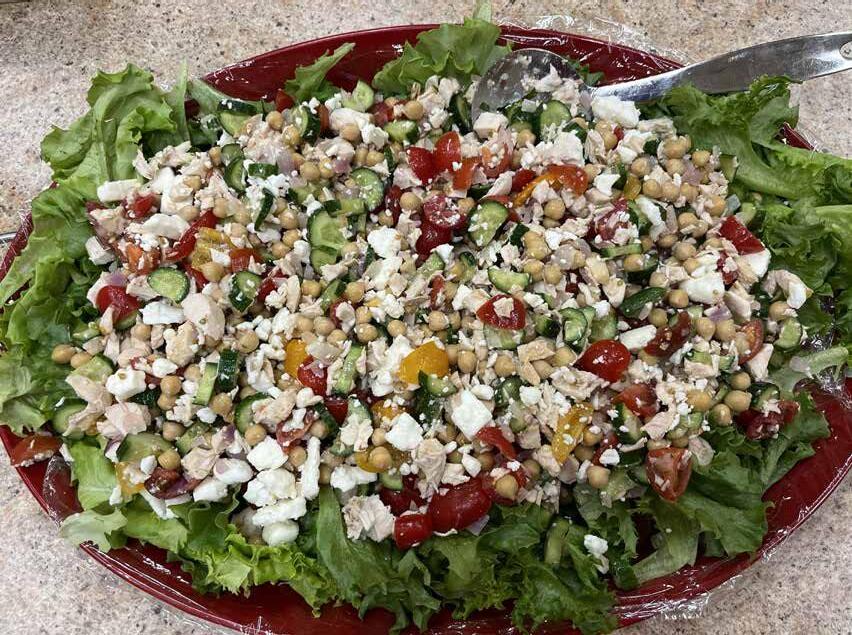
Summer is the perfect time for salads that are ready to enjoy straight from the refrigerator. Try this recipe for Grilled Chicken Feta Chickpea Salad. It is perfect for a meal-prepped lunch, an easy dinner, or a picnic in the park.
The recipe calls for grilled chicken, but a store-bought rotisserie chicken works just as well. If you are grilling, cook smarter by preparing more than you need for one meal. The extra chicken can be used in this salad or another recipe later in the week.
Remember, recipes are simply guides. Adjust and adapt them to fit your own flavor preferences. Not a fan of beans? Try substituting whole wheat pasta. Prefer cooked onion instead of raw? Microwave the onion for about a minute before adding it to the salad. Swap red, yellow, or orange peppers for the tomatoes, or use sliced summer squash in place of the cucumbers.
This recipe makes two main-dish servings or four side-dish servings. If you would like to make more, simply multiply the ingredients accordingly.
Happy Summer!
by CARMEN LONG
Grilled Chicken Feta Chickpea Salad
Yield: 2 main-dish servings
Serving Size: 1¾ cups
INGREDIENTS
• 1 (15-ounce) can chickpeas (garbanzo beans), rinsed and drained
• ⅛ teaspoon dried oregano or ¼ teaspoon fresh oregano
• Leafy greens (optional)
INSTRUCTIONS
• Combine the chickpeas, chicken, cucumbers, tomatoes, and red onion in a bowl. Add half of the lemon juice, ½ tablespoon olive oil, and the salt. Toss to combine.
• Divide between two plates and top with feta cheese, oregano, and the remaining lemon juice and olive oil.
Note: I like to serve this salad on a bed of leafy greens. Not only does it look appealing, but the greens also provide additional nutrients.
Navigating Life with a Horse, Faith, and Common Sense
“Come on Traveler, for the love of alfalfa, please get your big booty in the trailer! It’s already an hour past the time I wanted to get on the road.”
“Calm yourself, Hay-Woman. I just have to double check to make sure I packed some Bute in case my legs get sore from the long trip. And did you just say my booty was looking big?” He cranked his head around to try to catch a glimpse of his backside.
“Well, you are a quarter horse, so yeah, I said you had a big booty. That’s no shocker to anyone but yourself.”
I rolled my eyes as Traveler started to creep back toward the barn. “Don’t you go back in that tack room!” I snapped. “You have everything you need and then some. Can we please get on the road now? We have a 6-hour drive and I want to get you settled in and go check out some of the prospects before the sale tomorrow.”
My furry sidekick lowered his head and started pawing the ground, looking unsettled.
“What’s the matter big fella? You’re always up for a trip to the horse auction. You look forward to it every year. Getting to meet up with old friends, making new ones, looking at all the little colts and fillies. What’s with the procrastination?”
“I don’t know what procrastination means, but if you’re asking me why I’m putting off getting in the trailer, it’s not a simple answer.”
I smiled at his innocent intelligence. I sat down on the fender of the horse trailer. “Okay, I’m all ears. Well, you’re all ears but you know what I mean,” I said, trying to lighten his mood.
“Sometime back, I overheard you and your friend talking, you know the one you say talks too much and knows everything about everything?” I grimaced, embarrassed about that description. “Ya’ll were talking about how
the auctions could be a money racket and really didn’t help the horse population, or the buyers who often got scammed with horses who had very bad behaviors or medical problems that couldn’t be treated.” Traveler looked confused and a little sad but continued, “I’m just not sure I want to go if that’s the case Hay-Woman.”
“Oh, I remember, we did have that conversation, but that was about kill pens, and sales that they have. Unfortunately, that is a very controversial topic in the horse world. People have strong opinions on both sides.
“Horse people can have strong opinions on a lot of stuff that has to do with us equines.”
“So true,” I agreed. “You know, that’s not the type of auction we go to Traveler. We go to look, and possibly buy the babies that are ready to start their riding careers. Lots of people that go to this auction are looking for life partners or horses they can train and make into good citizens.”
“Do you think some of those horses get sold to bad people with bad intentions?
“Yes, sadly, I do. The devil is always at work Traveler. Tempting us humans just like he did Jesus. 1 Peter 5:8 (AV) says, ‘be sober, be vigilant, because your adversary the devil, as a roaring lion, walketh about.’”
“I don’t know what vigilant means, but I’m going to make sure I keep a careful watch out for danger and evil.”
“That’s a good idea my sweet friend. We both will.”
by DERINA PYLES
unofficial mascot of
southern summers
by JOANNA RADFORD
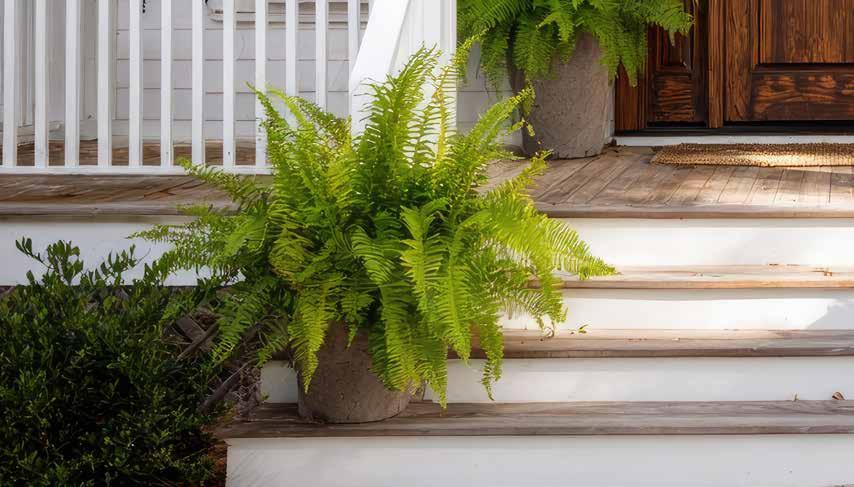
If there were an official plant of summer in Surry County, the humble porch fern would make a strong case for the title. Right up there with sweet tea, lightning bugs, and neighbors waving from porch swings, those big green baskets of ferns have become a staple of Southern front porches. From historic homes in Mount Airy to shaded back decks tucked into the foothills of the Blue Ridge Mountains, porch ferns bring instant charm, and surprisingly, they are not nearly as difficult to grow as many people think.
Porch ferns thrive when gardeners understand a few simple basics: light, water, humidity, and consistent care. The classic favorite across the South is the Boston fern. Its graceful, arching fronds can quickly transform an ordinary porch into something straight out of a summer magazine cover. And in Surry County, where mornings are often cool and humid before the July heat rolls in, ferns feel right at home.
The biggest mistake many gardeners make is giving ferns too much sun. Ferns prefer bright, indirect light or gentle morning sunshine. A west-facing porch that bakes in afternoon heat can leave a fern looking more crispy than classy. If the fronds begin turning pale or brown, your fern may be getting more sunlight than it bargained for.
Watering is where porch fern ownership starts to feel a little like raising a needy houseguest. During hot North Carolina summers, hanging ferns may need watering daily, especially in July and August when temperatures climb and humidity suddenly disappears for a few days. The key is keeping the soil consistently moist but not soggy. Many experienced gardeners in Surry County swear by the “lift test.” If the hanging basket feels surprisingly light, it is time to water. Some even joke that porch ferns are better predictors of drought than the weather forecast.
Humidity also matters. Fortunately, the foothills region often provides enough natural moisture to keep ferns reasonably happy. During dry spells, however, a gentle misting or grouping plants together can help increase humidity around the foliage.
Another secret to huge, show-stopping ferns is fertilizer. A light feeding every few weeks during active growth can encourage fuller plants with rich green color. However, overfeeding can damage delicate roots, so less is usually more.
One overlooked benefit of porch ferns is the cooling effect they create. A porch lined with healthy green plants simply feels cooler and calmer during summer afternoons. There is something about a shaded porch, a ceiling fan humming overhead, and a pair of giant ferns swaying in the breeze that slows life down a little.ZPerhaps that is why porch ferns remain so beloved across our region. They are not flashy like tropical flowers or trendy landscape plants. They are familiar. Reliable. Comfortable. Much like Surry County itself.
So this summer, if your porch needs a little extra life, consider adding a fern or two. Just remember to keep them watered, protect them from harsh afternoon sun, and maybe whisper a few encouraging words when temperatures hit 95 degrees. After all, Southern porch ferns may be beautiful, but they are also just a touch dramatic.
Florida weave system used to support determinate tomatoes. Image credit: UNH Extension
Diagram credit: UNH Extension
Where the Music Still Feels Real
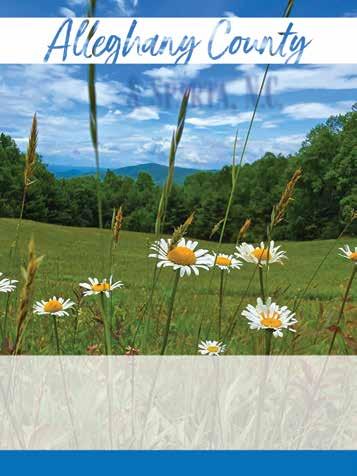
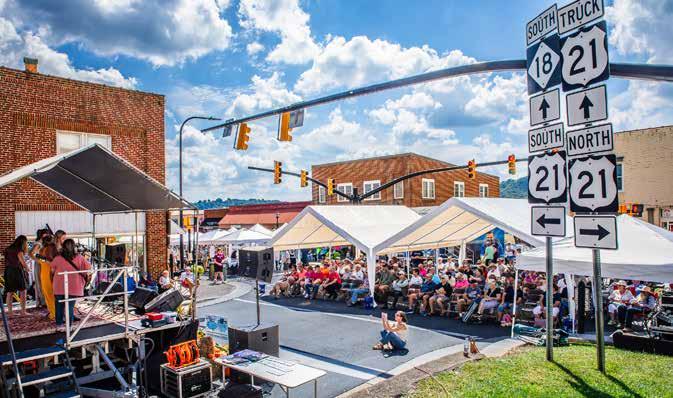
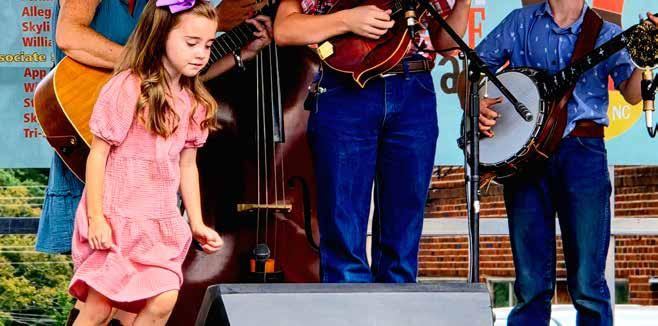
In Alleghany County, music is not something we dust off once a year and place on a stage. It is woven into everyday life here. Around these mountains, bluegrass, old-time, gospel, country, folk, Americana, and mountain music still drift through the air as naturally as creek water over rock.
I have often thought one of the reasons music feels different here is because so much of it still happens for the right reasons. Around Alleghany County, people do not always gather because there is a big production, expensive tickets, or flashing lights. They gather because somebody brought a guitar. Because somebody knows an old fiddle tune. Because after a long week, music still feels like one of the best reasons in the world to sit down beside people you care about and stay awhile.
On any given week, you can hear live music somewhere in Alleghany County. Maybe it is a packed room at Muddy Creek Café & Music Hall. Maybe it is somebody picking on stage at Main Street Pizzeria & Taphouse, a songwriter set at Laconia Ale Works, music on the porch at Thistle Meadow Winery or Williamson Mead and Brewing, or neighbors gathered for monthly jam sessions and special music events at Blue Ridge Wine & Music. Then there is the Alleghany Jubilee, where the music and dancing have been bringing people together for decades and where strangers do not stay strangers very long.
The larger events only add to the rhythm. The Alleghany County Fiddlers Convention draws musicians and listeners from across the region, while the Blue Ridge Mountain Heritage Festival fills downtown Sparta each September with handmade crafts, mountain foodways, dancing, and the sounds of Appalachian tradition echoing through Main Street.
Truthfully, places like this are becoming harder to find. We live in a world where so much entertainment is streamed through screens and earbuds that sometimes we forget what it feels like to hear music played live in the same room by people whose musical heritage runs deep and who mean every note. There is something different about hearing a mandolin ring through an old building or watching somebody tap their foot to a song they have known their entire life.
What makes the music scene here special is that it still feels real. It has not been polished into something manufactured. It is front porches and festival stages. Church hymns and dance floors. Old songs, new songs, and the stories in between.
And maybe that is why people keep finding their way to Alleghany County. Not because we are trying to be the loudest place in the mountains, but because there is still something genuine here worth hearing.
To learn more about upcoming music events in Alleghany County, visit the Chamber’s event calendar at Alleghany County Chamber of Commerce or call the Alleghany Chamber of Commerce at 336.372.5473.
by Larry Van Hoose
JULY EVENTS
3 3
MOUNT AIRY
First Friday in Mayberry
Friday, July 3, 2026 at 5:00 pm
Downtown Mount Airy
200 N Main St, Mount Airy, NC 27030
Independence Day Celebration and Fireworks
Friday, July 3, 2026 at 6:00 pm
Veterans Memorial Park
691 W Lebanon St, Mount Airy, NC 27030
Live Music at Blackmon Amphitheatre
Fridays in July 2026 at 6:30 pm
Blackmon Amphitheatre
125 N Main St, Mount Airy, NC 27030
Mayberry Farmers Market
Saturdays in July 2026 at 9:00 am
Downtown Mount Airy
144 N Main St, Mount Airy, NC 27030
Hometown Historian Camp
Monday, July 6, 2026 through Friday, July 10, 2026