Charlotte City Council nearly balks at buying ammunition for police
Charlotte
The Charlotte City Council was forced to re-vote on a routine measure authorizing the purchase of ammunition for Charlotte Mecklenburg police on Monday night, WSOC-TV reported. During the initial vote, only 4 of the 11 councilmembers raised their hands to approve the purchase.
Tariq Bokhari, one of the council’s two Republicans, chided his colleagues asking, “are we really doing this?”
Upon a second vote, the item passed 6-1 with Braxton Winston, a longtime anti-law enforcement activist, voting against the routine purchase. Bokhari tweeted “wild times” after the vote.
NSJ STAFF
Biden admin rule would ban 50% of gas stoves
Washington, D.C.
A new Biden administration rule on cooking appliances would effectively ban half of all gas stoves on the U.S. market from being sold, according to an Energy Department projection first reported by the Washington Free Beacon.
In an analysis published in February, President Joe Biden’s Energy Department acknowledged that roughly half of all gas stoves on the U.S. market today would not meet its proposed cooking appliance efficiency regulations.
The Energy Department’s admission comes roughly one month after U.S. Consumer Product Safety commissioner Richard Trumka Jr., a Biden appointee, said a gas stove ban was “on the table.” “This is a hidden hazard,” Trumka Jr. said. After Trumka’s comments prompted a political firestorm, both the Consumer Product Safety Commission and the White House walked back the threat, with Biden press secretary Karine Jean-Pierre assuring Americans “the president does not support banning gas stoves.” The Energy Department’s new rule and subsequent analysis, however, contradict that statement, the Free Beacon reported.
NSJ STAFF
Questions loom as they head to the Senate
By A.P. Dillon North State Journal
RALEIGH — Over a dozen bills have been filed in the North Carolina House of Representatives related to giving K-12 school districts more calendar flexibility but they may not be getting a look in the Senate.
House Bill 86 offers statewide calendar flexibility while 13 others filed appear to only address certain counties.
The current calendar law in place requires a minimum of 185 days or 1,025 hours of instruction. The law, first enacted in 2004 under Democratic leader-
Murray speech at Chapel Hill highlights purpose of universities
By Matt Mercer North State Journal CHAPEL HILL
ship, also dictates a school year start date of no earlier than the Monday closest to Aug. 26. Under that law, the end date for the school year is no later than the Friday closest to June 11.
The statewide bill would move the start of school to no earlier than Aug. 10 and the end date of June 11 would remain the same.
In an interview with North State Journal, Senate Leader Phil Berger (R-Eden) said he doesn’t see a need to change the law.
“I don’t think there’s a need to change it,” Berger said. “If I thought there was a chance that changing it would improve outcomes as far as kids are concerned as far as school is concerned. I would certainly consid-
See EDUCATION, page A2
— On a stormy
Thursday night in Chapel Hill, renowned English author and journalist Douglas Murray spoke to a crowd of students and alumni in an auditorium on the vast campus.
Hosted by the UNC Alumni Free Speech Alliance, and two conservative student organizations, Murray expounded on his views of the radical Left’s threat to Western values and the need for freedom of thought in colleges nationwide.
In his nearly 45-minute speech before taking questions from the students in the audience, Murray took on two acutely sensitive issues at UNC Chapel Hill: Nikole Hannah-Jones and the toppling of statues.
He opened by discussing what he called the disappearance of the “public intellectual” and how the West, notably the United States, has a serious problem with debate and discourse.
“A culture that allows extraordinary claims go uncontested is a culture deeply in trouble,” Murray said.
He continued by saying that traditionally, people with strong ideas would defend them in public – taking on those who disagreed with them. Instead, said Murray, we now have “public figures” in an ecosystem that allows them to talk only
Truitt discusses bill increasing penalties for teacher misconduct and licensure impact
Revoking an educator license is not necessarily a quick or easy process
By A.P. Dillon North State
Journal
RALEIGH — In an interview with North State Journal, North Carolina State Superintendent Catherine Truitt discussed a bill filed to increase penalties for teacher sexual misconduct with students, the reporting requirements in the measure, as well as the related impact on a teacher’s license.
House Bill 142, the “Protect Our Students Act,” was filed on Feb. 16
by Reps. John Torbett (R-Gaston), Kristin Baker (R-Cabarrus), Jake Johnson (R-Polk), and Keith Kidwell (R-Beaufort).

The bill would alter the penalty for committing a sexual activity with a student from a Class I to a Class G felony. A Class I felony has a sentence of three to 12 months whereas a Class G felony can be an eight to 31 months prison sentence. The penalty for taking indecent liberties with a student also is raised from a Class I to a Class G felony. Additionally, if a school official fails to report a teacher engaged in misconduct to the State Board of Education they can be charged with a Class I felony. A bill making some technical
changes was introduced and received a favorable report from the House K-12 Education Committee on Feb. 21, at which time Truitt spoke to the committee about the measure.
During her remarks before the committee, Truitt said that there had been 124 instances of sexual misconduct involving students resulting in teacher license suspensions and revocations between Jan. 1, 2016, through Oct. 11, 2022.
“On average, this is 20 suspensions, revocations, or surrenders a year that are related to sexual misconduct involving students,”
with those who already agree with them.
Murray also pointed to two more examples of the behavior, writers Robin D’Angelo and Ibram X. Kendi. He said in swaths of their work, they deliberately misuse source materials to fit into a predetermined narrative. Murray said this was part of the threat with erasing history, specifically the toppling of statues. This was a pattern, said Murray, of “erasing the past and standing in their place.”
Murray also took issue with the 1619 Project, calling it filled with repeated assertions which cannot be proven and can’t be defended in public.
He added that it was the students in the room who must deal with the current problems of those who refuse to defend ideas.
“The only way you get to the truth is to get all ideas out,” said Murray. He quoted the 19th century philosopher John Stuart Mill, adding, “the person who is wrong must be heard and the worst that can happen is you know your argument better.”
By refusing to engage in the exchange of ideas, Murray said, Western society has made themselves vulnerable to bad ideas.
Earlier in the day Thursday, the
VOLUME 8 ISSUE 1 | WWW.NSJONLINE.COM WEDNESDAY, MARCH 1, 2023
See TEACHERS
A2
Over a dozen K-12 calendar flexibility bills filed in the House
See MURRAY, page A8
, page
the BRIEF this week U.S. MARINE CORPS PHOTO BY CPL. TANNER BERNAT
Salute!
8 5 2017752016 $0.50
U.S. Marines with Headquarters Battery, 10th Marine Regiment, conduct the Presidents’ Day 21-gun salute at W.P.T. Hill Field on Marine Corps Base Camp Lejeune, North Carolina. The ceremony is held annually, where 105mm cannons are discharged 21 times at five-second intervals. See North Carolina’s veteran population by county A4-5
There are nine grounds for the State Board of Education suspending or revoking a license:
1. Fraud, material misrepresentation or concealment in the application for the license
2. Changes in or corrections of the license documentation that make the individual ineligible to hold a license
3. Conviction or entry of a plea of no contest, as an adult, of a crime if there is a reasonable and adverse relationship between the underlying crime and the continuing ability of the person to perform any of his/her professional functions in an effective manner
4. Final dismissal of a person by a local board pursuant to G.S. 115C-325(e)(1)b. [immorality], if there is a reasonable and adverse relationship between the underlying misconduct and the continuing ability of the person to perform any of his/her professional functions effectively
5. Final dismissal of a person by a LEA under G.S. 115C-325(e)(1) e. [physical or mental incapacity]
6. Resignation from employment with a LEA without thirty work days’ notice, except with the prior consent of the local superintendent;
7. Revocation of a license by another state
8. Any other illegal, unethical or lascivious conduct by a person, if there is a reasonable and adverse relationship between the underlying conduct and the continuing ability of the person to perform any of his/her professional functions in an effective manner; and
9. Failure of school administrator to report revocable conduct. The State Board also accepts the voluntary surrender of a license, but the file must include the basis for the surrender that established conduct that could have resulted in suspension or revocation.
Mark 14:8
No one can do all that he knows he ought to do, or that he wants to do. Yet when we have done our duty, faithfully and earnestly, according to the light and the wisdom given to us — we should not regret afterwards if it appears that we might have done things with more wisdom or with greater skill.

We cannot get the benefits of experience, until we have already gone through the experience. We cannot have an elder’s ripe wisdom, in the days of our youth. We are able to see when a day is done, how we might have lived it better. We should bring to every hour’s work — our finest skill, our best wisdom, our purest strength — and then feel no regret, even if it does not seem well done. Perfection is always an unreached goal in this life. Duty is always too large for us. We can never do more than a portion of it.
“Not that I have already obtained all this, or have already been made perfect — but I press on to take hold of that for which Christ Jesus took hold of me. Brothers, I do not consider myself yet to have taken hold of it. But one thing I
TEACHERS from page A1
Truitt said. She added that number does not include education employees who are non-licensed, such as substitutes, bus drivers or coaches.
Truitt confirmed those numbers to North State Journal, reiterating that the State Board of Education (SBE) does not have jurisdiction over local hiring and firing issues and only has authority for suspending or revoking licensed teachers, as well as the bill’s increased penalties covering non-licensed staff misconduct.

The superintendent also said there are at least 50 arrests of school personnel “currently facing charges, have charges pending, or who are actively being investigated by local law enforcement for sexual misconduct against students.”
“Then, of course, we saw a decrease during the pandemic,” Truitt told North State Journal, adding that most education employees “didn’t have access to the kids” during that time frame.
“There’s still a lot we don’t know,” said Truitt. “So let’s use this as an opportunity to elevate the issue so that we can do a better job of communicating with districts and we can make sure we’re coding these correctly in our own database; that we can make sure that what happens in law enforcement is making its way back to us.”
An analysis by EducationNC found 240 licenses had been revoked between 2016 and 2022, with 143 of those revocations involving indecent liberties with a student or child.
The process for revoking a license is arduous and there are nine grounds under which a revocation can take place, one of which includes the 30-day notice scenario. However, having resigned, the teacher in question is no longer in the employ of the state and has constitutionally protected due process rights.
In other words, the case has to be adjudicated before action can be taken on the license.
Sometimes a teacher’s license expires or lapses during the time it takes for any given criminal case to be decided in the courts and that’s an issue the bill seeks to address, according to Truitt.
“That creates a problem and we can’t do anything when the license,” Truitt said. “That’s part of what this bill will do; is that if their license lapses, there’s no action that I can take against them, or the Ethics Committee, because it’s expired. So, what can I do now?”
She added that “When it [the license] does lapse, they would have to reapply and there would be a criminal conviction on their record and they would not get another license.”
In terms of maintaining the database of revocations and suspensions, Truitt said she thinks her agency has done a good job but said she thinks “we can do better.”
In terms of investigating teach-
do: Forgetting what is behind and straining toward what is ahead, I press on toward the goal to win the prize for which God has called me heavenward in Christ Jesus.” Philippians 3:12-14
“His lord said unto him, Well done, good and faithful servant; thou hast been faithful over a few things, I will
make thee ruler over many things: enter thou into the joy of thy lord.” Matthew 25:23
J.R. Miller was a pastor and former editorial superintendent of the Presbyterian Board of Publication from 1880 to 1911. His works are now in the public domain.
State Superintendent Catherine Truitt sits in a classroom.
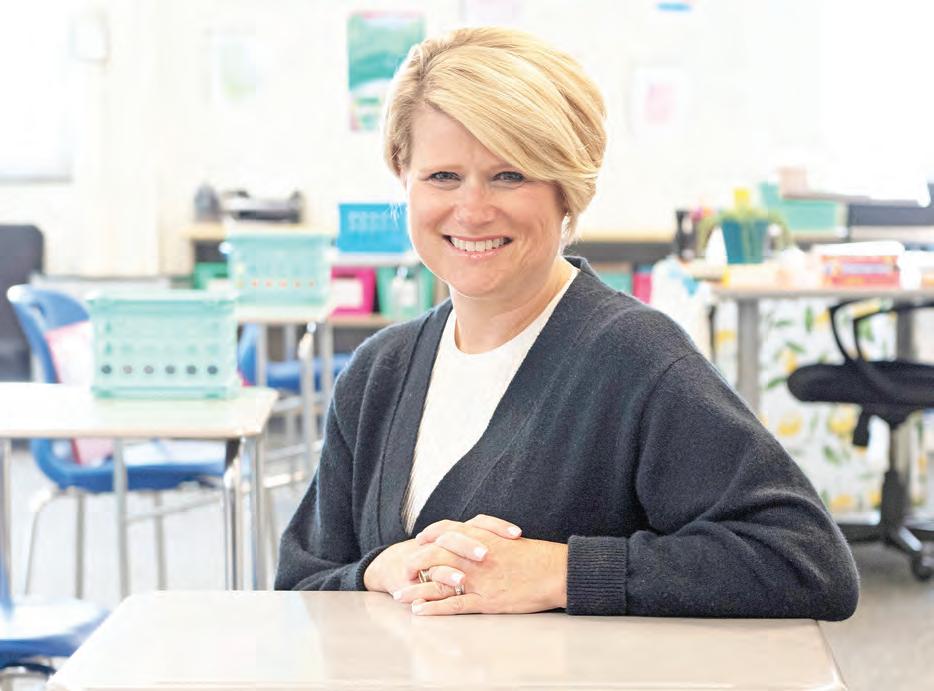
er misconduct by her agency, the work mainly falls on a single paralegal.
“This is going to have to be something like a budget item,” said Truitt about increasing capacity to investigate cases. “I think that any time there is legislation that requires the State Board to investigate anything or DPI to investigate anything having to do with teacher misconduct, we need more manpower.”
Background check laws are the main way states catch potential criminal issues at the time of hire.
If a background check doesn’t reveal an issue and the teacher fails to make disclosure to North Carolina officials, they are required to come before the Ethics Committee which falls under the superintendent’s office.
Each of the state’s 115 districts performs background checks when hiring, however, the process for the checks may vary from district to district. It’s also unclear if the districts repeat that check on a regular basis.
“I guess if the legislature wanted to mandate it that it run through the state instead of the local board policy, they could do that, but it’s one of those things in North Carolina that’s a local decision,” Truitt said when asked if background check policy and procedures should be homogenized at the state-level.
North State Journal asked if her agency had considered utilizing the school safety reporting app “Say Something” in place in a number of the districts, Truitt said she had already put the wheels into motion last September.
The app now has a button called, “inappropriate misconduct by school personnel” that students can use to report any unwanted
behaviors coming from an adult.
Truitt also said she expects to get some data out of the Say Something app about teacher misconduct.
The app could also be useful for collecting anonymous tips related to grooming of students by school employees, especially if the video mentioned in the final section of House Bill 142 gets made.
Under the bill, the Center for Safer Schools will create an informational video on child abuse and neglect, but that also addresses grooming. Public school units would be required to show the video to students in grades 6-12.
Well, I will tell you that the video is my idea,” said Truitt. “What I was picturing in my mind was if this is mandatory the first week of school when all the housekeeping is being done and that video is part of that first week of school… And what I was imagining was the teachers watching it with the students and so that one teacher, maybe they’ll see that video and know, ‘Oh, these kids know. They’ll know what I’m trying to do’.”
Truitt said she believes equipping students with information that is not from the possible perpetrator, but from a third party, i.e., the video, is the most effective and efficient way to teach students how to recognize the [grooming] behavior that’s happening.
“I think that grooming is hard to recognize in the moment,” Truitt said. “It’s sort of like grooming is the sum total of the exchanges that occur between a minor student and an adult.” She added then when she looks at the screenshots of the texting with the grooming behavior, “it’s very calculated on the part of the adult. You can see it unfold.”
The superintendent also said grooming may not be a conversation that parents are necessarily having with their children.
“This entire issue is not what people think about when they think of school safety; they think of gun violence, which I understand,” said Truitt. “That’s because we’re not talking about the U.S. Department of Justice work that says that as many as one in ten may - before they graduatemay have been the victim of sexual misconduct.”
The report, “A Case Study of K-12 School Employee Sexual Misconduct,” was produced in September 2017 by the Magnolia Consulting for the Department of Justice.
The major findings included the one in ten estimate mentioned by Truitt but also that employees with one-on-one access to kids are more likely to be offenders.
“On average, a teacher-offender will pass through three different districts before being stopped, and one offender can have as many as 73 victims in his or her lifetime (GAO, 2010),” according to the report.
Additionally, the report posits that employees who are popular or even cited with awards and honors are likely to be offenders and only an estimated 5% of incidents known to school employees are reported to law enforcement, despite Title IX and other legally required reporting of sexual misconduct incidents.
Hesitancy by staff to believe an incident occurred and administrators fearing media and public responses were listed as barriers to reporting. The report also says, “District leaders were hesitant to address school employee sexual misconduct.”
A2 WEDNESDAY 3.1.23 #373 “One of One” Visit us online nsjonline.com North State Journal (USPS 20451) (ISSN 2471-1365) Neal Robbins Publisher Matt Mercer Editor in Chief Cory Lavalette Managing/Sports Editor Frank Hill Senior Opinion Editor Emily Roberson Business/Features Editor Lauren Rose Design Editor Published each Wednesday by North State Journal 1201 Edwards Mill Rd. Suite 300 Raleigh, NC 27607 TO SUBSCRIBE: 336-283-6305 or online at nsjonline.com Annual Subscription Price: $50.00 Periodicals Postage Paid at Raleigh, N.C. and at additional mailing offices.
Send address changes to: North State Journal 1201 Edwards Mill Rd. Suite 300 Raleigh, NC 27607 North State Journal for Wednesday, March 1, 2023
POSTMASTER:
THE WORD: AN UNREACHED GOAL IN THIS LIFE
“She has done what she could.”
COURTESY PHOTO
PUBLIC DOMAIN
“The Denial of Saint Peter” (circa 1610) is a painting by Caravaggio which is now in the collection of the Metropolitan Museum of Art, New York.
February 2023 Council of State Roundup
By A.P. Dillon North State Journal
RALEIGH — Unannounced travel, policy-breaking driving and a request for a fentanyl task force are some of the highlights for the Council of State in February.
According to a fundraising email, Democratic Gov. Roy Cooper apparently slipped out of the state on or around Feb. 10 and landed in Washington, D.C. The governor gave no public notice of the travel and his published calendar for Feb. 10 simply states, “Throughout the day, Gov. Cooper will be holding meetings and conducting other business.” Cooper, along with over two dozen other governors, met with President Joe Biden and Vice President Kamala Harris on Feb. 10, according to a readout of the meeting posted on WhiteHouse.gov.
The governors were in D.C. as part of the National Governors Association Winter meeting. Biden and Harris used the meeting to urge governors to find ways to implement legislation favored by the administration using the billions in federal dollars sent to the states.
The governor also met virtually with N.C. Department of Health and Human Services Secretary Kody Kinsley, UNC System President Peter Hans, and the chancellors and leaders from the 17 UNC System campuses on Feb. 17 to dis-
cuss ongoing mental health support for college students in the state. Cooper had previously announced $7.7 million in funds to support mental health in the UNC System. State Auditor Beth Wood has found herself in the hot seat again over the use of another state vehicle following her hit-and-run incident that occurred last December after she departed a Christmas party in Raleigh. Wood was also charged with leaving the scene and causing certain property damage.
Wood’s office has conducted multiple audits over the years that cited “inadequate oversight” by various agencies when it came to state fleet vehicles could lead to misuse going undetected, including those vehicles being used by employees for personal purposes. Now it seems she may have done the same thing her agency reprimanded others for.
Following the hit-and-run, she apparently checked out another state vehicle on Dec. 12.
In early February, Motor Fleet Management Director Tom Riddle sent Wood a letter about her use of a state-assigned vehicle to commute while her permanently assigned vehicle had been suspended or temporarily terminated due to her Class 2 hit-and-run incident. He also wrote that “it appears that you may be using a state-owned vehicle for personal use. If this is the case, this constitutes misuse of a state-
owned vehicle.”
Attorney General Josh Stein is looking to create a Fentanyl Control Unit within the North Carolina Department of Justice’s Special Prosecutions and Law Enforcement Section to deal with the rising number of related cases. According to Stein’s press release, the unit would aid local district attorneys with “large-scale fentanyl trafficking, wiretap, and overdose cases.”
The unit would need funding, which means asking lawmakers for help. Stein wants legislators to add more prosecutors to his office that would work with local prosecutors specifically on fentanyl cases. If approved, Stein says his office will offer fentanyl, wiretap and overdose prosecution resources to all district attorney offices in the state beyond our current capacity. State Treasurer Dale Folwell released a report detailing excessive pay for executives at nonprofit hospitals in the state. The report says
that compensation has more than doubled in less than five years. Nonprofit hospitals paid $1.75 billion to their top executives from 2010 to 2021.
The Department of Public Instruction (NCDPI) announced that the state continues to lead when it comes to the number of national board-certified teachers. According to an NCDPI press release, the state has a total of 23,858 national board-certified teachers and ranks first nationally percentage-wise, with 23% of all teachers in North Carolina holding the certification.
According to Secretary of State Elaine Marshall, new business creations this year started with “a bang.” Per Marshall, the 174,000 new business creation filings in 2022 ranked as the second-highest year on record and the almost 16,000 creation filings for January set an all-time record.
Insurance Commissioner Mike Causey and the Seniors’ Health Insurance Information Program raised awareness for Medicare and Medicaid recipients about a federal data breach, warning recipients to scrutinize correspondence they may receive from the Centers for Medicare and Medicaid Services.
Causey’s press release directs recipients to follow the instructions of the official letters sent to them, which include destroying their old cards and informing their health providers of their new number.
The insurance commissioner also announced that the N.C. Rate Bureau is requesting a 28.4 percent rate increase for auto insurance policies that if approved would become effective Oct. 1, 2023. If the department review finds the increase unwarranted, settlement negotiations may ensue or a hearing may be called.
The New Emerging Crops Program has awarded $500,000 for seven research projects aiming at increasing state crop production and farm income, according to the N.C. Department of Agriculture. The awards will go to various projects conducted at N.C. State University’s Department of Horticultural Science and the schools’ Department of Crop and Soil Sciences Agriculture Commissioner Steve Troxler said the research “will help farmers explore the viability of certain crops in the state, with the goal of boosting the overall ag economy.”
The North Carolina Council of State (COS) is an administrative body of ten elected officials who are heads of their departments. Council members include the Governor, Lieutenant Governor, Secretary of State, State Auditor, Treasurer, Superintendent of Public Instruction, Attorney General, Commissioner of Agriculture, Commissioner of Labor and Commissioner of Insurance.
The next COS meeting is set for Mar. 7 at 10:00 a.m. The meeting will be held in Raleigh at 1 South Wilmington Street at Transportation Building DOT Boardroom #150.
DeSantis moves toward GOP presidential bid on his own terms
The Associated Press REPUBLICAN presidential contenders typically fight for prime speaking slots at the Conservative Political Action Conference. But as conservative activists gather in suburban Washington this week, Florida Gov. Ron DeSantis will be courting donors more than a thousand miles away in Texas and California.
The apparent CPAC snub is nothing new for DeSantis, who has emerged in the early phase of the 2024 presidential election as a leading contender for the GOP nomination even as he ignores many conventions of modern politics.
DeSantis is a frequent voice in conservative cultural fights on cable television, but he often avoids gatherings of fellow Republican governors and party leaders, who are quick to complain in private about his go-it-alone approach. He is the only top-tier presidential prospect yet to court voters in Iowa, New Hampshire or South Carolina, the states hosting the GOP’s opening presidential primary contests. And he is often at odds with the press, refusing even to notify local media of last week’s rare three-state tour with law enforcement.
Indeed, as DeSantis moves toward a White House run, it is becoming increasingly clear that the 44-year-old Republican governor will manage his presidential aspirations in his own way, on his own timeline, with or without allies in national GOP leadership or relationships with the press.
“DeSantis has, in his style and the actions he’s taken as governor, shown a willingness to fight the traditional powers that be, the establishment,” said David McIntosh, president of the Club for Growth, an influential conservative group based in Washington. McIntosh described DeSantis’ style as “refreshing” and suggested the GOP is ready to move on from former President Donald Trump.
For now, DeSantis is perhaps the most potent threat to Trump’s effort to win the GOP nomination for the third time. The Club for Growth will host DeSantis among a half-dozen presidential prospects at a closed-door retreat in Florida next weekend with top donors. Trump is not invited.
Meanwhile, DeSantis has quietly begun to expand his political coalition on his terms just as he releases a book, “The Courage to be Free,” which came out Tuesday.
He spent the weekend huddled behind closed doors at a south Florida luxury hotel for a “Freedom Blueprint” retreat with more than 100 donors, elected officials and conservative influencers. The attendees included former Trump chief of staff Mick Mulvaney, Iowa Gov. Kim Reynolds, Arkansas Sen. Tom Cotton and Texas-based donor Roy Bailey, a former member of Trump’s national finance committee.
Oklahoma Gov. Kevin Stitt and Tennessee Gov. Bill Lee were also in attendance, along with Wisconsin Sen. Ron Johnson, Utah Sen. Mike Lee, Texas Rep. Chip Roy and Kentucky Rep. Thomas Massie. Fox News host Laura Ingraham hosted a fireside chat with DeSantis on Sunday before he joined a “fighting back against woke” discussion with Chaya Raichik, who runs the “Libs of TikTok” social media account.
Details from the gathering were disclosed by participants who requested anonymity to discuss the private event.
Trump was largely ignored throughout the weekend retreat, although conservative commentator Ann Coulter seized on his failure to build a wall spanning the entire U.S.-Mexico border during a Saturday panel discussion with DeSantis on border security, according to one person in the room. She accused the former president of never actually wanting to build it in the first place.
In the coming days and weeks, DeSantis will use the release of his book to introduce himself to voters beyond Florida, having established his political dominance there last fall by winning reelection by more than 19 percentage points.
He is expected to make his first appearances in key states on the primary calendar such as Iowa and New Hampshire in the coming weeks in addition to general election battlegrounds like Georgia and Pennsylvania. Last week, he made surprise stops in New York City, Philadelphia and Chicago to court law enforcement leaders.
The Florida governor is already scheduled to headline two Republican fundraisers in Texas on Saturday. The next day he’ll speak at a $500-a-head reception for the GOP of Orange County, California. He’ll serve as the keynote speaker for the Alabama GOP the following week.
While he has begun to expand his profile, DeSantis has done far less than most of the early 2024 class to connect with primary voters and would-be allies in key states.

He has long avoided gatherings of Republican governors or top GOP officials, who privately con-
demn his approach as arrogant.
He’s never set foot in Iowa.
Former New Hampshire GOP chair Jennifer Horn noted that Republican primary voters often embrace anti-establishment candidates “who are willing to create their own lane or take their own path.”
“But when you’re running for president, and in this environment, I think he has to be careful not to be a victim of his own arrogance,” she said. “He has this belief that he knows better than everyone about everything, and that’s never a good thing.”
Meanwhile, DeSantis’ team feels no urgency to enter the 2024 contest, which already features three Republican candidates. Trump announced three months ago.
He’s also shown no interest in responding to Trump’s increasingly personal attacks, which include recent social media posts suggesting that DeSantis behaved inappropriately with underage girls when he briefly taught high school in his early 20s.
Trump refers to the Florida governor as Ron DeSanctimonious” and “Meatball Ron.”
By contrast, DeSantis in his new book actually credits Trump for helping him win the Florida governorship in 2018.
“I knew that a Trump endorsement would provide me with the exposure to GOP primary voters across the State of Florida, and I was confident that many would see me as a good candidate once they learned about my record,” DeSantis writes, according to an early copy obtained by the Guardian.
Trump’s increasing focus on DeSantis may unintentionally help the Florida governor by defining him as the strongest Republican Trump alternative, according to Sam Nunberg, a former Trump aide turned critic.
“Look, Donald is worried, and if I was working for him, I’d say he needs to update the playbook,” Nunberg said.
In the meantime, DeSantis is focused on expanding his conservative agenda in Florida’s looming state legislative session, which runs from March through May.
Already, he has pushed to eliminate diversity, equity and inclusion programs from Florida’s public universities and colleges. Among his other priorities: allowing people to carry guns in public without a permit; weakening laws protecting journalists from lawsuits; and cracking down on illegal immigration, including a plan to eliminate in-state tuition for college students in the country illegally.
In a nod to his political strength, DeSantis is under attack from a growing group of Republican rivals. New Hampshire Gov. Chris Sununu publicly condemned DeSantis’ decision to use the levers of government to punish private businesses like Disney that push back against his policy priorities. South Dakota Gov. Kristi Noem’s team has criticized DeSantis’ record on abortion as insufficiently conservative.

A3 North State Journal for Wednesday, March 1, 2023
AP PHOTO
Florida Gov. Ron DeSantis, left, stands with his wife Casey, right, and their children Mason, Madison, and Mamie during an inauguration ceremony at the Old Capitol, Tuesday, Jan. 3, 2023, in Tallahassee, Fla. At left is former Florida Gov. Jeb Bush.
According to Stein’s press release, the unit would aid local district attorneys with “large-scale fentanyl trafficking, wiretap, and overdose cases.”
north STATEment
Neal Robbins, publisher | Frank Hill, senior opinion editor
 LETTER FROM THE PUBLISHER NEAL ROBBINS EDITORIAL | FRANK HILL

Where would people turn if America no longer existed?
BEST-SELLING AUTHOR Douglas Murray spoke at the UNC Free Speech Alliance kickoff event last week on the Chapel Hill campus. The title of his address was “Free Speech in the West.”
We will settle for free speech at Carolina to begin with. The rest of western civilization can come next.
We shall nobly save, or meanly lose, the last best hope of earth.

Welcome to a ‘One of One’ Volume 8
THIS WEEK North State Journal kicks off its eighth volume. That transition means we’ve published seven full years of North Carolina’s only statewide newspaper. During this volume, our 400th issue will roll off the press to an everexpanding audience from across our remarkable state.
Since Volume 1, Issue 1, on February 28, 2016, North State Journal has sought to deliver a newspaper based on truth and beauty that elevates the conversation from Murphy to Manteo. The goal remains the same in Volume 8.
As he ruminated about various falsehoods about America’s past which have been propagated by the activist left and mainstream media types, he posited one profound and troubling question for everyone to consider:
“Where would people turn if America no longer existed?”
It may seem like an idle comment from an idealistic apologist for the Great American Experiment ― but it is not. As much as the radical left wants to tear down America and every historic proponent of American values in the past, Murray pointed out they never provide any vision for what they want to replace our current democratic republican form of government and capitalist economy.
Where would such rebels, revolutionaries and nihilists get their ideas and philosophies for setting up the Second America if they succeed?
We already know they would turn to the writings of Karl Marx. BLM and any number of far-Left socialist activist organizations in America openly confirmed their reliance on communist ideology until they erased it from their websites. Their words and actions, however, can’t erase what they really believe.
connote the sense of “the weight of history” such as Vergangenheitsbewältigung (reckoning with the past) and Gesellschaftsgeschichte (the history of society). It is hard to look towards German thought and philosophy as models for a New America when they can’t even understand how and why their parents and grandparents allowed a maniac like Hitler to gain power and exterminate six million Jews ― and no one stopped him.
Anyone want to live under strict Sharia law as many Muslim theocracies do? Limited, if any, rights for women; persecution of homosexuals; strict religious dictatorial control by the ruling mullahs and ayatollahs ― if you want to live under those conditions, count me out.
How about any of the basket-case socialist or communist economies such as North Korea, Cuba or Venezuela? I asked a young Venezuelan who emigrated to the US in 2016 what he thought of the 155% annual inflation rate now happening in his home country. “Well, it is not too bad ― last year, it was 350% and in 2019, it was 35,000%. So by comparison, today looks pretty good.”
None of these examples from other countries or cultures are very appealing to the average American. None of them represent the treasured values of freedom we take for granted in America under the banner of life, liberty and the pursuit of happiness.
Volume 8 will be our best volume yet.
As I looked back at seven years of awardwinning, journalistic excellence planning for this new issue, the unique stories stood out to me. The writers, editors, designers, and staffers of North State Journal have delivered meaningful and exclusive content over these seven years beyond any level I could’ve ever hoped for when we started North State Journal.
Volume 8 will be our best volume yet.
As one of the only growing newspapers in America, we are singularly positioned to deliver high-quality writing in a world-class print product in the coming 52 issues.
Newspapers are typically numbered as annual volumes — and we are no different. However, I have challenged our editors to make each issue of North State Journal this year a “one of one” issue. North Carolina offers a nearly unlimited quantity of incomparable people, places, and activities. Our goal is to deliver diverse stories, photographs, and designs to make each issue standout from other newspapers — and the prior issue — week after week.
From a publishing standpoint, we are continuing to invest in our delivery, advertising, and newsgathering platforms to make North State Journal more available, helpful, and capable.
Since our third volume, our tradition has been to adopt a tagline for new volume that supplements our official tagline — “Elevate the conversation.” This year we will celebrate our status as the only statewide newspaper and deliver truly unique print publications each week making each issue One of One. Neal Robbins is publisher of North State Journal.
A U.S. flag flies with the sun in the background in this June 2021 file photo,

Would these rebels turn to China for inspiration for the New America they envision? If any culture’s history confirms Winston Churchill’s observation in the House of Commons in 1945: “The inherent virtue of Socialism is the equal sharing of miseries”, then it is most definitely China. Hundreds of millions of Chinese have been murdered by the communist leaders of China since World War II. “Human rights” and “civil justice” are two treasured American values one never hears associated with Chinese history which spans close to 5000 years.
How about Russia? Vladimir Putin reminds the world on a daily basis how ruthless Russian tsars, princes and communist dictators have been throughout history. Russia is headed toward becoming a third-world country with an annual GDP far below Texas and declining birth rates which may cut its population by 30% by 2050.
No sane person wants to leave America and live in Russia. For good reason.
How about Germany, the economic powerhouse engine of the European Union? Murray pointed out Germans are the only people with words that
In 1995, I went to Estonia to speak to their newly-formed independent government. I took along a copy of James Madison’s “Notes on the Constitution” to give to the leader in the Estonian parliament. His eyes started to well with tears. He thanked me profusely for the gift and then said: “You Americans will never know how important the gift of freedom America represents to us Estonians. Without your example of hope, we would never have survived these many decades of Soviet oppression. We always wanted the freedom Americans had.”

We don’t know how exceptional America is because we have never lost our freedoms to a dictator or socialist control. We have to follow the wisdom of Abraham Lincoln when he sent this message to Congress a month before issuing the Emancipation Proclamation: “We know how to save the Union. The world knows we do know how to save it. We — even we here — hold the power, and bear the responsibility. We shall nobly save, or meanly lose, the last best hope of earth. The way is plain, peaceful, generous, just — a way which, if followed, the world will forever applaud, and God must forever bless.”
EDITORIAL | STACEY MATTHEWS
The ups and downs of a caregiver
I’ve been caregiving in varying capacities for family members going on for some six years now, and for roughly the last year it’s been a full-time responsibility.
As anyone who has done it will tell you, there are a lot of ups and downs to it, and they take on a special significance when the person you’re caring for is a loved one or someone with who you’ve otherwise become close.
She still has so much fight left in her, but I know what she’s having to go through is taking its toll, and it is heartbreaking.
After my mom’s colon cancer diagnosis in October, I pretty much had to put myself in “auto-pilot, we can do this” mode. We weren’t prepared to hear the words “you’ve got colon cancer” after her colonoscopy, but once we did, I could tell she tuned out, likely from shock. I told myself right then that I’d be the second set of eyes and ears mom needed to help her get through what she was about to experience.
It’s been like a whirlwind ever since, and for good reason. Obviously, when someone gets a cancer diagnosis, they want their care team to act quickly before the cancer gets a chance to spread further.
Mom had surgery to remove the tumor three weeks after her diagnosis. Two weeks later, we learned that chemotherapy was the next step in the journey to hopefully being cancer-free. Two weeks after that, we were talking to her medical oncologist about options.
Three weeks after that (which was two days before Christmas), she was having surgery to put in the porta-cath. And then a few weeks after that is when her chemo started.
She chose the three-month chemotherapy option, which in her case means two treatments a month for a total of six.
Watching her go through the things a chemo patient has to go through has been a sobering experience for me both as a caregiver and her daughter. Mom is closing in on 80 years of age, and thankfully she still has so much fight left in her, but I know what she’s having to go through is taking its toll, and it is heartbreaking.
Many people who have had chemo will recall the peripheral neuropathy that comes from certain chemo medications. In mom’s case, the pins and needles feeling hit her early on in her sessions.
In her case, the most intense part of the tingling usually goes away a few days after she’s had a treatment, with some mild tingling going on after that to the point it tapers off and she feels pretty normal.
But when she’s in the midst of dealing with it, all I want to do is to wrap my arms around her and comfort her, because she’s so uncomfortable to the point it sometimes becomes painful.
And there’s nothing I can do to make it go away. It’s extremely frustrating, and I’ve cried about it sometimes.
I’ve told her that as I watch her go through this that the feeling is like when my sisters and I would get sick and she would do everything she could to make us better but still would have to wait for the body to do its thing, which needless to say wasn’t fast enough for her.
She’s completed four treatments. Fortunately, she has an excellent medical oncologist and care team who I know have her best interests at heart. We know that if adjustments need to be made in her treatment, they’ll let us know what the options are.
I wish I had even half as much confidence in myself to help guide her through this as I have in the medical professionals taking care of her. But as she often tells me, we just need to take this one day at a time and not worry so much, because God is in control.
North Carolina native Stacey Matthews has also written under the pseudonym Sister Toldjah and is a media analyst and regular contributor to RedState and Legal Insurrection.

A6 North State Journal for Wednesday, March 1, 2023
AP PHOTO
The rule of law matters
IN LESS THAN TWO YEARS, North Carolina’s next Attorney General-elect will place their hand on the Bible and take an oath to “support, maintain and defend the Constitution.” According to statute, it is the duty of the Attorney General “[t]o represent all State departments, agencies, institutions, commissions, bureaus or other organized activities of the State which receive support in whole or in part from the State.”
Sadly, by this definition, the office is vacant. Josh Stein has wholly abdicated the duties of his office. Time and time again, rather than enforce the law, Stein has been absent. And it has fallen to the General Assembly to take up that role for him.
As general counsel for N.C. House Speaker Tim Moore, I have witnessed firsthand the disregard our current Attorney General has for the rule of law.
In fact, I have been on the frontlines.
Recently, despite having represented the State at trial and on appeal, the Attorney General informed the Speaker’s office that he would not move to lift the injunction on North Carolina’s 20week abortion ban in the wake of the United States Supreme Court’s decision in Dobbs. Stein first stated that he had recused himself from the case, then he announced that the Department of Justice would not “take action that would restrict women’s ability to make their own reproductive health care decisions.”
Since we were not a party to the action, we filed an amicus brief on behalf of legislative leaders in support of lifting the injunction, which Federal Judge William Osteen rightly did.
The same plaintiff recently filed a suit claiming that federal rules surrounding the abortion pill pre-empt North Carolina’s
reasonable restrictions on chemical abortions. Although those restrictions are intended to protect women’s health, it came as no surprise when Stein’s Justice Department announced that it agreed with the plaintiff’s legal arguments. Again, regardless of your feelings on the issue of abortion, I would hope that you can agree that the State deserves a defense from the person elected to provide it. Instead, it has fallen to legislative leaders in the General Assembly.
Another consequence of our Attorney General’s refusal to do his job is that North Carolina taxpayers wind up incurring the additional cost of defending the litigation. This is particularly egregious considering taxpayers already foot the bill for Stein’s salary while he repeatedly fails to do the very job for which he is paid.
Whether it is reasonable restrictions on abortion, preventing 56,000 convicted felons from voting, or defending North Carolina’s voter ID law, Josh Stein has been absolutely MIA.
Now, our “aspiring governor” wants a promotion, hoping to succeed Roy Cooper in the Executive Mansion. He has certainly taken the same path to get there. For 23 years, Cooper and Stein have run a political operation disguised as the North Carolina Department of Justice.
We deserve better. Let’s hope North Carolina’s next Attorney General honors their oath and respects the rule of law. In the meantime, it will inevitably fall to legislative leaders to do his job.
Sam M. Hayes is General Counsel in the office of N.C. House Speaker Tim Moore
Give credit to Jimmy Carter
JIMMY CARTER, the 39th and the longest-living U.S. president, has chosen to enter hospice care at age 98. This is a good time to try to place his presidency in history. Indeed, more years separate us in 2023 from Carter’s time in office than separated Carter from Franklin D. Roosevelt’s.
That was not all that separated them, either. Carter once made the point that he had never met a Democratic president, whereas Roosevelt met every Democratic president who was alive during his lifetime except for Jimmy Carter.
Carter came to office at a time of raging problems, with many resemblances to the baffling problems of today. But they were also times in which electoral politics operated very differently from how it has for the last decade or two.
Partisan lines were less sharp, voting patterns much more fluid and room for maneuver on substantive issues much greater. At his best, Carter was able to take innovative stands on perplexing issues in ways that produced lasting improvement.
The problems he faced, campaigning in 1975 and 1976 and taking office in 1977, have a familiar ring today. Inflation had been raging on and occasionally off during the decade in ways the conventional economists of the day could not explain or remedy. The nation was still reeling from a military defeat in a protracted war.

Violent crime was rising in central cities, and domestic terrorists had been setting off bombs and destroying property, mostly with impunity, for years. Quantitatively and proportionate to population, each of these negative trends was direr than its equivalent today.
Partisan preferences were in flux, far different from the red-and-blue patterns of the 21st century. In November 1976, Jimmy Carter carried every Southern state except for Virginia and lost every Western state except for Hawaii. California voted Republican, Texas Democratic. Thirty-one of the 50 states voted for a different party that year than they did in either 2016 or 2020 (or both). Only one of today’s 10 largest states backed the same party then and now — New York.
This is partly because the two parties’ nominees, incumbent President Gerald Ford and Jimmy Carter, were from their party’s respective historic heartlands — outstate Michigan, south Georgia — which had both been trending the other way in the turbulent 1960s and 1970s. Ford’s old congressional district, after he became vice president, elected a Democrat.
Carter’s Georgia cast the nation’s second highest percentage for John F. Kennedy in 1960 (Sherman had marched through only 96 years before) and then voted for Republican Barry Goldwater in 1964 and George (“segregation forever”) Wallace in 1968. Carter ran in Democratic primaries for governor as a
rural candidate, losing in 1966, winning in 1970, then beating an Atlanta-based Republican in the general election.
As governor, Carter surprised nearly everyone by hanging a portrait of Martin Luther King Jr. in the state Capitol. This seems unremarkable today. It was national news, a sign that rural white Southerners had accepted the end of racial segregation and were headed to a biracial future.
It also showed how Jimmy Carter was capable of learning from experience, which he proceeded to do as president. He absorbed the lessons of Ralph Nader and free market economists and supported deregulation of airlines, trucking and freight railroads, lowering costs enormously for consumers permanently.
Early on, Carter decried “inordinate fear of Communism,” but after the invasion of Afghanistan in 1979, he said his “opinion of the Russians has changed more drastically in the last week than even the previous two and a half years.” The result was covert action in Afghanistan and a defense buildup that, accelerated by the Reagan administration, resulted in the dismantling of the Soviet Empire a dozen years later.
Similarly, on inflation, Carter learned from failure and changed policies. He appointed Paul Volcker as Federal Reserve chairman in August 1979. Volcker’s tough, high interest-rate policies squelched inflation and sparked a quarter-century of low-inflation growth.
Carter’s top assistants — Hamilton Jordan and Jody Powell — were often brash and disrespectful of Washington insiders, but they were also highly competent and admirably loyal. Another talented but quieter aide was Stuart Eizenstat, who, in his 2018 book “President Carter: The White House Years,” makes a serious case for the accomplishments of the Carter administration, albeit while admitting some of his missteps.
The British parliamentarian Enoch Powell said that all political careers end in failure, and Carter’s most certainly did. His pollster, the late Pat Caddell, had to tell him on the morning of the Monday before the election that he had lost 10 points over the weekend and was going to lose. It must have been a tough phone call, on both ends.
These days, we don’t see so many voters changing their minds that quickly in November. But we don’t see our presidents changing their minds in response to events very often, either. So give Jimmy Carter credit for doing so, to the country’s benefit.
Michael Barone is a senior political analyst for the Washington Examiner, resident fellow at the American Enterprise Institute and longtime co-author of The Almanac of American Politics.
BEFORE PRESIDENT JOE BIDEN entered the White House, he consulted with several prominent historians about how to be a great commander in chief. Their answer: Grow government. Spend, spend, spend. Don’t worry about blowing up the debt.
It was the worst possible advice, and that meeting no doubt contributed to our economic calamity.
So, I wasn’t surprised to read about a poll of more than 100 of America’s most prominent academic historians who rated the greatest and the worst presidents. This is a farcical popularity contest that the Siena College Research Institute conducts every few years.
The results tell us much more about the leftward political leanings of historians than it does about presidential performance.
For example, the president ranked the highest in recent surveys has consistently been Franklin Delano Roosevelt. Others in the top five include Thomas Jefferson, Abraham Lincoln, Theodore Roosevelt and George Washington.
How is FDR a great president? Yes, he was the commander in chief of the military during World War II and deserved high marks for winning the war. But his domestic economic agenda was a failure of epic proportions. For the first eight years of the New Deal’s expansion of modern-day big government, the unemployment rate remained at about 10%, and the Great Depression went on and on.
Woodrow Wilson is also rated a near-great president. He raised the income tax from 7% to 70%, pulled America into a war we shouldn’t have fought, ran up the debt and ushered in the first disastrous era of “progressive” government. He is easily one of the five worst presidents of all time.
Biden was ranked 19th overall. So, the president who has raised the national debt into the stratosphere and has allowed inflation to surge to its highest level in 40 years is an aboveaverage president? For what exactly? Uniting the country?
Speaking of economic failures, President Barack Obama lands in 11th place, and President Lyndon Baines Johnson is 8th best. His legacy was the catastrophic Vietnam War, the failed Great Society and the birth of the modern-day welfare state.
Meanwhile, on the other side of the ledger, President Ronald Reagan, who won the Cold War, defeated communism and launched a threedecade stretch of prosperity, is rated only the 18th-best national leader. Reagan barely beats out Biden!
Donald Trump is ranked as the next-to-last of all presidents. Trump cut taxes, deregulated, made America energy-independent, was tough on China and engineered Operation Warp Speed that saved millions of lives worldwide. For that, he’s near the bottom of the heap.

So, who were the greatest presidents?
Everyone has their favorites, but here’s my ranking based on promoting security, prosperity and limited government: Grover Cleveland, Calvin Coolidge, Jefferson, Reagan and Washington.
These presidents were champions of liberty and recognized government growth as the greatest path to tyranny. Trump, a president I worked for, should be in the “near great” category. But I’m biased.
Stephen Moore is a senior fellow at the Heritage Foundation and an economist with FreedomWorks. His latest book is “Govzilla: How the Relentless Growth of Government is Devouring our Economy.”
A7 North State Journal for Wednesday, March 1, 2023
VISUAL VOICES
COLUMN
COLUMN
COLUMN | MICHAEL BARONE
| SAM HAYES
| STEPHEN MOORE
BE IN TOUCH Letters addressed to the editor may be sent to letters@nsjonline.com or 1201 Edwards Mill Rd., Suite 300, Raleigh, NC 27607. Letters must be signed; include the writer’s phone number, city and state; and be no longer than 300 words. Letters may be edited for style, length or clarity when necessary. Ideas for op-eds should be sent to opinion@nsjonline.com.
Scholars rank biggest spending presidents as the greatest
NATION & WORLD
Pastors’ view: Sermons written by ChatGPT will have no soul
The Associated Press
AMONG SERMON writers, there is fascination – and unease –over the fast-expanding abilities of artificial-intelligence chatbots. For now, the evolving consensus among clergy is this: Yes, they can write a passably competent sermon. But no, they can’t replicate the passion of actual preaching.
“It lacks a soul – I don’t know how else to say it,” said Hershael York, a pastor in Kentucky who also is dean of the school of theology and a professor of Christian preaching at The Southern Baptist Theological Seminary. Sermons are meant to be the core of a worship service -- and often are faith leaders’ best weekly shot at grabbing their congregation’s attention to impart theological and moral guidance.
Lazy pastors might be tempted to use AI for this purpose, York said, “but not the great shepherds, the ones who love preaching, who love their people.”
A rabbi in New York, Joshua Franklin, recently told his congregation at the Jewish Center of the Hamptons that he was going to deliver a plagiarized sermon – dealing with such issues as trust, vulnerability and forgiveness.
Upon finishing, he asked the worshippers to guess who wrote it. When they appeared stumped, he revealed that the writer was ChatGPT, responding to his request to write a 1,000-word sermon related to that week’s lesson from the
Torah.
“Now, you’re clapping -- I’m deathly afraid,” Franklin said when several congregants applauded. “I thought truck drivers were going to go long before the rabbi, in terms of losing our positions to artificial intelligence.”
“ChatGPT might be really great at sounding intelligent, but the question is, can it be empathetic?
And that, not yet at least, it can’t,” added Franklin. He said AI has yet to develop compassion and love, and is unable to build community and relationships.
“Those are the things that bring us together,” the rabbi concluded.
Todd Brewer, a New Testament scholar and managing editor of the Christian website Mockingbird, wrote in December about an experiment of his own -- asking ChatGPT to write a Christmas sermon for him.
He was specific, requesting a sermon “based upon Luke’s birth narrative, with quotations from Karl Barth, Martin Luther, Irenaeus of Lyon, and Barack Obama.”
Brewer wrote that he was “not prepared” when ChatGPT responded with a creation that met his criteria and “is better than several Christmas sermons I’ve heard over the years.”
“The A.I. even seems to understand what makes the birth of Jesus genuinely good news,” Brewer added.
Yet the ChatGPT sermon “lacks any human warmth,” he wrote. “The preaching of Artificial Intelligence can’t convincingly sympathize with the human plight.”
In Brentwood, Tennessee, Mike Glenn, senior pastor for 32 years at Brentwood Baptist Church, wrote a blog post in January after a computer-savvy assistant joked that Glenn could be replaced by an AI machine.
“I’m not buying it,” Glenn wrote. “AI will never be able to preach a decent sermon. Why? Because the gospel is more than words. It’s the evidence of a changed life.”
“When listening to a sermon, what a congregation is looking for is evidence that the pastor has been with Jesus,” Glenn added. “AI will always have to – literally – take someone else’s words for it... it won’t ever be a sermon that will convince anyone to come and follow Jesus.”
Also weighing in with an online essay was the Rev. Russell Moore, formerly head of the Southern Baptist Convention’s public policy division and now editor-in-chief of the evangelical magazine Christianity Today. He confided to his readers that his first sermon, delivered at age 12, was a well-intentioned mess.
report: Uranium particles enriched to
The Associated Press
VIENNA — Inspectors from the United Nations nuclear watchdog found uranium particles enriched up to 83.7% in Iran’s underground Fordo nuclear site, a report seen Tuesday by The Associated Press said.
The confidential quarterly report by the Vienna-based International Atomic Energy Agency distributed to member states likely will raise tensions further between Iran and the West over its program. That’s even as Tehran already faces internal unrest after months of protests and Western anger over sending bomb-carrying drones to Russia for its war on Ukraine.
The IAEA report described inspectors discovering on Jan. 21 that two cascades of IR-6 centrifuges at Iran’s Fordo facility had been configured in a way “substantially different” to what had been previously declared. The IAEA took samples the following day, which showed particles up to 83.7% purity, the report said.
“Iran informed the agency that ‘unintended fluctuations’ in en-
University of North Carolina Board of Governors passed a motion that banned what it called “compelled speech” in what supporters of the motion called a victory for free speech.

“One of the points of the university is to explore ideas including erroneous ideas. The university should be set up in such a way that it can best, most optimally allow, you know, free thought. And I’m, my own view is that almost anything that impinges on freedom of thought is to be avoided,” Murray told North State Journal following the event.
“The university has always been in the society set up to be precisely to the place where that is the haven of thought. Institutions like this are for the furtherance of learning, irrespective of where you get to with it.
Murray also expanded on his thoughts about debating ideas, lamenting how the left often claims they are being personally attacked when debating ideas. In one example, he cites the vigorous debates of William F. Buckley and Noam Chomsky, who would often engage
richment levels may have occurred during the transition period,” the IAEA report said. “Discussions between the agency and Iran to clarify the matter are ongoing.”
A spokesman for Iran’s civilian nuclear program, Behrouz Kamalvandi, sought to portray any detection of uranium particles enriched to that level as a momentary side
effect of trying to reach a finished product of 60% purity. However, experts say such a great variance in the purity even at the atomic level would appear suspicious to inspectors.
Iran has been producing uranium enriched to 60% purity — a level for which nonproliferation experts already say Tehran has no civilian use. The IAEA report put

“Preaching needs someone who knows the text and can convey that to the people — but it’s not just about transmitting information,” Moore wrote. “When we listen to the Word preached, we are hearing not just a word about God but a word from God.”
“Such life-altering news needs to be delivered by a human, in person,” he added. “A chatbot can research. A chatbot can write. Perhaps a chatbot can even orate. But a chatbot can’t preach.”
The Southern Baptist department formerly led by Moore – the Ethics and Religious Liberty Commission --- has been monitoring artificial-intelligence developments for several years under the direction of Jason Thacker, its chair of research in technology ethics. He shares the view that “wise, virtuous pastors” won’t let new technology deter them from personal immersion in sermon-writing.
“But I also can see it being used in unhelpful or unethical ways,” he added.
“Some young pastors may become overly reliant on these machines … and not see the imperfections of these tools,” Thacker told The Associated Press. “Many pastors are overworked, exhausted, filled with anxiety... One can see why a pastor might say, ‘I can’t do everything I’m supposed to do,’ and start passing ideas off as their own.”
Hershael York, the Kentucky pastor and professor, said some of the greatest sermons contain elements of anguish.
“Artificial intelligence can imitate that to some level. But I don’t think it can ever give any kind of a sense of suffering, grief, sorrow, the same way that a human being can,” he said. “It comes from deep within the heart and the soul -- that’s what the great preachers have, and I don’t think you can get that by proxy.”
Iran’s uranium stockpile as of Feb. 12 at some 8,289 pounds — an increase of 192 pounds since its last quarterly report in November. Of that, 192 pounds is enriched up to 60% purity.
Uranium at nearly 84% is almost at weapons-grade levels of 90% — meaning any stockpile of that material could be quickly used to produce an atomic bomb if Iran chooses.
While the IAEA’s director-general has warned Iran now has enough uranium to produce “several” nuclear bombs if it chooses, it likely would take months more to build a weapon and potentially miniaturize it to put it on a missile.
“We don’t believe that the supreme leader in Iran has yet made a decision to resume the weaponization program that we judge they suspended or stopped at the end of 2003,” CIA Director Williams Burns told CBS’ “Face the Nation” program. “But the other two legs of the stool, meaning enrichment programs, they’ve obviously advanced very far.”
Any explanation from Iran, however, likely won’t be enough to satisfy Israel, Iran’s regional archrival. Already, Israel’s recently reinstalled Prime Minister Benjamin Netanyahu has threatened military actions against Tehran. And Israel and Iran have been engaged in a high-stakes shadow war across the wider Middle East since the nuclear deal’s collapse.
‘Woke, Inc.’ author Vivek Ramaswamy enters White House race Washington, D.C.
Vivek Ramaswamy, a wealthy biotech entrepreneur and investor and the author of “Woke, Inc.,” has entered the Republican race for president. Ramaswamy, 37, formally launched his longshot bid by decrying what he called a “national identity crisis” that he claims is driven by a left-wing ideology that has replaced “faith, patriotism and hard work” with “new secular religions like COVIDism, climate-ism and gender ideology.”
“We have obsessed so much over our diversity and our difference that we forgot all the ways we’re really just the same as Americans,” he says.
In a Wall Street Journal editorial published at the same time, he pledged to repeal civil service protections for federal workers if he wins, as well as work to eliminate affirmative action, including directing the Justice Department to prosecute “illegal race-based preferences.”
Born in Ohio, Ramaswamy, the son of Indian immigrants, founded a biotechnology company before becoming the partner of a hedge fund. He is the author of the books “Woke, Inc.” and “Nation of Victims” and gained stature in conservative circles for his criticism of the environmental, social and corporate governance movement that aims to promote so-called socially responsible investing.
THE ASSOCIATED PRESS
Irish leader: Brexit talks over N Ireland close to a deal
London Ireland’s prime minister said that the U.K. and the European Union are “inching” closer to agreeing on a deal to resolve a thorny post-Brexit dispute in Northern Ireland.
Leo Varadkar told reporters that he believed an agreement may be possible within days. His comments came amid intense speculation that a breakthrough on months-long wrangling over the trading arrangements, known as the Northern Ireland Protocol, is imminent.
“Certainly the deal isn’t done yet,” Varadkar said. “But I do think we are inching towards conclusion.”
The U.K. and the EU have been at loggerheads over Northern Ireland — the only part of the U.K. that shares a border with an EU member, the Republic of Ireland — since the U.K.’s exit from the trade bloc became final in 2020.
THE ASSOCIATED PRESS
Death toll from Turkey, Syria earthquake tops 47,000
on Buckley’s show Firing Line.
“Chomsky is totally at ease in his debate with Buckley. It wouldn’t occur to Chomsky to say, you’ve hurt my feelings,” Murray retorts. “It’s a very low form of things where they don’t feel like they need to engage.
This is why I cited these people like Nikole Hannah-Jones, who will not
put themselves up to debate. It does such a disservice to the culture as a whole.”
Murray, though, said he is an optimist and called for adults to take the room back.
“Essentially what we’ve seen in recent years has been the disappearance of the adults. I mentioned in my
remarks, the fear of young people by adults is a very unusual feature of modern American life. The adults need to reassert themselves. There needs to be a respect for wisdom, respect for tradition, a respect for the past and that is best imparted by people of a certain age,” said Murray.
He finished saying that the world is going mad because America has gone mad.
“The gender nonsense started in America. Everybody in the world knew that there were two sexes and a tiny number of people had intersex issues. But everybody knew that there were two sexes until some people in American academia started to spill out the idea of gender. Before you know it, in numerous countries, there is a massive amount of public and political exertion discussing what a woman is when everybody knew, and most people know. It’s not a difficult question and yet because of something that has happened in America in recent years, the significant portion of the world is wasting everyone’s time with non-questions. It’s because some things are just true,” he concluded.
Ankara, Turkey
The death toll from the massive earthquake that hit parts of Turkey and Syria on Feb. 6 continues to rise as more bodies are retrieved from the rubble of demolished buildings. A magnitude 6.4 earthquake that struck the already battered province of Hatay last week damaged or demolished more buildings, compounding the devastation.
Turkish Interior Minister Suleyman Soylu has raised the number of fatalities in Turkey from the magnitude 7.8 earthquake to 43,556.
The combined death toll in Turkey and Syria now stands at 47,244.
Meanwhile, at least 164,000 buildings have either collapsed or are so damaged that they need to be demolished, said Murat Kurum, Turkey’s minister for the environment and urbanization.
THE ASSOCIATED PRESS
A8 North State Journal for Wednesday, March 1, 2023
“AI will never be able to preach a decent sermon. Why? Because the gospel is more than words. It’s the evidence of a changed life.”
Pastor Mike Glenn
UN
83.7% found in Iran
AP PHOTO
A student looks at Iran’s domestically built centrifuges in an exhibition of the country’s nuclear achievements, in Tehran, Iran, Wednesday, Feb. 8, 2023.
NORTH STATE JOURNAL
Students talk to author Douglas Murray on Feb. 23, 2023 at the University of North Carolina at Chapel Hill.
MURRAY from page A1
COLLEGE BASKETBALL
Clinton’s Terry Holland, longtime coach and AD, dead at 80 Charlottesville, Va.
Terry Holland, the Clinton native and Davidson graduate who elevated Virginia basketball to national prominence during 16 seasons as coach, has died. He was 80. Holland’s death Sunday night was announced by the school Monday. He was diagnosed with Alzheimer’s disease in 2019 and stopped taking his prominent courtside seat at Virginia home games. In 1974, Holland took over a program that had had just three winning seasons in 21 years. He guided the Cavaliers to nine NCAA Tournaments, two Final Fours and the 1980 NIT title. Virginia also won its first Atlantic Coast Conference tournament title in 1976. After playing at Davidson from 1961-64, he was hired as an assistant coach before ascending to the top job in 1969. He was named Southern Conference Coach of the Year three times before moving on to Virginia. After his coaching career ended, he returned to his alma mater as athletic director from 1990-94 before again heading to Virginia, where he served as AD until 2001.
In 2004, East Carolina hired him as athletic director and he stayed until his retirement in 2013. He was emeritus AD at ECU until his death.
NBA Hornets’ Ball fractures ankle in win over Pistons
Charlotte LaMelo Ball made six 3-pointers before breaking his right ankle in the third quarter of the Hornets’ home win over the Pistons on Monday. Ball was hurt on a noncontact play, and the Hornets announced after the game that X-rays revealed a fracture to his right ankle. Ball’s other ankle has been bothersome this season — he’s sprained his left ankle three ties, limiting him to 36 games.
March Madness underway in NC, B3
Duke, UNC have plenty to play for in finale
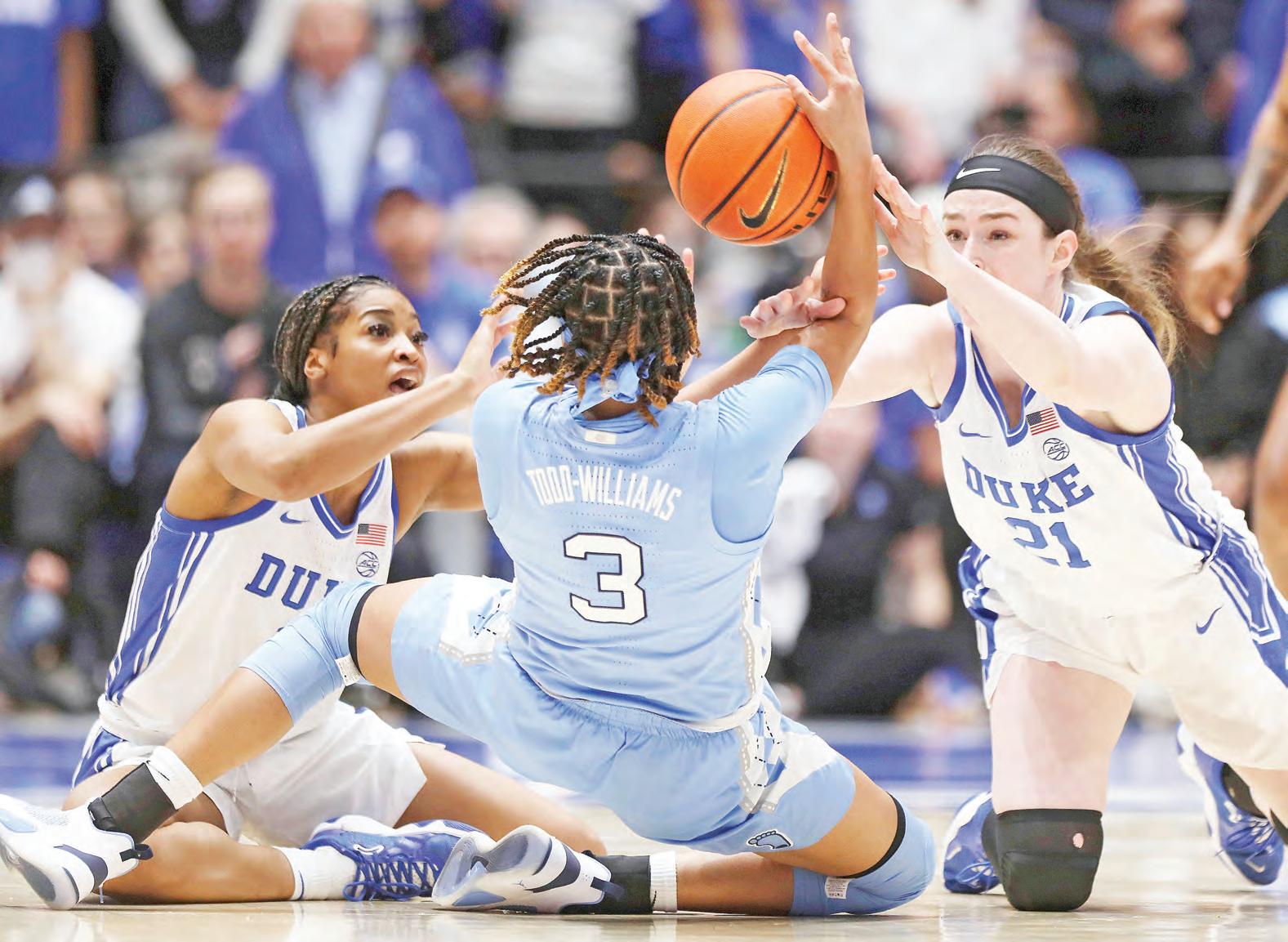
NCAA Tournament positioning is at stake after inconsistent seasons for the rivals
By Shawn Krest North State Journal
IT WILL BE must-see television once again on Saturday when the Tar Heels and Blue Devils close the ACC regular season against each other. However, after generations of “Clash of the Titans,” this year’s Duke-Carolina rivalry has been more “Growing Pains.” UNC and Duke enter the game outside the AP Top 25, the second time this season that both teams have been on the outside looking in when they square off.
Wide-open ACC women’s tournament comes to Greensboro
The conference tournament figures to determine NCAA bids
By Shawn Krest North State Journal
THE ACC WOMEN’S Basketball Tournament tips off in Greensboro on Wednesday as a top-heavy league looks to make one last statement before NCAA bids and seedings are handed out.
DUKE BLUE DEVILS
24-5 overall, 14-4 ACC
The Blue Devils were held to their lowest point total of the season (41) in the loss to North Carolina. Now, Kara Lawson’s team heads to Greensboro with a chip on its shoulder.
team, UNC also brought back the inconsistency that plagued it a year ago, leaving the Heels on the wrong side of the NCAA Tournament bubble as recently as a week ago. A loss at NC State, UNC’s fifth in six games, put the Tar Heels in the position of needing to win out to enter the ACC Tournament with a legitimate shot at an at-large NCAA berth.
stick together, let’s be our best when it really matters.’”
In year two of the Hubert Davis era, the Tar Heels have not been able to build on the success of last season’s March run, when they turned around an inconsistent season with a postseason run that produced back-to-back wins over Duke and took them into the second half of the national title game with a lead.
After returning most of the contributors from last year’s
So far, the Heels have taken care of business and, with the calendar about to flip a page, have shown signs that another March run could be brewing. UNC overcame a lackluster first half to post a comefrom-behind road win over Notre Dame. The Tar Heels then posted their first Quad I win of the season, in their 10th attempt, against Virginia. Carolina then held off a Florida State rally to pick up another road win. The difference for Carolina boils down to one simple factor — outside shots are falling. Heading into the Virginia game, UNC was shooting .299 on 3-point attempts this season, which ranked the Tar Heels in the bottom 25 nationally in accuracy. Over the past week, however, the
If the end of the regular season is any indication, it will be a wild, dramatic few days in Greensboro. The league race went down to the wire in Sunday’s final day of regular season play. Notre Dame wiped out a nine-point Louisville halftime lead and rode a late 12-3 run to top the Cardinals and stake a claim to a share of first place.
“I can’t wax poetic about it. It’s disappointing.”
Duke, however, held the tiebreaker, meaning if the Blue Devils topped archrival UNC, they would claim the top seed in Greensboro. Duke saw the Tar Heels wipe out a seven-point fourth-quarter deficit, however, to upset the Blue Devils and give the Irish the top seed.
Duke coach Kara Lawson on missing out on the top seed
“An opportunity to win a share of the title and coming up short is disappointing,” Lawson said. “I can’t wax poetic about it. It’s disappointing. It stinks. Not playing as well as we could have, I think, is probably one of the things that is disappointing. But, as I told the team in the locker room after the game, we put yourself in these situations. It is really hard to put yourself in a game like today, meaning you’re playing to win the title. That speaks to their discipline, their commitment … to be a team that was playing for something today.”
Duke, Carolina and Notre Dame now lead a quartet of ranked teams into the tournament. No. 8 Virginia Tech is the fourth team in the AP poll and will tip off the postseason as the highest-ranked ACC team despite being the No. 3 seed in the tournament. The top-seeded Irish are No. 10, second-seeded Duke No. 13 and seventh-seeded UNC No. 18. Louisville enters as the fourth seed and, like Tech, Duke and Notre Dame, gets a double-bye into Friday’s quarterfinals.

The top seed in the tournament has been significant in recent history. In the last 10 years, the No. 1 seed has made the ACC Tournament championship game nine times and cut down the nets in eight of those years. No. 2 seeds have made the title game just six times and won the championship twice. Here’s a look at the four North Carolina-based teams that will be playing for a title in Greensboro this week.
Duke is a veteran team with eight seniors and grad students on the roster, and is led by Elizabeth Balogun, who leads the team in rebounding and is one of two double-figure scorers, and Celeste Taylor, the team’s leading scorer and a finalist for national defensive player of the year.
The Blue Devils open play Friday with a possible rematch against UNC. Duke could also open with Clemson or Pitt depending on how the earlier rounds go. The Blue Devils were swept by UNC in two games and won their only game against both Clemson and Pitt.
UNC TAR HEELS
20-9 overall, 11-7 ACC
The Tar Heels tied Miami for sixth place and open as the seventh seed in the tournament. Courtney Banghart’s team won a hard-fought defensive struggle against Duke, posting the lowest winning score (45 points) in program history.
“I don’t know if that was fun for you guys to watch,” Banghart said, “but two of the best defensive teams in the league really brought that.”
Despite the boost from the win
See ACC WOMEN, page B4
See DUKE-UNC, page B4
KAITLIN MCKEOWN | THE NEWS & OBSERVER VIA AP
UNC and Duke are two of four Top 25-ranked teams that enter this week’s ACC Women’s Basketball Tournament in Greensboro looking to dethrone three-time defending champion NC State.
“We just kept saying ‘stick together,
Jon Scheyer, Duke basketball coach
AP PHOTO
Coach Jon Scheyer and Duke will look to end their regular season on a high note when the Blue Devils travel to Chapel Hill to face rival UNC on Saturday.
TRENDING
Adrian Wilson:
The former High Point native and NC State standout is joining the Panthers’ front office as vice president of player personnel. Wilson spent the last eight seasons with the Cardinals’ scouting department, including the last two as vice president of player personnel. He was promoted to co-interim general manager of the Cardinals near the end of last season. Wilson played 12 seasons with the Cardinals and made five Pro Bowls before retiring after the 2012 season. He played at NC State from 1998-2000.
Nino Niederreiter:
The former Hurricanes winger was traded from the Predators to the Jets on Saturday for a second-round pick in the 2024 NHL Draft. The 30-year-old Niederreiter had 18 goals and 10 assists over 56 games for the Predators this season. He has totaled 199 goals and 197 assists over 788 career NHL games with Nashville, the Islanders, Minnesota and Carolina. Niederreiter also has 15 goals and 15 assists in 82 career playoff games.
Olivia Miles: Notre Dame’s star sophomore guard left Sunday’s ACC title-clinching victory at Louisville and did not return with a right knee injury sustained while diving for a loose ball under the basket late in the second quarter. Miles, who leads the No. 10 Irish in scoring, rebounding, assists and steals, was able to flex her knee and eventually limped off the floor without assistance. She later returned to the bench midway through the third quarter with her right knee wrapped in ice.
Beyond the box score
POTENT QUOTABLES

The Hurricanes made their first move ahead of Friday’s NHL trade deadline, acquiring right wing Jesse Puljujarvi from the Oilers in exchange for prospect Patrik Puistola. Puljujarvi, the fourth overall pick in the 2016 NHL Draft, has 51 goals and 112 points in 317 career NHL games, but he had just five goals and nine assists in 58 games with Edmonton this season. He was a teammate of Carolina center Sebastian Aho on Finland’s gold medal w inning World Junior Championship team in 2016.

Broncos quarterback Russell Wilson on reports he asked Seahawks ownership to fire coach Pete Carroll and GM John Schneider and replace them with Sean Payton before he was traded to Denver.
Cardinals manager Oliver Marmol on umpire C.B. Bucknor not shaking his hand before Saturday’s exhibition game. They did shake hands on Tuesday.


PRIME NUMBER
19
Straight NASCAR Cup Series seasons with a win for Kyle Busch after he won Sunday’s race at Fontana — breaking a tie with Richard Petty for the most consecutive seasons with a win — in his second race with Richard Childress Racing.
Charles Howell III won the LIV Golf opener in Mexico, shooting a final‑round 63 to win by four shots over Peter Uihlein. It was the first LIV victory for Howell, who picked up $4 million for the individual title and an additional $1 million for leading his team Crushers to a nine‑shot win.

Quin Snyder and Nate McMillan went head to head in the ACC in the mid‑1980s. Now, the former Duke guard will replace his old NC State nemesis with the Atlanta Hawks. Snyder agreed to a five‑year deal to succeed McMillan on Saturday, returning to the NBA bench after eight seasons in Utah.
Baseball’s new pitch clock took until the start of spring training to stir up controversy. The Braves’ Cal Conley thought he had won the game with a two‑out, bases‑loaded walk‑off walk when umpire John Libka indicated strike three because Conley wasn’t set in the box as the clock wound under eight seconds. The penalty is an automatic strike.

B2 North State Journal for Wednesday, March 1, 2023
MLB
NHL
MARK STOCKWELL | AP PHOTO
NBA
BRANDON DILL | AP PHOTO
GOLF
JOHN BAZEMORE | AP PHOTO
“He has zero class.”
“I never wanted them fired.”
NICK WASS | AP PHOTO
WEDNESDAY 3.1.23
CHRIS SZAGOLA | AP PHOTO
MARK J. TERRILL | AP PHOTO
March Madness begins now for one-bid leagues
A look at the prospects for mid-major and small-conference teams in the state
SOUTHERN CONFERENCE
The Southern Conference Tournament tips off Friday in Asheville, and it might be the safest one-bid league for the regular season champion. The team that finished first in the standings has won every SoCon tournament since 2015. That includes seven outright league champions and one team that tied for the league title. This year, there’s a logjam at the top with Furman and Samford tying for first with identical 15-3 marks and UNC Greensboro a game back.
UNC Greensboro
20-11 overall, 14-4 SoCon (3rd)
BIG SOUTH CONFERENCE
UNC Asheville is this year’s poster child for the unfairness of one-bid leagues. The Bulldogs wrapped up the regular season title a couple weeks ago and won the league by a four-game margin. And all of that will mean nothing if they don’t take care of business in Charlotte. If recent history is any guide, the other teams to watch are Longwood and Radford, who tied for second at 12-6. A top-four team with double-digit wins has won the last nine Big South tourneys.
UNC Asheville 24-7 overall, 16-2 Big South (1st)
AP PHOTO Guard Jamarii Thomas and UNC Wilmington will look to keep their postseason tournament streak alive with a run in this week’s CAA Tournament.

For most of the conferences in college basketball, early March is not a time for bubble speculation and bracketology. While power conference teams like UNC, Michigan and Clemson have seen their odds of getting an atlarge bid recalculated after every game for the last two weeks, the math is much simpler for teams in mid-major conferences and beyond. Zero. That’s the chances of getting an at-large bid from the selection committee for all but a handful of college basketball conferences. And ESPN’s talking heads don’t need to rehash it at halftime of every game. It’s been zero since preseason practice tipped off. No matter how many regular season games you win or how dominant you are, unless you win your conference tournament, you won’t be going to the Big Dance. It’s harsh, but that’s life in a one-bid league. That means that, for most of the teams in our state, March Madness tips off this week with the conference tournaments that will determine whether or not they get the chance to play for the national title.
By Shawn Krest and Ryan Henkel
COLONIAL ATHLETIC CONFERENCE
The Colonial Athletic Conference has two teams at the top, College of Charleston and Hofstra, but there are teams that can still make a run in the tournament, namely last year’s champion, Delaware, and runner-up, UNCW.
Elon 8-23 overall, 6-12 CAA (9th)
Elon enters the CAA Tournament with distant hopes of going deep. Led by first-year coach Billy Taylor and graduate guard Sean Halloran (13.0 points), the Phoenix struggled early, losing 19 of their first 21 games, but finished the season 6-4.
Since joining the CAA, Elon has never won the tournament, but they do have one runner-up finish in 2021, following an improbable run as an 8-seed. It will take another such week for Elon to find its way into the NCAA Tournament — if the Phoenix can make it past their first opponent, William & Mary, top-seeded Hofstra awaits.
North Carolina A&T
13-18 overall, 8-10 CAA (7th)
In its first year in the CAA, A&T managed to finish right in the middle of the pack under interim coach Phillip Shumpert, who took over following the surprising dismissal of Willie Jones.
The Aggies have gotten steady production from their backcourt of sophomore Kam Woods and senior Demetric Horton, who are averaging a combined 28 points per game. Last year’s top producer, junior forward Marcus Watson, has been steady as well.
It’s the third conference in three years for the Aggies, and their last NCAA Tournament appearance came two conferences and a decade ago when they won the MEAC Tournament in 2013.
UNC Wilmington
22-9 overall, 12-6 CAA (4th)
The Seahawks are back in contention for the second year in a row and are looking to make a splash in the CAA Tournament. Last season, UNCW was runner-up to Delaware but went on to win the CBI.
Coach Takayo Siddle, in his third season with the Seahawks, will lean on sophomore forward Trazarien White, who leads the Seahawks in points (13.9) and rebounds (5.7)
UNCW hasn’t made the NCAA Tournament since Kevin Keatts was coach, getting an automatic bid in 2016 and 2017.
The Spartans will try to keep their postseason streak alive. Setting aside 2020, when the pandemic canceled all postseason basketball, UNCG has played in a tournament each of the last six postseasons. That includes two CBI appearances, two NITs and a pair of NCAA tourneys, most recently in 2021 when they lost to FSU as a No. 13 seed.
UNCG will be looking to rebound from disappointment in the regular season finale. The Spartans entered the game with a chance to at least tie for the regular season crown but were upset at East Tennessee State, losing a one-point heartbreaker. UNCG opens with the final game of Saturday’s quarterfinals, taking on sixth-seeded Wofford. Greensboro swept the regular season series with the Terriers, winning by nine on the road and in overtime at home. The Spartans are led by double-figure scorers Keyshaun Langley, Keondre Kennedy and Mikeal Brown-Jones.
Western Carolina
17-14 overall, 10-8 SoCon (4th)
The Catamounts are looking to make their first NCAA Tournament of the millennium. Western went in 1996, the last time they won a conference tournament, and nearly made history as a 16th seed before losing by two to topseeded Purdue. They’ve made the SoCon championship game just twice in the 27 years since. Western Carolina appears to be a long shot to break that trend this year.
Despite being a top-four seed in the conference tournament, they are a step below the top three teams, all 20-game winners that have combined for a 4410 conference record. The Catamounts won five of their last seven to stay above .500, overall and in the conference. They’ll open with No. 5 East Tennessee State on Saturday. Western swept the regular season series, winning by two at home and 11 on the road. They’re led by a trio of double-figure scorers in Tre Jackson, Tyzhaun Claude and Vonterius Woolbright.
SUN BELT
The Sun Belt doesn’t have a truly dominant team this season, with nine teams at 0.500 or above. Even the conference player of the year, Marshall’s Taevion Kinsey, comes from a team that finished 9-9 in conference play. So the automatic bid for the tournament champion could be anybody’s to grab.
Appalachian State
16-5 overall, 9-9 Sun Belt (9th)
The Mountaineers have three players averaging more than 10 points per game: senior forward Donovan Gregory, sophomore guard Terence Harcum and senior guard Tyree Boykin. Under coach Dustin Kerns, the Mountaineers have fallen a bit from last season when they finished second in the conference with a 12-6 record and made it to the conference semifinals.
App State last appeared in the NCAA Tournament in 2021 when it won the Sun Belt Tournament, one of three times the Mountaineers have accomplished the feat.
ATLANTIC SUN
The Atlantic Sun Conference has two powerhouses at the top of the conference. Liberty, which has been the ASUN regular season champion for five straight years, and Kennesaw State, which has never made the NCAA Tournament at the Division I level.
Queens
18-14 overall, 7-11 ASUN
In its first Division I season, Queens managed to squeak into the 10-team ASUN Tournament as the No. 9 seed and, after defeating the 10th-seeded Florida Gulf Coast on Monday, will have the tall task of facing topseeded Kennesaw State on Tuesday (the game was after press time).
The Royals are led by senior guard Kenny Dye and sophomore guard AJ McKee, who have combined for 32.6 points, 8.5 rebounds and 6.6 assists per game.
Due to its transition from Division II, Queens is ineligible for the NCAA Tournament even if it were to win the ASUN. The conference automatic bid would instead go to Kennesaw State.
The Bulldogs know the risks of the conference tournament. This season is their eighth Big South regular season title, but their previous seven top seeds in the conference tourney resulted in one NCAA appearance, in 2012. UNCA has four other NCAA bids that came from upsetting its way to the Big South Tournament title, most recently in 2016. Asheville enters the tournament on a six-game winning streak which helped the Bulldogs tie school records for overall and conference wins. They also won their last three games by double digits, matching the number of double-digit wins they had in their first 15 Big South games.
The Bulldogs open play on Friday against the winner of Wednesday’s 8-9 game between High Point and Charleston Southern. UNCA swept those two opponents in four regular season games, winning three by double figures. Asheville will rely on Drew Pember (20.4 points, 9.2 rebounds) and Tajion Jones (14.7 points, 5.0 rebounds), who became the school’s all-time leading scorer this season.
Gardner-Webb
15-15 overall, 10-8 Big South (4th, tie)
The Runnin’ Bulldogs will look to return to the Big Dance for just the second time in school history. Gardner-Webb won the Big South as a No. 4 seed in 2019, then put a scare in eventual national champion Virginia as a 16 seed in the NCAA Tournament. The Runnin’ Bulldogs tied for fourth again this season (but will be the fifth seed in the tournament), although they were hopeful of finishing much higher before dropping their last four regular season games.
The Bulldogs’ defense has eluded them in the last two weeks. Gardner-Webb has allowed foes to shoot 30 of 65 from 3, which is a .462 percentage, compared to the .318 rate it was allowing up until then. The two-point defense has also slumped, as the Runnin’ Bulldogs have given up twos at a .517 percentage in the last four, .448 before that. They’ll open with USC Upstate, which split with them this season. Each team won at home, G-W by 12 in late January, and USC Upstate by six in the season finale.
Campbell 13-17 overall, 8-10 Big South (7th)
The Camels have made one NCAA Tournament in their history, facing defending national champion Duke in 1992 as a No. 16 seed. Campbell will have its work cut out for itself to break its 31-year drought this season. The Camels will have to win four games after their seventh-place finish and sub-.500 record relegated them to Wednesday’s opening round. Campbell will open with No. 10 Presbyterian, then face No. 2 Longwood if they win. The Camels split with Presbyterian this year, losing by 10 on the road and winning by 17 at home.
Campbell has been playing better down the stretch, winning two of the last four, with their last three losses, all on the road, coming in double overtime, single overtime and by two in regulation. The Camels’ interior defense — Campbell ranks No. 333 in the nation in two-point shooting defense — has also improved over the last two weeks.
High Point 14-16 overall, 6-12 Big South (8th)
The Panthers have not made the NCAA Tournament since becoming a Division I team, and this year doesn’t look likely as a potential breakthrough year. High Point endured losing streaks of eight and four games earlier this year and finished eighth in the league with sub-.500 records overall and in conference play.
High Point opens play on Wednesday with No. 9 Charleston Southern. The winner will then get top-seeded UNC Asheville. The Panthers split with Charleston Southern, getting blown out on the road 106-69 in January to drop to 0-5 in the conference. They won the rematch at home by eight. High Point enters on a roll, winning three of their last four to close the regular season. They’ll look to John-Michael Wright (18.4 points), Zack Austin (14.4 points, 8.0 rebounds) and Jaden House (12.3 points) for offense.
B3 North State Journal for Wednesday, March 1, 2023
Frozen Finley turnout makes case for college hockey in NC

An estimated 24,000-plus fans attended the NC State-UNC club hockey outdoor game on Feb. 20
By Cory Lavalette North State Journal
RALEIGH — When asked on Feb. 13, five days before the Stadium Series outdoor game at Carter-Finley Stadium, if he had considered adding hockey as a Division I men’s and women’s sport, NC State Director of Athletics Boo Corrigan was quick to move on to other topics.
“You know what, we’ve got 8 million other things going on right now,” he said. “I’m not sure where that one stands.”
It may not be as many as 8 million, but he got about 24,000 reasons to rethink his position a week later. For how successful the Feb. 18 NHL Stadium Series game between the Hurricanes and Capitals was, nothing was as shocking as the turnout for the NC State-UNC club hockey outdoor game on that same ice two days later.
“It shows that it would work, but there’s a long road to get there,” said Tim Healy, coach of the NC State Icepack, following his team’s 7-3 win over the Tar Heels in front of an estimated 24,000 fans.
It’s not, however, a new path. The foundation has been laid during the Hurricanes’ 25 years in the state, and there might not be any better illustration of that than the Icepack.
“I’m from Raleigh,” Icepack freshman forward Zach Herman said after scoring a hat trick in the game dubbed Frozen Finley. “I’m a
business major at State. I grew up in this area. I played hockey here my whole life, except for one year.”
That one year, a gap year after he graduated from Middle Creek High School in Apex, was spent playing for the Maine Nordiques travel team. The 19-year-old returned from New England to attend NC State — and with it came a place to continue his hockey career on the school’s club hockey team.
“I played hockey my whole life, and I’ve never had as much fun as this year,” Herman said of joining the Icepack, which plays in the American Collegiate Hockey Association. “You know, being a student and being able to play — obviously my hope and I think everybody’s hope is (that) tonight kind of set
the groundwork for NC State hockey. We definitely want to make a name for ourselves and take this to the next level.

“I think Raleigh has got to be one of the fastest-growing hockey markets right now. I don’t think it’s slowing down.”
It starts with players like Herman, who benefited from the Hurricanes increasing the availability of hockey in North Carolina and were also able to learn from NHL players in the area’s youth programs. Several of those players participated in the Hurricanes Alumni Game last Monday evening and then hung around to watch the Icepack and Tar Heels play. “The thing is, 75% of our players are from North Carolina,” Healy
Charlotte FC aims for improvement in Year 2
The club, which posted a 13-18-3 record in its inaugural season, lost its season opener 1-0
By Jesse Deal North State Journal
CHARLOTTE — Playing in front of a near-capacity crowd of 69,345 people at Bank of America Stadium, Charlotte FC was hoping to kick off its second MLS season with a win.
While the defense was steady, the offense was absent, and the club’s 1-0 home loss to the New England Revolution on Feb. 25 was not the start to the regular season that coach Christian Lattanzio wanted.
“We played against a very good team — a strong team individually and collectively — but I don’t think that they overplayed us,” Lattanzio said after the game. “In the second half when we started to play a lit-
ACC WOMEN from page B1 at Duke to close the schedule, the Tar Heels have been inconsistent, splitting their last eight regular season games. They are led by Deja Kelly, who leads the team in scoring and assists. UNC will open play on Thursday against the winner of Clemson-Pitt. The Heels beat each team in their only meeting this year, and a win will give Carolina a rematch with Duke.
NC STATE WOLFPACK
19-10 overall, 9-9 ACC
The Wolfpack enters as winners of the last three ACC Tournaments and will be looking to keep that streak alive, even in a rebuilding year. NC State earned the eighth seed and will open with No. 9 Syracuse on Thursday. State beat the Orange in their only meeting this season, although the Wolfpack won just three of their last eight games down the stretch.
WAKE FOREST DEMON DEACONS
14-15 overall, 5-13 ACC
The 12th-seeded Deacs get the tournament started in Wednesday’s first game, taking on Virginia. Wake enters on a five-game losing streak and dropped its only meeting with Virginia by 20 in the season opener.
tle bit more individually rather than collectively, we opened up to these transitions and we found it difficult to win second balls quickly. … I think that we play our game and we create chances. Maybe we lacked a little bit of quality in certain moments where we could have created more problems for them.”
In the 89th minute of play, New England Revolution’s Henry Kessler found an opening for an easy goal past reserve goalkeeper Pablo Sisniega. Kristijan Kahlina, Charlotte FC’s primary goalkeeper, is still out while rehabilitating from an offseason back surgery in January.
Lattanzio credited his bench players’ performances in the opener.
“I think that they brought something to the party and came on with the energy. … For me, it is a plus because it means that the squad’s soul is alive and they want to really contribute,” he said.
Charlotte posted a 13-18-3 re-
DUKE-UNC from page B1
Heels have knocked down 24 of 51 from long range for a .471 percentage.
“Prior to these last three games, and I don’t know where we are now, but I mean, statistically, we were the worst 3-point shooting team in ACC,” said Davis. “So teams have been packing in and having multiple guys in the lane and making us shoot the ball from the outside at times. I’ve said before, at the end of the day, we’re gonna have to knock down some perimeter jump shots. And over the last couple games, we’ve been able to do that.”
The shooting helped UNC overcome a one-point outing from Armando Bacot at Florida State. If UNC keeps hitting outside shots, it could open things back up for the big man.
Duke hasn’t had the wild upand-down swings that have highlighted UNC’s season, but the Blue Devils have still struggled with consistency in coach Jon Scheyer’s first campaign.
Scheyer’s rookie year was slowed at the beginning with injuries to Dariq Whitehead and Dereck Lively, two of the top freshmen in the nation. Both players missed time at the start of the season and took longer than expected to find their sea legs after missing preseason practice time.
The team seems to have found
“But it is the beginning of the journey and the first game, so we have 33 more. We need to move on and focus on the next one.”
Christian Lattanzio, Charlotte FC coach
cord in its inaugural season, and Lattanzio and his roster travel to St. Louis City (1-0) on March 4 before coming back home to host Atlanta (1-0) on March 11.
The hope will be that Charlotte FC can resemble the club that went undefeated in five preseason matches and not the team that looked a bit lifeless in the season opener.
“We cannot feel sorry for ourselves. We have to move on and we have to learn that there are les-
said of the Icepack. “Which means most of our players have been coached by a lot of those alumni: Jesse Boulerice, Steve Rice, Rod Brind’Amour — all those guys.
“Bates Battaglia was out at First Goal (the Hurricanes’ introductory youth hockey program) when my daughters were going through it. So [those are] the guys that coached our kids, the ones that have forgotten more about hockey than I’ll ever know by playing in the NHL.”
And the legacy those former players have left is about more than the Hurricanes’ wins and losses or the banners hanging in next door’s PNC Arena rafters.
Yes, the NHL coming to Raleigh made hockey fans of many North Carolinians. But the biggest im-
sons to be learned in this game,” Lattanzio said. “Every goal is important and every moment is important. Concentration at this level is vital because you make a little lapse and then all of a sudden you are chasing — especially when you play against quality players. But it is the beginning of the journey and the first game, so we have 33 more. We need to move on and focus on the next one.”
While the opener ended in a loss, it was another solid showing by the club’s fans, who ranked second in the MLS in attendance behind Atlanta last season. The opener was a mix of excitement and respect — the match was the first regular season game since the tragic passing of defender Anton Walkes in a boating accident in January, and a moment of silence was held in honor of his memory before the match.
It was also an offseason of change for Charlotte FC following an inaugural season that included a midseason coaching change and a near playoff berth after the club finished ninth in the Eastern Conference.
Earlier this year, Charlotte FC’s inaugural captain Christian Fuchs
pact comes in the form of all the adolescents, teenagers and young adults who have grown up playing the sport.
There have been kids of former Hurricanes, some even born in North Carolina, who have made it to the NHL. Next, there will be players without an NHL dad who will reach the league after having played their youth hockey in the Triangle. Maybe they will even play their college hockey here.
“That can be a topic for another day, but it’s pretty clear,” Healy said. “If you build it, they’ll come.”
The 24,000-plus fan turnout for Frozen Finley showed hockey is here to stay. The next step is convincing people like Corrigan that it’s worth investing in.
announced his retirement from professional soccer after a 19-year career for seven teams in four different countries. He was then hired as an assistant coach on Lattanzio’s staff.
The young team is now anchored by striker Karol Swiderski — last season’s team leader in goals who played for Poland in last year’s World Cup — and forwards Ashley Westwood and Enzo Copetti, who both joined Charlotte FC during the offseason.
Westwood, 32, has 286 career Premier League appearances over 10 seasons at Burnley FC and Aston Villa, scoring a dozen goals with 32 assists. Copetti, 27, finished his last season as the leading scorer in Argentina’s first division.
Veteran MLS midfielder Brandt Bronico, a returning player who competed collegiately at UNC Charlotte, performed well in the season opener, stretching the field and providing a physical element on the pitch.
New Zealand newcomer Bill Tuiloma, 27, adds experience to Charlotte’s defense with 112 appearances for the Portland Timbers.
tinue to work. Each of them has gotten better. We spend a lot of time in practice working on individual work. Individual player development, which I think you can see the growth that our guys have made throughout the course of the season and, of course, understanding who you are playing with and how to play to each other’s strengths.”
Lively and Whitehead still aren’t the dominant forces many expected when Duke signed the nation’s best recruiting class, but Lively has become a defensive force who is challenging school freshman records for blocked shots. Whitehead has developed into one of the best outside shooting options for the Blue Devils.
The rest of the freshman class has also shown progress, with Kyle Filipowski leading the team in scoring and rebounding on his way to a likely ACC Rookie of the Year award. Mark Mitchell has shaken off a midseason shooting slump in recent games, and guard Tyrese Proctor has thrived leading the team, freeing up veteran Jeremy Roach to seek his shot.
its stride down the stretch, however. Duke entered this week, and a Tuesday game against NC State that occurred after press time, on a four-game winning streak, which matched the season’s longest for the Blue Devils.
“Throughout the year, wheth-
er it was injury, whether it was adversity with a loss or a setback, we just kept saying ‘stick together, stick together, let’s be our best when it really matters,’”
Scheyer said. “I give these guys a lot of credit because they haven’t pointed the finger and they con-
Both teams are aware of just how critical the rivalry rematch game can be. UNC’s win over Duke in Coach K’s final home game likely triggered the Tar Heels’ March run. The regular season finale could help erase the frustration of an up-and-down season for whichever team comes out with the victory.

B4 North State Journal for Wednesday, March 1, 2023
CHRIS SEWARD | AP PHOTO UNC’s improved 3-point shooting should open up more space in the paint for big man Armando Bacot.
STAN GILLILAND | FOR NORTH STATE JOURNAL
Left, NC State Icepack forwards Chase Williams (24) and Alex Fong (13) try to score on UNC goalie Joel Hughes during the Frozen Finley game on Feb. 20. Right, Members of the NC State Icepack celebrate a goal during their 7-3 win over UNC in the Frozen Finley outdoor game at Carter-Finley Stadium on Feb. 20.
Total Cash & Bond Proceeds
$2,645,408,638
Add Receipts $338,822,744
Less Disbursements $255,900,431
Reserved Cash $125,000,000
Unreserved Cash Balance Total $6,760,577,886
Disaster reimbursements: $0
RECESSION from page B5
credit card borrowing and many corporate loans increasingly expensive. Problem is, inflation is also slowing more gradually and more fitfully than it first seemed last year. Earlier this month, the government revised up consumer price data. Partly as a result of the revisions, over the past three months, core consumer prices — which exclude volatile food and energy costs — have risen at a 4.6% annual rate, up from 4.3% in December.
Those trends raise the possibility that the Fed’s policymakers will decide they must raise rates further than they’ve previously projected and keep them higher for longer to try to bring inflation down to their 2% target. Doing so would make a recession later this year more likely. Prices rose 5% in January from a year earlier, according to the Fed’s preferred measure.
Using the historical data, the authors project that if the Fed raises its benchmark rate to between 5.2% and 5.5% — three-quarters of a point higher than its current level, which many economists envision the Fed doing — the unemployment rate would rise to 5.1%, while inflation would fall as low as 2.9%, by the end of 2025.
Inflation at that level would still exceed Fed’s target, suggesting that the central bank would have to raise rates even further.
In December, Fed officials projected that higher rates would slow growth and raise the unemployment rate to 4.6%, from 3.4% now. But they predicted the economy would grow slightly this year and next and avoid a downturn. Other economists have pointed to periods when the Fed successfully achieved a socalled soft landing, including in 1983 and 1994. Yet in those periods, the paper notes, inflation wasn’t nearly as severe as it was last year, when it peaked at 9.1% in June, a four-decade high. In those earlier cases, the Fed hiked rates to prevent inflation, rather than having to reduce inflation after it had already surged.
China says TikTok ban reflects US insecurities
The Associated Press BEIJING — U.S. government bans on Chinese-owned video sharing app TikTok reveal Washington’s own insecurities and are an abuse of state power, a Chinese Foreign Ministry spokesperson said Tuesday.
The U.S. government “has been overstretching the concept of national security and abusing state power to suppress other countries’ companies,” Mao Ning said at a daily briefing. “How unsure of itself can the U.S., the world’s top superpower, be to fear a young person’s favorite app to such a degree?”
The White House is giving all federal agencies, in guidance issued Monday, 30 days to wipe
TikTok off all government devices. The White House already did not allow TikTok on its devices.
TikTok is used by two-thirds of American teens, but there’s concern in Washington that China could use its legal and regulatory powers to obtain private user data or to try to push misinformation or narratives favoring China. Congress and more than half of U.S. states have so-far banned TikTok from government-issued mobile devices.
Some have also moved to apply the ban to any app or website owned by ByteDance Ltd., the private Chinese company that owns TikTok and moved its headquarters to Singapore in 2020.
China has long blocked a long list of foreign social media platforms and messaging apps, including YouTube, Twitter, Facebook and Instagram.
Washington and Beijing are at odds over myriad issues including trade, computer chips and other technology, national security and Taiwan, along with the discovery of a suspected Chinese spy balloon over the U.S. and its shooting down earlier this month.
On Monday, Canada announced it was joining the U.S. in banning TikTok from all government-issued mobile devices.
“I suspect that as government takes the significant step of telling all federal employees that they can no longer use TikTok on
their work phones many Canadians from business to private individuals will reflect on the security of their own data and perhaps make choices,” Canadian Prime Minister Justin Trudeau told reporters after the announcement.
Canadian Treasury Board President Mona Fortier said the Chief Information Officer of Canada had determined that TikTok “presents an unacceptable level of risk to privacy and security.”
“On a mobile device, TikTok’s data collection methods provide considerable access to the contents of the phone,” Fortier said.
The app will be removed from Canadian government issued phones on Tuesday.
The European Union’s executive branch said last week it has temporarily banned TikTok from phones used by employees as a cybersecurity measure.
TikTok has questioned the bans, saying it has not been given an opportunity to answer questions and governments were cutting themselves off from a platform beloved by millions.
Raimondo seeks to rally US behind $52 billion chip program
The Associated Press
WASHINGTON, D.C. — Commerce Secretary Gina Raimondo on Thursday called on the country to unite around a $52 billion effort to restore the U.S. as the world leader in advanced computer chips, saying it will require training of tens of thousands of workers.
“The research, innovation and manufacturing sparked by this law will enable us to be the technological superpower, securing our economic and national security future for the next generation,” Raimondo said in a speech at Georgetown University.

The government sees the funding as a launching pad to create two major semiconductor clusters inside the U.S. featuring a network of factories, research laboratories and other infrastructure.
But fulfilling that vision will be a multi-year challenge that requires job training and figuring out scientific breakthroughs to lower the cost of producing advanced chips. There is a level of cooperation that is needed among the federal government, state governments, local officials, CEOs, universities and school districts — the kind of joint effort that could be challenging in an era of divided politics.
The Biden administration is hopeful it can surmount political hurdles as Democrats and Republicans alike back the initiative.
President Joe Biden signed the CHIPS and Science Act into law last August on the promise that it would spur factory groundbreakings. It is also designed to ensure a steady supply of the chips needed for autos, appliances, electronics, toys, toothbrushes and weapons systems.
The U.S. — despite being the birthplace of chips — has ceded ground to producers in South Korea and Taiwan, creating an economic and national security challenge if shipping lanes are blocked.
Chips are integrated circuits that are embedded in a semiconductor, a material — notably silicon — that can manage the flow of electric current. The terms “chip” and “semiconductor” are often used interchangeably.
Starting next week, the application process will begin for semiconductor firms seeking to qualify for $39 billion in government backing
to help fund their expansion. The administration expects the $39 billion for factories will generate 10 times that, at a minimum, in private-sector investment.
The potential benefits come from the spillover effects of computer chip production jobs that typically pay over $100,000, leading to additional economic activity and business formation. That has Raimondo saying that colleges and universities must triple the number of graduates in semiconductor-related fields, otherwise there will be a shortage of workers.
“This is math, people, this isn’t a political agenda,” Raimondo said in her speech. The new law also contains $11 billion to fund a research partnership between universities, companies and national laboratories — all with the mission of increasing a chip’s processing power and lowering the cost of semiconductors
so that there are buyers in a global market.
“We have to bring down the cost — big time — which means innovation, innovation, innovation,” Raimondo told The Associated Press in an interview.
To succeed, she said, the U.S. needs a whole-of-society effort. It’s the kind of mobilization akin to World War II or the space race that grandparents talk about to younger generations, a make-or-break moment for the nation with the world’s largest economy and military.
“There have been times in history,” Raimondo said in the interview, “where a president used the pursuit of a goal, a technological goal, like putting a man on the moon, like leading the world in nuclear technology, to catalyze the whole country to do their part in achieving that goal.”
Critics note that the real work is with administering the law and
monitoring how the funds are used, warning that simply spending money does not guarantee the desired results and could create economic distortions.
“The CHIPS Act is a work in progress to say the least,” said Anthony Kim, a research fellow at the conservative Heritage Foundation. “Spending more is not and cannot be a solution, particularly in the current economy environment where inflationary pressures are still abundant.”
The promise of government support is spurring construction plans, though it’s still early in a process that will take years. Major chip companies such as TSMC, Intel, Micron, IBM and others have so far committed to roughly $200 billion for investments in new plants, according to the White House. Last week, Texas Instruments announced an $11 billion investment to expand its semiconductor production in Utah.
Courts Online Self-Help Center (www.courtinfo.ca.gov/selfhelp), or by contacting your local court or county bar association. NOTE: The court has a statutory lien for waived fees and
costs on any settlement or arbitration award of $10,000 or more in a civil case. The court's lien must be paid before the court will dismiss the case. 1A VISO! Lohan demandado. Si no responde dentro de 30 dfas, la corte puede decidir en su contra sin escuchar su version. Lea la informac/6n a continuaci6n.
Tiene 30 DIAS DE CALENDARIO despues de que le entreguen esta citaci6n y papeles legates para presentar una respuesta por escrito en esta corte y hacer que se entregue una copia al demandante. Una carta o una 1/ amada telef6nica no lo protegen. Su respuesta por escrito tiene que estar en formato legal correcto si desea que procesen su caso en la corte. Es posible que haya un formulario que usted pueda usar para su respuesta. Puede encontrar estos tormularios de la corte y mas informaci6n en el Centro de Ayuda de las Cortes de California (www. sucorte.ca.gov), en la biblioteca de !eyes de su condado o en la corte que le quede mas cerca. Si no puede pagar la cuota de presentaci6n, pida al secretario de la corte que le de un formulario de exenci6n de pago de cuotas. Si no presenta su respuesta a tiempo, puede perder el caso por incumplimiento y la corte le podra quitar su sue/do, dinero y bienes sin mas advertencia.
Hay otros requisitos legales. Es recomendabfe que /lame a un abogado inmediatamente. Si no conoce a un abogado, puede llamar a un servicio d rem/s/6n a af)ogados. Si no puede pagar a un abogado, es posible que cumpla con los requisitos para obtener servicios legates gratuitos de un programa de servicios legales sin fines de /ucro. Puede encontrar estos grupos sin fines de /ucro en el sitio web de California Legal Services, (www.lawhelpcalifornia.org}, en el Centro de Ayuda de las Cortes de Callfornia, (www. sucorte.ca.gov) o ponlendose en contacto con ta corte o el co/eglo de abogados locales. AV/SO: Por fey, la corte tiene derecho a reclamar las cuotas y los costos exentos por imponer un gravamen sobre cualquier recuperaci6n de $10,000 6 mas de valor recibida mediante un acuerdo o una concesi6n de arbltraje en un caso de derecho civil.
Tiene que a ar el ravamen de ta corte antes de ue la corte ueda desechar el caso.
name and address of the court is:
nombre y direccion de la corte es):
The name, address, and telephone number of plaintitt's attorney, or plaintitt without an attorney, is: (El nombre, la direccion y el numero de telefono de/ abogado de/ demandante, ode/ demandante que
B6 North State Journal for Wednesday, March 1, 2023 CABARRUS CUMBERLAND IN THE GENERAL COURT OF JUSTICE OF NORTH CAROLINA SUPERIOR COURT DIVISION CABARRUS COUNTY 22sp574 IN THE MATTER OF THE FORECLOSURE OF A DEED OF TRUST EXECUTED BY ROBERT B HAYES DATED JANUARY 17, 2014 AND RECORDED IN BOOK 10842 AT PAGE 167 IN THE CABARRUS COUNTY PUBLIC REGISTRY, NORTH CAROLINA NOTICE OF SALE Under and by virtue of the power and authority contained in the above-referenced deed of trust and because of default in payment of the secured debt and failure to perform the agreements contained therein and, pursuant to demand of the holder of the secured debt, the undersigned will expose for sale at public auction at the usual place of sale at the Cabarrus County courthouse at 10:00AM on March 8, 2023, the following described real estate and any improvements situated thereon, in Cabarrus County, North Carolina, and being more particularly described in that certain Deed of Trust executed Robert B Hayes, dated January 17, 2014 to secure the original principal amount of $250,600.00, and recorded in Book 10842 at Page 167 of the Cabarrus County Public Registry. The terms of the said Deed of Trust may be modified by other instruments appearing in the public record. Additional identifying information regarding the collateral property is below and is believed to be accurate, but no representation or warranty is intended. Address of property: 9539 Laguna Avenue NW, Concord, NC 28027 Tax Parcel ID: 46812747070000 Present Record Owners: Robert B. Hayes The record owner(s) of the property, according to the records of the Register of Deeds, is/are Robert B. Hayes. The property to be offered pursuant to this notice of sale is being offered for sale, transfer and conveyance AS IS, WHERE IS. Neither the Trustee nor the holder of the note secured by the deed of trust being foreclosed, nor the officers, directors, attorneys, employees, agents or authorized representative of either the Trustee or the holder of the note make any representation or warranty relating to the title or any physical, environmental, health or safety conditions existing in, on, at or relating to the property offered for sale. Any and all responsibilities or liabilities arising out of or in any way relating to any such condition expressly are disclaimed. This sale is subject to all prior liens and encumbrances and unpaid taxes and assessments including any transfer tax associated with the foreclosure. A deposit of five percent (5%) of the amount of the bid or seven hundred fifty dollars ($750.00), whichever is greater, is required from the highest bidder and must be tendered in the form of certified funds at the time of the sale. Cash will not be accepted. This sale will be held open ten days for upset bids as required by law. After the expiration of the upset period, all remaining amounts are IMMEDIATELY DUE AND OWING. Failure to remit funds in a timely manner will result in a Declaration of Default and any deposit will be frozen pending the outcome of any re-sale. If the sale is set aside for any reason, the Purchaser at the sale shall be entitled only to a return of the deposit paid. The Purchaser shall have no further recourse against the Mortgagor, the Mortgagee, the Substitute Trustee or the attorney of any of the foregoing. SPECIAL NOTICE FOR LEASEHOLD TENANTS residing at the property: be advised that an Order for Possession of the property may be issued in favor of the purchaser. Also, if your lease began or was renewed on or after October 1, 2007, be advised that you may terminate the rental agreement upon 10 days written notice to the landlord. You may be liable for rent due under the agreement prorated to the effective date of the termination. The date of this Notice is February 16, 2023. Jason K. Purser, NCSB# 28031 Morgan R. Lewis, NCSB# 57732 Attorney for LLG Trustee, LLC, Substitute Trustee LOGS Legal Group LLP 10130 Perimeter Parkway, Suite 400 Charlotte, NC 28216 (704) 333-8107 | (704) 333-8156 Fax | www.LOGS.com 22-114663 TAKE NOTICE SUMMONS (CITACION JUDICIAL) Notice To Defendant: (Aviso Al Demandado): Kristen Fuentes aka Kristen N. Fuentes aka Kristen Funtes, An Individual; Oscar Fuentes akaOscar J. Fuentes III, An Individual; The State Of California, Acting By And Through The California Department Of Motor Vehicles, A Government Entity; And Does 1 Through 20, Inclusive You Are Being Sued By Plaintiff: (Lo Esta Demandando El Demandante): The Golden 1 Credit Union, A California Corporation NOTICE! You have been sued. The court may decide against you without your being heard unless you respond within 30 days. Read the information below. You have 30 CALENDAR DAYS after this summons and legal papers are served on you to file a written response at this court and have a copy served on the plaintiff. A letter or phone call will not protect you. Your written response must be in proper legal form if you want the court to hear your case. There may be a court form that you can use for your response. You can find these court forms and more information at the California Courts Online Self-Help Center (www.courtinfo.ca.gov/se/fhelp), your county law library, or the courthouse nearest you. If you cannot pay the filing fee, ask the court clerk for a fee waiver form. If you do not file your response on time, you may lose the case by default, and your wages, money, and property may be taken without further warning from the court. There are other legal requirements. You may want to call an attorney right away. If you do not know an attorney, you may want to call an attorney referral service. If you cannot afford an attorney, you may be eligible for free legal services from a nonprofit legal services program. You can locate these nonprofit groups at the California Legal Services Web site (www.lawhelpcalifomia.org), the California
SACRAMENTO COUNTY SUPERIOR COURT 720 NINTH STREET, ROOM 102 SACRAMENTO,
95814
no tiene abogado, es): KAREL ROCHA 212413 Prenovost, Normandin, Dawe & Rocha 2122 N Broadway, Suite 200 Santa Ana, CA 92706 (714) 547-2444 DATE (FECHA): APR 6 2022 CLERK, BY (SECRETARIO): A. MOCANU (For Proof of Service of this summons, use Proof of Service of Summons Form POS-010. (Para prueba de entrega de esta citacion use el formufario Proof of Service of Summons, (POS-010)). SUPERIOR COURT OF CALIFORNIA Sacramento 04/06/2022 amocanu Case Number: 34-2022-00317695
The
(El
CA
NCDOT CASH REPORT FOR THE WEEK ENDING FEB 24
AP PHOTO
Commerce Secretary Gina Raimondo speaks before President Joe Biden to African leaders gathered for the U.S.-Africa Leaders Summit Dec. 14, 2022, in Washington, D.C.
B12 North State Journal for Wednesday, March 1, 2023 PEN AND PAPER PURSUITS from February 22, 2023 sudoku solutions NOTICE OF FORECLOSURE SALE 22 SP 1434 Under and by virtue of the power of sale contained in a certain Deed of Trust made by Melvin Eugene Abrams (PRESENT RECORD OWNER(S): Melvin Eugene Abrams) to Adelita A. Shubert, Trustee(s), dated April 2, 2012, and recorded in Book No. 14731, at Page 810 in Wake County Registry, North Carolina, default having been made in the payment of the promissory note secured by the said Deed of Trust and the undersigned, Substitute Trustee Services, Inc. having been substituted as Trustee in said Deed of Trust by an instrument duly recorded in the Office of the Register of Deeds Wake County, North Carolina and the holder of the note evidencing said indebtedness having directed that the Deed of Trust be foreclosed, the undersigned Substitute Trustee will offer for sale at the Wake County Courthouse door, the Salisbury Street entrance in Raleigh, Wake County, North Carolina, or the customary location designated for foreclosure sales, at 1:30 PM on March 6, 2023 and will sell to the highest bidder for cash the following real estate situated in Raleigh in the County of Wake, North Carolina, and being more particularly described as follows: All that certain lot or parcel of land situated in Raleigh Township, Wake County, North Carolina and more particularly described as follows: Being all of Lot No. 19, Block H, according to plat entitled “Eastgate III, Raleigh, N.C.,” dated October 15, 1965, prepared by Castleberry-Edgerton Co., Consulting Engineers, and recorded in Book of Maps 1965, Page 277, Volume 3, Wake County Registry, North Carolina. Trustee may, in the Trustee’s sole discretion, delay the sale for up to one hour as provided in N.C.G.S. §45-21.23. Should the property be purchased by a third party, that party must pay the excise tax, as well as the court costs of Forty-Five Cents ($0.45) per One Hundred Dollars ($100.00) required by N.C.G.S. §7A-308(a)(1). The property to be offered pursuant to this notice of sale is being offered for sale, transfer and conveyance “AS IS, WHERE IS.” Neither the Trustee nor the holder of the note secured by the deed of trust/security agreement, or both, being foreclosed, nor the officers, directors, attorneys, employees, agents or authorized representative of either the Trustee or the holder of the note make any representation or warranty relating to the title or any physical, environmental, health or safety conditions existing in, on, at or relating to the property being offered for sale, and any and all responsibilities or liabilities arising out of or in any way relating to any such condition are expressly disclaimed. Also, this property is being sold subject to all taxes, special assessments, and prior liens or prior encumbrances of record and any recorded releases. Said property is also being sold subject to applicable Federal and State laws. A deposit of five percent (5%) of the purchase price, or seven hundred fifty dollars ($750.00), whichever is greater, is required and must be tendered in the form of certified funds at the time of the sale. If the trustee is unable to convey title to this property for any reason, the sole remedy of the purchaser is the return of the deposit. Reasons of such inability to convey include, but are not limited to, the filing of a bankruptcy petition prior to the confirmation of the sale and reinstatement of the loan without the knowledge of the trustee. If the validity of the sale is challenged by any party, the trustee, in its sole discretion, if it believes the challenge to have merit, may request the court to declare the sale to be void and return the deposit. The purchaser will have no further remedy. Additional Notice for Residential Property with Less than 15 rental units, including Single-Family Residential Real Property An order for possession of the property may be issued pursuant to N.C.G.S. § 45-21.29 in favor of the purchaser and against the party or parties in possession by the clerk of superior court of the county in which the property is sold. Any person who occupies the property pursuant to a rental agreement entered into or renewed on or after October 1, 2007, may after receiving the notice of foreclosure sale, terminate the rental agreement by providing written notice of termination to the landlord, to be effective on a date stated in the notice that is at least 10 days but not more than 90 days, after the sale date contained in this notice of sale, provided that the mortgagor has not cured the default at the time the tenant provides the notice of termination. Upon termination of a rental agreement, the tenant is liable for rent due under the rental agreement prorated to the effective date of the termination. SUBSTITUTE TRUSTEE SERVICES, INC. SUBSTITUTE TRUSTEE c/o Hutchens Law Firm P.O. Box 1028 4317 Ramsey Street Fayetteville, North Carolina 28311 Phone No: (910) 864-3068 https://sales.hutchenslawfirm.com Firm Case No: 1993 - 39326 NOTICE OF FORECLOSURE SALE 22 SP 2440 Under and by virtue of the power of sale contained in a certain Deed of Trust made by Yarwo Joyce Bannerman and Howard D. Spruill (Deceased) (PRESENT RECORD OWNER(S): Howard D. Spruill and Yarwo Joyce Bannerman, Heirs of Howard D. Spruill: Dexter Spruill, Trenna Spruill, Marilyn Davis Spruill) to Thompson & Saputo, Trustee(s), dated April 19, 2004, and recorded in Book No. 010782, at Page 01798 in Wake County Registry, North Carolina, default having been made in the payment of the promissory note secured by the said Deed of Trust and the undersigned, Substitute Trustee Services, Inc. having been substituted as Trustee in said Deed of Trust by an instrument duly recorded in the Office of the Register of Deeds Wake County, North Carolina and the holder of the note evidencing said indebtedness having directed that the Deed of Trust be foreclosed, the undersigned Substitute Trustee will offer for sale at the Wake County Courthouse door, the Salisbury Street entrance in Raleigh, Wake County, North Carolina, or the customary location designated for foreclosure sales, at 1:30 PM on March 13, 2023 and will sell to the highest bidder for cash the following real estate situated in Knightdale in the County of Wake, North Carolina, and being more particularly described as follows: BEING all of Lot 30, Rutledge Landing Subdivision, Phase 1, as shown on a map recorded in Book of Maps 2001, Pages 1256-1258, Wake County Registry. Together with improvements located thereon said property being located at 5141 Julip Drive, Knightdale, North Carolina. Trustee may, in the Trustee’s sole discretion, delay the sale for up to one hour as provided in N.C.G.S. §45-21.23. Should the property be purchased by a third party, that party must pay the excise tax, as well as the court costs of Forty-Five Cents ($0.45) per One Hundred Dollars ($100.00) required by N.C.G.S. §7A-308(a)(1). The property to be offered pursuant to this notice of sale is being offered for sale, transfer and conveyance “AS IS, WHERE IS.” Neither the Trustee nor the holder of the note secured by the deed of trust/security agreement, or both, being foreclosed, nor the officers, directors, attorneys, employees, agents or authorized representative of either the Trustee or the holder of the note make any representation or warranty relating to the title or any physical, environmental, health or safety conditions existing in, on, at or relating to the property being offered for sale, and any and all responsibilities or liabilities arising out of or in any way relating to any such condition are expressly disclaimed. Also, this property is being sold subject to all taxes, special assessments, and prior liens or prior encumbrances of record and any recorded releases. Said property is also being sold subject to applicable Federal and State laws. A deposit of five percent (5%) of the purchase price, or seven hundred fifty dollars ($750.00), whichever is greater, is required and must be tendered in the form of certified funds at the time of the sale. If the trustee is unable to convey title to this property for any reason, the sole remedy of the purchaser is the return of the deposit. Reasons of such inability to convey include, but are not limited to, the filing of a bankruptcy petition prior to the confirmation of the sale and reinstatement of the loan without the knowledge of the trustee. If the validity of the sale is challenged by any party, the trustee, in its sole discretion, if it believes the challenge to have merit, may request the court to declare the sale to be void and return the deposit. The purchaser will have no further remedy. Additional Notice for Residential Property with Less than 15 rental units, including Single-Family Residential Real Property An order for possession of the property may be issued pursuant to N.C.G.S. § 45-21.29 in favor of the purchaser and against the party or parties in possession by the clerk of superior court of the county in which the property is sold. Any person who occupies the property pursuant to a rental agreement entered into or renewed on or after October 1, 2007, may after receiving the notice of foreclosure sale, terminate the rental agreement by providing written notice of termination to the landlord, to be effective on a date stated in the notice that is at least 10 days but not more than 90 days, after the sale date contained in this notice of sale, provided that the mortgagor has not cured the default at the time the tenant provides the notice of termination. Upon termination of a rental agreement, the tenant is liable for rent due under the rental agreement prorated to the effective date of the termination. SUBSTITUTE TRUSTEE SERVICES, INC. SUBSTITUTE TRUSTEE c/o Hutchens Law Firm P.O. Box 1028 4317 Ramsey Street Fayetteville, North Carolina 28311 Phone No: (910) 864-3068 https://sales.hutchenslawfirm.com Firm Case No: 11955 - 51535 IN THE GENERAL COURT OF JUSTICE SUPERIOR COURT DIVISION 22SP1895 STATE OF NORTH CAROLINA COUNTY OF WAKE NOTICE OF SALE IN THE MATTER OF THE FORECLOSURE OF A DEED OF TRUST EXECUTED BY MARK S. JENSEN AND JULIE A. JENSEN DATED FEBRUARY 16, 2006 RECORDED IN BOOK 11820 AT PAGE 2590 IN THE WAKE COUNTY PUBLIC REGISTRY, NORTH CAROLINAUnder and by virtue of the power and authority contained in the above-referenced deed of trust and because of default in payment of the secured debt and failure to perform the agreements therein contained and, pursuant to demand of the holder of the secured debt, the undersigned will expose for sale at public auction at the usual place of sale at the Wake County courthouse at 10:00 AM on March 8, 2023, the following described real estate and any improvements situated thereon, in Wake County, North Carolina, and being more particularly described in that certain Deed of Trust executed by Mark S. Jensen; Julie A. Jensen, dated February 16, 2006 to secure the original principal amount of $240,000.00, and recorded in Book 11820 at Page 2590 of the Wake County Public Registry. The terms of the said Deed of Trust may be modified by other instruments appearing in the public record. Additional identifying information regarding the collateral property is below and is believed to be accurate, but no representation or warranty is intended. Address of property: 2709 Blue Ravine Road, Wake Forest, NC 27587 Tax Parcel ID: 0234248 Present Record Owners: Mark S. Jensen; Julie A. Jensen The record owner(s) of the property, according to the records of the Register of Deeds, is/are Mark S. Jensen and Julie A. Jensen. The property to be offered pursuant to this notice of sale is being offered for sale, transfer and conveyance AS IS, WHERE IS. Neither the Trustee nor the holder of the note secured by the deed of trust being foreclosed, nor the officers, directors, attorneys, employees, agents or authorized representative of either the Trustee or the holder of the note make any representation or warranty relating to the title or any physical, environmental, health or safety conditions existing in, on, at or relating to the property offered for sale. Any and all responsibilities or liabilities arising out of or in any way relating to any such condition expressly are disclaimed. This sale is subject to all prior liens and encumbrances and unpaid taxes and assessments including any transfer tax associated with the foreclosure. A deposit of five percent (5%) of the amount of the bid or seven hundred fifty dollars ($750.00), whichever is greater, is required from the highest bidder and must be tendered in the form of certified funds at the time of the sale. This sale will be held open ten days for upset bids as required by law. After the expiration of the upset period, all remaining amounts are IMMEDIATELY DUE AND OWING. Failure to remit funds in a timely manner will result in a Declaration of Default and any deposit will be frozen pending the outcome of any re-sale. If the sale is set aside for any reason, the Purchaser at the sale shall be entitled only to a return of the deposit paid. The Purchaser shall have no further recourse against the Mortgagor, the Mortgagee, the Substitute Trustee or the attorney of any of the foregoing. SPECIAL NOTICE FOR LEASEHOLD TENANTS residing at the property: be advised that an Order for Possession of the property may be issued in favor of the purchaser. Also, if your lease began or was renewed on or after October 1, 2007, be advised that you may terminate the rental agreement upon 10 days written notice to the landlord. You may be liable for rent due under the agreement prorated to the effective date of the termination. The date of this Notice is 15th day of February, 2023. Grady I. Ingle, Attorney for Substitute Trustee Ingle Law Firm, PA 13801 Reese Blvd West Suite 160 Huntersville, NC 28078 (980) 771-0717 Ingle Case Number: 13133-17833 NOTICE OF FORECLOSURE SALE 22 SP 2295 Under and by virtue of the power of sale contained in a certain Deed of Trust made by Robert O. Drefke (PRESENT RECORD OWNER(S): Robert O. Drefke) to John C. Morisey, Jr. and Steven R. Mull, Trustee(s), dated March 31, 2005, and recorded in Book No. 011292, at Page 02059 in Wake County Registry, North Carolina, default having been made in the payment of the promissory note secured by the said Deed of Trust and the undersigned, Substitute Trustee Services, Inc. having been substituted as Trustee in said Deed of Trust by an instrument duly recorded in the Office of the Register of Deeds Wake County, North Carolina and the holder of the note evidencing said indebtedness having directed that the Deed of Trust be foreclosed, the undersigned Substitute Trustee will offer for sale at the Wake County Courthouse door, the Salisbury Street entrance in Raleigh, Wake County, North Carolina, or the customary location designated for foreclosure sales, at 1:30 PM on March 6, 2023 and will sell to the highest bidder for cash the following real estate situated in Cary in the County of Wake, North Carolina, and being more particularly described as follows: BEING all of Unit 14D, Building 14, Chesapeake Condominiums, as set forth in Condominium File No 67 and as described in Declaration of Covenants as record in Deed Book 3383, Page 255, Wake County Registry. Including the unit located thereon said unit being located at 101 Oyster Bay Court, B2, Cary, North Carolina. Trustee may, in the Trustee’s sole discretion, delay the sale for up to one hour as provided in N.C.G.S. §45-21.23. Should the property be purchased by a third party, that party must pay the excise tax, as well as the court costs of Forty-Five Cents ($0.45) per One Hundred Dollars ($100.00) required by N.C.G.S. §7A-308(a)(1). The property to be offered pursuant to this notice of sale is being offered for sale, transfer and conveyance “AS IS, WHERE IS.” Neither the Trustee nor the holder of the note secured by the deed of trust/security agreement, or both, being foreclosed, nor the officers, directors, attorneys, employees, agents or authorized representative of either the Trustee or the holder of the note make any representation or warranty relating to the title or any physical, environmental, health or safety conditions existing in, on, at or relating to the property being offered for sale, and any and all responsibilities or liabilities arising out of or in any way relating to any such condition are expressly disclaimed. Also, this property is being sold subject to all taxes, special assessments, and prior liens or prior encumbrances of record and any recorded releases. Said property is also being sold subject to applicable Federal and State laws. A deposit of five percent (5%) of the purchase price, or seven hundred fifty dollars ($750.00), whichever is greater, is required and must be tendered in the form of certified funds at the time of the sale. If the trustee is unable to convey title to this property for any reason, the sole remedy of the purchaser is the return of the deposit. Reasons of such inability to convey include, but are not limited to, the filing of a bankruptcy petition prior to the confirmation of the sale and reinstatement of the loan without the knowledge of the trustee. If the validity of the sale is challenged by any party, the trustee, in its sole discretion, if it believes the challenge to have merit, may request the court to declare the sale to be void and return the deposit. The purchaser will have no further remedy. Additional Notice for Residential Property with Less than 15 rental units, including Single-Family Residential Real Property An order for possession of the property may be issued pursuant to N.C.G.S. § 45-21.29 in favor of the purchaser and against the party or parties in possession by the clerk of superior court of the county in which the property is sold. Any person who occupies the property pursuant to a rental agreement entered into or renewed on or after October 1, 2007, may after receiving the notice of foreclosure sale, terminate the rental agreement by providing written notice of termination to the landlord, to be effective on a date stated in the notice that is at least 10 days but not more than 90 days, after the sale date contained in this notice of sale, provided that the mortgagor has not cured the default at the time the tenant provides the notice of termination. Upon termination of a rental agreement, the tenant is liable for rent due under the rental agreement prorated to the effective date of the termination. SUBSTITUTE TRUSTEE SERVICES, INC. SUBSTITUTE TRUSTEE c/o Hutchens Law Firm P.O. Box 1028 4317 Ramsey Street Fayetteville, North Carolina 28311 Phone No: (910) 864-3068 https://sales.hutchenslawfirm.com Firm Case No: 7446 - 28399 WAKE Notice to Creditors Having qualified as Executor of the Estate of Letha J. Shull, late of Wake County, North Carolina (2023-E-532), the undersigned does hereby notify all persons, firms and corporations having claims against the estate of said decedent to exhibit them to the undersigned on or before the 17th day of May 2023 or this notice will be pleaded in bar of their recovery. All persons, firms and corporations indebted to the said estate will please make immediate payment to the undersigned. This the 1st day of March 2023. Linwood Turlington Executor of the Estate of Letha J. Shull c/o Lisa M. Schreiner Attorney at Law P.O. Box 446 114 Raleigh Street Fuquay Varina, NC 27526 (For publication: 2/15, 2/22, 3/1, 3/8/2023) Notice to Creditors Having qualified as Administrator of the Estate of Leroy Blount, late of Wake County, North Carolina (2022-E2000), the undersigned does hereby notify all persons, firms and corporations having claims against the estate of said decedent to exhibit them to the undersigned on or before the 17th day of May 2023 or this notice will be pleaded in bar of their recovery. All persons, firms and corporations indebted to the said estate will please make immediate payment to the undersigned. This the 1st day of March 2023. Lillie M. Wilson Administrator of the Estate of Leroy Blount c/o Lisa M. Schreiner Attorney at Law P.O. Box 446 114 Raleigh Street Fuquay Varina, NC 27526 (For publication: 2/15, 2/22, 3/1, 3/8/2023)
COUNTY NEWS
Single-vehicle crash on NC 742 in Stanly leaves one dead
On Monday morning, one person died in a single-vehicle crash on NC Highway 742 near Old Sandbar Road, according to the North Carolina State Highway Patrol. Troopers said that a Dodge Ram truck ran off the right side of the road and flipped after overcorrecting. The individual who died was a passenger in the vehicle and did not have a seatbelt on. The other three individuals in the truck were taken to the hospital to have their injuries treated. It is believed that speeding played a role in the crash. At this time, the identity of the deceased victim has yet to be released to the public, and the crash is still under investigation. Whether or not charges will be pressed against the driver has also yet to be determined.
NCDHHS delays
Medicaid Managed
Care Behavior Health and IDD Tailored Plans
To ensure nearly 150,000 people seamlessly receive care on day one, the North Carolina Department of Health and Human Services has delayed the implementation of the NC Medicaid Managed Care Behavior Health, and Intellectual/ Development Disabilities
Tailored Plans from April 1 until October 1. Tailored Plans serve people with complex behavioral health conditions, Intellectual/ Developmental disabilities, and traumatic brain injury. Their behavioral and physical health needs are often great, requiring ongoing care from multiple providers. The delayed start of these plans will allow local management entities/managed care organizations more time to contract with additional providers to ensure a smooth transition for people using the plans and their care providers. Until the Tailored Plans launch, people who will be covered by them will continue to receive care through their existing plans. Tailored Care Management, which was launched on December 1, 2022, will continue to support these beneficiaries by providing a care team to coordinate care across providers.
NC House Speaker ‘grateful’ to officers following traffic incident
By A.P. Dillon North State Journal
RALEIGH — North Caroli-
na House Speaker Tim Moore
(R-Kings Mountain) is grateful to the law enforcement officers who were on hand when the vehicle he was traveling in was rammed by an apparent drunk driver.
Moore said he, Rep. David Willis of Union County and Deputy Chief of Staff Dan Gurley were returning to Raleigh after a series of events in Wilson. The speaker’s security officer was driving the SUV westbound on U.S. Highway 64 near Knightdale around 9:30 p.m. when it was rammed from behind at least three times, Moore told reporters at the Legislative Building.

Moore praised his driver, Offi-
“[I’m] glad that no one was hurt in this alarming incident and that law enforcement caught the suspect.”
Gov. Roy Cooper
cer Jason Perdue, for controlling the SUV after it was struck and taking action on the road, which has a 70 mph speed limit. Moore said the truck stopped in the left lane of the highway roughly 5 miles later. No one in the SUV was hurt, Moore spokesperson Demi Dowdy said.
“Thank God we’re all just all right,” Moore said, adding he saw nothing to indicate that he or his
vehicle was targeted due to politics or his role in government.
The General Assembly-owned Chevrolet Tahoe’s license plate resembles a private owner’s plate, with none of the specialized numbering that lawmakers’ personal vehicle plates receive. The SUV didn’t appear severely damaged.
“Many of us have been rear-ended by a car, unfortunately, in the past,” Moore said.
“But when you’re moving at highway speeds and another car approaches you at a higher rate of speed and it hits the car ... you can imagine the kinds of things that are going through your mind at that point and its intention.”
Moore’s spokesperson said he is very grateful to the State Highway Patrol (SHP) officers involved in swiftly handling the situation and particularly grateful
Stanly commissioners receive feedback on potential library sculpture removal
By Jesse Deal North State Journal
ALBEMARLE — While the Stanly County Board of Commissioners recently voted to remove an art sculpture from the public library main branch in Albemarle, there has been some pushback from local members of the arts community regarding the pending removal.
Stanly County Arts Council executive director Renee VanHorn and Stanly Arts guild treasurer Kathy Almond spoke during the county commissioners meeting on February 6, each asking the board members to reconsider their decision on the concrete sculptures, which are located at the lower entrance to the library.
Per multiple board members, there have been safety concerns that the location of the artwork has led to loitering, drug para-
“We are requesting that the Stanly County Commissioners slow down the process and explore all possibilities before destroying the public art at the Stanly County Library.”
Renee VanHorn
phernalia, and homeless people sleeping in the area.
In order to move forward with the removal — projected to cost around $16,500 — the county will now have to acquire permission from the Albemarle Historic Resources Commission with a meeting set for March 14. If the commission does not agree to the county’s request, the decision
could be appealed to the North Carolina Superior Court.
“We are requesting that the Stanly County Commissioners slow down the process and explore all possibilities before destroying the public art at the Stanly County Library,” VanHorn said, adding that the removal of the art would not solve local societal problems such as homelessness or drug problems.
The sculptures, originally built in the 1970s, have recently been painted and refurbished by volunteers.
VanHorn continued: “If the intent is just to remove these issues from the library grounds, let’s have a conversation and explore ideas such as improved lighting — including the original lighting that Mr. Bierline had installed in the original sculptures — surveillance cameras and oth-
to NC General Assembly Police Officer Jason Purdue, who was driving the state-owned Chevy Tahoe vehicle at the time.
“On Thursday, Feb. 23, at approximately 9:43 p.m., the State Highway Patrol responded to a hit and run collision on I-87 near mile marker 9 in Wake County,” according to a statement from the SHP. “The incident initially took place on I-87 near mile marker 13 when a 2000 Chevrolet S10 pickup truck struck the rear of a 2020 Chevrolet Tahoe multiple times as both vehicles were traveling in the southbound lanes.”
SHP’s statement also says that Purdue activated his emergency lights to signal the pickup truck to pull over, but the driver failed to stop, resulting in Perdue having to give chase.
The driver of the pickup, James Matthew Brogden, 38, of Goldsboro, was arrested after finally coming to a stop near mile marker 9. SHP indicated their investigation indicated that “impairment was a factor with regard to Mr. Brogden,” and that EMS had responded to the
8 5 2017752016 $0.50
VOLUME 6 ISSUE 17 | WEDNESDAY, MARCH 1, 2023 | STANLYJOURNAL.COM THE STANLY COUNTY EDITION OF THE NORTH STATE JOURNAL
See STANLY ART page 2
AP PHOTO
House Speaker Tim Moore, R-Kings Mountain, speaks to reporters last Friday at the Legislative Building in Raleigh.
WEDNESDAY 3.1.23
“Join the conversation”
FDA proposes oat and soy can still be called milk
The Associated Press SOY, OAT, ALMOND and other drinks that bill themselves as “milk” can keep using the name, according to draft federal rules released last week.

Food and Drug Administration officials issued guidance that says plant-based beverages don’t pretend to be from dairy animals – and that U.S. consumers aren’t confused by the difference.
Dairy producers for years have called for the FDA to crack down on plant-based drinks and other products that they say masquerade as animal-based foods and cloud the real meaning of “milk.”
Under the draft rules, the agency recommends that beverage makers label their products clearly by the plant source of the food, such as “soy milk” or “cashew milk.”
We stand corrected:
To report an error or a suspected error, please send NSJ an email: corrections@nsjonline.com with “Correction request” in the subject line.
WEEKLY CRIME LOG
♦ MOREE, WILLIAM LEE (W /M/43), ASSAULT ON FEMALE, 02/25/2023, Stanly County Sheriff’s Office
♦ MUNSON, BRITTANY NICOLE (W /F/33), MISDEMEANOR
LARCENY, 02/25/2023, Stanly County Sheriff’s Office
♦ LILES, WILLIAM LEON (B /M/44), DRIVING WHILE
IMPAIRED, 02/24/2023, Stanly County Sheriff’s Office
♦ LYNCH, ERICA MAE (B /F/51), SIMPLE ASSAULT, 02/24/2023, Stanly County
Sheriff’s Office
♦ MCKINNEY, KEVIN DEMETRUIUS J (B /M/26), DISCHARGE WEAPON
OCCUPIED PROPERTY, 02/24/2023, Stanly County
Sheriff’s Office
♦ OXENDINE, TADAN AUBRY (W /M/23), ASSAULT INDIV
W/DISABILITY, 02/24/2023, Stanly County Sheriff’s Office
♦ PLOWMAN, BRET JAMES (W /M/36), POSSESS
METHAMPHETAMINE, 02/24/2023, Stanly County
Sheriff’s Office
♦ ROBINSON, JOEL GILBERT (W /M/37), THIRD DEG SEX
EXPLOIT MINOR, 02/24/2023, Stanly County Sheriff’s Office
♦ EDWARDS, KENNETH RONALD (B /M/61), IDENTITY THEFT, 02/22/2023, Stanly County
Sheriff’s Office
♦ BAILEY, TAMIKAH FATIMA (B /F/39), AWDWIKISI, 02/21/2023, Stanly County
Sheriff’s Office
♦ CAMPBELL, ANAFAYE
MAHALEY (W /F/31), FELONY
POSSESSION SCH I CS, 02/21/2023, Stanly County
Sheriff’s Office
♦ HATHCOCK, WHITNEY
NICHOLE (W /F/33), FELONY
LARCENY, 02/21/2023, Stanly County Sheriff’s Office
♦ SMITH, RYAN GAGE (W /M/29), ASSAULT ON
FEMALE, 02/21/2023, Stanly County Sheriff’s Office
♦ WALL, XAVIER MARKIETH (B /M/22), MAL CONDUCT BY PRISONER/THROW, 02/20/2023, Stanly County
Sheriff’s Office
♦ WHITSON, RYAN SCOTT (W /M/38), POSSESS METHAMPHETAMINE, 02/20/2023, Stanly County Sheriff’s Office
The rules also call for voluntary extra nutrition labels that note when the drinks have lower levels of nutrients than dairy milk, such as calcium, magnesium or vitamin D. They would continue to allow labels that note when plant-based drinks have higher levels. Fortified soy milk is the only plant-based
food included in the dairy category of U.S. dietary guidelines because of its nutrient levels.
The new guidelines are aimed at providing consumers clear nutrition information, FDA Commissioner Dr. Robert Califf said in a statement. The draft rules do not apply to nondairy products other than beverages, such as yogurt.
The National Milk Produc-
“the guidance misguidedly admonishes companies to make a direct comparison” with cow’s milk, even though key nutrients are already required to be listed.
In recent years, the number of plant-based drinks has exploded to include dozens of varieties, including cashew, coconut, hemp and quinoa-based beverages. Although the drinks are made from the liquid extracts of plant materials, they are frequently labeled –and described – as “milks.”
FILE PHOTO
ers Federation, an industry trade group, applauded the call for extra nutrition information on drink labels, but said they rejected the FDA’s conclusion that plant-based drinks can be called milk because it’s a “common and usual name.”
The Good Food Institute, a group that advocates for plantbased products, objected to the extra labeling in a statement, saying
In the U.S., almond milk is the most popular variety, but oat milk has been seeing the fastest growth. Still, nondairy sales are dwarfed by traditional milk. Sales of refrigerated cow’s milk grew to $12.3 billion in the 52 weeks ending Jan. 28, compared to $2.5 billion for nondairy milk, according to NielsenIQ.
In the past, lawmakers in dairy states have tried to get bills passed that would require the FDA to enforce a federal standard that defines “milk” as the product of “milking one or more healthy cows.”
The agency will accept comments on the draft guidelines through April 23.
WWE leaning in to social media ahead of possible sale
The Associated Press
WWE, an organization that is already king of the ring on social media, will attempt to expand its online presence this year with the $6.5 billion sports entertainment company hinting that it may put itself up for sale.
WWE surpassed 20 million followers on its flagship TikTok account during its most recent quarter, the first sports league to do so, and it’s launching three international TikTok accounts after the WWE Español TikTok handle reached nearly 2 million followers in its first year, according to the company.
WWE’s presence online is already broad and it does not appear to be slowing down.
The company’s YouTube channel topped 92 million subscribers in the fourth quarter, making it one of only 10 channels on the platform to surpass the 90 million subscriber mark, according to Paul Levesque, the company’s chief content officer and director who wrestled under the name Triple H.
To put those numbers in perspective, the National Basketball Association has 19.8 million subscribers, the National Football League has 10.6 million, and Major League Baseball has 4.05 million.
Part of the reason is that, unlike the NFL, NBA and MLB, the WWE has no off season. It churns out new content from television shows and premium live events all year long and its fans eat it up.

The online presence of the company is so pervasive that it seeps into the social media posts from some of the world’s biggest athletes.
After defeating the Philadelphia Eagles in Super Bowl LVII, Kansas City Chiefs quarterback and MVP Patrick Mahomes posted a photo of himself on Twitter holding the Vince Lombardi trophy in one hand, and a WWE belt in the other.
That photo has been viewed more than 23 million times and that number keeps rising. Constant innovations that are
STANLY ART from page 1
er ideas generated by brainstorming solutions with community partners.”
She referenced artist George Bierline, who “wanted this sculpture to be an extension of the library activities.”
Bierline’s works have been
showcased at the North Carolina Museum of Art, Smithsonian Institution, Virginia Museum of Fine Arts, North Carolina Mu-
blended with entertainment sets WWE apart on social media platforms, said Christopher Zook, chairman and chief investment officer of CAZ Investments.
“It has consistently found ways to generate interest and stay ahead of the growing changes in consumer behavior,” Zook said. “The viral, fan-service nature of their content is how they have built so much staying power.”
Increased sports viewership has put a premium on the value of organizations with a large following and that moves WWE to the front of the line for companies looking to expand into new areas, said Zook, particularly when seeking to reach key demographics willing to spend.
And the platforms on which the WWE is focused increasingly attract a crowd with discretionary income to spend.
Among those between the ages of 18 and 29, 95% say they use YouTube, according to a Pew Research Center survey on social media use by U.S. adults in 2021.
TikTok is expected to overtake
seum of Art, and Duke University Museum of Art, gaining the attention of the country’s leading art critics. Following VanHorn’s public statement, Almond touched on many of the same themes in her own address.
“At a time when Stanly County is seeing unprecedented growth, prosperity, and an ever-changing landscape of opportunities, should we not work more diligently to preserve, protect and pro -
Facebook next year as the most-consumed social network among U.S. adults over the age of 18, according to Insider Intelligence. The research firm expects 18-to-24-year-old TikTok users in the U.S. to spend an average of 1 hour on the platform every day this year.
And WWE has been quick to partner with people that have a massive following on social media platforms, most recently the social media personality Logan Paul.
Three months after signing a contract with WWE last year, Paul took out a cell phone and filmed himself jumping from the ropes and onto Roman Reigns. That video garnered more than 40 million views across Paul’s and WWE’s social platforms in less than 24 hours, according to Levesque, topping all social media posts for the company last year.
The test will be how potential buyers value WWE’s social media presence and that potential going forward.
However, Wall Street already appears to be very optimistic about the
mote our resources and our assets than to demolish, destruct, and destroy them?” she asked. “Please consider further investigation prior to taking any action to remove this public art installation.”
Commissioner Peter Asciutto thanked VanHorn and Almond for their input on the matter, adding that he would like the county to incorporate lights and security cameras around the artwork if it stays where it is now.
Commissioner Patty Crump
entertainment company.
In the last 12 months shares of World Wrestling Entertainment Inc. have jumped 50%, a period when all major U.S. stock markets have fallen into a serious funk.
Rumors of a sale ramped up late last year when WWE founder Vince McMahon returned to the company and took a seat on the board after a short retirement.
In a letter dated Dec. 20, but published in January, McMahon wrote, “Given the rapidly evolving media landscape in which more and more companies are seeking to own the intellectual property offered on their streaming platforms – I firmly believe that the best thing to do for all of WWE’s shareholders and other stakeholders is to undertake a comprehensive review of strategic alternatives.”
Zook, of CAZ Investments, believes potential buyers are aware that social media has changed the equation.
“When you combine the staying power of live sporting events, with the rapid growth in subscrip-
echoed Asciutto’s sentiments: “We definitely need to discuss better options, so thank you for bringing that to our attention. I will certainly slow down the process on my end. Not that it’s up to me, but as we go forward with this, it’s not going to be immediate. These are good things for us to consider.”
The Stanly County Board of Commissioners will hold its next meeting on March 6 in the Gene McIntyre Room at Stanly Commons.
2 Stanly County Journal for Wednesday, March 1, 2023
Robbins Publisher Matt
Editor in Chief Griffin Daughtry Local News
Cory Lavalette Sports Editor Frank Hill Senior Opinion Editor Lauren Rose Design Editor Published each Wednesday as part of North State Journal 1550 N.C. Hwy 24/27 W, Albemarle, N.C. 28001
SUBSCRIBE: 336-283-6305 STANLYJOURNAL.COM Annual Subscription Price: $50.00 Periodicals Postage Paid at Raleigh, N.C. and at additional mailing offices.
Send address changes to: North State Journal 1201 Edwards Mill Rd. Suite 300 Raleigh, NC 27607
Stanly County Journal ISSN: 2575-2278 Neal
Mercer
Editor
TO
POSTMASTER:
#278
WEEKLY FORECAST
WEDNESDAY MAR 1 HI 7 1° LO 60° PRECIP 6% THURSDAY MAR 2 HI 7 3° LO 59 PRECIP 74% FRIDAY MAR 3 HI 7 2° LO 51° PRECIP 8 3% SATURDAY MAR 4 HI 67 LO 4 4° PRECIP 3% SUNDAY MAR 5 HI 62 ° LO 3 8° PRECIP 4% MONDAY MAR 6 HI 65° LO 4 4° PRECIP 4% TUESDAY MAR 7 HI 6 8° LO 4 5° PRECIP 5%
Milk is displayed at a grocery store.
AP PHOTO
Spectators watch fire works during the World Wrestling Entertainment “WWE” Crown Jewel matches at King Fahd International Stadium in Riyadh, Saudi Arabia, Thursday, Oct. 31, 2019.
Neal Robbins, publisher | Frank Hill, senior opinion editor

Why students should explore global education opportunities
“I strongly encourage students to take advantage of the opportunity to study abroad and become Phillips Ambassadors at UNC-Chapel Hill or Duke University.”
MY STUDY ABROAD JOURNEY in Hong Kong as a Phillips Ambassador is an experience I will cherish forever. When I arrived in Hong Kong, I was struck by the incredible skyscrapers, the mix of East and West influences in the city, and the beautiful natural landscapes. Everyone I met, from students and professors at the Chinese University of Hong Kong (CUHK) to street food vendors, was friendly and welcoming. The demographics of the locals were similar to those of the “melting pot” that you would see in Chinatowns in the United States, and around every corner were restaurants, shopping centers, and even commercial centers. At night, the city lights up with large screens displaying advertisements and commercials that can be seen hundreds of feet away.
Throughout my time in Hong Kong, I immersed myself in the culture and gained a deeper understanding of the society and politics of the region. At CUHK, I took classes that explored the historical, political, and financial conditions that have shaped the experience of race and ethnicity in Hong Kong, with a particular focus on state narratives regarding colonialism and indigeneity and on state policies regarding meritocracy, multiracialism, and financial systems. These classes allowed me to apply familiar frameworks in entirely new contexts and gain a valuable understanding of the society I was living in.
One of the highlights of my experience was exploring the city and its surroundings with new friends from all over the world. We went on epic bike rides, embarked on food tours, took double-decker tram rides, visited the Tian Tan Buddha and Nan Lian Garden, explored the islands of Lamma and Cheung Chau, and wandered the streets of Mong Kok and Tsim Sha Tsui. We also hiked up to Victoria Peak, Dragon’s Back, and West Dog’s Teeth, giving us incredible aerial views of massive skyscrapers juxtaposed with rising mountains. The hikes also gave me a newfound appreciation for nature, which was made even more apparent when nature was readily accessible without a car.
The Phillips Ambassadors program not only provided me with the opportunity to travel to and study in Hong Kong but also challenged me to critically examine and understand the society and culture of my
host country. The program empowers students like me to engage with Asia academically and personally. Studying abroad is an incredible opportunity to gain a new perspective, learn about different cultures, and make lasting memories. Upon returning to North Carolina, the program’s coursework and discussions solidified my desire to continue learning and exploring Asia. I’m honored to be a part of the Phillips Ambassadors program, and I am grateful for the opportunity to gain a deeper understanding of the culture and society of Hong Kong. Studying abroad is beneficial not only for personal growth but also for the development of North Carolina as a whole. The Phillips Ambassadors program is an excellent opportunity for students to gain a deeper understanding of the world and expand their knowledge and skills. It also allows students to connect with and learn from other students studying abroad in Asia. This setting can create a community of globally-minded individuals who can contribute to the future development and growth of North Carolina.
Overall, my study abroad experience in Hong Kong has been a lifechanging experience that has broadened my perspective, deepened my understanding of the culture and society of the region, and created some of the best memories of my life. I plan to continue to learn more about Asia and expand my knowledge of the area. I strongly encourage students to take advantage of the opportunity to study abroad and become Phillips Ambassadors at UNC-Chapel Hill or Duke University, as it will expand their understanding of the world and provide them with a unique and valuable experience that will benefit them in their personal and professional lives.
Jason Yang is a senior at the University of North Carolina at Chapel Hill pursuing a major in Business Administration and a minor in Entrepreneurship. He is from Asheboro, NC, where he attended Eastern Randolph High School before transferring to the North Carolina School of Science and Mathematics in Durham, NC, and later graduated in 2019. Upon graduating from UNC-Chapel Hill, Jason will be working as an investment banking analyst in New York City.

Joe Biden turns the American Government into Wokeness, Inc.
Equity presumes that any group disparities must be the result of perverse government policy, and that the only corrective is government interventionism.
LAST WEEK, as Presidents Day weekend loomed, the Biden administration dropped a little-noticed executive order. That executive order happened to be one of the broadest, most transformative executive orders in modern American history; it turned the federal government into one giant machine designed for the propagation of woke principles. The so-called “Executive Order On Further Advancing Racial Equity And Support For Underserved Communities Through The Federal Government” -- presumably titled in jargonistic gobbledygook in order to avoid scrutiny — set out the key guiding principle for the Biden administration. This principle, “equity,” will now be used to redirect the entirety of the federal government’s awesome powers.
What, pray tell, is “equity”? It certainly isn’t equality — the presumption that Americans ought to be treated equally under the law as individuals. Instead, equity presumes that any group disparities must be the result of perverse government policy, and that the only corrective is government interventionism. The new executive order suggests that “by advancing equity, the Federal Government can support and empower all Americans, including the many communities in America that have been underserved, discriminated against, and adversely affected by persistent poverty and inequality.” Poverty, you see, is purely the outgrowth of discrimination and lack of service. Individuals must never be implicated in their own failures, nor can cultural differences justify group underperformance. As Ibram X. Kendi more bluntly puts it, “As an anti-racist, when I see racial disparities, I see racism.”
The solution, therefore, is that government must correct all policy that allows for the annoyingly eternal human conditions of poverty and inequality. Biden’s executive order dictates that equity be “embedded... into the fabric of Federal policymaking and service delivery.” This will not be a “one-time project”; it must instead be a
“multi-general commitment, and it must remain the responsibility of agencies across the Federal Government.” To that end, virtually every agency of government must establish an “Agency Equity Team... to coordinate the implementation of equity initiatives.” Every aspect of government down to the design, development and acquisition of artificial intelligence must advance equity.
Nothing gives the president of the United States the unilateral authority to reshape the entire executive branch into an agent of “equity.” That is a legislative function, and the legislature has given no such grant of power. But Biden is doing it anyway. And that means stacking — presumably for generations to come — a Deep State of “equity”-driven Left-wing bureaucrats throughout the federal government, systematizing the equity agenda throughout the unelected and unanswerable areas of the executive branch.
This is dangerous, and it must be stopped. It is violative of constitutional principles, both in terms of separation of powers and under the equal protection clause — which is designed to prevent precisely the sort of group-driven resource allocation Biden favors. Stopping this executive order must become the first priority of the Republican House, and of future Republican presidential candidates.
Biden is deliberately planting a poisonous seed in the fertile soil of the world’s most powerful executive branch. That seed will bear hideous fruit as the years roll by. The only answer is to uproot the seed before it begins to sprout.

Ben Shapiro, 38, is a graduate of UCLA and Harvard Law School, host of “The Ben Shapiro Show,” and co-founder of Daily Wire+. He is a three-time New York Times bestselling author; his latest book is The Authoritarian Moment: How The Left Weaponized America’s Institutions Against Dissent.

3 Stanly County Journal for Wednesday, March 1, 2023
OPINION
VISUAL VOICES
LETTER TO THE EDITOR | JASON YANG
COLUMN | BEN SHAPIRO
SIDELINE REPORT
COLLEGE BASKETBALL
No. 1 South Carolina women run No. 1 streak to 36 weeks Indianapolis South Carolina is No. 1 for the 36th consecutive week.
That ties Louisiana Tech for the second-longest run atop The Associated Press Top 25 women’s basketball poll in history. Only UConn with 51 weeks has a longer streak. Indiana stayed at No. 2 despite a lastsecond loss to Iowa. Utah was third with LSU and Maryland rounding out the top five. Iowa was seventh with Virginia Tech eighth. UConn fell five spots to ninth after losing to St. John’s. Notre Dame is 10th. Duke dropped two spots to No. 13 after losing to UNC, which climbed four place to No. 18. NC State received three votes.
NHL Sharks retire Marleau’s No. 12 jersey
The Sharks retired Patrick Marleau’s No. 12 on Saturday, the first number to be raised to the rafters in the team’s 32-year history. Marleau played an NHL-record 1,779 games — breaking the previous mark of 1,767 set by Gordie Howe — ranks 23rd with 566 goals and 52nd with 1,197 points for San Jose, Toronto and Pittsburgh. He holds the Sharks records for games played (1,607), goals (522) and points (1,111). He also won Olympic gold medals for Canada in 2010 and ’14.
NBA Haslams reportedly agree to purchase stake in Bucks
Milwaukee
Cleveland Browns owners
Jimmy and Dee Haslam have reportedly agreed to purchase Marc Lasry’s 25% stake of the Milwaukee Bucks in a deal that puts the value of the NBA franchise at $3.5 billion. The agreement has not been finalized. The Haslams would be spending about $875 million for Lasry’s stake of the team. It would be the second-highest valuation in NBA history, behind the $4 billion valuation for the Phoenix Suns and Phoenix Mercury when Mat Ishbia acquired them in a deal that closed this month. The Haslams bought the Browns from Randy Lerner in 2012 for $1.05 billion.
TENNIS
Djokovic breaks record for most weeks ranked No. 1
London Novak Djokovic broke the record for the most time spent at No. 1 in the professional tennis rankings by a man or woman, beginning his 378th week in the ATP’s top spot on Monday to surpass Steffi Graf’s 377 leading the WTA. He already held the men’s mark, eclipsing Roger Federer’s old ATP standard of 310 weeks in March 2021. After Djokovic and Graf on the all-time No. 1 weeks list are Martina Navratilova with 332 and Serena Williams with 319, followed by Federer. The computerized rankings began in the 1970s. Djokovic has finished seven years atop the ATP, another men’s record.
Busch gets 1st RCR victory in Fontana’s Cup farewell
cord-setting veteran burned plenty of them Sunday while rewarding his new team — and sending this beloved track off in style.
in December after his 15-year tenure with Joe Gibbs Racing ended. This win was Busch’s first since Bristol last season on a dirt track, and his first on pavement since Pocono in 2021.
With his 61st career victory, Busch earned a win in his record 19th consecutive Cup season, breaking a tie with Richard Petty. Busch said he set his focus on Petty’s longevity record “a long, long time ago.”

The Associated Press
FONTANA, Calif. — Kyle Busch still smiles at the memory of getting thrown out of California Speedway during his first competitive trip here in 2001. The 16-year-old upstart dominated a NASCAR Truck Series practice, only to be told he couldn’t run in a race sponsored by Marlboro because he was too young to smoke.
“That was my ‘Welcome to NASCAR’ moment and my ‘Welcome to California Speedway’ moment,” Busch said.
Anger, conflict and disrespect have always appeared to be Busch’s favorite fuels, and the re -
Busch stormed up from the back after an early speeding penalty to earn his first victory for Richard Childress Racing, winning on this two-mile Southern California track for the fifth and final time.
Busch held off Chase Elliott and Ross Chastain in the NASCAR Cup Series’ final race on the gloriously weathered asphalt at Auto Club Speedway, which will soon be demolished to make room for a proposed half-mile track. Busch asked Fontana officials for a chunk of that asphalt as a souvenir after he burned it up one last time on his way to Victory Lane.
“That’s what I enjoy the most about this racetrack,” Busch said.
“It’s big. It gets spread out. But man, you can move around and you can spread out and you can make your own destiny by trying to find something that will work for your race car. It’s a sad day for me to see this racetrack in its last race being a two-mile configuration. Glad I was able to win the final run here.”
Busch drove his Chevrolet to victory in only his second race with RCR, which scooped him up
“I’m just so thankful for the opportunity to set that bar and would love to continue to keep raising it,” Busch said.
The victory also was the combined 95th win by Kyle and Kurt Busch, breaking the NASCAR record for brothers previously held by Bobby and Donnie Allison.
Elliott finished 2.998 seconds behind Busch in his Hendrick Motorsports Chevrolet. Daniel Suárez finished fourth, and Kevin Harvick was fifth in the Bakersfield native’s 750th Cup start. “There’s nothing more rewarding than being able to go to Victory Lane,” Busch said. “I deathgripped that wheel throughout the second half of that race, but we got the victory.”
The Associated Press
THE DAVIDSON grad went on to be coach and athletic director with both the Cavaliers and Wildcats, plus AD at East Carolina
“He was just there to make sure these boys became men and they became good men.”
Former Virginia women’s basketball coach Debbie Ryan on Terry Holland
By Hank Kurz Jr.,
The Associated
Press
Terry Holland, who elevated Virginia basketball to national prominence during 16 seasons as coach and later had a distinguished career as an athletic administrator, has died, the school announced Monday. He was 80.
Holland died Sunday night, according to the school, which confirmed the death with his family. His health had declined since being diagnosed with Alzheimer’s disease in 2019 and he stopped taking his prominent courtside seat at Virginia home games.

Holland took over a flailing program in 1974. The Cavaliers had had just three winning seasons in 21 years and Holland created a culture that proved a formula for success: His Cavaliers played rugged defense.
Two of his first three teams finished with losing records but only one more did as Holland compiled a 326-173 record, led Virginia to nine NCAA Tournaments, two Final Fours and the 1980 NIT title. He also guided the Cavaliers to their first Atlantic Coast Conference Tournament title in 1976 despite a modest 15-11 regular-season record.
Including a five-year stint at Da-
vidson, his alma mater, Holland’s record is 418-216. His biggest victory, however, likely was luring the nation’s most coveted recruit, 7-foot-4 Ralph Sampson of Harrisonburg, to join the Cavaliers for the 1979-80 season, and it was then that the turnaround took off.
“Terry Holland,” Sampson told The Associated Press in an interview earlier this month when asked what made him choose upstart Virginia over more established suitors.
“He was mainly the deciding factor. Good school, good teammates, good education, ACC. I mean, you had Dean Smith and all those people around, but he understood my demeanor and fit what I wanted in
a coach. He was the perfect fit for me.”
The Cavaliers won the NIT in Sampson’s freshman season and went to the NCAA Tournament for his last three years, reaching the Final Four in 1981 before losing to UNC in the national semifinals.
Sampson, a future Hall of Famer, earned national player of the year honors in each of his last three seasons, and the profile his presence provided surely aided Holland in building his program. Virginia went back to the Final Four in its first season without Sampson, losing in overtime to Houston in the national semifinals, and appeared in the NCAA Tournament in four of Holland’s final six seasons as coach.
Holland also built an extensive coaching tree, with many assistants moving on to become successful head coaches themselves. Among them: Rick Carlisle of the Indiana Pacers, Jeff Jones at Old Dominion and former longtime college coaches Dave Odom and Seth Greenberg.
When he stepped down as coach at age 48, it was to return to his alma mater, Davidson, as athletic director, beginning an administrative tenure that would bring him back to Virginia five years later in the same position. In 2001, he moved to special assistant to the president of the university, and in 2004, he began an eight-year stint as athletic director at East Carolina before retiring in 2012.
4 Stanly County Journal for Wednesday, March 1, 2023 SPORTS
The two-time champion won in his second race with his new team
AP PHOTO
Kyle Busch crosses the finish line to win Sunday’s NASCAR Cup Series race at Auto Club Speedway in Fontana, California.
AP PHOTO
Former Davidson basketball player, coach and athletic director Terry Holland holds up a frame with his jersey No. 42 last January. The Clinton native, best known for making the Virginia Cavaliers an ACC contender, died Sunday at age 80.
Clinton’s Terry Holland, who transformed UVA hoops, dies
“There’s nothing more rewarding than being able to go to Victory Lane.”
Kyle Busch
Tony Clark, executive director of the Major League Baseball Players Association praised rising salaries, saying on Saturday “baseball is doing well.”
Albemarle, North Stanly girls lose in 2nd round of basketball state playoffs
The Albemarle and West Stanly boys both fell in the first round
By Jesse Deal Stanly County Journal
ALBEMARLE — After gaining opening-round victories, the Albemarle and North Stanly girls’ basketball teams each fell short in the second round of N.C. High School Athletic Association state playoffs last week.
The No. 4 Bulldogs (22-5) were knocked out of the 1A Western Region in a 71-66 home loss to No. 13 Robbinsville (20-8) after previously defeating No. 29 Mitchell by 27 points in the first round.
MLBPA’s Tony Clark says rising payrolls good for game
Small-market owners are concerned that the competitive gap is widening
The Associated Press SCOTTSDALE, Ariz. — A handful of free-spending owners in Major League Baseball have made some of the game’s other owners a little nervous.
Players’ union head Tony Clark doesn’t mind that development one bit.
“Baseball is doing very well,” Clark said on Saturday as the first full slate of spring training games began in Florida and Arizona.
Clark’s perspective isn’t shared by all. There’s a group of owners — including Pittsburgh’s Bob Nutting — who believe that a recent jump in free agent spending is part of the reason smaller market teams, like the Pirates, struggle to remain competitive. It’s one of the reasons MLB recently formed an economic reform committee.
“It’s the single biggest issue facing the Pittsburgh Pirates,” Nutting told the Pittsburgh Post-Gazette on Friday. “Competitive disparity, revenue disparity and payroll disparity are all real challenges.”
This offseason, salaries have risen following last year’s agreement on a five-year labor contract with the players’ association. Payrolls rose 12.6% to a $4.56 billion last year, breaking the previous record set in 2017, and are set to go even higher this year.

The New York Mets, entering their third season under owner Steve Cohen, project a payroll upward of about $370 million — which would smash the previous high of $291 million by the 2015 Los Angeles Dodgers.
Some so-called smaller market teams have even joined the spending surge. The San Diego Padres have been very active with free agents over the past few years, adding standouts like shortstop Xander Bogaerts.
Clark said that’s evidence that teams from markets of all sizes can compete financially and on the field, noting that the Padres have seen an uptick in fan interest.
“Teams were competing, engaging in the free agent market and created a level of excitement that I would think is a positive,” Clark said.
There’s no doubt that economic disparity exists in baseball. While the Mets are set to spend around $370 million on payroll, others like the Orioles, Rays, Pirates and Athletics are expected to be in the $60-80 million range.
The causes for that disparity are where friction occurs between MLBPA and MLB.
“The question that should be asked in regards to one team’s payroll versus another, is whether or not that team is making a conscious decision to have its payroll there, or whether it has the ability to increase its payroll,” Clark said.
“The answer is the latter, not the former.”
Albemarle led by 12 after the first quarter but trailed by five points at halftime. After a backand-forth second half, the Black Knights came away with a five-point victory.
Sophomore point guard Amari Baldwin — Albemarle’s top scorer at 17 points per game — was held to just six points. Meanwhile, Robbinsville’s Desta Trammell scored 45, the most by a Bulldogs opponent this season.
Playing in the 2A Western Region, the No. 9 Comets (21-5) suffered an 88-54 loss at No. 8 East Rutherford (27-3). North had advanced to the second round with a 63-47 win over No. 24 Pine Lake Prep in the first round.
The Comets trailed by 14 points after the first quarter and never recovered. Shalyn Bell posted a team-high 30 points, while Jada Whitesides led East Rutherford with 28.
Despite the losses, it was still a highly successful 2022-23 season for both the Albemarle and North girls’ teams.
The Bulldogs won the Yadkin Valley Conference regular season and tournament titles, finishing with a 9-1 conference record and a 13game win streak that came to an end last week. Playing neck and neck with Albemarle in the conference standings all season, the Comets lost three out of four games to the Bulldogs but still managed a 21-5 record and runner-up status in the YVC Tournament.
Two other Stanly County squads — the Albemarle and West Stanly boys’ teams — played in the state playoffs but were defeated in the first round.
In the boys’ brackets, the No. 10 Bulldogs (1413) hosted No. 23 Starmount (13-13) in the 1A Western region, while the No. 30 Colts (13-14) traveled to No. 3 West Caldwell (25-3) for a 2A Western region matchup. Albemarle suffered a narrow 67-61 loss, while West Stanly was defeated 89-43.
Serbia grabs the last spot in Basketball World Cup field
The U.S. is seeded second behind Spain
The Associated Press
THE BASKETBALL World Cup field is now filled, with Serbia grabbing the last spot in this summer’s 32-team tournament.
Serbia clinched the berth with a 101-83 win over Great Britain on Monday. The win means that twotime reigning NBA MVP Nikola Jokic of the Denver Nuggets — if he is so inclined — will have the chance to play for a World Cup this
summer, when the tournament gets held in the Philippines, Japan and Indonesia.
Serbia’s win in Belgrade eliminated Belgium, the last team that still had a chance to qualify. Most teams at the World Cup will use NBA players when they can. The U.S. used G League and internationally based players almost exclusively in its qualifying games, but it will go to a roster of NBA players for the tournament this summer.
Spain is the defending champion. The U.S. finished seventh at the last World Cup in 2019.
Serbia qualifying means 10 of the top 11 teams in the world rankings reached the World Cup. The exception was No. 4 Argentina, the silver medalist in 2019.
No. 1 Spain, No. 2 United States, No. 3 Australia, No. 5 France, No. 6 Serbia, No. 7 Slovenia, No. 8 Lithuania, No. 9 Greece, No. 10 Italy and No. 11 Germany have qualified. There will be two first-round groups that include two of those teams. And none of the four teams involved in that scenario will be thrilled when they see that draw.
The lowest-ranked teams in the field are four of the five African
qualifiers: No. 43 Ivory Coast, No. 55 Egypt, No. 63 South Sudan and No. 66 Cape Verde.
Cape Verde, South Sudan, Georgia and Latvia are in the tournament for the first time.
There are 23 teams that were in the 2019 World Cup and have qualified again for this year’s event, a list led by the United States and Brazil — the only nations to appear in all 19 editions of the tournament. Spain has been to each of the last 11 World Cups. Puerto Rico has been to each of the last 10.
The other 19 nations who are back from 2019: Angola, New Zea-
4 Stanly County schools that received NCHSAA state basketball tournament bids
land, France, Greece, Australia, Lithuania, Serbia, Iran, Dominican Republic, Philippines, Montenegro, Jordan, Venezuela, Japan, Ivory Coast, Germany, China, Italy and Canada.
Finland, Slovenia, Egypt, and Mexico are back in the field after last reaching the World Cup in 2014. Lebanon is back, after its most recent appearance was in 2010.
These nine nations appeared in the 2019 tournament and won’t be back this summer: Argentina, South Korea, Turkey, Senegal, Nigeria, Tunisia, Poland, the Czech Republic and Russia.
FIBA banned Russia’s teams and officials from its competitions last year in response to that country’s invasion of Ukraine.
5 Stanly County Journal for Wednesday, March 1, 2023
LUIS MAGANA | AP PHOTO
AP PHOTO
Nuggets center Nikola Jokic will have the opportunity to play in the World Cup after Serbia earned a berth in the international tournament.
Flu vaccine worked well in season that faded fast, CDC says
The Associated Press NEW YORK — Early estimates suggest the flu vaccine performed well in a U.S. winter flu season that has already dissipated.
The vaccines were more than 40% effective in preventing adults from getting sick enough from the flu that they had to go to a doctor’s office, clinic or hospital, health officials said during a Centers for Disease Control and Prevention vaccines meeting Wednesday. Officials generally are pleased if a flu vaccine is 40% to 60% effective.
One reason is the vaccine was a good match against the strains that spread over the fall and winter, officials say.
But one expert at the meeting was underwhelmed and said it points out the need for better flu vaccines. “It is still disappointing” that the vaccine was a good match and yet effectiveness was still modest, said Dr. Sarah Long of Drexel University.
Annual flu vaccines are recommended for everyone 6 months and older in the U.S. About half of eligible kids and just under half of adults got flu shots in the last several months, according to CDC data. Vaccination rates were up compared with 2021-2022, but below what they were before the COVID-19 pandemic hit in 2020, said the CDC’s Brendan Flannery.
Initially, it looked like it might be a bad flu season. The virus
took off in early November as COVID-19 and another respiratory virus, RSV, roiled emergency departments. Among kids, flu-related hospitalization rates in November and December were as high as any seen in recent years,
Flannery said. At least 111 flu deaths have been reported in children, the most since the 199 reported in the 2019-2020 season.
The dominant flu strain was the kind typically associated with higher rates of hospitalizations
and deaths, particularly among
older people. In some years, the vaccines were virtually ineffective against that strain in people 65 and older. But this season’s vaccine has done unusually well, with the best results seen in at least 10
years, said Flannery, who is responsible for the CDC’s flu vaccine effectiveness data.
Flu also apparently made a very early exit, with the virus declining since the end of November. Some pockets of high flu activity have persisted this month, including in New Mexico and New York City. But for the vast majority of the country, it’s low.
It’s not clear exactly why the wave crested so early, but flu seasons have been unusually mild or otherwise strange since the COVID-19 pandemic hit in early 2020, Flannery said. CDC officials also caution that flu season might not really be over — late winter or spring second surges have occurred in the past.
The CDC uses several systems to track flu vaccines. One is a network of hospitals that offer information on how well the vaccine prevented flu-related illnesses bad enough to require admission to a hospital. Another is a collection of urgent care clinics and hospital emergency departments, which produce estimates of how well the vaccine worked against in preventing those kinds of medical visits.

Among the findings:
—The vaccine was 44% effective in preventing adult lab-confirmed flu visits to urgent care clinics and hospital emergency rooms, and 39% effective for seniors age 65 and older.
—It was 43% effective against flu-related hospitalizations of all adults, and 35% against flu hospitalizations of seniors.
—In kids, the vaccine was 68% effective in preventing illnesses severe enough to require hospitalization, and 42% effective for pediatric visits to the emergency department.
GOP leaders, stung by losses, plan to wade into Senate races

The Associated Press
WASHINGTON, D.C. — A football legend who held a gun to his ex-wife’s head. Rivals who nearly brawled during a televised debate. A venture capitalist who voiced sympathy for the Unabomber.

And that’s just to name a few.
Republican Senate primaries in several pivotal states last year exuded a carnival-like aura, dominated by candidates whose ill-advised remarks and damaging personal baggage ultimately cost the party its chance of retaking a majority. But even as alarms sounded over a growing crisis of electability, party leaders mostly stood by, including Florida Sen. Rick Scott, the Senate GOP’s campaign chief, who insisted on remaining neutral in the nominating contests.
Now, at the dawn of the 2024 campaign season, Republicans say they are taking steps to avoid a repeat. The National Republican Senatorial Committee, which Scott formerly led, intends to wade into party primaries in key states, providing resources to its preferred candidates in a bid to produce nominees who are more palatable to general election voters.
“One thing I kept hearing when I took this job was that Republicans are sick and tired of losing,” said Sen. Steve Daines of Montana, the new chairman of the NRSC. “This is our last chance this decade to target red-state Democrats, so we’re going to do whatever it takes to recruit candidates who can win both a primary and general election.”
The new approach was on display this month during an NRSC retreat at the Breakers, a luxury resort in Palm Beach, Florida, which drew senators and poten-
tial candidates, including Dave McCormick. The hedge fund CEO narrowly lost Pennsylvania’s 2022 Republican Senate primary to Dr. Mehmet Oz, a Trump-backed TV personality who was defeated in the general election by Democrat John Fetterman by roughly 5 percentage points. McCormick, who is considering another run in 2024, spoke at the multiday event, according to two senior Republican strategists, who insisted on anonymity to discuss the details of the private gathering.
Later, before a crowded banquet room that included at least one other potential rival for the Pennsylvania seat, Daines singled out McCormick with praise, saying he would make an excellent candidate, according to one of the strategists. If he enters the primary, McCormick has also been promised support from the Senate Leadership Fund, a super PAC linked to Senate Minority Leader Mitch McConnell that spends millions of dollars on TV advertising, according to two other Republican strat-
egists familiar with the matter.
That serves as a warning to anyone else thinking about the race: If McCormick gets in, he would have the full weight and resources of the Senate Republican campaign operation behind him.
Another example of recent intervention is the committee’s early endorsement of Rep. Jim Banks in Indiana’s Senate primary. Though Indiana is reliably Republican, a crowded primary, like in 2018, could sap resources better spent in competitive states. Banks has yet to draw a serious competitor.
The move could also be viewed as a show of good faith to Trump, as well as the conservative group Club for Growth, who have often worked at cross-purposes with Republican Senate leaders. Banks is close with Donald Trump Jr., Trump’s oldest son, and he has also been championed by Club for Growth.
Some Republicans contrast the new approach the NRSC intends to take with that of Scott. Consider his handling of Colorado’s Senate primary in 2022. Joe O’Dea, a moderate Republican and construction company owner, was viewed by many as the kind of candidate who could win in the onetime swing state during a good year for the GOP.
But Scott pointedly declined to endorse O’Dea during a trip to the state, while also offering praise for O’Dea’s rival, a state legislator who espoused conspiracy theories, crossed police lines at the U.S. Capitol during the Jan. 6 riot and struggled to raise campaign cash.
O’Dea ultimately lost the general election by nearly 15 percentage points. But the incident offers an example of power centers within the party working at cross purposes — in this case, Scott declining to get behind a candidate many viewed as the party’s only chance to win.
It also helped fuel a feud between Scott and McConnell, which sowed chaos throughout the Senate Republican campaign effort and culminated in a failed challenge by Scott of McConnell’s position as Senate leader.
“We need people running who can win,” said Steven Law, the CEO of the Senate Leadership Fund. “We’re raising the resources to ensure we have quality candidates.”
6 Stanly County Journal for Wednesday, March 1, 2023
AP PHOTO, FILE
A flu vaccine is readied in this Oct. 2022 file photo.
AP PHOTO
Sen. Steve Daines, R-Mont., speaks during a news conference at the Capitol in Washington, D.C., Feb. 14, 2023.
STATE & NATION
Southern Baptists oust Saddleback Church over woman pastor
The Associated Press
THE SOUTHERN Baptist Convention ousted its second-largest congregation — Saddleback Church, the renowned California megachurch founded by pastor and best-selling author Rick Warren — for having a woman pastor.
The vote by the convention’s Executive Committee culminates growing tension between the nation’s largest Protestant denomination — which officially opposes women as pastors — and a congregation whose story has been one of the biggest church-growth successes of modern times.
The committee cited Saddleback’s having “a female teaching pastor functioning in the office of pastor,” an allusion to Stacie Wood, wife of the current lead pastor of Saddleback, Andy Wood.
But the controversy began in 2021, when Warren ordained three women as pastors, prompting discussions within the denomination about possibly expelling the megachurch.
Warren retired last year after more than 42 years at Saddleback. He made an emotional speech in June 2022 at the Southern Baptists’ annual convention in Anaheim, standing by his ordination of women. He told delegates who debated the issue, “We have to decide if we will treat each other as allies or adversaries.”
But the Executive Committee took the vote without public discussion after meeting in executive session.
It voted to approve a recommendation from the denomination’s Credentials Committee that Saddleback be deemed “not in friendly cooperation with the Convention” — the terminology used for ousting a church. While Southern Baptists’ statement of faith officially opposes women as pastors, each congregation is self-governing, so
the main enforcement mechanism is to oust it from membership. The Executive Committee’s motion said that Saddleback “has a faith and practice that does not closely identify with the Convention’s adopted statement of faith, as demonstrated by the church having a female teaching pastor functioning in the office of pastor.”

In a statement, the church didn’t indicate whether it planned to exercise its right to appeal the decision at the Southern Baptists’ next annual meeting, scheduled for New Orleans in June.
“We love and have always valued our relationship with the SBC and its faithful churches,” Saddle-
back elders said in a statement.
“We will engage and respond through the proper channels at the appropriate time in hopes to serve other like-minded Bible believing SBC churches. Meanwhile, we remain focused on following God’s leadership to love and serve our church family and the communities around our campuses.”
Mike Keahbone, an Executive Committee member and Oklahoma pastor, said an appeal “appears likely.”
“This was the heart of the room; to let the messengers (delegates) of the SBC decide,” Keahbone tweeted Tuesday.
With its main campus in Lake
Forest, south of Los Angeles, Saddleback Church has grown over four to 14 locations in Southern California, with an average weekly attendance of 30,000. There are four international campuses —in Hong Kong, Germany, the Philippines and Argentina.

Wood told The Associated Press last year that the Bible “teaches that men and women were given spiritual gifts by God.” His wife has served as teaching pastor for Saddleback.
“The church should be a place where both men and women can exercise those spiritual gifts,” Wood said. “My wife has the spiritual gift of teaching and she is
Train crew had little warning before Ohio wreck, probe finds
The Associated Press
EAST PALESTINE, Ohio —
The crew operating a freight train that derailed in East Palestine, Ohio, didn’t get much warning before dozens of cars went off the tracks, and there is no indication that crew members did anything wrong, federal investigators said Thursday as they released a preliminary report into the fiery wreck that prompted a toxic chemical release and an evacuation.
“Enough with the politics. I don’t understand why this has gotten so political,” safety board Chair Jennifer Homendy, clearly exasperated, said at a briefing in Washington, D.C., on Thursday. “This is a community that is suffering. This is not about politics. This is about addressing their needs, their concerns.”
The NTSB report, which laid out the facts that investigators have gathered to date, said crew members had no indication the train was in trouble until an alarm sounded just before it went off the tracks.
An engineer slowed and stopped the train after getting a “critical audible alarm message” that signaled an overheated axle, according to the report. The three-person crew then saw fire and smoke and alert-
ed dispatch, the report said. “We have no evidence that the crew did anything wrong,” said Homendy, who announced a rare investigatory field hearing to be conducted in East Palestine this spring as officials seek to get to the bottom of the derailment’s cause and build consensus on how to prevent similar wrecks.
Investigators said the temperature of the failed wheel bearing increased by 215 degrees in a span
of 30 miles, but did not reach the temperature threshold that railroad company Norfolk Southern had set for an alarm to go off until just before the wreck.
The train was going about 47 mph, under the speed limit of 50 mph, according to investigators.
Outside experts who looked at the report said the system appeared to work as designed, from the spacing of the hot bearing detectors along the tracks to the op-
eration of the sensors.
“There’s nothing in the NTSB report that surprises me at all,” said Dave Clarke, the former director of the Center for Transportation Research at the University of Tennessee. “I can’t see anything to really criticize about what happened or how the response was made.”
Christopher Barkan, director of the Rail Transportation and Engineering Center at the University of Illinois, said the spacing of the sensors that recorded the temperatures of the Norfolk Southern train — 10 and 20 miles apart — is common in the industry.
He said the detectors would not have notified the train crew of elevated bearing temperatures unless they met the threshold for action.
“I don’t see anything wrong here, but we just don’t know,” Barkan said.
Norfolk Southern said the NTSB report showed the heat detectors worked as intended and the train crew operated “within the company’s rules.” Nevertheless, the company said it would “need to learn as much as we can from this event” and “develop practices and invest in technologies that could help prevent an incident like this in the future.”
The freight cars that derailed on the East Palestine outskirts, near
really good. People often tell me she’s better than me when it comes to preaching, and I’m really glad to hear that.”
The Executive Committee also voted to oust five other congregations -- four over the issue of women as pastors and one over the issue of sexual abuse.
When Southern Baptists last updated their official statement of belief — The Baptist Faith and Message — in 2000, they added this clause: “While both men and women are gifted for service in the church, the office of pastor is limited to men as qualified by Scripture.”
The five churches ousted for having women as pastors “have been valued, cooperating churches for many years, and this decision was not made lightly,” Committee Chairman Jared Wellman said in a statement. “However, we remain committed to upholding the theological convictions of the SBC and maintaining unity among its cooperating churches.”
The church grew from a startup by Rick Warren and his wife, Kay Warren. With his charisma and easy, informal preaching style, Warren attracted thousands to the megachurch. Over the past decade, Warren also launched an ambitious plan to expand the church’s reach across Southern California as well as globally, a vision his successor has promised to complete.
Warren, in a tweet, said he and Kay would “respond to #SBC in OUR time & way thru direct channels” such as social media and newsletters.
Warren remains listed as founding pastor on the Saddleback website.

The SBC has 13.7 million members, but has seen net declines over more than a decade in members and baptisms, its key metric for spiritual vitality.
the Pennsylvania state line, included 11 carrying hazardous materials. Villagers evacuated as fears grew about a potential explosion of smoldering wreckage.
Officials seeking to avoid an uncontrolled blast intentionally released and burned toxic vinyl chloride from five rail cars, sending flames and black smoke into the sky. That left people questioning the potential health effects even as authorities maintained they were doing their best to protect people.
In another sign of the environmental impact, the Ohio Department of Natural Resources said Thursday it now estimates spilled contaminants affecting several miles of streams killed nearly 44,000 fish, mostly small ones such as minnows. Its initial estimate was 3,500.
As NTSB released its preliminary findings, U.S. Transportation Secretary Pete Buttigieg — who had been criticized for not coming to East Palestine earlier — went on a tour of the crash site and defended the Biden administration’s response to the Feb. 3 derailment, which Trump had portrayed as indifferent and a “betrayal.”

Heather Bable, who lives two blocks from the derailment site, said she’s relieved the government’s top brass is finally showing up.
“We need that attention because we weren’t getting it. They should have been here all along,” said Bable.
Stanly County Journal for Wednesday, March 1, 2023 8
AP PHOTO
Congregants arrive at Saddleback Church in Lake Forest, Calif., on Sunday, Oct. 16, 2022.
ALLIE VUGRINCIC | THE VINDICATOR VIA AP, POOL
Transportation Secretary Pete Buttigieg, left, and Tristan Brown, deputy administrator of the Pipeline and Hazardous Materials Safety Administration, crouch down to look at part of a burned traincar, Thursday, Feb. 23, 2023, in East Palestine, Ohio, at the site of a Norfolk Southern train derailment.
Randolph Electric Membership Corp.
helps purchase new fire engines
This past Tuesday, Randolph Electric Membership Corporation (REMC) officials presented state and local fire representatives with checks to assist with purchasing new fire engines. The United States Department of Agriculture (USDA) awarded the REMC grants for each fire truck – $225,000 to Robbins Fire Rescue in Moore County and $360,000 to the Ulah Volunteer Fire Department in Randolph County – through the Rural Economic Development Loan & Grant program.
“We are thankful to receive this funding from Randolph EMC,” said Charlotte King, fire chief of Ulah VFD. “This new fire engine will benefit the residents and businesses of southern Randolph County, including Seagrove, Asheboro, and neighboring fire districts. This will enhance our emergency response capabilities.”
These grants are combined with a 20% match from the REMC and will be loaned to the recipients at a zero-point interest.
As these funds are repaid, REMC will receive the payments into its Economic Development Revolving Loan Fund for lending toward future projects.
“Randolph EMC cannot repay our firefighters for the sacrifice, courage, and strength they embody every day,” said Nicole Arnold, communications and public affairs manager for REMC.
“But we can play a small part in improving the tools they work with to save the lives of those in danger.”
NC House Speaker ‘grateful’ to officers following traffic incident
By A.P. Dillon North State Journal
RALEIGH — North Carolina House Speaker Tim Moore (R-Kings Mountain) is grateful to the law enforcement officers who were on hand when the vehicle he was traveling in was rammed by an apparent drunk driver.

Moore said he, Rep. David Willis of Union County and Deputy Chief of Staff Dan Gurley were returning to Raleigh after a series of events in Wilson. The speaker’s security officer was driving the SUV westbound on U.S. Highway 64 near Knightdale around 9:30 p.m. when it was rammed from behind at least three times, Moore told re-
porters at the Legislative Building. Moore praised his driver, Officer Jason Perdue, for controlling the SUV after it was struck and taking action on the road, which has a 70 mph speed limit. Moore said the truck stopped in the left lane of the highway roughly 5 miles later. No one in the SUV was hurt, Moore spokesperson Demi Dowdy said. “Thank God we’re all just all right,” Moore said, adding he saw nothing to indicate that he or his vehicle was targeted due to politics or his role in government. The General Assembly-owned Chevrolet Tahoe’s license plate resembles a private owner’s plate, with none of the specialized numbering that lawmakers’ personal vehicle plates
receive. The SUV didn’t appear severely damaged.
“Many of us have been rear-ended by a car, unfortunately, in the past,” Moore said. “But when you’re moving at highway speeds and another car approaches you at a higher rate of speed and it hits the car ... you can imagine the kinds of things that are going through your mind at that point and its intention.”
Moore’s spokesperson said he is very grateful to the State Highway Patrol (SHP) officers involved in swiftly handling the situation and particularly grateful to NC General Assembly Police Officer Jason Purdue, who was driving the stateowned Chevy Tahoe vehicle at the time.
New male lion officially arrives at NC Zoo
Randolph Record
ASHEBORO — A new lion residing at the North Carolina Zoo is available to be seen by the public as of last week.
All 400 pounds of him.
The 3-year-old male lion, Haji, came from Audobon Zoo in New Orleans. He’ll be a companion for Mekita, 13.
Haji and Mekita are on a rotating schedule where guests can see them in their habitat. Guests should be able to spot Haji by his growing mane, which is mohawk style. His mane will continue to grow and darken as he ages.
“We’re excited our guests now get to see Haji more often,” said Jennifer Ireland, the Zoo’s curator of mammals. “We’re giving Haji more time to explore his new habitat to help establish his territory. It takes a lot of time and patience to work with big cats. Right now, they can see and smell each other.”
The Association of Zoos and Aquarium’s Lions Species Survival Plan recommended the pairing of Haji and Mekita. Haji was brought to the Zoo mainly as a companion for Mekita because lions are big cats that live in social groups called “prides,” according to NC Zoo.

Mekita’s last mate — 23-yearold Reilly — died last August, leaving her as the Zoo’s only lion. Reilly lived at the Zoo for 21 years, spending most of his time as Mekita’s mate.
Although Haji arrived in December, guests could only catch a glimpse of him in the past several
weeks. During that time, Haji and Mekita have been going through introductions — comparable to a chaperoned courtship — in their indoor quarters. Introducing lions to new companions and habitats can be a lengthy process.
Ireland said Haji and Mekita would eventually be able to roam the habitat together as they become more comfortable with each other.
“We are seeing some positive signs in their introductions, such as vocalizations to each other,” she said.
Lion prides in the wild comprise a dominant male, several females, and their offspring. They may sleep up to 20 hours per day. Lions are native to the savannahs and grasslands of Africa and can reach speeds up to 50 mph for very short bursts.
A lion’s average lifespan in the wild is about 10-15 years. Male lions under human care have a median life expectancy of 17 years. Males can weigh up to 570 pounds, while females weigh up to 277 pounds.
“On Thursday, Feb. 23, at approximately 9:43 p.m., the State Highway Patrol responded to a hit and run collision on I-87 near mile marker 9 in Wake County,” according to a statement from the SHP. “The incident initially took place on I-87 near mile marker 13 when a 2000 Chevrolet S10 pickup truck struck the rear of a 2020 Chevrolet Tahoe multiple times as both vehicles were traveling in the southbound lanes.”
SHP’s statement also says that Purdue activated his emergency lights to signal the pickup truck to pull over, but the driver failed to stop, resulting in Perdue having to give chase.
The driver of the pickup, James Matthew Brogden, 38, of Goldsboro, was arrested after finally coming to a stop near mile marker 9. SHP indicated their investigation indicated that “impairment was a factor with regard to Mr. Brogden,” and that EMS had responded to the
“We’re excited our guests now get to see Haji more often.”
Jennifer Ireland
VOLUME 8 ISSUE 1 | WEDNESDAY, MARCH 1, 2023 | RANDOLPHRECORD.COM THE RANDOLPH COUNTY EDITION OF THE NORTH STATE JOURNAL
COUNTY NEWS
5 2017752016 $1.00
Randolph record See INCIDENT, page 2 8
AP PHOTO
IMAGE VIA NC ZOO Haji
House Speaker Tim Moore, R-Kings Mountain, speaks to reporters last Friday at the Legislative Building in Raleigh.
the lion shows his teeth while yawning.
Neal Robbins, publisher | Frank Hill, senior opinion editor

There’s no place like home
IT’S BEEN A BUSY START to the year under a new Republican majority in the U.S. House. Yet last week, it sure was good to be home.
It’s so important to travel across this district and hear from you about issues facing our community and nation. One thing is for sure—Washington needs more common sense and less government bureaucracy. Each week, I try to bring some of that North Carolina wisdom back to our nation’s capital.
Each week, I try to bring some North Carolina wisdom back to our nation’s capital.
In order to best address the challenges you and our communities are facing, I stayed busy over the work period and held roundtable discussions with elected officials and folks across our district. In Asheboro, I met with the Mayor, County Manager, members of the Randolph County Board of Commissioners, and the Randolph County Chamber of Commerce. We discussed economic development in the area, the needs of our towns and county, and projects I can fight for in Washington. These discussions included water and sewer issues impacting portions of Randolph and Chatham County and the necessary funding needed to further expand the Asheboro Regional Airport. We also discussed the recent substation attacks in Moore and Randolph Counties and the need to increase security and resiliency measures for our energy infrastructure. My family lost power like so many others in Moore County, and I want to stop similar attacks from happening again.
In our discussion, I listened to our local leaders and shared my ideas.
In addition, I visited with our local 9-1-1 telecommunicators at Randolph County Emergency Services Center to learn first-hand about the critical role they play as lifelines between you and first responders when an emergency strikes. As the co-chair of the Congressional NextGen 9-1-1 Caucus, I am actively working on bipartisan legislation to update our nation’s 9-1-1 infrastructure. I was honored to recently receive the Leadership in Legislative Service Award from the Association of Public-Safety Communications Officials International for leading these efforts. It is a privilege to be the voice in Congress supporting our dedicated telecommunicators, medical professionals, and law enforcement. I will continue working to provide them with the resources and tools they need to keep you and your family safe.
In Sanford, I met with members of the Sanford Area Growth Alliance to discuss the recent economic growth in Sanford and Lee County and future economic opportunities for the region. In order to sustain and increase economic growth in our community—we must ensure a strong labor force with the tools and training they need to get a good job. Good news—we’re ahead of the game. The Growth Alliance shared with me the great work Central Carolina Community College has done to partner with Caterpillar to establish the Caterpillar Clayton Apprenticeship Program designed to continue developing a talented pipeline of skilled
LETTER TO THE EDITOR | JASON YANG
employees. This highly competitive program provides high school students the opportunity to take classes while also working as a parttime Caterpillar employee, developing skills for a career immediately after graduation. We also discussed major infrastructure projects that would increase accessibility across Lee County, including the potential expansion of current Highway 421 to Interstate-685 that would run from Greensboro all the way to Wilmington.
Finally, in Moore County, I’m excited to share that we opened our new flagship district office in Southern Pines. I am happy to now call Southern Pines home for both this new office and my family. Thank you to all the local elected officials, community leaders, members of local law enforcement, and residents from across Moore County who helped us celebrate our grand opening. Renee, Lane, and I are thankful for the warm welcome from the community and are excited to be here for a very long time. The dedicated staff in our new district office in Southern Pines is here to serve you. Whether it’s requesting a flag flown over the U.S. Capitol, providing assistance with federal agencies such as the Social Security Administration or the VA, making service academy nominations, or even helping with federal grants. I am committed to helping you cut through government bureaucracy. My goal is to continue to provide you with high-quality constituent service and be accessible to hear your needs, thoughts, and concerns on key issues facing our community and nation. As Fort Bragg’s Congressman, helping our active-duty military, their families, and veterans deal with the Department of Defense and the VA is especially important, as many military families call Moore County and our district home.
In addition to the new office in Southern Pines, my office in Fayetteville will remain open and available to serve folks across the region. To find out our exact office locations and office hours, visit Hudson.house.gov or call us at 910-910-1924.
Responsive constituent services, accessibility, and a focus on policies that give you and your family a better tomorrow is my mission. Stop by our new office to say hello; we would love to see you.
Now as I head back to Washington, rest assured I’ll be bringing your wisdom and some Cheerwine back with me.
Richard Hudson is serving his sixth term in the U.S. House and represents North Carolina’s 9th Congressional District. He currently serves as the chairman of the National Republican Congressional Committee and is a member of the House Republican Steering Committee.
Why students should explore global education opportunities
“I strongly encourage students to take advantage of the opportunity to study abroad and become Phillips Ambassadors at UNC-Chapel Hill or Duke University.”
MY STUDY ABROAD JOURNEY in Hong Kong as a Phillips Ambassador is an experience I will cherish forever. When I arrived in Hong Kong, I was struck by the incredible skyscrapers, the mix of East and West influences in the city, and the beautiful natural landscapes. Everyone I met, from students and professors at the Chinese University of Hong Kong (CUHK) to street food vendors, was friendly and welcoming. The demographics of the locals were similar to those of the “melting pot” that you would see in Chinatowns in the United States, and around every corner were restaurants, shopping centers, and even commercial centers. At night, the city lights up with large screens displaying advertisements and commercials that can be seen hundreds of feet away.
Throughout my time in Hong Kong, I immersed myself in the culture and gained a deeper understanding of the society and politics of the region. At CUHK, I took classes that explored the historical, political, and financial conditions that have shaped the experience of race and ethnicity in Hong Kong, with a particular focus on state narratives regarding colonialism and indigeneity and on state policies regarding meritocracy, multiracialism, and financial systems. These classes allowed me to apply familiar frameworks in entirely new contexts and gain a valuable understanding of the society I was living in.
One of the highlights of my experience was exploring the city and its surroundings with new friends from all over the world. We went on epic bike rides, embarked on food tours, took double-decker tram rides, visited the Tian Tan Buddha and Nan Lian Garden, explored the islands of Lamma and Cheung Chau, and wandered the streets of Mong Kok and Tsim Sha Tsui. We also hiked up to Victoria Peak, Dragon’s Back, and West Dog’s Teeth, giving us incredible aerial views of massive skyscrapers juxtaposed with rising mountains. The hikes also gave me a newfound appreciation for nature, which was made even more apparent when nature was readily accessible without a car.
The Phillips Ambassadors program not only provided me with the opportunity to travel to and study in Hong Kong but also challenged me to critically examine and understand the society and culture of my host
country. The program empowers students like me to engage with Asia academically and personally. Studying abroad is an incredible opportunity to gain a new perspective, learn about different cultures, and make lasting memories. Upon returning to North Carolina, the program’s coursework and discussions solidified my desire to continue learning and exploring Asia. I’m honored to be a part of the Phillips Ambassadors program, and I am grateful for the opportunity to gain a deeper understanding of the culture and society of Hong Kong.
Studying abroad is beneficial not only for personal growth but also for the development of North Carolina as a whole. The Phillips Ambassadors program is an excellent opportunity for students to gain a deeper understanding of the world and expand their knowledge and skills. It also allows students to connect with and learn from other students studying abroad in Asia. This setting can create a community of globally-minded individuals who can contribute to the future development and growth of North Carolina.
Overall, my study abroad experience in Hong Kong has been a lifechanging experience that has broadened my perspective, deepened my understanding of the culture and society of the region, and created some of the best memories of my life. I plan to continue to learn more about Asia and expand my knowledge of the area. I strongly encourage students to take advantage of the opportunity to study abroad and become Phillips Ambassadors at UNC-Chapel Hill or Duke University, as it will expand their understanding of the world and provide them with a unique and valuable experience that will benefit them in their personal and professional lives.
Jason Yang is a senior at the University of North Carolina at Chapel Hill pursuing a major in Business Administration and a minor in Entrepreneurship. He is from Asheboro, NC, where he attended Eastern Randolph High School before transferring to the North Carolina School of Science and Mathematics in Durham, NC, and later graduated in 2019. Upon graduating from UNC-Chapel Hill, Jason will be working as an investment banking analyst in New York City.
3 Randolph Record for Wednesday, March 1, 2023 OPINION
VISUAL VOICES
COLUMN | U.S. REP. RICHARD HUDSON
SIDELINE REPORT
COLLEGE BASKETBALL
No. 1 South Carolina women run No. 1 streak to 36 weeks
Indianapolis
South Carolina is No. 1 for the 36th consecutive week.
That ties Louisiana Tech for the second-longest run atop The Associated Press Top 25 women’s basketball poll in history. Only UConn with 51 weeks has a longer streak. Indiana stayed at No. 2 despite a lastsecond loss to Iowa. Utah was third with LSU and Maryland rounding out the top five. Iowa was seventh with Virginia Tech eighth.
UConn fell five spots to ninth after losing to St.
John’s. Notre Dame is 10th. Duke dropped two spots to No. 13 after losing to UNC, which climbed four place to No. 18. NC State received three votes.
NHL Sharks retire Marleau’s No. 12
jersey
The Sharks retired Patrick Marleau’s No. 12 on Saturday, the first number to be raised to the rafters in the team’s 32-year history. Marleau played an NHL-record 1,779 games — breaking the previous mark of 1,767 set by Gordie Howe — ranks 23rd with 566 goals and 52nd with 1,197 points for San Jose, Toronto and Pittsburgh. He holds the Sharks records for games played (1,607), goals (522) and points (1,111). He also won Olympic gold medals for Canada in 2010 and ’14.
NBA Haslams reportedly agree to purchase stake in Bucks
Milwaukee
Cleveland Browns owners Jimmy and Dee Haslam have reportedly agreed to purchase Marc Lasry’s 25% stake of the Milwaukee Bucks in a deal that puts the value of the NBA franchise at $3.5 billion. The agreement has not been finalized. The Haslams would be spending about $875 million for Lasry’s stake of the team. It would be the second-highest valuation in NBA history, behind the $4 billion valuation for the Phoenix Suns and Phoenix Mercury when Mat Ishbia acquired them in a deal that closed this month. The Haslams bought the Browns from Randy Lerner in 2012 for $1.05 billion.
TENNIS
Djokovic breaks record for most weeks ranked No. 1
London Novak Djokovic broke the record for the most time spent at No. 1 in the professional tennis rankings by a man or woman, beginning his 378th week in the ATP’s top spot on Monday to surpass Steffi Graf’s 377 leading the WTA. He already held the men’s mark, eclipsing Roger Federer’s old ATP standard of 310 weeks in March 2021. After Djokovic and Graf on the all-time No. 1 weeks list are Martina Navratilova with 332 and Serena Williams with 319, followed by Federer. The computerized rankings began in the 1970s. Djokovic has finished seven years atop the ATP, another men’s record.
Busch gets 1st RCR victory in Fontana’s Cup farewell
The two-time champion won in his second race with his new team
The Associated Press FONTANA, Calif. — Kyle Busch still smiles at the memory of getting thrown out of California Speedway during his first competitive trip here in 2001. The 16-year-old upstart dominated a NASCAR Truck Series practice, only to be told he couldn’t run in a race sponsored by Marlboro because he was too young to smoke.
“That was my ‘Welcome to NASCAR’ moment and my ‘Welcome to California Speedway’ moment,” Busch said.
Anger, conflict and disrespect have always appeared to be Busch’s favorite fuels, and the re -
cord-setting veteran burned plenty of them Sunday while rewarding his new team — and sending this beloved track off in style.
Busch stormed up from the back after an early speeding penalty to earn his first victory for Richard Childress Racing, winning on this two-mile Southern California track for the fifth and final time.
Busch held off Chase Elliott and Ross Chastain in the NASCAR Cup Series’ final race on the gloriously weathered asphalt at Auto Club Speedway, which will soon be demolished to make room for a proposed half-mile track. Busch asked Fontana officials for a chunk of that asphalt as a souvenir after he burned it up one last time on his way to Victory Lane.
“That’s what I enjoy the most about this racetrack,” Busch said.
“It’s big. It gets spread out. But man, you can move around and you can spread out and you can make your own destiny by trying to find something that will work for your race car. It’s a sad day for me to see this racetrack in its last race being a two-mile configuration. Glad I was able to win the final run here.”
Busch drove his Chevrolet to victory in only his second race with RCR, which scooped him up
in December after his 15-year tenure with Joe Gibbs Racing ended. This win was Busch’s first since Bristol last season on a dirt track, and his first on pavement since Pocono in 2021.
With his 61st career victory, Busch earned a win in his record 19th consecutive Cup season, breaking a tie with Richard Petty. Busch said he set his focus on Petty’s longevity record “a long, long time ago.”
“I’m just so thankful for the opportunity to set that bar and would love to continue to keep raising it,” Busch said.
The victory also was the combined 95th win by Kyle and Kurt Busch, breaking the NASCAR record for brothers previously held by Bobby and Donnie Allison.
Elliott finished 2.998 seconds behind Busch in his Hendrick Motorsports Chevrolet. Daniel Suárez finished fourth, and Kevin Harvick was fifth in the Bakersfield native’s 750th Cup start.
“There’s nothing more rewarding than being able to go to Victory Lane,” Busch said. “I deathgripped that wheel throughout the second half of that race, but we got the victory.”
Clinton’s Terry Holland, who transformed UVA hoops, dies
The Associated Press THE DAVIDSON grad went on to be coach and athletic director with both the Cavaliers and Wildcats, plus AD at East Carolina “He was just there to make sure these boys became men and they became good men.”
Former Virginia women’s basketball coach Debbie Ryan on Terry Holland
By Hank Kurz
Jr., The Associated Press Terry Holland, who elevated Virginia basketball to national prominence during 16 seasons as coach and later had a distinguished career as an athletic administrator, has died, the school announced Monday. He was 80.
Holland died Sunday night, according to the school, which confirmed the death with his family. His health had declined since being diagnosed with Alzheimer’s disease in 2019 and he stopped taking his prominent courtside seat at Virginia home games.
Holland took over a flailing program in 1974. The Cavaliers had had just three winning seasons in 21 years and Holland created a culture that proved a formula for success: His Cavaliers played rugged defense.
Two of his first three teams finished with losing records but only one more did as Holland compiled a 326-173 record, led Virginia to nine NCAA Tournaments, two Final Fours and the 1980 NIT title. He also guided the Cavaliers to their first Atlantic Coast Conference Tournament title in 1976 despite a modest 15-11 regular-season record.
Including a five-year stint at Da-
vidson, his alma mater, Holland’s record is 418-216.
His biggest victory, however, likely was luring the nation’s most coveted recruit, 7-foot-4 Ralph Sampson of Harrisonburg, to join the Cavaliers for the 1979-80 season, and it was then that the turnaround took off.
“Terry Holland,” Sampson told The Associated Press in an interview earlier this month when asked what made him choose upstart Virginia over more established suitors.
“He was mainly the deciding factor. Good school, good teammates, good education, ACC. I mean, you had Dean Smith and all those people around, but he understood my demeanor and fit what I wanted in
a coach. He was the perfect fit for me.”
The Cavaliers won the NIT in Sampson’s freshman season and went to the NCAA Tournament for his last three years, reaching the Final Four in 1981 before losing to UNC in the national semifinals.
Sampson, a future Hall of Famer, earned national player of the year honors in each of his last three seasons, and the profile his presence provided surely aided Holland in building his program. Virginia went back to the Final Four in its first season without Sampson, losing in overtime to Houston in the national semifinals, and appeared in the NCAA Tournament in four of Holland’s final six seasons as coach.
Holland also built an extensive coaching tree, with many assistants moving on to become successful head coaches themselves. Among them: Rick Carlisle of the Indiana Pacers, Jeff Jones at Old Dominion and former longtime college coaches Dave Odom and Seth Greenberg.
When he stepped down as coach at age 48, it was to return to his alma mater, Davidson, as athletic director, beginning an administrative tenure that would bring him back to Virginia five years later in the same position. In 2001, he moved to special assistant to the president of the university, and in 2004, he began an eight-year stint as athletic director at East Carolina before retiring in 2012.
4 Randolph Record for Wednesday, March 1, 2023 SPORTS
AP PHOTO
Kyle Busch crosses the finish line to win Sunday’s NASCAR Cup Series race at Auto Club Speedway in Fontana, California.
AP PHOTO
Former Davidson basketball player, coach and athletic director Terry Holland holds up a frame with his jersey No. 42 last January. The Clinton native, best known for making the Virginia Cavaliers an ACC contender, died Sunday at age 80.
“There’s nothing more rewarding than being able to go to Victory Lane.”
Kyle Busch
New-look Tigers keep lofty goals
Randleman’s baseball team embarks on another season of high expectations
By Bob Sutton Randolph Record
RANDLEMAN — Randleman has been at the top of the Class 2-A baseball world in the state for the past two years.

Going into this season, the Tigers are going to look different. The goals haven’t changed.
“It’s exciting for the kids, a lot of them waiting their turn,” coach Jake Smith said. “I think we’ve got a lot of guys who are excited about their roles and get their chance to kind of prove themselves and kind of continue what we got going.”
Only two mainstays from the 2022 lineup are still with the Tigers – and they’re both in different positions in the field. Plus, Drake Purvis remains a standout on the mound.
Yet, if nothing else, Randleman knows how to reload.
Hunter Atkins is already a twotime all-conference player, and he moves from third baseman to shortstop for his senior season. He said it’s clear that there’s a different look with the Tigers, but that doesn’t mean their fans should be worried.
“I can’t tell you how many times people have asked me: ‘How we going to look? How we going to look? We lost everybody.’” Atkins said. “We’ve been working our tails off. These guys, it’s not like they’re young, but they’re inexperienced.”
The level of experience would be nearly impossible to replicate with a senior-laden team from a year ago that had college baseball scholarships lined up. Not to mention
catcher Brooks Brannon, who was drafted and signed with the Boston Red Sox after setting state records for home runs and runs batted in.
He was just part of a power-laden group. “You go from a record-setting lineup from runs scored, home runs, RBIs, it is a little different,” Smith said. “These guys are waiting their turn, and they got to see great leaders and kids who know how to work and prepare and do the right things before them. They know they can’t be those guys. They just do what they can do, contribute to the team, and be great teammates and hopefully have a great season.”
The Tigers were 33-1 last year, following a 19-2 record in 2021.
Certain types of pressure that might have existed last year –though there wasn’t evidence of stress around a team that generally dominated and posted shutouts in eight consecutive games – won’t be present this spring.
“We had these D-1 commits (so) if Randleman doesn’t win the state championship, what are they doing?” Atkins said. “This year, I feel like they’re kind of sleeping on us a little bit. I like being slept on. You can go out and show them that we’re really not that bad. Everyone wants to beat Randleman. Being the underdog a little bit, taking a punch.”
Along with Atkins, Seth Way is a returning starter. The junior, whose older brother Trey Way was the team’s 2022 shortstop and lead-off batter, will move from left field to center field. He’ll likely be slotted third in the batting order.
Way is also a pitcher, something of a priority for him.
“People say that we lost a lot of guys,” Way said. “People saying that
we’re not going to be any good could not be farther from the truth.”
Other pitchers are Purvis, who threw a no-hitter in the opener of last June’s Class 2-A championship series, Austin Lemmons, Chesney Welch, and Atkins.
Caleb Dunn takes the catcher’s role, while Shawn Miller is the potential lead-off batter. Miller will be the second baseman (or shortstop when Atkins pitches). Welch, who took his junior year off from baseball, is a corner infielder. Atkins also helped convince football player Riley Edwards to suit up for this season.
Way could be surrounded in the outfield by a pair of freshmen –Jake Riddle in left field and John Kirkpatrick in right field.
“They might be young, but they know what to do,” Smith said.
Newcomers to the lineup could develop into key players.
“These guys have stepped up, they really have,” Atkins said. “It’s impressive.”
Randleman carries a 17-game winning streak into 2023.
Now there’s an opportunity to create more memories.
“You just have fun with it and just go play,” Way said.
Smith’s approach might be altered along the way, but the foundation is similar. He has put together a challenging schedule, while last week’s preseason scrimmage at Charlotte Providence, the reigning Class 4-A state champion, included numerous encouraging moments.
“Hopefully, we’ll have some success,” Smith said. “I’m sure there will be some bumps in the road that we can learn from and get better.”
Payton Purdue
Eastern Randolph, girls’ basketball
Eastern Randolph had a breakthrough season in girls’ basketball, and Purdue, a senior, played a significant role. The team secured its first winning season in six years.

Purdue was one of three seniors on the Eastern Randolph roster. She was the starting center.
The Wildcats reached the third round of the Class 1-A state playoffs. They finished with a 19-8 record.
Shore likes set-up with UCA baseball
New Eastern Randolph baseball coach holds ties in region
 By Bob Sutton Randolph Record
RAMSEUR — Brent Haynes figured that he would land a job as a head coach for a baseball team when the right opportunity came around.
Eastern Randolph athletics director Foster Cates had the same thing in mind for Haynes.
So this week, Haynes began his first season as coach of the Wildcats. “I’m pumped up. I’ve always wanted to have my own program,” Haynes said. “To have the opportunity present itself is pretty exciting for me.”
Eastern Randolph was in need of a coach last summer after Mitchell Frazier stepped away.
“I had been telling (Haynes) that when we had an opening, that I would be calling him,” Cates said. “And I did.”
Haynes, 35, is a Southern Alamance alum and a former pitching coach with the Patriots. He also has coached with Impact Baseball and, most recently, Dirtbags, a pair of prominent travel ball programs.
As a player in high school, Haynes was a pitcher and third baseman for Southern Alamance.
In his junior season in 2005, the Patriots won the Class 3-A state championship, and he was selected as the Most Valuable Player of the title series.
“It’s not a surprise to me (that he has a head-coaching role),” said Southern Alamance coach Jason Smith, who coached Haynes in high school. “In high school, he was always a leader and a thinker.”
Haynes played collegiately for Young Harris in Georgia and for Mount Olive. From there, his coaching roles have included multiple stints with Southern Ala-
mance, a couple of years as Guilford Tech’s pitching coach, and a season at Chapel Hill High School.
He coached a Dirtbags agegroup team for several years as it rose through the ranks, including last summer. Infielders Hunter Atkins of Randleman and Tyler Parks of Southwestern Randolph played for Haines’ team with the Dirtbags.
Those relationships remain in place.
“He came up with our group, just a great guy, great coach,” Atkins said. “I love talking to him. I helped him with the field over there (at Eastern Randolph), and he helped me with some pitching.”
Haynes had been teaching at Southern Alamance Middle School before taking a spot this school year as a physical education teacher at Eastern Randolph. The Wildcats were 9-17 overall and 4-8 in the Piedmont Athletic Conference last year. Eastern Randolph hasn’t had a winning season since going 15-9 in 2017.
“I think we’ve got a chance to be pretty good,” Haynes said. “We’ve got a good mixture of some seniors and some underclassmen who are going to be in the lineup every day.”
By Bob Sutton Randolph Record
ASHEBORO — Rob Shore

knows what it takes to be successful in high school baseball, and he likes what he sees entering his first season as Uwharrie Charter Academy’s coach.
Shore moved up to the top spot after one season as an assistant when Lee Kennell stepped down.
“I’ve always liked the smaller school and smaller setting,” Shore said.
Keeping track of Shore’s credentials is no simple task. He was an assistant coach for six years at Southwest Guilford before an 11-year run as Trinity’s coach. That was followed by four years at Ledford, where his 2018 team reached the Class 2-A state championship series.
During much of this time, Shore spent from 2008-21 as manager of High Point Post 87, recording more than 300 wins with the American Legion team. Then last year, he took over as coach of the High Point Hushpuppies, a summer collegiate team in the Old North State League. He’ll be with the Hushpuppies again this year.
Shore, 46, teaches exceptional children. He said he considers his baseball roles to extend beyond what happens between the lines.
“It’s a ministry to me,” he said.
The Eagles were 10-15 last season, going 5-7 in the Piedmont Athletic Conference. They won three games in the Class 1-A state
playoffs.
UCA lost pitcher Grant Little, who transferred to Southwestern Randolph for his senior season. But catcher Caleb McDaniel, first baseman/pitcher Ben Medinger and outfielder/pitcher Payton McCullom are on board as seniors.
“We’re returning a pretty good nucleus,” Shore said. “I always feel like you win championships with senior leadership.”
There has been plenty going on with UCA’s program, including completing the construction of an indoor practice facility.
“This past year has been a little more crazy,” Shore said. “It was kind of nonstop.”
UCA’s non-league games will include matchups with Shore’s former schools, Southwest Guilford and Ledford. Trinity is a PAC member.
5 Randolph Record for Wednesday, March 1, 2023
BEST OVERALL ATHLETE OF THE WEEK
PJ WARD-BROWN | NORTH STATE JOURNAL
Randleman coach Jake Smith receives a water bath courtesy of Riley Edwards after the Tigers won the 2022 state championship in Burlington.
BOB SUTTON | NORTH STATE JOURNAL Brent Haynes
COURTESY PHOTO Rob Shore
PJ WARD-BROWN | NORTH STATE JOURNAL
Payton Purdue of Eastern Randolph takes a shot earlier this season against Uwharrie Charter Academy.
Hakeeme
Special season ends on downer for Blue Comets

 By Bob Sutton Randolph Record
ASHEBORO — Asheboro’s special season in boys’ basketball didn’t come to a fitting conclusion.
That’s what made losing so hard to grasp for the Blue Comets.
Ambushed from the start by Greensboro Smith, Asheboro couldn’t sustain any of its rallies long enough in a 73-46 loss in the second round of the Class 3-A state playoffs Thursday night at raucous Asheboro Recreation Center.
“That’s the thing about this team; we all really care for each other,” senior guard D.J. Headen said. “We’re a really close group.”
So, it was a teary-eyed departure for many of the players.
The accomplishments have been notable for the Blue Comets, who made it to the second round for the first time since 2017 and recorded the program’s first 20win season in seven years.
They’ve done this amid unprecedented circumstances, coming out of a pandemic, and then displayed from their home on-campus gym for two seasons.
“To win a conference championship, to win 20 games doing this,” coach Brian Nance said, referring to challenges of irregular practice times and other logistical snags. “It’s really kind of a little bit unbelievable to a point. For what these kids have been through for two years, but really the senior class for four years.”
Then in what became its final game of the season, seventh-seeded Asheboro (20-6) ran into 10th-seeded Greensboro Smith (26-3), which bolted to leads of 11-0 and 20-2 in the West Region game on the way to a 16-game winning streak.
Tigers find right mix to keep playing
By Bob Sutton Randolph Record
RANDLEMAN — Randleman’s girls’ basketball team fended off another challenge in the Class 2-A state playoffs, defeating eighth-seeded East Rutherford 6255 on Saturday afternoon in the third round.
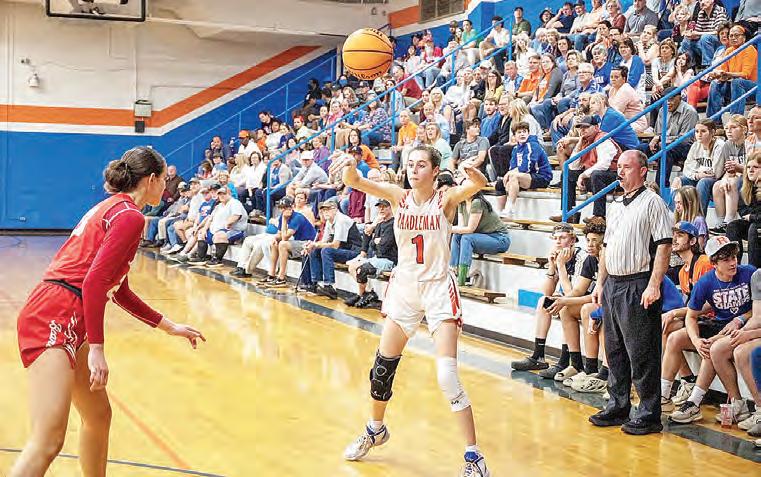
Elizabeth York scored 19 points, Gracyn Hall had 18 points, and Audra Petty and Jordan Booker both posted 10 points for Randleman.
The top-seeded Tigers (27-1) were to move on to the West Region semifinals Tuesday night at home against East Burke (26-2), a 54-37 winner against No. 13 seed Newton-Conover.
In the game vs. East Rutherford, Randleman held a 27-16 halftime lead in winning its third home game in the state playoffs. That was a continuation of what happened two nights earlier. The Tigers did enough to defeat visiting Hendersonville 63-54 on Thursday night.
“Give (our players) credit for coming ready to play,” Randleman coach Brandon Varner said. “We did a lot of great stuff.”

That came in large doses in the opening minutes and in a game-deciding stretch in the third quarter.

“From here on, every team is good,” Booker said.
And so are the Tigers, proving so during various situations against Hendersonville (18-10).
The game began with Randleman scoring the first 14 points. With Hall picking up two fouls and going to the bench, the lead evaporated, and the Bearcats, who went more than six minutes without a point, were within a point in the second quarter. The Tigers kept the lead, heading to halftime ahead 2523.
But Hendersonville tied the game a couple of times in the third quarter. Then at 35-35, York took over.
“I was definitely giving more effort than usual, which is embarrassing to say,” York said. “But I wasn’t going to let this be my last game.”
She scored the next eight points on a field goal, a three-point play, and a 3-point shot. Hall added a putback off an offensive rebound before perhaps the most exciting sequence of the game.
Randleman secured a defensive rebound with about four seconds left in the quarter. A couple of passes later, York had the ball and flung up a desperation shot for a crowd-pleasing, unorthodox basket at the buzzer and a 47-37 lead.
It was nearly a no-look shot,
though York said she glanced “for a second” toward the basket.
York converted another threepoint play early in the fourth quarter, and the Tigers eventually went up by 19 points. “We knew we were the better team,” Booker said. “We had to play together and play like we can, and it worked out.”
In the third quarter, Randleman switched from a zone and some specialty defenses to man-to-man. Varner said he liked how the Tigers handled the adjustment.
“These girls are battle-tested and have played a lot of basketball,” he said.
Hall finished with 24 points, and York had 22 points. AJ Jackson had 15 of her 22 points in the first half for Hendersonville.
The Tigers also collected a valuable lesson, further understanding to avoid letting up.
“We got too comfortable with our lead,” York said. “It’s going to get tougher and tougher, as Coach Varner says.”
In the first round, Randleman took care of business with a 52-34 victory against No. 32 seed Bandys. The Tigers, who received 15 points from Elizabeth York and 14 points from Gracyn Hall, led 25-8 after the first quarter.
“We just came out slow to start,” senior Hakeeme Butler said. “The turnovers killed us.”
The Blue Comets later closed the gap to 24-16, but their deficit grew to 43-25 at halftime. The Golden Eagles began the second half on a 13-0 run, though Asheboro answered by notching the final nine points of the quarter.
“We kept trying to attack them at different angles,” Headen said.







“We just got punched in the face early, that big run,” Nance said. “They took it to us a little bit, and we didn’t respond very good early on. Made some good runs.”
Butler’s 20 points and Camden Walker’s 17 points paced Asheboro.
The Blue Comets went 10-0 in regular-season play in the Mid-Piedmont Conference for one of their accomplishments. Headen said he hopes the team is considered one of the best in school history.
“A great season,” Butler said. “We’ve all been together for this. I’m proud of my boys.”

Nance, a veteran coach, had a similar reaction. This was the second season – and ideally the final season – that Asheboro plays home games downtown as renovations take place on campus. Gym capacity was reached, and some fans were turned away for the state-playoff game.
“The kids put the time in and bought into what we’ve tried to do, and we couldn’t be more proud of them,” Nance said.
“They believed in what they were doing. We just ran into a better basketball team.”
In the first round, Asheboro handled No. 26 seed East Henderson 75-54. Butler’s 23 points and Jerquarius Stanback’s 22 points led the way.

Eastern Randolph boys move on
Randolph Record

RAMSEUR — Third-seeded Eastern Randolph’s boys’ basketball team topped sixth-seeded Robbinsville 83-64 on Saturday in the third round of the Class 1-A state playoffs to continue the winningest season in program history and move to the regional semifinals for the first time.

Davonte Brooks racked up 28 points, Timothy Brower poured in 22 points, and Julian Brooks had 11 points for Eastern Randolph.
The Wildcats (27-2) were on the road for the first time in the postseason for the West Region semifinals with Tuesday night’s game at second-seeded South Stokes (254), which eliminated Bessemer City

70-62.

Eastern Randolph built a 43-29 lead by halftime against Robbinsville (23-6).
In the second round last Thursday, Pierce Leonard scored 20 points, and Eastern Randolph rolled past 14th-seeded Avery County 75-60. Eastern Randolph went up 42-24 by halftime against Avery County (18-10). Brooks posted 18 points, and Brower had 16 points.
Class 1-A girls

At Ramseur, No. 13 seed Robbinsville eliminated fifth-seeded Eastern Randolph 60-45 in the third round. The Wildcats finished the season with a 19-8 record.
Robbinsville (20-8) outscored the Wildcats in every quarter, leading 44-34 going to the fourth quarter.

Senior guard Brecken Snotherly scored 23 points for Eastern Randolph. Teammate Kenly Whitaker added 10 points, and Logan Beaver pulled in nine rebounds.
In the second round, Snotherly scored 27 points, and Eastern Randolph stopped No. 12 seed Rosman 53-40. Whitaker poured in 17 points for Eastern Randolph, which trailed 27-24 at halftime. A 13-3 advantage in the third quarter turned the momentum. Snotherly, who made three 3-pointers, also had 12 rebounds. Rosman finished with a 23-6 record.
6 Randolph Record for Wednesday, March 1, 2023
9796 Aberdeen Rd, Aberdeen Store Hours: Tue - Fri: 11am – 4pm www.ProvenOutfitters.com 910.637.0500 Blazer 9mm 115gr, FMJ Brass Cased $299/case or $16/Box Magpul PMAGs 10 for $90 Polish Radom AK-47 $649 Smith & Wesson M&P 2.0 Compact $449 Del-Ton M4
38” Tactical Rifle Case: $20 With Light! Ever wish you had a • The Best Prices on Cases of Ammo? • The best selection of factory standard capacity magazines? • An AWESOME selection of Modern Sporting Weapons from Leading Manufactures Like, Sig, FN, S&W, etc? You Do!
All at better than on-line prices? With Full Length Rail! Made in NC! local store which has • Flamethrowers & Gatlin Guns? On Rt 211 just inside Hoke County. With Quantico Tactical
$499
•
PJ WARD-BROWN | NORTH STATE JOURNAL
PJ WARD-BROWN | NORTH STATE JOURNAL
Butler tries to get Asheboro on the board in the first quarter of Thursday night’s loss to Greensboro Smith in the Class 3-A state playoffs.
Gracie Beane of Randleman makes a pass in the second half against Hendersonville in Thursday night’s Class 2-A state playoffs.
Robert Allen Shaw
April 9, 1938 — February 25, 2023
Robert "Bob" Allen Shaw, 94, passed away peacefully on Saturday, February 25, 2023 at the Salisbury VA Medical Center.
Bob was born on April 9, 1938 to Clarence and Helen “Fern” Hinkle Shaw. He joined the United States Army and served our country completing 3 tours of duty in the Vietnam War. Bob was proud of his military service and loved to wear his Vietnam War cap. He went on to work in the construction industry, which led him to meeting his wife in Greensboro, NC. They shared 45 happy years of marriage together.
Bob is survived by his loving wife, Madelyn Edwards Shaw, of the home. He is survived by his daughter, Charyl (Jake) O’Reilly of Lima, Ohio, his stepchildren: Phyllis Younts of Randleman, NC, Rickie (Joyce) Privette of Johnson City, TN, Tommy (Kathy) Privette of Johnson City, TN, Arthur (Linda) Privette of Ramseur, NC, Michael (Gloria) Privette of Hiddenite, NC, and Linda (Harrison) McCampbell of Nashville, TN; 3 grandchildren, 13 step-grandchildren, 26 greatgrandchildren, 4 great-greatgrandchildren; and his sister, Juanita Shaw, of Lima, Ohio.
Mr. Shaw was preceded in death by his parents, his brothers, Larry Shaw and Tom Shaw, and his sister, Betty Keifer.
Sandra Smith Lowe
November 10, 1960 — February 24, 2023
Sandra Smith Lowe, age 62, of Asheboro passed away on Friday, February 24, 2023.
Mrs. Lowe was born in Seagrove, NC on November 10, 1960 to Wallace and Edna Jane Albright Smith. Sandra was a homemaker. Sandra was preceded in death by her father, Wallace Smith and her husband, John Lowe. Sandra was a loving mother and grandmother.
She is survived by her son, Lance Lowe and wife Miranda; grandchildren, Nathan, Jack, and Emma Lowe; mother, Edna Jane Albright Smith; sister, Janice Cranford and husband Robert of New Bern; and brothers, Wally Smith and wife Sandy of Pisgah and Jackie Smith and wife Wanda of Seagrove.
Betty Hilliard
January 27, 1937 — February 23, 2023
Betty Lou Allred Hilliard, 86, passed away Thursday, February 23, 2023 at Hospice House of Randolph County. Betty was born January 27, 1937 to Pauline and Gurnie Allred. She was preceded in death by her husband W. Cecil Hilliard, sisters Hazel Bates and Barbara Wood, brother Jessie Allred, brother-n-law Ray Hilliard, all of Randleman. Betty is survived by her son William (Bill) Hilliard, daughter Diane Pugh, two grandchildren Tiffany Brooks (Cody) and Tyler Pugh, one great grandchild, Adeline Brooks. She is also survived by her sister Katherine Johnson (Tim), sister-n-law Jennette Morris (Jerry), brother-n-law D. B. Hilliard, Jr. Betty worked for many years at Mr. Jeans of Randleman and Klaussner Furniture of Asheboro, where she was the first woman hired as supervisor. Betty was a devoted wife, mother and member of First Baptist Church in Randleman.
Mario Alberto Flores
July 8, 1973 — February 21, 2023
Mario Flores, age 49, of Seagrove, passed away on Tuesday, February 21, 2023 at his home. He was born July 8, 1973 to Rodrigo Flores Guerra and Ernestina Villarreal Zenteno.
Mario was a good, hard working, caring man who was a loving father, brother and friend. He was a soccer coach for several years and was a humanitarian person. In addition to his parents, Mario is survived by his wife, Angelica Maria Flores; sons, Juan Larios, Isaias Flores, Eric Flores; daughter, Isabel Flores; sisters, Laura Flores, Mirtha Flores; brothers Miguel Flores, Jesus Flores, Carlos Cesar Flores, Rodrigo Flores, and several nieces and nephews.
Mary Jacqueline "Jackie" Crotts Henley
November 5, 1930 — February 20, 2023
Mary Jacqueline (Jackie) Crotts Henley passed away at her home on Monday, February 20, 2023. Jackie was born on November 5, 1930, to Mary and Jack Crotts and was a lifelong resident of Randleman. She was a homemaker and caregiver to family members for most of her life.
David Bryant Garner
August 5, 1951 — February 22, 2023
David Bryant Garner, age 71, of Seagrove, NC, surrounded by family, moved to heaven on February 22nd, 2023. David was born on August 05, 1951, and was 1970 graduate of Asheboro High School. He attended UNC Wilmington for Ceramic Arts, while working as an intern to gain experience in the skill and art of production pottery.
Betty Marie Johnson
March 15, 1933 — February 22, 2023
Zoann McLaughlin
Adams
October 27, 1946 — February 23, 2023
Zoann McLaughlin Adams, 76, of Siler City, passed away peacefully in her home on Thursday, February 23, 2023.


Martha Gaines Brower
April 26, 1934 — February 26, 2023
Martha Eloise "Ella" Gaines Brower, 88, of Siler City, passed away at her home on Sunday, February 26, 2023, surrounded by her loved ones.
Mrs. Brower was born in Chatham County on April 26, 1934, the daughter of John T. Gaines, Sr. and Mattie Hancock
Gaines.
Ella was a member of Loves Creek Baptist Church, where she sang in the church choir. She retired after many years as a Dental Assistant for Dr. Blair. In addition to her parents, Ella is preceded in death by her husband, James "Jim" D. Brower, Sr., grandson, Blake Hubbard, sister, Mary Lee Powers, and brothers, John T. Gaines, Jr. and Oren, Bill, Alton and Fred Gaines.
She is survived by her daughter, Patty B. Hubbard and husband Jeff of Durham; son, James D. "Jimmy" Brower, Jr. and wife Darlene of Ramseur; grandchildren, Derek and Kiersten Brower both of Ramseur, Robert Hubbard (Maggie) of Nashville, TN, and Lauren Hubbard Shelton (Shane) of Durham; great grandchild, Sawyer Kate Shelton; and sisters, Louise G. McLaughlin (Buddie), Betty G. Stone (Dennis), and Frankie G. Bridges, all of Siler City.
David was a potter through and through for over 45 years, a talented craftsman and considered a master of his craft when it came to traditional and contemporary pottery. After apprenticing for a few notable and well-established Seagrove potters, such as Ben Owen Pottery, he went on to become founder/owner of Turn and Burn Pottery in Seagrove, NC, established since 1985. With numerous awards and blue ribbons, David was voted master craftsman of the year at the NC State Fair- Village of Yesteryear. David was happy to volunteer his time to teach children how to turn pottery, and was often seen showing a child how to do something with a piece of clay.
David was the founder of Freedom in Christ Ministries, a prison ministry, with his wife, Deborah, starting in 1989-2021. Finally, he was a loving, caring, and supportive pastor, of Victory Church in Asheboro, NC, along with his wife, Pastor Deborah, since 2009.
David was a loving and devoted husband to Deborah his wife, a supportive and loving father, grand, and great grandfather to Jeffrey and (Tina) and Robert McDowell sons. Also Scott son in Raleigh. Dylan (Noel), Cassie, and Daisey McDowell-Grandchildren, and 1 great grandchild, Julian. Tina, his daughter-in-law, was just like his own daughter, whom he fondly referred to as his “Best daughter”. David was preceded in death by father Lloyd Garner, Mother Lucy Garner, and brother Bobby Garner. He is survived by his sister Sue Garner Vuncannon, and her husband Randy, brother Joe and Paula Garner, Cousin Mitchell and Joyce Thompson, and several beloved nieces and nephews.
Mrs. Adams was born in Chatham County on October 27, 1946, the daughter of David Keith and Martha Elizabeth Ligon McLaughlin.
Zoann was of the Methodist faith. She was a past President of the Siler City Merchant Association, as well as a former Director of the North Carolina Arts Incubator. She was an avid reader, and traveler. Zoann worked as an Office Manager at Spence Building Supply for 20 years. She loved and cherished her family. In addition to her parents, she is preceded in death by her brother, DK McLaughlin. She is survived by her husband of 53 years, Sam P. Adams, Jr.; daughter, Marti A. Canterbury and husband Steven of Newton; grandchildren, James Robert Canterbury, and Jesse Adams Canterbury; brother, Tom T. McLaughlin and wife Cynde of Greensboro; brother in law, James Adams and wife Jean of Siler City; sister in law, Peggy Davis of Asheville; and numerous nieces and nephews.
Betty Marie Johnson passed away on February 22, 2023, 21 days before her 90th birthday in Summerville, SC, where she lived with her daughter, Kathy Jones, and her son in law, Bob for almost 9 years. She was predeceased by her parents, Artna and Mamie Jones, her husband, Buck Johnson, and sister, Doris LouEllen Jones.
In addition to her daughter and son in law, Kathy and Bob Jones, she is survived by 4 grandchildren, Clint (Cassy) Jones of Summerville, SC, Dawn Jones of Clearwater, FL, Kim Jones (Ryan) of Lewisville, TX, and Brandi Camelio (Randy) of Summerville, SC; sister, Lib Brown (Ricky); and niece Christy Brown of Ramseur, NC. She is also survived by 12 great grandchildren, and 6 great great grandchildren. Extended family members and special friends include Chrissy Riddle, Dennis Johnson, Linda Evans, and Edwin Lee Thompson. Each of these hold special memories of her and her impact on their lives. She is also survived by her dog Abby, who she loved dearly and with whom she spent most of her days.
In lieu of flowers, memorials may be made to Hospice of Randolph County.
Jackie was a humble, hardworking woman who always put others before her own needs or wants. She lovingly cared for both of her husband’s parents, her mother and finally her husband before each of them passed away. She loved cooking and gardening and took so much pleasure in seeing others enjoy a meal she had prepared or sharing the bounty from her garden. While she always seemed to have more to do than time to do it, she never failed to make time for really important things. Whether it was taking a grandson to the branch so he could turn over rocks to see what creature lay beneath it, building a “tent” on the front porch for a camping adventure that she knew would not last beyond sunset, allowing the little ones to “help” cook when it would have been so much easier to do it alone, helping a great grand plant his own garden beside the one she had already planted because he wanted his own, cooking a huge Sunday lunch when she really did not feel like it but knew the family looked forward to it almost every week and so many other things that have become treasured memories for her family.
In addition to her parents, Jackie was preceded in death by her loving husband of 70 years, “Red” Henley and brother Lester Crotts. She is survived by her children, Linda Cranford; Danny (Marie) Henley; Ann Shaw and Scott (Cindy) Henley all of Randleman; grandchildren, Jason (Leslie) Cranford, Emily (Chad) Welch, Matt (Tonya) Henley; greatgrandchildren, Brantly Cranford; Jaxon Welch; Easton Henley; and Phoenix Welch, as well as step grandchildren and greatgrandchildren, nieces, and nephews.
Timothy Kevin Maness
March 7, 1962 — February 24, 2023
Timothy "Kevin" Maness, age 60, of Biscoe, passed away on February 24, 2023.
Kevin was born on March 7, 1962, in Montgomery County to James Albert and Carrie Klass Maness Sr. He was a sign maker and logger and loved model trains. He was a retired member of the Biscoe Fire Department with 20 years of service.
He was preceded in death by his mother, Carrie Klass Maness and sister, Teresa Ann Maness. Kevin is survived by his father, James Albert Maness Sr.; brother, James Albert Maness Jr.(Joan) of Biscoe; and sister, Mary Jane Maness of Sanford.
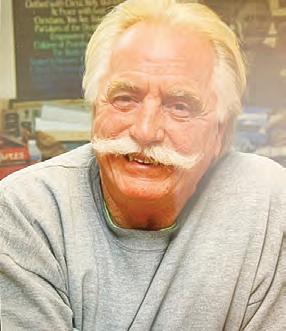
7 Randolph Record for Wednesday, March 1, 2023 obituaries Celebrate the life of your loved ones. Submit obituaries and death notices to be published in Randolph Record at obits@randolphrecord.com 2 North State Journal (USPS 20451) WEDNESDAY 7.21.21 #3 “Join the conversation” WEEKLY FORECAST 2 Randolph Stanly County Journal ISSN: 2575-2278 Publisher WEDNESDAY 7.7.21 #1 “Join the conversation” WEEKLY FORECAST WEDNESDAY JUNE 30 HI 91° LO 70° PRECIP 15% THURSDAY JULY 1 HI 91° LO 70° PRECIP 15% MEET RCC pushes WEDNESDAY JULY 21 HI 88° LO 67° PRECIP 13% THURSDAY JULY HI LO PRECIP RANDOLPH COMMUNITY
Southern Baptists oust Saddleback Church over woman pastor
The Associated Press
THE SOUTHERN Baptist Convention ousted its second-largest congregation — Saddleback Church, the renowned California megachurch founded by pastor and best-selling author Rick Warren — for having a woman pastor.
The vote by the convention’s Executive Committee culminates growing tension between the nation’s largest Protestant denomination — which officially opposes women as pastors — and a congregation whose story has been one of the biggest church-growth successes of modern times.
The committee cited Saddleback’s having “a female teaching pastor functioning in the office of pastor,” an allusion to Stacie Wood, wife of the current lead pastor of Saddleback, Andy Wood.
But the controversy began in 2021, when Warren ordained three women as pastors, prompting discussions within the denomination about possibly expelling the megachurch.
Warren retired last year after more than 42 years at Saddleback. He made an emotional speech in June 2022 at the Southern Baptists’ annual convention in Anaheim, standing by his ordination of women. He told delegates who debated the issue, “We have to decide if we will treat each other as allies or adversaries.”
But the Executive Committee took the vote without public discussion after meeting in executive session.
It voted to approve a recommendation from the denomination’s Credentials Committee that Saddleback be deemed “not in friendly cooperation with the Convention” — the terminology used for ousting a church. While Southern Baptists’ statement of faith officially opposes women as pastors, each congregation is self-governing, so
the main enforcement mechanism is to oust it from membership. The Executive Committee’s motion said that Saddleback “has a faith and practice that does not closely identify with the Convention’s adopted statement of faith, as demonstrated by the church having a female teaching pastor functioning in the office of pastor.”
In a statement, the church didn’t indicate whether it planned to exercise its right to appeal the decision at the Southern Baptists’ next annual meeting, scheduled for New Orleans in June.
“We love and have always valued our relationship with the SBC and its faithful churches,” Saddle-
back elders said in a statement.
“We will engage and respond through the proper channels at the appropriate time in hopes to serve other like-minded Bible believing SBC churches. Meanwhile, we remain focused on following God’s leadership to love and serve our church family and the communities around our campuses.”
Mike Keahbone, an Executive Committee member and Oklahoma pastor, said an appeal “appears likely.”
“This was the heart of the room; to let the messengers (delegates) of the SBC decide,” Keahbone tweeted Tuesday.
With its main campus in Lake
Forest, south of Los Angeles, Saddleback Church has grown over four to 14 locations in Southern California, with an average weekly attendance of 30,000. There are four international campuses —in Hong Kong, Germany, the Philippines and Argentina.
Wood told The Associated Press last year that the Bible “teaches that men and women were given spiritual gifts by God.” His wife has served as teaching pastor for Saddleback.
“The church should be a place where both men and women can exercise those spiritual gifts,” Wood said. “My wife has the spiritual gift of teaching and she is
Train crew had little warning before Ohio wreck, probe finds
The Associated Press EAST PALESTINE, Ohio —
The crew operating a freight train that derailed in East Palestine, Ohio, didn’t get much warning before dozens of cars went off the tracks, and there is no indication that crew members did anything wrong, federal investigators said Thursday as they released a preliminary report into the fiery wreck that prompted a toxic chemical release and an evacuation.
“Enough with the politics. I don’t understand why this has gotten so political,” safety board Chair Jennifer Homendy, clearly exasperated, said at a briefing in Washington, D.C., on Thursday. “This is a community that is suffering. This is not about politics. This is about addressing their needs, their concerns.”
The NTSB report, which laid out the facts that investigators have gathered to date, said crew members had no indication the train was in trouble until an alarm sounded just before it went off the tracks.
An engineer slowed and stopped the train after getting a “critical audible alarm message” that signaled an overheated axle, according to the report. The three-person crew then saw fire and smoke and alert-
ed dispatch, the report said.
“We have no evidence that the crew did anything wrong,” said Homendy, who announced a rare investigatory field hearing to be conducted in East Palestine this spring as officials seek to get to the bottom of the derailment’s cause and build consensus on how to prevent similar wrecks.
Investigators said the temperature of the failed wheel bearing increased by 215 degrees in a span
of 30 miles, but did not reach the temperature threshold that railroad company Norfolk Southern had set for an alarm to go off until just before the wreck.
The train was going about 47 mph, under the speed limit of 50 mph, according to investigators.
Outside experts who looked at the report said the system appeared to work as designed, from the spacing of the hot bearing detectors along the tracks to the op-
eration of the sensors.
“There’s nothing in the NTSB report that surprises me at all,” said Dave Clarke, the former director of the Center for Transportation Research at the University of Tennessee. “I can’t see anything to really criticize about what happened or how the response was made.”
Christopher Barkan, director of the Rail Transportation and Engineering Center at the University of Illinois, said the spacing of the sensors that recorded the temperatures of the Norfolk Southern train — 10 and 20 miles apart — is common in the industry.
He said the detectors would not have notified the train crew of elevated bearing temperatures unless they met the threshold for action.
“I don’t see anything wrong here, but we just don’t know,” Barkan said.
Norfolk Southern said the NTSB report showed the heat detectors worked as intended and the train crew operated “within the company’s rules.” Nevertheless, the company said it would “need to learn as much as we can from this event” and “develop practices and invest in technologies that could help prevent an incident like this in the future.”
The freight cars that derailed on the East Palestine outskirts, near
really good. People often tell me she’s better than me when it comes to preaching, and I’m really glad to hear that.”
The Executive Committee also voted to oust five other congregations -- four over the issue of women as pastors and one over the issue of sexual abuse.
When Southern Baptists last updated their official statement of belief — The Baptist Faith and Message — in 2000, they added this clause: “While both men and women are gifted for service in the church, the office of pastor is limited to men as qualified by Scripture.”
The five churches ousted for having women as pastors “have been valued, cooperating churches for many years, and this decision was not made lightly,” Committee Chairman Jared Wellman said in a statement. “However, we remain committed to upholding the theological convictions of the SBC and maintaining unity among its cooperating churches.”
The church grew from a startup by Rick Warren and his wife, Kay Warren. With his charisma and easy, informal preaching style, Warren attracted thousands to the megachurch. Over the past decade, Warren also launched an ambitious plan to expand the church’s reach across Southern California as well as globally, a vision his successor has promised to complete.
Warren, in a tweet, said he and Kay would “respond to #SBC in OUR time & way thru direct channels” such as social media and newsletters.
Warren remains listed as founding pastor on the Saddleback website.
The SBC has 13.7 million members, but has seen net declines over more than a decade in members and baptisms, its key metric for spiritual vitality.
the Pennsylvania state line, included 11 carrying hazardous materials. Villagers evacuated as fears grew about a potential explosion of smoldering wreckage.
Officials seeking to avoid an uncontrolled blast intentionally released and burned toxic vinyl chloride from five rail cars, sending flames and black smoke into the sky. That left people questioning the potential health effects even as authorities maintained they were doing their best to protect people.
In another sign of the environmental impact, the Ohio Department of Natural Resources said Thursday it now estimates spilled contaminants affecting several miles of streams killed nearly 44,000 fish, mostly small ones such as minnows. Its initial estimate was 3,500.
As NTSB released its preliminary findings, U.S. Transportation Secretary Pete Buttigieg — who had been criticized for not coming to East Palestine earlier — went on a tour of the crash site and defended the Biden administration’s response to the Feb. 3 derailment, which Trump had portrayed as indifferent and a “betrayal.”
Heather Bable, who lives two blocks from the derailment site, said she’s relieved the government’s top brass is finally showing up.
“We need that attention because we weren’t getting it. They should have been here all along,” said Bable.
8 Randolph Record for Wednesday, March 1, 2023
STATE & NATION
AP PHOTO
Congregants arrive at Saddleback Church in Lake Forest, Calif., on Sunday, Oct. 16, 2022.
ALLIE VUGRINCIC | THE VINDICATOR VIA AP, POOL
Transportation Secretary Pete Buttigieg, left, and Tristan Brown, deputy administrator of the Pipeline and Hazardous Materials Safety Administration, crouch down to look at part of a burned traincar, Thursday, Feb. 23, 2023, in East Palestine, Ohio, at the site of a Norfolk Southern train derailment.
HOKE COUNTY
Shots from the season: Hoke County wrestling


Top row from left: During the first round of the 4A State Wrestling Championship at the Greensboro Coliseum, which took place on Feb. 16, 2023, in Greensboro, Hoke County’s Gabriel Capezudo works back points on T.C. Roberson’s Ben Glaister; Hoke County’s David Coptsias won by decision over Wake Forest’s Bailey Wilman (4-2); and Hoke County’s Cedric Griffin Jr. defeated Northern Guilford’s Cohen Beane in sudden victory (7-5).

Bottom: Mats of wrestling matches during the 4A State Wrestling Championship first round at the Greensboro Coliseum in Greensboro.

COUNTY NEWS
Authorities searching for missing Hoke teen
Local authorities are currently searching for a teenage girl, who disappeared form Hoke County roughly three weeks ago. According to the National Center for Missing and Exploited Children, the 14-year-old Savannah Jones was last seen on February 6 in Red Springs. Jones is a 5 feet-3 girl, who weighs around 130 pounds, and has green eyes and brown hair. The Hoke County Sheriff’s Office and the National Center for Missing and Exploited Children believe that Savannah might be in the Pembroke or Red Springs area. Anyone with any information on Savannah’s whereabouts is encouraged to contact the sheriff’s office tip line at (910) 878-1110 or 1-800-THE-LOST.
Fayetteville man arrested in connection to Raeford murder
The U.S. Marshalls arrested a man from Fayetteville at his home this past Thursday in connection with a killing that took place in Raeford in May 2021, according to the Hoke County Sheriff’s Office. Dennis Locklear Jr., 20, of the 1000 block of Wildwood Drive, has been charged with first-degree murder, robbery with a dangerous weapon, and felony conspiracy for the killing of Davion McQueen. McQueen, who was just 21 years old, was shot in the 100 block of Seagull Drive and died at Cape Fear Valley Hospital after succumbing to a gunshot wound to the head. Locklear is the second person who has been arrested in connection to McQueen’s killing, as Keshandre McLean, 28, was arrested just a day following the shooting and charged with first-degree murder. Both McLean and Locklear are being held at the Hoke County Jail without bail. Anyone with any additional information regarding the killing of McQueen is encouraged to contact Detective Shipp at (910) 875-5111.
NC House Speaker ‘grateful’ to officers following traffic incident
By A.P. Dillon North State Journal
RALEIGH — North Caroli-
na House Speaker Tim Moore (R-Kings Mountain) is grateful to the law enforcement officers who were on hand when the vehicle he was traveling in was rammed by an apparent drunk driver.
Moore said he, Rep. David Willis of Union County and Deputy Chief of Staff Dan Gurley were returning to Raleigh after a series of events in Wilson.
The speaker’s security officer was driving the SUV westbound on U.S. Highway 64 near Knightdale around 9:30 p.m. when it was rammed from behind at least three times, Moore told reporters at the Legislative Building.
Moore praised his driver, Officer Jason Perdue, for controlling
“[I’m] glad that no one was hurt in this alarming incident and that law enforcement caught the suspect.”
Gov. Roy Cooper
the SUV after it was struck and taking action on the road, which has a 70 mph speed limit. Moore said the truck stopped in the left lane of the highway roughly 5 miles later. No one in the SUV was hurt, Moore spokesperson Demi Dowdy said.
“Thank God we’re all just all right,” Moore said, adding he saw nothing to indicate that he or his
vehicle was targeted due to politics or his role in government.
The General Assembly-owned Chevrolet Tahoe’s license plate resembles a private owner’s plate, with none of the specialized numbering that lawmakers’ personal vehicle plates receive.
The SUV didn’t appear severely damaged.
“Many of us have been rear-ended by a car, unfortunately, in the past,” Moore said.
“But when you’re moving at highway speeds and another car approaches you at a higher rate of speed and it hits the car ... you can imagine the kinds of things that are going through your mind at that point and its intention.”
Moore’s spokesperson said he is very grateful to the State Highway Patrol (SHP) officers involved in swiftly handling the situation and particularly grateful
Board of Commissioners to select new commissioner in March
Commissioners approve use of funding for DSS food and nutrition services assistance
By Ryan Henkel North State Journal
RAEFORD — The Hoke County Board of Commissioners met Monday, February 20, with an agenda consisting of tax, property, and social services funding issues.
The board began the meeting by discussing their intention to fill the vacant seat on the board following the passing of Commissioner Lonnie Baldwin in February.
“The Democratic Party asked that people send them information if they wanted to be in-
terested,” said Chairman Allen Thomas, Jr. “Of course, we are not in a position where we have to go by the list, but there are people who may not be familiar with us and people who want to be considered and so the Democratic Party was able to field those names of people who are interested in serving this term.”
According to the County Attorney, the deadline for filling the vacancy is March 31, and Commissioner Allen stated that it was his intention and plan to have a vote in March before that.
“It is the commitment of this board to vote on this matter,” Allen said. “We recognize the seriousness of filling this vacant seat. We will move forward on it, and I’m fully confident in this board’s ability to come together and select a commissioner to
serve out the term of our dear -
ly departed Commissioner Lonnie Baldwin.”
The board then approved two requests for releases from delinquent taxes.
The first was a congregate of seven releases, totaling $1,600.33, and the second was a request by Total Victory Deliverance Church to be released from $1,007.47 in delinquent taxes on property that had not been initially exempted when the property was given tax-exempt status in 1987.
The board also approved a schedule for the Board of Equalization and Review for 2023.
“I would like to propose that the advertisements for the meeting be March 8, March 15, and
to NC General Assembly Police Officer Jason Purdue, who was driving the state-owned Chevy Tahoe vehicle at the time.
“On Thursday, Feb. 23, at approximately 9:43 p.m., the State Highway Patrol responded to a hit and run collision on I-87 near mile marker 9 in Wake County,” according to a statement from the SHP. “The incident initially took place on I-87 near mile marker 13 when a 2000 Chevrolet S10 pickup truck struck the rear of a 2020 Chevrolet Tahoe multiple times as both vehicles were traveling in the southbound lanes.”
SHP’s statement also says that Purdue activated his emergency lights to signal the pickup truck to pull over, but the driver failed to stop, resulting in Perdue having to give chase.
The driver of the pickup, James Matthew Brogden, 38, of Goldsboro, was arrested after finally coming to a stop near mile marker 9. SHP indicated their investigation indicated that “impairment was a factor with regard to Mr. Brogden,” and that EMS had responded to the
8 5 2017752016
$1.00
VOLUME 8 ISSUE 1 | WEDNESDAY, MARCH 1, 2023 | HOKE.NORTHSTATEJOURNAL.COM | SUBSCRIBE TODAY: 336-283-6305
See COMMISSIONERS, page 2
PHOTOS BY PJ WARD-BROWN | NORTH STATE JOURNAL
difference of 423 students less than what was projected in our initial budget allotment.”
The difference accounts for about $804,520.52 in funding that will return to the state’s budget. Ac cording to Chavis, some of the dif ferences in actual enrollment num bers can be attributed to an uptick
in enrollment in charter schools.
Finally, the board approved a new partnership and contract with Global Teaching Partners for the acquisition of international teachers.
“This is a new organization that will be an international partnership that will sponsor our J-1 Visa teachers and international faculty, which was previously referred to as our visiting international faculty or VIF,” said Assistant Superintendent
According to O’Connor, Hoke County Schools currently has established partnerships with Participate (8 teachers in the district) and Education Partners Internationals (22 teachers), which are officially recognized cultural exchange programs by the US Department of
State and provide J-1 Visas, meaning these teachers go through federal screening. These visas cover three years and can be extended for an additional two.
North Carolina and South Carolina.
March 22,” said Tax Assessor Mandi Davis. “The first meeting would be held April 3 at 5:30 p.m. in which the board members would be sworn in and the chairman elected, and then we’d have hearings. The second meeting would be April 17 at 5:30 and then the third meeting on May 1 at 5:30.”

Following the 10-day upset period, the board also officially approved the sale of surplus land.
Some of the other services these partners cover are teaching experience reviews, educational program audits, instructional and behavioral interviews and observations, english language proficiency assessments, cultural adaptiveness assessments, state licensure reviews, international background checks, and specifically Global Teaching Partners helps provide specific NC teacher training.
“We have a bid for property off Hamilton Drive which is off Aberdeen Road near Lake Elizabeth Road,” said Clerk to the Board Gwen McGougan. “It was declared surplus back in 2019, and the bid on it is $4,300. The 10-day upset period expired February 8.”
Global Teaching Partners, however, is located in the Research Triangle Park in North Carolina, and they do all of their business only in
“We’re not just filling vacancies with these individuals,” O’Connor said. “The people that we have gotten, their attrition rate, which means they come back every year and don’t quit their job, is so much lower than all of our other teachers. They typically stay their five years, and a lot of them are very effective teachers. These are quality individuals who want to be here to teach our kids, and with the J-1 Visa, they’re here for five years.”
“Even if we agree to $15 an hour, there’s a problem with getting workers when you know that job is going to end.”
Hoke County Schools currently has 30 international employees from eight different countries across nine different schools. The Hoke County Board of Education will next meet February 14.
Harry Southerland
The board then approved a Community Services Block Grant Program application request from Southeastern Community Action Partnership for $1,355,452.
“We are a self-sufficiency program for the Southeastern Community Action Partnership, which is a community action program,” said CSBG Program Director Kathleen Lowe Jacobs. “We are located in seven counties throughout North Carolina, and Hoke County is one of them.”
According to their website, SCAP studies the underlying issues involved in improving education, economic opportunities, living environments, and the general welfare of the community to make recommendations for programs, projects, or activities and create solutions for individuals who reside in Bladen, Brunswick, Columbus, Hoke, Pender, Robeson, and Scotland Counties.

The board was then presented with an update on the Department of Social Services’ food and nutrition services programs.
“When the pandemic hit, the state issued emergency supplement funds for people who were receiving food and nutrition services,” said DSS Director Terry Stanton. “Those funds end next week. During the pandemic, someone could have possibly been receiving $25 in food and nutrition services, but with the supplement, it could have been advanced to $250. Now, with that ending, they’ll go back to the $25. So, it’s going to hurt a lot of people, and they’re going to be suffering.”
According to Stanton, the state gave funds to each county strictly for food and nutrition services improvements, of which Hoke County received $63,000. With that money, DSS plans to hire temporary workers to handle phone calls, walk-ins, complaints, questions, concerns, and filing.
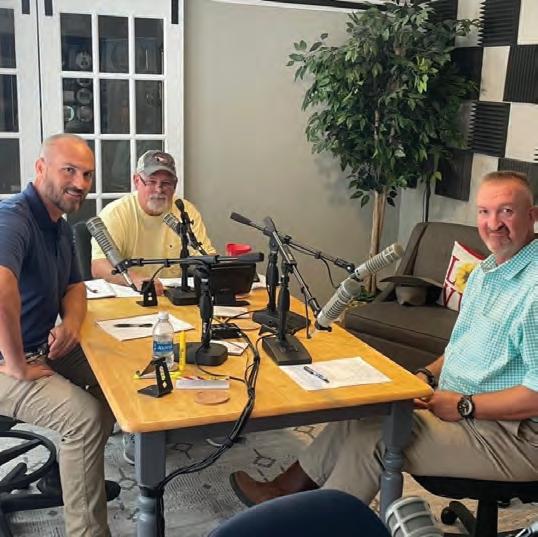
Hosted
“My concern is that the person is going to be time-limited,” said Commissioner Harry Southerland. “Even if we agree to $15 an hour, there’s a problem with getting workers when you know that job is going to end. I don’t have a problem with looking to put it in the budget and making it a permanent job. It’s hard to find good workers now, and if you’re going to get a good worker and tell them that the job is going to run out in six months, it’s not going to happen.”
However, since it’s state money that has to be used or earmarked by June, the board approved the use of the funds with the condition that the temporary workers pay will start at $15 an hour.
The Hoke County Board of Commissioners will next meet March 6.
2 North State Journal for Wednesday, March 1, 2023 Neal Robbins Publisher Matt Mercer Editor in Chief Griffin Daughtry Local News Editor Cory Lavalette Sports Editor Frank Hill Senior Opinion Editor Lauren Rose Design Editor Published each Wednesday as part of North State Journal 1201 Edwards Mill Rd. Suite 300 Raleigh, NC 27607 TO SUBSCRIBE: 336-283-6305 HOKE.NORTHSTATEJOURNAL.COM Annual Subscription Price: $50.00 Periodicals Postage Paid at Raleigh, N.C. and at additional mailing offices. POSTMASTER: Send address changes to: North State Journal 1201 Edwards Mill Rd. Suite 300 Raleigh, NC 27607 Get in touch www hoke.northstatejournal.com WEDNESDAY 3.1.23 “Join the conversation” COMMISSIONERS from page 1 9796 Aberdeen Rd, Aberdeen Store Hours: Tue - Fri: 11am – 4pm www.ProvenOutfitters.com 910.637.0500 Blazer 9mm 115gr, FMJ Brass Cased $299/case or $16/Box Magpul PMAGs 10 for $90 Polish Radom AK-47 $649 Smith & Wesson M&P 2.0 Compact $449 Del-Ton M4 $499 38” Tactical Rifle Case: $20 With Light! Ever wish you had a • The Best Prices on Cases of Ammo? • The best selection of factory standard capacity magazines? • An AWESOME selection of Modern Sporting Weapons from Leading Manufactures Like, Sig, FN, S&W, etc? You Do! • All at better than on-line prices? With Full Length Rail! Made in NC! local store which has • Flamethrowers & Gatlin Guns? On Rt 211 just inside Hoke County. With Quantico Tactical 2 North State Journal for Wednesday, January 18, 2023 ♦ Loudermilk, Annbracha Krisshe Amari (B/F/20), Communicate Threats, 01/15/2023, Hoke County Sheriff’s Office ♦ Roper, Calvin Jamale (B/M/32), Attempted Common Law Robbery , 01/15/2023, Hoke County Sheriff’s Office ♦ Staples, Chad Matthews (W/M/38), Firearm by Felon, 01/14/2023, Hoke County Sheriff’s Office ♦ Collins, Laura Lashay (I/F/33), Identity Fraud, 01/14/2023, Hoke County Sheriff’s Office Willard, Brandy Jo (W/F/32), ♦ Smith, Carressia Leanne (W/F/36), Resisting Arrest, 01/10/2023, Hoke County Sheriff’s Office ♦ Taylor, Freddie (B/M/67), Assault on a Female, 01/09/2023, Hoke County Sheriff’s Office WEEKLY CRIME LOG Neal Robbins Publisher Matt Mercer Editor in Chief Griffin Daughtry Local News Editor Cory Lavalette Sports Editor Frank Hill Senior Opinion Editor Lauren Rose Design Editor Published each Wednesday as part of North State Journal 1201 Edwards Mill Rd. Suite 300 Raleigh, NC 27607 TO SUBSCRIBE: 336-283-6305 HOKE.NORTHSTATEJOURNAL.COM Annual Subscription Price: $50.00 Periodicals Postage Paid at Raleigh, N.C. and at additional mailing offices. POSTMASTER: Send address changes to: North State Journal 1201 Edwards Mill Rd. Suite 300 Raleigh, NC 27607 Get in touch www hoke.northstatejournal.com WEDNESDAY 1.18.23 “Join the conversation” BOE from page 1 9796 Aberdeen Rd, Aberdeen Store Hours: Tue - Fri: 11am – 4pm www.ProvenOutfitters.com 910.637.0500 Blazer 9mm 115gr, FMJ Brass Cased $299/case or $16/Box Magpul PMAGs 10 for $90 Polish Radom AK-47 $649 Smith & Wesson M&P 2.0 Compact $449 Del-Ton M4 $499 38” Tactical Rifle Case: $20 With Light! Ever wish you had a • The Best Prices on Cases of Ammo? • The best selection of factory standard capacity magazines? • An AWESOME selection of Modern Sporting Weapons from Leading Manufactures Like, Sig, FN, S&W, etc? You Do! • All at better than on-line prices? With Full Length Rail! Made in NC! local store which has • Flamethrowers & Gatlin Guns? On Rt 211 just inside Hoke County. With Quantico Tactical the actual number of students enrolled in school in Month 1 and Month 2 and whichever is greater is the number they used to determine if there will be a budget revision. Our actual ADM for month 1 was 8,498, and for Month Two, it was 8,665. Therefore the ADM for Month Two - 8,665 was used for our budget revision which is a
weekly podcast getting to the facts across the state, around the world and at home HERE in Raeford, Hoke County, NC.
A
by: Ruben Castellon,
and
Join Our Facebook Page: The Roundtable Talk Podcast Available on most Platforms WEEKLY FORECAST WEDNESDAY JAN 18 HI 66° LO 52° PRECIP 9% THURSDAY JAN 19 HI 65° LO 43° PRECIP 55% FRIDAY JAN 20 HI 55° LO 32° PRECIP 2% SATURDAY JAN 21 HI 52° LO 35° PRECIP 4% SUNDAY JAN 22 HI 51° LO 38° PRECIP 51% MONDAY JAN 23 HI 48° LO 34° PRECIP 58% TUESDAY JAN 24 HI 54° LO 38° PRECIP 45% A weekly podcast getting to the facts across the state, around the world and at home HERE in Raeford, Hoke County, NC. Hosted by: Ruben Castellon, Hal Nunn and Chris Holland Join Our Facebook Page: The Roundtable Talk Podcast Available on most Platforms WEEKLY FORECAST
Hal Nunn
Chris Holland
WEDNESDAY MAR 1 HI 7 1° LO 60° PRECIP 6% THURSDAY MAR 2 HI 7 3° LO 59° PRECIP 74% FRIDAY MAR 3 HI 7 2° LO 51° PRECIP 8 3% SATURDAY MAR 4 HI 67 ° LO 4 4° PRECIP 3% SUNDAY MAR 5 HI 62 LO 3 8° PRECIP 4% MONDAY MAR 6 HI 65° LO 4 4° PRECIP 4% TUESDAY MAR 7 HI 6 8° LO 4 5° PRECIP 5%
Neal Robbins, publisher | Frank Hill, senior opinion editor
There’s no place like home
IT’S BEEN A BUSY START to the year under a new Republican majority in the U.S. House. Yet last week, it sure was good to be home.
It’s so important to travel across this district and hear from you about issues facing our community and nation. One thing is for sure—Washington needs more common sense and less government bureaucracy. Each week, I try to bring some of that North Carolina wisdom back to our nation’s capital.
Each week, I try to bring some North Carolina wisdom back to our nation’s capital.
In order to best address the challenges you and our communities are facing, I stayed busy over the work period and held roundtable discussions with elected officials and folks across our district. In Asheboro, I met with the Mayor, County Manager, members of the Randolph County Board of Commissioners, and the Randolph County Chamber of Commerce. We discussed economic development in the area, the needs of our towns and county, and projects I can fight for in Washington. These discussions included water and sewer issues impacting portions of Randolph and Chatham County and the necessary funding needed to further expand the Asheboro Regional Airport. We also discussed the recent substation attacks in Moore and Randolph Counties and the need to increase security and resiliency measures for our energy infrastructure. My family lost power like so many others in Moore County, and I want to stop similar attacks from happening again.
In our discussion, I listened to our local leaders and shared my ideas.
In addition, I visited with our local 9-1-1 telecommunicators at Randolph County Emergency Services Center to learn first-hand about the critical role they play as lifelines between you and first responders when an emergency strikes. As the co-chair of the Congressional NextGen 9-1-1 Caucus, I am actively working on bipartisan legislation to update our nation’s 9-1-1 infrastructure. I was honored to recently receive the Leadership in Legislative Service Award from the Association of Public-Safety Communications Officials International for leading these efforts. It is a privilege to be the voice in Congress supporting our dedicated telecommunicators, medical professionals, and law enforcement. I will continue working to provide them with the resources and tools they need to keep you and your family safe.
In Sanford, I met with members of the Sanford Area Growth Alliance to discuss the recent economic growth in Sanford and Lee County and future economic opportunities for the region. In order to sustain and increase economic growth in our community—we must ensure a strong labor force with the tools and training they need to get a good job. Good news—we’re ahead of the game. The Growth Alliance shared with me the great work Central Carolina Community College has done to partner with Caterpillar to establish the Caterpillar Clayton Apprenticeship Program designed to continue developing a talented pipeline of skilled
LETTER TO THE EDITOR | JASON YANG
employees. This highly competitive program provides high school students the opportunity to take classes while also working as a parttime Caterpillar employee, developing skills for a career immediately after graduation. We also discussed major infrastructure projects that would increase accessibility across Lee County, including the potential expansion of current Highway 421 to Interstate-685 that would run from Greensboro all the way to Wilmington.
Finally, in Moore County, I’m excited to share that we opened our new flagship district office in Southern Pines. I am happy to now call Southern Pines home for both this new office and my family. Thank you to all the local elected officials, community leaders, members of local law enforcement, and residents from across Moore County who helped us celebrate our grand opening. Renee, Lane, and I are thankful for the warm welcome from the community and are excited to be here for a very long time. The dedicated staff in our new district office in Southern Pines is here to serve you. Whether it’s requesting a flag flown over the U.S. Capitol, providing assistance with federal agencies such as the Social Security Administration or the VA, making service academy nominations, or even helping with federal grants. I am committed to helping you cut through government bureaucracy.
My goal is to continue to provide you with high-quality constituent service and be accessible to hear your needs, thoughts, and concerns on key issues facing our community and nation. As Fort Bragg’s Congressman, helping our active-duty military, their families, and veterans deal with the Department of Defense and the VA is especially important, as many military families call Moore County and our district home.
In addition to the new office in Southern Pines, my office in Fayetteville will remain open and available to serve folks across the region. To find out our exact office locations and office hours, visit Hudson.house.gov or call us at 910-910-1924.
Responsive constituent services, accessibility, and a focus on policies that give you and your family a better tomorrow is my mission. Stop by our new office to say hello; we would love to see you.
Now as I head back to Washington, rest assured I’ll be bringing your wisdom and some Cheerwine back with me.
Richard Hudson is serving his sixth term in the U.S. House and represents North Carolina’s 9th Congressional District. He currently serves as the chairman of the National Republican Congressional Committee and is a member of the House Republican Steering Committee.
Why students should explore global education opportunities
“I strongly encourage students to take advantage of the opportunity to study abroad and become Phillips Ambassadors at UNC-Chapel Hill or Duke University.”
MY STUDY ABROAD JOURNEY in Hong Kong as a Phillips Ambassador is an experience I will cherish forever. When I arrived in Hong Kong, I was struck by the incredible skyscrapers, the mix of East and West influences in the city, and the beautiful natural landscapes. Everyone I met, from students and professors at the Chinese University of Hong Kong (CUHK) to street food vendors, was friendly and welcoming. The demographics of the locals were similar to those of the “melting pot” that you would see in Chinatowns in the United States, and around every corner were restaurants, shopping centers, and even commercial centers. At night, the city lights up with large screens displaying advertisements and commercials that can be seen hundreds of feet away.
Throughout my time in Hong Kong, I immersed myself in the culture and gained a deeper understanding of the society and politics of the region. At CUHK, I took classes that explored the historical, political, and financial conditions that have shaped the experience of race and ethnicity in Hong Kong, with a particular focus on state narratives regarding colonialism and indigeneity and on state policies regarding meritocracy, multiracialism, and financial systems. These classes allowed me to apply familiar frameworks in entirely new contexts and gain a valuable understanding of the society I was living in.
One of the highlights of my experience was exploring the city and its surroundings with new friends from all over the world. We went on epic bike rides, embarked on food tours, took double-decker tram rides, visited the Tian Tan Buddha and Nan Lian Garden, explored the islands of Lamma and Cheung Chau, and wandered the streets of Mong Kok and Tsim Sha Tsui. We also hiked up to Victoria Peak, Dragon’s Back, and West Dog’s Teeth, giving us incredible aerial views of massive skyscrapers juxtaposed with rising mountains. The hikes also gave me a newfound appreciation for nature, which was made even more apparent when nature was readily accessible without a car.
The Phillips Ambassadors program not only provided me with the opportunity to travel to and study in Hong Kong but also challenged me to critically examine and understand the society and culture of my host
country. The program empowers students like me to engage with Asia academically and personally. Studying abroad is an incredible opportunity to gain a new perspective, learn about different cultures, and make lasting memories. Upon returning to North Carolina, the program’s coursework and discussions solidified my desire to continue learning and exploring Asia. I’m honored to be a part of the Phillips Ambassadors program, and I am grateful for the opportunity to gain a deeper understanding of the culture and society of Hong Kong.
Studying abroad is beneficial not only for personal growth but also for the development of North Carolina as a whole. The Phillips Ambassadors program is an excellent opportunity for students to gain a deeper understanding of the world and expand their knowledge and skills. It also allows students to connect with and learn from other students studying abroad in Asia. This setting can create a community of globally-minded individuals who can contribute to the future development and growth of North Carolina.
Overall, my study abroad experience in Hong Kong has been a lifechanging experience that has broadened my perspective, deepened my understanding of the culture and society of the region, and created some of the best memories of my life. I plan to continue to learn more about Asia and expand my knowledge of the area. I strongly encourage students to take advantage of the opportunity to study abroad and become Phillips Ambassadors at UNC-Chapel Hill or Duke University, as it will expand their understanding of the world and provide them with a unique and valuable experience that will benefit them in their personal and professional lives.
Jason Yang is a senior at the University of North Carolina at Chapel Hill pursuing a major in Business Administration and a minor in Entrepreneurship. He is from Asheboro, NC, where he attended Eastern Randolph High School before transferring to the North Carolina School of Science and Mathematics in Durham, NC, and later graduated in 2019. Upon graduating from UNC-Chapel Hill, Jason will be working as an investment banking analyst in New York City.
3 North State Journal for Wednesday, March 1, 2023 OPINION
VISUAL VOICES
COLUMN | U.S. REP. RICHARD HUDSON
SIDELINE REPORT
COLLEGE BASKETBALL
No. 1 South Carolina women run No. 1 streak to 36 weeks
Indianapolis South Carolina is No. 1 for the 36th consecutive week.
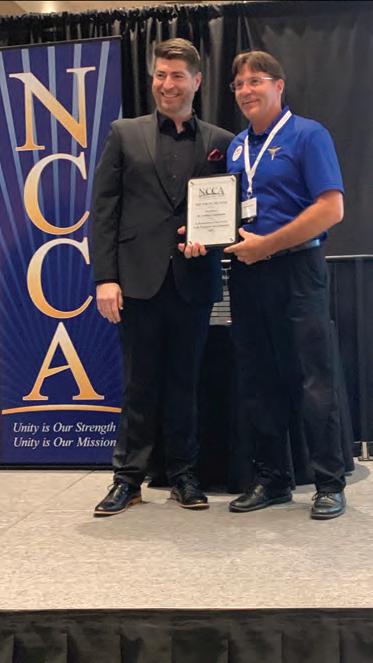
That ties Louisiana Tech for the second-longest run atop The Associated Press Top 25 women’s basketball poll in history. Only UConn with 51 weeks has a longer streak. Indiana stayed at No. 2 despite a lastsecond loss to Iowa. Utah was third with LSU and Maryland rounding out the top five. Iowa was seventh with Virginia Tech eighth. UConn fell five spots to ninth after losing to St. John’s. Notre Dame is 10th. Duke dropped two spots to No. 13 after losing to UNC, which climbed four place to No. 18. NC State received three votes.
NHL Sharks retire Marleau’s No. 12
jersey
The Sharks retired Patrick Marleau’s No. 12 on Saturday, the first number to be raised to the rafters in the team’s 32-year history. Marleau played an NHL-record 1,779 games — breaking the previous mark of 1,767 set by Gordie Howe — ranks 23rd with 566 goals and 52nd with 1,197 points for San Jose, Toronto and Pittsburgh. He holds the Sharks records for games played (1,607), goals (522) and points (1,111). He also won Olympic gold medals for Canada in 2010 and ’14.
NBA Haslams reportedly agree to purchase stake in Bucks
Milwaukee
Cleveland Browns owners
Jimmy and Dee Haslam have reportedly agreed to purchase Marc Lasry’s 25% stake of the Milwaukee Bucks in a deal that puts the value of the NBA franchise at $3.5 billion. The agreement has not been finalized. The Haslams would be spending about $875 million for Lasry’s stake of the team. It would be the second-highest valuation in NBA history, behind the $4 billion valuation for the Phoenix Suns and Phoenix Mercury when Mat Ishbia acquired them in a deal that closed this month. The Haslams bought the Browns from Randy Lerner in 2012 for $1.05 billion.
Busch gets 1st RCR victory in Fontana’s Cup farewell
The two-time champion won in his second race with his new team
The Associated Press
FONTANA, Calif. — Kyle Busch still smiles at the memory of getting thrown out of California Speedway during his first competitive trip here in 2001. The 16-year-old upstart dominated a NASCAR Truck Series practice, only to be told he couldn’t run in a race sponsored by Marlboro because he was too young to smoke.
“That was my ‘Welcome to NASCAR’ moment and my ‘Welcome to California Speedway’ moment,”
Busch said.
Anger, conflict and disrespect have always appeared to be Busch’s favorite fuels, and the record-setting veteran burned plenty of them Sunday while rewarding his new team — and sending this beloved track off in style.
Busch stormed up from the back after an early speeding penalty to earn his first victory for Richard Childress Racing, winning on this two-mile Southern California track for the fifth and final time.
Busch held off Chase Elliott and Ross Chastain in the NASCAR Cup
Series’ final race on the gloriously weathered asphalt at Auto Club Speedway, which will soon be demolished to make room for a proposed half-mile track. Busch asked Fontana officials for a chunk of that asphalt as a souvenir after he burned it up one last time on his way to Victory Lane.
“That’s what I enjoy the most about this racetrack,” Busch said.
“It’s big. It gets spread out. But man, you can move around and you can spread out and you can make your own destiny by trying to find something that will work for your race car. It’s a sad day for me to see this racetrack in its last race being a two-mile configuration. Glad I was able to win the final run here.”
Busch drove his Chevrolet to victory in only his second race with
RCR, which scooped him up in December after his 15-year tenure with Joe Gibbs Racing ended. This win was Busch’s first since Bristol last season on a dirt track, and his first on pavement since Pocono in 2021.
With his 61st career victory, Busch earned a win in his record 19th consecutive Cup season, breaking a tie with Richard Petty. Busch said he set his focus on Petty’s longevity record “a long, long time ago.”

“I’m just so thankful for the opportunity to set that bar and would love to continue to keep raising it,” Busch said.
The victory also was the combined 95th win by Kyle and Kurt Busch, breaking the NASCAR record for brothers previously held by Bobby and Donnie Allison.
Elliott finished 2.998 seconds behind Busch in his Hendrick Motorsports Chevrolet. Daniel Suárez finished fourth, and Kevin Harvick was fifth in the Bakersfield native’s 750th Cup start.
“There’s nothing more rewarding than being able to go to Victory Lane,” Busch said. “I death-gripped that wheel throughout the second half of that race, but we got the victory.”
Clinton’s Terry Holland, who transformed UVA hoops, dies
The Associated Press

THE DAVIDSON grad went on to be coach and athletic director with both the Cavaliers and Wildcats, plus AD at East Carolina “He was just there to make sure these boys became men and they became good men.”
Former Virginia women’s basketball coach Debbie Ryan on Terry Holland
Associ-
By Hank Kurz Jr., The
ated Press
Terry
Holland,
who elevated Virginia basketball to national prominence during 16 seasons as coach and later had a distinguished career as an athletic administrator, has died, the school announced Monday. He was 80.
Holland died Sunday night, according to the school, which confirmed the death with his family. His health had declined since being diagnosed with Alzheimer’s disease in 2019 and he stopped taking his prominent courtside seat at Virginia home games.
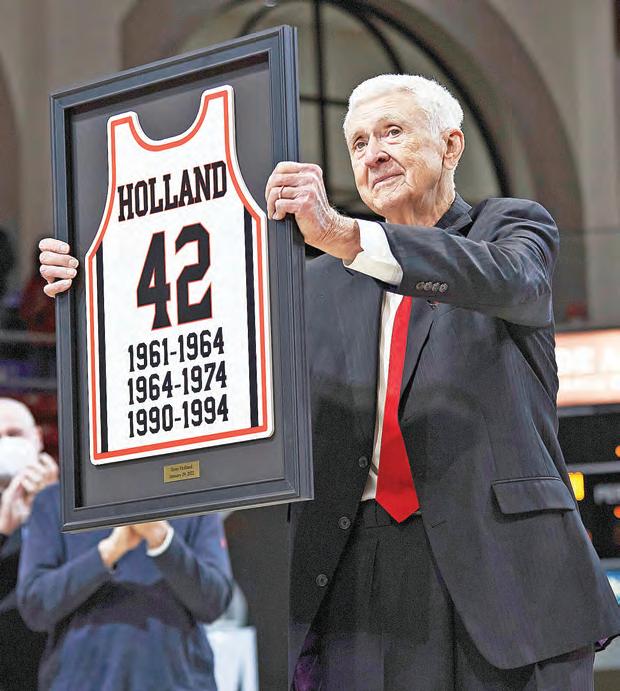
Holland took over a flailing program in 1974. The Cavaliers had had just three winning seasons in 21 years and Holland created a culture that proved a formula for success: His Cavaliers played rugged defense.
Two of his first three teams finished with losing records but only one more did as Holland compiled a 326-173 record, led Virginia to nine NCAA Tournaments, two Final Fours and the 1980 NIT title. He also guided the Cavaliers to their first Atlantic Coast Conference Tournament title in 1976 despite a modest 1511 regular-season record.
Including a five-year stint at Davidson, his alma mater, Holland’s record is 418-216. His biggest victory, however, likely was luring the nation’s most coveted recruit, 7-foot-4 Ralph Sampson of Harrisonburg, to join the Cavaliers for the 197980 season, and it was then that
AP PHOTO
director


the turnaround took off.
“Terry Holland,” Sampson told
The Associated Press in an interview earlier this month when asked what made him choose upstart Virginia over more established suitors. “He was mainly the deciding factor. Good school, good teammates, good
education, ACC. I mean, you had Dean Smith and all those people around, but he understood my demeanor and fit what I wanted in a coach. He was the perfect fit for me.”
The Cavaliers won the NIT in Sampson’s freshman season and went to the NCAA Tournament for his last three years, reaching the Final Four in 1981 before losing to UNC in the national semifinals.
Sampson, a future Hall of Famer, earned national player of the year honors in each of his last three seasons, and the profile his presence provided surely aided Holland in building his program. Virginia went back to the Final Four in its first season without Sampson, losing in overtime to Houston in the national semifinals, and appeared in the NCAA Tournament in four of Holland’s final six seasons as coach. Holland also built an extensive coaching tree, with many assistants moving on to become successful head coaches themselves. Among them: Rick Carlisle of the Indiana Pacers, Jeff Jones at Old Dominion and former longtime college coaches Dave Odom and Seth Greenberg.
When he stepped down as coach at age 48, it was to return to his alma mater, Davidson, as athletic director, beginning an administrative tenure that would bring him back to Virginia five years later in the same position. In 2001, he moved to special assistant to the president of the university, and in 2004, he began an eight-year stint as athletic director at East Carolina before retiring in 2012.
4 North State Journal for Wednesday, March 1, 2023
Family Chiropractic Center 24 Years Serving Hoke/Raeford Chiropractic celebrates 127 YEARS Discovered Sept. 18, 1895 Call 875-2500 for appointment To Get Back in Action 751 S. Main St., Raeford www.raefordchiropractic.com Most insurance led, Medicare & VA Veteran’s Administration covers chiropractic care. Call 910-875-2500 for more info on how.
SPORTS
Dr. Tony Santangelo, DC, named NC Chiropractic Association Chiropractor of the Year, based on community service & the profression
AP PHOTO
Kyle Busch crosses the finish line to win Sunday’s NASCAR Cup Series race at Auto Club Speedway in Fontana, California.
Former Davidson basketball player, coach and athletic
Terry Holland holds up a frame with his jersey No. 42 last January. The Clinton native, best known for making the Virginia Cavaliers an ACC contender, died Sunday at age 80.
“There’s nothing more rewarding than being able to go to Victory Lane.”
Kyle Busch
MLBPA’s Tony Clark says rising payrolls good for game

Small-market owners are concerned that the competitive gap is widening
The Associated Press SCOTTSDALE, Ariz. — A handful of free-spending owners in Major League Baseball have made some of the game’s other owners a little nervous.
Players’ union head Tony Clark doesn’t mind that development one bit.
“Baseball is doing very well,” Clark said on Saturday as the first full slate of spring training games began in Florida and Arizona.
Clark’s perspective isn’t shared by all. There’s a group of owners — including Pittsburgh’s Bob Nutting — who believe that a recent jump in free agent spending is part of the reason smaller market teams, like the Pirates, struggle to remain competitive. It’s
one of the reasons MLB recently formed an economic reform committee.
“It’s the single biggest issue facing the Pittsburgh Pirates,” Nutting told the Pittsburgh Post-Gazette on Friday. “Competitive disparity, revenue disparity and payroll disparity are all real challenges.”
This offseason, salaries have risen following last year’s agreement on a five-year labor contract with the players’ association. Payrolls rose 12.6% to a $4.56 billion last year, breaking the previous record set in 2017, and are set to go even higher this year.
The New York Mets, entering their third season under owner Steve Cohen, project a payroll upward of about $370 million — which would smash the previous high of $291 million by the 2015 Los Angeles Dodgers.
Some so-called smaller market teams have even joined the spending surge. The San Di-

ego Padres have been very active with free agents over the past few years, adding standouts like shortstop Xander Bogaerts. Clark said that’s evidence that teams from markets of all sizes can compete financially and on the field, noting that the Padres have seen an uptick in fan interest.
“Teams were competing, engaging in the free agent market and created a level of excitement that I would think is a positive,” Clark said.
There’s no doubt that economic disparity exists in baseball. While the Mets are set to spend around $370 million on payroll, others like the Orioles, Rays, Pirates and Athletics are expected to be in the $60-80 million range.
The causes for that disparity are where friction occurs between MLBPA and MLB.
“The question that should be asked in regards to one team’s
payroll versus another, is whether or not that team is making a conscious decision to have its payroll there, or whether it has
Serbia grabs the last spot in Basketball World Cup field
The U.S. is seeded second behind Spain
The Associated Press
THE BASKETBALL World Cup field is now filled, with Serbia grabbing the last spot in this summer’s 32-team tournament.
Serbia clinched the berth with a 101-83 win over Great Britain on Monday. The win means that twotime reigning NBA MVP Nikola Jokic of the Denver Nuggets — if he is so inclined — will have the chance to play for a World Cup this
summer, when the tournament gets held in the Philippines, Japan and Indonesia.
Serbia’s win in Belgrade eliminated Belgium, the last team that still had a chance to qualify.
Most teams at the World Cup will use NBA players when they can. The U.S. used G League and internationally based players almost exclusively in its qualifying games, but it will go to a roster of NBA players for the tournament this summer.

Spain is the defending champion. The U.S. finished seventh at the last World Cup in 2019.
Serbia qualifying means 10 of the top 11 teams in the world rankings reached the World Cup. The exception was No. 4 Argentina, the silver medalist in 2019. No. 1 Spain, No. 2 United States, No. 3 Australia, No. 5 France, No. 6 Serbia, No. 7 Slovenia, No. 8 Lithuania, No. 9 Greece, No. 10 Italy and No. 11 Germany have qualified. There will be two first-round groups that include two of those teams. And none of the four teams involved in that scenario will be thrilled when they see that draw. The lowest-ranked teams in the field are four of the five African
qualifiers: No. 43 Ivory Coast, No. 55 Egypt, No. 63 South Sudan and No. 66 Cape Verde. Cape Verde, South Sudan, Georgia and Latvia are in the tournament for the first time.
There are 23 teams that were in the 2019 World Cup and have qualified again for this year’s event, a list led by the United States and Brazil — the only nations to appear in all 19 editions of the tournament.
Spain has been to each of the last 11 World Cups. Puerto Rico has been to each of the last 10.
The other 19 nations who are back from 2019: Angola, New Zea-
the ability to increase its payroll,” Clark said.
“The answer is the latter, not the former.”
land, France, Greece, Australia, Lithuania, Serbia, Iran, Dominican Republic, Philippines, Montenegro, Jordan, Venezuela, Japan, Ivory Coast, Germany, China, Italy and Canada.
Finland, Slovenia, Egypt, and Mexico are back in the field after last reaching the World Cup in 2014. Lebanon is back, after its most recent appearance was in 2010.
These nine nations appeared in the 2019 tournament and won’t be back this summer: Argentina, South Korea, Turkey, Senegal, Nigeria, Tunisia, Poland, the Czech Republic and Russia.
FIBA banned Russia’s teams and officials from its competitions last year in response to that country’s invasion of Ukraine.
5 North State Journal for Wednesday, March 1, 2023 LIFE’S GREATEST ADVENTURE! 143 AIRPORT DR. Raeford, NC 28376 Call Us: 910.904.0000 INFO@SKYDIVEPARACLETEXP.COM WWW.FLYXP.COM
LUIS MAGANA | AP PHOTO
Tony Clark, executive director of the Major League Baseball Players Association praised rising salaries, saying on Saturday “baseball is doing well.”
PHOTO
AP
Nuggets center Nikola Jokic will have the opportunity to play in the World Cup after Serbia earned a berth in the international tournament.
Flu vaccine worked well in season that faded fast, CDC says
The Associated Press NEW YORK — Early estimates suggest the flu vaccine performed well in a U.S. winter flu season that has already dissipated.
The vaccines were more than 40% effective in preventing adults from getting sick enough from the flu that they had to go to a doctor’s office, clinic or hospital, health officials said during a Centers for Disease Control and Prevention vaccines meeting Wednesday. Officials generally are pleased if a flu vaccine is 40% to 60% effective.
One reason is the vaccine was a good match against the strains that spread over the fall and winter, officials say.
But one expert at the meeting was underwhelmed and said it points out the need for better flu vaccines. “It is still disappointing” that the vaccine was a good match and yet effectiveness was still modest, said Dr. Sarah Long of Drexel University.
Annual flu vaccines are recom-
mended for everyone 6 months and older in the U.S. About half of eligible kids and just under half of adults got flu shots in the last several months, according to CDC data. Vaccination rates were up compared with 2021-
2022, but below what they were before the COVID-19 pandemic hit in 2020, said the CDC’s Brendan Flannery. Initially, it looked like it might be a bad flu season. The virus took off in early November as
COVID-19 and another respiratory virus, RSV, roiled emergency departments. Among kids, flu-related hospitalization rates in November and December were as high as any seen in recent years, Flannery said. At least 111 flu deaths have been reported in children, the most since the 199 reported in the 2019-2020 season. The dominant flu strain was the kind typically associated with higher rates of hospitalizations and deaths, particularly among older people. In some years, the vaccines were virtually ineffective against that strain in people 65 and older. But this season’s vaccine has done unusually well, with the best results seen in at least 10 years, said Flannery, who is responsible for the CDC’s flu vaccine effectiveness data.
Flu also apparently made a very early exit, with the virus declining since the end of November. Some pockets of high flu activity have persisted this month, including in New Mexico and New York City. But for the vast
majority of the country, it’s low.
It’s not clear exactly why the wave crested so early, but flu seasons have been unusually mild or otherwise strange since the COVID-19 pandemic hit in early 2020, Flannery said. CDC officials also caution that flu season might not really be over — late winter or spring second surges have occurred in the past.
The CDC uses several systems to track flu vaccines. One is a network of hospitals that offer information on how well the vaccine prevented flu-related illnesses bad enough to require admission to a hospital. Another is a collection of urgent care clinics and hospital emergency departments, which produce estimates of how well the vaccine worked against in preventing those kinds of medical visits.

Among the findings:
—The vaccine was 44% effective in preventing adult lab-confirmed flu visits to urgent care clinics and hospital emergency rooms, and 39% effective for seniors age 65 and older.

—It was 43% effective against flu-related hospitalizations of all adults, and 35% against flu hospitalizations of seniors.
—In kids, the vaccine was 68% effective in preventing illnesses severe enough to require hospitalization, and 42% effective for pediatric visits to the emergency department.
GOP leaders, stung by losses, plan to wade into Senate races
The Associated Press
WASHINGTON, D.C. — A football legend who held a gun to his ex-wife’s head. Rivals who nearly brawled during a televised debate. A venture capitalist who voiced sympathy for the Unabomber.
And that’s just to name a few.
Republican Senate primaries in several pivotal states last year exuded a carnival-like aura, dominated by candidates whose ill-advised remarks and damaging personal baggage ultimately cost the party its chance of retaking a majority. But even as alarms sounded over a growing crisis of electability, party leaders mostly stood by, including Florida Sen. Rick Scott, the Senate GOP’s campaign chief, who insisted on remaining neutral in the nominating contests.
Now, at the dawn of the 2024 campaign season, Republicans say they are taking steps to avoid a repeat. The National Republican Senatorial Committee, which Scott formerly led, intends to wade into party primaries in key states, providing resources to its preferred candidates in a bid to produce nominees who are more palatable to general election voters.
“One thing I kept hearing when I took this job was that Republicans are sick and tired of losing,” said Sen. Steve Daines of Montana, the new chairman of the NRSC. “This is our last chance this decade to target red-state Democrats, so we’re going to do whatever it takes to recruit candidates who can win both a primary and general election.”
The new approach was on display this month during an NRSC retreat at the Breakers, a luxury resort in Palm Beach, Florida, which drew senators and
potential candidates, including Dave McCormick. The hedge fund CEO narrowly lost Pennsylvania’s 2022 Republican Senate primary to Dr. Mehmet Oz, a Trump-backed TV personality who was defeated in the general election by Democrat John Fetterman by roughly 5 percentage points.
McCormick, who is considering another run in 2024, spoke at the multiday event, according to two senior Republican strategists, who insisted on anonymity to discuss the details of the private gathering.
Later, before a crowded banquet room that included at least one other potential rival for the Pennsylvania seat, Daines singled out McCormick with praise, saying he would make an excellent candidate, according to one of the strategists.
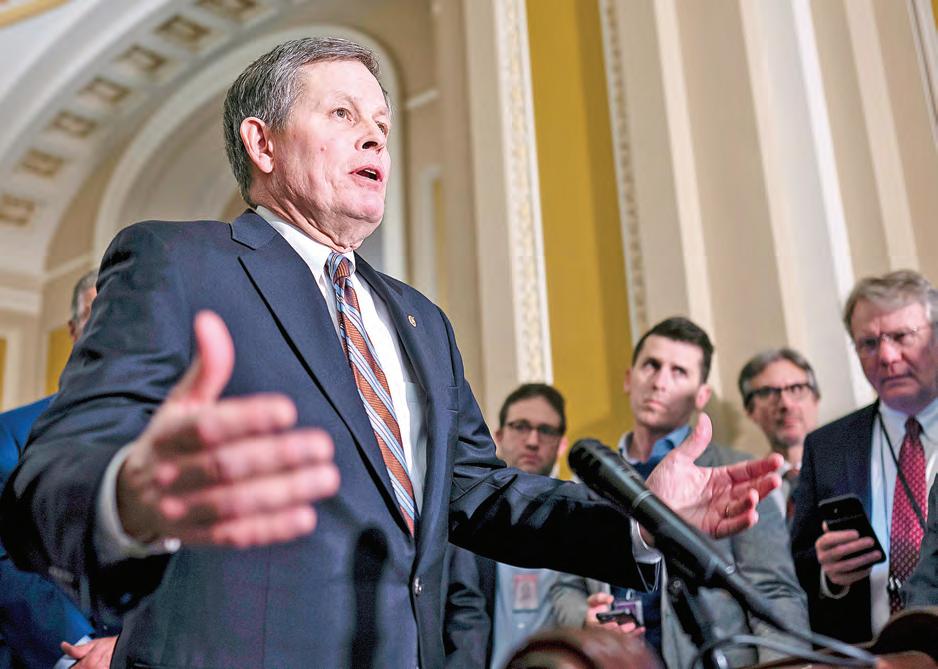
If he enters the primary, McCormick has also been promised support from the Senate Leadership Fund, a super PAC linked to Senate Minority Leader Mitch McConnell that spends millions of dollars on TV advertising, according to two other Republican strategists familiar with the mat-
ter. That serves as a warning to anyone else thinking about the race: If McCormick gets in, he would have the full weight and resources of the Senate Republican campaign operation behind him.
Another example of recent intervention is the committee’s early endorsement of Rep. Jim Banks in Indiana’s Senate primary. Though Indiana is reliably Republican, a crowded primary, like in 2018, could sap resources better spent in competitive states. Banks has yet to draw a serious
competitor.
The move could also be viewed as a show of good faith to Trump, as well as the conservative group Club for Growth, who have often worked at cross-purposes with Republican Senate leaders. Banks is close with Donald Trump Jr., Trump’s oldest son, and he has also been championed by Club for Growth.
Some Republicans contrast the new approach the NRSC intends to take with that of Scott. Consider his handling of Colorado’s Senate primary in 2022. Joe O’Dea, a moderate Republican and construction company owner, was viewed by many as the kind of candidate who could win in the onetime swing state during a good year for the GOP.
But Scott pointedly declined to endorse O’Dea during a trip to the state, while also offering praise for O’Dea’s rival, a state legislator who espoused conspiracy theories, crossed police lines at the U.S. Capitol during the Jan. 6 riot and struggled to raise campaign cash.
O’Dea ultimately lost the general election by nearly 15 percentage points. But the incident offers an example of power centers within the party working at cross purposes — in this case, Scott declining to get behind a candidate many viewed as the party’s only chance to win.
It also helped fuel a feud between Scott and McConnell, which sowed chaos throughout the Senate Republican campaign effort and culminated in a failed challenge by Scott of McConnell’s position as Senate leader.
“We need people running who can win,” said Steven Law, the CEO of the Senate Leadership Fund. “We’re raising the resources to ensure we have quality candidates.”
6 North State Journal for Wednesday, March 1, 2023 We are happy to discuss your needs or questions. We’re here to help! O��� A��� R��������� C����� Committed to serving and enriching the lives of every resident Affordable Assisted Living and Memory Care Caring for Seniors Integrity Open Arms Retirement Center 612 Health Drive • Raeford, NC openarmsretirement.com • 910-875-3949 OpenArms-Generic ad.indd 1 8/4/22 2:27 PM
AP PHOTO, FILE
A flu vaccine is readied in this Oct. 2022 file photo.
AP PHOTO
Sen. Steve Daines, R-Mont., speaks during a news conference at the Capitol in Washington, D.C., Feb. 14, 2023.
Alexander Hall
December 26, 2008 ~ February 25, 2023
Alexander Bell Hall, of Red Springs, NC departed this walk of life on Saturday, February 25, 2023.

Alex was born in Robeson County on December 26, 2008.

He was preceded in death by his mother, Rita Faye Hall.
Alex was a miracle to our family who brought love, peace, joy, and happiness to our life.
He is survived by his father, Earl Hall, Sr.; his siblings, Gracie Caulder, Robert Caulder, Tawana Fields, Alan Fields, Jonathon Fields (Sandra), Sharon Morales, Earl Hall, Jr. (Kris), Tina Locklear (Trent), Jerry Oxendine (Penda), Jonathan Hall (Kiley), Percell Henderson (Sarah); nieces and nephews, Katana Locklear (Spencer), Christopher Fields (Katelynn), Cheyann Fields, Tierra, Tana, Trinity, Travis, Toby, Tristan, Takobi, Tianna, all Locklears, Dakota Henderson, Carson Henderson, J.C Fields, Kirston Fields, Keyara Fields, Calista Arboleda, Marco Arboleda, Estevan Arboleda, Jewel Gillespie, and India Terry; his caregiver, Brenda Robinson, and a host of other relatives that loved him very much.
Robert Dewayne Green, Jr.

July 27, 1972 ~ February 23, 2023
Mr. Robert Dewayne Green, Jr. passed away on February 23, 2023, in his home.

Rob was born in Bridgeton, New Jersey on July 27, 1972, to Robert Dewayne Green, Sr., and the late Barbara Walls Jolly.
He was preceded in death by his brother, Wayne Green. Rob loved his two sons and his dogs. He was an excellent painter. Though he was quite troublesome, sometimes, he will be missed very much.
He is survived by his sons, Robert Dewayne Green III, and Tyler Mason Green; his father, Robert Dewayne Green, Sr., and his wife Barbara; brother, Phil Green; sister Vickie Gribble; his siblings, Danielle Quinn, Bruce Quinn, and Eric Green; and a multitude of aunts, uncles, and cousins.


Carolyn T. Smith

April 4, 1946 ~ February 21, 2023
Mrs. Carolyn T. Smith, of Raeford passed away Tuesday, February 21, 2023, at her home.

Mrs. Smith was born in Horry County, SC on April 04, 1946, to the late Aubrey McKiver Todd and Alice Genever Beverly Todd.
She was preceded in death by her husband, Donnie Smith Jr. and her beloved dog, “Girl”.

She was employed with Burlington Industries before she retired, a lifetime member of the Cumberland County Amateur Radio Operators and her hobbies were crocheting, and spending time with her family, especially her two great grandbabies, and her daughter Diane, along with Gee-Gee.
She is survived by her children, Lisa (Jeff) Turner of King, MT, William “Steve” Smith of Raeford, NC, and Diane (Donnie) Lucas of Raeford, NC; Grandchildren, Gloria Genever Baxley, and Chance Turner; Great Granddaughters, Madison, and Skylar; Brothers, James (Barbara) Todd of Bladenboro, NC, Randall (Wanda) Conway, and Glenn Todd; Sisters, Jeanette (James) Stephens Conway, Amanda Sue (Jr.) Marlowe Conway, and Linda Todd Conway; and Caregivers, Sheila Kittrell, Lisa Carney, and Sallie Brown.

7 North State Journal for Wednesday, March 1, 2023 obituaries SPONSORED BY CRUMPLER FUNERAL HOME AND CREMATION Our Family Serving Yours Since 1960 62 YEARS Address: 131 Harris Avenue, Raeford, NC 28376 | Website: www.crumplerfuneralhome.com | Phone: 910-875-4145 | Fax: 910-875-6632 We are here for you in your time of need Funeral Home, Crematory, Pre-Arrangements, Grief Share, Veterans Honored Compassion, Dignity, Respect with Dedicated Professionals Celebrate the life of your loved ones. Submit obituaries and death notices to be published in NSJ at obits@northstatejournal.com
STATE & NATION
Southern Baptists oust Saddleback Church over woman pastor
The Associated Press
THE SOUTHERN Baptist Convention ousted its second-largest congregation — Saddleback Church, the renowned California megachurch founded by pastor and best-selling author Rick Warren — for having a woman pastor.
The vote by the convention’s Executive Committee culminates growing tension between the nation’s largest Protestant denomination — which officially opposes women as pastors — and a congregation whose story has been one of the biggest church-growth successes of modern times.
The committee cited Saddleback’s having “a female teaching pastor functioning in the office of pastor,” an allusion to Stacie Wood, wife of the current lead pastor of Saddleback, Andy Wood.
But the controversy began in 2021, when Warren ordained three women as pastors, prompting discussions within the denomination about possibly expelling the megachurch. Warren retired last year after more than 42 years at Saddleback. He made an emotional speech in June 2022 at the Southern Baptists’ annual convention in Anaheim, standing by his ordination of women. He told delegates who debated the issue, “We have to decide if we will treat each other as allies or adversaries.”
But the Executive Committee took the vote without public discussion after meeting in executive session.
It voted to approve a recommendation from the denomination’s Credentials Committee that Saddleback be deemed “not in friendly cooperation with the Convention” — the terminology used for ousting a church. While Southern Baptists’ statement of faith officially opposes women as pastors, each congregation is self-governing, so
the main enforcement mechanism is to oust it from membership. The Executive Committee’s motion said that Saddleback “has a faith and practice that does not closely identify with the Convention’s adopted statement of faith, as demonstrated by the church having a female teaching pastor functioning in the office of pastor.”
In a statement, the church didn’t indicate whether it planned to exercise its right to appeal the decision at the Southern Baptists’ next annual meeting, scheduled for New Orleans in June.
“We love and have always valued our relationship with the SBC and its faithful churches,” Saddle-
back elders said in a statement.
“We will engage and respond through the proper channels at the appropriate time in hopes to serve other like-minded Bible believing SBC churches. Meanwhile, we remain focused on following God’s leadership to love and serve our church family and the communities around our campuses.”
Mike Keahbone, an Executive Committee member and Oklahoma pastor, said an appeal “appears likely.”
“This was the heart of the room; to let the messengers (delegates) of the SBC decide,” Keahbone tweeted Tuesday. With its main campus in Lake
Forest, south of Los Angeles, Saddleback Church has grown over four to 14 locations in Southern California, with an average weekly attendance of 30,000. There are four international campuses —in Hong Kong, Germany, the Philippines and Argentina.
Wood told The Associated Press last year that the Bible “teaches that men and women were given spiritual gifts by God.” His wife has served as teaching pastor for Saddleback.
“The church should be a place where both men and women can exercise those spiritual gifts,” Wood said. “My wife has the spiritual gift of teaching and she is
Train crew had little warning before Ohio wreck, probe finds
The Associated Press
EAST PALESTINE, Ohio —
The crew operating a freight train that derailed in East Palestine, Ohio, didn’t get much warning before dozens of cars went off the tracks, and there is no indication that crew members did anything wrong, federal investigators said Thursday as they released a preliminary report into the fiery wreck that prompted a toxic chemical release and an evacuation.
“Enough with the politics. I don’t understand why this has gotten so political,” safety board Chair Jennifer Homendy, clearly exasperated, said at a briefing in Washington, D.C., on Thursday. “This is a community that is suffering. This is not about politics. This is about addressing their needs, their concerns.”
The NTSB report, which laid out the facts that investigators have gathered to date, said crew members had no indication the train was in trouble until an alarm sounded just before it went off the tracks.
An engineer slowed and stopped the train after getting a “critical audible alarm message” that signaled an overheated axle, according to the report. The three-person crew then saw fire and smoke and alert-
ed dispatch, the report said.
“We have no evidence that the crew did anything wrong,” said Homendy, who announced a rare investigatory field hearing to be conducted in East Palestine this spring as officials seek to get to the bottom of the derailment’s cause and build consensus on how to prevent similar wrecks.
Investigators said the temperature of the failed wheel bearing increased by 215 degrees in a span
of 30 miles, but did not reach the temperature threshold that railroad company Norfolk Southern had set for an alarm to go off until just before the wreck.
The train was going about 47 mph, under the speed limit of 50 mph, according to investigators.
Outside experts who looked at the report said the system appeared to work as designed, from the spacing of the hot bearing detectors along the tracks to the op-
eration of the sensors.
“There’s nothing in the NTSB report that surprises me at all,” said Dave Clarke, the former director of the Center for Transportation Research at the University of Tennessee. “I can’t see anything to really criticize about what happened or how the response was made.”
Christopher Barkan, director of the Rail Transportation and Engineering Center at the University of Illinois, said the spacing of the sensors that recorded the temperatures of the Norfolk Southern train — 10 and 20 miles apart — is common in the industry.
He said the detectors would not have notified the train crew of elevated bearing temperatures unless they met the threshold for action.
“I don’t see anything wrong here, but we just don’t know,” Barkan said.
Norfolk Southern said the NTSB report showed the heat detectors worked as intended and the train crew operated “within the company’s rules.” Nevertheless, the company said it would “need to learn as much as we can from this event” and “develop practices and invest in technologies that could help prevent an incident like this in the future.”
The freight cars that derailed on the East Palestine outskirts, near
really good. People often tell me she’s better than me when it comes to preaching, and I’m really glad to hear that.”
The Executive Committee also voted to oust five other congregations -- four over the issue of women as pastors and one over the issue of sexual abuse.
When Southern Baptists last updated their official statement of belief — The Baptist Faith and Message — in 2000, they added this clause: “While both men and women are gifted for service in the church, the office of pastor is limited to men as qualified by Scripture.”
The five churches ousted for having women as pastors “have been valued, cooperating churches for many years, and this decision was not made lightly,” Committee Chairman Jared Wellman said in a statement. “However, we remain committed to upholding the theological convictions of the SBC and maintaining unity among its cooperating churches.”
The church grew from a startup by Rick Warren and his wife, Kay Warren. With his charisma and easy, informal preaching style, Warren attracted thousands to the megachurch. Over the past decade, Warren also launched an ambitious plan to expand the church’s reach across Southern California as well as globally, a vision his successor has promised to complete.
Warren, in a tweet, said he and Kay would “respond to #SBC in OUR time & way thru direct channels” such as social media and newsletters.
Warren remains listed as founding pastor on the Saddleback website.
The SBC has 13.7 million members, but has seen net declines over more than a decade in members and baptisms, its key metric for spiritual vitality.
the Pennsylvania state line, included 11 carrying hazardous materials. Villagers evacuated as fears grew about a potential explosion of smoldering wreckage.
Officials seeking to avoid an uncontrolled blast intentionally released and burned toxic vinyl chloride from five rail cars, sending flames and black smoke into the sky. That left people questioning the potential health effects even as authorities maintained they were doing their best to protect people.
In another sign of the environmental impact, the Ohio Department of Natural Resources said Thursday it now estimates spilled contaminants affecting several miles of streams killed nearly 44,000 fish, mostly small ones such as minnows. Its initial estimate was 3,500.
As NTSB released its preliminary findings, U.S. Transportation Secretary Pete Buttigieg — who had been criticized for not coming to East Palestine earlier — went on a tour of the crash site and defended the Biden administration’s response to the Feb. 3 derailment, which Trump had portrayed as indifferent and a “betrayal.”
Heather Bable, who lives two blocks from the derailment site, said she’s relieved the government’s top brass is finally showing up.
“We need that attention because we weren’t getting it. They should have been here all along,” said Bable.
8 North State Journal for Wednesday, March 1, 2023
PHOTO
AP
Congregants arrive at Saddleback Church in Lake Forest, Calif., on Sunday, Oct. 16, 2022.
ALLIE VUGRINCIC | THE VINDICATOR VIA AP, POOL
Transportation Secretary Pete Buttigieg, left, and Tristan Brown, deputy administrator of the Pipeline and Hazardous Materials Safety Administration, crouch down to look at part of a burned traincar, Thursday, Feb. 23, 2023, in East Palestine, Ohio, at the site of a Norfolk Southern train derailment.
Ready to serve
Assistant Commandant of the
as they re-enlist at the

COUNTY NEWS
Elementary school gets WSSU mentors
Forsyth County
Principal Celena Tribby has welcomed 32 Winston-Salem State University students to work with her own students at Cook Literacy Model School. Students from one of professor Dawn Hicks Tafari’s classes at WSSU will visit with every fourth- and fifth-grader at Cook. The college kids will spend an hour each Thursday with the Cook students until the end of April. The WSSU mentors will be assigned two or three Cook students.
The focus of their get-togethers won’t be on grades, reading or any kind of tutoring. Both sets of students will sit down for lunch, talk about what’s going on in their lives and shoot hoops, draw, write in journals or simply hang out. Tafari recently brought her students to Cook to meet their mentees. It was a festive occasion, featuring cheerleaders and drummers from WSSU’s Red Sea of Sound.
Tafari, an education professor, started the Radical Academic Mentoring Service, or R.A.M.S., in 2017 at Ashley Elementary School. It came out of her desire for students enrolled in her classes — Advancing the Academic and Social Success of Black Males and Advancing the Academic and Social Success of Black Girls — to have hands-on experience with local schoolchildren.
The program paused during the pandemic and is being revived at Cook. Union Baptist Church is a partner in the program, providing transportation for the WSSU students to Cook.
Located in the BostonThurmond neighborhood, Cook has an enrollment of about 300 students and is designated by the federal government as a Title 1 school based on the number of economically disadvantaged students.
The school district will evaluate the mentorship program on its effectiveness and may try to replicate it at other schools.
Kimberly Pemberton, the chairwoman of the education department at WSSU, reminded the mentors of the importance of their role in the lives of the Cook children.
WSSU wins CIAA men’s basketball tournament
Rams crowned for 13th time in program history
Twin City Herald
WINSTON-SALEM State won the 2023 CIAA Men’s Basketball Champion after a big second-half run helped No. 5 seed Rams reclaim control and defeat No. 6 seed Lincoln (Pa.) 62-57 in the title game at CFG Bank Arena on Saturday.

The championship is the 13th in the Rams’ storied basketball history, including two under Head Coach Cleo Hill Jr.
The win also earned the Rams (21-8 overall) an automatic bid to the NCAA Division II playoffs in the Atlantic Region.
You cannot come [to Winston-State Salem] and not expect to win division championships and conference championships and advance to the NCAA Tournament,” said Coach Cleo Hill
Jr. “It’s just part of the deal when you are a coach here or a player here.”
Led by 14 points from Samage Teel and 11 each from Jaylon Gibson and Jon Hicklin, the
Rams staved off a late comeback from a feisty Lincoln team that was making its first appearance in the CIAA Men’s Basketball Championship game.
After falling behind by dou-
ble digits at halftime, the Lions outscored the Rams 16-5 to knot the score at 34-34 midway in the second half. The Rams were not deterred by the rally as they put together a 17-8 run of their own for a 51-42 lead with 1:29 left.
That run ultimately was the difference, but not before the Lions put another scare in the Rams. Bakir Cleveland made one of two free throws as Lincoln climbed within 56-52 with 34 seconds left. Korey Williams later connected on a deep three-pointer to cut the deficit even further to 60-57 with one second left but Teel, the hero in the semifinal win over Virginia Union, made both free throws for the final margin.
Teel hit the game winning shot in a 45-44 win over Virginia union on Friday. WSSU won four games in four days to take the tournament title. The Rams opened with a 65-49 win over St. Augustine’s, then topped Claflin, 60-52.
Jaylen Alston, named Food Lion Tournament MVP, and Xavier Fennell both added eight points in the title game for the Rams, who outrebounded the Lions 47-26 including a 16-5 advantage on the offensive boards.
See WSSU, page 2
House building approved to be reintroduced to curriculum through Habitat for Humanity
By Ryan Henkel North State Journal
WINSTON-SALEM
—
The Winston-Salem/Forsyth County Board of Education met Tuesday, February 14 with a handful of mentorship and educational programs on the agenda.
The board recognized Bolton Elementary teacher Deci Yahya who was named the North Carolina Department of Public Instruction 2022-23 Educator of Excellence. “Desi serves as a curriculum
and support teacher at Bolton Elementary in our K-5 classrooms,” said Chief Academic Officer Dr. Paula Wilkins. “She embodies the spirit of an educator that centers students first. Her room is a place where students with social, emotional and behavioral needs thrive and grow.
Desi is committed to excellence for all her students and serves as a school leader. Her classroom is a haven that embodies the use of structure and support to her learners and the acquisition of skills necessary to access the education environment. In the face of complicated and unique situations, she constantly seeks out research and support to assist the learners in her room. Desi’s spirit, dedication and commit-
ment is a breath of fresh air and we are beyond lucky to have her as a teacher in our district.”
The board also approved an MOA with the City of Winston-Salem to implement three mentorship programs.
“The City of Winston-Salem and Winston-Salem/Forsyth County Schools is looking at having a partnership where we will have three youth mentoring programs that the city will bring forward here in our district and work with our students,” said Director of Parent Engagement Ronda Mays. “The programs’ aims are to prepare youth and teens to succeed in school and to prevent youth violence in the
8 5 2017752016 $1.00 VOLUME 5 ISSUE 20 | WEDNESDAY, MARCH 1, 2023 | SUBSCRIBE TODAY: 336-283-6305 THE FORSYTH COUNTY EDITION OF THE NORTH STATE JOURNAL
See BOE, page 2
AP
WSFCS Board of Education enters agreement with Winston-Salem for youth mentorship programs
PHOTO COURTESY WSSU
Winston-Salem State poses for a team photo after winning the CIAA tournament.
AP PHOTO
Marine Corps, Gen. Eric Smith swears in U.S. Marines from the 2nd Marine Logistics Group from Camp Lejeune,
U.S. Marine Corps Memorial, Thursday, Feb. 23, 2023, in Arlington, Va.
WEDNESDAY 3.1.23 #236
WEDNESDAY MAR 1 HI 7 1° LO 60° PRECIP 6% THURSDAY MAR 2 HI 7 3° LO 59 PRECIP 74% FRIDAY MAR 3 HI 7 2° LO 51° PRECIP 8 3% SATURDAY MAR 4 HI 67 LO 4 4° PRECIP 3% SUNDAY MAR 5 HI 62 ° LO 3 8° PRECIP 4% MONDAY MAR 6 HI 65° LO 4 4° PRECIP 4% TUESDAY MAR 7 HI 6 8° LO 4 5° PRECIP 5%
“Join the conversation”
WEEKLY FORECAST Twin City Herald Neal Robbins Publisher Matt Mercer Editor in Chief Griffin Daughtry Local News Editor Shawn Krest Editor Cory Lavalette Sports Editor Frank Hill Senior Opinion Editor Lauren Rose Design Editor Published each Wednesday as part of North State Journal 1201 Edwards Mill Rd. Suite 300 Raleigh, NC 27607 TO SUBSCRIBE: 336-283-6305 nsjonline.com Annual Subscription Price: $50.00 Periodicals Postage Paid at Raleigh, N.C. and at additional mailing offices. POSTMASTER: Send address changes to: North State Journal 1201 Edwards Mill Rd. Suite 300 Raleigh, NC 27607
COLUMN | BEN SHAPIRO
DEATH NOTICES
♦ James Bently Apple, 86, of Kernersville, died February 25, 2023.
♦ Ann Butler Cheshire, 90, of Winston-Salem, died February 24, 2023.
♦ Claudia Lee Govan Ingram, 73, died February 22, 2023.
♦ Todd Lowder, 61, of Clemmons, died February 24, 2023.
♦ Nancy Wall Mitchell, 75, of Rural Hall, died February 24, 2023.
♦ Joyce Ann Wooten Morelli, 71, of Forsyth County, died February 22, 2023.
WSSU from page 1
Both teams shot 35 percent from the floor but the Rams made 26 of 43 free throws compared to 14 of 17 for the Lions.
L incoln placed three scorers in double figures led by 14 points from Reggie Hudson. Williams added 12 points and Freddie Young, Jr. contributed 11 points off the bench for the Lions, who scored 15 points off 20 WSSU turnovers.
The Lions stayed close early, but the Rams scored 12 straight points late in the half to extend a 15-12 lead to 2712. The Lions sliced the deficit to 11, trailing 29-18 at halftime. Lincoln (PA) continued its run to start the second half as the Lions went on a 16-4 run to pull even at 34-34. In that run, Reggie Hudson scored 12 straight points before Peter Sorber’s layup tied the game. In the next possession, Jon Hicklin hit a three to regain the lead for Winston-Salem State.
Teel paced the Rams with eight first-half points. Alston and Hicklin each added five points in the period. Winston-Salem State outrebounded Lincoln (PA) 27-12 in the first half, finishing the game with a 47-26 advantage.
The Rams’ trio of Alston, Gibson and Teel were named to the CIAA Men’s All-Tournament Team.
The CIAA and TCH staff both contributed to this report
LAST WEEK, as Presidents Day weekend loomed, the Biden administration dropped a little-noticed executive order. That executive order happened to be one of the broadest, most transformative executive orders in modern American history; it turned the federal government into one giant machine designed for the propagation of woke principles. The so-called “Executive Order On Further Advancing Racial Equity And Support For Underserved Communities Through The Federal Government” -- presumably titled in jargonistic gobbledygook in order to avoid scrutiny — set out the key guiding principle for the Biden administration. This principle, “equity,” will now be used to redirect the entirety of the federal government’s awesome powers.
What, pray tell, is “equity”? It certainly isn’t equality — the presumption that Americans ought to be treated equally under the law as individuals. Instead, equity presumes that any group disparities must be the result of perverse government policy, and that the only corrective is government interventionism. The new executive order suggests that “by advancing equity, the Federal Government can support and empower all Americans, including the many communities in America that have been underserved, discriminated against, and adversely affected by persistent poverty and inequality.” Poverty, you see, is purely the outgrowth of discrimination and lack of service. Individuals must never be implicated in their own failures, nor can cultural differences justify group underperformance. As Ibram X. Kendi more bluntly puts it, “As an anti-racist, when I see racial disparities, I see racism.”
The solution, therefore, is that government must correct all policy that allows for the annoyingly eternal human conditions of poverty and inequality. Biden’s executive order dictates that equity be “embedded... into the fabric of Federal policymaking and service delivery.” This will not be a “one-time project”; it must
BOE from page 1 community.” According to Mays, there will be no cost to the district as the city of Winston-Salem will be picking up any costs related to the programs.
The programs are Chop It Up, in which 12 students will meet one to two times a week to talk about current events and different issues which they can anonymously suggest with a mentor, Stay Fresh Initiative, in which certified barbers and nail techs will give services for free to students to assist with self-esteem and personal image, and After-School Boxing, which will not feature sparring and instead will be a way for students to learn discipline and have a possible outlet for aggression.
The board was then presented
WEEKLY CRIME LOG
♦ Barnes, Willmeshyah Jean`ae (F/25) Arrest on chrg of Possession Control Substance Jail (F), at 201 N Church St, Winston-salem, NC, on 2/22/2023 21:37.
♦ Barnes, Willmeshyah Jean`ae (F/25) Arrest on chrg of Fugitive Arrest (magistrate`s Order) (F), at 201 N Church St, Winstonsalem, NC, on 2/23/2023 22:49.
♦ Barr, Cresean Bernard (M/21) Arrest on chrg of 1) Possession Marijuana (M), 2) Weap-mfg & Transport (F), and 3) Ccw - Firearm (M), at 1399 N Cameron Av/e Fourteenth St, Winston-salem, NC, on 2/22/2023 22:47.
♦ BLACKBURN, KEEWANNIE LAMONT was arrested on a charge of ASSAULTINFLICTING SERIOUS BODILY INJURY at 3333 SILAS CREEK PW on 2/25/2023
♦ Bowers, Jennifer Mayes (F/36) Arrest on chrg of 1) Aslt On Offcr/misdmr (M) and 2) Impaired Driving Dwi (M), at 2208 Memorial Industrial School Rd/confederate Dr, Rural Hall, NC, on 2/23/2023 23:45.
♦ BOWMAN, MICHAEL WADE was arrested on a charge of ASSAULT ON FEMALE at 1145 CONLEY ST on 2/24/2023
♦ BURNS, JERRY LEE was arrested on a charge of ASSAULT-SIMPLE at 100 W FIFTH ST/N TRADE ST on 2/24/2023
♦ Carter, Brent Alden (M/42) Arrest on chrg of Vio. Protective Order By Courts Another State/ Indian Tribe (M), at 760 Mcgregor Rd, Winston-salem, NC, on 2/23/2023 10:46.
♦ Carter, Brittany Renee Wilson (F/32) Arrest on chrg of Cyberstalking, M (M), at 6629 Ridge Run Ct, Clemmons, NC, on 2/23/2023 12:05.
with the district’s retesting program plan.
“The Summer Retesting Program allows students that were not proficient on the EOG or EOC to get remediation and if they attend that remediation then they can retake the EOG or EOC for which they were not proficient,” said Chief Accountability Officer Andrew Kraft. “Participation is completely optional but only students that attend that remediation on the first day of the summer program can come back and take the EOG or EOC they were not proficient in.”
According to Kraft, remediation will take place for elementary, middle and high schools on June 12th and the re-administration of EOGs and EOCs would take place on June 13th and 14th.
“Because of the bump that can
instead be a “multi-general commitment, and it must remain the responsibility of agencies across the Federal Government.” To that end, virtually every agency of government must establish an “Agency Equity Team... to coordinate the implementation of equity initiatives.” Every aspect of government down to the design, development and acquisition of artificial intelligence must advance equity.
Nothing gives the president of the United States the unilateral authority to reshape the entire executive branch into an agent of “equity.” That is a legislative function, and the legislature has given no such grant of power. But Biden is doing it anyway. And that means stacking — presumably for generations to come — a Deep State of “equity”-driven Left-wing bureaucrats throughout the federal government, systematizing the equity agenda throughout the unelected and unanswerable areas of the executive branch.
This is dangerous, and it must be stopped. It is violative of constitutional principles, both in terms of separation of powers and under the equal protection clause — which is designed to prevent precisely the sort of group-driven resource allocation Biden favors. Stopping this executive order must become the first priority of the Republican House, and of future Republican presidential candidates.
Biden is deliberately planting a poisonous seed in the fertile soil of the world’s most powerful executive branch. That seed will bear hideous fruit as the years roll by. The only answer is to uproot the seed before it begins to sprout.
Ben Shapiro, 38, is a graduate of UCLA and Harvard Law School, host of “The Ben Shapiro Show,” and co-founder of Daily Wire+. He is a three-time New York Times bestselling author; his latest book is The Authoritarian Moment: How The Left Weaponized America’s Institutions Against Dissent.
be realized in the school performance grades, overwhelmingly school principals want to take advantage of it,” Kraft said. “It puts our district and schools at a slight competitive disadvantage if we don’t because most of the districts in the state do offer it.”
Also according to Kraft, students would be provided with transportation through the normal bus routes as well as be provided with child nutrition
Finally, the board approved a contract with Habitat for Humanity to reincorporate house building as part of the carpentry career pathway at the career center for the first time since the pandemic.
“This contract impacts our carpentry career pathway that we offer currently at the career center,” said Executive Director of
♦ Cooper-gonsalves, Aaliyah Jazmine (F/18) Arrest on chrg of 1) Affray (M) and 2) Affray (M), at Winston-salem, NC, on 2/24/2023
13:10.
♦ CRUZ, JESSE RAZIEL was arrested on a charge of FELON ADW/SER INJURY at 32 TIMLIC AV on 2/26/2023
♦ Cuthrell, Chriszae Jayquan (M/18) Arrest on chrg of 1) Drugs-misd Poss (M), 2) Ccw - Firearm (F), and 3) Equip - Violation Tinted Windows (M), at 1138 Waughtown St/colony St, Winston-salem, NC, on
2/25/2023
(F/39) Arrest on chrg of 1) Poss Stolen Goods (F), 2) Ccw (M), and 3) Ndl - Suspended / Revoked (M), at 2800 Amber Ln, Winston-salem, NC, on 2/22/2023 13:54.
♦ Hernandez, Baylor Katherine (M/25) Arrest on chrg of Assault-simple, M (M), at 407 Arpeace Ln, Kernersville, NC, on 2/22/2023 13:00.
♦ Hicks, Michael Edward (M/49) Arrest on chrg of 1) B&e-prep/poss Tool (F), 2)
B&e-vehicle (F), 3) B&e-vehicle (F), 4)
B&e-vehicle (F), 5) B&e-vehicle (F), 6) Larceny-felony (F), 7) Vand-personal Prop (M), 8) Resisting Arrest (M), 9) Speeding To Elude Arrest (F), 10) Reckless Driving (M), 11) Reckless Driving (M), 12) Fail Heed Siren (M), 13) Hit & Run - Pd (M), and 14) Speeding - Posted (M), at 2421 Salem Park Dr, Winston-salem, NC, on 2/25/2023 15:12.
♦ HOWARD, KENNETH ANTOINE was arrested on a charge of IMPAIRED DRIVING DWI at 2798 REYNOLDS PARK RD/SALEM LAKE RD on 2/24/2023
♦ JOHNSON, CLARENCE DAVID was arrested on a charge of 2ND DEGREE TRESPASS at 201 N CHURCH ST on 2/26/2023
♦ Kennedy, Brittany Caira (F/34) Arrest on chrg of Ccw, M (M), at 300 Woodbriar Path, Rural Hall, NC, on 2/24/2023 20:15.
♦ MARSH, BRANDON KENNETH was arrested on a charge of REC/POSS STOLE MV at 121 POLO RD on 2/27/2023
CTE Kimberly Forbes. “It is a four course sequence for this pathway for students to be considered a major in this pathway. It provides experiential learning for our students but also gives them pride in what they’re doing and contributing to the community. That service learning piece is a part of education. The students that are participating in Carpentry I, II and III are participating in this for a total of 47 students that have an opportunity to help build the house. The completed project will be sold by Habitat for Humanity.”
The contract will cost $50,000 from the school system for the house building materials, but according to Forbes, once the house is sold the money goes back to school to help future programs.
on chrg of 1) Adw-other Weapon (M), 2)
2 Twin
City Herald for Wednesday, March 1, 2023
15:50. ♦ DURHAM, SHAQUANA LATRICE was arrested on a charge of VAND-REAL PROPERTY at 17 SALEM GARDENS DR on 2/25/2023 ♦ FARLEY, RONNIE ODELL was arrested on a charge of POSS COCAINE FEL at 2609 N LIBERTY ST on 2/27/2023 ♦ FIGUEROA, JESUS OMAR was arrested on a charge of ATT ROBBERY-DANGEROUS WEAPON at 2630 TODDLER PLACE DR on 2/24/2023 ♦ Flowers, Ronald Lionel (M/47) Arrest on chrg of Aid And Abet Larceny (over $1,000), F (F), at 5200 Neal Trail Dr/old Hollow Rd, Walkertown, NC, on 2/24/2023 02:15. ♦ Fulp, Byron Deane (M/57) Arrest on chrg of 1) Impaired Driving Dwi (M) and 2) Ndl - Operator Or Chauffer (failure To Obtain) (M), at 4799 New Walkertown Rd/old Hollow Rd, Walkertown, NC, on 2/25/2023 01:03. ♦ Garcia, Maria Soleda (F/37) Arrest on chrg of 1) Open Beverage (M) and 2) Resisting Arrest (M), at 7690 Stonewall Ln, Winston Salem, NC, on 2/25/2023 17:05. ♦ GRAGG, VEDER DALE was arrested on a charge of AFFRAY at 100 W FIFTH ST on 2/24/2023 ♦ Graves, Jodi Denee
♦ Martin, Joshua Wayne (M/37) Arrest Drugs-poss Sched Ii (F), and 3) Drug Paraphernalia (M), at 4560 Camellia Ln, Walkertown, NC, on 2/24/2023 03:30. ♦ MILLER, KIANA RAIN was arrested on a charge of IMPAIRED DRIVING DWI at NB 421/SILAS CREEK PW on 2/24/2023 ♦ Miller, Tamauri Nymean (M/21) Arrest on chrg of 1) Order For Arrest (M) and 2) Ofa-fta-resisting Public Officer (M), at 201 N Main St, Winston-salem, NC, on 2/24/2023 10:12. ♦ Moore, Darren Lamar (M/47) Arrest on chrg of Assault-simple (M), at 2718 W Mountain St, Kernersville, NC, on 2/25/2023 17:04. ♦ MOORE, IYONNA LASHAY was arrested on a charge of PROBATION VIOLATION at 3810 N PATTERSON AV on 2/24/2023 ♦ Moser, Amanda Ward (F/40) Arrest on chrg of 1) Drugs-poss Sched Ii (F), 2) Possession Marijuana (M), 3) NdlSuspended / Revoked (M), and 4) Equip - Violation Tinted Windows (M), at 2600 S Stratford Rd, Winston-salem, NC, on 2/22/2023 10:56. ♦ NELSON, VINCENT WILBUR was arrested on a charge of ASSAULT-SIMPLE at 2146 BRISTOL ST on 2/26/2023 ♦ NIVENS, JACQUAN TEREZ was arrested on a charge of FELON ADW/SER INJURY at 3810 N PATTERSON AV on 2/24/2023 ♦ Portillo, Joanna Michelle (F/22) Arrest on chrg of 1) Drugs-misd Poss (M) and 2) Ccw (M), at 498 E Sprague St/glendale St, Winston-salem, NC, on 2/23/2023 23:05.
♦ Texie Annie Bell Childress Simpson, 95, of Winston-Salem, died February 22, 2023.
Joe Biden turns the American Government into Wokeness, Inc.
Equity presumes that any group disparities must be the result of perverse government policy, and that the only corrective is government interventionism.
The WSFCS Board of Education will next meet February 28.
SIDELINE REPORT
COLLEGE BASKETBALL
No. 1 South Carolina women run No. 1 streak to 36 weeks
Indianapolis South Carolina is No. 1 for the 36th consecutive week.
That ties Louisiana Tech for the second-longest run atop The Associated Press Top 25 women’s basketball poll in history. Only UConn with 51 weeks has a longer streak. Indiana stayed at No. 2 despite a lastsecond loss to Iowa. Utah was third with LSU and Maryland rounding out the top five. Iowa was seventh with Virginia Tech eighth.
UConn fell five spots to ninth after losing to St. John’s. Notre Dame is 10th. Duke dropped two spots to No. 13 after losing to UNC, which climbed four place to No. 18. NC State received three votes.
NHL Sharks retire Marleau’s No. 12 jersey
The Sharks retired Patrick Marleau’s No. 12 on Saturday, the first number to be raised to the rafters in the team’s 32-year history. Marleau played an NHL-record 1,779 games — breaking the previous mark of 1,767 set by Gordie Howe — ranks 23rd with 566 goals and 52nd with 1,197 points for San Jose, Toronto and Pittsburgh. He holds the Sharks records for games played (1,607), goals (522) and points (1,111). He also won Olympic gold medals for Canada in 2010 and ’14.
NBA Haslams reportedly agree to purchase stake in Bucks
Milwaukee Cleveland Browns owners
Jimmy and Dee Haslam have reportedly agreed to purchase Marc Lasry’s 25% stake of the Milwaukee Bucks in a deal that puts the value of the NBA franchise at $3.5 billion. The agreement has not been finalized. The Haslams would be spending about $875 million for Lasry’s stake of the team. It would be the second-highest valuation in NBA history, behind the $4 billion valuation for the Phoenix Suns and Phoenix Mercury when Mat Ishbia acquired them in a deal that closed this month. The Haslams bought the Browns from Randy Lerner in 2012 for $1.05 billion.
TENNIS
Djokovic breaks record for most weeks ranked No. 1
London Novak Djokovic broke the record for the most time spent at No. 1 in the professional tennis rankings by a man or woman, beginning his 378th week in the ATP’s top spot on Monday to surpass Steffi Graf’s 377 leading the WTA. He already held the men’s mark, eclipsing Roger Federer’s old ATP standard of 310 weeks in March 2021. After Djokovic and Graf on the all-time No. 1 weeks list are Martina Navratilova with 332 and Serena Williams with 319, followed by Federer. The computerized rankings began in the 1970s. Djokovic has finished seven years atop the ATP, another men’s record.
Busch gets 1st RCR victory in Fontana’s Cup farewell
The
The Associated Press
FONTANA, Calif. — Kyle Busch still smiles at the memory of getting thrown out of California Speedway during his first competitive trip here in 2001. The 16-year-old upstart dominated a NASCAR Truck Series practice, only to be told he couldn’t run in a race sponsored by Marlboro because he was too young to smoke.
“That was my ‘Welcome to NASCAR’ moment and my ‘Welcome to California Speedway’ moment,” Busch said.
Anger, conflict and disrespect have always appeared to be Busch’s favorite fuels, and the re -
cord-setting veteran burned plenty of them Sunday while rewarding his new team — and sending this beloved track off in style.
Busch stormed up from the back after an early speeding penalty to earn his first victory for Richard Childress Racing, winning on this two-mile Southern California track for the fifth and final time.
Busch held off Chase Elliott and Ross Chastain in the NASCAR Cup Series’ final race on the gloriously weathered asphalt at Auto Club Speedway, which will soon be demolished to make room for a proposed half-mile track. Busch asked Fontana officials for a chunk of that asphalt as a souvenir after he burned it up one last time on his way to Victory Lane.
“That’s what I enjoy the most about this racetrack,” Busch said.
“It’s big. It gets spread out. But man, you can move around and you can spread out and you can make your own destiny by trying to find something that will work for your race car. It’s a sad day for me to see this racetrack in its last race being a two-mile configuration. Glad I was able to win the final run here.”
Busch drove his Chevrolet to victory in only his second race with RCR, which scooped him up
in December after his 15-year tenure with Joe Gibbs Racing ended. This win was Busch’s first since Bristol last season on a dirt track, and his first on pavement since Pocono in 2021.
With his 61st career victory, Busch earned a win in his record 19th consecutive Cup season, breaking a tie with Richard Petty. Busch said he set his focus on Petty’s longevity record “a long, long time ago.”
“I’m just so thankful for the opportunity to set that bar and would love to continue to keep raising it,” Busch said.
The victory also was the combined 95th win by Kyle and Kurt Busch, breaking the NASCAR record for brothers previously held by Bobby and Donnie Allison.
Elliott finished 2.998 seconds behind Busch in his Hendrick Motorsports Chevrolet. Daniel Suárez finished fourth, and Kevin Harvick was fifth in the Bakersfield native’s 750th Cup start. “There’s nothing more rewarding than being able to go to Victory Lane,” Busch said. “I deathgripped that wheel throughout the second half of that race, but we got the victory.”
The Associated Press
THE DAVIDSON grad went on to be coach and athletic director with both the Cavaliers and Wildcats, plus AD at East Carolina
“He was just there to make sure these boys became men and they became good men.”

Former Virginia women’s basketball coach Debbie Ryan on Terry Holland
By Hank Kurz Jr.,
The Associated
Press
Terry Holland, who elevated Virginia basketball to national prominence during 16 seasons as coach and later had a distinguished career as an athletic administrator, has died, the school announced Monday. He was 80.
Holland died Sunday night, according to the school, which confirmed the death with his family. His health had declined since being diagnosed with Alzheimer’s disease in 2019 and he stopped taking his prominent courtside seat at Virginia home games.
Holland took over a flailing program in 1974. The Cavaliers had had just three winning seasons in 21 years and Holland created a culture that proved a formula for success: His Cavaliers played rugged defense.
Two of his first three teams finished with losing records but only one more did as Holland compiled a 326-173 record, led Virginia to nine NCAA Tournaments, two Final Fours and the 1980 NIT title. He also guided the Cavaliers to their first Atlantic Coast Conference Tournament title in 1976 despite a modest 15-11 regular-season record.
Including a five-year stint at Da-
vidson, his alma mater, Holland’s record is 418-216.
His biggest victory, however, likely was luring the nation’s most coveted recruit, 7-foot-4 Ralph Sampson of Harrisonburg, to join the Cavaliers for the 1979-80 season, and it was then that the turnaround took off.
“Terry Holland,” Sampson told The Associated Press in an interview earlier this month when asked what made him choose upstart Virginia over more established suitors. “He was mainly the deciding factor. Good school, good teammates, good education, ACC. I mean, you had Dean Smith and all those people around, but he understood my demeanor and fit what I wanted in
a coach. He was the perfect fit for me.”
The Cavaliers won the NIT in Sampson’s freshman season and went to the NCAA Tournament for his last three years, reaching the Final Four in 1981 before losing to UNC in the national semifinals. Sampson, a future Hall of Famer, earned national player of the year honors in each of his last three seasons, and the profile his presence provided surely aided Holland in building his program. Virginia went back to the Final Four in its first season without Sampson, losing in overtime to Houston in the national semifinals, and appeared in the NCAA Tournament in four of Holland’s final six seasons as coach.
Holland also built an extensive coaching tree, with many assistants moving on to become successful head coaches themselves. Among them: Rick Carlisle of the Indiana Pacers, Jeff Jones at Old Dominion and former longtime college coaches Dave Odom and Seth Greenberg.
When he stepped down as coach at age 48, it was to return to his alma mater, Davidson, as athletic director, beginning an administrative tenure that would bring him back to Virginia five years later in the same position. In 2001, he moved to special assistant to the president of the university, and in 2004, he began an eight-year stint as athletic director at East Carolina before retiring in 2012.
3 Twin City Herald for Wednesday, March 1, 2023 SPORTS
two-time champion won in his second race with his new team
AP PHOTO
Kyle Busch crosses the finish line to win Sunday’s NASCAR Cup Series race at Auto Club Speedway in Fontana, California.
AP PHOTO
Former Davidson basketball player, coach and athletic director Terry Holland holds up a frame with his jersey No. 42 last January. The Clinton native, best known for making the Virginia Cavaliers an ACC contender, died Sunday at age 80.
SPONSORED BY
Clinton’s Terry Holland, who transformed UVA hoops, dies
“There’s nothing more rewarding than being able to go to Victory Lane.”
Kyle Busch
STATE & NATION
Southern Baptists oust Saddleback Church over woman pastor
The Associated Press
THE SOUTHERN Baptist Convention ousted its second-largest congregation — Saddleback Church, the renowned California megachurch founded by pastor and best-selling author Rick Warren — for having a woman pastor.
The vote by the convention’s Executive Committee culminates growing tension between the nation’s largest Protestant denomination — which officially opposes women as pastors — and a congregation whose story has been one of the biggest church-growth successes of modern times.
The committee cited Saddleback’s having “a female teaching pastor functioning in the office of pastor,” an allusion to Stacie Wood, wife of the current lead pastor of Saddleback, Andy Wood.
But the controversy began in 2021, when Warren ordained three women as pastors, prompting discussions within the denomination about possibly expelling the megachurch.
Warren retired last year after more than 42 years at Saddleback. He made an emotional speech in June 2022 at the Southern Baptists’ annual convention in Anaheim, standing by his ordination of women. He told delegates who debated the issue, “We have to decide if we will treat each other as allies or adversaries.”
But the Executive Committee took the vote without public discussion after meeting in executive session.
It voted to approve a recommendation from the denomination’s Credentials Committee that Saddleback be deemed “not in friendly cooperation with the Convention” — the terminology used for ousting a church. While Southern Baptists’ statement of faith officially opposes women as pastors, each congregation is self-governing, so
the main enforcement mechanism is to oust it from membership. The Executive Committee’s motion said that Saddleback “has a faith and practice that does not closely identify with the Convention’s adopted statement of faith, as demonstrated by the church having a female teaching pastor functioning in the office of pastor.”
In a statement, the church didn’t indicate whether it planned to exercise its right to appeal the decision at the Southern Baptists’ next annual meeting, scheduled for New Orleans in June.
“We love and have always valued our relationship with the SBC and its faithful churches,” Saddle-
back elders said in a statement. “We will engage and respond through the proper channels at the appropriate time in hopes to serve other like-minded Bible believing SBC churches. Meanwhile, we remain focused on following God’s leadership to love and serve our church family and the communities around our campuses.”
Mike Keahbone, an Executive Committee member and Oklahoma pastor, said an appeal “appears likely.”
“This was the heart of the room; to let the messengers (delegates) of the SBC decide,” Keahbone tweeted Tuesday.
With its main campus in Lake
Forest, south of Los Angeles, Saddleback Church has grown over four to 14 locations in Southern California, with an average weekly attendance of 30,000. There are four international campuses —in Hong Kong, Germany, the Philippines and Argentina.
Wood told The Associated Press last year that the Bible “teaches that men and women were given spiritual gifts by God.” His wife has served as teaching pastor for Saddleback.
“The church should be a place where both men and women can exercise those spiritual gifts,” Wood said. “My wife has the spiritual gift of teaching and she is
Train crew had little warning before Ohio wreck, probe finds
The Associated Press
EAST PALESTINE, Ohio —
The crew operating a freight train that derailed in East Palestine, Ohio, didn’t get much warning before dozens of cars went off the tracks, and there is no indication that crew members did anything wrong, federal investigators said Thursday as they released a preliminary report into the fiery wreck that prompted a toxic chemical release and an evacuation.
“Enough with the politics. I don’t understand why this has gotten so political,” safety board Chair Jennifer Homendy, clearly exasperated, said at a briefing in Washington, D.C., on Thursday. “This is a community that is suffering. This is not about politics. This is about addressing their needs, their concerns.”
The NTSB report, which laid out the facts that investigators have gathered to date, said crew members had no indication the train was in trouble until an alarm sounded just before it went off the tracks.
An engineer slowed and stopped the train after getting a “critical audible alarm message” that signaled an overheated axle, according to the report. The three-person crew then saw fire and smoke and alert-
ed dispatch, the report said.
“We have no evidence that the crew did anything wrong,” said Homendy, who announced a rare investigatory field hearing to be conducted in East Palestine this spring as officials seek to get to the bottom of the derailment’s cause and build consensus on how to prevent similar wrecks.
Investigators said the temperature of the failed wheel bearing increased by 215 degrees in a span
of 30 miles, but did not reach the temperature threshold that railroad company Norfolk Southern had set for an alarm to go off until just before the wreck.
The train was going about 47 mph, under the speed limit of 50 mph, according to investigators.
Outside experts who looked at the report said the system appeared to work as designed, from the spacing of the hot bearing detectors along the tracks to the op-
eration of the sensors.
“There’s nothing in the NTSB report that surprises me at all,” said Dave Clarke, the former director of the Center for Transportation Research at the University of Tennessee. “I can’t see anything to really criticize about what happened or how the response was made.”
Christopher Barkan, director of the Rail Transportation and Engineering Center at the University of Illinois, said the spacing of the sensors that recorded the temperatures of the Norfolk Southern train — 10 and 20 miles apart — is common in the industry.
He said the detectors would not have notified the train crew of elevated bearing temperatures unless they met the threshold for action.
“I don’t see anything wrong here, but we just don’t know,” Barkan said.
Norfolk Southern said the NTSB report showed the heat detectors worked as intended and the train crew operated “within the company’s rules.” Nevertheless, the company said it would “need to learn as much as we can from this event” and “develop practices and invest in technologies that could help prevent an incident like this in the future.”
The freight cars that derailed on the East Palestine outskirts, near
really good. People often tell me she’s better than me when it comes to preaching, and I’m really glad to hear that.”
The Executive Committee also voted to oust five other congregations -- four over the issue of women as pastors and one over the issue of sexual abuse.
When Southern Baptists last updated their official statement of belief — The Baptist Faith and Message — in 2000, they added this clause: “While both men and women are gifted for service in the church, the office of pastor is limited to men as qualified by Scripture.”
The five churches ousted for having women as pastors “have been valued, cooperating churches for many years, and this decision was not made lightly,” Committee Chairman Jared Wellman said in a statement. “However, we remain committed to upholding the theological convictions of the SBC and maintaining unity among its cooperating churches.”
The church grew from a startup by Rick Warren and his wife, Kay Warren. With his charisma and easy, informal preaching style, Warren attracted thousands to the megachurch. Over the past decade, Warren also launched an ambitious plan to expand the church’s reach across Southern California as well as globally, a vision his successor has promised to complete.
Warren, in a tweet, said he and Kay would “respond to #SBC in OUR time & way thru direct channels” such as social media and newsletters.
Warren remains listed as founding pastor on the Saddleback website.
The SBC has 13.7 million members, but has seen net declines over more than a decade in members and baptisms, its key metric for spiritual vitality.
the Pennsylvania state line, included 11 carrying hazardous materials. Villagers evacuated as fears grew about a potential explosion of smoldering wreckage.
Officials seeking to avoid an uncontrolled blast intentionally released and burned toxic vinyl chloride from five rail cars, sending flames and black smoke into the sky. That left people questioning the potential health effects even as authorities maintained they were doing their best to protect people.
In another sign of the environmental impact, the Ohio Department of Natural Resources said Thursday it now estimates spilled contaminants affecting several miles of streams killed nearly 44,000 fish, mostly small ones such as minnows. Its initial estimate was 3,500.
As NTSB released its preliminary findings, U.S. Transportation Secretary Pete Buttigieg — who had been criticized for not coming to East Palestine earlier — went on a tour of the crash site and defended the Biden administration’s response to the Feb. 3 derailment, which Trump had portrayed as indifferent and a “betrayal.”
Heather Bable, who lives two blocks from the derailment site, said she’s relieved the government’s top brass is finally showing up.
“We need that attention because we weren’t getting it. They should have been here all along,” said Bable.
4 Twin City Herald for Wednesday, March 1, 2023
AP PHOTO
Congregants arrive at Saddleback Church in Lake Forest, Calif., on Sunday, Oct. 16, 2022.
ALLIE VUGRINCIC | THE VINDICATOR VIA AP, POOL
Transportation Secretary Pete Buttigieg, left, and Tristan Brown, deputy administrator of the Pipeline and Hazardous Materials Safety Administration, crouch down to look at part of a burned traincar, Thursday, Feb. 23, 2023, in East Palestine, Ohio, at the site of a Norfolk Southern train derailment.
MOORE COUNTY
COUNTY NEWS
Randolph Electric Membership Corp.
helps purchase new fire engines
This past Tuesday, Randolph Electric Membership Corporation (REMC) officials presented state and local fire representatives with checks to assist with purchasing new fire engines. The United States Department of Agriculture (USDA) awarded the REMC grants for each fire truck – $225,000 to Robbins Fire Rescue in Moore County and $360,000 to the Ulah Volunteer Fire Department in Randolph County – through the Rural Economic Development Loan & Grant program. “Robbins Fire Rescue is proud to accept delivery of a brandnew pumper/tanker thank will help us to fight fires, protect property, and save lives in Moore County,” said Timmy Brown, fire chief at Robbins Fire Rescue. These grants are combined with a 20% match from the REMC and will be loaned to the recipients at a zeropoint interest. As these funds are repaid, REMC will receive the payments into its Economic Development Revolving Loan Fund for lending toward future projects. “Randolph EMC cannot repay our firefighters for the sacrifice, courage, and strength they embody every day,” said Nicole Arnold, communications and public affairs manager for REMC. “But we can play a small part in improving the tools they work with to save the lives of those in danger.”
NCDHHS delays Medicaid Managed
Care Behavior Health and IDD Tailored Plans
To ensure nearly 150,000 people seamlessly receive care on day one, the North Carolina Department of Health and Human Services has delayed the implementation of the NC Medicaid Managed Care Behavior Health, and Intellectual/Development
Disabilities Tailored
Plans from April 1 until October 1. Tailored Plans serve people with complex behavioral health conditions, Intellectual/Developmental disabilities, and traumatic brain injury. Their behavioral and physical health needs are often great, requiring ongoing care from multiple providers. The delayed start of these plans will allow local management entities/ managed care organizations more time to contract with additional providers to ensure a smooth transition for people using the plans and their care providers. Until the Tailored Plans launch, people who will be covered by them will continue to receive care through their existing plans. Tailored Care Management, which was launched on December 1, 2022, will continue to support these beneficiaries by providing a care team to coordinate care across providers.
NC House Speaker ‘grateful’ to officers following traffic incident
By A.P. Dillon North State Journal
RALEIGH — North Carolina House Speaker Tim Moore (R-Kings Mountain) is grateful to the law enforcement officers who were on hand when the vehicle he was traveling in was rammed by an apparent drunk driver.

Moore said he, Rep. David Willis of Union County and Deputy Chief of Staff Dan Gurley were returning to Raleigh after a series of events in Wilson. The speaker’s security officer was driving the SUV westbound on U.S. Highway 64 near Knightdale around 9:30 p.m. when it was rammed from behind at least three times, Moore told reporters at the Legislative Building.

Moore praised his driver, Officer Jason Perdue, for controlling the SUV after it was struck and taking action on the road, which has a 70 mph speed limit. Moore said the truck stopped in the left lane of the highway roughly 5 miles later. No one in the SUV was hurt, Moore spokesperson Demi Dowdy said.
“Thank God we’re all just all
“[I’m] glad that no one was hurt in this alarming incident and that law enforcement caught the suspect.”
Gov. Roy Cooper
right,” Moore said, adding he saw nothing to indicate that he or his vehicle was targeted due to politics or his role in government. The General Assembly-owned Chevrolet Tahoe’s license plate resembles a private owner’s plate, with none of the specialized numbering that lawmakers’ personal vehicle plates receive. The SUV didn’t appear severely damaged.
“Many of us have been rear-ended by a car, unfortunately, in the past,” Moore said. “But when you’re moving at highway speeds and another car approaches you at a higher rate of speed and it hits the car ... you can imagine the kinds of things that are going through your mind at that
point and its intention.”
Moore’s spokesperson said he is very grateful to the State Highway Patrol (SHP) officers involved in swiftly handling the situation and particularly grateful to NC General Assembly Police Officer Jason Purdue, who was driving the state-owned Chevy Tahoe vehicle at the time.
“On Thursday, Feb. 23, at approximately 9:43 p.m., the State Highway Patrol responded to a hit and run collision on I-87 near mile marker 9 in Wake County,” according to a statement from the SHP. “The incident initially took place on I-87 near mile marker 13 when a 2000 Chevrolet S10 pickup truck struck the rear of a 2020 Chevrolet Tahoe multiple times as both vehicles were traveling in the southbound lanes.”
SHP’s statement also says that Purdue activated his emergency lights to signal the pickup truck to pull over, but the driver failed to stop, resulting in Perdue having to give chase.
The driver of the pickup, James Matthew Brogden, 38, of Goldsboro, was arrested after finally
coming to a stop near mile marker 9. SHP indicated their investigation indicated that “impairment was a factor with regard to Mr. Brogden,” and that EMS had responded to the scene and transported Mr. Brogden to Wake Medical for evaluation.
Per SHP, He’s been formally charged with “Misdemeanor Speed to Elude Arrest, Failure to Heed Blue Lights and Siren, Hit and Run, Driving While Impaired, Failure to Reduce Speed to Avoid a Collision, Resist Public Officer and Damage to Property.”
Brogden was released Friday on an unsecured bond, with a Mar. 17 hearing set. A message was left for Brogden at a phone number listed on one of his pretrial release documents.
Democratic Gov. Roy Cooper said in a tweet that he told Moore he was “glad that no one was hurt in this alarming incident and that law enforcement caught the suspect.” Moore, a Cleveland County Republican now in his 11th term, has been speaker since 2015. Willis, also a Republican, is in his second term.
Wake County District Attorney Lorrin Freeman said the case was being reviewed, and additional charges are possible if appropriate.
The Associated Press contributed to this report.
Southern Pines Country Club granted special use permit
Council continues decision on Fort Bragg FCU
By Ryan Henkel North State Journal
SOUTHERN PINES — The Southern Pines Town Council met Tuesday, February 14, with multiple property hearings on the agenda.
The first action item was an architectural review for the Fort Bragg Federal Credit Union on Brucewood Road, in which the applicant had made a few deviation requests for the property.
“The first item is the access location,” said Bob Koontz of Koontz Jones Design. “The ordinance talks about entrance locations being at the front of the building, but in this case, we’ve oriented the building to fit on the site and to be as unobtrusive as possible, and orienting the entrance area towards the parking lot is the way we’ve done this. The second item is the amount of actual brick. We are including a lot of stone on the building as well, and looking at the overall masonry, on several of the elevations, we’re at 90% of the material is either brick or stone. This won’t be concrete; it’s actual, real stone.”
However, the final approval was continued into the council’s next work session due to concerns over the final color of the roof of the building. So in order for a paint sample of the color of the roofing
“I feel like we try really hard to make a compromise that can make the neighbors happy.”
Taylor Clement
material to be provided, the decision was pushed back.
The council then continued a request from last month’s meeting for a special use permit for Southern Pines Country Club. At the meeting, the council established 11 additional conditions for acceptance of the special use request. Those conditions include a planted buffer of no less than 25 feet along the project boundary, an additional 10 feet of planted buffer, any needed improvements or extensions of infrastructure shall be made at the cost of the developer, that the emergency access point will be designed using grass pavers with an adequate base to meet the requirements of the Fire Department and that the access point will be gated and used only for emergency vehicles, that construction traffic will be prohibited from using Ridge Street and instead will use Country Club Circle, that signage shall be compliant with the UDO, that any fire pits or entertainment areas associated with the cottages will be located on the golf course side of the cottages, that in-
dividual rooms within the cottages be limited to an occupancy of two adults, that there will be some variance in the architecture of the cottages, that a shuttle will be provided and that security will be provided for the property.
Following the deliberation, the council approved the special use permit request with the conditions by a final vote of 3-1, with council member Ann Petersen the lone nay and council member Bill Pate recused.
“I feel like when applicants bring in a reasonable application and are willing to negotiate or find a compromise, I feel like we try really hard to make a compromise that can make the neighbors happy,” said council member Taylor Clement. “You all have, before you even came to us, increased setbacks, the buffer, you moved the fire pits, the shuttle, and security. Beyond that, I searched through the complaints and looked for a way you all could change that would make the neighbors happy, and the only thing that I can see that would appease the neighbors is for there not to be a successful golf course there because a successful golf course is going to draw traffic and it’s going to draw people, and it will create noise, and I do think it’s important to protect that golf course as an asset to our town.”
The council also approved a $726,000 amendment to the FY 22/23 Budget in order to purchase vehicles for yard debris collection
services.
A quasi-judicial hearing for Mid-South 2-lot subdivision was scheduled to take place at the meeting, but the representation for the applicant requested for a continuance to March 14.
The Southern Pines Town Council will next meet March 14.
8 5 2017752016 $1.00
VOLUME 8 ISSUE 1 | WEDNESDAY, MARCH 1, 2023 | MOORE.NORTHSTATEJOURNAL.COM | SUBSCRIBE TODAY: 336-283-6305
AP PHOTO
FILE PHOTO N.C. Dept. of
and
House Speaker Tim Moore, R-Kings Mountain, speaks to reporters last Friday at the Legislative Building in Raleigh.
Health
Human Services secretary Kody Kinsley
speaks in Raleigh.
FDA proposes oat, soy can still be called milk
The Associated Press SOY, OAT, ALMOND and other drinks that bill themselves as “milk” can keep using the name, according to draft federal rules released last week. Food and Drug Administration officials issued guidance that says plant-based beverages don’t pretend to be from dairy animals – and that U.S. consumers aren’t confused by the difference.
Dairy producers for years have called for the FDA to crack down on plant-based drinks and other products that they say masquerade as animal-based foods and cloud the real meaning of “milk.”
Under the draft rules, the agency recommends that beverage makers label their products clearly by the plant source of the food, such as “soy milk” or “cashew milk.”

The rules also call for voluntary extra nutrition labels that note when the drinks have lower levels of nutrients than dairy milk, such as calcium, magnesium or vitamin D. They would continue to allow labels that note when plant-based drinks have higher levels. Fortified soy milk is the only plant-based food included in the dairy category of U.S. dietary guidelines because of its nutrient levels.
The new guidelines are aimed at providing consumers clear nutrition information, FDA Commissioner Dr. Robert Califf said in a statement. The draft rules do not apply to nondairy products other
than beverages, such as yogurt.
The National Milk Producers Federation, an industry trade group, applauded the call for extra nutrition information on drink labels, but said they rejected the FDA’s conclusion that plant-based drinks can be called milk because it’s a “common and usual name.”
The Good Food Institute, a group that advocates for plantbased products, objected to the extra labeling in a statement, saying “the guidance misguidedly admonishes companies to make a direct comparison” with cow’s milk, even though key nutrients are already required to be listed.
In recent years, the number of plant-based drinks has exploded to include dozens of varieties, including cashew, coconut, hemp and quinoa-based beverages. Al-
Ever
•
though the drinks are made from the liquid extracts of plant materials, they are frequently labeled –and described – as “milks.”
In the U.S., almond milk is the most popular variety, but oat milk has been seeing the fastest growth. Still, nondairy sales are dwarfed by traditional milk. Sales of refrigerated cow’s milk grew to $12.3 billion in the 52 weeks ending Jan. 28, compared to $2.5 billion for nondairy milk, according to NielsenIQ.
In the past, lawmakers in dairy states have tried to get bills passed that would require the FDA to enforce a federal standard that defines “milk” as the product of “milking one or more healthy cows.”
The agency will accept comments on the draft guidelines through April 23.
Here’s a quick look at what’s coming up in Moore County:
March 2
Trivia Thursday at the Brewery
6pm
Come out for Trivia at the Southern Pines Brewery! Enjoy fun and prizes each Thursday. Southern Pines Brewing Company is located at 565 Air Tool Dr., Southern Pines, NC.
Music Bingo
6:30pm
Enjoy Music Bingo on Thursdays at Time Out Sports Grill, which is located at 1005 Monroe St. in Carthage! Guess the tunes and win the prizes!
March 3
Live Music: Brooke McBride
7pm – 10pm
Head out to Hatchet Brewery in Southern Pines for live music from Brooke McBride! Hatchet is located at 490 SW Broad Street.

March 4
Meet & Greet Pet Adoption
12pm – 4pm

Paws of the Pines Rescue will be at Pet Supermarket of Southern Pines for a Meet and Greet event! Come meet some pups and kittens looking for their forever homes! Fosters are also needed!
March 5
Sipping on Sunday 2pm
The Triangle Wine Company, located at 144 Brucewood Road in Southern Pines, is hosting Sipping on Sunday wine tastings! Wine down on your Sunday and enjoy sipping on a great selection!
•
•
$499
2 North State Journal for Wednesday, March 1, 2023 TUNE INTO WEEB 990 AM 104.1 and 97.3 FM Sundays 1 - 2PM The John and Maureen show
Neal Robbins Publisher Matt Mercer Editor in Chief Griffin Daughtry Local News Editor Cory Lavalette Sports Editor Frank Hill Senior Opinion Editor Lauren Rose Design Editor Published each Wednesday as part of North State Journal 1201 Edwards Mill Rd. Suite 300 Raleigh, NC 27607 TO SUBSCRIBE: 336-283-6305 MOORE.NORTHSTATEJOURNAL.COM Annual Subscription Price: $50.00 Periodicals Postage Paid at Raleigh, N.C. and at additional mailing offices. POSTMASTER: Send address changes to: North State Journal 1201 Edwards Mill Rd. Suite 300 Raleigh, NC 27607 MOORE CITIZENS FOR FREEDOM MOORE COUNTY Remember that we live in the best country, the best state, and by far the best county. MOORE COUNTY, WHAT A GREAT PLACE TO LIVE! WEDNESDAY 3.1.23 “Join the conversation” 9796 Aberdeen Rd, Aberdeen Store Hours: Tue - Fri: 11am – 4pm www.ProvenOutfitters.com 910.637.0500 Blazer 9mm 115gr, FMJ Brass Cased $299/case or $16/Box Magpul PMAGs 10 for $90 Polish Radom AK-47 $649 Smith & Wesson M&P 2.0 Compact $449 Del-Ton M4
38” Tactical Rifle Case: $20 With Light!
moore happening
you had a
wish
The Best Prices on Cases of Ammo?
The best selection of factory standard capacity magazines?
An AWESOME selection of Modern Sporting Weapons from Leading Manufactures Like, Sig, FN, S&W, etc? You Do!
All at better than on-line prices? With Full Length Rail! Made in NC! local store which has
Flamethrowers & Gatlin Guns? On Rt 211 just inside Hoke County. With Quantico Tactical
•
•
AP PHOTO Milk
♦ STONE, JAMES TERRELL, 52, B, M, 2/27/2023, Moore County Sheriff’s Office, Possess Schedule II CS, Possession of Firearm by Felon (x2), Possess Stolen Firearm, Possess Drug Paraphernalia, Possess Marijuana up to 1/2oz, $25,000 Secured ♦ MATTHEWS, AHIJAH TRAVUAN, 21, B, M, 2/27/2023, Moore County Sheriff’s Office, Assault on a Female, $5,000 Secured ♦ FEWS, TERRENCE MATTHEW, 45, B, M, 2/27/2023, Southern Pines PD, DWI, Carrying Concealed Gun, $3,500 Secured ♦ DIALLO, MARIAM DALANDA, 21, B, F, 2/27/2023, Pinehurst PD, Possession of Stolen Goods/ Property, $150,000 Secured ♦ AMIR, RAFIQ NAJI, 65, B, M, 2/24/2023, Moore County Sheriff’s Office, Disorderly Conduct, $500 Secured ♦ LATHAN, BRIANNA PAIGE, 33, W, F, 2/23/2023, Moore County Sheriff’s Office, Possess Marijuana Paraphernalia, Possess Methamphetamine, Simple Possession Schedule III CS, Possess Drug Paraphernalia, $2,000 Secured ♦ COMBS, AKASHA ROSE, 27, W, F, 2/23/2023, Moore County Sheriff’s Office, Unauthorized Use of Motor Vehicle, Possess Methamphetamine, Simple Possession Schedule III CS, Possess Drug Paraphernalia, $11,000 Secured ♦ GUY, BOYCE BINFORD, 39, W, M, 2/22/2023, Moore County Sheriff’s Office, Stat Sex Off with Child <=15 (x3), Incest with Child 13, 14, 15 Defendant >=6, Indecent Liberties with Child (x2), $2,500,000 Secured WEEKLY CRIME LOG
is displayed at a grocery store.
Neal Robbins, publisher | Frank Hill, senior opinion editor
There’s no place like home
IT’S BEEN A BUSY START to the year under a new Republican majority in the U.S. House. Yet last week, it sure was good to be home.
It’s so important to travel across this district and hear from you about issues facing our community and nation. One thing is for sure—Washington needs more common sense and less government bureaucracy. Each week, I try to bring some of that North Carolina wisdom back to our nation’s capital.
Each week, I try to bring some North Carolina wisdom back to our nation’s capital.
In order to best address the challenges you and our communities are facing, I stayed busy over the work period and held roundtable discussions with elected officials and folks across our district. In Asheboro, I met with the Mayor, County Manager, members of the Randolph County Board of Commissioners, and the Randolph County Chamber of Commerce. We discussed economic development in the area, the needs of our towns and county, and projects I can fight for in Washington. These discussions included water and sewer issues impacting portions of Randolph and Chatham County and the necessary funding needed to further expand the Asheboro Regional Airport. We also discussed the recent substation attacks in Moore and Randolph Counties and the need to increase security and resiliency measures for our energy infrastructure. My family lost power like so many others in Moore County, and I want to stop similar attacks from happening again.
In our discussion, I listened to our local leaders and shared my ideas.
In addition, I visited with our local 9-1-1 telecommunicators at Randolph County Emergency Services Center to learn first-hand about the critical role they play as lifelines between you and first responders when an emergency strikes. As the co-chair of the Congressional NextGen 9-1-1 Caucus, I am actively working on bipartisan legislation to update our nation’s 9-1-1 infrastructure. I was honored to recently receive the Leadership in Legislative Service Award from the Association of Public-Safety Communications Officials International for leading these efforts. It is a privilege to be the voice in Congress supporting our dedicated telecommunicators, medical professionals, and law enforcement. I will continue working to provide them with the resources and tools they need to keep you and your family safe.
In Sanford, I met with members of the Sanford Area Growth Alliance to discuss the recent economic growth in Sanford and Lee County and future economic opportunities for the region. In order to sustain and increase economic growth in our community—we must ensure a strong labor force with the tools and training they need to get a good job. Good news—we’re ahead of the game. The Growth Alliance shared with me the great work Central Carolina Community College has done to partner with Caterpillar to establish the Caterpillar Clayton Apprenticeship Program designed to continue developing a talented pipeline of skilled
LETTER TO THE EDITOR | JASON YANG
employees. This highly competitive program provides high school students the opportunity to take classes while also working as a parttime Caterpillar employee, developing skills for a career immediately after graduation. We also discussed major infrastructure projects that would increase accessibility across Lee County, including the potential expansion of current Highway 421 to Interstate-685 that would run from Greensboro all the way to Wilmington.
Finally, in Moore County, I’m excited to share that we opened our new flagship district office in Southern Pines. I am happy to now call Southern Pines home for both this new office and my family. Thank you to all the local elected officials, community leaders, members of local law enforcement, and residents from across Moore County who helped us celebrate our grand opening. Renee, Lane, and I are thankful for the warm welcome from the community and are excited to be here for a very long time. The dedicated staff in our new district office in Southern Pines is here to serve you. Whether it’s requesting a flag flown over the U.S. Capitol, providing assistance with federal agencies such as the Social Security Administration or the VA, making service academy nominations, or even helping with federal grants. I am committed to helping you cut through government bureaucracy.
My goal is to continue to provide you with high-quality constituent service and be accessible to hear your needs, thoughts, and concerns on key issues facing our community and nation. As Fort Bragg’s Congressman, helping our active-duty military, their families, and veterans deal with the Department of Defense and the VA is especially important, as many military families call Moore County and our district home.
In addition to the new office in Southern Pines, my office in Fayetteville will remain open and available to serve folks across the region. To find out our exact office locations and office hours, visit Hudson.house.gov or call us at 910-910-1924.
Responsive constituent services, accessibility, and a focus on policies that give you and your family a better tomorrow is my mission. Stop by our new office to say hello; we would love to see you.
Now as I head back to Washington, rest assured I’ll be bringing your wisdom and some Cheerwine back with me.
Richard Hudson is serving his sixth term in the U.S. House and represents North Carolina’s 9th Congressional District. He currently serves as the chairman of the National Republican Congressional Committee and is a member of the House Republican Steering Committee.
Why students should explore global education opportunities
“I strongly encourage students to take advantage of the opportunity to study abroad and become Phillips Ambassadors at UNC-Chapel Hill or Duke University.”
MY STUDY ABROAD JOURNEY in Hong Kong as a Phillips Ambassador is an experience I will cherish forever. When I arrived in Hong Kong, I was struck by the incredible skyscrapers, the mix of East and West influences in the city, and the beautiful natural landscapes. Everyone I met, from students and professors at the Chinese University of Hong Kong (CUHK) to street food vendors, was friendly and welcoming. The demographics of the locals were similar to those of the “melting pot” that you would see in Chinatowns in the United States, and around every corner were restaurants, shopping centers, and even commercial centers. At night, the city lights up with large screens displaying advertisements and commercials that can be seen hundreds of feet away.
Throughout my time in Hong Kong, I immersed myself in the culture and gained a deeper understanding of the society and politics of the region. At CUHK, I took classes that explored the historical, political, and financial conditions that have shaped the experience of race and ethnicity in Hong Kong, with a particular focus on state narratives regarding colonialism and indigeneity and on state policies regarding meritocracy, multiracialism, and financial systems. These classes allowed me to apply familiar frameworks in entirely new contexts and gain a valuable understanding of the society I was living in.
One of the highlights of my experience was exploring the city and its surroundings with new friends from all over the world. We went on epic bike rides, embarked on food tours, took double-decker tram rides, visited the Tian Tan Buddha and Nan Lian Garden, explored the islands of Lamma and Cheung Chau, and wandered the streets of Mong Kok and Tsim Sha Tsui. We also hiked up to Victoria Peak, Dragon’s Back, and West Dog’s Teeth, giving us incredible aerial views of massive skyscrapers juxtaposed with rising mountains. The hikes also gave me a newfound appreciation for nature, which was made even more apparent when nature was readily accessible without a car.
The Phillips Ambassadors program not only provided me with the opportunity to travel to and study in Hong Kong but also challenged me to critically examine and understand the society and culture of my host
country. The program empowers students like me to engage with Asia academically and personally. Studying abroad is an incredible opportunity to gain a new perspective, learn about different cultures, and make lasting memories. Upon returning to North Carolina, the program’s coursework and discussions solidified my desire to continue learning and exploring Asia. I’m honored to be a part of the Phillips Ambassadors program, and I am grateful for the opportunity to gain a deeper understanding of the culture and society of Hong Kong.
Studying abroad is beneficial not only for personal growth but also for the development of North Carolina as a whole. The Phillips Ambassadors program is an excellent opportunity for students to gain a deeper understanding of the world and expand their knowledge and skills. It also allows students to connect with and learn from other students studying abroad in Asia. This setting can create a community of globally-minded individuals who can contribute to the future development and growth of North Carolina.
Overall, my study abroad experience in Hong Kong has been a lifechanging experience that has broadened my perspective, deepened my understanding of the culture and society of the region, and created some of the best memories of my life. I plan to continue to learn more about Asia and expand my knowledge of the area. I strongly encourage students to take advantage of the opportunity to study abroad and become Phillips Ambassadors at UNC-Chapel Hill or Duke University, as it will expand their understanding of the world and provide them with a unique and valuable experience that will benefit them in their personal and professional lives.
Jason Yang is a senior at the University of North Carolina at Chapel Hill pursuing a major in Business Administration and a minor in Entrepreneurship. He is from Asheboro, NC, where he attended Eastern Randolph High School before transferring to the North Carolina School of Science and Mathematics in Durham, NC, and later graduated in 2019. Upon graduating from UNC-Chapel Hill, Jason will be working as an investment banking analyst in New York City.
3 North State Journal for Wednesday, March 1, 2023 OPINION
VISUAL VOICES
COLUMN | U.S. REP. RICHARD HUDSON
Shirley DeForest Van Hoy
October 11, 1924 - February 21, 2023
Shirley DeForest Van Hoy departed this life on February 21, 2023, at the age of 98. She was the daughter of George Rockwell DeForest and Leona Wood DeForest of Eagle Grove, Iowa. Her parents and her brother, Robert, preceded her in death.


Shirley’s life in Eagle Grove was filled with her love of music and books. She was an accomplished pianist and Mezzo Soprano, winning national competitions in piano and voice in 1941.
Shirley attended the University of Iowa and graduated with a major in speech and communications in 1946. She then headed east after acquiring a position in live radio at WSVS in Crewe, VA. While living in Crewe, she became Mrs. Shirley Van Hoy. Shirley later worked at WHBQ in Memphis, TN, while her husband attended Optometric school.
In 1951, the Van Hoys moved to Chase City, VA, where she resided for 49 years. In 1967, she began her 22-yr. career teaching English at Bluestone High School. She was a member of Centenary United Methodist Church during her 49 years in Chase City. She served as a choir member for many years, but her greatest love was playing the pipe organ the years before moving to NC.
In 2000, Shirley moved to Pinehurst, NC, where she enjoyed the final years of her life as an active member of the Pinehurst Trace Retirement Community. She served as Head of the Library and served on the entertainment committee and was a member of the book club. She was also a member of a small group of friends who jokingly referred to themselves as the “A Team.” We’re not sure how that name came about, but we know they were sometimes seen about town in a member’s convertible with scarves all blowing in the wind.
She is survived by her four children, Carolyn (Van Hoy) O’Brien (Bob), Rick Van Hoy (Bonnie), John Van Hoy (Brenda) and Patricia (Van Hoy) Crow (Skipper); Grandchildren: John Van Hoy, Kristen (Van Hoy) Ripmaster, Carrie O’Brien, Zack Van Hoy, Lynn (Crow) Baker, Blake Tursi, David Price; Great grandchildren: Hunter and Reagan Ripmaster; Isabelle, Dylan and Luke Van Hoy; Malachi, Shiloh and Levi Van Hoy; Hayden and Brooks Baker; Lee and Wade Tursi, Wyatt Price.
Robert King Crowell
October 22, 1934 - February 22, 2023
Robert King Crowell, 88, of Southern Pines, NC. passed away peacefully February 22, 2023 at First Health Hospice House.
Bob was born October 22, 1934 in Bluefield, W. Virginia to the late James Edward and Lucille Vermillion Crowell. He graduated Concord College (now University) and attended the University of Ohio for graduate work before entering the US Army in1958. While in the Army, he served as a counter intelligence officer at Fort Holabird, Maryland. He later taught high school history in both Richmond, Virginia and Charlotte, North Carolina. While teaching at George Wythe High School in Richmond, he made national and international recognition for teaching the first-ever curriculum on communism. He was described in the Richmond News Ledger as a “youthful looking teacher with a flair for the dramatic.” He was later awarded the Freedoms Foundation at Valley Forge Classroom Teachers Medal.
In 1963, he answered the call to enter Federal service and joined the Department of Commerce, Weather Bureau, as a management analyst and later as the Executive Officer of the National Marine Fisheries Service, NOAA, serving in the Washington DC area. He retired from his Federal service in 1990.
In 2006, he relocated to Southern Pines to be closer to his children (and the golf courses).
In addition to his parents, he was preceded in death by his younger brother, James E. Crowell, Jr. He is survived by his wife Jerrilyn (Jeri) of Southern Pines, sister Diana (Ben) Tibbs of Gaithersburg, Md., niece Donna (Chris) and sons Daniel, Nicholos, and Benjamin Lowell of Poolesville, Md., daughters Kimberly Hagler Crowell and Melinda Leigh Crowell of Shelby, NC, his son James E (Katherine) Crowell III of Kings Mountain, NC. and their mother Margo A. Crowell of Shelby, NC. He also leaves his five grandchildren - Jacqueline, Marlee, Leah, William, and David.


The family would like to thank the many doctors, nurses, and staff at FirstHealth Moore Regional Hospital and the FirstHealth Hospice House for their compassionate care and dedication.

Louis C. Ferretti
March 15, 1932 - February 22, 2023
Louis C. Ferretti, 90 of Pinehurst, NC died on February 22, 2023.
Born March 15, 1932, in Tuckahoe, NY. He was a son of Alfonso Ferretti and Gilda Della Sciucca Ferretti; he was the fourth of their five children. He received his bachelor’s degree from Niagara University in 1955 and his master’s degree from Columbia University in 1962. He also did advanced graduate studies at St. Lawrence University, SUNY-Albany, Cornell University, St Johns and Hofstra Universities. He had a 38-year career in education working as a Teacher, Coach, Department Chairperson, School Administrator and Adjunct Professor. In 1987 he and his wife Sue retired to Pinehurst and enjoyed a retirement of golfing, traveling, and enjoying family and many friendships. He was a member of the Pinehurst Country Club for over 35 years. He golfed with many groups, making 6 holes-in-one, including 1 with the MGA. He also volunteered with the Special Olympics where he coached Bocce Ball. His parents; brothers, Thomas, Michael, and Richard; and sister Elvira predeceased him.
He is survived by his wife Sue, his daughter Louise (Sean) Ryan of West Islip NY, step-son Eric (Mary) Allen and step-daughter Sheree (Jon) McPherson both of Charlotte NC; grandchildren, Stephen (Deanna) of Red Bank, NJ and Edward (Megan) Ryan of Levittown, NY, Jane McPherson, Gabriella, Giuliana and Matthew Allen, all of Charlotte, NC; greatgranddaughter Mackenzie Ryan of Levittown, NY; also many nephews, nieces, dear family and friends survive him.
Cheryl Dawn Retzloff
May 23, 1948 - February 24, 2023
Cheryl Retzloff, age 74 of Whispering Pines, NC passed away after a brief illness, surrounded by her family at FirstHealth Moore Regional Hospital on February 24, 2023. She was born in Warwick, RI on May 23, 1948 to James H. and Mary W. (Carpenter) Rice.
Cheryl graduated from Warwick Veterans High School. She also went to Rhode Island College where she earned a Bachelor’s of Science degree. Early in her career she was an elementary school teacher for the Warwick school system. Cheryl then married the love of her life, Lance Retzloff on August 14, 1971 in Warwick, RI. She had a career of 40 years with LL Global, Inc- Limra Loma (in Connecticut) as a Research Scientist, researching the insurance business. Lance and Cheryl retired to Whispering Pines, NC in 2014. She was greatly loved and will be missed dearly by all that knew her.
Cheryl is survived by her husband of 52 years Lance Retzloff, her brother Alan J & his wife Mary Ann Rice of Coventry, RI, her in-laws, Carol & Ralph Corcelli of Warwick, RI, and June Dean of Wakefield, RI, and numerous nieces and nephews. Cheryl was preceded by her parents and the Retzloff parents. In lieu of flowers, charitable donations can be made to the charity of your choice.
Diane Nadine (Duncan) Holmberg
February 27, 1952 - February 22, 2023
Diane Nadine (Duncan) Holmberg, 70 of Southern Pines, NC passed on Wednesday, February 22, 2023 at St. Joseph of the Pines in Southern Pines.
Mrs. Holmberg was a graduate of Preston High School and was formerly from Vincent Ave, in the Bronx. She has spent the last 37 years in assisted living due to a tragic automotive accident that left her unable to take care of her self.
She is survived by her husband, Dennis M. Holmberg of Florida; a daughter, Brianne Holmberg of Florida; a son, Kenny Holmberg and wife Jenni of Kansas; two brothers, James Duncan and wife Elizabeth of Durham, NC and Richard Duncan and wife Nadine of Sherwood, WI; a niece, Kirsten Duncan of Raleigh, NC.
Norma Albertson Turner
June 6, 1924 - February 21, 2023
Norma Albertson Turner, of Southern Pines, NC, passed away on February 21, 2023.

She was born in Warren, PA to Leona and Glen (Gene) Albertson. Norma and her husband, Joseph, met in grammar school in Pitman, NJ where they lived until his passing and her subsequent move to Southern Pines, NC. While Joseph was serving in the Pacific Theatre, for the Army, she worked at Aberdeen Proving Grounds. Norma held secretarial positions in the Pitman public school system, was Assistant Registrar at Gloucester County Community College along with a brief position in the registrar’s office at Glassboro State College (now Rowan University). Norma enjoyed reading, roller-skating and dancing.
She is survived by her daughter, Jane Pajak (nee Turner) and sonin-law, Daniel Pajak. Norma was predeceased by her husband of 60 years; daughter, Robin; and sister, Rose.
4 North State Journal for Wednesday, March 1, 2023 Celebrate the life of your loved ones. Submit obituaries and death notices to be published in NSJ at obits@northstatejournal.com obituaries SPONSORED BY BOLES FUNERAL HOMES & CREMATORY Locations in: Southern Pines (910) 692-6262 | Pinehurst (910) 235-0366 | Seven Lakes (910) 673-7300 www.bolesfuneralhome.com Email: md@bolesfuneralhome.com CONTACT @BolesFuneralHomes
