
inside
Nowell’s Clothing, which dressed politicians, businesspeople and families for more than century in North Carolina, closed its doors earlier this year.
The Nowells look back on the business’ history, impact and memories.
See more on B3.
N.C. Zoo welcomes 30 millionth guest
Asheboro
The North Carolina Zoo celebrated a historic milestone last week, welcoming its 30 millionth all-time guest since the park opened in 1974. Maria Ines Perez stepped through the North America gates with her family and was greeted with enthusiastic cheers and warm welcomes from zoo sta for being the milestone guest as the park approaches its 50th anniversary. Perez and her family received a special gift basket containing a gift shop voucher and lifetime family membership courtesy of the North Carolina Zoo Society, a private animal encounter and complimentary Zoofari experience, meal vouchers and assorted memorabilia.
Hunter Biden’s federal rearms case opens Wilmington, Del. Lawyers made their opening statements Tuesday in the federal gun case against President Joe Biden’s son Hunter. Hunter Biden has been charged with three felonies stemming from a 2018 rearm purchase when he was, according to his memoir, in the throes of a crack addiction. He has been accused of lying to a federally licensed gun dealer, making a false claim on the application by saying he was not a drug user and illegally having the gun for 11 days. Hunter Biden has pleaded not guilty and has argued he’s being unfairly targeted by the Justice Department after Republicans decried the now-defunct plea deal as special treatment for the Democratic president’s son.
Fauci questioned in House hearing Washington, D.C.
University R&D accelerator group issues grants for 8 projects the
Dr. Anthony Fauci was back before Congress on Monday, calling Republican allegations that he’d tried to cover up COVID-19’s origins “simply preposterous.” The top U.S. infectious disease expert until 2022, Fauci was grilled by the House panel behind closed doors in January. On Monday, they questioned him again, in public and on camera. The Republicanled subcommittee has spent more than a year probing the nation’s response to the pandemic and whether U.S.funded research in China may have played any role in how it started. Democrats said the investigation has found no evidence that Fauci did anything wrong.
Audit alleges nearly $700K in improper spending at Fayetteville State
One employee was identi ed as the now-former House Democratic Caucus communications director
By A.P. Dillon North State Journal
RALEIGH — A recent investigative audit by the o ce of North Carolina State Auditor Jessica Holmes revealed the misuse of nearly $700,000 at Fayetteville State University.
The audit found that from January 2022 to August 2023, the Fayetteville State University’s (FSU) O ce of Strategic Communication (OSC) made $692,239 in purchasing card (P-card) and travel card (T-card) purchases that were unallowable under university policies and/or lacked sucient documentation to justify the expenses.
P-card and T-card transactions totaling $322,743 lacked receipts or documented busi-
ness purposes, leaving nearly half of the OSC’s purchases during that period inadequately supported.
The OSC employees making the unallowable purchases included the former associate vice chancellor, the former director of digital strategy, and the current assistant vice chancellor for marketing and creative services.
The individuals in those three positions spent $575,123 on 208 prohibited P-card purchases, including $464,627 paid directly to individuals, consultants or employees, $91,340 for paying invoices, and $13,650 on unallowable items like IT equipment and gifts.
FSU’s response to the P-card portion of the audit says the school has referred that spending to the State Bureau of Investigation to “determine if there is su cient evidence to pursue criminal charges.”
See AUDIT, page A3
Trio of AI bills led at NCGA
The legislation follows a high-pro le indictment in New Hampshire and a deepfake video in an N.C. congressional race
By A.P. Dillon North State Journal
RALEIGH — A trio of bills dealing with arti cial intelligence and deepfakes have been led at the North Carolina General Assembly. Two of the bills led near the end of May deal with AI and deepfakes in political campaigns and advertising. The other deals with protecting children from AI exploitation.
House Bill 1072, “Require Disclaimer/Use of AI in Political Ads,” establishes disclosure obligations for the use of AI technologies in creating political advertising materials, with criminal penalties for noncompliance, in an e ort to promote transparency.
The bill de nes “arti cial intelligence” as computer systems or algorithms capable of imitating intelligent human behavior, including generative AI.
The bill requires that an AI disclaimer legend be present and states: “This advertisement was created using arti cial intelligence.” The disclaimer also has speci c requirements for placement and duration in social media ads and in automated calling ads using AI. There would be criminal penalties for disclaimer noncompliance. It would also be a Class 1 misdemeanor for candidates, campaigns, political parties/ committees or ad sponsors to fail to include the required AI disclaimer.
Senate Bill 880, “No Deepfakes in Election Communication,” is aimed at regulating the use of AI-generated synthetic
media (deepfakes) in elections to prevent voter deception and protect candidates from harmful disinformation.
The bill de nes “deceptive and fraudulent deepfake” as synthetic media depicting a candidate or political party with intent to injure their reputation or deceive voters, where it appears to show something that did not actually occur or creates a fundamentally di erent impression than reality.
The bill would prohibit the distribution of deceptive and fraudulent deepfakes of candidates or political parties on the ballot within 90 days of an election unless properly disclosed as being AI-manipulated.
Candidates depicted in deceptive deepfakes would be able to seek injunctive relief prohibiting the publication of such images, and the bill contains civil penalties for violations, with higher nes included for repeat violations or intent to cause violence.
Additionally, there would be a carve-out for news media broadcasting deepfakes that have disclaimers, are satire/ parody, and for entities making good-faith e orts to verify authenticity.
A third bill, Senate Bill 828, titled the “Child Protection and Deepfake Prohibition Act,” aims to prohibit the creation, possession and dissemination of visual representations that give the appearance that a minor is engaged in sexual activity. Senate Bill 828 would amend existing laws on sexual exploitation of minors to include visual representations created, adapted or modi ed by any means to display a minor engaged in a sex act.
The bill would also expand the de nitions of rst-, sec-
See AI, page A2
of-concept, show commercial promise, and have the potential to drive job creation and economic growth across the state.”
At least six UNC System chancellors have issued formal statements in support of the grants.
NCInnovation used a multiphased review process and ties funding tranches to milestones
By A.P. Dillon North State Journal
RALEIGH — NCInnovation, the nonpro t focused on speeding up commercialization of research and development of university projects in the state, recently announced $5.2 million in funding for eight research projects at seven North Carolina public universities in its rst round of pilot program grants.
NCInnovation (NCI) is a 501(c)(3) nonpro t that received $500 million in nonrecurring funds over the next two years as part of the 2022-23

Twenty-eight projects were initially received from 10 state university leaders. That number was reduced to 19 after initial reviews and the additional review processes ltered the project list down to the eight approved.
The projects greenlit for grants include: lithium re ning (UNC Greensboro); melanoma treatment (East Carolina University); drinking water

VOLUME 9 ISSUE 15 | THURSDAY, JUNE 6, 2024 NSJONLINE.COM $2.00
budget. Of that funding, NCI can use $140 million of the en-
as investment income over the next two scal years. NCI said the eight projects selected have “achieved proof-
dowment
BRIEF this week
See GRANTS, page A8
MICHAEL PROBST / AP PHOTO
Among the eight grants approved by NCInnovation was beehive monitoring research at Appalachian State University.

“The Lord is my shepherd; I shall not want. He maketh me to lie down in green pastures: he leadeth me beside the still waters. He restoreth my soul: he leadeth me in the paths of righteousness for his name’s sake. Yea, though I walk through the valley of the shadow of death, I will fear no evil: for thou art with me; thy rod and thy sta they comfort me. Thou preparest a table before me in the presence of mine enemies: thou anointest my head with oil; my cup runneth over. Surely goodness and mercy shall follow me all the days of my life: and I will dwell in the house of the Lord for ever.” Psalm 23:1-6
The Twenty-third Psalm is the most familiar passage in the Bible. It is the children’s Psalm, memorized rst of all the Scriptures by countless numbers. It is the Psalm of the sick room, dear to the hearts of su erers, because of the divine tenderness revealed in the words. It is the Psalm of the deathbed. Rarely does a Christian pass from earth, without repeating the words, “Even though I walk through the valley of the shadow of death, I will fear no evil, for you are with me; your rod and your sta , they comfort me.” It is the Psalm of old age.
The shepherd is a favorite Scriptural picture of the divine love and care. In the Old Testament, the twenty-third Psalm gathers the whole wonderful truth in exquisite lines, which are dear to young and old wherever the Bible is known. Then in the New Testament, when our Lord would give His friends the sweetest revealings of His heart toward them, and tell them what they are to Him and what He would be to them — He says, “I am the Good Shepherd.”
“The Lord is my SHEPHERD.” Shepherd seems a homely name for God, yet when we know the story of shepherd life in the East, it is a very tting name. The shepherd lives with his sheep. He guards them by night. He defends them when they are in danger. He leads them out to nd pasture. He takes the little lambs and the weary ones in his arms — and carries them. He seeks the lost or straying ones. He even gives his life in protecting them. When we know all this about the shepherd, we see how the name interprets God to us. Just so, Christ lives with His people. He enters into closest relations with them. The shepherd knows his sheep. He has a name for each one and calls them all by their

names. Just so, Christ knows each one of His friends, has intimate personal knowledge of each one. He knows the best in us — and also the worst — our faults, our sins, our wanderings. Yet, knowing us as we are — He loves us still and never wearies of us!
The shepherd is most gentle with his sheep. He does not drive them — but goes before them and leads them. When they need rest on the way — he makes them lie down, and chooses for their resting-place, not the dusty road — but green pastures. He is especially kind to the lambs, gathers them in his arms and carries them in his bosom. All this is an exquisite picture of the gentleness of our Good Shepherd in His care of His sheep. He is thoughtful toward the weak. He loves the lambs and makes room for them on His bosom. Whatever the need is, there is something in the heart of Christ which meets its craving and supplies its lack.
The shepherd defends his ock in all danger. Often, he had to risk his own safety, even his life, in protecting his sheep. Just so, the Good Shepherd gives His life — for His sheep.
“The Lord is MY shepherd.” It would not be the same to us if the words ran, “The
is a painting in the collection of the
Lord is A shepherd.” He might be a shepherd to a great many people, all that the rich word means, and yet not be anything comforting to me. But if I can say with joy, “The Lord is my shepherd,” I can sing the song through to the end.
“The Lord IS my shepherd.” The present tenses of the Bible are rich in their meanings. That is the way the promises and assurances of the Scriptures are written. “The Eternal God is your refuge” — not was. It might, then, have been true a year ago, yesterday — but not to be true now. There will never come a moment when you cannot say this. “Loved once” is never said of Christ. He loves unto the end. Christ’s sheep are absolutely safe in His keeping. “I give unto them eternal life,” He said; “and they will never perish — ever. No one will snatch them out of My hand.” Then at last, He will bring His own all safely home, “and they shall become one ock — with one Shepherd.”
J.R. Miller (1840-1912) was a pastor and former editorial superintendent of the Presbyterian Board of Publication from 1880 to 1911. His works are now in the public domain.
Two COVID-19 lawsuits see movement at NC Supreme Court
One case involves bars and taverns, the other a teen vaccinated without parental consent
By A.P. Dillon North State Journal
RALEIGH — Two
COVID-19-related lawsuits saw movement at the end of May in North Carolina’s top court.
One of the lawsuits involves the North Carolina Tavern and Bar Association suing North Carolina Gov. Roy Cooper over his pandemic business closures.
Lawyers for the governor led an appeal to the N.C. Supreme Court on May 24 after a unanimous appeals court decision in April that said Cooper’s business shutdowns infringed on tavern and bar owners’ labor and equal protection rights under the state’s constitution. The appeals court ruling remanded the case back to the trial court level.
Judge April Wood delivered the appeals court ruling, with Judges Donna Stroud and Jefferson Gri n concurring.
ond- and third-degree sexual exploitation of a minor to cover such modi ed visual representations, making their creation, distribution and possession illegal.
The bill speci es that mistaking the age of an individual used in a deepfake cannot be used as a defense by those involved in its creation.
Additionally, there would be an appropriation of $1 million in nonrecurring funds to the Department of Public Safety for the
At the heart of the plainti ’s claims was the di erential treatment between certain establishments in two of Cooper’s executive orders — order 118, which closed all bars, and order 141 which allowed only certain bars and restaurants to open but kept private bars closed.
Wood noted that “Defendant relied on ‘science and data’ he claimed created a reasonable basis to distinguish between types of bars, thus letting some reopen while keeping others closed.”
“Our careful review of the Record does not reveal the existence of any scienti c evidence demonstrating Plainti s’ bars, as opposed to the bars located in other establishments serving alcohol, posed a heightened risk at the time Executive Order No. 141 was issued,” Woods wrote about the evidence o ered by Cooper’s attorneys.
Woods’ ruling also rejected a Washington Post article o ered as proof, stating, “A news article, however, is not a scienti c study nor is it apparent that it was based on a scienti c study.”
The appeal argues that
2024-25 scal year for law enforcement purposes related to the bill.
Senate Bill 828 would address sex crimes against children using AI such as a case last November involving a Charlotte-area psychologist sentenced to 40 years in prison for the sexual exploitation of a minor and for using AI to create child pornography.
The ling of the bills during the short session follows March deepfake activity in North Carolina’s 6th Congressional District
during the COVID-19 pandemic, the governor issued executive orders to protect public health that limited the operations of some businesses. While those orders have been lifted, lawsuits remain pending from businesses seeking damages for alleged constitutional violations.
The lawyers for Cooper also argue that claims for damages should fail under precedent that gives latitude to reasonable economic regulations rationally related to proper governmental purposes and that the governor had to make di cult pandemic choices balancing public health and the economy.
Additionally, Cooper’s appeal asserts that the N.C. Court of Appeals erred by suggesting damages may be appropriate.
The other lawsuit, Happel v. Guilford County Board of Education, involves a Guilford County teen who was given a COVID-19 vaccination without parental consent. The student, Tanner Smith, was only supposed to take a COVID-19 test but instead was vaccinated.
The case, brought by Emily Happel on behalf of her son,
race. North State Journal broke the story involving the political action committee First Freedoms Foundation, which put out deepfake videos and audio of former Congressman Mark Walker on the social media platform X. Nationally, New Hampshire political consultant Steve Kramer is facing 24 criminal charges and $6 million in FEC nes related to robocalls that used AI to mimic President Joe Biden that encouraged voters not to participate in that state’s primary elections.


attracted attention due to the Public Readiness and Emergency Preparedness (PREP) Act, a 2021 state law requiring parental consent before giving minors vaccines under emergency use authorization.
The initial lawsuit alleged Smith was “illegally vaccinated without his or his mother’s consent by the Old North State Medical Society, which was working in conjunction with Guilford County Schools.”
The trial court had ruled the defendants had immunity under the PREP Act.
Wood again penned the N.C. Court of Appeals ruling, upholding the lower court’s decision. She was joined by Judges Allegra Collins and Je Carpenter.
“Plainti s argue that the PREP Act does not cover their claims because they do not arise because of COVID-19, but merely happen to relate to COVID-19. We would be inclined to agree if the PREP Act did not de ne the scope of immunity so broadly,” wrote Wood. “Because there does not appear to be any Fourth Circuit
The North Carolina bills are part of a growing national trend to regulate arti cial intelligence in various sectors such as political campaigns. According to Stanford University’s 2024 AI Index report, AI regulation has more than doubled in the past year, and the report shows between 2016 and 2023, North Carolina had only passed three related laws.
“In 2023, there were 25 AI-related regulations, up from just one in 2016. Last year alone, the total number of AI-related reg-
or North Carolina federal district cases on point, ONS Medical Society draws our attention to three out-of-state cases.”
Following the appeals court decision, an appeal ling was made to the N.C. Supreme Court by the Happel family’s attorney.
Eight Republican state legislators led a brief urging the state Supreme Court to take the case to protect parental rights, writing, “This case presents a major question regarding preemption of state constitutional protections for parents’ fundamental liberty interests.”
The school board and Old North State Medical Society asked the court not to take the case.
The N.C. Supreme Court issued an order on May 21 that a discretionary review of the case would only look at one part of the lawsuit: whether or not the trial court and the court of appeals erred in deciding the PREP Act provided defendants immunity from constitutional violations and “pre-empted all state law claims.”
A date for the review has not yet been announced.
ulations grew by 56.3%,” the AI Index report states. Several bills similar to those led in North Carolina have also been led in Congress, some of which followed Biden’s October 2023 executive order directing the development of a set of guidelines for “responsible arti cial intelligence (AI) development and deployment,” spanning the entire federal government.
The U.S. Generative AI market is estimated to blow past $1.3 billion by 2032, per a 2023 Bloomberg Intelligence report.
A2 North State Journal for Thursday, June 6, 2024 THURSDAY 6.6.24 #440 “State of Innovation” Visit us online nsjonline.com North State Journal (USPS 20451) (ISSN 2471-1365) Neal Robbins Publisher Cory Lavalette Senior Editor Frank Hill Senior Opinion Editor Shawn Krest Sports Editor Jordan Golson Locals Editor Lauren Rose Design Editor Published each Thursday by North State Journal 1201 Edwards Mill Rd. Suite 300 Raleigh, NC 27607 TO SUBSCRIBE: 919-663-3232 or online at nsjonline.com Annual Subscription Price: $100.00 Periodicals Postage Paid at Raleigh, N.C. and at additional mailing o ces. POSTMASTER: Send address changes to: North State Journal 1201 Edwards Mill Rd. Suite 300 Raleigh, NC 27607
PUBLIC DOMAIN
“Shepherd Tending His Flock” by JeanFrançois Millet (circa 1860)
Brooklyn Museum in New York.
• Policy intervention • State and federal budget analysis and advocacy • Regulatory and legislative monitoring • State and federal government marketing and procurement counsel WHITNEY CAMPBELL CHRISTENSEN TRAFTON DINWIDDIE State Government Relations Attorney and President of the North Carolina Professional Lobbyists Association State Government Relations Advisor WE HELP BUSINESSES, ASSOCIATIONS, AND MUNICIPALITIES TACKLE THEIR MOST IMPORTANT POLICY ISSUES EACH AND EVERY DAY. wardandsmith.com • Strategic public communications and planning • Legal advice related to government ethics, campaign finance, and procurement regulation compliance OUR GOVERNMENT RELATIONS TEAM OFFERS
AI from page A1
word | The shepherd’s psalm
the
Greensboro migrant facility loan docs show more o shore involvement
More than half of the original $26 million loan assignment has shifted to two companies
By A.P. Dillon North State Journal
RALEIGH — The facility in Greensboro slated to host migrant children has seen a portion of its loan documentation assigned to two o shore companies in the British Virgin Islands.
Earlier this year, North State Journal reported the former American Hebrew Academy’s shift in loan assignments from Puxin Ltd. to two other companies.
The American Hebrew Academy campus is now referred to as the Greensboro ICF following an agreement to use the facilities by the U.S. O ce of Refugee Resettlement. The ICF is supposed to house, feed and educate 13- to 17-year-old migrant children with a bed capacity of 800.
The ICF is under a ve-year contract totaling nearly $50 million with a start date of June 9, 2022, and end date of July 8, 2027, with an option to renew for additional years. The Biden administration’s Department of Health and Human Services (HHS) is the signing authority on the contract.
According to Guilford County real estate records, the $26
AUDIT from page A1
While not named in the audit, FSU’s previous associate vice chancellor was Joy Cook, and the former director of digital strategy was Morgan Osley-Pratt. Tina Raines is still currently the assistant vice chancellor for marketing and creative services.
In early May, Cook was hired as the director of communications for the North Carolina House Democratic Caucus and resigned from that position before the audit’s release.
Cook founded and runs a company called “Trust Communications,” described in its LinkedIn pro le as a “Crisis Management and PR Firm.” Osley-Pratt also works at Trust, per her LinkedIn account.

million in loan documents for the property had been assigned from Puxin Ltd. in January 2023 to Metabroad International Group and Heyi Holdings. Records showed Metabroad’s representative Wei Yang was the rst to notarize his documents in Virginia on Dec. 27, 2022. Yang is also a former AHA board member.
The following month, loan
“We hired Joy Cook o of her merit and over 20 years of nationally recognized communication experience,” House Democratic Caucus Executive Director Amanda Eubanks said in an email response to North State Journal. “Our hiring process is extremely competitive, and her references went through a thorough review and vetting process of which Ms. Cook had exemplary reviews.”
Eubanks also wrote Cook “has resigned her position,” and the House Democratic Caucus is “focused on more pressing issues such as funding education and the attack on DEI, which impacts many North Carolinians.”
The audit also cites $84,469 spent by Cook and Osley-Pratt in T-card purchases that vio -

change paperwork was executed by “Ling Tie” on behalf of Heyi Holdings in Honolulu on Jan. 6, 2023. Six days later, Puxin’s CFO Peng Wang certi ed his part of the contract at the U.S. Embassy in Beijing.
A look into Guilford property records on Metabroad has revealed two new company names as grantors and grantees on the loan documents: Long Faith
lated FSU policies, including $73,068 on nontravel expenses like paying consultants, and $11,401 on unnecessary travel costs like premium airfare, extra hotel nights and ride-sharing for personal activities.
The audit also identi ed $165,570 paid by FSU to businesses owned by OSC employees who failed to disclose their monetary interests, representing potential con icts of interest. The businesses that were paid these funds were not identi ed in the audit.
The breakdown of the $165,570 showed $56,950 was paid to a business owned by the former copyrighting assistant, $54,287 to a business owned by the former digital content coordinator, $48,733 to a business owned by the former director
Limited and Long Wit Limited. Very little is found online about either entity beyond their locations.
Long Wit Limited is registered in the British Virgin Islands. No o cers or additional details were found. Long Faith Limited is also registered in the British Virgin Islands through “Portcullis TrustNet (BVI) Limited.”
of digital strategy, and $5,600 to a business owned by the former associate vice chancellor of OSC.
Recommendations in the audit to correct the issues mainly on improving compliance with the university’s policies and procedures for P-card and T-card purchases, and that FSU should “determine if it needs to seek reimbursement from the cardholder for any purchases made on the P-card and T-card which were unallowable per University policies.”
In the school’s response, FSU Chancellor Darrell Allison stated it “agrees with the ndings and recommendations” and that two OSC employees are “no longer employed” at the school.
“The University agrees with the ndings and recommenda-

The loan documents cover $15 million of the original $26 million loan and were witnessed by an o cial in the U.S. Embassy in the People’s Republic of China on Jan. 12, 2023.
The signatures on the Metabroad loan assignment document made by the Long Faith Limited and Long Wit Limited representatives are illegible but appear to be the same person with a handwritten title of “Director” next to each signature.
A look into Long Faith Limited revealed an individual named Chin-Huei Tsai was at one point listed as both director and shareholder and had an address in the People’s Republic of China.
Although the U.S. Administration for Children and Families O ce of Refugee Resettlement (ORR) under HHS said in a Mar. 15, 2024, press release that the ICF was “operational,” no migrant children yet appear to be housed at the site.
As of May 22, the ORR’s website maintains the ICF is operational but no children are currently housed there. Residents in the area claimed there was activity at the site in 2023 that included several buses with blacked-out windows entering and leaving the site.
The American Hebrew Academy campus in Greensboro is now the site of a government-run facility for migrant children. See how energy innovation and a commitment to local service are powering a Brighter Future for 2.5
According to the Unaccompanied Minors (UC) Fact Sheet as of May 9, 2024, there are 7,583 unaccompanied children in HHS’s care with the length of average care in their custody of 30 days.
UC data shows a total of 24,201 migrant children have been released to sponsors in North Carolina from scal year 2015 through March of scal year 2024.
tions presented and remains ercely committed to conducting business in an ethical manner to retain public con dence,” Allison wrote.
“Upon learning of these egregious and disturbing allegations, the University, working in concert with the UNC System, acted quickly and decisively in improving processes within the Division of Business and Finance, the O ce of Human Resources, and the O ce of Strategic Communications,” wrote Allison. “In addition, two employees in the O ce of Strategic Communications named in the report are no longer employed at the University. Moreover, we have since then taken intentional steps to ensure that such violations do not occur again.”

A3 North State Journal for Thursday, June 6, 2024
SCOTT PELKEY / NORTH STATE JOURNAL
million North Carolinians served by 26 not-for-profit electric cooperatives. Powering a Brighter Future
THE CONVERSATION
 Neal Robbins, publisher | Frank Hill, senior opinion editor
VISUAL VOICES

 EDITORIAL | FRANK HILL
Reacting to Trump’s conviction in a productive way

For the rst time in American history, political opponents are trying to imprison political opponents for being — political opponents.
DONALD TRUMP was convicted last Thursday on 34 felony charges in which no one can cite a speci c law he violated. For the rst time in American history, political opponents are trying to imprison political opponents for being ― political opponents.
“What is happening to our country?” many people moan as they clutch their pearls, wring their hands and twist themselves into the ground in despair. The more pertinent question they need to answer is this: “What am I going to do about it?”
It may sound odd that any individual can do anything about a felony court case against a former president in New York City. However, complaining doesn’t work. Writing your congressman doesn’t work. Contributing as much money as possible to candidates and independent committees is helpful ― but not everyone can write big checks and go on their merry way.
The one thing every single person can do is be part of our participatory democracy. Each person reading this can become a “community organizer” for free. It doesn’t cost any money. It only requires time and e ort.
“Elections have consequences,” President Barack Obama sneered at Republicans who wanted to amend his Obamacare bill in 2009 to no avail. No kidding. The massive politicization and weaponization of our country’s judicial system by progressive leftists started with his election in 2008 and has continued through the disastrous presidency of his vice president, Joe Biden.
Most conservatives are furious at the outcome of what they perceive to be a rigged trial from the beginning. Some want to take it to the streets and ght them with conventional weapons which could take years and cost millions of lives, as Eric Stratton told his fraternity brothers at Faber College. Clay Travis, a syndicated talk radio show host, is urging DAs in red states to sue every elected Democrat for any alleged “crime” to make them “feel the same pain” as was in icted upon Trump.
Why would any conservative resort to using the judicial system in the same twisted manner for political purposes as the other side loves to do? It is fascism when they do it ― it would be fascism if we did it as well.
The United States has remained above all of that ― until Thursday afternoon, May 29, 2024, when the American political system exploded like the Space Shuttle Challenger.
Trump can say this from now until November: “If they can do this to me, they can do this to you!” Millions of Americans who have never voted or cared about politics intuitively know something is seriously wrong with giving Democrats another four years to control our government when they have egregiously abused such a privilege to date.
Every reader can use the same message and get hundreds of people to vote against Biden and every elected Democrat who supports him ― and it won’t cost a penny.
Every reader should pledge to get 100 conservatives who are either not registered to vote or who have not voted regularly to vote against Biden in November. Call them. Meet
About those Democrat attacks on the Supreme Court

It’s one thing to disagree with a decision, but it’s another thing altogether to take things to the level that Biden and his fellow Democrats are.
JOE BIDEN campaigned in 2020 on returning to so-called “norms” in Washington, D.C., which he said meant restoring respect for the mainstream media and our “sacred institutions,” which included the United States Supreme Court. He has done neither, occasionally opting to answer a randomly shouted question or two from reporters as he heads to Marine One over holding regularly scheduled press conferences with the White House press corps.
As far as the Supreme Court is concerned, an all-out assault has been waged by Democrats at the highest levels, with thenSen. Minority Leader Chuck Schumer (D-N.Y.) ring the warning shot with an ominous threat in March 2020.
“I want to tell you, Gorsuch, I want to tell you, Kavanaugh, you have released the whirlwind and you will pay the price!” Schumer yelled in front of a crowd of proabortion activists. “You won’t know what hit you if you go forward with these awful decisions!”
The attacks ramped up big time after Biden took o ce in 2021 and SCOTUS voted to overturn Roe v. Wade in June 2022. They grew even louder after the nation’s highest court struck down Biden’s student loan forgiveness scheme in June 2023 as well as race-based college admissions (a rmative
action).
Instead of respecting the Court’s decisions, Biden has bragged about making end runs around them on the issue of so-called abortion rights and student loan forgiveness.
“The Supreme Court blocked me, but it didn’t stop me,” Biden has often boasted of how he has allegedly “found a way” around their student loan ruling.
Disgustingly, he’s also compared the conservatives on the Supreme Court to segregationists.
“Today, the resistance comes in other insidious forms,” Biden said during a speech to the NAACP last month on the integration of the public school system.
“An extreme movement led by my predecessor and his MAGA Republican allies, backed by an extreme Supreme Court, gutted a rmative action in college admissions.”
Ironically, just days after he made a similar claim, he said in a press conference that it was wrong for former President Donald Trump, his 2024 opponent, to suggest the process was “rigged” against him during his Manhattan trial, where a guilty verdict was rendered.
“It’s reckless, it’s dangerous, it’s irresponsible for anyone to say this was rigged just because they don’t like the verdict,” Biden said in response.
“Our justice system has endured for nearly
with them. Hold voter registration parties at your home or in the 19th hole of your local golf course. There are four months to get a hundred new people ready to vote ― 25 people per month is not too much of a burden to bear if you really want to save the Republic from progressive fascism.
Half the people sitting next to you in evangelical churches are not registered to vote. The names of all registered voters are entered as public record on the State Board of Elections (SBE) website. Each person’s personal record of voting in past elections (but not how they voted) is listed as well. Go to the website today and start looking for the names of everyone you know from your church, business or civic group. If they are not registered, invite them to one of your parties and have registration cards — which can be downloaded from the SBE website — available for them to ll out. Make sure they ll it out and mail it back to SBE. And then make sure they vote early starting in October.
Do the same thing with friends you know who did not vote in the last presidential election, or worse, voted for Biden. Talk to them. Tell them they have to vote against Biden or else we are going to su er another four years of not only his weaponization of the legal system against free Americans but his dismal policies as well.
Stop waiting for Trump, the national Republican Party or independent political committees to do it. An organic volunteer movement that gets millions of new voters to vote against Democrats this fall will accomplish the mission.
250 years, and it literally is the cornerstone of America. Our justice system, that justice should be respected,” he also said.
It’s enough to give you whiplash.
Example-setting comes from the top, and as such, Biden is not the only Democrat sounding alarm bells about the supposedly “extreme” Supreme Court.
Democrat leaders in the House and Senate have repeatedly called for expanding the court, otherwise known as “court-packing.”
They’ve also been demanding “ethics reform” from the court for going on four years now, leaning on Chief Justice John Roberts, who they see as the weakest link among the conservatives on the court.
They’ve called for meetings with Roberts over alleged con icts of interest issues among some of the justices. He’s turned them down. They’ve called on Roberts to testify before Congressional committees. He’s declined those requests, too, with “separation of powers concerns” being at the center of those refusals.
It’s one thing to disagree with a decision, but it’s another thing altogether to take things to the level that Biden and his fellow Democrats are.
In short, it’s not normal to do what they’re doing, and voters who ushered Biden into o ce thinking he would “restore norms” in our nation’s Capitol need to keep that in mind as they make their decisions before heading to the ballot box.
North Carolina native Stacey Matthews has also written under the pseudonym Sister Toldjah and is a media analyst and regular contributor to RedState and Legal Insurrection.
A4 North State Journal for Thursday, June 6, 2024
EDITORIAL | STACEY MATTHEWS
COLUMN | NEWT GINGRICH
The fake conviction
AMERICANS ARE NOW being forced to think through the rst fake conviction in the history of presidential politics.
As a historian, I am really bothered when I hear lawyers on television describe these proceedings as though they were somehow related to the rule of law and the normal legal process.
Trump, said, “These charges never should have been brought in the rst place. I expect the conviction to be overturned on appeal.”
House Speaker Mike Johnson called it “a shameful day in American history” and continued, “Alvin Bragg targeted a political opponent, made up unprecedented charges and denied him his constitutional right to a fair trial.”
COLUMN
MICHAEL BARONE
Why doesn’t the Biden White House
It is clear that what happened to President Donald J. Trump in Judge Juan Merchan’s court was not a legitimate conviction. Nearly every element of the prosecution was false. Therefore, the outcome is false.
To say President Trump is now a convicted felon — as the left and its propaganda media allies are practically singing — is to legitimize the most corrupt judicial event in American presidential history.
The burden of proof is not on President Trump. He remains an innocent citizen framed by an astonishingly corrupt district attorney, judge and Biden Justice Department.
Don’t take my word for it alone. Consider what a host of experts have to say.
Alan Dershowitz, professor emeritus at Harvard, sat through much of the trial and condemned it with strong language in his newsletter:
“I have observed and participated in trials throughout the world. I have seen justice and injustice in China, Russia, Ukraine, England, France, Italy, Israel, as well as in nearly 40 of our 50 states.
But in my 60 years as a lawyer and law professor, I have never seen a spectacle such as the one I observed sitting in the front row of the courthouse yesterday.
“The judge in Donald Trump’s trial was an absolute tyrant, though he appeared to the jury to be a benevolent despot. He seemed automatically to be ruling against the defendant at every turn.”
George Washington Law professor and legal analyst Jonathan Turley said, “Before jurors left, however, Judge Juan Merchan framed their deliberations in a way that seemed less like a jury deliberation than a canned hunt.”
Attorney Mike Davis on the Just the News “No Noise” TV show said: “I would say the rst one is there is no crime here. They waited until after this multiweek trial to even tell the criminal defendant what the legal allegations he was supposed to defend himself in that prior trial. He had no opportunity to defend himself.”
An innocent citizen being “hunted,” in Turley’s language, cannot be honestly convicted. That is why I argue this is a fake conviction.
Again, I’m not the only one who thinks this.
Senate Minority Leader Mitch McConnell, who is hardly a fan of President
COLUMN | BEN SHAPIRO
House Republican Conference Chairwoman Elise Stefanik summarized the corruption and dishonesty brilliantly:
“The facts are clear: This was a zombie case illegally brought forward by a corrupt prosecutor doing Joe Biden’s political bidding in a desperate attempt to save Joe Biden’s failing campaign.”
She pointed out that the case hinged on the word of Michael Cohen, who has a history of perjury and an ax to grind with Trump. She pointed out that Judge Merchan’s own family members bene ted nancially from the case, that he levied unconstitutional gag orders on Trump and repeatedly sided with the prosecution throughout the case.
Mark Steyn captured why we must insist that the conviction is fake and reject any e ort to suggest that Trump is guilty. As Steyn wrote: “Pretending that there is anything ‘great’ about this that should command our ‘respect,’ is making evil and corruption respectable and bi-partisan.”
Ironically, in a Senate hearing involving smears and sexually salacious accusations chaired by then-Sen. Joe Biden 33 years ago, we were taught how to stand up to outrageous, corrupt and disgusting behavior by then-Supreme Court Justice nominee Clarence Thomas.
After being repeatedly slandered by senators on Biden’s committee, on Oct. 11, 1991, Thomas said:
“This is a circus. It’s a national disgrace. And from my standpoint as a black American, as far as I’m concerned, it is a high-tech lynching for uppity blacks who in any way deign to think for themselves, to do for themselves, to have di erent ideas, and it is a message that unless you kowtow to an old order, this is what will happen to you. You will be lynched, destroyed, caricatured by a committee of the U.S. Senate, rather than hung from a tree.”
A generation later, President Trump, is learning what Justice Thomas learned in 1991: Challenge the establishment, and it will go all out to destroy you.
Every time you talk with someone who says President Trump is a convicted felon, point out it is a fake conviction. Challenge them to defend the dishonest, corrupt people who are putting the nation through this mess — starting with President Biden, the leader of the corrupt and dishonest.
The campaign of delusion
To say President Trump is now a convicted felon is to legitimize the most corrupt judicial event in American presidential history. Trump is running substantially up in Arizona (+4), Georgia (+4.8), North Carolina (+4.8) and Nevada (+5.4); he’s running ahead slightly in Pennsylvania (+2.3); and he’s running even in Wisconsin and Michigan.
HERE ARE A FEW SIGNS of a losing campaign: No. 1: Poll denial. No. 2: Inability to shift course. No. 3: Celebrity cameos.
Welcome to Joe Biden’s 2024 campaign. The Biden campaign is rife with simultaneous panic and poll denial. According to Politico, “A pervasive sense of fear has settled in at the highest levels of the Democratic Party ... anxiety has morphed into palpable trepidation, according to more than a dozen party leaders and operatives.” Meanwhile, according to Axios, “President Biden doesn’t believe his bad poll numbers, and neither do many of his closest advisers.”
Here’s the problem: the polls consistently show Donald Trump ahead in the swing states. According to the RealClearPolitics polling average, Trump is running substantially up in Arizona (+4), Georgia (+4.8), North Carolina (+4.8) and Nevada (+5.4); he’s running ahead slightly in Pennsylvania (+2.3); and he’s running even in Wisconsin and Michigan. He can lose Wisconsin and Michigan and if he wins the rest, he’s president of the United States. What’s more, Joe Biden’s campaign has shown a remarkable unwillingness to shift course. Biden ran as a moderate in 2020, against the radical socialist Bernie Sanders in the primary and then against the purportedly unhinged Trump in the general election. That neutral image, combined with changes in the voting rules that led to an extraordinary explosion of mail-in turnout (22 million more people voted in 2020 than in 2016, an utterly unnatural increase), led to Biden’s victory.
But Biden has pursued a di erent strategy as president. He is now widely perceived as divisive rather than uniting; his politics have swung sharply to the left; his leadership, which was always weak at best, is now perceived as completely maladroit. What’s even worse, Biden’s personal irascibility has risen to the fore as his presidency has stalled out; he barely leads Trump in the polling data as to whether he cares “about the needs of people like you.”
That problem for Biden — the widespread belief that Democrats are disconnected
from the voting public — isn’t unique to Biden. Between 2016 and 2023, Morning Consult polling shows, Americans’ views that Democrats care about “people like me” dropped from 43% to 31%; meanwhile, their view that Republicans care increased from 30% to 39%. A Democratic Party that doesn’t care about people is a Democratic Party in shambles: the Big Government Party has always thrived when it has connected its heavy spending with the image of an open heart.
But Biden can’t shift course. He has apparently decided to double down on the Barack Obama 2012 campaign, which relied on heavy turnout from sympathetic voting blocs rather than an appeal to moderates. That worked for Obama, but it hasn’t worked for literally anyone else: Obama was a unique commodity in politics, not a model for future application. Yet Biden continues to pander to his far-left base, seeking middle ground with pro-Hamas voters in Dearborn and trans activists in Madison and BLM radicals in Philadelphia, in the vain hope that they will spur him to victory.
They won’t. And so the Biden campaign is calling out the big guns: celebrities. This week, the Biden campaign, saddled with an 81-year-old, half-senile candidate, trotted out an 80-year-old, half-senile actor — Robert De Niro — to lecture the press outside Trump’s campaign nance trial. It felt like the tired gasps of an asthmatic campaign.
What could Biden do to right the ship? He could start recognizing reality: that if he loses moderates, he loses the election. He could start siding with America’s allies rather than catering to those who undermine them; he could begin speaking the language of individualism rather than intersectionality; he could take action to solidify our southern border rather than whining about the supposed racism of his opponents.
But he won’t. So he’s in real trouble, even if he refuses to acknowledge it.
Ben Shapiro, 39, is a graduate of UCLA and Harvard Law School, host of “The Ben Shapiro Show,” and co-founder of Daily Wire+.
ditch its unpopular border policy?
For 3½ years, the Biden White House has seemed remarkably leakproof. Even amid popular backlash to administration policies — the spending splurge in 2021 that was followed by sharp in ation in 2022 and 2023, the changes in enforcement of immigration laws that have produced numbers of incoming illegal immigrants unmatched even in border boom periods in the 1980s and ’90s, and the endorsement of policies allowing biological men to compete in women’s sports — top o cials have stuck to talking points and avoided ngerpointing.
It has not been clear who — Top aides? Cabinet appointees? Family members? — has urged the president on these unpopular courses, which are out of line with his responses over many years in the Senate and seem at odds with his 2020 campaign presentation as a return to normalcy from the volatility of the Trump administration.
Or is it just President Joe Biden himself, feeling free in his nal years to indulge liberal impulses he squelched for prudential reasons in half a century of public o ce-holding and o ceseeking?
But there have been signs that, facing this one last election and trailing in the polls, at least some in the administration have been having second thoughts. Take immigration.
“President Biden has come to recognize that the surge of undocumented immigration during his presidency is a threat to his reelection,” the lead sentence of an article by The New York Times’ David Leonhardt reads. “The administration is now considering policies that would undo some of its initial loosening of immigration rules.”
Attached to the article is one of the Times’ ne graphics showing that annual southern border apprehensions averaged 1.97 million in Biden’s rst three scal years. That’s a huge increase over the 300,000 to 750,000 annually in every year since the 2007-08 nancial crisis.
Leonhardt gave short shrift to the administration’s talking point that those results are somehow Republicans’ fault because of their refusal last year to back a so-called compromise immigration bill. That’s not persuasive, as Leonhardt suggested, because the president has “signi cant exibility” to change immigration procedures, which he loosened upon taking o ce and could tighten at any time.
Examples include restricting the right to claim asylum for those who cross the border illegally and going back to granting parole, release from custody, “only on a case-by-case basis.” That which can be done by executive order can be undone by executive order. But what’s the evidence the administration “is now considering” di erent policies? Leonhardt’s article appeared on Feb. 26, over three months ago. “Biden and his senior-most aides are united on the need to push for greater border security,” Politico reported last week. But as immigration restrictionist blogger Mickey Kaus, referencing the Leonhardt article, replied, “Yet they’ve done nothing, despite a long-rumored crackdown, for 7/8 of his term in o ce. What kind of WH is this? United on need to act. Doesn’t act!”
Perhaps not united. Politico noted that White House senior counselor Steve Ricchetti, a veteran of the Clinton and Obama White Houses, has been “advocating for more toughness on the border,” but his advice has not been taken. Presumably, those with di erent views have prevailed — unless this is just an example of the torpor sometimes seen late in an administration.
One possibility is that Biden, at this stage of his life anyway, strongly believes in what amounts to an open-border policy. What may have started as a knee-jerk rejection to every Trump administration policy, and what has become a political liability, may, in the process, have become the conscious preference of this chief executive. That would mesh with reporting that Biden and some around him don’t believe the polls showing him behind.
Strengthening that hypothesis is the response to the House Republicans’ impeachment of Homeland Security Secretary Alejandro Mayorkas. Senate Majority Leader Chuck Schumer (D-N.Y.) got his Democratic majority to shut o debate abruptly, presumably in coordination with the Biden White House.
Is there any reason to expect a di erent policy in a second Biden term? A president committed enough to an unpopular policy to have spurned advice to change it as he trails in polls before an election is not likely to abandon it after he has won a second term and cannot seek a third.
In time, we may learn more about what has been going on in a surprisingly leakproof White House, one about whose inner workings much of the overwhelmingly Trumpophobic press seem not much interested. They may fear exposing, in former special counsel Robert Hur’s words, a “sympathetic, well-meaning elderly man with a poor memory.” But maybe that’s who’s really in charge.
Michael Barone is a senior political analyst for the Washington Examiner, resident fellow at the American Enterprise Institute and longtime coauthor of “The Almanac of American Politics.”
A5 North State Journal for Thursday, June 6, 2024
Murphy to Manteo
A trip for the senses
Along with seasonal delights like strawberries and honeysuckles, North Carolina’s native lavender is hitting its peak right now, making a trek to one of the state’s lavender farms a great family activity. Most of these farms o er additional experiences and local products besides all the fresh lavender you can cut. Lavender blooms between the months of May and September, and according to state agriculture o cials, the best time to see and pick them is typically in June. Lavender is an e cient herb with many uses, including medicinal, body and bath products, cooking and baking, and more. Since ancient times, lavender has been used to help with many physical ailments, and it is also a natural deterrent to insects such as mosquitos and ies, and creatures like moles and deer.
Frogholler
is cash only with an admission cost of $25 per carload. Owners say the movie screen will be lit at sundown, usually around 8:45 p.m. NSJ
Winston-Salem among nation’s least-polluted cities
Forsyth County Virginia Beach, Virginia, was named the cleanest city for the second year in a row, and the nation’s top honors also included Winston-Salem, Fremont, California, and Des Moines, Iowa. These cities were recognized for their low pollution levels and high consumer satisfaction in a recent study by LawnStarter, a national lawn care provider, of 150 cities across the country, based on CDC data regarding local pollution, living conditions, infrastructure and resident satisfaction.
NSJ
Man sentenced to prison for multicounty high-speed chase
Randolph County
An Asheboro man who led deputies on a 75-mile high-speed chase in September was sentenced Monday to more than a decade in prison. Adam Clodfelter, 24, pleaded guilty to one count of possession with intent to distribute meth. According to a release from the U.S. Department of Justice, a judge gave him 151 months in prison, which is roughly 12½ years. The chase spanned across Randolph and Chatham counties on Sept. 3, 2023. Authorities said he had no license plate and was recklessly switching lanes while reaching speeds exceeding 150 mph.
WFMY
Missing woman found as victim of murder-suicide
Davie County Local investigators have con rmed the death of a Davie County woman — who went missing last week and set o an Ashanti Alert and a statewide search — was the result of a murdersuicide. Deputies were called to do a welfare check on Cynthia “Cindy” Roberson Gobble, 60, of Mocksville last week after family members reported they had not been able to contact her. Investigators say that she was in the process of an ongoing separation and divorce from Gregory Wayne Gobble, 59, of Mocksville. Deputies found evidence that she had not left on her own, with clues prompting o cials to identify Gregory as the suspect in her disappearance. Over the weekend, o cials were alerted that two bodies had been found in a wooded area in Iredell County. The pair was ultimately identi ed as Cynthia and Gregory Gobble, who had died of gunshot wounds with the weapon at the scene, according to Davie County o cials.
WGHP
ECU’s social work program earns recognition
Pitt County Counseling Psychology has named ECU’s master’s of social work program a top three in North Carolina for 2024, according to a press release from ECU. The rankings are based on a multifaceted assessment process that has several key criteria to evaluate the overall impact, quality and e ectiveness of the program. The release noted that the designation “is a re ection of ECU’s faculty and students who contribute to making this program one of the best in the state.”
NSJ
Father charged after sending child to school with backpack full of drugs Johnston County School administrators discovered multiple bags of marijuana, weighing almost 2 pounds, in the backpack of a child at Cleveland Elementary according to the Johnston County Sheri ’s O ce. After reviewing school security footage, the sheri ’s o ce determined a father could be seen walking his child inside and handing the child a backpack, and believe he “mistakenly gave his child the wrong backpack” when leaving home. The father was detained and now faces multiple drug charges.
WNCN
Downtown Morehead City receives national designation Carteret County Downtown Morehead City has been designated as a 2024 Accredited Main Street America program for demonstrating exceptional performance in the six standards of community evaluation as outlined by the MSA Program. Each year, Main Street America and its state partners announce the list of accredited programs to recognize each local community’s commitment to preservation-based, economic development and community revitalization through the Main Street Approach. Downtown Morehead City’s performance is evaluated annually by the North Carolina Main Street & Rural Planning Center, which helps to identify which local programs meet these national performance standards. In the 2022-23 Fiscal Year, a total of $33 million was generated in local reinvestment, 20 new businesses opened, 58 new full and part-time jobs were created, 26 facade improvements were completed, and 987 volunteer hours were contributed — all in the Downtown Morehead City area from 18th to 4th streets, according to local o cials.
Jones & Blount
Proposed state constitutional amendment would block noncitizen voting

“Tightening our elections laws so that only U.S. citizens are voting in this country ensures that those making decisions about our country’s future have a vested interest in its well-being,” said Hall. “Voting is a fundamental right and privilege reserved for citizens of the United States, and I am proud to support this e ort to ensure the integrity of our elections.” An identical bill, House Bill 1073, was led on the same day and has advanced to the



A6 A7 North State Journal for Thursday, June 6, 2024 North State Journal for Thursday, June 6, 2024
By A.P. Dillon North State Journal RALEIGH — A bill that would allow voters to decide on blocking noncitizens from voting in North Carolina elections was led in the North Carolina House of Representatives on May 24. House Bill 1073 proposes adding an amendment to the North Carolina Constitution on the upcoming November 2024 ballot that “only a citizen of the United States who is 18 years of age and otherwise possessing the quali cations for voting shall be entitled to vote at 20 any election in this State.” Primary sponsors of the bill are House Speaker Tim Moore (R-Kings Mountain) along with Rep. Destin Hall (R-Caldwell), Majority Leader Rep. John Bell (R-Wayne) and House Majority Whip Rep. Karl Gillespie (R-Macon). “In North Carolina, we value the integrity of our elections and have put safeguards in place to ensure our elections are secure,” Moore said in a press release. “Recent e orts to allow non-citizens to vote would undermine the public’s con dence in our electoral system and leave the door open for chaos and election fraud to take hold. “Preventing non-citizens from voting in our elections also helps maintain national sovereignty, as it prevents
foreign in uence from a ecting the outcomes of American elections, and this amendment to our constitution would further strengthen election integrity in North Carolina.” In the press release, Bell mentioned polling showing 87% of likely voters in the state would approve of such an amendment.
Committee on Election Law and Campaign Finance reform. The pair of bills follows the U.S. House’s May 23 passage of H.R. 192, a measure aimed at stopping noncitizens from voting in Washington, D.C., elections. H.R. 192 was proposed by Congressman August P uger (R-Texas). “Free and fair elections are a prerequisite for a healthy republic,” P uger said in a press release following the vote on the measure. “The radical DC Council decision to allow noncitizens — including illegal aliens and foreign agents — to vote in elections dilutes the voting power of the citizen voter. My legislation restores the sanctity of the voting process and ensures that only American citizens are voting in our Nation’s capital.” Fifty-two Democrats joined in voting with 210 Republicans to approve H.R. 192, while 143 Democrats voted no. Among the Democrats voting no were three from North Carolina: Reps. Alma Adams, Valerie Foushee and Deborah Ross. Two North Carolina congressmen did not vote: Rep. Je Jackson, who is running against Rep. Dan Bishop to become North Carolina’s attorney general, and Rep. Greg Murphy. Murphy’s no-vote was on the same day he announced he would be stepping away to have surgery for a tumor doctors had located at the base of his skull.
NSJ
dead after ring on rst responders Catawba County A man is dead after he shot a woman multiple times and red at rst responders, prompting police to shoot him in Catawba County last week. While re ghters and EMS rendered lifesaving aid to the woman, the alleged shooter, later identi ed as 33-yearold Jamar Franklin Robinson, drove into the Catawba County Government parking lot and began shooting at the rst responders tending to the victim, prompting o cers to return deadly force. The female victim is in stable condition. WBTV Airline announces additional nonstop ight from Asheville to Florida Buncombe County Allegiant Travel Company began another seasonal nonstop ight this weekend from Asheville to Florida as part of the airline’s latest seasonal expansion. The seasonal route from Asheville Regional Airport (AVL) includes Destin-Fort Walton Beach, Florida, via Destin-Fort Walton Beach Airport (VPS).
latest
o
last
Florida’s
International
NSJ
set to reopen after damage from storms Gaston County The Belmont Drive-In theater is set to reopen in two weeks after devastating storms went through Gaston County in May, some of which resulted in fatalities across the area. Local outlets captured video of panels ripped o the screen where the movies are projected, along with debris throughout the property and fences that su ered damage. Theater representatives say the theater will reopen on June 7 and June 8. The rst feature will be “The Lion King,” and the second will be “The Mummy.” “We are so blessed to see more nights under the stars with you and your families,” the theater said in a Facebook post last week. “Don’t forget to come hungry and support our concessions.” The post reminds patrons that gates open at 6 p.m., and the theater
WEST PIEDMONT EAST JonesStreetConsult ng com 919-634-2487
Man
This is part of Allegiant’s
seasonal expansion which
ers a ordable travel options in 66 cities across the country. This comes on the heels of
month’s inaugural nonstop Allegiant ight from Asheville to
Orlando
Airport (MCO).
Drive-in
Lavender Farm Madison Sunshine Lavender Farm Hurdle Mills The Lavender Garden China Grove Dallas
Lane Farm Dallas Good Ashe Lavender Farm Lansing Carolina Lavender Farm Gastonia Lavender Oaks Farm Chapel Hill
Lavender
CHRIS CARLSON / AP PHOTO A proposed amendment to the North Carolina Constitution would keep noncitizens from voting in the state’s elections.
NATION & WORLD
CMPD: Suspect in Charlotte shooting deaths of 4 o cers acted alone
The investigation found only Terry Clark Hughes Jr. red on authorities
The Associated Press
CHARLOTTE — A man who fatally shot four law enforcement o cers with an assault ri e a month ago acted alone and was solely responsible for all casualties, the Charlotte-Mecklenburg Police Department said Friday.
“At this point in the investigation, it has been determined there was one shooter and no friendly re,” CMPD Deputy Chief Tonya Arrington told reporters.
Four other o cers were also wounded in the April 29 incident in a residential neighborhood, the deadliest shooting against law enforcement o cers since 2016, when a sniper killed ve o cers at a Dallas protest.
from page A1
puri cation (UNC Charlotte); power grid e ciency (UNC Charlotte); multiyear vaccine development (UNC Wilmington); mosquito disease tracking (Western Carolina University); beehive monitoring (Appalachian State University); and neuro drug delivery (N.C. A&T State University).
More information on NCI’s grants and those approved in the initial round can be accessed at ncinnovation.org/ grants/.
In an interview with North State Journal, NCI’s Executive Vice President and Chief Innovation O cer Michelle Bolas discussed her research commercialization background at UNC Chapel Hill as well as the grant program’s extensive multilayered review process that she said took around six to seven weeks to complete.
While running the innovation division at the University of Chapel Hill, Bolas was responsible for several programs evaluating faculty-applied research for potential commercialization and provided grants to those projects through thorough review processes.
“And so I came to this work with a lot of familiarity on how to set that up and how to do it across the eld of projects that are technology agnostic,” said Bolas, noting many programs funded with public dollars tend to focus on speci c technology areas with certain experts on hand.
President Joe Biden traveled to Charlotte and met privately with the families of the o cers who died.
O cers from a U.S. Marshals Task Force based in Charlotte came under re at a home when they tried to serve warrants for possession of a rearm by an ex-felon and eeing to elude. Law enforcement ocers shot and killed 39-year-old Terry Clark Hughes Jr., who had been wanted in adjoining Lincoln County.
Hughes was on the second oor of the home. Arrington said he ran between windows, giving some the impression that there could have been two shooters. There were two females in the home with him, but the investigation determined they did not re at o cers, she said.
“The suspect told the female occupants to get out or get down before he red his weapon at of-
“When you’re talking about a whole system of researchers, it’s really important to us that we remain technology agnostic,” said Bolas. “So our process has to accommodate an ability to get lots of di erent eyes on these emerging projects because it’s impossible to have deep subject matter expertise on sta in every area that we’re going to be reviewing. So the process is designed to do that.”
Bolas said one of the requirements she had in coming to NCI was to have the freedom to construct programs based on best practices and national best practices within the innovation space without being inuenced by other factors.
“I think the other aspect of it is having pieces of the process be blind from each other,” Bolas said, describing allowing regional sta working with the projects and review panels to do their assessments before combining them “into a consensus viewpoint to come up with our nal rankings.”
The multiphase review process included a market- t assessment led by RTI Innovation Advisers and an external review process conducted by an expert panel. Both processes used primary and secondary reviewers to score the projects based on individual project merits.
Seven evaluation criteria were applied for each project: signi cance and potential impact; approach, milestones, deliverables and challenges; team
cers,” Arrington said. “All evidence shows there was only one shooter during this incident.”
She also said no other guns were located in the house, so the females would have had nothing to shoot with.
At least 12 o cers red their weapons as they engaged in gun re with the suspect for over 17 minutes. “That’s an eternity; they were in a gunbattle,” Arrington said.
Hughes, armed with an AR15 semi-automatic ri e and also a 40-caliber handgun that he did not re during the shootout, then jumped out of a second- oor window and was shot by o cers in the front yard.
Police, still believing there might have been a second shooter, then moved an armored vehicle in to evacuate the wounded o cers and observed movement from a second-story window, according to Arrington.
and environment; competitive advantage; commercialization potential and regional benets; use of funds; and risk.
Each project is scored on the seven criteria on a sliding scale of one to ve, with one being poor and ve being “meets or exceeds.” Based on review scores, viability assessments and regional distribution, NCI prioritized the proposals and selected the projects to recommend to its board of directors.
The tranche structure of grants tied to milestone reviews provides an extra layer of oversight.
“So the milestone will get us on those projects every six months so we can ag if something’s going o the rails,” said Bolas. “The tranching gets that extra layer of insurance that we don’t move forward with the project that isn’t going in the right direction.”
For the projects getting funding, NCI’s cooperative agreement terms and legal mandates require any commercial entities arising from research subsidized by the grants will be obligated to retain their corporate headquarters and primary operations within the state for a minimum of ve years.
Bolas also said the review process “captured extensive notes” on all submitted projects and NCI is getting ready to send out reports to those not selected. Additionally, the regional directors will follow up with recommendations for developing those projects further
O cers “utilized suppressive gun re at two targeted locations where the suspect was ring from to facilitate the evacuation of our wounded o cers. Based on this evidence, there was no friendly re in this case,” she said.
Arrington said the investigation was enormous in scope and included the examination of video from body-worn cameras, 8,900 images, 65 o cer interviews and 765 pieces of physical evidence.
“This was a shooter that was intent on trying to kill o cers that day,” Arrington said.
The o cers killed were Sam Poloche and William Elliott of the North Carolina Department of Adult Corrections; Charlotte-Mecklenburg O cer Joshua Eyer; and Deputy U.S. Marshal Thomas Weeks.
Police Chief Johnny Jennings said o cers were still coming to grips with what he called “the most tragic time in the history of our department.”
“Some are doing better than others ... but the bottom line is we’re continuing to do the work,” he said.
so they can reapply for a future grant.
She said NCI has received “signi cant reach out” from colleagues in other states wanting to know more about the NCI grant model. Bolas cited both Wisconsin and Tennessee as “looking very closely at the NCI model from the endowment perspective.”
The John Locke Foundation, a conservative think tank that publishes Carolina Journal, has recently pushed back on NCI’s public funding.
“I really value the investment that the state makes and in the systems that it’s put in place and believe that we’ve already invested as taxpayers in this research,” Bolas said of the foundation’s objections to the program. “And we have a right to get more out of it, but it takes a little bit more.
“We’re doing things that the private sector is simply not going to do. I know there are those who don’t believe that, but those opinions are coming largely from people who have never worked within applied research or technology commercialization inside universities. The value that North Carolina is going to get out of these additional dollars, I believe, will far exceed the dollars that we’re putting in via this very conservative model of utilizing only earned income revenue o of a bolus of funding that the state still reserves the right to.
“We’re going to get so much more out of it than we’re putting in.”
La. legislature approves castration for some sex o enders
Baton Rouge, La. Louisiana judges could order surgical castration for people convicted of sex crimes against young children under legislation approved Monday, and if Republican Gov. Je Landry signs it into law, the state apparently would be the rst with such a punishment. The GOP-controlled Legislature passed the bill giving judges the option to sentence someone to surgical castration after the person has been convicted of certain aggravated sex crimes — including rape, incest and molestation — against a child under 13.
German police o cer dies after knife attack Frankfurt, Germany
A 29-year-old German police o cer died of injuries su ered during a knife attack that left ve other people injured on the central square of Mannheim, o cials said Sunday. The o cer was stabbed several times in the head and neck by a 25-year-old immigrant from Afghanistan and underwent emergency surgery after the attack Friday, o cials said. The o cer was placed in an arti cial coma but succumbed to his injuries on Sunday. Chancellor Olaf Scholz posted on X, formerly Twitter, that he was “deeply grieved” and that the o cer’s “commitment to the safety of us all deserves the highest recognition.”
US military completes African exercises
Tan-Tan, Morocco Military forces from the United States and nearly three dozen countries wrapped up the largest annual joint training exercise in Africa after two weeks in Tunisia, Ghana, Senegal and Morocco.
During African Lion, the U.S. military showcased part of what they o er countries facing instability inside and just beyond their borders. Along with African militaries, they celebrated partnerships and training to combat growing instability and violence throughout the region.


A8 North State Journal for Thursday, June 6, 2024
GRANTS
catastrophe
questions about when normal
we begin to get back to normal
China lied about the origin of the tried to tell the world there were only worldwide panic, economic collapse and being thrown out of work.
shelter-in-place or stay-at-home majority of Americans normal.” end of this month.
taxpayer at least $2.4 trillion in added Reserve backup liquidity to the the U.S. dollar were not the reserve fund any of these emergency of rampant in ation and currency
Cooper stated during know yet” if the asked as to the vague ones like “we of this state who undetermined thousands of cases asked and then questions about asked, there is people to treat those start getting back are people who sick. levels become a bad society were supposed
WALTER E. WILLIAMS
How China will pay for this COVID-19 catastrophe
The comfort
The 3 big questions nobody


WITH MOST STATES under either shelter-in-place or stay-at-home orders thanks to local or state governments, a majority of Americans are having to adjust to what is being called the “new normal.”
ONE THING IS CERTAIN; after this COVID-19 virus dissipates around the globe and in the United States, China will pay for this catastrophe one way or another.
fallen into place. I understand the seriousness of the virus and the need to take precautions, but I’m uneasy with how people who simply ask questions about the data, and when things can start getting back to normal are treated in some circles with contempt.
They’re treated as though we as a society simply must accept without question what the government tells us about when it’s safe to begin the process of returning back to normalcy.
Fixing college corruption
aberrant ways and decisions through Diplomacy has obviously not worked world of 21st century health, hygiene communist regimes never take the blame remorse, because that is not what take advantage of every weakness pushing until they win or the event happens such as the Chernobyl believe that event, not the Star Wars the dissolution of the Soviet Union Chernobyl. already talking about the possibility debt we owe them as one way to get they have caused the US. Don’t hold your “Jubilee” to happen but ask your elected accountable in tangible nancial ways for expected to operate as responsible citizens of nation.
Perhaps COVID-19 is China’s Chernobyl.
No. The government works for us, and we have the right to ask those questions. And the longer stay-at-home orders are in place all over the country, and the stricter some of them get in states, such as Michigan, the more people, sitting at home feeling isolated and/or anxious about when they can get back to providing for their families, will demand answers.
AMERICA’S COLLEGES are rife with corruption. The nancial squeeze resulting from COVID-19 o ers opportunities for a bit of remediation. Let’s rst examine what might be the root of academic corruption, suggested by the title of a recent study, “Academic Grievance Studies and the Corruption of Scholarship.” The study was done by Areo, an opinion and analysis digital magazine. By the way, Areo is short for Areopagitica, a speech delivered by John Milton in defense of free speech.
course, is my family. I’m worried I will. After 2009 pandemic, of this brings up prefer not to repeat. most everyone has
business & economy
In order to put the crisis caused by China in perspective, zero worldwide pandemics can trace their source to the United States over our 231-year history. At least four in the 20th century alone can be directly traced to China: 1957 “Asian u,” 1968 “Hong Kong u,” 1977 “Russian u” and the 2002 SARS outbreak. There is evidence that the massive 1918 “Spanish u” pandemic also had its origins in China.
Leaders at the local and state levels should be as forthcoming as they can be with those answers — and again, not vague answers, but answer with details that give their statements believability.
We should all continue to do what we can to keep our families, ourselves, and our communities safe. But we should also still continue to ask questions about the data, because while reasonable stay-at-home measures are understandable, they should also have an expiration date.
Not one little bit.
Authors Helen Pluckrose, James A. Lindsay and Peter Boghossian say that something has gone drastically wrong in academia, especially within certain elds within the humanities. They call these elds “grievance studies,” where scholarship is not so much based upon nding truth but upon attending to social grievances. Grievance scholars bully students, administrators and other departments into adhering to their worldview. The worldview they promote is neither scienti c nor rigorous. Grievance studies consist of disciplines such as sociology, anthropology, gender studies, queer studies, sexuality and critical race studies.
In 2017 and 2018, authors Pluckrose, Lindsay and Boghossian started submitting bogus academic papers to academic journals in cultural, queer, race, gender, fat and sexuality studies to determine if they would pass peer review and be accepted for publication. Acceptance of dubious research that journal editors found sympathetic to their intersectional or postmodern leftist vision of the world would prove the problem of low academic standards.
seriousness of the virus and the need uneasy with how people who simply ask when things can start getting back to with contempt. a society simply must accept without tells us about when it’s safe to begin the normalcy. us, and we have the right to ask those stay-at-home orders are in place all over the them get in states, such as Michigan, feeling isolated and/or anxious about providing for their families, will demand levels should be as forthcoming as they again, not vague answers, but answer statements believability. what we can to keep our families, safe. But we should also still continue because while reasonable stay-at-home they should also have an expiration date. and it is not normal. Not in any way, should remain vigilant and stay safe, at comfortable with this so-called “new
EDITORIAL
Since when did questioning government at all levels become a bad thing? That is what free citizens living in a free society were supposed to do, last I checked.
This is all new to Americans, and it is not normal. Not in any way, shape, or form. So while we should remain vigilant and stay safe, at the same time we shouldn’t get comfortable with this so-called “new normal.”
Several of the fake research papers were accepted for publication. The Fat Studies journal published a hoax paper that argued the term bodybuilding was exclusionary and should be replaced with “fat bodybuilding, as a fat-inclusive politicized performance.” One reviewer said, “I thoroughly enjoyed reading this article and believe it has an important contribution to make to the eld and this journal.”
• State government surplus per capita: Connecticut; T-48th Alaska, South Dakota, Vermont
under the pseudonym Sister Toldjah RedState and Legal Insurrection.
• Average educational attainment of recent immigrants: District of Columbia; Mississippi
• Percentage of jobs in high-tech industries: Massachusetts; Arkansas
• Independent inventor patents per 1,000 (working-age population): T-1st California, Massachusetts; West Virginia

The cavalier manner in virus, covered up its spread
Virginia’s stay-at-home orders go into June.

3,341 related deaths has millions of Americans needlessly
Some of these orders extend at least through the end of this month.
THIS WEEK, according to members of and state and local governments, Americans the curve in the novel coronavirus outbreak. muted — after all, trends can easily reverse have abided by recommendations and orders. to stay at home; they’ve practiced social distancing; they’ve donned masks.
Here in North Carolina, Democratic Gov. Roy Cooper stated during a recent coronavirus press brie ng that “we just don’t know yet” if state’s stay-at-home orders will extend into May.
There is 100% agreement, outside of China, that COVID-19 originated in Wuhan Province probably from the completely unregulated and unsanitary wet markets. Some believe it came out of a biowarfare lab run by the communist Chinese army.
Stacey Matthews has also written under the pseudonym Sister Toldjah and is a regular contributor to RedState and Legal Insurrection.
Republicans see EVs as unfair government overreach
“Our Struggle Is My Struggle: Solidarity Feminism as an Intersectional Reply to Neoliberal and Choice Feminism,” was accepted for publication by A lia, a feminist journal for social workers. The paper consisted in part of a rewritten passage from Mein Kampf. Two other hoax papers were published, including “Rape Culture and Queer Performativity at Urban Dog Parks.” This paper’s subject was dog-on-dog rape. But the dog rape paper eventually forced Boghossian, Pluckrose and Lindsay to prematurely out themselves. A Wall Street Journal writer had gured out what they were doing.
Since when did questioning government at all levels become a bad thing?
By Thomas Beaumont and John Sewer The Associated Press
Until China adopts rigorous veri able policing and regulation of their food safety and health protocols, American business has no other choice than to build redundant manufacturing plants elsewhere purely for national security and safety reasons as well as supply and delivery reliability concerns.
Some papers accepted for publication in academic journals advocated training men like dogs and punishing white male college students for historical slavery by asking them to sit in silence on the oor in chains during class and to be expected to learn from the discomfort. Other papers celebrated morbid obesity as a healthy life choice and advocated treating privately conducted masturbation as a form of sexual violence against women. Typically,
We need transparency and honesty from our scienti c experts — we need to know what they know, what they don’t and when they hope to know what they don’t.
The crisis has cost the debt plus trillions more in markets and nancial outlets. currency, we would not be measures without immediate depreciation.

That is what free citizens living in a free society were supposed to do, last I checked.
TOLEDO, Ohio — Donald
Trump says the Biden administration’s policy to promote electric vehicles is a “radical plan” that would kill the economy in automaking states. Republican allies in the petroleum industry have spent millions on ads that say President Joe Biden’s tax credit for EV buyers will cost Americans their freedom.
Trump, the presumptive Republican presidential nominee, and others say Biden’s push for EVs is unfair to consumers, amounts to government overreach and ultimately will be a
If he does decide to extend it, questions should be asked as to the justi cation for it. And the answers should not be vague ones like “we must do this out of an abundance of caution.”
The result: a reduction in expected hospitalization
According to the University of Washington Metrics and Evaluation model most oft cited Trump administration, the expected need peak outbreak was revised down by over 120,000, ventilators by nearly 13,000 and the number August by nearly 12,000.
The most direct way to make China “pay” for this disaster is to o er U.S. tax credits to companies who will source at least half of their production back in the United States. There is approximately $120 billion worth of American direct investment in plants and equipment in China. Chinese direct investment in the U.S. is about $65 billion by comparison.
It will need to be explained in detail to the people of this state who are being told to remain jobless and at home for an undetermined amount of time why models predicting hundreds of thousands of cases are reliable.
Here’s the problem: We still don’t know questions that will allow the economy to reopen.
To date, I’ve gone along with what the state has asked and then mandated that we do, but along the way I’ve also had questions about the data. State Republican leaders have, too.
China has to pay for their economic and nancial means. to bring China into the civilized and fair trade. Totalitarian or express sincere regret totalitarian governments they nd in adversaries and adversaries push back.
An investment tax credit of 30% on half of U.S. investment in China today, or $60 billion, applied to repatriated American manufacturing investment to the U.S. would cost the U.S. Treasury $18 billion in tax revenue spread over a few years. $18 billion in lost revenue is decimal dust compared to the $6 trillion+ Marshall Plan we are now undertaking to save our own economy, not of defeated enemies as in the past.
Lenten and Easter seasons provide a message of hope that we will once again enjoy sporting events, concerts, family gatherings, church services and many more after our own temporary sacri ces are over.
That is, unless an exogenous meltdown in 1986. Some program of Reagan, led directly in 1989.
Unfortunately, when certain types of questions get asked, there sometimes a disturbing tendency among some people to treat those simply questioning the data and asking when we can start getting to normal as though they are conspiracy theorists or are people who otherwise don’t care if they get themselves or others sick.
First, what is the true coronavirus fatality important because it determines whether be open or closed, whether we ought to pursue more liberalized society that presumes wide ought to lock down further.
“THIS IS in it” (Psalm I know that working from be glad” as the and dad, the have to be thankful pandemic. For me, my making. As Corinthians a iction, so a iction, with God.” If you are re ect on this God’s example this di cult con dent we In this same neighbors helping In Concord, money to buy health care workers
Since when did questioning government at all levels become a bad thing? That is what free citizens living in a free society were supposed to do, last I checked.
for Wednesday, Apr il 15, 2
My rst concern as we go along in all this, of course, is my family. worried about them catching the virus, and I’m worried I will. After su ering from the H1N1 virus (swine u) during the 2009 pandemic, I’ve been trying to take extra precautions, because all of this brings way too many memories of a painful experience I’d prefer not to repeat.
Perhaps COVID-19 is China’s Senators in Washington of China forgiving $1.2 trillion China to “pay” for the damage breath waiting for a Chinese representatives to hold China this disaster. It is about time they are the world like any other modern
We’ve seen case fatality rates — the number the number of identi ed COVID-19 cases and the denominator are likely wrong. We people have actually died of coronavirus. number has been overestimated, given that of death, particularly among elderly patients, sources suggest the number is dramatically many people are dying at home.
Even more importantly, we have no clue actually have coronavirus. Some scientists of identi ed cases could be an order of magnitude number of people who have had coronavirus
But what also makes me lose sleep is how easily most everyone has
China has been cheating, stealing, pirating and pillaging American business now for the past 30 years. They have made no secret that they intend to replace the U.S. as the premier superpower in the world and replace the dollar as the reserve currency with their renminbi.
It’s okay to ask questions about when we begin to get back to normal
The comfort and hope
WITH MOST STATES under either shelter-in-place or stay-at-home orders thanks to local or state governments, a majority of Americans are having to adjust to what is being called the “new normal.”
Some of these orders extend at least through the end of this month. Virginia’s stay-at-home orders go into June.
Here in North Carolina, Democratic Gov. Roy Cooper stated during a recent coronavirus press brie ng that “we just don’t know yet” if the state’s stay-at-home orders will extend into May.
Democrats take nuanced approach as GOP makes EVs election issue
fallen into place. I understand to take precautions, but I’m questions about the data, normal are treated in some
“THIS IS THE DAY the lord has made, in it” (Psalm 118:24). I know that during this challenging time working from home or losing a job, it may be glad” as the Bible tells us to do. However, and dad, the Easter holiday has reminded have to be thankful and hopeful for, even pandemic.
If he does decide to extend it, questions should be asked as to the justi cation for it. And the answers should not be vague ones like “we must do this out of an abundance of caution.”
liability for Democrats. Trump even squeezed in an attack at the top of his remarks Friday after his criminal conviction in New York.
It will need to be explained in detail to the people of this state who are being told to remain jobless and at home for an undetermined amount of time why models predicting hundreds of thousands of cases are reliable.
Democrats have been less vocal and more nuanced, advocating Biden’s climate reduction goals while promoting homegrown technology over competition from China.
“No one’s telling an inspiring story for EVs, but that could be a powerful narrative.”
Joel Benenson, Democratic strategist
They’re treated as though question what the government process of returning back No. The government works questions. And the longer country, and the stricter the more people, sitting at when they can get back to answers.
For me, my faith is an important part of making. As I celebrated Easter with my family, Corinthians 1:4, which reminds us our Lord a iction, so that we may be able to comfort a iction, with the comfort which we ourselves God.”
To date, I’ve gone along with what the state has asked and then mandated that we do, but along the way I’ve also had questions about the data. State Republican leaders have, too.
Unfortunately, when certain types of questions get asked, there is sometimes a disturbing tendency among some people to treat those simply questioning the data and asking when we can start getting back to normal as though they are conspiracy theorists or are people who otherwise don’t care if they get themselves or others sick.
However, interviews with about 20 voters in the pivotal industrial heartlands of Ohio and Michigan reveal a more complicated dynamic among people who may decide the winner of November’s presidential and Senate elections.
Lenten and Easter seasons provide a message of hope that we will once again enjoy sporting events, concerts, family gatherings, church services and many more after our own temporary sacri ces are over.
Toledo has produced Jeeps since World War II and is home to oil re neries.
Leaders at the local and can be with those answers with details that give their
If you are celebrating the Easter season, re ect on this message and be comforted, God’s example and comfort all those in need this di cult time. Through faith and by helping con dent we will emerge out of this pandemic
We should all continue ourselves, and our communities to ask questions about the measures are understandable,
In this same spirit, I continue to be inspired neighbors helping neighbors.
However, during the interviews with people across the political spectrum, many were skeptical of the vehicles and critical of the Democratic president’s tax credits.
Since when did questioning government at all levels become a bad thing? That is what free citizens living in a free society were supposed to do, last I checked.
It’s here where people say issues such as the cost of gas and groceries will be more critical than EVs when they vote.
In Concord, a high school senior named money to buy a 3-D printer and plastic to health care workers out of his own home.
My rst concern as we go along in all this, of course, is my family. I’m worried about them catching the virus, and I’m worried I will. After su ering from the H1N1 virus (swine u) during the 2009 pandemic, I’ve been trying to take extra precautions, because all of this brings up way too many memories of a painful experience I’d prefer not to repeat.
But what also makes me lose sleep is how easily most everyone has
“You cannot be shoving EVs down our throat,” said Joe Dempsey of Oregon, Ohio, who drives a Toyota gas-electric hybrid that does not require charging. “Let the American people decide if it’s going to happen.”
Republicans, long unable to crack Ohio Sen. Sherrod Brown’s blue-collar backing, see linking him to Biden’s sweeping 2022 In ation Reduction Act, which created tax credits for EV buyers, as one way to do it in an election year. Brown voted for the act, aimed at ghting climate change in part by providing a $7,500 tax credit for new EV sales to spur steps toward the president’s goal of making EVs 50% of all new vehicle sales by 2030. Republicans and their allies routinely refer to the policy as a government mandate. However, Brown has pledged to oppose a rule change proposed by Biden this summer that would allow EVs built in the United States but with Chinese-made components to See EV, page A10
This is all new to Americans, shape, or form. So while the same time we shouldn’t normal.”
Not one little bit.
Stacey Matthews has also and is a regular contributor

long-standing relationships with N.C.’s federal, state and local government officials.



A9 North State Journal for Thursday, June 6, 2024
n.c. FAST FACTS
EDITORIAL | FRANK HILL
| STACEY MATTHEWS
It’s okay to ask questions about
A7
COLUMN | REP. RICHARD HUDSON
COLUMN | BEN SHAPIRO
| REP. RICHARD
Sponsored by Sponsored by oved Logos
A6
Jason Nor th State Journa l
north STA
VISUAL VOICE S N.C. drops 1 spot in WalletHub’s list of top state economies North Carolina dropped one place but remained in the top 10 of WalletHub’s 2024 list of the nation’s top state economies. N.C. ranked eighth, behind Florida and ahead of the District of Columbia, after being No. 7 the year before. WalletHub used 28 measures to determine each state’s economic performance and strength, and compiled those into three main ranked categories: economic activity, economic health and innovation potential. North Carolina ranked 19th in economic activity, fth in economic health and 11th in innovation potential, and the state nished with a total score of 55.08. North Carolina was the highestranked state overall in the Southeast and also ranked third — behind Connecticut and Hawaii — on state government surplus per capita. WalletHub said four states — California, Texas, New York and Florida — have economies that would rank among the top 20 countries in the world. The top 10 states in WalletHub’s overall rankings were Washington, Utah, Massachusetts, Texas, California, Colorado, Florida, North Carolina, the District of Columbia and Arizona. Ranked 51st in the rankings was Mississippi, which also ranked last in educational attainment of recent immigrants. The rest of the bottom 10, starting with No. 50, was: Hawaii, West Virginia, Arkansas, Louisiana, Kentucky, Rhode Island, Iowa, Maine and Ohio. First and last in some of the subcategories were: • Change in GDP: North Dakota; Delaware • Exports per capita: Louisiana; Hawaii • Startup activity: Florida; West Virginia • Unemployment rate: North Dakota; Nevada • Change in nonfarm payrolls: Nevada; California • Median annual household income: Virginia; West Virginia
Neal Robbins, publisher | Frank Hill, senior
EVAN VUCCI / AP PHOTO
Seasoned Advocacy Counsel From Some of North Carolina’s “Most Influential Lobbyists” SmithLaw.com Corporate & Transactional Real Estate Development Workplace Law Banking & Finance Tax & Wealth Planning Regulatory & Public Policy Smith Anderson is a full-service business and litigation law firm serving businesses regionally, nationally and globally with eight core areas of law that comprise more than 50 practices. Nearly half of our attorneys have joined us from national and international firms, and our rates combined with our attorneys’ level of experience represent significant value.
success on political, legislative, regulatory
legal issues, our bipartisan government relations
Litigation Intellectual Property
President Joe Biden, pictured at the 2022 Detroit Auto Show, and Democrats have incentivized buying electric vehicles.
With decades of strategic
and
team has
Southwest back in appeals court over ring
A ight attendant was red for her religious beliefs for sending graphic anti-abortion material, her lawyers argue
By Kevin McGill The Associated Press
IN A COURT appeal, Southwest Airlines and a union argued whether a ight attendant was red due to her religious beliefs or for sending graphic anti-abortion material and disparaging messages to a union leader. The appeal sought to reverse an $800,000 award to the woman.
The case also involves an earlier judge’s contempt order requiring three of the airline’s attorneys to undergo religious liberty training from a conservative advocacy group.
Three judges with the 5th U.S. Circuit Court of Appeals heard arguments Monday. Appellate Judge Corey Wilson closely questioned attorneys on both sides of the lawsuit, led by ight attendant Charlene Carter against the airline and her union.
Wilson said the critical question in the case was how an employer should balance allowing actions such as Carter’s messages while also not creating a hostile workplace for other employees.
Southwest argues it broke no laws by ring Carter because she violated company rules requiring civility in the workplace by sending “hostile and graphic” anti-abortion messages to the union leader, who was a fellow ight attendant.
Wilson questioned whether Carter was treated fairly when the airline reviewed her Facebook feed and found material that was deemed objectionable.
Shay Dvoretzky, an attorney for Southwest, said the airline only looked at Carter’s social media because she had used Facebook to send anti-abortion messages. According to court documents, Carter called the coworker and union leader “despicable” for attending the 2017 Women’s March in Washington, D.C., which featured calls for protecting abortion rights.
EV from page A9 qualify for the credit.
“This will allow China to in ltrate the American auto supply chain, at American taxpayers’ expense,” Brown said in May. “American tax dollars should support American manufacturing and American workers — not enrich Chinese companies.”
Brown, a progressive with a

Southwest Airlines is back in court over ring a ight attendant with anti-abortion views.
Carter’s attorneys argued in briefs that she made clear to management she sent the material because she was a Christian and an opponent of abortion. They say ring her violated federal law shielding employees from religious-based discrimination and that Southwest management and the union, which complained about Carter’s messages, should be held liable for her ring.
The judge asked Carter’s attorney whether any worker should be allowed to harass coworkers “as long as it’s cloaked in religious conduct or religious practice.”
Monday’s arguments did not address another aspect of the appeal — a contempt order requiring religious law training for three Southwest attorneys.
The airline argues the training
pro-worker mantra, has little to worry about maintaining his party’s base. However, former Ohio Rep. Tim Ryan, a fellow Democrat, said he appears to be aware of the risks of being seen as allying too strongly with Biden, who is unpopular in Ohio.
“Sherrod doesn’t have to worry about Democrats. They love him,” Ryan said. “The question is, can he make up the middle? I
“Firing her violated federal law shielding employees from religiousbased discrimination and Southwest management and the union, should be held liable for her ring.”
Attorneys for ight attendant Charlene Carter
violates the First Amendment speech rights of the attorneys. Lawyers for Carter say the type of training ordered “is a commonplace civil contempt sanction.” They deny it impinges on the airline’s free speech rights.
think he can.”
John Hiskey, a Vietnam veteran from Toledo, thinks EVs are a great idea. He doubts the industry would be this far along without a push from the government, but he is interested in getting one so he can visit his grandkids without making multiple stops and taking time to charge the vehicle.
“I don’t want to wait a half-
The contempt order was issued after U.S. District Judge Brantley Starr, a Trump nominee who joined the bench in 2019, ordered the airline to tell ight attendants that under federal law it “may not discriminate against Southwest ight attendants for their religious practices and beliefs.”
Instead, the Dallas-based airline told employees it “does not discriminate” and told ight attendants to follow the airline policy it cited in ring Carter. Starr found Southwest in contempt in August for the way it explained the case to ight attendants. He ordered Southwest to pay Carter’s most recent legal costs and dictated a statement for Southwest to relay to employees. He ordered the three lawyers to complete at least
hour unless they start putting them in bars,” said Hiskey, adding that his vote will not be inuenced by which party or politician backs EVs. Others said the vehicles are cost-prohibitive, even with the tax credit.
eight hours of religious liberty training from the Alliance Defending Freedom, which o ers training on compliance with federal law prohibiting religious discrimination in the workplace. The conservative group has played a high-pro le role in multiple legal ghts. They include defending a baker and a website designer who didn’t want to work on same-sex marriage projects, e orts to limit transgender rights and a challenge to longstanding federal approval of a medication used in the most common way to end a pregnancy.
The initial monetary award against Southwest and the union was $5.1 million, the bulk of which was to be paid by Southwest. The judge later reduced it to about $800,000.
Veteran Democratic strategist Joel Benenson, a pollster and senior adviser to Barack Obama’s and Hillary Clinton’s presidential campaigns, said one unifying call for Americans to embrace the technology, akin to President John F. Kennedy’s 1961 moon landing goal within the decade, is missing. “No one’s telling an inspiring story for EVs. So, how do you develop that story, and what will it mean for America going forward?” Benenson said. “That could be a powerful narrative.”
Michael Best provides a full range of consulting services in for all needs related to the law, government relations, and strategic communications. With o ces across the U.S., we are well positioned to implement e cient, coordinated e orts at both the state and federal levels.
 Daniel Forest Senior Advisor Michael Best Strategies LLC Daniel.Forest@michaelbest.com

 Anna Scott Marsh Principal Michael Best Strategies LLC AnnaScott.Marsh@michaelbest.com
A10 North State Journal for Thursday, June 6, 2024
KIICHIRO SATO / AP PHOTO
michaelbeststrategies.com Michael Best Strategies LLC

Merrill Lynch to pay nearly $20M to settle racial discrimination lawsuit
The legal battle dates back several years
By Wyatte Grantham-Philips The Associated Press
NEW YORK — Merrill Lynch has agreed to pay nearly $20 million to settle a class-action lawsuit that accuses the Wall Street brokerage giant of racially discriminating against its black nancial advisers.
The lawsuit alleges that African American advisers employed by Bank of America-owned Merrill received less compensation and promotions than their white counterparts — and were terminated at higher rates than their white colleagues, with fewer advancing to more senior roles. The case alleges that this resulted
from discriminatory practices at the company, which included a broader lack of support and inequitable teaming opportunities.
“The violations of African-American employees’ rights are systemic and are based upon company-wide policies and practices,” reads the suit, led in U.S. District Court for the Middle District of Florida last week. Four former Merrill advisers brought the complaint.
According to a May 24 motion for settlement, Merrill has agreed to pay $19.95 million, which will compensate class members with individual payments beyond attorney fees and administration costs. The plainti s expect there to be about 1,375 eligible class members.
As part of the settlement,
which still needs a judge’s approval, Merrill has also agreed to additional “programmatic relief” — including a review of the company’s current and past diversity initiatives and analysis of diversity metrics and pay equity. Merrill does not admit to any wrongdoing under the settlement’s terms.
In a statement to The Associated Press, Bank of America said that the company “reached an agreement to resolve this matter so we could focus on initiatives to assist Black nancial advisers and their clients.”
Charlotte-based Bank of America acquired Merrill in 2008 and added that it had “implemented numerous policies and programs over the last ten years” — including increased training to improve diversity and inclusion. At that time, the
Boeing’s ‘Starliner’ calls it quits in
The manufacturer stays behind SpaceX in sending astronauts to space
By Marcia Dunn
The Associated Press
CAPE CANAVERAL,
Fla.—
Last-minute computer trouble caused the cancellation of Boeing’s rst astronaut ight on Saturday. Two NASA astronauts were ready to launch in the company’s Starliner capsule when the computer system controlling the nal minutes before lifto automatically stopped the countdown at 3 minutes and 50 seconds. Unfortunately, the issue couldn’t be resolved in time, leading to the launch being called o . Technicians raced to the pad to help astronauts Butch Wilmore and Suni Williams out of the capsule atop the fully fueled Atlas V rocket at Cape Canaveral Space Force Station. Within an hour of the launch abort, the hatch had opened.
The team can only get to the computers to troubleshoot the problem once the rocket is drained of all its fuel, said Tory Bruno, CEO of the rocket maker, United Launch Alliance.
Bruno said one of the three redundant computers near the rocket at the pad needed to be more active. He said all three must work adequately to proceed with a launch.
Depending on what needs to be xed, the next launch attempt could be as early as Wednesday. If it doesn’t blast o this coming week, it will be until mid-June when the rocket will be moved o the pad and the batteries replaced.
“This is the business we’re in,” Boeing’s Mark Nappi said.
“Everything’s got to work perfectly.” It was the second launch attempt. The rst try on May 6 was delayed for leak checks and rocket repairs.
NASA wants a backup to SpaceX, which has been ying
company noted that the number of black nancial advisers at Merrill had risen by more than 40%, and the representation of teams had more than tripled.
This legal battle dates back several years. According to the motion for settlement, the class counsel rst sent Merrill a letter informing the company of the plainti s’ allegations in September 2020, and negotiations between the parties continued in the following months and years.
A class action complaint was also led in federal court in Michigan in July 2021. Still, the plainti s voluntarily dismissed the action in November 2022 so that settlement negotiations could conclude, as stated in last week’s motion notes.
Just over a decade ago, in August 2013, Merrill agreed to a sweeping settlement following previous allegations of racial discrimination from black nancial advisers. At the time, the company decided to pay $160 million and implement a list of measures to improve workplace diversity.
latest setback


Ford restores Detroit train station
Detroit The once-blighted monolithic Michigan Central train station — a symbol of Detroit’s decline for decades — has new life following a massive six-year, multimillion-dollar renovation to create a hub for mobility projects in the rebirth of the Motor City. No longer the windowless, hulking, scavenger-ravaged structure ominously shadowing the city’s Corktown neighborhood, the former train station is now home to Ford Motor Co. and the centerpiece of a sprawling 30-acre mobility innovation district. Ford announced in 2018 that it was buying the 18-story building and adjacent structures as part of its plans for a campus focusing on autonomous vehicles. Grand opening ceremonies include an outdoor concert on Thursday, with tours for the general public starting Friday.
Musk’s X to allow consensual adult content
San Francisco Social media platform X says it will now formally allow people to show consensual adult content as long as it is clearly labeled as such. The move o cially con rms a policy already in place when the platform was known as Twitter before billionaire Elon Musk purchased it in 2022. In a recent update on its website, the San Francisco-based company said users “should be able to create, distribute, and consume material related to sexual themes as long as it is consensually produced and distributed. Sexual expression, whether visual or written, can be a legitimate form of artistic expression.” Adult material was also allowed under the preMusk Twitter, although there was no o cial policy in place. X said it is restricting adult content for children and adult users who choose not to see it.
Epoch Times CFO arrested in $67M money laundering scheme
software issues plagued its
A redo in 2022 fared better, but parachute problems and ammable materials later caused more delays. A small helium leak in the capsule’s propulsion system last month, on top of a rocket valve issue, caused more delays.
Two hours before Saturday’s planned lifto , more valve trouble cropped up, but the team used a backup circuit to get the ground-equipment valves working to top o the rocket’s upper-stage fuel. Launch controllers were relieved to keep pushing ahead, but the computer system known as the ground launch sequencer ended the e ort.
“Of course, this is emotionally disappointing,” NASA astronaut Mike Fincke, the backup pilot, said from neighboring Kennedy Space Center shortly after the countdown was halted.
But he said delays are part of space ight. “We’re going to have a great launch in our future.”
New York The chief nancial o cer of The Epoch Times, a conservative multinational media company, is accused of taking part in a multiyear scheme to launder tens of millions of dollars in fraudulently obtained unemployment bene ts and other funds, according to an indictment unsealed Monday. Arrested on Sunday, Weidong “Bill” Guan, 61, of Secaucus, New Jersey, appeared Monday before a federal judge in New York on charges of conspiring to commit money laundering and bank fraud. He pleaded not guilty. Guan is accused of participating in a “sprawling transnational scheme” with others to launder at least $67 million to the New Yorkbased media company’s bank accounts and related entities. Federal prosecutors said members of the company’s “Make Money Online” team, which was managed by Guan, used cryptocurrency to “knowingly purchase tens of millions of dollars in crime proceeds.”
NCDOT CASH REPORT FOR THE WEEK ENDING MAY 31
Beginning Cash $2,414,566,228 Receipts (income) $219,237,168 Disbursements $106,565,140 Cash Balance $2,527,198,428
A11 North State Journal for Thursday, June 6, 2024
astronauts since 2020. Boeing should have launched its rst crew around the same time as SpaceX, but severe
rst test ight in 2019, with no one on board, and it never made it to the space station.
CHRIS O’MEARA / AP PHOTO
Boeing’s Starliner capsule, atop an Atlas V rocket, sits on the launch pad during sunrise at Space Launch Complex 41 on Saturday in Cape Canaveral, Florida.
JOHN RAOUX / AP PHOTO
NASA astronauts Butch Wilmore, left, and Suni Williams leave the operations and checkout building for a trip to the launch pad at Space Launch Complex 41 on Saturday in Cape Canaveral, Florida.
RICHARD DREW / AP PHOTO
Bank of America-Merrill Lynch specialists work at their post at the New York Stock Exchange in 2011.
Ford Mustang Mach-E Rally

Electric slide
By Jordan Golson North State Journal
SEATTLE — Reports of the death of the electric car are greatly exaggerated.
Yes, sales growth has slowed a bit, but that’s natural. Initially, we were supply-limited with not enough EVs for all the buyers. Now, every carmaker has released new electrics — some better than others — so anyone wanting an EV can buy one.
However, increased supply doesn’t necessarily translate to increased demand. Many automakers believed that making more electric cars would automatically result in higher sales. However, as supply increased, demand plateaued, leading to a surplus of EVs. This is basic economics.
Despite this, EVs are here to stay. They’re not going anywhere, and there’s still a lot of innovation happening in the industry.
In a recent campaign speech, Donald Trump mentioned rolling back the 2030 EV mandate put in place by the Biden administration. However, he wasn’t advocating against EVs; rather, he suggested that the market should decide. This implies that for EVs to compete, they need to o er interesting features comparable to those of gas-powered cars.
Which brings us to my recent trip to Seattle to test the new Ford Mustang Mach-E Rally. This o -road-focused twist on Ford’s electric car includes a lifted suspension, di erent tires and aerodynamic elements. Most importantly, it features custom software designed to handle loose surfaces.
Think of rallying as blasting down a forest trail at maximum speed, using the loose surface and lack of grip as an asset rather than a liability. Drivers will enter a turn completely sideways, waiting for the car to slide
into position, then blasting up the trail, ready to do it again on the next turn. It’s fantastic — and insane. The Mach-E Rally isn’t a full-blown o -road racer, but it does give you a taste of the electric slide.
Unlike traditional gas-powered cars, which rely on clever di erentials and fancy hardware to drive power to the wheels, the Mach-E Rally uses two motors — a larger one in the back and a smaller one in the front, one for each axle.
Instead of hardware wizardry, software wizardry sends power to the front or back wheels. While it may not compete with o -road rally-focused cars like the Subaru WRX STi, it’s perfect for those who want to take their car to a rally school, drive o -road or just have a cool-looking vehicle.
The Mach-E Rally stands out with its Shelby striping and a massive rear wing, adding to its visual appeal. The regular Mustang Mach-E o ers several drive modes, including the sportiest “Unbridled” mode. The Mach-E Rally adds a “Rally” mode, which provides more power bias to the rear, allowing the tires to spin more and freeing up the traction and stability control systems. You can further loosen the traction control for more wheel spin or even turn o the system entirely for more sliding and 360-degree spins.
Our test drive took place at DirtFish, a rally school in Snoqualmie, Washington. The facility is gorgeous and a great place to learn how to rally. We started on a small, gravelly autocross course to get a feel for the car. The Mach-E Rally, despite its heavy battery, is impressively balanced. With a touch of the brakes, you can shift the weight over the front wheels, making it eager to turn in, somewhat like an enthusiastic puppy. While it may not be precise, it o ers an

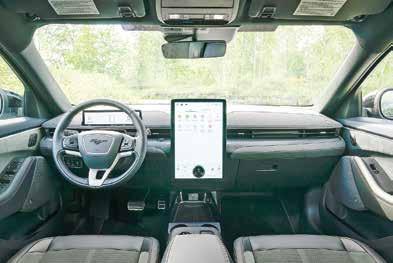
exhilarating driving experience.
We then moved on to a longer course with more expansive, faster turns to see what the Mach-E Rally was capable of. The car’s abilities well-exceeded my own, and it was surreal to navigate a rally stage without the noise of an engine: just the sounds of grip, rocks, dirt and mud.
The drive was impressively predictable, a testament to Ford’s software team since almost every input has to run through a bunch of computers to result in the car doing what you want. That’s true with a lot of cars these days, to be fair, but especially so with an electric car.

The trip’s highlight was, as ever, a hot lap with a professional driver. He didn’t hold back, showcasing the Mach-E Rally’s true capabilities. It’s clear Ford could make a racing-focused version of this car, and I hope they do. An actual electric rally car would be impressive, which might not be surprising considering Ford’s recent focus on motorsports.
The Mach-E Rally reminds me of Subaru’s Wilderness edition. Both vehicles feature cosmetic enhancements, di erent colors, raised suspensions and unique wheels, adding personality to the cars. The Mach-E Rally shows that Ford has a sense
of humor and isn’t just releasing an EV for the sake of it. They’re committed to special editions and customized versions, indicating Ford is not resting on its laurels.
One signi cant update in this year’s Mach-E is the new inhouse designed and built rear electric motor. This motor, also used in the Ford F-150 Lightning, allows Ford to create its own software and calibration, resulting in a more impressive vehicle. I visited Rivian last year to see that company’s new inhouse motor and learned how signi cant such a development can be.
Ford doesn’t see the need to introduce new EVs as frequently as General Motors. Instead, it’s focused on re ning existing cars and preparing for the future. In the short term, Ford says the future looks like hybrids, something Toyota has known for over a decade. Long term, we’ll see. I’m still bullish on EVs, but it will take time for technology, infrastructure and public acceptance to catch up.
The tech will get better, the cars will get better, and we’ll end up with some truly impressive vehicles. I can’t wait to see what the Mach-E Rally looks like in 10 years.
Maybe I can come back to DirtFish and try it out again.

A12 North State Journal for Thursday, May 16, 2024
PHOTOS COURTESY FORD
JORDAN GOLSON / NORTH STATE JOURNAL
JORDAN GOLSON / NORTH STATE JOURNAL
Charlotte FC goalkeeper Kahlina’s shutout streak, B3

North Carolina well represented in NCAA baseball regionals
NFL
Bears set to be featured on HBO’s ‘Hard Knocks’
Chicago
The Chicago Bears will be featured on “Hard Knocks” for the rst time. HBO and the NFL announced the franchise was chosen for the 19th edition of the Emmy-winning series that rst aired in 2001. The ve - episode series debuts Aug. 6 and airs on Tuesdays through Sept. 3.
NBA
Cavs add candidates to coaching search
Cleveland
The Cleveland Cavaliers received permission to interview Knicks assistant Johnnie Bryant and Heat assistant Chris Quinn as they look to ll their head coaching vacancy. Earlier, the Cavs got clearance to speak with Golden State’s Kenny Atkinson, a former Hornets player, and New Orleans’ James Borrego, Charlotte’s former head coach.
NC State and UNC were the only teams to advance to the super regional round
By Ryan Henkel North State Journal
WHILE MOST people would probably think of basketball when the state comes up in conversation, North Carolina is no slouch in college baseball either.
The Old North State had seven schools qualify for the NCAA baseball regionals with three of them being selected as hosts.
Here’s how the N.C. teams fared in regionals this weekend: Duke: 1-2
The ACC Tournament champion Blue Devils could not keep the momentum going in Oklahoma, as Duke came up short
with losses to UConn (4-1) and No. 9 Oklahoma (4-3).
Seeded in the Norman Regional, the Blue Devils failed to get their bats going in the rst game against the Huskies, managed to stay alive against Oral Roberts (6-2) but went cold again against the Sooners.
Duke tried to muster a rally with a two-run homer by AJ Gracia, bringing the de cit to just one in the top of the eighth, but Oklahoma was able to put the Blue Devils away.
Overall, it was still a strong season for Duke, which captured its second ever ACC Tournament title and 40-win season.
No. 16 ECU: 3-2
The Pirates stumbled out of the gate in their home regional, losing to the bottom seed Evansville (4-1), but they managed to pull out three straight
victories — a 7-6 last-inning thriller over Wake Forest, 10-7 over VCU and a 19-6 revenge rout against Evansville again — to line up a winner-take-allnal game with the Purple Aces yet again.
However, it seems that the American Athletic Conference regular season champions used up too many of their runs in the game prior as Evansville outpaced them in a 6-5 win to reach the super regionals for the rst time in school history.
High Point: 1-2
It was a historic season for the Panthers, who not only had their rst regional appearance but also captured a win with a victory over Vanderbilt (10-9) in Clemson.
The Big South champions, also a program rst, had a record-setting season with an
overall record of 35-27, the most single-season DI wins in program history.
Despite falling to both No. 6 Clemson (4-3) and Coastal Carolina (6-5), High Point gave both a run for their money, losing each by just a single run. No. 10 NC State: 3-0
The only in-state team to go undefeated at regionals, NC State took care of business at The Doak, winning all three of its games en route to the Wolfpack’s second super regional appearance in the last four years.
The Wolfpack easily handled Bryant (9-2), outbattled South Carolina (6-4) and managed to stave o James Madison’s pushes (5-3) to punch their ticket to the program’s sixth super regional and rst since 2021.
See NCAA , page B4
Marissa Young became the rst African-American to coach in WCWS
By Shawn Krest North State Journal
OKLAHOMA CITY —
There are rebuilding projects, and then there’s what Marissa
Young has done as head coach of Duke softball.
Calling it a rebuild is more than a little misleading, since when Young was hired in 2016, nothing had been built yet. Duke had no softball team, no players, no stadium and, for the rst 925 days Young was on the job, no
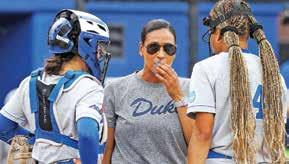

See DUKE, page B3 Duke makes history at Women’s College World Series
BEN MCKEOWN / AP PHOTO
A crowd at Dail Park watches NC State’s Dominic Fritton pitch during Saturday’s NCAA regional baseball game against South Carolina. The Wolfpack advanced to the super regional round next weekend.
Duke head coach Marissa Young, center, speaks with Jala Wright, right, and Kelly Torres, left, during an NCAA Tournament game against Morgan State.
BEN MCKEOWN / AP PHOTO
TRENDING
Jaccob Slavin:
The Carolina Hurricanes defenseman won the NHL’s Lady Byng Memorial Trophy for sportsmanship and gentlemanly conduct. Also the 2021 winner, he’s the second blueliner to win it twice, joining Red Kelly. Slavin joins Joe Mullen as U.S.-born two-time winners. Slavin was the runaway winner this year in being named on 149 of 194 ballots, with 81 rst-place votes, submitted by members of Professional Hockey Writers Association.
Zac Gallen:
The former UNC pitcher was placed on the Diamondbacks’ injured list after straining his right hamstring ve pitches into a start. The 28-year-old right-hander, who nished in the top ve in NL Cy Young Award voting in each of the last two seasons, returned to Phoenix for an MRI.
Trajan Langdon:
The former Duke sharpshooter, who played for Cleveland for three seasons in the NBA, was hired by the Detroit Pistons as president of basketball operations. Detroit has had the NBA’s worst record the past two seasons. Langdon had been general manager of the New Orleans Pelicans since 2019. They improved each of the past ve years, winning 49 games last season.
Beyond the box score
POTENT QUOTABLES

“They told me if I came up here I’d get tased.”
Chiefs tight end Travis Kelce on joining president Joe Biden, pictured, at the microphone during a ceremony honoring the Super Bowl champs.

“I ain’t answering no Caitlin Clark questions.”
Chicago Sky guard Chennedy Carter, who appeared to call Clark an obscenity before knocking the popular WNBA rookie down with a hard foul in a game over the weekend.
PRIME NUMBER
Years BirminghamSouthern was in operation before closing its doors, Friday, due to nancial di culties. The same day, the school’s baseball team played its rst game in the Division III College World Series. The team hopes to win a national championship for the now defunct college.
NASCAR
Austin Cindric emerged as the surprise winner of the NASCAR Cup Series race at World Wide Technology Raceway when teammate Ryan Blaney ran out of gas while leading on the nal lap. Blaney, the reigning NASCAR Cup Series champion, appeared to be on his way to his rst win of the season after ghting o a challenge from Christopher Bell, who had his own car trouble in the closing laps.


Ananya Rao Prassanna, 13, of Apex, nished in a tie for third in the Scripps National Spelling Bee in Oxon, Maryland. Prassanna was one of just eight spellers to make the nals, the fewest to qualify for that round since the 2010 Bee. Bruhat Soma, 12, of Tampa, Florida, was the champion.

Former Tar Heel guard Caleb Love is withdrawing from the NBA draft to rejoin Arizona. Following a transfer from UNC last year, Love was the Pac-12 player of the year, leading Arizona with 18 points per game and 92 made 3-pointers. Love spent three seasons at North Carolina before entering the portal.
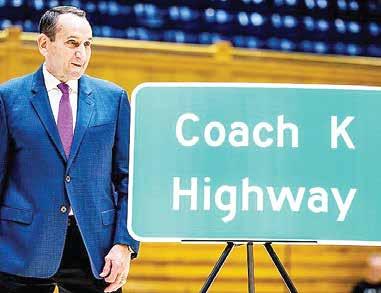

The N.C. Department of Transportation announced that a portion of N.C. 751 in Durham, previously known as Cameron Boulevard, will be renamed for former Duke coach Mike Krzyzewski. The section of the highway from Kerley Road to Duke University Road in Durham will now be known as Coach K Highway. The highway sign was unveiled in a ceremony at Duke.

B2 North State Journal for Thursday, June 6, 2024 THURSDAY 6.6.24
SPELLING BEE
COLLEGE BASKETBALL
JACQUELYN MARTIN / AP PHOTO
GERRY BROOME / AP PHOTO
EVAN VUCCI / AP PHOTO
DOUG MCSCHOOLER / AP PHOTO
JEFF ROBERSON / AP PHOTO
168
COLLEGE BASKETBALL
PHOTO COURTESY DUKE ATHLETICS
Where North Carolina’s Negro League natives stand in MLB’s new integrated stats
MLB added Negro League stats from seven leagues last week
By Asheebo Rojas North State Journal
BASEBALL’S BLACK greats, who were denied the opportunity and everlasting glory of Major League Baseball, nally received their due honor and recognition in the history of America’s pastime.
The MLB incorporated Negro League stats from over 2,300 players in its all-time records last week. This comes more than three years after the MLB’s 2020 announcement that seven di erent Negro Leagues from 1920 - 48 would be recognized as Major Leagues.
The new records include stats from the following major leagues: the rst Negro National League (1920-31), Eastern Colored League (1923-28), American Negro League (1929), East-West League (1932), Negro Southern League (1932), second Negro National League (1933- 48) and Negro American League (1937-48).
According to the MLB, available Negro Leagues records between 1920-48 are nearly 75% complete and further updates could come in the future. The newly added stats, compiled and incorporated with the help of Seamheads, Retrosheet, the Elias Sports Bureau (MLB’s o cial statistician) and the Negro League Statistical Review Committee can be found on MLB.com.
Amongst the many players now included in the MLB’s re-

He also beat his own record in 1939, achieving the 23rd-highest single-season slugging percentage ever (.746).
Chino Smith
Chino Smith, a right elder, is believed to have been born in Hamlet, although his origin has also been traced to the South Carolina cities of Greenwood or Antioch. Although not much is known about Smith, who died at the age of 30, his new place in the MLB record books tell the story of a legend with much more to give.
cord books, there are North Carolina natives whose legacies will now live on. From all-time greats to lesser-known names, here’s a look at some of the Old North State’s Negro League standouts and where they fall in the alltime record books:
Buck Leonard MLB records show that Buck Leonard, a native of Rocky Mount, played for the Homestead Grays in the Negro National League from 1935-48. Playing as a left-handed rst baseman, Leonard racked up some impressive numbers in his career, winning two Negro National League batting champion titles (1935 and 1938) and three Negro
World Series titles in 1943, 1944 and 1948. He was also inducted into the National Baseball Hall of Fame in 1972. It won’t take long to nd him in all-time major league statistics. Amongst major league players across all leagues in history, Leonard ranks seventh in OPS (on-base plus slugging, 1.042), fth in OBP (on-base percentage, .452), eighth in batting average (.345) and 11th in slugging percentage (.590). Leonard had an all-time season in 1938 with the Grays during which he recorded the 24th-best single-season OPS (1.240), 15th-best single-season batting average (.420) and 24thbest single-season slugging percentage (.740) in MLB history.
Smith, who played from 1925-29 in leagues statistically recognized by the MLB, had one of the single greatest seasons of all time in his 1929 campaign with the New York Lincoln Giants of the American Negro League. That year, Smith played in 67 games and posted the second-highest single-season batting average (.451), fourth-highest single-season OBP (.551) and fourth-highest single-season slugging percentage (.870).
With the American Negro League only existing for the 1929 season, Smith is the alltime leader for seven stats in that league’s records, including OPS (1.421), home runs (22), runs (86), doubles (29), OBP, slugging percentage and batting average.
For his entire career, which includes his four seasons in the Eastern Colored League (one season with the Washington Potomacs and three with the Brooklyn Royal Giants), Smith recorded a batting average of .398, 32 home runs, 161 RBIs and 29 stolen bases. He was inducted into the South Carolina
Chino Smith’s batting average in 1929, now the second-best single season average in baseball history
Athletic Hall of Fame in 2023. Because Smith didn’t reach the minimum standard for 1,800 career at-bats and 600 innings, his career stats were not integrated in the MLB all-time totals records.
Gentry Jessup
Gentry Jessup, a right-handed pitcher from West eld, played in the Negro American League from 1940-48, spending one full season with the Birmingham Black Barons and six seasons with the Chicago American Giants. He played for both teams in 1941 and 1943. Jessup completed his career with the third-best all-time ERA for the Negro American League (3.40) and the seventh-most strikeouts (241). Pitching 452.2 innings, Jessup only allowed three home runs, which are the second-fewest homers allowed by a Negro American League pitcher with more than 300 innings pitched. The only other pitcher in the league to allow less home runs in more than 300 innings was Satchel Paige, the Hall of Famer that allowed just two home runs in 453 innings during his stint in the Negro American League.
Charlotte’s Kahlina sets club record for consecutive shutouts
The Croatian goalkeeper leads MLS in clean sheets
By Jesse Deal North State Journal
CHARLOTTE — Now leading the MLS with seven clean sheets this season, Charlotte FC’s Kristijan Kahlina is hoping he can continue the defensive prowess he showed last month with June underway.
The 31-year-old Croatian goalkeeper had a club-record fth straight shutout in a scoreless duel with Philadelphia Union (4-8-4, 20 points) on May 25, leading a Charlotte FC (7-46, 25 points) club that is now in fth place in the middle of the Eastern Conference pack.
Throughout May, Kahlina was a defensive stalwart, keeping ve consecutive clean sheets over the course of six matches and going a total of 524 minutes without allowing a goal.
“I didn’t really change anything. Honestly, this is all from the coach,” Kahlina said of rst-year Charlotte FC coach Dean Smith after a recent shutout performance at the net. “He put these tactics, this shape, and it really works. Everything is from him. ... I think how he prepared our team from the start and now the whole team
DUKE from page B1 games on the schedule.
Young had to work to get a home eld, as well as recruiting players with nothing to show them.
“We owe a lot to them for being committed to the process and coming to Duke,” Young said of her rst team. “Really, it was about a promise. There was no eld, no locker room, nothing here for them.”
Two and a half years after taking over, Young’s Blue Devils took the eld for the rst time, in spring 2018. Six years later, Young took the Blue Devils to the Women’s College World Series. It was a historic trip for a number of reasons. Duke won a school record 52 games this season, making their rst trip to the WCWS. In
plays really good defense.”
The goalkeeper holds club records for appearances (72), starts (71), minutes played (6,480), goalkeeper saves (225) and goalkeeper shutouts (19). This season, he has racked up 50 saves with only 18 goals allowed.
“Calmness. He’s a calm goalkeeper,” Smith said of Kahlina’s latest stretch of play. “He does the basics really well, and that’s what you want from a goalkeeper: to keep the ball out of the net.”
Along with the strategy given by his head coach, Kahlina attributes his recent success to an emphasis on timing that was preached by his goalkeeper coach, Aron Hyde, who served as the goalkeeper coach for the U.S. Men’s National Team in the 2022 FIFA World Cup.
Kahlina saw the results begin to take shape at the end of the 2023 campaign, following a period during which he was recovering from o season back surgery that caused him to miss all of the preseason and Charlotte FC’s rst 10 league games.
Once some lingering pain in his back and leg dissipated, Kahlina soon fell into a groove that ramped up week by week.
“Even last season in the last eight or nine games, I improved a lot on this,” he said. “I was up
the process, Young became just the 18th person to play and coach in the Women’s College World Series, as well as becoming the rst African-American coach to reach the event.
“It means a lot,” Young said before the start of the WCWS.
“I didn’t have that as something to see growing up. Obviously, in taking the job here at Duke, I understood that I had an opportunity to do something that’s never been done. It’s taken players, like these sitting next to me, that believed in me and the vision that we had, the commitment to the program and our core values to get us to this point.
“I love looking at our team, all the diversity, everything we stand for. It’s really, really special. I hope that it continues to open up doors for others, both in the professional setting but also players

to a high level with these things and now in all games this season. Last season, my goalkeeper coach helped me a lot with my positioning and where I need to be positioned when somebody has the ball.”
His shutout stretch last month began on May 4 when the Portland Timbers (5-5-7, 20 points) came to the Queen City and left with a 2-0 loss. A week later, Charlotte took down Nashville SC (4-7-5, 19 points) at home in a 1-0 nish before knocking o Chicago Fire FC
that want to play at this level.”
This wasn’t just a feel-good story of a team breaking barriers, though. The Blue Devils were a dominant squad. Duke won the ACC regular season and tournament, all while sweeping most of the league’s major awards.
Senior Claire Davidson won ACC Player of the Year, and fellow senior Jala Wright took conference Pitcher of the Year honors. Davidson hit .436 with an OPS of 1.403. She had 18 home runs and 67 RBIs. In conference play, she had a league-leading 1.821 OPS. Wright went 19-3 with a 1.50 ERA and 189 strikeouts in 154.1 innings. She was undefeated in league games and led the ACC in wins.
Junior Aminah Vega was named the ACC Defensive Player of the Year, and Young took home the Coach of the Year award. All
(3-6-8, 15 points) on the road on May 15.
Kahlina’s next two shutouts in the ve-match streak came in draws against the LA Galaxy (7-7-3, 28 points) and the Philadelphia Union; he earned a spot on the MLS Team of the Matchday after his ve saves against the Galaxy.
While Kahlina’s next two matches resulted in ve goals allowed — three in a road loss to the New York Red Bulls (8-5-3, 29 points) on May 29 and two in a win over Atlanta United FC on
four were the rst Blue Devils in history to win their respective honors. The three players were joined on the All-ACC rst team by sophomore pitcher Cassidy Curd.
Duke’s stay at the World Series was a short one. The Blue Devils opened with Oklahoma, losing by a lopsided 9-1 score. Alabama then eliminated the Blue Devils with a 2-1 victory in Duke’s next game. Still, Young and the Blue Devils looked at what they’d been able to accomplish, not at the road untraveled.
“I felt like the world got to see what Duke softball was about,” Young said. “We’re a play away from still being out on the eld battling with Alabama. … I just continue to look at how bright the future is for Duke softball.”
Considering what Duke softball looked like not that long ago,
June 2, his ve-game stretch of shutouts exists as an example of his capabilities.
He credits Charlotte FC fans for showing up to cheer on the club, both in Bank of America Stadium and on the road.
“It’s great because I work for myself and for them every day every week,” Kahlina said. “ I’m the happiest person when I can get a clean sheet or good saves for them, and I think they know that. I appreciate this because it gives me really big power even in away games.”
Following the club’s 3-2 win in Atlanta, Smith also commented on the increased fan presence the team is noticing.
“We drove up to the stadium and they were all lined up along the road walking towards the stadium,” the coach said. “It was great to see, and I think they had to turn their music up a little bit louder to drag down the sound of our supporters before the game. I’m glad that we’re sending them home happy.”
After Charlotte’s 23-29-16 combined record in its rst two seasons as a franchise, the team is now on pace for its rst winning season. The club’s next match is set at home against D.C. United (4-7-6, 19 points) on June 15, followed by a home match with Orlando City SC (4 -5-7, 17 points) on June 19.
Young’s optimism seems justied.
“I’m sure it won’t hit us until we get back home to Durham, step on the eld and see the Women’s College World Series logo on the outside wall,” she said. “We’re really trying to enjoy. It’s been a lot of hard work and sacri ces over the last seven years to get us to this point. I’m thankful that I feel like it’s paid o in so many ways, not just getting to this point, but again, seeing the growth in the players on and o the eld. It gives me a lot of joy. I’m looking forward to the future. It’s been a tough road as a new program, but we’re here. Just look forward to continuing to build from this.”
“Seven years is a very young program,” said catcher Kelly Torres. “This is not the last you’re going to see of Duke softball.”
B3 North State Journal for Thursday, June 6, 2024
AP PHOTO
Buck Leonard (left) accepts his plaque after being inducted into the Baseball Hall of Fame in 1972. The Rocky Mount native’s statistics, compiled in the Negro Leagues during the period that baseball was segregated, now stand alongside other MLB players.
REBECCA BLACKWELL / AP PHOTO
.451
Charlotte FC goalkeeper Kristijan Kahlina de ects a shot against Miami in a game earlier this season.

Panthers, city seek $800M stadium renovation deal
The city would provide $650M to keep the team in Charlotte for 20 years
By Steve Reed The Associated Press
CHARLOTTE — The Carolina Panthers and the City of Charlotte have proposed a partnership deal that would include an $800 million renovation to Bank of America Stadium and keep the NFL team here for 20 years.
The renovation would include a xed $650 million investment from the city and another $150 million from Panthers owner David Tepper. The owner’s money would go toward the renovation and potential overages.
Tepper has already invested more than $117 million in the stadium prior to June and would also pay another $421 million for capital improvements over the term of the deal, the team said Monday in a news release.
The city’s investment does not require any new or increased taxes. According to the team’s news release, it would be funded by existing hospitality and tourism taxes, “which are legally required by the state to be spent on projects to support the city’s tourism economy. The restricted funds cannot be used for other city functions like transit, education, a ordable housing or public safety.”
The tax, which adds a 1% surcharge on prepared food and drinks — restaurant meals, bar tabs, etc. — was extended for an additional 26 years in a vote by lawmakers last October. It now expires in 2060.
Charlotte City Council members are expected to meet over the next several weeks to discuss the Bank of America Stadium renovation project.
“Bank of America Stadium
The Wolfpack had a chance to host the super regional had Georgia Tech held on against Georgia, but instead NC State will head down to Athens to face the Bulldogs in a best-ofthree series.
No. 4 UNC: 3-1
The Tar Heels love a little drama, don’t they?
The ACC regular season champions and nationally ranked fourth overall team had a good bit of it in every game they played in Chapel Hill.
After surrendering four runs and the lead in the ninth inning against LIU in their rst game of the tournament, UNC would end up walking it o thanks to a grand slam by Gavin Gallaher.
The Tar Heels then defeated defending national champions LSU (6-2) before losing
has been a special place for our Panthers, and now Charlotte FC, fans for nearly 30 years,” Panthers team president Kristi Coleman said in the release.
“While Bank of America Stadium has solid infrastructure, investments are needed to ensure that our decades-old venue continues to deliver the best experience for our players, fans, and community.
“This renovation is about modernizing the stadium to deliver elevated experiences while preserving the overall character and location that fans have known and loved for decades.
Bank of America Stadium opened in 1996. At the time, its construction costs of approximately $248 million were funded privately, with sales of personal seat licenses to season ticketholders as a major source of funding. The main contributions from the city of Charlotte and Mecklenburg County at the time were providing the land, by way of a $1 a year lease, and providing assistance in environmental cleanup and moving of existing buildings before construction began. These contributions were estimated between $50 million and $60 million.
The enhancements will include upgraded video and audio systems, modernized infrastructure, redesigned concourses, unique social areas with skyline views, and exterior spaces for community gatherings and programming.
“Imagine entering the stadium through an inviting perimeter with a park-like setting,” the team release stated, “and exterior video boards for watch parties and other viewing opportunities.”
Other important elements include new seating installed throughout the bowl, improved accessibility throughout the facility, designed and constructed in a way that allows individuals with a range
to the Tigers (8-4) in the following game to set up a regional championship game once again against LSU on Monday.
Both teams exchanged blows early, but things tightened up after the third inning with the Tigers holding a 3-2 lead into the ninth inning. There, the Heels managed to nd the tying run in the ninth to force extra innings.
Then despite facing a twoout hole in the top of the 10th, UNC stayed calm and got the bats going with Alex Madera eventually sending home the winning run and Dalton Pence icing out the Tigers.
The Tar Heels will again be hosting as they get set to face West Virginia in a super regional.
UNCW: 1-2
The Coastal Athletic Association champion Seahawks quali ed for their 12th region-
Michael Waltrip’s All-Star memories
The Fox broadcaster and former driver remembers the North Wilkesboro and Charlotte races fondly
By Shawn Krest North State Journal
NORTH WILKESBORO —
The NASCAR All-Star Race in North Wilkesboro brought back plenty of memories for Michael Waltrip. Not all of them involved his racing career.
“I was here last year as a fan,” said Waltrip, who last raced anywhere in 2017. These days he makes his living calling races for Fox. “I had my camper parked over on the back straightaway. Me and my buddies sat over there, had a couple beers and watched Kyle Larson. Great, great memories of watching Kyle get that victory. And then his wife said, ‘If we win, we’ll shotgun a beer in Victory Lane. So, I came running across the racetrack into Victory Lane and had a beer with the family.”

stu . It’s just terrible.’”
Unfortunately, like now, the Open was run right before the start of the All-Star Race.
“We only had like 30 minutes,” he said. “They got to work on the car a bit, and I started the main event in last and drove to 10th. Then Eddie’s like, ‘They’re gonna invert. Quit passing people.’”
of disabilities to have access without barriers. Restrooms would also be upgraded, and the stadium improvements would reduce its impact on the environment and Charlotte infrastructure by modernizing plumbing, electric and HVAC systems.
The south lawn pavilion area would be reimagined as a community gathering spot and outdoor classroom on game days and non-event days.
The team suggested improvements to concessions available at the stadium, including more regional o erings. The plan also includes an expansion of the team store, as well as art and culture elements included in the stadium design “to re ect the vibrant culture across the Carolinas.”
“Today was a rst step in what will be a series of conversations with public o cials,” Coleman said. “Our goal is to build a collaborative partnership so that this community asset can continue to generate unique and memorable experiences for fans, as well as economic impact for the city and region for years to come.”
The stadium also serves as home for Major League Soccer’s Charlotte FC and regularly plays host to college football games and concerts.
“Bank of America Stadium provides our Club one of the best home pitch advantages in Major League Soccer,” Charlotte FC president Joe LaBue said. “It also serves as a pillar of our community that supports our mission to be a unifying force in the city.”
Last year, Charlotte city leaders were presented with a proposal for a new stadium to replace Bank of America Stadium. That project had a price tag of $1.2 billion, with $600 million coming from public funding.
North State Journal sta contributed to this report.
al appearance and fourth in the last six seasons.
The Seahawks started o their regional strong, with a big win over Georgia Tech (9 - 0) in Athens, but it would be the Yellow Jackets that eventually eliminated UNCW (3-1) after its rst loss to eventual super regional quali er and host Georgia (11-2).
Wake Forest: 0-2
The preseason No. 1 had their bats run dry for too many innings this weekend.
Following a 1-0 loss to VCU, the Demon Deacons went eight innings against ECU only managing two hits before exploding out in the ninth to take the lead with a ve-run inning. But the story was not meant to be written as the Pirates smashed right back with four straight hits in the bottom of the ninth en route to a 7-6 win to end Wake’s season.
Waltrip may be enjoying the races like a fan these days, but for decades, he was one of the top competitors on the Cup Series. It took him about a half dozen years of being referred to as Darrell Waltrip’s little brother before he made his own name in the sport. Michael would win Daytona twice among his four Cup Series wins. He also had 133 top-10 nishes. In 1996, he won the All-Star Race, then held in Charlotte, after barely making the All-Star cut, becoming the rst driver to take rst place after qualifying the day of the race by nishing near the front of the All-Star Open. The Open serves the same purpose as conference tournaments in March Madness. Someone who otherwise wouldn’t get an invitation can earn their spot by performing well at crunch time.
“When I walk in here, it makes me feel like I did when I walked in here 30 or 40 years ago.”
Michael Waltrip on North Wilkesboro Speedway
Waltrip rode his free ticket all the way to Victory Lane in Charlotte, going from the back of the pack, as the last quali er, to rst place.
“That night, standing there in Victory Lane, with the reworks going o — and the three-wide pass I made to get the lead,” he said. “Passing Dale (Earnhardt Sr.) and Terry Labonte and winning that race, that’s just something I’ll never forget.”
Especially considering how close he came to being a spectator for that All-Star Race as well, perhaps drinking a few beers while watching his brother Darrell, who started in the front row.
“You back up to how I got in that race,” he said. “Lucky for me, they took ve out of the last-chance quali er. And I nished fth. So I got in through the Winston Open (then the name for the All-Star Open) that night. And I told Len and Eddie (Wood, owners of the race team), — I said, ‘We got to change some stu . We’ve gotta change a lot of
After 30 laps, a fan vote determined whether to keep the cars in their current order or invert — meaning to ip the order of the cars upside down and put the race leaders in the back. By driving too well, Waltrip was running the risk of being sent right back to where he started.
“This is too fun,” Waltrip remembers telling his team owner.
“I can’t stop.”
“They inverted,” he said, “but I stayed in 10th, and then I drove from 10th to fourth. They had that last restart, and I was able to get the win.”
Waltrip was also a veteran of North Wilkesboro, having run 22 Cup races there, as well as several other races on the Dash Touring Series.
“I raced here for the rst time in ’82 and ’83, in the Dash Series,” he said. “And I just remember thinking that this is just a normal short track. Progress all the way to 1996, when you couldn’t even touch the throttle. I mean, there were times, literally from coming o turn four till you get to the start/ nish line, you couldn’t get all the way down. You were just squeezing it.”
Managing his speed was just one memory of racing at North Wilkesboro, however.
“Back in the day, just coming here, my brother driving for Junior Johnson,” Waltrip recalled. “Him being such a big deal in NASCAR at the time and me trying to get my feet wet and sitting on the pole and having fast cars. This place just has so many great memories. And you know what I love most about it is Marcus Smith, Speedway Motorsports: They’re brilliant. Anything they do, they do it right. And they preserve the old nostalgic feel of it. You know, you can see the old signs that are here and the grandstands, everything. When I walk in here, it makes me feel like I did when I walked in here 30 or 40 years ago.”

B4 North State Journal for Thursday, June 6, 2024
SHAWN KREST / NORTH STATE JOURNAL
Michael Waltrip re ected on his racing days while meeting with the media at North Wilkesboro Speedway during the All-Star Race.
NCAA from page B1
CHUCK BURTON / AP PHOTO
A statue of a panther guards the entrance to Bank of America Stadium, home of the Carolina Panthers. The venue may be getting extensive renovations if city leaders and owner David Tepper can come to an agreement.
ALAN MARLER / AP PHOTO
Michael Waltrip celebrates in Victory Lane at Charlotte Motor Speedway after winning the 1996 All-Star Race.
a sense of occasion

Honoring Nowell’s Clothing 1921-2024
Nowell’s Clothing stood as a cornerstone to the Triangle and North Carolina
By Dan Reeves North State Journal
RALEIGH — After 103 years in business, the doors to Nowell’s last brick-and-mortar store on North Market Street in Raleigh are locked. The remaining houndstooth blazers, silk ties and shiny pairs of bit-loafers were sold or boxed up a few months ago. Schooner’s golf clubs are o the center display table, beloved dogs belonging to Lubet and the Nowell family chase squirrels elsewhere, and Matt is home with his adoring wife, Harriet. Karen Nowell will continue the family tradition of clothing and apparel with Onward Reserve. Still, with a di erent outt, but back at Cameron Village — now called The Village District — where for the bulk of the 20th century, Nowell’s Clothing stood as a cornerstone to the Triangle and North Carolina. It was more than just a store; it symbolized outstanding, welcoming customer service and premium products. It was where many young men got their rst suits. Dignitaries and government leaders from both sides of the aisle were loyal customers, from CEOs of Fortune 500 companies and politicians Jesse Helms, Jim Hunt, Erskin Bowles and the North Carolina General Assembly to a teenage boy looking his best for senior prom, Nowell’s dressed Central and Eastern North Carolinians in style.
As a Raleigh native, my childhood memories are intertwined with Nowell’s Clothing. The store’s back rooms and storage closets were my playgrounds, and the Nowell family, including Schooner Nowell’s daughter, were like an extended family to me. We were the “latchkey kids,” running amuck through heaps of fabric and occasionally driving the sta and customers mad. Little did I know then that the store where I played and the family I knew was a part of North Carolina’s rich history. Throughout modern times, men have dressed smartly. For the rst half of the 20th century, a three-piece suit was standard issue for the working man. Posh occasions, even dinner, could call for tuxedos or tails. However, as culture and economics shifted, so did fashion. The end of WWI in 1918 marked the beginning of the “Roaring ’20s,” often referred to as the “Golden Age of Menswear.”


While paletot overcoats, Viennese style and cricket-spun suits were in vogue, not everyone dressed like characters from “The Great Gatsby.” Still, suits, ties, blazers, cu links, ne footwear and other accouterments for the working and gallivanting man remained in demand. From the Roaring ’20s to the Great Depression through the COVID-19 pandemic, Nowell’s evolved at every turn and with every trend.
The family business began in 1921 when a young Arthur Nowell and his cousin opened Horton-Nowell Clothing Co. at Fayetteville and Martin streets in downtown Raleigh. Over time and with increased demand, in 1951, it found a permanent home at Cameron Village. The name changed to Nowell’s Clothing, relocating within the shopping center as it grew to a 20,000-plus-square-foot store before moving to North Market Street in 2003. At one point, Nowell boast-
ed several locations, including Chapel Hill, Fayetteville, the old North Hills Mall, a ladies’ shop and a men’s jeans store. Arthur’s son, Gwynn Nowell, ran the business until his death when the next generation — Gwynn “Schooner” Jr., Matt Hooper and daughter LuBet Nowell o cially took the helm. But, as youngsters, the three cut their teeth in the world of haberdashery retail, nance and the value of exemplary customer service. The Nowell siblings matured into masters of the trade and successful leaders of the family enterprise until its closure in April.
“I started working there when I was 12, behind the cu link and tie bar,” Matt Nowell said.
“We all started at the store doing everything from running the postage machine to working the cash register, but as we got older, Schooner did the buying, Lubet handled buying ladies’ clothing, and I handled nances.”
A ectionately referred to by her family and all who knew her as “Granny,” Florence, Arthur’s wife, with little intention, became the de facto matriarch of the business. Initially, when she met Arthur, Florence was a nurse, and she began lending a helping hand at the store during the Depression. Her remarkable knack for coordinating men’s wardrobes soon earned her the reputation of a “legend in the business.” Customers gravitated to Granny for her sharp eye and enchanting disposition. For most of her life, Florence Nowell worked tirelessly, six to seven days a week, and even into her 80s.
Through the years, Nowell’s employed experts in tailoring and fashion, many of whom worked there for decades. They knew each customer not only by name but their kids’ names and, of course, their measurements and
tastes. Matt Nowell fondly reminisces about “the consummate shoe salesman, EO Edgerton, who everybody adored; Barry Tharrington; and our tailor Sam, who came from Afghanistan and worked with us for 30 years.” It was a family-within-a-family business, which incidentally employed college students part-time during summers and holidays. There’s an old saying: “You can’t swing a dead cat in Raleigh without hitting someone who worked at Nowell’s part-time.” “They were in it for the 50% discount,” Nowell laughs.
Sideshow Bob once said, “Aah, for the days when aviation was a gentleman’s pursuit — back before every Joe Sweatsock could wedge himself behind a lunch tray and jet o to Raleigh-Durham.” As arrogant and elitist as that may sound, the pretentious, villainous Simpson’s character makes a convincing point: looking your best and dressing with a sense of occasion became secondary to comfort. “Over time, button-downs and blazers soon replaced suits and ties, and when COVID-19 swept the globe, remote work changed the de nition of ‘work attire,’” Nowell said. “Fifty percent of our business was sport coats, suits, dress shirts and ties, but everything’s casual now, and that was tougher.”
Not long after the move to North Market Street in 2003, Gwynn “Schooner” Nowell’s daughter Karen climbed aboard. She quickly became an invaluable asset to the Nowell’s Clothing enterprise, developing strategies in styles and the world of e-commerce by boosting their online presence and introducing high-end casual wear and contemporary accessories. Where once a display would feature only silver and gold cu links, customers would nd collegiate-branded belts and even cu links adorned with Grateful Dead iconography. Brands like Bald Head Blues and Southern Tide lled the tables and racks alongside legacy labels Nowell’s had always o ered.
But all good things must come to an end. Nowell’s Clothing fared well during and after the COVID-19 pandemic, but as Matt, Schooner and Lubet Nowell passed retirement age, a bittersweet reality sank in: It was time to call it quits. In April 2024, after 103 years in business, Nowell’s bid farewell to their loyal, loving customers and sta — “the heart and soul of our business.”
Nowell’s was an institution in North Carolina. As grateful as the family is for the customers who have supported the business for over a century, the outpouring of gratitude and fond memories of buying that rst suit or of the lovable, dependable sta comes from the community. Those in Central and Eastern North Carolina will remember Nowell’s did for them, their parents and their grandparents for so long.
B5 North State Journal for Thursday, June 6, 2024
COURTESY YORK FAMILY COLLECTION
Nowell’s Clothing at Cameron Village, now called The Village District, in 1988.
PHOTOS COURTESY NOWELL FAMILY
Top, ties and blazers at Nowell’s Clothing North Market Street in Raleigh. Bottom, Arthur and Florence “Granny” Nowell.

‘Furiosa,’
The orange cat crept ahead of the wasteland warrior in their second outing
By Lindsey Bahr
The Associated Press
IT WAS A QUIET WEEKEND at North American movie theaters, dominated again by Sony’s “The Gar eld Movie,” Warner Bros.’s “Furiosa: A Mad Max Saga,” and a slew of holdovers. Flipping the script from their Memorial Day weekend openings, the animated orange cat crept ahead of the wasteland warrior in their second outing. According to studio estimates on Sunday, “The Gar eld Movie” earned a chart-topping $14 million in ticket sales while “Furiosa” settled into third place in a close race with “IF.” Both “IF” and “Furiosa” are estimated to have earned $10.8 million, with “IF” getting the slight edge.
“Gar eld” fell only 42% in its second weekend in North America. It also topped the global box o ce adding $27 million from
‘Gar eld’ top box o ce summer grind
international territories, bringing its running worldwide to $152.2 million. The animated pic featuring the voice of Chris Pratt will essentially have the market to itself until “Inside Out 2” arrives on June 14.
“Furiosa” fell 59% from its rst weekend, adding just under $10.8 million from 3,864 locations in the U.S. and Canada. That puts its domestic total at $49.7 million and its global sum at $114.4 million against a $168 million production budget.
Second place went to Paramount’s “IF,” with $10.8 million in its third weekend. John Krasinski’s imaginary friends fantasy, starring Ryan Reynolds and Cailey Fleming, has now made more than $80.4 million domestically and $138 million worldwide. Disney/20th Century Studios’ “Kingdom of the Planet of the Apes” landed in fourth place in its fourth weekend with $8.8 million. It has now made $140 million domestically and $337.1 million globally.
And the Ryan Gosling and Emily Blunt action-comedy “The Fall Guy,” which is currently available to purchase at home,
rounded out the top ve with $4.2 million, bringing its domestic total to $80.3 million. Globally, the Universal release has made $157.9 million. According to Comscore data, the 2024 box o ce is struggling compared to last year (down 23.9%) and prepandemic standards (down 42.2% from 2019 and 46.4% from 2018). This weekend last year, “Spider-Man: Across the Spider-Verse” opened to $120.7 million, while “The Little Mermaid” was still pulling in more than $41.4 million in its second weekend. This year, no lm has opened to over $100 million domestically.
While “Barbie” and “Oppenheimer” had yet to storm theaters at this point last year, there had been several substantial hits, including “The Super Mario Bros. Movie” ($1.36 billion global total), “Guardians of the Galaxy Vol. 3” ($845.5 million) and “Fast X” ($704.7 million).
“It should come as no surprise given the nature of this year’s trajectory that we are running this far behind,” said Paul Dergarabedian, the senior media analyst for Comscore. “I understand
why people are concerned about where this year is going, but it’s never too late to get things running again.
“It’s a momentum business. The attention right now is focused on what will be the big movie to get the summer moving in the right direction.”
That big summer movie could arrive in the form of “Inside Out 2,” which, according to early projections, could open to more than $85 million and propel other juggernauts like “Despicable Me 4” (July 3) and “Deadpool & Wolverine” (July 26).
Dergarabedian also noted that absent a big superhero movie, family-oriented lms have been resonating recently. They might not open to the biggest numbers, but as “IF” and “The Gar eld Movie” have proven, they have staying power.
The top-grossing movie of this year remains “Dune: Part Two,” which Warner Bros. released in early March and has made over $711 million globally. Its domestic take of $282.1 million represents 10.5% of the overall box o ce for 2024.
“Dune” lmmaker Denis Ville-
neuve said over the weekend that he was “disappointed to still be No. 1” while collecting an award at the Canadian Screen Awards in Toronto.
“I hope soon that there will be other successes at the box ofce,” Villeneuve said, as reported by Yahoo. “I hope sooner or later that this summer box o ce will be much better.”
Estimated ticket sales for Friday through Sunday at U.S. and Canadian theaters, according to Comscore
1. “The Gar eld Movie,” $14 million
2. “IF,” $10.8 million
3. “Furiosa: A Mad Max Saga,” $10.8 million
4. “Kingdom of the Planet of the Apes,” $8.8 million
5. “The Fall Guy,” $4.2 million
6. “The Strangers: Chapter 1,” $3.6 million
7. “Haikyu!! The Dumpster Battle,” $3.5 million
8. “In a Violent Nature,” $2.1 million
9. “Ezra,” $1.2 million
10. “Sight,” $1.1 million
WaPo editor Buzbee out, organization announces restructure
The Post lost a reported $77 million last year
By David Bauder The Associated Press
NEW YORK —The Washington Post was in turmoil on Monday following the abrupt departure of its executive editor and a hastily announced restructuring plan to stem an exodus of readers.
Post publisher Will Lewis and Matt Murray, a former Wall Street Journal editor named to temporarily replace Sally Buzbee, met with reporters and editors at the Post on Monday to explain changes outlined in a Sunday email.
The plan includes splitting the newsroom into three divisions with managers who report to Lewis — one that encompasses the Post’s core news reporting, one with opinion pieces and the third devoted to attracting new consumers through social media, video, arti cial intelligence and sales.
“It kind of blindsided people,” said Paul Farhi, a recently retired media reporter at the Post. “But it shows you that Will Lewis is working out of a sense of crisis and urgency. He’s only been there ve months and making gigantic changes to the newsroom.”
Like most news organiza-

tions, the Post has lost readers—a decline more acute because the Washington-based outlet boomed with interest in politics during the Trump administration. The Post’s website had 101 million unique visitors a month in 2020, dropping to 50 million at the end of 2023. The Post lost a reported $77 million last year.
“Although (Post owner) Je Bezos is very rich, it has been my observation that billionaires don’t like to lose money,” said Margaret Sullivan, a former Post columnist and now
the executive director for the Craig Newmark Center for Journalism Ethics and Security at the Columbia Journalism School.
The new division designed to attract new customers — the Post called it a “third newsroom” — is steeped in mystery. While the Post once headquartered the people running its digital products in a separate building, for several years, it has integrated that and social media into the regular newsroom, as have many organizations.” Maybe it’s brilliant and
innovative,” Sullivan said. “But it just strikes me as being odd.”
“It feels so retro — reminiscent of search engine optimization, social media and pivoting to video, just as AI and agents threaten to become a new web,” said Je Jarvis, author of “The Gutenberg Parenthesis: The Age of Print and its Lessons for the Age of the Internet.”
Murray will be in charge of this division following the election. The newspaper said that after that, Robert Winnett, a longtime editor at the Telegraph in England, will take over the core reporting functions at the Post.
Post sta members expressed some concern about three men — all of them new to a newspaper that takes some pride in journalists working their way up through the ranks and two of them British-born — being in charge at a crucial time.
“In a few months, two British-born editors will be running the leading newspaper in the capital of the United States,” Farhi said. “It was kind of unimaginable a couple of months ago.” They won’t be alone. Other U.S.-based news organizations with British-born leaders included The Wall Street Journal, with editor-in-chief Emma Tucker; CNN, with chairman and CEO Mark Thompson;
“In a few months, two British-born editors will be running the leading newspaper in the capital of the United States.”
Paul Farhi, retired Washington Post media reporter
and The Associated Press, with Daisy Veerasingham as president and CEO. Lewis was also questioned about his commitment to diversity after the rst woman to be the editor in charge of the Post left. According to a person at the meeting, he said he was committed to it, “and you’ll see it going forward.” Lewis has talked about nding ways to reach millions of Americans who want to stay informed but don’t feel that traditional news products serve their needs.
Farhi said e orts to make organizations like the Post and the Times more attractive to subscribers may contribute to the trends hurting local news. As the newspapers seek out more national and international customers, he said, they are much less likely to invest in covering local news.
B6 North State Journal for Thursday, June 6, 2024
PABLO MARTINEZ MONSIVAIS / AP PHOTO
BOX OFFICE
The Washington Post’s struggles led to the ouster of executive editor Sally Buzbee and an announced restructuring.
WARNER BROS. PICTURES
VIA
AP Chris Hemsworth joins the dystopian universe of “Furiosa: A Mad Max Saga.”
Hollywood, Broadway star Janis Paige dies at 101
Paige, who danced with Fred Astaire and toured with Bob Hope, performed into her 90s
By Mark Kennedy
The Associated Press
NEW YORK — Janis Paige, a famous actor in Hollywood and Broadway musicals and comedies who danced with Fred Astaire, toured with Bob Hope and continued performing into her 90s, has died. She was 101. Paige starred on Broadway with Jackie Cooper in the mystery-comedy “Remains to be Seen” and appeared with John Raitt in the smash hit musical “The Pajama Game.” Her other lms include the Bob Hope comedy “Bachelor in Paradise,” the Doris Day comedy “Please Don’t Eat the Daisies,” and “Follow the Boys.” Her big break came in wartime when she sang an operatic aria for service members at the Hollywood Canteen. A day later, MGM hired her for a brief role in “Bathing Beauty” — she spoke two lines in the lm, which starred Esther Williams and Red Skelton — and then dropped her.
The same day, Warner Bros. signed her and cast her in a dramatic segment of the all-star movie “Hollywood Canteen.” Her contract started at $150 a week. “I earned more per week than my mother had made in a month during the Great Depression,” she recalled in The Hollywood Reporter in 2018.
Her salary rose to $1,000 weekly as the studio kept her busy in lightweight lms such as “Two Guys from Milwaukee,” “The Time, the Place and the Girl,” “Love and Learn,” “Always Together,” “Wall ower” and “Romance on the High Seas,” which marked Doris Day’s lm debut.
Meanwhile, she changed her name from Donna May Tjaden and adopted Paige, her grandfather’s name.
The budding performer took her talents to Broadway, where she starred in “Remains to Be Seen” and starred as Babe opposite Raitt as Sid in the original production of “The Pajama Game.”
MGM producer Arthur Freed caught her nightclub act at the Ambassador Hotel in Los Angeles and o ered her a part opposite Astaire in “Silk Stockings,” also co-starring Cyd Charisse. The lm is famous for her and

Astaire spoo ng the newfangled movie gimmicks in the Cole Porter number “Stereophonic Sound,” including swinging from a chandelier.
“I was one mass of bruises. I didn’t know how to fall. I didn’t know how to get down on a table — I didn’t know how to save myself because I was never a classic dancer,” she told the Miami Herald in 2016.
c/o Gilliam Law Firm, PLLC J. Duane Gilliam, Jr., Attorney PO Box 53555 Fayetteville, NC 28305 05/16/24, 05/23/24, 05/30/24 and 06/06/24
ADMINISTRATOR’S NOTICE
IN THE GENERAL COURT OF JUSTICE
SUPERIOR COURT DIVISION
ESTATE FILE 24E0681 State of North Carolina
Cumberland County NOTICE TO CREDITORS
In May 2003, Paige resumed entertaining after a long absence. She opened a show called “The Third Act” at San Francisco’s Plush Room. She told stories about Astaire, Frank Sinatra and others, and sang tunes from her lms and stage musicals.
Chad Jones, reviewer for the Alameda Times-Star, commented that at 80, “the charming Paige shows a vitality, verve
“At 80, the charming Paige shows a vitality, verve and spirit that performers half her age would envy.”
Chad Jones, Alameda Times-Star reviewer
and spirit that performers half her age would envy.”
After leaving Warner Bros., she turned to TV, starring in a 1955-1956 TV series, “It’s Always Jan,” and playing recurring roles in “Flamingo Road,” “Santa Barbara,” “Eight Is Enough,” “Capitol,” “Fantasy Island” and “Trapper John, M.D.” In “All in the Family,” she played a diner waitress who became involved with Carroll O’Connor’s Archie Bunker.
The beloved star went on to replace Angela Lansbury in the New York production of “Mame” in 1968 on Broadway and toured with the show in 1969. She also toured in “Gypsy,” “Annie Get Your Gun,” “Born Yesterday” and “The Desk Set.” Her last time on Broadway was in 1984’s “Alone Together.”
2024. Heather Wilson Tuttle Executor of the Estate of Gary David Wilson, Deceased c/o Gilliam Law Firm, PLLC J. Duane Gilliam, Jr., Attorney PO Box 53555 Fayetteville, NC 28305 05/16/24, 05/23/24,
The undersigned, having quali ed as the Administrator of the Estate of Michael Douglas Hicks, late of Cumberland County, North Carolina, does hereby notify all persons, rms or corporations having claims against said estate to present them to the undersigned at 2015 Rock Avenue, North Carolina 28303, on or before August 16, 2024, or this notice will be pleaded in bar of their recovery. All persons indebted to the estate will please make immediate payment to the undersigned.
This the 16th day of May, 2024. Christina Petrucelli Harper Administrator of the Estate of Michael Douglas Hicks, Deceased c/o Gilliam Law Firm, PLLC J. Duane Gilliam, Jr., Attorney PO Box 53555 Fayetteville, NC 28305 05/16/24, 05/23/24, 05/30/24 and 06/06/24
NOTICE TO CREDITORS AND DEBTORS
Of Tavoy Rashied Morgan of Cumberland County, North Carolina File number 2024 E 000800 All persons, rms, and corporation having claims against Tavoy Rashied Morgan, now deceased, are noti ed to bring such claims to Cheryl N. Fisher, administrator of the decedent’s estate on, or before August 16th, 2024. At 1920 Lioncoward Drive, Fayetteville, North Carolina 28314, or be barred from their recovery. Debtors of the decedent are asked to make immediate payments to the above-named administrator by August 16th, 2024.
This the 16th day of May, 2024 The Estate of Tavoy Rashied Morgan File #2024 E 000800 C/O Cheryl N. Fisher 1920 Lioncoward Drive, Fayetteville, North Carolina 28314
ADMINISTRATOR’S NOTICE
IN THE GENERAL COURT OF JUSTICE
SUPERIOR COURT DIVISION ESTATE FILE 24E0720 State of North Carolina
Cumberland County NOTICE TO CREDITORS The undersigned, having quali ed as the Administrator of the Estate of Mary Jane Bryant, late of Cumberland County, North Carolina, does hereby notify all persons, rms or corporations having claims against said estate to present them to the undersigned at PO Box 53555, Fayetteville, North Carolina 28305, on or before August 16, 2024, or this notice will
of their recovery. All persons indebted to the estate will please
payment to the undersigned. This the 16th day of May, 2024. J. Duane Gilliam, Jr. Administrator of the Estate of Mary Jane Bryant, Deceased c/o Gilliam Law Firm, PLLC J. Duane Gilliam, Jr., Attorney PO Box 53555 Fayetteville, NC 28305 05/16/24, 05/23/24, 05/30/24 and 06/06/24
B7 North State Journal for Thursday, June 6, 2024 ADMINISTRATOR’S NOTICE IN THE GENERAL COURT OF JUSTICE SUPERIOR COURT DIVISION ESTATE FILE 24E0696 State of North Carolina Cumberland County NOTICE TO CREDITORS The undersigned, having quali ed as the Administrator of the Estate of Richard Mack Wilder, Jr. aka Richard McAdoo Wilder, Jr., late of Cumberland County, North Carolina, does hereby notify all persons, rms or corporations having claims against said estate to present them to the undersigned at 2591 Dockside Drive SW, Supply, North Carolina 28462, on or before August 16, 2024, or this notice will be pleaded in bar of their recovery. All persons indebted to the estate will please make immediate payment to the undersigned. This the 16th day of May, 2024. Richard M. Wilder, III Administrator of the Estate of Richard Mack Wilder, Jr. aka Richard McAdoo Wilder, Jr., Deceased c/o Gilliam Law Firm, PLLC J. Duane Gilliam, Jr., Attorney PO Box 53555 Fayetteville, NC 28305 05/16/24, 05/23/24, 05/30/24 and 06/06/24 EXECUTOR’S NOTICE IN THE GENERAL COURT OF JUSTICE SUPERIOR COURT DIVISION ESTATE FILE 24E0700 State of North Carolina Cumberland County NOTICE TO CREDITORS The undersigned, having quali ed as the Executor of the Estate of Gary David Wilson, late of Cumberland County, North Carolina, does hereby notify all persons, rms or corporations having claims against said estate to present them to the undersigned at 116 Village Mill Place, Raleigh, North Carolina 27608, on or before August 16, 2024, or this notice will be pleaded in bar of their recovery. All persons indebted to the estate will please make immediate payment to the undersigned. This the 16th day of May,
05/30/24 and 06/06/24 NOTICE State of North Carolina In the General Court of Justice County of Cumberland Superior Court Division Estate File # 2024 E 000756 Administrator’s Executor’s Notice The undersigned, having quali ed as Administrator/Executor of the Estate of Terry Lamar Shaw, deceased, late of Cumberland County, hereby noti es all persons, rms, and corporations having claims against said estate to present their claim to the undersigned on or before the 31st day of August 2024, (which date is three months after the day of the rst publication of this notice) or this notice will be pleaded in the bar of their recovery. All Debtors of the decedent are requested to make immediate payment to the undersigned. This 30th day of May, 2024. 1st Week Publication- 5/30/24, 2nd week- 6/6/24, 3rd week- 6/13/24, 4th week- 6/20/24 Administrator/Executor – Ernestine C. Shaw 1055 Hogan St. Fayetteville, NC, 28311 Of The Estate of Terry Lamar Shaw, Deceased NOTICE IN THE GENERAL COURT OF JUSTICE SUPERIOR COURT DIVISION ESTATE FILE NO. 24E759 STATE OF NORTH CAROLINA COUNTY OF CUMBERLAND Administrator’s/Executor’s Notice The undersigned, having quali ed as Executor of the Estate of Freda Lois Deal Thomas, deceased, late of Cumberland County, hereby noti es all person, rms, and corporations having claims against said estate to present their claim to the undersigned on or before the August 16, 2024 (which is three months after the day of the rst publication of this notice) or this notice will be pleaded in bar of their recovery. All Debtors of the decedent are requested to make immediate payment to the undersigned. This is 16th of May, 2024 Donna Deal Carter, Executor 2093 Bainbridge Road Stedman, NC 28391 Of the Estate of Freda Lois Deal Thomas, Deceased (For Publication: 05/16/24,05/23/24,05/30/24, 06/06/24) ADMINISTRATOR’S/EXECUTOR’S NOTICE STATE OF NORTH CAROLINA In the General Court of Justice COUNTY OF CUMBERLAND Superior Court Division Estate File # 001030 ADMINISTRATOR’S/EXECUTOR’S NOTICE The undersigned, having quali ed as Executor of the estate of Billie Herman Weathington, deceased, late of Cumberland County, hereby noti es all persons, rms, and corporations having claims against said estate to present their claim to the undersigned on or before the 4th day of September, 2024. Susan W. Hines, Executor W. Scott Weathington, Executor 1409 Country Lake Dr. 12801 NC Hwy 210 S. Greensboro, NC 27406 Roseboro, NC 28382 ADMINISTRATOR CTA NOTICE IN THE GENERAL COURT OF JUSTICE SUPERIOR COURT DIVISION ESTATE FILE 23E2052 State of North Carolina Cumberland County NOTICE TO CREDITORS The undersigned, having quali ed as the Administrator CTA of the Estate of Doris Pearce, late of Cumberland County, North Carolina, does hereby notify all persons, rms or corporations having claims against said estate to present them to the undersigned at 1862 Middle Road, Eastover, North Carolina 28312, on or before August 16, 2024, or this notice will be pleaded in bar of their recovery. All persons indebted to the estate will please make immediate payment to the undersigned. This the 16th day of May, 2024. Christopher Brian Pearce Administrator CTA of the Estate of Doris Pearce, Deceased
NOTICE NOTICE OF SERVICE OF PROCESS BY PUBLICATION STATE OF NORTH CAROLINA MOORE COUNTY IN THE GENERAL COURT OF JUSTICE SUPERIOR COURT DIVISION BEFORE THE CLERK FILE NO. 24-SP-25 FOR THE ADOPTION OF A MALE MINOR TO: the biological father of Baby Boy Hardin, a male child, born on January 22, 2024 in Pinehurst, Moore County North Carolina, to Samantha Terri Hardin. Take notice that a Petition for Adoption was led with the Clerk of Superior Court for Moore County, North Carolina in the above entitled special proceeding. The Petition relates to Baby Boy Hardin, a male child, born on January 22, 2024 in Pinehurst, Moore County North Carolina, to Samantha Terri Hardin. Ms. Hardin reports that the biological father is Emmanuel Ray Mason of Fayetteville, NC. PLEASE TAKE NOTICE that you are required to le a response to such pleading not later than 40 days from the rst day of publication of this notice, that date being May 23, 2024, and upon your failure to do so the Petitioner will apply to the Court for relief sought in the Petition. Any parental rights you may have will be terminated upon the entry of the decree of adoption. Kelly T. Dempsey, Attorney for Petitioners, 101 S Tryon Street, Charlotte, North Carolina 28280. NOTICE State of North Carolina Cumberland County Administrator notice The undersigned, having quali ed as executor of the Estate of Donald Wayne Bailey, deceased, late of Cumberland County, this is to notify all persons having claims against said estate to present them to the undersigned on or before the 23th day of August, 2024 or this notice will be pleaded in bar of their recovery. All persons indebted to the estate will please make immediate payment to the undersigned. This 23th day of May, 2024. This 23th day of May 2024 Administrator of the Estate Donald Wayne Bailey Jr. 4512 Briarglen Lane Holly Springs, NC 27540 NOTICE TO CREDITORS NORTH CAROLINA NEW HANOVER COUNTY NOTICE TO CREDITORS THE UNDERSIGNED, Dillon Meyer Cook, having quali ed on the 1st day of March 2024, as Administrator of the Estate of Timothy Allen Cook (2024-E359), deceased, does hereby notify all persons, rms, and corporations having claims against said Estate that they must present them to the undersigned at DAVID E. ANDERSON, PLLC, 9111 Market Street, Suite A, Wilmington, North Carolina, 28411, on or before the 26th day of August, 2024, or the claims will be forever barred thereafter, and this notice will be pleaded in bar of recovery. All persons, rms, and corporations indebted to said Estate will please make prompt payment to the undersigned at the above address. This 23rd day of May 2024. Dillon Meyer Cook Administrator ESTATE OF TIMOTHY ALLEN COOK David Anderson Attorney at Law 9111 Market St, Ste A Wilmington, NC 28411 Publish: May 23, 2024 May 30, 2024 June 6, 2024 June 13, 2024 NOTICE TO CREDITORS STATE OF NORTH CAROLINA COUNTY OF NEW HANOVER NOTICE TO CREDITORS The undersigned, KATHERINE ARNOTT-MAHEU., having quali ed as the Executor of the Estate of SHIRLEY C. KRUSE, Deceased, hereby noti es all persons, rms or corporations having claims against the Decedent to exhibit same to the said KATHERINE ARNOTTMAHEU., at the address set out below, on or before September 5, 2024, or this notice may be pleaded in bar of any payment or recovery of same. All persons indebted to said Decedent will please make immediate payment to the undersigned at the address set out below. This the 28th days of May, 2024. KATHERINE ARNOTT-MAHEU. EXECUTOR OF THE ESTATE OF SHIRLEY C. KRUSE c/o ROBERT H. HOCHULI, JR. 219 RACINE DR., SUITE #A6 Wilmington, NC 28405 NOTICE TO CREDITORS Having quali ed as Personal Representative of the Estate of Rufus J. Singletary, late of New Hanover County, North Carolina, the undersigned does hereby notify all persons, rms and corporations having claims against the estate of said decedent to exhibit them to the undersigned on or before August 29th, 2024 or this notice will be pleaded in bar of their recovery. All persons, rms and corporations indebted to the said estate will please make immediate payment to the undersigned. This the 30th day of May, 2024. Dameta Singletary, Personal Representative 1209 N 26th Street Wilmington, NC 28405 910-200-7075 5/30, 6/6, 6/13, 6/20/2024 NOTICE TO CREDITORS Having quali ed as Executor of the Estate of EVELYN BLACK COOKE, late of Wake County, North Carolina (24E001865-910), the undersigned does hereby notify all persons, rms and corporations having claims against the estate of said decedent to exhibit them to the undersigned on or before the 26th day of August, 2024 or this notice will be pleaded in bar of their recovery. All persons, rms and corporations indebted to the said estate will please make immediate payment to the undersigned. This the 23rd day of May, 2024. Lynn Black Cooke Executor of the Estate of Evelyn Black Cooke c/o Lisa M. Schreiner Attorney at Law P.O. Box 446 114 Raleigh Street Fuquay Varina, NC 27526 (For publication: 05/23, 05/30, 06/06, 06/13/2024) CUMBERLAND NEW HANOVER WAKE
be pleaded in bar
make immediate
AP PHOTO
Bob Hope and Janis Paige hug during the annual Christmas show in Saigon, Vietnam on Dec. 25, 1964.
B12 North State Journal for Thursday, June 6, 2024 PEN & PAPER PURSUITS sudoku solutions LAST WEEK IN THE GENERAL COURT OF JUSTICE OF NORTH CAROLINA SUPERIOR COURT DIVISION WAKE COUNTY 24SP000380-910 IN THE MATTER OF THE FORECLOSURE OF A DEED OF TRUST EXECUTED BY KINDRA FARMER DATED DECEMBER 15, 2018 AND RECORDED IN BOOK 17322 AT PAGE 1398 IN THE WAKE COUNTY PUBLIC REGISTRY, NORTH CAROLINA NOTICE OF SALE Under and by virtue of the power and authority contained in the above-referenced deed of trust and because of default in payment of the secured debt and failure to perform the agreements contained therein and, pursuant to demand of the holder of the secured debt, the undersigned will expose for sale at public auction at the usual place of sale at the Wake County courthouse at 11:00AM on June 11, 2024, the following described real estate and any improvements situated thereon, in Wake County, North Carolina, and being more particularly described in that certain Deed of Trust executed Kindra Farmer, dated December 15, 2018 to secure the original principal amount of $125,152.00, and recorded in Book 17322 at Page 1398 of the Wake County Public Registry. The terms of the said Deed of Trust may be modi ed by other instruments appearing in the public record. Additional identifying information regarding the collateral property is below and is believed to be accurate, but no representation or warranty is intended. Address of property: 2412 Deanwood Dr, Raleigh, NC 27615 Tax Parcel ID: 1718828664 / 0205156 Present Record Owners: Kindra Farmer The record owner(s) of the property, according to the records of the Register of Deeds, is/are Kindra Farmer. The property to be o ered pursuant to this notice of sale is being o ered for sale, transfer and conveyance AS IS, WHERE IS. Neither the Trustee nor the holder of the note secured by the deed of trust being foreclosed, nor the o cers, directors, attorneys, employees, agents or authorized representative of either the Trustee or the holder of the note make any representation or warranty relating to the title or any physical, environmental, health or safety conditions existing in, on, at or relating to the property o ered for sale. Any and all responsibilities or liabilities arising out of or in any way relating to any such condition expressly are disclaimed. This sale is subject to all prior liens and encumbrances and unpaid taxes and assessments including any transfer tax associated with the foreclosure. A deposit of ve percent (5%) of the amount of the bid or seven hundred fty dollars ($750.00), whichever is greater, is required from the highest bidder and must be tendered in the form of certi ed funds at the time of the sale. Cash will not be accepted. This sale will be held open ten days for upset bids as required by law. After the expiration of the upset period, all remaining amounts are IMMEDIATELY DUE AND OWING. Failure to remit funds in a timely manner will result in a Declaration of Default and any deposit will be frozen pending the outcome of any resale. If the sale is set aside for any reason, the Purchaser at the sale shall be entitled only to a return of the deposit paid. The Purchaser shall have no further recourse against the Mortgagor, the Mortgagee, the Substitute Trustee or the attorney of any of the foregoing. SPECIAL NOTICE FOR LEASEHOLD TENANTS residing at the property: be advised that an Order for Possession of the property may be issued in favor of the purchaser. Also, if your lease began or was renewed on or after October 1, 2007, be advised that you may terminate the rental agreement upon 10 days written notice to the landlord. You may be liable for rent due under the agreement prorated to the e ective date of the termination. The date of this Notice is April 10, 2024. Jason K. Purser, NCSB# 28031 Aaron Gavin, NCSB# 59503 AttorneyforLLGTrustee,LLC,SubstituteTrustee LOGS Legal Group LLP 10130 Perimeter Parkway, Suite 400 Charlotte, NC 28216 (704) 333-8107 | (704) 333-8156 Fax | www. LOGS.com Posted: By: 20-109910 WAKE 23SP003123-910 NOTICE OF FORECLOSURE SALE NORTH CAROLINA, WAKE COUNTY Under and by virtue of a Power of Sale contained in that certain Deed of Trust executed by Phuoc Hua and Loan Nguyen to A. Grant Whitney, Trustee(s), which was dated April 4, 2007 and recorded on April 10, 2007 in Book 012490 at Page 02677, Wake County Registry, North Carolina. Default having been made of the note thereby secured by the said Deed of Trust and the undersigned, Trustee Services of Carolina, LLC, having been substituted as Trustee in said Deed of Trust, and the holder of the note evidencing said default having directed that the Deed of Trust be foreclosed, the undersigned Substitute Trustee will o er for sale at the courthouse door of the county courthouse where the property is located, or the usual and customary location at the county courthouse for conducting the sale on June 12, 2024 at 10:00 AM, and will sell to the highest bidder for cash the following described property situated in Wake County, North Carolina, to wit: BEING ALL OF LOT 114 SOMERSET PLACE, PHASE 2 AS RECORDED IN BOOK OF MAPS 2000, PAGE 1548, WAKE COUNTY REGISTRY. Save and except any releases, deeds of release or prior conveyances of record. Said property is commonly known as 4408 Log Cabin Dr, Raleigh, NC 27616. A Certi ed Check ONLY (no personal checks) of ve percent (5%) of the purchase price, or Seven Hundred Fifty Dollars ($750.00), whichever is greater, will be required at the time of the sale. Following the expiration of the statutory upset bid period, all the remaining amounts are immediately due and owing. THIRD PARTY PURCHASERS MUST PAY THE EXCISE TAX AND THE RECORDING COSTS FOR THEIR DEED. Said property to be o ered pursuant to this Notice of Sale is being o ered for sale, transfer and conveyance “AS IS WHERE IS.” There are no representations of warranty relating to the title or any physical, environmental, health or safety conditions existing in, on, at, or relating to the property being o ered for sale. Substitute Trustee does not have possession of the property and cannot grant access, prior to or after the sale, for purposes of inspection and/or appraisal. This sale is made subject to all prior liens, unpaid taxes, any unpaid land transfer taxes, special assessments, easements, rights of way, deeds of release, and any other encumbrances or exceptions of record. To the best of the knowledge and belief of the undersigned, the current owner(s) of the property is/are Loan Nguyen and husband Phuoc Hua. An Order for possession of the property may be issued pursuant to G.S. 45-21.29 in favor of the purchaser and against the party or parties in possession by the clerk of superior court of the county in which the property is sold. Any person who occupies the property pursuant to a rental agreement entered into or renewed on or after October 1, 2007, may, after receiving the notice of sale, terminate the rental agreement by providing written notice of termination to the landlord, to be e ective on a date stated in the notice that is at least 10 days, but no more than 90 days, after the sale date contained in the notice of sale, provided that the mortgagor has not cured the default at the time the tenant provides the notice of termination [NCGS § 45-21.16A(b)(2)]. Upon termination of a rental agreement, the tenant is liable for rent due under the rental agreement prorated to the e ective date of the termination. If the trustee is unable to convey title to this property for any reason, the sole remedy of the purchaser is the return of the deposit. Reasons of such inability to convey include, but are not limited to, the ling of a bankruptcy petition prior to the con rmation of the sale and reinstatement of the loan without the knowledge of the trustee. If the validity of the sale is challenged by any party, the trustee, in their sole discretion, if they believe the challenge to have merit, may request the court to declare the sale to be void and return the deposit. The purchaser will have no further remedy. Trustee Services of Carolina, LLC Substitute Trustee Brock & Scott, PLLC Attorneys for Trustee Services of Carolina, LLC 5431 Oleander Drive Suite 200 Wilmington, NC 28403 PHONE: (910) 392-4988 File No.: 18-09323-FC01

Councilmembers voted on the city’s new budget at the June 3 regular meeting.
WHAT’S HAPPENING
N.C. gets $19M for electric school buses
The EPA awarded school districts in North Carolina $19 million to purchase 56 electric school buses. This was part of nearly $1 billion in nationwide grant awards announced this week.
The Clean School Bus Program grants were funded by the Bipartisan Infrastructure Bill, which authorized a total of $5 billion for electric and low-emission school buses. $3 billion has already been allocated across several years of grants.
Freightliner, the parent company of Thomas Built Buses, has signi cant operations in North Carolina and manufactures electric school buses at its facility in High Point.

Ohio man sentenced after threats to kill
N.C. state senator
Nicolas Alan Daniels, of West Portsmouth, Ohio, entered a plea to one felony count of threatening a legislative o cer in a Wake County court last week.
The 38-year-old received a suspended sentence of 6-17 months in addition to two years of probation. Daniels was arrested in February after he sent messages to Republican state Sen. Todd Johnson on Facebook last fall threatening to kill the Union County lawmaker and his family.
Albemarle City Council approves $83M budget
The budget passed the council by a 5-2 vote
By Jesse Deal Stanly County Journal
ALBEMARLE — The city council passed the 2024-25 budget by a vote of 5-2 at its meeting on Monday.
Starting with the new scal year on July 1, the budget tallies to $83,247,464 with general fund revenues projected at $20,988,797.
Councilmembers Dexter Townsend, Chris Whitley, Benton Dry, David Hunt and Bill Aldridge supported the budget measure, while Mayor Pro-Tem Martha Sue Hall and Councilmember Chris Bramlett opposed it.
The budget and budget letter
were originally presented at the council’s May 6 meeting, with budget workshops held on May 14 and May 16 where supplemental information was provided to the council.
A memorandum was provided, noting adjustments to the budget since it was rst presented.
In those adjustments, the City Council decided to appropriate funding to Gateway of Hope, requested that funding be budgeted to begin a 401(k) program for city employees starting after Dec. 31, and asked that a mobile bathroom unit be purchased for Albemarle Parks and Recreation to deploy for public use at community events. Additionally, the council decided not to raise sewer rates and approved funding for new
Historical Society honors Albemarle Hotel
The hotel-turnedapartment complex was originally built in 1923
By Jesse Deal Stanly County Journal
ALBEMARLE — Stanly County residents are invited to a history lesson this weekend about one of the most renowned buildings in the county.
Presented by the Stanly County Historical Society, “The Story of the Albemarle Hotel: Renaissance in Albemarle” will be told by historian Lewis Bramlett and developer Jordan Jones at the Central United Methodist Church Fellowship Center at 172 N. 2nd St.
The event is set for Saturday from 2 p.m. to 5 p.m. Register for the event at historicstanly.org.
“This event is free and open to the public. Reception to follow at the hotel building featuring a sampling of food from Christine’s Wood Fire Grill,” the Albemarle Downtown Development Corporation said in an advertisement.
Built in 1923 after a local crowdfunding campaign, the Albemarle Hotel was a symbol of commerce and economic development in the community for decades. With 60 rooms, the rst oor featured a ballroom, a dining room and a lobby that became a popular social gathering place in the community during the hotel’s prime years.
lighting and foul ball netting at Don Montgomery Park and Rock Creek Park.
Under the 2024-25 budget, the city will not see a property tax increase as it will stay at the current rate of 61 cents per $100 valuation; water rates will remain at the current xed $2.90 monthly sewer rate and electric rates will include a wholesale rate decrease of approximately 1%.
City employees will receive a 2% cost of living adjustment to salaries, along with merit pay increases based on performance evaluations.
In her dissent, Hall said she could not bring herself to support the budget due to concerns with the city’s ve-year capital improvement plan that includes projects within the current budget cycle.
After sitting empty and unused for two decades, renovations on the largest privately owned building in downtown Albemarle began in June 2021.
The former hotel has now been converted into an apartment complex — The Residences at the Albemarle Hotel — that features 29 rentals o ered by Durhambased company Anchor & Pillar, ranging from 500-squarefoot, one-bedroom apartments to 1,600-square-foot, three-bedroom apartments. “A remarkable transformation at the former Albemarle Hotel. The fully renovated historic building is welcoming new residents,” the City of Albemarle posted in a media release shortly after the opening of the new luxury apartment complex. “City council members recently took a tour to see the new apartments and the impressive views they o er. The City of Albemarle has supported bringing new life to this historic building by connecting the building’s previous owner
“As bad as I hate to do this, I will not vote in favor of the budget,” Hall said. “The one reason is that we have a capital improvement plan that we as a council have not done anything with, nor have we been given any kind of idea how to fund it. I know that in the meeting in November of last year — the rst time we looked at the budget — and then in January and then in February, there was a list of items that department heads brought out and they were supposedly prioritized.” Hall stated the city’s budgeting strategies were caught in a cycle that wasn’t monetarily sound.
“After going back through it, I guess I’m a bit concerned that we continue to do the same thing year after year after year,” she added. “We make a list but we don’t come up with how we’re going to fund it. I hate to be the one that does that, but that is exactly the way I feel about it. A budget is not just making plusses and minuses. It’s looking and it’s being proactive about where we’re headed.”
The Albemarle City Council is set to meet again June 17.
to the current developer. The city also declared the building a local historic landmark which will lead to future tax bene ts.” Learn more about the apartment complex at liveatthealbemarlehotel.com.
“The city’s support for the hotel project falls in line with the City of Albemarle’s Strategic Plan goal of Community & Economic Growth Opportunities,” the city said in a statement. “Additional residents downtown supports existing businesses and creates opportunities for new restaurants, shops, and entertainment amenities that residents and downtown visitors can all enjoy.”

VOLUME 7 ISSUE 24 | THURSDAY, JUNE 6, 2024 | STANLYJOURNAL.COM SUBSCRIBE TODAY: 919-663-3232
$2.00
THE STANLY COUNTY EDITION OF NORTH STATE JOURNAL
CITY OF ALBEMARLE
COURTESY THOMAS BUILT BUSES
We stand corrected To report an error or a suspected error, please email: corrections@nsjonline. com with “Correction request” in the subject line.
NC ballot to have more presidential candidates
RFK Jr. and Cornel West will likely be on the ballot this year
By Gary D. Robertson The Associated Press
RALEIGH — This fall’s presidential ballot in battleground North Carolina appears poised to lengthen after three political movements seeking to run candidates led voter signature lists with state election o cials by a Monday deadline.
Groups that want Robert F. Kennedy Jr. and Cornel West on the ballot — the “We The People” party and Justice for All Party, respectively — as well as the Constitution Party had initiated petition drives to receive o cial party designations. That would allow the groups to eld candidates for any position in the November election, not just for president.
Based on state law, the proposed parties had to collect at least 13,865 valid signatures from registered and quali ed voters and turn in enough signature sheets by noon Monday. Signature lists already had to be led at county board of o ces by May 17 to give o cials there time to determine whether they were registered voters.
A petition webpage by the State Board of Elections indicates all three groups have valid signatures that exceed the threshold. Board o cials still must review signatures and petition details to ensure compliance, however. The state board

— composed of three Democrats and two Republicans — would have to meet soon to formally vote to recognize any or all of these groups as new political parties. New political parties would have to quickly o er their candidates for the ballot.
Adding presidential candidates further raise the stakes and uncertainty about who will win North Carolina’s 16 electoral votes. While Republican Donald Trump won the state in both 2016 and in 2020, his margin over Democrat Joe Biden in 2020 was less than 1.4 percentage points — the closest margin of any state Trump won that year. The Democratic, Republican, Libertarian, Green and No Labels parties already are o cially recognized in North Carolina. But the largest bloc of voters in the state are now those regis-
tered una liated — nearly 2.8 million voters out of the state’s almost 7.5 million registrants.
Italo Medelius-Marsano, a cochair of the state Justice for All Party of North Carolina, said the group’s signature collection over three months speaks to the public’s unhappiness with the major parties.
“This really is a testament of the will of the people of North Carolina to dethrone the two parties,” he said at a Raleigh news conference. “People are tired with having two parties controlling the public ballot.” Medelius-Marsano said he expects the state party will hold a convention soon to nominate West, and its leaders may consider candidates for down-ballot races.
Getting on the ballot as a candidate through a new political party in North Carolina is less
daunting than doing so as an independent candidate. State law requires an independent candidate to collect at least 83,188 qualifying signatures, and they would have had to be turned in earlier.
West, a professor and progressive activist, announced earlier this year the creation of a national Justice for All Party to secure ballot access in speci c states. “We the People” was created to help Kennedy, an author and environmental lawyer, run as a candidate in North Carolina and elsewhere.
As of late last week, Kennedy’s campaign said he was ocially on the ballot in eight states and had collected signatures for ballot access in nine others. The West campaign said Monday it has currently quali ed in seven states.
The Constitution Party has been an o cial party in North Carolina in the past, including for the 2020 elections. The national party this year nominated anti-abortion activist Randall Terry as its presidential candidate.
The state board recognized No Labels Party as an o cial North Carolina party last August. But in April, the political movement said it would not eld a presidential candidate.
Achieving party status in North Carolina means registered voters also can formally afliate with a new party. As of last weekend, about 10,300 registered voters were a liated with No Labels and about 2,200 with the Green Party.
May 24
• Emonnei Lavar Crossin, 29, was arrested by the Stanly County Sheriff’s Office on the primary charge of second degree kidnapping.
May 25
• Arnelle Dion Smith, 48, was arrested by the Stanly County Sheriff’s Office on the primary charge of assault on govt official/emply.
May 29
• Amanda Jean Aldridge, 47, was arrested by the Stanly County Sheriff’s Office on the primary charge of second degree trespass.
• Christopher Dale Williamson, 36, was arrested by the Stanly County Sheriff’s Office on the primary charge of second degree trespass.
May 30
• Steven Opatrick Coble, 37, was arrested by the Stanly County Sheriff’s Office on the primary charge of assault with deadly weapon (m).
• Michael Paul Harris, 49, was arrested by the Stanly County Sheriff’s Office on the primary charge of child support.
• Tanya Shanika Kendall, 46, was arrested by the Stanly County Sheriff’s Office on the primary charge of felony probation violation.
• Skyler Lugwig Morgenstern, 36, was arrested by the Stanly County Sheriff’s Office on the primary charge of safecracking.
• Young Teng Moua, 31, was arrested by the Stanly County Sheriff’s Office on the primary charge of possess methamphetamine.
• Javon Demontre Robinson, 23, was arrested by the Stanly County Sheriff’s Office on the primary charge of first degree murder.
May 31
• Brian Michael Crawford, 43, was arrested by the Stanly County Sheriff’s Office on the primary charge of assault by strangulation.
• Christopher Jeremiah Davis, 32, was arrested by the Stanly County
Sheriff’s Office on the primary charge of felony probation violation.
• Jamie Brandon Honeycutt, 36 was arrested by the Stanly County Sheriff’s Office on the primary charge of felony probation violation.
• Jason Micheal Ridenhour, 39, was arrested by the Stanly County Sheriff’s Office on the primary charge of felony probation violation.
June 1
• John David Howard, 59, was arrested by the Stanly County Sheriff’s Office on the primary charge of lar remove/ dest/dea ct compo.
• Laurie Ann Sweet, 41, was arrested by the Stanly County Sheriff’s Office on the primary charge of surrender by surety.
June 2
• Reid Clayton Huneycutt, 59, was arrested by the Stanly County Sheriff’s Office on the primary charge of set fire to woods/lands/ fields.
• Debbie Lynn Morton, 52, was
arrested by the Stanly County Sheriff’s Office on the primary charge of felony possession sch ii cs.
• Michael Anthony Robinson, 43, was arrested by the Stanly County Sheriff’s Office on the primary charge of resisting public officer.
June 3
• Bobby Dale Harward, 53, was arrested by the Stanly County Sheriff’s Office on the primary charge of trafficking in amphetamine.
• Tommy Wayne Lee, 33, was arrested by the Stanly County Sheriff’s Office on the primary charge of fail reprt new address-sex off.
• Jeffrey Sheldon Springer, 28, was arrested by the Stanly County Sheriff’s Office on the primary charge of felony possession of marijuana.
A2 Stanly County Journal for Thursday, June 6, 2024 Stanly County Journal ISSN: 2575-2278 Neal Robbins, Publisher Jim Sills, VP of Local Newspapers Cory Lavalette, Senior Editor Jordan Golson, Local News Editor Shawn Krest, Sports Editor Jesse Deal, Reporter Ryan Henkel, Reporter BUSINESS David Guy, Advertising Manager Published each Thursday as part of North State Journal 1550 N.C. Hwy 24/27 W, Albemarle, N.C. 28001 TO SUBSCRIBE: 919-663-3232 STANLYJOURNAL.COM Annual Subscription Price: $100.00 Periodicals Postage Paid at Raleigh, N.C. and at additional mailing o ces. POSTMASTER: Send address changes to: North State Journal 1201 Edwards Mill Rd. Suite 300 Raleigh, NC 27607 THURSDAY 6.6.24 #326 “Join the conversation” WEEKLY FORECAST Share with your community! Send us your births, deaths, marriages, graduations and other announcements: community@stanlyjournal.com | Weekly deadline is Monday at Noon
CRIME LOG
GARY D. ROBERTSON / AP PHOTO
JUNE 6 HI LO PRECIP 81° 56° 10% FRIDAY JUNE 7 HI LO PRECIP 80° 53° 8% SATURDAY JUNE 8 HI LO PRECIP 83° 59° 3% SUNDAY JUNE 9 HI LO PRECIP 81° 62° 10%
JUNE 10 HI LO PRECIP 83° 63° 15%
JUNE 11 HI LO PRECIP 86° 65° 5%
JUNE 12 HI LO PRECIP 88° 67° 10%
Rose Roby, with the Justice for All Party of North Carolina and a volunteer involving the Cornel West campaign, speaks at a news conference in Raleigh on Monday.
THURSDAY
MONDAY
TUESDAY
WEDNESDAY
THE CONVERSATION
Neal Robbins, publisher | Frank Hill, senior opinion editor
VISUAL VOICES


COLUMN | ROBERT REIVES
General Assembly must address child care crisis
In this building, we have had our priorities backward.
CHILD CARE IS AN ESSENTIAL ISSUE for so many North Carolinians. This is a serious issue that our state faces, but legislative inaction so far means that thousands of families across this state are being left in limbo.
The federal government funded child care stabilization grants that are set to end this summer. That money has been a lifeline for working families and the business community, ensuring that child care centers can continue to function and that working parents can make it to work. But with that money ending, now the state needs to step up and bridge the divide.
The pressure on child care is coming from above and below. Too many working families are simply unable to a ord the high cost of child care in our state today. That leads to working parents having to withdraw from the workforce in order to take care of their children. The statistics on this are eye-popping: 34% of working mothers and 20% of working fathers are leaving their jobs because the cost of child care is too high.
On the other hand, it is di cult for child care centers to stay a oat. Wages are too low in the industry, leading to fewer people joining the child care workforce and further exacerbating the ability of these centers to take in children. Twenty- ve percent of child care centers closed between 2016 and 2021. A third of the remaining centers are liable to close when the Child Care Stabilization Grants dry up. This is a crisis, and we need to address it.
One of North Carolina’s best attributes on the national and global stage is our outstanding workforce. It’s the reason we have secured billions of dollars of economic investment and thousands of new jobs. The business community understands the need to have a well-funded child care system, and the
COLUMN | BETSY MCCAUGHEY
working families who rely on it most days of the week surely do too. We need this General Assembly to understand how dire it is that this funding be provided.
Instead, the focus of this session so far has been to subsidize private school education for millionaires. In this building, we have had our priorities backward. How much more of an impact would hundreds of millions of dollars for child care centers have on our state than handouts to wealthy families for private school tuition?
With the money proposed for the taxpayer-funded voucher scheme, we could invest in child care subsidies to wipe away the current waitlist of more than 5,000 kids. We could create a statewide rate oor that helps ensure rural low-wealth communities can a ord child care. We could shore up the Child Care Stabilization Grants program. And we could adequately fund Pre-K to cover nearly 30,000 students and keep teachers in classrooms. This and more is included in Gov. Roy Cooper’s budget proposal.
We are making a simple proposition here: provide funding to the programs that actually help the working and middleclass people of this state.
Won’t that have more of an impact for working families? Doesn’t that really address the concerns that North Carolinians have every night at the kitchen table? Working people in this state are being left behind by the inaction in this building while the wealthiest folks and corporations see their tax bill drop every year. The people who go to work 9-5 and struggle to make ends meet are the ones we should be focused on helping.
Robert Reives II is the N.C. House Democratic leader and represents Chatham County.
Biden’s all-of-government vote-buying scheme
The Environmental Protection Agency awarded a $50 million “environmental justice” grant to the Climate Justice Alliance.
TO BET ON THE UPCOMING presidential election, don’t just rely on polls. Look at the billions of taxpayer dollars President Joe Biden is pouring into “community organizations” in “disadvantaged communities” to tip the election scales.
The community organizer who became president, Barack Obama, was a master at machine politics, using federal tax dollars to turn community organizations — left-wing not-for-pro ts — into a fth estate. Their sta s, paid using taxpayer money but not tied to government rules, could hit the streets at election time and build turnout. Biden has scaled up Obama’s playbook, using billions of dollars instead of mere millions.
Sen. Shelley Moore Capito (R-W.Va.) made headlines last week with the discovery that in Dec. 2023 the Environmental Protection Agency awarded a $50 million “environmental justice” grant to the Climate Justice Alliance. Capito is distressed to learn that the Climate Justice Alliance vows “the path to climate justice travels through a free Palestine.”
In fact, Climate Justice Alliance serves up a full agenda of radical activities, including ghting “political oppression” and “placing race, gender, and class at the center” of its climate solutions.
But $50 million for the Climate Justice Alliance is a drop in the bucket.
Had members of Congress read the In ation Reduction Act before passing it — a novel idea — they would know the law provides $2.8 billion to the EPA for environmental and climate justice block grants,” (Section 60201). That’s a license to hand out walking-around money to many political activists, not just the Climate Justice Alliance.
Another recipient: the New York Immigration Coalition, which describes itself as a “coalition of immigrant and refugee organizations” pushing for more government services and political clout.
Same is true of the New Jersey Alliance for Immigrant Justice, another recipient. The words “climate” and “environment” don’t appear anywhere on these groups’ websites or literature.
Lawmakers may have assumed the money was for climate improvement, but the IRA’s ne print allows the moolah to be used for “facilitating engagement of marginalized communities in Local, State and Federal public processes, such as advisory groups, workshops, rulemakings.”
Translation: elections.
How easy is it to get the dough? Piece of cake. The EPA says it wants to “alleviate much of the burden that the
federal grants process places on small, resource-constrained community-based organizations supporting underserved communities and marginalized populations.” In short, no jumping through hoops.
The money can only go to a disadvantaged community or a southern border town. There are 27,521 disadvantaged communities on the census map, according to Biden’s “Climate and Economic Justice Screening Tool,” which targets non-English speakers, people with diabetes, and other factors that mostly correspond to heavily minority populations. These communities customarily vote Democratic.
Adding eligibility for border towns is an interesting twist. As waves of migrants overwhelm resources in these towns, Democrats are growing divided over Biden’s open border policies. Money may shore up support.
During his rst week as president, Biden announced the Justice40 initiative by executive order, requiring that 40% of many types of federal spending — not just EPA grants — must go to these “disadvantaged communities.”
The Department of Energy is spreading money to these “disadvantaged communities,” using what it calls “community bene t plans” and promising that application requirements will be “intentionally exible.”
The playbook started with the A ordable Care Act.
The ACA, or “Obamacare,” authorized the Centers for Disease Control and Prevention to hand out “community transformation grants.” Community Health Councils, a typical recipient, pledged that its mission was to advance “social justice.” It distributed 65% of the money to partner community groups that promoted “voter engagement,” conducted “one-on-one education in the streets” or led tenants’ rights, anti-fracking and anti-drilling e orts. And you thought the ACA was about covering the uninsured.
A decade after Obama, Biden is tasking every agency and department of the federal government to promote voter engagement.
Biden’s community grants pale in size compared to the student debt cancellation vote-buying that now totals $620 billion. But the community grant money lands directly in the hands of political activists who know what to do with it.
Tell your congressional rep to read the bills before voting on them and strip out these provisions for community giveaways that make a mockery of democracy.
Betsy McCaughey is a former lieutenant governor of New York and chairman of the Committee to Reduce Infection Deaths.
A3 Stanly County Journal for Thursday, June 6, 2024
STATE & NATION
US Energy Secretary calls for more nuclear power
Jennifer Granholm also celebrated Georgia’s $35 billion reactors
By Je Amy The Associated Press
WAYNESBORO, Ga. — U.S.
Energy Secretary Jennifer Granholm on Friday called for more nuclear reactors to be built in the United States and worldwide. But the CEO of the Georgia utility that just nished the rst two scratch-built American reactors in a generation at a cost of nearly $35 billion says his company isn’t ready to pick up that baton.
Speaking in Waynesboro, Georgia, where Georgia Power Co. and three other utilities last month put a second new nuclear reactor into commercial operation, Granholm said the United States needs 98 more reactors with the capacity of units 3 and 4 at Plant Vogtle to produce electricity while reducing climate-changing carbon emissions. Each of the two new reactors can power 500,000 homes and businesses without releasing any carbon.
“It is now time for others to follow their lead to reach our goal of getting to net zero by
2050,” Granholm said. “We have to at least triple our current nuclear capacity in this country.”
The federal government says it is easing the risks of nuclear construction, but the $11 billion in cost overruns at Plant Vogtle near Augusta remain sobering for other utilities. Chris Womack is the CEO of Southern Co., the Atlanta-based parent company of Georgia Power. He said he supports Granholm’s call for more nuclear-power generation, but he added that his company won’t build more soon.
“I think the federal government should provide a leadership role in facilitating and making that become a reality,” Womack said. “We’ve had a long experience, and we’re going to celebrate what we’ve gotten done here for a good little while.”
Friday’s event capped a week of celebrations, where leaders proclaimed the reactors a success, even though they nished seven years late.
On Wednesday, Georgia Gov. Brian Kemp oated the idea of a fth Vogtle reactor. Although the Republican Kemp rarely discusses climate change, he has made electric vehicles a priority and has said new industries demand carbon-free electricity.
Leaders in Congress invite Netanyahu to speak at Capitol
Leadership from both parties extended the o er to the Israeli PM
By Lisa Mascaro and Mary Clare Jalonick
The Associated Press
WASHINGTON, D.C. — Congressional leaders have invited Israeli Prime Minister Benjamin Netanyahu to deliver an address at the Capitol, a show of wartime support for the longtime ally despite mounting political divisions over Israel’s military assault on Gaza.
The invitation from House Speaker Mike Johnson, a Republican, and Senate Majority Leader Chuck Schumer, a Democrat, along with Senate Republican leader Mitch McConnell and House Democratic leader Hakeem Je ries, has been in the works for some time. No date for the speech was set.
Leaders said the invitation was extended to “highlight America’s solidarity with Israel.”
“We invite you to share the Israeli government’s vision for defending democracy, combatting terror and establishing a just and
lasting peace in the region,” they wrote.
A speech by Netanyahu would almost certainly expose election-year divisions in the U.S., where a growing number of Democrats have turned away from the right-wing prime minister, while Republicans have embraced him.
Johnson rst suggested inviting the Israeli leader, saying it would be “a great honor of mine” to invite him. That came soon after Schumer, who is the highest-ranking Jewish elected ocial in the U.S., had delivered a stinging rebuke of Netanyahu. Schumer said in the speech that Netanyahu had “lost his way” amid the Israeli bombing campaign in Gaza.
Even so, Schumer had said he would join in the invitation because “our relationship with Israel is ironclad and transcends any one prime minister or president.”
The Israel-Hamas war, now in its seventh month after the Oct. 7 surprise attack by the Palestinian militant group, has caused widespread concerns in the U.S. and abroad over Israel’s conduct and the extensive civilian death toll.
As Israel pushes into Rafah in Gaza, the International Criminal
“One of the rst questions on their minds is: Can we provide them with what they need?” Kemp said. “We can con dently answer ‘Yes!’ because of days like today.”
The new Vogtle reactors are currently projected to cost Georgia Power and three other owners $31 billion, according to calculations by The Associated Press. Add in $3.7 billion that original contractor Westinghouse paid Vogtle owners to walk away from construction, and the total nears $35 billion.
Electric customers in Georgia already have paid billions for what may be the most expensive power plant ever. The federal government aided Vogtle by guaranteeing the repayment of $12 billion in loans, reducing borrowing costs.
On Wednesday, President Joe Biden’s administration held a meeting to promote nuclear power, saying it would create a working group to ease the challenges that dogged Vogtle.
The Biden administration promised that the military would commission reactors, which could help drive down costs for others. It also noted support for smaller reactors, suggesting small reactors

could replace coal-fueled electric generating plants that are closing. The administration also pledged to further streamline licensing.
In Georgia, almost every electric customer will pay for Vogtle. Georgia Power owns 45.7% of the reactors. Smaller shares are owned by Oglethorpe Power Corp., which provides electricity to member-owned cooperatives, the Municipal Electric Authority of Georgia and the city of Dalton. Utilities in Jacksonville, Florida, as well
as in the Florida Panhandle and parts of Alabama also have contracted to buy Vogtle’s power. Regulators in December approved an additional 6% rate increase on Georgia Power’s 2.7 million customers to pay for $7.56 billion in remaining costs at Vogtle, with the company absorbing $2.6 billion in costs. That is expected to cost the typical residential customer an additional $8.97 a month in May, on top of the $5.42 increase that took e ect when Unit 3 began operating.

Court has accused Netanyahu and his defense minister, along with three Hamas leaders, of war crimes — a largely symbolic act but one that further isolates the Israeli leader.
President Joe Biden in supporting Israel’s right to defend itself against Hamas lambasted the ICC’s case against Netanyahu, but he has nevertheless grown critical of Israel’s war plans and has pressed for assurances of humanitarian aid.
On Friday, Biden encouraged a three-phase deal proposed by Israel to Hamas militants that he says would lead to the release of
the remaining hostages in Gaza and could end the war. He urged Israelis and Hamas to come to an agreement to release the remaining hostages for an extended cease re, arguing that Hamas is “no longer capable” of carrying out another large-scale attack on Israel as it did in October. Biden called the proposal “a road map to an enduring ceasere and the release of all hostages.”
It is unclear if Biden and Netanyahu would meet in Washington.
Typically, a high-pro le congressional invitation is issued
jointly and in consultation with the White House. But in 2015, Netanyahu was invited to address Congress in a rebu to then-President Barack Obama by a previous Republican speaker during disputes over Iran.
On Capitol Hill, the debates over the Israel-Hamas war have been pitched, heated and divisive, ampli ed during the college campus protests this spring.
Republicans, including presumptive GOP presidential nominee Donald Trump, have been eager to display their support for Netanyahu and expose the Democratic divisions over Israel.



A4 Stanly County Journal for Thursday, June 6, 2024
J. SCOTT APPLEWHITE / AP PHOTO
Israeli Prime Minister Benjamin Netanyahu, pictured during a speech to Congress in 2015, has been invited to again speak in the U.S. Capitol by congressional leadership.
MIKE STEWART / AP PHOTO
Alvin W. Vogtle Electric Generating Plant in Waynesboro, Georgia, has four nuclear reactors and cooling towers.

It’s not clear if voters will attribute the booming local economy to either Biden or Trump
By Josh Boak
The Associated Press
SILER CITY — At the epicenter of President Joe Biden’s promised economic boom, a slow tractor can still halt tra c.
About 81,000 people live in Chatham County. There are 1,076 farms. The old mill now houses a dance studio, a grocer and a steakhouse. For work, many people have no choice but to commute to nearby Chapel Hill, Durham and Raleigh.
But after years of careful planning, the county has started to change.
The new Wolfspeed factory — six football elds long — overlooks I-64 and will soon produce advanced wafers for computer chips. Automaker Vinfast is scheduled to open a factory as well. Both projects stem in large part from incentives that Biden signed into law.
Developers, including the Walt Disney Corp., plan to build several thousand new homes.
“When the right opportunity came along, we were there and we were ready,” said Greg Lewis, who owns the steakhouse. “It is growth, growth, growth.”
That same economic story is being replicated in a number of other critical battleground states, including Arizona and Georgia.
But while the kind of enthusiasm voiced by Lewis would usually mean a strong tailwind for an incumbent president, so far this election year there is little evidence from polling that Americans are giving Biden credit for the gains as voters still focus instead on in ation still climbing at 3.4% annually.
Trump and Biden have di erent views on a growing economy
Places like Chatham County show how this year’s presidential campaign o ers two con icting visions for America’s economic future.
Voters face a decades-de ning choice about what can do more for growth: former President Donald Trump’s preference for tax cuts skewed toward business and the wealthy or the targeted government investments backed by Biden as well as possible tax increases to fund programs for the middle class.
The county backed Biden over

Trump in 2020 but sits in the solidly Republican congressional district of Rep. Richard Hudson. He voted against the Democratic president’s policies and his ofce declined to answer questions about whether the investments in his district are a positive.
Just how much the in ux of federal and private sector money a ects the political dynamics in North Carolina and beyond will have a lot to say about who will win November’s presidential election.
Biden is campaigning on how his policies have helped pump hundreds of billions of dollars in private and federal investment into companies, helping to revive the faded computer chip sector and pioneer newer technologies such as electric vehicles, solar panels and arti cial intelligence. But so far, the investments have not signi cantly swayed the public.
Trump, the presumptive Republican nominee, maintains that Biden’s ideas would wreck the economy and that EVs will op against a proven fuel such as gasoline. He says corporate tax cuts would do more to bolster growth by letting companies choose their own path, and a threat of higher tari s would cause them to keep their factory jobs inside the United States.
“Would everybody like to buy an electric car?” Trump asked at a recent rally, where he was met with a chorus of “No!”
When Biden spoke at Wolfspeed’s headquarters in Durham last year, he described its chips as not just powering the economy but protecting it from supply chain disruptions and competition from China.
“It’s a game changer,” he said.
“We’re turning things around in a big way.”
Manufacturing investments increasing
The new Wolfspeed factory has begun installing its industrial furnaces that heat to half of the sun’s temperatures. The factory is prepared to start production by the end of the year, while many of the other announced government incentives around the country are still blueprints or in the construction phase.
Pending administration approval, the company may receive support through tax credits from Biden’s In ation Reduction Act. It also has applied for funding through the Commerce Department as part of the 2022 CHIPS and Science Act.
Wolfspeed CEO Gregg Lowe said the potential for government support has been “very important” as the company has sought to produce more silicon carbide, a material that increases the eciency of computer chips. He said the material will “lead to one of the most important transitions in the history of semiconductors,” allowing EVs, solar panels, data centers and other technologies such as energy storage to work better.
Even if the company is more focused on its business than electoral politics, the changes in Chatham County go beyond the factory in ways that could matter in November.
People can see the new hotel, the new gasoline stations and the acres of lots set aside for new housing. County Commissioner Karen Howard, a Democrat, said the debate is being forced as Democrats point to what they
say is clear evidence they are delivering on their promises. Howard stressed that the gains came as a result of years of county ofcials’ groundwork for sustainable growth that was then complemented by federal policies.
“It feels like Republicans have turned a blind eye to what voters want,” she said. “Tax cuts for the biggest boys in the world never got down to the person who is barely scraping by.”
Howard said the expected total of 1,800 jobs at the Wolfspeed facility will transform households.
“When we say it’s making generational change for these families, you now have individuals who will make more than their entire family did in a year,” Howard said.
But Republicans in North Carolina’s legislature say investments in the state had more to do with their own policies than the incentives from Biden. GOP lawmakers are making the argument that the impact of in ation during Biden’s presidency matters more to voters.
“We’ve lowered taxes, grown the state economy and built the nation’s best workforce,” said Phil Berger, president pro tempore of the North Carolina Senate. “Bidenomics here means higher costs for families and businesses, which is what voters will remember when heading to the polls.”
Both Trump and Biden have committed to increasing factory production in the U.S. and making it less reliant on countries such as China. So far, the numbers suggest that Biden’s policies have done more for manufacturing than Trump’s 2017 tax cuts.
Census Bureau gures show that the annualized rate of facto-
ry construction spending peaked at $82 billion annually under Trump. As of last March, adjusting for in ation, it has more than doubled under Biden to a record $223 billion. The president has also added more manufacturing jobs than Trump did before the disruptions caused by the 2020 pandemic.
Even with new factory investments, there are risks
But that does not mean Biden’s industrial strategy is a sure thing.
Chatham County records indicate that Vinfast has scaled down the footprint of its EV plant, with the company saying in a statement that it’s “currently reviewing the construction of the factory.”
Administration o cials say success will require breakthroughs to lower the production costs of advanced computer chips relative to Asia. More drivers will also need to switch to EVs and reverse the recent slowdown in sales.
Some Republicans see room both for some of Biden’s policies as well as tax cuts, saying that a mix was the optimal course for success.
Sen. Thom Tillis, R-N.C., voted for the CHIPS and Science Act, which funds semiconductor plants. Tillis said after touring Wolfspeed’s new factory that the combination of tax breaks and government nancial support has been key for attracting new factories.
“At the end of the day, it’s the balance that makes the di erence,” he said in an interview outside the factory.
As Wolfspeed’s Lowe explained it, the chips produced by the company’s factory will help the U.S. to compete against China in the EV, solar panel and arti cial intelligence sectors. He happens to drive an EV made by Lucid that contains his own company’s chips, which help give it an impressive range of 516 miles, enough for him to drive to his Ohio hometown with a single charging stop.
The CEO did not speculate about the outcome of the election, but he said technologies such as silicon carbide represent “a monumental change in the history of semiconductors” that is helping to remake the economy.
In short, he sees no going back.
“I tell our people this all the time, you know, in 30 years you’re going to look back to this moment and it’s going to be your mission control, Apollo 13 moment, where you say, ‘I was there when this technology switched.’”
A5 Stanly County Journal for Thursday, June 6, 2024
For Chatham County, it’s ‘growth, growth, growth.’ Which party will bene t?
JOSH BOAK / AP PHOTO
Construction continues on the Wolfspeed factory in Siler City in March.
JOSH BOAK / AP PHOTO
Sen. Thom Tillis (R-N.C.) speaks after a topping-o ceremony at the newly built Wolfspeed factory in Siler City in March.
Normandy parachute jump kicks o
80th anniversary of D-Day
The number of survivors from the World War II operation is dwindling
By John Leicester The Associated Press
CARENTAN-LES-MARAIS,
France — Parachutists jumping from World War II-era planes hurled themselves Sunday into now peaceful Normandy skies where war once raged, heralding a week of ceremonies for the fast-disappearing generation of Allied troops who fought from D-Day beaches 80 years ago to Adolf Hitler’s fall, helping free Europe of his tyranny.
All along the Normandy coastline — where then-young soldiers from across the United States, Britain, Canada and other Allied nations waded ashore through hails of re on ve beaches on June 6, 1944 — French o cials, grateful Normandy survivors and other admirers are saying “merci” but also goodbye.
The ever-dwindling number of veterans in their late nineties and older who are coming back to remember fallen friends and their history-changing exploits are the last.
Watching the southern England coastline recede Sunday through the windows of one of three C-47 transport aircraft that ew him and other jumpers across the English Channel to their Normandy drop zone was like time-traveling back to D-Day for 63-year-old Neil Hamsler, a former British army paratrooper.
“I thought that would have been the last view of England some of those lads of 1944 had,” he said. While theirs was a day-

time jump Sunday, unlike for Allied airborne troops who jumped at night early on D-Day, and “no one’s ring at us,” Hamsler said: “It really brought it home, the poignancy.”
Part of the purpose of reworks shows, parachute jumps, solemn commemorations and ceremonies that world leaders will attend this week is to pass the baton of remembrance to the current generations now
seeing war again in Europe, in Ukraine. U.S. President Joe Biden, Ukrainian President Volodymyr Zelenskyy and British royals are among the VIPs that France is expecting for D-Day events.
Looping around one after another, the C-47s dropped strings of jumpers — 70 in all, dressed in WWII-style uniforms. Their round chutes mushroomed open in the blue skies with pu y white
clouds. A huge crowd many thousands strong whooped and cheered, having been regaled as they waited by tunes from Glenn Miller and Edith Piaf. Some of the loudest applause was for a startled deer that pounced from undergrowth as jumpers were landing and sprinted across the drop zone.
Two of the planes, christened “That’s All, Brother” and “Placid Lassie,” were D-Day veterans,
among the thousands of C-47s and other aircraft that on June 6, 1944, formed part of what was the largest-ever sea, air and land armada. Allied airborne forces, which included troops making hair-raising descents aboard gliders, landed rst early on D-Day to secure roads, bridges and other strategic points inland of the invasion beaches and destroy gun emplacements that raked the sands and ships with deadly re.
The planes took o Sunday from Duxford, England, for the 90-minute ight to Carentan. The Normandy town was at the heart of D-Day drop zones in 1944, when paratroopers jumped in darkness into gunre, many scattering far from their objectives.
Sunday’s jumpers were from an international civilian team of parachutists, many of them former soldiers. The only woman was 61-year-old Dawna Bennett, who felt history’s force as she exited her plane into the Normandy skies.
“It’s the same doorway and it’s the same countryside from 80 years ago, and it’s like, ‘Oh my God, I’m so thankful I’m not doing this at midnight’” she said. “They keep saying it’s the greatest generation and I truly believe that.”
Dozens of World War II veterans are converging on France to revisit old memories, make new ones, and hammer home a message that survivors of D-Day and the ensuing Battle of Normandy, and of other World War II theaters, have repeated time and time again — that war is hell.
“Seven thousand of my marine buddies were killed. Twenty thousand shot up, wounded, put on ships, buried at sea,” said Don Graves, a U.S. Marine Corps veteran who served in Iwo Jima in the Paci c theater.
“I want the younger people, the younger generation here to know what we did,” said Graves, part of a group of more than 60 World War II veterans who ew into Paris on Saturday.
North Korea to stop sending trash balloons into South
South Korea vowed strong retaliation if the practice continued
By Hyung-jin Kim
The Associated Press
SEOUL, South Korea — North Korea said it will stop sending trash-carrying balloons into South Korea, claiming Sunday that its campaign left the South Koreans with “enough experience of how much unpleasant they feel.”
The North’s announcement came hours after South Korea said it would soon punish North Korea with “unbearable” retaliatory steps over its balloon activities and other recent provocations.
Observers say South Korea will likely restart front-line loudspeaker broadcasts into North Korea that include criticism of its abysmal human rights situation, world news and K-pop songs. North Korea is extremely sensitive to such broadcasts because most of its 26 million people have no ocial access to foreign TV and radio programs.
It wasn’t immediately unclear if South Korea would move ahead with its punitive measures following North Korea’s suspension of balloon launches.
On Sunday night, Kim Kang Il, a North Korean vice defense minister, said the North will temporarily suspend its balloon activities. He said they were a countermeasure against previous South Korean lea eting campaigns.
“We made the ROK (Republic of Korea) clans get enough experience of how much unpleasant they feel and how much effort is needed to remove the scattered wastepaper,” Kim said in a statement carried by state media.
He said that if South Korean activists oat anti-Pyongyang propaganda lea ets via balloons again, North Korea will resume ying its own balloons to dump rubbish hundreds of times the amount of the South Korean lea ets found in the North.
Earlier Sunday, South Korea’s military said that more

than 700 balloons own from North Korea were discovered in various parts of the country, in addition to about 260 balloons found a few days earlier. Tied to the balloons were manure, cigarette butts, scraps of cloth, waste paper and vinyl, but no dangerous substances, according to the Joint Chiefs of Sta . Kim, the North Korean ofcial, said North Korea ew 3,500 balloons carrying 15 tons of wastepaper.
South Korea’s national security director Chang Ho-jin said
earlier Sunday that the government decided to take “unbearable” measures against North Korea in reaction to its balloon launches, alleged jamming of GPS navigation signals in South Korea and simulation of nuclear strikes against the South in recent days. Chang called the North’s balloon campaign and its alleged GPS signal jamming “absurd, irrational acts of provocation that a normal country can’t imagine.” He accused North Korea of aiming to cause “public anxiet-
ies and chaos” in South Korea.
North Korea often responds with fury to South Korean civilian lea eting because it contains propaganda messages critical of the North’s authoritarian rule and outside news. In 2020, North Korea exploded an empty, South Korean-built liaison o ce in the North in anger over the South Korean balloon activities.
Experts say North Korea’s balloon campaign, reportedly the rst of its kind in seven years, is meant to stoke an
internal divide in South Korea over its conservative government’s tough policy on the North. They say North Korea is also expected to further ramp up tensions ahead of the U.S. presidential election in November. Since 2022, North Korea has sharply increased the pace of weapons tests to build a bigger nuclear arsenal. Last week, it red a barrage of nuclear-capable weapons into the sea in a drill simulating a preemptive attack on South Korea.
A6 Stanly County Journal for Thursday, June 6, 2024
JEREMIAS GONZALEZ / AP PHOTO
A parachutist drops in Carentan-Les-Marais in Normandy, France, on Sunday ahead of D-Day 80th anniversary commemorations.
IM SUN-SUK / YONHAP VIA AP
A South Korean soldier wearing protective gear checks the trash from a balloon presumably sent by North Korea on Sunday in Incheon, South Korea.
Barbara Jean (Taylor) Drye


Dwight Farmer
James Roseboro
John B. Kluttz
Peggy Meggs Carey
April 17, 1936 ~ January 14, 2023
May 7, 1928 – May 31, 2024
Barbara Jean Taylor Drye, 86, of Oakboro, passed away Saturday, January 14, 2023 at her home.
Barbara was born April 17, 1936 in North Carolina to the late Robert Lee Taylor and the late Eva Belle Watts Taylor. She was also preceded in death by husband of 61 years, Keith Furr Drye, and brothers, Robert Lee Taylor, Jr. and George Kenneth Taylor.
Survivors include children, Debbie (Mike) Williams of Albemarle, Teresa (Tom) Curry of Oakboro, Douglas (Tammy) Drye of Oakboro; grandchildren, Melissa (Don) Parrish of Albemarle, Samantha (Destiny) Smith of Oakboro, Bradley Smith of Oakboro, Jonathan Stover of Peachland, and Jessie Stover of Lylesville; sisterin-law, Beatrice Goodman; many nieces and nephews; and her beloved cats, Bo and Gar eld.
Peggy Meggs Carey, 96, of Oakboro, passed away peacefully at home with family by her side on Friday, May 31, 2024. Peggy was born May 7, 1928, in Polkton, NC, to the late B Ashley Thomas and the late Grace Allen Thomas. She was also preceded in death by daughter, Mary Susan Meggs; husbands, Joseph Henry Meggs and Benson Carey; ; 5 brothers, Otis, Bayne, Jack, Joel, and Don Thomas; 6 sisters, Almeda Nall, Rachel Baucom, Alice Sommer, Maxine Myers, Louise Lee and Gary Dunn.
Barbara was a member of Oakboro Baptist Church for over 60 years. She worked over 30 years at Stanly Knitting Mills. After just two years of retirement, she began managing the Oakboro Senior Center and did that for 18 years until this past week. Barbara was known for her good cooking and always taking care of others. She also loved going on day long shopping trips - she could out walk and out shop people half her age. She kept her mind and body active through gardening, word searches, and various other hobbies.
Peggy was a faithful christian. She was a past member of Rocky Mount Baptist Church for more than 60 years, where she was choir director and singer. She was a current member of First Baptist Church Oakboro for more than 30 years, where she also sang in the choir. Peggy proudly worked as a homemaker, salesperson and professional seamstress. She will be remembered for her large personality, great storytelling and being a great southern lady that was always well put-together. Peggy was very self-su cient, a hard worker, and great money manager. She also had an excellent memory and thoroughly enjoyed her crosswords. She loved her visitors and always kept up with the news. Most of all, Peggy was a loving Mama, Granny, and sister. She will be forever loved and greatly missed.
Survivors include daughter, Kathrin Meggs Coble-Peek and husband, Bill, of Oakboro; daughter, Teresa Meggs Whitley of Oakboro; daughter, Linda Meggs Hartsell and husband, John, of Locust; sister, Sue Thomas Tucker of Oakboro; 7 grandchildren, Traci Coble (Rick) Greene, Susan Whitley (George) Harris, Joey Coble, Jennifer Coble (Jimmy) McHenry, Jonathan (Lauren) Hartsell, James (Leah) Hartsell, and Joshua (Jennifer) Hartsell; 16 great-grandchildren; 3 great-great-grandchildren; and numerous nieces and nephews.
The family will receive friends from 2:00 pm - 2:45 pm, Thursday, June 6, 2024, at First Baptist Church of Oakboro. The funeral service will follow at 3:00 pm, o ciated by Rev. Jonathan Waits. Burial will follow at Rocky Mount Baptist Church Cemetery, 4167 Rocky Mount Church Road, Polkton, NC. In lieu of owers, memorial donations may be made to First Baptist Church of Oakboro Building Fund, 322 N. Main St., Oakboro, NC 28129. Hartsell Funeral Home of Albemarle is serving the Carey family.
Caine Harrison Russell
Albert Wilson
June 23, 1967 ~ January 10, 2023
January 24, 1939 ~ January 15, 2023
April 20, 1939 – May 29, 2024
Dwight Britten Farmer Sr., 83, of Norwood died Sunday morning, January 15, 2023 at Forrest Oakes.
February 6, 1990 –May 29, 2024
Dwight was born January 24, 1939 in Stanly County to the late Walter Virgil and Martha Adkins Farmer. He was a 1957 graduate of Norwood High School and was a United States Army Veteran.
With great sorrow, the Russell family of Albemarle, NC announce the passing of our kind, brave, caring and unimaginably generous son, brother, uncle and friend, Caine Harrison Russell. Caine was born on February 6, 1990, in Albemarle, NC. Caine loved life more than most, despite his disabilities, he gave fully and unconditionally.
He was a member of Cedar Grove United Methodist Church where he had served as church treasurer and choir member. He began his career with the Stanly County Sheri ’s Department moving to the Norwood Police Department and retiring as Chief of Police with the Town of Norwood after many years of service.
Dwight was an avid gardener, bird watcher and Carolina fan.
Caine took great joy in celebrating others’ achievements, including being the number one fan of his nieces and nephews during their games. His kind spirit touched everyone around him. Caine is a dedicated fan of the Carolina Panthers where he transformed his space into a cozy stadium to cheer for his favorite team each Sunday, through thick and thin.
He is survived by his wife Hilda Whitley Farmer; one son D. Britten Farmer Jr. (Mary) of McLeansville, NC; one daughter Sharon Farmer Lowe (David) of Norwood; one sister Geraldine Dennis of Troy; two grandchildren, Dwight Britten “Dee” Farmer III and Whitley Rose Hui Lowe.
He was preceded in death by his son Alex, brothers, Tommy and Jimmy, sisters, Nancy, Cornelia Annabell, Glennie Mae, and Betty.
Caine graduated from Albemarle High School in 2010 where he was a manager for the varsity basketball team. After graduation he continued coaching the North Stanly varsity basketball team for three more years.
Memorials may be made to Cedar Grove United Methodist Church, Cemetery or Choir Fund c/o Pam Smith 36071 Rocky River Springs Road, Norwood, NC 28128.
Caine’s zest for life shone brightly. Whether he was enjoying drag racing at ZMax Dragway, singing karaoke with friends, or bonding with family during golf outings at The Tillery Tradition Country Club. Caine’s vibrant spirit knew no bounds.
Caine had a big heart. He led the annual “Shooting for Caine” golf tournament that raised funds for Oasis Shriners Children’s Hospitals to help children with disabilities like his own.
He loved spending time on the boat with family and friends, often taking the lead as the captain.
The warmth Caine brought into our lives and First Baptist Church Albemarle, where he praised the Lord will be deeply missed by all who had the honor of knowing and loving him.
Caine is survived by his mother, Mary Jo Russell, his father, Atlas James Russell(Janet), his brother, Nathaniel James Russell(Karmen), his sister, AnnaYates Lipcsak(John), his nieces, Emma-Yates Lipcsak and MaryParks Lipcsak, and his nephews, James Wells Russell and Kallan Reid Russell.
Celebrate the life of your loved ones. Submit obituaries and death notices to be published in SCJ at obits@stanlyjournal.com
The family will receive friends from 6:00 pm - 8:00 pm, Thursday, June 6, 2024 at Hartsell Funeral Home Albemarle. The funeral service will be on Friday at 11:00 am at First Baptist Church of Albemarle o ciated by Dr. Kendell Cameron.
In lieu of owers donations can be made in honor of Caine to First Baptist Church Albemarle, 202 N First Street, Albemarle, NC 28001 or the Shooting for Caine Foundation at P.O.Box 2115, Albemarle, North Carolina 28002. Hartsell Funeral Home of Albemarle is serving the Russell family.
James Arthur Roseboro, 55, of Albemarle, passed away Tuesday, January 10, 2023 at Anson Health and Rehab.
Albert Wilson, 85, of Norwood, passed away Wednesday, May 29, 2024, at Stanly Manor in Albemarle.
Mr. Roseboro was born on June 23, 1967 to the late Robert and Delena Shipp Roseboro. He graduated from South Stanly High School and was employed by Triangle Brick. He enjoyed watching football and basketball, especially the Carolina TarHeels and Miami.
Albert was born April 20, 1939, in South Carolina to the late Tom Wilson Sr. and the late Lula Lee Hayes Wilson. He was also preceded in death by wife, Iva Jean Wilson (June 6, 2017); brothers, Tom Wilson Jr. and Willie Wilson.
In addition to his parents he is preceded in death by his brothers and sisters: Barbara Lee Roseboro, Dorothy Brown, Verna Roseboro, Henrietta Ingram, and Harold Roseboro.
He is survived by his sisters: Helen (James) Roseboro Edwards of Albemarle, Mary Roseboro of Washington DC, and Marion Morrison of Albemarle; brothers: Thomas D. Roseboro of Charlotte, Robert Roseboro (Patricia) of Norwood, and Van Horne; a special friend of over 40 years, Michelle McLendon of the home; special nieces: Nybrea Montague, Knya Little, and Laquanza Crump; special nephews: Robert Jr., Desmond Roseboro, and Marcus Lilly; and God daughter, Daphne Johnson; and special friends, Vetrella Johnson and Ben McLendon.
A graveside service will be on Friday, May 31, at 2:00 pm in Norview Gardens located at 949 Pee Dee Ave, Norwood, NC 28128, o ciated by Keith Byrd. Albert was a wonderful husband, loving father, grandfather and greatgrandfather. He enjoyed wood working, singing, xing lawn mowers, and shelling pecans. Albert, sang for many years with the Testamonians Trio and The Brotherhood Quartet. But his most cherished moments were the times he spent with his family. Albert retired as a machinist from Collins and Aikman after having worked for them for nearly 40 years. He was a hard working man, and loved to give of his time freely to those in need.
Survivors include daughters Brenda (Larry) Todd, and Bonnie (Ray) Irby; grandson, Bradley (Jill) Todd, grandson, Wesley Todd, grandson, Jacob (Summer) Todd, granddaughter, Casey (Justin) Smith, greatgrandchildren, Dylan Todd, Lilly Todd, Maggie Todd, Ezra Todd, Eliza Todd, Jase Smith, Ayden Smith, Emmy Smith, and Rhett Smith; and his best friend, Princess, his little dog. We will always remember our special and great friend who sat with Daddy the last week of his life, Rhonda Fortney, thank you, we shall never forget.
Darrick Baldwin
January 7, 1973 ~ January 8, 2023
Darrick Vashon Baldwin, age 50, entered eternal rest, Sunday, January 8, 2023, Albemarle, North Carolina. Born January 7, 1973, in Stanly County, North Carolina, Darrick was the son of Eddie James Baldwin Sr. and the late Phyllis Blue Baldwin. Darrick enjoyed life, always kept things lively and enjoyed making others smile. His presence is no longer in our midst, but his memory will forever live in our hearts. County public schools and attended Albemarle Senior High School, Albemarle.
He was a great conversationalist and loved meeting people. Darrick never met a stranger and always showed love and compassion for his fellowman. He also loved his dog, Rocky.
Max Howell
November 22, 1930 –May 24, 2024
Cecil Max Howell, 93, of Norwood, passed away Friday, May 24, 2024 at Bethany Woods.
A graveside service will be held at 11:00 AM on Tuesday, May 28, 2024 at Norwood Cemetery. Pastor Ray Johnson will o ciate.
He is survived by his father, Eddie J. Baldwin Sr.; sisters: Crystal (Eric) Jackson, LaFondra (Stoney) Medley, and Morgan Baldwin; brothers: Eddie Baldwin Jr., Anton Baldwin, and Lamont Baldwin; a host of other relatives and friends. A limb has fallen from our family tree. We will not grieve Darrick’s death; we will celebrate his life. We give thanksgiving for the many shared memories.
Mr. Howell was born on November 22, 1930 in Stanly County to the late Harvey
Shirley Phillips Smith
Doris Jones Coleman
March 23, 1935 - January 9, 2023
November 12, 1937 –May 26, 2024
John grew up in the Millingport community where he drove a school bus and worked at the local gas station during his High School years. He graduated from Millingport High in 1954 and entered into service with the US Airforce immediately afterward. Upon return from the service, he and his high school sweetheart Julie were married in 1956. He graduated from Nashville Auto Diesel College later in 1959 and began his career as a diesel mechanic at Mitchell Distributing Company, moving his growing family to Charlotte where they lived until their retirement.
Shirley Phillips Smith, 86, of Albemarle passed away on Sunday May 26, 2024 in her home. Her funeral service will be 2 PM on Wednesday, May 29, 2024 in the Stanly Funeral Home Chapel in Albemarle with Rev. Adam Hatley o ciating. Burial will follow in the Oakboro Cemetery. The family will receive friends on Wednesday from 12:30 PM until 1:45 PM prior to the service at Stanly Funeral and Cremation Care of Albemarle.
When John purchased his rst Model A Ford at the age of 17, he said that he took the car to the community mechanic when he had a small problem.The mechanic told him that if he was going to keep the car, he needed to learn to work on it. This is when John’s passion for Model A Fords began and how he spent his happiest days with his best friends from around the globe for the rest of his life!
At age 50, after years as a Detroit Diesel Mechanic he and Julie decided to take the plunge and open a full Model A Restoration Shop. They thrived at their shop in Cornelius, NC until their retirement in 1998 when they moved back to Cabarrus County. John once again set up shop in his back yard garage where he attracted a loyal group of friends who visited almost daily. While on the farm in Gold Hill, John also began a lifelong love with Alis Chalmers tractors after he restored his Dad’s tractor and began amassing his collection of tractors as well.
John restored many cars of his own and had the crowning achievement of winning the most prestigious award from MARC, The Henry for a restoration that garnered top points. He was also presented with the Ken Brady Service Awardthe highest award given to members at the national level.
Born November 12, 1937 in Stanly County, NC, she was the daughter of the late Floyd Jackson Phillips and Esther Earnhardt Phillips. She was a homemaker and a member of Centerview Baptist Church since 1958. She loved camping, crafting, shopping and caregiving. Mrs. Smith was preceded in death by her husband Keith Ray Smith in 2007 and an infant son Keith R. Smith Jr. in 1962. Survivors include son Craig J. Smith (Diane) of Albemarle, daughter Tammy S. Morgan (Timothy) of Albemarle, four grandchildren Mark T. Morgan (Jessica), Matthew T. Morgan (MiKayla), Jennifer Diane Smith Lukes (Joseph) and Tanner C. Smith (Danielle), as well as four great-grandchildren Wesson Smith, Jackson Smith, Greyson Smith, and Ava Lee Morgan. She was also preceded in death by brothers Lonnie Ray Smith and Grover Roger Phillips and sister Bonnie P. Troutman. Memorials may be made to Tillery Compassionate Care or to Centerview Baptist Church, 508 State Rd 1650, Albemarle, NC 28001.
This is what John’s Model A Community had to say upon learning of his death: He was an active member of Wesley Chapel Methodist Church where he loved serving as greeter on Sunday mornings. He also belonged to the United Methodist Men. John is survived by his wife Julie Ussery Kluttz, for 66 years of the home. He is also survived by a son John David Kluttz (Kim) of Oakboro, NC; two daughters, Sally Simerson of Denver, CO and Betsy Tusa (John) of Lafayette, CO; three grandchildren, Bonnie Kluttz Sammons (Ben) of Rich eld, NC John Alexander McKinnon (Sarah) of Asheville, NC and Seth William McKinnon (Amanda) of Germany; ve great-grandchildren, Charlotte, Meredith, Grant, Victoria and Ronan. John is also preceded in death by his parents, J.S. Kluttz and Mary Wyatt Clayton Kluttz; a large and loving group of brothers and sisters, Jack Methias Kluttz, Annie Lou Kluttz Honeycutt, Jake Nelson Kluttz, Julius Kluttz, Mary Patricia Phillips and a grandson, Kevin Fowler Kluttz.
Cli and Bessie Faye Austin Howell. He graduated from Norwood High School and retired from the North Carolina Department of Transportation. He was a member and served as a former deacon at Norwood First Baptist Church as well as Trinity Baptist Church in Norwood. He was a lifetime Norwood resident except for the two years he served in the United States Air Force.
In addition to his parents, he is preceded in death by his wife of over 60 years, Patricia Poplin Howell; his four sisters: LaMerle Thompson, Lucille Mabry, Sybil Hinson, and Betty Hathcock. He is survived by his sons: Douglas Howell (Beverly) of Huntersville, and Lynn Howell (Annette) of Albemarle; four grandchildren: Caleb Howell (Brittany), Gage Howell (Miranda), Mandi Howell, and Gatlin Howell (Blair); one great-granddaughter: Eden Howell; and one brother: Kenneth Howell (Sue).
October 11, 1944 - January 10, 2023
September 30, 1939 –May 31, 2024
Sandra Louise Burgin Biles, 84, of Norwood, passed away peacefully on Friday, May 31, 2024.
Funeral services will be held at 2:00 PM on Monday, June 3, 2024 at Memorial Baptist Church. Rev. Jon Ferguson and Dr. Josh Phillips will o ciate and interment will follow at Norview Gardens. The family will receive friends Sunday, June 2, 2024 at Edwards Funeral Home from 6:00 PM to 8:00 PM.
Mrs. Biles was born on September 30, 1939 in Stanly County to the late Lee Daniel and Ethel Harward Burgin. She graduated from Pfei er University with an education degree and retired from Norwood Elementary after 35 years. She was a faithful member of Memorial Baptist Church where she taught Sunday school, was a member of the choir, and held many other positions. In addition to her parents, she is preceded in death by her husband, Henry Milton Biles; her brother Wayln Lee Burgin; and sister in law, Deborah Burgin.
Doris Elaine Jones Coleman, 78, went home into God’s presence on January 10 after a sudden illness and a valiant week-long ght in ICU. Doris was born on October 11, 1944, in the mountains of Marion, NC while her father was away ghting in the US Navy during World War II. Raymond Jones was so proud to return after the war and meet his little girl! Doris grew up in Durham, NC and graduated from Durham High School. She furthered her studies at Watts Hospital School of Nursing in Durham and graduated as a Registered Nurse in 1966.
Doris married Rev. Dr. Ted Coleman in 1966 and had two daughters Amy and Laura. Doris raised Amy and Laura in North Augusta, SC. Doris was an incredible neonatal intensive care nurse for most of her career, and this was her passion. The Augusta Chronicle did a feature on her in 1985. She was a clinical nurse manager in Augusta, Georgia at University Hospital NICU and worked there for 20 years. During this time, Doris mentored young nurses and assisted in saving the lives of so many babies. She also worked for Pediatrician Dr. William A. Wilkes in Augusta for several years prior to her NICU career. Doris retired from the mother/baby area at Atrium Stanly in 2007 after over 40 years of nursing.
She is survived by her special nephew: Julian Burgin of Norwood; great niece: Kimberlyn Hoyle (Randy) and their son, Gage; great-nephew: Wesley Burgin; and special friends: Martha and John Gaddy.
DEATH NOTICES
Graham Jones
April 10, 1939 – May 25, 2024
Graham Sidney Jones, 85, of Polkton died Saturday evening, May 25, 2024, at his home.
Doris was a gentle and sweet spirit and loved her Lord. She never met a stranger, and she always left you feeling uplifted after talking with her. She would often claim that she had “adopted” friends into her immediate family, and honestly, she never made a distinction between the two. Positivity radiated from her like sunlight. She was sel ess, funny, smart, and sentimental. During her lifetime she was an active member of First Baptist Church of Durham, First Baptist Church of Augusta, Most Holy Trinity Catholic Church in Augusta, and Palestine United Methodist Church in Albemarle. She especially loved helping at church with older adults, youth, and children.
Louise Biles
September 30, 1939 –May 31, 2024
Sandra Louise Burgin Biles, 84, of Norwood, passed away peacefully on Friday, May 31, 2024.
She was especially talented at sewing from a young age and made gifts for friends, Christmas ornaments, Halloween Costumes, doll clothes, pageant dresses, prom dresses, coats, tote bags, scarves, out ts for Amy and Laura, and Christening gowns for each of her grandchildren.
Doris was preceded in death by her father Arthur Raymond Jones, her mother Mary Ellen Cameron Jones, and her sister Maryanne Jones Brantley. Survivors include her two precious daughters: Amy Cameron Coleman (partner Dr. Edward Neal Chernault) of Albemarle, NC, and Laura Lindahl Coleman Oliverio (husband David) of Cincinnati, Ohio; seven grandchildren: Cameron David Oliverio, Stephanie Jae Dejak, Luca Beatty Oliverio, Coleman John Dejak, Carson Joseph Oliverio, Ryan Nicholas Dejak, and Jadon Richard Oliverio; and numerous in-laws, nieces, nephews, cousins, and loved ones.
Celebrate the life of your loved ones. Submit obituaries and death notices to be published in Stanly County Journal at obits@northstatejournal.com

A7 Stanly County Journal for Thursday, June 6, 2024 obituaries 7 Stanly County Journal for Wednesday, January 18, 2023 obituaries
Louise Biles
the stream

‘Hit
Man’ comes to Net ix; ’80s pop phenom Cyndi Lauper’s doc premiers
The Associated Press
Movies to stream
“Hit Man” is nally hitting Net ix on Friday. A charming, fun action-comedy romance based on a “somewhat true story,” “Hit Man” stars Glen Powell as a mild-mannered philosophy professor whose life takes a wild turn when he starts doing undercover work for the police as a fake hitman. It’s all costumes, tomfoolery and convictions until he meets the beautiful Madison (“Andor’s” Adria Arjona) and starts living a double life. Richard Linklater directed the lm, which he co-wrote with Powell. A sensation at the fall lm festivals, “Hit Man” was picked up by Net ix, which seems like a good home for this, shielding it from any “box o ce disappointment” narratives.
Shows to stream
The National World War II Museum says black men and women served in every branch of the armed services during World War II, yet their stories are largely untold. Two new documentaries debuted Monday on National Geographic and highlight their service. “Erased: WW2’s Heroes of Color” is executive produced and narrated by Idris Elba. “The Real Red Tails,” narrated by Sheryl Lee Ralph, recaps the discovery of a WWIIera Tuskegee Airmen plane in Lake Huron, Michigan. Both are streaming on Hulu and Disney+. A ninth season of “Below Deck Mediterranean” sailed onto Bravo on Monday with a 75-minute premiere episode aboard a luxury charter yacht led by Capt. Sandy Yawn and her chief steward, Aisha Scott, who use cameras to catch the crew’s con icts while catering to their guests. The show is streaming on Peacock. Since her release from prison in late December for conspiring to kill her abusive mother, Gypsy Rose Blanchard has remained in the public eye. She’s walked red carpets, been the topic of tabloid gossip and even met Kim Kardashian. Lifetime cameras have followed Rose as she acclimates to freedom in a new docuseries, “Gypsy Rose: Life After Lockup,” which debuted Monday. In a new FX limited series called “Clipped,” Ed O’Neill (“Modern Family,” “Married with Children”) plays former Clippers team owner Donald Sterling. Recordings of him making racist comments led


to Sterling stepping down as owner of the Clippers and being banned for life by the NBA. “Clipped” also stars Laurence Fishburne as Doc Rivers and Jacki Weaver as Sterling’s wife, Shelly. The series is based on an ESPN 30-for-30 podcast called “The Sterling A airs.” “Clipped”
debuted Tuesday on Hulu. Daniel Brühl is already getting positive reviews from critics for his portrayal of late fashion designer Karl Lagerfeld in a new six-part series for Hulu premiering Friday. “Becoming Karl Lagerfeld” focuses on Lagerfeld’s rise in the fashion world as
the designer of Chloé and Fendi. The series also doesn’t shy away from Lagerfeld’s complex legacy because he made contentious remarks about the #MeToo movement, same-sex marriages and plus-size models in addition to his contributions to fashion.
The NHL has its answer to the Puppy Bowl with its rst Stanley Cup game airing on the NHL Network. The Stanley Pup will feature rescue dogs representing the 32 NHL teams. The 16 dogs representing the teams playing in the hockey playo s will compete for the Stanley Pup. The “Stanley Pup” will air in the U.S. on Friday at 8 p.m. on NHL Network and ESPN+, and on Sportsnet in Canada on Saturday at 6:30 p.m.
Candice Carty-Williams has adapted her famous 2019 novel “Queenie” for television. The show follows Queenie Jenkins, a Jamaican Brit living in South London recovering from a bad breakup and trying to navigate her mid-20s. It stars Dionne Brown as Queenie, British R&B musician Bellah, Samuel Adewunmi, Michelle Greenidge and Joseph Marcell. “Queenie” premieres Friday on Hulu.
Music to stream
Before she even released her debut album — “Born in the
Wild,” which will be released Friday — Nigerian singer Tems won a Grammy. In 2024, the avant-garde pop performer Charli XCX is returning to the raves of her youth. It’s a funny statement about a 31-yearold super producer/songwriter/hitmaker, but it’s the truth. “Brat,” her fourth full-length release, ampli es Charli XCX’s Y2K-era obsessions, like on the single “Von Dutch,” with its early-aughts references and showboating ltered through futuristic PC Music-style production or her contemporary IT girl anthem “360.” (A choice lyric from the chorus: “I’m everywhere/I’m so Julia,” she sings, a reference to model/actor/memoirist Julia Fox.) Turn it up, smell the smoke machine, feel the sweat.
On Friday, Carly Pearce, one of the most exciting voices in contemporary country music, will deliver a new album, “Hummingbird.” It is her rst since 2021’s “29: Written in Stone,” a continuation of her EP “29,” which chronicled her divorce from singer-songwriter Michael Ray. That’s important to note because it gives additional context to this release: Still concerned with grief and loss but now energized by a new sense of autonomy and hope, Pearce’s songwriting is as sharp as ever.
There is no shortage of great music documentaries ooding Paramount+; another was added to the list Tuesday. “Let the Canary Sing” is a feature-length documentary on Cyndi Lauper, exploring her rise to fame, her political activism and, most crucially, her hits. Because “Time After Time,” “Girls Just Wanna Have Fun,” and “All Through the Night,” am I right?
Video games to play
You can head to a galaxy far, far away with Zynga’s Star Wars: Hunters. In the hottest sport on the planet, Vespaara, teams of four battle it out with their blasters and lightsabers. The gladiators include droids, Wookiees, Jawas and even a few ordinary humans from both the Dark and Light sides of the Force. The arenas range from a lush Ewok village to the desert planet Tatooine to the surface of a Death Star. The core game is free to download and play on mobile devices, though Zynga hopes you’ll shell out for costumes and season passes. You can
A8 Stanly County Journal for Thursday, June 6, 2024
join the fray on Nintendo Switch, iOS and Android.
NATIONAL GEOGRAPHIC/PARAMOUNT+ VIA AP
Two WWII-themed shows, “Erased: WW2’s Heroes of Color” and “The Real Red Tails,” are streaming on Hulu and Disney+. BIG MACHINE RECORDS VIA AP “Hummingbird” is Carly Pearce’s rst album since 2021’s “29: Written in Stone.”
NETFLIX VIA AP
ix lm
Glen Powell stars in the Net
“Hit Man.”
STANLY SPORTS

Pfei er introduces 2024
Sports Hall of Fame class
The Falcons will induct ve new players this fall
By Jesse Deal Stanly County Journal
MISENHEIMER — Pfei er University’s athletic department recently announced the ve members of its 2024 Sports Hall of Fame class who will be inducted inside the Stokes Student Center on Oct. 19.
The Falcons Hall of Fame will soon include student-athletes Ben Case, Nancy Ingram, Jenny Deans Martin, Jonathan Sawyer and Chris Woods.
Founded in 1990, the Pfei er Sports Hall of Fame began with seven members in its inaugural class. It now has 118 individuals and nine teams that have made impacts on Pfei er’s athletic department, according to the hall’s selection committee.
Case (men’s golf, ’02) was a star Pfei er golfer from 1998-2002, earning three-time All-America and two-time Academic All-America honors.
In 2002, he was named as the Carolinas-Virginia Athletic Conference (CVAC) Player and Ath-
Number of athletes in the Pfei er Sports Hall of Fame
lete of the Year, leading Pfei er to a CVAC title in addition to his individual conference championship with a 209 total.
Post-college, he played professionally on the Tarheel Tour, Europro Tour and PGA Tour, participating in the 2003 Wachovia Championship.
Ingram (softball, women’s eld hockey ’80) excelled as both a two-sport student-athlete and coach for the Falcons. She was the starting out elder for the 1978 softball team, batting .381 with 30 runs and helping the team nish as state runner-up. In eld hockey (1977-80), she started all four years, leading the Falcons to 52 wins, state and regional championships, as well as top-15 national rankings.
As a coach from 1982-92, her teams won 85 games — the most in school history — with two teams ranked fth nationally. She also coached 23 all-conference players and received the Franny Homer Award in 1992 for promoting eld hockey.
Representing the 2007 and 2008 Pfei er women’s lacrosse teams, Martin (women’s lacrosse ’08) excelled as a defender with First-Team CVAC All-Conference honors both seasons and was named CVAC Player of the Year in 2007. She also achieved all-region and First-Team IWLCA All-American status in 2007, and Second-Team IWLCA All-American honors in 2008.
Over 37 games, she scored three goals, made ve assists and collected 83 ground balls; her 67 caused turnovers and 69 draw controls rank ninth and 15th, respectively, in program history.
As a 1984 Pfei er graduate, Sawyer (men’s tennis, ’84) made waves as the No. 1 singles and doubles tennis player on his Falcons teams. He later continued his success
See PFEIFFER, page B2

ATHLETE OF THE WEEK
Connor Tucker
West Stanly, baseball
After nishing his high school career in 2021, Tucker went on to play at Belmont Abbey. Now a junior, Tucker split time between rst and third base, leading the Crusaders with a .360 batting average. He also led the squad with 31 walks and a .991 OPS. Tucker was named to the NCBWA All-Southeast Region second team as a utility player. He was also a D2CCA and ABCA/Rawlings All-Region second-teamer, and he was named to the rst-team All-Conference Carolinas squad.
B.B. Oil, Inc. Year Round Home Comfort Call or visit our website today to make an appointment: 704-463-7543 • bboilinc.com • Hours: 7am - 4:30pm, M-F Serving the community since 1961 bboilinc.com 128 N HIGHWAY 49, PO BOX 185 • RICHFIELD, NC 28137 Call us today! B.B. Oil, Inc. provides quality service, including; oil changes, oil delivery, oil furnace repairs, heating and air repairs, and much more. Call us today for information about our furnace services!
COURTESY BELMONT ABBEY
118
Safe at home
North Stanley’s Sophia Crist slides home for the winning run on a passed ball from Southwestern Randolph’s Macie Crutch eld in the bottom of the eighth inning during the 2A West Regional Championship Game 1 at North Stanly High School in New London on May 21.
PJ WARD-BROWN / STANLY COUNTY JOURNAL
SIDELINE REPORT
NBA Pelicans will use nal Lakers’ 1st-round pick from Davis trade in 2025
New Orleans
The New Orleans Pelicans have opted to wait until 2025 to use the last of the three rst-round draft choices they received from the Los Angeles Lakers as part of the 2019 Anthony Davis trade. A person familiar with the decision con rmed it to The Associated Press on condition of anonymity because no announcement has been made. The decision means the Lakers will retain their selection in the rst round of this year’s draft on June 26, when they are slated to pick 17th overall. It also leaves the Pelicans with only their own rst-round pick at No. 21 in this year’s draft.
SOCCER
French auction house postpones sale of Maradona’s trophy amid ownership controversy
The auction of a trophy awarded to the late Diego Maradona has been postponed amid a judicial investigation looking into the possible resale of stolen goods. A French court ruled the auction could go ahead but the lawyer for Maradona’s heirs lodged an appeal. French auction house Aguttes said “this litigious climate and these uncertainties do not allow connoisseurs to approach this acquisition calmly, and our role as a trusted third party can no longer be properly ful lled.” A new date for the auction has yet to be set.
RUGBY
Rugby star and ALS campaigner Burrow dies at age 41 Leeds, England
Rob Burrow, a former rugby star widely praised for his fundraising campaigns after being diagnosed with Lou Gehrig’s disease in 2019, died at 41. Burrow spent his entire career with Leeds Rhinos English rugby league club and helped them win eight Super League titles. He retired in 2017 and two years later it was revealed Burrow had been diagnosed with amyotrophic lateral sclerosis. He went on to raise millions to help build a new care center for ALS patients.
PFEIFFER from page B1
in amateur leagues across the state, winning N.C. men’s singles championships ve times (1991, 2012, 2013, 2014, 2017) and N.C. men’s doubles titles seven times (1993, 1994, 1995, 2009, 2012, 2013, 2017).
More recently, Sawyer won USTA National Championships in doubles in 2020, 2021 and 2023. Adding to a competitive career spanning more than 40 years, he has also served as an assistant tennis pro at the Grove Park Inn in Asheville.
Over on the basketball court, Woods (men’s basketball ’11) played for the Pfei er men’s hoops team from 2007-11, notching all-conference honors in 2009, 2010 and 2011.
In 2010, he was a NCCSIA All-State player and National Player of the Year runner-up. A year later, he was named the conference Player of the Year, an All-Region honoree and the NCAA East Regional Player of the Year.
Woods ranks third in career points (2,041) and holds several other records at Pfei er.
Post-college, he played eight seasons in Europe, earning his league’s all-star recognition as he led all players in points and rebounds.
Tickets to the 2024 Pfei er Sports Hall of Fame Banquet are on sale for $20 online at Pfei er University’s website or by phone at 704-463-3034.

Cindric claims victory in NASCAR Cup Series after Blaney runs
By Je Latzke The Associated Press
MADISON, Ill. — Austin
Cindric emerged as the surprise winner of the NASCAR Cup Series race Sunday at World Wide Technology Raceway when teammate Ryan Blaney ran out of gas while leading on the nal lap.
Blaney, the reigning NASCAR Cup Series champion, appeared to be on his way to his rst win of the season after ghting o a challenge from Christopher Bell, who had his own car trouble in the closing laps.
Cindric, who had pitted just one lap after Blaney, took advantage of the situation and notched his second career victory. The other came in the 2022 Daytona 500.
“It was like my rst time all over again,” Cindric said. “It’s
out of gas on nal lap
been so long. Even just standing up on the roof of my car, I about fell over in Victory Lane.”
Denny Hamlin came in second, recording his sixth straight top-5 nish. Brad Keselowski was third, followed by Tyler Reddick and Joey Logano.
Cindric said he didn’t nd out until he reached Victory Lane that Blaney had run out of gas — or that it might have been an issue for him.
“Probably the two best cars at the end of that race both had an issue, and the third-place car wins the race. That’s the way I see it,” Cindric said. “I mean, it’s not like I went out there and I took the lead away but we were in position, and this is one of our best-executed races so far this year with probably our best speed.”
The three Penske cars — Cindric, Blaney and Logano — did
Howell adjusting
not pit in the break between the second and third stages, and that put them in position to go for Team Penske’s rst win of the year.
“It’s been miserable to be in our shop here lately. We expect to win,” said Logano, a two-time series champion who entered the race 17th in points. “We got used to winning and when you’re ghting for 20th, it’s quite the kick in the you-know-what.”
Blaney and Bell dueled for the lead for several laps before Bell — just after nally squeezing ahead of Blaney brie y — let up and reported motor issues to his crew. Bell wound up seventh, getting a push by teammate Martin Truex Jr. on the straightaways in the nal laps.
“I have no idea what happened — some sort of motor issue — and I’m surprised that it made it to the end,” Bell said. “So
glad that we were able to salvage something out of it.
“But you don’t get race cars like that very often. And whenever you do, you need to take advantage of them.
Blaney settled for 24th, coasting around as the last nisher on the lead lap.
“Just one lap short,” Blaney said. “Really happy with our showing today, just I don’t know what I’ve got to do to get some luck on our side.”
Cindric’s crew chief, Brian Wilson, said the Penske team coordinated during the week on the decision to keep all three cars out at the start of Stage 3, but they didn’t share strategy on the nal pit stop as they were competing for the win.
“I would have preferred to pit the same lap as him,” Wilson said. “They did a great job of disguising that.”
going from being a starter
with Commanders to likely backup with Seahawks
The former Tar Heels quarterback changed teams in the o season
By Tim Booth The Associated Press
RENTON, Wash. — Between the change in the coaching sta and a high draft pick, quarterback Sam Howell was pretty certain after last season ended, he’d no longer be in Washington even if he spent the entire year as the Commanders starting quarterback.
But with a change in scenery came the realization that Howell would have to accept the idea of taking on a backup role — which appears to be the situation he faces now as a member of the Seattle Seahawks.
Howell said he was excited by the chance to join Seattle even if it meant coming to a team with an established starter already in place with Geno Smith.
“In this league to be able to play, you’ve got to compete and that’s what I’m willing to do, no matter what the situation is, no matter who the starter is. If I’m the starter, I’m coming to compete every single day,” Howell said. “Geno has been great. I’ve learned a lot from Geno and he’s a great player. I have a lot of respect for him and everything he’s been through in his career.”
In just two seasons, Howell’s

JOHN
Seattle Seahawks quarterback Sam Howell throws a pass during minicamp. The former Tar Heel went from starter in Washington to likely backup on the other side of the country.
been through a lot himself. He went from being a 2022 fthround pick of the Commanders out of UNC who appeared in one game as a rookie to a starter who led the league in attempts, interceptions and sacks in just his second season. But within that season also included some highlight moments that showed Howell
has the talent to be a starter in the league. And one of his best games came against the Seahawks when he threw for 312 yards, three touchdowns and no interceptions in a 29-26 loss.
“We should have won,” Howell said.
Now given some time, Howell said he’s re ected on what he learned and what he could have
done di erently to cut down on some of the mistakes.
Howell threw 21 interceptions and was sacked 65 times behind an o ensive line that was ravaged by injuries and poor play.
“I think I could play some smarter ball. I think there were times where we were down big in some games, I was a little too aggressive just trying to make something happen trying to get us back in the game,” Howell said. “The turnovers are just way too high for what I wanted and what the team needed. I think that’s de nitely something I can take from last year.”
Howell’s trade to Seattle also included some swapping of draft picks, but the con dence the Seahawks have in what Howell can be in the short term was displayed a little more than a month ago.
While Seattle wasn’t in the running to pick one of the elite QBs that dominated the beginning of the rst round of the draft, the Seahawks still had plenty of chances to grab a developmental quarterback in the later rounds of the draft.
But they didn’t, opting to go with just two quarterbacks for now — Smith and Howell.
“I think he’s representative of where we are as a football team,” Seattle coach Mike Macdonald said of Howell. “I think Sam has improved every time we’ve come out here and it’s really exciting.”
B2 Stanly County Journal for Thursday, June 6, 2024
JEFF ROBERSON / AP PHOTO
Austin Cindric celebrates after winning a NASCAR Cup Series auto race at World Wide Technology Raceway Sunday, June 2, 2024, in Madison, Ill.
FROSCHAUER / AP PHOTO
Albemarle High School
Class of 2024
Braelin Abbott
Ander Artis
Santiago Bautista
Mahogany Bennett
Amiya Benson
Jadon Biles
Titiana Blair
Dorian Brown
Jeydan Browne
Chloe Byrum
Indira Cantos-Montana
Makayla Cates
Anthony Clark
Anaesia Davis
Riley Davis
Ajarian Dockery
Jacquelin Elrod
Jamirica Everhardt
Nathan Fitzgerald
Aaliyah Fortner
Kate Foutz
Makayla Frank
Marian Garcia-Hernandez
Ny’Jah Garner
Serenity Greene
Miles Gregory
Aundrea Hamilton
Antarrio Harris
Christian Harris
Amy Hernandez Jaimes
Colton Higgins
David Hoggard
Madison Huneycutt
Keshauna Huntley
Hannah Johnson
Ramya Johnson
Sky Lee
Tyler Lennon
Charles Lindsay
Nadia Lindsey
Tyquan McDonald
A’ziah McGuine
Coy McIntyre
Morgan McKenzie
Michylynn McKinney
Kareem McLendon
Destiny Miller
Ashley Montesino-Rivas
Jennifer Moya Aguilar
Esmeralda Munoz Benitez
Kimayah Nelson
Edwin Osegueda
Zamyan Parker
Jaylen Pinkney
Damya Polk
Jada Poplin
Josue Quinones Garcia
Edward Redmon
Kennedy Rhone
Jada Ridenhour
Joseph Ridenhour
Raymond Ritter
Garrie Rivers
Jose Rodriguez
Derrick Rogers
Manuel Rojas Sanchez
De’Majai Roseboro
Brayan Sanchez Sanchez
Tahmya Sellers
Anastasia Simmons
Jack Smith
Jake Smith
Kaiyana Spencer
Ethan Squires
Martaevious Stanley
Charles Stevens
Sapphire Stone
Rita Thao
Malachi Thomas
Yannick Thompson
Tanaisha Tillman
Kassie Tomlinson
Rosvin Ulloa Guzman
Precious Vang
Jabariah Wall
Jason Wall
Malik Watkins
Omega White
Jayden Williams
Ameeria Williamson
Carolina Christian School
Class of 2024
Brooklyn May Bailey
Emily Nicole Barker
Naomi Faith Britt
Alexander Ray Chaplin
Jose Josue Chuc Angulo
Andrew Austin Crabtree
Alexa Renee Furman
Mason Lane Furr
Aryanne Jade Little
Elana Grace Love
Logan Brooke Marker
Zachary Davis Pinion
Miles Jay Wages
Dustin Cody Whitley
B3 Stanly County Journal for Thursday, June 6, 2024
West Stanly High School Class of 2024
Autumn Allen
Sara Allman
Emily Amaya Turcios
Alondra Anaya
Cameron Arrington
Alexsander Avila Torres
Camryn Barbee
Hailey Barbee
Jared Barbee
Jonathan Barbee
Lainie Barbee
Allie Barringer
Nathan Barringer
Carson Bazinet
Berenice Benitez Gutierrez
Dalton Birchett
Kaytlen Blackmon
Sophia Blackwelder
Evan Boone
Colby Bowers
John Bradford
Wyatt Britt
Ali Broadaway
Ellen Brown
Samantha Brown
Lauren Bucholz
Caleb Bumgarner
Conner Burleson
Andon Butler
Cody Carter
Shayla Chance
Thomas Chavez-Alvarado
Tyler Chen
Elijah Clark
Coby Clontz
Hannah Coleman
Aubrey Collins
Ryan Collins
Trevor Creed
Mardecia Cribb
Marisol Cruz Zelaya
Andi Daniels
Jacob Deese
Samuel Dorokhov
Ava Douglas
Breanna Douglas
Jesse Dover
MaKayla DuVarney
Abigale Ecenbarger
Elliott Ecenbarger
Blythe Elliott
Faith Ellis
Sawyer Elwood
Austin Eudy
Solomon Eudy
Lanee Eury
Brendan Fulcher
Avery Funk
Hannah Furr
Trenton Gaddy
Gisela Garcia Martinez
Tere Garcia Ramirez
Irineo Garcia Soria
Hannah Gerdes
Daniela Gomez
Joana Gonzalez Avila
Alking Green
Kirsten Greene
Tytus Greene
Austin Gri n
Lane Grismer
Isaiah Grosz
Emma Gullickson
Kaelynn Guyette
Shianne Hansen
Alexander Harper
Lillian Hartsell
Holly Hatch
Paul Hawks
Eli Helms
Shaler Henry
Riley Her
Lydia Hill
Bradley Hines
Jaxson Hinton
Alexander Holt
Madison Honeycutt
Rylan Honeycutt
James Horton
Annie Howard
John Howard
Colby Hudson
Cooper Hudson
Gracie Huneycutt
Jaret Huneycutt
Roman Huneycutt
Smith Huneycutt
Jevon Hurt
Mia Jamar
Elliot Jimenez
Leevi Johnson
Allora Jones
Sievrra Keith
Jacob Kerns
Colby Kirkland
Jerzie Kivett
B4 Stanly County Journal for Thursday, June 6, 2024
West Stanly High School
Class of 2024
Vanessa Labra
Ethan Ladd
Bradley Lambert
Alexandria Lanham
Thea Laws
Emma Lee
Jayden Lee
Caden Lemly
Ana Leyva
Jaydan Lilly
Connor Lindsey
Michael Little
Bryson Long
Berenice Lopez Herrera
Daniela Lopez-Cruz
Brooklyn Lovin
Braedyn Lowder
Bryan Lowder
Makaleigh Lowder
Ryan Lowery
Daniel Lucier
John Marks
Emma Marshall
Cian Martin
Payne Martin
Oscar Martinez Lopez
Eric Martinez-Escobar
McKenzie Mason
Emma McIlwaine
Megan McLary
Grayson McLester
Mason Meachum
Gage Medlin
Kyndal Metheny
Andrew Miller
Sarah Miller
Brendon Mills
Elijah Mo tt
Gavin Monaghan
Hayden Morgan
Lindsey Morris
Jason Morrison
Tien Nguyen
Caiden Nickel
Jasvely Nunez Garcia
Amy Olea Gonzalez
Naomi Ortiz Sosa
Kailey Osorio
Jy’qurian Peay
Nash Pennell
Tanner Pickering
Macy Preslar
Keoke Quichocho
Cesar Rivera
Cameron Rochelle
Aliyah Rush
Lexie Rushing
Rene Salazar
Brianna Sandoval-Luna
Tristan Santiago
Bryson Schadt
Kert Scheimreif
Caitlin Sellers
Raegan Sharpe
Jessalyn Simpson
Caitlin Slater
Mariangel Slim Manrique
Erica Smith
Kristen Smith
Luke Smith
Nathan Snellings
Rhiley Sorlaesith
Yehor Sotnykovv
Yatziri Soto Reza
Yuliza Soto Ugarte
Yuriza Soto Ugarte
Briley Speights
Brysen Speights
William Starnes
Melanie Stockton
Steven Swigert
Reagan Talley
Abbie Thomas
Jett Thomas
Preston Thomas
Iyanla Tripp
Taryn Troutman
Camden Tucker
Jaxon Tucker
Jayden Wade
Ashtyn Webb
Carson Wells
Blythe Whitley
Imari Whitley
Joseph Whitley
Kenzie Whitley
Taylor Whitley
Trey Whitley
Lilly Whitten
Braxton Williams
Devon Willis
Robert Wyche
Alexander Yarbrough
Judson Yow
Ethan Zimmerman
Bailey Ziobro
B5 Stanly County Journal for Thursday, June 6, 2024
South Stanly High School
Class of 2024
Austin Aney
Bailey Arey
Matthew Armet
Tatyanna Bautista
Addie Benson-Riggs
Kylie Burgess
Madison Burleson
Jillian Butler
Ma’Hari Caple
Brianna Chastain
Jaylan Cole
Jalayah Collins
Makia Colson
Susana Crisanto Huete
Damien Crump
Emma Curlee
Matthew Deese
Luke Dennis
Dallas Farlow
Jerry Foreman
Jack Frashuer
Alissa Furr
Andrew Gaddy
Alina Garcia
Joshua Green
Lela Greene
Levi Greene
Zilon Harris
Ganon Harryman
Lane Hartsell
McCoy Hartsell
Riley Hathcock
Kevin Hatley
Terlinda Hill
Samantha Hinchli e
Cadence Hinson
LaRyan Hinson
Mary Hinson
Kiersten Hollis
Carson Howell
Andrew Huggins
Joshawa Huneycutt
Kayden Huneycutt
Melinda Isenhour
Johnny Jacobs
Bryson James
Zoeyah Kluttz
Chance Lackey
Dakota Lemaire
Garrett Lomax
Dillon Luther
Addison Mans eld
Jaelen McCormick
Thomas McCray
Cortlyn McGuire
Dayna Miller
Henry Morris
Christian Morton
Keith Murphy
Johnathan Newman
Bryan Olea Cruz
Christopher Page
Tanvi Patel
Tristen Patterson
Elijah Pratt
Cristhofer Quintero Lopez
Ivy Reynolds
Tyler Rhodes
Julia Rogers
Zanai Najah-Rieck Rush
Allyson Rushing
Gabriela Salazar Guerrero
Michelle Sandy
Jackson Shedd
Amos Smith
Cadence Smith
Cassidy Smith
Kendall Smith
Dymond Snuggs
Jacksen Springer
Langston Springer
Kennedy Tarlton
Natalie Taylor
Dana Turner
Jacob Turner
Maddox Valler
Jayda Watkins
Paris Williams-Daniels
Aiden Wilson
Stanly Early College
Class of 2024
Katherine Aparicio Diaz
Callie Ball
Luca Benigno
Danielle Bisson
Callie Burris
Darrien Coble
Riley Dennis
Katie Doby
Arielle Enamait
Savannah Faircloth
Sara Flores Cruz
Heather Fox
Olivia Friguglietti
Anyia Harrell
NiJae Hicks-Williams
Brooklyn Huggins
Ty Ingram
Ximena Jaimes Jaimes
Alyssa Johnson
Kennedy Laney
Gavin Mead
Ashlee Miller
Emma O’Neill
Grace Oke
Lani Pope
Chloe “Connor” Richards
Kaydence Roberson
Karley Russell
Riley Scott
Colby Smith
Kyle Smith
Hailey Taylor
Rhiannon Trent
Owen Trull
Grace Wang
Lexi Watts
Tess Whitley
Rachel Wright
Grace Yang
B6 Stanly County Journal for Thursday, June 6, 2024
Stanly STEM Early College Class of 2024
William Stephen Aldridge IV
Reyli Edgar Alvarado
Jazmin Arriaga-Aviles
Ashley Mariel Barcenas
Landen Asher Blue
Keith Marley Malone Brown
Brody Cooper Bu ngton
Lacy Joy Clark
Abigail Grace Clayton
Charlize Alicia Colon
Emma Nichole Donnally
Lauren Elizabeth Gagliardi
Sasha Marrie Garcia
Marissa Lynn Geronimo
Malaysia Shanise Green
River James Hash
Bryson Gage Hicks
Bayle Rae Hill
Kayleigh Delane Hudson
Rylee Jayna Klinger
Kanika Kumar
Jocelyn Danielle Little
Naialie Lor
Nathan Peev Xwm Lor
Hayden Lee Lowder
Gage Odom Maher
Nicholas Kenneth Meades
Kong Shia James Moua
Armando Popoca Jr.
Russell Kline Poweska
Ava Love Russell
Brisa Maria Suarez Manrique
Haylee Jo Tucker
Michael Adam Tucker
Sarah Vue
Rachel Rae Young
Stanly Academy
Learning
Center Class of 2024
Dy’Zavious Bivens
David Gould
Ethan Gwaltney
Edward Menendez
Lleraldin Rebollar-Paz
Rikeyvia Wingate
Stanly County Virtual Education Class of
Autumn Allois
Jacie Bennett
Makayla Braswell
Gabrielle Crawford
Morgan Eudy
Brennan Lyle
Janiya Mackey
Chancellor McInnis
2024
Ma’Kala Mento
Sadye Morse
Katherine-Marie Poplin
Nathan Ritch
Brandon Roach
Tory Rushing
Zoey Simpson
Ayden Smith
B7 Stanly County Journal for Thursday, June 6, 2024
North Stanly High School Class of 2024
Muhammad Alami
Elizabeth Allen
Benjamin Armstrong
Logan Bambarger
Kaylee Barbee
Millie Bar eld
William Bar eld
Austin Barringer
Grayson Blair
Chance Blake
Isaiah Blaylock
Kayleigh Bounds
Jacob Bradley
Caden Bra ord
Madison Brumley
Ashlynn Burgin
Riley Burleson
Anthony Caballero
Hannah Carpenter
Madison Carrick
Chloe Castillo
Kendall Chandler
Dallas Chermak
Richard Clark
Gavin Clark
Brandon Cole
Ella Combs
Ella Compton
Tania Cosgrove
Mary Cranford
Juan Cruz-Aguirre
Lela Culp
Casey Cummings
Cole Curlee
Janiah Darby
Hayden Dege
Ryan Dejak
Michael Denning
Branndon Dominguez
Carbajal
Drake Dry
Giavonna Dunlap
John Ennis
Brenda Esparza
Nick Espinoza
Toby Etheridge
Anna Eudy
Waylon Eudy
Garrison Fraley
Je rey Gardiner
Kyler Gibson
Natalee Gilbert
Andrew Goodwin
Draken Hagler
Nevaeh Harris
Quinton Harris
Kadie Hash
Hunter Hathcock
Savanah Hatley
Kevin Helms
Raelyn Helms
Andrew Hernandez
Kaden Hines
Dillon House
Kloe Hudson
John Hudson
Azaria Hunter
Mollie Icenhour
Lexus Ingold
Damarion Jackson
Micheal Je ery
Devon Johnson
Tad Johnson
Satia Johnson
Reyanna Krenzer
Angie Lee
Caleb Lemons
Mariyah Lilly
Ila Lo in
Emma Lowder
Taylor Lowder
Conner Lupole
Joseph Martin
Caroline Mauldin
Autumn McPherson
Summer McPherson
Levi Miller
James Mitchellv
Freddie Morgan
Jackson Myers
Colsen Palmer
Sawyer Parker
Makayla Parnell
Mia Phillips
Brantley Pinkston
Kinsley Pittman
Karah Plowman
James Poole
Tyler Poplin
Dylan Poplin
Leslie Pucha Muentes
Hanna Ritzheimer
Reid Rutzler
Ayden Scercy
Jace Schmitt
Floyd Scott
Victor Sedano Castrejon
Kaylee Sells
Jacob Smith
Jadyn Smith
Jonathan Smith
Madison Smith
Zara Smith
Levi Snow
Samuel Stallings
Karlye Stamper
Tsion Steele
Jordan Stewart
Mattie Story
Timmy Sumblin
Aniston Talbert
Destiny Teal
Ashlea Thomas
Jayna Thompson
Jesse Thompson
Espin Tome
Ryker Tucker
Kaden Tucker-Almond
Maci Turner
Gabriel Tyree
Kalani Tyson
Phillip West
Kandice Whitmire
Mallori Wittman
Jathan Wittman
Cassidy Xiong
Shinnie Yang
Kaden Young
B8 Stanly County Journal for Thursday, June 6, 2024

I open at the close…
Preparations are well underway at the 18th green of Pinehurst No. 2 ahead of the U.S. Open tournament later this month. One of the sport’s four major tournaments, the event is expected to draw hundreds of thousands of spectators to the “Home of American Golf.”
WHAT’S HAPPENING
N.C. gets $19M for electric school buses
The EPA awarded school districts in North Carolina $19 million to purchase 56 electric school buses. This was part of nearly $1 billion in nationwide grant awards announced this week.
The Clean School Bus Program grants were funded by the Bipartisan Infrastructure Bill, which authorized a total of $5 billion for electric and low-emission school buses. $3 billion has already been allocated across several years of grants.
Freightliner, the parent company of Thomas Built Buses, has signi cant operations in North Carolina and manufactures electric school buses at its facility in High Point.
Ohio man sentenced after threats to kill N.C. state senator
Nicolas Alan Daniels, of West Portsmouth, Ohio, entered a plea to one felony count of threatening a legislative o cer in a Wake County court last week.
The 38-year-old received a suspended sentence of 6-17 months in addition to two years of probation. Daniels was arrested in February after he sent messages to Republican state Sen. Todd Johnson on Facebook last fall threatening to kill the Union County lawmaker and his family.
Aberdeen woman gets 11 years for fatal crash in Southern Pines
Margaret Davis had two prior convictions for DWI
North State Journal sta CARTHAGE — Margaret Marie Davis of Aberdeen pleaded guilty to second-degree murder and aggravated felony death by motor vehicle in Moore County Superior Court in April, Moore County District Attorney Michael K. Hardin announced Tuesday.
Davis was involved in a fatal tra c collision on Sept. 27, 2021, at approximately 1:30 a.m. at the intersection of Ashe Street and Indiana Avenue in Southern Pines. According to the announcement, Davis, operating a Mazda 6 sedan, was traveling at about 60 mph in a 35-mph zone when she ran a stop sign and struck a Jeep Cherokee SUV driven by Jerry Wilson, also of Aberdeen. The impact caused Wilson’s Jeep to roll over onto its top.
Both drivers, the sole occupants of their vehicles, were transported by helicopter to UNC Hospitals in Chapel Hill with severe injuries. Investigating o cers noticed a strong odor of alcohol coming from Davis and her vehicle. Medical records obtained by a search warrant revealed that Davis’ blood alcohol level was no less than 0.19 at the time of the crash, according to an expert contacted by the state.
Wilson, a retired chief of
ABC Enforcement O cers, died 12 days later at UNC Hospitals due to injuries sustained in the crash.
Senior Resident Superior Court Judge Michael A. Stone sentenced Davis to 132-171 months in the N.C. Department of Adult Corrections. Davis had two prior convictions for driving while impaired in Moore County in 2017 and 2011. Assistant District Attorney Brian Chapman prosecuted the case.
NC ballot to have more presidential candidates
RFK Jr. and Cornel West will likely be on the ballot this year
By Gary D. Robertson The Associated Press
RALEIGH — This fall’s presidential ballot in battleground North Carolina appears poised to lengthen after three political movements seeking to run candidates led voter signature lists with state election o cials by a Monday deadline. Groups that want Robert F. Kennedy Jr. and Cornel West on the ballot — the “We The People” party and Justice for All Party, respectively — as well as the Constitution Party had initiated petition drives to receive o cial party designations. That would allow the groups to eld candidates for any position in the November election, not just for president. Based on state law, the proposed parties had to collect at least 13,865 valid signatures from registered and quali ed voters and turn in enough signature sheets by noon Monday. Signature lists already had to be led at county board of ofces by May 17 to give o cials there time to determine wheth-

er they were registered voters. A petition webpage by the State Board of Elections indicates all three groups have valid signatures that exceed the threshold. Board o cials still must review signatures and petition details to ensure compliance, however. The state board — composed of three Democrats and two Republicans — would have to meet soon to formally vote to recognize any or all of these groups as new political parties. New political parties would have to quickly o er
their candidates for the ballot. Adding presidential candidates further raise the stakes and uncertainty about who will win North Carolina’s 16 electoral votes. While Republican Donald Trump won the state in both 2016 and in 2020, his margin over Democrat Joe Biden in 2020 was less than 1.4 percentage points — the closest margin of any state Trump won that year.
The Democratic, Republican, Libertarian, Green and No Labels parties already are
o cially recognized in North Carolina. But the largest bloc of voters in the state are now those registered una liated — nearly 2.8 million voters out of the state’s almost 7.5 million registrants.
Italo Medelius-Marsano, a co-chair of the state Justice for All Party of North Carolina, said the group’s signature collection over three months speaks to the public’s unhappiness with the major parties.
“This really is a testament of the will of the people of North Carolina to dethrone the two parties,” he said at a Raleigh news conference. “People are tired with having two parties controlling the public ballot.” Medelius-Marsano said he expects the state party will hold a convention soon to nominate West, and its leaders
See BALLOT, page A2

THE MOORE COUNTY EDITION OF NORTH STATE JOURNAL MOORE COUNTY VOLUME 9 ISSUE 15 | THURSDAY, JUNE 6, 2024 | MOORE.NORTHSTATEJOURNAL.COM SUBSCRIBE TODAY: 919-663-3232 $2.00
DAVID SINCLAIR FOR NORTH STATE JOURNAL
COURTESY THOMAS BUILT BUSES
GARY D. ROBERTSON / AP PHOTO
Rose Roby, with the Justice for All Party of North Carolina and a volunteer involving the Cornel West campaign, speaks at a news conference in Raleigh on Monday.
THURSDAY JUNE 6
“Join the conversation”
Neal Robbins, Publisher
Jim Sills, VP of Local Newspapers
Cory Lavalette, Senior Editor
Jordan Golson, Local News Editor
Shawn Krest, Sports Editor
A.P. Dillon, Reporter Ryan Henkel, Reporter Jesse Deal, Reporter
P.J. Ward-Brown, Photographer
BUSINESS
David Guy, Advertising Manager
Published each Thursday as part of North State Journal
1201 Edwards Mill Rd. Suite 300 Raleigh, NC 27607
TO SUBSCRIBE: 919-663-3232
MOORE.NORTHSTATEJOURNAL.COM Annual
POSTMASTER:
CRIME LOG
May 29
• Jonathan Clegg Burns, 42, was arrested for assault and battery.
• Dylan Michael Garner, 29, was arrested for assault with a deadly weapon causing serious injury.
May 30
• Michael William Borden, 35, was arrested for fleeing or eluding arrest with a motor vehicle.
• Pasha Brittany McLain, 32, was arrested for shoplifting and concealing goods.
• Emmitt Leroy McNeill, 54, was arrested for trafficking in opium or heroin.
• Michael Ray Scott, 33, was arrested for misdemeanor domestic violence.
• Walker Darin Singletary, 55, was arrested for assaulting a female.
• Stacy Steadman Sutton, 53, was arrested for high-level felony probation violation.
May 31
• Princess Jasmine Mcallister, 26, was arrested for misdemeanor child abuse.
June 1
• Eric Wayne Callihan, 42, was arrested for driving with a canceled, revoked, or suspended license plate.
• Edward Maurice Glover, 60, was arrested for second-degree forcible sexual offense.
• Crystal Renee Holland, 36, was arrested for stealing a motor vehicle.
June 3
• Joseph Lee Barber, 57, was arrested for attempting to traffic opioids by transport.
• Meagan Michelle Bruner, 36, was arrested for felony possession of cocaine.
• Christopher Alexander Hodge, 37, was arrested for misdemeanor domestic violence.
• Gene Edward Needham, 59, was arrested for reckless driving with wanton disregard.
• Kenneth Donald Penland, 41, was arrested for obtaining property by false pretense.
• Eugene Lawrence Ponsini, 72, was arrested for driving while impaired.
• Douglas Alexander Russell, 61, was arrested for felony possession of cocaine.
• Hubert Lamont Shaw, 51, was arrested for simple assault.
7
MONDAY JUNE 10
Golfer Murray remembered for his kindness during player ceremony at the Memorial
Masters champion Scottie Sche er and others spoke of the impact Murray had
By Doug Ferguson The Associated Press
DUBLIN, Ohio — Dozens of players gathered Tuesday for a solemn celebration of life for Grayson Murray, the PGA Tour winner who had turned the corner from struggles with alcoholism and depression only to take his life a day after withdrawing from a tournament.
“All of us at the PGA Tour carry a heavy heart and will for a long time to come,” PGA Tour Commissioner Jay Monahan said, his voice cracking at times. “When you lose a family member, you can never quite put all the pieces back together.”
Murray’s parents, two siblings and ancée were not at Memorial Park, a garden that sits below the rst tee at Muir eld Village, its rock walls lled with bronze plaques of players who have been honored at the Memorial over the years.
Next to the podium was Murray’s golf bag, along with a large framed photograph of his reaction to making a 40-foot birdie in a playo to win the Sony Open in January.
His parents said Murray — a Raleigh native who played collegiately at both Wake Forest and East Carolina — died by suicide on May 25, one day after he walked o the course at Colonial with two holes remaining in the second round of the Charles Schwab Challenge.
Among those who spoke at the celebration was Masters champion Scottie Sche er, who came to know Murray better in the early part of the year, as Murray was trying to get hisancée more involved with some of the players’ wives.
They played a nine-hole prac-
BALLOT from page 1
may consider candidates for down-ballot races.
Getting on the ballot as a candidate through a new political party in North Carolina is less daunting than doing so as an independent candidate.
State law requires an independent candidate to collect at least 83,188 qualifying signatures, and they would have had to be turned in earlier.
West, a professor and progressive activist, announced earlier this year the creation of a national Justice for All
tice round at The Players Championship, Murray and Chesson Hadley against Sche er and Sam Burns.
“The look on his face when I gave him $100 on the ninth green is something I’ll remember for a long time because you couldn’t wipe that smile o his face,” Sche er said. “Without a doubt, he loved being out here inside the ropes.”
Sche er referred to him as a “sweet man” on more than one occasion, and he was weeping when he walked away from the podium, then buried his head in his wife’s shoulder.
Murray’s death was a shock to players and everyone involved in the tour. He was a prodigious talent as a junior, won the Barbasol Championship in Kentucky as a rookie and struggled with alcoholism and tour discipline and anxiety. He spoke at the Sony Open about feeling like a failure for not living up to expectations.
Webb Simpson, who rst met an 8-year-old Murray in their home state of North Carolina, is not at the Memorial this year. He had another close friend, Russell Henley, read his thoughts.
Jay Green, who began caddying for him the week of the Sony Open, told of his hopes to buy a Rolex watch if they had a good year. Murray won the Sony Open and bought a Rolex.
For Monahan, Murray’s death was personal.
This week marks one year since the PGA Tour did a secretive and shocking deal with the Saudi backers of LIV Golf, and Murray was front and center at a player meeting the afternoon of June 6 to hammer Monahan for doing the deal and not telling anyone.
Monahan a week later stepped away for more than a month with anxiety-induced physical and mental issues. During that time away, Monahan turned o his cellphone for a month.
Party to secure ballot access in speci c states. “We the People” was created to help Kennedy, an author and environmental lawyer, run as a candidate in North Carolina and elsewhere.
Kennedy’s campaign said he was o cially on the ballot in eight states and had collected signatures for ballot access in nine others. The West campaign said it has currently quali ed in seven states.
The Constitution Party has been an o cial party in North Carolina in the past, including for the 2020 elections. The
“We had a player meeting in Canada that all of you know was intense and heated. Grayson and others were extremely vocal about their displeasure about my decision to keep the membership in the heart. The criticism, it was 100% warranted,” Monahan said.
He said when he nally turned his phone back on during his leave, one of the rst text messages he saw was from Murray.
“A line in that text will always stay with me — ‘Jay I just want you to get healthy. I know everything is doing to work out for our tour and for the better,’” Monahan said. “He o ered not condemnation but compassion. Instead of walking away from me, he offered to walk with me.
“I’ll always be thankful for this act of kindness, and I’m not alone.” Monahan said similar stories were shared in a private service for Murray and his family on Monday.
Players, along with Memorial founder Jack Nicklaus and wife Barbara, lled the seats. Tour o cials stood anked to the left, with dozens of other players, caddies, equipment representatives and agents lling the ground to the right. More than a hundred spectators watched from a hill above the garden as a bagpipe played “Amazing Grace” at the end.
“I can only o er the assurance that Grayson’s memory will serve as a continual reminder that the PGA Tour is a brotherhood that transcends competition,” Monahan said. “And our foremost responsibility is to care for each other and be kind. I can’t imagine a prouder legacy.”
If you or someone you know needs help, the national suicide and crisis lifeline in the U.S. is available by calling or texting 988. There is also an online chat at 988lifeline.org.
national party this year nominated anti-abortion activist Randall Terry as its presidential candidate. The state board recognized No Labels Party as an o cial North Carolina party last August. But in April, the political movement said it would not eld a presidential candidate.
Achieving party status in North Carolina means registered voters also can formally a liate with a new party. As of last weekend, about 10,300 registered voters were a liated with No Labels and about 2,200 with the Green Party.
MOORE COUNTY
Remember that we live in the best country, the best state, and by far the
TUESDAY JUNE 11
WEDNESDAY JUNE
moore happening
Here’s a quick look at what’s coming up in and around Moore County:
June 8
Pick your own lavender
6 a.m.
Join Lazy Fox Lavender Farm in Cameron for Pick Your Lavender. Guests have the opportunity to hand-select their own fragrant blooms. Whether you are a seasoned lavender enthusiast or simply seeking a moment of serenity amidst nature, you can create your own bouquet. There is a $5 entry fee and participants are encouraged to bring their own scissors and a basket to Lazy Fox Lavender Farm, 272 Edgewood Rd. in Cameron.
Hello Summer Festival
Noon – 4 p.m.
The Town of Vass hosts its annual Summer Festival from noon to 4 p.m.. The event features vendors, food trucks, children’s activities and live music featuring The Sand Band at Sandy Ramey Keith Memorial Park in Vass.
Moore County Farmer’s Market
8 a.m. – noon
Enjoy fresh seasonal produce, meat and other local products as well as live music from Scott Grote from 10 a.m. to noon at 604 W. Morganton Rd. (Armory Sports Complex) in Southern Pines.
Sandhills Bogeys vs. Tarboro River Bandits
7 p.m.
The Sandhills Bogeys will play Tarboro under the newly installed at Dempsey Diamond. The Bogeys play in the Old North State League at Bogeys Ballpark, 3395 Airport Rd. in Pinehurst.
June
12
U.S. Open Showcase
7 p.m.
Military Appreciation Night and Concert with a pipe and drum ensemble, military video tribute, the 82nd Airborne Military Chorus and the 82nd Airborne Pop Band at Tufts Park in the Village Center.
A2 North State Journal for Thursday, June 6, 2024
WEEKLY FORECAST MOORE CITIZENS FOR FREEDOM
best county. MOORE COUNTY, WHAT A GREAT PLACE TO LIVE!
Subscription
Periodicals Postage Paid at Raleigh,
and at additional mailing o ces.
Price: $100.00
N.C.
Send address changes to: North State Journal 1201 Edwards Mill Rd. Suite 300 Raleigh, NC 27607
THURSDAY 6.6.24
HI LO PRECIP 81° 56° 10% FRIDAY JUNE
HI LO PRECIP 80° 53° 8% SATURDAY JUNE
HI LO PRECIP 83° 59° 3%
HI LO PRECIP 81° 62° 10%
8
SUNDAY JUNE 9
HI LO PRECIP 83° 63° 15%
HI LO PRECIP 86° 65° 5%
12 HI LO PRECIP 88° 67° 10%
THE CONVERSATION
Neal Robbins, publisher | Frank Hill, senior opinion editor
VISUAL VOICES
COLUMN | ROBERT REIVES
General Assembly must address child care crisis
In this building, we have had our priorities backward.
CHILD CARE IS AN ESSENTIAL ISSUE for so many North Carolinians. This is a serious issue that our state faces, but legislative inaction so far means that thousands of families across this state are being left in limbo.
The federal government funded child care stabilization grants that are set to end this summer. That money has been a lifeline for working families and the business community, ensuring that child care centers can continue to function and that working parents can make it to work. But with that money ending, now the state needs to step up and bridge the divide.
The pressure on child care is coming from above and below. Too many working families are simply unable to a ord the high cost of child care in our state today. That leads to working parents having to withdraw from the workforce in order to take care of their children. The statistics on this are eye-popping: 34% of working mothers and 20% of working fathers are leaving their jobs because the cost of child care is too high.
On the other hand, it is di cult for child care centers to stay a oat. Wages are too low in the industry, leading to fewer people joining the child care workforce and further exacerbating the ability of these centers to take in children. Twenty- ve percent of child care centers closed between 2016 and 2021. A third of the remaining centers are liable to close when the Child Care Stabilization Grants dry up. This is a crisis, and we need to address it.
One of North Carolina’s best attributes on the national and global stage is our outstanding workforce. It’s the reason we have secured billions of dollars of economic investment and thousands of new jobs. The business community understands the need to have a well-funded child care system, and the
COLUMN | BETSY MCCAUGHEY
working families who rely on it most days of the week surely do too. We need this General Assembly to understand how dire it is that this funding be provided.
Instead, the focus of this session so far has been to subsidize private school education for millionaires. In this building, we have had our priorities backward. How much more of an impact would hundreds of millions of dollars for child care centers have on our state than handouts to wealthy families for private school tuition?
With the money proposed for the taxpayer-funded voucher scheme, we could invest in child care subsidies to wipe away the current waitlist of more than 5,000 kids. We could create a statewide rate oor that helps ensure rural low-wealth communities can a ord child care. We could shore up the Child Care Stabilization Grants program. And we could adequately fund Pre-K to cover nearly 30,000 students and keep teachers in classrooms. This and more is included in Gov. Roy Cooper’s budget proposal.
We are making a simple proposition here: provide funding to the programs that actually help the working and middleclass people of this state.
Won’t that have more of an impact for working families? Doesn’t that really address the concerns that North Carolinians have every night at the kitchen table? Working people in this state are being left behind by the inaction in this building while the wealthiest folks and corporations see their tax bill drop every year. The people who go to work 9-5 and struggle to make ends meet are the ones we should be focused on helping.
Robert Reives II is the N.C. House Democratic leader and represents Chatham County.
Biden’s all-of-government vote-buying scheme
The Environmental Protection Agency awarded a $50 million “environmental justice” grant to the Climate Justice Alliance.
TO BET ON THE UPCOMING presidential election, don’t just rely on polls. Look at the billions of taxpayer dollars President Joe Biden is pouring into “community organizations” in “disadvantaged communities” to tip the election scales.
The community organizer who became president, Barack Obama, was a master at machine politics, using federal tax dollars to turn community organizations — left-wing not-for-pro ts — into a fth estate. Their sta s, paid using taxpayer money but not tied to government rules, could hit the streets at election time and build turnout. Biden has scaled up Obama’s playbook, using billions of dollars instead of mere millions.
Sen. Shelley Moore Capito (R-W.Va.) made headlines last week with the discovery that in December 2023 the Environmental Protection Agency awarded a $50 million “environmental justice” grant to the Climate Justice Alliance. Capito was distressed to learn that the Climate Justice Alliance vows “the path to climate justice travels through a free Palestine.”
In fact, Climate Justice Alliance serves up a full agenda of radical activities, including ghting “political oppression” and “placing race, gender, and class at the center” of its climate solutions.
But $50 million for the Climate Justice Alliance is a drop in the bucket.
Had members of Congress read the In ation Reduction Act before passing it — a novel idea — they would know the law provides $2.8 billion to the EPA for environmental and climate justice block grants,” (Section 60201). That’s a license to hand out walking-around money to many political activists, not just the Climate Justice Alliance.
Another recipient: the New York Immigration Coalition, which describes itself as a “coalition of immigrant and refugee organizations” pushing for more government services and political clout.
Same is true of the New Jersey Alliance for Immigrant Justice, another recipient. The words “climate” and “environment” don’t appear anywhere on these groups’ websites or literature.
Lawmakers may have assumed the money was for climate improvement, but the IRA’s ne print allows the moolah to be used for “facilitating engagement of marginalized communities in Local, State and Federal public processes, such as advisory groups, workshops, rulemakings.”
Translation: elections.
How easy is it to get the dough? Piece of cake. The EPA says it wants to “alleviate much of the burden that the
federal grants process places on small, resource-constrained community-based organizations supporting underserved communities and marginalized populations.” In short, no jumping through hoops.
The money can only go to a disadvantaged community or a southern border town. There are 27,521 disadvantaged communities on the census map, according to Biden’s “Climate and Economic Justice Screening Tool,” which targets non-English speakers, people with diabetes and other factors that mostly correspond to heavily minority populations. These communities customarily vote Democratic.
Adding eligibility for border towns is an interesting twist. As waves of migrants overwhelm resources in these towns, Democrats are growing divided over Biden’s open border policies. Money may shore up support.
During his rst week as president, Biden announced the Justice40 initiative by executive order, requiring that 40% of many types of federal spending — not just EPA grants — must go to these “disadvantaged communities.”
The Department of Energy is spreading money to these “disadvantaged communities,” using what it calls “community bene t plans” and promising that application requirements will be “intentionally exible.”
The playbook started with the A ordable Care Act.
The ACA, or “Obamacare,” authorized the Centers for Disease Control and Prevention to hand out “community transformation grants.” Community Health Councils, a typical recipient, pledged that its mission was to advance “social justice.” It distributed 65% of the money to partner community groups that promoted “voter engagement,” conducted “one-on-one education in the streets” or led tenants’ rights, anti-fracking and anti-drilling e orts. And you thought the ACA was about covering the uninsured.
A decade after Obama, Biden is tasking every agency and department of the federal government to promote voter engagement.
Biden’s community grants pale in size compared to the student debt cancellation vote-buying that now totals $620 billion. But the community grant money lands directly in the hands of political activists who know what to do with it.
Tell your congressional rep to read the bills before voting on them and strip out these provisions for community giveaways that make a mockery of democracy.
Betsy McCaughey is a former lieutenant governor of New York and chairman of the Committee to Reduce Infection Deaths.
A3 North State Journal for Thursday, June 6, 2024 happening
MOORE SPORTS
North Moore’s spring sports standouts
24 student-athletes earn all-conference honors
North State Journal sta
TWO DOZEN North Moore athletes earned all-conference honors for the spring sports season this year. Here’s a look at the Mustangs who took home hardware.
MID-CAROLINA 1A/2A SPRING SPORTS 2024 ALL-CONFERENCE TEAMS
Boys’ tennis:
Caleb Cockman — The senior had a 7-5 singles record at the No. 2 spot for the Mustangs, according to MaxPreps’ statistics.
Luke Gibbons — The junior played rst singles for North Moore, posting ve wins. He was also part of the school’s number-one doubles team, going 8-4.
Colton Freeman — The junior earned ve wins at 3-singles and also teamed with Gibbons as the top doubles duo for the Mustangs.
Boys’ golf:
First team: Brady Preslar — The junior nished tied for No. 18 in the state.
Colby Pennington — After earning all-conference in football and
basketball, he hit the links for a 44th-place nish at the state tourney.
Second team: Camden Vest — The senior closed out his high school career with a No. 65 nish at states.
Baseball
First Team: Will Kennedy — The senior also picked up the conference’s Pitcher of the Year award.
Elliott Furr — The senior spent the fall winning conference Defensive Player of the Year as a football linebacker.
Austin Patterson — The senior is another multisport athlete who was the basketball team’s secondleading scorer.
Second team: Dalton Massey — The junior served as the Mustangs’ catcher this season.
Dawson Futrell — Another multisport athlete who joined baseball after basketball season.
Softball
First team: Sydney Russell — The junior led the Mustangs in average, hits, RBIs and runs, as well as ERA on the mound. Tate Allred — The sophomore was
second on North Moore in RBIs. Calissa Clendenin — The junior was second on the team in average and led in on-base percentage. She was also among the leaders in runs, RBIs, doubles and slugging.
Second team: Logan Maness — The senior also played tennis and basketball for the Mustangs.
Hannah Hunt — The senior was another three-sport athlete, playing for the North Moore basketball and volleyball teams.
Boys’ track and eld
Michael Copeland — The senior had top-10 nishes in states in 300 hurdles and 110 hurdles.
Nathan Rogers — The senior also wrestled for the Mustangs and landed in the top three on the school’s all-time lists in shot put and discus.
Girls’ soccer
First team: Diana Maria — Senior Yuritzy Pulido — Senior Samantha Urquiza — Sophomore Bethany Ulloa — Junior
Second team: Stacey Coroneal — Sopohomore Joselyn Martindale — Freshman

ATHLETE OF THE WEEK
JC Woolard

Pinecrest, baseball
JC Woolard is a junior for the Pinecrest baseball team. The Patriots went 24-5 this year, winning the Sandhills Conference with an 11-1 mark. Woolard, who played center eld for Pinecrest, was one of the key o ensive sparks for the team. Woolard led the Patriots with 37 runs scored. His 29 hits, .387 average and .526 on-base percentage were both third-best on the team, and his seven stolen bases were good for second place on the squad.
Woolard’s season earned him a spot on the SAC All-Conference team.
Alexander says he’s focusing on team goals while praising Packers’ recent sta changes
The Charlotte native hopes to rebound from a rocky 2023 season
By Steve Megargee The Associated Press
GREEN BAY, Wis. — Green Bay Packers cornerback Jaire Alexander says he’s learned plenty from a turbulent 2023 season that included serving a onegame suspension.
The di erence is apparent from the two-time Pro Bowl selection’s presence at the Packers’ voluntary organized team activities.
“Just going into year seven, at this point, I’m trying not to make it as much about myself and just do what’s best for the team,” Alexander said.
Alexander, 27, hasn’t lost his sense of bravado. The 2018 rst-round pick from Louisville opened his comments on Wednesday by saying that “the best corner in the league has entered the chat.”
But he also says he is adopting more of a team- rst mentality while emphasizing his

appreciation of the Packers organization and his enthusiasm for the team’s recent sta changes. “I just want to continue to do things that will help this team moving forward,” Alexander said. “That’s all.” Alexander is coming o a 2023 season in which he missed three games with a back injury and six more with a shoulder issue. Alexander also was suspended one game for what the
Packers described as “conduct detrimental to the team” after he appointed himself captain for a Christmas Eve victory over the Carolina Panthers in his hometown of Charlotte, North Carolina. When the Packers won the coin toss that day, Alexander said the defense wanted to be on the eld rst rather than saying the Packers would defer the option to the second half. Green
Green Bay Packers’ Jaire Alexander talks to Jordan Love during minicamp.
Bay got a break when referee Alex Kemp asked Alexander to clarify. Packers coach Matt LaFleur emphasized after the suspension that he wanted to keep Alexander, who indicated he hoped to stay in Green Bay. Alexander says he grew from everything he encountered last season.
“We all grow at di erent stages of our lifetime, whether that be sooner or later,” Alexander
said. “It’s just trial and error.” His growth has been apparent to the Packers.
“Ja’s been outstanding,” LaFleur said. “Again, he’s been here every day, shows up, great attitude, eager to learn, is out there competing with the guys, talking trash, which I love because I love just amping up that level of competition in a fun way. He’s never demeaning. I think he’s been a great teammate and been a great leader for us.”
Alexander said he also has bene ted from the changes LaFleur made after the Packers’ season ended with an NFC divisional playo loss at San Francisco.
Alexander is trying to help foster that camaraderie now that he’s one of the oldest players on a team that ranked as the NFL’s youngest last year and gures to maintain that status this season.
“It’s fun to see,” Alexander said. “When I rst got here, there was a bunch of older veterans. They were doing their work, they were doing their jobs, but not at the intensity and level that these young guys are. That just makes everybody better.”
Alexander wants to remain in Green Bay long enough to see how this young group matures.
“It’s actually a historical place,” Alexander said. “It’s fun to play here. That’s why. Where would I go? Never mind. I’m not going to say it. But, yeah, I enjoy it here. Trust me.”
A4 North State Journal for Thursday, June 6, 2024
DAVID SINCLAIR FOR NORTH STATE JOURNAL
GENE GALIN FOR NORTH STATE JOURNAL
MORRY GASH / AP PHOTO
Diana Maria (14), shown here making a move against Woods Charter this season, was named to the MidCarolina Conference rst team.
SIDELINE REPORT
NBA
Pelicans will use nal Lakers’ 1st-round pick from Davis trade in 2025
New Orleans
The New Orleans Pelicans have opted to wait until 2025 to use the last of the three rst-round draft choices they received from the Los Angeles Lakers as part of the 2019 Anthony Davis trade. A person familiar with the decision con rmed it to The Associated Press on condition of anonymity because no announcement has been made. The decision means the Lakers will retain their selection in the rst round of this year’s draft on June 26, when they are slated to pick 17th overall. It also leaves the Pelicans with only their own rst-round pick at No. 21 in this year’s draft.
SOCCER
French auction house postpones sale of Maradona’s trophy amid ownership controversy
The auction of a trophy awarded to the late Diego Maradona has been postponed amid a judicial investigation looking into the possible resale of stolen goods. A French court ruled the auction could go ahead but the lawyer for Maradona’s heirs lodged an appeal. French auction house Aguttes said “this litigious climate and these uncertainties do not allow connoisseurs to approach this acquisition calmly, and our role as a trusted third party can no longer be properly ful lled.” A new date for the auction has yet to be set.
RUGBY
Rugby star and ALS campaigner Burrow dies at age 41 Leeds, England
Rob Burrow, a former rugby star, widely praised for his fundraising campaigns after being diagnosed with Lou Gehrig’s disease in 2019, died at 41. Burrow spent his entire career with Leeds Rhinos English rugby league club and helped them win eight Super League titles. He retired in 2017 and two years later it was revealed Burrow had been diagnosed with amyotrophic lateral sclerosis. He went on to raise millions to help build a new care center for ALS patients.
COLLEGE FOOTBALL
One-time starting quarterback Buchner rejoining Notre Dame walk-on receiver
South Bend, Ind.
Former Alabama and Notre Dame quarterback Tyler Buchner is returning to the Fighting Irish team as a walk-on wide receiver. Buchner, who announced his decision Friday in an open letter to Notre Dame fans, was a starter for the Fighting Irish to begin the 2022 season before missing 10 games with an injury. He returned to lead the team to a Gator Bowl victory against South Carolina. Buchner followed o ensive coordinator Tommy Rees to Alabama and wound up starting the third game of last season against South Florida. Buchner returned to South Bend as a lacrosse player.
Cindric claims victory in NASCAR Cup Series after
Blaney runs out of gas on nal lap
By Je Latzke The Associated Press
MADISON, Ill. — Austin
Cindric emerged as the surprise winner of the NASCAR Cup Series race Sunday at World Wide Technology Raceway when teammate Ryan Blaney ran out of gas while leading on the nal lap.
Blaney, the reigning NASCAR Cup Series champion, appeared to be on his way to his rst win of the season after ghting o a challenge from Christopher Bell, who had his own car trouble in the closing laps.
Cindric, who had pitted just one lap after Blaney, took advantage of the situation and notched his second career victory. The other came in the 2022 Daytona 500.
“It was like my rst time all over again,” Cindric said. “It’s
been so long. Even just standing up on the roof of my car, I about fell over in Victory Lane.”
Denny Hamlin came in second, recording his sixth straight top-5 nish. Brad Keselowski was third, followed by Tyler Reddick and Joey Logano.
Cindric said he didn’t nd out until he reached Victory Lane that Blaney had run out of gas — or that it might have been an issue for him.
“Probably the two best cars at the end of that race both had an issue, and the third-place car wins the race. That’s the way I see it,” Cindric said. “I mean, it’s not like I went out there and I took the lead away but we were in position, and this is one of our best-executed races so far this year with probably our best speed.”
The three Penske cars — Cindric, Blaney and Logano — did
not pit in the break between the second and third stages, and that put them in position to go for Team Penske’s rst win of the year. “It’s been miserable to be in our shop here lately. We expect to win,” said Logano, a two-time series champion who entered the race 17th in points. “We got used to winning and when you’re ghting for 20th, it’s quite the kick in the you-know-what.”
Blaney and Bell dueled for the lead for several laps before Bell — just after nally squeezing ahead of Blaney brie y — let up and reported motor issues to his crew. Bell wound up seventh, getting a push by teammate Martin Truex Jr. on the straightaways in the nal laps.
“I have no idea what happened — some sort of motor issue — and I’m surprised that it made it to the end,” Bell said. “So
glad that we were able to salvage something out of it.
“But you don’t get race cars like that very often. And whenever you do, you need to take advantage of them.
Blaney settled for 24th, coasting around as the last nisher on the lead lap.
“Just one lap short,” Blaney said. “Really happy with our showing today, just I don’t know what I’ve got to do to get some luck on our side.”
Cindric’s crew chief, Brian Wilson, said the Penske team coordinated during the week on the decision to keep all three cars out at the start of Stage 3, but they didn’t share strategy on the nal pit stop as they were competing for the win.
“I would have preferred to pit the same lap as him,” Wilson said. “They did a great job of disguising that.”
Howell adjusting going from being a starter with Commanders to likely backup with Seahawks
The former Tar Heels quarterback changed teams in the o season
By Tim Booth The Associated Press
RENTON, Wash. — Between the change in the coaching sta and a high draft pick, quarterback Sam Howell was pretty certain after last season ended, he’d no longer be in Washington even if he spent the entire year as the Commanders starting quarterback.
But with a change in scenery came the realization that Howell would have to accept the idea of taking on a backup role — which appears to be the situation he faces now as a member of the Seattle Seahawks.
Howell said he was excited by the chance to join Seattle even if it meant coming to a team with an established starter already in place with Geno Smith.
“In this league to be able to play, you’ve got to compete and that’s what I’m willing to do, no matter what the situation is, no matter who the starter is. If I’m the starter, I’m coming to compete every single day,” Howell said. “Geno has been great. I’ve learned a lot from Geno and he’s a great player. I have a lot of respect for him and everything he’s been through in his career.” In just two seasons, Howell’s
Seattle Seahawks quarterback Sam Howell throws a pass during minicamp. The former Tar Heel went from starter in Washington to likely backup on the other side of the country.
been through a lot himself. He went from being a 2022 fthround pick of the Commanders out of UNC who appeared in one game as a rookie to a starter who led the league in attempts, interceptions and sacks in just his second season.
But within that season also included some highlight moments that showed Howell
has the talent to be a starter in the league. And one of his best games came against the Seahawks when he threw for 312 yards, three touchdowns and no interceptions in a 29-26 loss.
“We should have won,” Howell said.
Now given some time, Howell said he’s re ected on what he learned and what he could have
done di erently to cut down on some of the mistakes.
Howell threw 21 interceptions and was sacked 65 times behind an o ensive line that was ravaged by injuries and poor play.
“I think I could play some smarter ball. I think there were times where we were down big in some games, I was a little too aggressive just trying to make something happen trying to get us back in the game,” Howell said. “The turnovers are just way too high for what I wanted and what the team needed. I think that’s de nitely something I can take from last year.”
Howell’s trade to Seattle also included some swapping of draft picks, but the con dence the Seahawks have in what Howell can be in the short term was displayed a little more than a month ago.
While Seattle wasn’t in the running to pick one of the elite QBs that dominated the beginning of the rst round of the draft, the Seahawks still had plenty of chances to grab a developmental quarterback in the later rounds of the draft.
But they didn’t, opting to go with just two quarterbacks for now — Smith and Howell.
“I think he’s representative of where we are as a football team,” Seattle coach Mike Macdonald said of Howell. “I think Sam has improved every time we’ve come out here and it’s really exciting.”
A5 North State Journal for Thursday, June 6, 2024
JEFF ROBERSON / AP PHOTO
Austin Cindric celebrates after winning Sunday’s NASCAR Cup Series race at World Wide Technology Raceway, in Madison, Illinois.
JOHN FROSCHAUER / AP PHOTO
Normandy parachute jump kicks o 80th anniversary of D-Day
The number of survivors from the World War II operation is dwindling
By John Leicester The Associated Press
CARENTAN-LES-MARAIS,
France
— Parachutists jumping from World War II-era planes hurled themselves Sunday into now peaceful Normandy skies where war once raged, heralding a week of ceremonies for the fast-disappearing generation of Allied troops who fought from D-Day beaches 80 years ago to Adolf Hitler’s fall, helping free Europe of his tyranny.
All along the Normandy coastline — where then-young soldiers from across the United States, Britain, Canada and other Allied nations waded ashore through hails of re on ve beaches on June 6, 1944 — French o cials, grateful Normandy survivors and other admirers are saying “merci” but also goodbye.
The ever-dwindling number of veterans in their late nineties and older who are coming back to remember fallen friends and their history-changing exploits are the last.
Watching the southern England coastline recede Sunday through the windows of one of

three C-47 transport aircraft that ew him and other jumpers across the English Channel to their Normandy drop zone was like time-traveling back to D-Day for 63-year-old Neil Hamsler, a former British army paratrooper.
“I thought that would have been the last view of England some of those lads of 1944 had,”
he said. While theirs was a daytime jump Sunday, unlike for Allied airborne troops who jumped at night early on D-Day, and “no one’s ring at us,” Hamsler said: “It really brought it home, the poignancy.”
Part of the purpose of reworks shows, parachute jumps, solemn commemorations and ceremonies that world leaders
will attend this week is to pass the baton of remembrance to the current generations now seeing war again in Europe, in Ukraine.
U.S. President Joe Biden, Ukrainian President Volodymyr Zelenskyy and British royals are among the VIPs that France is expecting for D-Day events.
Looping around one after another, the C-47s dropped strings of jumpers — 70 in all, dressed in WWII-style uniforms. Their round chutes mushroomed open in the blue skies with pu y white clouds. A huge crowd many thousands strong whooped and cheered, having been regaled as they waited by tunes from Glenn Miller and Edith Piaf. Some of the loudest applause was for a startled deer that pounced from undergrowth as jumpers were landing and sprinted across the drop zone.
raked the sands and ships with deadly re.
The planes took o Sunday from Duxford, England, for the 90-minute ight to Carentan. The Normandy town was at the heart of D-Day drop zones in 1944, when paratroopers jumped in darkness into gunre, many scattering far from their objectives.
Sunday’s jumpers were from an international civilian team of parachutists, many of them former soldiers. The only woman was 61-year-old Dawna Bennett, who felt history’s force as she exited her plane into the Normandy skies.
“It’s the same doorway and it’s the same countryside from 80 years ago, and it’s like, ‘Oh my God, I’m so thankful I’m not doing this at midnight’” she said. “They keep saying it’s the greatest generation and I truly believe that.”
Two of the planes, christened “That’s All, Brother” and “Placid Lassie,” were D-Day veterans, among the thousands of C-47s and other aircraft that on June 6, 1944, formed part of what was the largest-ever sea, air and land armada. Allied airborne forces, which included troops making hair-raising descents aboard gliders, landed rst early on D-Day to secure roads, bridges and other strategic points inland of the invasion beaches and destroy gun emplacements that
Dozens of World War II veterans are converging on France to revisit old memories, make new ones, and hammer home a message that survivors of D-Day and the ensuing Battle of Normandy, and of other World War II theaters, have repeated time and time again — that war is hell.
“Seven thousand of my marine buddies were killed. Twenty thousand shot up, wounded, put on ships, buried at sea,” said Don Graves, a U.S. Marine Corps veteran who served in Iwo Jima in the Paci c theater.
“I want the younger people, the younger generation here to know what we did,” said Graves, part of a group of more than 60 World War II veterans who ew into Paris on Saturday.
North Korea to stop sending trash balloons into South
South Korea vowed strong retaliation if the practice continued
By Hyung-jin Kim
The Associated Press
SEOUL, South Korea — North Korea said it will stop sending trash-carrying balloons into South Korea, claiming Sunday that its campaign left the South Koreans with “enough experience of how much unpleasant they feel.”
The North’s announcement came hours after South Korea said it would soon punish North Korea with “unbearable” retaliatory steps over its balloon activities and other recent provocations.
Observers say South Korea will likely restart front-line loudspeaker broadcasts into North Korea that include criticism of its abysmal human rights situation, world news and K-pop songs. North Korea is extremely sensitive to such broadcasts because most of its 26 million people have no o cial access to foreign TV and radio programs.
It wasn’t immediately un-

clear if South Korea would move ahead with its punitive measures following North Korea’s suspension of balloon launches.
On Sunday night, Kim Kang Il, a North Korean vice defense minister, said the North will temporarily suspend its balloon activities. He said they were a countermeasure against previous South Korean lea eting campaigns.
“We made the ROK (Republic of Korea) clans get enough experience of how much unpleasant they feel and how much effort is needed to remove the scattered wastepaper,” Kim said in a statement carried by state media.
He said that if South Korean activists oat anti-Pyongyang propaganda lea ets via balloons again, North Korea will resume ying its own balloons to dump rubbish hundreds of times the amount of the South Korean lea ets found in the North.

A parachutist drops in Carentan-Les-Marais in Normandy, France, on Sunday ahead of D-Day 80th anniversary commemorations. IM SUN-SUK / YONHAP VIA AP
A South Korean soldier wearing protective gear checks the trash from a balloon presumably sent by North Korea on Sunday in Incheon, South Korea.
GPS signal jamming “absurd, irrational acts of provocation that a normal country can’t imagine.” He accused North Korea of aiming to cause “public anxieties and chaos” in South Korea. North Korea often responds with fury to South Korean civilian lea eting because it contains propaganda messages critical of the North’s authoritarian rule and outside news. In 2020, North Korea exploded an empty, South Korean-built liaison o ce in the North in anger over the South Korean balloon activities.
Earlier Sunday, South Korea’s military said that more than 700 balloons own from North Korea were discovered in various parts of the country, in addition to about 260 balloons found a few days earlier. Tied to the balloons were manure, cigarette butts, scraps of cloth, waste paper and vinyl, but no dangerous substances, according to the Joint Chiefs of Sta . Kim, the North Korean ofcial, said North Korea ew 3,500 balloons carrying 15 tons of wastepaper.


South Korea’s national security director Chang Ho-jin said
earlier Sunday that the government decided to take “unbearable” measures against North Korea in reaction to its balloon launches, alleged jamming of GPS navigation signals in South Korea and simulation of nuclear strikes against the South in recent days.
Chang called the North’s balloon campaign and its alleged
Experts say North Korea’s balloon campaign, reportedly the rst of its kind in seven years, is meant to stoke an internal divide in South Korea over its conservative government’s tough policy on the North. They say North Korea is also expected to further ramp up tensions ahead of the U.S. presidential election in November.
Since 2022, North Korea has sharply increased the pace of weapons tests to build a bigger nuclear arsenal. Last week, it red a barrage of nuclear-capable weapons into the sea in a drill simulating a preemptive attack on South Korea.













A6 North State Journal for Thursday, June 6, 2024 obituaries 9796 Aberdeen Rd, Aberdeen Store Hours: www.ProvenOutfitters.com 910.637.0500 Blazer 9mm 115gr, FMJ Brass Cased $299/case Magpul PMAGs 10 for $90 Polish Radom AK-47 $649 Smith & Wesson M&P 2.0 Compact $449 Del -Ton M4 $499 Ever wish you had a The Best Prices on Cases of Ammo? The best selection of factory standard capacity magazines? An AWESOME selection of Modern Sporting Weapons from Leading Manufactures Like, Sig, FN, S&W, etc? You Do! All at better than on-line prices? local store which has Flamethrowers & Gatlin Guns?
JEREMIAS GONZALEZ / AP PHOTO
obituaries

Catherine Ann Girard
June 4, 1966 – May 29, 2024
Catherine Ann Girard, 57, of Glastonbury, Connecticut, unexpectedly passed away on May 29, 2024. She is survived by her parents, Vincent and Susan Girard of Southern Pines, North Carolina; her sister Elizabeth Girard and husband John Ferkany of Aberdeen, North Carolina; and her brother Gregory Girard, his wife Heather and their children Jackson and Ellie of Pinehurst, North Carolina.
Catherine approached life with one motto: I can do it. Since she was a toddler refusing help while learning to ride a bike, Catherine believed the only thing stopping her from any achievement was a lack of determination. She graduated
Frances Emma Marie Buechele
March 30, 1934 –May 29, 2024
Frances Emma Marie Brogan Buechele, born March 30, 1934 in Philadelphia, PA passed peacefully on May 29, 2024.
She is survived by her husband, Walter E Buechele, Jr, her ve children (Walter, John, Christine, Francis, and Michele), twelve grandchildren and six greatgrandchildren.
She was the youngest of eight children of Marie and Joseph Brogan. She is preceded in death by her seven siblings: Joseph, James, John, Andy, Leo, Regina and Bernadette. In her early life she lived in West Philadelphia and then moved to Colwyn, PA as a teenager.
She attended West Catholic High School for Girls and graduated in 1952. Upon graduation, she became an Executive Secretary for a large engineering rm on the East Coast.
Fran met her future husband, Walter E. Buechele Jr. in 1951 and they dated o and on until 1956 and they married on June 23, 1956. From 1957 to 1964, Fran and
from Fair eld University in Fair eld, Connecticut, with a dual degree in marketing and Spanish. Her undergraduate career included two studies abroad, at the Universidad de Alicante in Alicante, Spain, and Ealing College in London, England.
After graduation, Catherine volunteered for the Covenant House, a national organization that provides immediate and longterm support for homeless youth. During this experience, she found her calling, dedicating her career to helping those most in need. It inspired her to return to school to earn her master’s of science in nursing from Yale University.
In addition to her private practice as a psychiatric nurse practitioner, Catherine held several positions within the State of Connecticut health system, with her last position as Director of Nursing for the Department of Children and Families.
She will be remembered for her steadfast resolve; her limitless compassion; her contagious laugh; her marathon dog walks; and the unending joy she found sitting peacefully on the beach. While taken too soon, she will forever remain in the hearts and minds of all who were blessed to have known and loved her.
Catherine recently relocated to North Carolina to be close to family. In lieu of owers, donations can be made to the National Alliance on Mental Illness.
Walt had ve children. During that time, they moved to West Chester PA. where they stayed until 1994. Fran’s focus was raising the children while active in various organizations related to her husband’s work as a teacher at West Chester University (State Teachers College.)
Fran’s years were active with the children, their education, and the Faculty Dames at WCU.In 1994, Fran and Walter moved to Pinehurst NC to start a new phase of life: retirement.
They loved the beauty of Pinehurst. Fran learned to play golf. She became involved with Sacred Heart Parish where she was instrumental in starting the Twenty-Four Adoration with Father Lawson.
Fran started the “Grand Rockers” at the local hospital, serving premature babies in which volunteers would rock preemie babies in rocking chairs to nurture them as they became stronger. Fran then became very active with her “second” love: her twelve grandchildren: Walter, Andrew, Leslie, Christopher, Allie, Megan, Melissa, Natalie, Tara, Patrick, Nikki and Rebecca, along with her six great grandchildren: Ada, Mae, Brogan, Robby, Elliott and Gabe. During the thirty years in Pinehurst, she saw her grandchildren grow to adults and become outstanding citizens and contributors to our society.
Travel and leisure were also spent visiting amazing places and making memories.Fran’s unique personality, Irish sense of humor and love of family and those around her was infectious. Family was her true passion-her children and belief in the good of people.
She will be truly missed by all her knew her. A private service will be held in the future.
Services entrusted to Boles Funeral Home of Pinehurst.

Benjamin Perhealth
January 31, 1950 –May 28, 2024
Benjamin Perhealth, 74 of Aberdeen, NC passed away peacefully on Tuesday, May 28, 2024 at Hospice Haven of Rockingham, NC.
Ben was born January 31, 1950 to the late Thurman and Geneva Quick Perhealth.
At the young age of 19, Ben married Doris Ann Blue, and with her son, Keith he started a family, later having 3 children of his own.
Ben worked as a carpenter for the majority of his working years. He was an avid sportsman, he loved shing, hunting, gardening and enjoyed sitting in the yard talking with his friends and family about large bucks he’d encountered or a great shing hole. When he wasn’t hunting or shing he enjoyed cooking meals for his friends and family to stop in and enjoy. Mostly cooking fresh vegetables from his garden. You never left his home hungry or without a bag of produce to go. Whatever he had he loved sharing with others.
In addition to his parents, he was preceded in death by a grandson, Mikel Sadler, and his siblings, Minnie Kepley, Myrtle Brewer, Virginia Thompson Robertson, Diane Barber, Russell Perhealth, Roger Perhealth and Sue Helen Perhealth.
He is survived by children: Gary Wayne and Larry Wayne Perhealth, both of Aberdeen, Cindy Groves (Chris) of Dunn, Keith Blue of Clayton; siblings: Elizabeth Thompson (Harold), Beatrice Dunagan Laughter, Donna Holder Purcell (Jerry) all of Aberdeen, Linda Foster Kepley, of Salisbury,NC; one brother, Johnny Perhealth, of Vass, NC; 5 grandchildren, Megan, Aubrey, Samantha, Anthony, and Marina; 5 greatgrandchildren, Olivia, Bryson, Nolan,Wyatt, and Gracie; as well as many nieces, nephews, other family, and wonderful friends.
A visitation will be held on Saturday, June 1, 2024 at 10:00 AM at Boles Funeral Home, 425 W. Pennsylvania Avenue, Southern Pines, NC 28387. A funeral service will begin at 11:00 AM and burial will follow at Pine Hill Cemetery on Reservation Road, Aberdeen, NC. Services are entrusted to Boles Funeral Home of Southern Pines.



Jayden Montez Cotton
April 3, 2003 – May 26, 2024
Mr. Jayden M. Cotton, 21, of Aberdeen, North Carolina entered into eternal rest on Sunday, May 26, 2024, at FirstHealth Moore Regional Hospital in Pinehurst, North Carolina.
Jayden Montez Cotton gained his heavenly wings on Sunday, May 26, 2024, at FirstHealth Moore Regional Hospital, surrounded by his family and loved ones.
Jayden was born in Pinehurst, NC, to Katrina Baldwin and Derrick Cotton. He was raised in Aberdeen, NC. Jay brought immeasurable joy and light into our lives with his kind heart, radiant smile, and boundless curiosity. He could be seen from his early years riding anything with wheels and hanging out with his friends. Jay had a passion for anime, motorcycles, ATVs, cooking, and talking junk with anyone who could keep up with him. Jay will always be remembered as a kind, spirited man who would o er a hand to anyone in need. He took great pleasure in helping others in need.
Jay was on his way to achieving many accomplishments. He was attending Sandhills Community College to receive his degree in Diesel Mechanics. Jay was looking forward to applying his expertise by working on diesel trucks.
Jay was preceded in death by his grandfather Rusty Disney, who is waiting to greet him in Heaven with open arms, along with great grandparents who loved him immensely.
He is survived by his mother, Katrina Baldwin (Brad) of the home; his father, Derrick Cotton (Tonishia) of Aberdeen, NC; one biological sister, NaKyiah Vassell (Brandon); grandparents, Kathy Disney and Virginia Cotton; stepsiblings, Shamira Williams, Lonnie Shivers III, Armani Baldwin, Jeremiah McLean, and Brooke-Lynn Robinson; many other siblings and family which he loved beyond measures.
Please keep the family and friends of Mr. Jayden M. Cotton in your thoughts and prayers.
DEATH NOTICES
Kevin Patrick Kinnamon
March 28, 1959 — May 27, 2024
Kevin Patrick Kinnamon, 65, passed away Monday, May 27, 2024 at First Health Hospice House in Pinehurst, NC.
Veronica Elaine Baxter
March 4, 1944 — May 25, 2024
Elaine Rouse Baxter, 80, passed away Saturday, May 25, 2024 at Autumn Care of Biscoe, surrounded by her family.
Marie Richardson
August 15, 1932 - May 26, 2024
Marie Richardson, 91, of Aberdeen passed away peacefully on Sunday, May 26, 2024 at FirstHealth Hospice House in Pinehurst.
Marian Ellen Andersen
June 3, 1935 — May 25, 2024
Marian Ellen Andersen, 88, of Southern Pines passed away peacefully in her sleep on May 25, 2024 at her home.
Kathleen Patricia Hall
March 15, 1967 — May 24, 2024
Kathleen Patricia Heuer Hall, 57, of Carthage passed away on May 24, 2024, at her home.
Terry Bennett
May 19, 1955 — May 29, 2024 Mr. Terry Bennett, age 69, left this earthly life on Wednesday, May, 29, 2024, 2024 at his residence.
Georgia E. (Pegram) Hinton
September 16, 1918 — May 28, 2024
Mrs. Georgia E. Hinton, 105, of Aberdeen, NC entered into eternal rest on Tuesday, May 28, 2024, at the FirstHealth Hospice and Palliative Care in West End, NC.
Lewis Feraud Russell
September 23, 1983 — May 26, 2024
Mr. Lewis F. Russell, 40, of Aberdeen, N.C. entered into eternal rest on Sunday, May 26, 2024, at his residence in Aberdeen, N.C.
Les Paul Fowler
February 21, 1955 — May 19, 2024
Les Paul Fowler, age 69, of Vass, passed away on Sunday, May 19, 2024, at FirstHealth Hospice House, surrounded by his family.
Joan Taylor Bellavigna
July 2, 1927 – May 31, 2024
Joan Taylor Bellavigna, a resident of Penick Village in Southern Pines, passed away on May 31, 2024.

A7 North State Journal for Thursday, June 6, 2024
SPONSORED BY BOLES FUNERAL HOMES & CREMATORY Locations in: Southern Pines (910) 692-6262 | Pinehurst (910) 235-0366 | Seven Lakes (910) 673-7300 www.bolesfuneralhome.com Email: md@bolesfuneralhome.com CONTACT @BolesFuneralHomes
STATE & NATION
US Energy Secretary calls for more nuclear power
Jennifer Granholm also celebrated Georgia’s $35 billion reactors
By Je Amy The Associated Press
WAYNESBORO, Ga. — U.S.
Energy Secretary Jennifer Granholm on Friday called for more nuclear reactors to be built in the United States and worldwide. But the CEO of the Georgia utility that just nished the rst two scratch-built American reactors in a generation at a cost of nearly $35 billion says his company isn’t ready to pick up that baton.
Speaking in Waynesboro, Georgia, where Georgia Power Co. and three other utilities last month put a second new nuclear reactor into commercial operation, Granholm said the United States needs 98 more reactors with the capacity of units 3 and 4 at Plant Vogtle to produce electricity while reducing climate-changing carbon emissions. Each of the two new reactors can power 500,000 homes and businesses without releasing any carbon.
“It is now time for others to follow their lead to reach our goal of getting to net zero by
2050,” Granholm said. “We have to at least triple our current nuclear capacity in this country.”
The federal government says it is easing the risks of nuclear construction, but the $11 billion in cost overruns at Plant Vogtle near Augusta remain sobering for other utilities. Chris Womack is the CEO of Southern Co., the Atlanta-based parent company of Georgia Power. He said he supports Granholm’s call for more nuclear-power generation, but he added that his company won’t build more soon.
“I think the federal government should provide a leadership role in facilitating and making that become a reality,” Womack said. “We’ve had a long experience, and we’re going to celebrate what we’ve gotten done here for a good little while.”
Friday’s event capped a week of celebrations, where leaders proclaimed the reactors a success, even though they nished seven years late.
On Wednesday, Georgia Gov. Brian Kemp oated the idea of a fth Vogtle reactor. Although the Republican Kemp rarely discusses climate change, he has made electric vehicles a priority and has said new industries demand carbon-free electricity.
Leaders in Congress invite Netanyahu to speak at Capitol
Leadership from both parties extended the o er to the Israeli PM
By Lisa Mascaro and Mary Clare Jalonick
The Associated Press
WASHINGTON, D.C. — Congressional leaders have invited Israeli Prime Minister Benjamin Netanyahu to deliver an address at the Capitol, a show of wartime support for the longtime ally despite mounting political divisions over Israel’s military assault on Gaza.
The invitation from House Speaker Mike Johnson, a Republican, and Senate Majority Leader Chuck Schumer, a Democrat, along with Senate Republican leader Mitch McConnell and House Democratic leader Hakeem Je ries, has been in the works for some time. No date for the speech was set.
Leaders said the invitation was extended to “highlight America’s solidarity with Israel.”
“We invite you to share the Israeli government’s vision for defending democracy, combatting terror and establishing a just and
lasting peace in the region,” they wrote.
A speech by Netanyahu would almost certainly expose election-year divisions in the U.S., where a growing number of Democrats have turned away from the right-wing prime minister, while Republicans have embraced him.
Johnson rst suggested inviting the Israeli leader, saying it would be “a great honor of mine” to invite him. That came soon after Schumer, who is the highest-ranking Jewish elected ocial in the U.S., had delivered a stinging rebuke of Netanyahu.
Schumer said in the speech that Netanyahu had “lost his way” amid the Israeli bombing campaign in Gaza.
Even so, Schumer had said he would join in the invitation because “our relationship with Israel is ironclad and transcends any one prime minister or president.”
The Israel-Hamas war, now in its seventh month after the Oct. 7 surprise attack by the Palestinian militant group, has caused widespread concerns in the U.S. and abroad over Israel’s conduct and the extensive civilian death toll.
As Israel pushes into Rafah in Gaza, the International Criminal
“One of the rst questions on their minds is: Can we provide them with what they need?” Kemp said. “We can con dently answer ‘Yes!’ because of days like today.”
The new Vogtle reactors are currently projected to cost Georgia Power and three other owners $31 billion, according to calculations by The Associated Press. Add in $3.7 billion that original contractor Westinghouse paid Vogtle owners to walk away from construction, and the total nears $35 billion.
Electric customers in Georgia already have paid billions for what may be the most expensive power plant ever. The federal government aided Vogtle by guaranteeing the repayment of $12 billion in loans, reducing borrowing costs.
On Wednesday, President Joe Biden’s administration held a meeting to promote nuclear power, saying it would create a working group to ease the challenges that dogged Vogtle.
The Biden administration promised that the military would commission reactors, which could help drive down costs for others. It also noted support for smaller reactors, suggesting small reactors
could replace coal-fueled electric generating plants that are closing. The administration also pledged to further streamline licensing. In Georgia, almost every electric customer will pay for Vogtle. Georgia Power owns 45.7% of the reactors. Smaller shares are owned by Oglethorpe Power Corp., which provides electricity to member-owned cooperatives, the Municipal Electric Authority of Georgia and the city of Dalton. Utilities in Jacksonville, Florida, as well
as in the Florida Panhandle and parts of Alabama also have contracted to buy Vogtle’s power. Regulators in December approved an additional 6% rate increase on Georgia Power’s 2.7 million customers to pay for $7.56 billion in remaining costs at Vogtle, with the company absorbing $2.6 billion in costs. That is expected to cost the typical residential customer an additional $8.97 a month in May, on top of the $5.42 increase that took e ect when Unit 3 began operating.
Court has accused Netanyahu and his defense minister, along with three Hamas leaders, of war crimes — a largely symbolic act but one that further isolates the Israeli leader.
President Joe Biden in supporting Israel’s right to defend itself against Hamas lambasted the ICC’s case against Netanyahu, but he has nevertheless grown critical of Israel’s war plans and has pressed for assurances of humanitarian aid.
On Friday, Biden encouraged a three-phase deal proposed by Israel to Hamas militants that he says would lead to the release of
the remaining hostages in Gaza and could end the war. He urged Israelis and Hamas to come to an agreement to release the remaining hostages for an extended cease re, arguing that Hamas is “no longer capable” of carrying out another large-scale attack on Israel as it did in October.
Biden called the proposal “a road map to an enduring ceasere and the release of all hostages.” It is unclear if Biden and Netanyahu would meet in Washington. Typically, a high-pro le congressional invitation is issued
jointly and in consultation with the White House. But in 2015, Netanyahu was invited to address Congress in a rebu to then-President Barack Obama by a previous Republican speaker during disputes over Iran.
On Capitol Hill, the debates over the Israel-Hamas war have been pitched, heated and divisive, ampli ed during the college campus protests this spring. Republicans, including presumptive GOP presidential nominee Donald Trump, have been eager to display their support for Netanyahu and expose the Democratic divisions over Israel.
8 North State Journal for Thursday, June 6, 2024
J. SCOTT APPLEWHITE / AP PHOTO
Israeli Prime Minister Benjamin Netanyahu, pictured during a speech to Congress in 2015, has been invited to again speak in the U.S. Capitol by congressional leadership.
MIKE STEWART / AP PHOTO
Alvin W. Vogtle Electric Generating Plant in Waynesboro, Georgia, has four nuclear reactors and cooling towers.
North Moore High School Class of 2024
Unique Sumetra Adams
Anthony Aguilar Exiga
Casey Madison Allen
Colt Tyler Amlee
Jonas Barajas Angeles
Areli Silmarie Arzate
Ricky Gonzalez Betancourt
Yahir Raygoza Betancourt
Aaliyah Nicole Black
Bailey Worth Blue
Madison Isabella Brady
Josie Aryn Britt
Jordan Moniyah Brower
Carmen Frances Brown
Johnny McArthur Burton
Cristina Camacho Garcia
Leslie Catalan-Avila
Kennedy Paige Cauthen
Brittany Chavez
Dustin Glenn Chriscoe
Emily Faith Chrisley
Garreth Ross Chrisley
Diana Cisneros Maria
Caleb Grayson Cockman
Jillian Beth Cockman
Michael Martavis Copeland
Ava May Cor os
Sadie Nicole Cox
Salutatorian
Veronica Ann Cox
Kaden Lee Craig
Christian Nashon Davis
Cohen Andrew Davis
Osvaldo Deloya Hernandez
Haileigh Raye Deese
Johnathan Dominguez Reyes
Jeremy Eric Doutt
Sydnei Elise Dunaway
Ranger Lee Dunlap
Luke Michael Dutton
Ashlee Faye Dyer
Nathaniel Allan Dyer
Manuel Felix Miguel
Isabel Marie Flores
Eduardo Flores Flores
Ricardo Flores-Jimenez
Karla Flores-Reyes
Anderson Emmanuel Francisco Toledo
Elliott James Furr
Enrique Garduno Gomez
Brandon Tyler Garner
Cassie Leeann Garner
Kristen Ashley Garner
Jakarey Storm Gillis
Elizabeth C Gonzalez
Destini Rashelle Greene
Leydani Guerrero Gonzalez
Ramiro Guerrero Gonzalez
Lizeth Guerrero Pizano
Wendy Ann Guyton
Kayla Shae Hardy
Christopher Hernandez Jimenez
Jason Dee Hodges
Hannah Lynn Hunt
Autumn Brooke Hussey
Ashona Marie Ingram Ratli
Kenny David Jimenez Deloya
Hailey Marie Kennedy
Hannah Elise Kennedy
Joshua Ray Kennedy
William Michael Kennedy
Cody Bryant Kimball
Kayanna Brook King
Alexia Lynn Lamonds
Jasmine Lira
Matthew Lee Lopez
Sadie Alexa Lopez
Rene Lopez Garcia
Mason Levi Lucas
Scarlette Elisabeth Lynn
Brycen Benton MacKaye Maness
Dana Lynn Maness
Dustin David Lee Maness
Logan Malee Maness
Angelica Martinez Garcia
Monserrat Martinez-Martinez
Jada Alayjah Mason
Dillon Chyace May
Paris Madison McCollum
Valedictorian
Jacob Payton McDaniel
Liliana Mejia-Cruz
Kayla Nicole Monroe
Joshua Gary Montgomery
Antonio Giovanni Moore
Kayden Kale Moore
Alexis Caroline Morgan
Darnell Frances Morgan
John Michael Mottola
Holden Curry Myrick
Sawyer Curtis Nall
Lydia Layne Nelson
Jilenny Ocampo
Joseph Austin Patterson
Megan Laurel Penny
Makayla Cheyenne Perez
Emmanuel Perez-Palma
Hallie Ann Priest
Sabrina Pulido Rodriguez
Alexander Rebollar Colin
Rogelio Blancas Rebollar
Alejandro Reyes Aguirre
Beysy Reyes Rebollar
David Tyler Richardson
Kolby Andrew Ritchie
Charley Machonne Ritter
Elizabeth Paige Ritter
Joseph Addison Ritter
Logan Lee Roberts
Ashley Jose na
Rodriguez Catalan
Uzziel Rodriguez
Abigail Perinchief Rogers
Nathan Evan Rogers
Bethzy Yamileth Rojo Garcia
Yuritzy Marilu Romero Pulido
So a Martha Romero
Cara Nicole Rouse
Daniel Adonai Sales Vicente
Jovanny Salgado Zamora
Diana Sanchez Nava
Makayla Faylynn Sanders
Eimar Garcia Sandoval
Victor Oswaldo Santa Ayala
Jayden Lee Scott
Adin Lucas Shaw
Olyvia Cheyenne Sikes
Ariana Michelle Smith
Benjamin David Smith
Soraya Anne Stone
Jakiyah Destiny Lashae Tanner
John Joseph Thomas
Cowen David Thompson
Kori Ann Upchurch
Christopher Velasquez Avila
Camden Allen Vest
Rachel Lynne Vuncannon
Davon Keyshaun Wall
Micheal Austin Wallace
Natalie Grace Walter
Brendan Cale Williams
Samantha Hannah
Renee Sue Williams
Trent Oneill Williams
Kamron Miles Wright
B1 North State Journal for Thursday, June 6, 2024
Union Pines High School Class of 2024
Collin Ackerman
Madison Aldridge
Nori Allen
Yana Allen
Taye Alt
Diego Antunez Mata
Lesly Aquino Enriquez
Jaleah Arbuckle
Creed Atwater
Natalie Auman
Austin Avent
Anamaria Avila
Brandon Baker
Sarah Baker
Dixie Barber
Veronica Barcenas Covos
Riley Barker
Syriana Bartlett
Maelyn Bayles-Littiken
Mia Benoit
Mason Berge
Ethan Biggs
Zachary Bishop
Samantha Black
Sincere Bonner
Grey Booker
Jasmine Bottom
Brooke Bowman
Caden Bowman
Caroline Boyette
Nicole Brazina
Breanna Brewer
Zanaira Brower
Owen Brown
Catherine Burkley
Aryanna Burns
Addie Caddell
Aubrey Cagle
Aydan Cameron
Jasmine Caridad
Dakota Carlyle
Lilly Carter
William Carver
Asucena Casas Salinas
Logen Clevenger
Katey Coe
Carolyn Co ee
Anthony Cohn
Mia Colon
Oliver Connolly
Nicholas Conway
Kalie Crawford
Chandler Crews
Morris Cruz Visoso
Lexie Cummings
Aaron Dalton
Triston Damitz
Tessa Dandridge
Elizabeth Darwin
Cadence Davidson
Bailey Davison
Josselin Dominguez Antonio
Quentin Drake
Victoria Duncan
Mikayla Dunn
Kaydin Edgell
Allie Eldridge
Aidan Enright
John Erle
Erick Escobedo
Ella Faircloth
Addison Fairleigh
Micah Fernandez
Aiden Ferree
Emmanuel Finicum
Amber Flowers
Matthew Frederick
Michael Frederick
Emery Freeman
Asa Funk
Kyle Gaines
Isabella Garcia
Marlene Garcia
Javier Gar as
Gavin Gentry
Joel Gomez-Santiago
Kaleb Gordon
Kaydence Green
Hailey Grooms
Matteson Grow
Jesus Guijarro Martinez
Adelette Gutierrez
Cory Habick
Christian Hackett
Tyler Haines
Dakota Halterman
Justin Hamblin
Hailey Hampson
Chayden Hardy
Peyton Harris
Douglas Hartsell
Alexander Hatcher
Justin Hatcher
Daniel-James Hat eld
Sydney Hay
Madeleine Hefner
Lydia Heinauer
Trent Hilburn
Andrew Hill
Jordon Ho man
Cameron Hogan
Kailey Holli eld
Jackson Hooper
Payten Hoopes
Ty Hord
Allison Huber
Aidyn Humble
Eli Isbell
Da’Jon Jenkins
Zebulen Jenkinson
Eric Jernigan
Adley Johnson
Amya Jones
Jackson Jones
Xavion Jones
Peyton Jordan
Patrick Kamp
Riley Karlowicz
Douglas Kautz
Cadence Keber
Clara Kellner
Autumn Kelly
JaNiya Kelly
Madeline Killebrew
Brant King
Nathan Kirk
Zion Kiser
Chad Kline
Erik Kosior
John Koyn
Mackenzie Kuehl
Jesse Lambert
Orlando Lanzafama
Timothy Laton
Jacob Leaman
Houston Leeah
Jacqueline Leone
Natalie Leviner
Tyler Lewis
Daryn Ley
B2 North State Journal for Thursday, June 6, 2024
Union Pines High School Class of 2024
Skyler Looney
Avee Lopez
Ezrie Lopez
Makoa Alaka’I Lua
Carolina Lumgair
Jordyn Lyles
Alexandra Lynch
Alleigh Mabe
Nathan Maness
Erin Manness
Lea Marechal
Brianna Marsh
Justin Martin
Yureidi Martinez
Joshua Martinez Carlos
Nicholas Mascolino
Makyah Mason
Lena Matthews
Jaiden Mazyck
Maryjane McAlvey
Zyare McBryde
Elizabeth McCormick
Alyssa McCray
Priscilla McCray
Corryn McCutchen
Tristen McDonald
Isabelle McKee
Daniel McKenzie
Treven McLaughlin
Isaiah McNeil
Kyleigh McNeill
Jayden McPhatter
Zachary McRae
Hannah Meeds
Alayna Melby
Jinx Mendez
Emily Mila
Aaron Miller
Kathy Miller
George Mitchell
Logan Mitchell
Elijah Monroe
Diego Monroy Melchor
Austin Mooring
Taya Morgan
Leah Morris
Taylor Morris
Cade Moses
Braydon Muhly
Melan Mulla
Salutatorian
Karina Murguia Garcia
Joshua Murphy
Ian Muse
Arianna Nemeth
Nicole Norman
Spencer Novak
Kaitlynne Numerick
Jordyn Oliver
Alva Orr
Leonel Pablo Sanchez
Priya Pace
Alex Patterson
Landon Patterson
Morgan Pettine
Abigail Phillips
Norman Pinnock
Jacob Pitman
Riley Pittman
Jordan Poole
Alejandro Posada-Forero
Rylie Poston
Nathan Price
Marcey Pruefrock
Silvia Ramos
Jaden Ray
Gavin Renegar
Annaleese Renslow
Triston Rhodes
Rylee Riddle
Jacob Rieger
Dawson Riley
Chandler Ring
Abigail Robbins
Abbigail Robertson
Adrian Rodriguez
Jocelyn Rodriguez Ramirez
Tyler Rogers
Sariyah Rosado
Tyne Ross
Emma Leigh Russell
Jackson Sales
Isaac Sanchez
Dustin Schroder
Aaron Scodius
Lucian Scott
Riley Seawell
Pauline Sechet
Lucy Sells
Morgan Sepko
Lilliana Shingleton
Anna Shuck
Cadence Slye
Lily Slyman
Adrianna Smith
Austin Smith
Giana Smith
Payton Smith
Jacqueline Snelling
Judith Solano-Gaspar
Kaiya Spencer
Janie Spicer
Annika Stark
Lillianna Stenger
Trenton Stone
Xander Straub
Gracie Sturdivant
MacKenzie Swanson
Alina Terrill
Kacey Therrell
Christina Thomas
Holden Thomas
Kyley Thomas
Katelyn Thompson
Julian Torres
Valedictorian
Peter Tortora
Ryan Tracy
Gianna Troemel
Alisah Valkos
Vivian Villa Tapia
Jackson Violand
Joseph Vrabcak
Ella Walker
Alexis Warren
Jasmin Wartena
Colin Weber
Andrew Whitaker
Timothy White
Alissa Whitlock
Kyleigh Whitlock
Nolan Wilder
Rebekah Williams
Wanya Williams
Kathryn Wodkins
Jeremiah Womack
Jocelyn Yarter
Kyle Yarter
Sara Claire Younts
Saeda Yoxtheimer
Noah Zell
B3 North State Journal for Thursday, June 6, 2024
Valedictorian
Pinecrest High School
Class of 2024
Anahi Rose Acevedo
Lou Alice Mishell Alford
Donelle Shauntis’ Allbrooks
Caroline Olivia Ambrose
Michelle Andrade Rodriguez
Sarah Paulina Archer
Valedictorian
Nate James Ardinger
Luke Thomas Aria
Locke Thomas Arpin
Yahaira Yicel Arroyo
Andrew David Arters
Amerah Mahmoud Attia
Quinn Delaney Augustine
James Matthew Ayars
Lahur Hiwa Azad
Anna Rose Badgett
Brielle Elizabeth Bailey
Sarah Marie Bailey
Nathan Ward Baker
Tay’jon Malik Baker
Patricia Tichina Shiann Baldwin
Allison Nicole Ballard
Jadin Daniel Baptist
Stephen Nash Barber
Chelsea Marie Barnett
Aaron Elijah Bartel
Annabelle Virginia Bates
Connor Skyler Harvey Batten
Nathan Lyle Baxley
Chloe Taylor Beane
Luis Gerardo Bello
Cannon Matthew Bennett
Logan Joseph Bestermann
Dia Bhardwaj
William Jonah Black
Liam Tennyson Blakely
Zachary Edmund Blanchet
NiAsia Sanai Blue
Mackenzie Leigh Bluhm
Amaya Mia Blyther
Ella Claire Boals
Arija Jordan Boin
Kaylin Makenna Boles
Matthew Connor Bonville
Joshua Andrew Boron
Briana Sloan Bostic
Jyveese Kalil Bostic
Alexander Joseph Boulanger
Alexi Elizabeth Bowden
Chloe Elise Bowen
Baylin David Bowman
Hayden Phillip Box
Tasman Brinton-Roe
Sophia Yasmine Brodie
Joshua Michael Brown
Kamaria Za’Niyah Brown
Thomas Jeremy Brown
Kage Sebastian Bullard
John Asher Bunch
Katelyn Willow Bunting
Kaylee Brianne Burke
Liliana Michelle Burum
Kinley Elizabeth Buss
Camden Aaron Butler
Madison Hope Byrne
Christian Maurice Campbell
Makhi James Carey
Wyatt Christian Carlson
Samuel Isaac Carter
Grayce Trinidy Castellanos
Daniel Shane Castillo
Juan Joel Cazares Chaires
Huy Quoc Che
Lydia Mason Cheek
Rachel Kate Cheek
Elena Claire Churchill
Kena Morgan Ciman
Logan Addison Ciokan
Jacob Todd Ciuk
Cryshaan U’Tome Clark
Jake Landon Cleaveland
Sanem Ariana Cobb
Makayla Marie Co
Cameron Alexis Cole
River Myrick Cole
Sanaa Janae Cole
Nakia Rain Collins
Caleb Joshua Samuel Cooper
Berkeley Elle Coppage
Mia Jordana Correa Rodriguez
Hannah Danielle Cox
Jaiden Elise Crafton
Ian Merrill Cross
Christopher James Culver
Connor James Cuthrell
Charlton Graham Dallimore
Asia Dinh Dang
Jaylyn Fashon Darby
Maria Anna Daugherty
Haleigh Elaine Davidson
Isaac Jason Davis
Madison Dana Davis
Taylor Sydney Davis
Austin Daniel Delasancha-Rodriguez
Paulino Jardiel Delgado
Ava Katherine Depenbrock
Adrian Alejandro DeRossi
Chloe Eileen Derusseau
Madison Nicole DeSanto
Joseph Robert DiCarlo
Nevaeh Jada Diggs
Samantha Marie Dixon
Benjamin Richard Donadio
Tyler James Donze
Joshua Liam Dorsch
Steven Diondre Doust
Amiya Michelle Dowd
Margaret Leigh Drake
Katelyn Hope DuBose
Maggie Lynn Duncan
Cory Gerard Dunn
Logan Eugene Durant III
Natron Jarell Durante
Walter William Dyle Jr.
Mary Katherine Earhart
Christopher John Eckhardt
Georgia Merann Eckhardt
Layla Madalyn Eifert
Graycie Rae Eldridge
Abigail Lynn Enloe
Kori Kathryn Erpenbach
Natalie Esparza
William Thomas Evans
B4 North State Journal for Thursday, June 6, 2024
Pinecrest High School Class of 2024
Brianna Shyeanne Faircloth
Menelik Medina Faria
Grace Marie Fecik
Jordan Somero Felch
Orrinn Jhayden Ferguson
Isabella Jane Fernandes
Bret Richard Finn
Megan Danielle Fiorini
Tayshon Jordan Fleet
Dylan Joseph Floyd
Jason Lamar Forrest
Anna Kathryn Foster
Lauren Colleen Francisco
Payshance Mercedez Friede
Aldo Garcia
Ashley Sugey Garcia-Brion
Godwin Dhani Garrett
Caragh Addisyn Garry
Isabella Lola Gasparello
George Noah Gensic
Rashad Ra’quan Gilbert
A-Zir Antonio Gillespie
Hannah Rae Glass
Mianne Elizabeth Goforth
Nazaria Blyss Gonzalez Ruiz
Emma Caroline Grafel
Margaret Grace Grafenberg
Cherubin Nasherrah Graham
David Wayne Grant Jr.
Ava Nicholette Grgurevic
Liam Hudson Gri es
Cerelia Rae Grosz
Angelina Agatina Gruber
Kevin Eduardo Guerrero
Bryan Miranda Guzman
Brianna Rose Hagan
Opie Grace Hagan
Eliza Jane Hage
Evin Clairon Hainey-Porter
Lillian Avery Hall
Landon David Hamilton
Ethan Thomas Hammerschmidt
Nevaeh Analee Hancock
Lillian Faith Haney
John Allen Hanlon
William Teague Hann
Brandon Jacob Harmon
Bryant Thomas Harris
Deziyah Siedah Harris
Austin Michael Harrison
James Thomas Palmer Hartsell
Tabitha Lynn Hash
Addison Camille Hawes
Madison Leigh Hawthorne
Rylan George Haymore
Macy Isabelle Heaser
Sasha Annelise Hedge
Ethan Joseph Henderson
Kelcey Deleon Hernandez
Diana Hernandez Guatemala
Morgan Lorraine Hewitt
Zackary Walker Hicks
Robert Franklin Hiedeman
Aliyah Marlieen Grace Hill
Jackson Evans Hill
William Terral Hill
Trevor Lee Hilyard
Alexandra Schonette Hirst
Caleb Michael Hobbs
Turner Sebastian Hobbs
Raymond Toshio Fukuda Ho man
Elijah Gary Holler
Nathaniel Arthur Holler
Ella Claire Hope
Gregory James Horn
Grayson Bradford Hudgins
Luke Kendall Hu man
Courtney Michelle Hunt
Joshua Todd Hunt
Mai Thao Huynh
Corey Ty Ingram
Isaiah Dymir Ingram
Lialay Lashawn Ingram
Ymir Nytke Irizarry
Alayna Melissa Israel
Dylan Joseph Jackson
Jasmyne Tyron Jackson
Shona Rayne Jackson
Justin DaQuan Je erson
Nathaniel Hoang Jennings
Charles Byron Johannes
Adrian Aston Johnson Jr.
Emily Kathleen Johnson
Kayla Marie Johnson
Chloe Bella Johnston
Natalee Isabel Jonas
Claire Elizabeth Jones
Julius Kimari’ Jones
Sarahann Jones
Nathan Peter Kallgren
Ayden Albert Kandes
Jared James Kaufman
Dillan Elliott Kellam
Jacqueline Marie Keller
A’Aliyah Soraya Kelly
Sarah Colleen Kennedy
Hailey Renee Kessay
Alexandra Nicole Keyser
Audry McKlane Kilgore
Dylan Aidan Kilmer
Marjorie Estelle Kilpatrick
Bryant David Kimbrell
Caleb Ian Kimsey
Ashoneca Janai King
Chloe Sophia King
Ze’Niya Ai’liya Kirby
Mason Royce Konen
Kara Nicole Koonrad
Logan Randall Kovsky
Lucas Paul Kramer
Allison Taylor Krause
Keith Christopher Kschinka
Jaiden Kai Lam
Gavin Loyd Laton
Mason Eric Lawrence
Zuri Micah Lawrence
Esmeralda Lazaro Lopez
Favian Lazaro Lopez
Chloe Isabella Ledford
Duncan Alexander Leviner
Emily Jordan Lewis
James Richard Lewis
Kamden Olivia Lewis
Katherine Marie Leyden
Mariah Kathleen Lick
B5 North State Journal for Thursday, June 6, 2024
Pinecrest High School Class of 2024
Alex William Lin
Joseph Lin
Davis Webster Lincicome
William Spencer Lincicome
Jacob Connor Lindahl
Mariah Zakira Lindsey
Ethan Ross Lizardo
Angelo Michael Manuel Lobsinger
Natalie Ann Mishel Lobsinger
Haley Jo Locklear
Jackson Case Locklear
Jerzie Jo-Lee Locklear
James Fredrick Loehr
Hayden Lee Long
Cody Scott Lowder
Reagan Elizabeth Luther
Claire Ashlyn Macaulay
Sophia Marie Mack
Brennen Luke Maddalena
David Michael Mahoney
Noah Alexander Malave
DeZire Ann Malloy
Hannah Lynn Mancl
Sophia Kristine Manis
Emberley Faith Mann
Milton Thomas Mann III
Joshua Christian Markotich
Emma Grace Marks
Isaiah Nyzheer Marsh
Amelia Grace Martin
India Amia Martin
Lydia Jane Martin
Tucker Grant Martin
Walker Smith Martin
Cohen Matthew Martinez
Emily Martinez Arriaga
Alexander Manuel Martins
Patricia Coral Matos Rosado
Jake Ross Maybouer
Salutatorian
Alana Nitara McCain
Kyleigh Peyton McCormick
Tamauria Dhamani McCoy
James Arthur McCrimmon Jr.
Nadji J’Kai McCrimmon
Lillian Shea McDonough
Sam Anthony McFadden
Nolan David McGrath
Allie Grace McGraw
Tanner Antonio McKeithan
Tamia Alycia McKinnon
Averi Elizabeth McLain
Christian Akil McLean
Shakari Ariana Simone McLean
Nykeria Taziya McMillian
Ny’zaria Aviana Brianna McNeill
Zachary Preston McNeill
Tymequah Myasiya McRae
Melanie Kelley Means
Emma Medina-Munoz
Jacob Connor Melia
Samuel Wayne Mello
Paul Woohyun Meyer
Ella Idora Mick
Paige Nicole Millien
Charles Edwin Mills II
Sandra Miranda Jaimes
Christal Mireles Olivares
Aiden Christopher Mitchell
Makya Lexus Mitchell
Olivia Sabina Mixa
Michael Cooper Molloy
Gael Mondragon
Diego Moreno Trinidad
Jaylin Gabriel Morgan
Miles Tine Murray
Elizabeth McIntyre Myers
Marissa Nicole Nance
David Logan Necochea
David Ivan Neeley
Dallin Douglas Newcomer
Hoa Cong Nguyen Tran
Torre Craig Nordgren
Chozen Ayana Norton
Jamalyn Faye Norton
Brooke Elise Nowakowski
Kadence Elizabeth O’Hara
Saryn Elizabeth O’Leary
Cooper Joseph Ogden
Jacey Ashlyn Olsen
Jacob Lawrence Overton
Jonathan Asher Oxendine
Sophia Renae Pandich
Carolina Elizabeth Parkins
Collin Lee Parsons
Mason Gregory Parsons
Diamond Latisha Pate
Mason Andrew Patterson
Samuel Charles Paxton
Kaden Xavier Peck
Emily Rose Perry
Liberty Joy Peschken
Sarah Paige Peters
Ella Grace Phillips
Loren Michael Pickett
Christian Victor Pimentel
Lisa Marie Pinott
John Yancey Platt
Caden Joel Potter
Alessandra Caprice Potynsky
Landon Andrew Powell
Jordan Paige Pratz
Tysir Pressley
Savannah Reese Pulliam
Destiny Vanee Pullins
Caden Paul Purvis
Zhaniya Amere Quick
Annora Corinne Elizabeth Rach
Joshua Ramos
Bridger Evan Rasmussen
London Kennedy Ravenell
Emma Madison Ray
Jakhari De’Erik Ray
Samantha Noelle Ray
Talayah Renee Reaves
Jasmine Rebollar Resendiz
Tanner Colton Rekow
Elizabeth Rosemary Remington
Jacob Thomas Renfrew
B6 North State Journal for Thursday, June 6, 2024
Pinecrest High School Class of 2024
Tayler Grace Reyes
Madison Raelynn Reynolds
James Edwin Rice II
Kayleigh Christine Rice
Isabelle Rose Richarde
Jayden James Richards
Gerardo Abisai Rios Zapatero
Charles Thomas Roberson
Eric Cole Chesney Roberts
Jack Wesley Robertson
Katrina September Robertson
Cameron Michael Robinson
Angel Rodriguez Orihuela
Daelynn Linelle RodriguezRenteria
Caleb Alan Roll
Raven Alaysia Ross-Gillespie
Jordan Thomas Rossi
Kinley Morgan Rosy
Addison Henry Roth
Eugene Freeman Rucco
Mariana Nicole Ruiz
Rujiranan Boonyanant
Henry Richard Rust
Eric Brewer Sabiston
Melissa Tara Salazar
Axel Sanchez Rincon
Jaden Amir Sansbury
Carlos Gael Santos-Esquivel
Isabella Kailani Santucci
Layne Johnathan Sauer
Javion Izaiah Saunders
Jayden Reece Saunders
Emmy Taylor Scarboro
MacKenzie Dobeck Schleifer
Connor Wade Scholl
E’monie Ziara Sealy
Isaiah Demonte Shearin
Maisie Reid Shin
Norah Reid Shin
Femi Kate Siharat
Caleb Wilson Simons
Joshua Glenn Slade
Avery Nicole Slatcher
Reese Elisabeth Slusher
Avery Allan Smith
Luke Michael Smith
Victoria Elissa Smith
Matthew Christopher Smithson
Savannah Rose Sorrells
Sydnie Gale Stansel
Zachary Andrew Stevens
Macey Lynn Stieby
Alyson Corin Stites
Porter Benjamin Stout
Parker Stanton Strom
James Cli ord Suhadolink
Addisyn Grace Sullivan
Gabriel Christopher Sumbs
Carly Madison Sweat
Alexis Blair Taylor
Justus Lorenzo Taylor
Connor James Tepatti
Amauri Noelle Thomas
Kaylee Ann Thomas
Elizabeth Dawn Thompson
Henry Mason Thompson
Weston Je rey Thomson
Jonathan Douglas Thornton Jr.
Mateja Carlana Torok
Angel Armando Torres Aranda
Esmeralda Torres Garcia
Justin Alexander Travers
Ainsley Hart Trumbo
Myana Shamia Trusty
Breonna Alisa Nichole Tuller
Vanessa Tung
Ariben Valenzuela Tupac
Amber Julienne Turner
Isabella Lacy Tyndall
Jaden Gabriel Ung
Sarah Nicole Vallejo Peralta
Andrew Joel Vandevander
James David Vandevander
Phillip Raphael Germik Vanriel
Scott Meira Varga
Aidan Carl Vasquez
Jacalyn Marie Vertiz
Marcus Noe Vertiz
Rosario Vianney
Villasenor Chavez
Elle Alexandria Wadas
Sanaya Kamoria Waddell
Jenna Renee Wade
Ashton Andreous Walden
Sara Grace Walters
Narrell Cam’ron Louis Ware
Leah Frances Watson
Natalie Joy Watson
Lily Telese Wellener
Aubrey Lynn Welling
Deja Elizabeth Wells
Morgan Grace White
Kathryn Lee Whitlow
Mckinley Allen Wilber
Emily Elizabeth Wilkerson
Aniylah Marie Wilkins
Anjali Nohea Williams
Gavin Lee Williams
Khalil Andr’e Williams
Malachi Javon Williams
Sierra Laney Williams
Andrew James Wilson
Elizabeth Ann Wilson
Mario Antonio Wiltshire III
Asher Heaton Wimberly
Rebecca Nicole Hope Winkley
Shauna Hope Winkley
Tyler Dennis Winn
Olivia Marie Wire
Leah Grace Wittmer
Kayla Wright
Lyiah Naomi Wright
Amy Lynn Wyler
Daniel Kim Xiong
Adam El Graini Yessef
Kristen Leigh Yow
Abigail Elizabeth Zimmerman
Scarlett Elise Zwart
B7 North State Journal for Thursday, June 6, 2024
Connect Academy Class of 2024
Julia Armitage
Hugh Beckwith
Mia Bridgman
Angela Burns
Savannah Butts
Dylan Clark
Emma Davis
Jonathan Dotan
Marshall Gibbs
Nickolaus Hahn
Camdyn Harris
Trevor Jackson
Jenee’ Johnson
Haylie Joines
Se’Niya Kirby
J’Shanna Kirby
Cynthia Kiser
Rylan Laton
E’ Laysha McCray
Victory Morales-Hardison
Jasmine Nall
Angel Nieto Bustos
Maggie Overton
Nathan Pate
Lillyan Patterson
Valedictorian
Elijah Perry
Josie P stner
Keli Pierson
Abigail Redenbaugh
Salutatorian
Jacob Rodriguez
Jamie Ruckman
Jasmine Schmidt
Kendrick Smith
SaraJayne Thomas
Asia Watts
Bionca White
Nicholas Williams
the stream
‘Hit Man’ comes to Net ix; ’80s pop phenom
The Associated Press
Movies to stream
“Hit Man” is nally hitting Net ix on Friday. A charming, fun action-comedy romance based on a “somewhat true story,” “Hit Man” stars Glen Powell as a mild-mannered philosophy professor whose life takes a wild turn when he starts doing undercover work for the police as a fake hitman. It’s all costumes, tomfoolery and convictions until he meets the beautiful Madison (“Andor’s” Adria Arjona) and starts living a double life. Richard Linklater directed the lm, which he co-wrote with Powell. A sensation at the fall lm festivals, “Hit Man” was picked up by Net ix, which seems like a good home for this, shielding it from any “box o ce disappointment” narratives.
Shows to stream
The National World War II Museum says black men and women served in every branch of the armed services during World War II, yet their stories are largely untold. Two new documentaries debuted Monday on National Geographic and highlight their service. “Erased: WW2’s Heroes of Color” is executive produced and narrated by Idris Elba. “The Real Red Tails,” narrated by Sheryl Lee Ralph, recaps the discovery of a WWIIera Tuskegee Airmen plane in Lake Huron, Michigan. Both are streaming on Hulu and Disney+.
A ninth season of “Below Deck Mediterranean” sailed onto Bravo on Monday with a 75-minute premiere episode aboard a luxury charter yacht led by Capt. Sandy Yawn and her chief steward, Aisha Scott, who use cameras to catch the crew’s con icts while catering to their guests. The show is streaming on Peacock. Since her release from prison in late December for conspiring to kill her abusive mother, Gypsy Rose Blanchard has remained in the public eye. She’s walked red carpets, been the topic of tabloid gossip and even met Kim Kar-
Cyndi Lauper’s doc premiers

Two WWII-themed shows, “Erased: WW2’s Heroes of Color” and “The Real Red Tails,” are streaming on Hulu and Disney+.
dashian. Lifetime cameras have followed Rose as she acclimates to freedom in a new docuseries, “Gypsy Rose: Life After Lockup,” which debuted Monday. In a new FX limited series called “Clipped,” Ed O’Neill (“Modern Family,” “Married with Children”) plays former Clippers team owner Donald Sterling. Recordings of him making racist comments led to Sterling stepping down as owner of the Clippers and being banned for life by the NBA. “Clipped” also stars Laurence Fishburne as Doc Rivers and Jacki Weaver as Sterling’s wife, Shelly. The series is based on an ESPN 30-for-30 podcast called “The Sterling A airs.” “Clipped” debuted Tuesday on Hulu. Daniel Brühl is already getting positive reviews from critics for his portrayal of late fashion designer Karl Lagerfeld in a new six-part series for Hulu pre -
miering Friday. “Becoming Karl Lagerfeld” focuses on Lagerfeld’s rise in the fashion world as the designer of Chloé and Fendi. The series also doesn’t shy away from Lagerfeld’s complex legacy because he made contentious remarks about the #MeToo movement, same-sex marriages and plus-size models in addition to his contributions to fashion.
The NHL has its answer to the Puppy Bowl with its rst Stanley Cup game airing on the NHL Network. The Stanley Pup will feature rescue dogs representing the 32 NHL teams. The 16 dogs representing the teams playing in the hockey playo s will compete for the Stanley Pup. The “Stanley Pup” will air in the U.S. on Friday at 8 p.m. on NHL Network and ESPN+, and on Sportsnet in Canada on Saturday at 6:30 p.m.
Candice Carty-Williams has adapted her famous 2019 nov-
el “Queenie” for television. The show follows Queenie Jenkins, a Jamaican Brit living in South London recovering from a bad breakup and trying to navigate her mid-20s. It stars Dionne Brown as Queenie, British R&B musician Bellah, Samuel Adewunmi, Michelle Greenidge and Joseph Marcell. “Queenie” premieres Friday on Hulu.
Music to stream
Before she even released her debut album – “Born in the Wild,” which will be released Friday — Nigerian singer Tems won a Grammy. In 2024, the avant-garde pop performer Charli XCX is returning to the raves of her youth. It’s a funny statement about a 31-yearold super producer/songwriter/hitmaker, but it’s the truth. “Brat,” her fourth full-length release, ampli es Charli XCX’s
Y2K-era obsessions, like on the single “Von Dutch,” with its early-aughts references and showboating ltered through futuristic PC Music-style production or her contemporary IT girl anthem “360.” (A choice lyric from the chorus: “I’m everywhere/I’m so Julia,” she sings, a reference to model/actor/memoirist Julia Fox.) Turn it up, smell the smoke machine, feel the sweat.
On Friday, Carly Pearce, one of the most exciting voices in contemporary country music, will deliver a new album, “Hummingbird.” It is her rst since 2021’s “29: Written in Stone,” a continuation of her EP “29,” which chronicled her divorce from singer-songwriter Michael Ray. That’s important to note because it gives additional context to this release: Still concerned with grief and loss but now energized by a new sense of autonomy and hope, Pearce’s songwriting is as sharp as ever. There is no shortage of great music documentaries ooding Paramount+; another was added to the list Tuesday. “Let the Canary Sing” is a feature-length documentary on Cyndi Lauper, exploring her rise to fame, her political activism and, most crucially, her hits. Because “Time After Time,” “Girls Just Wanna Have Fun,” and “All Through the Night,” am I right?
Video games to play
You can head to a galaxy far, far away with Zynga’s Star Wars: Hunters. In the hottest sport on the planet, Vespaara, teams of four battle it out with their blasters and lightsabers. The gladiators include droids, Wookiees, Jawas and even a few ordinary humans from both the Dark and Light sides of the Force. The arenas range from a lush Ewok village to the desert planet Tatooine to the surface of a Death Star. The core game is free to download and play on mobile devices, though Zynga hopes you’ll shell out for costumes and season passes. You can join the fray on Nintendo Switch, iOS and Android.
B8 North State Journal for Thursday, June 6, 2024
NATIONAL GEOGRAPHIC/PARAMOUNT+ VIA AP

Title time
Southwestern Randolph softball players celebrate in front of fans after winning Game 1 of the Class 2A state nals at UNC Greensboro. The Cougars went on to claim the title the next day by defeating Midway. For more, turn to Page 5.
WHAT’S HAPPENING Retired deputy, wife killed in crash
Liberty Public Library changes hours
The Liberty Library will begin opening at 11 a.m. rather than 9 a.m. on Tuesdays and Thursdays.
The library says Tuesday and Thursday mornings are generally the slowest periods in the building. By opening later on those days, sta will be freed up to engage in community outreach programs, largely in the local school and preschools.
Updated library hours:
Mon: 9 a.m. to 7 p.m.
Tue: 11 a.m. to 7 p.m.
Wed: 9 a.m. to 5 p.m.
Thu: 11 a.m. to 5 p.m. Fri: 9 a.m. to 5 p.m.
Sat: 9 a.m. to 3 p.m.
Teen faces charges after gunshots in city
A teenager faces charges after gunshots were red in the city late last month.
Asheboro Police charged Kelvin Amad Cook, 18, with six counts of discharging a rearm inside city limits, two counts of injury to personal property, going armed to the terror of the public and resisting a public o cer. He received a $25,000 secured bond.
The alleged incident took place at approximately 7:50 p.m. May 24 in the area of South Church Street, West Wainman Avenue and Independence Drive. O cers arriving in the area had a short foot pursuit before detaining Cook and recovering a Taurus 9mm handgun, according to a police report.
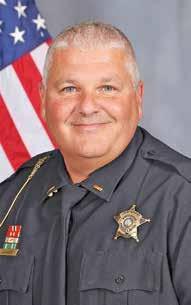
COURTESY RANDOLPH SHERIFF’S OFFICE
John Davie Garner
The wreck occurred in Columbus County
Randolph Record sta
ASHEBORO — Retired Randolph County deputy John Davie Garner and his wife, Alisha, died in a car crash last week in Columbus County.
The couple was on their way home from a vacation when the accident occurred, the Randolph County Sheri ’s O ce announced.
“During this time of loss, we are left with an emptiness that cannot be explained,” said Randolph County Sheri Greg Seabolt in a statement. “We must hold true to our faith that one day we will see each other
again. Rest easy good and faithful servant, we’ll take it from here.”
John Davie Garner was 55. Alisha Garner was 50.
The Columbus County Sheri ’s O ce said an SUV driven by Alisha Garner and a tractor trailer were involved in the May 29 crash, which occurred on Rough and Ready Road at an intersection with Old Stake Road. The police report indicates the SUV failed to stop at an intersection and struck the side of the tractor trailer, which overturned and landed in a ditch.
The driver of the tractor trailer was transported to Columbus Regional Hospital.
John Davie Garner retired in 2021 as a lieutenant after 22
years of service. Recently, he had been working as a part-time baili for the sheri ’s o ce in Randolph County, Seabolt said. John Davie Garner is survived by his children, Kaelin Garner and Nathan Lamonds of Asheboro; his mother, Geraldine Durham Garner; and brother, Dennis Garner.
Alisha Garner is survived by her daughters, Breahna Nykohl Yanez of Asheboro and Tierra Cheyenne Yanez of Randleman; her parents, Gene Wilmoth of Wilburton, Oklahoma, and Sharon Wilmoth of Fort Smith, Arkansas; and her sister, Angela Wilmoth of Fort Smith.
Funeral services were scheduled for Thursday at 2 p.m. at Sunset Avenue Church of God in Asheboro.
Randolph County seniors ready to graduate
Commencements are coming up for hundreds of area students
By Bob Sutton Randolph Record
ASHEBORO — Commencements for most high school seniors will be held across the next several nights in Randolph County.
Hundreds of students will take part in ceremonies marking the ends of their high school days.
Friday night’s ceremony for Asheboro High School is set for Lee J. Stone Stadium, where there are expected to be 307 graduates, the largest senior class of any school in the county.
Uwharrie Charter Academy’s ceremony will be Friday night in the central gym on campus, with about 150 graduates marking the
school’s largest class. Last year, UCA had 130 graduates.
Commencement at UCA comes a little later on the calendar than in the past because the start of classes was delayed with the opening of a new building for the high school. There will be a watch party in the auditorium in the new high school with a video streaming of the ceremony. Tickets aren’t needed for the watch party.
Meaghan Rabb, the career and college liaison at UCA, said next year’s senior class is projected to be at 190.
For Stephen Gainey, superintendent of the Randolph County School System, it’s a rewarding time of the year. It’s also busy.
Gainey won’t be able to attend all the district’s ceremonies Tuesday night, when seven schools have commencements scheduled. Per usual, he rotates from year to year for which schools to
attend for the ceremonies. For next week’s commencements, he’ll be at Trinity and Wheatmore.
“I’d love to get where I can go to them all,” Gainey said.
Without a venue in the county suitable to hold commencement activities for all the schools, the events are mostly held in stadiums at the schools or, in case of inclement weather, in gyms and auditoriums.
RCSS didn’t provide information regarding the number of anticipated graduates at its schools. Randolph Early College High School held its graduation on May 17. Here are the remaining high school commencements in Randolph County:
Uwharrie Charter Academy June 7, 6 p.m. Asheboro HS June 7, 7 p.m.
Eastern Randolph HS June
Trinity
Southwestern
Uwharrie

THE RANDOLPH COUNTY EDITION OF NORTH STATE JOURNAL VOLUME 9 ISSUE 15 | THURSDAY, JUNE 6, 2024 | RANDOLPHRECORD.COM SUBSCRIBE TODAY: 919-663-3232
Randolph record $2.00
11, 6 p.m.
HS June 11, 6 p.m.
Randleman HS June 11, 7 p.m.
Randolph HS June 11, 7 p.m.
in Asheboro Providence Grove HS June 11, 8 p.m. Wheatmore HS June 11, 8 p.m.
Ridge Six-Twelve June 11, 7 p.m. at Journey Church
PJ WARD-BROWN / RANDOLPH RECORD
Breaking News
Jesse Deal, Reporter
Ryan Henkel, Reporter
P.J. Ward-Brown, Photographer
BUSINESS
David Guy, Advertising Manager
Parents of shooting suspect arrested, face felony charges
Randolph Record sta ASHEBORO — The Asheboro Police Department obtained warrants for the parents of a teenage suspect in a fatal shooting last month. They’ve been charged with aiding the suspect in evading arrest. Both the mother, Denisse Vera-Covarrubias, and the father, Alfredo Martinez
Ramirez, were placed in Randolph County Jail, the police department said. Pedro Ortiz-Perez died May 14, nearly two weeks after a shooting near North Asheboro Park. Ortiz-Perez, 16, was a member of the high school boys’ soccer team at Southwestern Randolph. Vera-Covarrubias, 43, was taken into custody at her home and transported to the
Randolph Guide
jail with a felony charge of accessory after the fact and issued a $25,000 secured bond. Martinez Ramirez, 38, turned himself into police and was charged with accessory after the fact and issued a $30,000 secured bond.
The 16-year-old suspect was arrested on May 10 in Statesville. Because of his age, his name has not been released by authorities.
New playground coming for Grays Chapel Elementary School
The funds raised during the 100-year celebration will aid the project
By Bob Sutton Randolph Record
FRANKLINVILLE — The 100th anniversary celebration for Grays Chapel Elementary School went so well this spring that a new playground will be installed soon on the rural school’s grounds.
27607
We stand corrected To report an error or a suspected error, please email: corrections@nsjonline. com with “Correction request” in the subject line.

“All the funds we raised that day went toward the playground,” said April Wood, a kindergarten teacher and one of the anniversary event organizers. “We raised enough money to pay for the installment and some additional pieces.”
The Randolph County School System accepted an anonymous gift for $35,870 for a piece of playground equipment to bene t K-2 students. School principal Lori Johnson’s memo to the school board pointed out that funds from the 100th-year event should cover the installation fee along with shipping and handling charges.
Overall, the celebration was deemed a success with hundreds of visitors. The big thrill for many was reconnecting with former students and sta .
“Being able to see so many people from the past,” Wood said. “It was an awesome day.”
Wood said nearly 100 former school employees checked
CRIME LOG
May 29
• Dustin Kenneth Moffitt, 39, was apprehended by the Randolph County Criminal Apprehension Team for an outstanding True Bill of Indictment for Death by Distribution. He was also charged with carrying a concealed weapon. Moffitt was taken before the magistrate, who issued a total secured bond of $202,000 and a court date of May 31, 2024.
May 30
• Thadeus Jimmy-Dean Upchurch, 21, was arrested by the Randolph County Sheriff’s Office and charged with felony possession of a schedule II controlled substance and misdemeanor possession of drug paraphernalia. He was issued a $5,000 unsecured bond and a first appearance was set for June 24, 2024, in Randolph County District Court.
• Bryan James Williams, 38, was charged with felony breaking and entering, felony larceny after break/enter, and felony possession of stolen goods/property. Williams, currently confined in the Randolph County Detention Center was


in at the celebration and more might have stopped by and not signed in. Many ex-students of the school still live in the community, and some families have had multiple generations of students go through.
Because of various discounts applied, the equipment has been purchased at less than half of the listed price, Wood said. An auction connected to the reunion raised more than $16,000.
served his warrant on May 30, 2024. He was issued a $10,000 total secured bond. A first appearance was set for May 31, 2024, in Randolph County District Court.
May 31
• Azel Eugene Davis, 46, was arrested by the Randolph County Sheriff’s Office on the primary charges of felony larceny of motor vehicle parts, felony break/enter a motor vehicle with theft, misdemeanor possession of stolen goods/ property, and felony obtaining property by false pretense. He was issued a $25,000 secured bond. A first appearance was set for June 3, 2024, in Randolph County District Court.
June 1
• Jessica Nicole Lowery Peltier, 36, was arrested and charged with felony breaking and entering, felony larceny after breaking and entering, misdemeanor injury to personal property, misdemeanor second-degree trespassing, and misdemeanor resisting public officer and issued a $5,000 secured bond. A first appearance
There was morning rain, but then the skies cleared. Visitors spent time inside and outside the school building.
Wood, a former Grays Chapel student, is retiring from the school in June after 19 years as a teacher there. She has been compiling some memorabilia and items that she hopes can be preserved for a future celebration.
“I’m trying to leave some memories behind,” she said.
was set for June 3, 2024, in Randolph County District Court.
June 2
• Tony Lewis Blevins, 59, was arrested by the Randolph County Sheriff’s Office on an outstanding order for arrest out of the Commonwealth of Virginia for Failure to Appear/Contempt of Court from Grayson County, Virginia. He was subsequently arrested for the outstanding process and transported to the Randolph County Detention Center, where he was taken before the magistrate and charged as a Fugitive from Justice, issued a $15,000 secured bond and an extradition hearing was set for June 3, 2024, in Randolph County District Court.
June 3
• Ta’Juan Antonio Blackstock, 37, was arrested, and transported to the Randolph County Detention Center where he was served with a warrant for felony child abuse and issued a $25,000 secured bond. A first appearance was set for June 4, 2024, in Randolph County District Court.
The Randolph Guide is a quick look at what’s going on in Randolph County.
June
7
Randleman Market & Music
6 p.m. – 10 p.m.
Darrell Harwood is the featured musician this week. The concert starts at 7 p.m. and the food trucks open at 6 p.m. at Commerce Square in Randleman.
June
8
Foam Party at the Library
10 a.m. – noon
The Asheboro Public Library is hosting a free foam party for families Saturday morning. Get ready to make a splash with foam, music and games at Asheboro Public Library at 201 Worth St. in Asheboro.
June
8
Superhero Night at the ballpark
7 p.m.
Wear your favorite superhero out t and celebrate local heroes as the Asheboro ZooKeepers host the Boone Bigfoots at historic McCrary Park. First pitch is 7 p.m. and tickets start at $7.
June
9
Asheboro Summer Sunday Concert Series 6 p.m.
The Southern party band North Tower will perform their wide-ranging repertoire that includes Top 40, beach, funk and oldies at Bicentennial Park in Asheboro. The N.C.based band features band leader Larry Dean on keyboard and vocalist Je Hinson.
June
10
The Mysteries and Adventures of Geocaching 4 p.m.
Join the Teen Librarian and local expert geocacher Scott Hager to learn about this fun adventure pastime, try a few practice runs and learn to use Google Earth to nd treasures around your community. Parents invited, phones or tablets recommended. At Asheboro Public Library on 201 Worth St. in Asheboro.

2 Randolph Record for Thursday, June 6, 2024
WEEKLY FORECAST SPONSORED BY 336-629-7588 CALL OR TEXT North State Journal (USPS 20451) (ISSN 2471-1365) Neal Robbins, Publisher Jim Sills, VP of Local Newspapers Cory Lavalette, Senior Editor Jordan Golson, Local News Editor Shawn Krest, Sports Editor Bob Sutton, Randolph Editor Scott Pelkey,
Published each Thursday as part of North State Journal 1201 Edwards Mill Rd. Suite 300 Raleigh, NC
TO SUBSCRIBE: 919-663-3232 RANDOLPHRECORD.COM Annual Subscription Price: $100.00 Periodicals Postage Paid at Raleigh, N.C. and at additional mailing o ces.
Send address changes to: North State Journal 1201 Edwards Mill Rd. Suite 300 Raleigh, NC
THURSDAY 6.6.24
27607
POSTMASTER:
“Join the conversation”
Look no further than Asheboro Fire & Security's First Alert Video Doorbell! How are you protecting all of your deliveries? Asheboro Fire & Security, Inc. 159 North Park Street, Asheboro, NC 27203 Contact: Follow us on Facebook • Leave us a review at: Your trusted partner in security since 1931
COURTESY PHOTO
THURSDAY JUNE 6 FRIDAY JUNE 7 SATURDAY JUNE 8 SUNDAY JUNE 9 MONDAY JUNE 10 TUESDAY JUNE 11 WEDNESDAY JUNE 12 HI 79 LOW 55 PRECIP 4% HI 77 LOW 52 PRECIP 5% HI 81 LOW 62 PRECIP 24% HI 83 LOW 64 PRECIP 3% HI 85 LOW 66 PRECIP 10% HI 80 LOW 59 PRECIP 3% HI 80 LOW 59 PRECIP 10%
The daughter/father combination of Melanie Neighbors, left, and Lonnie Allred pose with memorabilia during Grays Chapel Elementary School’s 100-year celebration this spring.
Guide THE CONVERSATION
Neal Robbins, publisher | Frank Hill, senior opinion editor
VISUAL VOICES
General Assembly must address child care crisis
In this building, we have had our priorities backward.
CHILD CARE IS AN ESSENTIAL ISSUE for so many North Carolinians. This is a serious issue that our state faces, but legislative inaction so far means that thousands of families across this state are being left in limbo.
The federal government funded child care stabilization grants that are set to end this summer. That money has been a lifeline for working families and the business community, ensuring that child care centers can continue to function and that working parents can make it to work. But with that money ending, now the state needs to step up and bridge the divide.
The pressure on child care is coming from above and below. Too many working families are simply unable to a ord the high cost of child care in our state today. That leads to working parents having to withdraw from the workforce in order to take care of their children. The statistics on this are eye-popping: 34% of working mothers and 20% of working fathers are leaving their jobs because the cost of child care is too high.
On the other hand, it is di cult for child care centers to stay a oat. Wages are too low in the industry, leading to fewer people joining the child care workforce and further exacerbating the ability of these centers to take in children.
Twenty- ve percent of child care centers closed between 2016 and 2021. A third of the remaining centers are liable to close when the Child Care Stabilization Grants dry up. This is a crisis, and we need to address it.
One of North Carolina’s best attributes on the national and global stage is our outstanding workforce. It’s the reason we have secured billions of dollars of economic investment and thousands of new jobs. The business community understands the need to have a well-funded child care system, and the
working families who rely on it most days of the week surely do too. We need this General Assembly to understand how dire it is that this funding be provided.
Instead, the focus of this session so far has been to subsidize private school education for millionaires. In this building, we have had our priorities backward. How much more of an impact would hundreds of millions of dollars for child care centers have on our state than handouts to wealthy families for private school tuition?
With the money proposed for the taxpayer-funded voucher scheme, we could invest in child care subsidies to wipe away the current waitlist of more than 5,000 kids. We could create a statewide rate oor that helps ensure rural low-wealth communities can a ord child care. We could shore up the Child Care Stabilization Grants program. And we could adequately fund Pre-K to cover nearly 30,000 students and keep teachers in classrooms. This and more is included in Gov. Roy Cooper’s budget proposal.
We are making a simple proposition here: provide funding to the programs that actually help the working and middleclass people of this state.
Won’t that have more of an impact for working families? Doesn’t that really address the concerns that North Carolinians have every night at the kitchen table? Working people in this state are being left behind by the inaction in this building while the wealthiest folks and corporations see their tax bill drop every year. The people who go to work 9-5 and struggle to make ends meet are the ones we should be focused on helping.
Robert Reives II is the N.C. House Democratic leader and represents Chatham County.
Biden’s all-of-government vote-buying scheme
The Environmental Protection Agency awarded a $50 million “environmental justice” grant to the Climate Justice Alliance.
TO BET ON THE UPCOMING presidential election, don’t just rely on polls. Look at the billions of taxpayer dollars President Joe Biden is pouring into “community organizations” in “disadvantaged communities” to tip the election scales.
The community organizer who became president, Barack Obama, was a master at machine politics, using federal tax dollars to turn community organizations — left-wing not-for-pro ts — into a fth estate. Their sta s, paid using taxpayer money but not tied to government rules, could hit the streets at election time and build turnout. Biden has scaled up Obama’s playbook, using billions of dollars instead of mere millions.
Sen. Shelley Moore Capito (R-W.Va.) made headlines last week with the discovery that in December 2023 the Environmental Protection Agency awarded a $50 million “environmental justice” grant to the Climate Justice Alliance. Capito was distressed to learn that the Climate Justice Alliance vows “the path to climate justice travels through a free Palestine.”
In fact, Climate Justice Alliance serves up a full agenda of radical activities, including ghting “political oppression” and “placing race, gender, and class at the center” of its climate solutions.
But $50 million for the Climate Justice Alliance is a drop in the bucket.
Had members of Congress read the In ation Reduction Act before passing it — a novel idea — they would know the law provides $2.8 billion to the EPA for environmental and climate justice block grants,” (Section 60201). That’s a license to hand out walking-around money to many political activists, not just the Climate Justice Alliance.
Another recipient: the New York Immigration Coalition, which describes itself as a “coalition of immigrant and refugee organizations” pushing for more government services and political clout.
Same is true of the New Jersey Alliance for Immigrant Justice, another recipient. The words “climate” and “environment” don’t appear anywhere on these groups’ websites or literature.
Lawmakers may have assumed the money was for climate improvement, but the IRA’s ne print allows the moolah to be used for “facilitating engagement of marginalized communities in Local, State and Federal public processes, such as advisory groups, workshops, rulemakings.”
Translation: elections.
How easy is it to get the dough? Piece of cake. The EPA says it wants to “alleviate much of the burden that the
federal grants process places on small, resource-constrained community-based organizations supporting underserved communities and marginalized populations.” In short, no jumping through hoops.
The money can only go to a disadvantaged community or a southern border town. There are 27,521 disadvantaged communities on the census map, according to Biden’s “Climate and Economic Justice Screening Tool,” which targets non-English speakers, people with diabetes and other factors that mostly correspond to heavily minority populations. These communities customarily vote Democratic.
Adding eligibility for border towns is an interesting twist. As waves of migrants overwhelm resources in these towns, Democrats are growing divided over Biden’s open border policies. Money may shore up support.
During his rst week as president, Biden announced the Justice40 initiative by executive order, requiring that 40% of many types of federal spending — not just EPA grants — must go to these “disadvantaged communities.”
The Department of Energy is spreading money to these “disadvantaged communities,” using what it calls “community bene t plans” and promising that application requirements will be “intentionally exible.”
The playbook started with the A ordable Care Act. The ACA, or “Obamacare,” authorized the Centers for Disease Control and Prevention to hand out “community transformation grants.” Community Health Councils, a typical recipient, pledged that its mission was to advance “social justice.” It distributed 65% of the money to partner community groups that promoted “voter engagement,” conducted “one-on-one education in the streets” or led tenants’ rights, anti-fracking and anti-drilling e orts. And you thought the ACA was about covering the uninsured.
A decade after Obama, Biden is tasking every agency and department of the federal government to promote voter engagement.
Biden’s community grants pale in size compared to the student debt cancellation vote-buying that now totals $620 billion. But the community grant money lands directly in the hands of political activists who know what to do with it.
Tell your congressional rep to read the bills before voting on them and strip out these provisions for community giveaways that make a mockery of democracy.
Betsy McCaughey is a former lieutenant governor of New York and chairman of the Committee to Reduce Infection Deaths.
3 Randolph Record for Thursday, June 6, 2024
COLUMN | ROBERT REIVES
COLUMN | BETSY MCCAUGHEY
RandolpH SPORTS


The UCA baseball team collected another state championship banner.
Eagles soar to state crown
“We had to earn every single bit of it. Our guys stepped up every single time.”
Rob Shore, UCA baseball coach
Pitching lifted UCA to its second straight baseball title
Randolph Record sta
HOLLY SPRINGS — Uwharrie Charter Academy’s baseball team won in di erent fashions in two games in the Class 1A state nals at Ting Stadium.
But stellar pitching was one of the staples as the Eagles repeated as state champions.
UCA pitcher Brett Smith kept Northside-Pinetown in check and the Eagles were boosted by Trey Kennedy’s goahead home run in a 6-1 victory Saturday afternoon, sweeping the best-of-three series.
While UCA (28-6) needed an extra inning in the series opener Friday night, the Eagles had a less adventurous route in Game 2.
The season concluded with a school-record win total.
UCA’s Jake Hunter, who pitched a complete game in Game 1, was named the Most Valuable Player for the championship series.
Just like last year, Hunter and Smith handled all the pitching for UCA in the nals.
“The same two guys,” UCA coach Rob Shore said. “I’ve thrown the same two pitchers and nobody else has thrown a single pitch because those guys were that good.”
UCA has won three state baseball titles. Like in 2019 and last year, it was another two-game sweep in the nals.
After taking the lead in Game 2, the Eagles had a couple of blunders in the eld as Northside-Pinetown loaded the bases. Right elder Carter Brown made a
Warriors wind up special soccer stretch
“This creates energy and people want a part of it.”
Rick Massey, Wheatmore coach
Record careers ended for the Wheatmore program
By Bob Sutton Randolph Record
TRINITY — Wheatmore came up shy of returning to the Class 2A state championship game in girls’ soccer after playing in the nal the past two years.
Yet the impact produced by the Warriors might be far reaching.
“It has been a heckuva ride,” Wheatmore coach Rick Massey said. Wheatmore was the 2022 state champion and the 2023 runner-up. This year, the season ended in the West Regionnal.
“I never dreamed of winning the states,” Massey said of the 2022 season. “This creates energy and people want a part of it.”
That’s what he has noticed from fellow members of the Piedmont Athletic Conference. He said league teams have been on the rise trying to keep up with the Warriors (17-5).
“We get everybody’s best,” Massey said. “Our conference is getting stronger because of this. We’re creating this. It’s pressure.”
Certainly Ellie Garrison’s record-setting career was a big part of Wheatmore’s success. She’s the all-time state leader in goals for girls’ soccer, nishing with 277.
Massey said he appreciated this season in particular because unlike the past two years, the Warriors had two primary scorers rather than three. That meant extra attention for Garrison and junior Natalie Bowman.
running catch to end that threat and the Eagles rolled the rest of the way.
Grat Dalton added a run-scoring single as the Eagles padded their lead. Kennedy and Walker Wilkins both scored two runs.
Smith, a junior, ended up with a four-hitter.
UCA pulled out a 2-1 victory in eight innings Friday night.
“It was tense, but that’s everything state championship games are supposed to be like,” Shore said. “In these big games like this, it’s how you nish and not how you start.”
Brown’s single — his third hit of the game — through a drawn-in in eld knocked in the winning run, with Troy Carver crossing the plate.
In the bottom of the seventh, Brown led o with an in eld single, stole second and scored the tying run on Landon Zephir’s two-out single.
“Third time through the lineup wenally got some timing,” Shore said. “It had everything to do with what Jake Hunter was doing on the mound. He was keeping us in the game.”
Hunter, a sophomore, was the winning pitcher with 11 strikeouts. Northside-Pinetown pitcher James Sawyer struck out 15. Northside-Pinetown (22-8) was in the nals for the rst time in 30 years.
UCA’s pitching in the postseason was up to the task. In some ways, that was needed more than a year ago because the Eagles encountered some stout opposing pitchers along the way the past few weeks.
“We saw some really good arms compared to what we saw last year,” Shore said. “We had to earn every single bit of it. Our guys stepped up every single time.”
“It’s easier to be more successful in trios,” he said.
The Warriors tried to shore up the defensive end. Lucy Lockwood joined the team as goalkeeper for the past two seasons.
Garrison had a role in that.
“Ellie is my best friend and she recruited me to play,” Lockwood said.
Garrison said: “A big help. She already plays volleyball and she’s a good athlete and she’s used to it.”
Massey said he wanted to provide recognition to players other than those with o ensive numbers. Shutouts were rewarded with pizza, or sometimes he’d mix it up and bring doughnuts to celebrate shutouts.
Lockwood’s 27 career shutouts set a school record. Playing a position where “you’re going to get blamed for a loss,” she said she aimed to maintain the team’s credentials.
Yet there are times the Warriors made it easy on her.
“Sometimes I’m daydreaming down there,” Lockwood said.
Final game
Wheatmore was upended by host Pine Lake Prep, falling 3-2 on May 28 in Mooresville in a West Region nal rematch from last season.
Garrison scored both goals for the sixth-seeded Warriors. Bowman provided an assist. Lockwood recorded 12 saves, though her four-game shutout streak ended.
Avery Garrett, Maddyson Kerley and Morgan Reisig scored goals for top-seeded Pine Lake Prep. The game was tied 1-1 at halftime.
Pine Lake Prep (20-2-1) went on to the state nal, where it lost to Seaforth (25-1-1) in a penalty-kick shootout Saturday night at Mecklenburg County Sportsplex in Matthews. The game was scoreless through 110 minutes combined between regulation and overtime periods before Seaforth’s 6-5 edge in the shootout.
BEST OVERALL ATHLETE OF THE WEEK

Macie Crutch eld

Southwestern Randolph’s Macie Crutch eld prepares to re a pitch during the Class 2A state championship series.
Southwestern Randolph, softball
Crutch eld completed her junior season as the Most Valuable Player of the Class 2A state championship series.
She pitched every inning in both games as the Cougars captured the title by sweeping Midway in games held at UNC Greensboro. In those 12 innings — because Game 1 was reduced to ve innings by the mercy rule — she compiled 19 strikeouts and issued three walks.
Crutch eld is a three-year starter for Southwestern Randolph, racking up high strikeout totals most of the time.
She’s also has provided the team with a boost at the plate. In the state nals, she had a total of four hits across the two games.
Crutch eld also was dubbed the Athlete of the Week in March 2022 shortly after the beginning of her high school softball career.
Former Trinity, Asheboro football coach retires
Kevin Gillespie also coached Greensboro Page to a state title
Randolph Record sta
KEVIN GILLESPIE, who made two of his four stops as a high school football head coach in Randolph County, announced his retirement last Friday.
Gillespie stepped down from his post at Thomasville, where he spent the past four seasons. Gillespie coached at Trinity and Asheboro, with a stop in between to guide Greensboro Page to a state championship. He had an overall record of 172-110 after going 32-12 with Thomasville.
Gillespie’s nal game came last November in a 40-19 road loss at Eastern Randolph in the third round of the Class 1A state playo s. The Bulldogs nished the season with a 9-4 mark. Gillespie had a rough stretch as Asheboro’s coach with records of 2-8, 1-10 and 2-9 from 2017-19. He also had a stint as a Blue Comets assistant coach at the beginning of his teaching career, which started at North Asheboro Middle School. With Greensboro Page, the Pirates captured Class 4AA state championships in 2011 and were the runners-up in 2015 and 2016. Gillespie spent 11 seasons there with a 101-45 record. His rst head coaching position in football came in 2001 at Trinity, his alma mater. He’s a former quarterback for the Bulldogs.
Thomasville’s coaching change means the Bulldogs will have a new coach for their 2024 opener Aug. 23 against visiting Randleman.
172 Career high school fooball coaching wins for Kevin Gillespie
4 Randolph Record for Thursday, June 6, 2024
SPONSORED BY 2024 IS THE YEAR TO eat mor chikin
PJ WARD-BROWN / RANDOLPH RECORD
GOOD
NCHSAA PHOTO
GOOD TO THE LAST PLAY
Cougars claim state title with two runs on nal pitch
Southwestern Randolph notcheed its rst softball crown in 14 years
By Bob Sutton Randolph Record
GREENSBORO — Madelyn
Smith’s dash from rst base to home plate that sent Southwestern Randolph’s softball team to a Class 2A state championship came amid chaos on the nal play of the season.
It created more mayhem in terms of a celebration for the Cougars, who won the program’s rst title in 14 years.
“We have this saying, ‘Why not us?’” said third baseman Kami Dunn, who took that theme to another level. “Why does this have to go another game?”
It didn’t. The best-of-threenal ended with Southwestern
Randolph’s dramatic 3-2 victory against Midway in Game 2, with the tying and winning runs coming on the same play with two outs in the bottom of the seventh at UNC Greensboro.
“I really can’t compare the feeling with anything else,” said Cougars pitcher Macie Crutcheld, who was named the Most Valuable Player of the nals.
A postseason full of tight games and tense moments came down to this.
“That’s just Southwest softball,” coach Toby Strider said. “There’s no quit in this group.”
The winning rally came in the heat of the afternoon sun.
Hayleigh Thompson reached on a one-out single, with Sara-Kate Marion summoned to pinch run. After the second out, Smith singled, putting runners at rst and second.
Then it was Dunn’s turn. She
drilled the ball past shortstop Kiley Ives, with Marion racing in from second base and beating the throw to the plate.
“Get down, get down. Score,” Marion said of what she heard.
But the freshman wasn’t aware that the ball got away from catcher Mollie Bass. Smith wasn’t slowing down.
“We work on baserunning every day,” Strider said. “It was a reaction.”
For Smith, she had one thing in mind.
“I didn’t ignore Toby, but I’m going to go,” she said. “This is our chance.”
Marion was elated to have scored the tying run, but then “I didn’t know she was coming,” she said of Smith.
Meanwhile, Dunn had done more than she realized.
“Oh yes, I just tied up the ball game,” she said of her initial reaction. “By the time I got to sec-
ond base, I was crying. I was so happy.”
It was hard to comprehend.
The Cougars scored one run through six-plus innings and were down to their last out.
“Next thing you know, it’s over,” said Strider, whose team won three one-run games in the playo s.
Southwestern Randolph’s 13-0 blasting of Midway in ve innings Friday night in Game 1 lacked drama, and some Cougars fans mentioned that to players. By late Saturday afternoon on the UNCG campus, there was no shortage of suspense and elation.
“This got them out of their seats,” Smith said.
The stress built in Game 2.
Midway left 10 runners on base.
“More pressure,” Crutch eld said. “But I think we do really good under pressure.”
For Marion, it seemed unreal.
“It’s just that we won states (my) rst year,” she said. Midway (21-5) scored the rst run in the top of the fourth. In the bottom of the inning, courtesy runner Ryleigh Hineline came home on Micah Wilson’s groundout to knot the score.
The Raiders used three consecutive one-out singles, capped by Tamia Gwynn’s liner to center eld, to go ahead 2-1 in the sixth. In Game 1, Midway had only one batter — Gwynn with a bunt single — with a hit o Crutch eld. The Raiders lost for the rst time since April 25.
For the championship series, Maddie Strider, Alyssa Harris, Crutch eld and Dunn all were credited with four hits for the Cougars. Strider drove in ve runs in Game 1.
Midway, also the 2023 state runner-up, remains without a state championship.

Cougars turn to Lagrama as baseball coach
PHOTO
The former softball coach takes on a new role
By Bob Sutton Randolph Record
ASHEBORO — Ed Lagrama
lled in at the end of the recent season as Southwestern Randolph’s interim baseball coach.
Now, he’ll be the coach moving forward.
Lagrama is a former softball coach at Southwestern Randolph.
His interim role came when the school sought a replacement for rst-year coach Brian Gusa. The Cougars went 3-4 under Lagrama’s direction to complete a 9-15 season.
Lagrama had a connection to the baseball team as an assistant coach under Tyler Clapp and also helped when Ethan Marsh led the program.
So when principal Brian Hodgin called to ask him to complete the season as coach this spring, it made sense.
“It didn’t take me very long
May eld, Henriksen split races in Grand National series at Caraway
Randolph Record sta
SOPHIA — Jeremy Mayeld and AJ Henriksen put on quite the show in the rst of two 50-lappers for the Grand National Super Series teams Saturday night at Caraway Speedway. May eld edged Henriksen, the fast quali er, by .306 seconds. Kevin Korner nished third ahead of Donnie Doster, Bob Schadt, Lauren Butner, Larry Wilcox and Joe Wilder. Henriksen had a better result in the second feature, winning in front of May eld followed by the same order as the rst race for third through eighth place.
• In Challengers, Dalton Ledbetter edged points leader Brody Duggins for the victory, with Justin Hathcock in third place and fast quali er Gary Ledbetter Sr. next.
• In 602 Modi eds, Dean
There were two features in the UCAR division, with Daniel Hughes winning both races.
Lowder set a fast time in qualifying then drove from mid-pack to take the lead from Cody Norman on lap 13. Lowder captured the victory in front of his son, Josh Lowder, by slightly more than two seconds. Jaxson Casper recovered from a spin and worked his way to third place ahead of Norman, Mitchell Wright, Ryan Kuhlthau and Junior Harvill.
• Daniel Hughes was dominant in the two UCAR features on the 25th anniversary of the rst UCAR races. In a 10-lapper that counted as a “points paying”
race, Hughes bested Steven Collins and Ron Mock with Jeremy Moose and Jason Richmond rounding out the top ve.
The second UCAR feature allowed past UCAR stars that had moved up to other divisions to compete against the “regulars.” Being a champion or winner in other divisions did little to take any “glory” from the weekly competitors as Hughes prevailed ahead of Jason Gallimore, AJ Biscoe, Mock and Richard Jones.
• In the 12-lap Bootleggers feature, Bentley Black was the winner ahead of Corey Rose.
• The Allison Legacy Series features 5/8 scale NASCAR Cup Series look-alikes, with Andon Mendenhall the winner.
• Jason Garwood topped Je Linkous, Rudy Hartley and Tommy Raino in the Mod 4 feature.
to decide what to do,” Lagrama said. “The reason it didn’t take long for me to decide was the kids. It was a no-brainer for me.” Recently, he was named the new coach.
Lagrama had been umpiring high school games this year. When Hodgin called, he was in Siler City umpiring a game between Seaforth and Jordan-Matthews. The next night — in his new role — he went back to Jordan-Matthews for a nonconference game with
Southwestern Randolph plauers, fans and coaches celebrate after a come-frombehind walko win to claim the Class 2A softball state championship.
Southwestern Randolph.
“I made two trips to JordanMatthews in two days,” he said.
The Cougars won that game 10-4.
Lagrama said his time leading the softball program has him optimistic about his newest role. His daughter, Samantha Lagrama, was on the team then.
“We had some pretty good teams,” he said. “It was a very good coaching experience for me.”
Lagrama, 52, has spent more than a decade in various roles at the school. He teaches business classes in the career and technical education program.




5 Randolph
June 6, 2024
Record for Thursday,
140 NC Hwy. 42 North, Asheboro, NC 27203 Office: (336) 629-9187 | Fax: (336) 626-6838 | robert.stover@ncfbins.com Auto, Home, Life and Health Insurance A proud, lifelong resident of Randolph County, I've been protecting families since 2011. I look forward to helping you with your insurance needs. Please give me a call today. 336-629-9187 • robert.stover@ncfbins.com Rob Stover
COURTESY
Ed Lagrama
BOB SUTTON / RANDOLPH RECORD
Normandy parachute jump kicks o 80th anniversary of
The number of survivors from the World War II operation is dwindling
By John Leicester The Associated Press
CARENTAN-LES-MARAIS, France —
Parachutists jumping from World War II-era planes hurled themselves Sunday into now peaceful Normandy skies where war once raged, heralding a week of ceremonies for the fast-disappearing generation of Allied troops who fought from D-Day beaches 80 years ago to Adolf Hitler’s fall, helping free Europe of his tyranny.
All along the Normandy coastline — where then-young soldiers from across the United States, Britain, Canada and other Allied nations waded ashore through hails of re on ve beaches on June 6, 1944 — French o cials, grateful Normandy survivors and other admirers are saying “merci” but also goodbye.
The ever-dwindling number of veterans in their late nineties and older who are coming back to remember fallen friends and their history-changing exploits are the last.
Watching the southern England coastline recede Sunday through the windows of one of
D-Day
/ AP
A parachutist drops in Carentan-Les-Marais in Normandy, France, on Sunday ahead of D-Day 80th anniversary commemorations.
three C-47 transport aircraft that ew him and other jumpers across the English Channel to their Normandy drop zone was like time-traveling back to D-Day for 63-year-old Neil Hamsler, a former British army paratrooper.
“I thought that would have been the last view of England some of those lads of 1944 had,”
he said. While theirs was a daytime jump Sunday, unlike for Allied airborne troops who jumped at night early on D-Day, and “no one’s ring at us,” Hamsler said: “It really brought it home, the poignancy.”
Part of the purpose of reworks shows, parachute jumps, solemn commemorations and ceremonies that world leaders
will attend this week is to pass the baton of remembrance to the current generations now seeing war again in Europe, in Ukraine.
U.S. President Joe Biden, Ukrainian President Volodymyr Zelenskyy and British royals are among the VIPs that France is expecting for D-Day events.
Looping around one after another, the C-47s dropped strings of jumpers — 70 in all, dressed in WWII-style uniforms. Their round chutes mushroomed open in the blue skies with pu y white clouds. A huge crowd many thousands strong whooped and cheered, having been regaled as they waited by tunes from Glenn Miller and Edith Piaf. Some of the loudest applause was for a startled deer that pounced from undergrowth as jumpers were landing and sprinted across the drop zone.
Two of the planes, christened “That’s All, Brother” and “Placid Lassie,” were D-Day veterans, among the thousands of C-47s and other aircraft that on June 6, 1944, formed part of what was the largest-ever sea, air and land armada. Allied airborne forces, which included troops making hair-raising descents aboard gliders, landed rst early on D-Day to secure roads, bridges and other strategic points inland of the invasion beaches and destroy gun emplacements that
raked the sands and ships with deadly re. The planes took o Sunday from Duxford, England, for the 90-minute ight to Carentan. The Normandy town was at the heart of D-Day drop zones in 1944, when paratroopers jumped in darkness into gunre, many scattering far from their objectives.
Sunday’s jumpers were from an international civilian team of parachutists, many of them former soldiers. The only woman was 61-year-old Dawna Bennett, who felt history’s force as she exited her plane into the Normandy skies.
“It’s the same doorway and it’s the same countryside from 80 years ago, and it’s like, ‘Oh my God, I’m so thankful I’m not doing this at midnight’” she said. “They keep saying it’s the greatest generation and I truly believe that.”
Dozens of World War II veterans are converging on France to revisit old memories, make new ones, and hammer home a message that survivors of D-Day and the ensuing Battle of Normandy, and of other World War II theaters, have repeated time and time again — that war is hell.
“Seven thousand of my marine buddies were killed. Twenty thousand shot up, wounded, put on ships, buried at sea,” said Don Graves, a U.S. Marine Corps veteran who served in Iwo Jima in the Paci c theater.
“I want the younger people, the younger generation here to know what we did,” said Graves, part of a group of more than 60 World War II veterans who ew into Paris on Saturday.
North Korea to stop sending trash balloons into South
South Korea vowed strong retaliation if the practice continued
By Hyung-jin Kim
The Associated Press
SEOUL, South Korea — North Korea said it will stop sending trash-carrying balloons into South Korea, claiming Sunday that its campaign left the South Koreans with “enough experience of how much unpleasant they feel.”
The North’s announcement came hours after South Korea said it would soon punish North Korea with “unbearable” retaliatory steps over its balloon activities and other recent provocations.
Observers say South Korea will likely restart front-line loudspeaker broadcasts into North Korea that include criticism of its abysmal human rights situation, world news and K-pop songs. North Korea is extremely sensitive to such broadcasts because most of its 26 million people have no o cial access to foreign TV and radio programs.
It wasn’t immediately un-
clear if South Korea would move ahead with its punitive measures following North Korea’s suspension of balloon launches.
On Sunday night, Kim Kang Il, a North Korean vice defense minister, said the North will temporarily suspend its balloon activities. He said they were a countermeasure against previous South Korean lea eting campaigns.
“We made the ROK (Republic of Korea) clans get enough experience of how much unpleasant they feel and how much effort is needed to remove the scattered wastepaper,” Kim said in a statement carried by state media.
He said that if South Korean activists oat anti-Pyongyang propaganda lea ets via balloons again, North Korea will resume ying its own balloons to dump rubbish hundreds of times the amount of the South Korean lea ets found in the North.
A South Korean soldier wearing protective gear checks the trash from a balloon presumably sent by North Korea on Sunday in Incheon, South Korea.
GPS signal jamming “absurd, irrational acts of provocation that a normal country can’t imagine.” He accused North Korea of aiming to cause “public anxieties and chaos” in South Korea. North Korea often responds with fury to South Korean civilian lea eting because it contains propaganda messages critical of the North’s authoritarian rule and outside news. In 2020, North Korea exploded an empty, South Korean-built liaison o ce in the North in anger over the South Korean balloon activities.
Earlier Sunday, South Korea’s military said that more than 700 balloons own from North Korea were discovered in various parts of the country, in addition to about 260 balloons found a few days earlier. Tied to the balloons were manure, cigarette butts, scraps of cloth, waste paper and vinyl, but no dangerous substances, according to the Joint Chiefs of Sta . Kim, the North Korean ofcial, said North Korea ew 3,500 balloons carrying 15 tons of wastepaper.
South Korea’s national security director Chang Ho-jin said
earlier Sunday that the government decided to take “unbearable” measures against North Korea in reaction to its balloon launches, alleged jamming of GPS navigation signals in South Korea and simulation of nuclear strikes against the South in recent days.
Chang called the North’s balloon campaign and its alleged
Experts say North Korea’s balloon campaign, reportedly the rst of its kind in seven years, is meant to stoke an internal divide in South Korea over its conservative government’s tough policy on the North. They say North Korea is also expected to further ramp up tensions ahead of the U.S. presidential election in November.
Since 2022, North Korea has sharply increased the pace of weapons tests to build a bigger nuclear arsenal. Last week, it red a barrage of nuclear-capable weapons into the sea in a drill simulating a preemptive attack on South Korea.




6 Randolph Record for Thursday, June 6, 2024 9796 Aberdeen Rd, Aberdeen Store Hours: www.ProvenOutfitters.com 910.637.0500 Blazer 9mm 115gr, FMJ Brass Cased $299/case Magpul PMAGs 10 for $90 Polish Radom AK-47 $649 Smith & Wesson M&P 2.0 Compact $449 Del -Ton M4 $499 Ever wish you had a The Best Prices on Cases of Ammo? The best selection of factory standard capacity magazines? An AWESOME selection of Modern Sporting Weapons from Leading Manufactures Like, Sig, FN, S&W, etc? You Do! All at better than on-line prices? local store which has Flamethrowers & Gatlin Guns?
JEREMIAS GONZALEZ
PHOTO
IM SUN-SUK
YONHAP VIA AP
/
Henry Leaton Delk
March 6, 1940 –May 21, 2024
Henry Leaton Delk, age 84, of Denton passed away on May 21, 2024 at his home.
Mr. Delk was born in Denton on March 6, 1940 to Astor and Lyde Delk. Henry served his country in the U.S. Army 82nd Airborne Division. He was the owner of H.L. Delk Construction, Inc. as a General Contractor, specializing in industrial, concrete, steel, and mining construction. Henry was a member of Piney Grove United Methodist Church. In addition to his parents, Henry was preceded in death by rst wife, Barbara Jean Martin Delk, his son, David Delk, and his brothers, Alton and Dempsey Delk. Henry loved mining and engineering, traveling, shing, and cows. Most of all, Henry loved his family. Henry enjoyed beach music and shagging, dancing across the country.
He is survived by his wife of 33 years, Barbara Graham Delk; son, Henry L. Delk “Junior” and wife Gina of Farmer; brother, Richard Delk and wife Donna of Jackson Creek; daughter-inlaw, Susan Delk of Jackson Creek; stepdaughters, Tammy Gamble and Sherry Greene; grandchildren, Andrew, Phillip, Dakota, Rebecca, Nevada “Fred,” and Jacob; step grandchildren, Zack, Ridge, Allison, and Thomas; 6 great grandchildren; and 2 step great grandchildren.
The family will receive friends on Thursday, May 23, 2024 from 6:00-8:00 pm at Pugh Funeral Home, 437 Sunset Avenue in Asheboro. Funeral services will be held on Friday, May 24, 2024 at 2:00 pm at Piney Grove United Methodist Church, 7594 Jackson Creek Road in Denton with Rev. Daniel Delaney o ciating. Interment will follow in the church cemetery.
In lieu of owers, donations may be made to the Piney Grove United Methodist Cemetery Fund. Care of Richard Delk, 1829 Hunt Delk Road, Denton NC 27239
DEATH NOTICES
Betsy Reavis
December 23, 1930 –May 29, 2024
Betsy Neal Kern Reavis, 93, of Asheboro, died Wednesday, May 29, 2024, at The Randolph Hospice House in Asheboro.
Gerald Spaulding
May 23, 1949 – May 31, 2024
Gerald Johnson Spaulding, 75, of Randleman, died Friday, May 31, 2024, at his residence.
Devin Alexander Finn
October 3, 1997 –May 26, 2024
Devin Alexander Finn, 26, died May 26, 2024.
obituaries

Alisha Garner
May 25, 1974 – May 29, 2024
Alisha Rene Wilmoth Garner, 50, of Asheboro, passed away with her husband, John David “Davie” Garner, on Wednesday, May 29, 2024.
Memorial services will be held at 2:00 p.m., June 6 , 2024, at Sunset Avenue Church of God, Asheboro with Pastor Charles Moses o cating.
Alisha was born in Ft. Smith, AR, on May 25, 1974, and was very proud of her Choctaw heritage. Since she was a little girl, her deepest desire was to be a mother. She gave 150% of herself to that role for 26 years now. She made being a mother look natural. Alisha is considered a mother to many, always drawing others into her arms and her home. Her deep compassion and empathy towards others never ran out.
Those who knew Alisha personally have said that within the last few months she was the happiest that she’s ever been, enjoying her infectious laugh. She and Davie loved going to the beach and were collecting seashells this past week to take back home. Alisha spent the previous Saturday surrounded by her dearest friends celebrating her 50th birthday. It made her feel deeply loved and very special.
Alisha spoke of God as her dearest friend. Her faith was the re in her veins and ground beneath her feet. Just weeks ago she spoke of not fearing death because of her con dence in being with Jesus.
In additional to her loving friends and extended family Alisha is survived by her daughters, Breahna Nykohl Yanez of Asheboro, Tierra Cheyenne Yanez of Randleman; stepdaughter, Kaelin Garner of Asheboro; father, Gene Wilmoth of Wilburton, OK; mother, Sharon Wilmoth of Ft. Smith, AR; and sister, Angela Wilmoth of Ft. Smith, AR.
The family will receive friends from 6:00 to 8:00 p.m. on Wednesday, June 5, 2024, at Ridge Funeral Home.
Garner
October 15, 1968 –May 29, 2024
Lt. John “Davie” David Garner, 55, of Asheboro, passed away with his wife, Alisha Wilmoth Garner, on Wednesday, May 29, 2024. Memorial services will be held at 2:00 p.m. on Thursday, June 6, 2024, at Sunset Avenue Church of God, Asheboro with Pastor Charles Moses o ciating.
Lt. Garner was born on October 15, 1968, in Randolph County. He was hired by the Randolph County Sheri ’s O ce on July 1, 1995, where he was assigned to the Crime Scene Investigation Division. Lt. Garner remained in the CSI. Division until October 31, 2004, leaving at the rank of Corporal, for employment with City/County Bureau of Identi cation in Raleigh, N.C. Missing his home in Randolph County, Lt. Garner was rehired by the Randolph County Sheri ’s O ce on August 16, 2007, and assigned to Criminal Investigations as a detective. Lt. Garner was promoted to Sergeant in 2010 and re-assigned to the I.D. Division. On August 1, 2010, Lt. Garner was promoted to the rank of Lieutenant as the supervisor of CSI.
On October 7, 2010, Lt. Garner received his Advanced Law Enforcement Certi cate from the North Carolina Sheri ’s Education and Training Standards Commission and the highest distinguished accomplishment for a law enforcement o cer.
During Lt. Garner’s tenure with the Sheri ’s O ce, he also volunteered as Emergency Response Team member for many years. David was not only on-call as a detective and CSI investigator but also willingly took calls for the Emergency Response Team.
Lt. David Garner was recognized for 22 years of faithful service to the citizens of Randolph County in 2021.
In retirement, Dep. Garner returned to the Sheri ’s O ce where he was currently serving part-time as a Baili . He was so proud of his law enforcement background.
Louis Ray Maness
June 7, 1936 – May 22, 2024
Louis Ray Maness passed away peacefully at home on May 22, 2024, with his family by his side.
Bill Allen Kirby
July 22, 1955 – May 21, 2024
Bill Allen Kirby, age 68, of Asheboro passed away on May 21, 2024 at home with his wife and children by his side after a short illness. He was born July 22, 1955 in Washington County, Virginia. Bill graduated in 1974 from Alleghany County High School of Covington, Va.
Celebrate the life of your loved ones. Submit obituaries and death notices to be published in Randolph Record at obits@randolphrecord.com
He enjoyed deep sea shing, MMA ghting, cooking, and getting on his daughters nerves. He was the funniest person in the world and knew how to lift up others. He was a lover of nature and all things outdoors. He particularly loved being near the water and he was a lover of music. He faithfully served all who he loved. Lt. Garner had a loyal sturdiness that grounded his family and was marked by courage and generosity. He had a deep empathy and compassion for animals and considered his two dogs to be family. To be around Lt. Garner, was to be continuously nurtured and constantly laughing. He cherished his family more than anything.
Lt. Garner was preceded in death by his father, Dennis Michael Garner. He is survived by his daughter, Kaelin Garner of Asheboro; son, Nathan Lamonds (Carrie) of Asheboro; stepdaughters, Breahna Yanez, Tierra Yanez; mother, Geraldine Durham Garner; brother, Dennis Garner; and half brother, Cody Garner of Arkansas.
The family will receive friends from 6:00 until 8:00 p.m. on Wednesday, June, 5, 2024 at Ridge Funeral Home.
analyst in the early stages of computer technology working for Stedman’s of Asheboro and the North Carolina Department of Administration. Later, he became an Emergency Medical Technician (EMT).
Charles re-dedicated his life to the Lord in 1983. He attended First Assembly of God in Asheboro. He was a good and holy man. He was as genuine as anyone could be. He truly cared about others more than himself.
Charles Chisholm
July 4, 1939 – June 1, 2024
Charles Edward Chisholm, 84, died June 1, 2024, in Asheboro, NC.
Funeral services will be conducted at 2:00 p.m., Friday, June 7, 2024 at Ridge Funeral Home Chapel, Asheboro, with Pastor Kim Snyder o ciaing. Burial will follow at Randolph Memorial Park, with miltary honors provided by the Randolph County Honor Guard.
Charles was born on July 4, 1939 in Randolph County, NC, the son of the late Daniel Lacy Chisholm and Vandie Williams Chisholm. Charles was the youngest of 11 children. He was proud of being born on July fourth. He was an American patriot. He is survived by his wife: Florence Chisholm and two siblings: Nancy Cox of Asheboro and Bernell Hanford of Charlotte. Charles married Florence Luther in 1959. They remained married for 65 years and had ve children: Sherri Krewson (Rich) of Weddington, NC; Darren Chisholm (Susan) of Asheboro, NC; Rene Flynn (David) of Salisbury, NC; Trent Chisholm (Myra) and Garrett Chisholm (Beth) of Randleman, NC; twelve grandchildren, and eight great-grandchildren.
Charles attended high school in Asheboro and entered the military in 1957. He was with the 101st Airborne Corps at Fort Campbell, KY for three years. He later obtained a degree at Central Piedmont Community College in Charlotte. He was a programmer and systems

Brian Keith White
November 3, 1971 –May 30, 2024
Brian Keith White, age 52 of Randleman, passed away surrounded by his loving family on Thursday, May 30, 2024. Brian was born on November 3, 1971 in Guilford County, to Earley Ray Mabe and Violet Earlene Beasley. Brian loved race cars and watching football and college basketball. He enjoyed playing his computer games and working on his 68’ Mustang. Brian had a passion for old cars, eating a good steak, and loved white chocolate Reese’s Cups. Brain is preceded in death by his parents. Brian is survived by his siblings, Betty White, Wanda Sue Stanley, Peggy Jean Seabolt, Mike White, Harold Dean White, Patricia Ann Morrison (Brian); nephews, Ryan Thomas Cox (Barbara), Bo Cox; niece Rebecca Gri on; great nieces, Bella Cox, Eleanor Cox, and lots of other loving family members. There are no services planned at this time.
The family would like to give a very special thank you to Brian’s nurses and caregivers, Susan, Brenda, and Annette for the love
Charles retired after su ering a stroke in the early 2000s. Subsequently, he became an avid walker, walking up to ten miles per day. He nursed himself back to excellent health to the point he could discard his cane and regain his driver’s license, accomplishments he was quite proud of.
Charles, also known as “Paw-Paw” was beloved by his large family. He was a devoted husband and father. He coached little league baseball and football, including his own children, for several years. After retirement, he dedicated his time and energy to caring for his family, especially his grandchildren. His home was a popular destination as he taught grandchildren to make mud pies, play baseball, shoot BB guns, and more. He attended countless sporting events, school events, graduations, weddings, births. He never missed a He was the family patriarch and ambassador as he welcomed dozens of new family members in recent years. Sunday dinners and holidays at Grandma’s and Paw-Paw’s small home were over owing. Paw-Paw had a remarkable talent of nding out what mattered most to others and then sharing in their experiences. He united the family in so many ways. He will be missed, but his legacy will live on in his family. All who knew him are ever so grateful to have been blessed by him.
The family will receive friends from 12:45 until 1:45 p.m. Friday, prior to the service.
and care they have provided for Brian and the family over the past thirty years.
Betty Jane Sparks Hoover March 12, 1940 — May 29, 2024
Betty Jane Sparks Hoover, age 84, of Asheboro passed away on May 29, 2024 at the Randolph Hospice House.
Mrs. Hoover was born in Portsmouth, Ohio on March 12, 1940 to Emory and Margaret Morris Sparks and was a graduate of West Portsmouth High School. In addition to her parents, Betty was preceded in death by her husband, Walter Hoover, Jr., sister, Sherry Thomas, and brothers, Bob Sparks and Bill Sparks. Betty loved playing games on her tablet, watching a good movie, HGTV, owers and plants. She enjoyed sharing meals and shopping trips with her family. She is survived by her children, Belinda Hoover Diamond (David) of Chester eld, VA, Brenda Hoover Fannin (Timothy) of Lugo , SC, and Matt Hoover (Hannah) of Asheboro; grandchildren, Brett Diamond (Kristen), Jacob Diamond, Andi Baker (John), Trevor Grimsley, Emma Hoover, and Harmony Hoover; great grandchildren, John Diamond, Rose Diamond, and Addie Grimsley; brother, Terry Sparks of Porter, TX; and special nieces, Karrie May and Amy O’Brien. A memorial graveside service will be held for Walt and Betty in Ohio at a later date.
Memorials may be made to Cross Road Retirement Community Dream Makers, 1302 Old Cox Road, Asheboro, NC 27205.
Pugh Funeral Home in Asheboro is serving the Hoover family.
7 Randolph Record for Thursday, June 6, 2024
Lt. John “Davie”
pen STATE & NATION
US Energy Secretary calls for more nuclear power
Jennifer Granholm also celebrated Georgia’s $35 billion reactors
By Je Amy The Associated Press
WAYNESBORO, Ga. — U.S.
Energy Secretary Jennifer Granholm on Friday called for more nuclear reactors to be built in the United States and worldwide. But the CEO of the Georgia utility that just nished the rst two scratch-built American reactors in a generation at a cost of nearly $35 billion says his company isn’t ready to pick up that baton.
Speaking in Waynesboro, Georgia, where Georgia Power Co. and three other utilities last month put a second new nuclear reactor into commercial operation, Granholm said the United States needs 98 more reactors with the capacity of units 3 and 4 at Plant Vogtle to produce electricity while reducing climate-changing carbon emissions. Each of the two new reactors can power 500,000 homes and businesses without releasing any carbon.
“It is now time for others to follow their lead to reach our goal of getting to net zero by
2050,” Granholm said. “We have to at least triple our current nuclear capacity in this country.”
The federal government says it is easing the risks of nuclear construction, but the $11 billion in cost overruns at Plant Vogtle near Augusta remain sobering for other utilities. Chris Womack is the CEO of Southern Co., the Atlanta-based parent company of Georgia Power. He said he supports Granholm’s call for more nuclear-power generation, but he added that his company won’t build more soon.
“I think the federal government should provide a leadership role in facilitating and making that become a reality,” Womack said. “We’ve had a long experience, and we’re going to celebrate what we’ve gotten done here for a good little while.”
Friday’s event capped a week of celebrations, where leaders proclaimed the reactors a success, even though they nished seven years late.
On Wednesday, Georgia Gov. Brian Kemp oated the idea of a fth Vogtle reactor. Although the Republican Kemp rarely discusses climate change, he has made electric vehicles a priority and has said new industries demand carbon-free electricity.
Leaders in Congress invite Netanyahu to speak at Capitol
Leadership from both parties extended the o er to the Israeli PM
By Lisa Mascaro and Mary Clare Jalonick
The Associated Press
WASHINGTON, D.C. — Congressional leaders have invited Israeli Prime Minister Benjamin Netanyahu to deliver an address at the Capitol, a show of wartime support for the longtime ally despite mounting political divisions over Israel’s military assault on Gaza.
The invitation from House Speaker Mike Johnson, a Republican, and Senate Majority Leader Chuck Schumer, a Democrat, along with Senate Republican leader Mitch McConnell and House Democratic leader Hakeem Je ries, has been in the works for some time. No date for the speech was set.
Leaders said the invitation was extended to “highlight America’s solidarity with Israel.”
“We invite you to share the Israeli government’s vision for defending democracy, combatting terror and establishing a just and
lasting peace in the region,” they wrote.
A speech by Netanyahu would almost certainly expose election-year divisions in the U.S., where a growing number of Democrats have turned away from the right-wing prime minister, while Republicans have embraced him.
Johnson rst suggested inviting the Israeli leader, saying it would be “a great honor of mine” to invite him. That came soon after Schumer, who is the highest-ranking Jewish elected ocial in the U.S., had delivered a stinging rebuke of Netanyahu.
Schumer said in the speech that Netanyahu had “lost his way” amid the Israeli bombing campaign in Gaza.
Even so, Schumer had said he would join in the invitation because “our relationship with Israel is ironclad and transcends any one prime minister or president.”
The Israel-Hamas war, now in its seventh month after the Oct. 7 surprise attack by the Palestinian militant group, has caused widespread concerns in the U.S. and abroad over Israel’s conduct and the extensive civilian death toll.
As Israel pushes into Rafah in Gaza, the International Criminal
“One of the rst questions on their minds is: Can we provide them with what they need?” Kemp said. “We can con dently answer ‘Yes!’ because of days like today.”
The new Vogtle reactors are currently projected to cost Georgia Power and three other owners $31 billion, according to calculations by The Associated Press. Add in $3.7 billion that original contractor Westinghouse paid Vogtle owners to walk away from construction, and the total nears $35 billion.
Electric customers in Georgia already have paid billions for what may be the most expensive power plant ever. The federal government aided Vogtle by guaranteeing the repayment of $12 billion in loans, reducing borrowing costs.
On Wednesday, President Joe Biden’s administration held a meeting to promote nuclear power, saying it would create a working group to ease the challenges that dogged Vogtle.
The Biden administration promised that the military would commission reactors, which could help drive down costs for others. It also noted support for smaller reactors, suggesting small reactors
could replace coal-fueled electric generating plants that are closing. The administration also pledged to further streamline licensing. In Georgia, almost every electric customer will pay for Vogtle. Georgia Power owns 45.7% of the reactors. Smaller shares are owned by Oglethorpe Power Corp., which provides electricity to member-owned cooperatives, the Municipal Electric Authority of Georgia and the city of Dalton. Utilities in Jacksonville, Florida, as well
as in the Florida Panhandle and parts of Alabama also have contracted to buy Vogtle’s power. Regulators in December approved an additional 6% rate increase on Georgia Power’s 2.7 million customers to pay for $7.56 billion in remaining costs at Vogtle, with the company absorbing $2.6 billion in costs. That is expected to cost the typical residential customer an additional $8.97 a month in May, on top of the $5.42 increase that took e ect when Unit 3 began operating.
Court has accused Netanyahu and his defense minister, along with three Hamas leaders, of war crimes — a largely symbolic act but one that further isolates the Israeli leader.
President Joe Biden in supporting Israel’s right to defend itself against Hamas lambasted the ICC’s case against Netanyahu, but he has nevertheless grown critical of Israel’s war plans and has pressed for assurances of humanitarian aid.
On Friday, Biden encouraged a three-phase deal proposed by Israel to Hamas militants that he says would lead to the release of
the remaining hostages in Gaza and could end the war. He urged Israelis and Hamas to come to an agreement to release the remaining hostages for an extended cease re, arguing that Hamas is “no longer capable” of carrying out another large-scale attack on Israel as it did in October.
Biden called the proposal “a road map to an enduring ceasere and the release of all hostages.” It is unclear if Biden and Netanyahu would meet in Washington. Typically, a high-pro le congressional invitation is issued
jointly and in consultation with the White House. But in 2015, Netanyahu was invited to address Congress in a rebu to then-President Barack Obama by a previous Republican speaker during disputes over Iran.
On Capitol Hill, the debates over the Israel-Hamas war have been pitched, heated and divisive, ampli ed during the college campus protests this spring. Republicans, including presumptive GOP presidential nominee Donald Trump, have been eager to display their support for Netanyahu and expose the Democratic divisions over Israel.
8 Randolph Record for Thursday, June 6, 2024
J. SCOTT APPLEWHITE / AP PHOTO
Israeli Prime Minister Benjamin Netanyahu, pictured during a speech to Congress in 2015, has been invited to again speak in the U.S. Capitol by congressional leadership.
MIKE STEWART / AP PHOTO
Alvin W. Vogtle Electric Generating Plant in Waynesboro, Georgia, has four nuclear reactors and cooling towers.
pen & paper pursuits
this week in history
Allied forces storm the beaches at Normandy; the rst Little League baseball game played
The Associated Press
JUNE 3
1621: The Dutch West India Co. received its charter for a trade monopoly in parts of the Americas and Africa.
1937: Edward, The Duke of Windsor who had abdicated the British throne, married Wallis Simpson in a private ceremony in Monts, France.
1965: Astronaut Edward H. White became the rst American to “walk” in space during the ight of Gemini 4.
JUNE 4
1812: U.S. House of Representatives approved a declaration of war against Britain by voting 79-49.
1912: Novarupta on the Alaska Peninsula began a three-day eruption, sending ash as high as 100,000 feet. The most powerful volcanic eruption of the 20th century.
1942: World War II Battle of Midway began, resulting in American victory against Japan and marking the war’s turning point in the Paci c.
1940: Allied military evacuate some 338,000 troops from Dunkirk, France.
1944: U-505, a German submarine, was captured by a U.S. Navy task group in the South Atlantic; it was the rst such capture of an enemy vessel at sea by the U.S. Navy since

the War of 1812. The U.S. Fifth Army began liberating Rome.
JUNE 5
1968: Sen. Robert F. Kennedy was shot and mortally wounded at the Ambassador Hotel in Los Angeles.
1975: Egypt reopened the Suez Canal to international shipping.
2004: Ronald Wilson Reagan, the 40th president of the United States, died in Los Angeles at age 93 after a long struggle with Alzheimer’s disease.
JUNE 6
1844: The Young Men’s Christian Association was founded in London. 1934: The Securities and Ex-
change Commission was established.
1939: The rst Little League baseball game was played in Williamsport, Pennsylvania.
1944: Allied forces stormed the beaches of Normandy, France, on “D-Day”
JUNE 7
1776: Richard Henry Lee of Virginia o ered a resolution to the Continental Congress stating that “these United Colonies are, and of right ought to be, free and independent States.”
1848: French painter and sculptor Paul Gauguin was born in Paris.
1942: The Battle of Midway ended in a decisive victory for American naval forces over Imperial Japan, marking a turning point in the Paci c War.

9 Randolph Record for Thursday, June 6, 2024
Sen. Robert Kennedy was assassinated
AP PHOTO
G.C. MARTIN / U.S. GEOLOGICAL SURVEY VIA AP
Ash from the 1912 eruption of Novarupta is still visible today.
Sen. Robert F. Kennedy before being shot at the Ambassador Hotel in Los Angeles on June 5, 1968.
‘First Frost’ exposes dark secrets about WWII internment camp
Whether you’re new to the series or a longtime fan, the 20th Walt Longmire’s book o ers a compelling narrative
By Bruce DeSilva The Associated Press
WALT LONGMIRE and his deputy poke around in his basement when she spots a relic of his youth, a hundred-pound Bob Simmons-model surfboard.
“You’re too big to surf,” she says.
“I didn’t used to be,” he says.
She notices that the front of the board is heavily dented.
“Tell me about that,” she says.
It’s a tale that spans decades, he replies. It forms the heart of “First Frost,” Craig Johnson’s 20th crime novel featuring Longmire, the sheri of ctional Absaroka County, Wyoming. The author deftly weaves between the summer of 1964 and the present, keeping the readers engrossed in both timelines.
Flash back to the summer of 1964. Walt and his pal Henry Standing Bear, whose football careers at the University of Southern California recently ended, have enlisted in the military, expecting to be sent to Vietnam. They plan to drive

“First Frost” is the 20th novel in Craig Johnson’s Walt Longmire series.
cross-country to their assigned training facilities, but they have yet to make it to Arizona when Walt’s truck runs o the road, stranding them in the small desert town of Bone Valley.
They soon nd the town as unwelcoming as its name. Get out as soon as possible; Sometimes, it’s a warning, sometimes a threat. Clearly, something is wrong here, and Walt, already demonstrating the courage and persistence of a future sheri , can’t let go of the mystery.
Bon Jovi takes victory lap with ‘Living Proof’
The band is celebrating its 40th anniversary
The Associated Press
FORTY YEARS after they ran away with our hearts and into rock history, Bon Jovi is back with a re ective new album taking stock of all the boys from New Jersey have accomplished.
Perhaps the biggest news is that there’s a new Bon Jovi album. After years of experiencing vocal issues, singer Jon Bon Jovi underwent surgery on his vocal cords in 2022 and wasn’t at all sure of what the results would be.
They turned out ne. His voice has a slight a ectation, mostly on protracted vowel
“Living Proof” is the best Bon Jovi song in nearly 20 years.
sounds, but the charisma and mischievousness are still there, as are a few successfully hit high notes that are an encouraging sign.
“Living Proof” is the best Bon Jovi song in nearly 20 years. It brings back the talk box device that was an integral part of “Livin’ On A Prayer” and “It’s My Life,” the song has the kind of catchy chorus that burrows deeply into your brain after hearing it just once.
Opener “Legendary” is one of many songs here that look
Meanwhile, back in the present, Longmire is under investigation for a fatal shooting recounted in “The Longmire Defense,” last year’s installment of the series. The victim was a member of a wealthy and politically in uential family, which is now out for vengeance.
The author skillfully weaves between two periods, maintaining a brisk pace. The old story, more suspenseful and intriguing, involves murderous drug smugglers, a former judge with dictatorial control over Bone Valley, and a dark secret about the nearby Japanese internment camps during World War II. This suspenseful narrative will keep readers on the edge of their seats.
Johnson’s vivid, tightly written novel may remind readers of “Bad Day at Black Rock,” a 1955 lm in which an Army veteran played by Spencer Tracy arrives in a western town to deliver a medal and discovers the populace is harboring a dark secret.
Whether you’re new to the series or a longtime fan, “First Frost” o ers a compelling narrative. For new readers, the action is easy to follow. For longtime fans, the author delves deeper into Walt Longmire’s backstory, enriching the character’s development and adding a new layer of intrigue.
back contentedly and approvingly at the band’s career (“Right where I am is where I wanna be,” Bon Jovi sings.) It’s followed by “We Made It Look Easy,” with similar sentiments. Bon Jovi struck crossover country gold on 2007’s “Lost Highway,” and they scored again here with the country-tinged “Waves.”
At least one song on this album will truly be played forever at wedding receptions: “Kiss The Bride,” Jon’s ode to his soon-to-be-married daughter, who he rst introduced to us as a 5-year-old in 2000’s “I Got the Girl.” Fathers of daughters: I dare you to listen to this song and not cry.
The album comes amid much speculation over whether original guitarist Richie Sambora will ever return to the fold. The solos here by current guitarist Phil X are unexceptional and certainly don’t make a case against an eventual Sambora reunion.
“Forever” is a well-deserved victory lap.










10 Randolph Record for Thursday, June 6, 2024 138 Sunset Avenue, Asheboro, NC • 336-628-0158 • tacolococantina.com THE BEST TACOS & Margaritas Made modern and fresh in the center of Asheboro! Traditional recipes from the center of Mexico SOLUTIONS FOR THIS WEEK
VIKING VIA AP





Mark Wahlberg turns 53, Kenny G is 68, Boz Scaggs hits 80
June 2
Actor Jerry Mathers (“Leave It To Beaver”) is 76. Comedian Dana Carvey is 69. TV personality Andy Cohen is 56.
June 3
Bassist Mike Gordon of Phish is 59. TV journalist Anderson Cooper is 57. Country singer Jamie O’Neal is 56.
June 4
Actor Bruce Dern is 88. Singer-actor Michelle Phillips of The Mamas and The Papas is 80. Blues musician Tinsley Ellis is 67. Actor Angelina Jolie is 49.
June 5
News correspondent Bill Moyers is 90. Guitarist Fred Stone of Sly and the Family Stone is 77. Suze Orman is 73. Saxophonist Kenny G is 68. Actor Ron Livingston (“Sex and the City,” “O ce Space”) is 57. Actor-singer Mark Wahlberg is 53.
June 6

June 7
Singer Tom Jones is 84. Talk show host Jenny Jones is 78. Actor Liam Neeson is 72. TV personality Bear Grylls (“Man Vs. Wild”) is 50.
June 8
Singer Nancy Sinatra
84.
Actor Robert Englund (Freddie Krueger) is 77. Playwright-actor Harvey Fierstein is 72. Guitarist Steve Vai is 64. Actor Paul Giamatti

11 Randolph Record for Thursday, June 6, 2024 Solution for the puzzle in last week’s edition. Solution for the puzzle in last week’s edition. Baking scratch-made cakes,cookies, pies, pastries, brownies and more since 1945. 122 N. Church St. Asheboro, NC 336-625-3239 (336) 625-3239 Central Bakery Now a epting holiday orde ! Taste the authentic flavors of Mexico La Hacienda is the perfect family dining destination with something to satisfy every palate. 1434 E Dixie Dr., Asheboro, NC • (336) 625-6700
is 57.
is
Singer Boz Scaggs is 80. “Dilbert” cartoonist Scott Adams is 67. Actor-director Keenan Ivory Wayans is 66. Guitarist Derek Trucks (Allman Brother Band, Tedeschi Trucks Band) is 45.
KEVIN WOLF / AP PHOTO
Comedian Dana Carvey, seen at the Mark Twain Prize for American Humor in 2023, turned 69 on Tuesday.
RICHARD SHOTWELL / AP PHOTO
Horror movie icon Robert Englund of “A Nightmare on Elm Street” fame turns 77 on Friday.
famous birthdays this week
the stream
‘Hit
Man’ comes to Net ix; ’80s pop phenom Cyndi Lauper’s doc premiers
The Associated Press
Movies to stream
“Hit Man” is nally hitting Net ix on Friday. A charming, fun action-comedy romance based on a “somewhat true story,” “Hit Man” stars Glen Powell as a mild-mannered philosophy professor whose life takes a wild turn when he starts doing undercover work for the police as a fake hitman. It’s all costumes, tomfoolery and convictions until he meets the beautiful Madison (“Andor’s” Adria Arjona) and starts living a double life. Richard Linklater directed the lm, which he co-wrote with Powell. A sensation at the fall lm festivals, “Hit Man” was picked up by Net ix, which seems like a good home for this, shielding it from any “box o ce disappointment” narratives.
Shows to stream
The National World War II Museum says black men and women served in every branch of the armed services during World War II, yet their stories are largely untold. Two new documentaries debuted Monday on National Geographic and highlight their service. “Erased: WW2’s Heroes of Color” is executive produced and narrated by Idris Elba. “The Real Red Tails,” narrated by Sheryl Lee Ralph, recaps the discovery of a WWIIera Tuskegee Airmen plane in Lake Huron, Michigan. Both are streaming on Hulu and Disney+. A ninth season of “Below Deck Mediterranean” sailed onto Bravo on Monday with a 75-minute premiere episode aboard a luxury charter yacht led by Capt. Sandy Yawn and her chief steward, Aisha Scott, who use cameras to catch the crew’s con icts while catering to their guests. The show is streaming on Peacock. Since her release from prison in late December for conspiring to kill her abusive mother, Gypsy Rose Blanchard has remained in the public eye. She’s walked red carpets, been the topic of tabloid gossip and even met Kim Kardashian. Lifetime cameras have followed Rose as she acclimates to freedom in a new docuseries, “Gypsy Rose: Life After Lockup,” which debuted Monday. In a new FX limited series called “Clipped,” Ed O’Neill (“Modern Family,” “Married with Children”) plays former Clippers team owner Donald Sterling. Recordings of him making racist comments led
to Sterling stepping down as owner of the Clippers and being banned for life by the NBA.
“Clipped” also stars Laurence Fishburne as Doc Rivers and Jacki Weaver as Sterling’s wife, Shelly. The series is based on an ESPN 30-for-30 podcast called “The Sterling A airs.” “Clipped”
debuted Tuesday on Hulu.
Daniel Brühl is already getting positive reviews from critics for his portrayal of late fashion designer Karl Lagerfeld in a new six-part series for Hulu premiering Friday. “Becoming Karl Lagerfeld” focuses on Lagerfeld’s rise in the fashion world as
the designer of Chloé and Fendi. The series also doesn’t shy away from Lagerfeld’s complex legacy because he made contentious remarks about the #MeToo movement, same-sex marriages and plus-size models in addition to his contributions to fashion.
The NHL has its answer to the Puppy Bowl with its rst Stanley Cup game airing on the NHL Network. The Stanley Pup will feature rescue dogs representing the 32 NHL teams. The 16 dogs representing the teams playing in the hockey playo s will compete for the Stanley Pup. The “Stanley Pup” will air in the U.S. on Friday at 8 p.m. on NHL Network and ESPN+, and on Sportsnet in Canada on Saturday at 6:30 p.m.
Candice Carty-Williams has adapted her famous 2019 novel “Queenie” for television. The show follows Queenie Jenkins, a Jamaican Brit living in South London recovering from a bad breakup and trying to navigate her mid-20s. It stars Dionne Brown as Queenie, British R&B musician Bellah, Samuel Adewunmi, Michelle Greenidge and Joseph Marcell. “Queenie” premieres Friday on Hulu.
Music to stream
Before she even released her debut album — “Born in the
Wild,” which will be released Friday — Nigerian singer Tems won a Grammy. In 2024, the avant-garde pop performer Charli XCX is returning to the raves of her youth. It’s a funny statement about a 31-yearold super producer/songwriter/hitmaker, but it’s the truth. “Brat,” her fourth full-length release, ampli es Charli XCX’s Y2K-era obsessions, like on the single “Von Dutch,” with its early-aughts references and showboating ltered through futuristic PC Music-style production or her contemporary IT girl anthem “360.” (A choice lyric from the chorus: “I’m everywhere/I’m so Julia,” she sings, a reference to model/actor/memoirist Julia Fox.) Turn it up, smell the smoke machine, feel the sweat.
On Friday, Carly Pearce, one of the most exciting voices in contemporary country music, will deliver a new album, “Hummingbird.” It is her rst since 2021’s “29: Written in Stone,” a continuation of her EP “29,” which chronicled her divorce from singer-songwriter Michael Ray. That’s important to note because it gives additional context to this release: Still concerned with grief and loss but now energized by a new sense of autonomy and hope, Pearce’s songwriting is as sharp as ever.
There is no shortage of great music documentaries ooding Paramount+; another was added to the list Tuesday. “Let the Canary Sing” is a feature-length documentary on Cyndi Lauper, exploring her rise to fame, her political activism and, most crucially, her hits. Because “Time After Time,” “Girls Just Wanna Have Fun,” and “All Through the Night,” am I right?
Video games to play
You can head to a galaxy far, far away with Zynga’s Star Wars: Hunters. In the hottest sport on the planet, Vespaara, teams of four battle it out with their blasters and lightsabers. The gladiators include droids, Wookiees, Jawas and even a few ordinary humans from both the Dark and Light sides of the Force. The arenas range from a lush Ewok village to the desert planet Tatooine to the surface of a Death Star. The core game is free to download and play on mobile devices, though Zynga hopes you’ll shell out for costumes and season passes. You can join the
12 Randolph Record for Thursday, June 6, 2024
fray on Nintendo Switch, iOS and Android.
NATIONAL GEOGRAPHIC/PARAMOUNT+ VIA AP
Two WWII-themed shows, “Erased: WW2’s Heroes of Color” and “The Real Red Tails,” are streaming on Hulu and Disney+.
BIG MACHINE RECORDS VIA AP
“Hummingbird” is Carly Pearce’s rst album since 2021’s “29: Written in Stone.”
NETFLIX VIA AP
Glen Powell stars in the Net ix lm “Hit Man.”

Welcome to The Show!
East Forsyth and ECU alumnus Connor Norby made his MLB debut with the Baltimore Orioles on Monday against the Toronto Blue Jays, going 0-for-3 at the plate just days ahead of his 24th birthday. He had better luck Tuesday (above), hitting his rst
WHAT’S HAPPENING
N.C. gets $19M for electric school buses
The EPA awarded school districts in North Carolina
$19 million to purchase 56 electric school buses. This was part of nearly $1 billion in nationwide grant awards announced this week.
The Clean School Bus Program grants were funded by the Bipartisan Infrastructure Bill, which authorized a total of $5 billion for electric and low-emission school buses.
$3 billion has already been allocated across several years of grants.
Freightliner, the parent company of Thomas Built Buses, has signi cant operations in North Carolina and manufactures electric school buses at its facility in High Point.
Ohio man sentenced after threats to kill N.C. state senator
Nicolas Alan Daniels, of West Portsmouth, Ohio, entered a plea to one felony count of threatening a legislative o cer in a Wake County court last week.
The 38-year-old received a suspended sentence of 6-17 months in addition to two years of probation. Daniels was arrested in February after he sent messages to Republican state Sen. Todd Johnson on Facebook last fall threatening to kill the Union County lawmaker and his family.
Board of Education approves supplements for pre-K teachers
The supplements will match what certi ed teachers received last month
By Ryan Henkel Twin City Herald
WINSTON-SALEM — Pre-K teachers will see additional compensation, following the Winston-Salem/Forsyth County Schools Board of Education meeting on May 28.
“We received a supplement of $5.2 million and it was restricted, per the state rules, to certied teachers and pre-K teachers were not included in that,” said Chief Financial O cer Tommy Kranz. “We advised that
we would look for funding for that to see if we can add them.
We’ve since found funds within the local funding that totals approximately $130,000 and (the pre-K teachers) will basically be getting the same dollar amount that the other teachers received.”
Board member Sabrina Coone also stated that it was the board’s desire to nd funding for classied employees as well.
“Our pre-K certi ed folks are deserving of this,” Coone said. “I just wanted to state that we haven’t forgotten our classi ed employees. We have asked for additional funding through the county commission. So it’s not like we’re forgetting anybody, this is just a reaction to the low-
wealth supplement and we’re just trying to match pre-K certi ed since they were left out by the state.”
In other business, the board approved a one-year contract extension with Chartwells Food Service Management Corporation (FSMC) with an increase of $0.102 to the xed cost per meal rate in alignment with the current CPI for Food Away From Home to a total of $2.382 per meal.
The FSMC provides support for various programs and helps the child nutrition program to maintain a fund balance to support pay increases, improvements to equipment and program enhancements. The board voted down a re -
quest to replace the ooring in the West Forsyth High School auxiliary gym.
“What are the standards for high schools?,” said board member Leah Crowley. “We have a couple of high schools that have two gyms with hardwood oors, and then we have this. We’re not addressing the equity issue with facilities if we’re putting in multipurpose oors in gyms that are being used for basketball practice. We’ve heard all the arguments for multipurpose oors, and that’s great, but put them in multipurpose rooms.
“If you’re putting oors in gyms that you’re expecting teams to practice on, they should be practicing on what they’re going to compete on, and that’s hardwood oors. I don’t understand why we did this for four high schools previously, and now we’re talking about doing it again, perpetuating the inequity in our facilities.”.
The WSFCS Board of Education will next meet June 11.
NC ballot to have more presidential candidates
RFK Jr. and Cornel West will likely be on the ballot this year
By Gary D. Robertson The Associated Press
RALEIGH — This fall’s presidential ballot in battleground North Carolina appears poised to lengthen after three political movements seeking to run candidates led voter signature lists with state election o cials by a Monday deadline. Groups that want Robert F. Kennedy Jr. and Cornel West on the ballot — the “We The People” party and Justice for All Party, respectively — as well as the Constitution Party had initiated petition drives to receive o cial party designations. That would allow the groups to eld candidates for any position in the November election, not just for president.
Based on state law, the proposed parties had to collect at least 13,865 valid signatures from registered and quali ed voters and turn in
State Board of Elections indicates all three groups have valid signatures that exceed the threshold. Board o cials still must review signatures and petition details to ensure compliance, however. The state board — composed of three Democrats and two Republicans — would have to meet soon to formally vote to recognize any or all of these groups as new political parties. New political parties would have to quickly o er their candidates for the ballot. Adding presidential candi-
See BALLOTS, page 2

THE FORSYTH COUNTY EDITION OF NORTH STATE JOURNAL VOLUME 6 ISSUE 29 | THURSDAY, JUNE 6, 2024 SUBSCRIBE TODAY: 919-663-3232 $2.00
major league home run.
CHRISTOPHER KATSAROV / THE CANADIAN PRESS VIA AP
COURTESY THOMAS BUILT BUSES
sig-
noon Monday. Signature
had
be led
county board
ofces
May 17 to give o cials there time to determine whether they were registered voters. A petition webpage by the
enough
nature sheets by
lists already
to
at
of
by
GARY
D.
ROBERTSON / AP PHOTO
Rose Roby, with the Justice for All Party of North Carolina and a volunteer involving the Cornel West campaign, speaks at a news conference in Raleigh on Monday.
“Join the conversation”
Twin
Neal
P.J.
David
Advertising Manager
Published each Thursday as part of North State Journal
1201 Edwards Mill Rd. Suite 300 Raleigh, NC 27607
TO SUBSCRIBE:
919-663-3232 nsjonline.com
Annual Subscription Price: $100.00
Periodicals Postage Paid at Raleigh, N.C.
BALLOTS from page 1
dates further raise the stakes and uncertainty about who will win North Carolina’s 16 electoral votes. While Republican Donald Trump won the state in both 2016 and in 2020, his margin over Democrat Joe Biden in 2020 was less than 1.4 percentage points — the closest margin of any state Trump won that year. The Democratic, Republican, Libertarian, Green and No Labels parties already are o cially recognized in North Carolina. But the largest bloc of voters in the state are now those registered una liated — nearly 2.8 million voters out of the state’s almost 7.5 million registrants.
Italo Medelius-Marsano, a co-chair of the state Justice for All Party of North Carolina, said the group’s signature collection over three months speaks to the public’s unhappiness with the major parties.
“This really is a testament of the will of the people of North Carolina to dethrone the two parties,” he said at a Raleigh news conference. “People are tired with having two parties controlling the public ballot.” Medelius-Marsano said he expects the state party will hold a convention soon to nominate West, and its leaders
THURSDAY
Share with your community! Send us your births, deaths, marriages, graduations and other announcements: forsythcommunity@ northstatejournal.com
Weekly deadline is Monday at Noon
Federal judge blocks some rules on abortion pills in NC
The ruling says some state regulations are preempted by federal law
By Gary D. Robertson The Associated Press
RALEIGH — A federal judge has permanently blocked some e orts in North Carolina to restrict how abortion pills can be dispensed, saying they are unlawfully in con ict with the authority of the U.S. Food and Drug Administration. But she allowed other state laws to remain in e ect, granting only a partial victory to a doctor who sued.
The injunction entered Monday by U.S. District Judge Catherine Eagles in Greensboro gives permanence to her April 30 ruling that some of North Carolina’s regulations on medication abortion have been preempted by decisions of federal drug regulators that determined they were not needed.
The order Monday means North Carolina cannot require
that only doctors prescribe the pills; that the drugs be provided to the patient only in person; and that the patient schedule a follow-up appointment. It also prohibits state and local prosecutors, state health and medical o cials, and other defendants from enforcing such rules or penalizing people who don’t follow them with criminal, civil and professional penalties.
Congress delegated authority to the FDA to scrutinize the use of mifepristone, which the agency approved in 2000 to end pregnancy when used in combination with a second drug, misoprostol. The FDA expressly determined that restrictions similar to North Carolina’s were no longer necessary, based on evaluations of their safe distribution and use, Eagles wrote in April.
Her order appears to mean patients in North Carolina can now receive the pills through pharmacies — prescribed through someone like a nurse practitioner or physician assistant or using telehealth —
and take them at home, in keeping with FDA decisions. But Eagles also upheld some challenged restrictions, such as requiring an in-person consultation 72 hours in advance, an in-person examination and an ultrasound before obtaining a prescription. She said these rules had either not been expressly reviewed and rejected by the FDA, or focus more on the practice of medicine or on general patient health.
Dr. Amy Bryant, who provides abortions and raised this legal challenge last year, said in a prepared statement that the permanent injunction will “allow for increased access to safe and e ective medication abortion care throughout North Carolina.”
The challenged regulations on medication abortion are in a 2023 law enacted by the Republican-controlled General Assembly that carried onward or expanded many previous abortion restrictions. One change reduced the time frame for most abortions from after 20 weeks of pregnancy to 12 weeks.
TUESDAY JUNE
WEDNESDAY JUNE
Tami Fitzgerald, executive director of the conservative North Carolina Values Coalition, said Tuesday the ruling “lowers the standard of care for women.” She also criticized the order for stopping a state requirement that “non-fatal adverse events” related to mifepristone be reported to the FDA, saying it would conceal “dangerous complications and side e ects of abortion drugs.” Democratic Attorney General Josh Stein, an abortion rights supporter now running for governor, didn’t defend the restrictions in court because he already contended they were preempted by the FDA’s decisions. He blamed Republican lawmakers on Tuesday for the unlawful provisions and said, “this ruling helps women regain some control over their personal health care decisions.”
The o ces of House Speaker Tim Moore and Senate leader Phil Berger, who joined the case to defend the laws, didn’t immediately respond Tuesday to an email seeking comment. They could appeal Eagles’ order. An upcoming ruling in a separate case at the U.S. Supreme Court brought by anti-abortion doctors who want the justices to restrict access to mifepristone could a ect the results of the North Carolina litigation.
Golfer Murray remembered for his kindness during player ceremony
Masters champion Scottie Sche er and others spoke of the impact Murray had
By Doug Ferguson The Associated Press
DUBLIN, Ohio — Dozens of players gathered Tuesday for a solemn celebration of life for Grayson Murray, the PGA Tour winner who had turned the corner from struggles with alcoholism and depression only to take his life a day after withdrawing from a tournament.
“All of us at the PGA Tour carry a heavy heart and will for a long time to come,” PGA Tour Commissioner Jay Monahan said, his voice cracking at times. “When you lose a family member, you can never quite put all the pieces back together.”
Murray’s parents, two siblings and ancée were not at Memorial Park, a garden that sits below the rst tee at Muir eld Village, its rock walls lled with bronze plaques of players who have been honored at the Memorial over the years.
Next to the podium was Murray’s golf bag, along with a large framed photograph of his reaction to making a 40-foot birdie in a playo to win the Sony Open in January.
His parents said Murray — a Raleigh native who played collegiately at both Wake Forest and East Carolina — died by suicide on May 25, one day after he walked o the course at Colonial with two holes remaining in the second round of the Charles Schwab Challenge.
Among those who spoke at the celebration was Masters champion Scottie Sche er, who came to know Murray better in the early part of the year, as Murray was trying to get his ancée more involved with some of the players’ wives. They played a nine-hole practice round at The Players Championship, Murray and Chesson Hadley against Sche er and Sam Burns.
“The look on his face when I gave him $100 on the ninth
at the Memorial

green is something I’ll remember for a long time because you couldn’t wipe that smile o his face,” Sche er said. “Without a doubt, he loved being out here inside the ropes.”
Sche er referred to him as a “sweet man” on more than one occasion, and he was weeping when he walked away from the podium, then buried his head in his wife’s shoulder.
Murray’s death was a shock to players and everyone involved in the tour. He was a prodigious talent as a junior, won the Barbasol Championship in Kentucky as a rookie and struggled with alcoholism and tour discipline and anxiety. He spoke at the Sony Open about feeling like a failure for not living up to expectations.
Webb Simpson, who rst met an 8-year-old Murray in their home state of North Carolina, is not at the Memorial this year. He had another close friend, Russell Henley, read his thoughts.
Jay Green, who began caddying for him the week of the Sony Open, told of his hopes to buy a Rolex watch if they had a good year. Murray won the Sony Open and bought a Rolex.
For Monahan, Murray’s death was personal.
This week marks one year since the PGA Tour did a secretive and shocking deal with the Saudi backers of LIV Golf, and Murray was front and center at a player meeting the afternoon of June 6 to hammer Monahan for doing the deal and not telling anyone. Monahan a week later stepped away for more than a month with anxiety-induced physical and mental issues. During that time away, Monahan turned o his cellphone for a month.
“We had a player meeting in Canada that all of you know was intense and heated. Grayson and others were extremely vocal about their displeasure about my decision to keep the membership in the heart. The criticism, it was 100% warranted,” Monahan said. He said when he nally turned his phone back on during his leave, one of the rst text messages he saw was from Murray.
“A line in that text will always stay with me — ‘Jay I just want you to get healthy. I know everything is doing to work out for our tour and for the better,’” Monahan said. “He o ered not condemnation but compassion. Instead of walking away from me, he of-
fered to walk with me.
“I’ll always be thankful for this act of kindness, and I’m not alone.”
Monahan said similar stories were shared in a private service for Murray and his family on Monday.
Players, along with Memorial founder Jack Nicklaus and wife Barbara, lled the seats. Tour o cials stood anked to the left, with dozens of other players, caddies, equipment representatives and agents lling the ground to the right. More than a hundred spectators watched from a hill above the garden as a bagpipe played “Amazing Grace” at the end.
“I can only o er the assurance that Grayson’s memory will serve as a continual reminder that the PGA Tour is a brotherhood that transcends competition,” Monahan said. “And our foremost responsibility is to care for each other and be kind. I can’t imagine a prouder legacy.”
If you or someone you know needs help, the national suicide and crisis lifeline in the U.S. is available by calling or texting 988. There is also an online chat at 988lifeline.org.
2 Twin City Herald for Thursday, June 6, 2024
WEEKLY FORECAST
City Herald
Robbins, Publisher Jim Sills, VP of Local Newspapers
Lavalette, Senior Editor Jordan Golson, Local News Editor Shawn Krest, Sports Editor Ryan Henkel, Reporter Jesse Deal, Reporter
Cory
Ward-Brown, Photographer
BUSINESS
Guy,
and at additional mailing o ces. POSTMASTER: Send address changes to: North State Journal 1201 Edwards Mill Rd. Suite 300 Raleigh, NC 27607 THURSDAY 6.6.24 #299
MATT YORK / AP PHOTO
Grayson Murray celebrates winning the Sony Open golf event in January in Honolulu.
JUNE 6 HI LO PRECIP 81° 56° 10% FRIDAY JUNE 7 HI LO PRECIP 80° 53° 8% SATURDAY JUNE 8 HI LO PRECIP 83° 59° 3% SUNDAY JUNE 9 HI LO PRECIP 81° 62° 10%
10 HI LO PRECIP 83° 63° 15%
11 HI LO PRECIP 86° 65° 5%
MONDAY JUNE
12 HI LO PRECIP 88° 67° 10%
THE CONVERSATION
Neal Robbins, publisher | Frank Hill, senior opinion editor
VISUAL VOICES
Have radical feminists harmed women?

The feminists of the ’60s movement painted the traditional housewife and mother as enslaved.
A FEW WEEKS AGO, I wrote about the controversial graduation speech that set the so-called “feminists” into a hissy t. There was so much reaction to that article, I thought I would follow up with more about the role of women.
Feminism was born with a lofty goal. Lots of progress was made to further enable women to pursue their passions. But somewhere along the way, the movement lost its way, and some women became the targets of the radical feminists.
Original feminists fought for women’s rights through generations. These battles helped women earn the freedom from being considered property of their husbands. Under the “Married Women’s Property Act” of 1870, women were allowed to own property. For a century, women fought for the right to vote through the “women’s su rage movement.”
Finally winning the right to vote in 1920, more than 50 years after black men were allowed to cast votes.
We fought for many years for women to have a voice and a seat at the table. We fought for equal opportunities and equal pay in the workplace. We fought for women to be able to compete in sports by demanding that educational institutions o er women sporting competitions. Now some of these same feminists are promoting the idea that men should compete with women if they simply identify as a woman. Hogwash.
A recent article in The Epoch Times pointed out some interesting facts about the issue. The feminists of the ’60s movement painted the traditional housewife and mother as enslaved.
Family life was portrayed as prison for women. The only way to nd ful llment was to start a career, outside the home and nd liberation.
Some of these women liberators tried to intimidate and shame some women who made the “wrong choices.”
Gloria Steinem said housewives were “inferior” and were “dependent creatures who are still children.”
Helen Gurley Brown of Cosmopolitan magazine insulted women who were housewives and mothers by saying these women were “parasites, dependent, a scrounger, a sponger and a bum.”
Can you even imagine trying to lead a movement and insulting your members this way? They certainly weren’t trying to win friends and in uence people with this attitude. Obviously, these leaders had little respect for women to think they could be easily intimidated.
French feminist writer Simone de Beauvoir stated, “No woman should be authorized to stay at home to raise her children. Society should be totally di erent. Women should not have that choice, precisely because if there is such a choice, too many women will make that one.”
We must remember that husbands didn’t go to work for ful llment. Many go to work at grueling jobs that they detest to support their families. Now many women are forced to do the same. They work because they must earn a paycheck. If given a choice, many would choose to stay home and be a housewife and mother.
Writer Joan Price commented that the feminists had “cut women o from those aspects of life that are distinctly female desires, such as being a wife and raising children.” I say Amen. Why do these radical feminists think they know more than other women? It’s all about power over women and men and not about “liberating” anyone.
As I have gotten older and see the beautiful independent young women that my daughters have become, I wouldn’t trade a minute of the choices that I made.
I was there for every “ rst.” The rst steps, the rst words, the rst potty poop, you name it. I wouldn’t have it any other way.
I was still able to have a ful lling and successful career, after my children grew up. It doesn’t compare to the joy I feel remembering those growing up years.
Ladies, whatever choice you make, let it be your choice. Don’t listen to naysayers who have no idea what it takes to ful ll your life.
Sen. Joyce Krawiec has represented Forsyth County and the 31st District in the North Carolina Senate since 2014. She lives in Kernersville.
General Assembly must address child care crisis
In this building, we have had our priorities backward.
CHILD CARE IS AN ESSENTIAL ISSUE for so many North Carolinians. This is a serious issue that our state faces, but legislative inaction so far means that thousands of families across this state are being left in limbo.
The federal government funded child care stabilization grants that are set to end this summer. That money has been a lifeline for working families and the business community, ensuring that child care centers can continue to function and that working parents can make it to work. But with that money ending, now the state needs to step up and bridge the divide.
The pressure on child care is coming from above and below. Too many working families are simply unable to a ord the high cost of child care in our state today. That leads to working parents having to withdraw from the workforce in order to take care of their children. The statistics on this are eye-popping: 34% of working mothers and 20% of working fathers are leaving their jobs because the cost of child care is too high. On the other hand, it is di cult for child care centers to stay a oat. Wages are too low in the industry, leading to fewer people joining the child care workforce and further exacerbating the ability of these centers to take in children. Twenty- ve percent of child care centers closed between 2016 and 2021. A third of the remaining centers are liable to close when the Child Care Stabilization Grants dry up. This is a crisis, and we need to address it.
One of North Carolina’s best attributes on the national and global stage is our outstanding workforce. It’s the reason we have secured billions of dollars of economic investment and thousands of new jobs. The business community understands the need to have a well-funded child care system, and the
working families who rely on it most days of the week surely do too. We need this General Assembly to understand how dire it is that this funding be provided.
Instead, the focus of this session so far has been to subsidize private school education for millionaires. In this building, we have had our priorities backward. How much more of an impact would hundreds of millions of dollars for child care centers have on our state than handouts to wealthy families for private school tuition?
With the money proposed for the taxpayer-funded voucher scheme, we could invest in child care subsidies to wipe away the current waitlist of more than 5,000 kids. We could create a statewide rate oor that helps ensure rural low-wealth communities can a ord child care. We could shore up the Child Care Stabilization Grants program. And we could adequately fund Pre-K to cover nearly 30,000 students and keep teachers in classrooms. This and more is included in Gov. Roy Cooper’s budget proposal.
We are making a simple proposition here: provide funding to the programs that actually help the working and middleclass people of this state.
Won’t that have more of an impact for working families? Doesn’t that really address the concerns that North Carolinians have every night at the kitchen table? Working people in this state are being left behind by the inaction in this building while the wealthiest folks and corporations see their tax bill drop every year. The people who go to work 9-5 and struggle to make ends meet are the ones we should be focused on helping.
Robert Reives II is the N.C. House Democratic leader and represents Chatham County.
3 Twin City Herald for Thursday, June 6, 2024
COLUMN | ROBERT REIVES
TRIAD STRAIGHT TALK | SEN. JOYCE KRAWIEC
Braves’ star Acuña Jr. deals with emotions of a 2nd season-ending knee injury
The 2023 MVP will miss the rest of the season after tearing a ligament
By Charles Odum
The Associated Press
ATLANTA — Ronald Acuña
Jr. is emboldened at the start of his journey through a second major knee surgery and recovery by the knowledge he enjoyed such a successful comeback from his rst procedure.
Acuña said Thursday that hasn’t stopped the tears from owing as he adjusts to the reality his season ended when he su ered a torn anterior cruciate ligament in his left knee on Sunday in Pittsburgh.
After the Braves announced that an MRI showed a complete tear in the ligament, support started to come in for Acuña, the reigning NL MVP.
“I haven’t gotten around to replying to a lot of those messages because those messages come from a place of support,” Acuña said through a translator. “I just sort of break down and start crying. ... I know they just want what’s best for me.”
This is Acuña’s second season-ending knee injury. He tore his right ACL on July 20, 2021,
and came back strong with his 2023 MVP season. Even though few players have had to recover from torn ACLs in both knees, he said his familiarity with the surgery and rehab gives him con dence.
“I think it has been easier to process this go around, because I went through the process two years ago,” Acuña said.
Acuña said the surgery will be performed by Dr. Neal ElAttrache in Los Angeles on Tuesday. ElAttrache also was the surgeon for the 2021 procedure. Acuña expects to spend a least one month in Los Angeles as he begins his rehabilitation with hopes of returning for the start of the 2025 season.
Acuña was hurt after opening Sunday’s 8-1 win over the Pirates with a double and then breaking from second base on a stolen base attempt. His left knee gave way when he stopped in an attempt to return to second base.
Former catcher Wilson Ramos, is one of the few players to continue playing following ACL repairs to both knees.
Acuña said he has not reached out to Ramos or any player for advice.
“Fortunately for me it feels the same because I’ve already
been through it,” he said.
Acuña said that despite “overwhelming” good wishes from fans, teammates and coaches, “all that support nds me at home crying by myself because I feel like I’m the one abandoning the team,” he said. “It feels like I’m the one letting everyone down.”
Manager Brian Snitker said he worries more about Acuña than the team.
“He loves to play and it’s tough because he does know what he’s in for,” Snitker said. “It’s good and bad.”
Snitker expects a successful recovery for Acuña, 26.
“He’s done it before and he’ll do it again,” Snitker said. “He’s young and strong.”
“I’m going to take everything in stride,” Acuña said. “It’s another opportunity. Who knows? Maybe I can come back and win another MVP.”
Acuña said “the best of all” reminders is that the team won the 2021 World Series following his rst injury. The o ense has struggled during a sluggish showing in May.
“We’re here for a reason; every player on that roster is here for a reason,” Acuña said. “They’re certainly capable. They don’t need me to win a World Series.”

Connor Norby

East Forsyth, baseball
Connor Norby is a graduate of East Forsyth and former member of the school’s baseball team.
After nishing his high school career with the Eagles in 2018, Norby played for East Carolina, where he was a rst-team AllAmerican, the AAC Player of the Year and the NCAA’s Division I hits leader. Drafted in the second round by the Orioles in 2021, he quickly sped through the Baltimore minor league system. He was hitting .286 with 9 home runs and 36 RBIs for Triple-A Norfolk when he got the call to the big leagues. Norby took a ight to Toronto to join the Orioles and made his MLB debut this week, hitting his rst home run on Tuesday.
Alexander says he’s focusing on team goals while praising Packers’ recent sta changes
The Charlotte native hopes to rebound from a rocky 2023 season
By Steve Megargee The Associated Press
GREEN BAY, Wis. — Green Bay Packers cornerback Jaire Alexander says he’s learned plenty from a turbulent 2023 season that included serving a onegame suspension.
The di erence is apparent from the two-time Pro Bowl selection’s presence at the Packers’ voluntary organized team activities.
“Just going into year seven, at this point, I’m trying not to make it as much about myself and just do what’s best for the team,” Alexander said.
Alexander, 27, hasn’t lost his sense of bravado. The 2018 rst-round pick from Louisville opened his comments on Wednesday by saying that “the best corner in the league has entered the chat.”
But he also says he is adopting more of a team- rst mentality while emphasizing his
appreciation of the Packers organization and his enthusiasm for the team’s recent sta changes. “I just want to continue to do things that will help this team moving forward,” Alexander said. “That’s all.” Alexander is coming o a 2023 season in which he missed three games with a back injury and six more with a shoulder issue. Alexander also was suspended one game for what the
Packers described as “conduct detrimental to the team” after he appointed himself captain for a Christmas Eve victory over the Carolina Panthers in his hometown of Charlotte, North Carolina. When the Packers won the coin toss that day, Alexander said the defense wanted to be on the eld rst rather than saying the Packers would defer the option to the second half. Green
Green Bay Packers’ Jaire Alexander talks to Jordan Love during minicamp.
Bay got a break when referee Alex Kemp asked Alexander to clarify.
Packers coach Matt LaFleur emphasized after the suspension that he wanted to keep Alexander, who indicated he hoped to stay in Green Bay. Alexander says he grew from everything he encountered last season.
“We all grow at di erent stages of our lifetime, whether that be sooner or later,” Alexander
said. “It’s just trial and error.” His growth has been apparent to the Packers.
“Ja’s been outstanding,” LaFleur said. “Again, he’s been here every day, shows up, great attitude, eager to learn, is out there competing with the guys, talking trash, which I love because I love just amping up that level of competition in a fun way. He’s never demeaning. I think he’s been a great teammate and been a great leader for us.”
Alexander said he also has bene ted from the changes LaFleur made after the Packers’ season ended with an NFC divisional playo loss at San Francisco.
Alexander is trying to help foster that camaraderie now that he’s one of the oldest players on a team that ranked as the NFL’s youngest last year and gures to maintain that status this season.
“It’s fun to see,” Alexander said. “When I rst got here, there was a bunch of older veterans. They were doing their work, they were doing their jobs, but not at the intensity and level that these young guys are. That just makes everybody better.”
Alexander wants to remain in Green Bay long enough to see how this young group matures.
“It’s actually a historical place,” Alexander said. “It’s fun to play here. That’s why. Where would I go? Never mind. I’m not going to say it. But, yeah, I enjoy it here. Trust me.”
4 Twin City Herald for Thursday, June 6, 2024
SPONSORED BY the better p ing to earn stitutions U don t know now ” The outb for millions taking v irt while also about tuitio
THE WEEK
Forsyth SPORTS ATHLETE OF
GERALD HERBERT / AP PHOTO
MORRY GASH / AP PHOTO
GENE J. PUSKAR/ AP PHOTO
Atlanta Braves’ Ronald Acuña Jr., right, walks o the eld with a trainer after being injured while running the bases late last month.
SIDELINE REPORT
Pelicans will use nal Lakers’ 1st-round pick from Davis trade in 2025
New Orleans
The New Orleans Pelicans have opted to wait until 2025 to use the last of the three rst-round draft choices they received from the Los Angeles Lakers as part of the 2019 Anthony Davis trade. A person familiar with the decision con rmed it to The Associated Press on condition of anonymity because no announcement has been made. The decision means the Lakers will retain their selection in the rst round of this year’s draft on June 26, when they are slated to pick 17th overall. It also leaves the Pelicans with only their own rst-round pick at No. 21 in this year’s draft.
SOCCER
French auction house postpones sale of Maradona’s trophy amid ownership controversy
The auction of a trophy awarded to the late Diego Maradona has been postponed amid a judicial investigation looking into the possible resale of stolen goods. A French court ruled the auction could go ahead but the lawyer for Maradona’s heirs lodged an appeal. French auction house Aguttes said “this litigious climate and these uncertainties do not allow connoisseurs to approach this acquisition calmly, and our role as a trusted third party can no longer be properly ful lled.” A new date for the auction has yet to be set.
RUGBY
Rugby star and ALS campaigner Burrow dies at age 41 Leeds, England Rob Burrow, a former rugby star, widely praised for his fundraising campaigns after being diagnosed with Lou Gehrig’s disease in 2019, died at 41. Burrow spent his entire career with Leeds Rhinos English rugby league club and helped them win eight Super League titles. He retired in 2017 and two years later it was revealed Burrow had been diagnosed with amyotrophic lateral sclerosis. He went on to raise millions to help build a new care center for ALS patients.
COLLEGE FOOTBALL
One-time starting quarterback Buchner rejoining Notre Dame as walk-on receiver
South Bend, Ind.
Former Alabama and Notre Dame quarterback Tyler Buchner is returning to the Fighting Irish team as a walk-on wide receiver. Buchner, who announced his decision Friday in an open letter to Notre Dame fans, was a starter for the Fighting Irish to begin the 2022 season before missing 10 games with an injury. He returned to lead the team to a Gator Bowl victory against South Carolina. Buchner followed o ensive coordinator Tommy Rees to Alabama and wound up starting the third game of last season against South Florida. Buchner returned to South Bend as a lacrosse player.
Cindric claims victory in NASCAR Cup Series after Blaney
By Je Latzke The Associated Press
MADISON, Ill. — Austin
Cindric emerged as the surprise winner of the NASCAR Cup Series race Sunday at World Wide Technology Raceway when teammate Ryan Blaney ran out of gas while leading on the nal lap.
Blaney, the reigning NASCAR Cup Series champion, appeared to be on his way to his rst win of the season after ghting o a challenge from Christopher Bell, who had his own car trouble in the closing laps.
Cindric, who had pitted just one lap after Blaney, took advantage of the situation and notched his second career victory. The other came in the 2022 Daytona 500.
“It was like my rst time all over again,” Cindric said. “It’s
runs out of gas on nal lap
been so long. Even just standing up on the roof of my car, I about fell over in Victory Lane.”
Denny Hamlin came in second, recording his sixth straight top-5 nish. Brad Keselowski was third, followed by Tyler Reddick and Joey Logano.
Cindric said he didn’t nd out until he reached Victory Lane that Blaney had run out of gas — or that it might have been an issue for him.
“Probably the two best cars at the end of that race both had an issue, and the third-place car wins the race. That’s the way I see it,” Cindric said. “I mean, it’s not like I went out there and I took the lead away but we were in position, and this is one of our best-executed races so far this year with probably our best speed.”
The three Penske cars — Cindric, Blaney and Logano — did
Howell adjusting going
not pit in the break between the second and third stages, and that put them in position to go for Team Penske’s rst win of the year. “It’s been miserable to be in our shop here lately. We expect to win,” said Logano, a two-time series champion who entered the race 17th in points. “We got used to winning and when you’re ghting for 20th, it’s quite the kick in the you-know-what.”
Blaney and Bell dueled for the lead for several laps before Bell — just after nally squeezing ahead of Blaney brie y — let up and reported motor issues to his crew. Bell wound up seventh, getting a push by teammate Martin Truex Jr. on the straightaways in the nal laps.
“I have no idea what happened — some sort of motor issue — and I’m surprised that it made it to the end,” Bell said. “So
glad that we were able to salvage something out of it.
“But you don’t get race cars like that very often. And whenever you do, you need to take advantage of them.
Blaney settled for 24th, coasting around as the last nisher on the lead lap.
“Just one lap short,” Blaney said. “Really happy with our showing today, just I don’t know what I’ve got to do to get some luck on our side.”
Cindric’s crew chief, Brian Wilson, said the Penske team coordinated during the week on the decision to keep all three cars out at the start of Stage 3, but they didn’t share strategy on the nal pit stop as they were competing for the win.
“I would have preferred to pit the same lap as him,” Wilson said. “They did a great job of disguising that.”
from being starter
with Commanders to likely backup with Seahawks
The former Tar Heels quarterback changed teams in the o season
By Tim Booth The Associated Press
RENTON, Wash. — Between the change in the coaching sta and a high draft pick, quarterback Sam Howell was pretty certain after last season ended, he’d no longer be in Washington even if he spent the entire year as the Commanders starting quarterback.
But with a change in scenery came the realization that Howell would have to accept the idea of taking on a backup role — which appears to be the situation he faces now as a member of the Seattle Seahawks.
Howell said he was excited by the chance to join Seattle even if it meant coming to a team with an established starter already in place with Geno Smith.
“In this league to be able to play, you’ve got to compete and that’s what I’m willing to do, no matter what the situation is, no matter who the starter is. If I’m the starter, I’m coming to compete every single day,” Howell said. “Geno has been great. I’ve learned a lot from Geno and he’s a great player. I have a lot of respect for him and everything he’s been through in his career.” In just two seasons, Howell’s
JOHN
Seattle Seahawks quarterback Sam Howell throws a pass during minicamp. The former Tar Heel went from starter in Washington to likely backup on the other side of the country.
been through a lot himself. He went from being a 2022 fthround pick of the Commanders out of UNC who appeared in one game as a rookie to a starter who led the league in attempts, interceptions and sacks in just his second season.
But within that season also included some highlight moments that showed Howell
has the talent to be a starter in the league. And one of his best games came against the Seahawks when he threw for 312 yards, three touchdowns and no interceptions in a 29-26 loss.
“We should have won,” Howell said.
Now given some time, Howell said he’s re ected on what he learned and what he could have
done di erently to cut down on some of the mistakes.
Howell threw 21 interceptions and was sacked 65 times behind an o ensive line that was ravaged by injuries and poor play.
“I think I could play some smarter ball. I think there were times where we were down big in some games, I was a little too aggressive just trying to make something happen trying to get us back in the game,” Howell said. “The turnovers are just way too high for what I wanted and what the team needed. I think that’s de nitely something I can take from last year.”
Howell’s trade to Seattle also included some swapping of draft picks, but the con dence the Seahawks have in what Howell can be in the short term was displayed a little more than a month ago.
While Seattle wasn’t in the running to pick one of the elite QBs that dominated the beginning of the rst round of the draft, the Seahawks still had plenty of chances to grab a developmental quarterback in the later rounds of the draft.
But they didn’t, opting to go with just two quarterbacks for now — Smith and Howell.
“I think he’s representative of where we are as a football team,” Seattle coach Mike Macdonald said of Howell. “I think Sam has improved every time we’ve come out here and it’s really exciting.”
5 Twin City Herald for Thursday, June 6, 2024 the better part of the last year tr y ing to earn acceptance to these in stitutions Ural said but we really don t know what we re buy ing right now ” The outbreak has upended plans for millions of students who are taking v irtual tours of schools while also dealing w ith concerns about tuition payments in an eco
NBA
JEFF ROBERSON / AP PHOTO
Austin Cindric celebrates after winning Sunday’s NASCAR Cup Series race at World Wide Technology Raceway in Madison, Ill.
FROSCHAUER / AP PHOTO
Normandy parachute jump kicks o
80th anniversary of D-Day
The number of survivors from the World War II operation is dwindling
By John Leicester The Associated Press
CARENTAN-LES-MARAIS,
France — Parachutists jumping from World War II-era planes hurled themselves Sunday into now peaceful Normandy skies where war once raged, heralding a week of ceremonies for the fast-disappearing generation of Allied troops who fought from D-Day beaches 80 years ago to Adolf Hitler’s fall, helping free Europe of his tyranny.
All along the Normandy coastline — where then-young soldiers from across the United States, Britain, Canada and other Allied nations waded ashore through hails of re on ve beaches on June 6, 1944 — French o cials, grateful Normandy survivors and other admirers are saying “merci” but also goodbye.
The ever-dwindling number of veterans in their late nineties and older who are coming back to remember fallen friends and their history-changing exploits are the last.
Watching the southern England coastline recede Sunday through the windows of one of three C-47 transport aircraft that ew him and other jumpers across the English Channel to their Normandy drop zone was like time-traveling back to D-Day for 63-year-old Neil Hamsler, a former British army paratrooper.
“I thought that would have been the last view of England some of those lads of 1944 had,” he said. While theirs was a day-
time jump Sunday, unlike for Allied airborne troops who jumped at night early on D-Day, and “no one’s ring at us,” Hamsler said: “It really brought it home, the poignancy.”
Part of the purpose of reworks shows, parachute jumps, solemn commemorations and ceremonies that world leaders will attend this week is to pass the baton of remembrance to the current generations now
seeing war again in Europe, in Ukraine. U.S. President Joe Biden, Ukrainian President Volodymyr Zelenskyy and British royals are among the VIPs that France is expecting for D-Day events.
Looping around one after another, the C-47s dropped strings of jumpers — 70 in all, dressed in WWII-style uniforms. Their round chutes mushroomed open in the blue skies with pu y white
clouds. A huge crowd many thousands strong whooped and cheered, having been regaled as they waited by tunes from Glenn Miller and Edith Piaf. Some of the loudest applause was for a startled deer that pounced from undergrowth as jumpers were landing and sprinted across the drop zone.
Two of the planes, christened “That’s All, Brother” and “Placid Lassie,” were D-Day veterans,
among the thousands of C-47s and other aircraft that on June 6, 1944, formed part of what was the largest-ever sea, air and land armada. Allied airborne forces, which included troops making hair-raising descents aboard gliders, landed rst early on D-Day to secure roads, bridges and other strategic points inland of the invasion beaches and destroy gun emplacements that raked the sands and ships with deadly re.
The planes took o Sunday from Duxford, England, for the 90-minute ight to Carentan. The Normandy town was at the heart of D-Day drop zones in 1944, when paratroopers jumped in darkness into gunre, many scattering far from their objectives.
Sunday’s jumpers were from an international civilian team of parachutists, many of them former soldiers. The only woman was 61-year-old Dawna Bennett, who felt history’s force as she exited her plane into the Normandy skies.
“It’s the same doorway and it’s the same countryside from 80 years ago, and it’s like, ‘Oh my God, I’m so thankful I’m not doing this at midnight’” she said. “They keep saying it’s the greatest generation and I truly believe that.”
Dozens of World War II veterans are converging on France to revisit old memories, make new ones, and hammer home a message that survivors of D-Day and the ensuing Battle of Normandy, and of other World War II theaters, have repeated time and time again — that war is hell.
“Seven thousand of my marine buddies were killed. Twenty thousand shot up, wounded, put on ships, buried at sea,” said Don Graves, a U.S. Marine Corps veteran who served in Iwo Jima in the Paci c theater.
“I want the younger people, the younger generation here to know what we did,” said Graves, part of a group of more than 60 World War II veterans who ew into Paris on Saturday.
North Korea to stop sending trash balloons into South
South Korea vowed strong retaliation if the practice continued
By Hyung-jin Kim
The Associated Press
SEOUL, South Korea — North Korea said it will stop sending trash-carrying balloons into South Korea, claiming Sunday that its campaign left the South Koreans with “enough experience of how much unpleasant they feel.”
The North’s announcement came hours after South Korea said it would soon punish North Korea with “unbearable” retaliatory steps over its balloon activities and other recent provocations.
Observers say South Korea will likely restart front-line loudspeaker broadcasts into North Korea that include criticism of its abysmal human rights situation, world news and K-pop songs. North Korea is extremely sensitive to such broadcasts because most of its 26 million people have no ocial access to foreign TV and radio programs.
It wasn’t immediately unclear if South Korea would move ahead with its punitive measures following North Korea’s suspension of balloon launches.
On Sunday night, Kim Kang Il, a North Korean vice defense minister, said the North will temporarily suspend its balloon activities. He said they were a countermeasure against previous South Korean lea eting campaigns.
“We made the ROK (Republic of Korea) clans get enough experience of how much unpleasant they feel and how much effort is needed to remove the scattered wastepaper,” Kim said in a statement carried by state media.
He said that if South Korean activists oat anti-Pyongyang propaganda lea ets via balloons again, North Korea will resume ying its own balloons to dump rubbish hundreds of times the amount of the South Korean lea ets found in the North.
Earlier Sunday, South Korea’s military said that more
than 700 balloons own from North Korea were discovered in various parts of the country, in addition to about 260 balloons found a few days earlier. Tied to the balloons were manure, cigarette butts, scraps of cloth, waste paper and vinyl, but no dangerous substances, according to the Joint Chiefs of Sta . Kim, the North Korean ofcial, said North Korea ew 3,500 balloons carrying 15 tons of wastepaper.
South Korea’s national security director Chang Ho-jin said
earlier Sunday that the government decided to take “unbearable” measures against North Korea in reaction to its balloon launches, alleged jamming of GPS navigation signals in South Korea and simulation of nuclear strikes against the South in recent days. Chang called the North’s balloon campaign and its alleged GPS signal jamming “absurd, irrational acts of provocation that a normal country can’t imagine.” He accused North Korea of aiming to cause “public anxiet-
ies and chaos” in South Korea. North Korea often responds with fury to South Korean civilian lea eting because it contains propaganda messages critical of the North’s authoritarian rule and outside news. In 2020, North Korea exploded an empty, South Korean-built liaison o ce in the North in anger over the South Korean balloon activities.
Experts say North Korea’s balloon campaign, reportedly the rst of its kind in seven years, is meant to stoke an
internal divide in South Korea over its conservative government’s tough policy on the North. They say North Korea is also expected to further ramp up tensions ahead of the U.S. presidential election in November. Since 2022, North Korea has sharply increased the pace of weapons tests to build a bigger nuclear arsenal. Last week, it red a barrage of nuclear-capable weapons into the sea in a drill simulating a preemptive attack on South Korea.
6 Twin City Herald for Thursday, June 6, 2024
JEREMIAS GONZALEZ / AP PHOTO
A parachutist drops in Carentan-Les-Marais in Normandy, France, on Sunday ahead of D-Day 80th anniversary commemorations.
IM SUN-SUK / YONHAP VIA AP
A South Korean soldier wearing protective gear checks the trash from a balloon presumably sent by North Korea on Sunday in Incheon, South Korea.
STATE & NATION
US Energy Secretary calls for more nuclear power
Jennifer Granholm also celebrated Georgia’s $35 billion reactors
By Je Amy The Associated Press
WAYNESBORO, Ga. — U.S. Energy Secretary Jennifer Granholm on Friday called for more nuclear reactors to be built in the United States and worldwide. But the CEO of the Georgia utility that just nished the rst two scratch-built American reactors in a generation at a cost of nearly $35 billion says his company isn’t ready to pick up that baton.
Speaking in Waynesboro, Georgia, where Georgia Power Co. and three other utilities last month put a second new nuclear reactor into commercial operation, Granholm said the United States needs 98 more reactors with the capacity of units 3 and 4 at Plant Vogtle to produce electricity while reducing climate-changing carbon emissions. Each of the two new reactors can power 500,000 homes and businesses without releasing any carbon.
“It is now time for others to follow their lead to reach our goal of getting to net zero by
2050,” Granholm said. “We have to at least triple our current nuclear capacity in this country.”
The federal government says it is easing the risks of nuclear construction, but the $11 billion in cost overruns at Plant Vogtle near Augusta remain sobering for other utilities. Chris Womack is the CEO of Southern Co., the Atlanta-based parent company of Georgia Power. He said he supports Granholm’s call for more nuclear-power generation, but he added that his company won’t build more soon.
“I think the federal government should provide a leadership role in facilitating and making that become a reality,” Womack said. “We’ve had a long experience, and we’re going to celebrate what we’ve gotten done here for a good little while.”
Friday’s event capped a week of celebrations, where leaders proclaimed the reactors a success, even though they nished seven years late.
On Wednesday, Georgia Gov. Brian Kemp oated the idea of a fth Vogtle reactor. Although the Republican Kemp rarely discusses climate change, he has made electric vehicles a priority and has said new industries demand carbon-free electricity.
Leaders in Congress invite Netanyahu to speak at Capitol
Leadership from both parties extended the o er to the Israeli PM
By Lisa Mascaro and Mary Clare Jalonick
The Associated Press
WASHINGTON, D.C. — Congressional leaders have invited Israeli Prime Minister Benjamin Netanyahu to deliver an address at the Capitol, a show of wartime support for the longtime ally despite mounting political divisions over Israel’s military assault on Gaza.
The invitation from House Speaker Mike Johnson, a Republican, and Senate Majority Leader Chuck Schumer, a Democrat, along with Senate Republican leader Mitch McConnell and House Democratic leader Hakeem Je ries, has been in the works for some time. No date for the speech was set.
Leaders said the invitation was extended to “highlight America’s solidarity with Israel.”
“We invite you to share the Israeli government’s vision for defending democracy, combatting terror and establishing a just and
lasting peace in the region,” they wrote.
A speech by Netanyahu would almost certainly expose election-year divisions in the U.S., where a growing number of Democrats have turned away from the right-wing prime minister, while Republicans have embraced him.
Johnson rst suggested inviting the Israeli leader, saying it would be “a great honor of mine” to invite him. That came soon after Schumer, who is the highest-ranking Jewish elected ocial in the U.S., had delivered a stinging rebuke of Netanyahu. Schumer said in the speech that Netanyahu had “lost his way” amid the Israeli bombing campaign in Gaza.
Even so, Schumer had said he would join in the invitation because “our relationship with Israel is ironclad and transcends any one prime minister or president.”
The Israel-Hamas war, now in its seventh month after the Oct. 7 surprise attack by the Palestinian militant group, has caused widespread concerns in the U.S. and abroad over Israel’s conduct and the extensive civilian death toll.
As Israel pushes into Rafah in Gaza, the International Criminal
“One of the rst questions on their minds is: Can we provide them with what they need?” Kemp said. “We can con dently answer ‘Yes!’ because of days like today.”
The new Vogtle reactors are currently projected to cost Georgia Power and three other owners $31 billion, according to calculations by The Associated Press. Add in $3.7 billion that original contractor Westinghouse paid Vogtle owners to walk away from construction, and the total nears $35 billion.
Electric customers in Georgia already have paid billions for what may be the most expensive power plant ever. The federal government aided Vogtle by guaranteeing the repayment of $12 billion in loans, reducing borrowing costs.
On Wednesday, President Joe Biden’s administration held a meeting to promote nuclear power, saying it would create a working group to ease the challenges that dogged Vogtle.
The Biden administration promised that the military would commission reactors, which could help drive down costs for others. It also noted support for smaller reactors, suggesting small reactors

could replace coal-fueled electric generating plants that are closing. The administration also pledged to further streamline licensing.
In Georgia, almost every electric customer will pay for Vogtle. Georgia Power owns 45.7% of the reactors. Smaller shares are owned by Oglethorpe Power Corp., which provides electricity to member-owned cooperatives, the Municipal Electric Authority of Georgia and the city of Dalton. Utilities in Jacksonville, Florida, as well
as in the Florida Panhandle and parts of Alabama also have contracted to buy Vogtle’s power. Regulators in December approved an additional 6% rate increase on Georgia Power’s 2.7 million customers to pay for $7.56 billion in remaining costs at Vogtle, with the company absorbing $2.6 billion in costs. That is expected to cost the typical residential customer an additional $8.97 a month in May, on top of the $5.42 increase that took e ect when Unit 3 began operating.
Court has accused Netanyahu and his defense minister, along with three Hamas leaders, of war crimes — a largely symbolic act but one that further isolates the Israeli leader.
President Joe Biden in supporting Israel’s right to defend itself against Hamas lambasted the ICC’s case against Netanyahu, but he has nevertheless grown critical of Israel’s war plans and has pressed for assurances of humanitarian aid.
On Friday, Biden encouraged a three-phase deal proposed by Israel to Hamas militants that he says would lead to the release of
the remaining hostages in Gaza and could end the war. He urged Israelis and Hamas to come to an agreement to release the remaining hostages for an extended cease re, arguing that Hamas is “no longer capable” of carrying out another large-scale attack on Israel as it did in October. Biden called the proposal “a road map to an enduring ceasere and the release of all hostages.” It is unclear if Biden and Netanyahu would meet in Washington. Typically, a high-pro le congressional invitation is issued
jointly and in consultation with the White House. But in 2015, Netanyahu was invited to address Congress in a rebu to then-President Barack Obama by a previous Republican speaker during disputes over Iran.
On Capitol Hill, the debates over the Israel-Hamas war have been pitched, heated and divisive, ampli ed during the college campus protests this spring. Republicans, including presumptive GOP presidential nominee Donald Trump, have been eager to display their support for Netanyahu and expose the Democratic divisions over Israel.
7 Twin City Herald for Thursday, June 6, 2024
J. SCOTT APPLEWHITE / AP PHOTO
Israeli Prime Minister Benjamin Netanyahu, pictured during a speech to Congress in 2015, has been invited to again speak in the U.S. Capitol by congressional leadership.
MIKE STEWART / AP PHOTO
Alvin W. Vogtle Electric Generating Plant in Waynesboro, Georgia, has four nuclear reactors and cooling towers.
the stream
‘Hit
Man’ comes to Net ix; ’80s pop
phenom Cyndi Lauper’s doc premiers
The Associated Press
Movies to stream
“Hit Man” is nally hitting Net ix on Friday. A charming, fun action-comedy romance based on a “somewhat true story,” “Hit Man” stars Glen Powell as a mild-mannered philosophy professor whose life takes a wild turn when he starts doing undercover work for the police as a fake hitman. It’s all costumes, tomfoolery and convictions until he meets the beautiful Madison (“Andor’s” Adria Arjona) and starts living a double life. Richard Linklater directed the lm, which he co-wrote with Powell. A sensation at the fall lm festivals, “Hit Man” was picked up by Net ix, which seems like a good home for this, shielding it from any “box o ce disappointment” narratives.
Shows to stream
The National World War II Museum says black men and women served in every branch of the armed services during World War II, yet their stories are largely untold. Two new documentaries debuted Monday on National Geographic and highlight their service. “Erased: WW2’s Heroes of Color” is executive produced and narrated by Idris Elba. “The Real Red Tails,” narrated by Sheryl Lee Ralph, recaps the discovery of a WWIIera Tuskegee Airmen plane in Lake Huron, Michigan. Both are streaming on Hulu and Disney+. A ninth season of “Below Deck Mediterranean” sailed onto Bravo on Monday with a 75-minute premiere episode aboard a luxury charter yacht led by Capt. Sandy Yawn and her chief steward, Aisha Scott, who use cameras to catch the crew’s con icts while catering to their guests. The show is streaming on Peacock. Since her release from prison in late December for conspiring to kill her abusive mother, Gypsy Rose Blanchard has remained in the public eye. She’s walked red carpets, been the topic of tabloid gossip and even met Kim Kardashian. Lifetime cameras have followed Rose as she acclimates to freedom in a new docuseries, “Gypsy Rose: Life After Lockup,” which debuted Monday. In a new FX limited series called “Clipped,” Ed O’Neill
(“Modern Family,” “Married with Children”) plays former Clippers team owner Donald Sterling. Recordings of him making racist comments led
to Sterling stepping down as owner of the Clippers and being banned for life by the NBA.
“Clipped” also stars Laurence Fishburne as Doc Rivers and Jacki Weaver as Sterling’s wife, Shelly. The series is based on an ESPN 30-for-30 podcast called “The Sterling A airs.” “Clipped”
debuted Tuesday on Hulu. Daniel Brühl is already getting positive reviews from critics for his portrayal of late fashion designer Karl Lagerfeld in a new six-part series for Hulu premiering Friday. “Becoming Karl Lagerfeld” focuses on Lagerfeld’s rise in the fashion world as
the designer of Chloé and Fendi. The series also doesn’t shy away from Lagerfeld’s complex legacy because he made contentious remarks about the #MeToo movement, same-sex marriages and plus-size models in addition to his contributions to fashion.
The NHL has its answer to the Puppy Bowl with its rst Stanley Cup game airing on the NHL Network. The Stanley Pup will feature rescue dogs representing the 32 NHL teams. The 16 dogs representing the teams playing in the hockey playo s will compete for the Stanley Pup. The “Stanley Pup” will air in the U.S. on Friday at 8 p.m. on NHL Network and ESPN+, and on Sportsnet in Canada on Saturday at 6:30 p.m.
Candice Carty-Williams has adapted her famous 2019 novel “Queenie” for television. The show follows Queenie Jenkins, a Jamaican Brit living in South London recovering from a bad breakup and trying to navigate her mid-20s. It stars Dionne Brown as Queenie, British R&B musician Bellah, Samuel Adewunmi, Michelle Greenidge and Joseph Marcell. “Queenie” premieres Friday on Hulu.
Music to stream
Before she even released her debut album — “Born in the
Wild,” which will be released Friday — Nigerian singer Tems won a Grammy. In 2024, the avant-garde pop performer Charli XCX is returning to the raves of her youth. It’s a funny statement about a 31-yearold super producer/songwriter/hitmaker, but it’s the truth. “Brat,” her fourth full-length release, ampli es Charli XCX’s Y2K-era obsessions, like on the single “Von Dutch,” with its early-aughts references and showboating ltered through futuristic PC Music-style production or her contemporary IT girl anthem “360.” (A choice lyric from the chorus: “I’m everywhere/I’m so Julia,” she sings, a reference to model/actor/memoirist Julia Fox.) Turn it up, smell the smoke machine, feel the sweat.
On Friday, Carly Pearce, one of the most exciting voices in contemporary country music, will deliver a new album, “Hummingbird.” It is her rst since 2021’s “29: Written in Stone,” a continuation of her EP “29,” which chronicled her divorce from singer-songwriter Michael Ray. That’s important to note because it gives additional context to this release: Still concerned with grief and loss but now energized by a new sense of autonomy and hope, Pearce’s songwriting is as sharp as ever.
There is no shortage of great music documentaries ooding Paramount+; another was added to the list Tuesday. “Let the Canary Sing” is a feature-length documentary on Cyndi Lauper, exploring her rise to fame, her political activism and, most crucially, her hits. Because “Time After Time,” “Girls Just Wanna Have Fun,” and “All Through the Night,” am I right?
Video games to play
You can head to a galaxy far, far away with Zynga’s Star Wars: Hunters. In the hottest sport on the planet, Vespaara, teams of four battle it out with their blasters and lightsabers. The gladiators include droids, Wookiees, Jawas and even a few ordinary humans from both the Dark and Light sides of the Force. The arenas range from a lush Ewok village to the desert planet Tatooine to the surface of a Death Star. The core game is free to download and play on mobile devices, though Zynga hopes you’ll shell out for costumes and season passes. You can join the
8 Twin City Herald for Thursday, June 6, 2024
fray on Nintendo Switch, iOS and Android.
NATIONAL GEOGRAPHIC/PARAMOUNT+ VIA AP
Two WWII-themed shows, “Erased: WW2’s Heroes of Color” and “The Real Red Tails,” are streaming on Hulu and Disney+.
BIG MACHINE RECORDS VIA AP “Hummingbird” is Carly Pearce’s rst album since 2021’s “29: Written in Stone.”
NETFLIX VIA AP
Glen Powell stars in the Net ix lm “Hit Man.”
HOKE COUNTY

A full-tilt adventure
A beautiful sunset descended Monday at Hoke Fest 2024 in Raeford after storms blew through in the late afternoon. The annual carnival started this weekend and continues through Sunday. Proceeds help local schools, sports teams and community groups in Hoke County.
WHAT’S HAPPENING
N.C. gets $19M for electric school buses
The EPA awarded school districts in North Carolina $19 million to purchase 56 electric school buses. This was part of nearly $1 billion in nationwide grant awards announced this week.
The Clean School Bus Program grants were funded by the Bipartisan Infrastructure Bill, which authorized a total of $5 billion for electric and low-emission school buses. $3 billion has already been allocated across several years of grants.
Freightliner, the parent company of Thomas Built Buses, has signi cant operations in North Carolina and manufactures electric school buses at its facility in High Point.
Ohio man sentenced after threats to kill N.C. state senator
Nicolas Alan Daniels, of West Portsmouth, Ohio, entered a plea to one felony count of threatening a legislative o cer in a Wake County court last week.
The 38-year-old received a suspended sentence of 6-17 months in addition to two years of probation. Daniels was arrested in February after he sent messages to Republican state Sen. Todd Johnson on Facebook last fall threatening to kill the Union County lawmaker and his family.
NC ballot to have more presidential candidates
RFK Jr. and Cornel West will likely be on the ballot this year
By Gary D. Robertson
The Associated Press
RALEIGH — This fall’s presidential ballot in battleground North Carolina appears poised to lengthen after three political movements seeking to run candidates led voter signature lists with state election o cials by a Monday deadline.
Groups that want Robert F. Kennedy Jr. and Cornel West on the ballot — the “We The People” party and Justice for All Party, respectively — as well as the Constitution Party had initiated petition drives to receive o cial party designations. That would allow the groups to eld candidates for any position in the November election, not just

for president. Based on state law, the proposed parties had to collect at least 13,865 valid signatures from registered and quali ed
voters and turn in enough signature sheets by noon Monday.
Signature lists already had to be led at county board of o ces by May 17 to give o cials there
time to determine whether they were registered voters.
A petition webpage by the State Board of Elections indicates all three groups have valid signatures that exceed the threshold. Board o cials still must review signatures and petition details to ensure compliance, however. The state board — composed of three Democrats and two Republicans — would have to meet soon to formally vote to recognize any or all of these groups as new political parties. New political parties would have to quickly o er their candidates for the ballot.
Adding presidential candidates further raise the stakes and uncertainty about who will win North Carolina’s 16 electoral votes. While Republican Donald Trump won the state in both 2016 and in 2020, his margin over Democrat Joe Biden in 2020 was less than 1.4 percentage points — the closest margin of any state Trump won that year. The Democratic, Republican, Libertarian, Green and No Labels parties already are o cially recognized in North Carolina. But the largest bloc of voters in
BALLOT, page 2
Masters champion Scottie Sche er and others spoke of the impact Murray had
By Doug Ferguson
The Associated Press
DUBLIN, Ohio — Dozens of players gathered Tuesday for a solemn celebration of life for Grayson Murray, the PGA Tour winner who had turned the corner from struggles with alcoholism and depression only to take his life a day after withdrawing from a tournament.
“All of us at the PGA Tour carry a heavy heart and will for a long time to come,” PGA Tour
Commissioner Jay Monahan said, his voice cracking at times.
“When you lose a family member, you can never quite put all the pieces back together.”
Murray’s parents, two siblings and ancée were not at Memorial Park, a garden that sits below the rst tee at Muir eld Village, its rock walls lled with bronze plaques of players who have been honored at the Memorial over the years. Next to the podium was Murray’s golf bag, along with a large framed photograph of his reaction to making a 40-foot birdie in a playo to win the Sony Open in January. His parents said Murray — a
Raleigh native who played collegiately in North Carolina both at Wake Forest and East Carolina — died by suicide on May 25, one day after he walked o the course at Colonial with two holes remaining in the second round of the Charles Schwab Challenge. Among those who spoke at the celebration was Masters champion Scottie Sche er, who came to know Murray better in the early part of the year as Murray was trying to get his ancée more involved with some of the players’ wives. They played a nine-hole practice round at The Players Championship, Murray and Chesson
Hadley against Sche er and Sam Burns.
“The look on his face when I gave him $100 on the ninth green is something I’ll remember for a long time because you couldn’t wipe that smile o his face,” Sche er said. “Without a doubt, he loved being out

$2.00
THE HOKE COUNTY EDITION OF NORTH STATE JOURNAL
VOLUME 9 ISSUE 15 | THURSDAY, JUNE 6, 2024 | HOKE.NORTHSTATEJOURNAL.COM SUBSCRIBE TODAY: 919-663-3232
HAL NUNN FOR NORTH STATE JOURNAL
Golfer Murray remembered for his kindness during player ceremony at the Memorial
COURTESY THOMAS BUILT BUSES
GARY D. ROBERTSON / AP PHOTO
See
See
Rose Roby, with the Justice for All Party of North Carolina and a volunteer involving the Cornel West campaign, speaks at a news conference in Raleigh on Monday.
MURRAY, page 8
TO
MONDAY JUNE 10
Window tint tra c stop leads to drug, rearm arrest
The detective was handed a Crown Royal bag containing marijuana and drug paraphernalia
North State Journal sta
RAEFORD — Hoke County Sheri deputies arrested Antonio Smith, 37, during a trafc stop last Thursday near Pittman Grove Church Road and Davis Bridge Road.

BALLOT from page 1
the state are now those registered una liated — nearly 2.8 million voters out of the state’s almost 7.5 million registrants.
Italo Medelius-Marsano, a co-chair of the state Justice for All Party of North Carolina, said the group’s signature collection over three months speaks to the public’s unhappiness with the major parties.
“This really is a testament of the will of the people of North Carolina to dethrone the two parties,” he said at a Raleigh news conference. “People are tired with having two parties controlling the public ballot.” Medelius-Marsano said he expects the state party will hold a convention soon to nominate West, and its leaders may consider candidates for down-ballot races.
Getting on the ballot as a candidate through a new political party in North Carolina is less daunting than doing so as an independent candidate. State law requires an independent candidate to collect at least 83,188 qualifying signatures, and they would have had to be turned in earlier.
West, a professor and progressive activist, announced earlier this year the creation of a national Justice for All Party to secure ballot access in speci c states. “We the People” was created to help Kennedy, an author and environmental lawyer, run as a candidate in North Carolina and elsewhere.
As of late last week, Kennedy’s campaign said he was ofcially on the ballot in eight states and had collected signatures for ballot access in nine others. The West campaign said Monday it has currently quali ed in seven states.
The Constitution Party has been an o cial party in North Carolina in the past, including for the 2020 elections. The national party this year nominated anti-abortion activist Randall Terry as its presidential candidate.
The state board recognized No Labels Party as an o cial North Carolina party last August. But in April, the political movement said it would not eld a presidential candidate.
Achieving party status in North Carolina means registered voters also can formally a liate with a new party. As of last weekend, about 10,300 registered voters were a liated with No Labels and about 2,200 with the Green Party.
TUESDAY JUNE 11
A detective with the Sheri O ce’s Violent Crimes Task Force initiated the stop on Smith due to a window tint violation. Upon approaching the vehicle, Smith handed the detective a Crown Royal bag containing suspected marijuana and drug paraphernalia. A subsequent search of the vehicle uncovered a concealed rearm, which was later identi ed as stolen from Scotland County. Multiple narcotics were found
on another occupant of the vehicle, but Smith claimed ownership of those substances. He was transported to the Hoke County Detention Center and charged with possession of cocaine, possession of schedule I and II controlled substances, possession of a stolen rearm, driving while license revoked and the window tint violation.
Due to the Bond Integrity Act, Smith was held without bond.



May 29
• Eleanor Elizabeth Taylor (W/F/27) was arrested by the Hoke County Sheriff’s Office on the primary charge of probation violation.
May 31
• Davion Marcell Fisher (B/M/20) was arrested by the Hoke County Sheriff’s Office on the primary charge of possession with intent to sell or distribute marijuana.
June 3
• Ernest McLean (B/M/58) was arrested by the Hoke County Sheriff’s Office on the primary charge of failure to appear.
• Vanaster Singletary (B/M/47) was arrested by the Hoke County Sheriff’s Office on the primary charge of second degree trespass.
• Marvin Conwell Stubbs, Jr. (B/M/45) was arrested by the Hoke County Sheriff’s Office on the primary charge of firearm by felon.
• Brian Dial (I/M/51) was arrested by the Hoke County Sheriff’s Office on the primary charge of probation violation.
• Isaac Jeremiah Singletary (B/M/25) was arrested by the Hoke County Sheriff’s Office on the primary charge of trafficking in heroin/ opium/opiates.
• Kentrice Myiacole Parker (B/F/23) was arrested by the Hoke County Sheriff’s Office on the primary charge of probation violation.
June 4
• Amanda Ward (W/F/31) was arrested by the Hoke County Sheriff’s Office on the primary charge of Domestic Violence Order.
• Kyle Ethan Flanagan (I/M/33) was arrested by the Hoke County Sheriff’s Office on the primary charge of assault with a deadly weapon / serious injury.
Share with your community! Send us your births, deaths, marriages, graduations and other announcements:
hokecommunity@ northstatejournal.com
Weekly deadline is Monday at
2 North State Journal for Thursday, June 6, 2024 WEEKLY FORECAST A weekly podcast getting RaefordGuns.com • 910-709-3950 What Faith Sounds Like HOKE COUNTY EDITION With the Hoke County Edition of North State Journal SUBSCRIBE TODAY: hoke.northstatejournal.com Elevate The Conversation FIREARMS, AMMUNITION AND ACCESSORIES Find Them on Facebook: Raeford Guns Christian 105.7 FM WCLN www.christian1057.com www.roundtabletalkpodcast.com Hosted by: Ruben Castellon, Hal Nunn and Chris Holland Available on Most Platforms | The Roundtable Talk Podcast
CRIME LOG
Robbins, Publisher Jim Sills, VP of Local Newspapers Cory Lavalette, Senior Editor Jordan Golson, Local News Editor Shawn Krest, Sports Editor Ryan Henkel, Reporter Jesse Deal, Reporter
Ward-Brown, Photographer BUSINESS
Guy, Advertising Manager
each Thursday as part of North State Journal
Edwards Mill Rd. Suite 300 Raleigh, NC 27607
Noon Neal
P.J.
David
Published
1201
SUBSCRIBE:
HOKE.NORTHSTATEJOURNAL.COM Annual Subscription Price:
Periodicals Postage Paid at Raleigh, N.C. and at additional mailing o ces. POSTMASTER: Send address changes to: North State Journal 1201 Edwards Mill Rd. Suite 300 Raleigh, NC 27607 THURSDAY 6.6.24
919-663-3232
$100.00
“Join the conversation”
HI LO PRECIP 81° 56° 10% FRIDAY JUNE 7 HI LO PRECIP 80° 53° 8% SATURDAY JUNE 8 HI LO PRECIP 83° 59° 3%
THURSDAY JUNE 6
HI LO PRECIP 81° 62° 10%
SUNDAY JUNE 9
HI LO PRECIP 83° 63° 15%
HI LO PRECIP 86° 65° 5%
12 HI LO PRECIP 88° 67° 10%
WEDNESDAY JUNE
THE CONVERSATION
Neal Robbins, publisher | Frank Hill, senior opinion editor
VISUAL VOICES
COLUMN | ROBERT REIVES
General Assembly must address child care crisis
In this building, we have had our priorities backward.
CHILD CARE IS AN ESSENTIAL ISSUE for so many North Carolinians. This is a serious issue that our state faces, but legislative inaction so far means that thousands of families across this state are being left in limbo.
The federal government funded child care stabilization grants that are set to end this summer. That money has been a lifeline for working families and the business community, ensuring that child care centers can continue to function and that working parents can make it to work. But with that money ending, now the state needs to step up and bridge the divide.
The pressure on child care is coming from above and below. Too many working families are simply unable to a ord the high cost of child care in our state today. That leads to working parents having to withdraw from the workforce in order to take care of their children. The statistics on this are eye-popping: 34% of working mothers and 20% of working fathers are leaving their jobs because the cost of child care is too high.
On the other hand, it is di cult for child care centers to stay a oat. Wages are too low in the industry, leading to fewer people joining the child care workforce and further exacerbating the ability of these centers to take in children.
Twenty- ve percent of child care centers closed between 2016 and 2021. A third of the remaining centers are liable to close when the Child Care Stabilization Grants dry up. This is a crisis, and we need to address it.
One of North Carolina’s best attributes on the national and global stage is our outstanding workforce. It’s the reason we have secured billions of dollars of economic investment and thousands of new jobs. The business community understands the need to have a well-funded child care system, and the
COLUMN | BETSY MCCAUGHEY
working families who rely on it most days of the week surely do too. We need this General Assembly to understand how dire it is that this funding be provided.
Instead, the focus of this session so far has been to subsidize private school education for millionaires. In this building, we have had our priorities backward. How much more of an impact would hundreds of millions of dollars for child care centers have on our state than handouts to wealthy families for private school tuition?
With the money proposed for the taxpayer-funded voucher scheme, we could invest in child care subsidies to wipe away the current waitlist of more than 5,000 kids. We could create a statewide rate oor that helps ensure rural low-wealth communities can a ord child care. We could shore up the Child Care Stabilization Grants program. And we could adequately fund Pre-K to cover nearly 30,000 students and keep teachers in classrooms. This and more is included in Gov. Roy Cooper’s budget proposal.
We are making a simple proposition here: provide funding to the programs that actually help the working and middleclass people of this state.
Won’t that have more of an impact for working families? Doesn’t that really address the concerns that North Carolinians have every night at the kitchen table? Working people in this state are being left behind by the inaction in this building while the wealthiest folks and corporations see their tax bill drop every year. The people who go to work 9-5 and struggle to make ends meet are the ones we should be focused on helping.
Robert Reives II is the N.C. House Democratic leader and represents Chatham County.
Biden’s all-of-government vote-buying scheme
The Environmental Protection Agency awarded a $50 million “environmental justice” grant to the Climate Justice Alliance.
TO BET ON THE UPCOMING presidential election, don’t just rely on polls. Look at the billions of taxpayer dollars President Joe Biden is pouring into “community organizations” in “disadvantaged communities” to tip the election scales.
The community organizer who became president, Barack Obama, was a master at machine politics, using federal tax dollars to turn community organizations — left-wing not-for-pro ts — into a fth estate. Their sta s, paid using taxpayer money but not tied to government rules, could hit the streets at election time and build turnout. Biden has scaled up Obama’s playbook, using billions of dollars instead of mere millions.
Sen. Shelley Moore Capito (R-W.Va.) made headlines last week with the discovery that in Dec. 2023 the Environmental Protection Agency awarded a $50 million “environmental justice” grant to the Climate Justice Alliance. Capito is distressed to learn that the Climate Justice Alliance vows “the path to climate justice travels through a free Palestine.”
In fact, Climate Justice Alliance serves up a full agenda of radical activities, including ghting “political oppression” and “placing race, gender, and class at the center” of its climate solutions.
But $50 million for the Climate Justice Alliance is a drop in the bucket.
Had members of Congress read the In ation Reduction Act before passing it — a novel idea — they would know the law provides $2.8 billion to the EPA for environmental and climate justice block grants,” (Section 60201). That’s a license to hand out walking-around money to many political activists, not just the Climate Justice Alliance.
Another recipient: the New York Immigration Coalition, which describes itself as a “coalition of immigrant and refugee organizations” pushing for more government services and political clout.
Same is true of the New Jersey Alliance for Immigrant Justice, another recipient. The words “climate” and “environment” don’t appear anywhere on these groups’ websites or literature.
Lawmakers may have assumed the money was for climate improvement, but the IRA’s ne print allows the moolah to be used for “facilitating engagement of marginalized communities in Local, State and Federal public processes, such as advisory groups, workshops, rulemakings.”
Translation: elections.
How easy is it to get the dough? Piece of cake. The EPA says it wants to “alleviate much of the burden that the
federal grants process places on small, resource-constrained community-based organizations supporting underserved communities and marginalized populations.” In short, no jumping through hoops.
The money can only go to a disadvantaged community or a southern border town. There are 27,521 disadvantaged communities on the census map, according to Biden’s “Climate and Economic Justice Screening Tool,” which targets non-English speakers, people with diabetes, and other factors that mostly correspond to heavily minority populations. These communities customarily vote Democratic.
Adding eligibility for border towns is an interesting twist. As waves of migrants overwhelm resources in these towns, Democrats are growing divided over Biden’s open border policies. Money may shore up support.
During his rst week as president, Biden announced the Justice40 initiative by executive order, requiring that 40% of many types of federal spending — not just EPA grants — must go to these “disadvantaged communities.”
The Department of Energy is spreading money to these “disadvantaged communities,” using what it calls “community bene t plans” and promising that application requirements will be “intentionally exible.”
The playbook started with the A ordable Care Act.
The ACA, or “Obamacare,” authorized the Centers for Disease Control and Prevention to hand out “community transformation grants.” Community Health Councils, a typical recipient, pledged that its mission was to advance “social justice.” It distributed 65% of the money to partner community groups that promoted “voter engagement,” conducted “one-on-one education in the streets” or led tenants’ rights, anti-fracking and anti-drilling e orts. And you thought the ACA was about covering the uninsured.
A decade after Obama, Biden is tasking every agency and department of the federal government to promote voter engagement.
Biden’s community grants pale in size compared to the student debt cancellation vote-buying that now totals $620 billion. But the community grant money lands directly in the hands of political activists who know what to do with it.
Tell your congressional rep to read the bills before voting on them and strip out these provisions for community giveaways that make a mockery of democracy.
Betsy McCaughey is a former lieutenant governor of New York and chairman of the Committee to Reduce Infection Deaths.
3 North State Journal for Thursday, June 6, 2024
HOKE SPORTS
A look back at spring sports: Baseball
North State Journal sta
NOW THAT THE spring high school seasons have wrapped up, we’re taking a look at how Hoke’s teams performed, as well as their respective outlooks going forward. Last week, we started with the Bucks’ softball team. This week, we look at baseball.
This year
The Bucks opened the season with 10 straight losses, all of them by ve runs or more and six by double digits. They broke through with a nonconference win at Jack Britt and got another win over Fairmont three games later. They then closed the year the way they opened it, with nine straight losses, seven by ve or more runs, four by double gures.
EJ Carter makes a play at second base during a game against Pinecrest earlier this season.
Carter will be one of a group of promising rising seniors for the Bucks next year.
When the dust cleared, Hoke had posted a record of 2-21, its third straight two-win season and fth year in a row with two or fewer victories. Hoke also went 0-12 in the Sandhills Conference, extending its conference losing streak to 43 games dating back to May 21, 2021. The Bucks have also lost 30 straight home games dating back to that same win, a 2-0 victory over Richmond three years ago.
Top performers
While the Bucks didn’t see the results in the win-loss column, there were plenty of Bucks players that can be proud of their seasons. Reynell Capellan Reyes was the unquestioned team MVP. The senior middle in elder led the team in most offensive categories. In elder Eric
“EJ” Carter and catcher Connor Oldham were also key contributors at bat. On the mound, Hoke County turned to junior Owen Autry. Carson Hewitt and Caleb Slocumb were also valuable arms for the Bucks.
Saying goodbye
The team will need to nd an o ensive sparkplug to replace Reyes, who leaves big shoes to ll in the Hoke County lineup. Out elder Zai Stephens-Mcintosh is the next most signi cant o ensive loss, while Slocumb and Harvey Locklear were two workhorses on the mound whose innings the team will need to replace.
Building blocks
Oldham, Carter and Autry were all juniors this season, so the Bucks will have a strong core of senior leaders. Hewitt, a sophomore, should make strides as he becomes an upperclassman. Several freshmen got a taste of varsity play and will be able to contribute in an expanded role next season.

Reynell Capellan Reyes
Hoke County, baseball
Reynell Capellan Reyes is a senior for the Hoke County baseball team. He is a two-sport athlete who also starred for the Bucks’ boys’ soccer team. He’s also a twotime athlete of the week.

Reyes was the unquestioned team MVP for the Bucks this season, leading the squad in most o ensive categories while playing a key position at shortstop. He was second in the Sandhills Conference in batting average (.418, according to MaxPreps) and third in stolen bases (20).
He also paced the Bucks in on-base percentage (.492), hits (23), slugging (.527) and doubles (4).
Alexander says he’s focusing on team goals while praising Packers’ recent sta changes
The Charlotte native hopes to rebound from a rocky 2023 season
By Steve Megargee
The Associated Press
GREEN BAY, Wis. — Green Bay Packers cornerback Jaire
Alexander says he’s learned plenty from a turbulent 2023 season that included serving a onegame suspension.
The di erence is apparent from the two-time Pro Bowl selection’s presence at the Packers’ voluntary organized team activities.
“Just going into year seven, at this point, I’m trying not to make
it as much about myself and just do what’s best for the team,” Alexander said.
Alexander, 27, hasn’t lost his sense of bravado. The 2018 rst-round pick from Louisville opened his comments on Wednesday by saying that “the best corner in the league has entered the chat.”
But he also says he is adopting more of a team- rst mentality while emphasizing his appreciation of the Packers organization and his enthusiasm for the team’s recent sta changes.
“I just want to continue to do things that will help this team moving forward,” Alexander said. “That’s all.”
Alexander is coming o a
2023 season in which he missed three games with a back injury and six more with a shoulder issue. Alexander also was suspended one game for what the Packers described as “conduct detrimental to the team” after he appointed himself captain for a Christmas Eve victory over the Carolina Panthers in his hometown of Charlotte, North Carolina.
When the Packers won the coin toss that day, Alexander said the defense wanted to be on the eld rst rather than saying the Packers would defer the option to the second half. Green Bay got a break when referee Alex Kemp asked Alexander to clarify.
Packers coach Matt LaFleur
emphasized after the suspension that he wanted to keep Alexander, who indicated he hoped to stay in Green Bay. Alexander says he grew from everything he encountered last season.
“We all grow at di erent stages of our lifetime, whether that be sooner or later,” Alexander said. “It’s just trial and error.”
His growth has been apparent to the Packers.
“Ja’s been outstanding,” LaFleur said. “Again, he’s been here every day, shows up, great attitude, eager to learn, is out there competing with the guys, talking trash, which I love because I love just amping up that level of competition in a fun way. He’s never demeaning. I think he’s been a

great teammate and been a great leader for us.”
Alexander said he also has bene ted from the changes LaFleur made after the Packers’ season ended at San Francisco. Alexander is trying to help foster that camaraderie now that he’s one of the oldest players on a team that ranked as the NFL’s youngest last year and gures to maintain that status this season.
“It’s fun to see,” Alexander said. “When I rst got here, there was a bunch of older veterans. They were doing their work, they were doing their jobs, but not at the intensity and level that these young guys are. That just makes everybody better.” Alexander wants to remain in Green Bay long enough to see how this young group matures.
“It’s actually a historical place,” Alexander said. “It’s fun to play here. That’s why. Where would I go? Never mind. I’m not going to say it. But, yeah, I enjoy it here. Trust me.”
4 North State Journal for Thursday, June 6, 2024 INDOOR SKYDIVING FOR THE ENTIRE FAMILY 190 Paraclete Dr. Raeford, NC 28376 Call Us: 910.848.2600 INFO@PARACLETEXP.COM WWW.FLYXP.COM
THE WEEK
ATHLETE OF
COURTESY MAX PREPS
DAVID SINCLAIR FOR NORTH STATE JOURNAL
SIDELINE REPORT
NBA Pelicans will use nal Lakers’ 1st-round pick from Davis trade in 2025
New Orleans
The New Orleans Pelicans have opted to wait until 2025 to use the last of the three rst-round draft choices they received from the Los Angeles Lakers as part of the 2019 Anthony Davis trade. A person familiar with the decision con rmed it to The Associated Press on condition of anonymity because no announcement has been made. The decision means the Lakers will retain their selection in the rst round of this year’s draft on June 26, when they are slated to pick 17th overall. It also leaves the Pelicans with only their own rst-round pick at No. 21 in this year’s draft.
SOCCER
French auction house postpones sale of Maradona’s trophy amid ownership controversy
The auction of a trophy awarded to the late Diego Maradona has been postponed amid a judicial investigation looking into the possible resale of stolen goods. A French court ruled the auction could go ahead but the lawyer for Maradona’s heirs lodged an appeal. French auction house Aguttes said “this litigious climate and these uncertainties do not allow connoisseurs to approach this acquisition calmly, and our role as a trusted third party can no longer be properly ful lled.” A new date for the auction has yet to be set.
RUGBY
Rugby star and ALS campaigner
Burrow dies at age 41 Leeds, England Rob Burrow, a former rugby star, widely praised for his fundraising campaigns after being diagnosed with Lou Gehrig’s disease in 2019, died at 41. Burrow spent his entire career with Leeds Rhinos English rugby league club and helped them win eight Super League titles. He retired in 2017 and two years later it was revealed Burrow had been diagnosed with amyotrophic lateral sclerosis. He went on to raise millions to help build a new care center for ALS patients.
COLLEGE FOOTBALL
One-time starting quarterback Buchner rejoining Notre Dame as walk-on receiver
South Bend, Ind.
Former Alabama and Notre Dame quarterback Tyler Buchner is returning to the Fighting Irish as a walk- on wide receiver. Buchner, who announced his decision Friday in an open letter to Notre Dame fans, was a starter for the Fighting Irish to begin the 2022 season before missing 10 games with an injury. He returned to lead the team to a Gator Bowl victory against South Carolina. Buchner followed o ensive coordinator Tommy Rees to Alabama and wound up starting the third game of last season against South Florida. Buchner returned to South Bend as a lacrosse player.
Cindric claims victory in NASCAR Cup Series after Blaney
By Je Latzke
The Associated Press
MADISON, Ill. — Austin
Cindric emerged as the surprise winner of the NASCAR Cup Series race Sunday at World Wide Technology Raceway when teammate Ryan Blaney ran out of gas while leading on the nal lap.
Blaney, the reigning NASCAR Cup Series champion, appeared to be on his way to his rst win of the season after ghting o a challenge from Christopher Bell, who had his own car trouble in the closing laps.
Cindric, who had pitted just one lap after Blaney, took advantage of the situation and notched his second career victory. The other came in the 2022 Daytona 500.
“It was like my rst time all over again,” Cindric said. “It’s
runs out of gas on nal lap
been so long. Even just standing up on the roof of my car, I about fell over in Victory Lane.”
Denny Hamlin came in second, recording his sixth straight top-5 nish. Brad Keselowski was third, followed by Tyler Reddick and Joey Logano.
Cindric said he didn’t nd out until he reached Victory Lane that Blaney had run out of gas — or that it might have been an issue for him.
“Probably the two best cars at the end of that race both had an issue, and the third-place car wins the race. That’s the way I see it,” Cindric said. “I mean, it’s not like I went out there and I took the lead away but we were in position, and this is one of our best-executed races so far this year with probably our best speed.”
The three Penske cars — Cindric, Blaney and Logano — did
Howell adjusting
not pit in the break between the second and third stages, and that put them in position to go for Team Penske’s rst win of the year. “It’s been miserable to be in our shop here lately. We expect to win,” said Logano, a two-time series champion who entered the race 17th in points. “We got used to winning and when you’re ghting for 20th, it’s quite the kick in the you-know-what.”
Blaney and Bell dueled for the lead for several laps before Bell — just after nally squeezing ahead of Blaney brie y — let up and reported motor issues to his crew. Bell wound up seventh, getting a push by teammate Martin Truex Jr. on the straightaways in the nal laps.
“I have no idea what happened — some sort of motor issue — and I’m surprised that it made it to the end,” Bell said. “So
glad that we were able to salvage something out of it.
“But you don’t get race cars like that very often. And whenever you do, you need to take advantage of them.
Blaney settled for 24th, coasting around as the last nisher on the lead lap.
“Just one lap short,” Blaney said. “Really happy with our showing today, just I don’t know what I’ve got to do to get some luck on our side.”
Cindric’s crew chief, Brian Wilson, said the Penske team coordinated during the week on the decision to keep all three cars out at the start of Stage 3, but they didn’t share strategy on the nal pit stop as they were competing for the win.
“I would have preferred to pit the same lap as him,” Wilson said. “They did a great job of disguising that.”
going from being starter with Commanders to likely backup
The former Tar Heels quarterback changed teams in the o season
By Tim Booth The Associated Press
RENTON, Wash. — Between the change in the coaching sta and a high draft pick, quarterback Sam Howell was pretty certain after last season ended, he’d no longer be in Washington even if he spent the entire year as the Commanders starting quarterback.
But with a change in scenery came the realization that Howell would have to accept the idea of taking on a backup role — which appears to be the situation he faces now as a member of the Seattle Seahawks.
Howell said he was excited by the chance to join Seattle even if it meant coming to a team with an established starter already in place with Geno Smith.
with Seahawks
JOHN
Seattle Seahawks quarterback Sam Howell throws a pass during minicamp. The former Tar Heel went from starter in Washington to likely backup on the other side of the country.
done di erently to cut down on some of the mistakes.
Howell threw 21 interceptions and was sacked 65 times behind an o ensive line that was ravaged by injuries and poor play.
“I think I could play some smarter ball. I think there were times where we were down big in some games, I was a little too aggressive just trying to make something happen trying to get us back in the game,” Howell said. “The turnovers are just way too high for what I wanted and what the team needed. I think that’s de nitely something I can take from last year.”
Howell’s trade to Seattle also included some swapping of draft picks, but the con dence the Seahawks have in what Howell can be in the short term was displayed a little more than a month ago.
“In this league to be able to play, you’ve got to compete and that’s what I’m willing to do, no matter what the situation is, no matter who the starter is. If I’m the starter, I’m coming to compete every single day,” Howell said. “Geno has been great. I’ve learned a lot from Geno and he’s a great player. I have a lot of respect for him and everything he’s been through in his career.” In just two seasons, Howell’s been through a lot himself. He went from being a 2022 fthround pick of the Commanders out of UNC who appeared in one game as a rookie to a starter who led the league in attempts, interceptions and sacks in just his second season.
has the talent to be a starter in the league. And one of his best games came against the Seahawks when he threw for 312 yards, three touchdowns and no interceptions in a 29-26 loss.
“We should have won,” Howell said.
But within that season also included some highlight moments that showed Howell
Now given some time, Howell said he’s re ected on what he learned and what he could have
While Seattle wasn’t in the running to pick one of the elite QBs that dominated the beginning of the rst round of the draft, the Seahawks still had plenty of chances to grab a developmental quarterback in the later rounds of the draft.
But they didn’t, opting to go with just two quarterbacks for now — Smith and Howell.
“I think he’s representative of where we are as a football team,” Seattle coach Mike Macdonald said of Howell. “I think Sam has improved every time we’ve come out here and it’s really exciting.”
5 North State Journal for Thursday, June 6, 2024
JEFF ROBERSON / AP PHOTO
Austin Cindric celebrates after winning Sunday’s NASCAR Cup Series race at World Wide Technology Raceway in Madison, Illinois.
FROSCHAUER / AP PHOTO
Normandy parachute jump kicks o 80th anniversary of D-Day
The number of survivors from the World War II operation is dwindling
By John Leicester
The Associated Press
CARENTAN-LES-MARAIS,
France — Parachutists jumping from World War II-era planes
hurled themselves Sunday into now peaceful Normandy skies where war once raged, heralding a week of ceremonies for the fast-disappearing generation of Allied troops who fought from D-Day beaches 80 years ago to Adolf Hitler’s fall, helping free Europe of his tyranny.
All along the Normandy coastline — where then-young soldiers from across the United States, Britain, Canada and other Allied nations waded ashore through hails of re on ve beaches on June 6, 1944 — French o cials, grateful Normandy survivors and other admirers are saying “merci” but also goodbye.
The ever-dwindling number of veterans in their late nineties and older who are coming back to remember fallen friends and their history-changing exploits are the last.
Watching the southern England coastline recede Sunday through the windows of one of three C-47 transport aircraft that ew him and other jumpers across the English Channel to their Normandy drop zone was like time-traveling back to D-Day for 63-year-old Neil

Hamsler, a former British army paratrooper.
“I thought that would have been the last view of England some of those lads of 1944 had,” he said. While theirs was a daytime jump Sunday, unlike for Allied airborne troops who jumped at night early on D-Day, and “no one’s ring at us,” Hamsler said: “It really brought it home, the poignancy.”
Part of the purpose of reworks shows, parachute jumps, solemn commemorations and ceremonies that world leaders will attend this week is to pass
the baton of remembrance to the current generations now seeing war again in Europe, in Ukraine.
U.S. President Joe Biden, Ukrainian President Volodymyr Zelenskyy and British royals are among the VIPs that France is expecting for D-Day events.
Looping around one after another, the C-47s dropped strings of jumpers — 70 in all, dressed in WWII-style uniforms. Their round chutes mushroomed open in the blue skies with pu y white clouds. A huge crowd many thousands strong whooped and cheered, having been regaled as
they waited by tunes from Glenn
Miller and Edith Piaf. Some of the loudest applause was for a startled deer that pounced from undergrowth as jumpers were landing and sprinted across the drop zone.
Two of the planes, christened “That’s All, Brother” and “Placid Lassie,” were D-Day veterans, among the thousands of C-47s and other aircraft that on June 6, 1944, formed part of what was the largest-ever sea, air and land armada. Allied airborne forces, which included troops making hair-raising descents aboard
gliders, landed rst early on D-Day to secure roads, bridges and other strategic points inland of the invasion beaches and destroy gun emplacements that raked the sands and ships with deadly re.
The planes took o Sunday from Duxford, England, for the 90-minute ight to Carentan. The Normandy town was at the heart of D-Day drop zones in 1944, when paratroopers jumped in darkness into gun re, many scattering far from their objectives.
Sunday’s jumpers were from an international civilian team of parachutists, many of them former soldiers. The only woman was 61-year-old Dawna Bennett, who felt history’s force as she exited her plane into the Normandy skies.
“It’s the same doorway and it’s the same countryside from 80 years ago, and it’s like, ‘Oh my God, I’m so thankful I’m not doing this at midnight’” she said. “They keep saying it’s the greatest generation and I truly believe that.”
Dozens of World War II veterans are converging on France to revisit old memories, make new ones, and hammer home a message that survivors of D-Day and the ensuing Battle of Normandy, and of other World War II theaters, have repeated time and time again — that war is hell.
“Seven thousand of my marine buddies were killed. Twenty thousand shot up, wounded, put on ships, buried at sea,” said Don Graves, a U.S. Marine Corps veteran who served in Iwo Jima in the Paci c theater.
“I want the younger people, the younger generation here to know what we did,” said Graves, part of a group of more than 60 World War II veterans who ew into Paris on Saturday.
North Korea to stop sending trash balloons into South
South Korea vowed strong retaliation if the practice continued
By Hyung-jin Kim
The Associated Press
SEOUL, South Korea — North Korea said it will stop sending trash-carrying balloons into South Korea, claiming Sunday that its campaign left the South Koreans with “enough experience of how much unpleasant they feel.”
The North’s announcement came hours after South Korea said it would soon punish North Korea with “unbearable” retaliatory steps over its balloon activities and other recent provocations.
Observers say South Korea will likely restart front-line loudspeaker broadcasts into North Korea that include criticism of its abysmal human rights situation, world news and K-pop songs. North Korea is extremely sensitive to such broadcasts because most of its 26 million people have no o cial access to foreign TV and radio programs.
It wasn’t immediately un-
clear if South Korea would move ahead with its punitive measures following North Korea’s suspension of balloon launches.
On Sunday night, Kim Kang Il, a North Korean vice defense minister, said the North will temporarily suspend its balloon activities. He said they were a countermeasure against previous South Korean lea eting campaigns.
“We made the ROK (Republic of Korea) clans get enough experience of how much unpleasant they feel and how much effort is needed to remove the scattered wastepaper,” Kim said in a statement carried by state media.
He said that if South Korean activists oat anti-Pyongyang propaganda lea ets via balloons again, North Korea will resume ying its own balloons to dump rubbish hundreds of times the amount of the South Korean lea ets found in the North.
GPS signal jamming “absurd, irrational acts of provocation that a normal country can’t imagine.” He accused North Korea of aiming to cause “public anxieties and chaos” in South Korea.
North Korea often responds with fury to South Korean civilian lea eting because it contains propaganda messages critical of the North’s authoritarian rule and outside news. In 2020, North Korea exploded an empty, South Korean-built liaison o ce in the North in anger over the South Korean balloon activities.
Earlier Sunday, South Korea’s military said that more than 700 balloons own from North Korea were discovered in various parts of the country, in addition to about 260 balloons found a few days earlier. Tied to the balloons were manure, cigarette butts, scraps of cloth, waste paper and vinyl, but no dangerous substances, according to the Joint Chiefs of Sta . Kim, the North Korean ofcial, said North Korea ew 3,500 balloons carrying 15 tons of wastepaper.
earlier Sunday that the government decided to take “unbearable” measures against North Korea in reaction to its balloon launches, alleged jamming of GPS navigation signals in South Korea and simulation of nuclear strikes against the South in recent days.
South Korea’s national security director Chang Ho-jin said

Chang called the North’s balloon campaign and its alleged
Experts say North Korea’s balloon campaign, reportedly the rst of its kind in seven years, is meant to stoke an internal divide in South Korea over its conservative government’s tough policy on the North. They say North Korea is also expected to further ramp up tensions ahead of the U.S. presidential election in November.
Since 2022, North Korea has sharply increased the pace of weapons tests to build a bigger nuclear arsenal. Last week, it red a barrage of nuclear-capable weapons into the sea in a drill simulating a preemptive attack on South Korea.
6 North State Journal for Thursday, June 6, 2024 We are happy to discuss your needs or Committed to serving and enriching the lives of every resident Affordable Assisted Living and Memory Care Caring for Seniors Integrity Open Arms Retirement Center 612 Health Drive • Raeford, NC openarmsretirement.com • 910-875-3949
JEREMIAS GONZALEZ / AP PHOTO
A parachutist drops in Carentan-Les-Marais in Normandy, France, on Sunday ahead of D-Day 80th anniversary commemorations.
IM SUN-SUK / YONHAP VIA AP
A South Korean soldier wearing protective gear checks the trash from a balloon presumably sent by North Korea on Sunday in Incheon, South Korea.

Jean L. Minshew
February 4, 1937 –May 26, 2024
Jean Langston Minshew of Raeford, NC passed away on Sunday, May 26th, 2024, at the age of 87.
Jean was born in Wilson County, NC. She was the daughter of the late Henry and Lillian Langston.
Along with her parents, she was preceded in death by her husband, Delbert Lee Minshew and son Tony Lee Minshew.
Jean is survived by her daughter Deborah Minshew Bullard and son-in-law Lawrence Bullard, three grandchildren, Laura Bullard Ziznewski (Justin), Brian Bullard (Betsy), Lindsey Bullard (Ariel) and two greatgrandchildren, Olivia and Lawson Ziznewski. She is also survived by a special friend, Dan Hagins and a special caregiver and friend, Linda Legge.
Jean worked over 40 years in Raeford as a beautician. She loved playing golf, working in her garden, doing puzzles, and spending time with family and friends.
She enjoyed life to its fullest, never meeting a stranger. She was a big hugger. To know her was to love her. She will dwell in our hearts forever and will be deeply missed.
A graveside service will be held at the Raeford Cemetery on Friday, May 31st at 11:00 am, with visitation following. In lieu of owers memorials may be made to First Baptist Church of Raeford 333 North Main Street Raeford, NC 28376
Robin Byrd
May 5, 1963 – May 27, 2024
Charles Robin Byrd of Raeford passed away Monday, May 27,2024 at the age of 61. Robin was born May 5, 1963 in Harnett County. He was preceded in death by father Hubert Wayne Byrd, Sr, his brother Hubert Wayne Byrd, Jr. and brother Richard Daryl Byrd.
He is survived by his wife of 36 years, Theresa Trogdon Byrd of Raeford, his son Austin Byrd of Raeford, his mother Frances Clark Byrd-Wood of Raeford, his brother Tony Byrd of Raeford & Two special sisterin-law’s Sherryl Byrd of Raeford and Debora Koves of Statesville, NC. and many other family members that he cherished. Robin spent many years enjoying shing, camping, snow-boarding,working on cars and making people laugh. He was the life of any gathering with that huge smile he always had on his face & that deep contagious laugh. Robin loved hanging out with Tony at the family business,cooking dinner for his wife when he could & making Austin laugh. He truly loved all of his family but the most precious love to be a witness to was the love he had for his son, Austin. He was so proud of the young man that he has become and the life he has created for himself. Robin’s love will forever remain in our hearts, his giving and overwhelmingly a ectionate personality will always be something people will remember when they hear the name Robin Byrd.
A visitation for Robin will be held Thursday, May 30, 2024 at 3:00 PM, followed by a memorial service at 4:00 PM.

Celebrate the life of your loved ones. Submit obituaries and death notices to be published in North State Journal at obits@northstatejournal.com
Lashawn GarlingtonHolmes
May 3, 1982 – May 23, 2024
Lashawn Garlington-Holmes age, 42 transitioned from Earth to Glory on May 23, 2024. She leaves to cherish her loving memories her husband, Phillip Moore; children: Tyshawn, Cameron, Chase, Alayah; parents: Curtis Garlington, Lorretta Reddick; grandchildren: Kayden, Zyla, Nova along with a host of other family and friends. Lashawn will be greatly missed.
The Celebration of Life will be held on Saturday, June 8; 1:00 PM at the Pauline T. Buie Chapel.

Thomas Lee Farmer
November 2, 1956 –May 24, 2024
Thomas Lee Farmer age, 67 went home to be with his Heavenly Father on May 24, 2024. He leaves to cherish his loving memories his wife, Felicia M. Farmer; step-daughters: Mohagany Morrison, Mariah Morrison; sisters: Helen Priester, Polly Worley, Annie Leggett, Mattie Ross; brothers: Harvey Farmer, James Pope, Willie Farmer, Cleveland Farmer Jr., along with a host of other family and friends. Thomas will be greatly missed.
The Celebration of Life will be held on Friday, May 31; 12:00 PM at the Pauline T. Buie Chapel.
Jacqueline (Eidson) Huckabee
April 24, 1940 – May 27, 2024
Jacqueline Huckabee, 84, of Raeford, NC was born in Fulton County, Georgia on April 24, 1940 to the late Jack Eidson and Mary Hay and departed this life on May 27, 2024 in Raeford, NC.
Jacqueline was a precise home maker who was a ninja at arts and crafts. She liked to shop and was a faithful member of Tabernacle Baptist Church. She will be greatly missed by her family and friends.
In addition to her parents, she is preceded in death by husband Henry Duncan and husband Ernest Huckabee.
She is survived by two daughters, Allyson Duncan (Lori) of Atlanta, GA and Ivy Lauterbach (William) of Raeford, NC; two brothers, Randy Eidson (Sylvia) of Rome, GA and Perry Eidson (Laurine) of Grayson, GA; one sister, Ellen Spiceland (Flip) of Marietta, GA; three grandchildren, Wes Lauterbach, Nick Lauterbach (Jessica) and Morgan Lauterbach; one great grandchild, Laine Lauterbach and many other extended family members and friends.
Funeral Services will be held 2 PM Sunday, June 2, 2024 at Tabernacle Baptist Church, 3219 Lindsay Road Raeford, NC 28376.
Arrangements for the family are entrusted to LaFayette Funeral Home of Fayetteville, NC.
7 North State Journal for Thursday, June 6, 2024 obituaries
STATE & NATION
US Energy Secretary calls for more nuclear power
Jennifer Granholm also celebrated Georgia’s $35 billion reactors
By Je Amy The Associated Press
WAYNESBORO, Ga. — U.S. Energy Secretary Jennifer Granholm on Friday called for more nuclear reactors to be built in the United States and worldwide.
But the CEO of the Georgia utility that just nished the rst two scratch-built American reactors in a generation at a cost of nearly $35 billion says his company isn’t ready to pick up that baton.
Speaking in Waynesboro, Georgia, where Georgia Power Co. and three other utilities last month put a second new nuclear reactor into commercial operation, Granholm said the United States needs 98 more reactors with the capacity of units 3 and 4 at Plant Vogtle to produce electricity while reducing climate-changing carbon emissions. Each of the two new reactors can power 500,000 homes

and businesses without releasing any carbon.
“It is now time for others to follow their lead to reach our goal of getting to net zero by 2050,” Granholm said. “We have to at least triple our current nuclear capacity in this country.”
The federal government says it is easing the risks of nuclear construction, but the $11 billion in cost overruns at Plant Vogtle near Augusta remain sobering for other utilities. Chris Womack
is the CEO of Southern Co., the Atlanta-based parent company of Georgia Power. He said he supports Granholm’s call for more nuclear-power generation, but he added that his company won’t build more soon.
“I think the federal government should provide a leadership role in facilitating and making that become a reality,” Womack said. “We’ve had a long experience, and we’re going to celebrate what we’ve gotten done here for a
good little while.” Friday’s event capped a week of celebrations, where leaders proclaimed the reactors a success, even though they nished seven years late.
On Wednesday, Georgia Gov. Brian Kemp oated the idea of a fth Vogtle reactor. Although the Republican Kemp rarely discusses climate change, he has made electric vehicles a priority and has said new industries demand carbon-free electricity.
“One of the rst questions on their minds is: Can we provide them with what they need?” Kemp said. “We can con dently answer ‘Yes!’ because of days like today.”
The new Vogtle reactors are currently projected to cost Georgia Power and three other owners $31 billion, according to calculations by The Associated Press. Add in $3.7 billion that original contractor Westinghouse paid Vogtle owners to walk away from construction, and the total nears $35 billion.
Electric customers in Georgia already have paid billions for what may be the most expensive power plant ever. The federal government aided Vogtle by guaranteeing the repayment of $12 billion in loans, reducing borrowing costs.
On Wednesday, President Joe Biden’s administration held a meeting to promote nuclear pow-
er, saying it would create a working group to ease the challenges that dogged Vogtle.
The Biden administration promised that the military would commission reactors, which could help drive down costs for others. It also noted support for smaller reactors, suggesting small reactors could replace coal-fueled electric generating plants that are closing. The administration also pledged to further streamline licensing.
In Georgia, almost every electric customer will pay for Vogtle. Georgia Power owns 45.7% of the reactors. Smaller shares are owned by Oglethorpe Power Corp., which provides electricity to member-owned cooperatives, the Municipal Electric Authority of Georgia and the city of Dalton. Utilities in Jacksonville, Florida, as well as in the Florida Panhandle and parts of Alabama also have contracted to buy Vogtle’s power.
Regulators in December approved an additional 6% rate increase on Georgia Power’s 2.7 million customers to pay for $7.56 billion in remaining costs at Vogtle, with the company absorbing $2.6 billion in costs. That is expected to cost the typical residential customer an additional $8.97 a month in May, on top of the $5.42 increase that took e ect when Unit 3 began operating.
Leaders in Congress invite Netanyahu to speak at Capitol
Leadership from both parties extended the o er to the Israeli PM
By Lisa Mascaro and Mary Clare Jalonick
The Associated Press
WASHINGTON, D.C. — Congressional leaders have invited Israeli Prime Minister Benjamin Netanyahu to deliver an address at the Capitol, a show of wartime support for the longtime ally despite mounting political divisions over Israel’s military assault on Gaza.
The invitation from House Speaker Mike Johnson, a Republican, and Senate Majority Leader Chuck Schumer, a Democrat, along with Senate Republican leader Mitch McConnell and House Democratic leader
from page 1
here inside the ropes.”
Sche er referred to him as a “sweet man” on more than one occasion, and he was weeping when he walked away from the podium, then buried his head in his wife’s shoulder.
Murray’s death was a shock to players, caddies and everyone involved in the tour. He was a prodigious talent as a junior, won the Barbasol Championship in Kentucky as a rookie and struggled with alcoholism and tour discipline and anxiety. He spoke at the Sony Open about feeling like a failure for not living up to expectations.
Webb Simpson, who rst
Hakeem Je ries, has been in the works for some time. No date for the speech was set. Leaders said the invitation was extended to “highlight America’s solidarity with Israel.”
“We invite you to share the Israeli government’s vision for defending democracy, combatting terror and establishing a just and lasting peace in the region,” they wrote.
A speech by Netanyahu would almost certainly expose election-year divisions in the U.S., where a growing number of Democrats have turned away from the right-wing prime minister, while Republicans have embraced him. Johnson rst suggested inviting the Israeli leader, saying it would be “a great honor of mine” to invite him. That came soon after Schumer, who is the highest-ranking Jewish elected o -
met an 8-year-old Murray in their home state of North Carolina, is not at the Memorial this year. He had another close friend, Russell Henley, read his thoughts.
Jay Green, who began caddying for him the week of the Sony Open, told of his hopes to buy a Rolex watch if they had a good year. Murray won the Sony Open and bought a Rolex.
For Monahan, Murray’s death was personal.
This week marks one year since the PGA Tour did a secretive and shocking deal with the Saudi backers of LIV Golf, and Murray was front and center at a player meeting the afternoon of June 6 to hammer Monahan
cial in the U.S., had delivered a stinging rebuke of Netanyahu. Schumer said in the speech that Netanyahu had “lost his way” amid the Israeli bombing campaign in Gaza.
Even so, Schumer had said he would join in the invitation because “our relationship with Israel is ironclad and transcends any one prime minister or president.”
The Israel-Hamas war, now in its seventh month after the Oct. 7 surprise attack by the Palestinian militant group, has caused widespread concerns in the U.S. and abroad over Israel’s conduct and the extensive civilian death toll.
As Israel pushes into Rafah in Gaza, the International Criminal Court has accused Netanyahu and his defense minister, along with three Hamas leaders, of war crimes — a largely symbolic act but one that further isolates the
for doing the deal and not telling anyone.
Monahan a week later stepped away for more than a month with anxiety-induced physical and mental issues. During that time away, Monahan turned o his cellphone for a month.
“We had a player meeting in Canada that all of you know was intense and heated. Grayson and others were extremely vocal about their displeasure about my decision to keep the membership in the heart. The criticism, it was 100% warranted,” Monahan said.
He said when he nally turned his phone back on during his leave, one of the rst text messages he saw was from Murray.
“A line in that text will always
Israeli leader.
President Joe Biden in supporting Israel’s right to defend itself against Hamas lambasted the ICC’s case against Netanyahu, but he has nevertheless grown critical of Israel’s war plans and has pressed for assurances of humanitarian aid.
On Friday, Biden encouraged a three-phase deal proposed by Israel to Hamas militants that he says would lead to the release of the remaining hostages in Gaza and could end the war. He urged Israelis and Hamas to come to an agreement to release the remaining hostages for an extended cease re, arguing that Hamas is “no longer capable” of carrying out another large-scale attack on Israel as it did in October.
Biden called the proposal “a road map to an enduring cease-
stay with me — ‘Jay I just want you to get healthy. I know everything is going to work out for our tour and for the better,’” Monahan said. “He o ered not condemnation but compassion. Instead of walking away from me, he offered to walk with me.
“I’ll always be thankful for this act of kindness, and I’m not alone.”
Monahan said similar stories were shared in a private service for Murray and his family on Monday.
Players, along with Memorial founder Jack Nicklaus and wife Barbara, lled the seats. Tour ofcials stood anked to the left, with dozens of other players, caddies, equipment representatives
re and the release of all hostages.” It is unclear if Biden and Netanyahu would meet in Washington. Typically, a high-pro le congressional invitation is issued jointly and in consultation with the White House. But in 2015, Netanyahu was invited to address Congress in a rebu to then-President Barack Obama by a previous Republican speaker during disputes over Iran.
On Capitol Hill, the debates over the Israel-Hamas war have been pitched, heated and divisive, ampli ed during the college campus protests this spring. Republicans, including presumptive GOP presidential nominee Donald Trump, have been eager to display their support for Netanyahu and expose the Democratic divisions over Israel.
and agents lling the ground to the right. More than a hundred spectators watched from a hill above the garden as a bagpipe played “Amazing Grace” at the end.
“I can only o er the assurance that Grayson’s memory will serve as a continual reminder that the PGA Tour is a brotherhood that transcends competition,” Monahan said. “And our foremost responsibility is to care for each other and be kind. I can’t imagine a prouder legacy.”
If you or someone you know needs help, the national suicide and crisis lifeline in the U.S. is available by calling or texting 988. There is also an online chat at 988lifeline.org.
8 North State Journal for Thursday, June 6, 2024
MIKE STEWART / AP PHOTO
Alvin W. Vogtle Electric Generating Plant in Waynesboro, Georgia, has four nuclear reactors and cooling towers.
MURRAY
