2022 North Carolina statewide election results
U.S. SENATE
Ted Budd (R) 50.71%
Cheri Beasley (D) 47.08%
N.C. SUPREME COURT SEAT 3
Richard Dietz (R) 52.59%
Lucy Inman (D) 47.41%
N.C. SUPREME COURT SEAT 5
Trey Allen (R) 52.39%
Sam Ervin IV (D) 47.61%
N.C. COURT OF APPEALS SEAT 8
Julee Tate Flood (R) 52.62%
Carolyn Jennings Thompson (D) 47.38%
N.C. COURT OF APPEALS SEAT 9
Donna Stroud (R) 54.60%
Brad Salmon (D) 45.40%
N.C. COURT OF APPEALS SEAT 10
John Tyson (R) 52.95%
Gale Adams (D) 47.05%
N.C. COURT OF APPEALS SEAT 11
Michael Stading (R) 53.06%
Darren Jackson (D) 46.94%
GOP take supermajority in NC Senate; short by one seat in House
By A.P. Dillon North State Journal
RALEIGH — Republicans in the General Assembly managed to gain a supermajority in the Senate but came up one seat short in the House.
In the Senate, Republicans picked up two seats and now con trol 30 of the 50 senate seats.
“Tonight the voters of North Carolina spoke loud and clear. They returned a Republican superma jority to the state Senate,” Senate Leader Phil Berger (R-Eden) said in a statement on Nov. 8. “I want to thank the voters for their trust and support over the past seven elec tions.”
Berger went on to say the elec tion “has been a barometer for where voters want their state and country to go” and that the Re publican platform of low taxes, job creation, expanded parental choice, and quality education, is one that reflects the needs of all North Car olinians.
He also congratulated House Speaker Tim Moore (R-Kings Mountain) for successes in the House and said he is “hopeful that Senate Democrats will respect the verdict of North Carolina’s voters evident in tonight’s results.”
On the House side, Republicans gained two seats, bringing their to tal to 71 seats out of 120. The pick ups came in just shy of the needed 72 (60%) for a supermajority.
“We have a handful of Demo crats who work with us,” Moore said in a joint press conference the day after the election. “We have some new members coming in, and I feel completely confident that should we need to override vetoes, we’ll be able to do our part in the House as well.”
Republican State Leadership Committee President Dee Duncan sent congratulations to both cham bers and said the election results “are a strong rebuke of the national liberal agenda and a critical victo ry for North Carolinians” and that “For the last six years, North Caroli na thrived despite Gov. Cooper, not because of him.”
Gov. Roy Cooper’s message on election night claimed the Repub licans being one seat shy was due
to citizens voting for “balance and progress.”
“We stopped a GOP supermajor ity tonight when North Carolinians voted for balance and progress. I’ll continue to work with this legisla ture to support a growing economy, more clean energy, better health care and strong public schools,” tweeted Cooper.
North Carolina Democratic Par ty Chair Bobbie Richardson also released a statement on “protecting Gov. Cooper’s veto power” that read in part, “voters have rejected the at tempts of North Carolina Republi cans to consolidate power and take our state backwards. North Caro linians see a stronger future for our state when Democrats have a seat at the decision-making table.”
The lack of a supermajority in the House means Cooper will like ly be able to continue his pattern of liberal veto use. He has vetoed 75 bills in the last six years whereas a combined 35 were issued by the five past governors who had veto power, 68% of all vetoes since the state’s governor has had the power to do so.
Cooper vetoed 28 bills in just his first two years in office. During that time Republicans held superma jorities that led to 23 overrides. In 2018, Democrats broke Republican supermajorities in both chambers. Since then, Democrats have upheld the governor’s vetoes on the few oc casions when an override vote has been called.
Key House races of note include Rep. Erin Paré retaining her seat as the lone Republican in Wake County. She defeated Democrat Christine Kelly by over 8 percent age points.
A comparable situation unfolded in Mecklenburg County with John Bradford beating Democrat Chris ty Clark for the District 98 seat.
Other hard-fought wins for Re publicans following redistricting included the two Guilford County seats held by Jon Hardister and John Faircloth, as well as the For syth County seat of Jeff Zenger.
Democrats Brian Farkas (Pitt), Howard Hunter III (Hertford County), James Gailliard (Nash County), Terry Garrison (Vance
Work the plan: Methodical campaign drives Budd to US Senate
By Matt Mercer North State Journal
RALEIGH — A campaign launch with fireworks and a mon ster truck named the “Liberal Agenda Crusher” could have giv en voters the idea that Ted Budd was going to be flashy, loud and boisterous as a candidate for U.S. Senate.
But on the campaign trail, voters were able to see Budd talk about family, the economy and se curing the southern border.
At its core, the Budd campaign was a representation of the can didate himself — disciplined and focused.
There was no obvious front runner for Republicans entering the 2022 U.S. Senate race. The
first person to enter was former U.S. Rep. Mark Walker, who re leased an announcement video in December 2020. Yet despite the early start, Walker never received traction in the race. One of the most talked about candidates was former Republi can Gov. Pat McCrory.
As a longtime mayor and oneterm governor, McCrory had run for statewide office three times. He ended his radio show on Char lotte’s WBT to enter the race and hired one of the preeminent polit ical consultants in the state, Paul Shumaker, to run his campaign.
Still, there was an opening for a candidate who could earn sup port from both the grassroots and
See BUDD, page A2
Republicans sweep top NC judicial races again
For second consecutive election cycle, Republicans secured all statewide judicial seats
By A.P. Dillon North State Journal
RALEIGH — While Republi cans fell one seat shy of locking in supermajorities in both cham bers of the General Assembly, the party did celebrate a full sweep of the state’s top judicial races.
The wins line up with multi ple polls before Election Day that had all Republican candidates in the lead. In the month leading up to the election, super PACs spent more than $9 million in ads in support and opposition of the candidates in the Supreme Court races.
As of the morning of Nov. 14, voting data shows judicial race candidates received some of the highest vote totals of all races on the Nov. 8 ballot.
Court of Appeals Chief Judge Donna Stroud received more than 2 million votes — the high est of any candidate on the Nov. 8 ballot, surpassing both U.S. Sen ate candidates.
The two N.C. Supreme Court wins by Republicans Richard Dietz and Trey Allen mean the court’s makeup will go from a 4-3 Democrat majority to a 5-2 Republican majority.
Dietz defeated Democrat Lucy Inman by more than 192,000 votes or roughly 5% of the ballots
cast in that race.
Democrats in North Carolina typically bring in higher absen tee ballot numbers, which gave Inman an early lead. Inman won Absentee One-Stop (early vot ing) and Absentee By Mail but neither she nor any other Dem ocrat had overly large early vote
8 5 2017752016 $0.50 VOLUME 7 ISSUE 38 | WWW.NSJONLINE.COM | WEDNESDAY, NOVEMBER 16, 2022
See JUDICIAL , page A3 See SUPERMAJORITY, page A2
CHUCK BURTON | AP PHOTO
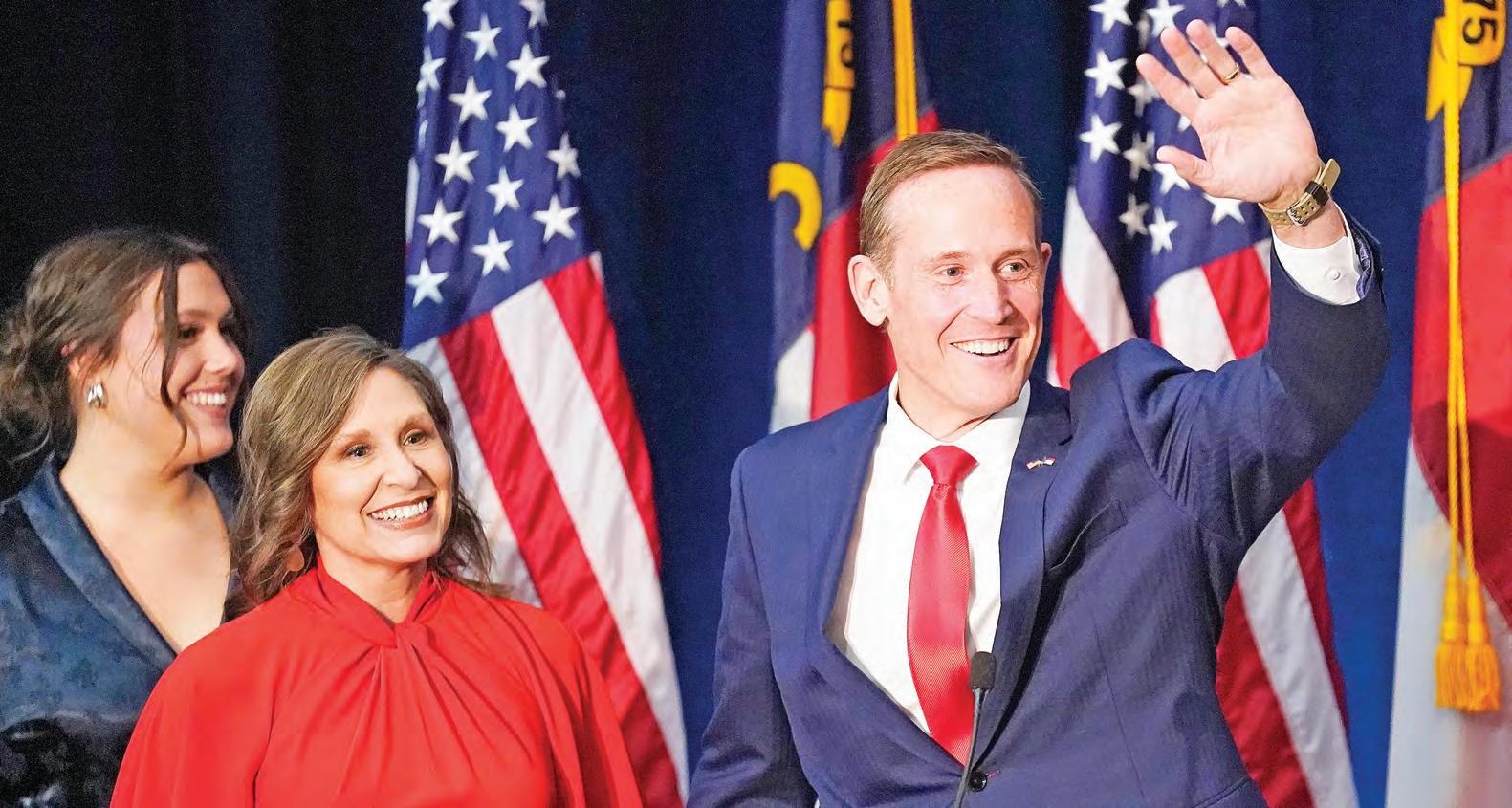
Rep. Ted Budd (R-NC) greets supporters with his wife, Amy Kate Budd, left, after winning his U.S. Senate race against Cheri Beasley at his election night watch party in Winston-Salem, Tuesday, Nov. 8, 2022.
North State Journal (USPS 20451) (ISSN 2471-1365)


THE WORD: OBTAINING THE HELP OF GOD
“I have had God’s help to this very day, and so I stand here and testify to small and great alike.” Acts 26:22
When Paul stood before Agrippa, it was twenty-five years after his conversion. They had been years of toilsome life, amid enemies and dangers; but the heroic old apostle had never given up, never faltered, never turned aside. It was a great record — but he takes no praise to himself. The help came from God — for all these years of faithful witnessing.
Many Christians fear that they will not be able to stand faithful and true to the end. Here is an encouraging word for all such: They shall obtain help from God for every duty, for every hour of danger, for every struggle. They need only to be faithful day by day, doing the day’s duty quietly, and trusting God. This help will come from Him, silently, secretly, just as it is needed, always sufficient grace — so they will be able to stand faithful year after year. God never puts a burden on us — without giving us the strength we need to carry it. The way to obtain the help of God — is to go faithfully and promptly forward in the way of duty, asking for the help, and sure of getting it. It will not come if we wait to get it before we set out to do His will.
“I am sure of this, that He who started a good work in you — will carry it on to completion until the day of Christ Jesus.” Philippians 1:6
J.R. Miller was a pastor and former editorial superintendent of the Presbyterian Board of Publication from 1880 to 1911. His works are now in the public domain.
71 49 30 20

“An Audience at Agrippa’s” by Lawrence Alma-Tadema (1876) is in the collections of the Dick Institute, Kilmarnock, Scotland.
County), and Linda Cooper-Suggs (Wil son), all saw their seats flip to Repub lican control. One Republican, Larry Yarborough (Granville), lost his race to Democrat Ray Jeffers.
In Alamance County, Republican Ste phen Ross took back the seat from Rep. Ricky Hurtado. Ross previously repre sented the region for eight years in the House before Hurtado unseated him in 2020.
The House tally could shift by one with House District 73 (Cabarrus Coun ty) candidate Republican Brian Eche varria stating he is not conceding his race just yet.
While we wait for final ballots to be certified, I am not conceding,” Echevar ria wrote In a Nov. 10 Facebook post.
“There are still a number of ballots that need to be counted before results are certified, and until the Cabarrus County Board of Elections completes its canvass, we will not give up in our efforts to en sure every legally cast ballot is counted.”
His opponent, Democrat Diamond Staton-Williams, leads by 425 votes or 1.56%. While Echevarria won the elec tion day vote, Staton-Williams led in ear ly voting and Absentee By-Mail ballots.
In order for a recount to be triggered, the margin separating two candidates needs to be less than one percent.
Cabarrus County election officials still have some Absentee By-Mail ballots and 660 provisional ballots yet left to count. Mailed ballots postmarked on or be fore Election Day will still be accepted through Nov. 14. The results will be unof ficial until the N.C. State Board of Elec tions completes its canvas on Nov. 18.
business communities.
In a June 2021 profile, Budd told North State Journal he felt he was battle-tested, having prevailed in his first run for office in a 17-way primary and, later in 2018, when Democrats heavily outspent him in the general election.
“Nobody else has been through a race like that,” Budd said at the time.
It was an early June night, of course, that changed the course of the race.
At the North Carolina Repub lican Party’s annual convention in Greenville, the special guest of the evening, former President Donald Trump, provided a boost.
It was there, nearly 11 months before the primary, that Trump endorsed Budd on the stage. NSJ wrote at the time that the nearly 1,000 in attendance alternately cheered and gasped at the news. In the weeks following the announce ment, a Budd campaign official said the endorsement “supercharged” the campaign.
Still, endorsement or not, Budd was confident of victory.
Several months before the pri mary the campaign unveiled its “Budd crew chiefs” in all 100 coun ties showing that an effort among grassroots was well underway.
“Our initial campaign plan didn’t anticipate being organized in all 100 counties this early,” senior adviser Jonathan Felts said at the time, “but President Trump’s early endorsement has allowed us to ac celerate our campaign buildout.”
On the financial side, Budd was able to transfer funds from his ex isting U.S. House account to a Sen ate run and was soon to be the ben eficiary of outside spending by the Club for Growth.
A key ally helping Budd sepa rate himself in a 17-person primary when he ran in 2016, the Club for Growth spent upward of $14 mil lion in the primary to boost Budd over the field. That spending was critical as the primary was delayed by the N.C. Supreme Court from March to May because of redis tricting litigation and put a pause on the race — and became a gap which the group would fill.
By the time of the May prima ry, the result was not in doubt and Budd won with 59% of the vote, setting up a battle with the Demo cratic nominee, Cheri Beasley.
Beasley entered the race with backing from North Carolina’s Democratic establishment. She was seen as a more electable can didate than state Sen. Jeff Jackson, who famously told national Dem ocratic leaders he would not sit in a “windowless basement” and in stead wanted to run a grassroots campaign for the seat.
The Beasley campaign got off to an uneven start as the former state Supreme Court chief justice was coming off a loss of 401 votes in 2020. She was working at the powerhouse law firm McGuire Woods in Raleigh and initially did not leave the firm to run. Beasley turned over campaign staff follow ing negative attention for sharing a joint fundraising account with progressive U.S. Rep. Cori Bush of Missouri. She was also criticized by former state Sen. Erica Smith for refusing to take progressive posi tions in the race, such as ending the filibuster.
The weight of the state’s Dem ocratic establishment forced both Smith and Jackson from the race by the end of the year. The field cleared and it became clear Beasley would be the first black woman to emerge as a party nominee for U.S. Senate.
The Beasley-Budd contest would not attract the major spending of classic U.S. Senate races. Longtime observers of the state’s politics can recite stories of the Helms-Hunt 1984 race, the Helms-Gantt con tests of 1990 and 1996, and even the rise of John Edwards and backto-back defeats of Erskine Bowles. Just two years ago, Republican Thom Tillis and Democrat Cal Cunningham’s race set a spending record that would be shattered by the Georgia U.S. Senate runoffs in January 2021.
Budd took aim at Beasley over inflation and crime while Beasley attempted to tie Budd to a so-called “national abortion ban” and a smattering of other issues. In some ads, Beasley enlisted several retired judges in an attempt to portray her self as above the political fray.
The outside spending that did come into the race would dent vot ers’ views of Beasley. Senate Lead ership Fund, the super PAC with ties to Senate Republican Lead er Mitch McConnell, spent $38 million in the fall campaign. The group’s ads focused on controver sial decisions Beasley was involved in that led to the release of sexu al predators from prison without monitoring and cases in which Beasley called a convicted murder er of a state trooper a “good person.”
In the final month of the cam paign, the two candidates criss crossed the state to boost turnout among their party’s supporters. Budd brought in Trump, earned the support of the U.S. Chamber of Commerce and showered attention on the state east of I-95 and west of I-77 in a strategy reminiscent of outgoing U.S. Sen. Richard Burr. Beasley did not campaign with the sitting president or any major na tional Democrats.
Budd inched ahead in both pub lic and private polling in the final weeks of the race. The campaign in background briefings said they felt confident in where the race stood, somewhere around a 3-5% margin.
By Election Day, that’s where the race would end as Budd would take a 3.7% victory on the way to win ning by more than 135,000 votes.
At his victory party in Win ston-Salem, Budd thank his fami ly and supporters, and he told the crowd as senator he would act in their interest.
“I’ve seen firsthand folks suf fering under Joe Biden’s economic policies that are crushing family budgets,” he said. “Biden and his allies want more from you and I want more for you. With their votes today, the people of North Caroli na have sent a clear signal that the Biden agenda is wrong for Ameri ca. It’s time to start creating jobs again instead of destroying jobs, and I’m ready to fight for that in the U.S. Senate.”
Felts, who will lead Budd’s tran sition operation, said back in June 2021: “Ted has a unique ability in politics in that the more you get to know him, the more you like him.”
On Nov. 8, the voters of North Carolina agreed with his assess ment.
STIP Project HL-0008i
Raleigh - The public is invited to a meeting with the N.C. Department of Transportation on Nov. 17 to discuss the proposal to make improvements to Old Stage Road in Wake County.
The project would make improvements at the intersection of Old Stage Road and Rock Service Station Road as well as widen and make improvements to Old Stage Road between Rock Service Station Road and Rolling Meadows Drive. The project would widen the roadway from the existing 2-lanes to four, install curb and gutter, a 17.5-footwide raised median, a 5-foot sidewalk on one side and a 10-foot multi use path on the other.
Project details, including a maps of the proposal, can be found on the project web page

https://publicinput.com/OldStage-RockServiceSta
The meeting will be held Nov 17 at Holland’s United Methodist Church located at 9433 Ten-Ten Road in Raleigh from 5-7 p.m. Interested residents can drop in any time during this time to learn more about the proposal, have questions answered and talk with NCDOT representatives. There will not be a formal presentation.
People may also submit comments by phone, email or mail by Dec 16, 2022.
For more information, contact NCDOT Project Manager, Zahid Baloch, NCDOT Highway Division 5, 1573 Mail Service Center, Raleigh, NC 27699-1573.
NCDOT will provide auxiliary aids and services under the Americans with Disabilities Act for disabled people who wish to participate in this workshop. Anyone requiring special services should contact Diane Wilson, Environmental Analysis Unit, at 1598 Mail Service Center in Raleigh; 919-707-6073; or Pdwilson1@ncdot.gov as early as possible so that arrangements can be made.
Those who do not speak English, or have a limited ability to read, speak or understand English, may receive interpretive services upon request prior by calling 1-800-4816494.
Aquellas personas no hablan inglés, o tienen limitaciones para leer, hablar o entender inglés, podrían recibir servicios de interpretación si los solicitan llamando al 1-800-481-6494.
A2 WEDNESDAY 11.16.22 #360
“Variety Vacationland” Visit us online nsjonline.com
additional mailing
North State Journal for Wednesday, November 16, 2022 SUPERMAJORITY from page A1
Neal Robbins Publisher Matt Mercer Editor in Chief Cory Lavalette Managing/Sports Editor Frank Hill Senior Opinion Editor Emily Roberson Business/Features Editor Lauren Rose Design Editor Published each Wednesday by North State Journal 1201 Edwards Mill Rd. Suite 300 Raleigh, NC 27607 TO SUBSCRIBE: 336-283-6305 or online at nsjonline.com Annual Subscription Price: $50.00 Periodicals Postage Paid at Raleigh, N.C. and at
offices. POSTMASTER: Send address changes to: North State Journal 1201 Edwards Mill Rd. Suite 300 Raleigh, NC 27607
BUDD from page A1
We stand corrected: To report an error or a suspected error, please email: corrections@nsjonline.com with “Correction request” in the subject line.
PUBLIC DOMAIN
Get in touch! North State Journal www nsjonline.com
NCDOT TO HOLD PUBLIC MEETING REGARDING IMPROVEMENTS TO OLD STAGE ROAD BETWEEN ROCK SERVICE STATION ROAD AND ROLL ING MEADOWS DRIVE WAKE COUNTY
NC House of Representatives
NC Senate
Republican Republican
Democrat Democrat
Republican candidates sweep nearly half of NC school board races
By A.P. Dillon North State Journal
RALEIGH — Republican can didates swept nearly half of all district school board races in the Nov. 8 election.
A total of 83 out of the state’s 115 school districts had seats up for election. Per data compiled by EducationNC, there were 290 to tal seats up for grabs.
The data shows 47 of the 83 districts had enough seats on the ballot to shift the current make up of those boards and 41 of the 83 were partisan races. That translates to 137 partisan seats of which Republicans won 103 or 75%. Democrats won 34 or 25%.
A closer look at those board races reveals Republicans swept all seats in 20 of those 41 parti san races while Democrats only swept four.
Only 10 school boards had partisan races in 2013, according to EducationNC.
Districts in which Republicans swept the races include Allegha ny, Beaufort, Caldwell, Carteret, Cleveland, Craven, Elkin City Schools, Jones, Lee, Lincoln, New Hanover, Onslow, Pender, Rockingham, Rutherford, Stan ly, Stokes, Surry, Swain, and Transylvania.
The four Democrat board sweeps included Anson, Bruns wick, Vance, and Washington.
One winner of note in Beau fort County was never able to ac tually campaign, according to a report by the Island Packet. Vic tor Ney, an active duty Marine, won the seat for District 5 after being backed by the group Moms for Liberty. A second candidate backed by the group, Elizabeth Hey in District 10, also won.
The top three vote-getters win ning spots in the Alamance-Bur
lington district are also all Re publicans; Dan Ingle, Charles Parker and Chuck Marsh.
The result was the same in Johnston County despite the races being non-partisan. Terry Tippett, Kevin Donovan, and Mi chelle Antoine, all Republicans, were the three candidates receiv ing the most votes.
Republicans almost swept the Union County races, electing four Republicans and one Dem ocrat.
In New Hanover County, eight candidates were on the ballot for four seats and Republicans won all four. The election of Pat Brad ford, incumbent Republican Pete Wildeboer, Josie Barnhart, and Melissa Mason flips the board 5 to 2 Republican majority. Two other incumbents were ousted; Democrats Nelson Beaulieu and Judy Justice.
Incumbents also went down in Charlotte-Mecklenburg, the state’s second-largest district. Six of the nine seats were on the ballot for the non-partisan board race. Incumbents Rhonda Cheek (District 1), Carol Saw yer (District 4) and Sean Strain (District 6) were defeated. Cheek and Strain were the only Repub licans on the board. Sawyer is a Democrat who was first elected in 2017. Of the incumbents up for reelection, only Vice-Chair Thelma Byers-Bailey (District 2) survived.
In other races, Guilford Coun ty voters elected three Democrats and two Republicans to its board.
In Winston-Salem/Forsyth, Democrats won five seats and Republicans four while in Yancey County it was an even one-to-one split.
Both seats on the ballot in Stanly County went to Republi can candidates who ran unop
posed; incumbent Dustin Lisk who was seeking reelection for his District 1 seat and Robin Whittaker, who will take over Anthony Graves At-Large seat. Races for all nine spots in the state’s largest district of Wake County were non-partisan, how ever, two Republicans secured wins; Sheryl Caulfield for Dis trict 1 and Wing Ng for District 3. Over two dozen candidates filed to for the Wake school board after five of the nine incumbent members said they weren’t run ning for reelection.
Moore County’s Board of Ed ucation races are also non-par tisan, but conservative-backed candidates prevailed. Current Chair Pam Thompson, who is registered as unaffiliated, was ousted by Shannon Davis for the District 3 seat. Paulina Bruno and Ken Benway were the top vote-getters out of the four can didates running for the two atlarge seats.
Five candidates ran for three of the seven seats on the Ran dolph County school board. The only incumbent running, Fred Burgess, won reelection by coming in third of the top three vote-getters. Shannon Craven Whitaker took in the most votes followed by Phillip Lanier. All three are registered Republicans.
Angela Southerland and Cath erine Blue, both registered Dem ocrats along with Ruben Cas tellon, a registered Republican, were elected to the Hoke Coun ty School Board which was also a non-partisan race. Only one incumbent was in the running, Democrat Della Maynor who came in 6th out of the field of ten.
The results in all races will not be certified as official until after the N.C. State Board of Elections finished its canvas on Nov. 18.
NC will send five new members of Congress to DC
By Matt Mercer North State Journal
RALEIGH — From Murphy to Manteo, North Carolina will send five new members of Congress to Washington, D.C. in January. Following litigation from the General Assembly’s 2021 re districting session that led to a court-ordered drawing of Con gressional maps, the districts used in 2022 exist for only the next two years.

NC-01: Don Davis
Don Davis, a Democrat, de feated Republican Sandy Smith to succeed outgoing U.S. Rep. G.K. Butterfield in the northeast ern part of the state.
NC-04: Valerie Foushee
A longtime elected official from Orange County, Valerie Foushee won the Democratic primary with help from outside spending and cruised to a win in the Triangle’s heavily Democratic 4th Congressional District.
NC-11: Chuck Edwards
After narrowly defeating con troversial first-term U.S. Rep. Madison Cawthorn in the Repub lican primary, Edwards defeated Democratic candidate Jasmine Beach-Ferrera by 30,000 votes and will be the only Republican freshman in the U.S. House from North Carolina.
NC-13: Wiley Nickel
In a surprise outcome to some political observers, the far-left state senator defeated Republi can Bo Hines in the closest con test of the election. Nickel brand ed himself as a moderate in spite of his voting record in the Gener al Assembly and rode high turn out in Wake County to victory.
NC-14: Jeff Jackson
Running in a district drawn just two months after dropping out of the U.S. Senate race, Jeff Jackson goes to Washington, D.C. after all after dispatching Republican Pat Harrigan in the new district covering parts of Gaston and Mecklenburg coun ties.
RETURNING TO CONGRESS
Nine representatives will re turn to Washington for another two years as no incumbent who made it to the general election lost their seat.
NC-02: Deborah Ross
Ross’ Wake County district is the only district entirely con tained in a single county and unsurprisingly went strongly for the first-term Democrat. Ross earned 64% of the vote over Re publican Christine Villaverde.
NC-03: Greg Murphy
Greg Murphy secured his third term in Congress on election night as he won easily in eastern North Carolina’s 3rd Congressional Dis trict. He defeated Democrat Bar bara Gaskins and won with 67% of the vote.
NC-05: Virginia Foxx
Virginia Foxx, a conservative stalwart representing the north western part of the state, won an other term in Congress in the 5th Congressional District. Foxx took over 63% of the vote over Demo crat Kyle Parrish in the contest. Foxx is in line to once again helm the House Committee on Educa tion and Labor in 2023.
NC-06: Kathy Manning
Greensboro’s Kathy Manning won a second term in Congress in a race that Republicans thought could be a close contest. Manning won by around 22,000 votes over first-time candidate Christian Castelli in the Triad-area district.
NC-07: David Rouzer
David Rouzer won his fifth term in Congress as his district was re drawn to include some new coun ties during redistricting litigation. Among those is Robeson County, the home of his Democratic op ponent, Charles Graham. Rouzer would win Robeson, though, in addition to the other six counties of the southeastern district.
NC-08: Dan Bishop
Dan Bishop won his third term in Congress and will take on sev eral new counties as he ran for re election in the 8th Congressional District. Bishop took 70% of the vote in the race.
NC-09: Richard Hudson
Facing a seasoned opponent in the new 9th Congressional Dis trict didn’t faze Richard Hudson, who won his sixth term in Con gress with 57% of the vote over Democratic state Sen. Ben Clark. Hudson maintains his status as Fort Bragg’s Congressman and is expected to be elected by House Republicans to lead the National Republican Congressional Com mittee in 2024.
NC-10: Patrick McHenry
Securing his tenth term in the U.S. House of Representatives with the highest margin of any winner, Patrick McHenry is ex pected to become the chairman of the powerful House Financial Ser vices Committee in 2023. McHen ry won with nearly 73% of the vote.

Alma Adams
NC-12:
A redrawn district cut into the typical margins for Alma Adams in the 12th Congressional District but she will return to Congress af ter winning with 63% of the vote over Republican Tyler Lee.
leads. Dietz exceeded Inman on in-person Election Day votes by more than 338,000 votes.
A look at the returns by county shows Dietz taking 82 out of the state’s 100 counties to Inman’s 18; Bertie, Buncombe, Chatham, Cumberland, Durham, Edge combe, Forsyth, Guilford, Halifax, Hertford, Hoke, Mecklenburg, Northampton, Orange, Vance, Wake, Warren and Watauga.
This is the second failed Su preme Court attempt in consecu tive election cycles for Inman. In 2020, she lost to Associate Justice Phil Berger by a slim margin of 1.34%. In that race, Inman won 26 counties.
Allen defeated incumbent As sociate Justice Sam Ervin by more than 177,470 votes, a margin of more than 5.75% of ballots cast in that race. Allen exceeded Ervin on in-person Election Day votes by more than 333,870.
At the county level, Ervin won 19 while Allen won 81. Ervin won the same counties as Inman plus Pitt County.
Court of Appeals races also mir rored the sweep by Republicans in the previous 2020 election cycle.
Chief Justice Donna Stroud won reelection as did current COA Judge John Tyson. Newcomers Julee Flood and Michael Stading also firmly defeated their oppo nents.
Flood defeated Democrat Car olyn Thompson by more than 5% of the vote. Similar to the Supreme Court races, Thompson did not have an overwhelming early vote lead but did have an advantage in the Absentee By Mail.
Flood won 81 counties and Thompson took 19 counties.
The 19 won by Thompson in clude Bertie, Buncombe, Cha tham, Cumberland, Durham, Edgecombe, Forsyth, Guilford,
Halifax, Hertford, Hoke, Meck lenburg, Northampton, Orange, Vance, Wake, Warren, Watauga and Pitt.
Stroud took 83 counties and Salmon took 17 counties, the same ones as Thompson minus Pitt and Watauga.
In Absentee One-Stop ballots, Stroud and Salmon were separat ed by around 2,600 votes. Over all, Stroud received more than 338,800 more votes than Salmon
and, on Election Day, she took in 400,687 more votes than Salmon.
Tyson took 83 counties and Adams took the same 19 counties won by Thompson. Tyson won the Election Day vote by more than 348,500 ballots.
In the matchup between Jack son and Stading, Jackson took the same 19 counties as Thompson garnered while Stading won the remaining 81 counties.
Stading ended up with a more
than 353,5000 in-person Election Day vote advantage over Jackson. In early voting and voting by mail, Jackson had sizeable leads over Stading.
When looking at county-level wins, the Democratic candidate wins fell short of the 28 counties won by Gov. Roy Cooper during both his 2016 run and his 2020 reelection.
All six Republicans running for the state’s two top courts had banded together in 2021 to run as a slate.
In 2019, the N.C. Republican Party formed the Judicial Victory Fund to raise funds for statewide conservative judicial candidates. In the following year’s election, Republican candidates made a clean sweep of the three N.C. Su preme Court seats and five Court of Appeals seats.
A slim margin of just over 400 votes separated Paul Newby from then-Chief Justice Cheri Beasley in the N.C. Supreme Court Chief Justice race. Beasley refused to concede and demanded a recount.
After a recount didn’t change the calculus in her favor, Beas ley asked for a hand-eye recount which also did not put her in the lead. She finally conceded and Newby was certified as having won the race in mid-December 2020.
Newby was installed at the 30th N.C. State Chief Justice on Jan. 1, 2021.
A3 North State Journal for Wednesday, November 16, 2022
JUDICIAL from page A1
KARL B. DEBLAKER | AP PHOTO
Republican state Supreme Court candidate Trey Allen, second right, speaks during the North Carolina Supreme Court Candidate Forum at Duke University Law School in Durham, Wednesday, Oct. 26, 2022.
AP PHOTO
Kids holding signs against Critical Race Theory stand on stage at a parents’ rights event.
Murphy to Manteo Jones & Blount

A changing state
With the 2022 midterm cycle ending with last Tuesday’s election, three maps tell the story of North Carolina’s evolving politics.
Below is the county-by-county results of the 2008 race between Republican Elizabeth Dole and Democrat Kay Hagan – the last race in which a Democrat was elected to the U.S. Senate.
Hagan won over 50 counties en route to her first and only term in Washington. Yet in the 14 years since then, Republicans have eroded Democrats’ ancestral advantage in the west, the east, and almost every rural area.
Republican Ted Budd won 79 of the 100 counties in the
state compared to 21 for Democrat Cheri Beasley.
By contrast, Democrats have rapidly expanded their urban base to run up huge numbers in counties such as Cumberland, Durham, Guilford, Mecklenburg, Orange and Wake.
The state’s 14 Congressional districts also reflect how the state has changed since then – but don’t get used to the maps.
The three-judge panel that drew the maps this year aimed for a 7-7 split among Republicans and Democrats.
Both the Charlotte metro and Triangle will have two solidly Democratic seats, reflecting the growth both areas have experienced.
WEST PIEDMONT EAST
School gets coding and app development grant
Burke County Burke County Public Schools received a $77,467 Coding and Mobile App Development Grant from the state. The grant will help expose students to careers in the state’s fast-growing technology sector while laying an early foundation in the skills needed to succeed in those jobs. It will provide increased opportunities for students to aim for high-wage, highskill and high-demand careers through increased work-based learning experiences such as internships, pre-apprenticeships, and apprenticeships with local business and industry.
Tobacco money to be used to build agricultural center
Ashe County Ashe County will build a new regional agricultural center using a $500,000 grant from the N.C. Tobacco Trust Fund Commission. The money will help construct a multi-purpose agricultural center consisting of a livestock aggregation facility and a meeting room for trainings, commodity group meetings, and conferences.
The purpose of the livestock facility is to facilitate local sales that will increase income for cattlemen, provide infrastructure to aid producers with herd management, and assist youth programs with animal science training. The structure will consist of pens, scales, a load-out ramp, and a squeeze chute. A show ring will host special livestock sales, demonstrations and 4-H livestock judging.
TOBACCOTRUSTFUND.ORG
UNC to get infectious disease treatment designation
Orange County University of North Carolina hospitals will soon be designated as a treatment center for patients with highly infectious diseases in the region. UNC and Emory University are the only two Regional Emerging Special Pathogen Treatment Centers in the Southeast. There are 13 treatment centers in the United States after the U.S. Department of Health and Human Services appointed three new centers, including UNC, last month. The center will be run by Dr. William Fischer and Dr. David Wohl, who both study infectious diseases at the UNC School of Medicine.
Two men rob gun store
Yadkin County Police are looking for two men who stole 10 guns in a break-in last month. The men wearing hoodies and masks entered Foothills Firearms and Ammo in Yadkinville in an overnight break-in. They made off with 10 handguns. They rammed the store’s front door with their car, then took the firearms, which were worth approximately $6,000.
The entire break-in took less than a minute. The store is offering a $5,000 reward.
Hyde schools get computer coding grant
Tobacco money to fund new farmers market
Edgecombe County
WXII
Milk shortage hits schools
AP
County fleet trucks get upgrade to reduce emissions
Graham County

The Graham County Clean Fleet Plan will get a pair of new refuse haulers to use in the county. The Class 8 local freight trucks will cost a little over $218,000 each, and much of the purchase will be funded with a $371,982 grant from the state’s share of a nationwide settlement with Volkswagen. These are the last awards to come from the settlement and are earmarked to replace old diesel vehicles with more clean-running alternatives.
Operation Green Light shows support for veterans
NC.GOV
Buncombe County G overnment buildings in the county spent last week honoring veterans who helped protect the nation with their service. As part of a national movement, “Operation Green Light” asked counties around the country to show their support in advance of Veterans Day by shining green lights on buildings to let veterans know they’re seen, appreciated and supported. The Buncombe County courthouse, health and human services tower and family justice center all had green lights last week.
Man pleads guilty in overdose death
Rockingham County
A suspect entered a guilty plea last week in the overdose death of a woman found last December in a field in Rockingham County. Ladawn Edwards, 27, of Sparta was found in Madison on Dec. 19, 2021.
Zachary Joseph Taylor, 22, of Sparta attempted to report Edwards as a missing person but later admitted that he provided her with methamphetamine in exchange for suboxone. He plead guilty to death by distribution, concealment of death and obstruction, among other charges. He will serve four to six months.
Stokes County At least two school districts are reporting a shortage of milk available to students.
Surry and Stokes counties have both said their schools are short on milk in cartons, normally provided to students as part of school meals. The nutrition departments of the two schools are looking for alternate sources for milk. Officials warned that students may not have milk available for meals but would get an alternative drink at no additional cost.
Hyde County More than a dozen school districts received $800,000 in grants aimed at developing student skills in computer science through coding. The Coding and Mobile App Development Grant program supports partnerships with local businesses to help schools develop computer science, coding and mobile app development programs for middle and high school students. The grants help districts and schools purchase equipment, digital materials and cover the costs associated with teacher professional development to build capacity in coding, computer science and mobile application development initiatives. Hyde County Schools were one of the recipients, receiving $40,000
Grant will replace locomotives with electric ones
Hertford County
The Town of Princeville is constructing a regional farmers market that will support local farmers, small businesses and entrepreneurs. The Princeville Farmers Market building will have a commercial kitchen. It will be located at Heritage Park, the town-owned public park. The project’s objectives are to provide access to locally sourced food and consumer goods, and to provide economic development opportunities for community members. The project will benefit area by providing a local space to access fresh foods and locally made items. It will be funded by a $300,000 grant from the N.C. Tobacco Trust Fund.
TOBACCOTRUSTFUND.ORG
Polls proved mostly on the mark in North Carolina US Senate race
By Matt Mercer North State Journal
RALEIGH — Throughout the last month of the 2022 election, most pollsters surveying the race between Republican Ted Budd and Democrat Cheri Beasley showed a close race but a stable lead for Budd. That’s how the race ended up, with final results showing a nearly four-point edge for the three-term U.S. Rep. Budd, who will now move to the U.S. Senate.
According to RealClearPolitics, which aggregates public polling across the country, there were 10 polls of the race from early October through the weekend before Nov. 8’s election.
Trafalgar Group and East Carolina University’s Center for Survey Research polled the race twice in the final month, both accurately showing the lead Budd would ultimately win the race by.
Dr. Peter Francia, the director of ECU’s Center for Survey Research, said on Nov. 5, “Ted Budd’s campaign, and
the Republican Party as a whole, have succeeded in mobilizing support from likely voters around the issues of the economy and inflation, which works against the party that currently holds the White House. What we are seeing in North Carolina can be seen across the country: The Republicans are heading into the 2022 midterm elections with a significant advantage.”
The ECU polling operation also had a good night in neighboring Georgia.
Their final polls showed a 49%-49% U.S. Senate race, which matched the final results in that state and head to a runoff on Dec. 6., and six-point lead for Gov. Brian Kemp, who defeated Stacey Abrams by that same margin.
Others NC polls that aligned with the final results included October surveys from Emerson College and Marist.
The WRAL-Survey USA polls in the race widely overestimated support for Beasley. In their last poll of the race in October, it showed Budd with just a one point edge over Beasley.
WLOS
WFMY
WXII
NC.GOV
The final grants from the state’s share of the national settlement with Volkswagen were awarded. The money will be used to replace diesel engine vehicles with more environmentally friendly ones. A total of $4.1 million was awarded for the electrification of two diesel freight switcher locomotives operated by Nucor Steel’s facility in Hertford County. By electrifying the locomotives, 100% of their emissions, including 93 tons of NOx over their lifetimes, will be eliminated. Nucor Steel is also providing more than $2.5 million in matching funds toward this project.
NC.GOV
Man shot in his home
Hoke County A man was shot last week while inside his home in Raeford. The 51-year-old, whose name wasn’t released, was hit in the torso while inside his home on Peaceford Avenue.
He was taken to Cape Fear Valley Hospital for treatment, although information on his condition was not released. Police are still investigating, and no arrests have been made. AP
Felts named Budd transition chairman
By Matt Mercer North State Journal
A
A4 A5 North State Journal for Wednesday, November 16, 2022 North State Journal for Wednesday, November 16, 2022
NC.GOV
PHOTO VIA AP
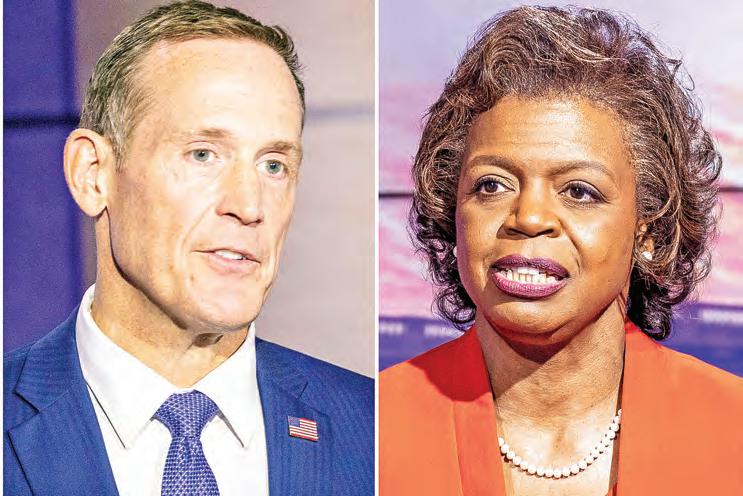
This combination of photos shows North Carolina Republican Senate candidate Rep. Ted Budd, R-N.C., left, and Democratic candidate Cheri Beasley, right, during a televised debate on Oct. 7, 2022, at Spectrum News 1 studio in Raleigh
RALEIGH — Longtime political operative, consultant, and presidential appointee Jonathan Felts will serve as Ted Budd’s U.S. Senate transition chairman, the campaign announced Friday.
native of Davie County, Felts has worked for numerous campaigns in the state
and nationally, serving as the White House Political Director under President George W. Bush. He later would serve as an advisor to former Gov. Pat McCrory and is a wellrespected consultant in politics, public policy, and executive communications.
“We want to hit the ground running in January and we have a lot of work ahead of us,” said Budd. “We want to get the best folks we can to serve the people of NC in our DC and NC offices and I’ve asked Jonathan Felts to work with my existing team to lead the effort to make that happen. We’re also coordinating with U.S. Senators Thom Tillis and Richard Burr to have the best coverage we can for North Carolinians during this transition and beyond. Our constituents are the top priority for all of us.”
The Budd team has set up an email address for those interested in submitting a resume to work for the senator-elect, jobs@tedbudd. com.
Democrat Republican
2022 US House of Representatives elections by county
2022 US Senate elections by county
Cheri Beasley (D) Ted Budd (R)
2008 US Senate elections by county
Hagan (D) Dole (R)
north STATEment
| FRANK HILL

Undefeated, untied and unscored-upon
IT WAS 84 YEARS AGO that a Duke University football team achieved what many considered absolutely impossible: an undefeated, untied and unscored-upon season.
North Carolina Republicans are on the verge of accomplishing what the Iron Duke Blue Devils did in 1938: hold the opposition scoreless during the 2023-24 session.
North Carolina Republicans can do the same thing in the upcoming 2023-24 legislative session. It is what Democrats did to Republicans for over a century before the 2010 GOP takeover of the NCGA. Gov. Ron DeSantis and Florida are getting all of the accolades for running the tables for Republicans in the 2022 election.
North Carolina is a very close second.
In a year when Republicans nationwide fell far short of the red tidal wave many consultants and strategists were anticipating ― some say a mini-Roe v. Wade Wave undermined such a tsunami ― North Carolina Republican campaign staff, caucus directors, pollsters and leadership should take a bow and be applauded.
My father, Dan (Tiger) Hill Jr. was co-captain of that 1938 Iron Duke football team with Eric Tipton. Coach Wallace Wade came to Duke in 1931 after leading Alabama to three national titles in the previous decade. Wade set the high standard for the Crimson Tide football program which Bear Bryant followed in the ’60s and ’70s and Nick Saban follows today.
Achieving perfection in anything makes it a hard act to follow. After a Friday night game at Jordan High School in Durham, Dad would ask: “Did you win?”
“Yes, Dad, we won.”
“Did the other team score?”
“Yes, Dad, the other team scored. It was a basketball game.”
“Well, if the other team never scores, you will never lose. Let me tell you about what we did in the 1938 season…”
He had a point. If the other team never scores, the worst you can do is tie every game and end the season undefeated as well. Shutting the other team out is the best way to ensure victory.
The 1938 Blue Devils had to stop the other team from ever scoring — their offense was horrible. They only scored 110 points in a nine-game regular season. Star halfback George McAfee, who went on to be one of the top four Chicago Bears running backs in history alongside Bronko Nagurski, Gale Sayers and Walter Payton, developed a staph infection on his foot before the season started and was sidelined until late in the year.
After learning of McAfee’s infection, Wade told his
 EDITORIAL | STACEY MATTHEWS
PHOTO VIA DUKE UNIVERSITY ARCHIVES
EDITORIAL | STACEY MATTHEWS
PHOTO VIA DUKE UNIVERSITY ARCHIVES
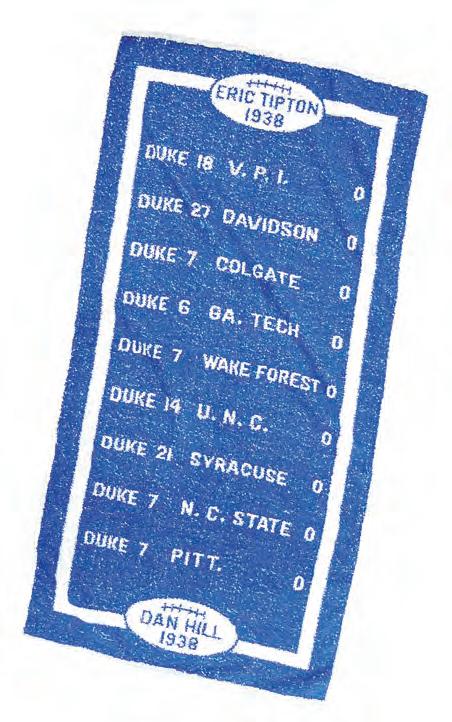
A towel commemorating Duke University’s historic, 1938 undefeated regular season.
team, all of whom played both offense and defense back in the day, “There goes 95% of our offense. If we are going to win, it will have to be with our defense.”
Duke had a great defensive unit. And a great punter in Tipton. Duke punted the ball on first or second down many times to bottle up the opposition near their goal line and wait for them to make a mistake against the vaunted Blue Devils defense. When the Blue Devils played No. 1-ranked Pittsburgh at home on Nov. 26 in the snow with 50,000 people shivering
Ron DeSantis chooses right approach in response to Trump attacks
THOUGH ELECTION DAY was good for Republicans in both North Carolina and Florida, it was a disappointing one nationally for the party.

Democrats are projected to keep control of the U.S. Senate, with the only remaining Senate race yet to be decided being the one between Georgia Sen. Raphael Warnock and GOP nominee Herschel Walker, which will go to a runoff on Dec. 6. Even if Walker wins, that would keep the Senate at 50-50 Republican and Democrat, with Vice President Kamala Harris being the tiebreaking vote for Democrats.
in the cold, holding hot potatoes and drinking whiskey in flasks to stay warm, Tipton punted the ball 20 times with seven punts going out of bounds inside the Pitt 10-yard line and seven more between the 10- and 20yard lines. Bolo Perdue blocked a Pitt punt in the end zone late in the game and fell on it to secure a 7-0 victory and a trip to the 1939 Rose Bowl for the Blue Devils.
The Iron Dukes won by playing to their strengths and thinking strategically.
So have North Carolina Republicans. After losing majority control of the state Supreme Court during the campaign debacle of 2018, Democrats on the high bench gained a 6-1 majority in 2019. Democrat justices, prodded on by former Obama AG Eric Holder and campaign attorney Marc Elias, proceeded to vastly overstep constitutional boundaries in the state and ruled against common sense laws such as photo ID. Most egregiously, they interjected themselves into what has been the sole prerogative of state legislatures since the beginning of the Republic and redrew districts that favored Democrat candidates in state and federal redistricting.
Many warned Democrats against such judicial radicalism and told them they would rue the day they did it in the future. Now with a new 5-2 Republican majority on the state Supreme Court; a full sweep of the most recent Court of Appeals judgeships; supermajority control of the NC Senate and a onevote-shy-of-supermajority control of the NC House, North Carolina Republicans are on the verge of accomplishing what the Iron Duke Blue Devils did in 1938: hold the opposition scoreless during the 202324 session.
The only word of caution to North Carolina Republicans would be this: As monumental, unbelievable and improbable of a feat as the Iron Dukes accomplished in 1938, the University of Tennessee Volunteers football team accomplished the same undefeated, unscored-on and untied season the very next season, 1939. The Volunteers were later defeated by the USC Trojans 14-0 in the 1940 Rose Bowl just like the Iron Dukes before them were defeated by the same USC Trojans in the last 40 seconds in the 1939 Rose Bowl, 7-3.
Things can change in a second in sports and in politics. Never take the past as prologue. The next Rose Bowl for Republicans not only in North Carolina but everywhere is in 2024. It is the one they cannot afford to blow as they did nationwide this election.

If there’s one thing that drives Trump crazier than “fake news,” it’s being ignored by those he criticizes the most.
As of this writing, House Republicans, whose polling indicated would see a red wave of significant proportions, stand only to have a bare minimum majority at best once all the votes are counted from the outstanding races.
So while the “what went wrong” discussions are already underway, another intraparty battle of sorts is taking place thanks to recent comments made by former President Donald Trump about Florida Gov. Ron DeSantis.
In late 2021 going into 2022, the mainstream media were shaping the narrative that the two didn’t like each other, suggesting Trump was telling those close to him in so many words that he didn’t like DeSantis and that he thought he was stealing his thunder with the party.
Six months into the numerous media reports, both Trump and DeSantis smartly and openly declared in separate statements that the press was purposely manufacturing tension between the two ahead of the 2022 midterm elections as a way of splitting the party in two.
But not quite a week before the election, Trump — who it has been rumored may declare his 2024 candidacy this week — began publicly referring to DeSantis by a new nickname: “Ron DeSanctimonious.” And though he told Florida voters during an election-eve rally for Sen. Marco Rubio to vote for DeSantis and admitted after the election that he voted for DeSantis, Trump has remained on the attack against the popular red state governor, essentially claiming that he (Trump) was a kingmaker for DeSantis and saying, in a nutshell, that DeSantis has not been appreciative enough for allegedly putting him on the national political map.
“The Fake News asks him if he’s going to run if President Trump runs, and he says, ‘I’m only focused on the Governor’s race, I’m not looking into the future.’ Well, in terms of loyalty and class, that’s really not the right answer,” Trump wrote on the issue of DeSantis refusing to answer questions about his possible 2024 intentions.
That, along with Trump teasing he allegedly has some dirty laundry on DeSantis, was a clear threat to DeSantis, who some polls suggest could best Trump in a potential GOP presidential primary matchup.
To his credit, DeSantis has refused to take the bait, choosing not to comment on Trump’s antics and instead prioritizing the residents of his state, who have been hit with two devastating hurricanes over the last two months: Ian and Nicole, both of which battered the Florida coastline and devastated communities.
In staying out of Trump’s (so far) one-way war on him, DeSantis is also allowing his record as Florida governor, and the results of last week’s elections in Florida, to speak for themselves while at the same time allowing Trump’s attacks on him to play out in the Republican Party.
Judging by the reactions I’ve seen, even among many Trump faithful, what he’s doing is not playing out well, which perhaps may be the strongest signal yet that Trump’s pull with loyalists is not as strong as it once was.
DeSantis won’t stay quiet on the attacks forever. But for now, his strategy is working because if there’s one thing that drives Trump crazier than “fake news,” it’s being ignored by those he criticizes the most.
As always, stay tuned.
North Carolina native Stacey Matthews has also written under the pseudonym Sister Toldjah and is a media analyst and regular contributor to RedState and Legal Insurrection.

A6 North State Journal for Wednesday, November 16, 2022
Neal Robbins, publisher | Frank Hill, senior opinion editor
VISUAL VOICES
COLUMN
Trump and Biden big losers, DeSantis big winner in 2022
DeSantis carried 62 of 67 counties and won 16% from black people, 52% of Hispanics and won majorityHispanic MiamiDade County 55%-44%
ONE WAY to look at this election is as a repudiation of Donald Trump and Joe Biden.
Democrats held 235 seats in the House in 2018 as Biden launched his campaign for president. To the surprise of prognosticators, they won just a bare majority, 222, on the day he was elected in 2020. As this is written, it looks like they will win about 211 this year.
That’s more than most forecasts, but the trend is not in Biden’s direction. At best, it’s slow leakage of the Democratic coalition.
Republicans have lost a seat in Pennsylvania and have a chance to stay at 50 seats in a Georgia runoff on Dec. 6. Nationalizing the race may help Republican Herschel Walker win unless Trump comes in and depresses turnout by casting doubts on the process, as he did two years ago — helping Democrats win their 49th and 50th Senate seats on Jan. 5, 2021.
Republicans had hoped to do better in Senate races this year, and many thought that polling understated Republican support, as it did in 2016 and 2020. But that doesn’t appear to have been the case. And Republican candidates who won primaries with Trump’s vocal support, but who got few Trump dollars in the general, tended to underperform more than polls suggested.
J.D. Vance did win Ohio, but he ran 9 points behind Gov. Mike DeWine. In Pennsylvania, Mehmet Oz lost a seat Republicans have won in every election since 1968 and to a candidate, John Fetterman, whom a stroke left inarticulate. First-time candidate Blake Masters lost in Arizona, where Republicans won every Senate race between 1992 and 2016. Don Bolduc lost 54%-44% in New Hampshire to Maggie Hassan, who won by just 1,017 votes in 2016.
In each case, candidates not carrying the Trump baggage might have won.
Conservative analysts have scoffed at Biden Democrats’ argument that democracy was at stake in this election. But plainly, the specter of the Jan. 6 riot at the Capitol hangs over candidates with the Trump imprimatur.
The biggest story of the night was the striking victories of Republican governors in the nation’s third- and eighth-most populous states, Florida and Georgia.
Georgia Gov. Brian Kemp had been a target of furious Trump criticism since the former president lost the state narrowly in 2020, but last May, he defeated a Trump-backed challenger by a 51-point margin. Kemp benefited this fall from his decisions to end COVID lockdowns and stoutly defended the Georgia election laws decried as “Jim Crow 2.0” by Biden and Democratic nominee Stacey Abrams. In 2018, he had won 50%-49% by 54,000 votes, although Abrams, much ballyhooed by fashionable press, denied that she really lost. This time, Kemp beat Abrams 53%-46% and won by 294,000 votes.
Georgia, by the way, has the nation’s third-highest percentage of black voters, with many black people from flagging northern cities flocking to comfortable suburbs in metro Atlanta. Kemp won 13% of black voters this year and 38% of the state’s growing number of Hispanic voters.
The biggest winner of election 2022 was Florida Gov. Ron DeSantis. Four years ago, he carried Florida 50%-49%, by just 32,000 votes, and he has been under repeated attack by the national press for his
COLUMN | BEN SHAPIRO
What happened is that in many districts and states all over the country, Republicans picked bad candidates.
THERE WAS NO RED WAVE. There was no red tide. There was no red trickle.
There was a fizzle.
The 2022 midterm election fundamentals would have suggested a ringing Republican victory: an unpopular president of the opposing party, deep public unhappiness with the state of the economy, unified Democratic control in Congress and radical social policy out of step with most Americans. Polls showed Republicans cutting deeply into Democratic constituencies including Hispanic and black voting blocs.
Republicans, who were widely expected to win historic margins in the House of Representatives and to take back the United States Senate, are coming up short nearly everywhere. They will likely take back the House, but by a slim margin after an extraordinarily tepid showing that may land them with a majority of just north of 220 seats; they are unlikely to take back the Senate, given that the deciding vote will likely come via a runoff in a Georgia Senate race featuring the highly vulnerable and troubled candidacy of Herschel Walker.
So, what happened?
What happened is that in many districts and states all over the country, Republicans picked bad candidates. Believing that the fundamentals were all that was necessary to sweep them to victory, Republican leadership failed to intervene in these primaries to the extent necessary to ensure durable general election candidates. They stood aside largely out of fear of former President Donald Trump; Trump himself personally intervened in a variety of cases in the primaries, endorsing candidates almost solely on the basis of whether they were sufficiently sycophantic regarding the election of 2020.
Those candidates then lost.
And then Trump ripped them. Take, for example, Don Bolduc in New Hampshire. New Hampshire is a toss-up state; late polls suggested that Bolduc, despite his myriad oddities and strong support for Trump’s 2020 election fraud claims, might win the race.
Instead, he lost by double digits. And Trump promptly took to Truth Social to let the world know that Bolduc deserved it: “Don Bolduc was a very nice guy, but he lost tonight when he disavowed, after his big primary win, his longstanding stance on Election Fraud in the 2020 Presidential Primary. Had he stayed strong and true, he would have won easily. Lessons Learned!!!”
He also took the time to issue a statement celebrating a Democrat winning the Colorado Senate seat, ripping Republican Joe O’Dea, who had refused
policies on COVID, concentrating on protecting the elderly and insisting on open schools and outdoor activities, and for a bill forbidding overt sexual material in kindergarten through third grade.
His mettle was tested when Hurricane Ian attacked southwest Florida on Sept. 28 at a point not predicted by meteorologists. (Weather experts have improved greatly in recent decades but aren’t perfect.) He got the Pine Island bridge repaired within three days and the Sanibel Island bridge repaired in three weeks rather than the predicted three months. He didn’t just promise to build things — he delivered.
This year, DeSantis won reelection by 19 points, a 1,506,000-vote margin, in the state that George W. Bush carried in 2000 by a 537-vote margin after 35 days of recounts and litigation.
DeSantis carried 62 of 67 counties and won 16% from black people. He carried Hispanics 52%-45%. He carried majority-Hispanic Miami-Dade County 55%-44% — the first Republican governor to win there since Jeb Bush in 2002. He also carried heavily Jewish Palm Beach County, the first Republican governor to win there since 1986. He carried majorityHispanic Osceola County, which includes part of Disney World, 53%-46%.
DeSantis won majorities from women as well as men, from all age groups, from all income groups and from every religious group except Jews (he got only 42%) and those with no religion (only 40%). Overall, the DeSantis victory looks like the model for the durable national Republican majority that neither George W. Bush nor Trump was able to deliver.
This Florida model may be applicable further than the disappointing, for Republicans, Senate election results. On current returns, DeSantis won by larger percentage and popular vote margins than Democrat Gavin Newsom in California and much larger margins than Democrat Kathy Hochul in New York or billionaire Democrat J.B. Pritzker in Illinois.
In those big states, Democrats’ margins have held up in glitzy neighborhoods packed with liberal white college graduates but have sagged elsewhere, thanks to high rates of crime, homelessness and taxes, and as is apparent in races for congressional races. To use a phrase I came up with in the 1970s and have found apposite since, Democrats are carrying the beautiful people but losing the dutiful people.
You can see the aggregate effect if you add together the votes for Republican and Democratic governors in the 10 most populous states (using votes for senator in North Carolina, which elects governors in presidential years). The result so far this year is Republicans 51% and Democrats 48%.
We have been accustomed to politics in which Republicans carry rural areas and run hopelessly behind in major metropolitan areas. DeSantis’ performance suggests that that’s not inevitable. He carried the Gold Coast (Miami-Dade, Broward and Palm Beach counties), metro Tampa, metro Orlando and metro Jacksonville — something no Republican presidential candidate has done since the 1980s, in another era when voters also feared high crime and high inflation.
Michael Barone is a senior political analyst for the Washington Examiner, resident fellow at the American Enterprise Institute and longtime coauthor of “The Almanac of American Politics.”
America was built on coal. Now Biden wants to abolish it
THE ONE PROMISE that President Joe Biden has faithfully kept is his pledge to “close down” fossil fuels. We get two-thirds of our energy in America from fossil fuels, and almost one-third of our power comes from coal. That’s quadruple the amount of energy we get from wind and solar, which are niche forms of energy.
But Biden doesn’t see it that way. He recently reiterated his pledge to end coal production altogether.
“No one is building new coal plants because they can’t rely on it,” Biden said on Nov. 4 while in California. “We’re going to be shutting these plants down all across America and having wind and solar.”
I hope the people in Ohio, Pennsylvania, West Virginia and Wyoming are listening because thousands of mostly union jobs are associated with the coal plants he wants to shutter.
Biden says we need to “shut down” these plants and the jobs that come with them because we need to combat climate change. One problem: Most of the rest of the world is using more coal even as we use less. Even the sanctimonious Europeans are turning to coal because their natural gas supplies from Russia are no longer reliable.
Germany is even burning wood now for home heating, which is about the most environmentally damaging way to get energy.
But the biggest polluting villain by far is China. Beijing is now powering its rapid industrial expansion with fossil fuels.
The Chinese have more than doubled their coal production and consumption over the last decade, even as we in America have cut our domestic coal by almost half. Beijing recently announced it is building dozens of massive new coal plants. Does it sound like this nation of more than 1 billion people is concerned about climate change?
White House climate envoy John Kerry has to explain how we are reducing global warming if every time we shut down a coal plant, China builds a new one or two or three.
Coal was the critical fuel source that powered the industrial revolution in America, which made our economy the strongest in the world. Back then, coal was dirty, and the constant gurgling of emissions from massive coal plants turned cities like Pittsburgh into 50 shades of gray smog.
to countenance Trump’s election 2020 obsession: “Joe O’Dea lost BIG! MAKE AMERICA GREAT AGAIN!”
The Republican Party had one job in the 2022 election cycle: to provide some semblance of responsible leadership. Where they didn’t, they lost.
And where they did, they won.
In Florida, Gov. Ron DeSantis, who reopened the state during COVID-19, ensured children could go to school unmasked, kept the economy open, handled Hurricane Ian and fought off the predations of wokesters and corporate Left-wingers, won an overwhelming victory: he grew his 30,000-vote, 0.4% 2018 victory margin to 1.5 million votes and nearly 20 points, and took the entire Florida GOP along for the ride. Republicans picked up four House seats in the state; Marco Rubio defeated Val Demings in the Senate by over 16 points, and won the Hispanic vote outright, taking even historically blue Miami-Dade County.
Meanwhile, Trump was taking potshots at “Ron DeSanctimonious.”
In Georgia, Gov. Brian Kemp handily defeated Democratic darling Stacey Abrams, despite Trump’s personal attempts to defeat Kemp in his primary — again, due to Kemp’s failure to illegally flip the state to Trump in the 2020 election. Kemp is trusted by Georgians; he won.
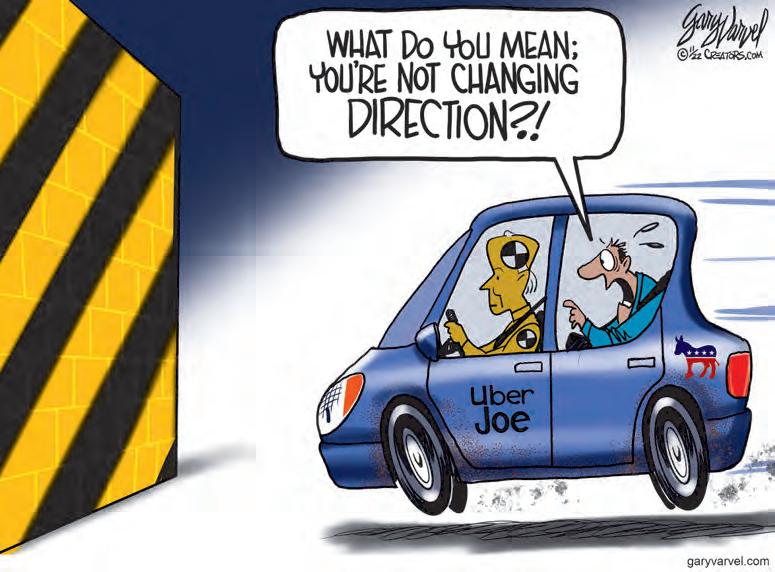
There is a silver lining here for Republicans. Democrats, who should have been taught a lesson by voters, were saved by Republican incompetence and pusillanimity; that means they’ll keep doubling down. President Joe Biden is, barring actual incapacity, the prohibitive 2024 Democratic nominee. And the fundamentals will continue to move against Democrats as they pursue a woker and woker agenda.
This means Republicans will get another bite at the apple — but only if they get serious. The time for frivolity is over. The laws of political gravity apply. Nominate good, sober candidates capable of governing and earning the trust of Americans. Pick your culture war battles and hit them hard. Make it hard to vote for Democrats and easy to vote for you.
This isn’t tough stuff. But if Republican leadership is unwilling to pursue the obvious, the shipwreck of 2022 will be only the beginning.
Ben Shapiro, 38, is a graduate of UCLA and Harvard Law School, host of “The Ben Shapiro Show,” and co-founder of Daily Wire+. He is a three-time New York Times bestselling author; his latest book is “The Authoritarian Moment: How The Left Weaponized America’s Institutions Against Dissent.”
That was then. Now, American coal plants are cleaner all the time. In 2020, the Department of Energy issued a report that found: “Coal-fired electricity generation is cleaner than ever. Research shows that a new coal plant with pollution controls reduces nitrogen oxides by 83%, sulfur dioxide by 98%, and particulate matter by 99.8% compared to plants without controls.”
That’s a giant reduction. It’s one of the major reasons why the air that we breathe today in America has been getting cleaner for 50 years. We’ve reduced levels of lead, carbon monoxide, sulfur and other pollutants by more than 50% — not bad, given that our economy is four times bigger.
The same DOE report found that “over the next 30 years, new coal production of 145-345 million tons could result in 47,500 coal mining jobs. The carbon products could also result in product value of near $139 billion and 480,000 manufacturing jobs tied directly to carbon products.” That’s a lot of jobs, but the operative word here is “could.”
Will we? Not if Biden has his way. That would be a damn shame. Under the Biden plan, we would move technologically in reverse in our energy sources. America got rich by replacing windmills with coal plants, and now, 150 years later, Biden wants to replace coal with windmills.
That’s a strategy for energy poverty and cold, dark nights. If you don’t believe me, ask the Europeans who are back to using candles to light their homes during rolling power blackouts.
Stephen Moore is a senior fellow at the Heritage Foundation and an economist with FreedomWorks. His latest book is “Govzilla: How the Relentless Growth of Government is Devouring our Economy.”
A7 North State Journal for Wednesday, November 16, 2022
COLUMN STEPHEN MOORE
COLUMN | MICHAEL BARONE
The red fizzle
Democrats keep Senate majority as GOP push falters in Nevada
The Associated Press
WASHINGTON, D.C. — Demo crats kept control of the Senate, re pelling Republican efforts to retake the chamber and making it harder for them to thwart President Joe Biden’s agenda.
Sen. Catherine Cortez Masto’s victory in Nevada gave Democrats the 50 seats they needed to keep the Senate. Her win reflects the surpris ing strength of Democrats across the U.S. this election year. Seeking reelection in an economically chal lenged state that has some of the highest gas prices in the nation, Cortez Masto was considered the Senate’s most vulnerable member, adding to the frustration of Repub licans who were confident she could be defeated.

“We got a lot done and we’ll do a lot more for the American peo ple,” Senate Majority Leader Chuck Schumer, D-N.Y., said Saturday night. “The American people re jected — soundly rejected — the an ti-democratic, authoritarian, nasty and divisive direction the MAGA Republicans wanted to take our country.”


With the results in Nevada now decided, Georgia is the only state where both parties are still compet ing for a Senate seat. Democratic incumbent Sen. Raphael Warnock faces GOP challenger Herschel Walker in a Dec. 6 runoff. Alaska’s Senate race has advanced to ranked choice voting, though the seat will stay in Republican hands.
Democratic control of the Sen ate ensures a smoother process for Biden’s Cabinet appointments and judicial picks, including those for potential Supreme Court openings. The party will also keep control over committees and have the power to conduct investigations or oversight


of the Biden administration, and will be able to reject legislation sent over by the House if the GOP wins that chamber.
In Phnom Penh, Cambodia, for the summit of the Association of Southeast Asian Nations, Biden said of the election results: “I feel good. I’m looking forward to the next couple of years.”

He said winning a 51st seat from the Georgia runoff would be im portant and allow Democrats to boost their standing on Senate com mittees.
“It’s just simply better,” Biden said. “The bigger the number, the better.”
The Senate fight had hinged on a handful of deeply contested seats. Both parties spent tens of millions of dollars in Pennsylvania, Arizona, Nevada and Georgia, the top bat tlegrounds where Democrats had hoped that Republicans’ decision to nominate untested candidates — many backed by former President Donald Trump — would help them defy national headwinds.
Democrats scored a big win in Pennsylvania, where Lt. Gov. John Fetterman defeated celebrity heart surgeon Dr. Mehmet Oz, who was endorsed by Trump, to pick up a seat currently held by a Republi can. Arizona Sen. Mark Kelly won reelection by about 5 percentage points.
A closely divided swing state, Ne vada is one of the most racially di verse in the nation, a working-class state whose residents have been especially hard-hit by inflation and other economic turmoil. Roughly three-fourths of Nevada voters said the country is headed in the wrong direction, and about half called the economy the most important issue facing the country, according to AP VoteCast, a survey of 2,100 of the
state’s voters.
Heading into the midterm elec tion, Republicans focused relent lessly on the economy, a top concern for many voters amid stubborn in flation and high gas and food pric es. The GOP also hit Democrats on crime, a message that sometimes overstated the threat but nonethe less tapped into anxiety, particular ly among the suburban voters who turned away from the party in 2018 and 2020. And they highlighted illegal border crossings, accusing Biden and other Democrats of fail ing to protect the country.
But Democrats were buoyed by voters angry about the Supreme Court’s June decision overturning the constitutional right to an abor tion. They also portrayed Repub licans as too extreme and a threat to democracy, following the Jan. 6, 2021, riot at the U.S. Capitol and Trump’s claims — repeated by many GOP candidates — that the 2020 election was stolen from him.
Nationally, VoteCast showed that 7 in 10 voters said the Supreme Court’s decision on Roe v. Wade was an important factor in their mid term decisions. It also showed the reversal was broadly unpopular. And roughly 6 in 10 said they favor a law guaranteeing access to legal abortion nationwide.
Half of voters said inflation fac tored significantly in their vote, while 44% said the future of de mocracy was their primary consid eration.
Beyond Congress, Democrats won key governors’ races in Wis consin, Michigan and Pennsylvania — battlegrounds critical to Biden’s 2020 win over Trump. Republi cans, though, held governors’ man sions in Florida, Texas and Georgia — another battleground state Biden narrowly won two years ago.
Supreme Court rejects another bump stock ban case
Washington, D.C.
The U.S. Supreme Court on Monday again declined to hear a lawsuit involving a Trump-era ban on bump stocks, the gun attachments that allow semi-automatic weapons to fire rapidly like machine guns.
The justices’ decision not to hear the case leaves in place a lower court decision that rejected bump stock owners’ efforts to be compensated for bump stocks they lawfully purchased but were required to give up after the administration ruled they were illegal. Lower courts had said the case should be dismissed.

The justices made no comments in declining to hear the case, and it was among many the court rejected Monday.

Last month, the justices rejected two other challenges involving the ban. Gun rights advocates, however, scored a big win at the court earlier this year when the justices, by a 6-3 vote, expanded gun-possession rights, weakening states’ ability to limit the carrying of guns in public.
The Trump administration’s ban on bump stocks took effect in 2019 and came about as a result of the 2017 mass shooting in Las Vegas. The gunman there used assault-style rifles to fire into the crowd of 22,000 music fans.
The Trump administration’s ban on bump stocks was an about-face for the federal Bureau of Alcohol, Tobacco, Firearms and Explosives. In 2010, under the Obama administration, the agency found that bump stocks should not be classified as a “machinegun” and therefore should not be banned under federal law.
Under the Trump administration, officials revisited that determination and found it incorrect.

The case the court rejected Monday was Roy Lynn McCutchen v. U.S., 22-25.
THE ASSOCIATED PRESS

UN General Assembly calls for Russian reparations to Ukraine
United Nations


The U.N. General Assembly approved a resolution Monday calling for Russia to be held accountable for violating international law by invading Ukraine including by paying reparations.
The vote in the 193-member world body was 94-14 with 73 abstentions. It was the lowest level of support of the five Ukraine-related resolutions adopted by the General Assembly since Russia’s Feb. 24 invasion of its smaller neighbor.

The resolution recognizes the need to establish “an international mechanism for reparation for damage, loss or injury’” arising from Russia’s “wrongful acts” against Ukraine.

It recommends that the assembly’s member nations, in cooperation with Ukraine, create “an international register” to document claims and information on damage, loss or injury to Ukrainians and the government caused by Russia.
Russia’s veto power in the 15-member Security Council has blocked the U.N.’s most powerful body from taking any action since President Vladimir Putin ordered the invasion. But there are no vetoes in the General Assembly, which previously adopted four resolutions criticizing Russia’s invasion.

Unlike Security Council resolutions, General Assembly resolutions are not legally binding, but they do reflect world opinion and have demonstrated widespread opposition to Russia’s military action.
THE ASSOCIATED PRESS
A8 North State Journal for Wednesday, November 16, 2022
NATION & WORLD
Kiwanis Club of Raleigh Pancake Breakfast 2022 Friend of the Children Friend of Kiwanis Friend of the Families Boyles Dental Buck Lattimore, Auctioneer Cherry Bekaert Custom Brick and Supply Cynthia Ball Excel Moving & Storage Extra Attic Self-Storage Glenwood Agency Grimes Insurance Group Harold Garner Heyward Wall Law Laura Bromhal, Realtor Lean Team Management Consultants MPC Certified Public Accountants Mike Davis Public Relations Phil Kirk Raleigh Waterproofing
Robert Cooper Saleeby Chiropractic Centre US Foods
Young
Moore and Henderson
U.S.
Sen. Catherine Cortez Masto, D-Nev., speaks during a campaign stop at the Nevada State AFLCIO offices in Henderson, Nev., Sunday, Nov. 6, 2022.
Masto
is running against Republican candidate Adam Laxalt.
AP PHOTO
NFL
Walker injured, Panthers will start Mayfield at QB
Charlotte Baker Mayfield will start at quarterback for the Carolina Panthers on Sunday against the Baltimore Ravens after P.J. Walker was diagnosed with a high ankle sprain. Walker was injured in Thursday night’s 25 15 victory against the Atlanta Falcons but coach Steve Wilks said Walker toughed it out and continued to play. The Panthers made no mention of the injury after the game. Walker will not play Sunday, and Sam Darnold will be Mayfield’s backup. Wilks said there are no plans to put Walker on injured reserve. Mayfield started the first five games with the Panthers and struggled, going 1 4 with four touchdowns and four interceptions and a 71.9 quarterback rating. He relieved Walker two weeks ago at Cincinnati with the Panthers trailing 35 0 at halftime and threw for 155 yards and two touchdowns.
SOCCER
Charlotte FC’s Karol Swiderski named to Poland’s World Cup team
Warsaw, Poland Charlotte FC forward Karol Swiderski was named to Poland’s World Cup team last week, part of a 26 player squad that will begin play in Qatar next Tuesday with a Group C match against Mexico. Swiderski, who had five goals and an assist in Poland’s nine qualifying matches, had a team high 10 goals and six assists in 30 games for Charlotte in the team’s inaugural season in Major League Soccer. He also led the team in shots (72) and on target scoring attempts (36). Poland, ranked 26th in the FIFA men’s rankings, is joined by Argentina (No. 3), Mexico (No. 13) and Saudi Arabia (No. 51) in Group C.
US World Cup roster offers some surprises
The Americans open play Monday against Wales
By Ronald Blum The Associated Press
NEW YORK — The U.S. World Cup team is truly of the video generation. Players who received a Face Time from coach Gregg Berhalter were headed to Qatar and those given audio calls missed the cut.
“I think the best part of it the last couple of days was really seeing genuine smiles from the guys when I told them, and that’s priceless,” Berhalter said last Wednesday after the televised announcement of his 26-man roster.
Tim Ream, Haji Wright, Joe Scally and Sean Johnson made it.
Ricardo Pepi, Zack Steffen, Paul Arriola and Jor dan Pefok fell short.
Norwich’s Josh Sargent and Antalyaspor’s Wright beat out Pepi, the 19-year-old whose three goals in qualifying were second behind Christian Pulisic’s five. Berhalter rated Sargent playing in England’s second-tier League Championship higher than Pepi in the Dutch Eredivisie, especially with the U.S. opening the tournament against Wales on Nov. 21 and facing England four days later before finishing group play against Iran on Nov. 29.
“The Dutch League is a great league, but it doesn’t bring the same physicality that the Premier League brings and the Championship brings,” Berhalter said. “Ricardo Pepi could have a great argument for why he should be there, and I can understand that argu ment.”
Players started getting texts from Berhalter on Sunday afternoon: “Are you available?” He spent three days going through the roster, then turned to just over a dozen dealt the devastation of falling short.
The U.S. squad figures to be the youngest of the 32 teams by average age, and 29-year-old right back DeAndre Yedlin is the only holdover from the 2014 World Cup. Yedlin, Pulisic, Kellyn Acosta and Ream are remaining players from the infamous loss at Trin
Drake Maye for Heisman? It could happen
By Shawn Krest North State Journal
ELECTION DAY took place around the nation last week, which means that politicians everywhere are turning their at tention toward the next big vote and deciding when to announce what they plan to run for next.
One campaign has already started. On Sunday evening, UNC Football’s Twitter account tweeted out a hype video offi cially announcing Drake Maye as a candidate for the Heisman Trophy. The video features talking heads from football analysis shows and tweets from the nation al media taking notice of the Tar Heels’ fresh man quarterback and coining the hashtag #MayeForHeisman.
A year after junior Sam Howell was sup posed to be UNC’s best candidate in gen erations to win college football’s top individ ual award, his rookie replacement is the one getting the Heisman buzz.

It’s a buzz seldom heard in these parts.
It’s been 21 years since a UNC player has finished in the top 10 (the only voting results that are released for the award) for Heisman voting and 19 since any player for a North Carolina school has finished in the running.
Even then, it would be a stretch to call those two play ers, Julius Peppers in 2001 and NC State’s Philip Rivers in 2003, true Heisman candidates. — Peppers finished 10th and Rivers seventh.
In the history of the pro gram, a grand total of four Tar Heels have finished in the top 10 Heisman finishers. In addition to Peppers, running back Mike Voigt finished eighth in 1976, and Don McCauley was ninth in 1970. Legendary halfback “Choo Choo” Charlie Justice was the
only UNC player who could be considered a true Heisman con tender, finishing second in backto-back years —1948 and 1949. Doc Blanchard, who started his career with the Tar Heels, won the Heisman in 1945 after trans ferring to Army.
Justice is really the only true finalist that any of the state’s pro grams have produced. The other North Carolina teams have had a total of 10 players finish in the running, none higher than sixth.
In addition to Rivers, State had Torry Holt finish eighth in 1998, Ted Brown sixth in 1978 and Roman Gabriel ninth in 1961. Russell Wilson also fin ished ninth in 2011 as a transfer at Wisconsin.
Duke has had four players receive votes: Jay Wilkinson finished ninth in 1963, Steve Lach ninth in 1941, Dean Hill 10th in 1938 and Ace Parker sixth in 1936. The final two in-state players were Wake Forest’s Brian Piccolo (10th in 1964) and ECU’s Jeff Blake (seventh in 1991).
Can Maye become the first legitimate Heisman candidate and make the trip to New York as a finalist? He’s moved up to third at most sportsbooks that set odds on the award, behind Ohio State’s CJ Stroud and Tennessee’s Herndon Hooker. Maye is tied with Michigan running back Blake Corum.
Maye didn’t duck the possibility when asked about it following the Wake Forest game.
“We are focused on winning football games,” he said. “That honor, that kind of trophy, comes with just winning more games. And that’s our job. It’s just not the main focus. We have a 9-1 season, and I just try to keep that the main thing. Obviously, it’s a dream to win the Heisman, so it’s hard to shy away from that.”
One of the reasons Maye has made himself relevant in the Heisman chase is that the Tar Heels have emerged as a possible playoff contender. UNC won the
The Tar Heels’ freshman quarterback has emerged as a contender
LaMelo is back, B3 See MAYE, page B4 See US WORLD CUP, page B3
HAKIM WRIGHT SR. | AP PHOTO
UNC quarterback Drake Maye, who has led the Tar Heels a 9-1 record and a berth in the ACC Championship Game, has emerged as an unlikely Heisman Trophy candidate.
JULIA NIKHINSON | AP PHOTO
U.S. men’s national team soccer coach Gregg Berhalter listens during last Wednesday’s team roster unveling for the upcoming World Cup in Qatar.
19
73
Number of years since a player from an N.C. school was in the Heisman voting
Number of years since a player from an N.C. school was a Heisman finalist
“This could be a little bit of a redemption or revenge tour if you want to call it that.”
DeAndre Yedlin
TRENDING
Kyrie Irving:
The Nets point guard is eligible to return from his suspension, but Brooklyn coach Jacque Vaughn said before Sunday’s game that he had no update on when Irving would return. Irving was suspended by the Nets for a minimum of five games on Nov. 3 for refusing to say he had no antisemitic beliefs. Sunday’s game was the sixth Irving missed. Brooklyn was set to play Tuesday in Sacramento before finishing up its road trip on Thursday in Portland. The Nets have won four of five since Irving was suspended.

Deshaun Watson:
The Browns quarterback has been cleared to practice, a significant step in his return to the NFL following an 11‑game suspension. Watson was accused of sexual misconduct by more than two dozen women during massage therapy sessions. He reached a settlement with the league in August to sit out 11 games, pay a $5 million fine and undergo counseling. Watson will rejoin his teammates on the field Wednesday and make his debut for the Browns on Dec. 4 against Houston, which drafted him in 2017.
Shane Lyons:

The West Virginia athletic director was fired Monday as the football team suffers its worst stretch in 40‑plus years. Lyons, a former associate commissioner with the ACC, had been the Mountaineers’ AD since 2015. Football coach Neal Brown has a 21‑24 record in his fourth season, including 4‑6 this year. It’s the worst stretch since the football team went 17‑27 under Frank Cignetti from 1976‑79.
Beyond the box score
COLLEGE FOOTBALL
POTENT QUOTABLES
548
Career tackles, the most in NCAA history, for Troy linebacker Carlton Martial after the sixth‑year senior had 22 in the Black Knights’ 10‑9 win over Army on Saturday. The former walk‑on broke the record of 545 previously held by Northwestern’s Tim McGarigle.

four‑year, $31.3
OLYMPICS
The mascots for the 2024 Paris Olympics and Paralympics are Phrygian caps, also known as liberty caps, that became a symbol of the pursuit of liberty in the French Revolution. The Paralympic version features a prosthetic leg that goes to the knee. Organizers say they didn’t want to choose an animal or other creature, instead choosing the cap as an “allegory of freedom.”

B2 North State Journal for Wednesday, November 16, 2022
Three University of Virginia students were killed Sunday night when a student shot five fellow classmates in a bus as they returned from a school field trip. Devin Chandler, Lavel Davis Jr. and D’Sean Perry — all members of the Cavaliers football team — were killed in the shooting. Chandler was a native of Huntersville who played at William Amos Hough High School in Cornelius. The shooting suspect, Christopher Darnell Jones Jr., was apprehended Monday.
STEVE HELBER | AP PHOTO
Panthers cornerback Donte Jackson will miss the remainder of the season after tearing his left Achilles tendon in last Thursday night’s win in Atlanta. Jackson, who had started nine games this season with 30 tackles and two interceptions, has 14 interceptions during his five‑season Panthers career.
NFL
JOHN BAZEMORE | AP PHOTO
Hornets swingman Cody Martin will miss at least four weeks after having arthroscopic surgery on his left knee that has bothered him since preseason. Martin injured his left quad in the team’s regular season opener and has not played since. Martin signed a
million contract this past offseason to remain in Charlotte.
NBA
MATT SLOCUM | AP PHOTO
“Listen to your players. We want to play on grass.”
Panthers linebacker Shaq Thompson on Carolina’s players trying to convince owner David Tepper to remove artificial turf at Bank of America Stadium.
“It was a bad call.”
NC State linebacker Payton Wilson on a fourth down pass interference call on Drake Thomas that kept Boston College’s eventual winning drive alive.
KARL B. DEBLAKER | AP PHOTO
WEDNESDAY 11.16.22
JACOB KUPFERMAN | AP PHOTO
CHRISTOPHE ENA | AP PHOTO
PRIME NUMBER
NC is for bowling: State prepares for historic postseason
By Shawn Krest North State Journal
THIS PAST SEASON’S NCAA tournament was historic, as, for the first time in the 83-year history of the event, Duke and North Car olina met in the Final Four.
Now, the college football season promises to make more state his tory.
For the first time ever, all four of North Carolina’s ACC teams — Duke, North Carolina, NC State and Wake Forest — are bowl eli gible.
The state has sent three of the Big Four on 11 occasions, starting in 1992. That includes seven of the last eight seasons. In an interest ing piece of trivia, NC State is the only one of the four to be eligible in each of those 11 previous seasons. Each of the other three is respon sible for the state missing a clean sweep at least once.
Beyond that, however, the bowl season is shaping up to be a special one for the state. East Carolina is also eligible. App State is one win away from qualifying, and NC Central won the MEAC, sending the Eagles to their first Celebra tion Bowl since 2016 and a chance to play for the HBCU National Championship.
Only Charlotte is out of the run ning for a postseason berth, mean ing that North Carolina could send an unprecedented six FBS teams and seven total teams to bowl games. The state sent five teams — including either Central or NC A&T in the Celebration Bowl — from 2015 to 2019 and sent five FBS teams last year.
Here’s a rundown of each team’s
bowl prospects. NC Central: The Eagles won the MEAC and are 8-2 with one game remaining, at Tennessee Tech. Central lost its previous Cel ebration Bowl appearance, 10-9, in 2016. The Eagles will play the SWAC champion, which has not yet been decided, in the game. The state has been home to four Cel ebration Bowl champions, with A&T winning in 2015, ’17, ’18 and ’19.
UNC: The Tar Heels are in line to earn the best FBS bowl berth among the state’s teams. UNC
clinched the Coastal Division title and could make a CFP New Year’s Six game if it beats Clemson in the ACC Championship Game. Two outlets think that’s going to hap pen. Sports Illustrated and USA Today both have the Tar Heels slotted to play Alabama in the Orange Bowl. A loss to Clemson will make UNC a desirable team in the next tier of bowls. The most popular prediction is that the Tar Heels will face Mack Brown’s for mer team, Texas, in the Cheez-It Bowl. Both CBSSports and Athlon see that as the likely scenario. The
LaMelo Ball returns as Hornets look to dig out of early-season hole
 By Jesse Deal North State Journal
CHARLOTTE — A preseason ankle injury sidelined LaMelo Ball for the first 13 games of the NBA season as Charlotte slumped to a 3-10 start. Now with the Hornets’ best player back in the fold, there’s a sense of hope that he can turn around the team’s season.
The Hornets (4-11) split their first two games since Ball’s return, and his presence has sparked a Charlotte offense that struggled to score in his absence.
“It just felt good to be back for real. Defense, offense. It’s just bas ketball for real. It was just fun to be back,” Ball said after Charlotte’s 132-115 loss to Miami in which he finished with 15 points, six assists and six rebounds in 28 minutes in his season debut. He made 6 of 17 shots and was just 1 of 9 from 3-point range.
“I feel straight. We’re going to be straight,” Ball added. “More games, it’ll get easier. I think I’m in a good
spot. … We’re getting people back now and we’re finally getting on the road.”
He looked a bit more like him self in his second game back as the Hornets finally stopped the bleed ing, snapping an eight-game losing streak with a 112-105 win over Or lando.
In that performance, Ball post
ed 17 points, nine rebounds and four assists in 34 minutes. The 21-year-old seems to still be knock ing off the shooting rust — he made three more 3-pointers than his first game back but also attempted six more.
While Hornets fans are accus tomed to Ball’s dynamic playmak ing abilities, Charlotte’s reintro
Athletic sees a Carolina-Florida matchup in the Gator Bowl.
NC State: The Wolfpack is 7-3 with games remaining against Louisville and UNC. The most likely landing spot for the Pack, according to media pundits, is the Duke’s Mayo Bowl in Charlotte. CBSSports has State playing Illi nois, and Athlon sends it there to play Maryland. The other projec tions include the Cheez-It Bowl (vs. Baylor, Sports Illustrated), Gasparilla Bowl (vs. Tulane, The Athletic) and Gator Bowl (Florida, USA Today).
Wake Forest: The Demon Dea cons were in the top 10 in October, but a three-game losing streak has dropped Wake in the bowl peck ing order. Most projections have the Deacs traveling for their bowl game: To face Utah in the Holiday (CBSSports) or the Sun (The Ath letic), or Oregon State or UCLA in the Sun (USA Today and Ath lon, respectively). The only East ern time zone game projected for Wake is the Military Bowl, against Cincinnati (Sports Illustrated).
Duke: The Blue Devils are the state’s surprise team, with a threegame winning streak taking them to 7-3 in coach Mike Elko’s first year. Two projections have Duke playing in the Duke’s Mayo Bowl (no relation) — against Mary land (The Athletic) or Wisconsin (USA Today). Other landing spots are the Pinstripe (vs. Minnesota, CBSSports), Birmingham (vs. Tu lane, Sports Illustrated) or Gas parilla (vs. Memphis, Athlon).

East Carolina: The Pirates’ first bowl appearance in seven years was scuttled last season when the game was canceled due to COVID. Now ECU is 6-4 and ready to end its drought. The Mil itary is the best bet, with The Ath letic and Athlon both sending the Pirates there to face Louisville. Other possibilities are Birming ham (vs. Marshall, CBSSports), Armed Forces (vs. UConn, Sports Illustrated) and Gasparilla (vs. Mi ami, USA Today).
App State: The Mountaineers have lost two in a row and have two remaining chances, home against ODU and at Georgia Southern, to win their sixth game and extend the state’s longest current bowl streak to eight straight seasons. That would also set a state record — App is currently tied with NC State (1988 to 1994) and UNC (1992 to 1998) at seven. In addition to win ning six, App would need to find a spot in an ever-shrinking num ber of bowl vacancies. CBSSports and Sports Illustrated both have App on the outside looking in. The Athletic and Athlon both send the Mountaineers to the LendingTree Bowl, against Wyoming and Ball State, respectively, while USA To day has App playing Wyoming in the New Mexico Bowl.
duced head coach is getting his first look at his star point guard.
He’s an elite offensive player,” Steve Clifford said on Nov. 12. “You can just see what a terrific player he is. He’s in the paint and he puts a ton of pressure on the defense. He has a great feel for where his teammates are. It’s been five to six weeks since he’s played, so it’s great to have him back.
“Obviously, he makes a huge dif ference in our team and it’s good that we have him. Now we’ll get back to getting his offense in and get everybody comfortable when he’s out there. I think we’re getting a lot better very quickly.”
What is yet to be seen is how Clifford plans to mold Ball into the team’s leader. Earlier this year, Ball expressed a desire to control the reins of the offense, hinting to a reporter from Slam Magazine that his role had been limited while playing under former coach James Borrego.
On the court, Ball has made a case for being in charge.
He averaged 20.1 points and 7.6 assists per game last year and earned his first All-Star bid. In the season before that, he averaged 15.7 points and 6.1 assists on his way to winning the NBA Rookie of the Year award.
With Ball’s first two seasons in the league successful by almost any metric outside of team success, Year 3 seems pivotal in the star guard’s future.
Ball will be eligible for a fiveyear, $202.5M contract extension next offseason and would become
the first Hornets player to receive a rookie maximum extension under owner Michael Jordan if that con tract is agreed upon. Charlotte also holds a club option for the 2023-24 season worth just over $10.9 mil lion.
A fter that, the Hornets’ front of fice can extend a qualifying offer to Ball for the 2024-25 season worth just over $14.3 million or allow him to become a restricted free agent.
For now, all Ball can control is the present, which means helping the Hornets climb out of the pit of the Eastern Conference stand ings. Charlotte is already seven games below .500, and the injury woes nagging the Hornets have not helped at all.
G ordon Hayward remains out of the lineup with an ongoing shoul der injury that has sidelined him for six games, while Dennis Smith Jr. (ankle) remains day-to-day. Ad ditionally, Cody Martin underwent an arthroscopic procedure on his left knee last Friday and will miss approximately six weeks.
If there ever was a time for Ball to take his game to the next level, the time is now.
US WORLD CUP from page B1
idad that prevented the Ameri cans from reaching the 2018 tour nament.
“This could be a little bit of a redemption or revenge tour if you want to call it that,” Yedlin said. “This is now our time to really — I don’t want to say apologize for that but show how much we do want it.”
With central defenders Miles Robinson and Chris Richards sidelined by injuries, the 35-yearold Ream returns to the national team for the first time since the opening window of qualifying in September 2021. Ream didn’t play in the final four qualifying windows as Berhalter preferred more mobile options, then he was selected over Mark McKenzie and Erik-Palmer Brown.
“He’s playing in the best league in the world and he’s playing at a
very high level,” Berhalter said.
Cameron Carter-Vickers, a son of former NBA player How ard Carter, also was picked as a central defender. Carter-Vickers, Johnson, Scally, Wright and goal keeper Ethan Horvath did not ap pear in any of the 14 qualifiers.
Shaq Moore was picked as a backup over Reggie Cannon at right back and Cristian Roldan ahead of Malik Tillman in mid field, where Berhalter called Arri ola “the odd man out.”
Johnson, 33, was a surprise pick over Steffen, who started six qualifiers. He received the news while sitting on a sofa at his home in Hoboken, New Jersey.
“I wasn’t going to move very far away from my phone, just waiting for the call,” Johnson said. “The first thing he said, I think, was, `Why are you still wearing the same shirt from (training) camp?’
Then we talked about yoga and doing yoga that morning. Yeah, I was sweating a little bit. But ulti mately we got to that point in the conversation and the weight was just lifted and it was just pure ela tion.”
Nine players are from Major League Soccer; eight are with En glish clubs; two each are based in Germany, Italy and Spain; and one apiece plays in France, Scot land and Turkey.
Scally and midfielder Yunus Musah are just 19. Winger Gio Reyna, a son of former U.S, cap tain Claudio Reyna, turns 20 on Sunday. The average age of 25 years, 175 days as of the opener is the second youngest for the U.S. at a World Cup behind 24 years, 24 days in 1990.
Pulisic, the biggest U.S. star, has started just five matches for Chelsea this season. Outside back
Sergiño Dest has made just two starts for AC Milan and hasn’t played at all since Oct. 30 due to an adductor injury. Midfielder Weston McKennie has been side lined at Juventus since Oct. 29 by a thigh problem.
Reyna is coming off repeated leg issues and has played one 90-min ute match for Borussia Dortmund since April 2021. Matt Turner, the likely No. 1 goalkeeper, has yet to make his Premier League debut with Arsenal and has been limit ed to four Europa League matches for the Gunners this season, the last Oct. 20.
Midfielder Luca de la Torre has not played for Spain’s Celta Vigo since Oct. 24 because of a torn muscle in his left leg and might not be 90-minute fit. Sargent re turned Saturday for Norwich in England’s second-tier League Championship after missing two
matches with a calf injury.
Berhalter, the first former U.S. player to coach the Americans at a World Cup, reminded those who fell short of how he was left off the roster in 2006. Three weeks later, he was riding the monorail between the Magic Kingdom and Disney-MGM Studios in Florida on vacation when he learned he was replacing Cory Gibbs, who in jured a knee.
“I wanted to acknowledge that it is unpleasant news that they’re getting, but there also is this sliver of hope,” Berhalter said.
Even players considered locks, such as McKennie, Tyler Adams and Antonee Robinson, had anx iously awaited Berhalter’s call.
“It’s still a relief and still a weight off your shoulders,” McK ennie said, “when you can actually hear the words that you are on the final roster.”
B3 North State Journal for Wednesday, November 16, 2022
Charlotte snapped an eight-game losing streak Monday night in the point guard’s second game back
There are more bowl-eligible NC teams than ever before, including all four ACC schools
THE DESERET NEWS VIA AP
East Carolina, at 6-4, is poised to play in its first bowl game since the 2015 Birmingham Bowl.
PHELAN M. EBENHACK | AP PHOTO
Hornets guard LaMelo Ball is defended by Magic center Mo Bamba and guard Terrence Ross during Charlotte’s win Monday in Orlando.
“It’s been five to six weeks since he’s played, so it’s great to have him back.”
Hornets coach Steve Clifford on the return of
LaMelo
Ball
Jake Matthews’ wild ride to — and from — Charlotte

 By Shawn Krest North State Journal
CHARLOTTE — Jake Mat thews began his day in Charlotte. He finished his day in Charlotte. The 17 hours in between are the stuff legends are made of.
Matthews is the starting left tackle for the Atlanta Falcons, and he has been since he entered the league in 2014. He missed the Week 2 game of his rookie season and since then, he’s had perfect attendance — 136 straight regular season games and five games in the playoffs. He battled ankle and foot problems in 2014 and hurt his knee in 2020, but he showed up for work week in and week out.
Then his wife, Meggi, got preg nant.
Matthews is a second-genera tion NFL player. His father, Bruce — who was born in Raleigh — is an NFL Hall of Famer, and both of his brothers played in the league. His grandfather Clay, uncle Clay Jr. and cousin Clay III all played in the league.
In addition to NFL experience, all the Matthews men have some thing else in common: Everyone with NFL dads was born in the off season.
“That was the plan, initially,” Matthews said. “It didn’t work. So you know, we knew when she told me back in March she was preg nant, I was like, ‘All right, well, this is gonna be the middle of the sea son. Let’s start planning.’”
At first, the timing seemed to be perfect. The Falcons were sched uled to play the week closest to her due date in Carolina on Thursday night. That meant a few extra days off before preparing for the next game, and, just as importantly, it left the weekend open.
“She was scheduled to be in duced on Sunday,” he said.
Still, things can go awry as the big day approaches, and Jake and Meggi had to discuss contingency plans if their son decided to come on game day.
“We talked about it,” he said. “They weren’t fun conversations. ‘Are you going to choose the game over me?’”
Matthews traveled with the team to Charlotte and talked to Meggi on Wednesday night.
“So, I talked to her (on the phone) and said good night and went to bed, and she said something didn’t feel right,” Matthews said, as par ents everywhere nod knowingly. “She thought she might have been sick. So I was like, ‘Oh well, may be we’ll have to reschedule Sunday. Just hang in there. Let me play this game and I’ll be back Friday.’”
Thursday morning, the hotel phone in his room rang.
“My phone doesn’t wake me up because I have it on silent,” he said. “And then all of a sudden, the hotel phone is ringing. I was like, ‘Who’s calling on the hotel phone?’ That doesn’t happen. I haven’t had a wake-up call since college. So I knew something was wrong. I checked my phone and I had 10 missed calls. She had been in la bor and at the hospital for a couple hours. She got there about 5 a.m.” It was now 7 a.m. Kickoff was 13 hours away. Meggi was 245 miles away.
“I was just scrambling,” he said, “trying to make a decision on what to do. Are we going to go to the air
port and catch a commercial flight or even — I was willing to charter a private plane, but nothing was available on short notice.”
A team employee offered their rental car.
“It was just that snap decision,” he said. “Are we driving or not? And I was like, ‘Screw it, let’s go.’”
The team employee, who Mat thews would only identify as “a member of the security staff,” did the driving while Matthews lay in
the back seat trying to go through his game day routine.
“I laid down and tried to hydrate and get food,” he said. “It was a turnaround. I wasn’t on my rou tine.”
Plenty of birth stories involve wild drives to the hospital. Most of them don’t start in Charlotte and end in Atlanta — a distance Mat thews covered in three hours.
“We may have been going above the speed,” he said. “We left the ho
tel at 9:30 and made it to her about 12:30. We didn’t stop. Needless to say, I had to use the restroom.”
Matthews made it before the baby was born, with an assist from the doctors. While Falcons security was putting pedal to metal, back in Atlanta, they were trying to hit the brakes.
“They actually had to do some things to slow the process down for me to get there,” he said. “Once I got there, they broke her water.”
And at that point, Meggi was the one on the clock.
Team owner Arthur Blank of fered to fly Matthews back to Char lotte with him on his private plane in order to get back by game time, but first, the youngest Matthews had to cooperate with the timeline.
“A few times, I was looking at the wall and the clock, and she kind of snapped at me, ‘Get your head back in!’” he said.
As you’d expect from an NFL family, the new baby had excellent clock management.
“It really was amazing,” Mat thews said. “It was like right when it was getting close to crunch time. Everyone was like, ‘Hey, we’ve got to make a decision. What’s gonna hap pen here?’ And then he came. It was like perfect timing.”
Beckett Thomas Matthews en tered the world at 3:15 p.m. We’ll let proud papa tell the rest:
“Thomas is my middle name too. We really liked the name Beckett. We picked it, jeez, we picked it like six months into dating each oth er, before we were even engaged or married. We were like, ‘This is what we’re going to name our first son.’ So we’ve known that name for years. And then he actually was al
most four weeks early, but he was right at six pounds. I can’t remem ber his length, but his length was in like the 95th percentile. He was very long. He was a little early, but we’ll beef him up.”
Then the new parents got to spend time with their baby, but not much.
“I actually got to help deliver him,” Matthews said. “It was in credible, very emotional. Right when he came out, my wife took him for like five minutes, and then I held him for like 15.”
Then it was time to go to work.
“He was born at 3:15, and I left to get on Mr. Blank’s plane at 3:30. We took a few pictures with him, and I was out. It was whirlwind, man.”
Matthews spent much of the flight on the phone, informing fam ily members of the news and, of course, attending pregame position meetings.
“They FaceTimed me at the beginning of the meeting, and I cracked a couple of jokes,” he said. “I told our backups not to worry, I’d be back.”
Matthews arrived at Bank of America Stadium about an hour before kickoff, and the team tweet ed video of him running into the locker room.
“I just wanted time to get dressed and warm up,” he said. “I was petri fied to miss the start of the game.”
Now Matthews heads back to Atlanta and will get to spend time with Meggi and Beckett, just not tonight.
“She cut me some slack and said I could go home and get a few hours,” he said, “but I’ll be there early in the morning. She’ll probably hand him off to me and it’ll be my turn. She’s got no sympathy for me having a game today.”
It seems obvious that Beckett will hear the story of this day every birthday for years to come.
“My wife has been joking with me this whole pregnancy,” he said. “Saying, ‘I have a feeling he’s gonna kind of put you to the test and show up on a game or something,’ and she was spot on. Man, it was incredible just to hold my firstborn son and see how amazing she did and then, obviously, making it back here.”
his reel. Then comes the ACC title game against Clemson.
ACC Coastal Division last week with a win in Winston-Salem and will face Clemson in the ACC Championship Game on Dec. 3 in Charlotte. The Heels will likely need a lot of help around the na tion, as the ACC is not considered in line for a College Football Play off bid at the moment, but they’re one of a handful of teams still able to consider it.

Here’s a look at what needs to happen for Maye to make Heisman magic with the Tar Heels.
What UNC needs to do
Obviously, the Tar Heels need to win out, and Maye needs to shine. That means beating Georgia Tech and NC State at home to close out the regular season. The 4-6 Yellow Jackets have given up 104 points in the last three games, so Maye could definitely put up some big numbers. And State will be a rival ry game, giving Maye the opportu nity to add a dramatic moment to
The door needs to open
The schedule could do Maye a few favors as well. Ohio State plays Michigan to close the regular sea son, and if Stroud or Corum strug gle, it will create an opportunity for Maye to move up, especially if the player on the winning team doesn’t distinguish himself. Hook er gets a pair of relatively low-pro file games, against a middling South Carolina team and a bad Vanderbilt one. At the moment, Tennessee isn’t projected for the SEC Championship Game, so it might be out of sight, out of mind for Hooker.
Stroud is still the odds-on fa vorite to take home the hardware, but it appears that Maye might be bound for the Big Apple as a final ist, which is an honor in itself. And with a bit of luck, who knows?
As the last 73 years have shown, getting to the position he’s in now is significantly more of a challenge.
B4 North State Journal for Wednesday, November 16, 2022
The Falcons’ left tackle traveled to Atlanta and back on Thursday to attend the birth of his child and then play against the Panthers
“I checked my phone and I had 10 missed calls. She had been in labor and at the hospital for a couple hours. She got there about 5 a.m.”
Jake Matthews,
Falcons tackle
RUSTY JONES | AP PHOTO
Falcons offensive tackle Jake Matthews drove back to Atlanta last Thursday for his son’s birth, then flew back to Charlotte in time for that night’s game against the Panthers.
JACOB KUPFERMA | AP PHOTO
Falcons offensive tackle Jake Matthews prepares for a play in the second half of last Thursday’s game against the Panthers in Charlotte.
MAYE from page B1
CHRIS SEWARD | AP PHOTO
UNC quarterback Drake Maye goes airborn over Virginia Tech defensive back Nasir Peoples during their Oct. 1 game in Chapel Hill.
Sequoia’s partners became enthu siastic about Bankman-Fried fol lowing a Zoom meeting in 2021. After several more meetings, Se quoia decided to invest in the com pany.
“I don’t know how I know, I just do. SBF is a winner,” wrote Adam Fisher, a business journalist who wrote a profile of Bankman-Fried for the firm, referring to Bank man-Fried by his popular online moniker. The article, published in late September, was removed from Sequoia’s website.
Sequoia has written down its $213 million in investments to zero. A pension fund in Ontar io, Canada wrote down its invest ment to zero as well.
In a terse statement, the On tario Teachers’ Pension Fund said, “Naturally, not all of the invest ments in this early-stage asset class perform to expectations.”
But up until last week, Bank man-Fried was seen as a white knight for the industry. Whenev er the crypto industry had one of its crises, Bankman-Fried was the person likely to fly in with a rescue plan. When online trading plat form Robinhood was in financial straits earlier this year — collat eral damage from the decline in stock and crypto prices — Bank man-Fried jumped in to buy a stake in the company as a sign of support.
When Bankman-Fried bought up the assets of bankrupt cryp to firm Voyager Digital for $1.4 billion this summer, it brought a sense of relief to Voyager account holders, whose assets has been frozen since its own failure. That rescue is now in question.
FTX’s failure started after the cryptocurrency news outlet Coin Desk published a story, based on a leaked balance sheet from Ala meda Research. The story found that the relationship between FTX and Alameda Research was deeper and more intertwined than previously known, including that FTX was lending high quantities of its own token FTT to Alameda to help build up cash. It sparked mass withdrawals from FTX, causing the crypto firm to experi ence a very old financial problem: a bank run.
“FTX created a worthless token out of thin air and used it to make its balance sheet appear more ro bust than it really was,” Klippsten said.
As king of crypto, Bank man-Fried influence was starting to pour into political and popular culture. FTX bought prominent sports sponsorships with Formula One Racing and bought the nam ing rights to an arena in Miami, and ran Super Bowl ads featuring “Seinfeld” creator Larry David. He pledged to donate $1 billion to ward Democrats this election cy cle — his actual donations were in the tens of millions — and prom inent politicians like Bill Clinton were invited to speak at FTX con ferences. Football star Tom Brady invested in FTX, as did his super model soon-to-be-ex-wife Gisele Bündchen.
Bankman-Fried was also start ing to throw his financial weight around in media as well. He was an initial investor in Semafor, the news startup run by BuzzFeed’s former editor-in-chief and New York Times columnist Ben Smith. He also donated $5 million to the investigative news outlet Pro Publica.
40 states settle Google locationtracking charges for $392M
The Associated Press
HARTFORD, Conn. — Search giant Google has agreed to a $391.5 million settlement with 40 states to resolve an investi gation into how the company tracked users’ locations, state at torneys general announced Mon day.
The states’ investigation was sparked by a 2018 Associat ed Press story, which found that Google continued to track peo ple’s location data even after they opted out of such tracking by dis abling a feature the company called “location history.”
The attorneys general called the settlement a historic win for consumers, and the largest mul tistate settlement in U.S history dealing with privacy.
It comes at a time of mount ing unease over privacy and sur veillance by tech companies that has drawn growing outrage from politicians and scrutiny from regulators. The Supreme Court’s ruling in June ending the consti tutional protections for abortion raised potential privacy concerns for women seeking the procedure or related information online.
“This $391.5 million settle ment is a historic win for con sumers in an era of increasing reliance on technology,” Con necticut Attorney General Wil liam Tong said in a statement.
“Location data is among the most sensitive and valuable personal information Google collects, and there are so many reasons why a consumer may opt-out of track ing.”
At a news conference, Tong urged consumers to “do a little personal inventory” of their on line settings and turn them off if they don’t want them.
“It is not an exaggeration to say that we live in a surveillance economy,” he said. “Understand that you’re being tracked every minute of every day where you are.”
Google, based in Mountain View, California, said it fixed the problems several years ago.
“Consistent with improve ments we’ve made in recent years, we have settled this investigation, which was based on outdated product policies that we changed years ago,” company spokesper
son Jose Castaneda said.
Location tracking can help tech companies sell digital ads to marketers looking to connect with consumers within their vi cinity. It’s another tool in a da ta-gathering toolkit that gener ates more than $200 billion in annual ad revenue for Google, accounting for most of the prof its pouring into the coffers of its corporate parent, Alphabet — which has a market value of $1.2 trillion.
The attorneys general who in vestigated Google said a key part of the company’s digital adver tising business is location data, which they called the most sen sitive and valuable personal data the company collects. Even a small amount of location data can reveal a person’s identity and routines, they said.
Google uses the location infor mation to target consumers with ads by its customers, the state of ficials said.
The attorneys general said Google misled users about its lo cation tracking practices since at
least 2014, violating state con sumer protection laws.
As part of the settlement, Goo gle also agreed to make those practices more transparent to us ers. That includes showing them more information when they turn location account settings on and off and keeping a webpage that gives users information about the data Google collects.
The shadowy surveillance brought to light troubled even some Google engineers, who rec ognized the company might be
Walmart offers to pay $3.1 billion to settle opioid lawsuits

The Associated Press
WALMART PROPOSED a $3.1 billion legal settlement on Tuesday over the toll of power ful prescription opioids sold at its pharmacies, becoming the lat est major drug industry player to promise major support to state, local and tribal governments still grappling with a crisis in over dose deaths.
The retail giant’s announce ment follows similar propos als on Nov. 2 from the two larg est U.S. pharmacy chains, CVS Health and Walgreen Co., which each said they would pay about $5 billion.
Most of the drugmakers that produced the most opioids and the biggest drug distribution companies have already reached settlements. With the largest pharmacies now settling, it rep resents a shift in the opioid litiga tion saga. For years, the question was whether companies would be held accountable for an overdose crisis that a flood of prescription drugs helped spark.
With the crisis still raging, the focus now is on how the set tlement dollars — now totaling more than $50 billion — will be used and whether they will help curtail record numbers of over dose deaths, even as prescription drugs have become a relatively small portion of the epidemic.
Bentonville, Arkansas-based Walmart said in a statement that it “strongly disputes” allegations in lawsuits from state and local governments that its pharma cies improperly filled prescrip tions for the powerful prescrip tion painkillers. The company does not admit liability with the settlement, which would rep resent about 2% of its quarterly revenue.
“Walmart believes the settle
ment framework is in the best interest of all parties and will provide significant aid to com munities across the country in the fight against the opioid crisis, with aid reaching state and local governments faster than any oth er nationwide opioid settlement to date,” the company said in a statement.
Lawyers representing local governments said the company would pay most of the settlement over the next year if it is finalized.
New York Attorney Gener al Letitia James said in a release that the company would have to comply with oversight measures, prevent fraudulent prescriptions and flag suspicious ones.
Some government lawyers suggested Walmart has act ed more responsibly than other pharmacies when it came to opi oids.
“Although Walmart filled sig
nificantly fewer prescriptions for opioids then CVS or Walgreens, since 2018 Walmart has been the most proactive in trying to mon itor and control prescription opi oid diversion attempted through its pharmacies,” Nebraska Attor
confronting a huge legal head ache after the story was pub lished, according to internal doc uments that have subsequently surfaced in consumer-fraud law suits.

Tong, the Connecticut AG, said a new Connecticut consum er-privacy law set to take effect next year will require that peo ple opt into any location tracking, and not have to turn it off.
Arizona Attorney Gener al Mark Brnovich filed the first state action against Google in May 2020, alleging that the com pany had defrauded its users by misleading them into believ ing they could keep their where abouts private by turning off lo cation tracking in the settings of their software.
Arizona settled its case with Google for $85 million last month, but by then attorneys general in several other states and the District of Columbia had also pounced on the company with their own lawsuits seeking to hold Google accountable for its alleged deception.
ney General Doug Peterson said in a statement.
The deals are the product of negotiations with a group of state attorneys general, but they are not final. The CVS and Wal greens deals would have to be ac cepted first by a critical mass of state and local governments be fore they are completed.
Walmart’s plan would have to be approved by 43 states by Dec. 15, and local governments could sign on by March 31, 2023. Each state’s allocation depends partly on how many local governments agree.
“Companies like Walmart need to step up and help by en suring Pennsylvanians get the treatment and recovery resourc es they need,” Pennsylvania At torney General Josh Shapiro, who last week was elected gov ernor of his state, said in a state ment. “This deal with Walmart adds to the important progress we’ve already achieved through our settlements with the opioid manufacturers and distributors – and we’re not done yet.”
After governments used funds from tobacco settlements in the 1990s for purposes unrelated to public health, the opioid settle ments have been crafted to en sure most of the money goes to fighting the crisis. State and local governments are devising spend ing plans now.
Opioids of all kinds have been linked to more than 500,000 deaths in the U.S. over the past two decades.
In the 2000s, most fatal opioid overdoses involved prescription drugs such as OxyContin and ge neric oxycodone. After govern ments, doctors and companies took steps to make them harder to obtain, people addicted to the drugs increasingly turned to her oin, which proved more deadly.
In recent years, opioid deaths have soared to record levels, around 80,000 a year. Most of those deaths involve illicitly pro duced version of the powerful lab-made drug fentanyl, which is appearing throughout the U.S. supply of illegal drugs.
B6 North State Journal for Wednesday, November 16, 2022
“It is not an exaggeration to say that we live in a surveillance economy. Understand that you’re being tracked every minute of every day where you are.”
Connecticut Attorney General William Tong
“This deal with Walmart adds to the important progress we’ve already achieved through our settlements with the opioid manufacturers and distributors – and we’re not done yet.”
CRYPTO from page B5 Total Cash & Bond Proceeds $2,939,872,513 Add Receipts $98,690,402 Less Disbursements $210,407,468 Reserved Cash $125,000,000 Unreserved Cash Balance Total $6,710,227,101 Disaster reimbursements: $55,300,000 For the week ending 11/10
Pennsylvania Attorney General Josh Shapiro
AP PHOTO
In this June 15, 2017 photo, people walk inside the Oculus in New York.
AP PHOTO
In this Nov. 5, 2020 file photo, a woman pushes a shopping cart to enter a Walmart in Rolling Meadows, Ill.
By Jordan Golson North State Journal
STOCKHOLM — The Volvo EX90 is the all-electric replace ment for the venerable XC90 SUV, and it’s going to be built in South Carolina and starts under $80,000.

Assembled in America and un der $80,000 are two critical attri butes of the new three-row SUV because they’re both necessary to get the new electric car tax break of up to $7,500. Also a factor is where the raw materials for the battery come from and where the battery itself is assembled. There’s some hand-waving as everyone waits to learn the complex sourc ing requirements for the tax cred it, but it doesn’t yet matter.
What does matter is the gor geous new Volvo EX90. An evo lution rather than a revolution, it looks something like the regular XC90 and the electric Polestar 2 had a beautiful electric baby. The front grille feels a bit incomplete and bland, but that’s the only com
NOTICE OF FORECLOSURE SALE
22 SP 531
Under and by virtue of the power of sale contained in a certain Deed of Trust made by Elizabeth BonusBlankenship and James Blankenship, Jr. (Deceased) (PRESENT RECORD OWNER(S): Elizabeth BonusBlankenship and James Blankenship, Jr.) to William R. Echols, Trustee(s), dated November 17, 2011, and recorded in Book No. 6846, at Page 870 in Durham County Registry, North Carolina, default having been made in the payment of the promissory note secured by the said Deed of Trust and the undersigned, Substitute Trustee Services, Inc. having been substituted as Trustee in said Deed of Trust by an instrument duly recorded in the Office of the Register of Deeds Durham County, North Carolina and the holder
plaint I can think of regarding the design.
If you love clean, modern, Swedish design, you’ll adore the EX90. The interior is leather-free, if that matters to you, with gor geous woolen seats that are far better to look at and touch than
of the note evidencing said indebtedness having directed that the Deed of Trust be foreclosed, the undersigned Substitute Trustee will offer for sale at the courthouse door in Durham, Durham County, North Carolina, or the customary location designated for foreclosure sales, at 10:30 AM on November 30, 2022 and will sell to the highest bidder for cash the following real estate situated in Durham in the County of Durham, North Carolina, and being more particularly described as follows: All that certain parcel of land situated in Durham County, State of North Carolina, being known and designated as Lot 17, Block E, Devonshire Manor, filed in Plat Book 52, Page 12. Together with improvements located thereon said property being located at 5405 Beaumont Drive, Durham, North Carolina.
By fee simple deed from J Travis Skinner as set forth in Book 5769, Page 927 dated 10/15/2007 and recorded 10/15/20117, Durham County records, State of North Carolina.
Tax/Parcel ID: 141101 Trustee may, in the Trustee’s sole discretion, delay the sale for up to one hour as provided in N.C.G.S. §45-21.23.
instrument duly recorded in the Office of the Register of Deeds of Cabarrus County, North Carolina, and the holder of the
evidencing said indebtedness having directed that the Deed of Trust be foreclosed, the undersigned Substitute Trustee will offer for sale at the courthouse door or other usual place of sale in Cabarrus County, North Carolina, at 2:00 P.M. on November 29, 2022, and will sell to the highest bidder for cash the following described property, to wit:
Being all of Lot 432 as shown on Subdivision Plat of The Mills, Phase 3, Map 2, recorded In Book 63 at Pages 100-101 in the Cabarrus County, North Carolina, Public Records.
Together with improvements located hereon; said property being located at 2271 Drake Mill Lane Southwest, Concord, North Carolina 28025 Tax ID: 5527-93-3343-0000 Third party purchasers must pay the recording cost of the trustee’s deed, any land transfer taxes, the excise tax, pursuant North Carolina General Statutes §105-228.30, in the amount of One Dollar ($1.00) per each Five Hundred Dollars ($500.00) or fractional part thereof, and the Clerk
courthouse door in Fayetteville, Cumberland County, North Carolina, or the customary location designated for foreclosure sales, at 12:00 PM on November 28, 2022 and will sell to the highest bidder for cash the following real estate situated in Fayetteville in the County of Cumberland, North Carolina, and being more particularly described as follows: Parcel ID#: 0437-02-4032
Being all of Lot 10, and a strip of land to the northwest of Lot 10, Block G, of Savoy Heights, Section 2 as per survey and map of the same prepared by Sol C. Rose, Registered Surveyor, dated April, 1960, and recorded in May 20, 1960, in Book of Plats 23, Page 34, in the office of the Register of Deeds for Cumberland County, North Carolina, such land being described by metes and bounds as follows:
you’d imagine. The wood accents on the doors glow thanks to ambi ent lights placed behind them. The glorious Bowers & Wilkins ste reo supports Dolby Atmos and in cludes speakers in the headrests.
The headlights are outrageous, with a new interpretation of the
Thor’s Hammer daytime running lights that have graced modern Volvos for the last half-decade. A series of individual LED modules make up the hammer, but then the “handle” splits in half and opens up like a missile bay on a space ship to reveal the headlight mod ules. It’s hard to describe in text, but trust me, it’s mind-boggling ly cool.
Atop the car, like a taxi sign, sits the most exciting part of the EX90: A long-range lidar module from Luminar. The EX90 will be one of the first vehicles to have li dar like this, and it will (eventual ly) allow the car to drive down the highway without any driver inter vention required.
This is a significant leap for ward, as most self-driving experts believe lidar is necessary for au tonomous driving. It complements several cameras, short-range ul trasonic sensors, and radar mod ules to keep the EX90 aware of everything around it. That, com bined with a ton of onboard com pute power from Nvidia, will al low the car to drive itself down the highway while the driver watches YouTube, takes a nap, or responds to emails.
It will be a few years before
that technology is ready, but the car will have all the hardware re quired to make it work. And if anything does go wrong, it will be smart enough to pull over at the side of the road in a safe location. Volvo is synonymous with safe ty; if Volvo says the car can safe ly drive itself, it can. It was the first company to make automatic emergency braking standard in all its vehicles more than a decadeand-a-half ago, after all.
The Swedish carmaker says the EX90 will be “well-equipped” for under $80,000, but I suspect the fully-loaded prototype here in Sweden will run quite a bit high er than that once you load it with options. A six-figure price tag would be appropriate and com petitive with the other vehicles in the segment, like the Rivian R1S, the Mercedes EQS SUV, and the upcoming electric Range Rov er, which should land around the same time as the EX90.
But this is the one I’m most ex cited about. With a +300-mile range, a fantastic design, and in credible tech, the Volvo EX90 is the upcoming EV to pine for. I guess that’s why I just placed my (refundable!) deposit for one. De liveries should start in early 2024.
Should the property be purchased by a third party, that party must pay the excise tax, as well as the court costs of Forty-Five Cents ($0.45) per One Hundred Dollars ($100.00) required by N.C.G.S. §7A-308(a)(1).
The property to be offered pursuant to this notice of sale is being offered for sale, transfer and conveyance “AS IS, WHERE IS.” Neither the Trustee nor the holder of the note secured by the deed of trust/security agreement, or both, being foreclosed, nor the officers, directors, attorneys, employees, agents or authorized representative of either the Trustee or the holder of the note make any representation or warranty relating to the title or any physical, environmental, health or safety conditions existing in, on, at or relating to the property being offered for sale, and any and all responsibilities or liabilities arising out of or in any way relating to any such condition are expressly disclaimed. Also, this property is being sold subject to all taxes, special assessments, and prior liens or prior encumbrances of record and any recorded releases. Said property is also being sold subject to applicable Federal and State laws. A deposit of five percent (5%) of the purchase price, or
of Courts fee, pursuant to North Carolina General Statutes §7A-308, in the amount of Forty-five Cents (0.45) per each One Hundred Dollars ($100.00) or fractional part thereof with a maximum amount of Five Hundred Dollars ($500.00). A deposit of five percent (5%) of the bid or Seven Hundred Fifty Dollars ($750.00), whichever is greater, will be required at the time of the sale and must be tendered in the form of certified funds. Following the expiration of the statutory upset bid period, all the remaining amounts will be immediately due and owing. Said property to be offered pursuant to this Notice of Sale is being offered for sale, transfer and conveyance AS IS WHERE IS. There are no representations of warranty relating to the title or any physical, environmental, health or safety conditions existing in, on, at, or relating to the property being offered for sale. This sale is made subject to all prior liens, unpaid taxes, special assessments, land transfer taxes, if any, and encumbrances of record. To the best of the knowledge and belief of the undersigned, the current owners of the property is Yolanda R. Lowery.
PLEASE TAKE NOTICE: An order for possession of the property may be issued pursuant to North Carolina General
South 56 degrees 13 minutes West 144.81 feet to an iron stake in the northeastern margin of Commerce Street; and runs thence with the northeastern margin of Commerce Street South 33 degrees 47 minutes East 80.09 feet to the BEGINNING. Together with improvements located thereon; said property being located at 732 Commerce Street, Fayetteville, North Carolina.
Trustee may, in the Trustee’s sole discretion, delay the sale for up to one hour as provided in N.C.G.S. 45-21.23.
Should the property be purchased by a third party, that party must pay the excise tax, as well as the court costs of Forty-Five Cents ($0.45) per One Hundred Dollars ($100.00) required by N.C.G.S. 7A-308(a)(1).
seven hundred fifty dollars ($750.00), whichever is greater, is required and must be tendered in the form of certified funds at the time of the sale. If the trustee is unable to convey title to this property for any reason, the sole remedy of the purchaser is the return of the deposit. Reasons of such inability to convey include, but are not limited to, the filing of a bankruptcy petition prior to the confirmation of the sale and reinstatement of the loan without the knowledge of the trustee. If the validity of the sale is challenged by any party, the trustee, in its sole discretion, if it believes the challenge to have merit, may request the court to declare the sale to be void and return the deposit. The purchaser will have no further remedy.
Additional Notice for Residential Property with Less than 15 rental units, including Single-Family Residential Real Property An order for possession of the property may be issued pursuant to N.C.G.S. § 45-21.29 in favor of the purchaser and against the party or parties in possession by the clerk of superior court of the county in which the property is sold. Any person who occupies the property pursuant to a rental agreement entered into or renewed on or after October
Statutes §45-21.29 in favor of the purchaser and against the party or parties in possession by the Clerk of Superior Court of the county in which the property is sold.
Any person who occupies the property pursuant to a rental agreement entered into or renewed on or after October 1, 2007, may, after receiving the notice of sale, terminate the rental agreement by providing written notice of termination to the landlord, to be effective on a date stated in the notice that is at least 10 days, but no more than 90 days, after the sale date contained in the notice of sale, provided that the mortgagor has not cured the default at the time the tenant provides the notice of termination (North Carolina General Statutes §45-21.16A(b)(2)). Upon termination of a rental agreement, the tenant is liable for rent due under the rental agreement prorated to the effective date of termination. If the Trustee is unable to convey title to this property for any reason, the sole remedy of the purchaser is the return of the deposit. Reasons of such inability to convey include, but are not limited to, the filing of a bankruptcy petition prior to the confirmation of the sale and reinstatement of the loan without the knowledge of the trustee. If the validity of the sale is challenged by any party, the Substitute Trustee, in
sale, and any and all responsibilities or liabilities arising out of or in any way relating to any such condition are expressly disclaimed. Also, this property is being sold subject to all taxes, special assessments, and prior liens or prior encumbrances of record and any recorded releases. Said property is also being sold subject to applicable Federal and State laws. A deposit of five percent (5%) of the purchase price, or seven hundred fifty dollars ($750.00), whichever is greater, is required and must be tendered in the form of certified funds at the time of the sale.
1, 2007, may after receiving the notice of foreclosure sale, terminate the rental agreement by providing written notice of termination to the landlord, to be effective on a date stated in the notice that is at least 10 days but not more than 90 days, after the sale date contained in this notice of sale, provided that the mortgagor has not cured the default at the time the tenant provides the notice of termination. Upon termination of a rental agreement, the tenant is liable for rent due under the rental agreement prorated to the effective date of the termination.
SUBSTITUTE TRUSTEE SERVICES, INC.
SUBSTITUTE TRUSTEE c/o Hutchens Law Firm P.O. Box 1028 4317 Ramsey Street Fayetteville, North Carolina 28311 Phone No: (910) 864-3068 https://sales.hutchenslawfirm. com Firm Case No: 9152 - 36118
their sole discretion, if they believe the challenge to have merit, may request the court to declare the sale to be void and return the deposit. The purchaser will have no further remedy.
Anchor Trustee Services, LLC Substitute Trustee
By: ________________________________________ January N. Taylor, Bar #33512 McMichael Taylor Gray, LLC Attorney for Anchor Trustee Services, LLC 3550 Engineering Drive, Suite 260 Peachtree Corners, GA 30092 404-474-7149 (phone) 404-745-8121 (fax) jtaylor@mtglaw.com
having been substituted as Trustee in said Deed of Trust by an instrument duly recorded in the Office of the Register of Deeds Cumberland County, North Carolina and the holder of the note evidencing said indebtedness having directed that the Deed of Trust be foreclosed, the undersigned Substitute Trustee will offer for sale at the
NOTICE OF FORECLOSURE SALE
22 SP 797
Under and by virtue of the power of sale contained in a certain Deed of Trust made by Ira D. Washington, Jr.
BEGINNING at an iron stake in the northeastern margin of Commerce Street, same being the northwestern corner of Lot No. 9 and running thence with the dividing line between Lots Nos. 9 and 10 North 56 degrees 13 minutes East 185.53 feet to an iron stake; and runs thence with the northern line of Lot No. 10 North 60 degrees 44 minutes West 89.85 feet to an iron stake, same being designated as a “control corner” on the aforesaid map; and runs thence
iron pipe, the southwest corner of the tract of which this is a part (see Deed of Trust Book, 3187, Page 273; Cumberland County Registry), and runs thence with the western line of said tract, North 03 degrees 31 minutes West, 244.22 feet to an existing iron pipe in the southern margin of a 60 foot street. Thence, as said street’s margin, North 86 degrees 26 minutes East, 262.39 feet to an existing iron pipe, thence, continuing with continuing with said street’s margin, South 57 degrees 00 minutes East, 174.88 feet to an existing iron pipe, thence, the western R/W/ margin of U.S. Hwy 401. 100 R/W; thence with the western margin of U.S. Hwy 401, South 28 degrees 43 minutes West, 165.74 feet to an existing iron pipe, thence South 86 degrees 27 minutes West, 314.52 feet to the beginning, containing 1.95 acres, more or less. Together with improvements located thereon; said property being located at 141 Dusty Lane, Linden, North Carolina.
Trustee may, in the Trustee’s sole discretion, delay the sale
The property to be offered pursuant to this notice of sale is being offered for sale, transfer and conveyance “AS IS, WHERE IS.” Neither the Trustee nor the holder of the note secured by the deed of trust/security agreement, or both, being foreclosed, nor the officers, directors, attorneys, employees, agents or authorized representative of either the Trustee or the holder of the note make any representation or warranty relating to the title or any physical, environmental, health or safety conditions existing in, on, at or relating to the property being offered for

for up to one hour as provided in N.C.G.S. 45-21.23.
Should the property be purchased by a third party, that party must pay the excise tax, as well as the court costs of Forty-Five Cents ($0.45) per One Hundred Dollars ($100.00) required by N.C.G.S. 7A-308(a)(1). The property to be offered pursuant to this notice of sale is being offered for sale, transfer and conveyance “AS IS, WHERE IS.” Neither the Trustee nor the holder of the note secured by the deed of trust/security agreement, or both, being foreclosed, nor the officers, directors, attorneys, employees, agents or authorized representative of either the Trustee or the holder of the note make any representation or warranty relating to the title or any physical, environmental, health or safety conditions existing in, on, at or relating to the property being offered for sale, and any and all responsibilities or liabilities arising out of or in any way relating to any such condition are expressly disclaimed. Also, this property is being sold subject to all taxes, special assessments, and prior liens or prior encumbrances of record and any recorded releases. Said property is also being sold subject to applicable Federal and
If the trustee is unable to convey title to this property for any reason, the sole remedy of the purchaser is the return of the deposit. Reasons of such inability to convey include, but are not limited to, the filing of a bankruptcy petition prior to the confirmation of the sale and reinstatement of the loan without the knowledge of the trustee. If the validity of the sale is challenged by any party, the trustee, in its sole discretion, if it believes the challenge to have merit, may request the court to declare the sale to be void and return the deposit. The purchaser will have no further remedy.
Additional Notice for Residential Property with Less than 15 rental units, including Single-Family Residential Real Property An order for possession of the property may be issued
State laws. A deposit of five percent (5%) of the purchase price, or seven hundred fifty dollars ($750.00), whichever is greater, is required and must be tendered in the form of certified funds at the time of the sale. If the trustee is unable to convey title to this property for any reason, the sole remedy of the purchaser is the return of the deposit. Reasons of such inability to convey include, but are not limited to, the filing of a bankruptcy petition prior to the confirmation of the sale and reinstatement of the loan without the knowledge of the trustee. If the validity of the sale is challenged by any party, the trustee, in its sole discretion, if it believes the challenge to have merit, may request the court to declare the sale to be void and return the deposit. The purchaser will have no further remedy.
Additional Notice for Residential Property with Less than 15 rental units, including Single-Family Residential Real Property An order for possession of the property may be issued pursuant to N.C.G.S. 45-21.29 in favor of the purchaser and against the party or parties in possession by the clerk of superior court of the county in which the property is sold.
pursuant to N.C.G.S. 45-21.29 in favor of the purchaser and against the party or parties in possession by the clerk of superior court of the county in which the property is sold. Any person who occupies the property pursuant to a rental agreement entered into or renewed on or after October 1, 2007, may after receiving the notice of foreclosure sale, terminate the rental agreement by providing written notice of termination to the landlord, to be effective on a date stated in the notice that is at least 10 days but not more than 90 days, after the sale date contained in this notice of sale, provided that the mortgagor has not cured the default at the time the tenant provides the notice of termination. Upon termination of a rental agreement, the tenant is liable for rent due under the rental agreement prorated to the effective date of the termination.
SUBSTITUTE TRUSTEE SERVICES, INC.
SUBSTITUTE TRUSTEE c/o Hutchens Law Firm P.O. Box 1028 4317 Ramsey Street Fayetteville, North Carolina 28311 Phone No: (910) 864-3068 https://sales.hutchenslawfirm.com Firm Case No: 9749 - 39134
Any person who occupies the property pursuant to a rental agreement entered into or renewed on or after October 1, 2007, may after receiving the notice of foreclosure sale, terminate the rental agreement by providing written notice of termination to the landlord, to be effective on a date stated in the notice that is at least 10 days but not more than 90 days, after the sale date contained in this notice of sale, provided that the mortgagor has not cured the default at the time the tenant provides the notice of termination. Upon termination of a rental agreement, the tenant is liable for rent due under the rental agreement prorated to the effective date of the termination.
SUBSTITUTE TRUSTEE SERVICES, INC. SUBSTITUTE TRUSTEE c/o Hutchens Law Firm P.O. Box 1028 4317 Ramsey Street Fayetteville, North Carolina 28311 Phone No: (910) 864-3068 https://sales.hutchenslawfirm.com Firm Case No: 7637 - 29148
B7 North State Journal for Wednesday, November 16, 2022
The new Volvo EX90 should begin production by the end of 2023
Jr. (Deceased) (PRESENT RECORD OWNER(S): James Easter, Jr., Heirs of James Easter, Jr.: Scentoria Yvette Diamond) to Thomas A. Vann, Trustee(s), dated November 30, 2007, and recorded in Book No. 7761, at Page 0812 and re-recorded in Book No. 7831, at Page 0540 in Cumberland County Registry, North Carolina, default having been made in the payment of the promissory note secured by the said Deed of Trust and the undersigned, Substitute Trustee Services, Inc.
AMENDED NOTICE OF FORECLOSURE SALE 22 SP 834 Under and by virtue of the power of sale contained in a certain Deed of Trust made by James Easter,
NOTICE OF FORECLOSURE SALE NORTH CAROLINA, CABARRUS COUNTY 19 SP 553 Under and by virtue of a Power of Sale contained in that certain Deed of Trust executed by Yolanda R. Lowery in the original amount of $313,275.00, payable to Mortgage Electronic Registration Systems, Inc., as nominee for First Guaranty Mortgage Corporation, November 20, 2014 and recorded on November 21, 2014, in Book 11195, Page 281, Cabarrus County Registry. Default having been made in the payment of the note thereby secured by the said Deed of Trust and the undersigned, Anchor Trustee Services, LLC having been substituted as Trustee in said Deed of Trust by an
note
and Portia Washington (Deceased) (PRESENT RECORD OWNER(S): Ira D. Washington, Jr. and Portia Washington) to Landscape Title and Escrow, LLC, Trustee(s), dated November 25, 2016, and recorded in Book No. 9993, at Page 0433 in Cumberland County Registry, North Carolina, default having been made in the payment of the promissory note secured by the said Deed of Trust and the undersigned, Substitute Trustee Services, Inc. having been substituted as Trustee in said Deed of Trust by
instrument
recorded in the Office of the Register of Deeds Cumberland County, North Carolina and the holder of the note evidencing said indebtedness having directed that the Deed of Trust be foreclosed, the undersigned Substitute Trustee will offer for sale at the courthouse door in Fayetteville, Cumberland County, North Carolina, or the customary location designated for foreclosure sales, at 12:00 PM on November 28, 2022 and will sell to the highest
for cash the following real estate
the
as
Beiginning
an
duly
bidder
situated in Linden in
County of Cumberland, North Carolina, and being more particularly described
follows:
at an existing an
CUMBERLAND
CABARRUS DURHAM PHOTO COURTESY VOLVO South Carolina-built electric Volvos are coming next year
pen & paper pursuits


sudoku

solutions
B12 North State Journal for Wednesday, November 16, 2022
from November 9, 2022
Stanly County Health Department announces first flu death
According to the Stanly County Health Department, an adult resident of the county died from the flu this past Wednesday, making it the first official death of the 2022-23 season.
“This is a reminder that flu can lead to serious complications and even death in some unfortunate instances,” said Health Director Dave Jenkins.
“With flu cases increasing and COVID-19 still circulating, it’s important to get an annual vaccine. Talk with your healthcare provider if you have any concerns about whether the vaccination is right for you.” North Carolina is continuing to witness an increase in respiratory viruses, including influenza and respiratory syncytial virus (RSV). Stanly County Public Schools were forced to close their doors just weeks ago due to a high number of missing students with respiratory illnesses. The County has advised residents to take the necessary precautions to prevent the spread of influenza and other respiratory illnesses.
Feed the 5K will be held this Saturday

The Church of Jesus Christ of Latter-day Saints has organized a charity 5K event for this Saturday, November 19, to raise money for the Stanly Community Christian Ministry, Inc. This is a non-demonization organization focused on ensuring that individuals in Stanly County and surrounding areas have access to food to live healthy and active lives. This “Feed the 5K” event will be a selftimed 3.1-mile run (or walk) along the trails of Frank Liske Park in Concord. Over 200 participants are expected to partake in the event. Several community leaders have been invited to speak at the event, including Ronnie Michael, the mayor of Albemarle. Registration for the event will be available on the day of the race and online at https:// runsignup.com/Race/NC/ Concord/Feedthe5K. The race is set to start at 10 am.
Stanly teachers to receive Bright Ideas education grants

Pee Dee Electric, a memberowned cooperative based in Anson County, recently awarded $15,6000 in Bright Ideas education grants to local educators to fund nine projects. Tamara Furr, from South Stanly High School, and Misty Nordan at Tillery Christian Academy, have been selected to receive up to $2000 of the allotted funds. According to Pee Dee Electric, the Bright Ideas education grant program was designed to “improve education in North Carolina classrooms by awarding grants to Tar Heel teachers in grades K-12 for innovative, classroombased projects that fall outside of normal funding parameters.” Since the program was launched in 1994, Pee Dee has given more than $8.5 million to educators across the state for over 8,300 projects.
Christmas tree makes stop in Asheboro

Turnout numbers for Stanly County voters exceed state average
By Jesse Deal North State Journal
STANLY COUNTY — Over half of registered voters living in Stanly County voted in the 2022 midterm elections, coalescing into a large Election Day turnout last week.
With all 22 precincts reporting, 53.6% (23,494 out of 43,799) of reg istered voters in the county made their voices heard in the ballot box, exceeding the averages of 47.3% in North Carolina and 46% national ly.
Prior to Election Day, Stanly County elections director Kimber ly Blackwelder told SCJ her aspira tion for Stanly County’s final num bers: “I hope we will have at least a 45% turnout and even a 50% turn out, but we’ll have to wait and see.”
The biggest draw to the polls lo cally belonged to North Carolina’s U.S. Senate race between threeterm U.S. Rep. Ted Budd and Dem ocratic nominee Cheri Beasley.
Budd was the winner with 50.7% of the votes statewide — topping Beasley’s 47.2% — and record
ed 76% of the votes among Stan ly County ballots. He will join fel low Republican Tom Tillis in the U.S. Senate, succeeding the retir ing Richard Burr.
Serving Stanly County in the re drawn 8th Congressional District, U.S. Rep. Dan Bishop won reelec tion over Democratic candidate Scott Huffman in a landslide with 70.1% of the vote. Bishop garnered 78.7% of the votes among Stanly County voters.
“We won! Thank you to the amazing people of NC-08. I’m humbled by your support and look ing forward to representing you,” Bishop wrote in a social media post following his campaign victory.
The Charlotte native has repre sented the 9th Congressional Dis trict since 2019 but switched to the 8th District after a court-mandat ed redraw of the state’s congressio nal map.
Representing Stanly County and N.C. District 33, incumbent Repub lican State Sen. Carl Ford handed ly defeated Democratic challenger Tangela “Lucy Horn” Morgan. The
China Grove resident picked up 78.4% of the ballots among county voters and received 73% of the vote among the entire district.
Previously, Ford served three terms in the state house, represent ing the 76th District.
With 81.3% of the vote, Republi can incumbent Jeff Crisco won re election as Stanly County’s sheriff over Democratic contender Davara Pounds — a role that he has served since 2018.
Meanwhile, Republican Ginger Efird won the Stanly County Clerk of Superior Court’s race over Dem ocratic contender Todd H. Lowder
with 78.6% of the vote. Efird was previously an administrative as sistant to the District Attorney of Prosecutorial District 28.
Many Republicans on Stan ly County’s ballots ran and won their seats unopposed, most nota bly Wayne Sasser of the N.C. House 67th District.
Unopposed Republican winners also include Patty Crump (Board of Commissioners At-Large), Mike Barbee (Board of Commissioners District 1), Bill Lawhon (Board of Commissioners District 2), Bran don King (Board of Commissioners District 3), Trent Hatley (Board of Commissioners District 4), Robin B. Whittaker (Board of Education At-Large), and Dustin Lisk (Board of Education District 1).
Republicans T. Lynn Clodfelter (District Attorney for District 28), Phillip Cornett (NC District Court Judge District 20A Seat 01), John R. Nance (NC District Court Judge District 20A Seat 02), and Thai Vang (NC District Court Judge Dis trict 20A Seat 03) each ran unop posed as well.
Army probes whether troops wrongly targeted in bonus scandal
WASHINGTON, D.C. — Years after about 1,900 National Guard and Reserve soldiers were swept up in a recruiting bonus scandal, U.S. Army investigators are reviewing the cases and correcting records be cause some individuals were wrong ly blamed and punished, Army offi cials said Thursday.
The Army’s Criminal Investiga tion Division said it will complete a review of the bulk of the 1,900 sol diers by the end of this year to iden tify and begin to fix the mistakes. CID said agents during the initial investigation may have misunder stood facts or failed to follow prop er procedures and erroneously add ed soldiers’ names to an FBI crime database and Pentagon records.
Officials said that at the time, CID agents were grappling with a massive probe involving 100,000 people and hundreds of thousands of dollars in potentially fraudulent
bonus payments.
“Simply put, proper procedures were not always followed,” CID Di rector Greg Ford said in a statement provided to the AP.
Ford said that so far CID has re viewed cases of about 900 individu als, and a majority of them require some type of corrective action. He said that up to 200 of those have been completed and corrected, and individuals will be notified. He said “a number” of individuals contacted CID early this year saying they be lieved they were wrongly listed on the FBI database, and as agents be gan to review the files they found problems with the cases. As a re sult, he said he ordered a review of all cases.
“CID is fully committed to iden tifying and correcting all records to align with the documentation and evidence present in case file,” Ford told reporters. “CID takes our re sponsibilities in this area very se riously. And it is clear that we fell
short in a large number of these in vestigations. “
The new investigation comes as National Guard Bureau leaders are pushing to launch another recruit ing bonus program, in an attempt to boost lagging enlistment num bers. And they want to ensure that any new program doesn’t have simi lar fraud and abuse problems.
Guard leaders have talked about providing incentive pay to recruiters and Guard troops who bring in new recruits. The Army Guard missed its recruiting goal for the fiscal year that ended Sept. 30, and more sol diers were leaving each month than the number enlisting.
“By putting the right checks and balances in place, we could real ly help make every single guards man a recruiter by paying them a bonus for anybody that they bring into the organization that’s able to complete their military training,” Gen. Dan Hokanson, chief of the National Guard Bureau, told re
porters in September. He said pro cedures needed to be fixed so that fraud didn’t happen again.
The Army began an audit of the recruiting program in 2011, amid complaints that Guard and Reserve soldiers and recruiters were fraudu lently collecting bonuses during the peak years of the Iraq and Afghan istan wars in order to fill the ranks. In the program, which was run by contractors, soldiers were offered $2,000 if they referred someone to recruiters who ended up actually enlisting.
Audits found overpayments, fraud by recruiters and others and poor oversight. The program was canceled in 2012, and Army CID was called in to investigate the cas es.
Between 2012 and 2016, CID opened about 900 cases. Altogeth er, officials said, about 286 soldiers received some type of administra tive punishment or action from their military commanders, and more than 130 were prosecuted in civilian courts.
repaid more than $478,000 to the U.S. Treasury, and paid nearly $60,000 in fines, officials said this week.
The repayments, however, trig gered a backlash from Congress, as
8 5 2017752016 $0.50 VOLUME 6 ISSUE 4 | WEDNESDAY, NOVEMBER 16, 2022 | STANLYJOURNAL.COM SUBSCRIBE TODAY: 336-283-6305
See SCANDAL, page 2
WHAT’S HAPPENING
With all 22 precincts reporting, 53.6% of registered voters in the county made their voices heard in the ballot box, exceeding the averages of 47.3% in North Carolina.
The Associated Press
Soldiers
A Christmas tree, which was heading to the nation’s Capitol, made a stop last week in Asheboro. The tree was at the North Carolina Zoo. It was part of the tour put together by National Forests in North Carolina and nonprofit partner Choose Outdoors. The tree was transported from Pisgah National Forest, beginning Nov. 5. It’s on the way to the U.S. Capitol building in Washington. The two-week tour’s schedule calls for 14 stops, mostly in North Carolina, with a couple in Virginia. The tree is a 78-foot-tall Red Spruce. Delivery to the West Lawn of the U.S. Capitol building is slated for Friday.
PJ WARD-BROWN | NORTH STATE JOURNAL
♦
soldiers complained that they were being wrongfully targeted. In 2016, Defense Secretary Ash Carter ordered the Pentagon to suspend the effort to recoup the enlistment bonuses, which in some cases totaled more than $25,000. Officials argued at the time that many soldiers getting the bonuses weren’t aware the payments were improper or not authorized.

Overall, officials said 1,900 names were added to an FBI criminal database, and hun dreds more were listed on an in ternal Defense Department da tabase as someone who was the subject of a criminal investiga tion. Such listings can hurt a sol dier’s career, affect promotions or — in the case of the FBI data — prevent someone from get ting a job or a gun permit.
Soldiers can request a review of their case, and already dozens have done so. The CID review will determine if soldiers’ names should be removed from either database, officials said, and the individuals will be notified of the results.
Officials said that each case is different, and it’s not clear how many — if any — could receive any compensation, back pay or other retroactive benefits. The entire process could take until spring 2024.
Hokanson said the previous bonus program worked in that it brought in thousands of recruits, and could work again if properly done. And he said Guard leaders around the country would like to try something like it again. No final decision on launching a new bonus program has been made, according to the Guard.
THIS HOLIDAY shopping sea son is shaping up to be longer, pricier and in some ways more chaotic than in previous years, which makes it easy to overspend. But there are also opportunities for significant savings if you know where and how to search for them.
“There are supply chain issues, inflation, major retailers reduc ing inventory — when you put all of that together, it looks like a rec ipe for disaster,” says Jill Cataldo, a consumer coupon expert based in Chicago. Her solution? “I start ed shopping now. If you see some thing and it looks like a good deal, it’s time to pick it up.”
That’s because while prices are higher overall, retailers have al ready launched the holiday deal season, spreading out discounts and sales over the final three months of the year. Given that complicated background, here are the best ways to save money this Black Friday season:

1. Shop early and often
It might sound counterintui tive, but starting early can ease the impact on your budget and al low you to score the best deals. “I watch prices, see which retailer is offering the best price and al ways look for coupons before I buy — anything is better than pay ing full price,” Cataldo says. When she makes an early purchase, she keeps the receipt handy in case the price drops and the retailer offers a price match.
2. Be relentless about comparing prices
Apps, browser extensions and other tools that will help you track
and compare prices abound; you just have to pick the one that you like using most. You can find choic es that scour the web in the back ground while you shop and alert you to lower prices, coupon codes and cash-back opportunities.
For example, the shopping app ShopSavvy will follow price changes on specific items. John Boyd, co-founder and CEO of Monolith Technologies, which owns ShopSavvy, says he uses that feature for things he has his eye on, like a digital single-lens reflex camera. “I want to get an alert the second those things get marked down, because it might only be on sale for a few minutes and then the quantity runs out,” he says.
The Camelizer app performs a similar function for Amazon pric es specifically.
Greg Lisiewski, vice president of PayPal Shopping, which includes the shopping browser extension
Honey, says when he wants to buy something, he looks up the retail er in the PayPal app to see if any discounts are available (under the “Deals” section).
3. Layer on coupon codes and cash back
Getting a good deal isn’t only about price: You can add on oth er savings with coupon codes and cash-back offers.
Cataldo takes advantage of cash-back offers, which are avail able through apps like Rakuten, CouponCabin and Ibotta. “It’s just one extra step if you are going to buy online, and then you receive a check,” she says. “I like things that are easy, and that’s very easy.”
Scott Kluth, founder and CEO of CouponCabin, says stores with excess inventory will often have discounts of 10% to 15%, and cashback offers range from 3% to 20%.
“Stack all of those savings on top of each other,” he says, adding that sometimes online retailers accept multiple coupon codes plus pro vide free shipping.
4. Get to know your local stores
Deborah Weinswig, CEO and founder of Coresight Research, a retail research and advisory firm, says that getting to know your lo cal stores and attending in-person events can be the way to score the biggest deals. “Store managers are being given the ability to negotiate and price match or price beat,” she says, especially when they have ex cess inventory in stock.
She suggests joining lives treams, following your favorite brands on social media and sign ing up for brand loyalty programs to be the first to hear about dis counts or sales. “Some codes are only good for 24 hours and some prices are only good for four hours,” she says, so if you want the best deals, be ready to move quick ly.
5. Talk to friends and family about scaling back
With so many people feeling the strain of rising prices, it’s a good year to talk with family and friends about setting limits. For Sarah Schweisthal, social media manager at the budgeting app You Need a Budget, that means cre ating a gift exchange with family members so each person purchas es just one gift within an agreedon spending cap. “We used to all buy gifts for each other, but there are a lot of adults in our family. It just took one of us to say, ‘Hey, this doesn’t feel sustainable,’” she says.
Schweisthal estimates that the gift exchange approach has saved her family hundreds of dollars — and this year especially, that’s more important than ever.
♦
♦
♦ CAPPS, CHRISTIAN BRAXTON (W /M/25), FELONY LARCENY, 11/13/2022, Stanly County Sheriff’s Office
♦ JORDAN-WILLIAMS, DEVON MAURICE (B /M/40), ASSAULT ON FEMALE, 11/11/2022, Stanly County Sheriff’s Office
FAMILETTE, CHARLES WILLIAM (W /M/47), FIRST DEG TRESP ENTER/ REMAIN, 11/10/2022, Stanly County Sheriff’s Office
JAMES, JOSEPH ALLEN (B /M/38), AWDWIKISI, 11/10/2022, Stanly County Sheriff’s Office
♦
♦
COLE, SHANTEL CEARA (B /F/31), RESISTING PUBLIC OFFICER, 11/09/2022, Stanly County Sheriff’s Office
WOODY, JONATHAN LAWSON (W /M/35), LAR REMOVE/DEST/DEA CT COMPO, 11/09/2022, Stanly County Sheriff’s Office
♦ BELL, ANDRIA NICOLE (W /F/35), TRAFFICKING,OPIUM OR HEROIN, 11/8/2022, Stanly County Sheriff’s Office
EFIRD, JOSEPH SOLOMON (W /M/30), MISDEMEANOR LARCENY, 11/08/2022, Stanly County Sheriff’s Office
2 Stanly County Journal for Wednesday, November 16, 2022
The Associated Press
Stanly County Journal ISSN: 2575-2278 Neal Robbins Publisher Matt Mercer Editor in Chief Griffin Daughtry Local News Editor Cory Lavalette Sports Editor Frank Hill Senior Opinion Editor Lauren Rose Design Editor Published each Wednesday as part of North State Journal 1550 N.C. Hwy 24/27 W, Albemarle, N.C. 28001 TO SUBSCRIBE: 336-283-6305 STANLYJOURNAL.COM Annual Subscription Price: $50.00 Periodicals Postage Paid at Raleigh, N.C. and at additional mailing offices. POSTMASTER: Send address changes to: North State Journal 1201 Edwards Mill Rd. Suite 300 Raleigh, NC 27607 WEDNESDAY 11.16.22 #263 “Join the conversation” SCANDAL from page 1
WEEKLY CRIME LOG
WEEKLY FORECAST
5 ways to save this holiday shopping season
AP PHOTO
WEDNESDAY NOV 16 HI 5 4° LO 30° PRECIP 9% THURSDAY NOV 17 HI 47 ° LO 24° PRECIP 2% FRIDAY NOV 18 HI 4 8° LO 27° PRECIP 4% SATURDAY NOV 19 HI 4 8° LO 28 PRECIP 4% SUNDAY NOV 20 HI 4 8° LO 24° PRECIP 1 2% MONDAY NOV 21 HI 4 8° LO 24° PRECIP 1% TUESDAY NOV 22 HI 51° LO 26° PRECIP 4%
Black Friday shoppers wearing face masks shop at the Citadel Outlets in Commerce, Calif., Friday, Nov. 26, 2021.
OPINION
Neal Robbins, publisher | Frank Hill, senior opinion editor
 COLUMN | U.S. REP. RICHARD HUDSON
Thank you, Veterans
ONE HUNDRED AND FOUR YEARS ago, delegates from both Allied and German forces gathered to sign the Armistice of 1918, effectively ending one of the bloodiest conflicts in human history — the First World War. Since then, November 11th has come to be recognized around the world as a day to both remember and honor military veterans for their service.
This Veterans Day, we celebrated the best our nation has to offer –those who have worn our nation’s uniform to keep America safe and defend freedom. We also pay tribute to their families who shared in their service and sacrifice. Without their courage and fortitude, we would not have the liberties we enjoy — and too often take for granted — today. Just last week, millions of Americans exercised their right to vote, one of the treasured liberties that have been preserved by our veterans.
While we can never thank them enough for their service, there are things Congress can do to help improve the lives of our nation’s current and former servicemembers. Improving health care is among my top priorities.
Too many veterans face bureaucratic obstacles at the Department of Veterans Affairs (VA) that hamper their access to care and worsen their health outcomes. On top of this, according to a 2021 study, it is estimated that over 30,000 active-duty personnel and veterans who served in the military since 9/11 have committed suicide. This is four times higher than the number of deaths resulting from military operations.
The physical and psychological toll carried by our nation’s activeduty and veteran personnel is tremendous and must be addressed in a comprehensive way. I am committed to doing this, which is why I helped pass the VA MISSION Act to better improve the quality of health care provided by the VA. Furthermore, I have also introduced
other bipartisan legislation like the Care for the Veteran Caregiver Act and the Care Veterans Deserve Act which will help ensure veterans and their caregivers receive the support they need.
I am also committed to addressing veteran mental health, which is why I have cosponsored measures like the VA Zero Suicide Demonstration Project Act and Vet CENTERS for Mental Health Act, provisions that will help expand mental health services for former servicemembers nationwide.
In addition to improving health care, we must also take steps to properly fund and support our military to ensure it is able to adequality address the evolving nature of modern warfare.
Lastly, we must support our troops and their families by working to improve our nation. This includes increasing government accountability. We must hold oversight over the botched withdrawal from Afghanistan and make sure the federal government respects all Americans’ God-given, constitutionally-confirmed rights. We must improve our nation’s safety by securing our border and combating violent crime and drug trafficking plaguing our communities. Finally, we must strengthen our nation’s economy and pursue common-sense measures to encourage economic growth, job creation, and lower costs.
America’s veterans have given so much in defense of our nation. It is up to us to keep the promises made to them and their families and to build a better nation for all Americans. As Fort Bragg’s Congressman, I remain committed to making this happen.
Richard Hudson is serving his fifth term representing North Carolina’s 8th Congressional District in the U.S. House of Representatives. He currently serves on the Energy and Commerce Committee and in House leadership as the Republican Conference Secretary.
Elon Musk is right. Divided government is best
THERE ARE NO SAVIORS or miracles in democracy, only a grueling, soul-sucking, forever war of attrition. That is the enduring lesson of the 2022 midterms, as it is with every election. And, though the results will be overinterpreted by pundits, and partisans will have all their priors confirmed, in the end, it is simply proof that American “democracy” is working.
As we learned during the Obama and Trump years, the less Congress meddles in our economic life, the better it is for everyone.
Overall, it was a disappointing night for Republicans, no doubt, considering the high expectations and the president’s low approval ratings. The GOP looks like it might win the House, which is no small thing. But let’s not forget, we’re all winners when D.C. is mired in gridlock; not only is it the most accurate representation of the national electorate’s mood, but it means the system is working.
Democrats have spent the past few years squeezing every globule of meaning from that word “democracy.” President Joe Biden delivered two historically divisive national prime-time speeches arguing that the only way to save democracy was to implement one-party rule. If our doddering president didn’t look so ridiculous, clenching his fists in front of a blood-red background, one might have found the spectacle semi-fascist. Today, Biden says that the election was a “good day for democracy.” He’s right, but not for the reasons he thinks.
If your version of “democracy” only exists if your party runs every institution, it wasn’t a good day. If you believe “democracy” means exploiting the narrowest of national majorities to lord over all the decisions of states and individuals, it’s going to be a tough couple of years for you. If you want to destroy the legislative filibuster to federalize elections or cram $5 trillion in generational mega “reforms” through Congress without any national consensus or input from half the country, condolences. You won’t be adding fake senators from D.C., in direct contradiction of the Constitution, or “packing the courts” to capsize the judicial system. At least not until 2024, at the earliest.
As Elon Musk recently noted when recommending people vote for Republicans, “shared power curbs the worst excesses of both parties.” (Oh, the hysterics that comment sparked) If it’s not Vladimir Putin or gerrymandering or “voter suppression” or a messaging problem or “misinformation” sinking “democracy,” it’s Elon Musk. No one who believes political discourse needs to be moderated and censored and acts like voters have no agency is a champion of American “democracy.”) Musk is right. Not only is it an excellent outlook for
the independent-minded American, but it has been the reflex of the electorate — a healthy, real democratic inclination. The inability of one party to monopolize power will either compel both to compromise or, in times of deep division, shut down Washington and incentivize governors to take care of their own business — which is how our federalist system was meant to work.
Democrats, should the GOP take the House, will whine that failing to implement their economic statism is tantamount to sabotaging the nation — and “democracy.” Biden will blame the GOP for “obstructionism,” as if the executive branch, rather than the legislature, is charged with writing laws. The media will again lament the dire state of our “dysfunctional” Congress. The Ezra Kleins of the world will lecture us about the need to fix an antiquated system. But, as we learned during the Obama and Trump years, the less Congress meddles in our economic life, the better it is for everyone.

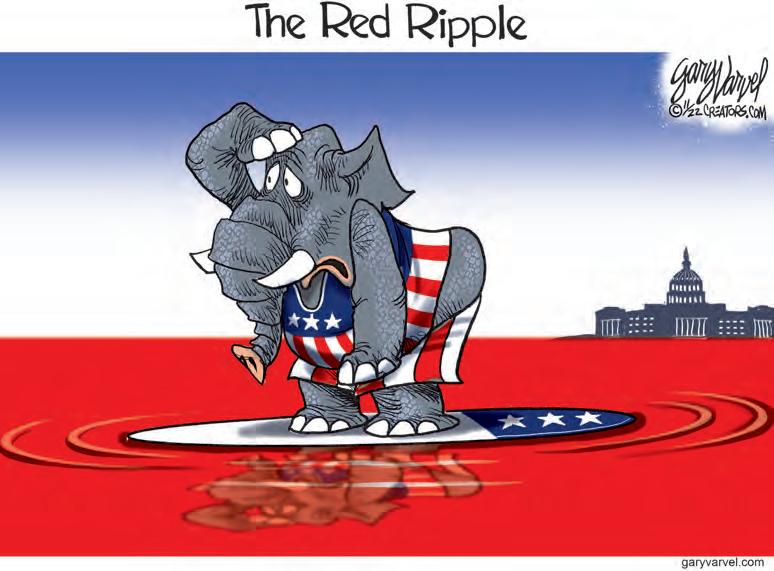
Legislative gridlock does not mean Congress is powerless. The House, our most “democratic” institution, has a duty, as the left incessantly pointed out during the Trump years, of holding the executive branch accountable. That might entail investigating Alejandro Mayorkas for precipitating a border emergency, and Merrick Garland, who has politicized the Justice Department in unprecedented ways, targeting parents as domestic terrorists and ignoring criminal activity against pregnancy centers. Who knows? Washington is a target-rich environment. It is almost surely the case that Democrats will call any inquiries into the executive branch a crime against “democracy,” as well.

Don’t get me wrong; I’m not contending that Republicans are saviors of “democracy,” though slowing the attacks on our institutions, from the Supreme Court to the Electoral College to the filibuster to the First and Second Amendments, is good news. Nor am I arguing that I wouldn’t rather have people who agree with me winning elections. I’m simply saying that people who confuse and conflate the word “democracy” with getting their way all the time are either frauds or fools.
David Harsanyi is a senior editor at The Federalist. Harsanyi is a nationally syndicated columnist and author of five books - the most recent, “Eurotrash: Why America Must Reject the Failed Ideas of a Dying Continent.”
3 Stanly County Journal for Wednesday, November 16, 2022
VISUAL VOICES
The physical and psychological toll carried by our nation’s active-duty and veteran personnel is tremendous and must be addressed in a comprehensive way.
COLUMN | DAVID HARSANYI
SIDELINE REPORT
MLB
Seattle’s Rodríguez, Atlanta’s Harris voted top rookies New York Seattle’s Julio Rodríguez and Atlanta’s Michael Harris II, a pair of 21-yearold center fielders, are baseball’s Rookies of the Year. Rodriguez hit .284 with 28 homers, 75 RBIs and 25 stolen bases in helping the Mariners reach the postseason for the first time since 2001. He won the AL honor by receiving 29 of 30 first-place votes and one second for 148 points from a BBWAA panel. Harris batted .297 with 19 homers, 64 RBIs and 20 steals. He was voted the NL award, getting 22 firsts and eight seconds for 134 points from a different BBWAA panel.
WNBA Fever win WNBA draft lottery, Minnesota to pick 2nd
New York The Indiana Fever earned the first pick in the WNBA draft for the first time in franchise history. The Fever had a 44% chance to get the No. 1 pick after having the worst combined record the past two seasons. The Minnesota Lynx will pick second with the Atlanta Dream having the third pick and the Washington Mystics the fourth. The Lynx had the lowest chance to get the No. 1 pick, but moved up two spots in the draft lottery.
SOCCER
Ronaldo says he’s been ‘betrayed’ by Man United
London Cristiano Ronaldo has blasted Manchester United and manager Erik ten Hag in an incendiary TV interview. The Portugal star says he feels “betrayed” by the club and that senior figures have tried to force him out of Old Trafford. The interview is set to be broadcast this week on Britain’s TalkTV but advance clips were released late Sunday just hours after United’s final game before the World Cup. Ronaldo was left out of the squad for the second match in a row after the club said he had an undisclosed illness although his latest comments will increase speculation that he has played his final game for the club.
FIGURE SKATING
Russian skater Valieva could miss 2026 Olympics over doping Lausanne, Switzerland
Russian figure skater Kamila Valieva faces a potential four-year doping ban which would rule her out of the 2026 Winter Olympics in Milan-Cortina d’Ampezzo, the Court of Arbitration for Sport said Monday. CAS said it had registered an appeal from the World Anti-Doping Agency, which said last week it was taking the case to the Switzerland-based tribunal. WADA argues Russian officials have not made progress in resolving the 16-year-old Valieva’s case nearly a year after she tested positive for a heart medication banned in sports.
Pereira upsets Adesanya to win UFC middleweight title
The Brazilian scored a fifth-round TKO
By Dan Gelston The Associated Press
NEW YORK — Alex Pereira has Israel Adesanya’s number in any combat sport — make it 3-0, and now the Brazilian knock out artist also has his rival’s UFC middleweight championship.
Pereira fought back out from a slow start and rocked Adesanya in the fifth round to score the TKO win and claim the 185-pound championship in the main event of UFC 281 on Saturday night at Madison Square Garden.
The 35-year-old Pereira de feated Adesanya twice — once by knockout — in their old kick boxing days, and the wins got the challenger fast-tracked to a title match after just three UFC fights.
“For everybody that said I couldn’t do five rounds, look at what I did just now,” Pereira said
through an interpreter.
Pereira capped his rapid rise to the title in front of a Garden crowd going wild as he tagged Adesanya with a vicious right that sent the champion into the cage and then socked him with a hook.
Adesanya, the Nigeria-born, New Zealand-raised fighter, slumped against the cage and Pereira went for the finishing blows but referee Marc Goddard stopped the bout at 2:01 in the fifth.
Knocked at times for his me thodical style, the 31-year-old Adesanya (23-2) known as “The Last Stylebender” got the MSG crowd on his side once he clob bered Pereira with a pounding right and then a fast left hand to the face that ended the first round and sent the challenger reeling.
Trying to shake off the beat ing, Pereira stood and beckoned fans to get louder as he waited for the bell to signal the second. He raised his arms again to the sellout crowd of 20,845, only this time in victory.
7:55:9
UFC-record fight time in the octagon for Frankie Edgar, who lost his final match Saturday in his 36th career fight.
Adesanya had been champion since 2019 and his loss snapped his 12-fight win streak at middle weight, only one shy of Anderson Silva’s division record.
Zhang Weili won the 115-belt for a second time and UFC’s first Chinese champion made quick work against Carla Esparza with a rear naked choke submission at 1:05 of the second round.
Zhang (23-3) patted her cham pionship belt after UFC President Dana White wrapped it around her waist inside the octagon. Zhang only successfully defend
Former host Russia frozen out as World Cup begins in Qatar
The invasion of Ukraine has led to the country’s removal from several international sporting events
The Associated Press
FOUR YEARS AFTER Vlad imir Putin hosted the World Cup party, Russia is off the guest list.

While the soccer world focuses on the opening game of the World Cup in Qatar on Sunday, Russia will be playing a friendly game in Uzbekistan.
Russia was kicked out of World Cup qualifying after it invaded Ukraine and now can only play friendlies against the few nations prepared to accept its invitations.
The Russian men’s nation al team’s only game of 2022 so far was a 2-1 win over Kyrgyz stan in September. Russian clubs are barred from the Champions League and the women’s national team was removed from the Euro pean Championship.
Monday marked one year since the last competitive game of the Russian men’s national team, a 1-0 loss at Croatia on a swampy, wa terlogged field. That meant Russia didn’t qualify for the World Cup directly and went into the playoffs. By the time those came around,
Russia had invaded Ukraine. Russia’s scheduled opponent, Poland, refused to travel to Mos cow to play, as did the other teams in the playoff bracket. That raised the prospect of Russia qualifying for the World Cup by default. In le gal battles at the Court of Arbitra tion for Sport, FIFA argued that letting Russia compete could cause more boycotts and “irreparable and chaotic” damage to its tourna ment. CAS let the ban stand.
Games against Iran and Bos
nia-Herzegovina were planned for November but neither is taking place. Instead, Russia is touring two former Soviet nations to play Tajikistan and Uzbekistan.
The planned Iran game would have given Russia the credibility of facing a team which has qualified for the World Cup. Ukraine accus es Russia of using Iranian drones to attack its cities, something Rus sia denies. Ukraine asked FIFA to remove Iran from the tournament, though FIFA has not done so.
ed the championship once during her first championship reign. She beat Jéssica Andrade in 2019 and won a decision against Joanna Jedrzejczyk before she suffered consecutive losses to Rose Nam ajunas.
Back in the title picture, Zhang didn’t disappoint and capped the victory with a cartwheel.
Esparza (20-7) was a two-time champion.

Former UFC lightweight champion Frankie Edgar lost the final bout of his MMA ca reer when he was dropped by Chris Gutierrez at 2:01 of the first round of their fight. The 41-yearold Edgar absorbed a flying knee to the head for a brutal KO loss in his last time in the cage in a ca reer that started in 2005. Gutier rez and Edgar had a long embrace after the spectacular finish in the 135-pound fight that quieted an other packed crowd at MSG.
A Toms River, New Jersey na tive, Edgar finished his career at 24-11-1 overall and 18-11-1 in the UFC.
Edgar entered the night with a UFC-record 7 hours, 55 minutes and 9 seconds of total fight time. His 1,799 significant strikes were second-best, and 73 takedowns were fourth on the career list. He held the lightweight champi onship for nearly two years from 2010 to 2012.
The president of the Russian soccer federation told local media that the game with Iran could be held in Qatar shortly before the World Cup. That could have been seen as a snub to FIFA. No date or venue was ever confirmed before Russia announced the Tajikistan and Uzbekistan games instead.
Putin endorsed plans for a friendly against Bosnia-Herze govina in September, saying that “sport should unite, not divide, people.” That game was postponed indefinitely by the Bosnian soccer federation last month after team captain Edin Džeko and the na tional players’ union opposed the game and expressed support for Ukraine.
Both Russia and Qatar were awarded their World Cups in a 2010 vote overshadowed by allega tions of corruption.
Both nations also faced scruti ny over the working conditions for people involved in World Cup con struction projects, including mi grant workers. Activists accused Russia of unpaid wages, workplace deaths and unsafe conditions, in cluding people being required to work in temperatures far below freezing.
Russian clubs have also seen key players — including Khvicha Kvar atskhelia, now at Napoli — move abroad for no transfer fee under a FIFA ruling that allows them to suspend their contracts during the war.
When the group stage at the World Cup gets going in earnest next Monday, eight Russian clubs will be busy at the Court of Arbi tration for Sport trying to overturn that transfer ruling.
4 Stanly County Journal for Wednesday, November 16, 2022 SPORTS
AP PHOTO
Russian President Vladimir Putin touches the World Cup trophy as FIFA President Gianni Infantino stands beside him during the 2018 World Cup in Moscow.
AP PHOTO
Alex Pereira, front, fights Israel Adesanya during the third round of their middleweight title bout at the UFC 281 on Saturday night in New York. Pereira stopped Adesanya in the fifth round.
South Stanly men’s cross-country team wins 1A state title
something they can say they’ve earned.”
South was led by junior Josha wa Huneycutt, who placed fifth in the individual race with a time of 17:22.81 and earned All-State honors.
NFLPA calls on 6 venues to improve playing surfaces
mediately, but they have also re fused to commit to mandating a change away from slit film in the future at all.
The NFLPA requested that the league no longer allow games to be played on fields with clear visu al abnormalities. He pointed to a preseason game between Chicago and Las Vegas that had “chunks of grass torn up.”
“This is an embarrassment,” he added.
Tretter also called on the league to “clear the excess people and dangerous equipment from the sidelines.”
By Jesse Deal North State Journal
NORWOOD — After falling short to Bishop McGuinness in last year’s state championship, South Stanly men’s cross-coun try team now has the first state title in school history.
“I’m extremely ex cited — our goal was to win it this year,” South Stanly coach Michael Curlee told SCJ.
THE NFL PLAYERS Associ ation is calling on six venues to change their current playing sur faces, saying the turf in those sta diums results in “statistically high er in-game injury rates” involving noncontact and lower-extremity injuries.
NFLPA President JC Tretter said Saturday the league should ban “slit film” playing surfaces that are used in Cincinnati, Detroit, In dianapolis, Minnesota, New Or leans and New York (Jets and Gi ants). Tretter posted his statement on the NFLPA website.
“The NFL and its experts have agreed with this data and ac knowledge that the slit film field is less safe,” Tretter said. “Play er leadership wrote a letter to the NFL this week demanding the im mediate removal of these fields and a ban on them going forward, both in stadiums and for practice fields. The NFL has not only re fused to mandate this change im
“The injuries on slit film are completely avoidable — both the NFL and NFLPA experts agree on the data — and yet the NFL will not protect players from a subpar surface.”
Jeff Miller, the executive vice president of communications, pub lic affairs and policy for the NFL, disputed the NFLPA’s conclusions.
“As the NFLPA knows from the meeting of our Joint Field Surface Safety & Performance Commit tee earlier this month, there was no difference between the num ber of injuries on synthetic surfac es versus grass,” Miller said in an emailed statement.
“While slit film surfaces, one type of synthetic material, have two to three more injuries per year, most of them are ankle sprains — a low-burden injury — whereas slit film also sees a lower rate of few er high-burden ACL injuries com pared to other synthetic fields.”
Miller said joint experts for the league and NFLPA did not rec ommend any changes to surfac es at the committee meeting, but agreed more study is needed.
“It really should be a simple fix,” he said. “Give the players their space to perform. Year after year, the NFL tells us they will look into it; and year after year, nothing ever changes.
“The players are frustrated. We simply want a safer workplace. The NFL has an obligation to provide the safest work environment pos sible. They are not living up to that standard. We play one of the most dangerous sports in the world; it shouldn’t be more dangerous be cause the clubs won’t do anything to remove the simple injury risks on practice and playing surfaces.”
Several players took to social media to back Tretter’s comments.
“Nfl says they care about play er safety yet they can’t put us on a natural surface,” San Francisco 49ers pass rusher Nick Bosa said.
Added Niners tight end George Kittle: “Field conditions impact everyone, from players to fans to coaches and GMs. No one wants to see players sidelined by injury be cause owners choose to save mon ey over a bad field.”
On Nov. 5, the Rowdy Rebel Bulls claimed their NCH SAA 1A men’s title at the Ivey M. Red mon Sports Complex in Kernersville af ter racing their way through the 1A Mid west Region in Octo ber.
There was a threeway tie between South, Cherokee and Christ The King, which all tied with 77 team points after scoring each team’s top five runners.
The tiebreaker, each team’s sixth runner, decided the cham pionship. South’s Eli Thompson placed 60th overall with a time of 19:39.53, besting Cherokee’s Ayden Thompson’s 63rd-place finish (19:45.41) by just six sec onds.
“A lot of times it’s your five runners who win it, but this time it came down to a sixth guy and that sixth guy knew he was ev ery bit as important as those oth er five,” Curlee said. “He made it a point to get in as quick as he could too, so they won it as a team. They’ve accomplished something that nobody else can take away from them, and that’s
Seniors Ranfere Garcia and Davis Wright finished 12th and 13th, respectively, while sopho more Gayvyn Miller (31st place) and Jayden Oliver (42nd place) rounded out South’s top five run ners.
Freshman run ner O’Malley Sali nas, of Andrews High School, was the 1A individual champi on with a finish of 16:43.83.
Curlee mentioned that last year’s sec ond-place finish in Kernersville motivat ed both his team and coaching staff to put in the extra practice needed in order to shoot for the gold — and not just the silver — this time around.
Additionally, six of the seven runners from last year’s roster returned for another crack at the state title. With the thrill of victory setting in, South will now shift its focus to the goal of a state title repeat (and a fifth consec utive Yadkin Valley Conference championship) next fall. Unfor tunately for the Bulls, next sea son’s roster will be without some of its top graduating runners.
“Because the guys have a good work ethic, I still think they’ll be a solid program next year,” Cur lee said. “The ones that are still on the team are a very, very close group, so they care about each other and hold each other ac countable. Towards the end of the year, I didn’t have to coach a whole lot because they actual ly held each other accountable. They knew what they needed to do.”
The NHL and NHL Players’ Association have abandoned plans to hold a World Cup of Hockey in 2024, according to a a joint statement last Friday, calling it not feasible to hold the tournament as they had hoped in February 2024.
Russia-Ukraine war derails World Cup of Hockey plans for ’24
RUSSIA’S WAR IN UKRAINE has derailed plans to hold a World Cup of Hockey this winter.
The NHL and NHL Players’ As sociation on Friday abandoned plans to stage a World Cup in Feb ruary 2024 as they had hoped, say ing in a joint statement “it is not fea sible” in the current environment.
There is uncertainty about what to do with players from Russia since the country’s invasion of Ukraine
earlier this year and the ongoing war there. Some countries did not want Russians to participate, even if under a different name and with out national team uniforms as was done at recent Olympics as a pun ishment for state-sponsored dop ing.
“Disappointment or not, you want peace in the world,” Swedish defenseman Victor Hedman of the Tampa Bay Lightning said. “That’s the bottom line.”
Players want the best in the world to take part — a group that would include a number of Rus sians — and that created an im passe with time running out to pull a World Cup together.
“The conflict in the Ukraine makes it difficult to deal with the Russian issue, and we’ve certain ly heard from some of the partici pating countries or countries who would participate would have ob jections to Russian participation in the World Cup,” Deputy Com missioner Bill Daly said last month. “Obviously (it is) something that’s relevant and we’d take into consid eration in connection with making decisions.”
The league and union said they hope to stage the event in February 2025 and will continue to plan for that. The delay buys the league and players time to figure things out.
The World Cup is a showcase
for hockey in non-Olympic years, but it hasn’t been held since 2016 and the NHL’s participation in the Olympics has also been spotty. The world championships have been re liably held in the meantime but of ten overlap with the NHL playoffs and thus does not include some of the world’s top players. Unlike soccer, which banned Russia from its World Cup because of the country’s invasion of Ukraine, many of hockey’s best players are from there and the impact would be much greater. No Russian partici pation would have meant the likes of Alex Ovechkin, Evgeni Malkin, Andrei Svechnikov, Andrei Vasi levskiy and Nikita Kucherov being
left out.
“You obviously always want to represent your country and to make your Russian fans happy,” Vasilevs kiy, a two-time Stanley Cup-win ning goaltender with Tampa Bay, said recently. “I’m not sure what’s going to happen next. It’s a little complicated now. I mean, I hope we’ll be able to to play there as Team Russia because now we have lots of good, talented young hockey players from Russia. And it’ll be re ally interesting to play together.”
Americans Patrick Kane and Auston Matthews and Canadians Sidney Crosby and Connor Mc David have not gotten to play to gether internationally against all the world’s best since there has not been a World Cup in six years and the NHL did not go to the past two Olympics.

5 Stanly County Journal for Wednesday, November 16, 2022
The NHL and its player hope to hold the event in February 2025
The Associated Press
Cincinnati, Detroit, Indianapolis, Minnesota, New Orleans and New York use “slit film” fields
The Associated Press
The Rebel Bulls also won their conference title for the fourth straight season
“They’ve accomplished something that nobody else can take away from them, and that’s something they can say they’ve earned.”
Michael Curlee, South Stanly cross-country coach
AP PHOTO
Packers linebacker Rashan Gary is carted off the field during a Nov. 6 game in Detroit. Detroit’s Ford Field is among the fields the NFLPA is asking the league to switch to natural turf.
PAUL SANCYA | AP PHOTO
NC legislators: Medicaid expansion efforts pushed to 2023
By Gary D. Robertson The Associated Press
RALEIGH — North Caroli na Republican legislative leaders said following last Tuesday’s elec tion that they’re shuttling the idea of Medicaid expansion to 2023, rather than attempting to negoti ate a bill that could be voted on be fore the General Assembly’s current two-year edition ends in December.

By wide bipartisan margins, the House and Senate approved competing bills months ago that were designed to cover hundreds of thousands of additional low-in come adults through the govern ment’s health insurance program that mostly serves the poor. Re publicans within the two chambers have disagreed over whether addi tional health care access changes should be attached to expansion.
The General Assembly’s chief work session ended in early sum mer, but there was optimism that an agreement could be reached by the end of the year — in particular for a short work session scheduled to start Dec. 13. Democratic Gov. Roy Cooper, a longtime expansion supporter, urged them to act.
But in speaking with report ers at a post-election news confer ence, Senate leader Phil Berger said there are now no plans to take up anything substantive during next month’s work period, or in another three-day meeting that starts next week.
As for expansion, Moore said: “I think we’ll deal with that next year.” The two-year session con cludes Dec. 31. Soon after, the 170 people elected to the General As sembly will begin serving through the end of 2024.
health care law, in which Washing ton pays 90% of the medical costs.
On Tuesday, voters in South Dako ta passed a constitutional amend ment to accept expansion, which means roughly 40,000 people would become eligible for Medic
US border agency leader is being forced out
By Mike Balsamo The Associated Press
WASHINGTON, D.C. — The head of U.S. Customs and Border Protection is being forced out of his job leading the nation’s largest law enforcement agency as agents encounter record numbers of mi grants entering the U.S. from Mex ico, according to two people famil iar with the matter.
Chris Magnus was told to re sign or be fired less than a year af ter he was confirmed as the Biden administration’s choice to lead the agency, according to two people who were briefed on the matter and spoke on condition of anonymity because they were not authorized to speak publicly. He is refusing to step down.
Magnus’s removal is part of a larger shakeup expected at Home land Security as it struggles to man age migrants coming from a wider range of countries, including Ven ezuela, Cuba and Nicaragua. This comes as Republicans are likely to take control of the House in Janu ary and are expected to launch in vestigations into the border.
Migrants were stopped 2.38 mil lion times at the Mexican border in the fiscal year that ended Sept. 30, up 37% from the year before. The annual total surpassed 2 mil lion for the first time in August and is more than twice the highest level during Donald Trump’s presidency, in 2019.

Brandon Judd, the president of the National Border Patrol Council, confirmed that Magnus was being pushed out.
The Los Angeles Times was first to report on the ultimatum. In a statement to the newspaper, Mag nus said he was asked by Homeland Security Secretary Alejandro May
orkas to step down or be fired. He said he wouldn’t step down and de fended his record.
Neither Customs and Border Protection nor the Homeland Secu rity Department responded to re quests for comment. White House press secretary Karine Jean-Pierre said she’d seen the reports but had no comment.
Flows across the border have been extraordinarily high by any measure. The numbers reflect de teriorating economic and political conditions in more countries, the relative strength of the U.S. econ omy and uneven enforcement of asylum restrictions. Trump-era asylum restrictions carry no legal
consequences for crossing the bor der illegally, encouraging repeat at tempts.
The Biden administration agreed with Western hemisphere leaders in June to work together more on hosting migrants who flee their countries. Last month, Mexi co began taking back Venezuelans who entered the U.S. illegally but measures so far have failed to pro duce major change.
“There have always been periods of migrant surges into this country for different reasons, at different times,” Magnus told The Associat ed Press last year. “But I don’t think anybody disputes that the numbers are high right now and that we have
to work as many different strategies as possible to deal with those high numbers.”
Despite decades in law enforce ment, Magnus was an outsider. As the police chief in Tucson, Arizona, he rejected federal grants to collab orate on border security with the agency he now leads and kept a dis tance from Border Patrol leaders in a region where thousands of agents are assigned.
Magnus rankled some rank-andfile agents — and delighted agency critics — with his announcement in May that he was revisiting guide lines for agents to pursue vehicles after a spate of fatal collisions.
In July, Magnus released an in
aid.
Cooper spokesperson Mary Scott Winstead cited the South Da kota vote while criticizing the de lay, which she said makes North Carolina “one of the last states still searching for our compassion and common sense.” The Cooper ad ministration has said North Caroli na is missing out on over $500 mil lion for each month that it fails to implement expansion.
“Waiting until next year is aston ishingly wasteful, irresponsible and cruel, costing us lives and billions of dollars,” Winstead said in an email.

Berger said months ago that the state’s hospitals weren’t will ing to negotiate on reforms to “cer tificate of need” laws — something Senate Republicans considered a necessary element of any agree ment. These laws require regula tory approval before certain medi cal buildings can be constructed or services offered in a region.
The North Carolina Healthcare Association, representing hospi tals and hospital systems, disclosed in September what its leaders con sidered a compromise in those ar eas, but Berger later called the offer “not a serious proposal.” Expansion talks, at least public ones, have qui eted since then.
“I think we’re close on some things. Other things we’re not,” Moore said about negotiations, adding that “a more comprehensive discussion” on the issues will prob ably occur next year.
While Republicans made gains in both the House and Senate in the Nov. 8 election, they barely failed to win enough seats to successful ly override a Cooper veto on their own. While the Senate reached a veto-proof margin for the GOP, Re publicans appeared to be one seat short of a similar threshold in the House.
vestigation that said Border Patrol agents on horseback engaged in “unnecessary use of force” against Haitians at a massive camp in Del Rio, Texas, in September 2021. The investigation also found the agents did not use their reins to whip the Haitians.
The National Border Patrol Council, the agents’ union, has been more muted in its criticism of Magnus than of Mayorkas. But Judd, the union president, said he welcomed Magnus’ departure.
“I think it’s a good thing,” Judd said. “He was just working on pol icies that were just going to incen tivize more criminal activity. The vehicle-pursuit policy, had he im plemented that, all it would have done is increase criminal activity.”
The Senate confirmed Magnus’ nomination in December by a 5047 vote. Another critical Homeland Security agency — Immigration and Customs Enforcement — has been without a Senate-confirmed leader for years.
Magnus, 62, was born and raised in Lansing, Michigan, where he served stints as an emergency dis patcher, paramedic, sheriff’s depu ty and police captain. He was po lice chief in Fargo, North Dakota, and Richmond, California, before he took the job in Tucson in Janu ary 2016.
In Tucson, Magnus created a program to steer people away from drugs, worked with nonprofits helping homeless people and over hauled the department’s use-offorce policy. He openly criticized Trump policies for making mi grants more reluctant to share in formation about crimes with po lice.
Roy Villareal, chief of the Border Patrol’s Tucson sector from early 2019 until late 2020, said he sought an introductory meeting with Mag nus, who was then Tucson’s police chief, but that he never heard back, calling their lack of interaction “a telling sign.”
6 Stanly County Journal for Wednesday, November 16, 2022
“I don’t disagree that waiting un til next year is the right thing to do,” Berger added.
North Carolina is one of about a dozen states that haven’t accept ed the federal government’s Medic aid offer originating from the 2010
PHOTO VIA AP
North Carolina House Speaker Tim Moore, R-Cleveland, left, speaks while Senate Leader Phil Berger, R-Rockingham, listens during a post-election news conference at the Legislative Building in Raleigh.
PHOTO VIA AP
A group of migrants stand next to the border wall as a Border Patrol agent takes a head count in Eagle Pass, Texas, May 21, 2022.
obituaries
Richard Kent Myers II
February 10, 1975 - November 12, 2022
Richard Kent Myers, II, 47, of Norwood, passed away on Saturday, November 12, 2022.
Richie was born February 10, 1975 in Stanly County to Richard Kent Myers and Tina Quinn Myers. He enjoyed listening to music, watching the New York Yankees, and wrestling.
Mr. Myers is survived by his daughters: Nyoka Skye Myers of Norwood, Winter Rayne Myers of Norwood; granddaughter: Jadalyn Lavaeh Sanford; father: Richard Kent Myers (Anne) of Richfield; mother: Tina Quinn Myers of Norwood; brother: Danny Myers (Jennifer) of Albemarle; nephews: Cody Myers, Nathaniel Myers, Jackson Myers, Noah Myers, Joshua Seawell and his companion k-9 Melissa. He was preceded in death by a brother: Joshua Ryan Myers.
Shirley Almond
January 23, 1955 - November 11, 2022
Shirley Almond, 67, of Midland, NC, passed away Friday, November 11, 2022.
Mrs. Almond was born January 23, 1955 in Cabarrus County, NC to the late Harry Lloyd and Atha Kindley. She was an employed with Pruitt Health in Harrisburg, NC. Shirley enjoyed spending time with her family and trips to the mountains and shopping.
Mrs. Almond was preceded in death by her husband, Terry Almond. Shirley is survived by her three daughters, Angela Steele (Ricky) of Concord, NC, Terri Wetter (Gene) of Concord, NC and Sherry Almond (Donnie Morris) of Christiansburg, VA; one sister, Diann Helms of Matthews, NC; nine grandchildren, Brianna Darga, Andrew Darga, Hannah Darga, Jessalyn Long, Avan Morris, Ethen Morris, Zeek Wetter, Elijah Wetter and Wayne Wetter. She also has four great grandchildren, Avery Brooker, Cloude Brooker, Preston Lemon, Hazel-Grace and one more on the way.
Mary Ann Dennis Poplin
January 19, 1935 - November 10, 2022


Mary Ann Dennis Poplin, 87, of Albemarle, passed away Thursday, November 10, 2022 in Atrium Health – Stanly.
Mrs. Poplin was born January 19, 1935 to the late Zackery Dumas Dennis, Sr. and Annie Lee Gardner Dennis. Her life’s work was with Albemarle Oil Company, Wachovia Bank, Folgers Brother Furniture, Salem Carpets, and she retired from Stanly County DSS after moving back to Albemarle in 1976. Her true life’s work and gifts were many and varied. She loved serving others and served on the hospitality committee at Anderson Grove where she was a long-time member. She decorated wedding cakes, baked Christmas treats, made persimmon puddings and carried on Aunt Lydia’s Jack Pie making and her mother’s famous chicken and dumplings. She was a dedicated wife, mother, and friend. She will be greatly missed.
Mary Ann was married to Doyle Thomas Poplin for 70 years on October 18, 2022. The love of her life preceded her in death on November 1, 2022. She is survived by two sons, Jeffrey T. Poplin (Sue) of King, NC and Gregory D. Poplin (Elizabeth) of Carthage, NC; a brother, Zackery D. Dennis, Jr. (Kaye); a sister, Sue Dennis Morgan (Gerald); granddaughter, Meredith Ann Poplin Boyd and two great grandchildren, Wesley Parker Poplin and Callie Baxter Boyd.
Judy Elaine Ritchie
October 4, 1944 - November 9, 2022
Judy Elaine Ritchie, 78, of Graham, NC, passed away Wednesday, November 9, 2022 at Peak Resources - Alamance.
She was born October 4, 1944 in Stanly County, NC to the late Wade Saunders Ritchie and Lillie Pauline Crump Ritchie.
Judy was a graduate of UNCG and received a masters in church music at Southwestern Baptist Theological Seminary. She was the music leader in several churches, serving the Chadbourne Baptist Church, First Baptist Church of Lumberton, First Baptist Church of Graham and Grove Park Baptist Church in Clinton. Judy was a long-time member of the NC Southern Baptist Singers. She served as a journeyman in Brazil with the Southern Baptist Foreign Mission Board and served on the NC WMU.
Judy is survived by her sister, Pat Ritchie Liles of Elon, NC.
Billy A. "Bid" Crump

July 12, 1929 ~ November 13, 2022
Billy A. “Bid” Crump, 93, of Norwood, passed away Sunday morning November 13, 2022 at Trinity Place.
Mr. Crump was born July 12, 1929 to the late William Branch and Louise Bowers Crump. He was preceded in death by his wife Dorothy “Dot” Crump. He was a charter member of Trinity Baptist Church. Bid was a self-employed grading contractor.
He is survived by his daughters Pat Crump Workman and husband Chuck, Ann Crump McElheny and husband Butch, and Jo Crump Hepler and husband Mark, all of Norwood. Also surviving are his sister Betty Hinson and brother, “Dub” Crump. He was papa to Betsy Furr, Laura Lorch, Sarah Summerlin, Katie Parker, Jay McElheny and Will McElheny and great-papa to Madelyn and Emma Furr, Payton Lorch, Jackson and Harrison Dodd, and Holden and Mackenzie Parker. In addition to his wife he was preceded in death by brothers Edgar Crump and Wayne Crump.
The family requests memorials to Hospice of Stanly and the Uwharrie , 960 N. First St., Albemarle, NC 28001.
Lillian Sherertz
September 13, 1942 ~ November 12, 2022
Jane Murrell Pickler,80, passed away peacefully surrounded by her loving family on Saturday, November 12, 2022 at her home.
Jane was born on September 13, 1942 to the late Harry Thomas and Jaunita Beck Murrell. She was grew up and was raised in the First Presbyterian Church in Albemarle. She graduated and obtained her X- ray technician license and worked through North Carolina, from Albemarle, Bladen, Brunswick county, and Marion Memorial in South Carolina.
Jane always had a beautiful yard and home. Her hobbies included gardening, needlework, knitting, crocheting and cooking. Everyone looked forward to a baked dish or handmade item coming from Jane. She always remembered birthdays and anniversaries for her loved ones and friends. Jane was active in her church and community and loved being in the company of her family and friends. She always sent a card or message to her loved ones to let them know they were remembered.
She is survived by her loving husband, Bill Pickler of the home, sons: Lee Pickler Jr. ( Melanie) and Kristopher Pickler (Jennifer); granddaughter: Mary Catherine Pickler and Theresa Anne Pickler; brother : Tommy Murrell (Judy) ; sister in law: Elizabeth Pickler Crisco (Eugene); and numerous nieces and nephews.
Charles Sandifer
September 6, 1938 ~ November 8, 2022
Charles Hunter Sandifer, 84, of Albemarle, passed away Tuesday afternoon, November 8, 2022 at his home.
Charles was born September 6, 1938 in York County, SC to the late John and Lena Petty Sandifer. He served in the Air National Guard and was a horse trainer and farmer. He was loved by all that knew him.
In addition to his parents, he was preceded in death by brothers, Ed, Bob and Jim Sandifer.
He is survived by his loving companion of 40 years, Elaine Moore of the home; brothers, Thomas Sandifer, Wayne Sandifer(Nancy), Frank Sandifer(Brenda) and Randy Sandifer(Carol); sister, Beverly Callahan(Tony); sister in laws, Aggie W. Sandifer, Frances. S. Sandifer and Peggy L. Sandifer; 10 nephews, seven nieces and 38 great nephews and nieces; many great-great nephews and nieces and a host of friends; his precious dog, Myrtle.

Ramelle Smith
January 27, 1953 ~ November 10, 2022
Helen Ramelle Smith, 69, of Stanfield, passed away early Thursday November 10, 2022 surrounded by her loving family.
Mrs. Smith was born on January 27, 1953 in Stanly County to the late Vance Smith and Marie Mullis Smith, who survives. Helen loved her family, especially her grandchildren. She enjoyed gardening, crocheting , and making jewelry in her spare time.
In addition to her father she is preceded in death by her son, RJ Tucker.
In addition to her mother, she is survived by her children: Melissa Tucker and Felicia Outlaw (Gary); siblings: Terral Smith, Anita Burris, Jane Smith, and Dewey Smith; Five grandchildren and five greatgrandchildren.
Lillian Schmidt Sherertz went home to Jesus on November 8, 2022, at age 98.

Lillian was born to Paul and Hermine Doht on December 9, 1923, in Bancroft, Nebraska. She was the third of five children.
After three years she moved to Omaha, Nebraska in search of a new adventure where she met her first husband, Elmer Schmidt at a dance. They soon moved to Rock Island, Illinois where she continued to teach young children. The growing family (Douglas, Susan, and Nancy) moved to Hampton, Iowa where Lillian was kept busy helping to run a self-owned business, raising three children, and being an active member of their Lutheran church community.
In 2004 Lillian married her second love, Jackson “Jack” Sherertz in Matthews, NC. They shared a love of dancing, family, and going on adventures together. Their love for each other, and their family and devoted faith in God blessed them with eight years of marriage.
Lillian was predeceased by her parents, siblings, Elmer Schmidt, Jack Sherertz, and son Douglas Schmidt. Reliable sources tell us that she is jitterbugging with her dance partners in Heaven! She is survived by daughters, Susan Robson (Amelia Island, FL) and Nancy Will (Norwood, NC). She has six grandchildren, and nine great-grandchildren.
Bobby Foreman
November 1, 1953 ~ November 8, 2022
Bobby Wayne Foreman, 69, of Norwood, passed away Tuesday, November 8, 2022 at his home surrounded by his loving family.
Mr. Foreman was born on November 1, 1953 in Stanly County to the late Fred and Dorothy Floyd Foreman. He was a retired welder and a member at Silver Springs Baptist Church. Bobby loved the outdoors. He enjoyed hunting, fishing and farming.
He is survived by his loving wife, Deborah Jones Foreman of the home; son: Bobby W. Foreman Jr. of Kannapolis; daughter: Tiffany Smith (Nick) of Oakboro; step sons: Randall Fortney (Rhonda) of Norwood, and Eric Reitzell of Albemarle; brother: Ed Foreman (Joan) of Norwood; two sisters: Linda Campos of Charlotte, and Lisa Huneycutt (Phil) of Oakboro; and six grandchildren.
7 Stanly County Journal for Wednesday, November 16, 2022
Jane Pickler
December 9, 1923 ~ November 8, 2022
STATE & NATION
Election observers caused few disturbances in North Carolina
By Hannah Schoenbaum The Associated Press
RALEIGH — After widespread worries of unruly election observers led several North Carolina counties to ramp up security at the polls, the State Board of Elections received eight reports involving party-ap pointed observers - one on Election Day and seven during early voting.
Overall, the state board received reports of 21 conduct violations, in volving both observers and cam paigners, during the 2022 general election — 16 during the early vot ing period from Oct. 20 to Nov. 5, and five on Election Day.
The reports included 12 instanc es of alleged voter intimidation, one instance of possible voter inter ference and eight instances of al leged election official intimidation, as categorized by the board. There may be additional incidents that have not yet been reported, said board spokesperson Patrick Gan non.

Campaigners, also referred to in the reports as electioneers, were the most common perpetrators of misconduct on Election Day, ac cording to data obtained by The Associated Press.
“One incident of voter or elec
tion official intimidation is too many, and we will continue to do everything we can to protect voters and election officials,” Gannon told the AP, noting that the vast major ity of voters cast their ballots with out issue.
Karen Brinson Bell, executive director of the state board, told reporters the before Election Day
that all incidents will be reviewed by the board’s investigations divi sion, which will determine wheth er the complaints should be ele vated to law enforcement, a local district attorney or the U.S. De partment of Justice.
Election Day incidents involved an observer in Halifax County who allegedly photographed curb
side voters, and an election work er in Wake County who reported being followed by car from a vot ing site. A campaigner in Ruther ford County allegedly told a voter not to enter a polling site without a photo ID — which is not required to vote in North Carolina — and false ly claimed law enforcement was “ar resting people on site.”
In Rowan County, a campaigner allegedly refused to keep proper dis tance from curbside voters, called the chief judge a derogatory term and grabbed and threw the judge’s cell phone. The same individual re portedly took photos of another election official’s car, then “taunted and threatened her.”
And in Granville County, a cam paigner was cited for “aggressive ly pushing candidates to curbside voters,” leaning into their cars and ignoring voters’ requests to be left alone.
While observers were not in volved in most Election Day inci dents, some were reported during early voting for yelling at voters, re fusing to move out of restricted ar eas, photographing curbside vot ers and standing too close to people while they filled out ballots.

In Columbus County, a male ob server allegedly followed a female poll worker home from an early vot ing site. The case has been referred to local law enforcement.
Former President Donald Trump’s concerns that the 2020 presidential election results fea tured irregularities motivated thou sands of his supporters to register as observers and scrutinize elections
A stunning draw as Democrats hold their own nationally
The Associated Press
WASHINGTON, D.C. — Fac
ing tremendous headwinds and weighty history, Democrats fought Republicans to a stunning midterm draw.
Many Democrats went into election night dreading how bad their losses could be and pon dering how to explain them. By Wednesday, they had quick ly shifted and held on to a voting majority in the Senate, celebrat ing victories in key governors’ rac es, and aware that control of the House was still not declared.
Republicans were left grum bling about “candidate quali ty.” Several candidates refused to concede in races that The Associ ated Press had called for their op ponents.
Democrats had plenty to savor in the morning light. But as they exhaled and Republicans lament ed big gains that didn’t materi alize, there were larger problems that both political parties will need to address -- and soon.
For the Republicans, Donald Trump and his conspiracy-laden politics were exposed anew as a problem, one that this time likely blocked his party from achieving much bigger gains in a nationwide election. Instead of celebrating a red tsunami, Republicans faced a new round of infighting over Trump’s role in the GOP and the red wave that wasn’t.
“Every Republican in Ameri ca this morning is waking up sick to their stomach,” said Republican strategist David Urban, a former Trump adviser. “Live by Trump, die by Trump.”
Given the political and eco nomic climate, it should not have
been difficult for Republicans to make major gains last Tuesday. Polling showed voters were deeply pessimistic about the state of the economy and the direction of the nation. President Biden’s approval ratings were anemic. And history strongly suggested that any par ty holding the White House would bear the brunt of voter discontent.
But in several key races, the candidates backed by Trump stumbled.
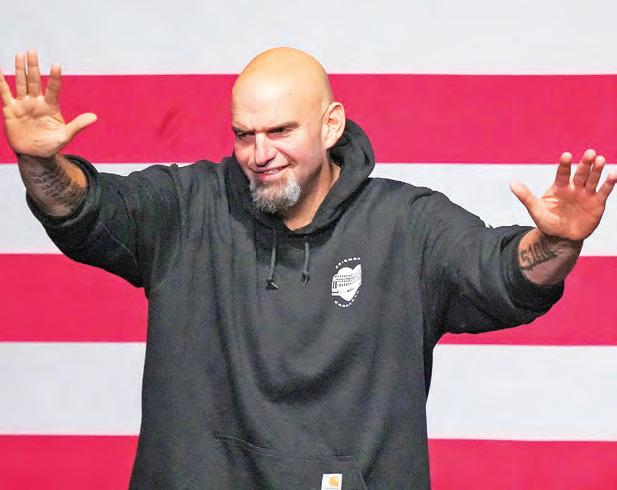
In battleground Pennsylva nia, Democrats won contests for Senate and governor against a pair of Trump loyalists who em braced his lies about the 2020 election. Democrat John Fetter man pushed past concerns about
his health and his progressive pol icies to defeat Mehmet Oz, the ce lebrity TV doctor Trump picked from a crowded Republican pri mary field this spring. Trump de fender Doug Mastriano was head ed toward double-digit defeat in the governor’s race.
Colorado Rep. Lauren Boebert, one of Trump’s loudest cheerlead ers in Congress, was locked in a close race with the final votes still being counted.
It was much the same in Geor gia, where Trump’s hand-picked Senate nominee, former football star Herschel Walker, was run ning essentially tied with Demo cratic Sen. Raphael Warnock even as Republican Gov. Brian Kemp,
whom Trump opposed, cruised to reelection.
“Clearly, we lost races we should have won because Trump picked flawed candidates,” said Republi can strategist Alex Conant. “Geor gia should have been a slam dunk.”
“Trump’s challenge,” Conant added, “is that with every loss, his opposition grows stronger.”
Indeed, as Trump-backed can didates flailed, Florida Gov. Ron DeSantis, a potential 2024 pres idential rival who was not en dorsed by Trump, scored a re sounding victory.
But for Democrats, a couldhave-been-worse election night was not the same as a great one.
With several key races still too early to call, the Republican Par ty may still win control of the House of Representatives for the next two years of Biden’s presiden cy. And with that, the GOP could block the passage of any meaning ful legislation while launching in dependent investigations -- even impeachment proceedings -- with impunity.
And while the Democrats avoided a political wipeout, some of the places they lost exposed deepening cracks in the racial ly diverse working-class coalition that has fueled their victories for years. It may be weeks or months before the exact extent of those cracks is known, but there is little doubt they are there.
Look no further than south Florida’s Miami-Dade County, an overwhelmingly Hispanic former Democratic stronghold that De Santis, a Republican, won as he cruised to reelection. Without Mi ami-Dade, Democrats have little path to future victories in a state that has been a perennial presi
operations nationwide, intensify ing concerns by some that observers might cause disruptions this year. The state board’s Democratic majority voted in August to tighten the rules governing poll observers in response to more than a dozen reported conduct violations during the May primary. But the state’s rules review panel, appointed by the Republican-controlled General As sembly, blocked the new regulations later that month, leaving election officials without additional tools to manage behavior during the gener al election.
Gannon said the state board is unable to compare the numbers of observer-related incidents with those from previous years.
“We have not tracked these in cidents in the past as we have this year, primarily because there has never been such a focus on observ er conduct, nor have we had many reported incidents in the past,” he said.
The board received the few notic es as voters cast ballots at over 2,650 polling places on Election Day and at about 360 early voting sites. It re ports that close to 3.75 million bal lots have been cast in the fall elec tions, or 50.5% of the state’s 7.41 million registered voters. Statewide turnout for the 2018 general elec tion was 53%.

Turnout will creep up slight ly as county boards receive absen tee ballots postmarked by Election Day before upcoming deadlines. These boards also are examining whether provisional ballots should be counted.
dential battleground.
“It’s just a reality. There’s a universe of Latinos and African Americans who are voting Repub lican at a higher level for lots of reasons,” said Democratic pollster John Anzalone, whose clients in clude Biden.
Democrats also lost subur ban voters across New York and Virginia. In other districts, their candidates eked out victories in districts Biden had carried eas ily. They lost Hispanic commu nities across south Texas. And they lost in working-class regions across the Midwest, including Ohio, where moderate Democrat Tim Ryan failed to defeat Trumpbacked Republican JD Vance.
Overall, Democrats struggled to find a clear, compelling mes sage, jumping from abortion to the economy to Social Security and back to abortion.
Even before polls closed, Third Way, a group led by moderate Democrats, issued an ominous warning about the party’s dam aged brand.
“While it might be comforting to blame any midterm losses sole ly on historical trends ... there is a much deeper problem at play,” Third Way wrote in a memo. “Ul timately, there is no way for Dem ocrats to build and maintain win ning coalitions without repairing their damaged brand, even in an era where Republican candidates are increasingly extreme and women’s fundamental rights are on the ballot.”
Despite such concerns, history suggests Democrats should have had a much worse night.
Trump’s GOP lost 40 House seats in the 2018 midterms. For mer President Barack Obama’s party lost 63 in 2010. Going back to 1934, the party that occupies the White House has lost on aver age 28 House seats and four Sen ate seats.
Stanly County Journal for Wednesday, November 16, 2022 8
FILE PHOTO
Voters stand in line waiting for ballot for the North Carolina primary at a library in Raleigh.
AP PHOTO
Pennsylvania Lt. Gov. John Fetterman, Democratic candidate for U.S. Senate, waves to supporters after addressing an election night party in Pittsburgh, Wednesday, Nov. 9, 2022.
Randolph record
Local woman pulls gun on deputies during welfare check
A local woman is facing several charges after the Randolph County Sheriff’s Office reported that she pulled a gun on deputies who were attempting to perform a welfare check at her home last week.
According to a press release from the sheriff’s office, the welfare check was being conducted following reports of a domestic dispute. When the officers arrived, Melisa Ann Herriot opened the door of the residence and pointed a handgun directly at one of the deputies. A patrol supervisor arrived on the scene to de-escalate the situation and perform a welfare check on the children at the residence, who were found safe.
Herriot has been charged with assault by pointing a gun and misuse of 911. She was transported to the Randolph County Detention Center, where the magistrate issued a $50,000 secured bond. Her first appearance in court is set for December 6.
Asheboro VICE Unit makes successful arrest and drug seizure
The Asheboro Police Department’s VICE/ Narcotics Unit made one arrest and seized several grams of Fentanyl and crack cocaine after conducting a search warrant at the beginning of November.
According to a police report from the department, the unit began investigating Anthony Terrell Little for the possible distribution of narcotics in Asheboro.
Detective obtained multiple warrants to search and arrest Little. On November 2, police executed the search warrants, arrested him, and seized approximately 22.2 grams of crack cocaine and 50.4 grams of Fentanyl.
Little has been charged with multiple felony charges, including possession with intent to sell or distribute a controlled substance, trafficking, maintaining a vehicle of dwelling for a controlled substance, and possession with intent to sell or distribute within 1000 feet of a school. He received a $160,000 secured bond with electronic house arrest.
Randolph man charged with trafficking methamphetamines
Bobby Hester Fowler II, 47, of Archdale, is facing multiple felony drug charges after being arrested in Davidson County last week. According to a recent press release, Fowler was found in possession of approximately 39.5 grams of methamphetamine. He has been charged with two counts of felony trafficking in methamphetamine, felony possession of methamphetamine with intent to manufacture, sell, or deliver, felony possession of methamphetamine, misdemeanor possession of marijuana up to half an ounce, misdemeanor maintaining a vehicle, dwelling, or place for a controlled substance, and misdemeanor possession of drug paraphernalia. Fowler was given a $400,000 secured bond and is set to appear in the Davidson County District Courthouse on December 14.
Christmas tree makes stop in Asheboro
A Christmas tree, which was heading to the nation’s Capitol, made a stop last week in Asheboro. The tree was at the North Carolina Zoo. It was part of the tour put together by National Forests in North Carolina and nonprofit partner Choose Outdoors. The tree was transported from Pisgah National Forest, beginning Nov. 5. It’s on the way to the U.S. Capitol building in Washington. The two-week tour’s schedule calls for 14 stops, mostly in North Carolina, with a couple in Virginia. The tree is a 78-foot-tall Red Spruce. Delivery to the West Lawn of the U.S. Capitol building is slated for Friday.

Sidewalks to be constructed on stretches of US 64
Social District to be extended to include additional business
By Ryan Henkel North State Journal
ASHEBORO — The Ashe boro City Council met this past Thursday, where they approved the expansion of the Social Alco hol District and voted on multiple property matters.
The council received a request from Little River, LLC. to extend the Social Alcohol District south to include the property.
After hearing the request, the council authorized the staff to draft a proposal in order to prop erly include the requesting prop erty in the district, essentially ap proving the extension of the Social District boundary south to include 130 Church Street.
“They are an alcohol permit holder, and they were kind of dis
appointed they were not includ ed in the original map of the so cial district,” said Mayor David Smith. “We heard from them right after that map was approved and published, and they wanted to be, but for whatever reason, they were not.”
The Social District was fully in troduced on May 13, and so far, Downtown Asheboro has not re ceived any complaints from it.
“There’s always concern on if we’re having problems with the social district, and to our knowl edge, none have been brought to the attention of Downtown Ashe boro, Inc. as far as since the social district was put in place,” said Al LaPrade of Downtown Asheboro, Inc.
However, Mayor Smith had comments on behaviors that he had been noticing in the district.
“Our social district does not ab solve people of following the alco hol rules in cars,” Smith said. “It’s the damnedest thing I’ve ever seen.
I don’t know if they believe that the social district allows it or what, but I’ve seen them right in front of my building get in their cars with two drinks and drive home with a kid in the back seat in a child seat. You can’t fix stupid.”
The council then held a legisla tive hearing for a rezoning request for property located on the west side of Zoo Parkway and north of Ridge Street.
“It is a request to take the prop erty from a general commercial (B2) district to a general I1 In dustrial district,” said Commu nity Development Director Trev or Nuttall. “The address is 1622 Zoo Parkway. There is one parcel ID involved in the request, it’s just under 1.7 acres, and currently, the property is undeveloped.”
According to Nuttall, the prop erty is within the city limits, and city services are already presently available.
The council also heard from the property owner, Bob Crumley, on
Randolph County election results
By Bob Sutton Randolph Record
RANDOLPH COUNTY Sheriff Greg Seabolt was an overwhelming winner to keep his position.
Seabolt was racking up more than 82 percent (38,813) of the votes compared to Sean Walker (8,320).
In the Randolph County Board of Commissioners race in District 4, Hope Haywood was a huge winner with 81.54 percent of the vote. Kim berly Walker was the opponent.
Commission chairman Darrell Frye and David Allen, who with stood a primary challenge, were unopposed in keeping their posi tions.
The top vote-getter for Randolph County School System’s board of education was Shannon Whita ker (24,131). Three spots were at stake, with Phillip Lanier (21,915) and Fred Burgess (20,157) securing the other two spots. David Carter (18,990) ran fourth, and Kurt Mel vin (5,648) was fifth.
For Randolph County Soil and Water Conservation District Super visor, the winner was Brian Ward. He had 54.13 percent of the vote compared to Carrie Guess-Slato
sky’s 44.86 percent. There were 599 write-in votes recorded.
In Archdale, mayor Lewis Dor sett ran unopposed. For coun cil seats, Kelly Grooms had 1,922 votes compared to Lorie Mabe-Mc Croskey’s 1,566 for an at-large seat. Larry Warlick in Ward 1 and John Glass in Ward 4 were unopposed.
Craven stay in office
Hudson,
U.S. Rep. Richard Hudson will return to Congress in the new 9th Congressional District.
Hudson relied on a strong per formance in Randolph County, earning more than 80% of the vote over Democratic candidate Ben Clark. Overall, Hudson won with 57% of the vote.
For NC House of Representatives in District 54, Democrat Robert Reives, the House Democratic Mi nority Leader, defeated Republican Walter Petty by 22,796 to 18,574.
A pair of freshmen will represent the majority of Randolph County in the NC House of Representatives.
In District 70, the winner was Brian Biggs, who held an over whelming advantage on Susan Lee Scott with 79.17 percent of the vote.
Biggs has been a member of the Randolph County School System’s board of education. He defeated Rep. Pat Hurley in the May 17 pri mary.
In District 78, Republican Neal Jackson had 76.69 percent of the votes to defeat Erik Davis. Jack son succeeds the retiring Allen Mc Neill.
For the NC Senate, it was a com fortable margin with incumbent Dave Craven well ahead of Brooke Crump for District 29. Craven col lected more than 73 percent of the votes.
In the NC Senate District 25 race, which includes a portion of Randolph County, incumbent Amy Scott Galey was a big winner against Sean Ewing. Both those candidates are from Alamance County.
Unopposed North Carolina dis trict court judge winners for Dis trict 19B were Sarah Neely Lani er (Seat 1), Taylor Browne (Seat 2), Darren Allen (Seat 3) and Scott Etheridge (Seat 4).
Other winners were Pam Hill (Randolph County Clerk of Supe rior Court) and Krista Lowe (Ran dolph County Register of Deeds).
the request.
“We had great hopes for this piece of property,” Crumley said. “We spent over $150,000 widen ing Zoo Parkway, we put sleeves for sewer underneath the road, we have three existing DoT curb cuts on this piece of property, and we believed, quite frankly, wrong ly, that businesses would go down Zoo Parkway, and it’s not. We have done everything that we could in the last 14 years, including paying taxes on this property, to get peo ple to come down Zoo Parkway.”
According to Crumley, he’s try ing to figure out a way to get a proper return on investment, and the rezoning request will give him “one more arrow in our quiver to possibly find somebody that will go there.”
Following the hearing, the council approved the rezoning re quest.
The council then approved an agreement with the NCDoT for the city to participate in a cost-reduc tion program for a sidewalk con struction project.
“This project is slated to wid en Highway 64 from approxi mately West Chapel Road to east of the Interstate,” Nuttall said. “It also includes the reconstruc tion of that interstate interchange.
VOLUME 7 ISSUE 38 | WEDNESDAY, NOVEMBER 16, 2022 | RANDOLPHRECORD.COM THE RANDOLPH COUNTY EDITION OF THE NORTH STATE JOURNAL
NEWS
See BOC, page 2 8 5 2017752016 $1.00
COUNTY
PJ WARD-BROWN | NORTH STATE JOURNAL
OPINION
Neal Robbins, publisher | Frank Hill, senior opinion editor
COLUMN | U.S. REP. RICHARD HUDSON
Thank you, Veterans
ONE HUNDRED AND FOUR YEARS AGO, delegates from both Allied and German forces gathered to sign the Armistice of 1918, effectively ending one of the bloodiest conflicts in human history — the First World War. Since then, November 11th has come to be recognized around the world as a day to both remember and honor military veterans for their service.
This Veterans Day, we celebrated the best our nation has to offer –those who have worn our nation’s uniform to keep America safe and defend freedom. We also pay tribute to their families who shared in their service and sacrifice. Without their courage and fortitude, we would not have the liberties we enjoy — and too often take for granted — today. Just last week, millions of Americans exercised their right to vote, one of the treasured liberties that have been preserved by our veterans.
While we can never thank them enough for their service, there are things Congress can do to help improve the lives of our nation’s current and former servicemembers. Improving health care is among my top priorities.
Too many veterans face bureaucratic obstacles at the Department of Veterans Affairs (VA) that hamper their access to care and worsen their health outcomes. On top of this, according to a 2021 study, it is estimated that over 30,000 active-duty personnel and veterans who served in the military since 9/11 have committed suicide. This is four times higher than the number of deaths resulting from military operations.
The physical and psychological toll carried by our nation’s activeduty and veteran personnel is tremendous and must be addressed in a comprehensive way. I am committed to doing this, which is why I helped pass the VA MISSION Act to better improve the quality of health care provided by the VA. Furthermore, I have also introduced
other bipartisan legislation like the Care for the Veteran Caregiver Act and the Care Veterans Deserve Act which will help ensure veterans and their caregivers receive the support they need.
I am also committed to addressing veteran mental health, which is why I have cosponsored measures like the VA Zero Suicide Demonstration Project Act and Vet CENTERS for Mental Health Act, provisions that will help expand mental health services for former servicemembers nationwide.
In addition to improving health care, we must also take steps to properly fund and support our military to ensure it is able to adequality address the evolving nature of modern warfare.
Lastly, we must support our troops and their families by working to improve our nation. This includes increasing government accountability. We must hold oversight over the botched withdrawal from Afghanistan and make sure the federal government respects all Americans’ God-given, constitutionally-confirmed rights. We must improve our nation’s safety by securing our border and combating violent crime and drug trafficking plaguing our communities. Finally, we must strengthen our nation’s economy and pursue common-sense measures to encourage economic growth, job creation, and lower costs.
America’s veterans have given so much in defense of our nation. It is up to us to keep the promises made to them and their families and to build a better nation for all Americans. As Fort Bragg’s Congressman, I remain committed to making this happen.
Richard Hudson is serving his fifth term representing North Carolina’s 8th Congressional District in the U.S. House of Representatives. He currently serves on the Energy and Commerce Committee and in House leadership as the Republican Conference Secretary.
COLUMN | DAVID HARSANYI
Elon Musk is right. Divided government is best
THERE ARE NO SAVIORS or miracles in democracy, only a grueling, soul-sucking, forever war of attrition. That is the enduring lesson of the 2022 midterms, as it is with every election. And, though the results will be overinterpreted by pundits, and partisans will have all their priors confirmed, in the end, it is simply proof that American “democracy” is working.
Overall, it was a disappointing night for Republicans, no doubt, considering the high expectations and the president’s low approval ratings. The GOP looks like it might win the House, which is no small thing. But let’s not forget, we’re all winners when D.C. is mired in gridlock; not only is it the most accurate representation of the national electorate’s mood, but it means the system is working.
Democrats have spent the past few years squeezing every globule of meaning from that word “democracy.” President Joe Biden delivered two historically divisive national prime-time speeches arguing that the only way to save democracy was to implement one-party rule. If our doddering president didn’t look so ridiculous, clenching his fists in front of a blood-red background, one might have found the spectacle semi-fascist. Today, Biden says that the election was a “good day for democracy.” He’s right, but not for the reasons he thinks.
If your version of “democracy” only exists if your party runs every institution, it wasn’t a good day. If you believe “democracy” means exploiting the narrowest of national majorities to lord over all the decisions of states and individuals, it’s going to be a tough couple of years for you. If you want to destroy the legislative filibuster to federalize elections or cram $5 trillion in generational mega “reforms” through Congress without any national consensus or input from half the country, condolences. You won’t be adding fake senators from D.C., in direct contradiction of the Constitution, or “packing the courts” to capsize the judicial system. At least not until 2024, at the earliest.
As Elon Musk recently noted when recommending people vote for Republicans, “shared power curbs the worst excesses of both parties.” (Oh, the hysterics that comment sparked) If it’s not Vladimir Putin or gerrymandering or “voter suppression” or a messaging problem or “misinformation” sinking “democracy,” it’s Elon Musk. No one who believes political discourse needs to be moderated and censored and acts like voters have no agency is a champion of American “democracy.”) Musk is right. Not only is it an excellent
outlook for the independent-minded American, but it has been the reflex of the electorate — a healthy, real democratic inclination. The inability of one party to monopolize power will either compel both to compromise or, in times of deep division, shut down Washington and incentivize governors to take care of their own business — which is how our federalist system was meant to work.
Democrats, should the GOP take the House, will whine that failing to implement their economic statism is tantamount to sabotaging the nation — and “democracy.” Biden will blame the GOP for “obstructionism,” as if the executive branch, rather than the legislature, is charged with writing laws. The media will again lament the dire state of our “dysfunctional” Congress. The Ezra Kleins of the world will lecture us about the need to fix an antiquated system. But, as we learned during the Obama and Trump years, the less Congress meddles in our economic life, the better it is for everyone.
Legislative gridlock does not mean Congress is powerless. The House, our most “democratic” institution, has a duty, as the left incessantly pointed out during the Trump years, of holding the executive branch accountable. That might entail investigating Alejandro Mayorkas for precipitating a border emergency, and Merrick Garland, who has politicized the Justice Department in unprecedented ways, targeting parents as domestic terrorists and ignoring criminal activity against pregnancy centers. Who knows? Washington is a target-rich environment. It is almost surely the case that Democrats will call any inquiries into the executive branch a crime against “democracy,” as well.
Don’t get me wrong; I’m not contending that Republicans are saviors of “democracy,” though slowing the attacks on our institutions, from the Supreme Court to the Electoral College to the filibuster to the First and Second Amendments, is good news. Nor am I arguing that I wouldn’t rather have people who agree with me winning elections. I’m simply saying that people who confuse and conflate the word “democracy” with getting their way all the time are either frauds or fools.
David Harsanyi is a senior editor at The Federalist. Harsanyi is a nationally syndicated columnist and author of five books - the most recent, “Eurotrash: Why America Must Reject the Failed Ideas of a Dying Continent.”
3 Randolph Record for Wednesday, November 16, 2022
VISUAL VOICES
The physical and psychological toll carried by our nation’s active-duty and veteran personnel is tremendous and must be addressed in a comprehensive way.
As we learned during the Obama and Trump years, the less Congress meddles in our economic life, the better it is for everyone.
SIDELINE REPORT
MLB
Seattle’s Rodríguez, Atlanta’s Harris voted top rookies New York Seattle’s Julio Rodríguez and Atlanta’s Michael Harris II, a pair of 21-yearold center fielders, are baseball’s Rookies of the Year. Rodriguez hit .284 with 28 homers, 75 RBIs and 25 stolen bases in helping the Mariners reach the postseason for the first time since 2001. He won the AL honor by receiving 29 of 30 first-place votes and one second for 148 points from a BBWAA panel. Harris batted .297 with 19 homers, 64 RBIs and 20 steals. He was voted the NL award, getting 22 firsts and eight seconds for 134 points from a different BBWAA panel.
WNBA Fever win WNBA draft lottery, Minnesota to pick 2nd
New York The Indiana Fever earned the first pick in the WNBA draft for the first time in franchise history. The Fever had a 44% chance to get the No. 1 pick after having the worst combined record the past two seasons. The Minnesota Lynx will pick second with the Atlanta Dream having the third pick and the Washington Mystics the fourth. The Lynx had the lowest chance to get the No. 1 pick, but moved up two spots in the draft lottery.
SOCCER
Ronaldo says he’s been ‘betrayed’ by Man United
London Cristiano Ronaldo has blasted Manchester United and manager Erik ten Hag in an incendiary TV interview. The Portugal star says he feels “betrayed” by the club and that senior figures have tried to force him out of Old Trafford. The interview is set to be broadcast this week on Britain’s TalkTV but advance clips were released late Sunday just hours after United’s final game before the World Cup. Ronaldo was left out of the squad for the second match in a row after the club said he had an undisclosed illness although his latest comments will increase speculation that he has played his final game for the club.
FIGURE SKATING
Russian skater Valieva could miss 2026 Olympics over doping Lausanne, Switzerland
Russian figure skater Kamila Valieva faces a potential four-year doping ban which would rule her out of the 2026 Winter Olympics in Milan-Cortina d’Ampezzo, the Court of Arbitration for Sport said Monday. CAS said it had registered an appeal from the World Anti-Doping Agency, which said last week it was taking the case to the Switzerland-based tribunal. WADA argues Russian officials have not made progress in resolving the 16-year-old Valieva’s case nearly a year after she tested positive for a heart medication banned in sports.
Pereira upsets Adesanya to win UFC middleweight title
The Brazilian scored a fifth-round TKO
By Dan Gelston The Associated Press
NEW YORK — Alex Pereira has Israel Adesanya’s number in any combat sport — make it 3-0, and now the Brazilian knock out artist also has his rival’s UFC middleweight championship.
Pereira fought back out from a slow start and rocked Adesanya in the fifth round to score the TKO win and claim the 185-pound championship in the main event of UFC 281 on Saturday night at Madison Square Garden.
The 35-year-old Pereira de feated Adesanya twice — once by knockout — in their old kick boxing days, and the wins got the challenger fast-tracked to a title match after just three UFC fights.
“For everybody that said I couldn’t do five rounds, look at what I did just now,” Pereira said
through an interpreter.
Pereira capped his rapid rise to the title in front of a Garden crowd going wild as he tagged Adesanya with a vicious right that sent the champion into the cage and then socked him with a hook.
Adesanya, the Nigeria-born, New Zealand-raised fighter, slumped against the cage and Pereira went for the finishing blows but referee Marc Goddard stopped the bout at 2:01 in the fifth.
Knocked at times for his me thodical style, the 31-year-old Adesanya (23-2) known as “The Last Stylebender” got the MSG crowd on his side once he clob bered Pereira with a pounding right and then a fast left hand to the face that ended the first round and sent the challenger reeling.
Trying to shake off the beat ing, Pereira stood and beckoned fans to get louder as he waited for the bell to signal the second. He raised his arms again to the sellout crowd of 20,845, only this time in victory.
7:55:9
UFC-record fight time in the octagon for Frankie Edgar, who lost his final match Saturday in his 36th career fight.
Adesanya had been champion since 2019 and his loss snapped his 12-fight win streak at middle weight, only one shy of Anderson Silva’s division record.
Zhang Weili won the 115-belt for a second time and UFC’s first Chinese champion made quick work against Carla Esparza with a rear naked choke submission at 1:05 of the second round.
Zhang (23-3) patted her cham pionship belt after UFC President Dana White wrapped it around her waist inside the octagon. Zhang only successfully defend
Former host Russia frozen out as World Cup begins in Qatar
invasion of
The Associated Press
FOUR YEARS AFTER Vlad imir Putin hosted the World Cup party, Russia is off the guest list.
While the soccer world focuses on the opening game of the World Cup in Qatar on Sunday, Russia will be playing a friendly game in Uzbekistan.
Russia was kicked out of World Cup qualifying after it invaded Ukraine and now can only play friendlies against the few nations prepared to accept its invitations.
The Russian men’s nation al team’s only game of 2022 so far was a 2-1 win over Kyrgyz stan in September. Russian clubs are barred from the Champions League and the women’s national team was removed from the Euro pean Championship.
Monday marked one year since the last competitive game of the Russian men’s national team, a 1-0 loss at Croatia on a swampy, wa terlogged field. That meant Russia didn’t qualify for the World Cup directly and went into the playoffs. By the time those came around,
Russia had invaded Ukraine. Russia’s scheduled opponent, Poland, refused to travel to Mos cow to play, as did the other teams in the playoff bracket. That raised the prospect of Russia qualifying for the World Cup by default. In le gal battles at the Court of Arbitra tion for Sport, FIFA argued that letting Russia compete could cause more boycotts and “irreparable and chaotic” damage to its tourna ment. CAS let the ban stand.
Games against Iran and Bos
nia-Herzegovina were planned for November but neither is taking place. Instead, Russia is touring two former Soviet nations to play Tajikistan and Uzbekistan.
The planned Iran game would have given Russia the credibility of facing a team which has qualified for the World Cup. Ukraine accus es Russia of using Iranian drones to attack its cities, something Rus sia denies. Ukraine asked FIFA to remove Iran from the tournament, though FIFA has not done so.
ed the championship once during her first championship reign. She beat Jéssica Andrade in 2019 and won a decision against Joanna Jedrzejczyk before she suffered consecutive losses to Rose Nam ajunas.
Back in the title picture, Zhang didn’t disappoint and capped the victory with a cartwheel.
Esparza (20-7) was a two-time champion.
Former UFC lightweight champion Frankie Edgar lost the final bout of his MMA ca reer when he was dropped by Chris Gutierrez at 2:01 of the first round of their fight. The 41-yearold Edgar absorbed a flying knee to the head for a brutal KO loss in his last time in the cage in a ca reer that started in 2005. Gutier rez and Edgar had a long embrace after the spectacular finish in the 135-pound fight that quieted an other packed crowd at MSG.
A Toms River, New Jersey na tive, Edgar finished his career at 24-11-1 overall and 18-11-1 in the UFC.
Edgar entered the night with a UFC-record 7 hours, 55 minutes and 9 seconds of total fight time. His 1,799 significant strikes were second-best, and 73 takedowns were fourth on the career list. He held the lightweight champi onship for nearly two years from 2010 to 2012.
The president of the Russian soccer federation told local media that the game with Iran could be held in Qatar shortly before the World Cup. That could have been seen as a snub to FIFA. No date or venue was ever confirmed before Russia announced the Tajikistan and Uzbekistan games instead.
Putin endorsed plans for a friendly against Bosnia-Herze govina in September, saying that “sport should unite, not divide, people.” That game was postponed indefinitely by the Bosnian soccer federation last month after team captain Edin Džeko and the na tional players’ union opposed the game and expressed support for Ukraine.
Both Russia and Qatar were awarded their World Cups in a 2010 vote overshadowed by allega tions of corruption.
Both nations also faced scruti ny over the working conditions for people involved in World Cup con struction projects, including mi grant workers. Activists accused Russia of unpaid wages, workplace deaths and unsafe conditions, in cluding people being required to work in temperatures far below freezing.
Russian clubs have also seen key players — including Khvicha Kvar atskhelia, now at Napoli — move abroad for no transfer fee under a FIFA ruling that allows them to suspend their contracts during the war.
When the group stage at the World Cup gets going in earnest next Monday, eight Russian clubs will be busy at the Court of Arbi tration for Sport trying to overturn that transfer ruling.
4 Randolph Record for Wednesday, November 16, 2022
SPORTS
The
Ukraine has led to the country’s removal from several international sporting events
AP PHOTO
Russian President Vladimir Putin touches the World Cup trophy as FIFA President Gianni Infantino stands beside him during the 2018 World Cup in Moscow.
AP PHOTO
Alex Pereira, front, fights Israel Adesanya during the third round of their middleweight title bout at the UFC 281 on Saturday night in New York. Pereira stopped Adesanya in the fifth round.
Blue Comets fall short of state final
ASHEBORO — A sheboro’s fin est season in boys’ soccer didn’t end so splendidly.
The Blue Comets gave a strong effort but fell short of reaching the state championship game, dropping a 2-1 decision to visit ing Hickory in the Class 3-A West Region final Monday night.
“It just wasn’t our day,” Ashe boro coach Nick Arroyo said.

Asheboro (23-2-2) scored first on Daniel Gutierrez Resendez’s goal.
Hickory posted the tying and go-ahead goals late in the first half.
“We had two simple mistakes that just cost us two goals quick in the last two minutes of the first half,” Arroyo said.
Hickory (21-2-3), the reigning West Region champion, will be in the state championship game for the second year in a row. The Red Tornadoes, who held the No. 10 seed in the West Region, will meet either Jacksonville or First Flight.
Arroyo said the Blue Comets, who were the No. 1 seed in the West Region, will miss members of the outgoing senior class. But that doesn’t mean the program won’t excel in the coming seasons.
“We have enough talent that we’re going to grow right back into a solid team again,” Arroyo said.
The boys’ soccer state finals will be held at MacPherson Sta dium, home of NC Fusion in Browns Summit. It’s the first time the boys’ soccer championships have been held in the Greensboro area since the 1980s.
The stadium seats 3,000. Games in the four classifications will be Friday and Saturday.
The Blue Comets won two home games last week to reach the final week of the regular sea son.
In the regional semifinal against fourth-seeded East Lin coln, Asheboro won 1-0 on Guti errez Resendez’s goal in the sec ond half. The result also gave the Blue Comets their third shutout of the postseason.
That game followed a game earlier in the week when Guti errez Resendez, Edwin Perez Vazquez, and Christian Ortiz Benitez all scored goals in a 3-0 victory against No. 25 seed West Iredell.
Zander Cheek
Providence Grove, football
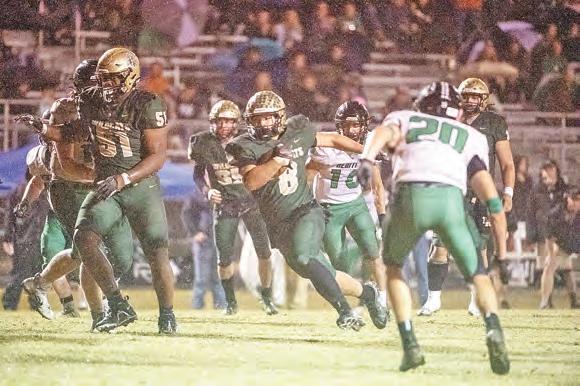
Cheek, a senior, scored four postseason touchdowns in two games for the Patriots.
Providence Grove’s season ended with an 8-4 record with Thursday night’s loss at Reidsville, where Cheek scored a touchdown.
Cheek scored three touchdowns in the previous week when Providence Grove won a football game in the state playoffs for the first time by winning at McMichael.
Cheek led the Patriots with 38.5 receiving yards per game to go with a team-leading four touchdown catches. He scored 13 touchdowns this season, behind only his twin brother Zane Cheek, who had 20.
SWR grad Shiflet named top rookie

GREENSBORO — Southwest ern Randolph graduate Payton Shiflet was named Rookie of the Year for USA South Conference volleyball.
Shiflet is a freshman outside hitter for Greensboro College.

Shiflet became the eighth Greensboro volleyball player to receive USA South Rookie of the Year recognition, though the first since 2012.
Shiflet led all rookies and was second in the conference over all with 3.88 kills and 4.3 points
per set through the regular sea son. She averaged 4.0 kills per set and 4.4 kills per set against USA South competition.
Also, Shiflet was selected for the all-conference first team.
Greensboro finished with a 2013 record. The Pride was 13-5 in USA South.
As voted on by coaches in the league, other major USA South Conference honors went to South ern Virginia’s Courtney Pinkston and Emma Steiger as Player of the Year and Libero of the Year, re spectively. Salem’s Barry Rymer was Coach of the Year.
Wildcats move on; Patriots fade at Reidsville
Randolph Record
RAMSEUR — East ern Randolph began what it hopes is a long journey in the state playoffs with a 28-12 victory against visit ing Mountain Heritage on Thursday night.
The Wildcats (10-1), which received a first-round bye in Class 1-A, received two touchdowns apiece from Er vodd Cassady and Lucas Smith.
Cassady ran for 205 yards.
Next for the Wildcats, who are the top seed in the West Region, is a home game Friday night against eighth-seeded Robbinsville (9-3), which topped No. 24 seed Cherokee 39-12 in the second round for its second win of the season against that foe.
Mountain Heritage ended up 5-7.
Class 2-A
At Reidsville, Providence Grove led late in the first half be fore top-seeded Reidsville took over in a 51-25 second-round game in the West Region.
Andrew Canter threw two touchdown passes for Provi dence Grove (8-4), which a week earlier won a playoff game for the first time by prevailing at McMichael.
Zander Cheek and Chase Whitaker scored on recep tions, and Karson Bowman had a rushing touchdown. Tuck er Batten’s second-quarter field goal gave Providence a 10-7 edge.
Reidsville (11-1) scored the first 15 points of the second half.
It’s the most points allowed by Providence Grove since a 2019 home loss to Randleman.
Reidsville eliminated Randleman last year in the first round.
5 Randolph Record for Wednesday, November 16, 2022
Randolph Record
Randolph Record
BEST OVERALL ATHLETE OF THE WEEK
RANDOLPH RECORD FILE PHOTO
Zander Cheek of Providence Grove made numerous big plays during his prep football career.
COURTESY PHOTO
Payton Shiflet
PJ WARD-BROWN | NORTH STATE JOURNAL
Asheboro’s Christian Ortiz Benitez makes a play on the ball during the state-playoff game vs. East Lincoln.
PJ WARD-BROWN | NORTH STATE JOURNAL
Omar Martinez of Asheboro kicks the ball near the sideline in the Class 3-A game against East Lincoln.
“It just wasn’t our day.”
PREP SOCCER
Asheboro coach Nick Arroyo
PREP FOOTBALL
PJ WARD-BROWN | NORTH STATE JOURNAL
Lucas Smith of Eastern Randolph picks up yards against Mountain Heritage.
NC legislators: Medicaid expansion efforts pushed to 2023
By Gary D. Robertson The Associated Press
RALEIGH — North Caroli
na Republican legislative leaders said following last Tuesday’s elec tion that they’re shuttling the idea of Medicaid expansion to 2023, rather than attempting to negoti ate a bill that could be voted on be fore the General Assembly’s current two-year edition ends in December.
By wide bipartisan margins, the House and Senate approved competing bills months ago that were designed to cover hundreds of thousands of additional low-in come adults through the govern ment’s health insurance program that mostly serves the poor. Re publicans within the two chambers have disagreed over whether addi tional health care access changes should be attached to expansion.
The General Assembly’s chief work session ended in early sum mer, but there was optimism that an agreement could be reached by the end of the year — in particular for a short work session scheduled to start Dec. 13.
Democratic Gov.
them to act.
But in speaking with report ers at a post-election news confer ence, Senate leader Phil Berger said
there are now no plans to take up anything substantive during next month’s work period, or in another three-day meeting that starts next week.
As for expansion, Moore said: “I think we’ll deal with that next year.” The two-year session con cludes Dec. 31. Soon after, the 170 people elected to the General As sembly will begin serving through the end of 2024.

“I don’t disagree that waiting un til next year is the right thing to do,” Berger added.
North Carolina is one of about a dozen states that haven’t accept ed the federal government’s Medic aid offer originating from the 2010 health care law, in which Washing ton pays 90% of the medical costs.
On Tuesday, voters in South Dako ta passed a constitutional amend ment to accept expansion, which means roughly 40,000 people would become eligible for Medic aid.
Cooper spokesperson Mary Scott Winstead cited the South Da kota vote while criticizing the de lay, which she said makes North Carolina “one of the last states still searching for our compassion and common sense.” The Cooper ad ministration has said North Caroli na is missing out on over $500 mil
US border agency leader is being forced out
By Mike Balsamo The Associated Press

WASHINGTON, D.C. — The head of U.S. Customs and Border Protection is being forced out of his job leading the nation’s largest law enforcement agency as agents encounter record numbers of mi grants entering the U.S. from Mex ico, according to two people famil iar with the matter.
Chris Magnus was told to re sign or be fired less than a year af ter he was confirmed as the Biden administration’s choice to lead the agency, according to two people who were briefed on the matter and spoke on condition of anonymity because they were not authorized to speak publicly. He is refusing to step down.
Magnus’s removal is part of a larger shakeup expected at Home land Security as it struggles to man age migrants coming from a wider range of countries, including Ven ezuela, Cuba and Nicaragua. This comes as Republicans are likely to take control of the House in Janu ary and are expected to launch in vestigations into the border.
Migrants were stopped 2.38 mil lion times at the Mexican border in the fiscal year that ended Sept. 30, up 37% from the year before. The annual total surpassed 2 mil lion for the first time in August and is more than twice the highest lev el during Donald Trump’s presiden cy, in 2019.
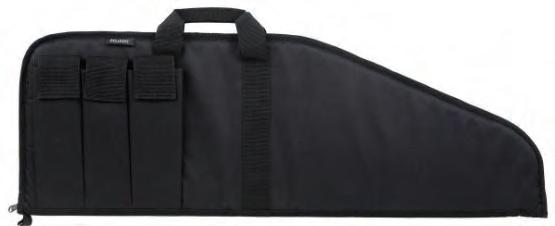




Brandon Judd, the president of the National Border Patrol Council, confirmed that Magnus was being pushed out.

The Los Angeles Times was first to report on the ultimatum. In a

statement to the newspaper, Mag nus said he was asked by Homeland Security Secretary Alejandro May orkas to step down or be fired. He said he wouldn’t step down and de fended his record.
Neither Customs and Border Protection nor the Homeland Secu rity Department responded to re quests for comment. White House press secretary Karine Jean-Pierre said she’d seen the reports but had no comment.


Flows across the border have been extraordinarily high by any measure. The numbers reflect de teriorating economic and political conditions in more countries, the relative strength of the U.S. econ omy and uneven enforcement of asylum restrictions. Trump-era
asylum restrictions carry no legal consequences for crossing the bor der illegally, encouraging repeat at tempts.
The Biden administration agreed with Western hemisphere leaders in June to work together more on hosting migrants who flee their countries. Last month, Mexi co began taking back Venezuelans who entered the U.S. illegally but measures so far have failed to pro duce major change.
“There have always been periods of migrant surges into this coun try for different reasons, at different times,” Magnus told The Associat ed Press last year. “But I don’t think anybody disputes that the numbers are high right now and that we have to work as many different strategies




as possible to deal with those high numbers.”

Despite decades in law enforce ment, Magnus was an outsider. As the police chief in Tucson, Arizona, he rejected federal grants to collab orate on border security with the agency he now leads and kept a dis tance from Border Patrol leaders in a region where thousands of agents are assigned.

Magnus rankled some rank-andfile agents — and delighted agency critics — with his announcement in May that he was revisiting guide lines for agents to pursue vehicles after a spate of fatal collisions.

In July, Magnus released an in vestigation that said Border Patrol agents on horseback engaged in “unnecessary use of force” against
lion for each month that it fails to implement expansion.
“Waiting until next year is aston ishingly wasteful, irresponsible and cruel, costing us lives and billions of dollars,” Winstead said in an email.


Berger said months ago that the state’s hospitals weren’t will ing to negotiate on reforms to “cer tificate of need” laws — something Senate Republicans considered a necessary element of any agree ment. These laws require regula tory approval before certain medi cal buildings can be constructed or services offered in a region.
The North Carolina Healthcare Association, representing hospi tals and hospital systems, disclosed in September what its leaders con sidered a compromise in those ar eas, but Berger later called the offer “not a serious proposal.” Expansion talks, at least public ones, have qui eted since then.
“I think we’re close on some things. Other things we’re not,” Moore said about negotiations, adding that “a more comprehensive discussion” on the issues will prob ably occur next year.
While Republicans made gains in both the House and Senate in the Nov. 8 election, they barely failed to win enough seats to successful ly override a Cooper veto on their own. While the Senate reached a veto-proof margin for the GOP, Re publicans appeared to be one seat short of a similar threshold in the House.
Haitians at a massive camp in Del Rio, Texas, in September 2021. The investigation also found the agents did not use their reins to whip the Haitians.
The National Border Patrol Council, the agents’ union, has been more muted in its criticism of Mag nus than of Mayorkas. But Judd, the union president, said he wel comed Magnus’ departure.
“I think it’s a good thing,” Judd said. “He was just working on pol icies that were just going to incen tivize more criminal activity. The vehicle-pursuit policy, had he im plemented that, all it would have done is increase criminal activity.”
The Senate confirmed Magnus’ nomination in December by a 5047 vote. Another critical Homeland Security agency — Immigration and Customs Enforcement — has been without a Senate-confirmed leader for years.
Magnus, 62, was born and raised in Lansing, Michigan, where he served stints as an emergency dis patcher, paramedic, sheriff’s depu ty and police captain. He was po lice chief in Fargo, North Dakota, and Richmond, California, before he took the job in Tucson in Janu ary 2016.
In Tucson, Magnus created a program to steer people away from drugs, worked with nonprofits helping homeless people and over hauled the department’s use-offorce policy. He openly criticized Trump policies for making mi grants more reluctant to share in formation about crimes with police.
Roy Villareal, chief of the Border Patrol’s Tucson sector from early 2019 until late 2020, said he sought an introductory meeting with Mag nus, who was then Tucson’s police chief, but that he never heard back, calling their lack of interaction “a telling sign.”
6 Randolph Record for Wednesday, November 16, 2022 9796 Aberdeen Rd, Aberdeen Store Hours: Tue - Fri: 11am 4pm www.ProvenOutfitters.com 910.637.0500 Blazer 9mm 115gr, FMJ Brass Cased $299/case or $16/Box Magpul PMAGs 10 for $90 Polish Radom AK-47 $649 Smith & Wesson M&P 2.0 Compact $449 Del-Ton M4 $499 38” Tactical Rifle Case: $20 With Light! Ever wish you had a • The Best Prices on Cases of Ammo? • The best selection of factory standard capacity magazines? • An AWESOME selection of Modern Sporting Weapons from Leading Manufactures Like, Sig, FN, S&W, etc? You Do! • All at better than on line prices? With Full Length Rail! Made in NC! local store which has • Flamethrowers & Gatlin Guns? On Rt 211 just inside Hoke County. With Quantico Tactical
Roy Cooper, a longtime expansion supporter, urged
PHOTO VIA AP
North Carolina House Speaker Tim Moore, R-Cleveland, left, speaks while Senate Leader Phil Berger, R-Rockingham, listens during a post-election news conference at the Legislative Building in Raleigh.
PHOTO VIA AP
A group of migrants stand next to the border wall as a Border Patrol agent takes a head count in Eagle Pass, Texas, May 21, 2022.
obituaries
Cory Bryant Brown
June 10, 1993 — November 11, 2022
Cory Bryant Brown, 29, passed away on November 11, 2022.

Cory was born on June 10, 1993 to Jason and Rosanne Norton Brown. He is preceded in death by his grandmothers, Carol Brown, and Susan Brown, and his greatgrandmother Frances Richardson. Cory was born and raised in Randolph County and graduated from Randleman High School in 2011. Cory was a free-spirited, loving person who lived in the moment, always seeking spontaneous adventures. A kid at heart, he always talked about how much he loved and missed his childhood. He loved to ride his skateboard, play video games and collect Pokémon cards, even as an adult. He loved his family and friends and always knew how to make everyone laugh and created an environment of joy and happiness. He was artistic and loved drawing and music. He had a soft spot for animals and had several pets as a child. He easily connected with any animal he interacted with. He had an amazing imagination that his family will greatly miss. He is survived by his parents, sister Jordan Brown, brother Seth Brown,
Kenneth Gene Ellison, Jr.
July 20, 1981 — November 10, 2022
Kenneth Gene Ellison, Jr., age 41, of Asheboro passed away on Thursday, November 10, 2022.
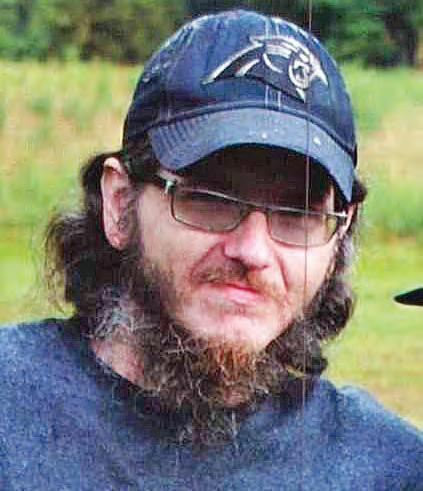
Kenneth was born in Logan County, WV on July 20, 1981 and was previously employed with Asheboro Alarm & Electric. He was preceded in death by his great grandpa, PawPaw Denver Perry, grandma, Judith Perry, step grandma, Naoma Perry, and grandparents, Paul and Myrtle Ellison. Kenneth enjoyed watching Panthers football with his son. He enjoyed fishing, reading, and writing, and has been playing the guitar since he was a teenager. He was a very hard worker and loved his kids more than life. He was a best friend to his little sister Kim and a fun, loving uncle to his niece and nephews. Kenneth always knew how to make everyone laugh. He was loved by his family and will missed greatly.
He is survived by his daughter, Savannah Ellison; son, Chase Ellison; the mother of his children, Amanda Ellison; parents, Kenneth Ellison, Sr. and Sherrie Ellison; sisters, Cheryl Challender (Ryan) and Kimberly Rodgers (John); nieces and nephews, Jeramyah, Chloe, and Xander Ellison, and Elizabeth and baby Eleanor Challender; grandpa, Robert Perry; and aunts and uncles, Jean and Donald Ellison, Mary and Joe Blair, Kathy and James Curry, James and Katrina Perry, Paul Ellison, Jackie and Carol Ellison, Larry and Lisa Ellison, Janice and Cecil Curry, Carla and Brian Hunt, and David Cline.
Ann Barber Gaines
May 12, 1937 — November 11, 2022
Mrs. Ann Gaynell Barber Gaines, age 85, a resident of Washington, NC and former resident of Clinton, NC, died Friday November 11, 2022 at ECU Health Beaufort Campus.
Mrs. Gaines was born in Goldston, NC on May 12, 1937 to the late Ferry Mason Barber, Sr. and Emma Sophronia Bowman. On August 23, 1959 she married Max Reid Gaines, Sr.. She was a member of First Baptist Church in Washington. Mrs. Gaines was strong in her faith, enjoyed cooking, loved spending time with family and friends, and was very patriotic.
Survivors include her husband of 63 years, Max R. Gaines, Sr., three children, Laura Gaines Caldwell and husband Jeff of Williamston, Reid Gaines, Jr. and wife Michele of Clinton, Gaye Gaines Haslam and husband Don of Greensboro, seven grandchildren, Jeffrey Caldwell (Kristen), Trent Caldwell (Shelley), Anderson Caldwell (Alexandra), Taylor Sandlin (Blake), Ashton Brazell, Jacob Haslam, Grace Haslam, three great grandchildren, Roslyn, Sullivan, Corbin, a brother, Donald Barber of Sanford and numerous nieces and nephews.
She is preceded in death by two brothers, Ferry Barber, Jr., Charles Barber, and a sister, Marion Todd.
David Thomas Leviner
January 18, 1941 — November 9, 2022
David Thomas Leviner, 81, of Seagrove, passed away on November 9, 2022 at High Point Regional Hospital.
David was born on January 18, 1941 in Marlboro County, SC to Elbert and Sadie Rainwater Leviner.
In addition to his parents, he was preceded in death by his sisters, Bobbie Jean Jenkins, Zena Byrd and Jeannette Ritch.
He is survived by his wife, Irene Davis Leviner of the home; daughters, Teresa Allred (Roger) of Jackson Springs; Lisa Cagle (David) of Ether; son, Jeff Leviner (Sharon) of Randleman; stepchildren, Todd Moore (Donna) of Eagle Springs; Tammy Wicker (Dennis) of Randleman; and brother, Elbert Leviner of Farmer. Fourteen grandchildren and eleven great grandchildren.
Tilton Parsons
May 16, 1929 — November 9, 2022
Tilton Parsons (93) went home to be with his Lord and Savior in the early morning of November 9th with his wife of 68 years at his side. He was born on May 16, 1929, to Clayton C. and Margaret Sedberry Parsons and was the youngest of eight children who all preceded him in death. Along with his parents and siblings, his oldest son, Dirk, also preceded him in death.
Tilton was a native of Montgomery County. He proudly served in the Korean Conflict in the infantry division where he was awarded The Purple Heart. Following his discharge, he came home to his “best girl.” He chased Jeanette before he left for service and he chased her every day after he came home. As he liked to tell it though, “she finally caught him at a weak moment, and he agreed to marry her.” We all know how the story really went. After his time in the service, he worked for North Carolina’s Department of Transportation until he retired. He also worked with his wife and sons to operate and maintain a nursery primarily focused on azaleas and rhododendrons. For many years, he raised cows and kept a beloved, stinky cow truck whose smell his granddaughters often commented on and did not share in his fondness. Their memories of their papa and that truck will always make them smile.
Left to cherish is memory is his loving wife, Jeanette. Their love has left an indelible mark on everyone who has encountered them, as they were rarely apart. He also leaves behind a devoted son, Dale and (daughter-in-love) Ann who would have gone to the far ends of the globe for him. His granddaughters: Misty (John) Andrews, Chrissy (Dan) Fohr, Leslie Parsons Shoffner, and Anna Parsons all had special bonds with their papa and many stories that usually end in some sort of hysterical laughter.They will all greatly miss “Daddy Rabbit,” as their papa was so fondly nicknamed. Tilton also leaves behind nine great-grand children and three great-great grandchildren. Countless numbers of nieces, nephews, brother and sister in-laws, and a whole host of friends will remember him with stories and laughter. His niece, Janice Morris, brought him so much love, company, and support over the years, and he was always happy to kid with her. It would be remiss not to share Tilton’s love for the Lord. Over the past few years, Tilton attended Long Hill Baptist Church, but his faith story began at Parsons Grove United Methodist Church. Many times, his faith was tested but many more times was God faithful to him.
Jimmy Darrell Tatum
March 21, 1938 — November 6, 2022
Jimmy Darrell Tatum, age 84, of Asheboro passed away on Sunday, November 6, 2022 at the Randolph Hospice House.
Mr. Tatum was born in Randolph County on March 21, 1938 to James Preston and Oppie Jordan Tatum. Jimmy was a 1956 graduate of Asheboro High School where he was an outstanding guard and helped them win 2 back to back state basketball championships. He received a basketball scholarship to play at Elon College. He played semipro basketball with McCrary Eagles and was inducted into the Asheboro High School Sports Hall of Fame. He coached many baseball and basketball teams and touched many lives. Jimmy served his country in the U.S. Army and was Vice President of BB Walker Shoe Company, CEO of Huck Leather Company and was the owner/operator of Jim Tatum Sales. Jimmy was a Godly man and a member of Central United Methodist Church. In addition to his parents, Jimmy was preceded in death by his sisters, Sue Peele and Linda Smith and nephew, Randy Peele. He was a people person and a man of integrity. He loved to play golf and was an avid Duke fan, always wearing a Duke shirt.
He is survived by his wife of 63 years, Wanda Williams Tatum; daughter, LuAnn Bullard (Mike); son, Chris Tatum (Lori); grandson, Kendall Lewis; nephews, Tim Peele (Debbie) and Lewis Ludlum.
Carlene Cox Aldridge
May 28, 1928 — November 6, 2022
Carlene Cox Aldridge, age 94, of Asheboro died Sunday, November 6, 2022 at Harmony in Greensboro. Carlene was a native of Asheboro and lived the majority of her life in her home place at 218 East Salisbury Street. Carlene was preceded in death by her husband of 67 years, Robert Scott "Bob" Aldridge; her parents Carl and Isabelle Cox, and her sister Wila Mae Nobel.
Carlene was a life long member of First United Methodist Church in Asheboro and was a member of the D.W. Holt Sunday School Class for many years. She loved her church. Carlene was a long time member of the Colonel Andrew Balfour Chapter of the Daughters of the American Revolution.
Carlene loved music, especially the old country music, gospel music and hymns of praise. She also loved cats, watching TV game shows to challenge her mind, and collecting glassware and antiques. Most of all, she loved God and her family. Her church and her family were her greatest treasures on Earth. She said her happiest moments in life were marrying her husband Bob, and the births of her children, grandchildren, and great-grandchildren. She expressed that her children were her greatest accomplishments.
Robin Morgan Jones
August 4, 1958 — November 13, 2022
Robin Morgan Jones, 64, of Candor, passed away on November 13, 2022.
Robin was born in Guilford County on August 4, 1958, to James and Margaret McLean Morgan Sr.
She was preceded in death by her brothers Steve Morgan, Lynn Morgan and Jay Morgan.
She is survived by her husband Tony Jones of the home and beloved dog Emmie; brother Tim Morgan of Huntsville, AL; and sister Teresa Williams of Hays, NC.
Carolyn Lemons
August 9, 1946 — November 9, 2022
Carolyn passed away on Wednesday, November 9, 2022, peacefully in her home surrounded by her family.
Carolyn was born on August 9, 1946, in Hobucken, NC to the late Louis and Ferbie Stanton. In addition to her parents, she is preceded in death by her sister, Velma Sadler.
She graduated from Jordan Matthews High School in 1964.
Family was very important to Carolyn. She was a beloved wife, mother, sister, aunt, grandmother, great grandmother, and friend. She married her high school sweetheart, Thomas Edward Lemons, on December 18, 1965. Carolyn and Tommy lived in Apex, NC for 34 years before they returned to Siler City in 2007. Carolyn was a stayat-home mom. Once her children were grown, she worked part time at Fairview Garden Center in Apex for 12 years.
Carolyn had a great love for her family. Everyone was placed first over herself and she cared deeply for others. She was an amazing mother to all her children and had a special bond with her grandchildren and great granddaughter. Carolyn has touched many lives during her 76 years. She will be deeply missed by all.
She is survived by her husband of 56 years, Tommy Lemons; children, Paige Buffaloe and husband James, Amanda Spinks and husband Ron, and Will Lemons; grandchildren, Mason and Reese Buffaloe, Madison Flaugher and husband Hunter, Camden, Riley and Anson Spinks, and Chloe and Carmen Lemons; great grandchild Landrey Flaugher; and sister, Mary Self and husband Dwight.
Carlene is survived by her daughters, Cynthia Dee Aldridge Bennett Perez (Tony) of Columbia SC, Susan Scott Aldridge Dean (John) of Jamestown, NC; grandchildren, Zachary Scott Winslow (Summer) of West Columbia, SC and their children Lincoln and Luke, Tyler Scott Dean (Katelynn) of Stokesdale, NC and their children Ava Grace and Jaxton, Ryan Christopher Dean of the greater Portland, Oregan area, Leigh Bennett Conner (Andrew) of Norcross, GA and their son Duncan, Sara Bennett Wessinger (Scott) of Newberry, SC and their children Donovan, Kaitlyn and Aidan, niece Susan McCrary and her children Suzanne and Walker McCrary; and many other numerous nieces, nephews and extended family members and friends.
December 9, 1933 — November 8, 2022
Leslie Bostic, 88, of Grove City, Ohio, passed away on November 8, 2022.
Mr. Bostic was born in Montgomery County on December 9, 1933, to Dewey and Myrtle McDonald Bostic. Les was a social worker for the Buckeye Ranch in Grove City, Ohio.
In addition to his parents, he was preceded in death by his wife Mina Bostic, brothers, Dewey "Mac" Bostic, Oran Bostic, and Eugene Bostic; and sister Christine Bostic.
He is survived by his son Jeff Bostic (Sandy) of Columbus, Ohio; daughter Lisa Paro (Danny) of Bethesda, Maryland. Grandchildren Lilly, Jenna and McKenzie, and several nieces and nephews.
7 Randolph Record for Wednesday, November 16, 2022
Leslie Bostic
STATE & NATION
Election observers caused few disturbances in North Carolina
By Hannah Schoenbaum The Associated Press
RALEIGH — After widespread worries of unruly election observers led several North Carolina counties to ramp up security at the polls, the State Board of Elections received eight reports involving party-ap pointed observers - one on Election Day and seven during early voting.
Overall, the state board received reports of 21 conduct violations, in volving both observers and cam paigners, during the 2022 general election — 16 during the early vot ing period from Oct. 20 to Nov. 5, and five on Election Day.
The reports included 12 instanc es of alleged voter intimidation, one instance of possible voter inter ference and eight instances of al leged election official intimidation, as categorized by the board. There may be additional incidents that have not yet been reported, said board spokesperson Patrick Gan non.
Campaigners, also referred to in the reports as electioneers, were the most common perpetrators of misconduct on Election Day, ac cording to data obtained by The Associated Press.
“One incident of voter or elec
tion official intimidation is too many, and we will continue to do everything we can to protect voters and election officials,” Gannon told the AP, noting that the vast major ity of voters cast their ballots with out issue.
Karen Brinson Bell, executive director of the state board, told reporters the before Election Day
that all incidents will be reviewed by the board’s investigations divi sion, which will determine wheth er the complaints should be ele vated to law enforcement, a local district attorney or the U.S. De partment of Justice.
Election Day incidents involved an observer in Halifax County who allegedly photographed curb
side voters, and an election work er in Wake County who reported being followed by car from a vot ing site. A campaigner in Ruther ford County allegedly told a voter not to enter a polling site without a photo ID — which is not required to vote in North Carolina — and false ly claimed law enforcement was “ar resting people on site.”
In Rowan County, a campaigner allegedly refused to keep proper dis tance from curbside voters, called the chief judge a derogatory term and grabbed and threw the judge’s cell phone. The same individual re portedly took photos of another election official’s car, then “taunted and threatened her.”
And in Granville County, a cam paigner was cited for “aggressive ly pushing candidates to curbside voters,” leaning into their cars and ignoring voters’ requests to be left alone.
While observers were not in volved in most Election Day inci dents, some were reported during early voting for yelling at voters, re fusing to move out of restricted ar eas, photographing curbside vot ers and standing too close to people while they filled out ballots.
In Columbus County, a male ob server allegedly followed a female poll worker home from an early vot ing site. The case has been referred to local law enforcement.
Former President Donald Trump’s concerns that the 2020 presidential election results fea tured irregularities motivated thou sands of his supporters to register as observers and scrutinize elections
A stunning draw as Democrats hold their own nationally
The Associated Press
WASHINGTON, D.C. — Fac ing tremendous headwinds and weighty history, Democrats fought Republicans to a stunning midterm draw.
Many Democrats went into election night dreading how bad their losses could be and pon dering how to explain them. By Wednesday, they had quick ly shifted and held on to a voting majority in the Senate, celebrat ing victories in key governors’ rac es, and aware that control of the House was still not declared.
Republicans were left grum bling about “candidate quali ty.” Several candidates refused to concede in races that The Associ ated Press had called for their op ponents.
Democrats had plenty to savor in the morning light. But as they exhaled and Republicans lament ed big gains that didn’t materi alize, there were larger problems that both political parties will need to address -- and soon.
For the Republicans, Donald Trump and his conspiracy-laden politics were exposed anew as a problem, one that this time likely blocked his party from achieving much bigger gains in a nationwide election. Instead of celebrating a red tsunami, Republicans faced a new round of infighting over Trump’s role in the GOP and the red wave that wasn’t.
“Every Republican in Ameri ca this morning is waking up sick to their stomach,” said Republican strategist David Urban, a former Trump adviser. “Live by Trump, die by Trump.”
Given the political and eco nomic climate, it should not have
been difficult for Republicans to make major gains last Tuesday. Polling showed voters were deeply pessimistic about the state of the economy and the direction of the nation. President Biden’s approval ratings were anemic. And history strongly suggested that any par ty holding the White House would bear the brunt of voter discontent.
But in several key races, the candidates backed by Trump stumbled.
In battleground Pennsylva nia, Democrats won contests for Senate and governor against a pair of Trump loyalists who em braced his lies about the 2020 election. Democrat John Fetter man pushed past concerns about
his health and his progressive pol icies to defeat Mehmet Oz, the ce lebrity TV doctor Trump picked from a crowded Republican pri mary field this spring. Trump de fender Doug Mastriano was head ed toward double-digit defeat in the governor’s race.
Colorado Rep. Lauren Boebert, one of Trump’s loudest cheerlead ers in Congress, was locked in a close race with the final votes still being counted.
It was much the same in Geor gia, where Trump’s hand-picked Senate nominee, former football star Herschel Walker, was run ning essentially tied with Demo cratic Sen. Raphael Warnock even as Republican Gov. Brian Kemp,
whom Trump opposed, cruised to reelection.
“Clearly, we lost races we should have won because Trump picked flawed candidates,” said Republi can strategist Alex Conant. “Geor gia should have been a slam dunk.”
“Trump’s challenge,” Conant added, “is that with every loss, his opposition grows stronger.”
Indeed, as Trump-backed can didates flailed, Florida Gov. Ron DeSantis, a potential 2024 pres idential rival who was not en dorsed by Trump, scored a re sounding victory.
But for Democrats, a couldhave-been-worse election night was not the same as a great one.
With several key races still too early to call, the Republican Par ty may still win control of the House of Representatives for the next two years of Biden’s presiden cy. And with that, the GOP could block the passage of any meaning ful legislation while launching in dependent investigations -- even impeachment proceedings -- with impunity.
And while the Democrats avoided a political wipeout, some of the places they lost exposed deepening cracks in the racial ly diverse working-class coalition that has fueled their victories for years. It may be weeks or months before the exact extent of those cracks is known, but there is little doubt they are there.
Look no further than south Florida’s Miami-Dade County, an overwhelmingly Hispanic former Democratic stronghold that De Santis, a Republican, won as he cruised to reelection. Without Mi ami-Dade, Democrats have little path to future victories in a state that has been a perennial presi
operations nationwide, intensify ing concerns by some that observers might cause disruptions this year. The state board’s Democratic majority voted in August to tighten the rules governing poll observers in response to more than a dozen reported conduct violations during the May primary. But the state’s rules review panel, appointed by the Republican-controlled General As sembly, blocked the new regulations later that month, leaving election officials without additional tools to manage behavior during the gener al election.
Gannon said the state board is unable to compare the numbers of observer-related incidents with those from previous years.
“We have not tracked these in cidents in the past as we have this year, primarily because there has never been such a focus on observ er conduct, nor have we had many reported incidents in the past,” he said.
The board received the few notic es as voters cast ballots at over 2,650 polling places on Election Day and at about 360 early voting sites. It re ports that close to 3.75 million bal lots have been cast in the fall elec tions, or 50.5% of the state’s 7.41 million registered voters. Statewide turnout for the 2018 general elec tion was 53%.
Turnout will creep up slight ly as county boards receive absen tee ballots postmarked by Election Day before upcoming deadlines. These boards also are examining whether provisional ballots should be counted.
dential battleground.
“It’s just a reality. There’s a universe of Latinos and African Americans who are voting Repub lican at a higher level for lots of reasons,” said Democratic pollster John Anzalone, whose clients in clude Biden.
Democrats also lost subur ban voters across New York and Virginia. In other districts, their candidates eked out victories in districts Biden had carried eas ily. They lost Hispanic commu nities across south Texas. And they lost in working-class regions across the Midwest, including Ohio, where moderate Democrat Tim Ryan failed to defeat Trumpbacked Republican JD Vance.
Overall, Democrats struggled to find a clear, compelling mes sage, jumping from abortion to the economy to Social Security and back to abortion.
Even before polls closed, Third Way, a group led by moderate Democrats, issued an ominous warning about the party’s dam aged brand.
“While it might be comforting to blame any midterm losses sole ly on historical trends ... there is a much deeper problem at play,” Third Way wrote in a memo. “Ul timately, there is no way for Dem ocrats to build and maintain win ning coalitions without repairing their damaged brand, even in an era where Republican candidates are increasingly extreme and women’s fundamental rights are on the ballot.”
Despite such concerns, history suggests Democrats should have had a much worse night.
Trump’s GOP lost 40 House seats in the 2018 midterms. For mer President Barack Obama’s party lost 63 in 2010. Going back to 1934, the party that occupies the White House has lost on aver age 28 House seats and four Sen ate seats.
8 Randolph Record for Wednesday, November 16, 2022
FILE PHOTO
Voters stand in line waiting for ballot for the North Carolina primary at a library in Raleigh.
AP PHOTO
Pennsylvania Lt. Gov. John Fetterman, Democratic candidate for U.S. Senate, waves to supporters after addressing an election night party in Pittsburgh, Wednesday, Nov. 9, 2022.
HOKE COUNTY
WHAT’S HAPPENING
Hometown Christmas event returns to downtown Raeford
Hometown Christmas, an annual event organized by the Raeford-Hoke Chamber of Commerce, will be held Friday, December 2, from 5:30 pm until 8 pm. Local businesses will decorate their stores with lights and decorations and will stay open later for shoppers to come downtown and get a head start on Christmas shopping. There will be activities for children at the Kids’ Corner, hayrides to the Raeford-Hoke Museum, movies, hot chocolate, and a visit from Santa Claus. This year, the Chamber will also allow food trucks on-site. The Raeford-Hoke Chamber of Commerce has opened vendor applications for businesses, nonprofits, and other groups that wish to partake in the event. The deadline for vendor applications is November 25 at 2 pm. For additional information, please call (910) 875-5929, email info@rhchamber. com, or drop by the Chamber at 101 N. Main St. in Raeford.
Christmas Open House at the Mill Prong House
The Board of Directors of Mill Prong, Inc. is set to hold a Christmas Open House event at the Mill Prong House in Red Springs. The event will take place on Sunday, December 4, and will run from 2 pm until 5 pm.
The Mill Prong House, which was built in 1795 by the prominent John Gilchrist, was restored in the late 1980s and is currently awaiting further exterior restoration. The Open House will feature refreshments, music, and a variety of Christmas decorations. The event is open to the public, and families are encouraged to bring their children.
Hoke man shot inside his home
A 51-year-old man was shot inside his home in Hoke County this past weekend, according to a press release from the Hoke County Sheriff’s Office. The incident took place around 11 pm in the 200 block of Peaceford Avenue. When responding officers arrived on the scene, they found the victim had sustained a gunshot wound to his torso. The man was immediately taken to Cape Fear Valley Hospital. At this time, no further information has been provided, and the investigation is still considered ongoing. If you or anyone else you know has additional information regarding this case, please contact Detective Mariscal at (910) 8755111. You can also submit information electronically by visiting www. hokecountysheriff.org and using the anonymous tip form.
Army probes whether troops wrongly targeted in bonus scandal
The Associated Press
WASHINGTON, D.C. — Years after about 1,900 National Guard and Reserve soldiers were swept up in a recruiting bonus scandal, U.S. Army investigators are re viewing the cases and correcting records because some individu als were wrongly blamed and pun ished, Army officials said Thurs day.

The Army’s Criminal Investiga tion Division said it will complete a review of the bulk of the 1,900 soldiers by the end of this year to identify and begin to fix the mis takes. CID said agents during the initial investigation may have mis understood facts or failed to follow proper procedures and erroneous ly added soldiers’ names to an FBI crime database and Pentagon re cords.
Officials said that at the time, CID agents were grappling with a
massive probe involving 100,000 people and hundreds of thousands of dollars in potentially fraudulent bonus payments.
“Simply put, proper procedures were not always followed,” CID Di rector Greg Ford said in a state ment provided to the AP.
Ford said that so far CID has reviewed cases of about 900 in dividuals, and a majority of them require some type of corrective action. He said that up to 200 of those have been completed and corrected, and individuals will be notified. He said “a number” of individuals contacted CID early this year saying they believed they were wrongly listed on the FBI da tabase, and as agents began to re view the files they found problems with the cases. As a result, he said he ordered a review of all cases.
“CID is fully committed to iden tifying and correcting all records to align with the documentation
and evidence present in case file,” Ford told reporters. “CID takes our responsibilities in this area very seriously. And it is clear that we fell short in a large number of these in vestigations. “
The new investigation comes as National Guard Bureau leaders are pushing to launch another re cruiting bonus program, in an at tempt to boost lagging enlistment numbers. And they want to ensure that any new program doesn’t have similar fraud and abuse problems.
Guard leaders have talked about providing incentive pay to recruiters and Guard troops who bring in new recruits. The Army Guard missed its recruiting goal for the fiscal year that ended Sept. 30, and more soldiers were leaving each month than the number en listing.
“By putting the right checks and balances in place, we could real ly help make every single guards
man a recruiter by paying them a bonus for anybody that they bring into the organization that’s able to complete their military training,” Gen. Dan Hokanson, chief of the National Guard Bureau, told re porters in September. He said pro cedures needed to be fixed so that fraud didn’t happen again.
The Army began an audit of the recruiting program in 2011, amid complaints that Guard and Re serve soldiers and recruiters were fraudulently collecting bonuses during the peak years of the Iraq and Afghanistan wars in order to fill the ranks. In the program, which was run by contractors, sol diers were offered $2,000 if they referred someone to recruiters who ended up actually enlisting.
Audits found overpayments, fraud by recruiters and others and poor oversight. The program was
North State Journal
RAEFORD Over 13,000 Hoke County voters casted their ballots in the 2022 general elec tion. That was around 39% of all registered voters after all precincts reported in Hoke County on elec tion night, below the statewide av erage of 51%. Four races featured no opposition in Hoke County, contests for three District Court judge seats and the county’s clerk of court.
North Carolina State Senate District 24
Danny Earl Britt, Jr. – 58.34% (REP)
Darrel (BJ) Gibson, Jr. – 54.41% (DEM)
Danny Britt won with over 58% of the vote in the three-county district. While Gibson won Hoke County by 1,200 votes, Britt pre vailed in both his home of Robe son County and Scotland Coun ty to win another term in Raleigh.
North Carolina House of Representatives District 48 Garland E. Pierce – 56.64% (DEM)
Melissa Swarbrick – 41.66% (REP)
Democratic state Rep. Garland Pierce won another two-year term in Raleigh after defeating Repub lican Melissa Swarbick in the 48th House District race. Many eyes will be on Pierce, who in the past has voted with House Republi cans, to see if he will continue to do the same and give House Speaker Tim Moore (R-Kings Mountain) a 72nd vote on potential veto over
rides.
Hoke County Sheriff
Roderick C. Virgil – 59.49% (DEM)
Stevie Joe – 40.51% (REP)
Roderick Virgil secured a full term as Hoke County Sheriff. He was named sheriff following the death of Hubert Peterkin and de feated the Republican in the race, Stevie Joe.
Hoke County Board of Commissioners
Allen Thomas, Jr. – 19.45% (DEM)
Harry Southerland – 17.81% (DEM)
Tony Hunt – 17.73% (DEM)
David Frump – 15.34% (REP)
Johnny Boyles – 15.04% (REP)
Christopher Holland – 14.63% (REP)
Democrats swept all three county commission races in Hoke County following the Nov. 8 elec tion.
Hoke County Board of Education
Angela G. Southerland – 13.80%
Ruben Castellon – 12.27%
Catherine Blue – 12.19%
Christopher A. Leach – 11.88%
Tonika McGeachy Dunbar –11.49%
Della Maynor – 9.58%
John F. Harry – 9.47%
Tony Cunningham, Sr. – 8.67%
Micheaux Hollingsworth – 7% Deltarina Carr – 3.15%
Republican Ruben Castel lon took one of three seats on the Hoke County Board of Education.
Bus drivers to receive slight pay increase
By Ryan Henkel North State Journal
RAEFORD — The Hoke Coun ty Board of Education met Tues day, November 8, where they voted to approve a pay increase and bo nus pay for certain HCS employees.
The first approval by the board was a $0.25 raise for all HCS bus drivers.
“Hoke County Schools contin ues to experience staffing shortag es with our school bus drivers due to the amount of time required for an employee to obtain their bus li cense, the backlog of our staff being trained, and the state labor short age,” said Financial Officer Wan naa Chavis. “Current bus drivers are taking on additional routes, and routes are being retasked to ensure students are getting to and from school. We also recognize the loyalty of our current bus drivers. We are proposing a $0.25 cents per hour raise for all bus drivers.”
According to Chavis, the cur rent bus driver salary range starts at $15.00 per hour – due to the state-mandated pay increase – and the projected cost of this hourly in crease is $30,000.00 and will be effectively backtracked to October 14, 2022.
“We looked at an amount that we could afford with transporta tion because we have to be able to afford to continue not only paying their hourly rate, we also have to keep our buses on the road,” Chavis
said. “Transportation funding pays for the repair of buses and every thing dealing with transportation. So looking at that and Social Se curity, retirement, hospitalization, that’s the minimum we could prob ably afford at this time.”
Along with that, the board also approved a retention bonus for all applicable HCS employees.
8 5 2017752016 $1.00
VOLUME 7 ISSUE 38 | WEDNESDAY, NOVEMBER 16, 2022 | HOKE.NORTHSTATEJOURNAL.COM | SUBSCRIBE TODAY: 336-283-6305
See SCANDAL page 2 See BOE
page 2
HCS employees to be eligible for end-of-year retention bonus
Hoke County election results
PHOTO VIA AP
The Pentagon is seen from Air Force One as it flies over Washington, March 2, 2022.
WEEKLY CRIME LOG
♦ Burkes, Benjamin Oneal (B/M/54), Trespass - Second Degree, 11/14/2022, Hoke County Sheriff’s Office,
♦ Locklear, Latrell Lee (I/M/27), Resisting Arrest/Hinder & Delay, 11/14/2022, Hoke County Sheriff’s Office,
♦ Goeller, Brandon (W/M/28), DWI, 11/14/2022, Hoke County Sheriff’s Office,
♦ Allen, Marcel Najee (B/M/28), Larceny of a Firearm, Possess Stolen Firearm, 11/13/2022, Hoke County Sheriff’s Office,
♦ Simpson, Timothy Lee (B/M/32), DWI, 11/12/2022, Hoke County Sheriff’s Office,
♦ Williams, Daron Marquise (B/M/31), DWI, 11/10/2022, Hoke County Sheriff’s Office,
♦ Harris, Larry Wilson (W/M/50), Possess Drug Paraphernalia, 11/09/2022, Hoke County Sheriff’s Office,
♦ Chavis, McKyia Daquan (I/M/23), Homicide, 11/09/2022, Hoke County Sheriff’s Office,
♦ Locklear, Lannie Dell (I/M/57), B&E Felony, Poss of Stolen Goods, 11/09/2022, Hoke County Sheriff’s Office, ♦ Ratley, Rontel (B/M/26), Firearm by Felon, 11/09/2022, Hoke County Sheriff’s Office,
canceled in 2012, and Army CID was called in to investigate the cases.

Between 2012 and 2016, CID opened about 900 cases. Altogeth er, officials said, about 286 soldiers received some type of administra tive punishment or action from their military commanders, and more than 130 were prosecuted in civilian courts. Soldiers repaid more than $478,000 to the U.S. Treasury, and paid nearly $60,000 in fines, officials said this week.
The repayments, however, trig gered a backlash from Congress, as soldiers complained that they were being wrongfully targeted. In 2016, Defense Secretary Ash Car ter ordered the Pentagon to sus pend the effort to recoup the en listment bonuses, which in some cases totaled more than $25,000.
Officials argued at the time that many soldiers getting the bonuses weren’t aware the payments were improper or not authorized.
Overall, officials said 1,900 names were added to an FBI crim inal database, and hundreds more
were listed on an internal Defense Department database as someone who was the subject of a criminal investigation. Such listings can hurt a soldier’s career, affect pro motions or — in the case of the FBI data — prevent someone from get ting a job or a gun permit.
Soldiers can request a review of their case, and already dozens have done so. The CID review will de termine if soldiers’ names should be removed from either database, officials said, and the individuals will be notified of the results.
Officials said that each case is different, and it’s not clear how many — if any — could receive any compensation, back pay or oth er retroactive benefits. The entire process could take until spring 2024.
Hokanson said the previous bonus program worked in that it brought in thousands of recruits, and could work again if proper ly done. And he said Guard lead ers around the country would like to try something like it again. No final decision on launching a new bonus program has been made, according to the Guard.
“As we continue to experience staffing shortages associated with the recovery from the COVID-19 pandemic and the state labor shortage, Hoke County would like to recommend a retention bonus for employees,” Chavis said. “While there are many factors that influ ence staff retention, such as work place environment, a sense of ap preciation, and inclusion in the decision-making process, compen sation is a critical factor in the re tention process. Due to staff short ages and vacancies related to the recovery from the COVID-19 pan demic, staff members have as sumed multiple responsibilities and assignments, such as driving multiple routes, providing services at several schools each day, and providing instruction to multiple classes. As a result of the addition al duties used to maintain regular and substantive educational inter action with students, we would like to offer a retention bonus to all of our full-time and part-time perma nent employees.”
According to Chavis, a perma nent full-time and permanent part-time employee, if employed on or before October 1, 2022, and still employed on January 13, 2023, will receive a bonus of $1,200.
If an employee is employed be tween October 3 and November 14 of this year and is still employed on
January 13, 2023, they will receive a stipend of $600.
Temporary employees, such as substitutes, bus monitors, tutors, and retirees, must be employed on January 13, 2023, and work a min imum of 30 days to receive a $600 bonus.
All the amounts will be paid out in January of 2023.
Finally, the board approved the school improvement plans for all 14 schools for the 2022-23 school year.
“In September, we had our school administrators present their school improvement plans,” said Executive Director of Feder al Programs and School Improve ment Dr. Erica Fortenberry. “As we understand, School Improvement Plans are more than just a plan but a framework for change. In their plans, they identified their school destinations, the decision making, and the action that they are going to take along with stakeholders to ensure they improve their academ ic performance.”
According to Fortenberry, all 14 schools outlined three topics they were going to focus on for the up coming school year, and the similar trends among all the schools were Social and Emotional Learning and Safety, Core Instruction and Improving Academic Instruction, and Relationships.
The Hoke County Board of Edu cation will next meet December 13.
2 North State Journal for Wednesday, November 16, 2022
Neal Robbins Publisher Matt Mercer Editor in Chief Griffin Daughtry Local News Editor Cory Lavalette Sports Editor Frank Hill Senior Opinion Editor Lauren Rose Design Editor Published each Wednesday as part of North State Journal 1201 Edwards Mill Rd. Suite 300 Raleigh, NC 27607 TO SUBSCRIBE: 336-283-6305 HOKE.NORTHSTATEJOURNAL.COM Annual Subscription Price: $50.00 Periodicals Postage Paid at Raleigh, N.C. and at additional mailing offices. POSTMASTER: Send address changes to: North State Journal 1201 Edwards Mill Rd. Suite 300 Raleigh, NC 27607 Get in touch www hoke.northstatejournal.com WEDNESDAY 11.16.22 “Join the conversation” WEEKLY FORECAST SCANDAL from page 1 BOE from page 1 9796 Aberdeen Rd, Aberdeen Store Hours: Tue - Fri: 11am 4pm www.ProvenOutfitters.com 910.637.0500 Blazer 9mm 115gr, FMJ Brass Cased $299/case or $16/Box Magpul PMAGs 10 for $90 Polish Radom AK-47 $649 Smith & Wesson M&P 2.0 Compact $449 Del-Ton M4 $499 38” Tactical Rifle Case: $20 With Light! Ever wish you had a • The Best Prices on Cases of Ammo? • The best selection of factory standard capacity magazines? • An AWESOME selection of Modern Sporting Weapons from Leading Manufactures Like, Sig, FN, S&W, etc? You Do! • All at better than on line prices? With Full Length Rail! Made in NC! local store which has • Flamethrowers & Gatlin Guns? On Rt 211 just inside Hoke County. With Quantico Tactical WEDNESDAY NOV 16 HI 5 4° LO 30 PRECIP 9% THURSDAY NOV 17 HI 47 ° LO 24° PRECIP 2% FRIDAY NOV 18 HI 4 8° LO 27° PRECIP 4% SATURDAY NOV 19 HI 4 8° LO 28° PRECIP 4% SUNDAY NOV 20 HI 4 8° LO 24° PRECIP 1 2% MONDAY NOV 21 HI 4 8° LO 24° PRECIP 1% TUESDAY NOV 22 HI 51° LO 26° PRECIP 4%
OPINION
Neal Robbins, publisher | Frank Hill, senior opinion editor
COLUMN | U.S. REP. RICHARD HUDSON
Thank you, Veterans
ONE HUNDRED AND FOUR YEARS ago, delegates from both Allied and German forces gathered to sign the Armistice of 1918, effectively ending one of the bloodiest conflicts in human history — the First World War. Since then, November 11th has come to be recognized around the world as a day to both remember and honor military veterans for their service.
This Veterans Day, we celebrated the best our nation has to offer –those who have worn our nation’s uniform to keep America safe and defend freedom. We also pay tribute to their families who shared in their service and sacrifice. Without their courage and fortitude, we would not have the liberties we enjoy — and too often take for granted — today. Just last week, millions of Americans exercised their right to vote, one of the treasured liberties that have been preserved by our veterans.
While we can never thank them enough for their service, there are things Congress can do to help improve the lives of our nation’s current and former servicemembers. Improving health care is among my top priorities.
Too many veterans face bureaucratic obstacles at the Department of Veterans Affairs (VA) that hamper their access to care and worsen their health outcomes. On top of this, according to a 2021 study, it is estimated that over 30,000 active-duty personnel and veterans who served in the military since 9/11 have committed suicide. This is four times higher than the number of deaths resulting from military operations.
The physical and psychological toll carried by our nation’s activeduty and veteran personnel is tremendous and must be addressed in a comprehensive way. I am committed to doing this, which is why I helped pass the VA MISSION Act to better improve the quality of health care provided by the VA. Furthermore, I have also introduced
other bipartisan legislation like the Care for the Veteran Caregiver Act and the Care Veterans Deserve Act which will help ensure veterans and their caregivers receive the support they need.
I am also committed to addressing veteran mental health, which is why I have cosponsored measures like the VA Zero Suicide Demonstration Project Act and Vet CENTERS for Mental Health Act, provisions that will help expand mental health services for former servicemembers nationwide.
In addition to improving health care, we must also take steps to properly fund and support our military to ensure it is able to adequality address the evolving nature of modern warfare.
Lastly, we must support our troops and their families by working to improve our nation. This includes increasing government accountability. We must hold oversight over the botched withdrawal from Afghanistan and make sure the federal government respects all Americans’ God-given, constitutionally-confirmed rights. We must improve our nation’s safety by securing our border and combating violent crime and drug trafficking plaguing our communities. Finally, we must strengthen our nation’s economy and pursue common-sense measures to encourage economic growth, job creation, and lower costs.
America’s veterans have given so much in defense of our nation. It is up to us to keep the promises made to them and their families and to build a better nation for all Americans. As Fort Bragg’s Congressman, I remain committed to making this happen.
Richard Hudson is serving his fifth term representing North Carolina’s 8th Congressional District in the U.S. House of Representatives. He currently serves on the Energy and Commerce Committee and in House leadership as the Republican Conference Secretary.
Elon Musk is right. Divided government is best
THERE ARE NO SAVIORS or miracles in democracy, only a grueling, soul-sucking, forever war of attrition. That is the enduring lesson of the 2022 midterms, as it is with every election. And, though the results will be overinterpreted by pundits, and partisans will have all their priors confirmed, in the end, it is simply proof that American “democracy” is working.
As we learned during the Obama and Trump years, the less Congress meddles in our economic life, the better it is for everyone.
Overall, it was a disappointing night for Republicans, no doubt, considering the high expectations and the president’s low approval ratings. The GOP looks like it might win the House, which is no small thing. But let’s not forget, we’re all winners when D.C. is mired in gridlock; not only is it the most accurate representation of the national electorate’s mood, but it means the system is working.
Democrats have spent the past few years squeezing every globule of meaning from that word “democracy.” President Joe Biden delivered two historically divisive national prime-time speeches arguing that the only way to save democracy was to implement one-party rule. If our doddering president didn’t look so ridiculous, clenching his fists in front of a blood-red background, one might have found the spectacle semi-fascist. Today, Biden says that the election was a “good day for democracy.” He’s right, but not for the reasons he thinks.
If your version of “democracy” only exists if your party runs every institution, it wasn’t a good day. If you believe “democracy” means exploiting the narrowest of national majorities to lord over all the decisions of states and individuals, it’s going to be a tough couple of years for you. If you want to destroy the legislative filibuster to federalize elections or cram $5 trillion in generational mega “reforms” through Congress without any national consensus or input from half the country, condolences. You won’t be adding fake senators from D.C., in direct contradiction of the Constitution, or “packing the courts” to capsize the judicial system. At least not until 2024, at the earliest.
As Elon Musk recently noted when recommending people vote for Republicans, “shared power curbs the worst excesses of both parties.” (Oh, the hysterics that comment sparked) If it’s not Vladimir Putin or gerrymandering or “voter suppression” or a messaging problem or “misinformation” sinking “democracy,” it’s Elon Musk. No one who believes political discourse needs to be moderated and censored and acts like voters have no agency is a champion of American “democracy.”) Musk is right. Not only is it an excellent outlook for
the independent-minded American, but it has been the reflex of the electorate — a healthy, real democratic inclination. The inability of one party to monopolize power will either compel both to compromise or, in times of deep division, shut down Washington and incentivize governors to take care of their own business — which is how our federalist system was meant to work.
Democrats, should the GOP take the House, will whine that failing to implement their economic statism is tantamount to sabotaging the nation — and “democracy.” Biden will blame the GOP for “obstructionism,” as if the executive branch, rather than the legislature, is charged with writing laws. The media will again lament the dire state of our “dysfunctional” Congress. The Ezra Kleins of the world will lecture us about the need to fix an antiquated system. But, as we learned during the Obama and Trump years, the less Congress meddles in our economic life, the better it is for everyone.
Legislative gridlock does not mean Congress is powerless. The House, our most “democratic” institution, has a duty, as the left incessantly pointed out during the Trump years, of holding the executive branch accountable. That might entail investigating Alejandro Mayorkas for precipitating a border emergency, and Merrick Garland, who has politicized the Justice Department in unprecedented ways, targeting parents as domestic terrorists and ignoring criminal activity against pregnancy centers. Who knows? Washington is a target-rich environment. It is almost surely the case that Democrats will call any inquiries into the executive branch a crime against “democracy,” as well.
Don’t get me wrong; I’m not contending that Republicans are saviors of “democracy,” though slowing the attacks on our institutions, from the Supreme Court to the Electoral College to the filibuster to the First and Second Amendments, is good news. Nor am I arguing that I wouldn’t rather have people who agree with me winning elections. I’m simply saying that people who confuse and conflate the word “democracy” with getting their way all the time are either frauds or fools.
David Harsanyi is a senior editor at The Federalist. Harsanyi is a nationally syndicated columnist and author of five books - the most recent, “Eurotrash: Why America Must Reject the Failed Ideas of a Dying Continent.”
3 North State Journal for Wednesday, November 16, 2022
VISUAL VOICES
The physical and psychological toll carried by our nation’s active-duty and veteran personnel is tremendous and must be addressed in a comprehensive way.
COLUMN | DAVID HARSANYI
SPORTS SIDELINE REPORT
Pereira upsets Adesanya to win UFC middleweight title
MLB


Seattle’s Rodríguez, Atlanta’s Harris voted top rookies New York Seattle’s Julio Rodríguez and Atlanta’s Michael Harris II, a pair of 21-yearold center fielders, are baseball’s Rookies of the Year. Rodriguez hit .284 with 28 homers, 75 RBIs and 25 stolen bases in helping the Mariners reach the postseason for the first time since 2001. He won the AL honor by receiving 29 of 30 first-place votes and one second for 148 points from a BBWAA panel. Harris batted .297 with 19 homers, 64 RBIs and 20 steals. He was voted the NL award, getting 22 firsts and eight seconds for 134 points from a different BBWAA panel.
By Dan Gelston The Associated Press
NEW YORK — Alex Pereira has Israel Adesanya’s number in any combat sport — make it 3-0, and now the Brazilian knockout art ist also has his rival’s UFC middle weight championship.
Pereira fought back out from a slow start and rocked Adesan ya in the fifth round to score the TKO win and claim the 185-pound championship in the main event of UFC 281 on Saturday night at Madison Square Garden.
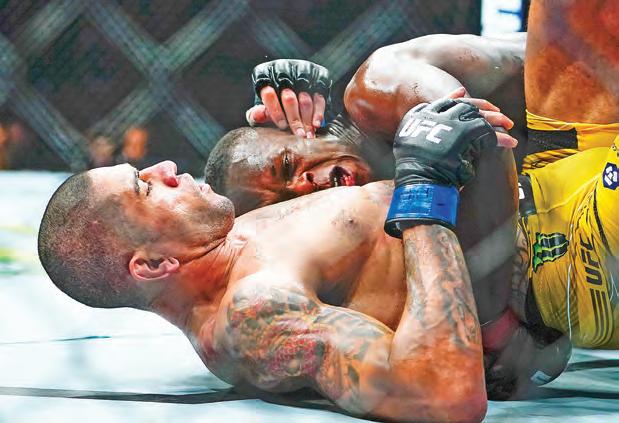
The 35-year-old Pereira de feated Adesanya twice — once by knockout — in their old kickboxing days, and the wins got the challeng er fast-tracked to a title match after just three UFC fights.
“For everybody that said I couldn’t do five rounds, look at what I did just now,” Pereira said through an interpreter.
New York The Indiana Fever earned the first pick in the WNBA draft for the first time in franchise history. The Fever had a 44% chance to get the No. 1 pick after having the worst combined record the past two seasons. The Minnesota Lynx will pick second with the Atlanta Dream having the third pick and the Washington Mystics the fourth. The Lynx had the lowest chance to get the No. 1 pick, but moved up two spots in the draft lottery.
SOCCER
Pereira capped his rapid rise to the title in front of a Garden crowd going wild as he tagged Adesanya with a vicious right that sent the champion into the cage and then socked him with a hook. Adesan ya, the Nigeria-born, New Zea land-raised fighter, slumped
against the cage and Pereira went for the finishing blows but referee Marc Goddard stopped the bout at 2:01 in the fifth.
Knocked at times for his me thodical style, the 31-year-old Ade sanya (23-2) known as “The Last Stylebender” got the MSG crowd on his side once he clobbered Perei ra with a pounding right and then a fast left hand to the face that end ed the first round and sent the chal
lenger reeling. Trying to shake off the beating, Pereira stood and beckoned fans to get louder as he waited for the bell to signal the second. He raised his arms again to the sellout crowd of 20,845, only this time in victory.

Adesanya had been champion since 2019 and his loss snapped his 12-fight win streak at middle weight, only one shy of Anderson Silva’s division record.
Former host Russia frozen out as World Cup begins in Qatar

The Associated Press
London Cristiano Ronaldo has blasted Manchester United and manager Erik ten Hag in an incendiary TV interview. The Portugal star says he feels “betrayed” by the club and that senior figures have tried to force him out of Old Trafford. The interview is set to be broadcast this week on Britain’s TalkTV but advance clips were released late Sunday just hours after United’s final game before the World Cup. Ronaldo was left out of the squad for the second match in a row after the club said he had an undisclosed illness although his latest comments will increase speculation that he has played his final game for the club.
FOUR YEARS AFTER Vlad imir Putin hosted the World Cup party, Russia is off the guest list.
While the soccer world focuses on the opening game of the World Cup in Qatar on Sunday, Russia will be playing a friendly game in Uzbekistan.
Russia was kicked out of World Cup qualifying after it invaded Ukraine and now can only play friendlies against the few nations prepared to accept its invitations.
The Russian men’s nation al team’s only game of 2022 so far was a 2-1 win over Kyrgyz stan in September. Russian clubs are barred from the Champions League and the women’s national team was removed from the Euro pean Championship.
Monday marked one year since the last competitive game of the Russian men’s national team, a 1-0 loss at Croatia on a swampy, wa terlogged field. That meant Russia didn’t qualify for the World Cup directly and went into the playoffs.
By the time those came around, Russia had invaded Ukraine.
Russia’s scheduled opponent,
Poland, refused to travel to Mos cow to play, as did the other teams in the playoff bracket. That raised the prospect of Russia qualifying for the World Cup by default. In le gal battles at the Court of Arbitra tion for Sport, FIFA argued that letting Russia compete could cause more boycotts and “irreparable and chaotic” damage to its tourna ment. CAS let the ban stand.
Games against Iran and Bos
nia-Herzegovina were planned for November but neither is taking place. Instead, Russia is touring two former Soviet nations to play Tajikistan and Uzbekistan.
The planned Iran game would have given Russia the credibility of facing a team which has qualified for the World Cup. Ukraine accus es Russia of using Iranian drones to attack its cities, something Rus sia denies. Ukraine asked FIFA to
Zhang Weili won the 115-belt for a second time and UFC’s first Chi nese champion made quick work against Carla Esparza with a rear naked choke submission at 1:05 of the second round.
Zhang (23-3) patted her cham pionship belt after UFC President Dana White wrapped it around her waist inside the octagon. Zhang only successfully defended the championship once during her first championship reign. She beat Jés sica Andrade in 2019 and won a decision against Joanna Jedrze jczyk before she suffered consecu tive losses to Rose Namajunas.
Back in the title picture, Zhang didn’t disappoint and capped the victory with a cartwheel.
Esparza (20-7) was a two-time champion.
Former UFC lightweight cham pion Frankie Edgar lost the final bout of his MMA career when he was dropped by Chris Gutierrez at 2:01 of the first round of their fight. The 41-year-old Edgar ab sorbed a flying knee to the head for a brutal KO loss in his last time in the cage in a career that started in 2005. Gutierrez and Edgar had a long embrace after the spectacular finish in the 135-pound fight that quieted another packed crowd at MSG.
A Toms River, New Jersey native, Edgar finished his career at 24-11-1 overall and 18-11-1 in the UFC.
Edgar entered the night with a UFC-record 7 hours, 55 minutes and 9 seconds of total fight time. His 1,799 significant strikes were second-best, and 73 takedowns were fourth on the career list. He held the lightweight championship for nearly two years from 2010 to 2012.
remove Iran from the tournament, though FIFA has not done so.
The president of the Russian soccer federation told local media that the game with Iran could be held in Qatar shortly before the World Cup. That could have been seen as a snub to FIFA. No date or venue was ever confirmed before Russia announced the Tajikistan and Uzbekistan games instead.
Putin endorsed plans for a friendly against Bosnia-Herze govina in September, saying that “sport should unite, not divide, people.” That game was postponed indefinitely by the Bosnian soccer federation last month after team captain Edin Džeko and the na tional players’ union opposed the game and expressed support for Ukraine.
Both Russia and Qatar were awarded their World Cups in a 2010 vote overshadowed by allega tions of corruption.
Both nations also faced scruti ny over the working conditions for people involved in World Cup con struction projects, including mi grant workers. Activists accused Russia of unpaid wages, workplace deaths and unsafe conditions, in cluding people being required to work in temperatures far below freezing.
Russian clubs have also seen key players — including Khvicha Kvar atskhelia, now at Napoli — move abroad for no transfer fee under a FIFA ruling that allows them to suspend their contracts during the war.
When the group stage at the World Cup gets going in earnest next Monday, eight Russian clubs will be busy at the Court of Arbi tration for Sport trying to overturn that transfer ruling.
4 North State Journal for Wednesday, November 16, 2022
The invasion of Ukraine has led to the country’s removal from several international sporting events
WNBA Fever win WNBA draft lottery, Minnesota to pick 2nd
Ronaldo says he’s been ‘betrayed’ by Man United
The Brazilian scored a fifth-round TKO
AP PHOTO
Alex Pereira, front, fights Israel Adesanya during the third round of their middleweight title bout at the UFC 281 on Saturday night in New York. Pereira stopped Adesanya in the fifth round.
AP PHOTO
Russian President Vladimir Putin touches the World Cup trophy as FIFA President Gianni Infantino stands beside him during the 2018 World Cup in Moscow.
Family Chiropractic Center 24 Years Serving Hoke/Raeford Chiropractic celebrates 127 YEARS Discovered Sept. 18, 1895 Call 875-2500 for appointment To Get Back in Action 751 S. Main St., Raeford www.raefordchiropractic.com Most insurance led, Medicare & VA Veteran’s Administration covers chiropractic care. Call 910-875-2500 for more info on how.
NC Chiropractic
Chiropractor
based on community service & the
Dr. Tony Santangelo, DC, named
Association
of
the Year,
profression
NFLPA calls on 6 venues to improve playing surfaces
NFL, disputed the NFLPA’s con clusions.
“As the NFLPA knows from the meeting of our Joint Field Surface Safety & Performance Commit tee earlier this month, there was no difference between the num ber of injuries on synthetic surfac es versus grass,” Miller said in an emailed statement.
to “clear the excess people and dangerous equipment from the sidelines.”

“It really should be a simple fix,” he said. “Give the players their space to perform. Year after year, the NFL tells us they will look into it; and year after year, nothing ever changes.
THE NFL PLAYERS Associ ation is calling on six venues to change their current playing sur faces, saying the turf in those sta diums results in “statistically higher in-game injury rates” in volving noncontact and lower-ex tremity injuries.
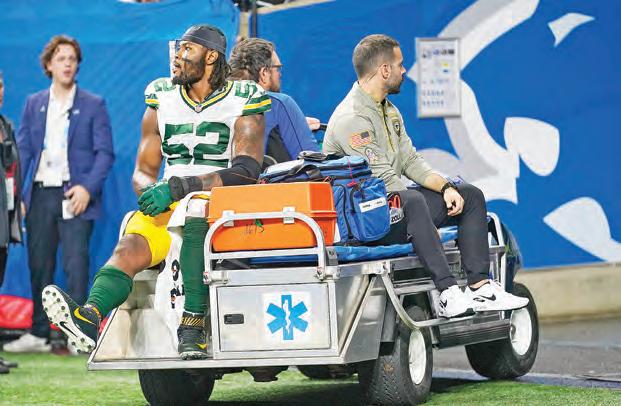
NFLPA President JC Tretter said Saturday the league should ban “slit film” playing surfaces that are used in Cincinnati, De troit, Indianapolis, Minnesota, New Orleans and New York (Jets and Giants). Tretter posted his statement on the NFLPA website.
“The NFL and its experts have agreed with this data and ac knowledge that the slit film field is less safe,” Tretter said. “Play er leadership wrote a letter to the NFL this week demanding the im mediate removal of these fields and a ban on them going forward,
both in stadiums and for practice fields. The NFL has not only re fused to mandate this change im mediately, but they have also re fused to commit to mandating a change away from slit film in the future at all.
“The injuries on slit film are
completely avoidable — both the NFL and NFLPA experts agree on the data — and yet the NFL will not protect players from a subpar surface.”
Jeff Miller, the executive vice president of communications, public affairs and policy for the
“While slit film surfaces, one type of synthetic material, have two to three more injuries per year, most of them are ankle sprains — a low-burden injury — whereas slit film also sees a lower rate of few er high-burden ACL injuries com pared to other synthetic fields.”
Miller said joint experts for the league and NFLPA did not rec ommend any changes to surfac es at the committee meeting, but agreed more study is needed.
The NFLPA requested that the league no longer allow games to be played on fields with clear visu al abnormalities. He pointed to a preseason game between Chicago and Las Vegas that had “chunks of grass torn up.”
“This is an embarrassment,” he added.
Tretter also called on the league
“The players are frustrated. We simply want a safer workplace. The NFL has an obligation to provide the safest work environment possi ble. They are not living up to that standard. We play one of the most dangerous sports in the world; it shouldn’t be more dangerous be cause the clubs won’t do anything to remove the simple injury risks on practice and playing surfaces.”
Several players took to social media to back Tretter’s comments.
“Nfl says they care about play er safety yet they can’t put us on a natural surface,” San Francisco 49ers pass rusher Nick Bosa said.
Added Niners tight end George Kittle: “Field conditions impact everyone, from players to fans to coaches and GMs. No one wants to see players sidelined by inju ry because owners choose to save money over a bad field.”
The NHL and NHL Players’ Association have abandoned plans to hold a World Cup of Hockey in 2024, according to a a joint statement last Friday, calling it not feasible to hold the tournament as they had hoped in February 2024.
Russia-Ukraine war derails World Cup of Hockey plans for ’24
sia since the country’s invasion of Ukraine earlier this year and the ongoing war there. Some coun tries did not want Russians to participate, even if under a dif ferent name and without nation al team uniforms as was done at recent Olympics as a punishment for state-sponsored doping.
RUSSIA’S WAR IN UKRAINE has derailed plans to hold a World Cup of Hockey this winter.
The NHL and NHL Players’ Association on Friday abandoned plans to stage a World Cup in Feb ruary 2024 as they had hoped, saying in a joint statement “it is not feasible” in the current envi ronment.
There is uncertainty about what to do with players from Rus
“Disappointment or not, you want peace in the world,” Swed ish defenseman Victor Hedman of the Tampa Bay Lightning said. “That’s the bottom line.”
Players want the best in the world to take part — a group that would include a number of Rus sians — and that created an im passe with time running out to pull a World Cup together.
“The conflict in the Ukraine makes it difficult to deal with the Russian issue, and we’ve certain ly heard from some of the partici pating countries or countries who would participate would have ob jections to Russian participa tion in the World Cup,” Deputy Commissioner Bill Daly said last month. “Obviously (it is) some thing that’s relevant and we’d take into consideration in connection with making decisions.”
The league and union said they hope to stage the event in Febru ary 2025 and will continue to plan for that. The delay buys the league and players time to figure things out.
The World Cup is a showcase

for hockey in non-Olympic years, but it hasn’t been held since 2016 and the NHL’s participation in the Olympics has also been spot ty. The world championships have been reliably held in the mean time but often overlap with the NHL playoffs and thus does not include some of the world’s top players.
Unlike soccer, which banned Russia from its World Cup be cause of the country’s invasion of Ukraine, many of hockey’s best players are from there and the im pact would be much greater. No Russian participation would have meant the likes of Alex Ovechkin, Evgeni Malkin, Andrei Svech nikov, Andrei Vasilevskiy and Ni
kita Kucherov being left out.
“You obviously always want to represent your country and to make your Russian fans hap py,” Vasilevskiy, a two-time Stan ley Cup-winning goaltender with Tampa Bay, said recently. “I’m not sure what’s going to happen next. It’s a little complicated now. I mean, I hope we’ll be able to to play there as Team Russia because now we have lots of good, talented young hockey players from Rus sia. And it’ll be really interesting to play together.”
Americans Patrick Kane and Auston Matthews and Canadians Sidney Crosby and Connor McDa vid have not gotten to play togeth er internationally against all the world’s best since there has not been a World Cup in six years and the NHL did not go to the past two Olympics.
5 North State Journal for Wednesday, November 16, 2022 LIFE’S GREATEST ADVENTURE! 143 AIRPORT DR. Raeford, NC 28376 Call Us: 910.904.0000 INFO@SKYDIVEPARACLETEXP.COM WWW.FLYXP.COM
The NHL and its player hope to hold the event in February 2025
The Associated Press
Cincinnati, Detroit, Indianapolis, Minnesota, New Orleans and New York use “slit film” fields
The Associated Press
PAUL SANCYA | AP PHOTO
Packers linebacker Rashan Gary is carted off the field during a Nov. 6 game in Detroit. Detroit’s Ford Field is among the fields the NFLPA is asking the league to switch to natural turf.
AP PHOTO
NC legislators: Medicaid expansion efforts pushed to 2023
By Gary D. Robertson The Associated Press
RALEIGH — North Caroli
na Republican legislative lead ers said following last Tuesday’s election that they’re shuttling the idea of Medicaid expansion to 2023, rather than attempting to negotiate a bill that could be voted on before the General As sembly’s current two-year edi tion ends in December.
By wide bipartisan margins, the House and Senate approved competing bills months ago that were designed to cover hun dreds of thousands of addition al low-income adults through the government’s health insur ance program that mostly serves the poor. Republicans within the two chambers have disagreed over whether additional health care access changes should be attached to expansion.
The General Assembly’s chief work session ended in early sum mer, but there was optimism that an agreement could be reached by the end of the year — in par ticular for a short work session scheduled to start Dec. 13. Dem
ocratic Gov. Roy Cooper, a long time expansion supporter, urged them to act.
But in speaking with report ers at a post-election news con ference, Senate leader Phil Berg
er said there are now no plans to take up anything substan tive during next month’s work period, or in another three-day meeting that starts next week.
As for expansion, Moore said:
“I think we’ll deal with that next year.” The two-year session con cludes Dec. 31. Soon after, the 170 people elected to the Gener al Assembly will begin serving through the end of 2024.
“I don’t disagree that waiting until next year is the right thing to do,” Berger added.
North Carolina is one of about a dozen states that haven’t ac cepted the federal government’s Medicaid offer originating from the 2010 health care law, in which Washington pays 90% of the medical costs. On Tuesday, voters in South Dakota passed a constitutional amendment to accept expansion, which means roughly 40,000 people would become eligible for Medicaid.
Cooper spokesperson Mary Scott Winstead cited the South Dakota vote while criticizing the delay, which she said makes North Carolina “one of the last states still searching for our compassion and common sense.”
The Cooper administration has said North Carolina is miss ing out on over $500 million for each month that it fails to imple ment expansion.
US border agency leader is being forced out
By Mike Balsamo The Associated Press
WASHINGTON, D.C. — The head of U.S. Customs and Border Protection is being forced out of his job leading the nation’s largest law enforcement agency as agents encounter record numbers of mi grants entering the U.S. from Mex ico, according to two people famil iar with the matter.
Chris Magnus was told to re sign or be fired less than a year af ter he was confirmed as the Biden administration’s choice to lead the agency, according to two people who were briefed on the matter and spoke on condition of anonymity because they were not authorized to speak publicly. He is refusing to step down.
Magnus’s removal is part of a larger shakeup expected at Home land Security as it struggles to man age migrants coming from a wider range of countries, including Ven ezuela, Cuba and Nicaragua. This comes as Republicans are likely to take control of the House in Janu ary and are expected to launch in vestigations into the border.
Migrants were stopped 2.38 mil lion times at the Mexican border in the fiscal year that ended Sept. 30, up 37% from the year before. The annual total surpassed 2 mil lion for the first time in August and is more than twice the highest level during Donald Trump’s presidency, in 2019.
Brandon Judd, the president of the National Border Patrol Council, confirmed that Magnus was being pushed out.
The Los Angeles Times was first to report on the ultimatum. In a statement to the newspaper, Mag nus said he was asked by Homeland Security Secretary Alejandro May
orkas to step down or be fired. He said he wouldn’t step down and de fended his record.
Neither Customs and Border Protection nor the Homeland Secu rity Department responded to re quests for comment. White House press secretary Karine Jean-Pierre said she’d seen the reports but had no comment.
Flows across the border have been extraordinarily high by any measure. The numbers reflect de teriorating economic and political conditions in more countries, the relative strength of the U.S. econ omy and uneven enforcement of asylum restrictions. Trump-era asylum restrictions carry no legal
consequences for crossing the bor der illegally, encouraging repeat at tempts.
The Biden administration agreed with Western hemisphere leaders in June to work together more on hosting migrants who flee their countries. Last month, Mexi co began taking back Venezuelans who entered the U.S. illegally but measures so far have failed to pro duce major change.
“There have always been periods of migrant surges into this country for different reasons, at different times,” Magnus told The Associat ed Press last year. “But I don’t think anybody disputes that the numbers are high right now and that we have

to work as many different strategies as possible to deal with those high numbers.”
Despite decades in law enforce ment, Magnus was an outsider. As the police chief in Tucson, Arizona, he rejected federal grants to collab orate on border security with the agency he now leads and kept a dis tance from Border Patrol leaders in a region where thousands of agents are assigned.
Magnus rankled some rank-andfile agents — and delighted agency critics — with his announcement in May that he was revisiting guide lines for agents to pursue vehicles after a spate of fatal collisions.
In July, Magnus released an in
“Waiting until next year is as tonishingly wasteful, irrespon sible and cruel, costing us lives and billions of dollars,” Win stead said in an email.

Berger said months ago that the state’s hospitals weren’t willing to negotiate on reforms to “certificate of need” laws — something Senate Republicans considered a necessary element of any agreement. These laws re quire regulatory approval before certain medical buildings can be constructed or services offered in a region.
The North Carolina Health care Association, representing hospitals and hospital systems, disclosed in September what its leaders considered a compro mise in those areas, but Berger later called the offer “not a seri ous proposal.” Expansion talks, at least public ones, have quiet ed since then.
“I think we’re close on some things. Other things we’re not,” Moore said about negotiations, adding that “a more comprehen sive discussion” on the issues will probably occur next year.
While Republicans made gains in both the House and Senate in the Nov. 8 election, they barely failed to win enough seats to successfully override a Cooper veto on their own. While the Senate reached a veto-proof margin for the GOP, Republi cans appeared to be one seat short of a similar threshold in the House.
vestigation that said Border Patrol agents on horseback engaged in “unnecessary use of force” against Haitians at a massive camp in Del Rio, Texas, in September 2021. The investigation also found the agents did not use their reins to whip the Haitians.
The National Border Patrol Council, the agents’ union, has been more muted in its criticism of Magnus than of Mayorkas. But Judd, the union president, said he welcomed Magnus’ departure.
“I think it’s a good thing,” Judd said. “He was just working on pol icies that were just going to incen tivize more criminal activity. The vehicle-pursuit policy, had he im plemented that, all it would have done is increase criminal activity.”
The Senate confirmed Magnus’ nomination in December by a 5047 vote. Another critical Homeland Security agency — Immigration and Customs Enforcement — has been without a Senate-confirmed leader for years.
Magnus, 62, was born and raised in Lansing, Michigan, where he served stints as an emergency dis patcher, paramedic, sheriff’s depu ty and police captain. He was po lice chief in Fargo, North Dakota, and Richmond, California, before he took the job in Tucson in Janu ary 2016.
In Tucson, Magnus created a program to steer people away from drugs, worked with nonprofits helping homeless people and over hauled the department’s use-offorce policy. He openly criticized Trump policies for making mi grants more reluctant to share in formation about crimes with po lice.
Roy Villareal, chief of the Border Patrol’s Tucson sector from early 2019 until late 2020, said he sought an introductory meeting with Mag nus, who was then Tucson’s police chief, but that he never heard back, calling their lack of interaction “a telling sign.”
6 North State Journal for Wednesday, November 16, 2022 We are happy to discuss your needs or questions. We’re here to help! O��� A��� R��������� C����� Committed to serving and enriching the lives of every resident Affordable Assisted Living and Memory Care Caring for Seniors Integrity Open Arms Retirement Center 612 Health Drive • Raeford, NC openarmsretirement.com • 910-875-3949
PHOTO VIA AP
North Carolina House Speaker Tim Moore, R-Cleveland, left, speaks while Senate Leader Phil Berger, R-Rockingham, listens during a post-election news conference at the Legislative Building in Raleigh.
PHOTO VIA AP
A group of migrants stand next to the border wall as a Border Patrol agent takes a head count in Eagle Pass, Texas, May 21, 2022.
Dawn Devier
July 20, 1967 ~ November 6, 2022
Ms. Dawn Devier unexpectedly passed away on November 6, 2022, at her home.
Dawn was born in Harrisonburg Virginia on July 20, 1967, to Carolyn Devier Whaley and the late Dane Allen Devier Sr.
She was preceded in death by her brother, Allen Devier, and her grandparents.
Dawn was a loving person who was always willing to help and care for her neighbors and community. She had a heart of gold. She was an insurance agent at Total Insurance Center of Fayetteville, North Carolina for 27 years. Dawn was loved by all her clients and coworkers.
She is survived by her mother, Carolyn Devier Whaley, and stepfather Wendell Whaley; three sisters, Tracey Hess, and her husband Wayne of Suffolk, Virginia, Allison Whaley of Raleigh, North Carolina, Ashley Pearson and her husband Kennon of Garner, North Carolina; one niece, Samantha Hostler, her husband Darrin, and their four children of Killeen, Texas; two nephews, Bradley Hess of Fayetteville, North Carolina, and Dane Devier III of Fayetteville, North Carolina; and a multitude of aunts, uncles, and cousins.
Sarah Cecelia Ropp
March 9, 1952 ~ November 6, 2022
Sarah Cecelia Ropp, 70, of Raeford, North Carolina, formerly of Atlanta, died at Reid Heart Center in Pinehurst on Sunday, November 6th.
Cecelia was born in Columbia, South Carolina on March 9th, 1952, to Sarah Beaty Ropp and the late Reverend Dr. John Conway Ropp.
Cecelia graduated from Conway (SC) High School in the Class of 1970. She attended Presbyterian College in Clinton, SC, graduating in 1974. She earned a Master’s Degree from the University of North Carolina at Chapel Hill and a Math Specialist degree from Georgia State University.
She taught at Hoke County High School in Raeford and at Towers High School and Open Campus High School in Atlanta, retiring after 32 years.
She is survived by her mother, Sarah Beaty Ropp of Raeford; brother John Conway Ropp, Jr. and his wife, Linda, of Columbia, SC; brother Robert Beaty Ropp and his wife, Kathy, of Conway, SC; and a sister, Miriam Ropp McNeill and her husband, Neal, of Raeford; a nephew and four nieces, and 12 great-nieces and nephews.
Joseph McNair
January 5, 1958 ~ November 12, 2022

Mr. Joseph McNair age, 64 went home to rest with his heavenly father on November 12, 2022. He was the son of the late James and Wilhelmenia McNair. He leaves to cherish his loving memories his wife, Jackie McNair; children: Bryan McNair, Joseph McNair Jr., Tomika Locklear, Latoya Southerland, Latonia Morrisey, Joshua McNair; sisters: Brenda McNair, Dorothy McNair, Mary Cole; brothers: David McNair, James C. McNair Jr., thirteen grandchildren, four great grandchildren along with a host of other family and friends. Joseph will be greatly missed.

Jennie Mae McPhaul
March 27, 1964 ~ November 9, 2022
Ms. Jennie McPhaul age, 58 went home to be with her heavenly father on November 9, 2022. She was preceded in death by her son Michael McPhaul, parents Arthur McPhaul and Flossie Harris.
Jennie leaves to cherish her loving memories her husband, King Love AKA Noonie, daughter, Tonja McPhaul, sisters: Barbie Pittman, Ola Deloatch (Grady), Reba Miles; brothers: Vincent Harris, Bruce Harris; five grandchildren, two great grandchildren along with a host of other family and friends. She will be immensely missed.
Trabon McNeill
September 25, 2002 ~ November 7, 2022
Mr. Trabon Kentrell McNeill was born September 25, 2002 to Charles McNeill and Margaret Dillard in Raeford NC. He departed to his heavenly home on November 7, 2022.
He leaves to cherish his memory his biological parents Charles McNeill and Margaret Dillard of Lumberton, NC. His adoptive parents Selena Jefferson and Marlon McNeill (Alvita).
Annie Smith
August 29, 1940 ~ November 5, 2022

Mr. Daniel Shaw age, 82 went home to rest with his heavenly father on November 5, 2022.
He leaves to cherish his loving memories his daughter, Deborah Tolbert, sisters: Annie Louis Blue, Virginia Bell Richardson, Julia Mae Farmer; brother, Leon Stephens, four grandchildren, one great grandchild along with a host of other family and friends. Daniel will be greatly missed.
May 12, 1940 ~ November 9, 2022
Annie Smith departed this life on Wednesday, November 9, 2022. Visitation will be held on Tuesday, November 15, 2022 from 1:00PM until 5:00PM at Doby Funeral Home. Funeral service will be held on Wednesday, November 16, 2022 at 1:00 PM at McLaughlin Chapel AME Zion Church.
Biological sisters and brothers: Deshaun Dillard, Charles McNeill Jr (Deanna McNeill), Cora Bell McNeill, Sarah Lee McNeill; Jermaine McNeill (Keisha McNeill); adoptive sisters and brothers: She'Erica Graham, Le'Terria Purcell, Madison Graham, Jeremiah Graham McRae, and Maicie McNeill.
A host of uncle's, aunt, nieces, nephews, friends and other family members.
7 North State Journal for Wednesday, November 16, 2022
BY CRUMPLER FUNERAL HOME AND CREMATION
obituaries SPONSORED
Celebrate the life of your loved ones. Submit obituaries and death notices to be published in NSJ at obits@northstatejournal.com
Daniel Shaw
STATE & NATION
Election observers caused few disturbances in North Carolina
By Hannah Schoenbaum The Associated Press
RALEIGH — After widespread worries of unruly election observers led several North Carolina counties to ramp up security at the polls, the State Board of Elections received eight reports involving party-ap pointed observers - one on Election Day and seven during early voting.
Overall, the state board received reports of 21 conduct violations, in volving both observers and cam paigners, during the 2022 general election — 16 during the early vot ing period from Oct. 20 to Nov. 5, and five on Election Day.
The reports included 12 instanc es of alleged voter intimidation, one instance of possible voter inter ference and eight instances of al leged election official intimidation, as categorized by the board. There may be additional incidents that have not yet been reported, said board spokesperson Patrick Gan non.
Campaigners, also referred to in the reports as electioneers, were the most common perpetrators of misconduct on Election Day, ac cording to data obtained by The Associated Press.
“One incident of voter or elec
tion official intimidation is too many, and we will continue to do everything we can to protect voters and election officials,” Gannon told the AP, noting that the vast major ity of voters cast their ballots with out issue.
Karen Brinson Bell, executive director of the state board, told reporters the before Election Day
that all incidents will be reviewed by the board’s investigations divi sion, which will determine wheth er the complaints should be ele vated to law enforcement, a local district attorney or the U.S. De partment of Justice.
Election Day incidents involved an observer in Halifax County who allegedly photographed curb
side voters, and an election work er in Wake County who reported being followed by car from a vot ing site. A campaigner in Ruther ford County allegedly told a voter not to enter a polling site without a photo ID — which is not required to vote in North Carolina — and false ly claimed law enforcement was “ar resting people on site.”
In Rowan County, a campaigner allegedly refused to keep proper dis tance from curbside voters, called the chief judge a derogatory term and grabbed and threw the judge’s cell phone. The same individual re portedly took photos of another election official’s car, then “taunted and threatened her.”
And in Granville County, a cam paigner was cited for “aggressive ly pushing candidates to curbside voters,” leaning into their cars and ignoring voters’ requests to be left alone.
While observers were not in volved in most Election Day inci dents, some were reported during early voting for yelling at voters, re fusing to move out of restricted ar eas, photographing curbside vot ers and standing too close to people while they filled out ballots.
In Columbus County, a male ob server allegedly followed a female poll worker home from an early vot ing site. The case has been referred to local law enforcement.
Former President Donald Trump’s concerns that the 2020 presidential election results fea tured irregularities motivated thou sands of his supporters to register as observers and scrutinize elections
A stunning draw as Democrats hold their own nationally
The Associated Press
WASHINGTON, D.C. — Fac ing tremendous headwinds and weighty history, Democrats fought Republicans to a stunning midterm draw.
Many Democrats went into election night dreading how bad their losses could be and pon dering how to explain them. By Wednesday, they had quick ly shifted and held on to a voting majority in the Senate, celebrat ing victories in key governors’ rac es, and aware that control of the House was still not declared.
Republicans were left grum bling about “candidate quali ty.” Several candidates refused to concede in races that The Associ ated Press had called for their op ponents.
Democrats had plenty to savor in the morning light. But as they exhaled and Republicans lament ed big gains that didn’t materi alize, there were larger problems that both political parties will need to address -- and soon.
For the Republicans, Donald Trump and his conspiracy-laden politics were exposed anew as a problem, one that this time likely blocked his party from achieving much bigger gains in a nationwide election. Instead of celebrating a red tsunami, Republicans faced a new round of infighting over Trump’s role in the GOP and the red wave that wasn’t.
“Every Republican in Ameri ca this morning is waking up sick to their stomach,” said Republican strategist David Urban, a former Trump adviser. “Live by Trump, die by Trump.”
Given the political and eco nomic climate, it should not have
been difficult for Republicans to make major gains last Tuesday. Polling showed voters were deeply pessimistic about the state of the economy and the direction of the nation. President Biden’s approval ratings were anemic. And history strongly suggested that any par ty holding the White House would bear the brunt of voter discontent.
But in several key races, the candidates backed by Trump stumbled.
In battleground Pennsylva nia, Democrats won contests for Senate and governor against a pair of Trump loyalists who em braced his lies about the 2020 election. Democrat John Fetter man pushed past concerns about
his health and his progressive pol icies to defeat Mehmet Oz, the ce lebrity TV doctor Trump picked from a crowded Republican pri mary field this spring. Trump de fender Doug Mastriano was head ed toward double-digit defeat in the governor’s race.
Colorado Rep. Lauren Boebert, one of Trump’s loudest cheerlead ers in Congress, was locked in a close race with the final votes still being counted.
It was much the same in Geor gia, where Trump’s hand-picked Senate nominee, former football star Herschel Walker, was run ning essentially tied with Demo cratic Sen. Raphael Warnock even as Republican Gov. Brian Kemp,
whom Trump opposed, cruised to reelection.
“Clearly, we lost races we should have won because Trump picked flawed candidates,” said Republi can strategist Alex Conant. “Geor gia should have been a slam dunk.”
“Trump’s challenge,” Conant added, “is that with every loss, his opposition grows stronger.”
Indeed, as Trump-backed can didates flailed, Florida Gov. Ron DeSantis, a potential 2024 pres idential rival who was not en dorsed by Trump, scored a re sounding victory.
But for Democrats, a couldhave-been-worse election night was not the same as a great one.
With several key races still too early to call, the Republican Par ty may still win control of the House of Representatives for the next two years of Biden’s presiden cy. And with that, the GOP could block the passage of any meaning ful legislation while launching in dependent investigations -- even impeachment proceedings -- with impunity.
And while the Democrats avoided a political wipeout, some of the places they lost exposed deepening cracks in the racial ly diverse working-class coalition that has fueled their victories for years. It may be weeks or months before the exact extent of those cracks is known, but there is little doubt they are there.
Look no further than south Florida’s Miami-Dade County, an overwhelmingly Hispanic former Democratic stronghold that De Santis, a Republican, won as he cruised to reelection. Without Mi ami-Dade, Democrats have little path to future victories in a state that has been a perennial presi
operations nationwide, intensify ing concerns by some that observers might cause disruptions this year. The state board’s Democratic majority voted in August to tighten the rules governing poll observers in response to more than a dozen reported conduct violations during the May primary. But the state’s rules review panel, appointed by the Republican-controlled General As sembly, blocked the new regulations later that month, leaving election officials without additional tools to manage behavior during the gener al election.
Gannon said the state board is unable to compare the numbers of observer-related incidents with those from previous years.
“We have not tracked these in cidents in the past as we have this year, primarily because there has never been such a focus on observ er conduct, nor have we had many reported incidents in the past,” he said.
The board received the few notic es as voters cast ballots at over 2,650 polling places on Election Day and at about 360 early voting sites. It re ports that close to 3.75 million bal lots have been cast in the fall elec tions, or 50.5% of the state’s 7.41 million registered voters. Statewide turnout for the 2018 general elec tion was 53%.
Turnout will creep up slight ly as county boards receive absen tee ballots postmarked by Election Day before upcoming deadlines. These boards also are examining whether provisional ballots should be counted.
dential battleground.
“It’s just a reality. There’s a universe of Latinos and African Americans who are voting Repub lican at a higher level for lots of reasons,” said Democratic pollster John Anzalone, whose clients in clude Biden.
Democrats also lost subur ban voters across New York and Virginia. In other districts, their candidates eked out victories in districts Biden had carried eas ily. They lost Hispanic commu nities across south Texas. And they lost in working-class regions across the Midwest, including Ohio, where moderate Democrat Tim Ryan failed to defeat Trumpbacked Republican JD Vance.
Overall, Democrats struggled to find a clear, compelling mes sage, jumping from abortion to the economy to Social Security and back to abortion.
Even before polls closed, Third Way, a group led by moderate Democrats, issued an ominous warning about the party’s dam aged brand.
“While it might be comforting to blame any midterm losses sole ly on historical trends ... there is a much deeper problem at play,” Third Way wrote in a memo. “Ul timately, there is no way for Dem ocrats to build and maintain win ning coalitions without repairing their damaged brand, even in an era where Republican candidates are increasingly extreme and women’s fundamental rights are on the ballot.”
Despite such concerns, history suggests Democrats should have had a much worse night.
Trump’s GOP lost 40 House seats in the 2018 midterms. For mer President Barack Obama’s party lost 63 in 2010. Going back to 1934, the party that occupies the White House has lost on aver age 28 House seats and four Sen ate seats.
8 North State Journal for Wednesday, November 16, 2022
FILE PHOTO
Voters stand in line waiting for ballot for the North Carolina primary at a library in Raleigh.
AP PHOTO
Pennsylvania Lt. Gov. John Fetterman, Democratic candidate for U.S. Senate, waves to supporters after addressing an election night party in Pittsburgh, Wednesday, Nov. 9, 2022.
WHAT’S HAPPENING
Army probes whether troops wrongly targeted in bonus scandal
By Lolita C. Baldor The Assocated Press
names to an FBI crime database and Pentagon records.
Forsyth County Wake Forest students and staff are preparing for the annual Thanksgiving tradition. Turkeypalooza will run through Saturday, Nov. 19. The student-led campaign will prepare Thanksgiving dinners for 600 area residents. The meals include turkey, roasted vegetable stuffing, green beans, cranberry sauce, sweet potato casserole and pumpkin cookies, which are all made from scratch by students. The meals will be distributed by Samaritan Ministries, The Ronald McDonald House, The Shalom Project and Latino Community Services.
NSJ
Area to get 3 vehicles in VW settlement
Rowan County Rowan County public departments will get three new vehicles as part of the final grants awarded through the N.C. Volkswagen Settlement Program with the state’s share of the national settlement with the automaker. The money will replace diesel vehicles with more clean running ones, including electric vehicles. The department of public safety will get a pair of Class 4-7 refuse haulers to use in Rowan County, as well as a Class 8 refuse hauler.
NC.GOV
WASHINGTON, D.C. — Years after about 1,900 National Guard and Reserve soldiers were swept up in a recruiting bonus scandal, U.S. Army investigators are re viewing the cases and correcting records because some individuals were wrongly blamed and pun ished, Army officials said Thurs day.

The Army’s Criminal Investi gation Division said it will com plete a review of the bulk of the 1,900 soldiers by the end of this year to identify and begin to fix the mistakes. CID said agents during the initial investigation may have misunderstood facts or failed to follow proper procedures and erroneously added soldiers’
Officials said that at the time, CID agents were grappling with a massive probe involving 100,000 people and hundreds of thou sands of dollars in potentially fraudulent bonus payments.
“Simply put, proper proce dures were not always followed,” CID Director Greg Ford said in a statement provided to the AP.
Ford said that so far CID has reviewed cases of about 900 in dividuals, and a majority of them require some type of corrective action. He said that up to 200 of those have been completed and corrected, and individuals will be notified. He said “a number” of individuals contacted CID ear ly this year saying they believed they were wrongly listed on the
FBI database, and as agents be gan to review the files they found problems with the cases. As a re sult, he said he ordered a review of all cases.
“CID is fully committed to identifying and correcting all re cords to align with the docu mentation and evidence present in case file,” Ford told reporters.
“CID takes our responsibilities in this area very seriously. And it is clear that we fell short in a large number of these investigations. “
The new investigation comes as National Guard Bureau lead ers are pushing to launch anoth er recruiting bonus program, in an attempt to boost lagging en listment numbers. And they want to ensure that any new program doesn’t have similar fraud and abuse problems.
Guard leaders have talked about providing incentive pay to recruiters and Guard troops who bring in new recruits. The Army Guard missed its recruiting goal for the fiscal year that ended Sept. 30, and more soldiers were leav ing each month than the number enlisting.
“By putting the right checks and balances in place, we could really help make every single guardsman a recruiter by paying them a bonus for anybody that they bring into the organization that’s able to complete their mil itary training,” Gen. Dan Hokan son, chief of the National Guard Bureau, told reporters in Septem ber. He said procedures needed to be fixed so that fraud didn’t hap
Commissioners name November, 2022 as Adoption Awareness Month in Forsyth County
Board approves allocation of ARPA funding
By Ryan Henkel North State Journal
WINSTON-SALEM — The Forsyth County Board of Com missioners met Thursday, Nov. 10 where the agenda was filled with various contracts, budget amend ments and property matters.
The first action that the board took was passing a resolution rec ognizing November 2022 as Adop tion Awareness Month in Forsyth County.
“We have several children not only in Forsyth County, but there are children all over the state, all over the country, that are in need of safe and permanent homes,” said Foster Care/Adoption Pro gram Manager Sherita Cain. “[Our staff] works extremely hard to as sist us with achieving adoption for a lot of the youth that are currently
in foster care and we could not do this without them.”
The board then approved $3.6 million in ARPA funding. The funding broke down to $2 mil lion to Senior Services, Inc. to con struct an intergenerational center for arts and wellness, and $1.6 mil lion for The Highland Avenue Park Project.
The board was also presented with seven budget amendments, all of which were approved.
The budget amendments were $300,000 and $250,000 from the North Carolina Department of Commerce Building Reuse Grant Funds to the Department of Com munity & Economic Development to benefit Cathtek, LLC and Frank L. Blum Construction Compa ny respectively, $225,000 to the 2019 Housing Grant Projects Or dinance, $100,000 to the 2022 Belews Lake Capital Projects, $14,000 of revenue from the Cen ter for Health Promotion and Dis ease Prevention, the appropriation
of revenue and expenditures for the Rural Operating Assistance Program and $36,032 to the For syth County Board of Elections.
Along with the amendments, the board also approved a reso lution authorizing the participa tion of the Forsyth County Office of Environmental Assistance and Protection in the North Caroli na Local Government Debt Setoff Program.
In terms of grants, the board approved a resolution authorizing the submission of an application to the NCDOT, Division of Aviation to apply for and accept, if awarded, a $200,000 grant to fund South Aircraft parking ramp improve ments at Smith Reynolds Airport.
The board then approved seven contracts with various entities. The contracts included an agreement with Medix Staffing Solutions, Inc. to provide temporary employment services for clinical operations at the Forsyth Department of Public Health, Cardinal Health 110, LLC,
for the purchase of pharmaceuti cals, the North Carolina Depart ment of Health and Human Ser vices, Division of Social Services for the mandated performance re quirements and administrative re sponsibility with regard to all so cial services programs other than medical assistance, Bound Tree Medical, LLC, for the purchase of medical supplies, Brooks Network Services, LLC, for the renewal of multi-factor authentication secu rity subscription services, Mark D. Bardill, P.C. dba Zacchaeus Legal Services to provide legal services for In Rem foreclosure actions on delinquent real property accounts, and F. Bryan Brice, Jr. D/B/A for professional legal services.
The board also four five proper ty matters on the agenda, the first being the purchase of real prop erty located at 7212 Doral Drive, the next being an interlocal agree ment with the Winston-Salem/
8 5 2017752016 $1.00 VOLUME 5 ISSUE 7 | WEDNESDAY, NOVEMBER 16, 2022 See SCANDAL,
See COMMISSIONERS, page 2
page 2
Turkeypalooza to provide meals for 600 residents
SUBSCRIBE TODAY: 336-283-6305
PHOTO VIA AP
The Pentagon is seen from Air Force One as it flies over Washington, March 2, 2022.
COLUMN | DAVID HARSANYI
Elon Musk is right. Divided government is best
Published each Wednesday as part of North State Journal 1201 Edwards Mill Rd. Suite 300 Raleigh, NC 27607
TO SUBSCRIBE: 336-283-6305 nsjonline.com
Annual Subscription Price: $50.00
Periodicals Postage Paid at Raleigh, N.C. and at additional mailing offices.
POSTMASTER:
DEATH NOTICES
♦ Henry “Hank” Joseph Buser Jr, 87, of Kernersville, died November 12, 2022.
♦ Betty Howard Calloway, 88, of Walkertown, died November 10, 2022.
♦ Lorraine Moncier East, 57, died November 10, 2022.
♦
Lynne Carpenter Hart, 82, of Mocksville, died November 12, 2022.
♦ June Beeson Hester, 91, of Kernersville, died November 10, 2022.
♦ Nathaniel Nash, 73, died November 10, 2022.
♦ Rose Dema Carter Simmons, 88, of Forsyth County, died November 11, 2022 .
♦ Wilson Wesley Walker, 85, of Davie County, died November 11, 2022.
♦ Howard Lee Wood “Woody,” 89, of Clemmons, died November 13, 2022.
THERE ARE NO SAVIORS or miracles in democracy, only a grueling, soul-sucking, forever war of attrition. That is the enduring lesson of the 2022 midterms, as it is with every election. And, though the results will be overinterpreted by pundits, and partisans will have all their priors confirmed, in the end, it is simply proof that American “democracy” is working.
Overall, it was a disappointing night for Republicans, no doubt, considering the high expectations and the president’s low approval ratings. The GOP looks like it might win the House, which is no small thing. But let’s not forget, we’re all winners when D.C. is mired in gridlock; not only is it the most accurate representation of the national electorate’s mood, but it means the system is working.
Democrats have spent the past few years squeezing every globule of meaning from that word “democracy.” President Joe Biden delivered two historically divisive national prime-time speeches arguing that the only way to save democracy was to implement one-party rule. If our doddering president didn’t look so ridiculous, clenching his fists in front of a bloodred background, one might have found the spectacle semi-fascist. Today, Biden says that the election was a “good day for democracy.” He’s right, but not for the reasons he thinks.
If your version of “democracy” only exists if your party runs every institution, it wasn’t a good day. If you believe “democracy” means exploiting the narrowest of national majorities to lord over all the decisions of states and
COMMISSIONER from page 1
Forsyth County Board of Education for colocation of maintenance ser vices, another being for the lease of real property located at 4021 Reyn olds Court to the WSFCS BoE, and the final being for the execution of a ground lease agreement between Forsyth County and Piedmont
Flight, Inc.
individuals, it’s going to be a tough couple of years for you. If you want to destroy the legislative filibuster to federalize elections or cram $5 trillion in generational mega “reforms” through Congress without any national consensus or input from half the country, condolences. You won’t be adding fake senators from D.C., in direct contradiction of the Constitution, or “packing the courts” to capsize the judicial system. At least not until 2024, at the earliest.
As Elon Musk recently noted when recommending people vote for Republicans, “shared power curbs the worst excesses of both parties.” (Oh, the hysterics that comment sparked) If it’s not Vladimir Putin or gerrymandering or “voter suppression” or a messaging problem or “misinformation” sinking “democracy,” it’s Elon Musk. No one who believes political discourse needs to be moderated and censored and acts like voters have no agency is a champion of American “democracy.”) Musk is right. Not only is it an excellent outlook for the independentminded American, but it has been the reflex of the electorate — a healthy, real democratic inclination. The inability of one party to monopolize power will either compel both to compromise or, in times of deep division, shut down Washington and incentivize governors to take care of their own business — which is how our federalist system was meant to work. Democrats, should the GOP take the House, will whine that failing to implement their economic statism is tantamount to sabotaging
The final action the board took was an emergency item that need ed to be added to the agenda with out going through briefing sessions due to the time sensitive nature of the item.
“We have an invoice that is due and payable to a vendor and we do not have a budget to pay that off
the nation — and “democracy.” Biden will blame the GOP for “obstructionism,” as if the executive branch, rather than the legislature, is charged with writing laws. The media will again lament the dire state of our “dysfunctional” Congress. The Ezra Kleins of the world will lecture us about the need to fix an antiquated system. But, as we learned during the Obama and Trump years, the less Congress meddles in our economic life, the better it is for everyone.
Legislative gridlock does not mean Congress is powerless. The House, our most “democratic” institution, has a duty, as the left incessantly pointed out during the Trump years, of holding the executive branch accountable. That might entail investigating Alejandro Mayorkas for precipitating a border emergency, and Merrick Garland, who has politicized the Justice Department in unprecedented ways, targeting parents as domestic terrorists and ignoring criminal activity against pregnancy centers. Who knows? Washington is a targetrich environment. It is almost surely the case that Democrats will call any inquiries into the executive branch a crime against “democracy,” as well.
Don’t get me wrong; I’m not contending that Republicans are saviors of “democracy,” though slowing the attacks on our institutions, from the Supreme Court to the Electoral College to the filibuster to the First and Second Amendments, is good news. Nor am I arguing that I wouldn’t rather have people who agree with me winning elections. I’m simply saying that people who confuse and conflate the word “democracy” with getting their way all the time are either frauds or fools.
David Harsanyi is a senior editor at The Federalist. Harsanyi is a nationally syndicated columnist and author of five books - the most recent, “Eurotrash: Why America Must Reject the Failed Ideas of a Dying Continent.”
right now and there really wasn’t a transfer contingency or dollars to do that,” said county manager Dud ley Watts. “It basically boils down to one of the invoices for the school nurse contract. We owed those dol lars and the budget was not there to pay for it. The reason why we’re bringing it here today is that the board’s policy states that there are
situations where it can be injuri ous to the county to have to wait for two briefings for an item before approving it. In limited situations, the board may waive either one, or in rare situations, both briefings for an agenda item.”
The Forsyth County Board of Commissioners will next meet Dec. 1.
SCANDAL from page 1
pen again.
The Army began an audit of the recruiting program in 2011, amid complaints that Guard and Re serve soldiers and recruiters were fraudulently collecting bonuses during the peak years of the Iraq and Afghanistan wars in order to fill the ranks. In the program, which was run by contractors, sol diers were offered $2,000 if they referred someone to recruiters who ended up actually enlisting.
Audits found overpayments, fraud by recruiters and others and poor oversight. The program was canceled in 2012, and Army CID
WEEKLY CRIME LOG
♦ ANDRES, JORGE was arrested on a charge of IMPAIRED DRIVING DWI at 1240 E CLEMMONSVILLE RD on 11/12/2022
♦ BENSCH, WILLIAM ROBERT was arrested on a charge of ASSLT ON OFF/ST EMP at 400 DEACON BV on 11/12/2022
♦ BESS, LEHRMAN RENE was arrested on a charge of ASSAULT ON FEMALE at 4199 N PATTERSON on 11/11/2022
♦ Burgess, Jimmy Douglas (M/53)
Arrest on chrg of 1) P/w/i/s/d Sched Ii (F), 2) Drug Paraphernalia (M), 3) Ccw (M), and 4) Weap-poss By Felon (F), at 5709 Merry Dale Dr, Winston-salem, NC, on 11/13/2022 01:29.
♦
Clyburn, Tasha Marchelle (M/33)
Arrest on chrg of 1) Contempt Of Court (M) and 2) Contempt Of Court (M), at 2804 Old Greensboro Rd, Winston-salem, NC, on 11/9/2022 16:48.
♦ COLE, CHRISTY LATRICE was arrested on a charge of ADW - INFLICT INJURY at 3801 WHITFIELD RD on 11/13/2022
♦ Davis, Christopher Dejuan (M/35)
Arrest on chrg of Poss Stolen Goods
(F), at 200 N Main St, Winston-salem, NC, on 11/14/2022 11:00.
♦ DAVIS, SYLVESTER LAMONT was arrested on a charge of AFFRAY at 748 STAFFORD VILLAGE BV/PARKWAY VILLAGE CR on 11/12/2022
♦ DAVIS, TYWAN AMIL was arrested on a charge of ASSAULT-SIMPLE at 1835 PLEASANT ST on 11/11/2022
♦ Diamant, Erica Kathleen (F/36) Arrest on chrg of 1) Larceny/misdemeanor (M) and 2) Probation Violation (F), at 970 Beeson Rd, Kernersville, NC, on 11/12/2022 11:19.
♦ DILLOW, ANGELICA ANNE was arrested on a charge of POSS STOLEN GOODS at NORTHWEST BV on 11/13/2022
♦ Dominguezavila, Ebby (M/20) Arrest on chrg of 1) Drugs-misd Poss (M), 2) Weap-poss By Felon (F), and 3) Ccw (M), at 5975 Baux Mountain Rd, Winston-salem, NC, on 11/13/2022 23:17.
♦ Draughn, Steven Wayne (M/42) Arrest on chrg of 1) Mv Theft (F) and 2) Poss Stolen Goods (F), at 4330 Ben Ln, Walkertown, NC, on 11/12/2022 20:10.
was called in to investigate the cases.
Between 2012 and 2016, CID opened about 900 cases. Altogeth er, officials said, about 286 soldiers received some type of administra tive punishment or action from their military commanders, and more than 130 were prosecuted in civilian courts. Soldiers repaid more than $478,000 to the U.S. Treasury, and paid nearly $60,000 in fines, officials said this week.
The repayments, however, trig gered a backlash from Congress, as soldiers complained that they were being wrongfully targeted. In 2016, Defense Secretary Ash Car ter ordered the Pentagon to sus
pend the effort to recoup the en listment bonuses, which in some cases totaled more than $25,000.
Officials argued at the time that many soldiers getting the bonuses weren’t aware the payments were improper or not authorized.
Overall, officials said 1,900 names were added to an FBI crim inal database, and hundreds more were listed on an internal Defense Department database as someone who was the subject of a criminal investigation. Such listings can hurt a soldier’s career, affect pro motions or — in the case of the FBI data — prevent someone from get ting a job or a gun permit.
Soldiers can request a review of
their case, and already dozens have done so. The CID review will de termine if soldiers’ names should be removed from either database, officials said, and the individuals will be notified of the results.
Officials said that each case is different, and it’s not clear how many — if any — could receive any compensation, back pay or oth er retroactive benefits. The entire process could take until spring 2024.
Hokanson said the previous bonus program worked in that it brought in thousands of recruits, and could work again if proper ly done. And he said Guard lead ers around the country would like
♦ DRAYTON, JASMINE NICOLE was arrested on a charge of FALSE REPORT MOTOR VEHICLE THEFT at 1355 WEST SEDGEFIELD DR on 11/13/2022
♦ Edmondson, William Eugene (M/38) Arrest on chrg of 1) Assault-point Gun (M), 2) Communicate Threats (M), and 3) Resisting Arrest (M), at 970 Beeson Rd, Kernersville, NC, on 11/12/2022 12:24.
♦ Elworth, Michael Seth (M/34) Arrest on chrg of 1) Drugs-poss Sched Ii (F), 2) Drugs-poss Sched Ii (F), 3) Drug Paraphernalia (M), 4) Imp Regis-operating (M), 5) Operate Vehicle Wth No Insurance (M), and 6) Unlawful To Dwlr, After Notification, Or While Disquailified (M), at 2200 Vienna Dozier Rd, Pfafftown, NC, on 11/13/2022 22:29.
♦ GARCIA, MICHAEL was arrested on a charge of CCW at 400 W FOURTH ST on 11/13/2022
♦ Glass, Jessica Kemper (F/31) Arrest on chrg of 1) Misd Poss Controlled Substance (M), 2) Drug Paraphernalia (M), 3) Impaired Driving Dwi (M), and 4) Speeding - Posted (M), at 3460 Clemmons Rd, Clemmons, NC, on
11/12/2022 13:29.
♦ GONZALEZHERNANDEZ, RAFAEL was arrested on a charge of ARSON1ST DEGREE at 2423 WATERBURY ST on 11/13/2022
♦ JOHNSRUDE, MATTHEW JAMES was arrested on a charge of ASSAULT ON FEMALE at 4416 BENT TREE FARM RD on 11/12/2022
♦ Justice, Eddie Dean (M/29) Arrest on chrg of 1) Larceny-felony (F) and 2) Mv Theft (F), at Nb 421/wb 74, Kernersville, NC, on 11/14/2022 06:00.
♦
Lahey, William Dennis (M/51) Arrest on chrg of 1) Drugs-poss Sched Ii (F) and 2) Drugs-poss Sched Ii (F), at 2200 Vierra Dozin Rd, Pfafftown, NC, on 11/13/2022 22:29.
♦ LANE, GEORGE WILLIAM was arrested on a charge of POSS STOLEN GOODS at 1200 MINT ST on 11/13/2022
♦ MANLEY, MAURICE JAMES was arrested on a charge of ASSLT ON OFF/ST EMP at 3800 REYNOLDA RD on 11/13/2022
♦ Mariche, Penaloza Anthony (M/21)
Arrest on chrg of Resisting Arrest, M (M), at Eb Salem Pw/s Martin Luther King Jr Dr, Winston-salem, NC, on 11/9/2022 16:44.
♦ MCKEY, CIYANNA TKEYMAH was arrested on a charge of FINANCIAL IDENTITY FRAUD at 1200 MINT ST on 11/13/2022
♦ MENDEZ, MANUEL was arrested on a charge of ASSAULT ON FEMALE at 2813 S MAIN ST on 11/13/2022
♦ MERKLE, DAVID EDWARD was arrested on a charge of ASSAULT ON FEMALE at 1905 E SIXTEENTH ST on 11/13/2022
♦ MORRISON, GREGORY DENZEL was arrested on a charge of ASSAULT - INFLICTING SERIOUS BODILY INJURY at 1430 MARNE ST on 11/12/2022
♦ POWELL, KENDRICK MAURICE was arrested on a charge of 2ND DEGREE TRESPASS at 3780 STONEY GLEN DR on 11/13/2022
♦ REGO, MICHAEL ANTHONY was arrested on a charge of VIO. PROTECTIVE ORDER BY COURTS ANOTHER STATE/ INDIAN TRIBE at 1399 E FIFTH ST on 11/12/2022
2 Twin City Herald for Wednesday, November 16, 2022
WEEKLY FORECAST WEDNESDAY NOV 16 HI 5 4° LO 30° PRECIP 9% THURSDAY NOV 17 HI 47 LO 24° PRECIP 2% FRIDAY NOV 18 HI 4 8° LO 27° PRECIP 4% SATURDAY NOV 19 HI 4 8° LO 28° PRECIP 4% SUNDAY NOV 20 HI 4 8° LO 24° PRECIP 1 2% MONDAY NOV 21 HI 4 8° LO 24° PRECIP 1% TUESDAY NOV 22 HI 51° LO 26° PRECIP 4%
City Herald
Twin
Publisher Matt Mercer Editor in Chief Griffin Daughtry Local News Editor Shawn Krest Editor
Lavalette Sports Editor Frank Hill Senior Opinion Editor Lauren Rose Design Editor
Neal Robbins
Cory
Send address changes to: North State Journal 1201 Edwards Mill Rd. Suite 300 Raleigh, NC 27607
WEDNESDAY 11.16.22 #221
the
“Join
conversation”
SIDELINE REPORT
MLB
Seattle’s Rodríguez, Atlanta’s Harris voted top rookies New York Seattle’s Julio Rodríguez and Atlanta’s Michael Harris II, a pair of 21-yearold center fielders, are baseball’s Rookies of the Year. Rodriguez hit .284 with 28 homers, 75 RBIs and 25 stolen bases in helping the Mariners reach the postseason for the first time since 2001. He won the AL honor by receiving 29 of 30 first-place votes and one second for 148 points from a BBWAA panel. Harris batted .297 with 19 homers, 64 RBIs and 20 steals. He was voted the NL award, getting 22 firsts and eight seconds for 134 points from a different BBWAA panel.
WNBA Fever win WNBA draft lottery, Minnesota to pick 2nd
New York
The Indiana Fever earned the first pick in the WNBA draft for the first time in franchise history. The Fever had a 44% chance to get the No. 1 pick after having the worst combined record the past two seasons. The Minnesota Lynx will pick second with the Atlanta Dream having the third pick and the Washington Mystics the fourth. The Lynx had the lowest chance to get the No. 1 pick, but moved up two spots in the draft lottery.
SOCCER
Ronaldo says he’s been ‘betrayed’ by Man United
London Cristiano Ronaldo has blasted Manchester United and manager Erik ten Hag in an incendiary TV interview. The Portugal star says he feels “betrayed” by the club and that senior figures have tried to force him out of Old Trafford. The interview is set to be broadcast this week on Britain’s TalkTV but advance clips were released late Sunday just hours after United’s final game before the World Cup. Ronaldo was left out of the squad for the second match in a row after the club said he had an undisclosed illness although his latest comments will increase speculation that he has played his final game for the club.
FIGURE SKATING
Russian skater Valieva could miss 2026 Olympics over doping Lausanne, Switzerland
Russian figure skater
Kamila Valieva faces a potential four-year doping ban which would rule her out of the 2026 Winter Olympics in Milan-Cortina d’Ampezzo, the Court of Arbitration for Sport said Monday. CAS said it had registered an appeal from the World Anti-Doping Agency, which said last week it was taking the case to the Switzerland-based tribunal. WADA argues Russian officials have not made progress in resolving the 16-year-old Valieva’s case nearly a year after she tested positive for a heart medication banned in sports.
Pereira upsets Adesanya to win UFC middleweight title
The Brazilian scored a fifth-round TKO
By Dan Gelston The Associated Press
NEW YORK — Alex Pereira has Israel Adesanya’s number in any combat sport — make it 3-0, and now the Brazilian knock out artist also has his rival’s UFC middleweight championship.
Pereira fought back out from a slow start and rocked Adesanya in the fifth round to score the TKO win and claim the 185-pound championship in the main event of UFC 281 on Saturday night at Madison Square Garden.
The 35-year-old Pereira de feated Adesanya twice — once by knockout — in their old kick boxing days, and the wins got the challenger fast-tracked to a title match after just three UFC fights.
“For everybody that said I couldn’t do five rounds, look at what I did just now,” Pereira said
through an interpreter.
Pereira capped his rapid rise to the title in front of a Garden crowd going wild as he tagged Adesanya with a vicious right that sent the champion into the cage and then socked him with a hook.
Adesanya, the Nigeria-born, New Zealand-raised fighter, slumped against the cage and Pereira went for the finishing blows but referee Marc Goddard stopped the bout at 2:01 in the fifth.
Knocked at times for his me thodical style, the 31-year-old Adesanya (23-2) known as “The Last Stylebender” got the MSG crowd on his side once he clob bered Pereira with a pounding right and then a fast left hand to the face that ended the first round and sent the challenger reeling.
Trying to shake off the beat ing, Pereira stood and beckoned fans to get louder as he waited for the bell to signal the second. He raised his arms again to the sellout crowd of 20,845, only this time in victory.
7:55:9
UFC-record fight time in the octagon for Frankie Edgar, who lost his final match Saturday in his 36th career fight.
Adesanya had been champion since 2019 and his loss snapped his 12-fight win streak at middle weight, only one shy of Anderson Silva’s division record.
Zhang Weili won the 115-belt for a second time and UFC’s first Chinese champion made quick work against Carla Esparza with a rear naked choke submission at 1:05 of the second round.
Zhang (23-3) patted her cham pionship belt after UFC President Dana White wrapped it around her waist inside the octagon. Zhang only successfully defend
Former host Russia frozen out as World Cup begins in Qatar
The invasion of

The Associated Press
FOUR YEARS AFTER Vlad imir Putin hosted the World Cup party, Russia is off the guest list.
While the soccer world focuses on the opening game of the World Cup in Qatar on Sunday, Russia will be playing a friendly game in Uzbekistan.
Russia was kicked out of World Cup qualifying after it invaded Ukraine and now can only play friendlies against the few nations prepared to accept its invitations.
The Russian men’s nation al team’s only game of 2022 so far was a 2-1 win over Kyrgyz stan in September. Russian clubs are barred from the Champions League and the women’s national team was removed from the Euro pean Championship.
Monday marked one year since the last competitive game of the Russian men’s national team, a 1-0 loss at Croatia on a swampy, wa terlogged field. That meant Russia didn’t qualify for the World Cup directly and went into the playoffs. By the time those came around,
Russia had invaded Ukraine.
Russia’s scheduled opponent, Poland, refused to travel to Mos cow to play, as did the other teams in the playoff bracket. That raised the prospect of Russia qualifying for the World Cup by default. In le gal battles at the Court of Arbitra tion for Sport, FIFA argued that letting Russia compete could cause more boycotts and “irreparable and chaotic” damage to its tourna ment. CAS let the ban stand.
Games against Iran and Bos
nia-Herzegovina were planned for November but neither is taking place. Instead, Russia is touring two former Soviet nations to play Tajikistan and Uzbekistan.
The planned Iran game would have given Russia the credibility of facing a team which has qualified for the World Cup. Ukraine accus es Russia of using Iranian drones to attack its cities, something Rus sia denies. Ukraine asked FIFA to remove Iran from the tournament, though FIFA has not done so.
ed the championship once during her first championship reign. She beat Jéssica Andrade in 2019 and won a decision against Joanna Jedrzejczyk before she suffered consecutive losses to Rose Nam ajunas.
Back in the title picture, Zhang didn’t disappoint and capped the victory with a cartwheel.
Esparza (20-7) was a two-time champion.
Former UFC lightweight champion Frankie Edgar lost the final bout of his MMA ca reer when he was dropped by Chris Gutierrez at 2:01 of the first round of their fight. The 41-yearold Edgar absorbed a flying knee to the head for a brutal KO loss in his last time in the cage in a ca reer that started in 2005. Gutier rez and Edgar had a long embrace after the spectacular finish in the 135-pound fight that quieted an other packed crowd at MSG.
A Toms River, New Jersey na tive, Edgar finished his career at 24-11-1 overall and 18-11-1 in the UFC.
Edgar entered the night with a UFC-record 7 hours, 55 minutes and 9 seconds of total fight time. His 1,799 significant strikes were second-best, and 73 takedowns were fourth on the career list. He held the lightweight champi onship for nearly two years from 2010 to 2012.
The president of the Russian soccer federation told local media that the game with Iran could be held in Qatar shortly before the World Cup. That could have been seen as a snub to FIFA. No date or venue was ever confirmed before Russia announced the Tajikistan and Uzbekistan games instead.
Putin endorsed plans for a friendly against Bosnia-Herze govina in September, saying that “sport should unite, not divide, people.” That game was postponed indefinitely by the Bosnian soccer federation last month after team captain Edin Džeko and the na tional players’ union opposed the game and expressed support for Ukraine.
Both Russia and Qatar were awarded their World Cups in a 2010 vote overshadowed by allega tions of corruption.
Both nations also faced scruti ny over the working conditions for people involved in World Cup con struction projects, including mi grant workers. Activists accused Russia of unpaid wages, workplace deaths and unsafe conditions, in cluding people being required to work in temperatures far below freezing.
Russian clubs have also seen key players — including Khvicha Kvar atskhelia, now at Napoli — move abroad for no transfer fee under a FIFA ruling that allows them to suspend their contracts during the war.
When the group stage at the World Cup gets going in earnest next Monday, eight Russian clubs will be busy at the Court of Arbi tration for Sport trying to overturn that transfer ruling.
3 Twin City Herald for Wednesday, November 16, 2022
SPORTS
Ukraine has led to the country’s removal from several international sporting events
AP PHOTO
Russian President Vladimir Putin touches the World Cup trophy as FIFA President Gianni Infantino stands beside him during the 2018 World Cup in Moscow.
AP PHOTO
Alex Pereira, front, fights Israel Adesanya during the third round of their middleweight title bout at the UFC 281 on Saturday night in New York. Pereira stopped Adesanya in the fifth round.
SPONSORED BY
Election observers caused few disturbances in North Carolina
By Hannah Schoenbaum The Associated Press
RALEIGH — After widespread worries of unruly election observers led several North Carolina counties to ramp up security at the polls, the State Board of Elections received eight reports involving party-ap pointed observers - one on Election Day and seven during early voting.
Overall, the state board received reports of 21 conduct violations, in volving both observers and cam paigners, during the 2022 general election — 16 during the early vot ing period from Oct. 20 to Nov. 5, and five on Election Day.
The reports included 12 instanc es of alleged voter intimidation, one instance of possible voter inter ference and eight instances of al leged election official intimidation, as categorized by the board. There may be additional incidents that have not yet been reported, said board spokesperson Patrick Gan non.
Campaigners, also referred to in the reports as electioneers, were the most common perpetrators of misconduct on Election Day, ac cording to data obtained by The Associated Press.
“One incident of voter or elec
tion official intimidation is too many, and we will continue to do everything we can to protect voters and election officials,” Gannon told the AP, noting that the vast major ity of voters cast their ballots with out issue.
Karen Brinson Bell, executive director of the state board, told reporters the before Election Day
that all incidents will be reviewed by the board’s investigations divi sion, which will determine wheth er the complaints should be ele vated to law enforcement, a local district attorney or the U.S. De partment of Justice.
Election Day incidents involved an observer in Halifax County who allegedly photographed curb
side voters, and an election work er in Wake County who reported being followed by car from a vot ing site. A campaigner in Ruther ford County allegedly told a voter not to enter a polling site without a photo ID — which is not required to vote in North Carolina — and false ly claimed law enforcement was “ar resting people on site.”
In Rowan County, a campaigner allegedly refused to keep proper dis tance from curbside voters, called the chief judge a derogatory term and grabbed and threw the judge’s cell phone. The same individual re portedly took photos of another election official’s car, then “taunted and threatened her.”
And in Granville County, a cam paigner was cited for “aggressive ly pushing candidates to curbside voters,” leaning into their cars and ignoring voters’ requests to be left alone.
While observers were not in volved in most Election Day inci dents, some were reported during early voting for yelling at voters, re fusing to move out of restricted ar eas, photographing curbside vot ers and standing too close to people while they filled out ballots.
In Columbus County, a male ob server allegedly followed a female poll worker home from an early vot ing site. The case has been referred to local law enforcement.
Former President Donald Trump’s concerns that the 2020 presidential election results fea tured irregularities motivated thou sands of his supporters to register as observers and scrutinize elections
A stunning draw as Democrats hold their own nationally
The Associated Press
WASHINGTON, D.C. — Fac ing tremendous headwinds and weighty history, Democrats fought Republicans to a stunning midterm draw.
Many Democrats went into election night dreading how bad their losses could be and pon dering how to explain them. By Wednesday, they had quick ly shifted and held on to a voting majority in the Senate, celebrat ing victories in key governors’ rac es, and aware that control of the House was still not declared.
Republicans were left grum bling about “candidate quali ty.” Several candidates refused to concede in races that The Associ ated Press had called for their op ponents.
Democrats had plenty to savor in the morning light. But as they exhaled and Republicans lament ed big gains that didn’t materi alize, there were larger problems that both political parties will need to address -- and soon.
For the Republicans, Donald Trump and his conspiracy-laden politics were exposed anew as a problem, one that this time likely blocked his party from achieving much bigger gains in a nationwide election. Instead of celebrating a red tsunami, Republicans faced a new round of infighting over Trump’s role in the GOP and the red wave that wasn’t.
“Every Republican in Ameri ca this morning is waking up sick to their stomach,” said Republican strategist David Urban, a former Trump adviser. “Live by Trump, die by Trump.”
Given the political and eco nomic climate, it should not have
been difficult for Republicans to make major gains last Tuesday. Polling showed voters were deeply pessimistic about the state of the economy and the direction of the nation. President Biden’s approval ratings were anemic. And history strongly suggested that any par ty holding the White House would bear the brunt of voter discontent.
But in several key races, the candidates backed by Trump stumbled.
In battleground Pennsylva nia, Democrats won contests for Senate and governor against a pair of Trump loyalists who em braced his lies about the 2020 election. Democrat John Fetter man pushed past concerns about
his health and his progressive pol icies to defeat Mehmet Oz, the ce lebrity TV doctor Trump picked from a crowded Republican pri mary field this spring. Trump de fender Doug Mastriano was head ed toward double-digit defeat in the governor’s race.
Colorado Rep. Lauren Boebert, one of Trump’s loudest cheerlead ers in Congress, was locked in a close race with the final votes still being counted.
It was much the same in Geor gia, where Trump’s hand-picked Senate nominee, former football star Herschel Walker, was run ning essentially tied with Demo cratic Sen. Raphael Warnock even as Republican Gov. Brian Kemp,
whom Trump opposed, cruised to reelection.
“Clearly, we lost races we should have won because Trump picked flawed candidates,” said Republi can strategist Alex Conant. “Geor gia should have been a slam dunk.”
“Trump’s challenge,” Conant added, “is that with every loss, his opposition grows stronger.”
Indeed, as Trump-backed can didates flailed, Florida Gov. Ron DeSantis, a potential 2024 pres idential rival who was not en dorsed by Trump, scored a re sounding victory.
But for Democrats, a couldhave-been-worse election night was not the same as a great one.
With several key races still too early to call, the Republican Par ty may still win control of the House of Representatives for the next two years of Biden’s presiden cy. And with that, the GOP could block the passage of any meaning ful legislation while launching in dependent investigations -- even impeachment proceedings -- with impunity.
And while the Democrats avoided a political wipeout, some of the places they lost exposed deepening cracks in the racial ly diverse working-class coalition that has fueled their victories for years. It may be weeks or months before the exact extent of those cracks is known, but there is little doubt they are there.
Look no further than south Florida’s Miami-Dade County, an overwhelmingly Hispanic former Democratic stronghold that De Santis, a Republican, won as he cruised to reelection. Without Mi ami-Dade, Democrats have little path to future victories in a state that has been a perennial presi
operations nationwide, intensify ing concerns by some that observers might cause disruptions this year. The state board’s Democratic majority voted in August to tighten the rules governing poll observers in response to more than a dozen reported conduct violations during the May primary. But the state’s rules review panel, appointed by the Republican-controlled General As sembly, blocked the new regulations later that month, leaving election officials without additional tools to manage behavior during the gener al election.
Gannon said the state board is unable to compare the numbers of observer-related incidents with those from previous years.
“We have not tracked these in cidents in the past as we have this year, primarily because there has never been such a focus on observ er conduct, nor have we had many reported incidents in the past,” he said.
The board received the few notic es as voters cast ballots at over 2,650 polling places on Election Day and at about 360 early voting sites. It re ports that close to 3.75 million bal lots have been cast in the fall elec tions, or 50.5% of the state’s 7.41 million registered voters. Statewide turnout for the 2018 general elec tion was 53%.
Turnout will creep up slight ly as county boards receive absen tee ballots postmarked by Election Day before upcoming deadlines. These boards also are examining whether provisional ballots should be counted.
dential battleground.
“It’s just a reality. There’s a universe of Latinos and African Americans who are voting Repub lican at a higher level for lots of reasons,” said Democratic pollster John Anzalone, whose clients in clude Biden.
Democrats also lost subur ban voters across New York and Virginia. In other districts, their candidates eked out victories in districts Biden had carried eas ily. They lost Hispanic commu nities across south Texas. And they lost in working-class regions across the Midwest, including Ohio, where moderate Democrat Tim Ryan failed to defeat Trumpbacked Republican JD Vance.
Overall, Democrats struggled to find a clear, compelling mes sage, jumping from abortion to the economy to Social Security and back to abortion.
Even before polls closed, Third Way, a group led by moderate Democrats, issued an ominous warning about the party’s dam aged brand.
“While it might be comforting to blame any midterm losses sole ly on historical trends ... there is a much deeper problem at play,” Third Way wrote in a memo. “Ul timately, there is no way for Dem ocrats to build and maintain win ning coalitions without repairing their damaged brand, even in an era where Republican candidates are increasingly extreme and women’s fundamental rights are on the ballot.”
Despite such concerns, history suggests Democrats should have had a much worse night.
Trump’s GOP lost 40 House seats in the 2018 midterms. For mer President Barack Obama’s party lost 63 in 2010. Going back to 1934, the party that occupies the White House has lost on aver age 28 House seats and four Sen ate seats.
4 Twin City Herald for Wednesday, November 16, 2022
STATE & NATION
FILE PHOTO
Voters stand in line waiting for ballot for the North Carolina primary at a library in Raleigh.
AP PHOTO
Pennsylvania Lt. Gov. John Fetterman, Democratic candidate for U.S. Senate, waves to supporters after addressing an election night party in Pittsburgh, Wednesday, Nov. 9, 2022.
MOORE COUNTY
WHAT’S HAPPENING
Carthage man sentenced to 25 years for child sex crimes
On Wednesday, November 9, Jeremy Scott Sheffield appeared in the Moore County Superior Court and pled guilty to three counts of statutory rape of a child by an adult, five counts of statutory rape, three counts of statutory sex offense; nine counts of taking indecent liberties with a child and two counts of contributing to the delinquency of a minor. Sheffield received an active prison sentence of 25 years minimum to 30 years maximum. Additionally, he was ordered to register as a sex offender for life and enroll in “satellite-based monitoring” for a period of 10 years upon his release from prison. This case was an investigation conducted by the Moore County Sheriff’s Office. Sheffield was held in custody in the Moore County Detention Center from September 13, 2021, until the entry of his plea last week.
Multiple Moore County roadways to receive improvements next year
Thanks to a $2.2 million contract awarded by the North Carolina Department of Transportation, roughly 10 miles of Moore County roadways will receive improvements next year. The contract is set to resurface portions of the following roads: US 1 near the Richmond County line; Old NC 2 from NC 5 to the roundabout north of Aberdeen; Niagra Carthage Road from Vass-Carthage Road to Holly Circle in Carthage; Old River Road from Priest Hill Road to Wadsworth Road in Carthage; Putnam Glendon Road from NC 22 to Putnam Church Road near Glendon; and E. Indiana Avenue from Fort Bragg Road to NC 211 in Southern Pines. Work is expected to begin as early as March 1, 2023, and is set to be completed in October 2024.
Robbins police officer narrowly escapes injuries after freak accident
A Robbins police officer avoided serious injuries after a tree fell on his patrol car while driving last Friday. According to the Robbins Police Department, the officer was leaving the Moore County Detention Center just after 9 pm when the incident occurred on Highway 24/27, near White Oak Road. The passenger side of the vehicle received most of the damage, and the officer was able to get out of the vehicle safely. The officer, whose name had not been released, was transported to the Moore Regional Hospital by Moore County EMS for evaluation. Duke Energy was called to evaluate the situation and closed the highway for an extended period of time.
Pinecrest football season comes to a close
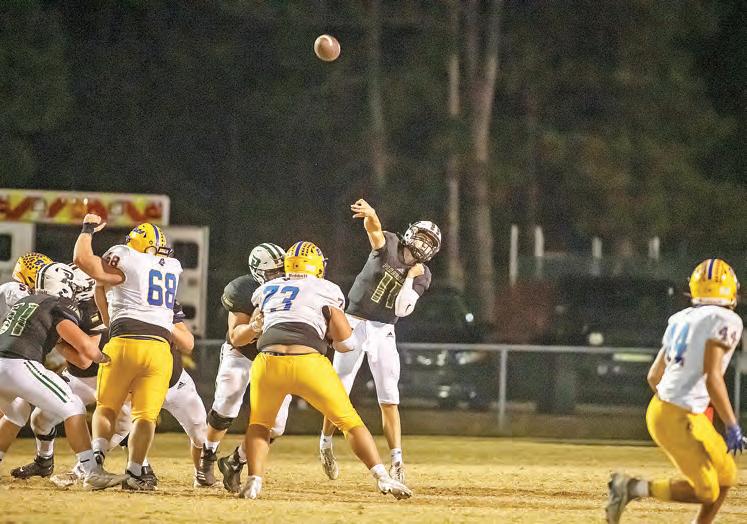
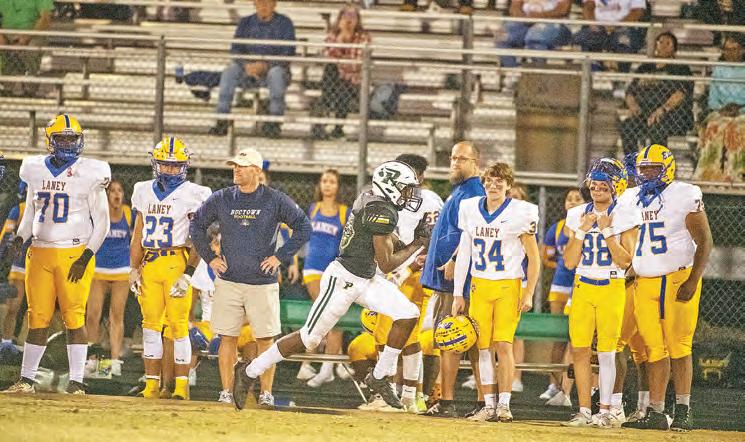
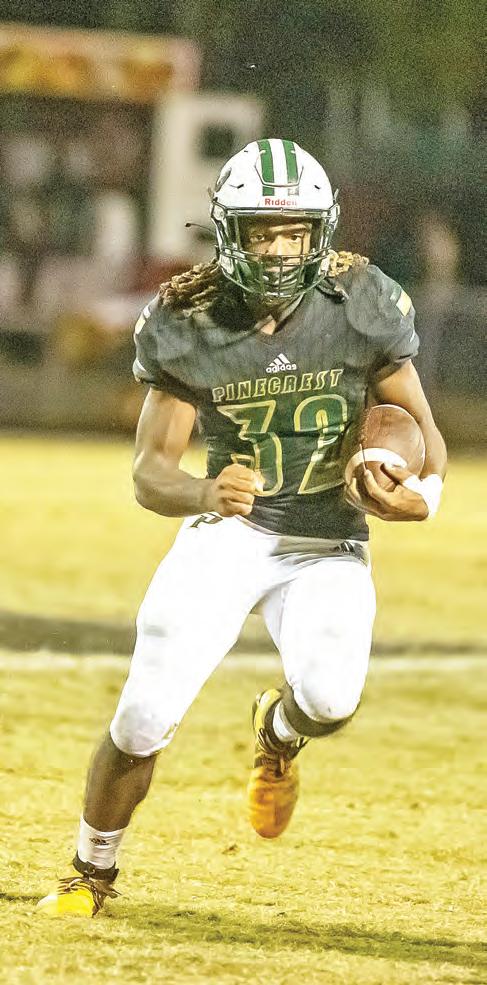
Army probes whether troops wrongly targeted in bonus scandal
WASHINGTON, D.C. — Years after about 1,900 National Guard and Reserve soldiers were swept up in a recruiting bonus scandal, U.S. Army investigators are re viewing the cases and correcting records because some individuals were wrongly blamed and pun ished, Army officials said Thurs day.
The Army’s Criminal Investiga tion Division said it will complete a review of the bulk of the 1,900 soldiers by the end of this year to identify and begin to fix the mis takes. CID said agents during the initial investigation may have mis
understood facts or failed to fol low proper procedures and erro neously added soldiers’ names to an FBI crime database and Penta gon records.
Officials said that at the time, CID agents were grappling with a massive probe involving 100,000 people and hundreds of thousands of dollars in potentially fraudulent bonus payments.
“Simply put, proper procedures were not always followed,” CID Director Greg Ford said in a state ment provided to the AP.
Ford said that so far CID has reviewed cases of about 900 in dividuals, and a majority of them require some type of corrective
Moore County election results
North State Journal
PINEHURST — Over 42,000 Moore County voters casted their ballots in the 2022 general election. That was around 56% of all regis tered voters after all precincts re ported in Moore County on election night, coming in above the state wide average of 51%. Five county wide seats saw no opposition: three races for District Court judge, the clerk of superior court, and register of deeds.
North Carolina State Senate District 21
Tom McInnis – 54.85% (REP)
Frank McNeill – 45.115% (DEM)
Republican state Sen. Tom McIn nis won another two-year term in Raleigh after the Nov. 8 election. The new district, encompassing all of Moore County and parts of Cum berland County, was redrawn fol lowing lengthy litigation following the General Assembly’s 2021 redis tricting session.
North Carolina House of Representatives District 51
John Sauls – 65.17% (REP)
Malcolm Hall – 34.83% (DEM)
Incumbent Republican state Rep. John Sauls took 65% of the vote, including a nearly 75% mar gin in Moore County. The redrawn
51st House District takes in parts of Moore County and all of neighbor ing Lee County.
North Carolina House of Representatives District 52 Ben Moss – 100% (REP)
North Carolina House of Representatives District 78 Neal Jackson – 76.69% (REP) Erik Davis – 23.31% (DEM)
Neal Jackson will join the Re publican majority in the N.C. House of Representatives in 2023.
In the Nov. 8 election results, he won with 77% of the vote in the House district covering Randolph and Moore counties. He succeeds the popular Allen McNeill in the seat.
Moore County Sheriff Ronnie Fields – 100% (REP)
Moore County Board of Commissioners District I Jim Von Canon – 64.43% (REP) John Misiaszek – 20.20% (UNA) Phil Vandercook – 15.37% (UNA)
Republican Jim Von Canon breezed to victory over his two un affiliated challengers in the District I race for the Moore County Board of Commissioners. Moore County races are voted on countywide but the candidates must live in the dis trict in which they seek to represent.
action. He said that up to 200 of those have been completed and corrected, and individuals will be notified. He said “a number” of individuals contacted CID early this year saying they believed they were wrongly listed on the FBI da tabase, and as agents began to re view the files they found problems with the cases. As a result, he said he ordered a review of all cases.
“CID is fully committed to iden tifying and correcting all records to align with the documentation and evidence present in case file,” Ford told reporters. “CID takes our responsibilities in this area very seriously. And it is clear that we fell short in a large number of
Moore County Board of Commissioners District II Nick Picerno – 68.01% (REP) Ariadne T. DeCArr – 31.99% (DEM)
Nick Picerno was elected to his third full term on the Moore County Board of Commission ers after serving from 2008-2016 previously. He rejoined the board in February following the res ignation of Louis Gregory, who died in March.
Moore County Board of Commissioners District III John L. Ritter – 100% (REP)
Moore County Board of Commissioners District V Kurt Cook – 100% (REP)
Moore County Board of Education Member At-Large Pauline Bruno – 28.67%
Ken Benway – 26.10%
Robin Calcutt – 25.44%
Rollie Sampson – 19.55%
While listed as nonpartisan races, Republicans and Demo crats lined up to support two of the candidates in the race for Moore County Board of Educa tion. With final results tallied on election night the two Re publicans, Pauline Bruno and Ken Benway, won the seats on the board. Their election gives Republican-aligned members a majority following a series of high-profile votes and issues in the county’s school system.
these investigations. “
The new investigation comes as National Guard Bureau lead ers are pushing to launch anoth er recruiting bonus program, in an attempt to boost lagging en listment numbers. And they want to ensure that any new program doesn’t have similar fraud and abuse problems.
Guard leaders have talked about providing incentive pay to recruiters and Guard troops who bring in new recruits. The Army Guard missed its recruiting goal for the fiscal year that ended Sept. 30, and more soldiers were leaving each month than the number en listing.
“By putting the right checks and balances in place, we could real ly help make every single guards man a recruiter by paying them a bonus for anybody that they bring into the organization that’s able to complete their military training,”
See SCANDAL, page 2
Moore County Board of Education District III Shannon Davis – 54% Pam Thompson – 45.73%
8 5 2017752016 $1.00
Shannon Davis won the only district seat on the Moore County Board of Education and will join the new Republican-aligned majority.
VOLUME 7 ISSUE 38 | WEDNESDAY, NOVEMBER 16, 2022 | MOORE.NORTHSTATEJOURNAL.COM
The Associated Press
Pinecrest’s Collin Harrison throws the ball for the first down on 3rd and ten against Laney (top left), Zymire Spencer dashes up the sideline for a 50-yard touchdown (bottom left), and Jaquan Bowen runs after making a catch for a first down (right) during the first round of the 4A East NCHSAA playoffs at Pinecrest High school in Southern Pines, on November 4, 2022.
PHOTOS BY PJ WARD-BROWN | NORTH STATE JOURNAL
WEEKLY CRIME LOG
♦ SANDERS, JOSHUA CADE, 20, W, M, 11/14/2022, Moore County Sheriff’s Office, Assault by Stran gulation, Assault on a Female, Battery of an Unborn Child , No Bond, 11/16, Robbins
♦ THOMAS, BILLY RAY, 55, W, M, 11/13/2022, Moore County Sher iff’s Office, Conspiracy to Commit Felony Larceny, Possess Drug Paraphernalia, $30,000 Secured, 12/7, Olivia
♦
MENJIVAR-PEREZ, OSCAR DAVID, 33, H, M, 11/13/2022, Robbins PD, Extortion, Injury to Real Property, Go Armed to Terror of People, $100,000 Secured, 12/7, Robbins
♦
♦
MCNEILL, ANTONIO JAVON, 26, B, M, 11/13/2022, Out of County Agency, First Degree Trespass, $1,000 Secured, 12/21, Aberdeen
EPPS, AARON MATTHEW, 31, W, M, 11/13/2022, Moore County Sheriff’s Office, Conspiracy to Commit Felony Larceny, Possess Drug Paraphernalia, $30,000 Secured, 12/7, Sanford
♦
♦
COLE, TRAVIS DANIEL, 44, B, M, 11/13/2022, Moore County Sheriff’s Office, Communicating Threats (x2), $4,000 Secured, 11/30, Aberdeen
CASSIDY, LASHANDA CHERELL, 43, B, M, 11/13/2022, Moore County Sheriff’s Office, Common Law Robbery, Interfere Emergency Communciations, Assault Inflict Serious Injury, $25,000 Secured, 12/7, Southern Pines
Gen. Dan Hokanson, chief of the National Guard Bureau, told re porters in September. He said procedures needed to be fixed so that fraud didn’t happen again.
The Army began an audit of the recruiting program in 2011, amid complaints that Guard and Reserve soldiers and recruiters were fraudulently collecting bo nuses during the peak years of the Iraq and Afghanistan wars in order to fill the ranks. In the program, which was run by con tractors, soldiers were offered $2,000 if they referred someone to recruiters who ended up actu ally enlisting.
Audits found overpayments, fraud by recruiters and others and poor oversight. The program was canceled in 2012, and Army CID was called in to investigate the cases.

Between 2012 and 2016, CID opened about 900 cases. Alto gether, officials said, about 286 soldiers received some type of administrative punishment or action from their military com manders, and more than 130 were prosecuted in civilian courts. Soldiers repaid more than $478,000 to the U.S. Treasury, and paid nearly $60,000 in fines, officials said this week.
The repayments, however, triggered a backlash from Con gress, as soldiers complained that they were being wrongfully targeted. In 2016, Defense Secre tary Ash Carter ordered the Pen tagon to suspend the effort to re
coup the enlistment bonuses, which in some cases totaled more than $25,000. Officials argued at the time that many soldiers get ting the bonuses weren’t aware the payments were improper or not authorized.
Overall, officials said 1,900 names were added to an FBI criminal database, and hundreds more were listed on an internal Defense Department database as someone who was the subject of a criminal investigation. Such listings can hurt a soldier’s ca reer, affect promotions or — in the case of the FBI data — pre vent someone from getting a job or a gun permit.
Soldiers can request a review of their case, and already doz ens have done so. The CID review
will determine if soldiers’ names should be removed from either database, officials said, and the individuals will be notified of the results.
Officials said that each case is different, and it’s not clear how many — if any — could receive any compensation, back pay or other retroactive benefits. The entire process could take until spring 2024.
Hokanson said the previous bonus program worked in that it brought in thousands of recruits, and could work again if properly done. And he said Guard leaders around the country would like to try something like it again. No fi nal decision on launching a new bonus program has been made, according to the Guard.
moore happening
Here’s a quick look at what’s coming up in Moore County:
November 17
Open Mic Night at Swank Coffee Shoppe
5:30pm
Come out to Swank Coffee Shoppe & Handmade Market for Open Mic Night with Laura Rose! The shop is located at 232 NW Board St. in Southern Pines.

Trivia Thursday at the Brewery 6pm
Come out for Trivia at the Southern Pines Brewery! Enjoy fun and prizes each Thursday. Southern Pines Brewing Company is located at 565 Air Tool Dr., Southern Pines, NC.
November 18
26th Annual Festival of Trees 10am – 8pm Join in for the 26th Annual Festival of Trees to help Sandhills Children’s Center provide vital therapies! Enjoy strolling through magical displays of Christmas trees, wreaths, centerpieces, gift baskets, and more!
Wine Tasting and Live Entertainment 6pm
Come out to Sandhills Winery for wine tasting, food, and and live entertainment from DJ Ryan! Sandhills Winery is located at 1057 Seven Lakes Drive in West End.
Sandhills Blast & Cast Turkey Shoot 2022 7pm
Come out for the Sandhills Blast and Cast Turkey Shoot! Show off your shotgun skills with a good old fashioned traditional Southern Turkey Shoot and win a prize!
2 North State Journal for Wednesday, November 16, 2022
TUNE INTO WEEB 990 AM 104.1 and 97.3 FM Sundays 1 - 2PM The John and Maureen show
SCANDAL from page 1 Neal Robbins Publisher Matt Mercer Editor in Chief Griffin Daughtry Local News Editor Cory Lavalette Sports Editor Frank Hill Senior Opinion Editor Lauren Rose Design Editor Published each Wednesday as part of North State Journal 1201 Edwards Mill Rd. Suite 300 Raleigh, NC 27607 TO SUBSCRIBE: 336-283-6305 MOORE.NORTHSTATEJOURNAL.COM Annual Subscription Price: $50.00 Periodicals Postage Paid at Raleigh, N.C. and at additional mailing offices. POSTMASTER: Send address changes to: North State Journal 1201 Edwards Mill Rd. Suite 300 Raleigh, NC 27607 MOORE CITIZENS FOR FREEDOM MOORE COUNTY Remember that we live in the best country, the best state, and by far the best county. MOORE COUNTY, WHAT A GREAT PLACE TO LIVE! WEDNESDAY 11.16.22 “Join the conversation” 9796 Aberdeen Rd, Aberdeen Store Hours: Tue - Fri: 11am 4pm www.ProvenOutfitters.com 910.637.0500 Blazer 9mm 115gr, FMJ Brass Cased $299/case or $16/Box Magpul PMAGs 10 for $90 Polish Radom AK-47 $649 Smith & Wesson M&P 2.0 Compact $449 Del-Ton M4 $499 38” Tactical Rifle Case: $20 With Light! Ever wish you had a • The Best Prices on Cases of Ammo? • The best selection of factory standard capacity magazines? • An AWESOME selection of Modern Sporting Weapons from Leading Manufactures Like, Sig, FN, S&W, etc? You Do! • All at better than on line prices? With Full Length Rail! Made in NC! local store which has • Flamethrowers & Gatlin Guns? On Rt 211 just inside Hoke County. With Quantico Tactical
PHOTO VIA AP
The Pentagon is seen from Air Force One as it flies over Washington, March 2, 2022.
OPINION
Neal Robbins, publisher | Frank Hill, senior opinion editor
COLUMN | U.S. REP. RICHARD HUDSON
Thank you, Veterans
ONE HUNDRED AND FOUR YEARS AGO, delegates from both Allied and German forces gathered to sign the Armistice of 1918, effectively ending one of the bloodiest conflicts in human history — the First World War. Since then, November 11th has come to be recognized around the world as a day to both remember and honor military veterans for their service.
This Veterans Day, we celebrated the best our nation has to offer –those who have worn our nation’s uniform to keep America safe and defend freedom. We also pay tribute to their families who shared in their service and sacrifice. Without their courage and fortitude, we would not have the liberties we enjoy — and too often take for granted — today. Just last week, millions of Americans exercised their right to vote, one of the treasured liberties that have been preserved by our veterans.
While we can never thank them enough for their service, there are things Congress can do to help improve the lives of our nation’s current and former servicemembers. Improving health care is among my top priorities.
Too many veterans face bureaucratic obstacles at the Department of Veterans Affairs (VA) that hamper their access to care and worsen their health outcomes. On top of this, according to a 2021 study, it is estimated that over 30,000 active-duty personnel and veterans who served in the military since 9/11 have committed suicide. This is four times higher than the number of deaths resulting from military operations.
The physical and psychological toll carried by our nation’s activeduty and veteran personnel is tremendous and must be addressed in a comprehensive way. I am committed to doing this, which is why I helped pass the VA MISSION Act to better improve the quality of health care provided by the VA. Furthermore, I have also introduced
other bipartisan legislation like the Care for the Veteran Caregiver Act and the Care Veterans Deserve Act which will help ensure veterans and their caregivers receive the support they need.
I am also committed to addressing veteran mental health, which is why I have cosponsored measures like the VA Zero Suicide Demonstration Project Act and Vet CENTERS for Mental Health Act, provisions that will help expand mental health services for former servicemembers nationwide.
In addition to improving health care, we must also take steps to properly fund and support our military to ensure it is able to adequality address the evolving nature of modern warfare.
Lastly, we must support our troops and their families by working to improve our nation. This includes increasing government accountability. We must hold oversight over the botched withdrawal from Afghanistan and make sure the federal government respects all Americans’ God-given, constitutionally-confirmed rights. We must improve our nation’s safety by securing our border and combating violent crime and drug trafficking plaguing our communities. Finally, we must strengthen our nation’s economy and pursue common-sense measures to encourage economic growth, job creation, and lower costs.
America’s veterans have given so much in defense of our nation. It is up to us to keep the promises made to them and their families and to build a better nation for all Americans. As Fort Bragg’s Congressman, I remain committed to making this happen.
COLUMN | DAVID HARSANYI
Elon Musk is right. Divided government is best
THERE ARE NO SAVIORS or miracles in democracy, only a grueling, soul-sucking, forever war of attrition. That is the enduring lesson of the 2022 midterms, as it is with every election. And, though the results will be overinterpreted by pundits, and partisans will have all their priors confirmed, in the end, it is simply proof that American “democracy” is working.
Overall, it was a disappointing night for Republicans, no doubt, considering the high expectations and the president’s low approval ratings. The GOP looks like it might win the House, which is no small thing. But let’s not forget, we’re all winners when D.C. is mired in gridlock; not only is it the most accurate representation of the national electorate’s mood, but it means the system is working.
Democrats have spent the past few years squeezing every globule of meaning from that word “democracy.” President Joe Biden delivered two historically divisive national prime-time speeches arguing that the only way to save democracy was to implement one-party rule. If our doddering president didn’t look so ridiculous, clenching his fists in front of a blood-red background, one might have found the spectacle semi-fascist. Today, Biden says that the election was a “good day for democracy.” He’s right, but not for the reasons he thinks.
If your version of “democracy” only exists if your party runs every institution, it wasn’t a good day. If you believe “democracy” means exploiting the narrowest of national majorities to lord over all the decisions of states and individuals, it’s going to be a tough couple of years for you. If you want to destroy the legislative filibuster to federalize elections or cram $5 trillion in generational mega “reforms” through Congress without any national consensus or input from half the country, condolences. You won’t be adding fake senators from D.C., in direct contradiction of the Constitution, or “packing the courts” to capsize the judicial system. At least not until 2024, at the earliest.
As Elon Musk recently noted when recommending people vote for Republicans, “shared power curbs the worst excesses of both parties.” (Oh, the hysterics that comment sparked) If it’s not Vladimir Putin or gerrymandering or “voter suppression” or a messaging problem or “misinformation” sinking “democracy,” it’s Elon Musk. No one who believes political discourse needs to be moderated and censored and acts like voters have no agency is a champion of American “democracy.”) Musk is right. Not only is it an excellent
outlook for the independent-minded American, but it has been the reflex of the electorate — a healthy, real democratic inclination. The inability of one party to monopolize power will either compel both to compromise or, in times of deep division, shut down Washington and incentivize governors to take care of their own business — which is how our federalist system was meant to work.
Democrats, should the GOP take the House, will whine that failing to implement their economic statism is tantamount to sabotaging the nation — and “democracy.” Biden will blame the GOP for “obstructionism,” as if the executive branch, rather than the legislature, is charged with writing laws. The media will again lament the dire state of our “dysfunctional” Congress. The Ezra Kleins of the world will lecture us about the need to fix an antiquated system. But, as we learned during the Obama and Trump years, the less Congress meddles in our economic life, the better it is for everyone.
Legislative gridlock does not mean Congress is powerless. The House, our most “democratic” institution, has a duty, as the left incessantly pointed out during the Trump years, of holding the executive branch accountable. That might entail investigating Alejandro Mayorkas for precipitating a border emergency, and Merrick Garland, who has politicized the Justice Department in unprecedented ways, targeting parents as domestic terrorists and ignoring criminal activity against pregnancy centers. Who knows? Washington is a target-rich environment. It is almost surely the case that Democrats will call any inquiries into the executive branch a crime against “democracy,” as well.
Don’t get me wrong; I’m not contending that Republicans are saviors of “democracy,” though slowing the attacks on our institutions, from the Supreme Court to the Electoral College to the filibuster to the First and Second Amendments, is good news. Nor am I arguing that I wouldn’t rather have people who agree with me winning elections. I’m simply saying that people who confuse and conflate the word “democracy” with getting their way all the time are either frauds or fools.
David Harsanyi is a senior editor at The Federalist. Harsanyi is a nationally syndicated columnist and author of five books - the most recent, “Eurotrash: Why America Must Reject the Failed Ideas of a Dying Continent.”
3 North State Journal for Wednesday, November 16, 2022
VISUAL VOICES
Richard Hudson is serving his fifth term representing North Carolina’s 8th Congressional District in the U.S. House of Representatives. He currently serves on the Energy and Commerce Committee and in House leadership as the Republican Conference Secretary.
The physical and psychological toll carried by our nation’s active-duty and veteran personnel is tremendous and must be addressed in a comprehensive way.
As we learned during the Obama and Trump years, the less Congress meddles in our economic life, the better it is for everyone.
Simpson Brown, Jr.
July 11, 1942 - November 12, 2022
Simpson Brown, Jr., age 80, passed away on November 11, 2022 at FirstHealth Moore Regional Hospital.
Born on July 11, 1942 in Belfast, Northern Ireland to Simpson Brown and the late Mary Jane Godden Brown. Simpson moved to the United States from Ireland in 1961. He proudly joined and served in the US Army during the Vietnam War with the 1st Infantry Division (aka “The Big Red One”). After his military service he had a successful career in Architectural Aluminum in the NY Metropolitan area. Following his retirement, he relocated to Pinehurst in 1987 to enjoy two of his interests; harness racing and golfing.

He is survived by his loving wife of 53 years, Carol Brown; parents, Simpson and Nan T. Brown; brother, George Frederick Brown (MaryAnn Brown); niece, Kelly Brown; nephew, George Brown, Jr. and great nephew, George Frederick Brown, III; also survived by many cousins in England and Northern Ireland.
Merrill Scott Jordan
June 28, 1927 - November 11, 2022
Merrill Scott Jordan Age 95, of Southern Pines, NC; passed on November 11, 2022 at First Health Moore Regional in Pinehurst, NC.
Merrill was born June 28, 1927 in Siler City, NC; to the late Rufus Bradshaw Scott and Clara McLaughlin Scott. She grew up in Siler City where she loved to sing and harmonize with her sisters on their front porch. Later she met the love of her life, Henry Harris Jordan. They were married in Portsmouth, VA in 1949. Merrill was a wonderful cook and made all of her cakes from scratch. She enjoyed hosting and playing Bridge with her local Bridge Club. Merrill was the best Grandmom to her grandchildren, spoiling them regularly, with trips to Biscuitville and Walmart and anything else their hearts desired.
Merrill is survived by two children, her daughter Susan McNeill (Frank) of Pinebluff and son Daniel Jordan (Jennifer) of West End, and one sister, Dottie Griffin of Pittsboro. She is also survived by her grandchildren: Morgan Medalsy (Jon), Meredith Crowell (Joe), Aubrey Whitley (Walker), Harrison Jordan and Kara Jordan. She had three great grandchildren, Triston Whitley, and Joseph and Henry Crowell, and a sister-in-law, Mary Ellen Harris of Raleigh, NC.
Merrill was preceded in death by her husband of 46 years, Henry Jordan and her sisters Evelyn Robinson and Geraldine White of Siler City.
Earl Lewis Barker
April 16, 1942 - November 9, 2022
Earl Lewis Barker, 80 of Sanford, passed away on November 9, 2022 at UNC Rex Hospital in Raleigh.
Born on April 16, 1942 in Chatham County, NC to the late Johnny and Dena Barker. Earl worked as a barber for over 50 years. He owned and operated shops both in Sanford and Broadway. Often in the spring you would find Earl outside gardening. He enjoyed home canning especially the tomatoes from his own garden and a great cup of coffee.
Earl enjoyed cooking and pencil sketching. Some of his artwork is displayed in the Emmanuel Congregational Christian Church in Sanford. He will be remembered by many as an exceptional artist, barber, loving husband, father and grandfather.
He is survived by his wife, Cynthia Sloan Barker; five children, Kevin Barker (Dee), Todd Barker (Jacqi), Eric Barker, Brent Barker (Andrea) and Ashley Barker; one brother, Johnny Barker; two sisters, Juanita Richardson and Frances Barker; also survived by grandchildren and two great grandchildren.
Vincent (Vinnie) George Azzariti, Jr.
March 20, 1946 - November 9, 2022
Vincent (Vinnie) George Azzariti, 76, born March 20, 1946, passed away Wednesday, November 9, 2022 at his home.
Formerly of Lake Hopatcong, New Jersey, Vinnie worked as a delivery truck driver and was a member of Teamsters 560. For the last 26 years he resided in Southern Pines, NC. Vinnie was a loving husband to Pam, his wife of over 40 years. He was a loving father and animal lover.
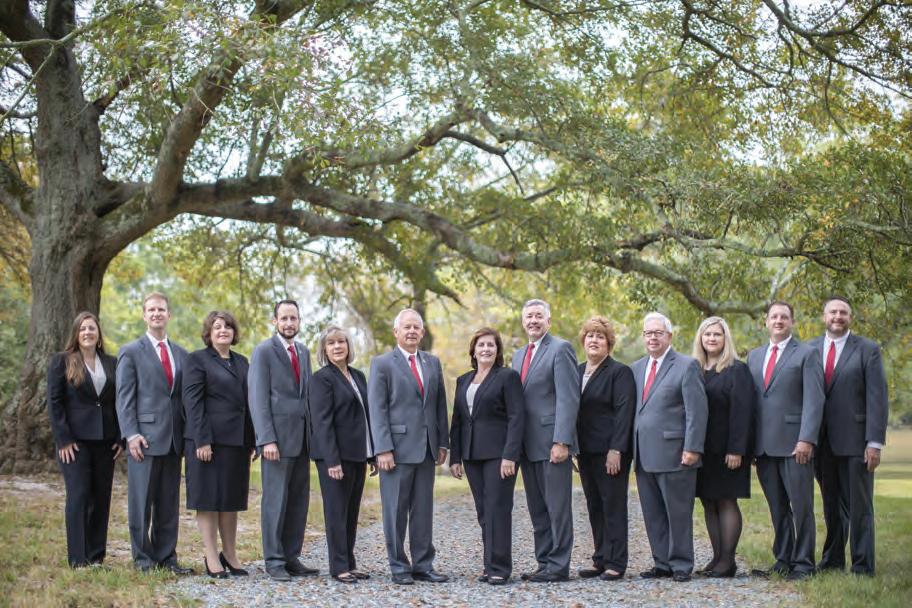
Vinnie was preceded in death by his parents Vincent and Dorothy Azzariti and his “lifelong best friend and brother from another mother,” Nilo Dalfol.
Surviving are wife, Pamela (Pam) Azzariti of the home; daughter, Katie Brown (husband, Jamie) of Robbins NC; son, Vincent Azzariti Jr. (wife, Phyllis) of Myrtle Beach, SC; two grandchildren, Alysha Azzariti and Anthony Azzariti; two step grandchildren, Lucian Brown and Constance Brown; and a brother, James (Jimmy) Azzariti.
William Thomas Shore, Sr.
April 2, 1924 - November 9, 2022
William (Bill) Thomas Shore, Sr., 98, died peacefully in his sleep on November 9, 2022, at his home in Southern Pines, NC. Bill was a devoted and loving husband, father and grandfather. He was born on April 2, 1924 in Winston-Salem, NC to Walter A. and Mary K. Shore. He attended Reynolds High School, where he met his Anne, the love of his life, in 1941. He served in the U.S. Navy from 1943-1946. Bill graduated from UNC-Chapel Hill in 1948 where he helped to restart the Sigma Phi Epsilon fraternity. He and Anne married in 1949.
Bill was active in Emmanuel Episcopal Church for many years, serving as Sr. Warden, Jr. Warden, and a Sunday School teacher. He helped organize the Southern Pines chamber of commerce in Southern Pines where he served as an officer and director. Bill was a business owner of Parkway Cleaners until he joined A. B. Hardee in the development of Whispering Pines, soon becoming the sales manager and vice-president of Whispering Pines. He was instrumental in the development of Lake Surf, now Woodlake. Many referred to him as "The Rose Man" and he often spoke at local clubs and organizations.
Bill was a charter member of the Men's Garden Club of SP, which became the Sandhills Garden Society. He was a member of the Elks Lodge, an avid golfer and a die-hard Tar Heel.
Andrea Cade Moore
Phillis Nelson
May 23, 1932 - November 8, 2022
Reverend Patrick A. Bergin, M.M. died on November 8, 2022 in Pinehurst, North Carolina. He was 90 years old and a Maryknoll priest for 63 years.
Patrick Anthony Bergin was born May 23, 1932 in Melvindale, MI to Charles and Mabel Turner Bergin. The youngest of seven children, Patrick had two older sisters and four older brothers. Patrick attended St. Mary Magdalen grammar school in Melvindale, and he was accepted to study for Maryknoll in 1946 by then Superior General, Bishop James Edward Walsh.

Father Bergin was ordained on June 13, 1959 and assigned to the Korea region.
In 2005 he took up residence in North Carolina. Father Bergin celebrated his 60th Jubilee as a Maryknoll priest in 2019 with his friends and classmates.
Father Bergin is survived by many nieces and nephews.

Dolores Anne Hayes
October 16, 1923 - November 9, 2022
Dolores Hayes (nee Gerrity) 99, passed peacefully at the Seven Lakes Assisted Living on Wednesday, Nov. 9th.
She was predeceased by her husband, Don; siblings: Michael, Julie, Alice, Mae, Florie, Joe and Matty. Dolores is survived by her sons Donnie and Tommy; 5 grandchildren, 7 great - grand children and numerous nieces and nephews.
January 5, 1948 - November 8, 2022
Andrea Cade Moore, 74 of Southern Pines, passed away on November 8, 2022 at FirstHealth Moore Regional Hospital in Pinehurst.
Born on January 5, 1948 in Baltimore, Maryland to the late Edwin and Tommie Cade. Andrea loved animals and was surrounded by them her entire life. As a child, she started riding horses and enjoyed competing in horse shows, fox hunting and trail riding. She spent lots of time in the outdoors; hiking, walking, and playing sports which included fencing, pickle ball, volleyball, golf and ping pong. She also enjoyed entertaining and traveling. She and her husband took many cruises over the years to destinations throughout the world.
She is survived by her loving husband, Richard Moore; two children, Randall Moore and Andrea Leigh Moore; sister, Jeffrie Lynn Cade; also survived by one grandchild, Avalon Moore.
June 15, 1962 ~ November 12, 2022
Phillis Nelson of Aberdeen passed away Saturday, November 12, 2022.
Phillis was born in Grundy County, Illinois on June 15, 1962, to the late Alton and Sandra Galey White. Phillis was a sweet fun-loving person who worked hard and loved even harder. Throughout her life, she loved reading and was actively involved in her children's activities. Every year she looked forward to her yearly trips to the outer banks with her family and friends.
She is survived by her spouse, Tommy Nelson; her children, Tomi Lochbrunner, David Taylor, Jr. and his spouse, Sara, Clint Nelson, and his spouse, Shelby; her brother, Phillip White; her sisters, Sandy Guin, Mandy Jackson, and Charlotte Wever; her grandchildren, Hannah Rouse; and a host of family and friends.
He is survived by his loving wife, Anne Baldwin Shore, of 73 years; his children, Susan and Lonnie McNeil, Stuart and BJ Shore and Michael Shore; his grandchildren, Russell Shore, John and Suda McNeil, Tim and Cecily McNeil, Mary Beth and Aaron Murphy, Emily and Pat Silvola, Peter Shore, Margeaux Shore, Jacob Shore, Paul Shore, and Luke Shore; great grandchildren Brendan, Kendall, Layne, Nova, Zmya, Ethan, Wills and Frazier.
He was preceded in death by his parents, brother Walter A. Shore, Jr. and his eldest son, William Thomas Shore, Jr.
4 North State Journal for Wednesday, November 16, 2022 obituaries SPONSORED BY BOLES FUNERAL HOMES & CREMATORY Locations in: Southern Pines (910) 692-6262 | Pinehurst (910) 235-0366 | Seven Lakes (910) 673-7300 www.bolesfuneralhome.com Email: md@bolesfuneralhome.com CONTACT @BolesFuneralHomes
Reverend Patrick A. Bergin
