
Oral arguments in Leandro education case center on spending authority
Key issues included expanding school choice, parental involvement and better communication from the state
SHAWN KREST | NORTH STATE JOURNAL NSJ reporter Shawn Krest is in Ukraine, running supplies between Romania and the war-torn nation as part of a humanitarian mission. He is documenting his trip, from seeing barricades and old mine fields to helping Ukrainians by repairing their homes and delivering aid, all while the sites and sounds of war surround him.
Sometimes,***
Stay off the grass: Entering the war zone

Keep on truckin’: impression of Ukraine AID IN UKRAINE


First
By A.P. Dillon North State Journal
Raleigh Saltwater anglers won’t be bringing in big hauls of one of North Carolina’s most popular recreational fish — flounder. The N.C. Wildlife Resources Commission announced Thursday new creel limits for 15 species of fish in the state’s inland waters. The rule reduced the number of flounder an angler may keep per day to one, down from four last year. The season, which lasted just 15 days in 2021, is scheduled for the entire month of September in 2022. Red drum are also limited to one fish per day between 18 and 27 inches and speckled seatrout are limited to four fish per day of at least 14 inches.
The main question at hand throughout the hearing was wheth er the courts can bypass the state constitution when it comes to ap propriating taxpayer money for ed ucation“Whetherpurposes.the judiciary can or der the state to implement and fund money for a sweeping, eight-year, 146-item, comprehensive remedial plan” that would have ramifications constitutionally and educationally, TilleyReferringquestioned.toJudge David Lee’s funding transfer order, Tilley called it an “unprecedented violation”
NSJ STAFF
DELIVERING
RALEIGH — Oral arguments in the long-running Leandro educa tion case were heard by the North Carolina Supreme Court on Aug. 31. Presenting to the state’s high court were the plaintiffs’ attorney Melanie Black Dubis, lawmakers’ attorney Matthew Tilley and N.C. Senior Deputy Attorney General Amar Majmundar, who represented North Carolina’s executive branch.
the worst news comes in the form of a simple sug gestion.“You might want to bring extra water with you today,” team leader Shannon announced as we pre pared to depart.
State reduces flounder limits as season starts
See IMPRESSION, page A8 See LEANDRO, page A3 See WAR ZONE , page A2
Raleigh Throughout the summer, the state Alcohol Law Enforcement agency conducted several operations aimed at addressing violence at ABC-permitted businesses and investigating crimes that involved alcohol. The statewide enforcement operation was focused in Wilmington, Washington, Greenville, Lumberton,Pembroke,Fayetteville, Chapel Hill, Durham, Elon, Burlington, Kannapolis, Charlotte, Boone, Wilkesboro, High Point, Greensboro, Sanford, Aberdeen, Asheboro, Salisbury, Mill Spring, and Hendersonville. Throughout the agency’s eight districts, agents executed four search warrants, seized six firearms and 78 fraudulent identifications. Of the 189 arrests and 449 charges, 20 were felony charges, 261 were alcohol-related charges, and 80 were drug-related charges.
Land mines, battered homes and air raid sirens welcome NSJ’s Shawn Krest By Shawn Krest North State Journal ON OUR WAY out in the morn ing, we suffer our first casualty. I’m riding in Nighthawk (the black van — there’s also Opal, a blue one, and MomVan, a minivan) and it begins making a clunking noise about a mile into the trip. “That’s new,” said the driver. The van then immediately lurches and we hear a loud clunk. As we pull to the side of the road, we see a trail of oil behind us. The white smoke and smell are not good signs. I step out of the passenger side to assess the damage. From the driver’s seat, I get a reminder of where we are. “Try not to step on the grass,” the driver said, pointing at the strip of lawn in front of a melon field.Once we were loaded into Mom Van and Opal and running again, a short distance down the road I saw the “Danger: Land mines” sign. So, even the “relatively safe” area has its risks.
A reasonable piece of advice: For us newcomers, the task may end up being more strenuous than we expect, or perhaps the weather forecast calls for warmer than av erage“Thetemperatures.Russiansare trying to take out the bridge out of town,” he clarified. So we may be in the city … longer than we expect. This piece of news, naturally, inspired several questions, all of which Shannon brushed off. “We’ll just bring extra water and, if we need to, we’ll eat Christian first,” he said, gesturing toward the smallest driver in the group and least likely to put up a fight. We are headed into the war zoneAstoday.weget closer to the front lines, military checkpoints are more numerous and better forti fied. The soldiers manning them — scared young kids in the “rel

NSJ’s Shawn Krest reaches the war-torn nation while delivering humanitarian aid
By Shawn Krest North State Journal THEY SIT, one after anoth er, the line stretching off into the horizon.They are the trucks waiting to leaveImmediatelyUkraine. after clearing cus toms and entering the country, the first impression of Ukraine is the unfathomable number of people trying to get out. The right lane of the eastbound highway is clogged with 18-wheeler semis waiting to get their loads approved to depart. The wait is a long one. In the early days of the war, an estimat ed 12,000 trucks were lined up at the borders. The number has gone down, but it appears not by much. The wait is currently more than a week, all spent in highway grid lock, which gives new meaning to the phrase “slow lane.” A shirtless driver squats by his rig, heating something on a small camping stove. Another driver, clad only in boxers, uses a hose attached behind his cab to take a roadside shower. Small groups of truckers cluster, talking, smoking and glaring at the cars that speed by for a much shorter date with customs.There are several reasons for the unfathomably long line — a desire to leave for safer territory is an obvious one, as is the lack of other ways to transport com mercial goods. The port only re cently reopened and there is a similar line of trucks approaching the Black Sea commercial docks. Train service has also been inter rupted for periods of time during the war, meaning that spending a week or more showering by the roadside is actually the fastest way to get goods to market. Drivers also complain about the bureaucracy — customs is appar ently asking for documentation that has never been requested be fore.For the first 26 kilometers (16 miles), our view of the Ukrainian countryside is blocked by the nev er-ending parade of parked trucks. It rolls through towns, over hills and into valleys. Our directions have us turn left onto a new high way, and the line comes with us, rolling more than 30 kilometers into Ukraine. That’s more than 18 miles of bumper-to-bumper traf fic.Once we pass the trucks and get an unobstructed view, Ukraine is a sight to behold. Its rolling hills and bright palette of colors are breathtaking. Yellow fields set against a bright blue sky remove any doubt as to how the country chose the colors for its flag. Crops are alternated with equally bright fields of sunflowers. The villages are marked with giant blue and white displays that look more like the base of an Olympic torch than a “Welcome to Chernivtski” sign. The architecture is quirky and endearing, looking like something out of a fairy tale or early Disney movie. It all stands in stark con trast to our starting point, Roma nia — where everything seems to have been built in the ’60s (either 1260s or 1960s as castles and churches share space with Iron Curtain era industrial buildings) and the country is famous for its dark history as home to vampires. Ukrainian Orthodox church es dot the landscape, with their bright blue bases and gold domes shining in the sun. The convoy used to cut through Moldova, a straighter line from Romania to Ukraine, but the di rect route proved to be inconve nient.“It’s shorter,” says team leader Shannon, but it’s not faster. He vaguely explains that the border “can be tough.” Another longtime driver, Dan iel, adds some detail. “They’re jerks,” he says. In addition to making the crossing difficult, Moldovan cus toms apparently has been known to collect an additional “tax” for using the roads in their country — a tax that, without pointing fin gers, many drivers seem skeptical actually finds its way into govern
NSJ STAFF ALE arrestsoperationsenforcementyield189
85 2017752016 $0.50 VOLUME 7 ISSUE 28 | WWW.NSJONLINE.COM | WEDNESDAY, SEPTEMBER 7, 2022
“Saint London.Museum,andofthepainting(1515)bypreaching”PaulRaphaelisaincollectiontheVictoriaAlbert
A2 WEDNESDAY 9.7.22 #350 “Variety Vacationland” Visit us online nsjonline.com North State Journal (USPS 20451) (ISSN 2471-1365)
WAR ZONE from page A1
North State Journal for Wednesday, September 7, 2022

THE WORD: WORK FOR CHRIST
J.R. Miller was a pastor and former editorial superintendent of the Presbyterian Board of Publication from 1880 to 1911. His works are now in the public domain.
Neal Robbins Publisher Matt Mercer Editor in Chief Cory Lavalette Managing/Sports Editor Frank Hill Senior Opinion Editor Emily Roberson Business/Features Editor Lauren Rose Design Editor Published each Wednesday by North State Journal 1201 Edwards Mill Rd. Suite Raleigh,300NC 27607 TO SUBSCRIBE: 336-283-6305 or online at nsjonline.com Annual Subscription Price: $50.00 Periodicals Postage Paid at Raleigh, N.C. and at additional mailing offices.
atively safe” area where we spent the first night — are now grizzled veterans.We’re now down to two vans. We left Nighthawk by the poten tially mine-filled farmer’s field and will arrange a tow from one of our contacts in the country. And we make our way into the heart of the city where bombings are a part of everyday life. There is no fresh water here — the Russians cut a pipeline. We’ll be staying in a church attic and showering with seawater that they have rigged up to their plumbing. A bridge into town is down to one lane, the bottleneck a result of a bomb that left a crater in the slow lane. We pass a mall with boarded-up windows. “That got bombed because of TikTok,” Christian (as yet uneat en) explained. “Someone posted a video of soldiers in the mall, and the Russians were like, ‘We know where that is!’ and launched rockets.”Westop at a university that was reduced to rubble by an attack last week. Work crews are busy clear ing debris. Across the street is col lateral damage — a line of small homes that were also heavily dam aged in the attack. None have any windows re maining. No roof is entirely un damaged. The elderly residents, still clearing rubble from their homes, approach us. None of us speak Ukrainian, and they don’t understand En glish. We attempt to use a transla tion app to bridge the chasm, but it struggles, often returning non sense phrases like “the cat has the car” and, we assume, likewise in Ukrainian.Finally,we find a language that everyone can at least follow to some degree — Spanish. Igor, one of the residents, lived in Mexico for some time and Christian grew up in the Dominican. The rest of us have some familiarity due to high school, travel or interviewing mi nor league baseball players from theWe’veCaribbean.brought tarps and weath erproof material for the roofs, but the residents don’t want them. They’ve already tarped and don’t want to replace their work with ours. I picture my own older relatives telling friends, “Some kids came to try to fix our roof,” then waving a hand dismissively. “Theyyyyy didn’t know what they were doing.” So we settle on helping to board windows, using plywood and the weatherproof material. One family’s house also had the door literally blown off the hing es. Half of it remained, propped up to block the entryway. We split into a door team and window team and set to work. The man who owns the home — and likely built the original door himself — insists on designing it, using pieces he can salvage from the damaged original. He refuses the translation app, miming in structions at us — hammer here, remove that. My patience quickly wears thin. Working alone, I’d have respond ed with, “If you’re such an expert, have at it. I’ll go build a window.” But I follow the lead of the oth ers and power saw where I’m told (and take the blame when he mis measures and a piece ends up too short). After all, this is his home, and the damage is not due to any fault of his. He just lived too close to a tactical target. Naturally, he would want to take the lead on our repairs.After a few hours, the work is done. The various neighbors claim the leftover wood and ma terials, knowing there’s a good chance they’ll need them again in theThroughoutfuture. the day, the air raid sirens sound again and again. We hear explosions — not far off rumbles that could be confused for thunder this time, but actu al impacts — likely somewhere across town. The church prepares about 200 bags of food — daily rations, they call them — which we deliver to distribution points in the city. We take six extra to deliver to the families with newly boarded win dows and a passing knowledge of Spanish.Wereturn to the church where the cook has prepared a dinner of potato soup and some type of rice dish that seems like jambalaya without the spices. Still, it is far from bland — hearty and filling. After clearing our plates, we re main at the table, talking. A halfhour passes, and the cook comes to us with another church employee. “We pray now,” he says. “Halle lujah.”After a few missteps, we de termine that the employees hold a nightly prayer session which is scheduled to begin now. So we need to move our discussion to the attic.Icollect my things but then hesitate. We are staying in their church. They are feeding us with food that otherwise would be earmarked for their countrymen. They are gathering in their kitch en, which has the stairway to the basement bomb shelter in one corner, to pray, likely before the Russians begin bombing their city again tonight. I remain in my seat and stand when the two men enter and stand together on one side of the kitchen. A group of women employees enters and sit. A third man stands in the Thedoorway.twomen begin to pace back and forth across the kitchen, mumbling “hallelujah” to them selves, over and over. There’s a fine line between re spect and mockery, so I remain standing, flat-footed, rather than follow them. One of the men be gins making chirping noises in be tween the hallelujahs. The cook stops pacing and speaks urgently for about five minutes, eyes closed and hands waving. Several phrases start with a word that sounds like “basta,” which he later explains means something similar to “pray” or “re joice.”The two men take turns speak ing prayers, then each returns to pacing, chirping and mumbling hallelujah. When they pray, I use my translation app to follow along. One of the men then turns to me and asks me to read the En glish translation out loud. He gestures toward the other Ameri can drivers, who have returned to the kitchen to see what they were missing.“Ourposition is at the foot, and the nails, Lord,” I read. “Where there is a foundation for our hearts. We stand and obey your will because the keys to death are in your hand.” It’s a grim prayer, for a grim time. One of the women then prays, asking the lord to watch over the Americans who have driv en so far to help them. With that, the vigil ends and it is lights out in the church, as well as everywhere across the city. A nightly full darkness curfew is in effect. We return to the attic and set up our sleeping bags, air mat tresses and cots in the dark and settle in to wait for morning or si rens to wake us.
SHAWN KREST | NORTH STATE JOURNAL NSJ’s Shawn Krest is pictured wearing a protective vest while providing aid in Ukraine.

PUBLIC DOMAIN
18 And all things are of God, who hath reconciled us to himself by Jesus Christ, and hath given to us the ministry of reconciliation; 19 To wit, that God was in Christ, reconciling the world unto himself, not imputing their trespasses unto them; and hath committed unto us the word of reconciliation. 20 Now then we are ambassadors for Christ, as though God did beseech you by us: we pray you in Christ’s stead, be ye reconciled to God. 2 Corinthians 5:18–20
We stand corrected: To report an error or a suspected error, please inwithcorrections@nsjonline.comemail:“Correctionrequest”thesubjectline.

Many people think that work for Christ must be something great or public. They imagine that to minister to Christ they must teach a Sunday School class, join a missionary society, go out to visit sick people, or go into hospitals or prisons on missions of mercy.These are all beautiful and important ministries, and Christ wants some of you to do these things as well. But the very first place you are to serve Him, is in your own home. Let the blessed light of your life first be shed throughout that most sacred of all spots. Brightening that little place, you will be all the more ready to be a blessing outside. Those who are the best Christians at home — are also the best elsewhere.
SendPOSTMASTER:addresschanges to: North State Journal 1201 Edwards Mill Rd. Suite Raleigh,300NC 27607

Majmundar also disputed any collusion between the plaintiffs and state attorneys related to the CRP, yet a substantial portion of CRP was funded by cabinet agencies answer ing to Democratic Gov. Roy Cooper. WestEd was paid more than $2 million to produce the CRP. At least $1.5 million came from nonprofit groups and cabinet agencies. Ac
The Associated Press RALEIGH — North Caro lina’s State Board of Elections will not fight a recent decision by the state rules panel blocking its proposed restrictions on par ty-appointed poll watchers this fall. But the board pledged Fri day to do all it can to help coun ty elections officials maintain a safe and orderly voting environ ment and to deter any voter in timidation.Thestate’s Rules Review Commission — a 10-member panel appointed by the Repub lican-controlled General As sembly — shot down two tem porary rule changes last week that would have more clearly outlined the code of conduct for partisan election observers. The elections board said more than a dozen reported conduct viola tions during the May primaries prompted the proposed changes.
improvement“Theexecutivebranchisgoingtobenecessarilytemptedtouseadmissionsinacourtcasetogetordersthatwouldprovideagenciesthingsthattheycan’tgetinthelegislativeprocess.”
Paul Cox, associate legal counsel to the elections board, said the state’s existing guide lines for election observers “are not models of clarity,” which had motivated the board’s bipartisan collaboration.
The North Carolina results are encouraging when compared to a new report by the National Center for Education Statistics (NCES) of a special assessment of 9-yearolds in reading and math to see what damage the pandemic had caused in those subjects. The results showed the “larg est average score decline in read ing since 1990” and “the first ever score decline in mathematics.” Average scores collected in 2020 dropped five points in reading and seven points in math.
“The Rules Review Commis sion lacks the expertise and the authority to determine how to best maintain order at the polls,” Circosta said. “It is our duty to the voting public to protect their right to vote, and it will be pro tected.”Theboard’s decision comes as North Carolina is gearing up for several tight races, including a high-profile U.S. Senate contest, two state supreme court races and several crucial state legis lative elections that will deter mine whether Republicans gain the few seats they need to over ride the Democratic governor’s veto.State law allows political par ties to appoint precinct-specific and at-large poll watchers to monitor election proceedings from designated areas inside the voting facility on Election Day and during one-stop early vot ing. Observers can report con cerns to a precinct manager but are prohibited from interacting with voters, distributing infor mation or interfering with the duties of poll workers. North Carolina Republicans, including some with close ties to former President Donald Trump, have been leaders in op posing the proposed rule chang es since July, arguing that tight er restrictions for poll watchers could undermine the integrity of elections in a crucial swing state. The Republican National Com mittee and the North Carolina Republican Party also wrote to the rules commission urging it to reject the changes. Trump’s concerns that the 2020 presidential election re sults were fraudulent have prompted thousands of his sup porters to scrutinize elections operations nationwide, popular izing the poll-watching practice and leading several states to re evaluate their existing rules.
A3 North State Journal for Wednesday, September 7, 2022 of the appropriations process the state’s constitution gives to the Gen eral“TheAssembly.drafters of the constitu tion intended the General Assem bly to have the exclusive power of the purse,” Tilley said, “in order to ensure that the people, with their elected representatives, had full and exclusive control of the state’s expenditures.”Inhisremarks, Tilley also warned “The executive branch is going to be necessarily tempted to use admissions in a court case to get orders that would provide agencies things that they can’t get in the leg islative process. “To impose a remedy, one must first find a violation,” Tilley said in closingTilleystatements.alsoquestioned what would happen if the justices forced the comprehensive remedial plan’s (CRP) funding to be fulfilled. “No one says that there can’t be a remedy,” said Tilley. “But it doesn’t necessarily need to include the ap propriations power.” He cited retired Judge Howard Manning’s past statements that the “state must step in with an iron hand and fix this mess” that in cluded suggestions of removing an ineffective superintendent, princi pal or teachers, or by addressing the lack of effective management or practices.
FILE PHOTO Desks are spaced apart in an elementary school classroom, in this 2021, file photo.

NC elections board won’t fight for checks on poll watchers
FILE PHOTO
“There are many things short of an appropriation that a court can do and that this court has not tried,” said Tilley. He later added that “no case from this court has ever coun tenanced an appropriation by the judiciary.”Dubis, who has represented the plaintiffs in the case for 25 years, argued that a $1.75 billion funding transfer order issued by Lee last fall should be enforced, claiming that order isn’t by definition an ap propriation. She also said various branches of state government had “failed the children” and the “future of the children in North Carolina are in this court’s hands.” The Court of Appeals blocked Lee’s order on the basis he lacked the authority to direct the three agencies cited in his order to trans fer the funds and that the order would create ongoing problems and threaten the separation of powers between the branches of state gov ernment.Attorneys for the lawmaker de fendants had argued Lee had no authority for his order and the ap propriation of funds rests solely with the legislature per the state’s constitution.ChiefJustice Paul Newby re placed Lee with Special Superior Court Judge Michael Robinson in late March. Robinson ordered par ticipants in the case to submit briefs related to the fund, including the impact state budgets had on the amount ordered by his predecessor.
State K-12 test scores show overall
Matthew Tilley, attorney for legislative defendants
On multiple occasions, Newby pressed Dubis where there was an actionable order stating a remedy in Leandro should be statewide in stead of limited to Hoke County.
Newby referred back to the 2004 Supreme Court ruling specifically limiting the case to the schools in Hoke County. Dubis responded by reciting eight instances from 2005 to 2020 in which judges in the case had claimed a “statewide violation” had occurred. She also pointed to statewide education data received by Lee and his predecessor, Man ning, over years.
Early voters line up to cast their ballots inside the South Regional Library polling location in Durham, Thursday, Oct. 15, 2020.

cording to news outlet WRAL, the N.C. Department of Health and Human Services paid $604,699 and the Department of Adminis tration paid $200,000. The balance came from the organizations that have expressed support for the Le andro case, including Goodnight Educational Foundation, Z. Smith Reynolds Foundation, Spencer Foundation, Belk Foundation and A.J. Fletcher Foundation. Before the start of the hearing, protesters held a prayer vigil in support of upholding Lee’s fund ing order. The vigil was organized by Pastors for NC Children and Every Child NC. Both organiza tions have ties to the Network for Public Education, a 501(c)3 non profit run by education researcher and progressive Democrat Diane Ravitch.In2021, Pastors for NC Children received $60,000 for two years of “general operating support” from the Z. Smith Reynolds Foundation. While the Leandro case was fasttracked to the N.C. Supreme Court, the justices did not indicate when a ruling would occur. Two of the seats on the court, both held by Democrats, will be on this November’s ballot. The cur rent makeup of the court is four Democrats to three Republicans. Under the current court, the ma jority has recently used its position to rule that courts can overturn constitutional amendments.
The involvement legislators had in the creation of the WestEd CRP was also brought up. Lawmakers have said they were left out of the CRP process, a claim which was mostly confirmed by Majmundar under questioning fromNewbyNewby.asked Majmundar if the state had sought to bring in the General Assembly as a necessary party in forming the CRP. Majmun dar said no and claimed lawmakers didn’t seem to “have an interest” and lawmakers only intervened “at the last moment.”
Proficiency rates still down from pre-pandemic levels; more schools rated low-performing By A.P. Dillon North State Journal RALEIGH — Test score data from the past school year released by the North Carolina Depart ment of Public Instruction (DPI) show overall subject matter im provement, but scores are still be low what they were pre-pandemic. “The recovery is in progress, but it is going to take time,” Tam my Howard, director of DPI’s Office of Accountability, said at a State Board of Education meeting held Sept. 1. A DPI press release noted that due to the pandemic, this year’s accountability report is the first time since 2018-19 that all compo nents of the state’s accountability framework are included. DPI has cautioned that the cur rent report data needs to be con sidered within the context of dis ruptions caused by the pandemic and that even though 2018-19 data is included in the report, it is “not intended to be used as a compar ison for the purpose of evaluating effort or drawing conclusions.” When reviewing the results of the report, it should be noted that testing was waived in spring 2020 due to school closures. “Last year’s accountability re sults are really a testament to the resilience, dedication and commitment of thousands of ed ucators across the state,” State Superintendent Catherine Truitt said in the release. “They know as I do that we still have a steep hill to climb and that every step mat ters.”The data provided by DPI is the percentage of students who scored at Level 3 and above (grade level proficiency or GLP), at Level 4 and above (college and career read iness or CCR), and at each aca demic achievement level. Proficiency rates overall rose from 45% in 2020-21 to 51% in 2021-22. That’s still short of the 2018-19 pre-pandemic level of 59%.However, according to the re port, “None of the content areas and grade levels show a return to the 2018– 19 achievement out comes except for NC Math 3,” and that from 2018–19 to 2021–22, “NC Math 3 increased 6.6 per centage points (grade level profi ciency) and 5.9 percentage points (career and college readiness).” The end-of-course tests (EOC) data for high schoolers show small increases in CCR and GLP across all other math courses with the largest gains being in Grade 8 NC Math 1. In high school Biology, CCR and GLP percentages rose, but for English II, CCR rates were flat and GLP rates fell by 0.6%. Looking at the end-of-grade (EOG), overall scores in read ing and math for grades three through eight increased over the 2020-21 pandemic school year. In reading, all grades made small gains in reading for CRR and GLP except for third grade, which dropped from 33.7% to 27.1% in 2021-22. The rate for third grade in 2018-19 was 45.2%. In math, the scores appear to show stronger gains across the board in grades three through eight.Science in grades five and eight both saw gains, with eighth-grade science GLP percentages com ing the closest to approaching pre-pandemic levels. Beyond test scores, the state’s four-year high school graduation rate had a small drop, going from 86.9% in 2020-21 to 86.2% in 2021-22. The rate in 2018-19 was 86.5%.Earlier this year, DPI’s O ffice of Learning Recovery had reported K-12 academic student achieve ment across the state fell behind by between two and 15 months across various subjects during remote learning imposed on stu dents due to pandemic school clo sures.Schools in North Carolina are given an A-F letter grade based on how many test pass rates and exceeding growth expectations on those exams. Those ratings were included in the current report for the first time since before the pan demic.The A-F scale breakdown is as follows: A = 85–100; B = 70–84; C = 55–69; D = 40–54; F = 39 or less.In 2018-19, 488 schools were deemed as low-performing. In 2021-22, that number increased to 864, or a 77% increase. Addi tionally, 23% of schools received A and B grades and 42% of the schools received D and F grades. The number of low-performing districts also rose from eight to 29, nearly a 263% increase. The number of low-performing public charter schools decreased, going from 38 in 2018-19 to 35 in 2021-22.TheA-F grading matrix has been criticized in the past for re lying too much on test scores and less on growth. ACT scores appear to be fairly stable with some impact from the UNC Board of Governors raising the admissions benchmark score from 17 to 19. That change has lowered the percentages of stu dents achieving the new bench mark.The DPI accountability report showed that 41.7% of 11th graders achieved the new UNC minimum of 19. In 2020-21, it was 55.2%. “Had the benchmark score re mained unchanged at 17, 54.6% of students would have earned the required score,” according to DPI’s press release.
LEANDRO from page A1
Comprised of three Dem ocrats and two Republicans, the board had unanimously approved the temporary rule changes — one prohibiting poll watchers from standing too close to voting machines or pollbooks where they could view marked ballots, and another granting elections officials the authority to remove disruptive observers who try to enter restricted areas or harass Althoughvoters.the state elections board could have appealed the commission’s decision in court or resubmitted a revised propos al, Chairman Damon Circosta said it will instead offer guid ance to county boards of elec tions and county poll workers to ensure they understand their authority.Seventy days out from Election Day in a narrowly divided state, Circosta said the board does not “have the luxury of time to go back and forth with the commis sion or the courts to ensure that our reasonable rules are put in place before voting begins.”
The dollar amount was then low ered to $785 million. During questioning by Associate Justice Michael Morgan, Dubis was asked what recourse she would like to see the court take. Dubis responded that the right to a sound, basic education was a “unique right” and that the court is a “co-equal branch of the state,” with a “duty to guard and maintain that right.” She also blamed the leg islature alone for failing in its du ties and said, “The legislature is not above the Anotherlaw.”main thread borne out by questions from all seven jus tices was whether or not Lee’s order could be used to apply a statewide remedy in the case.
AP Aulander receives park grant Bertie County The town of Aulander received a $142,650 grant from the North Carolina Parks and Recreation Trust Fund last week. The money will be used for phase two of the town’s renovations of Aulander Municipal Park. Phase 1, in 2018, used a $129,300 grant to install a splash pad and lighting for sports fields. This money will be used to buy playground equipment, build restrooms, install picnic tables and resurface walking tracks in the park.
Sky Top Orchard Flat Rock
WRAL
The Orchard at Altapass Spruce Pine Saylor Orchard Bakersville Apple Hill Orchard & Cider Mill Morganton Perry Lowe Orchards Moravian Falls Devil Dog Orchard Reidsville Millstone Creek Orchards Ramseur Owenby’s Apple House & Orchards Grandad’s Apples and Such Mountain Fresh Orchard Twisted Apple Orchard Stepp's Hillcrest Orchard Coston Farm & Apple House Creasman Farms Justus Orchards Hendersonville Police: Officers shoot suspect who fired during mall chase Cabarrus County Police say officers shot and critically wounded a person who fired at them during a chase at a mall. Concord Police officers responded to a call that three males stole credit cards from someone inside Concord Mills Mall on Wednesday. . During a foot chase, one suspect fired and the officers returned fire, striking the suspect, who was taken to a hospital in critical condition. The two other suspects were arrested.
North Carolina’s 26 electric cooperatives are leading the way to a brighter future for our 2.5 million members and local communities.
Apple wagons west
Johnston County A prosecutor says a man who taught Sunday school has been convicted of rape and other sexual crimes. Johnston County Assistant District Attorney Paul Jackson says that the charges against Jonathan David Young, 38, involved three children and took place from 2003 to 2014. Many of the offenses happened at Firstborn Baptist Church in Benson where Young was a Sunday school teacher for several years. Young was convicted of rape, sex offense and taking indecent liberties with children and sentenced to a minimum of 87 years to a maximum of 109 years in prison.
AP Town manager terminated weeks after police force resigned Wilson County A town council has voted to terminate the contract of their town’s manager weeks after the entire police department resigned over what it called a hostile work environment. Kenly Town Council voted 3-2 during a special session to terminate Justine Jones’ contract. In July, the town’s entire police force turned in their two-week notices and two other town workers resigned. An investigation didn’t find a toxic work environment, but Jones was terminated because it was the “best way to move forward for the town.”
Ashe County Gov. Roy Cooper announced nearly 85,000 households and more than 2,400 businesses in 69 counties are set to receive access to high-speed internet thanks to more than $206 million of Growing Rural Economies with Access to Technology (GREAT) grants. This is the state’s largest round of GREAT grant awards to date. Over $260 million in GREAT grants have been awarded to providers since July 2022. The N.C. Department of Information Technology’s (NCDIT) Broadband Infrastructure Office, part of the Division of Broadband and Digital Equity, awarded GREAT grants to expand broadband infrastructure to Ashe County’s Connect Holding II LLC. NSJ Traffic stop leads to arrest Rutherford County Police arrested Kip Cooper after making a traffic stop last week. Cooper, who had an outstanding warrant, was on U.S. 221 South near Long Branch Road when police tried to pull him over. Cooper refused to stop. As he accelerated, he threw a baggie out of the car window. Police were able to stop him quickly and recovered a baggie, which contained 23 grams of methamphetamine.
DAILY TAR HEEL Candidate for sheriff says someone shot his signs
Murphy to Manteo Jones & Blount
Julia Hegele, Communications Director for Cooper’s Department of Administration, responded with the dollar figure of $2,569,459 on Aug. 10 - a full 149 days after the request for information was made on Mar. 14 during “SunshineSunshineWeek.”Week is a national initiative established in 2005 by the American Society of News Editors, now called the News Leaders Association, to promote transparency in government operations “Since January 1, 2017, the state has spent $2,569,459.00 on repairs needed for the safety, structural integrity and required maintenance of the Executive Residence, which serves as a working office, full-time residence, and public gathering and historic learning space,” Hegele wrote in an email to North State Journal. “This figure includes essential safety repairs as mentioned in response to your prior request on this subject.” North State Journal asked for a line item list of the repairs and their cost but was denied access to those records due to “security concerns.” “Due to security concerns, we typically do not share publicly repair records and recommendations for the Executive Residence,” wrote Hegele. “Providing specific line items and costs could identify potential deficiencies in the historic building as well as materials used for repairs, information that could be exploited to threaten the safety of the residence, its occupants and visitors.” No such “security concerns” provision entered into the equation under the previous McCrory administration when repairs to the mansion were considered big news. In 2013, multiple media outlets obtained a detailed list and repairs totaling $230,000 for a bathroom and mold removal at the Executive Mansion. Outlets were also given access to a list of possible contractors doing work. In response to the denial of the repair records, North State Journal has asked the N.C. Department of Administration (DOA) for a copy of the policy making such repairs a secret as well as any memos or emails directing such a change. As of the filing of this article, the DOA has not yet responded to that request. In December 2020, North State Journal uncovered $2,123,955 million in repairs and refurbishments that had been made to the mansion since 2017. The DOA took 820 days, or well over two years, to finally respond that records request.DOA’s Director of Communications at that time was Nan Sanseverino. She, like Hegele, also denied North State Journal access to the repair records. Severino’s response echoed that of Hegele’s, stating that “repair records and recommendations for the executive residence are not typically shared publicly due to concerns about security.” “The records requested identify potential deficiencies in the 1800s-era building as well as specific materials used to make repairs, information that could be exploited to threaten the safety of the structure and its occupants,” wrote Sanseverino in her response. “We take these security concerns very seriously as do all who are responsible for the safety of the governor and his family who live at the residence as well as public visitors.”
NCElectricCooperatives.com/Brighter
CEC CR 33497-01 Brighter Future N State Jrnal (10.25x6).indd 1 5/20/22 9:30 AM
AP Investment regulators accuse insurance magnate of fraud Durham County Federal securities regulators have formally accused an insurance magnate, an associate and their investment advisory firm of defrauding clients out of over $75 million. The Securities and Exchange Commission filed in Durham federal court a civil complaint against Gregory E. Lindberg of Durham, Christopher Herwig of Raleigh and Malta-based Standard Advisory Services Limited. The government wants them to have to give up the money it alleges they fraudulently made, as well as pay penalties and interest. A federal appeals court recently vacated corruption-related convictions against Lindberg.
AP Carrboro activist given Order of Long Leaf Pine Award
North Carolina Democratic Gov. Roy Cooper speaks at the Executive Mansion in Raleigh, on Wednesday, July 6, 2022.

Executive Mansion repairs now over $2.5 million under EAST
NC.GOV
AP PHOTO
Police: 1 killed, 2 hurt in apparent stabbing at high school
Onslow County A police chief says one person was killed and two were injured in an apparent stabbing at a high school. Jacksonville Police Chief Mike Yaniero said Thursday that two minors were taken to the hospital with injuries and that one later died after the attack at Northside High School in Jacksonville. He said a teacher was also injured but not stabbed. The police department said later Thursday that three teens have been charged.
By A.P. Dillon North State Journal
Reliability & Innovation Leveraging new technologies and innovation to deliver reliable electricity across resilient, co op operated electric grids.
WLOS
Orange County Francis Lloyd Shetley, 95, of Carrboro, was given the state’s highest honor when she received the Order of the Long Leaf Pine Award last month, in recognition of her service to Carrboro. She became involved in town affairs when the mayor didn’t have time to meet with her. She was elected to the Town Council in 1987, served for eight years and also chaired the Transportation Advisory Board. Outside of office her activism included saving the historic cotton mill from demolition and convincing Carrboro to put in bike lanes.
Former Sunday school teacher gets up to 109 years for rape
Grant expands internet access
Sustainable, Affordable Energy Pursuing a goal of net-zero carbon emissions by 2050 using new and existing resources to ensure electricity continues to be delivered at the lowest possible cost.
Local Community Support Enriching the lives of our local members through continued education initiatives, economic development and communityfocused activities.
FOX CAROLINA State earmarks money for park land purchase McDowell County North Carolina’s Parks and Recreation Authority allocated $5.7 million for land purchases for various parks around the state. Lake James State Park will receive about $22,000 to complete the purchase of a small parcel of land near the current park. Money will also go to Chimney Rock State Park in Rutherford County, Hammock’s Beach State Park in Onslow County, Morrow Mountain State Park in Stanly County and Umstead State Park in Wake. NC.GOV Grant goes to trail in former railroad bed Polk County The Polk County Community Foundation awarded a $250,000 grant toward the formation of the Saluda Grade Trail, which will be a 31-mile trail along a former rail corridor. The money will begin the organization’s process of acquiring the land necessary for the trail and developing it. Conserving Carolina, PAL and Upstate Forever are working together to complete the purchase of the corridor. The Saluda Grade was used by Norfolk Southern from the 1800s until 2001. It is one of the steepest railway corridors in the United States.
POWERING A BRIGHTER FUTURE

Person County Keith Daye is running for Person County Sheriff, and he needed help from law enforcement last week when someone shot his campaign signs. The signs were in his front yard, and Daye says he and his family were home when the gunfire occurred. He showed photos of the holes in his signs on social media. Daye is trying to become the first Black sheriff in the county.
Cooper ncfb.org ncfb.org 98% of ALL Farms are Family Farms 98% of ALL Farms are Family Farms WEST PIEDMONT
A4 A5North State Journal for Wednesday, September 7, 2022 North State Journal for Wednesday, September 7, 2022
There’s no denying fall is one of the best seasons in North Carolina. Between the bright and beautiful foliage, crisp air, and, of course, a visit to a nearby farm for pumpkins, corn mazes and apples. Picking your own fresh apples in North Carolina, the seventh-largest apple-producing state in the nation, is an autumn rite of passage. Each orchard in North Carolina offers TravelTopofinJustusandpreservationorchard105-year-oldatdifferent.somethingTheOrchardAltapassisaappleturnedprojectculturalcenter.Orchardisnowitsfourthgenerationfamilygrowers.SkyOrchardsmadeChannel’slistofAmerica’sTop5Apple-PickingFarms.
N.C. Dept. of Administration repeatedly refuses to produce repair records
RALEIGH — Records requests to the N.C. Department of Administration made by North State Journal show that repair costs for the Executive Mansion during Democratic Gov. Roy Cooper’s tenure have now surpassed over $2.5 million.
AP
Whose bright idea was it to anyway?inBiden’sbacklightspeechbloodred

Biden’s hellfire speech
EDITORIAL | STACEY MATTHEWS

George W. Bush was an exception to this rule, but even his luck ran out with the base after his reelection in 2004, where Republicans who stood behind him turned against him over his middle-of-the-road stances on illegal immigration as well as the botched Harriet Miers Supreme Court nomination.

Some will win, some will lose which is, last I checked, how this is supposed to work.


EVAN VUCCI | AP PHOTO President Joe Biden speaks outside Independence Hall, Thursday, Sept. 1, 2022, in Philadelphia.
Unfortunately for career Republican politicos, from here on out there are going to be candidates out there who run in the style of Trump, because the days of conservative Republicans worrying about supposed “electability” are long gone.
President Biden sold his moderate soul to the Devil to get elected in 2020. Here’s a rhetorical question for him to consider for his next “soul of the nation” speech: “What does it profit a man to gain the whole world, yet forfeit his own soul?”Selling your soul by personally attacking 75 million fellow Americans as Biden did in a longshot effort to retain congressional majority control for the last two years of a forgettable presidency is a bargain even Dr. Faust would have politely refused.

In 2016, Donald Trump Democrats.likeRepublicanscandidate“unelectable”portrayeddespitewonbeingasthebyHoganand WE’RE JUST A COUPLE of months away from the crucial midterm elections, and once again the “electability” argument is being brought up in Republican circles for self-serving reasons. Last week on CBS News’ “Face the Nation” program, Maryland Gov. Larry Hogan, a Republican, was peppered with questions on whether he was running for president in 2024 and also on the July Republican gubernatorial primary in his state which saw Trump-endorsed candidate Dan Cox defeat the Hogan-endorsed KellyAfterSchultz.tapdancing around his possible 2024 ambitions, Hogan then lit into Republicans who nominate supposedly “unelectable” candidates. “It was really sad,” Hogan said of Cox’s win. “And it’s what I’ve been talking about for two years, that, you know, this should be a really huge year for Republicans just because of the failures of the Democrats — who are in control of everything — and Biden’s low approval ratings. But we could blow it by nominating unelectable people. And that’s exactly what’s happening across the country and why the [red] wave is going to be more of a ripple rather than a tidal wave.”Hogan went on to reiterate that the alleged electability problems were not confined just to his deep-blue state. “But this is just — not just Maryland, this is happening across the country,” Hogan suggested. “This is … why Mitch McConnell is saying they’re not — we may not win the Senate. It’s why we were hoping to pick up seats in governors’ races and now we’re not.” Because Hogan and others in the GOP establishment continue to demonstrate what I believe is a willful ignorance when it comes to the “electability” question, here’s a refresher for why such “issues” no longer matter to the Republican base. In 2012, Republicans were told Mitt Romney was the “electable” presidential nominee just like they were told in 1996 that Bob Dole was the “electable” choice. Both Romney and Dole were trashed mercilessly by Democrats who predictably warned the country would be taken back to the dark ages of slavery and the subjugation of women if either of them won. In particular, they viciously trashed Mitt Romney, throwing everything but the kitchen sink at him once he won the nomination with the occasional gutter shot taken at his wife Ann Romney for good measure.

A6 North State Journal for Wednesday, September 7, 2022 Neal Robbins, publisher | Frank Hill, senior opinion editor north STATEment VISUAL EDITORIALVOICES | FRANK HILL
North Carolina native Stacey Matthews has also written under the pseudonym Sister Toldjah and is a media analyst and regular contributor to RedState and Legal Insurrection.

The latter happened despite the fact that Romney was, like Hogan, a milquetoast center-left Republican in a country where Republicans were rapidly going solid right after decades of being told to nominate Republicans whose most “attractive quality” was in how well they worked across the aisle with Democrats.
On Republicans and the ‘electability’ argument
In 2016, Donald Trump won despite being portrayed as the “unelectable” candidate by Republicans like Hogan and Democrats, the latter of who actually wanted Trump to win the nomination that year because they felt he would be easy for them to beat. He, too, was also trashed by Democrats as someone who would take us back decades. Some have suggested that Trump’s win was the GOP electorate’s way of thumbing their noses at the establishment, with who they were fed up for making promises on policy that they continuously failed to deliver and for pushing “electable” candidates who ultimately didn’t get elected.
PRESIDENT JOE BIDEN gave a “Soul of the Nation” speech in front of Independence Hall in Philadelphia the Thursday night before Labor Day. Biden might as well have called it his “soul-less” speech and delivered it from the 10th Circle of Hell in Dante’s Inferno. It was the meanest, most vindictive, nasty and personal speech any US president has ever delivered against fellow Americans. During his inaugural address less than eighteen months ago, newly swornin President Biden urged all Americans to be charitable and “see each other not as adversaries, but as neighbors” and “open our souls instead of hardening our hearts”.Echoes of “malice toward none; with charity for all,” yes? Biden promised to be our nation’s healer. Well, everyone can forget about that now. Biden is no Abraham Lincoln, that is for sure. Biden is simply a presidential tool of the Far Left who does and says what they tell him to do. If a person stumbled upon Biden’s hellfire speech while channel-surfing, they probably thought it was a Jon Lovitz SNL spoof of the highest order from days long ago. Sadly, it was our President of our United States of America delivering such a god-forsaken speech, not a comedian or impersonator. Whose bright idea was it to backlight Biden’s speech in blood red anyway? Who coached him to mimic the hand gestures and mannerisms of Hitler and adopt the eerie tone of Emperor Palpatine of the Galactic Empire while he derided and degraded fellow Americans? Any other political figure at any level of government would have had the presence of mind to look at the speech and the hellish-looking backdrop before delivery and said to his handlers: “This just ain’t right. I was elected to be a healer, not a Thisdivider”.“speech” had nothing to do with the “soul of the nation.” This vitriolic speech had everything to do with awful poll numbers for Democrats heading into the crucial fall congressional elections. Poll numbers for Democrats across-the-board have been horrible all year on inflation, gas prices and the economy in general, as well they should be. Democrats are underwater in public opinion polls on crime in the streets and defunding police. A Republican won the 2021 governor’s race in Virginia on the Democrats’ bread-and-butter issue historically, education. Biden’s withdrawal from Afghanistan was an unmitigated foreign policy disaster. His handling of Russia’s invasion of Ukraine has been almost as bad. Democrat pollsters and strategists must have walked into the Oval Office and said: ”Mr. President, we only have one card left to play: ‘Attack Donald Trump’. Our poll numbers show that attacking him is all we have to avoid a catastrophic electoral blowout this fall. So this is what you are going to say in your speech in Philadelphia:“DonaldTrump and the MAGA Republicans represent an extremism that threatens the very foundations of our republic”. “MAGA Republicans do not respect the Constitution, do not believe in the rule of law. They did not recognize the will of the people and refuse to accept the results of a free election”. “There is no place for political violence in America. Period. None. Ever” and in the very next sentence, “You saw law enforcement brutally attacked on January the 6th”. Not one word was uttered about all of the Democrats who refused to accept the results of the 2000 presidential election when George W. Bush 43 defeated Vice President Al Gore. Zero mention of how Hillary Clinton concocted the entire Russian Collusion hoax less than twelve hours after she lost to Trump in 2020. No mention of Stacey Abrams never conceding defeat to Georgia Gov. Brian Kemp in 2018. No mention of universal acceptance and outright support by Democrat apparatchiks of the violent, hate-filled “Summer of Love” riots of 2020 in major cities across the nation led by BLM, antifa and George Soros-funded operatives.
Why are non-college educated workers being asked to pay off student loans for an individual earning $100,000 a year? That’s a great question and one we should be asking our President, Mr. Biden. IN TOUCH
According to the University of Pennsylvania Wharton Budget Model, sixty-nine percent of the beneficiaries under Biden’s debt cancelation plan are in the top 60% of income earners. This includes lawyers, doctors, and other high-income professions, which makes sense since more than 50% of student loan debt is held by individuals who earned a graduate level degree. President Joe Biden’s “please vote for Democrats in November” plan is just another way we, the American people, whether you went to college or not, are being bribed with our own money to vote for the party of unicorns and fairies. Democrats seem to be living in a world where the law of economics don’t apply, and everything is free. Alexis De Tocqueville said, “the American Republic will endure until the day Congress discovers that is can bribe the public with the public’s money.” This is not the first instance where Americans have been bribed with their own money and it won’t be the last. But the reality is the debt must be paid by someone.
Letters addressed to the editor may be sent to letters@nsjonline.com or 1201 Edwards Mill Rd. Suite 300. Raleigh, N.C. 27607. Letters must be signed; include the writer’s phone number, city and state; and be no longer than 300 words. Letters may be edited for style, length or clarity when necessary. Ideas for op-eds should be sent to opinion@nsjonline.com.
After college, I moved back home with my parents to save money. I drove a 23-year-old Honda Accord with no air conditioning. In the summer, I left my house early every morning so I could change out of sweaty clothes before going into my job. For the first 18-months after graduation, everything I earned went to paying off my loans, everything. My goal was to become debt free, buy a car, and then move into my own place. I took pride in achieving this goal, especially in such a short period of time. What once made me proud, now makes me feel foolish. Apparently, I should have made the minimum payment on my student loans and enjoyed my life. I could have bought a car with working AC, traveled, and got my own place sooner instead of suffering the embarrassment of living with my parents. Those 18-months would have been a lot more fun if I had decided to wait and let my student loan be someone else’s problem, but that’s not me. From an early age, I expected I would attend college and I knew I would be paying for it. While I graduated from one of the top universities in the country, my first two years were spent at a community college. Like many students, I worked all four years of college to pay my expenses. Since I was paying for school, I kept costs low so when I graduated, I didn’t have a mountain of debt starring me in the face. Silly me. I should have charged everything and had fun. Many people across this country sacrificed a lot more than I did to earn a college degree, while others skipped college and went straight to a job. Those who did get a student loan to attend college are doing quite well.
Speaking in a crime-ridden Democrat-run city with a George Soros-funded prosecutor who refuses to protect the innocent — and with U.S. Senate candidate John Fetterman, who voted by himself 25 times to release murderers as a member of the parole board — Biden had nothing to say about protecting Philadelphians. Biden had nothing to say about stopping the inflation which is hurting American families — and especially the poor and retirees. Biden had nothing to say about solving the energy crisis for Americans or European allies who are about to be devastated by Vladimir Putin’s cutoff of Russian natural gas. Biden had nothing to say about the disaster on the southern border, which has allowed an estimated 3 million illegal immigrants to enter America without vetting for health issues or criminal records. It has also opened America up to a flood of illegal drugs and criminal cartel influence. Biden had nothing to say about the disastrous educational results in which the teachers’ unions pressured the Democrats to keep children out of school and robbed young Americans of years of learning.Hating Donald Trump and hating his 75 million supporters is a thin platform for Biden to offer America at a time when Americans are tired of beingThroughdivided.America’s New Majority Project, we have learned that 87 percent of all Americans want to restore the America that works. An even larger 91 percent of Americans agree with Rev. Martin Luther King Jr.’s admonition that it is the content of our character, not the color of our skin, that matters. Furthermore, 84 percent of voters believe that parents should be able to see all curriculum plans and materials for classes in which their children are enrolled. This would mean that parents would have access to teacher lesson plans, book excerpts, and videos shown in class. On elections, the American people reject the Democrats’ desire to loosen the rules. Eighty-five percent support requiring all voters to show photo ID before casting a ballot. In overwhelming opposition to the Biden giveaway programs 74 percent of all Americans support requiring able-bodied adults to work for taxpayer funded benefits, such as food stamps, health care, or welfare. Only 16 percent oppose (apparently including every elected federal Democrat).Similarly, in repudiation of Biden boasting about his big spending bills, by 67 percent to 19 percent, Americans believe limiting federal spending and balancing the budget will reduce inflation. Interestingly, 74 percent of Hispanic Americans support this policy. There is a large majority of Americans who are for a number of practical solutions which would restore the America that works. Biden has nothing but condescension, divisive strategy, and failure to achieve any of the major goals of the American people. The Republicans have an opportunity to become the commonsense solutions party that reaches far beyond the Republican base to attract independents and disappointed Democrats. A positive, problemsolving approach will greatly increase the Republican appeal to Hispanic Americans, African Americans, Asian Americans and Native Americans.Bidenhas set the stage for GOP Leader Kevin McCarthy’s Commitment to America and the nationwide emergence of positive Republican candidates in the U.S. House and U.S. Senate. The next few weeks are a huge opportunity for Republicans to draw a vivid contrast between the Biden politics of hate and division and a unifying Republican effort to think through and solve America’s problems.
WHEN SAM COOKE sang “Don’t know much about his-to-ree,” he didn’t blame teachers for his ignorance. Rather, he blamed himself for being too focused on his lady love to pay attention in class.Cooke’s ignorance was self-imposed, and therefore reversible. However, when teachers skew instruction to minimize content knowledge and showcase past injustices, they themselves breed ignorance and worse — they conjure visions of a “just” society that’s ruled by like-minded elites who trace past and present inequality to the “the ravages of capitalism.” If students had been taught their fair share of history, they would know that today’s visionaries have taken their cues from Plato, who, in the fourth century BC, resolved that the ideal state would be ruled by an elite class of “guardians” or “philosopher kings” who would keep a tight rein on the hoi polloi. British economist S. Harcourt-Rivington calls Plato the first central “planner” because he designed the “blueprint for the evolution of what has come to be called the “WelfareProperlyState.”educated students would also know that such visions still dance in the heads of wouldbe totalitarians and that when leftists decry “the ravages of capitalism,” they are quoting Fidel Castro’s War, Racism, and Economic Justice: The Global Ravages of Capitalism, which dazzled the far left when it was published in 2002. What we have instead are a majority of college students who scorn capitalism and favor a “hyperredistribution” of wealth, which, of course, is code for socialism lite. Such were the findings of a 2021 nationwide survey that had North Dakota professors John Bitzan and Clay Routledge conclude: “Higher education is increasingly going in the wrong direction” — when professors breed ignorance about the advantages of a free-market economy.Eighteenth-century Scottish philosopher Adam Smith was the first to note that the intelligentsia oppose a free-market economy because “the learned ignore the evidence of their senses to preserve the coherence of the ideas of their imagination.” Two and a half centuries later, the learned left knows Adam Smith as the source of the idea “greed Is good” because Smith observed that “By pursuing his own interest [an individual] frequently promotes that of the society more effectually than when he really intends to promote it.”Professors who mistake Adam Smith’s plea for self-reliance for an endorsement of greed overlook Smith’s contempt for profiteers who tread on the rights of others And professors who envision a government-controlled citizenry have forgotten that six decades after Adam Smith published The Wealth of Nations, French historian Alexis de Tocqueville foretold what would become of Democracy in America if the statists take over: “Such a power…stupefies a people, till each nation is reduced to nothing better than a flock of timid and industrious animals, of which the government is theGeorgeshepherd.”Orwell’s “Animal Farm” imagines just such a state, but firsthand accounts of citizens suffering under statist control can be found in Victor Surge’s “The Case of Comrade Tulayev and Nien Cheng’s Life and Death in Shanghai”. Soviet dissident Surge likened the Stalinists to a “gang that seeks out power because power is the good old way of taking your neighbor’s work and the fruits of his work” while Cheng notes that Mao’s “state-controlled economy stifled productivity... and killed incentive.” Even more prescient is Cheng’s observation that Chinese propaganda was “calculated to mislead the ignorant mind of the gullible and the uninformed.” The results of our midterm elections will reveal how well that gambit has worked in American universities, but it’s a sure bet that Columbia University’s Anthony Zenkus hasn’t told his students about de Tocqueville’s other prediction: “The American Republic will endure until the day Congress discovers that it can bribe the public with the public’s money.” Students who think that Biden’s plan to spend trillions of the public’s money will reduce inflation are the students most likely to believe Professor Zenkus’s claim that “capitalism causes mental illness” and that “Communists don’t want to take what you have. They just want everyone else to have what you have.” Historian David McCullough once said, “We’re raising young people who are, by and large, historically illiterate.” Had we “deplorables,” we “semi-fascists” been put in charge of history instruction in 1980, college students would know a whole lot about history, and the late, great David McCullough would never have had a reason to make that claim.
The Biden Administration is unwilling to tell Americans the truth — it’s you and Americame.really is the land of opportunity.
Unicorns and fairies and student forgivenessloan
Don’t know much about history COLUMN | NEWT GINGRICH

What we have instead are a majority of college students who capitalismscorn and favor a socialismisofofredistribution”“hyper-wealth,which,course,codeforlite.Bidenhadnothingtosayaboutthesouthernborder,whichhasallowedanestimated3millionillegalimmigrantstoenterAmericawithoutvettingforhealthissuesorcriminalrecords.
AM I A FOOL? I have never thought to ask myself that question. You see, until now, I was under the delusion that personal responsibility, honoring commitments, and sacrifice were admirable traits, but in Joe Biden’s America, clearly, I am a fool! Why? Because I took out student loans to pay for my education and (gasp) paid them back 18-months after graduation.Iremember the day my “paid in full” letter arrived in the mail. It was a great feeling of accomplishment. The letter confirmed I had paid off trulyUNCafterloans$15,000approximatelyinstudentonly18monthsgraduatingfromChapelHill.Itwasaproudmoment.Itcertainlywasnoteasy.

PRESIDENT JOE BIDEN’S Philadelphia speech created an enormous opportunity for Republicans — if they can be agile, creative, and disciplined enough to take advantage of his enormous mistake. We watched the speech on CNN (neither Fox nor the other networks we checked carried it). After a few minutes, my wife turned in disgust and said, “this is not a presidential speech, this is just a politicalDavidspeech.”Harsanyi was even tougher. He called it “basically a smear of 70 million people in front of the flag and military on primetime TV.” Biden chose the historic site of the Declaration of Independence and the U.S. Constitution to make a bitterly partisan, divisive speech. He blasphemed the temple of liberty and law with his dishonesty andThereviciousness.isagrand irony to Biden choosing Philadelphia for his tone-deaf partisanship. Last weekend alone, 14 people were shot and four killed in Philadelphia. More than 1,400 people have been shot in Philadelphia this year, and the city will likely break its 2021 all-time high of 560 homicides. Armed robberies are up more than 60 percent. Retail theft is up more than 50 percent.
A great country that will allow an individual to earn a college degree, get a high-paying career, and make other people pay for it. Sure the “rich” will be paying for it, but so will the minimum wage worker at McDonald’s, the garbage man down the street, and the store clerk who is living paycheck-to-paycheck.
COLUMN | AIMEE MULLIGAN BE

EDITORIAL | NAN MILLER
The Biden opportunity
A7North State Journal for Wednesday, September 7, 2022
Joe fairies.unicornsformoneywithareanotherplaninfor“pleaseBiden’svoteDemocratsNovember”isjustwaywbeingbribedourowntovotethepartyofand
THE ASSOCIATED PRESS
Macron urges French to save energy, seeks 10% drop in use Paris French President Emmanuel Macron is calling for a sharp 10% reduction in the country’s energy use in coming weeks and months to avoid the risk of rationing and cuts this winter, amid tensions with supplier Russia over the war in Ukraine.Macron warned Monday that forced energy savings might have to be considered in coming months if voluntary efforts aren’t sufficient.
Silber said he is not a Free Stater, but he’s being called one by Dem ocrats hoping to flip seats in No vember by painting all Republicans with a Free State brush. The ski area controversy has spurred the creation of a political action com mittee to back candidates from both parties to defeat the “extrem ist Free State agenda” in Belknap County.“People on the left, or people who don’t like fiscally conservative Republicans, have a tendency to re fer to people they don’t like as Free Staters,” he said. Carla Gericke, past president of the Free State Project, agreed. “When there’s something posi tive, people laud that, but on the flip side, we’ve also become the boogey man whenever it’s convenient,” she said. “We’re at the stage where we are successful enough that we’re just being used as a pawn between the two parties. And we just do our own thing.”
A8 North State Journal for Wednesday, September 7, 2022
THE ASSOCIATED
IMPRESSION from page A1 Aid onmakeUkrainiansU.S.fromworkersthehelprepairshomesandbuildingsinthebattle-scarredcountry.

‘Free Staters’ roil N.H. politics in ski area spat
NATION & WORLD SHAWN KREST | NORTH STATE JOURNAL
By Holly Ramer The Associated Press CONCORD, N.H.
AP PHOTO New Hampshire Governor Chris Sununu stands during driver introductions prior to an auto race at the New Hampshire Motor Speedway, Sunday, July 17, 2022, in Loudon, N.H.

“Running as a Republican with a long family history of supporting the Republican Party, I thought for sure that he would be a real Repub lican,” Silber said. “And he has, in my view, pandered to non-Republi cans in an effort to build a base of support.”
— As a former ski resort executive, New Hamp shire Gov. Chris Sununu knows something about navigating slip pery slopes. But recent controver sy at a county-owned ski area has raised questions about his grip on the Republican Party heading into the November elections. Sununu, who is seeking his fourth term, recently inserted him self into a power struggle over Gun stock Mountain Resort, siding with staff who quit en masse and forced a two-week shutdown last month. Pushing back against anti-govern ment activists who want to privat ize the ski area, Sununu also called for the ouster this fall of three Re publican legislators with an over sight role of the resort. “These individuals have made bad decisions, and until they are removed from their positions and replaced with good people who recognize the wonderful asset that Gunstock is, the county will con tinue to suffer,” he wrote in an open letter to area residents. Sununu’s intervention was seen by many as a rebuke of the Free State Project, a 20-year-old polit ical experiment that promotes a mass migration of 20,000 liber tarians to New Hampshire. Fewer than 6,500 have arrived so far, but they have made inroads every where from school boards to the legislature. What that means for Sununu, the Republican Party and the state overall is uncertain. But so-called Free Staters are clearly shaking things up. Conceived by a Yale graduate student in 2001, the Free State Project picked New Hampshire — with its low taxes, easy entry into politics and “Live Free or Die” mot to — as its destination two years later. By 2016, 20,000 people had promised to pack their bags with in five years. That hasn’t happened, and the group’s past president now says the pledge model has fallen by theButwayside.ithasn’t taken huge numbers to get Aboutresults.45Free Staters have been elected to the legislature since 2008; more than 20 serve now. While that is a small fraction of the 424-member legislature, it’s enough to influence policy given the GOP’s slim majority in the House. The group counts the House ma jority leader as one of its own, and members often team up with doz ens of other lawmakers who make up the wider “freedom caucus,” securing victories on legislation related to school choice, vaccines and limiting the governor’s power during emergencies. One Free State stronghold is Belknap County, which owns the Gunstock ski area. After months of tension, top managers abruptly resigned last month, then returned after two commissioners were ousted. Sununu’s letter targeted both the commission members and three of the Republican lawmakers who appointed them, saying they had lost the public’s trust. The governor later described their handling of the ski area as “just the latest episode of their craziness,” noting that one of the three — Rep. Michael Sylvia — supports having New Hampshire secede from the United States. But Sununu said he doesn’t consider them representatives of either the Free State movement or the Repub lican Party. “I don’t have any problem with Free Staters,” he said. “These are not Free Sununu’sStaters.”involvement in the Gunstock dispute could signal a turning point, said political consul tant Scott Spradling. “There was, I think, a fine line between Republicans and Free Staters. Now there’s a battle line,” he said. “Gunstock could very well be a high watermark, putting warning lights around the Free State movement for New Hamp shire voters who are now going to associate their identity with this controversy.”Eitherside could make the oth er’s lives politically miserable, Spradling said. But Sununu has credibility and popularity on his side.
“Long term, I would put my money on the establishment right, on the Sununu side of the aisle, be cause his politics appeals to a far broader audience,” Spradling said. Sununu, who surprised politi cal watchers by seeking reelection instead of running for U.S. Senate, faces five largely unknown oppo nents in the Sept. 13 primary, and polls show him with a wide lead over the Democratic candidate, state Sen. Tom Sherman. Even Rep. Norm Silber, one of the lawmak ers Sununu wants ousted, expects Sununu to be reelected and will vote for him again if he is the nominee. But he contends that it’s Sununu who has strayed from the GOP.
Peltola beats Palin, wins Alaska House special election Juneau, Alaska Democrat Mary Peltola won the special election for Alaska’s only U.S. House seat, besting a field that included Republican Sarah Palin, who was seeking a political comeback in the state where she was once Peltolagovernor.becomes the first Alaska Native to serve in the House and the first woman to hold the seat. She will serve the remaining months of the late Republican U.S. Rep. Don Young’s term. Young held the seat for 49 years before his death in “ReallyMarch.I’mjust so grateful to Alaskans and all the Alaskans who put their faith in me to fill out the remainder of Congressman Young’s term,” she said. “My desire is to follow in Congressman Young’s legacy of representing all Alaskans, and I’m just looking forward to getting to work.” She will be the first Democrat to hold the seat since the late U.S. Rep. Nick Begich, who was seeking reelection in 1972 when his plane disappeared. Begich was later declared dead and Young in 1973 was elected to the seat.
He said energy rationing plans are being prepared “in case” they’re needed, and that “cuts will happen as a last resort.” “The best energy is that which we don’t consume,” the French leader said at a news conference, where he urged French businesses and households to save energy, including by turning down heating and air prices.andhomespoliced10%theoperating”EU’sCommissionshutnaturalRussia’stheirEuropeanFranceconditioning.isamongmanycountriestighteningbeltsasenergycostssoar.mainpipelinecarryinggastoGermanyremainsdown,andtheEuropeanpresidentsaystheelectricitymarket“isnolongeramidknock-oneffectsofUkrainewar.Macrondidnotexplainhowtheenergy-savinggoalwouldbeormeasured.ManyFrencharealreadyreiningingaselectricityusebecauseofrising PRESS ment coffers. So it’s easier to add a few miles to the journey and loop around Moldova.“IfInever got back to Moldo va,” Shannon says, words loos ened by Daniel’s bluntness, “that would be fine.” We reach our safe house (my term — they merely call it “the apartment”) in the early evening in an area of the country that the drivers refer to as “relatively safe.” “There’s no fighting going on here,” Shannon says, “but last week, I stood on the balcony and watched them fire anti-aircraft rockets for about a half-hour.” The night is punctuated by sounds of thunder off in the dis tance, even though no storms are in the forecast. When the air raid sirens begin sounding late at night, the true source of the thun der is made clear. At least here, in the “relative ly safe” area, the war is treated like a severe storm warning back in the U.S. There are alerts and rumbles on the horizon, but for the most part, people go on with theirWelives.will drive another 2½ hours tomorrow, and things, I’m told, will be different. But for tonight, I sleep under covers, in a bed, trying not to think of the truck drivers by a desolate stretch of road behind me, or what waits ahead.
Peltola ran as a coalition builder while her two Republican opponents — Palin and Begich’s grandson, also named Nick Begich — went after each other. All three - Peltola, Palin and Begich - are candidates in the November general election, seeking a two-year term that would start in January.Alaska voters in 2020 approved an elections process that replaced party primaries with open primaries. Under the new system, ranked voting is used in general elections.
B3
FOOTBALLCOLLEGE
Quarerback Baker Mayfield will be front and center when the Panthers face his old team, the Cleveland Browns, in Sunday’s season-opening game at Bank of America Stadium.

College football’s early-season grades,
By Jesse Deal North State Journal BOONE — A week after it nar rowly lost one of the most enter taining games in program history, App State heads to College Sta tion to face No. 6 Texas A&M for the first time. The visit to the national title hope ful comes after the Mountaineers’ 63-61 shootout loss to UNC on Saturday — the highest-scoring game in the histories of both programs as well as the first home crowd of 40,000-plus fans in the history of Kidd Brewer Stadium.“Agreat football game,” App State coach Shawn Clark said fol lowing the loss. “Why we don’t play these instate football games every single year blows my mind, but I’m very proud of our football team. We were down 20 in the fourth and our guys nev er quit. We’re going to have a hel luva football team.” That team will have to show up against the Aggies (1-0). App State last played an SEC team in 2017, dropping a 31-10 decision to Geor gia, and Texas A&M is among the league’s best teams. “They recruit at the highest level in college sports, and Coach (Jimbo) Fisher has done an out standing job for the last three or four years that he’s been there,” Clark said of Texas A&M on Mon day. “They have great playmakers. They have an exceptional offense and defense. Schematically, they give you a lot of tough situations on both offense and defense. We have our work cut out for us, but our guys are excited to go out there to College Station. It’s an outstanding place to play a college football game.”It will also be an opportunity to play in front of a large tele vision audience on ESPN for the second week in a row. That means great exposure for the Mountaineers, but Fisher knows this game will be about more than just TV time for the Sun Belt oppo nent.“(App State) can play in any league,” Fisher said. “They have great players. They’ve gotten a few transfers in but have recruited well. They believe. They have a culture there. And I’m gonna tell you, this is an excellent, excellent foot ball team that can play on all sides of the Theball.”Aggies will have to be ready for quarterback Chase Brice, who was named the Sun Belt Con ference’s Offensive Player of the Week following his record-break ing performance against UNC in which he set a school record with six touchdown passes while completing 25 of 36 throws for a
Mountaineers turn attention to Texas A&M
By Cory Lavalette North State Journal FORGET THE BUTCH ER and candlestick maker. The Panthers’ season-opening game Sunday at Bank of Amer ica Stadium will be all about theTheBaker.focus is always on the new quarterback in town, espe cially when that player is both a former Heisman Trophy winner and first overall draft pick. But the light shining on Baker Mayfield will be as bright as a thousand suns when Carolina hosts the Cleveland Browns in his first againstproblemlongCarolina’she’sfirstPanthers,hislookingfierynotThat’sstart.becauseonlywilltheMayfieldbetoresurrectcareerwiththebuthischancetoshowtheanswertoyears-quarterbackwillcometheteamthat discarded him.“I’m not going to sit here and be a robot and tell you it doesn’t mean anything,” Mayfield said in the lead-up to Sunday’s game. “It Despitewill.” making the playoffs for the first time in nearly two decades in 2020 with Mayfield leading the offense, the Browns made a blockbuster trade for Deshaun Watson this past off season. At the time, Watson’s fu ture in the NFL was uncertain because of ongoing legal issues stemming from accusations by more than two dozen women that he sexually harassed and abusedAfterthem.the Watson trade, Mayfield was left in limbo for nearly 12 weeks until Carolina acquired him for a conditional fifth-round pick in early July. It’s the latest in a string of at tempts by the Panthers’ owner ship and front office to solve the team’s quarterback problems that started with a shoulder in jury to Cam Newton — himself a former Heisman winner and No. 1 pick — in 2017 and saw the team use two third-round picks on quarterbacks and cy cle through Teddy Bridgewater, Sam Darnold and Newton again before acquiring Mayfield. While Watson won’t play for Cleveland — he was suspended 11 games and fined $5 million after an agreement between the league and the players as sociation; he also sat out all last season — Mayfield will after beating out the since-injured Darnold for the starting job in training“We’recamp.hoping that he’s a guy that moves the offense,” Pan thers coach Matt Rhule said of Mayfield winning the starting job. “He’s accurate. He’s smart. He plays fast. He knows where to go with the ball. … At the end of the day, we feel like Baker’s made a lot of progress in a short amount of time.”The third-year coach is certainly hoping Mayfield is the answer. While the 27-year-old is getting all the atten tion, it’s also a pivotal year for Rhule. He is 10-23 since he left Baylor and signed a seven-year, $62 million con tract to replace Ron Rivera on the Panthers’ sideline. While Rhule certainly war rants criticism for the decisions made at quarterback in his first two seasons, he can’t be faulted for the injuries suffered by star running back Christian McCaf frey.The 2017 eighth overall pick became one of the league’s most dangerous players in his first three professional seasons, to taling more than 5,000 yards from scrimmage and signing a four-year, $64 million contract that has since been restruc tured to provide Carolina with capInrelief.Rhule’s two seasons with Carolina, McCaffrey has played just 10 games with under 1,200 yards and just eight touch downs. Comparatively, McCaf frey had 15 rushing touchdowns alone in 2019. While Mayfield will be important to both the Panthers’ and Rhule’s future, a bounce back season from Mc Caffrey — who didn’t play in any preseason games in an effort to
“We have our work cut out for us, but our guys are excited to go out there to Station.”College Shawn Clark, App State coach See MOUNTAINEERS, page B3 See PANTHERS, page B3
Carolina’s new starting quarterback will make his debut against his old team
Richard leads NC Central over NC A&T in Mayo Classic Charlotte Davius Richard threw for two scores and ran for two more to lead North Carolina Central over North Carolina A&T 28 13 in the Duke’s Mayo Classic at Bank of America Stadium on Saturday. Richard had a pair of 1 y ard scoring runs and threw touchdown passes of 8 and 16 yards to Kyle Morgan and E.J. Hicks, respectively. Richard threw for 200 yards and ran for 54 and the Eagles never trailed. Zachary Yeager threw for 275 yards and a touchdown and ran for 59 yards on six carries for the Aggies in the loss. The trip to Bank of America Stadium was NCCU’s eighth game played in an NFL stadium since 2000. The Eagles now are 6 2 i n pro venues. It was the 93rd meeting between the two HBCUs. The Aggies still lead the series 53 35 5. MLS Cincinnati hands Charlotte FC another loss Cincinnati Roman Celentano stopped the two shots he faced while Nick Hagglund scored as Cincinnati earned a 2 0 v ictory Saturday over Charlotte FC. Hagglund put Cincinnati (9 8 11) ahead for good at 1 0 i n the 38th minute. Luciano Acosta had an assist on the goal and then scored the second one for Cincinnati. Charlotte (10 17 2) — which has lost three straight games and five of its last six. outshot Cincinnati 12 9, with two shots on goal to four for Cincinnati. Celentano saved both of the shots he faced for Cincinnati, while Kristijan Kahlina saved two of the four shots he faced for Charlotte, which plays New York City FC at home on Saturday.
PanthersMayfield, open against Browns
App State looks to bounce back after a tough loss to UNC

RUSTY JONES | AP PHOTO
REINHOLD MATAY | AP PHOTO Nate Noel, who rushed for 116 yards and two touchdowns in App State’s 63-61 loss to UNC, and the Mountaineers face a stiff test when they travel to face No. 6 Texas A&M on Saturday.
“I’m not going to sit here and be a robot and tell you it doesn’t will.”anything.meanIt Baker Mayfield
Dustin Johnson: The two-time major winner gave LIV Golf its first big moment Sunday when he made a 35-foot eagle putt on the first hole of a sudden-death playoff to win the upstart tour’s Boston event. Johnson earned the win over inhaswinningJohnson.worthLahiri.NiemannJoaquinandAnirbanThevictorywas$4millionforWithhisteamagain,henowmade$9,962,500fourevents.
Donovan Mitchell: The three-time All-Star guard was traded to the Cavaliers by Utah. Cleveland sent guard Collin Sexton, forward Lauri Markkanen and rookie guard Ochai Agbaji to Utah along with unprotected first round draft picks in 2025, 2027 and 2029. The teams will also swap their first round drafting rights in 2026 and 2028. The Cavs won 44 games last season and just missed the playoffs. The 25-year-old, who averaged 23.9 points in his five pro seasons, joins Rudy Gobert as All-Stars who were shipped out of Utah this offseason.
QUOTABLESPOTENT

COLLEGE BASKETBALL
North Carolina Gov. Roy Cooper awarded retired Duke basketball coach Mike Krzyzewski last Thursday with the Order of the Long Leaf Pine, the state’s highest honor. Krzyzewski retired following the Blue Devils’ loss to rival UNC in the Final Four, finishing his Hall of Fame career with 1,202 victories and five national titles.

ETHAN HYMAN | THE NEWS & OBSERVER VIA AP Greensboro native John Isner suffered a broken left wrist in a fall during his second round match with Holger Rune last Thursday, forcing him to withdraw from the U.S. Open. The 37-year-old, who had won his first round match in straight sets over Argentinian Federico Delbonis, said on Twitter he will return in 2023.

SEAN RAYFORD PHOTO
JEFF
| AP
REINHOLD MATAY | AP PHOTO SCOTT DAVIS | THE DAILY REFLECTOR VIA AP WEDNESDAY 9.7.22 JACOB
Joe Gibbs Racing drivers Martin Truex Jr. and Kyle Busch both suffered mechanical failures late at Darlington, opening the door for Erik Jones to become the 17th different driver to win a Cup race this season. The postseason opener saw several playoff participants struggle on the track “Too Tough to Tame.” On top of Busch, playoff contenders Chase Elliott and Kevin Harvick both had DNFs.
NASCAR Beyond the box score

| AP
| AP
NFL The Panthers placed Sam Darnold on injured reserve, meaning the backup quarterback will miss at least Carolina’s first four games. Darnold sustained a high ankle sprain during the team’s preseason finale against Buffalo on Aug. 19. The Panthers do not plan to add another quarterback, opting to go into the season with just starter Baker Mayfield and P.J. Walker.

TENNIS DEAN PHOTO

“We should’ve won ballgame.”the East Carolina coach Mike Houston after the Pirates missed two late kicks in Saturday’s 21-20 loss to NC State. “You take a win and go.” UNC coach Mack Brown after the Tar Heels’ wild 63-61 win Saturday at App State. KUPFERMAN PHOTO Rushing touchdowns for Gardner-Webb in its 56 21 win over Limestone last Thursday. The Runnin’ Bulldogs proved true to their name, rushing for 412 yards — led by 137 from Narii Gaither — in the season-opening victory.

PRIME NUMBER 8
TRENDING
B2 North State Journal for Wednesday, September 7, 2022
Earnie Shavers: The challengerchampionshipheavyweighttwo-timehas died. He was 78. Shavers, whose 741979.WBC11thstoppedWBAfightSeptemberdecisiondroppedhisatThursdayLarryMuhammadhimfighterspunchesthunderousstopped68andearnedtitlefightswithAliandHolmes,diedlastinVirginiathehomeofoneofdaughters.ShaversaunanimoustoAliin1977inafortheWBCandtitles.HolmeshimintheroundtoretainthetitleinSeptemberHefinished141inhiscareer.
Duke, Northwestern eye 2-0 starts
By Ryan Henkel North State Journal WEEK 1 of the college foot ball season provided some crazy matchups, close calls and quite a few heartbreaks for North Carolina’s FBS teams. It also puts certain players and coaches on different sides of the scale in what will surely be a season of ups and downs across the state.
When the final score can be confused at first glance with a basketball game, it’s usually not a good day for the defense.
Winners, losers from wild weekend keep him as healthy as possible — will rise all ships if he can stay on the“I’mfield.not spending my time wor rying about, ‘Hey, will Christian get hurt?’” Rhule said last month. ”We are thinking about Christian in one way only — and that’s at tack.”That attack should be bol stered by a rebuilt offensive line that includes rookie tackle Ikem Ekwonu, who was selected sixth overall out of NC State in April. All that leads into Sunday. Another former Wolfpack play er, quarterback Jacoby Brissett, will run the Browns offense in Watson’s absence. Brissett is cer tainly capable, especially if Nick Chubb can get the Cleveland run ning game headed in the right di rection against a Carolina defense that ranked 18th against the run lastButyear.one can’t help but feel it will come down to Mayfield and whether the ax he has to grind against the Browns is sharp enough to start the Baker era with a win.“It’s pretty plain and simple,” Mayfield said. “I’m competitive. I wanna win.”
Offensive tackle Peter Skoronski, who is projected by some to be a top-10 pick in next year’s NFL Draft, anchors Northwestern in the trenches. He and the rest of the offensive line will look to give Hilinski the time to make plays as they did against Nebraska. “When I can sit back there and be patient with the ball and see the field, as a quarterback, that is the best feeling,” said Hilinski, who completed all nine of his third down attempts in the win. “I felt so calm in the pocket. I felt like I could see the whole field.” Duke’s defense might have something to say aboutAfterthat.allowing nearly 40 points and more than 500 yards per game last season, the Blue Devils’ de fense shut out Temple in Elko’s debut, holding the Owls to just 179 yards and forcing three turnovers.
By Cory Lavalette North State Journal
One Northwestern player who could provide some insight on the Blue Devils is Jeremiah Lewis. The cornerback transferred from Duke in the offseason after totaling 83 tackles and four interceptions in four seasons in Durham. Lewis, who has two years of eligibility remaining, had six tackles and a pass defense in his Wildcats debut against Nebraska.
The Blue Devils and Wildcats, who both had big season-opening wins, meet Saturday in Evanston
BEN MCKEOWN | AP PHOTO
0
KARL B. DEBLAKER | AP PHOTO Special teams — and not only ECU kicker Owen Daffer, standing left, missing two key kicks — were the difference in NC State’s 21-20 win over the Pirates in Greenville.

With 124 points and 1,216 yards of total offense between the Tar Heels and Mountaineers — the combined 62 points scored in the fourth quarter was one point shy of the FBS record for points in a quarter — the two teams’ defens es might as well just have slept in. It’s a tough start for Gene Chizik, whose return to Chapel Hill was supposed to help turn around the Tar Heels’ defense. Things have the potential to get worse if he doesn’t get it figured out before conference play. Things aren’t much better for App State head coach Shawn Clark, who has his hands full trying to patch the holes in his defense as the Mountaineers pre pare for their trip to No. 6 Texas A&M on Saturday.
Points allowed by Duke in its openingseason-30-0winoverTemple,theBlueDevils’firstshutoutsince2015
THERE WAS A TIME when a Duke-Northwest ern football game would have been the rare opportu nity for either team to put a notch in the win column. The arrival of former player Pat Fitzgerald in Evanston helped the Wildcats become a respectable program, similar to what David Cutcliffe did when he came to Durham and rebuilt the Blue Devils. Cutcliffe, who split with Duke after 14 years after last season, won’t be on the sidelines when the Blue Devils and Wildcats meet Saturday at Northwest ern’s Ryan Field. But Fitzgerald, in his 17th season leading his alma mater, will be, facing first-year Duke coach Mike Elko in a battle of 1-0 teams that had impressive season-opening wins. The Wildcats traveled across the Atlantic to play Nebraska in Dublin two Saturdays ago, rallying to beat the Cornhuskers 31-28 behind an offense that got 314 yards and two passing touchdowns from quarterback Ryan Hilinski along with 214 yards from the running game.

On offense, Blue Devils quarterback Riley Leon ard got off to a fast start by completing his first 15 passes, helping Duke jump out to a 24-0 halftime lead. He finished 24 of 30 for 328 yards and two touchdowns while rushing for a team-high 64 yards on 11 “Forcarries.himto play the way he did and start the way he did in his first game as a starter was really spe cial,” Elko said. While Duke got off to a fast start in its opener, Fitzgerald is hoping the Wildcats can do better than the 14-3 hole they found themselves in just over 18 minutes into their game in Ireland. “We didn’t start very fast,” Fitzgerald said. “That’s something that’s been a point of emphasis, especially since Duke jumped on people in a hurry.”
Speaking of that … Everyone can agree that col lege kicking is not a science and, honestly, more like witchcraft — unexplainable and mystifying. But one can’t help but feel bad for Pirates sophomore kick er Owen Daffer, who missed an extra point that would have tied the game with under three min utes to go and was then wide right on a 42-yard field goal for theAddwin.in a blocked punt that turned into an NC State touch down and allowing some crit ical yards on punt returns and it was a nightmare game for the Pirates’ special teams at Dowdy-Ficklen Stadium.
UNC and App State’s defenses
MOUNTAINEERS from page B1 career-high 361 yards. During the fourth quarter, Brice led App State to 40 points by passing for 203 yards with four touchdowns. “He knows ball and he played great there last year,” Fisher said of Brice. “He can throw the ball down the field, can create plays with his legs and he’s got a savvi ness to him. Just body language and throw the ball here and flip the ball there. Man, he can just really play the game.” While the Mountaineers are entering Week 2 following a heartbreaking loss, the Aggies are coming off a 31-0 shutout victory over Sam Houston State. In that game, A&M managed just 110 yards on 32 carries (a 3.4-yard average) on the ground and quarterback Haynes King threw three touchdowns but also a pair of interceptions. The Aggies’ defense, however, was in midseason form, keeping the Bearkats off the scoreboard and holding them to just one third downDefensiveconversion.back Antonio John son and linebacker Edgerrin Cooper lead an Aggies defense that will try to slow App State running back Nate Noel (116 yards, two touchdowns in Week 1) and wide receiver Dashaun Davis (six receptions for 72 yards and a Apptouchdown).State’sdefense, mean while, will need to be better than it was in the opener to have any chance of pulling off an upset — the 63 points allowed against the Tar Heels on Saturday were more than Texas A&M has allowed in their past five games combined. Mountaineers linebacker Nick Hampton — fresh off a 2.5-sack performance — will look to slow down an Aggies offense built around senior wideout Ainias Smith and King’s passing game.
ECU’sLOSERSspecial teams
NC State’s defense and special teams The saving grace for the Wolf pack after the offense burned out after two quarters was the rock-solid defense and special teams play. Two interceptions, seven passes deflected and a itsthings—specialvideditalizeevenlightedpunt-turned-touchdownblockedhightheaway-from-ballplay,iftheoffensecouldn’tcapontheopportunitiesprobyboththedefenseandteams.NCStatealsodidthelittlelikemakingallthreeofextra-pointattempts.
Speaking of the Blue Devils, things couldn’t have gone much better in their coach’s debut. Duke established its run ning game, spread the wealth through the air, forced two fumbles and kept the Owls com pletely off the board. It’ll take some time to see if the Blue Devils can keep the momentum going throughout the season, but it was the per fect start for Elko in Durham.
Mike Elko
NC State-ECU and UNC-App State were early candidates for game of the year, while Wake and Duke picked up wins
NewWINNERSStarting Quarterbacks NC State’s Devin Leary and Wake Forest’s Sam Hartman got most of the publicity head ing into the season. Leary’s dark house Heisman campaign took a hit in the Wolfpack’s ra zor’s-edge win at East Carolina, while Hartman is out with an undisclosed medical condition. That opened the door for other quarterbacks around the state, and a few stormed through.Perhaps none was more im pressive than UNC redshirt freshman Drake Maye, whose five-touchdown performance in his first start was followed by 428 yards of total offense and another five touchdowns, four passing and one rushing, in the Tar Heels’ roller coaster 63-61 win at App State. When it was announced just before the season that Hartman would miss significant time, many were skeptical about how Wake Forest would stack up without their star quarterback. But freshman Mitch Griffis was impressive in his first start, connecting on 72% of his passes for 288 yards and three touch downs in the Deacons’ 44-10 win over MeanwhileVMI. at Duke, sopho more quarterback Riley Leon ard had a solid debut of his own, throwing for 328 yards and two touchdowns in a 30-0 win over Temple. Leonard completed 80% of his passes, connecting with eight separate targets, and also rushed for 64 yards.
NC State’s second-half offense What was two competent quar ters on the road against a game East Carolina defense quickly un raveled into close-your-eyes-andpray territory for Wolfpack fans as the offense bottomed out in the final 30 minutes. NC State had two first-andgoals lead to zero points — in cluding a fumble on the 1-yard line — plus an interception in the closing minutes that gave the Pi ratesThelife.Wolfpack should have eas ier matchups over the next couple of weeks to try and iron out the kinks of the offense — and they’ll need to do so with a Week 5 show down with Clemson hovering on the horizon. Will Healy Not much can be said when you lose your home opener to William and Mary in a fourth quarter col lapse.The game was tied at halftime and the 49ers built a four-point lead after three quarters. Char lotte then fell to pieces, surren dering 21 straight points to lose in gut-punching fashion. Healy — once seen as a rising star in the coaching ranks — has seen a steady decline in results since reaching a bowl game in 2019, his first season with the 49ers. Losing to an FCS opponent to fall to 0-2 doesn’t bode well for 2022, nor for Healy.
“I thought we executed well,” Elko said of his de fense. “I thought we tackled well. … I thought we controlled the line of scrimmage.”
“I think JLew has great respect for his alma mater, for his teammates,” said Fitzgerald, who had recruit ed Lewis in high school but lost out to Cutcliffe and Duke. “The name of the game is change in college football. It was the right time for him to be here.” It’s also the right time to find out if the wins the Blue Devils and Wildcats picked up to start the sea son can carry over. While Elko and Fitzgerald are considered defen sive-minded coaches, both know that it will take suc cess in all facets of the game to get to 2-0. “That’s our goal: We want to score points and we want to stop people,” Elko said. “And we don’t try to play the game one way or the other.”
B3 North State Journal for Wednesday, September 7, 2022 PANTHERS from page B1
Duke shut out Temple 30-0 in its season opener, giving Mike Elko a win in his head coaching debut. The Blue Devils now hit the road to play at Northwestern on Saturday.
HAKIM WRIGHT SR. | AP PHOTO Clemson running back Will Shipley, who went to Weddington High School in Matthews, scores a touchdown in the Tigers’ season-opening win over Georgia Tech on Monday in Atlanta.
Holly Springs Salamanders since 2017 and the Durham Bulls — the Triple-A affiliate of the Tampa Bay Rays — since 1990.
NC’s best: top offensive players from the state
Guards: Jacob Monk, Duke (Wendell Corinth Holders, No. 20 in 2019); Jovaughn Gwyn, South Carolina (Charlotte Harding, No. 13 in Monk2018)is in his fourth year as a Duke starter and his first as team captain. Gwyn, a right guard for the Gamecocks, is also in his fourth year as a starter and a team captain. Tackles: TJ Moore, Charlotte (Charlotte Mallard Creek, No. 5 in 2017); Bryson Speas, NC State (No. 47 in 2017) Moore is in his second year with Charlotte following four in Flori da. Speas is in his second year as full-time starting right tackle for the Pack and has started at least six games each of the last three seasons.
CBC’s acquisition of the league comes just months after the com pany unveiled WRAL Sports+, a multiplatform sports channel that includes 99.9 The Fan radio talk shows, regional contests and original entertainment. Jerry Petitt, CEO of the Coastal Plain League, addressed the sale of his league in a press release.
“Our family believes that CBC, with its long history in baseball and strong reputation throughout the sports industry, is uniquely positioned to lead the CPL into the future,” he said. “CBC’s ownership will benefit our individual teams as we continue to provide excel lent baseball and family-friendly entertainment. We could not ask for a better partner to expand upon the legacy of the CPL.”
B4 North State Journal for Wednesday, September 7, 2022
Receiver: Bryce Ford-Whea ton, West Virginia (Holly Springs, No. 26 in 2018); Donavon Greene, Wake Forest (Mount Airy, No. 11 in In2019)his fourth year with the Mountaineers, Ford-Wheaton is the consensus pick to be the breakout star for West Virginia this season. Greene returns from an injury that kept him out last season. NC State’s Devin Carter (Clayton, No. 25 in 2018) is the slot receiver when our team goes to the spread. USF’s Khafre Brown, Texas A&M’s Moose Muhammad III and State’s Porter Rooks are future playmakers to watch.
KEITH SRAKOCIC | AP PHOTO West Virginia wide receiver Bryce Ford-Wheaton, who went to Holly Springs High School, is hit while making a catch in the Mountaineers’ season-opening loss to Pitt on Saturday. The media company also owns the Holly Springs Salamanders and Triple-A Durham Bulls

Capitol Broadcasting Company acquires Coastal Plain League
THIS JUST IN: There is no wall around the Wheneverstate.afootball coach takes a new job at a North Carolina col lege, he makes the same vow: to build a wall around the state, prom ising to keep the best local players right here at home. North Carolina is home to plenty of promising football talent at the high school level, and coaches re alize that if anyone could harness all of that talent it could be a ticket to competing at the sport’s highest level.Over the years, there have been dozens of coaches, sounding like an army of Donald Trumps, talking about the wall. And yet, like Trump’s plans for the southern bor der, we’ve seen no wall erected. While the state is home to four ACC programs as well as three oth er FBS teams that have all earned bowl bids in recent years, we’ve seen plenty of other college teams cross the border and make off with some of N.C.’s top talent. For the last several years, the North State Journal has named an All-Bowl team for the state of North Carolina at the end of each season. This year, we’re expanding our awards to look at just where the top talent from within our borders has ended up. So we present the first annual Preseason All-North State Team. To select the players, we took a combination of their recruiting ranking coming out of high school and their expected impact on this year’s college team. For example, Travis Shaw (Greensboro Grims ley) and Jalon Walker (Salisbury) were the top two recruits in the state’s class of 2022, according to 247 Sports, but Shaw is battling for the backup spot at UNC nose tack le and Walker is slotted as the sec ond-teamer at middle linebacker for Georgia. They’ll crack the start ing lineup before too long, and both will likely be candidates for next season’s preseason squad.
The CPL — founded in 1997 by Pete Bock as an alternative to Virginia’s Valley Baseball League — has had nearly 1,750 alumni drafted and 157 players reach the major leagues. Justin Verlander, Ryan Zimmerman, Kevin Youki lis, Chris Taylor, Mark Reynolds and NFL quarterback Russell Wilson are among the former CPL players who have played in the wood bat league.

By Shawn Krest North State Journal
The Old North State is one of the biggest producers of college football players
PRESEASON ALL-NORTH STATE TEAM, Quarterback:OFFENSE Hendon Hook er, Tennessee (Greensboro Dud ley, ranked No. 7 in the state in 2017)The former Virginia Tech start er is on the watch list for most ma jor offensive awards this season, along with early NFL mock draft lists. He gets the nod over ECU’s Holton Ahlers, Syracuse’s Garrett Shrader and UNC’s Drake Maye.
Center: Grant Gibson, NC State (Charlotte Mallard Creek, No. 13 in 2017) The sixth-year Wolfpack line man is in his fourth year as a start er and gets the nod by a whisker over South Carolina’s Eric Doug las, a third-year starter who is also a sixth-year lineman. Next week, we’ll look at the de fense and special teams.
Tight end: Trent Pennix, NC State (Raleigh Sanderson, No. 31 in 2018)TheWolfpack H-back gets the nod over ECU’s Ryan Jones.
By Jesse Deal North State Journal
The league has been owned and operated by the Petitt family since 1997 but will now have CBC take the reins. The media compa ny owns three television stations and nine radio stations in the Ra leigh–Durham and Wilmington areas of North Carolina, includ ing WRAL-TV. Additionally, the company has owned the CPL’s
The CPL was named after the minor league baseball affiliat ed circuit (Class D level) Coastal League that operated from 193741 and again after World War II from 1946-52. During most of the Coastal League’s existence, the president of the CPL was Ray Goodmon, the father of CBC Chairman and CEO Jim Good mon.
PJ WARD-BROWN | NORTH STATE JOURNAL Asheboro ZooKeepers first baseball Bryce Marsh hits a double against the Holly Spring Salamanders on July 4. Triangle-based media company Capitol Broadcasting Company — owner of several TV and radio stations, along with both the Durham Bulls and the Salamanders — announced last week it was purchasing the Coastal Plain League.
The
Running backs: Will Shipley, Clemson (Matthews Weddington, No. 2 in 2021); Omarion Hamp ton, UNC (Clayton Cleveland, No. 3 in 2022) Shipley led Clemson in rushing as a true freshman last year, and with senior British Brooks going down for the year, Hampton has the chance to do the same for the Tar Heels this season. He’s not currently slotted as the starter but could win that job (over D.J, Jones, Fayetteville Pine Forest, No. 27 in 2020) by the opener. Louisville’s Trevion Cooley, South Carolina’s Christian Beal-Smith and injured Ohio State standout Evan Pryor also deserve mentions.
RALEIGH —Raleigh-based Capitol Broadcasting Company (CBC) announced on Sept. 1 that it is now under contract to purchase and operate the Coastal Plain League (CPL), a collegiate wood bat summer baseball league of 13 franchises stationed throughout Georgia, North Carolina, South Carolina and Virginia. More than half of the current teams in the CPL — the Holly Springs Salamanders, Morehead City Marlins, Wilmington Sharks, Wilson Tobs, Asheboro ZooKeep ers, Forest City Owls and High Point-Thomasville HiToms — call North Carolina home. “We’re very excited about add ing the Coastal Plain League to CBC’s growing baseball division,” Capitol Broadcasting Company Executive Vice President Mi chael Goodmon said in a media release. “The CPL has continued to grow in terms of the quality of the game on the field and the experience in the stands. With its small-town baseball atmosphere, experienced and passionate team owners, and storied history, we are honored for the Petitt family to entrust us with this important asset. Simply put, we cannot wait to help the league continue to grow in the future.”

County Execu tive Rich Fitzgerald, a Demo crat, quickly answered with a campaign ready line: “President Biden continues to invest in peo ple and in jobs and in our future.” The massive amount of coro navirus aid at the start of Biden’s tenure helped to accelerate job growth as the U.S. recovered from the pandemic. But accom panying the hiring was a burst of inflation that hit a 40-year peak this summer, crushing consum er sentiment and putting the ad ministration on the defensive to show how its policies are helping theEveneconomy.asmuch of the coronavi rus money has been disbursed, the administration has said it still needs more to contain the disease and its variations. On Friday, the White House said it would seek $7.1 billion for additional vac cines and personal protective equipment as well as $2 billion for free at-home coronavirus tests as part of a broader emergency funding request. Biden had earlier sought $22.5 billion from Congress to address and prevent outbreaks, a figure that lawmakers reduced to $10 billion in negotiations. But that additional funding was never passed by Congress despite con firmed cases that are now averag ing about 90,000 daily. White House press secretary Karine Jean-Pierre tried to mini mize the lack of funding after the Food and Drug Administration on Wednesday approved modi fied booster shots of the vaccines. Jean-Pierre said booster shots would be available after the La bor Day holiday as the admin istration has worked with local partners.Thegrants for economic de velopment indicate that the relief package could have a multide cade impact that goes beyond the COVID-19 pandemic. The New Orleans area will receive $50 mil lion to use hydrogen produced by wind power that does not cause carbon emissions, a significant PHOTO VIA AP
But what also makes me lose sleep is how easily most everyone has fallen into place. I understand the to take precautions, but I’m uneasy questions about the data, and when normal are treated in some circles They’re treated as though we as question what the government tells process of returning back to normalcy. No. The government works for questions. And the longer stay-at-home country, and the stricter some of them the more people, sitting at home feeling when they can get back to providing answers.Leaders at the local and state levels can be with those answers — and with details that give their statements We should all continue to do what ourselves, and our communities safe. to ask questions about the data, because measures are understandable, they This is all new to Americans, and shape, or form. So while we should the same time we shouldn’t get comfortable normal.”Notone little bit. Stacey Matthews has also written and is a regular contributor to RedState
Grants include money for farm production, robotics, artificial intelligence, and lithium developmentbattery
FACTSFAST
The 21 were chosen from 529 initial applicants vying for grants that were part of last year’s $1.9 trillion coronavirus relief pack age. The Biden administra tion has repeatedly laid out a vi sion for the economy that is more self-sufficient and driven by hightech manufacturing and the de velopment of renewable energy.
AMERICA’S COLLEGES are rife with corruption. The nancial squeeze resulting from COVID-19 o ers opportunities for a bit of remediation. Let’s rst examine what might be the root of academic corruption, suggested by the title of a recent study, “Academic Grievance Studies and the Corruption of Scholarship.” The study was done by Areo, an opinion and analysis digital magazine. By the way, Areo is short for Areopagitica, a speech delivered by John Milton in defense of free speech. Authors Helen Pluckrose, James A. Lindsay and Peter Boghossian say that something has gone drastically wrong in academia, especially within certain elds within the humanities. They call these elds “grievance studies,” where scholarship is not so much based upon nding truth but upon attending to social grievances. Grievance scholars bully students, administrators and other departments into adhering to their worldview. The worldview they promote is neither scienti c nor rigorous. Grievance studies consist of disciplines such as sociology, anthropology, gender studies, queer studies, sexuality and critical race studies.In2017 and 2018, authors Pluckrose, Lindsay and Boghossian started submitting bogus academic papers to academic journals in cultural, queer, race, gender, fat and sexuality studies to determine if they would pass peer review and be accepted for publication. Acceptance of dubious research that journal editors found sympathetic to their intersectional or postmodern leftist vision of the world would prove the problem of low academic standards. Several of the fake research papers were accepted for publication. The Fat Studies journal published a hoax paper that argued the term bodybuilding was exclusionary and should be replaced with “fat bodybuilding, as a fat-inclusive politicized performance.” One reviewer said, “I thoroughly enjoyed reading this article and believe it has an important contribution to make to the eld and this journal.”“OurStruggle Is My Struggle: Solidarity Feminism as an Intersectional Reply to Neoliberal and Choice Feminism,” was accepted for publication by A lia, a feminist journal for social workers. The paper consisted in part of a rewritten passage from Mein Kampf. Two other hoax papers were published, including “Rape Culture and Queer Performativity at Urban Dog Parks.” This paper’s subject was dog-on-dog rape. But the dog rape paper eventually forced Boghossian, Pluckrose and Lindsay to prematurely out themselves. A Wall Street Journal writer had gured out what they were doing. Some papers accepted for publication in academic journals advocated training men like dogs and punishing white male college students for historical slavery by asking them to sit in silence on the oor in chains during class and to be expected to learn from the discomfort. Other papers celebrated morbid obesity as a healthy life choice and advocated treating privately conducted masturbation as a form of sexual violence against women. Typically, academic journal editors send submitted papers out to referees for review. In recommending acceptance for publication, many reviewers gave these papers glowing praise.Political scientist Zach Goldberg ran certain grievance studies concepts through the Lexis/Nexis database, to see how often they appeared in our press over the years. He found huge increases in the usages of “white privilege,” “unconscious bias,” “critical race theory” and “whiteness.” All of this is being taught to college students, many of whom become primary and secondary school teachers who then indoctrinate our young people. I doubt whether the coronaviruscaused nancial crunch will give college and university administrators, who are a crossbreed between a parrot and jelly sh, the guts and backbone to restore academic respectability. Far too often, they get much of their political support from campus grievance people who are members of the faculty and diversity and multicultural administrative o ces. The best hope lies with boards of trustees, though many serve as yes-men for the university president. I think that a good start would be to nd 1950s or 1960s catalogs. Look at the course o erings at a time when college graduates knew how to read, write and compute, and make them today’s curricula. Another helpful tool would be to give careful consideration to eliminating all classes/majors/minors containing the word “studies,” such as women, Asian, black or queer studies. I’d bet that by restoring the traditional academic mission to colleges, they would put a serious dent into the COVID-19 budget shortfall.
Unfortunately, when certain types of questions get asked, there is sometimes a disturbing tendency among some people to treat those simply questioning the data and asking when we can start getting back to normal as though they are conspiracy theorists or are people who otherwise don’t care if they get themselves or others sick.

But what also makes me lose sleep is how easily most everyone has
business & economy n.c.
It’s okay to ask questions about when we begin to get back to normal
The Associated Press WASHINGTON, D.C. — The government will send $1 billion worth of federal grants for manu facturing, clean energy, farming, biotech and more to 21 region al partnerships across the nation, President Joe Biden and Com merce Secretary Gina Raimondo announced Friday.
WITH MOST STATES under either shelter-in-place or stay-at-home orders thanks to local or state governments, a majority of Americans are having to adjust to what is being called the “new normal.”
Walter E. Williams is a professor of economics at George Mason University. WALTER E. WILLIAMS

AP PHOTO A logo of Toyota Motor Corp. is pictured at a dealer in Tokyo.
My rst concern as we go along in all this, of course, is my family. I’m worried about them catching the virus, and I’m worried I will. After su ering from the H1N1 virus (swine u) during the 2009 pandemic, I’ve been trying to take extra precautions, because all of this brings up way too many memories of a painful experience I’d prefer not to repeat.
$1 billion in federal economic grants headed coast to coast Toyota’s N.C. investment increases by $2.5 billion, supporting electrification efforts See GRANTS page B6

Fixing corruptioncollege
“The whole point of this is we’re not going to let you get left behind as we transition to a more digital economy, to a more technical economy, to a green economy.” Gina Raimondo
Commerce Secretary
Since when did atgovernmentquestioningalllevels China lied about the origin of the tried to tell the world there were only worldwide panic, economic collapse and being thrown out of work. taxpayer at least $2.4 trillion in added Reserve backup liquidity to the the U.S. dollar were not the reserve fund any of these emergency of rampant in ation and currency aberrant ways and decisions through Diplomacy has obviously not worked world of 21st century health, hygiene communist regimes never take the blame remorse, because that is not what take advantage of every weakness pushing until they win or the event happens such as the Chernobyl believe that event, not the Star Wars the dissolution of the Soviet Union alreadyChernobyl.talking about the possibility debt we owe them as one way to get have caused the US. Don’t hold your “Jubilee” to happen but ask your elected accountable in tangible nancial ways for expected to operate as responsible citizens of nation.seriousness of the virus and the need with how people who simply ask when things can start getting back to with contempt. a society simply must accept without tells us about when it’s safe to begin the normalcy.us,and we have the right to ask those stay-at-home orders are in place all over the them get in states, such as Michigan, feeling isolated and/or anxious about providing for their families, will demand levels should be as forthcoming as they again, not vague answers, but answer statements believability. what we can to keep our families, safe. But we should also still continue because while reasonable stay-at-home should also have an expiration date. and it is not normal. Not in any way, remain vigilant and stay safe, at comfortable with this so-called “new under the pseudonym Sister Toldjah RedState and Legal Insurrection. normal shelter-in-place or stay-at-home majority of course,societylevelsCooperendnormal.”Americansofthismonth.statedduringknowyet”iftheaskedastothevagueoneslike“weofthisstatewhoundeterminedthousandsofcasesaskedandthenquestionsaboutasked,thereistotreatthosestartgettingbackarepeoplewhosick.becomeabadweresupposedismyfamily.I’mworriedIwill.After2009pandemic,ofthisbringsupprefernottorepeat.mosteveryonehas fallen into place. I understand the seriousness of the virus and the need to take precautions, but I’m uneasy with how people who simply ask questions about the data, and when things can start getting back to normal are treated in some circles with contempt. They’re treated as though we as a society simply must accept without question what the government tells us about when it’s safe to begin the process of returning back to normalcy. No. The government works for us, and we have the right to ask those questions. And the longer stay-at-home orders are in place all over the country, and the stricter some of them get in states, such as Michigan, the more people, sitting at home feeling isolated and/or anxious about when they can get back to providing for their families, will demand answers.Leaders at the local and state levels should be as forthcoming as they can be with those answers — and again, not vague answers, but answer with details that give their statements believability. We should all continue to do what we can to keep our families, ourselves, and our communities safe. But we should also still continue to ask questions about the data, because while reasonable stay-at-home measures are understandable, they should also have an expiration date. This is all new to Americans, and it is not normal. Not in any way, shape, or form. So while we should remain vigilant and stay safe, at the same time we shouldn’t get comfortable with this so-called “new normal.”Notone little bit. Stacey Matthews has also written under the pseudonym Sister Toldjah and is a regular contributor to RedState and Legal Insurrection.
WITH MOST STATES under either shelter-in-place or stay-at-home orders thanks to local or state governments, a majority of Americans are having to adjust to what is being called the “new normal.”
Commerce Secretary Gina Raimondo, right, listens as President Joe Biden speaks about the American Rescue Plan during an event in the South Court Auditorium on the White House campus, Friday, Sept. 2, 2022, in Washington, D.C.

We andtransparencyneedhonesty
The comfort and hope
The comfort and
“THIS IS THE DAY in it” (Psalm 118:24). I know that during working from home be glad” as the Bible and dad, the Easter have to be thankful and pandemic.Forme,my faith is making. As I celebrated Corinthians 1:4, which a iction, so that we a iction, with the comfort If you are celebrating re ect on this message God’s example and comfort this di cult time. Through con dent we will emerge In this same spirit, neighbors helping neighbors. In Concord, a high money to buy a 3-D health care workers Sponsored by 15, 2020 r opinion NC and SC team up for job fairs this month STATE WORKFORCE system partners in North Carolina and South Carolina are working together to conduct a pair of events to connect jobseekers with employers from both sides of the border.First, the “Job Fair of the Carolinas” is scheduled for Thursday, Sept. 8, from 10 a.m. - 1 p.m. This job fair is being hosted by the Carowinds amusement park, located at 14523 Carowinds Boulevard in Charlotte, along the state line. The first hour (10-11 a.m.) is reserved for veterans and their families, while the general public is invited to attend from 11 a.m. - 1 p.m. There is no cost for parking or to attend the job fair; the park is closed the day of theNext,event.the NC Foothills/ SC Upstate Job Fair will be held on Tuesday, Sept. 13, from 2-6 p.m. The host site for the in-person portion of this event will be the Tryon International Equestrian Center, located at 25 International Boulevard, Mill Spring, NC. This “hybrid” job fair also features a virtual option, allowing jobseekers to chat with Carolina).WorksNorthCareerCenterseachservicesemploymentprovidejobsuccessfullyguidancewillwithteamCenterInternationaltoemployersatFairtostatefromincludingthanamountcandidatesaemployersopportunitieseventsstates.”employersWorksbetweencreative“WeMachelleCommerceN.C.thattheabilityworkforceCarolinaneighborspartneringcrossrepresentativesemployeronline.Labormarketsoftenstatelines,sowithourinSouthenhancesoursystem’stoeffectivelymeetneedsofbusinessesarehiring,”saidDepartmentofSecretaryBakerSanders.areproudtosupportcollaborationNCWorksandSCprofessionalsandfromthetwoInatightlabormarket,liketheseprovidefortomeetwithnumberofqualifiedinashortoftime.More40employers,organizationsbothsidesoftheline,haveregisteredparticipateintheJoboftheCarolinaseventCarowinds.Atleast30arescheduledparticipateintheTryonEquestrianevent.NCWorksandSCWorksmembers,alongpartneragencies,beonhandtoofferonhowtonavigateeachfair.Staffcanalsoinformationonandtrainingavailablethroughstate’sAmericanJob(called“NCWorksCenters”inCarolinaand“SCCenters”inSouth
How China will pay for this COVID-19 catastrophe
Some of these orders extend at least through the end of this month.
Since when did questioning government at all levels become a bad thing? That is what free citizens living in a free society were supposed to do, last I checked. My rst concern as we go along in all this, of course, is my family. I’m worried about them catching the virus, and I’m worried I will. After su ering from the H1N1 virus (swine u) during the 2009 pandemic, I’ve been trying to take extra precautions, because all of this brings up way too many memories of a painful experience I’d prefer not to repeat.
Some of these orders extend at least through the end of this month.
A7
Here’s the problem: We still don’t know the answers questions that will allow the economy to reopen. First, what is the true coronavirus fatality rate? important because it determines whether certain be open or closed, whether we ought to pursue — more liberalized society that presumes wide spread, We’ve seen case fatality rates — the number of deaths the number of identi ed COVID-19 cases — but both and the denominator are likely wrong. We don’t know people have actually died of coronavirus. Some sources number has been overestimated, given that classi of death, particularly among elderly patients, can sources suggest the number is dramatically underestimated, Even more importantly, we have no clue how many actually have coronavirus. Some scientists suggest of identi ed cases could be an order of magnitude number of people who have had coronavirus and not Lenten and Easter provideseasonsa
“We designed this program by thinking about people and plac es,” Biden said at a White House event. “This is about jobs in their communities for them, not hav ing to leave or not having to go on unemployment. “ Unlike much of the pandem ic aid that was meant to address immediate needs, the grants are part of a longer-term effort to re vitalize parts of the country that have needed an economic jolt. The money will include funds for existing industries and capi tal for new ventures. The grants are the largest ever for local eco nomic development provided by the Commerce Department, Rai mondo said. She said the effort is personal for her. Her father lost his job at a watch factory in Rhode Island “The whole point of this is we’re not going to let you get left behind as we transition to a more digi tal economy, to a more technical economy, to a green economy,” Raimondo said in an interview. The grants include $65.1 mil lion for California to improve farm production and $25 million for a robotics cluster in Nebraska. Georgia gets $65 million for arti ficial intelligence. There is $63.7 million for lithium-based battery development in New York. Coal counties in West Virginia would receive $62.8 million to help with the shift to solar power and find new uses for abandoned mines. “I can’t tell you how much this means to our hardworking people in West Virginia,” said that state’s Democratic Sen. Joe Manchin, who attended the announcement virtually.Raimondo estimated that the investments, which will be pro vided over five years as reim bursements, will result in at least 100,000Solidlyjobs.Republican states such as Oklahoma and South Dako ta received funding, and money also is going ahead of November’s midterm elections toward politi cal battlegrounds that could de cide control of Congress. There is $44 million for regenerative medicine in New Hampshire, where Democrat Maggie Hassan is defending her U.S. Senate seat. Pennsylvania, which has an open Senate seat, is set to receive $62.7 million for robotics and artificial intelligence.Raimondo said the winners were chosen based on merit rath er than politics “Let me ask you: How is this going to play out on the political scene?” Biden asked the Penn sylvania team attending Friday’s eventAlleghenyvirtually.
Virginia’s stay-at-home orders go into June. Here in North Carolina, Democratic Gov. Roy Cooper stated during a recent coronavirus press brie ng that “we just don’t know yet” if the state’s stay-at-home orders will extend into May. If he does decide to extend it, questions should be asked as to the justi cation for it. And the answers should not be vague ones like “we must do this out of an abundance of caution.” It will need to be explained in detail to the people of this state who amount of time why models predicting hundreds of thousands of cases mandated that we do, but along the way I’ve also had questions about Unfortunately, when certain types of questions get asked, there is sometimes a disturbing tendency among some people to treat those simply questioning the data and asking when we can start getting back to normal as though they are conspiracy theorists or are people who Since when did questioning government at all levels become a bad thing? That is what free citizens living in a free society were supposed
“THIS IS THE DAY the lord has made, let us rejoice in it” (Psalm 118:24). I know that during this challenging time of social working from home or losing a job, it may be di be glad” as the Bible tells us to do. However, as a Christian, and dad, the Easter holiday has reminded me of just have to be thankful and hopeful for, even in the midst pandemic.Forme,my faith is an important part of my daily making. As I celebrated Easter with my family, I Corinthians 1:4, which reminds us our Lord “comforts a iction, so that we may be able to comfort those a iction, with the comfort which we ourselves are God.”Ifyou are celebrating the Easter season, I urge re ect on this message and be comforted, so that God’s example and comfort all those in need around this di cult time. Through faith and by helping one con dent we will emerge out of this pandemic stronger In this same spirit, I continue to be inspired by neighbors helping neighbors. In Concord, a high school senior named Tanner money to buy a 3-D printer and plastic to make face health care workers out of his own home.
checked.tosupposedsocietylivingfreeThatbadbecomeatgovernmentquestioningalllevelsathing?iswhatcitizensinafreeweredo,lastI

North State Journal LIBERTY — Toyota has an nounced an additional investment of $2.5 billion in its newest North American facility, Toyota Bat tery Manufacturing North Caro lina (TBMNC). This investment adds capacity to support battery electric vehicle battery production and adds 350 jobs, bringing the to tal employment to approximately 2,100. Scheduled to begin produc tion in 2025, the facility will pro duce batteries for hybrid electric vehicles and BEVs. The announcement came two days after Honda Motor an nounced that it would build a bat tery plant in the United States with a South Korean partner, LG En ergy Solution, and followed news that California authorities aim to ban the sale of new gasoline-pow ered vehicles in the state starting in 2035. The companies said the investment would total $4.4 bil lion.General Motors has just start ed production at a battery plant in Ohio and has two others under construction. Ford Motor is build ing two battery plants in Kentucky and one in Tennessee, and Stellan tis is locating one in Indiana. The recently approved Inflation Reduction Act has increased the incentive for such plants by tying subsidies for EV purchases to the amount of a vehicle’s battery that is built in North America. Last year, Toyota Motor Corpo ration announced a global invest ment of approximately $70 billion for electrification efforts. This re cent announcement in future bat tery production increases the com mitment to $5.6 billion, including the North Carolina investment. This marks another significant milestone for our company,” said Norm Bafunno, senior vice presi dent, Unit Manufacturing and En gineering at Toyota Motor North America. “This plant will serve a central role in Toyota’s leadership toward a fully electrified future and will help us meet our goal of carbon neutrality in our vehicles and global operations by 2035.” In 2021, Toyota, in partner ship with Toyota Tsusho, an nounced the new Liberty loca tion with an initial investment of $1.29 billion for battery produc tion and the creation of 1,750 new jobs. With this recent announce ment, TBMNC’s total investment is $3.8 billion. “ This is an exciting time for Toyota, the region, and the many North Carolinians we will soon employ,” said Sean Suggs, TBMNC president. “This incremental in vestment reflects our continued commitment to ensuring jobs and future economic growth for the Triad region.”
ONE THING IS CERTAIN; after this COVID-19 virus dissipates around the globe and in the United States, China will pay for this catastrophe one way or another. In order to put the crisis caused by China in perspective, zero worldwide pandemics can trace their source to the United States over our 231-year history. At least four in the 20th century alone can be directly traced to China: 1957 “Asian u,” 1968 “Hong Kong u,” 1977 “Russian u” and the 2002 SARS outbreak. There is evidence that the massive 1918 “Spanish u” pandemic also had its origins in China. There is 100% agreement, outside of China, that COVID-19 originated in Wuhan Province probably from the completely The cavalier manner in which China virus, covered up its spread and tried 3,341 related deaths has led to worldwide millions of Americans needlessly The crisis has cost the U.S. taxpayer debt plus trillions more in Federal markets and nancial outlets. If the currency, we would not be able to measures without immediate fear depreciation.Chinahasto pay for their aberrant economic and nancial means. Diplomacy to bring China into the civilized world and fair trade. Totalitarian communist or express sincere regret and remorse, totalitarian governments do. They they nd in adversaries and keep That is, unless an exogenous event meltdown in 1986. Some experts program of Reagan, led directly to Perhaps COVID-19 is China’s Chernobyl. Senators in Washington are already of China forgiving $1.2 trillion in China to “pay” for the damage they breath waiting for a Chinese “Jubilee” representatives to hold China accountable It is about time they are expected the world like any other modern nation.
isCOVID-19PerhapsChina’sSincewhen did
The 3 big questions nobody THIS WEEK, according to members of the federal and state and local governments, Americans have the curve in the novel coronavirus outbreak. The excitement muted — after all, trends can easily reverse — but have abided by recommendations and orders. They’ve to stay at home; they’ve practiced social distancing; they’ve donned masks. The result: a reduction in expected hospitalization According to the University of Washington Institute Metrics and Evaluation model most oft cited by members Trump administration, the expected need for hospital peak outbreak was revised down by over 120,000, ventilators by nearly 13,000 and the number of overall
COLUMN | REP. RICHARD HUDSON Lenten and Easter over.sacritemporaryafterandchurchgatherings,concerts,sportingoncehopemessageprovideseasonsaofthatwewillagainenjoyevents,familyservicesmanymoreourowncesare

Virginia’s stay-at-home orders go into June. Here in North Carolina, Democratic Gov. Roy Cooper stated during a recent coronavirus press brie ng that “we just don’t know yet” if the state’s stay-at-home orders will extend into May. If he does decide to extend it, questions should be asked as to the justi cation for it. And the answers should not be vague ones like “we must do this out of an abundance of caution.” It will need to be explained in detail to the people of this state who are being told to remain jobless and at home for an undetermined amount of time why models predicting hundreds of thousands of cases areToreliable.date,I’ve gone along with what the state has asked and then mandated that we do, but along the way I’ve also had questions about the data. State Republican leaders have, too.

Three Stanly Community College students awarded at national leadership conference BOWMER AP PHOTO A registered nurse prepares a dose of a monkeypox vaccine in this July 2022 file photo.

85 2017752016 $0.50 VOLUME 5 ISSUE 47 | WEDNESDAY, SEPTEMBER 7, 2022 | STANLYJOURNAL.COM SUBSCRIBE TODAY: 336-283-6305
By Jesse Deal North State Journal
Atrium toprogramvirtualcomesStanlyschools
RICK
Stanly County Journal staff
Health Department confirms the county’s first monkeypox case
The Stanly County Health De partment was informed of the first confirmed case of mon keypox in the county this past Friday. The infected individu al is currently isolated at home, though the health department is working with the person to iden tify any potential close contacts or additional infected parties. At this time, the Stanly County Health Department is protecting the individual’s identity and is not offering any further person al information.Newsofthis latest outbreak broke less than two months af ter the North Carolina Depart ment of Health and Human Services (NCDHHS) report ed the first case of monkeypox in North Carolina on June 23 of this year. As of last Friday, there have been 346 confirmed cases of monkeypox in North Caroli na. Since May, the United States has counted for roughly 19,000 instances of monkeypox infec tion out of the over 50,000 cases currently that have been report ed “Theworldwide.threat to Stanly Coun ty from monkeypox is extreme ly low,” explained David Jen kins, Stanly County Health and Human Services Director, “but we still encourage all residents to know the symptoms and be aware of the risk factors.” According to a press release from the Stanly County Health Department, the most common way to get monkeypox is through close and sustained skin-to-skin contact, including but not lim ited to intimate and sexual con tact. In addition, the virus can also spread through contact with body fluids such as saliva or flu id from the lesions of infected in dividuals.Atthis time, monkeypox is regarded by health profession als to be rarely fatal. Most in fected individuals get better on their own and do not require ex tensive treatment. Individuals with monkeypox that do not have symptoms cannot spread the vi rus to others, and the risk to the public is still considered to be low at this Monkeypoxtime. symptoms are expected to start within three weeks of exposure to the virus. Based on what medical profes sionals have observed so far of the infectious disease, the cur rent list of symptoms includes fe ver, chills, swollen lymph nodes, exhaustion, muscle and back aches, headache, respiratory symptoms, and a rash that is typ ically located near the genitals or anus but can appear on such places as hands, feet, chest, face, or Atmouth.this time, the Stanly Coun ty Health Department recom mends that individuals prevent contracting monkeypox by avoid ing close, skin-to-skin contact with people who have a rash that looks like monkeypox, avoiding contacting objects that a person with monkeypox has used, and washing their hands often. Individuals who contract monkeypox cab expect the illness to last from roughly two to four weeks. People who have been ex posed to someone with monkey pox or feel that they are eligible to receive the vaccine are encour aged to call the county health de partment at (704) 982-9171 for screening and scheduling. For more information about vac cine eligibility, please visit lic-health/monkepox.www.ncdhhs.gov/divisions/pubhttp://
|
A school-based virtual care program, devised by Atrium Health in 2017, has recently been expanded to cover several schools within Stanly County this year. The program is now providing virtual healthcare to students at Albemarle High, Stanly STEM Early College, Albemarle Middle, Central Elementary, and East Albemarle Elementary. Thanks to this new program, students are now able to see a doctor without having to leave school. Each virtual visit lasts about 10 to 15 minutes and even entails setting up care plans for doctors to send prescriptions to nearby pharmacies. Students who have insurance are responsible for the cost of services, but financial assistance will be made available to uninsured families. At the moment, this program is expected to be expanded to cover other district schools for the following year.
David Jenkins, Stanly County Health and Human Services Director “These awards reflect the quality education SCC students receive!” Katrina Sams
HAPPENINGWHAT’S
ALBEMARLE — Stanly County was well represented at the recent Future Business Lead ers of America-Phi Beta Lambda 2022 Collegiate National Lead ership Conference in Chicago as three Stanly Community Col lege students placed in the top 10 of their respective award cat egories as honorary members of their PBL chapter. This summer’s conference was held at McCormick Place — the country’s largest convention cen ter — as over 1,000 college-lev el students competed nationally. For the 19th consecutive year, SCC was named as one of the National “Gold Seal Chapter” honorees.Norwood native Chloee Thomas was given the first-place award at both the state and na tional levels in the Global Anal ysis and Decision-Making event. As one of 15 finalists in that cat egory, Thomas was heralded by a panel of judges for her case study presentation; she also finished seventh nationally in the Sports Management and Marketing event.SCC’s Nicole Story was victo rious in the Future Business Ex ecutive category as she notched the top position in what was the final event of the awards pro gram. Story’s claimed the award on the merits of her written test, cover letter, resume, and an in terview with a group of judges from the Chicago business com munity.Mount Pleasant native Toby Neal took home the third-place spot in the Job Interview event as well as the sixth-place spot in the Retail Management event. “We are very proud of both the SCC students who competed at the state level and are especially excited to have these three rep resent the college and the state so successfully at the national level,” chapter advisor Katrina Sams, a former state and nation al PBL award recipient, said in an SCC press release. “It is espe cially prestigious since our stu dents are in competition with four-year colleges and universi ties across the state and then the nation. These awards reflect the quality education SCC students receive!”Starting this fall, PBL will be identified as FBLA Collegiate as it has transitioned over the years into the college level of Fu ture Business Leaders of Amer ica. FBLA-PBL is America’s oldest and largest national stu dent business association, with over 230,000 middle school, high school, and college mem bers — comprised of over 6,500 chapters — pursuing or learn ing about careers in the business field.According to chapter advisor Dan Hazlett, PBL membership is open to all SCC students as busi ness awareness, leadership de velopment, and career-planning procedures are important tools for college graduates. Hazlett was recently elected to a second term on the organi zation’s Board of Directors and attended the national conference with his SCC students; he has been a local adviser for the Stan ly Community College chapter since its charter back in 1974.
“The threat to Stanly County from monkeypox is extremely low.”
In 2019, an investigation was launched into the stealing of some construction vehicles at a community center in Pageland, South Carolina. Due to surveillance video and a GPS tracking system on one of the vehicles, detectives were able to track down the vehicles at a home in Stanly County. The US Attorney’s Office officially charged two Stanly County residents, Douglas Mauldin and Danny Almond, for the Middle District of North Carolina last week. Mauldin, 52, will serve 14 months in prison, as well as an additional three years under supervision after facing charges that include stolen vehicle possession. Almond, 45, was sentenced to two years in prison this July.
Two Stanly men charged with stealing paving equipment
Senior Opinion Editor
♦ LIVINGSTON, CARL (B /M/50), DRIVING WHILE County09/05/2022,IMPAIRED,StanlySheriff`SOffice
PARSLEY Parsley is a biennial plant with a two-year life cycle that produces only edible foliage in its first year and leaves and flowers in its sec ond. Allow those flowers to remain on second-year plants until they be come brown and brittle. Cut them off the plant and store them in a paper bag to dry completely for a couple of weeks. When you remove them from the bag, rub the flowers between your fingers to separate the seeds, then blow away the light weight dry plant matter and dis card. BASIL Basil seeds are tiny, so separat ing them from the small flower pet als and chaff can be tedious. When plants bolt at the end of the sea son, allow flowers to remain until they fade completely. Clip them off and place them in a mesh sieve or colander, then use your fingers to rub them against the bottom of the sieve.
♦ CLONTZ, ERASTUS JUNIOR (W /M/42), ASSAULT County09/04/2022,STRANGULATION,BYStanlySheriff`SOffice
This Aug. 12, 2020, image provided by Jessica Damiano shows a harvest of homegrown vegetables in Glen Head, N.Y. Get in touch Stanly County Journal www stanlyjournal.com
AP PHOTO, FILE Tom Holland arrives at the premiere of “Spider-Man: No Way Home” at the Regency Village Theater on Monday, Dec. 13, 2021, in Los Angeles.

BEETS AND CARROTS
WEEKLY FORECAST
conversation”“Join#253the WEEKLY CRIME LOG
At the end of the growing season, lettuce will bolt, or send up a flow er stalk that will develop seed heads reminiscent of dandelion puffs. When the puffs are dry, remove the entire stem, place it into a paper bag, fold over the top and shake. The seeds will disengage from the flow er and fall to the bottom of the bag.
2 Stanly County Journal for Wednesday, September 7, 2022
Spidey LO
With never-seen footage, the re-release of the Sony and Marvel blockbuster superhero film star ring Tom Holland and Zendaya brought in an estimated $6 mil lion. “Top Gun” followed with $5.5 million, “Super Pets” garnered $5.45 million, “Bullet Train” pulled in $5.4 million and last week’s top earner “The Invitation” grossed $4.7 million to round out the top five.The re-release of Steven Spiel berg’s 1975 classic “Jaws,” on big screens for the first time in 3D, nabbed the final spot among the weekend’s top 10 performers. Estimated ticket sales for Friday through Sunday at U.S. and Cana dian theaters, according to Com score. Final domestic figures will be released Monday. 1. “Spider-Man: No Way Home,” $6 million. 2. “Top Gun: Maverick,” $5.5 3.million.“DCLeague of Super Pets,” $5.45 million. 4. “Bullet Train,” $5.4 million. 5. “The Invitation,” $4.7 million. 6. “Beast,” $3.6 million. 7. “Minions: The Rise of Gru,” $3.1 million. 8. “Thor: Love and Thunder,” $2.4 million. 9. “Dragon Ball Super: Super Hero,” $2.4 million. 10. “Jaws” (1975), $2.3 million.
tops box office while Cinema Day draws millions WEDNESDAY SEP 7 HI 8 4° LO 66° PRECIP 1 8% THURSDAY SEP 8 HI 8 1° LO 63° PRECIP 24% FRIDAY SEP 9 HI 8 1° LO 65° PRECIP 1 5% SATURDAY SEP 10 HI 76° LO 66° PRECIP 5 8% SUNDAY SEP 11 HI 78° LO 65° PRECIP 5 8% MONDAY SEP 12 HI 8 1° LO 63° PRECIP 5 8% TUESDAY SEP 13 HI 80°
2. Pour the bowl’s contents, which may be covered with a white film, into a larger container and add water equal to at least 3 times the seeds’ volume. 3. Agitate the water with your hand and pour off the liquid. You’ll notice that most of the seeds will have sunk to the bottom of the con tainer; they are the viable seeds. Any that float are duds, so pour them out with the juice, pulp and water. Repeat the rinsing process two more times. To make sure pathogens are killed, soak seeds for 30 minutes in a 90% water, 10% bleach solu tion, then rinse very well. Spread seeds on a towel and allow to dry for about a week, tossing occasion ally.Or, you can simply allow the whole mess of seeds and pulp to dry on a plate in the open air for about a week, then scrape or pick off the seeds.
Editor
By Jessica Damiano
The Associated Press LOS ANGELES — “Spi der-Man: No Way Home” has swung back on top of the box office during a holiday weekend where American theaters aimed to lure moviegoers with discounted $3 tickets.Thefirst “National Cinema Day” nationwide promotion became the highest-attended day of the year, drawing an estimated 8.1 million moviegoers on Saturday, according to The Cinema Foundation. The one-day event – offered on more than 30,000 screens and held in more than 3,000 theaters, includ ing major chains AMC and Regal Cinemas – collected preliminary box office returns of $24.3 million, according to data firm Comscore. National Cinema Day was in tended to flood theaters with mov iegoers during a Labor Day week end, which is traditionally one of the slowest weekends in the in dustry. The promotion looked to prompt people to return in the fall, inspired by a sizzle reel of the up coming films from major studios including Disney, Lionsgate, Sony and“ThisA24.event outstripped our big gest expectations,” said Jackie Brenneman, president of the Cin ema Foundation, a nonprofit arm of the National Association of The ater Owners, in a statement. “The idea of the day was to thank movie goers for an amazing summer, and now we have to thank them for an amazing day.” Some other countries have ex perimented with a similar day of cheap movie tickets, but Saturday’s promotion was the first of its kind on such a large scale in the U.S. Or ganizers of the National Cinema Day said the event could become an annual fixture. “This proves that people love go ing to the theaters,” said Paul Der garabedian, senior media analyst for Comscore. “Pricing is always a consideration.”Thetopthree performing mov ie titles for the day included Tom Cruise’s “Top Gun: Maverick,” The Rock and Kevin Hart’s “DC League of Super Pets” and Brad Pitt’s “Bul let Train.” Another top draw was “Spider-Man: No Way Home,” which recaptured the No. 1 box of fice spot for the weekend.
Stanly County Journal ISSN: 2575-2278 Neal Robbins Publisher Matt Mercer in Hill Lauren Rose Design Published each Wednesday as part of North State Journal 1550 N.C. Hwy 24/27 W, Albemarle, N.C. 28001 TO SUBSCRIBE: Raleigh,Suite1201NorthSendPOSTMASTER:mailingatPeriodicalsAnnualSTANLYJOURNAL.COM336-283-6305SubscriptionPrice:$50.00PostagePaidRaleigh,N.C.andatadditionaloffices.addresschangesto:StateJournalEdwardsMillRd.300NC27607
Many of the vegetables we grow in our gardens produce seeds, and if they’re harvested and stored cor rectly they have the potential to grace us with free plants. Late sum mer is the perfect time to start col lecting seeds. Make sure the plants from which you’re collecting seeds are heirloom, or open-pollinated, varieties instead of hybridized ver sions. Heirlooms are plants in their original forms whose seeds will pro duce plants with the same qualities as their parent. AP gardening writ er Jessica Damiano provides tips for collecting seeds from common gar den vegetables. After you’ve collect ed them, store all seeds in a cool, dry place in a paper envelope or covered glassManyjar. of the vegetables we grow in our gardens produce seeds, which, if harvested and stored cor rectly, have the potential to grace us with free plants. And late summer is the perfect time to start collect ingAthem.fewnotes: Make sure the plants from which you’re collecting seeds are heirloom, or open-pollinated, varieties. These are plants in their original forms whose seeds will pro duce plants with the same qualities as their Hybridizedparent.varieties, on the oth er hand, are created by breeding two or more different types to cap ture the best qualities of each. At tempting to grow seeds collected from hybrids will yield a harvest of disappointment, as the resulting plants will not have the expected at tributes but rather carry the traits of only one of the parents -- and there’s no way to know what that will be. For this reason, it’s best not to grow seeds from supermarket produce. Many plants become cross-pol linated in the garden when polli nators, other insects, animals and wind transfer pollen from one plant to another. To ensure the seeds you collect will grow into plants that match their parent, different va rieties of the same crop should be kept anywhere from 100 feet to a mile apart, depending on climate, weather and other variables. This is often impractical, if not impossible, in the home garden. To avoid cross-pollination sur prises, plant only one variety of the category of plants from which you plan to harvest seeds. If you want to save tomato seeds, for example, grow only one type of tomato in your garden. If that feels too limiting, go ahead and experiment, knowing that even if cross-pollinated, both parents are heirloom varieties you selected and planted. They’ll probably be fine even if they’re not what you expect. Store all seeds in a cool, dry place in a covered glass jar or paper en velope away from ripening fruit, which would affect seed germina tion. The temporary addition of a silica gel packet to the jar will re move any remaining moisture, but take it out after a couple of days to avoidHere’sover-drying.howto collect and save seeds from the most common homegrown crops.
LETTUCE
61° PRECIP 24%
Editor
♦ MURRAY, BIBI FAREEZA (W /F/43), DRIVING WHILE County09/04/2022,IMPAIRED,StanlySheriff`SOffice
GREEN BEANS Because green beans produce an ongoing harvest throughout the sea son, enjoy the first flush or two, then leave developing pods on one plant until they are completely dried and brown. You’ll know they’re ready
♦ PAGE, WOODSONGERALD(W /M/49), SIMPLE POSSESS SCH IV CS County09/03/2022,(M),StanlySheriff`SOffice
♦ TUCKER, GREGORY DAVID (W /M/39), FEL ASSAULT INDIV W/ DISAB, 09/02/2022, Stanly Sheriff`SCountyOffice ♦ DAVIS, KALIL DAQUEZ (B/M/24), DISCHARGE FIREARM IN OfficeCounty09/02/2022,CITY,StanlySheriff`S
♦ THOMAS, KERRY JEROME (B /M/69), INDECENT County09/01/2022,EXPOSURE,StanlySheriff’sOffice
JESSICA DAMIANO VIA AP
These biennial plants produce seeds only in their second year, af ter a period of vernalization, or cold storage. In areas with cold winters, simply leave plants in the ground overInwinter.warm climates, you’ll have to create “winter” indoors: At the end of the first season, cut the foliage down to 2 inches, carefully dig up roots, and store them in a refriger ator or cool cellar over winter. Re plant them outdoors the following spring.When the leaves of second-year beet plants turn brown, remove the seed stalk from the top of the plant and place it in a paper bag. Store in a cool, dry place for at least two weeks, then give the bag a good shake to separate the seeds. Pour them onto a plate, then blow on them to separate the chaff. Allow second-year carrot flow ers to dry on the plant, clip them off, and dry them further in a paper bag for a week or two. Shake the bag well and pour seeds out onto a plate, blow on them to separate the chaff.
when they play like maracas. Cut the pods off the plant, place them in a cool, dark spot to dry further, then remove the seeds. Discard any that appear discolored or damaged, and spread the rest on a towel for a few days to harden.
How to save vegetable seeds for next year

♦ CAPLE, AlbemarleVISIMPLEYAMAURIEMALIYAH(B/F/20),POSSESSSCHCS,09/03/2022,PD
The Associated Press
Chief Griffin Daughtry Local News Editor Cory Lavalette Sports Editor Frank
PEPPERS Select the nicest-looking pepper from your healthiest plant and al low it to remain on the plant until it is overripe and wrinkled. Slice it in half and remove the seeds, discard ing any that are discolored or other wise undesirable. Spread seeds in a single layer on paper towels and allow them to dry in a warm spot away from direct sunlight. Toss the seeds occasionally to ensure even drying, which should take about a week.
WEDNESDAY 9.7.22
TOMATO There are two ways to save to mato seeds — the right way and the easy way. Full disclosure: I like it easy, and I’ve succeeded with the shortcut. Your results may vary. Start by cutting a tomato in half, then squeeze out its seeds and pulp over a Fermentationbowl. improves germi nation rates and kills some seedborne pathogens that could sicken plants. To ferment seeds: 1. Place a cover slightly askew over the bowl and allow the seeds to sit in their juices undisturbed for three days.
IN THE EARLY MORNING hours of August 19, Nicaraguan authorities arrested Bishop Rolando Álvarez, claiming he participated in “destabilizing and provocative activities.” Bishop Álvarez was placed on house arrest while priests, seminarians, and a layperson were thrown into the infamous El Chipote prison, where numerous political and media figures were detained. Responding to the escalating crisis in Nicaragua, Pope Francis said, “I am following closely, with concern and sorrow, the situation in Nicaragua, which involves both people and institutions.” The pontiff added, “I would like to express my conviction and my hope that, through open and sincere dialogue, the basis for a respectful and peaceful coexistence can still be found.” For President Daniel Ortega and his wife, Vice President Rosario Murillo, religious freedom poses a significant threat to their grip on power. Nicaragua’s Catholics, which make up more than 50 percent of the country’s population, have been a strong force of resistance and, as a result, have been targeted for voicing their opposition to the authoritarian Ortega-Murillo regime. In 2018, Nicaragua erupted in nationwide protests to oppose reforms to the public pension system, which were violently repressed by the Ortega-Murillo regime and left more than 300 people dead, approximately 2,000 injured, and 1,600 arrested. The Catholic clergy’s support for the protestors during the national crisis led to the persecution of clergy, worshipers, and Catholic organizations by the regime and its supporters. As the U.S. Commission on International Religious Freedom concluded in its latest report, the targeting of Catholics by the Ortega regime has continued. While President Daniel Ortega was seeking his fourth consecutive term in the 2021 election, the regime disqualified or imprisoned opposition candidates, arrested journalists and human rights activists, and raided the last printed independent newspaper in the country, La Prensa. But while the Nicaraguan Catholic Church called for free and fair elections and condemned the regime’s blatant violations against human rights, Ortega and Murillo called bishops “terrorists” and members of the clergy “sons of the devil.” In response to what the State Department called the “sham election” that enabled the Ortega-Murillo regime to continue its oppressive rule, the U.S. issued sanctions and denounced the government’s attacks against democracy and human rights.
The homes of two of La Prensa’s reporters were raided, and two drivers were arrested and taken to the El Chipote prison. Weeks later, on August 1, seven Catholic radio stations were shut down, and on August 5, Bishop Álvarez was placed under police investigation for “organizing violent groups.” A prominent critic of the regime’s abuses, Álvarez has called for the release of nearly 200 political prisoners and for electoral reforms. But despite the challenges that Álvarez has faced, he said, “We have to respond to hate with love, despair with hope, and fear with the strength and courage given to us by the glorious and resurrected Christ.” For weeks, Bishop Álvarez and a group of priests, seminarians, and lay people were confined to the bishop’s residence, and on August 19, the residence was raided by police. The bishop was arrested and placed under house arrest in the capital, Managua, while the others were taken to El Chipote. The Ortega-Murillo regime’s continued persecution of religious institutions is an affront to religious freedom in Nicaragua. This fundamental human right provides the foundation upon which societies thrive and is a bulwark against the forces of extremism and tyranny.TheOrtega-Murillo regime’s horrific atrocities targeting the Catholic Church in Nicaragua must cease. Callista Gingrich was Ambassador to The Holy See.
Some may find it a bit fascist-y that the FBI feels free to instruct giant rent-seeking corporations to censor news to help elect their preferred candidate, as it did with Facebook. Or that the White House is in the business of “flagging” “problematic posts” and threatening corporations to “root out” “misleading” speech or be held accountable. One wouldn’t be off base seeing a “Disinformation Governance Board” that sifts through speech the administration dislikes or a Justice Department that treats those protesting authoritarian school boards as “domestic terrorists” as “semi-fascist.”Itiscurious, as well, that the same people who control basically all major institutions in American life — academia, media, unions, Silicon Valley, Wall Street, trade associations, public schools, publishing, the entire D.C. bureaucracy, Hollywood, Madison Avenue, not to mention the presidency and Congress — claim to be victims of budding authoritarianism. The only major institution free of progressives’ grip right now is the Supreme Court. And the left is engaged in a systematic effort to delegitimize the Court for doing its job and limiting the state’s power. None of this is to say that the right is innocent. I often find myself debating the populist right on issues ranging from the free markets and the role of the state. Abuses of the Constitution should be called out no matter who engages in them. However, progressivism’s crusade to destroy separation of powers, its attacks on religious freedom and free speech, its undermining of civil society, its binding of the economy to the state, and its fostering of perpetual dependency and victimhood are far bigger long-term threats to the republic than Trumpism — and far closer to the definition of “semi-fascism” than the Republican agenda.
3Stanly County Journal for Wednesday, September 7, 2022 OPINION Neal Robbins, publisher | Frank Hill, senior opinion editor VISUAL COLUMNVOICES |
CALLISTA L. GINGRICH

David Harsanyi is a senior editor at The Federalist. Harsanyi is a nationally syndicated columnist and author of five books — the most recent, “Eurotrash: Why America Must Reject the Failed Ideas of a Dying Continent.”

For hyperbole.proneslavery,backdesirewasMittthatonceBiden,gripthreatafreedomreligiousRosarioViceandDanielPresidentOrtegahiswife,PresidentMurillo,posessignificanttotheironpower.whoallegedthechasteRomneyharboringatobringchattelistostupid

Modern Democrats have stopped debating policy or accepting the legitimacy of anyone who stands in their way. They will pass massive, generational reforms using parliamentary tricks without any input from the minority. And they don’t merely champion their work as beneficial; they claim these bills are needed for the survival of “democracy” and “civilization” — nay, the survival of the planet. Anyone who opposes saving Mother Earth is surely an authoritarian. There is nothing to debate. The villainization of political opponents isn’t new, but we are breaking new ground.
Who are you calling a fascist, Mr. President?
Tragically, these violations, particularly those targeting Nicaragua’s Catholics, have continued to escalate. As of July 20, the U.S. Department of State reported that, in 2022, the legal status of more than 800 nongovernmental organizations (NGOs) had been canceled by the Ortega-Murillo regime. The Missionaries of Charity, a religious order established by Saint Teresa of Calcutta, was among the hundreds of charitable organizations forcibly closed by the regime. The sisters assisted the most vulnerable in Nicaragua. They sheltered abandoned or abused teenagers, ran a home for the elderly, as well as a daycare center for the poor, and instituted a school program to help at-risk students. Tragically, the government accused the sisters of failing to comply with the country’s strict and wide-reaching terrorism law, shut down their organization, and ordered their expulsion from Nicaragua. As the sisters were expelled from the country in July, the independent newspaper, La Prensa, reported on their removal and faced retribution.
Nicaragua’s crackdown on Catholics
COLUMN | DAVID HARSANYI PRESIDENT JOE BIDEN accused voters of the opposition party of turning to “semi-fascism.” This is probably the first time in American history a president has openly attacked the opposing party’s constituents in this way. Then again, Biden, who once alleged that the chaste Mitt Romney was harboring a desire to bring back chattel slavery, is prone to stupid hyperbole. And it’s true that most people who throw around the word “fascist” fail to do so with much precision. These days, the word “democracy,” like “fascism,” has lost all meaning. According to Democrats, asking someone to show ID before voting is an attack on “democracy,” but so is the Supreme Court’s handing back power to voters on the abortion issue. When you have no limiting principles of governance, anything that inhibits your exertion of power is seen as anti-”democracy.” If students have loans to be paid, “forgive” them. If you can’t pass a bill, the executive branch should do it by fiat. If the court stops it, pack it. Power is only to be limited when the opposition holds it. A microcosm of this confused thinking can be found in the recent spate of hysterical media pieces about alleged Republican “book banning.” The use of “ban” by the media is more than a category error; it’s an effort to paint parents who use the very same exact democratic powers the left has relied on for decades as book burners. Public school curricula and book selection are political questions decided by school and library boards. Neither have a duty to carry every single volume on racial identitarianism or sexually explicit material simply demanded by some busybody at the American Library Association. Henry Olsen of the Ethics and Public Policy Center notes that fascists “believed that multiparty democracy weakened the nation, and that competitive capitalism was wasteful and exploitative. Their alternative was a one-party state that guided the economy through regulation and sector-based accords between labor and business.”Well,is it not the left that champions government intervention in the economy, with never-ending regulations, subsidies, and mandates that effectively allow for controlling the means of production? Leftists — some incrementally, some less so — are the proponents of nationalizing the health care system, the energy sector, and education. Again, if progressives have any limiting principles when it comes to intervention in our economic lives, I’d love to hear about them. Are the most vociferous defenders of “democracy” not the ones who sound suspiciously like they want a one-party state?

SIDELINEREPORT
Along with Busch’s blow up, No. 9 seed Kevin Harvick saw his car catch fire in a scary seen. Harvick scrambled away from his stopped car to Top-seededsafety. Chase Elliott was gone during the first stage, slid ing into the wall, hitting Chase Briscoe as he tore up his suspen sion and was out of the race. Kyle Larson, the defending se ries champion, was three laps down in the opening stage after engine problems. Larson finished 12th.Hamlin was second followed by three more playoff chasers in Tyler Reddick, Joey Logano and Chris topher Bell. Michael McDowell was sixth, with Brad Keselows ki, William Byron, Bubba Wallace and Alex Bowman rounding out the top Busch10.led 155 of 367 laps, the most of anyone. He ended in 30th. “It’s unfortunate circumstanc es,” Busch said. “We just had a great car and didn’t come out with anything to show for it. That’s what I hate about it.” The scariest incident came in the final stage when Harvick caught fire on lap 276 as he came down the front stretch. Harvick quickly pulled the car on the grass and jumped out of the car, running to safety.Harvick said it’s another safe ty problem with the Next Gen car that NASCAR must fix. “What a disaster, man,” Har vick said. “No reason ... here we are in the pits with a burned up car and we can’t finish the race during the playoff” because of unreliable parts.Round one of the playoffs con tinues at Kansas next Sunday. Gov. Roy Cooper gave the retired Duke basketball coach North Carolina’s highest honor The Associated Press RALEIGH — Setting aside the heated college basketball rivalry, recently retired Duke University coach Mike Krzyzewski was hon ored Thursday by Gov. Roy Cooper — a two-time graduate of the Uni versity of North Carolina — with the state’s highest honor. Eschewing his favored Tar Heel blue tie for a darker Duke hue, Cooper held a ceremony to give Krzyzewski the Order of the Long Leaf Pine, saying he’s “dedicated his life to helping others be their best” both on and off the court. Coach K came to Durham in 1980 to take the job. “I’m a Carolina fan, Tar Heel born and bred and all that. I would never pretend otherwise,” the Democratic governor said in an outdoor Executive Mansion cer emony attended by dozens of of ficials, Duke graduates and fans. “You got to be true to yourself, but you also have to be able to see through your bias and not only rec ognize greatness but appreciate it.” Krzyzewski retired as head coach after April’s gripping Fi nal Four loss to, of all teams, rival UNC in the first NCAA tourna ment meeting between the schools located 8 miles apart. Cooper, who attended the game in New Orle ans, did not mention the outcome during Thursday’s event. The Hall of Famer is college’s basketball winningest coach with 1,202 wins to go with five NCAA titles. As the Olympic men’s team head coach, the U.S. won three consecutive gold medals. He coached nine national players of the year at Duke and 38 All-Amer icans.Krzyzewski and his wife, Mick ie, also are known for their char ity work for health care and edu cation, including the creation of a community center named for his late mother. Cooper also men tioned how Krzyzewski spoke out recently against inaction by politi cians after mass gun violence. “His impact on basketball, his impact on Duke University and on Durham and our state will live on forever,” said Senate Minority Leader Dan Blue of Wake Coun ty, a Duke law graduate and for mer head of the university’s trust ee Krzyzewskiboard. said it was a “tre mendous honor” to receive the award, which was created in the 1960s for the governor to honor exemplary state service. Recipi ents receive the “special privilege” to propose the state’s official toast “anywhere in the free world.” Krzyzewski quipped that the event was “bringing out the best” in Cooper. Even the governor’s family dog, Violet, wore a collar in the garden etched with the Duke name.“Gov. Cooper is a Duke fan to day,” Coach K said, emphasizing what brings North Carolina resi dents“Whethertogether.you’re a Duke fan, a Carolina fan, or really don’t care about either one — and there are a bunch of people who don’t care about either one by the way — we all share a common bond of being a North Carolinian,” he said, add ing that his family will “do every thing we can to continue to help make this state the best state.”
Senate Minority Leader Dan Blue 200 Wins for the No. 43 after Erik Jones guided Richard Petty’s famous number back to Victory Lane
“His impact on basketball, his impact on Duke University and on Durham and our state will live on forever.”
The Associated Press
DAVID J. PHILLIP | AP PHOTO Duke head coach Mike Krzyzewski watches during the first half of a college basketball game against North Carolina in the semifinal round of the Men’s Final Four NCAA tournament, Saturday, April 2, 2022, in New Orleans.

NFL With Smith sidelined, Cowboys add LT Peters Frisco, Texas The Dallas Cowboys and free agent left tackle Jason Peters have agreed on a one-year contract. The former longtime NFC East rival joins Dallas with eight-time Pro Bowl left tackle Tyron Smith likely sidelined until at least December with a torn hamstring. The 40-yearold Peters likely won’t be ready for Sunday’s opener against Tampa Bay. Rookie Tyler Smith could get the start, but Peters will get strong consideration for that spot when he’s ready for a game. Peters spent 11 of his first 16 seasons with Philadelphia. BOXING Ruiz beats Ortiz in showdownheavyweight Los Angeles Andy Ruiz knocked down Luis Ortiz three times on the way to a unanimousdecision victory Sunday night. Ruiz (35-2, 22 KOs) took a big step toward a chance to become a heavyweight world champion again. Ruiz had all of the big moments while grinding out a decision over Ortiz, a twotime world title challenger. Ruiz knocked down Ortiz (33-3) twice in the second round and again in the seventh, but Ortiz also punched more accurately during long stretches of relative inactivity for both fighters. MLB Mistrial in abuse case in Texas against retired Wettelandreliever Denton, Texas A Texas judge has declared a mistrial in the child sex assault case against former All-Star and World Series MVP pitcher John Wetteland after the jury deadlocked. The Denton County jury told Judge Lee Ann Breading three times that it was split before she declared a mistrial Friday. Wetteland was being tried on three counts of aggravated sexual assault of a child. He played for the Texas Rangers from 1997 to 2000 and also played for the New York Yankees and Seattle Mariners. The 56-year-old Rangers’ Hall of Famer faced 25 years to life in prison if convicted.
Jones benefits from breakdowns, wins at Darlington Krzyzewski given Order of Long Leaf Pine
4 Stanly County Journal for Wednesday, September 7, 2022 SPORTS
SEAN RAYFORD | AP PHOTO Erik Jones won his third career Cup Series race — and second at Darlington — when he held off Denny Hamlin in the first race of the 2022 playoffs.
It marked the first win for the No. 43 since Aric Almirola won with Richard Petty Motorsports in 2014 By Pete Iacobelli

DARLINGTON, S.C. — Erik Jones took the lead when Kyle Bus ch’s engine blew up, then pulled away from Denny Hamlin after a final restart 20 laps from the end to win the opening NASCAR Cup Series playoff race at Darlington Raceway on Sunday night. Hamlin, seeded sixth in the playoffs, closed in on Jones’ back bumper on the final lap but couldn’t make the winning pass. Jones went on to his second career win at Darlington and third Cup Series victory. It was also the 200th win by the iconic No. 43 car, with most tied to Hall of Famer Richard Petty. “He said if I won, I was going to get a (cowboy) hat,” Jones laughed. Jones became the first non-play off driver to win the opener in NA SCAR’s 10-race run to a title. And he did it as many of the top seeds had breakdowns and wrecks.
HOCKEY Canada edges U.S. 2-1 to win women’s hockey worlds Herning, Denmark Brianne Jenner scored twice in the second period and Canada defended its title with a 2-1 win over the United States in the women’s world hockey championship final. AnnRenée Desbiens made 20 saves for Canada, which won gold in a third major international event in the span of a year. Abby Roque scored for the Americans and Nicole Hensley stopped 17 shots in the loss. Canada edged the U.S. 3-2 in overtime just over a year ago in Calgary in a world championship delayed to August because of the COVID-19 pandemic. Canada also beat the U.S. 3-2 in February’s Olympic women’s hockey final in Beijing.
The Associated Press EARNIE SHAVERS, whose thunderous punches stopped 68 fighters and earned him heavy weight title fights with Muham mad Ali and Larry Holmes, has died. He was 78. Former British boxer and close friend Kenny Rainford told The Associated Press in a telephone call from Liverpool, England, that his close friend died on Thursday in Virginia at the home of one of his“Hedaughters.hadahard career, traveled a lot and slowed down all the sud den,” said Rainford when asked about a cause of death. Shavers’ death came a day af ter his birthday. Rainford said a funeral is planned for Sept. 17 in Warren, Ohio. Shavers was born in Garland, Alabama, in 1944 and grew up in the Youngstown, Ohio, area. He didn’t take up boxing un til he was Shavers22.fought from 1969-1995, which included two abbreviated returns from retirement. He fin ished 74-14-1 with 68 knockouts. Shavers lost a unanimous de cision to Ali in September 1977 at Madison Square Garden in a fight for the WBC and WBA world heavyweight titles. Ali pulled out the victory with a strong rally in the 15th round. In March 1979, Shavers beat Ken Norton by knockout in the first round, in what was considered one of his finest victories. Shavers later faced Larry Holmes for the WBC heavyweight title in September 1979 in Las Ve gas. Holmes won the bout by TKO when it was stopped in the 11th round. Shavers did knock Holmes to the canvas in the seventh round. Holmes had worked with Shav ers in Cleveland at an event run by promoter Don King. “He was one of the hardest punchers in boxing,” Holmes said of Shavers in a telephone interview with The Associated Press on FormerFriday.New York State Ath letic Commissioner Randy Gor don said Shavers always had time for the fans, whether it was signing autographs or exchang ing a word or two. “He was one of the nicest guys in the world, until he got into the ring and tried to take your head off,” Gordon told The AP Friday. Shavers had surgery for a de tached retina after the Holmes fight and was stopped by Ran dall “Tex” Cobb in the eighth round the following year. In 1982 he fought Joe Bugner, also on the comeback trail. Bugner was knocked down in the first and stopped by cuts in the second round.Shavers continued to fight pro fessionally for several years, but he never fought for a title again. He was named among the top-10 punchers in boxing history by The Ring and others. Before turning professional, he won the 1969 National AAU heavyweight title. Shavers was married to La verne Payne. They had five daugh ters from their marriage togeth er: Tamara, Cynthia, Catherine, Carla, and Amy. He also has four daughters from other relation ships: Catherine, Lisa, Natasha and Latonya. He worked at Gen eral Motors in Lordstown, Ohio, in the late 1960s.
By Jesse Deal Stanly County Journal
Albemarle 57, Owen 12 While fellow Yadkin Val ley Conference and intracoun ty rivals North and South Stanly struggled against nonconference opponents, Albemarle put to gether an explosive performance and win on Friday. The Bulldogs (1-2) made their trip to Owen well worth it as they scored more than 50 points for the first time in three years in a 57-12 victory to keep the War horses (0-2) winless. Bulldogs quarterbacks An der Artis and Dre Davis each threw a touchdown pass to wide out Ja’Zyion Geiger, who finished with 48 yards. Junior wide re ceiver Jason Wall added 51 yards on five catches. Junior Malik Watkins led the running backs with two scores and 67 yards on fourAlbemarlecarries. will look to build on its latest victory when it squares off with the Anson Bearcats (2-1) on the road.
The Thorns informed the Na tional Women’s Soccer League and U.S. Soccer about Riley’s al leged misconduct when he was fired but did not make the reason public.Riley was a candidate for the national team’s head coaching job after Jill Ellis stepped down from the team following the 2019 World Cup. Vlatko Andonovski was ulti mately named the team’s coach.
5Stanly County Journal for Wednesday, September 7, 2022
West Stanly football improves to 3-0 Team: Thorns owner disclosed coach was fired for cause
Earnie Shavers, one of boxing’s hardest punchers, dies at 78

The heavyweight fought both Muhammad Ali and Larry Holmes for title belts
RUNNING BACK Shane Me cimore found the end zone twice and quarterback Carson Morton added a rushing touchdown of his own as West Stanly escaped Mount Pleasant 21-20 on Friday night.The Tigers (2-1), hosting the Colts (3-0) for the 60th meeting between the former Rocky River Conference rivals, nearly came out on top as Keegan Moose scored a touchdown with his team trailing 21-14 with a minute left to play. Mount Pleasant decided to go for a two-point conversion and the win, but Moose was stopped just short of the goal line to keep West Stanly perfect on the season. The Colts will now try to win the Stanly Cup when they head to New London on Friday to chal lenge winless North Stanly. North Rowan 49, North Stanly 0 The Comets (1-2) had no an swers for the North Rowan Cava liers this past Friday as the Cav aliers (3-0) erupted for seven unanswered touchdowns on their home field in Spencer. Although running back Camer on Smith carried the ball 17 times for 121 yards, the Comets failed to put any points on the board as the offense stalled all night and has now totaled just 28 points through three games. North Stanly hosts unbeaten West on Friday. Carson 47, South Stanly 0 South Stanly suffered anoth er blowout loss Friday, dropping a 47-0 decision to Carson. Quarterback Drew Gaddy com pleted one of 10 passes and the running game sputtered in the loss. The Bulls (0-3) have been outscored by a margin of 141-13 in their three games so far this sea son, with two of three contests be ing shutouts. Carson (1-2) earned its first win of the season. Dating back to last season, South has now lost 11 of its last 13 games.Theteam will have a chance to notch its first win of 2022 when South Davidson (2-1) comes to Norwood on Friday. While the Wildcats started the season with a pair of victories, they most re cently suffered a 35-0 home loss to North Moore.
ESPN cited unidentified sourc es that said U.S. Soccer was warned that details of Riley’s fir ing would become public and that Paulson was informed about it. During the presentation to Thorns employees by the law firm, it was revealed Paulson had spoken to Courage owner Steve Malik and suggested Riley should withdraw, which Riley eventually did.
“We (the players of the just@ThornsFCresponsestatementown.protectingthanmuchdeservePortland)playersespeciallyNWSL,insobetteraboysclubtheirAlso,thatinbyispathetic.”
“In 2019, when Merritt Paulson re ceived inquiries from interested parties re lated to the 2015 ter mination of Riley, he responded to them and confirmed that Ri ley had been terminat ed for cause from the Thorns,” the team said in a statement. “Paul son initiated none of these conversations but agreed with Riley’s decision to step aside from USWNT consid eration when that de cision was made and did not seek to manage that
LarryheavyweightChallengerEarnieShavers,right,puncheschampionHolmesduringtheirtitlefightinLasVegasonSept.28,1979.ShaversdiedThursdayatage78.
Paul Riley was later hired and let go by Charlotte FC The Associated Press PORTLAND, Ore. — When Portland Thorns owner Merritt Paulson was contacted in 2019 about former coach Paul Riley’s interest in becoming coach of the U.S. women’s national team, he disclosed Ri ley had been fired by the team for cause but Paulson didn’t try to shape a decision, the teamThesaid.team’s state ment came in response to a report by ESPN that detailed a presen tation for Thorns em ployees by a law firm investigating how al legations of sexual co ercion and harassment made against Riley were handled. Riley coached the Thorns in 2014-15 before he was dismissed.Rileywent on to coach the North Car olina Courage until last year, when he was fired after the allegations came to light. He has denied them.
Alex Morgan PJ WARD-BROWN | NORTH STATE JOURNAL Jalen McCormick (77), Carter Callicutt (7) and the South Stanly football team — pictured Aug. 25 against Southwestern Randolph — fell to 0-3 on the season following their 47-0 loss to Carson last Friday.

unionNWSLstillnalwhenwasTheoutcome.”presentationmadeinJanuarytheclub’sinterinvestigationwasincomplete.Theandtheplayersarealsoinvesti gating the matter, as is U.S. Soc cer.Paulson is owner of both the Thorns and the Portland Timbers of Major League Soccer. Because of the open investigations, the club said it cannot comment further. NWSL and national team star Alex Morgan was critical of the Thorns’ response, posting: “We (the players of the NWSL, espe cially players in Portland) de serve so much better than a boys club protecting their own. Also, that statement in response by @ ThornsFC is just pathetic.”
AP PHOTO
Albemarle lost to the Colts, while South Stanly lost at home
Mississippi capital’s water disaster developed over decades
Biden blasts ‘extreme’ GOP in Labor Day swing-state trips
By Will Weissert The Associated Press
SUSAN WALSH | AP PHOTO President Joe Biden speaks at a United Steelworkers of America Local Union 2227 event in West Mifflin, Pa., Monday, Sept. 5, 2022, to honor workers on Labor Day.

Reeves frequently criticiz es Jackson for its crime rate and has said the city’s water problems stem from shoddy management.
AP PHOTO A water tower emblazon with the City of Jackson, Miss., official seal looms over this north Jackson neighborhood Wednesday, Aug. 31, 2022.

WASHINGTON, D.C. — Presi dent Joe Biden excoriated “MAGA Republicans” and the extreme right on Monday, pitching person al Labor Day appeals to swingstate union members who he hopes will turn out in force for his party in November. “The middle class built Ameri ca,” Biden told a workers’ gather ing at park grounds in Milwau kee. “Everybody knows that. But unions built the middle class.” Later Monday, he flew to West Mifflin, outside Pittsburgh — re turning to Pennsylvania for the third time in less than a week and just two days after his predecessor, Donald Trump, staged his own rally in the state. The unofficial start of fall, La bor Day also traditionally starts a political busy season where cam paigns scramble to excite voters for Election Day on Nov. 8. That’s when control of the House and Senate, as well some of the coun try’s top governorships, will be decided.Trump spoke Saturday night in Wilkes-Barre, near Scranton, where Biden was born. The pres ident made his own Wilkes-Barre trip last week to discuss increas ing funding for police, to decry GOP criticism of the FBI after the raid on Trump’s Florida estate and to argue that new, bipartisan gun measures can help reduce violent crime.Two days after that, Biden went to Independence Hall in Phila delphia for a prime-time address denouncing the “extremism” of Trump’s fiercest supporters. Trump has endorsed candi dates in key races around the country and Biden is warning that some Republicans now be lieve so strongly in Trumpism that they are willing to under mine core American values to promote it. The president said Thursday that “blind loyalty to a single leader, and a willingness to engage in political violence, is fa tal to Trumpdemocracy.”responded during his
Saturday rally that Biden is “an en emy of the state.” Republican Na tional Committee Chair Ronna McDaniel tweeted Monday that Biden “is the most anti-worker president in modern history,” not ing that high inflation had taken a bite out of American wages, in come and savings. During his address in Milwau kee, Biden said “Not every Repub lican is a MAGA Republican” but singled out those who have tak en Trump’s “Make America Great Again” campaign cry to dangerous or hateful lengths. He highlighted episodes like last year’s mob attack on the U.S. Capitol. He said that many in the GOP are “full of anger, violence, hate, division.”“Buttogether we can, and we must, choose a different path for ward,” Biden said. “A future of uni ty and hope. we’re going to choose to build a better America.” Unions endorsements helped Biden overcome disastrous early finishes in Iowa and New Hamp shire to win the 2020 Democrat ic primary, and eventually the WhiteMaryHouse.Kay Henry, president of the 2 million-member Service Employees International Union, called Biden’s championing of unions heading into the mid term elections “critical” and said workers must “mobilize in battle grounds across the country to en sure that working people turn out.” “We’re really excited about the president speaking directly to workers about, if he had the op portunity, he’d join a union,” Hen ry said. She added: “This presi dent has signaled which side he’s on. And he’s on the side of working people. And that matters hugely.” In Pennsylvania, Biden ad dressed members of the Unit ed Steelworkers and noted that Trump is a “former, defeated president.”Bothof the perennial presi dential battleground states Biden visited Monday may provide key measures of Democrats’ strength before November. With inflation still raging and the president’s ap proval ratings slightly better but remaining low, how much Biden can help his party in top races — and how much candidates want him to try — remains to be seen. That was on display in Mil waukee, where Democratic Lt. Gov. Mandela Barnes is trying to unseat incumbent Johnson, but didn’t appear with Biden. In the state’s other top race, Tim Michels, a construction executive endorsed by Trump, is attempt ing to deny Democratic Gov. Tony Evers a second term. Evers spoke at the labor event Biden addressed and briefly greeted the president backstage.Pennsylvania voters are choos ing a new governor, with state Attorney General John Shapiro facing another Trump-endorsed Republican, Doug Mastriano, and a new senator. That race is between Democratic Lt. Gov. John Fetterman and Trumpbacked celebrity heart physician Mehmet Oz. Fetterman spoke with Biden before both gave speeches in West Mifflin. The Pennsylvania and Wiscon sin races could decide which par ty controls the Senate next year, while the winner of each gover norship may influence results in 2024’s presidential election.
— For at least the third time in a dozen years, portable toilets are parked outside the ornate Mississippi Capitol be cause Jackson’s water system is in crisis.The big “Gotta Go” trailer is just one example of the city’s despera tion. Many homes, businesses and government offices have had lit tle or no running water this week, forcing people to wait in long lines for drinking water or water to flushThetoilets.scenes testify to the near collapse of a water system that residents could not trust even in the best of times. The failure to provide such an essential service reflects decades of government dysfunction, population change and decaying infrastructure. “We’re on a budget, and we have to go buy water all the time. All the time,” said Mary Huard, whose child has been forced to shift to online schooling because in-person classes were called off due to weak water pressure. Even before the pressure dropped, Jackson’s system was fragile, and officials had warned for years that widespread loss of service was possible. A cold snap in 2021 froze pipes and left tens of thousands of people without run ning water. Similar problems hap pened again early this year, on a smallerBrokenscale.water and sewer pipes are also common in Mississippi’s largest city. The Environmental Protection Agency told Jackson months ago that its water system violates the federal Safe Drinking Water Act. The crisis deepened after heavy rain last week flooded the Pearl River and exacerbated trouble at the main water-treatment plant during the weekend. The lines for water formed at churches, fire stations, community centers and outside big-box stores. When Gov. Tate Reeves and President Joe Biden declared the situation an emergency, residents had already been advised for a month to boil their water before doing everything from brushing teeth to boiling pasta. Mayor Chokwe Antar Lumum ba said fixing the problems could cost billions of dollars — far be yond Jackson’s ability to pay. That ability has been limited by a shrinking tax base that result ed from white flight, which be gan about a decade after public schools were integrated in 1970. The population peaked in 1980 at nearly 203,000. It current ly stands at about 150,000, with about 25% of residents living in poverty.Inthe past half-century, the racial composition of Jackson has also changed. Once majori ty white, it is now more than 80% black.The Democratic mayor and the Republican governor rarely speak to each other. And when Reeves held a news conference to an nounce a state of emergency, Lu mumba was nowhere to be seen. Reeves said he did not invite the mayor.
By Emily Wagster Pettus The Associated Press JACKSON, Miss.
6 Stanly County Journal for Wednesday, September 7, 2022
Cecil Brown is a Democrat who represented part of Jackson in the Mississippi House for 16 years be fore serving on the state Public Service Commission. He urged city, state and congressional lead ers to work together. “If you don’t like each other, it’s OK, let’s say, ‘If we can’t work to gether, let’s put our staff together,” Brown said in an interview. Lumumba has complained that Mississippi, a state with almost a 40% black population, is often overlooked by national Democrats and taken for granted by Repub licans.Criticism about the Jackson water debacle is not strictly par tisan.U.S. Rep. Bennie Thompson, a Democrat whose district includes most of Jackson, said in mid-Au gust that Jackson leaders had not provided specific proposals for im provements.“Thecity fathers and mothers will have to step up, produce that plan that we can begin to sell from Jackson to Washington,” Thomp son told television station WJTV. Reeves has not said whether he will call a special session of the Legislature before January to con sider aid for Jackson. Any propos als will face opposition from some Republicans who say the state should not rescue Jackson from its predicament.ButRepublican state Sen. Brice Wiggins of Pascagoula, along the Gulf Coast, said he is willing to help if the aid includes an ac countability plan. “The state ‘bailing out’ the city after what appears to be decades long neglect & failed leadership violates my sense of accountabil ity & conservative principles,” Wiggins wrote on Twitter. “In the end, it’s about the safety of Jack son’s citizens & its economic via bility.”Even when Jackson is not un der a boil-water notice, Sharon Epps said she buys bottled water for her family because she doesn’t trust the tap water. She said her landlord replaced a broken line that spewed raw sewage into the back“Whenyard.you can’t use the bath room like you want to, and it’s floating in your back yard, that’s the saddest part about it. And then you can’t sit out in the back yard because it smells so bad,” Epps said. “It’s a disaster, baby.”

Ewell Ray Almond
February 23, 1941August 31, 2022 Sherrill Dewayne Cody, 81, of Richfield, passed away on Wednesday, August 31, 2022 at hisDewaynehome. was born February 23, 1941 in Stanly County to the late Daniel Cletus Cody and Sarah Almond Cody Briggs. He was a member and past deacon at Paul’s Crossing Baptist Church. Mr. Cody was the Owner of Cody Grading Company, Inc. and Cody Farms. Dewayne loved to work and spending time with his family.Mr.Cody is survived by his son: Sherrill Cody (Jennifer) of Richfield; daughter: Avis Cody Treece of Richfield; grandchildren: Randy Treece (Alison) of Richfield, Amanda Treece of Richfield, Samantha Treece of Richfield, Jenna Cody of Richfield, Anna Green (Jake) of Richfield; great grandchildren: Lane and Lewis Treece. Dewayne was preceded in death by his wife Deloris Barbee Cody; and brothers: Ronnie Darrell Cody and William Rodney Cody; son in law: Jeffrey Lane Treece
George Walter Hooker entered Heaven’s Gate, Friday, August 26, 2022, while a patient at Atri um Health-Cabarrus, Concord, NorthGeorgeCarolina.was born December 3, 1946, in Carthage, North Car olina. He was the son of the late George W. Hooker and Alice Ty son.George has joined his parents; daughter, Stephanie Cole; and siblings: Brenda Hooker, Jacque line Davis, and Franklin Hooker. He and Elder Peggy Kluttz were a loving and devoted couple who were joined in holy matrimo ny June 26, 2020. George will be forever loved and sadly missed by his wife, El der Peggy Kluttz Hooker; son, George W. (LaTasha Slaughter) Hooker III; daughters: Shelia Hooker and Jane Brenson; step children: Samuel (Janice) Kluttz, Leslie Kluttz, and Mia (William) Caldwell; sixteen grandchil dren; a host of great grandchil dren; step grandchildren and step great grandchildren; sisters: Alice Taylor and Janice (Samuel) Simmons; brothers: Melvin (Fle ta) Kluttz, Leander (Joyce) Kluttz and C.W. (Linda) Williams; other relatives and friends.


Carleton (Carl) Miner Parsons of Albemarle passed away August 29th at his home. Carl Horses,loved:motorcycles, playing guitar, music, art, boating and fishing.Learning and working with his father on cars and heavy equipment. Then working under him building GM plants in Michigan.Teaching his siblings to ride horses, motorcycles and jumping off the Teachingbarn.and playing chess with his children until they started beating him. Teaching them to ride motorcycles and horses.Spending time at his mom and dads, especially during family gatherings, with his children. Going on long horse rides for days in the Uwharries. Carl was predeceased by his father, Jason Miner Parsons; mother, Peggy Anne Parsons; son, Ray William Parsons; Granddaughter, Victoria Faith Lawson; sister, Sheila Jane Parson; brother, Rick Jason Parsons.Carlwas survived by his sister, Sandra (Sandy) Parson; brother in law, Jay Menefee; niece, Jamie Watson of the home. Sons; Jase Miner Parsons, Brian Michael Lawson and daughter in law, Jessica Lynn Lawson; sister, Vera Darlene Smith and brother in law, AV Smith. Grandchildren; Ray, Samuel, Jahaziel, Chasen, Ruth, Charity, Hannah, Camryn and Rose.Nieces and nephews; Heather, Alex and Sara. Great nieces and nephews; Sierra, Austin, Shawna, Axel and Hazel. One of the last things he asked us was "did I teach you well"? We told him you taught us well.
March 26, 1950September 1, 2022
Marvin McArthur Whitley, 80, of Stanfield, passed away Saturday, September 3, 2022 at Atrium Health Cabarrus Hospital in Concord. He was happily married for 62 years to Sadie Marie Barbee Whitley. Marvin was born July 16, 1942 in Midland, North Carolina to the late Harvey James and Annie Pearl Whitley. He was also preceded in death by brothers, Ed Whitley and Frank Whitley, and sister, Betty Morton. Marvin was a wonderful son, brother, husband, father, grandfather and greatgrandfather.Survivors include wife, Sadie Whitley; children, Holly Bowers & Norman, Bridgette Helms & Barry, Reggie Whitley, and Troy Whitley & Patty; grandchildren, Kari Eudy & Jerry, Stacey Teeter, Lindsey Herring & Josh, Austin Whitley, Kamry Long & Garrett, Kaleb Whitley, Cooper Helms, Kiley Whitley, Koy Whitley, Klay Whitley; great-grandchildren, Audrey Teeter, Zoey Teeter, Willow Eudy, Livia Eudy, and Ella Herring.
Paul Jackson Hinson, Jr., 75, of Albemarle, passed away Thursday, September 1, 2022 at Atrium Health Cabarrus Hospital in Mr.Concord.Hinson was born June 9, 1947, to the late Paul Jackson Hinson, Sr. and the late Verna Maude Helms Hinson. Survivors include, wife, Patricia Hinson; sons, Jarett Hinson, Joel Hinson and wife Lynn, James Hinson and wife Tracy; eight grandchildren; one great-grandchild.

MarvinWhitleyMcArthur
March 13, 1952 ~ August 29, 2022
Sybil M Chandler

Ewell Ray Almond, 72, of New London passed away on Thursday, September 1st, 2022 in Atrium HealthBornStanly.March 26, 1950 in Stanly County, NC, he was the son of the late Charlie W. Almond and Irene Ribelin Almond. He was the shop foreman of Quality Equipment, the former Bowers Implement, and was employed there for 49 years. He was a veteran of the US Army and served from 1970 - 1972. He enjoyed fishing and gardening and looked forward every year to his trips to the mountains to get peaches and apples.Mr.Almond was preceded in death by his wife Judy Mauldin Almond in 2019 and grandson, Jeffrey Steven Hooks Jr. Survivors include son Matthew Almond of Albemarle, daughters Julie Almond Bowers of Charlotte and Stephanie Almond Hooks of Brattleboro, VT, three siblings Mary Kathryn Keener of New London, Charlie Almond of Oxford, NC and his twin sister Jewel Faggart of New London, as well as 7 grandchildren.


PaulHinson,JacksonJr.
August 14, 1946 - August 31, 2022
July 16, 1942 ~ September 3, 2022
CarletonParsonsMiner
JimmyAlmondCarroll
Summer Moore August 23, 1986 ~ August 30, 2022 Summer Samantha Moore, 36, of Mt. Gilead, passed away on Tuesday, August 30, 2022 at her home.Miss Moore was born on August 23, 1986 to the late Michael Boyd and Debra Kay Lefler Moore. She is survived by her brother Michael ‘James’ Moore of the home; and two nephews who she adored, Hunter and Colton Moore.Memorials may be made to: Edwards Funeral Home, P. O. Bo 765, Norwood, NC 28128.

September 18, 1929 ~ August 30, 2022
Sybil Marie Huntley Chandler to her Heavenly Home. She was born September 18, 1929, in Stanly County, North Carolina, and was the daughter of the late Kathleen Huntley Montague and Archie Carpenter. Sybil enriched our lives and always brightened our days. She was loving, kind and embraced others with compassion as she traveled along the way. Sybil was unforgettable and her memory will remain forever in our hearts and in our thoughts.Together again, Sybil has joined her parents; husband, Dorsey Chandler Jr.; children: Barbara Apperwhite, Marcelle Huntley, and James Chandler; grandson, Dwight Grayer Jr; great granddaughter, Elizabeth Hinson; step-son, Larry Chandler; stepfather, Fred Montague; and special friends, Odessa Gatewood and Edith Smith.Sybil’s bright light will continue to shine in our hearts. She will be missed, and her memory cherished by her daughters: Katherine (Charles) Peoples; Anita (Reverend Frank) Butler Jr., and Annette (Dwight) Grayer Sr.; son, Dexter Chandler; stepdaughter, Claudia Chandler; fifteen grandchildren; a host of great grandchildren; two great great-grandchildren; sister, Marion H. Thompson; brother, Ollie (Thelma) Carpenter; son-in-law, Carl Apperwhite; brother-in-law, Robert Chandler; special friends: Lucille Little, Vera McLendon, Sadie Knight, and Eula Lewis; a host of other relatives and friends. Phillip Clark May 30, 1937 ~ August 29, 2022 Phillip Augusta Clark was called to eternal rest, Monday, August 29,2022, at his residence surrounded by his loving family and friends. Words cannot express our sadness, but we are comforted in knowing that Phil has made it home and is resting in the Arms of Our Lord and Savior. “Phil”, as he was fondly known, was kind, courageous, compassionate, and most of all loved his family and had an abiding faith. He was born May 30,1937, in Stanly County, North Carolina, to the parentage of Horace and Laura Smith Clark. He has reunited with his parents; daughter, Sonya H. Clark; siblings: Hattie Crump, Laura Wall, Jessie Clark, Slay Junior Craig, Paul Kendall, and Joe Clark, in a place where every day is like Sunday, and the problems of the world are no more. Phil and his wife, the former Sarah Kendall, celebrated fiftyfive years of marriage and were devoted parents to their children, grandchildren, and great grandchildren.Phil’sjourney, a life well-lived, has come to a close. He will be remembered and treasured by his devoted wife, Sarah K. Clark; daughter, Jorita L.Clark; sons: Kenneth (Kimberly) Clark, Kelvin (Caroline) Clark, and Kerry Clark (Alfreshia Carpenter); ten grandchildren; seven great grandchildren; sister, Ollie Clark; a host of nieces, nephews, other relatives and friends.
Jimmy Carroll Almond, 76, of Albemarle, passed away Wednesday, August 31, 2022. Mr. Almond was born August 14, 1946 in Stanly County, NC to the late Adam Pearson and Carrie Barbee Almond. He was the brother of the late Sid Almond, Wayne Almond, Bob Almond, Betty Drye and Jean Drye. He was also preceded in death by his son in law, Jeff Roland and granddaughter, Kristen Roland. Jimmy was a Veteran of the United States Army, serving our county during the late 1960’s, spending most of that service time in Germany. He is survived by a son, Jamie Almond (Rita) of Asheboro, NC; daughter, Kristy Roland of Albemarle, NC; granddaughters, Kaylan and Karmin Roland; grandson, Aidan and Colt Almond and a sister, Brenda Carpenter.


SherrillCodyDewayne
7Stanly County Journal for Wednesday, September 7, 2022
June 9, 1947 ~ September 1, 2022
obituaries
George Hooker December 3, 1946 ~ A ugust 26, 2022
SEAN RAYFORD | AP PHOTO Students enlisted in the new Army prep course work together in barracks at Fort Jackson in Columbia, S.C., Aug. 26, 2022. AP PHOTO In this Sept. 3, 2020, file photo, stacks of ballot envelopes are waiting to be mailed at the Wake County Board of Elections in Raleigh.

Stanly County Journal for Wednesday, September 7, 20228 STATE & NATION
Unemployment has been low, other corporate jobs pay well and offer good benefits, and accord ing to estimates, just 23% of young people ages 17 to 24 are physically, mentally and morally qualified to serve without receiving some type of waiver. Moral behavior issues in clude drug use, gang ties or a crim inalThoserecord.academic and physical fit ness requirements are the ones the prep course will address.
Hanig’s attorney Craig Schauer argued there were inconsistencies in testimony before the Currituck board and actions that showed Jor dan never abandoned Raleigh as her home. Regardless, he said, it wasn’t the state board’s job to sub stitute its analysis of the evidence for that of the Currituck board. “We did not get to see or hear any of the actual witnesses, observe their demeanor, hear the inflection in their voices, or consider that as a practical matter,” said state board member Stacy “Four” Eggers, a Re publican who voted no. He wanted to return the case to the Currituck board to provide more detailed findings.Jordan said she was grateful for the board’s decision. “As I have said before, Warren County is my home,” she said in a statement.Hanig,meanwhile, said the de cision was motivated by partisan ship: “The Democratic majority on the board decided politics was more important than the rule of law,” he said. The governor appoints all five state board members, following recommendations from the two major parties. The Aug. 23 Cur rituck board vote was 3-2, with the Democratic chair siding with the two GOP members. Hanig was a House member sworn in earlier this week to serve out the rest of the term of GOP Sen. Bill Steinburg, who resigned in late July.
So students’ days start around 5 a.m. and physical training is first on the schedule. They also are learning how to wear their new uniforms, how to march, and how to figure out ranks and other ba sics of Army culture. And they are learning to live with less social me dia time — they get to have their phones only certain parts of the day, not during classes or at night. Every week they are tested. And every three weeks they can move into basic training if they success fully pass the military’s academic test — which is called the Armed Services Voluntary Aptitude Bat tery — or if they meet the physi cal standards. They can stay in the program and keep testing for up to 90 days, but have to leave the Army if they don’t pass by then. So far the success rate has been high. In the academic program, 75% of the 333 students tested so far improved at least one category, which can allow them to move on to basic training. In the fitness pro gram, 73 of the 152 students who began the program have already met the goal and been able to move to basic training. One week into the course, An drews is optimistic. “I’ve been try ing to do this since I was 19,” he said.Will he succeed? “Yea, most defi nitely,” he said. “It’s very helpful.”
Army program apoor-performinggivesrecruitssecondchance

NC board says Democratic legislative candidate can still run

By Lolita C. Baldor The Associated Press
FORT JACKSON, S.C. — Chaz Andrews has wanted to join the Army since he was 19, but he has failed the service’s academic test more than 10 times over the past decade.Now, at age 29, Andrews thinks he has a real shot to pass, thanks to a new Army program that gives lower-performing recruits up to 90 days of academic or fitness instruc tion to help them meet military standards.“Ididn’t want to give up on it,” he said during a recent break in his classroom schedule at Fort Jack son, where he is one of more than 300 recruits who have been al lowed to enlist in the new Army prep course. And if Andrews, who is from Brooklyn, New York, is able to raise his test score, he will be al lowed to continue on to basic train ing.The program, which began in early August, is one way the Army is hoping to fill the ranks as it strug gles with recruiting efforts that are expected to fall dramatically short of the goals this year. Army offi cials have described the situation as dire, with some predicting the service may fall 10,000 to 15,000 soldiers short of its recruiting tar get on Oct. 1, or as much as 18% to 25%.Military officials, who spoke on condition of anonymity because the totals are preliminary and could change, said the initial recruiting goal was as much as 60,000 this year, but more realistic expecta tions later put it at about 55,000. With one month to go, officials are predicting they will come in about 45,000, though it could get better if there is a surge at the end. Gen. James McConville, the Army chief, visited Fort Jackson for a firsthand look at the pilot pro gram. He and others have acknowl edged the recruiting problems and say they are due to a confluence of events and conditions. The coronavirus pandemic kept recruiters out of schools, fairs and other public events, limiting their in-person contact with students.
“We have some young men and women that want to serve, that have some challenges on the aca demic and physical side here. And what we want to do is give them that opportunity,” McConville said. He added that the Army will not reduce standards to get more re cruits into the service, but will do more to help soldiers make the grade.The instructors — some former drill sergeants — are in uniform but wear casual ball caps and have toned down their normal cadence. Noting that the sergeants can often be a bit abrasive, commanders said they instead looked for those who can be mature instructors with good temperaments and commu nication skills. Staff Sgt. Jonathan Tenorio, who was a drill sergeant and is now an instructor, said it’s less screaming and directing, and more speaking andButteaching.thisisstill the Army.
The Associated Press RALEIGH — The Democrat ic nominee for a key North Caroli na legislative seat this fall remains a candidate, the State Board of Elec tions ruled on Friday, rejecting a lo cal decision that found evidence she didn’t live in the district where she’s running.Along party lines, the Demo crat-majority board voted 3-2 to re verse the findings of the Currituck County Board of Elections, which last week declared there was “sub stantial evidence” that Valerie Jor dan didn’t meet the residency re quirement to run for the 3rd Senate DistrictJordan’sseat.Republican rival, cur rent Sen. Bobby Hanig, had filed the candidate protest against Jor dan, contending that she actually resided in Raleigh, instead of War ren County, which is one of the 3rd District’s 10 counties. The state constitution requires legislative candidates to have lived in the dis trict for which they are running at least one year before Election Day. “Our job is to look at the docu ments before us, see if there was substantial evidence under the law,” board Chair Damon Circosta, a Democrat, said before voting yes to reverse. “And I just don’t find (Han ig’s) protest to meet that burden.” Hanig said that he was weigh ing whether to appeal to Superi or Court. The protest result affects a race that could decide wheth er Senate Republicans gain a ve to-proof majority in the Novem ber elections. Such a margin would make it easier for the GOP to over ride bills that Democratic Gov. Roy CooperBallotvetoes.printing in the 10 north eastern counties has been delayed in case Jordan was removed as a candidate and Democrats had to pick a replacement. State election officials said the counties must or der printing by Wednesday morn ing so ballots are ready to send to absentee voting applicants. Jordan, a state Board of Trans portation member and consultant who grew up in Warren County, had bought a house in Raleigh in the late 1990s and worked there. Hanig’s protest in part includ ed photos of vehicles at Jordan’s house in Raleigh that suggested she stayed there 23 consecutive nights in July and August. During remote arguments Fri day, Jordan’s attorney John Wal lace acknowledged that she stayed there during that period to spend time with her daughter and grandson, but said that wasn’t rel evant to the issue at hand. Wal lace pointed to several pieces of evidence that he said showed Jor dan had moved to Warrenton in December 2020 — well before the constitutional deadline.

The North Carolina Depart ment of Transportation proposes to convert three at-grade intersec tions on U.S. 421 and make other improvements in Randolph Coun ty near the Guilford County line. Under the proposals, the inter changes to be affected are at Colo nial Trading Path and Shiloh Road, Julian Airport Road (State Road 2502) and Shiloh Road, and Star mount Round (State Road 2407).
New road patterns are in place along U.S. 421 and Browns Meadow Road near Liberty.

|
Randolph Record LIBERTY — Toyota an nounced an additional invest ment of $2.5 billion for its new est North American facility located at the Greensboro-Ran dolph megasite, the Toyota Bat tery Manufacturing, North Car olina.Last week’s announcement means added capacity to sup port battery electric vehicle bat tery production and adds 350 jobs, bringing the total employ ment to approximately 2,100. Scheduled to begin produc tion in 2025, the facility will pro duce batteries for hybrid electric vehicles and battery electric ve hicles. Construction has begun. Last year, Toyota Motor Cor poration announced a global in vestment of approximately $70 billion for electrification efforts. Last week, as part of this aspi rational goal, TMC announced a future battery production com mitment of up to $5.6 billion, which includes the new North Carolina investment. “This marks another signifi cant milestone for our compa ny,” said Norm Bafunno, senior vice president, Unit Manufac turing and Engineering at Toy ota Motor North America. “This plant will serve a central role in Toyota’s leadership toward a ful ly electrified future and will help us meet our goal of carbon neu trality in our vehicles and global operations by 2035.” In 2021, Toyota, in partner ship with Toyota Tsusho, an nounced the new Liberty loca tion with an initial investment of $1.29 billion for battery pro duction and the creation of 1,750 new jobs. Now, the company’s total investment is $3.8 billion. “This is an exciting time for Toyota, the region, and the many North Carolinians we will soon employ,” said Sean Suggs, TBMNC president. “This incre mental investment reflects our continued commitment to en suring jobs and future econom ic growth for the Triad region.”
There will be a closure of the at-grade intersection at Browns Meadow Road (State Road 2408). Intersection realignments are set for Shiloh Road and Colonial Trading Path at U.S. 421, Old Red Cross Road (State Road 2403) and Shiloh Road, and Old Red Cross Road and Harold Meadow Road (State Road 2404).
Randolph record $1.00
PJ WARD-BROWN NORTH STATE JOURNAL
VOLUME 7 ISSUE 28 | WEDNESDAY, SEPTEMBER 7, 2022 | RANDOLPHRECORD.COM THE RANDOLPH COUNTY EDITION OF THE NORTH STATE JOURNAL COUNTYNEWS
LIBERTY – There was consider able interest from Randolph Coun ty residents at a public meeting held by the North Carolina Depart ment of Transportation to discuss potential changes based on the Greensboro-Randolph megasite. There were 247 attendees sign ing in for last week’s session. “That’s sizable,” said Harris Kay, a communications officer with NC DOT. “That’s what we want, people coming to ask questions.” Liberty Town Hall was packed with members of the public at some points during the two-hour meeting.There’s much curiosity about the traffic issue that largely focuses on a corridor of U.S. 421 in Randolph County. Changes are in the works “to accommodate the expected in crease of traffic,” Kay said. All this comes about because of the Toyota Battery Manufacturing operation that’s expected to begin operation in 2025 at the Greens boro-Randolph megasite. According to NCDOT, the local road system won’t be able to handle the desired access to that area ad equately. Construction has begun. Naturally, residents and proper ty owners want to further under stand the impact. “Most of the questions our group received were about how their property would be affected,” Kay said.Residents who signed in for the meeting had the option of pro viding their email addresses. For those who did, NCDOT will email updates related to road construc tion and traffic in the Liberty area. Kay said it was largely a courte sy meeting to show the public the status of progress, serving as a fol low-up to past information ses sions. About ten representatives from NCDOT were on hand. Officials with the Liberty Cham ber of Commerce didn’t return calls related to NCDOT’s meeting as it pertains to the megasite. U.S. 421 is an important northsouth road for residents. It’s also a preferred route for many com muters to Greensboro. There will be heavily increased traffic during peak hours, so the capacity for more volume is desired.
The project timeline includes several likely upcoming develop ments during autumn. Those in clude an environmental study, right-of-way acquisitions, and the beginning of a construction phase. NCDOT is accepting writ ten comments via phone (512 580-8850 code: 3419), com)liclicInput.com)(US421-RandophCounty@PubemailorNCDOT’spubinputportal(ncdot.publicinput.throughSept.13.
PJ WARD-BROWN | NORTH STATE JOURNAL
By Bob Sutton Randolph Record
Toyota adds to plans for megasite Bless this school
Randolph pipe bomb assailant has been charged Last month, a concerned citizen contacted the sheriff’s office after uncovering what appeared to be pipe bomb materials. After arriving at the scene and determining that the materials were used to create pipe bombs, deputies identified their suspect to be Joshua Tyler Yehl, 30, who was already in the Bladen County Detention Center on unrelated charges. This past weekend, Yehl was officially charged by the Randolph County Sherriff’s Office with felony possession of a weapon of mass destruction. He has been extradited from Bladen County to Randolph County and was issued a $100,000 secured bond. Teenager killed in head-on collision in Trinity A fatal head-on collision occurred on Finch Farm Road in Trinity last Monday, claiming the life of a teenage girl and sending three others to the hospital with serious injuries. According to a press release from the North Carolina Highway Patrol, 18-year-old Emily Jane McAllister of Trinity was traveling north on Finch Farm Road in a 2004 Acura TSX when she crossed the center of the road and struck a Ford Escape head-on. McAllister suffered severe life-threatening injuries and was transported to Moses H. Cone Hospital in Greensboro. Sidney Brittian Langston, 18, who was a front-seat passenger in the Acura, died on the scene. The driver of the Ford and a 14-year-old passenger suffered serious injuries and were also transported to the hospital.
Pastor Michael Trogdon leads about 20 people in prayer outside Asheboro High School on the eve of the start of the school year last month. The Back to School Prayer Night around Randolph County was organized by Randolph Christian Men.
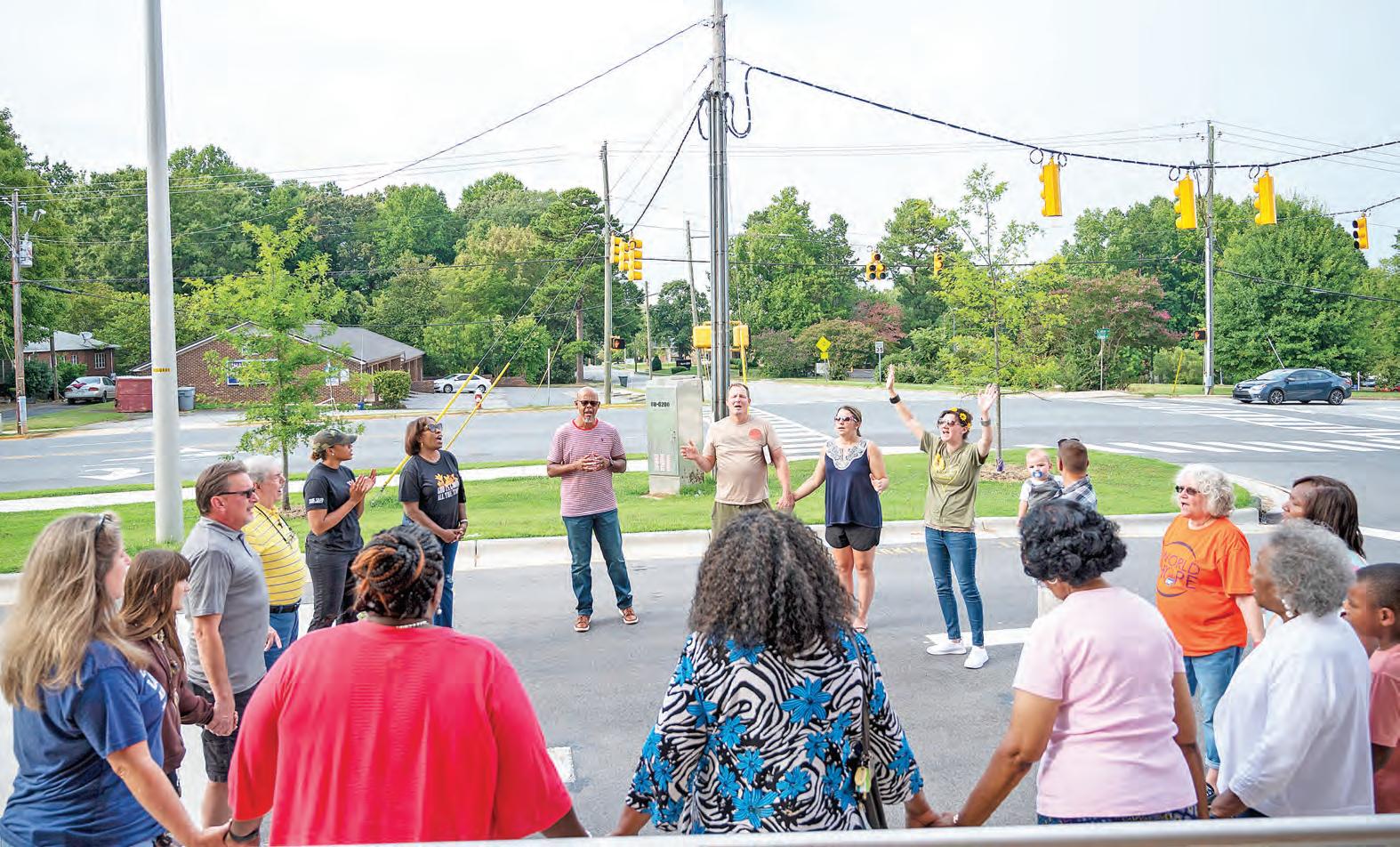
The production plant will employ about 2,100 people and house four production lines capable of delivering enough lithium-ion batter ies for 200,000 vehicles each year beginning in 2025, according to Toyota.
85 2017752016
NCDOT meeting draws big turnout in Liberty
Who are you calling a fascist, Mr. President?
CALLISTA L. GINGRICH
Nicaragua’s crackdown on Catholics
IN THE EARLY MORNING hours of August 19, Nicaraguan authorities arrested Bishop Rolando Álvarez, claiming he participated in “destabilizing and provocative activities.” Bishop Álvarez was placed on house arrest while priests, seminarians, and a layperson were thrown into the infamous El Chipote prison, where numerous political and media figures were detained. Responding to the escalating crisis in Nicaragua, Pope Francis said, “I am following closely, with concern and sorrow, the situation in Nicaragua, which involves both people and institutions.” The pontiff added, “I would like to express my conviction and my hope that, through open and sincere dialogue, the basis for a respectful and peaceful coexistence can still be found.” For President Daniel Ortega and his wife, Vice President Rosario Murillo, religious freedom poses a significant threat to their grip on power. Nicaragua’s Catholics, which make up more than 50 percent of the country’s population, have been a strong force of resistance and, as a result, have been targeted for voicing their opposition to the authoritarian Ortega-Murillo regime. In 2018, Nicaragua erupted in nationwide protests to oppose reforms to the public pension system, which were violently repressed by the Ortega-Murillo regime and left more than 300 people dead, approximately 2,000 injured, and 1,600 arrested. The Catholic clergy’s support for the protestors during the national crisis led to the persecution of clergy, worshipers, and Catholic organizations by the regime and its supporters. As the U.S. Commission on International Religious Freedom concluded in its latest report, the targeting of Catholics by the Ortega regime has continued. While President Daniel Ortega was seeking his fourth consecutive term in the 2021 election, the regime disqualified or imprisoned opposition candidates, arrested journalists and human rights activists, and raided the last printed independent newspaper in the country, La Prensa. But while the Nicaraguan Catholic Church called for free and fair elections and condemned the regime’s blatant violations against human rights, Ortega and Murillo called bishops “terrorists” and members of the clergy “sons of the devil.” In response to what the State Department called the “sham election” that enabled the Ortega-Murillo regime to continue its oppressive rule, the U.S. issued sanctions and denounced the government’s attacks against democracy and human rights.
COLUMN | DAVID HARSANYI PRESIDENT JOE BIDEN accused voters of the opposition party of turning to “semi-fascism.” This is probably the first time in American history a president has openly attacked the opposing party’s constituents in this way. Then again, Biden, who once alleged that the chaste Mitt Romney was harboring a desire to bring back chattel slavery, is prone to stupid hyperbole. And it’s true that most people who throw around the word “fascist” fail to do so with much precision. These days, the word “democracy,” like “fascism,” has lost all meaning. According to Democrats, asking someone to show ID before voting is an attack on “democracy,” but so is the Supreme Court’s handing back power to voters on the abortion issue. When you have no limiting principles of governance, anything that inhibits your exertion of power is seen as anti-”democracy.” If students have loans to be paid, “forgive” them. If you can’t pass a bill, the executive branch should do it by fiat. If the court stops it, pack it. Power is only to be limited when the opposition holds it. A microcosm of this confused thinking can be found in the recent spate of hysterical media pieces about alleged Republican “book banning.” The use of “ban” by the media is more than a category error; it’s an effort to paint parents who use the very same exact democratic powers the left has relied on for decades as book burners. Public school curricula and book selection are political questions decided by school and library boards. Neither have a duty to carry every single volume on racial identitarianism or sexually explicit material simply demanded by some busybody at the American Library Association. Henry Olsen of the Ethics and Public Policy Center notes that fascists “believed that multiparty democracy weakened the nation, and that competitive capitalism was wasteful and exploitative. Their alternative was a one-party state that guided the economy through regulation and sector-based accords between labor and business.”Well,is it not the left that champions government intervention in the economy, with never-ending regulations, subsidies, and mandates that effectively allow for controlling the means of production? Leftists — some incrementally, some less so — are the proponents of nationalizing the health care system, the energy sector, and education. Again, if progressives have any limiting principles when it comes to intervention in our economic lives, I’d love to hear about them. Are the most vociferous defenders of “democracy” not the ones who sound suspiciously like they want a one-party state?
For hyperbole.proneslavery,backdesirewasMittthatonceBiden,gripthreatafreedomreligiousRosarioViceandDanielPresidentOrtegahiswife,PresidentMurillo,posessignificanttotheironpower.whoallegedthechasteRomneyharboringatobringchattelistostupid
Modern Democrats have stopped debating policy or accepting the legitimacy of anyone who stands in their way. They will pass massive, generational reforms using parliamentary tricks without any input from the minority. And they don’t merely champion their work as beneficial; they claim these bills are needed for the survival of “democracy” and “civilization” — nay, the survival of the planet. Anyone who opposes saving Mother Earth is surely an authoritarian. There is nothing to debate. The villainization of political opponents isn’t new, but we are breaking new ground.
Callista Gingrich was Ambassador to The Holy See.
Some may find it a bit fascist-y that the FBI feels free to instruct giant rent-seeking corporations to censor news to help elect their preferred candidate, as it did with Facebook. Or that the White House is in the business of “flagging” “problematic posts” and threatening corporations to “root out” “misleading” speech or be held accountable. One wouldn’t be off base seeing a “Disinformation Governance Board” that sifts through speech the administration dislikes or a Justice Department that treats those protesting authoritarian school boards as “domestic terrorists” as “semifascist.”Itiscurious, as well, that the same people who control basically all major institutions in American life — academia, media, unions, Silicon Valley, Wall Street, trade associations, public schools, publishing, the entire D.C. bureaucracy, Hollywood, Madison Avenue, not to mention the presidency and Congress — claim to be victims of budding authoritarianism. The only major institution free of progressives’ grip right now is the Supreme Court. And the left is engaged in a systematic effort to delegitimize the Court for doing its job and limiting the state’s power. None of this is to say that the right is innocent. I often find myself debating the populist right on issues ranging from the free markets and the role of the state. Abuses of the Constitution should be called out no matter who engages in them. However, progressivism’s crusade to destroy separation of powers, its attacks on religious freedom and free speech, its undermining of civil society, its binding of the economy to the state, and its fostering of perpetual dependency and victimhood are far bigger long-term threats to the republic than Trumpism — and far closer to the definition of “semi-fascism” than the Republican agenda.
3Randolph Record for Wednesday, September 7, 2022 OPINION Neal Robbins, publisher | Frank Hill, senior opinion editor VISUAL COLUMNVOICES |
Tragically, these violations, particularly those targeting Nicaragua’s Catholics, have continued to escalate. As of July 20, the U.S. Department of State reported that, in 2022, the legal status of more than 800 nongovernmental organizations (NGOs) had been canceled by the Ortega-Murillo regime. The Missionaries of Charity, a religious order established by Saint Teresa of Calcutta, was among the hundreds of charitable organizations forcibly closed by the regime. The sisters assisted the most vulnerable in Nicaragua. They sheltered abandoned or abused teenagers, ran a home for the elderly, as well as a daycare center for the poor, and instituted a school program to help at-risk students. Tragically, the government accused the sisters of failing to comply with the country’s strict and wide-reaching terrorism law, shut down their organization, and ordered their expulsion from Nicaragua. As the sisters were expelled from the country in July, the independent newspaper, La Prensa, reported on their removal and faced retribution. The homes of two of La Prensa’s reporters were raided, and two drivers were arrested and taken to the El Chipote prison. Weeks later, on August 1, seven Catholic radio stations were shut down, and on August 5, Bishop Álvarez was placed under police investigation for “organizing violent groups.” A prominent critic of the regime’s abuses, Álvarez has called for the release of nearly 200 political prisoners and for electoral reforms. But despite the challenges that Álvarez has faced, he said, “We have to respond to hate with love, despair with hope, and fear with the strength and courage given to us by the glorious and resurrected Christ.” For weeks, Bishop Álvarez and a group of priests, seminarians, and lay people were confined to the bishop’s residence, and on August 19, the residence was raided by police. The bishop was arrested and placed under house arrest in the capital, Managua, while the others were taken to El Chipote. The Ortega-Murillo regime’s continued persecution of religious institutions is an affront to religious freedom in Nicaragua. This fundamental human right provides the foundation upon which societies thrive and is a bulwark against the forces of extremism and tyranny.TheOrtega-Murillo regime’s horrific atrocities targeting the Catholic Church in Nicaragua must cease.
David Harsanyi is a senior editor at The Federalist. Harsanyi is a nationally syndicated columnist and author of five books — the most recent, “Eurotrash: Why America Must Reject the Failed Ideas of a Dying Continent.”
HOCKEY Canada edges U.S. 2-1 to win women’s hockey worlds Herning, Denmark Brianne Jenner scored twice in the second period and Canada defended its title with a 2-1 win over the United States in the women’s world hockey championship final. AnnRenée Desbiens made 20 saves for Canada, which won gold in a third major international event in the span of a year. Abby Roque scored for the Americans and Nicole Hensley stopped 17 shots in the loss. Canada edged the U.S. 3-2 in overtime just over a year ago in Calgary in a world championship delayed to August because of the COVID-19 pandemic. Canada also beat the U.S. 3-2 in February’s Olympic women’s hockey final in Beijing.
It marked the first win for the No. 43 since Aric Almirola won with Richard Petty Motorsports in 2014
Along with Busch’s blow up, No. 9 seed Kevin Harvick saw his car catch fire in a scary seen. Harvick scrambled away from his stopped car to Top-seededsafety. Chase Elliott was gone during the first stage, slid ing into the wall, hitting Chase Briscoe as he tore up his suspen sion and was out of the race. Kyle Larson, the defending se ries champion, was three laps down in the opening stage after engine problems. Larson finished 12th.Hamlin was second followed by three more playoff chasers in Tyler Reddick, Joey Logano and Chris topher Bell. Michael McDowell was sixth, with Brad Keselows ki, William Byron, Bubba Wallace and Alex Bowman rounding out the top Busch10.led 155 of 367 laps, the most of anyone. He ended in 30th. “It’s unfortunate circumstanc es,” Busch said. “We just had a great car and didn’t come out with anything to show for it. That’s what I hate about it.” The scariest incident came in the final stage when Harvick caught fire on lap 276 as he came down the front stretch. Harvick quickly pulled the car on the grass and jumped out of the car, running to safety.Harvick said it’s another safe ty problem with the Next Gen car that NASCAR must fix. “What a disaster, man,” Har vick said. “No reason ... here we are in the pits with a burned up car and we can’t finish the race during the playoff” because of unreliable parts.Round one of the playoffs con tinues at Kansas next Sunday. Gov. Roy Cooper gave the retired Duke basketball coach North Carolina’s highest honor
By Pete Iacobelli The Associated Press
NFL With Smith sidelined, Cowboys add LT Peters Frisco, Texas The Dallas Cowboys and free agent left tackle Jason Peters have agreed on a one-year contract. The former longtime NFC East rival joins Dallas with eight-time Pro Bowl left tackle Tyron Smith likely sidelined until at least December with a torn hamstring. The 40-yearold Peters likely won’t be ready for Sunday’s opener against Tampa Bay. Rookie Tyler Smith could get the start, but Peters will get strong consideration for that spot when he’s ready for a game. Peters spent 11 of his first 16 seasons with Philadelphia. BOXING Ruiz beats Ortiz in showdownheavyweight Los Angeles Andy Ruiz knocked down Luis Ortiz three times on the way to a unanimousdecision victory Sunday night. Ruiz (35-2, 22 KOs) took a big step toward a chance to become a heavyweight world champion again. Ruiz had all of the big moments while grinding out a decision over Ortiz, a twotime world title challenger. Ruiz knocked down Ortiz (33-3) twice in the second round and again in the seventh, but Ortiz also punched more accurately during long stretches of relative inactivity for both fighters. MLB Mistrial in abuse case in Texas against retired Wettelandreliever Denton, Texas A Texas judge has declared a mistrial in the child sex assault case against former All-Star and World Series MVP pitcher John Wetteland after the jury deadlocked. The Denton County jury told Judge Lee Ann Breading three times that it was split before she declared a mistrial Friday. Wetteland was being tried on three counts of aggravated sexual assault of a child. He played for the Texas Rangers from 1997 to 2000 and also played for the New York Yankees and Seattle Mariners. The 56-year-old Rangers’ Hall of Famer faced 25 years to life in prison if convicted.
DARLINGTON, S.C. — Erik Jones took the lead when Kyle Bus ch’s engine blew up, then pulled away from Denny Hamlin after a final restart 20 laps from the end to win the opening NASCAR Cup Series playoff race at Darlington Raceway on Sunday night. Hamlin, seeded sixth in the playoffs, closed in on Jones’ back bumper on the final lap but couldn’t make the winning pass. Jones went on to his second career win at Darlington and third Cup Series victory. It was also the 200th win by the iconic No. 43 car, with most tied to Hall of Famer Richard Petty. “He said if I won, I was going to get a (cowboy) hat,” Jones laughed. Jones became the first non-play off driver to win the opener in NA SCAR’s 10-race run to a title. And he did it as many of the top seeds had breakdowns and wrecks.
Jones benefits from breakdowns, wins at Darlington Krzyzewski given Order of Long Leaf Pine
“His impact on basketball, his impact on Duke University and on Durham and our state will live on forever.”
Senate Minority Leader Dan Blue 200 Wins for the No. 43 after Erik Jones guided Richard Petty’s famous number back to Victory Lane
4 Randolph Record for Wednesday, September 7, 2022 SPORTS
SEAN RAYFORD | AP PHOTO Erik Jones won his third career Cup Series race — and second at Darlington — when he held off Denny Hamlin in the first race of the 2022 playoffs.
SIDELINEREPORT
The Associated Press RALEIGH — Setting aside the heated college basketball rivalry, recently retired Duke University coach Mike Krzyzewski was hon ored Thursday by Gov. Roy Cooper — a two-time graduate of the Uni versity of North Carolina — with the state’s highest honor. Eschewing his favored Tar Heel blue tie for a darker Duke hue, Cooper held a ceremony to give Krzyzewski the Order of the Long Leaf Pine, saying he’s “dedicated his life to helping others be their best” both on and off the court. Coach K came to Durham in 1980 to take the job. “I’m a Carolina fan, Tar Heel born and bred and all that. I would never pretend otherwise,” the Democratic governor said in an outdoor Executive Mansion cer emony attended by dozens of of ficials, Duke graduates and fans. “You got to be true to yourself, but you also have to be able to see through your bias and not only rec ognize greatness but appreciate it.” Krzyzewski retired as head coach after April’s gripping Fi nal Four loss to, of all teams, rival UNC in the first NCAA tourna ment meeting between the schools located 8 miles apart. Cooper, who attended the game in New Orle ans, did not mention the outcome during Thursday’s event. The Hall of Famer is college’s basketball winningest coach with 1,202 wins to go with five NCAA titles. As the Olympic men’s team head coach, the U.S. won three consecutive gold medals. He coached nine national players of the year at Duke and 38 All-Amer icans.Krzyzewski and his wife, Mick ie, also are known for their char ity work for health care and edu cation, including the creation of a community center named for his late mother. Cooper also men tioned how Krzyzewski spoke out recently against inaction by politi cians after mass gun violence. “His impact on basketball, his impact on Duke University and on Durham and our state will live on forever,” said Senate Minority Leader Dan Blue of Wake Coun ty, a Duke law graduate and for mer head of the university’s trust ee Krzyzewskiboard. said it was a “tre mendous honor” to receive the award, which was created in the 1960s for the governor to honor exemplary state service. Recipi ents receive the “special privilege” to propose the state’s official toast “anywhere in the free world.” Krzyzewski quipped that the event was “bringing out the best” in Cooper. Even the governor’s family dog, Violet, wore a collar in the garden etched with the Duke name.“Gov. Cooper is a Duke fan to day,” Coach K said, emphasizing what brings North Carolina resi dents“Whethertogether.you’re a Duke fan, a Carolina fan, or really don’t care about either one — and there are a bunch of people who don’t care about either one by the way — we all share a common bond of being a North Carolinian,” he said, add ing that his family will “do every thing we can to continue to help make this state the best state.”
DAVID J. PHILLIP | AP PHOTO Duke head coach Mike Krzyzewski watches during the first half of a college basketball game against North Carolina in the semifinal round of the Men’s Final Four NCAA tournament, Saturday, April 2, 2022, in New Orleans.
PJ WARD-BROWN | NORTH STATE JOURNAL Randleman’s Chloe Dixon spikes the ball against Eastern Randolph’s Logan Beaver and Kenley Whitaker during a match last week.
ASHEBORO — The annual fall baseball league that involves teams representing high schools around the region is set to begin next week at McCrary Park. Seven teams will participate, representing Asheboro, Uwharrie Charter Academy, Cha tham Central, Jordan-Matthews, Lee County, Montgomery Central, and North Moore. There are two games on Mondays, Tues days, and Wednesdays beginning at 5:30 p.m. and 7:30 p.m., with one game Thursday at 6 p.m. Each team will play two games per week. The Asheboro ZooKeepers organization is the host for the league.


5Randolph Record for Wednesday, September 7, 2022
RANDLEMAN — Quarter back Christian Long ran for two touchdowns and threw for an other as the Tigers cruised in a 47-7 victory against visiting Montgomery Central on Friday night.Amarion Moton scored on touchdown runs of 3 and 1 yards for Randleman (2-1). Long connected with Tyshaun Goldston, who racked up 135 yards on five catches, for a 66yard touchdown play. Long’s touchdown runs came from 4 and 22 yards out. Micah Thurston also scored on a 13-yard touchdown run. Eastern Randolph 35, Walkertown 21 At Walkertown, Ervodd Cas sady ran for three touchdowns as the Wildcats (2-1) picked up a road victory. Those were part of the team’s 275 rushing yards. “I thought the offensive line played extremely hard,” Eastern Randolph coach Burton Cates said.Versatile back Davonte Brooks returned to action after missing the Asheboro game a week earli er with an injury. He made sev eral big-yardage plays. Eastern Randolph’s Will Stalker returned an interception for a Walkertowntouchdown.(2-1) won its first two games by shutouts. Providence Grove 51, Jordan-Matthews 0 At Siler City, the visiting Pa triots (3-0) recorded a shutout for the second week in a row. Zane Cheek scored on a punt returning and a rushing play. Zander Cheek and Joel Coltrane also returned punts for touch downs. Jaden Baker ran for 75 yards and a Quarterbackstouchdown.Andrew Canter and Chase Whitaker each threw a touchdown pass. The Jets (0-3) have scored six points all season. East Davidson 42, Trinity 13 At Trinity, the Bulldogs (2-1) couldn’t hang around after trail ing just 14-7 at halftime. Dom inic Payne threw a touchdown pass to Chance Grogan, and Bob Gibson reached the end zone on a run for host Trinity’s touch downs. East Davidson is 2-1. Ledford 70, Wheatmore 0 At Thomasville, the Warriors dropped to 0-3 with the road loss.
Former Division I college players take roles with ZooKeepers staff
BEST OVERALL ATHLETE OF THE WEEK Randleman, volleyball Dixon played key roles as the Tigers won matches on three consecutive nights last week. Those results were a 25-27, 25-14, 25-12, 23-25, 15-12 escape at Eastern Randolph in a Piedmont Athletic Conference opener, a 25-17, 25-20, 25-18 non-conference decision against visiting Oak Grove and a 16-25, 25-19, 25-22, 25-12 toppling of visiting Wheatmore in another PAC match. Dixon, a senior hitter and defensive specialist, had a team-high 11 kills to go with 15 digs in the test at Eastern Randolph. She shared team honors with six kills against Oak Grove along with 15 digs. Dixon had four kills and 16 digs in the Wheatmore match.

Chloe Dixon
windsracingareaOctoberoneandSeptembereventsdatesscheduledhasSpeedwayCarawaythreewithinatleastmoreinasthestock-carseasondown.
PREP FOOTBALL
AREA SPORTS BRIEFS
Poole plays role for Citadel in opener At Buies Creek, Randleman alum Domi nick Poole of The Citadel returned to his home state for last week’s season-opening football game.Poole, a sophomore defensive back, was credited with seven tackles in the 29-10 loss to Campbell. His tackles total tied for second on the team. Shiflet starts strong for Greensboro volleyball Freshman Payton Shiflet of the Greensboro College volleyball team has made a strong ear ly impression on the college level. She was a standout last year for Southwestern Ran dolph’s Class 2-A state championship team. With Greensboro, Shiflet posted a team-leading 44 kills through four matches. She also provided four aces as the Pride began the season with a 1-3 record last week in the Virginia Wesleyan Tournament. The team’s victory came against Pittsburgh-Bradford.
Randolph Record
Greensboro will play its first home match Sept. 13 against Averett at Hanes Gym. Caraway gears up for more racing
PJ WARD-BROWN | NORTH STATE JOURNAL
Fall league approaches for area high schools games Grove TrinitySouthwesternatBurlingtonGreensboroChathamAsheboroCentralatWheatmoreSmithatRandlemanWilliamsEasternRandolphRandolphatWestDavidsonatJordan-Matthews
Providence
At Sophia, racing action returns to Car away Speedway Saturday night for the “9/11 Night of Remembrance.” It’s a night to remember those who lost their lives in the 2001 terrorist attacks and honor area first responders and law enforcement of ficials.Onthe track, racing divisions will include features for Challengers, Mini Stocks, UCARs, Legends, Bandoleros, and Any Car classes. There wasn’t racing during Labor Day weekend at the track.
FOOTBALL WEEK 4 Friday’s
at
Eastern Randolph’s Ervodd Cassady runs into the end zone against Walkertown on Friday night. AP PHOTO, FILE Randleman, E. Randolph, Providence Grove rack up wins

AsheboroinRichiecatcherCarolinaNorthKoreyDunbar,right,tagsoutFlorida’sMartininthisNCAATournamentgamein2014Gainesville,Fla.Dunbarwillbecoachinginnextsummer.
By Bob Sutton Randolph Record
Randolph Record ASHEBORO — A new coach ing staff has been selected for the Asheboro ZooKeepers, and there’s regional college flavor involved in thoseFormerselections.North Carolina catch er Korey Dunbar will be the head coach. Ex-North Carolina State pitcher Josh Pike will be the 2023 pitching coach. The ZooKeepers are a Coastal Plain League team. Dunbar, who has been on Barton College’s coaching staff for three seasons, played for North Carolina from 2012-15. That included a trip to the College World Series in 2013. “I am extremely grateful and ex cited for the opportunity to lead the Asheboro ZooKeepers for the 2023 season,” Dunbar said in informa tion from the team. “I can’t wait to make an impact on the incom ing talented players, the Asheboro community, and the entire Zoo Keepers fan base.” Dunbar takes over for Jere my Knight, who stepped aside from summer college baseball af ter spending several years on those circuits. He was Asheboro’s head coach for the past two years. Dunbar was drafted by the Los Angeles Dodgers in the 39th round out of high school and again by the Miami Marlins in the 20th round after his playing days at North Carolina. During college, he was a member of the CPL’s Wilson Tobs in 2013 and played in the Cape Cod League in 2014. Josh Pike spent one season with N.C. State a player before transi tioning into coaching. He was the USA Collegiate National Team bullpen coach in 2022 after a year of being the team’s pitching techni cian. Pike, who went to the College World Series with the Wolfpack in 2021, is well-versed in analytics, according to information from the ZooKeepers.“Havingthe opportunity to coach in the CPL is something I will not take for granted,” Pike said. “I can’t thank the ownership and manage ment enough for their support and passion for the game of baseball. (Next) summer, we are going to cre ate an exciting baseball environ ment that breeds from a competi tive culture while being conducive to player development. I’m more than excited to get the ball rolling and win as a ZooKeeper.” The ZooKeepers were pre viously the Asheboro Copper heads until last winter’s change of nickname amid a revamped mar keting campaign. The team plays at McCrary Park, which is under going a second consecutive offsea son of renovations.
Mississippi capital’s water disaster developed over decades
ALEX BRANDON | AP PHOTO
6 Randolph Record for Wednesday, September 7, 2022 6 Subscribe today (randolphrecord.com/subscribe704)269-8461
AP PHOTO A water tower emblazon with the City of Jackson, Miss., official seal looms over this north Jackson neighborhood Wednesday, Aug. 31, 2022.
SUSAN WALSH | AP PHOTO President Joe Biden speaks at a United Steelworkers of America Local Union 2227 event in West Mifflin, Pa., Monday, Sept. 5, 2022, to honor workers on Labor Day.
In this Wednesday, April 17, 2019, file photo reviewed by U.S. military officials, the control tower is seen through the razor wire inside the Camp VI detention facility in Guantanamo Bay Naval Base, Cuba.
By Emily Wagster Pettus The Associated Press JACKSON, Miss.
“The middle class built Ameri ca,” Biden told a workers’ gather ing at park grounds in Milwau kee. “Everybody knows that. But unions built the middle class.” Later Monday, he flew to West Mifflin, outside Pittsburgh — re turning to Pennsylvania for the third time in less than a week and just two days after his predecessor, Donald Trump, staged his own rally in the state. The unofficial start of fall, La bor Day also traditionally starts a political busy season where cam paigns scramble to excite voters for Election Day on Nov. 8. That’s when control of the House and Senate, as well some of the coun try’s top governorships, will be decided.Trump spoke Saturday night in Wilkes-Barre, near Scranton, where Biden was born. The pres ident made his own Wilkes-Barre trip last week to discuss increas ing funding for police, to decry GOP criticism of the FBI after the raid on Trump’s Florida estate and to argue that new, bipartisan gun measures can help reduce violent crime.Two days after that, Biden went to Independence Hall in Phila delphia for a prime-time address denouncing the “extremism” of Trump’s fiercest supporters. Trump has endorsed candi dates in key races around the country and Biden is warning that some Republicans now be lieve so strongly in Trumpism that they are willing to under mine core American values to promote it. The president said Thursday that “blind loyalty to a single leader, and a willingness to engage in political violence, is fa tal to Trumpdemocracy.”responded during his Saturday rally that Biden is “an en emy of the state.” Republican Na tional Committee Chair Ronna McDaniel tweeted Monday that Biden “is the most anti-worker president in modern history,” not ing that high inflation had taken a bite out of American wages, in come and savings. During his address in Milwau kee, Biden said “Not every Repub lican is a MAGA Republican” but singled out those who have tak en Trump’s “Make America Great Again” campaign cry to dangerous or hateful lengths. He highlighted episodes like last year’s mob attack on the U.S. Capitol. He said that many in the GOP are “full of anger, violence, hate, division.”“Buttogether we can, and we must, choose a different path for ward,” Biden said. “A future of uni ty and hope. we’re going to choose to build a better America.” Unions endorsements helped Biden overcome disastrous early finishes in Iowa and New Hamp shire to win the 2020 Democrat ic primary, and eventually the WhiteMaryHouse.Kay Henry, president of the 2 million-member Service Employees International Union, called Biden’s championing of unions heading into the mid term elections “critical” and said workers must “mobilize in battle grounds across the country to en sure that working people turn out.” “We’re really excited about the president speaking directly to workers about, if he had the op portunity, he’d join a union,” Hen ry said. She added: “This presi dent has signaled which side he’s on. And he’s on the side of working people. And that matters hugely.” In Pennsylvania, Biden ad dressed members of the Unit ed Steelworkers and noted that Trump is a “former, defeated president.”Bothof the perennial presi dential battleground states Biden visited Monday may provide key measures of Democrats’ strength before November. With inflation still raging and the president’s ap proval ratings slightly better but remaining low, how much Biden can help his party in top races — and how much candidates want him to try — remains to be seen. That was on display in Mil waukee, where Democratic Lt. Gov. Mandela Barnes is trying to unseat incumbent Johnson, but didn’t appear with Biden. In the state’s other top race, Tim Michels, a construction executive endorsed by Trump, is attempt ing to deny Democratic Gov. Tony Evers a second term. Evers spoke at the labor event Biden addressed and briefly greeted the president backstage.Pennsylvania voters are choos ing a new governor, with state Attorney General John Shapiro facing another Trump-endorsed Republican, Doug Mastriano, and a new senator. That race is between Democratic Lt. Gov. John Fetterman and Trumpbacked celebrity heart physician Mehmet Oz. Fetterman spoke with Biden before both gave speeches in West Mifflin. The Pennsylvania and Wiscon sin races could decide which par ty controls the Senate next year, while the winner of each gover norship may influence results in 2024’s presidential election.
— For at least the third time in a dozen years, portable toilets are parked outside the ornate Mississippi Capitol be cause Jackson’s water system is in crisis.The big “Gotta Go” trailer is just one example of the city’s despera tion. Many homes, businesses and government offices have had lit tle or no running water this week, forcing people to wait in long lines for drinking water or water to flushThetoilets.scenes testify to the near collapse of a water system that residents could not trust even in the best of times. The failure to provide such an essential service reflects decades of government dysfunction, population change and decaying infrastructure. “We’re on a budget, and we have to go buy water all the time. All the time,” said Mary Huard, whose child has been forced to shift to online schooling because in-person classes were called off due to weak water pressure. Even before the pressure dropped, Jackson’s system was fragile, and officials had warned for years that widespread loss of service was possible. A cold snap in 2021 froze pipes and left tens of thousands of people without run ning water. Similar problems hap pened again early this year, on a smallerBrokenscale.water and sewer pipes are also common in Mississippi’s largest city. The Environmental Protection Agency told Jackson months ago that its water system violates the federal Safe Drinking Water Act. The crisis deepened after heavy rain last week flooded the Pearl River and exacerbated trouble at the main water-treatment plant during the weekend. The lines for water formed at churches, fire stations, community centers and outside big-box stores. When Gov. Tate Reeves and President Joe Biden declared the situation an emergency, residents had already been advised for a month to boil their water before doing everything from brushing teeth to boiling pasta. Mayor Chokwe Antar Lumum ba said fixing the problems could cost billions of dollars — far be yond Jackson’s ability to pay. That ability has been limited by a shrinking tax base that result ed from white flight, which be gan about a decade after public schools were integrated in 1970. The population peaked in 1980 at nearly 203,000. It current ly stands at about 150,000, with about 25% of residents living in poverty.Inthe past half-century, the racial composition of Jackson has also changed. Once majori ty white, it is now more than 80% black.The Democratic mayor and the Republican governor rarely speak to each other. And when Reeves held a news conference to an nounce a state of emergency, Lu mumba was nowhere to be seen. Reeves said he did not invite the mayor.
The move also restores auton omy to the country’s immigra tion judges over how they manage their dockets, said Jeremy McKin ney, president elect of the Ameri can Immigration Lawyers Associ ation. Immigration judges clashed repeatedly with the Trump ad ministration, decrying measures they said limited their indepen dence.“To say the immigration judg es never possessed this power was simply ridiculous,” McKinney said.
In this June 25, 2021 file photo, Attorney General Merrick Garland speaks during a news conference on voting rights at the Department of Justice in Washington, D.C.
Garland lets immigration judges put off deportation cases
—

In step to shut Guantanamo, President Biden transfers Moroccan home
Biden blasts ‘extreme’ GOP in Labor Day swing-state trips
U.S. ATTORNEY General Mer rick Garland tossed a Trump ad ministration policy that barred immigration judges from putting off the deportation cases of immi grants waiting on green cards and visas.Garland overruled a decision by then-Attorney General Jeff Ses sions that judges could not tem porarily shelve those cases — a practice known as administrative closure.Immigration judges, who are employees of Garland’s Depart ment of Justice, said the practice helps them manage their dockets more efficiently by letting them fo cus on cases that are ready to go to court and avoid dragging in immi grants and attorneys for unneces sary hearings. That’s critical in a backlogged system where immi grants already wait years to get a court date. “It helps us clear our dockets so we’re dealing with cases that are really ready for hearings,” said Immigration Judge Dana Leigh Marks, president emerita and ex ecutive vice president of the Na tional Association of Immigration Judges.Formany immigrants, admin istrative closure was seen as a life line that shielded them from de portation while they awaited word on their applications for legal sta tus from other agencies, such as green cards or other visas. Critics said immigration judges too often let people stay in the country lon ger than they should in a sort of le galThepurgatory.decision is one of several recent Biden administration re versals of former President Don ald Trump’s immigration policies. Last month, Garland ended two policies that made it harder for im migrants fleeing violence to quali fy for asylum. In the decision on immigration judges, Garland wrote that three federal appeals courts had already rejected Sessions’ 2018 policy, say ing the judges had the authori ty to decide how they wanted to handle cases. The Justice Depart ment, which runs the immigration courts, is making rules related to administrative closure and will al low the practice in the meantime, the attorney general wrote. During the Trump administra tion, the number of cases in the immigration courts surged, part ly as some of the hundreds of thou sands of cases that had been put on hold were added back on the court calendar following Sessions’ decision.Since the 2018 fiscal year, the number of cases pending in the immigration courts has risen 74%, to 1.3 million, according to data from the Transactional Records Access Clearinghouse at Syracuse University.GeneHamilton, a key architect of many of Trump’s immigration policies who served in the Justice Department, said he believes Gar land’s decision will let immigrants stay in the country indefinitely de spite facing deportation. But some immigration judges said they can only use the practice in a limited number of cases and that it makes the courts more ef ficient, not less. Without it, some immigrants have wound up fil ing applications for asylum or ap peal simply to buy more time while waiting on their green card appli cation, Marks said. “It clutters up the system with unnecessary filings and unneces sary hearings,” she said.
By Dino Hazell The Associated Press
WASHINGTON, D.C.
WASHINGTON, D.C. —
Cecil Brown is a Democrat who represented part of Jackson in the Mississippi House for 16 years be fore serving on the state Public Service Commission. He urged city, state and congressional lead ers to work together. “If you don’t like each other, it’s OK, let’s say, ‘If we can’t work to gether, let’s put our staff together,” Brown said in an interview. Lumumba has complained that Mississippi, a state with almost a 40% black population, is often overlooked by national Democrats and taken for granted by Repub licans.Criticism about the Jackson water debacle is not strictly par tisan.U.S. Rep. Bennie Thompson, a Democrat whose district includes most of Jackson, said in mid-Au gust that Jackson leaders had not provided specific proposals for im provements.“Thecity fathers and mothers will have to step up, produce that plan that we can begin to sell from Jackson to Washington,” Thomp son told television station WJTV. Reeves has not said whether he will call a special session of the Legislature before January to con sider aid for Jackson. Any propos als will face opposition from some Republicans who say the state should not rescue Jackson from its predicament.ButRepublican state Sen. Brice Wiggins of Pascagoula, along the Gulf Coast, said he is willing to help if the aid includes an ac countability plan.
The transfer of Abdullatif Nass er was the first by the Biden ad ministration, reviving an Obama administration effort that had been stymied, in part, by conser vative opposition and by the diffi culty of finding secure sites to send some of the detainees. A review board had recom mended repatriation for Nasser, who is in his mid-50s, in July 2016, but he had remained at Guantána mo under President Donald Trump, who opposed closing the site.In announcing Nasser’s trans fer, the Pentagon cited the board’s determination that his detention was no longer necessary to protect U.S. national security. Nasser, also known as Abdul Latif Nasser, arrived Monday in Morocco. Police took him into cus tody and said they would investi gate him on suspicion of commit ting terrorist acts. Nasser’s attorney in Morocco, Khalil Idrissi, said the years Nass er spent in Guantánamo “were un justified and outside the law, and what he suffered remains a stain of disgrace on the forehead of the American system.” The State Department said in a statement that President Joe Biden’s administration would con tinue “a deliberate and thorough process” aimed at reducing the de tainee population at Guantánamo. White House press secretary Jen Psaki had said in February it was the “intention” of the Biden admin istration to close the detention fa cility, something President Barack Obama pledged to do within a year shortly after he took office in Janu aryAlmost2009. 800 detainees have passed through Guantanamo. Of the 39 remaining, 10 are eligible to be transferred out, 17 are eligible to go through the review process for possible transfer, another 10 are in volved in the military commission process used to prosecute detain ees and two have been convicted, another senior administration of ficialThesaid.Biden administration didn’t address how it would handle the ongoing effort to prosecute five men held at Guantánamo for the Sept. 11 attacks. It also has to re solve what it will do with detain ees that the Obama administration particularly struggled with, ei ther because their home countries were not considered secure enough to return them to, or because they were refused by third-party coun tries.The detention center opened in 2002. Bush’s administration trans formed what had been a quiet Navy outpost on Cuba’s southeastern tip into a place to interrogate and im prison people suspected of links to al-Qaida and the Taliban. The Obama administration, seeking to allay concerns that some of those released had “returned to the fight,” set up a process to en sure those repatriated or resettled in third countries no longer posed a threat. It also planned to try some of the men in federal court. But the closure effort was thwarted when Congress barred the transfer of prisoners from Guantánamo to the U.S., including for prosecution or medical care. The prisoner transfer process stalled under Trump, who said even before taking office there should be no further releases. “These are extremely dangerous people and should not be allowed back onto the battlefield,” Trump said.Under Trump, only one prison er, a Saudi, was transferred to Sau di Arabia to serve the remainder of his sentence after he agreed to a pleaUnderbargain.Obama, 197 were trans ferred to other countries. The possibility that former Guantánamo prisoners would re sume hostile activities has long been a concern that has played into the debate over releases. The office of the Director of National Intelligence said in a 2016 report that about 17% of the 728 detain ees who had been released were “confirmed” and 12% were “sus pected” of reengaging in such ac tivities.Butthe vast majority of those reengagements occurred with former prisoners who did not go through the security review that was set up under Obama. A task force that included agencies such as the Defense Department and the CIA analyzed who was held at Guantánamo and determined who could be released and who should continue in detention. The U.S. thanked Morocco for facilitating Nasser’s transfer. “The United States commends the Kingdom of Morocco for its long-time partnership in secur ing both countries’ national secu rity interests,” the Pentagon state ment said. In a statement, the public prose cutor at the Court of Appeal in Ra bat said the National Division of the Judicial Police in Casablanca had been instructed to open an in vestigation into Nasser “on suspi cion of committing terrorist acts.” Idrissi, Nasser’s attorney, said judicial authorities should not “take measures that prolong his torment and suffering, especially since he lived through the hell of Guantánamo.”Nasser’sjourney to the Cuban prison was a long one. He was a member of a nonviolent but ille gal Moroccan Sufi Islam group in the 1980s, according to his Penta gon file. In 1996, he was recruited to fight in Chechnya but ended up in Afghanistan, where he trained at an al-Qaida camp. He was cap tured after fighting U.S. forces there and was sent to Guantána mo in May 2002.
By Amy Taxin The Associated Press
The Biden administration took a step toward its goal of shutting down the Guantánamo Bay detention center for international terror sus pects on Monday, releasing into the custody of his home country a Moroccan who’d been held with out charge almost since the U.S. opened the facility 19 years ago.
By Will Weissert The Associated Press
Presi dent Joe Biden excoriated “MAGA Republicans” and the extreme right on Monday, pitching person al Labor Day appeals to swingstate union members who he hopes will turn out in force for his party in November.
PATRICK SEMANSKY | AP PHOTO
Reeves frequently criticiz es Jackson for its crime rate and has said the city’s water problems stem from shoddy management.
“The state ‘bailing out’ the city after what appears to be decades long neglect & failed leadership violates my sense of accountabil ity & conservative principles,” Wiggins wrote on Twitter. “In the end, it’s about the safety of Jack son’s citizens & its economic via bility.”Even when Jackson is not un der a boil-water notice, Sharon Epps said she buys bottled water for her family because she doesn’t trust the tap water. She said her landlord replaced a broken line that spewed raw sewage into the back“Whenyard.you can’t use the bath room like you want to, and it’s floating in your back yard, that’s the saddest part about it. And then you can’t sit out in the back yard because it smells so bad,” Epps said. “It’s a disaster, baby.”
Kenneth Wayne Simmons, age 82, of Asheboro passed away on Monday, August 29, 2022 at Moses Cone HospitalMr.Simmons was born in High Point, NC on September 15, 1939 to Grover and Bertha Corder Simmons. Kenneth served his country in the U.S. Army. Kenneth was formerly employed with Klopman Mills and Texfi Industries, and retired as a commercial truck driver with Moll Industries. He was a member of Center Cross Baptist Church. In addition to his parents, Kenneth was preceded in death by his daughter, Sandy White, brothers, Raeford Simmons and Ralph Simmons, and sisters, Mattie McDowell, Betty Simmons, and Ruth Simmons. Kenneth enjoyed working on old cars and tinkering with anything that was fixable. He was always ready to lend a helping hand to anyone who asked. He is survived by his wife, Sylvia Misenheimer Simmons; daughter, Tricia McCaskill (Kevin Cain) of Asheboro; granddaughter, Andrea White Moore (Adam) of Kernersville; grandson, Daniel White of Kernersville; son-in-law, Randy White; and sister, Ruby Bennett of Asheboro.


Charlie Hayes Wright
November 3, 1941 — August 30, 2022 Evelyn Janette Owens Asbill, 80, of Asheboro, passed away on August 30, 2022 at Clapp's Nursing Home. Mrs. Asbill was born on November 3, 1941 in Randolph County to Esco and Bertha Cox Owens. She was a graduate of Asheboro High School and grew up in Giles Chapel United Methodist Church. She later became a member of Rushwood Park Wesleyan Church and then attended Good Samaritan Baptist Church. Mrs. Asbill had worked as a seamstress for Tysinger Sewing and was also a homemaker. She enjoyed traveling with her family and loved her grandchildren and attending their sporting and school events. In addition to her parents, Mrs. Asbill was preceded in death by her husband, Tony Asbill. Mrs. Asbill is survived by her sons, Brian Asbill and wife Tracey of Cary, Craig Asbill of Charlotte, NC; grandchildren, Matthew, Katie, Eleri; sister, Barbara Ward and husband Larry of Asheboro; brother, Howard Owens and wife Annette of Asheboro.
Mary Finch
February 13, 1943 — August 31, 2022
February 5, 1944 — August 30, 2022
September 15, 1939 — August 29, 2022
Susan Cooper Eller
William "Tommy" Thomas Spillman

7Randolph Record for Wednesday, September 7, 2022 obituaries Celebrate the life of your loved ones. Submit obituaries and death notices to be published in the Randolph Record at obits@randolphrecord.com 2 Randolph Record for WEDNESDAY 7.21.21 “Join#3 conversation”the WEEKLY FORECAST 2 Randolph Record for Wednesday, WEDNESDAY 7.7.21 “Join#1 conversation”the WEEKLY FORECAST WEDNESDAY JUNE 30 HI 91° LO 70° PRECIP 15% THURSDAY JULY 1 HI 91° LO 70° PRECIP 15% FRIDAY JULY 2 HI 78° LO 66° PRECIP 57% PRECIPLOHI WEDNESDAY JULY 21 HI 88° LO 67° PRECIP 13% THURSDAY JULY 22 HI 88° LO 67° PRECIP 5% FRIDAY JULY 23 PRECIPLOHI RANDOLPH COMMUNITY COLLEGE
Mary Lacy Hannon Finch, 79, of Asheboro, passed away on August 31, 2022 at Randolph Hospice House.Mrs. Finch was a native of Henderson, NC and was born on February 13, 1943 to Lacy and Catherine Hannon. She was of the Methodist faith and formerly attended Brower's Chapel United Methodist Church. Mrs. Finch was a homemaker and had was a former bridal consultant for Belk's Department Store. Mrs. Finch is survived by her daughter, Shannon Smith and husband Fred of Asheboro; son, Dr. John R. Finch of Harrisonburg, VA; grandchildren, Jakob Finch of Harrisonburg, VA, Katie Boehme of Berlin Germany; greatgrandchildren, Julie Lewis of Asheboro, Emily Jayes of Asheboro, Lea Boehme and Lujain Boehme of Berlin Germany; brother, Sam Hannon.Inaddition to her parents, Mrs. Finch was preceded in death by her husband, Robert Finch, daughter-inlaw Meghan Finch, granddaughter Sandra Levesque and sister Catherine Speight.


Susan Cooper Eller, Age 83, of Asheboro passed away peacefully on Thursday, August 25th at Clapp’s Convalescent Nursing. Susan was born in Philadelphia, PA on August 1, 1939 to Rev. Edward Beekman Cooper and Ingrid Jonassen Cooper. She spent many of formative years in Charlotte, NC and attended East Mecklenberg High School, graduating in 1957. Susan attended Duke University and graduated in 1961 with a degree in Elementary Education and a minor in Music. She was married to Rev. James Eller from 1961 to 1978 and had three children, James Jr., Susan, and David. Susan was a talented musician who played piano and organ at various churches in South Carolina as well as taught piano lessons over the years. She also worked as an administrative assistant at Clemson University for over 20 years, retiring in 2003. In 2013, she moved to Asheboro, NC to be near her daughter and son-in-law, Susan and Jim Faile and her beloved grandchildren, Cooper and Julia Faile.Susan is predeceased by her parents, her younger brother, Edward Beekman Cooper Jr.; her brother-in-law, Jesse Powell; and her nephew, Thomas Melton. She is survived by sisters, Ingrid Powell and Eloise Melton (Jim); sisters-inlaw, Margo Cooper and Frances Eller Brown (Larry); cousins, Thora Helen Westervelt (Clint) and Maree French (Ted); children, James Eller Jr, Susan Faile (Jim), and David Eller; grandchildren, Cooper and Julia Faile; and eight nieces and nephews.
Evelyn Owens Asbill
ArthurOatleyRonald September 11, 1933 — August 28, 2022
Charlie Hayes Wright, age 59, passed away on September 1, 2022 at First Health Moore Regional Hospital.Charlie was born on February 5, 1963 in Montgomery County to Howard and Bessie Singleton Wright.Inaddition to his parents, he was preceded in death by his sister Frances Mabe and Marie Mabe. He is survived by his sisters Jessie Brewer of Troy; Ann Elder of Fuquay Varina; Peggy Cornell of Troy; and brother Roy Wright of Seagrove. Also Charlie's friends at the group home.Services will be private. The family wishes to thank the staff and Charlie's friends at Therapeutic Alternatives Group Home in Candor; also the staff at Peak Resources Pine Lake and the staff at the Reid Heart Center in Pinehurst. Roger Dale Green July 10, 1944 — August 30, 2022 Roger Dale Green, age 78, of Eagle Springs passed away peacefully at home on Tuesday, August 30, 2022 after a period of declining health. Roger, the son of the late Jack and Ruth Green, grew up in West End. He and his late wife Nancy graduated from West End High School where Roger was a star athlete. They met and became sweethearts and married in 1963. They settled in Eagle Springs, and with love and devotion; raised Jody, Jeff and Jennifer; and built a warm, beautiful home and family. Roger was an active member at Bensalem Presbyterian Church where he served as deacon and elder and was very involved in the Faithful Followers Sunday School class. He loved his Bensalem Church family and was an active supporter of many church projects and events. In addition to his wife, Roger is predeceased by his sisters; Marie Bruton, Mildred Davis, and Nancy Kiser; and brothers, Albert Green, Kermit Green, Howard Green, and Kivet Green. Roger is survived by daughters, Jody Quick (Raymond) and Jennifer Coffman (Jason) and son, Jeff Green (Charlotte); grandchildren, Jacob Green and Parker Coffman.
William “Tommy” Thomas Spillman, 78, passed away on August 29, 2022 from a lengthy illness. He was born on February 5, 1944. Tommy was preceded in death by his parents, Wesley Thomas Spillman, and Esther Curry Bennett, wife Marian Spillman, and stepmother Hilda Spillman. He is survived by his sister Ruth Cashwell (Tom), and son Stacey Spillman. After being honorably discharged from the US Air Force, Tommy worked and retired from Shelba Trucking as a truckdriver. There are no services planned at this time. Tommy’s family would like to express a thank you to the Dr.’s and staff at Randolph Health, and staff at Hospice of Randolph.
Richard Henry Segell of Randleman passed away Sunday, August 28, 2022 at his home. Richard was born October 23, 1945 in Boston, MA to the late Max and Sara Rabinowitz Segell. He was a retired salesman. He loved horses and after retirement he hosted many "Pony Parties" for birthdays and special events. He is survived by his fiance, Anna Graham of the home. No services are planned at this time.
Richard Henry Segell October 23, 1945 — August 28, 2022
Brenda Britt Willard April 14, 1947 — August 30, 2022 Brenda Sue Britt Willard, age 75, of Star, passed away on August 30, 2022 at First Health Moore RegionalBrendaHospital.wasborn on April 14, 1947 to Charlie and Lena Blake Britt. She loved doing puzzles, tending to her plants and most of all she loved her grandchildren. She is survived by her husband, David Willard of the home; daughter Debbie Willard of Star; sons Roy McBride of Star, Donnie Willard of Star and Steven Willard of Star. Eight grandchildren and five great grandchildren.Aprivateservice will be held at a laterIndate.lieuof flowers, memorials can be made to the charity of ones choice.
Arthur Ronald Oatley, born in Cincinnati, Ohio on September 11, 1933. He was the eldest son of Arthur F. Oatley and Alberta M. (Fisher) Oatley. Arthur departed this earthly life on Sunday, August 28, 2022 in the North Carolina State Veterans Home in Fayetteville, NC. He was preceded in death by his wife, Mary (McKenzie), and 3 sons: Robert Charles Oatley, Douglas Arthur Oatley, and Ronald William Oatley, as well as his brother, Donald Oatley and sister, Alberta (Oatley) Bargo. Art (“Artie” as his siblings called him) leaves behind 2 daughters, Vicki James of Suffolk, VA and Mary Chaisson and her husband, Paul, of Durham, NC. He also leaves behind his sister, Arlene Bass of Cincinnati, OH and his brother and his wife, Al and Gene Oatley of Georgetown, OH. Known as Pappaw to his grandchildren, Jesse James (Angie) of Virginia Beach, VA, Heather James of Chesapeake, VA, Paul Chaisson of Dover, DE, Sarah Chaisson of Durham, NC, Anthony Chaisson of Durham, NC and Daniel Chaisson (USAF) currently residing in Illinois, and 2 step grandchildren, Caleb Davis and Sabrina Davis of NC. In addition, Art leaves behind 5 great grandchildren: Chase James, Julia Garcia, Christina Garcia, Ty James and Reighan Simons, all of Virginia, as well as several nieces and nephews all over the US. Not to mention several friends of his children who became family over time. Most notably but not exclusively, Chuck Ferguson and family and Mickey Humble and his wife and children, Faith Lerch and her son Matthew Hughes. He was “Dad” or “Pop” to them in so many ways.Art was retired from the US Navy, having served from 1951 to his retirement from active duty in 1970. Art had many stories he shared from his travels around the world and proudly served a tour of duty in Vietnam.Hevery much loved his family, bowling, fishing, history, music and his faith families and friends both at Grace Baptist Church, Randleman, NC and Maranatha Baptist Church, Dover, DE. Art embraced his retirement staying active with church outings and thoroughly enjoyed serving on several mission trips and community ministries, as well as helping with the youth program in Delaware.
KennethSimmonsWayne
August 1, 1939 — August 25, 2022
February 5, 1963 — September 1, 2022
So students’ days start around 5 a.m. and physical training is first on the schedule. They also are learning how to wear their new uniforms, how to march, and how to figure out ranks and other ba sics of Army culture. And they are learning to live with less social me dia time — they get to have their phones only certain parts of the day, not during classes or at night. Every week they are tested. And every three weeks they can move into basic training if they success fully pass the military’s academic test — which is called the Armed Services Voluntary Aptitude Bat tery — or if they meet the physi cal standards. They can stay in the program and keep testing for up to 90 days, but have to leave the Army if they don’t pass by then. So far the success rate has been high. In the academic program, 75% of the 333 students tested so far improved at least one category, which can allow them to move on to basic training. In the fitness pro gram, 73 of the 152 students who began the program have already met the goal and been able to move to basic training. One week into the course, An drews is optimistic. “I’ve been try ing to do this since I was 19,” he said.Will he succeed? “Yea, most defi nitely,” he said. “It’s very helpful.”
By Lolita C. Baldor The Associated Press
FORT JACKSON, S.C. — Chaz Andrews has wanted to join the Army since he was 19, but he has failed the service’s academic test more than 10 times over the past decade.Now, at age 29, Andrews thinks he has a real shot to pass, thanks to a new Army program that gives lower-performing recruits up to 90 days of academic or fitness instruc tion to help them meet military standards.“Ididn’t want to give up on it,” he said during a recent break in his classroom schedule at Fort Jack son, where he is one of more than 300 recruits who have been al lowed to enlist in the new Army prep course. And if Andrews, who is from Brooklyn, New York, is able to raise his test score, he will be al lowed to continue on to basic train ing.The program, which began in early August, is one way the Army is hoping to fill the ranks as it strug gles with recruiting efforts that are expected to fall dramatically short of the goals this year. Army offi cials have described the situation as dire, with some predicting the service may fall 10,000 to 15,000 soldiers short of its recruiting tar get on Oct. 1, or as much as 18% to 25%.Military officials, who spoke on condition of anonymity because the totals are preliminary and could change, said the initial recruiting goal was as much as 60,000 this year, but more realistic expecta tions later put it at about 55,000. With one month to go, officials are predicting they will come in about 45,000, though it could get better if there is a surge at the end. Gen. James McConville, the Army chief, visited Fort Jackson for a firsthand look at the pilot pro gram. He and others have acknowl edged the recruiting problems and say they are due to a confluence of events and conditions. The coronavirus pandemic kept recruiters out of schools, fairs and other public events, limiting their in-person contact with students. Unemployment has been low, other corporate jobs pay well and offer good benefits, and accord ing to estimates, just 23% of young people ages 17 to 24 are physically, mentally and morally qualified to serve without receiving some type of waiver. Moral behavior issues in clude drug use, gang ties or a crim inalThoserecord.academic and physical fit ness requirements are the ones the prep course will address. “We have some young men and women that want to serve, that have some challenges on the aca demic and physical side here. And what we want to do is give them that opportunity,” McConville said. He added that the Army will not reduce standards to get more re cruits into the service, but will do more to help soldiers make the grade.The instructors — some former drill sergeants — are in uniform but wear casual ball caps and have toned down their normal cadence. Noting that the sergeants can often be a bit abrasive, commanders said they instead looked for those who can be mature instructors with good temperaments and commu nication skills. Staff Sgt. Jonathan Tenorio, who was a drill sergeant and is now an instructor, said it’s less screaming and directing, and more speaking andButteaching.thisisstill the Army.
The Associated Press RALEIGH — The Democrat ic nominee for a key North Caroli na legislative seat this fall remains a candidate, the State Board of Elec tions ruled on Friday, rejecting a lo cal decision that found evidence she didn’t live in the district where she’s running.Along party lines, the Demo crat-majority board voted 3-2 to re verse the findings of the Currituck County Board of Elections, which last week declared there was “sub stantial evidence” that Valerie Jor dan didn’t meet the residency re quirement to run for the 3rd Senate DistrictJordan’sseat.Republican rival, cur rent Sen. Bobby Hanig, had filed the candidate protest against Jor dan, contending that she actually resided in Raleigh, instead of War ren County, which is one of the 3rd District’s 10 counties. The state constitution requires legislative candidates to have lived in the dis trict for which they are running at least one year before Election Day. “Our job is to look at the docu ments before us, see if there was substantial evidence under the law,” board Chair Damon Circosta, a Democrat, said before voting yes to reverse. “And I just don’t find (Han ig’s) protest to meet that burden.” Hanig said that he was weigh ing whether to appeal to Superi or Court. The protest result affects a race that could decide wheth er Senate Republicans gain a ve to-proof majority in the Novem ber elections. Such a margin would make it easier for the GOP to over ride bills that Democratic Gov. Roy CooperBallotvetoes.printing in the 10 north eastern counties has been delayed in case Jordan was removed as a candidate and Democrats had to pick a replacement. State election officials said the counties must or der printing by Wednesday morn ing so ballots are ready to send to absentee voting applicants. Jordan, a state Board of Trans portation member and consultant who grew up in Warren County, had bought a house in Raleigh in the late 1990s and worked there. Hanig’s protest in part includ ed photos of vehicles at Jordan’s house in Raleigh that suggested she stayed there 23 consecutive nights in July and August. During remote arguments Fri day, Jordan’s attorney John Wal lace acknowledged that she stayed there during that period to spend time with her daughter and grandson, but said that wasn’t rel evant to the issue at hand. Wal lace pointed to several pieces of evidence that he said showed Jor dan had moved to Warrenton in December 2020 — well before the constitutional deadline.
8 Randolph Record for Wednesday, September 7, 2022 STATE & NATION
Army program apoor-performinggivesrecruitssecondchance
Hanig’s attorney Craig Schauer argued there were inconsistencies in testimony before the Currituck board and actions that showed Jor dan never abandoned Raleigh as her home. Regardless, he said, it wasn’t the state board’s job to sub stitute its analysis of the evidence for that of the Currituck board.
“We did not get to see or hear any of the actual witnesses, observe their demeanor, hear the inflection in their voices, or consider that as a practical matter,” said state board member Stacy “Four” Eggers, a Re publican who voted no. He wanted to return the case to the Currituck board to provide more detailed findings.Jordan said she was grateful for the board’s decision. “As I have said before, Warren County is my home,” she said in a statement.Hanig,meanwhile, said the de cision was motivated by partisan ship: “The Democratic majority on the board decided politics was more important than the rule of law,” he said. The governor appoints all five state board members, following recommendations from the two major parties. The Aug. 23 Cur rituck board vote was 3-2, with the Democratic chair siding with the two GOP members. Hanig was a House member sworn in earlier this week to serve out the rest of the term of GOP Sen. Bill Steinburg, who resigned in late July.
NC board says Democratic legislative candidate can still run
SEAN RAYFORD | AP PHOTO Students enlisted in the new Army prep course work together in barracks at Fort Jackson in Columbia, S.C., Aug. 26, 2022. AP PHOTO In this Sept. 3, 2020, file photo, stacks of ballot envelopes are waiting to be mailed at the Wake County Board of Elections in Raleigh.
By Ryan Henkel North State Journal
— The Winston-Salem/Forsyth County Schools Board of Education met Tuesday, Aug. 23, to vote on the naming of the West Forsyth gym floor as well as vote on multiple contracts and policies. The WSFCS Board of Educa tion voted to approve the nam ing of the West Forsyth Gym Floor after former West Forsyth student and current NBA pro, ChrisDuePaul.tothe support that Paul and his family continue to show to the
A total of 35 schools in Forsyth County will find themselves on the “low performing” schools list this fall, according to data from the state’s Department of Public Instruction. Statewide, the number of low-performing schools went from 488 in 2018-19 to 864 this year, meaning that close to one in three schools are now on the list. In Forsyth County, the number jumped from 21 to 35, a 66.7 percentNeighboringincrease.counties also saw jumps. After not having any schools on the list, Davie County now has two, while Yadkin went from zero to six. Rowan-Salisbury schools went from 15 to 24, a 60 percent jump. As a percentage, Forsyth County now has 43 percent of its schools on the low performing list (35 of 81). Davie is at 15 percent (2 of 13), Yadkin 40 percent (6 of 15) and Rowan-Salisbury 73 percent (24 of 33).
The WSFCS Board of Educa tion will next meet Sept. 13.
PJ WARD-BROWN | NORTH STATE JOURNAL SUBSCRIBE TODAY: 336-283-6305
WSFCS Board of Education approves multiple contract renewals
By Ryan Henkel North State Journal WINSTON-SALEM
WINSTON-SALEM — The For syth County Board of Commission ers met Thursday, Aug. 25 with the public hearing for the controversial potential planned development on Idols Road the main item of focus. The public hearing was a rezon ing request by RS Parker Develop ment, LLC that was continued at the last meeting for property locat ed on the west side of Idols Road, south of Mallard Trail from YR, AG and RS30 to YR-S, RS15-S and RM5-S.“We’ve briefed this item on sev eral occasions as well as held a public hearing,” said Director of Planning and Development Ser vices Chris Murphy. “This is a re zoning request for approximately 319 acres on the west side of Idols Road, south of Mallard Trail from YR, AG and RS30 to YR-S, RS15-S and RM5-S for a 537 unit single family and townhome project.” The commissioners had previ ously voted to continue the public hearing after expressing concerns about the project relating to the relationship between the develop ment and Tanglewood Park, which borders the property, and traffic impact that the project would have. “The developer did have discus sion with County Management and Park staff to consider options to re vise the site plan to include a larg er buffer and other treatments be tween Tanglewood and the subject property including a NCDOT-style right-of-way fence, a brick wall in some other areas to provide both a barrier and a visual obstruction,” MurphyFollowingsaid. the public hearing, the board elected to approve the re zoning request, paving the way for the development, much to the cha grin of local community members who expressed their dismay, citing concerns on increased traffic and pollutants to local waterways. “I thought on a whole, this zon ing issue was volatile, but I thought the majority of those who spoke against it were thoughtful and re ceived it in a manner that was dis appointing, as far as they were con cerned, but I think they treated it correctly,” said Chairman David Plyler. “And frankly speaking, I think they can be trusted to keep an eye on what’s going on in this particular zoning case.” The board then approved five budget amendments for the ap propriation of funds. The amend ments allowed the appropria tion of $10,000 from Behavioral Health Reserved Fund Balance to support the Never Walk Alone event, the appropriation of addi tional Winston-Salem Founda tion Grant Funds to NC Coopera tive Extension, the appropriation of $10,915.19 from fund balance to the emergency telephone sys tem fund to account for ineligible expenditures in FY 2021, appro priation of $21,000 to the Forsyth County Department of Social Ser vices for foster care independence programs, and the appropriation of $36,949 from the remaining 2020 Edward Byrne Memorial Justice Assistance Grant. Two submissions were approved by the board, an application to the Appalachian Regional Com mission to apply for and accept, if awarded, a $50,000 Inspire Ini tiative Grant to plan a recovery to work employer credential program and the submission of the FY 202223 Home and Community Care Block Grant County Funding Plan for older adults for state approval. “[The FY 2022-23 Home and Community Care Block Grant County Funding Plan] totals out to $2,569,465 and it has a myriad of services that really aren’t always reflected as us being the provider of those services,” said County Man
The board also approved a re newal of the contract with Pro found Gentlemen, a project that aims to create a support system for male educators of color. “The initiative with Profound Gentlemen’s goal is to build a community of male educa tors of color, who will express growth in self-efficacy, com munity connectedness, inter personal skills and responsible decision making,” said Dr. Les lieAccordingAlexander.to Alexander, Pro found Gentlemen follows a co hort model, and utilizes on line coaching, retreats, content community circles, community building experiences and con ference participation to support participants.Theboard then approved the submission of the annual Title I Application, which will affect 48 schools in WSFCS and pro vide supplemental funding to support school wide improve ments.Two policy revisions, 5131 and 5127.1, were also approved by the board. The revisions for Policy 5131 includes updates to the Code of Character, Conduct and Support to “support posi tive school culture and climate, address interventions and sup ports for student success, de crease overuse of disciplinary responses resulting in lost in structional time.” The revision to Policy 5127.1 allows for students who are on an accelerated graduation path and will graduate in three years rather than four the opportuni ty to be Finally,valedictorian.theboard approved the MOU with Head Start, a high-quality Pre-K opportu nity, a contract with Magnet Schools of America Profession al Development to provide a se ries of professional develop ment opportunities for building capacity and an amendment to the contract with North State Security to update the payment of company police officers and unarmed security officers.
HAPPENINGWHAT’S 85 2017752016 $1.00 VOLUME 4 ISSUE 49 | WEDNESDAY, SEPTEMBER 7, 2022 See COMMISSIONERS, page 2
“I think we can all see that Chris [Paul] is a great ambassador to this community.”
Board of Commissioners approves Idols Road development
Flying Walkertown’shighJaden Harding reaches high for the catch over Eastern Randolph’s Jake Fesmire during a non-conference match-up at Walkertown high school in Walkertown, on September 2. Eastern Randolph won 35-21 over the Wolfpack.

West Forsyth Gym Floor to be named after NBA Pro
Chief Planning Officer Darrell Walker
NC DOPI
FY 2023 Aging Services Plan submitted for state approval
Forsyth sees spike in number of lowperforming schools
sadorChrisPaulrenamehourSchoolcommunity,Clemmons/LewisvilleWestForsythHighPrincipalKevinSpainsubmittedtherequesttothegymfloortoChrisCourt.“Ithinkwecanallseethat[Paul]isagreatambastothiscommunity,”said Chief Planning and Construc tion Officer Darrell Walker. “Even though Chris may play on the West Coast, this is his home. This is home for him and his family and so we’re excited about the opportunity.” The board approved a $125,000, ESSER funded con tract with YMCA of NWNC for the Transforming Teens Pro gram which is a partnership with public and private groups providing students in grades 3-8 at select schools the opportuni ty to participate in activities and enhanced services provided by the Winston Lake YMCA for the 22-23 school year. “The vision really is to pro vide a national model of pub lic/private collaborative part nerships to mentor our youth in our schools,” said Dr. Fredric ca Stokes. “Not only will they be working with our youth, they’ll also be engaging our families. It will help equalize the play ing field so that everyone in the community can thrive.”
COMMISSIONERS from page 1 ager Dudley Watts. “It’s things like in-home maid services, se nior services operations coun seling, adult daycare, home-de livered meals, congregate meals and medical and gener al transportation. So there are a lot of services out in the com munity.”Theboard also approved multiple contracts, bids and deeds, one for the purchase of two Ford Explorers for the General Services Department, one for the purchase of seven teen Dodge Charger police pur suit vehicles, two timber deeds for standing timber located at Horizons Park and Doral Drive. Finally, the commission ers approved the adoption of the $1,546,405, 2023 Hous ing Grant Projects, the use of six deadlineed county vehicles by the Forsyth County Sher iff’s Office for pursuit interven tion technique training and an amendment to the franchise ordinance agreement for resi dential and small business sol id waste collection, transporta tion, and disposal services and adding optional recycling ser vices in unincorporated areas of Forsyth County. The Forsyth County Board of Commissioners will next meet Sept. 8.
♦ TUCKER, MALCOLM CHARLES was arrested on a charge of ASSAULT ON FEMALE at 160 OAK SUMMIT RD on 8/31/2022
♦ LINDSAY, LAKEITH RAYVON was arrested on a charge of DRUG TRAFFICKING at 2453 AUTUMN on 9/3/2022
PRESIDENT JOE BIDEN accused voters of the opposition party of turning to “semi-fascism.” This is probably the first time in American history a president has openly attacked the opposing party’s constituents in this way. Then again, Biden, who once alleged that the chaste Mitt Romney was harboring a desire to bring back chattel slavery, is prone to stupid hyperbole. And it’s true that most people who throw around the word “fascist” fail to do so with much precision. These days, the word “democracy,” like “fascism,” has lost all meaning. According to Democrats, asking someone to show ID before voting is an attack on “democracy,” but so is the Supreme Court’s handing back power to voters on the abortion issue. When you have no limiting principles of governance, anything that inhibits your exertion of power is seen as anti”democracy.” If students have loans to be paid, “forgive” them. If you can’t pass a bill, the executive branch should do it by fiat. If the court stops it, pack it. Power is only to be limited when the opposition holds it. A microcosm of this confused thinking can be found in the recent spate of hysterical media pieces about alleged Republican “book banning.” The use of “ban” by the media is more than a category error; it’s an effort to paint parents who use the very same exact democratic powers the left has relied on for decades as book burners. Public school curricula and book selection are political questions decided by school and library boards. Neither have a duty to carry every single volume on racial identitarianism or sexually explicit material simply demanded by some busybody at the American Library Association.HenryOlsen of the Ethics and Public Policy Center notes that fascists “believed that multiparty democracy weakened the nation, and that competitive capitalism was wasteful and exploitative. Their alternative was a one-party state that guided the economy through regulation and sector-based accords between labor and business.”
Biden, who once alleged that the chaste Mitt Romney was harboring a desire to bring back hyperbole.proneslavery,chattelistostupid
COLUMN | DAVID HARSANYI
♦ ROBINSON, DAVID ANTHONY was arrested on a charge of 2ND DEGREE TRESPASS at 901 SILAS CREEK PW on 9/1/2022
♦ PICKETT, JOSEPH MARK was arrested on a charge of 2ND DEGREE TRESPASS at 3333 SILAS CREEK PW on 8/31/2022
♦ NUNNERY, WILLIAM CALVIN was arrested on a charge of FELON ADW/SER INJURY at 1910 FRANCISCAN DR on 8/31/2022
SendPOSTMASTER:offices.addresschanges to: North State Journal 1201 Edwards Mill Rd. Suite Raleigh,300NC 27607
♦ KING, NOVON DOMINIQUE was arrested on a charge of AWIK/ SERIOUS INJURY at 100 W FIFTH ST on 9/1/2022 ♦ Krizanovic, Henry Frederick (M/65) Arrest on chrg of 1) 2nd Degree Trespass (M) and 2) Resisting Arrest (M), at 201 N Church St, Winston-salem, NC, on 8/31/2022 13:15.
♦ Perry Chaffin Jackson, 80, died September 1, 2022.
WEDNESDAY 9.7.22
of CONCEALING MDSE at 4550 KESTER MILL RD on 8/31/2022 ♦ DORSEY, TYREKE ALEXANDER was arrested on a charge of VAND-REAL PROPERTY at 501 BETHABARA POINTE CR on 9/1/2022 ♦ ENNIS, CYNTHIA RENEEFRAZIER was arrested on a charge of 2ND DEGREE TRESPASS at 1522 N LIBERTY ST on 9/1/2022 ♦ ENNIS, CYNTHIA RENEEFRAZIER was arrested on a charge of VAND-PERSONAL PROP at 201 N CHURCH ST on 9/1/2022 ♦ FLINCHUM, JENNIE ELIZABETH was arrested on a charge of LARCENY-FELONY at 4845 MONTE VISTA ST on 8/31/2022 ♦ FLORESRIVERA, ARGENIS was arrested on a charge of OFA-FTADV PROTECTIVE ORDER VIOL (M) at 201 N CHURCH ST on 8/31/2022 ♦ GAMBLE, MALMONTIZEDAQWANwas arrested on a charge of 2ND DEGREE TRESPASS at 601 PETERS CREEK PW on 9/2/2022 ♦ HARRIS, TIMOTHY LLOYD was arrested on a charge of ROBBERY at 201 N CHURCH ST on 9/2/2022 ♦ HERNANDEZ, CLAUDIA LISBETH was arrested on a charge of MISDEMEANOR CHILD ABUSE at 315 MOTOR RD on 9/1/2022 ♦ HORTON, JENNIFER MICHAELLE was arrested on a charge of 2ND DEGREE TRESPASS at 5719 UNIVERSITY PW on 9/2/2022
♦ REID, MAURICE TREVON was arrested on a charge of ROBBERY at 3421 OLD VINEYARD RD on 9/1/2022
Annualnsjonline.comSubscription Price: $50.00 Periodicals Postage Paid at Raleigh, N.C. and at additional mailing
♦ Jarvis, Jason Daniel (M/40) Arrest on chrg of 1) Asslt On Off/st Emp (M), 2) 2nd Degree Trespass (M), and 3) Malicious Conduct By Prisoner (F), at 6340 Ramada Dr, Clemmons, NC, on 8/31/2022 12:38.
♦ Teresa Kennedy Moore, 94, died September 1, 2022.
2 Twin City Herald for Wednesday, September 7, 2022 Get in touch Twin City Herald www nsjonline.com DEATH NOTICES WEEKLY CRIME LOG ♦ BANKS, DEREK EGAN was arrested on a charge of ASSAULT ON FEMALE at 3840 CLARA LN on 9/2/2022
♦ Overton, Benjamin Wesley (M/28) Arrest on chrg of 1) Burglary-1st Degree (F), 2) B&e-vehicle (F), 3) Larceny After B&e (F), 4) Vio. Protective Order By Courts Another State/ Indian Tribe (M), and 5) Vio. Protective Order By Courts Another State/ Indian Tribe (M), at 6828 Baux Mountain Rd, Germanton, NC, on 9/2/2022 01:39.
♦ JOHNSON, DETRON JANARD was arrested on a charge of 2ND DEGREE TRESPASS at 4550 KESTER MILL RD on 8/31/2022
♦ Litaker, James Wade (M/57) Arrest on chrg of Vand-personal Prop, M (M), at 4070 Bonne Venture Rd, Walkertown, NC, on 8/31/2022 12:20. ♦ MACK, SHANDORA CORA was arrested on a charge of FALSE ALARM-FIRE at 625 W SIXTH ST on 9/2/2022 ♦ Meadows, Anxious Anasha Raytwan (F/22) Arrest on chrg of 1) Disorderly Conduct (M), 2) Fail To Appear/compl (M), 3) Fail To Appear/compl (M), 4) Fail To Appear/compl (M), and 5) Resisting Arrest (M), at 200 N Main St, Winston-salem, NC, on 9/1/2022 11:38.
♦ QUIROZ, JOAQUIN BENITO was arrested on a charge of REC/ POSS STOLE MV at 1599 E SPRAGUE ST/MARBLE ST on 8/31/2022
♦ JACOBS, KIM LONG was arrested on a charge of 2ND DEGREE TRESPASS at 1499 NEW WALKERTOWN RD on 9/1/2022 ♦ JACOBS, KIM LONG was arrested on a charge of 2ND DEGREE TRESPASS at 550 N MARTIN LUTHER KING JR DR on 8/31/2022
♦ Reece, Rodney James (M/41)
♦ STEELE, ERIC DWAYNE was arrested on a charge of PURCHASE OF FIREARMS BY PERSON SUBJECTO TO DVO PROHIBITED at 201 N CHURCH ST on 9/2/2022
Who are you calling a fascist, Mr. President?
♦ Bonillas, Edwin Antonio (M/35) Arrest on chrg of Resisting Arrest (M), at 1966 Bethania Rd, Winston Salem, NC, on 9/2/2022 22:44.
♦ Mary Lee Beale Lyons, 88, of Winston-Salem, died August 31, 2022.
Lillian C. Brown, 78, of Clemmons, died August 31, 2022.
♦ DEGRAFFENREIDT, KRISTEN MORIAH was arrested on a charge
♦ CHAPMAN, ROBERT DUKE was arrested on a charge of ASSAULT-SIMPLE at 1497 NEW WALKERTOWN RD on 8/31/2022
Arrest on chrg of 1) Drugsposs Sched Ii (F) and 2) Drug Paraphernalia (M), at 2900 Rhonswood Dr, Tobaccoville, NC, on 9/1/2022 21:49.
WEEKLY FORECAST WEDNESDAY SEP 7 HI 8 4° LO 66° PRECIP 1 8% THURSDAY SEP 8 HI 8 1° LO 63° PRECIP 24% FRIDAY SEP 9 HI 8 1° LO 65° PRECIP 1 5% SATURDAY SEP 10 HI 76° LO 66° PRECIP 5 8% SUNDAY SEP 11 HI 78° LO 65° PRECIP 5 8% MONDAY SEP 12 HI 8 1° LO 63° PRECIP 5 8% TUESDAY SEP 13 HI 80° LO 61° PRECIP 24% Twin City Herald Neal Robbins Publisher Matt Mercer Editor in Chief Griffin Daughtry Local News Editor Shawn Krest Editor Cory Lavalette Sports Editor Frank Hill Senior Opinion Editor Lauren Rose Design Editor Published each Wednesday as part of North State Journal 1201 Edwards Mill Rd. Suite Raleigh,300NC 27607 TO SUBSCRIBE: 336-283-6305
David Harsanyi is a senior editor at The Federalist. Harsanyi is a nationally syndicated columnist and author of five books — the most recent, “Eurotrash: Why America Must Reject the Failed Ideas of a Dying Continent.”

conversation”“Join#211the
♦
♦ Lawrence Eugene “Larry” Danner, 91, of WinstonSalem, died August 31, 2022.
♦ Clifton, Joshua John Patrick (M/37) Arrest on chrg of 1) Kidnapping (F), 2) False Imprisonment (M), 3) False Imprisonment (M), 4) Assault On Female (M), 5) Communicate Threats (M), 6) Rec/poss Stole Mv (F), 7) Vand-real Property (M), 8) Probation Violation (F), 9) Probation Violation (F), 10) Probation Violation (F), 11) Probation Violation (F), 12) Resisting Arrest (M), 13) Interference W/electronic Monitoring Devices (M), 14) Speeding To Elude Arrest (F), 15) Ndl - Operator Or Chauffer (failure To Obtain) (M), 16) Interstate Highway Law (M), 17) Equip - Headlights To Be Used With Windshield Wipers (M), and 18) Vehicle Control Signs And Signals (M), at 5878 Graham Farm Rd, Winston-salem, NC, on 8/31/2022 11:00. ♦ Collins, Heather Annette (F/23) Arrest on chrg of 1) Bribery Offer (F) and 2) 2nd Degree Trespass (M), at 4439 Tabernacle Rd, Tobaccoville, NC, on 8/31/2022 19:23. ♦ COTA, FABIAN MALAGA was arrested on a charge of IMPAIRED DRIVING DWI at TRULIANT WY/ HANES MALL BV on 8/31/2022 ♦ CREECH, KATHY LYNN was arrested on a charge of IMPAIRED DRIVING DWI at 4799 MURRAY RD/BECKS CHURCH RD on 8/31/2022
♦ Money, Makayla Elizabeth (F/26) Arrest on chrg of 1) NdlSuspended / Revoked (M) and 2) Hit & Run - Fail To Give Aid And Assistance (M), at 3658 Clemmons Rd/middlebrook Dr, Clemmons, NC, on 8/31/2022 10:45.
♦ Helen M. Hyatt Beaton Spillers, 95, of WinstonSalem, died August 31, 2022.
♦ SANCHEZ, JOEL LUIS was arrested on a charge of VANDPERSONAL PROP at 270 VILLAGE CREEK CR on 9/1/2022
Well, is it not the left that champions government intervention in the economy, with never-ending regulations, subsidies, and mandates that effectively allow for controlling the means of production? Leftists — some incrementally, some less so — are the proponents of nationalizing the health care system, the energy sector, and education. Again, if progressives have any limiting principles when it comes to intervention in our economic lives, I’d love to hear about them.Are the most vociferous defenders of “democracy” not the ones who sound suspiciously like they want a one-party state? Modern Democrats have stopped debating policy or accepting the legitimacy of anyone who stands in their way. They will pass massive, generational reforms using parliamentary tricks without any input from the minority. And they don’t merely champion their work as beneficial; they claim these bills are needed for the survival of “democracy” and “civilization” — nay, the survival of the planet. Anyone who opposes saving Mother Earth is surely an authoritarian. There is nothing to debate. The villainization of political opponents isn’t new, but we are breaking new ground. Some may find it a bit fascist-y that the FBI feels free to instruct giant rent-seeking corporations to censor news to help elect their preferred candidate, as it did with Facebook. Or that the White House is in the business of “flagging” “problematic posts” and threatening corporations to “root out” “misleading” speech or be held accountable. One wouldn’t be off base seeing a “Disinformation Governance Board” that sifts through speech the administration dislikes or a Justice Department that treats those protesting authoritarian school boards as “domestic terrorists” as “semifascist.”Itiscurious, as well, that the same people who control basically all major institutions in American life — academia, media, unions, Silicon Valley, Wall Street, trade associations, public schools, publishing, the entire D.C. bureaucracy, Hollywood, Madison Avenue, not to mention the presidency and Congress — claim to be victims of budding authoritarianism. The only major institution free of progressives’ grip right now is the Supreme Court. And the left is engaged in a systematic effort to delegitimize the Court for doing its job and limiting the state’s power. None of this is to say that the right is innocent. I often find myself debating the populist right on issues ranging from the free markets and the role of the state. Abuses of the Constitution should be called out no matter who engages in them. However, progressivism’s crusade to destroy separation of powers, its attacks on religious freedom and free speech, its undermining of civil society, its binding of the economy to the state, and its fostering of perpetual dependency and victimhood are far bigger long-term threats to the republic than Trumpism — and far closer to the definition of “semifascism” than the Republican agenda.
Hamlin, seeded sixth in the playoffs, closed in on Jones’ back bumper on the final lap but couldn’t make the winning pass. Jones went on to his second career win at Darlington and third Cup Series victory. It was also the 200th win by the iconic No. 43 car, with most tied to Hall of Famer Richard Petty. “He said if I won, I was going to get a (cowboy) hat,” Jones laughed. Jones became the first non-play off driver to win the opener in NA SCAR’s 10-race run to a title. And he did it as many of the top seeds had breakdowns and wrecks.
The Associated Press
SEAN RAYFORD | AP PHOTO Erik Jones won his third career Cup Series race — and second at Darlington — when he held off Denny Hamlin in the first race of the 2022 playoffs.
DAVID J. PHILLIP | AP PHOTO Duke head coach Mike Krzyzewski watches during the first half of a college basketball game against North Carolina in the semifinal round of the Men’s Final Four NCAA tournament, Saturday, April 2, 2022, in New Orleans.
“His impact on basketball, his impact on Duke University and on Durham and our state will live on forever.”
Chase Elliott was gone during the first stage, slid ing into the wall, hitting Chase Briscoe as he tore up his suspen sion and was out of the race. Kyle Larson, the defending se ries champion, was three laps down in the opening stage after engine problems. Larson finished 12th.Hamlin was second followed by three more playoff chasers in Tyler Reddick, Joey Logano and Chris topher Bell. Michael McDowell was sixth, with Brad Keselows ki, William Byron, Bubba Wallace and Alex Bowman rounding out the top Busch10.led 155 of 367 laps, the most of anyone. He ended in 30th. “It’s unfortunate circumstanc es,” Busch said. “We just had a great car and didn’t come out with anything to show for it. That’s what I hate about it.” The scariest incident came in the final stage when Harvick caught fire on lap 276 as he came down the front stretch. Harvick quickly pulled the car on the grass and jumped out of the car, running to safety.Harvick said it’s another safe ty problem with the Next Gen car that NASCAR must fix. “What a disaster, man,” Har vick said. “No reason ... here we are in the pits with a burned up car and we can’t finish the race during the playoff” because of unreliable parts.Round one of the playoffs con tinues at Kansas next Sunday. Gov. Roy Cooper gave the retired Duke basketball coach North Carolina’s highest honor
SIDELINEREPORT
By Pete Iacobelli
HOCKEY Canada edges U.S. 2-1 to win women’s hockey worlds Herning, Denmark Brianne Jenner scored twice in the second period and Canada defended its title with a 2-1 win over the United States in the women’s world hockey championship final. AnnRenée Desbiens made 20 saves for Canada, which won gold in a third major international event in the span of a year. Abby Roque scored for the Americans and Nicole Hensley stopped 17 shots in the loss. Canada edged the U.S. 3-2 in overtime just over a year ago in Calgary in a world championship delayed to August because of the COVID-19 pandemic. Canada also beat the U.S. 3-2 in February’s Olympic women’s hockey final in Beijing.
Along with Busch’s blow up, No. 9 seed Kevin Harvick saw his car catch fire in a scary seen. Harvick scrambled away from his stopped car to Top-seededsafety.
It marked the first win for the No. 43 since Aric Almirola won with Richard Petty Motorsports in 2014
Krzyzewski retired as head coach after April’s gripping Fi nal Four loss to, of all teams, rival UNC in the first NCAA tourna ment meeting between the schools located 8 miles apart. Cooper, who attended the game in New Orle ans, did not mention the outcome during Thursday’s event. The Hall of Famer is college’s basketball winningest coach with 1,202 wins to go with five NCAA titles. As the Olympic men’s team head coach, the U.S. won three consecutive gold medals. He coached nine national players of the year at Duke and 38 All-Amer icans.Krzyzewski and his wife, Mick ie, also are known for their char ity work for health care and edu cation, including the creation of a community center named for his late mother. Cooper also men tioned how Krzyzewski spoke out recently against inaction by politi cians after mass gun violence. “His impact on basketball, his impact on Duke University and on Durham and our state will live on forever,” said Senate Minority Leader Dan Blue of Wake Coun ty, a Duke law graduate and for mer head of the university’s trust ee Krzyzewskiboard. said it was a “tre mendous honor” to receive the award, which was created in the 1960s for the governor to honor exemplary state service. Recipi ents receive the “special privilege” to propose the state’s official toast “anywhere in the free world.” Krzyzewski quipped that the event was “bringing out the best” in Cooper. Even the governor’s family dog, Violet, wore a collar in the garden etched with the Duke name.“Gov. Cooper is a Duke fan to day,” Coach K said, emphasizing what brings North Carolina resi dents“Whethertogether.you’re a Duke fan, a Carolina fan, or really don’t care about either one — and there are a bunch of people who don’t care about either one by the way — we all share a common bond of being a North Carolinian,” he said, add ing that his family will “do every thing we can to continue to help make this state the best state.”
The Associated Press RALEIGH — Setting aside the heated college basketball rivalry, recently retired Duke University coach Mike Krzyzewski was hon ored Thursday by Gov. Roy Cooper — a two-time graduate of the Uni versity of North Carolina — with the state’s highest honor. Eschewing his favored Tar Heel blue tie for a darker Duke hue, Cooper held a ceremony to give Krzyzewski the Order of the Long Leaf Pine, saying he’s “dedicated his life to helping others be their best” both on and off the court. Coach K came to Durham in 1980 to take the job. “I’m a Carolina fan, Tar Heel born and bred and all that. I would never pretend otherwise,” the Democratic governor said in an outdoor Executive Mansion cer emony attended by dozens of of ficials, Duke graduates and fans. “You got to be true to yourself, but you also have to be able to see through your bias and not only rec ognize greatness but appreciate it.”
NFL With Smith sidelined, Cowboys add LT Peters Frisco, Texas The Dallas Cowboys and free agent left tackle Jason Peters have agreed on a one-year contract. The former longtime NFC East rival joins Dallas with eight-time Pro Bowl left tackle Tyron Smith likely sidelined until at least December with a torn hamstring. The 40-yearold Peters likely won’t be ready for Sunday’s opener against Tampa Bay. Rookie Tyler Smith could get the start, but Peters will get strong consideration for that spot when he’s ready for a game. Peters spent 11 of his first 16 seasons with Philadelphia. BOXING Ruiz beats Ortiz in showdownheavyweight Los Angeles Andy Ruiz knocked down Luis Ortiz three times on the way to a unanimousdecision victory Sunday night. Ruiz (35-2, 22 KOs) took a big step toward a chance to become a heavyweight world champion again. Ruiz had all of the big moments while grinding out a decision over Ortiz, a twotime world title challenger. Ruiz knocked down Ortiz (33-3) twice in the second round and again in the seventh, but Ortiz also punched more accurately during long stretches of relative inactivity for both fighters. MLB Mistrial in abuse case in Texas against retired Wettelandreliever Denton, Texas A Texas judge has declared a mistrial in the child sex assault case against former All-Star and World Series MVP pitcher John Wetteland after the jury deadlocked. The Denton County jury told Judge Lee Ann Breading three times that it was split before she declared a mistrial Friday. Wetteland was being tried on three counts of aggravated sexual assault of a child. He played for the Texas Rangers from 1997 to 2000 and also played for the New York Yankees and Seattle Mariners. The 56-year-old Rangers’ Hall of Famer faced 25 years to life in prison if convicted.
3Twin City Herald for Wednesday, September 7, 2022 SPORTS
Jones benefits from breakdowns, wins at Darlington Krzyzewski given Order of Long Leaf Pine
Senate Minority Leader Dan Blue 200 Wins for the No. 43 after Erik Jones guided Richard Petty’s famous number back to Victory Lane
SPONSORED BY
DARLINGTON, S.C. — Erik Jones took the lead when Kyle Bus ch’s engine blew up, then pulled away from Denny Hamlin after a final restart 20 laps from the end to win the opening NASCAR Cup Series playoff race at Darlington Raceway on Sunday night.

By Lolita C. Baldor The Associated Press
SEAN RAYFORD | AP PHOTO Students enlisted in the new Army prep course work together in barracks at Fort Jackson in Columbia, S.C., Aug. 26, 2022. AP PHOTO In this Sept. 3, 2020, file photo, stacks of ballot envelopes are waiting to be mailed at the Wake County Board of Elections in Raleigh.
Hanig’s attorney Craig Schauer argued there were inconsistencies in testimony before the Currituck board and actions that showed Jor dan never abandoned Raleigh as her home. Regardless, he said, it wasn’t the state board’s job to sub stitute its analysis of the evidence for that of the Currituck board.
NC board says Democratic legislative candidate can still run
FORT JACKSON, S.C. — Chaz Andrews has wanted to join the Army since he was 19, but he has failed the service’s academic test more than 10 times over the past decade.Now, at age 29, Andrews thinks he has a real shot to pass, thanks to a new Army program that gives lower-performing recruits up to 90 days of academic or fitness instruc tion to help them meet military standards.“Ididn’t want to give up on it,” he said during a recent break in his classroom schedule at Fort Jack son, where he is one of more than 300 recruits who have been al lowed to enlist in the new Army prep course. And if Andrews, who is from Brooklyn, New York, is able to raise his test score, he will be al lowed to continue on to basic train ing.The program, which began in early August, is one way the Army is hoping to fill the ranks as it strug gles with recruiting efforts that are expected to fall dramatically short of the goals this year. Army offi cials have described the situation as dire, with some predicting the service may fall 10,000 to 15,000 soldiers short of its recruiting tar get on Oct. 1, or as much as 18% to 25%.Military officials, who spoke on condition of anonymity because the totals are preliminary and could change, said the initial recruiting goal was as much as 60,000 this year, but more realistic expecta tions later put it at about 55,000. With one month to go, officials are predicting they will come in about 45,000, though it could get better if there is a surge at the end. Gen. James McConville, the Army chief, visited Fort Jackson for a firsthand look at the pilot pro gram. He and others have acknowl edged the recruiting problems and say they are due to a confluence of events and conditions. The coronavirus pandemic kept recruiters out of schools, fairs and other public events, limiting their in-person contact with students. Unemployment has been low, other corporate jobs pay well and offer good benefits, and accord ing to estimates, just 23% of young people ages 17 to 24 are physically, mentally and morally qualified to serve without receiving some type of waiver. Moral behavior issues in clude drug use, gang ties or a crim inalThoserecord.academic and physical fit ness requirements are the ones the prep course will address. “We have some young men and women that want to serve, that have some challenges on the aca demic and physical side here. And what we want to do is give them that opportunity,” McConville said. He added that the Army will not reduce standards to get more re cruits into the service, but will do more to help soldiers make the grade.The instructors — some former drill sergeants — are in uniform but wear casual ball caps and have toned down their normal cadence. Noting that the sergeants can often be a bit abrasive, commanders said they instead looked for those who can be mature instructors with good temperaments and commu nication skills. Staff Sgt. Jonathan Tenorio, who was a drill sergeant and is now an instructor, said it’s less screaming and directing, and more speaking andButteaching.thisisstill the Army.
The Associated Press RALEIGH — The Democrat ic nominee for a key North Caroli na legislative seat this fall remains a candidate, the State Board of Elec tions ruled on Friday, rejecting a lo cal decision that found evidence she didn’t live in the district where she’s running.Along party lines, the Demo crat-majority board voted 3-2 to re verse the findings of the Currituck County Board of Elections, which last week declared there was “sub stantial evidence” that Valerie Jor dan didn’t meet the residency re quirement to run for the 3rd Senate DistrictJordan’sseat.Republican rival, cur rent Sen. Bobby Hanig, had filed the candidate protest against Jor dan, contending that she actually resided in Raleigh, instead of War ren County, which is one of the 3rd District’s 10 counties. The state constitution requires legislative candidates to have lived in the dis trict for which they are running at least one year before Election Day. “Our job is to look at the docu ments before us, see if there was substantial evidence under the law,” board Chair Damon Circosta, a Democrat, said before voting yes to reverse. “And I just don’t find (Han ig’s) protest to meet that burden.” Hanig said that he was weigh ing whether to appeal to Superi or Court. The protest result affects a race that could decide wheth er Senate Republicans gain a ve to-proof majority in the Novem ber elections. Such a margin would make it easier for the GOP to over ride bills that Democratic Gov. Roy CooperBallotvetoes.printing in the 10 north eastern counties has been delayed in case Jordan was removed as a candidate and Democrats had to pick a replacement. State election officials said the counties must or der printing by Wednesday morn ing so ballots are ready to send to absentee voting applicants. Jordan, a state Board of Trans portation member and consultant who grew up in Warren County, had bought a house in Raleigh in the late 1990s and worked there. Hanig’s protest in part includ ed photos of vehicles at Jordan’s house in Raleigh that suggested she stayed there 23 consecutive nights in July and August. During remote arguments Fri day, Jordan’s attorney John Wal lace acknowledged that she stayed there during that period to spend time with her daughter and grandson, but said that wasn’t rel evant to the issue at hand. Wal lace pointed to several pieces of evidence that he said showed Jor dan had moved to Warrenton in December 2020 — well before the constitutional deadline.
4 Twin City Herald for Wednesday, September 7, 2022 STATE & NATION
“We did not get to see or hear any of the actual witnesses, observe their demeanor, hear the inflection in their voices, or consider that as a practical matter,” said state board member Stacy “Four” Eggers, a Re publican who voted no. He wanted to return the case to the Currituck board to provide more detailed findings.Jordan said she was grateful for the board’s decision. “As I have said before, Warren County is my home,” she said in a statement.Hanig,meanwhile, said the de cision was motivated by partisan ship: “The Democratic majority on the board decided politics was more important than the rule of law,” he said. The governor appoints all five state board members, following recommendations from the two major parties. The Aug. 23 Cur rituck board vote was 3-2, with the Democratic chair siding with the two GOP members. Hanig was a House member sworn in earlier this week to serve out the rest of the term of GOP Sen. Bill Steinburg, who resigned in late July.
So students’ days start around 5 a.m. and physical training is first on the schedule. They also are learning how to wear their new uniforms, how to march, and how to figure out ranks and other ba sics of Army culture. And they are learning to live with less social me dia time — they get to have their phones only certain parts of the day, not during classes or at night. Every week they are tested. And every three weeks they can move into basic training if they success fully pass the military’s academic test — which is called the Armed Services Voluntary Aptitude Bat tery — or if they meet the physi cal standards. They can stay in the program and keep testing for up to 90 days, but have to leave the Army if they don’t pass by then. So far the success rate has been high. In the academic program, 75% of the 333 students tested so far improved at least one category, which can allow them to move on to basic training. In the fitness pro gram, 73 of the 152 students who began the program have already met the goal and been able to move to basic training. One week into the course, An drews is optimistic. “I’ve been try ing to do this since I was 19,” he said.Will he succeed? “Yea, most defi nitely,” he said. “It’s very helpful.”
Army program apoor-performinggivesrecruitssecondchance
COUNTYNEWS
Last week, the Moore County Partners in Progress announced that the county has officially been named a Certified Community.areceivedinjoinsthaninAlmostentrepreneurialandtoiscommunity,BybusinessesandbusinessMooredesignationCommunityEntrepreneurial(CEC).ThismeansthatCountyoffersarichclimate,policies,opportunitiesforsmallandstart-ups.becomingacertifiedMooreCountymakingacommitmentongoingactionplanningtheimplementationofinitiatives.70%ofthebusinessesMooreCountyemploylessfiveemployees.Thecounty11othercommunitiesNorthCarolinathathavethedesignationasCertifiedEntrepreneurial
Moore CommunityEntrepreneurialCertifieddesignatedCountyas
killed
RALEIGH — The Democratic nominee for a key North Carolina legislative seat this fall remains a candidate, the State Board of Elections ruled on Friday, reject ing a local decision that found ev idence she didn’t live in the dis trict where she’s running. Along party lines, the Demo crat-majority board voted 3-2 to reverse the findings of the Cur rituck County Board of Elections, which last week declared there was “substantial evidence” that Valerie Jordan didn’t meet the residency requirement to run for the 3rd Senate District seat. Jordan’s Republican rival, cur rent Sen. Bobby Hanig, had filed the candidate protest against Jordan, contending that she ac tually resided in Raleigh, instead of Warren County, which is one of the 3rd District’s 10 counties. The state constitution requires leg islative candidates to have lived in the district for which they are running at least one year before Election Day. “Our job is to look at the docu ments before us, see if there was substantial evidence under the law,” board Chair Damon Circos ta, a Democrat, said before voting yes to reverse. “And I just don’t find (Hanig’s) protest to meet thatHanigburden.”said that he was weigh ing whether to appeal to Superi or Court. The protest result af fects a race that could decide whether Senate Republicans gain a veto-proof majority in the No vember elections. Such a margin would make it easier for the GOP to override bills that Democratic Gov. Roy Cooper vetoes. Ballot printing in the 10 north eastern counties has been de layed in case Jordan was removed as a candidate and Democrats had to pick a replacement. State election officials said the counties must order printing by Wednes North State Journal SHERIFF RONNIE FIELDS announces an investigation fol lowing a shooting death in the Robbins area of Moore County. On September 3, 2022, at ap proximately 10:00 pm, Moore County Sheriff’s Deputies re sponded to a report of someone going door to door in the area of Sunset mobile home park in Robbins, North Carolina. Pri or to arriving, deputies received a second report of a disturbance and gunshots fired in the same area.Deputies arrived at the 100 block of Sunset Place in Robbins, North Carolina, to find 23-yearold Laura Hernandez, also from Robbins, deceased from an ap parent gunshot wound. Hernan dez had been shot by a resident of Sunset mobile home park af ter she had been involved in a physical altercation with anoth er resident. All parties involved in the altercation are cooperat ing with sheriff’s investigators at thisInvestigatorstime. are working to identify the circumstances and events leading up to the shoot ings.Anyone with information is requested to call the Moore County Sheriff’s Office Tip Line at 910-947-4444. $1.00
shooting FILE PHOTO North Carolina State Legislative Building Investigators are working to identify the circumstances and events leading up to the shootings. TECH. SGT. JACOB ALBERS/U.S. AIR FORCE VIA AP NC
By Gary D. Robertson The Associated Press
The Festival D’Avion is coming to Moore County
The Festival D’Avion, a celebration of freedom and flight, is set to take place at the Moore County Airport in Carthage this October. The event, which will occur on October 28 and 29, will offer a variety of air displays, special activities, entertaining for kids, and even live music. All five branches of the military will be recognized with static aircraft exhibits honoring the men and women who have served in the armed forces. Tickets can be purchased at ticketmesandhills.com. In this image provided by the U.S. Air Force, U.S. Air Force F-15E Strike Eagles from the 336th Fighter Squadron assigned to Seymour Johnson Air Force Base, N.C., taxi to their parking spots after completing a NATO Enhanced Air Policing mission out of Lask Air Base, Poland, Monday, Feb. 28, 2022. Robbins man charged with hit-and-run of child A Robbins man was arrested Friday and is currently facing multiple charges in connection to a hit-and-run of a child. Bobby Monroe Frye, 50, was arrested at his home by state troopers after hitting a 12-yearold boy, Tyler Mabe, thanks to an anonymous tip received by law enforcement. Frye has been charged with felony hit-andrun, driving without a license or insurance, fictitious tags, and reckless driving. Mabe suffered numerous injuries, including a brain injury and broken ribs, and is currently in a coma. According to authorities, Mabe was walking home from school with another child when Frye struck him with his vehicle. An online fundraiser has been established to help raise money to assist Tyler’s family with his medical bills and rehabilitation. To donate, please visit http://spot. fund/aX5mBx.

Woman in Robbins mobile home board says Democratic legislative candidate can still run
85 2017752016
See NCBOARD, page 2
MOORE COUNTY VOLUME 7 ISSUE 28 | WEDNESDAY, SEPTEMBER 7, 2022 | MOORE.NORTHSTATEJOURNAL.COM

WEEKLY FORECAST MOORE CITIZENS FOR FREEDOM MOORE COUNTY Remember that we live in the best country, the best state, and by far the best county. MOORE COUNTY, WHAT A GREAT PLACE TO LIVE! Get in touch Moore County Edition of North State Journal www moore.northstatejournal.com WEDNESDAY 9.7.22 “Join conversation”the WEDNESDAY SEP 7 HI , 84° LO , 66° PRECIP , 18% THURSDAY SEP 8 HI , 81° LO , 63° PRECIP , 24% FRIDAY SEP 9 HI , 81° LO , 65° PRECIP , 15% SATURDAY SEP 10 HI , 76° LO , 66° PRECIP , 58% SUNDAY SEP 11 HI , 78° LO , 65° PRECIP , 58% MONDAY SEP 12 HI , 81° LO , 63° PRECIP , 58% TUESDAY SEP 13 HI , 80° LO , 61° PRECIP , 24%
voting
“The Democratic majority on the board decided politics was more important than the rule of law.” Sen. Bobby Hanig
Here’s a quick look at what’s coming up in Moore County: Sept. 8 Trivia Thursday at the Brewery Come6pm out for Trivia at the Southern Pines Brewery! Enjoy fun and prizes each Thursday. Southern Pines Brewing Company is located at 565 Air Tool Dr., Southern Pines, NC. Sept. 9 30 Second Rocks Music Bingo Come7pm out for 30 Second Rocks Music Bingo, hosted by Dave’s Place! Test your music knowledge and win prizes! North FootbalMustangsMooreVarsity l Come7:30pmout and support the North Moore Mustangs varsity football team as they take on West Columbus at home!
WEEKLY CRIME LOG ♦ BUCHALLA, MICHAEL ANTHONY, 36, W, M, 9/3/2022, Southern Pines PD, Possession of Firearm by Felon, Assault with a Deadly Weapon Intent to Kill, Resisting Public Officer, $100,000 Secured, 9/21/22, South ern Pines ♦ PARSONS, PAUL KENT, 34, W, M, 9/2/2022, Moore County Sheriff’s Office, Possess Drug Paraphernalia, $500 Secured, 9/22/22, Biscoe ♦ MARIANO, JAVIER ORIHUELA, 32, H, M, 9/2/2022, Moore County Sheriff’s Office, Violate Domestic Violence Protection Order, $2,500 Secured, 9/15/22, Robbins ♦ LINEBERRY, BRANDON LEE, 23, W, M, 9/2/2022, Moore County Sheriff’s Office, PWIMSD Heroin, PWIMSD Schedule II CS, PWIMSD Schedule III CS, PWIMSD Cocaine, Possess Heroin, Possess Methamphetamine, Felony Possession of Cocaine, Maintain Veh/Dwell/Place CS, Simple Possession Schedule III CS, Possess Drug Paraphernalia, Possess Marijua na Paraphernalia, Misdemeanor Child Abuse, $35,000 Secured, 9/12/22, Robbins ♦ LILES, TYSHAWN JERMANINE, 28, B, M, 9/2/2022, Out of County Agency, Felony Larceny, Possess Stolen Goods/Prop, Misdemeanor Larceny (x3), $36,500 Secured, 10/25, Aberdeen ♦ FRYE, BOBBY MONROE, 49, W, M, 9/2/2022, NCHP, Hit/Run Ser Inj/ Death, $100,000 Secured, 9/7, Robbins ♦ DAVIDSON, JEREMY RAY, 27, W, M, 9/2/2022, Moore County Sheriff’s Office, Possess Methampheta mine, Possess Drug Paraphernalia, Breaking and or Entering, Larceny of a Firearm, Possess Stolen Firearm, Consipracy to Commit Felony Larce ny, $10,500 Secured, 9/15, Robbins ♦ DAVIDSON, JEFFERY GRAY, 27, W, M, 9/2/2022, Moore County Sheriff’s Office, Possess Methamphetamine, Maintain Veh/Dwell/Place CS, Possess Drug Paraphernalia (x2), Simple Possession Schedule VI CS, Fail to Wear Seat Belt-Driver, $11,500 Secured, 9/15, Robbins ♦ LOCKLEAR, BOBBY JOE, 33, I, M, 9/1/2022, Moore County Sheriff’s Office, Possess Marijuana up to 1/2 oz, $1,000 Secured, 9/22, Aberdeen ♦ WILLIAMS, JACK QUINTON, 46, W, M, 8/31/2022, Out of County Agency, Extradition/Fugitive Other State, $300,000 Secured, 9/14, Vass ♦ HALL, JOYCE RENEE, 39, W, F, 8/31/2022, Robbins PD, Larceny of Motor Vehicle, Drive While License Revoked Impaired Rev Based, Misdemeanor Larceny (x2), Larceny of a Firearm, $12,500 Secured, 11/21/22, Robbins ♦ PERALTA, JUAN ANTONIO, 29, W, M, 8/30/2022, Robbins PD, Assault on a Female, Resisting Public Officer, Probation Violation, $6,000 Secured, 9/28/22, Robbins
Sept. FarmersSandhills10Market Come10am out to the Sandhills Farmer Market in the heart of the Village of Pinehurst! “Know your Famer, Know your Food” season runs until the first week of October. Music in the Park – Tim Stelmat Enjoy10amMusic in the Park at the Moore County Farmers Market in Downtown Southern Pines.
TUNE andSundays104.1990WEEBINTOAMand97.3FM1-2PMTheJohnMaureenshow

moore happening NC BOARD from page 1
Neal Robbins Publisher Matt Mercer Editor in Chief Griffin Daughtry Local Cory Lavalette Sports Frank Hill Senior Opinion Lauren Rose Design Editor Published each Wednesday as part of North State Journal 1201 Edwards Mill Rd. Suite Raleigh,300NC 27607

2 North State Journal for Wednesday, September 7, 2022
Editor
Editor
News Editor
TO SUBSCRIBE: Raleigh,Suite1201NorthSendPOSTMASTER:mailingatPeriodicalsAnnualMOORE.NORTHSTATEJOURNAL.COM336-283-6305SubscriptionPrice:$50.00PostagePaidRaleigh,N.C.andatadditionaloffices.addresschangesto:StateJournalEdwardsMillRd.300NC27607 day morning so ballots are ready to send to absentee applicants.Jordan, a state Board of Transportation member and consultant who grew up in War ren County, had bought a house in Raleigh in the late 1990s and worked there. Hanig’s protest in part included photos of ve hicles at Jordan’s house in Ra leigh that suggested she stayed there 23 consecutive nights in July and DuringAugust.remote arguments Friday, Jordan’s attorney John Wallace acknowledged that she stayed there during that period to spend time with her daugh ter and grandson, but said that wasn’t relevant to the issue at hand. Wallace pointed to sever al pieces of evidence that he said showed Jordan had moved to Warrenton in December 2020 — well before the constitution al deadline.Hanig’s attorney Craig Schauer argued there were in consistencies in testimony be fore the Currituck board and actions that showed Jordan never abandoned Raleigh as her home. Regardless, he said, it wasn’t the state board’s job to substitute its analysis of the ev idence for that of the Currituck board.“We did not get to see or hear any of the actual witnesses, ob serve their demeanor, hear the inflection in their voices, or con sider that as a practical matter,” said state board member Sta cy “Four” Eggers, a Republican who voted no. He wanted to re turn the case to the Currituck board to provide more detailed findings.Jordan said she was grateful for the board’s decision. “As I have said before, War ren County is my home,” she said in a Hanig,statement.meanwhile, said the decision was motivated by par tisanship: “The Democratic ma jority on the board decided pol itics was more important than the rule of law,” he said. The governor appoints all five state board members, follow ing recommendations from the two major parties. The Aug. 23 Currituck board vote was 3-2, with the Democratic chair sid ing with the two GOP members. Hanig was a House mem ber sworn in earlier this week to serve out the rest of the term of GOP Sen. Bill Steinburg, who resigned in late July.

VISUAL
3 North State Journal for Wednesday, September 7, 2022 OPINION Neal Robbins, publisher | Frank Hill, senior opinion editor COLUMN | MAUREEN KRUEGER
The Cobra Effect
|
It Democratsseemsalmostlike do not care what they spend our money on, as long as they can spend it.
COLUMNVOICES
IN THE EARLY MORNING hours of August 19, Nicaraguan authorities arrested Bishop Rolando Álvarez, claiming he participated in “destabilizing and provocative activities.” Bishop Álvarez was placed on house arrest while priests, seminarians, and a layperson were thrown into the infamous El Chipote prison, where numerous political and media figures were detained. Responding to the escalating crisis in Nicaragua, Pope Francis said, “I am following closely, with concern and sorrow, the situation in Nicaragua, which involves both people and institutions.” The pontiff added, “I would like to express my conviction and my hope that, through open and sincere dialogue, the basis for a respectful and peaceful coexistence can still be found.” For President Daniel Ortega and his wife, Vice President Rosario Murillo, religious freedom poses a significant threat to their grip on power. Nicaragua’s Catholics, which make up more than 50 percent of the country’s population, have been a strong force of resistance and, as a result, have been targeted for voicing their opposition to the authoritarian Ortega-Murillo regime. In 2018, Nicaragua erupted in nationwide protests to oppose reforms to the public pension system, which were violently repressed by the Ortega-Murillo regime and left more than 300 people dead, approximately 2,000 injured, and 1,600 arrested. The Catholic clergy’s support for the protestors during the national crisis led to the persecution of clergy, worshipers, and Catholic organizations by the regime and its supporters.
As the U.S. Commission on International Religious Freedom concluded in its latest report, the targeting of Catholics by the Ortega regime has continued. While President Daniel Ortega was seeking his fourth consecutive term in the 2021 election, the regime disqualified or imprisoned opposition candidates, arrested journalists and human rights activists, and raided the last printed independent newspaper in the country, La Prensa. But while the Nicaraguan Catholic Church called for free and fair elections and condemned the regime’s blatant violations against human rights, Ortega and Murillo called bishops “terrorists” and members of the clergy “sons of the devil.” In response to what the State Department called the “sham election” that enabled the Ortega-Murillo regime to continue its oppressive rule, the U.S. issued sanctions and denounced the government’s attacks against democracy and human rights.
IT SEEMS LIKE DEMOCRAT leaders are lacking common sense and an understanding of history. What President Joe Biden, his Democrat minions, and his media lapdogs have instead is a massive spending agenda masked in Orwellian newspeak. They blithely and disingenuously refer to their $737 billion prodigal plan as an Inflation Reduction Act, their $ 2.2 trillion spending spree as Build Back Better, and their $350 billion spendthrift scheme as the American Recovery Act. According to economic experts at the Penn Wharton Business School, the Inflation Reduction Act will have little to no effect on inflation. The Congressional Budget Office likewise opined that this latest spending program will not reduce inflation. Americans with common sense don’t need experts to recognize Democrats’ false promises. All they need to do is look at their grocery bills. I did. I pulled up my grocery orders from August and September 2021 and compared them to identical orders if placed today. The comparison was shocking, with today’s prices reflecting a 22% and 56% increase, respectively. British Prime Minister Margaret Thatcher once said, “Any woman who understands the problems of running a home will be nearer to understanding the problems of running a country.” I know that spending more money won’t make my grocery bills decrease, but it will create debt and drain my savings. One can’t spend their way out of financial problems. This is the kind of common sense that we would like to see our politicians apply when they are spending our money. If they can’t apply common sense, I would encourage politicians and their bureaucratic progeny to study history. By doing so, they could learn about the Cobra Effect, which sums up how a poorly planned incentive plan or regulatory scheme exacerbates a problem. In Colonial India, government officials instituted an incentive plan to eliminate deadly cobras from the city of Delhi. Each cobra skin brought a bounty. Government officials hoped that this bounty would encourage people to kill the snakes and thereby eliminate the public safety threat. The program seemed to be going well, with many snakes being proffered to officials for payment.Despite the apparent success of the program, the snake population in Delhi failed to decline. As it turns out, the entrepreneurial spirit inspired a snake farming industry which was a lot easier, safer, and more cost-effective than capturing wild snakes. After discovering this slithery loophole, government officials shut down the Cobra Buy Back Program. With no government-subsidized market for their goods, snake farmers released their captive cobras, which ended up increasing their population in Delhi. No wonder it is now known as the Cobra Effect. Flush with $53 million in federal taxpayer dollars, Houston, Texas officials recently instituted a gun buy-back program for “public safety”. A bounty was offered for every gun that was turned in to city officials. One man tendered 62 inoperable “ghost guns” that he manufactured on a 3-D printer for $3 apiece to illustrate the foolishness of the program. Despite this, Democrat Mayor Sylvester Turner declared that the gun buy-back event was a great success. It almost seems like Democrats do not care what they spend our money on, as long as they can spend it. President Biden’s student loan forgiveness program is not the vote-buying strategy he hoped it would be. It will have the Cobra Effect on higher education since more people will take out more loans hoping the government will pay them off down the road. His policies are pushing more and more moderate democrats and unaffiliated voters into the realization that the Democrat Party is not looking out for them. Common sense conservatives have an opportunity this year to win the U.S. Senate and U.S. House of Representatives to stem the tide of wasteful spending and progressive policies.
For
Callista Gingrich was Ambassador to The Holy See.
Tragically, these violations, particularly those targeting
Maureen Krueger is President of Moore County Republican Women
Nicaragua’s Catholics, have continued to escalate. As of July 20, the U.S. Department of State reported that, in 2022, the legal status of more than 800 nongovernmental organizations (NGOs) had been canceled by the Ortega-Murillo regime. The Missionaries of Charity, a religious order established by Saint Teresa of Calcutta, was among the hundreds of charitable organizations forcibly closed by the regime. The sisters assisted the most vulnerable in Nicaragua. They sheltered abandoned or abused teenagers, ran a home for the elderly, as well as a daycare center for the poor, and instituted a school program to help at-risk students. Tragically, the government accused the sisters of failing to comply with the country’s strict and wide-reaching terrorism law, shut down their organization, and ordered their expulsion from Nicaragua.Asthesisters were expelled from the country in July, the independent newspaper, La Prensa, reported on their removal and faced retribution. The homes of two of La Prensa’s reporters were raided, and two drivers were arrested and taken to the El Chipote prison.Weeks later, on August 1, seven Catholic radio stations were shut down, and on August 5, Bishop Álvarez was placed under police investigation for “organizing violent groups.” A prominent critic of the regime’s abuses, Álvarez has called for the release of nearly 200 political prisoners and for electoral reforms. But despite the challenges that Álvarez has faced, he said, “We have to respond to hate with love, despair with hope, and fear with the strength and courage given to us by the glorious and resurrected Christ.” For weeks, Bishop Álvarez and a group of priests, seminarians, and lay people were confined to the bishop’s residence, and on August 19, the residence was raided by police. The bishop was arrested and placed under house arrest in the capital, Managua, while the others were taken to El Chipote. The Ortega-Murillo regime’s continued persecution of religious institutions is an affront to religious freedom in Nicaragua. This fundamental human right provides the foundation upon which societies thrive and is a bulwark against the forces of extremism and tyranny.TheOrtega-Murillo regime’s horrific atrocities targeting the Catholic Church in Nicaragua must cease.
CALLISTA L. GINGRICH
Nicaragua’s crackdown on Catholics gripthreatafreedomreligiousRosarioViceandDanielPresidentOrtegahiswife,PresidentMurillo,posessignificanttotheironpower.
Thomas Blaine Ritter, age 56, died Tuesday, August 30, 2022 at FirstHealth Moore Regional Hospital.Blaine retired from the NCDOT after 30 years of service. He was an avid outdoorsman. He enjoyed fishing, hiking and the mountains. He was a die-hard N.C. State Wolfpack fan and enjoyed NASCAR racing. He was preceded in death by his father, James Thomas Ritter. He is survived by his wife, Rhonda Ritter, his sons, Daniel Ritter of Carthage and Justin Ritter and his wife Rebekah of West End. His is also survived by his mother Faye Ritter of Aberdeen.

Tina Viscuso, 75, of Seven Lakes - West, passed peacefully at the FirstHealth Hospice House on Thursday, September 1st. Born in Brooklyn, NY, she was the daughter of the late Salvatore and Rosaria (Lombardo) LaRosa. As a young lady, Tina started working with her father in the family business as a Hairdresser. On July 18, 1965, she married John Viscuso. In 1967 they opened their own Beauty Parlor in Baldwin, NY (on Long Island). In 1971 they moved to Merrick, NY (on Long Island) and raised their two children, John and Tara. After their retirement in 2002, Tina and John moved to the Poconos before relocating to Seven Lakes West in 2009 to be closer to their daughter andTinagrandchildren.issurvivedby her husband of 57 years, John Viscuso. She was the mother of John Viscuso, wife Vinaiya, and Tara Viscuso, fiancé Mike Fischetti. She was the sister of Andrew LaRosa, wife Valerie, and Anne LoPalo, husband Michael. Tina is also survived by her grandchildren: Brianna and Angelina and her precious great - granddaughter Lilia. She leaves behind her precious emotional support dog Sami (that she adopted after her grandson Thomas, passed away in 2011). Tina is now reunited with her grandson, Thomas in Heaven.


Nellie Audrey Zavala, age 64, passed away on August 28, 2022 at Cape Fear Valley Medical Center in Fayetteville.BornonJune 7, 1958 in Hoke County to the late Hubert and Dorothy Locklear. Nellie was a strong willed woman who lived life to the fullest. She always enjoyed helping those around her, usually putting their needs before her own. She was a woman of faith, love and family. She also enjoyed thrifting, painting and music. She will be missed by all that knew her. In addition to her parents, she was preceded in death by one daughter, Michelle Hines; and brother, Sylvester Locklear. She is survived by two daughters, Cynthia Hines of Southport and Sarah Hines of Fayetteville; brothers and sisters, Gladys Lucas of Lillington, Bonnie Brown of Wingate, Gloria Jacobs of Fayetteville, John Dennis Locklear of Aberdeen, Donald Locklear of Aberdeen and Roberta Locklear of Aberdeen; special friend, Albert Bush of Indiana; also survived by eight grandchildren, four great grandchildren and numerous nieces, nephews and other family and friends.
DonnaSimmonsKay 1938 ~ 2022 Donna Kay Simmons passed away at her home on August 29, 2022, at the age of 84. Donna leaves behind her two children: Guy Quedens (Olga), Marret Q. Poston (Huling), three grandchildren: Anya Q. Enloe (Austin), Donna Quedens, and Frank Huling Poston IV, and lastly but certainly not least: her beloved Airedale “Honey Bee”. She was preceded in death by her life partner, James Prim III. Donna was born in Bedford, Indiana on March 13, 1938, to the late Edmund Dickey and Evelyn Lamar. She discovered Southern Pines when her late stepdad, Merlin Guy Lamar, was stationed at Fort Bragg.While raising two children, Donna earned her Bachelor and Masters degrees in Education. Her love for teaching was only surpassed by her love of travel and meeting new people.
4 North State Journal for Wednesday, September 7, 2022 obituaries SPONSORED BY BOLES FUNERAL HOMES & CREMATORY Locations in: Southern Pines (910) 692-6262 | Pinehurst (910) 235-0366 | Seven Lakes (910) 673-7300

JudithTrivettDelora April 24, 1939 - August 28, 2022
ThomasRitterBlaine
Judy Delora Trivett, 83, of Seven Lakes West, passed peacefully at her home surrounded by loved ones on Sunday, August 28th. Born in Moore County Hospital in Pinehurst on April 24, 1939, she was the daughter of the late Hiram Thomas Baldwin III and Minnie Evelyn Williams Baldwin. She met Frank Segar Arnot of Paterson, New Jersey. They were married for over 20 years, had two children and settled in Wyckoff, New Jersey while Judy worked as a Preschool Teacher and Reading Specialist in Paterson. In 1985, Judy returned home to North Carolina, settling first in Greensboro. She would work for Houghton - Mifflin, text book publishers, when she met Clark Trivett. The two married on March 23, 1996 and settled in Seven Lakes. Judy was the loving wife of Clark Trivett. She was the sister of Tom Baldwin, wife Cathy (deceased), also of Seven Lakes. She was the mother of Katy Arnot Ong, husband Ric, of Southern Pines, and Frank Michael Arnot, wife Amy Silberman of Mississippi. She is also survived by her grandchildren: Isabella and Elle Arnot, their mother Heidi Bonsall of Seven Lakes; and Ethan, Alex and Evelyn Ong. Judy was the stepmother to Larissa Harris, husband Brad, of Brunswick, Georgia and Todd Trivett, wife Di, of Bethesda Maryland. She is also survived by her step-grandchildren, Brenna and Bradie. Judy and Clark always thought of their blended family as one.
NellieZavalaAudrey
August 26, 1947September 1, 2022
November 19, 1950August 30, 2022
Patricia was the founder and operator of Sandhills Accounting Service that catered to small businesses for the past 26 years providing full time employment to several people. She particularly helped start-ups providing low rates and hands on assistance. Patricia is survived by her husband, Robert, of Pinehurst; Sue (sister) and Don Williams of Jacksonville, TX and their children; Kathy (sister) and Kent Scott of Medway, MA and their children; Cindy Wright (sister) of Weaverville, NC; and Sandy (sister) and Jay Perez of Fairfax Station, VA and their daughter.Patricia was preceded in death by her parents and brother (John).
Email:www.bolesfuneralhome.commd@bolesfuneralhome.com


MarcinePravecekHattie
June 7, 1958 - August 28, 2022
Agatina Viscuso
CONTACT @BolesFuneralHomes Celebrate the life of your loved ones. Submit obituaries and death notices to be published in NSJ at obits@northstatejournal.com
April 18, 1942August 30, 2022 Marcine Hattie Pravecek died peacefully in her sleep on August 30th 2022. Marcine was 80 years old and lived her adult life in North Carolina.Marcine was born in Winner, South Dakota. She was the oldest of five born to David and Bessie Pravecek.Marcine lived a full yet challenging life after a devastating car accident in 1963. She suffered with paralysis on the right side of her body, a brain injury and broken limbs as well as other injuries. Her indomitable spirit prevailed as she worked hard through her recovery eventually graduated from college with a four-year degree in education and advanced training in speech & language pathology & audiology. She initially taught in a classroom but moved her career to speech pathology within the State of North Carolina’s youth development system. Marcine had a successful career with honors for her work and retired after 30Marcineyears.. is survived by her four siblings: Bonnie (Lee) Moore of Southern Pines, NC; David (Pat) Pravecek of Winner, SD; Delores (Mark) Edwards of St. Paul, NE and Sandi Pravecek of Denver, CO. Also Nieces and Nephews: Christy (Matt) Gunnet and Raine of Bend, OR; Marc (Kim) Moore and Caden & Eli of Huntersville, NC; Dennie Pravecek, Winner, SD and family Mekayla (Jarrod) Preheim and Casen, Cooper and Cambree of Bridgewater, SD; Madysen Pravecek of Yankton, SD and Dausyn Pravecek at University of Wisconsin, Madison WS, Michael Pravecek and son Tane of Winner, SD.
Patricia Shenkle
MaureenSteinfeldtBarry
Patricia Ann (Wright) Shenkle was 71 when she peacefully died at her home in Pinehurst, NC on August 30, 2022. Patricia moved to Pinehurst from Mill Valley, CA in 1997 with her husband Robert (Bob), (retired U.S. Coast Guard). She and Bob enjoyed spending time playing tennis and golf with Patricia focusing more on tennis. Patricia chose to go back to work doing bookkeeping for various small businesses in the area before starting her own business.

November 19, 1965August 30, 2022
October 11, 1931August 27, 2022
Maureen Barry Steinfeldt, age 90, passed away on August 27, 2022. She was born on October 11, 1931 in Framingham, Massachusetts to the late Francis (Frank) Edward Barry and Theodora (Theo) Sarsfield Barry. Her great grandparents settled in the United States from Ireland in the mid-nineteenth century. Her Irish heritage was of great interest and importance to her. Maureen graduated from Lasell Junior College in 1951 and then from Boston University with a B.S. degree in Public Relations in 1953. She had a successful career with General Electric working as a Communications Specialist for the Missile and Space Division. She met her loving husband Arthur while working there and they were married 45 years before his passing in 2009. In addition to her parents, she was preceded in death by her husband, Arthur W. Steinfeldt.
HAL NUNN | NORTH STATE JOURNAL Matt
THE HOKE COUNTY BUCKS moved to a 2-1 record on the grid iron last week after defeating South View 50-44 in Hope Mills. On the offensive side of things, the Bucks had an impressive night. Ethan Wallace had 24 car ries, 315 yards, and three touch downs, one of which came from a 90-yard kickoff return. On the season, Wallace has 588 yards rushing and ten touchdowns. In addition to Wallace’s offensive success, Warren Avery recorded four catches for 115 yards and two touchdowns. QB Brandon Saun ders was 11 for 18 for the night, amounting to a total of 236 yards passing. Ryan Ramirez, the Buck’s senior kicker, had three punts for 115 yards, averaging 38.3 yards per punt. He also nailed a 27-yard fieldOngoal.defense, Orion Becton had the highlight of the night with a blocked punt and return for a touchdown. Carson Powe caught a 30-yard pass from Saunders for a touchdown.TheBucks will play at home this Friday night against Seven ty-First at Raz Autry Stadium in Raeford. Kickoff for the “Raeford Road Rivalry” match is set for 7:30 pm.

HAPPENINGWHAT’S
By Hal Nunn North State Journal
Bucks hang on to win 50-44 over South View Hoke farmers are part state’s largest industry 11-16September |
HAL NUNN | NORTH STATE JOURNAL Hoke night.lastSouth50-44intouchdownsand316managedEthanrunningCountybackWallaceyardsthreetheBucks’winoverViewFriday
Surprisingly great rates await when you have options like bundling your home and auto insurance. Call me for a quote today.
Great home & auto rates for any budget.
Last week, 272 acres of hardwood and longleaf pine forest in Hoke County were permanently conserved by the Three Rivers Land Trust. The Three Rivers Land Trust was created to protect and conserve land, natural areas, rural landscapes, family farms, and historic places within North Carolina’s central Piedmont and Sandhills. The property is located near Fort Bragg and will add to the network of conservation lands in the area. The conservation project was made possible through a donated easement by Ralph and Linda Huff and is expected to protect water quality for both wildlife and people. In addition, the property features a wetland, a beaver swamp, and a longleaf pine forest which provides critical habitat for a variety of plant and animal species. Hoke County Farm Service Agency sets up shop at their new location
State Farm Mutual Automobile Insurance Company State Farm Indemnity Company State Farm Fire and Casualty Company State Farm General Insurance Company Bloomington, IL State Farm Florida Insurance Company Winter Haven, FL State Farm County Mutual Insurance Company of Texas State Farm 2101551Richardson,LloydsTX
State Farm Mutual Automobile Insurance Company State Farm Indemnity Company State Farm Fire and Casualty Company State Farm General Insurance Company Bloomington, IL State Farm Florida Insurance Company Winter Haven, FL State Farm County Mutual Insurance Company of Texas State Farm 2101551Richardson,LloydsTX
FRIDAY Paul Langston NC Baptist On Mission WORSHIP: FBC Men's Quarter, Dave and Debby Ezell
THURSDAY Rev. Dr. Patrick Mobobo Change The Nations Church WORSHIP: Dorea Mubobo, Dave and Debby Ezell
Individual premiums and budgets will vary by customer. All applicants subject to State Farm underwriting requirements. Availability and amount of discounts and savings vary by state.
Great home & auto rates for any budget.
910-875-3508WEDNESDAY
singing and testimonies First
SUNDAY Rev. Dr. William Jones Shady Grove Baptist Church WORSHIP: Judy Strother, Dave and Debby Ezell MONDAY Rev Darren Johnson Hebron Baptist Church WORSHIP: Andrea York Eades, Stephanie Gilberg, Rebekah Trogdon TUESDAY Rev. Trent Haywood Hillcrest Baptist Church WORSHIP: Rev. C David Stackhouse & Praise Team
Raeford man arrested for trafficking fentanyl
HOKE COUNTY VOLUME 7 ISSUE 28 | WEDNESDAY, SEPTEMBER 7, 2022 | HOKE.NORTHSTATEJOURNAL.COM
The Hendrix family has farmed four generations in Hoke County North State Journal RAEFORD — As the U.S. De partment of Agriculture is fore casting lower crop production in many agriculture commodities like corn and hogs, Hoke County farmers are working to maintain fields, crop, and livestock produc tion.Historically, Hoke County farms have produced a diverse crop each year consisting primarily of corn, soybeans, and wheat, along with cotton and peanuts. The poultry flock numbers are over 4 million, according to 2021 data. The coun ty also produces some cattle and hogs.The most recent agriculture census in North Carolina was tak en in 2017 and showed that Hoke County has seen a reduction in the number of people farming as well as the total acreage tended. Matt Hendrix, a local farmer in Raeford, knows the struggles of keeping farming alive in Hoke County. He represents the fourth generation of the Hendrix family farm in Hoke County. Last week, Hendrix was cutting corn off of Neil Maxwell Road in Hoke County. The corn was bound for local mills to feed the huge live stock industry of eastern North Carolina. He said his family’s farming heritage dates back to his great grandfather, J.R. Hendrick, who started with just 100 acres, a mule, a wagon, and a house that stillNow,stands.the Hendrix family farms over 7,000 acres of corn and oth er crops. Earl Hendrix, Matt’s grandfather, grew the farm with tobacco, long the leading crop in Hoke County, and cotton, a staple of eastern North Carolina fields. Matt and his father, Gary Hendrix, have continued the family farming tradition and grown the farming business in size and production. Hendrix says his family believes they must be good stewards of the land. “People now get an idea from mass media, television, or mov ies that we’re all out here trying to destroy the world or destroy our land,” said Hendrix. “I just want to say that if I’m going to do this for the rest of my life, I have to take care of what I have and be a good steward of the land.” Hendrix Farms is just one of many in Hoke County that is farm ing approximately 30,000 acres of land in the county. According to the Hoke County Farm Services Agency, soybeans and corn are now the top crops in Hoke, with over half of the county’s planted acres in those two commodities. In 2020, Hoke County ranked 36th in North Carolina for corn produc tion and 56th statewide for soy beans. The county’s 70,000 tur keys in 2020 marked its highest rank for any agricultural commod
Like a good neighbor, State Farm is there.
and testimonies
Individual premiums and budgets will vary by customer. All applicants subject to State Farm underwriting requirements. Availability and amount of discounts and savings vary by state.
John Owen, Agent 4003 Fayetteville Rd Raeford, NC 28376 Bus: john.owen.jtjj@statefarm.com910-875-7169 Hendrix of Hendrix Farms drives a combine in Raeford.

A Red Springs man was arrested last week after authorities caught him with cocaine, a stolen gun, and 10.7 grams of fentanyl. According to the Hoke County Sheriff’s Office, Dakyai Locklear, 22, had enough fentanyl to kill over 5,000 people. Locklear was charged with trafficking fentanyl, possession with intent to sell or distribute cocaine, possession of a stolen firearm, possession of drug paraphernalia, and carrying a concealed weapon without a permit. He was held at the county’s detention center on a $225,00 secured bond.
See HOKE FARMERS page 2
John Owen, Agent 4003 Fayetteville Rd Raeford, NC 28376 Bus: john.owen.jtjj@statefarm.com910-875-7169

Different speakers, leaders each night Join us for a week of spirit-filled preaching, Baptist Church of Raeford 333 N. Main St., Raeford, N.C. 28376 For more info call (Youth and Missions) Hank Dahl Reign Ministries WORSHIP: Brianne Chambers, Ava Chambers, Madison Matthews
Surprisingly great rates await when you have options like bundling your home and auto insurance. Call me for a quote today.
worship
The Hoke County Farm Service Agency is now open at its new location in the Robert A. Wright Hoke County Agricultural Center. The agency is open each Tuesday from 8:00 am until 4:30 pm. The address for the new location is 645 E. Palmer St., Raeford, NC, 28376. For additional information, please call them at (910) 875-8111. p.m.7
Like a good neighbor, State Farm is there.®
Hoke RiversconservedpermanentlypropertybyThreeLandTrust
2 North State Journal for Wednesday, September 7, 2022 HOKE FARMERS from page 1 WEEKLY FORECAST We are happy to discuss your needs or questions. We’re here to help! O���R���������A���C����� Committed to serving and enriching the lives of every resident Affordable Assisted Living and Memory Care Caring for Seniors Integrity Open Arms Retirement Center 612 Health Drive • Raeford, NC openarmsretirement.com • 910-875-3949 OpenArms-Generic ad.indd 1 8/4/22 2:27 PM Melissa SWARBRICK FOR NC HOUSE Melissa SWARBRICK HAS A PLAN TO CUT COMBATTINGTAXES HIGH SUPPORTINGINFLATION ENFORCEMENTLAW PUTTING NORTH CAROLINA FAMILIES FIRST FIGHTING FOR BETTER EDUCATION PAID FOR BY SWARBRICK FOR NC HOUSE 48 We stand corrected To report an error or a suspected error, please email: corrections@nsjonline.com with “Correction request” in the subject line. Neal Robbins Publisher Matt Mercer Editor in Chief Griffin Daughtry Local News Editor Cory Lavalette Sports Editor Frank Hill Senior Opinion Editor Lauren Rose Design Editor Published each Wednesday as part of North State Journal 1201 Edwards Mill Rd. Suite Raleigh,300NC 27607 TO SUBSCRIBE: Raleigh,Suite1201NorthSendPOSTMASTER:mailingatPeriodicalsAnnualMOORE.NORTHSTATEJOURNAL.COM336-283-6305SubscriptionPrice:$50.00PostagePaidRaleigh,N.C.andatadditionaloffices.addresschangesto:StateJournalEdwardsMillRd.300NC27607 JOHNNY BOYLES for Hoke County Commissioner CONTACT: BOYLES4HOKE@GMAIL.COM | PAID FOR BY COMMITTEE TO ELECT JOHNNY BOYLES • Hoke County Native and Lifelong Resident • Strong Christian Conservative Values • Standing Up for our Hoke County Farmer's, Agricultural Community, Law Enforcement and First Responders • Still Serving at Stonewall Fire Department 49 Years; Treasurer Over 25 years "I want to be a servant to ALL PEOPLE of Hoke County." I Support our Veterans, Active Duty Members and their Families Serving on Law Enforcement Committee Strong Business Strength while Keeping Taxes Low Get in touch Hoke County Edition of North State Journal www hoke.northstatejournal.com WEDNESDAY 9.7.22 “Join conversation”the David Frumpfor County Commissioner Facebook:HOKEforward.com@hokeforward Let’s Move Hoke Forward Together What I stand for • Best Community Planning Planned and Smart Growth • Best Schools Invest in Our Children / Our Future • Best Business Environment Increase Quality Jobs Give us Places to Shop and Things to Do • A Safe Community Support Our First Responders Background • Christian Family Man • Retired Navy Officer Served with Honor 25 Years • Small Business Owner Hoke Farmer for 30 Plus Years Construction and Renovation (Retired) WEDNESDAY SEP 7 HI 8 4° LO 66° PRECIP 1 8% THURSDAY SEP 8 HI 8 1° LO 63° PRECIP 24% FRIDAY SEP 9 HI 8 1° LO 65° PRECIP 1 5% SATURDAY SEP 10 HI 76° LO 66° PRECIP 5 8% SUNDAY SEP 11 HI 78° LO 65° PRECIP 5 8% MONDAY SEP 12 HI 8 1° LO 63° PRECIP 5 8% TUESDAY SEP 13 HI 80° LO 61° PRECIP 24% ity at 20th in the state. Hoke County falls outside the top ten counties in the major com modities and livestock, but ag riculture still plays a significant role in the county’s economy and character. Over 10% of the land in Hoke County is devoted to agricul ture production. In 2020, agricul ture receipts totaled over $48 mil lion in Hoke. As the nation sees corn acreage down by 4% this year, hog inven tory down 1%, and winter wheat off more than 8%, Hoke Coun ty farmers have an opportunity to grow in a statewide market that the North Carolina Commission er of Agriculture says will soon ex ceed $100 billion. In July, Troxler said the state’s agriculture industry stood at $92.9 billion. To be a farmer, you’ve got to be pretty optimistic when you put the first seed in the ground,” said Troxler in his “From the Trac tor” column in July. “I had hoped this would be the year we saw the economic impact top $100 billion, but it is not. Regardless, I am un deterred in my belief that we will reach the $100 billion mark.” The new census of agriculture, which is produced every five years by the U.S. Department of Agri culture, is now in the field. Trox ler recently said around 87,000 known farming operations in North Carolina were mailed a questionnaire to complete the census survey. The nearly 300 farming operations in Hoke County will be part of that census which Troxler says will help his office preserve farmland and pre vent losing farmers and produc tive acreage across the state. Preserving farming as a way of life is something Hendrix is fo cused on. “I want to take care of this farm so that if my kids or their kids want to continue doing this,” said Hendrix. “It’s there for them and others to live off of.”


Well, is it not the left that champions government intervention in the economy, with never-ending regulations, subsidies, and mandates that effectively allow for controlling the means of production? Leftists — some incrementally, some less so — are the proponents of nationalizing the health care system, the energy sector, and education. Again, if progressives have any limiting principles when it comes to intervention in our economic lives, I’d love to hear about them. Are the most vociferous defenders of “democracy” not the ones who sound suspiciously like they want a one-party state? Modern Democrats have stopped debating policy or accepting the legitimacy of anyone who stands in their way. They will pass massive, generational reforms using parliamentary tricks without any input from the minority. And they don’t merely champion their work as beneficial; they claim these bills are needed for the survival of “democracy” and “civilization” — nay, the survival of the planet. Anyone who opposes saving Mother Earth is surely an authoritarian. There is nothing to debate. The villainization of political opponents isn’t new, but we are breaking new ground.
PRESIDENT JOE BIDEN accused voters of the opposition party of turning to “semi-fascism.” This is probably the first time in American history a president has openly attacked the opposing party’s constituents in this way. Then again, Biden, who once alleged that the chaste Mitt Romney was harboring a desire to bring back chattel slavery, is prone to stupid hyperbole. And it’s true that most people who throw around the word “fascist” fail to do so with much precision. These days, the word “democracy,” like “fascism,” has lost all meaning. According to Democrats, asking someone to show ID before voting is an attack on “democracy,” but so is the Supreme Court’s handing back power to voters on the abortion issue. When you have no limiting principles of governance, anything that inhibits your exertion of power is seen as anti-”democracy.” If students have loans to be paid, “forgive” them. If you can’t pass a bill, the executive branch should do it by fiat. If the court stops it, pack it. Power is only to be limited when the opposition holds it. A microcosm of this confused thinking can be found in the recent spate of hysterical media pieces about alleged Republican “book banning.” The use of “ban” by the media is more than a category error; it’s an effort to paint parents who use the very same exact democratic powers the left has relied on for decades as book burners. Public school curricula and book selection are political questions decided by school and library boards. Neither have a duty to carry every single volume on racial identitarianism or sexually explicit material simply demanded by some busybody at the American Library Association.
DAVID HARSANYI


It is curious, as well, that the same people who control basically all major institutions in American life — academia, media, unions, Silicon Valley, Wall Street, trade associations, public schools, publishing, the entire D.C. bureaucracy, Hollywood, Madison Avenue, not to mention the presidency and Congress — claim to be victims of budding authoritarianism. The only major institution free of progressives’ grip right now is the Supreme Court. And the left is engaged in a systematic effort to delegitimize the Court for doing its job and limiting the state’s power. None of this is to say that the right is innocent. I often find myself debating the populist right on issues ranging from the free markets and the role of the state. Abuses of the Constitution should be called out no matter who engages in them. However, progressivism’s crusade to destroy separation of powers, its attacks on religious freedom and free speech, its undermining of civil society, its binding of the economy to the state, and its fostering of perpetual dependency and victimhood are far bigger long-term threats to the republic than Trumpism — and far closer to the definition of “semi-fascism” than the Republican agenda.
David Harsanyi is a senior editor at The Federalist. Harsanyi is a nationally syndicated columnist and author of five books — the most recent, “Eurotrash: Why America Must Reject the Failed Ideas of a Dying Continent.”

Henry Olsen of the Ethics and Public Policy Center notes that fascists “believed that multiparty democracy weakened the nation, and that competitive capitalism was wasteful and exploitative. Their alternative was a one-party state that guided the economy through regulation and sector-based accords between labor and business.”


Who are you calling a fascist, Mr. President?
Some may find it a bit fascist-y that the FBI feels free to instruct giant rent-seeking corporations to censor news to help elect their preferred candidate, as it did with Facebook. Or that the White House is in the business of “flagging” “problematic posts” and threatening corporations to “root out” “misleading” speech or be held accountable. One wouldn’t be off base seeing a “Disinformation Governance Board” that sifts through speech the administration dislikes or a Justice Department that treats those protesting authoritarian school boards as “domestic terrorists” as “semi-fascist.”
3 North State Journal for Wednesday, September 7, 2022 Family Chiropractic Center 24 Years Serving Hoke/Raeford Chiropractic celebrates 127 YEARS Discovered Sept. 18, 1895 Call 875-2500 for appointment To Get Back in Action 751 S. Main St., Mostwww.raefordchiropractic.comRaefordinsuranceled,Medicare& VA Veteran’s Administration covers chiropractic care. Call 910-875-2500 for more info on how. Dr. Tony Santangelo, DC, named NC Chiropractic Association Chiropractor of the Year, based on community service & the profression INDOOR SKYDIVING FOR THE ENTIRE FAMILY 190 Paraclete Dr. Raeford, NC 28376 Call Us: INFO@PARACLETEXP.COM910.848.2600WWW.FLYXP.COM OPINION Neal Robbins, publisher | Frank Hill, senior opinion editor VISUAL COLUMNVOICES |
Biden, who once alleged that the chaste Mitt Romney was harboring a desire to bring back hyperbole.proneslavery,chattelistostupid
Bernece McCall departed this life on Monday, August 29, 2022 at his home. JohnSmithThomas 1946 ~ 2022 Mr. John Smith departed this life on August 31, 2022 at Golden Years Nursing home in Falcon, North Carolina. Funeral services are incomplete at this time.

Compassion, Dignity, Respect with Dedicated Professionals
September 9, 1936 ~ September 3, 2022
It is with great sadness that we announce the death of Willie James Shaw (Raeford, North Carolina), who passed away on August 30, 2022, at the age of 93, leaving to mourn a host of family andHefriends.wasloved and cherished by many individuals including: his wife, Gracie Mae Shaw; his 5 daughters, Mary Harris, Dorothy Shaw, Margaret Shaw-Burnett (Jesse), Joyce Brown, and Lillian Reed (Roderick). Grandchildren: Tonya Harris, Charles Brown (Kimberley), Stacey Brown, Iashia Reed, Monique Ross (Robert), Tamika Watson, and Monita Burnett; Great-grandchildren: Sean Ross, Ashley Ross, Darren James Chapman, Camron Reed, Jacob Brown, and Charlie Brown. Adopted daughters: Evelyn McLeod (Raeford, NC), Kara Davis (Salisbury, NC), Cynthia Lewis (Greensboro, NC), and Cora Hinson (Raeford, NC); one adopted granddaughter, Janaya Graham (Raeford, NC). Special friends: Samuel Taylor (Raeford, NC), Jimmie Jones (Raeford, NC), Al McCrimmon (Raeford, NC), Joseph Flowers (Raeford, NC,) Neil Carpenter (cousin, Raeford, NC), and Charles Peaker (Raeford, NC); and a host of additional family and friends.
Mr. Linwood Stephens age, 85 transitioned from earth to glory on September 3, 2022. Services are incomplete.


4 North State Journal for Wednesday, September 7, 2022 obituaries SPONSORED BY CRUMPLER FUNERAL HOME AND CREMATION Our Family Serving Yours Since 1960 62 YEARS Address: 131 Harris Avenue, Raeford, NC 28376 | Website: www.crumplerfuneralhome.com | Phone: 910-875-415 | Fax: 910-875-6632 We are here for you in your time of need Funeral Home, Crematory, Pre-Arrangements, Grief Share, Veterans Honored Robert GeneKimKel


September 26, 1928 ~ August 30, 2022
Willie James Shaw
Celebrate the life of your loved ones. Submit obituaries and death notices to be published in NSJ at obits@northstatejournal.com

Mrs. Gwendolyn McLaughlin age, 63 went home to rest with her heavenly father on September 2, 2022.Services are incomplete. Bernece McCall
Linwood Stephens


McLaughlinGwendolyn May 4, 1959 ~ September 2, 2022
December 28, 1951 ~ August 29, 2022
