At NC State, scientists are using CRISPR to engineer tougher, more resilient crops, page 10
Farmers navigate shrinking acreage and a future where agriculture must compete with development, page 13
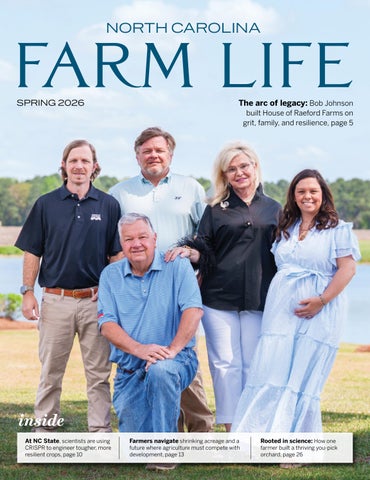
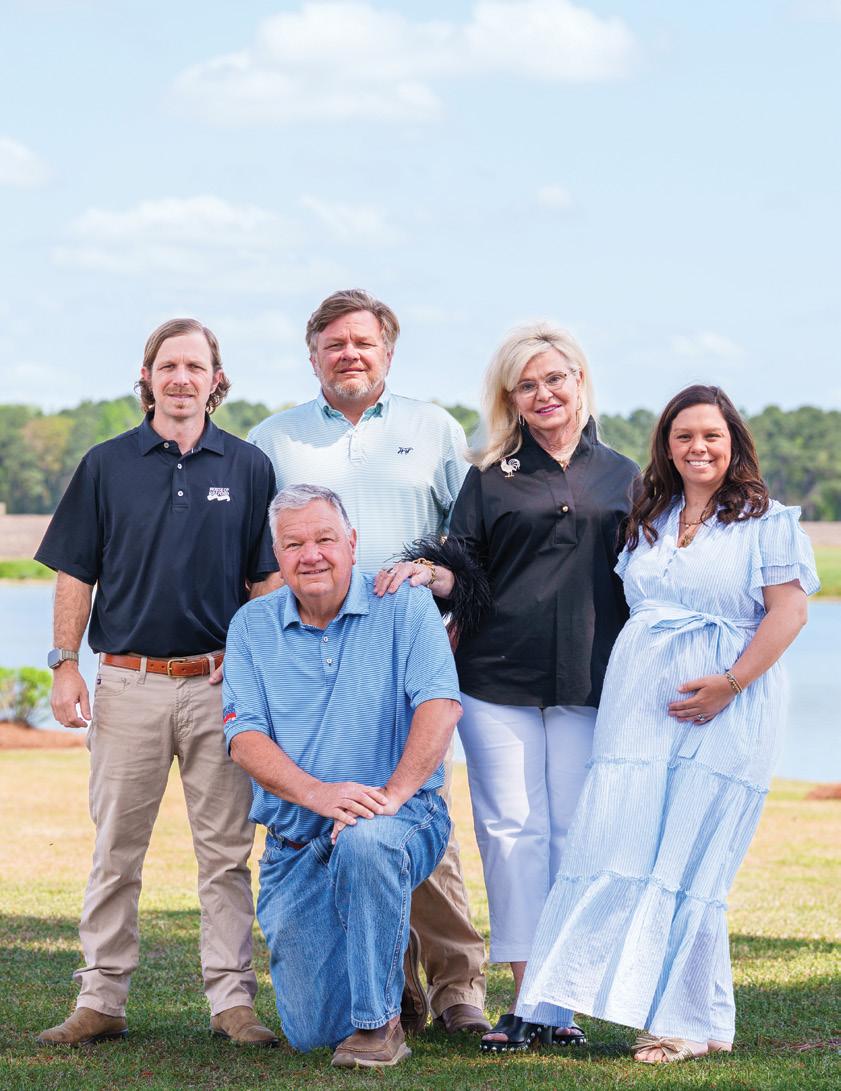
The arc of legacy: Bob Johnson built House of Raeford Farms on grit, family, and resilience, page 5
Rooted in science: How one farmer built a thriving you-pick orchard, page 26
PUBLISHER
Trip Hoffend
EDITORIAL
Senior Editor Cory Lavalette
Editor Ena Sellers
Contributors Dan Reeves, Melinda Burris, Curt Simpson, Rebecca Whitman Cooke, Mark Grady
PHOTOGRAPHY
John Osario, Mark Grady
ADVERTISING
Jim Sills, VP of Local Newspapers
SALES REPRESENTATIVE
Patsy Teachey
DESIGN
Design Editor Lauren
A PROUD local lending partner TO NORTH CAROLINA FARMERS AND RURAL RESIDENTS.
Providing loans for farms, homes and land within 46 counties in eastern and southeastern North Carolina.
NC State scientists work to build tougher crops through gene editing
Farmers preserve their way of life amid North Carolina’s rapidly dwindling farmland ...... 13
Voluntary preservation helping farmers maintain control in Chatham County 17
carnivorous plants
From farm roots to industry leader
By Ena Sellers North Carolina Farm Life
BEFORE POULTRY HOUSES lined the countryside in eastern North Carolina, turkeys drifted through the shade of tall trees, scattered across open pastures that seemed to stretch as far as a young boy could see. The work was simple, physical and constant — measured in steps, feed buckets and long days that started before sunrise. A young Bob Johnson learned it the same way many farmers do: by tagging along. At 4 or 5 years old, he followed behind his father’s workers as they went about their daily tasks, his legs working
twice as hard to match their pace.
“I just loved going out there and helping,” he said. One man, he remembers, never seemed to slow down. “He walked like 90 miles an hour everywhere he went,” Johnson reminisced with a grin. “He’d walk 100 yards ahead of me and I couldn’t keep up because I was just a little guy, and he’d turn around and come back. … I loved going out and feeding the turkeys.”
Those long mornings didn’t feel like lessons at the time. But somewhere between the footsteps and the feeding, Johnson was learning the business the only way he knew how — by being right in the middle of it.
For him, the poultry industry was not a career choice. It was simply life.
Today, as CEO of House of Raeford Farms, Bob Johnson leads one of the nation’s largest poultry operations — but the foundation of the business, he says, hasn’t really changed.
The story began in the late 1940s, when his father, Marvin Johnson, returned home to Rose Hill after serving in the Merchant Marines during the war in the Pacific Theater.
“He worked with my grandfather for a while when he came out of the Merchant Marines,” Bob Johnson said.
It was then when his dad and uncle, Bizzell Johnson, decided to purchase an
COURTESY JOHN OSARIO
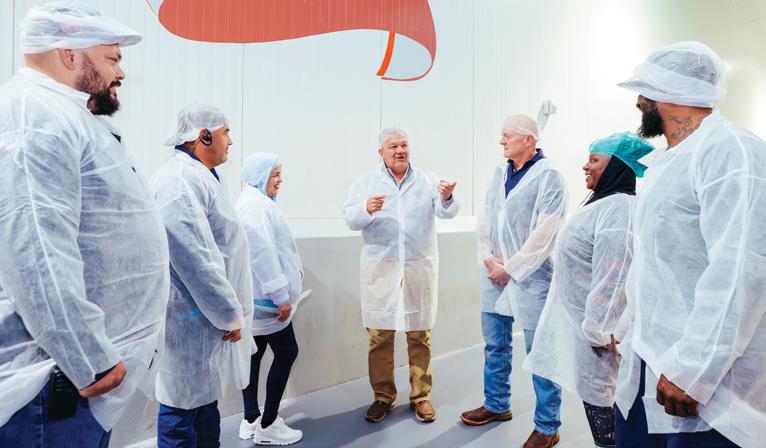
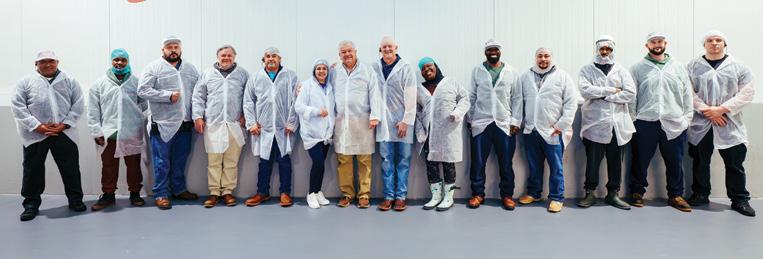
At the plant, Bob Johnson, center, addresses his team. On the left, he is joined by David Mejia, Eli Hernandez and Sergia Meraz Acosta; on the right, he is joined by Willie Newkirk, Priscilla Washington and Toby Shearer.
Building a poultry powerhouse in rural North Carolina
incubator and started hatching turkey eggs.
“He grew them in his mom’s backyard, my grandmama’s, and took them to New York to the live market and sold them,” he explained. From those humble beginnings, the business steadily expanded.
As the business grew, his father sought to build a feed mill. To secure a loan, he needed his grandfather, Nash Johnson, to co‑sign. Nash agreed on the condition that he would own half of the business.
“That’s how Nash Johnson became Nash Johnson & Sons’ Farms,” Bob Johnson said.
“It was kind of a funny story. Granddaddy sat there looking at the note — it was a million dollar note — and granddaddy sat there and looked at it, looked at it and looked at it, and daddy said, ‘Hell daddy, don’t let them zeros scare you.’ And granddaddy said, ‘It’s not them zeros, it’s that damn one in front of it that scares me.’ But anyway, he signed it, and the feed mill got built.”
The company, originally known as Nash Johnson & Sons’ Farms, was founded in 1955. That leap of faith helped transform a backyard turkey operation into what would eventually become House of Raeford Farms.
Over time, the operation expanded from turkey farms into a hatchery, feed mill and processing facilities. The name House of Raeford was eventually derived from the turkey plant at Raeford.
Looking back, Johnson said his dad always encouraged him and his brother, Ed, to learn about the business. Often, the two boys listened as their father discussed challenges and decisions with others involved in the company.
“The guys would come into daddy’s office at the end of the day and sit around talking about the business,” he said. “We’d sit there and listen.”
Meanwhile, young Bob was learning the business from the ground up — sometimes literally. Summers and Christmas breaks meant work: catching chickens at 3 a.m. and stacking boxes on the processing line.
“I was made to work and to appreciate a dollar,” he said. “Money wasn’t just given to me. I had to work and earn what I had. I always remember daddy coming home and just talking.”
He didn’t know it then, but those early mornings, family stories and long hours were shaping the leader who would one day guide the company onto the national stage.
“There are a lot of good memories and a lot of good people that worked with us through the years,” Johnson said.
“I want to be remembered as someone who made a difference in people’s lives. The business is really just a tool to do that.”
Bob Johnson
In 1998, recognizing that chicken consumption far outpaced turkey, the company began an aggressive expansion into the broiler market through key acquisitions.
The company purchased Columbia Farms in South Carolina and Georgia in 1998, and then an operation in Louisiana in 2000. In 2005, the company bought the Wallace plant, which had been a turkey facility, and converted it into a chicken plant, doubling the production after it was rebuilt.
In 2010, Johnson founded FLOCK, a nonprofit dedicated to channeling
company resources and hundreds of thousands of dollars into community service. The company officially exited the turkey business in 2013 to focus entirely on broilers, and in 2024, the company purchased an operation in Vienna, Georgia.
The company’s growth has been defined by its resilience during periods of extreme crisis. When the Wallace plant burned down in 2017, Johnson made the critical decision to rebuild the facility in just 15 months, doubling its production capacity in the process. Throughout that reconstruction, the company demonstrated its commitment to its workforce by keeping every employee on full payroll.
“There were two times in my career when I didn’t know if we were going to survive,” he said. “You’re not buying these operations because they’re being run so well. You have to change the culture, you have to change the operation and get them to operate like they should.”
Transitioning to a national chicken producer required a different approach to leadership and workforce management. As the company expanded outside its original North Carolina counties,
COURTESY JOHN OSARIO
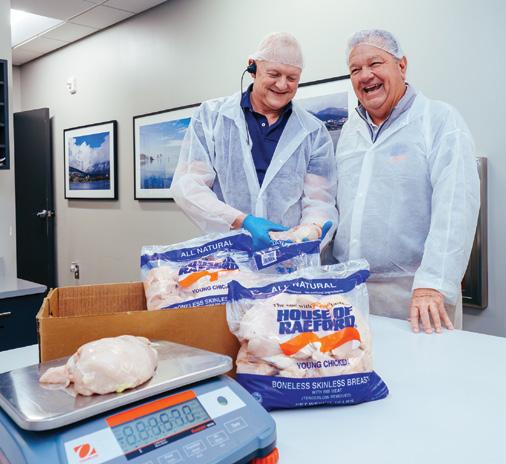
Wallace plant manager Toby Shearer, left, shares a laugh with Bob Johnson.
management had to learn to empower people to run their own operations in other states.
“My father always told me the biggest thing is to conquer the fear of failing,” he said.
Throughout the transition, Johnson focused on shifting the company culture. The shift also involved managing a different demographic of workers. Johnson realized that management styles had to adapt to motivate workers differently, eventually leading to the implementation of workplace contests and incentives to make labor feel more like a game.
Some changes coincided with market dips that made it almost impossible to make a profit.
“And you’re wondering if you’re gonna come out on the other end, but we’ve had people working with us that have just stuck with us through the tough times,” he said.
During the COVID 19 pandemic, the company faced another major disruption.
“Our phones started ringing off the hook,” Johnson said. “We’re heavily food service, so our customers were calling saying they didn’t need chicken anymore. Orders were canceled.”
His son, Cowan, launched an innovative pivot by selling chicken directly to consumers out of the back of trucks in restaurant parking lots.
“He put it on Facebook, and the first load sold in about two hours,” Johnson said. “What we learned from that was we needed to diversify more instead of relying so heavily on food service.”
This grassroots effort, which at one point sold 100 to 150 loads a week, eventually evolved into a permanent online preorder system that
continues to serve the community today.
“It helped us move product and helped consumers when grocery stores were empty,” Johnson said. “Our farmers never missed a flock. That’s just refusing to fail.”
To remain competitive, the company transitioned to high tech automation, including AI driven thigh deboning technology. This modernization has allowed the company to scale significantly and improve product quality. Balancing innovation with experience helps maintain the quality standards customers expect. Today, the company processes more than 5.5 million chickens each week across several facilities in the Southeast and is one of the nation’s top 10 broiler production companies.
Consumer preferences have also changed significantly during Johnson’s career. When he first entered the industry, chicken wings were practically a byproduct. Today, wings are one of the most popular items in the industry.
“And in the last three or four years, dark meat has become more popular in America,” he said.
As demand for poultry continues to grow, Johnson is optimistic about the future of the industry.
Americans now eat more than 100 pounds of chicken per person each year, making it one of the country’s most widely consumed proteins.
But beyond production numbers or industry growth, Johnson hopes the company’s legacy will be measured in something more meaningful.
“I want to be remembered as someone who made a difference in people’s lives,” he said. “The business is really just a tool to do that.”
“My father always told me the biggest thing is to conquer the fear of failing.”
Bob Johnson
Johnson’s leadership has earned some of the industry’s highest honors, including the National Protein and Food Distributors Association Lifetime Achievement Award, previously awarded to his father, and induction into the N.C. Poultry Science Hall of Fame in 2025, joining his father and grandfather in a rare three generation recognition. Earlier this year, the University of Mount Olive renamed its agriculture school the House of Raeford Farms School of Agriculture and Biological Sciences in honor of the Johnson family’s contributions. Despite the growth, Johnson remains humble.
He is quick to credit his wife, Luanne, for the role she has played in supporting the family and the business. Today, their children, and even grandchildren, are involved in the business, and a new generation is beginning to find its footing in an industry that looks very different from the one he first knew but still depends on the same core values. For Johnson, that family foundation remains the heart of everything the business represents.
Decades after chasing turkeys in Rose Hill, Johnson still measures success the same way he learned it as a boy — not just in production or profit, but in the strength of the people and communities that make it all possible.
COURTESY JOHN OSARIO
Bob Johnson, center, stands alongside a group of House of Raeford employees.
NC State scientists work to build tougher crops
Genome editing research aims to help farmers fight pests, disease and rising costs
By Dan Reeves North Carolina Farm Life
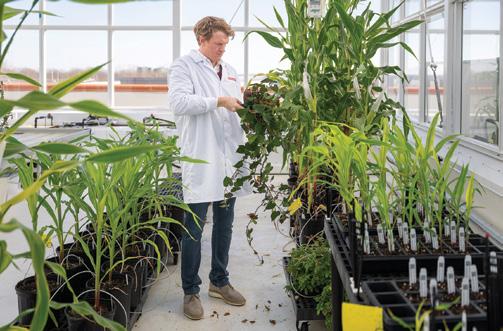
RALEIGH — In a greenhouse at NC State University, rows of young plants stretch toward the light while researchers move between benches, clipping leaves and labeling samples destined for the lab.
To the casual observer, the plants look ordinary. But inside a nearby laboratory, scientists are making microscopic edits to their DNA — changes that could help crops resist pests, survive extreme weather and reduce the need for chemical sprays.
Inside the Genome Editing Center for Sustainable Agriculture, researchers are experimenting with gene editing techniques that could allow crops to resist pests, withstand extreme weather and require fewer chemical inputs — changes that could make farming more sustainable and economically viable.
Leading the effort is Tim Kelliher, director of the center and a former agricultural biotechnology researcher who spent more than a decade working in the private sector before coming to NC State.
“I was at Syngenta for 12 years working on major row crops,” Kelliher said. “Coming here allowed us to build a center focused entirely on research that can help North Carolina farmers directly, across diverse plants and crops of interest to our growers and commodity groups.”
The Genome Editing Center for Sustainable Agriculture was launched with the help of an enabling gift from Jude Samulski, a UNC Chapel Hill gene therapy pioneer whose work helped advance CRISPR based medicine.
Since launching less than a year ago, the center has grown rapidly. What began as a one person initiative now includes a team of 10 researchers working on eight projects aimed at improving a variety of crops.
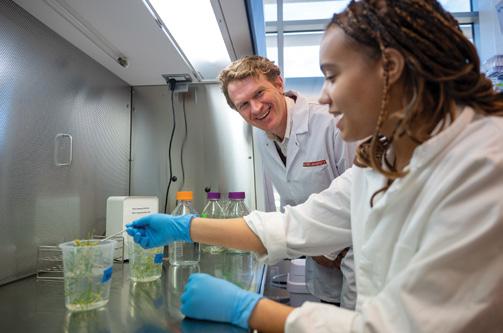
The work begins with plants grown in university greenhouses. Scientists take samples into the lab, where they use tissue culture and genome editing tools to make precise changes to plant DNA.
Those plants are then grown again,
Tim Kelliher, director of the NC State Genome Editing Center for Sustainable Agriculture, examines plants in a Raleigh laboratory where researchers are using CRISPR gene-editing technology to improve crop resilience and productivity.
studied and eventually tested in field environments.
“It takes time,” Kelliher said. “You’re confirming the genetic changes and studying what they do — whether it’s disease resistance, plant growth or yield.”
At the heart of the research is a technology known as CRISPR, a genome‑editing system scientists adapted from bacteria about a decade ago.
“CRISPR originally evolved in bacteria as a way to fight viruses,” Kelliher said, noting that key discoveries about the system were made by scientists, including researchers at NC State. “Scientists realized that system could be repurposed, engineered and used to cut DNA in plants and animals and make targeted changes.”
Those advances have already led to medical breakthroughs, including experimental treatments for diseases that previously had no cure and the first FDA‑approved CRISPR based gene therapy.
Now the same technology is being applied to agriculture.
For farmers, the potential advantages are significant.
Many modern crop varieties have been bred primarily for higher yields. In the process, some natural disease resistance traits were lost.
Genome editing allows scientists to restore or enhance those defenses.
“That means the plants can protect themselves,” Kelliher said. “Instead of spraying as many fungicides or pesticides, the protection is built into the seed.”
Reducing chemical inputs can benefit both the environment and farmers’ bottom lines.
“It’s really hard to farm,” Kelliher said. “Input costs keep rising. If plants can defend themselves and still produce strong yields, that’s a big advantage.”
One of the center’s priorities focuses on a crop that North Carolina farmers know well: sweet potatoes.
The state produces more sweet potatoes than any other in the country, but growers face an ongoing threat from nematodes — microscopic parasitic worms that attack plant roots and damage crops.
COURTESY NC STATE GEC
“There’s no natural genetic resistance in the sweet potatoes that are widely grown in North Carolina,” Kelliher said.
The center is using genome editing to introduce resistance traits already present in other sweet potato varieties. By accelerating the breeding process, scientists hope to provide growers with a crop that can naturally resist the pest.
“If nematodes get into the sweet potatoes, the whole crop can be ruined,” Kelliher said.
Researchers at the center are also working on improving disease resistance in tomatoes, targeting fungal and bacterial pathogens that can devastate crops.
“Tomatoes face some pretty nasty diseases,” Kelliher said. “We’re working to give those plants stronger genetic defenses.”
Currently, farmers rely on a combination of crop rotation, soil treatments and fumigation to manage infestations.
A resistant variety could significantly reduce those measures.
If successful, new plants developed through the research would be distributed through traditional channels such as NC State’s clean seed program, which produces disease free planting material for farmers.
The center also works closely with growers and commodity groups across the state to identify agricultural challenges and guide research priorities.
“We’re in constant conversations with farmers,” Kelliher said.
North Carolina’s sweet potato industry is watching the research closely.
“NC sweet potato producers have long embraced the power and benefit of innovation, ingenuity and collaboration,” said Lee Wicker, executive director of the North Carolina Sweetpotato Commission. “The work that Dr. Kelliher and the collective NC State sweet potato research team are working toward is a natural next step for our industry. While many consumers may consider the sweet potato a humble but delicious root vegetable, it is quite complex in its genetic makeup, breeding and cultivation.”
Ultimately, Kelliher sees genome editing as the next step in a long history of crop improvement.
“People have been modifying crops for thousands of years through plant breeding,” he said. “Genome editing just allows us to get there faster.”
As climate challenges, pests and rising production costs reshape modern agriculture, that speed may become increasingly important.
Craig Yencho, leader of NC State’s sweet
North Carolina crops and gene-editing targets
Crop N.C. National Rank Key Challenge Potential Benefit
Sweet potatoes No. 1 producer Nematode infestations Built-in pest resistance
Tobacco Top producer Soil pests, disease Improved disease tolerance
Why it matters: North Carolina agriculture generates more than $100 billion annually in economic impact. Researchers say gene editing could help farmers maintain productivity while reducing chemical inputs and adapting to increasingly unpredictable weather.
potato and potato breeding program, agrees.
“For me, as a plant breeder whose goal is to develop new cultivars for farmers, we have always strived to use new breeding tools to speed our breeding efforts and make them more precise so we can get new varieties to farmers quicker,” Yencho said. “This technology represents the next generation of genomic tools and a natural next step for breeding programs — especially in difficult to breed crops like sweet potato.”
“If we want to use fewer chemicals, protect the environment and still produce enough food,” Kelliher said, “we need technologies that help farmers adapt — and we need them sooner rather than later.”
What is CRISPR?
CRISPR is a genome-editing technology that allows scientists to make precise changes to DNA.
The system was discovered in bacteria, where it acts as a natural defense against viruses. The mechanism was first identified and studied by scientists, including researchers at NC State University nearly two decades ago. Scientists later adapted the system to cut and modify DNA in plants, animals and humans.
In agriculture, CRISPR allows researchers to:
• Strengthen disease resistance in crops
• Improve yields
• Enhance drought tolerance
• Reduce reliance on pesticides and fertilizers
• Increase genetic biodiversity
Unlike traditional genetically modified organisms (GMOs), some CRISPR applications do not introduce foreign DNA but instead edit genetic sequences already present within the species.
Tim Kelliher, background, collaborates with a fellow research scientist at the NC State Genome Editing Center for Sustainable Agriculture in Raleigh.
North Carolina’s farmland is dwindling rapidly. What can farmers do to preserve their way of life?
By Curt Simpson For North Carolina Farm Life
FOR DECADES in eastern North Carolina farm country, life moved at the pace of the planting, growing and harvest seasons. Traffic jams were just a line of cars stuck behind a nearly two lane wide combine on a rural road. The landscape was mostly soybean, corn and cotton fields, with crews loading trucks full of cucumbers and melons. Fast food signs, big box stores and subdivisions were rare.
But that landscape is changing.
North Carolina has become one of the nation’s most popular destinations for relocation, and many newcomers are looking beyond the metro areas of Charlotte, Raleigh and Greensboro. Drawn by the quiet appeal of rural counties, they are reshaping the landscape in ways that may be permanent.
Brandon Batten, a seventh generation farmer in the Four Oaks area of Johnston County, remembers when farmland in his home county felt endless, but he has seen things change rapidly. Sitting just east of Raleigh, Johnston is currently losing more farmland than any other county in the state.
“Where I grew up, mama and daddy’s house was 80 yards from my uncle’s house, and that was a half a mile from my grandparents’ house, and that was all within the same block of contiguous land,” he said. “I could ride a four wheeler from one house to the other without ever getting on the road.”
Today, he manages much of the day‑to‑day operations at his family’s business, Triple B Farms. Like many farmers in eastern North Carolina, his work depends as much on faith as it does on planning.
“I kind of think that farmers have a higher degree of faith just based on how we make our living,” Batten said. “Putting millions of dollars in the ground and hoping it rains doesn’t sound like the best business
proposition, but in the very simplest terms, that’s what we do.”
The farm has seen its ups and downs.
“When I came home from college at NC State in 2010, we were farming about 300 acres,” he said. “It was mostly tobacco and soybeans. We had to expand the farm to be able to stay here.”
Over time, his family began renting more land from retiring farmers. At one point, they were tending nearly 1,000 acres across Johnston County. But as farmland changes hands and development spreads outward from the Research Triangle, keeping that land in production has become increasingly difficult.
He is now down to farming 750 acres.
“We went up real quick and had those growing pains, and now we’re going down and trying to figure out how to make it work,” he said. “I lost three farms in one year.”
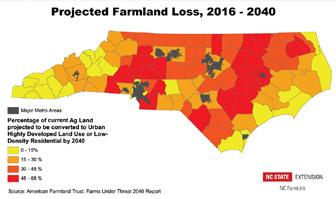
According to farmland preservation research highlighted by the NC State Extension Service, the state could lose more than 1.6 million acres of farmland by 2040 if current development patterns continue. Agriculture Commissioner Steve Troxler said recently that the state is losing 100,000 acres per year.
Counties like Duplin, Sampson and Wayne are projected to lose as much as 45% to 65% of their farmland by 2040.
“A lot of this isn’t farmer owned land that we’re dealing with,” Batten said. “A
lot of this is rented land from a family that inherited it, and they may have moved away and they don’t need a 40 acre farm in Johnston County. And they look at what real estate prices are, and they go, ‘Oh, wow.’”
When that happens, the math often favors development.
“I obviously cannot afford $30,000 to $50,000 an acre for farming,” Batten said.
The result is a patchwork landscape where housing developments appear in the middle of working farmland.
“I drive by farms every day that I used to tend that now have houses and streets on them,” he said. “And I knew it wasn’t sustainable because it was happening haphazardly and sprawling, with no rhyme or reason to it. You might have a farm between two subdivisions, but now you can’t get to it with your tractor because of houses and traffic.”
Batten said it used to be easy to move a tractor from one field to another, but now if it happens during peak traffic times, it’s just not safe to move large, slow equipment down the road.
“I’ve got places where if we’re working in a field and it gets past a certain time of day, then we’re not moving,” Batten said. “And you can’t always get out of the field when you think you can if you have a tractor breakdown or something. Whether it’s school or work traffic, it doesn’t matter. If it gets past 3:30, then we’re not going on that road. It’s too big of a risk. We’re going to get hit or, heaven forbid, we hit somebody because they aren’t paying attention.
“Every year we see stories in eastern North Carolina where somebody has run into somebody on a tractor and they get hurt or even killed.”
Ironically, some of the development pressure in his home county and others like it grew out of improvements meant to help rural residents.
“The farmland loss really began when we did a good thing and ran water lines all over the county,” he said, “but we also opened the
COURTESY PHOTOS
Brandon Batten Chad Herring
door to all of the developers so you could have an acre lot and a septic tank and really build as much as you want.”
Batten said he doesn’t blame people for wanting to live in the countryside. The appeal of a slower pace of life and open landscapes is hard to deny. Everyone seems to want it, though, and that makes it a dwindling commodity.
The motivations of new residents and longtime farmers can sometimes clash.
“It takes a ton of communication,” Batten said. “People move here and they love living here and seeing the tractors in the fields; and then two years later they are madder than sand because they’re looking at a subdivision where there once was a field. They don’t like it.
“The very reason that they moved here is the same reason that someone else moved here, and now it’s upset them. Everybody wants it to stay exactly like it was when they moved here.”
Despite the growing pressures, agriculture remains North Carolina’s top industry. The sector generates more than $111 billion annually and accounts for roughly one sixth of the state’s economy.
Chad Herring, a third generation pig farmer in Duplin County, sees the same challenge from a different part of eastern North Carolina. He remains optimistic about the industry that he loves, however.
“I watched my dad and my uncle turn a couple of pigs on the ground into a 500‑sow, farrow to finish operation through the ’70s, ’80s and into the ’90s,” Herring said. “I watched them build buildings and bring our pigs indoors. I worked right beside them, and I wouldn’t trade it for anything. One of those good childhoods, right?”
Herring runs Herring Pork Producers near the Pleasant Grove Volunteer Fire Department and serves as director of NC Farm Families, a nonprofit organization that advocates for farm families across the state.
“Two percent of people in the United States farm, and we’re feeding everybody else,” Herring said. “We really don’t need to lose farmland. It looks like it’s going to happen, but we just need to have a good strategy for growth that allows for farms to still operate and allows for people to have homes.”
Like Batten, he believes communication
between farmers and new residents is essential.
“We don’t want people to move in next to our farms and then complain about them. That’s obviously going to be a problem,” Herring said.
Both farmers say preserving farmland requires planning not just for the next harvest, but for the next generation. Herring has two children who attend East Duplin High School in Beulaville.
“I don’t know that they are going to return to the farm, but I am going to do what I can to give them the opportunity to do it if they want to,” Herring said.
For farmers trying to hold onto their land, tax and land planning policy can make a difference.
Present Use Value is a tax break for farmers. If you’re making a living off the land, the program defers taxes from the “best and highest use” value to a state set agricultural value.
“Without that, I don’t think we’d be farming as much as we are because people couldn’t afford to pay the taxes,” Batten said.
If a property leaves the program when
At Carolina Agri-Power we offer you the best brands in the industry. Our brands include: Case IH, Great Plains, Rhino, LandPride, Landoll, Unverferth, MacDon, Pequea, Salford, Geringhoff, BBI, Athens, Taylor-Pittsburg, Reddick, and Monosem. Among those brands we carry the best equipment including: planting and seeding, harvesting, advanced farming systems, loaders and attachments, tractors, and headers. We have a great quality, clean selection of used equipment to choose from. Stop by or call today and see what we have to offer.
it is sold, the landowner must repay the difference for the previous three years at the higher tax rate. That money then goes into farmland preservation funds.
Another option is conservation easements, voluntary legal agreements designed to protect farmland permanently. These easements establish rules that protect natural resources and keep land from being subdivided or developed.
In Johnston and other counties, the local Soil and Water office will help a landowner with putting their farm into conservation easements and voluntary agricultural districts. Other organizations like the Triangle Land Conservancy also help with the heavy lifting.
“There are funds available to help a farmer, and it’s on a sliding scale,” Batten said. “If it’s for a term, you can get paid for doing it — what’s the best highest use value versus what’s the farmland value. They’ll pay you part of that difference. It can be an annuity payment or you can get paid all up front. Once that property is enrolled, then it has to stay whole. It can’t be split up later.”
For some landowners, that permanence can be difficult.
“A lot of people are hesitant to enroll in this because they feel like they are giving up their rights to the land. You’re still keeping the land, you just can’t develop it.”
Brandon Batten
“A lot of people are hesitant to enroll in this because they feel like they are giving up their rights to the land,” he said. “You’re still keeping the land, you just can’t develop it.”
Still, Batten says interest in conservation easements is growing in Johnston County.
“It takes a lot of long term planning and having conversations beyond just one generation. As a landowner, you have to look at your long term goals,” Batten said. “If you want to preserve farmland, then that’s not the same conversation as getting lots per acre.”
Ultimately, Batten believes that the most effective way to keep farmland intact is also the simplest.
“The best way to preserve farmland is to have profitable farms,” he said.
That long view is what keeps him invested in the future of farming, even as the landscape changes around him.
“I think agriculture is just the tie to the land and the production and seeing life and death every day,” Batten said. “That raw tenderness that agriculture brings from seeing a seed emerging from the soil or a baby pig being born or a calf or whatever, to the flip side when you harvest the crop or harvest the animal to feed your family. It’s the circle of life and the connection to the land that makes the difference. Once that dirt gets under your fingernails, it’s hard to get it all out.”
Advocating for farm and rural families since 1936
North Carolina Farm Bureau serves as an advocate for our members at the local, state, national and international levelsproviding educational, economic, public affairs, marketing, and various others services to our members.
Advocating
Advocating and educating elected officials and the general public about the importance of agriculture.
Encouraging Leading
Encouraging legislation and regulations that promote a viable agricultural economy.
Developing leaders for the present and future of agriculture in our state through a variety of programs.
How voluntary preservation helps farmers maintain control
Chatham County is taking proactive measures to protect its farmland
By Melinda Burris North Carolina Farm Life
CHATHAM COUNTY has long been known for its strong farming community and multigenerational farms. But over the past decade, rapid residential and commercial development has begun to encroach on these fields, putting both farmland and local farm economies at risk.
“We have historically had a very strong farming community and farming economy here ... but certainly in the last 10 years, there’s been a real concern here about the growth in residential and development and the way that growth is threatening our farmland, our farm economy and our farm communities,” said Andrew Waters, the county’s Farmland Preservation coordinator.
As a result of the unprecedented growth facing the greater Triangle area, traditionally rural counties like Chatham are facing challenges.
“Our community is undergoing, really monumental change as far as the developers that are purchasing land here and the rate of development. And there’s just a community wide concern about preserving our farmland here,” Waters said.
Enter the Chatham County Farmland Preservation Program, which serves as an educational resource for landowners interested in planning their estates so that, if they wish to protect their farmland from being sold off to developers once they are gone, they can learn about the options available to do so.
Since its launch, the program has seen strong community interest. In January, the first project to receive financial support from the Farmland Preservation Program was completed. Waters is optimistic that two additional projects that were backed by the program will be completed by the end of this year. Several other projects are currently in development, and three or four landowners have already expressed interest in applying for funding through
the program, which will open in the fall.
Preservation is not quick. Waters is up front about the process, noting that the grant application process can be time consuming. It often culminates in a multiyear process, with it taking one to two years to get the grants in place and then an additional year or two for all the transactional work to be completed. Yet the payoff — safeguarding farmland for future generations — is worth the effort.
Education plays a central role in the program. For the past two summers, Waters has led farm transition workshops to help landowners draft their wills and estate plans. For those who want to ensure their farmland is not sold off to developers, this type of proactive planning is key, ensuring everything is in order and there are no surprises.
January’s second annual “Chatham Farms Forever Day” drew landowners eager to learn about farmland preservation and conservation management, including programs available to help landowners manage and conserve their natural resources and farmland.
The community has been enthusiastic about learning, and Waters has accepted invitations to speak before a number of local groups. He recently spoke at a meeting of the Cattlemen’s Association in Chatham County and was also a featured
“Our community is undergoing, really monumental change as far as the developers that are purchasing land here and the rate of development. And there’s just a community-wide concern about preserving our farmland here.”
Andrew Waters
speaker at the Ag Impact Summit, sponsored by the Siler City Chamber of Commerce.
“I am doing quite a bit of general outreach, just responding to invitations to go out and meet with groups and present with different groups across the county,” Waters said. “Farmland preservation is a big decision … I think a lot of people are just kind of intimidated about the enormity of it.”
His goal is to make the process seem less intimidating by having someone there to answer questions and help landowners make an informed decision.
“This is a voluntary program,” he is quick to emphasize, “We’re trying to help our landowners, not impose any restrictions on them.”
For farmers, the message is clear: preservation is a choice, not an obligation.
“Farmland preservation can mean different things,” Waters said. Even if a landowner is not ready to commit to permanent preservation, they can explore options through the Voluntary Agricultural District Program or other tools to maintain their farm’s viability. With programs like this and a growing network of informed landowners, the county is working to ensure its fields remain productive and resilient for generations to come.
COURTESY
Farming the world’s most famous carnivorous plant
Lyndon McCall cultivates exotic and carnivorous plants from a sustainable greenhouse
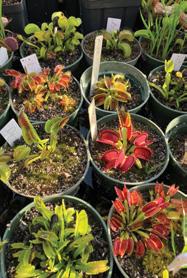
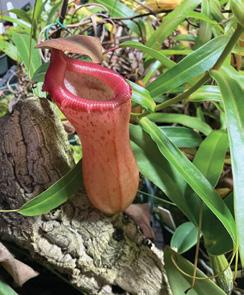
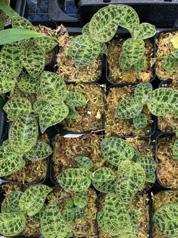
Top, the Venus flytrap is a carnivorous species that captures prey using specialized snap traps, relying on nutrient-poor soils and supplementing its diet by digesting insects.
Bottom, the Nep Ventracosa is a hardy, easy-to-cultivate carnivorous plant known for its tolerance to a range of growing conditions and its consistent production of attractive pitchers.
By Mark Grady For North Carolina Farm Life
IN A REGION KNOWN for its unique natural resources, one Duplin County grower has built a niche operation around a plant found almost nowhere else in the world.
The Venus flytrap, native to the southeastern part of the state and a small area of South Carolina, has become the foundation of a specialty greenhouse business operated by Lyndon McCall. His operation, Nahunga Creek Tropicals located just outside Warsaw, focuses on carnivorous plants and other high‑demand specialty crops.
While the Venus flytrap is widely recognized, it is also a protected species under North Carolina law. Harvesting plants from the wild is illegal, requiring growers to propagate their own stock and maintain detailed records verifying plant origin. The N.C. Department of Agriculture and Consumer Services oversees compliance, including annual inspections to ensure inventory matches certification.
“The Department of Agriculture keeps track of how many plants you have,” McCall said. “As you (propagate the plants), they come at least once a year to look at the inventory so they can calibrate your certificate of origin to match the volume of plants.”
For growers, the crop offers a distinct regional advantage. As a native species, the Venus flytrap is well adapted to the climate of eastern North Carolina, requiring relatively low inputs compared to many greenhouse crops.
Classified as a temperate carnivorous plant, the Venus flytrap goes dormant during the winter months. That natural cycle reduces the need for heating and allows growers to propagate new plants during dormancy. That’s when McCall can extract baby plants from the existing flytraps and replant them.
“In my operation, I provide some cover just for the rain, but it’s not a heated section of the greenhouse,” McCall explained. “If it gets super cold, I do drop the curtains.
I usually don’t have to do that but once or twice a year. They do go dormant in the winter months, but in the spring, they’re like a daffodil and all come back.”
Venus flytraps are especially popular in coastal areas, where tourists are drawn to the plant’s unique status as a regional native. In the spring, McCall makes weekly trips to stores around the Wilmington area to sell them wholesale.
To diversify the business, McCall also produces other carnivorous plants, including pitcher plants. Unlike the Venus flytrap, the pitcher plant is adapted to tropical climates, growing naturally in countries like Brazil. Therefore, McCall grows them in a heated section of his greenhouse. How he heats that area is a story in itself.
McCall uses a special greenhouse furnace that burns used motor oil. The system means the process is a win win for him and local area service stations. McCall frequently picks up used motor oil gathered during auto oil changes to use in the furnace. This means the stations do not have to pay fees for the disposal of used motor oil.
In addition to carnivorous plants, McCall grows orchids, a crop he has worked with since early in his career. He sells orchids to various retailers and at the Poplar Grove Farmers Market in Wilmington. Orchids are very popular, and demand consistently exceeds supply.
“I don’t have enough orchids to supply the demand by any means,” he said.
As far as growing what many would consider the “usual” plants, McCall isn’t attracted to that.
“I guess you can say I grow ‘weird’ plants. I don’t try to grow the common stuff too much,” he said.
McCall’s path into farming was not a traditional one. Originally from Brevard, his interest in plants began when he was 8 years old, when a neighbor gave him a cactus. That experience sparked a lifelong interest, eventually leading him to earn a biology degree from UNC Wilmington and work in orchid production. He later transitioned into a sales career in the construction
COURTESY NAHUNGA CREEK TROPICALS
industry to start a family, eventually settling in Oak Island.
“I got married and began a family,” McCall said. “I had to get a real job.”
After retirement, he and his wife, Sarah, relocated to Warsaw, where Sarah is originally from, and they established Nahunga Creek Tropicals.
While some may see his exotic plants as a retirement project, McCall and Sarah run the operation as a business they love.
“This is retirement fun, not retirement work,” McCall said.
MARK GRADY FOR NORTH CAROLINA FARM LIFE
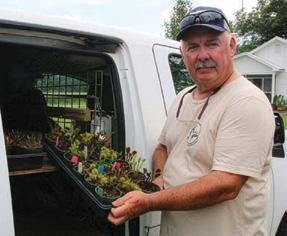
Lyndon McCall loads his plant delivery van at his greenhouse in Warsaw.
COURTESY NAHUNGA CREEK TROPICALS
An orchid, above, thrives in Lyndon McCall’s greenhouse along with various other exotic plants. McCall began growing orchids when he was attending college at the University of North Carolina at Wilmington.
POKE BOWL
WITH NORTH CAROLINA SWEETPOTATOES
Poke bowls are versatile, colorful, and oh-so-nutritious. We love adding sweetpotatoes because they bring bright, beautiful color, natural sweetness, and a nutritious boost.
This bowl combines sushi-grade ahi tuna, roasted North Carolina sweetpotatoes, creamy avocado, shelled edamame, and crunchy cucumbers over hearty brown rice. Top it off with spicy mayo (if you dare!) and sesame seeds for extra flavor.
Reminder: Raw fish isn’t recommended for those who are pregnant, immunocompromised, or young children – swap in cooked tuna or salmon instead!
baked fried boiled grilled roasted steamed
INGREDIENTS
• 2 large North Carolina sweetpotatoes, skin-on
• 3 tbsp sesame oil, divided
• 2½ tbsp light soy sauce, divided
• 1 lb sushi-grade ahi tuna
• ¼ cup rice vinegar
• 3 cups cooked brown rice
• 2 persian cucumbers, chopped (or 1 English cucumber)
• 1 cup shredded carrots
• 2 small avocados, cut into chunks
• 1 cup shelled edamame
• 3 green onions, finely chopped
• Garnish: spicy mayo, sesame seeds (optional)
DIRECTIONS
high income rural urban shopping list bag of potatoes
1. Preheat oven to 400 degrees F and line a baking sheet with aluminum foil.
pantry action icon quote icon can frozen
2. Cut sweetpotatoes into cubes and transfer to the prepared baking sheet. Drizzle with 2 tablespoons sesame oil and 1½ tablespoons soy sauce. Bake for 18–20 minutes, or until soft when pierced with a fork. Cut tuna into cubes and place in a medium bowl. Add rice vinegar, remaining 1 tablespoon sesame oil, and 1 tablespoon soy sauce, toss to coat.
healthy eater avor explorer
To assemble the bowls, evenly divide brown rice, marinated tuna, roasted sweetpotatoes, edamame, carrots, avocados, and green onions among four bowls.
5. Drizzle with spicy mayo and sesame seeds, if desired.
joyful cook
Knit together by tradition
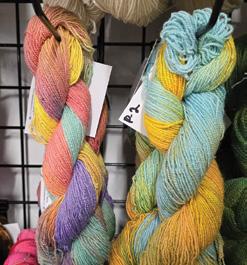
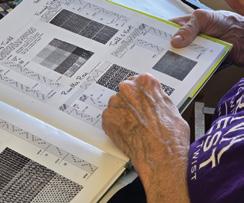
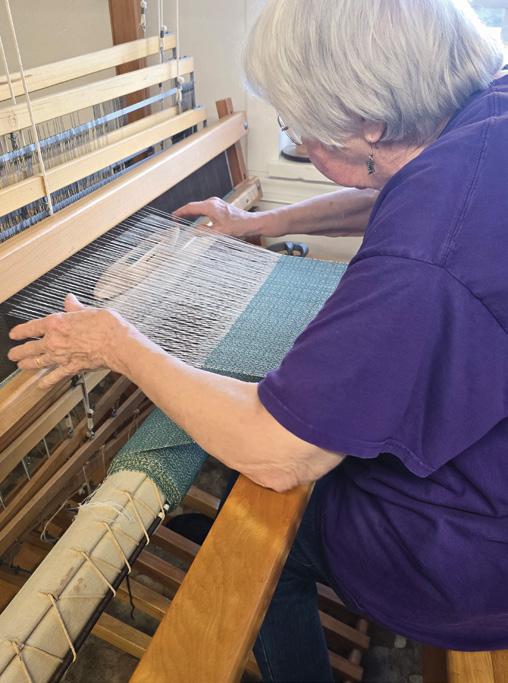
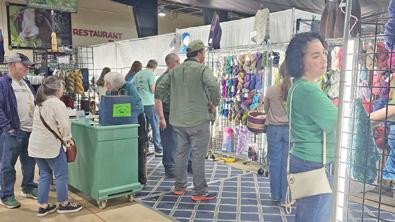
Right, an artisan works at a floor loom, carefully guiding taut warp threads as a richly textured teal fabric takes shape. Top left, roving balls of Finn-wool and colorful yarns are displayed at Heelside Farms. Bottom left, a technical manual filled with detailed drafts and pattern diagrams reveals the planning behind the process required to transform thread into textile.
PHOTOS BY REBECCA WHITMAN COOKE FOR NORTH CAROLINA FARM LIFE
COURTESY
COURTESY
Heelside Farms weaves family history, fiber arts and sustainable farming
By Rebecca Whitman Cooke For North Carolina Farm Life
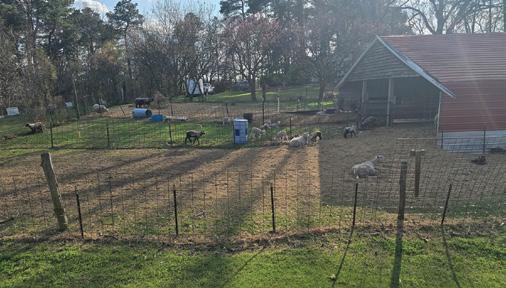
ON ROLLING GREEN hills just outside of Smithfield, a gentle breeze rustles through fields of sheep grazing lazily under the sun. This is Heelside Farms, a fiber farm that has been producing wool for over 20 years, but its story is stitched from threads that go back generations. For Carolyn Beasley fiber arts were a part of life from the very beginning.
“In fourth grade, it was snowy and we couldn’t go outside,” Beasley, 75, said. “They had to do something with us, so a couple of the mothers said they would teach us to knit. We all bought needles and yarn and learned to knit. Later, my grandmother taught me to crochet and quilt. My mother sewed and embroidered. I was really lucky to have these people around me.”
Carolyn’s husband, Ricky, also grew up surrounded by fiber. His mother quilted, sewed and crocheted.
“We were both very fortunate to be around a lot of fiber arts when we were young,” Carolyn said. “When you are around it you don’t have to do all of it then. Later, when you have the time or the energy, you can go ahead and try it again.”
In 2003, the couple turned that lifelong passion into a farm of their own.
“We were doing living history events and buying fiber for spinning, we decided we wanted to have our own sheep to be able to do everything from fleece forward,” Ricky Beasley said.
Carolyn found a listing for sheep for
sale in the newspaper, and the sheep farm began from there.
“There is no learning curve, it’s just straight up every year,” Carolyn said. “You think you have it covered, and the sheep think up something new every year.”
From silent forms of protest to instruments of transportation and clothing, fiber products have filled museums and history books for centuries.
“The Victoria and Albert Museum in London has a lot of Egyptian artifacts,” Carolyn said. “They have a cloth that was used to wrap mummies. That cloth was created using drop spindles like we use today to teach kids how to spin.”
Well versed in the history of fiber arts, she also shared a story about a Viking sail found nearly intact.
“The Vikings used the long guard hairs of Icelandic sheep in weaving for warp
threads because they were very strong. They put some sort of grease on it and made it into sails,” she said.
Heelside Farms maintains some Icelandic sheep today, exploring the unique qualities of their wool.
Many breeds of sheep have faced near extinction because of changing market demands.
“Breeders have to breed what is in high demand, so other breeds get overlooked,” Carolyn said. “If your wool is not nice, it will not sell.”
She recalled that Beatrix Potter saved the Herdwick breed from extinction by keeping them at her farm, Hill Top.
“We owe the British a lot for breeding,” Carolyn said.
Today, Heelside Farms grows mostly Finn sheep (medium fine wool) with some Cormo (super fine wool) and Finn/
REBECCA WHITMAN COOKE FOR NORTH CAROLINA FARM LIFE
Lambs frolic around the Red Barn Studio, turning the heart of Heelside Farms into a lively mix of baa-ing and creativity.
COURTESY REBECCA WHITMAN COOKE FOR NORTH CAROLINA FARM LIFE
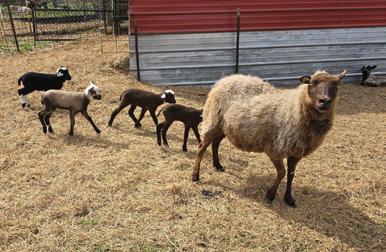
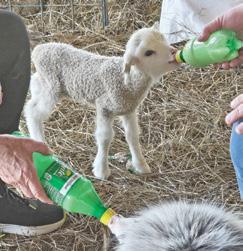
Left, a mother sheep leads her offspring as they wobble along behind her. Right, a baby lamb is bottle-fed, a moment of close care during lambing season at Heelside Farms.
Cormo mixes. The sheep are guarded by Gracie — a large, loving border collie mix — and organized from oldest to youngest on a hill opposite a red shed. The red shed houses a large meeting space full of spinning wheels, weaving looms, skeins and roving. Local crafters meet regularly to work on fiber projects together in the space. This is also where most of the product creation magic happens at Heelside Farms.
Keeping up with demand would be hard to do entirely in house, so Heelside Farms outsources its processing to a local fiber mill, Shepherd’s Gate Mill, in central North Carolina.
“We grow all the wool ourselves and dye it ourselves, but we purchase anything we want to add to it,” Carolyn said. For example, a new luxury roving called Cocktail Hour combines 50% wool with 50% luxury sparkle and silk fibers, creating a soft tweed perfect for hand‑spinning. It arrived just in time for the 20th annual Carolina Fiber Fest, where it is expected to sell out quickly.
“Fiber arts seem like a lost art to everyone but the thousands that
are coming to fiber fest,” Carolyn said.
Heelside Farms has been a founding sponsor of the event since its beginning, and Carolyn serves as co chairman of the nonprofit organization today.
Interest in fiber arts has grown rapidly since 2020. This year’s two day event plans to fill the Jim Graham Building with 72 vendors, multiple workshops, and demonstrations from master artisans.
At Heelside Farms, the Red Barn Studio is a hub of creativity where local crafters gather regularly. Inside, spinning wheels hum, weaving looms click, and vibrant skeins and soft roving fill the space, making it a lively workshop.
“Fiber arts seem like a lost art to everyone but the thousands that are coming to fiber fest.”
Carolyn Beasley
REBECCA WHITMAN COOKE FOR NORTH CAROLINA FARM LIFE
Rooted in science
A former chemist applies research skills to orchard management
By Melinda Burris North Carolina Farm Life
ANIKÓ REDMAN spent years working as a medicinal chemist, specializing in green chemistry and focusing on reducing hazardous inputs in drug development. Today, she applies that same mindset to farming at Sweet Retreat Orchard in Hillsborough, minimizing chemical use while building a sustainable orchard.
Redman’s interest in agriculture began in Hungary, where small scale fruit production is common in villages and rural communities. Summers spent in her grandparents’ garden and a nearby parish orchard left a lasting impression. When she moved to the United States, she carried that appreciation for growing food with her, eventually planting around her home.
After leaving her job in medicinal chemistry, Redman began developing a plan for an orchard that would prioritize fruit quality and reduced chemical inputs. With her background and knowledge, the budding farmer envisioned owning a large orchard where families could come and pick flavorful and healthy produce.
In 2015, she and her husband, Phil, purchased the property at 2925 Frank Perry Road in Hillsborough and have been
holistically managing the 10 acre farm since.
“I’ve always been interested in growing fruit. We do that a lot in Hungary in small communities and villages,” she said.
While Phil had family roots in farming, both entered the venture relying heavily on research and observation to guide their decisions. Deciding to run an orchard full time involves many decisions, such as what to plant to maximize yield and avoid pesticides. This is another area where her professional training proved useful.
“I am a scientist, so I enjoy doing research,” Redman said. That approach shaped their early planning. Redman searched topics online, and she also
met with area farmers to see what their operations were like and gain valuable working knowledge of the land and suitable crops.
Like many new growers, the couple encountered a steep learning curve and kept working toward fulfilling their dream. Had they been aware at the outset just how challenging it would be, they may have been overwhelmed at the prospect.
“Sometimes ignorance is bliss,” Redman said.
She’s glad they didn’t know until they were committed to making the farm a reality because she maintains the endeavor has proven extremely rewarding.
One of their earliest challenges came
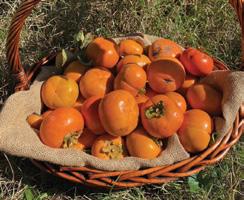
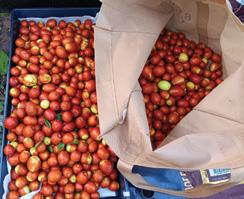
Left, a basket brimming with large, glossy Asian persimmons — ripe, vibrant and ready to savor. Right, a sack full of freshly harvested jujubes, their rich color and texture hinting at the sweet, chewy fruit inside.
PHOTOS COURTESY ANIKÓ REDMAN
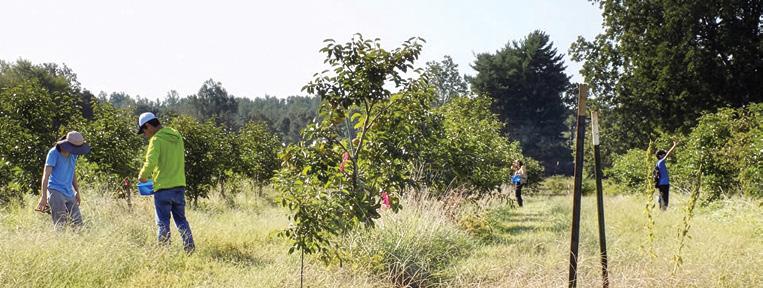
Visitors enjoy a sunny day at Sweet Retreat Orchard exploring the rows of fruit trees.
“I would like to be known as a community resource for as many different varieties of
persimmons as possible.”
Anikó Redman
with establishing persimmon trees, now the farm’s primary crop. In their initial planting, eager to get the orchard up and operational they purchased 227 trees, not realizing that many of them had been pot bound for seven years which led to the roots circling. The resulting root issues resulted in significant losses after transplanting.
Redman explained that when this happens, it is very difficult for the roots of the replanted tree to reach new ground so they can take hold and thrive. As a result, the majority of the plants die.
That experience underscored the importance of plant quality and establishment practices.
“Now we know how to replenish the orchard and make it more viable,” Redman said.
Currently, the farm grows between seven and eight persimmon varieties, and Redman plans to graft another six or seven varieties in the near future. She sees varietal diversity as both a production strategy and a way to serve customers. She hopes to expand their range to include 20 to 30 varieties sometime in the future. Then she plans to pay it forward by providing cuttings to people interested in planting their own trees.
“I would like to be known as a community resource for as many different varieties of persimmons as possible,” Redman said.
The you pick operation has enjoyed an enthusiastic response, drawing visitors from across the state and neighboring Virginia. Demand is strongest in early October during peak persimmon harvest. Persimmons are by far the orchard’s biggest seller. Redman noted that last year, the farm harvested approximately 5,000 pounds of persimmons and sold out.
Customer communication is managed primarily through a farm newsletter that provides updates on you pick opportunities, crop availability, harvest timing and visiting hours.
“It’s very difficult to predict anything in advance because we are weather‑dependent,” Redman said.
Late frosts remain a significant risk, particularly for early leafing fruit trees. In those years, crops can be severely reduced, though jujubes tend to be more reliable due to their later leaf out.
Despite the challenges, Redman views the transition as a rewarding application of her scientific background. Her experience highlights both the opportunities and risks involved in establishing a specialty crop operation, particularly for growers focused on sustainability and direct to consumer marketing.
Farming, faith and family on the homestead
COURTESY THE HOMESTEAD
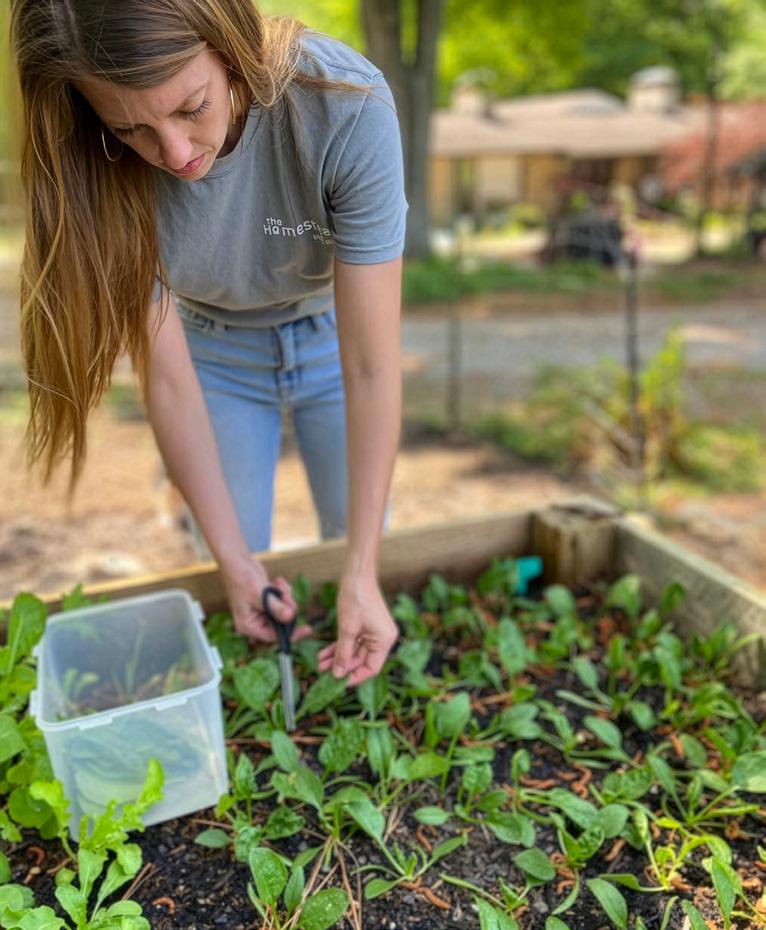
Megan Graper starts seeds for cut flowers while also trialing a selection of new vegetable varieties.
Diversified farming brings purpose and connection to the Homestead
By Rebecca Whitman Cooke For North Carolina Farm Life
JUST OUTSIDE the bustle of Raleigh, bohemian charm meets farm life at the Homestead. The family run homestead in Clayton is showing how diversified agriculture can cultivate both income and community.
“Our journey didn’t begin with a master plan,” owners Megan and Jeff Graper said. “It began with a pull toward something simpler and more grounded. We wanted our children to grow up understanding where food comes from. We wanted them outside more than inside. We wanted to build something that felt meaningful and lasting and do it as a family.”
During the pandemic, the Homestead at Little Creek offered goat yoga as a way to give back something joyful to the community while also keeping a safe distance outdoors. A few chickens, flowers and a garden later, interest grew.
“Friends wanted to visit. Neighbors wanted to learn. Families wanted their kids to experience it too,” Megan said. “And then we were asked to start hosting birthday parties. At some point, we realized this isn’t just about us living differently — it’s about opening the gate and inviting others in.”
Today, the farm is a working homestead that grows seasonal flowers and raises farm animals, including goats, sheep, chickens, rabbits and one Highland cow named Oscar. It hosts community events and birthday parties, educational classes, you pick flower events, glamping experiences, professional photography, microweddings and Saturday Family Fun Days. Location helps. The close proximity to Raleigh has brought them clientele that wants the farm experience without being somewhere too remote.
“We believe God has called us to use what we’ve built to serve others, and whether someone shares our faith or not, we want them to leave here feeling encouraged, valued and loved,” Megan said.
The Homestead at Little Creek plans to continue expanding their educational offerings and community events.
“We also feel called to deepen the heart behind what we do — creating more opportunities for
PHOTOS COURTESY THE HOMESTEAD
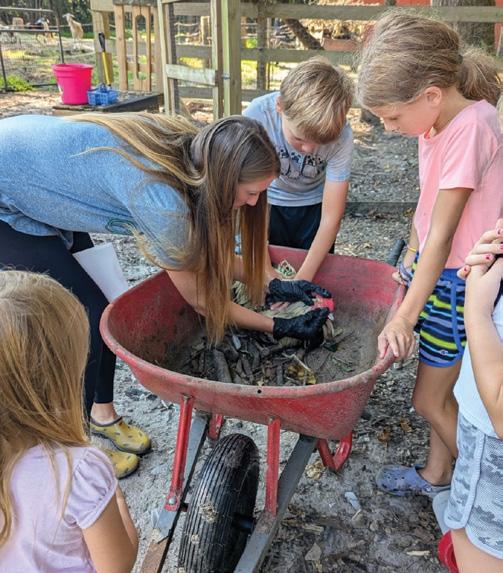
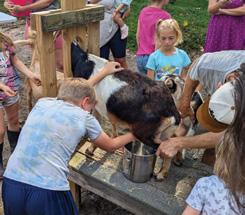
Top, students engage in hands-on learning, exploring livestock, touring the property and gaining exposure to sustainable agriculture during field trips at The Homestead. Bottom left, a girl showcases a freshly gathered bouquet of spring flowers cultivated on-site. Bottom center and right, boho-inspired decor and tents highlight the farm’s glamping experience at The Homestead.
connection, encouragement and building relationships,” Megan said. “Our goal isn’t to grow for the sake of growth; it’s to grow with purpose.”
Growth at the Homestead comes amid personal growth as well; the Grapers just welcomed their fourth child and first boy, Carder Scott. Carder will be well supported by three older sisters who are now 4, 7 and 9. Homeschooled on the homestead, the girls have been a great help with daily farm chores.
“This isn’t something we do around them — it’s something we do together,” Megan said.
Still, with a newborn, the pace has slowed down while the needs of the farm stay every present.
“This season has reminded us that this life isn’t about performance — it’s about presence,” Megan said.
Nearing 11 years of marriage this May, the Grapers said homesteading has refined and rewarded their marriage by strengthening their teamwork in ways they didn’t expect. One aspect is the way they stepped into full‑time self‑employment on the Homestead.
“We both came from the development/ construction industry and worked in our careers after graduating college until we bought this property in 2019,” Megan said.
At the time, they had two daughters and were raising puppies. Megan was the first to come home, while Jeff continued working. By January 2023, they decided to take a leap of faith, and Jeff began working full time on the property.
“While it is difficult to be self‑employed, it is also very rewarding,” they said.
“Our journey didn’t begin with a master plan. It began with a pull toward something simpler and more grounded.
Megan and Jeff Graper
Homesteading has taught the Grapers many life lessons: patience (“you cannot rush growth”), humility (“animals and weather keep you grounded”), resilience (“things go wrong”) and gratitude (“life is fragile and beautiful”).
Working at a slower pace is a sacred rhythm that reveals how deeply we need each other as a community.
“You cannot — and should not — do everything alone,” Megan said.
For those interested in homesteading today, the Grapers recommend starting small and not waiting for everything to be perfect.
“Plant something in a pot. Raise backyard chickens. Learn one skill at a time,” Megan said. “Don’t compare your beginning to someone else’s middle. And remember — homesteading isn’t about aesthetics; it’s about stewardship.”
PHOTOS COURTESY THE HOMESTEAD AT LITTLE CREEK
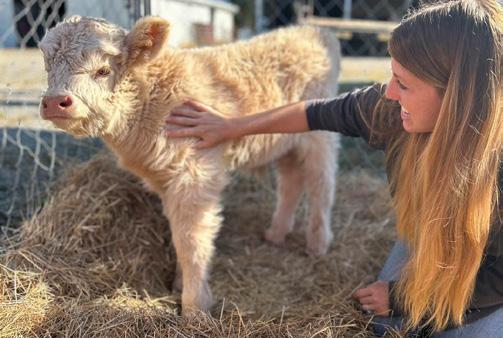
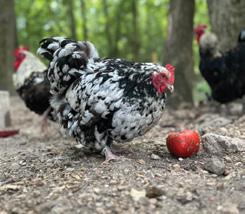
Top, Megan Graper pets Oscar, the farm’s Highland cow. Bottom left, a Mottled English Orpington hen consumes fresh fruit. Bottom center, Children observe and learn about goat milking. Bottom right, A vibrant display of color reflects the diversity grown at The Homestead, where more than 5,000 plants are cultivated each year.
Bacon makes everything better.
Including our economy.
North Carolina’s pork industry supports more than 42,000 jobs and generates $10.8 billion in economic impact every year.
That’s what we call bringing home the bacon.
Agritourism in action
Blending agriculture and entertainment at Tara Creek Farm
By Mark Grady For North Carolina Farm Life
ASK ANY KIDS in a city where hamburger meat or chicken come from, and you’ll hear a number of them say, “From the grocery store.” Farmland once dominated the country, but today some people go their whole lives without ever setting foot on a farm.
Knowing this is not good in sharing the importance of farming to everyone, a new term emerged as farmers began to invite people to come see what a farm is really like. The term is agritourism. Duplin County is home to a farm that has put agritourism on the map locally: Tara Creek.
Located off of U.S. Highway 117 between Warsaw and Faison, Tara Creek is not only a working farm — it has become a popular place for everything from weddings to rodeos.
Owner Lee Graham said the farm began as a poultry operation.
“Tara Creek started out as a turkey farm, growing for Nash Johnson & Sons,” Graham said. “We grew turkeys for them until around 2011. When that era was over, we started cutting hay and farming row crops.”
Graham said he grew up with row crops on the farm, including tobacco, corn
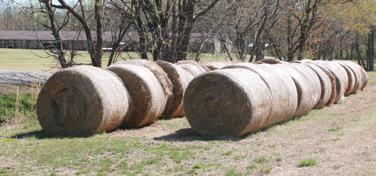
High-quality hay produced at Tara Creek supplies horse operations from Virginia to Florida. The farm works with Nutrena to analyze and optimize nutritional value.
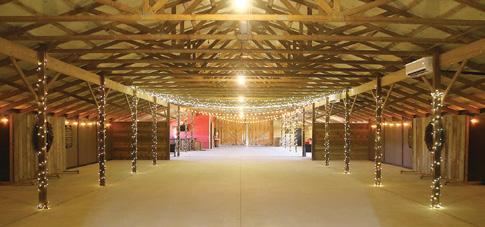
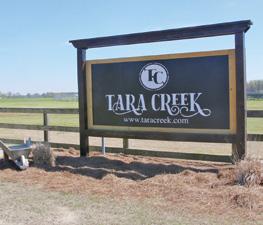
once used for farm equipment storage and repairs, this barn at Tara Creek has been transformed into a wedding and event venue. They will soon be hanging large wagon wheel chandeliers inside. Right, Tara Creek, located between Warsaw and Faison just off U.S. Highway 117, has evolved from a traditional row-crop farm into a thriving agritourism destination. While remaining an active farm, it now also features an event venue.
PHOTOS BY MARK GRADY FOR NORTH CAROLINA FARM LIFE
Left,
Milk Dud, a cow at Tara Creek, greets visitors to the farm. The animal was named by owner Lee Graham’s daughter.
“We still wanted to keep our roots in farming ... We want to keep farming at the forefront of folks’ minds.
Lee Graham
and soybeans. In 1994, the operation expanded to work with Carroll’s Foods, eventually operating 12 hog houses on the farm.
Graham left the farm for four years while he served in the U.S. Coast Guard.
“When I came back, the atmosphere had changed a little in the swine industry,” he said. “I ended up buying into the poultry industry and had nine turkey houses and four chicken houses.”
After working in that industry for a while, Tara Creek evolved again in 2020 when one of their employees decided they wanted to get married in a barn that had been used for working on equipment. The transformation of the barn into a wedding venue changed everything.
“Since then, we’ve been in the entertainment business,” Graham said.
In addition to a wedding and event venue reminiscent of a Hallmark movie setting, Tara Creek has become known for rodeos and music events. The rodeo venue is getting ready for a sanctioned rodeo on April 17 18. The farm will also host the CreekStone Rising Country Music Festival May 8 9, as well as Bojangles sponsored barrel racing events each month from May through September.
Visitors frequent Tara Creek not only to attend events but to tour the farm. Graham said they have frequent visitors from Greenville, Raleigh and Greensboro, and recently had someone attend a wedding there from Ireland.
Despite the farm’s expansion into entertainment, Graham says it’s still
MARK GRADY FOR NORTH CAROLINA FARM LIFE
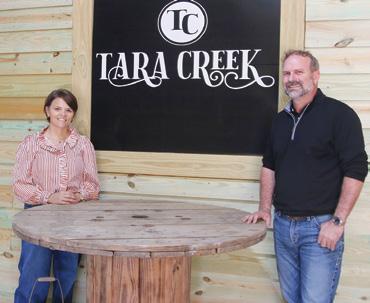
Owner Lee Graham, right, and Amy Turner, marketing operations manager, stand at the entrance to Tara Creek’s renovated barn, now a centerpiece wedding and event venue.
important to remember their beginnings.
“We still wanted to keep our roots in farming,” he said. “We want to keep farming at the forefront of folks’ minds. Farmers feed America, and this is a way to bring people onto a farm. In some eyes, it might be an unconventional way, but it is a way that brings attention to our industry.”
In addition to some custom farming, Tara Creek has become a major hay supplier in the Southeast, with customers from Virginia to Florida. They don’t just cut hay; they focus on producing hay with strong nutritional value for horse operations.
“We were running across people that were looking for good quality hay,” Graham said. “We were working with Nutrena. They would come test our hay. They would tell us how efficient it was in the way of nutritional value, as well as what kind of feed to supplement it with.”
That attention to detail gave hay from Tara Creek a good reputation, he explained.
“We went from selling to somebody who just wanted to buy some grass from
us to actually trying to give them a product that was essential for what they needed for their performance horses,” Graham said. “The science of agriculture has evolved a lot in analyzing. It’s not just going out there and cutting down hay. It’s more advanced.”
With all the changes at Tara Creek, from a simple family farm to an
agritourism destination, it’s important to Graham that agriculture remains the main theme.
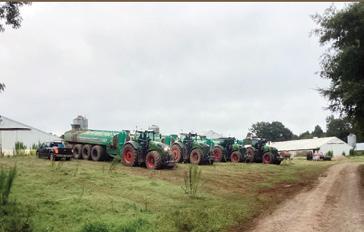
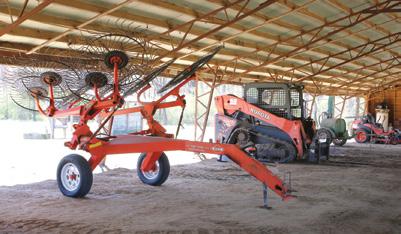
“Agriculture was how we sustained ourselves before we ever had a building to put things in. You don’t cross paths with many folks who have not got some sort of roots in agriculture in Duplin County. Farm equipment is stored under cover at Tara Creek, underscoring the operation’s continued role as a working farm.