Morgan makes gubernatorial bid o cial
Raleigh
Former N.C. Supreme Court Justice Michael Morgan o cially announced on Tuesday his long-rumored bid for governor.
Morgan, who served one term on the N.C. Supreme Court and resigned from the bench earlier this month, brings a near four-decade career to the Democratic primary against two-term Attorney General Josh Stein.
He faces an uphill battle in the contest as most of the state’s Democratic political establishment support Stein, including Gov. Roy Cooper, who is term-limited. North Carolina’s Democratic and Republican primaries are scheduled for March 5, 2024.
NSJ STAFF
Stein silent on Chinese Communist Party ‘intelligence center’ in Charlotte
Raleigh
In July, North Carolina Republican Sens. Ted Budd and Thom Tillis issued questions to U.S. Attorney General Merrick Garland regarding reports of Chinese Communist Party “intelligence service centers” operating in U.S. cities — including one in Charlotte.
The letter to Garland describes warnings from the U.S. Department of Justice that the Ministry of Public Security “conducts covert ‘intelligence and national security operations far beyond China’s borders,’ including ‘illicit, transnational repression schemes’ on U.S. soil.”
“Further, the ongoing discovery of additional OCSCs raises the question of whether DOJ’s response su ciently addresses the threat, particularly because OCSCs have openly operated for several years and their activities have been reportedly documented in Chinese state media and social media posts,” the letter states.
North Carolina Attorney General Josh Stein, the state’s chief law enforcement o cer, has also been silent on the matter.
In the months following the Budd/Tillis letter, North State Journal made three attempts to contact Stein for comment on the issue but received no acknowledgment or reply.
Stein, a Democrat, announced his 2024 gubernatorial bid earlier this year.
DILLON
A.P.
‘Culture of corruption’: McCarthy authorizes Biden impeachment inquiry
Speaker Kevin McCarthy said Tuesday he is directing a House committee to open an impeachment inquiry into President Joe Biden over his family’s business dealings, launching historic proceedings ahead of the 2024 election. McCarthy said the House Oversight Committee’s investigation so far has found a “culture of corruption” around the Biden family as Republicans probe the business dealings of the president’s son, Hunter Biden. “These are allegations of abuse of power, obstruction and corruption, and they warrant further investigation by the House of Representatives,” McCarthy said outside the speaker’s o ce at the Capitol.

Cooper courts controversy naming Riggs new justice
By Matt Mercer North State Journal
RALEIGH — Democrat-
Proposed State Board of Education policy uses funding to circumvent Charter Review Board
Board voted 8-3 to approve the controversial new policy
By A.P. Dillon North State Journal
—
RALEIGH
In an apparent end-run around the authority of the new Charter Schools Review Board, a new proposed policy approved by the N.C. State Board of Education (SBE) may have the e ect of tying up funding approvals for charter schools.
This legislative session House Bill 618 was passed, which created a Charter Schools Review Board (CSRB) made up of 14 members to replace the current Charter Schools Advisory Board and with the power to
approve or deny charter applications, grant renewals and issue revocations. The bill was vetoed by Democratic Gov. Roy Cooper but became law after successful veto override votes.
The proposed policy CHTR022 cites the new law as the SBE retaining its constitutional authority to “establish all rules for the operation and approval of charter schools,” and to “allocate funds to charter schools” in order to “ensure accountability from charter schools for school nances” and student achievement.
Per the most recent report to the General Assembly, as of Dec. 1, 2022, there were 206 public charter schools in North Caroli-
See CHARTER, page A2
ic Gov. Roy Cooper de ed convention once again in naming a Supreme Court Justice, elevating Court of Appeals judge Allison Riggs to the North Carolina Supreme Court.
Riggs, whose only professional experience before being named to the Court of Appeals was working as a litigator with the Southern Coalition for Social Justice, will be the youngest female justice in state history.
Riggs will ll the vacancy created by Justice Michael Morgan, who resigned earlier this month. Morgan has opened talks of a run for governor in 2024.
“The need for fair-minded, even-handed, honest, experienced judges is more important than ever as our society and our courts wrestle with many critical issues,” Cooper said in a statement Monday. “I am grateful for the willingness of Judge Riggs to serve our state’s judicial system in this new role.”
Riggs was the least-tenured member of the Court of Appeals after being named to the appellate court on Dec. 15, 2022.
According to her professional biography, Riggs held a variety of positions at the South-
ern Coalition for Social Justice (SCSJ) including co-executive director and chief counsel for voting rights. She was a civil rights litigator and community lawyer who served as lead counsel in numerous voting rights cases. She earned her bachelor’s and law degrees from the University of Florida.
Riggs is now reunited with her longtime boss at the SCSJ, Anita Earls, who was elected to the N.C. Supreme Court in 2018. Riggs took over for Earls following that successful campaign.
The naming of Riggs to both the Court of Appeals and Supreme Court seat in the span of nine months passed over at least two other Democratic judges currently on the Court of Appeals: Allegra Collins and John Arrowood, the rst openly gay judge on the appellate court. Both were elected in 2018.
In 2019, Cooper similarly passed over more experienced candidates when allowed to select a new chief justice of the court.
He elevated Cheri Beasley to the post, bypassing then-Senior Associate Justice Paul Newby, a Republican, as well as Associate Justice Robin Hudson, a
See JUSTICE, page A3
Annual college free speech rankings released
Four N.C. schools made the top 25
By A.P. Dillon North State Journal
RALEIGH — The College Pulse and the Foundation for Individual Rights and Expression (FIRE) have released their annual college Free Speech Rankings.
The 2024 College Free Speech Rankings are based on “the voices of over 55,000 currently enrolled students at over 250 colleges and are designed to help parents and prospective students choose the right college,” per a press release by the groups.
This year’s rankings looked at 248 colleges.
Michigan Technology University ranked rst this year, followed by Auburn University, the University of New Hampshire,
Oregon State University and Florida State University.
Coming in dead last this year was Harvard University, which was the only school given an “abysmal” speech climate rating.
Nine North Carolina institutions were included in this year’s rankings, with four landing in the top 25:
UNC Greensboro No. 9
NC State No. 11
UNC Charlotte No. 21
East Carolina No. 24
Appalachian State No. 36
Davidson No. 64
Wake Forest No. 88
Duke No. 124
UNC Chapel Hill No. 174
In last year’s report, North Carolina schools making the top 25 included UNC Greensboro (7), NC State (9) and UNC Charlotte (13). Beyond the top 25, UNC Chapel Hill was 26th,
Duke was 109th, Davidson was 116th and Wake Forest was 131st.
According to the Free Speech Rankings report, among the schools ranked this year there were 149 scholars sanctioned.
UNC Chapel Hill also had the distinction of making the list for being a repeat o ender when it comes to sanctioning scholars with four incidents.
Six schools earned a “warning” for consistently prioritizing other values over a commitment to free speech and were excluded from the rankings. The schools receiving a warning include Pepperdine University, St. Louis University, Liberty University, Baylor University, Hillsdale College and Brigham Young University.
A key detail included in the report is that 21% of students reported the administration’s stance at their school on campus
free speech is not clear.
Additionally, “more than a quarter of students (27%) reported that it is unlikely their college administration would defend a speaker’s right to express his or her views if a controversy occurred on campus.”
Other key ndings from the report include a deplatforming attempt success rate of 81% at schools ranked in the bottom ve of the list, 56% of students expressed worry about damaging their reputation because of someone misunderstand-
See FREE SPEECH, page A2
8 5 2017752016 $2.00
VOLUME 8 ISSUE 29 | WWW.NSJONLINE.COM WEDNESDAY, SEPTEMBER 13, 2023
the
BRIEF this week
AP PHOTO
Humiliation of soul always brings a positive blessing with it.
If we empty our hearts of self—then God will ll them with His love. Stoop, if you would climb to Heaven. You must grow downward, that you may grow upward. The sweetest fellowship with Heaven is to be had by humble souls, and by them alone. God will deny no blessing to a thoroughly humbled spirit. “Blessed are the poor in spirit, for theirs is the kingdom of Heaven”—along with all its riches and treasures.
God blesses us all up to the full measure of what it is safe for Him to do. If you do not get a particular blessing—it is because it is not safe for you to have it! If our heavenly Father were to let your unhumbled spirit win a victory in His holy war—you would pilfer the crown for yourself! And meeting with a fresh enemy, you would fall a victim. He keeps you low for your own safety. When a man is sincerely humble and never ventures to touch so much as a grain of the praise—there is scarcely any limit to what God will do for him. Humility makes us ready to be blessed by the God of all grace, and ts us to deal e ciently with our fellow men.
True humility is a ower that will adorn any garden. Whether it is prayer or praise, whether it is work or su ering—the genuine salt of humility cannot be used in excess.

“All of you, clothe yourselves with humility toward one another— because God opposes the proud but gives grace to the humble. Humble yourselves, therefore, under God’s
Voters in Cherokee tribe back adult use of marijuana in referendum
CHEROKEE — Members of the Eastern Band of Cherokee Indians have backed overwhelmingly the adult use of marijuana on their tribal land, even as they await the opening of a dispensary for those who seek it for medicinal use.
Uno cial results showed that 70% of voters said “yes” last Thursday in a referendum that opens the door to the western North Carolina reservation being the rst location in the state where pot for recreational use can be legally purchased, news outlets reported.
The question put to a vote by the Eastern Band tribal coun-
CHARTER from page 1
na serving more than 137,500 students, or just over 9% of the total public school population.
According to that report, from 1998 to 2022 only 53 charter schools voluntarily relinquished their charters, one was assumed by another nonpro t board, 11 were not renewed and 22 charters were revoked by the SBE.
At the conclusion of the Sept. 7 meeting, the Democrat-controlled SBE voted to approve the policy by a vote of 8-3. Olivia Oxendine, State Treasurer Folwell and Lt. Gov. Mark Robinson all voted no.
Under the statutes governing the SBE, the board has 13 members including 11 members appointed by the governor who are supposed to be con rmed by the General Assembly. The other two members are the state treasurer and lieutenant governor.
Only three of the 13 current board members are Republicans:
FREE SPEECH from page 1
ing what they have said or done, 26% reported they feel pressure to avoid discussing controversial topics in their classes, and 20% reported they often self-censor.
Per the report, “controversial speakers” received di erent treatment depending on the political leaning of the speaker.
“Student opposition to allowing controversial conservative speakers on campus ranged from 57% to 72%, depending on the
cil asked whether members supported legalizing the possession and use of cannabis by people at least 21 years old, and requiring the council to develop legislation to regulate a market.
In 2021, the tribe decriminalized possession of small amounts of marijuana within the Eastern Band’s 89-squaremile Qualla Boundary in the Blue Ridge Mountains. The tribe also formed a medical marijuana system that includes a tribe-created business to grow cannabis and sell it in a dispensary — which will make it the rst and only place to legally purchase marijuana in North Carolina. The dispensary should be selling products by Decem-
the trio who voted against the new policy.
Eight of the governor’s appointees are from the state’s eight education regions and currently serve an eight-year term. The board also has three at-large appointees.
At the onset of the monthly meeting on Sept. 6, Folwell voted to oppose adoption of the agenda containing the new proposed policy. The motion was voted down 5-2 and the policy stayed on the agenda.
During the Sept. 6 meeting discussion, several members, including State Superintendent of Public Instruction Catherine Truitt and Oxendine pointed out the new charter policy was “vague” and therefore could be used to withhold funding to schools approved by the CSRB.
SBE board member John Blackburn, who sits on the Education Innovation and Charter Schools Committee under which the policy was being introduced,
speaker. In contrast, student opposition to controversial liberal speakers ranged from 29% to 43%, depending on the speaker,” the report says.
Additionally, the percentage of students believing it is acceptable to block other students from attending an event they disagree with rose over the previous year.
According to the report, “More than 2 in 5 students (45%) said that students blocking other students from attending a speech is acceptable to some degree, up
ber, o cials said this week.
The Eastern Band, which has about 14,000 members and operates two casinos, can pass rules permitting cannabis use regardless of state or federal prohibitions because it is a sovereign nation and federally recognized tribe. Marijuana use remains illegal in the rest of North Carolina.
Forrest Parker, general manager of Qualla Enterprises LLC, which was formed to run the tribe’s cannabis business, told council members as they agreed to the referendum question that permitting adult use would mean more customers and revenue for the tribe.
Joey Owle, the tribe’s agricul-
responded that the CRSB’s rst meeting was upcoming and therefore the policy “needed to come before us.” Truitt told Blackburn the board should have prepared earlier and could have anticipated the veto of the bill would be overridden by the Republican supermajorities in the legislature. She added that neither her o ce nor the O ce of Charter Schools even saw the policy until late in the afternoon of the previous Thursday.
Chair Eric Davis bypassed the actual date of the bill’s passage at the end of June and instead used the veto override date of Aug. 16 in responding to criticism of the short introduction timeframe of the policy. He, like Blackburn, also blamed the short lead time on the impending rst meeting of the CSRB.
Truitt countered Davis’ comments by saying once her sta did see the policy, one of the questions unanswered was, “What are the
from 37% last year.”
In the same vein, 27% of students said using violence to stop a campus speech is acceptable to some degree, up seven points from last year’s 20%.
The College Free Speech Rankings are available online in an interactive dashboard allowing for comparison between institutions at rankings.the re.org
The 2024 College Free Speech Rankings coincide with the continued e orts of the UNC Board of Trustees to expand free speech
mighty hand, that He may lift you up in due time!” 1 Peter 5:5-6 Charles Spurgeon (1834-1892) is one of the most widely read preachers in history and is known by many as the Prince of Preachers. Spurgeon was pastor of the New Park Street Chapel (later the Metropolitan Tabernacle) in London. His works are now in the public domain.
ture and natural resources secretary, said he anticipated sales for recreational use to begin in nine to 18 months. In the meantime, those seeking cannabis for medical use will receive special cards to purchase it.
Opponents of legalizing marijuana use say it can lead to medical harm, including mental health decline for young people.
Republican U.S. Rep. Chuck Edwards, who represents western North Carolina, introduced a bill that would withhold 10% of federal highway funds from tribes and states that permit recreational marijuana.
“Here in our beloved mountains, we are already facing unprecedented crime, drug addiction and mental illness,”
Edwards wrote Aug. 17 in the Cherokee One Feather newspaper. “I can’t stand by and condone even greater access to drugs to poison more folks in (western North Carolina), not to mention having even more im-
criteria that the board could use to not provide funding?”
Robinson also said his o ce did not receive the policy until “a few days” after Truitt’s o ce did. The lieutenant governor also criticized the board for waiting until the last minute to unveil the policy as “unprofessional” and that it “smacks of dishonesty” and “political pandering.”
Reactions from charter school groups in the state to the policy proposal were swift.
In a statement, the North Carolina Association of Public Charter Schools (NCAPCS) called the move “unnecessary” and a “power grab.” N.C. Coalition for Charter Schools Executive Director Lindalyn Kakadelis issued a similar statement, criticizing the board for playing “bureaucratic power games.”

Kakadelis also issued a letter to the board outlining how the new policy runs afoul of state law, stat-
on the system’s campuses as well as protect students and employees from compelled speech situations.
The Institute for Citizens & Scholars also recently announced a “Campus Call for Free Expression,” which is described as a “commitment by a diverse group of college presidents to urgently spotlight, uplift, and re-emphasize the principles of critical inquiry and civic discourse on their campuses.”
Among the institutions in-
paired drivers on our roads.”
In its own statement to the newspaper this week, Qualla Enterprises said studies have identi ed ways that adult use of cannabis “actually decreases crime and promotes public health and order.”
The referendum vote occurred during the tribe’s general election for principal chief and council members.
Uno cial results show that current Principal Chief Richard Sneed lost his position to past Principal Chief Michell Hicks, with Hicks winning by more than 1,000 votes out of over 3,400 cast. An overwhelming majority also voted “yes” for a referendum asking that the tribe’s Alcoholic Beverage Commission be allowed to permit restaurants, hotels and other entities to sell mixed beverages. Election results are expected to be certi ed by early October, according to the tribe’s election o ce.
ing the board “does not have authority to enact this policy on its own,” and the CSRB had to approve the policy “as the law requires.”
Kakadelis also wrote the new policy “has not followed the procedures necessary for rulemaking under the State’s Administrative Procedure Act,” and cited the state’s Charter School Act, which says the State Board of Education “shall allocate” a per-pupil share of funding “to each charter school.”
Kakadelis’ letter also questioned the circumstances under which the policy was drafted and the speed with which the board sought a vote, calling the timeline “highly unusual for a policy which has such far-reaching implications.”
Former Democrat state legislator Marcus Brandon also weighed in about the board’s move, tweeting in part, “When people abuse power — strip them of it.”
volved in the campus call actions are Benedict College, Claremont McKenna College, Cornell University, DePauw University, James Madison University, Rollins College and Wesleyan University.
Duke University is also engaged in the campus call and will be hosting a summer seminar for faculty covering “potential course content and best practices for effectively promoting civic discussion over sensitive topics in the classroom.”
A2 North State Journal for Wednesday, September 13, 2023
WEDNESDAY 9.13.23 #401 “One of One” Visit us online nsjonline.com North State Journal (USPS 20451) (ISSN 2471-1365) Neal Robbins Publisher Matt Mercer Editor in Chief Cory Lavalette Managing/Sports Editor Frank Hill Senior Opinion Editor Emily Roberson Business/Features Editor Lauren Rose Design Editor Published each Wednesday by North State Journal 1201 Edwards Mill Rd. Suite 300 Raleigh, NC 27607 TO SUBSCRIBE: 336-283-6305 or online at nsjonline.com Annual Subscription Price: $100.00 Periodicals Postage Paid at Raleigh, N.C. and at additional mailing o ces.
Send address changes to: North State Journal 1201 Edwards Mill Rd. Suite 300 Raleigh, NC 27607 THE WORD: A FLOWER THAT WILL ADORN ANY GARDEN
POSTMASTER:
PUBLIC DOMAINL
“God opposes the proud, but gives grace to the humble.” James 4:6
“Red Canna” by Georgia O’Kee e (1919) is a painting in High Museum of Art, Atlanta.
The Associated Press
Test scores show continued improvement post-pandemic for NC K-12 students
By A.P. Dillon North State Journal
RALEIGH — While academic achievement plummeted for K-12 students in North Carolina and nationwide, test scores released during the September monthly meeting of the N.C. State Board of Education shows continued improvement for the state’s students.
The gains made by K-12 students show promise but have not yet reached pre-pandemic achievement levels.
“For the 2022–23 school year, schools continued to deal with student learning loss due to the COVID pandemic,” according to a press release from the N.C. Department of Public Instruction (NCDPI). “Data from the 2022–23 school year should be reviewed in these contexts and comparisons to prior years’ results should be made with caution.”
“We’re seeing progress back toward our pre-COVID levels,” said Tammy Howard, senior director of NCDPI’s O ce of Accountability and Testing. “We may not be 100% back to where we were, but there’s de nite progress being seen here.”
According to NCDPI, “Overall, math scores in elementary and middle school grades were up more signi cantly than reading scores. The scores on science exams, given at grades 5 and 8, showed gains from 2021-22 in 5th grade but a decline in 8th grade.”
The composite Grade Level Pro ciency (GLP) percent-
ages for the more than 2 million K-12 students in the state showed a pro ciency rate of just under 54% for students during the 2022- 23 school year. Conversely, 46% were still not testing at GLP during 2022-23.
The 2022-23 composite GLP rates show a continued improvement over the prior two school years. In 2021, the GLP dropped 24% from what it was in 201617. That percentage improved to 14% in 2022’s data and the gap closed even further in 2023 at 8% when compared with the
2016-17 data.
The largest GLP increase was seen in Grade 4 Math at 5.3%. Grade 7 Math had the smallest gain with 1.5%. In Reading, Grade 4 was the biggest gainer with 2.9% while Grade 8 had only a 0.3% gain.
In comparison with the 58.8% 2018-19 school year pass rates, all exam passing rates remain below pre-pandemic levels on every test except High School Math 3.
As with GLP, the percentage of students considered “Career
and College Ready” increased but is still behind pre-pandemic rates.
Nearly a third (30.9%) of students in grades 3-8 statewide scored at a level 4 or 5 in reading, considered to be Career and College Ready (CCR), compared to 29.3% in 2020-21, while 34.9% of students in grades 3-8 statewide scored at the CCR levels 4 or 5 in math, compared to 32.1% in 2021-22.
On the ACT, which measures English, math, reading and science, the percentage of 11th
graders who had a composite score of at least 19 came in at 41.1%, close to the 41.7% reported in 2021-22. The goal composite score of 17 was changed to 19 to align with UNC System requirements that were updated in March 2020.
The report to the state board also showed the state’s fouryear cohort graduation rate remained unchanged from the previous year at 86.4%. The rate in 2018-19 was 86.5%.
The A-F school performance grades saw improvement, however, NCDPI says the grades that schools received for 202122 and 2022-23 were “a ected by the formula used to determine those grades,” which is a combination of student performance on testing and the credit a school earns for student progress year over year. The grade designations for schools are set on a 15-point scale: A = 85–100; B = 70–84; C = 55–69; D = 40–54; F = 39 or less.


Per the report, the percentage of schools with a grade of D or F decreased to 35.4% in 202223 from 42.3% in 2021-22. The rate in 2018-19 was 21.8%.
The number of schools considered low performing under the state accountability system by earning a D or F dropped signi cantly, from 864 to 804 for 2022-23. That is still nearly 65% more than the 488 that were identi ed in 2018-19.
Additionally, the number of low-performing districts decreased to 25 in 2022-23 from the previous school year’s 29.
Boyette leaves the NCDOT in improved nancial shape
By A.P. Dillon North State Journal
RALEIGH —Democratic
Gov. Roy Cooper announced the retirement of North Carolina Department of Transportation (NCDOT) Secretary Eric Boyette on Sept. 6.
Cooper has chosen Joseph R. “Joey” Hopkins, the current NCDOT chief operating o cer, to replace Boyette on Oct. 1.
“Secretary Boyette has served North Carolina with distinction during my term as Governor, rst as Secretary of the Department of Information Technology and now as Secretary of Transportation, and I’m deeply grateful for his hard work and commitment to the people of our state,” Cooper said in a statement. “I’m condent that Joey Hopkins will continue this outstanding work as Secretary of the Department of Transportation when he steps into this new role.”
Hopkins has worked at NCDOT for more than 30 years in a variety of capacities, including deputy chief engineer, division engineer, deputy division engineer, division maintenance engineer and division operations engineer, all in Division 5.
Boyette has served in state government for the past 27 years.
“I’ve spent nearly my entire career working alongside people who strive each day to make our state a better place, and being a part of such a dedicated team is what made this such a di cult decision,” Boyette said in an email statement to North State Journal. “I’m proud of the work the NCDOT team has ac-
complished under my leadership, including strengthening our nances, improving project delivery and building stronger relationships with communities across our state.
“Thank you to Gov. Cooper for the opportunity, and to all my sta , colleagues and partners who have made this experience so ful lling. I have worked with Joey for many years, especially in our current leadership roles, and I know the Department is in the most capable hands as I begin a new chapter.”
Boyette has received several awards, such as the Golden Gov: State Executive of the Year and GovTech’s Top 25 Doers (2019), Dreamers & Drivers. He was also named Public Sector CIO of the Year by NC Tech (2019) and the Triangle Business Journal (2016). He also received the Old North State Award in 2017.
Cooper rst appointed Boyette as secretary of the Department of Information Technology in April 2017, and he was moved to NCDOT secretary in early 2020 after the sudden departure of Secretary Jim Trogdon on Feb. 4. 2020.
Under Trogdon’s tenure, the NCDOT saw a series of nancial missteps, including a 2020 state audit that reported overspending of $742 million by the agency. The overspending and budget issues resulted in construction contracts being cut by $2 billion that year accompanied by rolling employee furloughs.
The 2020 audit was followed by a legislative hearing at which State Auditor Beth Wood testi ed that the NCDOT’s cash mismanagement was “absolutely” a factor in the agency’s overspending. A second audit that same
year by Wood’s o ce found improper salary raises and adjustments totaling around $39 million.
Additionally, the NCDOT faced criticism over the purchase of some Ringling Bros. circus railcars in 2017 for $383.000.
The railcars were supposed to be refurbished but instead sat untouched on tracks in Nash County. While sitting on those tracks, four cars had to be scrapped after they caught re in an incident suspected by the Nash County Sheri ’s O ce to be arson.
In 2020, the NDCOT took a loss on the purchase of $327,949 after two of the remaining cars sold for a total of $26,301 and the other three sold for a combined $28,750. Trogdon and the agency took heat over the loss, with critics noting the NCDOT’s money issues of spending $2 billion beyond its $7 billion revenue stream and being dangerously close to hitting its bottom limit for cash reserves.
Since Boyette took over, the NCDOT has received a positive audit report related to its spending. According to the audit produced this past spring, NCDOT spending for scal year 2022 was approximately $6.86 billion, but in actuality it spent $6.34 billion.
More good news for the NCDOT’s nancial management came at the end of December 2022 with the early repayment of N.C. State Highway Trust Fund loans totaling more than $1 billion.
The loans were repaid two years early according to State Treasurer Dale Folwell, who praised the repayment as a “turnaround” from the NCDOT’s scal mismanagement issues.
Lawsuit led by bar owners over COVID lockdowns can proceed
By A.P. Dillon North State Journal
RALEIGH
— The North Carolina Court of Appeals has afrmed a lower court’s denial of a motion by Gov. Roy Cooper and legislative leaders to dismiss a lawsuit brought by a group of bar owners impacted by Cooper’s COVID-19 lockdown policies.
“We hold any alleged failure on the part of Plainti s to seek injunctive relief prior to damages does not bar their claims at the pleading stage under the theory of sovereign immunity,” Judge April Wood wrote in the ruling. “… “We a rm the trial court’s denial of Defendants’ Motion to Dismiss.”

Joining Wood in the majority of the three-judge panel was Judge Fred Gore. Democrat Judge John Arrowood dissented. In his dissent, Arrowood said, “Curtailing the ability of our Governor to issue executive orders during a state of emergency sets a deadly precedent that will prove to have grave consequences in the future.”
During the pandemic, Cooper kept bars closed far longer than any other type of business in the state, leading to the lawsuit by a coalition of bar owners led by Ti any Howell. The case, Howell v. Cooper, was rst led by various bar owners on Dec. 22, 2020, citing the governor’s lockdown having caused “ nancial damages due to the closing of their respective businesses, or the severe restrictions placed on their respective
businesses.” The lawsuit contained ve causes of action, most of which are still intact as of the Court of Appeals ruling.
The motion to dismiss the case has been winding its way through the courts since January 2021. After an amended complaint adding Senate Leader Phil Berger (R-Eden) and House Speaker Tim Moore (R-Kings Mountain) as defendants was led in May 2021, Cooper and the state led a motion to dismiss in July.
A trial court denied the motion to dismiss the plainti s’ complaint on Feb. 16, 2022. Part of the complaint was transferred to a three-judge panel in Superior Court.
The lawsuit argued the governor’s orders with regard to bars violated a constitutional right for a person to work and earn a living, and cited the di erential treatment of bars by Cooper.
“Restaurants, private clubs, breweries, wineries, and distilleries have been allowed to open and operate for onsite indoor consumption of alcohol, while bars have been ordered to close or have their businesses severely limited by draconian restrictions that make the operation of bars unpro table,” the lawsuit stated.
The bar owners’ complaint was the second lawsuit led on behalf of a bar or club. In December, Paci c Legal Foundation led a lawsuit on behalf of Club 519 targeting the disparate treatment of private bars in the governor’s orders versus other similar businesses.
A3 North State Journal for Wednesday, September 13, 2023
FILE PHOTO
Students participate in a discussion during class in this undated le photo.
JUSTICE from page 1 longer-tenured Democrat than Beasley. Beasley would go on to lose to Newby in 2020. Riggs will face voters for the rst time in November 2024. Republican Je erson Gri n, who was elected to the Court of Appeals in 2020, entered the Supreme Court race in late 2022 and set a state record in his midyear fundraising report, raising more than $400,000 in six months and over half a million since joining the 2024 contest. In a subsequent announcement, Cooper named Carolyn Thompson to the seat Riggs is vacating on the Court of Appeals. The Court of Appeals seat will also be contested in November 2024. Thompson is currently a deputy commissioner on the North Carolina Industrial Commission and previously served as both a District and Superior Court judge in District 9, which encompasses Person, Granville, Vance, Warren and Franklin counties. She is an ordained minister and has served as a mentor and volunteer for teen and truancy courts. Thompson received her bachelor’s degree from Hampton University and her Juris Doctor from North Carolina Central School of Law.
Governor names replacement for retiring NCDOT secretary
VISUAL VOICES
OPINION
Neal Robbins, publisher | Frank Hill, senior opinion editor

Mugged by reality
ONE GREAT THING about going on a two-week trip out west is the almost total lack of modern technology connectivity.
No cellphone 5G bars high in the mountains. Very limited Wi-Fi available only on the rare occasions when you pass through small resorts such as Big Sky, Montana or near national park lodges like Fort Yellowstone in Mammoth Springs, Wyoming. No CNN or Fox Business News droning on in the background as you go about your workday.
It really is very pleasant and good for your mind, heart and soul. It is sort of like going into a detox rehab center, although for entirely less important reasons.
Only by teaching every citizen it is their responsibility and duty to govern their own actions will we see any progress in this regard.
Upon return to normal daily routines, technological interconnectivity reestablishes itself almost as magically as human nerves reconnect after surgery. With it comes all the news stories, mostly bad and sensational, and the occasional sports-related score, controversy or reports of another athlete signing a trillion-dollar contract with some team.
It is like being smacked in the face by reality.
If returning to daily life is being smacked in the face, then what we saw on the news were liberals being “mugged by reality.” Many liberals desperately want to believe in the essential goodness of every human being even though G.K. Chesterton said original sin was the most provable part of Christian theology because everyone can see it in the streets every day of our lives.
And on the news. And on social media.
A close friend, the dearly departed Michael Cromartie formerly of the Ethics and Public Policy Center in D.C., lived in a commune in Durham after college and was an avowed liberal ― until he was mugged and held at gunpoint in a hotel in Denver, Colorado, where he was attending some peace and love convention.
“My worldview changed immediately as I was staring down the barrel of that gun,” he told our Institute for the Public Trust classes many times. “At least I was able to get them to let me keep my tie to wear with a tattered old brown suit and white shirt so I could attend the peace conference after they somehow let me go ― after taking everything else I owned, by the way.
“I became a conservative for liberal reasons at that very moment,” he

EDITORIAL | STACEY MATTHEWS
added. “Welfare systems were obviously not working, so I decided there had to be better ways to try to improve society.”
We are not doing anyone any favors if we turn a blind eye to anyone, rich or poor, black or white, who is breaking the law. America is a nation of laws if nothing else ― once we lose that, we will not be able to run a civilized society. We need to strengthen our community by teaching a common set of shared ethics and normative community standards through our public schools, churches and civic organizations ― not tear them down as the progressive left always seems to do.
Only by teaching every citizen it is their responsibility and duty to govern their own actions will we see any progress in this regard.
Former Mayor Bill de Blasio proudly declared New York City to be a sanctuary city and open to all immigrants regardless of whether they obeyed existing immigration laws and processes or not. Current NYC Mayor Eric Adams is now saying the ood of illegal immigrants from the Mexican border “will destroy this city” ― which is an amazing statement considering only 100,000 of the 3 million illegal immigrants who have ooded the southern border since President Joe Biden took o ce have made it to New York.
What have the other 2.9 million done to Texas and other border states?
Mugged by reality ― Case No. 1.
Shivanthi Sathanandan, the second vice chairwoman for the Minnesota Democratic-Farmer-Labor Party who was at the forefront of the “Defund the Police” movement in 2021, was recently attacked by four carjackers who left her bloody and bowed before her children. She posted a picture of her bloody face on social media, begged for more police protection on the streets and proclaimed: “We need to catch these young people who are running wild creating chaos across our city and HOLD THEM IN CUSTODY AND PROSECUTE THEM. PERIOD.”
Mugged by reality — Case No. 2.
Liberals who get mugged by reality are the best ones to lead the ght back toward a common-sense approach to crime — if they learn and are converted by their own personal trauma. It is either that or move from wherever they have been mugged to the Rocky Mountains.

Joe Biden undermines his CDC’s mask guidelines
WITH THE SUMMER MONTHS signaling back-to-school season and the return of NFL games, it seems par for the course that we’re seeing an uptick in COVID-19 case numbers as more people come in close contact with each other.
Though the rise in the number of people with the coronavirus is nowhere near as high as it has been in previous years, it’s still been enough to concern public health o cials to the point we’re hearing more about masking and vaccines, and how you can help your fellow citizen out if you do your part.
But don’t tell them I didn’t have it on when I walked in.
Schools in some parts of the country have already instituted either mask or vaccine mandates — or both — which has sparked a national conversation about whether that is the right thing to do, with some Republican members of Congress already pushing legislation that would e ectively ban mask mandates.
During all of this, we learned that First Lady Jill Biden tested positive for the virus on Labor Day but thankfully was said to be having “mild symptoms.” President Joe Biden reportedly tested negative.
But in the two days after, President Biden had public events where he was seen not wearing a mask even though CDC guidelines advise people who have potentially been exposed to the virus to “wear a high-quality mask or respirator (e.g., N95) any time you are around others inside your home or indoors in public.”


Further, they note that you should “take extra precautions if you will be around people who are more likely to get very sick from COVID-19.”
Except Biden didn’t follow that guidance.

On the Tuesday following Jill Biden’s positive test, a maskless Biden pinned the Medal of Honor on its 81-year-old recipient, Army Cpt. Larry Taylor, a Vietnam War veteran, while standing in close proximity. He was observed at some other points during the ceremony also not wearing a mask.
The next day during a speech given in the East Room of the White House, a maskless Joe Biden strolled up to the lectern and rst gave speech attendees an update on how he was doing.

“Let me explain to the press — I’ve been tested again today. I’m clear across the board,” Biden stated, displaying the mask he was holding. “But they keep telling me because this has to be 10 days or something, I’ve got to keep wearing it.
“But don’t tell them I didn’t have it on when I walked in.”
Judging by the muted reaction of the crowd, few in the room found Biden’s remarks funny, perhaps because they remembered that Biden and members of his administration spent the rst two years of his presidency
mask-shaming people and telling them it was their “patriotic duty” to wear a mask and to get the coronavirus vaccine.
Some of them may have even recalled that a few hours after Biden was sworn into o ce in January 2021, his rst o cial act was to sign an executive order mandating mask-wearing on federal property.
Several hours later, Biden and members of his family were seen celebrating at the Lincoln Memorial, with many of them, including Joe Biden himself, not wearing a mask.
Joe Biden set the example right then and there that he didn’t believe that the rules he demanded and mandated others follow applied to him and his family.
If we see stories galore come autumn and winter about how so many people are opting not to wear masks during cold, u, and COVID season, we can look straight to top leaders in this country like Biden as reasons why. Because some people, understandably, are going to say to themselves that if the president of the United States doesn’t have to abide by his own guidelines, they shouldn’t either.
North Carolina native Stacey Matthews has also written under the pseudonym Sister Toldjah and is a media analyst and regular contributor to RedState and Legal Insurrection.

A4 North State Journal for Wednesday, September 13, 2023
EDITORIAL | FRANK HILL
AP PHOTO
President Joe Biden holds up his face mask before he speaks in the State Dining Room, Wednesday, Sept. 6, 2023
COLUMN | MICHAEL BARONE
YOU COULD BLAME Victor Hugo. In 1846, the French novelist observed a young man being arrested for holding a loaf of bread he stole.
Deeply touched, he fashioned his novel “Les Miserables,” published in 1862, around the character Jean Valjean, who is imprisoned for 19 years for stealing a loaf of bread and pursued relentlessly after his release by Inspector Javert.
You may have followed the story, sort of, in the musical “Les Mis,” which began its run in Paris in 1980 and London in 1985. Or you may have heard the quip by the later French writer Anatole France that “the law, in its majestic equality, forbids rich and poor alike to sleep under bridges, to beg in the streets, and to steal their bread.”
Curiously, some people, even in the United States in the 21st century, seem to think that the conditions Hugo and France described in their ction still prevail here — even though their relevant writings were set nearly 200 years in the past, and no one without severe mental handicaps goes hungry today for want of bread in countries such as France and the U.S.
But the assumption persists that if someone steals, particularly if someone steals items worth small amounts of money, that person must be in dire want or acting to help someone who is. Didn’t Karl Marx and others of Hugo’s generation teach that mankind acts always and everywhere primarily out of economic motives?
Something like this line of thought, perhaps without the literary references, explains the laws decriminalizing the thefts of items worth small amounts of money. Primary examples include California’s law, passed in a referendum in 2014, raising from $400 to $950 the amount of shoplifted goods justifying a felony prosecution.
Similarly, in New York state, stealing property worth less than $1,000 is a misdemeanor. So prosecutors, many nanced by the left-wing billionaire George Soros, in these two large states and elsewhere have e ectively decriminalized shoplifting.
Proposition 47 was pitched as a measure to relieve prison overcrowding and defended by an Associated Press reporter as not preventing misdemeanor prosecutions of those lching goods worth $949 or less. But of course, that’s not what happened.
Instead, shoplifting has become a mass, and scary, phenomenon, encouraged by organized criminals who
COLUMN | NEWT GINGRICH
Normandy and the Ukrainian miracle
AS I WATCH various pundits and o cials express frustration over the seemingly slow progress of the Ukrainian campaign, I’m reminded that some of history’s greatest military victories were long, slow, and grinding.
Two con icts speci cally come to mind: The Battle of Vicksburg in the Civil War and breaking out in Normandy during World War II.
Vicksburg was a vital link in the Mississippi River. If the Confederates lost it, they would have been split in half. Arkansas, western Louisiana and Texas would have been isolated from the eastern part of the Confederacy. Once the Union had complete access to the entire Mississippi, all the manufactured and agricultural goods from the entire Midwest could go down to New Orleans and be shipped around the world.
There was substantial value in holding Vicksburg. The Confederacy heavily reinforced it under Gen. John Pemberton. But he was still faced with a great problem. He could fortify Vicksburg, but he wasn’t strong enough to break out against the Union Army.
Union Gen. Ulysses Grant was faced with an even bigger problem. He had to try to take Vicksburg from the Confederates. His army was north of the city, and he couldn’t approach from the north. The entire area is a mess of swamps, creeks and tributaries of the Mississippi. In a world of horses, wagons and rolling cannons, it was impossible terrain.
Grant decided to move south and ultimately make an o ensive from the eastern side of Vicksburg. While he was planning and developing, he had his men work to try to cut a canal through a curve in the Mississippi. Theoretically, if they could cut a big enough canal, they could have bypassed Vicksburg altogether and had free use of the river.
However, the canal idea was perhaps even more impossible than marching an army there. The Mississippi River is powerful. It oods frequently. Cutting a stable canal would be hugely di cult.
So, why would Grant try it? He wanted to keep the troops busy. He knew if they sat around with nothing to do, they’d become demoralized. They’d begin to get sick. They’d be harder to discipline. So, he just kept them working while he developed his full plan.
This was an elaborate, deeply complicated campaign. It took months. Luckily for Grant, he had fought well enough — and President Abraham Lincoln had enough faith in him — that he was given the time to pull o his Vicksburg miracle. If Lincoln had been impatient — like some of our armchair quarterbacks on television today — he’d have replaced Grant. The replacement probably would have made a total mess by moving too quickly.
Eventually, Grant made it south, crossed over, and headed northwest to Vicksburg. This was treacherous. He had most of Mississippi behind him, and he worried that an army could sneak up from Alabama, Tennessee or Georgia. He brought in Col. Benjamin Grierson. Grant asked Grierson to take a large cavalry unit and cut north to south all the way through Mississippi. Grierson was a smart man. He understood tactics,
resell stolen merchandise.
Those who see low-dollar shoplifters as 21st-century Jean Valjeans should realize that theft is not necessarily a nonviolent crime and that low-value theft losses can in ict severe damage on those with modest incomes.
It’s like what Jack Maple, an architect of New York City Mayor Rudy Giuliani’s police reforms, concluded when told that burglaries of under $10,000 weren’t investigated in Manhattan. “If you were Donald Trump and had a painting taken,” he recalled, “we would have 30 ... cops there. If you’re poor, you could have your life savings stolen from you, and nobody was going to investigate it, which is outrageous! I just saw what the rule was, and I changed it.”
In most cases, the ash mobs swarming into chain drugstores and bodegas in Manhattan and San Francisco, invariably ignored by uniformed security and police o cers, don’t take much directly from customers. But they do put people just going about their daily lives in fear of injury or death, the common law de nition of assault, and increase the cost and availability of goods in their neighborhoods.
So chain drugstores place under lock and key razor blades and toothpaste and shampoos, which can be sold to organized gangsters who sell them at low prices with no sales tax. Other stores just close, such as Nordstrom on San Francisco’s Market Street and CVS branches in Midtown Manhattan.
In southeast Washington, D.C., Giant Foods has removed brand-name merchandise from its supermarket (store brand items apparently aren’t fencible).
That’s supported by local Councilman Trayon White (last seen blaming the Rothschilds for a heavy snowfall), who reports that Giant’s shoplifting loss is 20% of sales and says that, without changes, the store, the only one in the neighborhoods, will close.
It’s an uncomfortable and rarely reported fact that the large majority of shoplifting mobs are young black men, some of whom may believe they’re redressing Jean Valjean-type grievances. White disagrees. “We know it’s tough times, and we know the price of food has skyrocketed in the last three years,” he said. “But we cannot a ord to hurt ourselves by constantly taking it out of the store.”
In saying so, he shows an appreciation of the inevitable result of e ectively decriminalizing stealing that evidently evaded sophisticated New York state legislators and the 60% of California voters who voted to do so. As the statement often attributed to San Francisco longshoreman/philosopher Eric Ho er about 50 years ago says, “Every great cause begins as a movement, becomes a business, and eventually degenerates into a racket.”
Michael Barone is a senior political analyst for the Washington Examiner, resident fellow at the American Enterprise Institute and longtime co-author of “The Almanac of American Politics.”
The ADL does not speak for Jews
ELON MUSK has threatened to sue the Anti-Defamation League for some $22 billion over its slandering of him as an antisemite, which he alleges has tanked X’s advertising revenue. “Based on what we’ve heard from advertisers, ADL seems to be responsible for most of our revenue loss,” Musk says.
Judging from my own feed, there are plenty of real-life antisemites who have taken to X, formerly Twitter, to participate in the #BanTheADL movement over this kerfu e. It’s unsurprising that more open discourse brings out more bigots. That’s an unfortunate price of free speech. Clearly, those who campaign to “ban” accounts don’t care about an open platform anyway. Nothing stops us from calling them out.
That said, though, Musk’s criticism of the ADL isn’t antisemitic. First o , the ADL isn’t a “Jewish” organization in any genuine ethnic or theological sense. Its primary mission is no longer to stop the defamation of Jews. The ADL’s CEO, Jonathan Greenblatt, a former Barack Obama appointee who often appears on MSNBC to chat it up with bigots such as Al Sharpton, has created a partisan leftist social justice out t. And its primary goal these days is cynically using the organization’s historical position to advance often illiberal, completely irreligious, leftist ideas.
One of the ways it does this is by dishonestly framing an endorsement of free expression as an endorsement of the things people say using free expression, including antisemitism. That’s what it has done with Musk. So it would be no surprise if the ADL were leading a politically motivated boycott e ort.
Musk, for example, contends that the ADL wants him to ban the Libs of TikTok, a popular account run by an orthodox Jew, Chaya Raichik, who gained fame by reposting real leftists saying real things. It’s certainly plausible, considering the ADL already has an entry for Raichik in its “glossary of terms.” Now, I’m not a big fan of nitpicking, but I haven’t seen anything in her feed that could be rationally construed as antisemitic. And that speaks to the problem of who gets to decide what “hate speech” entails.
geography and how to fully read maps. He kept the Confederates so confused that they diverted thousands of Confederate soldiers from Grant’s rear to chase Grierson all over central and southern Mississippi.
The Vicksburg campaign was a totally successful maneuver — that took a great deal of time to play out. It starved Vicksburg of ammunition, food and other resources. It gradually weakened the population until the city surrendered on July 4, 1863. It was an enormous victory. It was eclipsed in part by the Great Battle of Gettysburg on the same day, but it signaled an enormous break in the Confederacy.
Similarly, the most complex single thing humans have ever done happened on D-Day, June 6, 1944. Nearly 133,000 allied forces landed on the beaches of Normandy.
The landing went well, and we gathered forces on the beaches rapidly. However, Allied Forces suddenly discovered they’d made a huge mistake. The aerial photography that they’d been using showed rows of hedges in the elds o the beach. It turned out they were ancient, huge bushes that surrounded each beach. Further, they were lled with Nazi machine guns, mortars and infantry. To get beyond the beaches, you had to break through these hedgerows one at a time.
It was tragically expensive in human life — and time. Troops were bogged down, sort of chewing their way through the hedges instead of breaking out and establishing a hold in France. They turned tanks into bulldozers. They organized massive bombing campaigns (some of which tragically took out our own allies). It was brutal. Ultimately, we succeeded with steady, methodical determination to win.
What if there had been 24-hour television news when Grant was trying to take Vicksburg and the Allies were trying to take Normandy? What would they have said about Grant, American commander Omar Bradley, British commander Bernard Montgomery or Allied Forces commander (and future President) Dwight Eisenhower?
My bet is virtually every pundit would have said (safely from their TV studios) that these heroes didn’t know how to ght. They’d have demanded that troops be brought home or that leadership be replaced.
Think about this when you see what’s happening in Ukraine. The Russians knew Ukraine was going to counterattack. This knowledge itself was signi cant, so they forti ed eastern Ukraine. However, much like Pemberton in Vicksburg, Russia simply doesn’t seem to have the forces to continue its o ensive campaign to seize the whole country.
As the Nazis did in Normandy, Russia has heavily forti ed key positions and interlocked them with massive mine elds.
If the Ukrainians tried to ght a mobile armored battle in that area, they’d lose every single time.
So, sort of like Grant, the Ukrainians use artillery behind the Russian lines to cut o Russian ammunition, food and fuel. They are breaking down the morale of the Russians at the line and then painstakingly neutralizing the mine elds.
If they go quickly, they’re going to die. People who glibly say the Ukrainian forces are not going fast enough simply have no historical understanding of how hard these kinds of ghts are — and no appreciation for what’s at stake.
Take a look at Vicksburg and the ghting in Normandy. Then look at the challenges Ukraine is facing. I think you’ll realize the Ukrainian resistance is a miracle.
Also remember: the top general in the American Army said publicly before the war that the Russians would be in Kyiv in three days.
He was — and remains — wrong.
We should have more faith in Ukrainian courage and the willingness of free people to ght tyranny — and a little less faith in our comfortable armchair critics back home.
For Greenblatt, who worked to get Tucker Carlson red but can barely muster a word of disapproval for Jew-baiters such as Rashida Tlaib or any other elected progressive, hate speech is a nely tuned political weapon.
The ADL has spent years exaggerating the threat of antisemitism on the right, nding o ense not only in demonstrably ugly speech but also in an endless number of dog whistles (including criticisms of leftist megadonor George Soros). At the same time, it gives perfunctory attention (but mostly ignores) to the threat and normalization of antiJewish sentiment among leftists on college campuses, within activist movements and in the government.
Don’t think of it as a double standard. Think of the ADL as a run-of-the-mill activist shop — something akin to the Southern Poverty Law Center — and it all makes complete sense.
You only need to look at the organization’s educational recommendations to understand that its worldview is detached from any traditional understanding of Judaism. One strongly doubts the founders of the ADL could have foreseen their organization endorsing the idea that Jews were among the racial oppressors of American society.
Yet the ADL’s school curricula and readings on race and racism are littered with identarian tracts such as “How to Be An Antiracist” by Ibram X. Kendi, a fan of several brazen antisemites, and “White Fragility” by Robin DiAngelo. How can the ADL claim to ght against the defamation of the Jewish people and recommend authors who insinuate, or worse, that Jews represent a disproportionate amount of power in the United States — one of the most enduring tropes of antisemitism? The ADL also recommends the pseudohistorical 1619 Project and the podcast “The Urgency of Intersectionality” by Kimberle Crenshaw, a leading “scholar of critical race theory,” the teachings of which are also inherently antiJewish.
I’m not saying that many, maybe most, American Jews don’t agree with the ideological outlook of the ADL. But many do not. Nothing in Judaism teaches that our immutable appearances predetermine our societal role, actions or worth. Why is a group claiming to ght Jewish defamation spreading trendy ideological pu ery? Because it is not what it says it is.
Now, the ADL, self-anointed arbiter of antisemitism, is certainly useful in providing lazy journalists with quotes con rming preexisting notions about antisemitism being largely a right-wing phenomenon. And riskaverse corporations might use them for guidance. But it has no moral standing to dictate appropriate speech. Certainly not in the name of Jews.
David Harsanyi is a senior editor at The Federalist. Harsanyi is a nationally syndicated columnist and author of ve books — the most recent, “Eurotrash: Why America Must Reject the Failed Ideas of a Dying Continent.”
A5 North State Journal for Wednesday, September 13, 2023
COLUMN DAVID HARSANYI
Legalized shoplifting becomes a racket, and minorities hardest hit Vicksburg,
Inside the brand-new White House Situation Room: Cutting-edge tech, mahogany and that new car smell
The Associated Press
WASHINGTON, D.C. — The White House Situation Room — a space of great mystique and even greater secrecy — just got a $50 million facelift.
Actually, “room” is a misnomer. It’s a 5,500-square-foot, highly secure complex of conference rooms and o ces on the ground oor of the West Wing. These are rooms where history happens, where the president meets with national security ofcials to discuss secret operations and sensitive government matters, speaks with foreign leaders and works through major national security crises.
It’s where President Barack Obama and his team watched the raid that took down al-Qaida leader Osama bin Laden in 2011, where President Donald Trump monitored the 2019 operation that killed Islamic State leader Abu Bakr al-Baghdadi, and where President Lyndon Johnson went over Vietnam War plans.
The latest redo was no small update: The total gut renovation took a year to complete.
The White House opened the classi ed space to a group of reporters for a rare visit to check out the new look. President Joe Biden got a tour and then received an intelligence brie ng in the space, said Marc Gustafson, the Situation Room director.
“He loved it. He thought the update was fantastic,” Gus-
tafson said.
“Folks, the newly renovated White House Situation Room is up and running,” Biden said in a post on X. “My thanks to everyone who worked on this incredible facility.
The renovated space has a modern-but-vintage vibe. Old oors, furniture, computers and other tech were stripped out and replaced with pristine mahogany paneling from Maryland, stonework from a Virginia quarry, LED lights that can change colors and at-screen panels. See-through glass o ces fade to opaque with the press of a button. The whole space has that new car smell.
But there are still plenty of landline phones: No cellphones are allowed in the secure space for security reasons. (There are cubbies to stow phones near a door leading outside, where a baggie with some cocaine was found earlier this year.)
Access is tightly controlled and generally restricted to the president’s national security and military advisers. Anyone listening in on classi ed briefings needs clearance. Even the contractors working on the renovation had to get temporary security clearances. Illuminated signs ash green for declassi ed and red for classi ed.
The hush-hush complex was created in 1961 by the Kennedy administration after the Bay of Pigs invasion. President John F. Kennedy believed there should be a dedicated crisis manage -
ment center where o cials could coordinate intelligence faster and better.
That was an upgrade, to be sure. But it wasn’t exactly comfortable: Nixon administration national security adviser and then Secretary of State Henry Kissinger described the space as “uncomfortable, unaesthetic and essentially oppressive.”
After the Sept. 11, 2001, terrorist attacks, the White House did a signi cant Situation Room update, along with a broader upgrade to presidential communications on Air Force One and the presidential helicopter. Presidents used the complex for secure video conferences before such tech became more portable. The last renovation was in 2007.

The complex is sta ed around the clock by military and civilian personnel who monitor breaking developments worldwide.
It has a reception area with a U.S. seal in stonework. Behind that is the main conference room, known as the “JFK room.” To the right are a smaller conference room and two soundproof “breakout rooms.”
To the left is the “watch oor,” a 24-7 operations center.
“It’s a marriage of the traditional and the modern,” Gustafson said of the new space.
Workers dug 5 feet underground to make more room and install cutting-edge technology allowing White House o cials to bring together intelligence
Panama to increase deportations in face of record migration through
The Associated Press
PANAMA CITY — Panama will increase infrastructure in the jungle area along its shared border with Colombia known as the Darien Gap — as well as ramp up deportations — to contain a record-breaking ow of migrants passing through there this year, Panama’s immigration chief said Friday.

National Immigration Authority Director Samira Gozaine said President Laurentino Cortizo had authorized hiring charter ights to increase deportations. Some 350,000 migrants have crossed the dangerous Darien Gap so far this year, shattering last year’s record of fewer than 250,000, which was also a record. “We will increase these deportations so that the required impact is felt,” Gozaine said.
Security Minister Juan Pino said Panama had tried to manage the ow of migrants responsibly. “If that wasn’t the case we
Darien Gap
from di erent agencies with the push of a few buttons.
“Now we have all the capabilities,” Gustafson said.
For those in the know, referring to the “sit room” is out. It’s the “whizzer,” stemming from the complex’s acronym: WHSR. (Washington does love a good acronym.)
Gustafson said the goal is to never need a complete renovation again. The new space was designed so panels can be removed and updated with new technology swapped in, usually with less space needs. A room once taken up by computer servers has become a smaller conference room.
While the area was closed for renovation, White House ocials used other secure spots on the campus. Gustafson said the renovated Situation Room is having a soft opening of sorts: About 60% of the sta are back in the space with more coming every day.
One cosmetic upgrade Gustafson pointed out is the ability to swap out the di erent 2-foot-diameter seals that hang on the JFK room wall, depending on who is in the meeting. Seals for the president, vice president and executive sta are kept in a nearby closet and can be quickly subbed.
Gustafson said visitors previously remarked that the room didn’t re ect Hollywood’s grand imagining of the space.
He said they now declare: “This looks like the movies.”
trols over the remote area as part of their e orts to catch smugglers of migrants, drugs and weapons.
Authorities also said installations would be built in the border areas where migrants will be registered but kept separate from the local communities.
There was no immediate comment from Colombian o cials.
Panama will also tighten requirements for some foreigners arriving by air. The country will reduce the maximum tourist stay to 15 days from 90 and require visitors to show they have at least $1,000 available to them, rather than the current $500. Gozaine said it will not apply to all nationalities.
Venezuelans have made up more than half of the migrants entering Panama through the Darien Gap this year. Up until now, Panama has mostly focused on whisking migrants quickly by bus from its border with Colombia to its border with Costa Rica so that they can continue their journey north toward the United States.
Court order allows Texas’ oating barrier on US-Mexico border to remain in place for now
New Orleans
A federal appeals court allowed Texas’ oating barrier on a section of the Rio Grande to stay in place for now after a judge called the buoys a threat to the safety of migrants and relations between the U.S. and Mexico.
The order by the 5th U.S. Circuit Court of Appeals puts on hold a ruling that would have required Texas to move the wrecking-ballsized buoys on the river by the end of this week.
The barrier is near the Texas border city of Eagle Pass, where Republican Gov. Greg Abbott has authorized a series of aggressive measures in the name of discouraging migrants from crossing into the U.S.
The stay granted by the New Orleans-based appeals court lets the barrier remain in the water while the legal challenge continues.
U.S District Judge David Ezra of Austin ordered Texas to move the roughly 1,000-foot barrier out of the middle of the Rio Grande and to the riverbank, calling it a “threat to human life” and an obstruction on the waterway. The Mexican government has also protested the barrier.
In seeking a swift order to allow the buoys to remain, Texas told the appeals court the buoys reroute migrants to ports of entry and that “no injury from them has been reported.” Last month, a body was found near the buoys, but Texas o cials said preliminary information indicated the person drowned before coming near the barriers.
THE ASSOCIATED PRESS
Australian and Indonesian forces deploy battle tanks in US-led combat drills amid Chinese concern Banyuwangi, Indonesia
Thousands of soldiers from the United States, Indonesia, Australia and other allied forces demonstrated their armor capabilities on Sunday in combat drills on the Indonesian island of Java at a time of increased Chinese aggression in the region.
During the drills, Australian forces deployed ve M1A1 Abrams battle tanks, and the Indonesian military deployed two Leopard-2 tanks for the two-week combat exercises in Banyuwangi, a coastal district in East Java province which began Sept. 1. It will include live- re drills.
It was the rst time Australia deployed battle tanks outside its territory since the Vietnam War.
The Garuda Shield drills have been held annually between American and Indonesian soldiers since 2009. Last year’s participants —Australia, Japan and Singapore — joined again Sunday, and the list expanded to include the United Kingdom and France, bringing the total number of troops taking part in the drills to 5,000.
Increased activities by Chinese coast guard vessels and shing boats in the area have unnerved Jakarta, prompting Indonesia’s navy to conduct a large drill in July 2020 in waters around Natuna.
Brunei, Brazil, Canada, Germany, India, Malaysia, Netherlands, New Zealand, Papua New Guinea, Philippines, South Korea and East Timor sent observers to the combined joint multilateral exercise.
THE ASSOCIATED PRESS
would have many migrants in the streets,” he said. “But we are at the capacity limit.” Authorities already register and collect biometric data from
all of the migrants leaving the Darien as they arrive at small communities in Panama. Pino said authorities also planned to increase aerial pa-
In April, the United States, Panama and Colombia agreed to try to crack down on the smuggling rings that bring migrants through the gap.
A8 North State Journal for Wednesday, September 13, 2023
NATION & WORLD
AP PHOTO
In this image provided by the White House, people sit at desks on the “watch oor,” a 24-7 operations center, in the newly renovated complex of the White House Situation Room on Aug. 16, 2023, in Washington, D.C.
AP PHOTO
Migrants walk across the Darien Gap from Colombia to Panama in hopes of reaching the U.S., May 9, 2023.
plants and endanger reliability of the electric grid. “It’s clear — and deeply alarming — that EPA (does not) understand the cumulative impact its rules will have on the grid and the nation’s severely stressed power supply,’’ he said.
A spokeswoman for the American Petroleum Institute, the top lobbying group for the oil and gas industry, said current ozone limits are among the most stringent in the world. “Any tightening of the standard could impact energy costs, threaten U.S. energy security and impact businesses and American consumers,’’ spokeswoman Andrea Woods said in an email.
The EPA’s decision comes after two advisory panels — the EPA’s Clean Air Scienti c Advisory Committee and the White House Environmental Justice Advisory Council — urged the agency to lower the current ozone standard of 70 parts per billion.
“Based on the scienti c evidence currently available, it is concluded that the level of the current standard is not protective with an adequate margin of safety,’’ the EPA panel said in a June report. A limit of 55 to 60 parts per billion “is more likely to be protective and to provide an adequate margin of safety,’’ the panel said.
Lianne Sheppard, a University of Washington biostatistics professor who chairs the scienti c advisory panel, said Regan’s decision was “his alone” to make.
“However, I am disappointed, given the robust scienti c evidence that ozone is harmful to public health and welfare,” she told E&E News last month.
The White House environmental justice council, meanwhile, cited the “horrible toll of air pollution’’ and its disproportionate e ect on minority communities. In a letter to the White House, co-chairs Richard Moore and Peggy Shepard said the problem is “compounded by the inadequate monitoring and enforcement in many of our communities.’’ Moore is co-director of Los Jardines Institute in Albuquerque, New Mexico, while Sheppard is co-founder and executive director of WE ACT for Environmental Justice in New York City.
Tomas Carbonell, a top ocial in the EPA’s O ce of Air and Radiation, said the report by the scienti c panel left the EPA with little choice but to launch a comprehensive review even though all but one panel member supported a stricter ozone standard.
“When we’re looking at our national air quality standards, there’s really no way to cut corners around that process,’’ Carbonell said in an interview.
The agency will convene workshops next spring to gather information and will release a review plan for action in late 2024, he said. A nal decision could be years away.
Biden administration wants more money, technology to prevent close calls between planes
The Associated Press
The Biden administration said Friday it will invest more money in aviation safety and consider requiring planes to be equipped with technology designed to prevent close calls around airports.

The moves come after a string of close calls at airports around the country. Federal investigators have begun looking into seven such incidents since January, and those are only the most serious ones.
The White House said it is investing $26 million in new safety measures, including automation to alert air tra c controllers about planes that are heading for the wrong runway. The money will also out t more airports with radar systems that track the movement of planes on runways and taxiways. Separately, the Federal Aviation Administration asked an internal advisory panel of experts to make recommendations on how to require systems that would alert pilots if they are lined up to land on the wrong runway or a taxiway, or when the runway they have chosen is too short.
Many new airline jets are equipped with some of this technology, but older ones are not, and neither are many private planes.
Planes typically have GPSbased systems that warn pilots if they are in danger of hitting the ground or an obstacle. Providers such as Honeywell augment those systems with more information during taxi, takeo s and landings to reduce the risk of close calls or “runway incursions.”
On most airline planes, those systems also alert pilots when they are lined up to land on the wrong runway, but the technology is not currently required, said Douglas Moss, a retired airline pilot who teach-
es aviation at the University of Southern California.
Newer planes also have ight-management systems that include a wrong-runway alert, Moss said.
Chris Manno, an airline pilot who blogs about aviation, said limits in GPS precision can reduce the ability of the technology to warn pilots about landing on the wrong runway — especially where parallel runways are close together, as they are at San Francisco International Airport. An Air Canada jet preparing to land there in 2017 nearly crashed into other planes after mistaking a taxiway for the runway.
But being told that the runway is too short or that pilots are landing at the wrong airport “should be feasible and would be a valuable warning,” Manno said. He said the FAA move “sounds like a very good idea.”
Preliminary reports about close calls this year point to pilot error in some cases and air controller mistakes in others.
The NTSB said Thursday that a blocked radio transmission caused a close call in June at San Diego International Airport between Southwest and SkyWest planes.
“When it comes to that most serious type (of close calls), we have seen a noticeable increase in the rst part of this year,” Transportation Secretary Pete Buttigieg told The Associated Press last week. “We’re at about 15 so far this year, and typically you would expect that number in about a (whole) calendar year.”
Buttigieg pointed to the FAA’s “safety summit” of industry o cials in March and more spending on airport infrastructure as examples of steps the agency is taking to reduce close calls.
Industry and government o cials, including the acting administrator of the FAA who convened the safety summit, have often said that the lack of a fatal crash involving a U.S. airline since 2009 proves that safety is getting better. Buttigieg said those comments don’t indicate complacency.
“When you have a year with zero fatal crashes, you have to concentrate your e orts on keeping it that way by turning to anything that could have led to a problem if it hadn’t been caught,” he said. “We’re moving toward anything that could even come close to an incident.”
The FAA’s associate administrator for safety, David Boulter, said in a letter Friday to the advisory panel on rulemaking that alerting technologies “are only part of the solution” to avoiding close calls. He said more consideration needs to be given to “human factors.”
Europe’s economic outlook worsens as high prices plague consumer spending
The Associated Press FRANKFURT, Germany — The European Union has lowered its forecast for economic growth this year and next, saying in ation is taking a heavy toll on people’s willingness to spend in shops — while higher interest rates are sharply restricting the credit needed for investment and purchases.
The revised forecast Monday from the European Commission, the EU’s executive arm, comes as fears of recession grow and as the European Central Bank faces a key decision this week on whether to keep raising rates, which are aimed at getting in ation under control.
The 20 countries that use the euro currency are expected to see growth of 0.8% this year instead of 1.1% projected in the spring forecast, the commission said. For next year, growth expectations were lowered to 1.3% from 1.6%.
For the broader 27-country EU, the forecast also was lowered to 0.8% from 1% this year and to 1.4% from 1.7% next year. “Weakness in domestic demand, in particular consumption, shows that high and still increasing consumer prices for most goods and services are taking a heavier toll than expected,” a commission statement said.
EU Economy Commissioner
Paolo Gentiloni said at a news conference that “further weakening in the coming months” was foreseen as the economy faces “multiple headwinds.”
One source of uncertainty is how far the ECB will go on interest rates — more expensive credit restrains economic growth in some areas such as real estate, but if higher rates succeed in lowering in ation,
that would boost consumer spending power.
Recession fears have grown even after the eurozone scraped through the winter without one, recording stagnant growth of 0.1% in the rst two quarters of this year.
Surveys of purchasing managers show that economic activity is contracting in all major eurozone economies, according to Alexander Valentin, senior economist at Oxford Economics, data that “add to mounting recession risks.”
A key source of weakness has been Germany, whose manufacturing- and export-oriented economy has been hit by higher energy prices and slowing demand in China, a key trade partner.
The commission cut its forecast for Europe’s largest econ-
omy this year to minus 0.4%.
Germany is the only major economy expected to shrink this year, according to the International Monetary Fund, which foresees a decline of 0.3%.

It will take time for Germany to address its issues with energy costs, Gentiloni said. “You don’t solve this in a couple of weeks,” he said, adding that “this is a strong economy with the tools and the possibility to recover.”
Despite near-zero growth, the state of the larger eurozone economy doesn’t resemble a typical recession, because unemployment is at record lows and wages are gradually catching up to the purchasing power lost to in ation as workers demand and get more.
Energy prices have declined since their brutal spike tied to
Russia’s war in Ukraine, while food in ation keeps declining. Annual in ation was 5.3% in July, down from the peak of 10.6% in October.
The eurozone su ered twin shocks from the invasion of Ukraine and the COVID-19 pandemic. Russia cut o most of its natural gas to Europe, sending prices skyrocketing and starting a scramble to line up more expensive alternative supplies.
The economic rebound from the pandemic sent consumer prices higher as demand for goods created bottlenecks in supplies of raw materials and parts, which have now mostly eased. Higher prices spread to food and then services, a broad category ranging from haircuts and hotel stays to medical treatments and car repairs.
A10 North State Journal for Wednesday, September 13, 2023
AP PHOTO
Two boys stand at the river Main near the European Central Bank in Frankfurt, Germany, after sunset on Friday, Sept. 8, 2023.
AP PHOTO
Total Cash & Bond Proceeds $2,507,049,424 Add Receipts $113,651,020 Less Disbursements $178,080,402 Reserved Cash $125,000,000 Unreserved Cash Balance Total $6,489,112,082 Loan Balance $0 NCDOT CASH REPORT FOR THE WEEK ENDING SEPT 10 EPA from page A9 AI that will
Passenger jets are seen on the tarmac at Logan International Airport, Jan. 11, 2023, in Boston.
North State Journal group completes acquisition of Charlotte printing facility

The Associated Press CHARLOTTE — North Carolina’s only statewide newspaper will soon be printed in Charlotte along with several other regional and national publications after the completion of an acquisition announced on Tuesday. The newly formed Charlotte Publishing Company, Inc. will operate the former Charlotte Observer printing facility at 9140 Research Dr. in Charlotte.
“The addition of printing capabilities strengthens North State Journal’s position as a leader in print newspapers in the South,” said Neal Robbins, president of Charlotte Publishing Company and publisher of North State Journal. “The longterm viability of North Carolina’s independent press requires high quality printing, and the Charlotte facility is second to none.”
Charlotte Publishing Company is acquiring the printing assets of The McClatchy Company located at the Research Drive location. The plant was built in 1982 as a printing site for The Wall Street Journal and was acquired in 2013 by McClatchy, where it printed the Charlotte Observer and sev-
eral other McClatchy-owned newspapers as well as The Wall Street Journal. North State
Media, the parent company of North State Journal, acquired the building and land at 9140
Research Dr. in late 2022.
The facility will maintain its status as a hub for regional and national newspapers.
Tuesday’s announcement is the latest in the continued expansion of the North State footprint. In May, North State Media acquired the Chatham News & Record, one of the oldest newspapers in North Carolina.
North State Journal prints its agship statewide edition weekly with readership in all 100 counties as well as six local editions in Chatham, Forsyth, Hoke, Moore, Randolph and Stanly counties.
William King, the new chief operating o cer of Charlotte Publishing Company, has 34 years of experience in the newspaper industry and will lead the plant’s transition to new ownership. King has extensive experience at the Charlotte facility having previously served as a regional vice president for The McClatchy Company.
“This move ensures the long-term future of printing at this facility,” said King. “I am looking forward to joining the North State Journal team and reuniting with some of my former colleagues at the Charlotte plant.”
AI that alters voice, imagery in political ads will require disclosure on Google, YouTube
The Associated Press GOOGLE WILL SOON require that political ads using arti cial intelligence be accompanied by a prominent disclosure if imagery or sounds have been synthetically altered.
AI-generated election ads on YouTube and other Google platforms that alter people or events must include a clear disclaimer located somewhere that users are likely to notice, the company said in an update this week to its political content policy.

The new rule starts in mid-November, just under a year before the U.S. presidential election. It will also a ect campaign ads ahead of next year’s elections in India, South Africa, the European Union and other regions where Google already has a veri cation process for election advertisers.
Though fake images, videos or audio clips are not new to political advertising, generative AI tools are making it easier to do, and more realistic. Some presidential campaigns in the 2024 race — including that of Florida GOP Gov. Ron DeSantis — already are using the technology.
The Republican National Committee in April released an entirely AI-generated ad meant to show the future of the United States if President Joe Biden is reelected. It employed fake but
realistic photos showing boarded-up storefronts, armored military patrols in the streets and waves of immigrants creating panic.
In June, DeSantis’ campaign shared an attack ad against his GOP primary opponent Donald Trump that used AI-generated images of the former president
hugging infectious disease expert Dr. Anthony Fauci. Last month the Federal Election Commission began a process to potentially regulate
BMW to build new electric Mini in England
The Associated Press
LONDON — BMW announced plans Monday to transform its Mini factory in Oxford, England, to produce nothing but electric vehicles, protecting thousands of jobs at a site that has been making cars for more than 100 years.
The German automaker said it would invest 600 million pounds ($751 million) in the project, allowing the factory to begin making two new all-electric models in 2026 before moving completely to electric vehicle production four years later.
The commitment came after the U.K. government agreed to plow an undisclosed amount of taxpayer funding into the project.
BMW’s plans are a vote of
con dence in Britain’s beleaguered auto industry, which is struggling to compete amid an industrywide shift to electric vehicles and the challenges created by the U.K.’s exit from the European Union’s single market.
The company’s decision also ensures the iconic Mini will continue to be made in the country where it was born as BMW aims to make the brand 100% electric by 2030.
“Today we are announcing the new generation of fully electric Minis are being built here in Oxford, and setting the path for the future of this site,” Milan Nedeljkovic, the BMW Group board member in charge of production, said.
U.K. Business Secretary Kemi Badenoch declined to comment on reports that the
government would invest 75 million pounds ($94 million) in the project. Releasing such information would complicate negotiations with other companies as the government seeks to attract investments in electric car production, she said.
The government has mandated that only zero-emission cars and vans may be sold in the U.K. by 2035.
“What I will say is that we do provide some subsidy, very light subsidy, in the auto industry because it faces so much di culty, and some of that is regulatory,” Badenoch told reporters in Oxford. “So if we’re asking manufacturers to transition to net zero, that creates additional costs which make it a little bit harder, so we do have to factor that in.” One of the biggest hurdles
Trip Ho end, the new senior vice president, has 24 years of manufacturing experience. Ho end, a graduate of the Wake Forest University School of Business where he earned an MBA, has multi-industry experience with mergers, acquisitions and business transitions.
“We are looking forward to working with the great people at the Charlotte facility and engaging newspapers of all sizes in our region to produce print products of the highest quality,” said Ho end. “We are committed to helping the newspaper industry thrive in the Carolinas.”
Robbins will serve as president of the Charlotte Publishing Company and continue to serve as publisher of North State Journal. He holds a degree in chemical engineering from NC State and previously worked as a manufacturing engineer in the textiles industry. He also holds a law degree and MBA from Wake Forest University.
“We look forward to working with McClatchy and the employees at the Charlotte facility on a transition plan over the next few months that will keep jobs in Mecklenburg County and maintain the Queen City’s position as a hub for important print publications on the East Coast,” said Robbins. “North State Journal has strong readership in the Charlotte metro area, and we hope our increased presence will improve our ability to cover important stories there.”
AI-generated deepfakes in political ads ahead of the 2024 election. Such deepfakes can include synthetic voices of political gures saying something they never said.
Democratic U.S. Sen. Amy Klobuchar, co-sponsor of pending legislation that would require disclaimers on deceptive AI-generated political ads, said in a statement that Google’s announcement was a step in the right direction but “we can’t solely rely on voluntary commitments.”
Several states also have discussed or passed legislation related to deepfake technology.
Google is not banning AI outright in political advertising. Exceptions to the ban include synthetic content altered or generated in a way that’s inconsequential to the claims made in the ad. AI can also be used in editing techniques like image resizing, cropping, color, defect correction or background edits.
The ban will apply to election ads on Google’s own platforms, particularly YouTube, as well as third-party websites that are part of Google’s ad display network.
Google’s action could put some pressure on other platforms to follow its lead. Facebook and Instagram parent Meta doesn’t have a rule speci c to AI-generated political ads but already restricts “faked, manipulated or transformed” audio and imagery used for misinformation. TikTok doesn’t allow any political ads. X, formerly Twitter, didn’t immediately reply to an emailed request for comment.
ing plans to invest more than 6 billion pounds ($7.5 billion) in Britain over the past two years.
facing Britain’s auto industry is building factories to make the batteries needed to power the next generation of electric vehicles.
British car production slumped 40% from 2019 through 2022 as the industry was hit by Brexit and COVID-19, as well as post-pandemic computer chip shortages and the transition to electric vehicles, according to gures from the Society of Motor Manufacturers and Traders.
While output has rebounded this year as chip shortages eased, the trade group estimates annual production at about 840,500 vehicles, down from more than 1.3 million in 2019.
The Mini project is the latest boost for the U.K. auto industry, with vehicle makers announc -
BMW said it would make electric versions of the Mini Cooper three-door and the compact crossover Mini Aceman at the Oxford plant.
The investment ensures Britain will remain one of the manufacturing hubs for the Mini after previous announcements of projects in China and Germany.
British Motor Corp. began making the Mini in Oxford in 1959. The small, two-door car quickly became an icon of the Cool Britannia of the 1960s. It was featured in the 1969 heist movie “The Italian Job” and its 2003 remake.
BMW acquired the brand in 1994 when it bought Rover Group, the successor to British Motor.
“Mini has always been aware of its history — Oxford is and remains the heart of the brand,” Stefanie Wurst, the head of the Mini brand, said.
A11 North State Journal for Wednesday, September 13, 2023
NORTH STATE JOURNAL
From left, William King, COO; Neal Robbins, President; Trip Ho end, Senior VP at the Charlotte Publishing Company facility in Charlotte.
AP PHOTO
The Google app icon is seen on a smartphone, Tuesday, Feb. 28, 2023, in Marple Township, Pa.
Mountain State Fair




The Mountain State Fair got underway Friday in the Henderson County town of Fletcher, giving fairgoers a chance to enjoy rides, observe crafters, listen to music, watch livestock and cooking competitions, and usher in fall with a variety of food vendors and other attractions. The fair, put on annually by the North Carolina Department of Agriculture and Consumer Services since 1994, welcomed nearly 160,000 visitors last year during its nine-day run. This year’s fair, which is located o Interstate 26 near Asheville Regional Airport, is being held Sept. 8-17 and is open 9 a.m. to 11 p.m. on weekends and 3 p.m. to 11 p.m. on weekdays. Tickets are $12 for adults, $7 for children 6 to 12 and $5 for seniors 65 and older. For more information or to plan your visit, go to mountainfair.org.

A12 North State Journal for Wednesday, September 13, 2023
PHOTOS BY IZZY LAVALETTE
COLLEGE FOOTBALL
UNC 20th, Duke 21st in latest AP poll
New York
The Tar Heels survived double overtime against Appalachian State, winning 40 -34 in Chapel Hill, but slid three spots to No. 20 in The Associated Press college football poll released Sunday. Duke also improved to 2- 0 on the season with a 42-7 w in over FCS foe and Lafayette remained at No. 21 in the poll, right behind rival UNC. Texas jumped seven spots to No. 4 and received two rst-place votes after beating Alabama. Georgia remained No. 1 with 55 rst-place votes, followed by Michigan, Florida State, Texas and USC.
NFL Rodgers injures
Achilles in Jets debut, out for season
East Rutherford, N.J.
Aaron Rodgers’ rst season with the New York Jets is over after four snaps. The 39 -year- old longtime Packers quarterback, who was traded to the Jets in the o season, ruptured his Achilles tendon on his rst drive with his new team on Monday when he was sacked by the Bills’ Leonard Floyd and fell awkwardly on his left leg. Television replays showed Rodgers’ calf violently ripped — similar to when then- G olden State star Kevin Durant ruptured his Achilles tendon in the 2019 NBA Finals — after the sack, and an MRI Tuesday morning con rmed the tear. Rodgers su ered a strained calf in the same leg during o season workouts in the spring but didn’t miss any practice time in training camp due to the injury. Zach Wilson, the 2021 second overall pick who lost his starting job when the Jets acquired Rodgers, completed 14 of 21 passes for 140 yards and a touchdown with one interception in New York’s 22-16 overtime home win.
What to expect in Bryce Young’s second start
First overall picks are more conservative and make fewer mistakes, yet still lose
By Shawn Krest North State Journal
BRYCE YOUNG didn’t have the debut he — and Carolina Panther fans — had wanted.
The rst overall pick in the 2023 NFL Draft, a pick the Panthers traded their top receiver to land, threw two interceptions and completed just over half his pass attempts as the Panthers dropped their season opener to
the Atlanta Falcons. The TV broadcast and most postgame coverage pointed out that Young joined a long list of top draft picks to lose on opening day. The last rst overall pick to quarterback his team to a win in the season opener was David Carr back in 2002. Young became the 10th quarterback to start the opener and lose since then.
Including Carr, a total of 16 quarterbacks have been taken rst overall. Five of them didn’t win the starting job until later in their rookie year. One, JaMarcus Russell, only started one game in
his rst season in the league. The rest can give us a roadmap for how Young’s performance could change from Week 1 to Week 2.
Excluding Russell, the 14 other top picks went winless in their rst start and weren’t much better in start No. 2. They went a combined 5-9 in their second start, with Baker May eld, Jameis Winston, Andrew Luck, Cam Newton and Carson Palmer getting their rst wins.
Like Young, the quarterbacks struggled with turnovers in their rst starts, throwing a combined 26 interceptions compared to 15 touchdowns.
Panthers coach Frank Reich pointed out that Young’s two interceptions were not entirely his fault.

“On the rst interception, I put a lot of that interception on me,” Reich said. “We got in a bad position. We got the (o ensive pass interference) called, and then we’re backed up. And then we get a delay of game call. And that delay of game was 100% on me. I had a miscommunication
App State to host oundering Pirates
The Mountaineers beat the Pirates 33-19 two seasons ago
By Jesse Deal North State Journal
APPALACHIAN STATE and East Carolina are set to meet on the gridiron for the 33rd time Saturday when the Mountaineers (1-1) host the Pirates (0-2) at Kidd Brewer Stadium at 3:30 p.m.
The game will mark ECU’s rst trip to Boone since 1979 as the Pirates — entering the matchup as a 9.5-point underdog — are desperately looking for their rst win of the season.
They will face a Mountaineers team that nearly knocked o the Tar Heels in Chapel Hill last Saturday.
Although App leads the alltime series 20-12, ECU has won eight of the last 11 meetings between the two teams going back to 1972.
This year’s Pirates, however, su ered a 30-3 loss at No. 2 Michigan in Week 1 and then fell to Marshall in a 31-13 their home opener last week.
App State opened its season with a 45-24 home win over Gardner-Webb, fueled by 31
second-half points. The Mountaineers then hung with the Tar Heels through four quarters and the rst overtime before falling 40-34 in double OT.
“We expect to win, but we didn’t come here for moral victories,” App State coach Shawn Clark said following his team’s loss at UNC. “We came up short, but there’s never any second-guessing anybody on our

football team. It wasn’t a lack of e ort, it was a lack of execution. And I know we’d love to have these back. But we’ll learn from this and get back for East Carolina on Saturday.”
The biggest di erence between the two teams through two games has been o ense.
The Mountaineers have averaged 39.5 points per game — rushing for 183 yards and
with Bryce. That miscommunication was 100% on me, and it caused the delay of game. So, puts us even more backed up and put us in a bad position. So that one’s on me.”
Reich also said the second pick “wasn’t 100% on Bryce,” citing an unspeci ed breakdown elsewhere in the o ense.
The rookie quarterback disagreed. “Not good; not good enough to win,” Young said. “Made crucial turnovers, which … can’t do, especially where they happened. We didn’t score enough to win, and again, that falls on me. That falls on my shoulders. So I need to improve. I need to be better. Going to learn from it.”
Entirely his fault or not, Young, with one touchdown pass and two picks, was as close to the average as he could get (1.07 touchdowns and 1.86 interceptions) for top picks in their starting debuts.
The good news for the Pan-
See YOUNG, page B3
“We expect to win, but we didn’t come here for moral victories.”
App State coach Shawn Clark following the Mountaineers’ double-overtime loss to UNC
throwing for 261 yards per game. Juco quarterback Joey Aguilar thrown for 449 yards, six touchdowns and one interception in the rst two weeks, while running back Nate Noel has 50 carries for 242 yards and three touchdowns.
Meanwhile, the Pirates have only scored one o ensive touchdown and are averaging just 252 yards per game.
Defensively, both ECU and App have surrendered yardage in bunches with 397 yards and 443.5 yards allowed, respectively.
ECU fans knew there would be some growing pains after losing several key players, including quarterback Holton Ahlers, running back Keaton Mitchell and wide receiver Isaiah Winstead after last season.
But coach Mike Houston’s rebuild appears to be more extensive than predicted as quarterback Mason Garcia has strugSee APP STATE, page B4
Planting beauty, B9
AP PHOTO Appalachian State linebacker Andrew Parker Jr. (7) has 22 total tackles in the Mountaineers’ rst two games of the season, tied for the team lead with cornerback Nicholas Ross.
AP PHOTO
Panthers rookie quarterback Bryce Young completed 20 of 38 passes for 146 yards and a touchdown with two interceptions in his NFL debut, a 24-10 Carolina loss at Atlanta.
9.13.23
TRENDING
J.K. Dobbins:
The Ravens running back will miss the rest of the season with a torn Achilles tendon, coach John Harbaugh said after Baltimore’s season-opening 25-9 win over Houston on Sunday. Dobbins trotted gingerly to the sideline after being tackled in the third quarter following a reception. He missed the 2021 season with a knee injury but played eight games last year.
Bruce Arena:
The coach of the New England Revolution quit on Saturday night, six weeks after he was placed on administrative leave for what Major League Soccer said were “allegations that he made insensitive and inappropriate remarks.” The 71-year-old, a member of the U.S. National Soccer Hall of Fame, was placed on leave by MLS on Aug. 1. The Revolution were 60-31-42 since he took over as coach in May 2019.
Kamren Kinchens:
The Hurricanes’ All-America safety was hospitalized after being carted o in the fourth quarter of Miami’s 48-33 victory over No. 23 Texas A&M on Saturday following a hit to his upper body. He was taken to Jackson Memorial Hospital, but Kinchens — who led the ACC with six interceptions last season — said Sunday on X he was “doing better.”
Beyond the box score
POTENT QUOTABLES

NASCAR
Tyler Reddick took advantage of a late caution and fresh tires to rocket past six others and win a two-lap sprint at Kansas Speedway on Sunday, punching his ticket to the next round of the Cup Series playo s. Denny Hamlin was unable to chase Reddick down and nished second. Erik Jones held on for third.

Spanish soccer president Luis Rubiales after resigning in the wake of a scandal that started when he kissed a player following Spain’s Women’s World Cup win over England on Aug. 20.

Retired quarterback Tom Brady during a halftime ceremony honoring him Sunday in New England.

PRIME NUMBER 2
Triples in one inning for Astros out elder Kyle Tucker on Sunday. Tucker, who played part of the 2017 season with the Single-A Buies Creek Astros, is the second player with two triples in an inning (along with Colorado’s Cory Sullivan in 2005) since 1961.
Michigan State suspended football coach Mel Tucker after allegations became public that he sexually harassed activist and rape survivor Brenda Tracy during a phone call last year. The university announced the suspension pending the results of an outside investigation into the allegations.
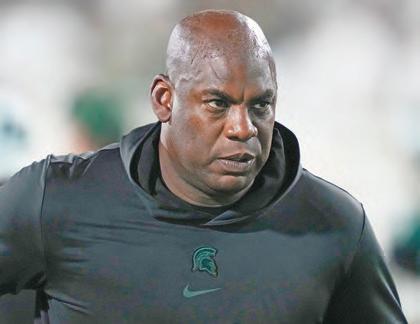
Coco Gau won her rst Grand Slam title, rallying from one set down to defeat Aryna Sabalenka 2-6, 6-3, 6-2 in Saturday’s U.S. Open nal at Flushing Meadows. The 19-year-old Gau is the rst American teenager to win the country’s major tennis tournament since Serena Williams in 1999.

The Braves became the rst team to clinch a playo berth, rallying to beat the Pirates on Sunday to secure a postseason spot for the sixth straight year, the second-longest streak in franchise history. Entering Tuesday, the Braves held a 15-game lead over second-place Philadelphia in the NL East.

B2 North State Journal for Wednesday, September 13, 2023 WEDNESDAY
COLLEGE FOOTBALL TENNIS
CARLOS OSORIO | AP PHOTO FRANK FRANKLIN II | AP PHOTO
“I am a Patriot for life.”
MICHAEL DWYER | AP PHOTO
“It is clear that I cannot return to the post.”
MANU FERNANDEZ | AP PHOTO
COLIN E. BRALEY | AP
PHOTO
MLB
HAKIM WRIGHT SR. | AP PHOTO
Duke looks to take care of business against reeling peer Northwestern
The Wildcats are struggling after a turbulent o season
By Shawn Krest North State Journal
DUKE ENTERS Saturday’s game against Northwestern in an unfamiliar position for the program. The Blue Devils need to show no mercy against an opponent that has fallen on hard times.
For most of Duke’s football history, the Blue Devils have been the program that was struggling. Duke was the consensus worst Division I program in the nation before David Cutcli e rebuilt the program, nearly from scratch. The Blue Devils had hit another rough patch in the nal years of Cutcli e’s tenure, however, requiring another jolt from the de brillator that is second-year coach Mike Elko.
After upsetting Clemson on Labor Day in a lopsided home win, Duke quickly and e ciently dispatched Lafayette and now looks to get o to a 3-0 start for the second straight year. That’s something the Blue Devils have done in back-to-back seasons just twice in the last 50 years — once under Cutcli e and once under Steve Spurrier.
To do it, Duke will have to get past Northwestern, a team that, over history, has been Duke’s relative equal, or at least as close as another Power Five conference could come. They’re the small, academically elite private school that doesn’t have the same budget as its bigger brothers in their conference.
This year, however, Duke is catching the Wildcats at a low point. The Blue Devils have a four-game winning streak against Northwestern in the nearly annual series, their longest since the end of the Spurrier years more than three decades ago.
In July, weeks before fall camp was scheduled to open, longtime coach Pat Fitzgerald was dismissed in the fallout of a sexual hazing scandal that rocked the program. David Braun, who had no previous head coaching experience or time spent on a Division I coaching sta — he was hired to serve as Northwestern’s defensive coordinator for the 2023 season — took over as interim head coach.
“We don’t know what the long term looks like,” Braun said. “That’s indicative of the title I’m carrying right now. And that’s OK. At the end of the day, regardless of how this plays out in the long term, my wife and I and this group (are) going to look back and say, ‘You know what? We’re proud of the way we did it. We stewarded the program. We navigated it through a really di cult time and set it up to have success.’”
Braun made those comments after earning his rst win — a home victory over UTEP last weekend that evened the Wildcats’ season at 1-1. Northwestern lost its opener to Big Ten doormat Rutgers, 24-7.
Despite Northwestern’s woes, Elko is taking pains to make sure the Blue Devils don’t overlook the game, a risk that Duke football rarely has to manage.

“They’re a Big Ten team, so they’re big and they’re physical,” Elko said. “They were able to run the ball really well last week in the second half. They got the running game going a little bit. Defensively, they’ve given up about 15 points a game. They’ve been very physical, they’re very stout. I think they know the scheme that they’re playing very well, and they play it very fast.
I think they’re a big, big challenge for us.”
Despite Elko’s warnings, Northwestern enters the game with plenty of question marks, particularly on o ense. The Wildcats have had four quarterbacks lead scoring drives already this year, and two of them were injured by the time
their second game was over. That included starter Ben Bryant. Braun said Bryant — and backup Brendan Sullivan, who also went down against UTEP — would both be ready to go.
“I’m not going to share speci cs, but we anticipate both of those guys being available,” he said.
While Bryant was declared the starter for Duke, the quarterback who might be giving Elko the most sleepless nights as he prepares is Jack Lausch. The dual-threat had a rushing touchdown and another 46yard run against UTEP, setting up two of the Wildcats’ ve scoring drives in limited time at the helm.

“There have been consistent conversations from myself to the rest of our sta that he’s a young man that needs to be on the eld. He just does,” Braun said. “He has the ability to do some things that really change the map for a defense.”
Braun also has not settled on a right tackle, alternating between two blockers at that key spot.
“From Day 1 we’ve said that position was going to kind of be by committee, that they would rotate in,” Braun said. “We were hot and we stayed with the hot hand.”
It’s a rare position, indeed, for Duke to welcome an opponent in turmoil. If Elko has his way, it’s a spot the Blue Devils will familiarize themselves with over time.
Courage wins second straight NWSL Challenge Cup
North Carolina waited out a weather delay and beat Racing Louisville 2-0
The Associated Press
CARY — Kerolin and Manaka Matsukubo each scored and the North Carolina Courage beat Racing Louisville 2-0 on Saturday to win the National Women’s Soccer League Challenge Cup for the second consecutive year.
After a two-hour lightning
YOUNG from page B1
thers is that if history repeats itself, the mistakes should be drastically reduced. The top pick quarterback club had 16 touchdowns in their second starts, an average of 1.14 per game, but the interceptions were nearly cut in half, to 14, or one per game.
Only two quarterbacks — May eld and Jared Go — avoid-
delay, Kerolin scored in the 28th minute, getting a ball over the top from Narumi Miura and beating goalkeeper Katie Lund at the near post from a tight angle.
The 19-year-old Matsukubo doubled the lead in the 54th minute, running onto and volleying a chipped pass into the box from Tess Boade to become the youngest player to start and score in a Challenge Cup nal.
Louisville had some chances.
Nadia Nadim icked Savannah
ed throwing interceptions in their rst start, and both quarterbacks waited until later in the season before making their starting debut. Every quarterback that started his opener got intercepted, and six of the 10 threw multiple picks.
In Week 2, ve quarterbacks managed to avoid getting intercepted and only ve of the 14 threw multiple interceptions. One reason for the drop in in-
DeMelo’s cross o the post. Ary Borges connected with a corner kick to force goalkeeper Casey Murphy into a tough save in the 77th minute. Another Louisville corner bounced just in front of the goal minutes later.
Kerolin had a chance in the 6th minute when she received a through ball and was alone against Lund, who reacted quickly to block the shot with her right leg. Lund nished with nine saves.
It was the best chance before
terceptions is that the quarterbacks learned an important lesson in their debuts — know when to hold and when to fold. Instead of throwing the pass in all situations, the quarterbacks were more conservative in their second starts.
Pass attempts fell from an average of 36 in the rst start to 31 in Week 2. Passing yardage fell a bit as well, from 220 yards to 198.
the game went into a lightning delay in the 11th minute.
The Courage kept up the pressure when play resumed. Matsukubo received a pass from Kerolin and red a shot from close range that Lund pushed o the post in the 18th minute.
“We appreciate you and hope our nal game at home in October can be a stadium ller,” Courage coach Sean Nahas said on X in a message directed at the team’s fans. “A wonderful day today for these players and club.”
They were less spectacular — four quarterbacks had 300-yard passing days in their debuts, and only two threw for 300 in their second start — but overall, they were more e cient.
The net result of the more conservative approach was a jump in passer rating, from 61.5 in Week 1 to 71.6 the next week.
So Young, who threw 38 passes against the Falcons, can be ex-
“A wonderful day today for these players and club.”
Sean Nahas, NC Courage coach
pected to throw closer to 30, turn in a cleaner performance and likely still lose in the Panthers’ second game this week.
The good news is, he’ll continue to improve, like the top picks before him.
“He’s got the maturity of someone way beyond his years,” Reich said. “He’s a team- rst person. He’ll be hard on himself. And each of us should be.”
B3 North State Journal for Wednesday, September 13, 2023
“We don’t know what the long term looks like.”
David Braun, Northwestern interim coach
AP PHOTO
Aeneas Peebles and the 21st-ranked Blue Devils are o to a 2-0 start and will host Northwestern on Saturday at Wallace Wade Stadium.
AP PHOTO
Duke quarterback Riley Leonard has completed 64.4% of his passes for 311 yards and a touchdown through two weeks of the 2023 season.
The All-North Carolina NFL team is heavy on linemen
N.C. colleges and high schools supplied enough 2023 pros to ll a roster
By Shawn Krest North State Journal
THE CAROLINA PANTHERS’ opening game may have taken place in Georgia, but there were North Carolina connections everywhere one looked.
From the two NC State Wolfpack linemen starting for the Panthers — 2022 rst-round draft pick Ikem Ekwonu at tackle and 2023 selection Chandler Zavala at guard — and former Tar Heel Mack Hollins catching passes for Atlanta to the guy booming punts for the Falcons — Bradley Pinion, of Northwest Cabarrus High — both teams had plenty of talent form North Carolina colleges and high schools on their respective rosters. That’s not to mention former UNC guard Arthur Smith, who coached the Falcons to a win, thanks in large part to two interceptions by safety Jessie Bates — a former Wake Forest Demon Deacon.
The Panthers-Falcons game was far from an anomaly. The state’s pipeline to the NFL has continued to supply teams across the league with players.
As we put Week 1 in the books and have a better idea of who’s starting where, here’s a position-by-position look at the North Carolina NFL All-Stars:
Quarterback
There’s no shortage of options at the highest-pro le spot on the eld. Three starting quarterbacks this week got their starts at colleges in the state. Our pick for the starter on our All-NC team is the veteran, Denver’s Russell Wilson by way of NC State (with a few other stops in between). He showed he might be ready to bounce back from a disappointing 2022 with a two-touchdown day. He gets the nod over Daniel Jones (Giants, Duke) and Sam Howell (Commanders, UNC). Gardner Minshew (Colts, ECU) didn’t start but threw two passes in relief on Sunday.
Running back
Kenneth Walker III (Wake
Forest, Seattle) had 64 yards and Javonte Williams (UNC, Denver), returning from injury, had 52 yards. They edge out Deon Jackson (Duke, Indianapolis) and Michael Carter (UNC, Jets).
Wide receiver
In a relatively crowded spot, we’ll go with Jakobi Meyers (NC State), who had 81 yards in his rst game with the Raiders, and North Guilford’s Keenan Allen, who had 76 yards for the Chargers. Zay Jones (ECU, Jacksonville), Hollins, Marquez Valdes-Scantling (NC State, Kansas City) and Josh Downs (UNC, Indianapolis) are also all worth watching.
Tight end
Compared to the talent at receiver, tight end is barren. Noah Gray (Duke) got a start for Kansas City thanks to Travis Kelce’s injury, and he had three catches for 31 yards. He’s the choice over Charis Prep’s Jimmy Graham, back with New Orleans after a one-year absence from
the league.
O ensive line
Perhaps the most loaded position group on the team — clearly the Old North State can produce blockers. We’ll go with the Panthers’ Ekwonu and James Hurst (UNC, New Orleans) at tackle, Charlotte’s Nate Davis (Chicago) and Wake’s Phil Haynes (Seattle) at guard, and State’s Garrett Bradbury (Minnesota) at center. Another seven players from the state started on the line during Week 1: tackles Zach Tom (Wake Forest, Green Bay), DJ Humphries (Mallard Creek, Arizona), Kendall Lamm (App State, Miami) and Landon Dickerson (South Caldwell, Philadelphia); guards Joe Thuney (NC State, Kansas City) and Zavala; and center Lucas Patrick (Duke, Chicago).
Defensive line
Another packed spot. Our choices for edge rushers are Alex Highsmith (Charlotte, Pittsburgh) and Bradley Chubb (NC State, Miami), but there
Former Wake Forest star Bates stings Panthers in Falcons debut
The 26-year-old safety signed a four-year contract with Atlanta as a free agent worth over $64 million in the o season
 By Charles Odum
The Associated Press
ATLANTA — Safety Jessie Bates led a cast of new veteran starters on the Atlanta Falcons’ defense that was dominant against Carolina rookie quarterback Bryce Young, especially in the second half.

“Honestly, it was my day. I felt good,” Bates said after the Falcons’ season-opening 24-10 win over the Panthers on Sunday.
Bates — who played at Wake Forest from 2015-17 — stood out with 10 tackles, two interceptions, a forced fumble and two pass de ections in his memorable rst home game as a Falcons safety.
The spotlight in the matchup of NFC South rivals was on the two rookie rst-round picks, Young and Atlanta running
APP STATE from page B1
gled to pass the ball e ectively to a wide receiver group that lacks the game-breaking ability for which ECU wideouts are known.
“ You started (Garcia) because he gave you the best chance to win tonight,” Houston said after the Pirates’ loss to Marshall, ac-
back Bijan Robinson. Robinson showed his speed, power and elusiveness on an 11-yard touchdown reception early in the second quarter.
knowledging his choice to feature Garcia rather than backup quarterback Alex Flinn. “He gave us a great chance to win for a lot of the ball game. No matter which quarterback you go with, you’re going to have to go through some stu as they get acclimated. He made some mistakes, but some of the other guys out there on the
Bates and the defense took the lead from there.
Bates signed a $64 million, four-year deal with Atlanta after starting 79 games in ve seasons
eld did, too. We’ve got a lot to clean up.”
Against the Thundering Herd, the Pirates led 13-10 in the fourth quarter before Marshall scored three touchdowns in ve minutes to pull away for the win.
We know a lot about Mason Garcia from the recruiting process,” Clark said at App State’s
Cornerback
MJ Stewart had a big opener for Houston. The former Tar Heel had ve tackles and a fumble recovery. He joins Jaire Alexander (Rocky River, Green Bay) in the starting lineup on the state’s team. Josh Blackwell (Duke, Chicago), Nick McCloud (NC State, Giants) and Essang Bassey (Wake Forest, Denver) are the other candidates.
Safety
The pickings get slimmer the farther back in the defense we go. Bates took one spot after his big debut game with the Falcons. He’s joined by Divine Deablo, who the Raiders listed as a linebacker but is more of a safety in our book. The Mount Tabor product had nine tackles and a TFL for Vegas in the opener. The Jets’ Michael Carter (Duke) is the only other option likely to get signi cant playing time at safety this season.
Special teams
As shallow as the secondary is, the All-NC team’s specialists — save one position — are even harder to ll.
is plenty of depth here, including James Smith Williams (NC State, Washington), Boogie Basham (Wake Forest, Giants), Victor Dimukeje (Duke, Arizona), Harold Landry (Pine Forest, Tennessee), Dexter Lawrence (Wake Forest, Giants), Jonathan Bullard (Crest, Minnesota) and Denico Autry (Albemarle, Tennessee).
At tackle, State’s BJ Hill (Cincinnati) and Carlos Watkins (Chase, Arizona) are the starters, with plenty of backup depth in Javon Hargrave (North Rowan, San Francisco), DJ Reader (Grimsley, Cincinnati), Alim McNeal (NC State, Detroit), Kobie Turner (Wake Forest, Raiders) and Jordan Davis (Mallard Creek, Philadelphia).
Linebacker
While the line is loaded, linebacker is a much less populated unit. The Wolfpack get two starters in Germaine Pratt (Cincinnati) and rookie Drake Thomas (Seattle). Cole Holcomb (UNC, Pittsburgh) takes the other spot, ahead of another Tar Heel, Chazz Surratt (Jets).
The one exception is punter. Our team is lousy with punters. They’re everywhere you look. In addition to the Falcons’ Pinion (who took the starting spot on our squad), there are a pair of former Wolfpack punters — Trenton Gill (Chicago) and AJ Cole (Las Vegas). There’s also App State’s Sam Martin (Bu alo) and former North Surry punter Ethan Evans, now doing his thing for the Rams.
There’s only one long snapper: Duke’s Thomas Hennessy, now with the Jets.
For punt returner, we’ll go with veteran Jamison Crowder (Duke, Washington) over Greg Dortch (Wake Forest, Arizona). No one with connections to the state has returned a kick yet, so we’ll try to break up the logjam at wide receiver by putting Leesville Road’s Braxton Berrios in that spot. He did it for the Jets in previous seasons although his new team, Miami, didn’t put him there in the opener. Then there’s kicker. A few of the punters handled kicko s, but no one from North Carolina has attempted a eld goal or PAT yet this year. We’ll look in the free agent pool and pick Ryan Succop (Hickory) over former Deac Nick Sciba.
who missed the opener as expected with a foot injury.
The new-look defense was dominant in allowing only a eld goal in the second half against a Carolina o ense led by Young, the No. 1 overall pick in this year’s NFL Draft.
with the Cincinnati Bengals. He had 14 interceptions, forced three fumbles and recovered two. He was a second-team AllPro in 2020.
He demonstrated those bigplay skills in his Atlanta debut. Perhaps the biggest play came with the game tied 10-10 in the third quarter. Panthers running back Miles Sanders fumbled when hit by Bates, and the ball was recovered by Atlanta’s Lorenzo Carter.
Falcons coach Arthur Smith successfully challenged the oneld ruling that Sanders was down before he fumbled. Atlanta took over at the Carolina 39 and went ahead on a touchdown drive capped by one of Tyler Allgeier’s two scoring runs.
The Falcons spent about $140 million in signing Bates, defensive tackle David Onyemata, defensive end Calais Campbell, outside linebackers Kaden Elliss and Bud Dupree and cornerback Mike Hughes. The team traded for cornerback Je Okudah,
Monday press conference. “He has a big-time arm, he’s very accurate, he has the ability to run the football, and they have some designed runs for him.”
Saturday’s matchup in Boone could very well come down to which quarterback has a better performance, with Garcia getting another opportunity to
“There’s a reason we wanted to get those guys in our program,” Smith said. “And you’re playing a rookie quarterback here at home. Those guys were in tune to everything.”
Bates said he had a di erent level of anticipation when playing against a quarterback making his rst start.
“Yeah, a little bit,” Bates said. “I would say you know what to expect. ... It’s his rst game and it’s pretty hard to do.”
Smith described Bates as “a great player” who was signed to be a leader of the defense. Bates said he hopes to see others on the defense, including safety Richie Grant, enjoy similar games this season.
“Maybe Richie can have his two-interception game next,” Bates said, adding the strong rst game by the defense was not a surprise.
“Not at all, honestly,” Bates said. “We put in a lot of work, a lot of extra work on o days. I challenged guys to come in on o days and watch lm.
“You keep a team at 10 points, you’ll win a lot of games.”
prove he’s the man for the job with ECU and Aguilar looking to show his success so far is not a uke.
Houston, meanwhile, is looking to avoid his rst 0-3 start since taking over the Pirates in 2019, while Clark is hoping to avoid his rst 1-2 start since taking the reins at App in 2019.
B4 North State Journal for Wednesday, September 13, 2023
AP PHOTO
Former NC State wide receiver Jakobi Meyers pulls in a touchdown pass against the Broncos during the Raiders’ 17-16 win Sunday.
“You keep a team at 10 points, you’ll win a lot of games.”
Jessie Bates, Falcons safety
AP PHOTO
Falcons safety Jessie Bates celebrates as he leaves the eld following Atlanta’s 24-10 home win over the Panthers on Sunday.
Festival o ers glimpse of rare plants and gardening savvy


 By Emmie Brooks North State Journal
RALEIGH — After years of acclaim in and around the Triangle, Raleigh landscaper and plant enthusiast Tony Avent traces his roots to a project that would go on to be one of the largest plant collections in the United States.


“I’ve always been fascinated with plants, it’s certainly been an evolution,” Tony Avent, founder and proprietor of the Juniper Level Botanic Garden said. “I always liked the idea of being able to show people what’s possible.”
Avent began his work with agriculture as a landscaper for the North Carolina State Fairgrounds. He went on to continue this path for 16 years with the N.C. State Fair.
“I got my start there, I got to build really neat botanical plantings around each building,” Avent said.
After his involvement with the N.C. State Fair, Avent founded Plant Delights Nursery in
1986 in Raleigh. Additionally, it serves as the headquarters for the Juniper Level Botanic Garden, a botanical garden boasting an impressive collection of over 27,000 plant varieties and recognized for its excellence in the eld.
“We began with two acres and then we were able to run all of our neighbors o and are now up to 28 acres,” Avent said.
The plant collection on display spans a wide spectrum, showcasing an extensive range of ora that includes both native and exotic species. Visitors have the opportunity to immerse themselves in the beauty and diversity of plants from various corners of the world, as well as appreciate the indigenous botanical treasures that thrive within the garden’s grounds.
“Visitors will see many plants here that we have the only one in the entire world, many that we have the only one in the United States, they will see things they had no idea even exist,” Avent
said. “Everyone who comes here for the rst time leaves completely overwhelmed, there is no way a human brain can absorb everything that’s here.”
Juniper Level Botanic Garden will be hosting their rst Pollinator Plant Festival September 15-24. The festival will allow attendees to delve into the world of native and exotic plants while observing pollinators in their daily routines.

“It will enrich their lives in ways they may not know yet,” Avent said. “It can teach people that gardens are relaxation, gardens are entertainment, and get
rid of the notion that gardens are all about work.”
Juniper Level Botanic Garden is not the only organization providing North Carolina with opportunities to “go green”.
The North Carolina Department of Natural and Cultural Resources (DNCR) announced a policy in July 2023 promoting the use of indigenous plants at departmental locations and at municipal government sites.
DNCR hopes that residents will be encouraged by this in order to
preserve the state’s natural and cultural heritage while showcasing North Carolina’s native plants.
To learn more about Juniper Level Botanic Garden’s Pollinator Plant Festival visit: https:// www.plantdelights.com/
To learn more about the Native Plant Policy visit: https:// www.dncr.nc.gov/news/ press-releases/2023/07/12/ nc-department-natural-and-cultural-resources-creates-native-plant-policy
By Jordan Golson North State Journal
BALTIMORE — Reviewing cars for a living, it’s essential for me to remember the potential buyer for any vehicle I test. After all, no car is perfect, and my job is to gure out what’s wonderful or wayward in every vehicle I drive, and then to determine whether that matters to the buyer.
A Lamborghini Huracan may have terrible cupholders or fuel economy, but does that matter to someone buying a violently purple $300,000 super sports car? Fuel economy won’t matter a whit (and is probably a feature, come to think of it), but the cupholder thing might.
Similarly, for the 2024 Hyundai Kona, my review car this week, my main gripe was with the rmness of the suspension. The steering was sporty and predictable, and the tiny 1.6-liter turbocharged engine makes plenty of power, but the suspension was rm and a touch jarring on the rough roads of downtown Baltimore and the cobblestone streets of Fells Point.
But when considering the market for a $30,000-ish crossover, are buyers going to notice
a rm suspension, and, if they do, would they care? Luckily for me, I don’t have to think too much about it as any potential concerns about ride harshness will be quickly bounced from memory once a potential Kona buyer sees the enormous screens for the instrument cluster and the infotainment sitting prominently atop the dash. A lot of buyers are going to fall in love with the Kona
the moment they slip inside. I drive a lot of new luxury cars, and almost all of them have huge screens — whenever I give someone a ride who isn’t used to those vehicles, they always remark on the screen and declare that their next car will also have huge screens. Well, here are your giant screens, in an a ordable subcompact crossover that hits all the right buttons for its target market.
The secret sauce is economies of scale — a business tactic Hyundai has mastered, and it’s paying o big time for consumers. They’re using a strategy Apple has employed for years: standardizing tech across its vehicle lineup, from the threerow Palisade to the pixelated Ioniq 5 EV (not to mention corporate cousin Kia and its Genesis luxury brand). Because they’re making hardware and software in huge quantities, the cost per unit goes down, and fancier tech ends up in cheaper cars. It’s like buying toilet paper in bulk; you get more for less.
That means the screens in Kona aren’t second-tier economy-priced tech; they’re awfully similar to what you’ll nd in Hyundai’s up-market models.
You get the sizzle and the steak and Apple CarPlay, too. Wired support is standard, and Hyundai is promising wireless CarPlay support via an over-the-air update next year.
Fancy screens aren’t the only place Hyundai buyers bene t from this democratization of tech. The Kona features Hyundai’s Highway Drive Assist system, bringing features like automatic lane centering and adaptive cruise control with stop-and-go to a segment that saw power windows as an optional extra a decade ago. These are driver assists that are superior to those o ered in some brands at twice the price.
I’m forever hearing about how carmakers don’t o er affordable vehicles anymore.
It’s hard to nd a car under $20,000 these days because of in ation and additional government regulations around safety, fuel economy, and emissions. But $30,000 is the new $20,000, and this Kona quali es as a ordable. Even better, it’s packed to the gills with clever design, tech, and safety.
The interior is worth a special callout, with a pair of USB-C ports at the bottom of the center stack and a clever dual-use bin between the seats, with room for sunglasses, phones, and more — as well a cupholder that spins out when you need it, leaving lots of extra room when you don’t. That space continues back underneath the armrest, so rather than having multiple small storage spaces, you just get a ton of room to keep your stu close at hand. This sort of open oor-plan design is something we’ve seen in EVs, and it’s great to see it coming to regular cars as well.
Most automakers only want to talk about the latest hundred-thousand-dollar EV, packed with increasingly pointless luxury features in a race to nd something to di erentiate from the competition. Hyundai’s Kona serves as a refreshing reminder that innovation and quality can still be found where it matters most: in cars that people can actually buy. Even better, it’s a glimpse into a future where “a ordable” doesn’t mean “stripped-down,” and for that, Hyundai deserves applause, rm suspension or not.

B5 North State Journal for Wednesday, September 13, 2023
2024 Hyundai Kona: A ordable innovation in an attractive package
“It will enrich their lives in ways they may not know yet.”
ALL PHOTOS BY TONY AVENT
Tony Avent, Juniper Level Botanic Garden
Varieties of rare and native plants are on display at Juniper Level Botanic Garden in Raleigh.
PHOTO COURTESY HYUNDAI

B12 North State Journal for Wednesday, September 13, 2023 sudoku solutions
WEEK PEN & PAPER PURSUITS
LAST
COUNTY NEWS
Man charged for Oakboro shooting, two injured Oakboro Police responded to a call on Claymon Road just before 8 p.m. last Monday evening. Upon arriving, o cers immediately heard gunshots and encountered two individuals su ering from gunshot wounds. Police said that as they attempted to approach the victims, a man came from the back of the house with a ri e in his hands. O cers ordered the man to drop his weapon and arrested him without further incident. The man with the gun, 52-year-old Conrado Arroyo Zarate, has been charged with two counts of attempted rst-degree murder and two counts of assault with a deadly weapon, in icting serious injury with intent to kill. He was taken to the Stanly County Jail, where he was given a $2 million secured bond. The two victims were taken to the hospital, where their injuries were treated. One victim is still in the hospital but remains in stable condition.
Sen. Budd helps introduce CRA to overturn new Biden student loan forgiveness plan
Last Wednesday, Senators Ted Budd (R-NC), Bill Cassidy, M.D. (R-LA), John Thune (R-SD), John Cornyn (RTX), and 13 other Republican colleagues introduced a Congressional Review Act (CRA) resolution to overturn President Biden’s most recent attempts to forgive student loan debt. According to a press release from the senator’s o ce, the CRA would overturn the administration’s incomedriven repayment (IDR) rule, which will result in a majority of bachelor’s degree student loan borrowers not having to pay back their loans and taxpayers having to pay as much as $559 billion.
President Biden’s IDR rule was announced on June 30, 2023, following the U.S. Supreme Court’s ruling to block his initial student debt plan.
veteran organizations express support for Hudson’s bipartisan Warrior Call Day Resolution
North State Journal
WASHINGTON, D.C. – Last
Friday, U.S. Representative Richard Hudson (R-NC) recognized the recent statement of support from 29 veterans organizations and seven former secretaries of the U.S. Department of Veterans A airs for National Warrior Call Day.

Earlier this year, Hudson joined 15 bipartisan co-sponsors to help introduce the Warrior Call Day Resolution, H. Res. 535, which would designate November 12, 2023, as National Warrior Call Day.
“The outpouring of support for National Warrior Call Day from leading veterans organizations and former VA leaders is incred-
ible as we gain momentum in order to get this resolution across the nish line,” said Hudson in a press release. “Our nation loses too many veterans and service members to suicide every single day. We must address the challenges veterans face head-on, and I encourage folks to check in on someone they know, active-duty or veteran.”
An excerpt of the letter of support states: “Warrior Call is supported broadly, including on bipartisan and bicameral basis in the U.S. Congress (S. Res. 208; H. Res. 535). We are pleased to see continued engagement and communication from policymakers and commit to doing our part to advocate for increased communication with the brave men and
women who served this nation.”
The establishment of National Warrior Call Day would encourage all Americans to contact someone who has served or is currently serving, and connect struggling veterans with mental health services. Last Congress, Rep. Hudson joined Senator Thom Tillis (R-NC) to highlight military and veteran suicides and encourage North Carolinians to participate in the national day of action.
The seven former secretaries of Veterans A airs who expressed their support for National Warrior Call Day include Anthony Principi, Jim Nicholson, James Peake, Eric Shinseki, Bob McDonald, David Shulkin and Robert Wilkie.
Stanly commissioners approve new rural minimum lot size of three acres
By Jesse Deal North State Journal
ALBEMARLE — The Stanly County Board of Commissioners voted 4-3 last week to increase the minimum lot size from .92 acres to three acres for rural preservation areas in the county land use plan zoned as residential/agricultural (RA).
Under the family subdivision exception, lots can be divided up for immediate family members, although the divided properties aren’t allowed to be sold for at least three years.
Chairman Scott E rd and Commissioners Bill Lawhon, Trent Hatley and Peter Asciutto each voted in favor of the motion. Seeking a higher minimum lot size of ve acres, Vice Chairman Mike Barbee and Commissioners Patty Crump and Brandon King voted against it.
After a lengthy public comment section where a majority of speakers in the Gene McIntyre Meeting Room voiced their desire for a ve-acre minimum, Lawhon made the initial motion to target three acres instead, stating that it was a reasonable compromise to preserve natural farmland within the county
without limiting residential options.
“I think the way we start out hoping to slow down these developers is to get a larger tract than .92. I’ve heard tonight that we need to work on our residential ordinances and need to tighten them up,” he said. “If there’s a developer that’s doing something that’s not supposed to be done, then as a commissioner, I’m telling our county manager and our zoning manager that you better get them straightened out and make them do what’s required.”
Lawhon continued, “saying all that, half of you in here are probably not going to like what I have to say, and probably half the county is not going to like what I have to say, but ve acres to me is a little too much. I think we should do at least a threeacre tract and move the square footage to 60,000 square feet on the family subdivision.”
He then amended his motion to make side setback lines 25 feet so that the closest any house will be is 50 feet apart.
Asciutto spoke in favor of Lawhon’s motion, stating that the three-acre number would allow for more residential growth.
“We started this a couple of
years ago, questioning some of these developments that were coming in. We started seeing it, and that’s why that’s why you’re here as a result of this,” he said. “If you went to ve acres, you’re going to put two houses on here…if you go to two acres, you can put six houses on here, and there’s still a lot of land for people to farm and do stu like that.”
Crump — one of the three commissioners seeking a minimum higher than three acres — addressed her concerns with the county’s farmland falling prey to developers.
“I just feel like we’ve got to do something that is aggressive
If you or anyone you know is experiencing thoughts of suicide, please reach out for help immediately.
The Military Crisis Line can be reached by dialing 988 and then Press 1, via chat at www.MilitaryCrisisLine.net, or by texting 838255.
In the event of an emergency, dial 911 or your local emergency number immediately. An emergency is any situation that requires immediate assistance from the police, re department or an ambulance.
To read the full letter of support or see the full list of 29 organizations that expressed their support for National Warrior Call Day, please visit https://hudson. house.gov/.
right now to make sure that we’re saving, and we can always dial it back,” she said. “It’s going to be hard to go forward, but if we do ve acres, you can dial it back. Once we have a better conservation plan in place, there are other things that can be done that can be discussed.”
At a special meeting on Aug. 9, the Stanly County Board of Commissioners had previously tabled a decision on the ZA2307 text amendment until Sept. 5 meeting in order to allow more time to consider the information received.
Additionally, the postponement of the decision gave citizens another opportunity to address the issue in a public hearing in front of the commissioners; the public comment section lasted nearly two full hours, with most speakers standing in favor of the ve-acre minimum.
The commissioners are set to hold their next regular meeting on Oct. 2 at 6 p.m. inside the Gene McIntyre Meeting Room at Stanly County Commons.
8 5 2017752016 $2.00
“I just feel like we’ve got to do something that is aggressive right now to make sure that we’re saving, and we can always dial it back.”
FILE IMAGE
Commissioner Patty Crump
U.S. Rep. Richard Hudson (NC-09) speaks at a committee meeting at the U.S. Capitol in Washington, D.C.
VOLUME 6 ISSUE 44 | WEDNESDAY, SEPTEMBER 13, 2023 | STANLYJOURNAL.COM SUBSCRIBE TODAY: 336-283-6305
THE STANLY COUNTY EDITION OF THE NORTH STATE JOURNAL
Former VA secretaries, leading
CRIME LOG
ALVARENGA- LOPEZ, DANNY LUIS (U /M/43), DRIVING WHILE
IMPAIRED, 09/11/2023, Stanly County Sheriff`S Office
BROWN, THOMAS
ANTHONY (W /M/43), LARCENY OF FIREARM, 09/11/2023, Stanly County Sheriff`S Office
SCHREFFLER, CALEB
COLE (W /M/28),
SIMPLE POSSESS SCH IV CS (M), 09/11/2023, Stanly County Sheriff`S Office
WRIGHT, CHRISTOPHER
CHARLES (W /M/51),
IDENTITY THEFT, 09/11/2023, Stanly County Sheriff`S Office
SANCHEZ, LUIS
ANTONIO (U /M/28),
FELONY POSSESSION OF
COCAINE, 09/10/2023, Stanly County Sheriff`S Office
THOMPSON, ROBERT, THOMAS (W /M/46),
CIVIL ORDER FOR ARREST - CHILD
SUPPORT, 09/10/2023, Stanly County Sheriff`S Office
KUCHENBROD, RICHARD
LEE S (W /M/37), BREAK OR ENTER MOTOR
VEHICLE, 09/09/2023, Stanly County Sheriff`S Office
ZARATE, CONRADO
ARROYO (U /M/52),
DISCHARGE WEAPON
OCCUPIED PROPERTY, 09/09/2023, Stanly County Sheriff`S Office
HOUSTON, DARRELL
LAMONT (B /M/23),
MURDER, 09/07/2023, Stanly County Sheriff`S Office
STALEY, SHELIA MARIE (W /F/47), BREAK COIN/
CURRENCY MACHINE (M), 09/07/2023, Stanly County Sheriff`S Office
SCS to pay higher rate for certi ed sta to drive buses
$1,000 retention bonus approved for full and part-time employees
By Ryan Henkel North State Journal
ALBEMARLE — The Stanly County Schools Board of Education met on Tuesday, September 5, with two items related to employee pay on the agenda.
The board rst addressed two matters related to the North Carolina School Board Association.
The rst was the approval of board members Robin Whittaker, Dustin Lisk, Carla Poplin and Vicky Watson as the four Stanly County Schools’s 2023 voting delegates for the North Carolina School Board Association.
In addition, the board voted for Glenda Gibson as a regional nomination to be considered for approval by the NCSBA Board of Directors.
Those chosen to serve on the board of directors will serve a two-year term.
“[Gibson] is very active in the a airs going on at the state level between the boards and the committees,” Lisk said.
The board also announced two upcoming events related to their committees. The rst is a joint meeting between the facilities committee and the Albemarle City Council to be held on September 20, in which they will discuss the ongoing facility issues and future building in the Albemarle district.
The second is that the nance committee will meet on September 27 in order to review the ESS contract. ESS is a sta ng provider that helps ll vacant positions in education, however Lisk, who is a part of the nance committee, has addressed his concerns with ESS mostly related to too high a cost related to the services provided.
The board then approved the issuance of a $1,000 retention bonus.
“All Stanly County Schools employees that are full-time or part-time, we are looking at giving them a retention bonus in October in the amount of $1,000,” said Chief Financial O cer Terry Dudney. “The criteria that we used last year at this time was that individuals had to be employed by September 1 and remain employed by the day of the payment.”
“All Stanly County Schools employees that are full-time or part-time, we are looking at giving them a retention bonus in October in the amount of $1,000.”
Chief Financial O cer Terry Dudney
The board also approved the allowance of certi ed sta to be hired to drive a bus for Stanly County Schools.
“I know we had very much an issue over the last year and into this year about having enough bus drivers to get our kids back and forth to school,” Dudney said. “We have come to a recommendation that we would pay our certi ed sta an hourly rate of $22.50 an hour for those that would be willing to drive a bus for Stanly County Schools. It either could be substitute time or if we actually needed them to be full-time to drive a bus. The pre-
vious rate was a $15 hourly rate.”
Board member Lisk further clari ed where the money for these two items came from, as well as addressed future concerns related to funding.
“Those are paid with grant money,” Lisk said. “There’s not a pot of money lying around that we have. We’re not a taxing authority, so we’re reaching the last of what the federal government has provided down to the schools. When that money’s gone, then we’re down to the nuts and bolts of how primary funding is. Out of our $119 million, our county was given roughly $15-$18 million from the federal government. We are primarily a state-funded school system, and those monies are highly restricted, so we can’t just pull it out of one bucket and put it in another due to state statutes.”
“What’s going to be required to do all the things we need to do is public support. You’re going to have to vote on a bond package, and we hope that we’re engaging the public coming up on some of these conversations and coming up with some ideas and putting together something that we feel our board, the commissioner board, and the majority of the public can rally around because whether we like it or not, that’s the only way we’re going to x facilities. If we don’t pass it, there is no other money.”
The Stanly County Schools Board of Education will next meet October 3.
Food recalls are common for things like rocks, insects and plastic
The Associated Press ROCKS IN TRADER JOE’S cookies. Insects in its broccoli-cheese soup. Pieces of plastic in Banquet frozen chicken strips.
In recent weeks, U.S. consumers have seen high-pro le food recalls for an unappetizing reason: They’re contaminated with foreign objects that have no place on a dinner plate. And while no one wants to bite down on stainless steel in peanut butter or bone fragments in smoked sausage, this type of contamination is one of the top reasons for food recalls in the U.S.
Food safety experts and federal agencies use the terms “extraneous” or “foreign” materials to describe things like metal fragments, rubber gaskets and bits of bugs that somehow make it into packaged goods.
“Extraneous materials” triggered nine recalls in 2022 of more than 477,000 pounds of food regulated by the U.S. Department of Agriculture’s Food Safety and Inspection Service — triple the number of recalls tied to food contaminated with toxic E. coli bacteria.
And the size of recalls can reach into the millions: In 2019, USDA reported 34 recalls of more than 16 million pounds of food, spurred in large part by a giant recall of nearly 12 million pounds of Tyson chicken strips tainted with pieces of metal.

Plastic pieces from frayed conveyor belts, wood shards from produce pallets, metal shavings or wire from machinery are all common. So are rocks, sticks and bugs that can make it from the eld to the factory.
Some contamination may even be expected, the FDA acknowledges in a handbook.
“It is economically impractical to grow, harvest or process raw products that are totally free of non-hazardous, naturally occurring, unavoidable defects,” the agency wrote.
Both the USDA and FDA ask companies to promptly notify them when food is potential-
ly contaminated with objects that may harm consumers. The agencies then determine whether recalls are necessary. Most recalls are voluntary and initiated by the companies, though the agencies can request or mandate the action.
Regulators said the Banquet issue was discovered when someone reported an oral injury after eating chicken strips. ConAgra Brands Inc., which owns Banquet, declined to comment beyond the rm’s news release. Trader Joe’s wouldn’t elaborate on how material got into the foods that led to its recent recalls.
Detection of unwanted objects has vastly improved in the past several years, said Keith Belk, director of the Center for Meat Safety and Quality at Colorado State University. Large manufacturers use magnets, metal detectors, X-ray devices and other technology to nd un-
wanted materials in their products.
Still, “they’re going to miss things,” Belk said.
Those things have included pieces of gray nitrile glove that forced the recall of nearly 6,400 pounds of chicken tortilla soup in 2021 and pieces of copper wire that led to recall of nearly 5,800 pounds frozen beef shepherd’s pie in 2022.
There are also two notorious examples from 2017: “extraneous golf ball materials” that triggered a recall of frozen hash browns and a dead bat found in bagged salad that led the Centers for Disease Control and Prevention to recommend rabies treatment for two people.
In recent years, rms have become increasingly cautious and are recalling products more frequently than before, said Nathan Mirdamadi, a consultant with Commercial Food Sanitation, which advises the industry
about food safety.
That may be because consumers don’t like nding weird things in their food. When they do, lawsuits may follow, experts said.
“It’s never good business to injure your customers,” Mirdamadi added.
Actual contamination may a ect only a small amount of product, but rms recall all food produced within a certain window just to be safe. And while some of the food may be able to be “reconditioned” or treated for safety and sold again, “most of the time, it’s going to land lls,” Mirdamadi said.
Consumers who nd foreign materials in food should notify manufacturers, experts said, but also realize that recalls are likely to stick around.
“The thing is, there’s never going to be a day where there’s zero risk associated with consuming a food product,” Belk said.
Stanly County Journal for Wednesday, September 13, 2023 2
Stanly County Journal ISSN: 2575-2278 Neal Robbins Publisher Matt Mercer Editor in Chief Gri n Daughtry Local News Editor Cory Lavalette Sports Editor Frank Hill Senior Opinion Editor Lauren Rose Design Editor Published each Wednesday as part of North State Journal 1550 N.C. Hwy 24/27 W, Albemarle, N.C. 28001 TO SUBSCRIBE: 336-283-6305 STANLYJOURNAL.COM Annual Subscription Price: $100.00 Periodicals Postage Paid at Raleigh, N.C. and at additional mailing o ces.
Send address changes to: North State Journal 1201 Edwards Mill Rd. Suite 300 Raleigh, NC 27607
#304
POSTMASTER:
WEDNESDAY 9.13.23
“Join the conversation”
WEEKLY FORECAST
WEDNESDAY SEPT 13 HI 82° LO 62° PRECIP 37% THURSDAY SEPT 14 HI 79° LO 55° PRECIP 3% FRIDAY SEPT 15 HI 79° LO 55° PRECIP 3% SATURDAY SEPT 16 HI 81° LO 61° PRECIP 5% SUNDAY SEPT 17 HI 79° LO 58° PRECIP 24% MONDAY SEPT 18 HI 81° LO 58° PRECIP 18% TUESDAY SEPT 19 HI 83° LO 59° PRECIP 8%
AP PHOTO
This combination of photos provided by the U.S. Department of Agriculture shows packaging for Banquet Brand Frozen Chicken Strips which was recalled by ConAgra Brands on Sept. 2, 2023, due to possible foreign matter contamination. In recent weeks, U.S. consumers have seen high-pro le headlines about foods recalled for contamination with foreign objects.
Neal Robbins, publisher | Frank Hill, senior opinion editor


Maybe a temporary government lockdown is necessary
WHAT’S WORSE? When politicians shut down the government, or when they lock down businesses, stores, schools, churches and restaurants — and nearly all private commerce in America?
If you haven’t heard, the media and congressional Democrats are near cardiac arrest over the prospect of a government shutdown later this year. They may need smelling salts. How dare Congress shut down our vital government services when they are deadlocked on the budget?
If it takes a short-term shutdown of some government agencies to force Congress and the White House to get serious about our scal ineptitude, then do it.
But we didn’t hear these kinds of drama queen histrionics when Congress, governors and mayors locked down nearly every private business during COVID in 2020. That e ectively brought our economy to a standstill for six months.
Almost overnight, millions of Americans were out of their jobs. Small business revenues collapsed, and tens of thousands of men and women who had put their whole life into their businesses were thrown into bankruptcy due to government lockdown edicts.
Some liberals want to empower the government to shut down the private economy from time to time to combat climate change.

Apparently, the new rules are: You can close the doors of every small business in America, but don’t you dare shut down the Department of Education or Interior or National Public Radio for one day or there will be blood in the streets, senior citizens won’t get their meals on wheels and disabled children won’t have access to social services.
I’m NOT in favor of a government shutdown. But they aren’t the end of the world. The Congressional Research Service reports there have been at least 20 government shutdowns since Jimmy Carter was president. Did anyone outside of Washington really notice that the Federal Trade Commission or the Commodities Future Trading Commission couldn’t meet?
By the way, only “nonessential” programs would be temporarily closed if there were a budget impasse, which raises the question of why a government $2 trillion a year in debt is spending so much money on nonessential anything.
The joke used to be that if you asked a New Yorker to draw a map
How Burning Man became uncool
LAST WEEK, the Burning Man festival — a convocation of large groups of men and women seeking sex, drugs, rock ‘n’ roll and other forms of hedonistic bliss — was ooded. It seems that a half-inch of rain swamped the event, which takes place in the Black Rock Desert in Nevada, turning the dust to deep and sticky mud. The images of barely clad neo-hippies struggling to walk through the muck spread like wild re across the internet; even the White House was forced to acknowledge that it was monitoring the situation.
For a huge swath of Americans, all of this was simply amusing. But the rise and mainstreaming of Burning Man is a far more interesting story than its pathetic possible demise. Burning Man was founded in 1986, when some hippie types gathered at the beach in San Francisco to burn a nine-foot-tall wooden man. Over time, the bon re became larger and larger, until eventually it moved to Nevada, where it has been located ever since. Each year, 100,000 people head out to the middle of the desert to participate in events ranging from impromptu art exhibits to orgies and mass drug use.
The fundamental principles of Burning Man are spelled out in co-founder Larry Harvey’s 10 Principles, written in 2004. These principles construct a paganistic morality built around a bevy of mutually exclusive notions. For example, Burning Man is about “radical inclusion... No prerequisites exist for participation in our community.” But Burning Man is also “devoted to acts of gift giving.”
Unfortunately, without some form of mutuality, giving alone cannot form the basis of a functioning society, even temporarily. All of which means that Burning Man features social pressure to ostracize free-riders — a tragic violation of the radical inclusion principle.
Burning Man values “radical self-expression,” which cannot be de ned by anyone other “than the individual or a collaborating group.” But such radical self-expression quickly comes into con ict with Burning Man’s call for “civic responsibility,” which surely encroaches on the unlimited right to self-expression. Burning Man also values “immediacy,” which it calls “the most important touchstone of value in our culture.” But Burning Man also calls for the community to “clean up after ourselves,” which runs directly counter to the premise of immediacy.
All of this would be sheer countercultural nonsense, except for
of the country, they would put a line down the middle of the U.S. and declare everything on the eastern half of the U.S. New York. They had an in ated sense of self-importance.
Now that arrogance characterizes Washington — those who live in “the swamp.” THEY are essential, and the work the rest of us do is trivial. They’ve forgotten that they work for us, not the other way around.
Rather than a government shutdown, wouldn’t it be a joyous occasion if the two parties would pass a nancially responsible budget that cuts wasteful spending and at least makes a pretense of trying to reach balance in the next ve or eight or 10 years?
The fact that the U.S. government now spends and consumes $7 trillion, nearly one-quarter of our entire GDP, is a depressing state of a airs. Cut it to 20% and we get close to a balanced budget.
Some things are worth ghting for. The Democrats’ alternative to a partial shutdown would be to continue to borrow $2 trillion a year from now into in nity. Did you know that the fastest growing component of our debt is the interest payments on the $33 trillion negative balance on the credit card?

This is the real clear and present danger. This trend line of debt spending could plunge the economy into a deep recession, with millions of Americans plunged into poverty and unemployment lines.
Never again should we allow government to shut down our private economy. The shutdowns during COVID were one of the greatest abuses of power in American history. That’s doubly true now that we have solid evidence that lockdowns didn’t have any positive health e ect.
But if it takes a short-term shutdown of some government agencies to force Congress and the White House to get serious about our scal ineptitude, then do it. It’s for the children.
Stephen Moore is a senior fellow at the Heritage Foundation and a cofounder of the Committee to Unleash Prosperity. He is the co-author of “Trumponomics: Inside the America First Plan to Revive Our Economy.”
one perverse fact: The counterculture has now become the culture. This accounts for the fact that Burning Man now seems tired and played out, less transgressive than wearied. The age of Burning Man attendees has increased over the past decade (average age in 2013 was 32, compared to 37 just nine years later); so has the average income (in 2006, 14% of Burners listed their personal income at above $100,000, compared to 27.4% by 2016). In uencers now show up at Burning Man to sell Popeye’s Spicy Chicken; Elon Musk, Paris Hilton and Mark Zuckerberg have shown up.
And herein lies the problem for the broader American culture. Our elite class used to be inculcated in the same set of baseline values as “normal” Americans: John D. Rockefeller was a regular churchgoer; so was Cornelius Vanderbilt. Today, our elites participate in drug-fueled binges in the desert — or at least wish to appear as though they do. Throughout the 1930s, even the poorest Americans aspired to dress well, wearing suits even on the breadlines. Today, even the richest Americans dress as though they shop at Salvation Army.
When elites promulgate countercultural garbage that eats at the roots of fundamental societal institutions, societal bonds dissolve. Ironically, that dissolution occurs rst at the lowest rungs of the income ladder: As Charles Murray points out, “The belief that being a good American involved behaving in certain kinds of ways, and that the nation itself relied upon a certain kind of people in order to succeed, had begun to fade and has not revived.” In fact, those who live out lives of good decision-making are, all too often, embarrassed of their good choices. To promote those choices might seem “judgmental.”
That is the real tragedy of Burning Man: its mainstreaming. Every society has its oddball behaviors. Only sick societies incentivize their imitation.
Ben Shapiro, 39, is a graduate of UCLA and Harvard Law School, host of “The Ben Shapiro Show,” and co-founder of Daily Wire+. He is a three-time New York Times bestselling author; his latest book is “The Authoritarian Moment: How The Left Weaponized America’s Institutions Against Dissent.”

Stanly County Journal for Wednesday, September 13, 2023 3
OPINION
VISUAL VOICES
COLUMN | STEPHEN MOORE
COLUMN | BEN SHAPIRO
In uencers now show up at Burning Man to sell Popeye’s Spicy Chicken; Elon Musk, Paris Hilton and Mark Zuckerberg have shown up.
SIDELINE REPORT
COLLEGE FOOTBALL
Oklahoma
investigating Briles being on eld Norman, Okla.
Oklahoma is investigating after disgraced former Baylor coach Art Briles was seen on the eld with his son-in-law, Sooners o ensive coordinator Je Lebby, after Oklahoma’s 28-11 win over SMU. The images of Briles decked in Oklahoma gear on Owen Field drew backlash from Sooners fans on social media. Oklahoma coach Brent Venables said he was made aware of it and said it is “being dealt with.” Baylor red Briles in 2016 after an investigation concluded he and his sta took no action against players named in sexual assault allegations.
MMA Strickland stuns
favorite Adesanya at UFC 293
Sydney
American Sean Strickland
stunned Nigerian-born
New Zealander Israel
Adesanya on Sunday to take the middleweight title by unanimous decision in the main event of UFC 293 in Sydney. The 32-yearold Strickland (28-5), who caused a stir in the lead-up to the ght with sexist and misogynistic comments at a press conference promoting the bout, won a ve-round decision with all three judges scoring it 49-46. Adesanya (24-3) had been the clear favorite to retain the title he won from Alex Pereira at UFC 281 in April.
BASEBALL
Ahead of possible move to MLB, Japan’s Yamamoto throws
2nd no-hitter
Tokyo
Japanese pitcher Yoshinobu Yamamoto, who could be moving to Major League Baseball next season, pitched the 100th nohitter in Japanese big league history for the Orix Bu aloes against the Lotte Marines. Yamamoto struck out eight, walked one and hit one batter in the 4-0 victory, extending his scoreless streak to 42 innings. The 25-year-old right-hander is 14-5 with a 1.26 ERA 145 strikeouts and 24 walks in 143 innings this season. It was the second no-hitter for Yamamoto, who threw his rst on June 18 last year.
TENNIS
De Groot wins 12th straight Grand Slam at US Open
New York
Diede de Groot won her 12th straight Grand Slam wheelchair singles title, beating Yui Kamiji on Sunday in the U.S. Open women’s nal. The Dutch star completed her third straight calendar-year Grand Slam, including a Golden Slam in 2021, when she also won the Paralympic gold medal. De Groot has won six straight U.S. Open titles and 20 major singles titles overall. She hasn’t lost a Grand Slam singles match since falling in the French Open semi nals in 2020.
Reddick takes advantage of late caution to win at Kansas
a win.”
Not anymore.
The Associated Press KANSAS CITY, Kan. — Every time Tyler Reddick walked into a competition meeting at 23XI Racing and talk turned to Kansas Speedway, it seemed that just about everyone in the room had a win there but him.

There’s co-owner Denny Hamlin, who has won at the track four times, more than anyone else. Kurt Busch, who retired as a driver but remains a consultant for the team. And Bubba Wallace, Reddick’s teammate, who won at Kansas a year ago.
“We joked about that,” admitted Reddick’s crew chief Billy Scott, “that he’s the only one that sits in our debriefs without
Reddick took advantage of a late caution and fresh tires to rocket past six others in a twolap sprint to the nish Sunday, and his win at Kansas Speedway punched his ticket to the next round of the NASCAR Cup Series playo s. Hamlin got a poor jump on the last restart, couldn’t chase Reddick down and nished second. Erik Jones held on for third and Kyle Larson, who won at Darlington to clinch his playo spot a week ago, marched through the eld to nish fourth ahead of Joey Logano.
“Just an outstanding job by this whole 23XI team,” Reddick said. “We had really good pace, we just couldn’t get ahead of Denny there, but chaos ensued. Then the bottom lane opened up there and it was crazy.”
Even crazier: It was the third win for the No. 45 car of 23XI in the last four races at Kansas, and all with di erent drivers after Busch and Wallace won last year. Its owner, meanwhile, nearly pulled o the sweep after Hamlin won in the spring.
“I think that myself and this team work really close together,” said Hamlin, who has long driven for Joe Gibbs Racing. “Typically when we run well, they run well, and we’re learning as much from them as they are learning from us. It’s a great partnership and really valuable to have talented guys behind the wheel of fast cars.”
Hamlin was cruising to the win when Chris Buescher blew his right rear tire with about six laps to go. That forced the leaders into the pits, and just about everyone had a di erent tire strategy — Reddick took four fresh tires, even though it shuf-
ed him back to seventh on the restart — to set themselves up for the two-lap nishing sprint.
The win was the second of the season for Reddick and the fth of his career but, more importantly, sends him out of the round of 16 in the playo s for the rst time. The cut-o for the top 12 to advance comes next weekend at Bristol.
“Now they get to go to Bristol and work a strategy that is best for them to win the race, and they don’t really have to worry about nish points,” said Hamlin, who is the leader in points among those yet to advance and in good position to join them.
“Really happy about them putting a whole race together and capitalizing on the late restart,” he said.
It was a tough race for several playo drivers. Wallace and Martin Truex Jr. also blew right rear tires, which has been a problem with the latest generation of car at Kansas, and sustained heavy damage. Wallace was able to continue after repairing a toe link and nished 32nd, but Truex’s day was done after just three laps and he nished last.
Braves retire Andruw Jones’ No. 25 jersey

The Atlanta center elder
The Associated Press
ATLANTA — Andruw Jones, who won 10 Gold Gloves in a career that began with 12 seasons in Atlanta, became the 11th Braves player or manager to have his number retired on Saturday night.
His former teammates hope the honor adds momentum to Jones’ case for induction into the Baseball Hall of Fame.
Jones’ No. 25 was retired before Atlanta’s game Saturday against the Pittsburgh Pirates, and some believe the distinction was overdue. The center elder played his last season in 2012 with the New York Yankees.
Of the 11 Braves who have their number retired, Dale Murphy is the only one not in the Hall of Fame. Jones received the fourth-most votes from the Baseball Writers’ Association of America in the 2023 election, getting picked on 58.1% of the ballots. It was a notable jump from 2022, when he was eighth with 41.4%.
A player must be selected on 75% of the ballots submitted to be enshrined in Cooperstown.
Jones played in Atlanta from 1996-2007, and others from that era to already have their numbers retired include Greg Maddux, John Smoltz, Tom Glavine, Chipper Jones and manager Bobby Cox. Murphy, Glavine and Chipper Jones attended the ceremony.
“I played 12 seasons in Atlanta and I only had one manager,
Mr. Bobby Cox,” Andruw Jones said. “Bobby was a father gure who pushed me to become the best player I could be. Without him I would not be here tonight.”
The other Braves players to have their numbers retired are Hank Aaron, Eddie Mathews, Warren Spahn and Phil Niekro.
“To have my number retired
next to Mr. Hank Aaron, No. 44, blows my mind,” Andruw Jones said.
Chipper Jones predicted Andruw Jones soon will join him in the Baseball Hall of Fame.
“Practice your speech tonight because I have a feeling you’re going to be making another one really, really soon in a small town called Cooperstown,” Chipper Jones said.
Andruw Jones was only 19 when he made his major league debut late in the 1996 season. Still a teenager, the rookie became the youngest player to homer in the World Series when he connected twice in Game 1 that year at Yankee Stadium.
He was selected to ve AllStar teams and hit 434 career home runs. His best power season came in 2005, when he hit a franchise-record 51 homers to go with 128 RBIs. He compiled a .254 career batting average and .823 OPS.
Andruw Jones, however, was best known for his defense in center.
“It was unbelievable,” Braves manager Brian Snitker said Saturday. “You see the video of him moving before the ball is hit and things like that. Just such a talented guy, and durable. He was a guy who never came out of the blowouts. He played all the innings of all the games.”
Stanly County Journal for Wednesday, September 13, 2023 4 SPORTS
The 23XI driver advances in the playo s to the Round of 12
is waiting to see if Cooperstown will come calling next
AP PHOTO
Erik Jones (43), Joey Logano (22) and Tyler Reddick (45) head down the front straightaway for the nal lap of Sunday’s NASCAR Cup Series race at Kansas Speedway. Reddick picked up his second win of the season to advance to the playo s’ Round of 12.
AP PHOTO
Former Braves center elder Andruw Jones waves to the crowd during a ceremony that saw his No. 25 retired by the team.
Deion makes Colorado epicenter of college football
The new coach has the Bu aloes o to a 2-0 start
The Associated Press
BOULDER, Colo. — A year after the Colorado Bu aloes’ only victory came on a disputed touchdown in overtime, Folsom Field is suddenly the epicenter of college football.
Tickets can set fans back more than $400, and Deion Sanders’ guest list never disappoints. For his home coaching debut Saturday, fellow Hall of Famers Michael Irvin, Terrell Owens and Shannon Sharpe were in attendance, along with the Wu-Tang Clan.

With thousands of students itching to storm the eld as the resurgent Bu aloes were putting the nishing touches on their 36-14 drubbing of Nebraska, Fox announced that its “Big Noon Kicko ” set would remain in Boulder for another week.
Fox originally had planned to pack up and head to Champaign, Illnois, for the Penn State-Illinois matchup. Instead, the network will feature the Rocky Mountain Showdown when the Bu aloes (2-0) host Colorado State (0-1) on Saturday night.
The Rams-Bu s game isn’t exactly a marquee matchup, but the draw here is Coach Prime and all that he brings to the program, the stadium, the campus and the community.
The Bu aloes, who moved up four spots to No. 18 in the AP Top 25 on Sunday, will be featured by Fox with its early kicko for the third consecutive week.
In Week 1, the set was in Fort Worth, Texas, where the Bu aloes became the rst Power Five team since 1997 to win its open-
Novak Djokovic holds up the championship trophy after defeating Daniil Medvedev, in Sunday’s men’s singles nal of the U.S. Open in New York.
North Stanly tops West Stanly in 26-16 road win
The Comets handed the Colts their rst loss of the season
By Jesse Deal North State Journal
BOUNCING BACK from a tough road loss in Week 3, North Stanly made a statement in the county over the weekend with a 26-16 road win over interconference rival West Stanly.
Coming o three straight nonconference wins to start the season, the Colts (3-1) found themselves down 26-0 by halftime on Friday night after North quarterback Chance Blake connected with junior wide receiver Jaylon McKoy late in the second quarter.
South Stanly 26, South Davidson 14
Two weeks after snapping a 12-game losing streak, the Rebel Bulls (2-2) won again on Friday, recovering from a blowout loss to hand South Davidson its rst loss of the season, 26-14.
The Bulls (2-2), led by rstyear coach Terry Shankle, trailed 7-6 at halftime but outscored the Wildcats (3-1) 20-7 the rest of the game. Quarterback Kaleb Richardson threw his second touchdown of the game in the second half, and a scoring run from Carter Callicutt and a late pick-six give the Bulls a 12-point lead.
er as a 20-plus point underdog when they beat last season’s national runner-up, the TCU Horned Frogs, 45-42.
Sanders told the Fox crew before kicko in Week 2 that he slept in his o ce overnight so he could enjoy every bit of his debut at Folsom Field, where the crowd of 53,241 was Colorado’s largest since 2008.
After the game, as Sanders settled into his chair to eld questions from reporters, ESPN announced its “College GameDay” crew would head to
Boulder next weekend for the rst time since 1996.
Sanders reacted in typically un appable fashion to the dual developments keeping his Bu s the talk of college football for another week.
“At the risk of sounding arrogant, we truly expect that,” he said. “And that’s why those kids come, they want the biggest stage and they’re getting that every darn week. And the numbers justify it.”
The CU-TCU matchup was the most-watched college football game on Sept. 2, with 7.26 million viewers, “and I’m pretty sure these numbers are going to justify it, as well,” Sanders said of the Nebraska-CU game. The last time “GameDay” came to Boulder was Sept. 14, 1996, when the fth-ranked Bu aloes lost to No. 11 Michigan 20-13. “GameDay” visited Boulder twice in 1995, the year after ESPN began sending its crew to college campuses.
Comets running back Jay Jackson and Blake each posted two touchdowns in the rst half, propelling the Comets (31) to the big halftime lead.
Playing without head coach Brett Morton on the sideline for the second straight week — assistant Charles Edwards lled in again — the Colts scored 16 unanswered points in the second half. Tight end Austin Eudy hauled in a touchdown pass from quarterback Jett Thomas, while running back Breyden Lambert also scored.
Following a bye this week, the Comets will return to the eld on Sept. 22 to host unbeaten Forest Hills (4-0) in North’s nal nonconference matchup of the season before Yadkin Valley Conference play.
With Rocky River Conference play looming, the Colts will play their nal nonconference game on Sept. 15 when former conference rival Mount Pleasant (2-2) comes to town.
South will host Wheatmore (2-2) in Norwood with a chance to enter conference play with a winning record.
Anson 17, Albemarle 14
Albemarle fell to 0-4 for the season, coming up short in a comeback of a 17-14 loss to Anson.
Limited to just 49 yards on the ground and less than 3 yards per carry, the Bulldogs’ o ense also struggled in the passing game as quarterback Ander Artis had three interceptions to go with 120 passing yards.
With three minutes left in the game, Albemarle running back Malik Watkins scored and Kaine McClendon was successful on a two-point conversion. However, the Bearcats (1-3) were able to hold on in the closing minutes.
The Bulldogs will travel to Southwestern Randolph to face the undefeated Cougars (3-0) on Friday.
Djokovic tops Medvedev to win 4th US Open
It is the Serbian’s 24th Grand Slam title
By Jesse Deal North State Journal
NEW YORK — Novak
Djokovic emerged from an exhilarating and exhausting U.S. Open nal with a 24th Grand Slam title on Sunday night, using every ounce of his energy and some serve-and-volley guile to get past Daniil Medvedev 6-3, 7-6 (5), 6-3 in a match that was more closely contested than the straight-set score indicated.
Djokovic, a 36-year-old from Serbia, moved one major singles title in front of Serena Williams to become the rst player to win 24 in the Open era, which began in 1968. Margaret Court also collected a total of 24, but 13 of those came before professionals were admitted to the Slam events.
“I never imagined that I would be here standing with you talking about 24 Slams. I never thought that would be the reality,” Djokovic said. “But the last couple of years, I felt I have a chance, I have a shot for history, and why not grab it if it’s presented?”
There were moments, particularly in the 1-hour, 44-minute second set that was as much about tenacity as talent, when Djokovic appeared to be faltering. After some of the most grueling points — and there were many — he would lean over with hands on knees or use his racket for support or pause to stretch his legs.
This triumph against Medvedev, the opponent who beat him in the 2021 nal at Flushing Meadows to stop a bid for the rst men’s calendar-year Grand Slam in more than a half-century, made Djokovic the oldest male champion at the U.S.

Open in the Open era.
“First of all, Novak, I want to ask: What are you still doing here?” Medvedev joked during the trophy presentation.
Djokovic’s fourth championship in New York, where he was unable to compete a year ago because he isn’t vaccinated against COVID-19, goes alongside his 10 trophies from the Australian Open, seven from Wimbledon and three from the French Open, extending his lead on the men’s Slam list. Rafael Nadal, who has been sidelined since January with a hip problem that required surgery, is next with 22; Roger Federer,
who announced his retirement a year ago, nished with 20.
When it was over, Medvedev tapped Djokovic on the chest as they chatted at the net. Djokovic ung his racket away, put his arms up and then knelt on the court, with his head bowed. And then the celebration was on. First he found his daughter for a hug. His son and wife came next, along with his team.
As good as ever, Djokovic went 27-1 in the sport’s most prestigious events this season: The lone blemish was a loss to Carlos Alcaraz in the nal at Wimbledon in July. Djokovic will rise to No. 1 in the rankings on Monday, overtaking Alcaraz, who was the defending champion at Flushing Meadows but was eliminated by No. 3 Medvedev.
Stanly County Journal for Wednesday, September 13, 2023 5
AP PHOTO
AP PHOTO
Colorado coach Deion Sanders, center, is escorted o the eld following the Bu aloes’ win Saturday over Nebraska in Boulder, Colorado.
“At the risk of sounding arrogant, we truly expect that.”
Colorado coach Deion Sanders on the fervor around his
program
83
The Associated Press
WASHINGTON, D.C. — Former House Speaker Nancy Pelosi on Friday announced she will seek reelection to Congress in 2024 as Democrats try to win back the majority, saying “democracy is at stake.”
Pelosi, 83, made the announcement before volunteers and labor allies in the San Francisco area district she has represented for more than 35 years.
“Now more than ever our City needs us to advance San Francisco values and further our recovery,” Pelosi said in a tweet.
“Our country needs America to show the world that our ag is still there, with liberty and justice for ALL. That is why I am running for reelection — and respectfully ask for your vote.”
Republicans now control the House, but just narrowly, with a 222-212 majority and one vacancy. Democrats believe they have a chance to regain power as President Joe Biden runs for a second term.
Pelosi’s announcement quells any talk of retirement for the long-serving leader, who, with the honori c title of speaker emeritus, remains an in uential lawmaker, pivotal party gure and strong fundraiser for Democrats.

It also unfolds as Washington is grappling with the sunset of a political era as an older
generation of leaders, including Biden, 80, face questions about their age. This past week, Senate Republican leader Mitch McConnell, 81, said he would nish his term as leader and senator despite concerns about his recent health episodes.
Pelosi has long charted her own course, from her arrival in Congress as one of few women elected to the House to her tenure as one of the most powerful women in U.S. politics.
In her remarks, Pelosi said others had asked her to say longer, and she said she is also working to ensure a second term for Biden at the White House.
“We have a challenge in our country. Our Democracy is at stake,” she said, according to excerpts released of her remarks.
First elected to Congress in 1987, Pelosi made history by becoming the rst female speaker in 2007, and in 2019 she regained the speaker’s gavel.
scam putting your money at
The Associated Press
THE FEDERAL TRADE Commission recently revealed the most reported text message scam: bank impersonations.
Reports of bank impersonations by text in 2022 jumped to 20 times the number reported in 2019. According to the FTC, consumers reported a loss of more than $330 million to text message scams in 2022. And cash that’s lost because of bank fraud or scams isn’t covered by the Federal Deposit Insurance Corp. or National Credit Union Administration.

Banks are a safe place to keep your money, but there are still a few basic but important precautions you can take to ensure you don’t fall for a bank-impersonation text scam. Here’s how to protect your money from text message scams impersonating your nancial institution.
Don’t make money moves under pressure
Text message scammers will try to make you feel like action is required immediately — at the risk of losing your money. It may come as an urgent message warning you to call or click on a link because of alleged suspicious activity.
“Any type of pressure tactic is not legitimate — that is not
your bank,” says Paul Benda, senior vice president of operational risk and cybersecurity at the American Bankers Association. As with any decision about your nances, avoid taking actions when you feel scared, stressed out or pressured.
Don’t click on any links from an unsolicited text message
If you receive a text message
you’re not expecting, be wary — especially if it looks like it might be from your bank.
In a recent poll by security experts at Security.org, 66% of respondents said that they had received a suspicious text from someone they didn’t know, and about 20% clicked on links texted from strangers, which is never advisable. “Look at any type of unsolicited communication very cautiously,” says Benda.
Pelosi led the party through substantial legislative achievements, including passage of the A ordable Care Act, as well as turbulent times with two impeachments of Republican President Donald Trump and the Jan. 6, 2021, attack on the U.S. Capitol. Her announcement comes as House Republicans are preparing to launch an impeachment inquiry into Biden over the business dealings of his son, Hunter.
Pelosi stepped away from the day-to-day political limelight after a younger generation of Democrats led by Minority Leader Hakeem Je ries took charge in 2023, but she remains a political force and keeps a robust schedule of public and private events.
According to a person familiar with Pelosi’s thinking about her 2024 decision, Pelosi believes democracy hangs in the balance in the upcoming election as she works to reelect Biden and make Je ries the next House speaker.
Pelosi is among the party’s most proli c fundraisers for the House and key political strategists. She has said she does not intend to hover over the new Democratic House leadership team, but she and Je ries are often seen huddling quietly on the House oor.
It’s rare, but not unprecedented, for former party leaders to
continue in Congress as members.
Back in California, Pelosi’s decision to seek another term is sure to disappoint other Democrats who have wanted a run for the congressional seat.
But Pelosi has priorities she is trying to secure for her home state and especially San Francisco as the city works to recover from the coronavirus pandemic-era closures that have also dimmed other metro downtowns.
San Francisco faces a delicate moment, Pelosi believes, and needs federal resources to continue its recovery, said the person familiar with her thinking, who spoke on the condition of anonymity to discuss the matter.
One of the state’s long-serving leaders, Democratic Sen. Dianne Feinstein, 90, has announced she would not seek another term.
Pelosi has long been portrayed as a political villain by Republican critics, who view her as a far-left liberal and raise vast sums of their own using her image and actions.
Last year, her husband, Paul Pelosi, was seriously injured when an attacker broke into the family’s San Francisco home, seeking the Democratic leader at a highly divisive time in American politics. A trial is expected.
you replied, the scammer would call you under the guise of helping you. Their ultimate goal was to either fraudulently transfer money out of your account or obtain personal information such as a Social Security number.
What to do if you were unable to avoid a scam
Major banks were popular choices for scammers to impersonate in 2022. According to the FTC, the most common scam text messages often claimed to be from large banks, including Bank of America, Wells Fargo, Chase and Citibank.
Don’t call a phone number that’s texted to you

Just as you shouldn’t click on a link texted to you from someone you don’t know, don’t click on or dial a phone number you receive in a text. Instead, nd the ocial phone number for your bank by going to its website or mobile app. Initiate contact with your nancial institution at its o cial phone number to ensure you’re talking to a legitimate representative, and verify whether there actually is an issue.
“Making that phone call can be the di erence between getting scammed versus not getting scammed,” says Tremaine Wills, a nancial advisor and founder of Mind Over Money, a nancial literacy company in Newport News, Virginia.
One particular kind of text scam resulted in a median loss of $3,000 in 2022, according to the FTC: a text from someone impersonating your bank, instructing you to reply with a “Yes” or “No” to con rm or deny a suspicious transaction. Once
If you should happen to fall for a text scammer impersonating your bank, there are a few critical steps to take.
First, alert your bank to the incident and get its help in making sure no more money leaves your account fraudulently. Next, report the scam to local law enforcement. Those rst two actions are key for trying to recover any cash that was wrongfully taken from your account.
Finally, le a complaint with the FTC at ReportFraud.ftc.gov and/or report the instance to the Federal Bureau of Investigation’s Internet Crime Complaint Center. The FTC also recommends that you forward suspicious text messages to 7726, which helps wireless providers identify and intercept similar text messages. You can also report and block suspicious text messages within your messaging app.
Having a good idea of your account activity is a key part of protecting your money from scams.
“Have a regular practice of knowing what’s going on with your account,” says Wills. If you’re not completely sure of what’s happening in your account, then you might be more likely to be alarmed by a text message claiming to be from your bank, she says.
Stanly County Journal for Wednesday, September 13, 2023 6
Nancy Pelosi says she’ll seek House reelection in 2024, dismissing talk of retirement at age
How to avoid the No. 1 text message
risk
AP PHOTO
Former House Speaker Nancy Pelosi, D-Calif., talks to The Associated Press about her visit to Ukraine a year ago and her time as the Democratic leader in the House, at the Capitol in Washington, D.C., on April 19, 2023.
AP PHOTO
In this Sept. 16, 2017, le photo, a person uses a smart phone in Chicago.
STATE & NATION
Biden is widely seen as too old for o ce, an APNORC poll nds. Trump has problems of his own
The Associated Press
WASHINGTON, D.C. — Americans actually agree on something in this time of raw discord: Joe Biden is too old to be an e ective president in a second term. Only a few years his junior, Donald Trump raises strikingly less concern about his age.
But they have plenty of other problems with Trump, who at least for now far outdistances his rivals for the Republican nomination despite his multiple criminal indictments. Never mind his advanced years — if anything, some say, the 77-year-old ought to grow up.
A new poll from The Associated Press-NORC Center for Public A airs Research nds much of the public oddly united in sizing up the one trait Biden cannot change.
The president has taken to raising the age issue himself, with wisecracks, as if trying to relax his audiences about his 80 trips around the sun.
Age discrimination may be banned in the workplace but the president’s employers — the people — aren’t shy about their bias.
In the poll, fully 77% said Biden is too old to be e ective
for four more years. Not only do 89% of Republicans say that, so do 69% of Democrats. That view is held across age groups, not just by young people, though older Democrats speci cally are more supportive of his 2024 bid.
In contrast, about half of U.S. adults say Trump is too old for the o ce, and here the familiar partisan divide emerges — Dem-
ocrats are far more likely to disqualify Trump by age than are Republicans.
What’s clear from the poll is that Americans are saying out with the old and in with the young, or at least younger.
Democrats, Republicans and independents want to sweep a broad broom through the halls of power, imposing age limits on
the presidency, Congress and the Supreme Court. In all about twothirds of U.S. adults back an age ceiling on candidates for president and Congress and a mandatory retirement age for justices.
Speci cally, 67% favor requiring Supreme Court justices to retire by a certain age, 68% support age ceilings for candidates for House and Senate, and 66% support age ceilings for candidates for president.
With elders mostly running the show and the Constitution to contend with, don’t expect that to happen any time soon.
Even so, the survey suggests lots of people across political lines are open to seeing a younger face, a fresher one, or both, capture the public imagination.
The AP-NORC survey went beyond posing questions and presenting choices. It also had a word association exercise, asking people to o er the rst word or phrase that comes to mind at the mention of each man.
The answers underscored how age is a particular drag for Biden across party lines, even when people aren’t prompted to think about that, and how Trump largely escapes that only to draw disdain if not disgust on other
Another twist in the Alex Murdaugh double murder case. Did the clerk tamper with the jury?
The Associated Press COLUMBIA, S.C. — Alex Murdaugh’s double murder case has been full of twists and turns: How did a dog crack the case? Where are the bloody clothes and weapons? And where did all the money Murdaugh is accused of stealing go?

But one of the biggest surprises came last week, six months after Murdaugh was convicted of killing his wife and son.
Murdaugh’s lawyers led court papers saying he deserves a new trial because elected Colleton County Clerk of Court Rebecca Hill allegedly tampered with the jury that found him guilty earlier this year. Prosecutors have 10 days to respond.
What is the clerk accused of doing?
Murdaugh’s defense attorneys sum it up in a paragraph of the 65-page appeal.
“She asked jurors about their opinions about Mr. Murdaugh’s guilt or innocence. She instructed them not to believe evidence presented in Mr. Murdaugh’s defense, including his own testimony. She lied to the judge to remove a juror she believed might not vote guilty. And she pressured jurors to reach a guilty verdict quickly so she could prof-
it from it,” they wrote.
Hill is accused of having one-on-one chats with the jury foreperson, sometimes behind closed doors in a bathroom. She allegedly told jurors who smoked they couldn’t take a cigarette break until a verdict was reached.
She also gave jurors the business cards of reporters during the trial, according to the defense.
Hill also allegedly told the jury “not to be fooled” by the evidence presented by the defense, to watch Murdaugh closely as he
testi ed and to “look at his actions,” and “look at his movements.” One juror said in a sworn statement that they understood that to mean Murdaugh was guilty.
The clerk also traveled to New York City — she said it was her rst time on a plane — to be with three jurors who gave TV interviews after the trial.
“Clerks are supposed to help get people in the courtroom, organize exhibits, get lunch or answer simple jury questions like

nding the bathroom,” said lawyer John Fishwick Jr., a former U.S. Attorney. “You are never supposed to talk to a jury about the case.”
Murdaugh’s defense has asked the FBI to investigate Hill because South Carolina state agents are too closely connected to the case. The agency has not responded publicly.

Hill has not responded publicly to the allegations.
So what happens now?
Murdaugh’s lawyers said they talked to four jurors whose stories matched and included sworn statements from two of them in their legal lings.
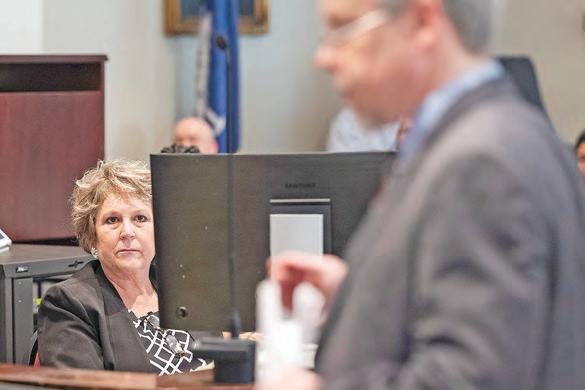
They are asking appeals court judges to order a hearing where all the jurors, Hill and maybe even trial judge Clifton Newman could be required to testify under oath. Attorney Dick Harpootlian said they tried to talk to all jurors, but some were hostile toward his team.
Murdaugh’s lawyers would also be able to subpoena emails and texts. Defense attorney Jim Gri n said there appears to be a group text among jurors since the trial and some wanted to know who was talking to his team.
If a judge decides Hill behaved improperly, Murdaugh’s convic-
fronts. In those visceral responses, 26% mentioned Biden’s age and an additional 15% used words such as “slow” or “confused.” One Republican thought of “potato.” Among Democrats, Biden’s age was mentioned upfront by 28%. They preferred such terms over “president,” “leader,” “strong” or “capable.” One who approves of his performance nevertheless called him “senile.”

Only 3% in the survey came up with “confused” as the rst descriptor for Trump, and a mere 1% used “old” or the like. Instead, the top words were those like “corrupt” or “crooked” (15%), “bad” and other generally negative terms (11%), words such as “liar” and “dishonest” (8%), along with “good” and other generally positive comments (8%).
Older Democrats are less negative than younger ones on Biden’s decision to run again. In the poll, only 34% of Democrats under 45 want him running for reelection, compared with 54% of those older. Still, about three-quarters of younger Democrats say they’ll at least probably support him if he’s the nominee; others did not commit to that.
tion and life sentence without parole could be tossed out and a new trial ordered.
But chances are he wouldn’t get out of prison. Murdaugh has agreed to plead guilty to federal charges stealing millions of dollars from clients and his family law rm, which will likely mean years or decades behind bars. Why are jurors talking?
Gri n said no one wanted to talk the rst time the defense reached out right after the trial.
Then Hill wrote a self-published book called “Behind the Doors of Justice: The Murdaugh Murders,” which upset some jurors, and they reluctantly began talking to the defense, said Joe McCullough, an attorney hired by the jurors.
Hill’s book discusses how her Christian faith helped her navigate the sudden fame and responsibility that came with the trial. She said she became convinced of Murdaugh’s guilt when jurors and court o cials visited the family home where the shootings happened.
She wrote she was nervous as she prepared to read the verdicts. “I was mostly concerned about Alex being found innocent when I knew in my heart he was guilty,” Hill wrote.
McCullough said both the defense and prosecution should want a full hearing so everything can be known.
Prosecutors have said nothing about the merit of the allegations, adding they would “respond through the legal process at the appropriate time.”
Stanly County Journal for Wednesday, September 13, 2023 8
AP PHOTO
President Donald Trump, left, and Democratic presidential candidate former Vice President Joe Biden during the second and nal presidential debate Oct. 22, 2020, at Belmont University in Nashville, Tenn.
AP PHOTO
Colleton County Clerk of Court Rebecca Hill listens as Prosecutor Creighton Waters makes closing arguments in Alex Murdaugh’s trial for murder at the Colleton County Courthouse on Wednesday, March 1, 2023, in Columbia, S.C.
Randolph record
Randleman romps to win over Union Pines
Randleman’s Daylan Atkins powers into the end zone for a touchdown against Union Pines during Friday night’s non-conference football victory at Cameron. For more on high school sports, see Pages 5 and 6.
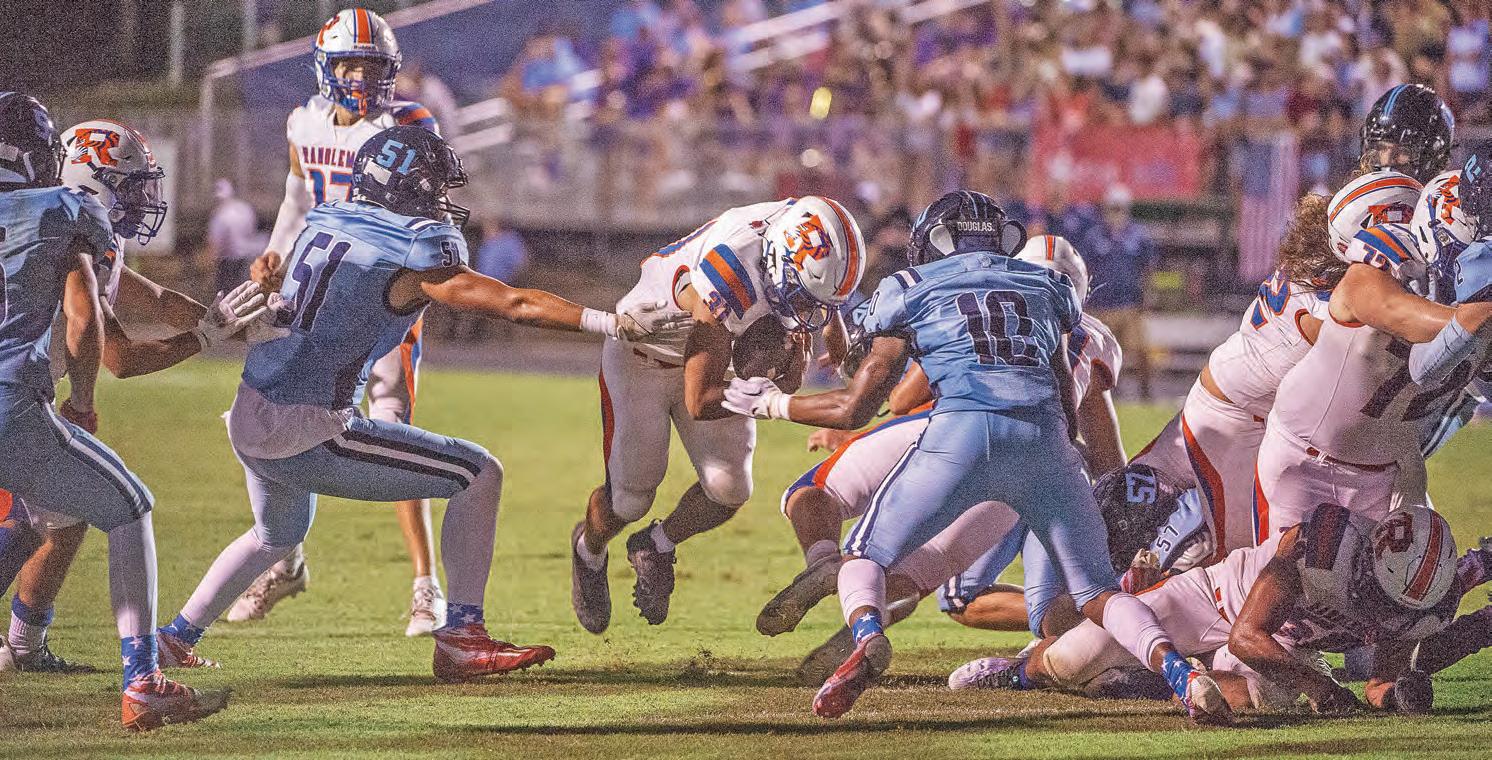
COUNTY NEWS
Randolph EMC’s PHP Board announces community grant winners
Last week, Randolph EMC’s People Helping People (PHP) Board of Directors announced awards totaling $20,000 in community grants to bene t charitable nonpro ts in the company’s ve-county service area. “For nine years, People Helping People has given back to communities in Randolph, Chatham, Moore, Montgomery and Alamance Counties through the Sharing Success grant program,” said REMC Communications and Public A airs Manager Nicole Arnold in a press release. “The board is excited to announce these awards, which represent a signi cant investment in the organizations that help our members.” The board of directors for PHP awards grants that contribute to one or more three focus areas: the health and well-being of individuals, nancial support for incomechallenged families or educational advancement through enriching learning opportunities. The board chose 19 recipient organizations, all of whom were considered to demonstrate a mission aligning with these goals, including Habitat for Humanity of Randolph County, Union Taylors Community Action Center, Operation Red Sleigh, West Chatham Food Pantry, Jordan Memorial UMC, Sandhills Coalition, Randolph County Family Crisis Center, Communities in Schools of Montgomery County, Sandhills Student Assistance, Randolph Senior Adults Association, Mt. Gilead Food Pantry, Our Daily Bread Kitchen, Robbins Area Christian Ministries, Friend to Friend, Chatham Literacy Council, Arts Council of Moore County, Spirit Horse Ranch Education Center, Partners for Children and Families, and Montgomery Community College Foundation. To learn more about each program funded by this initiative, please visit https://randolphemc. com/.
Seagrove Library celebrates 50th anniversary

 By Chuck Thompson North State Journal
SEAGROVE — The Seagrove Public Library celebrated its 50th anniversary on Saturday, Sept. 9, with a fanfare of live music, hotdogs, and fond memories.
The event, which originally was going to be held outside, had to be moved into the library as some one hundred people showed up to express their support and gratitude for the occasion.
The Southwestern High School Choir opened the ceremony, singing “Down to the River to Pray” before continuing with several other songs.
Ra e tickets and t-shirts were available for purchase during the event, along with complimentary hot dogs and drinks for everyone in attendance.
This community is very supportive; it’s unbelievable,” said Sue Spencer, a long-time library worker, “There’s every age and all types of people represented here. It’s wonderful.
The Seagrove Library rst opened On May 11, 1973, in the Seagrove Grange Hall, located just south of the school on Old Plank Road. Some 60 volunteers worked tirelessly to make it happen, with Sarah Auman (Mrs. Hubert) being named the rst Seagrove Librarian.
Supported by the Seagrove community of just 354 people at the time, eventually, the County took over operations of the library in 1973.
In 2004, The Randolph Board of Commissioners approved a $750,000 budget for a new library location and building. On Oct. 10, 2005, the new Seagrove Library opened at its present location.
“There’s so much to do at a library,” said Director of Randolph County Libraries, Ross Holt, “and we’re just delighted to celebrate Seagrove’s 50th anniversary.”
“It’s really hard for me to believe that it’s been 18 since we’ve opened this location,” said
Richard Wells, a long-time major supporter of the library, “and everyone seems to really enjoy the Seagrove Library, and they use it. We’re just really thankful.”
Branch Librarian for the Seagrove Library, Charity Neave Johnson, said, “It’s really nice to hear from supporters and former employees and volunteers. I’m looking forward to the next fty years of the Seagrove Library. We’re here for the community every day. Everyone is welcome to call, stop by, check out a book, or ask a question. We’re here to serve.”
The Seagrove Library is located at 530 Old Plank Rd, Seagrove.
Rain didn’t damper the 50th Annaversity of the
Ag teacher nds right t at Randleman
RCSS honors Walker with annual award
By Bob Sutton Randolph Record
RANDLEMAN — Once Mark Walker became involved with agricultural education, he sensed that would be his best avenue to make a di erence at Randleman High School.
He stuck with it, and he was rewarded for his decades in that capacity as the Teacher of the Year for the Randolph County School System.
“I hope I can be more of a voice and do more to promote it,” Walker said. “Kids today need that career technical education, and the world needs it.”
Walker, 50, is in his 26th year at Randleman, beginning with one year as a physical education teacher.
“Basically, my entire career has been here,” Walker said. “I kind of came into it a little dif-
Johnson to retire as county manager
ferently. I went back to school to North Carolina A&T and got the ag education degree. At that point, I had to go and pick up the agricultural education course that allowed me to continue. I was truly blessed with the timing of things.”
Walker, who grew up on the family farm in the Grays Chapel community, graduated in 1991 from Eastern Randolph before going on to obtain an undergraduate degree from Appalachian State.
“My intention way back was to go into teaching,” he said. “Once I got to Randleman, I saw the ag education here, and then I knew this was the place.”
Randleman has what he calls a land lab with greenhouses and a barn facility with a few animals. There’s also a thriving Future Farmers of America chapter.
“It’s more practical, more
Randolph Record
ASHEBORO — Hal Johnson is retiring at the end of the year as Randolph County manager after nearly ve decades in public service.
“It has been my privilege to have worked for Randolph government these past 48 years and these past nine years to serve as Randolph County manager,” Johnson said in a statement. “We have all seen the many challenges facing our community, and it has been my honor to work with so many of you during these historic times.”
Johnson is expecting life changes this autumn.
“Gloria and I are excited about welcoming our rst grandchild this November, and we are looking forward to this next chapter in life,” he said.
Johnson’s last day in o ce will be Dec. 31, followed by his nal commissioner’s meeting in that role
2.
Jan.
8 5 2017752016 $2.00 THE RANDOLPH COUNTY EDITION OF THE NORTH STATE JOURNAL See AG TEACHER, page 2
VOLUME 8 ISSUE 29 | WEDNESDAY, SEPTEMBER 13, 2023 | RANDOLPHRECORD.COM SUBSCRIBE TODAY: 336-283-6305
PJ WARD-BROWN | NORTH STATE JOURNAL
FILE PHOTO
Seagrove Library in Seagrove, on September 9, 2023.
Hal Johnson
PJ WARD-BROWN | NORTH STATE JOURNAL
WEDNESDAY 9.13.23
the conversation”
Commissioners approve nearly $29 million bid package for construction of Farm, Food and Family Education Center
Asheboro City Schools to apply for needs-based grant for upgrades at Asheboro Middle
By Ryan Henkel North State Journal
ASHEBORO — The Randolph County Board of Commissioners met Tuesday, September 5, with a variety of budget-related matters and requests on the agenda.
ment when there are resources that are there.”
According to Haywood, since February of 2022, the program has helped 758 clients with needs ranging from housing, food insecurity, medical matters, employment and transportation.
The board also approved a budget amendment to reallocate funding in response to a public safety market analysis that the county had done.
Farm, Food and Family Education Center,” said Randolph County NC Cooperative Extension Director Kenny Sherin. “I think there’s a perception out there that this is for agriculture, and yes, it will bene t agriculture, but this is for the community also. Of the many projects that are done and part of the county’s portfolio, this project had the ability to bene t many residents in Randolph County.”
According to County Engineer Paxton Arthurs, the expected completion time for the F3EC will be in the rst quarter of 2025.
The board also approved the application for a needsbased public school capital funds grant for South Asheboro Middle School.
The Randolph Guide is a quick look at what’s going on in Randolph County.
Sept. 14
Ogburn Yates Memoir Discussion
6:30pm
The board rst recognized the Randolph County Public Library’s Community Navigators Program for winning the North Carolina Association of County Commissioners 2023 Civic Excellence and Innovation Award.
“This award is given annually to 10 successful programs in the state, and so from time to time, it’s not uncommon for Randolph County to have a program that is recognized in this way,” said Commissioner Hope Haywood.
“This program embeds social workers at the public libraries in Randolph County. So, they have scheduled hours at each of the libraries, not just the main one, but at the others too. So, in essence, we are taking services through our navigators to our people in di erent parts of the county. We took the services out to where the people are with the birth of this Navigator program.
“There are all these agencies that provide di erent types of care and resources, but to the average person who is facing hardships in their lives, they have no idea. We don’t want people who just need some resources to end up putting their children into foster care because they cannot provide for them and coming onto the DSS radar or ending up on the radar for the Sheri ’s Depart-
AG TEACHER from page 1
hands-on,” he said. “You’ve got the classroom part. You’ve also got the FFA part. That has been a tremendous asset to the student success that we’ve experienced. That program is so engaging.”
The FFA program at Randleman typically has 6080 participants, Walker said. The agricultural classes have up to 160 enrolled.
SEPT
“We have some wonderful opportunities in-house,” he said. “I think when success really started happening in the FFA, that was a start that got a lot of kids red up. The more accolades students achieved, the more students want to be a part of it.”
Walker was an assistant coach with the basketball and baseball teams near the beginning of his time at the school. He said directing the FFA program has lled the coaching inklings. Under Walker, 19 groups from Randleman have participated in national FFA competitions.
“That has been the bulk of my coaching, training them,” he said.
“We’re losing deputies to the City of Asheboro, Randleman, Siler City and the same thing is happening in our EMS programs,” said Board Chair Darrell Frye. “We’re losing good people that we’ve trained because someone else has come along and o ered more money, and I think that’s to be expected.
“We knew when we adopted our budget in June that this study was underway. So, included in our budget, we had already set aside a lump sum of money pending the outcome of the market study.”
The budget amendment reallocates $446,309 total – broken down to $377,625 to the sheri ’s department, $33,186 to building inspections and $25,498 to public health – in order to address competitive pay.
“We are trying to address it, trying to be competitive and we want to show our employees our appreciation,” Frye said. “All the things we take for granted, these employees make possible in this county. We’re appreciative of that.”
The board then approved a $28,913,936 construction bid package with Holden Building Company for the construction of the Farm, Food and Family Education Center.
“This is the result of many, many hours spent with the community stakeholders putting together a plan for this
“We’re in year nine of our 10-year facilities plan,” said Asheboro City Schools Superintendent Aaron Woody. “We just nished our renovation project for Asheboro High School. In that process, we’ve continued to review the needs and priorities of all our facilities across the school district, and now, with the exception of our high school, all of our buildings are at an average age of about 60 years.
“We had heard whisperings about a pretty signicant needs-based capital improvement grant through the North Carolina Department of Public Instruction, and that has indeed happened. It is a grant that includes new construction as well as renovation projects. The grant requires a match from the county based on NC Department of Revenue assessed real estate value. So, counties that have an adjusted market value that is less than $40 billion are eligible to apply for this grant with a 0-35% match. In Randolph County, the current match would be 15% of any dollar amount that we pursue.”
Asheboro City Schools will apply for $35 million in funding through the grant, meaning that if accepted, the county’s required portion will be $5.25 million.
The Randolph County Board of Commissioners will next meet October 2.
Asheboro resident Ogburn Yates Jr. will be discussing his newly published autobiography, “Trust is Essential … For People of Faith,” this Thursday at the Asheboro Public Library. This event is free and open to the public.
Sept. 15
Friday Night Bluegrass
7pm
Come out to the Sunset Theatre this Friday for live music from the new bluegrass band, River Ridge! Doors to the show open at 6 p.m. Admission is $8 in advance or $10 at the door.
Sept. 16
Asheboro Farmers Market
7am – 1pm
Come out to the Asheboro Downtown Farmers Market, located at 134 S. Church Street. This event is free and open to the public!
20th Annual Honoring
Our Veterans Cruisin’
9am – 2pm
A fundraiser for Triad Veterans will take place this Saturday at Wayne Thomas Chevrolet in Asheboro. All of the proceeds go to the Randolph County Veterans Council, an organization that serves the areas veterans facing nancial hardship.

Sept. 17
PHOTO COURTESY OF RCSS
Walker praised the support from the school board and county administrators that has been directed toward agricultural education.
“I stand on career technical education,” he said. “I’m extremely proud to represent Randleman High School. I hope I’ve been able to provide a positive in uence on a lot of youth.”
week’s RCSS Teacher of the Year banquet at Pinewood Country Club in Asheboro were assistant principal Amy Bouser of Ramseur Elementary School, kindergarten teacher Kasey Peters of Coleridge Elementary School, kindergarten teacher Lynn Stewart of Level Cross Elementary School and kindergarten teacher Kaitlyn Thompson of Trindale Elementary School. North State Journal (USPS 20451) (ISSN 2471-1365) Neal Robbins Publisher Matt Mercer Editor in Chief Gri n Daughtry Local News Editor Cory Lavalette Sports Editor Frank Hill Senior Opinion Editor Lauren Rose Design Editor Published each Wednesday as part of North State Journal 1201 Edwards Mill Rd. Suite 300 Raleigh, NC 27607 TO SUBSCRIBE: 336-283-6305 RANDOLPHRECORD.COM Annual Subscription Price: $100.00 Periodicals Postage Paid at Raleigh, N.C. and at additional mailing o ces. POSTMASTER: Send address changes to: North State Journal 1201 Edwards Mill Rd. Suite 300 Raleigh, NC 27607
77
LOW 58 PRECIP
Cockman, Harley (M, 19), Arrested on charge of Assault on a Female, on 9/6, at 176 E Salisbury St. Davis, Tyron (M, 28), Arrested on charge of Assault by Strangulation, on 9/6, at 1035 S Church St. Robinson, Johnthan (M, 18), Arrested on charge of Simple
Assault, on 9/6, at US HWY 311 & Plainfield Rd.
Clodfelter, Adam (M, 23), Arrested on charge of Traffocking in Methamphetamine, Possess Meth, PWIMSD Schedule II CS, Possession of Burglary Tools, Possess Drug Paraphernalia, on 9/3, at Crestview Church Rd & Zoo Pkwy.
Crouse, Anna (F, 53), Arrested on charge of Felony Possession of Cocaine, Possess Drug Paraphernalia, on 9/3, at 6884 Interstate HWY 74; Exit 86.
Long, Tanya (F, 43), Arrested on charge of Possess Meth, Possess Drug Paraphernalia, on 9/4, at
Bene t Ride for Scarlettrose
1pm
Scarlettrose is a sevenyear-old in need of a heart transplant. All the donations from the ride will go to help with medical bills and family expenses. The ride will begin at Soldiers of Mercy in Ramseur, which is located at 7249 Jordan Rd. It is $20 for the ride and $25 if you have a rider.
3070 Oak Hollow Trl.
Utley, Cami (F, 38), Arrested on charge of Trafficking in Methamphetamine, on 9/1, at 811 New Century Dr.
Varner, Joshua (M, 34), Arrested on charge of Financial Card Theft, Identity Theft, Attempt Obtain Prop False Pretense, on 9/1, at 1131 E Dixie Dr.
Briles, Reitzel Jr. (M, 41), Arrested on charge of Assault Inflict Serious Injury, on 8/31, at 811 New Century Dr.
Collins, Eric Jr. (M, 28), Arrested on charge of Communicating Threats, on 9/1, at 964 Loflin Hill Rd.
Mark John Redbond, age 64 of Asheboro, died Monday, September 4, 2023 at his home.
Anthony Rodriguez Hernandez died September 6, 2023 at Randolph Health.
Travis Dewayne White, age 36 of Seagrove, died Friday August 25, 2023.
Kerry Randall Wall, age 57 of Franklinville, died August 30, 2023.
2 Randolph Record for Wednesday, September 13, 2023
The other nalists at last Get in touch! www randolphrecord.com
Randolph Guide CRIME LOG DEATH NOTICES
CALL OR TEXT
“Join
WEEKLY FORECAST SPONSORED BY 336-629-7588
WEDNESDAY SEPT 13 THURSDAY
14 FRIDAY SEPT 15 SATURDAY SEPT 16 SUNDAY SEPT 10
MONDAY SEPT 17
LOW 62 PRECIP 34% HI 79 LOW 54 PRECIP 5% HI
PRECIP
LOW
PRECIP
HI
LOW
PRECIP
TUESDAY
SEPT 18 HI 81
24% HI 81 LOW 56
18% HI 82 LOW 58 PRECIP 9% HI 77
52
3%
80
59
5%
Nelson, Amanda (F, 29), Arrested on charge of Simple Assault, on 9/5, at 610 Tipton Dr.
Troutman, Ny’Likk (M, 18), Arrested on charge of Possess Marijuana >0.5-1.5oz, Speeding, on 9/5, at 3700 Interstate HWY 73/74.
Teacher of the Year Mark Walker, center, is anked by RCSS superintendent Stephen Gainey, left, and Randleman principal Corey Phillips at last week’s banquet.
Neal Robbins, publisher | Frank Hill, senior opinion editor
| U.S. REP. RICHARD HUDSON
We will always remember
SEPTEMBER 11TH, 2001 was one of the darkest days in our nation’s history. The images of 9/11 remain ingrained into the collective memory of Americans across our nation. I still remember watching TV when the second airplane crashed into the World Trade Center that morning.
Servicemembers like Rich kept their promise to us, they served honorably, and they deserve the best we have to o er them. That’s not what they’re getting. I will not stop until we make this right— not only for Rich and his family, but for every military family and veteran.
As the representative of the largest Army base in the world, it is among my top priorities to make sure our community’s veterans, troops, and their families get the support they deserve.
What we witnessed in the hours and days that followed were some of the most courageous and heroic acts of good. We saw hundreds of rst responders rush into the smoke and ames of those burning buildings, passing civilians eeing. We heard about the courageous passengers on United Airlines Flight 93 who sacri ced their lives in order to save others. These individuals were, and continue to be, heroes in every sense of the word. May we never forget them and all who have served our nation since.
It is our responsibility as Americans to never forget the tragedy and heroism of 9/11. We continue to honor and support all those most a ected by what took place that day—including the thousands of brave men and women who answered the call to wear our nation’s uniform and defend our freedoms for the past 20 years in order to prevent events like 9/11 from happening again.
As the representative of the largest Army base in the world, it is among my top priorities to make sure our community’s veterans, troops, and their families get the support they deserve. That’s why I was proud to introduce the Healthcare Equality and Rights for our Heroes Act earlier this year to continue my ght to ensure our nation’s service members who are victims of malpractice from a DoD medical treatment facility can receive the compensation they deserve.
Moore County resident Master Sergeant Rich Stayskal is one of those heroes who rst enlisted in the Armed Forces in 2001. He was deployed to Iraq soon after and served our nation honorably. However, while stationed in our region, he received a missed cancer diagnosis that changed his life. In response, I helped change federal law in 2020 so he and other military families could receive support when facing non-combat medical malpractice while on active-duty.
The law that gave hope to Rich Stayskal and hundreds of military families has been outright ignored by the Department of Defense.
How Burning Man became uncool
LAST WEEK, the Burning Man festival — a convocation of large groups of men and women seeking sex, drugs, rock ‘n’ roll and other forms of hedonistic bliss — was ooded. It seems that a half-inch of rain swamped the event, which takes place in the Black Rock Desert in Nevada, turning the dust to deep and sticky mud. The images of barely clad neo-hippies struggling to walk through the muck spread like wild re across the internet; even the White House was forced to acknowledge that it was monitoring the situation.
For a huge swath of Americans, all of this was simply amusing. But the rise and mainstreaming of Burning Man is a far more interesting story than its pathetic possible demise. Burning Man was founded in 1986, when some hippie types gathered at the beach in San Francisco to burn a nine-foot-tall wooden man. Over time, the bon re became larger and larger, until eventually it moved to Nevada, where it has been located ever since. Each year, 100,000 people head out to the middle of the desert to participate in events ranging from impromptu art exhibits to orgies and mass drug use.
The fundamental principles of Burning Man are spelled out in co-founder Larry Harvey’s 10 Principles, written in 2004. These principles construct a paganistic morality built around a bevy of mutually exclusive notions. For example, Burning Man is about “radical inclusion... No prerequisites exist for participation in our community.” But Burning Man is also “devoted to acts of gift giving.” Unfortunately, without some form of mutuality, giving alone cannot form the basis of a functioning society, even temporarily. All of which means that Burning Man features social pressure to ostracize free-riders — a tragic violation of the radical inclusion principle. Burning Man values “radical self-expression,” which cannot be de ned by anyone other “than the individual or a collaborating group.” But such radical self-expression quickly comes into con ict with Burning Man’s call for “civic responsibility,” which surely encroaches on the unlimited right to self-expression. Burning Man also values “immediacy,” which it calls “the most important touchstone of value in our culture.” But Burning Man also calls for the community to “clean up after ourselves,” which runs directly counter to the premise of immediacy.
All of this would be sheer countercultural nonsense, except for
President Ronald Reagan once said, “Freedom is a fragile thing and it’s never more than one generation away from extinction. It is not ours by way of inheritance; it must be fought for and defended constantly by each generation, for it comes only once to a people.”
With that in mind, it is one of my greatest honors to nominate high school students for service academies each year who will go on to join the next generation of brave men and women in uniform. In my time as your Congressman, I am continually awed by the quality of young people who seek these appointments. They are the best among us. The decision to apply to a service academy is a courageous and sel ess one, and I am humbled to be a part of the process.
This year’s deadline to submit a nomination packet to the Southern Pines District O ce is Wednesday, October 11, 2023 by 5:00 PM. If your son or daughter is interested in attending a service academy and receiving a nomination, they need to start during their Junior Year of High School. For more information, call my Southern Pines District O ce at 910-910-1924 or visit our website at hudson. house.gov/services/service-academy-nominations to learn more about the nomination process.
I am deeply grateful to be an American, and incredibly appreciative of those who risk their lives daily to defend our liberties. As your Congressman, I will continue to ght for the important issues facing you and your families and I will always work to support those who have sacri ced so much for this nation.
Richard Hudson is serving his sixth term in the U.S. House and represents North Carolina’s 9th Congressional District. He currently serves as the chairman of the National Republican Congressional Committee and is a member of the House Republican Steering Committee.

one perverse fact: The counterculture has now become the culture. This accounts for the fact that Burning Man now seems tired and played out, less transgressive than wearied. The age of Burning Man attendees has increased over the past decade (average age in 2013 was 32, compared to 37 just nine years later); so has the average income (in 2006, 14% of Burners listed their personal income at above $100,000, compared to 27.4% by 2016). In uencers now show up at Burning Man to sell Popeye’s Spicy Chicken; Elon Musk, Paris Hilton and Mark Zuckerberg have shown up.
And herein lies the problem for the broader American culture. Our elite class used to be inculcated in the same set of baseline values as “normal” Americans: John D. Rockefeller was a regular churchgoer; so was Cornelius Vanderbilt. Today, our elites participate in drug-fueled binges in the desert — or at least wish to appear as though they do. Throughout the 1930s, even the poorest Americans aspired to dress well, wearing suits even on the breadlines. Today, even the richest Americans dress as though they shop at Salvation Army.
When elites promulgate countercultural garbage that eats at the roots of fundamental societal institutions, societal bonds dissolve. Ironically, that dissolution occurs rst at the lowest rungs of the income ladder: As Charles Murray points out, “The belief that being a good American involved behaving in certain kinds of ways, and that the nation itself relied upon a certain kind of people in order to succeed, had begun to fade and has not revived.” In fact, those who live out lives of good decision-making are, all too often, embarrassed of their good choices. To promote those choices might seem “judgmental.”
That is the real tragedy of Burning Man: its mainstreaming. Every society has its oddball behaviors. Only sick societies incentivize their imitation.
Ben Shapiro, 39, is a graduate of UCLA and Harvard Law School, host of “The Ben Shapiro Show,” and co-founder of Daily Wire+. He is a three-time New York Times bestselling author; his latest book is “The Authoritarian Moment: How The Left Weaponized America’s Institutions Against Dissent.”
3 Randolph Record for Wednesday, September 13, 2023 Guide
OPINION
COLUMN
VISUAL VOICES
COLUMN | BEN SHAPIRO
In uencers now show up at Burning Man to sell Popeye’s Spicy Chicken; Elon Musk, Paris Hilton and Mark Zuckerberg have shown up.
SIDELINE REPORT
COLLEGE FOOTBALL
Oklahoma
investigating Briles being on eld Norman, Okla.
Oklahoma is investigating after disgraced former Baylor coach Art Briles was seen on the eld with his son-in-law, Sooners o ensive coordinator Je Lebby, after Oklahoma’s 28-11 win over SMU. The images of Briles decked in Oklahoma gear on Owen Field drew backlash from Sooners fans on social media. Oklahoma coach Brent Venables said he was made aware of it and said it is “being dealt with.” Baylor red Briles in 2016 after an investigation concluded he and his sta took no action against players named in sexual assault allegations.
MMA Strickland stuns
favorite Adesanya at UFC 293
Sydney
American Sean Strickland
stunned Nigerian-born
New Zealander Israel
Adesanya on Sunday to take the middleweight title by unanimous decision in the main event of UFC 293 in Sydney. The 32-yearold Strickland (28-5), who caused a stir in the lead-up to the ght with sexist and misogynistic comments at a press conference promoting the bout, won a ve-round decision with all three judges scoring it 49-46.
Adesanya (24-3) had been the clear favorite to retain the title he won from Alex Pereira at UFC 281 in April.
BASEBALL
Ahead of possible move to MLB, Japan’s Yamamoto throws
2nd no-hitter
Tokyo
Japanese pitcher Yoshinobu Yamamoto, who could be moving to Major League Baseball next season, pitched the 100th nohitter in Japanese big league history for the Orix Bu aloes against the Lotte Marines. Yamamoto struck out eight, walked one and hit one batter in the 4-0 victory, extending his scoreless streak to 42 innings. The 25-year-old right-hander is 14-5 with a 1.26 ERA 145 strikeouts and 24 walks in 143 innings this season. It was the second no-hitter for Yamamoto, who threw his rst on June 18 last year.
TENNIS
De Groot wins 12th straight Grand Slam at US Open
New York
Diede de Groot won her 12th straight Grand Slam wheelchair singles title, beating Yui Kamiji on Sunday in the U.S. Open women’s nal. The Dutch star completed her third straight calendar-year Grand Slam, including a Golden Slam in 2021, when she also won the Paralympic gold medal. De Groot has won six straight U.S. Open titles and 20 major singles titles overall. She hasn’t lost a Grand Slam singles match since falling in the French Open semi nals in 2020.
Reddick takes advantage of late caution to win at Kansas
a win.”
The Associated Press KANSAS CITY, Kan. — Every time Tyler Reddick walked into a competition meeting at 23XI Racing and talk turned to Kansas Speedway, it seemed that just about everyone in the room had a win there but him.
There’s co-owner Denny Hamlin, who has won at the track four times, more than anyone else. Kurt Busch, who retired as a driver but remains a consultant for the team. And Bubba Wallace, Reddick’s teammate, who won at Kansas a year ago.
“We joked about that,” admitted Reddick’s crew chief Billy Scott, “that he’s the only one that sits in our debriefs without
Not anymore. Reddick took advantage of a late caution and fresh tires to rocket past six others in a twolap sprint to the nish Sunday, and his win at Kansas Speedway punched his ticket to the next round of the NASCAR Cup Series playo s. Hamlin got a poor jump on the last restart, couldn’t chase Reddick down and nished second. Erik Jones held on for third and Kyle Larson, who won at Darlington to clinch his playo spot a week ago, marched through the eld to nish fourth ahead of Joey Logano.
“Just an outstanding job by this whole 23XI team,” Reddick said. “We had really good pace, we just couldn’t get ahead of Denny there, but chaos ensued. Then the bottom lane opened up there and it was crazy.”
Even crazier: It was the third win for the No. 45 car of 23XI in the last four races at Kansas, and all with di erent drivers after Busch and Wallace won last year. Its owner, meanwhile, nearly pulled o the sweep after Hamlin won in the spring.
“I think that myself and this team work really close together,” said Hamlin, who has long driven for Joe Gibbs Racing. “Typically when we run well, they run well, and we’re learning as much from them as they are learning from us. It’s a great partnership and really valuable to have talented guys behind the wheel of fast cars.”
Hamlin was cruising to the win when Chris Buescher blew his right rear tire with about six laps to go. That forced the leaders into the pits, and just about everyone had a di erent tire strategy — Reddick took four fresh tires, even though it shuf-
ed him back to seventh on the restart — to set themselves up for the two-lap nishing sprint.
The win was the second of the season for Reddick and the fth of his career but, more importantly, sends him out of the round of 16 in the playo s for the rst time. The cut-o for the top 12 to advance comes next weekend at Bristol.
“Now they get to go to Bristol and work a strategy that is best for them to win the race, and they don’t really have to worry about nish points,” said Hamlin, who is the leader in points among those yet to advance and in good position to join them.
“Really happy about them putting a whole race together and capitalizing on the late restart,” he said.
It was a tough race for several playo drivers. Wallace and Martin Truex Jr. also blew right rear tires, which has been a problem with the latest generation of car at Kansas, and sustained heavy damage. Wallace was able to continue after repairing a toe link and nished 32nd, but Truex’s day was done after just three laps and he nished last.
Braves retire Andruw Jones’ No. 25 jersey
The Atlanta center elder is waiting to see if Cooperstown will come calling next
The Associated Press
ATLANTA — Andruw Jones, who won 10 Gold Gloves in a career that began with 12 seasons in Atlanta, became the 11th Braves player or manager to have his number retired on Saturday night.
His former teammates hope the honor adds momentum to Jones’ case for induction into the Baseball Hall of Fame.
Jones’ No. 25 was retired before Atlanta’s game Saturday against the Pittsburgh Pirates, and some believe the distinction was overdue. The center elder played his last season in 2012 with the New York Yankees.
Of the 11 Braves who have their number retired, Dale Murphy is the only one not in the Hall of Fame. Jones received the fourth-most votes from the Baseball Writers’ Association of America in the 2023 election, getting picked on 58.1% of the ballots. It was a notable jump from 2022, when he was eighth with 41.4%.
A player must be selected on 75% of the ballots submitted to be enshrined in Cooperstown.
Jones played in Atlanta from 1996-2007, and others from that era to already have their numbers retired include Greg Maddux, John Smoltz, Tom Glavine, Chipper Jones and manager Bobby Cox. Murphy, Glavine and Chipper Jones attended the ceremony. “I played 12 seasons in Atlanta and I only had one manager,
Mr. Bobby Cox,” Andruw Jones said. “Bobby was a father gure who pushed me to become the best player I could be. Without him I would not be here tonight.”
The other Braves players to have their numbers retired are Hank Aaron, Eddie Mathews, Warren Spahn and Phil Niekro.
“To have my number retired
next to Mr. Hank Aaron, No. 44, blows my mind,” Andruw Jones said.
Chipper Jones predicted Andruw Jones soon will join him in the Baseball Hall of Fame.
“Practice your speech tonight because I have a feeling you’re going to be making another one really, really soon in a small town called Cooperstown,” Chipper Jones said.
Andruw Jones was only 19 when he made his major league debut late in the 1996 season. Still a teenager, the rookie became the youngest player to homer in the World Series when he connected twice in Game 1 that year at Yankee Stadium.
He was selected to ve AllStar teams and hit 434 career home runs. His best power season came in 2005, when he hit a franchise-record 51 homers to go with 128 RBIs. He compiled a .254 career batting average and .823 OPS.
Andruw Jones, however, was best known for his defense in center.
“It was unbelievable,” Braves manager Brian Snitker said Saturday. “You see the video of him moving before the ball is hit and things like that. Just such a talented guy, and durable. He was a guy who never came out of the blowouts. He played all the innings of all the games.”
4 Randolph Record for Wednesday, September 13, 2023 SPORTS
The 23XI driver advances in the playo s to the Round of 12
AP PHOTO
Erik Jones (43), Joey Logano (22) and Tyler Reddick (45) head down the front straightaway for the nal lap of Sunday’s NASCAR Cup Series race at Kansas Speedway. Reddick picked up his second win of the season to advance to the playo s’ Round of 12.
AP PHOTO
Former Braves center elder Andruw Jones waves to the crowd during a ceremony that saw his No. 25 retired by the team.
UCA maintains elite status in volleyball
Randolph Record
UWHARRIE CHARTER ACADEMY has emerged as one of the top teams in Piedmont Athletic Conference volleyball.

The Eagles solidi ed that reputation by sweeping visiting Randleman last Thursday.
That pushed UCA’s overall record to 9-0. The Eagles and Southwestern Randolph are the only teams without a PAC blemish on their records.
The rst meeting between those two teams comes Sept. 19 at Southwestern Randolph.
By defeating Randleman 2516, 25-8, 25-21, it gave UCA ve consecutive sweeps. Liza Moore’s 14 kills and six blocks paced UCA, while Chloe Painter’s 20 assists and eight kills were among the highlights.
Earlier in the week, a 25-14, 26-24, 25-17 victory at Trinity included Moore’s 10 kills and ve blocks and Kenzie Hill’s 18 digs. Trinity’s Kaitlyn McCoy had 22 digs and 13 kills.
Southwestern Randolph won a clash with host Randleman last week with a 20-25, 25-15, 16-25, 25-16, 15-13 outcome.
Madelyn Smith had 18 kills and 15 digs, Riley Key provided 15 kills, Gracie Hodgin posted 13 kills, Raegan LeRoy racked up 35 assists and 13 digs and Coley Shi et had 34 digs. For Randleman, Karli Kennington had 26 digs, Camden Scott supplied 18 kills and 17 digs, Haley Hinshaw delivered 13 kills and nine digs and Camryn Vickery provided 42 assists and 24 digs.
Later in the week, Southwestern Randolph topped Eastern Randolph 25-16, 25-10, 25-15
with LeRoy’s 25 assists, Shi et’s 22 digs, Smith’s 13 kills, Key’s 13 kills and Hodgin’s 12 kills the top numbers. Addie Flinchum had 12 kills for Eastern Randolph.
Eastern Randolph’s 25-17, 2125, 26-24, 25-18 victory against visiting Wheatmore included 38 assists from Kenly Whitaker, 18 digs from Kaylee Courtemanche, 16 kills from Flinchum and seven aces from Logan Beaver.
Boys’ soccer
Fernando Hernandez tallied ve goals as Southwestern Randolph rolled up a 10-0 victory against visiting South Stanly. Kaleb Freeman and Bernadino Zuniga both had two goals.
That was the Cougars’ only game of the week, upping their record to 7-1 going into PAC action this week.
It has been tough going for PAC teams in non-conference
Addie Flinchum
competition.
Only Southwestern Randolph, Trinity (6-1) and UCA (4-1-1) held winning records prior to conference games beginning.
Still, Randleman might be on the uptick with victories last week against visiting Lexington 3-1 and at Class 4-A team Western Guilford by 2-1.
** Diego Bustamante scored twice, but Asheboro tied 2-2 at unbeaten West Forsyth in Friday’s non-conference game. All the scoring took place in the second half.
Asheboro’s record went to 7-1-
1. West Forsyth moved to 5-0-2.
Earlier in the week, Asheboro topped host West Iredell 1-0 on Carlos Gonzalez’s goal.
** Uwharrie Charter Academy won 5-1 against winless Woods Charter on Friday in its rst game at Zoo City Sportsplex, which will serve as the site of its new home eld.
Southwestern Randolph set to induct rst class
By Bob Sutton Randolph Record
ASHEBORO
— The rst class for the Southwestern Randolph Hall of Fame will be inducted this week and it’s quite a blast from the past.
Fourteen individuals were selected for the honor. A ceremony will be held in the school cafeteria Friday prior to the football game vs. Albemarle. The group will also be recognized at halftime of the game.
The fathers of both athletics director Chris Chapman and football coach Seth Baxter are in the induction class.
Charlie Chapman and Donnie Baxter are both still involved with the Cougars on the football coaching sta .
Charlie Chapman was football coach and athletics director for 11 years along with a season as baseball coach. Later, he was back at Asheboro, his alma mater (Class of 1967), as athletics director. But he resurfaced at Southwestern Randolph in “retirement,” spending seven years on the football sta and ve on the softball sta with the Cougars.
“I enjoy it,” Charlie Chapman said. “(This school) is a great place to coach.”
He also embraces working alongside his son. “Now, he’s my boss,” he said.
Charlie Chapman has been a conference commissioner of various leagues since 1999.
Donnie Baxter is a former principal (1985-95) at the school. He has been on his son’s coaching sta since 2017.
The elder Baxter has had long involvement with the North Carolina High School Athletic Association, serving various committees. He’s a co-founder of the Randolph Sports Council.
Here’s a look at the other inductees:
** Annette Cain Yates was a four-year player in girls’ basketball and volleyball, receiving all-conference accolades and countless recognitions. She twice as picked as the Player of the Year
in Randolph County in basketball on the way to scoring 2,170 career points.
She also spent a season on the softball team and the track and eld team. She’s a 1988 graduate.
** G.C. Castelloe Jr. was principal during the early days of the school, making hires for sta when the school opened in 1970. He stayed until 1985. The cultural arts building on campus is named in his honor.
** Jack Castelloe was girls’ basketball coach from 1971-94 after spending time from 196470 at Farmer School. His 592 victories as girls’ basketball coach mark a school record.
He also coached football and golf at the school. He was the head football coach when the Cougars won their rst football game. He became an assistant principal.
The school’s gym is named after Jack Castelloe.
** Rachel Goad Cagle was a teacher and coach at the school from 1974-2010. Her volleyball teams racked up a 446-169 record with state championships in Class 2-A in 1991 and 1992. There was an eight-year run of conference titles under her watch.
Cagle’s track and eld teams won eight championships, with her athletes earning four individual state championships.
** Holly Hill Cogan, a 1993 graduate, was a volleyball, basketball and softball player for the school. She was the Most Valuable Player in Class 2-A championship matches as the Cougars won volleyball crowns in 1991 and 1992.
She received county honors as the top girls’ basketball player three times and as a volleyball player twice. She was also a conference Player of the Year in softball.
This led to her distinction as the statewide Female Athlete of the Year as a senior.
** Greg Lamb, a 1977 graduate, played baseball, football and basketball for the Cougars. He received Most Valuable Player honors in baseball and football.
** Larry Little, a 1989 graduate, was on the varsity baseball team for four years, landing all-conference honors multiple times. He also was an all-conference pick in football. He played one season on the varsity basketball team.
** LuEllen Lo in Morgan was the school’s longtime cheerleading coach, beginning in the 1980s. From 1990-2001, the cheerleaders captured 10 state championships.
** Lynn Nance Jones, a 1983 graduate, excelled in volleyball, basketball, softball and track and eld. Her accolades came in volleyball, basketball and softball. She was the county’s top basketball player as a senior and her No. 24 basketball jersey was retired.
** Kathy Sugg Fleetwood, a 1989 graduate, was a Southwestern Randolph athlete and later a coach. She reached the Class 2-A state semi nals as a senior in tennis, helping coach a three-year run as the team’s Most Valuable Player. Her basketball accomplishments included four-time recognition on the all-county team and she was known as a relentless rebounder. Her No. 30 jersey is retired.
Fleetwood coached the girls’ tennis team from 1993-2003, receiving four conference Coach of the Year honors. She also spent time coaching junior varsity basketball.
** Stevie Taylor was a teacher and coach at the school, guiding the Cougars to three state titles (2001, 2007, 2009) and nine conference titles in softball. The Cougars went 283-52 under his direction.
** Ti anie Wilson Roach, a 1993 graduate, was a four-year varsity participant in volleyball, basketball and softball, playing on state championship volleyball teams in 1991 and 1992.
Roach has pointed out that her mother, Sylvia Myers Dawson, played basketball for Jack Castelloe and was a member of the school’s rst graduating class in 1971.
Eastern Randolph, volleyball
Flinchum is a senior outside hitter and middle hitter for the Wildcats.
She has been a force at the net, leading the team in kills. She’s averaging almost four kills per set.
Flinchum was the Wildcats’ only representative on last year’s All-Piedmont Athletic Conference team.
This year, Eastern Randolph won ve of its rst seven matches. That matched the Wildcats’ top victory total in any of the past four seasons.
Flinchum has been an All-PAC selection in softball. She’s a pitcher for the Wildcats.
AREA SPORTS BRIEFS
Weather concerns wipe out Caraway Speedway card
 By Bob Sutton Randolph Record
SOPHIA — The season is winding down at Caraway Speedway and then Saturday night’s card was called off because of concerns involving inclement weather.
That could complicate matters as the track tries to get caught up. For instance, UCARs was set to have two features because of an earlier postponement involving that division.
That brings the Fall Showdown this coming Saturday, with racing slated for Challengers, 602 Modifieds, Mini Stocks, UCARs and Bootleggers.
Asheboro golfer places in NC Super Seniors
MOORESVILLE – Asheboro’s Charlie Parks finished tied for 12th place in the 70plus division of the North Carolina Super Senior Championship. Parks shot rounds of 77 and 73 for a 6-over total in competition conducted by the Carolinas Golf Association on Sept. 6-7 at Mooresville Golf Club. There were 47 entrants in the 70-plus division, which was won by Raleigh’s Dee Blankenhorn at 6-under (68, 70). He won by five shots on Robert Desjardins of Matthews.
Todd Hendley of Columbus was the winner in the 65-and-older class with 7-under 137.
Forest City to be site for CPL All-Star Game
HOLLY SPRINGS – The 2024 Coastal Plain League AllStar Game will be held in Forest City.
The Forest City Owls, a rival of the Asheboro ZooKeepers, will be the host team for two days of activities July 7-8 at McNair Field.
“Forest City’s vibrant baseball culture and outstanding facilities make it a superb choice for our league’s premier event,” CPL commissioner Chip Allen said in a statement. “We are con dent the Forest City Owls and the local community will work together to create an unforgettable experience that will leave a lasting impression on both players and fans.”
About 56 players will be selected to participate, representing the East Division and West Division.
The 2024 event will be the league’s 24 edition of the CPL All-Star Game. The two-day showcase includes clinics, a skills competition and a home run derby.
The regular-season schedules for CPL teams are expected to be released in October.
In other CPL-related news, the Lexington County Blow sh were selected as the CPL Organization of the Year for the second season in a row. That team was the host for the 2023 AllStar Game. The Blow sh have been dubbed Organization of the Year four times, also honored in 2006, when they were located in Columbia, S.C., and 2015.
5 Randolph Record for Wednesday, September 13, 2023
BEST OVERALL ATHLETE OF THE WEEK
SCOTT PELKEY | RANDOLPH RECORD Addie Flinchum of Eastern Randolph watches the ball after sending it back over the net during a match vs. Western Alamance.
HALL OF FAME
SCOTT PELKEY | RANDOLPH RECORD
Kynnedi Routh of Wheatmore makes a play as teammate Tate McKinney looks on during a match earlier this season at Asheboro.
New Asheboro QB holds Randleman roots

Teams set to meet weeks after sudden transfer


 By Bob Sutton Randolph Record
RANDLEMAN — Logan

Laughlin wanted a more comfortable situation as a high school quarterback this fall, so during the summer he chose to leave Randleman and transfer to Asheboro.
“It’s going really good,” Laughlin said. “When I walked in there, I felt appreciated and it felt right.”
The junior will be back in Randleman on Friday night when the Blue Comets (1-2) visit for a non-conference game.
The Tigers (4-0) have sophomore John Kirkpatrick as their quarterback.
The paths of the two quarterbacks have been connected. They both were starters for Randleman’s junior varsity at times last year and weeks later were teammates on the junior varsity basketball team.

The players said they’ve had a good friendship.
“I was tight with him,” Laughlin said. “We’re really supportive of each other.”
Laughlin worked out with Randleman’s team into the summer and attended successful 7-on-7 competitions before sensing that a change might be best.
“I was competing with him,” Laughlin said. “I went to a 7-on-



7, and I showed out.”
By all accounts, Laughlin was going to be the starting quarterback for the Tigers when the season began. He was looking for more guarantees.
“They were going to give me that rst game with Thomasville to start,” he said. “They said they would see how that went. It would be my rst year on varsity. After one game, I didn’t want to be standing on the sideline all my junior and senior years. I didn’t want that pressure where if I wasn’t good in that game, I didn’t want to be looking over my shoulder.”
Randleman coach Shane
Timmons didn’t want to get into the speci cs. He said his focus is on coaching the players at Randleman.
“You can let it be awkward if you want it to be,” Timmons said of the situation. “He made a decision that he thought was best for him and we moved on.”
It wasn’t until late July that Laughlin revealed his intentions.
“It was kind of late. The county was shocked, for sure,” he said. “It was a long decision for me. I took two or three weeks to talk to my family and to pray about it.”
Kirkpatrick, who was a starting out elder as a freshman on
Patriots rally past Asheboro
Randleman, Southwestern
Randolph stay unbeaten

Randolph Record

CLIMAX — Logan Fox ran for 235 yards and two touchdowns as undefeated Providence Grove, facing a team directed by its former coach, overcame visiting Asheboro for a 24-14 non-conference victory Friday night.
Calvin Brown coached for 11 seasons, including the past seven as head coach, at Providence Grove. He took the Asheboro job during the o season and had his new team red up.

The Blue Comets (1-2) scored on their rst snap and later led 14-7 at halftime. Logan Laughlin threw touchdown passes of 85 yards and 45 yards to Elijah Woodle.
But Providence Grove (4-0), which didn’t allow a point after the rst quarter, had enough offense to rally. The Patriots pulled even with Fox running for a 21yard third-quarter touchdown and went ahead when Carson Jones kicked a 44-yard eld goal
with 10:26 remaining. They extended the margin on Fox’s 1-yard run with 3:11 left.
Providence Grove quarterback James Ellis posted 83 rushing yards, including a 5-yard touchdown run in the rst quarter.
Randleman 47, Union
Pines 6: At Cameron, Edison Hernandez ran for 121 yards and two touchdowns and Daylan Atkins rushed for two touchdowns in Randleman’s road romp.
Tyshaun Goldston made ve catches for 109 yards and a touchdown for the Tigers (40). Amari Ferdna caught a 23-

Randleman’s state-power baseball team, said he was at the beach when a couple of friends contacted him to share the news about Laughlin departing.
“Then I knew that it was going to be me,” Kirkpatrick said.
Kirkpatrick, who had dabbled as a receiver during limited time with the 2022 varsity, is described by both Timmons and Laughlin as a strong-armed quarterback. He said he sensed it was a tight quarterback race.
“We were kind of splitting reps,” Kirkpatrick said. “It was a pretty good competition. We were taking turns on drives (in summer work and 7-on-7s). I was working. I was trying to do everything I could to be the starter. It could have gone either way.”
Junior receiver Aiden Robinson also took a Randleman-to-Asheboro path about the same time as Laughlin’s move.
With Asheboro, Laughlin has thrown for seven touchdowns with four interceptions, accounting for 274.1 yards per game by completing 60 percent of his throws. He’s self-described as a pocket passer.
“He has picked up our o ense right away,” rst-year coach Calvin Brown said.
Laughlin, 16, is 6-foot-1 and 180 pounds with Randleman-area roots that stretched to early years at Level Cross Elementary School.
Kirkpatrick, at 6-3 and 170 pounds, had been in school in the Southern Guilford district un-


yard touchdown. Christian McLeod kicked a 36-yard eld goal to open the scoring before Union Pines (1-3) held a 6-3 lead.
Goldston’s 79-yard reception put Randleman ahead to stay.
Atkins had two touchdown 1-yard touchdown runs. Micah Thurston ran 13 yards for a touchdown. Hernandez, who carried 20 times, scored from 3 yards out.
John Kirkpatrick completed 13 of 21 throws for 185 yards with two touchdowns and an interception.
Southwestern Randolph 20, McMichael 7: At Asheboro, linebacker Kempton Reed intercepted a pass and returned it 59 yards for a fourth-quarter touchdown as the host Cougars held on for the non-league triumph.
Reed’s play came with 1:27 left.

Marcus Robertson and Glenn Haltom scored earlier touchdowns for the Cougars (3-0), who led 13-0 at halftime. Owen Whalen rushed for 87 yards for Southwestern Randolph.
McMichael is 2-2.
Trinity 34, West Davidson 21: At Trinity, Noah Bradley threw for three touchdowns and Kasey Blakeney intercepted two passes as the host Bulldogs prevailed in the non-league game.
til a switch to Randleman as an eighth-grader. Now the 15-yearold will have a prime role in this intra-Randolph County clash.
“It should be pretty exciting,” he said. “It’s our rst game that we know a lot of the players that we’re competing against.”
Kirkpatrick has thrown for 131 yards per game with seven touchdowns and two interceptions. He has completed 62.9 percent of his 70 attempts.
“He has matured these rst few weeks and I’m proud of him,” Timmons said. “He has learned how to be under control. He’s a good decision maker.”
Randleman has relied on an experienced defense to set the tone. That has worked well for Kirkpatrick.
“After the rst two games, the chemistry on the team has got better,” he said. “I always go into a game feeling con dent. I feel a little bit of pressure. I just have to trust my guys.”
No matter what the rosters look like, the energy will be high Friday night.
“It’s Asheboro, you don’t really have to do a big motivational speech to get them up for that game,” Timmons said.
As it turns out, Laughlin and Kirkpatrick are both starting quarterbacks.
“(We) were pretty good buddies,” Kirkpatrick said. “It kind of sucks that he’s not there with us. It will be pretty interesting to say the least. We’re still all friends at the end of the day.”
PREP FOOTBALL — WEEK 5

Friday night’s games
Asheboro at Randleman Ledford at Providence Grove Albemarle at Southwestern Randolph Union Academy at Trinity Eastern Randolph at Central Davidson Wheatmore at South Stanly

Brandon Campbell, whose three catches went for a total of 106 yards, Jacob Hodges and Daniel Rogers made touchdown catches. Daniel Rodgers and Dominic Payne had touchdown runs for Trinity (2-2).
West Davidson is 0-4.


Wheatmore 15, Bishop McGuinness 14: At Kernersville, Jonathan Kelly scored on a 14yard touchdown run and added the winning two-point conversion run as the visiting Warriors rallied.
Kelly had a 6-yard touchdown run in the rst half. He nished with 113 rushing yards on 20 carries.
Wheatmore (2-2) was involved in a one-point game for the second time in three weeks, winning this one. Bishop McGuinness fell to 1-2.
6 Randolph Record for Wednesday, September 13, 2023 9796 Aberdeen Rd, Aberdeen Store Hours: www.ProvenOutfitters.com 910.637.0500 Blazer 9mm 115gr, FMJ Brass Cased $299/case Magpul PMAGs 10 for $90 Polish Radom AK-47 $649 Smith & Wesson M&P 2.0 Compact $449 Del-Ton M4 $499 Ever wish you had a The Best Prices on Cases of Ammo? The best selection of factory standard capacity magazines? An AWESOME selection of Modern Sporting Weapons from Leading Manufactures Like, Sig, FN, S&W, etc? You Do! All at better than on-line prices? local store which has Flamethrowers & Gatlin Guns?
SCOTT PELKEY | RANDOLPH RECORD
Quarterback Logan Laughlin of Asheboro will be playing against his former team this week.
PJ WARD-BROWN | NORTH STATE JOURNAL Randleman running back Micah Thurston runs the ball against Union Pines on Friday night.
Eugenia Moore Thomas
May 4, 1944 — September 8, 2023
Eugenia Moore Thomas, age 79, formerly of Asheboro, NC went home to be with our Lord and Savior on September 8, 2023.
Mrs. Thomas was born in Register, GA on May 4, 1944 to Dennis Fullwood Moore Sr. and Lillian Akins Moore. Eugenia was a 1962 graduate of Statesboro High School, where she received many accolades including receiving the Most Valuable Player Award and the Best O ensive Player Award in basketball. She was also a graduate of Massey Business College in Atlanta, GA. She loved cooking, spending time with her family, traveling, and watching her daughters and grandchildren participate in athletics and extra-curricular activities.
In addition to her parents, Eugenia was preceded in death by her husband, John Carter Thomas.
She is survived by her daughters, Lydia Thomas Maness (Billy) of Troy, NC and Emily Thomas Coltrane of Mt. Gilead, NC; grandchildren, Christopher Michael Maness, Madeline Rose Maness, Ashton Blaine Maness, John William Maness, Sarah Elizabeth Coltrane, and great grandson Carter William Maness; and siblings, Dennis Fullwood Moore, Jr. (Kathy) of Statesboro, GA, Lillian M. Vaupel of Midway, GA, and Thomas Je rey “Je ” Moore (Mary Anne) of Portal, GA as well as many nieces, nephews and cousins in North Carolina, Georgia and Tennessee.
Rose Bristow Davis
July 27, 1941 — September 6, 2023
Rose Bristow Davis, age 82, of Asheboro passed away on September 6, 2023 at Randolph Hospital.

Ms. Davis was born in Asheboro on July 27, 1941 to William Henry Bristow, Sr. and Gladys McLeod Bristow. She was the coowner and operator of A ordable Furniture for 25 years and was a member of Landmark Baptist Church. Rose loved Bingo, shopping, and spending time at the beach. Her greatest joy was spending time with her family, especially her grandchildren. In addition to her parents, Rose was preceded in death by her brothers, William "Bill" Bristow, Jr., Samuel C. Bristow, and Burnice H. Bristow, and her sister, Doris Overman. She is survived by her daughters, Gina Webster (Eric) of Siler City and Carla French of Randleman; grandchildren, Victoria Foster, Sierra Robbins (Daniel), and Preston McBee; sisters, Pat Nelson of Asheboro, Shirley Ward (Danny) of Randleman, and Sharon Owens (Asa) of Asheboro; and sisters-in-law, Linda Bristow of Asheboro and Shirley Bristow of WinstonSalem.
Carol Farlow Hu man
May 10, 1935 — September 4, 2023
Ruth “Carol” Farlow Hu man, 88, of Asheboro, passed away peacefully September 4, 2023 at her home.
Carol was born in Randolph County, NC, on May 10, 1935, the daughter of the late Dallas Colon Farlow, and Ethel Mae Cox Farlow. Carol was a kind, caring Godly woman who loved providing for people in need whether it was buying Christmas presents for families or providing a home cooked meal. Her children, grandchildren, and great grandchildren were her pride and joy. She loved to cook, especially during the holidays. She always loved Christmas and loved giving gifts and hiding money in odd places for you to nd. Carol was an avid Duke Blue Devils fan

In addition to her parents, Carol was preceded in death by her brothers, Richard Farlow, Freddie Farlow, Norman Farlow, and sister Emma Hall.
She is survived by her husband of 70 years, Ronald Dean Hu man, son Michael Hu man(Yvette) of Asheboro, NC, daughter Candace Seabolt(Greg) of Denton, NC, grandchildren, Paige Martin(Jason), Tyler Hu man(Jameykay), Hunter Seabolt(Sammie), Jordan Singley(Colby), great grandchildren, Noah Martin, Jude Martin, David Seabolt, Bo Singley, Scout Seabolt, Walker Singley, and a baby Seabolt expected in November 2023, her daughter-in-law Lisa Hu man, and many nieces and nephews whom she loved.
Scarlett "Cat" Rose Williams
January 12, 2016 — September 5, 2023
Scarlett "Cat" Rose Williams, age 7, of Liberty, NC went home to be with Jesus on Tuesday, September 5th, 2023 at Duke University Medical Center.


Scarlett was born in Orange County, NC on January 12, 2016. Ms. Scarlett was the love of her families lives. She loved going to the beach, her cats, her toys, her squish mellows, minecraft, Roblox and youtube. Her favorite color was purple.
Ms. Scarlett is survived by her Mimi, Anthoniette Williams; Pappy, Stephen Williams; Mama, Stephenie Everwine; Brother James; Nana, Sheila Boone; Great Grandmother, Naomi Beal; Aunt, Sierra Williams; Uncle, Eric Everwine; Cousin, Anthony Everwine. Ms. Scarlett was preceded in death by Papa, Anthony Oldham; Aunt, Samantha T. Williams; Uncle, Slade Messer.
Holly Elaine She eld
July 11, 1995 — September 5, 2023
Holly Elaine She eld, 28, of Seagrove, passed away on September 5, 2023. Holly was born in Montgomery County on July 11, 1995, to James and Lisa Davidson She eld.
She is survived by her daughter Paisley Richardson of the home; ancé Jacob Richardson "Mud ap" of the home; parents James and Lisa She eld of Seagrove; sister Jamie She eld of Fayetteville; and paternal grandparents James and Dorothy She eld of Seagrove.
Doug Dudley Taylor
April 17, 1937 — September 9, 2023
Mr. Harry “Doug” Dudley Taylor, passed away Saturday, September 9th, at 4:25 PM at the home of his daughter, Pam surrounded by his family.
“Doug” was born on April 17, 1937 in Wake County to Mr. Euwell McKinney Taylor and Mrs. Alcie King. He is preceded in death by two sisters, Gina and Peggy Taylor, and one brother, Claude Taylor. He was a loving husband, brother, father, uncle and grandfather.
“Doug” is survived by his wife of 69 years, Mrs. Virginia Walker Taylor of Staley, NC, two daughters, Pamela T. Seekins (Michael Stephen) of Ramseur and Sherra T. Chedaille (Philippe) of Chapel Hill, NC. Grandchildren, James Taylor Kelly, Michael Dylan Seekins, Laura Angela Seekins, and Liam Henri Chedaille, Robert Seekins, Sarah Seekins, Valentina Chedaille, Edward Chedaille and Katie Lynn Miller. Mr. Taylor is also survived by three brothers, Donald Taylor, John Taylor, and Ronald Taylor.
Brenda Trotter
October 21, 1945 - September 5, 2023
Brenda Faye Lawson Trotter, 77, of Asheboro, passed Tuesday, September 5, 2023 at Woodhaven Court in Albemarle.
Mrs. Trotter was born October 21, 1945, in Randolph Co., NC, and was the daughter of the late Maude and Nora Cofer Lawson. She was a member of Shiloh Baptist Church. She enjoyed cooking, cleaning, going to the beach, and going out to eat weekly with her sisters. Mrs. Trotter was a caring person that was very generous with her love, time, and attention. She always had a smile and a kind word.
In addition to her parents, Mrs. Trotter was preceded in death by her sisters, Virginia Lawson, Vedas Shaw, Elvie Bullins, and her brothers, Garland Lawson, Dempsey Lawson and Paul Ray Lawson. She is survived by her sons, Gene Trotter and wife Kim, of Monroe, NC, Ken Trotter and wife, Sandy, of Asheboro, NC grandchildren, Trevor Trotter, Zachary Trotter and wife Ti any, Katy Trotter, Wesley Trotter, Sarah Trotter, Bethany Trotter, Carolina Trotter; great grandchild Reagan Trotter; sisters, Betty Scott, Margie Rich, Beverly McCain; and brother, Vance Lawson.
Leonard Matthew Allred

September 2, 2023 — September 2, 2023
Leonard Matthew "Leo" Allred passed away September 2, 2023 at the Moses Cone Hospital in Greensboro. Leo is survived by his parents , Cody and Staci Allred of the home, one brother William Isaacs of the home. Grandparents Dale and Becky Windsor of Pleasant Garden, Grandmothers Susan Schmidly of Randleman and Ladale Allred of Franklinville. He was preceded in death by grandfathers Steve Schmidly and Leonard Allred. Leo is also survived by many uncles, aunts, nieces, nephews and cousins.
Donald Connor
March 26, 1952 - September 9, 2023
Donald Ray Connor, 71, of Asheboro, passed away Saturday, September 9, 2023, at his home.
Donald Ray Connor was born on March 26, 1952, in Randolph County, the son of the late John and Frances Bame Connor. Donald enjoyed shing with his twin brother, Ronald, son Douglas, and grandson, Connor. He liked going to the beach and was very sociable; he never met a stranger. Donald loved the Lord and was a member at Hopewell Friends Meeting for 50 years. He was a hard worker, always willing to lend a helping hand, and provided for his family. Donald held on long enough to celebrate 50 years of loving marriage with his wife, Edna.
In addition to his parents, Donald was preceded in death by his sister, Ellen Boone; brothers, Jesse, Roger, and Robert Connor.
Donald is survived by his wife, Edna Connor; daughter, Christine Connor Glover (Ray); son, Douglas Ray Connor (Paula); sisters, Mary Wood, Lynda Joyce (Marty), Nettie McPherson (Lynn); twin brother, Ronald Connor (Sharon); grandchildren, Connor Glover and Leland Glover.
William David Howell
January 31, 1953 ~ September 6, 2023
Mr. William David Howell, 70, a long-term resident of Randolph County, went home to be with Jesus on Wednesday, September 6, 2023 while surrounded by family at Wake Forest Baptist Health High Point Regional Hospital. David was born January 31, 1953 in Rockingham County and proudly served his country in the United States Army. He spent many years as a Recovery Agent and loved spending time at the ea market. His greatest joy in life was his family, including chosen family and the love he had for children.
In addition to his parents, he was preceded in death by his son, Michael David Howell. Surviving is his loving wife, Susan Russell Howell of the home; daughter, Angela Elizabeth Howell, Shelia Edwards; sons, Mitch Barringer (Adrienne), Chris Conrad, Nate Conrad (Anna), Matt Edwards: daughter-inlaw, Angela Hughes Howell; one brother, Donald Howell; one sister, Kathy Markham; grandchildren, Nicole Delk (Taylor), Sway Kleineick (Joseph) Taylor Lane, Jeren Barringer, Roman & Royce Conrad, Maverick Conrad, Axton Jones/Edwards, Kaidence & Riley Smith. He was also survived by his 6 great grandchildren that he loves dearly.
7 Randolph Record for Wednesday, September 13, 2023 obituaries
STATE & NATION
Biden is widely seen as too old for o ce, an APNORC poll nds. Trump has problems of his own
The Associated Press
WASHINGTON, D.C. — Americans actually agree on something in this time of raw discord: Joe Biden is too old to be an e ective president in a second term. Only a few years his junior, Donald Trump raises strikingly less concern about his age.
But they have plenty of other problems with Trump, who at least for now far outdistances his rivals for the Republican nomination despite his multiple criminal indictments. Never mind his advanced years — if anything, some say, the 77-year-old ought to grow up.
A new poll from The Associated Press-NORC Center for Public A airs Research nds much of the public oddly united in sizing up the one trait Biden cannot change.
The president has taken to raising the age issue himself, with wisecracks, as if trying to relax his audiences about his 80 trips around the sun.
Age discrimination may be banned in the workplace but the president’s employers — the people — aren’t shy about their bias.
In the poll, fully 77% said Biden is too old to be e ective
for four more years. Not only do 89% of Republicans say that, so do 69% of Democrats. That view is held across age groups, not just by young people, though older Democrats speci cally are more supportive of his 2024 bid.
In contrast, about half of U.S. adults say Trump is too old for the o ce, and here the familiar partisan divide emerges — Dem-
ocrats are far more likely to disqualify Trump by age than are Republicans.
What’s clear from the poll is that Americans are saying out with the old and in with the young, or at least younger.
Democrats, Republicans and independents want to sweep a broad broom through the halls of power, imposing age limits on
the presidency, Congress and the Supreme Court. In all about twothirds of U.S. adults back an age ceiling on candidates for president and Congress and a mandatory retirement age for justices.
Speci cally, 67% favor requiring Supreme Court justices to retire by a certain age, 68% support age ceilings for candidates for House and Senate, and 66% support age ceilings for candidates for president.
With elders mostly running the show and the Constitution to contend with, don’t expect that to happen any time soon.
Even so, the survey suggests lots of people across political lines are open to seeing a younger face, a fresher one, or both, capture the public imagination.
The AP-NORC survey went beyond posing questions and presenting choices. It also had a word association exercise, asking people to o er the rst word or phrase that comes to mind at the mention of each man.
The answers underscored how age is a particular drag for Biden across party lines, even when people aren’t prompted to think about that, and how Trump largely escapes that only to draw disdain if not disgust on other
Another twist in the Alex Murdaugh double murder case. Did the clerk tamper with the jury?
The Associated Press COLUMBIA, S.C. — Alex Murdaugh’s double murder case has been full of twists and turns: How did a dog crack the case? Where are the bloody clothes and weapons? And where did all the money Murdaugh is accused of stealing go?
But one of the biggest surprises came last week, six months after Murdaugh was convicted of killing his wife and son.
Murdaugh’s lawyers led court papers saying he deserves a new trial because elected Colleton County Clerk of Court Rebecca Hill allegedly tampered with the jury that found him guilty earlier this year. Prosecutors have 10 days to respond.
What is the clerk accused of doing?
Murdaugh’s defense attorneys sum it up in a paragraph of the 65-page appeal.
“She asked jurors about their opinions about Mr. Murdaugh’s guilt or innocence. She instructed them not to believe evidence presented in Mr. Murdaugh’s defense, including his own testimony. She lied to the judge to remove a juror she believed might not vote guilty. And she pressured jurors to reach a guilty verdict quickly so she could prof-
it from it,” they wrote.
Hill is accused of having one-on-one chats with the jury foreperson, sometimes behind closed doors in a bathroom. She allegedly told jurors who smoked they couldn’t take a cigarette break until a verdict was reached.
She also gave jurors the business cards of reporters during the trial, according to the defense.
Hill also allegedly told the jury “not to be fooled” by the evidence presented by the defense, to watch Murdaugh closely as he
testi ed and to “look at his actions,” and “look at his movements.” One juror said in a sworn statement that they understood that to mean Murdaugh was guilty.
The clerk also traveled to New York City — she said it was her rst time on a plane — to be with three jurors who gave TV interviews after the trial.
“Clerks are supposed to help get people in the courtroom, organize exhibits, get lunch or answer simple jury questions like
nding the bathroom,” said lawyer John Fishwick Jr., a former U.S. Attorney. “You are never supposed to talk to a jury about the case.”
Murdaugh’s defense has asked the FBI to investigate Hill because South Carolina state agents are too closely connected to the case. The agency has not responded publicly.
Hill has not responded publicly to the allegations.
So what happens now?
Murdaugh’s lawyers said they talked to four jurors whose stories matched and included sworn statements from two of them in their legal lings.
They are asking appeals court judges to order a hearing where all the jurors, Hill and maybe even trial judge Clifton Newman could be required to testify under oath. Attorney Dick Harpootlian said they tried to talk to all jurors, but some were hostile toward his team.
Murdaugh’s lawyers would also be able to subpoena emails and texts. Defense attorney Jim Gri n said there appears to be a group text among jurors since the trial and some wanted to know who was talking to his team.
If a judge decides Hill behaved improperly, Murdaugh’s convic-
fronts.
In those visceral responses, 26% mentioned Biden’s age and an additional 15% used words such as “slow” or “confused.” One Republican thought of “potato.” Among Democrats, Biden’s age was mentioned upfront by 28%. They preferred such terms over “president,” “leader,” “strong” or “capable.” One who approves of his performance nevertheless called him “senile.”
Only 3% in the survey came up with “confused” as the rst descriptor for Trump, and a mere 1% used “old” or the like. Instead, the top words were those like “corrupt” or “crooked” (15%), “bad” and other generally negative terms (11%), words such as “liar” and “dishonest” (8%), along with “good” and other generally positive comments (8%).
Older Democrats are less negative than younger ones on Biden’s decision to run again. In the poll, only 34% of Democrats under 45 want him running for reelection, compared with 54% of those older. Still, about three-quarters of younger Democrats say they’ll at least probably support him if he’s the nominee; others did not commit to that.
tion and life sentence without parole could be tossed out and a new trial ordered.
But chances are he wouldn’t get out of prison. Murdaugh has agreed to plead guilty to federal charges stealing millions of dollars from clients and his family law rm, which will likely mean years or decades behind bars.
Why are jurors talking?
Gri n said no one wanted to talk the rst time the defense reached out right after the trial.
Then Hill wrote a self-published book called “Behind the Doors of Justice: The Murdaugh Murders,” which upset some jurors, and they reluctantly began talking to the defense, said Joe McCullough, an attorney hired by the jurors.
Hill’s book discusses how her Christian faith helped her navigate the sudden fame and responsibility that came with the trial. She said she became convinced of Murdaugh’s guilt when jurors and court o cials visited the family home where the shootings happened.
She wrote she was nervous as she prepared to read the verdicts. “I was mostly concerned about Alex being found innocent when I knew in my heart he was guilty,” Hill wrote.
McCullough said both the defense and prosecution should want a full hearing so everything can be known.
Prosecutors have said nothing about the merit of the allegations, adding they would “respond through the legal process at the appropriate time.”
8 Randolph Record for Wednesday, September 13, 2023
AP PHOTO
President Donald Trump, left, and Democratic presidential candidate former Vice President Joe Biden during the second and nal presidential debate Oct. 22, 2020, at Belmont University in Nashville, Tenn.
AP PHOTO
Colleton County Clerk of Court Rebecca Hill listens as Prosecutor Creighton Waters makes closing arguments in Alex Murdaugh’s trial for murder at the Colleton County Courthouse on Wednesday, March 1, 2023, in Columbia, S.C.
COUNTY NEWS
Sanitation workers
rescue dog left out for garbage pick-up
Last weekend, Hoke County Sanitation workers came across a dog who had been left out for trash pick-up. The dog, named Moe-Moe, was found trapped in its crate with several bags of trash piled around it. Fortunately for the 4.5-year-old American Bulldog mix, the Hoke County Animal Shelter in Raeford took the dog into their care and gave it ice water until animal control could come and take the dog to a local shelter. Moe-Moe is currently awaiting adoption by a new and loving home. At this time, no charges have been given to the dog’s previous owners.
Sen. Budd helps
introduce CRA to overturn new Biden student loan forgiveness plan
Last Wednesday, Senators Ted Budd (R-NC), Bill Cassidy, M.D. (R-LA), John Thune (R-SD), John Cornyn (RTX), and 13 other Republican colleagues introduced a Congressional Review Act (CRA) resolution to overturn President Biden’s most recent attempts to forgive student loan debt. According to a press release from the senator’s o ce, the CRA would overturn the administration’s income-driven repayment (IDR) rule, which will result in a majority of bachelor’s degree student loan borrowers not having to pay back their loans and taxpayers having to pay as much as $559 billion. President Biden’s IDR rule was announced on June 30, 2023, following the U.S. Supreme Court’s ruling to block his initial student debt plan.
“The Biden administration’s continued attempts to cancel student loan debt is an a ront to the millions of borrowers who responsibly repaid their loan balances, and the millions of taxpayers who don’t have a college degree and would be forced to subsidize the loans of others,” said Sen. Budd. “This rule should be overturned, and I’m proud to join Dr. Cassidy’s e orts to do just that.”
HOKE COUNTY
veteran organizations express support for Hudson’s bipartisan Warrior Call Day Resolution
North State Journal
WASHINGTON, D.C. – Last
Friday, U.S. Representative Richard Hudson (R-NC) recognized the recent statement of support from 29 veterans organizations and seven former secretaries of the U.S. Department of Veterans A airs for National Warrior Call Day.
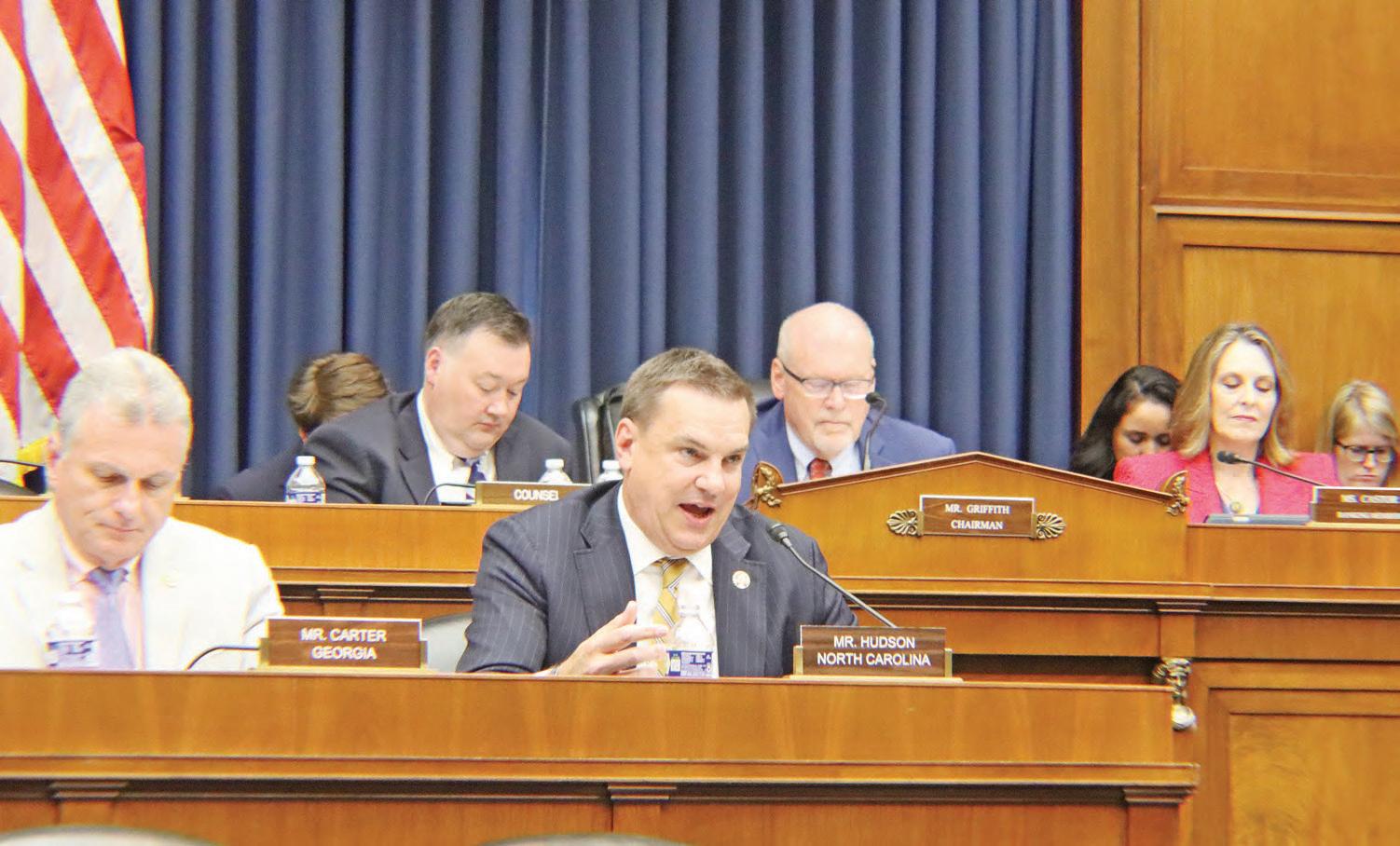
Earlier this year, Hudson joined 15 bipartisan co-sponsors to help introduce the Warrior Call Day Resolution, H. Res. 535, which would designate November 12, 2023, as National Warrior Call Day.
“The outpouring of support for National Warrior Call Day from leading veterans organizations and former VA leaders is incred-
ible as we gain momentum in order to get this resolution across the nish line,” said Hudson in a press release. “Our nation loses too many veterans and service members to suicide every single day. We must address the challenges veterans face head-on, and I encourage folks to check in on someone they know, active-duty or veteran.”
An excerpt of the letter of support states: “Warrior Call is supported broadly, including on bipartisan and bicameral basis in the U.S. Congress (S. Res. 208; H. Res. 535). We are pleased to see continued engagement and communication from policymakers and commit to doing our part to advocate for increased communication with the brave men and
Rock sh Chamber of Commerce holds meeting with NCDOT representative
North State Journal
LAST THURSDAY, the Rock sh Community Chamber of Commerce hosted the North Carolina Department of Transportation (DOT) to discuss three major road projects.
During the meeting, the DOT representatives, Mr. Matthew Kitchens and Mr. Dagoberto Pozos, gave an informative presentation to members of the Rock sh community at the Rock sh Motor Sports & U-Haul located at 2950 Lindsay Road in Raeford.
Topics presented at the meeting included the Gillis Hill Extension (U-5857) and sister project (U-5707), the Wayside Road and Lindsay Road project (U-5753), the signal installation at Rock sh Road and Lindsay Road and any possible Cul-de-sacs.
The Gillis Hill extension right-of-way acquisition is currently anticipated to be completed in 2027. Construction is anticipated to be completed in 2029. The Wayside Road and
Lindsay Road right of way acquisition is underway and almost done, originally anticipated for completion in 2022. Construction is anticipated to be completed in 2026.
The Rock sh Road and Lindsay Road project signal design is currently being wrapped up. A waterline was found, which had to be adjusted. There is a lead time for signal poles that is typically about eight months. The DOT has pre-ordered the signal poles for the Rock sh/Lindsay Road project in an attempt to expedite the process. The project also includes a short turn lane. The signal installation is currently anticipated to start in the early summer of 2024. No businesses will be impacted, and the road will remain open during construction. There are currently no plans to cul-de-sac any roads in the Rock sh area. It was noted that project dates may change. If you have questions or concerns about road construction in your area, please contact the DOT at (910) 944-7621.
women who served this nation.”
The establishment of National Warrior Call Day would encourage all Americans to contact someone who has served or is currently serving, and connect struggling veterans with mental health services. Last Congress, Rep. Hudson joined Senator Thom Tillis (R-NC) to highlight military and veteran suicides and encourage North Carolinians to participate in the national day of action.
The seven former secretaries of Veterans A airs who expressed their support for National Warrior Call Day include Anthony Principi, Jim Nicholson, James Peake, Eric Shinseki, Bob McDonald, David Shulkin and Robert Wilkie.
If you or anyone you know is experiencing thoughts of suicide, please reach out for help immediately.
The Military Crisis Line can be reached by dialing 988 and then Press 1, via chat at www.MilitaryCrisisLine.net, or by texting 838255.
In the event of an emergency, dial 911 or your local emergency number immediately. An emergency is any situation that requires immediate assistance from the police, re department or an ambulance.
To read the full letter of support or see the full list of 29 organizations that expressed their support for National Warrior Call Day, please visit https://hudson. house.gov/.
Hoke County shut out by Seventy First to fall to 2-2
North State Journal
HOKE COUNTY fell to 2-2 on the season after getting shut out in Fayetteville, 38-0, against Seventy First. It’s the third straight year the Bucks have lost to the Falcons and the second time in that span they’ve gotten shut out. It was the most lopsided loss in the series since a 62-0 Seventy First victory in 2017.
The Bucks had no answer for the Falcons’ ground game.
Seventy First ran for 376 yards and four touchdowns. The Falcons were led by running back Donovan Frederick, who carried for 32 and 35 yards on the rst snaps of the day to produce the game’s rst touchdown. He nished with nine rushes for 134 yards. Quarterback Deandre Nance scored on runs of 17 and 90 yards and nished with 10 rushes for 182 yards. He also threw for 91 yards and a touchdown.
Hoke struggled to protect quarterback Brandon Saunders, who was sacked six times. Saunders nished 6-of-9 for 46 yards passing and 18 yards rushing.
Hoke was also led by running back Q’monte Allen, who rushed 15 times for 59 yards.
X’Zavier Stephens-McIntosh
was the top receiver, with four catches for 38 yards. Defensive standouts included defensive tackle Randolph Sanders and Dexter Foster, who ushed the quarterback from the pocket on a third-down play in the red zone, chasing him out of bounds for a sack that limited Seventy First to a eld goal.
Hoke County nishes its non-conference schedule at .500 and will open conference play on Friday at 7:30 with a home game against Laurinburg’s Scotland Fighting Scots, who are 4-0 on the year.
Both teams have played a common opponent in Jack Britt. Hoke County beat the Buccaneers, 7-0, in Fayetteville to open the season. Scotland won, 40-35, at home last week.
Hoke County will be looking to post a second straight win over the Scots. The Bucks won last year, 52-35, to snap a 12year losing streak.
8 5 2017752016 $2.00 THE HOKE COUNTY EDITION OF THE NORTH STATE JOURNAL
VOLUME 8 ISSUE 29 | WEDNESDAY, SEPTEMBER 13, 2023 | HOKE.NORTHSTATEJOURNAL.COM | SUBSCRIBE TODAY: 336-283-6305
FILE IMAGE
Former VA secretaries, leading
U.S. Rep. Richard Hudson (NC-09) speaks at a committee meeting at the U.S. Capitol in Washington, D.C.
Nash, Kimberly Dawn (W/F/37), Probation Violation, 09/11/2023, Hoke County Sheriff’s Office, Wilson, Cleveland Arthur (M/B/60), Probation Violation, 09/11/2023, Hoke County Sheriff’s Office,

Zambrano, Angelica Maria (I/F/29), Assault Minor Present, 09/10/2023, Hoke County




Sheriff’s Office, Vaughn, Scott (W/M/43), Larceny Felony, 09/08/2023, Hoke County Sheriff’s Office, Chase, Andrew Jonathan (W/M/35), DV Protective Order Violation, 09/07/2023, Hoke County Sheriff’s Office, Barton, Charlie (I/M/50), Fugitive From Justice, 09/07/2023, Hoke County Sheriff’s Office, Gomez, Alicia Michelle (W/F/37), Felony Death by Vehicle, 09/06/2023, Hoke County


Sheriff’s Office, Studer, Kenneth Kings (W/M/72), Rape Second Degree, 09/06/2023, Hoke County Sheriff’s Office, Jackson, Raymond Otoole (B/M/28), Possession of Stolen Goods, 09/05/2023, Hoke County Sheriff’s Office, Caldwell, Jesse Robert (W/M/41), Reckless Boating, 09/05/2023, Hoke County Sheriff’s Office,
North State Journal for Wednesday, September 13, 2023 2 WEEKLY FORECAST Neal Robbins Publisher Matt Mercer Editor in Chief Gri n Daughtry Local News Editor Cory Lavalette Sports Editor Frank Hill Senior Opinion Editor Lauren Rose Design Editor Published each Wednesday as part of North State Journal 1201 Edwards Mill Rd. Suite 300 Raleigh, NC 27607 TO SUBSCRIBE: 336-283-6305 HOKE.NORTHSTATEJOURNAL.COM Annual Subscription Price: $100.00 Periodicals Postage Paid at Raleigh, N.C. and at additional mailing o ces. POSTMASTER: Send address changes to: North State Journal 1201 Edwards Mill Rd. Suite 300 Raleigh, NC 27607 WEDNESDAY 9.13.23 “Join the conversation” We stand corrected To report an error or a suspected error, please email: corrections@nsjonline.com with “Correction request” in the subject line. Hoke County Edition of North State Journal www hoke.northstatejournal.com Get in touch A weekly podcast getting to the facts across the state, around the world and at home HERE in Raeford, Hoke County, NC. Hosted by: Ruben Castellon, Hal Nunn and Chris Holland Join Our Facebook Page: The Roundtable Talk Podcast Available on most Platforms
WEEKLY CRIME LOG
you have a birthday, wedding, engagement or other milestone to celebrate? Contact us at celebrations@northstatejournal.com Fine cigars, specialty items, Halloween costumes Come in, receive a gift Open Monday – Saturday, 9 am – 5 pm Clothing, Accessories, Home Decor Downtown beside Romeo’s Salon DiVersion BOUTIQUE Diane Salutare | 109 W Elwood Ave. | Raeford, NC 28376 | 352-321-0628 WEDNESDAY SEPT 13 HI 82° LO 62° PRECIP 37% THURSDAY SEPT 14 HI 79° LO 55° PRECIP 3% FRIDAY SEPT 15 HI 79° LO 55° PRECIP 3% SATURDAY SEPT 16 HI 81° LO 61° PRECIP 5% SUNDAY SEPT 17 HI 79° LO 58° PRECIP 24% MONDAY SEPT 18 HI 81° LO 58° PRECIP 18% TUESDAY SEPT 19 HI 83° LO 59° PRECIP 8%
Do
Neal Robbins, publisher | Frank Hill, senior opinion editor
We will always remember
SEPTEMBER 11TH, 2001 was one of the darkest days in our nation’s history. The images of 9/11 remain ingrained into the collective memory of Americans across our nation. I still remember watching TV when the second airplane crashed into the World Trade Center that morning.
Servicemembers like Rich kept their promise to us, they served honorably, and they deserve the best we have to o er them. That’s not what they’re getting. I will not stop until we make this right— not only for Rich and his family, but for every military family and veteran.
As the representative of the largest Army base in the world, it is among my top priorities to make sure our community’s veterans, troops, and their families get the support they deserve.
What we witnessed in the hours and days that followed were some of the most courageous and heroic acts of good. We saw hundreds of rst responders rush into the smoke and ames of those burning buildings, passing civilians eeing. We heard about the courageous passengers on United Airlines Flight 93 who sacri ced their lives in order to save others. These individuals were, and continue to be, heroes in every sense of the word. May we never forget them and all who have served our nation since.
It is our responsibility as Americans to never forget the tragedy and heroism of 9/11. We continue to honor and support all those most a ected by what took place that day—including the thousands of brave men and women who answered the call to wear our nation’s uniform and defend our freedoms for the past 20 years in order to prevent events like 9/11 from happening again.
As the representative of the largest Army base in the world, it is among my top priorities to make sure our community’s veterans, troops, and their families get the support they deserve. That’s why I was proud to introduce the Healthcare Equality and Rights for our Heroes Act earlier this year to continue my ght to ensure our nation’s service members who are victims of malpractice from a DoD medical treatment facility can receive the compensation they deserve.
Moore County resident Master Sergeant Rich Stayskal is one of those heroes who rst enlisted in the Armed Forces in 2001. He was deployed to Iraq soon after and served our nation honorably. However, while stationed in our region, he received a missed cancer diagnosis that changed his life. In response, I helped change federal law in 2020 so he and other military families could receive support when facing non-combat medical malpractice while on active-duty.
The law that gave hope to Rich Stayskal and hundreds of military families has been outright ignored by the Department of Defense.
How Burning Man became uncool
LAST WEEK, the Burning Man festival — a convocation of large groups of men and women seeking sex, drugs, rock ‘n’ roll and other forms of hedonistic bliss — was ooded. It seems that a half-inch of rain swamped the event, which takes place in the Black Rock Desert in Nevada, turning the dust to deep and sticky mud. The images of barely clad neo-hippies struggling to walk through the muck spread like wild re across the internet; even the White House was forced to acknowledge that it was monitoring the situation.
For a huge swath of Americans, all of this was simply amusing. But the rise and mainstreaming of Burning Man is a far more interesting story than its pathetic possible demise. Burning Man was founded in 1986, when some hippie types gathered at the beach in San Francisco to burn a nine-foot-tall wooden man. Over time, the bon re became larger and larger, until eventually it moved to Nevada, where it has been located ever since. Each year, 100,000 people head out to the middle of the desert to participate in events ranging from impromptu art exhibits to orgies and mass drug use.
The fundamental principles of Burning Man are spelled out in co-founder Larry Harvey’s 10 Principles, written in 2004. These principles construct a paganistic morality built around a bevy of mutually exclusive notions. For example, Burning Man is about “radical inclusion... No prerequisites exist for participation in our community.” But Burning Man is also “devoted to acts of gift giving.” Unfortunately, without some form of mutuality, giving alone cannot form the basis of a functioning society, even temporarily. All of which means that Burning Man features social pressure to ostracize free-riders — a tragic violation of the radical inclusion principle. Burning Man values “radical self-expression,” which cannot be de ned by anyone other “than the individual or a collaborating group.” But such radical self-expression quickly comes into con ict with Burning Man’s call for “civic responsibility,” which surely encroaches on the unlimited right to self-expression. Burning Man also values “immediacy,” which it calls “the most important touchstone of value in our culture.” But Burning Man also calls for the community to “clean up after ourselves,” which runs directly counter to the premise of immediacy.
All of this would be sheer countercultural nonsense, except for
President Ronald Reagan once said, “Freedom is a fragile thing and it’s never more than one generation away from extinction. It is not ours by way of inheritance; it must be fought for and defended constantly by each generation, for it comes only once to a people.”
With that in mind, it is one of my greatest honors to nominate high school students for service academies each year who will go on to join the next generation of brave men and women in uniform. In my time as your Congressman, I am continually awed by the quality of young people who seek these appointments. They are the best among us. The decision to apply to a service academy is a courageous and sel ess one, and I am humbled to be a part of the process.
This year’s deadline to submit a nomination packet to the Southern Pines District O ce is Wednesday, October 11, 2023 by 5:00 PM. If your son or daughter is interested in attending a service academy and receiving a nomination, they need to start during their Junior Year of High School. For more information, call my Southern Pines District O ce at 910-910-1924 or visit our website at hudson. house.gov/services/service-academy-nominations to learn more about the nomination process.
I am deeply grateful to be an American, and incredibly appreciative of those who risk their lives daily to defend our liberties. As your Congressman, I will continue to ght for the important issues facing you and your families and I will always work to support those who have sacri ced so much for this nation.
Richard Hudson is serving his sixth term in the U.S. House and represents North Carolina’s 9th Congressional District. He currently serves as the chairman of the National Republican Congressional Committee and is a member of the House Republican Steering Committee.
one perverse fact: The counterculture has now become the culture. This accounts for the fact that Burning Man now seems tired and played out, less transgressive than wearied. The age of Burning Man attendees has increased over the past decade (average age in 2013 was 32, compared to 37 just nine years later); so has the average income (in 2006, 14% of Burners listed their personal income at above $100,000, compared to 27.4% by 2016). In uencers now show up at Burning Man to sell Popeye’s Spicy Chicken; Elon Musk, Paris Hilton and Mark Zuckerberg have shown up.
And herein lies the problem for the broader American culture. Our elite class used to be inculcated in the same set of baseline values as “normal” Americans: John D. Rockefeller was a regular churchgoer; so was Cornelius Vanderbilt. Today, our elites participate in drug-fueled binges in the desert — or at least wish to appear as though they do. Throughout the 1930s, even the poorest Americans aspired to dress well, wearing suits even on the breadlines. Today, even the richest Americans dress as though they shop at Salvation Army.
When elites promulgate countercultural garbage that eats at the roots of fundamental societal institutions, societal bonds dissolve. Ironically, that dissolution occurs rst at the lowest rungs of the income ladder: As Charles Murray points out, “The belief that being a good American involved behaving in certain kinds of ways, and that the nation itself relied upon a certain kind of people in order to succeed, had begun to fade and has not revived.” In fact, those who live out lives of good decision-making are, all too often, embarrassed of their good choices. To promote those choices might seem “judgmental.”
That is the real tragedy of Burning Man: its mainstreaming. Every society has its oddball behaviors. Only sick societies incentivize their imitation.
Ben Shapiro, 39, is a graduate of UCLA and Harvard Law School, host of “The Ben Shapiro Show,” and co-founder of Daily Wire+. He is a three-time New York Times bestselling author; his latest book is “The Authoritarian Moment: How The Left Weaponized America’s Institutions Against Dissent.”
North State Journal for Wednesday, September 13, 2023 3
OPINION
VISUAL VOICES
COLUMN | U.S. REP. RICHARD HUDSON
COLUMN | BEN SHAPIRO
In uencers now show up at Burning Man to sell Popeye’s Spicy Chicken; Elon Musk, Paris Hilton and Mark Zuckerberg have shown up.
SIDELINE REPORT
COLLEGE FOOTBALL
Oklahoma investigating Briles being on eld
Norman, Okla.
Oklahoma is investigating after disgraced former Baylor coach Art Briles was seen on the eld with his sonin-law, Sooners o ensive coordinator Je Lebby, after Oklahoma’s 28-11 win over SMU. The images of Briles decked in Oklahoma gear on Owen Field drew backlash from Sooners fans on social media. Oklahoma coach Brent Venables said he was made aware of it and said it is “being dealt with.” Baylor red Briles in 2016 after an investigation concluded he and his sta took no action against players named in sexual assault allegations.
MMA Strickland stuns favorite Adesanya at UFC 293
Sydney
American Sean Strickland stunned Nigerian-born New Zealander Israel
Adesanya on Sunday to take the middleweight title by unanimous decision in the main event of UFC 293 in Sydney. The 32-yearold Strickland (28-5), who caused a stir in the lead-up to the ght with sexist and misogynistic comments at a press conference promoting the bout, won a ve-round decision with all three judges scoring it 49-46. Adesanya (24-3) had been the clear favorite to retain the title he won from Alex Pereira at UFC 281 in April.
BASEBALL
Ahead of possible move to MLB,
Japan’s Yamamoto throws 2nd no-hitter
Tokyo
Japanese pitcher Yoshinobu Yamamoto, who could be moving to Major League Baseball next season, pitched the 100th no-hitter in Japanese big league history for the Orix Bu aloes against the Lotte Marines. Yamamoto struck out eight, walked one and hit one batter in the 4-0 victory, extending his scoreless streak to 42 innings. The 25-year-old right-hander is 14-5 with a 1.26 ERA 145 strikeouts and 24 walks in 143 innings this season. It was the second no-hitter for Yamamoto, who threw his rst on June 18 last year.
Reddick takes advantage of late caution to win at Kansas
The 23XI driver advances in the playo s to the Round of 12
The Associated Press KANSAS CITY, Kan. — Every time Tyler Reddick walked into a competition meeting at 23XI Racing and talk turned to Kansas Speedway, it seemed that just about everyone in the room had a win there but him.

There’s co-owner Denny Hamlin, who has won at the track four times, more than anyone else. Kurt Busch, who retired as a driver but remains a consultant for the team. And Bubba Wallace, Reddick’s teammate, who won at Kansas a year ago.
“We joked about that,” admitted Reddick’s crew chief Billy Scott, “that he’s the only one that sits in our debriefs without a win.”
Not anymore. Reddick took advantage of a
late caution and fresh tires to rocket past six others in a twolap sprint to the nish Sunday, and his win at Kansas Speedway punched his ticket to the next round of the NASCAR Cup Series playo s.

Hamlin got a poor jump on the last restart, couldn’t chase Reddick down and nished second. Erik Jones held on for third and Kyle Larson, who won at Darlington to clinch his playo spot a week ago, marched through the eld to nish fourth ahead of Joey Logano.
“Just an outstanding job by this whole 23XI team,” Reddick said. “We had really good pace, we just couldn’t get ahead of Denny there, but chaos ensued. Then the bottom lane opened up there and it was crazy.” Even crazier: It was the third win for the No. 45 car of 23XI in the last four races at Kansas, and all with di erent drivers after Busch and Wal-
lace won last year. Its owner, meanwhile, nearly pulled o the sweep after Hamlin won in the spring.
“I think that myself and this team work really close together,” said Hamlin, who has long driven for Joe Gibbs Racing. “Typically when we run well, they run well, and we’re learning as much from them as they are learning from us. It’s a great partnership and really valuable to have talented guys behind the wheel of fast cars.”
Hamlin was cruising to the win when Chris Buescher blew his right rear tire with about six laps to go. That forced the leaders into the pits, and just about everyone had a di erent tire strategy — Reddick took four fresh tires, even though it shu ed him back to seventh on the restart — to set themselves up for the two-lap nishing sprint.
The win was the second of the season for Reddick and the fth of his career but, more im-
portantly, sends him out of the round of 16 in the playo s for the rst time. The cut-o for the top 12 to advance comes next weekend at Bristol.
“Now they get to go to Bristol and work a strategy that is best for them to win the race, and they don’t really have to worry about nish points,” said Hamlin, who is the leader in points among those yet to advance and in good position to join them.
“Really happy about them putting a whole race together and capitalizing on the late restart,” he said.
It was a tough race for several playo drivers. Wallace and Martin Truex Jr. also blew right rear tires, which has been a problem with the latest generation of car at Kansas, and sustained heavy damage. Wallace was able to continue after repairing a toe link and nished 32nd, but Truex’s day was done after just three laps and he nished last.
North State Journal for Wednesday, September 13, 2023 4 9796 Aberdeen Rd, Aberdeen Store Hours: www.ProvenOutfitters.com 910.637.0500 Blazer 9mm 115gr, FMJ Brass Cased $299/case Magpul PMAGs 10 for $90 Polish Radom AK-47 $649 Smith & Wesson M&P 2.0 Compact $449 Del-Ton M4 $499 Ever wish you had a The Best Prices on Cases of Ammo? The best selection of factory standard capacity magazines? An AWESOME selection of Modern Sporting Weapons from Leading Manufactures Like, Sig, FN, S&W, etc? You Do! All at better than on-line prices? local store which has Flamethrowers & Gatlin Guns? SPORTS
AP PHOTO
Erik Jones (43), Joey Logano (22) and Tyler Reddick (45) head down the front straightaway for the nal lap of Sunday’s NASCAR Cup Series race at Kansas Speedway. Reddick picked up his second win of the season to advance to the playo s’ Round of 12.
Deion makes Colorado epicenter of college football
The new coach has the Bu aloes o to a 2-0 start
The Associated Press BOULDER, Colo. — A year after the Colorado Bu aloes’ only victory came on a disputed touchdown in overtime, Folsom Field is suddenly the epicenter of college football.
Tickets can set fans back more than $400, and Deion Sanders’ guest list never disappoints. For his home coaching debut Saturday, fellow Hall of Famers Michael Irvin, Terrell Owens and Shannon Sharpe were in attendance, along with the Wu-Tang Clan.


With thousands of students itching to storm the eld as the resurgent Bu aloes were putting the nishing touches on their 36-14 drubbing of Ne -
Novak
Djokovic holds up the championship trophy after defeating Daniil Medvedev, in Sunday’s men’s singles nal of the U.S. Open in New York.
braska, Fox announced that its “Big Noon Kicko ” set would remain in Boulder for another week.


Fox originally had planned to pack up and head to Champaign, Illnois, for the Penn State-Illinois matchup. Instead, the network will feature the Rocky Mountain Showdown when the Bu aloes (20) host Colorado State (0-1) on Saturday night.
The Rams-Bu s game isn’t exactly a marquee matchup, but the draw here is Coach Prime and all that he brings to the program, the stadium, the campus and the community.
The Bu aloes, who moved up four spots to No. 18 in the AP Top 25 on Sunday, will be featured by Fox with its early kicko for the third consecutive week.
In Week 1, the set was in Fort
Worth, Texas, where the Buffaloes became the rst Power Five team since 1997 to win its opener as a 20-plus point underdog when they beat last season’s national runner-up, the TCU Horned Frogs, 45-42.
Sanders told the Fox crew before kicko in Week 2 that he slept in his o ce overnight so he could enjoy every bit of his debut at Folsom Field, where the crowd of 53,241 was Colorado’s largest since 2008.
After the game, as Sanders settled into his chair to eld questions from reporters, ESPN announced its “College GameDay” crew would head to Boulder next weekend for the rst time since 1996. Sanders reacted in typically un appable fashion to the dual developments keeping his Bu s the talk of college football for another week.
“At the risk of sounding arrogant, we truly expect that,” he said. “And that’s why those kids come, they want the biggest stage and they’re getting that every darn week. And the numbers justify it.”
The CU-TCU matchup was the most-watched college football game on Sept. 2, with 7.26 million viewers, “and I’m pretty
sure these numbers are going to justify it, as well,” Sanders said of the Nebraska-CU game.
The last time “GameDay” came to Boulder was Sept. 14, 1996, when the fth-ranked Bu aloes lost to No. 11 Michigan 20-13. “GameDay” visited Boulder twice in 1995, the year after ESPN began sending its crew to college campuses.
Djokovic tops Medvedev to win 4th US Open
It is the Serbian’s 24th Grand Slam title
By Jesse Deal North State Journal
NEW YORK — Novak

Djokovic emerged from an exhilarating and exhausting U.S. Open nal with a 24th Grand Slam title on Sunday night, using every ounce of his energy and some serve-and-volley guile to get past Daniil Medvedev 6-3, 7-6 (5), 6-3 in a match that was more closely contested than the straight-set score indicated.
Djokovic, a 36-year-old from Serbia, moved one major singles title in front of Serena Williams to become the rst player to win 24 in the Open era, which began in 1968. Margaret Court also collected a total of 24, but 13 of those came before professionals were admitted to the Slam events.

“I never imagined that I would be here standing with you talking about 24 Slams. I never thought that would be the reality,” Djokovic said. “But the last couple of years, I felt I have a chance, I have a shot for history, and why not grab it if it’s presented?”
There were moments, particularly in the 1-hour, 44-minute second set that was as much about tenacity as talent, when Djokovic appeared to be faltering. After some of the most grueling points — and there were many — he would lean over with hands on knees or use his racket for support or pause to stretch his legs.
This triumph against Medvedev, the opponent who beat him in the 2021 nal at Flushing Meadows to stop a bid for the rst men’s calendar-year Grand Slam in more than a half-century, made Djokovic the oldest male champion at the U.S.
Open in the Open era.
“First of all, Novak, I want to ask: What are you still doing here?” Medvedev joked during the trophy presentation.
Djokovic’s fourth championship in New York, where he was unable to compete a year ago because he isn’t vaccinated against COVID-19, goes alongside his 10 trophies from the Australian Open, seven from Wimbledon and three from the French Open, extending his lead on the men’s Slam list. Rafael Nadal, who has been sidelined since January with a hip problem that required surgery, is next with 22; Roger Federer,
who announced his retirement a year ago, nished with 20.
When it was over, Medvedev tapped Djokovic on the chest as they chatted at the net. Djokovic ung his racket away, put his arms up and then knelt on the court, with his head bowed. And then the celebration was on. First he found his daughter for a hug. His son and wife came next, along with his team.
As good as ever, Djokovic went 27-1 in the sport’s most prestigious events this season: The lone blemish was a loss to Carlos Alcaraz in the nal at Wimbledon in July. Djokovic will rise to No. 1 in the rankings on Monday, overtaking Alcaraz, who was the defending champion at Flushing Meadows but was eliminated by No. 3 Medvedev.
North State Journal for Wednesday, September 13, 2023 5 INDOOR SKYDIVING FOR THE ENTIRE FAMILY 190 Paraclete Dr. Raeford, NC 28376 Call Us: 910.848.2600 INFO@PARACLETEXP.COM WWW.FLYXP.COM
AP PHOTO
AP PHOTO
Colorado coach Deion Sanders, center, is escorted o the eld following the Bu aloes’ win Saturday over Nebraska in Boulder, Colorado.
Nancy Pelosi says she’ll seek House reelection in 2024, dismissing talk of retirement at age 83
The Associated Press
WASHINGTON, D.C. — Former House Speaker Nancy Pelosi on Friday announced she will seek reelection to Congress in 2024 as Democrats try to win back the majority, saying “democracy is at stake.”
Pelosi, 83, made the announcement before volunteers and labor allies in the San Francisco area district she has represented for more than 35 years.
“Now more than ever our City needs us to advance San Francisco values and further our recovery,” Pelosi said in a tweet.
“Our country needs America to show the world that our ag is still there, with liberty and justice for ALL. That is why I am running for reelection — and respectfully ask for your vote.”
Republicans now control the House, but just narrowly, with a 222-212 majority and one vacancy. Democrats believe they have a chance to regain power as President Joe Biden runs for a second term.
Pelosi’s announcement quells any talk of retirement for the long-serving leader, who, with the honori c title of speaker emeritus, remains an in uential lawmaker, pivotal party gure and strong fundraiser for Democrats.

It also unfolds as Washington is grappling with the sunset of a political era as an older generation of leaders, including Biden, 80, face questions about their age. This past week, Senate Re-
publican leader Mitch McConnell, 81, said he would nish his term as leader and senator despite concerns about his recent health episodes.
Pelosi has long charted her own course, from her arrival in Congress as one of few women elected to the House to her tenure as one of the most powerful women in U.S. politics.
In her remarks, Pelosi said others had asked her to say longer, and she said she is also working to ensure a second term for Biden at the White House.
“We have a challenge in our country. Our Democracy is at stake,” she said, according to excerpts released of her remarks.
First elected to Congress in 1987, Pelosi made history by becoming the rst female speaker in 2007, and in 2019 she regained the speaker’s gavel.
Pelosi led the party through substantial legislative achievements, including passage of the A ordable Care Act, as well as turbulent times with two impeachments of Republican President Donald Trump and the Jan. 6, 2021, attack on the U.S. Capitol.
Her announcement comes as House Republicans are preparing to launch an impeachment inquiry into Biden over the business dealings of his son, Hunter.
Pelosi stepped away from the
How to avoid the No. 1 text message scam putting your money at risk
The Associated Press
THE FEDERAL TRADE Commission recently revealed the most reported text message scam: bank impersonations.
Reports of bank impersonations by text in 2022 jumped to 20 times the number reported in 2019. According to the FTC, consumers reported a loss of more than $330 million to text message scams in 2022. And cash that’s lost because of bank fraud or scams isn’t covered by the Federal Deposit Insurance Corp. or National Credit Union Administration.
Banks are a safe place to keep your money, but there are still a few basic but important precautions you can take to ensure you don’t fall for a bank-impersonation text scam. Here’s how to protect your money from text message scams impersonating your nancial institution.
Don’t make money moves under pressure
Text message scammers will try to make you feel like action is required immediately — at the risk of losing your money. It may come as an urgent message warning you to call or click on a link because of alleged suspicious activity.
“Any type of pressure tactic is not legitimate — that is not your bank,” says Paul Benda, senior vice president of operational risk and cybersecurity at the American Bankers Association. As with any decision about your nances, avoid taking actions when you feel scared, stressed out or pressured.
Don’t click on any links from an unsolicited text message
If you receive a text message you’re not expecting, be wary —
especially if it looks like it might be from your bank.
In a recent poll by security experts at Security.org, 66% of respondents said that they had received a suspicious text from someone they didn’t know, and about 20% clicked on links texted from strangers, which is never advisable. “Look at any type of unsolicited communication very cautiously,” says Benda.
Major banks were popular choices for scammers to impersonate in 2022. According to the FTC, the most common scam text messages often claimed to be from large banks, including Bank of America, Wells Fargo, Chase and Citibank.
Don’t call a phone number that’s texted to you
Just as you shouldn’t click on a link texted to you from someone you don’t know, don’t click
day-to-day political limelight after a younger generation of Democrats led by Minority Leader Hakeem Je ries took charge in 2023, but she remains a political force and keeps a robust schedule of public and private events.
According to a person familiar with Pelosi’s thinking about her 2024 decision, Pelosi believes democracy hangs in the balance in the upcoming election as she works to reelect Biden and make Je ries the next House speaker.
Pelosi is among the party’s most proli c fundraisers for the House and key political strategists. She has said she does not intend to hover over the new Democratic House leadership
on or dial a phone number you receive in a text. Instead, nd the o cial phone number for your bank by going to its website or mobile app. Initiate contact with your nancial institution at its o cial phone number to ensure you’re talking to a legitimate representative, and verify whether there actually is an issue.
“Making that phone call can be the di erence between getting scammed versus not getting scammed,” says Tremaine Wills, a nancial advisor and founder of Mind Over Money, a nancial literacy company in Newport News, Virginia. One particular kind of text scam resulted in a median loss of $3,000 in 2022, according to the FTC: a text from someone impersonating your bank, instructing you to reply with a “Yes” or “No” to con rm or deny a suspicious transaction. Once you replied, the scammer would call you under the guise of helping you. Their ultimate goal was to either fraudulently transfer money out of your account or obtain personal information such as a Social Security number.
What to do if you were unable to avoid a scam
If you should happen to fall
team, but she and Je ries are often seen huddling quietly on the House oor.
It’s rare, but not unprecedented, for former party leaders to continue in Congress as members.
Back in California, Pelosi’s decision to seek another term is sure to disappoint other Democrats who have wanted a run for the congressional seat.
But Pelosi has priorities she is trying to secure for her home state and especially San Francisco as the city works to recover from the coronavirus pandemic-era closures that have also dimmed other metro downtowns. San Francisco faces a delicate moment, Pelosi believes, and needs federal resources to continue its recovery, said the person familiar with her thinking, who spoke on the condition of anonymity to discuss the matter.
One of the state’s long-serving leaders, Democratic Sen. Dianne Feinstein, 90, has announced she would not seek another term.
Pelosi has long been portrayed as a political villain by Republican critics, who view her as a far-left liberal and raise vast sums of their own using her image and actions.
Last year, her husband, Paul Pelosi, was seriously injured when an attacker broke into the family’s San Francisco home, seeking the Democratic leader at a highly divisive time in American politics. A trial is expected.
for a text scammer impersonating your bank, there are a few critical steps to take.
First, alert your bank to the incident and get its help in making sure no more money leaves your account fraudulently. Next, report the scam to local law enforcement. Those rst two actions are key for trying to recover any cash that was wrongfully taken from your account.
Finally, le a complaint with the FTC at ReportFraud.ftc.gov and/or report the instance to the Federal Bureau of Investigation’s Internet Crime Complaint Center. The FTC also recommends that you forward suspicious text messages to 7726, which helps wireless providers identify and intercept similar text messages. You can also report and block suspicious text messages within your messaging app.
Having a good idea of your account activity is a key part of protecting your money from scams.
“Have a regular practice of knowing what’s going on with your account,” says Wills. If you’re not completely sure of what’s happening in your account, then you might be more likely to be alarmed by a text message claiming to be from your bank, she says.

North State Journal for Wednesday, September 13, 2023 6 We are happy to discuss your needs or Committed to serving and enriching the lives of every resident Affordable Assisted Living and Memory Care Caring for Seniors Integrity Open Arms Retirement Center 612 Health Drive • Raeford, NC openarmsretirement.com • 910-875-3949
AP PHOTO
Former House Speaker Nancy Pelosi, D-Calif., talks to The Associated Press about her visit to Ukraine a year ago and her time as the Democratic leader in the House, at the Capitol in Washington, D.C., on April 19, 2023.
David Long
June 6, 1949 ~ September 4, 2023
It is with deep sadness that we mourn the loss of David Long, beloved father, grandfather, great-grandfather, brother, uncle, and friend.
David Long “Termite” passed away peacefully at the age of 74 on September 04, 2023.

David was born on June 06, 1949, in Nebraska to the late Asa Long and Verna Alberts.
He leaves to celebrate his life, cherish his love, and recall his memories, his three children, Kenneth Long (Christy), Heather Thompson (David), Heidi Baker (Eddie); nine grandchildren; six great grandchildren; and a multitude of family and friends who love him dearly.




David, aka “Termite” lived in Raeford, NC for many years, and was Hoke County’s oldest teenager. There are many memories, funny stories, pranks, and jokes to be forever cherished. He enjoyed many hobbies such as shing, four wheelers, horseback riding, hunting, and camping. He would spend countless hours talking on his CB radio. Anyone that knew Termite knew the dash between his sunrise and sunset was lived to the fullest.
He never liked to say “goodbye”, for him it was always, “see you later”. So as we release him into the loving arms of Jesus with family and friends that anxiously await him at the gates of Heaven, we say “see you later”.
He loved his family and the many dear friends he had in his life. Termite would not want us to shed tears, but to laugh, love, and live our lives to the fullest.
Per our father’s wishes, he did not want a funeral service. So, in honor of our father, we will have a celebration of life. Details of that will be shared at a later date.



The Long family wishes to acknowledge with deep appreciation the many expressions of love, concern, and kindness shown to us during our time of bereavement. We appreciate each of you.
Charlie Douglas Jr.


March 6, 1949 ~ September 8, 2023
Mr. Charlie Douglas Jr. age, 74 went home to rest with his heavenly father on September 8, 2023. He leaves to cherish his loving memories the love of his life Isabela Maynor; children: Tisa Maynor McMillian, Charles Douglas, Robert Douglas; sisters: Eunice McLean, Al Marie Smith, Verlinda Graham along with a host of other family and friends. Charlie will be greatly missed.
William Chandler
August 25, 1957 ~ September 5, 2023
Mr. William Chandler age, 66 went home to rest with his heavenly father on September 5, 2023. He was preceded in death by his parents Charlie H. Chandler and Annie Mildred Patterson Chandler. He leaves to cherish his loving memories his siblings: Loretta Graham, Lorene Carpenter, Mary A. Chandler, Charles Chandler, Frank Chandler, Allen Chandler along with a host of other family and friends. William will be greatly missed.
David Roy Wallace

December 3, 1953 ~ September 9, 2023
Mr. David Roy Wallace age, 69 transitioned from earth to glory on September 9, 2023. He leaves to cherish his loving memories his children: David Hill, Vinita ShawSimmons; siblings: Annie Carol Wallace, Pauline Davis, Sammy Wallace, Bobby Lee Wallace, John Henry Wallace; aunt, Marjorie Ellis; four grandchildren along with a host of other family and friends. David will be greatly missed.
North State Journal for Wednesday, September 13, 2023 7 obituaries SPONSORED BY CRUMPLER FUNERAL HOME AND CREMATION 131 Harris Avenue • Raeford, NC 28376 1-910-875-4145 crumplerfuneralhome.com AVAILABLE 24/7 • 365 DAYS PER YEAR Crematory On Site 63 YEARS Compassion, Dignity, Respect with Dedicated Professionals Kel Crumpler Kel Crumpler General Manager, South Central Crematory Manager & Certi ed Crematory Operator, Licensed Embalmer, Licensed Funeral Director, Pre-need Counselor Kim Crumpler O ce Manager, Funeral Assistant Robert Capps Funeral Assistant & Certi ed Crematory Operator Eugene Chalaire Funeral Assistant & Certi ed Crematory Operator Krystle Metscher Funeral Director, Embalmer Apprentice, Notary Public & Certi ed Crematory Operator Robbie Carpenter Funeral Assistant & Crematory Assistant Mendel Priest Funeral Assistant Meredith Taylor O ce Assistant Sean Clark Licensed Funeral Director & Certi ed Crematory Operator
Are Here For You In Your Time Of Need Celebrate the life of your loved ones. Submit obituaries and death notices to be published in NSJ at obits@northstatejournal.com
We
STATE & NATION
Biden is widely seen as too old for o ce, an APNORC poll nds. Trump has problems of his own
The Associated Press
WASHINGTON, D.C. — Americans actually agree on something in this time of raw discord: Joe Biden is too old to be an e ective president in a second term. Only a few years his junior, Donald Trump raises strikingly less concern about his age.
But they have plenty of other problems with Trump, who at least for now far outdistances his rivals for the Republican nomination despite his multiple criminal indictments. Never mind his advanced years — if anything, some say, the 77-year-old ought to grow up.
A new poll from The Associated Press-NORC Center for Public A airs Research nds much of the public oddly united in sizing up the one trait Biden cannot change.
The president has taken to raising the age issue himself, with wisecracks, as if trying to relax his audiences about his 80 trips around the sun.
Age discrimination may be banned in the workplace but the president’s employers — the people — aren’t shy about their bias.
In the poll, fully 77% said Biden is too old to be e ective
for four more years. Not only do 89% of Republicans say that, so do 69% of Democrats. That view is held across age groups, not just by young people, though older Democrats speci cally are more supportive of his 2024 bid.
In contrast, about half of U.S. adults say Trump is too old for the o ce, and here the familiar partisan divide emerges — Dem-
ocrats are far more likely to disqualify Trump by age than are Republicans.
What’s clear from the poll is that Americans are saying out with the old and in with the young, or at least younger.
Democrats, Republicans and independents want to sweep a broad broom through the halls of power, imposing age limits on
the presidency, Congress and the Supreme Court. In all about twothirds of U.S. adults back an age ceiling on candidates for president and Congress and a mandatory retirement age for justices.
Speci cally, 67% favor requiring Supreme Court justices to retire by a certain age, 68% support age ceilings for candidates for House and Senate, and 66% support age ceilings for candidates for president.
With elders mostly running the show and the Constitution to contend with, don’t expect that to happen any time soon.
Even so, the survey suggests lots of people across political lines are open to seeing a younger face, a fresher one, or both, capture the public imagination.
The AP-NORC survey went beyond posing questions and presenting choices. It also had a word association exercise, asking people to o er the rst word or phrase that comes to mind at the mention of each man.
The answers underscored how age is a particular drag for Biden across party lines, even when people aren’t prompted to think about that, and how Trump largely escapes that only to draw disdain if not disgust on other
Another twist in the Alex Murdaugh double murder case. Did the clerk tamper with the jury?
The Associated Press COLUMBIA, S.C. — Alex Murdaugh’s double murder case has been full of twists and turns: How did a dog crack the case? Where are the bloody clothes and weapons? And where did all the money Murdaugh is accused of stealing go?
But one of the biggest surprises came last week, six months after Murdaugh was convicted of killing his wife and son.
Murdaugh’s lawyers led court papers saying he deserves a new trial because elected Colleton County Clerk of Court Rebecca Hill allegedly tampered with the jury that found him guilty earlier this year. Prosecutors have 10 days to respond. What is the clerk accused of doing?
Murdaugh’s defense attorneys sum it up in a paragraph of the 65-page appeal.
“She asked jurors about their opinions about Mr. Murdaugh’s guilt or innocence. She instructed them not to believe evidence presented in Mr. Murdaugh’s defense, including his own testimony. She lied to the judge to remove a juror she believed might not vote guilty. And she pressured jurors to reach a guilty verdict quickly so she could prof-
it from it,” they wrote.
Hill is accused of having one-on-one chats with the jury foreperson, sometimes behind closed doors in a bathroom. She allegedly told jurors who smoked they couldn’t take a cigarette break until a verdict was reached. She also gave jurors the business cards of reporters during the trial, according to the defense.
Hill also allegedly told the jury “not to be fooled” by the evidence presented by the defense, to watch Murdaugh closely as he
testi ed and to “look at his actions,” and “look at his movements.” One juror said in a sworn statement that they understood that to mean Murdaugh was guilty.
The clerk also traveled to New York City — she said it was her rst time on a plane — to be with three jurors who gave TV interviews after the trial.
“Clerks are supposed to help get people in the courtroom, organize exhibits, get lunch or answer simple jury questions like
nding the bathroom,” said lawyer John Fishwick Jr., a former U.S. Attorney. “You are never supposed to talk to a jury about the case.”
Murdaugh’s defense has asked the FBI to investigate Hill because South Carolina state agents are too closely connected to the case. The agency has not responded publicly.
Hill has not responded publicly to the allegations.
So what happens now?
Murdaugh’s lawyers said they talked to four jurors whose stories matched and included sworn statements from two of them in their legal lings.
They are asking appeals court judges to order a hearing where all the jurors, Hill and maybe even trial judge Clifton Newman could be required to testify under oath. Attorney Dick Harpootlian said they tried to talk to all jurors, but some were hostile toward his team.
Murdaugh’s lawyers would also be able to subpoena emails and texts. Defense attorney Jim Gri n said there appears to be a group text among jurors since the trial and some wanted to know who was talking to his team.
If a judge decides Hill behaved improperly, Murdaugh’s convic-
fronts.
In those visceral responses, 26% mentioned Biden’s age and an additional 15% used words such as “slow” or “confused.” One Republican thought of “potato.” Among Democrats, Biden’s age was mentioned upfront by 28%. They preferred such terms over “president,” “leader,” “strong” or “capable.” One who approves of his performance nevertheless called him “senile.”
Only 3% in the survey came up with “confused” as the rst descriptor for Trump, and a mere 1% used “old” or the like. Instead, the top words were those like “corrupt” or “crooked” (15%), “bad” and other generally negative terms (11%), words such as “liar” and “dishonest” (8%), along with “good” and other generally positive comments (8%).
Older Democrats are less negative than younger ones on Biden’s decision to run again. In the poll, only 34% of Democrats under 45 want him running for reelection, compared with 54% of those older. Still, about three-quarters of younger Democrats say they’ll at least probably support him if he’s the nominee; others did not commit to that.
tion and life sentence without parole could be tossed out and a new trial ordered.
But chances are he wouldn’t get out of prison. Murdaugh has agreed to plead guilty to federal charges stealing millions of dollars from clients and his family law rm, which will likely mean years or decades behind bars. Why are jurors talking?
Gri n said no one wanted to talk the rst time the defense reached out right after the trial.
Then Hill wrote a self-published book called “Behind the Doors of Justice: The Murdaugh Murders,” which upset some jurors, and they reluctantly began talking to the defense, said Joe McCullough, an attorney hired by the jurors.
Hill’s book discusses how her Christian faith helped her navigate the sudden fame and responsibility that came with the trial. She said she became convinced of Murdaugh’s guilt when jurors and court o cials visited the family home where the shootings happened.
She wrote she was nervous as she prepared to read the verdicts. “I was mostly concerned about Alex being found innocent when I knew in my heart he was guilty,” Hill wrote.
McCullough said both the defense and prosecution should want a full hearing so everything can be known.
Prosecutors have said nothing about the merit of the allegations, adding they would “respond through the legal process at the appropriate time.”
8 North State Journal for Wednesday, September 13, 2023
AP PHOTO
President Donald Trump, left, and Democratic presidential candidate former Vice President Joe Biden during the second and nal presidential debate Oct. 22, 2020, at Belmont University in Nashville, Tenn.
AP PHOTO
Colleton County Clerk of Court Rebecca Hill listens as Prosecutor Creighton Waters makes closing arguments in Alex Murdaugh’s trial for murder at the Colleton County Courthouse on Wednesday, March 1, 2023, in Columbia, S.C.
COUNTY NEWS
NASA awards
$1.3M to WSSU, 2 other NC HBCUs for data science and AI research
Winston-Salem
NASA has awarded $1.3 million to three N.C. HBCUs including Winston-Salem State University for data science and arti cial intelligence research.
The grant, totaling $1.3 million, will facilitate the establishment of the Institute for Advanced Cyberphysical Technologies and Multi-agent Perception (IMPACT) as a collaborative initiative among WSSU, Fayetteville State and North Carolina Central universities.
Over the course of three years, the institute will focus on training, research design and execution, aligning its e orts with two NASA use-cases: one aimed at enhancing life on Earth using AI while the other involves space exploration with robotic agents in the quest for extraterrestrial life.
The grant will provide nancial support to faculty for their summary salary and travel, while o ering tuition and nancial assistance to graduate and undergraduate students as they all foster extensive research capabilities in AI and machine learning systems at WSSU.
TCH STAFF
Forsyth deputy dies in line of duty
Twin City Herald
WINSTON-SALEM — A Forsyth County sheri ’s deputy died following an incident while on patrol on Saturday, Sept. 9.
Deputy Auston Smith Reudelhuber, 32, was driving his patrol vehicle around 5:16 a.m. in Davidson County when he was struck by a box truck. The incident occurred at the 5200 block of N NC Hwy 150. The Davidson County Sheri ’s O ce and multiple local re departments responded to the scene. The deputy was transported to Atrium Health Wake Forest Baptist Hospital where he later succumbed to his injuries.
Reudelhuber joined the Forsyth County Sheri ’s O ce
in March 2021. He previously was employed by the Davidson County Sheri ’s O ce and served six years in the U.S. Army.
“It is with a heavy heart that we share the news of the passing of one of our own. We are asking for prayers for the Reudelhuber family as well as for our FCSO Family. Together we stand and together we will get through this, with the support from our community,” Sheri Bobby Kimbrough said in a statement.
A patrol vehicle to receive cards and notes of support for Reudelhuber’s family has been placed in front of the Forsyth County Detention Center at 201 N. Church St. in Winston-Salem.

The sheri ’s department has also set up a GoFundMe for the family, which has already received around $22,000 as of Monday, Sept. 11. Funeral arrangements for Reudelhuber are pending and will be communicated by the Forsyth County Sheri ’s O ce once nalized.
The driver of the box truck, identi ed as 24-year-old William Benton of Lexington, faces multiple charges in connection with the incident that include misdemeanor death by motor vehicle, reckless driving, and driving left of center, WGHP reported Monday morning.
North Carolina State Highway Patrol continues to investigate, said Sheri Kimbrough.
“It is with a heavy heart that we share the news of the passing of one of our own. We are asking for prayers for the Reudelhuber family as well as for our FCSO Family. Together we stand and together we will get through this, with the support from our community.”
Statement from Sheri Bobby Kimbrough
Carolina Classic Fair promo days announced

Twin City Herald
WINSTON-SALEM — The Carolina Classic Fair — North Carolina’s second-largest agricultural fair — will takes place this year from Sept. 29 through Oct. 8. Ahead of the fair’s opening this month, special promotional days have been announced.
“We have a blockbuster lineup of promotional days this year,” said Carolina Classic Fair Director Cheryle Hartley, “including the Centennial of Smiles 100 minutes of free rides beginning at 3 p.m. on September 29 to celebrate the 100th anniversary of Strates Shows.”
The Carolina Classic Fair will o er a total of six special promotional days.
Opening day is “107.$5 Opening Day” with 107.5 WKZL, one of the Triad’s largest radio stations. Tickets will be just $5 all day.
On Monday, Oct. 2, the fair will host School Day presented by Deer Park Spring Water, powered by iHeartMedia. Individuals bringing three school supplies or more receive free admission and all supplies will be
contributed to Winston-Salem Forsyth County Schools.
Tuesday, Oct. 3 is the fair’s annual Senior Day, with $2 admission and all rides just $2 as well.
Wednesday, Oct. 4 will be Special Ed Day/Can Food Day with Crisis Control Ministry,
Pinnacle, Honda of Winston-Salem. The fair will o er free admission with ve nonperishable food items to bene t Crisis Control Ministry. Admission is also free for persons with disabilities and their aides. Thursday, Oct. 5 is Military
Day/College Day/Night/Thirsty
Thursday, presented by WXII, 107.5 WKZL and Rock 92. The fair will provide free admission for military (with ID) and their immediate family and $5 Admission for college students (with ID).
Finally, Friday, Oct. 6 is Family Fun Day, with children 11 and under admitted free through 6 p.m.
Advance entry tickets, all-inclusive wristbands and parking are available from Ticketmaster or at the Fairgrounds Box Ofce at 414 Deacon Boulevard in Winston-Salem.
Advance ticket sales and on Friday, Sept. 29.
Entry tickets purchased online are subject to a $.80 per ticket fee, and wristbands purchased online are subject to a $1.00 per wristband fee.
8 5 2017752016 $2.00 THE FORSYTH COUNTY EDITION OF THE NORTH STATE JOURNAL
PHOTO COURTESY FORSYTH COUNTY SHERIFF’S OFFICE
A Forsyth County Sheri ’s O ce patrol car is parked in front of the county detention center. Sheri Bobby Kimbrough said the car would remain there to collect letters, notes and cards honoring the life of a deputy who was killed in the line of duty on Saturday, Sept. 9.
VOLUME 5 ISSUE 46 | WEDNESDAY, SEPTEMBER 13, 2023 SUBSCRIBE TODAY: 336-283-6305
How Burning Man became uncool
LAST WEEK, the Burning Man festival — a convocation of large groups of men and women seeking sex, drugs, rock ‘n’ roll and other forms of hedonistic bliss — was ooded. It seems that a halfinch of rain swamped the event, which takes place in the Black Rock Desert in Nevada, turning the dust to deep and sticky mud. The images of barely clad neo-hippies struggling to walk through the muck spread like wild re across the internet; even the White House was forced to acknowledge that it was monitoring the situation.
For a huge swath of Americans, all of this was simply amusing. But the rise and mainstreaming of Burning Man is a far more interesting story than its pathetic possible demise. Burning Man was founded in 1986, when some hippie types gathered at the beach in San Francisco to burn a nine-foot-tall wooden man. Over time, the bon re became larger and larger, until eventually it moved to Nevada, where it has been located ever since. Each year, 100,000 people head out to the middle of the desert to participate in events ranging from impromptu art exhibits to orgies and mass drug use.
The fundamental principles of Burning Man are spelled out in co-founder Larry Harvey’s 10 Principles, written in 2004. These principles construct a paganistic morality built around a bevy of mutually exclusive notions. For example, Burning Man is about “radical inclusion... No prerequisites exist for participation in our community.” But Burning Man is also “devoted to acts of gift giving.” Unfortunately, without some form of mutuality, giving alone cannot form the basis of a functioning society, even temporarily. All of which means that Burning Man features social pressure to ostracize free-riders — a tragic violation of the radical inclusion principle.
Burning Man values “radical self-expression,” which cannot be de ned by anyone other “than the individual or a collaborating group.” But such radical self-expression quickly comes into con ict with Burning Man’s call for “civic responsibility,” which surely encroaches on the unlimited right to self-expression. Burning Man also values “immediacy,” which it calls “the most important touchstone of value in our culture.” But Burning Man also calls for the community to “clean up after ourselves,” which runs directly counter to the premise of immediacy.
All of this would be sheer countercultural
nonsense, except for one perverse fact: The counterculture has now become the culture. This accounts for the fact that Burning Man now seems tired and played out, less transgressive than wearied. The age of Burning Man attendees has increased over the past decade (average age in 2013 was 32, compared to 37 just nine years later); so has the average income (in 2006, 14% of Burners listed their personal income at above $100,000, compared to 27.4% by 2016). In uencers now show up at Burning Man to sell Popeye’s Spicy Chicken; Elon Musk, Paris Hilton and Mark Zuckerberg have shown up.
And herein lies the problem for the broader American culture. Our elite class used to be inculcated in the same set of baseline values as “normal” Americans: John D. Rockefeller was a regular churchgoer; so was Cornelius Vanderbilt. Today, our elites participate in drug-fueled binges in the desert — or at least wish to appear as though they do. Throughout the 1930s, even the poorest Americans aspired to dress well, wearing suits even on the breadlines. Today, even the richest Americans dress as though they shop at Salvation Army. When elites promulgate countercultural garbage that eats at the roots of fundamental societal institutions, societal bonds dissolve. Ironically, that dissolution occurs rst at the lowest rungs of the income ladder: As Charles Murray points out, “The belief that being a good American involved behaving in certain kinds of ways, and that the nation itself relied upon a certain kind of people in order to succeed, had begun to fade and has not revived.” In fact, those who live out lives of good decision-making are, all too often, embarrassed of their good choices. To promote those choices might seem “judgmental.”
That is the real tragedy of Burning Man: its mainstreaming. Every society has its oddball behaviors. Only sick societies incentivize their imitation.
Ben Shapiro, 39, is a graduate of UCLA and Harvard Law School, host of “The Ben Shapiro Show,” and co-founder of Daily Wire+. He is a threetime New York Times bestselling author; his latest book is “The Authoritarian Moment: How The Left Weaponized America’s Institutions Against Dissent.”
Food recalls are common for things like rocks, insects and plastic
The Associated Press
ROCKS IN TRADER JOE’S cookies. Insects in its broccoli-cheese soup. Pieces of plastic in Banquet frozen chicken strips.
In recent weeks, U.S. consumers have seen high-pro le food recalls for an unappetizing reason: They’re contaminated with foreign objects that have no place on a dinner plate. And while no one wants to bite down on stainless steel in peanut butter or bone fragments in smoked sausage, this type of contamination is one of the top reasons for food recalls in the U.S.
Food safety experts and federal agencies use the terms “extraneous” or “foreign” materials to describe things like metal fragments, rubber gaskets and bits of bugs that somehow make it into packaged goods.
“Extraneous materials” triggered nine recalls in 2022 of more than 477,000 pounds of food regulated by the U.S. Department of Agriculture’s Food Safety and Inspection Service — triple the number of recalls tied to food contaminated with toxic E. coli bacteria.
And the size of recalls can reach into the millions: In 2019, USDA reported 34 recalls of more than 16 million pounds of food, spurred in large part by a giant recall of nearly 12 million pounds of Tyson chicken strips tainted with pieces of metal.

Plastic pieces from frayed conveyor belts, wood shards from produce pallets, metal shavings or wire from machinery are all common. So are rocks, sticks and bugs that can make it from the eld to the factory.
Some contamination may even be expected, the FDA ac-

knowledges in a handbook.
“It is economically impractical to grow, harvest or process raw products that are totally free of non-hazardous, naturally occurring, unavoidable defects,” the agency wrote.
Both the USDA and FDA ask companies to promptly notify them when food is potentially contaminated with objects that may harm consumers. The agencies then determine whether recalls are necessary. Most recalls
are voluntary and initiated by the companies, though the agencies can request or mandate the action.
Regulators said the Banquet issue was discovered when someone reported an oral injury after eating chicken strips. ConAgra Brands Inc., which owns Banquet, declined to comment beyond the rm’s news release. Trader Joe’s wouldn’t elaborate on how material got into the foods that led to its recent
recalls.
Detection of unwanted objects has vastly improved in the past several years, said Keith Belk, director of the Center for Meat Safety and Quality at Colorado State University. Large manufacturers use magnets, metal detectors, X-ray devices and other technology to nd unwanted materials in their products.
Still, “they’re going to miss things,” Belk said.
Those things have included pieces of gray nitrile glove that forced the recall of nearly 6,400 pounds of chicken tortilla soup in 2021 and pieces of copper wire that led to recall of nearly 5,800 pounds frozen beef shepherd’s pie in 2022. There are also two notorious examples from 2017: “extraneous golf ball materials” that triggered a recall of frozen hash browns and a dead bat found in bagged salad that led the Centers for Disease Control and Prevention to recommend rabies treatment for two people.
In recent years, rms have become increasingly cautious and are recalling products more frequently than before, said Nathan Mirdamadi, a consultant with Commercial Food Sanitation, which advises the industry about food safety.
That may be because consumers don’t like nding weird things in their food. When they do, lawsuits may follow, experts said.
“It’s never good business to injure your customers,” Mirdamadi added.
Actual contamination may affect only a small amount of product, but rms recall all food produced within a certain window just to be safe. And while some of the food may be able to be “reconditioned” or treated for safety and sold again, “most of the time, it’s going to land lls,” Mirdamadi said.
Consumers who nd foreign materials in food should notify manufacturers, experts said, but also realize that recalls are likely to stick around.
“The thing is, there’s never going to be a day where there’s zero risk associated with consuming a food product,” Belk said.
2 Twin City Herald for Wednesday, September 13, 2023 WEEKLY FORECAST WEDNESDAY SEPT 13 HI 82° LO 62° PRECIP 37% THURSDAY SEPT 14 HI 79° LO 55° PRECIP 3% FRIDAY SEPT 15 HI 79° LO 55° PRECIP 3% SATURDAY SEPT 16 HI 81° LO 61° PRECIP 5% SUNDAY SEPT 17 HI 79° LO 58° PRECIP 24% MONDAY SEPT 18 HI 81° LO 58° PRECIP 18% TUESDAY SEPT 19 HI 83° LO 59° PRECIP 8% www nsjonline.com Get in touch Twin City Herald Twin City Herald Neal Robbins Publisher Matt Mercer Editor in Chief Gri n Daughtry Local News Editor Shawn Krest Editor Cory Lavalette Sports Editor Frank Hill Senior Opinion Editor Lauren Rose Design Editor Published each Wednesday as part of North State Journal 1201 Edwards Mill Rd. Suite 300 Raleigh, NC 27607 TO SUBSCRIBE: 336-283-6305 nsjonline.com Annual Subscription Price: $100.00 Periodicals Postage Paid at Raleigh, N.C. and at additional mailing o ces. POSTMASTER: Send address changes to: North State Journal 1201 Edwards Mill Rd. Suite 300 Raleigh, NC 27607 WEDNESDAY 9.13.23 #264
the conversation”
“Join
COLUMN | BEN SHAPIRO
AP PHOTO
This combination of photos provided by the U.S. Department of Agriculture shows packaging for Banquet Brand Frozen Chicken Strips which was recalled by ConAgra Brands on Sept. 2, 2023, due to possible foreign matter contamination. In recent weeks, U.S. consumers have seen high-pro le headlines about foods recalled for contamination with foreign objects.
In uencers now show up at Burning Man to sell Popeye’s Spicy Chicken; Elon Musk, Paris Hilton and Mark Zuckerberg have shown up.
SPORTS SIDELINE REPORT
COLLEGE FOOTBALL
Oklahoma
investigating Briles being on eld
Norman, Okla. Oklahoma is investigating after disgraced former Baylor coach Art Briles was seen on the eld with his son-in-law, Sooners o ensive coordinator Je Lebby, after Oklahoma’s 28-11 win over SMU. The images of Briles decked in Oklahoma gear on Owen Field drew backlash from Sooners fans on social media. Oklahoma coach Brent Venables said he was made aware of it and said it is “being dealt with.” Baylor red Briles in 2016 after an investigation concluded he and his sta took no action against players named in sexual assault allegations.
MMA Strickland stuns favorite Adesanya at UFC 293
Sydney
American Sean Strickland
stunned Nigerian-born
New Zealander Israel
Adesanya on Sunday to take the middleweight title by unanimous decision in the main event of UFC 293 in Sydney. The 32-yearold Strickland (28-5), who caused a stir in the lead-up to the ght with sexist and misogynistic comments at a press conference promoting the bout, won a ve-round decision with all three judges scoring it 49-46.
Adesanya (24-3) had been the clear favorite to retain the title he won from Alex Pereira at UFC 281 in April.
BASEBALL
Ahead of possible move to MLB, Japan’s Yamamoto throws
2nd no-hitter
Tokyo Japanese pitcher Yoshinobu Yamamoto, who could be moving to Major League Baseball next season, pitched the 100th nohitter in Japanese big league history for the Orix Bu aloes against the Lotte Marines. Yamamoto struck out eight, walked one and hit one batter in the 4-0 victory, extending his scoreless streak to 42 innings. The 25-year-old right-hander is 14-5 with a 1.26 ERA 145 strikeouts and 24 walks in 143 innings this season. It was the second no-hitter for Yamamoto, who threw his rst on June 18 last year.
TENNIS
De Groot wins 12th straight Grand Slam at US Open
New York
Diede de Groot won her 12th straight Grand Slam wheelchair singles title, beating Yui Kamiji on Sunday in the U.S. Open women’s nal. The Dutch star completed her third straight calendar-year Grand Slam, including a Golden Slam in 2021, when she also won the Paralympic gold medal. De Groot has won six straight U.S. Open titles and 20 major singles titles overall. She hasn’t lost a Grand Slam singles match since falling in the French Open semi nals in 2020.
Reddick takes advantage of late caution to win at Kansas
The Associated Press KANSAS CITY, Kan. — Every time Tyler Reddick walked into a competition meeting at 23XI Racing and talk turned to Kansas Speedway, it seemed that just about everyone in the room had a win there but him.
There’s co-owner Denny Hamlin, who has won at the track four times, more than anyone else. Kurt Busch, who retired as a driver but remains a consultant for the team. And Bubba Wallace, Reddick’s teammate, who won at Kansas a year ago.
“We joked about that,” admitted Reddick’s crew chief Billy Scott, “that he’s the only one that sits in our debriefs without
a win.” Not anymore. Reddick took advantage of a late caution and fresh tires to rocket past six others in a twolap sprint to the nish Sunday, and his win at Kansas Speedway punched his ticket to the next round of the NASCAR Cup Series playo s. Hamlin got a poor jump on the last restart, couldn’t chase Reddick down and nished second. Erik Jones held on for third and Kyle Larson, who won at Darlington to clinch his playo spot a week ago, marched through the eld to nish fourth ahead of Joey Logano.
“Just an outstanding job by this whole 23XI team,” Reddick said. “We had really good pace, we just couldn’t get ahead of Denny there, but chaos ensued. Then the bottom lane opened up there and it was crazy.”
Even crazier: It was the third win for the No. 45 car of 23XI in the last four races at Kansas, and all with di erent drivers after Busch and Wallace won last year. Its owner, meanwhile, nearly pulled o the sweep after Hamlin won in the spring.
“I think that myself and this team work really close together,” said Hamlin, who has long driven for Joe Gibbs Racing. “Typically when we run well, they run well, and we’re learning as much from them as they are learning from us. It’s a great partnership and really valuable to have talented guys behind the wheel of fast cars.”
Hamlin was cruising to the win when Chris Buescher blew his right rear tire with about six laps to go. That forced the leaders into the pits, and just about everyone had a di erent tire strategy — Reddick took four fresh tires, even though it shuf-
ed him back to seventh on the restart — to set themselves up for the two-lap nishing sprint.
The win was the second of the season for Reddick and the fth of his career but, more importantly, sends him out of the round of 16 in the playo s for the rst time. The cut-o for the top 12 to advance comes next weekend at Bristol.
“Now they get to go to Bristol and work a strategy that is best for them to win the race, and they don’t really have to worry about nish points,” said Hamlin, who is the leader in points among those yet to advance and in good position to join them.
“Really happy about them putting a whole race together and capitalizing on the late restart,” he said.
It was a tough race for several playo drivers. Wallace and Martin Truex Jr. also blew right rear tires, which has been a problem with the latest generation of car at Kansas, and sustained heavy damage. Wallace was able to continue after repairing a toe link and nished 32nd, but Truex’s day was done after just three laps and he nished last.
Braves retire Andruw Jones’ No. 25 jersey
The Atlanta center elder is waiting to see if Cooperstown will come calling next
The Associated Press
ATLANTA — Andruw Jones, who won 10 Gold Gloves in a career that began with 12 seasons in Atlanta, became the 11th Braves player or manager to have his number retired on Saturday night.
His former teammates hope the honor adds momentum to Jones’ case for induction into the Baseball Hall of Fame.
Jones’ No. 25 was retired before Atlanta’s game Saturday against the Pittsburgh Pirates, and some believe the distinction was overdue. The center elder played his last season in 2012 with the New York Yankees.
Of the 11 Braves who have their number retired, Dale Murphy is the only one not in the Hall of Fame. Jones received the fourth-most votes from the Baseball Writers’ Association of America in the 2023 election, getting picked on 58.1% of the ballots. It was a notable jump from 2022, when he was eighth with 41.4%.
A player must be selected on 75% of the ballots submitted to be enshrined in Cooperstown.
Jones played in Atlanta from 1996-2007, and others from that era to already have their numbers retired include Greg Maddux, John Smoltz, Tom Glavine, Chipper Jones and manager Bobby Cox. Murphy, Glavine and Chipper Jones attended the ceremony. “I played 12 seasons in Atlanta and I only had one manager,
Mr. Bobby Cox,” Andruw Jones said. “Bobby was a father gure who pushed me to become the best player I could be. Without him I would not be here tonight.”
The other Braves players to have their numbers retired are Hank Aaron, Eddie Mathews, Warren Spahn and Phil Niekro.
“To have my number retired
next to Mr. Hank Aaron, No. 44, blows my mind,” Andruw Jones said.
Chipper Jones predicted Andruw Jones soon will join him in the Baseball Hall of Fame.
“Practice your speech tonight because I have a feeling you’re going to be making another one really, really soon in a small town called Cooperstown,” Chipper Jones said.
Andruw Jones was only 19 when he made his major league debut late in the 1996 season. Still a teenager, the rookie became the youngest player to homer in the World Series when he connected twice in Game 1 that year at Yankee Stadium.
He was selected to ve AllStar teams and hit 434 career home runs. His best power season came in 2005, when he hit a franchise-record 51 homers to go with 128 RBIs. He compiled a .254 career batting average and .823 OPS.
Andruw Jones, however, was best known for his defense in center.
“It was unbelievable,” Braves manager Brian Snitker said Saturday. “You see the video of him moving before the ball is hit and things like that. Just such a talented guy, and durable. He was a guy who never came out of the blowouts. He played all the innings of all the games.”
3 Twin City Herald for Wednesday, September 13, 2023
The 23XI driver advances in the playo s to the Round of 12
SPONSORED BY the better part of the ing to earn acceptance stitutions,” Ural said, don’t know what we’re now.” The outbreak has for millions of students, taking virtual tours while also dealing about tuition payments
SPONSORED BY
AP PHOTO
Erik Jones (43), Joey Logano (22) and Tyler Reddick (45) head down the front straightaway for the nal lap of Sunday’s NASCAR Cup Series race at Kansas Speedway. Reddick picked up his second win of the season to advance to the playo s’ Round of 12.
AP PHOTO
Former Braves center elder Andruw Jones waves to the crowd during a ceremony that saw his No. 25 retired by the team.
Biden is widely seen as too old for o ce, an APNORC poll nds. Trump has problems of his own
The Associated Press
WASHINGTON, D.C. — Americans actually agree on something in this time of raw discord: Joe Biden is too old to be an e ective president in a second term. Only a few years his junior, Donald Trump raises strikingly less concern about his age.
But they have plenty of other problems with Trump, who at least for now far outdistances his rivals for the Republican nomination despite his multiple criminal indictments. Never mind his advanced years — if anything, some say, the 77-year-old ought to grow up.
A new poll from The Associated Press-NORC Center for Public A airs Research nds much of the public oddly united in sizing up the one trait Biden cannot change.
The president has taken to raising the age issue himself, with wisecracks, as if trying to relax his audiences about his 80 trips around the sun.
Age discrimination may be banned in the workplace but the president’s employers — the people — aren’t shy about their bias.
In the poll, fully 77% said Biden is too old to be e ective
for four more years. Not only do 89% of Republicans say that, so do 69% of Democrats. That view is held across age groups, not just by young people, though older Democrats speci cally are more supportive of his 2024 bid.
In contrast, about half of U.S. adults say Trump is too old for the o ce, and here the familiar partisan divide emerges — Dem-
ocrats are far more likely to disqualify Trump by age than are Republicans.
What’s clear from the poll is that Americans are saying out with the old and in with the young, or at least younger.
Democrats, Republicans and independents want to sweep a broad broom through the halls of power, imposing age limits on
the presidency, Congress and the Supreme Court. In all about twothirds of U.S. adults back an age ceiling on candidates for president and Congress and a mandatory retirement age for justices.
Speci cally, 67% favor requiring Supreme Court justices to retire by a certain age, 68% support age ceilings for candidates for House and Senate, and 66% support age ceilings for candidates for president.
With elders mostly running the show and the Constitution to contend with, don’t expect that to happen any time soon.
Even so, the survey suggests lots of people across political lines are open to seeing a younger face, a fresher one, or both, capture the public imagination.
The AP-NORC survey went beyond posing questions and presenting choices. It also had a word association exercise, asking people to o er the rst word or phrase that comes to mind at the mention of each man.
The answers underscored how age is a particular drag for Biden across party lines, even when people aren’t prompted to think about that, and how Trump largely escapes that only to draw disdain if not disgust on other
Another twist in the Alex Murdaugh double murder case. Did the clerk tamper with the jury?
The Associated Press COLUMBIA, S.C. — Alex Murdaugh’s double murder case has been full of twists and turns: How did a dog crack the case? Where are the bloody clothes and weapons? And where did all the money Murdaugh is accused of stealing go?
But one of the biggest surprises came last week, six months after Murdaugh was convicted of killing his wife and son.
Murdaugh’s lawyers led court papers saying he deserves a new trial because elected Colleton County Clerk of Court Rebecca Hill allegedly tampered with the jury that found him guilty earlier this year. Prosecutors have 10 days to respond.
What is the clerk accused of doing?
Murdaugh’s defense attorneys sum it up in a paragraph of the 65-page appeal.
“She asked jurors about their opinions about Mr. Murdaugh’s guilt or innocence. She instructed them not to believe evidence presented in Mr. Murdaugh’s defense, including his own testimony. She lied to the judge to remove a juror she believed might not vote guilty. And she pressured jurors to reach a guilty verdict quickly so she could prof-
it from it,” they wrote.
Hill is accused of having one-on-one chats with the jury foreperson, sometimes behind closed doors in a bathroom. She allegedly told jurors who smoked they couldn’t take a cigarette break until a verdict was reached.
She also gave jurors the business cards of reporters during the trial, according to the defense.
Hill also allegedly told the jury “not to be fooled” by the evidence presented by the defense, to watch Murdaugh closely as he
testi ed and to “look at his actions,” and “look at his movements.” One juror said in a sworn statement that they understood that to mean Murdaugh was guilty.
The clerk also traveled to New York City — she said it was her rst time on a plane — to be with three jurors who gave TV interviews after the trial.
“Clerks are supposed to help get people in the courtroom, organize exhibits, get lunch or answer simple jury questions like
nding the bathroom,” said lawyer John Fishwick Jr., a former U.S. Attorney. “You are never supposed to talk to a jury about the case.”
Murdaugh’s defense has asked the FBI to investigate Hill because South Carolina state agents are too closely connected to the case. The agency has not responded publicly.
Hill has not responded publicly to the allegations.
So what happens now?
Murdaugh’s lawyers said they talked to four jurors whose stories matched and included sworn statements from two of them in their legal lings.
They are asking appeals court judges to order a hearing where all the jurors, Hill and maybe even trial judge Clifton Newman could be required to testify under oath. Attorney Dick Harpootlian said they tried to talk to all jurors, but some were hostile toward his team.
Murdaugh’s lawyers would also be able to subpoena emails and texts. Defense attorney Jim Gri n said there appears to be a group text among jurors since the trial and some wanted to know who was talking to his team.
If a judge decides Hill behaved improperly, Murdaugh’s convic-
fronts.
In those visceral responses, 26% mentioned Biden’s age and an additional 15% used words such as “slow” or “confused.” One Republican thought of “potato.” Among Democrats, Biden’s age was mentioned upfront by 28%. They preferred such terms over “president,” “leader,” “strong” or “capable.” One who approves of his performance nevertheless called him “senile.”
Only 3% in the survey came up with “confused” as the rst descriptor for Trump, and a mere 1% used “old” or the like. Instead, the top words were those like “corrupt” or “crooked” (15%), “bad” and other generally negative terms (11%), words such as “liar” and “dishonest” (8%), along with “good” and other generally positive comments (8%).
Older Democrats are less negative than younger ones on Biden’s decision to run again. In the poll, only 34% of Democrats under 45 want him running for reelection, compared with 54% of those older. Still, about three-quarters of younger Democrats say they’ll at least probably support him if he’s the nominee; others did not commit to that.
tion and life sentence without parole could be tossed out and a new trial ordered.
But chances are he wouldn’t get out of prison. Murdaugh has agreed to plead guilty to federal charges stealing millions of dollars from clients and his family law rm, which will likely mean years or decades behind bars.
Why are jurors talking?
Gri n said no one wanted to talk the rst time the defense reached out right after the trial.
Then Hill wrote a self-published book called “Behind the Doors of Justice: The Murdaugh Murders,” which upset some jurors, and they reluctantly began talking to the defense, said Joe McCullough, an attorney hired by the jurors.
Hill’s book discusses how her Christian faith helped her navigate the sudden fame and responsibility that came with the trial. She said she became convinced of Murdaugh’s guilt when jurors and court o cials visited the family home where the shootings happened.
She wrote she was nervous as she prepared to read the verdicts. “I was mostly concerned about Alex being found innocent when I knew in my heart he was guilty,” Hill wrote.
McCullough said both the defense and prosecution should want a full hearing so everything can be known.
Prosecutors have said nothing about the merit of the allegations, adding they would “respond through the legal process at the appropriate time.”
4 Twin City Herald for Wednesday, September 13, 2023
STATE & NATION
AP PHOTO
President Donald Trump, left, and Democratic presidential candidate former Vice President Joe Biden during the second and nal presidential debate Oct. 22, 2020, at Belmont University in Nashville, Tenn.
AP PHOTO
Colleton County Clerk of Court Rebecca Hill listens as Prosecutor Creighton Waters makes closing arguments in Alex Murdaugh’s trial for murder at the Colleton County Courthouse on Wednesday, March 1, 2023, in Columbia, S.C.
MOORE COUNTY
Pinehurst #10 gets opening date
The New Pinehurst #10 course designed by Tom Doak has an opening date: April 3, 2024. Pinehurst’s 10th golf course, the rst in almost three decades, has generated excitement from golf fans around the world.

COUNTY NEWS
Randolph EMC’s PHP Board announces community grant winners
Last week, Randolph EMC’s People Helping People (PHP) Board of Directors announced awards totaling $20,000 in community grants to bene t charitable nonpro ts in the company’s ve-county service area.
“For nine years, People Helping People has given back to communities in Randolph, Chatham, Moore, Montgomery and Alamance Counties through the Sharing Success grant program,” said REMC Communications and Public
A airs Manager Nicole Arnold in a press release. The board of directors for PHP awards grants that contribute to one or more three focus areas: the health and well-being of individuals, nancial support for incomechallenged families or educational advancement through enriching learning opportunities. The board chose 19 recipient organizations, all of whom were considered to demonstrate a mission aligning with these goals, including Habitat for Humanity of Randolph County, Union Taylors Community Action Center, Operation Red Sleigh, West Chatham Food Pantry, Jordan Memorial UMC, Sandhills Coalition, Randolph County Family Crisis Center, Communities in Schools of Montgomery County, Sandhills Student Assistance, Randolph Senior Adults Association, Mt. Gilead Food Pantry, Our Daily Bread Kitchen, Robbins Area Christian Ministries, Friend to Friend, Chatham Literacy Council, Arts Council of Moore County, Spirit Horse Ranch Education Center, Partners for Children and Families, and Montgomery Community College Foundation. To learn more about each program funded by this initiative, please visit https://randolphemc.com/.
Former VA secretaries, leading veteran organizations express support for Hudson’s bipartisan Warrior Call Day Resolution
North State Journal
WASHINGTON, D.C. – Last Friday, U.S. Representative Richard Hudson (R-NC) recognized the recent statement of support from 29 veterans organizations and seven former secretaries of the U.S. Department of Veterans A airs for National Warrior Call Day.
Earlier this year, Hudson joined 15 bipartisan co-sponsors to help introduce the Warrior Call Day Resolution, H. Res. 535, which would designate November 12, 2023, as National Warrior Call Day.
“The outpouring of support for National Warrior Call Day from leading veterans organizations and former VA leaders is incred-
ible as we gain momentum in order to get this resolution across the nish line,” said Hudson in a press release. “Our nation loses too many veterans and service members to suicide every single day. We must address the challenges veterans face head-on, and I encourage folks to check in on someone they know, active-duty or veteran.”
An excerpt of the letter of support states: “Warrior Call is supported broadly, including on bipartisan and bicameral basis in the U.S. Congress (S. Res. 208; H. Res. 535). We are pleased to see continued engagement and communication from policymakers and commit to doing our part to advocate for increased communication with the brave men and
women who served this nation.”
The establishment of National Warrior Call Day would encourage all Americans to contact someone who has served or is currently serving, and connect struggling veterans with mental health services. Last Congress, Rep. Hudson joined Senator Thom Tillis (R-NC) to highlight military and veteran suicides and encourage North Carolinians to participate in the national day of action.
The seven former secretaries of Veterans A airs who expressed their support for National Warrior Call Day include Anthony Principi, Jim Nicholson, James Peake, Eric Shinseki, Bob McDonald, David Shulkin and Robert Wilkie.
If you or anyone you know is experiencing thoughts of suicide, please reach out for help immediately.
The Military Crisis Line can be reached by dialing 988 and then Press 1, via chat at www.MilitaryCrisisLine.net, or by texting 838255.
In the event of an emergency, dial 911 or your local emergency number immediately. An emergency is any situation that requires immediate assistance from the police, re department or an ambulance.
To read the full letter of support or see the full list of 29 organizations that expressed their support for National Warrior Call Day, please visit https://hudson. house.gov/.
Seagrove Library celebrates 50th anniversary
 By Chuck Thompson North State Journal
SEAGROVE — The Seagrove Public Library celebrated its 50th anniversary on Saturday, Sept. 9, with a fanfare of live music, hotdogs, and fond memories.
The event, which originally was going to be held outside, had to be moved into the library as some one hundred people showed up to express their support and gratitude for the occasion.
The Southwestern High School Choir opened the ceremony, singing “Down to the River to Pray” before continuing with several other songs.
Ra e tickets and t-shirts were available for purchase during the event, along with complimentary hot dogs and drinks for everyone in attendance.
“ This community is very supportive; it’s unbelievable,” said Sue Spencer, a long-time library worker, “There’s every age and all types of people represented here. It’s wonderful.
The Seagrove Library rst opened On May 11, 1973, in the
Seagrove Grange Hall, located just south of the school on Old Plank Road. Some 60 volunteers worked tirelessly to make it happen, with Sarah Auman (Mrs. Hubert) being named the rst Seagrove Librarian.
Supported by the Seagrove community of just 354 people at the time, eventually, the County took over operations of the li-
brary in 1973. In 2004, The Randolph Board of Commissioners approved a $750,000 budget for a new library location and building. On Oct. 10, 2005, the new Seagrove Library opened at its present location.
“There’s so much to do at a library,” said Director of Randolph County Libraries, Ross
Holt, “and we’re just delighted to celebrate Seagrove’s 50th anniversary.”
“It’s really hard for me to believe that it’s been 18 since we’ve opened this location,” said Richard Wells, a long-time major supporter of the library, “and everyone seems to really enjoy the Seagrove Library, and they use it. We’re just really thankful.”
Branch Librarian for the Seagrove Library, Charity Neave Johnson, said, “It’s really nice to hear from supporters and former employees and volunteers. I’m looking forward to the next fty years of the Seagrove Library. We’re here for the community every day. Everyone is welcome to call, stop by, check out a book, or ask a question. We’re here to serve.”
The Seagrove Library is located at 530 Old Plank Rd, Seagrove.
8 5 2017752016 $2.00 THE MOORE COUNTY EDITION OF THE NORTH STATE JOURNAL
PJ WARD-BROWN | NORTH STATE JOURNAL
Rain didn’t damper the 50th Annaversity of the Seagrove Library in Seagrove, on September 9, 2023.
VOLUME 8 ISSUE 29 | WEDNESDAY, SEPTEMBER 13, 2023 | MOORE.NORTHSTATEJOURNAL.COM | SUBSCRIBE TODAY: 336-283-6305
PHOTO VIA PINEHURST RESORT
Pinecrest moves to 4-0, while Union Pines struggles
TWO MOORE COUNTY teams were in action week four, splitting their games. While North Moore took an early bye week, Pinecrest moved to 4-0, while Union Pines fell to 1-3.
Pinecrest 35, New Hanover
3: Pinecrest nished o a clean sweep of its non-conference schedule, winning its fourth straight of the year, 35-3, at home against New Hanover. It’s the rst 4-0 start to a season for the Patriots since 2019.
Three Pinecrest quarterbacks threw touchdown passes, led by Mason Konen, who was 16-of-22 for 207 yards with two scoring strikes. Cody Hansen and Jaylin Morgan each threw for a touchdown as well. Zymire Spencer led the way rushing, with 97 yards and a touchdown. The Patriots now have a week o to enjoy their undefeated mark before they open conference play following their bye with a game at Richmond.
Randleman 47, Union Pines 6: At Cameron, Edison Hernandez ran for 121 yards and two touchdowns and Day-
PREP FOOTBALL — WEEK 5
Friday Sept. 15, 7:30 PM, Union Pines Vikings (1-3) at Lee County Yellow Jackets (3-1) *Conference Game*
Friday Sept. 15, 7:30 PM, North Moore Mustangs (2-1, 1-0) at Southeast Alamance Stallions (1-3,1-1)
Bye Week: Pinecrest Patriots (4-1), next Sept. 22 at Richmond Raiders *Conference Game*
lan Atkins rushed for two touchdowns in Randleman’s, 47-6 road win at Union Pines.
Tyshaun Goldston made ve catches for 109 yards and a touchdown for the Tigers (4-0).
Amari Ferdna caught a 23-yard touchdown. Christian McLeod kicked a 36-yard eld goal to open the scoring before Union Pines (1-3) held a 6-3 lead.
G oldston’s 79-yard reception put Randleman ahead to stay. Atkins had two touchdown 1-yard touchdown runs. Micah Thurston ran 13 yards for a touchdown. Hernandez, who carried 20 times, scored from 3 yards out.
John Kirkpatrick completed 13 of 21 throws for 185 yards with two touchdowns and an interception.
For Union Pines, quarterback Anthony Goswick found Ethan Biggs for a 35-yard touchdown pass for the only score on the day for the Vikings, giving Union Pines a 6-3 lead.
Harley Moyer had the big play on defense, recovering a fumble in the rst quarter to preserve the early lead.
Union Pines closed its non-conference slate with a 1-3 record. The Vikings now open conference play with a road game at Lee County on Friday. The Vikings have not beaten Lee County since they became conference rivals in 2013, losing their 10 matchups by an average score of 49-6. The Vikings haven’t scored against the Yellow Jackets since 2020, losing the last two by 59-0 and 42-0 scores.
North Moore gets back into action after a bye week last Friday. The Mustangs (2-1, 1-0 in conference) travel to Southeast Alamance. The Stallions are 1-3, 1-1 in conference.
Here’s a quick look at what’s coming up in Moore County:
Sept. 14
Trivia Thursday at the Brewery
6pm
Come out for Trivia at the Southern Pines Brewery!
Enjoy fun and prizes each Thursday. Southern Pines Brewing Company is located at 565 Air Tool Dr., Southern Pines, NC.
Thursday Night Music Bingo
7pm
Come out to James Creek Cider House for Music Bingo with Lauren! James Creek is located at 172 US Hwy 1 Bus. in Cameron. A food truck will be on site at 8!

Sept. 15
Carthage Farmers Market
2pm – 6pm
Come out and support your local farmers at the brand-new farmers market in Carthage! The market features fresh produce, meats, eggs, and handmade goods! The market will be set up on S. Ray Street in the parking lot across from the post o ce.
Sept. 16
Moore County Farmers Market
8am – 12pm
Enjoy the Moore County Farmers Market at the Downtown Park, which is located at 145 SE Broad Street in Southern Pines! Buy local and fresh seasonal produce and products every Saturday morning from 8am until 12pm!
Sandhills Farmers Market
10am – 1pm
Come out for the Sandhills Farmers Market in the heart of the Village of Pinehurst! The market features many wonderful farms, nurseries, bakeries, meat and egg providers, cheesemakers, and specialty food producers in the area.
North State Journal for Wednesday, September 13, 2023 2 Neal Robbins Publisher Matt Mercer Editor in Chief Gri n Daughtry Local News Editor Cory Lavalette Sports Editor Frank Hill Senior Opinion Editor Lauren Rose Design Editor Published each Wednesday as part of North State Journal 1201 Edwards Mill Rd. Suite 300 Raleigh, NC 27607 TO SUBSCRIBE: 336-283-6305 MOORE.NORTHSTATEJOURNAL.COM Annual Subscription Price: $100.00 Periodicals Postage Paid at Raleigh, N.C. and at additional mailing o ces. POSTMASTER: Send address changes to: North State Journal 1201 Edwards Mill Rd. Suite 300 Raleigh, NC 27607 WEDNESDAY 9.13.23 “Join the conversation” TUNE INTO WEEB 990 AM 104.1 and 97.3 FM Sundays 1 - 2PM The John and Maureen show
moore happening MOORE CITIZENS FOR FREEDOM MOORE COUNTY Remember that we live in the best country, the best state, and by far the best county. MOORE COUNTY, WHAT A GREAT PLACE TO LIVE! 9796 Aberdeen Rd, Aberdeen Store Hours: www.ProvenOutfitters.com 910.637.0500 Blazer 9mm 115gr, FMJ Brass Cased $299/case Magpul PMAGs 10 for $90 Polish Radom AK-47 $649 Smith & Wesson M&P 2.0 Compact $449 Del-Ton M4 $499 Ever wish you had a The Best Prices on Cases of Ammo? The best selection of factory standard capacity magazines? An AWESOME selection of Modern Sporting Weapons from Leading Manufactures Like, Sig, FN, S&W, etc? You Do! All at better than on-line prices? local store which has Flamethrowers & Gatlin Guns? KEY, KENNETH SCOTT, 52, W, M, 9/12/2023, Moore County Sheriff’s Office, Resisting Public Officer, IV-D Non-Support Child, $3,500 Secured RAWLINGS, JEDADIAH DOUGLAS, 36, W, M, 9/11/2023, Moore County Sheriff’s Office, Possess Methamphetamine, Felony Possession of Cocaine, PWIMSD Cocaine, Felony Possession Marijuana, PWIMSD Marijuana, Possess Drug Paraphernalia, Possess Marijuana Paraphernalia, $75,000 Secured MABE, JESSE DEE, 39, W, M, 9/11/2023, Moore County Sheriff’s Office, Traffick in Methamphetamine (x2), PMSD Methamphetamine, Possess Drug Paraphernalia, $600,000 Secured GRACE, JAMES HERNEY, 22, B, M, 9/11/2023, Southern Pines PD, Attempted First Degree Murder (x2), AWDWITK Inflicting Serious Injury (x2), Break or Enter with Intent to Terrorize or Injure Occupant (x3), Discharge Firearm in City, $1,000,000 Secured BOWERS, BRANDON SCOTT, 40, W, M, 9/11/2023, Aberdeen PD, Possess Schedule I CS, Obtain CS by Prescription Misrepresent/Withhold, Simple Possession Schedule IV CS, Resisting Public Officer, Unauthorized Use of Motor Vehicle, $25,400 Secured PELL, JACOB CALEB, 25, B, M, 9/10/2023, Southern Pines PD, Second Degree Forcible Rape, Resisting Public Officer, $251,000 Secured MONTENERY, MONICA LEE, 52, W, F, 9/10/2023, Moore County Sheriff’s Office, Violate Domestic Violence Protection Order, $10,000 Secured MARTINEZ, SANTOS, 21, H, M, 9/8/2023, Moore County Sheriff’s Office, Violate Domestic Violence Protection Order, $15,000 Secured CRIME LOG North State Journal
OPINION
Neal Robbins, publisher | Frank Hill, senior opinion editor

COLUMN | U.S. REP. RICHARD HUDSON
We will always remember
SEPTEMBER 11TH, 2001 was one of the darkest days in our nation’s history. The images of 9/11 remain ingrained into the collective memory of Americans across our nation. I still remember watching TV when the second airplane crashed into the World Trade Center that morning.
Servicemembers like Rich kept their promise to us, they served honorably, and they deserve the best we have to o er them. That’s not what they’re getting. I will not stop until we make this right— not only for Rich and his family, but for every military family and veteran.
As the representative of the largest Army base in the world, it is among my top priorities to make sure our community’s veterans, troops, and their families get the support they deserve.
What we witnessed in the hours and days that followed were some of the most courageous and heroic acts of good. We saw hundreds of rst responders rush into the smoke and ames of those burning buildings, passing civilians eeing. We heard about the courageous passengers on United Airlines Flight 93 who sacri ced their lives in order to save others. These individuals were, and continue to be, heroes in every sense of the word. May we never forget them and all who have served our nation since.
It is our responsibility as Americans to never forget the tragedy and heroism of 9/11. We continue to honor and support all those most a ected by what took place that day—including the thousands of brave men and women who answered the call to wear our nation’s uniform and defend our freedoms for the past 20 years in order to prevent events like 9/11 from happening again.
As the representative of the largest Army base in the world, it is among my top priorities to make sure our community’s veterans, troops, and their families get the support they deserve. That’s why I was proud to introduce the Healthcare Equality and Rights for our Heroes Act earlier this year to continue my ght to ensure our nation’s service members who are victims of malpractice from a DoD medical treatment facility can receive the compensation they deserve.
Moore County resident Master Sergeant Rich Stayskal is one of those heroes who rst enlisted in the Armed Forces in 2001. He was deployed to Iraq soon after and served our nation honorably. However, while stationed in our region, he received a missed cancer diagnosis that changed his life. In response, I helped change federal law in 2020 so he and other military families could receive support when facing non-combat medical malpractice while on active-duty.
The law that gave hope to Rich Stayskal and hundreds of military families has been outright ignored by the Department of Defense.
Heck no, casinos can go
In the end only the house wins, and the state and everyone else loses nancially.
THE NORTH CAROLINA LEGISLATURE, with Republican supermajorities, has failed to come up with a new state budget, because Senator Philip Berger, among others, wants casinos included in it. It has been reported that Senate and House leaders are proposing casinos to be developed in Anson, Nash, and Rockingham counties.
I don’t know about you, but I don’t recall the GOP asking us to give them a supermajority so we can open casinos in our state. This is fiscally and socially irresponsible. North Carolina should pass a budget without new casino sites included.
Expanding Casino sites is fiscally irresponsible. The main driver behind the casinos is the misconstrued idea that it would be a financial windfall for the state. Tourists have several options to gamble these days, including Cherokee and now online sport gambling in the state. The math of the additional people coming to North Carolina to spend money is simply over-exaggerated by the gambling industry. Also, when anyone spends money on one activity, they elect to not spend it on another. So, it is likely that our beautiful mountains, sandy beaches and other wonderful and positive socially beneficial activities will see a corresponding decrease in spending and a reduction in tax revenue.
In the end only the house wins, and the state and everyone else loses financially.
Conservative republicans regularly point out the fact that strong families create strong community. Gambling destroys the social fabric of communities. Those who are most vulnerable are the ones typically hurt. We know that gambling issues, such as gambling addiction, drug and alcohol abuse tear apart the family. Therefore, gambling would increase the cost to North Carolina citizens related to the effect of having broken homes. According to the National Center for Missing and Exploited
President Ronald Reagan once said, “Freedom is a fragile thing and it’s never more than one generation away from extinction. It is not ours by way of inheritance; it must be fought for and defended constantly by each generation, for it comes only once to a people.”
With that in mind, it is one of my greatest honors to nominate high school students for service academies each year who will go on to join the next generation of brave men and women in uniform. In my time as your Congressman, I am continually awed by the quality of young people who seek these appointments. They are the best among us. The decision to apply to a service academy is a courageous and sel ess one, and I am humbled to be a part of the process.
This year’s deadline to submit a nomination packet to the Southern Pines District O ce is Wednesday, October 11, 2023 by 5:00 PM. If your son or daughter is interested in attending a service academy and receiving a nomination, they need to start during their Junior Year of High School. For more information, call my Southern Pines District O ce at 910-910-1924 or visit our website at hudson. house.gov/services/service-academy-nominations to learn more about the nomination process.
I am deeply grateful to be an American, and incredibly appreciative of those who risk their lives daily to defend our liberties. As your Congressman, I will continue to ght for the important issues facing you and your families and I will always work to support those who have sacri ced so much for this nation.
Richard Hudson is serving his sixth term in the U.S. House and represents North Carolina’s 9th Congressional District. He currently serves as the chairman of the National Republican Congressional Committee and is a member of the House Republican Steering Committee.
Children nearly 100,000 U.S. Children are victims of sex trafficking each year. The I95 corridor is already known as a hot zone for transporting these victims. Planting a casino in North Carolina will just enhance these risks to innocent children.
We should leave sin to sin cities such as Las Vegas and not import more of it to our state. According to research by Tiina Latvala, Tomi Lintonen & Anne Konu published in 2019 titled “Public health effects of gambling – debate on a conceptual model“: Thus, studies have mostly ignored social impacts, choosing to measure only the economic costs or benefits that are quite easily quantifiable. This approach, however, presents a very biased view of the situation.”
Certainly, gambling can be a form of entertainment, but that isn’t the only thing it brings to the communities which embrace it. City, County and State social services are strained to keep up with the new demand for services due to the negative effects of addictive gambling. The alleged financial gain is gone when you consider the services the state would end up providing related to drug, alcohol and gambling issues that will increase with the increased availability of gambling. Have the legislators considered that this will likely increase drunk driving? That means innocent deaths from drunk driving will increase.
When all this is considered one can only say, “Heck no, Casinos can go” and they should be dropped from the budget discussions. If Republicans want to run on expanding casinos and all the negative consequences they bring, they should do so in the next election and let the voters decide if we want to send them back in to power to expand casino options in our state.
If they won’t run on it, why let it hold up our state budget?
Robert Bortins lives in Moore County
North State Journal for Wednesday, September 13, 2023 3 happening
VISUAL VOICES
COLUMN | ROBERT BORTINS
Kiyoe Smith
February 26, 1936 ~ September 4, 2023
Kiyoe Smith, 87, of Pinehurst, NC passed away on September 4, 2023 due to complications from a stroke.
Kiyoe was born in Fukuoka, Japan but called Elizabethtown, in New York’s Adirondack Mountains, home for 35 years.

Similarly, when her grandson was born in 2004, she left the comfort and stability of her long-time home to do anything and everything to help her hardworking daughter and son-inlaw raise her grandson, rst in Washington state and later in Virginia.
A gifted artisan, she shared her love with family and friends by sewing, knitting, crocheting, and especially cooking until 9 years ago when Lewy Body Dementia stole those gifts from her. Her beloved husband, Frederick E. Smith preceded her in death in 2002.
She leaves behind many loved ones to include her daughter, Honi Smith; son-in-law Glenn Lemons, granddaughter, Brittney Calais (Danny), grandson, Jacob Lemons and great grandson Liam Calais.
Catherine Loraine Burnham
May 2, 1943 - September 9, 2023
Catherine Loraine Burnham, 80 of Carthage, passed on Saturday, September 9th 2023 at the FirstHealth Hospice House in Pinehurst.
Mrs. Burnham was born May 2, 1943 in New York. She was a loving grandmother who cared deeply for her grandchildren.
She was preceded in death by her husband Corvin James Burnham; her son, James “Jimmy” Corvin; and her brother, Bob Reevey.
She is survived by her daughter Tina Marsh and husband Tracy of Carthage; and her granddaughters, Alexa and Ashley Marsh.
Eugena “Joanne” Barshis
August 30, 1929 - September 8, 2023
Eugena “Joanne” Barshis, age 94, of Pinehurst, NC passed away at FirstHealth Hospice House on September 8, 2023, with her daughter by her side. We were blessed to have the family together for a wonderful 94th birthday celebration last week.
She was born in Elwood, Indiana, August 30, 1929 to Wayne Eugene Fisher and Lucille Dalton Fisher.
Joanne is survived by her daughter, Debra Kidd and her husband Ronald of Carthage; her son, Dave Parker of North Granby, CT; Grandchildren Ashley Matthews and her husband Derrick, Christine Southern and her husband Tyler; Charlie, Jesse and Zac Parker and great grandchild Emma Jane Matthews. Additionally, four step sons; Donald, David, Darr and Dean Barshis. Joanne was preceded in death by her parents; husbands, Joseph Wren Parker, Edward B. Barshis and sister, Beverly Magers.
Delores Elaine New
March 22, 1944 - September 4, 2023
Gerald Dean Beevers
October 10, 1933 - September 8, 2023

Gerald Dean Beevers, Jr., 89, of West End, NC passed away peacefully on Friday, September 8, 2023 at his residence.
He was born October 10, 1933 in Stueben County, OH to the late Gerald Dean Beevers, Sr., and the late Elizabeth Rose Figg Beevers.
Gerald is survived by his children, Lois Scott, Steve Beevers (Debra), Melody Boyce and Cassandra Benedict, 16 grandchildren, 25 greatgrandchildren, 5 great-greatgrandchildren, and his beloved Shih Tzu- poodle, Sassy V.
In addition to his parents, he was preceded in death by his loving wife, Lois Jane (Petre) Beevers, in February 2019, and his sister, Judy Beevers Limpf.

Delores Elaine New, age 79, of Southern Pines, NC passed away at FirstHealth Moore Regional Hospital on September 4, 2023. Elaine was born in Moore County, NC March 22, 1944 to Johnnie B. Short Sr. and Fannie Frye Short. Elaine enjoyed gardening. She was involved in the Eastern Stars and was an amazing cook. Above all Elaine loved to spend time with her family. She cherished time with her grandchildren, who called her “BoBo.”


Elaine is survived by her children, Greg Morris, Lisa (Redell) Locklear and Teri (Steve) Jacobs; siblings, Sandra (Warren) McCrimmon, Jack Short, Mike (Betsy) Short and Leonard Short; grandchildren, Gabe Morris, Ethan Morris, Isabela Dumont, Mary Walter, Nikita Strother, Becca Roberts, Davey Roberts, Jessica Jacobs, Jenna Brill, Jake Jacobs, John Jacobs, numerous great grandchildren, nieces and nephews. Elaine was preceded in death by her parents; brother, Johnnie B. Short Jr.; sister, Helen S Allen; nephews, Robert E Allen, Jr, David E. Allen, Je rey Scott Allen, Gary Wayne Short and John Todd McCrimmon.

Raymond Nelson Freeman, III
June 17, 1992 - September 2, 2023
Raymond Nelson Freeman III., age 31, of Eagle Springs, NC passed away at his home on September 2, 2023. Raymond was born in Pinehurst, NC June 17, 1992 to Raymond Nelson Freeman Jr. and Vickie Bennett Freeman.

Raymond is survived by his parents, Raymond and Vickie Freeman of Eagle Springs, NC; siblings, Phillip Todd Bennett of Eagle Springs, NC, Chauncey Wayne Freeman of West Virginia, Victoria RayAnn Deaton of Candor, NC; ancé, Amber Masha Ellis of West End, NC; paternal grandfather, Raymond Nelson Freeman Sr.; paternal grandmother Mable Steele Luther of Eagle Springs, NC; his beloved dog, Lizzie; numerous aunts, uncles, cousins, nieces and nephews.
Donald Walter Wood eld
November 24, 1941 - September 3, 2023
Donald Walter Wood eld, 81, passed away peacefully on Sunday, September 3, 2023 surrounded by his loving family at the First Health Hospice House in West End, NC. Don was born on November 24, 1941 in Bu alo, NY to Arlene and Spencer Wood eld, the 8th of 14 children. He grew up in Bemus Point, NY. Shortly after high school he joined the Air Force where he discovered his love of teaching. He served proudly in the Vietnam War and after 8 years, decided to leave military service. He had a short career as an accountant before eventually pursuing his true calling of becoming a teacher. He completed his undergraduate degree in Physical Education at SUNY Brockport in 1981 and then moved to North Carolina to get his Master’s degree in Teaching at UNC Greensboro. He is survived by his loving wife and best friend of 53 years Ann Seawall Wood eld; his son Don, Jr. and wife Kim; his son Ed and wife Vonda; his daughter Marcia; and his daughter and son-in-law Lisa and Steve Eaton; his nine grandchildren, Kristy, Molly, Tasha, Nick, Jessica, Rex, Rose, Sierra, Olivia; his six great grandchildren, Loralai, Donovan, Cayla, Balin, Isabella, Addison; his two sisters Mary Wood eld and Joann Brown (Jack); and seven brothers, Tom, Jim (Lorraine), Dick (Shirley), Dave (Kim), Terry (Cindy), John (Janet), Dan (Ann); brother and sister-in-law Andy and Kay Yost; a multitude of adored nieces and nephews; and his beloved dog Peanut.
He is preceded in death by his parents Arlene and Spencer; his sisters Gen Mauro and Janet Johnson; his brothers Spence, Jr. and Mike.
Enid J. Smith
July 31, 1935 - September 6, 2023
Enid J. Smith, 88, passed in the early hours of Wednesday, 6 September 2023, following her nal confrontation with cancer. She was born 31 July 1935 in Norfolk, Virginia to the late Alice Thelma Tarte and the late Andrew Charles Tarte II. Her formative youth was in Detroit, Michigan; her teenage and early adult years in the suburbs of Miami, Florida.
Having been widowed with three small children during the early years of the Vietnam con ict, Enid undertook many jobs ranging from aid to Steny Hoyer at the Maryland State Senate in Annapolis, Maryland; to o cer on the Prince Georges County Sheri ’s Department; to O ce Manager with the Driggs Corporation, Development and Construction. With an increasing awareness of the value of political participation, she ran for the Maryland House of Delegates in 1978. She was a breast cancer survivor from the late 1970’s. Miss Enid is much remembered for puttering around town in her thirty-yearold Jeep.
Enid is survived by three sons, Stephen, Patrick, and Kenneth; ve grandchildren: Hillary, William, Andrew, Jayden, and Madison. In addition, she is survived by one great-granddaughter Callisto. She bids her friends fond farewell and joins her husband Capt. Leon Boyd Smith II, USAF; her brother Andrew Charles Tarte III; and her parents beyond the veil.

4 North State Journal for Wednesday, September 13, 2023 obituaries SPONSORED BY BOLES FUNERAL HOMES & CREMATORY Locations in: Southern Pines (910) 692-6262 | Pinehurst (910) 235-0366 | Seven Lakes (910) 673-7300 www.bolesfuneralhome.com Email: md@bolesfuneralhome.com CONTACT @BolesFuneralHomes Celebrate the life of your loved ones. Submit obituaries and death notices to be published in NSJ at obits@northstatejournal.com
