People to Know
Dr. Nadia Saint-Louis, Principal North Little Rock High School & Center of Excellence saintlouisn@nlrsd.org
Academy of Health, Human Services, & Law
Mika Bishop, Assistant Principal bishopm@nlrsd.org
Brandon Kirkwood, Dean kirkwoodb@nlrsd.org
Center of Excellence
Pecoyla McFadden, Assistant Principal mcfaddenp@nlrsd.og
Brad Kilbury, Dean kilburyb@nlrsd.org
Freshman Academy
Jerrick House, Assistant Principal housej@nlrsd.org
Brock Moore, Dean moorechr@nlrsd.org
Counselors
Caleb Austin austinc@nlrsd.org
Academy of Business, Hospitality, & Development
Jasmin Davis davisjas@nlrsd.org
Center of Excellence
Tyler Ford fordt@nlrsd.org
Freshman Adademy
Academy of Digital, Visual, & Performing Arts
Susie Brunson , Assistant Principal brunsons@nlrsd.org
Ashley Hull, Dean hulla@nlrsd.org
Academy of Business, Hospitality, & Development
Sylvia Grady, Assistant Principal gradys@nlrsd.org
Anne Haynie, Dean hayniea@nlrsd.org
Senior Academy
Steve Orobona, Assistant Principal orobonas@nlrsd.org
Nathan Clayborn, Dean claybornn@nlrsd.org
Shandria Gordon gordons@nlrsd.org
Academy of DIgital, Visual, & Performing Arts
Jamie Joyner joynerja@nlrsd.org
Academy of Health, Human Services, & Law
Gwen Leger legerg@nlrsd.org
Senior Academy
Table of Contents
People to Know
General Graduation Requirements
General Scheduling Information
Academic Honors
Community Service Learning Overview
Arkansas Scholars
Grading Scale
Course Levels Explained
Advanced Placement
AP Capstone Diploma Program
4 Year Course Plan
Concurrent Credit
UAPTC Career Institute
Academies Overview
NLRHS Academies
COE Adademies
NLRHS Academy of Health, Human Services, & Law
NLRHS Academy of Digital, Visual, & Performing Arts
NLRHS Academy of Business, Hospitality, & Development
NLRHS S.O.A.R Academy
AVID
COE Academy of Health Sciences
COE Academy of Engineering, Technology, & Computer Science
Language Arts
Language Arts Electives
Mathematics
Science
Social Studies
Fine Arts
Music - Band & Choir
Theatre - Drama, Cosutme, Makeup, Dance, & Technical Theatre
Art - Drawing, Painting, & Sculpture
Foreign Language
Physical Education & Health
Communication Career & Technical
Local Credit Courses
Advanced Programs
English for Speakers of Other Languages
Creidt
Community
General Graduation Requirements
Class of 2027 - 2030
orth Little Rock High School graduates must earn a minimum of twenty-three (23) credits; credits are earned at the rate of 0.5 credits per class per semester. Twenty-two (22) credits must be academic classes. Changes to grade level only occur at the end of an academic year.
See page 6 for the specific honor graduate designations and the requirements of each.
AR Act 480 requires students to complete a course with personal finance standards. AR Act 478 requires all students to pass the Civics Exam prior to graduation.
General Scheduling Information
Course Cancellations
Courses listed in this guide are the identified courses the district high school offers to students for the coming school year. After students make their course requests, some courses may be canceled if there are insufficient requests.
Summer School
Students contacted by their guidance counselor regarding summer school attendance will be expected to attend. Dates and location for summer school will be announced.
Grade Weighting
Required by the Standards for Accreditation of Arkansas Public Schools as adopted in December 2003, weighted credit for Advanced Placement courses will be contingent upon the student successfully completing the full year of the course and taking the applicable AP exam.
Career Focus
The Arkansas Standards for Accreditation requires public school graduates to earn 6 units in a career focus area based on the student’s contemplated work aspirations. A variety of courses can qualify for this designation including English, math, science, and social studies courses.
“Local Credit Only” Enrollment Limit
Non-Academic Credit Activity courses cannot be used to satisfy the 22 units of credit required for graduation by the State of Arkansas. Because District requirements exceed State requirements, some non-academic courses can be used to meet the District requirements of 23 units. Only one unit of credit may be taken/earned per year in non-academic activity courses and these grades are not calculated in the GPA.
Early Graduation
Students who choose to graduate early are also choosing to forgo all or part of their senior year. Therefore, early graduates are ineligible for senior activities with the exception of honor societies and the graduation ceremony. Additionally, due to space limitations, early graduates must enroll and pass Freshman Composition I to earn their 4th required English credit.
Graduation Participation
Seniors must earn all 23 required graduation credits by the date of graduation to be eligible to participate in the commencement ceremony. Additionally, all financial obligations to the district must be satisfied before a diploma is awarded. Students and parents are required to sign a graduation contract prior to participation in the graduation ceremony.
Eligibility to Participate in Interscholastic Competition
(Band, Speech & Drama, Athletics, Choir, Spirit Groups, JROTC, Workforce Education Student Organizations)
Participation is governed by the rules of the Arkansas Activities Association (AAA). AAA regulations state that students in grades 10-12 must pass four subjects and attain a 2.0 GPA. “Students passing four subjects but failing to meet the 2.0 GPA requirement must be enrolled in and attending 100 minutes per week in a Supplemental Instruction Program (SIP) in order to be eligible to participate. Students in the SIP will have one semester to improve their GPA a minimum of one tenth of a point (.1) to maintain eligibility for a second consecutive semester”. Students in 9th grade are eligible if they successfully passed four academic courses the previous semester, three of which shall be in the core curriculum areas (math, science, English, social studies). Ninth grade students must pass four academic classes to be eligible the second semester of the 9th grade year, and must meet senior high academic eligibility by the end of the second semester of 9th grade in order to play in the fall of the 10th grade year. See your coach or counselor for more information concerning eligibility.
North Little Rock Academy
North Little Rock Academy is the district’s Alternative Learning Environment (ALE) which services North Little Middle and North Little Rock High schools. The program is designed to serve the needs of students having difficulty performing in the regular school environment. Student placement at The Academy must meet Arkansas Department of Education guidelines for Alternative Education and must be referred by the student’s school of attendance. Students referred must go through the NLRSD’s Case Review Committee to determine placement. Not all students recommended for placement to The Academy are placed (due to not meeting placement criteria). Placement at The Academy is based on a referral process and students/parents may not choose to transfer to The Academy. Students being referred for placement at North Little Rock Academy will continue to attend their home school until the committee determines placement and the appropriate time for transition.
Academic Honors
Honors High Honors
• Pass 2 Advanced Placement/Concurrent Credit Courses
• 3.5 Cumulative GPA
• 28 Total Academic Credits
• All other current requirements
• Pass 4 Advanced Placement/Concurrent Credit Courses
• 3.75 Cumulative GPA
• 28 Total Academic Credits
• All other current requirements
Honors with Distinction Arkansas Dept of Education Diploma Seal
• Pass 6 Advanced Placement/Concurrent Credit Courses
• 4.0 Cumulative GPA
• 28 Total Academic Credits
• All other current requirements
Requires a 2.75 GPA in the core curriculum.
Cumulative GPA shall be derived from all courses taken for high school credit.
Determined at the end of 8 semesters.
Determined at the end of 8 semesters.
Determined at the end of 8 semesters.
Determined at the end of 8 semesters.
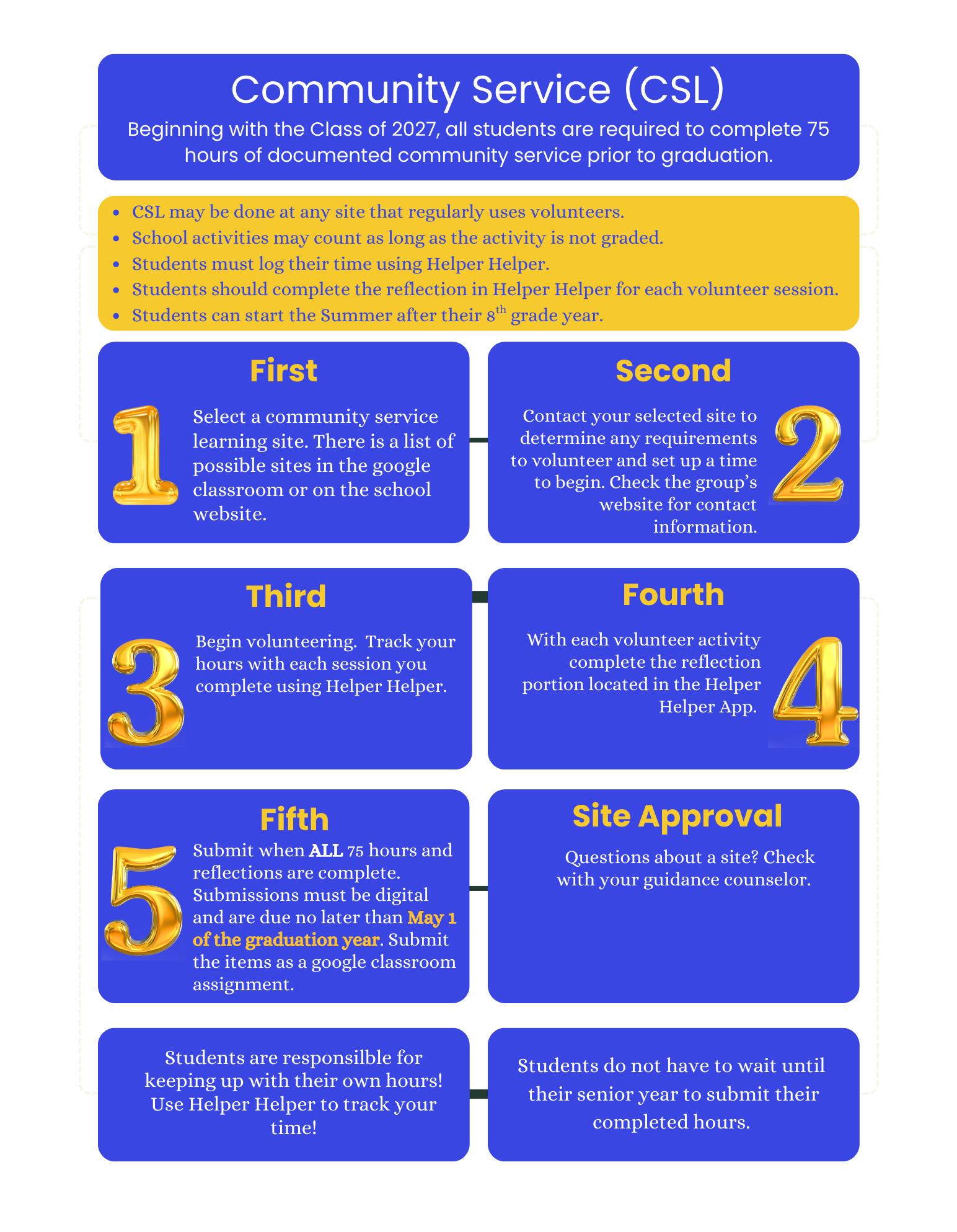
Community Service Learning
• A method whereby students learn and develop through active participation in thoughtfully organized service that is conducted in and meets the needs of communities;
• All eligible community service learning activities or programs must include preparation, action, and reflection components;
• An approach to teaching and learning in which students use academic knowledge and skills to address genuine community needs;
• A way to help foster civic responsibility;
• Is more than just volunteering - activities must benefit the community in some way.
• Act 648 states that “a student who has completed a minimum of seventy-five (75) clock hours of documented community service in grades nine (9) through twelve (12), at any certified service agency or a part of a service-learning school program shall be eligible to receive one (1) academic credit that may be applied toward graduation."
A thorough explanation of Community Service can be found HERE.
Arkansas Scholars™
A program of the Arkansas Business and Education Alliance
Local business leaders want you to do well in school. Many businesses have agreed to recognize the achievement of Arkansas Scholars™ status as a symbol of high quality education. If you, as a student, meet the Arkansas Scholars™ criteria over the next four years (grades 9-12), you will be designated as an Arkansas Scholar™. Business leaders will hold an event for you and your parents at the end of your senior year. An Arkansas Scholars™ seal will be placed on the transcript. The Arkansas Scholars™ seal improves your chances for employment and may result in some financial assistance for college since many Arkansas colleges give scholarships to Arkansas Scholars™.
Grading Scale
Grading Scale
On-level, Pre-AP & Concurrent Classes
Course Levels Explained
What level of instruction is right for you in preparing for your future?
On Level– Course instruction is designed for students who are seeking a high school diploma or beyond. Rigor and pacing of instruction is geared toward the completion of state standards.
Pre-AP Courses®– Designed for students who desire more challenge and want to cover material at a faster pace so they are more prepared for the college experience. Teachers have higher expectations of the quality of student work so grading guidelines are more rigorous. These courses prepare students academically for AP courses at the next level. Summer work will be required for most courses.
AP® (Advanced Placement®) Courses - Advanced Placement (AP) is a program of college-level courses offered at North Little Rock High School, and many other high schools across the country. Courses are available in many subject areas, including English, history, languages, math, psychology, art, and science. The focus is not on memorizing facts and figures. It’s on engaging discussions, approaching and solving problems together and learning to write well. You’ll get to study fascinating topics and ideas. The purpose of these courses is to prepare students to pass the AP Exam in May and to expose them to college-level work. Students will also be scored with weighted credit when they complete the course and take the exam (on a 5 point scale). Summer work will be required for most courses. Refer to pages 9 and 10 for additional information about Advanced Placement and AP Capstone.
Advanced Placement
AP® (Advanced Placement®) Courses - Advanced Placement (AP) is a program of college-level courses offered at NLRHS and COE, and many other high schools across the country. Courses are available in many subject areas, including English, history, languages, math, psychology, art, and science. The focus is not on memorizing facts and figures. It's about engaging in discussions, approaching and solving problems together and learning to write well. You'll get to study fascinating topics and ideas. The purpose of these courses is to prepare students to pass the AP Exam in May and to expose them to college-level work. Students will also be scored with weighted credit when they complete the course and take the exam (on a 5 point scale). Summer work will be required for most courses.
Benefits of taking AP courses at NLRHS and COE
● Be challenged. Advanced Placement classes are rigorous and demanding, offering an intellectual stimulation that students will not get in regular high school courses.
● Earn College Credits by taking AP courses and scoring successfully on the related AP Exam. The AP Exams are currently paid for by the state of Arkansas (if the students complete the corresponding course). If the student makes a qualifying score on the AP exam, they will earn from 3 to 6 hours of college credit (at most colleges and universities around the US and 40 other countries).
● Save money. This credit would have come at no cost to the student who passes the exam, since NLRHS provides the college text and instructor, and the state pays the exam fee. This can save students (and parents) upward from $1000 per course in college. Additionally, students with AP experience and credits are more likely to graduate from college in four years. Extra semesters (or years) at college can put a heavy financial burden on families.
● Improve college admissions chances. AP classes will raise the “wow” factor of a student’s high school record. If a student does well in an AP class, it’s a signal to admissions counselors that he or she is ready for the pressures of college study.
● Arrive at college better prepared. AP classes sharpen students’ writing skills, teach them how to think critically, and improve their problem-solving abilities. AP students learn to navigate the academic expectations they’ll encounter in college courses.
● Win scholarships. AP courses and exam scores help students qualify for scholarships. According to The College Board, 31 percent of colleges and universities look at AP experience when making scholarship decisions.
Who should take an AP class?
The Advanced Placement experience is rewarding. Before choosing to enroll your child in an AP course, consider these factors:
● Your child’s past performance in the subject area. If a student has always excelled at science, AP Chemistry may be a great idea. On the other hand, if he or she tends to struggle in math, AP Calculus might be too much of an ordeal
● Your child’s skills. AP courses in the humanities—English, history, philosophy, etc.—require heavy amounts of reading and writing. Is your student prepared for long, difficult reading assignments, multiple essays, and in-depth research papers?
● Your child’s schedule. A student who plays sports year-round, holds leadership positions in one or more extracurricular activities, and/or has a part-time job may find it difficult to meet the sizable obligations of an AP class.
● Your child’s GPA. No student should take an AP course if it’s likely to lower his or her overall GPA. College admissions officers want to see students taking challenging courses, but they also want to see strong grades. If your child is worried about maintaining decent grades in an AP course, it might be wise to stay with a college bound course.
AP Capstone Diploma Program
Diploma Program Focuses on College-Level Research, Collaboration, and Presentation Skills Crucial for College and Career Success
North Little Rock High School is one of approximately 1,800 schools worldwide to implement the AP Capstone™ Diploma program―an innovative program that allows students to develop the skills that matter most for college success, such as research, collaboration, and communication. The program consists of two courses taken in sequence: AP® Seminar and AP Research.
Students who score a 3 or higher in AP Seminar and AP Research and on four additional AP Exams of their choosing earn the AP Capstone Diploma™. This signifies outstanding academic achievement and attainment of college-level academic and research skills. Students who score a 3 or higher in both AP Seminar and AP Research (but not on four additional AP Exams) earn the AP Seminar and Research Certificate™.
Students who are interested in the AP Capstone Program need to fill out an application at the time of enrollment. For questions, please contact Sara Rozzell at rozzells@nlrsd.org
AP Seminar
Grades 10-12
Prerequisite: Successful completion of advanced Pre/AP course(s) is recommended. This is a rigorous course taught at the college level. In AP Seminar, students choose and evaluate complex topics through multiple lenses; identify credibility and bias in sources; and develop arguments in support of a recommendation. AP Seminar is a project-based learning course. Official AP Seminar assessments include research reports, written arguments, and presentations completed during the academic year.
AP Research Grades 11-12
Prerequisite: Successful completion of AP Seminar is required
In the AP Research course, students design, execute, present, and defend a yearlong research-based investigation on a topic of individual interest. They build on skills developed in AP Seminar by learning how to understand research methodology; employ ethical research practices; and collect, analyze, and synthesize information to contribute to academic research. Like AP Seminar, AP Research is a project-based course. Each student’s official AP Research score is based on their academic paper, presentation, and oral defense.
Notes/Questions:
4 Year Course Plan
Concurrent Credit
Concurrent enrollment courses offer students the opportunity to familiarize themselves with the rigor of college courses and to earn college credit while still in high school. Some of the concurrent will fulfill specific graduation requirements as well.
Currently, we offer concurrent credit courses through U of A-Pulaski Technical College.
Possible UAPTC Offerings**
• Freshman Comp I
• Freshman Comp II
• Introduction to Visual Art
• Physical Science
• College Algebra
• College Trig
• Mathematical Reasoning
• Cultural Anthropolgy
• Intro to Criminal Justice
• Accounting I
All juniors will have the opportunity to take an ACT in March.
UAPTC Career Institute
UA - Pulaski Tech is a postsecondary institution and is the host site of UA-PTC Career Institute. UA-PTC is proud and honored to host an institute that provides Arkansas students with the opportunity to earn job skills and career preparation that lead to gainful employment after graduation. These programs offer high school juniors and seniors the opportunity to earn college credit while still in school. Programs are funded by the local school districts, so there is no cost to the student or their families to participate. These hands-on training programs can be the start of a high-paying career or lay the foundation for future higher education.
Programs of Study
Health Information Technology - designed to provide foundational knowledge of the duties and responsibilities of managing patient medical records. Students will be introduced to the language of medicine and common pathological condition of the organ systems and treatment. Students have the opportunity to earn a certificate of proficiency.
CNA (Certified Nursing Assistant) - designed to focus on safe and effective student performance in the health-care setting. Emphasis is placed on specific knowledge, skills, and attitudes related to the Nursing Assistant duties as well as concepts pertaining to the psychosocial aspects of care giving. Students have the opportunity to earn a certificate of proficiency, CPR, and First Aid certifications.
Welding - designed according to American Welding Society guidelines, includes instruction in different welding processes, joint design, and various mettallurgical apsects of metal composition. Students have the opportunity to earn a certificate of proficiency and American Welding Society (AWS) D1.1 Structural Coed 3g.
HVACR - develop the knowledge and skills necessary for employment with heating and air contractors, service companies, or self-employment. Students have the opportunity to earn a certificate of proficiency and EPA 608 Universal = Core + I + II + III.
Cybersecurity - designed for students interested in monitoring, securing, and analyzing data net networks and cybersecurity operations centers. Students have the opportunity to earn a certificate of proficiency, A+ certification (Information Technology), Security + certification (Cybersecurity), CCNA certification (Networking).
Advanced Manufacturing - Tailored for aspiring advanced manufacturing professionals, this program combines technical expertise in electrical and industrial systems with essential skills in communication, critical thinking, teamwork, and hands-on experience in cutting-edge labs. Earn a certificate of proficiency
In order to participate in the UAPTC Career Institute students must meet ALL of the following criteria:
• Classified as a junior or senior
• 2.0 cumulative GPA or higher
• Qualifying ACT, ACT Aspire, or ACCUPLACER score
• Full battery of test scores that includes reading, English/writing, and mathematics even if the chosen course does not require a score in that area
Test Score
Medical Professions & Cybersecurity
ACT: 19 on English, Reading, & Math
ACT Aspire: 426 reading, 435 writing, 429 math
ACCUPLACER: 253 in reading, 261 in writing, 256 in math
Welding, HVACR, & Advanced Manufacturing
ACT: 13 in reading
ACT Aspire: 415 in reading
ACCUPLACER: 226 in reading
Academies
Academies are designed to prepare students for both college and careers. They are schools within schools that link students with peers, teachers, and community partners in a structured environment that fosters academic success.
The academy concept has three key elements:

A small learning community (SLC)
A college-prep sequential curriculum with a career theme
An advisory board that forges partnerships with employers, higher education institutions, and the community Teams of teachers (grades 9–12 or 10–12) work across several academic and technical subjects, group students in cohorts for these classes, and follow a program of study. Students also have the opportunity to be exposed to academic subjects to the career and college field and deliver work-based learning experiences (e.g., shadowing, community service, mentoring, internships, and apprenticeships).
Sequence
All 9th grade students begin in the Freshman Academy. A Freshman Academy is a small learning community in which a group of administrators and teachers works exclusively with ninth graders to create a personalized school within a school that is responsive to their academic and social needs.
The core components of Freshman Academy include the following:
A ninth-grade administrator or administrative team that oversees the academy
Designated space in a separate part of the high school
Faculty assigned to teach ninth grade students
During their ninth grade year, students will select a career pathway that they will follow for the next three years. Beginning with the Class of 2026, students will be required to complete all classes in their chosen pathway.
Each Academy has an Academy Assistant Principal and a School Counselor that will support students.
Sample 4 year schedule for a student completing their pathway. Classes marked with ** can be taken at various times between sophomore and seniors year.
Elective
Elective
NLRHS - Academies
Academy of Health, Human Services, & Law
Pathways:
Pre-Educator
Healthcare Services: Pharmacy Science
Nutrition Science & Dietetics Criminal Justice
Healthcare Services: Public Health
Academy of Digital, Visual, & Performing Arts
Pathways:
Performing Arts
Advertising & Graphic Design
Fashion and Interior Design
Media Creation
Academy of Business, Hospitality, & Development
Pathways:
Banking
Construction
JROTC
Computer Science: Software
Entrepreneurship Development
S.O.A.R. Academy
Scholarly Opportunities for Advanced Readiness
Pathway:
AP Capstone Diploma Candidate
Minimum of 9 Advanced Placement classes
Required to take the PSAT twice Participation in enrichment activity or program
COE - Academies
Academy of Health Sciences
Pathways:
Biomedical Services
Sports Medicine
Healthcare Services: CNA
Healthcare Services: Emergency Services
Academy of Engineering, Technology, & Computer Science
Pathways:
Advanced Manufacturing Pre-Engineering
Computer Science: Robotics & Animation
NLRHS - Academy of Health, Human Services, & Law
Pre-Educator Courses
Introduction to Education
Grade 10
Introduction to Education is designed with the intent to prepare high school students to become prospective Arkansas teachers. Students in this course will study the foundations of American education including important historical moments and Acts, professional behavior, student needs and diversity, instructional methods, communication strategies for all stakeholders, and reflective practices to support learning. Students will collaborate with an Arkansas teacher to actively participate in classroom observations and field experience opportunities.
Education Technology
Grade 11
Education Technology is a project-based course that introduces students to the role of technology in the classroom. Students will explore various technologies being used as digital learning tools in multiple modes of learning including online, face-to-face, and hybrid classroom environments. This course will expose students to the skills and strategies needed to integrate technology into the classroom, develop methods of digital communication and collaboration, support practices for digital citizenship, and reflect on their own performance in a digital environment. Students are expected to gain field experience by completing classroom observations, both online and face-to-face, with a licensed Arkansas teacher and to complete an initial Google certification to become a Google certified Educator. This course requires 25 hours of field experience; partnering universities and local schools may have additional requirements.
Child Growth and Development
Grade 12
Child Growth and Development explores human growth and development starting from the prenatal stages and going through adolescent maturation. The course content deals with in-depth theories, practices, trends, and environmental factors that influence the development of children and adolescents, including family dynamics and the role of a child educator. Students are expected to complete field work and observations with a licensed Arkansas teacher in order to observe and record the learning behaviors and dynamics of children in a classroom. This course requires up to 25 hours of practicum for the Pre-Educator Program of Study. The Human and Social Services Program of Study does not require the practicum hours.
Healthcare Services: Pharmacy Tech OR Public Health
Introduction to Health Care
Grade 10
This course is designed to introduce students to medical professions and the basic foundational skills for first aid and the treatment of patients.
Medical Terminology
Grade 11
This course builds skills in pronouncing, spelling, and defining new words encountered in verbal and written information. Students have the opportunity to acquire skills in interpreting medical records and communications accurately and logically. Emphasis is on forming a foundation for a medical vocabulary including meaning, spelling, and pronunciation. Medical abbreviations, signs, and symbols are included.
Pharmacy Science
Grade 12
This program focuses on broad, transferable skills and stresses understanding and demonstration of the following elements of the healthcare industry; planning, management, finance, technical and production skills, underlying principles of technology, labor issues, community issues and health, safety, and environmental issues.
Public Health
Grade 12
Public Health is a dynamic field that considers health and disease from the perspective of populations and promotes and protects the health of all people and their communities. This course introduces the disciplines of community and public health. Students have an opportunity to gain an understanding of the concepts and terminologies of public
health, the history and accomplishments of public health, social determinants of health and health disparities among various populations; the epidemiology of infectious and chronic disease; strategies for eliminating disease; community organizing; professions and organizations; environmental health and safety; global health; and healthcare policy and management.
Nutrition Science & Dietetics
Introduction to Food Safety and Nutrition
Grade 10
This course focuses on the development of essential food safety practices needed to select, receive, store, prepare, and serve food, as well as the skills needed to select food that meets nutritional needs of individuals and families. Students will learn to create and implement an environment of food safety procedures based on the latest FDA Food Code and local regulations. This course gives emphasis to the development of competencies related to nutrition, weight control, the food consumer, the effect of technology on food and nutrition, and food preparation skills. With completion of this course, students should be able to apply sound sanitation practices, to apply sound nutritional practices for positive effect on their health, and food preparation skills necessary in various aspects of the food industry.
Nutrition Science I
Grade 11
This course enables students to analyze the interaction of nutrition, foods, and fitness for overall wellness. In this course, students will develop nutrition and fitness habits to make wise decisions regarding healthy living. Students will develop higher order thinking skills and academic skills in the areas of math, science, language arts, and social studies through the evaluation of relevant nutrition and wellness information. The course is for students with interests in health and wellness, fitness, and foods and nutrition related career pathways.
Nutrition Science II
Grade 12
Nutrition Science I focuses on the scientific method to study the various relationships between food science, nutrition, and food preparation. Laboratory skills in measuring, recording, and analyzing data used to explore these relationships. Experimental methods are employed to analyze food mixtures, food microbiology, food preservations, and complex food systems. Students are given insight into career possibilities as well as up to date information regarding technological advances and future trends in food preparation, preservation, evaluation, and utilization of food.
Criminal Justice
Introduction to Criminal Justice
Grade 10
This course provides the historical background of the agencies that compose the criminal justice system. It focuses on the development of justice and law, crime and punishment, the administration of laws, the agencies’ functions, career orientation, and public relations.
Criminal Justice I
Grade 11
Prerequisite: Intro to Criminal Justice. This course is designed to teach students the necessary background and practical skills to function as law enforcement officers. Topics reviewed in lecture and in applied exercises include administration of justice, basic law and procedures, patrol functions, exploring high risk situations, investigating crashes, drugs, and toxicology, and assessing the role of the juvenile justice system.
Criminal Justice II
Grade 12
Prerequisite: Criminal Justice I. This course provides students with methods and procedures employed in a crime scene investigation from the discovery of evidence to its presentation in courts of law. Topics include how to secure a crime scene, how to recognize various types of forensic evidence, and how to collect, and preserve evidence while maintaining a chain of custody and avoiding contamination of evidence.
NLRHS - Academy of Digital, Visual, and Performing Arts
Media Creation
Introduction to Digital Arts
Grade 10
The purpose of this course is to assist students in making informed decisions regarding their future academic and occupational goals and to provide information regarding careers in the Arts, A/V Technology and Communication Career Cluster. The content includes, but is not limited to, technology literacy; understanding the importance of Arts and A/V; understanding the role of science, math, reading, writing, history, and technology in Arts and A/V; and Digital Media. Reinforcement of academic skills occurs through classroom instruction and applied laboratory procedures. Instruction and learning activities are provided through theory and hands-on experiences with the equipment, materials and technology appropriate to the course content and in accordance with current practices.
Digital Media I
Grade 11
In this course, students will gain media awareness and develop a fundamental understanding of production principles. Students will learn digital video camera basics, non-linear (computer based) video editing, script writing, audio production, and digital broadcasting.
Digital Media II
Grade 12
Emphasis is on the concept and technique of production of television broadcasts in practical situations. Practical experience in the operation of television studio and control room equipment, including both pre- and post-production needs, will be emphasized.
Performing Arts - Dance & Technical Theatre
Dance Courses
Theatre Dance I
Grade 9-12
Dance I students will begin training in ballet, jazz and modern dance. Dance history, choreography, kinesiology and nutrition are also introduced. The course will activate an appreciation of dance aesthetics. Proper dance attire is required to participate in this class. This is a performance class and the students are required to perform in one public dance concert each semester. (Dance Troupe I is also an option; Dance Troupe requires an audition.)
Theatre Dance II
Grade 10-12
Dance II students will continue their training in ballet, jazz, and modern dance. In addition, student choreography projects will also be presented. Knowledge and understanding of dance history, kinesiology, principles of choreography, and nutrition are also enhanced. Proper dance attire is required to participate in this class. This is a performance class and the students are required to perform in one public dance concert each semester. (Dance Troupe II is also an option; Dance Troupe requires an audition.)
Theatre Dance III
Grade 11-12
A central emphasis is the development of the movement skills required of dancers as performing artists. This entails regular training in ballet, modern, and jazz techniques. The course will cultivate an appreciation of dance aesthetics. Students will analyze and identify- major-dance-companies and choreographers. Dance history, composition and kinesiology are also studied. Students are required to participate in two public performances per year. In addition, student choreography projects will also be presented. Proper dance attire is required. (Dance Troupe III is also an option; Dance Troupe requires an audition.)
Theatre Dance IV
Grade 12
Requires consistent, structured practice to refine dance techniques. The course also offers an in-depth examination of choreographic theory and analysis, with emphasis on the development of individual skills and styles. The goal of
Theater Dance IV is to develop disciplined, versatile dance techniques, complemented and reinforced by a broad range of theoretical studies and performance opportunities. The course provides an atmosphere in which students are nurtured and stimulated in their quest for artistic achievement, technical mastery and scholarly excellence. This is a performance class and students are required to choreograph for and perform in one public concert each semester. Theatre Dance IV students host a dance workshop for local preschool and elementary students. In addition, student choreography projects will also be presented. Proper dance attire is required. (Dance Troupe IV is also an option; Dance Troupe requires an audition.)
Technical Theatre Courses
Technical Theatre I
Grade 9 - 10
Technical Theatre I is a two-semester course which provides students with exposure to and/or experience in all elements of technical theatre, including scenery, props, lighting, sound, costume, and makeup
Technical Theatre II
Grade 10-11
An intermediate level course that builds upon technical skills learned in Technical Theatre I. The class will apply previous and new skills and vocabulary to the creation of the theatrical production. Class time will focus on intermediate scaled set design and preparation, light design, prop design, and sound design. Students will provide the labor for all NLRHS productions. Students will be introduced to stage management, sound and light board operation, set carpentry, and backstage crew. Theatre experiences outside of class are required during the year (I.E., serving on a production crew, attending theatrical performances, participating in theatre productions).
Technical Theatre III and IV
Grade 11-12
These courses concentrate on developing advanced skills in various Technical Theatre areas including carpentry, property construction, the analysis and application of sound and electric design. Students will complete the design process through script analysis, research, developing production models, scale and elevational drawings. Students provide the leadership and backstage crews for ALL NLRHS productions. Theatre experiences outside of class are required during the year (I.E., serving on a production crew, attending theatrical performances, participating in theatre productions).
Advertising and
Graphic Design Courses
Introduction to Digital Arts
See course description under Media Creation heading
Digital Design I
Grade 10
Grade 11
This course is designed to introduce students to the fundamental skills and knowledge needed to create graphic works using industry-standard hardware and software for a variety of purposes and outputs. Areas of study include the understanding of the industry history, terminology, color, design principles, typography and ethical and legal issues related to graphic designs. Emphasis is placed on layout design and the creation and manipulation of graphics and how they are applied in today’s industry standards.
Digital Design II
Grade 12
This course is designed to build upon basic knowledge and skills learned in Advertising and Graphic Design Level 1. Students will be acquiring additional knowledge and skills needed to create graphic works using industry-standard hardware and software for a variety of purposes and outputs. Areas of study include the understanding of the industry history, terminology, color, design principles, typography, photography, web graphics, animation, and ethical and legal issues related to the graphic design. Emphasis is placed on layout design and the creation and manipulation of graphics and how they are applied in today’s industry standards.
Fashion and Interior Design Courses
Introduction to Digital Arts
See course description under Media Creation heading
Grade 10
Fashion and Interior Design I
Grade 11
This course will assist students in developing skills necessary for personal fashion and residential interior design. The student will gain knowledge and industry necessary skills needed in the fashion and interior design career fields. Students will also gain knowledge related to the basics of home design, materials used in home design and construction, home maintenance and safety, and careers in housing and interior design. Upon completion of this course, the student should acquire textile construction skills and design skills enabling them to advance to the next level in the fashion and interior design field.
Fashion and Interior Design II
Grade 12
This course will develop necessary skills for the management and construction of commercial building, industrial garment construction and related projects. The student will also develop skills for understanding commercial regulations pertaining to interior design. Upon completion of this course, students should master knowledge and skills needed for designing and constructing projects in both the fashion and interior design industry as well as develop a professional portfolio.
NLRHS - Academy of Business, Hospitality, & Development
Banking Courses
Introduction to Business
Grade 10
This course is designed to introduce students to business and marketing programs of study and related technology to help students succeed in business and marketing careers. The clusters and related programs of study are: Business Management & Administration: Management, Medical Office Administration, and Office Administration; Finance: Accounting, Banking, and Business Finance; Hospitality and Tourism: Hospitality and Tourism; Marketing, Sales and Service: Digital Marketing, (Retail Management; and Transportation, Distribution, and Logistics: Supply Chain and Logistics. Using industry-recognized software (i.e., Microsoft), students will focus on skills in word processing, spreadsheets, presentations, and as they relate to business and marketing careers.
Banking and Finance I
Grade 11
Banking is a one-year course that provides an introduction to banking services and financial institutions. Students will study principles of banking transactions and the services of a bank. Topics include soft skills in the workplace; history of banking; federal reserve; banking laws, ethics, and banks as business; banking services; bank security; ten-key touch; and banking transactions.
Banking and Finance II
Grade 12
This two-semester course addresses all aspects of consumer and commercial lending as well as financial and insurance statements. Other topics addressed in this course include managing loan files, assessing risk in lending understanding issues of regulation and compliance, bankruptcy, credit reports, and appraisals.
Computer Science: Software Development
Introduction to Computer Science
Grade 10
This course provides an introduction to computer science, encompassing programming concepts, career paths, and computational thinking. Students will explore data analysis, visualization, and emerging technologies in the field of computer science. This class will meet the computer science graduation requirement.
Software Development
Grade 11
Prerequisite: Intro to Computer Science OR AP Computer Science Principles This course provides an introduction to software development, covering core programming concepts, professional skills, and the software development lifecycle.
Students will gain practical experience with data structures, algorithms, object-oriented programming, and software testing. They will also explore secure coding practices, ethical considerations, and emerging technologies, building a strong foundation for a career in the field.
Game Development and Design Grade 12
Prerequisites: Intro to Computer Science OR AP Computer Science Principles & Software Development This course provides a foundation in game development and design, covering the creative, technical, and professional aspects of the industry. Students will learn game design principles, programming, asset creation, and user interface design. Through hands-on projects using industry-standard game engines, students will develop and test their own games. Upon completion, students will be prepared for further studies or entry-level positions in game development.
Mobile Application Development Grade 12
Prerequisites: Intro to Computer Science & Software Development This course provides an introduction to mobile application development, from design to implementation. Students will learn UI design, software architecture, data management, and security best practices. Upon completion, students will be prepared for further study or entry-level positions in the field.
Army JROTC
Army JROTC I Grade 10
The Army JROTC I (year-long) course is designed to present the history, purpose, and objectives of the JROTC program; the wearing of the uniform; respect for the flag and National Anthem; and organizational principles
Army JROTC II
Grades 10-11
The Army JROTC II (year-long) course is designed to present discussion of self-concept; the definition of management: the elements of the leadership process; practical exercise in the development of leadership skills; the school of the cadet; the role of cadets as leaders; and the value of physical exercise and conditioning..
Army JROTC III & IV
Grades 11-12
The Army JROTC III (year-long) course is designed to present discussion of military leadership and managerial techniques, the aspect of mutual respect (leader/subordinate relationship), the duties of a leader/manager the building of teamwork and team spirit, the flow of communication, the management to operating level and back, the problem-solving process, staff supervision of assigned tasks, and staff functions and procedures. Seniors enrolled in JROTC III will be administered the NOCTI JROTC Leadership and Employability Skills credential exam.
The Army JROTC IV (year-long) course is designed to present the psychology of leadership; review of LD-3 instruction; the moral aspects of leadership; group relations and behavior; indicators of leadership, communications, and management of resources; the problem-solving process; and practical exercises in problem solving and management. Students enrolled in this course will be administered the NOCTI JROTC Leadership and Employability Skills credential exam.
Construction
Introduction to Construction
Grade 10
Students will learn to describe various construction fields and outline the steps necessary to advance in specific construction careers. Students will learn to employ tools safely and interpret construction drawings to complete projects demonstrating proper measurement and application of mathematical concepts. Standards in this course also include an overview of the construction industry and an introduction to building systems and materials.
Residential Construction I
Grade 11
This instructional program prepares individuals to apply technical knowledge and skills to layout, fabricate, erect, install, and repair wooden structures and fixtures, using hand and power tools.
Entrepreneurship
Introduction to Business
See description under Banking courses
Entrepreneurship I
Grade 10
Grade 11
Consumer Services is a course that introduces applications with a consumer service industry. Students will obtain a broad-based knowledge in consumer products and industry equipment in order to obtain and maintain a profession in consumer services, to allow demonstration of product/equipment features and associated uses, to read and understand current research information to include in presentations to consumers, and to recognize and apply current ethical and legal practices in consumer services. Course content includes using technology to manage various aspects of consumer services to meet consumer expectations and to utilize consumer information and resources.
Entrepreneurship II
Grade 12
This course is a school-based enterprise where students attain experience researching the market and identifying the need for a product of service. Students will create, produce, and market a product or service as part of the program. This program provides students the opportunity to determine the characteristics of entrepreneurs, and to track the establishment of a successful business from its inception as an entrepreneurial idea. Through the use of technology, students will learn to evaluate information that will attract and retain customers, provide customer satisfaction, and apply principles and processes to meet customer’s expectations. Students will learn to use business procedures and apply them in the school based enterprise work experience. As an enrichment activity, students are encouraged to launch their own entrepreneurial effort outside the school-based enterprise.
S.O.A.R Academy
Required Courses:
AP Seminar
Additional Advanced Placement course options:
AP World History
AP US History
AP US Government & Politics
AP Psychology
AP European History
AP Human Geography
AP Biology
AP Environmental Science
AP Physics
AP Chemistry
AP Buisness with Personal Finance
AP Research
AP English Language & Composition
AP English LIterature & Composition
AP Precalculus
AP Statistics
AP Calculus AB
AP Calculus BC
AP Drawing
AP 2D Art & Desing
AP 3D Art & Design
AP Spanish
Due to the inherent rigor of Advanced Placement Coursework, rising sophomores choosing the S.O.A.R Academy will also choose a CTE pathway. Continuation in the CTE pathway will be discussed prior to selecting classes for the Junior year.
AVID
What is AVID?
Advancement Via Individual Determination (AVID) is a selective, nationally-acclaimed program dedicated to challenging and supporting students on their path to attending a four-year college or university. AVID employs a research-backed curriculum and strategies to ensure that students succeed not only in their current classes, but also in their future academic opportunities. The program places its students in rigorous advanced courses and provides the necessary support structure to achieve success. AVID also works closely with families to foster a strong learning community and encourages students to be active participants in extracurricular activities. The ultimate goal of the North Little Rock High School AVID Program is for every graduate to be prepared to attend a four-year university, ideally on scholarship.
Who
qualifies for North Little Rock High School’s AVID Program?
• Any student with at least a 2.25 weighted grade point average (GPA)
• Any student who would be a first generation college student (this means any student whose parent/guardian did not attend a four-year college or university)
• Any student who has the motivation and desire to attend a four-year college or university on scholarship
• Any student who is willing to commit to enrollment in rigorous college-preparatory courses
AVID I Grade 9
The 9th grade AVID Elective course will introduce students to the AVID philosophy and strategies. Students will work on academic and personal goals and communication, adjusting to the high school setting. Students will increase their awareness of their personal contributions to their learning as well as their involvement in their school and community. There is an emphasis on analytical writing, focusing on personal goals and thesis writing. Students will work in collaborative settings, learning how to participate in collegial discussions and use sources to support their ideas and opinions. Students will prepare for and participate in college entrance and placement exams while refining study skills and test-taking, note-taking, and research techniques. Their college research will include financial topics and building their knowledge of colleges and careers of interest.
AVID II
Grade 10
During the 10th grade AVID Elective course, students will refine the AVID strategies to meet their independent needs and learning styles. Students will continue to refine and adjust their academic learning plans and goals, increasing awareness of their actions and behaviors. As students increase their rigorous course load and school/community involvement, they will refine their time-management and study skills accordingly. Students will expand their writing portfolio to include analyzing prompts, supporting arguments and claims, character analysis, and detailed reflections. Students will also analyze various documents in order to participate in collaborative discussions and develop leadership skills in those settings. Students will expand their vocabulary use, continuing to prepare for college entrance exams. Text analysis will focus on specific strategies to understand complex texts. Lastly, students will narrow down their colleges and careers of interest based on their personal interests and goals.
AVID III
Grade 11
The 11th grade AVID elective course is the first part in a junior/senior seminar course that focuses on writing and critical thinking expected of first- and second-year college students. In addition to the academic focus of the AVID seminar, there are college-bound activities, methodologies, and tasks that should be undertaken during the junior year to support students when they apply to four-year universities and confirm their postsecondary plans.
COE - Academy of Health Sciences
Biomedical
Services
Principles of Biomedical Sciences
Grade 10
Student work involves the study of human medicine, research processes, an introduction to bioinformatics, and the use of computer science, mathematics, and information theory to model and analyze biological systems. Students investigate the human body systems and various health conditions including heart disease, diabetes, sickle-cell disease, hypercholesterolemia, and infectious diseases
Human Body Systems
Grade 11
Students engage in the study of the processes, structures, and interactions of the human body systems. Important concepts in the course include: communication, transport of substances, locomotion, metabolic processes, defense, and protection. The central theme is how the body systems work together to maintain homeostasis and good health.
Medical Interventions
Grade 12
Students investigate a variety of interventions involved in the prevention, diagnosis and treatment of disease as they follow the lives of a fictitious family. The course is a “How-To” manual for maintaining overall health and homeostasis in the body as students explore how to prevent and fight infection; how to screen and evaluate the code in human DNA; how to prevent, diagnose and treat cancer; and how to prevail when the organs of the body begin to fail.
Healthcare Services: CNA
Introduction to Health Care
Grade 10
This course is designed to introduce students to medical professions and the basic foundational skills for first aid and the treatment of patients.
Medical Terminology
Grade 11
This course builds skills in pronouncing, spelling, and defining new words encountered in verbal and written information. Students have the opportunity to acquire skills in interpreting medical records and communications accurately and logically. Emphasis is on forming a foundation for a medical vocabulary including meaning, spelling, and pronunciation. Medical abbreviations, signs, and symbols are included.
Certified Nursing Assistant
Grade 12
This course provides the knowledge and skills needed to perform basic care services in a long-term care setting. The course prepares students for the certification examination required to work in the nursing assistant field. The course covers the fundamental principles, skills, and attitudes needed to give nursing care and prevent the spread of disease. Procedures used in the care of the sick and the ability to adapt them to various situations are discussed. Students will learn to document their observations and interventions.
Introduction
to Health Care
Anatomy and Physiology
Grade 10
Grade 11
Develop understanding of key concepts that help students make sense of the interactions among the eleven human body systems, including the Integumentary, Skeletal, Muscular, Respiratory, Circulatory, Digestive, Nervous, Endocrine, Lymphatic, Urinary, and Reproductive Systems.
Sports Medical Injury and Assessment
Grade 12
This course provides students with a more specific look at sports medicine from the perspective of injury evaluation that includes advanced injury assessment, and understand of common injuries that affect the physically active population. Students will gain a more complete understanding injury evaluation and the role it plays in the career field of Sports Medicine. It is recommended that Human Anatomy and Physiology, Sports Medicine I, and Sports Medicine II be completed prior to enrolling in this course.
Healthcare Services: EMT
Foundations of Health Care
Medical Terminology
Description on previous page
Emergency Medical Responder
Grade 10
Grade 11
Grade 12
This course provides an introduction to the concepts needed to support local emergency services. Individual orientation to the specific systems and services with which the First Responder will be affiliated is necessary to achieve a full level of competency within a specific organization.
COE - Academy of Engineering, Technology, & ComputerScience
Advanced Manufacturing
Introduction to Advanced Manufacturing
Grade 10
This course is designed to introduce students to many different types of manufacturing and machining-related career fields. Students will increase knowledge of the job skills that align with the different types of manufacturing processes, equipment and products that are produced by companies within the manufacturing and machining industries. Students will also gain valuable skills related to safety, proper use of equipment, communication, work ethic, and other effective career skills that will be expected within the workplace.
Industrial Technologies I
Industrial Technologies II
Grade 11
Grade 12
Computer Science: Robotics & Automation Systems
Introduction to Computer Science
Description on page 19
Grade 10
AP Computer Principles Grade
10
Introductory college-level computing course introducing the breadth of the field of computer science. Design and evaluate solutions and apply computer science to solve problems through the development of algorithms and programs. Incorporate abstraction into programs and use data to discover new knowledge. Explain how computing innovations and computing systems—including the internet—work, explore their potential impacts, and con-tribute to a computing culture that is collaborative and ethical.
Physical Computing with Embedded Systems Grade 11
This course explores the fundamentals of embedded systems, delving into their design, programming, and real-world applications. Students will gain hands-on experience with microcontrollers, sensors, and actuators, developing essential skills in hardware-software integration. Through project-based learning, learners will create interactive embedded systems, fostering problem-solving, critical thinking, and innovation in the field of physical computing.
Physical Computing with Embedded Systems Grade 11
Prerequisite: Intro to Computer Science OR AP Computer Science Principles This course explores the fundamentals of embedded systems, delving into their design, programming, and real-world applications. Students will gain hands-on experience with microcontrollers, sensors, and actuators, developing essential skills in hardware-software integration. Through project-based learning, learners will create interactive embedded sys-tems, fostering problem-solving, critical thinking, and innovation in the field of physical computing.
Robotics Grade 12
Prerequisite: Intro to Computer Science OR AP Computer Science Principles and Physical Computing with Embedded Systems This course provides a comprehensive introduction to the field of robotics, covering fundamental concepts, design prin-ciples, and programming. Students will gain hands-on experience with robotic systems, sensors, actuators, and control software, enabling them to design, build, and program robots. Through exploration of real-world applications, learners will develop problem-solving skills and discover the diverse career opportunities in the dynamic and evolving world of robotics.
Pre-Engineering
Introduction to Engineering
Grade 10
Students are introduced to the engineering design process, applying math, science, and engineering standards to identify and design solutions to a variety of real problems. They work both individually and in collaborative teams to develop and document design solutions using engineering notebooks and 3D modeling software.
Engineering I
Grade 11
Students will develop problem-solving skills that are involved in postsecondary education programs and engineering careers. They will explore various engineering sub-types such as mechanical engineering, robotics, and manufacturing processes.
Engineering II Grade 12
Students will continue to develop engineering problem-solving skills that are involved in postsecondary education programs and engineering careers. They will explore engineering sub-types such as aerospace, environmental, civil, and electrical.
Engineering Capstone Grade 12
Students engage in an open-ended research experience by collaborating in teams to design and develop original solutions to well-defined and justified real-world problems.
Language Arts
English 9
Unless noted, classes are offered in both the high school and in COE.
Grade 9
The primary purpose of this English class is to continue to guide students in building the skills listed in the Arkansas English Language Arts Standards for grade 9 toward success in future English classes, ACT, ACT Aspire, college, career, and the real world. Our diverse curriculum includes world literature, a variety of fiction and non-fiction prose, poetry, and will include reading, writing, critical thinking, and grammar. NCAA
Pre-AP English 9
Advanced English 9
Grade 9
OFFERED AT NLRHS
Grade 9 OFFERED AT COE
RECOMMENDATION: A record of achievement in middle school Honors English
The primary purpose of this accelerated English class is to continue to guide students in building the skills listed in the Arkansas English Language Arts Standards for grade 9 toward success in future English classes, ACT, ACT Aspire, college, career, and the real world. Our diverse curriculum includes world literature, a variety of fiction and non-fiction prose, poetry, and will include reading, writing, critical thinking, and grammar. NCAA
English 10
Grade 10
The primary purpose of this English class is to continue to guide students in building the skills listed in the Arkansas English Language Arts Standards for grades 9 and 10 toward success in future English classes, ACT, ACT Aspire, college, career, and the real world. Our diverse curriculum includes world literature, a variety of fiction and non-fiction prose, poetry, and will include reading, writing, critical thinking, and grammar. NCAA
Pre-AP English 10
Advanced English 10
Grade 10
OFFERED AT NLRHS
Grade 10 OFFERED AT COE RECOMMENDATION: A record of achievement in Advanced English 9 is recommended The primary purpose of this accelerated English class is to guide students in building the rigorous skills needed to succeed in AP Language, AP Literature, Honors English III, future classes in high school, ACT, ACT Aspire, college, career, and the real world. Furthermore, this class should assist students in discovering new things about themselves and the world around them through analytical reading (in and out of the classroom), writing, and discussion. Our diverse curriculum includes world literature, a variety of fiction and non-fiction prose, poetry, and will include vocabulary, grammar, and ACT prep. NCAA
English 11
Grade 11
Course focus : analyzing a variety of American and world literature texts, including poetry, short stories, and novels. Secondarily, students may read a limited selection of non-fiction. Students will create a variety of texts including creative, self-expressive, argumentative, and analytical. NCAA
Advanced English 11
Grade 11
Course focus : analyzing a variety of American and world literature texts, including poetry, short stories, and novels. Secondarily, students may read a limited selection of non-fiction. Students will create a variety of texts including creative, self-expressive, argumentative, and analytical. Advanced English is an accelerated college preparatory class NCAA
AP Language & Composition
Grade 11
RECOMMENDATION: A record of achievement in previous Advanced English courses Course focus: analyzing non-fiction, including essays, speeches, and letters. Students will analyze rhetorical techniques an author uses to communicate themes; synthesize an argument and cite a variety of sources; establish a claim and anticipate counter-arguments. AP English is a college-level class. NCAA
English 12
Grade 12
Course focus : analyzing a variety of American and world literature texts, including poetry, short stories, and novels. Secondarily, students may read a limited selection of non-fiction. Students will create a variety of texts including creative, self-expressive, argumentative, and analytical. NCAA
Advanced English 12 Grade 12
Course focus : analyzing a variety of American and world literature texts, including poetry, short stories, and novels. Secondarily, students may read a limited selection of non-fiction. Students will create a variety of texts including creative, self-expressive, argumentative, and analytical. Advanced English is an accelerated college preparatory class NCAA
AP Literature & Composition
Grade 12
RECOMMENDATION: A record of achievement in AP Language & Composition
Course focus: intensive study of representative works from different genres, periods and cultures, all appearing on the AP Lit exam. Students will be reading deliberately and thoroughly to determine what textual details provoke a higher level of interpreting the text. Writing will include critical analysis of literature, argumentative and expository essays. Students will be expected to compose creative-writing assignments such as response and reaction papers, free-writing, and keeping a journal. The extensive writing is to increase students’ ability to explain clearly and cogently what students understand about the literary works and how to interpret them. NCAA
Freshman Composition I & II
Grade 12
Language Arts Electives
Creative Writing
Grades 10-12
Recommended: Passing grade of B or better in previous English course
Creative Writing provides students with intensive practice in writing prose and poetry. Instruction is formatted in the workshop style: students work with the teacher and other students as a community of learners. Writing is collected in a portfolio, which is used as an assessment tool. NCAA
Dramatic Literature
Grades 10-12
OFFERED AT NLRHS
Engage in an examination of written plays to become informed, perceptive, and appreciative audience members. Students will analyze and evaluate dramatic elements by studying classical to contemporary plays; examine and compare historical influences and contexts, universal themes, and authorial treatment of tragic heroes from various literary periods in dramatic literature; and demonstrate understanding of dramatic literature by creating written adaptations and original works. This is a semester long class. NCAA
Journalism I Grades 10-12
RECOMMENDATION: B or better in previous English course
Newspaper is designed to provide students with the history and fundamental concepts of news gathering and news writing for print and digital media. Students will explore the history of journalism, and develop an understanding of the concepts of newsworthiness, news values, and communications law and ethics. Students will understand and practice effective note-taking and interviewing strategies. Students in this course will develop writing and editing skills by producing articles for the online school newspaper. Furthermore, students will develop skills in photography and design. This course may require some after school deadlines and out-of- class time for news gathering.
Journalism II–IV: Newspaper
Grades 11-12
OFFERED AT NLRHS
RECOMMENDATION: B or better in Journalism I & II Course Description: Students in this course will apply interviewing, writing, editing, photography, design, and other technical skills to produce the school’s online newspaper. This course will require some after school deadlines and out-of-class time for news gathering. Students will be responsible for reporting
on major and minor events that impact the school and its surrounding community.
Journalism II - IV: Yearbook Grades 11-12
OFFERED AT NLRHS
This program is designed to introduce students to the world of media. Writing, technology and visual and electronic media are used as tools for learning as students create, clarify, critique and produce effective communication. Students in this course will develop skills in writing, editing, design, photography, and advertising sales. Students will participate in the design and production of the high school annual publication, The Legacy Yearbook.
Strategic Reading Grades 9-12
OFFERED AT NLRHS
This course is designed to help students achieve grade level reading comprehension by targeting needed reading skills in the areas of foundational skills, vocabulary, comprehension of fiction and non-fiction texts. By strengthening comprehension skills in reading, students will be able to engage with the text independently.
Criteria for placement: Level 1 or 2 (lower end) on the ATLAS summative at the end of the year and ATLAS interims administered twice in a school year; below grade level reading comprehension in content areas as shown in multiple assessments; teacher recommendation
Academic Reading Grades 9-12
OFFERED AT NLRHS
This course is designed to meet the needs of students with the characteristics of dyslexia by offering a state-approved, science of reading curriculum.
This course emphasizes decoding skills, reading practice, and lessons in spelling to aid in reading comprehension. A student-paced class with a small teacher-to-student ratio, Academic Reading works to enable readers to achieve reading growth and to read grade-level texts independently.
Mathematics
Algebra I
Grade 9
Algebra I is a full year high school mathematics course intended to prepare students for real- world mathematical reasoning. Throughout the course, students will perform operations with rational, radical, and exponential expressions, exploring strategies necessary for analyzing linear, quadratic and polynomial functions and equations. NCAA
Pre-AP Algebra I
Advanced Algebra I
Grade 9
Grade 9
OFFERED AT NLRHS OFFERED AT COE
RECOMMENDATION: Assessment Data Indicating Eligibility, Score of Exceeding on the ATLAS, A/B average for previous semester, and teacher recommendation
Critical Algebra
Grade 9
Critical Algebra I is a two-semester course designed to review or establish skills, understandings, and mathematical connections to put students in a better position to be successful in Algebra I. Critical Algebra I includes foundational mathematics standards that build toward Algebra I learning targets. The purpose of Critical Algebra I is to refresh students’ memories and engage them with prerequisite topics to support their access of grade-level mathematics. As a co-requisite course for Algebra I, the Critical Algebra I course scope-and-sequence should align to an Algebra I highquality curriculum to provide “just in time” support. Students should be concurrently enrolled in both an Algebra I class and a Critical Algebra I class during two consecutive class periods or at two different times of the day. The Algebra I / Critical Algebra block will be required for students based upon ATLAS Map Interim Assessment and ATLAS test scores. Students not meeting quarterly projected growth on the ATLAS Map Interim Assessment and scoring Close or In Need of Support on the ATLAS will be required to take this block.
Pre-AP Geometry
Advanced Geometry
Grade 9
Grade 9
RECOMMENDATION: Completion of Algebra I with a C or better during the regular school year. Advanced Geometry is an accelerated math course. NCAA
Geometry
OFFERED AT NLRHS OFFERED AT COE
Grade 10
RECOMMENDATION: Algebra I Students explore more complex geometric situations and deepen their explanations of geometric relationships, moving towards formal mathematical arguments. Important differences exist between this Geometry course and the historical approach taken in Geometry classes.
NCAA
Pre-AP Algebra II
Advanced Algebra II
Grades 9-10
Grades 9-10
OFFERED AT NLRHS OFFERED AT COE
Advanced Algebra II curriculum will include all topics in Algebra II at a more in depth level of thinking and a more rigorous pace compared to Algebra II. Students will continue to expand their abilities to model situations involving higher degree polynomials, sequences, and conic sections. The use of technology will provide a connection between the algebraic process and the real world application of Algebra II topics. Advanced Algebra II is an accelerated math class. NCAA
Algebra II
Grades 11 -12
The fundamental purpose of this course is to work with functions to include linear, quadratic, exponential, polynomial, rational and radical functions. Students will define functions, expand and model situations, and solve equations. Solutions to quadratic equations will include the set of complex numbers and properties of logarithms will be used to solve exponential equations. NCAA
Technical
Math-College & Career
RECOMMENDATION: Algebra I & Geometry
Grades 11-12
OFFERED AT NLRHS
This course builds on previous math courses to extend mathematical topics and relationships to real world situations.
The Technical Math for College and Career course will help students develop mathematics proficiency through strategic planning and adaptive reasoning. Students will be expected to use technology, including graphing calculators, computers, and data gathering tools to draw inferences from real world data.
Quantitative Reasoning
RECOMMENDATION: Algebra I and Geometry
Grade 12
This course builds on Algebra I to explore mathematical topics and relationships. Emphasis will be placed on applying modeling as the process of choosing and using appropriate mathematics and statistics to analyze, to better understand, and to improve mathematical understanding in real world situations.
Pre-Calculus
Grades 10-12
OFFERED AT COE
RECOMMENDATION: Successful completion of Algebra II with a C or better during the regular school year Students will use symbolic reasoning and analytical methods to represent mathematical situations, express generalizations, and study mathematical concepts and relationships among them. This course is intended for students that are interested in taking Calculus and studying a math-related profession such as engineering, computer sciences, and other technical related fields. Students will use symbolic reasoning and analytical methods to represent mathematical situations, express generalizations, and study mathematical concepts and relationships. NCAA
Algebra III
Grade 12
OFFERED AT NLRHS
This course will enhance the higher level thinking skills developed in Algebra II through a more in-depth study of those concepts and exploration of some pre-calculus concepts. Students in Algebra III will be challenged to increase understanding of algebraic, graphical, and numerical methods to analyze, translate and solve polynomial, rational, exponential, and logarithmic functions. Modeling real world situations is an important part of this course. Sequences and series will be used to represent and analyze real world problems and mathematical situations. Algebra III will also include a study of matrices and conics.
AP Precalculus
Grades 11 - 12
OFFERED AT NLRHS
AP Precalculus is designed to be the equivalent of a first semester college precalculus course. AP Precalculus provides students with an understanding of the concepts of college algebra, trigonometry, and additional topics that prepare students for further college-level mathematics courses. This course explores a variety of function types and their applications—polynomial, rational, exponential, logarithmic, trigonometric, polar, parametric, vector-valued, implicitly defined, and linear transformation functions using matrices.
AP Calculus AB
RECOMMENDATION: AP Pre-Calculus
Grades 11 - 12
OFFERED AT NLRHS
A multi-representational approach to Calculus, with concepts, results and problems being expressed graphically, numerically, symbolically, analytically and verbally through the use of unifying themes of derivatives, integrals, limits, application and modeling and approximation. Graphing calculator recommended. NCAA
AP Calculus BC
RECOMMENDATION: Calculus AB
Grades 11 - 12
OFFERED AT NLRHS
More extensive than Calculus AB and includes concepts involving polar coordinates, vectors, sequences and series, and differential equations. A graphing calculator is highly recommended. NCAA
AP Statistics
Grades 11 - 12
RECOMMENDATION: Algebra III, Pre-Calculus, or Calculus
OFFERED AT NLRHS
The purpose of this course is to introduce students to the major concepts and tools for collecting, analyzing, and drawing conclusions from data. Students are exposed to four broad conceptual themes: exploring data, sampling and experimentation, planning and conducting a study, exploring random phenomena using probability and simulation, and statistical inference. NCAA
Concurrent College Algebra
Concurrent College Trigonometry
Grades 11 - 12 NCAA
Grades 11 - 12 NCAA
Concurrent Mathematical Reasoning Grade 12
OFFERED AT NLRHS
Science
Physical Science
Grade 9
One semester of study in the basic concepts of Physics and one semester in the basic concepts of Chemistry, students will use critical thinking skills to solve problems, read technical information, analyze data, calculate, measure, and identify the structure and behavior of matter, forces, and energy. In addition, students will participate in safe, structured laboratory investigations following the steps of the scientific method. NCAA
Advanced Physical Science
Grade 9
RECOMMENDATION: Strong performance in science, Algebra I or Geometry
An accelerated course in which students have one semester of study in the basic concepts of Physics and one semester in the basic concepts of Chemistry. Students will use critical thinking skills to solve problems, read technical information, analyze data, calculate, measure, and identify the structure and behavior of matter, forces, and energy. In addition, students will participate in safe, structured laboratory investigations following the steps of the scientific method. NCAA
Biology
Grade 10
Biology is a laboratory science course covering the study of living things. This course focuses on the study of life by examining the five fundamental concepts of cellular biology, genetics, ecology, evolution and physiology. The scientific process and laboratory skills are emphasized along with biology’s connections to other scientific disciplines. Students learn scientific writing skills and examine current biological issues. NCAA
Pre-AP Biology
Grades 9-10
Advanced Biology Grades 9-10
OFFERED AT NLRHS
OFFERED AT COE
RECOMMENDATION: Successful completion of Physical Science with a C or better during the regular school year.
An accelerated course Adv Biology is a laboratory science course covering the study of living things. This course focuses on the study of life by examining the five fundamental concepts of cellular biology, genetics, ecology, evolution and physiology. The scientific process and laboratory skills are emphasized along with biology’s connections to other scientific disciplines. Students learn scientific writing skills and examine current biological issues. NCAA
Chemistry
Grades 10-12
RECOMMENDATION: Successful completion of Algebra I, Geometry, and Physical Science; concurrent enrollment in Algebra II or higher math class
This rigorous course will explore the composition of matter through its properties, its atomic structure, and the manner in which it bonds and reacts with other substances. Students will be expected to use algebraic mathematics and collect and analyze data. Instruction and assessment will include both appropriate technology and the safe use of laboratory equipment as well as independent research. In Advanced, instruction will focus on the study of chemical measurements, formulas, equations, stoichiometry, atomic structure, the periodic table, gas laws, solutions, acids, bases, salts, carbon compounds and oxidation-reduction reactions. NCAA
Pre-AP Chemistry
Advanced Chemistry
Grades 10-11
OFFERED AT NLRHS
Grades 10-11 OFFERED AT COE
RECOMMENDATION: Successful completion of Algebra I, Geometry, Algebra II, and Physical Science; concurrent enrollment in Algebra II or higher math class
This rigorous and accelerated course will explore the composition of matter through its properties, its atomic structure, and the manner in which it bonds and reacts with other substances. Students will be expected to use algebraic mathematics and collect and analyze data. Instruction and assessment will include both appropriate technology and the safe use of laboratory equipment as well as independent research. In Advanced Chemistry, instruction will focus on the study of chemical measurements, formulas, equations, stoichiometry, atomic structure, the periodic table, gas laws, solutions, acids, bases, salts, carbon compounds and oxidation- reduction reactions. This course prepares students for AP Chemistry and is designed for the college bound student planning to major in science. NCAA
Physics
Grades 10-12
RECOMMENDATION: Successful completion of Algebra I, Geometry, Algebra II, Physical Science
OFFERED AT NLRHS
This rigorous course will ground students in the five traditional areas of Physics (Newtonian mechanics, thermodynamics, optics, electricity and magnetism and quantum mechanics) as well as the nature of science. Students should be expected to use higher level mathematics and collect and analyze data. Instruction and assessment will include both appropriate technology and the safe use of laboratory equipment.
Environmental Science
Grades 11 - 12
RECOMMENDATION: Physical Science and Biology
This course concentrates on ecology, man’s relationship with the environment, pollution and natural cycles. It is a science class which will meet graduation requirements but is not in the Smart Core. NCAA
Anatomy & Physiology
RECOMMENDATION: Biology
Grades 11-12
OFFERED AT NLRHS
Develop understanding of key concepts that help students make sense of the interactions among the eleven human body systems, including the Integumentary, Skeletal, Muscular, Respiratory, Circulatory, Digestive, Nervous, Endocrine, Lymphatic, Urinary, and Reproductive Systems. NCAA
AP Biology
Grades 10-12
RECOMMENDATION: Biology (Adv Biology recommended)
OFFERED AT NLRHS
Introductory college-level biology course. Cultivate understanding of biology through inquiry-based investigations of topics like evolution, energetics, information storage and transfer, and system interactions. This is a College Board Advanced Placement course. NCAA
AP Chemistry
Grade 12
RECOMMENDATION: Successful completion of Physical Science, Biology, Algebra II, and Chemistry
OFFERED AT NLRHS
Introductory college-level chemistry course. Cultivate understanding of chemistry through inquiry-based lab investigations while exploring four Big Ideas: scale, proportion, and quantity; structure and properties of substances; transformations; and energy. This is a College Board Advanced Placement course. NCAA
AP Physics
Grade 11-12
RECOMMENDATION: Concurrent enrollment in Pre-Calculus or higher math
OFFERED AT COE
Algebra-based, introductory college-level physics course. Cultivate understanding of physics through classroom study, in-class activity, and hands-on, inquiry-based laboratory work as they explore concepts like systems, fields, force interactions, change, and conservation. Develop the ability to reason about physical phenomena using important science practices, such as explaining relationships, applying and justifying the use of mathematical routines, designing experiments, analyzing data, and making connections across content related topics. This is a College Board Advanced Placement course. NCAA
AP Physics C: Mechanics
Grade 11-12
OFFERED AT NLRHS
Calculus-based introductory college-level physics course. Cultivate understanding of physics through classroom study and activities as well as hands-on laboratory work as they explore concepts like change, force interactions, fields, and conservation. Develop the ability to reason about physical phenomena using important science practices, such as creating and analyzing representations of physical scenarios, designing experiments, analyzing data, and using mathematics to model and to solve problems across content related topics. This is a College Board Advanced Placement course.
AP Environmental Science
Grade 11-12
OFFERED AT NLRHS
Students cultivate their understanding of the interrelationships of the natural world through inquiry-based lab investigations and field work as they explore concepts like the four Big Ideas; energy transfer, interactions between earth systems, interactions between different species and the environment, and sustainability.
Concurrent Physical Science
Requires a 19 in ACT Reading and a 22 in ACT Math OR ACCUPLACER of 253 (Reading) and 264 (Math)
Social Studies
United State History Since 1929
Grade 9
Relates the effects of changing culture, technology, world economy, and environment, as well as the impact of global conflicts on contemporary society in the United States. Formulates an understanding of the cause-and-effect relationship between past and present events, recognizes patterns of interactions, and considers the impact of events in the United States within an interconnected world. Explores the Great Depression to the present by investigating the political, economic, geographic, social, and cultural development of the United States of America from the late nineteenth century into the twenty-first century. NCAA
Advanced United State History Since 1929
Grade 9
This is an accelerated version of the on-level course. NCAA
World History
Grade 10
Required for graduation, this chronological study explores the history of the world from the 15th century to contemporary events. Heavy emphasis is placed on the significant development and contributions of western and eastern civilizations. This includes major events and movements along with various personalities influencing them. Students will expand their understanding of geography, education, religion, philosophy, and technology. NCAA
Pre-AP
World History & Geography
Advanced World History
Grade 10
Grade 10
OFFERED AT NLRHS OFFERED AT COE
Required for graduation, this chronological study explores the history of the world from the 15th century to contemporary events. Heavy emphasis is placed on the significant development and contributions of western and eastern civilizations. This includes major events and movements along with various personalities influencing them. Students are encouraged to develop an appreciation for the diversity in culture, while also developing critical thinking skills by reading and analyzing influential documents. Students will expand their understanding of geography, education, religion, philosophy, and technology. This is an accelerated course. NCAA
AP World History
Grade 10
RECOMMENDATION: Previous success in Advanced Social Studies Courses. AP World History is a rigorous course taught at the college level. It is designed to provide the student with analytical skills and factual knowledge necessary to deal critically with the problems and issues of World History. This course focuses on Asia, Europe, and Africa as well as the empires of China and Mesoamerica.
Civics/Economics
Grade 11
Civics and Economics are both one semester classes that are required for graduation. Formulates a strong foundation in civics and government. Supports the application of civic virtues and democratic principles, including an investigation of problem-solving in society. Integrates a study of the structure and functions of federal, state, and local government; and examines constitutional principles, the concepts of rights and responsibilities, the role of political parties and interest groups, and the importance of civic participation in the democratic process. The Economics semester appraises economic and personal finance decision-making. Considers the interrelationships among consumers, producers, and resources as well as the interrelationships between national and global economies. Distinguishes the relationship between individual choices and the direct influence of these choices on career and future earning potential. This course is aligned with the Arkansas personal Finance standards. NCAA
Social Studies Electives
Psychology
Grades 10 - 12
This course is either one semester or a full year social studies elective introducing students to the science of behavior and mental processes. It includes an overview of the history of psychology as well as an opportunity to study individual and social psychology and how the knowledge and methods of psychologists are applied to the solution of human problems. The content of this course includes human development, biological bases of behavior, sensation and perception, learning, memory and cognition, behavior patterns, motivation, emotion, adjustments to social
environments and psychological disorders and treatments. This study stresses application, problem solving, and higher order thinking skills. Semester psychology is paired with Sociology. NCAA
Sociology
Grades 10 - 12
This social studies elective introduces students to the social systems and emphasizes culture and socialization, social status, social institutions, social problems, and the effects/influence on behavior. Using the tools and techniques of sociologists, students will study changes taking place in society and examine their causes, consequences, and possible solutions. Students will read major sociological theorists as well as consider how sociologists approach issues. This course is paired with semester Psychology. NCAA
African American History
Grades 10 - 12
OFFERED AT NLRHS
This social studies elective examines the contributions African Americans have made to the history of the United States. It is designed to assist students in understanding issues and events from multiple perspectives. This course helps students to develop an understanding of the historical roots of African American culture, especially as it pertains to social, economic, and political interactions. This course is paired with World Geography. NCAA
World Geography
Grades 10 - 12
OFFERED AT NLRHS
This social studies elective emphasizes the interaction of humans and their physical and cultural environments. This study will focus on five major themes: location, place, human/environment interactions, movement, and regions and includes studies on current developments around the world affecting physical and cultural settings. Physical settings will include topography, resources, climates, and environmental conditions. Cultural settings include population, political structures, lifestyles, economics, and customs. Students will analyze and interpret a variety of geographic resources including primary sources, maps, and graphic evidence. This course is paired with African American History. NCAA
Philosophy
RECOMMENDATION: English 10, World History
Grades 11 - 12
OFFERED AT NLRHS
Topics to be covered: What it means to be Human, Personhood, Grounds of epistemology, Theories and problems of ethics, Philosophy of religion, Philosophy of art, Political philosophy, Non-Western traditions and perspectives, Contemporary social issues, and people/nations/cultures. NCAA
AP Human Geography
Grade 10 - 12
RECOMMENDATION: Previous success in Advanced Social Studies Courses. I ntroductory college-level human geography course. Cultivate an understanding of human geography through data and geographic analyses. Explore topics like patterns and spatial organization, human impacts and interactions with their environment, and spatial processes and societal changes. This is a College Board Advanced Placement course.NCAA
AP US History
Grades 11 - 12
RECOMMENDATION: Previous success in Advanced Social Studies Courses.
Introductory college-level U.S. history course. Cultivate an understanding of U.S. history from c. 1491 CE to the present through analyzing historical sources and learning to make connections and craft historical arguments while exploring concepts like American and national identity; work, exchange, and technology; geography and the environment; migration and settlement; politics and power; America in the world; American and regional culture; and social structures. This is a College Board Advanced Placement course. NCAA
AP Psychology
Grades 10 - 12
OFFERED AT NLRHS
Introductory college-level psychology course. Cultivate an understanding of the systematic and scientific study of human behavior and mental processes through inquiry-based investigations while exploring concepts like the biological bases of behavior, sensation and perception, learning and cognition, motivation, developmental psychology, testing and individual differences, treatment of abnormal behavior, and social psychology. This is a College Board Advanced Placement course. NCAA
AP European History
Grades 11 - 12
RECOMMENDATION: Previous success in Advanced Social Studies Courses.
OFFERED AT NLRHS
Introductory college-level European history course. Cultivate an understanding through analyzing historical sources and
learning to make connections, craft historical arguments, and explore concepts of interaction of Europe and the world; economic and commercial developments; cultural and intellectual developments; states and other institutions of power; social organization and development; national and European identity; and technological and scientific innovation. This is a College Board Advanced Placement course. NCAA
AP U.S. Government and Politics Grades 11-12
RECOMMENDATION: Previous success in Advanced Social Studies Courses.
Introductory college-level course in U.S. government and politics that includes Arkansas academic standards to meet the Civics requirement. Cultivate an understanding of U.S. government and politics through analysis of data and text-based sources while exploring topics like constitutionalism, liberty and order, civic participation in a representative democracy, competing policy-making interests, and methods of political analysis. This is a College Board Advanced Placement course. Can fulfill civics requirement. NCAA
AP African American Studies Grades 10-12
OFFERED AT NLRHS
Introductory college-level course in African American Studies. Examines the diversity of African American experiences through direct encounters with rich and varied sources. Explore key topics that extend from early African kingdoms to the ongoing challenges and achievements of the contemporary moment. This is a College Board Advanced Placement course.
Concurrent Cultural Anthropology Grades 11-12
OFFERED AT NLRHS
This course introduces students to cultural anthropology, the study of human cultures and social life across the world. Students will examine how people create meaning, organize societies, and navigate everyday life through systems such as kinship, religion, economics, politics, language, and art. Emphasis is placed on understanding cultural diversity, challenging ethnocentric assumptions, and developing cultural relativism. Through ethnographic case studies, comparative analysis, and applied examples, students will explore how culture shapes identity, power, inequality, health, and globalization in both local and global contexts. The course also introduces anthropological research methods, including participant observation and ethical considerations in studying human communities.
Designed for concurrent enrollment, this course builds college-level critical thinking, reading, and writing skills while remaining accessible to high school students. Students will engage in discussion, short writing assignments, and applied projects that encourage them to analyze cultural practices and social issues from multiple perspectives.
Fine Arts
Music-Band & Choir
Music Appreciation Grades 10-12
OFFERED AT NLRHS
Music Appreciation is a one-semester course designed to teach students the basic elements, principles, processes, materials, and inherent qualities of music. Students will examine a broad range of methods and will conduct critical analyses of the creative processes involved in music. Students will reflect on the connections between society and music. Music Appreciation students will develop perceptual awareness and aesthetic sensitivity as well as a foundation for a lifelong relationship with music.
Band I - IV (Marching/Concert Band)
Grades 9-12
OFFERED AT NLRHS
Prerequisite: Successful completion of two previous years of grade-level band Band I, II, III, IV is the audition marching and concert band. Students taking these courses must have had at least two years of consecutive instrumental music experience with a passing grade. Students are expected to devote time outside class for practice and performance at various venues. OFFERED AT NLRHS
Jazz Band I - IV
Prerequisite: Audition with head band director
Grades 9-12
OFFERED AT NLRHS
Jazz Band is an advanced, audition based class for instrumental music students. Instrumentation is limited to that of the standard jazz band (trumpet, trombone, saxophone, percussion, rhythm guitar, bass guitar and/or acoustic bass violins), although it may be augmented, from time to time, by other instruments. The course of study is concerned primarily with contemporary, pop, and jazz literature.
Intro Treble Choir or Intro Tenor-Bass Choir
Grades 9-12
OFFERED AT NLRHS
Intro Choir provides development for beginning and intermediate level voices, and blending voices in a choral setting. Attention is given to developing music literacy through the basics of music theory, ear training, and sight singing. All choirs, including Intro Choir, will perform.
Concert Treble Choir
Prerequisite: Audition
Grades 10-12
OFFERED AT NLRHS
This ladies’ chorus is made up of students who are committed to high quality choral performance in a variety of styles, emphasizing proficiency in blend, balance, intonation, interpretation, and diction appropriate for a large ensemble experience. While emphasizing the unique qualities of a treble choir, the chorus will also combine with the Concert Men to perform as a mixed choir. Students are required to maintain academic eligibility for interscholastic events, and to attend periodic extra rehearsals to meet the choir’s performance expectations. The choir performs in local concerts and region assessments, and students will audition for all- region choir.
Concert Tenor-Bass Choir Grades 10-12
Prerequisite: Audition
OFFERED AT NLRHS
The men’s chorus is made up of students who are committed to high quality choral performance in a variety of styles, emphasizing proficiency in blend, balance, intonation, interpretation, and diction appropriate for a large ensemble experience. While emphasizing the unique qualities of a men’s choir, the chorus will also combine with the Concert Ladies to perform as a mixed choir. Students are required to maintain academic eligibility for interscholastic events, and to attend periodic extra rehearsals to meet the choir’s performance expectations. The choir performs in local concerts and region assessments, and students will audition for all- region choir.
AP Music Theory
Grades 11-12
OFFERED AT NLRHS RECOMMENDATION: Successful completion of one year High School Vocal or Instrumental Music; MUST be able to read music! Introductory college-level music theory course. Cultivate understanding of music theory through analyzing performed and notated music. Explore concepts of pitch, rhythm, form, and musical design. This is a College Board
Theatre-Drama, Costume, Makeup, Dance & Technical Theatre
Costume Design Grades 10-12
OFFERED AT NLRHS
Costume Design I is an introductory course into the design, analysis, creation, construction, and implementation of theatrical costumes and makeup. Students will spend the first semester in a costume intensive program, learning hand and machine sewing, analysis, design, sketching, and theory. The year ends with a specialized group project that combines the full year’s learning. Students are required to work on costumes after school for both the fall show and spring musical.
Costume Design II is an advanced course in the use of fabrics, building of patterns, and costume construction techniques for the fall and spring productions. Students will be directly involved in researching, problem solving, evaluating, and creating projects highlighting the skills they have learned over the past two years. Students will have opportunities to participate on costume and makeup running crews and will be required to work after school on costume and/or makeup labs.
Theatrical Makeup Grades 10-12
OFFERED AT NLRHS
Theatrical Makeup is a one-semester course that is designed to enable students to be introduced to the technical theatre specialty of theatrical makeup. Introduction in theatrical makeup means discovering the expressive elements of design and application, knowing the terminology and historical background that is used to comprehend technical theatre, having a clear sense of what theatrical makeup embodies, and being able to reflect, critique, and connect personal experience to the theatre.
Students are required to put various types of makeup on their face in this class.
Theatre I ,II, III, IV
Grades 9-12
Prerequisite: Theater II, III, & IV require successful completion of the previous class
OFFERED AT NLRHS
A performance program, drama students study pantomime, improvisation, acting, play production, play and character analysis, and theater history. Students will be required to perform in front of the class at all levels. The Theatre I course is designed to introduce students to advanced acting. Students will be involved in scene study, styles of acting methods, theatre history, and script writing. Students will be required to perform in front of the class. The Theatre II course is designed to introduce students to great actors, directors, playwrights and their contributions to the theatre. Drama students will analyze and perform published works. Students will create their own one-act reader’s theatre for possible public performance. Theatre III and IV are designed to introduce students to a concentrated study of theater directing and playwriting. Drama students will be involved in scene study, theatre history and will be required to produce and direct a one act play.
Film Studies Grades
10-12
OFFERED AT NLRHS
Film Studies is the study of the production, aesthetics, and history of the 20th century’s most important visual medium – film. As a storytelling device, as historical documentation, as an expression of imagination, as an artistic object, there is no form more capable of capturing our interest and provoking the senses. Movies can create worlds of magic, fantasy, and romance just as easily as they can expose the dim reality of actual events. Through the study and analysis of film texts and exercises in film making, the Film Studies course explores film history, theory, and production. The course enables students to appreciate differing individual, cultural, and historical perspectives in film. Some film viewing and production beyond school hours, in addition to participation in the facilitation of the NLRHS film festival will be required.
Technical Theatre Grades 10-12
OFFERED AT NLRHS
Technical Theatre II is an intermediate level course that builds upon technical skills learned in Technical Theatre I. The class will apply previous and new skills and vocabulary to the creation of the theatrical production. Class time will focus on intermediate scaled set design and preparation, light design, prop design, and sound design. Students will provide the labor for all NLRHS productions. Students will be introduced to stage management, sound and light board operation, set carpentry, and backstage crew. Theatre experiences outside of class are required during the year (I.E., serving on a
production crew, attending theatrical performances, participating in theatre productions). Class size is limited due to safety concerns. Technical Theatre III and IV are for the serious technical theatre student. The courses concentrate on developing advanced skills in various Technical Theatre areas including carpentry, property construction, the analysis and application of sound and electric design. Students will complete the design process through script analysis, research, developing production models, scale and elevational drawings. Students provide the leadership and backstage crews for ALL NLRHS productions. Theatre experiences outside of class are required during the year (I.E., serving on a production crew, attending theatrical performances, participating in theatre productions).
Theatre Dance Grades 9-12
Prerequisite: For upper levels, successful completion of previous course
OFFERED AT NLRHS
In Theatre Dance I (open to grades 9-12), students will begin training in ballet, jazz and modern dance. Dance history, choreography, kinesiology and nutrition are also introduced. The course will activate an appreciation of dance aesthetics. Proper dance attire is required to participate in this class. This is a performance class and the students are required to perform in one public dance concert each semester. Theatre Dance II (open to grades 10-12) students will continue their training in ballet, jazz, and modern dance. In addition, student choreography projects will also be presented. Knowledge and understanding of dance history, kinesiology, principles of choreography, and nutrition are also enhanced. Proper dance attire is required to participate in this class. This is a performance class and the students are required to perform in one public dance concert each semester. In Theatre Dance III (open to grades 11 & 12), a central emphasis is the development of the movement skills required of dancers as performing artists. This entails regular training in ballet, modern, and jazz techniques. The course will cultivate an appreciation of dance aesthetics. Students will analyze and identify- major-dance-companies and choreographers. Dance history, composition and kinesiology are also studied. Students are required to participate in two public performances per year. In addition, student choreography projects will also be presented. Proper dance attire is required.
Theatre Dance IV (grade 12 only) requires consistent, structured practice to refine dance techniques. The course also offers an in-depth examination of choreographic theory and analysis, with emphasis on the development of individual skills and styles. The goal of Theater Dance IV is to develop disciplined, versatile dance techniques, complemented and reinforced by a broad range of theoretical studies and performance opportunities. The course provides an atmosphere in which students are nurtured and stimulated in their quest for artistic achievement, technical mastery and scholarly excellence. This is a performance class and students are required to choreograph for and perform in one public concert each semester. Theatre Dance IV students host a dance workshop for local preschool and elementary students. In addition, student choreography projects will also be presented. Proper dance attire is required.
Dance Troupe I - IV
Grades 9-12
OFFERED AT NLRHS
Prerequisite: Students are selected by an annual dance technique audition Performance Dance is designed for the serious dance student ready to commit to a year of intense study and rehearsal. The Performance Dance student will explore the dance experience and the elements needed for concert dance performance. This course provides an atmosphere in which students are nurtured and stimulated in their quest for artistic achievement, technical mastery, and scholarly excellence. Performance Dance students will be assessed by the following criteria: Physical participation in class work, Student’s effort in their level of concentration, Retention of knowledge, Individual improvement of technical ability, Artistic quality in performance, Ability to assimilate movement material and Rhythmic accuracy.
Art-Drawing, Painting, & Sculpture
Visual Art Foundations
Grades 9-11
Apply the elements of art and the principles of design by using a variety of media, techniques, processes, and tools to create original artwork that demonstrates understanding of aesthetic concerns and complex compositions. Basic concepts are introduced at the Visual Art Foundations I level, as students progress through each course, they will develop, expand, and increase real life application of problem solving through artistic maturation. Students will create, critique, reflect, make connections to art, exhibit original artwork and assemble portfolios that reflect their personal growth.
Drawing I Grades 9-11
Prerequisite: Passing grade in Art I OR Portfolio, previous art teacher recommendation and art instructor approval
Drawing I is a two semester course designed to further teach students to apply the elements of art and the principles of design through drawing and mark making. Students will learn how to use different media, techniques, processes and tools to create original artwork. Students will create, critique, reflect on works that express the student’s personal voice.
Drawing II
Grades 10-12
OFFERED AT NLRHS
Prerequisite: Passing grades in Art I and Drawing I OR portfolio, previous art teacher recommendation and art instructor approval
Drawing II is a two semester course designed to further teach students to apply the elements of art and the principles of design through drawing and mark making. Students are expected to use a variety of media, techniques, processes, and tools to create original artwork that demonstrates understanding of aesthetic concerns and complex compositions. Students will create, critique, reflect, and make connections to art and society. Students will exhibit original artwork and develop portfolios that reflect their personal growth.
Painting I Grades 10-12
Prerequisite: Passing grade in Art I OR portfolio, previous teacher recommendation and art instructor approval
Painting is a two semester course designed to teach students to apply the elements of art and the principles of design using paint. Students are expected to use a variety of media, techniques, processes, and tools to create original artwork that demonstrates understanding of aesthetic concerns and complex compositions. Students will create, critique, reflect, and make connections to art.
Sculpture
Grades 10-12
OFFERED AT NLRHS
Prerequisite: Passing grade in Art I OR portfolio, previous teacher recommendation and art instructor approval
Sculpture is a two semester course designed to teach students to apply the elements of art and the principles of design through 3-D media. Students are expected to use a variety of media, techniques, processes, and tools to create original artwork that demonstrates understanding of aesthetic concerns and complex compositions in 3-D form. Students will create, critique, reflect, and make connections to art and society. Students will exhibit original artwork and develop portfolios that reflect their personal growth.
Art IV/Advanced Art Lab (Senior Studio) Grade 12
Prerequisite: Audition Only & with a completed teacher recommendation form
OFFERED AT NLRHS
Art IV/Advanced Art Lab (Senior Studio) is a double blocked, two semester course for the serious art student who plans to pursue art in college and/or career. This is an intensive course to develop personal voice in their art portfolio for scholarship consideration. Students will apply the elements of art and the principles of design. They are expected to use a variety of media, techniques, processes, and tools to create original artwork that demonstrates understanding of aesthetic concerns and complex compositions. As students progress through this course, they will develop, expand, and increase their real life application of problem solving through artistic maturation. Students will create, critique, reflect, and make connections to art and society. Students will exhibit original artwork and develop portfolios that reflect their personal growth.
Pre-AP Visual Art Grades 9-11
OFFERED AT NLRHS
A year long course that is designed to build advanced conceptual, technical,and critical thinking skills, preparing students
for the AP Studio Art (2D w/Photography, 2D w/out Photography, Drawing and 3D Design.
AP Studio Art - Drawing, 2D Design, or 3D Design
Prerequisite: Art I OR portfolio, previous teacher recommendation and art instructor approval
The AP Studio Art class follows the curriculum developed by the College Board. The students will work toward preparation of a portfolio presentation exam in May. The portfolio should represent a personal body of work reflective of life experiences, not just classroom project related assignments. This fast paced class is geared toward the serious art student and allows for a detailed and defined development of skill, experimentation and expression.
Concurrent Introduction to Visual Art OFFERED AT NLRHS
Requires a 19 in ACT Reading and English OR ACCUPLACER of 253
Within this course students will learn about the history of art, vocabulary and descriptive visual arts terms, and how to write about art. Students will learn through lectures, reading, writing, discussing, listening and participating in critical thinking and problem-solving activities.
Foreign Language
Spanish I Grades 9-11
This course is designed to improve reading, writing, speaking, and listening abilities in Spanish while examining and analyzing the Spanish culture and language. This course is intended to develop beginning language skills. Listening, speaking, writing, role- playing, and group activities are designed to instruct, reinforce, and connect language skills. This course includes applications, problem solving, higher-order thinking skills, and performance-based and project-based assessments. NCAA
Spanish II
Grades 10-12
Prerequisites: Successful completion of Spanish I This course is designed to improve reading, writing, speaking, and listening abilities in Spanish while examining and analyzing students’ own and the Spanish culture and language. This course is intended for students with beginning to intermediate language skills. Listening, speaking, writing, role-playing, and group activities are designed to instruct, reinforce, and connect language skills. This course includes applications, problem solving, higher-order thinking skills, and performance-based and project-based assessments. NCAA
Spanish III Grades 10-12
Prerequisites: Successful completion of Spanish II
OFFERED AT NLRHS
This course is designed to improve reading, writing, speaking, and listening abilities in Spanish while examining and analyzing students’ own and the Spanish culture and language. This course is intended for students with intermediate language skills. Listening, speaking, writing, role- playing, and group activities are designed to instruct, reinforce, and connect language skills. This course includes applications, problem solving, higher-order thinking skills, and performancebased and project-based assessments.
NCAA
AP Spanish IV
Grades 10-12
Prerequisites: Successful completion of Spanish III
OFFERED AT NLRHS
Equivalent to an intermediate level college course in selected language. Cultivate an understanding of the course’s determined language and culture by applying interpersonal, interpretive, and presentational modes of communication in real-life situations. Explore concepts related to family and community, personal and public identity, beauty and aesthetics, science and technology, contemporary life, and global challenges. This is a College Board Advanced Placement course.
Chinese I
Grades 9-12
OFFERED AT NLRHS
Chinese I invites students to start a new adventure with the Chinese language and its amazing culture. In this course, students learn to speak, read, and write about topics that matter to them—like family, friends, sports, and hobbies. Moving beyond the textbook, the class brings culture to life by exploring Chinese history and art, and celebrating major festivals like the Mid-Autumn Festival and Chinese New Year. Students can expect a lively classroom where they learn through songs, rhymes, and hands-on crafts. Small, relaxed groups provide a fun and low-pressure way to build confidence and start chatting in Chinese.
NCAA
Chinese II
Prerequisites: Successful completion of Chinese I
Grades 10-12
OFFERED AT NLRHS
This course builds upon the fundamental skills acquired in Chinese I. Students will explore topics such as shopping, food, school subjects and clubs, daily schedule and activities, and health. Additionally, students engage in community service by performing traditional dragon and lion dances for the local community.
NCAA
Chinese III
Grades 11-12
Prerequisites: Successful completion of Chinese II
OFFERED AT NLRHS
In Chinese III, students will significantly expand their vocabulary and communicative skills. The curriculum focuses on weather and seasons, transportation, holidays, and comparing cultures and cities. A key component of this course is the
opportunity for students to take the global HSK 2 exam and qualify for the Seal of Biliteracy.
Chinese IV Grades 12
Prerequisites: Successful completion of Chinese III
OFFERED AT NLRHS
In Chinese IV, students explore topics of personal interest to deepen their language skills. The course introduces Chinese literature and utilizes authentic materials, such as Chinese TV shows and movies, to examine contemporary culture.
Spanish for Heritage & Native Speakers I & II
Grades 9-12
OFFERED AT NLRHS
Heritage and Native Speakers I, II, and III are intended for native speakers (students who were raised in an area where the target language is spoken), and heritage speakers (students raised in an English-speaking area, but in a family in which the target language was regularly spoken). The courses provide a thorough review of the target language. Students improve literacy through extensive, varied writing activities and exposure to a variety of literature, newspapers, magazines, films, music, and current issues.
French I
Grades 9-11
OFFERED AT COE
This course begins with basic lessons in vocabulary, grammar, and pronunciation of the French language. It stresses the acquisition of skills in listening, speaking, reading, and writing. Students will also study the various cultures throughout the French-speaking world.
French II
Grades 9-11
OFFERED AT COE
French II continues building on the vocabulary, grammar, and pronunciation of the language skills learned in the level I course.. It stresses the acquisition of skills in listening, speaking, reading, and writing. Students will also study the various cultures throughout the French-speaking world.
German I Grades 9-11
OFFERED VIA PEARSON German I stresses correct pronunciation, listening comprehension, and simple speaking ability. As communication skills develop, the course includes additional vocabulary and basic grammar necessary for limited reading and writing.
German II
Grades 9-11
OFFERED VIA PEARSON
German II continues building on correct pronunciation, listening comprehension, and simple speaking skills learned in level I. As communication skills develop, the course includes additional vocabulary and basic grammar necessary for limited reading and writing.
American Sign Language I
Grade 9-11
OFFERED AT COE
In this course, the student will study ASL vocabulary, grammar, and conversational skills. In addition, the student will complete activities and exercises that help understand the culture of deaf and hard-of-hearing community
American Sign Language II
Grade 9-11
OFFERED AT COE
In this course, the student will build on the skills learned in the level I course including ASL vocabulary, grammar, and conversational skills. In addition, the student will complete activities and exercises that help understand the culture of deaf and hard-of-hearing community
Physical Education* & Health
*This requirement can also be fulfilled via participation in athletics if the coach is also a certified physical education teacher.
Health & Wellness
Grades 9-12
Digital Health is a one semester course that consists of planned learning experiences which will assist students in achieving desirable understandings, attitudes, and practices related to critical health issues. Areas of study will be emotional health, personal fitness, alcohol/tobacco/drug use and abuse, communicable and degenerative diseases including those sexually transmitted and ways to choose medical and health services. Curriculum incorporates the use of technology to satisfy the state-required digital learning course.
Recreational Education
Grades 9-12
Physical Education is a one semester course designed to develop an appreciation of the history, rules, strategies, and sportsmanship of selected team and individual sports. Cooperating activities and team sports will be volleyball, basketball and softball. Individual sports may include tennis, badminton, pickle ball, aerobics, and bowling. Each activity will last two to four weeks and will be introduced with emphasis placed on the history, strategies, and rules.
Personal Fitness for Life
Grades 9-12
Personal Fitness for Life is a one-semester course designed to enable students to obtain the knowledge and skills necessary to develop and maintain a health-enhancing level of fitness and to increase physical competence, self-esteem and the motivation to pursue lifelong physical activity. Students will participate in activities that will increase physical fitness levels and develop health practices that value physical activity and its contribution to lifelong fitness. This course fulfills the PE requirement for graduation.
Communication
Personal Communication
Grades 10-12
OFFERED AT NLRHS
Personal Communication provides students with an understanding of the dynamics of effective communication while speaking, listening, and responding in the situations they encounter in day-to-day life. This course will include but is not limited to responsible social media usage, communication barriers, mass media, conflict resolution, and research and organization skills. Students will participate in collaborative discussions and deliver informal and formal presentations.
Professional Communication
Grades 10-12
OFFERED AT NLRHS
Profession Communication will provide students with an understanding of the dynamics of effective communication while speaking, listening, and responding in the situations they will encounter in career settings. This course will include but is not limited to ethical communication, responsible social media usage, communication barriers, mass media, conflict resolution, leadership styles, business etiquette, and job interviews. Students will be expected to speak in front of the class.
Forensics I, II, III, IV
Grades 9-12
OFFERED AT NLRHS
Forensics I is open to any incoming 9th grade interested student. Students receive Oral Communication credit for this course. Tenth through 12th grade students must audition for Forensics I. Prerequisite: For upper levels, an audition with the Coach is required
Forensics is an advanced competitive speech, acting, and interpretation team that travels throughout the state throughout the school year for qualifying tournaments, leading to the Tournament of Champions at year’s end. Forensics I students will develop events including prose, poetry, oratory, improvisation, among others preparing for tournaments and will receive training in basic communication skills, listening, verbal and nonverbal skills, and interpretation of literature. Students are required to compete in individual and group events at tournaments as well as
contribute to our own tournament. There is an activity fee charged to participate on this squad. Forensics II students are required to compete in a minimum of three individual events and one group event per semester at overnight and local tournaments as well as contribute to our own tournament. There is an activity fee charged to participate on this squad. Squad members are expected to maintain a portfolio of their material which documents personal growth and attend morning rehearsals. Forensics III is a continuation of work surrounding the Forensics program format through a variety of public speaking situations. Students will develop three individual events for tournaments and will receive continued training in communication skills, listening, verbal and nonverbal skills, interpretation of literature, research skills, and peer evaluation. There is an activity fee charged to be a member of this squad. Squad members are expected to maintain a portfolio of their material which documents personal growth and attend morning rehearsals. Forensics IV is a continuation of work surrounding the Forensics program format through a variety of public speaking situations and focuses heavily on theatrical direction and providing strong feedback and critique to squad members. Students will learn the directorial process and will be expected to direct one group event for tournaments and will receive training in directorial choices, communication skills, listening, verbal and non-verbal skills, interpretation of literature, research skills, and peer evaluation. There is an activity fee charged to be a member of this squad. Squad members are expected to maintain a portfolio of their material which documents personal growth and attend/facilitate morning rehearsals.
Debate I, II, III, IV
Grades 9-12
Prerequisite: Upper levels require successful completion of previous level
OFFERED AT NLRHS
Debate I integrates Oral Communication frameworks in a more intensified study and application of communication theory and skills. The study and practice of theories and strategies in argumentation is the focus. Students prepare and compete in speech and debate tournaments throughout the school year. Evaluation is based upon demonstrated effort, desire to improve, effective preparation, and performance in practice and competition. Students must possess selfmotivation, self- discipline, and a willingness to develop research skills. Students disinterested or unable to compete in tournaments should not enroll. Students must attend at least 2 tournaments per year. Students disinterested or unable to compete in tournaments should not enroll.
Debate II is an extension of Debate I. Students will expand their studies of all forms of debate, Extemporaneous Speaking, Student Congress, and argumentation. Students will focus upon more advanced case formats and more effective presentational styles. Students must attend at least 2 tournaments per year. Students in Debate III & IV will develop skills in critical thinking, public, speaking, argumentation, reflective writing, persuasive essays, speeches, and structured debates. Some basic introductory philosophers will be introduced into the debating process. This course focuses on the principles and practices of effective communication in all speaking situations that students encounter in school and later in life as adults. After completing this course, students will be prepared to participate in various forms of competitive debate and through debate preparation and class debates, the students will develop critical and analytical thinking skills, research skills, speech-writing skills, note taking skills, and skills for effective argumentation and persuasion. Tournament competition is required for this course and students must attend at least 3 tournaments per year. NCAA
Career & Technical
Digital Design I
Grades 10-12
OFFERED AT NLRHS
This course is designed to introduce students to the fundamental skills and knowledge needed to create graphic works using industry-standard hardware and software for a variety of purposes and outputs. Software that will be used in this course: Adobe Photoshop, Illustrator, InDesign, Dreamweaver. Areas of study include the understanding of the industry history, terminology, color, design principles, typography and ethical and legal issues related to graphic designs.
Digitsl Design I
Grade
11
OFFERED AT NLRHS
This course is designed to introduce students to the fundamental skills and knowledge needed to create graphic works using industry-standard hardware and software for a variety of purposes and outputs. Areas of study include the understanding of the industry history, terminology, color, design principles, typography and ethical and legal issues related to graphic designs. Emphasis is placed on layout design and the creation and manipulation of graphics and how they are applied in today’s industry standards.
Digital Design II
Grade 12
OFFERED AT NLRHS
This course is designed to build upon basic knowledge and skills learned in Advertising and Graphic Design Level 1. Students will be acquiring additional knowledge and skills needed to create graphic works using industry-standard hardware and software for a variety of purposes and outputs. Areas of study include the understanding of the industry history, terminology, color, design principles, typography, photography, web graphics, animation, and ethical and legal issues related to the graphic design. Emphasis is placed on layout design and the creation and manipulation of graphics and how they are applied in today’s industry standards.
Introduction to Business Grade 10
OFFERED AT NLRHS
This course is designed to introduce students to business and marketing programs of study and related technology to help students succeed in business and marketing careers. The clusters and related programs of study are: Business Management & Administration: Management, Medical Office Administration, and Office Administration; Finance: Accounting, Banking, and Business Finance; Hospitality and Tourism: Hospitality and Tourism; Marketing, Sales and Service: Digital Marketing, (Retail Management; and Transportation, Distribution, and Logistics: Supply Chain and Logistics. Using industry-recognized software (i.e., Microsoft), students will focus on skills in word processing, spreadsheets, presentations, and as they relate to business and marketing careers.
Banking and Finance I
Grade 11
OFFERED AT NLRHS
Banking is a one-year course that provides an introduction to banking services and financial institutions. Students will study principles of banking transactions and the services of a bank. Topics include soft skills in the workplace; history of banking; federal reserve; banking laws, ethics, and banks as business; banking services; bank security; ten-key touch; and banking transactions.
Banking and Finance II
Grade 12
OFFERED AT NLRHS
This two-semester course addresses all aspects of consumer and commercial lending as well as financial and insurance statements. Other topics addressed in this course include managing loan files, assessing risk in lending understanding issues of regulation and compliance, bankruptcy, credit reports, and appraisals.
Accounting I Grades 10-12
Prerequisite: Intro to Business
OFFERED AT NLRHS
This two-semester course emphasizes basic accounting principles as they relate to both manual and computerized financial systems. Instruction is on an integrated basis using computers, a software package for computerized accounting and calculators as the relationships and processes of manual and computerized accounting are presented. Entry level skills in accounting occupations can be attained. According to the U.S. Bureau of Labor Statistics (BLS) in 2017, the median annual salary for these types of skills, including bookkeeping, accounting, auditing clerks, and computer accounting specialists was $37,250.
Computerized Accounting II Grades 11-12
Prerequisite: Survey of Business and Computerized Accounting I
A background in accounting is highly valued by employers. This is a two semester course designed to provide students with the additional knowledge, understanding and skill necessary for successful careers in accounting and college majors in accounting to earn their CPA certification. Partnership as well as departmental, corporate, and cost accounting systems are components of the course. Emphasis is given to the computerized/ automated functions in accounting.
Personal Finance Grades 10-12
OFFERED AT NLRHS
This is a one-semester course designed to increase personal finance knowledge and skills and prepare students to successfully manage financial resources. This course also focuses on the individual’s role and financial responsibilities as a student, citizen, consumer, and active participant in the business world. Emphasis is also placed on activities and competitions within career and technical student organizations (i.e., FBLA, FCCLA, and DECA). This course is aligned with and will satisfy the requirements set forth in Arkansas Act 480.
AP Business with Personal Finance Grades
OFFERED AT NLRHS
AP Business with Personal Finance is a yearlong high school business and personal finance course that aligns closely with a college-level introduction to business course. Students explore the business disciplines of entrepreneurship, marketing, finance, accounting, and management through real-world business applications, case studies, and project based learning. In addition, students learn and apply all the National Standards for Personal Financial Education created by the Council for Economic Education and the Jump$tart Coalition for Personal Financial Literacy.
AP Computer Science Principles
Grades 9 -12
OFFERED AT COE
This course introduces students to the foundational concepts of computer science and explores the impact computing and technology have on our society. With a unique focus on creative problem-solving and real-world applications, the AP Computer Science Principles course gives students the opportunity to explore several important topics of computing using their own ideas and creativity, use the power of computing to create artifacts of personal value, and develop an interest in computer science that will foster further endeavors in the field.
EAST Initiative I – IV Grades 9-12
OFFERED AT NLRHS
EAST Initiative (Education Accelerated by Service and Technology) engages students in a project based approach to problem solving while using technology. After learning to use the hardware and software contained in the EAST Initiative classroom, students will collaborate with people both inside and outside of the EAST Initiative classroom and experts in their field of study to create solutions to “real world” issues or problems. Those may involve students not only in mapping and surveying GPA (global positioning systems) and GIS (geographic information systems) but 3D printing, Adobe CC, Art and Animation applications, ArchiCAD, Autodesk Suite, Digital photo/ video editing, ESRI ArcGIS Pro, Oculus Rift Virtual Reality creation and design, Photography/Videography, SketchUp, Unity programming, Web design. Students may also earn certification in Adobe, Autodesk, Microsoft IT and Microsoft Office which offer students the opportunity to earn a cord for graduation. EAST Initiative course counts as one unit of credit toward completer status in any of the career and technical areas of study. Credit may be granted for additional years of EAST Initiative.
Intro
to Computer Science Grade 10
OFFERED AT NLRHS
This is an introductory computer science class. This class is designed to provide understanding of concepts in computer science that are necessary for students to function in an ever-changing technological world. Through these standards, students will explore, apply, and move toward mastery in skills and concepts related to Computational Thinking and Problem Solving; Data, Information, and Security; Algorithms and Programs; Computers and Communications; and Professionalism and Impacts of Computing. These standards help students learn to accomplish tasks and solve problems independently and collaboratively. These standards give students the tools and skills needed to be successful in college and careers including computer science, computing, and other fields. This class will meet the computer science graduation requirement.
Software Development
Grade 11
Mobile Application Development Grade 12
OFFERED AT NLRHS
OFFERED AT NLRHS
This course teaches the skills, techniques, software and regulations necessary to develop and publish a professional
mobile application. This one-semester, project-based course will be structured so that students learn the basics of the Objective-C or Java programming language, then use a professional IDE to create, test and deploy basic apps on mobile devices..
Game Development & Design
Grade 12
OFFERED AT NLRHS
This course provides a foundation in game development and design, covering the creative, technical, and professional aspects of the industry. Students will learn game design principles, programming, asset creation, and user interface design. Through hands-on projects using industry-standard game engines, students will develop and test their own games. Upon completion, students will be prepared for further studies or entry-level positions in game development.
Intro to Food Safety & Nutrition
Grades 10
OFFERED AT NLRHS
This course focuses on the development of essential food safety practices needed to select, receive, store, prepare, and serve food as well as the skills needed to select food which meets nutritional needs of individuals and families. Students will learn to create and implement an environment of food safety procedures based on the latest FDA Food Code and local regulations. Emphasis is given to the development of competencies related to nutrition, weight control, the food consumer, and the effect of technology on food and nutrition. Skills learned are applicable to the Arkansas Safe Food Handler Certification as well as the National Restaurant Association, ServSafe Certification. Nutrition focuses on developing the skills to select, prepare, and serve food that meets the nutritional needs of individuals and families. Students will apply sound nutritional practices that will have a positive effect on overall health.
Nutrition Science I
Grades 11-12
OFFERED AT NLRHS
This course focuses on nutrition and fitness habits for making wise decisions regarding healthy living and prevention of disease through these practices. Students will develop higher order thinking skills and academic skills in the areas of math, science, language arts and social studies through the evaluation of relevant nutrition and wellness information. This course has an exercise requirement and is recommended for all students regardless of their career cluster or path.
Nutrition Science II
Dynamics of Human Relations
Grade 11-12
OFFERED AT NLRHS
OFFERED AT NLRHS
This course focuses on the nature, function, and significance of human relationships within family, community and career settings. This course examines skills needed for positive and productive relationships. The course also includes the study of these relationships and their effects on an individual’s life. This course provides a foundation for all career areas that involve interacting with families, mental health and wellness, treatment, team members, clients, patients, customers, and the public.
Introduction to Education
Grade 10
OFFERED AT NLHS
Introduction to Education is designed with the intent to prepare high school students to become prospective Arkansas teachers. Students in this course will study the foundations of American education including important historical moments and Acts, professional behavior, student needs and diversity, instructional methods, communication strategies for all stakeholders, and reflective practices to support learning. Students will collaborate with an Arkansas teacher to actively participate in classroom observations and field experience opportunities.
Education Technology Grade 11
OFFERED AT NLRHS
Education Technology is a project-based course that introduces students to the role of technology in the classroom. Students will explore various technologies being used as digital learning tools in multiple modes of learning including online, face-to-face, and hybrid classroom environments. This course will expose students to the skills and strategies needed to integrate technology into the classroom, develop methods of digital communication and collaboration, support practices for digital citizenship, and reflect on their own performance in a digital environment. Students are expected to gain field experience by completing classroom observations, both online and face-to-face, with a licensed Arkansas teacher and to complete an initial Google certification to become a Google certified Educator. This course requires 25 hours of field experience.
Child Growth & Development Grades 12
OFFERED AT NLRHS
This course focuses on skills needed to guide the physical, intellectual, emotional, and social development of children.
Experiences are designed to assist students in developing an understanding of the parenting process and of parenting skills. Competencies developed in this course will be useful to anyone who lives with, associates with, or works with children.
Introduction to Health Care
Grade 10
This course is designed to introduce students to medical professions and the basic foundational skills for first aid and the treatment of patients. Along with Anatomy and Physiology, this is a foundation core course for subsequent education and training in health services. This course is a revised combination of Introduction to Medical Professions and Medical Procedures.
Medical Terminology
Grade 11
Medical Terminology prepares students with language skills necessary for effective, independent use of health and medical reference materials. It includes the study of health and medical abbreviations, symbols, and Greek and Latin word part meanings taught within the context of body systems. This course builds skills in pronouncing, spelling, and defining new words encountered in verbal and written information. Students have the opportunity to acquire skills in interpreting medical records and communications accurately and logically. Emphasis is on forming a foundation for a medical vocabulary including meaning, spelling, and pronunciation. Medical abbreviations, signs, and symbols are included.
CNA - Certified Nursing Assistant Grade 12
OFFERED AT COE
This course provides the knowledge and skills needed to perform basic care services in a long-term care setting. The course prepares students for the certification examination required to work in the nursing assistant field. The course covers the fundamental principles, skills, and attitudes needed to give nursing care and prevent the spread of disease. Procedures used in the care of the sick and the ability to adapt them to various situations are discussed. Students will learn to document their observations and interventions.
Pharmacy Science Grade 12
OFFERED AT NLRHS
This program focuses on broad, transferable skills and stresses understanding and demonstration of the following elements of the healthcare industry; planning, management, finance, technical and production skills, underlying principles of technology, labor issues, community issues and health, safety, and environmental issues.
Digital Photography I
Grades 10-11
Prerequisite: Completion of Photography Program Application
OFFERED AT NLRHS
This core introductory program is designed to provide practical knowledge and skill in preparation for a career in photography, including manual functions of the digital camera, composition, and development of ideas. It is suggested, but not required, that students use their own manual digital camera, battery, and memory card.
Digital Photography II
Grades 11-12
Prerequisite: Successful completion of Fundamentals of Photography I with a “C” or above
OFFERED AT NLRHS
This course of study will provide students with fine- tuned knowledge and skills in photography and photo editing. Students will create and maintain a work portfolio and enter in competitions. It is highly recommended for students to have their own manual digital camera, battery, and memory card but not required.
Digital Photography III
Grade 12
Prerequisite: Successful completion of Intermediate Photography II and instructor approval
OFFERED AT NLRHS
This course is designed for students who are serious about a possible career path in digital and analogue photography. Students will be able to experience working with older styles of cameras, as well as developing images in a dark room. Students will work cooperatively with Advanced Advertising Design III students to complete jobs for both the school and the community. This course offers real-world career experience in working with clients and peers.
Digital Media I
Grades 10-11
OFFERED AT NLRHS
This production-based core program is designed to provide the serious television student with practical knowledge and advanced skill levels for a career in television production. Students will create videos, learn editing and filming techniques, study broadcast history and TV regulations, and gain hands-on experience with equipment commonly used
and film productions.
Digital Media II Grades 11-12
OFFERED AT NLRHS
Prerequisites: Proficient passing grade in Fundamentals of TV, as well as a written application and an invitation from the instructor, after showing the work ethic required for the position(s)
This collaborative production-based program is designed to provide the serious television student with practical knowledge and advanced skill levels for a career in television production. Students are responsible for creating a daily TV news show, as well as features, interviews and any other supporting program. They are also responsible for videotaping different school events and competitions.
Digital Cinema Productions III Grade 12
OFFERED AT NLRHS
Prerequisites: Proficient passing grade in Intermediate TV, as well as a written application and an invitation from the instructor, after showing the work ethic required for the position(s)
This production-based core program is designed to provide the serious television student with practical knowledge and advanced skill levels for a career in television production. It’s a project based course, where students get to further the techniques learned in previous years. They are also responsible for videotaping different school events and competitions.
Digital Cinema Productions Lab Grade 12
OFFERED AT NLRHS
Prerequisites: Proficient passing grade in Intermediate TV, as well as an invitation from the instructor. A lab to support intermediate TV, Advanced TV students are invited by the instructor in order to support the intermediate TV crew on their daily broadcast and assist the instructor with the instruction.
Internship Grades 11-12
OFFERED AT NLRHS
These courses are a practical and supervised job experience designed to assist students to successfully transition from school-to-work. The Internship course is paid or unpaid experiential learning that integrates knowledge and theory learning in the classroom with practical application and skills development in a professional setting. Internships give students the opportunity to gain valuable applied experience and make connections in professional fields. Internship will not count toward concentrator status.
Army JROTC I, II, III,
IV
Grades 9-12
OFFERED AT NLRHS
Prerequisite: For upper levels, the previous year course must be completed with a passing grade. We do not accept new students at the beginning of second semester
Army JROTC I covers a broad spectrum of subjects including Foundation of Army JROTC, foundations for success, service, learning, technology awareness, studying effectively, test taking, developing winning habits, job interviewing, goal setting, leadership skills, planning, speaking and writing effectively, and fitness. Students completing this course shall be eligible to receive the required .5 unit of Physical Education credit for graduation. Army JROTC II is the second year course that continues to build on the subjects taught during the first year of JROTC and places emphasis on how our government works, the Constitution, and leadership skills such as motivating others, making decisions, social responsibility, and conflict resolution. Students will also work as a team member, learn how to lead, problem solve, learn management skills, and motivation. Lessons in wellness, fitness, and first aid will give students participating in and completing this course the eligibility to receive the required .5 unit of Health credit for graduation. Students in Army JROTC III assume command and leadership roles, assisting students new to JROTC. They serve as assistant instructors during leadership lab, focus on leadership situations, foundations for success, conflict resolution, financial planning, fitness, the Federal judicial system, environmental awareness and exploring the world. Focus in the Army JROTC IV class is on the practical applications of the student’s leadership duties and responsibilities within the cadet battalion. Therefore, the year will be structured to allow students to perform their assigned command or staff duties, act as class instructors for subjects such as first aid, map reading, etc. Academic instruction includes suggested reading, seminars, vignettes and case study, college/career planning skills, and community service.
Introduction to Construction
Grade 10
OFFERED AT NLRHS
Skilled Trades Construction is a foundational course in the Architecture & Construction cluster covering essential knowledge, skills, and concepts required for careers in construction. Students will learn to describe various construction fields and outline the steps necessary to advance in specific construction careers. Students will learn to employ tools safely and interpret construction drawings to complete projects demonstrating proper measurement and application
of mathematical concepts. Standards in this course also include an overview of the construction industry and an introduction to building systems and materials.
Residential Construction I
Grade 11
OFFERED AT NLRHS
This course will introduce the beginning furniture and cabinetmaking student to the various stages of construction and assembly of wood products and related materials. This course is intended to provide students with the basic knowledge and skills necessary to design, construct, and finish furniture and/or cabinets in the woodworking industry. Through the course activities the student will gain an understanding of safety procedures, machine operation, and industrial applications. The appropriate use of technology and industry-standard equipment is an integral part of this course.
Construction Management
Grade 12
Hospitality Administration & Arkansas Tourism Industry
Grade 12
OFFERED AT NLRHS
OFFERED AT NLRHS
Hospitality Administration is an in-depth study o f the hospitality industry. Students will become familiar with careers in hospitality and the primary segments of the hospitality industry. The importance of personal presentation, communication skills, guest satisfaction, the ability to perform basic business math, along with basic marketing concepts will also be covered in this course.
Principles of Biomedical Science
Grades 10-11
OFFERED AT COE
PBS is the foundational course for the Biomedical Science program pathway that allows students to explore the concepts of biology, medicine, and research processes to determine scientific factors that led to the death of a fictional person. While investigating the case, students begin with the mystery of a potential crime scene examining autopsy reports while investigating medical history and treatments that might have prolonged the person’s life. Students explore many careers in the Biomedical Science field while designing their own experiments to learn about genetics, diabetes, sickle cell disease, heart disease, hypercholesterolemia, and infectious diseases. Students guide their own learning through collaborative research and hands-on laboratory exercises using the latest, most high-tech biomedical laboratory equipment. Expenses include the cost of scrubs, white leather shoes, and an active HOSA membership.
Human Body Systems
Grades 11-12
OFFERED AT COE
HBS allows students to explore science in action by building tissues and organs on a personal skeleton throughout the course. Students determine the identity of their skeleton using both forensic anthropology and DNA analysis. Students examine interactions of human body systems applying knowledge gained and take on the roles of biomedical professionals to solve real-word medical cases. High-tech data acquisition software allows students to monitor the physiology of muscle movement, reflex and voluntary action, along with respiration in the human body. Through projects, students explore homeostasis via concepts related to identity, communication, power, and protection of the human body. Expenses include the cost of scrubs, white leather shoes, and an active HOSA membership.
Medical Interventions
Grade 12
OFFERED AT COE
MI fosters student participation in activities such as designing a prosthetic arm along with following the life of a fictitious family investigating how to prevent, diagnose, and treat disease. Students explore how to detect and fight infection; screen and evaluate the code in human DNA; evaluate cancer treatment options; and prevail when organs of the body begin to fail. Through real-world cases, students are exposed to a range of interventions related to immunology, surgery, genetics, pharmacology, medical devices, and diagnostics. Expenses include the cost of scrubs, white leather shoes, and an active HOSA membership.
Sports Medicine Injury Assess
Prerequisite: Foundations of Sports Medicine
Grade 12
A continuation of the study of treatment of sport- related injuries.
Emergency Medical Responder
Grades 11-12
OFFERED AT COE
OFFERED AT COE
This course provides an introduction to the concepts needed to support local emergency services. Individual orientation to the specific systems and services with which the First Responder will be affiliated is necessary to achieve a full level of
competency within a specific organization.
Abnormal Psychology
Prerequisite: Foundations of Health Care
Grades 10-12
OFFERED AT COE
This course provides a basic survey of maladaptive human behavior. Major psychological disorders, their causes, symptoms and behaviors, cultural influences, and relevant treatment approaches are discussed. This class is pared with Human Behavior and Disorders.
Human Behavior and Disorders
Prerequisite: Foundations of Health Care
Grades 10-12
OFFERED AT COE
This course focuses on normal behavior and personality, abnormal behavior and personality, and behavior disorders and the therapies used to treat those disorders and abnormalities. This class is paired with Abnormal Psychology.
Robotics I
Grades 10-12
OFFERED AT COE
These courses are designed to be an introduction to the designing, construction, programming, and testing of robotic mechanisms and sensors using the VEX EDR Robotics platform
Intro to Engineering
Grades 9-12
OFFERED AT COE
In this course, students are introduced to the engineering design process, applying math, science, and engineering standards to identify and design solutions to a variety of real problems. They work both individually and in collaborative teams to develop and document design solutions using engineering notebooks and 3D modeling software.
Engineering I
Grades 11-12
OFFERED AT COE
Students will develop problem-solving skills that are involved in postsecondary education programs and engineering careers. They will explore various engineering sub-types such as mechanical engineering, robotics, and manufacturing processes.
Engineering II
Grade 12
OFFERED AT COE
Students will continue to develop engineering problem-solving skills that are involved in postsecondary education programs and engineering careers. They will explore engineering sub-types such as aerospace, environmental, civil, and electrical.
Engineering Capstone
Grade 12
OFFERED AT COE
Students engage in an open-ended research experience by collaborating in teams to design and develop original solutions to well-defined and justified real-world problems
Intro to Manufacturing
Grades 10-11
OFFERED AT COE
This course is designed to introduce the student to the world of advanced manufacturing and establish a foundation upon which further studies in manufacturing might rest. Students will explore basic manufacturing materials and processes, tools, techniques, and produce some simple products.
Manufacturing I
Grades 11-12
OFFERED AT COE
This course is designated to expand on the introductory manufacturing course and expose the student to basic design concepts, computer skills, and drawing skills used in product and process design within the field of manufacturing. Additionally, the course is designed to expose students to a number of interpersonal skills and competencies necessary for a sustained career in manufacturing.
Manufacturing II
Introduction to Criminal Justice
Grade 12
Grade 10
OFFERED AT COE
OFFERED AT NLRHS
This course provides the historical background of the agencies that compose the criminal justice system. It focuses on the development of justice and law, crime and punishment, the administration of laws, the agencies’ functions, career orientation, and public relations.
Criminal Justice I Grade 11
OFFERED AT NLRHS
Prerequisite: Intro to Criminal Justice. This course is designed to teach students the necessary background and practical skills to function as law enforcement officers. Topics reviewed in lecture and in applied exercises include administration of justice, basic law and procedures, patrol functions, exploring high risk situations, investigating crashes, drugs, and toxicology, and assessing the role of the juvenile justice system.
Criminal Justice II Grade 12
OFFERED AT NLRHS
Prerequisite: Criminal Justice I. This course provides students with methods and procedures employed in a crime scene investigation from the discovery of evidence to its presentation in courts of law. Topics include how to secure a crime scene, how to recognize various types of forensic evidence, and how to collect, and preserve evidence while maintaining a chain of custody and avoiding contamination of evidence.
Internship Grades 11-12
OFFERED AT NLRHS
Internship is experiential learning that can be paid or unpaid which integrates knowledge and theory learning in the classroom with practical application and skills development in a professional setting. Internship will provide students with the opportunity to learn life skills that can be used as they transition into life after high school. The topics covered include: Goals and Career Research, Communication, Professionalism, Social Media Awareness, Budgeting/ Banking, Taxes, Resumes, Interviewing, and the post secondary process. To be in internship students must have a job, work 120 hours per semester, and have a way to leave campus during their afternoon work period. The course can take 2 class periods or 3.
Concurrent Acccounting I
Concurrent Criminal Justice
Grades 11-12
Grades 10-12
OFFERED AT NLRHS
OFFERED AT NLRHS
Local Credit Courses
Four local credits are available due to NLR graduation requirements exceeding the State minimum. Students may take up to one Local Credit/Activity Credit per A day and B day in grades 9 – 12.
Peer Leadership I Grades 11-12
Prerequisite: Application process
This full year elective course includes units on character education, human growth and development, conflict resolution and prevention of self-defeating behaviors (alcohol/drug abuse, eating disorders, suicide, etc.) and students will be trained in communication, group leadership, decision-making and problem solving. Students are expected to perform cross age and other community service activities as part of the curriculum. Students will serve as role models for preschool and elementary children.
Peer Leadership II Grade 12
Prerequisite: Successful completion of Peer Leadership I, 2.5 GPA
This full year elective course expands the content presented in Peer Leadership I. Students will serve as role models for elementary children and as a mentor to a preschool child. In addition, students will present original productions on character education and health issues to schools and civic organizations.
Spirit Groups Grades 9-12
Prerequisite: Athletic physical & parental consent form on file prior to tryout
Students scheduled into this practice period for Spirit Groups will have been selected through a competitive try out process. Students will have met the eligibility requirements as described on the General Scheduling Information.
Athletics Grades 9-12
Prerequisite: Athletic physical & parental consent form on file prior to tryout/practice
Students scheduled into athletic practice periods must have permission of the coach and meet eligibility requirements as described on the General Scheduling Information page. Students will not be placed in athletics until the head coach of the associated sport has published an official roster. Physical Education credit may be awarded provided the coach is licensed to teach PE.
Boys: Football, Basketball, Track, Soccer, Baseball, Cross Country, Golf, Tennis, Wrestling Girls: Volleyball, Basketball, Track, Soccer, Softball, Cross Country, Golf, Tennis, Wrestling
Student Council Leadership
Grades 10-12
Student Council Leadership is an optional course for elected Student Council members. Student Council Officers are heavily encouraged to sign up for the class.
Advanced Programs
Identified gifted and talented students in the secondary schools must enroll in a minimum of advanced level classes such as Pre-AP/Adv/Honors or Advanced Placement (AP) annually. These classes will require a definite commitment from the student. The content is more rigorous and expectations are above and beyond traditional classes. Students may also be asked to complete assignments over the summer break. Teachers for these classes are trained to understand the gifted individual and work with the gifted facilitators to meet the needs of each student. The District Coordinator for Advanced Programs, the campus GT Facilitators, and the school counselors will work with students and parents to make appropriate placement. For more information on Advanced Programs opportunities, please contact Heather Theodore, theodoreh@nlrsd.org or visit https://www.nlrsd.org/page/gifted-talented.
English for Speakers of Other Languages
Please contact Krissena Marshell, Coordinator of English Speakers of Other Languages & World Languages, for information on this program at marshellk@nlrsd.org. Placement of ELL students is based on assessment of English Language level. For specific information on a high school student or placement, you may contact:
Casey Levie, leviec@nlrsd.org
Renee Hill, hillt@nlrsd.org
Missy Sela, selam@nlrsd.org
Sheltered classes:
ESL English 9, 10, 11, and 12
Algebra I
Geometry
American History
English Language Learner
Credit Recovery
In addition to summer school, NLRHS offers credit recovery opportunities after-school during the school year. Credit recovery will be facilitated via Pearson, which is a computer-based program. Students 3.5 or more credits behind their appropriate grade level will be referred to the Compass Program located at the NLR Academy Campus.
Schedule Change Process
Students are expected to enroll in the classes they select during the previous school year. Students are given ample opportunity to make his/her schedule choices and to make changes. Because the number of classes needed is determined in the spring, schedule changes will be granted only for very specific reasons.
1. Schedule changes once students begin school, will be made only for the following reasons:
• There was a misplacement due to lack of prerequisite or background;
• A student earns credit over the summer;
• A senior is not scheduled in a class needed for graduation;
• There is a conflict in the master schedule that requires a schedule change.
2. No classes will be changed after the 7th school day of a new semester. A student must be registered for six (6) subjects each semester; seniors have the option to be registered for 4 academic classes.
3. Elective class changes are made only for classes that have an out-of-school practice/time commitment that can no longer be honored by the student.
4. Students enrolled in a full-year elective course will remain in that course for the full year. The only exception to dropping a year- long course at semester will be a student having a failing first semester grade.
5. Teachers cannot be selected. Schedules will not be changed to accommodate lunch preferences.
6. Changing from an AP or Adv class to a regular class will be considered at midterm of the 1st 9 weeks and at semester only, with the following requirements:
• Grade lower than 70 percent;
• A parent/teacher/student conference has been held to discuss what can be done for the student to be successful in the current class;
• Space is available;
• The change is initiated by the student
7. Students must always attend the classes on his/her schedule until receiving an official schedule from the counseling center reflecting the new class(es).