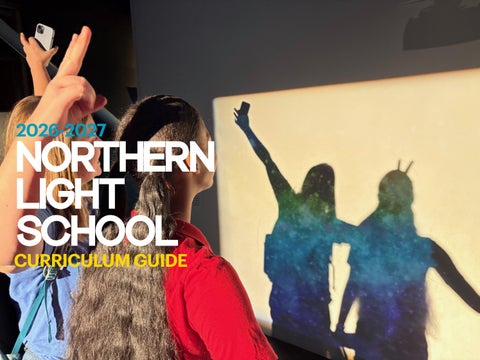
2026-2027
NORTHERN LIGHT SCHOOL CURRICULUM GUIDE
NORTHERN LIGHT SCHOOL CURRICULUM GUIDE 2026-2027
EDUCATIONAL LEADERSHIP Derek Boyd, Head of School Tonya Taylor, Assistant Head of School Peter Welch, Middle School Lead Dana Watchorn, Lower School Lead (3-5) Tracy Miller, Lower School Lead (PS-2) Sherin Ameerdeen, Preschool Director
TABLE OF CONTENTS Our Approach to Teaching & Learning…………………………………………………..……………….…………………….……..……………………1 Curriculum Overview………………………………………………………………..…………………………………….…………………………………………….……2 LOWER SCHOOL PROGRAM…………………………………………………………………………………………………………………………………………..3-4 Preschool & Pre-Kindergarten………………………………………………………….…………………………………………………..….5-6 Kindergerten………………………………………………………….……………………………………………………………………….……..….…….….7-8 Grade 1……………………………………………………………………….…………………………………………………………………………………………9-10 Grade 2……………………………………………………………………….…………………………………..……………………………………….…..………11-12 Grade 3……………………………………………………………………….…………………………………………………………….……………………..…13-14 Grade 4…………………………..…………………………………………….………………………………………………………………………….…………15-16 Grade 5…………………………..…………………………………………….………………………………………………………………………….…………17-18 MIDDLE SCHOOL PROGRAM………………………………………………………………………………………………………………………………………19-20 Grade 6…………………………..…………………………………………….…………………..…………………………………………………….…………21-22 Grade 7…………………………..…………………………………………….……………………………….……………………………………….…………23-24 Grade 8…………………………..…………………………………………….……………………………………………………………………….…………25-26 Learning Center…………………………..…………………………………………….……………………………………….…………………………………….…………27 High School Prep…………………………..…………………………………………….………………………………..………………………………………….…………28
OUR APPROACH TO TEACHING & LEARNING Small by design. In our small classes, no one disappears into the crowd. Small classes mean teachers who know each child deeply, including how they learn, what lights them up, and when they need a hand. Every student is safe, seen, and celebrated, because in a community this size, no one can be overlooked. Learning goes deepest when a child feels known, so we start there. Mastery before momentum. We don’t move on just because the calendar says the unit is over. Students keep working until they truly understand, building confidence one solid step at a time. The result is a foundation strong enough to carry them for years. Curious, hands-on, and joyful. Our students learn by doing: building, investigating, exploring, and collaborating. We welcome questions and celebrate connections. Technology is part of the picture, but not the focus - woven in intentionally to prepare children for the modern world without losing the human touch. Many ways to shine. Every child arrives with a light of their own. Some glow quietly. Some blaze. Some are still waiting to be discovered. At Northern Light School, we don’t ask children to shine the same way. We help each one find out how they shine, and then we celebrate it. The whole child, always. We believe a strong education develops the whole student: curious minds, capable thinkers, and compassionate people. Mind, body, and spirit all matter here. Alongside strong academics, we nurture kindness, resilience, and a love of learning that lasts. This guide shows how we do that, grade by grade and subject by subject. Read on to see what your child will build, explore, and discover at each stage of their Northern Light journey, and how every lesson
1
CURRICULUM OVERVIEW PRESCHOOL - GRADE 8 ASSESSMENTS & PROGRESS MONITORING DIBELS | MCLASS Math | Words Their Way | Writing on Demand
At Northern Light School, we believe a strong education develops the whole student: curious minds, capable thinkers, and compassionate people. Our curriculum is designed to build deep knowledge, essential skills, and a lifelong love of learning. Each course is sequenced so that students grow in confidence and independence from year to year, and each subject connects to the others so learning feels purposeful and relevant. Social emotional learning is integrated into every part of the school day. Students develop self-awareness, empathy, resilience, and the ability to build healthy relationships, skills that support academic success and personal well-being. Alongside this, our commitment to social justice shapes what and how we teach. Students learn to examine multiple perspectives, understand issues of fairness and equity, recognize the dignity of every person, and use their voices to contribute to a more just and inclusive community.
Fountas & Pinnell | Raz-Kids A-Z | Boost Math Multiple measures help our faculty understand student growth, guide instruction, and identify areas for support or extension.
This guide describes what students will study in each subject area, the skills they will develop, and how learning is assessed.
THE NLS LEARNING JOURNEY PRESCHOOL & PRE-KINDERGARTEN
LOWER SCHOOL: GRADES K-5
MIDDLE SCHOOL: GRADES 6-8
EXPLORE & DISCOVER
BUILD & APPLY
DEEPEN & CHALLENGE
MONTESSORI-BASED LEARNING
STRONG ACADEMIC FOUNDATIONS
INCREASING ACADEMIC RIGOR
INDEPENDENCE & PRACTICAL LIFE
INQUIRY & INVESTIGATIONS
CRITICAL THINKING & ANALYSIS
SENSORIAL EXPLORATION
EXPLICIT SKILL DEVELOPMENT
DISCUSSION & COMMUNICATION
EARLY LITERACY & MATHEMATICS
COLLABORATION & CREATIVITY
SELF-ADVOCACY & RESPONSIBILITY
CURIOSITY, CHOICE, & DISCOVERY
GROWING INDEPENDENCE
HIGH SCHOOL PREPARATION
CURRICULUM AT A GLANCE LITERACY & ELA UFLI Foundations | K-2
MATHEMATICS
SCIENCE
SPANISH
SPECIALTIES
Amplify Desmos Math
FOSS | K-8 NGSS-aligned
Realidades | 6-8
SPARK | K-8 PE Movement • Fitness • Skill Development Teamwork
Conceptual understanding, procedural fluency, & problem-solving
Hands-on investigation, inquiry, & engineering
Communication, vocabulary, grammar, & cultural learning
Heggerty | K-2 Sadlier | 2-8 Grammar Wordly Wise | 3-8 Vocabulary
RECORDER KARATE | 4-5 MUSIC Music Literacy • Instrumental Skills Rhythm • Performance
LEARNING BEYOND THE CORE
HIGH SCHOOL PREPARATORY
Music | Performing Arts | Visual Art | High School Prep
High School Exploration | Application Support | Interview Prep | Parent Support
Cultural & Community Learning | Social-Emotional Learning
Financial Aid & Scholarship Awareness | Essay Support | Study Skills
2
LOWER SCHOOL PROGRAM PRESCHOOL - GRADE 5
BUILDING FOUNDATIONS, FINDING OUR VOICES From the wonder of preschool to the growing independence of fifth grade, Northern Light School's Lower School program nurtures curious minds, confident learners, and compassionate community members. Through small classes, hands-on exploration, and purposeful instruction, students develop strong academic foundations while discovering their interests, strengths, and voices. Our youngest learners begin with Montessori-based experiences that encourage independence, creativity, and discovery. As students progress through Kindergarten and the elementary grades, learning becomes increasingly challenging and connected. Explicit literacy instruction builds confident readers and writers, conceptual mathematics develops flexible problem-solvers, and hands-on science inspires investigation and critical thinking. Through social studies, Spanish, music, art, and physical education, students explore new perspectives, express themselves, and make meaningful connections to the world around them. Throughout Lower School, academic growth goes hand in hand with social-emotional development, collaboration, and character. By fifth grade, students are not only building the knowledge and skills needed for Middle School, but also the confidence to ask thoughtful questions, take on challenges, advocate for themselves, and lead with courage, accountability, respect, and empathy.
PRESCHOOL & PRE-KINDERGARTEN GROWING, EXPLORING & DISCOVERING The Northern Light School Preschool classroom is designed to inspire a joy for learning and discovery. In a nurturing and inclusive environment, each child develops at their own pace across a variety of areas, including Practical Life, Sensorial, Language, Mathematics, and Cultural Studies. Activities in each area help children build independence, concentration, coordination, and selfconfidence, while fostering curiosity, creativity, and a love of learning.
The Montessori Learning Experience Social-Emotional Development Growing in Community: Learning to be part of a community is an essential part of the Preschool and Pre-K experience. Children practice sharing space and materials, communicating their needs, taking turns, solving problems, navigating conflict, and developing empathy for others. Through daily classroom routines and interactions, children build confidence, self-regulation, responsibility, and a sense of belonging. Teachers model and support respectful communication while helping children develop the skills they need to become increasingly independent and thoughtful members of their classroom community.
Across all areas of the curriculum, children are given opportunities to choose meaningful work, repeat activities until they reach mastery, learn through hands-on experiences, and progress at their own developmental pace. Teachers serve as careful observers and guides, helping children move toward increasingly complex skills while preserving the curiosity, joy, and independence that are at the heart of early childhood learning. The result is a learning environment designed not simply to prepare children for Kindergarten, but to help them become confident, capable, curious, and joyful learners.
Mathematics Sensorial Exploring & Understanding the World: Young children learn by experiencing the world through their senses. Montessori sensorial materials invite children to explore and compare qualities such as size, shape, color, texture, sound, weight, smell, and dimension. Through hands-on exploration, children learn to observe carefully, identify similarities and differences, sort, classify, sequence, and recognize patterns. These experiences help children organize and make sense of the world around them while laying an important foundation for later learning in mathematics, language, science, and problem-solving.
5
From Concrete to Abstract: Montessori math materials allow children to see, touch, and experience mathematical concepts before encountering them in abstract form. Through concrete manipulatives, children develop number sense and discover how quantities, numerals, and mathematical operations relate to one another. Children explore counting, numeral recognition, quantity, sequencing, patterns, place value, and the decimal system, with opportunities to work with numbers into the thousands. As they are ready, children are introduced to beginning addition, subtraction, multiplication, division, fractions, and problemsolving. By physically working with mathematical concepts, children build a strong foundation for understanding not only how mathematics works, but why.
PRESCHOOL & PRE-KINDERGARTEN CURRICULUM OVERVIEW
Practical Life
Language & Literacy
Independence & Care: Practical Life lessons help children develop independence and learn to care for themselves, others, and their environment. Children practice meaningful everyday skills such as preparing snacks, pouring, serving, cleaning, organizing materials, fastening clothing, tying shoes, and caring for the classroom.
Building Communication: Language learning develops through conversation, storytelling, songs, books, and carefully sequenced hands-on materials. Children build vocabulary, listening skills, phonemic awareness, letter and sound recognition, and early reading and writing skills.
These purposeful activities strengthen fine motor skills, coordination, concentration, sequencing, responsibility, and self-confidence. Most importantly, they give children opportunities to experience the pride and satisfaction of being able to say, “I can do it myself.”
Multi-sensory materials allow children to see, hear, touch, and manipulate letters and words as they begin connecting sounds with symbols. As children progress, they explore word building, sight words, early reading, handwriting, and opportunities to express their own ideas through spoken and written language.
Cultural Studies & Science Discovering Our World: Children's natural curiosity provides the foundation for exploration of nature, science, geography, culture, and the wider world. Through stories, observation, experiments, maps, classification activities, outdoor experiences, and hands-on investigations, children ask questions and make connections between themselves and their environment. Children explore topics such as plants and animals, seasons and weather, land and water, continents and cultures, and the natural world. These experiences encourage curiosity, observation, respect for living things, and an appreciation for the diversity of people and places in our world.
6
KINDERGARTEN GROWING, EXPLORING & DISCOVERING Kindergarten at Northern Light School is a joyful beginning to a lifelong love of learning. Through hands-on exploration, purposeful play, and engaging academic instruction, students build strong foundations in literacy, math, critical thinking, and problem-solving. Our nurturing, small-class environment encourages children to ask questions, take risks, discover their strengths, and grow in confidence and independence. With a focus on creativity, collaboration, and social-emotional development, we nurture the whole child—helping every student feel safe, seen, and celebrated as they take their first steps on their educational journey.
English Language Arts
Science
• Build foundational reading skills through daily, systematic, explicit instruction in phonemic awareness and phonics. • Grow vocabulary, comprehension, and literary understanding through shared and guided reading experiences. • Begin writing informational texts, narratives, and opinion pieces, with an emphasis on sequencing ideas and adding descriptive details. • Learn and practice correct letter formation, capitalization, punctuation, and early spelling patterns. • Communicate ideas through illustrations, labels, words, and sentences while building independence and writing stamina.
Earth Science: Trees and Weather • Investigate parts of trees and follow them throughout the seasons • Observe and describe weather patterns and changes using tools Physical Science, STEAMposium Projects: Materials and Motion • Explore forces and motion - how pushes and pulls make objects move • Solve problems through the engineering design process • STEAM project: Design a Mini Golf hole Life Science: Animals Two by Two • Identify what plants and animals need to survive and grow • Learn how humans can help protect the land, water, air, and other living things • Observe and compare plants and animals (fish, mealworms, butterflies)
Math • Explore and build with math tools such as connecting cubes, pattern blocks, and counters, and use subitizing to recognize small quantities at a glance • Count, read, write, and compare numbers 0-20, connecting each numeral to a quantity through objects, drawings, and 5-frames • Identify, describe, and compare flat shapes in the world around us, using mathematical language to talk about their attributes • Explore solid shapes such as cubes, spheres, cones, and cylinders, building with them and using positional words (above, below, beside, next to) to describe where objects are • Understand addition and subtraction by acting out, drawing, and solving story problems with objects and pictures • Compose and decompose numbers within 10, discovering the different ways a number can be made and broken apart • Explain thinking and work with classmates through partner talk, games, and hands-on activities, building mathematical language and confidence
7
Social Studies • Explore identity by discovering what makes each of us unique and what we share with others. • Build independence, confidence, and perseverance by doing things for ourselves and trying hard things. • Understand what a community is and what it means to be a responsible and caring community member. • Practice personal space, body boundaries, and consent, and learn to ask trusted adults for help. • Use kind and safe language, show respect, and care about how others feel as “bucket fillers.” • Take accountability by recognizing our “oopsies,” making things right, and learning from our mistakes.
KINDERGARTEN CURRICULUM OVERVIEW
Spanish Kindergarten instruction focuses on helping students understand, remember, and use simple Spanish through repeated, playful practice. Developing Listening Comprehension: Students learn to understand familiar words, greetings, simple questions, and classroom directions. They show understanding through gestures, pointing, drawing, picture choices, and simple verbal responses. Encouraging Oral Communication: Children are encouraged to use familiar words and short phrases in a playful, supportive environment. Songs, chants, call-andresponse, and guided interactions help make speaking Spanish feel comfortable and fun. Introducing Early Writing: Students begin connecting the Spanish they hear and say to print through word recognition, tracing, copying, and simple labeling. These early literacy experiences gently reinforce vocabulary and prepare students for future language learning. Learning Through Art and Multiple Intelligences: Art, songs , movement, and hands-on activities reinforce vocabulary while giving students different entry points for learning. Students show understanding in a variety of simple, ageappropriate ways.
Music • The Art of Singing: vocal production, singing vs. talking voice, pitch matching, call and response phrases, breathing • Music Literacy: • rhythms - quarter note, quarter rest, eighth notes • dynamics - piano/forte, treble clef, repeat signs • ascending/descending scale movement • Ear Training: hearing and then identifying high/low pitches, loud/ soft volumes, fast/medium/slow tempos • Music Exposure: Hearing music and singing songs from The Americas and the Broader World (Africa, Europe, Asia, and Australia/Oceania) - children's play songs, folk, traditional vocal and instrumental, spirituals, jazz, pop, classical, Black Heritage, Latino Heritage, Native American Heritage • Hand Percussion Exploration and Exposure: rhythm sticks, maracas and shakers, tambourines, triangles, finger cymbals, small djembes, wood and temple blocks, jingle bells • Active Music Response: Producing the beat or pulse of the music through, body percussion, dancing and free interpretation, creating rhythms, music movement games
Physical Education Building Movement Foundations: Students develop foundational movement skills, coordination, balance, and body awareness through active play, games, and structured activities. They practice running, jumping, hopping, throwing, catching, kicking, and other basic motor skills while building confidence, teamwork, and an understanding of healthy, active lifestyles.
8
GRADE 1 BUILDING CONFIDENCE, INDEPENDENCE, & CURIOUSITY First grade at Northern Light School is a year of exciting growth as students build upon their foundational skills and become more confident, independent learners. Through engaging instruction, hands-on exploration, and meaningful collaboration, students strengthen their reading, writing, and mathematical thinking while developing curiosity, creativity, and problem-solving skills. Science and social studies encourage students to ask questions, explore the world around them, and deepen their understanding of themselves and their communities. With continued opportunities for artistic expression, movement, and social-emotional growth, our nurturing environment encourages students to take on new challenges, celebrate their progress, and develop a lasting love of learning.
English Language Arts
Science
• Strengthen foundational reading skills through systematic phonics instruction, progressing from digraphs and blends to vowel teams and increasingly complex words. • Build reading fluency, comprehension, vocabulary, and background knowledge through literature and informational texts exploring topics such as fables, the human body, astronomy, geography, animals, and habitats. • Develop narrative, informational, and opinion writing, progressing from strong sentences to organized pieces with clear ideas and supporting details. • Strengthen handwriting, spelling, grammar, capitalization, and punctuation while becoming more independent writers. • Build confidence in speaking and listening by discussing texts, asking and answering questions, and sharing ideas with others.
Earth Science: Air and Weather • Investigate patterns of sunlight, moonlight, and shadows to help understand time and seasons • Measure how the length of daylight changes across the year Physical Science, STEAMposium Projects: Sound & Light • Investigate how vibrations produce sound • Investigate how objects can produce or interact with light and sound • STEAM project: Design and build an instrument that changes pitch and volume Life Science: Plants & Animals • Explore plant and animal parts and how they help organisms survive • Investigate what plants and animals need to live • Compare different kinds of plants and animals (isopod environments)
Math • Build fluency with addition and subtraction within 20, using objects, drawings, number lines, and flexible strategies to understand how numbers work • Solve addition and subtraction story problems, connecting everyday situations to equations and explaining strategies • Count, read, write, compare, and represent numbers to 99, developing an understanding of place value, tens, and ones • Add within 100, using place value, models, and strategies to break apart and combine numbers • Collect, represent, and interpret data using charts, graphs, and other visual representations • Explore measurement by comparing and measuring lengths using different units, working with measurements up to 120 units • Identify, describe, compare, compose, and decompose twoand three-dimensional shapes • Develop an understanding of time, connecting clocks to familiar routines and experiences
9
Social Studies • Explore identity, family, culture, and traditions while recognizing and celebrating the many experiences that make up our community. • Understand what it means to be a community member and how cooperation, responsibility, respect, and empathy help communities thrive. • Learn about citizenship, rules, laws, and the ways people can contribute to and care for their communities. • Explore important symbols, traditions, and celebrations while considering how they can hold different meanings for different people and communities. • Compare life today with life in the past and explore how families, schools, neighborhoods, and communities change over time. • Build an understanding of geography by using maps and identifying places, landforms, and features of the communities and world around us. • Develop an early understanding of economics by exploring the ways people work together to meet community needs.
GRADE 1 CURRICULUM OVERVIEW
Spanish First grade instruction prioritizes understanding, retention, and meaningful use over rapid coverage. Expanding Vocabulary: Students strengthen recognition and recall of high-frequency Spanish through thematic units, repetition, and regular review. Developing Comprehension: Students build understanding of familiar words, simple questions, classroom directions, and short phrases with visual and teacher support. Building Oral Communication: Students progress from single-word responses to short phrases and a small number of modeled sentence patterns in familiar classroom interactions. Developing Early Literacy: Students connect spoken Spanish to print through word recognition, matching, copying, labeling, and beginning spelling. Building Cultural Awareness: Students explore the Spanish-speaking world through ageappropriate music, stories, traditions, celebrations, art, and visual presentations. Familiar vocabulary is woven into cultural activities to help students make meaningful connections between language and culture.
Music • The Art of Singing: vocal production, singing vs. talking voice, pitch matching, call and response phrases, breathing • Music Literacy: • rhythms - quarter note, quarter rest, eighth notes • dynamics - piano/forte, treble clef, repeat signs • ascending/descending scale movement • Ear Training: hearing and then identifying high/low pitches, loud/ soft volumes, fast/medium/slow tempos • Music Exposure: Hearing music and singing songs from The Americas and the Broader World (Africa, Europe, Asia, and Australia/Oceania) - children's play songs, folk, traditional vocal and instrumental, spirituals, jazz, pop, classical, Black Heritage, Latino Heritage, Native American Heritage • Hand Percussion Exploration and Exposure: rhythm sticks, maracas and shakers, tambourines, triangles, finger cymbals, small djembes, wood and temple blocks, jingle bells • Active Music Response: Producing the beat or pulse of the music through, body percussion, dancing and free interpretation, creating rhythms, music movement games
Physical Education Developing Movement Skills & Coordination: First grade students build upon foundational movement skills by developing greater coordination, agility, control, and confidence. Through structured games and physical challenges, students refine their throwing, catching, kicking, and dribbling techniques while combining movements in increasingly complex activities. Emphasis is placed on teamwork, following rules, sportsmanship, and developing strength and endurance through active play.
10
GRADE 2 GROWING INDEPENDENCE, DEEPENING UNDERSTANDING Second grade at Northern Light School is a year of growing independence, deeper learning, and exciting new challenges. Building on foundational skills, students become more confident readers, writers, mathematicians, and critical thinkers as they tackle increasingly complex concepts and apply their knowledge in meaningful ways. Through hands-on investigations, creative problem-solving, and collaborative learning, students strengthen their curiosity and develop a deeper understanding of the world around them. With an emphasis on personal responsibility, empathy, and community engagement, our nurturing environment encourages students to think independently, embrace challenges, and recognize their ability to make a positive difference.
English Language Arts
Science
• Apply phonics and word-analysis skills to read increasingly complex grade-level texts accurately and fluently. • Deepen comprehension of literature and informational texts by identifying key details, retelling stories, determining main ideas, and making connections across texts. • Write increasingly developed opinion, informational, and narrative pieces with clear introductions, supporting details, logical sequencing, and conclusions. • Strengthen grammar, capitalization, punctuation, spelling, and vocabulary and apply these skills independently in writing. • Participate thoughtfully in collaborative conversations, building on the ideas of others and communicating their thoughts clearly
Earth Science: Pebbles, Sand, & Silt • Explore the observable properties of Earth materials • Investigate weathering and erosion of Earth’s surface. Physical Science, STEAMposium Projects: Solids & Liquids • Explore matter and its interactions (solids, liquids, gases). • Use the engineering design process to solve simple problems. • STEAM project: Investigate how oil interacts with water and design a solution for an oil spill in the ocean. Life Science: Insects & Plants • Examine the structure and function of living things. • Observe the growth and development of plants and animals (mealworms, planting seeds and comparing different plant needs) • Explore how organisms interact with their environment
Math • Build fluency with addition and subtraction within 1,000, using place value, regrouping, models, and flexible strategies to solve problems • Compose and decompose two- and three-digit numbers in different ways, strengthening number sense and place-value understanding • Solve comparison problems, determining how much more or less one quantity is than another using drawings, equations, and models • Solve one- and two-step story problems, choosing appropriate addition and subtraction strategies and explaining thinking • Explore measurement and length by measuring, estimating, comparing, adding, and subtracting lengths in real-world situations • Investigate two- and three-dimensional shapes, measuring side lengths and using mathematical language to describe and compare their attributes • Tell and write time to the nearest five minutes, connecting time to familiar routines and experiences • Identify and count mixed groups of coins, using addition and skip counting to determine value
11
Social Studies • Build geographic understanding by using maps and globes to locate communities, identify important physical features, and explore how geography shapes the way people live. • Explore how communities are organized and why rules, laws, leaders, and shared responsibilities are important. • Understand that citizenship means more than following rules—it includes participating, helping others, speaking up, and taking responsibility for our actions. • Learn how goods move from producers to consumers and explore the roles that workers, businesses, money, resources, and choices play in a community. • Study historical and contemporary people who have made a difference, including both well-known leaders and everyday people who have worked to improve their communities. • Consider whose stories are remembered and celebrated and recognize that people can make positive change and action.
GRADE 2 CURRICULUM OVERVIEW
Spanish In second grade, key language is revisited often so students build a strong foundation before moving on, insuring Students understanding. Expanding Vocabulary: Students strengthen and extend highfrequency Spanish through familiar thematic units, repetition, and regular review. New language is introduced in small, manageable amounts and connected to previously learned vocabulary. Developing Comprehension: Students build understanding of familiar classroom language, simple questions, short phrases, and predictable exchanges. Visuals, gestures, modeling, and repetition support students at different levels of readiness. Building Oral Communication: Students combine familiar words into short phrases and simple modeled sentences during structured classroom interactions. Repeated routines and guided practice help students communicate with increasing confidence. Developing Early Literacy: Students connect spoken Spanish to print through word recognition, matching, labeling, copying, and beginning spelling. Short written phrases may be introduced with strong teacher support when appropriate. Building Cultural Awareness: Students explore music, art, traditions, celebrations, and relatable changemakers from Latin American countries, including artists, athletes, musicians, scientists, and community leaders.
Music • The Art of Singing: vocal production, singing vs. talking voice, pitch matching, call and response phrases, breathing • Music Literacy: • rhythms - quarter note, quarter rest, eighth notes • dynamics - piano/forte, treble clef, repeat signs • ascending/descending scale movement • Ear Training: hearing and then identifying high/low pitches, loud/ soft volumes, fast/medium/slow tempos • Music Exposure: Hearing music and singing songs from The Americas and the Broader World (Africa, Europe, Asia, and Australia/Oceania) - children's play songs, folk, traditional vocal and instrumental, spirituals, jazz, pop, classical, Black Heritage, Latino Heritage, Native American Heritage • Hand Percussion Exploration and Exposure: rhythm sticks, maracas and shakers, tambourines, triangles, finger cymbals, small djembes, wood and temple blocks, jingle bells • Active Music Response: Producing the beat or pulse of the music through, body percussion, dancing and free interpretation, creating rhythms, music movement games
Physical Education Applying Movement Skills & Building Physical Confidence: Second grade students advance their movement skills by applying coordination, agility, balance, and body control in more challenging games and physical activities. Students strengthen their throwing, catching, dribbling, and kicking techniques while developing accuracy, control, and the ability to combine skills in cooperative and introductory team games. Emphasis is placed on strategic thinking, teamwork, sportsmanship, and personal responsibility, while building strength, endurance, and an understanding of physical fitness and healthy habits.
12
GRADE 3 EXPLORING NEW CONCEPTS & MAKING MEANINGFUL CONNECTIONS Third grade at Northern Light School introduces students to a new level of academic exploration, where learning moves beyond understanding concepts to questioning, analyzing, and applying them. Students sharpen their reading comprehension, develop more sophisticated writing skills, and expand their mathematical reasoning through multiplication, division, fractions, and real-world problem-solving. Scientific investigations encourage experimentation and discovery, while social studies challenges students to examine history, geography, and the diverse perspectives that shape our world. Across subjects, students learn to support their ideas with evidence, consider different viewpoints, and connect classroom learning to real-world issues. Through these experiences, third graders develop the analytical skills, intellectual curiosity, and sense of purpose that prepare them for increasingly complex learning.
English Language Arts
Science
• Deepen reading comprehension by asking and answering questions, identifying main ideas and key details, sequencing events, and recognizing cause-and-effect relationships. • Analyze characters, themes, authors' points of view, and the meaning of words and phrases while using evidence from the text to support understanding. • Build confidence reading informational texts by using features such as glossaries, headings, illustrations, and other reference tools to locate and interpret information. • Compare and contrast texts, ideas, characters, and themes while making meaningful connections across different types of literature. • Explore poetry and other forms of creative writing while continuing to develop organized narrative, informational, and opinion pieces.
Earth Science: Weather & Climate • Investigate the properties of water and how it interacts with rocks, soil, and other Earth materials. • Explore the water cycle and how it connects to weather patterns. Physical Science, STEAMposium Projects: Motion & Matter • Explore forces - pushing, pulling, magnetism, and gravity. • Study matter and its interactions, including changes in states. • STEAM project: Following the Engineering design process, use magnetism to design a solution to a real-world problem Life Sciences: Structures of Life • Investigate the origin of seeds, how they grow and the process of germination and plant development. • Discover plant and animal adaptations for survival. • Explore basic human body systems and their functions.
Math • Build fluency with addition and subtraction within 1,000, using place value, regrouping, and flexible strategies to solve problems • Develop an understanding of multiplication with factors up to 10, using arrays, equal groups, number lines, and patterns to represent and solve problems • Explore division within 10 by separating quantities into equal groups and making connections between multiplication and division • Understand fractions as numbers, partitioning shapes and quantities into equal parts and using models and number lines to represent fractions • Investigate area and perimeter, measuring and calculating the area and perimeter of quadrilaterals • Measure and solve problems involving length, time, liquid volume, and weight, connecting measurement to real-world situations
13
Social Studies • Explore human and physical geography and how land, climate, natural resources, and location influence the development of communities. • Learn about Indigenous peoples of North America, including cultures, communities, relationships with the land, and continued presence and contributions today. • Examine early settlement and colonization from multiple perspectives, considering how the movement of people affected Indigenous communities, settlers, and the land. • Develop an understanding of local, state, and national government, including the responsibilities of citizens and government. • Explore important landmarks, states, capitals, and other features that help us understand the geography and civic structure of the United States. • Study historical figures and everyday people who have demonstrated leadership, courage, advocacy, and service while considering how different people can understand “heroism” in different ways. • Build an understanding of economics by examining how resources become goods, how goods are produced and sold, and how people make choices about resources.
GRADE 3 CURRICULUM OVERVIEW
Spanish Third grade Instuction follows a Teaching for Understanding approach, emphasizing comprehension, meaningful use, recall, and application rather than rapid coverage. Expanding Vocabulary: Students strengthen high-frequency vocabulary, connect familiar language across themes, and move from modeled phrases toward simple sentences and brief guided exchanges. Developing Comprehension: Students understand familiar questions and short descriptions, read familiar words and phrases, and complete simple supported writing tasks tied to language they already know. Learning Through Art, Collaboration & Multiple Intelligences: Art, hands-on projects, songs/music, movement, and team activities reinforce vocabulary and communication while giving students different ways to access and demonstrate learning. Building Cultural Awareness: Students begin exploring the history, geography, traditions, music, and art of Latin American including Día de los Muertos, holidays and traditions.
Music • The Art of Singing: vocal production, pitch matching, call and response phrases, breathing/breath support/diaphragmatic movement, tone • Music Literacy: • rhythms - quarter note/quarter rest/eighth notes/half note/half rest/dotted half note/whole note/whole rest • dynamics - piano/forte/mezzo piano/mezzo forte, treble clef • repeat sign, double bar line, common time, three four time signature • Ear Training: hearing and then identifying ascending/descending scale movement/skipping notes/ dynamics/tempos/two measure rhythms • Music Exposure: Hearing music and singing songs from The Americas and the Broader World (Africa, Europe, Asia, and Australia/Oceania) - children's play songs, folk, traditional vocal and instrumental, spirituals, jazz, pop, classical, Black Heritage, Latino Heritage, Native American Heritage • Hand Percussion Exploration and Exposure: rhythm sticks, maracas and shakers, tambourines, triangles, finger cymbals, small djembes, wood and temple blocks, jingle bells • Active Music Response: Producing the beat or pulse of the music through, body percussion, dancing and free interpretation, creating rhythms, music movement games
Physical Education Movement Mastery,Strategy & Physical Fitness: Second grade students transition from practicing individual movement skills to applying them in dynamic games, obstacle courses, and team challenges. Students learn to anticipate movement, make quick decisions, adjust speed and direction, and use spatial awareness to navigate increasingly complex activities. They explore basic offensive and defensive strategies, develop accuracy through target-based challenges, and strengthen their ability to sequence movements. Fitness activities introduce personal goalsetting, stamina, and an understanding of how exercise affects the body, while cooperative games encourage leadership, communication, and fair play.
14
GRADE 4 DEEPENING KNOWLEDGE, STRENGTHENING SKILLS & DISCOVERING OUR IMPACT Fourth grade at Northern Light School is a year of deeper exploration, academic challenge, and purposeful learning. Students strengthen their ability to think critically, communicate effectively, and approach complex problems with creativity and persistence. Through increasingly sophisticated reading, writing, and mathematical reasoning, students learn to organize their thinking, support their ideas with evidence, and apply their skills across subjects. Hands-on science investigations encourage innovation and experimentation, while an in-depth study of California's history, geography, and diverse communities invites students to examine the past through multiple perspectives and connect it to the world they know today. With growing opportunities for leadership, collaboration, and civic engagement, fourth graders begin to recognize their voices, responsibilities, and potential to create positive change.
English Language Arts
Science
• Build deeper comprehension of literature and informational texts by analyzing themes, main ideas, characters, point of view, and authors' use of evidence. • Strengthen vocabulary by using context clues, roots and affixes, word relationships, and figurative language to understand increasingly sophisticated texts. • Develop narrative, informational, and opinion writing with clear organization, strong details, supporting evidence, and purposeful conclusions. • Strengthen the writing process through planning, drafting, revising, editing, and responding to feedback. • Apply increasingly sophisticated grammar, sentence structure, spelling patterns, punctuation, and editing skills across written work.
Earth Science: Rocks, Soil, & Landforms • Explore soils, rocks, minerals and investigate weathering, erosion and deposition. • Use models and simulations to study changes to rocks and landforms on Earth’s surface Physical Science, STEAMposium Projects: Energy • Investigate electricity and magnetism, including real-world applications. • Study energy transfer, force, and motion in various systems. • STEAM project: Design a Rube Goldberg Machine (chain reaction) to explore energy changes Life Sciences: Environments • Investigate how organisms need energy and matter to live and grow • Discover how living things depend on one another and their environment for survival.
Math
Social Studies
• Build number sense and problem-solving skills, using patterns, factors, multiples, and mathematical relationships to recognize and explain how numbers work • Add and subtract multi-digit numbers, using place value, efficient strategies, and models to solve increasingly complex problems • Multiply and divide multi-digit numbers, using equations, models, and flexible strategies to solve real-world and mathematical problems • Understand and compare fractions, exploring equivalence and using models and number lines to represent and reason about fractional quantities • Explore decimals and their relationship to fractions, using place value and models to represent, compare, and connect different forms of numbers • Measure and convert quantities, applying measurement skills and solving problems involving different units • Identify and measure angles, lines, and shapes, using geometric attributes to describe, classify, and solve problems
• Explore California’s geography, regions, natural resources, and the ways the land has shaped communities and lives through history • Study California’s Indigenous peoples as distinct and living communities, examining their cultures, relationships with the land, histories, resilience, and continued presence today. • Examine exploration, colonization, the mission system, and Mexican California through multiple perspectives, including the experiences and impacts on Indigenous peoples. • Investigate the Gold Rush, California statehood, immigration, railroads, agriculture, and industry while considering how these developments created opportunities for some communities and significant challenges and injustices for others. • Explore the histories and contributions of the many racial, ethnic, and cultural communities that have shaped California. • Connect California history to our own local Oakland and Bay Area communities, examining how people, places, and movements have contributed to the region we know today. • Develop civic awareness by learning about local and state government and exploring how people participate in their communities, advocate for change, and work toward a more just society.
15
GRADE 4 CURRICULUM OVERVIEW
Spanish
Fourth grade instuction emphasizes depth, retention, and meaningful use of Spanish over rapid coverage. Students revisit and apply key language in varied ways, with multiple entry points that support different learners while building confidence and independence. Oral Communication & Fluency: Students engage in short exchanges, describe familiar topics, and present simple ideas with growing confidence and independence. Reading & Writing: Students understand short thematic texts, and write using new and familiar vocabulary and structures. Cultural Awareness & Discovery: Students continue to discover and examine inspirering Latin American voices to understand how identity, community, and resilience are shaped over time. They connect these ideas to their own experiences and perspectives. Collaboration Application: Hands-on projects, art, music, movement, and creative tasks provide varied ways to learn, apply and demonstrate learning.
Music
• The Art of Singing: vocal production, breathing/breath support/diaphagmatic movement/singing through the phrase, tone/ timbre/tuning • Recorder Karate Curriculum: • Year 1: white through purple belts • Music Literacy: • rhythms - quarter note/quarter rest/eighth notes/half note/ half rest/dotted half note/whole note/whole rest • dynamics - piano/forte/mezzo piano/mezzo forte/ crescendo/diminuendo, • treble and bass clefs, repeat sign, first and second endings, double bar line, common time, three four and two four time signatures • Ear Training: hearing and then identifying ascending/ descending scale movement/skipping notes/ dynamics/ tempos/two measure rhythms, one and two measure rote playback • Music Exposure: • Classical Focus - Baroque through Contemporary repertoire/ orchestral instruments/opera/world composers, • Other - Black Heritage, Latino Heritage, Native American Heritage, traditional/folk, contemporary, jazz, pop, world
Physical Education Advancing Sports Skills, Game Strategy & Physical Fitness: Fourth grade students build on their foundational sports skills by developing greater precision, consistency, and strategic thinking during individual and team activities. Students refine techniques in dribbling, passing, shooting, and ball control while applying offensive and defensive strategies in increasingly competitive and structured games. Through fitness circuits, resistance exercises, and conditioning activities, students improve strength, endurance, agility, and flexibility. Emphasis is placed on teamwork, communication, sportsmanship, and introducing personal fitness goals while developing a deeper understanding of how exercise improves physical performance and overall health.
16
GRADE 5 LEADING WITH PURPOSE, THINKING INDEPENDENTLY, & PREPARING FOR WHAT’S NEXT Fifth grade at Northern Light School marks an important milestone as students prepare for the transition to middle school. With greater academic independence and responsibility, students are challenged to think critically, communicate with purpose, and apply their knowledge to increasingly complex ideas and real-world problems. Through advanced reading, writing, mathematical reasoning, and hands-on scientific investigations, students strengthen the skills needed for more rigorous learning. An in-depth exploration of American history encourages students to examine multiple perspectives, question historical narratives, and consider the connections between the past and present. Across the curriculum, opportunities for leadership, collaboration, and civic engagement empower fifth graders to find their voices, take ownership of their learning, and enter middle school with confidence, curiosity, and a strong sense of purpose.
English Language Arts
Science
• Read increasingly complex fiction, nonfiction, and informational texts with independence and stamina in preparation for middle school. • Analyze characters, themes, main ideas, authors' perspectives and purposes, and how writers use details and evidence to develop meaning. • Use evidence from multiple texts and sources to support ideas, make connections, and communicate a deeper understanding of what is read. • Write well-developed narrative, informational, and opinion pieces with clear structure, purposeful organization, supporting evidence, and elaboration. • Strengthen independence as a writer through planning, drafting, revising, and editing while applying increasingly sophisticated vocabulary, grammar, spelling, and sentence structure.
Earth Science: Sun & Earth • Investigate how Earth's systems interact • Collect and analyze data related to shadows and their daily/seasonal changes • Observe and recording the Moon’s phases over time • Model the movement of water through the water cycle and how it’s driven by the sun and gravity Physical Science, STEAMposium Projects: Mixtures & Solutions • Investigate and use models to explain the properties, behaviors, and changes in substances to build an understanding of matter and energy • Conduct investigations to observe conservation of matter during physical and chemical changes • STEAM project: Design a device to desalinate 'ocean' water. Life Sciences: Living Systems • Model how matter and energy move through food webs in ecosystems • Describe how plants use air, water, and energy from the sun to grow • Investigate how changes in an ecosystem affect the organisms that live there
Math • Add, subtract, multiply, and divide multi-digit numbers, using place value, efficient strategies, and models to solve increasingly complex problems • Read, write, and compare decimals to the thousandths, using place value and models to understand relationships between decimal quantities • Add, subtract, multiply, and divide decimals, applying strategies and place-value understanding to mathematical and realworld problems • Add, subtract, multiply, and divide fractions, using models, equations, and strategies to understand operations with fractional quantities • Calculate the volume of rectangular prisms, using unit cubes, multiplication, and formulas to understand and solve problems involving three-dimensional space • Classify two-dimensional shapes, using their properties and attributes to identify relationships among different categories of shapes • Locate and graph points on the coordinate plane, using ordered pairs to represent and interpret relationships
17
Social Studies • Explore the histories of the diverse Indigenous nations and communities of North America before European colonization, recognizing their distinct governments, cultures, economies, traditions, and relationships with the land. • Examine European exploration and colonization from multiple perspectives and investigate its lasting effects on Indigenous peoples, the land, and developing colonial communities. • Study the formation of the thirteen colonies and examine how geography, economics, religion, culture, and systems of labor—including enslavement—shaped colonial life. • Investigate the causes and effects of the American Revolution and consider the different experiences, motivations, and perspectives of people living through this period. • Explore the ideals expressed in the Declaration of Independence and Constitution while asking critical questions about who was included in those ideals, who was excluded, and how people challenged those contradictions. • Understand the development of the U.S. government, including the Constitution, branches of government, individual rights, and the responsibilities of citizenship. • Examine the growth of the United States leading up to the Civil War, including westward expansion, Indigenous resistance and displacement, slavery, abolition, and the growing national debate over freedom and equality. • Use historical evidence, inquiry, and multiple perspectives to think critically about the past and consider how history continues to shape our communities, responsibilities, and choices today.
GRADE 5 CURRICULUM OVERVIEW
Spanish
Fifth grade instruction emphasizes deep understanding, meaningful use, and long-term retention rather than rapid coverage. Varied learning experiences give students multiple ways to access key concepts while building the strong foundation needed for middle school Spanish. Oral Communication & Fluency: Students engage in longer exchanges, express opinions, describe experiences, and present ideas with growing confidence and independence. Reading & Writing: Students read short thematic texts and develop more independent writing with support from loose sentence frames, word banks, and modeled language. Cultural Awareness & Discovery: Students explore the history and cultures of Indigenous communities in Latin America while considering questions of identity, community, and belonging. Students also learn about leaders and innovators whose stories inspire perseverance, empathy, and meaningful connections across communities and perspectives. Collaboration Application: Hands-on projects, presentations, art, music, and creative tasks give students varied ways to understand and apply Spanish, collaborate, and demonstrate understanding.
Music
• The Art of Singing: vocal production, breathing/breath support/diaphagmatic movement/singing through the phrase, tone/ timbre/tuning • Recorder Karate Curriculum: • Year 2: red through fifth degree black belt • Music Literacy: • rhythm/pulse/counting - quarter note/quarter rest/eighth notes/half note/half rest/dotted half note/whole note/whole rest/dotted quarter note/single eighth note/tie/ common time, three four and two four time signatures • dynamics - pp/p/mp/mf/f/ff/crescendo/diminuendo • articulations - accent, slur, staccato • other - treble and bass clefs, repeat sign, first and second endings, double bar line • Ear Training: hearing and then identifying ascending/ descending scale movement/skipping notes/ dynamics/ tempos/two measure rhythms, one and two measure rote playback • Music Exposure: • BAHM, Black American History of Music - roots, trajectory, development from spirituals and plantation music ( vocal and instrumental ) to present day • Other - traditional/folk, contemporary, Latino Heritage, Native American Heritage
Physical Education Advanced Game Play, Personal Fitness, & Leadership: Fifth grade students apply and refine their athletic skills through increasingly complex team sports, competitive games, and fitness challenges. Students strengthen offensive and defensive strategies, decisionmaking, and teamwork while demonstrating greater independence and leadership during physical activities. Through conditioning circuits, resistance exercises, and fitness assessments, students explore personal goal-setting and the FITT principle (frequency, intensity, time, and type). Emphasis is placed on sportsmanship, personal accountability, and developing healthy fitness habits that prepare students for middle school physical education.
18
MIDDLE SCHOOL PROGRAM GRADE 6-8
DEEPENING KNOWLEDGE, DISCOVERING OUR POWER Middle School at Northern Light School is a time of transformation. Building on the strong foundations of Lower School, students in grades 6–8 are challenged to think more deeply, question more critically, and take greater ownership of their learning. In a supportive community where every student is known and valued, growing academic expectations are matched with opportunities for independence, leadership, and self-discovery. Across the curriculum, students move beyond learning information to analyzing ideas, evaluating evidence, and developing their own perspectives. Through rigorous reading and writing, mathematical reasoning, scientific investigation, and the study of history through multiple lenses, students strengthen their ability to think critically and communicate with purpose. Spanish, music, visual arts, and physical education further encourage creativity, cultural understanding, collaboration, and personal growth. Just as importantly, Middle School is a place to discover who you are and the impact you can make. Through Advisory, meaningful relationships, and opportunities to practice leadership and self-advocacy, students develop the confidence and character to navigate new challenges. By graduation, Northern Light students are prepared not simply for the academic demands of high school, but to enter their next chapter as thoughtful scholars, compassionate leaders, and engaged citizens ready to make their mark on the world.
MIDDLE SCHOOL GRADE 6 NEW CHALLENGES, NEW PERSPECTIVES, NEW POSSIBILITIES Sixth grade marks an exciting transition into Middle School, where students begin taking greater ownership of their learning, discovering new perspectives, and building confidence in their abilities. Through increasingly rigorous reading, writing, mathematical reasoning, and scientific inquiry, students are challenged to think critically, support their ideas with evidence, and approach complex questions with curiosity. The study of early civilizations encourages students to explore identity, culture, and the connections between people across time and place. As they navigate new academic and social responsibilities, sixth graders strengthen their independence, organizational skills, and self-advocacy while developing the confidence to embrace challenges, contribute to their community, and find their place as Middle School learners.
English Language Arts
History
• Read closesly and purposefully by annotating, questioning, and defending inferences with multiple, clearly explained pieces of evidence • Analyze literary fiction by examining characterization, point of view, dramatic irony, voice, motif, and structure across a whole text, and distinguish topic from theme • Read paired nonfiction to determine purpose, identify claim, reason, and evidence, evaluate source credibility, and synthesize fiction and nonfiction on a single question • Write a multi-paragraph essay each trimester, progressing from literary analysis to literary argument to an argument essay with claim, counterclaim, and rebuttal, using a full process of outlining, drafting, peer review, and revision • Master grammar, usage, and mechanics from sentence parts and pronouns to verbs, modifiers, agreement, punctuation, capitalization, and spelling, applied directly to students' own writing • Expand academic vocabulary through weekly lessons, weekly assesment, cumulative exams, and review while building stamina through sustained independent reading
• Explore early societies and civilizations through maps, artifacts, historical accounts, primary and secondary sources, and other forms of evidence. • Investigate how geography, natural resources, belief systems, government, economics, and culture influenced the development of civilizations and the daily lives of people within them. • Examine identity and culture across different societies, recognizing both the diversity of human experiences and the connections that exist across regions and time periods. • Consider whose stories have traditionally been preserved and told, whose perspectives may be missing, and how historians use evidence to develop a fuller understanding of the past. • Build historical thinking skills by making observations, asking questions, identifying patterns, and distinguishing between evidence and interpretation. • Use evidence from multiple sources to explain ideas, support conclusions, and communicate an understanding of historical events and societies. • Reflect on connections between the experiences, choices, and challenges of people in the past and students' own identities, communities, and lives today.
Math • Recognize and represent proportional relationships, including scale drawings • Solve real-world percent problems (discounts, tax, percent change) • Find the circumference and area of circles • Add, subtract, multiply, and divide positive and negative numbers • Write and solve multi-step equations and inequalities • Solve problems involving angles, triangles, and the volume and surface area of prisms • Find probabilities and use samples to make predictions about populations • Prepare for the HSPT with practice exams (spring)
21
Science • Diversity of Life: • Understand what it means to be a living organism, understanding how life on Earth can be diverse • Leads to a more robust and informed response to the rapid loss of diversity on Earth • Human Systems Interactions: • Explore the different types of systems present in the human body, such as organ systems, cellular respiration, and the nervous system • Understand how systems in the body are interconnected and work in tandem to support life • Weather and Water: • Explore the different systems that explain changes in our atmosphere, such as weather, the water cycle, and climate change • Integrates physical and earth science in order to explore grand natural processes
GRADE 6 Spanish
PE
• Communication Foundations: Greetings, introductions, classroom expressions, asking and answering questions, and exchanging basic personal information. • Numbers & Everyday Information: Numbers, dates, time, schedules, and other high-frequency expressions used in everyday communication. • Describing People: Physical descriptions, personality traits, adjective agreement, and the use of ser and estar in familiar contexts. • Likes, Dislikes & Interests: Expressing preferences using gustar and talking about hobbies, free-time activities, and personal interests. • School & Daily Life: School subjects, classroom vocabulary, schedules, daily activities, and familiar routines. • Foundational Grammar: Present-tense forms of common -AR verbs, basic sentence structures, adjective agreement, and high-frequency verbs and expressions. • Listening, Speaking, Reading & Writing: Developing comprehension and communication skills through short conversations, familiar texts, guided writing, and oral activities. • Projects & Application: Completing an individual project connected to each chapter and participating in collaborative activities that apply vocabulary and grammar in meaningful contexts. • Culture & Connections: Exploring traditions, celebrations, and daily life across the Spanish-speaking world through class activities and special projects such as Hispanic Heritage Month, Día de los Muertos, and cultural celebrations.
Building Personal Fitness, Teamwork & Responsibility: • Sixth grade students transition into middle school physical education by developing greater independence, personal responsibility, and awareness of their physical fitness. • Students strengthen cardiovascular endurance, muscular strength, flexibility, and coordination while learning proper exercise techniques and introductory fitness principles. • Individual and team sports introduce more complex game strategies, communication, and collaborative problem-solving. • Students begin setting personal fitness goals, exploring connections between physical activity and overall wellness, and developing positive habits around nutrition, hydration, and healthy living. • Emphasis is placed on inclusion, sportsmanship, self-management, and building confidence in a variety of physical activities.
Visual Arts • Creative Expression & Personal Voice: Visual arts encourages students to explore their creativity, develop artistic skills, and express their unique perspectives through a variety of mediums. Students experiment with drawing, painting, sculpture, mixed media, and other forms of visual expression while building an understanding of color, composition, texture, perspective, and design. Through hands-on projects, students explore art history, cultural traditions, and the work of diverse artists, discovering how art can communicate ideas, reflect identity, and inspire social change. Emphasis is placed on experimentation, critical thinking, collaboration, and using art as a powerful tool for storytelling, selfexpression, and connection.
Leadership Developing Student Voice, Leadership & Community Impact: Middle School Leadership Block empowers students to take an active role in shaping their school community. Through collaborative projects, student-led initiatives, and opportunities for service, students develop communication, problem-solving, organization, and leadership skills. Emphasis is placed on student voice, teamwork, civic responsibility, and turning ideas into meaningful action. Students learn to advocate for themselves and others, take ownership of their contributions, and recognize their ability to create positive change within their school and beyond.
Advisory • Building Connections, Character, & Personal Growth: Middle School Advisory provides a supportive space where students develop meaningful relationships, strengthen social-emotional skills, and navigate the challenges of adolescence. Through guided discussions, reflection, and community-building activities, students explore identity, belonging, personal responsibility, and healthy relationships. Rooted in Northern Light School's CARE values—Courage, Accountability, Respect, and Empathy—Advisory encourages self-awareness, resilience, and positive decision-making while ensuring every student feels seen, heard, and supported.
22
MIDDLE SCHOOL GRADE 7 THINKING DEEPER, QUESTIONING MORE, USING OUR VOICE Seventh grade is a year of deeper thinking, growing independence, and discovering the power of one's voice. Building on their Middle School foundations, students engage with increasingly complex ideas, strengthen their analytical and problem-solving skills, and learn to construct thoughtful, evidence-based arguments. Through literature, scientific investigations, mathematical challenges, and the comparative study of world societies, students explore different perspectives, examine systems of power, and consider how history, culture, and human choices shape our world. As they develop greater academic confidence, seventh graders are encouraged to question assumptions, express their ideas with clarity, and take responsibility for their learning. With opportunities for collaboration, reflection, and leadership, students begin to recognize their ability to influence their communities and contribute to meaningful change.
English Language Arts
History
• Read closesly and purposefully by annotating, questioning, and defending inferences with multiple, clearly explained pieces of evidence • Analyze literary fiction by examining characterization, point of view, dramatic irony, voice, motif, and structure across a whole text, and distinguish topic from theme • Read paired nonfiction to determine purpose, identify claim, reason, and evidence, evaluate source credibility, and synthesize fiction and nonfiction on a single question • Write a multi-paragraph essay each trimester, progressing from literary analysis to literary argument to an argument essay with claim, counterclaim, and rebuttal, using a full process of outlining, drafting, peer review, and revision • Master grammar, usage, and mechanics from sentence parts and pronouns to verbs, modifiers, agreement, punctuation, capitalization, and spelling, applied directly to students' own writing • Expand academic vocabulary through weekly lessons, weekly assesment, cumulative exams, and review while building stamina through sustained independent reading •
• Examine societies across different regions and time periods, comparing how geography, culture, religion, economics, government, and social structures shaped people's experiences.
Math
Science
• Recognize and represent proportional relationships, including scale drawings • Solve real-world percent problems (discounts, tax, percent change) • Find the circumference and area of circles • Add, subtract, multiply, and divide positive and negative numbers • Write and solve multi-step equations and inequalities • Solve problems involving angles, triangles, and the volume and surface area of prisms • Find probabilities and use samples to make predictions about populations • Prepare for the HSPT with practice exams (spring)
23
• Investigate how individuals, communities, governments, and institutions gained and used power and how people responded to, challenged, or transformed systems of power. • Compare historical perspectives and recognize how the same event or period can be understood differently depending on a person's identity, position, experiences, and access to power. • Explore the movement of people, ideas, religions, technologies, and resources and consider how exchange, migration, conflict, and cultural interaction shaped societies. • Examine examples of cooperation, conflict, inequality, resistance, and social change while considering the choices available to people within different historical contexts. • Analyze primary and secondary sources for perspective, reliability, context, and evidence while asking whose voices are represented and whose may be absent. • Develop increasingly sophisticated historical arguments by comparing societies, explaining causes and consequences, identifying change over time, and supporting interpretations with relevant evidence. • Make connections across historical periods and consider how past systems, ideas, and interactions continue to influence communities and societies today.
• Earth History: • Understand the theory of evolution and what brought about the diversity of life on this planet • Explore varied lines of evidence for evolution, such as the fossil record, genetic principles of inheritance, and natural selection • Populations and Ecosystems: • Understand how organisms are interconnected and depend on each other to form healthy ecosystems • Explore the ways energy is transferred throughout the environment • Chemical Interactions: • Exploring the nature of matter, such as its properties, composition, and structure. • Understand how the science explaining chemistry has changed and is continuing to change
GRADE 7 Spanish
PE
• Food & Real-Life Communication: Using vocabulary related to food and meals, ordering in restaurants, expressing preferences, and communicating in practical everyday situations. • Places, Activities & Leisure: Talking about locations, places in the community, leisure activities, sports, and plans with friends and family. • Family & Celebrations: Identifying family members, describing relationships, and communicating about celebrations, special events, and family traditions. • Describing People & Possessions: Expanding descriptive language to talk about people, relationships, belongings, and personal connections using appropriate vocabulary and possessive structures. • Expanding Grammar Skills: Using present-tense forms of regular and common irregular verbs, including tener, venir, hacer, poner, salir, and other high-frequency verbs in meaningful contexts. • Talking About Future Plans: Using ir + a + infinitive to discuss upcoming activities, intentions, and plans. • Building Sentence Complexity: Applying possessive adjectives and other key grammatical structures to create more detailed and increasingly independent spoken and written communication. • Listening, Speaking, Reading & Writing: Strengthening comprehension and communication through conversations, authentic and adapted texts, listening activities, guided writing, and oral presentations. • Projects & Application: Completing an individual project connected to each chapter and participating in collaborative projects and presentations that encourage students to apply vocabulary, grammar, and communication skills in meaningful contexts. • Culture & Connections: Expanding understanding of the Spanishspeaking world through traditions, celebrations, history, and everyday life
Strengthening Fitness, Game Strategy, & Personal Accountability: • Seventh grade students build upon their fitness knowledge and athletic abilities by applying more advanced skills, strategies, and decision-making in individual and team activities. • Through SPARK-based fitness circuits, conditioning exercises, and structured sports, students develop strength, endurance, flexibility, and overall physical performance. • Students apply fitness principles to set measurable goals, monitor personal progress, and understand how nutrition, hydration, and recovery support physical wellness. • Emphasis is placed on strategic game play, effective communication, conflict resolution, and taking greater ownership of personal effort and team success.
Visual Arts • Creative Expression & Personal Voice: Visual arts encourages students to explore their creativity, develop artistic skills, and express their unique perspectives through a variety of mediums. Students experiment with drawing, painting, sculpture, mixed media, and other forms of visual expression while building an understanding of color, composition, texture, perspective, and design. Through handson projects, students explore art history, cultural traditions, and the work of diverse artists, discovering how art can communicate ideas, reflect identity, and inspire social change. Emphasis is placed on experimentation, critical thinking, collaboration, and using art as a powerful tool for storytelling, self-expression, and connection.
Leadership Developing Student Voice, Leadership & Community Impact: Middle School Leadership Block empowers students to take an active role in shaping their school community. Through collaborative projects, student-led initiatives, and opportunities for service, students develop communication, problem-solving, organization, and leadership skills. Emphasis is placed on student voice, teamwork, civic responsibility, and turning ideas into meaningful action. Students learn to advocate for themselves and others, take ownership of their contributions, and recognize their ability to create positive change within their school and beyond.
Advisory • Building Connections, Character, & Personal Growth: Middle School Advisory provides a supportive space where students develop meaningful relationships, strengthen social-emotional skills, and navigate the challenges of adolescence. Through guided discussions, reflection, and community-building activities, students explore identity, belonging, personal responsibility, and healthy relationships. Rooted in Northern Light School's CARE values—Courage, Accountability, Respect, and Empathy—Advisory encourages self-awareness, resilience, and positive decision-making while ensuring every student feels seen, heard, and supported.
24
MIDDLE SCHOOL GRADE 8 LEADING WITH PURPOSE, PREPARING FOR WHAT’S NEXT Eighth grade is the culmination of the Northern Light School journey—a year of academic challenge, personal growth, leadership, and preparation for new beginnings. As the oldest students on campus, eighth graders are encouraged to lead by example, take ownership of their learning, and approach complex ideas with confidence and independence. Through advanced literary analysis, research and argument writing, mathematical problem-solving, and scientific inquiry, students sharpen the skills needed for success in high school and beyond. Their study of American history challenges them to examine systems of power, explore movements for justice, and consider their own roles as engaged citizens. Alongside rigorous academics, students strengthen their self-advocacy, time management, and decision-making skills while navigating the high school transition. By graduation, they leave Northern Light prepared to take on new challenges, grounded in their values, confident in their voices, and ready to make a difference.
English Language Arts
History
• Read closely and purposefully by annotating, questioning, and building claims supported by wellchosen, clearly explained evidence • Analyze literary fiction and memoir by examining characterization, language choices, unreliable narration, tone, framing, and motif across a whole text • Evaluate a piece of argumentative nonfiction by separating evidence from reasoning, analyzing rhetorical appeals and counterclaims, and judging source credibility and bias • Write a multi-paragraph essay each trimester, progressing from literary analysis to argument to a researched argument with claim, counterclaim, and rebuttal, using a full process of outlining, drafting, peer review, and revision. • Master grammar, usage, and mechanics, from sentence structure and verb usage to agreement, punctuation, capitalization, and spelling, applied directly to students' own writing. • Expand academic vocabulary through weekly lessons, weekly assessment, cumulative exams, and review while building stamina through sustained independent reading
• Investigate U.S. history through primary sources, historical accounts, literature, images, media, and other evidence representing a range of experiences and perspectives. • Examine the development of American political, economic, and social systems and consider how these systems have shaped people's opportunities, rights, responsibilities, and experiences. • Explore how race, class, gender, culture, geography, and other aspects of identity have influenced people's experiences throughout U.S. history. • Analyze whose perspectives have traditionally been centered in historical narratives and actively seek out voices and experiences that have been excluded, marginalized, or overlooked. • Examine the ways individuals and communities have participated in, benefited from, resisted, and challenged systems of power throughout U.S. history. • Investigate movements for rights, freedom, equality, and justice while considering how change happens and the roles that individuals, communities, institutions, and collective action can play. • Evaluate primary and secondary sources for credibility, perspective, bias, context, and supporting evidence, including developing the skills necessary to critically examine media and information. • Construct evidence-based arguments about complex historical questions, acknowledge competing perspectives, and communicate ideas clearly through discussion and writing. • Connect historical questions to contemporary civic life and consider how knowledge of the past can help students participate thoughtfully, responsibly, and courageously in their communities and the wider world.
Math
• Heredity and Adaptation: • Understand what it takes to understand the geologic story of a place • Learning about the processes that shape the Earth, along with theories for how the Earth was formed • Electromagnetic Forces: • Deals with questions around energy, force, motion, and magnetic forces • Manipulate equipment to collect data about magnetic fields and electricity • Gravity and Kinetic Energy: • Understand acceleration, force of gravity, kinetic energy, and collision engineering. • Understand the scientific laws and theories that explain natural interactions between forces • Planetary Science: • Understand the “cosmic address” of the Earth, exploring the planet’s relationship to other celestial bodies • Understand the ways that scientists have explored the solar system • Waves: • Explore wave energy in the forms of water, sound, light, and communication. Make sense of how technology works by transmission of wave energy
• Solve multi-step linear equations, including those with variables on both sides • Use transformations (translations, rotations, reflections, dilations) to understand congruence and similarity • Graph linear relationships and interpret slope • Write and solve systems of linear equations • Understand functions and find the volume of cylinders, cones, and spheres • Use scatter plots and two-way tables to describe associations in data • Apply exponent rules and use scientific notation • Use the Pythagorean Theorem and understand irrational numbers
25
Science
GRADE 8 Spanish
PE
• Food & Real-Life Communication: Using vocabulary related to food and meals, ordering in restaurants, expressing preferences, and communicating in practical everyday situations. • Places, Activities & Leisure: Talking about locations, places in the community, leisure activities, sports, and plans with friends and family. • Family & Celebrations: Identifying family members, describing relationships, and communicating about celebrations, special events, and family traditions. • Describing People & Possessions: Expanding descriptive language to talk about people, relationships, belongings, and personal connections using appropriate vocabulary and possessive structures. • Expanding Grammar Skills: Using present-tense forms of regular and common irregular verbs, including tener, venir, hacer, poner, salir, and other high-frequency verbs in meaningful contexts. • Talking About Future Plans: Using ir + a + infinitive to discuss upcoming activities, intentions, and plans. • Building Sentence Complexity: Applying possessive adjectives and other key grammatical structures to create more detailed and increasingly independent spoken and written communication. • Listening, Speaking, Reading & Writing: Strengthening comprehension and communication through conversations, authentic and adapted texts, listening activities, guided writing, and oral presentations. • Projects & Application: Completing an individual project connected to each chapter and participating in collaborative projects and presentations that encourage students to apply vocabulary, grammar, and communication skills in meaningful contexts. • Culture & Connections: Expanding understanding of the Spanishspeaking world through traditions, celebrations, history, and everyday life
Leadership, Independent Fitness, Lifelong Wellness: • Eighth graders take greater ownership of their physical fitness as they prepare for high school and lifelong active living. • Students apply fitness principles to develop personal exercise goals, evaluate progress, and make informed choices about their health and wellness. • Team sports and fitness challenges emphasize strategic decision-making, leadership, collaboration, and adaptability. • Students deepen their understanding of how exercise, nutrition, hydration, and recovery contribute to overall well-being while exploring physical activities they can pursue beyond school. • Emphasis is placed on selfmotivation, accountability, inclusive leadership, and developing sustainable habits for lifelong physical and mental wellness.
Visual Arts • Creative Expression & Personal Voice: Visual arts encourages students to explore their creativity, develop artistic skills, and express their unique perspectives through a variety of mediums. Students experiment with drawing, painting, sculpture, mixed media, and other forms of visual expression while building an understanding of color, composition, texture, perspective, and design. Through handson projects, students explore art history, cultural traditions, and the work of diverse artists, discovering how art can communicate ideas, reflect identity, and inspire social change. Emphasis is placed on experimentation, critical thinking, collaboration, and using art as a powerful tool for storytelling, self-expression, and connection.
Leadership Developing Student Voice, Leadership & Community Impact: Middle School Leadership Block empowers students to take an active role in shaping their school community. Through collaborative projects, student-led initiatives, and opportunities for service, students develop communication, problem-solving, organization, and leadership skills. Emphasis is placed on student voice, teamwork, civic responsibility, and turning ideas into meaningful action. Students learn to advocate for themselves and others, take ownership of their contributions, and recognize their ability to create positive change within their school and beyond.
Advisory • Building Connections, Character, & Personal Growth: Middle School Advisory provides a supportive space where students develop meaningful relationships, strengthen social-emotional skills, and navigate the challenges of adolescence. Through guided discussions, reflection, and community-building activities, students explore identity, belonging, personal responsibility, and healthy relationships. Rooted in Northern Light School's CARE values—Courage, Accountability, Respect, and Empathy—Advisory encourages self-awareness, resilience, and positive decision-making while ensuring every student feels seen, heard, and supported.
26
LEARNING CENTER ACADEMIC SUPPORT SERVICES ABOUT THE LEARNING CENTER
CURRICULUM OVERVIEW
Students may be recommended for Learning Center services by teachers, diagnostic results, or by educational plans (IEPs, 504s). Support is offered through small-group instruction, one-on-one sessions, and push-in support, scheduled during the regular school day. The Learning Specialist collaborate with classroom faculty and keeps families informed through participation in student conferences and noting observations, progress, and reccomendations in report cards. The goal is a learning environment where every student feels capable, supported, and challenged, and where asking for help is a strength.
The Northern Light School Learning Center supports every student in reaching their full potential through diagnostic assessment, small-group instruction, and individualized support. Using research-based programs and approaches including Orton-Gillingham, RazKids A–Z, Boost Math, and Amplify, our Learning Specialist provides targeted support in reading, phonics, and mathematics. Students strengthen foundational skills, close learning gaps, build confidence, and extend their learning in a strengths-based environment where every learner is respected and every child’s growth is celebrated.
Academic Skill Diagnostic
Writing
• Understanding Each Learner: After referral, diagnostic assessments give the Learning Specialist a clear picture of each student's strengths, areas for growth, and learning needs in reading, writing, phonics, and mathematics. Results guide the development of a personalized plan for addressing skill gaps, so instruction begins exactly where the student is ready to learn. Teachers receive a clear summary of the findings and recommended next steps and work together with Learning Specialist to make a plan for addressing needs.
• Expressing Ideas Clearly: Students develop the skills to put their thoughts on paper, from letter formation and sentence building to organizing paragraphs and revising their work. Instruction is scaffolded to each student's level and includes opportunities for both structured practice and creative expression. Students gain confidence in sharing their voice, and learn that writing is a way to communicate, reflect, and be heard.
Phonics
Math Extension & Intervention
• Connecting Sounds & Symbols: Learning Center phonics support uses the Orton-Gillingham approach, providing explicit, systematic, and multisensory instruction in the relationship between sounds and letters. Students strengthen skills including letter-sound correspondence, blending, segmenting, digraphs, vowel patterns, and word families through targeted, hands-on practice. This structured approach builds decoding skills, spelling accuracy, and the confidence to approach unfamiliar words independently, creating a strong foundation for fluent reading.
• Building Understanding & Reaching Further: Learning Center math support meets students where they are, using Boost Math and Amplify alongside targeted instruction and handson learning. Intervention strengthens foundational skills, number sense, and problem-solving strategies, while extension provides enrichment, deeper problem-solving, and advanced concepts for students ready for additional challenge. Whether reinforcing essential skills or stretching their thinking, students build confidence and develop a deeper understanding of not only how mathematics works, but why.
Reading Comprehension & Fluency
Study Skills (Grades 6-8)
• Reading with Understanding: Learning Center reading support uses Raz-Kids A–Z and the Orton-Gillingham approach alongside targeted instruction to strengthen decoding, fluency, comprehension, and vocabulary. Through structured literacy, guided and repeated reading, and discussion, students practice reading smoothly and with expression while developing skills such as predicting, summarizing, and making inferences. Students build confidence, deepen their understanding of texts, and grow into capable, engaged readers.
• Learning How to Learn: In addition to targeted support, middle school students develop the habits that support success across all subjects, including organization, time management, note-taking, test preparation, goal-setting, and managing long-term assignments. Students practice strategies in small groups and apply them directly to their current coursework. These skills build independence, selfadvocacy, and the resilience to take ownership of their learning.
27
HIGH SCHOOL PREP ABOUT HIGH SCHOOL PREP
PROGRAM OVERVIEW
At Northern Light School, preparing students for high school goes beyond completing applications. Our High School Preparation program guides middle school students and their families through the important transition to high school, helping them explore their options, recognize their strengths, and make informed decisions about their educational futures. Through personalized guidance, skill-building, and hands-on support, we empower students to approach the admissions process with confidence, independence, and a strong sense of self.
Our High School Preparation program provides comprehensive support throughout the high school exploration and application process. Students receive guidance in researching schools, preparing applications, writing personal essays, and developing interview skills, while families receive resources and support to navigate admissions requirements, financial aid, and scholarship opportunities. Alongside admissions preparation, students strengthen the study habits, organizational skills, and self-advocacy needed to thrive in high school and beyond.
High School Exploration
Application Support
High School Acceptances
• Finding the Right Fit: Students explore a variety of high school options, including independent, public, charter, and specialized programs. Through research, reflection, and discussions, students identify their academic interests, personal strengths, and priorities while learning to evaluate school communities, programs, and opportunities to find environments where they can thrive.
• Understanding Affordability & Opportunities: Students and families receive guidance through the high school application process, including understanding requirements, organizing deadlines, gathering materials, and preparing submissions. Individualized support helps students stay organized, take ownership of their applications, and approach each step with confidence.
Big Futures Start Here: From Northern Light to their next big adventure! Our graduates go on to an exciting range of independent, public, charter, and boarding high schools, ready to explore new opportunities, discover new passions, and make their mark. Many earn scholarships and financial aid awards, opening doors to incredible academic, artistic, and athletic experiences. Wherever they land, our graduates bring the confidence, curiosity, leadership, and heart that make Northern Light students shine.
Application Support • Navigating the Admissions Process: Students and families receive guidance through the high school application process, including understanding requirements, organizing deadlines, gathering materials, and preparing submissions. Individualized support helps students stay organized, take ownership of their applications, and approach each step with confidence.
Essay & Personal Statement Support • Finding & Sharing Your Voice: Students develop authentic, thoughtful personal essays that reflect their experiences, interests, values, and aspirations. Through brainstorming, drafting, revising, and constructive feedback, students strengthen their writing skills while learning to communicate what makes them unique.
Interview Preparation • Building Confidence & Communication Skills: Students practice articulating their interests, accomplishments, goals, and experiences through guided conversations and mock interviews. Emphasis is placed on self-expression, active listening, thoughtful responses, and presenting themselves with confidence and authenticity.
Financial Aid & Scholarship Awareness • Finding the Right Fit: Families receive information about financial aid processes, scholarship opportunities, and resources that can help make high school options more accessible. Guidance focuses on understanding financial aid requirements, preparing necessary materials, and navigating important deadlines.
Parent & Family Support • Partnering Through Transition: Recognizing that high school admissions is a family journey, Northern Light School provides parents and caregivers with guidance, resources, and opportunities to ask questions throughout the process. We work in partnership with families to help them understand their options, manage timelines, and support their child's transition.
Academic Readiness & Study Skills • Preparing for High School Success: Students strengthen the organizational, time-management, note-taking, and study strategies needed for increasingly rigorous academic expectations. Through goal-setting, self-reflection, and independent learning practices, students develop greater accountability, resilience, and self-advocacy, building the habits necessary for success in high school and beyond.
28
Northern Light School | 3710 Dorisa Avenue, Oakland, CA 94605 | www.northernlightschool.com | 510.957.0570