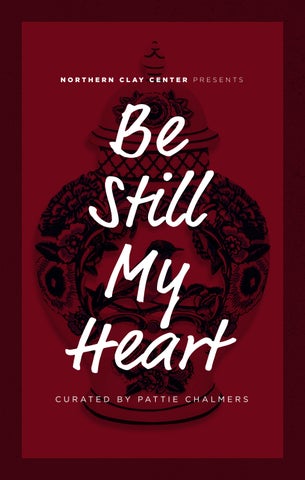
N O R T H E R N C L AY C E N T E R P R E S E N T S
Be Still My Heart
C U R AT E D BY PAT T I E C H A L M E R S
September 20 – November 2, 2025 Northern Clay Center, Minneapolis, Minnesota
Be Still My Heart
02
BE STILL MY HEART
N O R T H E R N C L AY C E N T E R
3 1
2
See image credits on inside back cover
03
04
BE STILL MY HEART
N O R T H E R N C L AY C E N T E R
Be Still My Heart
6 7
5
05
Pattie Chalmers, curator and essayist
Growing up in Winnipeg, Canada, I found solace in the pages of my father’s Time-Life Library of Art books during the short winter days. Initially, I was drawn to the flowing gowns and palpable flesh in the figurative paintings of Bruegel, Cranach, van Eyck, and Gainsborough. But as I repeatedly returned to these images, my attention was drawn to the objects within the painted scene, and I became enamoured of these seemingly haphazardly arranged belongings that were so carefully rendered. It was through these portraits that I began to gradually understand how an arrangement of objects could reveal as much, if not more, about a life than the static visage of the painted subject.
4
These painted things piqued both my curiosity and imagination and led me to look at the still life paintings of Pieter Claesz, Cornelis Le Mair, Clara Peeters, and Paul Cezanne, among others. I would examine these arrangements like a crime scene detective looking for clues to a narrative that I could perhaps one day decipher. Eventually, I learned that the objects in these paintings were imbued with specific meanings—the ephemeral nature of beauty, the fleetingness of earthly pleasures, or the suggestion of spiritual devotion, for example. However, even with the key to the visual language, I continued to test my deductive skills; it was like returning to a film or book and becoming increasingly engaged with a subplot or the unresolved story of a minor character. 8 10
9
See image credits on inside back cover
While in art school, I learned of the 17th-century hierarchy of painting, a ranking of works from the most lauded historical paintings to the least valued paintings of still lifes. Despite (or perhaps, because of) the underappreciation of the genre, my admiration for these compositions continued to grow, as did my interest in contemplating how these collections of often mundane items could provide significant insight into the cultural, moral, and spiritual beliefs of a time—a vase, a lemon, a loaf of bread, flowers, a knife, a glass of wine—each pointing to meaning. This capacity of seemingly ordinary objects to contain memories and then ignite a connection is magical. I am inspired by our ability to condense such a variety of experiences into seemingly mundane mementos. This enduring interest in the language of still life paintings and the nature of objectness acted as the catalyst for organizing Be Still My Heart. “The appeal and power of still life…lie not only in its comprehensible scale, but in the fact that extraneous details are stripped away and what is left speaks to the responsive eye, simply and directly, of matters large and small. Of what do still lifes speak? Of relationships— connections, reflections, support, power, balance; of cause and effect; of things that have happened and will happen; of taste, touch, and smell; of man and nature; of markets and appetites and genetics and diet; of time, mortality, and regeneration.”1
NOTES 1 Lowenthal, A.W. (1996) The Object as Subject: Studies in the Interpretation of Still Life. Princeton, N.J: Princeton University Press, p. 3
06
NOTES 2 Olalquiaga, C. (2002). The Artificial Kingdom: A Treasury of the Kitsch Experience (1st University of Minnesota Press ed.). University of Minnesota Press, p. 87 3 Schwenger, P. (2006). The Tears of Things: Melancholy and Physical Objects. University of Minnesota Press, p. 70 4 Olalquiaga, C. (2002). The Artificial Kingdom: A Treasury of the Kitsch Experience (1st University of Minnesota Press ed.). University of Minnesota Press, p. 70
N O R T H E R N C L AY C E N T E R
BE STILL MY HEART
The artists included in this exhibition engage in a variety of approaches to making, their work reflecting moments of the past (both personal and historic), and presenting ideas of culture, class, identity and race. For me, a connection to the genre of still life is the linchpin. There is a sense of longing in all of this work, a request to slow down and give space to wonder and find meaning in the stillness.
Christina Margarita Erives fabricates playful depictions of food preparation—limes, peppers, and cucumbers populate her cutting boards as she explores the narratives around food and connections to culture and relationships. Her creations resemble the graphic qualities of a picture book, comic, or Loteria cards, offering the opportunity to imagine individual stories in these intensely coloured scenes from life.
Grant Benoit fashions sentimental arrangements of flowers, vases, and ceramic ornaments out of paper, cardboard, and carpet remnants, with the ephemeral quality of these materials conveying a quiet and fragile beauty. However, unlike the 16th-century Dutch still lifes, these bouquets do not pretend that they are real flowers and perhaps exist more as a shadow of a moment in their beige blush over a lack of colour and scent. The cardboard and paper bring forth associations of life transitions, of moving boxes and cast-off mementos packed up for charity shops. An overall impression of melancholy imposes itself on the delicate compositions. Still, the truth of one thing masquerading unsuccessfully as another suggests something less serious, and the overall effect is both sad and sweet.
Arthur Fields photographed within the home of a recently-departed woman and was able to capture “the ghosts of love and loss” within his compositions of left-behind objects. These images are hushed moments of transition, fleeting, but frozen in time. They are more lines of a poem than a novel—these lonely vignettes suggest something personal but also make connections to an unknown history.
“The grey film of dust covering things has become their best part”, Walter Benjamin Dreamkitsch 1927 2
“It is the silence that obliges the poet to listen and gives the dream greater intimacy.”6
Caro Prados Burks tremulously renders swans, pink seashells, wax fruit, gothic romance novels, and family heirlooms and arranges them in the manner of one’s great aunt’s china cabinet. Through this imposed proximity, unexpected narratives emerge, in a way that corresponds with the flux of how things are remembered. The truth of her objects is often fragmented through hybridization—spawning memories of vague objects from the edge of slumber that linger like the ghost of a touch. In this space between dream and waking, a new reality can exist, and something new can emerge—something seductive and slightly dangerous.
Gustav Hamilton depicts arrangements of objects in surreal landscapes that are inspired by midwestern and western landscapes. There is a surreal quality to his compositions that invokes a dreamy quality. This work exists as an “auto-fictitious diary,” and the connection becomes amplified by what seems to be the clues of an unseen event. The artifacts within the frame, and the frame itself, provide a mystery to uncover. But then a suspension of disbelief, allowing the freedom to believe in the presented possibilities, becomes a moment of joy.
“…[T]here is a melancholy associated with physical objects. That Melancholy differs from the traditional lament for the ephemeral object: the morning rose must fade alas…it is generated by the act of perception, perception of the object by the subject. This perception, always falling short of full possession, gives rise to a melancholy that is felt by the subject and is ultimately for the subject.”3 Guy Michael Davis & Katie Parker, the collaborative partners of Future Retrieval, find source material in the archives of museums, historic locations, and rare book collections. They collect interesting objects and images to reimagine, recreate, rescale, and reorganize, and, in doing so, discover new meanings and associations. The re-creating and re-placing of these historical and culturally steeped artifacts serves to illuminate connections to history and culture. The created objects can act as talismans or mementos for a larger narrative that remains tied to the past but is something entirely new. “Consolidated into a perfectly flawless version of itself, the censored event becomes a sort of ‘cultural fossil,’ the static and idealized blueprint of an experience…the cultural fossil recalls an immaculate memory, continuously regenerating it in ahistorical purity without the annoying distortions brought about by the passage of time—death and decay.”4
07
“…[S]till life pitches itself at a level of material existence where nothing exceptional occurs: there is wholesale eviction of the Event. At this level of routine existence, centred on food and eating, uniqueness of personality becomes an irrelevance. Anonymity replaces narrative’s pursuit of distinction.”5
“Objects of desire. This term must be understood in its broadest, most generic, sense: that the objects an artist chooses to present or depict correspond to a notion of desirability, either in a general social context or in a microcosm of that society. Domestic objects, which imply comfort, stability, and well-being, may be universally seen as objects of desire. But desire is a complex emotion, triggered by a broad variety of real and imaginary situations, conscious and unconscious impulses, sublime and mundane objects.”7 Janice Jakielski creates impossible objects of beauty. Through mysterious techniques, she fabricates historically-inspired works out of fragile sheets of porcelain. There is wonder in the material and technique, but more so a quiet sentimentality as these objects exist as a description of something else. The attraction of material curiosity shifts on closer inspection to a sense of playfulness and joy. “[Our] capacity for thinking gives us a consciousness of the world: we know that we exist, that we are born and that we will die, that we are temporal beings, with a past, a present and a future. And this consciousness requires that we make sense of the world. We do this through language, spoken and written words, literature, fiction, theory, science, religion, history also with music and song. We do this as well by creating images and we do it by creating objects.”8
NOTES 5 Bryson, N. (2001). Looking at the Overlooked: Four Essays on Still Life Painting. Reaktion Books, p. 61 6 Bachelard, G. (1994). The Poetics of Space (M. Jolas, Tran.; 1994 edition.). Beacon Press. p. 179 7 Rowell, M. (1997). Objects of Desire: The Modern Still Life. The Museum of Modern Art Stable, Summer, No. 25. p. 7. 8 Mathieu, P. (2017). Object theory. In The Ceramics Reader (p. 268). Bloomsbury Academic Publishing, p. 7.
08
BE STILL MY HEART
N O R T H E R N C L AY C E N T E R
09
Matt Nolen sculpts decorative sets of vessels, or garnitures, that bring attention to the space between beauty and the grotesque, organic and inanimate, natural and fabricated, illness and health, and life and death. The space separating these dualities is amplified by the distance separating his bodily ceramics. These forms convey a sense of the uncanny, an invitation to look for meaning and wonder, to exist in the liminal space between clarity and uncertainty.
11 13
14
12
“Objects have a Perfectness—a vivid and indifferent presence that sets off by contrast the perceiver’s amorphous being, along with the very opposite of indifference: a kind of longing toward something that continuously recedes into dimensions of loss.”9 Kristen Morgin makes small arrangements of objects out of unfired clay and paint that are convincing fakes—the thing that is not the thing—and in doing so, she creates a distortion between fact and fiction. The details of these items—price tags, stickers, name tags, doodles, and worn edges— are clues perhaps to identity and narrative. The type of objects—comic books, pencil stubs, cigarettes, and toy parts—suggests cultural relics from a specific time and place. There is a sense of nostalgia or sweet sentimentality to this work, but this acts only as a kind of dust jacket to a deeper emotional weight, an unseen heaviness as though the objects were handled by ghosts. “Still life proudly pretends, but only pretends, that its absolute unreality is the simulacrum of real presence. It parades the completely fake as the copy of a completely real original. But it lets us suspect it may be lying. Its emphasis is on the completeness, the conspicuousness, of its fakery.”10 Sharon Norwood recontextualizes objects such as ceramic tea services, 19th-century prints, handmade bricks, and recreated personal and historical artifacts to reframe historical narratives of postcolonialism and power. Her collective work provokes an honest conversation about race and difference while revealing intertwined histories. By arranging these objects in the manner of a still life, she creates space for the presentation of “difficult histories and quiet resistance.”
17 15 16
“Since its appearance as an autonomous genre in the early seventeenth century, the still life has been a highly coded art form: the objects chosen and their manner of organization represent social and economic value systems that may not be immediately visible to the untrained eye. This is also true in the twentieth century, although the value systems may not be exactly the same. Whereas earlier examples of the genre were often commissioned by individuals as a means of conveying wealth or social status, in the twentieth century, artists are more often their own arbiters, moving freely between principles of tradition and transgression in their invention of singular codes.”11 Erin Palmer’s collection of objects and interest in still life are strongly related. Her paintings depict a reverence for the ordinary and patience for what is revealed through the activity of contemplation. Within the work, there are unspoken or implied truths—the pairing of familiar objects amid patterns and textures allows for personal connections and links to the past. Through her work, she contemplates similarity and difference, finding beauty in the ordinariness of the act.
See image credits on inside back cover
NOTES 9 Schwenger, P. (2006). The Tears of Things: Melancholy and Physical Objects. University of Minnesota Press, p. 6 10 Berger, H. (2011). Hyperreality and Truthiness. In Caterpillage: Reflections on SeventeenthCentury Dutch Still Life Painting (p. 6). Fordham University Press. 11 Rowell, M. (1997). Objects of Desire: The Modern Still Life. The Museum of Modern Art Stable, Summer, No. 25.
10
N O R T H E R N C L AY C E N T E R
“For many, the familiar presence of things is a comfort. Things are valued not only because of their rarity or cost or their historical aura, but because they seem to partake in our lives; they are domesticated, part of our routine and so of us. Their long association with us seems to make them custodians of our memories; so that sometimes, as in Proust, things reveal us to ourselves in profound and unexpected ways. Yet all this does not mean that things reveal themselves, only our investments in them. And those investments often carry with them a melancholy in the very heart of comfort…”12 Karl Raschke presents photographs of interesting moments from places he has visited, an immortalization of the relationships between objects, light, and shadow. The compositions he creates may be beautiful or strange, and the photographs themselves become objects to be arranged within the gallery, coaxing new fictions or sparking memories from the activity. “Of course that is not the whole story, but that is the way with stories; we make them what we will. It’s a way of explaining the universe while leaving the universe unexplained, it’s a way of keeping it all alive, not boxing it into time. Everyone who tells a story tells it differently, just to remind us that everybody sees it differently.”13 Dennis Ritter’s work explores the replication of everyday objects to act as indicators of identity and memory—a boom box, a house plant, an ashtray, and a tangle of extension cords, for example, presented as if on a stage. The pieces fit together in an order that suggests remembered spaces. By fabricating and organizing these objects in the manner of a still life, the arrangements seem to be fossilized moments of anticipation. There is a distortion to the work, a moment where memory and experience merge with imagination and point to a reflection of personal and cultural identity.
NOTES 12 Schwenger, P. (2006). The Tears of Things: Melancholy and Physical Objects. University of Minnesota Press, p. 6 13 Winterson, J. (1985). Oranges Aren’t the Only Fruit. Virago Press, p. 85 14 Schwenger, P. (2006). The Tears of Things: Melancholy and Physical Objects. University of Minnesota Press, p. 6 15 Daigle, C. (2020). Stirring the Sentient Dust: Marie-Rose Sousci’s The Grey Moth. In S. Simon (Ed.), The Anthology of Babel: Dead Letter Office (p. 1). Punctum Books.
“Possession is most overtly ownership, called by Walter Benjamin the most intimate relationship that one can have to objects. But he immediately cautions, not that they come alive in him; it is he who lives in them”14 Tammie Rubin creates compositions of objects that act as familial, historical, and literary artifacts of Black American citizenry, migration, autonomy, and faith. Through her creation of new artifacts, Rubin reveals an American history tied to personal experience and imagined spaces. Her ceramic and mixed-media work defies conventional history telling by interweaving her expressions of the past with firsthand knowledge and stories of lived experiences— the resulting work moves towards a new account of history. “Maybe meaning is in gazing till it hurts” Santiago Vizcaíno15 Amy Santoferraro arranges collections of objects to organize and make sense of her surroundings. Through this act, she hopes to gain further understanding of the need for, and affection for, objects. It is through the acts of rummaging, seeking, tinkering, and imagining that she creates her work. Finding beauty and promise in cast-off materials, she then reinvents. Often, the truth of these objects becomes fragmented as they are subverted from their original banal existence, the splinters of which get twisted together with imagined elements to create something wholly new and sometimes magical.
BE STILL MY HEART
11
“This mode of conveying meaning—representing the whole through one of its parts—invests souvenirs with a large fetishistic potential: souvenirs begin to stand in for events or situations they were contingently associated with or were supposed to represent, gaining a life of their own.”16 Josh Stover paints domestic scenes of what seem like familiar household spaces that become stages for antiques and vintage objects to exist as if characters in a story. His compositions are loaded with cues to his own memories but also open possibilities for connection to others. These images suggest a space for narrative, either personal or public, serious or humorous, and in so doing provide a gateway to experience the work in an expanded way. “And yet these images which, when all is said and done, represent at first glance the monotony and the insignificance of the object, conspire not to weary us, but to attract and hold us. We persist in looking at them. They provoke an obscure feeling, whose origin, whose nature we do not quite understand.”17 Kari Woolsey creates pinched clay bottles, pop cans, lemons, and fruit baskets in muted colours that invoke a memory of fading light through a rolled glass window. Her compositions reference overlooked domestic spaces where articles of life accumulate. These collections of commonplace objects act as conduits to memory and emotion and result in a tangle of possible narratives or a tender moment remembered, if only vaguely. “…every corner in a house, every angle in a room, every inch of secluded space in which we like to hide or withdraw into ourselves, is a symbol of solitude for the imagination…To withdraw into one’s corner is undoubtedly a meager expression. But despite its meagerness, it has numerous images, some perhaps, of great antiquity, images that are psychologically primitive. At times, the simpler the image, the vaster the dream.”18
Pattie Chalmers grew up and went to art school in Winnipeg, Canada. She received her BFA in printmaking from the University of Manitoba, and her MFA in ceramics from the University of Minnesota. Chalmers has exhibited in group exhibitions on five continents, in six countries and in thirty-four states and has had seven solo exhibitions in the past five years, most recently Hinterland, at Silverwood Park Gallery, St. Anthony, MN, and The Mudmaid Museum at the Sheldon Art Center in St. Louis. Chalmers is a professor at Southern Illinois University in Carbondale where she teaches ceramics and is the Head of Graduate Studies.
NOTES 16 Olalquiaga, C. (2002). The Artificial Kingdom: A Treasury of the Kitsch Experience (1st University of Minnesota Press ed.). University of Minnesota Press, p. 87 17 Harari, J. (1984). Dream objects. French Issue, 99(4), 836–844. The Johns Hopkins University Press, p. 837 18 Bachelard, G. (1994). The Poetics of Space (M. Jolas, Trans.; 1994 ed.). Beacon Press, p. 136-7
BE STILL MY HEART
AMY SANTOFERRARO Amy Santoferraro, born in Akron, Ohio, is the progeny of a carpenter and retailer. She received her M.F.A in Ceramic Art from The New York State College of Ceramics at Alfred University in 2012. Amy earned her BAE (Art Education) and her BFA (Ceramics) from The Ohio State University (Columbus). In 2014, Amy was awarded a McKnight Residency Grant for Ceramic Artists in a partnership through the McKnight Foundation and Northern Clay Center in Minneapolis, Minnesota. Amy was the 2018-2021 Joan and David Lincoln Visiting Professor at Scripps College and Claremont Graduate University and is currently the Lead Ceramics instructor at California State University (Los Angeles). ARTHUR FIELDS Arthur Fields earned a BFA in Digital Imaging and Photography at Washington University (St. Louis). His prior studies included printmaking and photography at Brookhaven College (Dallas). Arthur recently completed six years as Associate Professor Art at Vincennes University (IN) where he taught courses in analog photography, digital imaging and design. He also served as the director of VU’s Shircliff Gallery of Art. Arthur is currently Associate Professor of Art at Dallas College (TX) where he teaches courses in photography and design.
Artist Biographies
CARO PRADOS BURKS Caro Prados Burks uses ceramics and mixed-media sculpture to explore themes of sentimentality, storytelling, and symbolism in decorative culture. Caro received her BFA from Virginia Commonwealth University (Richmond) in 2015, held a post-baccalaureate position at the University of Arkansas (Fayetteville) from 2015-2017, and received her MFA from Southern Illinois University (Carbondale) in the Spring of 2020. Burks has been awarded residencies at Penland School of Crafts, Anderson Ranch Arts Center and The New Harmony Clay Project. Caro has participated in solo, juried, and two-person exhibitions nationally. CHRISTINA MARGARITA ERIVES Christina Erives was born in Los Angeles, California. She received her BA and MA from California State University, Northridge and her MFA from Pennsylvania State University (University Park). She has worked as a Resident Artist at the Archie Bray Foundation in Helena Montana, Belger Craneyard Studios in Kansas City Missouri, Arquetopia in Puebla Mexico, and Rasquache in Puebla Mexico. She has also worked as a Visiting Artist Instructor at New Mexico State University (Las Cruces) and the University of Montana (Missoula). Erives is an emerging artist in the field of Ceramics. In 2017 she received an Emerging Artist Award from the National Council on Education for the Ceramic Arts. DENNIS RITTER Dennis Ritter received his BFA from Temple University’s Tyler School of Art (Philadelphia) and his MFA from The New York State College of Ceramics at Alfred University. His work has been shown in galleries and museums throughout the United States including MOCA Georgia, The Wassaic Project, and Kennedy Museum of Art. He has been part of residency programs at Watershed Center for the Ceramics Arts, the Vermont Studio Center, and The Clay Studio. A committed educator, Dennis has taught at the Tyler School of Art, Alfred University, and at Louisiana State University (Baton Rouge). Dennis Ritter is currently an Assistant Professor in the Art Program at Berry College (Mount Berry, GA) where he teaches ceramics and sculpture.
13
14
N O R T H E R N C L AY C E N T E R
BE STILL MY HEART
ERIN PALMER Erin L. Palmer is an Associate Professor in Painting and Drawing at Southern Illinois University (Carbondale). She received her MFA from Yale School of Art (New Haven, CT) in 1993. Her work is primarily figurative from direct observation and is included in a number of private collections.
KARI WOOLSEY Kari Woolsey’s ceramic work focuses on the everydayness of objects and vessels around us through making functional pottery, as well as larger installations. She received a BFA in Ceramics from Florida Atlantic University (Boca Raton) in 2011 and a MFA in Ceramics from Southern Illinois University (Carbondale) in 2018. Currently, Kari resides in Carbondale, IL. She teaches ceramics classes as an Assistant Professor of Practice at SIUC.
GRANT BENOIT Grant Benoit is an interdisciplinary artist based in St. Louis, Missouri, whose work explores memory through printmaking, sculpture, and craft methods. He combines traditional print media with installation and sculpture to reinterpret the mechanics of memory, focusing on domestic spaces. Benoit earned his MFA in Printmaking from Southern Illinois University (Carbondale) in 2015 and a BA in Studio Arts from Spring Hill College (Mobile, AL) in 2012. GUSTAV HAMILTON Gustav Hamilton was raised in Fargo, North Dakota and currently lives and works in Brooklyn, NY. He received his MFA from the New York State College of Ceramics at Alfred University, and his BFA from the University of Montana (Missoula). He is currently a Studio Manager and Designer at BKLYN CLAY. He has exhibited most recently at Zoe Fisher Projects, The Hole, The Alfred Ceramic Art Museum, and Fisher Parrish Gallery in New York, as well as David B. Smith Gallery in Denver and Ochi Projects in Los Angeles. FUTURE RETRIEVAL: GUY MICHAEL DAVIS AND KATIE PARKER Guy Michael Davis and Katie Parker have been collaborating under the name Future Retrieval, mining archives and museums to digitally collect and make objects that re-examine the history of decorative arts. Davis and Parker currently reside in Scottsdale, Arizona where Parker is an Associate Professor in the School of Art at Arizona State University (Tempe). Their most recent solo exhibitions include Crystal-Walled Seas at Denny Gallery in 2022 and Close Parallel at the Cincinnati Art Museum in 2021. Future Retrieval’s work is held in numerous collections such as Arizona State University Ceramics Research Center (AZ), Cincinnati Art Museum (OH), 21C Museum/Hotel (NC), Society of Dresden Porcelain Art (Germany), and Jingdezhen International Studio (China). Davis and Parker both received their MFA from The Ohio State University (Columbus) and BFA from the Kansas City Art Institute (Kansas City). JANICE JAKIELSKI Janice Jakielski received her MFA in Ceramics from the University of Colorado (Boulder) and a BFA from New York State College of Ceramics at Alfred University. Solo exhibitions include; Duane Reed Gallery, MO, Cross MacKenzie Gallery, Washington DC, Eutectic Gallery, OR, Jane Hartsook Gallery, NY and the Canton Museum of Art, Ohio. Jakielski lives and works in Parker, Colorado. JOSH STOVER Josh Stover is an artist and sign painter based in Richmond, Virginia. Josh grew up in St. Petersburg, Florida and completed his BFA at the University of Florida (Gainesville) with an emphasis on ceramics. He draws inspiration from his home environment where he collects antique and vintage objects that often appear in his work.
KARL RASCHKE Karl Raschke is a Minneapolis-based artist who received an MFA from the University of Minnesota (Twin Cities) in 1999. He was awarded a McKnight Artist Fellowship in 2010. Raschke’s work has been exhibited at Minnesota Center for Photography, Tehran Museum of Contemporary Art, Minnesota Museum of American Art and many other venues. KRISTEN MORGIN Kristen Morgin is an American artist. Morgin’s practice incorporates ceramics, sculpture, painting, drawing, and collage. Her unfired clay sculptures are well known. Morgin received a BA in art at California State University (Hayward) and an MFA in Ceramics from New York State College of Ceramics at Alfred University. Her work has been shown widely in the United States and abroad. Her work is in the permanent collections of The Hammer Museum, San Francisco Museum of Contemporary Art, The Smithsonian American Museum of Art, The Museum of Contemporary Art, Los Angeles, and The Los Angeles County Museum of Art. MATT NOLEN Matt Nolen is a studio artist living and working in New York City and Narrowsburg, NY. Nolen’s work includes sculptural objects and architectural installations using clay and mixed media. His work has been exhibited internationally and is in numerous private and public collections including: The Cooper-Hewitt Museum, The Museum of Arts and Design, The Newark Museum, The Houston Museum of Fine Art, The Los Angeles County Museum of Art, The de Young Museum, and The Everson Museum of Art. SHARON NORWOOD Sharon Norwood is an interdisciplinary artist whose work spans ceramics, drawing, video, and installation. Rooted in conceptual research, her practice explores issues of race, gender, labor, and class, often using found objects and historical materials to spark critical dialogue. Born in Jamaica and raised in Canada, Norwood holds an MFA from Florida State University (Tallahassee) and a BFA from the University of South Florida (Tampa). Her work has been exhibited nationally and internationally and is held in both public and private collections, including the Telfair Museums. She currently lives and works in Savannah, Georgia. TAMMIE RUBIN Tammie Rubin is a ceramic sculptor and installation artist. Rubin’s work is a meticulous exploration of the inherent power of objects as signifiers, wishful contraptions, and mythic relics. Her unique approach weaves together familial and historical narratives of Black American citizenry, migration, coded symbols, and faith. She holds an MFA in Ceramics from the University of Washington (Seattle) and a dual BFA in Ceramics and Art History from the University of Illinois, Urbana-Champaign.
15
16
N O R T H E R N C L AY C E N T E R
Northern Clay Center Northern Clay Center’s mission is to advance the ceramic arts for artists, learners, and the community, through education, exhibitions, and artist services. Its goals are to create and promote high-quality, relevant, and participatory ceramic arts educational experiences; cultivate and challenge ceramic arts audiences through extraordinary exhibitions and programming; support ceramic artists in the expansion of their artistic and professional skills; embrace makers from diverse cultures, experiences, and traditions in order to create a more inclusive clay community; and excel as a non-profit arts organization.
© 2025 Northern Clay Center All rights reserved. No part of this book may be used or reproduced in any manner whatsoever without written permission, except in the case of brief quotations embodied in critical articles and reviews. For information, write to: Northern Clay Center 2424 Franklin Avenue East Minneapolis, MN 55406
Exhibition Staff Lauren Tucci, Exhibitions Manager Maria Hennen, Galleries Coordinator Judy Hawkinson, Executive Director
Image Credits Pages 2-3 1 Christina Margarita Erives, Cutting Board, 2024, Stoneware, 3" x 11" x 8" 2 Janice Jakielski, Feast: Chicken Coronet, Two Lumps with Kale, Pineapple Delight, Fish in Gelatin, 2022-2025, Porcelain, 11" x 48" x 13.5" 3 Erin Palmer, Still Life with Doll, 2022, Oil on Canvas, 11" x 10.75" x 1.75"; Still Life with Turtle Shell, 2015, Oil on Canvas, 11.25" x 12.75" x 1.75"
www.northernclaycenter.org
Tippy Maurant, Deputy Director/Director of Galleries & Exhibitions (Ret.) Kyle Rudy-Kohlhepp, Executive Director (Fmr.) The exhibition program is part of a team that excels in supporting one another, so we gratefully acknowledge every staff person who contributed to the success of Be Still My Heart. Artist Advisory Committee Kelly Connole Chotsani Elaine Dean David East Tippy Maurant Kate Maury Sequoia Miller
Honorary Director Kay Erickson
Board of Directors Mary K. Baumann, Chair Evelyn Weil Browne, Vice Chair Mike Karels, Treasurer Debbie Schumer, Secretary Lisa M. Agrimonti Craig Bishop Evelyn Browne Nettie Colón Kate Maury Marcela Sánchez Ramon Serrano
Directors Emeriti Emily Galusha Sarah Millfelt
Legacy Directors Andy Boss Warren MacKenzie Joan Mondale
Manufactured in the United States First edition, 2025 International Standard Book Number 1-932706-72-0 Unless otherwise noted, all dimensions in inches: height precedes width precedes depth. This activity is made possible by the voters of Minnesota through a Minnesota State Arts Board Operating Support grant, thanks to a legislative appropriation from the Arts and Cultural Heritage Fund.
Additional funding for this exhibition comes from Prospect Creek Foundation and Windgate Foundation.
Page 4 4 Grant Benoit, Arrangement I, 2023, Cast abaca and pulped cardboard vessels, handmade paper, thread, wire, 52” x 50” x 50” 5 Caro Prados Burks, Small Offerings, 2025, Ceramic, glaze, PLA plastic, flocking, 11.5” x 30” x 18” 6 Kari Woolsey, Basket Arrangement #22, 2025, Terracotta, vinyl decals, 9” x 9” x 1” 6 Kari Woolsey, Lemon Glaze Still Life, 2025, Brown stoneware, midrange glaze, terracotta, underglaze, 9” x 17” x 8” 7 Karl Raschke, Karl’s Still Life, Vol. 1 and 2, 2018-2025, Color Coupler print, mat board, 40.5” x 15” x 15” 8 Arthur Fields, Stairwell Window 01, 2022, Archival Pigment Print, 15" x 15" x .75" 8 Arthur Fields, Carpet Gone 01, 2022, Archival Pigment Print, 15" x 15" x .75" 9 Kristen Morgin, The Great Twiddle Bug Mystery, 2015, Unfired clay, paint, ink, 1" x 6.25" x 6.5" 9 Kristen Morgin, Nutface, 2015, Unfired clay, paint, 1" x 6" x 9" 9 Kristen Morgin, Hangin’ Tough and There Goes My Everything, 2018, Unfired clay, paint, ink, .5" x 8" x 2.5"
Photographs of ceramic works: Peter Lee Design Catalog design: Joseph D.R. OLeary (vetodesign.com) Essay: Pattie Chalmers Editors: Jesse Roth & Tippy Maurant
9 Kristen Morgin, A Rock and a Hard Place, 2017, Unfired clay, paint, ink, .75" x 7.5" x 7" 10 Amy Santoferraro, Fruit and Stones, Fluff and Bones: Peach, Banana, Chicken, 2023, Ceramic, mirrors, found objects and materials, 9.5" x 61.5" x 10.25" Pages 8 11 Gustav Hamilton, Rose Moon, 2025, Ceramics, glaze, wood, 20.5" x 18.75" x 1.75" 11 Gustav Hamilton, It’s About Time, 2022, Ceramics, glaze, wood, 20.5” x 19.5” x 2.75” 12 Sharon Norwood, Serving Up Those Savannah Grey's, 2020, Savannah Grey Bricks made by enslaved Africans, refired with decals, silver plated serving tray, 13" x 27" x 17" 13 Tammie Rubin, Unknown Ritual Mask No.2, 2023, Stoneware, porcelain, underglaze, bells, needles, wire, 31" x 9" x 9" 13 Tammie Rubin, Youme, 2025, Pigmented hydrostone, porcelain, bells, sponge, wood, 11.5" x 9.5" x 9" 14 Janice Jakielski, Jar with Bird, 2025, Porcelain, wood, 11" x 13" x 2" 15 Matt Nolen, Insomnia Set, 2021, Porcelain, 16" x 28" x 6" 15 Matt Nolen, Apoptosis Epergne, 2021, Porcelain, 16" x 24" x 6" 16 Josh Stover, The Bird Watched While We Made Drinks, 2025, Acrylic on Panel, oak frame, 24.5" x 24.5" x 1.5"
2424 Franklin Avenue East Minneapolis, Minnesota 55406 612.339.8007 www.northernclaycenter.org