/NORTHERNIOWAN
WWW.NORTHERNIOWAN.COM
@NORTHERNIOWAN
UNIVERSITY OF NORTHERN IOWA CEDAR FALLS, IA THURSDAY, APRIL 5 VOLUME 114, ISSUE 42 WEDNESDAY, DECEMBER 3, 2025
CEDAR FALLS, IA
VOLUME 122, ISSUE 14
President Nook helps with on-campus move-in day. For an alligator.
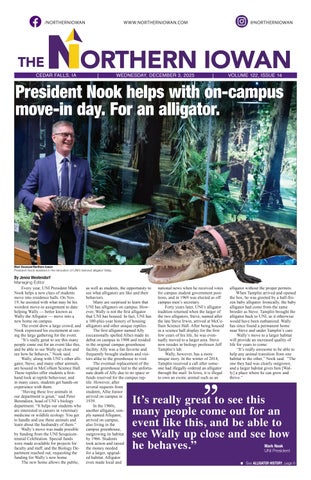
Maci Swanson/Northern Iowan President Nook assisted in the relocation of UNI’s beloved alligator Wally.
By Jenna Westendorf Managing Editor Every year, UNI President Mark Nook helps a new class of students move into residence halls. On Nov. 19, he assisted with what may be his weirdest move-in assignment to date: helping Wally — better known as Wally the Alligator — move into a new home on campus. The event drew a large crowd, and Nook expressed his excitement at seeing the large gathering for the event. “It’s really great to see this many people come out for an event like this, and be able to see Wally up close and see how he behaves,” Nook said. Wally, along with UNI’s other alligator, Steve, and many other animals, are housed in McCollum Science Hall. These reptiles offer students a firsthand look at reptile behaviour, and in many cases, students get hands-on experience with them. “Having these live animals in our department is great,” said Peter Berendzen, head of UNI’s biology department. “It helps our students who are interested in careers in veterinary medicine or wildlife ecology. You get to handle and use these animals and learn about the husbandry of them.” Wally’s move was made possible by funding from the UNI Sesquicentennial Celebration. Special funds were made available for projects for faculty and staff, and the Biology Department reached out, requesting the funding for Wally’s new home. The new home allows the public,
as well as students, the opportunity to see what alligators are like and their behaviors. Many are surprised to learn that UNI has alligators on campus. However, Wally is not the first alligator that UNI has housed. In fact, UNI has a 100-plus-year history of housing alligators and other unique reptiles. The first alligator named Ally (occasionally spelled Allie) made its debut on campus in 1908 and resided in the original campus greenhouse facility. Ally was a fan favorite and frequently brought students and visitors alike to the greenhouse to visit. The eventual replacement of the original greenhouse led to the unfortunate death of Ally due to no space or funds reserved for the campus reptile. However, after several requests from students, Allie Junior arrived on campus in 1939. In the 1960s, another alligator, simply named Alligator, arrived on campus, also living in the campus greenhouse, outgrowing its habitat by 1966. Students took action and raised the money needed for a larger, upgraded habitat. Alligator even made local and
national news when he received votes for campus student government positions, and in 1969 was elected as off campus men’s secretary. Forty years later, UNI’s alligator tradition returned when the larger of the two alligators, Steve, named after the late Steve Irwin, arrived at McCollum Science Hall. After being housed in a science hall display for the first few years of his life, he was eventually moved to a larger area. Steve now resides in biology professor Jeff Tamplin’s lab. Wally, however, has a more unique story. In the winter of 2014, Tamplin received a call after someone had illegally ordered an alligator through the mail. In Iowa, it is illegal to own an exotic animal such as an
alligator without the proper permits. When Tamplin arrived and opened the box, he was greeted by a half-frozen baby alligator. Ironically, the baby alligator had come from the same breeder as Steve. Tamplin brought the alligator back to UNI, as it otherwise would have been euthanized. Wally has since found a permanent home near Steve and under Tamplin’s care. Wally’s move to a larger habitat will provide an increased quality of life for years to come. “It’s really awesome to be able to help any animal transition from one habitat to the other,” Nook said. “The one they had was clearly outgrown, and a larger habitat gives him [Wally] a place where he can grow and thrive.”
It’s really great to see this many people come out for an event like this, and be able to see Wally up close and see how he behaves.”
Mark Nook UNI President
See ALLIGATOR HISTORY, page 6