College of Business at the University of Northern Iowa
FROM THE DEAN
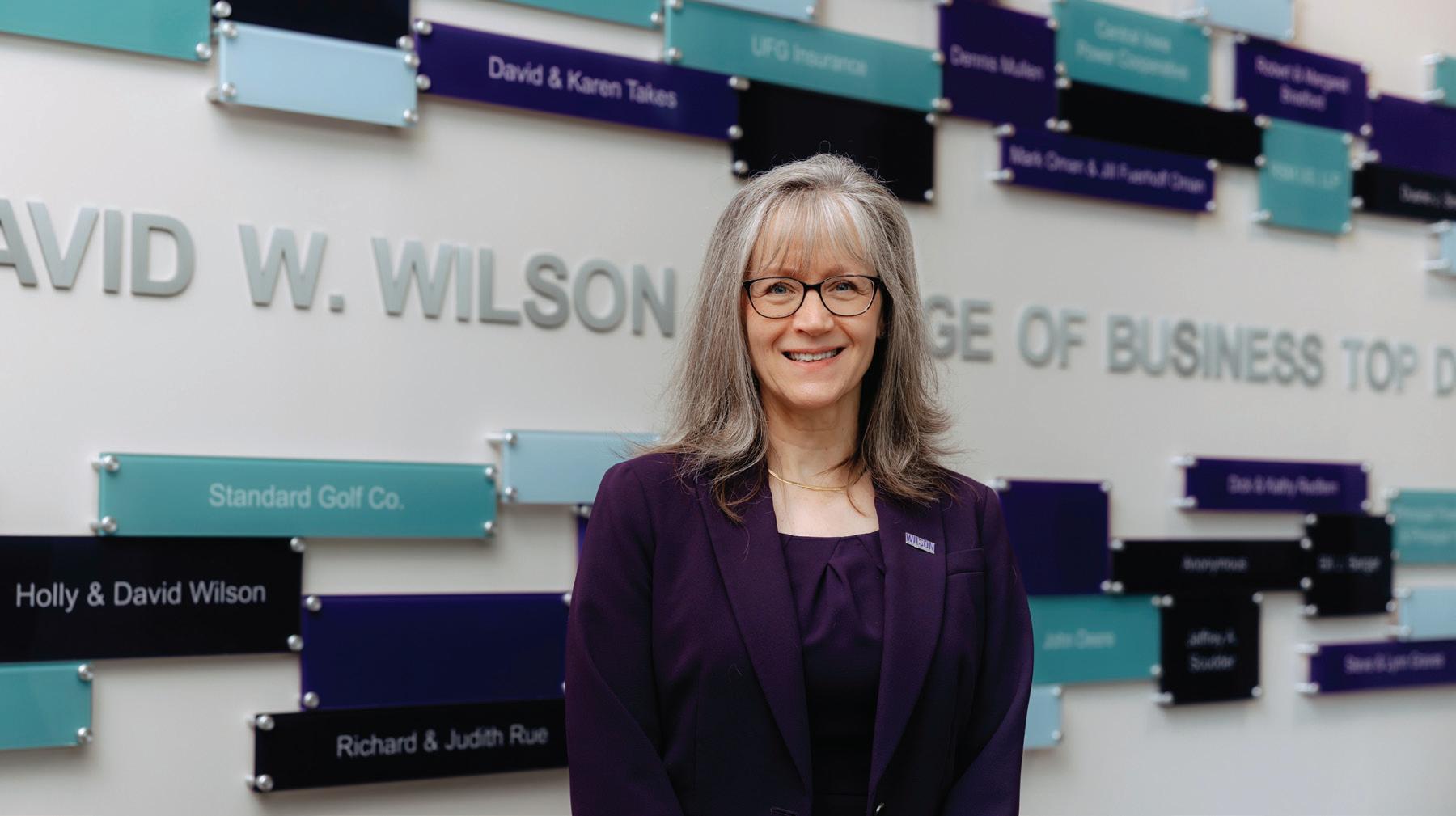
As a valued member of the Panther circle, I am pleased to share that we have not only earned our Association to Advance Collegiate Schools of Business (AACSB) extension of business accreditation but also separate accreditation in accounting, one of only 196 schools that have done so. This distinction places Wilson College in the top 2% of business schools worldwide.
It has been a great year for our accounting program. Accounting Today recognized our students for achieving the highest CPA pass rate in the nation for 2023, research by Associate Professor Gabriel Dickey found its way into Forbes and now we’ve earned separate accounting accreditation. Be proud that the outstanding business education we have been known to deliver continues!
The success of our accounting program is built on the traditions of excellence and continuous improvement. Most recently, the
curriculum evolved to incorporate more data and technology, ensuring students are prepared for their career challenges and earning a first-in-the-nation STEM designation for an undergraduate program in accounting.
That particular curriculum evolution extends across the entire college as our graduates must be prepared for a world increasingly shaped by data, technology and artificial intelligence (AI).
Today’s business leaders must not only be fluent in digital tools and data analytics — they must also navigate the profound ethical questions these technologies raise. At the Wilson College of Business, we are committed to preparing students who are both technologically adept and ethically grounded. I hope the articles that fill the pages of this magazine give you insight into how we are doing just that. Our goal is to develop leaders who can harness the power of data
and AI with integrity, empathy and foresight.
As an alum, your experience and insight are vital to this mission. Whether through mentoring, guest speaking or financial support, there are many ways to stay connected and help shape the next generation of responsible business leaders.
Thank you for being part of our journey. Together, we’re building a business school that not only embraces innovation — but leads with integrity and purpose.
Purple for Life ‘84
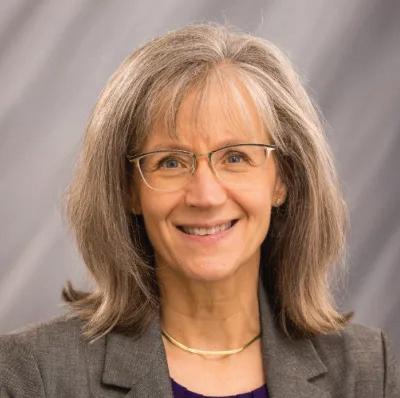
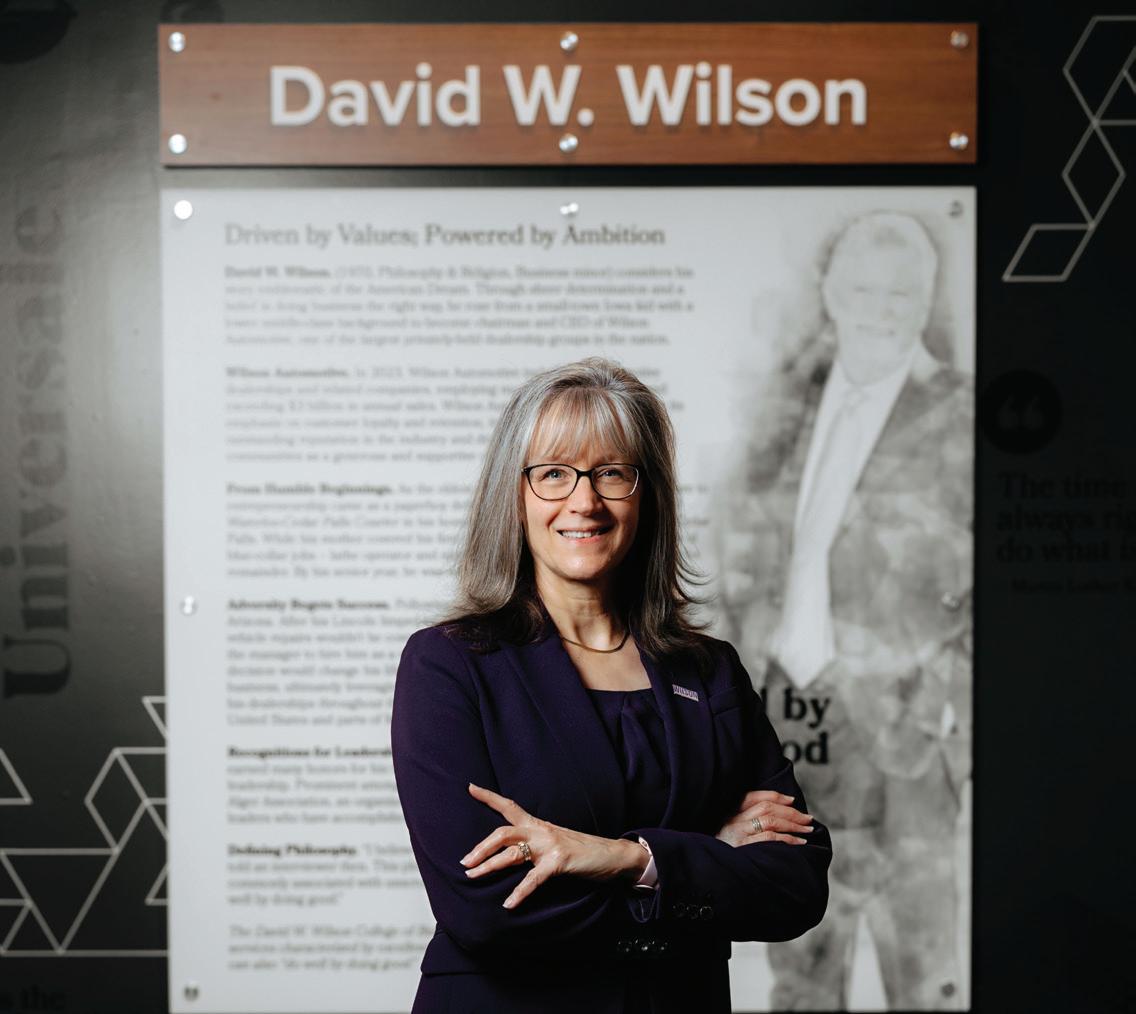
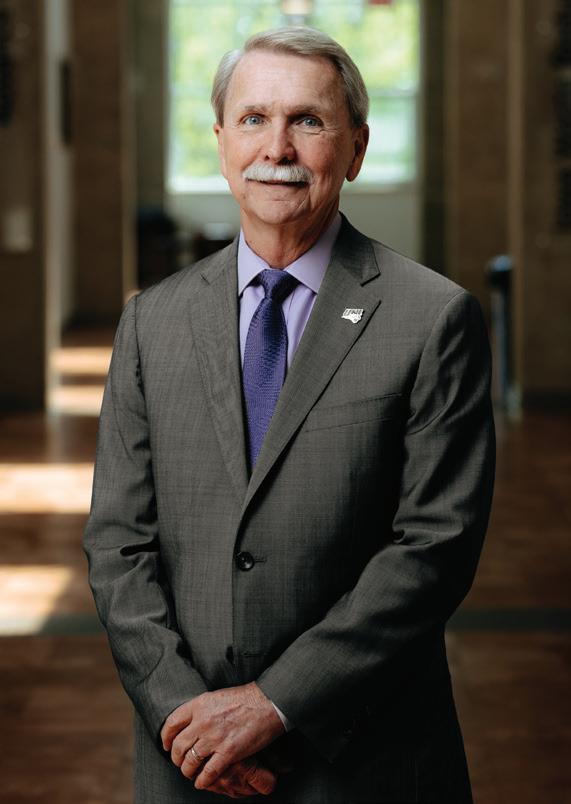
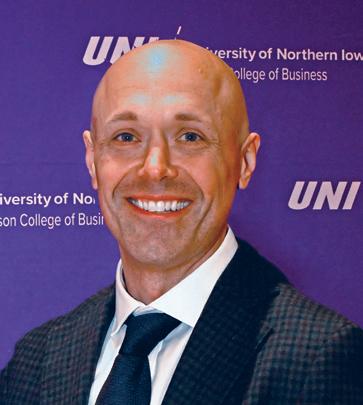
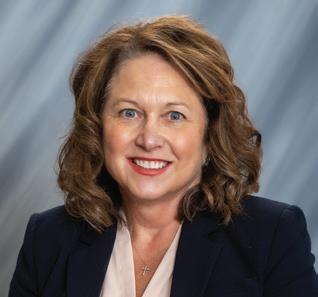
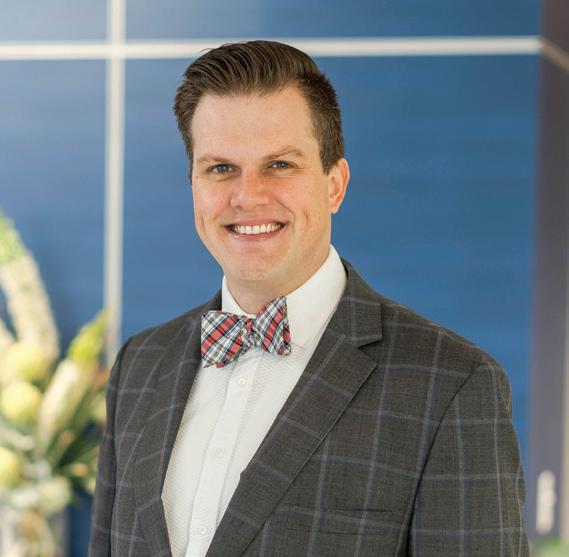
Leslie K. Wilson, Dean University of Northern Iowa Wilson College of Business
leslie.wilson@uni.edu linkedin.com/in/UNIBizDean
AUDITING
THE UNI ACCOUNTING PROGRAM HAS A LONG HISTORY OF EXCELLENCE PREPARING STUDENTS TO BECOME CERTIFIED PUBLIC ACCOUNTANTS.
The program’s success is a result of not only its CPA review program but also its practitioner-oriented focus. The audit environment has been undergoing dynamic changes over the past several years due to the emergence of new technologies.
The accounting department, spearheaded by auditing professor Gabriel Dickey, decided that an advanced auditing course could help keep students current with many of the changes that are occurring in the profession. The advanced auditing course develops the skills to not only explore the use of certain emerging technologies but also to critically think through issues while using the technologies.
Dickey formed the vision for the course and then collaborated with accounting information systems professors Amy Igou and Joseph Ugrin to develop a grant proposal for PricewaterhouseCoopers (PwC), which awarded the team $10,000 to develop the course.
GABRIEL DICKEY Assistant Professor “
“This course uses tools and data that closely resemble what students will encounter in the real world and provides them with the skills to think through problems.”
The nature of auditing involves poring over transactions, financial records and numerous data points. However, in recent years, auditors have shifted further into financial data analysis, leveraging new software tools to gain deeper insights into organizations than ever before. This approach reflects a broader shift in the auditing profession, which increasingly relies on an abundance of data to conduct analyses, detect anomalies, assess risks and make projections. Today, auditing is no longer just about crunching numbers — it’s about identifying potential risks and problems and then developing solutions.
“There’s an immense amount of data that goes into an audit,” said Dickey. “This course uses tools and data that closely resemble what students will encounter in the real world and provides them with the skills to think through problems.”
For example, one scenario students tackle in the course involves analyzing a soup company’s sales data alongside weather and snowfall patterns. Since soup sales are expected to increase in colder temperatures, students use Tableau, an industry-standard data analysis tool, to detect outliers among restaurants — helping them identify businesses that may warrant further investigation. Tableau provides visualizations of the data, highlighting irregularities that might otherwise go unnoticed.
Another tool, Alteryx, enables users to quickly access, manipulate and analyze data. Students use it to assess whether a company’s information technology general controls are functioning effectively by evaluating a sample of passwords.
Interactive Data Extraction and Analysis (IDEA) is also incorporated into the course to examine multiple data sources. This tool helps students test account transactions and balances — such as accounts receivable, cash disbursements and inventory — for potential monetary misstatements by selecting samples, evaluating evidence and analyzing outputs.
In certain exercises, Dickey deliberately refrains from telling students what to look for, encouraging them to understand the data and interpret the output. Because emerging technologies constantly evolve, this ambiguity reinforces problem-solving skills essential in modern auditing.
“What employers want is an auditor who is comfortable using new technologies and who can think through problems that haven’t even been identified yet,” Dickey said. “The skills students gain in this course are highly relevant, particularly as firms begin implementing artificial intelligence tools. Graduates have already worked with a variety of new technologies and learned how to adapt.”
Lucas Samuelson (Accounting ‘23, Master of Accounting ‘24)
echoes that sentiment. Many of the software programs he used in the course were similar to those he encountered during an internship at the leading global accounting firm RSM, giving him a competitive advantage when starting his career.
“It was incredibly beneficial to become familiar with the software programs companies are using,” said Samuelson, who graduated from the Master of Accounting program and took the CPA exam. “It allows you to hit the ground running ahead of your peers and other new hires. Getting hands-on experience with real data, analyzing financials and working on projects — it all helps us tremendously.”
And that’s the goal of Advanced Auditing: to help students develop the technical expertise and adaptability they need to have confidence in uncovering meaningful data insights.
“It really gives students the ability to utilize some of the emerging technologies and make sense of the data,” Dickey said. “The goal is to give them projects that stimulate their thinking — so they’re ready when they graduate.”
“It was incredibly beneficial to become familiar with the software programs companies are using. It allows you to hit the ground running ahead of your peers and other new hires.”
LUCAS SAMUELSON
(’23)
HOW REAL ESTATE STUDENTS ARE LEARNING
INDUSTRY SOFTWARE IN THE CLASSROOM
“I think it was very valuable to have the experience. In this industry, everyone needs to know how to use Argus. So, the more exposure students can get to it, the better. I think it helps UNI students set themselves apart when interviewing for jobs.”
SUSIE NETUSIL (‘21)
Senior Asset Management Analyst, Principal Real Estate
Susie Netusil (Finance and Real Estate ‘21) uses Argus Enterprise every day as a senior asset management analyst at Principal Real Estate. Argus Enterprise, or Argus for short, is a crucial piece of commercial real estate software that processes property data and generates valuation and cash flow forecasts to help investors make decisions. More than 3,500 companies use it, including Fortune 500 companies like Principal.
For Netusil, knowledge of Argus upon graduating was a significant advantage when joining Principal. She gained that exposure at the Wilson College of Business, thanks to an alumnus who came back to teach students the fundamentals of the program in the Real Estate Appraisal and Investment course.
Netusil’s story isn’t unique. Hundreds of UNI real estate students have had a similar experience, giving them a leg up on other graduates when searching for jobs.
“I think it was very valuable to have the experience,” said Netusil, who has come full circle and now returns to UNI twice a year to teach students about Argus. “In this industry, everyone needs to know how to use Argus.
So, the more exposure students can get to it, the better. I think it helps UNI students set themselves apart when interviewing for jobs.”
Those opportunities are intentional. Argus is integrated into the Wilson College of Business real estate curriculum — the only four-year real estate program in Iowa — even more so now than when Netusil was in the program.
Kirsten Juhl, associate professor of practice and practicing real estate lawyer, teaches real estate courses and makes Argus the foundation of the entire semester in the Real Estate Appraisal and Investment course. Students learn from alumni about the software, then they are expected to complete real valuations and forecasts of properties in the Cedar Valley. In the spring 2024 semester, Juhl tasked students with valuing the First Bank building on Main Street in Cedar Falls. The class toured the building and saw some of its unique characteristics
firsthand, including a vault and a drive-up window. The property had just undergone a major renovation. The parking lot is the second-largest parking area in popular downtown Cedar Falls.
All those characteristics need to be factored into the valuation and investment analysis, which is where Argus comes in. To mimic a real workplace as closely as possible, Juhl doesn’t provide much direction. Instead, she lets students enter their own data and draw their own conclusions.
“The valuation of real estate is a huge part of any real estate transaction,” Juhl said. “What really makes Argus valuable is students have to go through this process of inputting information. They have to decide what’s important based on what they’ve learned. Then, I give them feedback on how they did their valuation. It forces them to think through all these different aspects of the commercial leasing process.”
“They have to come up with realistic financing scenarios and what those look like. It’s really exciting, and it’s fun to see what the students come up with. I’ve been really impressed with the ideas and options students present throughout the year.”
KIRSTEN JUHL, J.D. Associate Professor of Practice
“I felt pretty set going into my internship at Principal because of coursework at UNI and from the NAIOP experience. There’s definitely a learning curve with the software, so those experiences really helped.”
AIDAN PERRY (‘19)
Senior Asset Management Analyst, Principal Real Estate
CHALLENGING STUDENTS’ REAL ESTATE KNOWLEDGE
There’s nothing like learning through competition.
UNI real estate students are also exposed to Argus through the National Association for Industrial and Office Parks (NAIOP) Minnesota University Challenge. NAIOP is a commercial real estate trade organization, and the Minnesota chapter hosts schools from across the region to pitch the best deal to potential investors — one that maximizes value while achieving the highest risk-adjusted return.
That’s how Aidan Perry (Finance and Real Estate ‘19) first used and learned about Argus beyond the classroom. Also a senior asset management analyst at Principal — Netusil’s colleague — he credits that experience as fundamental to hitting the ground running after graduation.
“I felt pretty set going into my internship at Principal because of coursework at UNI and from the NAIOP experience,” said Perry, who interned at Principal while attending UNI. “There’s definitely a learning curve with the software, so those experiences really helped.”
Typically, about 10 students represent UNI in the competition, which also welcomes other schools from Minnesota, Iowa and Wisconsin. Teams have access to local experts like brokers and appraisers to gain market information. They tour the property in question and then develop an investment and redevelopment plan.
One property was in downtown Minneapolis, near U.S. Bank Stadium, home of the Minnesota Vikings football team. The UNI
team thought outside the box and pitched building a parking garage to take advantage of parking scarcity in the area. They also calculated the return on building senior housing, which showed more potential than apartments or condos.
That team didn’t place, but Juhl thought the pitch was competitive and creative.
“The competition really acts as a capstone for all they’ve learned up to that point from all the real estate classes,” Juhl said. “They have to come up with realistic financing scenarios and what those look like. It’s really exciting, and it’s fun to see what the students come up with. I’ve been really impressed with the ideas and options students present throughout the year.”
A HELPING HAND FROM ALUMNI
One unique aspect of integrating Argus into the UNI classroom is the dedication of alumni to help students learn. Two alumni return every semester to show students the software and answer questions over two or three days.
Netusil has been one of those instructors since the spring 2023 semester. The training sessions include a thorough walk-through of Argus. Students learn how to build out properties, input tenant details, manage expenses and perform valuation analysis.
“I look back at when I was at UNI — we had someone come and teach our class in a similar way, and that was beneficial as I was going out and looking for jobs,” Netusil said. “Being able to do a similar thing for students today is great. I really enjoy helping students, and from what I’ve heard, they’ve all found it very beneficial.”
Bringing back industry professionals adds a deeper dynamic to the class. Students get to hear firsthand from people using Argus on real-world industry projects. That’s particularly important because Argus isn’t intuitive to use and requires familiarity with its features.
“I think it’s fantastic because they [the alumni] have a different perspective than I do,” Juhl said. “I’m not actually using this software every day like they are. Our
alumni can tell students about problems they’ve encountered. Having outside influence, especially from alumni, really adds a lot of value.”
Like any forecasting model, Argus is only as good as the data entered and the user leveraging it. Having knowledgeable graduates who understand how to input, use and interpret data from Argus benefits the industry and enhances the accuracy of real estate valuations.
“There are so many factors and unique qualities of each piece of real estate,” Juhl said. “That’s why we need these experts who have these tools at their disposal. Valuation is such a complex, varying and constantly changing factor [in real estate investment decisions].”
MARKETING in the AGE OF DATA
H OW ANALYTICS SHAPE C AMP AIGNS,
S TRA TE GIES IN THE INDUS TR Y
It’s been 40 years since David Morton (Marketing ‘82) launched JW Morton, a digital marketing agency, with business partner Jeff Westrum. He was 24 at the time, and the industry has changed significantly since. And that’s probably putting it lightly.
As Morton reflects on his four decades of work and wisdom, clear themes emerge.
The 1980s were all about traditional media — print, radio and television ads. The 1990s were defined by technology, with the prominence of personal computers and the internet. The 2000s saw the rise of social media and the introduction of digital marketing data. That only grew in the 2010s.
Now? Marketing data is everything.
“Data is pretty much part of every conversation with our clients,” Morton said. “It’s all about metrics, impressions, clickthrough rates, conversion rates, things like that.”
Organizations now expect real-time marketing performance tracking and measurable results, usually in the form of custom analytics dashboards showing email rates, website hits, social media numbers, video views and so much more. Some companies are heavily invested in daily metrics, while others prefer a broader overview of campaign performance.
Agencies like JW Morton tailor approaches to meet those needs, with help from a team of marketers and marketing strategists, who act almost as data analysts. Morton said that every marketer must be familiar with data, even if they are more creatively focused.
“Everybody has to know something about it,” Morton said, adding that he’s pushing all his employees, including art
directors and copywriters, to go through Google Analytics certification. “Because even as an art director or a creator, you have to know about websites and how you can impact that.”
For Amy Rathmacher (Business Analytics, MarketingAdvertising Digital Media, and Interactive Digital Studies ‘24), marketing data is all she does. She works as a search engine optimization (SEO) specialist at Spinutech, a digital marketing agency. Rathmacher deals with the technical side of marketing as well as the content side, partnering with clients to improve their website layout and content based on what she sees in Google Analytics and other data dashboards.
A lot of the work isn’t just looking at data, it’s digesting the data and helping clients understand it.
“There’s not a day that goes by that I’m not looking at Google Analytics or Google Search Console,” Rathmacher said. “Data is a huge part of what we do. The big part is being able to relay that data in a way that allows clients to comprehend the story behind the why.”
“Data
is a huge part of what we do.
The big part is being able to relay that data in a way that allows clients to comprehend the story behind the why.”
AMY RATHMACHER (‘24)
Search Engine Optimization Specialist, Spinutech
PREPARING STUDENTS AS WELL-ROUNDED MARKETERS
At the Wilson College of Business, marketing data plays a prominent role in education. Students receive a well-rounded marketing curriculum, learning how to create marketing plans, execute those plans and then analyze results.
“It’s easy to find yourself in decision paralysis because of too much data,” said Matthew Wilson, associate professor of practice in marketing and entrepreneurship. “We start by talking about using data and how data can inform a strategy with a marketing objective. It’s not just about collecting data — it’s a balance. You apply your human, professional judgment to make a goal, then start to measure and refine.”
Wilson’s digital marketing class is a great example of how students are taught to be creative and analytical. Students create a brand and then post content on social media to support that brand. They make use
of real-world marketing data platforms like Google Search Console and Google Analytics to track performance. Wilson said students are focused on growing audiences and engaging them.
Throughout the semester, there are friendly competitions to see which students perform the best.
“This is one of the first courses where students get that real-time feedback through metrics,” Wilson said. “We use platforms real marketers use, so students can take this experience and translate it into an internship or first job.”
Rathmacher took the course and says it was fundamental to her understanding of SEO and marketing analytics. She created an SEO blog for the class project.
“That was really my introduction to marketing data, and I learned a lot trying to brand my blog and my personal image as well as learning SEO,” Rathmacher said.
“People are still people. Messaging is still important. There’s always going to be an emotional component to consumer marketing.”
DAVE MORTON (‘82)
Co-Founder, JW Morton
“Data by itself is just data. It’s your job as a marketer to interpret the data and help clients meet their goals. That’s what we try to emphasize with students.”
MATTHEW WILSON Associate Professor of Practice
BLENDING
BOTH
Data will only become more important with the rise of artificial intelligence and more intricate AI tools. Marketing professionals offer caution, though. Marketing data provides valuable insight, but it’s important not to lose sight of the human at the center of marketing efforts.
“People are still people,” Morton said. “Messaging is still important. There’s always going to be an emotional component to consumer marketing.”
Wilson added: “Data by itself is just data. It’s your job as a marketer to interpret the data and help clients meet their goals. That’s what we try to emphasize with students.”
BUILDING COMMUNITIES, SHAPING FUTURES
Four Decades of Business and Community Services
Nearly 40 years ago, a vision for a better Iowa took root through the University of Northern Iowa’s Business and Community Services. This vision has since unfolded into a vibrant collection of 12 distinct programs, encompassing consulting services for community economic development, waste reduction, family business, employee ownership, entrepreneurship, market research and much more. All operate with the mission statement of “Building a Better Iowa.”
And build a better Iowa it has. The impact numbers are staggering. In 2023 alone, the organization provided service in all 99 Iowa counties (and beyond), served nearly 260,000 Iowans and 3,953 unique businesses, and reached more than 3,100 students. Business and Community Services is more than a service organization — it’s an intricate part of Iowa’s communities and economy.
A HISTORY OF MAKING A DIFFERENCE
When Randy Pilkington joined what became Business and Community Services in 1987, all the organization had was a vision and a nudge from the State of Iowa. The governor at the time, Terry Branstad, approached the three Iowa public universities and asked them to take a broader role in supporting economic development in the state. The farm crisis was at its peak and hitting Iowa particularly hard. Land values were at lows and foreclosures at record highs.
“UNI did a great job of educating students and putting them into the workforce, but we also had expertise that could have a deeper contribution across the state,” Pilkington said. “At the time, we felt there wasn’t a lot of guidance for Iowans helping them through the process of determining their futures, so we felt we could help those communities.”
Thus, the Institute for Decision Making, the first Business and Community Services program, was born. The Iowa Waste Reduction Center, which would later fall under Business and Community Services, was also launched in 1987. The Institute for Decision Making was, and still is, a practical group that helped communities develop long-term planning efforts, implement significant projects and serve as a partner.
“From there, we added services as we identified gaps across the state of Iowa,” said Pilkington, who just recently stepped down as executive director.
By 2000, there were eight outreach programs, and the Business and Community Services organization was
created to house all this work under one banner within the Wilson College of Business and uniquely collaborate with clients as needed.
Since then, the number of programs has grown to 12. Programs include the University of Northern Iowa John Pappajohn Entrepreneurial Center, the Family Business Center, Metal Casting Center, Foundry 4.0 Center, Center for Energy & Environmental Education and Strategic Marketing Services.
“I think we’ve really exceeded expectations with the Institution for Decision Making,” Pilkington said. “When we launched the program, our goal was to get out to the community level and help them shape their vision for the future. As the Institute for Decision Making expanded and began serving all 99 counties across the state, we learned about a lot about other unmet needs.”
HELPING SMALL COMMUNITIES AND BUSINESSES
More than 99% of Iowa’s businesses are small businesses, employing almost 50% of the state’s workforce. And as anyone who has spent time in Iowa knows, hundreds of small and rural communities are spread across the state’s 99 counties.
Many of these small businesses or communities don’t have the budget to hire consulting companies to help with succession planning, environmental goals, business planning or a myriad of other needs. Fortunately, Business and Community Services fills those gaps and makes a big impact in Iowa.
“We help across the entire state, but small- and medium-sized companies and communities are really our focus,” Pilkington said.
Project Manager
Business & Community Services
Executive Director (2000 - 2025)
Business & Community Services Director, IDM (2016-2025)
Business Center
DREW CONRAD
Executive Director
DAN BEENKEN Director Family
RANDY PILKINGTON
“Local owners typically invest more into the communities, and hiring practices look different. They are economic engines for these towns and Iowa as a state.”
One huge strength of Business and Community Services is its longevity and experience. With almost 40 years of service and employing professionals with industry experience, the organization is a valuable resource for those needing a partner.
That long-term experience is useful, particularly with smaller communities and economic development organizations. The Institute for Decision Making has clients that go back decades, spanning multiple leaders.
One example is Fort Madison, Iowa, a city of about 10,000 people situated on the Mississippi River in the southeast part of the state. The Institute for Decision Making has worked with Fort Madison since the late 1980s, providing continuity and a sort of database for long-term visions, decisions and metrics gathered over those years. And that’s just one of the more than 800 economic development and community organizations that the center has worked with since 1987.
“We have a stable staff, and we also have that institutional knowledge for these communities,” said Drew Conrad, previously
the director of the Institute for Decision Making. “I think in those smaller rural communities, there would be a void for technical assistance without us. We have a lot of organizations or communities that have worked with us for 30-plus years, and we’re their key resource. If they have a question or need help, they pick up the phone and call us.”
The Family Business Center, a relatively new program within Business and Community Services, was created to serve enterprises owned by families, making up about 36% of Iowa’s businesses, many of which are small-to-medium sized.
By the end of 2023, the program had helped 163 family businesses with transition planning, family governance and next-generation leadership development. The first annual Family Business Conference — offered exclusively to multi-generational Iowa family businesses — was attended by 135 people.
“Our mission is to help companies stay family-owned, and that’s a big thing from an economic development standpoint,” said Dan Beenken, director of the
Family Business Center. “When a company gets sold out of state or out of country, the decision-making lens is far different than when it’s someone in the community. Local owners typically invest more into the communities, and hiring practices look different. They are economic engines for these towns and Iowa as a state.”
In 2023, the Iowa Waste Reduction Center and Center for Energy & Environmental Education provided 126 small businesses with individualized environmental expertise. The Iowa Waste Reduction Center’s Painter Training program has also certified 5,000 painters over 20 years, providing an employment pipeline for businesses and government.
EXPERTISE FROM EVERYWHERE
Business and Community Services has about 50 employees but draws from a much broader community for support. In 2023, more than 3,000 students – primarily undergraduates – worked in some way with Business and Community Services projects or clients, whether it be an intern-
ship, employment, classroom project or community engagement project. UNI also employs faculty with a wide-range of expertise in everything from artificial intelligence to engineering to accounting.
Pilkington said that working with students is particularly important as it gets them involved in projects in the Cedar Valley and around Iowa. Because of those discovered opportunities and connections, students may be more likely to stay in Iowa post-graduation.
“We work with faculty, we work with students, we employ students, we work with the other programs,” Conrad said. “We’ve done a lot of collaborative work over the years. We help faculty if they need data, and we can draw on their expertise as well.”
Those connections and expertise were crucial when Business and Community Services collaborated with the Iowa Economic Development Authority on the statewide COVID business
impact surveys. When the COVID-19 pandemic gripped the country and shut down communities, the director of the Iowa Economic Development Authority Debi Durham – an advisory council member for the Institute for Decision Making –called Conrad and wanted to tap into Business and Community Services to survey businesses around the state.
The Institute for Decision Making partnered with Strategic Marketing Services, and, within 36 hours, a survey was sent. Almost 14,000 businesses and nonprofits completed it in just six days. Organizers leveraged contacts through the JPEC, Advance Iowa and the Iowa Waste Reduction Center, as well as the Iowa Business Council, the Iowa Association of Business and Industry and the Iowa Restaurant Association. That was the first of four surveys completed, and it was key in informing legislation.
“Collaboration is part of what makes us strong with multiple
different service offerings and many of them touching similar client bases in different ways,” Beenken said. “There’s a lot of cross-pollination that can happen that way. We often hear needs from clients and can put them in touch with others within our spectrum of programs.”
UNIQUELY UNI
Frequently, Pilkington fields questions from universities nationwide, wondering how they can set up something like Business and Community Services. The answer is never simple.
“I always tell them to be ready for more than 30 years of effort,” Pilkington said with a laugh.
“Because it took us that long to get to where we are today, where we have an experienced staff, good student engagement and impact across the state. We’re the go-to organization, and that’s not very common across the United States.”
BUSINESS AND COMMUNITY SERVICES PROGRAMS
Institute for Decision Making
Iowa Waste Reduction Center
UNI John Pappajohn Entrepreneurial Center Strategic Marketing Services
Business Center
Data Drives Business Success for UNI Student Entrepreneurs
For the first few years of his landscaping business, Davan Crooker (‘25) worked only during the summers in his hometown of West Union. When he came to the University of Northern Iowa, he wanted to expand into the Cedar Valley but wasn’t sure how to analyze or understand the market.
That’s where the UNI John Pappajohn Entrepreneurial Center (JPEC) stepped in to help.
JPEC staff assisted Crooker with performing online competitive research and obtaining quotes from other local landscaping businesses to help him home in on his target market. He discovered that his ideal customer was more than 30 years old, in their second or third home and owned a relatively large lot. He also learned that he was undercharging by as much as one-third — so he significantly increased his rates to align with the market. To reach more customers, Crooker relied on wordof-mouth referrals, speculating that customers willing to invest in landscaping valued quality reviews from their peers.
The changes yielded almost immediate benefits — Crooker reported that half his business that year came from the Cedar Valley, a significant achievement for his first year in the market.
“The JPEC’s help has been life-changing,” Crooker said.
Crooker’s story is not unique. The UNI JPEC takes pride in helping student entrepreneurs engage in customer discovery using data-driven insights. With a hands-on approach, the JPEC supports students in gathering and analyzing data, understanding customer needs, evaluating market sizes and creating financial projections.
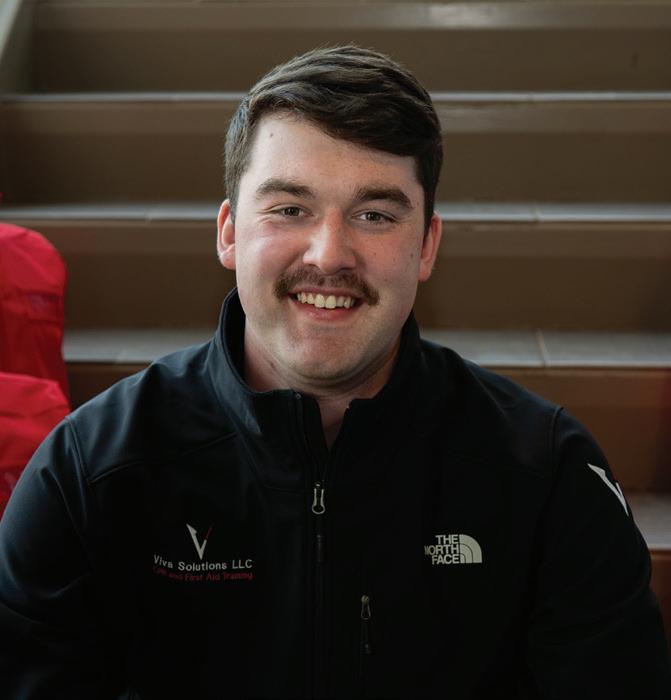
Jacob Kurt (‘25) had a similar experience. He owns Viva Solutions LLC, which provides CPR training through the American Red Cross and American Heart Association. Kurt used public records data to identify how many departments at UNI required CPR training as a prerequisite for graduation.
One such department is speech-language pathology. Kurt reached out to faculty and students via email, and he is now working with several of them on training sessions.
“With that public records data, we’ve seen success in targeting and gaining customers,” Kurt said. “I know that if you’re a speech-language pathologist, you are required to have this training. That leads to a much higher success rate than sending out cold emails.”
The JPEC also helped Kurt understand the importance of customer experience. As a result, he created an anonymous
feedback form that he sends out after every session, tracking everything from the energy of the session to teaching strategies to room conditions.
Kurt discovered that trainees weren’t interested in spending long periods watching videos, so he incorporated breaks to keep energy levels high. He also made small changes, like bringing fresh, hot coffee and asking trainees about their purpose for taking the course. This allowed Kurt to personalize his teaching approach.
“I know customers value an environment that fosters learning,” Kurt said. “When I lead a class, I bring tissues, hand sanitizer, coffee — anything I know will create a good learning experience.”
DAVAN CROOKER (‘25)
JACOB KURT (‘25)
UNI’S BUSINESS AND COMMUNITY SERVICES GATHERS, LEVERAGES DATA TO ASSIST IN IOWA STORM RESPONSE
The University of Northern Iowa’s Business and Community Services division operates with the mission to support and build a better Iowa, and there’s no better example than when tough times strike. In spring 2024, large areas of Iowa were devastated by powerful storms and subsequent flooding, causing an estimated $130 million in infrastructure damage and impacting countless lives.
The Institute for Decision Making (IDM) and Strategic Marketing Services (SMS) — two of the organizations under the BCS umbrella — partnered with several other organizations across the state to assist with recovery and response. SMS and IDM worked together to develop and distribute surveys and gather crucial data from affected communities to help understand the immediate and long-term needs of residents and businesses.
These surveys captured insights into community sentiments around local, state and federal response, resource requirements and infrastructure damage, while also helping recovery effort efficiency to specific challenges. Data was analyzed and then applied to identify priority areas for assistance and resource allocation.
This approach played a crucial role in informing immediate relief efforts and guiding long-term recovery strategies aimed at fostering resilience against future disasters.
“Our goal is to identify the immediate needs and understand the true impact,” said Drew Conrad, IDM director. “With our long history of working closely with communities across the state, we’re able to provide insights that
inform response efforts locally, statewide and nationally.”
Floods devastated Rock Valley, a town of under 5,000 people in northwest Iowa. More than 500 homes and 50 businesses were damaged, some of them permanently. Data collected by the IDM and SMS was used to inform the responses by local governments, economic development organizations, health care organizations, schools, nonprofits and donation collections. Additionally, city leadership leveraged the data to determine next steps for temporary and long-term housing plans and passed the data on to third-party partners to assist.
Beyond the response, the data also helped residents better understand the damage and what needed to be done – key messaging that goes a long way toward instilling confidence in response efforts.
“Having the ability to partner with multiple agencies to connect with our community members, then to review the data for our benefit, as well as pass it to those partners, was critical in turning the page from response to recovery,” said David Miller, development director for the City of Rock Valley. “On a local level, there is so much happening, and having this tool streamlined the data gathering process for our community and also saved time by having one collective effort from all partners.”
This is not the first time BCS has taken a proactive approach to devastating events. At the beginning COVID-19 pandemic, IDM and SMS surveyed nearly 14,000 Iowa businesses and nonprofits within six days on behalf of the Iowa Economic Development
Authority, and the results were key in shaping state assistance efforts. By bridging the gap between community needs and actionable insights, SMS and IDM exemplify how strategic data collection and analysis can positively impact disaster recovery efforts on a local and regional scale.
Rock Valley
Learn more about the support IDM, SMS and BCS provide across Iowa and beyond at bcs.uni.edu.
DAVID MILLER Development Director for the City of
DREW CONRAD
IDM Director
ETHIC Consider tions of D BR EACHE S
By Russell P. Guay, PhD
“Data privacy should not just be viewed as a legal
obligation, but also as an ethical responsibility.”
We hear of new data breaches every week with personal information compromised, whether it be account numbers, credit card information, passwords, credit report details, social security numbers, etc. IT Governance USA reported that in the sixmonth period between November 2023 – April 2024, there were over 2,700 publicly disclosed data breach incidents impacting nearly 7 billion known records. The overwhelming percentage of these attacks occur in small and medium-sized businesses, which are so prevalent in a state like Iowa. These data breaches can impact companies’ reputations (often their most prized asset) and financial performance and result in a loss of customer trust.
While legal regulations differ from state to state, the law in Iowa (715C.2) says that when a data breach occurs, businesses must give notice to any consumer (either in writing or electronically) whose personal information was included in the information that was breached and immediately notify the owner or licensor of the information upon discovery. The consumer notice must include a description of the security breach, the approximate date of the breach, the type of personal information obtained, contact information for consumer reporting agencies and advice on reporting suspected identity theft. However, what about companies that want to go beyond
the legal requirements despite limited resources for hardening their cybersecurity defenses? How much extra effort should be considered enough at the crossroads of where the law stops and ethical decision-making begins?
Data ethics consists of moral obligations that companies have to protect personally identifiable information while ensuring privacy, fairness, transparency, accountability and social responsibility. Consumers should expect that their private information is being handled with care. Organizations that collect and store user data have an ethical responsibility to implement robust security measures and enforce data protection efforts to safeguard their consumers’ information, use AI to protect against cyberattacks, ensure that any algorithms are used appropriately, examine responsibility and transparency in handling cybersecurity incidents, disclose vulnerabilities to consumers and offer to pay for credit monitoring services for a period of time. If companies address these and other ethical issues, they can do a much better job of repairing trust while providing transparency to their consumers.
It is not enough for governments to simply pass rules and regulations against data theft. Data privacy should not just be viewed as a legal obligation but also as an ethical responsibility. Neither ethics nor corporate
social responsibility often yield easy solutions (that is why they are often called ethical dilemmas after all). However, all organizations can do better and be better. The choice should be clear.
RUSSELL P. GUAY, PhD
Professor of Management and David W. Wilson Chair in Business Ethics
Former students, alumni, peers and community members, I would love to hear your thoughts. Please feel free to reach out anytime on LinkedIn or via email (russell.guay@uni.edu).
The views and opinions expressed are those of the author and do not imply endorsement by the University of Northern Iowa.
HOW ETHICS AND DATA MANAGEMENT INTERSECT IN TODAY’S BUSINESS CLIMATE
In today’s data-driven business landscape, the question is no longer can we collect data — but how do we do so responsibly? This evolving dilemma is one that many business professionals, especially those in compliance and data-focused roles, as well as new graduates, grapple with regularly.
According to the Harvard Business School, data ethics “encompasses the moral obligations of gathering, protecting and using personally identifiable information and how it affects individuals.” In practice, this definition can vary widely across organizations and individuals.
At UnityPoint Health, a hospital system serving communities across the Midwest, data privacy and ethical decision-making are essential — not just because of regulatory demands, but also because patient trust depends on it.
“We are fully cognizant of the responsibility we have to our patients to make sure their data is used appropriately and only as permitted,” said Tori Stafford (MBA ‘07), UnityPoint Health’s chief compliance officer.
Stafford leads the compliance team, which plays a key role in guiding ethical data use and responding to potential breaches or misuse. These professionals face
complex questions regularly. For example: If there’s a fundraiser benefiting research for a specific condition, is it appropriate to use patient records to identify potential donors? If so, how many people should have access to that data, and what kind of access is appropriate?
UnityPoint has strict internal policies to guide decisions like these, and ethics training is mandatory for all staff. Recently, the rise of generative artificial intelligence has introduced new questions. Employees are trained not to enter confidential information into publicly accessible AI tools, and UnityPoint is in the
“We’re really trying to stay ahead of AI developments, but we’re equally focused on protecting our patient data and preserving trust.”
TORI STAFFORD (’07) Chief Compliance Officer, UnityPoint Health
“I want to know that someone will do the right thing when the rules don’t quite apply or there isn’t a standard procedure”
CLINT SHERWOOD (‘13)
Data Engineering Manager, Casey’s
process of developing its own internal generative AI system to protect sensitive data.
“We’ve invested heavily in data management, AI compliance and staff training, which shows how important this is to us,” Stafford said. “We’re really trying to stay ahead of AI developments, but we’re equally focused on protecting our patient data and preserving trust.”
In retail, Casey’s uses customer data to improve both customer and employee experiences, and there are plenty of ethical questions around data use and access.
Clint Sherwood (Management Information Systems ‘13), a data engineering manager at Casey’s, said the company takes privacy seriously and prioritizes accuracy and clear tagging, so internal teams know how to use the data responsibly.
“We try to use data in a way that’s a win-win for the customer,” Sherwood said. “It helps us understand them better, so we can offer discounts or deals
they’ll want through our app or rewards program.”
Over his 12-year career, Sherwood has seen a clear evolution in how organizations manage data. Today, there’s a greater emphasis on metadata, lineage and accuracy — all crucial elements for making ethical, informed decisions.
“Our teams know exactly what the data is for and the nuances around it,” Sherwood said. “That allows them to make the most informed decisions.”
EDUCATING FOR ETHICS
Ethical dilemmas in data management often don’t have clear-cut answers. This increases the need for professionals who not only understand technical systems but also possess strong ethical reasoning and critical thinking skills.
At the Wilson College of Business, ethics education is
integrated in the curriculum, further bolstered by a gift from the college’s namesake, David Wilson.
“As a data professional, security and ethics need to be considered from the very beginning of your design process,” Sherwood said. “Technical skills are foundational, but they’re mostly teachable. Critical thinking and problem solving are harder to teach on the job.”
That’s why Sherwood looks for these skills when building his team.
“I want to know that someone will do the right thing when the rules don’t quite apply or there isn’t a standard procedure,” he said. “That’s where critical thinking becomes essential, because situations like that happen all the time in data management.”
Through its ethics and business coursework, the Wilson College of Business is helping shape professionals prepared to navigate those gray areas. Students aren’t just learning how to work with and interpret data — they’re learning how to manage it responsibly.
STUDENTS DOMINATE ADVERTISING COMPETITION
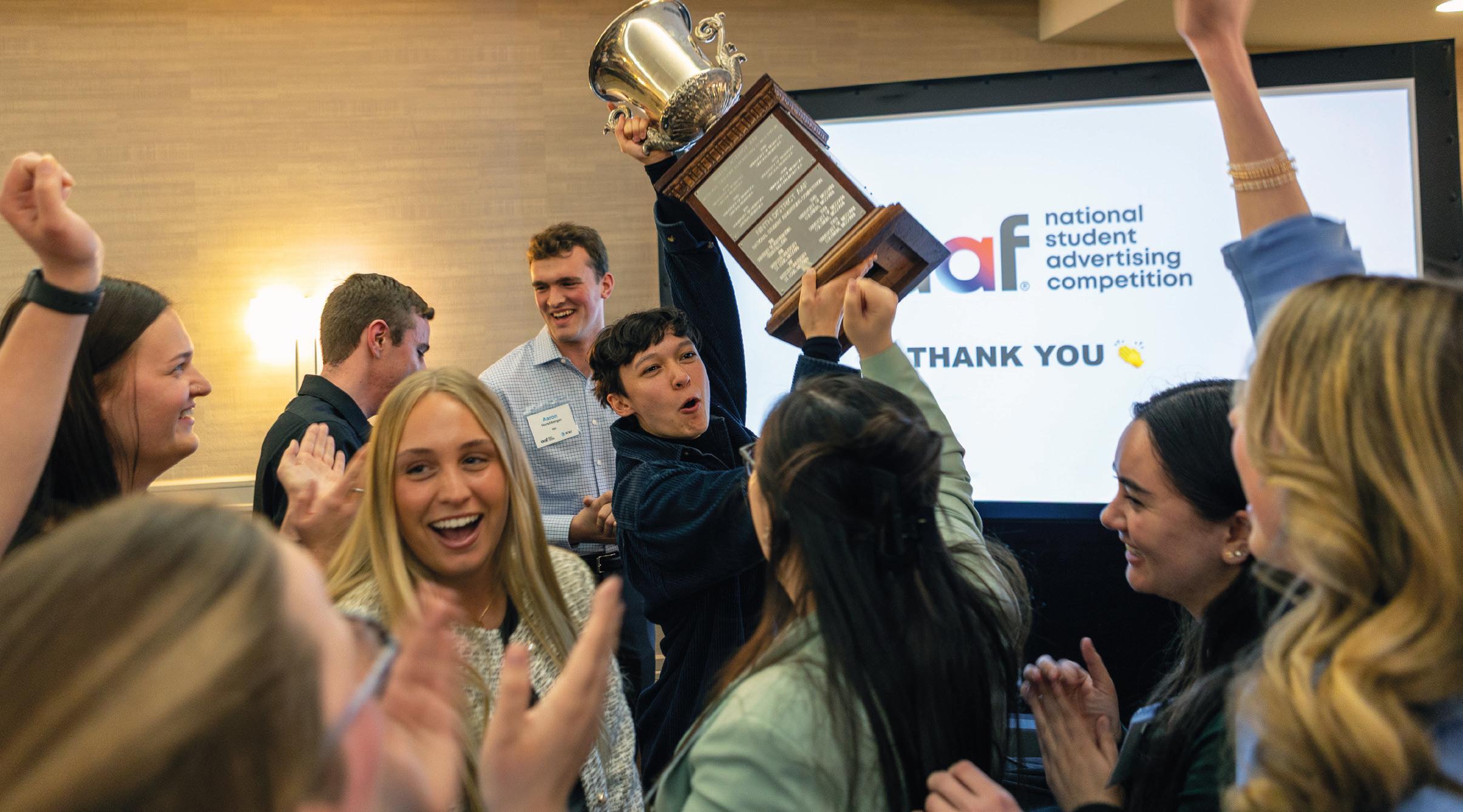
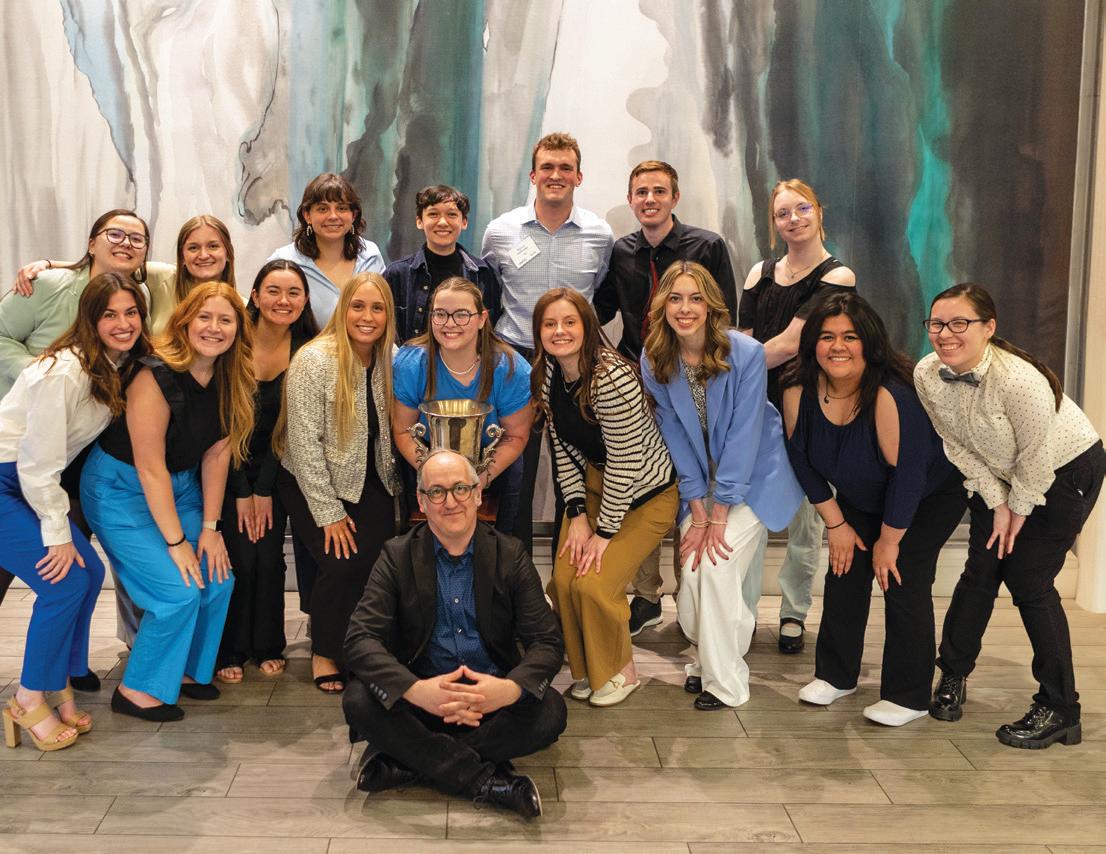
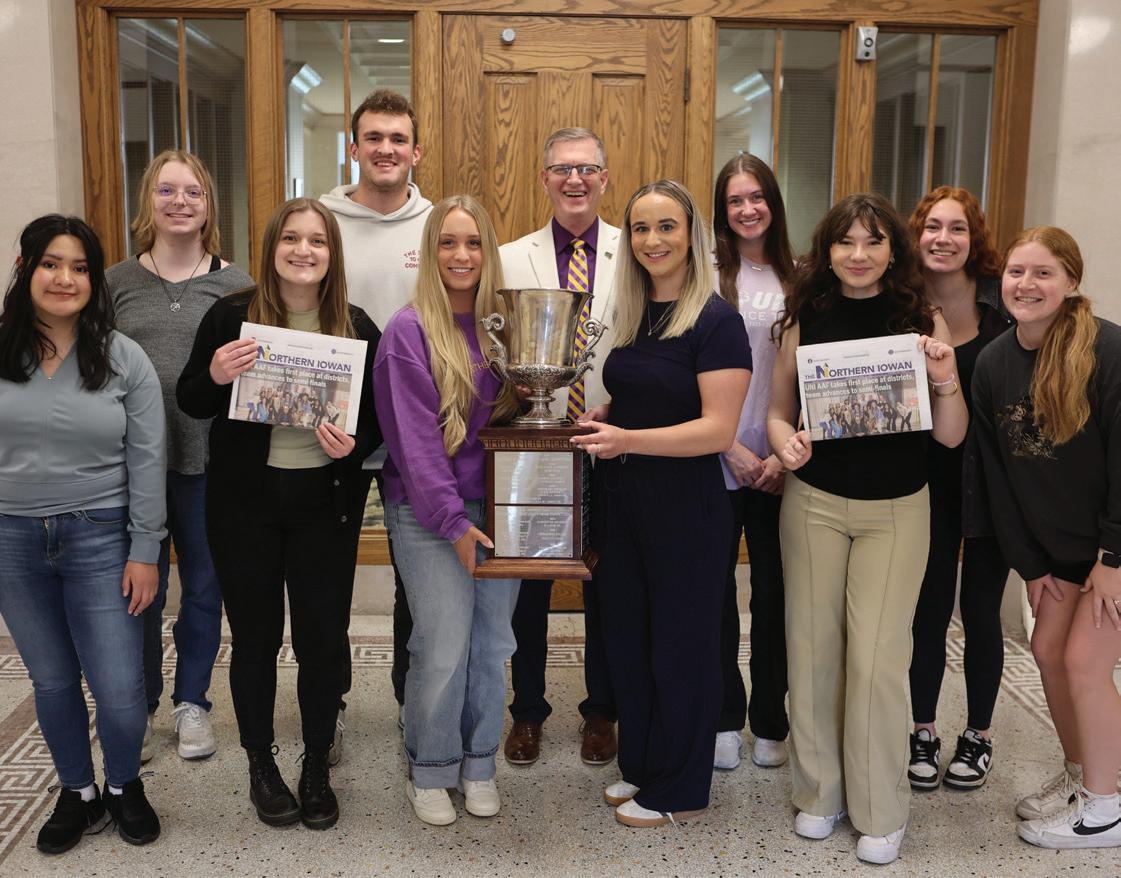
A team of UNI advertising students recently claimed first place at the AAF District 9 National Student Advertising Competition (NSAC) in Kansas City, Missouri. Their winning campaign for AT&T was designed to connect with Gen Z consumers. Their work earned high praise from judges — including Steve Harris Jr., talent & development marketing manager from AT&T, who flew in from Dallas to judge the entries.
The UNI team delivered a standout pitch for a national promotional campaign, impressing the panel with their strategic insight and creative execution.
Eliza Carlson (Graphic Design ‘25) captured the spirit of the experience, saying, “This has been one of the most challenging,
rewarding and fulfilling parts of my college career.”
Carlson reflected on the team’s journey, emphasizing the intense preparation and dedication behind the scenes.
“Every step of this journey was powered by collaboration, late nights, unexpected breakthroughs and the excitement of knowing we were bringing a creative vision to life. This class simulates a real agency environment, but more than that, it creates a real sense of purpose, pride and connection.”
The 26-member team began work on the campaign in September, joining more than 200 college teams across the country who received a creative brief from AT&T outlining the goals and target audience of the campaign.
The challenge was to make Gen Z crave AT&T using the brand platform “Connecting Changes Everything” as their foundation. Their work continued into the spring, integrated into an advanced marketing course, Advertising Campaign Development, which operates like an advertising agency. The course is facilitated by Associate Professor of Practice in Marketing and Entrepreneurship Matthew Wilson, who also serves as the faculty advisor for the AAF chapter at UNI.
Months of research into Gen Z behaviors, mobile service trends and AT&T’s brand legacy culminated into a comprehensive strategy including media, messaging and creative — centered on the theme, “Find Your Everything.”
“It was an amazing weekend in Kansas City, and I can’t say enough about the incredible efforts of these top-tier UNI students,” said Wilson after the AAF District 9 win. “Up against formidable competition, grappling with insanely tight deadlines and working together as one unified advertising agency up until the very last moment, this team pulled off the seemingly impossible.”
After advancing to the national semifinals, UNI competed against top programs including Texas State, UNC Chapel Hill, University of Minnesota, BYU and Michigan State, in the most competitive real-world competition for advertising students. Ultimately, UNI placed 9th in the nation — marking the highest
finish in school history and outperforming prestigious institutions like UCLA, UC Berkeley, Syracuse, Texas Tech and the University of Oregon.
Reflecting on the class, students described it as one of the most challenging they’ve taken — but also one of the most rewarding, citing personal growth and the opportunity to bring their ideas to life.
“It didn’t feel like a typical class. It felt like actual, meaningful work,” said Faith Zanoni (Marketing ‘25), who was part of the pitch team. “The projects and assignments weren’t just busy work or tasks to fill time; everything we did contributed to a bigger picture and a real end goal. What we were working on had purpose, and we were trusted to
handle it in a professional, team-based environment.”
Kamryn Klas (Marketing ‘25), who served as a media analyst on the team, shared her perspective on the value of being a proactive team member.
“This class has opened my eyes to how important being self-driven and motivated in the professional workplace is,” said Klas. “You really do need to be proactive. Whatever you put into the class is what you will get out of it.”
This team demonstrated Gen Z’s talent, drive and work ethic. Their performance speaks volumes — and sets a new standard for excellence in Wilson College!
FIRST IN THE WORLD TO EARN AACSB WILSON COLLEGE OF BUSINESS BECOMES
SUPPLEMENTAL ACCOUNTING ACCREDITATION
THROUGH ACCELERATED PATH
After decades of maintaining accreditation from the Association to Advance Collegiate Schools of Business International (AACSB), the Wilson College of Business at the University of Northern Iowa can now add AACSB’s supplemental accounting accreditation to its impressive resume. Wilson is the first business school in the world to undergo an accelerated path toward this accreditation and one of fewer than 200 schools globally to hold this prestigious honor, making it a top choice for students with an accounting major.
“For students, it’s really about a signal of quality,” said Joseph Ugrin, professor and head of the Department of Accounting. “Employers understand the impact of accreditation and standards and benchmarks in their own businesses, but they also look for that in the places where they spend their recruiting dollars. They’re going to select schools where they can expect a high quality of graduates.”
“AACSB is an organization that helps us focus on continuous improvement. It provides a stamp
of quality, assuring the public we are achieving certain expectations,” said Leslie Wilson, dean of the Wilson College of Business. “When they come back and review us, they expect continuous improvement. They expect responsiveness to what is going on in the external world. They expect we are meeting the demands of employers. They expect that we are delivering upon our mission.”
A key driver behind the UNI accounting program’s success is the accounting department’s
“Employers understand the impact of accreditation and standards and benchmarks in their own businesses, but they also look for that in the places where they spend their recruiting dollars.”
JOSEPH UGRIN Professor and Head of the Department of Accounting RSM US LLP Chair
“AACSB is an organization that helps us focus on continuous improvement. It provides a stamp of quality, assuring the public we are achieving certain expectations”
LESLIE WILSON Dean of the Wilson College of Business
dedicated faculty, rigorous curriculum and integrated CPA review program, which provide students with the foundation for exceptional performance on the Certified Public Accountant exam. UNI ranks first in the nation for CPA pass rate success according to Accounting Today. Students preparing to graduate with either a bachelor’s or master’s degree in accounting participate in an integrated CPA review program, which has consistently yielded impressive results for this rigorous four-part exam. In fact, Wilson students outperform peers from the next best school by an average of 20 percentage points.
“When I was in high school, I knew UNI had a really good program for the CPA,” said Josiah Laddusaw, an accounting major who began his Master of Accounting in the fall. “That was the big selling point because I knew I wanted to be a CPA. I asked myself what was going to help me complete such a rigorous exam and give me the highest chance of passing all four parts.
I knew it was getting my Master of Accounting at UNI with their integrated CPA review.”
Earning AACSB accounting accreditation is a multi-year process involving a comprehensive self-study, extensive feedback and an on-site peer review by deans from other accredited institutions. The peer review team visited UNI in March, evaluating the Wilson College of Business on everything from learner success to strategic planning.
Their report identifies several standout practices, including UNI’s high level of faculty-student engagement, made possible by small class sizes. Robust co-curricular opportunities through organizations like the Accounting Club have also led to a high level of student engagement. The club connects accounting majors with all of the Big Four accounting firms and numerous regional employers, often leading to internships and full-time jobs, as it has for Laddusaw who has already interned with both KPMG and Deloitte. The reviewers also high-
lighted the college’s Professional Readiness Program®, which equips students with critical soft skills sought by employers.
While the process of supplemental accounting accreditation typically takes seven years, UNI achieved this milestone in just three — a testament to the program’s longstanding excellence and history of innovation.
The University of Northern Iowa established its business college in 1982. It has consistently been AACSB-accredited since 1993, with reviews occurring every five years. Fewer than 6% of business schools worldwide hold AACSB accreditation, and only 2% with separate accounting accreditation
AACSB International is the world’s largest business education association, connecting educators, learners, and businesses to create the next generation of great leaders. With members in over 100 countries and territories, AACSB elevates the quality and impact of business schools globally.
A NEW ERA FOR BUSINESS: UNI’S
WILSON
COLLEGE
LEADS WITH ETHICS, INNOVATION
On Oct. 23, 2023, the David W. Wilson College of Business made history by becoming the first named college at the University of Northern Iowa, all thanks to a transformative gift from David and Holly Wilson. But this milestone marked far more than a new name — it has helped advance a brand defined by integrity, excellence and innovation.
The Wilsons’ vision, outlined in their gift, is already taking shape, impacting aspects of the college from its core mission to how students learn and grow. It’s a testament to their belief in ethical business practices and the power of education.
INVESTING IN BRIGHT FUTURES
Supporting individual students is a top priority for the Wilsons. They established the David W. Wilson Scholars Endowed Fund to provide life-changing opportunities for students with financial need from Tama County, where David grew up.
The inaugural gift was awarded in May 2024. Jenna Meyer, a student from South Tama High School, became the first Wilson Student Scholar, receiving a tuition-and-expense-free education. The celebration was a complete surprise for Meyer, who was joined at the event by UNI faculty, her friends and family.
Just shy of a year later, UNI shared a similar heartfelt moment with Abigail Chyma, also from South Tama, who was awarded the second scholarship.
Meyer is currently studying human resources management, while Chyma will explore her business major options when she begins her studies in August 2025.
These scholarships provide crucial financial aid — and they’re also an investment in the future of deserving young individuals.
“Both of these women embody the spirit of perseverance and achievement that the scholarship is designed to recognize and support,” Dean Leslie Wilson said. “Jenna has started, and Abigail follows closely behind, in establishing a legacy of empowerment and achievement for Tama County students here at UNI.”
ELEVATING ETHICS AT EVERY LEVEL
Beyond individual scholarships, the Wilsons also created the Wilson Endowment for
Integrity and Excellence. This fund has three powerful goals:
• Cement ethics as a cornerstone of the Wilson College identity.
• Broaden ethics education for all students (business and non-business alike).
• Foster a culture of innovation and excellence.
One of the first critical steps was updating the college’s mission statement, the guiding star for all strategic planning, to more tightly integrate ethics and integrity. This refined mission aims to provide graduates with cutting-edge knowledge, strong values and confident workplace performance. It also ensures faculty research upholds the highest ethical standards and the college’s outreach leverages faculty and staff expertise and integrity to advance business, support economic development and drive innovation.
To truly expand ethics education, Wilson College partnered with the Department of Philosophy & World Religions. This collaboration brought in Robert Earle as the first Wilson Ethics Fellow, and later, Nicholas Sars as the second.
Earle wasted no time, co-leading an ethics workshop in the summer of 2024 with assistant adjunct professor John Preston. Faculty members from diverse
fields — from chemistry to history to business — came together over three days. They shared ethics lessons, brainstormed ways to integrate ethical teachings more broadly into their courses and honed their skills in effectively teaching ethics within their disciplines.
“[Wilson’s] support has changed everything for ethics teaching here at UNI,” Earle said shortly after the workshop. “For example, it gives us the ability to offer more sections of ethics classes. That will help us get those classes integrated into curriculums across campus. We have a lot of other things we’re working on, too. This is just the start for us.”
When Sars joined in the fall of 2024, he began teaching a new general education course, Ethics for a Professional Life. This course significantly expands the reach of the Wilson gift, ensuring more UNI students develop vital ethical reasoning skills.
“The dedication to ethics education from David Wilson provides a unique opportunity to teach students about this important topic — something they can use in their daily lives, whether that’s in business or not,” Sars said. “Ethics education is something that can help students live better overall lives.”
NURTURING ENTREPRENEURIAL SPIRIT
Innovation is another pillar of the Wilson Endowment, and a prime example is its support for the Early Founders program, coordinated by the John Pappajohn Entrepreneurial Center (JPEC).
This unique program empowers a select group of student entrepreneurs to dedicate their summer months to intensely developing their ventures. Students involved in pursuits as varied as custom laser engraving and interior design receive personalized guidance from the JPEC team as they work to grow their businesses while gaining invaluable lessons that will fuel their future success.
The Wilson Endowment also invests in the college’s highestachieving students by financially supporting their induction into Beta Gamma Sigma (BGS). This international business honorary society recognizes junior and senior undergraduates in the top 10% of their class. Wilson funds also enable these BGS members to pursue the National Association of State Boards of Accountancy Center for the Public Trust’s Ethical Leadership Certification, further solidifying their commitment to integrity.
The generous gift from David and Holly Wilson has undeniably transformed the Wilson College of Business. More importantly, it has opened doors to new personal and professional growth opportunities for UNI students and staff.
“The Wilson College is proudly advancing the Wilsons’ vision of ethical capitalism, with an unwavering focus on integrity, excellence and innovation,” Leslie Wilson said. “This is just the beginning of our journey.”
UNIVERSITY OF NORTHERN IOWA NOW OFFERING FULLY ONLINE MBA DEGREE WITH UPDATED CURRICULUM
Following unanimous approval by the Iowa Board of Regents, working professionals will now be able to earn their Masters of Business Administration (MBA) degree from the University of Northern Iowa fully online. The move comes with a revamped curriculum to meet the demands of modern business professionals. The top-ranked MBA program offered by the Wilson College of Business highlights the university’s dedication to academic excellence and meeting student needs, making it easier and more flexible for professionals to advance their careers.
“I am thrilled about the opportunity to extend our top-tier education to a broader audience through our new online offering,” said Leslie Wilson, dean of the Wilson College of Business. The program will begin offering courses online starting in the summer of 2024, with the entire course lineup available by the fall of 2025. “UNI has consistently been ranked as a ‘Best Business School’ by The Princeton Review for over a decade reflects our commitment to academic excellence, personal development and career advancement within the Wilson MBA program.”
The MBA program features a redesigned curriculum that includes three stackable graduate certificates tailored to the needs of today’s business professionals: Business Fundamentals, Managerial Analytics, and Strategic Leadership and Innovation. Each certificate requires the completion of four courses.
“UNI alumni want to earn a Wilson MBA. They value the
coursework, experiences and relationships they have developed during their undergraduate program,” said Mary Connerley, associate dean of the Wilson College of Business. “I’m excited to deliver the same level of excellence and support to all professionals across Iowa and beyond. Our focus is on meeting the needs of employers who are looking for professionals with strong written and oral communication skills and critical thinking abilities.”
Participants in the program with a desire to earn their MBA have the option of a flexible pathway to achieving their goal by completing all three certificate programs. The program aims to enhance the skills of degree holders, responding to employers’ growing demand for professionals with strong communication and critical thinking skills.
“These new stackable certificates, along with the online MBA program, are designed to offer
unparalleled convenience,” said Stephanie Huffman, dean of the College of Graduate, Research and Online Education. “This allows students to tailor their education to their career goals while studying from anywhere.”
The Wilson MBA program is comprised of 10 courses, totaling 30 credits. Those in the program can attend these courses online from any location.
“Our decision to add an online MBA program is a direct response to the evolving needs of today’s business professionals,” said Alicia Rosburg, MBA program coordinator. “By adding an online format, we prioritize convenience and flexibility, reflecting our dedication to student success. This approach guarantees that all students can access our top-tier education from anywhere, creating opportunities to advance their education, especially for those living outside of the Cedar Valley or those balancing work and family commitments.”
Prospective students interested in earning their MBA through the Wilson College of Business can find more information about the program and admissions process at business.uni.edu/mba.
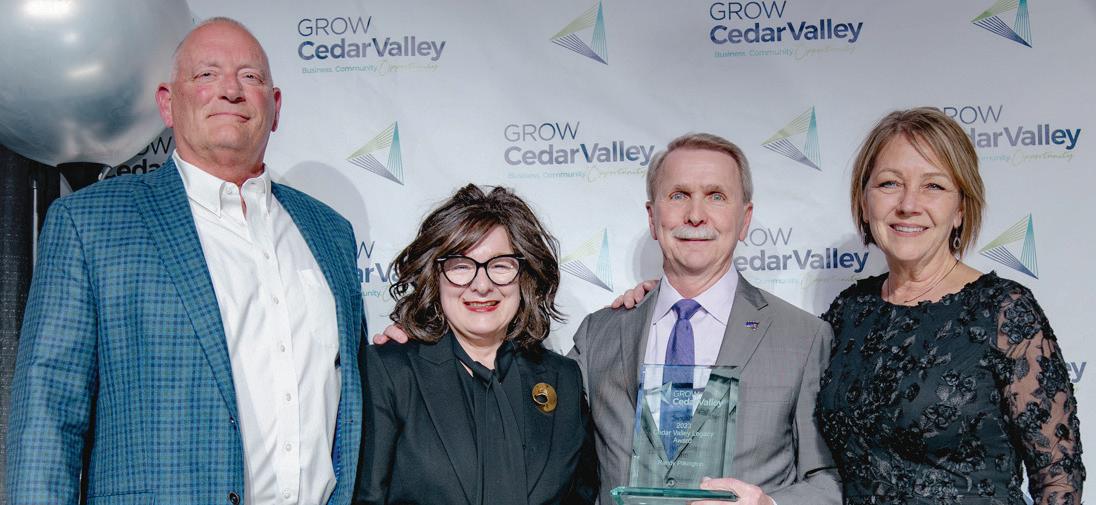
Kris Hansen, CEO, Western Home Communities, Debi Durham, Director of the Iowa Economic Development Authority and Iowa Finance Authority, Randy Pilkington, Cary Darrah, Director of Grow Cedar Valley (retired)
UNI’S PILKINGTON RECOGNIZED FOR LASTING IMPACT ON THE CEDAR VALLEY
Randy Pilkington, then-executive director of the University of Northern Iowa Business and Community Services, was awarded the 2024 Cedar Valley Legacy Award from Grow Cedar Valley.
The award recognizes Pilkington for his continued leadership and noteworthy contributions to the Cedar Valley through
his work with business expansion and community growth, enhancing the quality of life for talent recruitment and retention, and philanthropy and volunteerism.
“Randy’s leadership and support of the Cedar Valley’s economic development efforts have had a tremendous impact,” said Leslie Wilson, dean of the Wilson College of Business.
university in the Cedar Valley all these years.”
“Randy’s leadership and support of the Cedar Valley’s economic development efforts have had a tremendous impact.”
“For nearly four decades, he has been actively engaged in helping businesses, organizations and individual entrepreneurs grow and thrive in our community. He deserves the recognition that this Legacy Award represents. I could not be more proud of his leadership and the excellent way he has represented Business and Community Services, the Wilson College of Business and the
Pilkington and programs in Business and Community Services have worked in all 99 Iowa counties and guided economic development plans and projects in more than 800 Iowa communities. He served as president of Professional Developers of Iowa, served on the Iowa Department of Economic Development Board of Directors, the 21st Century Workforce Council and the Governor’s Council of Economic Advisors. He currently serves on the Iowa Business Council Business Education Alliance, Iowa Innovation Council, Cedar Valley TechWorks, the Iowa Advanced Manufacturing Workgroup and as co-chair of the UNI Research Foundation.
ALUMNI IN RESIDENCE
Steven Duggan (Accounting ‘90)
Managing Partner, Hogan - Hansen
Ryan Murphy (Economics ’02)
Labor Market Information Director, Iowa Workforce Development
Heath Bullock (Finance ‘98)
Managing Director, SVN | CREATE
Chad Chandlee (Management ‘95)
President & Chief Operating Officer, Kendall Hunt Publishing
Todd Weidmaier (Marketing ‘92)
Chief Executive Officer, Baker Paper & Supply
Jason Flinn (Accounting ‘97)
Audit Partner, Deloitte LLP
Danny Laudick (Economics ‘13)
Mayor, City of Cedar Falls
Luke Hartke (Finance and Real Estate ‘04)
Vice President of Mergers & Acquisitions, Mister Car Wash
Michelle Clark (Office Information Systems ‘89)
Assistant Vice President of Technology, Union Pacific Railroad
Dan Allbaugh (Marketing ‘02)
Author, Gritty Kids International Book Series
WOMEN OF BUSINESS HALL OF FAME
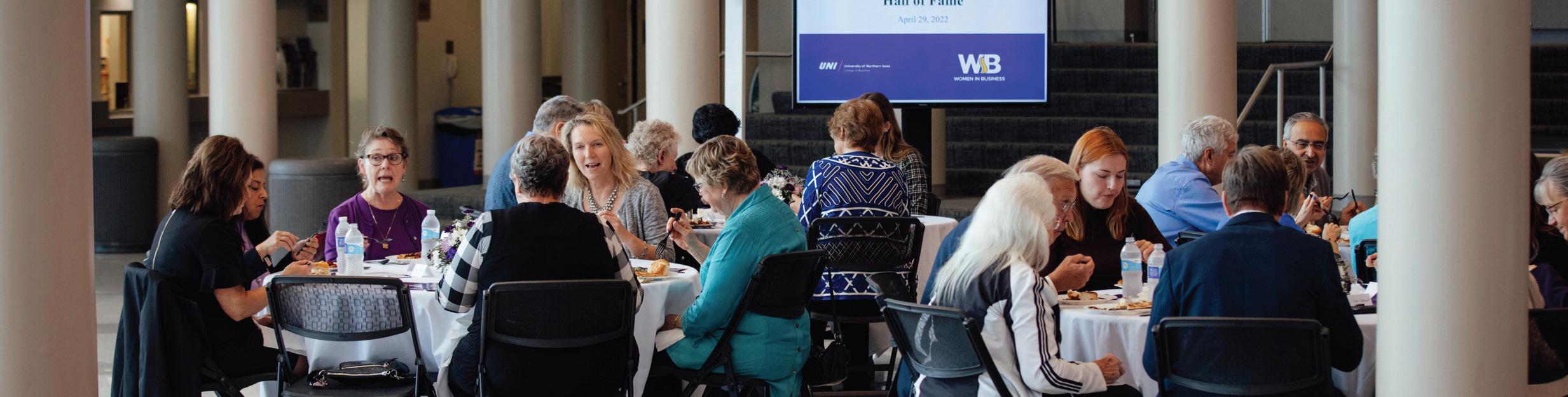
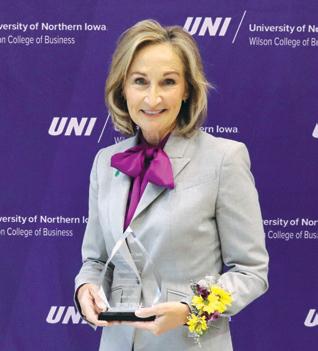
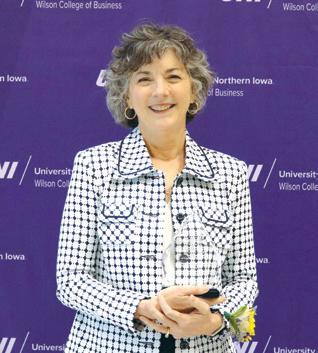
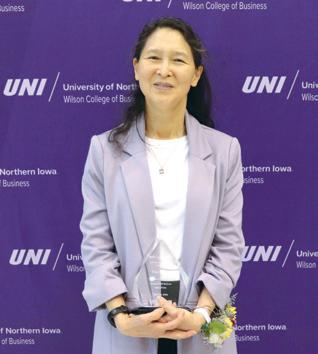
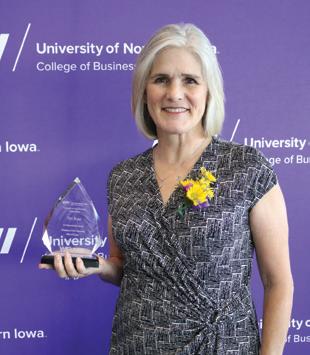
The Women of Business Hall of Fame event recognizes accomplished and influential women in the business field. Sponsored by the Women in Business student organization, the event celebrates women who have made significant contributions to the business world and their local communities. It serves as both an award and validation for current female students, inspiring them to strive for success in their own careers. The student organization also recognizes men who have shown extraordinary commitment to supporting and uplifting women in their organizations.
Jayne C. Hladio (‘89)
Executive Vice President, President of Private Wealth, Associated Bank
Tina Stubbs (‘89)
Financial Advisor, Edward Jones
Mary Lynn Sauer (‘82)
Retired Controller, IBM
Teri Rose (‘87)
Retired President in Shared Services, Sammons Financial Group
Kathleen Dockter (‘88)
Vice Chair of Administration
Department of Medicine at the University of Minnesota
Lisa Dreyer (‘87)
Managing Director, Private Wealth Banking and Manager, Pacific Northwest Division, Wells Fargo Bank
Peter Goulet EmpowerHER Award Winner
Professor Emeritus, Department of Management, Wilson College of Business
2024 STUDENT AWARDS
PURPLE & OLD GOLD AWARDS
Morgan Nuss Accounting
2024
Grace Croat Economics
Mason Fritz Finance
Cael Loecher Management
Jaxon Heth MIS and Business Analytics
LEADERSHIP AWARDS
Fatima Rodriguez Student Entrepreneur of the Year
Reyna Jorgenson MAC Impact Student Business of the Year
Delaney Nagel Servant Leadership Award
Terrill Hagener Supply Chain Management
Amy Rathmacher Marketing and Entrepreneurship
Sarena Gerber Business Teaching
Sophie Schmit Real Estate
Mahedi Islam Rising Leader Award
Terrill Hagener Leadership Impact Award
Yanting Wang Fierce Innovation Award
2025 STUDENT AWARDS
PURPLE & OLD GOLD AWARDS
Josiah Laddusaw
Accounting
2025
Kaylee Van Pelt
Economics
Julian Farber
Supply Chain Management
Brock Sobek
Finance
Allison Nuss
Marketing and Entrepreneurship
Brynn Jeambey
Management
Reagan Lommell
MIS and Business Analytics
LEADERSHIP AWARDS
Nathan Crooker
Student Entrepreneur of the Year
Davan Crooker
Student Entrepreneur of the Year
Davis Stelzer
MAC Impact Student
Business of the Year
Gretta Hartz
Business Teaching
Isabella Green
Real Estate
Amanda Fowler
Servant Leadership Award
Jenna Keller
Rising Leader Award
Reagan Lommell
Leadership Impact Award
2024 FACULTY & STAFF AWARDS
DISTINGUISHED TEACHING
Arun Narayanasamy
2024
DISTINGUISHED SCHOLARSHIP
Gunwoo Yoon
DISTINGUISHED INSTRUCTOR
Dan Lynch
DISTINGUISHED SERVICE
Drew Conrad
INSPIRING INNOVATION
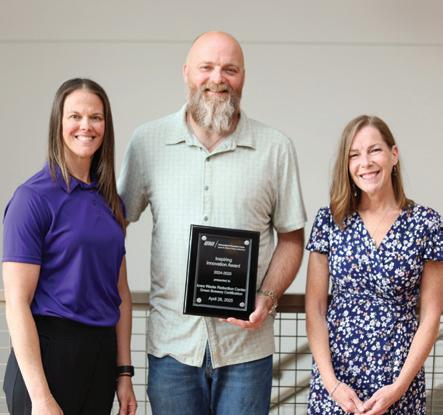
Sarah Rosol
DISTINGUISHED SERVICE
Randy Pilkington
ABOVE & BEYOND
Jennifer Anderson
EXCEPTIONAL IMPACT
CPA Review Group: Cathalene
ABOVE & BEYOND
Jordan McNamara
Bowler, Tom Collins, Linda DeBarthe, David Deeds, Gabriel Dickey, Amy Igou
2025 FACULTY & STAFF AWARDS
DISTINGUISHED TEACHING
Matthew Bunker
DISTINGUISHED SCHOLARSHIP
Gabriel Dickey
DISTINGUISHED INSTRUCTOR
Steve Yerkes
DISTINGUISHED SERVICE
Bryce Kanago
ABOVE & BEYOND
Betsy Ratchford
INSPIRING INNOVATION
Iowa Waste Reduction Center, Green Brewery Certification
ABOVE & BEYOND
Sidney Sorfonden
ABOVE & BEYOND
Ashley Smith
EXCEPTIONAL IMPACT
Department of Accounting, Hybrid Accounting Program
EXCEPTIONAL IMPACT
Department of Management, Online Business Administration
2023-2024
NEW
FACULTY & STAFF
Janelle Bolts
23-24
Secretary III, Family Business Center
Kristen Toppin Program Associate, Family Business Center
Zhengyang “Robin” Chen
Assistant Professor, Economics
Megan Pezley
IASourceLink Program Coordinator, John Pappajohn Entrepreneurial Center
2023-2024
RETIRED
FACULTY & STAFF
Lisa Jepsen
Robert J. Waller Professor, Economics
Bulin Zhang Assistant Professor, Management
Heidi Noonan-Day
Assistant Professor of Instruction, Management
Laurie Watje Director, John Pappajohn Entrepreneurial Center
Kevin Hall System Coordinator, Business & Community Services
2024-2025 NEW FACULTY & STAFF
24-25
Kiptia Akhter Lima Research Associate, Institute for Decision Making and Strategic Marketing Services
Andres Cuadros-Meñaca Assistant Professor, Economics
Ben Kvigne Environmental Specialist, Iowa Waste Reduction Center
Drew Miller Environmental Specialist, Iowa Waste Reduction Center
2024-2025 RETIRED FACULTY & STAFF
Mohammed Rawwas Professor, Marketing & Entrepreneurship
Emily Obermeier Assistant Professor of Practice, Management
Liesl Seabert Program Manager, Institute for Decision Making
Sidney Sorfonden Assistant Professor of Practice, Management
Elaine Johnson Director of Development
PLEASE
WELCOME THE NEW WILSON COLLEGE
OF BUSINESS DEVELOPMENT TEAM
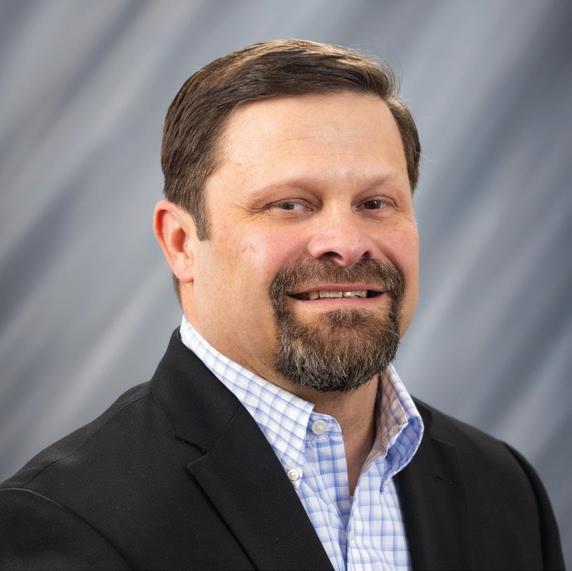
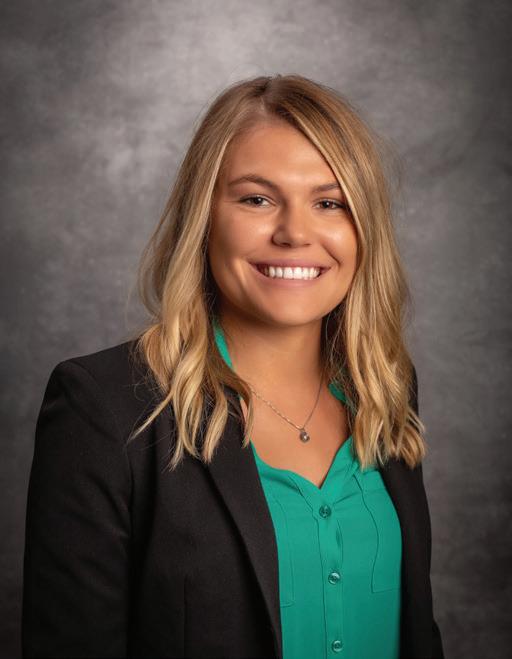
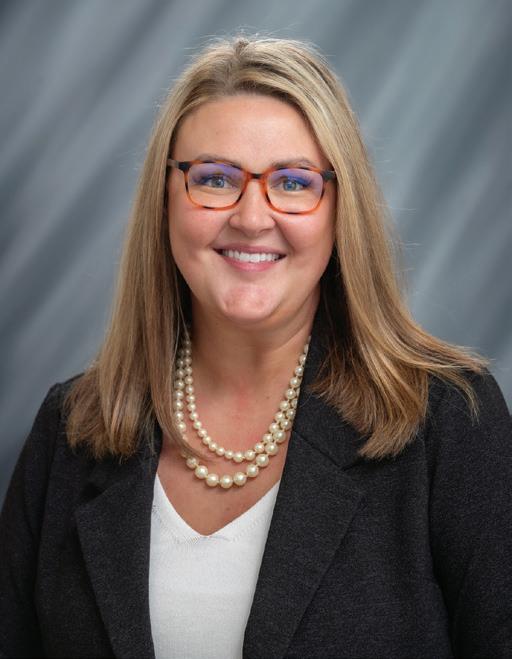
My name is Lee Westphal, and I cover areas east of Des Moines, including the Twin Cities, Chicago, Washington D.C., Florida and others. I’m excited to use my background in international enrollment management, international business development and nonprofit development to support Wilson College. I look forward to hearing your Panther stories, learning about your career successes and helping ensure your philanthropy toward the Wilson College makes a meaningful difference in the lives of our business students. lee.westphal@uni.edu // 319-273-2746
My name is Tyler Hospodarsky, and I cover areas west of Des Moines, including the Des Moines metro area, Texas, Phoenix and others. I am a 2021 UNI grad, and started in Wilson College as an advisor a few years ago. As an advisor, I saw firsthand the financial difficulties that many of our students face and decided to join the UNI fundraising team. I now have the opportunity to work with donors such as yourself to help close those gaps. I am thrilled to have the opportunity to focus on Wilson College, meet alumni and friends passionate about UNI and who have made such a tremendous impact on our business students. tyler.hospodarsky@uni.edu // 319-273-5786
We are thrilled to begin our time in the Wilson College of Business as the campus prepares to launch the UNI Sesquicentennial Celebration. This is a historic time to be a Panther. To celebrate this milestone, UNI has introduced the theme “Tradition Meets Tomorrow” — honoring the legacy of the past 150 years while looking ahead to an even brighter future.
You make that future possible. We are eager to build relationships with each of you and learn more about what inspires your support. We are deeply grateful to the many alumni and friends who have already made a lasting impact through their generosity. This support has opened doors for students, enhanced the classroom experience and strengthened the future of the Wilson College of Business.
As we look to the year ahead, we hope you’ll join this celebration. Your ongoing involvement ensures that the next generation of Panthers has even greater opportunities to learn, grow and lead. Thank you for your commitment to our tradition of excellence in business education.
Go Panthers!
GIVING BACK TO UNI PROVIDES A DEEP AND PERSONAL CONNECTION FOR THE NORDSTROMS
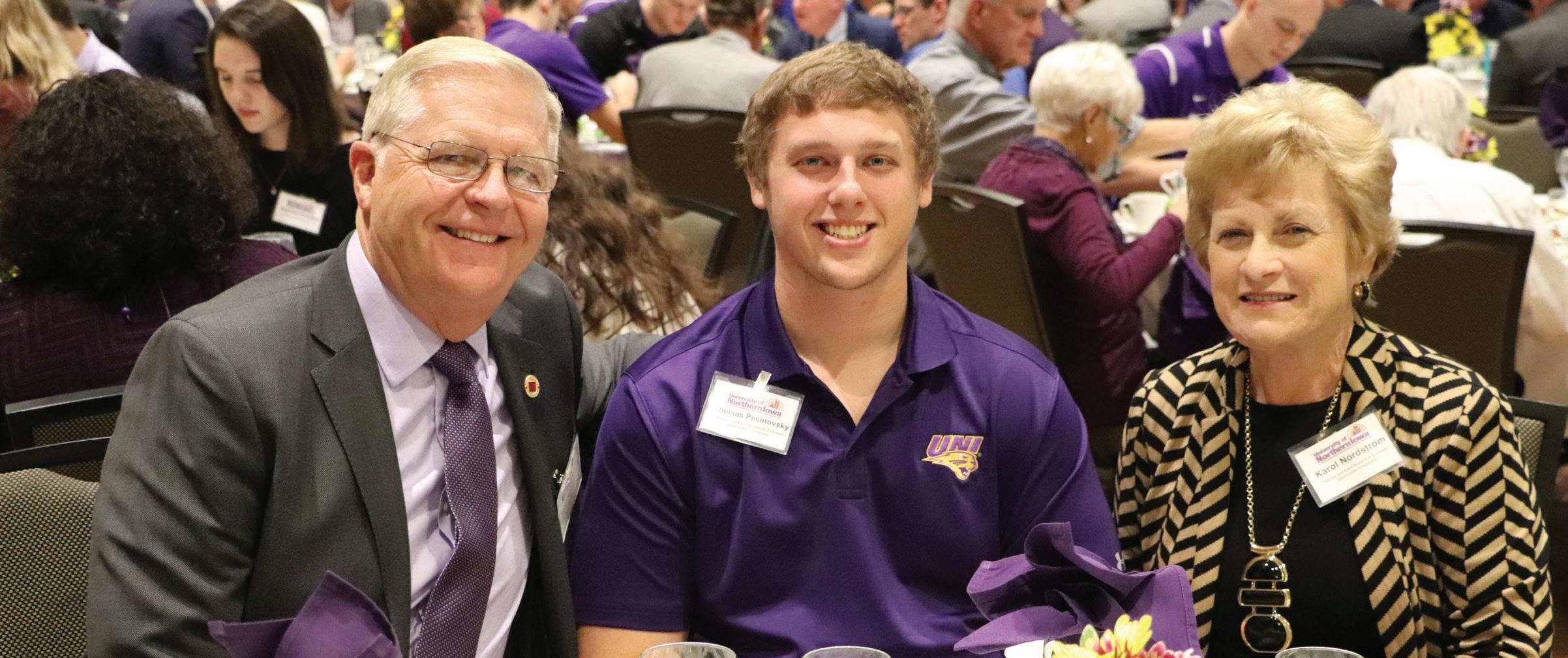
For Tom and Karol Nordstrom, the best part of the UNI Scholarship Luncheon is hearing the stories.
Those stories take them back to their beginnings. Raised in small Iowa towns, the Nordstroms were first-generation college students who met at UNI in the 1960s as education majors. Decades later, they return to campus each year for the Scholarship Luncheon — a unique UNIhosted event where scholarship donors and recipients meet and connect with students whose journeys mirror their own.
“Both my wife and I come from very small towns, so we can relate to what some of these students are going through,” said Tom, who grew up in Gowrie. Karol is from Moorland. Both towns have populations of less than 1,000. “For these kids to receive scholarships, it gives them more opportunities.”
That personal connection has fueled the Nordstroms’ generous support of UNI for more than 30 years. Tom played a key role in
launching the university’s real estate program in the early 1990s and served as chair of its advisory council until just a few years ago. Together, the Nordstroms have funded two endowed scholarships for real estate students, helping provide more opportunities in the industry.
Tom’s path into real estate was anything but traditional. After graduating from UNI, he began his career as a junior high school geography teacher. Several years later, he pivoted into real estate, first in residential and then in commercial. That transition led to senior roles at Partners Real Estate — now Iowa Realty — and later, Aegon USA Realty Advisors.
One of his proudest career accomplishments was creating an internship program at Aegon that opened doors for countless Wilson College real estate students and graduates. Today, several UNI alumni hold leadership roles at Aegon.
“We were just so pleased with the quality of students coming through the program,” Tom said,
If you’re inspired by Tom and Karol’s story, explore how to create a legacy at the Wilson College of Business by visiting foundation.uni.edu/ support-uni/ways-give
adding that it was rewarding to know his work on the Real Estate Advisory Council helped prepare students for the industry. “I think most of our permanent hires during my time came from that internship program.”
Now retired, the Nordstroms attend the Scholarship Luncheon every year. The tradition is deeply meaningful, hearing how their support has helped students thrive. In fact, they enjoy the luncheon so much, they often talk about it on the way home.
“It’s so heartwarming to meet these students,” Tom said. “On the way home from the luncheon, we talk about the students we met and how successful they’re going to be. And knowing we had a small part in helping them through their educational journey means a lot.”
EDUCATION AT WILSON COLLEGE OF BUSINESS NEW ENDOWED FUND HELPS DRIVE DATA
While not in the data industry himself, Jeff Scudder (Economics-Business Analysis, Finance ‘03) understands the importance of data in today’s business world. The Wilson College of Business recognizes this as well, making a broad effort to integrate more data learning opportunities into its curriculum. Together with other alumni, Scudder has helped create the Data & Technology Business Intelligence Endowed Fund.
The fund aims to enhance data-driven education, ensuring that students have access to cutting-edge tools and resources used in the business world.
“To compete for good students and to equip those students with what they need to be successful, you need to provide the tools that are necessary in today’s workplace,” said Scudder, an attorney and partner at Snell & Wilmer LLP, which specializes in corporate and securities law. “That’s a central part of offering a good business education.”
Scudder has noticed a general business trend toward greater reliance on data and the technologies for data analysis over the past decade. He has contributed to UNI in numerous
ways, including through student scholarships, so when the UNI Foundation approached him with this opportunity, driven by Dean Leslie Wilson and the Executive Advisory Board, he was eager to help meet a clear need.
The cost of supporting a top-tier data education includes expensive software, hardware and certifications. For example, the Bloomberg terminal, with technology essential in the
“I’ve observed over the past five to 10 years that big data has become a huge deal.”
finance world, costs tens of thousands of dollars each year, which isn’t affordable for most colleges, let alone individual students.
Students may also be able to use the fund to obtain certain data industry certifications.
“I’ve observed over the past five to 10 years that big data has become a huge deal,” Scudder said. “It spans a broad range of industries, including mine here in law. I’m generally aware that these tools are very expensive, so the goal is to not pass that cost onto individuals at the college if we can help it.”
Scudder is one of the early donors to the fund. For those considering making contributions, whether individually or as an organization, Scudder says it will go a long way toward helping students succeed at the Wilson College of Business and beyond.
JEFF SCUDDER Economics-Business Analysis,
Finance ‘03
“I really do think the data tools we’re providing are critical for the college,” Scudder said. “This fund will help provide sustainability for the college, allowing it to devote resources to these tools well into the future. I’m excited to see more from this fund and to see students using and benefitting from the tools this fund will help invest in.”
NEW SCHOLARSHIP AIMS TO ATTRACT TOP BUSINESS STUDENTS TO PUBLIC SERVICE
Joel Anderson (Accounting ‘12) considers himself a public service advocate. He served over two years as Gov. Kim Reynolds’ policy advisor and interim director of the Iowa Department of Management. In those roles, he realized how important it is to have talent in government who understands accounting, finance and economics.
So, with the help of Joe Murphy (Economics ‘06), Anderson launched the Public Servant Endowed Scholarship for students pursuing an internship or career in public administration in Iowa.
“It doesn’t matter what political party you are; if you don’t have the individuals who can move money from point A to point B based on legislation, it can be a big risk,” said Anderson, who is now RSM’s director of process
“Across the country, we’re seeing fewer people choose to work in the public sector, and that was eye-catching for us.”
JOEL ANDERSON Accounting ‘21
risk and controls for the public sector. “Across the country, we’re seeing fewer people choose to work in the public sector, and that was eye-catching for us. So we’re hoping this can help give students a nudge.”
The scholarship is specifically designated for students majoring in accounting or economics within the Wilson College of Business – instead of a political science major, for example – to encourage more business-focused students to enter government service. Thus far, there have been two award recipients, both economics majors. Both have shown interest in taking this scholarship to the next level, working in the state government.
The endowment is funded by Murphy, Anderson and fundraising efforts, which include contributions from various law firms, businesses and associations from around the state.
“It’s so vitally important that government works, and to do that we need people with high intellect and skills to benefit our society,” said Murphy, president of the Iowa Business Council, representing 22 of the biggest Iowa companies. “What we’re trying to do is provide resources to a student so they can pursue their passions in public service and incentivize them financially.”
Anderson calls out this year’s flooding in northwest Iowa as an example of the importance of quality public service leaders.
Emergency managers around the state and the Iowa Department of Health and Human Services have
“What we’re trying to do is provide resources to a student so they can pursue their passions in public service and incentivize them financially.”
JOE MURPHY Economics ‘06
stepped up to help manage the state and federal financial response.
“We have people stepping up, trying to help in the worst of times,” Anderson said. “There’s that intrinsic value in government service as well as that long-term career.”
Anderson and Murphy added that the UNI Foundation helped set up the scholarship and endowment. Now, they hope the work can make a tangible difference for local communities and the state of Iowa.
“We’re excited to help the future of public servants in this way,” Murphy said. “We interact with government entities all the time in our current roles, and we want to ensure that we have the best and brightest from UNI in those positions.”
WILSON COLLEGE FUND FOR EXCELLENCE
Student Professional Development
Example: 100+ travel abroad scholarships
WILSON COLLEGE FUND LEADERSHIP SOCIETY
We recognize those who have made the Wilson College Fund for Excellence a focus of their giving with a donation of $1,000 or more during the 2024-25 academic year. This unrestricted fund primarily supports business students who invest time and effort in building a professional edge that will be of immediate, marketable value upon graduation.
LEADERSHIP CABINET $10,000+
United Fire Group
David & Cindy Petratis
Faculty Development & Support
Example: Professional development seminars
Alumni Relations
Example: Executive-in-residence events
Corporate/Community Relations
Example: Power of the Purse sponsorship
Academic Partner Relations
Example: Partnership meetings in China and Europe
LEADERSHIP TEAM $5,000+
David & Jeanne Allbaugh
Chad & Rebecca Meyer
LEADERSHIP CIRCLE $1000-$4999
Dan Berregaard
Mike Brimeyer
Greg & April Davies
Pete & Lindsay Erickson
Dan & Pat Fliger
Dave Hammer
Scott & Mary Ellen Hassenstab
Jill & Nicholas Hittner
Anthony & Julianne Howard
Curt & Nikki Hudnutt
Michelle Hueser
Randy Ingram & Kathy Tanner-Ingram
Lois Iseminger
Theresa Koster
Leanne Marden
Tony & Luann McAdams
Mike McBride
Joyce Moser
Larry Pagel
Michael Regan
Sam Scheidler
Tina & Kirk Stubbs
Pam & Jim Taylor
UNI Panther Leadership Association
Tim Williams
Leslie & Logan Wilson
Jim & Trudy Wittmaack
EMPLOYER MATCHED GIFTS
Wilson College thanks the following companies for matching their employees’ gifts and doubling their impact:
AEGON/Transamerica Foundation
American Equity
Apple
BankIowa
Bayer
Berkshire Hathaway Energy Company
Best Buy Company Inc
Carl and Eloise Pohlad Family Foundation
Deloitte Foundation
EideBailly
Ernst & Young Foundation
Federal Home Loan Bank of Des Moines
Fifth Third Bank
First Interstate BancSystem Foundation
FORVIS LLP
John Deere Foundation
KPMG Foundation
The Medtronic Foundation
Merchants Bonding Company
Nationwide Insurance Foundation
Next Generation Wireless
Northwestern Mutual Foundation
PricewaterhouseCoopers Foundation
Principal Financial Group Foundation Inc
Raytheon Technologies
South Story Bank Charitable Foundation
The Standard
Thrivent Financial Foundation
Union Pacific Corporation
Varde Partners
JOIN THE COFFEE CLUB TODAY!
Join the Wilson Coffee Club by making a $15 monthly donation to the Wilson Fund for Excellence. Through your gift, you will make an incredible difference in the lives of the students within the college, helping them to gain exposure and skills to be ready for business. You’ll also be invited to periodic coffee chats, in which Dean Leslie Wilson and others will speak about exciting updates and the great things happening in the Curris Business Building! Those who join will also receive a Wilson coffee mug and a bag from Sidecar Coffee Roasters.
Join Today!
business.uni.edu/coffee-club
We thank all Wilson College Fund for Excellence donors for their commitment to business student success.