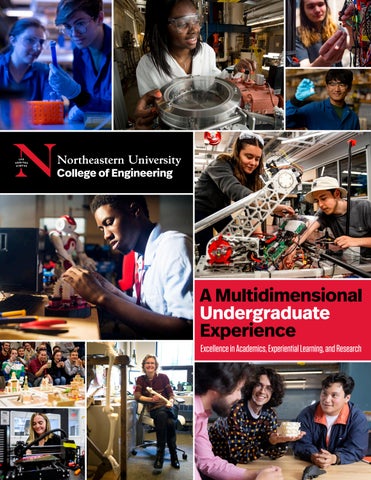
A Multidimensional Undergraduate Experience Excellence in Academics, Experiential Learning, and Research
An experiential engineering education that prepares you for the real world Engineering is an exciting and evolving field. Engineers pioneer discoveries that shape society and can have a transformative impact on the world. As a student in the College of Engineering at Northeastern University, you will have the opportunity to personalize your path with five engineering departments, interdisciplinary majors, over 70 minors across seven colleges, and the PlusOne accelerated master’s program. You will also have the opportunity for experiential learning—from laboratory exercises, senior capstone design projects, professional association activities, and research with highly accomplished faculty, to cooperative education where you gain industry experience as part of the curriculum. In and outside of the classroom you will be engaged. Our students participate in the college’s over 60 student organizations, national and global competitions, a vibrant entrepreneurship ecosystem, and a range of global experience options.
Learn more about our transformative engineering programs Bioengineering
3
Chemical Engineering
4
Civil & Environmental Engineering
5
Electrical & Computer Engineering
6
Mechanical & Industrial Engineering
7
First-Year Engineering
8
Support for Engineering Students
9
Majors & Minors
10
Research
11
Cooperative Education
12
Engineering Entrepreneurship
14
Student Organizations
14
Global Opportunities
16
Admissions Information
17
department of
Bioengineering bioe.northeastern.edu CURRICULUM CONCENTRATIONS On completion of the core curriculum, students choose one of four concentrations to focus on: ■ Biomechanics and Mechanobiology ■ Biomedical Devices and Bioimaging ■ Molecular, Cell, and Tissue Engineering ■ Systems, Synthetic, and Computational Bioengineering Each concentration provides the opportunity for students to develop a deep level of expertise in an important academic and research area of bioengineering.
REPRESENTATIVE CO-OP EMPLOYERS Abiomed
Moderna
Becton Dickenson
Pfizer
Boston Scientific
Selux Diagnostics
Brigham and Women’s
Solid Biosciences
Dragonfly
Sunovion Pharmaceuticals
Hologic
Takeda
Johnson & Johnson
Thermo Fisher
Lyndra
EMPLOYER TYPES Biotechnology
Tissue Engineering
Alternative Biofuels
Imaging
Medical Devices
Healthcare Consulting
Pharmaceuticals
Computational Biology
TYPICAL CO-OP JOBS Medical device design, drug development, process development, bioinformatics, genetic engineering, synthetic biology, biomedical imaging, biomedical materials, biomedical device and product manufacturing
Learn more about the Bioengineering Department
The living system may be the human body, an ecosystem, or, more broadly, a bioreactor, tissue culture system, or any system with living components. The presence of naturally occurring biological tissue places special constraints on the design and implementation of artificial constructs and their interface to living systems. Bioengineers are engineers with comprehensive understanding of the engineering requirements intrinsic to working within a biological context.
Bioengineering
The Department of Bioengineering offers students a broad education built on fundamentals in science, mathematics, and engineering, with a focus on the biological applications of engineering. The program provides a rigorous engineering training along with a comprehensive understanding of the biological constraints intrinsic to designing artificial systems to interface with, augment, replace, repair, or monitor living systems. These constraints depend on the properties of the biological system involved and the functionality that is being created.
Bioengineering is a relatively new field driven by the recognition that engineering of biological systems or systems that interface with living systems requires a multidisciplinary approach that takes into account the mechanical, electrical, chemical, and materials properties of the biological system. With that in mind, the bioengineering program has been designed to provide a rigorous engineering education that endows a broad understanding of the quantitative analysis of biological systems and a deep expertise in one of four areas of bioengineering. Students joining the Department of Bioengineering will have unique opportunities in the classroom, research labs, and experiential learning. The projects that they may be able to contribute to include bio-bandages that monitor bacterial growth or that help damaged ligaments heal faster; sheets of cells folded like origami to form a working kidney; and new materials that—like a leaf in the sun—automatically sense and adapt to changes in the environment. This is truly an exciting time!
top: Associate professor Sara Rouhanifard (right), shown with Dr. Keqing Nian, a recent PhD graduate, specializes in click chemistry, RNA modifications, and single-molecule RNA imaging. center left: Minhal Ahmed, Mitchell Scholar, received his MD at Harvard Medical School and is currently in his residency at Massachusetts General Hospital. center right: Kritika Singh, Rhodes Scholar, earned a PhD from Oxford University, received a Knight-Hennessy Scholarship, and is pursuing an M.D. at Stanford University. bottom left: Samantha Johnson, who received a combined BS and MS in Bioengineering, is founder and CEO of the tactile sign language robotics company Tatum Robotics. Johnson received the 2020 and 2021 President’s Award, 2022 Innovator Award, was selected for the 2022 BostInnos 25 under 25 and the 2023 Boston Forbes 30 under 30. bottom right: Jacob Potts, a Fulbright Fellow, studied mutations in DNA repair genes at Sorbonne University in Paris and is currently a PhD student at Harvard University.
|3
Chemical Engineering
The practice of chemical engineering integrates a wide range of disciplines—from physics to mathematics, biology, and chemistry—to create solutions to the world’s challenges. Chemical engineers constantly strive for ways to take discoveries from the lab and scale them up to improve life in the real world. Novel polymers for medical devices, cosmetics research and development, battery technology for energy storage, systems for drug discovery and delivery, food production for global nutrition— these are just some of the ways that chemical engineering contributes to human health and a sustainable environment. The Department of Chemical Engineering prepares students to join these efforts with a mix of rigorous academic study and practical experience in cutting-edge laboratory work. Undergraduate students are encouraged to participate in compelling research projects in biomolecular systems, complex and computational systems, engineering education and pedagogy, materials and nanomaterials, and energy and sustainability. The co-op positions available in chemical engineering span the areas of consumer products and cosmetics, plastics, biotechnology, nanotechnology, alternative energy, and petrochemicals, both domestically and internationally. Opportunities abound for students to enhance and apply their learning in student clubs and organizations, some of which—like the American Institute of Chemical Engineers—participate in national competitions. Our accomplished and diverse faculty are widely recognized for their research, educational impact, and leadership in the field by the National Science Foundation, National Institutes of Health, American Society for Engineering Education, and a variety of other government and professional organizations. They are committed to building and maintaining a strong, welcoming community for all in the department—particularly the students they advise, mentor, and inspire.
4|
top: Professor Debra Auguste is collaborating with Boston Children’s Hospital to develop new treatments to target and treat patients with triple-negative breast cancer. center left: Through three co-ops, Jordan Harris, chemical engineering, found his interest in medical research and immunology and is pursuing an MD/PhD at University of Pennsylvania. center right: Rachel Joseph, chemical engineering, was nominated for the Udall and Truman Scholarships. She plans to pursue graduate studies in law and public policy. bottom left: Sydney Morris, chemical engineering, received a National Science Foundation Graduate Research Fellowship and is pursuing a PhD in materials science and engineering at Brown University. bottom right: Cameron Young, chemical engineering and biochemistry, co-authored 10 medical-related papers, conducted research at Boston Children’s Hospital and Mass General Brigham, and received both the Barry Goldwater and Churchill Scholarships.
department of
Chemical Engineering che.northeastern.edu CURRICULUM CONCENTRATIONS On completion of the core curriculum, students choose one of four concentrations to focus on: ■ Biomolecular and Biomedical Systems ■ Complex and Computational Systems ■ Energy and Sustainability ■ Materials and Nanotechnology
RESEARCH AREAS ■ Biomolecular and Biomedical Systems ■ Complex and Computational Systems ■ Energy and Sustainability ■ Engineering Education and Pedagogy ■ Materials and Nanotechnology
REPRESENTATIVE CO-OP EMPLOYERS 24M
Nano C
Abbvie
Ocular Therapeutix
Amgen
Pfizer
A123 Systems
Poly6
ASMPT NEXX
Rogers Corporation
CONTINUUS Pharmaceuticals
Sanofi Genzyme
Dragonfly
Nuvera Fuel Cells
Entegris
Via Separations
HH Technology
Waters Corporation
EMPLOYER TYPES Biotechnology
Food Science
Alternative Fuels/Energy Storage
Pharmaceuticals
Chemical Manufacturing
Process Design
Coatings/Materials
Product Design
Consulting
Nanotechnology
Consumer Products
Semiconductors
Cosmetics
Sustainable Agriculture
TYPICAL CO-OP JOBS Process engineering, biomaterials engineering, lab technician, equipment design, product development, process controls, data analysis, mixing and formulations, analytical chemistry, advanced materials, research and development
Learn more about the
top: Minhal Ahmed, Mitchell Scholar, pursuing MD at Harvard Medical School center left: Kerry Chemical Engineering Eller, Goldwater and Truman Scholar center right: Kritika Singh, Rhodes Scholar, plans for PhD, Department then MD bottom: Jacob Potts, Fulbright Fellow
department of
Civil & Environmental Engineering cee.northeastern.edu RESEARCH AREAS Civil Infrastructure Security
New Materials
Coastal Engineering
Smart Infrastructure and AI
Earthquake Engineering
Sustainable Urban Engineering
Environmental Sustainability
Water Quality and Public Health
Human Mobility
Urban Transportation
REPRESENTATIVE CO-OP EMPLOYERS AECOM
MassDOT
Barletta
McCourt Construction
BlueWave Solar
Nitsch Engineering
City of Boston
Panama Canal Authority
CDM Smith
Parsons
D.C. Beane and Associates
Roux Associates
Disney Worldwide Services
Simpson Gumpertz and Heger
DN Tanks
Skanska
Environmental Partners
SMMA
Faithful+Gould
Stantec
HDR Engineering
Suffolk Construction
HNTB Corporation
Toole Design Group
Howard Stein Hudson
Turner Construction
Jacobs Engineering
Vanasse Hangen Brustlin
LeMessurier
WSP
EMPLOYER TYPES Environmental Consulting
Smart Construction Design
Geotech and Design
Sustainable Energy
Government Infrastructure Preservation
Transportation Planning and Systems Urban Development
TYPICAL CO-OP JOBS Sustainable building and urban design, energy sector efficiency, environmental protection and design, clean water development, forensic engineering, infrastructure planning, design, and construction
Learn more about the Civil & Environmental Engineering Department
Northeastern’s civil and environmental engineering students prepare for lifelong engagement with the world through a flexible curriculum and exciting co-ops across the U.S. and around the world. Our program offers leadership opportunities through award-winning student groups like our chapter of the American Society of Civil Engineers, which leads community service projects throughout the region, and Engineers Without Borders (EWB), which builds schools, water systems, and other projects for communities in Africa and Central and South America. One favorite way for students to enhance their classroom experience is through Dialogue of Civilizations, six-week immersive faculty-led summer programs which pair cultural experience with technical learning. Recent Dialogues include trips to the Netherlands to learn about sustainable transportation, to India to learn about climate change, and to Italy to learn about resource recovery or structural engineering of historic buildings. For students interested in research, our outstanding faculty have a variety of projects to engage with in the lab or in the field, such as developing passive sensing techniques for aquatic contaminants, designing 3D-printed nutrient sensor networks for marine environments, designing and testing structures and their components for resilience and sustainability, and pioneering offshore wind power and nearshore wave mitigation systems.
Civil & Environmental Engineering
The coming decades will represent a crucial time in human history as climate change, urbanization, and technological progress profoundly reshape the ways in which we live and work. From the opportunities of renewable energy and artificial intelligence to the threats of rising sea levels and overcrowded urban spaces, civil and environmental engineers work at the forefront of an ever-evolving and complex world.
Students are mentored by faculty to reach their highest potential. We are very proud of the successes of our students, including our alumna, Logan Jackson, who received a Rhodes Scholarship upon completing her civil engineering degree and subsequently received two master’s degrees from Oxford University.
top: Professor and Distinguished Fellow Yang Zhang is leading the Intelligent Solutions to Urban Pollution for Equity and Resilience interdisciplinary research team, which is pairing low-cost, adaptable sensing technologies with novel pollution prediction models in Greater Boston to accurately identify hyperlocal pollution hot spots in real time. center left: As a Rhodes Scholar, Logan Jackson, civil engineering, completed two master’s degrees from Oxford University. center right: Rotem Leshed, environmental engineering, has completed three co-ops focused on issues of sustainability and climate change, such as developing novel water systems for communities on Cape Cod whose well water is threatened by rising sea levels. bottom left: Ben Lanava, environmental engineering, received a Udall Undergraduate Scholarship Honorable Mention. He is researching plant-based solutions as alternatives for PFAS, highly toxic fluorinated ‘forever’ chemicals, and for carbon sequestration efforts to address climate change. He was vice president of the New England Water & Environment Association student group, and design lead for the Engineers Without Borders student group. He is currently pursuing a PhD in Population Health Sciences at the Harvard T.H. Chan School of Public Health. bottom right: Franklin Ollivierre, civil engineering, works in Professor Mike Kane’s lab on a research project studying the use of renewable energy and microgrids to power remote islands. He is an executive board member of the Black Engineering Student Society.
|5
Electrical & Computer Engineering 6|
Electrical and computer engineering (ECE) is at the heart of the technologies shaping our future. Electrical and computer engineers create the intelligent, connected, computational, and physical systems that power modern life. They design the hardware, software, algorithms, devices, and networks that connect the digital and physical worlds, enabling advances across nearly every sector of society and addressing some of our most important technological challenges. Northeastern’s Department of Electrical and Computer Engineering spans an exceptionally broad range of fields, including artificial intelligence and Physical AI, robotics and autonomous systems, communications and networking, space technologies, semiconductors and microelectronics, high-performance and quantum computing, cybersecurity, health technologies, photonics and sensing, and power and energy systems. Together, these strengths place ECE at the forefront of emerging technologies that are transforming how we compute, communicate, move, explore, improve human health, and power our world. Students can customize their curriculum around their interests while learning from internationally recognized faculty in one of the nation’s largest and most research-intensive ECE departments. Classroom learning is integrated with hands-on laboratories, extensive undergraduate research opportunities, and Northeastern’s signature co-op program, where students gain experience with leading technology companies and research organizations. Northeastern’s global university system further connects students with technology and innovation ecosystems around the world. Student organizations, including IEEE Northeastern, NU Wireless Club, Northeastern Electric Racing, and NU Robotics, offer additional opportunities to design, build, compete, lead, and innovate.
top: Elizabeth Wig, electrical engineering, conducted research on co-op at NASA on the Mars Rover to discover a new method for detecting water underground on Mars. She is currently pursuing a PhD at Stanford University. middle left: Aditi Purandare, electrical and computer engineering, conducts research in data science, high-performance computing projects, and artificial intelligence. She was awarded a Fulbright-Canada Globalink Mitacs Award, allowing her to conduct research at the University of Toronto. middle right: Jacob Kaplan, computer engineering and computer science, received a U.S. Fulbright for a teaching assistantship in Taiwan. He previously studied in Brazil and did a co-op in Tanzania. bottom left: Spencer Jacobs-Skolik, electrical engineering, received the prestigious Barry Goldwater Scholarship, published research in a peer-reviewed journal, and did research co-ops at Harvard Medical School. bottom right: Maya De Los Santos, electrical and computer engineering, has served as president of the Society of Hispanic Professional Engineers and was nominated for the prestigious Rhodes, Marshall, Knight-Hennessy, and Churchill Scholarships.
department of
Electrical & Computer Engineering ece.northeastern.edu RESEARCH AREAS Artificial Intelligence and Machine Learning
Electronic, Plasmonic, and Photonic Systems
Computer Architecture and Software
Hardware and Software Security
Communications and Networking Control Systems
Materials and Semiconductors Nano- and Micro-electromechanical Systems Power Systems and Power Electronics
Electromagnetic and Optical Systems
Robotics
REPRESENTATIVE CO-OP EMPLOYERS Advanced Micro Devices Amazon Robotics Apple Bose Corporation
Hasbro
Raytheon
Intel
Red Sox Baseball
iRobot
Samsung Information Systems
Medtronic
Schneider Electric
BAE Systems
MIT Lincoln Laboratories
CarGurus
MIT Media Labs
SpaceX
Cisco Systems
Motorola Solutions
Square Robotics
Draper Laboratories
NBC Universal
Starry
Dell Technologies
NASA Stennis Space Center
Tesla
General Dynamics Google
Nvidia
Shark Ninja
Wayfair ZOOX
EMPLOYER TYPES Aerospace
Internet of Things
Automotive/Transportation
Medical Instruments/Technology
Artificial Intelligence
Power Generation/Distribution
Biotechnology
Renewable Energy
Consumer Electronics
Robotics
Defense and Security
Semiconductor Design
Electronics Research and Development
Telecommunication
TYPICAL CO-OP JOBS Software quality assurance, test and debug; hardware design; assistant substation engineer; digital signal processing; semiconductor design; embedded programming; project engineering; prototype assembly and test; power conversion design; research & development engineering support; software development; medical product design/test; robot design, test and development; circuit board design and testing; systems engineering; radio frequency engineering; modem test engineer
Learn more about the Electrical & Computer Engineering Department
department of
Mechanical & Industrial Engineering mie.northeastern.edu RESEARCH THEMES Biomechanics, Biofluids, and Mechanobiology Complex Fluids, Multiphase, and Multiscale Matter Data Analytics, AI, and Operations Research Energy Systems, Sustainability, and Environmental Protection Engineering Education
Human-Technology Integration Intelligent and Additive Manufacturing Materials for the Future Mechanics Networks and Complex Systems Resilient and Sustainable Service Systems Robotics and Control Systems
REPRESENTATIVE CO-OP EMPLOYERS Abiomed
Insulet Corporation
Amazon Robotics
Johnson & Johnson
Apple
Lockheed Martin
Bosch Thermotechnologies
NASA JPL
Bose Corporation
Philips North America
Boston Children’s Hospital
PriceWaterhouseCoopers
Boston Scientific Corporation
Raytheon
Desktop Metal
Recorded Future
Disney
SharkNinja
General Electric
SpaceX
Fikst Product Development
Tesla
Fresenius Medical Care
Whoop
Hasbro
Wayfair
EMPLOYER TYPES Automation
Defense
Aerospace
Energy / Renewable Energy
Automotive
Financial Services
Biomedical
Government
Construction/HVAC
Healthcare
Consumer Products
Industrial Products
Consulting
Robotics
TYPICAL CO-OP JOBS Design, research and development, solid modeling/drafting, quality control, prototype/assembly, manufacturing, business intelligence, testing, data analysis/statistics, supply chain/logistics, sales engineering, project management, renewable energy, robotics, business consulting and systems engineering
Learn more about the Mechanical & Industrial Engineering Department
To meet global challenges in these areas, the Department of Mechanical and Industrial Engineering offers academic instruction and research with real-world impact. Transforming and modernizing manufacturing to remain competitive globally; applying artificial intelligence to healthcare problems to maximize patients’ quality of life; preventing opioid addiction; combating human trafficking; using recycled materials to help homes stay cooler in warm weather; and developing robots able to learn and adaptively execute autonomous behaviors are just a few examples. There are many opportunities for students to assist in these efforts, strengthening classroom learning by applying it to practical work both in Northeastern’s labs and on co-ops locally and around the world. Mechanical and industrial engineering students are also active in a wide array of clubs and organizations, including AerospaceNU, Northeastern Electric Racing (NER), Baja SAE, and Students for the Exploration and Development of Space (SEDS). These can be dedicated to building robots and rovers to explore Mars, launching rockets, assembling offroad vehicles to race in national competitions, serving community partners, or focused on professional development and networking with industry. In all cases, they enhance learning, build community, and connect students to opportunities and each other. top: Peter Reis, a Northeastern mechanical engineering graduate, tests the non-immersion ultrasonic cleaning system he and his capstone team designed for solar farm mirrors, in the Capstone Lab at the Forsyth Building on the Boston campus. center left: Juliana Castro, industrial engineering, parlayed co-ops at Bain Capital, Rise Point, and Stax into a Fulbright Scholarship, where she’ll pursue a master’s degree in Madrid while building a multilingual AI chatbot to help newcomers navigate essential services. center right: Matthew O’Rourke, a mechanical engineering student pursuing a master’s in thermofluids through the PlusOne Program, completed co-ops at Specter Aerospace and Draper, led the Satellite Lab as chief mechanical engineer, and is headed to a full-time role at an aerospace startup. bottom left: Tejas Karwa, industrial engineering, is pursing a master’s in data analytics engineering with the PlusOne program, and an engineering business certificate with the Galante Engineering Business program. He had data analytics co-ops at John Hancock, Boston Consulting Group, and Amazon. bottom right: Sofia Odeh, a mechanical engineering major with a minor in astrophysics, has conducted dark matter detection research at the Aramaki Lab, contributed to a first-place NASA robotics competition design with SEDS, and completed engineering co-ops at Lutron Electronics and LineSpect.
Mechanical & Industrial Engineering
Mechanical and industrial engineering are among the broadest engineering disciplines, encompassing aspects of electrical and computer engineering, bioengineering, and chemical engineering. Mechanical engineering applications in our society are ubiquitous, from building and enhancing infrastructure to designing and fabricating machinery and structures to innovating new technologies (and integrating them effectively with existing ones). Industrial engineering is primarily focused on processes, supporting the development and operation of the supply chains, logistics systems, and data analytics that make contemporary life possible. Industrial engineering also involves designing products and systems for the human user for functionality, usability, and sustainability. Additionally, industrial engineering is also closely aligned with business, math, data science, and a host of customizable minors.
|7
First-Year Engineering
With a distinct focus on first-year engineering education, the First Year Engineering Program prepares undergraduate engineers with the fundamental building blocks needed for all College of Engineering majors. Emphasizing hands-on, integrated design, students gain an immersive experience in a dedicated first-year makerspace equipped to support their projects across the curriculum. Through the lens of the engineering design process, the program weaves engineering ethics and research into designs created with CAD and software development programs used by leading industry engineering firms. Student designs are brought to life in our makerspace through the extensive fabrication tools with support from our upper-class engineering student mentors. Dedicated first-year teaching faculty, with expertise in engineering pedagogical research and a diverse array of engineering backgrounds, focus on creating and evolving teaching practices to ensure that the program scaffolds students in an authentic and fully integrated manner to help them excel in the rest of their academic scholarship.
Foundational First-Year Engineering Coursework Engineering students do not need to commit to an engineering major until the end of their first year. They typically take foundational first-year engineering coursework as shown below and complete 34 credits (17 per semester). MATH Calculus 1 (4 credits) Calculus 2 (4 credits) ENGINEERING First-Year Seminar (1 credit) Cornerstone of Engineering 1 (4 credits) Cornerstone of Engineering 2 (4 credits) SCIENCE Chemistry (4 credits) Physics 1 + Lab (5 credits) HUMANITIES College Writing (4 credits) Elective (4 credits)
Advanced Placement and Transfer Credit top: Students in a first-year engineering class build with microelectronics for their autonomous sumo robot project. bottom: Northeastern’s firstyear engineering students’ inventive projects, games, and exhibits that teach sustainability concepts, displayed at the annual Engineering Expo.
8|
Credit for courses may be awarded for AP exam scores of 4 or 5 and transfer courses appearing on an official college transcript with a grade of C or better. Also course credit may be awarded for scores of at least 5 on an IB higher-level exam. An academic advisor will work with students during summer orientation to determine the specific courses in the engineering curriculum for which credit can be awarded, to discuss the value of that credit in a specific program of study, and to make any necessary course schedule adjustments for the first semester.
Support for Engineering Students Undergraduate Academic Advising
First-Year Engineering Residence Hall
Academic advisors are available for support, advice, and referral services for all academic student issues and concerns. Engineering students are urged to talk to an advisor about any concern or issue before academic success is impeded. On the Boston campus, the College of Engineering Academic Advising Office is located in 147 Snell Engineering Center.
First-year engineering students in Boston may be able to elect to reside with other first-year engineering students in the Engineering/Connections Living Learning Communities (dedicated floors in a first-year residence hall). Incoming students indicate this preference when registering for housing.
First-Year Seminar
Neurodiversity Initiative
The Cornerstone of Engineering courses are taught by professors who specialize in teaching first-year engineering courses to help new students meet the challenges of the transition to the College of Engineering.
The Neurodiversity Initiative at the College of Engineering supports fostering a community of belonging. Goals and programming include: promoting awareness and acceptance of the different experiences of neurodivergent college students via a strength-based approach; guiding our neurodivergent engineering students through their individualized experiences within higher educational and social settings; and using Northeastern’s experiential learning co-op program to create positive employment outcomes upon graduation and beyond, with a focus in employee retention and ascension. For information visit: neurodiversityinitiative.sites.northeastern.edu or email neurodiversityinitiative@northeastern.edu.
University Honors Program
Women in Engineering (WIE)
Honors sections of courses taken by first-year engineering students are available for those accepted into the Honors Program. For more information about the Honors Program, see: undergraduate.northeastern.edu/honors.
Special programs, including mentoring, book clubs, and hackathons, are designed to nurture a deep sense of belonging and self-confidence among all women and underrepresented students across our global university network. WIE is coordinated by the Director of Women in Engineering, Sarah Ostadabbas (s.ostadabbas@northeastern.edu).
This seminar focuses on essential tools for academic success in the College of Engineering at Northeastern University. Through workshops, events, and interactive modules, students will be introduced to various academic resources and opportunities.
Engineering Faculty
Tutoring for Engineering Students Upper-level students are available to provide free drop-in tutoring for first-year engineering students in calculus, physics, chemistry, and engineering courses. In Boston, tutoring services are also provided by the Physics department, Math department, Chemistry Central, the Writing Workshop, student organizations, and honor societies.
top: The First Year Learning and Innovation Center offers resources and a makerspace for students to work on projects as well as support from dedicated first-year faculty and “red vest” upper-class students. bottom: Taskin Padir, professor of electrical and computer engineering, works with Nicolas Binford, computer engineering, developing a hexi-copter drone project.
Multidimensional Engineering Program Special programs (e.g., mentoring and tutoring) designed to create a community of belonging for all students in engineering are coordinated by the Director of NUPRIME, Richard Harris (ri.harris@northeastern.edu).
|9
Majors & Minors Introduction to the various majors are accomplished within the first-year engineering courses, as well as in conversations with individual engineering faculty. The College of Engineering offers a variety of majors, combined majors, and minors, giving students the flexibility to personalize their path.
MAJORS Bioengineering Chemical Engineering Civil Engineering Computer Engineering Electrical Engineering Engineering Design (Oakland campus only) Environmental Engineering Industrial Engineering Mechanical Engineering Bioengineering & Behavioral Neuroscience Bioengineering & Biochemistry Chemical Engineering & AI Chemical Engineering & Biochemistry Chemical Engineering & Bioengineering Chemical Engineering & Computer Science Chemical Engineering & Environmental Engineering Chemical Engineering & Physics Civil Engineering & Architectural Studies Civil Engineering & Business Administration Civil Engineering & Computer Science Computer Engineering & Computer Science Computer Engineering & Physics Electrical & Computer Engineering Electrical Engineering & Music Technology Electrical Engineering & Physics Environmental Engineering & AI Environmental Engineering & Chemical Engineering Environmental Engineering & Health Science Environmental Engineering & Landscape Architecture Industrial Engineering & Business Administration Industrial Engineering & Computer Science Mechanical Engineering & Bioengineering Mechanical Engineering & Computer Science Mechanical Engineering & Design Mechanical Engineering & History Mechanical Engineering & Physics
Additional information about each major can be found at: coe.northeastern.edu The BS programs in bioengineering, chemical engineering, civil engineering, computer engineering, electrical engineering, environmental engineering, industrial engineering, and mechanical engineering are accredited by the Engineering Accreditation Commission of ABET.
10 |
MINORS In many cases, a student can earn a minor without course overloading. There are over 70 minors across seven colleges. Some of the popular choices for engineering students include: Aerospace Engineering Architectural Engineering Biochemical Engineering Bioengineering Biology Biomedical Engineering Business Administration Chemical Engineering Chemistry Civil Engineering Computational Data Analytics Computer Engineering Computer Science Data Analytics Design and Innovation in Engineering Electrical Engineering Entrepreneurship Environmental Engineering Global Perspectives in Engineering Healthcare Systems Operations Industrial Engineering Mechanical Engineering Materials Science & Engineering Mathematics Music Physics Psychology Robotics Semiconductor Engineering Sustainable Energy Systems
PlusOne Program Select from over 475 program pathways to earn a master’s degree in just one additional year of study. learn more:
Research Northeastern is an R1 top-tier research institution as rated by the Carnegie Classification of Institutions of Higher Education. The College of Engineering is engaged in a wide array of exciting and highly innovative research areas to address global challenges and advance society. These include 20 stateof-the-art multidisciplinary research centers and institutes with funding by eight federal agencies. When combined with numerous other research efforts at Northeastern, engineering external research awards exceed $100 million annually. See: coe.northeastern.edu/coe-research. This creates a vibrant research community of faculty, graduate and undergraduate students, and collaborative government, industry, medical institution, and academic partners. First-year students may become involved in research programs as UPLIFT Scholars. See: stem.northeastern.edu/uplift. First-year students across the Northeastern network are invited to attend faculty research presentations during the fall semester. Attendees are then invited to apply for a research placement for the spring semester. Additionally, first-year students are encouraged to apply for summer research opportunities (REUs) that enable them to engage in a paid research experience for 10 weeks during the summer. As an upper-class student, there are additional opportunities to perform independent research working both in a university setting and/or with industry partners during their six month co-op period. These undergraduate research opportunities provide a unique window into graduate research for students wishing to continue their education in graduate school at Northeastern or other excellent graduate programs from MIT to Stanford.
top: Giona Kleinberg, a recipient of the Barry Goldwater Scholarship, researched neurological diseases while pursuing a combined major in bioengineering and biochemistry and a minor in data science, and has plans for both a medical degree and a PhD. upper middle: Purnima Ratilal-Makris (center), professor of electrical and computer engineering, and her undergraduate and PhD students participated in an experiment on real-time oceanic acoustic monitoring at sea, aboard research vessel Endeavor. lower middle: As an undergraduate bioengineering student, Samantha Johnson conceived of a robotic device that could sign for DeafBlind people. By the time she began her masters, she had built her first prototype and ultimately founded Tatum Robotics. bottom: Sofia Catalina, chemical engineering, researches new materials and architectures for energy storage advised by DiPietro Assistant Professor Joshua Gallaway. She received a GEM Fellowship and National Science Foundation Graduate Research Fellowship and is pursuing a PhD at Stanford University.
| 11
Cooperative Education Co-op has been the centerpiece of the College of Engineering’s education since 1909, and Northeastern is ranked No. 1 in co-op/internships by U.S. News and World Report (2026). After their first year, students typically alternate periods of classes with relevant, paid employment. Students graduate with six to 12 months of relevant work experience, a strong set of technical and professional skills, and a clear understanding of their chosen career path. There are more than 1,000 undergraduate co-op employers. Students have been hired on co-op in 43 states and 23 countries over the past three years.
Student Support Students prepare for the co-op search with a one-credit professional development course. During the co-op search process, students are supported in applying and interviewing for co-ops by one of our more than 25 engineering co-op advisors.
Fall
Spring
Summer A
Summer B
YR 1
class
class
class
class
YR 2
class
co-op
co-op
class
YR 3
class
co-op
co-op
class
YR 4
class
class
This chart depicts what a four-year BS program with two six-month co-ops could look like. There are other possible schedules, depending on the academic plan set for each student with their Academic Advisor.
The co-op program helps students: • Connect and apply classroom theory • Grow personally and professionally
Students do not typically take classes or pay tuition while on co-op. The median hourly co-op salary ranges from $22 (first co-op) to $30 (last co-op). Nearly 55% of our students receive a full-time job offer from a co-op employer. 96% of our graduates are employed full time or enrolled in graduate school within nine months of graduation. There are multiple co-op schedule choices for completing a Bachelor of Science (BS) degree as well as an option with the PlusOne program. The options include: • 4-year BS program with one or two 6-month co-ops • PlusOne accelerated master’s program (4-year BS plus additional two semesters of classes as a graduate student); the third co-op can be taken during the PlusOne program. More info at: coe.northeastern.edu/undergradcoop
12 |
• Find careers that suit their interests and abilities • Build an impressive resume • Meet potential employers • Develop valuable job search and interviewing skills • Gain self-confidence • Prepare to be lifelong learners
top left: During a venture co-op at the Sherman Center for Engineering Entrepreneurship Education, Mukki Gill, mechanical engineering and history, developed a portable medical device that predicts epileptic seizures for which she won Northeastern’s Women Who Empower Award. top right: On an electrical engineering co-op at NASA’s Kennedy Space Center, Jonah Saunders routinely delivered payloads to a SpaceX Dragon spacecraft before it would take off for delivery to the International Space Station. middle left: Ella Strzegowski, bioengineering, spent one of her co-ops working at Moderna on quality control measures to examine the molecules in the messenger RNA (mRNA) vaccine. middle right: Sam Scroggie’s mechanical engineering co-op at Apple in California led to a full-time position after graduation. bottom left: On co-op, Andrea Griffin, who is a chemical engineering major with a minor in marketing, was a material verification engineer at Nuvera Fuel Cells and a technical marketing researcher at Rogers Corporation. After graduation, she plans to get an MBA. bottom right: Isabelle Brandicourt, electrical engineering, spent her co-op in Antarctica conducting research of Emperor penguins and tagging them with RFID chips for tracking. | 13
Engineering Entrepreneurship
Student Organizations
Through the Michael J. and Ann Sherman Center for Engineering Entrepreneurship Education (Sherman Center), Northeastern University Center for Entrepreneurship Education, and a mosaic of entrepreneurial resources across the university, students have the opportunity to pursue entrepreneurship opportunities of their choice. The Sherman Center provides education on tools, concepts, and resources to foster creativity and the ability to develop commercially viable ideas. It offers a host of programs, including semester-long courses in product innovation and design, an entrepreneurial engineering minor, an entrepreneurial mentor program, a student-run product development studio, events and professional networking, and a co-op program where students are funded while working full time on their startup ventures.
Students have an opportunity to develop leadership skills and engineering experience through participation in a wide variety of student clubs, organizations, and professional societies. Some highlights include: AerospaceNU American Institute of Chemical Engineers American Society of Civil Engineers American Society of Mechanical Engineers BioMedical Engineering Society Black Engineering Student Society ChemE Car COExist Enabling Engineering Engineers Without Borders Forge Generate Product Development Studio Innovators for Global Health Institute of Electrical & Electronics Engineers Institute of Industrial & Systems Engineers International Society for Pharmaceutical Engineers NU Baja SAE All-Terrain Vehicle Northeastern Electric Racing NU Institute of Transportation Engineers NU New England Water Environment Association NU Robotics NUSound oSTEM ReNU Roxbury Robotics Students for the Exploration and Development of Space Society of Asian Scientists & Engineers Society of Hispanic Professional Engineers Society of Women Engineers Solar Decathlon
top: Generate, the student-run product development studio, offers an annual presentation showcase of collaborative projects developed throughout the year. bottom: Recent alumnus Keith Corso, founder of BusRight, who raised $2.5 million in funding, used Generate to develop his software platform. He also participated in two venture co-ops, which funded him to work full-time on his startup through the Sherman Center. 14 |
STEMout Theme Park Engineering Wireless Club
top left: The Students for the Exploration and Development of Space team won first place at NASA’s BIG Idea Challenge by developing the “COBRA: Crater Observing Bio-inspired Rolling Articulator,” whose snake-like design allows the robot to traverse the extreme terrains on the moon’s surface. top right: Students in the AerospaceNU club work in teams designing, building, and launching a rocket from scratch. middle left: Yajing Wang, a first-year computer engineering student, works on the Adaptive Guitar project in the Enabling Engineering Lab. middle right: The Northeastern Electric Racing team placed second in the all-electric vehicle category at the 2022 Formula Hybrid+Electric Competition. bottom left: The Society for Women Engineers at Northeastern volunteer as the Green Team, collecting recyclables from fans at a Boston Red Sox game. bottom right: The Black Engineering Student Society at Northeastern attending the National Society of Black Engineers convention for the 50th anniversary.
| 15
Global Opportunities With a focus on developing the next generation of engineers capable of addressing global challenges, the College of Engineering offers the opportunity for students to go global by participating in one of many programs at Northeastern. These range from studying abroad at a university for a semester to summer Dialogue of Civilizations, which are six-week facultyled programs that pair class study with in-country experience. Global co-ops provide additional opportunities for students to work outside of the United States. Within the College of Engineering, Semester In and Summer In programs allow students to study at one of Northeastern’s network campuses while exploring local industries. Additionally, engineering student organizations, such as Engineers Without Borders (EWB) and Innovators for Global Health, enable students to apply their engineering skills in other countries. EWB builds schools, water systems, and other projects for communities in countries such as Uganda, Honduras, and Panama. Students in Innovators for Global Health use their engineering, science, and medical knowledge to improve healthcare in developing countries such as Ethiopia and Ghana. Many students accepted into our N.U.in or London Scholars programs have the unique opportunity to begin their Northeastern experience in another country before continuing on the Boston campus.
left: Students participated in a Dialogue of Civilizations to study Climate Change Science and Policy in India. top right: Hannah Boyce, chemical engineering, is a recipient of the prestigious Harold D. Hodgkinson Achievement Award, and spent her third co-op at ETH Zurich in Switzerland researching extracellular vesicles. She is now pursuing her PhD at MIT. middle right: Innovators for Global Health student group traveled to Ghana to design medical devices using local resources, including leading students at the University of Ghana through a course in Arduino, an open-source platform used to build low-cost scientific instruments. bottom right: The Engineers Without Borders student group traveled to Honduras where they designed and constructed a system to supply clean drinking water to the town of Los Planes. 16 |
Undergraduate Admissions For a variety of helpful information such as the admissions process and requirements, campus tours and events, financial aid information, and to Apply with the Common Application, visit Northeastern’s Undergraduate Admissions website. For questions, prospective undergraduate engineering students can contact: Lisa DeBenedictis Director of Student Engagement, Enrollment Management, and Retention l.debenedictis@northeastern.edu 617.373.3959 Richard R. Harris Associate Dean and Director, NUPRIME
College of Engineering 230 Snell Engineering Center Northeastern University 360 Huntington Avenue Boston, MA 02115 For more information, please visit our website: coe.northeastern.edu
ri.harris@northeastern.edu 617.373.5904
| 17
Northeastern University College of Engineering 360 Huntington Avenue, 230 SN Boston, MA 02115 coe.northeastern.edu