





It’s no understatement to suggest that Willis Hall would lose much of its allure without the presence of international students. Outside of greater freedom over classes, increased mobility and greater extracurricular opportunities, a major factor that differentiates the Upper School from other divisions is, without a doubt, the dormitory system.
Boasting over 40 students representing 15 nationalities, dorm students often bring unique abilities and characteristics to the table, much to the benefit of sports teams, academic culture and school spirit.
“It’s fun to hear everything fun that happens in their countries,” said Sharmithaa Bhavani Maheswaran ‘26, “so they offer different perspectives, you know.”
During 2019 almost 70000 international students were enrolled in high school in the United States according to the U.S. News and World Report. Most choose to enroll in the last two years of high school so they can get a feel for the culture and academic lifestyle in the U.S. before college.
“In Serbia, our schools had an economic downfall, kind of, there were protests around and schools,” said Milica Andelkovic ‘26. “The year I came, all stopped working for a year. There were protests all around that it was just a good opportunity to keep learning and to support my academic goals.”
However, due to the Trump administration’s current stance on immigration and foreign students. Some international students at North Cross as well as the rest of the United States no longer feel welcomed to continue pursuing their education in the States.
Not all international students are considered equally desirable in the eyes of the administration. Especially, students from China are being targeted with threats to revoke visas and claiming that they are agents of espionage. Many countries also reject visas for certain students in fear of a brain drain, so while the United States might have accepted the visa their home countries would not let them come to the U.S.. All these factors make it harder for students from certain countries to come to the U.S. to study. At North Cross, this can lead to a decline of students from a certain country while other countries might be disproportionately represented.
“I think that maybe 10 or 15 years ago we had a lot more students coming from China… but that’s pretty much stopped,” said Susan Baker, Assistant to the Director of Enrollment Management/Registrar/International Student
Founded in 2017 and based in the Journalism elective, GeoPrism is the official student-led publication of the Horace G. Fralin Program for Global Studies at North Cross School. GeoPrism: A Global Studies Journal is produced by the staff of The Willis Hall Herald and may be published in magazine form once or twice per year. The Herald won Gold Medals from Columbia Scholastic Press Association in 2012 and 2015. Including GeoPrism as one of six annual publications, the Herald is also a member of the National Student Press Association, whih awarded The Herald “First Class” honors in 2024 and 2025. GeoPrism welcomes letters, commentary and submissions of original content that adhere to the Herald’s dedication to factual journalism. GeoPrism does not guarantee publication of outside submissions. Letters and other content must be signed and may be edited for length and style. Submit letters to willishallherald@northcross.org.
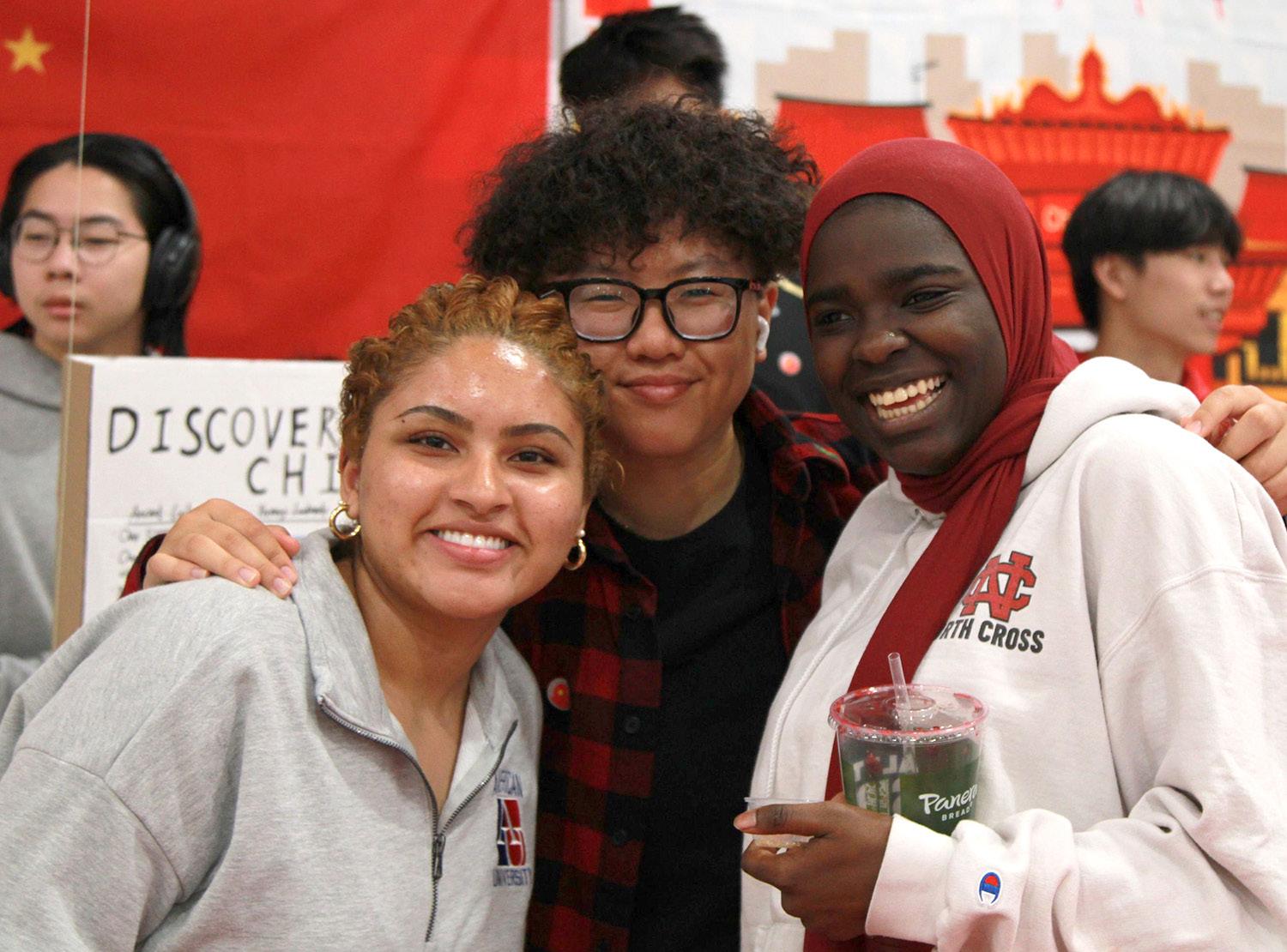
FUN FRIENDS: Enjoying International Day and each other, seniors Isabel
in Costa
Brooklyn
China and
Canada pause in front of the China table. More International Day photos and captions on pages 12-13. Photo by Suvi Hansen
Coordinator. “And I think that that is China deciding that they would prefer to keep them home. So that is the case. And we’ve seen sort of an uptick in European countries. A lot of kids want to play football. They can’t do that. Yeah, so American football is a big draw for us here.”
What has happened at North Cross is true for the whole of the United States too. While Chinese international students are the second highest group of international students studying in the US, that number has decreased since 2020 from a peak of approximately 373,000 to 266,000 today, according to migrationpolicy.org, dropping from their number one spot to number two. However this can negatively impact the U.S. in many ways. Chinese stem students are highly sought after in the US labor field and in the 2023-24 school year, international students contributed more than $43.8 billion to the U.S. economy, according to NAFSA. That being said, the decline of Chinese students doesn’t seem to be slowing down.
“The relationship between America and China right now is kind of intense,” said Jiale Qin ‘26 “I feel like right now it’s not as easy as before to get a visa to come over here and also, if you want to study abroad, no matter where you’re going, it costs a lot of money, especially America. The reason why I’m still staying in America is trying to try to complete my college over here and trying to find a job.”
• Cover design by Anderson Ratliff ‘26 applies the 15 he designed for the Willis Hall Herald’s 15th volume to the number of nationalities in the dorm this year.
• 4: Mason Bibby ‘27 wins the first MUN award in program history.
• 5: Margaret Bass ‘28 meets former Vice President Kamala Harris.
• 6-7: Kaitlyn Perkins ‘28 explores Ramadan with the Muslim Student Association
• 8-9: Mason Bibby analyzes issues with NATO.
• 10-11: Andrew Weng ‘28 reveals what music means to him.
• 15: William Hendrickson wins state golf title;
• 18-19: After winning BRAC for 11th time, girls soccer plays for state title with key roles filled by girls from Spain and Zimbabwe.
• 20: Brooklyn Chen explains how coaching helps her in shot put/discus.
• 21: Girls track team wins BRAC and competes for a state title.
Co-Editors-in-Chief ...................................... .Aadeetri Pandey ‘26, Mason Bibby ‘27
Senior Design Editor...................................................................Anderson Ratliff ‘26
Asst. Editor-in-Chief......................................................................Kaitlyn Perkins ‘28
Photography Editor.........................................................................Andrew Weng ‘28
Ciccozzi ‘26
Stevens ‘28 Jax Bentley ‘29, Piper Malloch ‘29
By Camryn Stevens
Invading Venezuela, the U.S. military extracted the former Venezuelan president Nicolas Maduro and his wife from Caracas, Venezuela and took them into custody on Jan. 3, 2026. They were then transported to the U.S. to face charges of narco-terrorism, drug-trafficking and possession of illegal weapons.
The three big reasons the American government gave for the removal of Nicolas Maduro were widely reported. The BBC echoed the administration’s claims saying they included “engaging in a narco-conspiracy with designated terrorist groups, conspiring to traffic cocaine into the US, and possessing and using illegal weapons - primarily machine guns - to carry out the alleged conspiracy.” The BBC also reported, “Prosecutors also allege that in 2017 he worked to ship hundreds of kilograms of cocaine to Miami.”
Although the U.S. claims this wasn’t the case, it is also assumed that the American government did this for the oil located in Venezuela.
Joaquin Downey ‘28, who is half-Venezuelan on his mother’s side, feels positive about Maduro’s removal.
“It was definitely a good step to take Maduro out of the picture,” he said. “But I think . . . the way they went about it was wrong.”
Joaquin’s mother, Dr. Elda Stanco Downey, is from Venezuela, and she also spoke about this issue. Dr. Downey grew up in Maracaibo, Venezuela’s second biggest city. She said back in the ‘80s that Venezuela was very wealthy, with oil being a big part of the economy.
“And Venezuela does have the largest oil reserves in the world,” Dr. Downey said.
How the U.S. performed this operation generated conflicting views. Some say the operation was valid, as the crimes Maduro is being charged

with are reasonable, so he could be removed. Many justify why the Trump administration did this operation because Maduro was not viewed as the legitimate president, because he rigged the most recent elections, so his power was invalid. Others claim it violated international laws and caused problems resulting in Venezuela internally.
“The United States, along with a number of nations across the globe, did not recognize that result,” Dr. Downey said. “So, you know, one could say, well, that was kind of like a rogue precedent administration running the country, because it wasn’t recognized as a fair election and a fair result.”
It is widely believed that Maria Corina Machado, who was awarded the 2025 Nobel Peace Prize, won the presidency in 2024, but Maduro stayed in power. But Machado has not returned to Venezuela to assume power yet. The Americans are allowing one of Maduro’s top party members, Delcy Rodriquez to be the interim leader.
For the first time in many years, the United States reopened its em-
bassy in Venezuela on March 30, and sent Laura Dogu as the representative.
She was chosen as she has “experience navigating authoritarian governments and fragmented opposition movements makes her a pragmatic choice for a volatile post-Maduro transition,” according to the Los Angeles Times.
Dr. Downey considers herself an optimist and says she hopes the Trump Administration will help the citizens of Venezuela. “The representative [Dogu] of the administration in Caracas,” Downey said, “it seems she’s doing a good job, and the U.S. has already sent a couple of cargoes of medications to the country. So I think you know that, to me, is a symbol of a good start, and hopefully that will continue.”
They received a shipment which contained six metric tons of supplies. They are also trying to help with the public health care that had collapsed for more than a decade. With this help Venezuela should be able to have supplies for medical care and to be able to rebuild the public health care system.
And there is hope for renewed relations as international flights recently resumed from the U.S. to Caracas. Joaquin and his family’s biggest hope is to be able to visit Venezuela again.
“We’re still unsure of what the future is going to hold for us,” he said. “Our main hope is just to be able to go back to Venezuela and visit my mother’s home.”
By Kaitlyn Perkins
Theodore Roosevelt famously said, “I am an American, free born and free bred, where I acknowledge no man as my superior, except for his own worth, or as my inferior, except for his own demerit.”
For some, it might be surprising to hear that a peer on your Model United Nations team managed to impress the chairs in their committee so much as to receive an ‘Award of Excellence’ (awards are only given to the top three people in each committee) and not only that: your peer also was selected to speak on behalf of their committee in front of roughly a thousand students and chaperones at the closing ceremony at the biggest high school Model United Nations conference in the world (hosting roughly 5,000 participants, from over 250 schools and 75 counties.) However, for the friends, teachers, and pretty much anyone else who knoww Mason Bibby ‘27, the accomplishment was almost to be expected.
“I was not surprised [that he won the award] ‘cause Mason is a great public speaker. He works really hard to do well in his conferences so him getting the privilege to speech for everyone wasn’t that crazy,” said Margaret Bass ‘28, who was Bibby’s MUN partner in 2025.
for, well… a very long time.
Yes - For the average high school student this award would be groundbreaking, but for Bibby, who has been the SCA president for the class of 2027 for the past three years, has over nine awards for his writing, including a John Locke Institute Shortlist, numerous Scholastic Gold Keys and a DePaul Blue Book recognition, has spoken at the American Legion, the Sons of the American Revolution, the Grandin Theater and the Virginia War Memorial , regularly uploads new episodes of his podcast - Analyzing America (which can be found linked on the Willis Hall Herald website) and new articles to his very own Medium page, this award was about as surprising to his peers and chaperones as Usain Bolt winning the 100 meter race at the Berlin World Athletic Championships in 2009.
“I was not surprised [that he won the award] ‘cause Mason is a great public speaker.” - Margaret Bass ‘28
“I did not expect it, but I was also not surprised. Mason really embraces the spirit of Model UN and that was on full display at the conference this year,” Dr. Daniel Hood, High School History teacher and MUN chaperone said of Bibby’s achievements. “It was so cool seeing him speak at the closing ceremony. He gave his usual rhetorical flair to the summary of his committee’s actions/debate and really did himself and the school proud.”
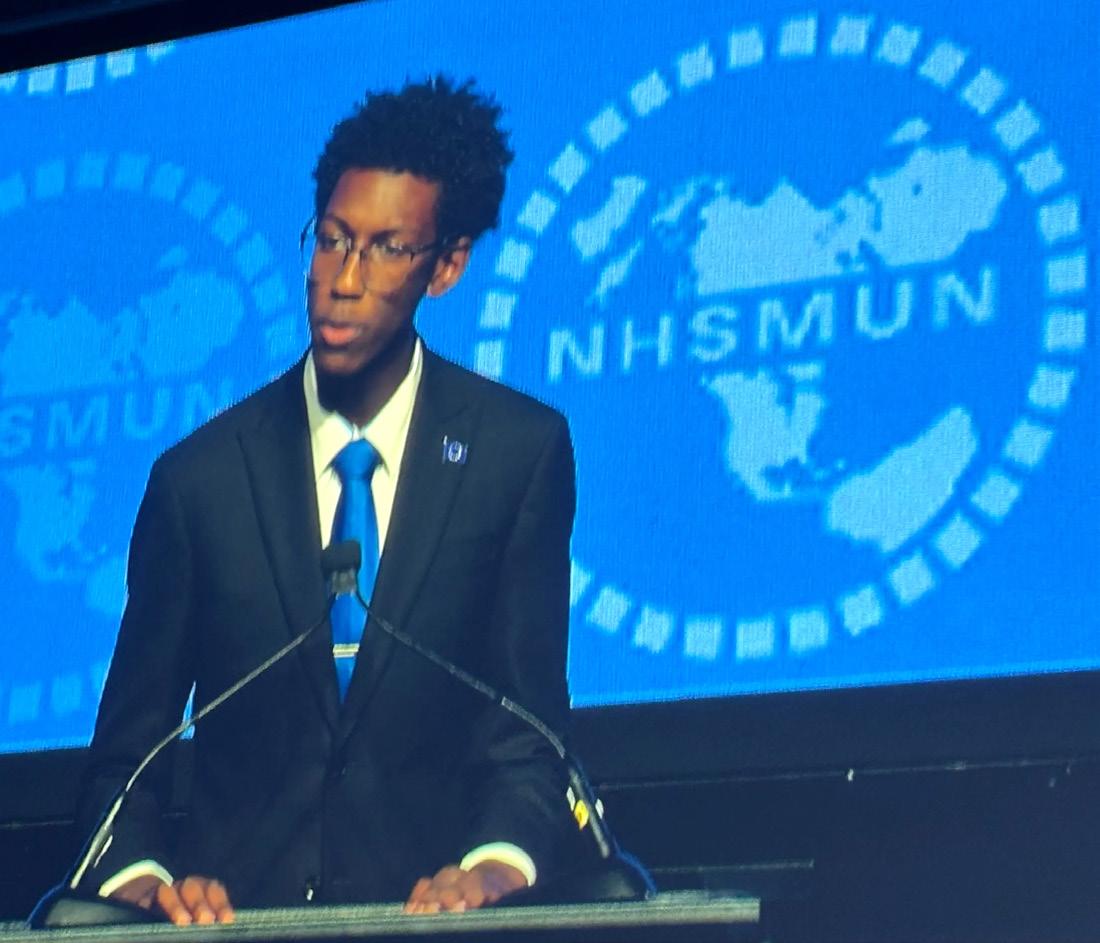
Health Organization, Commission on the Status of Women, or the United Nations Human Settlements Programme. This was the case for all but two of North Cross’s MUN members. However, some students like Bibby and Peter Anderson ‘27 participate in what’s known as Crisis Committees where, unlike in regular committees, students do not have a partner, and the structure of the committee is far different mainly because instead of students representing countries, in Crisis Committees students get to represent world leaders, which might allow them to take over as head of the European Union - as Bibby managed to do.
ous actions, and current policy.” And in the typical GenZ way, “I followed her on Instagram,” which Bibby said, “helped a lot more than you’d think.”
Bibby had also set to work making a comprehensive map of Europe’s Baltic Region, scouring the internet for things like major rail lines, cities, military installations, or otherwise noteworthy sites. All this, as he said, “would become very important as a member of the Council of Baltic Sea States.”
Bibby had already participated in MUN for two years as a freshman and sophomore but being in a Crisis Committee presented new challenges and also opportunities.
“I was really excited to hear what he had to say! His speeches are always well written so I had high expectations and he surpassed them.”
Bibby, who includes the quote from the former U.S. President Theodore Roosevelt in his email signature, has manifested these accomplishments
That being said, the award is still pretty impressive. The majority of participants at the National High School Model United Nations (NHSMUN) conference in New York City are ‘delegates’ of certain countries such Malawi or Thailand in mock committees like the World
Bibby was part of the Crisis Council of Baltic Sea States, and acted as Kaja Kallas, the High Representative of the European Union for Foreign Affairs and Security Policy and leading up to NHSMUN he dialed into his role. “My first order of business was to read up on my country, or rather, character: Kaja Kallas, the High Representative of the European Union for Foreign Affairs and Security Policy.”
“I did this in a few ways”, Bibby said about how he prepped for his role. “First, obviously, I read the background guide. Second, I watched an unhealthy amount of YouTube on her speech style, previ-
“For the past two years, I felt like I’d been slighted by the higher-ups on my committees. Last year, especially, my partner Margaret and I put up a level of competition I think was deserving of some sort of commendation,” Bibby said.
Despite past disappointments, Bibby was determined that this year was his year.
“Either way, my goal wasn’t to be defined by the past,” Bibby said. “It was to use it to my advantage. Now an experienced delegate, I figured it was time to show them what I could do when I flew solo and pulled out all the stops.”
By Kaitlin Perkins
Margaret Bass ‘28 got the opportunity to meet the former Vice President at the National High School Model United Nations (NHSMUN) conference in New York City in March thanks to the question she submitted to NHSMUN organizers prior to the conference. Her question was selected to be asked during the Q&A portion of the conference with Kamala Harris.
Bass’ question was: “What advice do you have for young women trying to find their voices in male dominated fields where they can often be overlooked?”
“I was beyond excited,” Bass said about getting her question selected. “This was before I found out I got to meet her, so I was just so excited that my name would be called and I’d actually get to have her talk to me.”
Bass did not know she would meet the Vice President when her question was selected.
“My first thought was OMG you’re lying,” when that honor was added to her question being accepted. “Faith Johnson was one of my roommates on the trip and I found out when I woke up one morning so I immediately told her. It was so unexpected and such an amazing opportunity I was just so grateful!”
Dr. Daniel Hood, Co-Director of Global Studies, history teacher and MUN chaperone, spoke of his excitement for Bass.
“I was so excited that Margaret’s question got picked to be answered by VP Harris,” he said. “It was a solid question and was reflective of Margaret’s considerateness and thoughtfulness. It was a truly awesome opportunity for Margaret and for us to witness it. I think that’s the closest I’ve ever been to a major American political figure!”
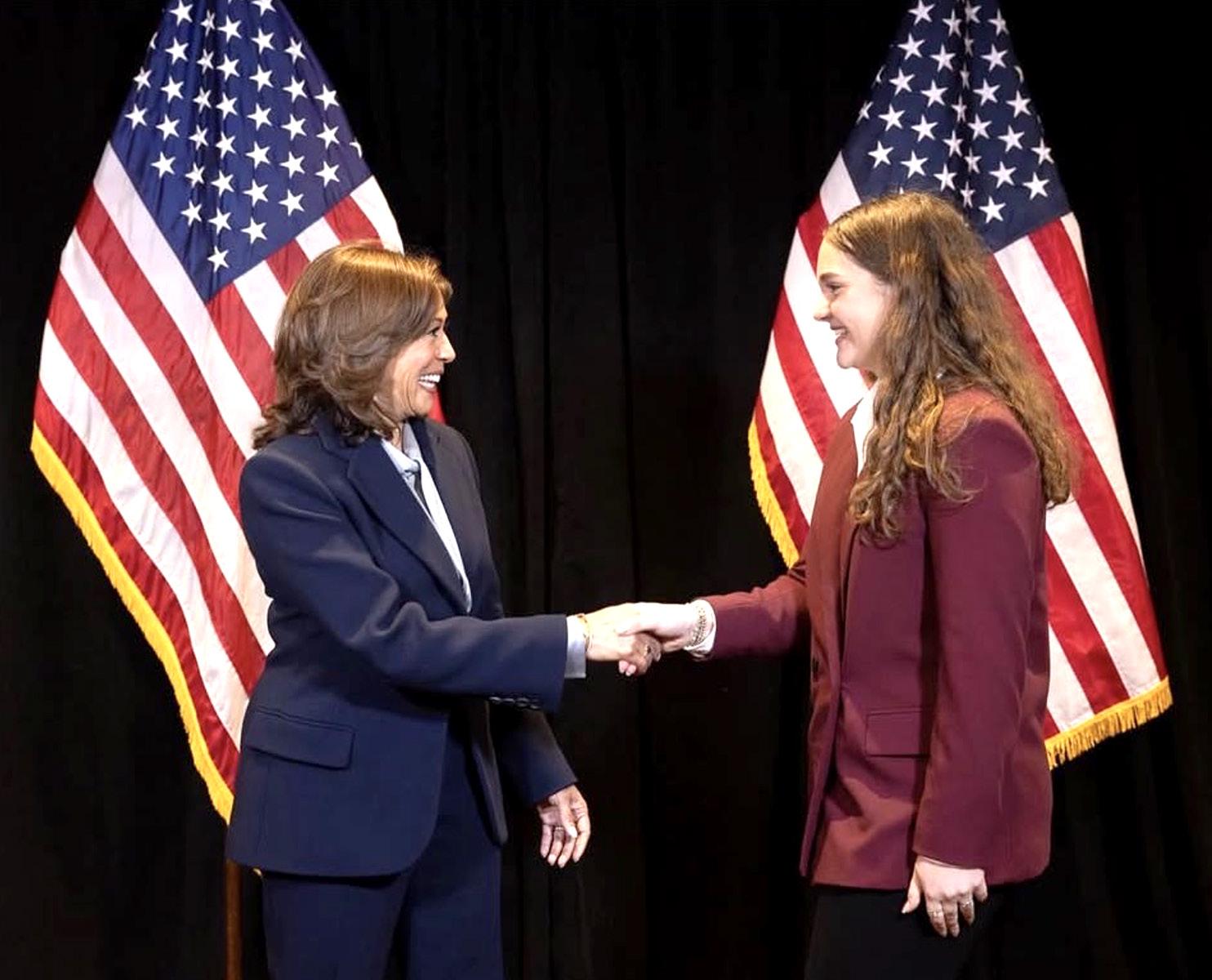
“What advice do you have for young women trying to find their voices in male dominated fields where they can often be overlooked?”
-- Question by Margaret Bass chosen by Kamala Harris
Hannah Ewing, Co-Director of Global Studies, history teacher and MUN coordinator, who organized the MUN experience the past five years, got to meet Vice President Harris alongside Bass.
“[It was] quite surreal. I’ve never been that close to someone who’s been in the White House in any capacity before so it was really surreal - it was amazing,” Ewing said. “It was amazing getting to see Margaret have that opportunity and she (Harris) was not as tall as I would have expected but super friendly, really nice, just really warm and
welcoming. It was just a really great experience.”
Dr. Hood reflected on the achievements of all the MUN participants.
“I’m just so proud of Mason, Margaret, and the whole crew who went to Model UN this year,” Hood said. “All of them represented the school well and are a testament to the program that Ms Ewing built. She is an incredible advisor for Model UN and provides the support necessary for our students to excel.”
Bass summed up her experience.
“It was a really quick moment because she’s busy, but it was amazing,” Bass said. “We said a few words, took a picture, and that was that! So incredible.”
“It was a solid question and was reflective of Margaret’s thoughtfulness. It was a truly awesome opportunity for Margaret and for us to witness it.”
-- Dr. Dan Hood
Five students plan to travel to NCS sister school, Scuola Italiana, in Mendoza, June 3-24.
Alexandra Conlee ‘29
Eleri Tarran ‘29
Arthur Lugar ‘29
Kate Sollinger ‘29
Spencer Britten ‘27
Chaperones: Global Studies Director Dr. Dan Hood and Latin teacher Seth Hamel
By Kaitlyn Perkins
Sometime in March I was running alongside Finn Chaney ‘27 during our cool down after a hard track workout. I was thinking about how hard the workout was that day when I remembered that Chaney was participating in the Fastathon for Ramadan. I asked him about it and he told me he had not eaten or drank anything since before dawn. I thought “wow, that’s incredible” and “I don’t know if I could do that.”
Chaney is a great runner, so I did not even notice anything off during the workout but it was really hot that day so I cannot imagine how that must have felt. However, this gave me an idea. I knew about Ramadan and the Fastathon, but I did not know much about them or the people in our North Cross community who participated.
Thanks to Bushra Khan, Khan, parent of Maidah ‘27 and Safwan ‘31, and a kindergarten teacher and Dr. Daniel Hood, an Upper School history teacher, I was fortunate enough to organize an interview with the Muslim Student Association (MSA), which includes Muslim Upper School students. I was able to meet with some of the club members as well as other teachers and students who participated in Ramadan or the Fastathon and ask what their experiences participating in the fast were like. What is Ramadan?
For context - as defined by the Islamic Networks Group, “Ramadan is considered one of the holiest months of the year for Muslims. In Ramadan, Muslims commemorate the revelation of the Qur’an, and fast from food and drink during the sunlit hours as a means of drawing closer to God and cultivating self-control, gratitude, and compassion for those less fortunate.” Ramadan takes place during the ninth month of the Islamic calendar, however, some Muslims fast during a pre-determined date based on astronomical calculations. Muslims typically fast for between 11 to 16 hours, pre-dawn to sunset, depending on the time of the year for 29 to 30 days. Muslims are obligated to participate in the fast after reaching puberty. However, if a person is for example sick, pregnant, too old, or if fasting would simply be too much of a hardship, they are exempted. What is a Fast-a-thon?
The Fast-A-Thon is described by News Nation Now in their article, “Muslims share their Ramadan tradition with Fast-A-Thon” as, “[the] Fasta-thon invites non-Muslims to fast for one day during Ramadan. The events often also fundraise for charitable causes. Some people modify their
fast to make it easier to participate.” The MSA organizes a Fastathon event for non-Muslim students to take part in the fast every year during the month of Ramadan. After breaking fast the MSA hosts a dinner called iftar for those who did the Fast-a-thon.
And while research on the subject of Ramadan and the Fastathon is great, I believe the best way to learn about Ramadan and the Fastathon is from the people who have experienced it themselves. What is the significance of Ramdan/what does it mean to you?
“Ramadan means finding ourselves again,” Rabia Ferron ‘26 said. “What I mean by this is out of 12 months in a year, Ramadan is the one month where we practice discipline, patience, obedience and all of this helps us to identify and see ‘ok where am I lacking as a person or as a Muslim?’”
Rabia’s brother added his interpretation.
“It’s mandatory in our religion, if you can,” said Naiel Ferron ‘28, “basically, past the ages of puberty. It’s good to do it because you also, you don’t just distance yourself from eating, you also distance yourself from bad deeds. It’s one month out of the year, so you can build good habits, and for the rest of the year you can continue those good habits.”
Why did you participate in Ramadan?
“I participate in Ramadan because, yes, at my age I’m required to,” Rabia Ferron said, “but also because I have made it a duty upon myself and Ramadan just brings so much joy to me despite what people think. I think a lot of the times people see us fasting and think that we are suffering or that we are starving to a point that we are about to pass out, but I feel like that’s not the case a lot of the times. Yes, in the beginning it can be a little hard because you go from eating every single day, three meals a day or even more if you’re snacking and drinking water to eating and drinking only at night when the sun goes down, but after a good five days, I think we start to get used to it. I can’t speak for everybody, but I personally feel so much peace during this month and it makes me so happy to participate.”
Taahir Imam ‘27 could relate to their feelings.
“You enter a flow state,” he said.
Why did you participate in the Fastathon?
“The dorm food’s bad, so I wanted some food for dinner,” - Preston Ripple ‘27 said, referring to wanting to participate in Iftar(participated in the Fasthathon). “It was good. I ate pizza. I tried, I don’t know what it’s called, the biryani. It was really good. I like that a lot.”
Fastathons have become increasingly popular on campuses and in some organizations.
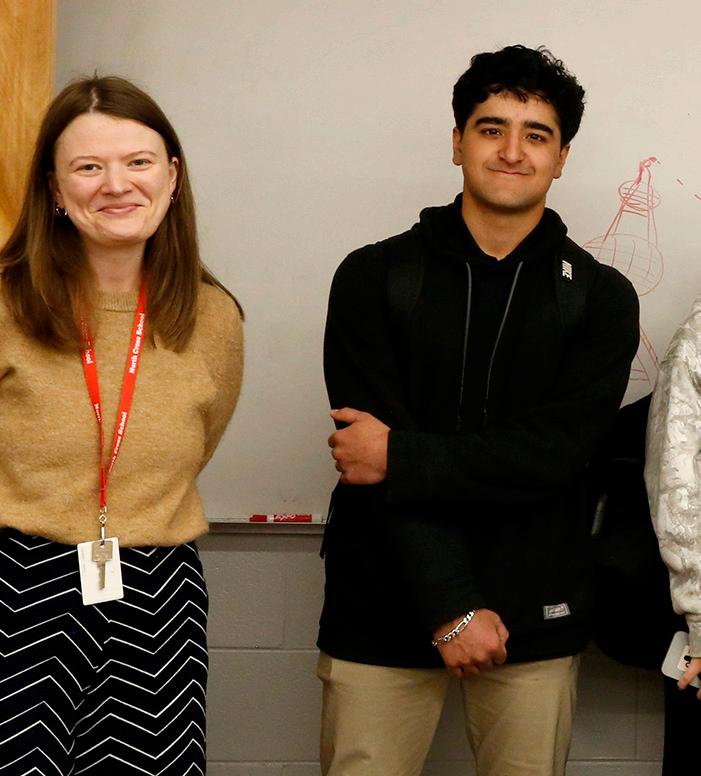
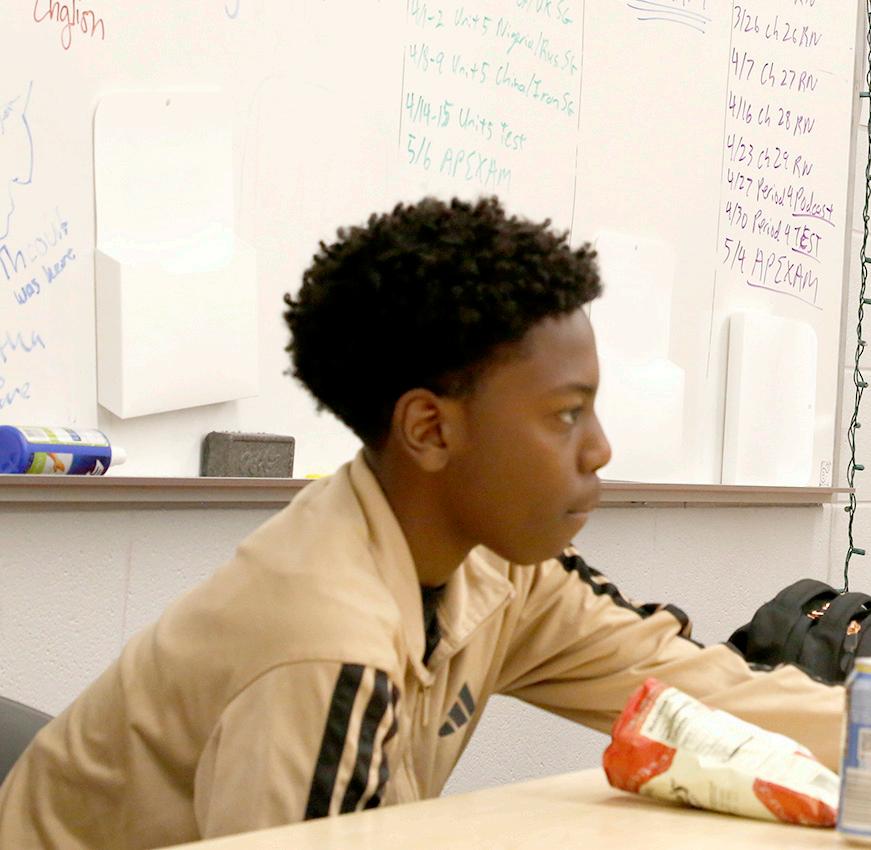
“All my friends told me to do it,” said Chaney, “and I wanted to challenge myself.”
At what age did you begin fasting for Ramadan?
“I think [I] officially started, every day - fifth grade,” Ameer Albishah ‘26 said, “fifth and then we start, like, practicing for fun, [in] third grade.”
Muslims are required to fast during Ramadan after puberty even though most begin earlier.
“It’s really impressive because his (Albishah’s) younger siblings . . . they all have started fasting like before they have to,” Khan said about the younger siblings of the MSA students. “So it’s very impressive. They’re amazing. I just get so inspired by them.”
“They enjoy it,” Albishah said. “It’s not like they’re getting forced to. They want to.”
“I started fasting during kindergarten,: Salma Lafi ‘29 said, “but it wasn’t like, full days. I fast-
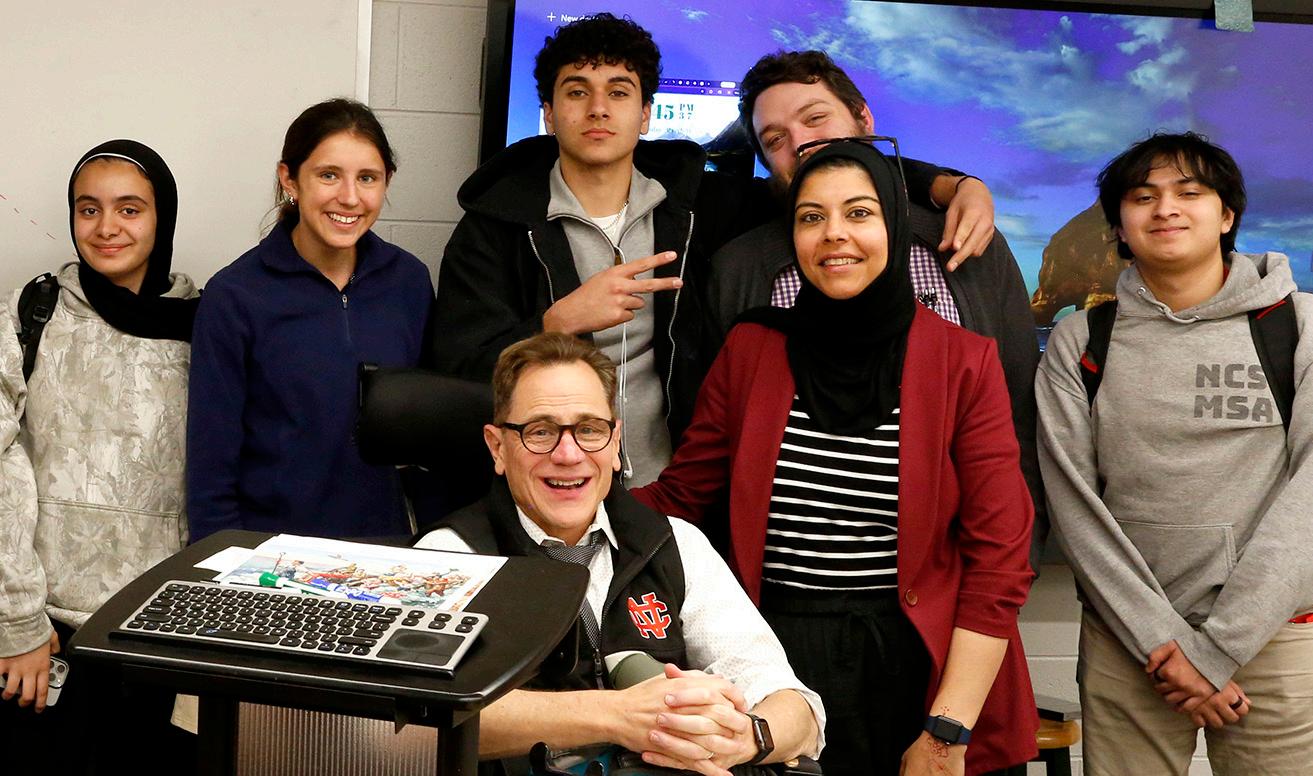
FAST THIS DAY: Students and faculty above gather for a group shot after discussing Ramadan over lunch in Dr. Dan Hood’s room, including English teacher Kate Llewellen, Zuhair Mirza ‘26, Salma Lafi ‘29, Kaitlyn Perkins ‘28, Ameer Albishah ‘26, Co-Director of Global Studies and history teacher Dr. Dan Hood, MSA Adviser and Kindergarten teacher Bushra Khan, Taahir Imam ‘27 and Journalism teacher Robert Robillard (seated in front). Photo by A. Weng
ed for a couple hours, and then maybe, like, [in] third grade [I fasted for longer].”
What is the significance of Laylat al-Qadr (the Night of Power or Decree)?
“So [it] is one of the holiest nights in this month,” said Naiel Ferron. “And we believe that God comes out, [the] lord out from the heavens, and he answers all our prayers. And there’s kind of a holy night that you can experience like only once every year,”
“It’s in the last 10 days of Ramadan,” Khan said. “But the only thing we know [is] it’s on an odd night, so you basically [you] want to, like, play it safe and worship extra on all of those nights. And
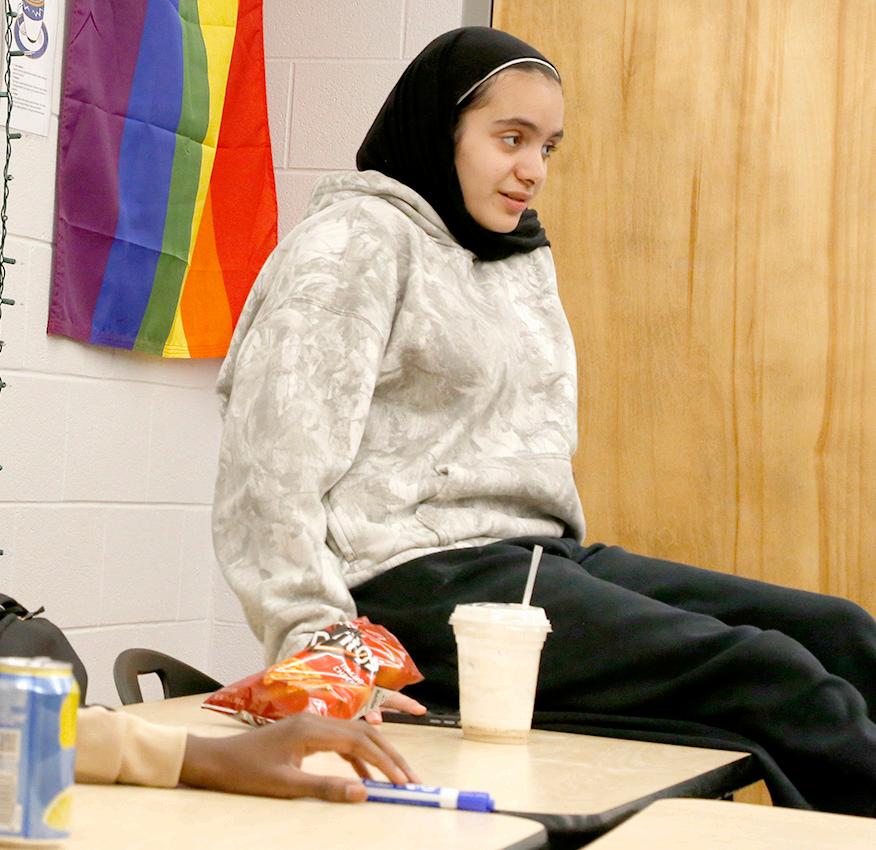
hopefully one of those is the one, hopefully, that’s the ticket.”
What is the hardest part of participating in Ramadan?
“Let me say, attending school,” Albishah said to general agreement and some laughter. “Scrolling on TikTok, there’s mukbangs [an online feasting rooted in Korean culture], like every single second, every single video.”
The challenge applies to teachers as well.
“I think we missed the water a lot,” Khan said. “Like the food thing, of course - you get hungry but, like, water all day. For me, I teach and it’s just such a hot day.”
Athletes like Zuhair Mirza ‘26 who might play hours of golf during an afternoon, but he mentioned something more fundamental.
“Waking up in the morning,” Zuhair Mirza ‘26 said, “and staying awake.”
Rabia Ferron mentioned something unusual.
“To be honest,” she said, “for me since I have been able to fast all 30 days since the age of 10 or younger, I didn’t really face a hardest part this year when it came no eating or drinking water.
“But I did face another challenge. It was actually the fact that I had to remain patient because even though it’s something I try my best to practice each and every day, I feel like in Ramadan it can be a little more challenging. Why I say it can be challenging is because sometimes things happen in life, for example something didn’t go your way or someone made you upset, purposefully
or even unintentionally, and you really just want to show your frustration, but in Ramadan, you can’t. You can’t show your frustration not because how you feel isn’t valued but because in Islam it teaches that whatever happens to you is meant to happen so you should just take the situation and learn from it and remain patient because in your future there’s always something better waiting for you so long as you stay steadfast and patient.”Rabia Ferron.
Do you feel like learning to be able to perform under that kind of situation carries over into other aspects of your life even outside beyond Ramadan?
“100%,” Mirza said, “both discipline and patience. . . . we believe for Islam, that’s like one of the big things, benefits, that comes out of Ramadan is patience and discipline.”
How can non Muslims be supportive?
“I’m a big fan of conversation,” Khan said. “I feel like there are no stupid questions and the more dialog we have, the more communication we have - the better.”
Rippel, the soccer playing dorm student from Blacksburg, seemed to fit with the national trend for non-Muslims who try one-day fastathons.
“I sort of feel like on a smaller scale,” Rippel said, “ike just doing it for the day [the Fast-a-thon]. So I sort of felt more for them, like, empathy.”
My running teammate provided another dose of reality through his experience.
“It’s been hard and I have a lot of respect for them (Muslims),” Chaney said. “I didn’t realize it was this hard, but I think it’s doable. I recommend other people do [the Fast-a-thon] as well.”
Read more of the round table discussion at www.willishallherald.com
“It’s been hard and I have a lot of respect for them (Muslims). I didn’t realize it was this hard, but I think it’s doable. I recommend other people do [the Fast-a-thon] as well.”
- Finn Chaney ‘27
By Mason Bibby
“No Action, Talk Only.”
The world-famous “backronym” describing the alliance with “swanky offices and passable coffee” has only gained more prevalence in its 77-year history.
The North Atlantic Treaty Organization was founded in 1949 in the context of a growing Cold War between the United States and the Soviet Union. When the treaty passed the Senate 82–13, you’d think the public was widely receptive of the defensive potential of the new alliance.
You’d be wrong.
Even after the whole spectacle that was the Second World War, many Americans still held the age-old belief that they should let Europe be Europe and let America be America. Especially in isolationist Republican and Southern Democratic circles, foreign entanglements were the name of the game in NATO, and they wanted no part.
Dissenters argued that this new “defensive alliance,” especially through Article V (an armed attack against one NATO member in Europe or North America is considered an attack against all), would commit American forces overseas permanently.
That being said, Cold War paranoia did do a lot of the heavy lifting, enough to shore up public approval, especially after the Berlin Blockade, when the Soviet military blocked all land and water routes into West Berlin to try to force the U.S. and her allies out of the city.
In Western Europe, the feeling was a cautious optimism. On one hand, NATO felt like a security guarantee against the Soviet Union, especially considering the economic carnage wrought by WWII.
Nations like the United Kingdom and France were economically exhausted, militarily battered and politically volatile. Investing in the alliance felt like a blank check from the one nation that still had gas in the tank: the United States of America.
On the other hand, however, some Europeans feared, and in many cases still fear, becoming too dependent on American power. Right-wing pro-Europe parties completely disagreed with the notion of being “babysat” by the United States, and would rather brave the threat to the East on their own. Centrists believed that trading one imperialist for another was strategically unwise, and left wing parties, primarily in France and Italy, thought the alliance a pro-capitalist, anti-Soviet venture. On a deeper level, some just genuinely feared outright provocation of the USSR.
Nevertheless, on April 4, 1949, the Washington Treaty, known majorly as the North Atlantic Treaty, was signed, with its founding members being the U.S., Canada, Belgium, Denmark, France, Great Britain, Iceland, Italy, Luxembourg, the Netherlands, Norway, and Portugal. The Alliance based its existence on Article 51 of the UN Charter, which recognizes the
inherent right of individual or collective self-defense if an armed attack occurs against a UN member state.
Seventy-seven years, several mass casualty events and one invocation of Article V later, NATO now finds itself at an inflection point. After Russia’s full-scale invasion of Ukraine in 2022, the alliance was given a new lease on life: if autocracy still exists, and if a credible threat to the region remained, then there was a case to be made for the continued existence of a once decrepit entity.
If the Soviet Union was gone but Russian military aggression was alive and well, the threat felt very familiar. Because NATO no longer had to deal with terrorism, guerrilla warfare or nation building, all Brussels had to do was go back to the basics: classic state-on-state conflict in the continent of Europe.
Before the invasion, the story went a little like this: Nations bickered over spending, dues and strategy all while some poor bureaucrat soul in an office that hadn’t been renovated since 1991 had to referee. Afterward, countries suddenly ramped up defense spending without a second thought and those on the fringes of Russia kicked into high gear.

Perhaps the largest unforeseen benefit to the alliance, though, was its expansion. When Finland and Sweden joined the alliance in 2023 and 2024, respectively, a massive strategic hole had been plugged. Finland shattered its previous non-aligned stance, and Sweden ended over 200 years of neutrality.
Above that, Russia became increasingly closed off via the Baltic Sea, which now falls exclusively under NATO control. Even the port city of Baltiysk in the Kaliningrad region, the only year-round ice-free port Russia has on the Baltic and in general is now at risk of becoming a chokepoint between the combined navies of the Nordic and Baltic. Add in Finland’s over 838 mi (1,350 km) border with Russia, and Moscow is now in a very tough position. Still, the political fulcrum is… shaky at best. So, what changed?
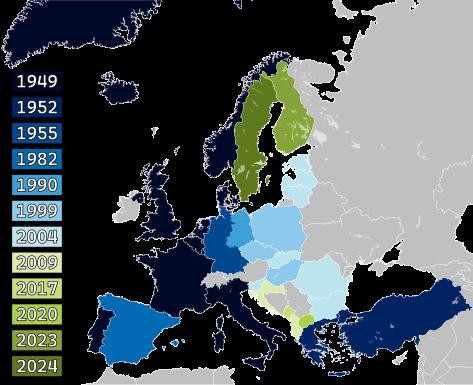
Agreements like these are easier to manage when everyone is scared in the same direction, but problems start to rear their ugly heads when priorities begin to diverge.
Fortunately for NATO, Ukraine didn’t collapse. Much to their chagrin, however, neither did Russia. Instead, the war became a

slow, grinding stalemate with tactics resembling the Western front of the First World War. Russia has made incremental gains, but there’s been no substance. At the same time, Ukraine holds on amidst an enormous cost.
No matter what the spreadsheets tell you, that’s poison to an alliance like this, and ultimately unsustainable in the long term. Vladimir Putin knows he can’t beat the whole coalition on his own, so his strategy instead becomes to simply outlast. Wait for unity to fracture and for the nations to turn on each other.
And, shockingly, that doesn’t take much.
Another big issue is that despite all of the haughty rhetoric, NATO struggles with a very age-old issue. Countries say they’ll spend more, then they drag their feet, hoping everyone else forgets, until ultimately beginning to gripe about why they had to spend in the first place. It’s a frustrating and fruitless cycle for many.
In fact, that’s exactly what people like U.S. President Donald Trump and his Administration have been arguing for a very long time. President Trump often laments over the lopsided level of spending and commitment to NATO, and while many have not gone so far as to employ some of the more aggressive negotiating tactics that he does, nearly every President since Eisenhower has complained of lopsided spending within the alliance.
In a coalition as deeply entrenched as NATO, some argue that European allies cannot continue to rely on the United States, especially considering that policy can change drastically over two, four or eight years, depending on the high turnover of congressional and presidential elections. Case and point, the shift from President Biden to President Trump.
President Biden would frequently use more encouraging rhetoric, citing historical parallels and past achievements, whereas President Trump more directly chastises his allies, most recently for their inaction within his war against Iran. His ire is most directly aimed at the United Kingdom, France and Spain. He and the Pentagon have even questioned commitment to Article V.
This is coupled with a broader strategic drift, which some could argue would happen no matter the President. Russia, while still the main event, runs the risk of becoming a sideshow within the confines of Middle East conflict, competition in the Arctic, cyber and hybrid warfare and the rise of China as a competitor in Africa and Latin America. NATO’s problem is now that it has too many of them.
Behind all of this, there is a very real fear in Europe: “What if the U.S. doesn’t show up next time?” That question used to be unthinkable. Now it’s debated across
dinner tables and behind closed doors in those offices that still desperately need renovations.
It posits that, although NATO is militarily strong, it’s as politically weak and polarized — more so than it’s ever been.
Press enter or click to view image in full size
So where does the Transatlantic alliance go from here?
The options on the table are far from a silver bullet. Those options are, however, difficult, expensive, politically annoying and, in some places, politically costly. Hence why Brussels tends to do all of them halfheartedly.
The U.S. shoulders a heavy military and financial burden, more so than any member would care to admit. European members could contribute to sustainability by hitting (and sustaining) serious spending benchmarks.
Translation: Europe, strategically speaking, needs to grow up a little. It must act even when the U.S. is distracted or hesitant, or it runs the risk of becoming drones — the very premise the alliance was conceived to reject.
This is the most glaring issue, and if it stands unresolved, a hawkish President backed by control of Congress wouldn’t mind checking out.
Secondly, the entire alliance rests upon the fact that an attack on one is an attack on all. If this wavers, even slightly, the whole structure becomes fundamentally wobbly. Presently, deterrence depends far too much on predicting U.S. behavior than personal action. Assumptions are fine until they’re false.
This doesn’t absolve the Americans of all personal responsibility, though. NATO could also benefit from a little more commitment from the “overworked team leader.”
When U.S. leaders waffle on allied support and treat the alliance like a subscription service that can be cancelled once the others get annoying, it sends a clear message to adversaries that the bonds between the U.S. and her allies can be questioned.
Furthermore, though Washington has become renowned for its assertiveness, the U.S. might find better results in treating her allies like partners, not interns. Slower coalition decision-making is, unfortunately, a price to pay for an alliance of this caliber.
The U.S. has global interests. NATO is a regional defensive alliance focused on the North Atlantic. When the United States tries to pull NATO into Middle East conflicts, stretch it toward Asia to counter China or send it on whatever menial side task requires American attention, allies wonder if they’re defending each other or simply backing American foreign policy.
If Europe needs to grow up, the U.S. needs to grow consistent.
So, in plain terms, the alliance isn’t facing imminent demise because of a few diplomatic fissures. What it is facing is lapses in funding, leadership and occasionally morale.
For all of the complaints about NATO, there really isn’t a cleaner, simpler or better alternative. At its core, all it seeks to be is a few countries trying to figure out defense in a hostile world that has a habit of punishing that kind of optimism pretty brutally.

So, in an ironic twist of fate, that ill-fated backronym could better be characterized as NATO: “Nice Attempt to Organize.”
It’s up to those 32 nations to decide whether to let that become the truth or not.
Maps and NATO icon from Wikipedia
I sing because it makes me feel stronger and lighter Music gives me strength and brings me joy.
By Andrew Weng
Iwas born on August 6, 2009, in Jing’An District, Shanghai.
My family name is Weng, and my given name is LiangYi, which means “kind and good.”
My earliest clear memories start from when I was 5 years old. At that time, I lived with my parents and my grandfather in Pudong, the area of Shanghai east of the Huangpu River. My parents arranged everything for me, what I ate, what I wore, where I lived and how I traveled.
However, they treated me more like a worker than a child. They gave me many tasks and expected me to complete them and meet their goals. Everything had a purpose, and I had to work hard to deserve their time, energy and money.
My mother, in particular, wanted me to achieve her dreams. She often told me that when she was young, she wanted to learn piano and painting, but couldn’t because of family problems. So she placed those dreams on me. By the age of 5, I already had many “missions:”
piano, painting, math, calligraphy and English.
Among these, I hated piano the most. I had to travel a long distance every day for two-hour lessons, and I wasn’t good at it. If I played badly, I would often be scolded or even beaten. I spent about eight hours a day completing all my tasks, and only the remaining time truly belonged to me.
Even though I disliked musical instruments and playing the piano, I truly loved singing. For me, singing is something very special.
When I was in middle school, I began living alone. Every day after school, I would practice singing by myself. Although I wasn’t very good, I still felt happy. I have always sang just for myself. It doesn’t matter whether there is an audience or whether others like it. In my heart, these songs belong only to me.
Singing is my way of dealing with my emotions. I enjoy the feelings within the songs and express my own emotions through my voice. It helps me release stress and feel lighter.
That is why I love singing. It gives me strength and brings me joy.
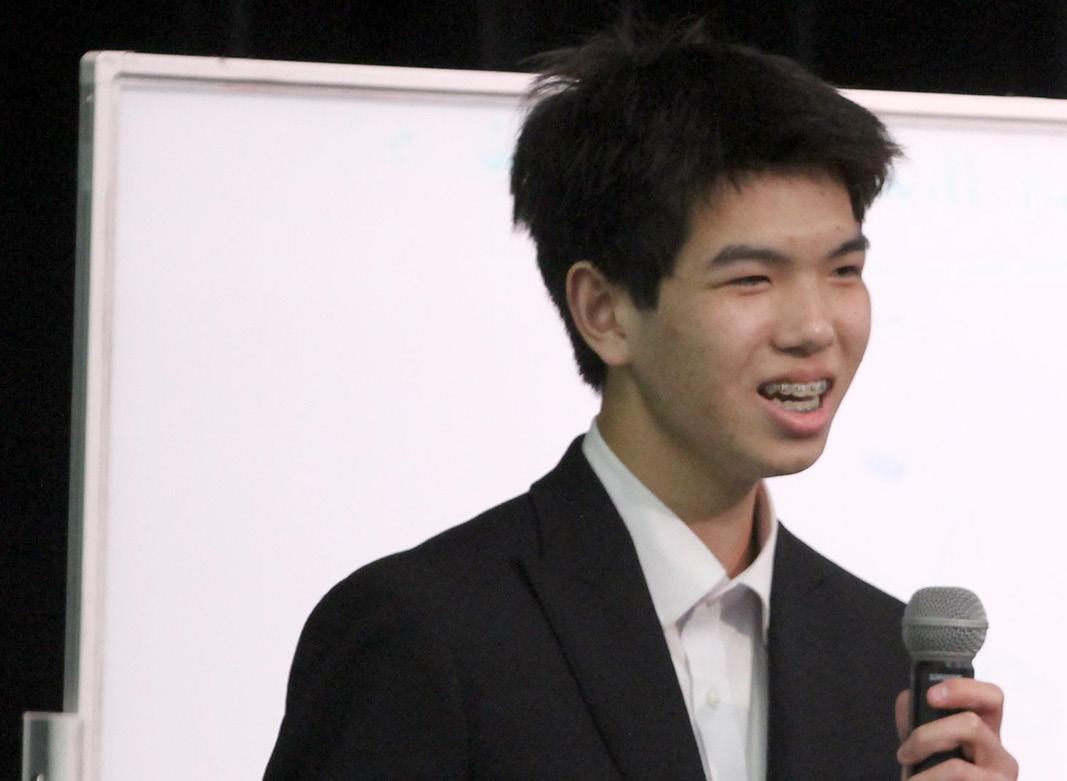
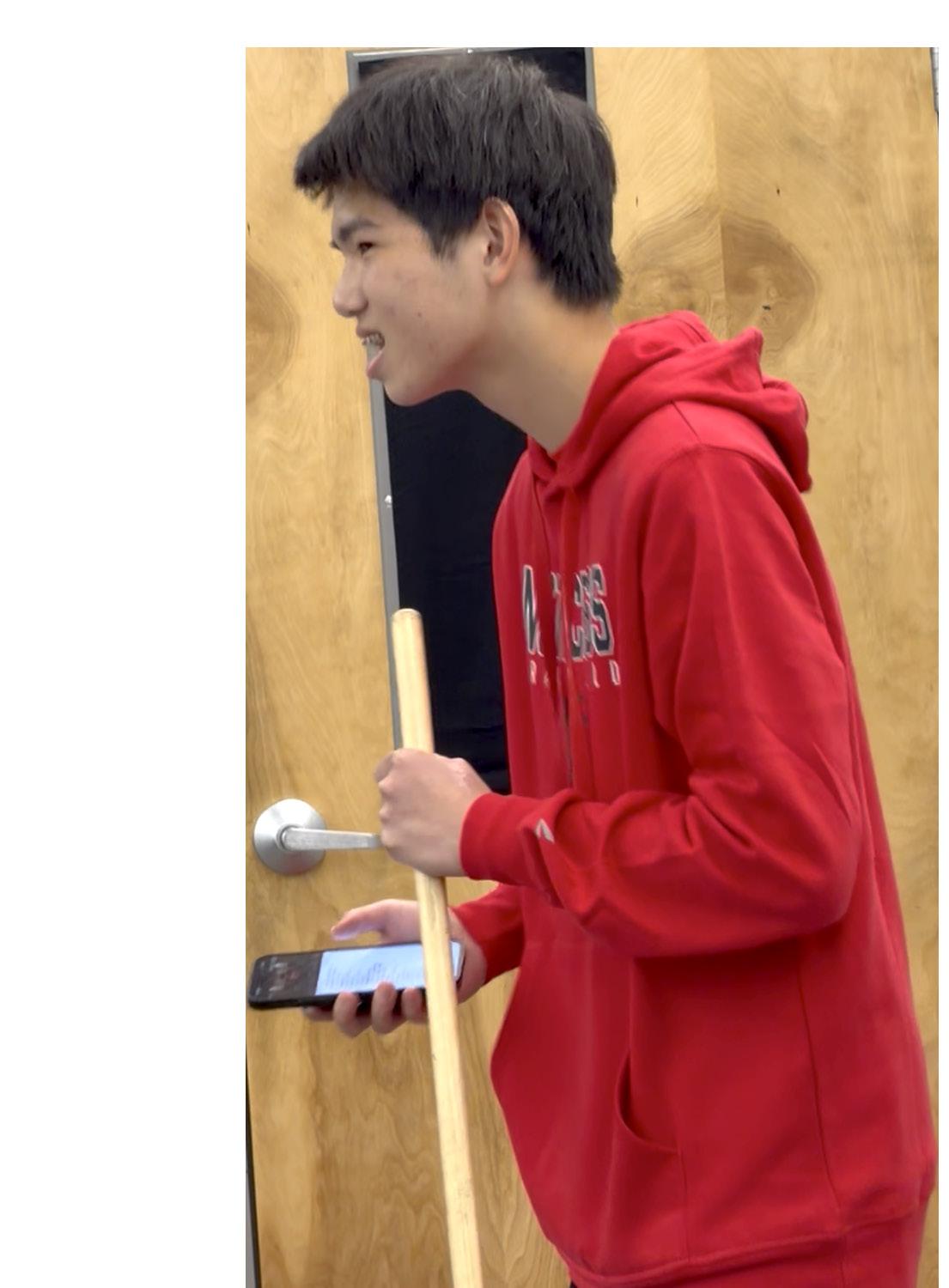
I have always sang just for myself. It doesn’t matter whether there is an audience or whether others like it. In my heart, these songs belong only to me.

It seems like it might rain, I really wish I lived next to you
I stand outside your place, counting clouds.
If there’s a piano nearby, I’ll sing a song for you
Even if it rains hard
Summer is almost gone, please eat less ice cream
It’s getting cold, don’t wear short skirts or be naughty
If you’re feeling not happy, I can lend you ‘Gromit’
You actually understand how I feel
Singing this song for you, no particular style
It just means I want you to be happy
I’ll thaw ice for you, and fly into the fire for you
Nothing is not worth it
Singing this song for you, no particular style
It just means I wish you be happy
I lose sleep for you, and give up the world
A hint of warmth in the late summer and early autumn
Seasonal colors
It seems like it might rain, I really wish I lived next to you I stand outside your place,counting clouds.
If there’s a piano nearby, I’ll sing a song for you
Even if it rains hard
Summer is almost gone, please eat less ice cream
It’s getting cold, don’t wear short skirts or be naughty
If you’re feeling not happy, I can lend you ‘Gromit
You actually understand how I feel
Singing this song for you, no particular style
It just means I want you to be happy
I’ll thaw ice for you, and fly into the fire for you
Nothing is not worth it
Singing this song for you, no particular style
It just means I wish you be happy
I lose sleep for you, and give up the world
A hint of warmth in the late summer and early autumn
Seasonal colors
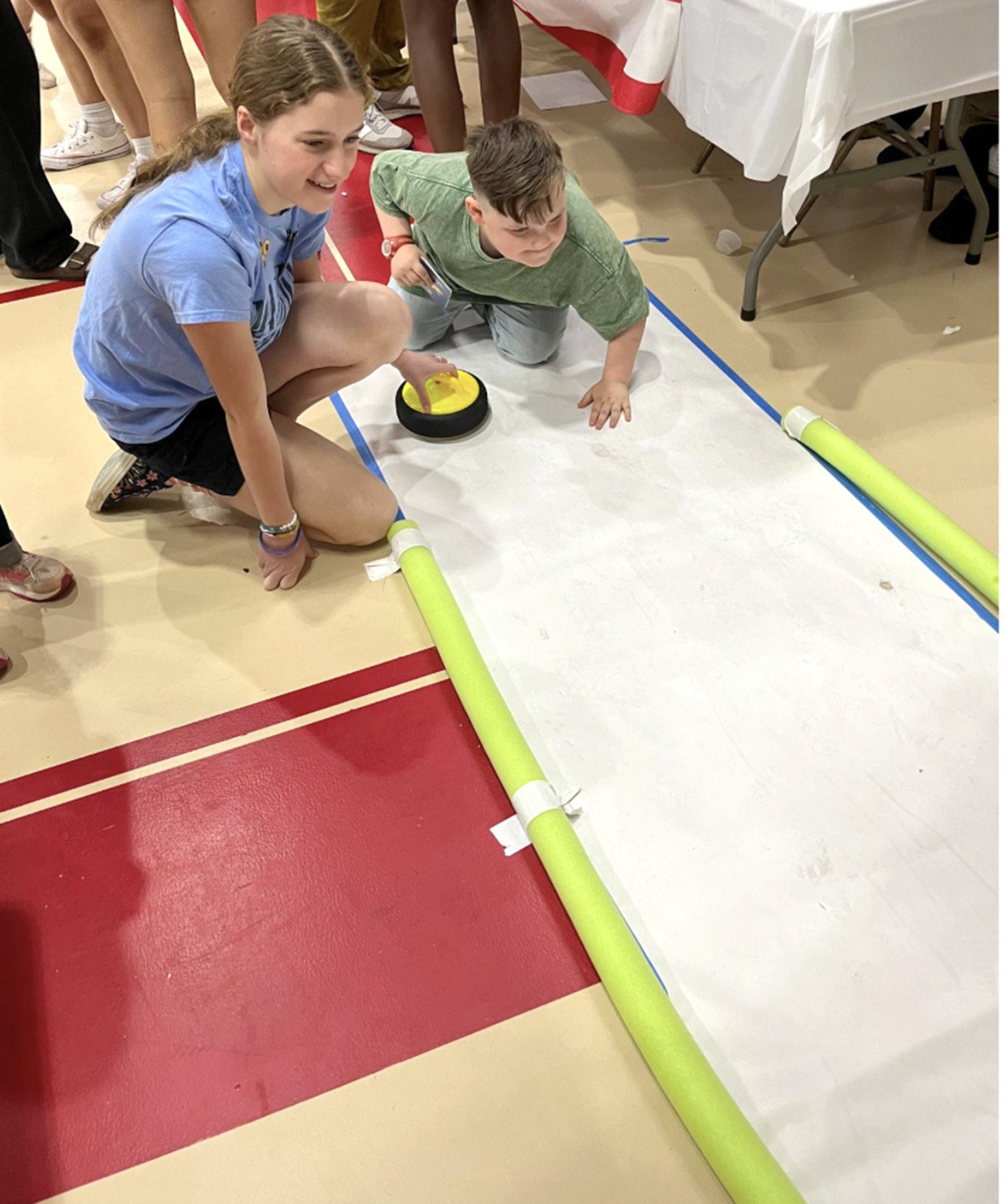



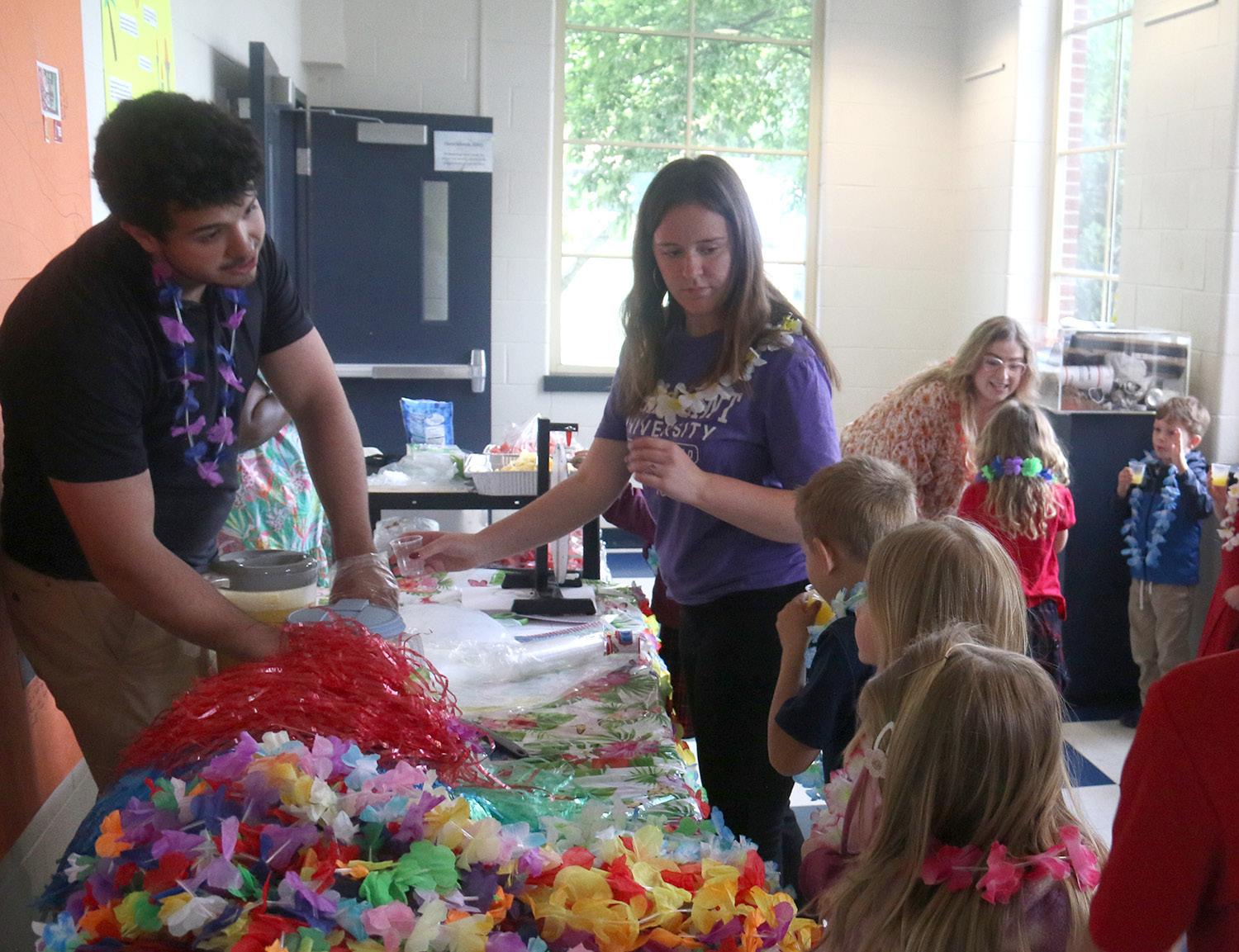
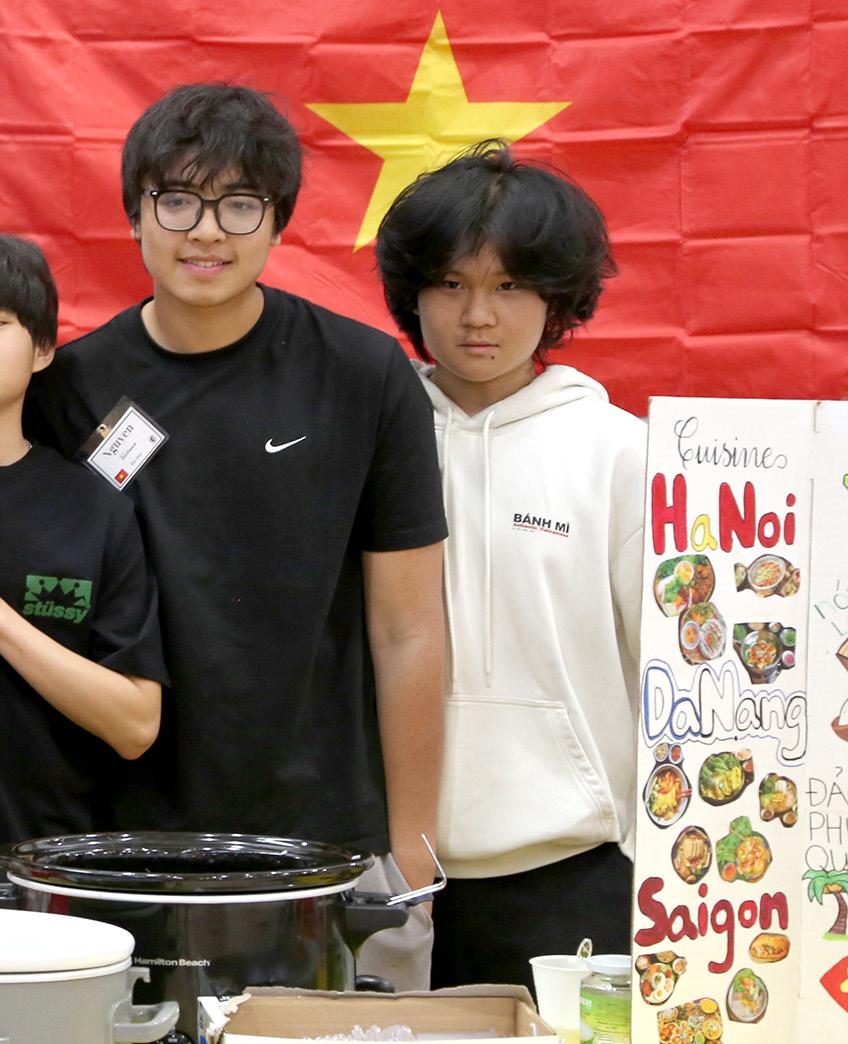
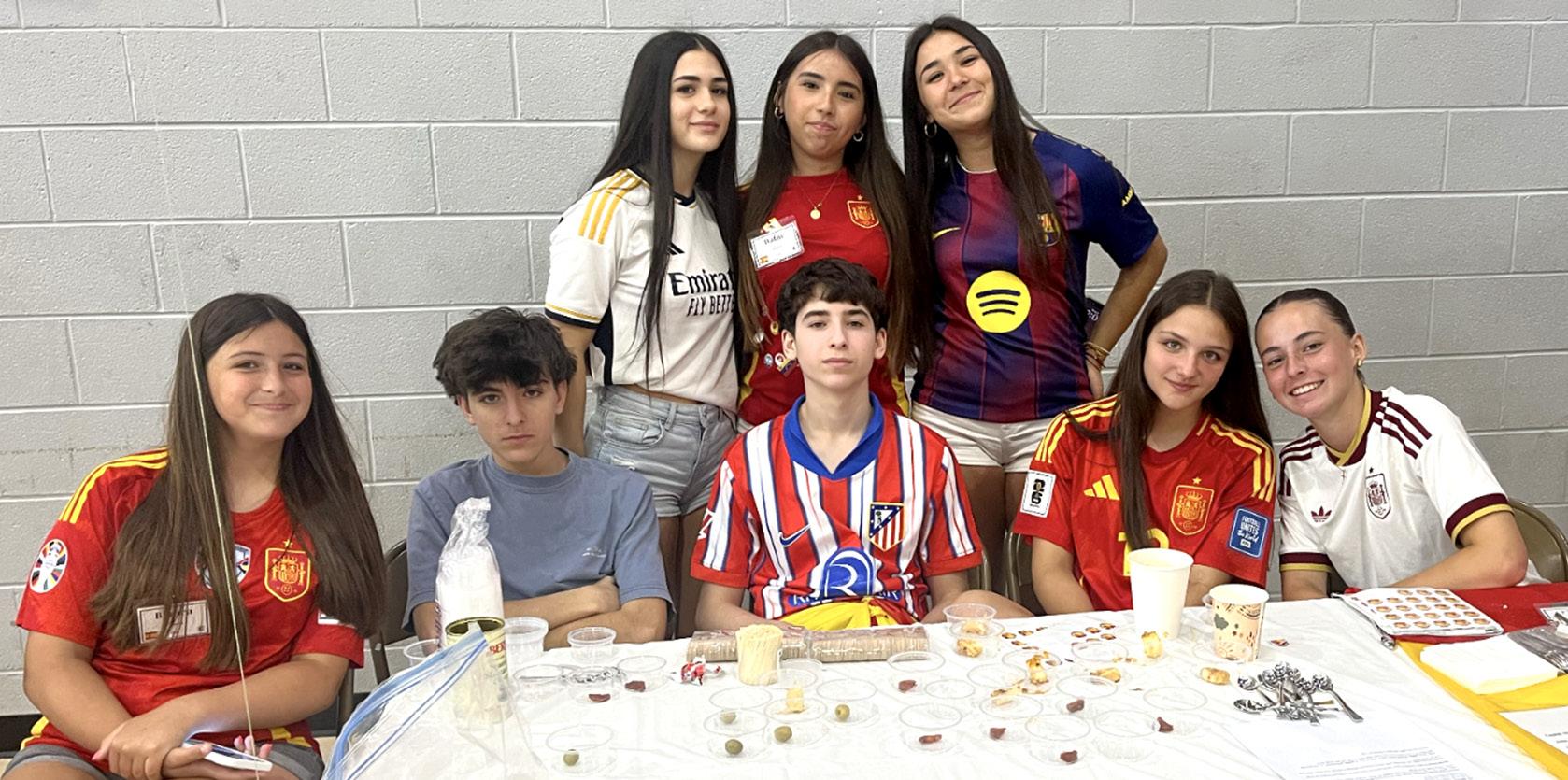
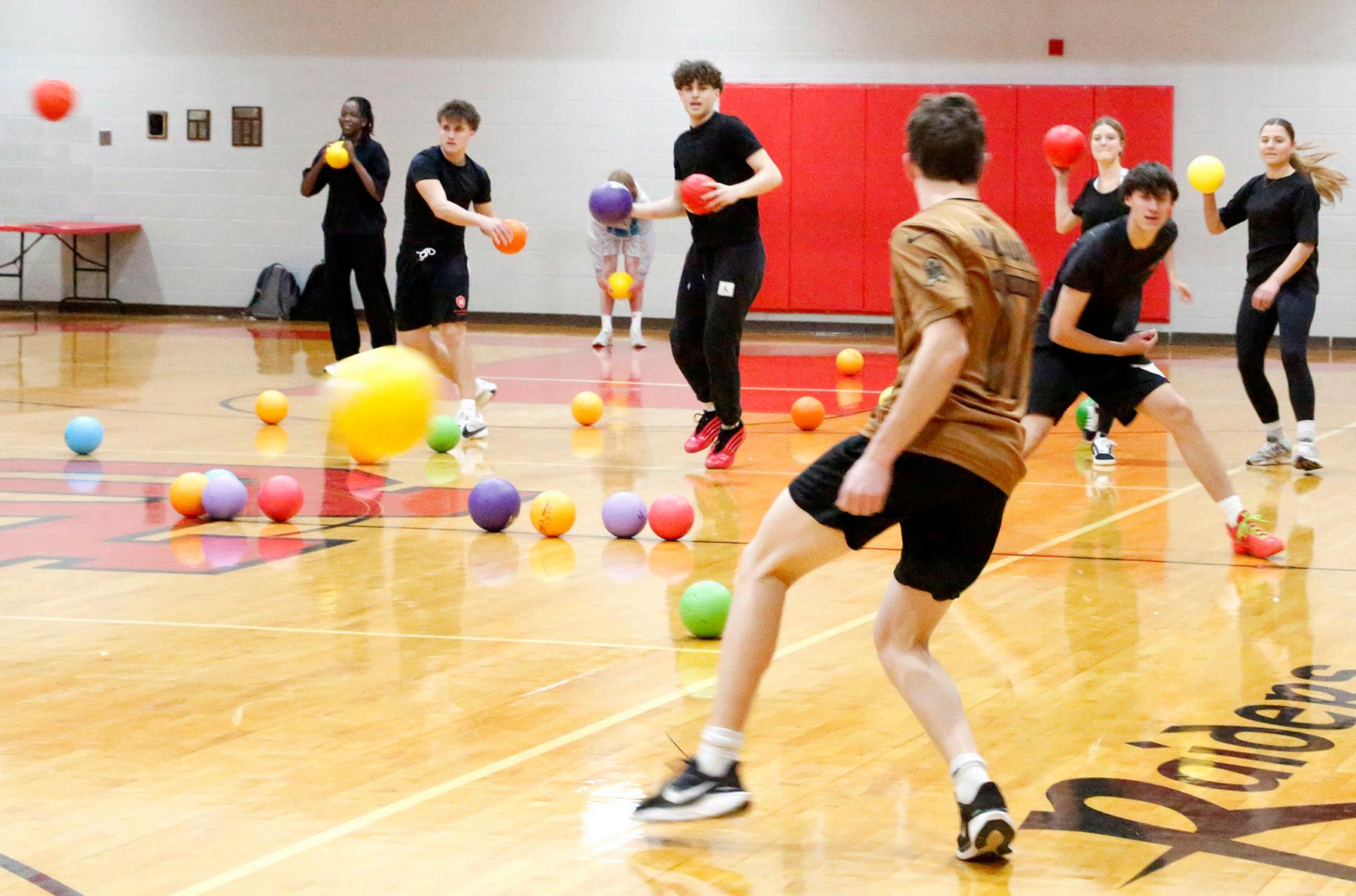
CANADIAN CURLING: Alex Conlee ‘29 and Beau Turner ‘37 compete in a makeshift curling competition by the Canadian display for International Day. International Day on Friday, April 17 was a fun-filled day for the North Cross community with many NCS families, students and even Argentine exchange students setting up displays to represent their country. Peru, Argentina, Vietnam, China, Austria and Canada were a handful of countries represented at the event just to name a few. Along with good food and fun facts, there was a curling set up by the Canadian table where students tried their hand at one of Canada’s most iconic sports. “Yes!” Turner exclaimed in excitement having “won” the competition. The rules of the game were not completely held to the traditional Canadian standard but regardless of who won, students sure did have a good time. The dorm hosts two students from Canada: Kingston Pacquet ‘27 and Lilian Keujeau ‘27, who was born in Cameroon, but raised not far from Kingston in Montreal. Photo and caption by Kaitlyn Perkins

that
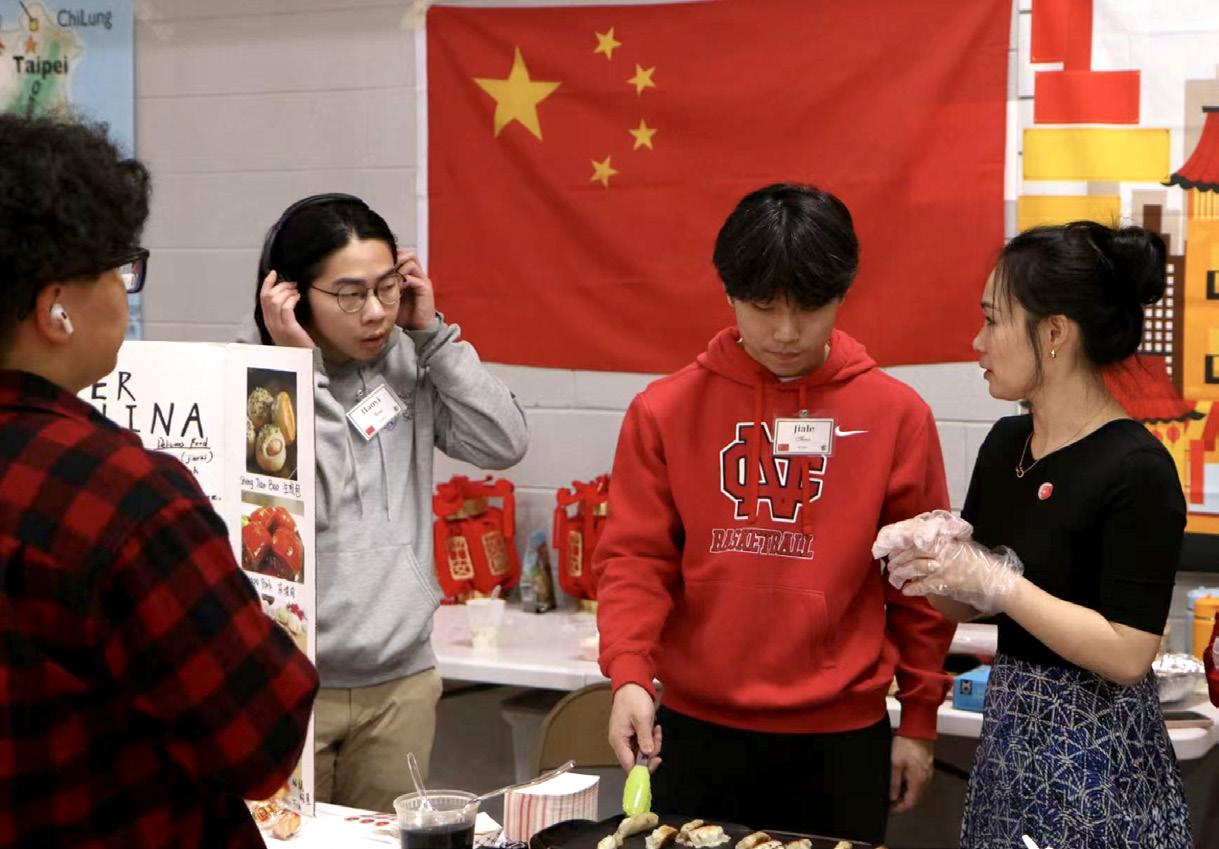
CHINA TABLE: Seniors Brooklyn Chen, HaoYi Lyu and Jiale Qin work with Annie Chen to prepare Chinese food for students. Chinese students and local parents at the school made extensive preparations for International Day on April 17. Brooklyn Chen, Hanchen Ou ‘26 and I (Andrew Weng ‘28) worked together to create a China poster that featured many Chinese landscapes and foods, along with hand drawn illustrations of iconic landmarks like Oriental Pearl Tower in Shanghai and Tiananmen Square in Beijing. Qin, Lyu and Ou assisted in preparing the food and introduced its cultural significance to others. I also organized a China quiz with gifts. Students who answered correctly received little Chinese special souvenirs (like wooden bracelets), while those who did not still received Chinese stickers as souvenirs.
In addition, an elderly artist did traditional Chinese painting and displayed her artwork. Her paintings were delicate and had a lot of details, reflecting strong Chinese cultural characteristics. Brooklyn Chen helped to explain the art to students, helping them gain a deeper understanding of Chinese art. Overall, it was a way to show Chinese culture and helped people learn more about it. Photos by Andrew Weng



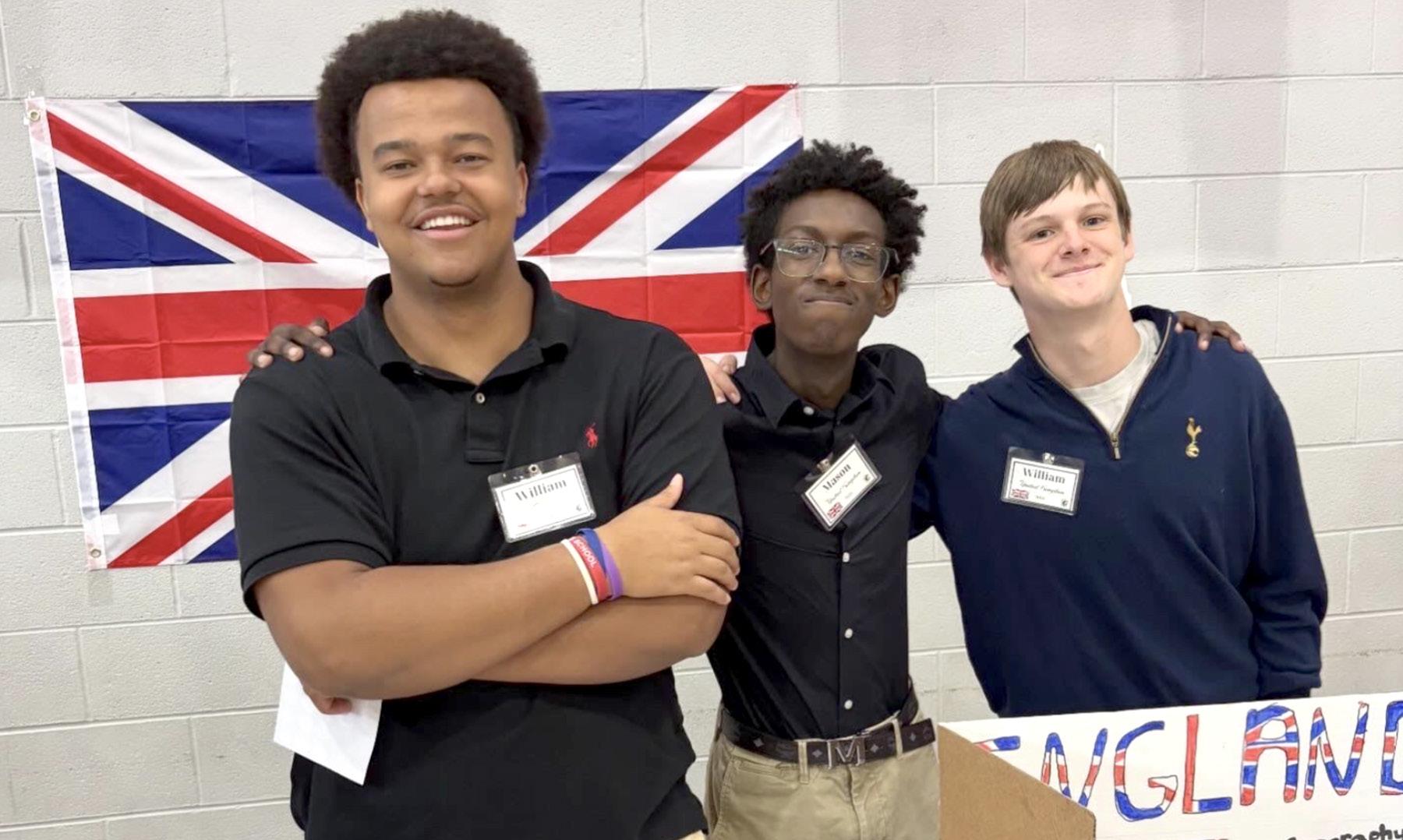
William Matthews ’27, an international student from England, celebrates International day with Mason Bibby ‘27 and William Beck ‘29. Matthews throughout this whole event kept his station positive. Beck enjoyed working with Matthews “It was fun working with another William that’s also from England,” Beck said, “and I had a great time.”
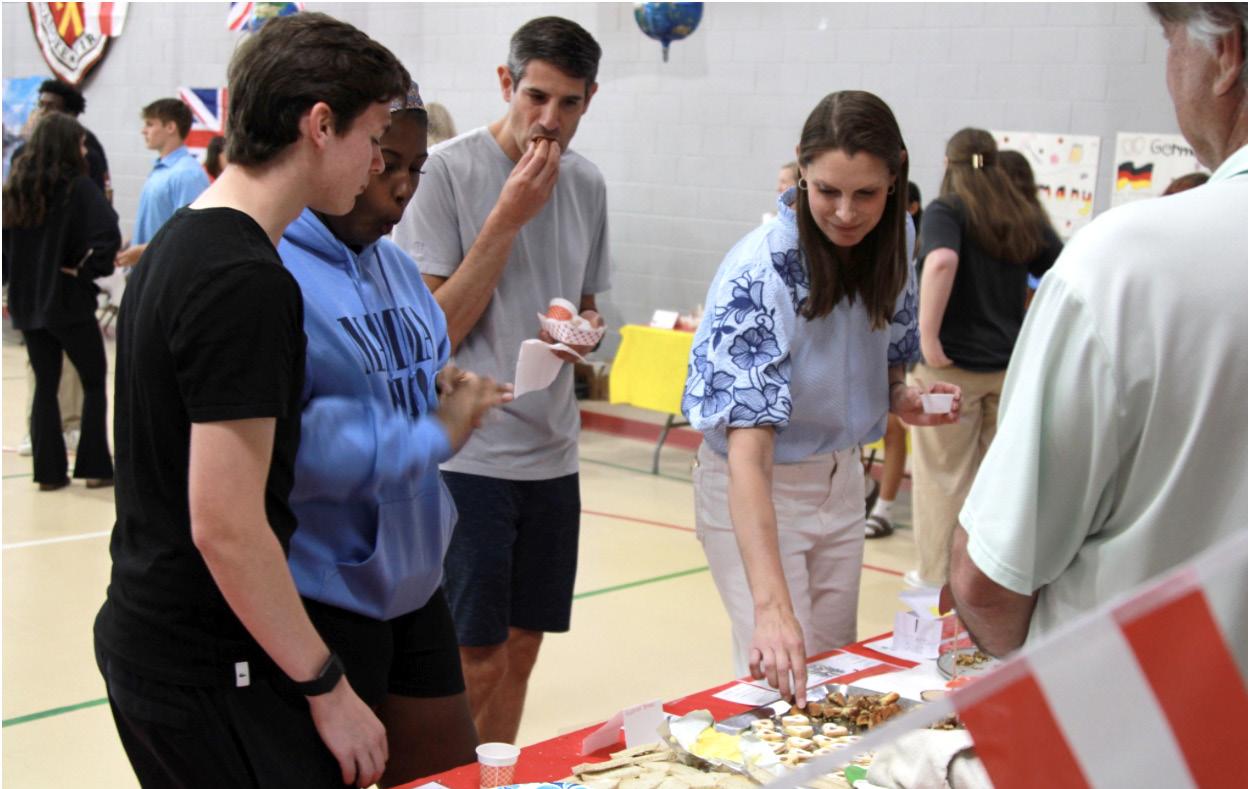

Deutschland: In front of a Bavarian backdrop, Margaret Bass ‘28. Shree Patel ‘28 and Suvi Hansen ‘29 help with the German table at International Day. Photo by Morgan Kemp
Below: Bo Knutinge-Kaas ‘28 and Samuel Bauer ‘28 and are the two students from Germany who have contributed significantly to football and track and field teams. Photo by Andrew Weng. German flag backdrop applied by Robert Robillard


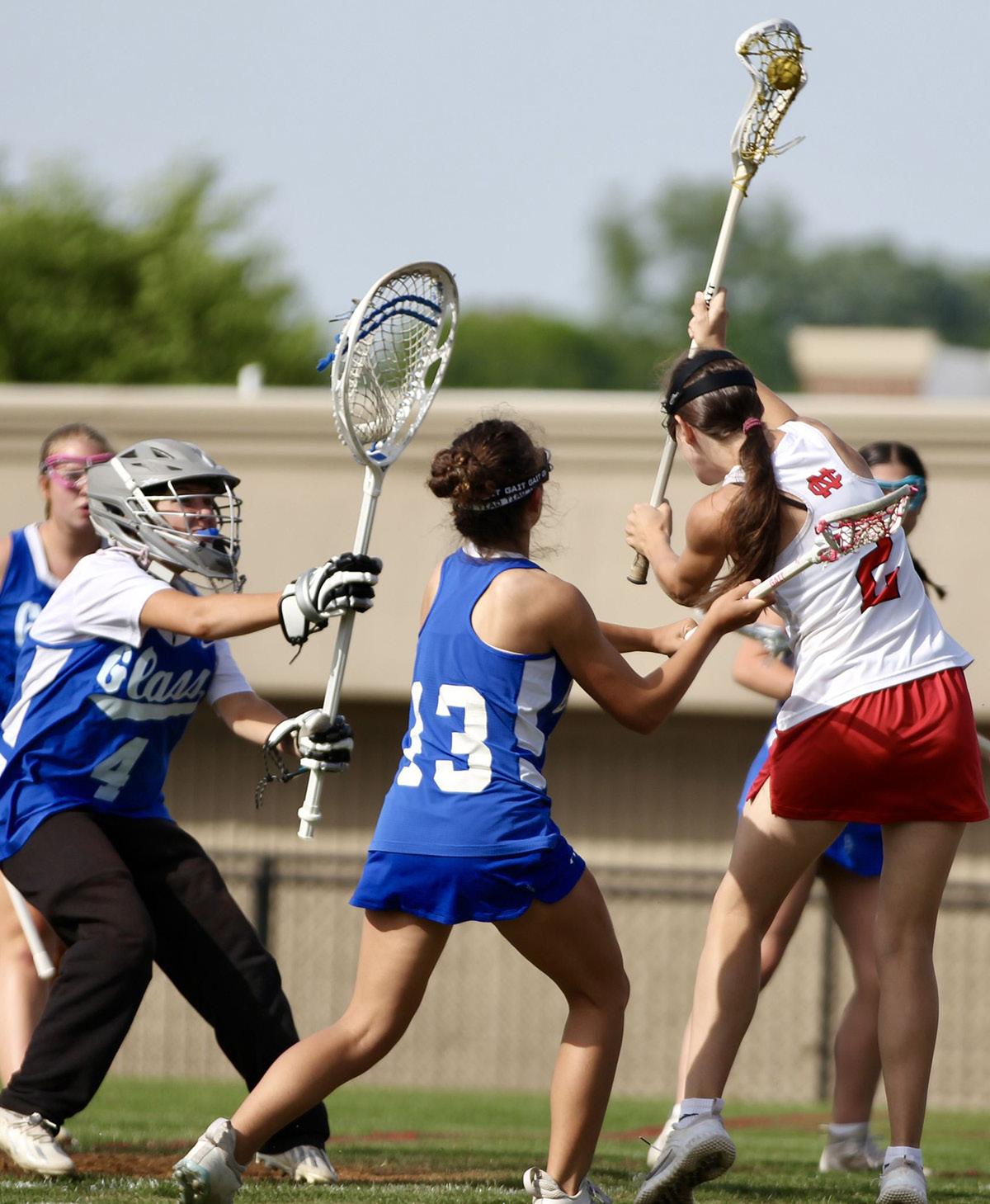
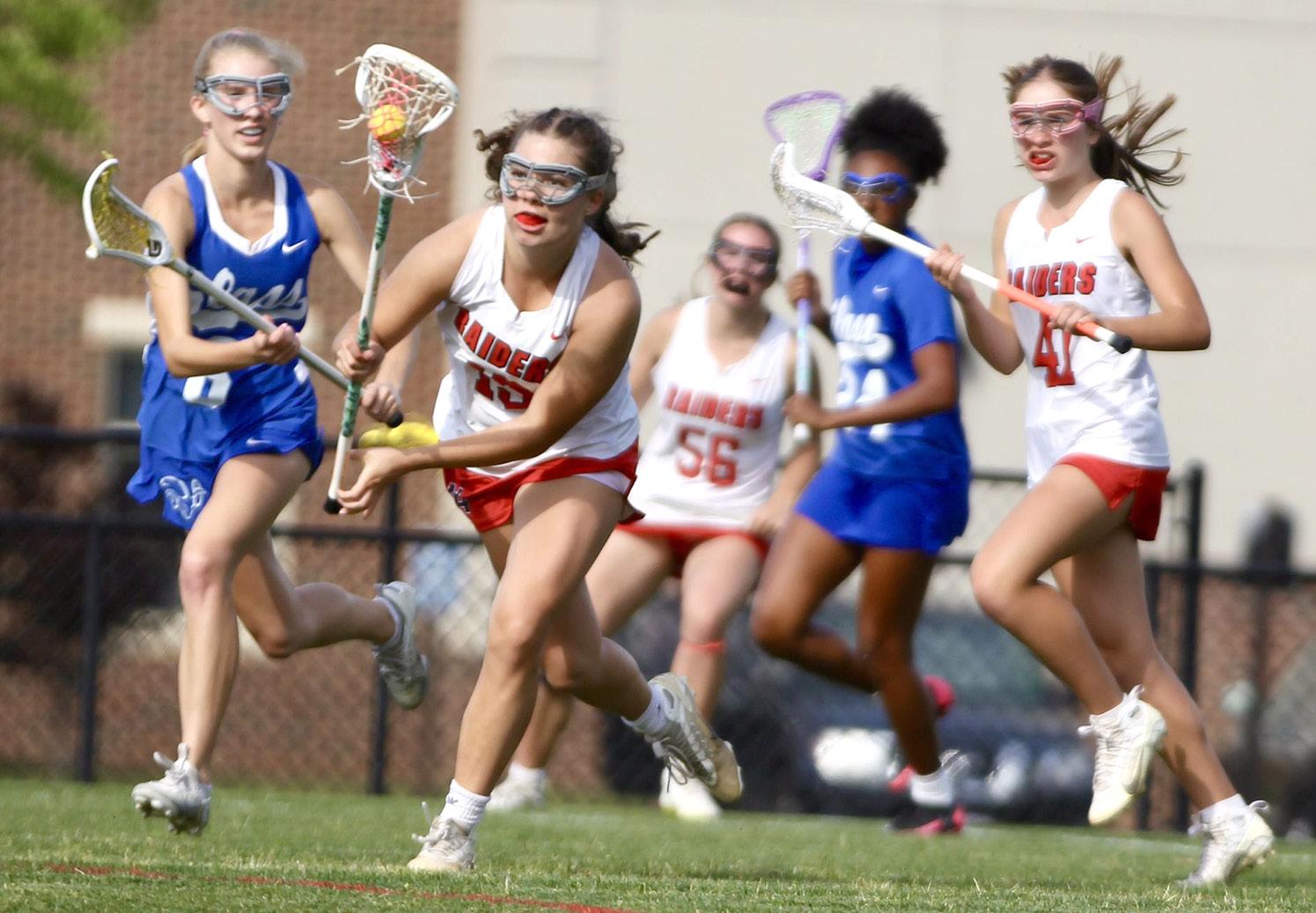
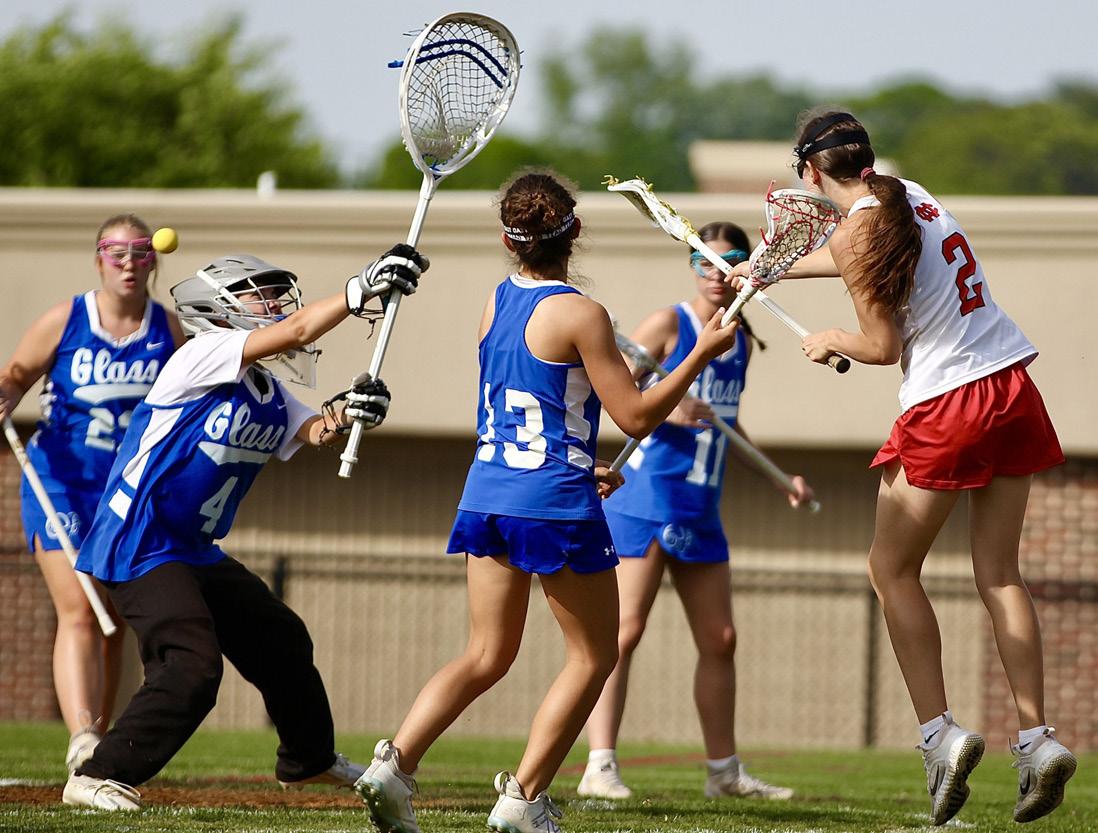
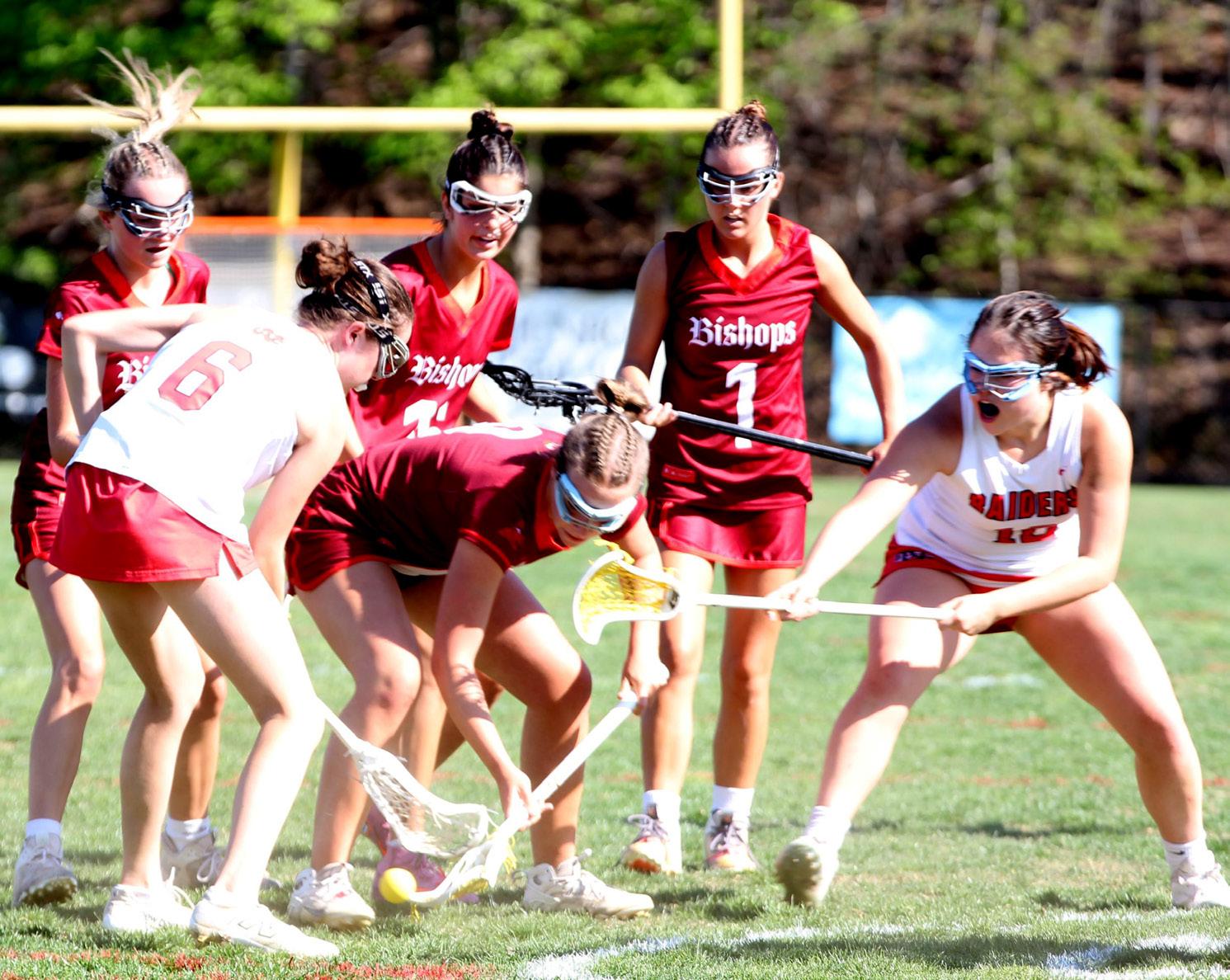
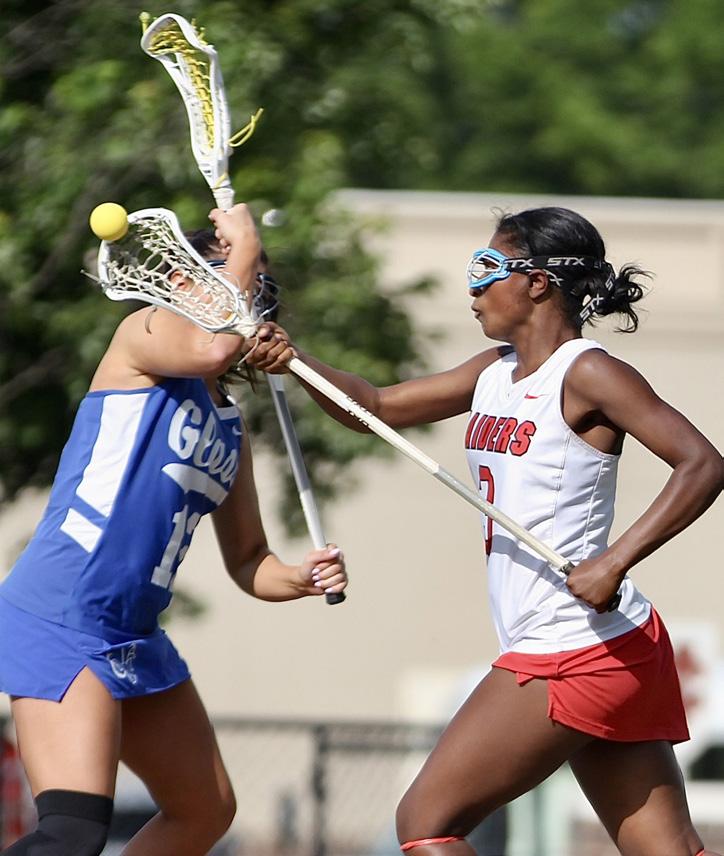
TOO TOUGH, TOO FAST: Left: Samantha Belderes ‘28 and Anna Ciccozzi ‘26 fight for a ground ball against VES. Above: Julia Cephas ‘28 blows by an EC Glass opponent in the 17-7 win on May 5 to raise the team’s record to 13-1 at the time. Cephas scored four goals and assisted on three more. While most spring teams were playing for
By Mason Bibby
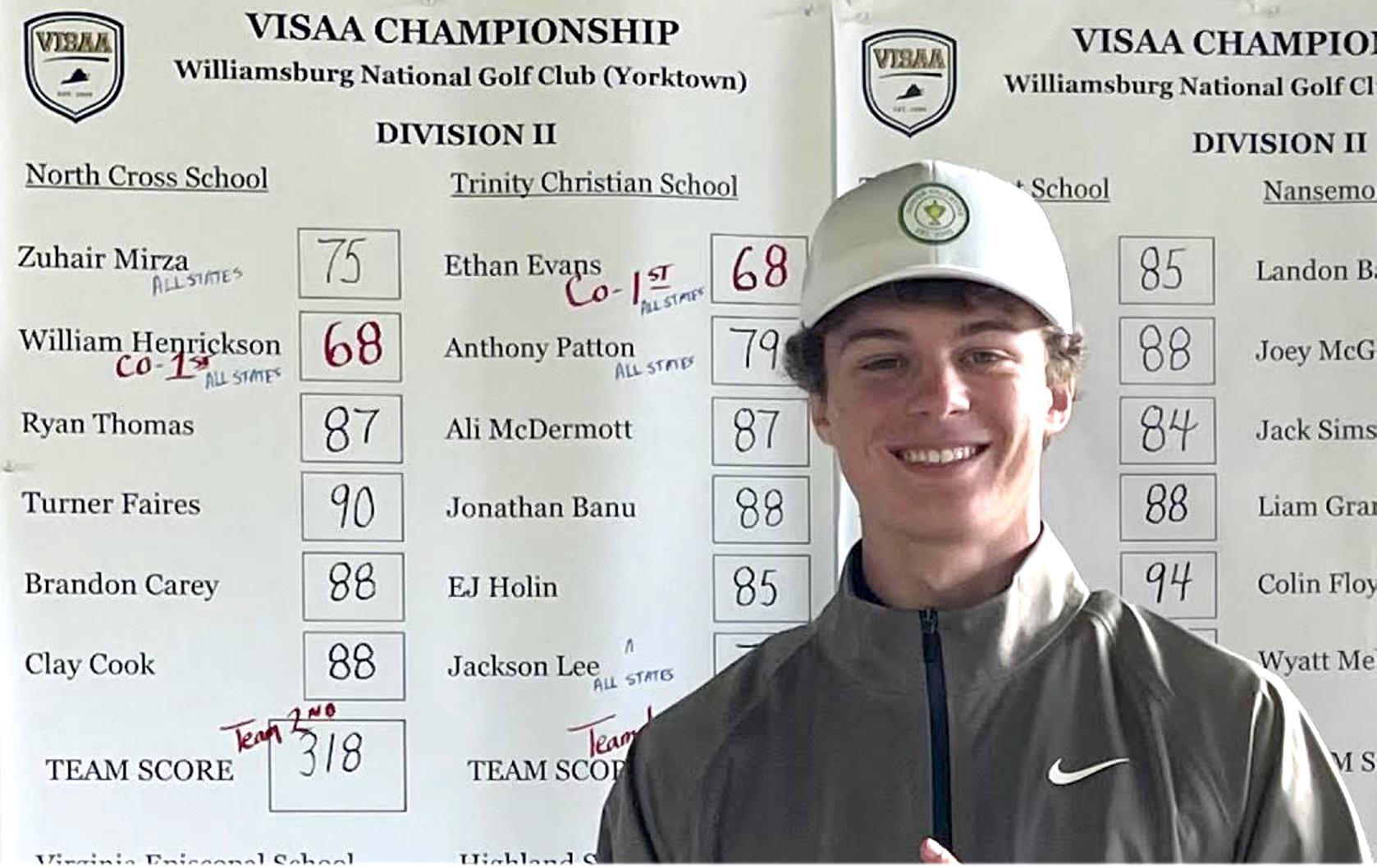
On a rainy and windy day in Yorktown, William Henrickson ‘27 shot a 68 to earn a half share of the individual state championship. He led the team to second place.
The new coach this year, History Department Chair Zachary Virgin, enjoyed the luxury of stepping into lead a team loaded with talent.
“It is a distinct honor to be named BRAC coach of the year,” he said in an email, “but credit must be given to the coaches who came prior to me, and, most of all, to the team who worked tirelessly on their own to become the best they could be.”
Virgin guided William to survive tough conditions and tie for the lead.
“I am overjoyed for William to be co-champion,” Virgin said. “The conditions on the day were challenging to say the least. It was cold. The rain never seemed to relent. Yet William was unphased. He is one of the most dedicated athletes that I have had the honor of coaching. He
appreciates the mental aspect of the game as much as the physical, and that was apparent on Monday. Before the state tournament, William,

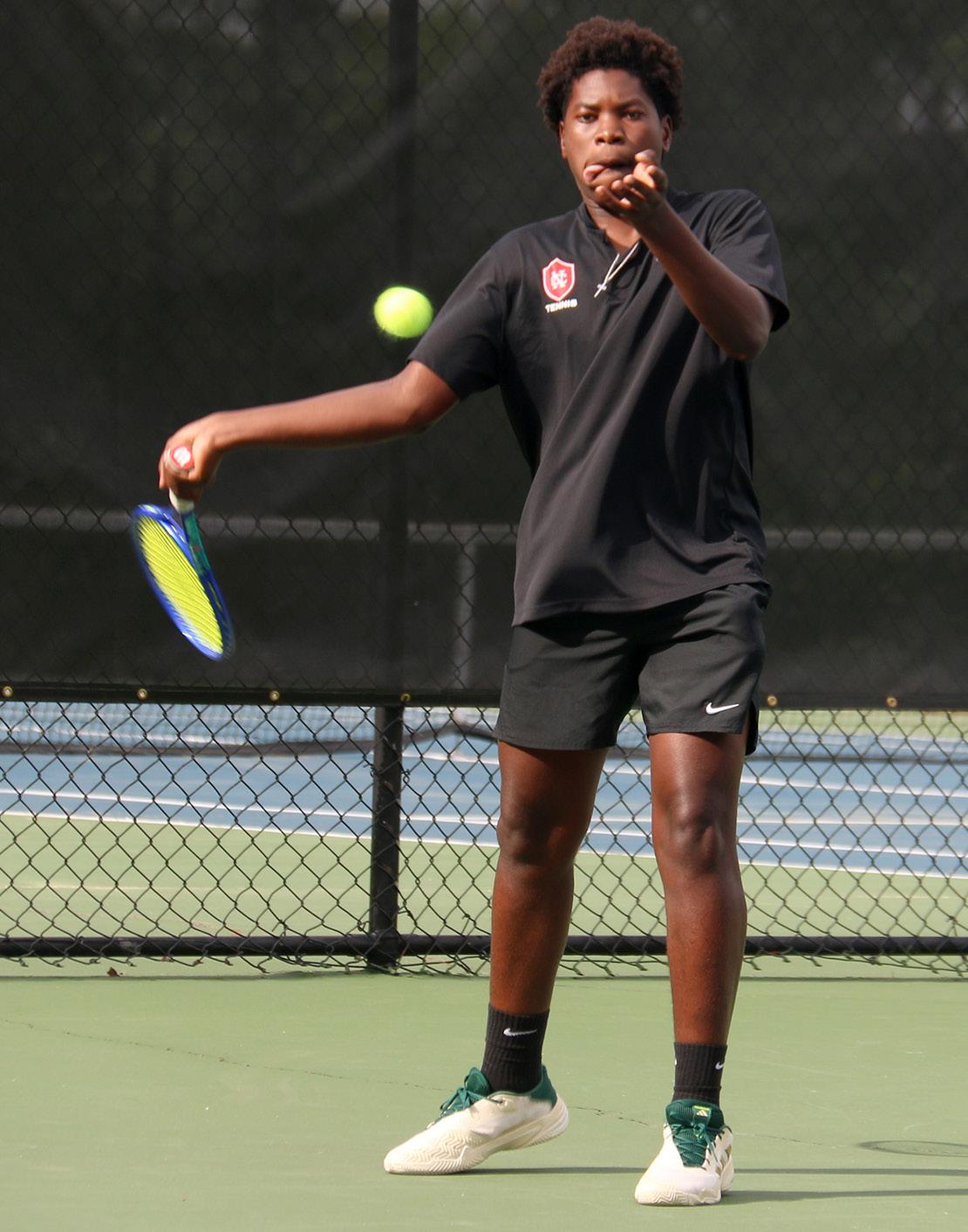
EYES ON THE PRIZE: Khalil Burroughs ‘27 focuses on the ball as he prepares to hit a forehand against Blue Ridge School in the semifinals of the BRAC tournament. Hailing from the dual island nation of Saint Kitts and Nevis, Burroughs is undefeated in singles and doubles. Through the first 32 singles and doubles sets this season, he has only lost 20 games. He usually plays No. 2 doubles with Sam Schaefer ‘26 and No. 3 singles. Along with Schaefer, Burroughs earned points against Div. I St. Christopher’s, the team’s only loss this season.
Photo by Andrew Weng
obviously, was a strong contender on any course he teed off on, but coming away from that tournament as champion will position him to be
viewed as a valuable prospect to any number of collegiate golf teams.”
The team will lose four of its topsix golfers to graduation.
By Mason Bibby
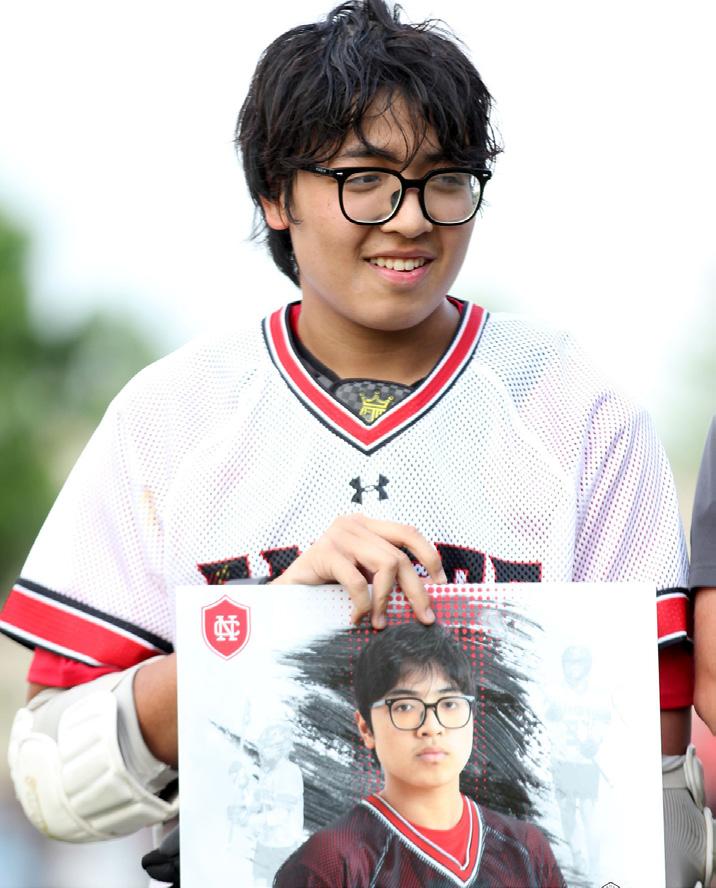
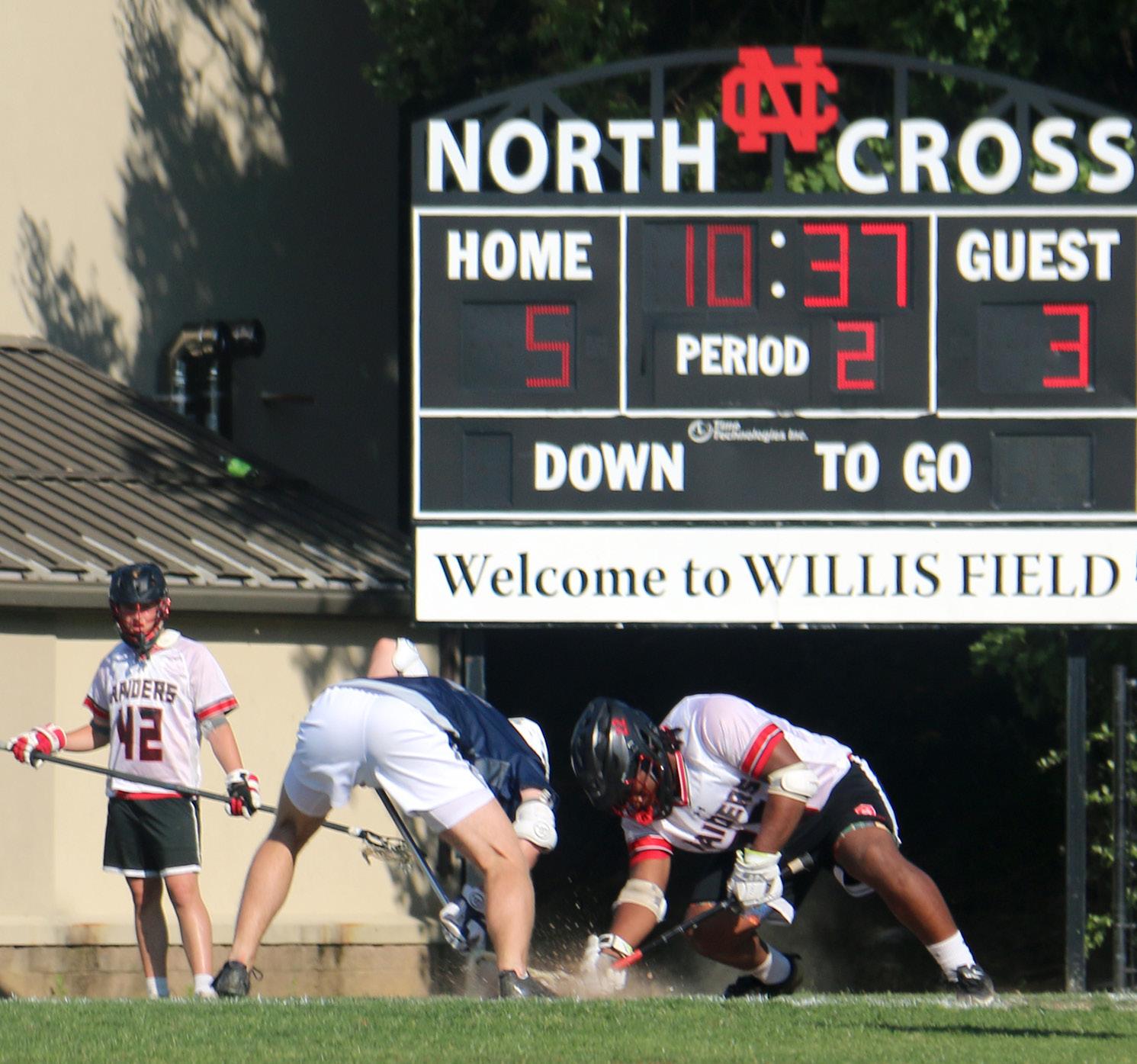
Although he was born in Cameroon, Lilian Keujeu ‘28 comes from the Lasalle area of Montreal, where you’d expect kids to pick up lacrosse sticks after putting their hockey sticks in the closet for the warmer months of the year.
Keujeu, however, has never played lacrosse before coming to NCS.
Originally transferring to North Cross for football, Keujeu has proven to be a formidable opponent when it comes to the 62 faceoffs he’s won this season.
“It’s nice to have someone kind of take charge,” said KaVari Brown ‘26, another football player learning to faceoff. “He takes pride in everything he does, he always wants to go out and win one.”
Keujeau works his hardest to win as many faceoffs as possible.
“I lose a lot, but I mostly win a lot,” he said. “And it’s like, I love it.”
The 2026 season marks his first varsity season playing lacrosse, though that doesn’t make him an inexperienced athlete by any stretch of the imagination. A linebacker for the Raiders football team, Keujeau made sure that he’d be reaping the full
FACE-OFF:
to
benefits of the skills he’s learning.
“The footwork is pretty similar,” he said. “When you’re on defense, you have to move your feet and be square.”
Ultimately, Keujeau believes his success is based on his coaching. “Coach Pollock helped me learn how to use my stick, defensive schemes and things like that.”
By Jax Bentley
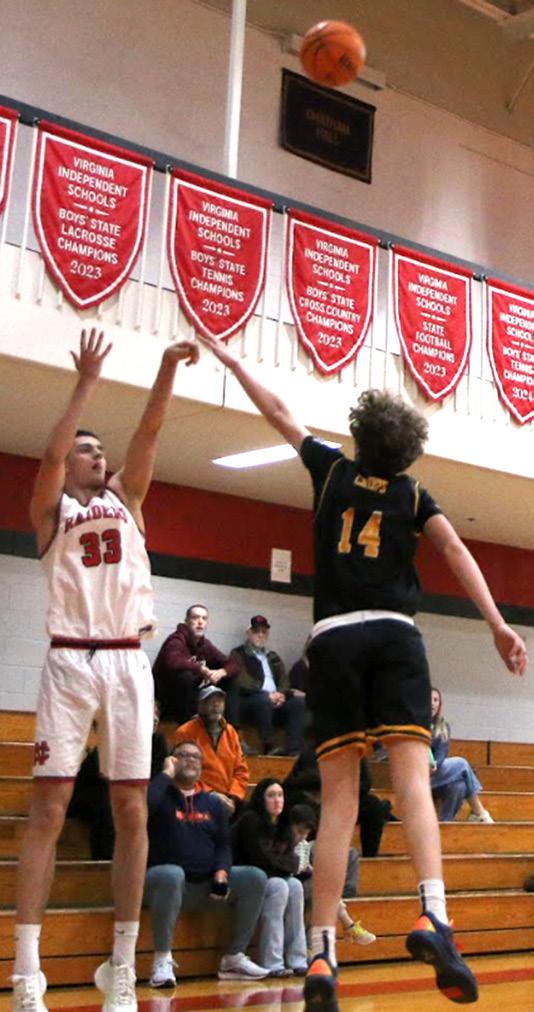
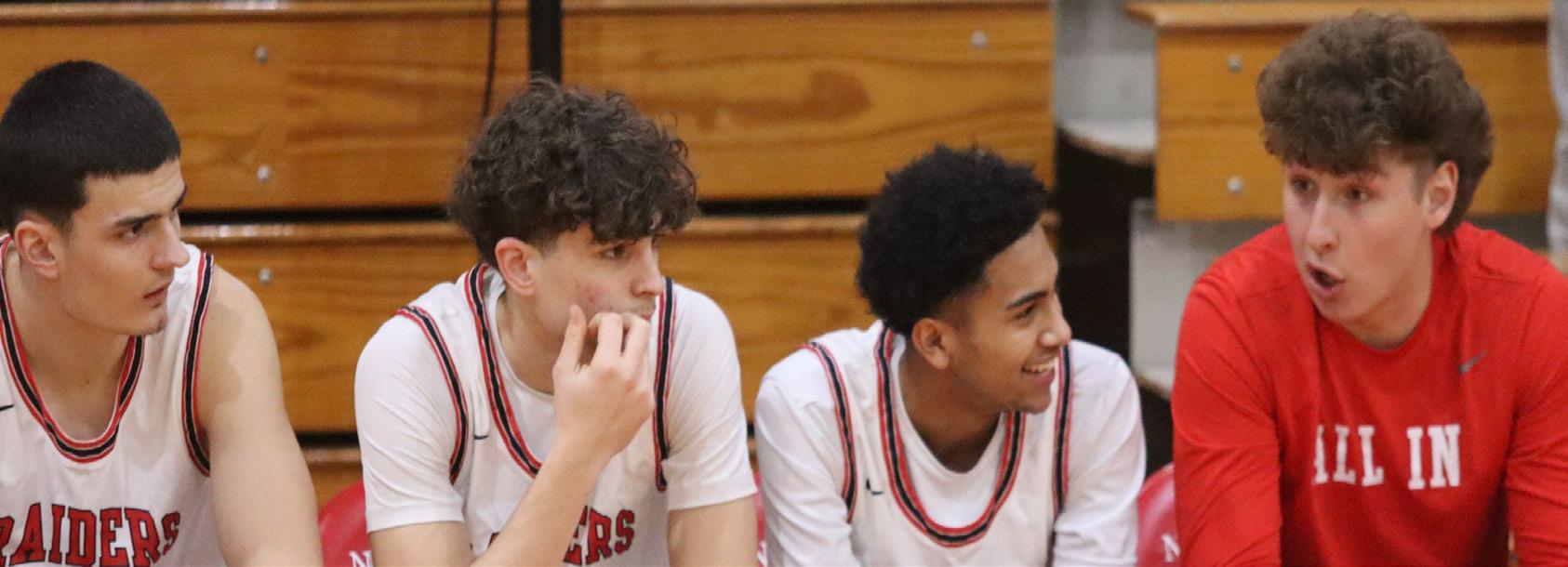
Three Serbians and one Montenegrin had a big impact on varsity basketball success this season.
The team already had its top two scorers – guards Antonio Mack ‘27 and Jesiah Hines ‘27 returning from last season’s team. It also had forwards Tristan Lange ‘26 and Kaleb Robinson ‘27 returning, but the team lacked any dominant big men.
As part of his work on the admissions team, varsity head coach Jamiel Allen had a chance to recruit many new students for the dorm, including the Europeans.
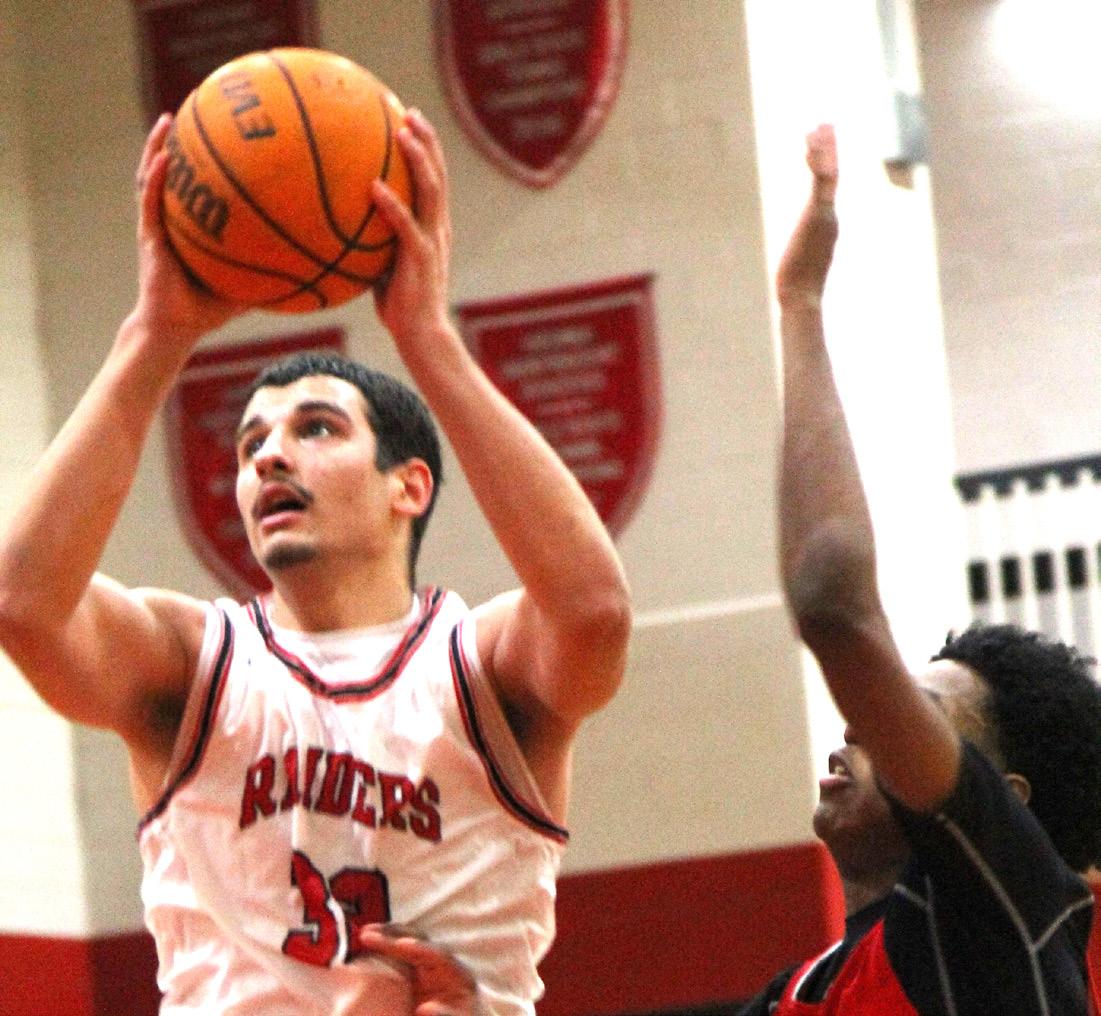
Jovan Vortic ’27 is a 6-foot-7 forward from Belgrade, who started at center and averaged 7.3 points, 6.3 rebounds, 0.9 assists, 0.8 steals and 1.2 blocks per game. Vortic is the big man the team needed, a top-3 scorer, a shot blocker and rebounder.
Maksim Popovic ’27 is a 6-foot-9 forward/center from Belgrade who came off the bench and averaged 4.8 points per game 2.0 rebounds per game. Both players had awesome seasons and as they both have multiple things in common and are both defensive and offensive players that play their roles on both sides of the
they are on.
Before the state tournament, the team had very high expectations, especially after an upset of topranked Miller. In the conference tournament, but they didn’t start out strong against VES and lost in the quarterfinals. It was the second loss at VES this season.
In the state tournament, they played Atlantic Shores Christian and the two Serbian big men together scored 19 points and collected nine rebounds.
The game of the season
Returning to VES for the state quarterfinals, the Raiders knew it was going to be a challenge.
The stars of the team, Hines and
Mack, slashed into the paint for 38 points combined. Hines also dished out eight assists and made four steals. Mack grabbed 13 rebounds including six offensive boards.
In support, two newcomers had near perfect nights.
Will Ferrell ‘28, a Blacksburg guard who spends five nights in the dorm, had 12 points, hitting all three deuces and two treys. Pavle Tadic ‘27 of Montenegro put up exactly the same numbers and dimed four assists. Vortic recorded eight points and three rebounds.
The result was a 74-62 upset that sent the Raiders to the state semis.
“I mean it feels good to know that we could win it all,” Vortic
said about playing for a state title. “But the only way we win is if I give 110% to make sure that we can win and just play hard in general.”
These tanks of players have become great because of coach Allen. They don’t practice like a high school team, but more like a college team. Without complaining, players always make sure every teammate’s head is up even if one is having a hard day. Players help one another on a drill if they don’t know what they are doing and make sure to let someone know if they don’t listen or aren’t paying attention. Some days coach Allen yells at players because they are not listening. He does everything to make sure this team is strong by taking them up to the weight room and making sure the players have the strength to contain every single team they have to go against. They have all worked so hard every single second this season.
Vortic has always done his job on and off the court he makes sure everyone is in the right place on defence, in the correct spot on a play and he makes sure the team has good and positive energy.
During the week of March 27 Vortic and the DDP Elite (VA) team went down to the Dallas, Texas Uncle Drew Circuit. Vortic participated in specialized skills sessions led by Phil Handy, focusing specifically on footwork and verticality.
Like Vortic’s teammates, he plans on playing summer ball in order to attract the eyes of college coaches and achieve more next season.
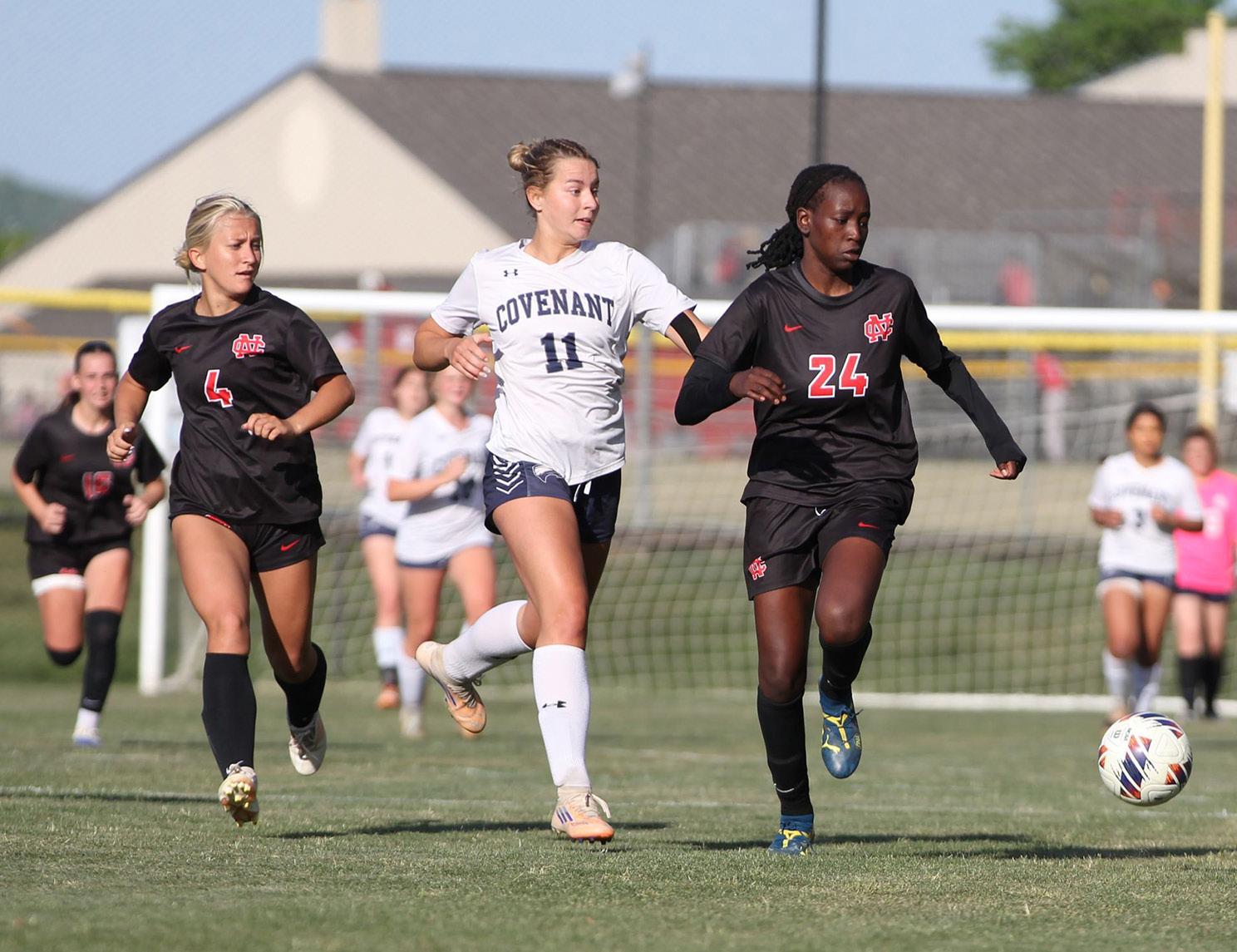
COUNTER ATTACK: Shielding her Covenant rival from the ball, Tina Chikwata looks to help the Raiders keep possession of the ball and attack. Led by seniors like Chikwata and Eliza Vogel, the defense allowed only four shots on goal that day to help the Raiders win 3-2. The defense allows only one goal per game on average. Photo by Morgan Kemp
Trullols gets first two goals, Stevens gets third, both get assists
“I first saw Alejandra play at the very beginning of the school year when she joined my travel team. She was a great addition there, and I knew that she’d help our school team a lot. She’s insane at dribbling and I love watching her 1v1 with defenders.”
- Isla Whittle ‘28


“I had the opportunity to play with Alejandra on my travel team when she first came to North Cross this year, and she has been even more valuable on our school team. She is super technical, and amazes the team everyday with a new skill to get by someone. Alejandra is an amazing teammate as well, and I am so happy I have had the chance to play with her.”
-- Elizabeth Jackson ‘28
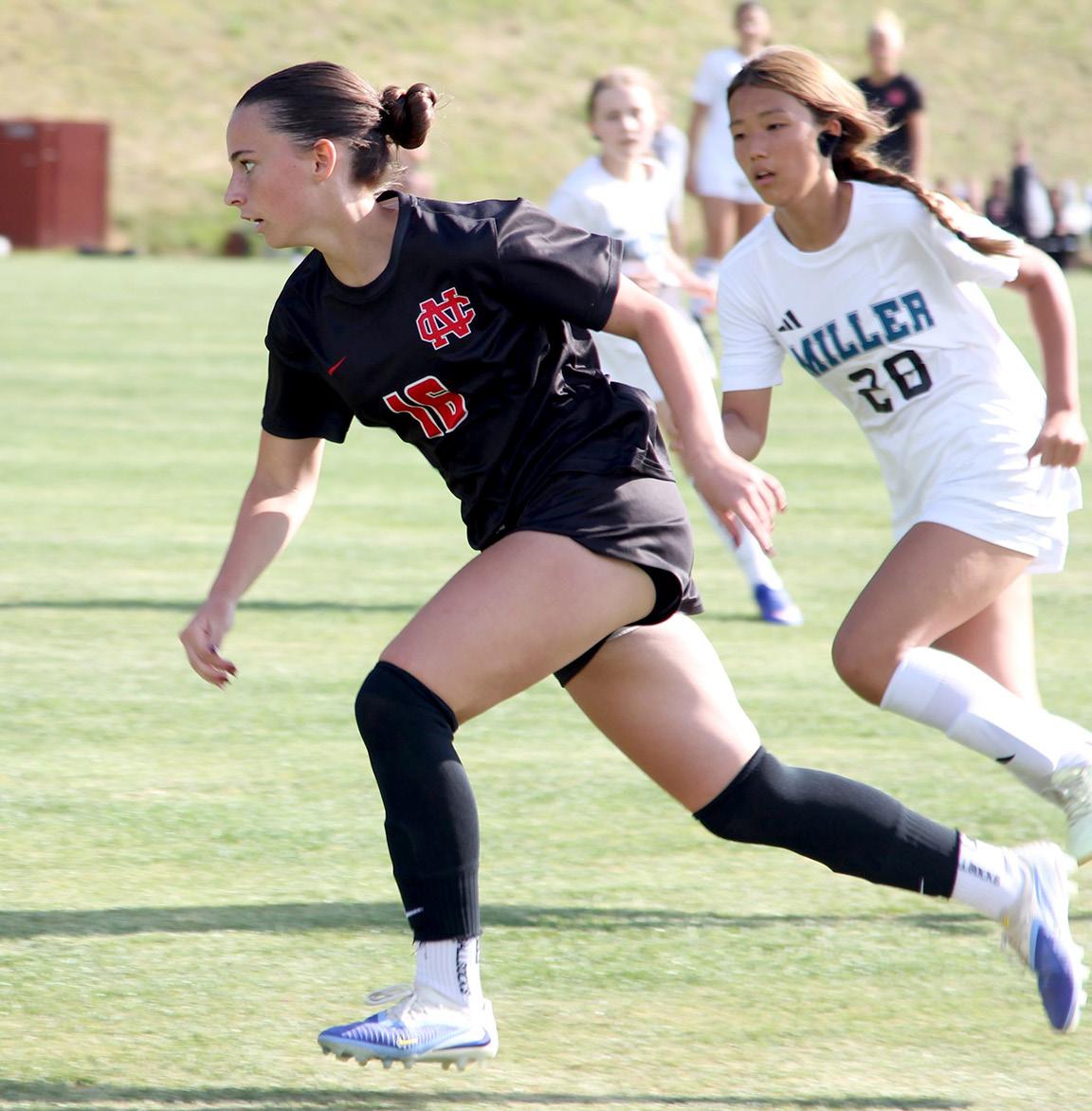
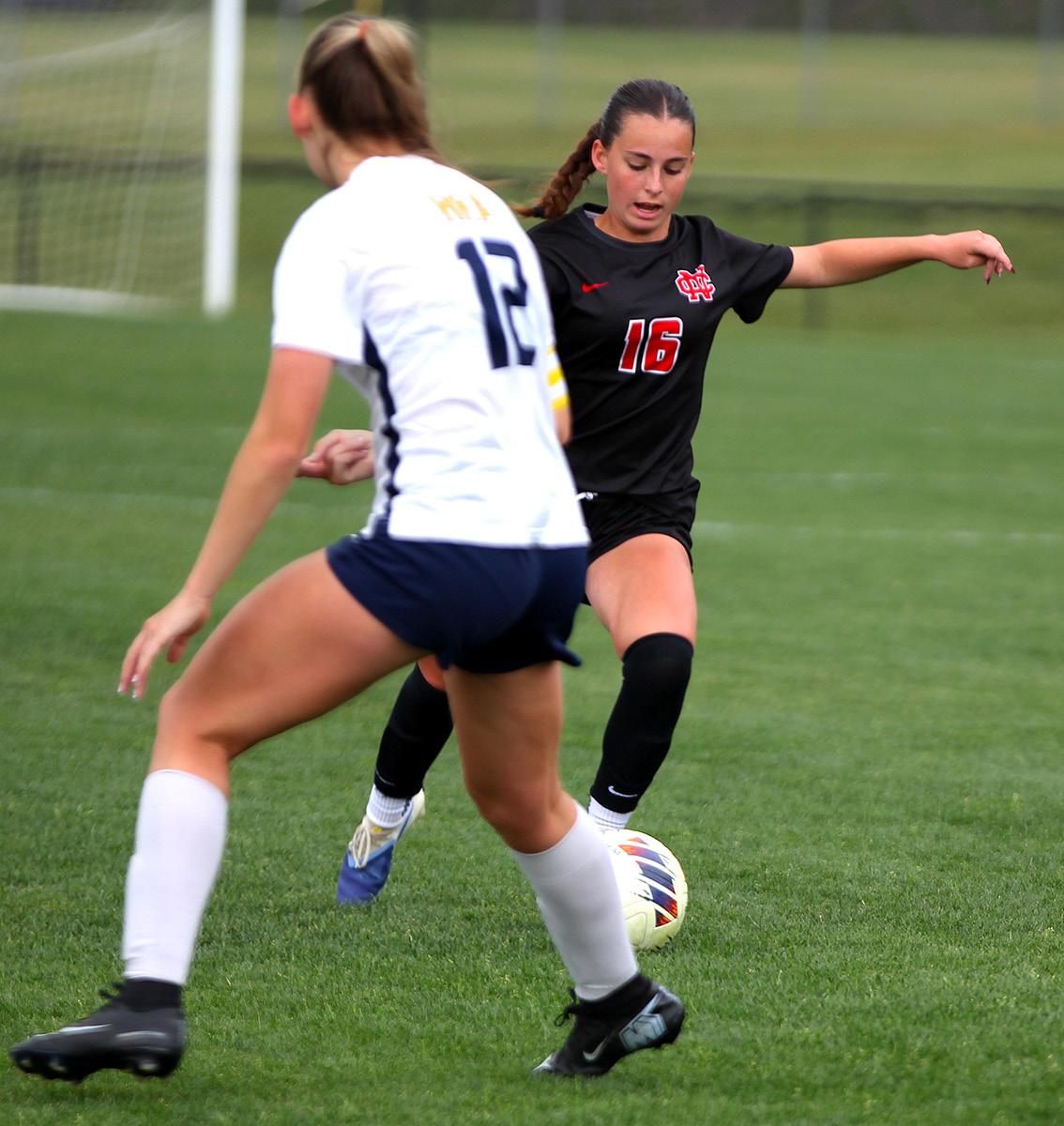
TAKING THE FIELD: Alejandra Trullols ‘28 passes a defender from Miller School. “We played really well as a team,” Trullols said, “and senior night made the game even more special for all of us.” In this game she had a brace (2 goals) and one assist contributing to their 11-0 win. Trullols has had a great season so far as she has assisted 35 out of the 156 goals the team has made. According to MaxPreps, Trullols ranks No. 5 nationally for assists. The team seeks its first state championship next week. Caption by Camryn Stevens. Photo by Morgan Kemp
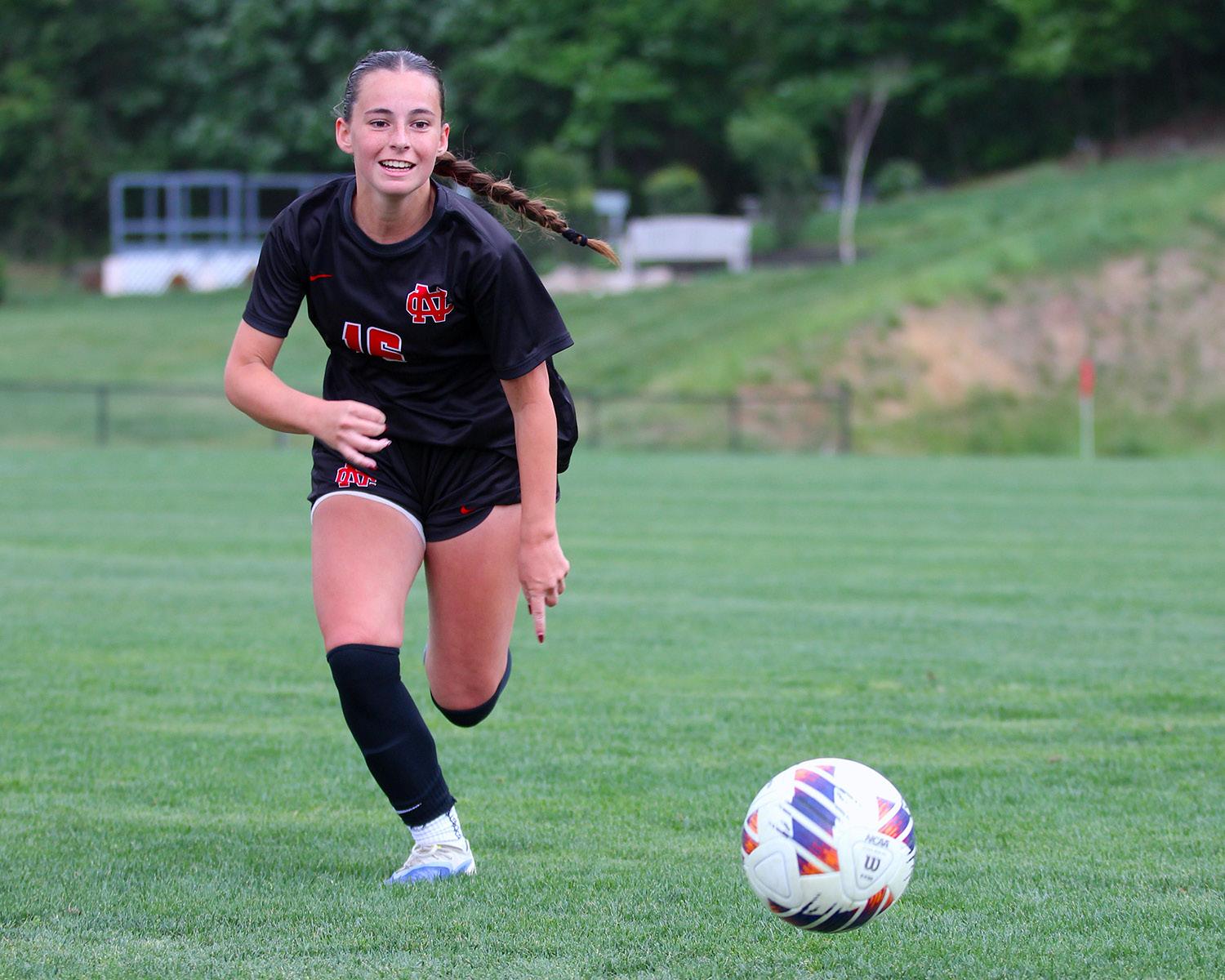
Pursuing the ball with evident glee during the Hampton Roads game, Alejandra Trullols, a recruit from Spain, has made all but earth-shattering contributions to the girls’ soccer team this year. Netting 21 of the team’s 156 goals this season, Trullols continues to demonstrate workhorse capabilities—even while playing with an injury. “It definitely wasn’t easy,” she said. “But I just tried to keep pushing through because I wanted to help the team as much as I could.” And help the team she has, consistently finding the back of the net to propel the team to No. 1 in the VISAA DII State rankings. “I always try to work as hard as I can while being careful,” she said. Photo by Morgan Kemp
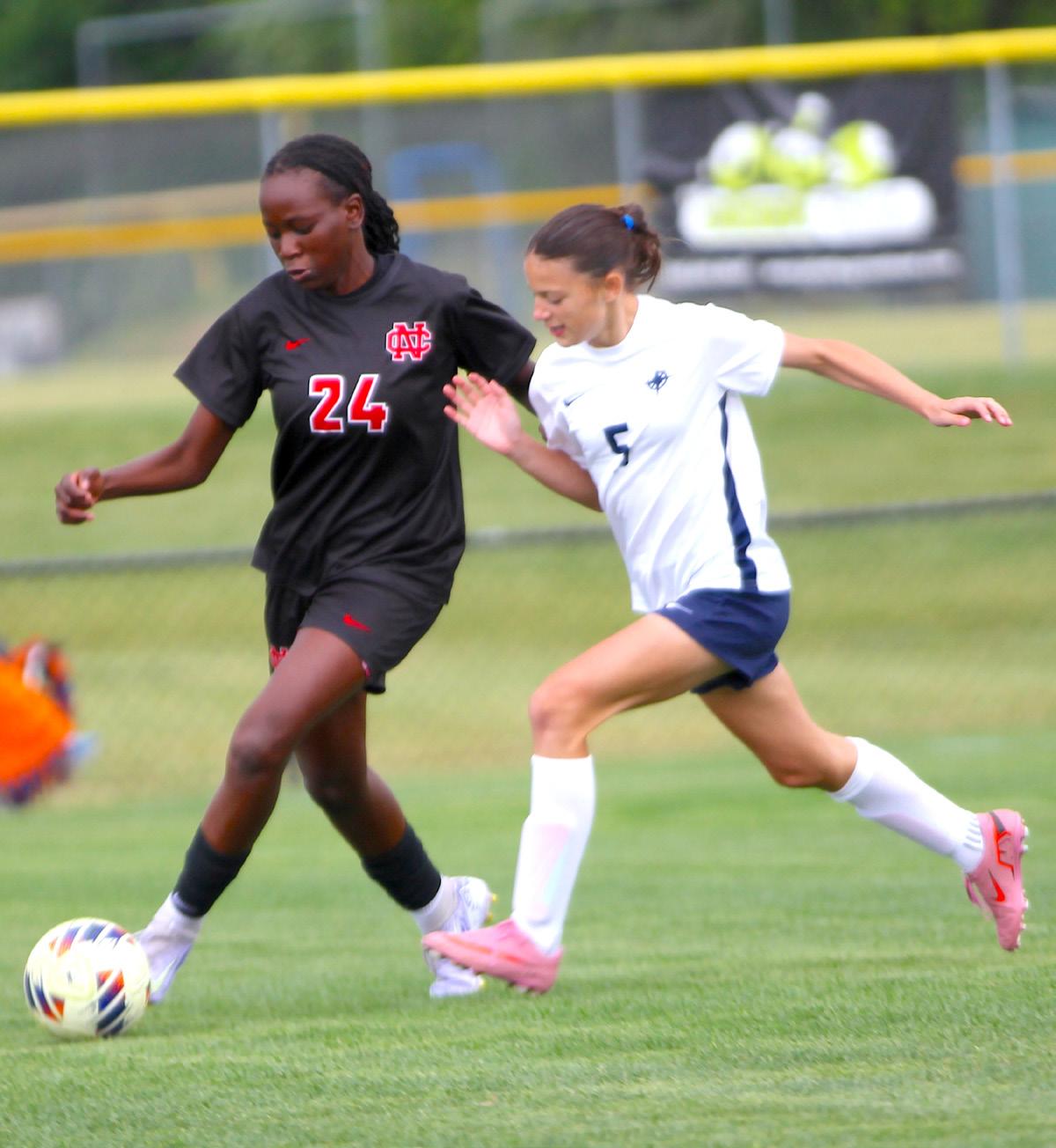
DOMINANT DEFENDER: Tina Chickwata 26, a senior basketball recruit from Zimbabwe, takes possession of the ball in the state semifinal win over Hampton Roads. They only managed one shot on goalie Lillie Dearing because of the stalwart defense of Tina and her fellow seniors, Scout Kappes, Eliza Vogel. Playing 16 of the team’s 20 games, Chickwata did her fair share of work around the pitch. Proudly displaying #24, the center back boasts a current season statline of four assists and a goal. Transferring fancy footwork from winter to the winningest girls’ soccer team in school history, Chickwata is described by teammate Maddie Howes ‘27 as “one of our defensive GOATs.” Photo by Morgan Kemp
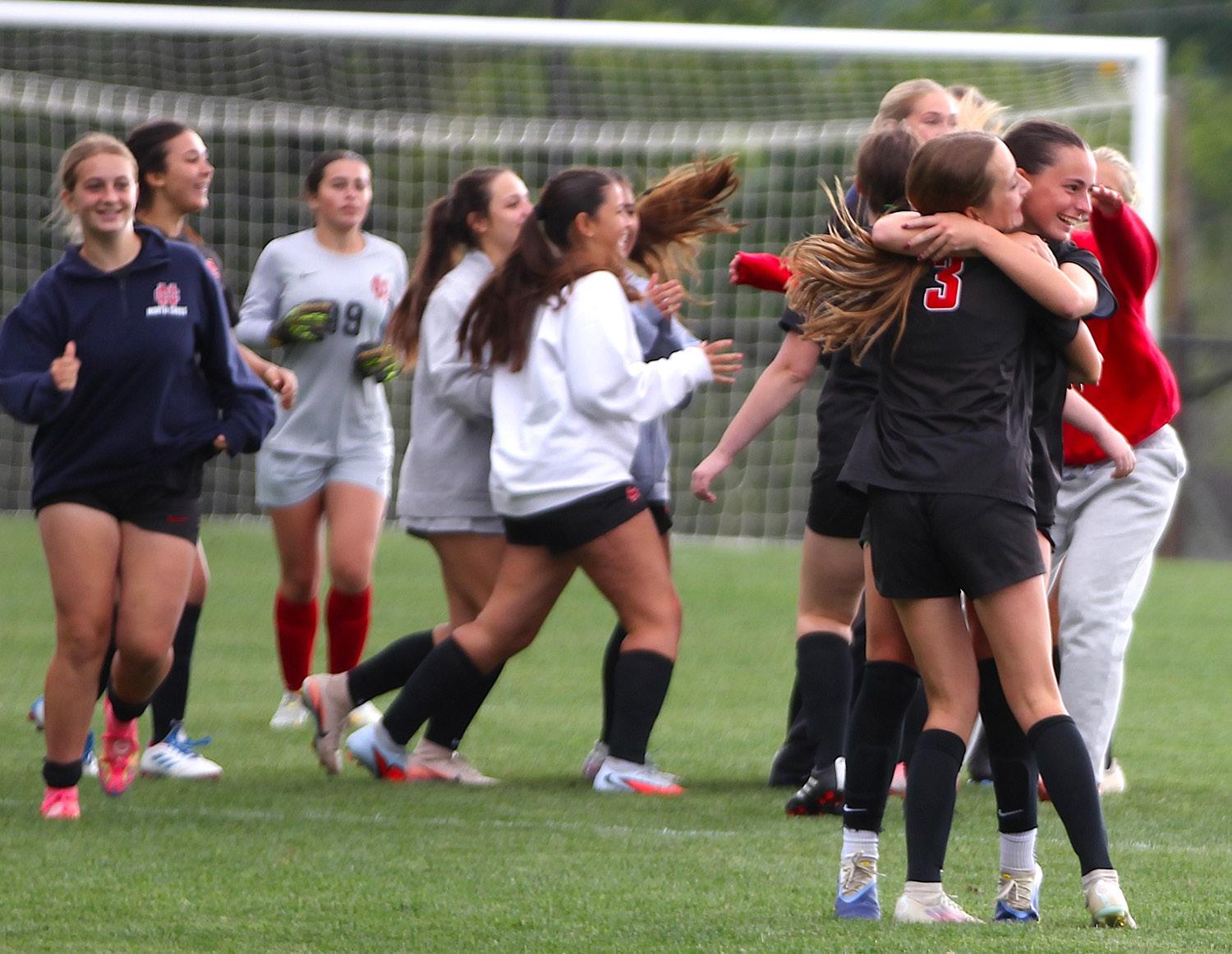
the whole team rush to celebrate
state
By Brooklyn Chen -- Special to GeoPrism
The development of my passion for throwing began much earlier than when I first stepped onto the track during high school. The first time I picked up a shot put was about seven or eight years ago in China when I was in lower school, but up until this point, throwing was merely something I enjoyed doing; it wasn’t my life. I didn’t have a coach; I lacked any sort of formal training and didn’t have any competition to learn the fine-tuning aspects of the technique.
Three years later and the experience of living in the U.S. was all that I needed to change this eventually. In my sophomore year, I was introduced to a brand new event—the discus—but again, I still did not have a coach or a formal training program. My attempts to throw the discus were just as unstructured as my attempt to throw the shot put, so I continued to show up, throw, and leave the field, repeating the same motions over and over again, all without any meaningful change. I did not build toward any particular achievement because I did not have many of the same goals that are common among competitive athletes trying to improve their lifting technique.
I started seeing improvement in my junior year, as things began to change slowly over time.
Training was taken more seriously starting in the junior year - both in terms of taking it seriously in the weight room and recognizing that strength, explosiveness and discipline are all important. Honestly I didn’t know anything about working out in the gym until Junior year and I never did lifting before. But I knew what I wanted and what my goal was. I started to understand the importance of lifting and added it to my daily training. Then, towards the end of junior year, everything changed when I had a chance to train with a different coach [Caleb Marshall], who is my best friend over the three years, for my final two meets of that season. I was able to improve my discus form efficiently. It was not only about having better technique, but it was about having an increased understanding of what I was doing with the throw and why I was doing that particular thing. This moment provided a level of direction that I had never had before.
During senior year, he officially became my coach, and for the first time in my life, I went through an entire season with a continuous flow of guidance. Every practice is designed to achieve
a goal. Correcting every mistake was worth it. Ev ery single throw was part of a larger process. I was starting to see improvement in an organized and continuous manner. Like all growth, there were obstacles.
The indoor track season has always coincided with the basketball season. I was trying to be all in on two highly-competitive sports and felt like I was not giving enough of my time or my energy to either one. The overlap in practice schedules, combined with low energy, mentally wore on me, and I often questioned whether or not I could keep doing both. The answer is, yes I injured a lot. Initially with tightness and soreness, I chose to ignore them as being potential issues until they became significant issues. Days when I could not train as I needed to, and the uncertainty of wheth er or not I could step into the circle became a fac tor. Watching others improve while I struggled to maintain my health tested not only my patience, but also my confidence. For a while, it felt like nothing was going my way. But instead of giving up, I made an adjustment. I began to change my approach to the sport from one of just working harder, to working smarter. I began learning to lis ten to my body, to appreciate recovery, and to stay focused on the task at hand, even though I wasn’t progressing as fast as I would like. All of the time spent in the weight room, technical training and making small corrections began to add up.
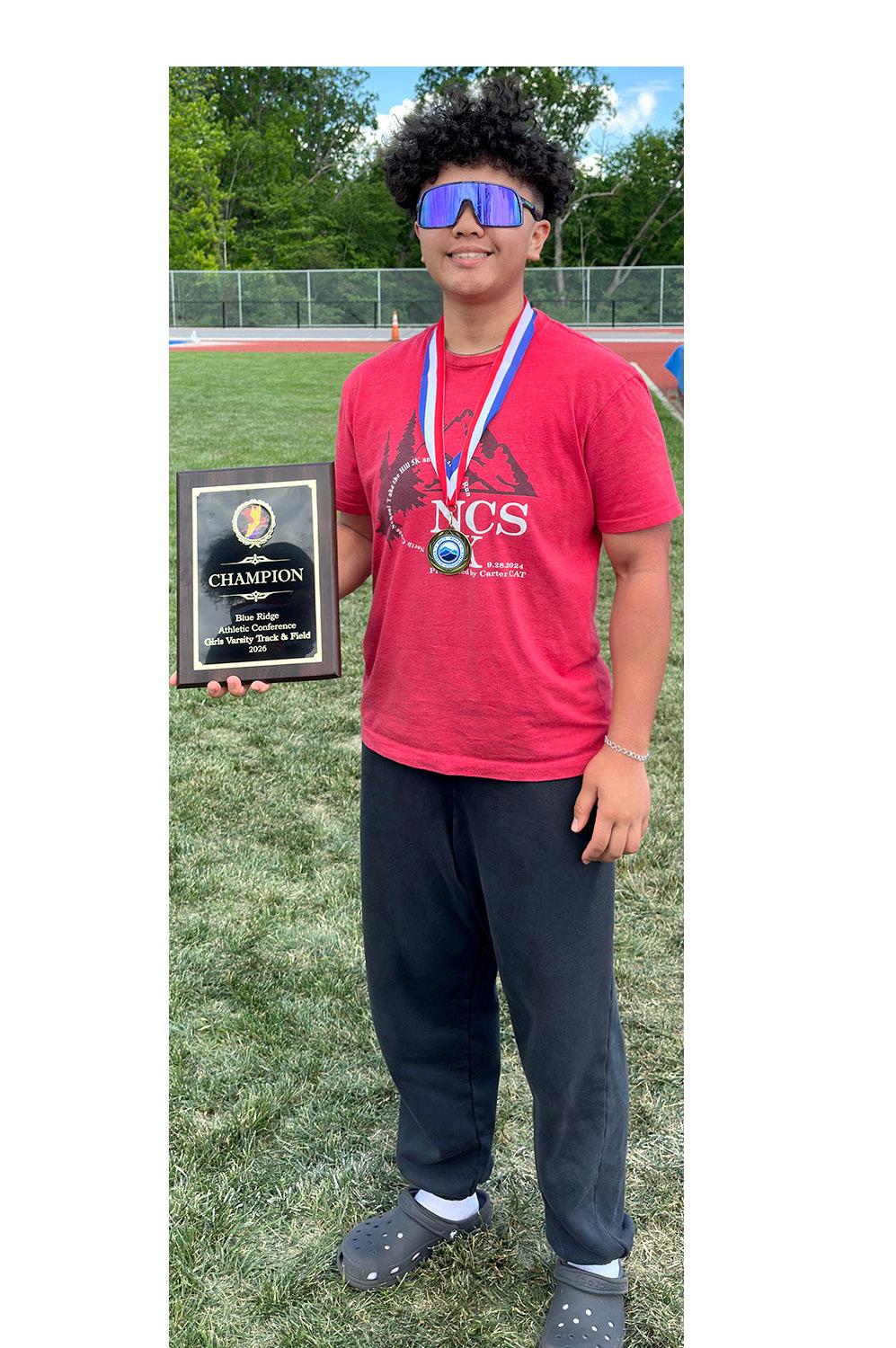
throw and taking her turn holding the team championship plaque, Brooklyn Chen ‘26 enjoys her BRAC three-peat. She also threw the discus 84’5” at the BRAC meet for a fourth-place finish, which helped the
Photo by Andrew Weng
As I progressed through my career, the change was very slow and gradual. Because of this, the throwing circle had eventually become second nature and my throws were beginning to feel more controlled. My uncertainties turned into trust in myself. I was not guessing anymore, but I was able to throw and understand how to throw. Once outdoor season arrived, I was not the same thrower that I had been prior to my previous season of throwing. I had gone from feeling lost, directionless and not trusting the process to feeling confident, trusting the process, and understanding what I needed to do.
Then there was the championship meet. I stood there staring at the results and thought about how much of my life had led to this moment; all of the years of being lost and looking for guidance, the years of confusion and uncertainty, the injuries, the fights, and the doubt I went through, none of which had vanished; but had all come together to be the reason I was able to be there. Winning was not a sudden achievement. Winning was the cumulative sum of everything finally coming togeth-
er. Upon looking back at my journey in track and field, I can now see that it has never been about distance or titles. My journey has always been about developing from a place of not having any guidance; developing the ability to adapt to different challenges; and developing the willingness to keep working even when I was not seeing results. I did not start with the structure, I did not start with confidence, I did not start with having a clear goal. But I did finish as a champion. Most importantly, I realized that I had gained the knowledge of what it takes to be a champion.
And now at the end of my senior year, I improved so much through this year. Although I am not that super Champion anymore, I released everything. People might be saying I’m just not that good, they might be laughing at me, they might see me as a joke, but I don’t care what they are judging about, I am better than I was, only I know what I have experienced through these years. I am proud of myself and made my decision that I will keep moving on my sports journey.
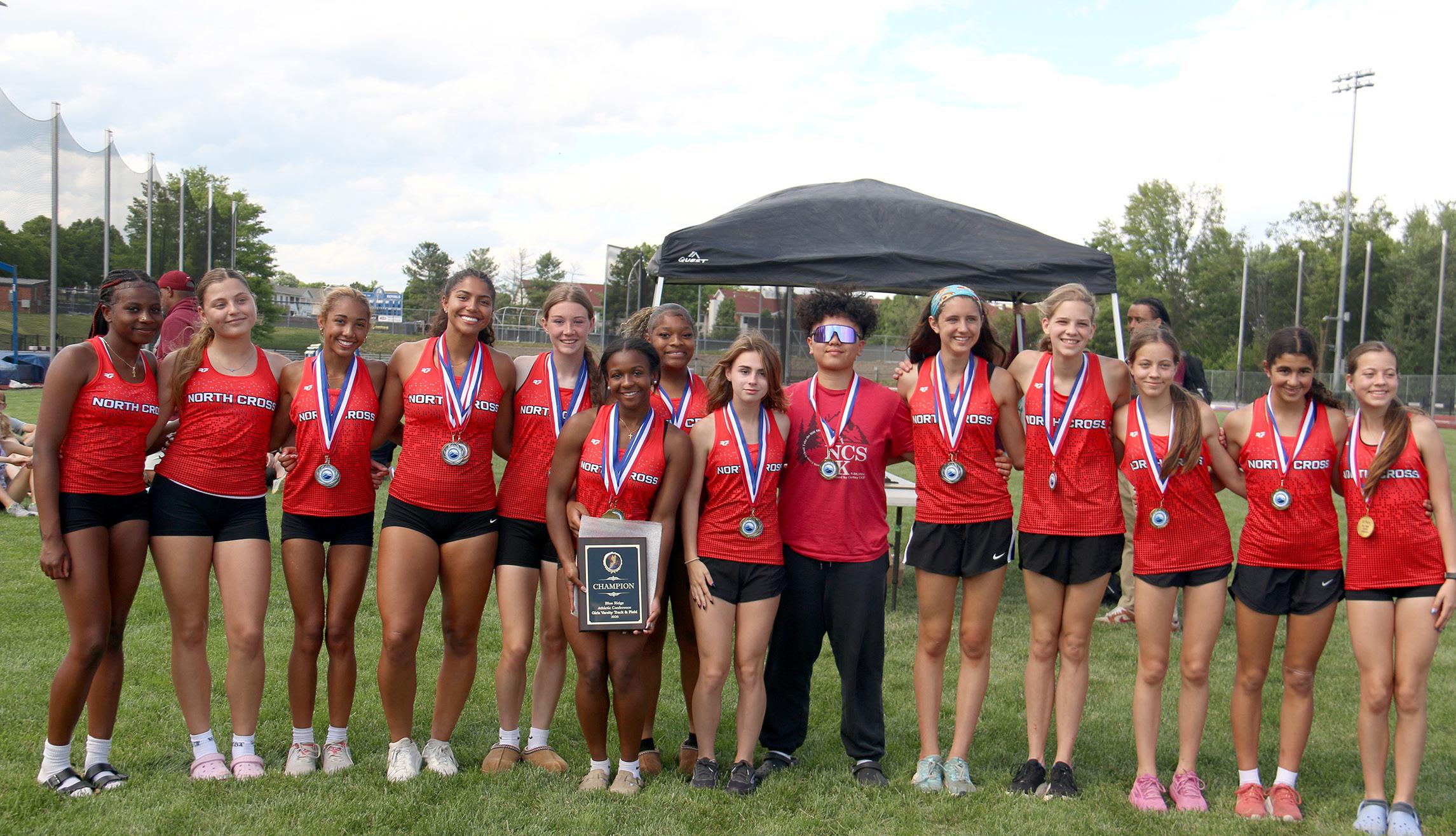
1sr Place earns 1st-Team All-State; 2nd Place earns 2nd-Team All-State; 3rd Place earns Honorable Mention All-State Girls team:
• 4x800: 1st Kaitlyn Perkins, Madison Ball, Olivia Ball, Lillian Phillips 10:56.42
• 100: 1st Faith Johnson 13.19; 2nd Gabby Miller: 13.33
• 1600: 2nd Ainsley Myles 5:21.41 (New PR); 3rd Perkins 5:27.26
• 4x100: 1st Alicia Holmes, Camryn Stevens, Miller, Johnson 51.47
• 400: 2nd Stevens 1:03.80
• 800: 3rd June Bradley 2:31.19
• 200: 1st Johnson 27.40; 2nd Miller 27.79
• 3200: 1st Myles 12:01.41; 2nd Perkins 12:06.74
• Long Jump: 3rd Holmes 15-4
• Discus: 2nd Holmes 93-08; 3rd Jerrah Rhodes 89-09
• Shot put: 1st Brooklyn Chen 39-0; 2nd Holmes 37-9
• High Jump: 3rd Holmes 4-6 Girls’ Team Scores:
1: NCS - 180; 2: Roanoke Catholic 130; 3: Covenant School 91 Boys’ Team:
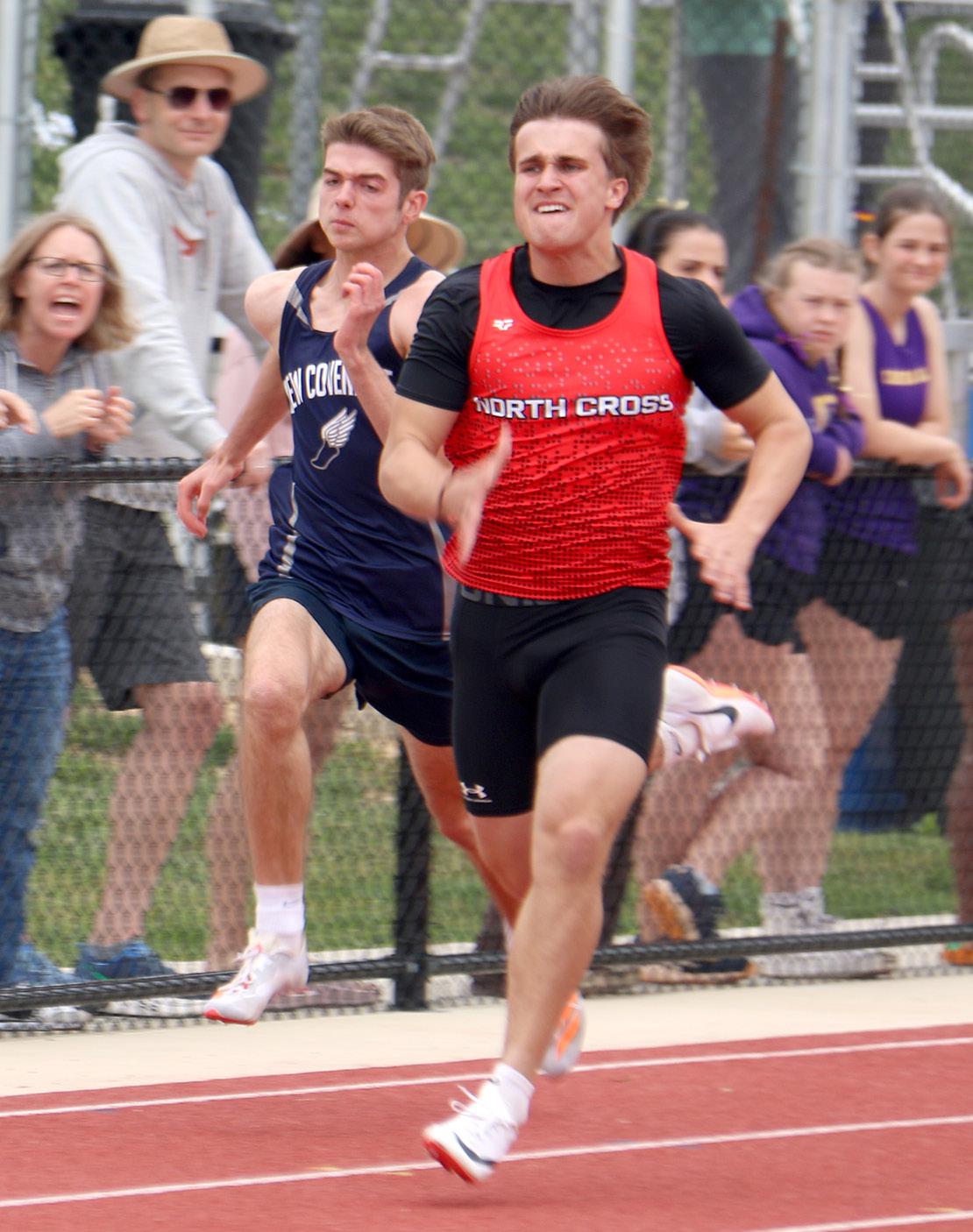
• 4x800: 2nd Gray Cullen, Andrew Weng, Aiden Bai, Justus Horner 9:17.91
• 1600: 1st Bryce Austin 4:35.87; 2nd Finn Chaney 4:37.43; 3rd Spencer Britton 4:38.24
• 4x100: 3rd Jaxon Keys, Kingston Paquet, Alessio Nunez, Wynn Yardley 46.25
• 400: 3rd Yardley 54.35
• 3200: 1st Chaney 10:12.10; 2nd Austin 10:17.21
• High Jump: 3rd Yardley 6-0
By Hanchen Ou
Baseball is not dying—but it is no longer the dominant sport it once was.
The game faces real challenges now: declining youth participation, competition from other forms of entertainment and the need to adapt to modern audiences. These issues should not be ignored.
However, baseball also has incredible strengths: a loyal fan base, global reach, cultural significance, and a willingness to evolve.
From my personal experience, I went to the WBSC U-18 Baseball World Cup in Okinawa, Japan. I saw the undying love among the fans in Japan. There were still thousands of fans attending baseball games of all ages. Not only that,
there were also many fans from countries other than Japan traveling to Japan specifically to support their own countries just because they love baseball and their country.
At the hotel, we shared the same floor with Team Cuba. One night, three players from Team Cuba knocked on our door, and out of curiosity, we decided to open it. They came to our room because they wanted to trade some baseball gear with us. I exchanged my batting glove for a Team Cuba compression shirt. I was the first to make a trade, (technically, the only one who could communicate with them, shut out Ms. Mullins), my teammates became very interested after my trade, and soon, the exchanges between Team China and Team Cuba escalated. By the end of the night,


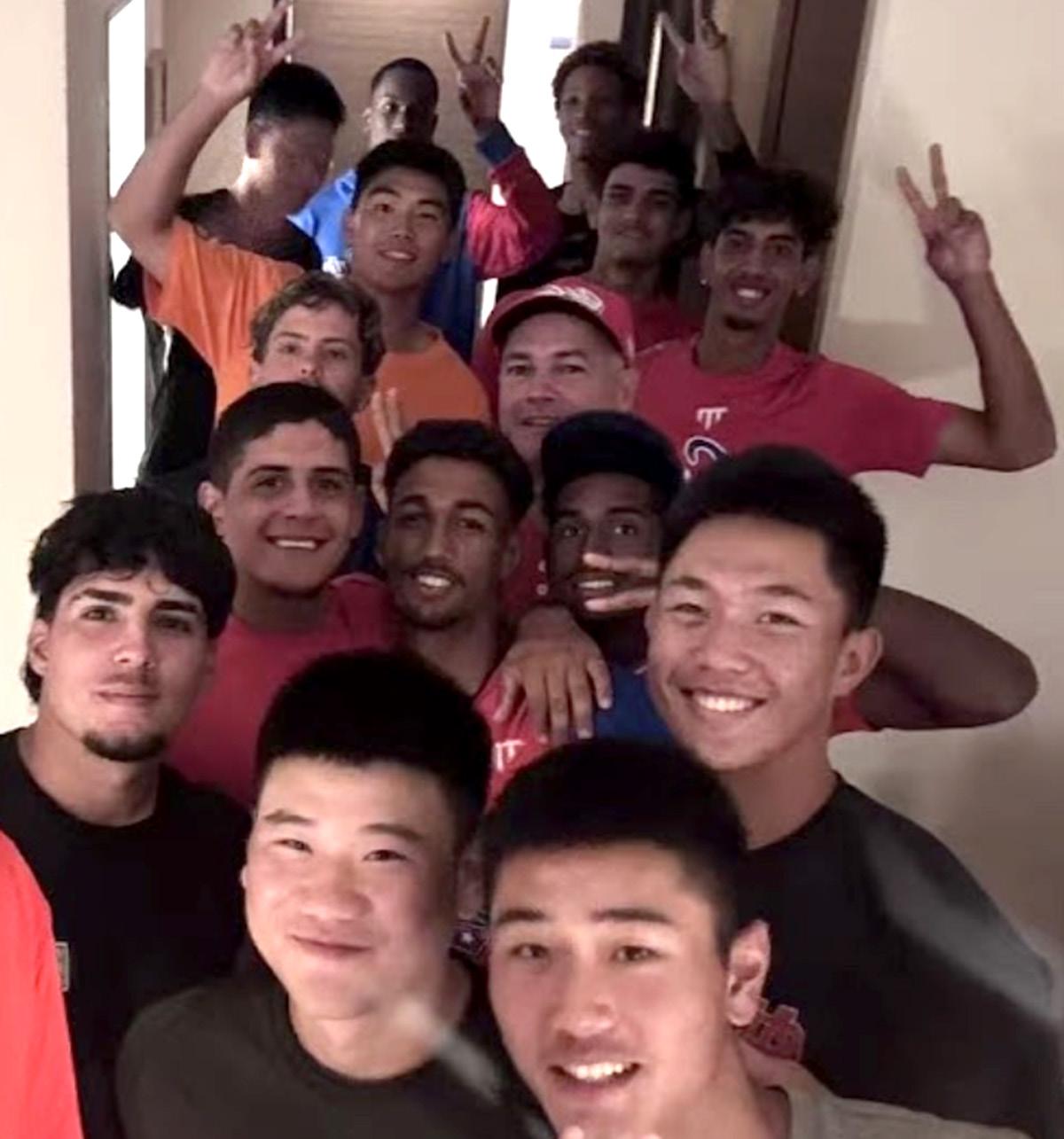
almost everyone from both teams had traded something.
However, we were unaware before this exchange that many players on their team practice baseball under extremely harsh conditions. One pitcher, in particular, had worn his glove so long that it was no longer functional, yet he couldn’t afford to buy a new one. We were confused when we noticed that a few of the Cuban players became very excited upon seeing our baseball gloves, but we later understood after reading a report on social media. From this experience, I realized that there are still players around the world who have a deep and abiding passion for baseball, even if their financial situations do not allow for proper equipment. They see baseball not
only as a means to make a living but also as a bridge to a better future; in other words, they rely on baseball.
Therefore, sports do not die simply because they change. They die when people stop caring. And millions of people around the world still care deeply about baseball and some still rely on baseball for their living.
In conclusion, asking whether baseball is a dying sport may be the wrong question.
A better question is: What will baseball become?
Baseball’s future depends on its ability to balance tradition with innovation, accessibility with excellence, and history with progress. If it can continue to adapt while staying true to its core values, baseball will not only survive—it will evolve.
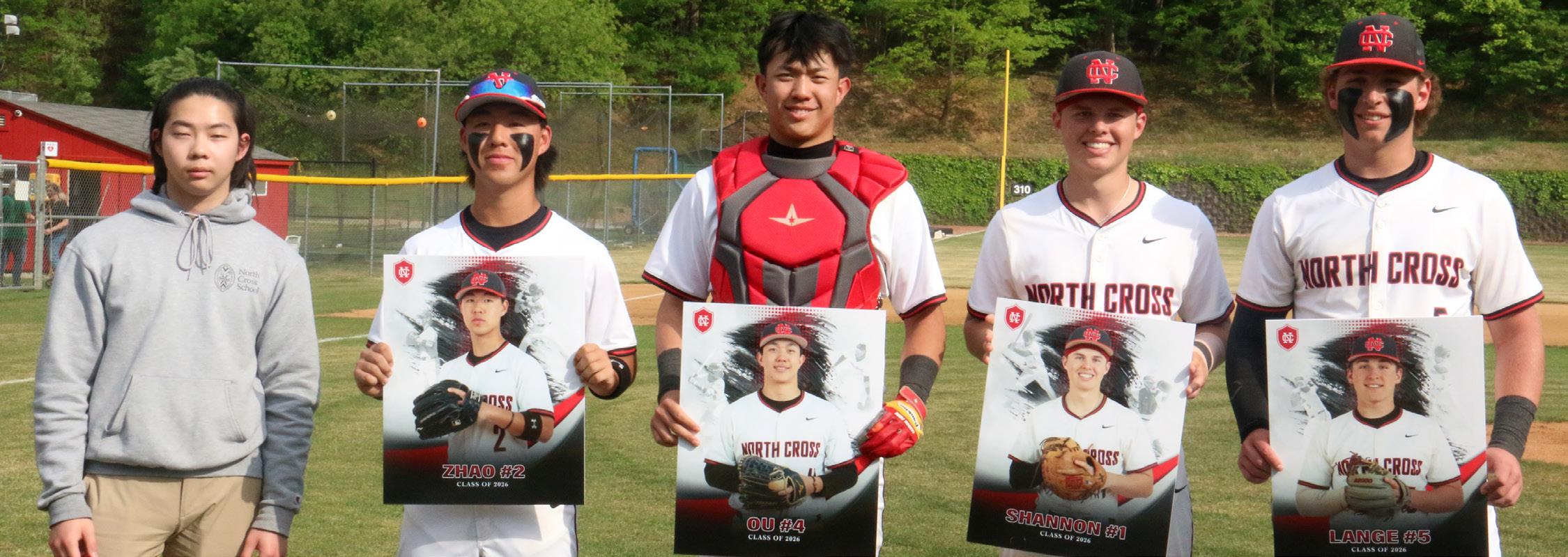
SATISFYING SENIOR DAY: Manager HaoYi Lyu, center-fielder Charlie Zhao, fill-in cather/first baseman Hanchen Ou, injured cather Chase Shannon and pitcher/ shortstopTristan Lange, pose together on Senior Day before the Roanoke Catholic game they won 10-0. Zhao singled, scored two bases and scored a run. In addition to pitching a five-inning no-hitter, Lange reached base twice by getting hit by a pitch and getting walked then scoring twice. Photo by Morgan Kemp
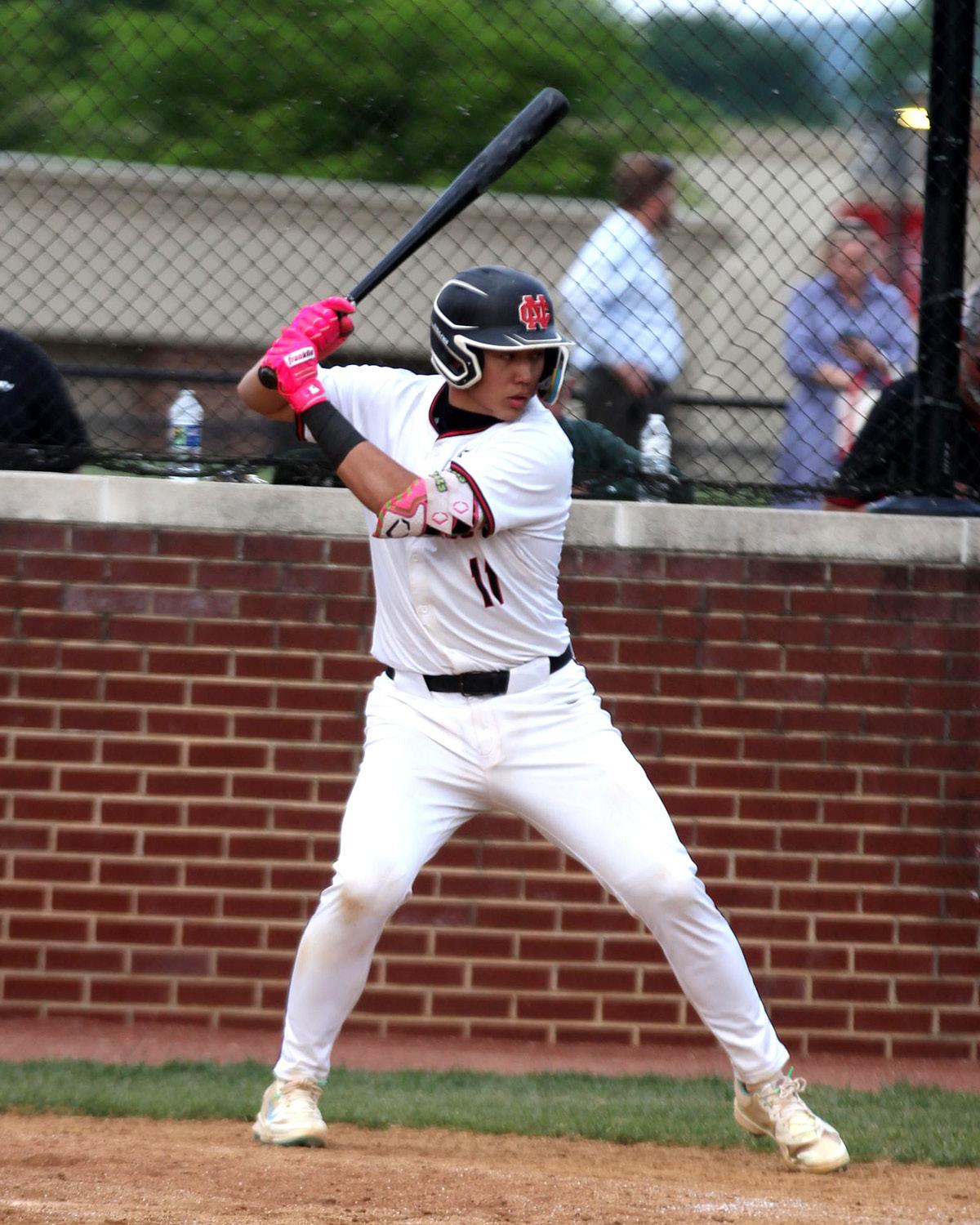
IN THE SWING OF IT: Hanchen Ou ‘26 gets ready to hit. On senior day Ou had a perfect day at the plate getting on base at every chance with a double, a walk and getting hit by a pitch. As catcher, he played the whole game without error, making 13 putouts on Tristan Lange’s 13 strikeouts. Photo by Andrew Weng



gingersjewelry.com
Instagram: gingersjewelryroanoke
3565 Electric Rd Suite C Roanoke, VA 24018
Tel: (540) 563-5559
Email: ginger@gingersjewelry.com
Store Hours: Mon to Fri: 10:00am - 6:00pm Sat: 10:00am - 5:00pm Sun: closed MENTION THIS AD AND