We’re in the offering NAHB members up to $1,000 business.
2017 Chevrolet Low Cab Forward 3500HD
2017 Chevrolet Silverado 2500HD
2017 GMC Sierra 1500
2017 Chevrolet Express 2500 Cargo Van
NAHB MEMBERS BENEFIT FROM THESE SPECIAL OFFERS. Members of the National Association of Home Builders (NAHB) can now enjoy a private offer1 of up to $1,000 toward the purchase or lease of most new Chevrolet, Buick and GMC vehicles. Choose an eligible vehicle at your local dealer and present your NAHB proof of membership. You can add on incentives from the National Fleet Purchase Program2 and Business Choice3 to get the best value on vehicles that run your business. For private offer details, visit nahb.org/gm.
Example offer for NAHB members who are business owners purchasing a 2017 Chevrolet Express 2500 Cargo Van. Up to
$1,000 Private Offer1
Up to
+
$4,000
National Fleet Purchase Program (FVX)2
Up to
+
$1,200
Eligible Accessory Cash Allowance3,4
Up to
=
$6,200 In Potential Value
1 Private offer amount varies by model. Up to $500 offer for retail deliveries and up to $1,000 offer for fleet deliveries. Valid toward the purchase or lease of eligible new 2016 and 2017 model year vehicles. Customer must take delivery by 1/2/18. Not compatible with other private offers. Not valid on prior purchases. Compatible with many current incentives. Incentives are subject to change without notice. Offer excludes Chevrolet Bolt, Camaro, Chevy SS, Corvette, Sonic, Spark, Trax, Volt, Buick Cascada, Lacrosse, Regal, Verano and all Cadillac vehicles. Additional GM models may be excluded from time to time at GM’s sole discretion. See dealer for details. 2Offer available to qualified fleet customers. Not compatible with some other offers. Take delivery by 12/31/17. See dealer for details. 3To qualify, vehicle must be used in the day-to-day operations of your business and not solely for personal/non-business-related transportation purposes. Must provide proof of business. For complete program requirements, including information regarding offers, vehicles, equipment, options, warranties, and ordering, consult your dealer or visit gmbusinesschoice.com. Take delivery by 1/2/18. 4 Not eligible on associated accessories from third-party independent suppliers. Not available with some other offers. Take delivery by 1/2/18. See dealer for details. ©2017 General Motors, LLC. All rights reserved. The marks appearing in this ad are the trademarks or service marks of GM, its subsidiaries, affiliates, or licensors.
BUILDER north coast building industry association
Table of Contents On the Cover
NEWSLETTER
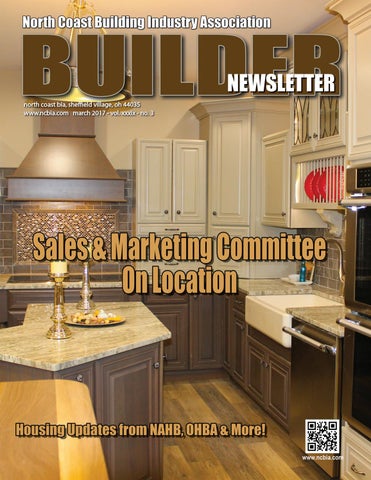
North Coast Building Industry Association (NCBIA) BUILDER newsletter is the official newsletter of the NCBIA and is published monthly by the NCBIA. The NCBIA is an affiliate of the Ohio Home Builders Association (OHBA) & the National Association of Home Builders (NAHB).
Cover Story: Sales & Marketing On Location
31
NCBIA Office
5201 Waterford Dr., Sheffield Village, OH 44035 Ph: 440.934.1090 Fax: 440.934.1089 info@ncbia.com www.ncbia.com
4
Letter from the President
NCBIA Staff Executive Officer - Judie Docs judie@ncbia.com
OHBA Legislative Review
4
Waters of the United States Update
5
Single Family Housing Starts
7
Building Materials Prices Rise
8
Executive Officer’s Report
10
Builder Confidence at 12Year High
11
Bureau of Worker’s Comp Compensation Rebate
12
Golf Outing
15
SMC Networking After Hours
17
Association Maximization
Welcome New Members and Thank You For Renewing
Promotions, Marketing & Creative Director - Kelli Moss kelli@ncbia.com
2017 NCBIA Officers
President - Chris Majzun Jr., Majzun Construction Co. Vice-President - Jeff Hensley, Lake Star Building & Remodeling Associate VP - Liz Schneider, Dollar Bank Treasurer - Steve Fleming, Shamrock Development Secretary - Jeremy Vorndran, 84 Lumber Company Immed. Past President - Mary H. Felton, Fidelity National Title
2017 NCBIA Board of Directors
9
18-19
Spike Update
19
Membership Drive Update
20
March Gen’l Membership Mtg. 30-31 Elected Officials Reception
32
2017 NAHB & OHBA Directors These are our members who represent our local industry in Washington DC and Columbus.
Ashley Caruso-Noe, Caruso’s Cabinets Mark Craig, Mark F. Craig, Esq. Chris Husted, Prete Builders Sara Majzun-Garwood, BCT Alarm Services, Inc. Keith Martin, MBD Homes Timothy McLaughlin, CFP®, Wells Fargo Advisors, LLC Shannon Niebes, Integrated Restoration Michelle Nowlin, First Federal Savings of Lorain Tom Sear, Ryan Homes Tyler Yost, Dale Yost Construction
2017 NAHB Directors
NCBIA Life Directors
OHBA Past Presidents
Mary H. Felton, Fidelity National Title Jeff Hensley, Lake Star Building & Remodeling
NAHB Alternate Director
Tom Caruso, Caruso’s Cabinets
Sr. NAHB Life Director & Ohio’s State Rep. to NAHB
Tom Caruso, Caruso’s Cabinets Mary H. Felton, Fidelity National Title Tom Lahetta, Tom Lahetta Builders, Inc. Chris Majzun Sr., Majzun Construction Co. Chris Majzun Jr., Majzun Construction Co. Randy Strauss, Strauss Construction Bob Yost, Dale Yost Construction
Randy Strauss
Strauss Construction
1975
Dan Strauss
Strauss Construction
1996
Dan Strauss 1975
Randy Strauss 1996
2017 OHBA Trustees Mary H. Felton Liz Schneider Keith Martin
Fidelity National Title Dollar Bank MBD Homes
OHBA Alternate Trustee Advertising Policy - The North Coast Building Industry Association reserves the right to reject advertising in the Builder newsletter based on content. Acceptance of advertising does not imply endorsement of the product or service advertised.
march 2017
Tom Ostrander Tom Lahetta
84 Lumber Company Tom Lahetta Builders & Remodelers, Inc.
OHBA Area 2 Vice-President Mark Zolllinger
www.ncbia.com
Zollinger Builders
page 3
A Letter from the President
Home Appraisals to Include HERS Scores
by Chris Majzun, Jr., Majzun Construction Co.
For over 70 years, consistency has been an essential part of our approach to building lasting communities. It’s how the National Association of Home Builders earned the respect of more than 140,000 members. It’s at the heart of how we maneuver locally, regionally and nationally toward balanced legislation. And of course, it’s how we elevate the importance of housing in the media.
A new partnership between the Residential Energy Services Network (RESNET) and the Appraisal Institute plans to include Home Energy Rating System (HERS) scores in appraisals.
Our strength is your success. We are the premier organization of the home building industry, and we are building lasting value.
This will allow consumers to better gauge a home’s energy efficiency. Builders may also be more encouraged to add high-performance features.
Membership in the North Coast BIA is the greatest investment you can make. That’s a guarantee. Locally, half the battle of tackling change is preparing for it. We are the driving force behind our respective local home building industries. Our members reach higher, work together, and achieve more collectively than they ever could alone. They are leader, learners, innovators and facilitators behind the stabilization and growth of our association. As a member, your benefits are tangible. The range from businessbuilding resources to money-saving discounts to an effective grassroots network that shapes the views of our elected officials and law-makers. Whether you aim to enhance your competency in the functional management of your business, develop your professional reputation or add your voice to the chorus of members who truly understand our environment – membership provides you unparalleled access to these opportunities and more. Our association is dedicated to promoting, protecting, strengthening and informing our local home building industry markets and those who work within them to ensure we are, independently and collectively, a viable economic engine of growth now and in the future.
In this partnership, RESNET’s database of HERS-rated homes will be available to the Appraisal Institute in states where the rating system is prevalent, such as Texas. The HERS score will be added as a green building certification, similar to the ICC-ASHRAE 700 National Green Building Standard. The inclusion of the HERS score should help in the valuation of residential energy improvements. These enhancements are not always recognized in the appraisal process, and can be a hurdle to financing green features. For additional information about NAHB green and sustainable building initiatives, contact Jaclyn Toole at 800-368-5242 x8225.
Now more than ever, put our experience to work for you and get involved in YOUR association.
OHBA Update by Vincent J. Squillace, CAE, OHBA Exec. VP
OHBA is off to a good start for the year. We recently concluded our organizational board meeting where trustees are properly seated so to fulfill their duty and obligation to OHBA. Remember, if your local has not nominated your trustees, please do so ASAP. As a trustee or alternate you are notified of pertinent information and releases from us. It is important you are properly included on that list. Just a glance at our government affairs agenda reveals many challenges and opportunities face OHBA and the industry this year. The most recent session of the General Assembly kicked off in January and continues page 4
through December 31, 2018. Next year will find all statewide executive offices up for grabs. Already a number of candidates have expressed a desire to run. Also, up for election next year are all 99 House members and half of the Senate. Campaigning and electioneering never seems to end. This bears close watching and attention from OHBA. Our officers and Area VP’s are anxious to hear from you as to how OHBA may be of assistance. We all encourage attendance at our meetings as that is the best way to get involved and contribute. Our membership committee will be hosting a membership conference April 4th. This is an excellent opportunity to share, learn and develop ways to grow our membership. We hope to see many of you then.
www.ncbia.com
march 2017
Waters of the United States: What’s Next
Now that President Trump has ordered an extensive review of the “waters of the United States (WOTUS)” definitions in the Clean Water Act, many NAHB members have questions about how this executive order changes the storm water and wetlands permitting processes they have been following all along – and what the next steps are. Let’s go to our resident WOTUS specialist: NAHB Environmental Policy Program Manager Owen McDonough, PhD. Owen, what are the rules now – what has changed? For builders, not much. First, the new WOTUS rule never really had an opportunity to actually take hold. It was suspended by a federal court ruling just weeks after being finalized in 2015. What this new executive order means is that EPA and the Corps must take a giant step back and thoroughly review the flawed rule. The current rule is not very clear, doesn’t take into account the need for economic growth and oversteps the rights of states to make decisions within their own borders. It fundamentally attempts to expand Clean Water Act requirements beyond what Congress originally intended while at the same time ignoring Supreme Court decisions.
Members save up to 20% off* standard pricing
Plus, free site assessment and free cost comparison
G&K Services has been a leader in the uniform rental and facility services industry for more than 100 years. G&K is committed to enhancing your business image and ensuring your employees’ safety each and every day. Companies like yours throughout North America put their trust in G&K Services for their uniform rental, apparel purchases, and facility services needs.
So, until EPA and the Corps finish their task of fixing or replacing the WOTUS rule, it’s business as usual. The Clean Water Act and all its requirements remain in place. Builders and developers must get permits just as they always have. Is WOTUS going away? No, the President does not have that authority to erase the WOTUS rule. He’s telling the agencies he wants a comprehensive review and a revised rule that makes sense for everyone. And he wants it quickly. He doesn’t want to leave the regulated community – especially home builders – in limbo. Our industry is arguably the most heavily regulated under the Clean Water Act, and we need a rule that provides clarity and does not overreach. So, what happens next? Well, the law requires certain steps before any substantive change happens. The most likely path forward would be for EPA and the Corps to issue a proposed rule to rescind or revise WOTUS. It will appear in the Federal Register and be available for comment, and after taking the comments into account, the agencies will issue their final rule. If the final role says that WOTUS should be revised, you can expect a flurry of lawsuits from interest groups who are afraid that any new rule will not do a good enough job protecting the nation’s waters – even if they don’t know what it’s going to look like yet. After that, the agencies will propose a new rule. How will NAHB be involved in the process? We already have requested a meeting with the new EPA Administrator to discuss the problems with WOTUS and all the other issues facing our industry. Our views must be heard, and we know that the administration wants us to engage. President Trump wants us at the table.
Call 713–967–6214 or visit eMemberBenefits.com/NAHB to enroll and a G&K representative will contact you.
NAHB will work to ensure that any new WOTUS rule doesn’t expand *20% discounts are for new G&K customers. Existing G&K customers may be federal jurisdiction and clearly defines the limits of jurisdiction. We are eligible for discounts upon expiration of their current agreement term. on the ground, and we can provide valuable insight. march 2017 www.ncbia.com
page 5
Support your community. Shop local businesses.
Local business owners have been counting on Town Money Saver to help grow their businesses since 1992. We are proud to be your hometown coupon magazine.
NEW HOME BUYERS LIMITED WARRANTY BOOKS NOW AVAILABLE Warranty book Updated and Available FOR ONLY $20 EACH! In a binder so you can include other walkthrough documents, warranties, etc. Email your order to kelli@ncbia.com or call the NCBIA Office at (440) 934-1090 page 6
www.ncbia.com
march 2017
Trump to NAHB Chairman: ‘We’re Going to Make Home Building Great Again’
Single-Family Housing Starts Highest Since Late 2007
NAHB Chairman Granger MacDonald had an important message for Nationwide housing starts rose 3% in February from an upwardly revised President Trump recently. And Trump had a very positive message for January reading to a seasonally adjusted annual rate of 1.288 million home builders. units, according to newly released data from HUD and the Commerce Department. MacDonald, who was in Single-family production increased 6.5% to 872,000 units — its highest Washington, D.C. reading in nearly a decade — while multifamily starts fell 3.7% to for a week to 416,000 units. attend meetings on Capitol Hill, “This month’s gain in single-family starts is consistent with rising had just been builder confidence in the housing market,” said NAHB Chair Granger invited to the MacDonald. “We should see single-family production continue to grow White House to throughout the year, tempered somewhat by supply-side constraints attend a ceremony such as access to lots and labor.” in which Trump would sign an executive order directing the Environmental Protection “The growth in the single-family arena is very encouraging, but may Agency and the U.S. Army Corps of Engineers to begin rolling back the be partly attributable to unusually warm weather conditions throughout controversial “waters of the United States” rule. most of the country,” said NAHB Chief Economist Robert Dietz. “The modest drop in multifamily starts is in line with our forecast, which calls “I looked right at him and I said, ‘When you talked to our board in August, for this sector to continue to stabilize in 2017.” you promised that you would fix this. On behalf of our 140,000 members, thank you.’ And he said to me, ‘I bet you thought it would be at the end of Regionally, combined single-family and multi-family housing production four years and not right away, right? We’re going to make home building rose 35.7% in the West. Starts fell by 3.8% in the South, 4.6%in the great again.’” Midwest and 9.8% in the Northeast. MacDonald is glad he spoke up. “When you only get five or 10 seconds A drop in multifamily permits pulled overall permit issuance down 6.2% to say something, when you see the opportunity, you’ve got to run at it in February. Multifamily permits fell 21.6% to 381,000 units, while singleas straight as you can,” he said. family permits rose 3.1% to 832,000 units — its highest level since September 2007. The ceremony also gave MacDonald an opportunity to talk to Vice President Mike Pence, who as governor of Indiana had productive Regionally, overall permits rose 25.4% in the Midwest. Permits fell 10% relationships with members of the Indiana Builders Association. “The in the West, 10.4% in the South and 22.3% in the Northeast. vice president is a very common-sense individual, and he is definitely a friend of home building,” MacDonald said. While the group waited for the president to arrive, MacDonald struck up a conversation with EPA Administrator Scott Pruitt. “It was a good, long visit,” MacDonald said, in which he emphasized builders’ respect for the environment, but also the need for cost-effective, common-sense regulation that does not hurt small businesses or curb economic growth.
WE’RE HERE FOR THE LONG HAUL.
RAM® 3500
These conversations, even brief ones, speak to the value of NAHB membership, MacDonald said. “When the president says, he’s going to make home building great again, that’s important. “We are at the White House within the first 40 days of this administration,” he pointed out. “Whether our members support Trump or not, we are right in the middle of it, where we need to be. You are either at the table or being served on the menu. We are at the table.”
Home builders face a demanding work site— and they demand the most from their work vehicles. Use your NAHB membership to get the dependable power of Ram trucks—and give it everything you need to get your job done.
GET A
$500 CASH ALLOWANCE
ON MANY FCA US LLC VEHICLES.1
UP TO
$1,000 ON THE JOB BENEFITS
2
M O S T N AT I O N A L A N D L O C A L
INCENTIVES
Visit NAHB.ORG/FCA for more details.
FCA US LLC IS A PROUD AFFINITY PROGRAM PROVIDER FOR THE NATIONAL ASSOCIATION OF HOME BUILDERS.
1 Family members must reside in member’s same household. See dealer for allowance and eligibility requirements. 2 Upfit bonus must be used in conjunction with On The Job program. See dealer for On The Job eligibility requirements and offers. ©2017 FCA US LLC. All Rights Reserved. Chrysler, Dodge, Jeep and Ram are registered trademarks of FCA US LLC. FIAT is a registered trademark of FCA Group Marketing S.p.A., used under license by FCA US LLC.
march 2017
www.ncbia.com
page 7
NAHB Member Advantage Discounts
NAHB Member Advantage gives members an easy way to reduce expenses, maximize profits and increase efficiency. Through agreements with leading national companies, NAHB offers exclusive discounts on a variety of products and services that can benefit your business, employees and family. In the past year, members have saved over $17M through Member Advantage. For the most up-to-date information about which companies are offering discounts as well as detailed information on how to access the savings, please visit www.nahb.org/ma.
Check Out Four Newly Released Books!
Building Materials Prices Rise in February The cost of building homes is going up. The latest Producer Price Index release by the Bureau of Labor Statistics shows that prices of softwood lumber, gypsum, ready-mix concrete and OSB all rose in February. The increases were led by gypsum products, with softwood lumber a close second.
Finding Hidden Profits: A Guide for Custom Builders, Remodelers, and Architects If you are a great craftsman and project manager but not good at numbers or paperwork, then you need to learn how. This title shows you how to position your business to make more money through five key elements.
After falling in four of the past five months, the price of softwood lumber jumped 4.8% in February. This was the biggest increase in four years and largely due to the ongoing softwood lumber trade dispute between the U.S. and Canada. Some softwood products rose as much as 30% during the three-week period from Jan. 27 through Feb. 17. However, Random Lengths weekly price data shows that framing lumber prices have either held steady or slightly declined since Feb. 24.
Home Buyer Preferences: Age, Income and Other Factors Do you know what your potential customers look for in a new home? Or what features will get them to say yes to a home and which will turn them off?
Meanwhile, gypsum prices posted a 5.3% jump in February, the largest monthly increase since January 2015. Prices rose by a total of 6.2% in the first two months of this year. NAHB will pay close attention to whether this rise is an isolated phenomenon or the start of an upward trend.
Living Green Effortlessly: Simple Choices for a Better Home It is plain old common sense: you want your home to look great, feel great, and perform great. Is it even possible to do all three—without breaking the bank? Yes! In Living Green Effortlessly: Simple Choices for a Better Home, industry expert Marla Esser Cloos shows you how.
OSB and ready-mix concrete prices climbed by 3% and 0.5%, respectively, in February. NAHB economist David Logan provides more pricing analysis in this Eye on Housing blog post.
Remodelers’ Cost of Doing Business Study, 2017 Edition Have you ever wondered what other residential remodelers like you are earning? Or how much you should be making in your remodeling business? This Study provides detailed information on six important financial indicators. Be sure to follow us on Twitter @ BuilderBooks for discounts, information on new releases, industry news and more! NAHB BuilderBooks.com—BOOKS THAT BUILD YOUR BUSINESS
page 8
www.ncbia.com
march 2017
Welcome New Members
Susan Grachanin Buckeye Bank 440-233-8860 Sponsor: Bob Yost, Dale Yost Construction
Dave Linna Sr. Linna Homes and Remodeling (440) 240-3145 Sponsor: Chris Majzun, Jr.
Pete DiDonato Citizens Bank 440-258-5878 Sponsor: Sara Majzun-Garwood, BCT Alarm Services, Inc.
John Daly (Primary) Tyra Lehman (Affiliate) Old Republic Title 440-322-5300 Sponsor: Jeff Hensley, Lake Star Building & Remodeling
Bryan Szczepanski Family First Fire Protection 440-315-3265 Sponsor: Mary H. Felton, Fidelity National Title
Thank You for Renewing Your Membership Battles Custom Construction – Mary Battle BW Plumbing – Kenneth Hutman Dellisanti Construction LLC – Andy Dellisanti Dollar Bank – Liz Schneider Fidelity National Title – Mary H. Felton Linden Construction, Inc. – James Linden Lorain County Auditor’s Office – Craig Snodgrass Progressive Poured Walls – Rob Pietruszka Sherwin Williams – Mauricio Gonzales Smitek Construction Group LLC – Mark Smitek
march 2017
www.ncbia.com
page 9
Executive Officer’s Report by Judie Docs, CSP, MCSP, MIRM, CMP, CGP
As a member of your local association, you are also a member of your state association. During the good times as well as the uncertain and challenging times, the Ohio Association of Home Builders (OHBA) remains steadfast and committed to its members, offering a comprehensive and diverse range of members-only programs and services. With decades of experience uniting thousands of residential and light commercial builders, developers and remodelers, their associates, subcontractors and related stakeholders – membership in the association presents an opportunity for your business you won’t find elsewhere; the power and unity of our large and compelling membership base. We do business together, and create business together. Just as you are committed to results in your own work, the OHBA is committed to results for the building industries at the state level. Through the tireless dedication of our leadership, and the experience and connectedness brought to the table, members are united statewide to create lasting communities and sustainable revenues. Together members collaborate, plan and maneuver toward a balanced statewide, legislative, regulatory and judicial public policy. Helping to align a public relations strategy to elevate public appreciation for housing and those who provide it, fostering community cooperation, generate
revenue, and serve the members in many ways. Together with our association and the National Association of Home Builders (NAHB), OHBA provides critical connections and capabilities that add consistently reliable value to every member’s investment in the 3-in1 membership. To really succeed in getting the most out of your membership you must get involved. On committees, councils, statewide and nationally. Each level of your membership brings new contacts, more exposure, and greater benefits, both tangible and intangible. Foremost among these are the lasting relationships that are formed.
NAHB Legislative Conference Returns
Put June 14 in your “Dates Not to be Missed” file: That’s the day that NAHB members visit their congressional delegations on Capitol Hill to discuss and advocate for issues of vital interest to the home building industry. Attending NAHB’s Legislative Conference is one of the most important things you can do for your colleagues back home – and across the country. The conference rotates with Bringing Housing Home™, when our builders, remodelers and trade partners meet their members of Congress in their home legislative districts. The 2017 event is the first time our members have stormed the Hill in three years. Federal legislators refer to these visits as “home cooking.” They need to hear what’s important to their constituents, because they want to represent their interests – and get reelected for another term. “Our elected leaders want to hear from us,” said Steve Cates, a Tennessee home builder and chair of NAHB’s Federal Government Affairs Committee. “Their staff members are always very welcoming – and our NAHB staff always makes sure we have the tools and resources we need to speak about on the issues.” The day starts with a morning briefing on key issues before the buses and taxis start rolling. After a day of Capitol Hill office visits and meetings, the NAHB Legislative Conference concludes with an evening reception at the Marriott Wardman Park in Washington, D.C., headquarters hotel for the NAHB Midyear Meeting. Registration for the event starts in April, when registration for the Midyear Meeting opens up. In the meantime, mark that calendar, and get ready to put your best foot forward on behalf of this great industry. Questions? Contact Michael Blake Bezruki, NAHB director of grassroots programs, at 800-368-5242 x8642.
page 10
www.ncbia.com
march 2017
Free Flooring Installation Guidelines Now Available
The National Wood Flooring Association (NWFA) has found moisture-related flooring problems to be a long-standing issue for home builders. That’s why Brett Miller, NWFA vice president of education and certification, met with the NAHB Construction Liability, Risk Management, and Building Materials Committee at the 2017 International Builders’ Show to discuss: • Elevated moisture in the home from the construction process • Tighter building envelopes that greatly reduce the ability of this moisture to escape • Inoperable HVAC systems during the construction process, again slowing the reduction of moisture • How all of this affects the performance of wood floors When problems like these result in expensive insurance claims and dissatisfied home owners, the impact is felt by all parties in the supply chain. NWFA spends a significant amount of time each year educating flooring contractors on the proper installation of wood flooring. In 2015, after noticing a disproportionately high number of claims for improper installation of wood flooring, NWFA reached out to NAHB to extend its education to builders, and Miller first spoke to the committee to discuss the organization’s top concerns. As part of that cooperative relationship, NWFA makes its Wood Flooring Installation Guidelines available to NAHB members at no cost. For example, one solution is making sure the HVAC system is in place to help get the wood to optimum performance condition. In fact, the guide recommends that where building codes allow, permanent heating and/or air conditioning systems should operate at least five days prior to flooring installation to promote proper acclimation. To access the guidelines and learn more about other substantive technical, legal and business issues affecting the building industry, visit the Construction Liability Resources Page. For additional information, contact David Jaffe at 800-368-5242 x8317.
Builder Confidence at a 12-Year High Builder confidence in the market for newly-built singlefamily homes jumped six points to 71 on the NAHB/ Wells Fargo Housing Market Index (HMI). This is the highest reading since June 2005. “Builders are buoyed by President Trump’s actions on regulatory reform, particularly his recent executive order to rescind or revise the waters of the U.S. rule that affects permitting,” said NAHB Chairman Granger MacDonald. MacDonald’s comments on the HMI were picked up later in the day by White House Press Secretary Sean Spicer. During a March 15 press briefing aboard Air Force One, which was en route to a Trump rally in Nashville, Tenn., Spicer said: “The President’s regulatory reform is being applauded across many industries, not just the auto industry that we saw here in Detroit. This morning the National Association of Home Builders released its monthly index for March, which is set at its all-time level in 12 years. The NAHB directly cited President Trump’s ‘actions on regulatory reform,’ specifically mentioning his recent executive orders on the Waters of the United States rule as a cause of the surge.” Providing further analysis, NAHB Chief Economist Robert Dietz added, “While builders are clearly confident, we expect some moderation in the index moving forward. Builders continue to face several challenges, including rising material prices, higher mortgage rates, and shortages of lots and labor.” Derived from a monthly survey that NAHB has been conducting for 30 years, the HMI gauges builder perceptions of current single-family home sales and sales expectations for the next six months as “good,” “fair” or “poor.” The survey also asks builders to rate traffic of prospective buyers as “high to very high,” “average” or “low to very low.” Scores for each component are then used to calculate a seasonally adjusted index where any number over 50 indicates that more builders view conditions as good than poor. All three HMI components posted robust gains in March. The component gauging current sales conditions increased seven points to 78 while the index charting sales expectations in the next six months rose five points to 78. Meanwhile, the component measuring buyer traffic jumped eight points to 54. Looking at the three-month moving averages for regional HMI scores, the Midwest increased three points to 68 and the South rose one point to 68. The West dipped three points to 76 and the Northeast edged one point lower to 48. Read Dietz’s analysis in this Eye on Housing blog post, get details and tables at nahb.org/hmi.
march 2017
www.ncbia.com
page 11
BWC Proposes another $1 Billion Workers’ Compensation Rebate Giving Back to Ohio Business Each year, the Ohio Bureau of Workers’ Compensation helps nearly 250,000 employers protect their employees. The premiums paid by Ohio’s businesses and public employers help provide safety services to reduce workplace incidents and care to get injured workers back to work and back to life. An improving safety climate, good fiscal management and better than expected investment returns have resulted in the State Insurance Fund having a net position of more than $9 billion. So, for the third time in four years, BWC is poised to return more than $1 billion dollars to Ohio’s private and public employers. Combined with nearly 30 percent in average rate cuts and $3 billion in previous rebates and credits, this rebate would mean BWC will have helped return more than $6 billion to Ohio’s economy. What does the proposal include? BWC is proposing a one-time rebate of approximately $1 billion for private employers and public-taxing districts. This includes an estimated $967 million to private employers and $133 million to public employer taxing districts. In total, more than 200,000 employers will receive rebates. BWC is also considering an additional, significant investment in workplace wellness and safety. BWC has begun developing ideas to support this request and expects a proposal in April that will help significantly reduce workplace injuries. To become effective, the proposal must go to the BWC Board of Directors for a first read on March 15, and then must have a second read and be approved by its board on April 28. How much will employers receive and when? If approved at the board’s April 28 meeting, most rebates would equal 66% of the employer’s premium for the policy year ending June 30, 2016 (calendar year 2015 for public employers). If approved, BWC expects to begin sending checks in early July. Private employers in the group-retro program will have their rebate amount calculated and paid following the 12month premium calculation scheduled to occur in October 2017. Who is eligible for the rebate? Both private employers and public employer taxing districts that pay into the State Insurance Fund are eligible for the rebate. Details of eligibility will be posted to bwc.ohio.gov in the near future, but generally the employer must have been billed premium for the policy year ending June 30, 2016 (Dec. 31, 2015 for public employers), and be current in meeting their policy requirements. Employers with an outstanding BWC balance will have their rebate first applied to that balance. Employers that report through a Professional Employer Organization should receive their rebate from their PEO, which is required to pass a portion of the rebate on to their members.
page 12
How is it possible that BWC has $1 billion to provide rebates? Despite a nearly 30 percent reduction in rates since 2011, the net position of BWC continues to grow. The State Insurance Fund’s net position stands at $9.6 billion as of Jan. 31. This is primarily due to strong investment returns. Annualized return of investments was 7 percent over the last three fiscal years, including a total net return of 5.8 percent in FY2016. BWC’s expected annual investment return is four percent. Prudent fiscal management and declining claims also factor into BWC’s financial strength. Will this impact BWC’s ability to operate as normal and continue to care for injured workers? No. Investments have performed so well, that even with the $1 billion rebate, BWC’s finances will re- main very strong, so operations will continue as normal and injured workers will continue to receive the care they need to heal and return to work. In fact, we are developing a proposal to invest a significant amount into worker safety and wellness, which should benefit Ohio workers by further reducing workplace injuries. After the rebate, BWC will still have a net position of $8.5 billion. What else has BWC done to help Ohio businesses? Since the beginning of 2011, BWC has saved Ohio businesses $4.8 billion through rebates, credits and rate reductions. That includes: Giving rebates of $1 billion in 2013 and another $1 billion in 2014. Providing $1.2 billion in credits to transition to a modern billing system at no cost to employers. Reducing rates for private employers an average of 28.2%. That means BWC collected $1.7 billion less from employers than had 2010 rates remained steady. Reducing rates for public employers an average of 29.6%, or $334 million less than had 2010 rates remained steady. Moving from the state with the third highest private employer rates in the country in 2008 to the 11th lowest. Source: Ohio Bureau of Workers’ Compensation (https://www.bwc.ohio. gov/home/current/releases/2017/031317.asp)
Free yourself from the challenges of managing payroll and benefits administration. Paychex offers innovative methods and personal service. Keep focused on your business goals and your bottom line...Let Paychex Help!
Contact Andrea Coats at atcoats@paychex.com (330) 441-0731
www.ncbia.com
march 2017
Builder Confidence Reaches Cycle High Builder confidence in the market for newly-built single-family homes jumped six points to a level of 71 on the National Association of Home Builders/Wells Fargo Housing Market Index (HMI). This is the highest reading since June 2005.
Mid-Century Modern a Magnet for Millennials, Multifamily Market If you’ve ever seen an episode of Mad Men, then you know that drinking policies, smoking habits and gender roles in the office place have evolved significantly throughout the last 50-60 years. You might also realize that some things haven’t changed much at all, or they’ve made a huge comeback—namely, mid-century modern design.
While builders are clearly confident, we expect some moderation in the index moving forward. Builders continue to face a number of challenges, including rising material prices, higher mortgage rates, and shortages of lots and labor. The HMI also benefited from unseasonably warm weather Mid-century design elements abound in a multifamily project designed at the start of 2017, improving both demand and construction conditions. by Beasley & Henley in Atlanta. The resurgence of mid-century modern has been so popular for so Additionally, builders began to realize benefits from President Trump’s long—the better part of two decades—it’s not much of a resurgence actions on regulatory reform, particularly his recent executive order to anymore, according to Stephanie Henley, principal of Beasley & Henley rescind or revise the waters of the U.S. rule that affects permitting. Interior Design. “Most people don’t even recognize it anymore as mid-century modern. To them, it’s best described as simply ‘modern’ or ‘contemporary’ style,” said Henley, who served on the panel of judges for the 2016 Best in American Living Awards (BALA). “Especially in the multifamily market and among millennials, there’s big demand for design that’s simple, unpretentious and, above all, functional.” Some consumers even shy away from using the term “mid-century modern” altogether. One of Henley’s recent clients told her in an initial meeting that he hated mid-century modern, but went on to tell her what he did like—essentially, he was describing several primary characteristics of 1950s and 60s design.
Derived from a monthly survey that NAHB has been conducting for 30 years, the NAHB/Wells Fargo Housing Market Index gauges’ builder perceptions of current single-family home sales and sales expectations for the next six months as “good,” “fair” or “poor.” The survey also asks builders to rate traffic of prospective buyers as “high to very high,” “average” or “low to very low.” Scores for each component are then used to calculate a seasonally adjusted index where any number over 50 indicates that more builders view conditions as good than poor. All three HMI components posted robust gains in March. The component gauging current sales conditions increased seven points to 78 while the index charting sales expectations in the next six months rose five points to 78. Meanwhile, the component measuring buyer traffic jumped eight points to 54.
“When we finished the job, which featured a lot of visible wood grains with unembellished and authentic designs, he loved it,” Henley said. “We just knew not to call it mid-century modern.” Smaller, ranch-style homes that became a staple for 1950s America are no longer in huge demand. However, several key elements of that era live on. “As popular as it’s become, you won’t often see a new home done entirely with a mid-century design. But you can’t miss the large sliding glass doors, floor-to-ceiling windows, bright accent colors and rustic wood finishes that hearken back to the 1950s,” said Susan Bady, another 2016 BALA judge, and senior editor of Professional Builder. “The designs from that period can be used in a variety of ways, and over the years, the best of those elements have endured.”
Looking at the three-month moving averages for regional HMI scores, the Midwest increased three points to 68 and the South rose one point to 68. The West dipped three points to 76 and the Northeast edged one point lower to 48.
Much like these remarkable designs that have stood the test of time for several decades, NAHB is proudly celebrating its 75th anniversary. Since 1942, NAHB has continually played a critical role in serving its members to advance the home building industry.
HMI tables can be found at nahb.org/hmi.
Visit nahb.org/75years and take a look back at many other significant housing trends and milestones in American history.
page 14
www.ncbia.com
march 2017
march 2017
www.ncbia.com
page 17
Mark These Dates in Your Calendar MAR 08 - Board of Directors Meeting MAR 31 - Home Show - Emerald Events Center
5pm
APR 01 - Home Show - Emerald Events Center APR 05 - Sales & Marketing Committee APR 06 - SMC Networking Event - Avon Brewing Company APR 26 - Elected Officials Reception APR 27 - Membership Committee
8:30am 5pm 5pm 9am
MAY 03 - Sales & Marketing Committee MAY 10 - Executive Committee MAY 10 - Board of Directors Meeting MAY 17 - Golf Committee
8:30am 3:30pm 5:00pm 12:00pm
Check the website at www.ncbia.com for up to date changes, additions and corrections to these events!
NMLS # 596593 Member FDIC
Your Community Lender
www.fflorain.bank Make CommStar Credit Union Your
AY D S E ON OVAL R APP
Call for Lending Needs CommStar Credit Union is a local lender meaning a exible underwiting and decision process, with FAST turn-around times in as few as 14 days for construction loans! First Mortgages up to 95% LTV! Fixed Rate and Variable Home Equity Loans up to 100% LTV Construction/Portfolio/Jumbo Loans Home Affordable Reenance Program (HARP Loans) with no LTV restrictions Government Loans (FHA/VA/USDA/Reverse Mortgages) Low consumer costs structure If you are currently doing business with CommStar we thank you, and look forward to continuing to build our relationship in the future. If you have not experienced our dedicated and experienced staff, we look forward to doing business with you soon!
5609 West Erie Avenue 832 Cleveland Street Lorain, OH 44053 Elyria, OH 44035 36500 Detroit Road Avon, OH 44011 By member’s choice, your deposits are insured up to $250,000 per account by American Share Insurance. This institution is not federally insured.
Members’ accounts are not insured or guaranteed by any government or government sponsored agency.
page 16
www.ncbia.com
march 2017
Association Maximization The National Association of Home Builders (NAHB), and its over 700 chartered home builder’s associations (HBA) across the country, helps shape all of our future in the home building industry. Builders across the country, from single-family to multi-family as well as remodelers to mixed-use, benefit from NAHB and its efforts to help our legislators in Washington and the various state capitols understand housing’s impact.
extension, associates.
The beginning stages of reworking Waters of the US and the beginnings of the end of Dodd-Frank are very encouraging for our members across the federation. NAHB understands that they have a window of great opportunity in having a White House that has true business common sense and realizes that we are an industry that fuels our economy. Each state will have its own statistics to make their discussions with NAHB, volunteer leaders and staff, has other issues that they are state legislators relevant and successful. In regards to Washington, D.C. working on with the 115th Congress and I’d like to share them with you. we must focus on the 115th Congress and the wave of pro-business that has made our economy start to show signs of substantial growth which NAHB Policy on Key Federal Issues will have a positive and prolonged effect on housing. Tax Reform For those of you who want to engage in the reality of protecting your NAHB supports housing incentives in the tax code, including the careers let’s talk about what NAHB truly is; deductions for mortgage interest and state and local property taxes. These incentives largely benefit the middle-class in particular younger About NAHB households and larger families, by making home-ownership more • Federation of more than 700 state and local builder associations. affordable. NAHB also supports the Low-Income Housing Tax Credit • NAHB’s 140,000 members employ more than 7 million workers (LIHTC), the primary tool for financing construction of new, affordable nationwide. rental housing. The LIHTC is currently producing approximately 95,000 • The residential construction industry directly employs more than new apartment homes annually and serves households earning 60%or 2.6 million workers, with millions more engaged in businesses less of the area median income. directly relating to home building. • NAHB’s builder members will construct about 80 percent of the 1.2 Housing Finance Reform million new housing units projected for 2017. NAHB is a strong proponent of comprehensive housing finance reform that would increase the role of private capital in the U.S. housing Housing’s Impact on the Nation finance system but maintain a limited federal backstop to the nation’s Housing construction and the value of housing–related services account housing finance system. Federal support is particularly important for for about 16 percent of the Gross Domestic Product, making housing the availability of the affordable 30-year fixed-rate mortgage, which has a major component of the economy. The construction of 1,000 single- been a staple of the U.S. housing finance system. NAHB also backs family homes generates 2,970 jobs across all U.S. industries (including efforts to update and modernize the Federal Housing Administration and construction, manufacturing, trade and professional services. Also, establish a strong framework for preserving rural housing. approximately $162million in wages and more than $110million in federal, state and local tax revenues and fees. Labor Shortage and Immigration Reform NAHB supports comprehensive immigration reform that will safeguard The construction of 1,000 rental apartments generates 1,130 jobs our borders, establish a fair employment verification system and create across all U.S. industries and approximately $61million in wages and a market-based visa system that will allow more immigrants to legally more than $42million in federal, state and local tax revenues and fees. enter the construction workforce as the housing industry gains momentum and the demand for workers increases. • For every $1,000 increase in the price of a home, about 152,903 households are priced out of the market for a median-priced new Environment home. NAHB supports a common sense, scientific approach to safeguarding • About 64 out of 100 households own their own home. the environment that reasonably balances protection of endangered • Home equity accounts for a total of more than $13 trillion in wealth species, clean air and clean water, with the need to allow local for American households. communities to grow and thrive. NAHB is concerned with the Waters • Americans spend about $158 billion annually on home remodeling of the United States rule from EPA and Army Corps that would expand projects. federal jurisdiction under the Clean Water Act. This rule increases the • There are more than 134.7million housing units in the U.S. federal government’s role in local land use and increases the costs of residential construction. 115th Congress; It’s Time to Get Housing Back to Work During President Donald Trump’s visit with the National Association Property Rights of Home Builders (NAHB), the president expressed that he knows NAHB believes in allowing property owners direct access to federal how much we, as a home building industry, have been suffering. district court review of property takings cases. Unfortunately, under the The president’s own father was a member of NAHB so the president current legal system, the government can bounce the property owner knows the value of what an engaged NAHB can do for builders and, by continued on page 19 page 18
www.ncbia.com
march 2017
Association Maximization (continued from p 18) between federal and state court, exhausting the property owner’s Association Health Plans resources on legal fees, and avoiding court review entirely. NAHB supports a market-based approach to health care reform. Action is needed to lower costs and provide better plan options for small Federal Regulatory Reform businesses, such as association health plans (AHPs). Small firms pay NAHB firmly believes that Congress must reassert its oversight authority more for a given benefit package than do larger organizations because over rule making agencies and that efforts to further regulate the housing of higher administrative expenses and less purchasing power. AHPs will industry must be subject to greater public scrutiny, based on sound data, ensure a level playing field for smaller employers who want to help their and undertaken only after a careful consideration of potential effects on workers and their families with rising health care costs. small businesses. On average, regulations imposed by government at all levels account for nearly 25% National Flood Insurance Program of the final price of a home. NAHB supports a strong government-backed National Flood Insurance Program (NFIP) that is available, predictable, affordable and financially Energy solvent. To continue the stability and growth of the housing market, NAHB supports voluntary, market-driven and cost-effectiveness homeowners in the 100-year floodplain must have access to affordable measures that promote energy efficiency in the home and the use of and reliable flood insurance and home builders must have access to sustainable green building materials and construction techniques. accurate floodplain maps. NAHB urges Congress to swiftly pass longPolicies, such as enhanced financing and green appraisals, can help term flood insurance legislation before the program’s expiration on Sept. make energyefficiency more affordable to the average home buyer. 30, 2017. NAHB does not support mandates that neglect cost impacts, as they diminish housing affordability.
THANK YOU SPIKES!
STATESMAN SPIKE (500-999 SPIKE CREDITS) Bob Yost.......................Dale Yost Construction............................ 591.25 SUPER SPIKE (250-499 SPIKE CREDITS) Mary H. Felton...........Fidelity National Title............................. 343.00 Terry Bennett...............Bennett Builders....................................... 297.75 Samuel Boak................Coates Brothers........................................ 263.00 ROYAL SPIKE (150-249 SPIKE CREDITS) Jack Kousma...............Kousma Insulation................................... 224.50 Chris Majzun Jr. .........Majzun Construction............................... 223.50 Bill Perritt....................Perritt Building Co................................... 219.50 Bucky Kopf..................Kopf Construction Corp......................... 189.00 Randy K. Strauss........Strauss Construction............................... 174.50 Bill Comerford............Hovey Kaiser Insurance Associates...... 173.00 Jeff Hensley.................Lake Star Building & Remodeling......... 158.25 RED SPIKE (100-149 SPIKE CREDITS) Tom Lahetta................Tom Lahetta Builders.............................. 129.00 Chris Majzun Sr..........Majzun Construction............................... 100.50 GREEN SPIKE (50-99 SPIKE CREDITS) Patrick Shenigo...........ShenCon Construction, LLC.................. 94.50 Thomas Caruso...........Caruso’s Cabinets.................................... 91.75 Tom Sear......................Ryan Homes............................................. 89.25 Mike Lapos..................Lapos Construction................................. 74.00
march 2017
Tim Conrad.................Graves Lumber......................................... 67.00 Chris Mead..................Maloney & Novotny, LLC...................... 63.50 Aaron Kalizewski.......Grande Maison Construction................. 52.50 Sara Garwood.............BCT Alarm Services................................. 50.50 LIFE SPIKE (25-49 SPIKE CREDITS) Ray Allen Thom..........Thom Concrete ........................................ 49.00 Jason Scott...................North Star Builders.................................. 31.00 Steve Schafer...............Schafer Development.............................. 30.50 Jeremy Vorndran........84 Lumber................................................. 29.50 BLUE SPIKE (6-24 SPIKE CREDITS) Liz Schneider..............Dollar Bank............................................... 18.50 Ken Cassell..................Cassell Construction................................ 13.50 Jason Higgins..............Sunnyside Chevrolet............................... 13.00 Tami Lanphere............Town Money Saver.................................. 10.00 Michelle Nowlin.........First Federal Savings of Lorain.............. 9.5 Jeff Lugar.....................ABC Supply Co........................................ 9.0 Keith Martin................MBD Homes............................................. 9.0 Tom Ostrander............84 Lumber Co........................................... 8.5
Our SPIKES are Our FOUNDATION
www.ncbia.com
page 19
2017 Membership Drive
by Sara Majzun-Garwood - Membership Chairman
Our Membership drive is in full swing and we have some exciting things to tell you! The theme for the drive this year is The Cavs vs. The Indians. They are both winning teams, and I believe the NCBIA is one as well!
As an added bonus, the board has decided that if the association as a whole brings in 40 total PRIMARY members we will up the trip by $1000!
If you need any help or ideas on how to bring in members please feel free to reach out to myself, or the staff at the NCBIA office and any one Now we can’t have a membership drive without a Grand Prize! This of us will be glad to help! year’s Grand Prize will be a travel voucher for a trip for two worth $1800! To be entered in to the drawing for the trip all you have to do is bring in Looking forward to a great membership year here at the North Coast members. For every PRIMARY member, you bring in to the association Building Industry Association and just remember we cannot reach our you will receive 6 entries into the drawing for the trip. And for each goals without YOU! AFFILATE member that is brought in you will receive 1 entry for the drawing. The winner for the trip will be pulled at the October General Membership Meeting!
Job Growth Continues for Builders and Remodelers
The count of unfilled jobs in the construction sector was below trend for the second consecutive month, as hiring has accelerated in the industry. According to the BLS Job Openings and Labor Turnover Survey (JOLTS) and NAHB analysis, the number of open construction sector jobs (on a seasonally adjusted basis) came in at 147,000 in January. The cycle high was 238,000 set in July of last year. The open position rate (job openings as a percent of total employment) for January was 2.1%. On a smoothed twelve-month moving average basis, the open position rate for the construction sector held steady at 2.7%, near the cycle high. The overall trend for open construction jobs has been increasing since the end of the Great Recession. This is consistent with survey data indicating that access to labor remains a top business challenge for builders. However, a recent increase in hiring has reduced the current level of unfilled jobs in the sector. In fact, the hiring rate in December and January 5.9% and 5.6% respectively, mark the strongest two months since late 2014.
Monthly employment data for February 2017 (the employment count data from the BLS establishment survey are published one month ahead of the JOLTS data) indicate that home builder and remodeler employment continued to grow at a fast pace, increasing by 18,900. The February gains continue the improvement in place since November that followed a period of hiring weakness early in 2016. The 6-month moving average of job gains for residential construction has now increased to a more robust gain of 18,300 a month. Residential construction employment now stands at 2.707 million, broken down as 767,000 builders and 1.94 million residential specialty trade contractors.
Over the last 12 months’ home builders and remodelers have added 136,000 jobs on a net basis. Since the low point of industry employment following the Great Recession, residential construction has gained 724,600 positions. The construction sector hiring rate, as measured on a twelve-month moving average basis, increased to 5.1% in January. The twelve-month moving average for layoffs was steady (2.7%), remaining in a range set last fall. Quits have been rising recently, increasing to 2.3% at the start of 2017. page 20
In February, the unemployment rate for construction workers stood at 6.5% on a seasonally adjusted basis. The unemployment rate for the construction occupation had been on a general decline since reaching a peak rate of 22% in February 2010, although it has leveled off in the 6% to 7% range since the middle of 2016.
www.ncbia.com
march 2017
Member Profiles - Familiar Faces at Different Places Mike Warden Chemical Bank (440) 406-5074 michael.warden@chemicalbank.com
Home Builder Confidence Soared to Highest Level in 12 Years as Trump Rolls Back Regulations The nation’s home builders couldn’t be happier with President Trump’s first move to roll back strict environmental rules. A monthly index of builder sentiment jumped six points to the highest level in 12 years. The National Association of Home Builders/Wells Fargo Housing Market index hit 71 in March, a sizable jump from 58 in March of 2016. Anything above 50 is considered positive sentiment.
Doug Rogers Citizens Bank (440) 668-1009 doug.rogers@citizensbank.com
Pete DiDonato Citizens Bank (440) 258-5878 pete.didonato@citizensbank.com
“Builders are buoyed by President Trump’s actions on regulatory reform, particularly his recent executive order to rescind or revise the waters of the U.S. rule that impacts permitting,” said NAHB Chairman Granger MacDonald, a home builder and developer from Kerrville, Texas. Builder sentiment had moved higher just after the election, but then receded at the start of the year amid rising mortgage rates and a continued labor shortage. Trump signed an executive order at the end of February designed to roll back a 2015 rule from the Obama administration known as the Waters of the United States. Home builders have called the rule “burdensome” and claim that 25 percent of the cost of a home today is due to regulation, including this one. Builders are not only pleased with Trump’s first move on water, they also expect further deregulation to bring down construction costs. There are, however, other roadblocks keeping the nation’s builders from producing more homes, which are sorely needed in today’s tight housing market.
Terry Hawke Huntington Bank (216) 315-7370 terry.l.hawke@huntington.com
“While builders are clearly confident, we expect some moderation in the index moving forward,” said NAHB Chief Economist Robert Dietz. “Builders continue to face a number of challenges, including rising material prices, higher mortgage rates, and shortages of lots and labor.” Of the index’s three components, current sales conditions jumped seven points to 78, and sales expectations over the next six months rose five points — also to 78. Buyer traffic, which had been mired in negative territory, finally broke out, rising eight points to 54. On three-month moving averages regionally, the sentiment index for the Midwest increased three points to 68 and for the South rose one point to 68. In the West, it fell three points to 76 and in the Northeast, fell one point to 48.
Susan Grachanin Buckeye Community Bank (440) 233-8860
page 22
www.ncbia.com
march 2017
Value of NAHB in 2017
Estimates Produced by the NAHB Economics and Housing Policy Group make every effort to become compliant, NAHB assumed that firms would comply with the newly instituted rules for the majority of the year. Using Total Estimated Value in 2017 - $7.38 Billion, or $5,950 per Housing this convention and the maximum yearly penalty members would have Start.* This document provides an analysis of additional revenue and faced in aggregate shows that the HRA law will save NAHB members cost savings that NAHB members will realize in 2017 due to NAHB’s $1.1 billion in 2017. advocacy efforts and other select member benefits. Dividing this result by 1,241,782—NAHB’s forecast for total housing To convert total dollar estimates for 2017 to dollars per start, all totals for starts in 2017—gives slightly more than $900 saved per housing start. the year in this document are divided by 1,241, 782, NAHB’s forecast for total housing starts in 2017 as of December 02, 2016. 2. Court Enacts Stay of Expansive WOTUS Rule Estimated Value: $86 million in cost savings for the home building 1. Healthcare Bill Saves Small Businesses Over $1 Billion in Taxes industry in 2017. Approximately $50 per housing start. Estimated value: $1.13 billion in savings for members in 2017 total. Approximately $900 per housing start. In 2015, the Environmental Protection Agency (EPA) and the Army Corps of Engineers jointly finalized a regulation that greatly expanded In a major victory for home building firms and other small businesses the definition of “waters of the United States” (WOTUS) under the Clean across the country, efforts spearheaded by NAHB resulted in the Water Act. passage of the 21st Century Cures Act, which includes a provision allowing the use of healthcare reimbursement arrangements (HRAs). NAHB strongly opposed the rule, on both legislative and legal fronts, arguing that the new definition is so broad that the EPA and the Corps In 2013, the Internal Revenue Service prohibited the use of HRAs and have overstepped their jurisdiction under the Clean Water Act. Thus, it announced that noncompliant firms—including those with fewer than was a major victory for NAHB when the U.S. Court of Appeals for the 50 employees—would be forced to pay a hefty tax imposed by the Sixth Circuit enacted a stay of the rule in late 2015. Affordable Care Act (ACA, also known as “Obamacare”) equal to $100 per calendar day per employee. NAHB is optimistic that the stay on the WOTUS regulation will remain in effect until the new administration can reconsider the rule. Consequently, Hence, the exemption saves NAHB members from the annual $36,500 the home building industry is expected to avoid all costs previously tax per employee they would have been forced to pay for using HRAs to associated with the regulation. help their workers afford ever-rising healthcare costs—including the cost of plans purchased through federal and state exchanges. The 2015 Economic Analysis of the EPA-Corps Clean Water Rule estimated the annual costs of the regulation at somewhere between Attributable in part to NAHB’s efforts across the political spectrum, $158 and $465 million. Under the rule, the construction industry would the bill was the result of a modern-day rarity: overwhelming bipartisan bear costs related to CWA 402 Storm Water Implementation, CWA 404 support. At least 90 percent of lawmakers in each party voted in favor Permit Applications, and CWA 404 Wetland and Stream mitigation. of the measure. The EPA estimated these costs to range from $135 million to $435 million To calculate the value of the HRA bill, NAHB first determined how annually. NAHB assigns a share of these costs to the home building many of its members would have been subject to the fines prior to the industry based on the proportion of the value of new home building to bill becoming law. According to NAHB’s latest profiles of builder and the total value of construction in 2016. Valued at the midpoint of EPA’s associate members, nearly 105,000 NAHB members have fewer than estimates, this results in savings of $85.7 million in 2017. Dividing by 50 employees on payroll, the threshold under which the exemption NAHB’s forecast of 1,241,782 housing starts for 2017 produces an applies. estimate of more than $50 per start. To properly narrow the scope of members who would have been affected, NAHB used data from the National Federation of Independent Businesses. These data show that 29 percent of small businesses offer group health coverage and one in six of the remaining 71 percent utilize HRAs. Applying these percentages shows that 12,419 NAHB members would have been subject to the penalty. Each of these members has an average of 10 employees on payroll. Thus, tax penalties would have been applied to a group of 124,190 employees.
3. Lobbying Against DOL’s Overtime Rule Results in Savings on Labor Costs Estimated value: $110 million in cost savings for the construction industry in 2017 Approximately $100 per housing start. In 2015, the Department of Labor (DOL) announced it would raise the annual salary threshold for determining whether an employee can be exempt from receiving overtime pay by more than 100 percent—from $23,660 to $50,440.
Firms not in compliance with the regulations would have been fined If the regulation were to take effect, anyone earning under $50,440 $100 per employee per calendar day, yielding a maximum penalty of $36,500 per employee per year. Knowing that NAHB members would continued on page 24 march 2017
www.ncbia.com
page 23
Value of NAHB in 2017 (continued from p. 23) would be due time-and-a-half pay if they worked more than 40 hours per week. NAHB has lobbied against this rule from the beginning, and joined other business groups filing a legal challenge to it in September 2016. NAHB scored two victories on this front in 2016. First, NAHB lobbying of DOL achieved various improvements in DOL’s final rule, including lowering the new threshold to $47,476. The revised overtime rule was set to take effect December 1. However, in response to the legal challenge, on Nov. 20, 2016, a federal judge in Texas granted a nationwide preliminary injunction to delay implementation of the rule.
language of the court order. As of this writing, we’ve heard that briefing on the appeal of the preliminary injunction will be completed on Jan. 31. Oral argument will be held sometime after that. There is obviously considerable uncertainty, but it seems unlikely that all the complications could be resolved in less than two months into 2017. We further assume that any action taken at or after that point will not be retroactive.
For the first of these victories (lowering the threshold)) analyzing data from DOL’s Occupational Employment Statistics (OES), NAHB estimated that raising the threshold to $50,440 would have impacted 116,660 of these workers. Raising the threshold instead to $47,476 impacts 97,213.
4. Costly Provisions Kept Out of Building Codes Estimated Value: $1.52 billion in cost savings for home builders in 2017 total. Approximately $1,200 per housing start.
Thanks to the injunction, however, even the $47,476 threshold was not in effect at the start of 2017. Analyzing the impact of the injunction is complicated because DOL has filed an appeal of the preliminary injunction, as well as a motion to stop all litigation at the district court until the 5th Circuit issues its decision. Moreover, DOL has requested expedited consideration of its appeal.
previous successes in keeping c o s t l y provisions out of the 2015 version of the codes are translating into cost savings, as these have now been adopted in various states.
Hence, the estimated savings due to the injunction is one-sixth of $117 million, or nearly $20 million. Added to the $90 million in savings due to In the home building industry, the key occupation is one that DOL the victory achieved in lowering the new threshold works out to estimated classifies as First-Line Supervisors of Construction Trades Workers. In total savings of $110 million in labor costs to the construction industry in the normal course of their jobs, these supervisors visit multiple sites 2017. Dividing by NAHB’s 2017 forecast of 1,241,782 housing starts for which makes tracking the hours they worked very challenging. 2017 produces an estimate of approximately $100 per start.
The Construction, Codes and Standards (CC&S) department of NAHB continues its strong, successful effort to keep unnecessary costly items In the survey for the August 2015 NAHB/WeIls Fargo Housing Market out of building codes. Index, 27 percent of affected builders said they would respond to the change in the threshold by raising the supervisor’s salary to the new Recently, for example, NAHB was successful in keeping numerous threshold. Thus, an estimated 27 percent of the 97,213, or 26,248 provisions out of the 2018 International Residential Code (IRC), the 2018 supervisors would have their salaries raised to $47,476 instead of International Energy Conservation Code (IECC), the 2018 International $50,440. This is a savings of $2,964 per worker, or $77.8 million in total Building Code (IBC), and the 2018 International Existing Building Code for a year. (IEBC) that would have increased costs of many homes by more than $10,000. For the 19,387 construction supervisors in the $47,476$50,440 range, we assume the simplest way to comply with the proposed rule would However, NAHB members won’t directly benefit from these particular be to raise the salary to $50,400 and that the average amount saved actions until the 2018 codes are published and jurisdictions begin to under the final rule is half of $2,964. This results in total annual savings adopt them. of $12 million. Had the rule gone into effect before the start of 2017 as DOL intended, the lower threshold would have resulted in an estimated Meanwhile, Number of Cost Per Home New Homes savings in labor costs of $78 + $12 = $90 million in calendar year 2017. N A H B ’ s
Based on the above considerations, were the threshold delayed, the wages would not be raised on 26,248 construction supervisors. To estimate the current annual wage for these workers, we chose a point halfway between the final threshold and 10th percentile wage for construction supervisors (the lowest percentile published in the OES and the only one below the threshold). This is an annual wage of $43,017. Thus, the estimated full-year potential savings to the industry is (47,476 43,017) x 26,248 = $117 million. However, it is uncertain in practice how long the injunction will delay implementation of the rule, as several legal rulings are pending. If DOL wins its motions to stay district court proceedings, then nothing happens until the 5th Circuit rules on the injunction appeal. What would happen next depends on the page 24
www.ncbia.com
1,500
167,565
3,000
82,700
1,500
131,459
1,500
143,084
500
156,857
2,800
113,961
250
149,014
1,750
66,351
1,981
29,366
continued on page 25
march 2017
Value of NAHB in 2017 (continued from p. 24) As of this writing, NAHB’s Economics and Housing Policy Group has, with the help of CC&S staff, estimated cost savings for only a select number of these provisions in 2017. Their cumulative impact is nevertheless substantial: The estimated number of homes impacted is based on NAHB forecast of single-family housing starts for 2017 in the jurisdictions that have adopted the 2015 versions of the code as we approach 2017. For each defeated provision, the number of homes impacted is reduced to account for the share of homes built for which a provision doesn’t apply (e.g. a home built in an unaffected climate zone) or for which there are no additional cost savings because the homes are already being built to that standard. Information on characteristics of new homes comes from the Census Bureau/HUD Survey of Construction of new single-family homes started in 2015, the 2015 Builder Practices Survey conducted by Home Innovation Research Labs, and the special questions on builders’ use of green features, weighted by housing starts, for the November 2013 NAHB/Wells Fargo Housing Market Index. In total, estimated savings generated by avoiding the code provisions listed above equals $1.52 billion. Dividing by NAHB’s forecast of 1,241,782 housing starts for 2017 produces an estimate of $1,200 per start. 5. Products and Services Provided by NAHB Land Development Estimated value: $2 million in Free Services Provided to the Industry in 2017 When last tallied in late 2016, NAHB’s Land Development Department had completed 38 reviews of local ordinances for local HBAs. This projects to a rate of 40 reviews over the course of a calendar year. The rate seems to be fairly constant, so we assume this rate of ordinance review assistance will apply in 2017 as well. Many of the reviews require not only expertise, but also multiple days of research to complete. If HBAs hired consultants instead, the average cost of such a review would be in the neighborhood of $10,000. A major product of NAHB Land Development is the Best in American Living publication, which previously cost $40 per year in hard copy but is now sent free in electronic form to 40,000 industry participants. The electronic version is well-produced and contains the same amount of content as the hard-copy version. Additionally, NAHB Land Development updated its Impact Fee Handbook, a key resource for HBAs. It had not been updated since 2008. NAHB paid $18,000 to a consulting firm for its services, but the price had been discounted by at least $15,000. In other words, it would typically cost $33,000 to produce such a report, but it is made available for free online to help HBAs fight increases in construction-related fees.
NAHB Land Development also commissioned 12 case studies on affordable housing solutions across the country that do NOT involve inclusionary zoning at a cost of $35,000. This 120-page publication is now available to HBAs. It is particularly timely, as HBAs need to get involved in local planning discussions spurred by HUD’s AFFH rule. The aggregate market value of the above four items, all of which are available free of charge at the beginning of 2017, is $2 million. 6. NAHB Designations Substantially Boost Members’ Revenue Estimated value: $508 million in additional business in 2017. $400 per housing start. NAHB members continue to invest time, effort and money to attain professional designations offered by NAHB. The association’s latest consumer survey provides insight into the value of designations, as 79 percent of recent and prospective home buyers agreed that contractors with such specialized professional designations are “worth paying a higher price for.” A simple way to assign a rough value to a designation is to look at the revenue differential between businesses of members with and without a designation. It is possible to do this by matching records of builders and remodelers who have earned NAHB professional designations to NAHB’s Member Census. The results are as follows: Companies of builder members with one of NAHB’s builder designations, Certified Graduate Builder, averaged $770,789 more than companies of builder members without that designation. Companies of members with the Graduate Master Builder designation had revenues that averaged $1,125,087 more. Companies of members with the Certified Green ProfessionalTM or Master CGP designation averaged $1,016,676 more. Companies of remodeler members with a Certified Graduate Remodeler or Graduate Master Remodeler designation averaged $789,849 more than companies of remodeler members without one of these designations. Companies of members with the Certified Aging-in-Place Specialist designation averaged $730,788 more. In 2016, 649 NAHB members earned one of these designations. This implies designations earned during the year will ultimately result in an aggregate value of $508 million per year, which we apply to 2017. 7. Council Members Earn More Revenue Estimated value: $584 million in business in 2017 total. Approximately $500 per housing start. NAHB members continue to join and participate in NAHB councils that serve important subsets of the residential construction industry. continued on page 26
march 2017
www.ncbia.com
page 25
Value of NAHB in 2017 (continued from p. 25) In addition to advocacy efforts on their behalf, councils provide business information, research and networking opportunities designed to strengthen their businesses. A simple way to assign a number to the value of these benefits is to compare the revenue of members who specialize in the same aspect of the residential construction industry but who do or do not belong to the relevant NAHB council. This is possible by matching records of members who belong to NAHB Remodelers and NAHB’s Multifamily Council with responses to NAHB’s 2015 Member Census. The results were as follows: Median revenue of remodelers who belonged to NAHB Remodelers was $397,279 higher than the median revenue of remodelers who did not belong to NAHB Remodelers.
have gone into effect before the start of 2017. Implementation is currently delayed until June 23, 2017, and NAHB is working to achieve, at a minimum, further delay—ideally a reopening of the rule and a more reasonable replacement. Participating with a coalition, NAHB contracted with an independent economist to estimate the cost of the proposed rule. The resulting estimate for the entire construction industry was $4.90 billion in 2009. About 42 percent of this falls on the residential sector (including residential building construction, land subdivision, and allocating the costs to trade contractors based on the ratio of residential to total private fixed investment in 2009).
NAHB’s economic forecast of Dec. 2, 2016 projects that in real terms, residential fixed investment will be 57.3 percent higher in 2017 than in the trough of 2009. The forecast also projects that the general price level, as Median revenue of multifamily builders who belonged to NAHB’s measured by the Consumer Price Index for all urban consumers, will be Multifamily Council was $8,323,241 higher than the median revenue of 14.3 percent higher in 2017 than in 2009. Adjusting for real growth plus multifamily builders who did not belong to the Council. inflation produces an estimate that the costs estimated by the consultant would be $3.47 billion in 2017 for the residential construction industry. In 2016, more than 960 new members had joined NAHB Remodelers through November; 17 had joined NAHB’s Multifamily Council through However, the consultant did not consider any additional recordkeeping October. costs. The recordkeeping requirements in the rule are considerable, and include a provision mandating that the employer maintain an accurate Assuming the rates stay constant during the year implies 1,051 and record of all employee exposure measurements and detailed records of 20 new members will have joined NAHB Remodelers and NAHB’s materials with which they worked. Multifamily Council, respectively, in 2016 and will be able to realize a full year’s worth of benefits in 2017. OSHA’s analysis estimated minimal costs for establishing and maintaining such records, assuming it would involve only a few minutes Valuing the benefits at the median revenue differentials noted above of a human resources managed time per year. However, an NAHB produces an estimated aggregate benefit of $584 million in 2017. compensation survey showed that only three percent of builders even Dividing by NAHB’s forecast of 1,241,782 housing starts for 2017 have an HR manager; only eight percent employ a staff accountant who produces an estimate of approximately $500 per start. might be able to absorb some recordkeeping responsibilities. 8. Affinity Programs Save NAHB Members Money Estimated value: $20 million in savings for members in 2017. NAHB members have access to various discounts and savings opportunities offered by many top companies. After consulting, most of the affinity companies, NAHB’s Marketing and Business Development Group estimates NAHB members will save $20 million in 2016. The program has been expanding with annual savings on an upward trend, so a flat line estimate of $20 million in savings in 2017 is likely conservative. 9. Onerous Silica Rule Delayed for At Least Part of the Year Estimated value: $1.86 billion in cost savings for the home building industry in 2017. Approximately $1,500 per housing start. During the eight-plus years OSHA has been working on its rule for minimizing the release of crystalline silica particles on construction sites, NAHB has repeatedly provided data showing that, contrary to OSHA’s published estimates, the proposed requirements would be prohibitively costly and not improve safety.
We assume that the 89 percent of residential construction firms that do not have one of these internal staff positions would use an outside service provider to establish and maintain these complex records. Using the lowest price of $200 per month for accounting service providers found on the internet, NAHB economists estimate that the recordkeeping requirements of the rule’ would cost residential construction businesses $429 million per year. The consultant’s estimates, adjusted for inflation, plus NAHB’s estimates of the recordkeeping costs, work out to a total of $3.90 billion in costs per year imposed on the residential construction industry. As of this writing, we know the rule will be delayed at least until June 23, which is the 174th day of 2017, which works out to 47.4 percent of a full calendar year. This translates into $1.86 billion (47.4 percent of $3.9 billion) in savings for residential construction businesses in 2017. Dividing by NAHB’s forecast of 1,241,782 housing starts for 2017 generates an estimate of approximately $1,500 per start. 10. Higher GSE and FHA Loan Limits Mean More New Home Sales Estimated value: $1.27 billion in net additional new home sales in 2017
Without NAHB’s ongoing opposition, OSHA’s final rule would certainly page 26
www.ncbia.com
continued on page 27
march 2017
Value of NAHB in 2017 (continued from p. 26) total. Approximately $1,000 per housing start. Together with other organizations, NAHB advocated for higher conforming loan limits with both the Federal Housing Finance Agency (FHFA) and the Federal Housing Administration (FHA). NAHB’s advocacy successes include increased loan limits on both single-family FHA-insured loans as well as mortgages purchased by Fannie Mae and Freddie Mac (the GSEs). The FHFA also raised its loan limit in December on one- to four-unit loans that can be purchased by the GSEs by 1.7 percent. On loans for one-unit homes, the limit was raised from $417,000 to $424,100 beginning in 2017. The loan limits vary by the number of units in the home and by geographic area. The loan limit on a FHA-insured home rises with more units, up to a maximum of four. The loan limit is higher in areas deemed “high cost.” Since FHA’s lending limits are anchored by the limits on loans that can purchased by the GSEs, raising the conforming loan limit triggered an increase in the limit for FHA mortgage insurance. In December 2016, FHA raised the limit on one- to four-unit loans by 1.7 percent for 2017 activity (the percent increase in national home prices between the third quarter of 2016 and the third quarter of 2015). On loans for one unit homes, this translates to an increase from $271,050 to $275,665 beginning in 2017. The loan limits vary by the number of units in the home and by geographic area. The loan limit on a FHA-insured home rises with more units, up to a maximum of four. The loan limit is higher in areas deemed “high cost.” The higher loan limits will lower the borrowing costs of home buyers resulting in more home sales. A portion of these additional sales will be purchases of newly constructed homes. In 2016, loans above $417,000 but below or equal to $424,100 would be originated as “jumbo” mortgages. Compared to ‘conventional” mortgages, jumbo mortgages generally require at least a 20 percent down payment and have a historically high associated mortgage rate. Further, prior to the impending change in the FHA loan limit, mortgages in excess of $271,050 but less than or equal to $275,665 would likely have been purchased by a GSE. Recipients of FHA-insured mortgages tend to have lower credit scores, which translate to a higher interest rate and smaller down payment compared to a conventional mortgage. As of November, NAHB expects that new residential home sales recorded by the U.S. Census Bureau will reach 630,000 in 2017. However, this does not include loans for custom-built homes. Combined, sales of new homes will reach 840,000. A portion of these sales will result from the lower cost associated with the higher loan limits. NAHB calculates the impact of the higher loan limits will be equivalent to an additional three percent of the 840,000 total new homes purchased, 957 stemming from the higher loan limits on FHA-insured one- to four-unit mortgages and 1,550 resulting from the raised loan limits on GSE-purchased one- to four-unit mortgages.
adjusted for typical down payments in each type of loan, the increase in the FHA loan limit will result in an additional $232 million in new home sales. The higher GSE conforming loan limit will result in $592 million more new home sales. These are first-order effects, based on additional FHA insured and GSE conforming loans used directly to purchase new homes. In addition, the estimated effects of the higher loan limits include 5,498 and 8,904 additional existing homes purchased with FHA insured and GSE conforming loans, respectively. Assuming FHA loans are used primarily for first-time home buyers and that one-third of the additional conforming loans are used by first time buyers (based on the most recent figures published the National Association of REALTORS TM), it is possible to estimate the induced or second order effects that result from the increased homeownership, using the method described in the NAHB article Economic Effects of a Policy to Stimulate Home Buying. The induced impacts of the increased number of home buyers include nearly 1,500 formerly rented homes sold to owner-occupiers, nearly 2,000 vacant units becoming occupied, and 4,900 displaced owners who need new places to live, some fraction of which will be newly built. The resulting impacts on new construction include the construction of 1,201 additional new single-family homes, 33 additional new multifamily condominiums, and 137 fewer rental apartments. Valuing these changes in housing units produced at the most recent annual average (or medians in cases where averages are not published) prices in the Census Bureau/HUD Survey of Construction and Survey of Market Absorption (adjusted for inflation using NAHB’s 12/02/2016 forecast for the CPI in 2016 and 2017) produces an estimated additional increase in new home sales of $450 million (after netting out the estimated reduction in multifamily rental production). Adding the $450 million net induced effects to the $232 million and $592 million direct effects on new home construction from the increased FHA and GSE loan limits, respectively, produces a total estimate of $1.27 billion in additional new home sales in 2017. 11. OSHA Settlement Says Costly Confined Space Rule Rarely Applies to Home Building Estimated value: $250 million in cost savings for the home building industry in 2017. Approximately $200 per housing start. NAHB filed a legal challenge to OSHA’s confined space in construction rule in the U.S. Court-of Appeals for the Fifth Circuit, which was settled on May 20, 2016. As part of the settlement, OSHA published a lengthy Q&A to provide a more detailed explanation of how the rule applies to attics, basements and crawl spaces in residential homes. Notably, the settlement clarifies that the rule has very limited application in the residential home building industry. The Q&A clarifies that the vast majority of the rule’s requirements only apply to permit-required confined spaces, and that
Valued at the midpoint of the additional loans that will be made and march 2017
www.ncbia.com
continued on page 28
page 27
Value of NAHB in 2017 (continued from p. 27) attics, basements and crawl spaces in a residential home will not typically trigger these requirements. The final rule requires employers to identify all confined spaces on a jobsite and to conduct an assessment to determine if the space is a permit-required confined space. The Q&A also clarifies that employers do not have to physically examine each potential confined space in the residential home building environment provided they can reliably evaluate the space without doing so. The evaluation does not need to be documented.
estimates—which would generate savings of $250 million ($263 million minus $13 million) for the residential construction industry in calendar year 2017. Dividing by NAHB’s 2017 forecast produces an estimate of approximately $200 per start.
12. Increased Profits for NAHB 20 Club Members Estimated value: $36 million in additional profits for members in 2017. Offering unique networking opportunities, the NAHB 20 Clubs are comprised of similar type builders or remodelers from noncompeting markets who meet several times each year to share their knowledge and learn ways to improve their operations and increase their bottom When estimating costs, OSHA’s final rule assumed a vanishingly small lines. Statistics indicate that 20 Club members perform better than share of residential construction firms would be impacted at all by the non-members in financial growth and long-term success. An analysis rule. After adjusting for inflation and changes in the number of firms in the by NAHB showed that, on average, 20 Club members double their net industry since the rule was proposed, OSHA estimated that the annual profit in their third year of membership in this program. cost to the residential construction industry would only be $13 million. However, OSHA’s expansive guidance, which motivated NAHB’s legal According to NAHB’s Customized Member Services Department, 35 challenge, would have impacted virtually the entire industry at a cost of members passed the three-year threshold in 2016 and should therefore $263 million using OSHA’s published cost per establishment estimates. realize a full year’s worth of benefits in calendar year 2017. Valuing The May 23, 2016, settlement OSHA reached with NAHB clarifies that this at the average $1,040,000 in net profit noted in the 2016 edition of the rule has very limited application in the residential home building NAHB’s Cost of Doing Business study produces an aggregate increase industry, likely bringing actual costs more in line with OSHA’s published in net profit of $36 million.
NAHB Applauds Trump as WOTUS Rollback Begins Granger MacDonald (far left) listens as President Trump announces the WOTUS executive order. As NAHB Chairman Granger MacDonald looked on, President Donald Trump today honored a campaign promise made to home builders and signed an executive order directing EPA and U.S. Army Corps of Engineers to begin the process of rescinding or revising the controversial “waters of the United States” (WOTUS) rule. “NAHB commends President Trump for listening to our serious concerns about the flawed WOTUS rule that goes so far as to regulate man-made ditches and isolated ponds on private property,” said MacDonald before the signing ceremony. “This is an important first step towards fixing the flawed regulation and working towards a more sensible WOTUS rulemaking.” Speaking at the NAHB Board of Directors meeting in Miami last August, Trump vowed to cut burdensome regulations, including the new WOTUS definitions, that drive up the cost of homes for hard-working Americans. “No one other than the energy industry is regulated more than the home building industry,” Trump said during the Miami meeting. “Twenty-five percent of the cost of a home is due to regulation,” he noted, quoting a 2016 NAHB study. NAHB has led the effort to address industry concerns with the 2015 rule on the regulatory, legislative and judicial fronts. The rule also has been legally challenged by more than 30 states and environmentalists on both procedural and substantive grounds.
the rule that dramatically extended the areas in which home builders are required to get permits, blatantly usurping state and local regulatory authority. Two courts have already ruled that there is a likelihood that the rule is illegal and have issued a temporary halt. “NAHB looks forward to working with the Administration, EPA Administrator Scott Pruitt and the Assistant Secretary of the Army for Civil Works, when approved, to develop a common-sense solution to protecting our nation’s waterways while taking into account the interests of local businesses and communities nationwide,” MacDonald said. For additional information about the WOTUS rule, contact Owen McDonough at 800-368-5242 x8662.
The executive order provides EPA and the Corps direction to rework page 28
www.ncbia.com
march 2017
Sales and Marketing Committee - On Location at 84 Lumber in Columbia Station
Sales and Marketing Committee started their “On Location� tour for 2017 at 84 Lumber Company in Columbia Station. Thanks to Tom Ostrander, Kevin Cogar, Jeremy Vorndran and the entire 84 Lumber staff for their support and hosting. The 84 Lumber brand new kitchen design showroom is truly beautiful and I hope that all of our members get a chance to head out and visit. march 2017
www.ncbia.com
page 29
March General Membership Meeting
Thanks to Meeting Sponsors
March General Membership Meeting