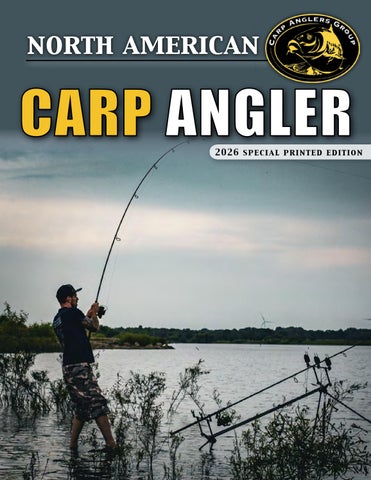
2025 Q4 North American Carp Angler Magazine

Page 1


CARP ANGLER

PRESIDENT ADDRESS

Welcome to this Special Edition of the North American Carp Angler magazine.

This publication is based on an original document written for the Carp Anglers Group by Bob Williamson, a Fisheries Biologist for 28 years with the Illinois Department of Natural Resources.

It has been updated to incorporate more recent understanding and information about Cyprinus carpio better known as the common carp.

When you read and learn more about carp and carp fishing we hope you will develop a greater appreciation and understanding of this remarkable fish and the benefits of catch and release angling. As the world’s most recognized sportfish its popularity has grown in North America over the past 3 decades, especially with exposures through social media.

The Carp Anglers Group began in 1993 and has been at the forefront for the protection of trophy carp and the growth in catch and release carp angling. As a not-for-profit organization our operations are made possible thanks to our dedicated volunteers who include our Board of Directors & State Chairs along with input from our Membership and Business Supporters.

We are grateful to Bob and other enlightened Fisheries Scientists who have recognized common carp as a wonderful sport fish. Our thanks as always go to everyone who allowed us to use key photos & diagrams for this publication especially Andy Steer of Angling Knots who allowed us to use many of his illustrations.

The Carp Anglers Group (CAG) is North America’s longest running carp fishing organization.

Established in 1993 it is dedicated in its mission to:

Support, Protect & Encourage Catch & Release Carp Angling

We are a not-for-profit organization, run by volunteers, established to pursue the following objectives:

A) To gain acceptance of the carp as an exciting and challenging sport-fish.

B) To become better carp anglers, assist others and encourage them to join us.

C) To treat the carp with respect, promote the release of trophy-size carp and encourage others to do the same.

D) Most of all: Go fishing, Share with others, and have Fun.

As a member you will be adding your voice & support to help CAG in its efforts to work with State & other key organizations to increase the recognition & protection for carp as a sport fish. Member Benefits Include:

• Full CAG Community Forum Access • CAG Apparel & Merchandise

• Quarterly NACA Magazine • Fish-Ins, Events & Tournaments

• New Member Pack with Tackle, Decals and Magazine

Membership is only $20 / Year (+ a one-time $5 joining fee) which includes you, your spouse & any children under 18 living in the same household Learn more: www.carpanglersgroup.com

Cover Photo: Lowell Fletcher - Essence Photo Winner September 2025

About Common Carp

Biologists use a system of names known as scientific nomenclature to describe all plant and animal life. The scientific name for an organism usually includes a genus (family) and species. This classification helps group animals and plants based on key physical characteristics.

An example of a genus is Canis, more commonly called Dogs, and the species would highlight different types of dogs such as wolf, jackals, coyotes etc.

Cyprinidae is a genus of freshwater fish commonly called the carp or minnow family. This includes the carps, the true minnows, and their relatives the barbs and barbels, among others.

Cyprinidae is the largest and most diverse fish family, and the largest vertebrate animal family overall, with about 1,780 species.

They are characterized by having no stomachs and specialized gill rakers or pharyngeal teeth designed to crush food items.

In the case of common carp (Cyprinus carpio) most biologists agree that the different scale types Common, Mirror, Leather are varieties of the same species. Common carp originated in the Black, Caspian and Aral sea drainages between Europe and Asia resulting in the term ‘Eurasian’ carp. Over time they have been introduced to many waters around the world.

As a result of centuries of raising carp using selective breeding programs and their evolution in different environments we often see marked differences in carp appearance.

There are several races of common carp that are distinguished by body shape (length and depth), head appearance and mouth position. These include Galicians, Dinkelsbuehl, Ropsha, Italian, Aischgrund and Israeli carp (a fast growing mirror carp once sold in the USA as live bait).

A classic ‘Common’ carp covered in smaller, tightly packed scales.
Mirror carp can exhibit a wide range of often unique scale patterns.
A linear mirror of this quality is rare in wild USA waters.

Fully Scaled Mirrors (FSM) are thought to be an evolutionary adaptation.

Even more striking are the exotic looking koi carp an ornamental species of domesticated carp which are differentiated from common carp by scale and fin ray counts and classified under the heading Cyrpinus rubrofuscus

These variants are characterized by distinct markings, bright colors and sometimes unusually shaped or long fins. They are usually kept in private ponds but in some cases have escaped into wild water systems. This can lead to interesting cross breeding with wild carp.

Examples include the fantail carp with long flowing fins and barbels plus nasal ‘florets’. Another example is the ‘Ghost’ carp which features dark markings around the head that give the appearance of a skull.

A rare combination… a ghost fantail mirror carp!

Koi are found in many waters and make a nice surprise capture

There are also a number of other so called Asian carp species in North America. This includes Silver (jumping) carp (Hypophthalmichthys molitrix), Bighead Carp (Hypophthalmichthys nobilis), Black Carp (Mylopharyngodon piceus) and White Amur (Ctenopharyngodon idella).

It is important to note that these are not in the same family as Eurasian Common carp. In the case of Silver and Bighead carp they pose significant threats as an invasive species. They are voracious plankton feeders and therefore compete with native species such as paddlefish, gizzard shad and alewives.

Sterile (triploid) Grass carp (Ctenopharyngodon idella) have been introduced in many states to help manage local weed problems. Often a ‘by-catch’ on baits intended for carp they can also caught on surface baits and even flies. It is important to check local regulations as in some waters fishing for grass carp is restricted.

Grass carp can grow to over 50lb and be a challenge – especially on fly rods!

Finally Buffalo, a native species that are often confused with Common carp, although they are members of the sucker family. Smallmouth buffalo (Ictiobus bubalus) and black buffalo (Ictiobus niger) have a general shape which looks similar to a bulky common carp, but their snout and eyes are very distinctive. Another variety, the bigmouth buffalo (Ictiobus cyprinellus) can live to over 100 years, barring human interferences or destructive bowfishing, and can reach weights of 60-80lb. They have become a popular focus species for many carp anglers.

Buffalo species are native to US Waters and much prized by catch & release anglers.

Carp Spawning

Common carp are known as prolific spawners. Spawning usually begins in water temps above 60F, peaks between 65-68F and ceases around 81F. Spawning can be interrupted by sudden dips in temperature and resumes once the water warms up again. This may lead to multiple spawning attempts over a period of several weeks. As a result large numbers of small carp can, in certain conditions, dominate the environment (learn more in Carp Density & Distribution).

Carp usually move into shallow areas to spawn. This can involve travelling many miles in large rivers or lakes. As a result carp will typically congregate nearby waiting for the optimum temps and conditions to start spawning. In flood conditions carp will follow the water flows and can end up in nearby lakes or rivers. This explains why carp have been so successful in spreading throughout North America beyond the areas they were first introduced.

When spawning carp will be seen chasing one another in shallow water often with their backs out of the water. Females will release batches of 500 or so eggs at a time and as many as 1 million eggs in total per fish. Male fish in close attendance release sperm into the surrounding water to fertilize the eggs. The eggs are about 2mm in diameter and grey or white in color.

They adhere to sticks or vegetation where they are left unattended and exposed to predation and environmental conditions.

After 4-10 days and depending on the water temperature the eggs will hatch. Eggs exposed to temps below 61F or above 79F will not survive. Newly hatched carp fry carry a yolk sac which sustains them for a few days.

The fry then begin to feed on microscopic organisms. Over the coming weeks the fry shelter in vegetation and continue to grow. Once they reach 4-6” in length they are too large for most predators except pike, gar and birds such as cormorants or herons. It is important however to know that the success of such prolific spawning can be limited by a host of factors (learn more in Carp Density & Distribution).

Growth rate is faster in early years and depends very much on food sources, temperature and water conditions. In European stock ponds with optimum conditions it is possible for carp to reach 20lb in just 5 or 6 years! In USA wild water environments it takes considerably longer and carp of 20lb, 30lb or bigger could be anything from 10 to even 40 years old.

This is why the Carp Anglers Group urges anglers to take every precaution to carefully handle and safely release trophy sized fish.

North American CARP ANGLER Magazine

Why are Carp so Adaptable?

Carp can survive in water with very low dissolved oxygen concentrations. Even as little as 0.5 parts per million (ppm) although they thrive in 5ppm.

If you consider that most fish are distressed or die at levels below 2 or 3ppm it shows a carp’s resilience to survive in even heavily polluted or deprived oxygen waters that are deadly to most native fish species.

Carp can also survive in high carbon dioxide (CO2) levels such as when vegetation is rotting. Ironically this ability to survive where native species cannot has often made carp the scapegoats rather than focus the blame on a variety of man-made issues. These can include untreated sewage, excess nutrients from farm or storm run-offs as well as increased silting and warmer water from reduced flows due to dams or water abstraction.

A carp can tolerate water temperatures from 32F to 100F. Depending on other conditions temps of 97F to 106F are usually lethal. In most US waters carp become inactive below 38F although with ready access to food they have been known to continue to feed making it possible to catch them even through the ice. As carp are ‘cold blooded’ their metabolism and movement changes with water temps and they will feed more actively in warmer water.

Carp have a high tolerance for turbidity, even up to 165,000 ppm which is the maximum amount of silt or clay that can be suspended in water. They can continue feeding even when they cannot see food.

It is not uncommon to find carp in tidal estuaries as they have a considerable tolerance to brackish water. Different sources give upper tolerance limits from 5 to 18 PSU (grams of salt per 1Kg water). Seawater for comparison is 33 – 38 PSU. Carp will move up and down with the tide and sometimes travel considerable distance into bays and sounds when heavy rainfall creates freshwater outflows from a river.

Often called ‘bottom feeders’ carp can actually feed at all levels in the water column. Carp are omnivores which means they feed on a wide variety of plant or animal items. They will usually move around in search of seasonably abundant food items.

You might see them feeding on surface items such as cotton seeds, insects or fallen berries or cruising just below the surface eating insects, fish fry or tadpoles. As avid hunters they can turn over stones to find and eat crayfish, snails and even small live fish.

In some water systems clams and other shellfish can be a significant part of their diet from rooting around in the sand and silt. In tidal areas carp will even eat legal sized blue crabs!

Carp can root deep into silt to feed on ‘bloodworms’ a red colored midge larvae (Chironomidae) that can be present in huge numbers. There can be as many as 50,000 larvae per square yard which can make them a significant part of a carp’s diet.

The sucker-like mouth or protrusible lip extends downwards allowing the carp to ‘suck up’ food items from the bottom. Once in the mouth cavity carp will determine what is edible and blow out what is not such as loose sand or gravel. The food items are then passed back into the throat where hard food items can be crushed or ground in a pair of molarlike apparatus or pharyngeal teeth.

Carp do not have a stomach so food enters directly into the intestine to be processed by digestive enzymes.

The Pharyngeal Teeth in common carp can grind snails, clams and other hard objects.

Contrary to some beliefs carp rarely eat fish eggs. There is no evidence that carp actively seek out the nests of other species like bass or sunfish although accidental disruption may account for this mistaken belief.

Carp Density and Distribution.

Common carp are not native to North America. They were first introduced to the USA in the late 1800’s with the first official records showing Julius Poppe of Sonoma CA brought 83 fish from Reinfeld in Germany.

These fish spawned producing some 3,000 fish the following year. In 1877, in response to dwindling native fish stocks and to provide food sources for the growing population, the US Fish Commission began to actively import carp and breed them in ponds around Baltimore & Washington, DC. Carp were then distributed across the United States for stocking in local rivers and ponds and amounted to some 2.5 million carp being introduced over a 17 year period.

Unfortunately the outcome of introducing common carp was to have long lasting repercussions. A poor understanding of raising carp compared to Europe combined with easier distribution of food and better farming practices led to carp being rejected as a favored food source.

At the same time industrialization, deforestation, increased pollution and damming of waterways led to the loss of many natural habitats along with native species. The hardy carp were much less impacted and thrived in areas where native fish species could no longer survive. As a result carp were often mistakenly blamed for the poor water quality and loss of habitat for wildfowl.

A large population of small carp can lead to localized problems. When feeding in silty or sandy bottoms they can increase turbidity which can lead to decreased light penetration, reduced plant growth and correspondingly poor water quality.

An overpopulation of carp is often the result of specific environmental issues. Low oxygen spawning marshes are a good example.

Carp eggs and fry go unmolested by predator species that cannot tolerate the low oxygen levels. As a result thousands of carp fry grow and re-enter the main waterways when they reach 4-6” and too big to be eaten by most predators.

This has led some states declaring carp ‘invasive’ when population densities reach more than 130 lbs of carp per acre. Minesota for example has invested considerable resources to reduce or eliminate them. It is also worth noting that silting from dams and low water flow as well as strong winds roiling up shallow waters and increased boat traffic are also key factors in increased water turbidity. Fortunately, most states experience very few issues and declare carp, like so many introduced species, as simply ‘non-native’.

It is important to recognize that in many areas, like New England, carp have very limited reproductive success.

The result is just a small number of carp surviving most years and sometimes only spawning successfully once every few years. Where spawning areas are accessible to predators such as perch, bass, sunfish etc the carp eggs and fry become a significant food source.

There are also a host of environmental factors that can decimate the carp spawn such as high or low water temps, flooding, drying out from strong winds or low water levels. The upside is fewer but significantly bigger carp (often decades old) and in these low population waters it is typical to find clear water, excellent weed growth and trophy sized fish of most other species.

Carp Behavior

Early in life carp school together behaving as a group than as individual fish. As carp grow they typically form shoals of similarly sized individuals or year classes.

This can explain why you might catch several similarly sized fish before one or two larger fish move in. Larger ‘trophy’ sized carp may move around in small groups feeding together or in some cases be quite solitary. The big solitary carp may also inhabit different areas and have a quite different approach to feeding making them an especially difficult quarry.

Most carp in North America have to rely on natural food sources. This is quite unlike their European cousins who become reliant on large quantities of anglers’ baits. As a result our wild water carp will move around a lake or river in search of the most accessible and seasonably abundant food sources. Carp will also follow the ‘wind’ and will typically be found feeding along a windward shoreline towards which food items are being blown.

Water temperature can also be a key factor with carp seeking out shallow areas warmed by the sun in the early spring or late fall.

Learning and understanding carp movements in a target water can help you identify key locations to find and catch fish. Carp have not only excellent eyesight but can also see outside the visible light range into the infra-red and ultra-violet. Carp have a bony structure known as the ‘webarian apparatus’ that connects the swim bladder to the inner ear which allows them to feel and hear vibrations.

As sound travels over four times faster and much further in water than in air it can make carp wary of any disturbance.

Taste and smell senses are also highly developed in carp. They have olfactory pores around the barbels, snout, pelvic fins and the roof of the mouth.

Like humans they can taste salt, sweet, sour and bitter but unlike ourselves can also sense specific amino acids released by clams, fish and worms.

Carp will often reveal their presence by rolling on the surface or porpoising (where you see just a head appear).

This is a clear sign of feeding fish, even in quite deep water. It should not be confused with the loud slaps or crashes that carp make when they leap clear of the water which often occurs at dawn or dusk. This might be a mechanism to clear mud or silt from a carp’s gills when feeding in soft bottom structure or possibly a way to dislodge parasites.

It is sometimes possible to determine a carp’s presence by a stream of bubbles as it moves along the bottom feeding. Casting a bait ahead of the direction of the bubbles or a fish rolling on the surface can often produce a quick result!

In winter months carp will typically move to key areas and sometimes form very large groups where they hunker down beneath the ice. A few hardy souls have managed to catch carp on a regular basis when ice fishing!

Catching Carp!

Carp always respond well to an easily available food source. Regular chumming/ground baiting over a few days will often persuade carp to include the selected area as part of their search for food.

It is important to always check local state regulations as in some states chumming is not allowed. If you bait regularly every morning there is no guarantee the carp will still be there if you plan to fish in the evening. It is much better to bait at the same times as you intend to fish.

Chumming a ‘line’ of bait at 45 degrees to the bank can help intercept fish swimming by your swim. Once you start catching you can focus the chum or ground bait to a smaller area where you are getting the most bites.

Only use as much chum as is needed to attract and hold the fish in the area or swim you plan to fish. If you add too much it will make your hook bait look like a “needle in a haystack” and make it more difficult to find. It is better to ‘add a little but often’ while you are catching fish than put too much in all at once.

Carping etiquette says you should not seek to fish someone else’s baited area unless you have been invited. There is no glory in catching fish from a swim where another angler has invested time and money developing. The skill and enjoyment come from finding your own spots. Chum can be introduced with catapults (slingshots) baiting spoons, castable devices such as spods or spombs and even from a kayak or boat.

Tackle & Techniques

Euro-Style

The term “Euro” mainly refers to the use of advanced tackle and bait that has become available to US carp anglers from European countries, primarily England, Holland and France.

A typical Euro set up (see picture below) will consist of 9- 12ft carbon rods with a test curve of between 2.5 - 3.5lbs, a rod pod to safely keep the rods in place, buzzers (aka alarms) to alert you to a run, baitrunner reels or large big pit reels that can hold anything from 300 - 500 yards of line.

At the business end is highly refined terminal tackle set up with specialized leads (sinkers), hook links and what is known as a hair-rig.

The hair-rig, developed in England in the late 1970’s radically changed carp fishing and brought these otherwise difficult to catch fish with in reach of almost every angler. Instead of being mounted on the hook the bait is suspended on a short thread or ‘hair’ instead.

The bait not only behaves more naturally but when the carp confidently sucks it in and suddenly discovers the hook trailing behind on the hair its natural instinct is to rapidly eject the bait by ‘blowing’ it out with some force. As a result the bait pivots on the hair and effectively helps pull the hook into the carp’s lip. A set up for three rods could costs anywhere between a few hundred used and a few thousand dollars new.

Float Fishing

Float Fishing for carp is possibly one of the oldest and most traditional ways of carp fishing. A float allows you to fish different water depths and to quietly present a bait, even while stalking wary carp. It’s also one of the most sensitive ways of fishing, allowing you to pretty much “imagine” what happens under water.

Experienced float fishermen can often distin-

There are many different floats (bobbers) out there and different set ups, but the basic rig looks pretty much the same: a float (fixed or sliding with a stopper), a few small leads to balance the float and ultimately the hook.

Classic baits for float fishing are corn from the can, worms, bread, cheese, luncheon meat, doughballs etc. which go directly on the hook. But also a hair rig can be used to allow for harder baits such as tigernuts, chickpeas and boilies.

Groundbait or small particles such as hemp can be used as a chum to create more attraction around the hook bait. A typical strategy is to bait up different spots and then return after a period of time to look for signs of feeding fish.

Surface fishing

Carp will actively feed on natural food items in or on the surface of the water. At such times they can often become preoccupied and with a suitably stealthy approach become relatively easy to catch.

A piece of bread squeezed around the hook and ‘freelined’ along with some free samples is one of the most effective methods and has stood the test of time over many generations.

Almost any buoyant bait including sunflower seeds, dried dog or cat chow can be used successfully especially if ‘chummed’ for 15-20 mins before fishing so that the carp get a taste for them.

Flyfishing

The pursuit of carp has long been a cult among dedicated fly fishermen in North America, but in recent years it has truly exploded in popularity. This increase can be attributed to the recognition of carp as truly a worthy adversary and its presence across the continent in waterways from idyllic rural locations to urban battlegrounds

The stalking of 20-30lb ‘golden’ bones in lake shallows often draws comparisons to stalking bonefish in the Bahamas or the Florida Keys, with many describing the carp to be bigger, meaner, and a lot more fun to catch!

Fly patterns for carp can take many forms due to the carp’s varied diet.

These include a variety of crayfish, nymph or worm patterns such as San Juan worms and Carp Crack flies. Sight fishing or casting towards mud plumes that indicate feeding fish requires top notch tackle, a stealthy approach and nerves of steel to have any chance of hooking let alone landing one.

Dry flies for carp on the surface can be especially effective where carp are actively feeding on a bug hatch or seasonal crop of mulberries or cottonseed.

Paylaking

Packbait is a popular tactic on PayLakes and somewhat akin to a European method mix. The key differences are the rapid break down time (as fast as 30 seconds) and it being ‘packed’ around the hook rather than the lead. This is essential for getting a quick bite and catching as many fish as possible.

Packbaits utilize a variety of ingredients, from oats, grits and rice to fish chow and soybean.

Paylaking has long been a part of the North American carp angling scene. Fishing takes place in stocked ponds that range from half an acre to maybe 5 acres, and payouts can be as large as several thousand dollars for the biggest fish for every hour (or even less in some instances).

Here, bait is key and these anglers are masters at hauling fish.

Flavors are also important in triggering bites on these heavily pressured fish, and paylakers are known for having a variety of flavors that they keep hidden from other anglers.

For the pickup (akin to hookbait), most paylakers use puffed corn. These puffs are also flavored to trigger bites from wary fish.

Rigs consist of stiff mono hook lengths and relatively large (1/0 or 2/0) hooks, which make it hard for the fish to spit out the bait and hook.

Unfortunately the fish in Paylakes rarely survive more than a few weeks or months and replenishing trophy carp, buffalo and catfish from wild waters has become a significant and controversial issue.

The choice of baits to catch carp is sometimes overwhelming. Sweetcorn, chick peas (garbanzo beans) and tiger nuts (chufa) are among some of the most popular so called particle baits while boilies are favored by euro-style anglers.

Feed Corn (maize) is one of the best and least expensive carp baits. As a food source for carp it has about a 10% protein content as well as some key amino acids lysine, tryptophan and leucine. A 50lb bag from a feed store is just a few dollars. Preparation: 2/3 fill a 5 gallon bucket with corn, cover with water and soak for 24 hours. Then boil the corn for at least 40 minutes and leave to cool.

At this stage the kernels should have swelled and softened and some will have split open. If you like you can add flavors such as fruit drink crystals, commercial carp flavors, spices, molasses, hot sauce etc. The choice of flavors is endless but don’t overdo it. Save some corn for hook baits and add food coloring to make them stand out. If you store the prepared feed corn in buckets with a lid on in a cool place it will last at least for 2-3 weeks.

To use simply thread 2-3 corn grains on a hairrig and chum with loose corn. Add a piece of foam or buoyant imitation corn to create a ‘pop-up’ (see image) for added success!

Boilies are a combination of nutritious milk, soy or fishmeal protein combined with various flour and binders such as eggs along with flavors and attractants. The resulting dough like mix is rolled into round balls and then dropped into boiling water (hence the ‘boilie’ name) and then air dried.

The result is a firm bait that can be mounted on a hair-rig as a hook bait and is resistant to being eaten by smaller fish. The round aerodynamic shape also means they are ideal for accurate chumming to attract fish.

They come in a variety of flavors and colors as well as different densities. They are available as sinking aka bottom-baits, buoyant pop-ups that allow the bait to be fished off the bottom by one or two inches so it stands out or wafters that are only slightly buoyant and therefore easily picked up by the fish.

Boilies are available commercially but can also be home-made quite easily with a bit of time and a surprisingly low investment.

Method / Pack

A great way to get started with carp fishing is to fish ‘Method’ or ‘Pack’.

A common recipe uses a mix of oats and creamed corn squeezed into a ‘Method’ ball around an inline lead / sinker or as ‘Pack’ around the hook bait.

The idea is to deliver your hook bait together with a ball of chum making it very attractive for fish to find.

Carp can also be caught on baits suspended at different levels in the water column.

Small pieces of buoyant foam know an as ‘zigs’ that imitate water beetles or other aquatic insects.

A long hook length allows the ‘zig’ to sit at the desired depth above a lead on the bottom.

Oats Method Recipe:

Take a can of Creamed Corn and a 54oz tub of Old Fashioned Oats (not instant or quick). Mix thoroughly together using your hands for at least 2-3 minutes. Allow it to stand for a few more minutes.

Take a fist sized amount and mold firmly around your lead/ sinker. Some people like to hide their hook bait in the method ball but if you use a short hook length of 3-4” it is not really necessary. The method ball should withstand casting (if it is too wet or dry it will come off during the cast) and break down in just a few minutes in the water. If you wish you can add flavors, syrup, molasses or other ingredients to the method.

Imitation Baits

Plastic imitation baits have also become more popular over the last 10-15 years. There are many imitations of particles like sweetcorn, maize and tigernuts and also breadflake, boilie, pellets and even luncheon meat versions.

They offer a number of advantages to the ‘real’ thing including being resistant to attack by crayfish or other unwanted fish species. They are also able to absorb different flavors or sweeteners to increase attraction.

They can be fished alone or with natural baits and buoyant versions can be popped up so the bait and hook sit above any weed or debris on the lake bed.

Finally some of these imitation baits are made from bright fluoro colors or even niteglow materials to provide a visual attraction for the carp to home in on. The imitation baits from Enterprise are also biodegradable.

The idea being that the carp could ‘mouth’ around the bait without feeling the hook and then take it into its mouth with complete confidence.

The outcome was even more dramatic because when the carp suddenly felt the hook and spat out the bait it actually helped to catch the hook point in the mouth or lip. Now it was no longer necessary to hover over the rods attempting to strike at the smallest line movement. Using the hair-rig resulted in dramatic takes and line being pulled violently off the reel!

The hair-rig has been further developed over the years and the bait mounted in ways that help the hook ‘rotate’ to improve the chances of the hook being pulled into the carp’s lip when ejected.

The basic hair-rig uses a knotless knot.

The knotless knot allows you to quickly and easily tie a basic hair-rig. Start with 12-18” of 30-50lb braid and a size 6 or 4 in-turned eye hook.

Tie a small loop in one end using a figure of eight knot – this will create your hair. (The length of the hair should allow your bait to hang ¼ - ½” below the bend of the hook.)

Then pass the free end through the eye of the hook as shown (towards the point). Then pass the free end back around the hook shank 6-8 times

while keeping the loop end on the top of the hook shank. You can tie the end directly to a swivel on your mainline or form a loop if you are using quick connect swivels. The distance between mainline and hook (hook length) can be 3-4” or as much as 10-12” depending on baits etc. If you are fishing feed corn on the hair then try a hook length of 4-8”.

Use a baiting needle to thread bait onto the hair and place a bait stop in the loop to keep the bait in place.

Historic Moment for U.S. Carp Anglers – Carp Angler Becomes America’s First Carp Tackle Brand!

Two years ago, we set out on a mission not just to build a brand, but to forge a movement. We dared to dream that American carp anglers deserved a tackle company of their own. Today, that dream is no longer just a vision, it’s history in the making Carp Angler proudly stands as the FIRST American Carp Tackle Brand, a title earned through dedication, resilience, and the unwavering support of anglers like YOU

This isn’t just about us

This is about every American carp angler who stood up for this sport, who refused to be ignored, who took pride in their craft and helped push carp fishing forward in the U S From our customers to our partners and even to our competitors who pushed us to work harder: “We thank you”! You built this We just delivered

And what a delivery it is! Over 200 new products released all at once, on top of what we’ve already crafted, proving that American carp fishing is no afterthought; it’s a force to be reckoned with. This is only the beginning.

More innovation, more gear, and more history-making moments are on the way!

As we write this with goosebumps, we stand proud, side by side with you, we with the anglers who made this possible Here’s to Carp Angler

Here’s to every American carper And here’s to the next chapter in this incredible journey

The first The foundation The future

Carp Angler - The First American Carp Tackle Brand!

#CarpAngler #AmericanCarpFishing #WeMadeHistory #FirstOfMany

Caring for your Capture

Before you cast out your lines please make sure you are ready to take care of the fish once it is hooked. A good sized net capable of holding the biggest fish you might catch is important and you should always keep it close by the waters edge for when it is needed.

A padded mat to lay the fish on, a bucket of water, weigh sling and pliers or forceps should also be easily accessible. Once you have your carp safely in the net then the easiest option is to simply unhook and release it while still in the water.

If you want to take a photo or weigh your fish then lay out the mat, wet it with water and lift the carp in the net onto the mat. Wet and zero your weigh sling and then ease it under your carp.

Make sure there is no risk of the carp sliding out and then lift it sufficiently off the ground to confirm the weight. Keep the carp wetted with cool water and take a couple of photos.

Carry the fish back to the water in the weigh sling or net and after making sure it is fully recovered allow it to swim off.

We encourage the use of fish friendly nets large enough for the likely catch, padded mats to protect fish from laying on dirt, rocks or hard surfaces that could injure or remove protective slime, a weigh sling or bag when lifting carp - DO NOT lift carp using ‘lip grip’ devices or by the gills – this can injure the carp - often fatally.

A trophy carp is heavy! Here are some options to support the scales and make it easier to get an accurate weight of your capture. Notice the bag or sling to place the carp in so it can be lifted safely and properly weighed. A tripod, weigh bar or ‘crook’ is used to suspend the scales while a protective carp mat prevents the carp flopping around and being injured.

The Future of Carp Fishing in the USA

In Europe carp angling is now a $6-7 billion industry with up to 20 million anglers. Here in North America we are blessed with many more waters, often unexplored, and some incredible trophy sized fish but with only a fraction of the angling pressure by comparison. Carp fishing here is still in its infancy but growing rapidly!

There are now several USA based companies supplying top quality carp baits as well as the very best in rods, reels and specialist carp tackle. Please support our CAG Business Supporters. You will find links to their websites on the CAG Forum and NACA magazines.

It is critical for the long-term future of carp fishing that we work with local state fishery organizations to educate and highlight the interest and growth of our sport. Protecting trophy sized carp from being bow fished or tanked and sold to commercial paylakes is absolutely critical.

From experience we have seen how such activities can quickly decimate a big fish population. The Carp Anglers Group is at the forefront of protecting trophy carp and was successful in helping Connecticut introduce creel limits for carp and the establishment of trophy carp waters.

This decades old mirror was caught by several anglers before being killed by a bow hunter

Join in some of these key CAG events!

Carp Anglers Group Carp Classic (CCC) – Annual One Day Tournament.

Spring and Fall

Big 4 Competitions

– Over $2,000 in Prizes

Essence of Carping Photo Competition – Each month with $100 Prize and Medals St Lawrence Junior International Carp Tournament -in age groups 8-10, 11-14 & 15-18

March 1st place. Iain Sorrell

March 2nd place.

Sam Hernandez
March 3rd place. Jerome Moisand
April 1st place. Dave Pickering
April 2nd place. Frederick Hiller
April 3rd place. Daphne Forster
May 1st Place. Kevin Zirjacks
May 2nd place. Sam Hernandez
May 3rd place. Joshua Jones
June 1st place. Frederick Hiller
June 2nd place.Evan Aziz
June 3rd place. Dave Pickering
July1st place. Frederick Hiller

August 1st place. Steven Pflugradt

July 3rd place. Dave Pickering
July 2nd place. Gary Bartlett

August 3rd

August 2nd place. Lowell Fletcher
place. Tom McCarthy
September 1st place. Lowell Fletcher
September 2nd place. Jay Smithers
September 3rd place. Lowell Fletcher

October 1st place. Jessica Day

October 2nd Place. Jerome Moisand
October 3rd Place. Lowell Fletcher
November 1st Place. Luis Miguel Angelo
November 2nd Place. Kevin Zirjacks
November 3rd Place. Luis MIguel Angelo

Turn static files into dynamic content formats.

Create a flipbook