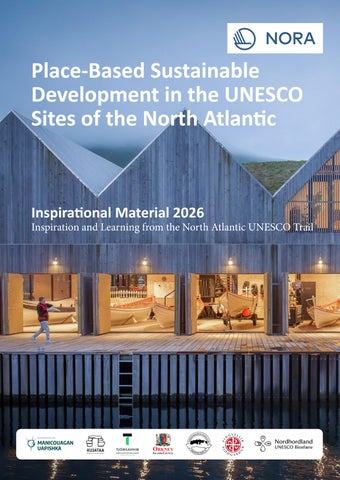
Place-Based Sustainable Development in the UNESCO Sites of the North Atlantic
Inspirational Material 2026
Inspiration and Learning from the North Atlantic UNESCO Trail
North Atlantic UNESCO trail
1
2
North Atlantic UNESCO trail
Table of contents Introduction
4
Understanding Place-Based Sustainable Development
6
UNESCO Sites as Living Laboratories
8
Learning from UNESCO Sites
10
Examples from UNESCO Sites
12
Heart of Neolithic Orkney World Heritage Site, Scotland
12
Kujataa Greenland: Norse and Inuit Farming at the Edge of the Ice Cap
13
Manicouagan–Uapishka Biosphere Reserve, Canada
14
Nordhordland Biosphere Reserve, Norway
15
Principles for Practice
17
Questions for Reflection
17
Looking Ahead
19
Front page: Klaksvik, Faroe Island. Photo: Mike Kelley. Opposite page: Kujataa World Heritage, Greenland. Photo: Konrad Smiarovsky.
North Atlantic UNESCO trail
3
Introduction
Across the North Atlantic, UNESCO sites are facing a common challenge: how can communities protect their unique natural and cultural heritage while responding to climate change, biodiversity loss, demographic change and increasing pressure on local societies? Although these places differ greatly in geography, history and culture, they share a common ambition to create sustainable futures rooted in the qualities of each place. Rather than applying generic solutions, place-based sustainable development recognizes that lasting change emerges from local knowledge, community engagement and collaboration between citizens, authorities, researchers and businesses.
4
North Atlantic UNESCO trail
Below: Partners in the North Atlantic UNESCO trail project: • Iceland: Thingvellir national park, UNESCO world heritage site and Snæfellsnes Regional Park • Greenland: UNESCO World Heritage Kujataa • Faroe Islands: Faroe Islands National Museum • Norway: Nordhordland Biosphere, lead partner • Canada: Manicouagan-Uapishka Biosphere Reserve • Scotland: Orkney Islands Council
The reflections presented in this publication have emerged through collaboration within the North Atlantic UNESCO Trail, a network of UNESCO World Heritage Sites and Biosphere Reserves established to strengthen knowledge exchange and cooperation across the North Atlantic. The publication is intended as inspiration for UNESCO site managers, municipalities, policymakers, researchers, educators and community organizations seeking to strengthen sustainable development through locally grounded approaches. Rather than presenting a single model, this publication offers reflections, examples and practical principles that can support local dialogue and inspire future action across UNESCO sites and beyond.
Opposite page: Thingvellir, Iceland. Photo: Thingvellir World Heritage Site.
Matpause på Veten,Atlantic Meland. Foto: Lars Ørjan North UNESCO trailNese. 5
Understanding Place-Based Sustainable Development Place-based sustainable development begins with the recognition that every landscape possesses its own history, ecological conditions, cultural traditions and social relationships. Sustainable development cannot simply be transferred from one place to another through standardized solutions. It must be adapted to the characteristics, values and aspirations of the
6
North Atlantic UNESCO trail
communities who live there. This perspective complements international sustainability agendas by recognizing that global goals only become meaningful when interpreted within local contexts. Environmental protection, economic development and social cohesion are not competing agendas
but interconnected dimensions that must be balanced through dialogue, participation and long-term stewardship. UNESCO sites provide particularly valuable settings for this work. Their international recognition offers visibility and legitimacy, while their close relationship with local communities
creates opportunities to test new forms of governance, education, conservation and community engagement. In this sense, UNESCO sites are not only places to be protected but also places where new approaches to sustainable development can be explored, tested and shared.
The Nordic Clinker Boat tradition, Klaksvik, Faroe Islands Photo: Mike Kelley.
North Atlantic UNESCO trail
7
UNESCO Sites as Living Laboratories
Across the North Atlantic, UNESCO sites are developing practical responses to shared sustainability challenges. While every site reflects its own cultural, environmental and institutional context, many are working with similar issues, including biodiversity conservation, climate adaptation, sustainable tourism, community participation, education and cultural heritage management.
8
North Atlantic UNESCO trail
These initiatives demonstrate that sustainable development is most effective when it builds upon local knowledge, existing partnerships and the distinctive qualities of each landscape. Rather than implementing externally defined solutions, successful initiatives emerge through cooperation between municipalities, researchers, businesses, civil society organizations and local communities.
The UNESCO designation provides an important framework for this work. It creates opportunities for collaboration across sectors, strengthens international visibility and encourages sites to exchange experiences with partners facing similar challenges. In this way, UNESCO sites become platforms for learning and innovation as much as for conservation. Baie-Comeau, Canada. Photo: René Méthot.
North Atlantic UNESCO trail
9
Learning from UNESCO Sites
The UNESCO sites participating in the North Atlantic UNESCO Trail illustrate that there is no single pathway towards place-based sustainable development. Each site reflects its own environmental conditions, cultural traditions, governance structures and development priorities. Nevertheless, the experiences reveal several common patterns that are relevant far beyond the individual sites. One of the strongest lessons is that sustainable development becomes more robust when it is rooted in local identity and community ownership. Across the North Atlantic, successful initiatives are characterized by active involvement of local communities, municipalities, researchers, businesses and civil society organizations. Rather than implementing externally defined solutions, the sites demonstrate the value of building on local knowledge, existing partnerships and the distinctive qualities of each landscape. The experiences also show that UNESCO designation can serve as more than a framework for conservation. Increasingly, UNESCO sites function as platforms for innovation, dialogue
and experimentation, where new approaches to biodiversity conservation, climate adaptation, sustainable tourism, cultural heritage management and community engagement are developed and tested. In this way, the designation becomes a catalyst for sustainable development rather than an objective in itself. Another important insight concerns the relationship between environmental protection and local development. The participating sites all face difficult choices regarding land use, tourism, renewable energy, biodiversity conservation and demographic change. Their experiences demonstrate that these challenges cannot be addressed through technical solutions alone. Long-term progress depends on dialogue, trust, transparent governance and the ability to balance environmental ambitions with social, cultural and economic realities. The following examples illustrate how different UNESCO sites translate these principles into practice within their own geographical and cultural contexts.
From upper left to lower right: Boatbuilding, Faroe Islands. Photo: Jens Kristian Vang. Ring of Brodgar, the Heart of Neolithic Orkney, World Heritage, Orkney. Photo: © Orkney.com. Thingvellir, Iceland. Photo: Thingvellir World Heritage Site. Mountain, Canada. Photo: MUBR. Nordhordland UNESCO Biosphere. Photo: Ruben Soltveit. Autumn in Igaliku, Greenland. Photo: Kujataa WH.
10
North Atlantic UNESCO trail
North Atlantic UNESCO trail
11
Ring of Brodgar, Orkney. Photo: Orkney.com.
Examples from UNESCO Sites
HEART OF NEOLITHIC ORKNEY WORLD HERITAGE SITE, SCOTLAND Located on the Orkney archipelago north of mainland Scotland, the Heart of Neolithic Orkney World Heritage Site preserves one of the world’s most remarkable prehistoric landscapes. The site includes ceremonial monuments, settlements and burial structures dating back more than 5,000 years and demonstrates the long-standing relationship between people and landscape.
12
North Atlantic UNESCO trail
Today, Orkney illustrates how heritage conservation can support community development, education and sustainable tourism. Through volunteer engagement, interpretation, research and close cooperation between local communities and heritage authorities, cultural heritage becomes an active resource for local identity, learning and sustainable development rather than simply an object of preservation. UNESCO World Heritage Centre https://whc.unesco.org/en/list/514/
Gathering the sheep in Igaliku, Greenland. Photo: Mouritz Karlsen.
KUJATAA GREENLAND: NORSE AND INUIT FARMING AT THE EDGE OF THE ICE CAP Located in southern Greenland, Kujataa is a unique cultural landscape where Norse settlers and later Inuit communities developed farming practices under Arctic conditions. The landscape reflects more than a thousand years of adaptation to one of the world’s most challenging environments and illustrates the close relationship between people, climate and nature.
Kujataa demonstrates how traditional knowledge, cultural heritage and local stewardship continue to play a central role in sustainable landscape management. As climate change increasingly affects Arctic environments, the site highlights the importance of combining historical knowledge with innovation, adaptation and resilient local communities. UNESCO World Heritage Centre https://whc.unesco.org/en/list/1536/
North Atlantic UNESCO trail
13
Innu community, Canada. Photo: Alexis Pageau.
MANICOUAGAN–UAPISHKA BIOSPHERE RESERVE, CANADA Situated on the north shore of the St. Lawrence River in Québec, Canada, the Manicouagan– Uapishka Biosphere Reserve encompasses boreal forests, mountains, rivers and coastal ecosystems closely connected to the traditional territory of the Innu people. The biosphere reserve demonstrates how collaboration between Indigenous communities, researchers, municipalities and regional
14
North Atlantic UNESCO trail
organizations can strengthen biodiversity conservation while supporting social inclusion and regional development. By combining scientific research with Indigenous knowledge and participatory governance, the reserve illustrates how environmental protection and community development can reinforce one another. UNESCO Man and the Biosphere Programme h t t p s : / / w w w. u n e s c o . o r g / e n / m a b / manicouagan-uapishka
Nordhordland UNESCO Biosphere. Photo: Kenneth Vik.
NORDHORDLAND BIOSPHERE RESERVE, NORWAY Nordhordland Biosphere Reserve is located on Norway’s west coast, north of Bergen, where fjords, islands, agricultural landscapes and mountain areas create a diverse social and ecological landscape.
science, education and sustainable business development. Its experience demonstrates both the opportunities and the challenges of balancing renewable energy, biodiversity conservation and local livelihoods through dialogue, partnerships and long-term planning. UNESCO Man and the Biosphere Programme https://www.unesco.org/en/mab/nordhordland
The biosphere reserve works actively to integrate biodiversity conservation with municipal planning, research collaboration, citizen
North Atlantic UNESCO trail
15
16
North Atlantic UNESCO trail
Opposite page: from upper left to lower right: Grundarfjordur, Iceland. Photo: Snaefellsnes Biosphere Reserve. Ness of Brodgar aerials. Photo: Scott Pike. Stamneshella, Norway. Photo: Ruben Soltveit/NUB. Fishing boat, Faroe Islands. Workshop, Canada. Photo: MUBR. Gathering the sheep in Igaliku, Greenland. Photo: Mouritz Karlsen.
Principles for Practice Experiences from UNESCO sites across the North Atlantic suggest several principles that can support place-based sustainable development.
Monitoring, reflection and knowledge exchange allow communities to respond to changing environmental and social conditions.
Build on participation and local ownership. Long-term solutions emerge when citizens, municipalities, researchers, businesses and community organizations contribute to defining both challenges and solutions.
Strengthen communication and storytelling. Effective narratives help connect local initiatives with global sustainability ambitions and create broader understanding among residents, decision-makers and visitors.
Recognize cultural heritage as a strategic resource. Heritage is not only something to protect. It provides identity, continuity and opportunities for education, innovation and sustainable value creation.
Share practical knowledge. Experiences from one UNESCO site can inspire others. Case studies, practical tools and peer learning strengthen the collective capacity of UNESCO networks while allowing each site to adapt ideas to its own context.
Support adaptive learning. Sustainable development is a continuous process.
Questions for Reflection Every UNESCO site is unique, yet many face similar questions.
• •
• •
What are the distinctive qualities of your landscape and community? How can local knowledge become a stronger resource for future development?
•
Which partnerships could strengthen sustainable development in your area? How can UNESCO designation create greater value for local communities? Which experiences from other UNESCO sites could inspire your own work?
North Atlantic UNESCO trail
17
18
North Atlantic UNESCO trail
Opposite page: Shaputuan, Canada. Photo: Camille Charette.
Looking Ahead
The challenges facing UNESCO sites are becoming increasingly interconnected. Climate adaptation, biodiversity conservation, cultural continuity, community resilience and sustainable economic development cannot be addressed separately. They require collaboration across disciplines, sectors and national borders. The North Atlantic UNESCO Trail demonstrates the value of building such collaboration. By connecting UNESCO sites through shared learning rather than standardized solutions, the network contributes to a growing international movement for place-based sustainable development. The experiences presented here are not intended as definitive answers. Rather, they are an invitation to continue the dialogue, strengthen partnerships and explore new ways of connecting people, place and sustainability. Every UNESCO site has knowledge to share, and every site has something to learn. Together, they demonstrate how local action can contribute to global sustainability ambitions while remaining firmly rooted in the unique qualities of each place.
North Atlantic UNESCO trail
19
Ring of Brodgar, the Heart of Neolithic Orkney, World Heritage, Orkney. Photo: © Orkney.com.
20
North Atlantic UNESCO trail