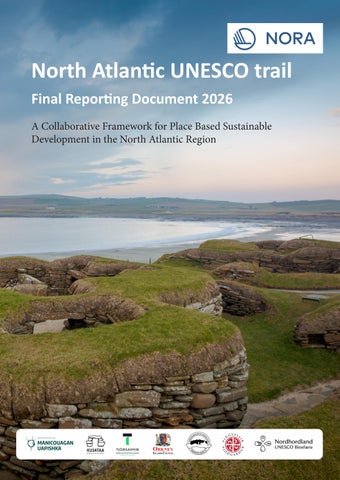
North Atlantic UNESCO trail Final Reporting Document 2026 A Collaborative Framework for Place Based Sustainable Development in the North Atlantic Region
North Atlantic UNESCO trail
1
2
North Atlantic UNESCO trail
Executive Summary The North Atlantic UNESCO Trail has developed from an idea for stronger cooperation among UNESCO sites into a practical framework for shared learning, project development and place based sustainable development across the North Atlantic region. The second phase has confirmed that the Trail should be understood first as a community of practice: a network where sites exchange knowledge, test collaborative initiatives and communicate how local action can respond to global sustainability challenges. The report documents progress against the original work packages, presents the main collaborative initiatives emerging from the Sisimiut process, summarises learning from selected UNESCO sites and sets out
recommendations for the next phase. The most important outputs are a clearer content and knowledge sharing model, strengthened concepts for citizen science, artist residencies, visitor guardianship and strategic continuity, and inspirational material on place based sustainable development. The report recommends continuing with light but reliable coordination, thematic practice networks, a practical internal collaboration platform and a phased approach to external communication. The next phase should focus on turning the concepts developed in this report into funded pilot activities, publishable guidance material and a stronger common identity for the North Atlantic UNESCO Trail.
Front page: Skara Brae, Heart of Neolithic Orkney, Scotland/UK. Photo: OWHS. Opposite page: Nordhordland UNESCO Biosphere. Photo: Kenneth Vik.
North Atlantic UNESCO trail
3
Table of contents
4
Executive Summary
3
Foreword
6
North Atlantic UNESCO Trail, A Shared Narrative
6
About the Project
8
Project Objectives and Original Commitments
10
Reporting Against Work Packages
12
WP1: Project Management
12
WP2: Facilitating Projects Discussed in the Sisimiut II Conference
12
WP3: Model for Future Content Development and Implementation
13
WP4: Place Based Sustainable Development in UNESCO Sites as Drivers for Change
13
WP5: Communication and Digital Infrastructure
14
Key Outputs and Deliverables
17
Overall Assessment
17
Collaborative Initiatives Emerging from the Sisimiut Process
18
Citizen Science in the North Atlantic UNESCO Sites
18
Power of Place, Artist Residencies between North Atlantic UNESCO Sites
19
UNESCO Guardians, Voluntourism and Visitor Engagement
20
Strategic Continuity for the Sisimiut Movement
21
Developing a Model for Future Content Development and Implementation
23
North Atlantic UNESCO trail
Place Based Sustainable Development
25
Sites as Drivers for Change
25
Orkney, Scotland
25
Kujataa, Greenland
26
Manicouagan Uapishka Biosphere Reserve, Quebec
27
Nordhordland Biosphere Reserve, Norway
28
Common Themes and Collective Learning
31
Lessons Learned
33
Communicating the North Atlantic UNESCO Trail
35
Conclusions and Strategic Recommendations
36
Partnership, Governance and Coordination
39
Appendix Inspirational Material
North Atlantic UNESCO trail
5
Foreword
NORTH ATLANTIC UNESCO TRAIL, A SHARED NARRATIVE The North Atlantic UNESCO Trail is a collaborative initiative that connects some of the world’s most remarkable cultural and natural places. Across islands, fjords, highlands, coastal settlements and northern landscapes, the Trail brings together communities that live with both the beauty and the vulnerability of the North Atlantic. What unites these places is not a single identity, but a shared commitment to create sustainable futures rooted in local knowledge, cultural heritage and community strength. The Trail presents the UNESCO sites of the region as living laboratories where global challenges are met through local creativity, practical action and long-term stewardship. Each site holds stories of resilience, learning and adaptation. Together they show how climate action, biodiversity protection, cultural continuity and community wellbeing can be pursued as connected ambitions rather than separate agendas. Rather than offering a fixed route, the Trail forms a network of places that learn from one another and inspire others through their practices. It is a platform for cooperation, shared knowledge, joint experimentation and the exchange of ideas among sites that face similar pressures from tourism, environmental change, demographic shifts and social transformation. Through storytelling, education and collective action, the Trail strengthens the ability of communities to care for the environments that sustain them and to remain vibrant in a changing world.
6
North Atlantic UNESCO trail
As a platform for cooperation and sustainable development, the North Atlantic UNESCO Trail is grounded in the core values of UNESCO. It reflects the aspiration expressed in UNESCO’s preamble that since wars begin in the minds of men and women, it is in the minds of men and women that the defences of peace must be constructed. In this sense, the Trail is not only a framework for environmental and cultural collaboration. It is also a contribution to mutual understanding, shared responsibility and peaceful cooperation across borders. The North Atlantic UNESCO Trail network initiatives invite residents, partners and visitors to engage with these places with curiosity and respect. It highlights stewardship of land and sea, recognition of diverse cultural traditions and the belief that local action can contribute to a wider movement for a more sustainable future. By linking people and places across borders, the Trail carries a shared ambition to make the North Atlantic a leading region for sustainable living environments and a source of inspiration for the world.
Partners in the North Atlantic UNESCO trail project: • Iceland: Thingvellir national park, UNESCO world heritage site and Snæfellsnes Regional Park • Greenland: UNESCO World Heritage Kujataa • Faroe Islands: Faroe Islands National Museum • Norway: Nordhordland Biosphere, lead partner • Canada: Manicouagan-Uapishka Biosphere Reserve • Scotland: Orkney Islands Council
Matpause på Veten,Atlantic Meland. Foto: Lars Ørjan North UNESCO trailNese. 7
About the Project This report presents the findings and outcomes of the second phase of the North Atlantic UNESCO Trail initiative. It builds on the previous feasibility study, which examined the potential for establishing a collaborative trail across UNESCO sites in the North Atlantic region. Both phases
8
North Atlantic UNESCO trail
have been funded by NORA and have developed from the work of the Sisimiut network, including the Sisimiut I conference held in Greenland in March 2023 and the Sisimiut II conference held in Quebec in October 2024.
The feasibility study established the overall ambition to create a collaborative framework that unites UNESCO sites across the North Atlantic region, including World Heritage Sites, Geoparks, Biosphere Reserves and intangible cultural heritage contexts. Inspired by the
Scottish UNESCO Trail, the initiative seeks to foster stronger cooperation, knowledge sharing and sustainable development among sites that are geographically dispersed but connected by common challenges and opportunities. The first phase identified the need for a shared organisational framework, a common narrative, stronger educational and research networks, deeper community engagement, more structured digital connectivity, sustainable growth and long-term monitoring. It also emphasised the importance of diverse funding sources and governance arrangements capable of sustaining cooperation over time. The second phase has moved this work further by focusing on practical collaboration, thematic development and the creation of content that can support future implementation. The work has explored how the Trail can function as a living network rather than a static concept. It has examined how UNESCO sites can share knowledge, develop joint initiatives, communicate their value and act as drivers of place based sustainable development. The report is therefore both an account of completed work and a foundation for future action. It documents the main results of the collaboration, presents recommendations for continued development and includes a selfstanding inspirational section that can be further developed and published as separate guidance material for UNESCO sites and other place-based initiatives.
Sailing boat, Faroe Islands. Photo: The Nordic Clinker Boat tradition.
North Atlantic UNESCO trail
9
Project Objectives and Original Commitments The North Atlantic UNESCO Trail demonstrates strong potential as a collaborative network of living laboratories where UNESCO sites across the region share practical solutions to global challenges. The work has shown that cross site learning is most effective when rooted in concrete examples, local dilemmas and lived experience. Sustainability in the North Atlantic must integrate environmental, cultural and social dimensions, and sites benefit from light but consistent coordination that keeps exchange active and purposeful. The Trail is closely connected to the ambition of strengthening place based sustainable development. This approach recognises that sustainability cannot be achieved through regulation and technical solutions alone. It must grow from the identity, history and ecology of each place. Global sustainability goals only become meaningful when they are translated into local contexts and shaped by those who live with their consequences. A recurring finding is the challenge of reconciling ambitious environmental goals with the social and cultural realities of local communities. Climate action, renewable energy development, biodiversity protection and tourism management can create tensions. The strongest initiatives are those that treat environmental integrity and social wellbeing as mutually reinforcing rather than opposing objectives. Community engagement and ownership are essential. Durable solutions emerge when local people are involved in shaping sustainability initiatives through participatory planning, youth engagement, dialogue with local businesses,
10
North Atlantic UNESCO trail
cooperation with municipalities and, where relevant, co management with Indigenous groups. Cultural heritage also emerges as a driver of sustainable development. Heritage practices, stories and traditions provide continuity, meaning and belonging and can guide responsible stewardship of land and sea. The collaboration has produced four important areas of practical development. These are
Gathering the sheep in Igaliku, Greenland. Photo: Mouritz Karlsen.
citizen science, artist residencies, voluntourism and guardianship, and strategic continuity for the Sisimiut movement. In addition, the work has developed a model for future content development and knowledge sharing across the Trail. This model prioritises content before platform, thematic practice networks, rotating facilitation and simple formats that allow all sites to contribute regardless of size or capacity.
The report concludes that the North Atlantic UNESCO Trail should be developed as a regional narrative and community of practice focused on sustainable living environments. It should continue to document practical examples, strengthen educational and research networks, create shared methods for learning and reflection, and build a communication structure that supports both internal collaboration and external visibility.
North Atlantic UNESCO trail
11
Reporting Against Work Packages
The second phase of the North Atlantic UNESCO Trail was organised around five work packages. Together, these work packages were intended to strengthen the organisational and digital infrastructure of the Trail, support the concrete initiatives emerging from the Sisimiut II process, develop a model for future content creation, produce material on place based sustainable development and communicate the results to the relevant target groups. This section reports against the original work package structure and shows how the activities and outputs presented in this report correspond to the commitments made in the application.
WP1: PROJECT MANAGEMENT The purpose of WP1 was to provide overall project management, budgeting, reporting, coordination of meetings, liaison with partners and preparation for the continuation of the project. This work package also included the establishment of a steering structure and the practical organisation of digital and physical exchanges. The project has been coordinated through continued collaboration between Nordhordland Biosphere Reserve, the project partners and the consultants. Regular dialogue has supported the development of the thematic work packages and ensured that the outputs remained connected to the wider ambition of creating a North Atlantic UNESCO Trail. The management function has also helped maintain continuity from the feasibility study and the Sisimiut
12
North Atlantic UNESCO trail
conferences into this second phase. During the project period, four partner meetings and one webinar for interested stakeholders were held. Numerous working meetings also supported the planning and development of activities. The project was presented at the Danish Democracy Festival at NORA’s stand, highlighting the UNESCO Trail and the Sisimiut Movement. The project was also presented at the Faroe Islands Research Council’s conference “Changing Currents”, and the team contributed to “WebiNORA”. A key management outcome has been the confirmation that the Trail should be developed through light but reliable coordination. The project has shown that a large and complex administrative structure is not needed at this stage, but that regular meetings, clear responsibilities, shared formats and simple digital infrastructure are essential if the collaboration is to remain active. The next phase should therefore formalise a modest coordination model with an annual rhythm of steering meetings, thematic exchanges and clear responsibility for follow up on the main initiatives.
WP2: FACILITATING PROJECTS DISCUSSED IN THE SISIMIUT II CONFERENCE
WP2 focused on following up the initiatives developed through the Sisimiut II process. The original application identified four areas for further work: citizen science, Power of Place artist residencies, UNESCO Guardians and voluntourism, and strategic continuity for the Sisimiut Movement. The reporting period has advanced all four areas from general ideas into more concrete fields of collaboration. The citizen science initiative has been framed as a shared approach for connecting research, local knowledge and community participation across UNESCO sites. The Power of Place initiative has been developed as an artist residency concept linking sites in Quebec, Greenland and Norway, with attention to reciprocity, artistic freedom and community anchoring. The UNESCO Guardians initiative has been explored as a way to connect visitor engagement, voluntourism and local stewardship, drawing inspiration from existing models in the Faroe Islands and Orkney. The strategic continuity work has clarified the need for regular digital exchanges and a stronger annual rhythm for the Sisimiut network. The main output of WP2 is therefore not a completed implementation of these initiatives, but a stronger basis for implementation. Each initiative now has a clearer purpose, a narrative, potential partners and suggested next steps. The next phase should convert these concepts into project proposals, pilot activities and funding applications, with responsibility assigned to relevant partner groups.
WP3: MODEL FOR FUTURE CONTENT DEVELOPMENT AND IMPLEMENTATION WP3 was intended to develop ideas and a model for future content development and implementation in preparation for a possible third phase of the Trail. The work was based on the need to strengthen the common narrative,
identify future themes and create a structure through which UNESCO sites can share knowledge and practical examples. The project has developed a content model based on the idea that UNESCO sites function as living laboratories for sustainable futures. The model emphasises bottom-up content development, thematic practice networks, rotating content stewardship and simple templates for cases, interviews, tools and reflective material. A central conclusion is that content should come before platform: the Trail’s long-term value depends on the quality of its stories, cases and shared learning rather than on the technical design of a public website. This work package has therefore delivered a practical framework for future knowledge sharing. It proposes that the Trail should organise exchange through thematic networks on issues such as sustainable tourism, biodiversity implementation, climate adaptation, citizen science, youth engagement, artist residencies, participatory governance and visitor guardianship. The next phase should test this model through a small number of active networks and a shared documentation format.
WP4: PLACE BASED SUSTAINABLE DEVELOPMENT IN UNESCO SITES AS DRIVERS FOR CHANGE WP4 focused on developing content about place based sustainable development in the UNESCO sites of the North Atlantic region. The application framed UNESCO sites as hubs for sustainable development and asked how environmental and social sustainability can be reconciled in local decision making. The project has produced a substantial body of material showing how place based sustainable development is understood and practised across different North Atlantic contexts. Examples from Orkney, Kujataa, Manicouagan Uapishka
North Atlantic UNESCO trail
13
and Nordhordland demonstrate how UNESCO sites work with heritage, biodiversity, climate action, youth engagement, Indigenous and local knowledge, tourism, education, municipal planning and community participation. The main output of WP4 is the inspirational material on place based sustainable development included in this report. This material translates the project’s learning into principles for practice and examples that can be used by UNESCO site managers, partners and local actors. It shows that sustainability is most effective when it grows from the identity, knowledge and relationships of each place. The next phase should refine this material into a publishable guide or digital
14
North Atlantic UNESCO trail
resource and invite additional sites to contribute further examples. This inspirations material will be distributed to all partners in the Sisimiut Network to encourage the use of the material and for further local distribution to local partners.
WP5: COMMUNICATION AND DIGITAL INFRASTRUCTURE WP5 aimed to communicate the North Atlantic UNESCO Trail to the defined target group and to establish a digital communication platform that would support collaboration, knowledge sharing and future activities. The application also identified communication as the work package
through which the overall results of the project would be summed up, presented and reported. The primary target group throughout the project has been the UNESCO site managers, developers and partner organisations involved in the North Atlantic UNESCO Trail. Through the project, it became evident that strengthening communication and collaboration within this network is the essential first step towards achieving the Trail’s long-term ambitions. The application also identified policymakers and local and municipal authorities as an important secondary target group to ensure long-term support for the Trail. During the project, these stakeholders have primarily been
engaged through the partner organisations and through the project’s dissemination activities, while broader public communication has been considered a later phase of the Trail’s development. During the project, the communication work has led to an important adjustment in approach. Rather than moving immediately towards a large public platform, the project concludes that the first priority should be an internal collaboration structure. Microsoft Teams, supported by a SharePoint website, is recommended as the immediate working infrastructure for the Trail. This will allow partners to maintain regular contact, share documents, coordinate thematic networks, store case material and develop future outputs. And with the website at Sharepoint we open for the other planned projects to support the UNESCO Trail and the Sisimiut Movement to easy connect and share information and collaboration. External communication remains a central ambition, but it should be developed once sufficient curated content, editorial capacity and target group clarity are in place. The report itself is a major communication output, together with the inspirational material and the descriptions of the four collaborative initiatives. These outputs can form the basis for later dissemination through partner channels, UNESCO related networks, events and a possible future public platform. As part of the communication and outreach efforts a side event at the Arctic Circle Assembly in Reykjavík were planned. However, our application for a side event was turned down. Therefore, a final webinar was planned and executed to present the project and its result for a wider audience. To do so a reallocation of funds took place. Klaksvik, Faroe Islands. Photo: Mike Kelley.
North Atlantic UNESCO trail
15
16
North Atlantic UNESCO trail
Ring of Brodgar, the Heart of Neolithic Orkney, World Heritage, Orkney. Photo: Orkney.com.
KEY OUTPUTS AND DELIVERABLES Deliverable
Strengthened organizational foundation for the Trail Four Sisimiut II initiatives developed further Model for future content development Inspirational material on place based sustainable development Communication and digital collaboration approach
Related Status work package WP1 Developed
WP2
WP3
WP4
WP5
Output or evidence
Future action
Coordination model, partner dialogue and reporting structure
Formalizing annual rhythm and responsibilities
Developed Citizen science, Power of as concepts Place, UNESCO Guardians and strategic continuity sections Delivered Thematic networks, content stewardship and shared formats Delivered Examples and principles in draft from selected North Atlantic form UNESCO sites
Convert into pilots, proposals and funding applications Test through selected practice networks Refine into publishable guide or digital resource
Adjusted and clarified
Establish internal collaboration space and curate public content later
Recommendation to use Teams and SharePoint website before developing a public platform
OVERALL ASSESSMENT Across the five work packages, the project has delivered on its core purpose: to strengthen the network, develop the substance of the North Atlantic UNESCO Trail and prepare the ground for future implementation. The work has not produced a fully launched public Trail, but it has created the organisational, thematic and narrative foundation needed for such a development. The most important result is the transformation of the Trail from an idea into a practical community of practice with concrete initiatives, shared learning material and a clearer pathway for the next phase.
North Atlantic UNESCO trail
17
Innu community, Canada. Photo: Alexis Pageau.
Collaborative Initiatives Emerging from the Sisimiut Process The Sisimiut II conference generated four thematic initiatives that have been further explored during the reporting period. These initiatives reflect the collaborative character of the Trail and demonstrate how shared ideas can develop into concrete areas of future work.
18
CITIZEN SCIENCE IN THE NORTH ATLANTIC UNESCO SITES
places is frequently initiated by universities and research institutions and follows academic logics that are valuable and necessary. At the same time, research can become disconnected from the specific issues experienced by local populations. It may be conducted about a place rather than with a place. This creates a need for approaches that supplement conventional research with community involvement, local knowledge and shared ownership.
UNESCO sites are often ideal locations for research into cultural heritage, nature, climate change and biodiversity loss. Research in such
Citizen science has therefore emerged as an important field of collaboration within the
North Atlantic UNESCO trail
North Atlantic UNESCO Trail. In this context, the term citizen should be understood broadly. It refers not only to formal citizenship, but to people who are engaged in a community on a permanent or temporary basis. This may include residents, dwellers, visitors, volunteers, young people, local practitioners and others who can contribute to research or initiate knowledge production. The proposed citizen science work aims to develop a shared understanding and typology of citizen science in the UNESCO site context. It seeks to strengthen collaboration between citizens and researchers, increase the relevance of UNESCO sites and promote knowledge sharing across biosphere areas, world heritage sites, geoparks, learning cities, creative cities and UNESCO schools. The work should begin by mapping existing practices and examples of citizen involvement in research across the North Atlantic. This mapping should identify concrete cases, examine methods and forms of collaboration and compare experiences across sites. The expected result is a clearer understanding of how citizen science can support both research quality and community relevance. The initiative can also strengthen the attractiveness of UNESCO sites for researchers by improving access to data, local insight and community partnerships. At the same time, it can strengthen engagement among citizens by demonstrating that local observations and experiences are valuable for understanding climate change, biodiversity loss and cultural heritage. A future citizen science project could be organised around project coordination, theory and method, mapping of practice, development of a common typology and communication of results. It should ideally culminate in a conference or recurring forum inspired by the Vattenriket model, where researchers, citizens
and site leaders meet to exchange knowledge and develop practice.
POWER OF PLACE, ARTIST RESIDENCIES BETWEEN NORTH ATLANTIC UNESCO SITES Power of Place was born out of a shared desire among UNESCO sites to create spaces where art and territory meet. The idea was launched in Baie Comeau in Quebec and developed through dialogue between partners in Greenland, Norway and Canada. It is grounded in the conviction that external perspectives can generate new insights into landscapes, communities and heritage. Through the eyes of artists, new ways of seeing emerge. Artists can engage with daily life, scientific activities, living heritage, artistic production and the landscapes of UNESCO sites in ways that complement planning, research and policy. The ambition is to build a sustainable artist led network that functions as a living laboratory where creativity reflects and interprets the shared experience of the North. The first phase explored the possibility of establishing an international network of artist residencies connecting UNESCO sites in Quebec, Greenland and Norway, with potential expansion to other parts of the North Atlantic cooperation area. This phase focused on identifying needs, exploring partnerships and defining the values that should guide the collaboration. The work included virtual meetings between the Manicouagan Uapishka Biosphere Region, Panache Art Actual, the Greenlandic UNESCO sites of Aasivissuit Nipisat and Kujataa, and Norwegian partners. An exploratory visit to Sisimiut in September 2025 provided an opportunity to understand the specific social, cultural and logistical conditions of Greenland. The visit included meetings with local cultural actors, artists, municipal representatives, tourism actors and community organisations.
North Atlantic UNESCO trail
19
Sisimiut proved to be a particularly important context for this exploration. With a population of around 6,000, the town has a dynamic artistic environment and a strong concentration of local cultural engagement. The participation of artists and cultural actors in the exploratory workshop demonstrated both the potential and the need for residencies that are carefully anchored in local realities. Several lessons emerged. Artists expressed a strong desire for creative freedom and emphasised that imposed themes, such as climate change, can limit authenticity. Themes should instead emerge from context and experience. The project also showed that different artistic disciplines require different formats and forms of support. Collaboration between cultural, scientific and community organisations is essential if residencies are to become meaningful for both artists and host communities. The next phase should focus on deepening relationships and establishing a sustainable framework for future residencies. This may include a structuring meeting in Norway, pilot residencies at Station Uapishka and in Sisimiut, expansion to more artistic disciplines and continued attention to community integration. Each residency should be designed as a reciprocal exchange between artist and host community. In this way, Power of Place can help position UNESCO sites as cultural laboratories for sustainable development.
UNESCO GUARDIANS, VOLUNTOURISM AND VISITOR ENGAGEMENT The UNESCO Guardians initiative builds on the success of the Faroe Islands Closed for Maintenance Programme and the shared recognition that people and place are central
20
North Atlantic UNESCO trail
to the meaning of UNESCO sites. Partners have explored how visitors can be introduced to the concept of guardianship and how tourism can be reframed as participation rather than consumption. The idea is to create meaningful connections between visitors and local communities through conservation activities, heritage maintenance and learning experiences. Visitors can become temporary contributors to the care of a place, while residents gain support for practical tasks and opportunities for dialogue. Meetings have been held between Nordhordland, Visit Faroe Islands, Orkney Islands Council and Destination Orkney. A learning journey to the Faroe Islands has been planned to help Orkney and Nordhordland understand the model in practice and consider how it could be adapted to other contexts. In Orkney, Stenness Primary School, located in the Heart of Neolithic Orkney World Heritage area, has begun the process of becoming a UNESCO School. By integrating education associated with the World Heritage Site into the core curriculum for children aged five to twelve, the school provides a foundation for developing future guardians. This work connects education, heritage and long-term stewardship. The initiative also aligns with other voluntourism and citizen science related activities, including archaeological projects and the maintenance of sheep dykes in North Ronaldsay. The latter has successfully attracted visitors to help maintain stone walls that protect the local North Ronaldsay sheep, which are adapted to eating seaweed and must be kept away from grassland that can be harmful to them. Such examples show how visitor engagement can support practical local needs while deepening understanding of place.
Boatbuilding, Faroe Islands. Photo: Jens Kristian Vang.
STRATEGIC CONTINUITY FOR THE SISIMIUT MOVEMENT The collaboration has also highlighted the need for a strategic framework that can sustain the momentum of the Sisimiut movement. The movement has functioned as a meeting place for UNESCO sites across the North Atlantic, but continued development requires regular exchange, project generation and clearer coordination.
A practical next step would be to organise digital meetings every three months where a group of sites presents a specific topic and explains how they work with it. Such meetings would support knowledge exchange, strengthen relationships and help generate new collaborative initiatives. Over time, this could become a core mechanism for maintaining the Trail as an active community of practice.
North Atlantic UNESCO trail
21
22
North Atlantic UNESCO trail
Grundarfjordur, Iceland. Photo: Snaefellsnes Biosphere Reserve.
Developing a Model for Future Content Development and Implementation
A central part of the work has been to develop a model for how the North Atlantic UNESCO Trail can generate and share knowledge over time. The key question has been how the Trail can organise storytelling and knowledge sharing so that all sites benefit. The starting point is the idea of UNESCO sites as living laboratories for sustainable futures. Each participating site, whether a World Heritage landscape, Biosphere Reserve, Geopark or other UNESCO context, can be seen as a place where innovative practices for sustainability are being tested and demonstrated. The Trail connects these sites so that they can learn from one another. The model is based on a bottom-up approach to content. Rather than prescribing uniform themes from above, each site is invited to identify what matters most in its own context and to contribute insights rooted in local practice. Content should emerge from real projects, community engagement and practical problem solving rather than from abstract policy directives. By valuing practical experience over theory alone, the Trail’s knowledge base remains relevant and authentic. A key conclusion has been that content should come before platform. A digital platform will only be useful if it is populated with living content and active contributions. The priority should therefore be to develop the collaborative processes that produce stories, examples, interviews, tools and reflections. Form should follow function.
The model proposes thematic practice networks that connect people across sites who work with similar issues. One network might focus on sustainable tourism, connecting places dealing with cruise ship impacts, visitor pressure and local value creation. Another might focus on education and youth engagement, linking sites that run school programmes, science festivals or heritage learning initiatives. Other themes could include biodiversity implementation, climate adaptation, artist residencies, Indigenous stewardship, cultural heritage and participatory governance. These networks should meet regularly, often virtually, to share experiences, exchange solutions and identify opportunities for small joint initiatives. They provide a flexible backbone for continuous peer learning within the Trail. The model also proposes rotating content stewards. A content steward would be a person or small team that takes responsibility for animating the Trail’s knowledge exchange for a defined period. This role would include encouraging sites to contribute stories or cases, curating submissions, identifying common themes and ensuring that local insights are captured. By rotating the role, the Trail avoids overburdening any single institution and benefits from different regional perspectives. Simple templates should be developed for case studies, short guides, interviews, visual stories and reflective tools. These templates should be easy to use and adaptable to sites with different
North Atlantic UNESCO trail
23
capacities. The purpose is not to standardise experience but to make it easier to compare, share and learn. The long-term objective is to create a living knowledge base that supports collective impact. The Trail should not become a static archive. It should function as an evolving collaboration
where lessons from i.e. Orkney, Kujataa, Manicouagan Uapishka, Nordhordland and other sites become part of a shared pool of knowledge. This will allow successes to travel, challenges to be addressed collectively and the North Atlantic region to position itself as a leader in sustainable living environments.
Church of Thingvellir, Iceland. Photo: Thingvellir World Heritage Site.
24
North Atlantic UNESCO trail
Ness of Brodgar aerials, Orkney. Photo: Scott Pike.
Place Based Sustainable Development
SITES AS DRIVERS FOR CHANGE The core contribution of the North Atlantic UNESCO Trail lies in demonstrating how UNESCO sites serve as engines of place based sustainable development. The work has captured stories, examples and reflections that show how sites address sustainability in practice. Place based sustainable development begins with the realities of a specific landscape and the people who inhabit it. It recognises that global sustainability goals are only meaningful when translated into local contexts and shaped by those who live with their consequences. In the North Atlantic region, this means recognising the deep interdependence between communities and their surrounding environments.
A central tension is the challenge of balancing ambitious environmental goals with social and cultural realities. The sites are custodians of natural and cultural value, but they are also home to communities with livelihoods, traditions and aspirations. The key question is how climate action and biodiversity protection can be pursued alongside local economic development, cultural continuity and social cohesion.
ORKNEY, SCOTLAND In Orkney, a group of islands renowned for their Neolithic heritage and vibrant local culture, sustainable development has meant finding ways to integrate heritage conservation with community prosperity. Orkney’s experience has been informed by the Scottish UNESCO Trail, which links UNESCO sites nationally to promote
North Atlantic UNESCO trail
25
sustainable tourism and public engagement. Building on this experience, Orkney has explored approaches that make tourism and heritage management more collaborative. Volunteer tourism has gained particular relevance. In this model, visitors contribute to conservation activities such as archaeological site maintenance, habitat restoration or other practical tasks linked to the care of heritage and landscape. This approach reduces pressure on local resources and deepens the visitor’s connection to the place and its people. Orkney has also worked with sustainable regeneration and climate adaptation, including initiatives with an Arctic and northern focus. These efforts seek to address tensions between summer tourism and year-round community needs, as well as between renewable energy development and the protection of historic landscapes. The emerging narrative from Orkney is that protecting the past and preparing for the future can go hand in hand. By engaging residents in tourism planning, partnering with researchers and creative practitioners and presenting UNESCO status as a quality marker rather than a restriction, Orkney demonstrates a model of development where community and environment support one another. Kujataa, Greenland The Kujataa World Heritage Site in southern Greenland offers a different perspective on sustainable development. Kujataa is a cultural landscape shaped by former Norse farming settlements and continuing Inuit agricultural and pastoral traditions. It is a place where human adaptation to a harsh environment has created distinctive forms of land use, cultural memory and livelihood. Sustainable development in Kujataa focuses on sustaining traditional livelihoods while responding to climate change, demographic 26
North Atlantic UNESCO trail
shifts and rural out migration. Indigenous knowledge and local agricultural practice are central. Farmers and elders contribute observations of environmental change in pastures, ice conditions and seasonal patterns. Such local knowledge can complement scientific monitoring and inform adaptation strategies. Education and youth engagement are also important. Schools and local initiatives can connect young people to both Norse and Inuit heritage, fostering pride and understanding that may inspire future stewardship. This is especially important in areas where demographic change and migration create uncertainty about the continuity of local traditions. The tension between environmental and social needs is highly visible in Greenland. Conservation measures, climate policies and land use decisions must consider the rights, needs and knowledge of Indigenous Greenlanders and local farming communities. In Kujataa, solutions tend to be negotiated through dialogue rather than imposed from above. Sustainable grazing practices, for instance, can be developed with farmers in ways that protect vegetation without undermining livelihoods. The Greenlandic experience underlines the importance of co-production of knowledge and patient consensus building. Progress towards sustainability in a culturally rich setting must move at the speed of trust, balancing innovation with respect for tradition.
MANICOUAGAN UAPISHKA BIOSPHERE RESERVE, QUEBEC The Manicouagan Uapishka Biosphere Reserve in Quebec encompasses a vast annular freshwater reservoir, boreal forests and territories connected to Indigenous Innu communities. The reserve illustrates how a biosphere reserve can act as a platform for bridging conservation and development.
Lac Manicouagan, Manicouagan Uapishka BR, Canada. Photo: Alexis Pageau.
One of the most important approaches in Manicouagan Uapishka is the partnership between scientific initiatives and Indigenous stewardship. Projects that bring together Innu hunters, elders and scientists can strengthen environmental monitoring, including the tracking of wildlife populations, water quality and ecological change. Such collaboration enriches scientific understanding and empowers Indigenous knowledge holders as equal contributors to environmental solutions. The reserve also operates in a region shaped by industrial and economic forces, including hydroelectric energy production and resource
extraction. Its role is often to convene dialogue between stakeholders and to ensure that communities have a voice in development decisions. When new tourism opportunities or wilderness ventures are proposed, the reserve can help align them with sustainability principles and community interests. Inclusive governance is a recurring lesson from Manicouagan Uapishka. Sustainable development requires decision making models that give weight to environmental science, Indigenous rights and economic realities at the same time. This is not always easy. Conservation proposals may encounter concerns about employment, while Indigenous communities
Igaliku, Greenland. Photo: Kujataa World Heritage.
North Atlantic UNESCO trail
27
may seek stronger recognition of rights in territories affected by external interests. However, the reserve has demonstrated that local agreements, negotiated access arrangements and community benefit models can mitigate conflict. The Canadian experience shows that sustainable development can be achieved through partnership arrangements tailored to local conditions rather than through a zero-sum confrontation between protection and growth.
NORDHORDLAND BIOSPHERE RESERVE, NORWAY Nordhordland Biosphere Reserve spans island, fjord and mountain communities in western
28
North Atlantic UNESCO trail
Norway. It provides an important example of how global sustainability ambitions can be translated into local governance and community engagement. Holistic sustainable development for the entire biosphere area is the main goal for Nordhordland. The work is organised through five interconnected strategies. These focus on thriving communities, nature, environment and climate, research and knowledge, green business development and meeting places. Since the designation in 2019, activities have been connected to these strategies, creating a coherent framework for action. Nordhordland designs its projects through a quadruple helix model that includes public
authorities, private sector actors, academic institutions and civil society. This model reflects the understanding that sustainability cannot be delivered by one sector alone. It must be developed through collaboration between municipalities, businesses, researchers, organisations and local people. A concrete example is the work on awareness and implementation of the Kunming Montreal Global Biodiversity Framework in the biosphere area. The main goal is to prevent the degradation of nature. Since more than eighty percent of the land in the area is under municipal governance, local political leadership is essential. Municipal politicians and planners need to be empowered to take nature into greater consideration in development decisions. Nordhordland has approached this through several connected activities. A citizen science project with the University of Bergen maps ecosystem services and strengthens local understanding of nature values. Educational programmes for young people involve mapping and assessing the quality of ecosystem services, thereby connecting youth engagement with biodiversity literacy. A pilot project in Alver municipality analyses the twenty-three goals of the Global Biodiversity Framework and asks which goals are most relevant locally and how they can be implemented in municipal practice. Seminars have been organised with the Global Biodiversity Framework on the agenda, exhibitions have been developed, films have been produced to showcase important nature types in the biosphere area, and a pilot course has been created for businesses and municipalities on nature’s value and biodiversity goals.
At the same time, Nordhordland illustrates the tensions that often arise between environmental objectives. Climate goals and biodiversity protection do not always align automatically. Municipalities in the region are under pressure from developers who wish to establish wind farms in mountain areas. Such projects may provide needed renewable energy, but they may also affect large areas that are important for biodiversity, outdoor recreation and landscape identity. This dilemma shows why place based sustainable development requires careful balancing, transparent dialogue and political judgement. Nordhordland also demonstrates the importance of communication across multiple channels. Meetings, seminars, exhibitions, training courses, websites and social media all contribute to raising awareness. No single format appears sufficient on its own. Rather, the cumulative effect of several communication forms helps build understanding and engagement over time.
Opposite page: Straume, Norway. Photo: Ruben Soltveit/ Nordhordland UNESCO Biosphere.
North Atlantic UNESCO trail
29
30
North Atlantic UNESCO trail
Shaputuan, Canada. Photo: Camille Charette.
Common Themes and Collective Learning
Across these diverse contexts, several recurring themes can be identified. 1. The first is that community engagement and ownership are essential. Whether through volunteer networks, co management arrangements, educational programmes, local meetings or cultural events, the most durable solutions are those shaped with the people who live in the places concerned. 2. A second theme is the synergy between cultural heritage and sustainability. Tradition and sustainability should not be understood as opposites. Sites have shown how heritage can become a driver of innovation, whether through the continuation of farming practices, the use of local history in education, the mobilisation of artistic interpretation or the strengthening of community identity. 3. A third theme is the importance of youth. Young people are the future stewards of these places. Initiatives involving schools, youth mapping, UNESCO education and intergenerational learning help translate sustainability from an abstract goal into lived responsibility.
4. A fourth theme is the need for strong storytelling. Local action must be communicated effectively if it is to build momentum and attract support. Narratives that link local actions to global goals help communities understand the significance of their work and help external audiences see why UNESCO sites matter. 5. A fifth theme is the challenge of limited capacity. Many sites are small, remote or resource constrained. Implementing new projects can strain local capacity. Partnerships, external funding and simple shared tools are therefore essential. By bringing these insights together, the North Atlantic UNESCO Trail is developing a shared learning repository. This repository should include successes, dilemmas, tools and reflective questions. It should be realistic and practical rather than idealised. Its value lies precisely in showing how different places struggle, adapt and learn.
North Atlantic UNESCO trail
31
32
North Atlantic UNESCO trail
Iceland. Photo: Snaefellsnes Biosphere Reserve.
Lessons Learned
The work has shown that collaboration across North Atlantic UNESCO sites is strongest when it is practical, thematic and based on real examples. Partners need opportunities to discuss concrete dilemmas rather than only general ambitions. The most valuable exchanges have been those that connect people working on similar issues across different places. The project has also shown that capacity differs significantly between sites. Future collaboration must therefore use simple formats, realistic expectations and rotating responsibilities. Light coordination is not the same as weak coordination: regular meetings, clear ownership and shared documentation are necessary if the Trail is to remain active. Finally, the work has confirmed that content should come before platform. The Trail’s credibility depends on strong stories, useful tools, practical cases and visible benefits for participating sites. Digital infrastructure should support these relationships and outputs rather than replace them.
North Atlantic UNESCO trail
33
34
North Atlantic UNESCO trail
Communicating the North Atlantic UNESCO Trail
Communication is a core part of the future development of the North Atlantic UNESCO Trail. However, the work to date suggests that communication should be approached in stages. At this point, the most important need is an internal collaboration platform that supports regular exchange among partners. Microsoft Teams, supported by a shared SharePoint structure, is recommended as the primary communication base. This will allow partners to share documents, organise meetings, develop thematic channels, store case material and maintain continuity between physical gatherings. A public platform may become relevant later, but it should not be developed before there is sufficient content, editorial capacity and agreement on target audiences. Content should come before platform. The first task is to ensure that strong site stories, project descriptions, interviews, images, tools and reflective materials are collected and curated.
The communication model should distinguish between internal collaboration and external dissemination. Internal communication should support coordination, knowledge sharing and project development. External communication should present selected stories and outputs in a way that makes the Trail understandable and attractive to residents, partners, funders and visitors. The Trail should communicate itself as a North Atlantic community of practice focused on sustainable living environments. Its communication should be grounded in real examples rather than abstract claims. It should show how UNESCO sites work with climate adaptation, biodiversity, heritage, youth, tourism, art, citizen science and community engagement in practice.
Watch Stone, Orkney.
North Atlantic UNESCO trail
35
Conclusions and Strategic Recommendations The North Atlantic UNESCO Trail has demonstrated that UNESCO sites across the North Atlantic can play a significant role as drivers of sustainable development. Their value lies not only in their designation or international recognition, but in their ability to connect nature, culture, community and governance in specific places. The collaboration has shown that the Trail can become a meaningful framework for
36
North Atlantic UNESCO trail
transnational cooperation if it remains grounded in local realities and practical exchange. 1. The central conclusion is that place based sustainable development should remain the organising principle of the Trail. This means that future work should not seek to impose a uniform model across the region. Instead, it should support each site in articulating its
own challenges, strengths and practices, while creating shared spaces where lessons can be exchanged and adapted. 2. A second conclusion is that the Trail requires light but reliable coordination. The collaboration should avoid overly complex governance, but it must maintain clear responsibilities, regular meetings and shared methods for communication. Thematic practice networks should be established around priority issues such as sustainable tourism, citizen science, youth engagement, biodiversity implementation, climate adaptation, participatory governance, artist residencies and visitor guardianship. 3. A third conclusion is that content development should precede investment in a large public platform. The Trail will only be useful and credible if it is populated by strong stories, concrete cases, reflective tools and practical examples. A digital platform should therefore grow from real contributions and tested formats rather than from abstract design ambitions.’ 4. A fourth conclusion is that storytelling and communication are central to the future of the Trail. The ability to communicate why local action matters is essential for building support among communities, funders, visitors and policy actors. The Trail should present itself as a regional narrative about sustainable living environments in the North Atlantic, rooted in the lived experiences of its sites.
Opposite page: Kirkjufelli, Iceland. Photo: Snaefellsnes Biosphere Reserve.
5. A fifth conclusion is that future cooperation should actively pursue funding opportunities. The initiatives developed through this phase, including citizen science, Power of Place, UNESCO Guardians and the broader knowledge sharing model, all require continued financial support if they are to move from concept to implementation. NORA, Nordic cooperation programmes, national cultural and environmental funds, research grants and local partnerships should all be explored. The strategic recommendations are therefore to formalise the shared knowledge model through thematic networks, rotating facilitators and agreed formats for documentation. The Trail should prioritise the inspirational material on place based sustainable development as a central output and use it to strengthen the identity of the initiative. It should develop Microsoft Teams and SharePoint as the immediate internal collaboration base, while preparing selected material for future public communication. It should continue to support the four thematic initiatives emerging from the Sisimiut process and ensure that they are developed through clear responsibilities, realistic work plans and funding strategies. Finally, the Trail should position itself as a North Atlantic contribution to international discussions on how global sustainability ambitions can be translated into meaningful local action.
Digital sikkerheit. Foto: Eivind Senneset.
North Atlantic UNESCO trail
37
38
North Atlantic UNESCO trail
Port of Baie-Comeau, Canada. Photo: René Méthot.
Partnership, Governance and Coordination
The North Atlantic UNESCO Trail has been developed through collaboration among UNESCO sites and partners across the North Atlantic region, with support from NORA and with reference to wider Nordic and international cooperation on sustainable development, culture, heritage and biodiversity. The initiative builds on the Sisimiut network and the shared ambition to strengthen cooperation among UNESCO designations in the region. The next phase should build on this partnership by establishing a modest but dependable governance structure. This should include a
small coordination group, clear contact points for each thematic initiative, regular digital meetings and shared responsibility for documentation. The structure should remain flexible enough to include additional UNESCO sites and partners as the Trail develops. Coordination should focus on enabling action rather than creating bureaucracy. Its main tasks should be to maintain momentum, support the thematic practice networks, ensure follow up on pilot initiatives, coordinate communication outputs and prepare the ground for future funding applications.
North Atlantic UNESCO trail
39
Snaefellsnes, Iceland. Photo: Snaefellsnes Biosphere Reserve.
40
North Atlantic UNESCO trail