10 F EB RUA RY 2 02 6 AT 1 2 NO O N
A COLLECTION OF IRISH COINS & MEDALS THE LITTLEBROOK HOARD OF SILVER TUDOR COINS
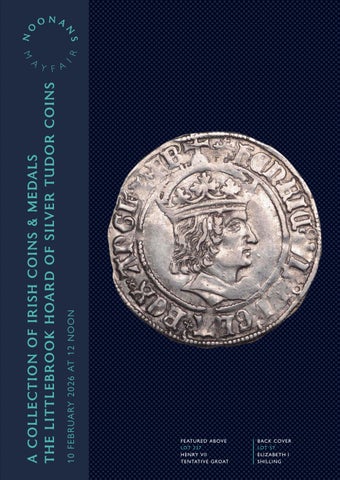
FE ATUR E D A B OVE LOT 2 3 7 HE N RY VI I TE N TATI VE G ROAT
B ACK COVER LOT 5 7 E L I Z AB E TH I SHI L L I N G
AUC TION AN AU C TION OF A COL L E C TION OF I RI SH COI N S & MEDAL S TH E L IT TL E B ROOK HOARD OF SI LVER TUDOR COIN S DATE 10 FE B RUA RY AT 12 N OON C ATA LOGUE 347 VIE WIN GS VIE WING BY AP P OIN TMENT ONLY 4–5 FE B RUA RY F ROM 10 AM –4 P M
AN N A HO PPE R S E NI O R A D M I NI S T RATO R A NNA @NO O NA N S .CO.U K T. 0 2 0 7 0 1 6 1 7 0 0 SO FI A B USACC A A D M I NI S T RATO R S O F I A @NO O NA N S .CO.U K T. 0 2 0 7 0 1 6 1 7 0 0 LO UI S O CO N N O R A D M I NI S T RATO R LO U I S @NO O NA N S .CO.U K T. 0 2 0 7 0 1 6 1 7 0 0
PU BLIC VIE WI N G 6 & 9 FE B RUA RY F RO M 10 AM –4 P M
CHR I STO PHE R M E L LO R - HI L L H E A D O F CLI E NT LI A I S O N ( A S S O C . D I RE C TO R) CH RI S TO P H E R@NO O NA N S .CO.U K T. 0 2 0 7 0 1 6 1 7 7 1
ALL APPO INTME N TS TO VIE W PLE A SE CONTAC T 020 7016 1700 OR VIE W ING@ NOON AN S .CO.UK
J A M E S C A RVE R CLI E NT LI A I S O N J B C@NO O NA N S .CO.U K T. 0 2 0 7 0 1 6 1 7 7 0
A LL LOTS A R E AVAI L AB LE TO VI E W O N LI N E WI T H FULL IL LUSTR AT I O N S AN D CO N DI T I ON REP O RT S AT W W W. NOON AN S .CO.UK
CHR I S FI N CH HAT TO N CLI E NT LI A I S O N F I NCH @NO O NA N S .CO.U K T. 0 2 0 7 0 1 6 1 7 5 4
CONTAC TS GENER AL AU C TION ENQUIRIES AUC TION S @ N OON AN S .CO.UK CO IN ENQ U IRIES COIN S@ NOONAN S .CO.UK ACCO U NT ENQUIRIES ACCOUNTS @ N OON AN S .CO.UK SHIPPING ENQUIRIE S S H IPPING@ NOON AN S .CO.UK B AN K DETAIL S B ANK ER S: L LOY D S AD D RESS: PICC ADI LLY, LO N DON SO RT CODE: 30-96-64 ACCO U NT NO.: 00622865 SWIF T CODE: LOY DGB2L IB AN: GB70LOY D30966400622865 BIC: LOYDGB21085 BOARD OF DIREC TOR S PIERC E NOO NAN CH A IR MA N A N D C EO NIM RO D D IX DE PUT Y CH A IRMAN ROBIN GR E VILL E CH IE F OPE R AT I N G O F F I C ER C HR ISTOPHER WEBB CLIE NT LIA I S O N D I REC TOR (N UMI SMAT I C S) AU C TION AND CL IENT S ERV ICE S PHILIPPA HE ALY A DMINI S TR ATI ON DI REC TOR (A SSO C . DI REC TO R) PH IL IPPA @ NOON AN S .CO.UK T. 020 7016 1775
M A X HAYD E N - C A SE LO G I S T I CS A ND FACI LI T I E S M A NAG E R M A X @NO O NA N S .CO.U K T. 0 2 0 7 0 1 6 1 7 6 1 I A N A N D E R SO N CH I E F T E CH NO LO GY O F F I CE R ( A S S O C . D I RE C TOR) I A N@NO O NA N S .CO.U K T. 0 2 0 7 0 1 6 1 7 5 1
CO I N SPE CI AL I STS CHR I STO PHE R W E B B CLI E NT LI A I S O N D I RE C TO R ( NU M I S M AT I CS ) CH RI S @NO O NA N S .CO.U K T. 0 2 0 7 0 1 6 1 8 0 1 PE TE R PR E STO N - M O R L E Y S P E CI A L P RO J E C T S D I RE C TO R ( A S S O C . D I RE C TOR) P P M @NO O NA N S .CO.U K T. 0 2 0 7 0 1 6 1 8 0 2 B R AD L E Y HO PPE R H E A D O F CO I N D E PA RT M E NT B RA D LE Y@NO O NA N S .CO.U K T. 0 2 0 7 0 1 6 1 8 0 5 J I M B ROW N CO I N S P E CI A LI S T J I M @NO O NA N S .CO.U K T. 0 2 0 7 0 1 6 1 8 0 3 O L I VE R HE PB UR N CO I N S P E CI A LI S T O LI V E RH @NO O NA N S .CO.U K T. 0 2 0 7 0 1 6 1 8 0 4 AL I CE CUL L E N CO I N S P E CI A LI S T A LI CE @NO O NA N S .CO.U K T. 0 2 0 7 0 1 6 1 8 0 6
O RDER O F SALE
A COLLECTION OF IRISH COINS AND MEDALS THE LITTLEBROOK HOARD OF SILVER TUDOR COINS TUESDAY 10 F EB RUARY AT 12 NOO N A COLLECTION OF IRISH COINS AND MEDALS, THE PROPERTY OF A GENTLEMAN THE LITTLEBROOK HOARD OF TUDOR SILVER COINS
1–196 197–396
FORTHCOMING AUCTIONS 2026 3 MARC H B R ITI SH COI N S FROM THE CO LLEC TION O F WILLIAM CL AR KE 3 MARC H E ARLY MEDIE VAL ENGLI S H COIN S FROM TH E COL L EC TIO N OF WILLIAM MACK AY: PART 1 4 MARC H COI N S & HI S TORIC AL MEDAL S 11 MARC H T H E S I L I CH COL L EC TI ON O F HI S TO R IC AL & ART MEDAL S : PART IV 7 APRIL COI N S & HI S TO R IC AL MEDAL S 22 APRIL B RI TI SH TRADE TOKEN S , TIC KE TS & PA S S ES 13 MAY A COL L EC TI ON OF ENGLI S H S ILVER CO IN S , 1272–1662: PART II A LL DATE S A RE P ROVI SI O N AL AN D DO NOT CO N S T I T U T E A F U LL LI S T I NG F O R T H E DAT E S PA N S H OW N . PL E A SE SEE W W W.N OON AN S .CO. UK F O R M O RE D E TA I L S A ND T H E L AT E S T U P DAT E S
FREE VALUATION DAYS PL E A S E S E E W W W.N OON AN S .CO.UK F O R A N U P-TO - DAT E LI S T O F DAT E S A ND V E NU E S A RO U ND THE U K PLE A S E C ALL 020 7016 1700 O R EMA I L J E WE LLE RY@NO O NA N S .CO.U K F O R A N A P P O I NT M E NT
SU M M ARY OF I NFORMATI ON FO R BUY ERS
RE GIS T E RIN G TO BID
New clients must register online to bid (whether in person or in absentia). This can be done via our website www.noonans.co.uk Registrations will be subject to due diligence and Noonans reserves the right to cancel registrations. Once registered, any client bidding for the first time online will need to enter their card details so that a security check can be performed to authorise you to bid (www.noonans.co.uk >Your Account > Account Authorisation). This check is secure, your card details are not seen by us and no funds will be deducted. BIDDING P RIORITY
Please note that we prioritise executing commission bids as early as possible in order to secure the lot for you at the cheapest possible price. It is therefore entirely possible that a lot can sell at your top bid to another bidder. To avoid this happening we offer an optional ‘Plus 1’ bidding increment facility, whereby if the bidding is against you at your maximum bid the auctioneer will execute one further bid on your behalf. Please note that in the event of identical top bids priority is given to the first bid received. P L ACIN G B IDS
LIVE BIDDING VIA WWW.NOONANS.CO.UK You may bid in real time from your computer or mobile device. We provide an optional live video and audio feed of the auctioneer, allowing you to participate in much the same way as attending the auction. You may see your invoice and pay online directly after you’ve finished bidding. There is no additional charge for this facility.
ADVANCE BIDDING VIA WWW.NOONANS.CO.UK We strongly advise this method if you wish to leave bids in advance as it is the easiest, most accurate and flexible way to leave your bids and gives you total control over them right up to the point that the lot is offered for sale. Bids made online cannot be seen by others and only become live at the point the lot is being sold. Up until this time your bids can be easily altered or cancelled. An automated email is sent to confirm any changes made. There is no additional charge for online bidding. ADVANCE BIDDING VIA POST, EMAIL OR TELEPHONE Whilst we are still happy to execute all bids submitted to us using post, email or telephone, it should be noted that all bids left with us in these ways will be entered at our offices using exactly the same bidding facility to which all our clients have access. There is, therefore, no better way of ensuring the accuracy of your advance bids than to place them yourself online. If you are registered with Noonans you may bid by email to bids@noonans.co.uk or by telephone to 020 7016 1700. All bids placed by email or telephone must be received before 4 PM on the day preceding the sale. A bidding form is included in the back of this catalogue. If you wish to use this please fill it in carefully, to include all relevant information. Please ensure that you post this form so that it arrives, at the latest, the day before the sale. BIDDING IN THE AUCTION ROOM You are very welcome to attend the auction and bid in person if you are registered with Noonans.
Please note that the auction room is situated on the third floor of a Georgian building which doesn’t have a lift. You may pay for and collect your lots during the auction.
PR I CE S R E A L I SE D
The hammer prices of lots sold at Noonans auctions are posted at www.noonans.co.uk in real time and telephone enquiries are welcome from 9 AM on the day after the auction.
S AL EROOM N OT ICE S
Should the description of a lot need to be amended after the publication of this catalogue, the amendments will appear automatically on the Noonans website, www.noonans.co.uk. All such amendments are also incorporated in the List of Saleroom Notices pertaining to this auction which are posted separately on the website. The auctioneer will refer to any notices at the time any affected lot is offered for sale. C ATALO GU E IL LUS TRAT ION S & TH E IN TER N E T
Prospective bidders are reminded that the Noonans website features high-resolution colour illustrations of every lot in this auction. There may also be additional illustrations of any lot. BUYER S ’ P REMIUM
The rate for this sale is 24% of the Hammer Price (+ VAT where applicable). IMP ORTAT ION VAT
Lots marked ‘X’ are subject to importation VAT of 5% on the Hammer Price unless re-exported outside the UK, as per Noonans Terms & Conditions of Business. From 1 January 2021 importation VAT may be levied by EU countries on lots sold by Noonans and subsequently imported into those countries. Although Noonans is unable to advise buyers on customs regulations in their country of domicile, there is further information regarding EU importation VAT rates for collectable items in the Terms and Conditions published on the Noonans website. BUL L ION LOTS
Lots marked ‘G’ will have the VAT element shown on your invoice.
PAYM E N T
You may access your invoice shortly after the hammer has fallen on your last lot. As we weigh lots at the time of cataloguing most shipping is already calculated, enabling you to settle your account and receive your lots in a timely fashion. Auction attendees may pay and collect during the course of the auction as soon as they have bid on their last lot. Full Terms and Conditions of Business are available to read in the back of this catalogue and on our website. CO N TAC TS
GENERAL SUPPORT ENQUIRIES auctions@noonans.co.uk 020 7016 1700 or from overseas (+44) 20 7016 1700 WEBSITE AND LIVE BIDDING SUPPORT ENQUIRIES Ian Anderson ian@noonans.co.uk 020 7016 1700 or from overseas (+44) 20 7016 1700
HIB ERNO-SCANDI NAV I AN
V
I K I N G links with England and Western Europe brought coin use to Dublin by the second half of the 10th century. Hoards buried in the 990s consist of post-Reform pennies of Edward the Martyr and Æthelred II. It is not surprising therefore that when the Norse King of Dublin, Sihtric II ‘Silkbeard’ Olafsson, introduced a local coinage it was closely based on the English model. This is thought to have happened in the last few years of the century, despite considerable political and military upheaval at the time. The first issues, copied from Æthelred’s CRVX and Long Cross types, were highly literate and carry the names of Sihtric or Æthelred coupled with the mint name of Dublin as well as a handful of English mints. It is believed despite appearances these were all struck in Dublin, with the English names being slavishly copied by Sihtric’s moneyers. Decades of copying took their toll and the legends became less and less comprehensible as the years
passed. Sihtric was dethroned in 1036 and around the same time, it seems, any semblance of literacy was lost. Dolley divided the coinage in seven phases and the first two (c. 997–1020 and c. 1020–35) neatly coincide with Sihtric’s reign. His successors to the Dublin Kingship unfortunately remain anonymous on the coins they authorised. Phase III (c. 1035–55) continues broadly with the previous design but struck at a lower weight standard. Weight and fineness continue to decline in the second half of the century and the types and designs are diversified - some copying English or Scandinavian types, others apparently original in their concept. This variety may suggest a loosening of Dublin’s monopoly but the identification of other mint-towns would be pure conjecture. By the turn of the 12th century coinage had all but ceased; a situation that would last for about 50 years.
A Collection of Irish Coins and Medals, the Property of a Gentleman Hiberno-Scandinavian Period
1 Sihtric, Phase I, Penny, Dublin, Fastolf, in imitation of CRVX coinage, in the name of Æthelred, draped bust left of Irish style, EDELRED REX ANG, rev. FAZTOL DINLIN, short voided cross, C R X X in angles, 1.72g/7h (SCBI BM 9-11, same dies; SCBI Copenhagen 5, same dies; SCBI Ulster 14, same dies; S 6102; DF 3). Softly struck on a broad an of excellent metal, better than very ne with goldengrey toning, very rare thus £2,000-£3,000
2 Phase II, Penny, Dublin, in imitation of Long Cross coinage, draped bust left, cross on neck and behind head, rev. long voided cross, small pellet in each angle, 1.46g/5h (SCBI BM 64-6 var.; Roth 35; S 6122 var.; DF 23). A trie crimped, otherwise good very ne, grey toned with some deposits on the reverse, the variety rare £500-£700
3 Phase III, Penny, bust left, hooked nose and wedge lips, rev. long voided cross with hand in two quarters, blundered legends, 0.91g/12h (SCBI BM 124; S 6132; DF 24). Good very ne, handsome old cabinet tone; almost invisible striking crack at 4 o’clock £400-£600
4 Phase III, Penny, bust left with hooked nose, rev. long voided cross with hand in two quarters, blundered legends, 0.66g/9h (SCBI BM 115ff; S 6132; DF 24). Good very ne, old dark tone with rich iridescent highlights; some edge loss £400-£600
All lots are illustrated on our website and are subject to extra charges which may be viewed in Ts and Cs 3, 4 and 10 at the back of this catalogue
A Collection of Irish Coins and Medals, the Property of a Gentleman
5 Phase V, Penny, Dublin, in imitation of Long Cross coinage, draped bust left, crozier before face, rev. long voided cross, pellets in two quarters, pellet-in-annulet in third, ‘comb’ in fourth, blundered legends both sides, 0.88g/6h (cf. Roth 78; SCBI BM 170-4; S 6139; DF 28). A trie double struck, otherwise very ne, toned and very rare £400-£600
6 Phase V, Penny, Dublin, in imitation of Cnut’s Quatrefoil type, very crude draped bust left (?), rev. short voided cross with pellet cross-ends within quatrefoil, pellet in each angle, blundered legends both sides, 0.91g/6h (SCBI BM –; Roth 188; S 6142A; DF 29). Clash marks, otherwise very ne, struck on excellent metal, extremely rare thus £600-£800
7 Phase VI, Penny, Dublin, in imitation of Long Cross coinage, very crude draped bust left, crozier before face, rev. long voided cross, sceptres and pellets in alternate quarters, blundered legends both sides, 0.59g/12h (cf. SCBI BM 245-6; SCBI Copenhagen 288-9; SCBI Ulster 371-4; O’Sullivan 22; cf. Roth 177; S 6187; DF 32). Pronounced rim on obverse (as is typical for this type), good very ne for issue with gunmetal grey toning, rare thus £400-£500
All lots are illustrated on our website and are subject to extra charges which may be viewed in Ts and Cs 3, 4 and 10 at the back of this catalogue
w
JO HN TO HENRY V I
H
E N RY II’s invasion of Ireland in 1171 was not only a political gamble but also a commercial venture and to facilitate trade, a functioning currency would be necessary. When he made his youngest son John Lord of Ireland in 1177, we see the establishment of a feudal coinage, not unlike that found in the Anglo-Gallic territories in France. Politically, only inferior denominations, halfpence and farthings, were acceptable and these were designed to circulate locally to meet the commercial demands of colony. John’s succession to the throne, and subsequent loss of many of his Continental territories, gave Ireland a new importance in his mind. In 1204 a mint was set up in Dublin and, with other monetary reforms carried out in England in 1205, a new Irish coinage, equal in weight and fineness to
its English counterpart, was created. The pennies would have facilitated international trade, while the round halfpence and farthings would have circulated locally. However, the Irish economy could not support such a situation and after little more than five years, local sources of bullion were exhausted and the mints closed in or soon after 1210. This unfortunate cycle was repeated twice over the next century, with subsequent recoinages in 1250 and 1280 resulting in more specie being drained from the territory’s economy, as the English monarchs exploited what wealth there was in the country for their own ends. The period from 1302 to 1450 is one of almost complete inactivity with two abortive coinages in 1339 and 1425 resulting in no more than a handful of surviving specimens - the star-marked halfpence of Edward III and the Englishstyle penny of Henry VI.
A Collection of Irish Coins and Medals, the Property of a Gentleman
John (as Lord, 1172-1199) Second coinage
8 Halfpenny, type Ia, Dublin, Roberd, RODBERD ON DVVE, legend ends DOMI, 0.71g/9h (O’Sullivan O7/R–; SCBI Ulster 55, same obv. die (?); S 6204; DF 37). Good very ne, beautiful golden-grey toning £200-£260
9 Halfpenny, type Ib, Dublin, Tomas, TOMAS ON DVVE, obv. legend ends DOM, 0.72g/3h (SCBI Belfast 117ff; S 6205; DF 39). Very ne, struck on a compact an, golden-grey toning £200-£260
10 Farthing, [Dublin], Adam, mascle with trefoil of pellets at each terminal, rev. A D A M in quarters of cross, 0.38g/12h (O'Sullivan 1; S 6220; DF 41). Very ne for issue, dark old cabinet tone, extremely rare thus £1,200-£1,500
John (as King, 1199-1216) Third coinage
11 Penny, Dublin, Roberd, ROBERD ON DIVE, 1.39g/5h (S 6228; DF 50). A hint of peripheral weakness, otherwise nearly very ne, toned £100-£120
12 Halfpenny, Limerick, Willem, WILLEM O LIME, 0.66g/9h (SCBI Ulster 402-3; S 6232; DF 51). A really bold good ne, old tone, rare thus £150-£200
Henry III (1216-1272)
13 Penny, type IIa, Dublin, Ricard, RICARD ON DIVE, cinquefoil to right of bust, 1.47g/8h (S 6240; DF 57). Some light deposits, otherwise very ne, clear portrait, dark toned £120-£150 All lots are illustrated on our website and are subject to extra charges which may be viewed in Ts and Cs 3, 4 and 10 at the back of this catalogue
A Collection of Irish Coins and Medals, the Property of a Gentleman
Edward I (1272-1307) Second coinage
14 Penny, class Ia, Dublin, trefoil of pellets below bust, 1.31g/1h (S 6246A; DF 63). Very ne, grey toned
£70-£90
15 Penny, type Ib, Waterford, trefoil of pellets on breast, 1.40g/1h (S 6249 [6254]; DF 64). Good ne, toned
£60-£80
16 Second coinage, Penny, type III, Cork, small pellet in each angle of triangle, 1.20g/6h (SCBI Ulster 528ff; S 6259; DF 67). Only ne but with grey toning over excellent surfaces, very rare thus £300-£400
17 Penny, class IVa, Dublin, single pellet below bust, large letters on rev., 1.32g/12h (S 6264; DF 68). Very ne, dark toned £80-£100
18 Halfpenny, type Ia, Dublin, trefoil of pellets on breast, nothing before EDW, 0.66g/11h (S 6250; DF 69). Nearly very ne, very rare £100-£120
19 Farthing, Dublin, type I, 0.40g/1h (S 6255 [6267]; DF 70). Very ne for issue, very rare
£100-£120
All lots are illustrated on our website and are subject to extra charges which may be viewed in Ts and Cs 3, 4 and 10 at the back of this catalogue
EDWARD I V
P
OL I T I C AL instability in England at the start of the Wars of the Roses led the Irish parliament in Dublin to pass legislation to introduce a coinage which broke with the traditions of the previous three centuries. With Richard Duke of York in Ireland planning the overthrow of Henry VI, a coinage was planned that was no longer interchangeable with its English counterpart. The coins were to be of distinctive design and with an intrinsic value less than their nominal face value. This, it was hoped, would prevent the age old problem of the wholesale export of bullion from the colony. Such a radical departure from tradition produced a series of design changes in quick succession, no less than five in a decade, and many of them innovative. Added to this, there is an issue of minor coins in base metal, farthings and halffarthings to fill the role of small change - an experiment also tried in Scotland during the same decade. The political uncertainty before Henry’s defeat at the Battle of Towton in 1461, even led to an anonymous coinage, appropriate for whoever might emerge victorious from the chaos. As befits a coinage designed for local circulation, Dublin was
soon supplemented by other mints - Drogheda, Limerick, Trim and Waterford amongst others. This solution caused its own problems, however, with a lack of direct control over the ‘branch’ mints leading to irregularities, both real and perceived. Political sensitivity and royal self-esteem led to the resumption of English types in 1465–7 and again in 1473–8 but problems with the export of these coins to England to be passed into circulation for more than they were worth meant that both attempts were short-lived. Edward’s reign closed with the attractive Suns and Roses type and this was continued under Richard III for a short time, later to be replaced by the even more distinctive Three Crowns issue. Numismatically, the first two decades of the Tudor dynasty belong in the late medieval period. The distinctively Irish Three Crowns motif is followed by more traditional English design of crowned facing head and cross and pellet reverse. However the latter are now easily distinguished from their English counterparts, being smaller, lighter and of cruder style and execution. The Waterford mint ceased striking c.1490 and Dublin closed around 1505/6.
A Collection of Irish Coins and Medals, the Property of a Gentleman
Edward IV (First reign, 1461-1470) First Crown coinage (c.1460-62)
20 Groat, Dublin, nine-arc tressure with three pellets on each cusp, nothing in spandrels, double saltires after CIVITAS and DVBLINIE, annulets in second and third quarters of rev., 2.81g/12h (Noonans 259/638, same obv. die; S 6280; DF 79). Some minor edge ling, otherwise good very ne £1,500-£1,800
Heavy Cross and Pellets coinage (c.1465-7)
21 Penny, Dublin, mm. rose (?), two pellets beneath bust (?), rev. nothing in centre. extra pellet !rst and fourth quarter, 0.47g (Burns Du-10H; S 6315B). Fair to ne £40-£60
Base issues
22 St Patrick's issue (c. 1463-5), Farthing, facing mitred bust, [PA]TRICIVS, rev. [S]A LV AT [OR]cross with suns and roses in alternating angles, sun and roses in legend, 0.74g/3h (S 6349; DF 100). Of competent style and mostly legible, good ne or better for issue, very rare thus £800-£1,000
Edward IV (Second reign, 1471-1483) Light Cross and Pellets coinage (c.1473-8)
23 Groat, Dublin, mm. rose (?) on obv., sun on rev., G on breast, no additional marks either side, 2.11g/12h (S 6366 [6330]; DF 134). Better than very ne, some toning £200-£300
All lots are illustrated on our website and are subject to extra charges which may be viewed in Ts and Cs 3, 4 and 10 at the back of this catalogue
A Collection of Irish Coins and Medals, the Property of a Gentleman
24 Groat, Drogheda, mm. pierced cross, nothing to right of crown, G on breast, double annulet after VILLA, saltire (?) after DE, annulets in !rst and fourth quarters, two additional small pellets in second and third, 2.10g/4h (S 6367E; DF 134). Good very ne, well centred and dark toned £300-£400
25 Groat, Trim, mm. cross, extra pellet in spandrels at 2, 6 (?) and 10 o’clock, double saltire after VILLA and DE, single saltire after TRIM (?), 2.02g/12h (S 6368A [6345]; DF –). About very ne, some peripheral weakness, rare £200-£260
26 Groat, Waterford, mm. quatrefoil (?) on obv., small pierced mullet on rev., G on breast, no marks by neck, saltire in two quarters of rev., double saltire after TAS, 1.86g/4h (DNW 172/32, same dies; S 6369D; DF 134). Better than very ne, patchy patina £300-£400
27 Halfgroat, Dublin, mm. pierced cross on obv. only, annulets by neck, 0.99g/12h (DNW 152/1209, same dies; S 6370A [6354). Good very ne, perfectly centred on a typically short an; an attractive and excessively rare coin £2,000-£2,600 28 Penny, Drogheda, mm. unclear, pellets by neck, rose in centre of cross, two extra pellets in third quarter, reads VILLA DROGHE (?), 0.49g (Burns Dr-7; S 6370A; DF –). Good ne for issue £80-£100
29 Penny, Trim, mm. not clear, two pellets by crown (?) [bust M], rev. nothing in centre, VIL [–––], 0.52g (Burns T-8; S 6375A). Fair to ne, rare £60-£80 All lots are illustrated on our website and are subject to extra charges which may be viewed in Ts and Cs 3, 4 and 10 at the back of this catalogue
A Collection of Irish Coins and Medals, the Property of a Gentleman
30 Issues of the Ungoverned Mints, Groat, Limerick, mm. rosette (?), L on breast, rosettes by neck, rosette replaces pellet in two alternate angles, rosette after TAS (?), 2.04g/12h (S 6380A [6343]; DF 134). Somewhat clipped, about very ne, rare £200-£300
31 Issues of the Ungoverned Mints, Penny, Waterford, mm. unclear, crosses by neck (?), quatrefoil in centre of rev., 0.45g (Burns W -19; S 6382; DF 137 var). Fair to ne, scarce £50-£70
Suns and Roses coinage (c. 1478-83)
32 Penny, Dublin (?), mm. not visible, sun and rose by crown, rose and sun by neck, rev. rose in centre, suns and roses in angles, 0.34g (Burns S-3; S 6397). Fair to ne, portrait better £50-£70
33 Penny, Dublin, mm. not visible, large rose and sun by crown, large sun and rose by neck, rev. rose in centre, suns and roses in angles, 0.64g (Burns S-4; S 6397). Fine, scarce £60-£80
Henry VII (1485-1509) Early Three Crowns coinage (c. 1485-7)
34 Groat, no mint name [Dublin], REX AGLIE FRACIE, rev. DOMINVS HYBERNIE, 1.82g/7h (S 6414; DF 183). Good ne
£100-£150
All lots are illustrated on our website and are subject to extra charges which may be viewed in Ts and Cs 3, 4 and 10 at the back of this catalogue
TUDO R
A
F TE R the Dublin mint closed c.1505, it was only reopened for three years during the whole of the rest of the century. After a hiatus of some thirty years, a new coinage was introduced for circulation in Ireland but this was struck in London. From its very inception in 1534, the Harp coinage was struck at an inferior fineness to the English coins - a fact more easily concealed by being manufactured at the Tower. It seems that Henry was using the Irish as guinea-pigs in his experiments with debasement which culminated a decade later in England with the economic crisis of the later 1540s. The royal arms on the obverse are now crowned and the distinctively Irish Three Crowns reverse is replaced by the harp, a design associated with the Gaelic High-King Brian Boru. Edward VI reopened the Dublin mint briefly in 1550–3 and struck coins of English type under the local mintmasters Thomas Agard and Martin Pirie, although these are in the name of Henry VIII and bear his portrait. Mary closed the mint again soon after her accession in 1553 and while she and her successor Elizabeth worked hard to restore the English coinage and
economy, base coins (some now only 3-ounces fine) continued to be struck in London for circulation in the colony. Issues in 1553, 1555, 1558 and 1601 followed this pattern. A brief attempt by Elizabeth to restore a better silver coinage in 1561 came to nought. To supplement these meagre issues, base coins called in in England in the 1560s were sent to Ireland for use there. Not good enough to circulate at home, they were deemed sufficient for the colony. During the second half of the century, fine English coins were imported into the country and these, without the trouble or expense of recoinage, circulated at a premium alongside the baser issues. And herein lay the answer to the problem of the Irish coinage. On his accession in 1603, James VI had ruled in Scotland for 35 years and was well aware of the problems of an unstable currency. After two short-lived attempts between 1603 and 1607 to continue with a separate currency, it became clear that a monetary union of England and Ireland (as well as Scotland) was the way ahead. Put English coins into circulation in Ireland and let them find their own face value, tariffed at a rate in keeping with the economic circumstances of the place and time.
A Collection of Irish Coins and Medals, the Property of a Gentleman
35 Halfgroat, no mint name [Dublin], REX ANGL Z FRANCIE, rosette before REX, rev. DOMI [NVS] HIBERNIE, no H below crowns, pellet terminals both sides, 0.97g/4h (S 6423; DF 184). Very ne for issue, grey toned £200-£300
Geraldine issues (summer 1487 [?])
36 Groat, without mint name [Waterford], annulet crosses, Fitzgerald arms either side of shield, without H below crowns, 1.90g/1h (S 6432; DF 186A). About very ne, some peripheral weakness, toned £200-£260
Late Portrait issues (c. 1496-1505)
37 Groat, Dublin, type I, broad facing bust within tressure, open crown, rev. POSVI... legend, 2.05g/7h (S 6451; DF 193). Struck on a broad, but somewhat irregularly shaped an, otherwise very ne, grey toned £200-£260
38 Groat, Dublin, type IA, mm. cross pattée on obv. only, bust with double-arched crown within plain tressure, rev. POSVI... legend, reads DVBIINIE, 2.00g/8h (S 6455; DF 194). Struck a little off-centre, otherwise very ne for issue £200-£260
39 Groat, Dublin, type IIC, bust with open crown within tressure, saltires on cusps, rev. POSVI... legend, 1.81g/12h (S 6460; DF 198). Fine, stress mark on reverse, some iridescent toning £150-£200
All lots are illustrated on our website and are subject to extra charges which may be viewed in Ts and Cs 3, 4 and 10 at the back of this catalogue
A Collection of Irish Coins and Medals, the Property of a Gentleman
40 Groat, Dublin, type IIC, bust with open crown within tressure, saltires on cusps, rev. POSVI... legend, 1.81g/12h (S 6460; DF 198). Fine, stress mark on reverse, some iridescent toning £150-£200
41 Groat, Dublin, type IID, open crown, no tressure, saltires by crown, reads SIVITAV VBLBLI, 1.77g/10h (DNW 194/733, same rev. die; S 6461; DF 199). Nearly very ne for issue, rare £200-£260
42 Groat, Dublin, type III, open !at crown, no tressure, rev. CIV ITA DVB LIN, 1.84g/8h (S 6464; DF 200). Nearly very ne, slightly short of an £150-£200
Henry VIII (1509-1547) First Harp issue (1534-40)
43 Groat, mm. crown, HA (Anne Boleyn [1534-5]), 2.47g/9h (S 6472; DF 201). Good ne, slight crease
£150-£200
44 Groat, mm. crown, HA (Anne Boleyn [1534-5]), 2.12g/6h (S 6472; DF 201). Nearly very ne but edge chip between 8 and 10 o’clock £100-£120 All lots are illustrated on our website and are subject to extra charges which may be viewed in Ts and Cs 3, 4 and 10 at the back of this catalogue
A Collection of Irish Coins and Medals, the Property of a Gentleman
45 Groat, mm. crown, H I (Jane Seymour [1536-7]), 2.28g/11h (S 6473; DF 202). About very ne, toned
£200-£260
46 Groats (3), all mm. crown, HI (Jane Seymour [1536-7]), 2.47g/1h; HK (Katherine Howard [1540]), 2.34g/9h; HR (Henricus Rex [1540]), 2.17g/3h (S 6473-5; DF 202-4) [3]. Fine to nearly very ne, rst chipped, second broken and repaired, third with edge repair £150-£200
Third Harp issue (1543)
47 Groat, mm. rose, HR (Henricus Rex), 2.54g/12h (S 6481; DF 209). A few minute scratches, good very ne, patchy patina £200-£260
Posthumous coinage (1547-50)
48 Sixpenny Groat, type II, Dublin, mm. boar’s head on rev. only, large bust of local style, 1.93g/4h (S 6486; DF 214). Nearly very ne for issue, good portrait, the edge a little ragged £200-£300 Provenance: Bt Spink March 1974
Edward VI (1547-1553)
49 Shilling, 1552, mm. harp, contemporary imitation in brass, so-called ‘Bungal Penny’, 4.55g/12h (S 6494A; DF 213); Details enhanced, ne £100-£120
All lots are illustrated on our website and are subject to extra charges which may be viewed in Ts and Cs 3, 4 and 10 at the back of this catalogue
A Collection of Irish Coins and Medals, the Property of a Gentleman
Mary (1553-1554)
50 Shilling, MDLIII, mm. lis, reads HIB REGINA, 5.45g/9h (S 6495; DF 224). Almost very ne for issue, some light marks as is typical, old grey cabinet tone £1,200-£1,500
Philip and Mary (1554-1558)
51 Shilling, 1555, mm. portcullis on rev. only, legend ends ANG, 7.99g/6h (S 6500; DF 232). Good ne, surface deposits, edge split and chipped £150-£200
52 Shilling, 1555, mm. portcullis on rev. only, legend ends ANG, 9.29g/11h (S 6500; DF 232). Weak at centres, otherwise fair to ne £150-£200
53 Groat, 1558, mm. rose, legend ends REGINA A, 2.86g/2h (S 6501D; DF 238). Good ne
£150-£200
Elizabeth I (1558-1603) First issue (1558)
54 Shilling, mm. rose, bust 1B, reads REG’, 8.57g/6h (S 6503; DF 241). Fine for issue, some surface roughness
£150-£200
All lots are illustrated on our website and are subject to extra charges which may be viewed in Ts and Cs 3, 4 and 10 at the back of this catalogue
A Collection of Irish Coins and Medals, the Property of a Gentleman
55 Groat, mm. rose, bust 1F, reads REGIN’, 2.90g/2h (S 6504; DF 244). Flan a little ragged, otherwise very ne for issue with traces of original lustre £200-£300
56 Groat, mm. rose, bust 1F, reads REGI’, 2.73g/12h (S 6504; DF 246); Centres weak, ne
£100-£120
Second issue (1561)
57 Shilling, 1561, mm. harp, bust 3C, reads REG, 4.76g/1h (S 6505; DF 248). A little weak on the queen’s face, otherwise better than very ne for issue, grey toned £300-£400
58 Shilling, 1561, mm. harp, bust 3C, reads REGI, 4.30g/1h (S 6505; DF 247). Good ne, scratch on obverse, peripheral toning £200-£260
59 Groat, 1561, mm. harp, bust 1G, reads RE’ and MEV, 1.48g/2h (S 6506; DF 251.). A few light marks, nearly very ne, dark toned, scarce thus £300-£400
All lots are illustrated on our website and are subject to extra charges which may be viewed in Ts and Cs 3, 4 and 10 at the back of this catalogue
A Collection of Irish Coins and Medals, the Property of a Gentleman
60 Groat, 1561, mm. harp, bust 1G, reads RE' and MEV’, 1.43g/8h (S 6506; DF 251). Good ne, toned
£150-£200
Third issue (1601-2)
61 Shilling, mm. trefoil, reads HIBER’ RE’, 5.25g/3h (S 6507; DF 252). Nearly very ne for issue, grey toned
£200-£300
Provenance: Glendining Auction, 9 November 1978, lot 243 (part)
62 Shilling, mm. trefoil, reads HIBER’ RE’, 5.55g/10h (S 6507; DF 252). Smoothed in elds, otherwise nearly very ne
£100-£150
63 Shilling, mm. martlet, reads HIBER’ RE’, 5.08g/6h (S 6507; DF 252). Good ne for issue
£120-£150
64 Sixpence, mm. trefoil, 2.93g/12h (S 6508; DF 253). Good ne, small striking cracks
£120-£150
All lots are illustrated on our website and are subject to extra charges which may be viewed in Ts and Cs 3, 4 and 10 at the back of this catalogue
A Collection of Irish Coins and Medals, the Property of a Gentleman
65 Sixpence, mm. star, reads RE’, 2.77g/7h (S 6508; DF 253). Striking weakness, nearly very ne for issue, grey toned
£150-£200
66 Threepence, mm. trefoil, legend ends RE’, 1.26g/8h (S 6509; DF 254). A really bold very ne, grey toned with some green deposit to the reverse £300-£400
67 Third issue, Penny, 1601, mm. star, reads HIBER RE, 1.72g/1h (S 6510; DF 255). Nearly very ne
£60-£80
68 Third issue, Penny, 1601, mm. star, reads HIBER RE, 1.62g/12h (S 6510; DF 255). Good ne
£40-£60
69 Third issue, Penny, 1601, mm. star, reads HIBER RE, 2.08g/1h (S 6510; DF 255). On an irregular an, good ne or better, dark patina £50-£70
70 Third issue, Penny, 1601, mm. star, reads HIBER RE, 1.17g/8h (S 6510; DF 255). About ne, the surfaces porous
£20-£30
All lots are illustrated on our website and are subject to extra charges which may be viewed in Ts and Cs 3, 4 and 10 at the back of this catalogue
A Collection of Irish Coins and Medals, the Property of a Gentleman
71 Third issue, Penny, 1601, mm. trefoil, reads HIBER RE, 1.97g/2h (S 6510; DF 255). Very ne for issue with tan patina
£80-£100
72 Third issue, Penny, 1602, mm. martlet, reads HIBER RE, 1.76g/12h (S 6510A; DF 256). About very ne for issue
£80-£100
73 Halfpenny, 1601, mm. trefoil, reads HIB RE, 0.81g/5h (S 6511; DF 257). Fine
£30-£40
James I (1603-1625) First coinage 74 Shilling, mm. bell, !rst bust, 4.04g/6h (S 6512; DF 259). Fine, some marks
£60-£80
75 Sixpence, mm. bell, !rst bust, 2.22g/12h (S 6514; DF 262). Metal aw in obverse eld, otherwise good ne, old cabinet tone £120-£150
Second coinage
76 Shilling, mm. escallop, fourth bust, 4.32g/9h (S 6516; DF 261). Good ne, light scratches in reverse eld
£100-£120
All lots are illustrated on our website and are subject to extra charges which may be viewed in Ts and Cs 3, 4 and 10 at the back of this catalogue
A Collection of Irish Coins and Medals, the Property of a Gentleman
77 Sixpence, mm. rose, !rst bust, 2.28g/2h (S 6517; DF 262). Nearly very ne, old cabinet tone 78 Sixpence, mm. martlet, !rst bust, 2.02g/5h (S 6517; DF 262). Slight creases, ne
£150-£200 £60-£80
Charles I (1625-1649) Ormonde Money
79 Crown, small lozenge stop and four pellets between C R, 28.45g/6h (S 6544; DF 288). Good ne, surface staining and some scratches £400-£600 Provenance: Bt Spink October 1993
80 Halfcrown, 13.94g/12h (Bull 9; S 6545; DF 293). Good ne for issue, toned
£400-£500
81 Shilling, 5.85g/9h (S 6546; DF 297). Very ne for issue, toned
£400-£500
82 Sixpence, pellet between C R (?), large mark of value, 2.89g/10h (S 6547; DF 302). Good ne for issue, old tone
£200-£260
All lots are illustrated on our website and are subject to extra charges which may be viewed in Ts and Cs 3, 4 and 10 at the back of this catalogue
A Collection of Irish Coins and Medals, the Property of a Gentleman
83 Groat, thick numeral and large D on rev., 1.80g/6h (S 6548; DF 303). Good ne for issue, light grey tone
£150-£200
84 Groat, 1.30g/12h (S 6548; DF 303). Flan made square and a little crimped, good ne
£80-£100
85 Threepence, squat numeral on rev., 1.49g/11h (S 6549; DF 306). Good ne, peripheral small green deposits
£150-£200
Confederate Catholics issues
86 Kilkenny, Halfpenny, mm. harp, 3.94g/4h (S 6555; DF 263). Usual striking weakness, good ne, rare
£150-£200
Charles II (1649-1685) St. Patrick’s coinage
87 Halfpenny, large letters, 9.27g/12h (Vlack/Martin 1-A; Whitman 11540; Breen 204; S 6567). Brass plug, fair, rare
£200-£300
88 Farthing, 6.11g/12h (Whitman 11500; Breen 208; S 6569). Brass plug, much surface pitting, ne
£200-£300
All lots are illustrated on our website and are subject to extra charges which may be viewed in Ts and Cs 3, 4 and 10 at the back of this catalogue
A Collection of Irish Coins and Medals, the Property of a Gentleman
89 Farthing, 5.39g/12h (Whitman 11500; Breen 208; S 6569). Heavy scratching with a large plug gap on reverse, fair
£100-£120
Regal coinage (1680-1684)
90 Halfpenny, 1680 (DF 351; S 6574). Dark patina, good ne
£70-£90
91 Halfpenny, 1681, large letters (DF 353; S 6574). Very ne
£100-£120
92 Halfpenny, 1682, small letters (DF 355; S 6575). Dark patina, ne
93 Halfpenny, 1683, small letters (DF 356; S 6575). Chocolate brown patina, very ne 94 Halfpenny, 1684 (DF 359; S 6575). Lacquered, otherwise good ne
£70-£90
£120-£150 £50-£70
All lots are illustrated on our website and are subject to extra charges which may be viewed in Ts and Cs 3, 4 and 10 at the back of this catalogue
A Collection of Irish Coins and Medals, the Property of a Gentleman
James II (1685-1691) Regular coinage
95 Halfpenny, 1685 (DF 361; S 6576). Very ne
£100-£120
96 Halfpenny, 1686 (DF 363; S 6576). Dark patina, very ne
£120-£150
97 Halfpenny, 1688 (DF 365; S 6576). Fine
£40-£50
Gunmoney coinage
98 Crown, 1690, rev. reads VICT ORE., stop after TRIVMPHO, 17.02g/5h (Withers 11/12; S 6578). Dark patina, good ne
99 Crown, 1690, rev. reads VICT ORE., 12.72g/7h (Withers -/-; S 6577). Undertype clearly visible with designs overlapping, ne
£100-£120
£50-£70
100 Crown, 1690, rev. reads VICT ORE., stop after TRIVMPHO, 11.95g/12h (Withers 9/10; S 6577). Undertype clearly visible, good ne £70-£90 101 Crown, 1690, rev. reads VICTO RE., no stop after TRIVMPHO, 13.25g/4h (Withers 50/53; S 6578A). Traces of undertype, ne
£50-£70
All lots are illustrated on our website and are subject to extra charges which may be viewed in Ts and Cs 3, 4 and 10 at the back of this catalogue
A Collection of Irish Coins and Medals, the Property of a Gentleman
102 Crown, 1690, stop after TRIVMPHO, 14.80g/1h (Withers -/-; S 6578). Undertype clearly visible, good ne
£70-£90
103 Crown, 1690, rev. reads VICT ORE., no stop after TRIVMPHO, 14.11g/1h (Withers 39/40; S 6578). Undertype partially visible on reverse, very ne £100-£120
104 Halfcrown, 1689 Sepr:, 12.67g/12h (Withers 30/30; S 6579D). Good ne
£100-£120
105 Halfcrown, 1690 Apr:, 14.95g/12h (Withers Mar2/Apr10; S 6579N). Coppery patina, very ne
£100-£120
106 Halfcrown, 1690 May:, 16.66g/6h (Withers 16/4; S 6579O). A pleasing example for issue with much original colour, good very ne, scarce £300-£400 107 Halfcrown, 1690 May, 9.46g/12h (Withers 8/8; S 6580B). Fine
£40-£50
108 Halfcrown, 1690 May., reads FR.A in rev. legend, 11.19g/12h (Withers 36/42; S 6580B). Dark patina, very ne
£50-£70
All lots are illustrated on our website and are subject to extra charges which may be viewed in Ts and Cs 3, 4 and 10 at the back of this catalogue
A Collection of Irish Coins and Medals, the Property of a Gentleman
109 Halfcrown, 1690 May, large G in MAG, 8.84g/12h (Withers 21/22; S 6580B). Some original colour, good very ne
£100-£120
110 Halfcrown, 1690, large 0 in date, 11.18g/1h (Withers 1/2; S 6580D). Fine
£40-£50
111 Shilling, 1689 Aug t, 7.32g/12h (Withers 25/25; S 6581C). Very ne
£50-£70
112 Shilling, 1689 Dec:, 5.34g/12h (Withers Nov2/Dec30; S 3581K). Some obverse pitting, very ne
£50-£70
113 Shilling, 1689 rJO, 4.70g/12h (Withers 45/47; S 6581L). Dark patina, ne
£40-£50
114 Shilling, 1689 Jan:, 6.02g/12h (Withers 12/13; S 6581M). Some obverse pitting, good ne
£60-£80
115 Shilling, 1689 Mar, 6.56g/6h (Withers 8/7; S 6581O). Attractive brown patina, good very ne 116 Shilling, 1690 Apr., 5.33g/12h (Withers 1/2; S 6581Q). Dark patina, good ne
£100-£120 £50-£70
117 Sixpence, 1689 July., stop after mark of value, 3.72g/12h (Withers 22/23; S 6583B). Brown patina, good very ne or better £120-£150 118 Sixpence, 1689 Dec., 3.13g/12h (Withers dies 6/5; S 6583G). Some pitting on obverse bust, sometime cleaned, very ne
£60-£80
All lots are illustrated on our website and are subject to extra charges which may be viewed in Ts and Cs 3, 4 and 10 at the back of this catalogue
A Collection of Irish Coins and Medals, the Property of a Gentleman Pewter coinage
119 Halfpenny, 1690, type II, 4.51g/11h (DF 485; S 6592). Brass plug with some corrosion to top of obverse, otherwise good ne, very rare £200-£300
Limerick coinage
120 Halfpenny, 1691, 6.82g/12h (S 6594). Almost extremely ne [Graded by PCGS as AU 55]
£300-£400
121 Halfpenny, 1691, reversed N in HIBERNIA, 6.46g/12h (Withers dies 21/23; S 6594). Fine, reverse better; clear signs of overstriking £90-£120
122 Farthing, 1691, reversed N in HIBERNIA, stops by date, 5.54g/12h (S 6595). About very ne, brown patina
£120-£150
123 Farthing, 1691, reversed N and unbarred A in HIBERNIA, stops by date, 5.04g/12h (S 6595). Brown patina, very ne
£100-£120
All lots are illustrated on our website and are subject to extra charges which may be viewed in Ts and Cs 3, 4 and 10 at the back of this catalogue
A Collection of Irish Coins and Medals, the Property of a Gentleman
William and Mary (1691-1694)
124 Halfpenny, 1692 (DF 494; S 6597). Dark patina, very ne
£100-£120
125 Halfpenny, 1692 (DF 494; S 6597). About very ne, even patina
£50-£70
126 Halfpenny, 1693 (DF 496; S 6597). Good ne
£50-£70
127 Halfpenny, 1694 (DF 497; S 6597). Dark patina, ne
£50-£70
128 Halfpenny, 1694 (DF 497; S 6597). Some pitting on obverse busts, ne
£50-£70
William III (1694-1702)
129 Halfpenny, 1696, type I (DF 498; S 6598). Surface pitting, good ne
£70-£90
130 Halfpenny, 1696, type II, reads GRAIIA (DF 502; S 6599). Fair, very rare
£100-£120
George I (1714-1727) Wood’s coinage
131 Halfpenny, 1722 (Martin 4.32/Bc.1; S 6601). Brown patina, very ne
£70-£90
All lots are illustrated on our website and are subject to extra charges which may be viewed in Ts and Cs 3, 4 and 10 at the back of this catalogue
A Collection of Irish Coins and Medals, the Property of a Gentleman
132 Halfpenny, 1723 (Martin 4.18/Gc.3; S 6601). Dark patina with some roughness, about very ne
£70-£90
133 Halfpenny, 1723 (Martin 4.27/Gc.3; S 6601). Good ne
£50-£70
134 Halfpenny, 1723 (Martin 4.36/Gb.5; S 6601). Brown patina, very ne, reverse better
£100-£120
135 Farthing, 1723, type 3 (Martin 2.1/BC2; S 6604). Better than very ne
£100-£120
136 Farthing, 1723, type 3 (Martin 2.1/BC4; S 6604). Area of smoothing on neck, otherwise almost extremely ne, attractive patina £120-£150
George II (1727-1760)
137 Proof Halfpenny, 1736, 8.22g/6h (S 6605). Practically as struck, attractively toned; a most handsome coin [Graded by PCGS as PR 64] £400-£500 All lots are illustrated on our website and are subject to extra charges which may be viewed in Ts and Cs 3, 4 and 10 at the back of this catalogue
A Collection of Irish Coins and Medals, the Property of a Gentleman 138 Halfpenny, 1741 (S 6606). Dark patina, very ne
£50-£70
139 Halfpenny, 1744/3 (S 6606). Fair, the overdate very rare
£40-£50
140 Halfpenny, 1746 (S 6606). Possibly once mounted, otherwise good very ne
£50-£70
141 Halfpenny, 1752 (S 6607). Toned, very ne
£70-£90
142 Halfpenny, 1752 (S 6607). Chocolate-brown patina, very ne or a little better
£50-£70
143 Halfpenny, 1760 (S 6610). Even brown patina, about extremely ne
£100-£120
144 Farthing, 1738 (DF 560; S 6608). Brown patina, good very ne or a little better
£100-£120
145 Farthing, 1744 (DF 561; S 6609). Good ne
146 Farthing, 1760 (DF 563; S 6611). Even grey-brown patina, extremely ne
£20-£30
£100-£120
147 Farthing, 1760 (DF 563; S 6611). Good very ne
£70-£90
148 Farthing, 1760 (DF 563; S 6611). Very ne
£50-£70
149 Farthing, 1760 (DF 563; S 6611). About very ne
£40-£50
All lots are illustrated on our website and are subject to extra charges which may be viewed in Ts and Cs 3, 4 and 10 at the back of this catalogue
A Collection of Irish Coins and Medals, the Property of a Gentleman
George III (1760-1820) Voce Populi coinage
150 Halfpenny, 1760, type 5, square head, 6.30g/5h (Zelinka 6-C; Nelson 9; DF 571). Dark patina, good ne
£120-£150
151 Halfpenny, 1760, type 8, reads VOOE, 6.21g/6h (Zelinka 7-E; Nelson 3; DF 574). Very ne
£100-£120
152 Halfpenny, 1760, type 9, P before bust, 6.46g/6h (Zelinka 15-N; Nelson 12; DF 576). Small nick below bust, otherwise good very ne for issue £100-£120
153 Halfpenny, 1760, type 9, P below bust, 8.33g/6h (Zelinka 16-O; Nelson 11; DF 577). Good ne
£100-£120
London coinage
154 Halfpenny, 1766 (S 6612). Prettily toned with a reective brown patina, good extremely ne
£200-£300
All lots are illustrated on our website and are subject to extra charges which may be viewed in Ts and Cs 3, 4 and 10 at the back of this catalogue
A Collection of Irish Coins and Medals, the Property of a Gentleman
155 Halfpenny, 1769, type I (S 6612). Good very ne
£70-£90
156 Proof Halfpenny, 1775, edge plain, struck on a think !an, 10.73g/12h (S 6614). Practically as struck, beautiful chocolate brown patina, extremely rare thus [Graded by PCGS PR 65 Brown] £900-£1,200 157 Halfpenny, 1782 (S 6614). Toned, very ne, reverse better
£50-£70
Bank of Ireland coinage
158 Six Shillings, 1804, leaf to centre of E in DEI, stop after REX, punctuation in C H K (S 6615). Toned, very ne
£100-£120
159 Thirty Pence, 1808, Ten Pence, 1813, Five Pence, 1805 (S 6616A, 6618, 6619) [3]. Fair to very ne
£70-£90
160 Ten Pence, 1805 (S 6617). Toned with much original lustre, extremely ne
£70-£90
161 Proof Ten Pence, 1813, type II, edge plain, 3.58g/12h (DF 625; S 6618). Lightly cleaned, otherwise extremely ne, very rare £150-£200 All lots are illustrated on our website and are subject to extra charges which may be viewed in Ts and Cs 3, 4 and 10 at the back of this catalogue
A Collection of Irish Coins and Medals, the Property of a Gentleman
162 Five Pence, 1805 (S 6619). Prettily toned and lustrous, extremely ne
£70-£90
Soho coinage
163 Penny, 1805 (S 6620). Good very ne or a little better
£70-£90
164 Penny, 1805 (S 6620). Chocolate-brown patina, extremely ne
£100-£120
165 Proof Halfpenny, 1805 (S 6621). Good extremely ne, much original colour [Graded by PCGS as PR 63]
£80-£100
166 Halfpenny, 1805 (S 6621). Toned, good very ne
£50-£70
167 Proof Farthing, 1806/5, in gilt-copper, edge centre-grained, 4.37g/6h (S 6622). Some light hairlines and clouding in elds, otherwise good extremely ne £120-£150
All lots are illustrated on our website and are subject to extra charges which may be viewed in Ts and Cs 3, 4 and 10 at the back of this catalogue
A Collection of Irish Coins and Medals, the Property of a Gentleman
George IV (1820-1830)
168 Penny, 1822 (S 6623). Toned with some original colour, about extremely ne
£100-£120
169 Proof Penny, 1823, 17.05g/1h (S 6623). Prettily toned, good extremely ne, very rare
£300-£400
170 Halfpenny, 1822 (S 6624). Prettily toned with a red patina, about extremely ne
£100-£120
171 Halfpenny, 1822 (S 6624). A really good very ne
£70-£90
172 Halfpenny, 1823 (S 6624). Prettily toned, about extremely ne
£70-£90
All lots are illustrated on our website and are subject to extra charges which may be viewed in Ts and Cs 3, 4 and 10 at the back of this catalogue
A Collection of Irish Coins and Medals, the Property of a Gentleman
Eire (1937-
)
173 Ten Shillings (6), all 1966, Proof (4), currency (2), 50th Anniversary of the Easter Rising (KM 18; S 6646) [6]. All prettily toned, good extremely ne £100-£120
Tokens 174 Unlocalised issue, Penny Token, 1818, second 1 in date struck over 2, 15.21g/6h (W 1915). Some digs, otherwise good ne £20-£30
Group Lots 175 William III, Halfpence (3), all 1696, type I (DF 498; S 6598) [3]. Fair to ne
£50-£70
176 George II, Halfpence (4), 1737, 1741, 1742 (2) (S 6605-6) [4]. Fair to good ne
£70-£90
177 George II, Halfpence (4), 1743, 1747, 1749 (2) (S 6606) [4]. Fair to good ne
£70-£90
178 George II, Halfpence (5), 1750, 1751 (2), 1753, 1760 (S 6606, 6610) [5]. Fine to very ne
£100-£120
179 George III, Halfpennies (2), 1781, 1782 (DF 587, 588; S 6614) [2]. Very ne or better
£40-£50
180 George III, Farthings (2), both 1806 (S 6622). Both toned, good very ne to extremely ne
£50-£70
Medallions
181 Orange Association, 1690 [struck c. 1800], a bronze medal by W. Mossop, William III on horseback left, rev. royal arms and supporters, 43mm (W 1998; D & W 172/545). A few triing marks, otherwise extremely ne, brown patina [Graded by PCGS as MS 63] £100-£150
182 Irish Surplus Dispute, 1755, a copper medal by J. Roche, crown Irish harp dividing date below, rev. Earl of Kildare standing with sword, fending off hand from grabbing money off table, 36mm (E 650). Very ne for type, rare £100-£120
All lots are illustrated on our website and are subject to extra charges which may be viewed in Ts and Cs 3, 4 and 10 at the back of this catalogue
A Collection of Irish Coins and Medals, the Property of a Gentleman
183 Royal Irish Academy, 1786, a copper medal by W. Mossop, uniformed bust of the Earl of Charlemont left, rev. !gure of Art seated left holding Irish shield, attributes of scholarship and liberty at her feet, 53mm (BHM 267; E 819; Frazer 1887/449). Extremely ne and very rare £400-£600
184 Opening of Armagh Observatory, 1789, a bronze medal by W. Mossop, bust of Baron Rokeby right, rev. frontal elevation of the observatory, 53mm (BHM 330; E 830). About extremely ne, scarce £100-£150
185 Apprentice Boys of Derry Club (Founded 1814), a silver medal by W.S. Mossop, bust of George Walker almost facing, rev. the gates of Derry with the attackers repulsed, 41mm, 29.85g (BHM 855; E 1060). Pierced for suspension as usual, nearly extremely ne £200-£300
186 Election of Richard Talbot, 1820, a copper medal by W.S. Mossop Jr, draped bust right, rev. legend and date in seven lines, 43mm (BHM 1052; E 1128; Frazer p.463). Good very ne £100-£150
187 Death of Henry Grattan, 1820, a copper medal by W.S. Mossop, bust right, rev. legend of six lines within wreath, 41mm (BHM 1044). Nearly extremely ne £80-£100
All lots are illustrated on our website and are subject to extra charges which may be viewed in Ts and Cs 3, 4 and 10 at the back of this catalogue
A Collection of Irish Coins and Medals, the Property of a Gentleman
188 Visit of Prince of Wales to Ireland, 1868, a copper medal by F.H. Mares, bust right, rev. Irish harp on shield within collar of the Order of St Patrick, Prince of Wales’ feathers behind, 51mm (W & E 1095A.2; BHM 2882; E 1596). Extremely ne £100-£150
189 Exhibition of Irish Art and Manufactures, Dublin, 1882, a white metal medal by J. Woodhouse, aerial view of the Exhibition site in Parnell Square, rev. !gures representing Labour surrounded by symbols of industry and commerce, 39mm. Nearly extremely ne, seemingly very rare £50-£70
190 Ulster Unionist Convention, 1892, a bronze medal by Gibson & Co., Hibernia standing, lion behind, rev. three shields of arms, crown above, 38mm (BHM 3433). Extremely ne £30-£40
191 Ulster Unionist Convention, 1892, a gilt-bronze medal by Gibson & Co., Hibernia standing, lion behind, rev. three shields of arms, crown above, 38mm (BHM 3433). Extremely ne £40-£60
192 Victoria, Visit to Ireland, 1900, a white metal medal by F. Bowcher for Spink, bust left, rev. crowned harp on wreath, 37mm (W & E 1893; BHM 3662; E 1840). Pierced for suspension, with bar and ribbon, nearly extremely ne £30-£40
193 Opening of the Northern Irish Parliament, 1921, a bronze medalet, unsigned, crowned arms in wreath, rev. legend within hexafoil, 32mm. Looped at 12 o’clock for suspension, extremely ne £30-£40
All lots are illustrated on our website and are subject to extra charges which may be viewed in Ts and Cs 3, 4 and 10 at the back of this catalogue
A Collection of Irish Coins and Medals, the Property of a Gentleman
194 Ireland’s Accession to the European Communities, 1973, a silver medal, by J.M. & Co. after G. A. Hayes-McCoy, wild geese !ying left, rev. Celtic cross with Irish provincial shields of arms in quarters, 38mm, 31.44g. Prettily toned, practically as struck £50-£70
195 Death of Eamon de Valera, 1975, a silver medal by Spink, bust three-quarters left, rev. Ogham stone centre, legend in Irish surrounding, 38mm, 31.17g (Went 159; E 2133). Toned, good extremely ne, rare £50-£70
196 MASONIC, Bicentenary of the Grand Lodge of Ireland, 1925, arms of the 7th Earl of Donoughmore !anked by griffin supporters, rev. masonic arms !anked by angels, edge named (Henry E Bennett S of C Lodge 93), 32mm, 15.50g. With suspension ring and loop, extremely ne, rare £50-£70 The Grand Lodge of Ireland, founded in Dublin in 1725, is the second-oldest masonic lodge in the world.
All lots are illustrated on our website and are subject to extra charges which may be viewed in Ts and Cs 3, 4 and 10 at the back of this catalogue
FO REWORD
T H E L I TTLEB ROOK H OAR D
T
he Littlebrook Hoard was discovered on 12 May 2004 during excavations for the foundations of a new extension to Littlebrook Farm in Belchalwell Street, Dorset. The farmhouse is a grade 2 listed dwelling and is said to date from the early seventeenth century although evidence has shown that a dwelling or buildings certainly pre-dated that period. The current owners gained permission to extend the building, with early photographs in their possession confirming that the new build would, in fact, replace a previously destroyed structure. The removal of a concrete area, then used for car parking, revealed a terracotta tiled floor, these tiles being carefully removed for use elsewhere. When work on the new foundations began, the mechanical digger unearthed a pottery jug which was found to contain 213 silver coins, 176 groats and 37 half groats in varying condition, the bulk dating from the reign of Henry VII (1485–1509). As required, the find was reported and submitted to the British Museum and the coins were examined
and catalogued by Dr Barrie Cook, the Curator of Medieval Coins. An inquest was held in Dorchester in March 2005 and the find was confirmed as Treasure Trove and thus subject to the relevant legal rules. The coins are all English silver issues and of the official sterling silver standard. The fact that the coins were discovered in a container is clear evidence that they were deposited on a single occasion and they represent a selected body of higher value silver coins from the currency of the early sixteenth century, before the new weight standard of 1526 was introduced. The earliest coin recorded was a half groat from the reign of Edward III, dated c. 1351–2, and the latest a half groat issued from York after Wolsey was appointed bishop in 1514. The coins are thought to have been deposited probably c. 1514–1520. The reasons for their deposit are not known. Littlebrook Farm lies in an isolated area of the Blackmore Vale, a mile from the nearest hamlet and about 14 miles from Dorchester. The area is known to be on the regular
smuggling routes from the coastal areas of Portland to centres such as Salisbury and Bristol which could be an explanation for the hoard’s deposit. The pottery jug, which unfortunately was broken during the lifting, is of simple design with a crimped edge and was confirmed by the Museum as dating from the late fifteenth century and originating from the Ruhr area of Germany. In accordance with the rules relating to Treasure the hoard was offered to local museums and the jug and thirteen of the coins were removed and are now the property of the Dorset County Museum. After discussion and settlement with the finders, the current owners decided to retain the remaining 200 coins but have now decided to offer them for sale on the open market with full provenance. Most British medieval coin hoards tend to contain only the larger denominations in circulation, the smaller coins being deliberately excluded by the saver. These are referred to as ‘savings hoards’. On the other hand, deposits of the contents of a purse or pocket will contain the small denomination coins which circulated on a daily basis - these are often called ‘circulation hoards’ or ‘purse finds’. Numismatically, the present savings hoard represents a typical selection of coinage of the period and seems to be an amalgam of two distinct groups - the figures given below are based on the 200 coins offered for sale in this catalogue (the 13 coins retained by the Dorset Museum do not materially affect the overview of the contents or the conclusions drawn). The earlier group comprises 12 coins struck between 1465 and 1478 [lots 197-208]. These pieces, whilst not being in as good condition as the later coins, do not exhibit sufficient wear to have been in continuous circulation for the best part of fifty years and appear to have been set aside some years before the final deposit. The balance of 188 pieces dates from c. 1498-1515 [lots 209-396]. There are only two coins (both retained by the Dorset Museum) coins which were issued during the intervening 20 years or so. While it is not surprising that the rare issues of Richard III are not present, the dearth of the earlier types of Henry VII (Potter & Winstanley I, II, IIIa and IIIb) is a little puzzling and probably points to the deposit being from two discrete sources.
The chronology and dating of the issues of Henry VII have still not been fully agreed among numismatists but the present hoard fits within the parameters of what is currently accepted. The bulk of the coins in the hoard were struck during the course of the cross-crosslet and pheon mintmarks. The former, introduced in the spring of 1504, marks the transition from facing to profile bust type - a complex sequence of issues, some experimental, including facing bust, tentative and regular profile coins spanning a busy 18 month period during 1504–05. As the new design became established, the mark was changed to pheon and coins of this type were issued until the end of the reign (and a few months into the following); surviving records show large quantities of silver were processed during this period. In the new reign, the ratio of coins of different mintmarks and their overall relatively unworn condition suggests the hoard was deposited no later than c. 1520. Among the Henry VII highlights in the hoard are a rare and attractive crowned leopard’s head facing bust groat [lot 212], three tentative issue groats [lots 237-9], two rare regular profile groats with double mintmark on reverse [lots 261-2], and an apparently unrecorded martlet/rose halfgroat of Abp. Bainbridge of York [lot 365]. In the following reign, there are four rare groats with mm. pheon, one with the Kings’s numeral altered from VII to VIII [lots 366-9], a groat with mm. portcullis over crowned T, reusing an obverse die originally cut for the coinage of Tournai in the late spring of 1514 [lot 396] and a mm. castle Groat with the highly unusual reading AGLIE [lot 373].
The area where the hoard was found is the concrete pad at the end of the farmhouse
I NTRO DUCTI ON
TH E CROSS- C ROSSL ET TE N TAT IVE GROAT S
T
he presence of three tentative Groats in the Littlebrook hoard invites us to reconsider this experimental phase of Henry VII’s coinage. In their definitive BNJ article Potter and Winstanley discussed the early Tentative groats (unmarked, mm. lis and mm. greyhound’s head) in great detail, but neglected to treat the crosscrosslet coins in the same manner. Presented here are some preliminary observations of the crosscrosslet coins; offered, we hope, in advance of a more comprehensive study. The following comments are based on a sample of 109 coins, struck from 29 obverse dies. In the language of die studies, the sample provides a good coverage of the obverse dies originally employed; it is probable that only a few of the obverse dies originally employed are unrecorded here. In the list below we give in square brackets two figures for each obverse die; the number of observed specimens to have been struck by that particular obverse die, followed by the number of different reverse dies employed in the striking of these coins. Generally, the number of different reverse dies is close to the number of overall specimens, and reverse die links are uncommon. Thus, the coverage of the reverse dies is poor and our current knowledge of must be considered incomplete. For this reason the discussion below will focus almost entirely on the obverse dies.
groats of mm. greyhound’s head. One peculiarity here is the die sinker’s tendency to leave a small gap between the front of the king’s neck and the tunic. On all of these obverse dies the crown is adorned with six uprights, as opposed to the crockets. With respect to the legend, ANGLIE is abbreviated to either ANGL or AGLI, whereas in subgroups 2 and 3 AGL is largely preferred. The font used is Potter and Winstanley’s G3b, characterised by the use of an F with a long front bar. In general, the Tentative groats (of all mint-marks) show a considerable degree of variation of design and legend, which is typical of an experimental coinage. The homogeneity seen in this first group reflects the production of dies in batches during this period. Contemporary sources make references to the sinking of dies by the ‘dozen’, comprising four obverse and eight reverse dies. Dies 1-4 almost certainly represent one such batch, sunk on a single occasion by an engraver using the same puncheons and with singular intentions as to the layout of the coin and the arrangement of the various ornaments.
It is convenient to divide the cross-crosslet tentative groats into three subgroups, each defined by minor variations in the legend and design. These groups are discussed here sequentially, and it is possible that they represented distinct chronological phases of the coinage. The current paucity of reverse die links prevents certainty on this point.
Obverse dies 5 and 6 show minor variation in the king’s hair, which is augmented by several additional curls at the back of the neck in an attempt to give the hair a fuller appearance. The experiment was an unsuccessful one and was soon abandoned. These same dies are more remarkable for the reverse dies with which they were paired. As was noted above, very few reverse die links have been noted across the cross-crosslet Tentative coinage. Obverse dies 5 and 6 provide the exceptions to this rule. All three reverse dies employed with obverse 5 were were also paired with either obverse 2 or 4. Likewise, both reverse dies paired with obverse 6 were also employed with obverse 1.
Of the three subgroups the first is both the smallest and the most homogeneous in nature. The portraits on these dies are tall, elegant and quite similar to those which appear on the preceding Tentative
The second subgroup of obverse dies is more difficult to define, and in a real sense the material gathered here simply reflects those coins which do not easily fit into groups 1 or 3. Nonetheless, there
are some common characteristics which we might identify. All of the obverse dies listed here have crowns marked with crockets, as opposed to the uprights employed in the previous phase; all (with one notable exception) make use of the abbreviation ‘AGL’, and all (again, with one exception) use the lettering 3Ga. We begin with the two famous obverse dies on which a fleured tressure has been placed around the king’s face. Die 7 is, excepting this remarkable feature, quite similar to the other obverse dies in group 2. The presence of the tressure has necessitated an alteration to the king’s hair, which is now laid a little closer to the face and is thus less full around the nape. Die 8 has a similar portrait but an anomalous legend, reminiscent of those employed for the contemporary facing bust coins (see lot 229 in Littlebrook). Dies 9 to 12 are again quite homogenous in nature, and probably represent another batch of irons, engraved on a single occasion by a single hand. Compared to the dies of group 1, the neck is a little shorter and better fitted into the tunic. Like the tressured coins, the hair lies closer to the back of the head. Dies 13 to 15 are superficially similar to one another, but probably do not represent a single batch of dies for there is a little too much variation in their appearance. The hair on die 15 is different to that seen elsewhere, with more numerous fine curls. Dies 16 and 17 are very close in appearance and clearly contemporaneous; they show further signs of experimentation in regards to the bust. Here, the face has been angled upwards slightly, promoting the king’s chin and jaw, while the hair has been tilted in
the opposite direction so that the bottom curls are now further from the neck. On dies 19 and 20 this effect is exaggerated further still, resulting in an even lower, broader head. Obverse 21 is in many ways anomalous and is assigned here tentatively. The portrait is rather low, like the others of this group, and the crown adorned with crockets. However, the lettering is not 3Ga. The F has a long, broad front (it is possible that the puncheon used here is different to that applied on dies 1-6). The last subgroup of cross-crosslet obverse dies is characterised by a change in the form of the letter D (and C, for the same puncheon was used for both letters). The new letter does not occur on the facing bust coins of this mint mark but is to be found on the regular cross-crosslet profile groats. It is blockier than that previously used, has a more distinctly pointed back and less pronounced serifs. The space at the centre of the letter is rectangular in shape with sharp corners, and it is this feature which aids the most in its identification. The appearance of this letter appears to confirm that the tentative issue continued beyond the currency of the facing bust issue. Dies 22-24 continue the same low broad face mentioned above, whereas dies 25-27 revert back to the tall elegant bust seen in group 1. Indeed, die 25 is remarkably close in appearance to die 4, in respect not only to the construction of the bust but also the legend and its punctuation. It is only the use of crockets on the crown and the late, rectangularcentred D which reveal that these dies were created on separate occasions.
Subgroup 1. Lettering G3b, six uprights to crown 1. angl * z * f – SNG Ashmolean 775 [5, 3]. 2. angl * z * fr – Littlebrook Hoard 41 [7, 5]. 3. agli * z * f – Spink Auction 17011/1540 (part) [1, 1]. 4. agli * z * f* – Littlebrook Hoard 26 [5, 5] 5. angl * z * f – SNG Ashmolean 774 [4, 3]. 6. agli * z * f – Noonans 288/134 [3, 2]. Subgroup 2. Lettering G3a, six crockets to crown 7. agl * z * fr – Lockett 1724 [3, 2]. 8. angl * z * fra – British Museum [1, 1]. 9. agl * z * f – Littlebrook Hoard 42 [12, 8]. 10. agl * z * f – Noonans 337/1159 [4, 4]. 11. agl * z * f – BM 1966,0603.588 [2, 2]. 12. agl * z * f – double saltire stops - Lockett 1725 [2, 2]. 13. agl * z * f * – Ashmolean 784 [1, 1]. 14. agl * z * f * – Carlyon-Britton 52 [1, 1]. 15. agl * z * f * – Ashmolean 778 [3, 2]. 16. agl * z * f * – Ashmolean 783, 809 [7, 4]. 17. agl * z * f * – Noonans 314/168 [2, 2]. 18. agl * z * fr – Shuttlewood 78 [3, 2]. 19. agl * z * fr * – Ashmolean 786 [2, 2]. 20. agl * z * f * – Ashmolean 782 [1, 1]. 21. agl * z * f – F3? – Ashmolean 785 [2, 2]. Subgroup 3. Letter G3a, rectangular-centred D, six crockets to crown 22. agl * z * fr – Ashmolean 787 [3, 1]. 23. agl * z * fr – Ashmolean 788 [14, 10]. 24. agl * z * f* – Lockett 1727 [2, 2]. 25. agli * z * f* – Lockett 1726 [3, 3]. 26. agl * z * f – Noonans 106/331 [3, 2]. 27. agl * z * f* – Ashmolean 780, 781 [5, 4] 28. agl * z * f* – Noonans 168/832 [3, 2]. 29. agl * z * f: – Carlyon-Britton 53 [6, 5].
The Littlebrook Hoard of Tudor Silver Coins Edward IV (First reign, 1461-1470)
197 Groat, London, class Vd, mm. rose, quatrefoils by neck, !eurs on cusps and on breast, saltire stops, reads FRANC, extra pellet below CIVI., 3.06g/9h (LH 13; B & W Vd2, 1; N 1568; S 2000). About very ne with an attractive portrait £120-£150
198 Groat, London, class Vd, mm. rose, quatrefoils by neck, !eurs on cusps and on breast, saltire stops, reads FRAN (?), extra pellet below LON, 3.06g/6h (LH 2, B & W Vd2, 1; N 1568; S 2000). Good ne £70-£90
199 Groat, London, class VI, mm. sun, quatrefoils by neck, !eurs on cusps and on breast, saltire stops, 2.88g/8h (LH 4; B & W VI, 1; N 1569; S 2000). Small striking split, good ne £80-£100
200 Groat, London, class VI, mm. sun, quatrefoils by neck, !eurs on cusps and on breast, saltire stops, small lis after TAS, 3.14g/10h (LH 6; B & W VI, 1; N 1569; S 2000). A trie crimped, fresh bright metal, good ne £80-£100
All lots are illustrated on our website and are subject to extra charges which may be viewed in Ts and Cs 3, 4 and 10 at the back of this catalogue
The Littlebrook Hoard of Tudor Silver Coins
201 Groat, London, class VI, mm. sun, quatrefoils by neck, !eurs on cusps and on breast (?), saltire stops, 3.00g/9h (LH 8; B & W VI, 1; N 1569; S 2000). Very gently dished and slightly off-centre, ne, reverse better £60-£80
202 Groat, York, class VII, mm. lis, quatrefoils by neck, trefoils on some cusps, E on breast, trefoil stops on obv., saltire on rev., 2.90g/12h (LH 5; B & W VII var.; N 1583; S 2012). Part of legends weak, good ne £100-£120
203 Groat, York, class VII, mm. lis, quatrefoils by neck, trefoils on some cusps, E on breast, saltire stops, 3.08g/8h (LH 7; B & W VII var.; N 1583; S 2012). Weak in places, ne £60-£80
204 Groat, London, class VIII, mm. crown on obv., sun on rev., quatrefoils by neck, trefoils on cusps except over crown, quatrefoil on breast, trefoil stops, 3.15g/1h (LH 1; B & W VIII, 3(b); N 1571; S 2001). Good ne or better £80-£100
All lots are illustrated on our website and are subject to extra charges which may be viewed in Ts and Cs 3, 4 and 10 at the back of this catalogue
The Littlebrook Hoard of Tudor Silver Coins
205 Groat, London, class VIII, mm. crown on obv., sun on rev., quatrefoils by neck, !eurs on cusps except over crown, quatrefoil on breast, saltire stops, 3.07g/5h (LH 3; B & W VIII, 1); N 1571; S 2001). Good ne or better, the varieties scarce £80-£100
206 Groat, London, class VIII, mm. crown on obv., sun on rev., quatrefoils by neck, !eurs on cusps except over crown, !eur on breast (?), trefoil stops, double trefoil after POSVI, DON under POSVI, 2.39g/7h (LH 212; cf. B & W VIII; cf. N 1571; cf. S 2001). A reasonably well struck and competent contemporary copy, a few green spots, good ne, rare £100-£120
Edward IV (Second reign, 1471-1483)
207 Groat, London, class XIV, mm. small annulet, small trefoils on cusps, including over crown and on breast, trefoil stops on obv., none on rev. (?), 2.95g/2h (LH 9; B & W XIV; N 1631; S 2096). Slightly bent, small edge cuts, nearly very ne £100-£120
208 Groat, London, class XXI, mm. heraldic cinquefoil, rose on breast, large !eurs on cusps except over crown, chevron-barred As, 3.04g/11h (LH 12; B & W XXI; N 1631; S 2100). Minor peripheral staining, about very ne £150-£180
All lots are illustrated on our website and are subject to extra charges which may be viewed in Ts and Cs 3, 4 and 10 at the back of this catalogue
The Littlebrook Hoard of Tudor Silver Coins
Henry VII (1485-1509) Facing Bust issue
209 Groat, class IIIc, mm. pansy, crown with inner arch plain, saltire stops, rev. no stops in inner legend, cross ends 7, 3.06g/12h (LH 202; cf. SCBI Ashmolean 319; N 1705c; S 2199). Small edge split at 6 o’clock, otherwise full and round, fresh bright metal, very ne £150-£200
210 Groat, class IIIc, mm. pansy, crown with inner arch plain, saltire stops, rev. single saltire before LON, double after DON, cross ends 7, 2.90g/1h (LH 205; cf. SCBI Ashmolean 322; N 1705c; S 2199). Several striking splits, very ne with a clear portrait £150-£180
211 Groat, class IIIc, mm. pansy on obv. only, crown with inner arch plain, saltire stops, rev. no stops in inner legend, cross ends 7, 3.07g/10h (LH 191; cf. SCBI Ashmolean 327, same rev. die; N 1705c; S 2199). Patchy patina, good ne, the variety rare £100-£120
212 Groat, class IIIc, mm. crowned leopard’s head, crown with inner arch plain, saltire stops, reads AGLI, rev. single saltire before CIVI and LON and after DON, cross ends 7, 3.04g/6h (LH 182; cf. SCBI Ashmolean 333-4; N 1705c; S 2199). Both mint-marks clear and charming, good very ne, attractive and rare thus £200-£300
All lots are illustrated on our website and are subject to extra charges which may be viewed in Ts and Cs 3, 4 and 10 at the back of this catalogue
The Littlebrook Hoard of Tudor Silver Coins
213 Groat, class IIIc, mm. anchor inverted, crown with inner arch plain, saltire stops, rev. single satires before CIVI and LON and after TAS and DON, cross ends 8, 3.23g/8h (LH 181; SCBI Ashmolean 357ff; N 1705c; S 2199). Full an, bright metal, very ne, small patch of green deposit on reverse £150-£180
214 Groat, class IIIc, mm. anchor (inverted on rev.), crown with inner arch plain, saltire stops, rev. no stops in inner legend, cross ends 8, 2.77g/12h (LH 199; cf. SCBI Ashmolean 362ff; N 1705c; S 2199). A little dished, edge split at 11 o’clock, good ne, portrait slightly better £120-£150
215 Groat, class IIIc, mm. anchor (inverted on rev.), crown with inner arch plain, saltire stops, rev. double saltires before CIVI and after LON, cross ends 8, 2.76g/2h (LH 201; cf. SCBI Ashmolean 362ff; N 1705c; S 2199). Edge a little ragged, good ne, purple-grey tone £120-£150
216 Groat, class IIIc, mm. anchor (inverted on rev.), crown with inner arch plain, saltire stops, rev. no stops in inner legend, reads ADIVTOE VMEV’ (!rst V over D?), cross ends 8, 2.98g/3h (LH 183; cf. SCBI Ashmolean 362ff; N 1705c; S 2199). Somewhat dulled surfaces with trace deposits, good ne £100-£120
All lots are illustrated on our website and are subject to extra charges which may be viewed in Ts and Cs 3, 4 and 10 at the back of this catalogue
The Littlebrook Hoard of Tudor Silver Coins
217 Groat, class IIIc, mm. anchor (inverted on obv.), crown with inner arch plain, saltire stops, rev. single saltire before CIVI and LON, cross ends 8, 3.06g/2h (LH 211; cf. SCBI Ashmolean 365; N 1705c; S 2199). Double struck, about very ne with patchy patina £150-£180
218 Groat, class IIIc, mm. upright anchor, crown with inner arch plain, saltire stops, rev. no stops in inner legend, cross ends 8, 3.06g/10h (LH 210; SCBI Ashmolean 368-70; N 1705c; S 2199). Dark patina with some surface deposits, nearly very ne £120-£150
219 Groat, class IIIc, mm. upright anchor, crown with inner arch plain, saltire stops, rev. no stops in inner legend, cross ends 8, 2.95g/3h (LH 195; SCBI Ashmolean 368-70; N 1705c; S 2199). Slightly dished, some peripheral weakness, good ne £100-£120
220 Groat, class IIIc, mm. upright anchor, crown with inner arch plain, saltire stops, rev. double satires before CIVI and after TAS, cross ends 8, 3.10g/10h (LH 198; SCBI Ashmolean 374; N 1705c; S 2199). Small edge split at 9 o’clock, better than ne £100-£120
All lots are illustrated on our website and are subject to extra charges which may be viewed in Ts and Cs 3, 4 and 10 at the back of this catalogue
The Littlebrook Hoard of Tudor Silver Coins
221 Groat, class IIIc, mm. upright anchor, crown with inner arch plain, saltire stops, rev. double stop before CIVI, single after TAS and before LON, cross ends 8, 2.60g/5h (LH 189; SCBI Ashmolean 377; N 1705c; S 2199). Creased, good very ne £150-£200
222 Groat, class IIIc, mm. greyhound’s head, crown with inner arch plain, saltire stops, rev. inner legend begins at 6 o’clock (LON under POSVI), single saltire before TAS and DON, L of LON over D (?), cross ends 8, 3.15g/7h (LH 187; cf. SCBI Ashmolean 390-2; N 1705c; S 2199). Flan crease, good ne, the reverse error unusual £120-£150
223 Groat, class IIIc, mm. greyhound’s head, crown with inner arch plain, saltire stops, rev. double saltire before CIVI, single after TAS and before LON, cross ends 9, 3.01g/5h (LH 200; cf. SCBI Ashmolean 410; N 1705c; S 2199). Flan creased, good ne with patchy hoard patina £120-£150
224 Groat, class IIIc, mm. greyhound’s head, crown with inner arch plain, saltire stops, rev. double saltire before CIVI, single after TAS and before LON, cross ends 9, 2.90g/9h (LH 185; cf. SCBI Ashmolean 410; N 1705c; S 2199). Trace of reverse cross coming through on obverse, full round an, fresh bright metal, good very ne or better £120-£150
All lots are illustrated on our website and are subject to extra charges which may be viewed in Ts and Cs 3, 4 and 10 at the back of this catalogue
The Littlebrook Hoard of Tudor Silver Coins
225 Groat, class IVa [lettering G4a], mm. cross-crosslet, single-arched crown with single (?) bar and four crockets, reads ANGLIE Z FR, single saltire stops, rev. double saltire before CIVI, LON and after DON, single after TAS, 3.12g/12h (LH 197; SCBI Ashmolean 428-9; N 1706a; S 2200). Full round an, about very ne with even grey tone £150-£180
226 Groat, class IVa [lettering G3b/G4], mm. cross-crosslet, single-arched crown with single bar and four crockets, reads ANGLI Z FR, single saltire stops, rev. double saltire before CIVI and LON and after TAS, 3.04g/7h (LH 193; SCBI Ashmolean 428; N 1706a; S 2200). Flan irregularity at 3 o’clock, some residual surface deposit, good ne, reverse better £100-£120
227 Groat, class IVa [lettering G3b], mm. cross-crosslet, single-arched crown with single bar and four crockets, reads ANGLIE Z FR, single saltire stops, rev. double saltire before CIVI, single after TAS, 3.08g/9h (LH 184; SCBI Ashmolean 430; N 1706a; S 2200). Die break on king’s face, otherwise neatly struck, good very ne £150-£180
228 Groat, class IVa [lettering G4a/G3], mm. cross-crosslet, single-arched crown with double bar and four crockets, reads AGLIE Z FR, single saltire stops, rev. double saltire before CIVI, single before LON and after TAS and DON, 2.91g/12h (LH 186; cf. SCBI Ashmolean 435 var.; N 1706a; S 2200). Good very ne, touch of peripheral staining, attractive grey tone; a very rare variant £200-£260
All lots are illustrated on our website and are subject to extra charges which may be viewed in Ts and Cs 3, 4 and 10 at the back of this catalogue
The Littlebrook Hoard of Tudor Silver Coins
229 Groat, class IVa var. [lettering G3a] , mm. cross-crosslet, single-arched crown with double bar and four crockets, reads AGL Z FRA, single saltire stops, rev. double saltire before CIVI, single before LON and after TAS and DON, 3.13g/4h (LH 190; cf. SCBI Ashmolean 433; N 1706a; S 2200). Very gently dished, otherwise good very ne, fresh bright metal with residual die striations; a very rare transitional coin £150-£200
230 Groat, class IVa [lettering G4a/G3], mm. cross-crosslet, single-arched crown with double bar and four crockets, reads AGLIE Z FR, single saltire stops, rev. double saltire before CIVI, single before LON and after TAS and DON, 3.10g/7h (LH 180; cf. SCBI Ashmolean 433; N 1706a; S 2200). Flan gently crimped, even grey tone, good ne or better £90-£120
231 Groat, class IVa [lettering G4a/G3], mm. cross-crosslet, single-arched crown with single bar and four crockets, reads AGL Z FRA, single saltire stops, rev. double saltire before CIVI, single before LON and after TAS and DON, 3.06g/6h (LH 194; cf. SCBI Ashmolean 435; N 1706a; S 2200). Small edge chip between 11 and 12, ne or better £80-£100
232 Groat, class IVa var. [lettering G3a], mm. cross-crosslet, single-arched crown with double bar and four (?) crockets, reads AGL Z FRA, single saltire stops, rev. double saltire before CIVI, single before LON and after TAS and DON, 3.01g/7h (LH 196; cf. SCBI Ashmolean 436; N 1706b; S 2201). Fresh bright metal, die striation marks in elds, better than very ne; an extremely rare transitional coin £200-£260 All lots are illustrated on our website and are subject to extra charges which may be viewed in Ts and Cs 3, 4 and 10 at the back of this catalogue
The Littlebrook Hoard of Tudor Silver Coins
233 Groat, class IVb [lettering G4b/G3], mm. cross-crosslet, single-arched crown with double bar and six uprights, reads ANGL Z F, single saltire stops, rev. double saltire before CIVI and after TAS, single before LON and after DON, 3.01g/11h (LH 203; cf. SCBI Ashmolean 438--9; N 1706b; S 2201). Nearly very ne, full round an £150-£180
234 Groat, class IVb [lettering G4b/G3], mm. cross-crosslet, single-arched crown with double bar and six uprights, reads AGLIE Z F, single saltire stops, 2.83g/5h (LH 188; cf. SCBI Ashmolean 438-9; N 1706b; S 2201). Peripheral roughness, nearly very ne £70-£90
235 Groat, class IVb [Lettering G4b], mm. cross-crosslet, single-arched crown with double bar and six uprights, reads AGL Z FR, mixed saltire stops, N of DON over rotated N, 2.80g/3h (LH 204; cf. SCBI Ashmolean 440; N 1706b; S 2201). Roughness at 6 o’clock (and corresponding on the reverse), otherwise very ne £70-£90
236 Groat, class IVb [lettering G4b], mm. cross-crosslet, single-arched crown with double bar and six uprights, reads AGLIE Z FR, single saltire stops, rev. double saltire before CIVI single after TAS and DON, 2.96g/10h (LH 14; SCBI Ashmolean 441; N 1706a; S 2200). Good ne £100-£120
All lots are illustrated on our website and are subject to extra charges which may be viewed in Ts and Cs 3, 4 and 10 at the back of this catalogue
The Littlebrook Hoard of Tudor Silver Coins Pro!le issue
237 Groat, tentative type, variety III, mm. cross-crosslet, double band to crown, reads ANGL Z FR’, R of HENRIC over C (?), single saltire stops after DEV’ and before MEV’, reads VIJ, 3.01g/12h (LH 41; cf. SCBI Ashmolean 774-6; N 1747; S 2258). Neatly struck, better than very ne, excellent portrait £400-£500
238 Groat, tentative type, variety III, mm. cross-crosslet, double band to crown, reads AGLI Z F’, double saltire stops after DEV’ and before MEV’, reads VIJ, 3.01g/12h (LH 26; SCBI Ashmolean 777; N 1747; S 2258). Patchy tone, trace peripheral deposits, good ne and rare £200-£300
239 Groat, tentative type, variety III, mm. cross-crosslet, double band to crown, reads AGL Z F’, double saltire stops after DEV’ and before MEV’, reads VIJ, 3.01g/1h (LH 42; SCBI Ashmolean 779; N 1747; S 2258). Areas of peripheral weakness, very ne, rare £300-£400
240 Groat, regular type, mm. cross-crosslet, triple band to crown, reads AGL Z FR’, double saltire stops after DEV’ and before MEV’, reads VII, 3.09g/1h (LH 18; SCBI Ashmolean 790ff; N 1747; S 2258). Light staining, good ne or better £100-£120
All lots are illustrated on our website and are subject to extra charges which may be viewed in Ts and Cs 3, 4 and 10 at the back of this catalogue
The Littlebrook Hoard of Tudor Silver Coins
241 Groat, regular type, mm. cross-crosslet, triple band to crown, reads AGL Z FR’, double saltire stops after DEV’ and before MEV’, reads VII, 3.03g/7h (LH 20; SCBI Ashmolean 790ff; N 1747; S 2258). Small an chip at 12 o’clock, surfaces slightly rubbed, good ne or better £120-£150
242 Groat, regular type, mm. cross-crosslet, triple band to crown, reads AGL Z FR’, double saltire stops after DEV’ and before MEV’, reads VII, 2.89g/2h (LH 31; SCBI Ashmolean 790ff; N 1747; S 2258). Creased, ne or better, weak on face £80-£100
243 Groat, regular type, mm. cross-crosslet, triple band to crown, reads AGL Z FR’, double saltire stops after DEV’ and before MEV’, reads V II, D of DI over G (?), 3.07g/9h (LH 34; SCBI Ashmolean 790ff; N 1747; S 2258). Double struck, lightly hairlined, good ne, a little weak on face £90-£120
244 Groat, regular type, mm. cross-crosslet, triple band to crown, reads AGL Z FR’, double saltire stops after DEV’ and before MEV’, reads vij, 2.93g/2h (LH 33; SCBI Ashmolean 790ff; N 1747; S 2258). Flan split at 6 o’clock, even grey tone, about very ne £120-£150
All lots are illustrated on our website and are subject to extra charges which may be viewed in Ts and Cs 3, 4 and 10 at the back of this catalogue
The Littlebrook Hoard of Tudor Silver Coins
245 Groat, regular type, mm. cross-crosslet (with pellet in top left quarter on rev.?) triple band to crown, reads AGL Z FR’, double saltire stops after DEV’ and before MEV’, reads VIJ, 2.97g/9h (LH 28; SCBI Ashmolean 790ff; N 1747; S 2258). Creased and crimped, nearly very ne £120-£150
246 Groat, regular type, mm. cross-crosslet, triple band to crown, reads AGL Z FR’, double saltire stops after DEV’ and before MEV’, reads VII, 3.03g/6h (LH 25; SCBI Ashmolean 790ff; N 1747; S 2258). Neatly struck, nearly very ne £120-£150
247 Groat, regular type, mm. cross-crosslet, triple band to crown, reads AGL Z F’, double saltire stops after DEV’ and before MEV’, reads VII, 3.03g/12h (LH 21; SCBI Ashmolean 800ff; N 1747; S 2258). A touch of peripheral double-strike, mottled tone, nearly very ne £150-£180
248 Groat, regular type, mm. cross-crosslet, triple band to crown, reads AGL Z F’, double saltire stops after DEV’ and before MEV’, reads VII, 3.04g/10h (LH 29; SCBI Ashmolean 800ff; N 1747; S 2258). Well centred on a slightly irregular and ragged an, very ne £150-£180
All lots are illustrated on our website and are subject to extra charges which may be viewed in Ts and Cs 3, 4 and 10 at the back of this catalogue
The Littlebrook Hoard of Tudor Silver Coins
249 Groat, regular type, mm. cross-crosslet, triple band to crown, reads AGL Z F, double saltire stops after DEV’ and before MEV’, single after MEV’, reads VIJ, 3.13g/11h (LH 22; SCBI Ashmolean 800; N 1747; S 2258). Neatly struck on a full, round an, bright metal with some hairlines, nearly very ne £150-£180
250 Groat, regular type, mm. cross-crosslet, triple band to crown, reads AGL Z F’, double saltire stops after DEV’ and before MEV’, reads VII, 2.92g/7h (LH 38; SCBI Ashmolean 800ff; N 1747; S 2258). Gentle curve to an, otherwise good very ne, excellent portrait £200-£300
251 Groat, regular type, mm. cross-crosslet, triple band to crown, reads AGL Z F, double saltire stops after DEV’ and before MEV’, reads VII, 3.07g/12h (LH 49; SCBI Ashmolean 802; N 1747; S 2258). Very ne with even grey toning £200-£260
252 Groat, regular type, mm. cross-crosslet (additionally pellets in two upper quarters of cross on obv., two pellets to left of mm. on rev.), triple band to crown, reads AGL Z FR, double saltire stops after DEV’ and before MEV’, reads VIJ, 2.93g/3h (LH 37; SCBI Ashmolean 815; N 1747; S 2258). Full and round, about very ne, the varieties rare £120-£150
All lots are illustrated on our website and are subject to extra charges which may be viewed in Ts and Cs 3, 4 and 10 at the back of this catalogue
The Littlebrook Hoard of Tudor Silver Coins
253 Groat, regular type, mm. cross-crosslet (additionally two pellets to left on rev.), triple band to crown, reads AGL Z F, double saltire stops after DEV’ and before MEV’, reads VII, 2.94g/3h (LH 27; SCBI Ashmolean –; N 1747; S 2258). Trace of double-strike within legend, even grey tone, nearly very ne, the variety rare £150-£180
254 Groat, regular type, mm. cross-crosslet (additionally two pellets to left on rev.), triple band to crown, reads AGL Z F, double saltire stops after DEV’ and before MEV’, reads VIJ, 2.95g/12h (LH 17; SCBI Ashmolean –; N 1747; S 2258). Roughness in legend around 12 o’clock (and corresponding on the reverse), some slight edge loss, nearly very ne. the variety rare £120-£150
255 Groat, regular type, mm. cross-crosslet (additionally with two pellets to left on both sides), triple band to crown, reads AGL Z FR’, double saltire stops after DEV’ and before MEV’, single after MEV’, reads VIJ, 2.96g/10h (LH 19; SCBI Ashmolean 818; N 1747; S 2258). Patchy patina with light peripheral deposits, about very ne £120-£150
256 Groat, regular type, mm. cross-crosslet with two pellets to left, triple band to crown, reads AGL Z F’, double saltire stops after DEV’ and before MEV’, reads VII, 3.14g/3h (LH 30; SCBI Ashmolean 819; N 1747; S 2258). Very ne, fresh bright metal, rare £120-£150
All lots are illustrated on our website and are subject to extra charges which may be viewed in Ts and Cs 3, 4 and 10 at the back of this catalogue
The Littlebrook Hoard of Tudor Silver Coins
257 Groat, regular type, mm. cross-crosslet (additionally with two pellets to right on obv., two to the left on rev.), triple band to crown, reads AGL Z FR’, double saltire stops after DEV’ and before MEV’, single saltire after F’, reads VIJ, 3.03g/12h (LH 23; cf. SCBI Ashmolean 820; N 1747; S 2258). Very ne, some granularity to the surface, broad an £90-£120
258 Groat, regular type, mm. cross-crosslet (additionally with two pellets to left on obv., one to bottom left on rev.), triple band to crown, reads AGL Z F’, double saltire stops after DEV’ and before MEV’, single saltire after F’, reads VIJ, 2.92g/11h (LH 23; cf. SCBI Ashmolean 822; N 1747; S 2258). Shallow crease, a little weak on face, good ne £60-£80
259 Groat, regular type, mm. cross-crosslet (additionally saltire in !rst quarter), triple band to crown, reads AGL Z FR’, single saltire stops, including after FR, reads VIJ, 2.90g/2h (LH 16; cf. SCBI Ashmolean 822; N 1747; S 2258). Fair £30-£40
260 Groat, regular type, mm. cross-crosslet (additionally two saltires above mm. on obv., pellet to lower left of mm. on rev.), triple band to crown, reads AGL Z FR’, double saltire stops after DEV’ and before MEV’, single after POSVI and before DEV’, reads VII, 3.02g/6h (LH 32; cf. SCBI Ashmolean 824; N 1747; S 2258). Good ne or better, even grey tone, the cumulative varieties rare £150-£180
All lots are illustrated on our website and are subject to extra charges which may be viewed in Ts and Cs 3, 4 and 10 at the back of this catalogue
The Littlebrook Hoard of Tudor Silver Coins
261 Groat, regular type, mm. cross-crosslet (additionally two pellets to left) on obv., cross-crosslet and pheon on rev., triple band to crown, reads AGL Z FR’, double saltire stops after DEV’ and before MEV’, single after MEV’ reads VIJ, 2.99g/12h (LH 36; SCBI Ashmolean 824; N 1747; S 2258). Patchy patina with light staining, about very ne but slightly weak in centres, very rare £200-£260
262 Groat, regular type, mm. pheon on obv., cross-crosslet and pheon on rev., triple band to crown, reads AGL Z F’, double saltire stops after DEV’, single before MEV’, single after F’ and pheon mm. on rev., reads vij, 2.90g/12h (LH 79 SCBI Ashmolean 829ff; N 1747; S 2258). Minute striking crack, otherwise nearly very ne, full, very rare thus £300-£400
263 Groat, regular type, mm. cross-crosslet on obv. (additionally pellets in two upper quarters of cross), pheon on rev., triple band to crown, reads AGL Z FR, double saltire stops after DEV’ and before MEV’, reads VIJ, 3.16g/7h (LH 40, cf. SCBI Ashmolean 832; N 1747; S 2258). Some peripheral staining with dark green deposits (water corrosion), good ne, the variety very rare £70-£90
264 Groat, regular type, mm. pheon, triple band to crown, reads AGL Z FR, double saltire stops after DEV’ and before MEV’, single after POSVI and MEV’, reads VIJ, 3.10g/1h (LH 86; SCBI Ashmolean 844; N 1747; S 2258). Very gently dished with some resulting weakness, otherwise nearly very ne £150-£180
All lots are illustrated on our website and are subject to extra charges which may be viewed in Ts and Cs 3, 4 and 10 at the back of this catalogue
The Littlebrook Hoard of Tudor Silver Coins
265 Groat, regular type, mm. pheon, triple band to crown, reads AGL Z FR, double saltire stops after DEV’ and before MEV’, single before DEV’ and after MEV’, reads VII, 3.05g/2h (LH 81; SCBI Ashmolean –; N 1747; S 2258). Edge irregular at 6 o’clock (no fresh break), nearly very ne but slightly weak on face, the variety rare £120-£150
266 Groat, regular type, mm. pheon, triple band to crown, reads AGL Z FR, double saltire stop after DEV’ and before MEV’, single after POSVI and after MEV,, reads VIJ, 3.09g/8h (LH 93; SCBI Ashmolean 846; N 1747; S 2258). Full an, even grey tone, good ne or better but slightly weak on face £100-£120
267 Groat, regular type, mm. pheon, triple band to crown, reads AGL Z FR, double saltire stops after DEV’ and before MEV’, single after POSVI, reads VIJ, 3.06g/4h (LH 110; SCBI Ashmolean 847; N 1747; S 2258). Full round an, very ne, even grey tone, strong portrait £200-£260
268 Groat, regular type, mm. pheon, triple band to crown, reads AGL Z FR, double saltire stops after DEV’ and before MEV’, single after POSVI, reads VIJ, 3.12g/6h (LH 111; SCBI Ashmolean 847; N 1747; S 2258). Full an, purple toning with some peripheral deposits, very ne with residual die striations in eld, excellent portrait £200-£260
All lots are illustrated on our website and are subject to extra charges which may be viewed in Ts and Cs 3, 4 and 10 at the back of this catalogue
The Littlebrook Hoard of Tudor Silver Coins
269 Groat, regular type, mm. pheon, triple band to crown, reads AGL Z FR, double saltire before MEV’ and after DEV’, single after POSVI, reads VIJ, 3.11g/7h (LH 135; SCBI Ashmolean 847-8; N 1747; S 2258). Weak on the king’s face, otherwise good ne on a full round an £120-£150
270 Groat, regular type, mm. pheon, triple band to crown, reads AGL Z FR, double saltire before MEV’ and after DEV’, single after POSVI, reads VIJ, 2.91g/3h (LH 120; SCBI Ashmolean 848-9; N 1747; S 2258). Flan irregularity at 6 o’clock, some light deposits in legend, otherwise very ne £150-£180
271 Groat, regular type, mm. pheon, triple band to crown, reads AGL Z FR, double saltire after HENRIC, VII and DI and before MEV’, single after DEV’ 3.07g/10h (LH 137; SCBI Ashmolean 849; N 1747; S 2258). A trie crimped, deep purple-grey tone, traces of peripheral deposit, ne or better £80-£100
272 Groat, regular type, mm. pheon, triple band to crown, reads AGL Z FR, double saltire before MEV’ and after DEV’, reads VIJ, 3.09g/10h (LH 74; SCBI Ashmolean 849; N 1747; S 2258). Very gentle curve to an running through eld before the king’s face, otherwise better than very ne, full round an of bright metal £200-£260
All lots are illustrated on our website and are subject to extra charges which may be viewed in Ts and Cs 3, 4 and 10 at the back of this catalogue
The Littlebrook Hoard of Tudor Silver Coins
273 Groat, regular type, mm. pheon, triple band to crown, reads AGL Z FR, double saltire before MEV’ and after DEV’, reads VIJ, 3.09g/10h (LH 94; SCBI Ashmolean 849; N 1747; S 2258). Full and round, nearly very ne £150-£180
274 Groat, regular type, mm. cross-crosslet, triple band to crown, reads AGL Z FR’, double saltire stops after DEV’ and before MEV’, single after FR, reads VIJ, 3.02g/9h (LH 24; SCBI Ashmolean –; N 1747; S 2258). Surfaces a little dull, about very ne £150-£180
275 Groat, regular type, mm. pheon, triple band to crown, reads AGL Z FR, double saltire stops after DEV’ and before MEV’, reads VIJ, 3.13g/6h (LH 107; SCBI Ashmolean 851; N 1747; S 2258). Good ne but centres very weak with surface crazing £70-£90
276 Groat, regular type, mm. pheon, triple band to crown, reads AGL Z FR, double saltire stops except after POSVI, reads VIJ, 2.96g/11h (LH 116; cf. SCBI Ashmolean 851; N 1747; S 2258). Flan a little ragged around 3 o’clock, nearly very ne but a little weak on king’s face £120-£150
All lots are illustrated on our website and are subject to extra charges which may be viewed in Ts and Cs 3, 4 and 10 at the back of this catalogue
The Littlebrook Hoard of Tudor Silver Coins
277 Groat, regular type, mm. pheon, triple band to crown, reads AGL Z FR, single saltire after DEV’ and before MEV’, double saltire after DI, 3.03g/7h (LH 146; SCBI Ashmolean 851; N 1747; S 2258). Bent, an crack at 7 o’clock, area of staining in legend, otherwise good ne £50-£70
278 Groat, regular type, mm. pheon, triple band to crown, reads AGL Z FR, double saltire stops after DEV’ and before MEV’, reads VI), 3.02g/6h (LH 108; cf. SCBI Ashmolean 852; N 1747; S 2258). Good ne on a full an £120-£150
279 Groat, regular type, mm. pheon, triple band to crown, reads AGL Z FR, double saltire stops except after POSVI, VII altered from VI (?), 3.05g/1h (LH 129; SCBI Ashmolean 852; N 1747; S 2258). On a full round an, good ne £100-£120
280 Groat, regular type, mm. pheon, triple band to crown, reads AGL Z FR, single saltire stop after DEV’, double before MEV’, reads VIJ, 2.97g/3h (LH 76; SCBI Ashmolean 853; N 1747; S 2258). Dull grey tone, old edge chip at 2 o’clock, otherwise good ne £120-£150
All lots are illustrated on our website and are subject to extra charges which may be viewed in Ts and Cs 3, 4 and 10 at the back of this catalogue
The Littlebrook Hoard of Tudor Silver Coins
281 Groat, regular type, mm. pheon, triple band to crown, reads AGL Z FR, single saltire stop after DEV’, double before MEV’, reads VII, 2.92g/12h (LH 124; SCBI Ashmolean 853; N 1747; S 2258). Flan crack at 6 o’clock, otherwise nearly very ne £100-£120
282 Groat, regular type, mm. pheon, triple band to crown, reads AGL Z FR, double saltire stops after DEV’ and before MEV’, reads VII (?), 3.07g/2h (LH 90; SCBI Ashmolean 854; N 1747; S 2258). Trace of double strike, light grey tone, good ne, reverse better £120-£150
283 Groat, regular type, mm. pheon, triple band to crown, reads AGL Z FR, double saltire stops after DEV’ and before MEV’, reads VIJ, 3.08g/1h (LH 77; SCBI Ashmolean 855; N 1747; S 2258). Edge slight ragged, very ne with even grey tone £150-£200
284 Groat, regular type, mm. pheon, triple band to crown, reads AGL Z FR, double saltire stops after DEV’ and before MEV’, reads VIJ, 3.06g/4h (LH 122; SCBI Ashmolean 855; N 1747; S 2258). Shallow central crease, full round an, legend at in parts, about very ne, portrait better £150-£200
All lots are illustrated on our website and are subject to extra charges which may be viewed in Ts and Cs 3, 4 and 10 at the back of this catalogue
The Littlebrook Hoard of Tudor Silver Coins
285 Groat, regular type, mm. pheon, triple band to crown, reads AGL Z FR, double saltire stops after DEV’ and before MEV’, single after MEV’, reads VII, 2.91g/5h (LH 101; cf. SCBI Ashmolean 856; N 1747; S 2258). Edge a little ragged between 7 and 9 o’clock, about very ne but slightly weak on face £120-£150
286 Groat, regular type, mm. pheon, triple band to crown, reads AGL Z FR, double saltire stops after DEV’ and before MEV’, single after MEV’, reads VIJ, 3.06g/12h (LH 115; cf. SCBI Ashmolean 856; N 1747; S 2258). Good ne but centres weak £100-£120
287 Groat, regular type, mm. pheon, triple band to crown, reads AGL Z F, double saltire after DEV’ and before MEV’, single after POSVI and MEV’, reads VIJ, 3.14g/12h (LH 109; cf. SCBI Ashmolean 860; N 1747; S 2258). Fine, reverse better £80-£100
288 Groat, regular type, mm. pheon, triple band to crown, reads AGL Z F, double saltire after DEV’ and before MEV’, single after POSVI and MEV’ (?), reads VIJ, 3.00g/4h (LH 117; SCBI Ashmolean 860; N 1747; S 2258). Gently bowed and with a striking split at 6 o’clock, nearly very ne £120-£150
All lots are illustrated on our website and are subject to extra charges which may be viewed in Ts and Cs 3, 4 and 10 at the back of this catalogue
The Littlebrook Hoard of Tudor Silver Coins
289 Groat, regular type, mm. pheon, triple band to crown, reads AGL Z F, double saltire stop after DEV’ and before MEV’, single after POSVI, reads VIJ, 3.15g/4h (LH 106; SCBI Ashmolean 860-1; N 1747; S 2258). Minute striking split at 6 o’clock, light grey tone, about very ne £150-£200
290 Groat, regular type, mm. pheon, triple band to crown, reads AGL Z FR, double saltire before MEV’ and after DEV’, single after POSVI, reads VIJ, 3.08g/2h (LH 130; SCBI Ashmolean 860-1; N 1747; S 2258). Gentle crimp to an, nearly very ne but weak on face £100-£120
291 Groat, regular type, mm. pheon, triple band to crown, reads AGL Z F, double saltire stop before MEV’ (?) single after POSVi and DEV’, reads VIJ, 3.09g/12h (LH 128; SCBI Ashmolean 860-2; N 1747; S 2258). Neatly struck on a round an, good ne or better £120-£150
2.95g/1h (LH 139). 292 Groat, regular type, mm. pheon, triple band to crown, reads AGL Z F, double saltire stops before MEV’ and after DEV’, single after POSVI and MEV’, reads vij, 2.95g/1h (LH 139; SCBI Ashmolean 862-3; N 1747; S 2258). Some small surface deposits on obverse, lightly creased, ne £70-£90
All lots are illustrated on our website and are subject to extra charges which may be viewed in Ts and Cs 3, 4 and 10 at the back of this catalogue
The Littlebrook Hoard of Tudor Silver Coins
293 Groat, regular type, mm. pheon, triple band to crown, reads AGL Z F, double saltire stops after F, DEV’ and before MEV’, single after POSVI, reads VIJ, 3.13g/4h (LH 88; cf. SCBI Ashmolean 864; N 1747; S 2258). Edge chip, good ne or better but weak on face (and corresponding on reverse) £80-£100
294 Groat, regular type, mm. pheon, triple band to crown, reads AGL Z F, double saltire stops after F, DEV’ and before MEV’, single after POSVI, reads VIJ, 3.09g/9h (LH 99; cf. SCBI Ashmolean 864; N 1747; S 2258). Better than ne, the variety scarce £80-£100
295 Groat, regular type, mm. pheon, triple band to crown, reads AGL Z F, double saltire after DEV’ and before MEV’, single after MEV’, reads VIJ, 3.00g/11h (LH 126; SCBI Ashmolean 865; N 1747; S 2258). Full round an, good very ne (minute striking crack at 11 o’clock) £200-£260
296 Groat, regular type, mm. pheon, triple band to crown, reads AGL Z F, double saltire after DEV’ and before MEV’ single after MEV’, 2.98g/1h (LH 132; SCBI Ashmolean 865; N 1747; S 2258). Good ne, portrait better £100-£120
All lots are illustrated on our website and are subject to extra charges which may be viewed in Ts and Cs 3, 4 and 10 at the back of this catalogue
The Littlebrook Hoard of Tudor Silver Coins
297 Groat, regular type, mm. pheon, triple band to crown, reads AGL Z F, double saltire stop after DEV’ and before MEV’, single after F, POSVI and MEV’, reads VIJ, 3.03g/9h (LH 138; cf. SCBI Ashmolean 865; N 1747; S 2258). Some light peripheral deposits at 7 o’clock, otherwise better than very ne on full round an £200-£260
298 Groat, regular type, mm. pheon, triple band to crown, reads AGL Z F, double saltire before MEV’ and after DEV’, single before DEV’ and after POSVI and MEV’, reads VIJ, 3.00g/4h (LH 119; SCBI Ashmolean –; N 1747; S 2258). Creased and crimped, nearly very ne and struck on a full an £120-£150
299 Groat, regular type, mm. pheon, triple band to crown, reads AGL Z F, double saltire stops after DEV’ and before MEV’, single after F and MEV’, reads VIJ, 3.06g/12h (LH 104; SCBI Ashmolean 866; N 1747; S 2258). Slight central crease, the portrait slightly double-struck, fresh bright metal, about very ne £120-£150
300 Groat, regular type, mm. pheon, triple band to crown, reads AGL Z F, double saltire after DEV’ and before MEV’, single after F and MEV’, reads VII, 3.05g/11h (LH 118; SCBI Ashmolean 866; N 1747; S 2258). Full round an, even grey tone, about very ne but weak patch on forehead £150-£180
All lots are illustrated on our website and are subject to extra charges which may be viewed in Ts and Cs 3, 4 and 10 at the back of this catalogue
The Littlebrook Hoard of Tudor Silver Coins
301 Groat, regular type, mm. pheon, triple band to crown, reads AGL Z F, double saltire after DEV’ and before MEV’, single after MEV’ (?), reads VIJ, 3.11g/7h (LH 125; SCBI Ashmolean 866; N 1747; S 2258). Pierced, ne or better £60-£80
302 Groat, regular type, mm. pheon, triple band to crown, reads AGL Z F, double saltire stops after F’ and DEV’ and before MEV’, single after MEV’, reads VIJ, 3.02g/11h (LH 123; SCBI Ashmolean 866; N 1747; S 2258). Creased, minute edge split at 5 o’clock, good ne or better but weak on face £100-£120
303 Groat, regular type, mm. pheon, triple band to crown, reads AGL Z F, double saltire stops after DEV’ and before MEV’, single after MEV’, reads VIJ, 2.96g/1h (LH 75; SCBI Ashmolean 867; N 1747; S 2258). Nearly very ne on a full, neat an £100-£150
304 Groat, regular type, mm. pheon, triple band to crown, reads AGL Z F, double saltire stops after DEV’ and before MEV’, single after MEV’, reads VIJ, 3.01g/9h (LH 87; SCBI Ashmolean 867; N 1747; S 2258). Central crease, good ne £100-£120
All lots are illustrated on our website and are subject to extra charges which may be viewed in Ts and Cs 3, 4 and 10 at the back of this catalogue
The Littlebrook Hoard of Tudor Silver Coins
305 Groat, regular type, mm. pheon, triple band to crown, reads AGL Z F, double saltire stops after DEV’ and before MEV’, single after MEV’, reads VIJ, 3.04g/11h (LH 92; SCBI Ashmolean 867; N 1747; S 2258). Even grey tone, good ne, reverse slightly better £120-£150
306 Groat, regular type, mm. pheon, triple band to crown, reads AGL Z F, double saltire stops after DEV’ and before MEV’, single after MEV’, reads VIJ, 2.96g/3h (LH 58; SCBI Ashmolean 867; N 1747; S 2258). Very ne £150-£200
307 Groat, regular type, mm. pheon, triple band to crown, reads AGL Z F, double saltire stops after DEV’ and before MEV’, single after MEV’, reads VIJ, 3.06g/2h (LH 96; SCBI Ashmolean 868; N 1747; S 2258). Patchy hoard patina over fresh, bright metal, about very ne £150-£180
308 Groat, regular type, mm. pheon, triple band to crown, reads AGL Z F, double saltire stops after DEV’ and before MEV’, single after MEV’, reads VI), 3.07g/5h (LH 97; cf. SCBI Ashmolean 868; N 1747; S 2258). Light scattered marks, trace of creasing, good ne £120-£150
All lots are illustrated on our website and are subject to extra charges which may be viewed in Ts and Cs 3, 4 and 10 at the back of this catalogue
The Littlebrook Hoard of Tudor Silver Coins
309 Groat, regular type, mm. pheon, triple band to crown, reads AGL Z F, double saltire stops after DEV’ and before MEV’, single after MEV’, reads VIJ, 3.07g/3h (LH 102; SCBI Ashmolean 868; N 1747; S 2258). Trace of central crease, ne or better £100-£120
310 Groat, regular type, mm. pheon, triple band to crown, reads AGL Z F, double saltire stops after DEV’ and before MEV’, single after MEV’, reads VIJ, 3.06g/10h (LH 103; SCBI Ashmolean 868; N 1747; S 2258). Even grey tone, very ne £200-£260
311 Groat, regular type, mm. pheon, triple band to crown, reads AGL Z F, double saltire after DEV’ and before MEV’ single after MEV’, 3.01g/2h (LH 145; SCBI Ashmolean 868; N 1747; S 2258). Creased, fresh bright metal, nearly very ne £70-£90
312 Groat, regular type, mm. pheon, triple band to crown, reads AGL Z F, double saltire before MEV’, single after F, DEV and MEV’, reads VIJ, 2.96g/12h (LH 131, cf. SCBI Ashmolean 870; N 1747; S 2258). Weak in centres, otherwise nearly very ne £100-£120
All lots are illustrated on our website and are subject to extra charges which may be viewed in Ts and Cs 3, 4 and 10 at the back of this catalogue
The Littlebrook Hoard of Tudor Silver Coins
313 Groat, regular type, mm. pheon, triple band to crown, reads AGL Z F, saltire at end of obv. legend and after POSVI, double saltire stops after DEV’ and before MEV’, reads VIJ, 2.92g/7h (LH 143; SCBI Ashmolean 870 var.; N 1747; S 2258). Weak on the king’s face, otherwise good ne, some roughness on the reverse £70-£90
314 Groat, regular type, mm. pheon, triple band to crown, reads AGL Z F, double saltire stops after DEV’ and before MEV’, reads VIJ, 3.10g/5h (LH 98; cf. SCBI Ashmolean 871; N 1747; S 2258). Full, round an, minute striking split at 3 o’clock, nearly very ne, light grey tone £150-£200
315 Groat, regular type, mm. pheon, triple band to crown, reads AGL Z F, double saltire stop after DEV’ and before MEV’, reads VIJ, 2.99g/10h (LH 89; SCBI Ashmolean 871ff; N 1747; S 2258). Good very ne, full an, fresh bright metal £200-£260
316 Groat, regular type, mm. pheon, triple band to crown, reads AGL Z F, double saltire stop after DEV’ and before MEV’, reads VIJ, 3.02g/12h (LH 84; SCBI Ashmolean 871ff; N 1747; S 2258). Crimped, weak on the king’s face £100-£120
All lots are illustrated on our website and are subject to extra charges which may be viewed in Ts and Cs 3, 4 and 10 at the back of this catalogue
The Littlebrook Hoard of Tudor Silver Coins
317 Groat, regular type, mm. pheon, triple band to crown, reads AGL Z F, double saltire stop after DEV’ and before MEV’, reads VIJ, 3.00g/5h (LH 144; SCBI Ashmolean 871ff; N 1747; S 2258). Gentle curve to an, very ne £150-£180
318 Groat, regular type, mm. pheon, triple band to crown, reads AGL Z F, double saltire stop after DEV’ and before MEV’, reads VIJ, 2.95g/11h (LH 142; SCBI Ashmolean 871ff; N 1747; S 2258). Flan cracked, nearly very ne £100-£120
319 Groat, regular type, mm. pheon, triple band to crown, reads AGL Z F, double saltire stops after DEV’ and before MEV’, reads VIJ, 3.10g/4h (LH 105; SCBI Ashmolean 872; N 1747; S 2258). Full, round an, fresh metal, nearly very ne £150-£180
320 Groat, regular type, mm. pheon, triple band to crown, reads AGL Z F, double saltire after DEV’ and before MEV’, 3.06g/9h (LH 127; SCBI Ashmolean 872; N 1747; S 2258). Minute striking crack at 8 o’clock, otherwise good ne or better £100-£120
All lots are illustrated on our website and are subject to extra charges which may be viewed in Ts and Cs 3, 4 and 10 at the back of this catalogue
The Littlebrook Hoard of Tudor Silver Coins
321 Groat, regular type, mm. pheon, triple band to crown, reads AGL Z F, double saltire stops after DEV’ and before MEV’, reads VIJ, 2.94g/6h (LH 35; SCBI Ashmolean 873; N 1747; S 2258). Edge irregular at 5 o’clock (not fresh break), some surface staining, nearly very ne but weak on face £60-£80
322 Groat, regular type, mm. pheon, triple band to crown, reads AGL Z F, double saltire stops after DEV’ and before MEV’, reads VI), 3.05g/3h (LH 80; SCBI Ashmolean 873; N 1747; S 2258). Lightly creased, about very ne, toned £100-£120
323 Groat, regular type, mm. pheon, triple band to crown, reads AGL Z F, double saltire stops after DEV’ and before MEV’, reads VIJ, 2.97g/5h (LH 83; SCBI Ashmolean 873; N 1747; S 2258). Deep purple-grey tone, about very ne with trace of peripheral deposits £150-£200
324 Groat, regular type, mm. pheon, triple band to crown, reads AGL Z F, double saltire stops after DEV’ and before MEV’, reads VI), 3.13g/12h (LH 85; SCBI Ashmolean 873; N 1747; S 2258). Creased, legends nearly very ne, centres good very ne with a strong portrait £120-£150
All lots are illustrated on our website and are subject to extra charges which may be viewed in Ts and Cs 3, 4 and 10 at the back of this catalogue
The Littlebrook Hoard of Tudor Silver Coins
325 Groat, regular type, mm. pheon, triple band to crown, reads AGL Z F, double saltire stops after DEV’ and before MEV’, reads VII, 3.03g/6h (LH 91; SCBI Ashmolean 873; N 1747; S 2258). Round an, bluntly struck, otherwise ne £80-£100
326 Groat, regular type, mm. pheon, triple band to crown, reads AGL Z F, double saltire stops after DEV’ and before MEV’, reads VII, 3.13g/11h (LH 95; SCBI Ashmolean 873; N 1747; S 2258). A little weakly struck, otherwise well preserved, light golden-grey tone, nearly very ne £150-£180
327 Groat, regular type, mm. pheon, triple band to crown, reads AGL Z F, double saltire stops on obv., single saltires after DEV’ and before MEV’, reads VIJ, 2.91g/12h (LH 113; cf. SCBI Ashmolean 873; N 747; S 2258). Dull white metal, nearly very ne, scarce with this punctuation £90-£120
328 Groat, regular type, mm. pheon, triple band to crown, reads AGL Z F, double saltire stops after DEV’ and before MEV’, reads VIJ, 2.92g/11h (LH 136; SCBI Ashmolean 873; N 1747; S 2258). Rather corroded at 6 o’clock, otherwise good ne £20-£30
All lots are illustrated on our website and are subject to extra charges which may be viewed in Ts and Cs 3, 4 and 10 at the back of this catalogue
The Littlebrook Hoard of Tudor Silver Coins
329 Groat, regular type, mm. pheon, triple band to crown, reads AGL Z F, single saltire stops after DEV’ and before MEV’, appears to read VI, 2.98g/10h (LH 78; cf. SCBI Ashmolean 874; N 1747; S 2258). Nearly very ne but creased with areas of resulting weakness £150-£180
330 Groat, regular type, mm. pheon, triple band to crown, reads AGL Z F, single saltire before MEV’ (?) and after DEV’, reads VIJ, 2.96g/10h (LH 141; SCBI Ashmolean 874; N 1747; S 2258). Ragged edge, surfaces slightly dulled, otherwise nearly very ne £120-£150
331 Groat, regular type, mm. pheon, triple band to crown, reads AGL Z F, double saltire after DEV’ and before MEV’, reads VIJ, 3.18g/11h (LH 112; SCBI Ashmolean 875; N 1747; S 2258). Full an, bright fresh metal, nearly very ne £120-£150
332 Groat, regular type, mm. pheon, triple band to crown, reads AGL Z F, double saltire after DEV’ and before MEV’, reads VIJ, 3.03g/6h (LH 121; SCBI Ashmolean 875; N 1747; S 2258). Bright metal, full an, area of peripheral staining on the reverse £150-£200
All lots are illustrated on our website and are subject to extra charges which may be viewed in Ts and Cs 3, 4 and 10 at the back of this catalogue
The Littlebrook Hoard of Tudor Silver Coins
333 Halfgroat, London, mm. lis, reads AGL Z and ADIVTOE, 1.48g/2h (LH 148; P & W type 5; SCBI Ashmolean 879 and Noonans 321/11, same dies; N 1749; S 2259). Good very ne, excellent portrait, fresh metal with traces of residual lustre, very rare thus £150-£200 From the same dies as LH 72
334 Halfgroat, London, mm. lis, reads AGL Z and ADIVTOE, 1.47g/5h (LH 72; P & W type 5; SCBI Ashmolean 879 and Noonans 321/11, same dies; N 1749; S 2259). Full an, better than very ne with a good portrait, very rare £150-£200 From the same dies as LH 148
335 Halfgroat, London, mm. lis (two pellets to left) on obv., pheon on rev., reads REX AL and ADIVTOE, 1.49g/11h (LH 147; P & W type 8; SCBI Ashmolean 886; N 1749; S 2259). Edge slightly chipped from 1 to 3 o’clock, about very ne and rare £120-£150
336 Halfgroat, London, mm. pheon, reads AGL Z and ADIVTOE, single saltire stops after DEV’ and before MEV’, 1.44g/2h (LH 71; SCBI Ashmolean 890-2 var. [obv. legend variety not listed]; N 1749; S 2259). Legends weak in places, good ne, scarce £120-£150
337 Halfgroat, Canterbury, mm. martlet, reads HENRIC, AGL Z and ADIVTOE, single saltire stops after DEV’ and before MEV’, 1.38g/6h (LH 73; P & W 2; SCBI Ashmolean 907ff; N 1750; S 2261). Better than very ne with fresh bright surfaces, attractive £150-£180
All lots are illustrated on our website and are subject to extra charges which may be viewed in Ts and Cs 3, 4 and 10 at the back of this catalogue
The Littlebrook Hoard of Tudor Silver Coins
338 Halfgroat, Canterbury, mm. rose, reads HENRIC, AGL and ADIVTOE, single saltire stops after DEV’ and before MEV’, 1.24g/8h (LH 207; P & W 4; SCBI Ashmolean 911ff; N 1750; S 2261). Some peripheral deposits, nearly very ne, dark tone £120-£150
339 Halfgroat, Canterbury, mm. rose, reads HENRIC, AGL and ADIVTOE, single saltire stops after DEV’ and before MEV’, 1.14g/11h (LH 175; P & W 4; SCBI Ashmolean 911ff; N 1750; S 2261). Central crease, some staining, nearly very ne but slightly off centre £100-£120
340 Halfgroat, Canterbury, mm. rose, reads HENRIC, AGL and ADIVTOE, single saltire stops after DEV’ and before MEV’, 1.63g/6h (LH 172; P & W 4; SCBI Ashmolean 911ff; N 1750; S 2261). Full, heavy an, about very ne £120-£150
341 Halfgroat, Canterbury, mm. rose, reads HENRIC, AGL and ADIVTOE, single saltire stops after AGL and DEV’ and before MEV’, 1.23g/6h (LH 177; P & W 4; SCBI Ashmolean 911ff; N 1750; S 2261). About very ne £120-£150
342 Halfgroat, Canterbury, mm. rose, reads HENRIC, AGL and ADIVTORE, single saltire stops after DEV’ and before MEV’, 1.57g/1h (LH 173; P & W 4; SCBI Ashmolean 915ff; N 1750; S 2261). Weak in centres, good ne or better £80-£100
All lots are illustrated on our website and are subject to extra charges which may be viewed in Ts and Cs 3, 4 and 10 at the back of this catalogue
The Littlebrook Hoard of Tudor Silver Coins
343 Halfgroat, Canterbury, mm. rose, reads HENRIC, AGL and ADIVTORE, pellet in upper left quarter of cross on crown, single saltire stops after DEV’ and before and after MEV’, 1.36g/1h (LH 171; P & W 4; cf. SCBI Ashmolean 917; N 1750; S 2261). Rather dirty, centres weak, good ne £80-£100
344 Halfgroat, Canterbury, mm. rose, reads HENRIC, AGL (?) and ADIVTORE, single saltire stops after DEV’ and before MEV’, 1.37g/3h (LH 169; P & W 4; cf. SCBI Ashmolean 917ff; N 1750; S 2261). Pierced in eld, part of legends at, nearly very ne with a reasonable portrait £50-£70
345 Halfgroat, Canterbury, mm. rose, reads HENRIC, AGL z and ADIVTORE, single saltire stops after DEV’ and before MEV’, 1.56g/9h (LH 170; P & W 4; cf. SCBI Ashmolean 922; N 1750; S 2261). Full an, good ne, even wear £100-£120
346 Halfgroat, Canterbury, mm. martlet on obv., rose on rev., reads HENRIC, AGL Z and ADIVTOE, no stops (?) after DEV’ and before MEV’, 1.42g/5h (LH 174; P & W 5; SCBI Ashmolean 926ff; N 1750; S 2261). Weak on the king’s face, good ne £80-£100
347 Halfgroat, Canterbury, mm. martlet on obv., rose on rev., reads HENRIC, AGL Z and ADIVTORE, saltire stops after DEV’ and before MEV’, 1.36g/3h (LH 158; P & W 5; SCBI Ashmolean 929 ; N 1750; S 2261). Good ne or better but centres weak £80-£100
All lots are illustrated on our website and are subject to extra charges which may be viewed in Ts and Cs 3, 4 and 10 at the back of this catalogue
The Littlebrook Hoard of Tudor Silver Coins
348 Halfgroat, Canterbury, mm. martlet,1.43g/1h (208; N 1750; S 2261). Heavily stained, ne
£10-£20
349 Halfgroat, York, Abp Bainbridge, mm. martlet, keys below shield, reads HENRIC, AGL Z and ADIVTOE, single saltire stops after DEV’ and before MEV’, 1.49g/3h (LH 162; P & W 2; SCBI Ashmolean 931ff; N 1751/1; S 2262). A little peripheral weakness, otherwise better than very ne, clear portrait £120-£150
350 Halfgroat, York, Abp Bainbridge, mm. martlet, keys below shield, reads HENRIC, AGL (?) and ADIVTOE, single saltire stops after DEV’ and before MEV’, 1.46g/3h (LH 154; P & W 2; SCBI Ashmolean 931ff; N 1751/1; S 2262). Rather worn, perhaps somewhat clipped. better than ne £80-£100
351 Halfgroat, York, Abp Bainbridge, mm. martlet, keys below shield, reads HENRIC, AGL Z and ADIVTOE, single saltire stops after DEV’ and before MEV’, 1.23g/2h (LH 155; P & W 2; SCBI Ashmolean 931ff; N 1751/1; S 2262). Weak at centre, peripheral deposits, ne £70-£90
352 Halfgroat, York, Abp Bainbridge, mm. martlet, keys below shield, reads HENRIC, AGL Z and ADIVTORE, single saltire stops after DEV’ and before MEV’, 1.57g/12h (LH 160; P & W 2; SCBI Ashmolean 935-7; N 1751/1; S 2262). Creased, edge nick, ne £70-£90
All lots are illustrated on our website and are subject to extra charges which may be viewed in Ts and Cs 3, 4 and 10 at the back of this catalogue
The Littlebrook Hoard of Tudor Silver Coins
353 Halfgroat, York, Abp Bainbridge, mm. martlet, keys below shield, reads HENRIC, AGL Z and ADIVTORE, single saltire stops after DEV’ and before MEV’, 1.63g/3h (LH 164; P & W 2; SCBI Ashmolean 935-7; N 1751/1; S 2262). Nearly very ne £120-£150
354 Halfgroat, York, Abp Bainbridge, mm. martlet, keys below shield, reads HENRIC, AGL Z and ADIVTOE, single saltire stops on rev., 1.42g/11h (LH 152; P & W 2; SCBI Ashmolean 938-9; N 1751/1; S 2262). Very ne, die marks in reverse eld £120-£150
355 Halfgroat, York, Abp Bainbridge, mm. martlet, keys below shield, reads HENRIC, AGL Z and ADIVTOE, single saltire stop after DEV’, double before MEV’, 1.69g/6h (LH 156; P & W 2; cf. SCBI Ashmolean 931ff; N 1751/1; S 2262). On a full, heavy an, a touch double-struck in legends, very ne £120-£150
356 Halfgroat, York, Abp Bainbridge, mm. martlet, keys below shield, reads HENHIC (sic), AGL Z and ADIVTOE, single saltire stops after Z and DEV’ and before MEV’, 1.51g/11h (LH 151; P & W 2; SCBI Ashmolean 941; N 1751/1; S 2262). Very ne £120-£150
357 Halfgroat, York, Abp Bainbridge, mm. martlet, keys below shield, reads HENRIC, AGL Z and ADIVTOE, single saltire stops before mm. and MEV’ and after DEV’, 1.55g/12h (LH 159; P & W 2; SCBI Ashmolean 944; N 1751/1; S 2262). Some peripheral weakness, nearly very ne with light grey tone over residual brightness £120-£150
All lots are illustrated on our website and are subject to extra charges which may be viewed in Ts and Cs 3, 4 and 10 at the back of this catalogue
The Littlebrook Hoard of Tudor Silver Coins
358 Halfgroat, York, Abp Bainbridge, mm. martlet, keys below shield, reads HENRIC, AGL Z and ADIVTOE, single saltire stops before mm. and MEV’ and after DEV’, 1.26g/6h (LH 161; P & W 2; SCBI Ashmolean 944; N 1751/1; S 2262). Small mark in obverse eld and the an a little crimped, nearly very ne £120-£150
359 Halfgroat, York, Abp Bainbridge, mm. martlet, keys below shield, reads HENRIC, AGL Z and ADIVTOE, double saltire stops after DEV’ and before MEV’, 1.40g/4h (LH 157; P & W 2; cf. SCBI Ashmolean 946; N 1751/1; S 2262). Centres weak, otherwise nearly very ne on a full round an £100-£120
360 Halfgroat, York (Abp Bainbridge), mm. martlet, keys below shield, reads AGL Z and ADIVTORE, 1.64g/6h (LH 149; SCBI Ashmolean 951; N 1751; S 2262). Full, broad an, good ne or better, patchy hoard patina £70-£90
361 Halfgroat, York, Abp Bainbridge, mm. martlet, keys below shield, reads HENRIC, AGL and ADIVTOE, single saltire stops after DEV’ and before MEV’ and obv. mm., 1.40g/12h (LH 153; P & W 2; SCBI Ashmolean 952; N 1751/1; S 2262). A trie doubled in the legends, very ne, the variety rare £120-£150
362 Halfgroat, York, Abp Bainbridge, mm. martlet, keys below shield, reads HENRIC, AGL and ADIVTCRE (sic), single saltire stops after DEV’ and before MEV’ and obv. mm., 1.55g/7h (LH 163; P & W 2; SCBI Ashmolean 952; N 1751/1; S 2262). Weak at centre, good ne £100-£120 All lots are illustrated on our website and are subject to extra charges which may be viewed in Ts and Cs 3, 4 and 10 at the back of this catalogue
The Littlebrook Hoard of Tudor Silver Coins
363 Halfgroat, York, Abp Bainbridge, mm. martlet, keys below shield, reads HENRIC, AL Z and ADIVTOE, single saltire stops after DEV’ and before MEV’, 1.46g/12h (LH 150; P & W 2; cf. SCBI Ashmolean 953ff; N 1751/1; S 2262). Full an, nearly very ne £120-£150
364 Halfgroat, York, Abp Bainbridge, mm. martlet, keys below shield, reads HENRIC, AL Z and ADIVTOE, single saltire stops after DEV’ and before MEV’, 1.36g/6h (LH 165; P & W 2; SCBI Ashmolean 954; N 1751/1; S 2262). Good ne or better but slightly weak in centres £100-£120
365 Halfgroat, York, Abp Bainbridge, mm. martlet on obv., rose, on rev., keys below shield, reads HENRIC, AGL (?) and ADIVTOE, single saltire stops after DEV’ and before MEV’, 1.44g/9h (LH 166; SCBI Ashmolean –, but cf. 958-62; N 1751/1; S 2262). A little dirty and the an gently crimped; nearly very ne with a clear portrait, this muling apparently unrecorded for York £200-£300 The mintmark combination martlet/rose is known at Canterbury (SCBI Ashmolean 911ff), while rose/martlet is known at York (SCBI 958-62). The present specimen with a martlet/rose combination and the York keys below the shield, is not recorded by Potter and Winstanley or, more recently, Stewartby.
Henry VIII (1509-1547) First coinage
366 Groat, mm. pheon, triple band to crown, reads AGL Z FR, double saltire stops after DEV’ and before MEV’, single after POSVI, 3.09g/6h (LH 82; Stewartby p.409; SCBI Ashmolean 841-2, for very similar rev. dies; Whitton (i); N 1762; S 2316). Weak at centres, good ne and very rare £150-£200
All lots are illustrated on our website and are subject to extra charges which may be viewed in Ts and Cs 3, 4 and 10 at the back of this catalogue
The Littlebrook Hoard of Tudor Silver Coins
367 Groat, mm. pheon, reads AGL Z FR, double saltire stops after POSVI, DEV’ and before MEV’, single after MEV’, 3.01g/6h (LH 114; Stewartby p.437; Whitton (i); N 1747; S 2316). A trie crimped, light grey tone over excellent metal, good ne. rare £150-£200
368 Groat, mm. pheon, reads AGL Z FR, double saltire stops on rev. 3.02g/3h (LH 134, Stewartby p.437; Whitton (i); SCBI Ashmolean 841-2, for very similar rev. dies; N 1762; S 2316). Trace of crease, some peripheral weakness, nearly very ne and very rare £150-£200 The !eld between the uprights of the viii show narrow vertical striations where the die was worked to !t in an extra digit. Stewartby notes ‘Rare early groats of Henry VIII also have mintmark pheon. However it cannot have lasted long in the new reign since the extra digit has been squeezed in as if added to dies prepared for Henry VII,’
369 Groat, mm. pheon, reads AGL Z FR, double saltire stops on rev. 2.88g/6h (LH 100, Stewartby p.437; Whitton (i); SCBI Ashmolean 841-2, for very similar rev. dies; N 1762; S 2316). Fresh bright metal, some light marks, very ne and very rare £200-£300
370 Groat, mm. castle, reads AGL Z F’, double saltire stops after DEV’ and before MEV’, single after POSVI, 2.98g/3h (LH 47; Stewartby p.437; Whitton (ii); N 1762; S 2316). Slightly crimped, nearly very ne with some staining on reverse £90-£120
All lots are illustrated on our website and are subject to extra charges which may be viewed in Ts and Cs 3, 4 and 10 at the back of this catalogue
The Littlebrook Hoard of Tudor Silver Coins
371 Groat, mm. castle, reads AGL Z FRA, double saltire stops after DEV’ and before MEV’, 2.91g/12h (LH 48; Stewartby p.437; Whitton (ii); N 1762; S 2316). Stained on face, rubbed at centre, otherwise nearly very ne on full an £120-£150
372 Groat, mm. castle, reads AGL Z F, double saltire stops after DEV’ and before MEV’, 3.08g/5h (LH 55; Stewartby p.437; Whitton (ii); N 1762; S 2316). Deep golden-grey tone, peripheral roughness in legend around 9 o’clock, about very ne with a strong portrait £150-£200
373 Groat, mm. castle, reads AGLIE Z FR, double saltire stops after DEV’ and before MEV’, 3.05g/12h (LH 57; Stewartby p.437; Whitton (ii); N 1762; S 2316). Bright fresh metal, a few light supercial marks, peripheral double-strike, very ne, the legend variety unpublished in Whitton or Stewartby £200-£300 A cursory survey of almost 100 coins of this type offered at auction in recent years produced none with the reading AGLIE.
374 Groat, mm. castle, reads AGL Z FR, double saltire stops after DEV’ and before MEV’, 3.12g/12h (LH 61; Stewartby p.437; Whitton (ii); N 1762; S 2316). Centres weak, slight crease, otherwise nearly very ne £120-£150
All lots are illustrated on our website and are subject to extra charges which may be viewed in Ts and Cs 3, 4 and 10 at the back of this catalogue
The Littlebrook Hoard of Tudor Silver Coins
375 Groat, mm. castle, reads AGL Z F’, double saltire stops after DEV’ and before MEV’, single after POSVI, 3.01g/8h (LH 56; Stewartby p.437; Whitton (ii); N 1762; S 2316). Tiny rim nick at 2 o’clock, terminating at the top of the last character of the king’s name, about very ne with even grey tone £150-£200
376 Groat, mm. castle, reads AGL Z FR, double saltire stops after DEV’ and before MEV’, 3.14g/4h (LH 44; Stewartby p.437; Whitton (ii); N 1762; S 2316). Full round an, clear portrait, better than very ne, the reverse mint mark unusually sharp and clear £150-£200
377 Groat, mm. castle (with pellet to left on obv.), reads AGL Z FR, double saltire stops after DEV’ and before MEV’, 2.96g/6h (LH 39; Stewartby p.437; Whitton (ii) 2; N 1762; S 2316). Even grey tone, about very ne £150-£200
378 Groat, mm. castle (with pellet to left on obv.), reads AGL Z FR, double saltire stops after DEV’ and before MEV’, 3.10g/11h (LH 43; Stewartby p.437; Whitton (ii) 2; N 1762; S 2316). Nearly very ne, double creased (as a love token or ‘Witch’s Piece’?) £150-£180
All lots are illustrated on our website and are subject to extra charges which may be viewed in Ts and Cs 3, 4 and 10 at the back of this catalogue
The Littlebrook Hoard of Tudor Silver Coins
379 Groat, mm. castle (with pellet to left on obv.), reads AGL Z FR, double saltire stops after DEV’ and before MEV’, 3.07g/12h (LH 45; Stewartby p.437; Whitton (ii) 2; N 1762; S 2316). Fresh bright metal, minute scratch in obverse eld, good very ne £200-£260
380 Groat, mm. castle (with pellet to left on obv.), reads AGL Z FR, double saltire stops after DEV’ and before MEV’, 3.08g/3h (LH 50; Stewartby p.437; Whitton (ii) 2; N 1762; S 2316). Deep golden-grey tone, minor roughness in legends, about very ne with a strong portrait £150-£180
381 Groat, mm. castle (with pellet to left on obv.), reads AGL Z FR, double saltire stops after DEV’ and before MEV’, single after POSVI, 3.02g/2h (LH 51; Stewartby p.437; Whitton (ii) 2; N 1762; S 2316). Creased, bright clean metal, very ne £150-£200
382 Groat, mm. castle (with pellet to left on obv.), reads AGL Z FR, double saltire stops after DEV’ and before MEV’, 3.01g/2h (LH 54; Stewartby p.437; Whitton (ii) 2; N 1762; S 2316). Flan crack at 6 o’clock, about very ne £150-£200
All lots are illustrated on our website and are subject to extra charges which may be viewed in Ts and Cs 3, 4 and 10 at the back of this catalogue
The Littlebrook Hoard of Tudor Silver Coins
383 Groat, mm. castle (with pellet to left on obv.), reads AGL Z F, double saltire stops after DEV’ and before MEV’, 3.05g/1h (LH 62; Stewartby p.437; Whitton (ii) 2; N 1762; S 2316). Deep purple-grey tone, good very ne with a strong portrait £200-£260
384 Groat, mm. castle (with pellet to left on obv.), reads AGL Z F, double saltire stops after DEV’ and before MEV’, 3.19g/4h (LH 63; Stewartby p.437; Whitton (ii) 2; N 1762; S 2316). Deep purple-grey tone, very ne with a strong portrait £150-£200
385 Groat, mm. castle (with single pellet to left on obv.), reads AGL Z FR, double saltire stops after DEV’ and before MEV’, 3.02g/3h (LH 64; Stewartby p.437; Whitton (ii) 2; N 1762; S 2316). About very ne but slightly weak on king’s face £120-£150
386 Groat, mm. castle (with two pellets to left on obv., reads AGL Z F, , double saltire stops after DEV’ and before MEV’, single after POSVI and MEV’, 3.12g/4h (LH 52; Stewartby p.437; Whitton (ii) 2 var.; N 1762; S 2316). Light grey tone, area of dark green deposit in legend at 10 o’clock (and corresponding on reverse), about very ne £150-£200
All lots are illustrated on our website and are subject to extra charges which may be viewed in Ts and Cs 3, 4 and 10 at the back of this catalogue
The Littlebrook Hoard of Tudor Silver Coins
387 Groat, mm. castle (with pellet to left on obv.), reads AGL Z FR, double saltire stops after DEV’ and before MEV’, single after POSVI, 3.12g/10h (LH 46; Stewartby p.437; Whitton (ii) 2; N 1762; S 2316). Good very ne, well struck on a full, broad an with residual die striations, fresh bright metal, scarce thus £200-£260
388 Groat, mm. castle (with pellet to left on obv.), reads AGL Z F, double saltire stops after DEV’ and before MEV’, 2.94g/5h (LH 59; Stewartby p.437; Whitton (ii) 2; N 1762; S 2316). Some peripheral deposits, full an, about very ne but slightly weak on face £150-£180
389 Groat, mm. castle (with pellet to left on obv.), reads AGL Z F, double saltire stops after DEV’ and before MEV’, single after POSVI, 3.05g/12h (LH 140; Stewartby p.437; Whitton (ii) 2; N 1762; S 2316). Small striking crack, otherwise better than very ne, strong portrait £200-£260
390 Groat, mm. castle (with pellet to left on obv.), reads AGL Z FR, double saltire stops after DEV’ and before MEV’, single after POSVI, 2.95g/4h (LH 60; Stewartby p.437; Whitton (ii) 2; N 1762; S 2316). Creased, nearly very ne but slightly smoothed on face £120-£150 All lots are illustrated on our website and are subject to extra charges which may be viewed in Ts and Cs 3, 4 and 10 at the back of this catalogue
The Littlebrook Hoard of Tudor Silver Coins
391 Groat, mm. castle (between saltires on obv.), reads AGL Z FR, double saltire stops after DEV’ and before MEV’, single after POSVI, 3.07g/6h (LH 53; Stewartby p.437; Whitton (ii) 3; N 1762; S 2316). Gentle curve to an, good ne with even grey tone £100-£120
392 Groat, mm. portcullis crowned with chains, reads AGL Z FR, double saltire stops after DEV’ and before MEV’, 3.14g/3h (LH 65; Stewartby p.437; Whitton (iii); N 1762; S 2316). Fresh, very ne, the strike weak and slightly doubled £150-£200
393 Groat, mm. portcullis crowned with chains, reads AGL Z FR, double saltire stops after DEV’ and before MEV’, single after POSVI, 2.97g/7h (LH 68; Stewartby p.437; Whitton (iii); N 1762; S 2316). Small edge split, very ne £200-£260
394 Groat, mm. portcullis crowned (with chains on obv.), reads AGL Z FR, double saltire stops after DEV’ and before MEV’, 2.99g/1h (LH 66; Whitton (iii) var.; N 1762; S 2316). Extremely ne, fresh surfaces with traces of original lustre, rare thus £300-£400
All lots are illustrated on our website and are subject to extra charges which may be viewed in Ts and Cs 3, 4 and 10 at the back of this catalogue
The Littlebrook Hoard of Tudor Silver Coins
395 Groat, mm. portcullis crowned (possibly over another mark?), reads AGL Z FR, double saltire stops after DEV’ and before MEV’, 3.17g/2h (LH 67; Stewartby p.437; Whitton (iii); N 1762; S 2316). Patchy patina, nearly very ne £150-£200
396 Groat, mm. portcullis crowned (over cursive T and with chains on obv.), reads AGL Z FRA, double saltire stops after DEV’ and before MEV’, single after POSVI, 3.13g/2h (LH 70; Stewartby p.437; Whitton (iii) 5; N 1762; S 2316). Neatly struck on a round an, very ne or better, very rare £300-£400 Struck from the same obv. die as the Shuttlewood specimen
End of Sale
All lots are illustrated on our website and are subject to extra charges which may be viewed in Ts and Cs 3, 4 and 10 at the back of this catalogue
C COMMISSION FORM A COLLEC TION OF IRI SH COIN S AND MEDAL S THE LIT TLEB ROOK HOARD OF SILVER TUDOR COIN S 10 FEB RUARY Please bid on my behalf at the above sale for the following Lot(s) up to the price(s) mentioned overleaf. These bids are to be executed as cheaply as is permitted by other bids or any reserve. I understand that in the case of a successful bid, a premium of 24 per cent (plus VAT if delivered or collected within the UK) will be payable by me on the hammer price of all lots. Please see the Terms and Conditions of Business for any other charges which may be applicable.
Please ensure your bids comply with the steps outlined below: Up to £100 by £5 £100 to £200 by £10 £200 to £500 by £20 £500 to £1,000 by £50 £1,000 to £2,000 by £100 £2,000 to £5,000 by £200 £5,000 to £10,000 by £500 £10,000 to £20,000 by £1,000 £20,000 to £50,000 by £2,000 Bids of unusual amounts will be rounded down to the bid step below and will not take precedence over a similar bid unless received first.
NOTE: All bids placed other than via our website should be received by 4 PM on the day prior to the sale. Although we will endeavour to execute any late bids, Noonans cannot accept responsibility for bids received after that time. It is strongly advised that you use our online Advance Bidding Facility. If you have a valid email address bids may be entered, and amended or cancelled, online at www.noonans.co.uk right up until a lot is offered. You will receive a confirmatory email for all bids and amendments. Bids posted to our office using this form will be entered by our staff using the same Advance Bidding Facility. There is, therefore, no better way of ensuring the accuracy of your advance bids than to place them yourself online. I confirm that I have read and agree to abide by the Terms and Conditions of Business in the catalogue. SIGNED NAME (block capitals)
CLIENT CODE
ADDRESS TELEPHONE
If successful, payment can be made in the following ways: Credit/Debit card online via www.noonans.co.uk Bank Transfer Bankers: Lloyds; Address: 39 Piccadilly, London W1J 0AA; Sort code: 30-96-64; Account No.: 00622865; Swift Code: LOYDGB2L; IBAN: GB70LOYD30966400622865; BIC: LOYDGB21085 Cheque payable to Noonans Cash up to a maximum of £5,000 All payments to be made in pounds sterling. Please note payment is due within five working days of the end of the auction. YOUR BIDS MAY BE PL ACED OVERLE AF
NO O NA N S • 1 6 BOLTON S T RE E T MAY FAIR LO NDO N W 1 J 8 B Q • T. 0 2 0 7 0 16 1 7 0 0 • W W W. N O O NA NS .CO. UK
C COMMISSION FORM A COLLEC TION OF IRI SH COIN S AND MEDAL S THE LIT TLEB ROOK HOARD OF SILVER TUDOR COIN S 10 FEB RUARY If you wish to place a ‘plus one’ bid, please write ‘+1’ next to the relevant bid LOT NO.
£ BID
LOT NO.
£ BID
LOT NO.
£ BID
SALEROOM NOTICES: Any Saleroom Notices relevant to this auction are automatically posted on the Lot Description pages on our website. Prospective buyers are strongly advised to consult the site for updates. SUCCESSFUL BIDS Should you be a successful bidder you will receive an invoice detailing your purchases. All purchases are sent by registered post unless otherwise instructed, for which a minimum charge of £12.00 (plus VAT if resident in the UK) will be added to your invoice. All payments for purchases must be made in pounds sterling. Please check your bids carefully. PRICES RE ALISED The hammer prices bid at the auction are posted on the Internet at www.noonans.co.uk in real time. A full list of prices realised appear on our website as the auction progresses. Telephone enquiries are welcome from 9 AM the following day.
T ERM S A ND CO ND I T I O N S O F B U S I NE S S CO N DITIO NS M AINLY CO N CER NING BU YER S 1 The buyer The highest bidder shall be the buyer at the ‘hammer price’ and any dispute shall be settled at the auctioneer’s absolute discretion. Every bidder shall be deemed to act as principal unless there is in force a written acknowledgement by Noonans Mayfair Ltd. (“Noonans”) that he acts as agent on behalf of a named principal. Bids will be executed in the order that they are received. 2 Minimum increment The auctioneer shall have the right to refuse any bid which does not conform to Noonans’ published bidding increments which may be found at noonans.co.uk and in the bidding form included with the auction catalogue. 3 The premium The buyer shall pay to Noonans a premium of 24% on the ‘hammer price’ and agrees that Noonans, when acting as agent for the seller, may also receive commission from the seller in accordance with Condition 16. 4 Value Added Tax (VAT) The buyers’ premium is subject to the current rate of Value Added Tax if the lot is delivered to or collected by the purchaser within the UK. Lots marked ‘X’ are subject to importation VAT of 5% on the hammer price unless re-exported outside the UK, as per the conditions below. Buyers who wish to hand carry their lots to export them from the UK will be charged VAT at the prevailing rate and importation VAT(where applicable) and will not be able to claim a VAT refund. Buyers will only be able to secure a VAT free invoice and/or VAT refund if the goods are exported by Noonans or a pre-approved commercial shipper. Where the buyer instructs a pre-approved commercial shipper, proof of correct export out of the UK must be provided to Noonans by the buyer within 30 days of export and no later than 90 days from the date of the sale. Refunds are subject to a £50 administrative fee. Lots marked ‘††’ are subject to the Standard Rate of VAT, currently 20%, on both the hammer price and buyers’ premium. VAT can only be removed from the hammer price, if goods are exported by Noonans or a preapproved commercial shipper as per above. All lots will be subject to VAT on the buyers’ premium regardless of whether the lot is exported. 5. Artist’s Resale Rights (Droit de Suite) Lots marked ARR in the catalogue indicate lots that may be subject to this royalty payment. The royalty will be charged to the buyer on the ‘hammer price’ and is in addition to the buyers’ premium. Royalties are charged on a sliding percentage scale as shown below but do not apply to lots where the hammer price is less than 1000 pounds sterling. All royalty charges are paid in full to The Design and Artists Copyright Society (DACS). Portion of the hammer price From 0 to £50,000 From £50,000.01 to £200,000 From £200,000.01 to £350,000 From £350,000.01 to £500,000 Exceeding £500,000
Royalties 4% 3% 1% 0.5% 0.25%
VAT does not apply to the Artist’s Resale Rights.
more of the following rights and remedies:
6 Payment When a lot is sold the buyer shall:
(a) to proceed against the buyer for damages for breach of contract. (b) to rescind the sale of that or any other lots sold to the defaulting buyer at the same or any other auction. (c) to re-sell the lot or cause it to be re-sold by public auction or private sale and the defaulting buyer shall pay to Noonans any resulting deficiency in the ‘total amount due’ (after deduction of any part payment and addition of re-sale costs) and any surplus shall belong to the seller. (d) to remove, store and insure the lot at the expense of the defaulting buyer and, in the case of storage, either at Noonans’ premises or elsewhere. (e) to charge interest at a rate not exceeding 2 percent per month on the ‘total amount due’ to the extent it remains unpaid for more than 5 working days after the day of the auction. (f) to retain that or any other lot sold to the same buyer at the sale or any other auction and release it only after payment of the ‘total amount due’. (g) to reject or ignore any bids made by or on behalf of the defaulting buyer at any future auctions or obtaining a deposit before accepting any bids in future. (h) to apply any proceeds of sale then due or at any time thereafter becoming due to the defaulting buyer towards settlement of the ‘total amount due’ and to exercise a lien on any property of the defaulting buyer which is in Noonans’ possession for any purpose.
(a) confirm to Noonans his or her name and address and, if so requested, give proof of identity; and (b) pay to Noonans the ‘total amount due’ in pounds sterling within five working days of the end of the sale (unless credit terms have been agreed with Noonans before the auction). Please note that we will not accept cash payments in excess of £5,000 (five thousand pounds) in settlement for purchases made at any one auction. 7 Noonans may, at its absolute discretion, agree credit terms with the buyer before an auction under which the buyer will be entitled to take possession of lots purchased up to an agreed amount in value in advance of payment by a determined future date of the ‘total amount due’. 8 Any payments by a buyer to Noonans may be applied by Noonans towards any sums owing from that buyer to Noonans on any account whatever, without regard to any directions of the buyer, his or her agent, whether expressed or implied. 9 Collection of purchases The ownership of the lot(s) purchased shall not pass to the buyer until he or she has made payment in full to Noonans of the ‘total amount due’ in pounds sterling. 10 (a) The buyer shall at his or her own expense take away the lot(s) purchased not later than 5 working days after the day of the auction but (unless credit terms have been agreed in accordance with Condition 7) not before payment to Noonans of the ‘total amount due’. (b) The buyer shall be responsible for any removal, storage and insurance charges on any lot not taken away within 5 working days after the day of the auction. (c) The packing and handling of purchased lots by Noonans staff is undertaken solely as a courtesy to clients and, in the case of fragile articles, will be undertaken only at Noonans’ discretion. In no event will Noonans be liable for damage to glass or frames, regardless of the cause. Bulky lots or sharp implements, etc., may not be suitable for in-house shipping. 11 Buyers’ responsibilities for lots purchased The buyer will be responsible for loss or damage to lots purchased from the time of collection or the expiry of 5 working days after the day of the auction, whichever is the sooner. Neither Noonans nor its servants or agents shall thereafter be responsible for any loss or damage of any kind, whether caused by negligence or otherwise, while any lot is in its custody or under its control. Loss and damage warranty cover at the rate of 1.5% will be applied to any lots despatched by Noonans to destinations outside the UK, unless specifically instructed otherwise by the consignee. 12 Remedies for non-payment or failure to collect purchase If any lot is not paid for in full and taken away in accordance with Conditions 6 and 10, or if there is any other breach of either of those Conditions, Noonans as agent of the seller shall, at its absolute discretion and without prejudice to any other rights it may have, be entitled to exercise one or
13 Liability of Noonans and sellers (a) Goods auctioned are usually of some age. All goods are sold with all faults and imperfections and errors of description. Illustrations in catalogues are for identification only. Buyers should satisfy themselves prior to the sale as to the condition of each lot and should exercise and rely on their own judgement as to whether the lot accords with its description. Subject to the obligations accepted by Noonans under this Condition, none of the seller, Noonans, its servants or agents is responsible for errors of descriptions or for the genuineness or authenticity of any lot. No warranty whatever is given by Noonans, its servants or agents, or any seller to any buyer in respect of any lot and any express or implied conditions or warranties are hereby excluded. (b) Any lot which proves to be a ‘deliberate forgery’ may be returned by the buyer to Noonans within 15 days of the date of the auction in the same condition in which it was at the time of the auction, accompanied by a statement of defects, the number of the lot, and the date of the auction at which it was purchased. If Noonans is satisfied that the item is a ‘deliberate forgery’ and that the buyer has and is able to transfer a good and marketable title to the lot free from any third party claims, the sale will be set aside and any amount paid in respect of the lot will be refunded, provided that the buyer shall have no rights under this Condition if: (i) the description in the catalogue at the date of the sale was in accordance with the then generally accepted opinion of scholars and experts or fairly indicated that there was a conflict of such opinion; or (ii) the only method of establishing at the date of publication of the catalogue that the lot was a
‘deliberate forgery’ was by means of scientific processes not generally accepted for use until after publication of the catalogue or a process which was unreasonably expensive or impractical. (c) A buyer’s claim under this Condition shall be limited to any amount paid in respect of the lot and shall not extend to any loss or damage suffered or expense incurred by him or her. (d) The benefit of the Condition shall not be assignable and shall rest solely and exclusively in the buyer who, for the purpose of this condition, shall be and only be the person to whom the original invoice is made out by Noonans in respect of the lot sold. CO N DITIONS M AINLY CONCERN ING SE L L E R S AND CONSIGN OR S 14 Warranty of title and availability The seller warrants to Noonans and to the buyer that he or she is the true owner of the property or is properly authorised to sell the property by the true owner and is able to transfer good and marketable title to the property free from any third party claims. The seller will indemnify Noonans, its servants and agents and the buyer against any loss or damage suffered by either in consequence of any breach on the part of the seller. 15 Reserves The seller shall be entitled to place, prior to the first day of the auction, a reserve at or below the low estimate on any lot provided that the low estimate is more than £100. Such reserve being the minimum ‘hammer price’ at which that lot may be treated as sold. A reserve once placed by the seller shall not be changed without the consent of Noonans. Noonans may at their option sell at a ‘hammer price’ below the reserve but in any such cases the sale proceeds to which the seller is entitled shall be the same as they would have been had the sale been at the reserve. Where a reserve has been placed, only the auctioneer may bid on behalf of the seller. 16 Authority to deduct commission and expenses The seller authorises Noonans to deduct commission at the ‘stated rate’ and ‘expenses’ from the ‘hammer price’ and acknowledges Noonans’ right to retain the premium payable by the buyer. 17 Rescission of sale If before Noonans remit the ‘sale proceeds’ to the seller, the buyer makes a claim to rescind the sale that is appropriate and Noonans is of the opinion that the claim is justified, Noonans is authorised to rescind the sale and refund to the buyer any amount paid to Noonans in respect of the lot. 18 Payment of sale proceeds Noonans shall remit the ‘sale proceeds’ to the seller 35 days after the auction, but if by that date Noonans has not received the ‘total amount due’ from the buyer then Noonans will remit the sale proceeds within five working days after the date on which the ‘total amount due’ is received from the buyer. If credit terms have been agreed between Noonans and the buyer, Noonans shall remit to the seller the sale proceeds 35 days after the auction unless otherwise agreed by the seller. 19 If the buyer fails to pay to Noonans the ‘total amount due’ within 35 days after the auction, Noonans will endeavour to notify the seller and take the seller’s instructions as to the appropriate course of action and, so far as in Noonans’ opinion is practicable, will assist the seller to recover the
‘total amount due’ from the buyer. If circumstances do not permit Noonans to take instructions from the seller, the seller authorises Noonans at the seller’s expense to agree special terms for payment of the ‘total amount due’, to remove, store and insure the lot sold, to settle claims made by or against the buyer on such terms as Noonans shall in its absolute discretion think fit, to take such steps as are necessary to collect monies due by the buyer to the seller and if necessary to rescind the sale and refund money to the buyer if appropriate. 20 If, notwithstanding that, the buyer fails to pay to Noonans the ‘total amount due’ within 35 days after the auction and Noonans remits the ‘sale proceeds’ to the seller, the ownership of the lot shall pass to Noonans. 21 Charges for withdrawn lots Where a seller cancels instructions for sale, Noonans reserve the right to charge a fee of 15% of Noonans’ then latest middle estimate of the auction price of the property withdrawn, together with Value Added Tax thereon if the seller is resident in the UK, and ‘expenses’ incurred in relation to the property. 22 Rights to photographs and illustrations The seller gives Noonans full and absolute right to photograph and illustrate any lot placed in its hands for sale and to use such photographs and illustrations and any photographs and illustrations provided by the seller at any time at its absolute discretion (whether or not in connection with the auction). 23 Unsold lots Where any lot fails to sell, Noonans shall notify the seller accordingly. The seller shall make arrangements either to re-offer the lot for sale or to collect the lot. 24 Noonans reserve the right to charge commission up to one-half of the ‘stated rates’ calculated on the ‘bought-in price’ and in addition ‘expenses’ in respect of any unsold lots. GENE RA L CO N D I TI O N S AN D DE FIN IT I O N S 25 Noonans sells as agent for the seller (except where it is stated wholly or partly to own any lot as principal) and as such is not responsible for any default by seller or buyer. 26 Any representation or statement by Noonans, in any catalogue as to authorship, attribution, genuineness, origin, date, age, provenance, condition or estimated selling price is a statement of opinion only. Every person interested should exercise and rely on his or her own judgement as to such matters and neither Noonans nor its servants or agents are responsible for the correctness of such opinions. 27 Whilst the interests of prospective buyers are best served by attendance at the auction, Noonans will, if so instructed, execute bids on their behalf. Neither Noonans nor its servants or agents are responsible for any neglect or default in doing so or for failing to do so. 28 Noonans shall have the right, at its discretion, to refuse admission to its premises or attendance at its auctions by any person. 29 Noonans has absolute discretion without giving any reason to refuse any bid, to divide any lot, to combine any two or more lots, to withdraw any lot from the auction and in case of dispute to put
up any lot for auction again. 30 (a) Any indemnity under these Conditions shall extend to all actions, proceedings costs, expenses, claims and demands whatever incurred or suffered by the person entitled to the benefit of the indemnity. (b) Noonans declares itself to be a trustee for its relevant servants and agents of the benefit of every indemnity under these Conditions to the extent that such indemnity is expressed to be for the benefit of its servants and agents. 31 Any notice by Noonans to a seller, consignor, prospective bidder or buyer may be given by first class mail, airmail or email and if so given shall be deemed to have been duly received by the addressee within 48 hours. 32 These Conditions shall be governed by and construed in accordance with English law. All transactions to which these Conditions apply and all matters connected therewith shall also be governed by English law. Noonans hereby submits to the exclusive jurisdiction of the English courts and all other parties concerned hereby submit to the non-exclusive jurisdiction of the English courts. 33 In these Conditions: (a) ‘catalogue’ includes any advertisement, brochure, estimate, price list or other publication; (b) ‘hammer price’ means the price at which a lot is knocked down by the auctioneer to the buyer; (c) ‘total amount due’ means the ‘hammer price’ in respect of the lot sold together with any premium, Value Added Tax chargeable and additional charges and expenses due from a defaulting buyer in pounds sterling; (d) ‘deliberate forgery’ means an imitation made with the intention of deceiving as to authorship, origin, date, age, period, culture or source which is not shown to be such in the description in the catalogue and which at the date of the sale had a value materially less than it would have had if it had been in accordance with that description; (e) ‘sale proceeds’ means the net amount due to the seller being the ‘hammer price’ of the lot sold less commission at the ‘stated rates’ and ‘expenses’ and any other amounts due to Noonans by the seller in whatever capacity and howsoever arising; (f) ‘stated rate’ means Noonans’ published rates of commission for the time and any Value Added Tax thereon; (g) ‘expenses’ in relation to the sale of any lot means Noonans charges and expenses for insurance, illustrations, special advertising, certification, remedials, packing and freight of that lot and any Value Added Tax thereon; (h) ‘bought-in price’ means 5 per cent more than the highest bid received below the reserve. 34 Vendors’ commission of sales A commission of 15% is payable by the vendor on the hammer price on lots sold. Insurance is charged at 1.5% of the hammer price. 35 VAT Commission, illustrations, insurance and expenses are subject to VAT if the seller is resident in the UK.
FORTHCOMING AU C TION
TH E S I LI C H COL L ECTION OF H ISTO RI C AL & A RT M EDA L S: PA RT IV
•
W ED NES DAY 11 MARC H 2026 FO R AL L ENQUI RI ES PL E A S E CO NTAC T PE TER PRES TON - MO R LE Y ON 020 7016 1700 OR EMAIL CO INS@NO O NANS .CO.UK
E N G L AN D, P RIN C E ALB E RT, 1 8 4 5 , A SI LV ER P ER SO NA L AWA R D M EDA L BY W. W YO N E S T I M AT E : £ 8 0 0 – £ 1 , 0 0 0
NOONANS AUCTIONEERS • 16 BOLTON STREET MAYFAIR LONDON UK W1J 8BQ • WWW.NOONANS.CO.UK
AT NO ONANS OUR E XP E RT IS E E X TENDS BE YOND T HE K NOWLED GE WITH IN OUR SPEC IALIST DEPART ME N TS TO INC LU D E ALL A S P EC T S OF OUR AU C TIO N HOUS E , FROM OUR PHOTOGR APHY S TUDIO TO O U R ADVANCED P ROP RIETARY O NLINE BIDDING S Y S T E M. We’re a close-knit team of experts with deep knowledge across our specialist subjects: banknotes, coins, detectorist finds, historical & art medals, jewellery, medals & militaria, tokens and watches. Focusing on these fascinating items, we share this expertise with an international community of sellers and buyers. Each sale item that passes through our Mayfair auction house is appraised by an expert recognised as a leading authority in a particular field of interest, ranging from ancient coins and military medals to jewellery and vintage watches. This depth of knowledge across all departments sets us apart from other generalist auctioneers.
NOONA N S 16 B OLTON ST REE T MAYFA IR LONDON W 1J 8BQ T. 020 7016 17 00 W W W.NO ONANS .CO.UK
SE L L W I TH US
B UY W I TH US
Respected worldwide for the breadth and depth of our specialist expertise, we can connect you to a broad, deep pool of potential buyers. Over the years, we’ve brought together an international community of people who share our particular passion. As recognised experts, with a vast store of freely available in-house knowledge and experience, we’ve earned the trust of buyers across the globe.
We’re here for you, whether you’re an experienced collector with a depth of knowledge or an occasional buyer attracted to a particular piece of jewellery or vintage watch.
Our fees are transparent. Unlike many other auction houses, we don’t charge for collecting your lots, photography or marketing and there’s no minimum lot charge. Not surprisingly, our position as a trusted authority, with deep global reach, often leads to the achievement of higher than expected prices at auction. Free valuation If you’re interested in selling your items and you’d like a free auction valuation, without obligation, our specialists will be happy to help. You can submit online or bring your sale item to a valuation day at our Mayfair auction house or at a regional venue. Alternatively, request a home visit.
Be assured that the item in question has been accurately described and photographed, detailing all available information, from its provenance to its current condition. Be certain that our price estimate is fair and sensible. Delve deep into our website and you’ll discover a vast store of helpful background data, including prices achieved for similar items at previous auctions. Informed and empowered, study our detailed online catalogue, then place your bid in complete confidence.
NO O NANS • A CO L L E C T IO N O F IRISH CO INS & ME DA L S , A ND T H E L I T TL E B RO O K HOA R D O F SI LVE R TU DO R CO I N S
1 0 F E BR UA RY 2 0 26
W W W.NO O NANS .CO.UK