7 O C TO BE R 2 0 26 AT 1 0 A M
9 OC TO B E R 2 0 2 6
OR DER S , DECOR ATI ON S , MEDAL S A ND MIL ITARI A
NOONA N S • ORDER S , DECORAT I ON S , M EDA L S A ND M I L I TA RI A
W W W. NO ONAN S .CO.U K
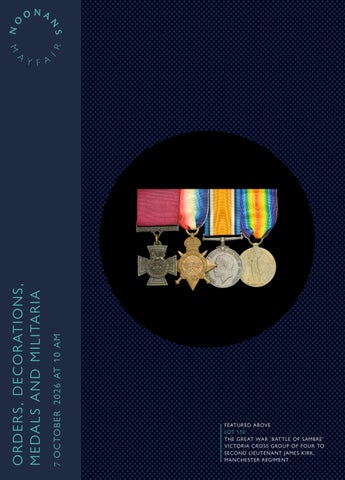
FE ATURED AB OV E LOT 150 TH E G RE AT WAR ‘ B AT TL E OF S AM B RE ’ V IC TORIA C ROS S G ROUP OF FOUR TO S ECOND L IEUTENANT JAM ES K IRK , M ANC H ES TER REG IM ENT
AUC T ION
AUC TI O N A N D CL I E N T SE RVI C E S
AN AU C TION OF: OR DE R S , D ECO RAT I ON S , MEDAL S AN D M I LI TA RI A
PHI L I PPA HE ALY A D M I NI S T RAT I O N D I RE C TO R ( A S S O C . DI R EC TOR) P H I LI P PA @NO O NA N S .CO.U K T. 0 2 0 7 0 1 6 1 7 7 5
DATE 7 OC TOB ER 2026 AT 10AM VIE WINGS ALL APP OIN TMENTS TO VIE W PL E A S E CON TAC T 020 7016 1700 OR VIE W ING@N O O N AN S .CO.UK A L L LOTS ARE AVAI L AB LE TO VI E W O NLI NE WI T H FUL L ILLUST RAT I O N S AN D CO N DI T IO N RE P O RT S AT W W W. N O O N AN S .CO.UK
CON TAC TS GENERAL AUC TION ENQUIRIES AUC TIO N S@N OON AN S .CO.UK M EDAL E N QUIRIES ME DA L S@N O O N AN S .CO.UK ACCOUN T ENQUIRIES ACCOUN T S@N OON AN S .CO.UK
B ANK DETAIL S B ANKER S : LLOY D S ADDR ES S : 39 P I CC AD I LLY, LON D O N W1 J 0 A A SORT CODE : 30-96-64 ACCOUN T N O.: 00622865 SWIF T CODE : LOY DGB2L IB AN: GB70LOY D30966400622865 BIC : LOY D GB21085
B OARD OF DIRE C TOR S PIERC E N OON AN CH A IR MAN AN D C EO NIM ROD DIX DE PUT Y C HAI RMAN RO BIN G RE VIL L E CH IE F O P ERAT I N G OF F I C ER CHRISTOP H E R WEBB CL IE NT LI AI SO N D I REC TOR (N UMI SM AT I CS )
A N N A HO PPE R ACCO U NT S A ND A D M I NI S T RAT I O N A NNA @NO O NA N S .CO.U K T. 0 2 0 7 0 1 6 1 7 0 0 SO FI A B USACC A A D M I NI S T RAT I O N S O F I A @NO O NA N S .CO.U K T. 0 2 0 7 0 1 6 1 7 0 0 LO UI S O CO N N O R A D M I NI S T RAT I O N LO U I S @NO O NA N S .CO.U K T. 0 2 0 7 0 1 6 1 7 0 0 CHR I STO PHE R M E L LO R - HI L L H E A D O F CLI E NT LI A I S O N ( A S S O C . D I R EC TOR) CH RI S TO P H E R@NO O NA N S .CO.U K T. 0 2 0 7 0 1 6 1 7 7 1 J AM E S C ARVE R CLI E NT LI A I S O N J B C@NO O NA N S .CO.U K T. 0 2 0 7 0 1 6 1 7 7 1
AT NO O NA NS O U R E X P E RT I S E E X T E NDS BE YO ND T H E K NOW L E DG E W I T H I N O U R S P E C I A L I S T DE PA RT ME NT S TO I NC LU DE A L L A S P E C T S O F O U R AU C T I O N H O U S E , F RO M O U R P H OTO G RA P H Y S T U DI O TO O U R A DVA NC E D P RO P RI E TA RY O NL I NE BI DDI NG S Y S T E M. We’re a close-knit team of experts with deep knowledge across our specialist subjects: banknotes, coins, detectorist finds, historical & art medals, jewellery, medals & militaria, tokens and watches. Focusing on these fascinating items, we share this expertise with an international community of sellers and buyers. Each sale item that passes through our Mayfair auction house is appraised by an expert recognised as a leading authority in a particular field of interest, ranging from ancient coins and military medals to jewellery and vintage watches. This depth of knowledge across all departments sets us apart from other generalist auctioneers.
CHR I S FI N CH HAT TO N CLI E NT LI A I S O N F I NCH @NO O NA N S .CO.U K T. 0 2 0 7 0 1 6 1 7 5 4 I AN AN D E R SO N CH I E F T E CH NI C A L O F F I CE R ( A S S O C . DI R EC TOR) I A N@NO O NA N S .CO.U K T. 0 2 0 7 0 1 6 1 7 5 1
M E DA L AN D M I L I TA R I A SPE CI A L I S T S N I M RO D D I X H E A D O F M E DA L D E PA RT M E NT ( B OA RD DI R EC TOR) NI M RO D @NO O NA N S .CO.U K T. 0 2 0 7 0 1 6 1 8 2 0 O L I VE R PE PYS M E DA L S P E CI A LI S T ( A S S O C . D I RE C TO R) O LI V E R@NO O NA N S .CO.U K T. 0 2 0 7 0 1 6 1 8 1 1 M AR K Q UAYL E M E DA L S P E CI A LI S T ( A S S O C . D I RE C TO R) M A RK@NO O NA N S .CO.U K T. 0 2 0 7 0 1 6 1 8 1 0
N OON A N S 1 6 BOLTON ST R EE T M AY FA I R LON DON W 1 J 8 BQ T. 0 2 0 7 0 1 6 1 7 0 0 W W W. NO O NA NS .CO. U K
SELL WITH US
BUY WI TH US
Respected worldwide for the breadth and depth of our specialist expertise, we can connect you to a broad, deep pool of potential buyers. Over the years, we’ve brought together an international community of people who share our particular passion. As recognised experts, with a vast store of freely available in-house knowledge and experience, we’ve earned the trust of buyers across the globe.
We’re here for you, whether you’re an experienced collector with a depth of knowledge or an occasional buyer attracted to a particular piece of jewellery or vintage watch.
Our fees are transparent. Unlike many other auction houses, we don’t charge for collecting your lots, photography or marketing and there’s no minimum lot charge. Not surprisingly, our position as a trusted authority, with deep global reach, often leads to the achievement of higher than expected prices at auction. Free valuation If you’re interested in selling your items and you’d like a free auction valuation, without obligation, our specialists will be happy to help. You can submit online or bring your sale item to a valuation day at our Mayfair auction house or at a regional venue. Alternatively, request a home visit.
Be assured that the item in question has been accurately described and photographed, detailing all available information, from its provenance to its current condition. Be certain that our price estimate is fair and sensible. Delve deep into our website and you’ll discover a vast store of helpful background data, including prices achieved for similar items at previous auctions. Informed and empowered, study our detailed online catalogue, then place your bid in complete confidence.
ORDER OF SALE
O RDERS , D E C O RATI O NS , ME DA LS AND MI LI TA RIA W EDNESD AY 7 O CTOBER 2026 AT 10AM A FINE COLLECTION OF MEDALS, THE PROPERTY OF A LADY, PART 3
1-50
GROUPS AND SINGLE DECORATIONS FOR GALLANTRY
51-149
AN OLD COLLECTION OF BRITISH MEDALS, THE PROPERTY OF A LADY
150-189
SINGLE ORDERS AND DECORATIONS
190-193
CAMPAIGN GROUPS AND PAIRS
194-366
A COLLECTION OF QUEEN’S SOUTH AFRICA MEDALS TO THE ROYAL NAVY
367-397
SINGLE CAMPAIGN MEDALS
398-527
MEDALS TO PIPERS OF THE ROYAL HOUSEHOLD
528-529
LONG SERVICE MEDALS
530-563
LIFE SAVING AWARDS
564-565
MISCELLANEOUS
566-601
MINIATURE MEDALS
602-623
WORLD ORDERS AND DECORATIONS
624-638
MILITARIA
639-750
F O R T H CO M I N G AU C T I O N S W EDN ES DAY 4 NOVEMBER 2026 ORDER S , DECORATION S , MEDAL S AND MILITAR IA W EDN ES DAY 9 DEC EMBER 2026 ORDER S , DECORATIO N S , MEDAL S AND MILITARIA W EDNES DAY 13 JANUARY 2027 ORDER S , DECORATIO N S , MEDAL S AND MILITARIA
SU M M ARY OF I NFORMATI ON FO R BUY ERS
REGIS TERING TO BID
New clients must register online to bid (whether in person or in absentia). This can be done via our website www.noonans.co.uk Registrations will be subject to due diligence and Noonans reserves the right to cancel registrations. Once registered, any client bidding for the first time online will need to enter their card details so that a security check can be performed to authorise you to bid (www.noonans.co.uk >Your Account > Account Authorisation). This check is secure, your card details are not seen by us and no funds will be deducted. BIDDING P RIORITY
Please note that we prioritise executing commission bids as early as possible in order to secure the lot for you at the cheapest possible price. It is therefore entirely possible that a lot can sell at your top bid to another bidder. To avoid this happening we offer an optional ‘Plus 1’ bidding increment facility, whereby if the bidding is against you at your maximum bid the auctioneer will execute one further bid on your behalf. Please note that in the event of identical top bids priority is given to the first bid received. P L ACIN G B IDS
LIVE BIDDING VIA WWW.NOONANS.CO.UK You may bid in real time from your computer or mobile device. We provide an optional live video and audio feed of the auctioneer, allowing you to participate in much the same way as attending the auction. You may see your invoice and pay online directly after you’ve finished bidding. There is no additional charge for this facility.
ADVANCE BIDDING VIA WWW.NOONANS.CO.UK We strongly advise this method if you wish to leave bids in advance as it is the easiest, most accurate and flexible way to leave your bids and gives you total control over them right up to the point that the lot is offered for sale. Bids made online cannot be seen by others and only become live at the point the lot is being sold. Up until this time your bids can be easily altered or cancelled. An automated email is sent to confirm any changes made. There is no additional charge for online bidding. ADVANCE BIDDING VIA POST, EMAIL OR TELEPHONE Whilst we are still happy to execute all bids submitted to us using post, email or telephone, it should be noted that all bids left with us in these ways will be entered at our offices using exactly the same bidding facility to which all our clients have access. There is, therefore, no better way of ensuring the accuracy of your advance bids than to place them yourself online. If you are registered with Noonans you may bid by email to bids@noonans.co.uk or by telephone to 020 7016 1700. All bids placed by email or telephone must be received before 4 PM on the day preceding the sale. A bidding form is included in the back of this catalogue. If you wish to use this please fill it in carefully, to include all relevant information. Please ensure that you post this form so that it arrives, at the latest, the day before the sale. BIDDING IN THE AUCTION ROOM You are very welcome to attend the auction and bid in person if you are registered with Noonans.
Please note that the auction room is situated on the third floor of a Georgian building which doesn’t have a lift. You may pay for and collect your lots during the auction.
importation VAT rates for collectable items in the Terms and Conditions published on the Noonans website. PR I CE S R E A L I SE D
S AL ERO O M NOTICES
Should the description of a lot need to be amended after the publication of this catalogue, the amendments will appear automatically on the Noonans website, www.noonans.co.uk. All such amendments are also incorporated in the List of Saleroom Notices pertaining to this auction which are posted separately on the website. The auctioneer will refer to any notices at the time any affected lot is offered for sale. C ATA LOGUE IL LUS T RATIO N S & TH E INTE R N E T
Prospective bidders are reminded that the Noonans website features high-resolution colour illustrations of every lot in this auction. There may also be additional illustrations of any lot. B UY ER S ’ P REMIUM
The rate for this sale is 24% of the Hammer Price (+ VAT where applicable). IMP O RTATIO N VAT
Lots marked ‘X’ are subject to importation VAT of 5% on the Hammer Price unless re-exported outside the UK, as per Noonans Ts & Cs. From 1 January 2021 importation VAT may be levied by EU countries on lots sold by Noonans and subsequently imported into those countries. Although Noonans is unable to advise buyers on customs regulations in their country of domicile, there is further information regarding EU
The hammer prices of lots sold at Noonans auctions are posted at www.noonans.co.uk in real time and telephone enquiries are welcome from 9 AM on the day after the auction. PAYM E N T
You may access your invoice shortly after the hammer has fallen on your last lot. As we weigh lots at the time of cataloguing most shipping is already calculated, enabling you to settle your account and receive your lots in a timely fashion. Auction attendees may pay and collect during the course of the auction as soon as they have bid on their last lot. Full Terms and Conditions of Business are available to read in the back of this catalogue and on our website. CO N TAC TS
GENERAL SUPPORT ENQUIRIES auctions@noonans.co.uk 020 7016 1700 or from overseas (+44) 20 7016 1700 WEBSITE AND LIVE BIDDING SUPPORT ENQUIRIES Ian Anderson ian@noonans.co.uk 020 7016 1700 or from overseas (+44) 20 7016 1700
A Fine Collection of Medals, the Property of a Lady, Part 3 1
A Second War C.B., ‘Dunkirk operations’ D.S.O. group of ten awarded to Major-General J. F. Hare, King’s Royal Ri!e Corps, who was Mentioned in Despatches The Most Honourable Order of the Bath, C.B., (Military) Companion’s neck badge, silver-gilt and enamels; Distinguished Service Order, G.VI.R., silver-gilt and enamels, reverse officially dated ‘1940’, with integral top riband bar; British War and Victory Medals, with M.I.D. oak leaves (Capt. J. F. Hare.); General Service 1918-62, 1 clasp, Palestine (Major J. F. Hare. K.R.R.C.); 1939-45 Star; Defence and War Medals 1939-45; Coronation 1953, unnamed as issued; Egypt, Kingdom, Order of the Nile, Fourth Class breast badge, by Lattes, silver and enamel, with rosette on riband, enamel damage to two arms on last, mounted as worn; together with a Dunkerque Commemorative Medal, generally very ne or better (11) £1,800-£2,200 C.B. London Gazette 14 June 1945. D.S.O. London Gazette 11 July 1940: ‘For gallant and distinguished services in action in connection with recent operations.’ The original recommendation states: ‘This officer’s services as G.S.O. 1 of 23rd (N.) Division from the occupation of the position on the Canal du Nord on 17th May to the "nal evacuation at Dunkerque on the 31st was worthy of the best traditions of the staff. He never spared himself either from fatigue or danger. On the night of 20th May, he personally led a convoy of lorries into the tank infested area where 70th Infantry Brigade had been overrun in an endeavour to retrieve a party of men who were reported to have collected at Villers Mingoual. His cool bearing in all circumstances was an inspiration to everyone.’ Egyptian Order of the Nile, Fourth Class London Gazette 16 January 1920. M.I.D. London Gazette 12 January 1920.
www.noonans.co.uk
all lots are illustrated on our website and are subject to buyers’ premium at 24% (+VAT where applicable)
John Francis Hare was born on 26 March 1897, the eldest son of Major-General Sir Steuart Hare, K.C.M.G., C.B., and was educated at Malvern and the R.M.C. Sandhurst. Commissioned in the King’s Royal Ri!e Corps in January 1915, he was embarked for Egypt in May 1916, on attachment to the Bedfordshire Regiment, and subsequently served as A.D.C. to the Commanding Officer of 54th Division. And he remained likewise employed until April 1918, latterly as part of the Palestine operations, for which he was awarded the Egyptian Order of the Nile, Fourth Class and Mentioned in Despatches by General Sir E. H. H. Allenby. Back home, Hare served as an Adjutant in the Territorial Force from September 1918 to April 1919 and was advanced to Captain in January 1921. A further stint as Adjutant in the K.R.R.C. having ensued, he attended the Staff College and was advanced to Major. Then, in addition to a tour of duty in the 2nd Battalion in Palestine, he served as a D.A.A.G. at the War Office and was given the Brevet of Lieutenant-Colonel. Having then been awarded the D.S.O. for his valuable and gallant services as a G.S.O.1 in 23rd (N.) Division in France in May-June 1940, Hare remained employed in the U.K. and attained the temporary rank of Major-General in 1944. Following his retirement, Hare served as a Research Secretary for King George’s Jubilee Trust and as Chairman of the Grants Sub-Committee of the Army Benevolent Fund, in which latter capacity he was awarded the Coronation Medal in 1953. He died in August 1970.
2
An Inter-war C.I.E. group of three awarded to Major-General C. H. Forster, Indian Medical Service The Most Eminent Order of the Indian Empire, C.I.E., Companion’s 3rd type neck badge, gold and enamels; India General Service 1895-1902, 1 clasp, Waziristan 1901-2 (Lieut. W. C. H. Forster I.M.S.); British War Medal 1914-20 (Lt-Col. W. C. H. Forster.) good very ne (3) £1,400-£1,800 C.I.E. London Gazette 2 January 1933: ‘Major-General William Charles Hugham Forster, M.B., V.H.S., Indian Medical Service, Surgeon-General with the Government of Bombay.’ William Charles Hugham Forster was born on 15 June 1874; Master of Arts 1893; Batchelor of Medicine and Master of Surgery in 1897; Diploma of Public Health from the University of Cambridge 1899; Lieutenant, Indian Medical Service, 27 July 1899; Captain, 27 July 1902; Major 28 January 1911; Lieutenant-Colonel, 28 January 1919. Colonel, 27 November 1927; Major-General, 5 November 1929. He was Deputy Sanitary Commissioner for the Punjab in 1904; Professor of Pathology and Hygiene, Iahore Medical College 1909; Director of Public Health for the Punjab 1918; Inspector General of Civil Hospitals in Burma 1921; Surgeon General of the Government of Bombay 1930; Member of the Legislature Council of India 1922-33; Retired 1933; Medal and clasp for Waziristan 1901-02. Major-General Forster died on 11 October 1939.
www.noonans.co.uk
all lots are illustrated on our website and are subject to buyers’ premium at 24% (+VAT where applicable)
A Fine Collection of Medals, the Property of a Lady, Part 3 3
A post-War ‘Civil Division’ C.B.E., Second War ‘Military Division’ O.B.E. group of six awarded to Brevet Colonel D. A. Campbell, Royal Artillery The Most Excellent Order of the British Empire, C.B.E. (Civil) Commander’s 2nd type neck badge, silver-gilt and enamels, with full and miniature-width neck ribands, in Thomas Fattorini case of issue; The Most Excellent Order of the British Empire, O.B.E. (Military) Officer’s 2nd type breast badge, silver-gilt, with Royal Mint case of issue; Defence and War Medals 1939-45; General Service 1918-62, 1 clasp, S.E. Asia 1945-46 (Major. D. A. Campbell. R.A.); Efficiency Decoration, G.VI.R., 2nd issue, Territorial, with one G.VI.R. Additional Award Bar, the reverse officially dated ‘1949’ and the Bar officially dated ‘1952’, these last "ve mounted as worn; together with the related miniature awards (excluding the CBE), these similarly mounted, good very ne or better (6) £500-£700 C.B.E. (Civil) London Gazette 14 June 1986. O.B.E. (Military) London Gazette 1 January 1954. The original recommendation states: ‘Lieutenant-Colonel Campbell is retiring from the Active List of the Territorial Army on 6 January 1954, on completion of 14 years’ service. For his last three years he will have been the Commanding Officer of his local County Gunner T.A. Regiment – the Berkshire Yeomanry – 345 Medium Regiment, R.A., T.A. He volunteered for the Territorial Army in July 1939, when war looked likely, and saw six and a half years’ war service with the Yeomanry. He was Command Post Officer, Troop Commander, Battery Commander and "nished the war as Second-in Command of the regiment in the Far East. His services were of the very greatest value to the regiment throughout the war, both in the instructional and operational spheres. He was with the Yeomanry in Northern Ireland, India, Malaya and Java and returned to the U.K. to be demobilised in February 1946.
www.noonans.co.uk
all lots are illustrated on our website and are subject to buyers’ premium at 24% (+VAT where applicable)
A Fine Collection of Medals, the Property of a Lady, Part 3 He rejoined the Yeomanry in 1947, on the !rst day that recruiting started for the reconstituted T.A., and immediately took over a battery, later to become Second-in-Command and eventually Regimental Commander on the retirement of Colonel Wroughton in January 1951. He was awarded the T.D. and received the !rst clasp to it in January 1952. In spite of his very responsible and exacting work in civilian life, he has devoted a great deal of time to the T.A. and it is largely due to his in"uence that the regiment has, in spite of many difficulties, not only reached a high state of efficiency but also retained its traditions and esprit de corps. He has proved himself an excellent commander in every sense of the word, both in the regiment and in all county matters affecting the Territorial Army in general and this old established regiment in particular.’ David Archibald Campbell was born in London on 13 February 1915, but spent much of his childhood in South Wales, where his father was a land agent. Educated at Eton and Trinity Hall, Cambridge, he, too, became a land agent. Then, as outlined in the above recommendation, he joined the Berkshire Yeomanry on the eve of hostilities and served in that capacity until early 1946, latterly in South-East Asia. And his subsequent career in the T.A. witnessed his promotion to Lieutenant-Colonel in January 1951, shortly before he received a Bar to his Efficiency Decoration. In civilian life, Campbell served as President of the Land Agent’s Society in the 1960s and afterwards as Chairman of the Forestry Commission Safety Council, the latter role resulting in the award of his C.B.E. in the Birthday Honours List of 1986. The Colonel - who according to one obituarist ‘wouldn’t score many points for political correctness’ - died in Sussex in July 2003. Sold together with a Land Agent’s Society President’s Badge, silver-gilt and enamel, hallmarks for London 1959, the reverse inscribed ‘D.A.C. 1962 -63’, in its Garrard & Co. case of issue; two Royal Berkshire Hospital Centenary Fund Medals 1937; an Amateur Photographic Association prize medal, bronze, the reverse inscribed to the recipient’s grandfather, ‘The Right Hon. The Viscount Emlyn. 1885’, in its !tted case of issue; together with copied research.
www.noonans.co.uk
all lots are illustrated on our website and are subject to buyers’ premium at 24% (+VAT where applicable)
A Fine Collection of Medals, the Property of a Lady, Part 3 4
A rare Great War ‘Cameroons 1914’ D.S.O. and bronze S.G.M. group of six awarded to Captain H. C. V. P. Cheetham, Royal Naval Reserve and Southern Nigeria Marine Distinguished Service Order, G.V.R., silver-gilt and enamel, with integral top riband bar; Sea Gallantry Medal, G.V.R., bronze (Commander Herbert Charles Valentine Beresford Cheetham R.N.R. “Ivy” 21st October 1914); 1914-15 Star (Commr. H. C. V. P. Cheetham. R.N.R.); British War and Victory Medals, with M.I.D. oak leaves (Commr. H. C. V. P. Cheetham. R.N.R.), minor official correction to initials on VM; Royal Naval Reserve Decoration, G.V.R., silver and silver-gilt, hallmarks for London 1911, mounted court-style for display, obverse centre on the rst somewhat recessed and slight enamel damage to wreaths, otherwise good very ne (6) £2,000-£2,400 Provenance: Captain K. J. Douglas-Morris Collection, Dix Noonan Webb, February 1997. D.S.O. London Gazette 1 January 1917: ‘As Chief Transport Officer with the Cameroons Expeditionary Force, Commander Cheetham performed exceptional service under heavy "re during the attacks on Jabassi on 8 October 1914, and in the subsequent embarkation of troops and retirement downstream of the #otilla after dark. He commanded the advanced detachment downstream of the Nyong Flotilla on the Edea Expedition, driving out a hostile party from Dehane, and thereby enabling the French troops to land without opposition.’ Sea Gallantry Medal, February 1915: ‘For gallantry in saving life when the whaler belonging to the Nigerian Government Yacht Ivy capsized when crossing the bar of the Njong River on 21 October 1914.’ Herbert Charles Valentine Beresford Cheetham was commissioned in the Royal Naval Reserve in August 1896 and was promoted to Lieutenant in January 1901. Later in the same year, he joined the Southern Nigerian Marine and participated in the Aro Expedition 1901-02 (his name appears on the medal roll). Having in the interim been awarded the Reserve Decoration and been advanced to Commander, R.N.R., Cheetham was appointed a Senior Marine Officer 1st Grade in the Southern Nigerian Marine soon after the outbreak of war. Subsequently awarded the D.S.O. for the above cited deeds as Chief Transport Officer with the Cameroons Expeditionary Force in October 1914, he was also awarded the Sea Gallantry Medal, in bronze, for lifesaving on the Njong River in the same month. On that occasion, the whaler of the Nigerian Government’s yacht Ivy, with four officers and nine natives on board, capsized in the surf on the bar of the Njong River. Board of Trade records state: ‘The lifeboat of the S.S. Fellah was immediately launched and under the command of Commander Cheetham and manned by Lieutenants Clough and Daniel, with crew members Odham, Grant, Farrell and Davis, succeeded in rescuing Captain Fuller and eight natives. Before being rescued Captain Fuller had twice been dragged away from the capsized whaler by natives clinging to him, but he managed to pull them up to the boat, thus saving their lives. Lieutenant Webb jumped overboard from the Fellah with a line around him and attempted to rescue those in the water but was unable to reach them. Considerable risk was incurred in rendering the services on account of the heavy surf on the bar.’ Cheetham remained employed in Nigeria for the duration of the war, serving as a Reclamation Officer and Assistant Director of Marine at Apapa and was advanced to Captain, R.N.R. in November 1918. Post-war, he returned to his duties as a Harbour Master at Port Harcourt, prior to being placed on the Retired List in 1922. Sold with copied research. Note: M.I.D. uncon"rmed.
www.noonans.co.uk
all lots are illustrated on our website and are subject to buyers’ premium at 24% (+VAT where applicable)
A Fine Collection of Medals, the Property of a Lady, Part 3 5
A Great War O.B.E. group of six awarded to Captain Somers Somerset, Herefordshire Ri!e Volunteers: an adventurous spirit who fostered an early interest in ballooning and !ight; who served as a Times correspondent in the Boer War and as a King’s Messenger in the Great War; and was twice Mentioned in Despatches The Most Excellent Order of the British Empire, O.B.E., (Military) Officer’s 1st type breast badge, silver-gilt, hallmarks for London 1919; Queen’s South Africa 1899-1902, no clasp (Mr. Somers Somerset. “Times”); 1914 Star, with copy clasp (Lieut: S. Somerset); British War and Victory Medals, with M.I.D. oak leaves (Capt. S. Somerset.); France, Third Republic, Legion of Honour, Chevalier’s breast badge, silver, gold and enamels, mounted as worn, minor enamel damage to the last and the 1914 Star and clasp sometime gilded, otherwise very ne or better (6) £800-£1,000 O.B.E. London Gazette 12 December 1919. M.I.D. London Gazettes 1 June 1917 and 8 July 1917. Henry Charles Somers Augustus Somerset was born at Hanover Square, London on 18 May 1874, the only son of the Rt. Hon. Lord Henry Somerset and a grandson of the Duke of Beaufort, to whose title he later became heir presumptive. Educated at Marlborough and Balliol College, Oxford, young Somerset was an adventurous spirit, his early hobbies including ballooning, yachting and travel. Of the former activity, one source states that ‘before the invention of aeroplanes, he took up ballooning, in which sport he had many adventures, being at one time attached to the French Army.’ But for good measure, he nonetheless took his aviator’s certi!cate in a Farman Biplane in July 1910. Of his penchant for travel, a classic example was his part in a hunting trek in British Columbia in the early 1890s, in which he and his fellow adventurers set out from Edmonton and travelled by the Athabasca to Fort Dunvegan on the Peace River, crossed the Rockies via the Pine and Misinchinka Rivers to Fort McLeod, and then proceeded south-east to Quesnel via Fort St. James and the Stuart River. The journey, particularly from Fort Dunvegan to Fort McLeod, was a harrowing one; game was scarce, and the party had to resort to eating one of their packhorses. Somerset duly published an entertaining account of their experiences in The Land of the Musveg, evidence of his powers of observation and writing skills, assets that surely counted towards his future employment as a Times war correspondent in the Boer War. First, however, and presumably on the back of his commission in the Herefordshire Ri"e Volunteers, he appears to have served as a dispatch rider. Back home, Somerset dabbled in politics as a Progressive Party member of London County Council (1901-04) and unsuccessfully stood as a Liberal candidate for Croydon in the General Election of 1906. And in county affairs, he was a long-served D.L. and J.P. Somerset was also a King’s Messenger, and it was in that capacity that he was embarked for France on 22 September 1914, where he was Mentioned in Despatches by Sir Douglas Haig. He was subsequently employed in the Egyptian Expeditionary Force and was awarded the O.B.E. and a second Mention in Despatches. Having then resigned his commission as a Captain in April 1919, he settled in Wiltshire, where he died at Sheldon Manor, Chippenham in November 1945. Sold with copied research.
www.noonans.co.uk
all lots are illustrated on our website and are subject to buyers’ premium at 24% (+VAT where applicable)
A Fine Collection of Medals, the Property of a Lady, Part 3 6
A Second War ‘Civil Division’ O.B.E., Great War D.S.C. group of ten awarded to Captain H. Spencer, Merchant Navy, late Royal Naval Reserve, who was decorated for saving the prize crew of the S.S. Canadia in March 1915 and later added the O.B.E. and a commendation to his accolades for his command of the S.S. City of Lincoln during enemy air attacks The Most Excellent Order of the British Empire, O.B.E., (Civil) Officer’s 2nd type, breast badge, silver-gilt; Distinguished Service Cross, G.V.R., hallmarks for London 1914; 1914-15 Star (Lieut. H. Spencer. D.S.C. R.N.R.); British War and Victory Medals (Lieut. H. Spencer. R.N.R.); 1939-45 Star; Atlantic Star; Africa Star; Burma Star, 1 clasp, Paci#c; War Medal 1939-45, with oak leaf for King’s Commendation, mounted as worn, very ne and better (10) £1,000-£1,400 O.B.E. London Gazette 17 August 1943. D.S.C. London Gazette 6 August 1915: ‘For services in Patrol Cruisers since the outbreak of war.’ King’s Commendation London Gazette 17 July 1945: ‘For brave conduct when their ships encountered enemy ships, submarines, aircraft or mines.’ Herbert Spencer was appointed a Temporary Sub Lieutenant in the Royal Naval Reserve in November 1914, in which month he joined the armed merchant cruiser H.M.S. Hilary. And he appears to have remained likewise employed up until Hilary’s loss to the U-88 off the Shetlands on 25 May 1917. In the interim, Hilary served in the 10th Cruiser Squadron as part of the Allied blockade of Germany, patrolling between the U.K. and the Denmark Strait, often in the area between the Outer Hebrides and the Faroes. And it was for just such work - and boarding suspicious vessels - that Spencer was awarded his D.S.C. An account of one such episode appears on the ‘Lost in Waters Deep’ website: ‘On the morning of 11 March 1915, H.M.S. Hilary stopped the Danish steamship S.S. Canadia and at 7.45 p.m. placed a prize crew aboard led by Sub. Lt. Herbert Spencer, R.N.R., with orders to procced to Kirkwall for contraband control. The weather at the time was foggy. Commander Bather of H.M.S. Hilary requested a letter from the Master of Canadia that he would assist with the navigation of the ship to Kirkwall. The instructions given were to steam east and pass to the north of Fair Isle and then change course to south and make Copinsay Isle. At 4.30 p.m. on the 12th inst. a bearing was taken on Westray 220 Deg. at approximately 20 miles. A lead was cast to verify position. At 5 p.m. land was again visible and position was veri#ed by line of course and distance by log. The weather then closed in and reduced visibility, but speed was maintained due to the fear of a submarine attack. The lead line was used every 15 minutes and soundings compared to the Danish chart onboard of the British Isles. At 7.10 p.m. 12th inst. the course was altered to 120 deg. The position at that time was estimated to be 20 miles N.W. of Fair Isle. The charts onboard that were being used were magnetic and the Master said there was a 3 deg. westerly deviation. Lead soundings continued to be taken every 15 minutes and lookouts were posted to both the bridge and forward. At 08.45 p.m. on the 12th inst. lookouts called out land ahead and engines were put full astern and helm altered but with the northerly wind blowing at force 6-7 the S.S. Canadia went broadside onto the shore at 8.55 p.m. Orders were given to #re rockets, use Morse lamp and Morse code using steam whistle to attract attention from the land. One of the rockets exploded and badly injured the master of Canadia. Communication was established using the Morse lamp and the stricken crew were told that help from Kirkwall was on the way. H.M.S. Cedric had been told to render assistance. At 1 a.m. on the 13th inst. the ship began to break up and cargo of cotton bales began $oating out of the holds. There was found to be 18-foot of water in the engine room. All the crew abandoned the ship and climbed onto the rock. At 6 a.m. the crew started to be transferred from the rock to Fair Isle mainland by ropes hauled by the islanders. During this rescue one of the prize crew fell into the sea and nearly drowned but was rescued and given arti#cial respiration. Sub Lt. Spencer was the last man to leave the rock. At #rst light the trawler Arley arrived on scene and found the S.S. Canadia wedged stern #rst between high rocks. At 1 p.m. on the 13th inst. all the crew and prize crew, with the exception of the injured Master, 1st Mate and Chief Engineer, were put on the tender Palladine and taken to Kirkwall.’ Spencer and his shipmates also intercepted other vessels, among them the S.S. Cushing, a former German vessel, and the S.S. Sea Connet, found to be carrying ri$es and ammunition from the U.S.A. Following Hilary’s loss in May 1917, Spencer served at the Grimsby base Wallington and he was demobilised as a Lieutenant in June 1919. Thereafter he served in the Merchant Navy and he was a senior officer in Ellerman Lines by the renewal of hostilities in September 1939. Hence his subsequent appointment to the command of the S.S. City of Lincoln, in which he served with distinction, gaining the O.B.E. and a King’s Commendation.
www.noonans.co.uk
all lots are illustrated on our website and are subject to buyers’ premium at 24% (+VAT where applicable)
A Fine Collection of Medals, the Property of a Lady, Part 3 7
A Second War ‘Italy campaign’ O.B.E., Great War ‘Western Front’ M.C. group of eight awarded to Colonel A. M. Mackintosh, Royal Army Service Corps, late East Surrey Regiment, who was wounded at Ypres, and was Mentioned in Despatches The Most Excellent Order of the British Empire, O.B.E., (Military) Officer’s 2nd type, breast badge, silver-gilt; Military Cross, G.V. R., the reverse engraved ‘A. M. Mackintosh. Ypres. July 31. 1917.’; British War and Victory Medals (Lieut. A. M. Mackintosh.); 1939 -45 Star; Italy Star; Defence and War Medals 1939-45, with M.I.D. oak leaf, mounted for display, good very ne or better (8) £800-£1,000 O.B.E. London Gazette 19 April 1945: ‘For gallant and distinguished services in Italy.’ The original recommendation states: ‘This officer has displayed forethought in planning, good appreciation of requirements and excellent powers of organisation. By his personality and control he has ensured the successful working of his staff, the petrol installations and units. His work has been arduous and at times exasperating, but he has always competed with it in a most efficient level-headed manner that has been bene#cial to the British Forces operating in Italy.’ M.C. London Gazette 19 July 1917: ‘For conspicuous gallantry. By his exceptional coolness under #re and skilful handling of his guns, he succeeded in silencing several hostile machineguns and snipers, greatly assisting the advance of our infantry throughout the day. He was subsequently wounded in the back by shrapnel.’ M.I.D. London Gazette 29 November 1945. Arthur Murray Mackintosh was born at Highgate, London on 14 August 1896. Embarked for France as a Second Lieutenant in the East Surrey Regiment in September 1916, he was awarded the M.C. for the above cited deeds at Ypres, following which he was wounded by a shell splinter in his back. On his demobilisation, he appears to have attended Fitzwilliam College, Cambridge, prior to being employed as a Sales Manager for Shell and B.P. And it was on the back of his expertise in petroleum that he was awarded his O.B.E. and Mentioned in Despatches, having help to establish supplies and depots in Italy as a Major in the R.A.S.C. He died in March 1984.
www.noonans.co.uk
all lots are illustrated on our website and are subject to buyers’ premium at 24% (+VAT where applicable)
A Fine Collection of Medals, the Property of a Lady, Part 3 8
A !ne inter-war Royal Yacht M.V.O., Great War minesweeping and mine disposal operations D.S.C. group of eight awarded to Lieutenant-Commander W. G. C. Crouch, Royal Navy, who ‘on several occasions, and under dangerous conditions’, rendered mines safe that had drifted on shore, ‘particularly on one occasion when the horn of a mine was badly bent’ The Royal Victorian Order, M.V.O., Member’s 5th Class, breast badge, the reverse officially numbered ‘571’; Distinguished Service Cross, G.V.R., hallmarks for London 1919, the reverse engraved ‘W. G. C. Crouch, Gunner, R.N., March 1918’; 1914-15 Star (Gnr. W. G. C. Crouch, R.N.); British War and Victory Medals (Gnr. W. G. C. Crouch, R.N.); Jubilee 1935; Coronation 1937; France, Third Republic, Medaille Militaire, mounted court style for display, the last with chipped enamel on reverse, otherwise good very ne (8) £2,600-£3,000 Provenance: Dix Noonan Webb, December 2011. M.V.O. London Gazette 3 June 1931. D.S.C. London Gazette 17 April 1918. The original recommendation states: ‘He has served in the Fleet Sweeping Flotillas during the whole of the War and been employed in practically every minesweeping operation. On several occasions, and under dangerous conditions, he has rendered mines safe which have drifted on shore, particularly on one occasion when the horn of a mine was badly bent. He also rendered the most valuable assistance on the occasion of H.M.S. Carnation being mined. And he conducted a highly hazardous sweep in very rough weather in the entrance of Kirkwall Harbour when it was con!dently expected that mines would be encountered and was also in charge of important minesweeping operations in Eastern Waters of the North Sea.’ French Medaille Militaire London Gazette 15 September 1916.
www.noonans.co.uk
all lots are illustrated on our website and are subject to buyers’ premium at 24% (+VAT where applicable)
A Fine Collection of Medals, the Property of a Lady, Part 3
Walter George Collingwood Crouch was born in Fareham, Hampshire in April 1883, and entered the Royal Navy direct from Greenwich Hospital as a Boy 2nd Class in September 1898. Advanced to Petty Officer 2nd Class in April 1905, he passed his examination for Gunner in April 1912. Appointed to the gunboat H.M.S. Skipjack as a Commissioned Gunner on the outbreak of hostilities in August 1914, he remained similarly employed until removing to the sloop Hollyhock in June 1915. His C.O. in the Skipjack was Commander L. G. P. Preston, R.N., who was affectionately known as ‘L.G.P.’ to his subordinates and rose to become Admiral Sir Lionel Preston, K.C.B. Here, then, the commencement of an uninterrupted wartime career in minesweeping and mine disposal, the details of which may be traced though his seagoing commissions in Taffrail’s Swept Channels. Thus, the author’s detailed description of the occasion when Skipjack and some trawlers ran into a large mine#eld laid by the Kolberg off Scarborough in mid-December 1914: ‘The Skipjack was quite close to the trawlers when the stillness of the morning was rudely shattered by the thudding boom of a heavy explosion. A column of white water mingled with greyish smoke leapt out of the calm sea. It was as high as a church spire, and seemed to hang for a moment in mid-air before curling over to fall sizzling and hissing back to the surface in the midst of a blackened area dotted with silver bodies of dead #sh. The detonations continued, one after the other. Within #ve minutes eighteen mines were swept up, or had exploded in the trawlers’ sweeps. The Kolberg’s cargo had been very thickly sown. Never afterwards throughout the whole period of the war were mines discovered in such profusion, or so close together. But the situation was alarming. The ‘safety period’ had passed. The tide was falling fast, and every minute brought the mines nearer the ships’ bottoms. The scene was extraordinary. Trawlers, most of them with their sweeps parted, were intermingled with mines torn from their moorings and $oating ominously on the surface. The mines were being #red upon. Two trawlers had been blown up. One, the Orianda, unable to stop her engines, steamed on, sinking as she went, until nothing remained but the tip of her masthead travelling along the surface like the periscope of a submarine. Then this last trace of her disappeared. A second trawler, Lieutenant Parsons’ Passing, was down by the bows, badly on #re, and blowing off dense clouds of steam from the severed steam-pipe. Her sweeping consort promptly went alongside to render what help was possible. A third little ship, commanded by Lieutenant Crossley, R.N.R., was in immediate danger of sinking owing to leaks caused by the heavy explosions close alongside her. Crossley himself was below in the cramped space near the screw shaft trying to stop the in$ow of water by divesting himself of his clothing and stuffing it into the stern gland. He plugged it sufficiently to allow the pumps to keen down the inrush of water, and so saved the ship. It was a hideous melee of trawlers and unexploded mines drifting with the tide. The rattle of ri$es and heavier guns rent air. Now and then a mine hit by gun#re detonated with a mighty roar, or was punctured and sank bubbling to the bottom. Low water was rapidly approaching. The extent of the mine#eld was unknown. Commander Preston was the senior officer on the spot at the moment. In the midst of this hideous danger he did not hesitate, but gave the order to anchor as the only possible method of avoiding further heavy loss. Many men, confronted with the same problem, would have trusted to luck and beat a hasty retreat. But Preston argued to himself that the ships would be comparatively safe at anchor until the tide turned. And when it did turn, the risk of striking mines as the ships swung was in#nitesimal compared with the danger of trying to extricate the whole $otilla then and there. At high water all vessels could be withdrawn in safety. So the anchors rattled down to the bottom, and for a time there was peace ... ’ In June 1915, Crouch accompanied ‘L.G.P.’ to his next command, the sloop Hollyhock, so, too, in June 1916, to his #nal seagoing command, the Lupin, evidence indeed of how much he was valued by the future Director of Minesweeping Operations at the Admiralty. And it was in the latter sloop that Crouch lent valuable service on the occasion that H.M.S. Carnation was mined off Lerwick in March 1917. Between the Wars, Crouch served continuously in the Royal Yacht Victoria & Albert III from November 1922 until his retirement in the rank of Lieutenant-Commander in April 1938, in which period he was awarded his M.V.O. and was present at the Fleet Reviews of 1935 and 1937, thereby qualifying for the Jubilee and Coronation Medals. Recalled on the renewal of hostilities, he was given command of the Victoria & Albert III in December 1939, shortly following which she was converted to an accommodation ship to the gunnery establishment Excellent. Crouch remained similarly employed to the War’s end and died in February 1948. Sold with a #ne presentation silver cigarette box, 18cm. x 9cm. x 4cm., hallmarks for London 1936, the lid engraved ‘H.M. Yacht Victoria & Albert, 1922-1938’, and bearing the facsimile signatures of the yacht’s officers; together the original warrant for his M.V.O., dated 3 June 1931, and certi#cate of award for his French Medaille Militaire, dated 11 November 1916.
www.noonans.co.uk
all lots are illustrated on our website and are subject to buyers’ premium at 24% (+VAT where applicable)
A Fine Collection of Medals, the Property of a Lady, Part 3 9
An inter-War M.B.E. group of !ve awarded to Captain and Deputy Commissary G. F. Baxter, Military Works Services, India, late Somerset Light Infantry and Royal Berkshire Regiment, who was Mentioned in Despatches The Most Excellent Order of the British Empire, M.B.E., (Military) Member’s 1st type breast badge, silver, hallmarks for London 1931; British War and Victory Medals, with M.I.D. oak leaves (Sub-Condr. G. F. Baxter M.W.S.) both issued in India, together with a second B.W.M. issued from the U.K. (8971 Sjt. G. F. Baxter. R. Berks. R.) official correction to regiment on this; Army L.S. & G. C., G.V.R., 1st issue (Sub. Condr. G. F. Baxter, M.W.S.) mounted for display, good very ne (5) £260-£300 M.B.E. London Gazette 3 June 1933. M.I.D. London Gazette 15 August 1917. George Frederick Baxter was born at Newbridge, Co. Kildare and enlisted in the Somerset Light Infantry at Kuldanna in the Punjab in June 1898, aged 18. Remaining in India for the duration of his career, he transferred as a Sergeant to the Unattached List in November 1904, and served on secondment to the 2nd Battalion, Royal Berkshire Regiment, in the period leading up to the Great War. Initially appointed to the administrative staff of the 5th (Mhow) Division in September 1914, Baxter was embarked for Mesopotamia just over a year later, where he served on attachment to the Labour Corps as a Sub Conductor and was Mentioned in Despatches for gallant and distinguished services by Lieutenant-General Sir Stanley Maude. Back in India by October 1917, Baxter went on to enjoy steady advancement, being appointed a Conductor while stationed at Meerut in November 1922 and an Assistant Commissary while stationed in Delhi in October 1928. And he was serving as Garrison Engineer in the latter city on being awarded his M.B.E. in June 1933. Baxter was "nally placed on the Retired List as an Assistant Commissary. Sold with copied research.
www.noonans.co.uk
all lots are illustrated on our website and are subject to buyers’ premium at 24% (+VAT where applicable)
A Fine Collection of Medals, the Property of a Lady, Part 3 10
A Second War ‘Civil Division’ M.B.E. group of six awarded to Captain J. Forbes-Leith, Argyll and Sutherland Highlanders The Most Excellent Order of the British Empire, M.B.E. (Civil) Member’s 2nd type breast badge, silver; Queen’s South Africa 1899 -1902, 4 clasps, Modder River, Paardeberg, Driefontein, Transvaal (5819 Corpl: J. Forbes-Leith. A. & S. Highrs:); King’s South Africa 1901-02, 2 clasps, South Africa 1901, South Africa 1902 (5819 Clr:-Serjt: J. F. Leith. A. and S. Highrs.); 1914-15 Star (2. Lieut. J. Forbes-Leith. A. & S. Highrs.); British War and Victory Medals, with copy M.I.D. oak leaves (Capt. J. Forbes-Leith.) mounted as worn, good very ne and better (6) £300-£400 M.B.E. (Civil) London Gazette 11 June 1942: Captain James Forbes-Leith, Retired Officer, War Office. James Forbes-Leith embarked for France in December 1914.
www.noonans.co.uk
all lots are illustrated on our website and are subject to buyers’ premium at 24% (+VAT where applicable)
A Fine Collection of Medals, the Property of a Lady, Part 3 11
A Second War D.S.C. group of seven awarded to Lieutenant (E.) L. H. Norgate, Royal Navy, who was decorated for his gallant deeds in H.M.S. Britomart on the Arctic run in 1942-43 Distinguished Service Cross, G.VI.R., hallmarks for London 1943, reverse officially dated ‘1944’; Naval General Service 1915-62, 1 clasp, Palestine 1936-1939 (Wt. Engr. L. H. Norgate R.N.); 1939-45 Star; Atlantic Star; Africa Star; War Medal 1939-45; Union of Soviet Socialist Republics, Medal for the 40th Anniversary of Victory in the Great Patriotic War 1945-85, the !rst six mounted as worn, the last loose, good very ne (7) £800-£1,000 D.S.C. London Gazette 1 January 1944. Leslie Harold Norgate was born in Portsmouth, Hampshire on 7 December 1904 and entered the Royal Navy as a Boy Arti!cer in August 1920. He subsequently served in the ‘Silent Service’ in 1928-33 and was promoted to Warrant Engineer in January 1937. Having then served in the cruiser H.M.S. Calcutta, and seen action off Crete in 1941, he is believed to have joined the minesweeping sloop Britomart later in the same year. Norgate’s subsequent award of the D.S.C. undoubtedly re#ected good service on the Arctic run, Britomart being regularly deployed to such duties in the period 1941-43. And those duties included the disastrous P.Q. 17 and ‘!ght back’ P.Q. 18 convoys, in addition to ‘JW’ operations of 1943, when shocking weather conditions prevailed. Whether he was still serving in Britomart at the time of her loss to friendly !re off Normandy in August 1944, remains unknown. Norgate received his D.S.C. at a Buckingham Palace investiture on 27 July 1945 and ended the war with an appointment in the Fleet Air Arm. He was !nally placed on the Retired List as a Lieutenant (E.) in 1954. Sold with the recipient’s original warrants for Warrant Engineer, R.N., dated 1 March 1938, with seniority from 1 January 1937 and Commissioned Engineer, R.N., dated 3 February 1950, with seniority from 4 April 1946, together with copied research.
www.noonans.co.uk
all lots are illustrated on our website and are subject to buyers’ premium at 24% (+VAT where applicable)
A Fine Collection of Medals, the Property of a Lady, Part 3 12
A Great War ‘Western Front’ M.C. group of six awarded to Captain L. F. Levinson, 5th Dragoon Guards, late 2nd Life Guards, who endured a sustained chlorine gas attack in May 1915 Military Cross, G.V.R., unnamed as issued; 1914 Star, with later slide clasp (2358 L. Cpl L. F. Levinson, 2/Life Gds:); British War and Victory Medals, with small M.I.D. oak leaves (Capt. L. F. Levinson.); General Service 1918-62, 1 clasp, Iraq (Capt. L. F. Levinson.); Defence Medal, mounted as worn, one or two edge bruises and slightly polished, otherwise very ne or better (6) £800-£1,000 M.C. London Gazette 14 January 1916. M.I.D. London Gazette 1 January 1916. Leonard Francis Levinson attested for the 2nd Life Guards in August 1901, direct from the 15th Middlesex Ri!e Volunteer Corps. Having then transferred to the Army Reserve, he was mobilised on the outbreak of war and embarked for France as a Lance-Corporal in ‘C’ Squadron, 2nd Life Guards, in early October 1914. Shortly afterwards, in December 1914, he was gazetted as a Second Lieutenant in the 5th Dragoon Guards and was seconded for services with 2nd Signal Squadron. As stated in a medical report in June 1918, Levinson was in a chlorine gas attack in May 1915, ‘from one hour to an hour and a half, since when his wind has been good’. But he clearly recovered, for he witnessed further active service in North Russia in 1919 and in Iraq in Mesopotamia in 1920 -21, latterly on attachment to the Royal Signals. Levinson was "nally placed on the Reserve of Officers as a Captain in September 1922 and was a long-served ‘Chum Major’ of Margate’s Old Contemptibles Association. Sold with copied research.
www.noonans.co.uk
all lots are illustrated on our website and are subject to buyers’ premium at 24% (+VAT where applicable)
A Fine Collection of Medals, the Property of a Lady, Part 3 13
A !ne and extremely well documented 1919 ‘North Russia’ D.F.C. group of !ve awarded to Squadron Leader G. E. Lansdowne, Royal Naval Air Service and Royal Air Force, late Yeoman of Signals, Royal Navy - who served as the latter rate with H.M.S. Iron Duke during the Battle of Jutland, prior to being ‘one of the original 20 men selected for the Royal Naval Air Service, in which he became observer and navigator with the rank of warrant officer. He was commissioned on being transferred to the Royal Flying Corps, and was shot down on a bombing mission in Russia in 1919, landing in the River Dwina. He was taken prisoner after swimming for a mile, and on his release in 1920 he was transferred to the Royal Air Force.’ Distinguished Flying Cross, G.V.R.; 1914-15 Star (217943. G. Lansdowne. Y.S., R.N.); British War and Victory Medals, with M.I.D. oak leaves (Lieut. G. Lansdowne. R.A.F.); Defence and War Medals 1939-45, generally nearly very !ne or better (6) £3,000-£4,000
www.noonans.co.uk
all lots are illustrated on our website and are subject to buyers’ premium at 24% (+VAT where applicable)
A Fine Collection of Medals, the Property of a Lady, Part 3
D.F.C. London Gazette 22 December 1919 [Services in Russia, North Russia, Siberia. White & Black Sea, Bulgaria & The Caspian Sea]. M.I.D. London Gazette 3 June 1919. George Ebb Lansdowne was born in Warminster, Wiltshire in June 1886. He was educated at the Royal Hospital School, Greenwich, and joined the Royal Navy as a Boy 2nd Class on November 1901. Lansdowne advanced to Signalman in June 1904, and Leading Signalman in December 1906. He advanced to Yeoman of Signals in October 1913, and initially served during the Great War with H.M.S. Iron Duke, 1 August 1914 - 15 February 1917 (during which time she was the !agship of the Grand Fleet during the Battle of Jutland). Lansdowne was promoted Warrant Officer 2 and Observer, Royal Naval Air Service, 18 August 1917. Subsequent service included at East Fortune, and with the seaplane carrier H.M.S. Pegasus from 1918. The latter was employed supporting British intervention against the Bolsheviks in North Russia and the Black Sea, and was based at Archangel, May - September 1919. Lansdowne’s Obituary gives additional details: ‘One of the original members of Britain's air services, Squadron Leader George Lansdowne, D.F.C. (retd.), of The Bungalow, Station-road, died in the County Hospital on Sunday at the age of 59, after a brief illness. Mr. Lansdowne, a native of Crockerton, Wiltshire, joined the Navy as a boy at 14, and rose to be Yeoman of Signals to Admiral Jellicoe aboard the Iron Duke. He was one of the original 20 men selected for the Royal Naval Air Service, in which he became observer and navigator with the rank of warrant officer. He was commissioned on being transferred to the Royal Flying Corps, and was shot down on a bombing mission in Russia in 1919, landing in the River Dwina. He was taken prisoner after swimming for a mile, and on his release in 1920 he was transferred to the Royal Air Force. From then on he !ew regularly in !ying-boats, and was involved in two serious crashes, one into the channel, when the crew was picked up by a cruiser, and the other on the sands at Southend, when he jumped clear before the machine was completely wrecked. He was eventually posted to Uxbridge on administrative duties in 1934, and retired in 1936, only to be recalled on the outbreak of war three years later. He was engaged on administrative duties at Stranraer and Brighton until he was #nally demobilised with the rank of Squadron Leader in September last. He leaves a widow and two children, a daughter in the W.A.A.F., and a son, who is studying aeronautical engineering. The funeral took place on Thursday at St. James's Church.’ A cutting from the Daily Sketch, 26 April 1920, included with the lot - under the headline ‘No More Bolshevism For These’ - pictures Lansdowne being reunited with his wife, with the caption ‘A British !ying officer, brought down while !ying in Russia 18 months ago, greets his wife through a porthole at Southampton.’ His captivity further evidenced by a telegram sent by the recipient from Finland to his family, worded thus: ‘Released and well doing fourteen days quarantine... Wire and write c/o Larry Marling Terijoki, Finland. George’ Lansdowne advanced to Flight Lieutenant in the General Duties Branch, R.A.F. in July 1930, and subsequently advanced to Squadron Leader. He retired in September 1945, and resided on the Isle of Wight. Squadron Leader Lansdowne died in March 1946, and is buried in St. James’s Cemetery, Yarmouth, Isle of Wight. Sold with the following original documentation: Commission appointing recipient as Temporary Second Lieutenant, R.A.F., dated 1 November 1918; Royal Navy Parchment Certi#cate of Service; Telegram sent by recipient from Terijoki, Finland con#rming his release to his family, dated 2 April 1920; various photographs of recipient in uniform from different stages of his service career; newspaper cuttings - including one from the Daily Sketch, 26 April 1920, picturing the recipient being greeted by his wife after returning from being a POW and other ephemera.
www.noonans.co.uk
all lots are illustrated on our website and are subject to buyers’ premium at 24% (+VAT where applicable)
A Fine Collection of Medals, the Property of a Lady, Part 3 14
A post-War ‘1948’ A.F.C. group of !ve awarded to Flight Lieutenant J. H. Pinckard, Royal Air Force Volunteer Reserve, who served as a "ight engineer with 75 Squadron prior to transferring to A.&A.E.E. Boscombe Down Air Force Cross, G.VI.R., 2nd issue, reverse officially dated ‘1948’, in Royal Mint case of issue; 1939-45 Star; Air Crew Europe Star; Defence and War Medals 1939-45, in damaged named card box of issue, addressed to ‘F/L J. H. Pinckard, Officers Mess, R.A.F. Station, Boscombe Down, Amesbury, Wilts.’, generally good very ne better (5) £800-£1,200 A.F.C. London Gazette 1 January 1948. John Hubert Pinckard was born in March 1913, and resided at 43 Emscote Road, Warwick in 1939. He joined the Royal Air Force Volunteer Reserve, and served as a Sergeant and Flight Engineer with 75 Squadron during the Second World War. Pinckard subsequently transferred to A. & A.E.E., Boscombe Down in October 1943, and was commissioned into the General Duties Branch - advancing to Flying Officer in April the following year. He advanced to Flight Lieutenant, and died aged 92 in Salisbury, Wiltshire in 2005.
www.noonans.co.uk
all lots are illustrated on our website and are subject to buyers’ premium at 24% (+VAT where applicable)
A Fine Collection of Medals, the Property of a Lady, Part 3 15
A rare ‘Abu Klea Wells’ D.C.M. group of !ve awarded to Private G. H. Moore, King’s Royal Ri"e Corps, one of just 29 other ranks from the 2nd Battalion who served in the Mounted Infantry Regiment of the Camel Corps in the Desert Column Distinguished Conduct Medal, V.R. (2197 Pte. G. H. Moore, 2/K.R. Rif: C, 31st Jan: 1885); Afghanistan 1878-80, 2 clasps, Ahmed Khel, Kandahar (2197 Pte. G. H. Moore. 2/60 Foot) later engraved naming; Kabul to Kandahar Star 1880 (2197 Pte. G. H. Moore. 2/60 Foot) later engraved naming; Egypt and Sudan 1882-89, undated reverse, 2 clasps, The Nile 1884-85, Abu Klea (2197 Pte. G. H. Moore, 2/K.R. Rif: C.); Khedive’s Star, dated 1884-6, unnamed, polished and with edge bruising and contact marks overall, particularly to the second and fourth, thus good ne or better (5) £3,000-£4,000 D.C.M. recommendation submitted to the Queen, 7 November 1885; GO. 127 of 85; his discharge papers state for ‘good, valuable services during the reconnaissance of February 17th’ [details available in WO 97/3490]. George Henry Moore was born in Romsey, Hampshire and enlisted in the King’s Royal Ri!e Corps in Winchester in September 1868, aged 22. Embarked for India in the following year, he saw action with the 2nd Battalion in the Second Afghan War in1878-80, taking part in the battle of Ahmed Khel, the famous march from Kabul to Kandahar, and the decisive battle of Kandahar. Subsequently deployed to Egypt and the Sudan, Moore took part in the Nile Expedition of 1884-85 and was one of the three officers and 29 men from the 2nd Battalion, King’s Royal Ri!e Corps selected for the Mounted Infantry Regiment of the Camel Corps in the Desert Column. And it was in that capacity that he was present at Abu Klea on 17 January 1885 and in the subsequent engagement at Abu Klea Wells on 16-17 February 1885. Of the latter occasion, a contemporary account states: ‘We started from Metemmeh on 14th February, and halted at Abu Klea Wells, which turned out to be a series of holes in the sand on the valley bed. We had been followed, and were attacked by the enemy on the 16th February, who took up a position on some hills, and kept up a sharp #re all night at about 800 yards range. We formed a zereba, and got under cover without #ring a shot in return - but the next day, 17th February, we had to go out as a covering party to those #lling water tanks at the Wells. They peppered us as we were crossing the open - the shots were dropping among us quite thick - and put two shells among us, which did not burst. We had a long distance #ght of about #ve hours that day, when they retired and allowed us to scrape some water together for the march. The men behaved with great control, quietly waiting their turn and carefully ensuring that their camels were also properly watered. The march back was something horrible, 33 days it took us, and it was all done on foot, as we had not sufficient camels to bring back supplies, and ammunition.’ For his gallantry at Abu Klea Wells, Moore was awarded the Distinguished Conduct Medal, one of two such awards to his regiment for the action; by way of con#rmation, his discharge papers refer to his ‘good, valuable services during the reconnaissance of February 17th [1885], causing the enemy to evacuate a strong position’. Finally discharged in September 1889, after 21 years with the Colours, he was not entitled to the L.S. and G.C. Medal, having been con#ned for several months in 1883 on being found guilty of theft; his sentence led to the forfeiture of his Afghanistan Medal and Star, but these were later restored/re-issued to him. Sold with copied research.
www.noonans.co.uk
all lots are illustrated on our website and are subject to buyers’ premium at 24% (+VAT where applicable)
A Fine Collection of Medals, the Property of a Lady, Part 3 16
A Second War ‘Dunkirk’ D.C.M. group of ten awarded to Warrant Officer Class I J. P. Kemp, Durham Light Infantry, who was decorated for his part in capturing a bridge over the Barques Canal on 31 May 1940 Distinguished Conduct Medal, G.VI.R.(4439323 W.O. Cl, II. J. P. Kemp. Durh. L.I.); British War and Victory Medals (91235 Pte. J. P. Kemp. Durh. L.I.); India General Service 1908-35, 1 clasp, North West Frontier 1930-31 (4439323 Sjt. J. P. Kemp. Durh. L.I.); 1939 -45 Star; Africa Star, 1 clasp, 8th Army; Defence and War Medals 1939-45; Jubilee 1935; Army L.S. & G.C., G.V.R., 3rd issue, Regular Army (4439323 Sjt. J. P. Kemp. Durh. L.I.) mounted court-style for wear, together with a Dunkirk 1940 Commemorative Medal, the Great War pair polished, good ne, the remainder very ne or better (11) £3,000-£4,000 D.C.M. London Gazette 20 December 1940. The original recommendation states: ‘For outstanding service during the counter-attack on the Bulscamp position. He displayed initiative throughout and when the left half of the Company came under heavy ri!e "re before reaching the objective he rallied the N.C.O.s and men and led them forward and entered the village on the left, where he successfully maintained his position in spite of heavy "re.’ James Patrick Kemp was born in Leeds, Yorkshire on 1 October 1899, and enlisted in the Durham Light Infantry in September 1916. Having then witnessed active service in the 9th Battalion in France from April 1918 until the war’s end, he was placed on the Army Reserve in November 1919. Then in January 1921 he re-enlisted in his old regiment and was embarked for India, where he served until April 1931, latterly on active service on the North-West Frontier. And he undertook a second tour of duty in India in the period December 1933 to February 1937, in which he was advanced to Sergeant and awarded the Long Service and Good Conduct Medal; he was also awarded the Jubilee Medal in Indian Army Order 233 of 1935. Returning home at the end of 1938, following additional service in the Sudan and China, Kemp was appointed to the 9th Battalion, and it was in the same capacity that he served in the B.E.F. in France in March-June 1940. Here, then, the scene of his D.C.M.-winning exploits. On 31 May 1940, the 9th Battalion, Durham Light Infantry were positioned near the Bergues Canal, just south of Dunkirk. The Germans were pressing hard and the battalion were ordered to counter-attack to relieve the pressure. At 12 p.m., with a supporting artillery barrage, two platoons of ‘A’ Company and the remnants of ‘D’ Company were led forward by Captain George Wood and Kemp, his Company Sergeant-Major. The attack was so sudden that the objective of Bulscamp Bridge was taken by 12.30 p.m. and the battalion re-established itself on the canal. The next day the battalion withdrew to the beaches east of Dunkirk and, on 2 June, Kemp and his comrades were embarked for England. Embarked for the Middle East in May 1941, Kemp was advanced to Regimental Sergeant-Major in September of the same year and saw action in North Africa. But in April 1942 he was admitted to 62 General Hospital, where he remained for a week, and thence, in August 1942, to 8 General Hospital, via 186 Field Ambulance. He was subsequently embarked in a hospital ship and attended 3 Casualty Clearing Station. The causes of his hospitalisation remain unknown, but we do know that he was invalided home in March 1943 and discharged ‘as permanently un"t for any form of military service’ later in the same year. He died in Scarborough, Yorkshire in October 1969. Sold with one or two letters from D.L.I. comrades, together with copied research, including his service record.
www.noonans.co.uk
all lots are illustrated on our website and are subject to buyers’ premium at 24% (+VAT where applicable)
A Fine Collection of Medals, the Property of a Lady, Part 3 17
A !ne Second War ‘Birmingham Blitz’ bomb disposal G.M. group of six awarded to Major T. H. Sharman, Royal Engineers, who was decorated for dealing with some 200 unexploded bombs George Medal, G.VI.R., 1st issue (Captain Thomas Henry Sharman R.E.); 1939-45 Star; France and Germany Star; Defence and War Medals 1939-45; Efficiency Decoration, G.VI.R., 2nd issue, Territorial, the reverse officially dated ‘1951’, with one G.VI.R. Additional Award Bar, mounted court-style for display, together with the related miniature awards, these mounted as worn, edge nicks to the rst, good very ne (6) £3,000-£4,000 G.M. London Gazette 30 September 1941: ‘For conspicuous gallantry in carrying hazardous work in a very brave manner.’ The original recommendation states: ‘This officer has been engaged continuously on bomb disposal since June 1940. As a Section Officer during that period he has extracted approximately 200 bombs and has carried out the same number of reconnaissances. On at least four occasions he escaped by minutes, bombs which spontaneously exploded whilst being reconnaissanced. Incident ‘A’, 19 October 1940, Birmingham: At 0030 hours Captain Sharman took a party on to a Category ‘A’ bomb at the G.E.C. Works, Witton, whilst a heavy raid was in progress. The bomb which had been down for only 2½ hours was found to be 250-kilo with a 17 fuse, which was successfully extracted by 930 hours the same day. Incident ‘B’, 12 December 1940, Birmingham: A report was received at 0130 hours that a bomb had fallen at B.S.A. (Guns) Factory, Small Heath. This officer took a party to the site, but found that a wrong location had been given. Despite the fact a very heavy raid was in progress, he continued his search and eventually located a 250-kilo bomb at B.S.A. (Tools) Factory, some two miles away. He commenced work at 0300 hours and worked continuously until 1400 hours on 14 December, when the bomb (17 fuse) was successfully dealt with. During the night of 13 December, another heavy raid took place, and many bombs fell in the area. Incident ‘C’, 10 April 1941, Birmingham: This officer dealt successfully with a Category ‘A’ bomb at Wolseley Motor Factory. The bomb, which was diagnosed as a 250-kilo, contained both 17 and 50 fuses, but as a result of this officer’s determination, it was safely removed 14 hours after it fell. Vital work was not interrupted.’ Thomas Henry Sharman, who was born in Hagley, Worcestershire on 5 February 1919, was serving in 9 Bomb Disposal Company, R.E., at the time of the above cited deeds. Subsequently appointed an Honorary Major, Sharman was also awarded the Efficiency Decoration and Bar (London Gazette 19 October 1951). He died in Salisbury, Wiltshire in September 2005. Sold with copied research.
www.noonans.co.uk
all lots are illustrated on our website and are subject to buyers’ premium at 24% (+VAT where applicable)
A Fine Collection of Medals, the Property of a Lady, Part 3 18
A rare post-War G.M. awarded to Efficient Deck Hand C. E. Jones, Merchant Navy, who was decorated for his gallant deeds in the M.V. Nassarius off Port Sudan on 1 December 1949 George Medal, G.VI.R., 2nd issue (Clifford Edward Jones) in Royal Mint case of issue, extremely ne
£2,000-£2,400
Provenance: Glendining’s, 7 December 1988. G.M. London Gazette 17 October 1950 (in a joint citation with Pumpman A. H. Dee, M.V. Nassarius): ‘The Nassarius was on a voyage from Beirut to Mena al Ahmeda and, whilst off Port Sudan, Dee was helping the Bosun to wash out the cargo tanks. Although warned not to enter No. 3 tank which was gassy the Bosun decided to do so. He was twice forced up by the gas but entered a third time and collapsed on the ladder. Dee climbed down into the tank to try and support him until a lifeline could be obtained but after a while he felt himself being overcome. He managed to struggle out of the tank and called Jones. Without waiting for a smoke helmet to be brought, Jones immediately went down to help. He was, however, unsuccessful and hearing orders to come up climbed to the top of the tank, where he collapsed. Although Jones was almost unconscious when pulled out of the tank, he tried to go down again but was prevented from doing so on the orders of the Chief Officer. Subsequently, however, he donned a smoke helmet and again entered the tank. With help he was successful in putting a line around the Bosun who was then brought to the deck. Both Dee and Jones displayed great courage in their efforts to save the life of their fellow seaman and acted without thought of the grave danger to themselves.’ Clifford Edward Jones was born in Doncaster, Yorkshire on 11 May 1925, but later moved to Caerphilly, Wales, and appears to have entered the Merchant Navy at Cardiff in January 1948. In September 1949, he joined the ship’s company of the M.V. Nassarius, a vessel of the Anglo-Saxon Petroleum Company, and he was likewise employed at the time of the above cited incident in the Red Sea on 1 December 1949. Three of his shipmates were awarded the King’s Commendation for Brave Conduct on the same occasion. Sold with copied research, including his Merchant Navy service record.
www.noonans.co.uk
all lots are illustrated on our website and are subject to buyers’ premium at 24% (+VAT where applicable)
A Fine Collection of Medals, the Property of a Lady, Part 3 19
A Great War ‘India’ K.P.M. pair awarded to Deputy Inspector-General W. T. Moore, Bengal Police King’s Police Medal, G.V.R., 1st issue (Wm. Thos. Moore, Dep. Insp-Gen. Bengal Pol.) with original case of issue; Delhi Durbar 1911, silver (Wm. Thos. Moore, Insp.-Gen. Bengal Police) contemporarily engraved naming, mounted court-style for display, extremely ne (2) £300-£400 K.P.M. London Gazette 1 June 1916. William Thomas Moore was appointed a District Superintendent of Police in Monghyr, Bihar in 1898 and remained actively employed in the Bengal Police until 1918. In the interim, his appointments included those of District Superintendent and Commandant of Military Police at Nya Dunka in Sonthal Pargana district (1903-07); Superintendent of Police at Sylhet (1908-11); Deputy Inspector-General of Police at Cachar (1912) and Deputy Inspector of Police at Calcutta (1913-18), in which latter period he was awarded his K.P.M. He died in Darjeeling in August 1942.
www.noonans.co.uk
all lots are illustrated on our website and are subject to buyers’ premium at 24% (+VAT where applicable)
A Fine Collection of Medals, the Property of a Lady, Part 3 20
A rare and outstanding Second War ‘Narvik and Cape Matapan’ D.S.M. and Second Award Bar group of nine awarded to Chief Petty Officer J. J. ‘Lofty’ Isden, Royal Navy, who was decorated for removing burning cordite from H.M.S. Havock’s burning ammunition lockers in both engagements Distinguished Service Medal, G.VI.R., with Second Award Bar (JX. 128088 J. J. Isden. A./P.O. H.M.S. Havock.) impressed naming; Naval General Service 1915-62, 1 clasp, Palestine 1936-1939 (JX. 128088 J. J. Isden L.S. R.N.); 1939-45 Star; Atlantic Star; Africa Star; Burma Star; War Medal 1939-45; Royal Navy L.S. & G.C., G.VI.R., 1st issue (JX. 128088 J. J. Isden. P.O. H.M.S. Pembroke.) mounted for display, together with the related miniature awards (the clasp on the NGS inscribed ‘Palestine’), these mounted as worn, good very ne and better (9) £2,800-£3,400
Just over 150 D.S.M. and Second Award Bars were issued in the Second War. D.S.M. London Gazette 12 October 1940. The original recommendation states: ‘When the Ready Use Locker at ‘A’ Gun was set on !re by an incendiary bullet, he removed the burning charges and kicked them overboard, regardless of his own safety or the heat of the !re.’ D.S.M. Second Award Bar London Gazette 3 February 1942. The original recommendation states: ‘For conspicuous gallantry and zeal as Captain of ‘A’ Gun during the night action on 28 March 1941, in removing burning cordite from the Starboard Ready Use Locker and throwing it over the side under the direction of Midshipman Napper, whom he attempted to persuade to take cover as he did so. This is the second time he has risked his life in dealing with this same locker.’ James John Isden was born in Dover, Kent on 18 March 1910, and joined the Royal Navy as a a Boy 2nd Class in September 1926. Having then joined the destroyer H.M.S. Havock in January 1937, he remained similarly employed until at least April 1941. His C.O. was Commander R. E. ‘Rafe’ Courage, R.N., who was awarded the D.S.O. and Bar, and D.S.C. and Bar, in the same period, evidence – if it were needed – of a remarkable wartime commission. Their !rst taste of active service occurred in Havock’s pre-war tour of duty in the 2nd Destroyer Flotilla in the Mediterranean, when she was deployed off Palestine and in Spanish waters at the time of the Civil War.
www.noonans.co.uk
all lots are illustrated on our website and are subject to buyers’ premium at 24% (+VAT where applicable)
A Fine Collection of Medals, the Property of a Lady, Part 3 First Battle of Narvik – “Continue to engage the enemy” It was still as part of the 2nd Destroyer Flotilla that Havock next saw action, in a daring foray into Narvik harbour in the early hours of 10 April 1940. Famously, the Flotilla’s C.O., Captain Bernard Warburton-Lee, R.N., had told his wife in a letter home ‘The war is going to start properly soon, and I’m going to start it.’ And so he did, seizing the ‘golden moment’ and winning a posthumous V.C. in the process. Just 15 minutes after Warburton-Lee in the Hardy had entered Narvik, Commander Courage joined the fray in the Havock and loosed off three torpedoes. Peter Dickens takes up the story in Narvik, Battles of the Fjords: ‘The "rst hit a merchant ship; another, following the "rst’s track, was displaced by the explosion so that it neatly dodged the stricken ship and hit another beyond her; and the third, though they were not necessarily in that order, took the Anton Schmitt in her second turbine room … ’ The latter broke in two and sank in a minute. Three torpedoes. Three hits. And these followed up by some excellent gunnery work, including a brace of 4.7-inch hits on the Z18 Hans Ludemann. Narvik now resembled a ‘graveyard of ships, an untidy one with the tombstones at all angles. There were ships with their bows in the air; ships with only lolling masts and funnels in the air; ships with little to show that they had ever been … over them all hung a sepulchral, acrid mist.’ (ibid). However, as it transpired, a new enemy awaited Havock and her consorts as they made their way back into Ofotfjord, namely "ve destroyers of the German 4th Flotilla. A protracted and bitter contest ensued, in which the Hunter and Warburton-Lee’s Hardy met their end. The Hotspur was seriously damaged, too, and Havock had more than her fair share of near misses and shell-splinters. Here, then, the moment in which Isden raced to clear his ‘A’ Gun ammunition locker of burning cordite. Yet, amidst the mounting carnage, Havock "nished-off another victim, the Rauenfels, a large merchantman laden with ammunition for the enemy garrison at Narvik. The resultant explosion was spectacular, one eyewitness swearing he saw the enemy ship’s funnel gyrating in the sky. Cape Sparta and Cape Matapan During the battle of Cape Sparta on 19 July 1940, Havock escorted the Australian light cruiser H.M.A.S. Sydney and rescued some of the 525 survivors from the Italian cruiser Bartolomeo Colleoni, together with the other escorting destroyers. But her boiler room was #ooded following an attack by Italian aircraft after the battle and she was diverted for repairs at Suez in July to September. Back in action, Havock and her sister Hasty surprised the Italian submarine Berillo on the surface on 2 October 1940 off the coast of Egypt and forced her to scuttle herself. The destroyers rescued 47 survivors between them. But it was for his subsequent deeds in the night action off Cape Matapan on 28 March 1941, that Isden gained a Bar to his D.S.M., when he repeated his earlier deeds and removed burning cordite from a ‘A’ Gun’s ready use ammunition locker. On that occasion, Havock was placed ahead of the battle #eet to act as a screen and shared in the spectacular events of what Admiral ‘ABC’ Cunnigham termed as a ‘wild night’. Apart from engaging the stricken enemy cruisers Zara and Fiume, she sank the Italian destroyer Aleri and delivered a telling torpedo strike against the cruiser Carducci, which blew up and sank. It seems probable, too, that Isden shared in Havock’s part in the subsequent evacuation of Greece, in addition to the Crete operations. In one such patrol in May 1941, she was attacked by enemy dive bombers and suffered a loss of 15 killed and wounded. Of his subsequent wartime movements little is known, but he was serving back home at the shore establishment Pembroke on being awarded his Long Service and Good Conduct Medal in March 1943 and likewise is known to have been serving as a Chief Petty Officer in the cruiser Phoebe in 1944. He was "nally pensioned ashore in April 1950. Sold with the recipient’s original Interim Trade Certi"cate; various photographic images; and copied research.
The ‘golden moment’ - Narvik, 10 April 1940 by John Hamilton (1919-1993)
www.noonans.co.uk
all lots are illustrated on our website and are subject to buyers’ premium at 24% (+VAT where applicable)
A Fine Collection of Medals, the Property of a Lady, Part 3 21
A Second War ‘Battle of Skerki Bank’ D.S.M. group of nine awarded to Petty Officer J. T. Mail, Royal Navy, who was decorated for his services as a radar operator in H.M.S. Aurora in a brilliant and successful night action against an Italian convoy on 1-2 December 1942 Distinguished Service Medal, G.VI.R. (JX. 254189 J. T. Mail. A/L. Smn.) impressed naming; 1939-45 Star; Atlantic Star, 1 clasp, France and Germany; Africa Star, 1 clasp, North Africa 1942-43; Italy Star; Defence and War Medals 1939-45; Korea 1950-53, 1st issue (P/JX. 254189 J. T. Mail D.S.M. P.O. R.N.); U.N. Korea 1950-54, unnamed as issued, mounted for wear, extremely ne (9) £1,000-£1,400
D.S.M. London Gazette 6 April 1943: ‘For bravery and skill in a brilliant and successful action against an escorted Italian convoy in the Mediterranean, in which four ships of the enemy convoy and two enemy destroyers were sunk.’ The original recommendation states: ‘Did carry out his duty with the utmost efficiency under difficult action conditions, and in consequence being to a large degree responsible for the effective #re developed.’ James Thomas Mail was born at Pill, Somerset on 17 October 1920, and joined the Royal Navy as an Ordinary Seaman in February 1941. Having then quali#ed as a Radar Direction Finding Operator, he joined the cruiser H.M.S. Aurora in May 1941 and quickly saw action off Norway. But it was as leader of Force ‘K’ in the Mediterranean - where she became known as the ‘Silver Phantom’ - that Aurora gained wider fame, leaving in her wake numerous enemy ships destroyed, or damaged. Aurora continued that good work when subsequently transferred to Force ‘Q’ under Rear-Admiral C. H. J. Harcourt, the likes of Mail continuing to make good use of her advanced radar system. Thus, her part in what became known as the battle of Skerki Bank in the early hours of 2 December 1942, when Harcourt’s force jumped an Italian convoy. The King’s Cruisers, by Gordon Holman, takes up the story: ‘The Aurora then became the $agship of the 12th Cruiser Squadron, under Rear-Admiral Cecil Harcourt. This $otilla, with some destroyer $otillas, became Force ‘Q’, and operated in and around the Sicilian Narrows. At the beginning of December, after steaming from their base at Bone at high speed, Force ‘Q’ intercepted a large enemy convoy. In bad weather, shortly after midnight, the British ships ran right on the convoy, and in a close and confused action sank two destroyers and four merchant ships. A troopship of about 7,000 tons was hit by seven broadsides from the Aurora and a big merchant ship, trying to cover her tracks in smoke, received nine broadsides in rapid succession.’ Awarded the D.S.M., Mail departed Aurora as a Leading Seaman in March 1943, but returned to sea in the battleship Rodney in the period May 1943 to May 1945, in consequence of which he was present at the Sicily and Salerno landings. Later, on returning to home waters, Rodney supported the Normandy landings, when she expended 99 16-inch shells and 132 6-inch shells on her #rst day in action. Released as a Petty Officer in May 1946, Mail enrolled in the Royal Fleet Reserve and remained likewise employed until November 1959. Sold with the recipient’s original parchment Certi#cate of Service, together with his Gunnery History and R.D.F. History Sheets and a charming family photograph taken outside Buckingham Palace on his investiture day.
www.noonans.co.uk
all lots are illustrated on our website and are subject to buyers’ premium at 24% (+VAT where applicable)
A Fine Collection of Medals, the Property of a Lady, Part 3 22
A Second War ‘North Africa campaign’ M.M. group of six awarded to Lance Bombardier C. T. Hood, Royal Artillery, who was wounded at Ruweisat Ridge on 23 July 1942 Military Medal, G.VI.R. (835426 L, Bmbr. C. T. Hood. R.A.) mounted on original investiture pin; 1939-45 Star; Africa Star, 1 clasp, 8th Army; Italy Star; Defence and War Medals 1939-45, extremely ne (6) £800-£1,000 M.M. London Gazette 18 February 1943: ‘In recognition of gallant and distinguished services in the Middle East.’ The original recommendation states: ‘He showed great devotion to duty for several weeks when, although a signaller, he acted as Troop A/I and was absolutely untiring in maintaining lines, often under heavy !re and dive bombing. On 23 July 1942 at Ruweisat Ridge, he was wounded in the knee, but refused to be evacuated and carried on until the battery was relieved. It was largely due to his courage and example under !re, and his tireless energy, that the Troop communications were kept working.’ Cyril Tom Hood was serving in 32 Field Regiment, R.A., at the time of the above cited deeds. Sold with the following Family Medals: Three: Private T. Hood, Norfolk Regiment 1914-15 Star (18943 Pte. T. Hood. Norf. R.); British War and Victory Medals (18943 Pte. T. Hood. Norf. R.), polished, nearly very ne
www.noonans.co.uk
all lots are illustrated on our website and are subject to buyers’ premium at 24% (+VAT where applicable)
A Fine Collection of Medals, the Property of a Lady, Part 3 23
A Second War ‘North-West Europe campaign’ immediate M.M. group of six awarded to Lance-Sergeant J. Lawrence, Royal Engineers, who was decorated for his gallant deeds at Venrall on 16-18 October 1944, when he cleared mines under heavy !re Military Medal, G.VI.R. (1870308 L. Sjt. J. Lawrence. R.E.); 1939-45 Star; France and Germany Star; Defence and War Medals 1939 -45; Fire Brigade L.S. & G.C., E.II.R. (Asst. Hd. Fireman James Lawrence) good very ne and better (6) £1,000-£1,400 M.M. London Gazette 1 March 1945. The original recommendation states: ‘During the battle of Venrall on 16-18 October 1944, this N.C.O. commanded a detachment with the task of opening a forward route for special weapons of the 2nd Royal Warwicks. Apart from mine searching and clearance on an exposed road under persistent enemy defensive !re, Sergeant Lawrence found it necessary to repair the assault bridge over the Molen Beck. This was accomplished successfully under particularly difficult conditions thanks to the determination and initiative of this N.C.O. During this task three infantrymen who lost their way in the dark encountered an enemy mine!eld by the crossing. Two were seriously wounded by Schu mines and the third killed. Sergeant Lawrence, undaunted by the immense difficulty of detecting Schu mines in the pitch dark, entered what he knew to be a particularly dangerous !eld and with three volunteer assistants succeeded in retrieving the injured men. During the resumption of the advance Sergeant Lawrence and his party again distinguished themselves in clearing the forward route. This was at all times covered by enemy defensive !re, much of which came down in close proximity to the sappers. Despite this and despite small arms !re which was directed at the party during the last stage of the advance, Sergeant Lawrence, conscious of the importance of the task, kept his detachment working steadily. His detector men, inspired by his splendid personal example, were never in#uenced by others going to ground and successfully completed their task with the least delay. Sergeant Lawrence’s bravery and determination were outstanding under conditions of great severity from enemy action, fatigue and rain, and he succeeded completely in overcoming all difficulties in the path of his important and independent tasks.’ James Lawrence was serving in 17 Field Company, R.E., at the time of the above cited deeds.
www.noonans.co.uk
all lots are illustrated on our website and are subject to buyers’ premium at 24% (+VAT where applicable)
A Fine Collection of Medals, the Property of a Lady, Part 3 24
A !ne Second War ‘Italy campaign’ immediate M.M. group of !ve awarded to Lance-Sergeant J. E. Whittick, Royal West Kent Regiment, who, though wounded, stalked and took out an enemy M.G. post, advancing over 50 yards of ground in his !nal approach Military Medal, G.VI.R (5571978 L. Sjt. J. E. Whittick. R.W. Kent R.) with named card box of issue, in outer card transmission box with named Buckingham Palace enclosure; 1939-45 Star; Italy Star; Defence and War Medals 1939-45, mounted court-style for display, extremely ne (5) £1,000-£1,400 M.M. London Gazette 26 April 1945: ‘In recognition of gallant and distinguished services in Italy.’ The original recommendation states: ‘On the night of 10-11 November 1944, Lance-Sergeant Whittick was a Section Commander in ‘C’ Company. The Company was ordered to advance along the axis of a lateral road running from junction 431187 to junction 428181, in order to clear enemy positions known to be astride the road. During the attack, Lance-Sergeant Whittick, who led his section with great personal courage and skill, was slightly wounded by a grenade. Despite this, he refused evacuation and remained with his section all night. The following day, the platoon was ordered to advance again, this time to take part in a two-company attack upon S. Tome 4221. As LanceSergeant Whittick’s section approached a farm it came under severe M.M.G. !re which caused the section some casualties. Lance-Sergeant Whittick located the M.M.G. post in a haystack, and alone he quickly stalked it. Eventually, by rushing the post single handed across 50 yards of open ground, and !ring his T.M.C., Lance-Sergeant Whittick overcame the resistance and the enemy surrendered. Lance-Sergeant Whittick’s personal courage and devotion to duty was a great inspiration to the men in his section, and it was his quick and brave action which caused the enemy post to be overcome.’ John Eric Whittick was born in Andover, Hampshire on 15 September 1919, and was employed as a hairdresser on his joining the Royal West Kent Regiment after the outbreak of war. Drafted to the 1st Battalion, he subsequently saw action in the Italy campaign, one officer describing him as ‘a section and platoon commander who proved himself to be an excellent and courageous leader’. He was discharged at Aldershot in April 1946. Sold with the recipient’s Soldier’s Release Book Class ‘A’; M.M. gratuity receipt and a Certi!cate of Post-War Credit; an athletics prize medal; together with copied research.
www.noonans.co.uk
all lots are illustrated on our website and are subject to buyers’ premium at 24% (+VAT where applicable)
A Fine Collection of Medals, the Property of a Lady, Part 3 25
A !ne Second World War 1941 ‘immediate’ D.F.M. group of four awarded to Sergeant B. Capel, Royal Air Force, a Blenheim air gunner who "ew during the Battle of Britain as part of 23 Squadron, with ‘Ace’ pilots such as P. S. B. Ensor D.F.C. and R. M. B. “The Dook” Duke-Woolley D.S.O., D.F.C. and Bar. After the Battle, Capel transferred to 7 Squadron, Bomber Command and went on to distinguish himself as a Sterling Rear Gunner "ying with R. W. Cox, D.S.O., D.F.C., A.F.C. as his pilot. Capel "ew in at least 24 operational sorties with the Squadron, including an attack on the Prinz Eugen at Brest Docks, 7 June 1941, and an ‘edge of the seat’ attack on the Scharnhorst at La Pallice, 23 July 1941. During the latter sortie, not only did Cox’s crew manage to get a direct hit on the German battleship, but Capel’s shooting also helped repel an attack by 6 enemy aircraft - personally shooting down 2 Me. 109’s in the process Distinguished Flying Medal, G.VI.R. (902479 Sgt. B. Capel. R.A.F.); 1939-45 Star, 1 copy clasp, Battle of Britain; Air Crew Europe Star; War Medal 1939-45, mounted for display, generally good very ne (4) £2,000-£3,000 D.F.M. London Gazette 15 August 1941 (jointly listed with Acting Flying Officer G. E. Walker - in his case for the award of the D.F.C.): ‘In July, 1941, Flying Officer Walker and Sergeant Capel were navigator/bomb aimer and rear gunner respectively of an aircraft which attacked the battle cruiser Scharnhorst at La Pallice. Flying Officer Walker skilfully navigated the aircraft to the target and, in the face of intense anti-aircraft opposition, succeeded in scoring a direct hit on the battle cruiser with a heavy bomb. During the operation, the aircraft was engaged by six enemy "ghters and Sergeant Capel, by accurate and well-controlled "re destroyed the "rst two of them which attempted to close the range. The remainder "nally #ew away. Flying Officer Walker, by his navigational and bombing skill contributed largely to the success of the operation, while Sergeant Capel displayed great coolness and accurate shooting when opposed by a superior number of enemy aircraft. Both have participated in many previous operational missions.’ The original recommendation states: ‘Sergeant Capel was rear gunner in Stirling N. 6037 which, on the evening of 23rd July 1941, was engaged in air combat with six Me. 109’s at La Pallice. In this engagement, Sergeant Capel destroyed the "rst two Me. 109’s which attempted to close the range; the remainder of the enemy force did not attempt to close after this and "nally #ew away. The Stirling aircraft was only slightly damaged. The success of this engagement is attributed to the magni"cent shooting of Sergeant Capel and the directions he gave to his pilot in order to draw good sights. Sergeant Capel has completed 24 operations during which he has always shown a high standard of efficiency and devotion to duty. Remarks by Station Commander: An extremely skilful and successful effort and I have no hesitation in strongly supporting this recommendation for an immediate award. Remarks A.O.C.: I concur in the above recommendation and suggest that the accurate and well controlled "repower developed by this rear gunner was in no small measure responsible for the safe return of this formation.’ Bernard Capel was born in Crewkerne, Somerset in March 1919. He enlisted in the Royal Air Force as an Aircrafthand, 8 September 1939. Capel was initially posted to R.A.F. North Coates, prior to remustering as a u/t Air Gunner. He was posted on a gunnery course at No. 5 B.G.S. Jurby at the end of December 1939, before being posted to 235 Squadron, Coastal Command, 27 March 1940. Capel was posted for operational #ying with 23 Squadron (Blenheims), Collyweston, 29 May 1940. The Squadron was employed in a night "ghter capacity, and Capel #ew night interception patrols with Flying Officer P. S. B. Ensor (later D.F.C. and ‘Ace’) throughout June 1940. He carried on in a similar capacity during the Battle of Britain, and in July and August #ew with a number of pilots including Flight Lieutenant R. M. B. “The Dook” Duke-Woolley (later Group Captain, D..S.O., D.F.C. and Bar and ‘Ace’). Capel moved with the Squadron to Middle Wallop, and continued to #y until he left in December 1940. With the advent of the Beau"ghter and airborne radar, many Air Gunners were posted to Bomber Command. Capel was posted as a Rear Gunner for operational service with 7 Squadron (Stirlings) at Oakington. He was crewed with Flight Lieutenant R. W. Cox (later Group Captain, D.S.O., D.F.C., A.F.C.) as his pilot in May 1941. He carried out at least 24 operational sorties with the Squadron by 24 July 1941. These included multiple raids on Kiel and an attack on the Prinz Eugen at Brest Docks, 7 June 1941: ‘Prinz Eugen, Brest 6 x 2000 A.P. Camera. First stick of 3 bombs straddled target on 315 degrees and bursts seen. Second stick across battle cruiser in dry dock, bursts not seen.’ (Squadron Operations Record Book refers)
www.noonans.co.uk
all lots are illustrated on our website and are subject to buyers’ premium at 24% (+VAT where applicable)
A Fine Collection of Medals, the Property of a Lady, Part 3 Capel distinguished himself during the attack on the Scharnhorst at La Pallice, 23 July 1941: ‘3 x 2000 A.P. One hit observed astern of vessel, other two bombs hung up. Attacked by two M.E.’s individually from up sun. Both shot down by Rear Gunner and seen to hit the sea by rear and mid-upper gunners. Camera.’ (Ibid) Additional details of the raid are given in the Summary section of the ORB: ‘23rd. 17.45. S/Ldr R. W. Cox DFC. F/Lt. C. B. Blacklock DFC, DFM. and F/O D. T. Witt DFC, DFM took off to attack the Battle Cruiser Scharnhorst at La Pallice. After some skilful navigation by F/O G. E. Walker the Station Navigation Officer who deputised for Sgt. Alverson, the target was reached and attacked from 13,000 ft. 3 x 2000 A.P. bombs were carried by each aircraft and F/O Walker obtained a direct hit on the vessel with the only one of his bombs which dropped. Unfortunately the other two hung up. F/Lt Blacklock and F/O Witt narrowly missed the objective. Attacked by 6 M.E.s on leaving the target. Sgt. Capel, Rear Gunner in S/Ldr Cox’s crew shot down two of them into the sea. Another was damaged by F/Lt Blacklock’s Gunners. Sir Richard Pierse KCB, DSO, AFC, A.O.C. in C. Bomber Command sent the following much appreciate signal: “Well done 7 Squadron on a #rst class attack. Pierse.” 29th. News received that F/O G. E. Walker had been awarded the D.F.C. for his successful part in the bombing of the Scharnhorst on July 23rd and that Sgt Capel had been awarded the D.F.M. for shooting down 2 M.E. 109’s on the same occasion.’ Capel was taken ill embarking on a raid to Berlin, 2 August 1941, and did not $y again after September of the same year. He was decorated by the King at Buckingham Palace, 2 December 1941. Capel retrained as a photographic technician, and was serving with 6016 SE in Germany prior to his release from the R.A.F. in January 1946. Capel died in Wales in March 1946. Sold with copied research.
26
A Second War A.F.M. awarded to Sergeant H. Marsden, Royal Air Force Air Force Medal, G.VI.R. (248900 Sgt. H. Marsden. R.A.F.) mounted for wear on investiture pin, good very ne
£700-£900
A.F.M. London Gazette 11 October 1940. Herbert Marsden was serving as a Sergeant Pilot with 45 Squadron in December 1926. He subsequently served at the Central Flying School in 1928 (where he changed to a Cat. B.2 pilot).
27
A post-War A.F.M. awarded to Flight Sergeant G. E. Matthews, Royal Air Force Volunteer Reserve Air Force Medal, G.VI.R., 2nd issue (1852981 F. Sgt. G. E. Matthews. R.A.F.V.R.) very ne A.F.M. London Gazette 10 June 1948.
www.noonans.co.uk
all lots are illustrated on our website and are subject to buyers’ premium at 24% (+VAT where applicable)
£700-£900
A Fine Collection of Medals, the Property of a Lady, Part 3 28
A scarce ‘Mau Mau’ rebellion Colonial Police Medal for Gallantry pair awarded to Inspector Philip E. Smith, Kenya Police, for a successful action against Mwangi Toto’s gang on 13 October 1954 Colonial Police Medal, E.II.R., 1st issue, for Gallantry (Insp. Philip E. Smith. Kenya Police) with Royal Mint case of issue; Africa General Service 1902-56, 1 clasp, Kenya (I.P.P. 1 P. E. Smith.) rank officially corrected on this, mounted as worn, good very ne (2) £800-£1,000 ‘Kenya Police officer wins medal for gallantry The Queen’s approval is announced today to the immediate award of the Colonial Police Medal for Gallantry to Insp. Philip Edward Smith. On October 13, 1954, Insp. Smith was among the police forces which engaged an armed gang of 15 to 20 terrorists on the outskirts of Nairobi. In the action, seven terrorists were killed and three captured, and seven precision weapons were seized. At a late stage in the action, when his Sten gun ammunition was exhausted, Insp. Smith was singled out by a lone terrorist who "red on him repeatedly at 50 yards’ range. But the inspector advanced on the terrorist with his empty weapon in the aiming position, feigning as if preparing to shoot, and closed the gap between them - despite the terrorists "re - until he was able to kill him with his revolver. The terrorists ri#e was loaded when captured. Insp. Smith, now an instructor at the Police Training School, Nyeri, is aged 26. He comes from West By#eet, Surrey, and joined the Kenya Police in October, 1953’ (Contemporary news cutting refers). Sold with several rather tattered contemporary news cuttings announcing the award of the C.P.M. together with three letters of congratulations and invitation to attend investiture at Government House, Nairobi.
www.noonans.co.uk
all lots are illustrated on our website and are subject to buyers’ premium at 24% (+VAT where applicable)
A Fine Collection of Medals, the Property of a Lady, Part 3 29
A well-documented post-War submariner’s B.E.M. group of three awarded to Chief Petty Officer (Operations) (Sonar) W. ‘Biff’ Mills, Royal Navy, who was also a recipient of the Naval M.S.M. and a quali#ed $eet diver British Empire Medal, (Military) E.II.R. (CPO (O) (SSM) William Mills, D159864J.); Royal Navy Meritorious Service Medal, E.II.R., 2nd issue (CPO (OPS) W Mills BEM D159864J); Royal Navy L.S. & G.C., E.II.R., 2nd issue, with one Additional Award Bar (J 928311 W Mills. PO HMS Dolphin) mounted as worn, together with the related miniature awards, these similarly mounted, minor contact wear, good very ne (3) £700-£900 B.E.M. London Gazette 16 June 1984. William Mills was born in Banstead, Surrey on 23 June 1938, and entered the Royal Navy as a Boy 2nd Class in October 1953. Having then been appointed an Ordinary Seaman, he commenced his long career as a submariner on joining H.M.S. Dolphin in November 1956. A spate of Cold War seagoing appointments ensued, and he was advanced to Petty Officer in April 1965 and awarded the Long Service and Good Conduct Medal in June 1971. He also quali"ed as a #eet diver in December 1972, a year before his promotion to Chief Petty Officer. Pensioned ashore in June 1978, Mills re-entered the service in February 1979 and remained employed as C.P.O. (Operations) (Sonar) at Dolphin until pensioned ashore for a "nal time in October 1992. In that period, he was awarded the B.E.M. in June 1984; a Bar to his Long Service and Good Conduct Medal in January 1987; and the Meritorious Service Medal in June 1991. He "nally hung up his sea boots in October 1992. Sold with the following related original documentation: i) Buckingham Palace forwarding letter for his B.E.M., together with assorted congratulatory messages, including one from Rear-Admiral Sir John ‘Sandy’ Woodward, K.C.B. ii) The recipient’s certi"cate of award for his M.S.M., dated 30 June 1991. iii) The recipient’s R.N. Certi"cate of Service iv) The recipient’s Torpedo Anti-Submarine History Sheet v) The recipient’s Royal Navy Diver’s Log, with numerous entries covering the period December 1972 to October 1988; together with his Record of Diving Service, with glowing reports from November 1972 to September 1989. vi) A Certi"cate for Hurts and Wounds, as issued to him on being injured ‘whole shifting baggage’ in H.M.S. Ben Nevis on 18 August 1959, framed and glazed. vii) Several career photographs, including his M.S.M. investiture and Dolphin’s diving team, together with a quantity of invitations, letters and newspaper cuttings. viii) The recipient’s official retirement certi"cate, dated 7 October 1992, framed and glazed. ix) A circular wooden plinth, with inscribed metal plaque ‘To CPO ‘Biff’ Mills from the Diving Store HMS Dolphin Oct 1992
www.noonans.co.uk
all lots are illustrated on our website and are subject to buyers’ premium at 24% (+VAT where applicable)
A Fine Collection of Medals, the Property of a Lady, Part 3 30
A post-war B.E.M. group of four awarded to Sergeant T. P. C. Murray, Royal Artillery, late Royal Army Ordnance Corps British Empire Medal, (Military) E.II.R. (24119083 Sgt. Thomas P. C. Murray. RA); General Service 1962-2007, 1 clasp, Northern Ireland (24119083 L Cpl T P C. Murray RAOC); U.N. Medal, on UNFICYP riband; Army L.S. & G.C., E.II.R., 2nd issue, Regular Army (24119803 Bdr T P C Murray RA) mounted court style as worn, good very ne (4) £400-£500 B.E.M. London Gazette 30 December 1989. Thomas Patrick Collins Murray was born on 18 April 1950, and enlisted in the Royal Army Ordnance Corps in January 1969. He then transferred to the Royal Artillery in September 1979 and quali!ed as a Regimental Medical Assistant. In his career of 24 years with the Colours, he undertook three tours of duty in Cyprus, in addition to active service in Northern Ireland, 2-11 August 1978. For the last eight years of his career, Murray served as a Practice Manager for ‘a busy Garrison Medical Centre’, in which role he was responsible for the co-ordination of treatment for 3700 registered patients and for the management of seven military staff and his dedication and professional services in the Garrison Medical and Welfare Services was acknowledged by the award of his B.E.M. in 1989. He was discharged as a Sergeant in January 1993. Sold with copied Certi!cate of Service.
31
A post-War ‘Civil Division’ B.E.M. group of three awarded to Hospital Porter T. G. Roberts, late Corporal, Wiltshire Regiment British Empire Medal, (Civil) E.II.R. (Thomas George Roberts); War Medal 1939-45; General Service 1918-62, 1 clasp, Cyprus (14491788 Cpl. T. G. Roberts. Wilts.) mounted as worn, very ne (3) £140-£180 B.E.M. (Civil) London Gazette 16 June 1990: ‘Thomas George Roberts, Head Porter, Odstock Hospital, Salisbury.’ Sold with Buckingham Palace letter of congratulations.
www.noonans.co.uk
all lots are illustrated on our website and are subject to buyers’ premium at 24% (+VAT where applicable)
A Fine Collection of Medals, the Property of a Lady, Part 3 32
Pair: Major H. B. Lindesay, 3rd Bengal Light Cavalry Ghuznee 1839, unnamed as issued, original suspension; Sutlej 1845-46, for Aliwal 1846, 1 clasp, Sobraon (Lieut. H: Lindesay 3rd Regt. L:C:) !tted with silver ribbon brooch, toned, good very ne (2) £1,000-£1,400 Henry Bethune Lindesay, of Marston Lodge, Cheltenham, was born on 27 October 1809, youngest son of Patrick Lindesay, of Coats,and Mary his wife. Cadet on the Bengal Establishment, 1826, he arrived in India on 28 September 1827, and was posted as Cadet to the 3rd Light Cavalry on 4 February 1828. Took part in operations against the Kols in 1832 and was wounded. Served as Adjutant 3rd Light Cavalry from 9 April 1836 till December 1842, took part in the First Afghan War in 1839 and was present at the capture of Ghuznee (Medal). Transferred to 5th Light Cavalry, 3 December 1842, but re-transferred to 3rd Light Cavalry in 1844 as Adjutant until 13 February 1852. Took part in the First Sikh War and was present at the actions of Badhowal, Aliwal and Sobraon, Brevet Captain, 3rd Light Cavalry (Medal with clasp). Promoted Captain, 13 December 1851, and Major, 20 June 1854, he died at Mussoorie, United Provinces, on 22 June 1856.
www.noonans.co.uk
all lots are illustrated on our website and are subject to buyers’ premium at 24% (+VAT where applicable)
A Fine Collection of Medals, the Property of a Lady, Part 3 33
Pair: Colour Sergeant George Lanham, Royal Marines China 1857-60, no clasp (Geo. Lanham Col. Sergt. 78th Co. R.M.) contemporary engraved naming; Royal Navy L.S. & G.C., V.R., wide suspension (Ge. Lanham, Co. Sergt. 78th Co. R.M. 21 Yrs) together with Colour Sergeant’s bullion arm badge and metal cap badge, contact marks, otherwise very ne and better (2) £600-£800 George Lanham was born at Fisherton, Salisbury, Wiltshire, and attested for the Royal Marines at Salisbury on 14 November 1848, aged 19 years 6 months. He served aboard H.M.S. Cambrian and entitled to China medal without clasp. He was discharged on 29 January 1870, due to length of service, and received his L.S. & G.C. medal the same month. Sold with copied record of service and other research.
www.noonans.co.uk
all lots are illustrated on our website and are subject to buyers’ premium at 24% (+VAT where applicable)
A Fine Collection of Medals, the Property of a Lady, Part 3 34
Pair: Captain A. A. Lane, 28th Bengal Native Infantry, late 51st Yorkshire Light Infantry India General Service 1854-95, 1 clasp, Jowaki 1877-8 (Lieut. A. A. Lane. 51st Foot.); Afghanistan 1878-80, 2 clasps, Charasia, Kabul (Lt. A. A. Lane, 28th Ben: N:I:) together with mounted pair of miniature medals, toned, very ne (2) £500-£700 Alfred Ambrose was appointed Lieutenant in the 51st Yorkshire Light Infantry, 12 November 1874; Wing Officer, 28th Bengal Native Infantry, 1878; Captain, 12 November 1885. Captain Lane served with the 51st Light Infantry in the Jowaki campaign in 1877 (Medal with Clasp). Served in the Afghan War of 1878-80, and was present in the engagements at Mattoon and at Charasia on the 6th October 1879, in the operations around Kabul in December 1879 including the engagement at Latabund (mentioned in despatches, Medal with two Clasps).
35
Family Group: Four: Major C. T. Holland, Wiltshire Regiment, late Intelligence Officer in South Africa 1896 British South Africa Company Medal 1890-97, reverse Rhodesia 1896 (C. T. Holland. Intelligence Officer.) contemporary engraved naming; 1914-15 Star (Major C. T. Holland, Wilts. R.); British War and Victory Medals (Major C. T. Holland) extremely ne Pair: Captain W. D. A. Holland, 11th K.E.O. Lancers (Probyn’s Horse), Indian Army, who was wounded at Neuve Chapelle in October 1914 when attached to the 9th Lancers and died in India, 13 August 1917 British War and Victory Medals (Capt. W. D. A. Holland.) extremely ne Pair: Nurse Helen K. Holland, British Committee, French Red Cross British War and Victory Medals (H. K. Holland.) extremely ne Pair: Frances May Holland (Mrs Foreman), Voluntary Aid Detachment British War and Victory Medals (F. M. Holland. V.A.D.) extremely ne (10)
£500-£700
Charles Theodore Holland served as an Intelligence Officer in South Africa 1896 (Medal). He served as a Major with the Service Battalions of the Wiltshire Regiment (Employed Ministry of Information, 1 February 1915) in Gallipoli from August 1915. Wallace Derry Ayre Holland, the only son of Major C. T. Holland, Wiltshire Regiment, was born on 19 April 1892. He was educated at Marlborough College from September 1905 to April 1911. He was a Prefect, and for two years winner of the Bourn History Prize. From Marlborough he went to Caius College, Cambridge, where he commanded the Cambridge University Squadron of King Edward’s Horse. In June 1914 he passed into the Army as a University candidate. On the outbreak of war he was attached to the 9th Lancers and went to France in September 1914. He was seriously wounded at Neuve Chapelle in the following month. On his recovery he acted as Adjutant of the 9th Cavalry Reserve at Tidworth, until in October 1915 he went to India, to the 11th (K.E.O.) Lancers in which he later commanded a squadron. Captain Holland died on 13 August 1917 at Tank in Waziristan of illness contracted on service against the Mahsudis in the Waziristan Field Force. He was buried in Dera Ismail Khan Cemetery, and is commemorated on the Delhi Memorial (India Gate). Major C. Holland applied for the 1914 Star in respect of his late son but his mic carries the annotation ‘no trace in this Dept of having served during the speci"ed period’, throwing into doubt that it was possibly not issued. His BWM and VM were issued by the Government of India. Helen K. Holand served as a Nurse with the British Committee of the French Red Cross in France from May 1915 to January 1916. Frances May Holland (later Mrs Foreman) served with the Voluntary Aid Detachment.
www.noonans.co.uk
all lots are illustrated on our website and are subject to buyers’ premium at 24% (+VAT where applicable)
A Fine Collection of Medals, the Property of a Lady, Part 3 36
Five: Sergeant Major 1st Class F. G. Shepherd, Royal Air Force, late 3rd (The Prince of Wales’s) Dragoon Guards Queen’s South Africa 1899-1902, 5 clasps, Cape Colony, Orange Free State, Transvaal, South Africa 1901, South Africa 1902, unofficial rivets between state and date clasps (4250 L. Corpl: F. G. Shepherd. 3rd Dragoon Gds:); 1914 Star, with clasp (4250 Sq. S. M. Sjt. F. Shepherd, 3/D. Gds.); British War and Victory Medals (3DG-4250. W. O. Cl. II. F. G. Shepherd. 3-D. Gds.); Army L.S. & G.C., G.V.R., 1st issue (147057 S. S. Mjr: F. G. Shepherd. R.A.F.) mounted as worn, generally very ne, and last scarce (5) £700-£900
Shepherd - centre front row Army Order 132 of May 1912 (and Special Army Order dated 15 April 1912) recorded that King George V was pleased to approve the establishment of an Aeronautical Service for naval and military purposes under the designation of the Royal Flying Corps. The Military Wing of the R.F.C. was under the administration of the War Office and a number of warrant officers, n.c.o.’s and men of the new Corps transferred from the Regular Army. In the course of time, having completed their 18 years, they were awarded the Army L.S. & G.C. The total number of awards made, in all cases G.V.R. 1st type, were 30 to the R.F.C., and just 8 to the R.A.F. Frederick George Shepherd was born in St. Pancras, London in May 1881. He served with the 3rd (The Prince of Wales’s) Dragoon Guards, 30 May 1899 - 31 March 1918. He served with the Regiment in Egypt, 19 September 1912 - 16 October 1914, and in France, 31 October 1914 10 June 1916. Shepherd transferred to the Royal Air Force upon it’s formation, and advanced to Sergeant Major 1st Class (unpaid) in November 1918. He was discharged having served 21 years and 248 days, in February 1921. After the war Shepherd resided with his wife at 5 Howarden Road, Upper Caterham, Surrey, and he died in August 1936. Sold with a quantity of contemporary photographs including the recipient during his service career (a few with minor annotations), and some of a family nature, also some family related documents, and copied research.
www.noonans.co.uk
all lots are illustrated on our website and are subject to buyers’ premium at 24% (+VAT where applicable)
A Fine Collection of Medals, the Property of a Lady, Part 3 37
Seven: Major W. F. P. Groves, Royal Field Artillery and Natal Light Horse Queen’s South Africa 1899-1902, 2 clasps, Natal, Belfast (Lieut: W. F. P. Groves, R.F.A.); King’s South Africa 1901-02, 2 clasps, South Africa 1901, South Africa 1902 (Lieut. W. F. P. Groves. R.F.A.); 1914-15 Star (Capt. W. F. P. Groves. Ntl. Light Hse.); British War and Victory Medals (Major W. F. P. Groves.); General Service 1918-62, 1 clasp, Iraq (Major W. F. P. Groves. R.A.); Defence Medal, mounted court-style for display, contact marks, nearly very ne or better (7) £300-£400 William Frederick Priaulx Groves was born at Worthing in about 1886, son of Major-General Sir Julius Groves-Raines, Military Knight of Windsor. After the war in South Africa he remained in the country and later joined the Natal Light Horse. Sold with copied mic which con!rms 1914-15 star issued from Pretoria, and some some family notes on his life and career.
38
Three: Quarter-Master Sergeant E. White, Worcestershire Regiment Queen’s South Africa 1899-1902, 3 clasps, Cape Colony, Wittebergen, South Africa 1901 (2695 Qr: Mr: Serjt: E. White, Worcester: Regt.); Army Meritorious Service Medal, E.VII.R. (Q.M. Serjt. E. White. Worc: Regt.); Army L.S. & G.C., V.R., 3rd issue, small letter reverse (2695 Q:M: Sgt. E. White. Worc: R.) mounted as worn in order listed, toned, nearly extremely ne (3) £300-£400 Q.M. Sergeant E. White, 1st Worcesters, was discharged on 2 July 1901, after 22 years’ service including 15 overseas. He was promoted Sergeant in 1882, and awarded L.S. & G.C. medal by Army Order 143 of 1897. He was awarded M.S.M. with £10 Annuity on 1 April 1904, and was still alive in 1926.
39
Three: Captain and Quarter-Master H. J. Gill, Loyal North Lancashire Regiment Queen’s South Africa 1899-1902, 3 clasps, Defence of Kimberley, Orange Free State, Transvaal (Capt & Qr-Mr: H. J. Gill, 1st L.N. Lanc: Regt.); King’s South Africa 1901-02, 2 clasps, South Africa 1901, South Africa 1902 (Capt. & Qr. Mr. H. J. Gill. L.N. Lanc. Rgt.); Mayor of Kimberley’s Star 1899-1900, reverse hallmark with date letter ‘b’, with integral top riband bar, together with companion miniature medals of the !rst two and a white metal Z.A.R. Paul Kruger re-election campaign medal, toned, nearly extremely ne (3) £800-£1,000 M.I.D. London Gazette 4 September 1901. Henry John Gill was appointed Hon. Captain & Quarter-Master on 22 October 1900. Served in the South African war in 1899-1900 with the 1st Battalion, Loyal North Lancashire Regiment, and took part in the defence of Kimberley, in the march from the Orange River to the Modder River, and in the subsequent operations in the Orange River Colony and in the Transvaal, July 1901 to May 1902 (mentioned in despatches, Queen’s medal with 3 clasps, King’s medal with 2 clasps).
40
Pair: Trooper D. Berry, Natal Police Queen’s South Africa 1899-1902, 2 clasps, South Africa 1901, South Africa 1902 (2629 Tpr. D. Berry. Natal Police.); Natal 1906, 1 clasp, 1906 (Tpr: D. Berry, Natal Police.) contact marks, very ne and better (2) £200-£240
www.noonans.co.uk
all lots are illustrated on our website and are subject to buyers’ premium at 24% (+VAT where applicable)
A Fine Collection of Medals, the Property of a Lady, Part 3 41
Six: Able Seaman Arthur Cracknell, Royal Navy, a survivor of the loss of H.M.S. Cressy sunk by the U-9 on 22 September 1914, alongside her sister ships H.M.S. Aboukir and H.M.S. Hogue China 1900, no clasp (A. Cracknell, A.B., H.M.S. Isis); 1914-15 Star (175069, A. Cracknell, A.B., R.N.); British War and Victory Medals (175069 A. Cracknell. A.B. R.N.); Jubilee 1935; Royal Fleet Reserve L.S. & G.C., G.V.R., 1st issue (175069 CH. B. 1036 A. Cracknell. A.B. R.F.R.) good very ne (6) £200-£240 Arthur Cracknell was born at Tottenham, London, on 12 April 1878, and was an errand boy when he joined the training ship Boscawen as a Boy 2nd Class on 27 July 1893. Having served as Ordinary Seaman and been advanced to Able Seaman aboard H.M.S. Isis from October 1898 to January 1902, including service in China, he was discharged to Shore on 12 December 1902, and enrolled in the Royal Fleet Reserve the following day. Recalled for service on 2 August 1914, he was drafted into the cruiser H.M.S. Cressy and was one of the lucky survivors of her sinking when the Cressy, along with her sister ships Aboukir and Hogue, part of the 7th Cruiser Squadron engaged in blockade and patrol duties, were all torpedoed and sunk in the North Sea by the German submarine U-9 on 22 September 1914. The Aboukir was the !rst to be hit, at 06:20; her captain thought that she had struck a mine and ordered the other two ships to close in order to transfer his wounded men. The Aboukir quickly began listing and capsized, sinking at 06:50. Having approached, stopped, and lowered her boats, Hogue was struck by two torpedoes at 06:55 as she was attempting to rescue the survivors. She capsized and sank within twenty minutes. Cressy meanwhile attempted to ram the submarine, but did not hit anything and resumed her rescue efforts until she too was torpedoed at 07:20. She too took on a heavy list and then capsized before sinking at 07:55. Total losses from the three ships were 62 officers and 1,397 men killed. Cracknell survived the war and was discharged to shore on demobilisation, 8 April 1919.
42
Five: Gunner William McKissack, Royal Marine Artillery China 1900, no clasp (W. McKissack, Gunr. R.M.A., H.M.S. Goliath.); 1914-15 Star (R.M.A. 7472. Gr. W. McKissack.); British War and Victory Medals (R.M.A. 7472. Gr. W. McKissack.); Royal Fleet Reserve L.S. & G.C., G.V.R., 1st issue (R.M.A. 7472 B.363 W. McKissack. Gr. R.F.R.) very ne or better (5) £180-£220 William McKissack was born at Greenock, Renfrew, on 10 April 1880, and was a !tter by trade when he enlisted into the R.M.A. at Glasgow on 26 May 1898. He was embarked aboard H.M.S. Goliath from March 1900 to October 1903, having seen service during the operations in China. He joined the Royal Fleet Reserve on 17 March 1904, being recalled for war service on 8 October 1914, and embarked aboard the armed merchant cruiser Celtic, until January 1916 when he removed to the repair ship Cyclops for the remainder of the war and was demobilised on 9 April 1919.
43
Four: Private E. Middlewick, Wiltshire Regiment 1914 Star, with clasp (3875 Pte. E. Middlewick. 1/Wilts: R.); British War and Victory Medals (3875 Pte. E. Middlewick. Wilts. R.); Army L.S. & G.C., G.V.R., 1st issue (3875 Pte. E. Middlewick. Wilts: Regt.) together with Silver War Badge (No. 61682) extremely ne (4) £120-£160 Edward Middlewick served as a Private in “G” Company 1st battalion, Wiltshire Regiment, and disembarked at Rouen on 14 August 1914. He was admitted to 11 General Hospital at Boulogne with cardiac hypostropia and invalided to England on 23 November 1914. He died on 3 January 1917, and is buried in Great Wishford Cemetery, Wiltshire. Sold with Record Office transmission letters for 1914 Star, British War and Victory medals, and War Badge, together with metal identity disc and copied research.
44
Six: Quarter-Master Sergeant Instructor of Gunnery R. Cartwright, Royal Marine Artillery, and latterly Royal Marines Police 1914-15 Star (R.M.A. 9873 Sgt. R. Cartwright.); British War and Victory Medals (R.M.A. 9873 Sgt. R Cartwright.); Defence Medal; Royal Navy L.S. & G.C., G.V.R., 1st issue (9873 Richard Cartwright, Sergeant. R.M.A.); Royal Marines Meritorious Service Medal, G. VI.R., 1st issue (RMA. 9873 Q.M.S.I. R. Cartwright. 28.2.1951) good very ne (6) £400-£500 M.S.M. granted 28 February 1951, one of approximately 55 George VI, 1st issue awards. Richard Cartwright was born at Dudley, Worcestershire, on 13 October 1882, and enlisted into the Royal Marine Artillery at Birmingham on 13 January 1902. During the years in the run up to the war he served a$oat in a variety of ships including 2 years aboard Britannia, from October 1910 to October 1912. During the Great War he was embarked aboard Indefatigable from August 1915 to January 1916, and aboard Dominion from March 1916 to November 1917. He was promoted to Colour Sergeant in September 1919, to Company Sergeant Major in November 1921, and to Quarter-Master Sergeant Instructor of Gunnery in October 1922, being discharged on 12 January 1923, He was awarded his Long Service medal in June 1917 and received a Gratuity of £20 in September 1919. He then appears to have joined the R.M. Police from which he was discharged on 12 October 1941, ‘period of engagement expired.’ Cartwright died on 14 April 1963, aged 80.
45
Four: Gunner E. M. Bishop, New Zealand Field Artillery 1914-15 Star (2/1226 Gnr. E. M. Bishop, N.Z.E.F.); British War and Victory Medals (2/1226 Gnr. E. M. Bishop. N.Z.E.F.); New Zealand Territorial Service Medal, G.V.R. (E. M. Bishop, Late N.Z.E.F.) mounted court-style for display, nearly very ne (4) £160-£200 Eric Molyneux Bishop was a native of Balclutha, Otago, and embarked with the 3rd Reinforcement on 16 October 1914, aboard either S.S. Limerick or S.S. Arawa, and disembarked at Alexandria, Egypt, on 3 December 1914.
www.noonans.co.uk
all lots are illustrated on our website and are subject to buyers’ premium at 24% (+VAT where applicable)
A Fine Collection of Medals, the Property of a Lady, Part 3 46
Five: Captain N. W. Holbrook, Royal Artillery British War and Victory Medals (2.Lieut. N. W. Holbrook.); General Service 1918-62, 2 clasps, Iraq, N.W. Persia (Lieut. N. W. Holbrook.); Defence and War Medals 1939-45, mounted as worn, very ne or better (5) £200-£240 Neville Worsley Holbrook was born 28 June 1899, a younger brother of Norman Douglas Holbrook whose exploits in H.M. Submarine B-11 in the Dardanelles in December 1914 earned him the !rst Naval V.C. of the Great War. There were six brothers, all of whom at one point were serving in the war and became known as ‘the !ghting Holbrooks’. Neville W. Holbrook was appointed 2nd Lieutenant, Royal Artillery, 25 January 1918; Lieutenant, 25 July 1919; Captain, 25 January 1931. Served in France and Belgium, 10 July to 11 November, 1918; Iraq Operations 1919-20, Iraq and N.W. Persia; Employed with King’s African Ri"es, October 1926 to February 1931; retired as Hon. Lieutenant-Colonel, 24 May 1944.
47
Six: Aircraftman 1st Class C. E. Paynter, Royal Air Force, later Police Constable, Hampshire Constabulary British War and Victory Medals (307430 3. A.M. C. E. Paynter. R.A.F.); Africa General Service 1902-56, 1 clasp, Somaliland 1920 (307430 A.C. 2. C. E. Paynter. R.A.F.); Defence Medal; Coronation 1953, unnamed as issued; Police L.S. & G.C., G.VI.R. (Const. Charles E. Paynter) mounted as worn, generally nearly very ne (6) £700-£900 Charles Edward Paynter was born in Cosham, Hampshire in October 1900. He enlisted in the Royal Air Force as Air Mechanic 3, 16 October 1918, and was posted to the Reinforcement Park, Arques, France, 5 November 1918. Three days later he was posted to Paris, and stayed in France until September 1919. Paynter was posted to the Middle East to ultimately join ‘Z’ Unit in Somaliland in November 1919. Paynter was part of a detachment of officers, N.C.O’s and men detailed for duty with ‘Z’ Unit. The latter (also known as ‘Z’ Force) was to be an independent R.A.F. unit initially operating out of Berbera, under the command of Group Captain R. Gordon. It comprised of 36 officers, and 189 other ranks, inclusive of a hospital medical staff of 4 officers and 25 other ranks. ‘Z’ Unit was equipped with eleven DH9A’s and one DH9 !tted up as an air ambulance. Gordon’s force was to combat the ‘Mad Mullah’ and his Dervishes in Somaliland. Paynter was reclassi!ed as A.C. 1 in November 1920, returned to the UK, and was discharged the same year. He subsequently joined the Hampshire Constabulary, and his Obituary which appeared in the Southern Daily Echo, 20 November 1962, gives the following: ‘Mr Charles Edward Paynter, a former Hampshire police officer, of Hillside Road, Lymington, died in the Royal South Hants Hospital, Southampton.... “Tiny” Paynter, as he was known to his many friends because of his height, retired from the Hampshire Constabulary about eight years ago after having served for 30 years as a constable. At the time of his retirement he was stationed at Pennington, Lymington, where he !rst went in 1942. He was also stationed for some years at Brook, in the New Forest. After his retirement he worked at the Lymington depot of Mew Langton & Co., the IW brewers, and then joined the caretaking staff of Priestlands secondary modern school at Pennington.’
www.noonans.co.uk
all lots are illustrated on our website and are subject to buyers’ premium at 24% (+VAT where applicable)
A Fine Collection of Medals, the Property of a Lady, Part 3 48
An extremely rare ‘Northern Kurdistan’ campaign group of !ve awarded to Group Captain P. J. R. King, Royal Air Force General Service 1918-62, 2 clasps, Northern Kurdistan, Palestine 1945-48, unofficial retaining rod between clasps (F/L. P .J. R. King. R.A.F.); Defence and War Medals 1939-45, with M.I.D. oak leaf; Coronation 1937; Iraq, Kingdom, Order of the Two Rivers (El Ra"dain), Fourth Class Breast Badge, Military Division, silver-gilt and enamels, with rosette on ribbon, white enamel damage to obverse centre, mounted for display, generally very ne or better unless otherwise stated (5) £1,400-£1,800 Approximately 65 officers and 280 airmen were awarded the ‘Northern Kurdistan’ clasp. M.I.D. London Gazette 1 January 1945. Iraq, Order of the Two Rivers, 4th Class (Military) London Gazette 31 March 1933. Air Ministry correspondence concerning the full permission to wear for the above order, and the R.A.F. Officers: Squadron Leaders R. V. Goddard and R. Young, and Flight Lieutenants P. J. R. King and J. D. Greaves adds further details behind King’s award. Whilst King’s award was fully approved, Greaves was debated: ‘I attach a copy of the regulations governing acceptance of foreign decorations. I agree that the Air Ministry should most certainly have explained to us that neither Squadron Leader Goddard, Squadron Leader Young, nor Flight Lieutenant King was officially attached to the Iraqi army during the operations in respect of which they were decorated by King Feisal. In their case, however, I think, a case could be made out to show that they satis"ed paragraph 3 (b) of the Regulations. In practice these officers were co-operating so closely with the Iraqi army as to satisfy the condition of attachment. The R.A.F. Squadrons which took part in the Barzan operations worked in the closest possible touch with the Iraqi ground forces, and the Iraqi Air Force. R.A.F. liaison officers were attached to each Iraqi column, and it would not, I think, be stretching the truth to say that the officers in question were “attached by His Majesty’s Government” to the Iraqi Army.....’ Patrick John Richardson King was born in October 1899, and was the son of P. H. King (Commissioner of Chinese Customs, Retired) of 26 Old Queen Street, Westminster. King enlisted in the Royal Flying Corps as a 3rd Class Air Mechanic in October 1917, before being commissioned Temporary Second Lieutenant in February 1918 (not entitled to Great War Medals). He advanced to Flying Officer in the General Duties Branch, R.A.F., in October 1919. King served with 22 Squadron at Martlesham Heath 1924-28, before being under instruction at the Electrical and Wireless School, No. 23 Group, Flower Down, Hampshire in August 1928. He was a Supernumerary for an Electrical Engineering and Wireless Telegraphy Course at Cambridge University, 1930-31. King was posted to R.A.F. Headquarters, Hinaidi, Iraq in July 1931, and subsequently served as a Signals Specialist with the Iraq Signals Services during operations against Sheik Ahmed of Barzan in 1932. King returned to the UK, and was posted to the Staff College at Andover in 1934. Having advanced to Squadron Leader, and served with 33 Squadron at Upper Heyford, King was posted as an Instructor to the University Air Squadron, Cambridge in December 1935. He served as a Supernumerary with No. 6 Auxiliary Group, Bomber Command, advanced to Wing Commander in 1938, and served with 30 Balloon Group from 1938. King advanced to Group Captain in December 1944, and retired in April 1950. Sold with copied research.
www.noonans.co.uk
all lots are illustrated on our website and are subject to buyers’ premium at 24% (+VAT where applicable)
A Fine Collection of Medals, the Property of a Lady, Part 3 49
Pair: Sergeant C. G. Garwood, 45 Commando Royal Marines, a Landing Craft specialist who operated independently from H.M.S. Intrepid on many occasions during the South Atlantic Campaign General Service 1962-2007, 2 clasps, South Arabia, Northern Ireland (RM. 24651 C. G. Garwood. Mne. R.M.); South Atlantic 1982, with rosette (A/C Sgt C G Garwood PO24651X RM) mounted court-style for display, light contact marks, otherwise good very ne (2) £800-£1,000 Colin George Garwood was born on 24 July 1948 at Thurrock, Essex, and enlisted into the Royal Marines at Deal Depot on 17 May 1966; promoted to Acting Corporal in August 1973; Corporal, June 1974; Sergeant, January 1980; Acting Colour Sergeant, November 1982 to April 1983; reduced to Corporal, 10 December 1984, following a ‘Severe Reprimand (Court Martial)’ and deprived of the L.S. & G.C. medal that he had been awarded on 17 May 1981. Although promoted once more to Sergeant in September 1986, Garwood did not remain in the service for the required 5 years with ‘very good’ conduct to allow the restoration of his L.S. & G.C. medal, being discharged on 3 June 1988. He achieved the status of Landing Craftsman First Class in January 1979. The following Testimonial was given upon discharge by his Commanding Officer, Lieutenant Colonel M. A. Taffinder, R.M.: ‘Sergeant Garwood leaves the Royal Marines after 22 years of dedicated and loyal service. He served in 45 Commando Group Royal Marines during the South Arabian Campaign in 1967 and shortly afterwards specialised in the Landing Craft Branch. The remainder of his career has been spent in that specialisation and has included 2 tours of duty in Northern Ireland and 10 tours of duty on board ships with the Royal Navy. During the South Atlantic Campaign he was in command of a Landing Craft Utility from H.M.S. INTREPID, operating independently from the ship on many occasion. He has achieved the status of Landing Craftsman First Class and has a wealth of experience in maritime operations and craft handling.’ Sold with two identity tags and copied Certi"cate of Service and personal Company Record Books which provide a most comprehensive record of his service.
50
Four: Corporal P. W. Carpenter, Royal Air Force General Service 1962-2007, 1 clasp, Northern Ireland (Cpl P W Carpenter (E8122035) RAF); Gulf 1990-91, 1 clasp, 16 Jan to 28 Feb 1991 (Cpl P W Carpenter (E8122035) RAF); U.N. Medal, on UNPROFOR ribbon; Accumulated Campaign Service Medal 1994, E.II.R. (Cpl P W Carpenter (E8122035) RAF); together with the recipient’s Saudi Arabian and Kuwaiti Medals for the Liberation of Kuwait, and Queen's Colour Squadron Royal Air Force Escort bullion badge, mounted for display, good very ne (6) £300-£400
www.noonans.co.uk
all lots are illustrated on our website and are subject to buyers’ premium at 24% (+VAT where applicable)
Groups and Single Decorations for Gallantry 51
An inter-War K.C.B., Great War C.M.G. group of ten awarded to Major-General Sir Robert Porter, Royal Army Medical Corps and Army Medical Staff, who served as Director of Medical Services of the 2nd Army, 1915-17, and was six times Mentioned in Despatches The Most Honourable Order of The Bath, K.C.B. (Military) Knight Commander’s set of insignia, comprising neck badge, silver-gilt and enamel, with short section of neck riband for display purposes; breast star, silver, gold appliqué and enamel, with gold retaining pin; The Most Distinguished Order of St. Michael and St. George, C.M.G., Companion’s neck badge, silver-gilt and enamel, with neck riband; Ashanti Star 1896, unnamed as issued; Queen’s South Africa 1899-1902, 5 clasps, Cape Colony, Elandslaagte, Defence of Ladysmith, Orange Free State, Transvaal (Lt. Col. R. Porter. R.A.M.C.) engraved naming; King’s South Africa 1901-02, 2 clasps, South Africa 1901, South Africa 1902 (Lt. Col. R. Porter. M.B., R.A.M.C.) engraved naming; 1914 Star, with clasp (Col: R. Porter.); British War and Victory Medals, with M.I.D. oak leaves (Maj. Gen. R. Porter.); Belgium, Kingdom, Order of the Crown, Third Class neck badge, silver-gilt and enamel, with neck riband; Croix de Guerre, A.I.R, bronze, mounted court-style for display, enamel damage to the Belgian Order of the Crown, otherwise generally good very ne and better (11) £3,600-£4,400
www.noonans.co.uk
all lots are illustrated on our website and are subject to buyers’ premium at 24% (+VAT where applicable)
Groups and Single Decorations for Gallantry Provenance: Colonel D. G. B. Riddick Collection, Dix Noonan Webb, December 2006. K.C.B. London Gazette 1 January 1921. C.B. London Gazette 3 June 1916: ‘In recognition of services during the War.’ C.M.G. London Gazette 3 June 1919: ‘For services rendered in connection with the War.’ M.I.D. London Gazettes 19 October 1914, 17 February 1915, 22 June 1915, 1 January 1916, 29 May 1917, and 24 December 1917. Belgian Order of the Crown, Third Class London Gazette 24 February 1916: ‘For distinguished service during the Campaign.’ Sir Robert Porter was born in County Donegal, Ireland, on 31 January 1858 and was educated at Foyle College, Londonderry, Glasgow University and Paris, and quali!ed as a M.B. at Glasgow in 1879. Entering the Army Medical Department as a Surgeon, afterwards Surgeon-Captain in February 1881, he was promoted to Surgeon-Major in February 1893. Porter served in the Ashanti Expedition of 1895-96 for which he received an honorable mention. Next serving in the Boer War, he was promoted to Lieutenant-Colonel on February 1901, and was present in operations in Natal during 1899, including actions at Elandslaagte and Lombard’s Kop and in the defence of Ladysmith. He served for the remainder of the war in the Transvaal, Orange Free State and Cape Colony. Promoted to Colonel in January 1910, he was brie"y placed on Half Pay on 14 January 1914. Restored to Full Pay with the onset of war, Porter served in France and Flanders with the original British Expeditionary Force as Deputy Director of Medical Services, being ranked as Temporary Surgeon-General, Army Medical Staff in November 1914 and Surgeon-General (ranking as MajorGeneral) in February 1915. During 1915-17 he was Director of Medical Services to the 2nd Army. For his wartime services he was appointed a Companion of the Order of the Bath in 1916; a Companion of the Order of St. Michael and St. George in 1919; the Belgian Order of the Crown Third Class and Croix de Guerre; and was six times Mentioned in Despatches. He was advanced Knight Commander of the Order of the Bath in 1921, and died on 27 February 1928. The Times of 28 February said of him, ‘Sir Robert Porter was one of the distinguished group of “War Doctors” who built up on the Western Front the !nest organization for the relief of the wounded which had ever existed. He came to his great work as Director of Medical Services of the Second Army with a distinguished record and with a reputation for thoroughness in all that he undertook, Between the years 1915 and 1917 that reputation was justi!ed’. Sold with copied research.
www.noonans.co.uk
all lots are illustrated on our website and are subject to buyers’ premium at 24% (+VAT where applicable)
Groups and Single Decorations for Gallantry 52
A !ne Indian Mutiny ‘Civil Division’ C.B. group of three awarded to Major J. W. Carnegie, Provost Marshal of Lucknow and in charge of the Intelligence Department throughout the defence, and who was ‘hit twice’ and had his ‘horse shot under him’ during the !nal capture of the city The Most Honourable Order of the Bath, C.B. (Civil) Companion’s, breast badge, in 18 carat gold, hallmarks for London 1859, complete with swivel ring suspension and gold riband buckle; Indian Mutiny 1857-59, 2 clasps, Defence of Lucknow, Lucknow (Capt. J. W. Carnegie, Provost Marshal.) officially impressed; together with a second Indian Mutiny 1857-59, 2 clasps, Defence of Lucknow, Lucknow (Major. I. W. Carnegie) officially impressed, last three letters of surname engraved and ‘Civil Service’ erased from edge on last, good very ne (3) £5,000-£7,000 Provenance: Ritchie Collection, Dix Noonan Webb, September 2005. C.B. (Civil) London Gazette 18 May 1860: Major John William Carnegie, Bengal Infantry, Deputy Commissioner, Oude. John William Carnegie, the son of David Carnegie, Senior Surgeon, Bombay Establishment, was born in Aberdeen on 21 April 1814 and was nominated a Cadet in the Bengal Service by C.E. Prescott, Esq., on the recommendation of J. Magenis, Esq. He arrived in India aboard the Asia in June 1834 and was posted to the 15th B.N.I. at Cawnpore. From January 1836 until March 1848 he served as Interpreter and Quartermaster of his corps. In 1850 he was appointed Acting Cantonment Magistrate at Ambala till 1852 when he was appointed to the same position at Peshawar. In addition to his other duties he was also charged with the responsibilities of Superintendent of Abkaice and to have charge of the Sudder Bazaar. In February 1856 he became Special Assistant to the Commissioner of Lucknow. A month before the Defence of the Residency began he took part in quelling ‘an insurrection’ in the city on 31 May 1857, which was the day after mutinous Sepoys set !re to the 71st’s officers mess at Maraion and the bungalows in the European cantonment. Carnegie does not appear to have been present at Chinhut. He was however a member of the original garrison and was acknowledged by Brigadier Inglis for his services with the Intelligence Department in the following terms: ‘Capt. Carnegie, the Special Assistant Commissioner, whose invaluable services previous to the commencement of the siege I have frequently heard warmly dilated on, both by Sir H. Lawrence and by Major Banks, and whose exertions will probably be more amply brought to notice by the civil authorities on some future occasion, has conducted the office of Provost Marshal to my satisfaction’ (London Gazette 16 January 1858). He also gained the thanks of the Government for services with others at the head of the Intelligence Department (London Gazette 22 December 1857), and was permitted ‘to reckon 1 year’s extra service for Defence of the Residency’. Following the !nal relief of Lucknow in November 1857, he served as Provost Marshal to Outram’s Division during the siege and capture of the city in March 1858. During the latter operations he was ‘hit twice’ and his ‘horse shot under him’. Promoted Brevet Major on 24 March 1858, he was mentioned in the despatch of Major A. Hume for an action near Bhumore Ghat (Calcutta Gazette 3 November 1858). Carnegie was subsequently appointed Civil Officer with the Kapurthala Contingent and made a Companion of the Bath in May 1860. Major Carnegie resigned his commission in June 1862 and died at Gipsy Hill, Norwood, on 6 January 1874. Note: A third medal named to Carnegie is in the possession of the Royal Military Police Museum.
www.noonans.co.uk
all lots are illustrated on our website and are subject to buyers’ premium at 24% (+VAT where applicable)
Groups and Single Decorations for Gallantry 53
A well documented Great War C.M.G. group of three awarded to Colonel J. A. Dixon, Royal Army Medical Corps The Most Distinguished Order of St. Michael and St. George, C.M.G., Companion’s neck badge, silver-gilt and enamel, with neck riband, it its damaged Garrard London case of issue; British War and Victory Medals, with M.I.D. oak leaves (Col. J. A. Dixon.) the last two court mounted for display; together with the recipient’s corresponding mounted miniature awards, nearly extremely ne (3) £600-£800
C.M.G. London Gazette 1 January 1919. John Alexander Dixon was born in Edinburgh in 1874. Educated at Hurstpierpoint and Caius College, Cambridge, where he graduated in natural sciences in 1896, after further studies at St. Bartholomew’s Hospital, London, he was awarded Bachelors in both Medicine and Chemistry in 1900, subsequently holding residential appointments there, together with the Metropolitan Hospital, the Royal Westminster Ophthalmic Hospital and the Bristol Royal In!rmary. Settling in Bristol, he was appointed Assistant Physician to the Royal In!rmary in 1906 and Physician two years later. During his early years, he was in charge of the Skin Department. He was commissioned into the 1st (City of Bristol) Volunteer Battalion, Gloucestershire Regiment, on 28 February 1907, and was appointed as Clinical Lecturer on skin diseases in 1909. Further commissioned into the Royal Army Medical Corps on 16 April 1915 for service during the Great War, he served on the Western Front. Advanced Temporary Colonel on 24 January 1918, he continued to serve after the cessation of hostilities with the British Army of the Rhine before returning to his employment, where he was appointed Professor of Medicine in 1924, marrying the same year. Retiring in 1935, he was appointed an Emeritus Professor the following year and was a regional adviser to the Ministry of Health, a member of the Industrial Health Research Board, and an Inspector of Examinations for the General Medical Council. Upon the outbreak of the Second War, he served as a Regional Adviser to the Emergency Medical Service and lectured on Civil Defence. He died in Bristol Royal In!rmary in 1951. Sold with a detailed and comprehensive archive of original paperwork, including original commission certi!cates, award certi!cates, personal letters, a sign studio portrait photograph of the recipient in uniform, the recipient’s Buttons and card identity tag, copied research, etc., and a large framed painting of the recipient in uniform, oil on canvass, wearing his medal ribands, 830mm x710mm.
www.noonans.co.uk
all lots are illustrated on our website and are subject to buyers’ premium at 24% (+VAT where applicable)
Groups and Single Decorations for Gallantry 54
A Great War C.M.G. group of seven awarded to Engineer Rear Admiral A. R. Emdin, Royal Navy, who was Commended and decorated for distinguished service rendered in the battle of Jutland aboard H.M.S. Barham The Most Distinguished Order of St. Michael and St. George, C.M.G., Companion’s neck badge, silver-gilt and enamel, with neck riband; Queen’s South Africa 1899-1902, no clasp (Ch. Eng. A. R. Emdin. R.N. H.M.S. Pelorus.) engraved naming; 1914-15 Star (Eng. Capt. A. R. Emdin. R.N.); British War and Victory Medals, with M.I.D. oak leaves (Eng. R. Adml. A. R. Emdin. R.N.); Coronation 1911, unnamed as issued; France, Third Republic, Legion of Honour, Officer’s breast badge, gold and enamel, with rosette on riband, mounted court-style for display, minor enamel damage to last, otherwise generally good very ne (7) £1,000-£1,400 C.M.G. London Gazette 1 January 1918: ‘In recognition of valuable services rendered during the War.’ M.I.D. [Commendation] London Gazette 1 January 1917: ‘For services in the Battle of Jutland.’ Archie Russell Emdin was born on 15 August 1865 and was educated at the City of London School, King's College and the Royal Naval Colleges at Dartmouth and Keyham. As an engineer student he won workmanship prizes at Keyham, and whilst in the Marlborough he won the Newman Memorial Prize for 1887. He also passed a special course at the Royal Society of Naval Architects. Emdin entered the Royal Navy as an Assistant Engineer on 1 July 1887 and on passing out from the college was appointed Engineer on 1 September 1889. In August 1890 he was appointed to the troopship Malabar, followed in November 1891 by an appointment to the Trafalgar, !agship of the Mediterranean Fleet. From March 1892 to 1898 he served in the Engineer-in-Chief's Department at the Admiralty. Emdin was promoted to Chief Engineer in 1898 and appointed to Pelorus, a third-class cruiser launched in 1896. She had been constructed with boilers that had a new, small-tube system and was therefore subjected to a long series of tests. On completion of these tests she was assigned to the Channel Squadron and used mainly for despatch work. In May 1899 Emdin was 'specially recommended to the favourable notice of their lordships by the Vice Admiral commanding the Channel Squadron for careful supervision in detecting the leakage of boiler tubes (due to priming caused by defective condensers) that took place in H.M.S. Pelorus after leaving Cagliari Bay on 29th April 1899, and for prompt action in shutting off the boilers and thereby averting a serious catastrophe and probable loss of life.'
www.noonans.co.uk
all lots are illustrated on our website and are subject to buyers’ premium at 24% (+VAT where applicable)
Groups and Single Decorations for Gallantry Following the outbreak of the Boer War the Channel Squadron was ordered to Gibraltar, and on 5 November 1899, Pelorus was ordered to join the Cape Squadron at Durban. She sailed down the east coast of Africa via Port Said, Aden, Zanzibar and Mozambique, arriving at Durban on 11 December. Hopes of the ship's company to take part in the campaign ashore were disappointed and Pelorus was assigned to the Delagoa Bay patrol, tasked with intercepting vessels approaching the Portuguese port to check for contraband. During her deployment with the Cape Squadron Pelorus boarded a total of 167 ships and sent in several with prize crews, but all were released. In February 1900 she put into Durban for repairs to her steering gear, then carried out a survey of the coastline from Durban to the Portuguese border. In April 1900 the ship was at Port Elizabeth when news of the relief of Mafeking was received; as part of the celebrations, the ship was illuminated and a naval brigade paraded through the town. In June 1900 Pelorus was ordered back to England; she proceeded via St Helena, Sierra Leone and Las Palmas, thereby completing a circumnavigation of Africa within a single year. She arrived in Plymouth on 19 July 1900. On the outbreak of the Great War in August 1914 Emdin was promoted to Engineer Captain, and in February 1915 he was appointed to the armoured cruiser Shannon, !agship of the 2nd Cruiser Squadron, Grand Fleet, for general staff duties. In October 1915 Emdin was appointed to the staff of Rear Admiral Hugh Evan-Thomas C.B., M.V.O. in the Barham, commanding the 5th Battle Squadron. This consisted of the #ve Queen Elizabeth class super-dreadnoughts, the most powerful warships in the world. With a displacement of 30,000 tons, these ships had a main armament of eight 15-inch guns and were the #rst capital ships to be fuelled by oil rather than coal. 5BS formed part of the Battle Fleet but, in May 1916, the 3rd Battle Cruiser Squadron was detached from the Battle Cruiser Fleet and sent to Scapa Flow for gunnery training; to replace it four ships of 5BS was temporarily attached to Beatty's Battle Cruiser Fleet (the Queen Elizabeth was undergoing a re#t). The 5th Battle Squadron was still with the Battle Cruiser Fleet when it put to sea on the night of 30 May 1916. At around 14:30 on the 31st, Beatty had just signalled a turn to the north to rendezvous with Jellicoe's Battle Fleet. At that moment a light cruiser reported that the enemy were in sight and changed course to the south-east to intercept. By 16:10 the 5th Battle Squadron was within range of the rear-most ships in the German line and opened #re at the extreme range of 19,000 yards. Fresh from training under the meticulous eye of Jellicoe, the 5th Battle Squadron was one of the most accurate shooting formations in the !eet and soon 15-inch shells were plunging down on the German ships. Von Der Tann and Moltke were both hit and suffered serious damage. Admiral Scheer wrote 'Superiority in #ring and tactical advantages of position were decidedly on our side until 4.19 pm when a new unit of four or #ve ships of the Queen Elizabeth type, with a considerable surplus of speed, drew up from a north-westerly direction and … joined in the #ghting. It was the English 5th Battle Squadron. This made the situation critical for our battlecruisers. The new enemy #red with extraordinary rapidity and accuracy. At this stage of the battle, known as 'the run to the south', Hipper and the German battlecruisers were luring Beatty and his ships towards the German High Seas Fleet approaching from the south. Every ninety seconds brought the British one mile closer to the sixteen dreadnoughts of the High Seas Fleet.’ At 16:35 British light cruisers reported the presence of the High Seas Fleet to Beatty, who continued on his south-east course for another two miles until he could see the masts of the German battleships twelve miles away, At 16:40 the battlecruisers reversed course to the north-west. Now the roles had been reversed, and Beatty was luring the German !eet towards Jellicoe and the guns of the Grand Fleet, still about forty miles to the north. This phase of the battle, which lasted for about an hour, is referred to as 'the run to the north'. When the battlecruisers changed course, a communications breakdown similar to the previous one occurred and the 5th Battle Squadron did not receive the order to turn northwards until 16:57, fully a quarter of an hour after Lion had turned. With the two !eets steaming towards each other at full speed this was enough time to bring the 5th Battle Squadron well within range of the High Seas Fleet. To compound the error, the ships were ordered to turn in succession rather than together; the Germans concentrated their #re on the turning point and Barham was hit four times, probably by the Deringer. The #rst of these hits, at 16:58, was one of the most destructive in the battle. The shell plunged through the upper deck level with 'B' turret barbette, completely wrecked the medical store and the auxiliary wireless office, caused very severe damage to the light structure and had a very marked incendiary effect. It !ashed down a trunk to the dynamo room and burned all the men there, and upwards, via the ammunition handups, to the starboard six-inch casement, causing a serious cordite #re and putting No. 2 gun's crew out of action. A fragment of this same shell found its way down to the lower conning tower, near the bottom of the ship, and severed the leg of the assistant navigation officer, who was plotting the ship's course. He died from loss of blood. As the 5th Battle Squadron carried out its belated turn, an officer in Malaya observed 'that our battlecruisers, proceeding northerly at full speed in close action with the German battlecruisers, were already quite 7,000 or 8,000 yards ahead of us. I then realised that just the four of us of the 5th Battle Squadron alone would have to entertain the High Seas Fleet - four against perhaps twenty. The enemy continued to #re rapidly at us during and after the turn'. After completing this turn under heavy #re, the 5th Battle Squadron took up position some miles astern of the battlecruisers and steamed north at full speed, close to twenty-four knots. This was the time of maximum danger for Barham and her sisters for if any one of them had been disabled, she would have had to be left in the path of the High Seas Fleet to be overwhelmed, as happened to the crippled destroyers Nestor and Nomad, As Gordon remarks in 'The Rules of the Game', 'This may be hypothetical, but it was only one unlucky shell, on a day of unlucky shells, from reality'. The 5th Battle Squadron was within range of both the German battlecruisers and the High Seas Fleet. Accordingly, Barham and Valiant #red on the former, Warspite and Malaya on the latter. Barham and Valiant achieved thirteen hits on their targets, in!icting massive damage on the Lützow, Derfflinger and Seydlitz. The 'Run to the North' came to an end at about 18:00 when the Battle Cruiser Fleet sighted the Battle Fleet. Jellicoe then executed a complicated manoeuvre changing from cruising formation (in columns) to a single line of twenty-four battleships, with the 5th Battle Squadron forming up astern of the others. During the action between the two battle !eets at around 19:10 hours, Barham #red on the Grossser Kurfurst, hitting her three times. Four torpedoes passed close to her without hitting her, and at 21:00 her 6-inch guns opened #re on what was erroneously thought to be a submarine. In his analysis of the performance of the respective ships at Jutland, Campbell wrote 'The best British performance was by the Barham and the Valiant. Their #gures cannot be separated, but together they #red 625 rounds (337 by Barham) and made 23 or 24 hits'. The following day the !eet steamed back to its bases, with Barham and many other ships committing their dead to the sea. There could be no question of stopping for the ceremony. One observer noted ‘The seas were coming aboard some of the ships and spray was sweeping along the decks. Surely no men ever had a wilder burial'. Barham had casualties of twenty-six dead and forty-six wounded, having been hit by #ve 13-inch shells and one 11-inch. She was in dry-dock at Devonport from 5 June to 4 July, and rejoined the !eet at Scapa on 7 July. For his role in the battle Emdin was Mentioned in Despatches and was awarded the Russian Order of St Anne. In the New Year's Honours of 1918 he was appointed to the Order of St Michael and St George and awarded decorations by France and Japan in 1919 and 1920 respectively. Whilst Barham was still under repair, Emdin was appointed senior engineer of Thalia, the base ship at Invergordon. In May 1917 he was appointed Chief Engineer of the Malta Dockyard, and remained in this position until the end of the war. He was promoted to Engineer Rear Admiral on 17 October 1918. A year later he joined the staff of Admiral Sir Doveton Sturdee as Senior Engineer Officer at the Nore and held this appointment until his retirement in 1923. Advanced Rear Admiral on the Retired List, he died on 15 February 1950.
www.noonans.co.uk
all lots are illustrated on our website and are subject to buyers’ premium at 24% (+VAT where applicable)
Groups and Single Decorations for Gallantry x 55
A rare re-conquest of the Sudan and Great War C.B.E. group of seven awarded to Captain J. B. Sparks, Royal Navy, who was Mentioned in Despatches for his command of the river gunboat Sheik in actions against Mahdist positions on the Nile The Most Excellent Order of the British Empire C.B.E. (Military) 1st type neck badge, silver-gilt and enamel, the ring suspension altered to lie #at for display; Queen’s Sudan 1896 (Lt. J. B. Sparks. R.N.); 1914-15 Star (Capt. J. B. Sparks. R.N.); British War and Victory Medals (Capt. J. B. Sparks. R.N.); Coronation 1911, unnamed as issued; Khedive’s Sudan 1896-1908, 1 clasp, Khartoum, unnamed as issued, mounted court-style for display, gilt worn on crown suspension of C.B.E., otherwise nearly extremely ne (7) £2,400-£2,800 Provenance: Alan Hall Collection, June 2000. Just 12 Royal Navy officers received the Queen's Sudan Medal and only seven the Khedive’s Sudan Medal with clasp ‘Khartoum’. C.B.E. London Gazette 1 January 1919. John Barnes Sparks was born in Dalston, London, on 31 May 1873, and entered the Royal Navy as a Cadet in Britannia in July 1886, aged 13. His "rst seagoing appointment was as a Midshipman in H.M.S. Benbow on the Mediterranean station in 1888-90. Having then been advanced to Sub-Lieutenant in August 1892 and to Lieutenant in August 1894, he was landed in the Sudan from the Surprise in January 1898 on being selected for service with the Egyptian Government and the Nile Flotilla. He subsequently had command of the river gunboat Sheik, which, armed with a 12-pounder gun, was much involved in shelling the forts along the river and, "nally, the town of Omdurman. For his services he was mentioned in despatches (London Gazette 30 September 1898, refers), in addition to being noted for early promotion. In that despatch, Lord Kitchener referred to the ‘excellent service’ performed by the gunboats: ‘These gunboats have been for a long time past almost constantly under "re; they have made bold reconnaissances past the enemy’s forts and ri#e pits, and on the 1st and 2nd September, in conjunction with the Irregular Levies under Major Stuart-Wortley and the Howitzer Battery, they materially aided in the capture of all the forts on both banks of the Nile, and in making the forti"cations of Omdurman untenable.’ Sparks was advanced to Commander in December 1905 and posted to the Naval Intelligence Department, where he remained for nearly three years. And his next seagoing appointments included command of the Pathnder, in which he was present at the Fleet Review at Spithead in 1911 and awarded the Coronation Medal. The outbreak of hostilities in August 1914 found him serving in the cruiser Blake, in which he was advanced to Captain at the year’s end, and on departing Blake in October 1915, he was appointed Captain (D) in command of the 2nd Torpedo Boat Destroyer Flotilla at Buncrana, Ireland. As it transpired, Sparks was to remain actively employed as a ‘Captain (D)’ for the remainder of the war, latterly at the Nore, services for which he was awarded the C.B.E. and mentioned in despatches (London Gazette 1 April 1919, refers). He died in March 1920. Sold with copied research.
www.noonans.co.uk
all lots are illustrated on our website and are subject to buyers’ premium at 24% (+VAT where applicable)
Groups and Single Decorations for Gallantry x 56
A Boer War D.S.O. group of seven awarded to Major E. G. Elger, Somerset Light Infantry, who was twice wounded in South Africa, and was four times Mentioned in Despatches Distinguished Service Order, V.R., silver-gilt and enamel, with integral top riband bar; India General Service 1854-95, 1 clasp, Burma 1885-7 (Lieutt. E. G. Elger 2nd. Bn. Som. L.I.); Queen’s South Africa 1899-1902, 5 clasps, Cape Colony, Tugela Heights, Orange Free State, Relief of Ladysmith, Transvaal (Capt: E. G. Elger, D.S.O., Som: L.I.) engraved naming, minor official correction to unit; King’s South Africa 1901-02, 2 clasps, South Africa 1901, South Africa 1902 (Capt. E. G. Elger. D.S.O. Som. L.I.); 1914 Star, with clasp (Major: E. G. Elger. D.S.O. Som: L.I.O; British War and Victory Medals, with M.I.D. oak leaves (Major E. G. Elger.) mounted for display, generally good very ne (7) £2,000-£2,400 D.S.O. London Gazette 27 September 1901. M.I.D. London Gazettes 7 May 1901, 10 September 1901, 4 January 1917, and 5 July 1919. Edward Gwyn Elger was born at Ilehurst, Berkshire, on 2 August 1864 and was educated at Uppingham. Commissioned Second Lieutenant initially in the 3rd (Militia) Battalion, Bedfordshire Regiment, on 17 May 1884, he received a regular commission as a Lieutenant in the Somerset Light Infantry on 25 November 1885. He served with his new regiment overseas in India from 28 December 1885 to 24 October 1888, and again from 22 September 1889 to 16 April 1890, and saw active service during the Third Anglo-Burmese War. Promoted Captain on 8 November 1894, Elger served with the 2nd Battalion in South Africa during the Boer War, and took part in the operations in Natal in 1899; was present at the Relief of Ladysmith, including the operations of 17-24 January 1900 and the action at Spion Kop; and took part in the operations on Tugela Heights, 14-27 February 1900; the operations in the Orange Free State, April to May 1900; the operations in the Transvaal, west of Pretoria, July to November 1900; and the operations in the Transvaal, May 1901 to 31 May 1902. He was twice wounded, !rstly in action in the vicinity of Groblaars Kloof on 21 February 1900, having crossed the Tugela that same afternoon; and secondly, severely, in action at Hanny’s Farm on 29 November 1900. For his services in South Africa Elger was twice Mentioned in Despatches, and was awarded the Distinguished Service Order, being presented with the insignia by H.M. King Edward VII on 24 October 1902. He transferred to the Reserve of Officers on 3 September 1902, retaining the rank of Captain. Following the outbreak of the Great War, Elger was appointed Major in the 3rd Battalion, Somerset Light Infantry, and served with the 1st Battalion on the Western Front from 24 October 1914. He took over the command of the Battalion on 11 December 1914, and was in command during the action at Ploegsteert on 19 December 1914. Appointed Assistant Provost Marshal, 4th Division, on 4 May 1915, he thereafter held various Staff appointments, and was graded as Deputy Assistant Adjutant General from 5 September 1917. For his services during the Great War he was twice Mentioned in Despatches. He was demobilised on 17 February 1919. In civilian life Major Elger served as a Justice of the Peace in Somerset, and was also a keen sportsman. He died on 5 April 1929. Sold with copied research.
www.noonans.co.uk
all lots are illustrated on our website and are subject to buyers’ premium at 24% (+VAT where applicable)
Groups and Single Decorations for Gallantry 57
An outstanding Great War 1914 ‘Western Front’ D.S.O. group of seven awarded to Major J. E. S. Woodman, Lancashire Fusiliers, late West India Regiment, who was killed in action at Loos in September 1915 whilst attached to the 12th Battalion, Northumberland Fusiliers; he was personally decorated by H.M. The King on his visit to the front, 2 December 1914 Distinguished Service Order, G.V.R., silver-gilt and enamel, with integral top riband bar, in Garrard, London, case of issue; Ashanti Star 1896, unnamed as issued; East and West Africa 1887-1900, 1 clasp, Sierra Leone 1898-99 (Cap: J. E. S. Woodman. 3/W.I.R.:); Africa General Service 1902-56, 1 clasp, N. Nigeria 1903-04 (Captain J. E. S. Woodman. Lanc: Fus.); 1914 Star (Capt: J. E. S. Woodman. Lan. Fus.); British War and Victory Medals, with M.I.D. oak leaves (Major J. E. S. Woodman.) the Great War medals in their named card boxes of issue and registered OHMS transmission envelope, together with Memorial Plaque (James Edward Somerville Woodman) with Buckingham Palace enclosure, in card envelope of issue, light contact marks to the three pre-Great War awards, these good very ne, the Great War awards extremely ne (8) £6,000-£8,000 D.S.O. London Gazette 1 December 1914: ‘Captain James Edward Somerville Woodman, 2nd Battalion, The Lancashire Fusiliers. Commanded three companies of his regiment in attack on Le Touquet, and afterwards commanded the section of defence which included that village.’ M.I.D. London Gazette 4 December 1914 and 17 February 1915. James Edward Somerville Woodman was born at Clifton on 26 July 1870, the son of Commander C. E. S. Woodman, R.N. From Sandhurst he was commissioned into the West India Regiment as 2nd Lieutenant on 7 January 1891, becoming Lieutenant in January 1893, and Captain in January 1898. He served with the West India Regiment in the Ashanti Expedition, 1895-96 (Star), and took part in the operations in Sierra Leone, 1898-99, with the Mendiland Expedition (Medal with clasp). In 1900 he transferred to the 4th Battalion Lancashire Fusiliers and served in West Africa (N. Nigeria), 1903-04, and took part in the operations in Bassa Province against the Okpotos (Medal with clasp). From July 1909 to March 1912, he held the Adjutancy of the King’s Own Malta Regiment of Militia. Woodman served in the European War with the 2nd Battalion Lancashire Fusiliers from 22 August 1914, and was created a Companion of the Distinguished Service Order for gallantry at Le Touquet. He was decorated by the King, 2 December 1914, on the occasion of His Majesty’s visit to the Expeditionary Force.
www.noonans.co.uk
all lots are illustrated on our website and are subject to buyers’ premium at 24% (+VAT where applicable)
Groups and Single Decorations for Gallantry ‘Captain Woodman went to France with the 2nd Battalion, and at the battle of Ligny, on August 26th, he at once, by his cool, imperturbable leading, proved himself a brave and capable officer. Before our artillery had come up and when the Germans were pressing he, with Captain Spooner and Lieutenant Cross, rallied a large number of men from different Companies and made a stand on the second ridge. He took part in the battles of the Aisne and the Marne, and those who served under him believe that he had a charmed life. Men fell around him, but he remained unscathed. At Le Touquet where Colonel Butler commanded a mixed force, Captain Woodman was in command of the Battalion, and led the attack on the village. For this he received the Distinguished Service Order. He was promoted Major. Le Touquet 18th October 1914. Second Battalion XX The Lancashire Fusiliers. Early in the morning ,"B" (Captain W. Higgin-Birkett) and "C" (Captain R. Luker) Companies advanced on the left of the Le Bizet— Le Touquet road, with "A" Company in support and "D" Company in reserve. The village was strongly held, the houses were loopholed and trenches were dotted about over the open ground outside the village. Moreover the enemy was able to bring a cross #re of artillery and ri$es from the east bank of the River Lys and from the loopholed buildings of Frelinghien. As a result, progress was very slow, "B" and "C" Companies lost touch and a platoon of "A" Company under Second-Lieutenant L. B. L. Seckham, with Serjeant W. Evans, was sent up to restore contact. But the enemy #re was so heavy that it was found necessary to reinforce this platoon by Lieutenant J. K. C. Cross's platoon of "D" Company, which moved across country under heavy #re. Though Cross himself was hit in the head by a piece of shrapnel he rushed forward another thirty yards, but was then obliged to drop out. While his wound was being bound up behind a haystack by Seckham, a German shell carried away the top of the stack. By 10.00 a.m. the battalion had crossed the railway and was approaching the outskirts of Le Touquet, but by 10.30 a.m. its advance was de#nitely held up by shrapnel which appeared to be #red from the direction of Frelinghien at point-blank range. Shortly after, Woodman sent Evatt along the railway line to O.C. "B" Company with an order that he must get his company on to the Le Touquet—Le Gheer road, clear the former village at all costs at the point of the bayonet and if possible push on to Frelinghien. This proved to be impossible, although gallant and valuable work was done by a machine gun manned by Serjeant E. M. Parkinson and Privates H. Pulford, J. Lynn and Yates. The #rst two were unfortunately killed by two consecutive shots two days later. When O.C. "B" Company represented his inability to advance in view of the lack of artillery support, Evatt was sent to him with an intimation from Woodman that there was no such word as "can't" in the army! Nevertheless no further move was in fact feasible, and at 12.35 p.m. orders were issued by 12th Brigade for a systematic bombardment of Frelinghien to be carried out and for the attack to be resumed at 2.3o p.m. This time, the Le Touquet—Le Gheer road was reached and "B" Company established itself precariously on a line just north of the level crossing. Enemy shelling was by now heavy, particularly on the crossing ; and six men who were sheltering under a culvert close to it were killed by the concussion of a bursting shell. At about 5 p.m. the battalion received orders not to press its attack unless further progress was made by the l0th Brigade which had been held up on the right. Some slight advance was, however, possible and by dusk the battalion had secured a #rm grasp of the whole village of Le Touquet with the exception of a few houses at the road junction, which were at #rst occupied but had to be abandoned as they were set on #re by enemy shelling. Major Woodman was present at all the actions up to May 2nd, 1915, when he suffered from the infamous German gas attack. In consequence of this he was sent to England, and for a short time commanded a detachment of the 3rd Battalion at Withernsea. He was subsequently appointed second in command of the 12th Battalion Northumberland Fusiliers, and with this Battalion he met his death in France between the 25th and 27th September, 1915. A soldier of studious habits, he found pleasure in the study of languages. He was thorough in all that he undertook. Reserved in manner, it was the reserve that comes to one who has felt the bitterness of disappointment in some of the tenderest relationships of life. With those under him he was strict and not very genial, and yet they were devoted to him, with an absolute con#dence. During the winter of 1914-15 he was selected to take temporary command of the Monmouths, and in the short time he was there he impressed all ranks with his qualities as a commanding officer.’ (The Lancashire Fusiliers Annual for 1915 refers) Woodman was promoted to Major on 1 September 1915 and was killed in action in the battle of Loos on 26 September 1915. The Officer Commanding the 12th Northumberland Fusiliers wrote: ‘Major Woodman was with us through the bad time the battalion had on Saturday, 25 September, and after orders were received to take the German trenches by assault on the morning of Sunday, 26 September, he came up the hill with us and encouraged the men in the charge. The men could not run up the hill without a rest to get their breath again, and it was then that Major Woodman sat up and put up his #eld glasses to look at the enemy’s position. He was immediately shot through the heart, and fell over on his side. He was a brave and gallant officer, and you have the satisfaction of knowing that he died at the head of the battalion, facing the foe. We suffered very badly; only seven of our officers remained with the battalion after the charge, and of these only two were unhit. We all deplore Major Woodman’s loss, as he was a man of very wide experience, and was of the greatest help to us. One of the last things he did was to tell my servant to get back down the hill, as the boy had been wounded in the wrist, but still was going on.’ Sold with the following original documents: Memorial scroll in the name of ‘Major James E. S. Woodman, D.S.O.’ in its card transmission tube; M.I. D. certi#cates dated 8 October 1914 and 14 January 1915 (F.M. Sir John French’s despatches of those dates); another related M.I.D. certi#cate for ‘Lieut. C. E. T. Woodman, 20th Hussars’, dated 7 November 1917 (F.M. Haig); Royal Warrant for the D.S.O., dated 28 November 1914, and signed by Kitchener, together with a copy of the Statutes and War Office enclosure letter; various registered envelopes addressed to his next of kin; and copied research.
www.noonans.co.uk
all lots are illustrated on our website and are subject to buyers’ premium at 24% (+VAT where applicable)
Groups and Single Decorations for Gallantry x 58
A Great War D.S.O. group of eight awarded to Lieutenant-Colonel G. Gould, 2nd Lancers (Gardner’s Horse), late East Surrey Regiment, who led the ‘Charge of the 2nd Lancers’, storming through the Turk machine guns on 26 September 1918 Distinguished Service Order, G.V.R., silver-gilt and enamel, with integral top riband bar, the reverse of the top bar engraved ‘Major G. Gould’, the reverse of suspension bar engraved ‘2nd Bengal Lancers 3.6.16’; Queen’s South Africa 1899-1902, 4 clasps, Cape Colony, Transvaal, South Africa 1901, South Africa 1902 (Lieut: G. Gould. E. Surrey Regt); 1914-15 Star (Capt. G. Gould, 2/Lncrs.); British War Medal 1914-20 (Maj. G. Gould); Victory Medal 1914-19, with M.I.D. oak leaves (Major G. Gould.); Defence and War Medals 1939-45; Jubilee 1935, unnamed as issued, mounted as worn, very ne and better (8) £1,400-£1,800 D.S.O. London Gazette 3 June 1918. M.I.D. London Gazette 20 May 1918. George Gould was born on 20 June 1882 and was commissioned Lieutenant in the East Surrey Regiment on 8 May 1901. He transferred to the Indian Army on 3 October 1906 and served with the 2nd Lancer’s (Gardner’s Horse) on the Western Front during the Great War. Advanced Major, for his services he was awarded the Distinguished Service Order and was Mentioned in Despatches. Gould served with the Egyptian Expeditionary Force from 12 September 1918, and was present in the 4th Cavalry Division’s pursuit of the Turkish Army through Syria. A contemporary account states: ‘On 23 September 1918 Major Gould, in light of Lieutenant-Colonel G. Knowles’ illness, stepped in to take command of the 10th Cavalry Brigade. Three days later the 10th Cavalry Brigade (including Gould’s 2nd Lancers) marched at 8:00 am with orders to reach Irbid and !nd touch with the Arabs by midnight; however, the state of the roads delayed this. Gould, fearing that darkness would descend with Irbid still in the enemy’s hands and the brigade without water for the night, determined the attack at once. He ordered one squadron to move to the village of Bariha (already seized by a troop of the regiment), a mile north-west of Irbid. A second squadron was to follow and attack mounted from the north, and a third to attack simultaneously from the south. The attack by the Berkshire Battery, Royal Horse Artillery, was delayed by the heavy machine gun !re of the enemy, which left the 2nd Lancers unassisted, charging pointlessly down the hill; Gould’s position was a difficult one indeed. With the wisdom which comes after the event it can be seen that he would have done better to have awaited the arrival of the Central India Horse and of the battery, but it is comprehensible that at the moment any delay should have seemed to him to risk the loss of a golden opportunity. The casualties of the brigade were only 46, the great bulk being in Captain Vaughan’s squadron of the 2nd Lancers; but a considerable number of horses were killed. And for this light loss it undoubtedly had above all to thanks the very bad marksmanship of the Turks.’ Gould was promoted Lieutenant-Colonel April 1927 and latterly attached to the 16th Light Cavalry Regiment. Sold with copied research.
www.noonans.co.uk
all lots are illustrated on our website and are subject to buyers’ premium at 24% (+VAT where applicable)
Groups and Single Decorations for Gallantry x 59
A rare and impressive Great War ‘German South-West Africa operations’ D.S.O. group of nine awarded to Lieutenant-Colonel S. Carter, South African Forces, who was wounded on the Shiloh Patrol in Rhodesia in 1896 and afterwards commanded the Umvoti Ri!es 1908-24 Distinguished Service Order, G.V.R., silver-gilt and enamel, with integral top riband bar; British South Africa Company Medal 1890 -97, reverse Rhodesia 1896, no clasp (Troopr. S. Carter, “L” Troop B.F.F.); Queen’s South Africa 1899-1902, 5 clasps, Tugela Heights, Relief of Ladysmith, Transvaal, Laing’s Nek, South Africa 1901 (Lt. & Adjt. S. Carter, Umvoti M.R.) engraved naming; Natal 1906, 1 clasp, 1906 (Maj. S. Carter, Umvoti Mtd. Ri"es) officially engraved naming in running script; 1914-15 Star (Lt. Col. S. Carter, 4th M.R.); British War and Bilingual Victory Medals, with M.I.D. oak leaves (Lieut.-Colonel S. Carter) these two late claims from the 1930s; Union of South Africa Medal 1910, unnamed as issued; Colonial Auxiliary Forces Decoration, G.V.R., the reverse officially inscribed ‘Lt. Col. S. Carter, 4th M.R. (U.M.R.)’, mounted court-style for display, obverse centre of the rst somewhat depressed, minor contact marks, lacquered, generally good very ne (9) £3,600-£4,400
Provenance: Dix Noonan Webb, February 2016. D.S.O. London Gazette 22 August 1918. The original recommendation states: ‘For consistently good work and extremely able leadership throughout the campaign. A Commanding Officer of marked ability and meriting reward.’ M.I.D. London Gazette 22 August 1918. Samuel Carter appears to have commenced his career as an Assistant Native Commissioner in Rhodesia; certainly he saw action with ‘L’ Troop of the Bulawayo Field Force in 1896, when, on 29 March, he was wounded on the Shiloh Patrol (London Gazette 5 April 1898, refers). During the Boer War he served as a Lieutenant and Adjutant of the Umvoti Mounted Ri"es, seeing action as part of the Ladysmith relief force, including Tugela Heights, and afterwards at Laing’s Nek. Carter was likewise actively employed in the rank of Major during the Natal Rebellion in 1906, in which role he gained one of just 18 special mentions for ‘Meritorious Service’ awarded in the campaign. Having then taken command of the Umvoti Mounted Ri"es in 1908, he was awarded the Union of South Africa Medal in 1910, a rare distinction since the majority of such awards were granted to politicians, government officials and other civilians. Carter returned to an operational footing with command of the regiment in the 1914 Rebellion and in the German South-West Africa campaign, as part of the Central Force under Sir Duncan McKenzie, and for his service was awarded the Distinguished Conduct Medal, as well as being Mentioned in Despatches. Awarded the Colonial Auxiliary Forces Decoration in July 1915, he remained in command of the Umvoti Mounted Ri"es – re-titled the 4th Mounted Ri"es – until 1924. Sold with copied research, including a photographic image of the recipient.
www.noonans.co.uk
all lots are illustrated on our website and are subject to buyers’ premium at 24% (+VAT where applicable)
Groups and Single Decorations for Gallantry 60
A Great War O.B.E. group of six awarded to Captain G. R. Griffith, Royal Army Service Corps (T.F.), late 4th (Denbighshire) Battalion, Royal Welsh Fusiliers The Most Excellent Order of the British Empire, O.B.E., (Military) Officer’s 1st type breast badge, silver-gilt, hallmarks for London 1919; 1914 Star, with later slide clasp (Lt: & Adjt: G. R. Griffith. R.W. Fus:); British War and Victory Medals (Lieut. G. R. Griffith.); Coronation 1937, unnamed as issued; Territorial Decoration, G.V.R., with integral top riband bar, mounted court-style as worn, the OBE on 2nd type riband, gilding rubbed to rst, otherwise very ne (6) £240-£280 O.B.E. London Gazette 3 June 1919: ‘For valuable services rendered in connection with the War.’ Gronwy Robert Griffith was born in St. Asaph, Denbighshire, in 1881, and was commissioned Second Lieutenant in the 4th Battalion, Royal Welsh Fusiliers on 17 April 1913. Promoted Lieutenant, he disembarked in France on 6 November 1914 and served on the Western Front as Captain in the 1/4th Battalion. Transferred to the Royal Army Service Corps, he survived the Great War and was appointed an Officer of the Order of the British Empire in the 1919 Birthday Honours’ List. He died on 8 February 1950.
www.noonans.co.uk
all lots are illustrated on our website and are subject to buyers’ premium at 24% (+VAT where applicable)
Groups and Single Decorations for Gallantry 61
A !ne Great War O.B.E. group of three awarded to Lieutenant-Colonel Hon. G. S. St. Aubyn, King’s Royal Ri"e Corps, who was earlier mentioned in despatches for his command of a mounted infantry section in the Mashonaland operations of 1896, and then twice more as 2nd-in-command of Thorneycroft’s Light Infantry, especially for his ‘great gallantry’ at Spion Kop on 24 January 1900, when he was knocked unconscious by an exploding shell The Most Excellent Order of the British Empire, O.B.E., (Military) Officer’s 1st type, breast badge, silver-gilt, hallmarks for London 1919; British South Africa Company’s Medal 1890-97, reverse Rhodesia 1896 (Lieut. G. S. St. Aubyn, K.R.R. Corps.); Queen’s South Africa 1899-1902, 2 clasps, Tugela Heights, Relief of Ladysmith (Major G. S. St Aubyn, Thorney: M.I, K.R.R.C.) officially engraved naming, mounted for display, minor contact marks, otherwise good very ne (3) £2,000-£3,000 O.B.E. London Gazette 3 June 1919: ‘For valuable services rendered in connection with the War.’ Guy Stewart St. Aubyn was born on 21 November 1871, the second son of Colonel Hon. Edward St. Aubyn and his wife Edith, a granddaughter of the Earl of Galloway. Educated at Eton and Merton College, Oxford, Guy was commissioned in the 1st Battalion, King’s Royal Ri!e Corps in January 1891, direct from the Militia. The battalion was then stationed in India, and he served in the Isazai Black Mountain Expedition in the following year but witnessed no "ghting. Advanced to Lieutenant in September 1893, St. Aubyn transferred to the 4th Battalion, from which he was selected for service in Matabeleland during the troubles of 1896. In the event, he commanded No. 1 Section of the 3rd Battalion’s mounted infantry, a section comprising a Sergeant and 28 men, and they were present at the storming of Makoni’s Kraal in August 1896, when one of their number was killed in action. St. Aubyn, who was subsequently invalided home with enteric, was mentioned in despatches (London Gazette 9 March 1897, refers). Having then served as A.D.C. to General Sir Francis Grenfell in Cairo, he was ordered to South Africa as a special service officer, "rstly on the Staff in Natal but later as 2nd-in-command of Thorneycroft’s Mounted Infantry. In fact, he helped to raise the unit at Pietermaritzburg in November 1899 and "rst saw action with it at Mooi River at the end of the same month. It then sustained losses of "ve killed and 30 wounded at Colenso but far greater loss was suffered in the disastrous action at Spion Kop on 24 January 1900, when St. Aubyn and his men were trapped on the summit and subjected to a galling "re. He was himself blown off his feet and rendered unconscious by a shell exploding in close proximity but was dragged to safety. He was mentioned in General Sir Redvers Bullers’ despatch dated 13 March 1900: ‘Captain St. Aubyn was conspicuous at both Colenso and Spion Kop for great gallantry and has been an excellent Second in Command.’ Having been invalided home in the interim, he resumed his duties with Thorneycroft’s Mounted Infantry in operations under General Clery, once more gaining the approbation of Sir Redvers Buller in his despatch dated 9 November 1900: ‘Lieutenant-Colonel Thorneycroft’s Second in Command is a leader of high ability and courage, much above the average for his rank and has shown great tact in dealing with Colonial troops.’ St. Aubyn next served as an Assistant Military Secretary in Malta and in Dublin, but resigned his commission as a Major in 1906. Deemed un"t for service overseas in August 1914, he remained employed in the U.K. as a Lieutenant-Colonel, and commanded the 5th and later 15th (Reserve) Battalions, K.R.R.C. He also undertook a tour of duty with an Infantry Brigade in Kent and was awarded the O.B.E. He died in Paignton, Devon in April 1924.
www.noonans.co.uk
all lots are illustrated on our website and are subject to buyers’ premium at 24% (+VAT where applicable)
Groups and Single Decorations for Gallantry 62
A Great War O.B.E. group of nine awarded to Group Captain W. E. Aylwin, Royal Air Force, late Royal Flying Corps and Royal Engineers, who was twice Mentioned in Despatches The Most Excellent Order of the British Empire, O.B.E., (Military) Officer’s 1st type breast badge, silver-gilt, hallmarks for London 1919; 1914 Star, with clasp (1320 E.C.Q.M. Sjt. W. E. Aylwin. R.E.); British War and Victory Medals, with M.I.D. oak leaves (1320 W.O. Cl. I. W. E. Aylwin. R.E.); Jubilee 1935, unnamed as issued; Army L.S. & G.C., G.V.R., 1st issue (1320 Supt: Clk: W. E. Aylwin. R.E.); France, Third Republic, Medaille Militaire, silver and enamel, with trophy of arms suspension; Defence and War Medals 1939-45, the pre-Second World War awards mounted as worn on original silk ribands, the Defence and War Medals loose, gilding to O.B.E. heavily worn with signicant blue enamel loss to French decoration, very ne (9) £400-£500 O.B.E. London Gazette 1 January 1919. M.B.E. London Gazette 1 January 1918. French Medaille Militaire London Gazette 24 February 1916: ‘In recognition of distinguished service during the campaign.’ M.I.D. London Gazette 22 June 1915 and 13 July 1916. William Edgar Aylwin was born in Balham on 22 July 1882 and was educated at Sir Joseph Williamson’s School in Rochester, Kent. Recorded in 1911 as a married Quartermaster Sergeant in the Royal Engineers, he disembarked in France on 26 August 1914 and later served at Gallipoli. Brought to notice for gallant and distinguished service in the !eld in the despatch of Field Marshal French on 22 June 1915, Aylwin was later decorated by the French Government in 1916 for his work as Superintending Clerk in the Royal Engineers. Transferred to a commission in the Royal Flying Corps, he was appointed M.B.E. and O.B.E. in the New Year’s Honours Lists of 1918 and 1919 respectively, almost certainly for his work at that time in the War Office and Air Ministry. Aylwin went on to claim his campaign medals in 1921 whilst employed at the Air Board Office on the Strand. He returned to service during the Second War as Group Captain and died in Worthing on 4 November 1954. Sold with extensive copied research
63
A Second War O.B.E. group of eight awarded to Chief Engineer A. Markham, Mercantile Marine The Most Excellent Order of the British Empire, O.B.E., (Civil) Officer’s 2nd type breast badge, silver-gilt; British War and Mercantile Marine War Medals (A. Markham.) these both later issues; 1939-45 Star; Atlantic Star; Africa Star, 1 clasp, North Africa 1942-43; Italy Star; War Medal 1939-45, good very ne (8) £180-£220 O.B.E. London Gazette 10 June 1944. Arthur Markham was born in Sunderland on 17 December 1886 and served as 1st Engineer aboard the S.S. Allendale during the Great War. Torpedoed without warning on 27 March 1918 approximately 50 miles off the Lizard Peninsula, Cornwall, he was fortunate to survive the encounter which claimed one life. Remaining in the Merchant Fleet, Markham served in the S.S. Harpalycus during the Second War. Bombed by enemy aircraft in the Gulf of Suez on 3 September 1941, the ship successfully limped into port for repairs. Markham was later recognised with the award of the O.B.E. in the King’s Birthday Honours List of 1944. Sold with copied research.
www.noonans.co.uk
all lots are illustrated on our website and are subject to buyers’ premium at 24% (+VAT where applicable)
Groups and Single Decorations for Gallantry 64
A Second War O.B.E. group of seven awarded to Lieutenant Colonel H. N. Inwood, Royal Signals, who was thrice Mentioned in Despatches The Most Excellent Order of the British Empire, O.B.E., (Military) Officer’s 2nd type breast badge, silver-gilt, in Royal Mint case of issue; 1939-45 Star; Africa Star; Italy Star; France and Germany Star; Defence and War Medals 1939-45, with M.I.D. oak leaf, in named card box of issue, with Army Council enclosure slip, addressed to ‘Lt Col H. N. Inwood, O.B.E., 8 North Common Road, Ealing, London W5’; together with the recipient’s related miniature awards, these mounted for wear; and the recipient’s Freedom of the City of London parchment certi"cate, in its card envelope, nearly extremely ne (7) £200-£240 O.B.E. London Gazette, 13 December 1945. M.I.D. London Gazette, 13 January 1944; 22 February 1945; 2 August 1945. Hedley Norman Inwood was born in West Ealing, Middlesex, on 11 May 1905. He attested into the Royal Signals and served during the Second War. Advanced Corporal, he was commissioned Second Lieutenant on 9 July 1940, serving in the Middle East, Italy and North West Europe. Advanced Lieutenant Colonel and appointed O.B.E., and three times mentioned in despatches, post war he worked as a Bank Manager and died in Somerset, aged 57, on 16 November 1962. Sold with copied gazette entries.
65
An inter-War M.B.E. group of six awarded to Major and Quartermaster T. Man!eld, 4th (Denbighshire) Battalion, Royal Welsh Fusiliers The Most Excellent Order of the British Empire, M.B.E., (Military) Member’s 1st type, breast badge, silver, hallmarks for London 1919; 1914 Star (Hon: Lt: & Q.M. T. Man"eld. R.W. Fus:); British War and Victory Medals, with M.I.D. oak leaves (Q.M. & Capt. T. Man"eld); Army L.S. & G.C., E.VII.R. (2340 C.Sjt: T. Man"eld. Rl. Welsh Fus.); Territorial Decoration, G.V.R., unnamed as issued, with integral top riband bar, mounted as worn, very ne and better (6) £260-£300 M.B.E. London Gazette 3 June 1925. M.I.D. London Gazette 27 December 1918. Thomas Man!eld, a gardener, was born in Bath around 1871 and attested for the Royal Welsh Fusiliers at Wrexham on 22 January 1889. Posted overseas to Malta, Crete and Egypt, he returned home as Sergeant on 7 May 1899 and re-engaged to complete 21 years of service with the Royal Welsh Fusiliers. Raised Colour Sergeant 10 December 1899, he was awarded the L.S. & G.C. Medal with gratuity in October 1907 in appendix to Army Order 242. Man"eld was subsequently appointed to a commission as Honorary Lieutenant and Quartermaster in the 4th Battalion, Royal Welsh Fusiliers on 1 July 1912. Disembarked in France 5 November 1914, Man"eld took part in the Second Battle of Ypres and witnessed the after-effects of the devastating surprise chlorine gas attack against the French in the late spring of 1915. He was subsequently invalided home on 21 June 1915, reason unknown, before returning to the Western Front as Captain and Quartermaster from 21 July 1917 until the Armistice. A typed contemporary account by Lieutenant Colonel T. O. Bury, which accompanies the lot, adds: ‘Man"eld had spent most of his life in the 23rd Foot and had a fund of anecdotes with which to enliven the dullest company. He was an excellent raconteur, possessing a memory for the smallest detail and his tales were told in the raciest manner. But his merit as a Quartermaster was equally "ne. The C.Q.M.S.’s worshipped him and the Company Cooks were inspired by him to perform miracles out of the most unpromising material. Short of turning water into wine or bully into caviar, Man"eld could get them to do anything.’ Awarded the Territorial Decoration on 3 May 1927, Man"eld took his retirement on 1 July 1927 having attained the age limit. Sold with extensive copied research.
www.noonans.co.uk
all lots are illustrated on our website and are subject to buyers’ premium at 24% (+VAT where applicable)
Groups and Single Decorations for Gallantry 66
A Second War ‘North West Europe’ M.B.E. group of seven awarded to Captain K. M. Hunt, Royal Signals The Most Excellent Order of the British Empire, M.B.E. (Military) Member’s 2nd type breast badge, silver, in Royal Mint case of issue; 1939-45 Star; France and Germany Star; Defence and War Medals 1939-45, in named card box of issue, addressed to ‘Capt. K. M. Hint, M.B.E., The Paddock, Duck Lane, Limington, Yeovil’; Coronation 1953, in case of issue; Efficiency Medal, G.VI.R., 1st issue, Territorial (Lt K M Hunt MBE R Signals) with named lid of card box of issue, the Second War campaign awards and the EM somewhat later issues, extremely ne (7) £200-£240 M.B.E. London Gazette 29 March 1945: ‘In recognition of gallant and distinguished services in North-West Europe.’ The original Recommendation states: ‘Captain Hunt, the Officer Commanding Signals Section of this Brigade, has by his own personal endeavour done more to make possible the efficient functioning of this Brigade than any other member of the formation. During the operations which involved the Anti-Aircraft defences of many units in the advance from Caen to Abbeville, when communications were stretched far beyond their visualised limits, his personal effort and force of example resulted in the communication life-line being maintained. The abnormally long and complicated communication system required for the Investment of Dunkirk has been organised and maintained in a high state of efficiency, again mainly due to his initiative, his ability to improvise, and the example of his untiring energy.’ Kenneth Mervyn Hunt was commissioned Second Lieutenant in the Royal Corps of Signals on 7 November 1942. Sold with named Buckingham Palace enclosure for the M.B.E.
67
A post-War M.B.E. group of nine awarded to Temporary Chief Skipper E. B. Smith, Royal Naval Reserve, who was recognised for long and distinguished service to the !shing "eet The Most Excellent Order of the British Empire, M.B.E., (Civil) Member’s 2nd type breast badge, silver, in Royal Mint case of issue; 1914-15 Star (WSA.1808. E. B. Smith, Skr., R.N.R.); British War and Victory Medals (W.S.A.1808 E. B. Smith. Skr. R.N.R.); 1939-45 Star; Atlantic Star; Defence and War Medals 1939-45; Coronation 1953, unnamed as issued, in box of issue, very ne and better (9) £240-£280 M.B.E. London Gazette 1 June 1953: ‘Everitt Barnard Smith Esq., Skipper of the Fishing Vessel “Sir Lancelot”’. Everitt Barnard Smith was born in Blything, Suffolk, on 3 October 1885, and joined the Royal Naval Reserve on 12 January 1915. Posted to H. M.T. Restart, he spent the remainder of 1915 operating as a net vessel and hospital vessel support. Advanced Commander in Charge of the Drifter Office on 26 January 1917, Smith ended his campaign aboard a variety of small ships including the Hired Drifter Pride of Buckie. Discharged to Reserve in 1923, Smith returned to civilian employment as a trawler skipper operating in the North Sea. Recorded as a resident of Lowestoft in 1939, he returned to the service of the Royal Naval Reserve during the Second War, being appointed Temporary Chief Skipper on 30 June 1943. Awarded the M.B.E. on the occasion of her Majesty’s Coronation, he died in 1960. Sold with 3 letters from the Ministry of Agriculture and Fisheries congratulating Smith on his award of the M.B.E.; the recipient’s original 1953 Coronation award certi#cate; and private research.
www.noonans.co.uk
all lots are illustrated on our website and are subject to buyers’ premium at 24% (+VAT where applicable)
Groups and Single Decorations for Gallantry 68
An outstanding Great War D.S.C. and Second Award Bar group of four awarded to Surgeon A. R. MacMullin, Royal Navy, who died of wounds on 7 September 1918. Originally decorated for his services in No. 1 Squadron of the Royal Naval Armoured Car Division in German East Africa, he was awarded a Bar for his subsequent deeds in the 63rd Royal Naval Division in France, where ‘he walked about in the most exposed places, attending the wounded, being utterly indifferent to his own safety’; In fact, ‘his un"inching bravery won the admiration of all who saw him’ and, it is said, a recommendation for the V.C. Distinguished Service Cross, G.V.R., with copy Second Award Bar, hallmarks for London 1916, unnamed as issued; 1914-15 Star (Surg. A. R. Mac Mullin. R.N.); British War and Victory Medals, with M.I.D. oak leaves (Surg. A. R. Mac Mullin. R.N.) extremely ne (4) £2,000-£3,000 Just 91 D.S.C.s with Second Award Bars were issued in the period 1914-20; the recipient’s own D.S.C. is believed to be the !rst such award to the Royal Naval Armoured Car Division. D.S.C. London Gazette 24 February 1916: ‘For his services on 23 January 1916, at Serengeti in East Africa, when he showed remarkable bravery in searching for and rescuing a severely wounded officer under heavy machine-gun and ri#e !re, close to concealed enemy entrenchments.’ D.S.C. Second Award Bar London Gazette 29 October 1918: ‘For service with the 63rd Royal Naval Division in France; he worked unceasingly day and night for three days to succour the wounded. Times without number, when the enemy shell!re and machine-gun !re was at its worst, he walked about in the most exposed places, attending the wounded, being utterly indifferent to his own safety. The result was that the lives of many were saved who otherwise might have been blown to pieces where they lay. Throughout the whole of the operation, his un#inching bravery won the admiration of all who saw him.’ Alfred Robinson MacMullin was born on 21 November 1880, the son of William S. MacMullin of Rockcliffe, Co. Cork, and was educated at Clifton College and Caius College, Cambridge, where he studied Medicine. Having then completed his studies at the London Hospital, where he was working as a house surgeon on the outbreak of war, he was commissioned as a Surgeon Lieutenant in the Royal Navy on 5 August 1914. His !rst signi!cant appointment was to the Royal Naval Air Service at Hendon, where, in fact, he became a founder member of the Royal Naval Armoured Car Division. Following considerable experimental work, Rolls Royce came up with a vehicle that could accommodate heavy armaments and armour, and the !rst cars started to arrive at the end of 1914. Duly equipped, No. 1 Squadron of the Division was formed under Lieutenant-Commander W. Whittall, R.N., a unit comprising 11 officers and 120 ratings, with MacMullin as their Medical Officer. Having then been stationed on the east coast, where much training ensued, the squadron was ordered to German South-West Africa. Nor did MacMullin and his comrades have long to wait to see action, for they were placed in the forefront of an enemy advance at Trekkopjes on 26 April 1915. Earlier German reconnaissance had mistaken the armoured cars for ‘mobile !eld kitchens’, so their combined !re must have come as a grim surprise to them as they advanced on the 26th. In fact, No. 1 Squadron proved instrumental in facing off the Germans, the latter suffering losses of 14 killed and 14 wounded. Our own casualties were lighter, but MacMullin, as was his want, dealt with them under !re, and was himself slightly wounded by a spent carbine bullet. Their baptism of !re complete, four armoured cars of No. 1 Squadron were next embarked for German East Africa, the whole under Lieutenant-Commander Nalder, and MacMullin was chosen as their Medical Officer. Arriving at Mombasa in August 1915, the section initially patrolled the Ugandan railway line, but on 23 January 1916, it participated in a short but !erce action at Serengeti. With Botha and Smuts in Africa, by Lieutenant-Commander W. Whittall, takes up the story: ‘It was in this action that McMullen, the medical officer attached to Nalder’s detachment of armoured cars, performed an act that gained him the Distinguished Service Cross. It was reported to him that an officer was lying wounded in the long elephant grass south of the camp. One of the cars had already made an ineffectual attempt to !nd him, so McMullen went out with two men of the detachment, all on motor-cycles, and scoured the grass under very heavy machine-gun !re until at last they discovered the wounded man and brought him in. In addition to the D.S.C. gained by the doctor, the two Petty Officers who accompanied him were awarded the D.S.M. From all the accounts I heard from eye-witnesses it was a most gallant deed, and the honours afforded the plucky trio were thoroughly well deserved.’ In the end, MacMullin served in German East Africa for a further two years, his armoured car section chasing the ever-elusive General Lettow Vorbeck’s guerilla army. Back in England by early 1918, and following a period of leave, he was posted as a Surgeon to Hood Battalion in the 63rd Royal Naval Division in France, where from August 1918 until his death in action, he displayed prodigious acts of bravery under !re. His gallantry was especially noteworthy in the attack on the Drocourt-Queant system on 2-3 September, when he kept up with a party of men under Sub Lieutenant Orlando Harris of the Hawke Battalion, dealing with the wounded under intense !re. Inevitably, perhaps, he was mortally wounded on 4 September 1918, when he sustained bullet wounds to his neck and spine. He died at 2nd Stationary Hospital, Abbeville three days later. It is said that MacMullin and Orlando Harris were both put forward for the V.C., but in the event he received a posthumously announced award of a Bar to his D.S.C. and Norris the D.S.O. Sold with an original studio portrait photograph, mounted on card, together with copied research.
www.noonans.co.uk
all lots are illustrated on our website and are subject to buyers’ premium at 24% (+VAT where applicable)
Groups and Single Decorations for Gallantry x 69
A superbly documented Great War D.S.C. group of four awarded to Flight Commander G. H. Beard, Royal Naval Air Service, who !ew operationally in No. 1 and No. 5 Wings from May 1915 until his death in action in September 1916: the accompanying archive of some 75 wartime photographs constitutes an important and hitherto unpublished record of active service in France with the R.N.A.S. Distinguished Service Cross, G.V.R., the reverse hallmarked London 1914 and privately engraved ‘Awarded to Flight Commander George Hy. Beard, D.S.C., R.N.A.S., Who Fell in Action Sept. 7th 1916, Buried at Sea’; 1914-15 Star (Flt. S. Lt. G. H. Beard, D.S.C., R.N.A.S.); British War and Victory Medals (Flt. Cr. G. H. Beard. R.N.A.S.), together with related Memorial Plaque (George Henry Beard), case of issue for D.S.C. and named card box of issued for British War and Victory medals, the plaque somewhat polished but otherwise extremely ne (5) £4,000-£5,000 D.S.C. London Gazette 12 June 1916: ‘In recognition of services as a pilot at Dunkirk since May 1915. He has carried out frequent reconnaissances of the coast and has continually been employed in aircraft and submarine patrols. He has twice attacked German submarines.’ George Henry Beard, who was born at West Ham in November 1886, !nanced his own pilot training at Beatty School, Hendon and obtained his Royal Aero Club certi!cate (No. 1095) on a Wright biplane in February 1915. Thus quali!ed, and on his second application, he was appointed a Probationary Flight Sub-Lieutenant in the Royal Naval Air Service in the same month, and sent to the Central Flying School at Upavon to complete his training. In the following May, having been con!rmed in his rank, he was posted to No. 1 Wing, R.N.A.S. at St. Pol air!eld, Dunkirk, reporting there at about the same time as another recently quali!ed pilot, Rex Warneford (Royal Aero Club certi!cate No. 1098), who, of course, was destined to win the Victoria Cross when he became the !rst Allied pilot to bring down a Zeppelin, over Ghent, in the following June. In December 1915, Beard was visited by his brother, Richard, then a Mate in the Mercantile Marine, and it would appear from accompanying photographs that he took him up for ride in one of No. 1 Wing’s aircraft and offered him an opportunity for some revolver practice; see the previous Lot for Richard’s own awards. Advanced to Flight Lieutenant in January 1916, and to Flight Commander two months later, Beard was next posted to No. 5 Wing, R.N.A.S., with whom he was awarded his D.S.C. Sadly, however, he was killed in action on 7 September 1916, after leading a raid against the German air!eld at St. Denis, Wistram, Belgium. His body was recovered two weeks later and buried at sea. Sold with the following original documents and photographs: (i) Air Department, Admiralty communications regarding receipt of formal notice of the recipient’s (private) pilot graduation at Hendon, dated 25 February 1915, and notice to proceed to Calais ‘by civilian train and boat’, dated 10 May 1915. (ii) A pass for ‘The London Aerodrome, Hendon’ for the period 1 January to 31 March 1915, in the name of ‘G. Beard.’ (iii) Royal Aero Club forwarding letter for aviator’s certi!cate, dated 3 March 1915. (iv) Admiralty certi!cates of appointment to be Probationary Flight Sub. Lieutenant, R.N.A.S., dated 27 February 1915; Additional Temporary Flight Sub. Lieutenant, R.N.A.S., dated 7 May 1915; Flight Lieutenant, R.N.A.S., dated 1 January 1916; and Acting Flight Commander, R.N.A.S., dated 31 March 1916. (v) Admiralty commission warrant for the rank of Flight Sub. Lieutenant, R.N.A.S., dated 15 May 1915. (vi) “Ship’s #imsies” for the Aeroplane Station, Dover [but with handwritten notation ‘Dunkirk’], dated 7 March 1916 (‘A good, hard-working and reliable Officer and a very good pilot’), and No. 1 Wing, R.N.A.S., dated 20 May 1916 (‘A highly skilled pilot and a very good Officer’). (vii) Copies of No. 1 Wing’s newsletter The Wing Tip for October 1915 (2), and Christmas 1915, the former heavily annotated and one of them with inserted sheets of explanation in the recipient’s hand, the whole undoubtedly providing useful commentary on personnel and unit activity, sometimes in an amusing vein, such as references to the Padre, who has his leg pulled for his frequent visits to La Panne hospital, ‘where there are 150 English nurses!’, but on other occasions of a scathing nature, the unit’s interpreter, le Compte de Sincay, being described by Beard as a ‘lazy bounder’. (viii) A remarkable photographic archive, comprising approximately 75 images from the recipient’s time on active service 1915-16, the vast majority captioned with identi!ed Wing personnel, etc., sometimes in his own hand but many at a later date by family, and the images covering numerous aircraft types (and #ying accidents), in addition to many of the Officers of, and visitors to, No. 1 Wing.
www.noonans.co.uk
all lots are illustrated on our website and are subject to buyers’ premium at 24% (+VAT where applicable)
Groups and Single Decorations for Gallantry
(ix) A series of wartime telegraphs (6) and Naval signals (4), dating from February 1915 to June 1916, several of a congratulatory nature on the recipient being awarded the D.S.C., including one from Squadron Commander Haskins (‘My sincere and hearty congratulations on your well earned ormolu ribbon. Better late than never!’). (x) A !ne series of photographic postcards, most of them sent by the recipient in October 1914 to assorted family and depicting early aircraft types at Hendon, or such personalities as the American aviator George W. Beatty (‘Observe the lovely crease in his duds, the spotless collar and cuffs, and the immaculate hands that mean he hadn’t done any work that day, and hadn’t any intention either, only don’t tell him I said so ...’; [and, in another postcard] ‘Beatty is rather a nice fellow. He has an Irish-American wife who keeps him on the run ...’); Philip Marty (‘Saw this felow loop the loop for the !rst time in his life ...’), and Squadron Commander J. C. Porte, with obverse autograph (‘The famous trans-Atlantic British #ying merchant, now in command of the London aerodrome ...’), together with some interesting observations on his early #ying experiences (‘Very slow work here ... we’ve had some lovely smashes this week, one while I was up Wednesday morning. 2 on Monday, another this morning. These lads you know. Reckless young duffers ...’); [but shortly afterwards] ‘Beatty tells me the Admiralty have requested him to !nish me off as early as possible as they desire to move me from Hendon immediate ...’ (xi) A plain postcard sent from France in May 1915 to his sister, the text with handwritten verse, ‘It’s a long way to 7,000/It’s a long way from home/It’s a long way to 7,000/with a 50 horsepower Gnome/It’s a long way to 7,000/with the Boches all below/but with bullets whistling all around you/It’s the safest place I know.’ (xii) Letters home to family members and friends (4), the earliest dated 24 October 1915 at the Hotel Burlington, Dover (‘Do you ever feel sad and lonely? It’s a terrible sensation. I hear that another two of my friends have been lost at Dunkirk ...’); 26 January 1916 at No. 1 Wing, R.N.A.S. (‘If I don’t get done-in in a couple of night stunts which I have on the board, I shall be home in a fortnight’s time ...’); 17 February 1916 at No. 1 Wing, R.N.A.S. (‘Am more or less the superintendent of the building of two new aerodromes and fur is #ying!’); and 12 June 1916 at No. 5 Wing, R.N.A.S. to the headmaster of his old college (‘I cannot but feel that this signal honour [the D.S.C.] is due largely to the operation of those principles which you instilled into me at Kensington College ...’). (xiii) Assorted wartime newspaper and magazine cuttings, including remnants of Daily Mail front page, dated 12 September 1916, with portrait photograph of the recipient and news of him being posted missing. (xiv) Calling card inscribed, ‘Flight Commander G. H. Beard, D.S.C., Royal Navy, H.M.S. President.’ (xv) Family ‘In Memoriam’ card, with interior printed dedication, ‘In loving remembrance of Flight Commander G. H. Beard, D.S.C., R.N.A.S., son of Mr. Richard Beard, Dunmow, Essex, and nephew of Mr. E. Beard, Litchard, Bridgend, killed in action in the raid at St. Denis, Westram, September 10th, 1916, body recovered and buried at sea, September 23rd, aged 29 years.’
www.noonans.co.uk
all lots are illustrated on our website and are subject to buyers’ premium at 24% (+VAT where applicable)
Groups and Single Decorations for Gallantry 70
A good Great War D.S.C. and Lloyd’s Medal for Meritorious Services group of !ve awarded to Captain H. A. Yardley, Mercantile Marine, who commanded the S.S. Mendi when she was rammed and sank in the English Channel on 21 February 1917, with the loss 646 lives, including over 600 black troops of the South African Native Labour Contingent – one of South Africa’s worst military disasters during the Great War, and perhaps only second to Delville Wood in the national consciousness. Over a storied career, Yardley survived being shipwrecked in the South Paci!c in December 1886, surviving over eight days in an open boat before washing up of the shore of Tahiti; distinguished himself during the Great War by engaging an enemy submarine in Monrovia Harbour that was shelling the Capital in April 1918, for which he was awarded the Lloyd’s Medal for Meritorious Service and was honoured by the Liberian Government; and later rescued four West Africa Natives off the coast of Sierra Leone in May 1925 after their canoe had capsized during a tornado, for which he was awarded the Liverpool Shipwreck and Humane Society’s Certi!cate on Vellum Distinguished Service Cross, G.V.R., hallmarks for London 1918; British War and Mercantile Marine War Medals (Henry A. Yardley); Lloyd’s Medal for Meritorious Services, 3rd type, silver (Captain Henry Arthur Yardley. S.S. “Burutu”, 10th. April 1918.); Liberia, Republic, Order of African Redemption, Officer’s breast badge, gilt and enamel, with rosette on riband, central medallion slightly loose on last, otherwise good very ne (5) £2,600-£3,400
www.noonans.co.uk
all lots are illustrated on our website and are subject to buyers’ premium at 24% (+VAT where applicable)
Groups and Single Decorations for Gallantry
D.S.C. London Gazette 21 June 1918: ‘In recognition of zeal and devotion to duty shown in carrying on the trade of the country during the War.’ Henry Arthur Yardley was born in Birmingham 1862 and !rst went to sea as a young man, serving his apprenticeship with Messrs Henry Ellis and Sons, of London, in the sailing ships White Rose, Suffolk, and Oneida, in which he made voyages to South Africa and the East Indies. Upon passing for Second Mate he brie"y joined the Glasgow wooden barque Ringdove, before serving as Mate of the Liverpool barque Astracan Shipwrecked in the Astracan in the South Pacic Yardley had his !rst taste of sea water when serving in the sailing ship Astracan: en route from Portland, Oregon, to Queenstown, Ireland, the Astracan struck a reef in the South Paci!c on 17 December 1886 and foundered. Taking to two open boats, with the Master in charge of one, and Yardley in charge of the other, the crew drifted for over eight days at sea, during which period they suffered great privations from exposure, thirst, and hunger, before both boats reached the coast of Tahiti. Well received and hospitably treated by the native Paci!c Islanders, they were eventually borne across the Paci!c to San Francisco, and then returned via land and then across the Atlantic to Liverpool. Obtaining his Master’s certi!cate in 1889, Yardley joined the Elder Dempster Line in June 1892 and was appointed Second Officer of the S.S. Roma that same year. Promoted Chief Officer in 1894, he was appointed Master of the S.S. Loanda in 1899. Employed in the West Coast (of Africa) service, he saw active service during the Great War, where amongst other duties he was employed by the Admiralty in the conveyance of con!dential overseas mail. Sinking of the S.S. Mendi in the English Channel The S.S. Mendi, a 4,230 ton merchant ship owned by the African Steam Navigation Company and operated by the Elder Dempster Line on the Liverpool-West Africa route, was requisitioned by the Admiralty in October 1916 and under the command of Yardley departed from Cape Town in January 1917 carrying 88 crew and 806 Officers and men of the 5th Battalion, South African Native Labour Corps, for Le Harve. At 5:00 am on 21 February 1917, in thick fog 10 nautical miles south of St. Catherine’s Point on the Isle of Wight, the Mendi was rammed by the 11,484 ton cargo ship Darro in her starboard quarter, breaching her forward hold. She immediately began to list towards the starboard side, and despite the lifeboats on that side being lowered, quickly sank in the freezing English Channel, with the loss of 646 lives: 30 crew, 9 white officers and N.C.O.s of the South African Native Labour Corps; and 607 black troops, the vast majority of whom would have been unable to swim. The loss of the Mendi was the one of South Africa’s worst military disasters during the Great War, perhaps only second to Delville Wood in national consciousness, and great bravery, coolness, and discipline was shown during the sinking, notably by the Reverend Isaac Wauchoupe (who was on board as an interpreter), who calmed the panicked men by raising his arms aloft and crying out the following prayer: ‘Be quiet and calm, my countrymen. What is happening now is what you came to do...you are going to die, but that is what you came to do. Brothers, we are drilling the death drill. I, a Xhosa, say you are my brothers ... Swazis, Pondos, Basotho ... so let us die like brothers. We are the sons of Africa. Raise your war-cries, brothers, for though they made us leave our assegais in the kraal, our voices are left with our bodies.’ Remarkably, Yardley survived the sinking, after having been in the water for over an hour and a half before being picked up – in later life he often thought that it was his white head being visible to those in the lifeboats being the reason he was saved. The subsequent Admiralty Inquiry laid the blame for the sinking entirely at the hands of the Captain of the Darro for travelling at speed through fog without sounding a warning horn, and for taking no steps to help rescue the survivors. Action against an enemy submarine with S.S. Burutu in Monrovia Harbour Subsequently appointed to the command of the S.S. Burutu, Yardley further distinguished himself whilst sailing off the Liberia coast. Hearing !ring in Monrovia Harbour on 10 April 1918, he proceeded to the scene and encountered a German submarine which was shelling the town. He immediately engaged the submarine and kept up a running !ght fro over an hour, before the submarine dived and left the harbour. For his gallantry he was awarded the Lloyd’s Medal for Meritorious Service and was further honoured by the Liberian Government. Rescue of West African Natives in S.S. Appam off Sierra Leone Yardley subsequently served as Master of the S.S. Appam from 1924 to 1927, and further distinguished himself when rescuing four West African natives from their overturned canoe, which had capsized in a heavy tornado off Sierra Leone on 8 May 1925: ‘When the steamer Appam was nearing Sierra Leone, four West African natives were discovered drifting on the bottom of an overturned canoe. The canoe had left Sierra Leone with the four men and a woman as its occupants, and at ten o’clock at night, during a heavy tornado, the canoe capsized, and the woman was drowned. The four men scrambled on the top, and were drifting about until 1:30 the following afternoon, Saturday 9 May, when they were sighted by the Appam and their signals of distress responded to. Captain Yardley navigated his vessel with consummate skill, running right up alongside the canoe, and taking the men off with life lines. They were in a thoroughly exhausted condition, as they had been adrift for over !fteen hours, under a hot tropical sun, and would undoubtedly have lost their lives but for the timely appearance of the Appam.’ For his meritorious and humane services in this rescue, Yardley was awarded the Liverpool Shipwreck and Humane Society’s Certi!cate on Vellum, the presentation taking place at the offices of the Mercantile Marine Service Association in Liverpool. He retired from the Mercantile Marine in 1927, after 35 years’ service with the Elder Dempster Line off the West Coast of Africa, the Nigerian Pioneer marking his retirement with the following words: ‘Captain Yardley has endeared himself to Europeans and Africans alike who have been privileged to travel in the ships under his command. A strict disciplinarian, he was albeit kind and ever solicitous after the welfare of all under his charge.’ Sold with the recipient’s original Bestowal Document for the Liberian Order of African Redemption, this in relic condition; a portrait photograph of the recipient; the recipient’s riband bar and two bullion badges; and copied research, including various photographic images of the recipient.
www.noonans.co.uk
all lots are illustrated on our website and are subject to buyers’ premium at 24% (+VAT where applicable)
Groups and Single Decorations for Gallantry 71
A Second War D.S.C. group of six attributed to Lieutenant Commander H. M. Nees, Royal New Zealand Naval Volunteer Reserve, who was M.I.D. for his services with Motor Launch 230 during Operation Jubilee, and also when he commanded Harbour Defence Motor Launch 1085 during Operation Neptune Distinguished Service Cross, G.VI.R., reverse officially dated ‘1945’, hallmarks for London ‘1945’, in Garrard & Co. Ltd case of issue; 1939-45 Star; Atlantic Star; Africa Star, 1 clasp, North Africa 1942-43, this loose; War Medal 1939-45, with loose M.I.D. oak leaf; New Zealand War Service Medal, with 6 related miniature awards mounted for wear, generally good very ne (lot) £700-£900 D.S.C. London Gazette 14 June 1945. M.I.D. London Gazette 2 October 1942 [Operation Jubilee - The Dieppe Raid] and 28 November 1944 [Operation Neptune - Invasion of Normandy]. Harry Mannix Nees was born in Dunedin, New Zealand in February 1908. He was employed as a factory manager prior to his commission into the Royal New Zealand Naval Volunteer Reserve. Nees served with Motor Launch 230 during Operation Jubilee - The Dieppe Raid, during which the vessel was heavily involved in close-shore operations, carrying personnel and providing support to small landing craft. He advanced to Temporary Lieutenant Commander and commanded Harbour Defence Motor Launch 1085, as part of the 150th Flotilla on the South Coast. In the lead up to Operation Neptune and the seaborne invasion of D-Day she conducted mine sweeping duties for the landing beaches, and during and post D-Day itself she performed escort and patrol duties along the sea channels marked out in the English Channel leading to the landing zones in Normandy. Sold with M.I.D. Certi!cate, dated 2 October 1942, this framed and glazed.
www.noonans.co.uk
all lots are illustrated on our website and are subject to buyers’ premium at 24% (+VAT where applicable)
Groups and Single Decorations for Gallantry x 72
A Great War ‘Battle of Ancre’ M.C. pair awarded to Temporary Lieutenant-Commander E. A. Sprange, Royal Naval Volunteer Reserve, who was decorated for his gallantry in Howe Battalion, Royal Naval Division; having then transferred to Anson Battalion as a Company Commander, he died of wounds in August 1918 Military Cross, G.V.R., unnamed as issued; British War Medal 1914-20 (Lieut. E. A. Sprange. R.N.V.R.) extremely ne (2) £700-£900 M.C. London Gazette 17 April 1917: ‘For conspicuous gallantry and devotion to duty. He led his Company most gallantly in the assault, subsequently consolidation the captured position and establishing a line of posts beyond the !nal objective. He has previously done !ne work.’ Edmund Augustine Sprange was commissioned as a Temporary Sub-Lieutenant in the Royal Naval Volunteer Reserve in November 1914. Drafted to the R.N.D.’s Howe Battalion in June 1915, he saw action in Gallipoli but was invalided home at the year’s end, suffering from pyrexia, jaundice and paratyphoid. Finally declared !t in July 1916, he rejoined Howe Battalion in France and was awarded his M.C. for the above cited deeds in the battle of Ancre in November 1916. Although exposed on one #ank, Howe Battalion’s men pressed home their attack, reaching the enemy’s third line. But ultimately it proved impossible to hold any portion of it since only one Company Commander, Sprange, and 20 men were all that reached it alive. He was given the acting rank of Lieutenant-Commander whilst 2nd-in-Command of Howe Battalion in France in July-August 1917 and received his M.C. from the King at an investiture held at Aldershot in June 1918. He then joined Anson Battalion in France and was dangerously wounded by a gunshot to his abdomen on 25 August 1918, dying of his wounds at No. 3 Casualty Clearing Station on the following day. He is buried in Bagneux British Cemetery, Gezaincourt, France. Sold with copied R.N.D. record card which shows entitlement to 1914-15 star in addition to the missing Victory Medal.
www.noonans.co.uk
all lots are illustrated on our website and are subject to buyers’ premium at 24% (+VAT where applicable)
Groups and Single Decorations for Gallantry 73
A Great War ‘Western Front’ M.C. group of four awarded to Captain A. Walmsley, Royal Welsh Fusiliers attached Tank Corps, who was twice wounded in action Military Cross, G.V.R., unnamed as issued, in case of issue; 1914 Star (2. Lieut: A. Walmsley. R.W. Fus:); British War and Victory Medals, with M.I.D. oak leaves (Capt. A. Walmsley.) the campaign medals mounted as worn on contemporary silk ribands, good very ne and better (4) £800-£1,000 M.C. London Gazette 14 January 1916. M.I.D. London Gazette 1 January 1916. Alan Walmsley was born on 29 January 1896, the son of barrister Robert Benjamin Walmsley of Ashleigh Grange, Haywards Heath. Educated at Clifton College and the Royal Military College, Sandhurst, he was appointed to a commission in the Royal Welsh Fusiliers on 12 August 1914 and joined the 1st Battalion at Lyndhurst, Hampshire, on 19 September 1914. Disembarked at Zeebrugge 7 October 1914, Walmsley is recorded as being wounded in action near Zonnebeke around 22 October 1914 during the ‘Race to the Sea.’; it was here that the German Fourth Army unsuccessfully attempted to punch through to the French coastal ports of Calais and Dunkirk, but were held back by the stubborn defence of 7th Division. According to the Life and Letters of Lieutenant-Colonel Henry Cadogan, Walmsley returned to active service with the Royal Welsh Fusiliers in the spring of 1915 and ‘fought gallantly at Festubert, at one moment commanding 1 RWF as a Lt., M.C., M.I.D., wounded again at Loos, Sep. 1915. To half pay because of wounds, Apr. 1917.’ Advanced Acting Captain, attached Tank Corps, Walmsley was invalided in 1918 and later claimed his medals for Great War service in December 1920, his address at that time recorded as Fair!eld House, Saxmundham. Re-employed as a Major (Temporary) in the Territorial Army in 1938, he served in Scotland from 1939-41 with the 19th Light Anti-Aircraft Regiment, Royal Artillery, defending Edinburgh and Glasgow from the attentions of the Luftwaffe. Appointed County Commandant of the Wigtownshire Army Cadet Force 1942-50, he inherited the baronial-style mansion Dall House on the banks of Loch Rannoch upon the death of Captain Bruce Canning Vernon Wentworth in 1951, and died at Garlieston, Wigtownshire on 21 November 1968. Sold with copied research.
www.noonans.co.uk
all lots are illustrated on our website and are subject to buyers’ premium at 24% (+VAT where applicable)
Groups and Single Decorations for Gallantry 74
A scarce Great War ‘Western Front’ Warrant Officer’s M.C. group of "ve awarded to Sergeant-Major T. H. Davies, Royal Welsh Fusiliers, later Captain, South Wales Borderers Military Cross, G.V.R., unnamed as issued; Queen’s South Africa 1899-1902, 5 clasps, Cape Colony, Tugela Heights, Relief of Ladysmith, Transvaal, Orange Free State (5890 Pte. T. Davies, R. Welsh Fus:); 1914 Star (5890 C.S. Mjr. T. H. Davies. 2/R.W. Fus.); British War and Victory Medals, with M.I.D. oak leaves (Capt. T. H. Davies) mounted court-style for display, very ne and better (5) £800-£1,000 M.C. London Gazette 14 January 1916: No. 5890 Serjeant-Major Thomas Davies, Royal Welsh Fusiliers. M.I.D. London Gazette 1 January 1916 and 14 December 1917. Thomas Harris Davies was born in Holywell, Flintshire on 10 October 1880 and served in South Africa with the 1st Battalion, Royal Welsh Fusiliers. Posted to France from 10 August 1914 as Company Sergeant Major in the 2nd Battalion, Royal Welsh Fusiliers, he witnessed considerable early action as part of 19th Infantry Brigade. Ordered by General Smith-Dorrien to cover the retirement from Le Cateau, the men were constantly harassed by advanced scouting and cavalry parties of the German Army; according to Records of the Royal Welsh Fusiliers ‘The 2nd Battalion reached Estrees about 2 a.m. on the 27th August, and literally dropped into a wayside !eld where they had two hours’ rest.’ Davies went on to witness the Battle of the Marne and the Battle of Armentieres. Detailed to an outpost on the Bailleul-Nieppe Road, the 2nd Battalion found the entrance to Steenwercke ‘strewn with dead horses’ and the town in an indescribable condition having been brie"y occupied by the Germans. Transferred to the Ypres salient, Davies survived the harsh winter of 1914-15 and later fought on the Somme. Awarded the Military Cross as Sergeant-Major in the Royal Welsh Fusiliers, he was discharged to a commission in the South Wales Borderers on 9 August 1916. He survived the campaign and applied for his medals in 1923.
www.noonans.co.uk
all lots are illustrated on our website and are subject to buyers’ premium at 24% (+VAT where applicable)
Groups and Single Decorations for Gallantry 75
A Great War ‘Western Front’ M.C. awarded to Major J. B. Quested, Royal Flying Corps, an ‘Ace’ with eight aerial victories, who himself was downed on 27 December 1916, a victory traditionally attributed the great German Flying Ace Manfred von Richthofen, the ‘Red Baron’ Military Cross, G.V.R., the reverse privately engraved ‘Capt. J. B. Quested R.F.C. 13.2.17’, nearly extremely ne
£600-£800
M.C. London Gazette 13 February 1917: ‘For conspicuous gallantry in action. He manoeuvred his machine with great skill, and thereby enabled his observer to bring down a hostile machine. He has on many previous occasions displayed great courage and ability.’ French Croix de Guerre London Gazette 1 May 1917. John Bowley Quested was born in Elham, Kent, on 14 December 1893 and was educated at St. Edward’s School, Oxford. He was commissioned Second Lieutenant in the Army Service Corps on 11 November 1914, before being seconded to the Royal Flying Corps in April 1915, and served with 11 Squadron as an observer/gunner during the Great War on the Western Front from 25 July 1915. Promoted Lieutenant on 1 December 1915, he underwent pilot training and was appointed a Flying Officer on 6 July 1916. Flying FE2bs with 11 Squadron, he achieved his "rst aerial victory on 16 August 1916, driving down a Roland C biplane out of control over Fampoux, and on 2 September 1916 drove down two more Roland Cs over Bapaume. On 15 September 1916 he destroyed another enemy aircraft in the same area, and was appointed a Flight Commander with the rank of Captain that same day. A week later, on 22 September 1916, he achieved ‘Ace’ status by shooting down and destroying an Aviatik C two-seater over Longeast Wood, and then following this up with an Albatros shot down out of control over Monchy-lePreux on 20 December 1916. On 27 December 1916, #ying FE2b 7666 with Second Lieutenant H. J. H. Dicksee as his Observer, Quested destroyed another Albatros over Wancourt, piloted by the German ace Gustav Leffers. However, an hour later Quested himself was shot down one mile behind the Allied trenches near Ficheux, a victory traditionally attributed to the great German ace Manfred von Richthofen, the celebrated ‘Red Baron’. This was the Red Baron’s 15th aerial victory of the War, but more recent research suggests that it was James McCudden that von Richthofen forced down that day, and instead Quested was forced down by the German ace Wilhelm Cymera. Quested’s eighth and "nal victory came on 25 January 1917, when he drove down an opposing "ghter over Beaurains, giving him a "nal tally of three enemy aircraft destroyed and "ve forced down out of control. Awarded the Military Cross and the French Croix de Guerre, Quested transferred to 40 Squadron in July 1917, but shortly afterwards was injured in a crash which effectively ended his #ying career. Recovering, he was promoted Major on 27 October 1917, and given command of No. 2 Aeroplane Supply Depot. He brie#y saw further service post-War in Germany and India with 48 Squadron (also entitled to an Indian General Service Medal with clasp Afghanistan N.W.F. 1919), before transferring to the Unemployed List on 18 March 1920, and died in Folkestone, Kent, on 11 March 1948. Sold with various photographs, sent to the present vendor by Quested’s family, with accompanying letter dated 24 November 2002; and copied research.
www.noonans.co.uk
all lots are illustrated on our website and are subject to buyers’ premium at 24% (+VAT where applicable)
Groups and Single Decorations for Gallantry 76
A Great War balloonatic’s M.C. attributed to Lieutenant D. M. Dening, Royal Air Force, late Royal Field Artillery and Royal Flying Corps, who was twice wounded as a gunner, prior to his secondment to the Royal Flying Corps and undertaking a record balloon altitude !ight over Ypres in January 1918 Military Cross, G.V.R., reverse engraved, ‘Lt Douglas Dening 1st Balloon Wing Royal Air Force 9th April 1919 Ypres’, cleaned, nearly extremely ne £500-£700 M.C. London Gazette 26 July 1918. The original recommendation states: ‘For conspicuous gallantry and devotion to duty in salving Government stores and attending to wounded under heavy shell "re. On the 3 April 1918 with a party of men, "ve of whom had already been wounded, this officer repeatedly returned to the balloon position at Fosse, which was being heavily shelled, to salve Government stores and to supervise the removal of his balloon for packing. Owing to the roads being under heavy enemy "re, it was impossible to remove the balloon, but the next morning he went up again and was successful in getting the balloon and other Government stores away, during which period he was subjected to heavy machine-gun "re from the enemy. It was largely due to Lieutenant Dening's courage and initiative that the unit was enabled to remain ready for action.' Douglas Montgomery Dening was born at Bath on 8 June 1877 and was educated at the Old Boys School, Ottery St. Mary. Prior to the Great War, he served with the British Vice-Consul in Manaos, Brazil and was a local representative of the Booth Shipping Line - indeed it is noted on his service records that he was $uent in Portuguese. Dening enlisted in King Edward’s Horse on the outbreak of war but was quickly commissioned in the Royal Field Artillery in December 1914. Embarked for France in February 1915, he was wounded on 13 October 1915 and again at Hooge on 10 April 1916, the latter wounds being aggravated by shell shock. Invalided home, he transferred to 81st Battery, Reserve Divisional Artillery, prior to being ordered to report to Headquarters, Royal Flying Corps, on 18 August 1917. Here, then, the commencement of his attachment to the R.F.C. as a Balloon Officer, in which capacity he was gassed in the following month and again invalided home. Promoted to Flight Lieutenant in January 1918, Dening achieved an altitude record of 5,250 feet over Ypres in the same month and added to his skills with a course in telephony in March 1918. And he was appointed an Acting Balloon Commander with 42 Balloon Section in August 1918, not long after his M.C.-winning exploits at Fosse. Post-war, Dening served with R.A.F. Headquarters in Cologne, as part of No. 2 Balloon Training Wing, and he left the service in August 1919. Returning to his prior employment in Brazil, he was prosecuted in Rio de Janeiro for ‘irregular wearing of R.A.F. uniform' in June 1922. Then, tragically, he drowned at Praia Flamengo on 7 November 1922, having fractured his skull on diving from a balcony. He left a widow, Mary, who has served as a nurse in the Boer War and with the British Red Cross in the Great War. Note: another group, including an unnamed MC, is known to the recipient.
www.noonans.co.uk
all lots are illustrated on our website and are subject to buyers’ premium at 24% (+VAT where applicable)
Groups and Single Decorations for Gallantry 77
A Second War ‘Italy operations’ M.C. group of six awarded to Major R. J. C. Williamson, 6th Royal Tank Regiment, Royal Armoured Corps, who was originally recommended for an ‘Immediate’ D.S.O., and was also Mentioned in Despatches Military Cross, G.VI.R., reverse officially dated 1945; 1939-45 Star; Africa Star, 1 clasp, 8th Army; Italy Star; Defence and War Medals 1939-45, with M.I.D. oak leaf, mounted court-style for display, nearly extremely ne (6) £800-£1,000 M.C. London Gazette 17 July 1945: ‘In recognition of gallant and distinguished services in Italy.’ The original Recommendation – for an Immediate D.S.O. – dated 28 April 1945 states: ‘On 20 April 1945 Major Williamson was commanding a squadron which had two troops supporting 1/2 Punjab Regiment in its attack across the Idice River. Major Williamson had led his squadron several miles that day and towards evening arrived at the area where the crossing was said to be made. The enemy reacted instantly and squadron HQ was heavily shelled and mortared. It was essential to give the infantry all the support possible at this stage and Major Williamson inspired his troop leaders to great efforts, and to avoid unnecessary tank movement, left his tank and made his reconnaissance on foot. The squadron was in support all that night and by early morning was able to cross the river and support the infantry on to the objective. By his careful planning and reconnaissance and his personal link between the tank troops and the infantry, Major Williamson was able to ensure that maximum support was given and the hard pressed infantry had tank support all the time. The reconnaissances carried out by Major Williamson were made under heavy shell and spandau "re, but his personal encouragement of his troops went far to ensure the success of the battle.’ M.I.D. London Gazette 29 November 1945. Ralph John Cyprian Williamson was commissioned Second Lieutenant in the Royal Tank Regiment on 27 August 1936. Sold with the recipient’s original Mentioned in Despatches Certi"cate; named Buckingham Palace enclosure for the M.C.; and a copy of the original Recommendation for the M.C.
www.noonans.co.uk
all lots are illustrated on our website and are subject to buyers’ premium at 24% (+VAT where applicable)
Groups and Single Decorations for Gallantry 78
A Second War ‘Normandy operations’ M.C. group of !ve attributed to Lieutenant J. D. Godfrey, 7th Royal Tank Regiment, Royal Armoured Corps, who was killed in action on 30 July 1944 Military Cross, G.VI.R., reverse officially dated 1945, in Royal Mint case of issue; 1939-45 Star; France and Germany Star; Defence and War Medals 1939-45, with unnamed card box of issue, extremely ne (5) £600-£800 Provenance: Dix Noonan Webb, September 2005 (M.C. only; the campaign medals subsequently being added to re!ect the recipient’s full entitlement). M.C. London Gazette 19 October 1944. The original recommendation states: ‘On 29 June 1944, an infantry attack was mounted, the objective being an orchard held by the enemy in the area of Grainville sur Odon. Both infantry and tanks came under heavy "re and found it difficult to get on. Lieutenant Godfrey lost his tank but realising the infantry were in difficult circumstances, having lost most of their officers, he led them forward under intense machine-gun and mortar "re to the objective. His example and determination ensured that they kept close on the assaulting tanks. The infantry later retired under heavy mortar "re but Lieutenant Godfrey remained attending to their casualties and engaging the enemy. He then went back and secured another tank which he brought back and fought on to the objective until it was "nally knocked out.’ John Douglas Godfrey, the son of Lieutenant-Colonel A. J. Godfrey, Royal Artillery, of Newton Abbott, Devon, was commissioned Second Lieutenant in the Royal Armoured Corps on 11 July 1943. Promoted Lieutenant on 11 January 1944, he served with ‘B’ Squadron, 7th Royal Tank Regiment during the Second World War in North West Europe, landing on the Normandy beaches on 18 June 1944, and took part in Operation Epsom, the crossing of the River Odon near Caen, commencing at dawn on 26 June 1944. Ordered to take Cheux, the 7th Royal Tank Regiment crossed the Start Line at 0730 and, despite deep mine"elds in which they lost nine tanks, they had secured the town by 1100. A Squadron passed through but lost eight of their eighteen tanks. Later the Regiment pushed forward to Granville, but the attempt to cross the Odon was threatened by !ank pressure from 9th SS Panzer Division. By 29 June 1944 the main thrust of 8 Corps was severely threatened by a counter-attack involving 9 and 10 SS Panzer Division - some 250 tanks. 7th Royal Tank Regiment was facing increasing opposition and having a miserable time among the Normandy Bocage. The German opposition was cranked up by the addition of 12 SS Panzer Division and 1 SS (Adolf Hitler) Panzer Division. 7th Royal Tank Regiment losses were mounting steadily, including the Officer Commanding ‘A’ Squadron, Major Coombs, who was injured in the head. At 1700 hrs General Richard O'Connor arrived on his motor bike (!) and immediately assessing that 7th Royal Tank Regiment was facing the main enemy counter attack he brought down ‘every gun in Normandy’ – over 700 pieces of carefully husbanded artillery. An officer of the regiment recorded that ‘the ridge in front of us dissolved into dust – Adolf Hitler Panzer Division and all’. The German advance was checked. For his gallantry in this action Godfrey was awarded the Military Cross. In addition to his Recommendation above, the official record states that: ‘The Seventh under Colonel George Gaisford played a “"ne part” in the action. The Regiment's stand was reminiscent of Colonel Foot's stand against Rommel at Knightsbridge. It seemed that the new Seventh would acquit themselves as well as the old.’ Godfrey saw further action during Operation Jupiter, the attempt to reach the Orne on 8 July 1944, during which the 7th Royal Tank Regiment was always in the van of the attack and heavily engaged. However, four weeks after his gallant deeds at Grainville sur Odon, he was killed in action on 30 July 1944, aged 20. He is buried in Fontenay-Le-Pesnel War Cemetery, Tessel, France. His brother, Lieutenant Alfred William Godfrey, 7th Royal Tank Regiment, was also killed in action, in North Africa on 29 May 1942. Sold with original War Office forwarding letter for his M.C., addressed to his father and dated 6 October 1945, with attached ‘statement submitted in support of the recommendation for this award.’
www.noonans.co.uk
all lots are illustrated on our website and are subject to buyers’ premium at 24% (+VAT where applicable)
Groups and Single Decorations for Gallantry 79
A Second War ‘1945’ D.F.C., ‘1943’ D.F.M. group of seven awarded to Halifax and Lancaster Rear Gunner, Flight Sergeant, later Flight Lieutenant, W. H. Goodridge, Royal Air Force, who !ew in at least 91 operational sorties - the majority of which being with 419 (Moose) Squadron, R.C.A.F. and 75 (New Zealand) Squadron Distinguished Flying Cross, G.VI.R., reverse officially dated ‘1945’; Distinguished Flying Medal, G.VI.R. (635318. F/Sgt. W. H. Goodridge. R.A.F.); 1939-45 Star; Air Crew Europe Star; Africa Star; Defence and War Medals 1939-45, mounted for display, with named Buckingham Palace enclosure for D.F.C., cleaned, generally very ne (7) £3,000-£4,000 D.F.C. London Gazette 16 February 1945. The original recommendation states: ‘This officer has now completed a total of 91 operational sorties comprising one tour of 24 operations "own in the Middle East, the remainder being carried out in the European theatre against a variety of targets in Germany and German Occupied territory. Since being awarded the Distinguished Flying Medal and his arrival at this Unit, F/O Goodridge has shown most commendable drive and efficiency, and the large number of operations carried out testi#es in itself to his determination, keenness and fearlessness in engaging the enemy regardless of any personal risks involved. By his great experience, F/O Goodridge has been a most valuable asset to the Service, and to the Squadron as a whole, and I can think of no one more deserving of recognition. I strongly recommend that he be awarded the Distinguished Flying Cross. D.F.M. London Gazette 9 July 1943. The original recommendation states: ‘Since May 19th, 1940, Flight Sergeant Goodridge has completed seventy-three (73) sorties against the enemy as a Rear Gunner. Of this number, #fty sorties were completed from bases in the United Kingdom and the remainder from bases in the Middle East. His operations include attacks against Berlin, Hamburg, Essen, Kiel, Stettin and Munich, as well as Naples, Tripoli, Benghazi and the Corinth Canal. At no time during his operational career has Flight Sergeant Goodridge been found wanting in spirit or in willingness to complete whatever task was set him. Rather, he has shown extreme unwillingness to be rested from operations. I consider that this N.C.O.’s tenacity, keenness and devotion to duty, coupled with an almost shy manner, has set a #ne example to the members of his crew, as well as to his Squadron as a whole, and feel that the award of the D.F.M. is fully justi#ed. Remarks of Station Commander: I consider this N.C.O.’s skill and devotion to duty and his #ne operational record over a period of three years warrant recognition by the award of the D.F.M.’ M.I.D. London Gazette 11 June 1942. William Henry Goodridge enlisted as Aircraftman 2nd Class in the Royal Air Force in February 1939. He carried out training as a Wireless Operator/Air Gunner, and advanced to Flight Sergeant. Goodridge was commissioned Pilot Officer in May 1943, and advanced to Flying Officer in November of the same year. He advanced to Flight Lieutenant in November 1945, and was recategorised as a Pilot in March 1952. Goodridge retired in 1954.
www.noonans.co.uk
all lots are illustrated on our website and are subject to buyers’ premium at 24% (+VAT where applicable)
Groups and Single Decorations for Gallantry x 80
A rare Great War Albert Medal awarded to Chief Engine Room Arti!cer 1st Class M. Joyce, Royal Navy, who was decorated for his gallantry aboard H.M.S. Zulu when she was mined off St. Margaret's Bay, near Dover, Kent on 8 November 1916 He subsequently added the D.S.M. to his accolades for services in H.M.S. Umpire at the second battle of Heligoland Bight in November 1917 Albert Medal for Saving Life at Sea, 2nd Class, bronze and enamel, the reverse inscribed, ‘Presented by His Majesty to Michael Joyce, Engine Room Arti$cer, in Recognition of the Gallantry Displayed by Him on the Occasion of the Mining of H.M.S. “Zulu” on the 8th November 1916’, the reverse nish a little worn in places, otherwise good very ne £3,000-£4,000 A.M. London Gazette 8 May 1917: 'H.M.S. Zulu was mined on 8 November 1916. The bottom of the after part of the Engine Room was blown out and the whole compartment reduced to a mass of debris and broken steam and water pipes. Immediately after the explosion Joyce and Kimber [a Stoker Petty Officer] went to the Engine Room, the former having just come off watch. The latter had just left the Boiler Room, after he had seen that the oil-burners were shut off and everything was in order, and had sent his hands on deck. Hearing the sound of moans coming from inside the Engine Room, they both attempted to enter it by the foremost hatch and ladder. As the heat in the Engine Room was intense and volumes of steam were coming up forward, they then lifted one of the square ventilating hatches further aft on the top of the Engine Room casing (port side) and climbed into the rapidly #ooding compartment over the steam pipes, which were extremely hot. Scrambling over the debris, they discovered well over on the starboard side Stoker Petty Officer Smith, with his head just out of the water. A rope was lowered from the upper deck, and with great difficulty Smith, who was entangled in fractured pipes and other wreckage, was hauled up alive. At the same time, Stoker Petty Officer Powell was found #oating in the water on the port side of the Engine Room. The rope was lowered again and passed round Powell, who, however, was found to be dead on reaching the deck. The water was so high that further efforts to discover the remaining Arti$cer left in the Engine Room would have been useless, and the attempt had to be abandoned.’ Such was the extent of the damage caused Zulu that her fore half was joined to the after part of the Nubian, another heavily damaged ship of the same type, the whole forming the ‘composite’ destroyer Zubian Michael Joyce was born in Sunderland, Co. Durham on 13 June 1884, and entered the Royal Navy as an Acting Engine Room Arti$cer 4th Class in October 1909. The outbreak of hostilities in August 1914 found him serving in the destroyer H.M.S. Mermaid, in which he remained actively employed until removing to the Zulu in January 1916. Following his Albert Medal-winning exploits in the latter, when she was mined off the Kentish coast in November 1916, he served brie#y in another destroyer, the Llewellyn, in early 1917. Brie#y, because Llewellyn was torpedoed off the Dover Barrage on 28 February, when she went to the assistance of the Paragon in a night action with enemy torpedo boats. Joyce ended the war in the recently launched destroyer Umpire, in which he was awarded the D.S.M. for his services at the second battle of Heligoland Bight on 17 November 1917 (London Gazette 17 May 1918, refers). During the action Umpire obtained seven revolutions more than in her trials. As concluded by the recommendation for his D.S.M., ‘the ship’s company are new and this result is chie#y due to this rating.’ Joyce was $nally pensioned ashore as a Chief Engine Room Arti$cer 1st Class in October 1931.
www.noonans.co.uk
all lots are illustrated on our website and are subject to buyers’ premium at 24% (+VAT where applicable)
Groups and Single Decorations for Gallantry 81
A Boer War ‘Defence of Kimberley’ D.C.M. group of !ve awarded to Sergeant G. Clark, Royal Engineers Distinguished Conduct Medal, E.VII.R. (20559 Serjt: G. Clark. R.E.); Queen’s South Africa 1899-1902, 3 clasps, Defence of Kimberley, Driefontein, Wittebergen (20559. Sjt: G. Clark. R.E.) engraved naming, minor official correction to surname (previously engraved Clarke?); King’s South Africa 1901-02, 2 clasps, South Africa 1901, South Africa 1902 (20559 Serjt: G. Clark. R.E.); Army L.S. & G.C., E.VII.R. (20559 Serjt: G. Clark. R.E.); Mayor of Kimberley’s Star 1899-1900, reverse hallmark with date letter ‘b’, the reverse privately engraved ‘20559 Sergt. G. Clark. R.E.’, lacking integral top riband bar, mounted for display, light contact marks, generally very ne and better (5) £2,200-£2,600 D.C.M. London Gazette 26 June 1902. M.I.D. London Gazette 23 June 1902. George Clark was born in Portsmouth on 26 June 1871, the son of a Corporal in the Royal Engineers, and attested for the Royal Engineers on 23 November 1885, aged 14. Appointed a Bugler on 15 June 1886, he was promoted Corporal on 1 February 1895, and Sergeant on 1 June 1899, and served with the 7th Field Company in South Africa during the Boer War from 5 August 1899. Arriving at Kimberley on 18 September 1899, he was present throughout the siege, which lasted from 15 October 1899 to 15 February 1900. In terms of regular troops, the garrison at Kimberley comprised just four Companies of the 1st Loyal North Lancashire Regiment, six 7-pounder Mountain Guns of the 23rd Company, Royal Garrison Artillery, under Major Chamier, with a total of 93 men, and a small detachment of Royal Engineers numbering just over !fty men. In addition, there was a Headquarters Staff and a few men of the Royal Army Medical Corps and Army Service Corps. Ably supported by troops drawn from such volunteer regiments as the Diamonds Field Horse and Artillery, and the Kimberley Regiment, and a sizeable Town Guard, this force conducted a successful defence of the town until relieved by columns under Generals French and Kelly-Kenny on 15 February 1900. Throughout the Siege Clark was employed in the erection of blockhouses and defences, and for his services during the Defence of Kimberley was both Mentioned in Despatches and awarded the Distinguished Conduct Medal. He returned home on 28 September 1902, one of only 3 officers and 45 other ranks from the 7th Field Company to have served with that unit throughout the entirety of the Boer War. Clark was awarded his Long Service and Good Conduct Medal per Army Order 75 of 1904, and was promoted Company Sergeant Major on 8 May 1904. He was discharged at Shorncliffe on 23 December 1906, after 21 years and 28 days’ boy and man service, having served with the 7th Field Company for the entirety of that period. He died in Haslemere, Surrey, on 30 May 1933.
www.noonans.co.uk
all lots are illustrated on our website and are subject to buyers’ premium at 24% (+VAT where applicable)
Groups and Single Decorations for Gallantry 82
A Boer War D.C.M. group of three awarded to Private W. P. O’Keefe, Royal Fusiliers for great gallantry as a stretcher bearer, during the relief of Ladysmith, 24-27 February 1900 Distinguished Conduct Medal, V.R. (5802 Pte. W. P. O’Keefe. 2nd Rl: Fus:); Queen’s South Africa 1899-1902, 5 clasps, Cape Colony, Tugela Heights, Orange Free State, Relief of Ladysmith, Transvaal (5802 Cpl. W. Keefe, [sic] 2nd Rl: Fus:); King’s South Africa 1901-02, 2 clasps, South Africa 1901, South Africa 1902 (5802 Corpl: W. O. Keeffe [sic] Rl: Fusiliers.) contact marks, good ne and better (3) £1,200-£1,600 D.C.M. London Gazette 19 April 1901. The original recommendation dated 8 February 1901 states ‘Great gallantry as stretcher bearers in removing wounded.’ William Palmer O’Keefe, a Clerk from Faversham, Kent, attested into the Royal Fusiliers on 15 June 1897. He appears to have also attested into the Royal Marines Artillery in 1897, with his service papers noting as him having transferred into the 2nd Battalion Royal Fusiliers. He served in South Africa during the Boer War from 22 October 1899 to 21 October 1902. Afterwards serving at Home, he was discharged on 14 June 1909. Sold with copied service papers and copied research.
www.noonans.co.uk
all lots are illustrated on our website and are subject to buyers’ premium at 24% (+VAT where applicable)
Groups and Single Decorations for Gallantry 83
A !ne Boer War D.C.M. group of nine awarded to Quartermaster and Lieutenant W. Beck, King’s Royal Ri"e Corps, who was wounded at Talana on 20 October 1899 and at Ladysmith on 6 January 1900, and who died at home on 18 April 1918 Distinguished Conduct Medal, E.VII.R. (7186 L. Serjt: W. Beck. 1st K.R.R.C.); India General Service 1895-1902, 1 clasp, Relief of Chitral 1895 (7186 Lce. Corpl Beck. 1st K.R. Ri"e Corps) minor official correction to surname; Queen’s South Africa 1899-1902, 6 clasps, Cape Colony, Talana, Defence of Ladysmith, Orange Free State, Laing’s Nek, Belfast (7186 Serjt: W. Beck. K.R.R.C.); King’s South Africa, 2 clasps, South Africa 1901, South Africa 1902 (7186 Serjt: W. Beck. K.R.R.C.); 1914 Star, with clasp (7186 S, Mjr W. Beck. 1/K.R. Rif: C.); British War and Victory Medals, with M.I.D. oak leaves (Q.M. & Lieut. W. Beck); Coronation 1911, unnamed as issued; Army L.S. & G.C., E.VII.R. (7186 Q.M. Sjt: W. Beck. K.R.R.C.), mounted court-style for display, contact marks, one or two edge nicks and a little polished, otherwise generally very ne or better (9) £2,400-£2,800 D.C.M. London Gazette 27 September 1901. William Beck !rst saw active service as a Lance-Corporal in the 1st Battalion, King’s Royal Ri"e Corps, as part of the Chitral Relief Force in 1895. But it was in the Boer War as a recently promoted Sergeant that he came to the favourable notice of his seniors. Wounded at Talana Hill on 20 October 1899, an action in which a fellow Sergeant in the K.R.R.C. spoke of a terrible !re from a !ve-barrel Hotchkiss and Boer marksmen – ‘never shall I forget that dreadful storm of bullets’ – he retreated with his comrades to Ladysmith. And during the major Boer attack on the town’s garrison on 6 January 1900, it is said the bullets were "ying thick and fast around the K.R.R.C. positions on Wagon Hill, one of which severely wounded Beck. He had earlier been mentioned in Sir George White’s despatch, dated 2 December 1899, as being ‘eminently deserving of reward’, and was duly awarded the D.C.M. Remaining a regular soldier in the 1st Battalion, Beck was embarked for France as a Sergeant-Major on 13 August 1914, and was commissioned as a Q.M. & Lieutenant on 16 July 1915. Having then been mentioned in despatches (London Gazette 15 June 1916, refers), he was invalided from the 1st Battalion in mid-August 1916. A second ‘mention’ followed (London Gazette 21 December 1917, refers) and he died in the U.K., aged 45, on 18 April 1918. He left a widow, Martha, of 14 Northdale Road, Frizinghall, a suburb of Bradford, Yorkshire, and is buried in the town’s Scholemoor Cemetery.
www.noonans.co.uk
all lots are illustrated on our website and are subject to buyers’ premium at 24% (+VAT where applicable)
Groups and Single Decorations for Gallantry 84
A !ne Great War 1917 ‘Battle of Cambrai’ D.C.M. awarded to Acting Warrant Officer Class II W. Emmett, 16th (Public Schools) Battalion, Middlesex Regiment, later Royal Defence Corps, who was wounded in action on the First Day of the Battle of the Somme, 1 July 1916, and again during the German Spring Offensive of 1918 Distinguished Conduct Medal, G.V.R. (PS-1751 Sjt: W. Emmett. 16/Middx: R.) minor contact marks, good very ne
£700-£900
D.C.M. London Gazette 28 March 1918; ‘For conspicuous gallantry and devotion to duty. He showed great initiative and courage on two occasions when in command of a company. Though cut off by the enemy, he held his position for two days until relieved.’ William Emmett, a native of Battersea, London, disembarked in France as Lance Corporal in the 16th Battalion, Middlesex Regiment on 18 November 1915. Serving as part of 86th Brigade, 29th Division from April 1916, his Battalion witnessed extensive action at the Battle of the Somme and the First, Second and Third Battles of the Scarpe, the latter engagements characterised by limited territorial gains and "erce German counter attacks. The South Western Star of 10 May 1918, adds a little more information: ‘How a Currie Road Soldier won the D.C.M. Sergeant William Emmett, D.C.M., Middlesex Regiment, 5 Currie-road, is home on sick leave after being wounded in the "ghting around Bailleul on April 12. A machine gun bullet struck the brass metalling of his belt, pierced it and lodged in the spinal muscles of his back. There it remains, the surgeons being of opinion that its extraction at the present would be inadvisable. It was at Cambrai on November 30, 1917, that Sergt. Emmett, then Acting Company Sergt. Major won his D.C.M. One officer had been killed and the only officer the company had left had gone on, leaving instructions with Sergeant Emmett with a party of men to dig in. He, with thirty-nine men, was cut off for two nights, but held the position until relieved. The medal was presented to Sergeant Emmett in the "eld on January 10, 1918. Sergeant Emmett went to Warple Way School, Wandsworth, and before the war was employed at Messrs. Marriage, Neave & Co’s. He is married and has four children. He was wounded at Beaumont-Hamel on July 1, 1916.’ Sold with original 29th Division Commendation for gallant conduct and devotion to duty, as awarded by Major-General Beauvoir de Lisle on 30 November 1917.
www.noonans.co.uk
all lots are illustrated on our website and are subject to buyers’ premium at 24% (+VAT where applicable)
Groups and Single Decorations for Gallantry 85
A Great War ‘Vimy Ridge’ D.C.M. group of three awarded to Private C. A. Collver, Royal Canadian Regiment Distinguished Conduct Medal, G.V.R. (261581 Pte C. A. Collver. R. Can: R.); British War and Victory Medals (261581 Pte. C. A. Collver. R.C..R.) mounted for display, generally very ne or better (3) £800-£1,000 D.C.M. London Gazette 26 July 1917: ‘For conspicuous gallantry and devotion to duty. Although severely shaken by the burst of a shell he continued to !re his machine gun with great skill. He set a magni!cent example throughout the operations.’ Annotated Gazette states: ‘Vimy Ridge, 9 April 1917’. Claude Arthur Collver was born in Portage La Prarie, Manitoba, Canada in March 1894. Prior to the Great War he was a Farmer in Flat bush, Alberta. Collver enlisted with the 212th Battalion, C.E.F. at Winnipeg, 1 July 1916. He subsequently transferred to the 97th Battalion, before seeing service with the Royal Canadian Regiment in France, 22 October 1916 - 12 May 1918. Collver was discharged at Winnipeg in February 1919.
www.noonans.co.uk
all lots are illustrated on our website and are subject to buyers’ premium at 24% (+VAT where applicable)
Groups and Single Decorations for Gallantry Sold by Order of the Family 86
A !ne and well documented Second War ‘Retreat to Dunkirk’ D.C.M. group of six awarded to Captain (Quartermaster) W. J. James, 12th Royal Lancers, later Fife and Forfar Yeomanry Distinguished Conduct Medal, G.VI.R. (1423930 W. O. Cl. II. W. S. James. 12-L.); 1939-45 Star; France and Germany Star; Defence and War Medals 1939-45; Army L.S. & G.C., G.VI.R., 1st issue, Regular Army (Lieut. (Q.M.). W. S. James. D.C.M. R.A.C.) mounted as worn, light contact marks, otherwise good very ne (6) £2,200-£2,600
D.C.M. London Gazette 5 July 1940: ‘No. 1423930 Warrant Officer Class II (Regimental Quarter-Master Sergeant) William Sidney James, 12th Royal Lancers (Prince of Wales’s), Royal Armoured Corps.’ The recommendation submitted by Lieutenant-Colonel F. Lumsden, commanding 12th Lancers, states: ‘This WO. acted as Qr. Mr. to the Regiment throughout the period 10-31 May and it is due to his excellent common sense, personal disregard for bombing, and exceptional continuous efforts that the Regiment never lacked for supplies, ammunition or petrol although constantly on the move during this period. The Armoured Cars of the Regiment covered in some cases 2000 miles and the Regiment was attached to nine different formations for operations, so that the magnitude of his task will be readily appreciated and yet without those supplies the Regiment would have been immobilised.’ William Sidney James was born at Chorlton-Cum-Hardy, near Manchester, on 16 March 1903, and enlisted into the Royal Garrison Artillery on 4 September 1922. He transferred to the Royal Army Pay Corps in April 1923, and to the 12th Royal Lancers as a Sergeant in March 1932. Promoted to Regimental Quartermaster Sergeant in May 1938, and served in that rank with the 12th Lancers in France with the British Expeditionary Force, when he undertook the duties of Quartermaster during the critical period of May 1940 and was awarded the D.C.M. Having completed 18 years’ continuous service in the ranks he was commissioned on 27 June 1940, into the Fife and Forfar Yeomanry and spent the next few years on the Home Establishment as a Quartermaster officer with various units including 137 Tank Delivery Unit, 51st Training Regiment, and 161st Reconnaissance Regiment. When this latter regiment was disbanded in late 1944, he was embarked for North West Europe where he was posted as Captain (Quartermaster) to 2nd Fife and Forfar Yeomanry and fought with that regiment through the Ardennes, in the Reichswald Forest, crossing of the Rhine, and the charge to the Baltic, eventually reaching the River Elbe. James was released Class A to the U.K. on 31 July 1945, amongst the #rst group to be released after the war in Europe ended. In later life he became the last civic Mayor of Aldershot before the reorganisation of local authorities in 1974 created the borough of Rushmoor. Captain James died at Brookwood Hospital, Woking, on 1 July 1978. Sold with a quantity of original documents including Officers Record of Service and Regular Army Certi#cate of Service, letters of congratulation and testimonials, photographs, news cutings, mounted group of miniature medals, various military insignia and badges, and Past Mayor’s gilt and enamel badge for Borough of Aldershot 1973-74.
www.noonans.co.uk
all lots are illustrated on our website and are subject to buyers’ premium at 24% (+VAT where applicable)
Groups and Single Decorations for Gallantry 87
A !ne Second War ‘North West Europe 1945’ Immediate D.C.M. group of six awarded to Lance-Sergeant A. H. Lewis, 8th Canadian Reconnaissance Regiment (14th Canadian Hussars) Distinguished Conduct Medal, G.VI.R. (A.22019 L. Sjt. A. H. Lewis. C.A.C.) mounted on original investiture pin, small official correction to number; 1939-45 Star; France and Germany Star; Defence and War Medals 1939-45, both Canadian issues in silver; Canadian Volunteer Service Medal, with overseas clasp, nearly extremely ne (6) £3,600-£4,400
D.C.M. London Gazette 31 May 1945. The official citation for an Immediate award states: ‘North West Europe: Late on the afternoon of the 22nd of February 1945 "C" Squadron 8 Canadian Reconnaissance Regiment (14 Canadian Hussars) was ordered to reconnoitre the main road Moyland-Till in Germany. At Moyland, the Squadron was stopped by mines and blocks of trees felled across the road some thousand yards in depth. The Squadron was withdrawn to await "rst light, and the removal of the obstacles by the Engineers. A Section of the Assault Troop, led by Sergeant Lewis was left in Moyland to assist in this task. After darkness had fallen it was found that the Engineers could not be made available. Sergeant Lewis, acting on his own initiative, under heavy mortar and shell "re, removed the mines and road blocks. This entailed the hauling of felled trees from the road and the directing of the vehicle that was so employed. This necessitated repeated backing on to the road verges, in every case Sergeant Lewis tested the verges for mines. In addition Sergeant Lewis personally lifted fourteen mines, which required the use of a small #ash light, the use of which attracts heavy machine-gun "re. This dangerous and difficult task had to be carried out under close range observation and "re from enemy positions. The enemy were, at this stage, most alert and keen to discover any forward movement in the area, and machine-gun "re on "xed lines commanded the road. It was through Sergeant Lewis's devotion to duty, disregard for his personal safety and cheerful leadership and encouragement to his men carrying out a most difficult and dangerous task, that it became possible for elements of the Squadron to occupy Till that night, and as well allowed them to secure the left #ank of their Division’s advance towards Calcar some twelve hours sooner than would have otherwise been possible.’ Arthur Henry Lewis was born on 25 January 1918, at Hamilton, Ontario, Canada, and was an auto mechanic prior to enlisting at Windsor, Ontario, on 16 January 1940. He arrived in the U.K. on 4 September 1940, and disembarked in France on 7 July 1944. Sold with the recipient’s Canadian Militia Soldier’s Service and Pay Book, together with official copies from H.Q. 2 Canadian Infantry Division of the official citation and a letter of congratulations advising of the award of the D.C.M. from Field Marshal Sir Bernard L. Montgomery, via MajorGeneral A. Bruce Matthews, Commanding 2nd Canadian Infantry Division.
www.noonans.co.uk
all lots are illustrated on our website and are subject to buyers’ premium at 24% (+VAT where applicable)
Groups and Single Decorations for Gallantry 88
A scarce Ashantee War C.G.M. pair awarded to Captain of the Forecastle William L. Yearmouth, H.M.S. Active, for gallantry at the battle of Amoaful on 31 January 1874 Conspicuous Gallantry Medal, V.R., 2nd issue (W. L. Yearworth, Capt. F. Castle R.N. Amoaful.) naming officially engraved in upright capitals; Ashantee 1873-74, 1 clasp, Coomassie (W. L. Yearworth, Py. Offr. 1 Cl. H.M.S. Active. 73-74.) both "tted with contemporary silver riband buckles, good very ne (2) £8,000-£10,000 Provenance: Spink Auction, July 1988. One of 22 C.G.Ms. awarded for the Ashantee War of 1873-74. C.G.M. awarded for the battle of Amoaful, 31 January 1874. The recommendation by Captain Gubbe states: ‘For invariably being the leading man of his company when in action. At Amoaful distinguished himself with a section of his company by effecting a junction with a body of Native Troops, our allies, who were "ring in the direction of the Naval Brigade, at the same time being exposed to a heavy cross "re from the enemy.’ William L. Yearmouth was born at Landport, Hampshire, in July 1838 and entered the Navy as an Ordinary Seaman aboard H.M. Sloop Falcon on 27 May 1859, having volunteered for 10 years’ Continuous Service. He was advanced to Able Seaman in the same ship in May 1862, and served in the same rate in H.M. Ships Excellent, Gibraltar, Excellent again, and Rodney until 27 April 1870, having been advanced to Leading Seaman in May 1867 and to 2nd Captain of the Foretop in January 1867. Whilst in Gibraltar, on 19 December 1866, he was deprived of one Good Conduct badge and disrated to Able Seaman ‘for participating in mutinous spirit & not striving to check it in others’, thought to have resulted from an overindulgence of grog. Yearmouth re-engaged for a further 10 years’ Continuous Service on 1 September 1870, when he joined H.M.S. Crocodile as Captain of the Foretop and advanced to Captain of the Forecastle in July 1871. He served thereafter in Excellent, from 30 July 1872, Encounter from 22 August 1873, Active from 1 January 1874, Wye (time only) February to March 1874, Duke of Wellington from 28 March 1874, Excellent from 3 April 1874, Hector from 11 June 1874, Euphrates from 1 January 1875 as Acting C.P.O. and then C.P.O. from 1 October 1876, and was shore pensioned from Duke of Wellington on 31 December 1878.
www.noonans.co.uk
all lots are illustrated on our website and are subject to buyers’ premium at 24% (+VAT where applicable)
Groups and Single Decorations for Gallantry x 89
An exceptional Second War ‘Home Front’ George Medal and Post-War ‘Yangtze Incident’ D.S.M. group of nine awarded to Chief Petty Officer H. W. Robinson, Royal Navy, who received his D.S.M. for bravery during H.M.S. Consort’s valiant attempt to rescue the stricken H.M.S. Amethyst on the River Yangtze in April 1949, following which daring and hard fought action in which Consort sustained several direct hits and managed to destroy six of the eight communist "eld guns emplaced opposite Rose Island, Robinson topped the list of ratings recommended for awards, the report stating that he was ‘outstanding in setting an example of offensive spirit to the gun’s crews... displaying qualities of leadership, gallantry and unsel"shness even to the point of hurling his false teeth at “those bloody communists”’ - One of just six D.S.M.s awarded to the Royal Navy for the Yangtze Incident, Robinson had previously been decorated with a George Medal for his gallant services aboard the S.S. Franconia at Gladstone Dock, Liverpool, when a number of anti-aircraft rockets exploded causing casualties in September 1941 George Medal, G.VI.R., 1st issue (P.O. Henry William Robinson D/JX 133428); Distinguished Service Medal, G.VI.R., 2nd issue (C.P. O. H. W. Robinson. G.M. D/JX.133428); 1939-45 Star; Atlantic Star; Africa Star, 1 clasp, North Africa 1942-43; Italy Star; War Medal 1939-45; Naval General Service 1915-62, 1 clasp, Yangtze 1949 (D/JX.133428 H. Robinson. P.O. R.N.); Royal Navy L.S. & G.C., G.VI.R., 1st issue (JX.133428 H. W. Robinson. P.O. H.M.S. Drake.) last with official correction to initial ‘H’, mounted court-style for display, some contact wear and edge bruising, particularly to the rst two, otherwise nearly very ne and better (9) £14,000-£18,000
H.M.S. Consort D76 under re
www.noonans.co.uk
all lots are illustrated on our website and are subject to buyers’ premium at 24% (+VAT where applicable)
Groups and Single Decorations for Gallantry G.M. London Gazette 14 April 1942. The original recommendation states: ‘On 26 September 1941, there was a serious explosion among 2-inch U.P [Unrotated Projectile anti-aircraft rockets] on the troopship S.S. Franconia, in Gladstone dock, Liverpool. Robinson whose ship [H.M.S. Whitehall] was near the Franconia immediately proceeded on board with others and went to No. 2 deck where the explosion had occurred. Five unexploded 2-inch U.P. rounds of ammunition were lying on the deck and he carried them, one by one, to the ship’s side and threw them overboard, although two of them had damaged or missing vanes and were so hot that even with thick gloves he could only just hold them. He thereafter proceeded to !ood the lockers containing the other 2-inch U.P. ammunition. He had recently been through a course and knew the danger he was facing. There were two people killed, a further four died in hospital and four or "ve others were seriously injured.’ D.S.M. London Gazette 1 November 1949. Six D.S.M’s were awarded to the Royal Navy for the Yangtze Incident, H.M.S. Amethyst (2), H.M.S. Consort (2) and H.M.S. London (2). The original recommendation states: ‘For gallantry, dauntless courage, leadership and outstanding devotion to duty under "re. He showed an exceptionally offensive spirit, and set a splendid example to the gun’s crews and supply parties. With unfailing energy and dauntless courage, he went wherever trouble occurred, keeping the guns in action despite frequent damage and casualties to the armament and men.’ The con"dential report submitted by the Commanding Officer of H.M.S. Consort, Commander Ian Robertson, DSC, places Robinson at the top of the list of seventeen officers and ratings specially recommended for gallantry following the Yangtze Incident, stating: ‘Of the ratings I should like in particular to mention the conduct of the Gunnery Instructor, Petty Officer Henry William Robinson, who was quite outstanding in setting an example of the offensive spirit to the gun’s crews and supply parties, speeding up the latter considerably. Also for his technical skill in dealing with breakdowns at the bofors. In general he displayed the highest qualities of leadership and gallantry (and unsel"shness) even to the extent of hurling his false teeth at “those bloody communists!” He has been recommended separately for advancement to Chief Petty Officer for which he is due on 1 May 1949.’ The following is extracted from an article published in the Royal United Service Institution Journal, May 1950: H.M.S. Consort’s Part in The Amethyst Incident ‘At Nanking, the weather through April had been almost consistently "ne and on the morning of April 20th it had warmed up sufficiently for the local inhabitants to remove the top half-dozen layers of clothing which they normally assume every autumn. The scene was perfectly peaceful which the "nal dawn shooting party collected the last snipe from the outskirts of Nanking. The last wild ducks were crossing the Yangtse in the opposite direction to the last refugees, apparently undaunted by gun"re which had been gradually drawing closer for the last ten days. At just before 1000 the illusion of peace was rudely shattered by a signal from Amethyst ‘Am aground under heavy "re in approximate position lat. 32 N., 120 long. E.,’ then silence. Preparations for sailing Consort and preparing for action were consequently accelerated and reported to Flag Officer Second in Command. While awaiting his reply it was con"rmed from H.B.M. Embassy that no declaration of war had in fact been received. All doubts about what to do were resolved by a signal from the Flag Officer Second in Command to proceed to the assistance of H.M.S. Amethyst. On receipt of this signal Consort advanced her time of sailing and got away at 1130 instead of noon. Since early morning a number of hands had been employed carefully embarking 700 cases of empties. These represented the !oating capital of the ship's welfare fund, but they all had to be jettisoned as the ship got under way. It should be added here that their Lordships were pleased to reimburse in due course the Canteen Fund the sum of £180. She proceeded through Nanking Cut off (1/2 mile wide) at 20 knots, increasing to 28 knots when in the main channel. She hoisted seven ensigns and displayed two Union Jacks painted on her side so there could be no doubt of her nationality. At 1300 she went to action stations. She was travelling down the Yangtze faster than any ship had ever done before and her wash would have been very destructive to the numerous craft that ply the river in normal times. In point of fact there was an ominous calm over the entire river. This was broken by some automatic machine gun "re coming from the North bank as she passed Icheng. Although Consort's guns appeared to be peacefully fore and aft, she was keeping a very close watch on the North bank, and after she had been hit by several bullets one salvo was "red which scored a direct hit on a machine gun emplacement. And that put a stop to that. Consort was in touch with F.O. 2 (Vice-Admiral Madden) at Hong Kong and Shanghai by wireless, giving them a S.I.T.R.E.P. every "fteen minutes, and at 1345 she was able to report that Amethyst was in sight. This was earlier than expected as her position proved to be further up than reported and we had apparently made a good 28 1/2 knots. As the two ships drew closer H.M.S. Amethyst signalled ‘If you are "red on I advise turning back’. H.M.S. Consort replied asking whether she was ready to be towed and was approaching her at 15 knots, when suddenly a shell landed 100 yards on our starboard quarter followed rapidly by another one a little closer. The battery which had damaged the Amethyst, was obviously coming into action. That invitation was enough for Consort, who opened "re with rapid salvoes at a range of about one mile, she increased speed and swept on past the Amethyst and round the Rose Island bend. She knocked out three guns by direct hits but missed others because of the spread at that very short range. In any case the enemy was confused by the heavy "re and speed of his target for H.M.S. Consort escaped any serious damage or casualties. She therefore stopped, turned round and moved slowly back deliberately destroying the guns which could be seen to be still in action on the bank. Amethyst did not look too badly aground and Consort signalled that she would send medical assistance and was ready to take her in tow. For a time all seemed to be going well, but when we again got within 1/2 mile of Amethyst, this time down stream, Consort started getting hit rather too frequently. This "re was coming from mobile anti-tank guns concealed in hedges and ditches. The wheelhouse was wrecked, killing the coxswain and putting the forward steering position out of action. However, the torpedo tubes crew was manning the tiller !at, instead of the tubes, so it was easy to telephone the wheel orders direct to them from the bridge, and so the ship remained under control. The navigator was sent to the wheelhouse to see what the situation was there, and as he returned on the bridge his tin hat was abruptly removed from his head. When he picked it up there was a hole straight through the front made by a ·5 mm bullet. He reported that the wheelhouse was wrecked, the coxswain killed and other occupants wounded. At this time the bridge was hit twice by 37 mm shells, wounding the captain slightly and the "rst Chinese Pilot badly. The second pilot had to be dragged up from down below, and pinned in position 'by the navigator's dividers'. About the same time 'A' and 'B' guns were knocked out, the trainer in each case later dying of wounds whilst many others were also wounded. It soon became clear that at the present rate of progress the ship would be out of action before the opposition could be silenced. Despite the casualties they had only too plainly received, the enemy still seemed able and willing to produce more automatic guns and bring them into action from positions which were not betrayed by their own "re. At about 3 o'clock the decision to withdraw was reluctantly taken. We could do nothing more. Even if we had had a seaworthy boat, it was unlikely to survive in that concentration of "re for more than a quarter of a mile. However, all boats had been perforated by enemy gun"re.
www.noonans.co.uk
all lots are illustrated on our website and are subject to buyers’ premium at 24% (+VAT where applicable)
Groups and Single Decorations for Gallantry
On board Consort the dressing station (Wardroom) was full of wounded, and whilst the Medical Officer (Surgeon-Lieutenant Bentley) ably continued his grisly work, the wardroom was hit three times putting the lights out, re-wounding casualties and sweeping away the surgical instruments. Luckily the doctor was untouched and he was energetically assisted by the one Sick Birth Attendant, whilst the radar ratings were of great value as stretcher bearers. The survivors of 'A' and 'B' guns went aft to man 'Y' gun; 'X' gun had a stoppage and for a brief and unhealthy few minutes only one 4.5in. gun was in action. However, the Bofors were still "ring, though short of ammunition once the ready use supply had been exhausted. When 'X' gun jammed the gunner's mate got so excited that in his exhortations to the supply party to keep the Bofors in action his upper plate fell out. He promptly #ung it at the supply parties and when the next belt of ammunition ran out, he said that one half was no good without the other and hurled that plate at those ‘bloody communists'. The supply parties were mostly made up of Chinese cooks, stewards, mess boys and the dhoby "rm. As the crisis drew on they were discovered to be sending up any projectile they could lay hands on, even starshell. The stokers of the "re and repair parties, when not putting out "res of which there were several, hurled themselves into the shell rooms magazine in order to send up more ammunition. Not counting the unexploded shell which was discovered many days later on top of one of the boilers, the engine and boiler rooms had only one hit, which was very lucky. The engine room had a big part to play. On no less than three occasions that afternoon they received the order ‘Emergency full astern together', when that wasn’t on, the order most in force that day was 'full ahead together'. In turning at the narrow part of Rose Island bend, Consort was less than 1/2 mile from Amethyst and only a quarter mile from the north bank. Opposite her was a scene of desolation but somewhere a little further inland, anti-tank guns were still keeping up their rapid "re. As soon as she had turned, she increased speed again to minimise the chances of being hit. Before she lost sight of Amethyst, she tried to signal ‘We'll be back in the morning' in order to cheer them up. As all the signal projectors had been put out of action and two leading signalmen wounded, the signal was made by W./T. and actually received by Amethyst on her emergency set, although she was unable to acknowledge it. Meanwhile H.M.S. Consort was soon under "re again from the battery on Low Island (see map). This battery consisted of seven or eight 75 mm guns which had already "red a few desultory rounds at Amethyst but they were now obviously on their mettle. At least one of their guns did some very accurate shooting, and Consort was hit six times in rapid succession. The "rst shot hit the gyro and had the effect of swinging the ship in towards the nearby bank, but she was soon conned back by telephone order from the bridge, although not before the engines had been ordered full astern together. Two other hits killed two and wounded three of the forward repair party, wrecked the W./T. office, and mortally wounded the operator in the middle of an emergency message. The other occupants were either killed or wounded except a young acting leading telegraphist, Miller, who disentangled himself from the mess, and immediately went aft to get the emergency set going. Another shell wrecked the T.S. killing the whole crew of three. The Electrical Officer, who had been in the T.S. at the time, went up to report to the bridge looking like a negro covered with the debris of the explosion. Although alongside the crew he himself was untouched. The "rst shell to hit started a "re amongst the oerlikon supply line forward, but this was soon dealt with by the remainder of the forward "re party ably led by the Leading Stoker Mechanic. Consort was of course replying with all available guns. Of the main armament, the after group of two guns was being controlled by the Gunnery Officer in quarters "ring. At least one of the enemy guns sustained a direct hit. At a speed of 28 knots the battle was soon over, but there was another drama to come. Owing to a misunderstood order the wheel in the tiller #at was put the wrong way and the ship turned directly towards the south bank which was only 200 yards off. For a moment it seemed impossible that she could fail to end up as a permanent feature of the landscape. However, for the third and last occasion that day, the engines were ordered Emergency Full Astern. This was immediately obeyed and by the time she hit the banks bows on, all 40,000 horse power was drawing the ship astern. She came off the mud at once, was turned round and once more headed down stream. Only the Captain knew that she had actually been aground in soft mud. By 1630 hours she was approaching Kiangyin where several Chinese nationalist sloops and gunboats were anchored under the protection of a fort on the South Bank. After anchoring, one of them signalled 'Have you been caught in the Communist gun"re?' to which Consort replied 'Yes, but we gave them rather more than we got'. Although the ship's company had been severely tested the men were far from down hearted. As some wag remarked 'Might have been worse, it could have been raining'. It had been a perfectly glorious sunny day, almost too warm for the sort of work they had had that afternoon.’ Sold with copied research, including recommendations for both awards and a full copy of Commander I. G. Robertson’s ‘con"dential’ report following the Yangtze Incident.
www.noonans.co.uk
all lots are illustrated on our website and are subject to buyers’ premium at 24% (+VAT where applicable)
Groups and Single Decorations for Gallantry 90
An Edward Medal of the Second Class award to Mr. J. E. Chambers, Colliery Manager, Cortonwood Colliery, for his gallantry following two disastrous pit explosions at the Cadeby Main Colliery, Doncaster, on 9 July 1912, during which 91 mines perished, including his own son Edward Medal (Mines), G.V.R., 1st issue, bronze (John Edwin Chambers.) on original investiture hook, in case of issue, extremely ne £1,200-£1,600 E.M. London Gazette 27 May 1913: J. E. Chambers, Colliery Manager, Cortonwood Colliery (in a joint citation with G. Fisher, Colliery Deputy of the Cadeby Mine; and H. Hulley, Colliery Deputy of the Cadeby Mine [both awarded the Edward Meal of the First Class]; and W. H. Prince, Colliery Contractor; H. Williamson, Mechanical Engineer at the Denaby and Cadeby Collieries; and Sergeant W. Winch, Instructor at Wath Rescue Station [all awarded the Edward Medal of the Second Class].) ‘On the 9th July, 1912, two disastrous explosions occurred in the South Workings of the Cadeby Main Colliery, near Doncaster, originating at the coal face and spreading along the roads for distances of nearly half a mile. H. Hulley and G. Fisher were among the !rst to explore the affected districts after each of the explosions. They assisted in attending to and removing the injured, and also in building stoppings to shut off the dangerous areas, in spite of the constant risk of further explosions and falls. Altogether Fisher was in the pit for about 12 hours and Hulley even longer, and, as both men were experienced pit-men, they were well aware of the imminent risk to their lives that they ran during the whole time. Their great courage and tenacity render their conduct conspicuous even among the many brave actions performed in connection with the disaster. J. E. Chambers went down into the pit after the second explosion, immediately explored one of the roads near the point of origin alone, and was the probable means of saving two lives; he afterwards went through the district to assist in withdrawing all men from the workings. W. H. Prince helped to organise rescue parties and assisted in saving life by the use of apparatus. With great presence of mind, and at much risk to himself, he personally extinguished a !re which occurred while he was so engaged, and afterwards he helped to build the stoppings. H. Williamson superintended the rescue work in some of the roads after the !rst explosion. A fall caused by the second explosion prevented him from making any progress for a time; but he got together a body of men to clear a way over it, and then continued the work of rescue. He also returned to the affected roads by himself after the third explosion. Sergeant Winch went with his brigade into the workings after the !rst explosion to help in the rescue work; he was knocked down by the second explosion, but proceeded inwards and assisted in saving lives by the use of his apparatus. He displayed great coolness in dealing with a !re, which broke out in one of the roads, and in keeping his men together to continue the work. All these men displayed great courage and set a splendid example in the face of the disaster. Throughout their work the risk of a further explosion sweeping through the district was always present, and falls and !res were occurring in many places.’ The Cadeby Main Colliery Disaster At around 2:00 a.m. on the morning of 9 July 1912, a methane and coal-dust explosion occurred in the south-west part of the Cadeby Main pit, near Doncaster, part of the Denaby and Cadeby Colliery, killing 35 of the 37 miners working in that section of the pit. By early morning volunteer parties had entered the pit to search for bodies, but these rescue teams were hampered by heavy falls of coal and rock. By 8:00 a.m. only six bodies had been brought to the surface. Shortly afterwards, at 11:30 a.m., a second, more violent, explosion occurred, killing another 53 men, including many of the rescue workers, notably Mr. William Pickering, the Chief Government Inspector of Mines for Yorkshire, and Mr. Charles Bury, the manager of the colliery. Three other miners died later that day, bringing the total death toll to 91, including Chambers’ son Douglas, a pit manager at the Denaby Colliery. Their Majesties King George V and Queen Mary, who were in the area, visited the pit head that evening to ascertain the situation and to give support to the families of the victims; the vast crowds were reported to have been greatly moved by the appearance of their Majesties. For their great gallantry during the rescue operations two colliery deputies were awarded the Edward Medal of the First Class, and four other men, including Chambers, were awarded the Edward Medal of the Second Class. A memorial to the victoims was unveiled in Denaby cemetery on 9 July 2012, on the 100th anniversary of the disaster.
www.noonans.co.uk
all lots are illustrated on our website and are subject to buyers’ premium at 24% (+VAT where applicable)
Groups and Single Decorations for Gallantry 91
A !ne Great War submariner’s D.S.M. group of four awarded to Leading Stoker Henry Brassington, Royal Navy, for his part in the E. 11’s famous patrol in the Sea of Marmora in May 1915, that resulted in the destruction of at least 90 enemy vessels and the award of the V.C. to his skipper, Martin Nasmith Distinguished Service Medal, G.V.R. (K.12223. H. Brassington, Sto. 1 Cl. H.M. Submarine. E11.); 1914-15 Star (K.12223. H. Brassington, D.S.M. Sto. 1., R.N.); British War and Victory Medals (K.12223 H. Brassington. L.S to. R.N.) mounted as worn, pin lacking, very ne or better (4) £4,000-£5,000
D.S.M. London Gazette 13 September 1915 [with reference to the London Gazette of the 10th April and 21st May, 1915]: ‘For service in submarines in the Sea of Marmora.’ The recommendation (ADM137/382/334) states: ‘H.M. Submarine E11 Sea of Marmora 18 May to 7 June 1915. Passed through the Dardanelles on night of 18 May. On 23 May sank Ottoman gunboat Peleng-I Derya and on 24 May sank Naval Auxiliary Naga and S.S. Hunkar Iskelsi. On 25 May the transport ship Stamboul was torpedoed. On 28 May S.S. Bandirma was sunk and on 31 May the troop transport S.S. Madeline Rickmers torpedoed. The S.S. Tecielli was sunk on 2 June and !nally on 7 June while passing through the Dardanelles sank troopship S.S. Ceyhan. In total eleven ships were sunk or disabled during the mission.’ Henry Brassington was born on 9 August 1893, at Kentish Town, London, and was employed as a railway guard before he joined the stoker branch of the Royal Navy on 28 August 1911, signing on for 12 years. Transferring to the submarine depot ship Dolphin in June 1914, he was serving as a Stoker 1st Class at the outbreak of hostilities later that year. He appears to have joined E.11 on 1 April 1915. The spring of 1915 found the E.11 attached to the Fleet in the Mediterranean and, with Lieutenant-Commander Martin Eric Nasmith in command, she proceeded to make history at a rapid rate. It was in the middle of May that she left for her perilous passage through the Dardanelles, and before she was through them she ran into her !rst encounter with the enemy. When the Narrows had been successfully negotiated, and the submarine rose to get fresh bearings, two battleships were seen to be lying a little further on. Such an opportunity was not to be let slip without an effort, and, necessarily keeping the periscope above water, Lieutenant-Commander Nasmith at once proceeded to put his boat in a suitable position for launching a torpedo. Unfortunately, the Turks sighted the periscope a minute or two too soon, and instantly the battleships began blazing away with their light guns as hard as they could. At the same time they ‘upped anchor’ and got under way, so there was nothing for it but for the E.11 to dive and hide herself until the furore had subsided. She was far too slow to catch the battleships if she ran submerged, and if she rose to the surface she would almost certainly have been breached by a shell. After a little, therefore, she gently settled herself on the bottom of the Straits, and there she remained until dusk. That same evening she pushed on into the Sea of Marmora, where for several days she alternately rested and cruised about without !nding anything that was worth the expenditure of a torpedo. Lieutenant-Commander Nasmith made Constantinople the centre of his operations during the whole of this raid, and his !rst reward came one Sunday morning, just before half-past six, when a big gunboat was seen cruising off the port.
www.noonans.co.uk
all lots are illustrated on our website and are subject to buyers’ premium at 24% (+VAT where applicable)
Groups and Single Decorations for Gallantry
The submarine was ready for instant action, and in less than a minute the fatal torpedo was underway. At 6.25 the gunboat was hit; at 6.30 she had sunk, but not without giving the E.11 something of a shock. While she was heeling well over to the water's edge, a shot was !red that went clean through the submarine's periscope, carrying away about four inches of the diameter a few feet from the base, and leaving the rest standing. Had the shot struck about six feet lower, it would very probably have made a breach in the conning tower, and so rendered the submarine helpless, as she would not have been able to dive. The very next day brought an adventure which, if it was not so exciting, at any rate did not lack in interest. A big steamer was sighted making her way from Constantinople towards the Dardanelles, and the E.11 came to the surface a short distance ahead, !red a shot across her bows, and brought her to a standstill. There happened to be a facetious American newspaper correspondent on board, and when Lieutenant-Commander Nasmith hailed “Who are you?” - meaning, of course, to inquire what the ship was and what was her business - this gentleman replied by giving his own name and that of the paper for which he was working. This was not good enough for the E.11. A few more questions elicited the fact that the ship was a Turkish transport, the Nagara, and when he got as far as that, Nasmith promptly replied, “Right. I am going to sink you”. “May we have time to get off?” queried the newspaper man, by this time rather subdued. “Yes”, came the answer from the submarine, “but be d..... quick about it.” The Turks were so quick that they upset two of their boats in lowering them, and capsized several men into the water, though all of them managed to get into safety again. Then Nasmith went on board the ship to see what she carried. There was a six-inch gun, destined to strengthen the forts on the Dardanelles; there were several sets of mountings for weapons of large calibre; and there was a great quantity of ammunition for heavy guns on its way to the Dardanelles. The ship was, in fact, loaded from keel to upper deck with war material; and when the crew, and the American correspondent, had withdrawn to a safe distance, the submarine drew off, !red a torpedo, and sent the ship to the bottom. The most audacious act of the E.11 was, however, her raid on Constantinople itself. Early one morning, while she was slowly cruising off the mouth of the harbour, she hailed a Turkish merchantman to stop; but the enemy ignored the demand and ran for all he was worth toward the harbour, with the E.11 in hot pursuit. It may have been this incident that gave Nasmith his inspiration; but however that may be, the E.11 found herself early one morning lying actually within the port of Constantinople itself. Observations were cautiously taken, and it was seen that a number of enemy transports were lying alongside the wharfs and that some of them actually had troops on board. The harbour of Constantinople is traversed by tricky currents, and although the E.11 !red two torpedoes, neither of them hit the object at which it was aimed. Nasmith's intention was, of course, to sink the transports, and although the !rst torpedo did not do that, it blew up a barge with such force that the transport Stamboul, lying close by, was so badly damaged that she had to be run ashore in order to save herself from sinking. The second torpedo did not hit a ship, but it exploded against the quayside and destroyed a considerable length of it. In the Turkish capital itself the moral effect of this attack was tremendous. Hearing the explosion of the two torpedoes and the noise of the guns - for the Turkish batteries went on !ring long after the E.11 was safely out of sight - the civil population jumped to the conclusion the Allied Fleet had arrived before their city. This by no means ended the thrilling experiences of the E.11. Before she set out on her return journey from the Sea of Marmora she had sunk in all one large gunboat, two transports, three small ships, and one ammunition ship (the Nagara), and had forced another store ship to run ashore; and when, on her way back, she was about to enter the Dardanelles again, Nasmith sighted another transport coming up astern, and he waited until she came along and then torpedoed her and sent her to the bottom. In all the E.11 destroyed eleven ships, no bad record for a small vessel with a crew of 30 officers and men, who had to face the gravest perils single-handed from the time they entered the Dardanelles until they left them. On the way out these perils were encountered in a most alarming form. As the E.11 was making her way seawards beneath the surface, those on board became aware of a resistance which was not of the sea, and every now and then a faint bump was heard against the vessel's side. Instinctively and instantly everyone on board realised what had happened. The submarine had fouled the cable by which a $oating mine was chained to its anchor on the sea bed, and the cable, instead of slipping past the smooth hull, had somehow become entangled in the forward hydroplanes. Any one of those ominous bumps might suffice to explode the mine and send the submarine to the bottom like a log. It was impossible for Nasmith to manoeuvre his boat in an effort to get rid of the thing, for he was passing through the most thickly mined area of the whole Straits, and any deviation from the set course would almost certainly have taken the boat straight to destruction. Nor could he rise to the surface and send a man out to detach the machine, for the churning screws of the patrol boats could be heard overhead. There was nothing for it but to carry on as slowly and as carefully as possible and to trust to Providence. For eleven miles the submarine crept on with sudden death dangling from her bows, a death from which those on board were saved only by the lightness of the bumps by which the mine had announced itself. A sharp blow would have detonated it. One can imagine what feelings of relief there were when the boat at last reached an area where she could 'break surface' in safety. Once a$oat again, it did not take long to disentangle the cable and drop the mine over the side. His courageous services brought Lieutenant-Commander Nasmith the award of the Victoria Cross, while the two other officers on board, Lieutenant Guy d'Oyly-Hughes and Lieutenant Robert Brown, R.N.R., received the Distinguished Service Cross. All the Petty Officers and men were granted the D.S.M. (27). Remarkably, Nasmith, his crew and the E. 11 returned to the Sea of Marmora for two further protracted and highly successful patrols. On the !rst of them, in July-August 1915, which lasted for 29 days, they sank the Turkish battleship Barbarossa, a gunboat, six transports, a steamer and 23 dhows, in addition to bombarding enemy troops and other military objectives along the coast. And on the second, which lasted for 42 days in November-December 1915 - the longest patrol accomplished by any submarine to date - they sank a destroyer, 11 steamers and 35 sailing ships. From the end of 1916 Brassington served above the waves in a variety of vessels, including the destroyer Foyle which, on the night of 15 March 1917, struck a mine killing twenty-seven of her crew of seventy. Fortunately, Brassington was only slightly wounded on this occasion. He was advanced to Leading Stoker in May 1918 and was discharged to shore ‘Free’ on 16 February 1920. Sold with copied discharge papers and a small photograph of him, with his father or brother, wearing naval uniform with H.M.S. Pembroke cap tally, this contained in a stamped envelope addressed to Mr G. Brassington, Kentish Town NW5, London..
www.noonans.co.uk
all lots are illustrated on our website and are subject to buyers’ premium at 24% (+VAT where applicable)
Groups and Single Decorations for Gallantry x 92
A Great War battle of Jutland D.S.M. awarded Chief Engine Room Arti!cer 2nd Class F. W. King, Royal Navy, who was decorated for his gallant deeds in Bingham V.C.’s destroyer H.M.S. Nestor, which led a suicidal torpedo attack against the German High Seas Fleet: lucky indeed to survive her mauling and loss, he was wounded and taken prisoner Distinguished Service Medal G.V.R. (270237. F. W. King, C.E.R.A. 2Cl. “Nestor” 31. May-1. June. 1916.) good very ne £700-£900 D.S.M. London Gazette 5 October 1918: ‘Additional awards for services in the Battle of Jutland on the 31st May, 1916.’ The original recommendation states: ‘By his zeal and ability was instrumental in bringing the Nestor to a high state of steaming efficiency; did all within his power to set her going once more after she had been stopped by shell "re.’ Frederick William King was born in Thame, Oxfordshire on 13 November 1876, and entered the Royal Navy as an Apprentice Engine Room Arti"cer 4th Class in June 1900. By the outbreak of war in August 1914, he was serving as a Chief E.R.A. 2nd Class at the torpedo establishment H.M.S. Actaeon, but he subsequently removed to the destroyers Lightning in July 1915 and the Nestor in April 1916. A summary and illustrations of Nestor’s part in the battle of Jutland is to be found in the pages of Deeds that Thrill the Empire: ‘Some of our destroyers, too, had a busy and fruitful time during the run south. Nominally, they accompanied the battle-cruisers in order to protect them against submarine attack (in which they succeeded to perfection), but opportunity came to them for still more effective work. At 4.15 a division of these vessels, under the command of Commander The Hon. E. B. S. Bingham, in the Nestor, moved out towards the enemy with the object of delivering a torpedo attack. On the way they met a $otilla of hostile destroyers setting out towards our own battle line with a similar object, and a "erce "ght ensued between the opposing craft, in which two of the enemy’s vessels were sunk without loss to us. The hostile attempt to attack our battle-cruisers was thus frustrated, and our boats pressed on with their original plan. The Nestor, Nomad and Nicator rushed in at the enemy under a terri"c "re and discharged torpedoes at them. By all the rules of the game, they should have been sunk with every man on board, and, as it was, the only one of the three to escape was the Nicator, whose commanding officer, Lieutenant Jack Mocatta, was rewarded with the D.S.O. The Nestor and Nomad were both disabled within easy reach of the enemy’s guns, and neither of them survived the experience, although, happily, many of those on board were saved by the enemy. These included Lieutenant-Commander Paul Whit"eld, in command of the Nomad, who was specially promoted to the rank of commander, and Commander Bingham, of the Nestor, who was awarded the Victoria Cross for “the extremely gallant way in which he led his division in their attack, "rst on the enemy destroyers, and then on the battle-cruisers. He "nally sighted the enemy battle $eet, and, followed by the one remaining destroyer of his division (Nicator), with dauntless courage he closed to within 3,000 yards of the enemy in order to attain a favourable position for "ring the torpedoes. While making this attack, Nestor and Nicator were under concentrated "re of the secondary batteries of the High Seas Fleet. Nestor was subsequently sunk.’ Plucked from the cold of the choppy North Sea by the Germans, the wounded King was landed at Wilhelmshaven on 3 May 1916. He was subsequently transferred from a P.O.W. camp in Germany to Holland in April 1918 and was repatriated in October 1918. He was invalided from the service in the same month. King’s D.S.M. was one of four awards made to ex-Jutland P.O.W.s in October 1918; a D.S.C. was also gazetted to the Surgeon of the Nestor in the same month. Sold with copied record of service which indicates issue of Long Service medal in August 1915. Also entitled to 1914-15 trio.
www.noonans.co.uk
all lots are illustrated on our website and are subject to buyers’ premium at 24% (+VAT where applicable)
Groups and Single Decorations for Gallantry x 93
A Great War ‘Zeebrugge raid’ D.S.M. group of four awarded to Petty Officer G. Shiner, a member of the seaman storming party embarked in the requisitioned Mersey ferry Iris II and a participant in the subsequent V.C. ballot Distinguished Service Medal, G.V.R. (234467 G. Shiner, Ld. Sea. Nl. Bde. Zeebrugge-Ostend. 22-3. Apl. 1918.); 1914-15 Star (234467, G. Shiner, A.B., R.N.); British War and Victory Medals (234467 G. Shiner. L.S. R.N.) contact marks and pitting, otherwise nearly very ne (4) £3,000-£4,000 D.S.M. London Gazette 23 July 1918: ‘The following awards have been approved for services during the operations against Zeebrugge and Ostend on the night of 22-23rd April 1918.’ One of !ve D.S.M.s awarded to ‘D’ Company of Seaman Storming Party. George Shiner was born in the Parish of Fishponds, Bristol, Gloucestershire on 14 December 1888, and entered the Royal Navy as a Boy 2nd Class in August 1905. By the outbreak of hostilities in August 1914, he was serving as a Leading Seaman in the sloop H.M.S. Isis, but he removed to the battleship Orion in the summer of 1915, in which he was present at the battle of Jutland. And he was likewise employed at the time of volunteering for the Zeebrugge raid in April 1918, in his case as a member of ‘D’ Company of the seaman storming party in the requisitioned Mersey ferry Iris II; such was her gallant part in the raid that George V formally renamed her Royal Iris. Notwithstanding the ferocity of the enemy’s !re, Iris II was brought alongside the Mole, but it was found that the scaling ladders were either too short or could not be made fast. It was at this juncture that Lieutenant-Commander G. N. Bradford climbed up the derrick which carried a large parapet anchor and managed to place it in position. He was, however, immediately riddled with bullets and fell to his death into the sea between the Mole and the ship, an act of courage that led to his posthumous award of the Victoria Cross. Still under heavy machine-gun !re, and having failed to secure herself to the Mole, Iris II dropped back with some difficulty onto the starboard quarter of the Vindictive and tried to land her seamen across her decks. A number of men in this fashion managed to reach the Mole but were met with a withering !re, many dying the moment their heads came above the parapet. Shortly afterwards, the order to retire was received, but Iris II had to steer a course that ran right across the front of the Mole batteries. Here then the moment when her decks became buried under heaps of casualties, the enemy gunners raking her from bow to stern with machine-gun !re and 5.9-inch and 11-inch shells from the Goeben battery - one of the latter rounds smashed into the bridge, and the other burst on the main deck, killing many. Yet amidst the carnage and wreckage on the bridge - where Commander Valentine Gibbs, R.N., her captain, and Major Eagles, R.M., lay mortally wounded, and the Navigating Officer seriously wounded - the Quarter-Master maintained his position, steering the ship to safety with one hand while lighting the compass with a torch held in the other. Finally, M.L. 558 arrived on the scene and laid a smoke screen, thereby allowing the ferry to make her escape. In the 13 hours it took her to get back to Dover, Captain Frank Pocock of the R.A.M.C., the only medical officer aboard, certainly had his work cut out for him: in addition to the hundred or so who already lay dead on her main deck, many more lay wounded or dying. Such was Iris II’s predicament that Lieutenant Oscar Henderson, the ship’s senior surviving officer, was moved to signal: ‘For God’s sake, send some doctors, I have a shipload of dead and dying.’ In the aftermath of the raid, Article 13 of the Victoria Cross warrant was invoked. This stipulates that, when a corps or unit so distinguishes itself as to make it impossible to single out individuals, crosses should be awarded by a ballot of those who survived. Two Victoria Crosses were awarded to the Royal Marines by this method and another two to the naval personnel. Under a further provision of Article 13, all those who did not receive the V.C. had their records of service annotated to the effect that they had participated in the ballot for the V.C., and Shiner’s service record is thus annotated. He was awarded the D.S.M. Loaned to the Royal Australian Navy in the period February 1920 to January 1922, he momentarily achieved Petty Officer status, but he was disrated in August 1921, charged with ‘theft of Govt. Stores’. An appeal to the Commonwealth Navy Board bore no fruit, but happily, however, he regained his appointment to Petty Officer in May 1927, prior to being pensioned ashore in July 1930. Recalled on the renewal of hostilities, Shiner served at the shore establishments Drake and Duke and was released Class ‘A’ in September 1945. Sold with his original parchment Certi!cate of Service, with V.C. ballot endorsement ‘for operations against Zeebrugge and Ostend on the night of 22nd-23rd April 1918.’
www.noonans.co.uk
all lots are illustrated on our website and are subject to buyers’ premium at 24% (+VAT where applicable)
Groups and Single Decorations for Gallantry x 94
A Second War ‘Dunkirk evacuation’ D.S.M. group of four awarded to Acting Stoker Petty Officer A. G. Dollery, H.M.S. Sutton, Royal Navy, who was lost aboard the Free French ship Branlebas in December 1940 Distinguished Service Medal, G.VI.R. (KX.80017 A/S.P.O. H.M.S. Sutton) impressed naming; 1939-45 Star; Atlantic Star; War Medal, mounted for wear, extremely ne (4) £1,200-£1,600 D.S.M. London Gazette 16 August 1940: ‘For good services in the withdrawal of the Allied Armies from the beaches at Dunkirk.’ The following recommendation is taken from Admiralty records: ‘Acting Stoker Petty Officer Albert George Dollery. During the whole period of the operation, this rating was engineer of the motor boat, and due to the efficient manner in which he ran the engine, often under "re, the number of troops evacuated were far in excess of what might have been expected under the difficult weather conditions. H.M.S. Sutton - This ship did 4 trips, three to the beaches and one to Dunkirk using her own boats to take troops from the beaches. Many times she was attacked by aircraft and also machine guns.’ Act. S.P.O. Albert Dollery was lost aboard the French torpedo boat Branlebas, which was one of the units of the Free French Navy which adhered to General de Gaulle’s Free French force after the capitulation in June 1940. The vessel was manned by a mixed French and British crew and came under the orders of the British Navy. On December 14th, 1940, when in the English Chaannel, she was lost through stress of weather. He normal complement was 92. He is commemorated by name on the Portsmouth Memorial, Panel 4D.
www.noonans.co.uk
all lots are illustrated on our website and are subject to buyers’ premium at 24% (+VAT where applicable)
Groups and Single Decorations for Gallantry x 95
A Second War ‘Battle of Calabria’ D.S.M. group of four awarded to Chief Petty Officer J. C. E. Horn, H.M.S. Gloucester, Royal Navy, who was killed in action when his ship was sunk off Crete in May 1941 Distinguished Service Medal, G.VI.R. (JX.152157 C.P.O. H.M.S. Gloucester) impressed naming; 1939-45 Star; Africa Star; War Medal, mounted for wear, the rst a little polished, otherwise very ne or better (4) £1,200-£1,600 D.S.M. London Gazette 11 September 1940: ‘For courage, enterprise and devotion to duty in recent engagements: Chief Petty Officer Joseph Charles Edwin Horn, H.M.S. Gloucester.’ Chief Petty Officer Horn won the D.S.M. during the battle of Calabria on 9 July 1940, when Gloucester suffered serious damage after a hit on her bridge which killed Captain F. R. Garside and seventeen others. During 1941 Gloucester was engaged in the Mediterranean on Malta convoys, the battle of Cape Matapan, and actions off Crete. During May of that year she was part of a force of cruisers and destroyers under Admiral King charged with the duty of preventing Italian convoys running from Greece to Crete. On the morning of May 22nd, a convoy was reported south of the island of Milos and the British steamed to intercept it in face of intense bombing attacks by German dive bombers. During the afternoon Gloucester and the cruiser Fiji were sent to cover the destroyers Kandahar and Kingston, engaged in picking up survivors from the destroyer Greyhound which had been bombed and sunk. While carrying out this operation Gloucester was hit amidships by a heavy bomb and sank shortly afterwards off the island of Antikithera. Forty-nine of her 50 officers and 687 of her 755 ratings were lost. Amongst the latter was Chief Petty Officer Horn who was aged 44 years, son of Edwin and Edith Leah Horn, of Plymouth.
www.noonans.co.uk
all lots are illustrated on our website and are subject to buyers’ premium at 24% (+VAT where applicable)
Groups and Single Decorations for Gallantry x 96
An exceptional Second War clandestine operations D.S.M. group of !ve awarded to Petty Officer A. ‘Jasper’ Lawn, Royal Naval Patrol Service, who served as Coxswain of the trawlers N. 51, P. 11 and L’Angele-Rouge in a number of bold and hazardous operations to the waters off Occupied France, in order to embark or disembark a variety of ‘mail’ and agents, the whole under the auspices of the Admiralty’s top secret ‘Inshore Patrol Flotilla’ Distinguished Service Medal, G.VI.R. (JX. 225112 A. Lawn, L. Smn.) impressed naming; 1939-45 Star; Atlantic Star; Defence and War Medals, generally good very ne and extremely rare (5) £4,000-£5,000
D.S.M. London Gazette 1 December 1942: ‘For distinguished service.’ A better example of Admiralty understatement would be hard to !nd than the bland entry in The London Gazette that heralded the announcement of the award of the D.S.M. to ‘JX. 225112 L./Smn. A Lawn’, and to !ve other naval ratings, all of whom were his partners-in-crime in several outings in the disguised trawlers N. 51 and P. 11 to waters off Occupied France in 1942, from whence they returned laden with ‘mail and agents, the whole for the bene!t of the Naval Intelligence Division (N.I.D. (C.)), the Secret Intelligence Service (S.I.S.), or Special Operations Executive (S. O.E.). Lawn, the Coxswain, remained similarly employed until at least the end of 1943, latterly steering the good-ship L’Angele-Rouge, named after Miss Sykes-Wright, the auburn-haired secretary of Naval Intelligence’s Commander F. A. Slocum, O.B.E., R.N. Fortuitously, one of their operations was recorded at length by ‘Steven Hume’, actually onetime skipper of N. 51 (real name Stevenson Moir MacKenzie), in Blackwood’s Magazine in May 1946, appearing under the title Operation Marie Louise. But it was not until 1996 that the full story of these tough and daring trawlermen could be told in its entirety, for in that year Sir Brooks Richards, himself an ex-S.O.E. Officer who witnessed !rst hand some of these operations, published his official H.M.S.O. history, Secret Flotillas, a work made possible by him having been granted access to ‘closed official archives’. Fact, some say, is often stranger than !ction, and this wartime story is rich in events and characters that go a long way to proving it. Other than the usual wartime politics and intrigue that encourage the Intelligence scene’s inter-departmental rivalry, larger than life characters like Commander F. A. Slocum, R.N., Naval Intelligence’s man on the spot, and Lawn’s dashing skippers, Lieutenants MacKenzie and Lomenech, not to mention agent extraordinaire, ‘Remy’, regularly loom up on the horizon, their combined expertise keeping the lifeline to France open, their hopes and goals literally in the hands of ‘Jasper’ Lawn, the ex-Yorkshire trawlerman. He was a man of few words, according to MacKenzie, ‘but those few words were all gold, expletives for the most part, and often derogatory comparisons aimed at the crew’s ability.’ Following the fall of France in 1940, and the setting up of assorted initiatives to maintain contact with the underground in France, it befell the Royal Navy, as it did two Squadrons of the Royal Air Force, to act as transport for agents, supplies and ‘mail’. To begin with, the former generally employed M.G.Bs or submarines to undertake these hazardous operations, but in the course of 1941 another idea was muted by Daniel Lomenech, a Free French Officer who had come to the Royal Navy via an early submarine ‘pick-up’ , and who was well versed in the habits of the Biscay !shing $eets. His idea was for a trawler to be sent from England to rendezvous with a French one, between which a quick exchange of ‘parcels’ could take place, without having to risk our more valuable submarines, or, for that matter, M.G.Bs. And, unsurprisingly, perhaps, this proposition struck a chord with their Lordships, or certainly those who represented them within Intelligence circles. Accordingly, Lomenech was asked to go in search of a suitable vessel, and in due course he located a 60-foot Concarneau trawler in Newhaven. Then being employed as a patrol ship, with pennant No. 51, she was stripped of her guns and despatched to a Sussex boat yard to be thoroughly ‘re-Frenchi!ed. As it happened, further impetus was found in the pressing need for just such a trawler to collect ‘Remy’, actually Colonel Gilbert Renault, the creator and head of the Confrerie de Notre Dame (C.N.D.), an important intelligence agency operating in Occupied France. He, too, was sympathetic to the trawler suggestion, having even made similar noises to his S.I.S. contacts in London. And so it was that the ex-N. 51 found her way back home, if only for $eeting visits, the !rst of which became known as ‘Operation Marie Louise’. Anxious to maintain security, but no less keen to employ natural-born seamen, Mackenzie, N. 51’s newly appointed skipper, and Lomenech, his Second-in-Command, opted for a British crew drawn from the Royal Navy Patrol Service, ‘men from Lowestoft, North Sea !shermen who spoke seldom, but who new the sea from childhood.’ And as it turned out, their choice was inspired. MacKenzie continues: ‘We could not have done better. Few active service ratings would have cared for the cramped quarters, or for the eternal smell of !sh and diesel oil which the bilges exuded, no matter what steps were taken to clean them. These men had lived for !shing before the war; they asked for nothing better than to resume their normal lives under naval auspices. In time one or two mis!ts were weeded out, but right from the start they were a !rst class crew. The Cox’n, ‘Jasper’ Lawn, was a short, stocky man with grizzled hair and bright blue eyes. He was, I suppose, about thirty!ve, and had !shed from Grimsby and Hull since his boyhood ...’
www.noonans.co.uk
all lots are illustrated on our website and are subject to buyers’ premium at 24% (+VAT where applicable)
Groups and Single Decorations for Gallantry By February 1942, the N. 51 was in as good shape mechanically as was ever was likely, although her speed was worryingly slow at 6 or 7 knots. Having recently been moved to Dartmouth, she now sailed for the Scillies, which would remain her ‘home port’ for the coming months. And in the secluded anchorage between Tresco and Bryher, in the shadow of Cromwell’s castle, her warpaint was applied, ‘blue hull, brown upperworks, and a French name and number.’ Meanwhile, a date in April had been set for a rendezvous with the trawler carrying ‘Remy’, !ve members of his family, another agent and some mail. Much to the disappointment of all concerned, however, a message arrived from France asking for a postponement. Not to be outdone, having come so far, MacKenzie requested a trial-run reconnaissance off France, and was delighted to be given the go-ahead for ‘Operation Pillar West’. Thus it was, on 20 April, that the N. 51 edged her way out of harbour. MacKenzie takes up the story after a good !rst day at sea: ‘That night we hove-to and rocked in the long Atlantic swell until dawn, when we closed the coast to make a landing near Concarneau. The landing itself was to show what could be done with impunity on the German back door-step. We went ashore on a small islet half a mile from the mainland and photographed the shoreline from Concarneau itself to Port Manech entrance, sailing in and out in the ship’s dinghy, while the N. 51 patrolled up and down a couple of miles offshore ... From time to time convoys passed along the route from Brest to Lorient. Minesweepers and patrol boats formed the escort, driving relentlessly through the busy #eets, but paying no attention to the craft around them. In the blue sky over Penmarch itself white puffs of smoke showed where an A.A. battery was holding a practice shoot, and through the glasses one could see the target plane towing a drogue. We might have been in Lyme Bay for all the attention anyone showed us.’ After more photography the following day, trawler and crew returned safely to the Scillies, this !rst voyage having brought con!rmation of their ‘highest hopes’. Meanwhile, they continued training for any number of eventualities: ‘We carried out exercises on shore, held revolver and small-arms shoots, perfecting our drill. In our disguise as an innocent !shing boat there was no room or opportunity to mount a proper gun, so we relied on the surprise element, together with Sten-guns, grenades and pistols, in case we should be hailed for examination by a German !shery patrol boat. We had practised such a surprise attack with an M.L. in which only the Captain knew our intentions. The result had given us con!dence, and much assistance in deciding where best to conceal guns and grenades.’ One month later to the day of her !rst sortie into the unknown, the N. 51 set off on her second attempt to rendezvous with ‘Remy’ and his family, but after waiting at the correct place for longer than was comfortable, a disappointed MacKenzie ordered Lawn to set course back to the Scillies. It turned out that their contact had been detained in port as a result of an R.A.F. raid. Finally, however, on departing for a third attempt on 16 June 1942, everything went to plan, although, as MacKenzie explains, not without moments of anxiety: ‘We reached the position with half an hour in hand, and proceeded to steam up and down as though we were trawling ... A little after six, black smoke appeared on the southern horizon, quickly followed by the appearance of !ve German corvettes steaming up the convoy route towards us. We held our course, watching them anxiously, for they would pass all too close. Or would they pass? Was this a trap? Had Remy been caught and our plans uncovered? As the corvettes came on, Jasper, the Cox’n, nudged my arm and pointed towards the islands. A tiny white sail had appeared there, too far off to identify but clearly making out to sea. The excitement grew intense; the corvettes lent the !nal touch of colour to the situation. We reached the end of our run and turned, letting them overtake us to starboard, between us and the islands. They passed us belching black smoke, the nearest less than a cable distant. We could see the Captain examining us through glasses on the bridge, watched the German sailors idling on deck; holding our thumbs we turned our backs on them. Then they were past, the casual inspection over. We watched the white sail tacking to and fro till the corvettes had disappeared. At last it steadied on a seaward course, making directly for us. We let it approach until we could identify it; everything !tted the description we held ... We made our signal, identi!ed ourselves and went alongside.’ But instantly MacKenzie became concerned when only three people were to be seen in the small trawler. Where were ‘Remy’s’ wife and children? And it was only as the two vessels were in the process of tying-up that they emerged, much to the amazement of the N. 51’s crew who could not believe that they could be so well hidden in ‘such a cockleshell of a boat’. This was as well, for a little earlier the Germans had stopped and inspected her. The lengthy procession included ‘Remy’, clutching an eighteen-months-old baby, followed by his wife, three other children aged between !ve and eleven years, and a man with several suitcases. Rapidly they were helped on board and within !ve minutes the N. 51 had cast off and set course for home: ‘Jasper was at the wheel staring straight ahead. His voice when he spoke was gruffer, his language more picturesque than usual. After a few moments I left him and went out on deck ... There was not a man among the crew who did not feel the sentimental strength of that dramatic meeting.’ But two shocks awaited the happily united agent-runners and their human cargo: ‘At one moment in the afternoon [on the following day], off the Ile de Sein, an armed trawler came up from astern to pass us close on the port side. As luck would have it, we were on top of a line of unattended trammel nets. While she passed we stopped to haul them in, and were busy picking the spider crabs from them when the officer of the watch swept us with his glasses from the bridge.’ ‘The last and nastiest shock came at about ten in the evening. We were passing Brest well to seaward when we were sighted by three destroyers steaming parallel to the coast some !ve miles to the starboard. In a craft purporting to be an innocent French !sherman we felt a little conspicuous at this particular moment, making our maximum speed northwards with dusk coming on. As though to con!rm our worst fears one of the destroyers broke away from the #otilla and headed towards us. For !ve minutes - or was it !ve years? - she held her course, gathering speed. We waited hopelessly for a challenge to blink imperiously from her lamp. Then she turned away and stopped. Exercises? We did not wait to see. The sky ahead was turning grey, and it grew darker every minute. Thankfully we watched the darkness surround us, and set about getting up the Lewis guns. From dawn onwards we should be in British waters, no longer in disguise, and allowed to hit back if necessary.’ Finally, that afternoon, the Scillies hove into view, and the N. 51 made a previously agreed rendezvous with an M.G.B., handing over her grateful passengers for the !nal stage of their journey. The occasion was by brightened by the skipper of the M.G.B., who brought his boat in at speed, the ‘martial crash of a Sousa march’ belting from the loud hailer. ‘This’, noted Mackenzie, ‘was the end of a venture, a !ttingly dramatic end to a voyage full of excitement.’ He further noted: ‘The N. 51 was left to herself at the anchorage to resume the drab grey of an auxiliary naval trawler. How many times she changed colours in the succeeding months and years I would not like to guess. Suffice it to say that link had been forged; it endured for more than two years!’ Indeed the future of what Captain Slocum had decided to christen the “Inland Patrol Flotilla” was assured, not least when it was discovered that among the secret mail landed with ‘Remy’ was a blueprint of the coastal defences that the Todt organisation had planned for Normandy. Meanwhile, another French trawler, to be named P. 11, had been found and !tted out, but she was too small for a crew to live aboard. Consequently, she was manned by P. 51’s crew when embarked on operations off France. As stated by Sir Brooks Richards, Lawn and his shipmates carried out the !rst of these outings in August and in September, on both occasions under the command of Lomenech. The August trip, which lasted for !ve days, involved the P. 11 making a rendezvous with a cutter-rigged crabber from a small !shing port close to Le-Guilvinec. A successful exchange of S.O.E. stores took place in the vicinity of Ile-d’Yeu, but two promised C.N.D. agents failed to make their appointment. And the September run to a rendezvous off the Glenans Islands cast another shadow on events, the skipper of the French boat complaining of the recent introduction of stringent Nazi security at his home port at Concarneau, so stringent, in fact, that he was not prepared to embark ‘Remy’ and another agent who had come out on the P. 11. Nonetheless, a successful exchange of mail took place, and Brooks Richards, who was on board P. 11 for this operation to see how Lomenech worked, found ‘his con!dence, courage and local knowledge extremely impressive.’
www.noonans.co.uk
all lots are illustrated on our website and are subject to buyers’ premium at 24% (+VAT where applicable)
Groups and Single Decorations for Gallantry
Lawn also made a brace of additional trips in P. 51, in ‘Operation Grenville II’ in October, when ‘Remy’ was delivered back to his trawler with the usual mail, and again in November, in ‘Operation Grenville III’, when another C.N.D. agent was successfully embarked. In the following month, the gallant Coxswain and his fellow ratings from the N. 51, Leading Seaman J. R. Houghton, Engineman J. ‘Jock’ Fryirs, Stoker J. L. Paris, Leading Cook E. Nash and Telegraphist F. R. Mankelow were all gazetted for D.S.Ms, while Daniel Lomenech, Lieutenant, R.N.V. R., was awarded the D.S.C. He would add a Bar to his decoration for similar activities in the following year. MacKenzie, meanwhile, another ‘Wavy Navy’ man, seems only to have been awarded a Croix de Guerre, buta far greater ‘prize’ was forthcoming in the form of Miss Sykes-Wright, Commander Slocum’s auburn-haired secretary, who accepted his proposal of marriage, and a D.S.C. did eventually arrive in March 1945. Lawn and his fellow ratings received their well-earned decorations at an investiture on 9 February 1943. Meanwhile, the M.G.Bs had been busy on the French run, but the arrival of the recently launched MFV. 2023 (a.k.a. L’Angele-Rouge) witnessed Lawn’s hasty return to the operational scene. Commanded by Lomenech, who had designed her, the MFV. 2023 was a much faster, better-suited vessel, and Coxswain Lawn is recorded as having taken her out on her very !rst mission. Code-named ‘Operation Effingham’, the trip lasted between 5-7 May, and following a successful rendezvous !ve miles south of La-Jument buoy, a C.N.D. agent and his mail transferred to the MFV. 2023, and the French trawler collected assorted supplies that included ‘6lb. of cocoa, seven tins of coffee, a bottle of whisky, 10 tots of rum, 15 packets of cigarettes and six bars of soap.’ The French were described as being in the best of spirits. Not so the crew of MFV. 2023, who had to endure a very rough journey home, the vessel’s violent movements making life intolerable, despite their Coxswain’s best efforts. At this juncture no further mention of Lawn is to be found in Secret Flotillas. But it seems likely that his career with the Inshore Patrol Flotilla, as it was now termed, probably extended to the !nal operation carried out by Lomenech, in August 1943, shortly after which the Frenchman transferred to the Submarine Branch. If so, his gallant Coxswain would have participated in two more trips, the !rst of which,’Operation Jervis’, came to a grinding halt on the very day of departure on 6 June, the MFV. 2023 being attacked by enemy aircraft just 30 miles south of the Scillies. One of their Mustang escorts was shot down. But the second, ‘Operation Anson’, was more successful, another rendezvous at the La-Jument buoy resulting in the safe return of an agent to the Scillies.
x 97
A Second War D.E.M.S. gunner’s D.S.M. group of four awarded to Acting Sergeant F. C. E. Hawkins, Royal Marines, for his services in the Canadian Paci!c Line’s S.S. Duchess of Bedford, credited with sinking an unidenti!ed U-boat in August 1942 Distinguished Service Medal, G.VI.R. (20337 A/Sgt. R.M.) impressed naming; 1939-45 Star; Atlantic Star; War Medal 1939-45, mounted for wear, good very ne (4) £800-£1,000 D.S.M. London Gazette 2 February 1943: ‘For courage and determination while serving in Defensively Equipped Merchant Ships.’ Frank Charles Edwin Hawkins was born in Bournemouth on 19 February 1900 and joined the Royal Marines at Southampton in November 1917. He was subsequently employed on the home front and awarded the British War Medal 1914-20. Remaining in the Royal Marines after the war, Hawkins was serving in the Portsmouth Division on the renewal of hostilities in September 1939, following which he was actively employed in Defensively Equipped Merchant Ships (D.E.M.S.). And it was in that capacity, as an Acting Sergeant, that he was awarded the D.S.M. for his services in the Canadian Paci!c Line’s S.S. Duchess of Bedford. By that stage of the war a troopship, she is credited with !ghting a surface action against a U-boat in August 1942. Here, then, the likely background to Hawkins’s award of the D.S.M., which distinction he received at a Buckingham Palace investiture in March 1943. Invalided ashore and discharged in July 1945, he died in Bournemouth on 20 February 1948.
www.noonans.co.uk
all lots are illustrated on our website and are subject to buyers’ premium at 24% (+VAT where applicable)
Groups and Single Decorations for Gallantry x 98
A rare Second War D.S.M. group of !ve awarded to Temporary Corporal L. J. Walters, Royal Marines, whose gallant command of a gun in the cruiser Enterprise assisted in the demise of three destroyers in a single action in the Bay of Biscay in December 1943 Distinguished Service Medal, G.VI.R. (Corpl. (Temp.) L. J. Walters, PO. X. 3161 R.M.) officially engraved naming; 1939-45 Star; Atlantic Star; Africa Star; War Medal 1939-45, mounted court-style as worn, contact marks, very ne and better (5) £2,000-£2,400 D.S.M. London Gazette 14 March 1944: ‘For gallantry, skill and devotion to duty in a successful engagement between H.M. Ships Glasgow and Enterprise and eleven enemy destroyers in the Bay of Biscay on 28 December 1943.’ The recommendation states: ‘Corporal Walters displayed great qualities of leadership while acting as captain of a gun. His power of command was absolute and the fact that his gun remained in action and his crew steady under continuous !re is largely due to his superior character. He showed consideration for subordinates and was very courageous throughout.’ 13 D.S.M.s and one Bar were awarded for this action including two Royal Marines, Sergeant T. D. Atkinson in Glasgow and Corporal Walters in Enterprise. This highly successful action originated from “Operation Stonewall”, an Admiralty initiative to blockade enemy activity in the Bay of Biscay. One resultant order was to seek out and destroy the enemy blockade runner Alsterufer, but a Liberator of No. 311 (Czech) Squadron accomplished the task with a well-delivered attack before the Navy arrived. Also late on the scene were eleven enemy destroyers, all of whom had put to sea to join up with the Alsterufer as her escort, and it was this formidable force that quickly ran into the prowling Enterprise and Glasgow. The King’s Cruisers by Gordon Holman takes up the story: ‘Far from promising a one-sided action between powerful cruisers and light destroyers, the odds were on the Germans, because !ve of the light destroyers were modern “Narvik” class ships of 2400 tons, each mounting !ve 5.9-inch guns. The other six destroyers were of the “Elbing” class, with four 4.1-inch guns. In addition, the destroyers had their torpedo armament and the advantage of an extra 5 knots turn of speed over the two British cruisers. Against the nineteen 6-inch guns of the British, the Germans had forty-nine 5.9 or 4.1-inch guns, and they had a superiority of seventy-six torpedo tubes to fourteen. Our aircraft continued to shadow the enemy ships until the Glasgow and Enterprise came into sight of them early in the afternoon. At long range, both cruisers opened !re and the enemy quickly replied. For an hour there was a running !ght as the opposing ships steamed hard on a southeasterly course. A number of hits were scored on the destroyers, and, with our aircraft joining in, the Germans split up, !rst into two or three groups and then into smaller units, as they tried to escape. Although this meant that some of them were bound to get away, it was also fatal for those on which the cruisers decided to concentrate. Smoke screens and their extra speed failed to save them, and three of the destroyers were sunk, while others only escaped after receiving damage.’ And as con!rmed in M. J. Whitley’s Destroyers! German Destroyers in World War II, the Enterprise accounted for two of them: ‘In the meantime T25, her bridge and upper deck over the forward boiler room a shambles and her after superstructure wrecked, remained a"oat. Her engineer officer was still hopeful that he could re-start the port turbine for low speed and thus have a chance of escape, but all thoughts were dashed when, at about 1635 hours, Enterprise hove into sight, having despatched T26 with a torpedo; she closed to 3000m, but her shells were met with only a feeble reply from two guns, and another torpedo sealed the fate of the German boat. Abandoned and on !re, T25 soon sank out of sight.’ Leslie John Walters, who was from Trowell in Nottinghamshire, received his D.S.M. at an investiture held on 16 May 1944. Sold with copied research.
www.noonans.co.uk
all lots are illustrated on our website and are subject to buyers’ premium at 24% (+VAT where applicable)
Groups and Single Decorations for Gallantry 99
A !ne Great War ‘Western Front’ M.M. awarded to Able Seaman J. Martin, Nelson Battalion, Royal Naval Division, Royal Naval Volunteer Reserve, who was decorated for his gallant deeds in May 1917; he was subsequently wounded on three separate occasions Military Medal, G.V.R. (CZ-4949 A.B. J. Martin. Nelson Bn: R.N.V.R.) edge bruising, very ne
£260-£300
M.M. London Gazette 9 July 1917. John Martin, a Glaswegian, was born on 20 April 1896 and joined the Royal Naval Volunteer Reserve as an Ordinary Seaman in June 1915. Drafted to the Royal Naval Division, he was embarked for service in the Mediterranean Expeditionary Force towards the end of the year, in which capacity he joined Nelson Battalion and was advanced to Able Seaman. A spell of leave having ensued in Malta, he was embarked for Marseilles in April 1916 and was awarded his M.M. for gallant deeds in Nelson Battalion in a routine order dated 25 May 1917. Less happy, however, were events of New Year’s Day 1918, when Martin was severely wounded by a gunshot to his left leg and admitted to No. 16 American General Hospital at Le Treport. Granted leave on his recovery, he next joined Anson Battalion, but it was a short-lived appointment, for he was wounded again – by a gunshot to his right knee – on 7 April 1918. Described as a ‘slight’ wound, Martin was able to rejoin his unit in May but was yet again hospitalised on being injured on the 10th. And on reporting back to his unit in June - via treatment at No. 46 Casualty Clearing Station – he was wounded for a !nal time in October 1918, this time by a further gunshot to his left leg. He was admitted to No, 2 Canadian General Hospital at Le Treport and, on returning home, was likely thankful to be demobilised in March 1919.
100
A scarce Great War M.M. awarded to Acting Leading Seaman R. Esson, Howe Battalion, Royal Naval Division, Royal Naval Volunteer Reserve Military Medal, G.V.R. (C.Z-1702 A.S. R. Esson. Howe Bn: R.N.V.R.) extremely ne
£400-£500
M.M. London Gazette 17 April 1917. Robert Esson, a !shworker, was born on 21 January 1896 and spent his childhood living with his mother at 33 Menzies Road, Torry, Aberdeen. He joined the Royal Naval Volunteer Reserve (Clyde Division) on 22 October 1914 and trained with Benbow Battalion at Blandford from April 1915. Transferred to Howe Battalion 12 June 1915, he was admitted to Nasrieh Primary School Hospital (Cairo) suffering from stomach complaints in August 1915 and was subsequently sent to Cyprus for further medical attention. Rejoining his unit at Stavros on 28 February 1916, Esson disembarked at Marseilles on 12 May 1916 and was later awarded the Military Medal for bravery on the Western Front. Transferred to the Machine Gun Battalion 1 March 1918, he survived the campaign and was discharged in January 1919. Sold with copied R.N.V.R. service record.
www.noonans.co.uk
all lots are illustrated on our website and are subject to buyers’ premium at 24% (+VAT where applicable)
Groups and Single Decorations for Gallantry 101
Family Group: A Great War ‘Western Front’ M.M. group of three awarded to Private G. McVittie, Coldstream Guards Military Medal, G.V.R. (16258 Pte. - L. Cpl. G. McVittie. 3/C. Gds:); British War and Victory Medals (16258 Pte. G. McVittie. C. Gds.) light contact marks, very ne Pair: Ordinary Telegraphist A. McVittie, Royal Navy British War and Victory Medals (J.49179 Pte. A. McVittie. O. Tel. R.N.) edge bruising, light contact marks, nearly very ne (5) £300-£400 M.M. London Gazette 19 March 1918. George McVittie, a Police Constable from Appleby, Westmoreland, attested into the Coldstream Guards on 29 May 1915. He served on the Western Front with the 3rd Battalion from 6 April 1916 and received a Gun Shot Wound to the left buttock on 5 December 1917. After recovery at Home, he returned to France on 24 September 1918. Albert McVittie, a Schoolboy, and brother of the above, was born on 24 May 1900. He attested into the Royal Navy as a Boy on 26 January 1916 and served during the Great War in H.M.S. Acteon. Advanced Telegraphist on 1 May 1920, he was discharged to shore on 23 May 1930, joining the Royal Fleet Reserve the following day. Recalled for service during the Second War, he served in shore establishments in Ceylon and Aden. He was discharged ‘Class A’ on 7 December 1945. Sold with copied research.
www.noonans.co.uk
all lots are illustrated on our website and are subject to buyers’ premium at 24% (+VAT where applicable)
Groups and Single Decorations for Gallantry 102
A Great War ‘Western Front’ M.M., M.S.M. pair awarded to Sergeant A. O. Edwards, 10th (Stockbrokers’) Battalion, Royal Fusiliers, who was awarded the M.M. for his gallantry during the action at Polderhoek Chateau, Belgium, on 8/9 March 1918, during which action Lance-Corporal C. G. Robertson, of the same Battalion, was awarded the Victoria Cross Military Medal, G.V.R. (STK-389 Sjt. A. O. Edwards. 10/R. Fus:); Army Meritorious Service Medal, G.V.R., 1st issue (STK-389 Sjt: A. O. Edwards. 10/R. Fus:) good very ne and a unique combination of awards to the Stockbrokers’ Battalion (2) £300-£400 M.M. London Gazette 25 April 1918. M.S.M. London Gazette 17 June 1918: ‘In recognition of valuable services rendered with the Forces in France during the present war’. Alfred Edwards, attested into the Royal Fusiliers for service during the Great War following the Lord Mayor of London raising on 12 August 1914, the !rst of many ‘Pals Battalions’ from the businessmen of the City of London, including the 10th Battalion Royal Fusiliers, known colloquially as the ‘Stockbrokers’ Battalion’. He served on the Western Front from 30 July 1915 with his battalion, becoming part of 111 Brigade, 37th Division. Remaining in France and Flanders for the duration of the war, from 9 July to 17 November 1916, they took part in the Battle of the Somme, !ghting at Poizieres, High Wood and Mametz Wood. In 1917 they fought in the Third Battle of the Somme, at the Menin Road, Polygon Wood and Passchendaele. On the night of the 8-9 March 1918 the Battalion was heavily involved in the intense !ghting following the launch of the last major German assault. In this battle Lance-Corporal Charles G. Robertson was awarded the Victoria Cross, ‘for most conspicuous bravery and devotion to duty in repelling a strong attack by the enemy - although severely wounded he mounted his gun on the parapet of a shell hole and although alone, put up the most determined resistance and undoubtedly prevented the enemy from making a more rapid advance’. Twelve days later on 21 March, the Corps Commander Lieutenant-General Sir A. J. Godley inspected the Battalion and presented Sergeant A. O. Edwards with the ‘Medal Ribbon of the Military Medal’ and congratulated the battalion on its !ne work on the night of the 8-9 March. He went on to say that he was proud to have such a battalion under his command and that he felt that wherever the battalion was, the line would be safe. Sold with copied research including copied war diary extracts.
www.noonans.co.uk
all lots are illustrated on our website and are subject to buyers’ premium at 24% (+VAT where applicable)
Groups and Single Decorations for Gallantry 103
A Great War ‘Western Front’ M.M. awarded to Acting Sergeant F. Garner, 14th (Service) Battalion, Royal Welsh Fusiliers, who later entered a burning house in Sale and succeeded in saving the lives of a young mother and her two children Military Medal, G.V.R. (20324 A.Sjt: F. Garner. 14/R.W. Fus:) nearly very ne
£180-£220
M.M. London Gazette 10 August 1916. A contemporary newspaper account, adds: ‘For bringing in wounded under heavy ri!e and machine gun "re.’ Fred Garner, a native of Sale, enlisted in the Royal Welsh Fusiliers on 28 November 1914 and served in France with the 14th Battalion from 1 December 1915. Advanced Acting Sergeant, he was awarded the Military Medal in 1916 and was discharged due to wounds on 10 December 1917 in the aftermath of the Battle of Passchendaele. Returning home to Brooklands, Sale, Garner later caught the attention of the local press when he saved the life of Mrs. Mary Riley whose house in Roebuck Lane had caught "re. Having extinguished her clothes in the back yard, Garner entered the property and promptly rescued 2 children who were in danger of being enveloped by burning curtains: ‘The baby was on the point of suffocation when rescued by Garner.’ Severely burnt on his hands, Garner likely joined Mrs. Riley in Altrincham Hospital. Sold with a postcard photograph of the recipient in military uniform; and copied research.
www.noonans.co.uk
all lots are illustrated on our website and are subject to buyers’ premium at 24% (+VAT where applicable)
Groups and Single Decorations for Gallantry 104
A Great War ‘Western Front’ M.M. awarded to Lance-Sergeant W. C. Sanders, Royal Welsh Fusiliers, later 81st Welsh Brigade, Royal Field Artillery (T.F.) Military Medal, G.V.R. (56905 Cpl. -L.Sgt.- W. C. Sanders. 14/R.W. Fus.) good very ne
£160-£200
M.M. London Gazette 23 July 1919. Walter Clifford Sanders, a native of Newport, was born in 1893 and enlisted in the Royal Welsh Fusiliers at Cardiff on 18 January 1915. Posted to the 14th (Service) Battalion, he disembarked in France on 29 July 1916 and witnessed extensive action at the Battle of the Somme. Demobilised following the cessation of hostilities, he re-enlisted at Port Talbot for the Royal Field Artillery on 9 June 1920, serving a further four years as Saddler Bombardier, latterly with 323rd Battery. Discharged on 27 August 1924, he returned home to 2 Beach Street, Aberavon, and likely resumed his pre-war employment as a policeman. Sold with copied Army Service record.
105
A Great War ‘Western Front’ M.M. awarded to Acting Lance-Sergeant D. S. Jacques, 2nd Battalion, Royal Welsh Fusiliers, who died at home on 17 November 1918 Military Medal, G.V.R. (73420 Cpl. -L.Sjt.- D. S. Jacques. 2/R.W. Fus.) nearly extremely ne
£180-£220
M.M. London Gazette 23 July 1919. Daniel Simpson Jacques was born in the Metropolitan Borough of Rochdale, Greater Manchester, on 14 September 1898. He served in France with the 2nd Battalion, Royal Welsh Fusiliers and died at Lily Lane Military Hospital in Manchester from septic pneumonia. His loss was even more poignant for the family as it occurred just 6 days after the death of his mother, Elizabeth Ann Jacques of 38 Victoria-street, Middleton, Rochdale, who died on Armistice Day in her 66th year. Aged 20 years, he is buried at St. Michael’s Churchyard, Rochdale.
www.noonans.co.uk
all lots are illustrated on our website and are subject to buyers’ premium at 24% (+VAT where applicable)
Groups and Single Decorations for Gallantry 106
A Great War ‘Western Front’ M.M. group of !ve awarded to Corporal W. Jones, Royal Welsh Fusiliers, who was twice wounded by shrapnel Military Medal, G.V.R. (6482 Cpl. W. Jones. 1/R.W. Fus:); Queen’s South Africa 1899-1902, 4 clasps, Orange Free State, Transvaal, South Africa 1901, South Africa 1902 (6482 Pte. W. Jones. Rl: Welsh Fus:); 1914 Star, with clasp (6482 Pte. W. Jones. 1/R.W. Fus:); British War and Victory Medals (6482 Cpl. W. Jones. R.W. Fus.) edge bruising to QSA, otherwise nearly extremely ne (5) £300-£400 M.M. London Gazette 10 August 1916. William Jones, a native of Bangor, served during the Boer War with the 1st Battalion, Royal Welsh Fusiliers. Advanced Corporal, he disembarked in France on 2 November 1914 and was hurriedly rushed to the Western Front to replace devastating losses following the ‘near annihilation’ of the 1st Battalion at Zandvoorte on 21 October; recorded as 400-strong in mid-October, the Battalion had been reduced in 24 hours to just one officer, a Quartermaster Sergeant and thirty men. As an experienced soldier, it fell to Jones and his fellow N.C.O.’s to hold the line and prepare for winter. Dug in around Neuve Chapelle, Jones survived the attentions of the German Army but was admitted to No. 22 Field Ambulance on 17 February 1915 suffering from bronchitis. Evacuated to England in March, he returned to the Western Front on 2 October 1915 in time to witness the closing days of the Battle of Loos which ended in a bloody stalemate. Remaining in France, Jones fought on the Somme and was awarded the Military Medal in August 1916. The following month he received a shrapnel wound to the face which resulted in admission to No. 26 General Hospital on 5 September 1916. He later suffered a second shrapnel wound during the Battle of Passchendaele on 9 October 1917, this time to the left arm.
www.noonans.co.uk
all lots are illustrated on our website and are subject to buyers’ premium at 24% (+VAT where applicable)
Groups and Single Decorations for Gallantry 107
A Great War ‘Western Front’ M.M. group of six awarded to Corporal T. Rogers, Royal Welsh Fusiliers Military Medal, G.V.R. (10515 Cpl. T. Rogers. 14/R.W. Fus.); 1914 Star, with clasp (10515 Pte. T. Rogers. 2/R.W. Fus.); British War and Victory Medals (10515 Cpl. T. Rogers. R.W. Fus.); India General Service 1908-35, 2 clasps, Waziristan 1919-21, Waziristan 1921-24, second clasp loose upon riband (4178963 Pte. T. Rogers. R.W. Fus.); Defence Medal, mounted court-style for display, light contact marks, generally very ne (6) £300-£400 M.M. London Gazette 23 July 1919. Thomas Rogers, a native of Swindon, was born on 5 February 1889 and initially served in France with the 2nd Battalion, Royal Welsh Fusiliers from 13 August 1914. Advanced Corporal in the 14th Battalion, he was awarded the Military Medal for gallantry during the Hundred Days Offensive and later served in India with the 1st Battalion engaged in operations to quell tribal unrest in Waziristan from 1919-21 and 1921-24.
108
A Great War ‘Western Front’ M.M. awarded to Corporal J. H. Sloman, Royal Welsh Fusiliers, late Devonshire Regiment Military Medal, G.V.R. (70158 Cpl. J. H. Sloman. R.W. Fus:) nearly extremely ne
£160-£200
M.M. London Gazette 25 January 1918. James Henry Sloman, a native of Kingsbridge, Devon, was born on 1 January 1895 and initially worked as a grocer’s apprentice. Posted to the Western Front as Corporal in the 2nd Battalion, Devon Regiment, he later transferred to the 10th Battalion, Royal Welsh Fusiliers and was awarded the Military Medal for operations at Zonnebeke in September 1917. He ended his campaign with the 13th Battalion and is later recorded in 1939 as a postman residing at 16b Ebrington Street, Kingsbridge. Sold with copied research.
www.noonans.co.uk
all lots are illustrated on our website and are subject to buyers’ premium at 24% (+VAT where applicable)
Groups and Single Decorations for Gallantry 109
A Great War ‘Battle of the Somme’ M.M. group of four awarded to Corporal A. Ursell, 2nd Battalion, Royal Welsh Fusiliers, who was decorated for ‘good work and gallantry’ at High Wood on 20 July 1916, and was discharged due to wounds in the late autumn of 1917 Military Medal, G.V.R. (9119 Cpl. A. Ursell. 2/R.W. Fus:); 1914 Star, with copy clasp (9119 L.Cpl. A. Ursell. 2/R.W. Fus.); British War and Victory Medals (9119 Cpl. A. Ursell. R.W. Fus.) mounted court-style for display, better than good very ne (4) £300-£400 M.M. London Gazette 1 September 1916. Alfred Ursell was born in 1887 and enlisted in the Royal Welsh Fusiliers on 9 June 1906. Posted to the 2nd Battalion, he served in France as a Lance Corporal from 13 August 1914. Advanced Corporal, he was decorated with the Military Medal for operations at Buire-Sur-L’Ancre on the Somme; located 15 kilometres north east of Amiens, the assault on High Wood by men of the 2nd Royal Welsh Fusiliers resulted in 2 officers killed, 9 wounded, 29 other ranks killed and 209 wounded or missing. One of the officers wounded was Captain Robert Graves, the celebrated war poet and author; his wound appeared so bad that he was left for dead until it was spotted that he was still breathing, his tale being later recounted in Goodbye to All That. The Battalion War diary lists Ursell as 1 of 17 men who received the riband to the Military Medal from the hand of General Landon on 30 July 1916. Transferred north to Passchendaele, Ursell fought throughout the summer and autumn of 1917 but was ultimately discharged due to wounds on 15 November 1917. Sold with copied research.
www.noonans.co.uk
all lots are illustrated on our website and are subject to buyers’ premium at 24% (+VAT where applicable)
Groups and Single Decorations for Gallantry 110
A Great War ‘Western Front’ M.M. group of !ve awarded to Lance-Corporal W. Gardner, Royal Welsh Fusiliers Military Medal, G.V.R. (11301 L.Cpl. W. Gardner. 1/R.W. Fus:); 1914 Star, with clasp (11301 Pte. W. Gardener. 2/R.W. Fus.); British War and Victory Medals (11301 Pte. W. Gardner. R.W. Fus.); Defence Medal, the !rst four mounted as worn, the last in O.H.M.S. box of transmittal addressed to ‘Mr. W. C. Gardner, 65 Moss!eld Rd, King’s Heath, Birmingham.’, half-hearted attempt to erase naming to MM, but all details fully legible, nearly very ne and better (5) £240-£280 M.M. London Gazette 28 January 1918. William Gardner originally served in France with the 2nd Battalion, Royal Welsh Fusiliers from 13 August 1914. Transferred to the 1st Battalion, attached 7th Divisional Signal Company, he was awarded the Military Medal in January 1918 following heavy !ghting on the Western Front during the Battle of Passchendaele. Transferred to Italy in late 1917 as part of 7th Division, Gardner and his comrades took up position in the line along the River Piave and later played a central role in crossing the river and engaging the Austro-Hungarians at the Battle of Vittorio Veneto from 24 October to 4 November 1918. Sold with a contemporary Royal Welsh Fusiliers brass cap badge, original riband bar for the Great War medals, and two small hallmarked silver fob medallions, the !rst awarded for cricket by the Birmingham Postmen’s Sports Association, engraved to reverse ‘W. Gardner Finalists 1935’, the second awarded for football, engraved to reverse ‘Won by Pte. W. Gardner “D” Company, 2nd. Bn., The Royal Welch Fusiliers’.
111
A Great War 1916 ‘Battle of the Somme’ M.M. awarded to Lance-Corporal S. Humphreys, Royal Welsh Fusiliers Military Medal, G.V.R. (5550 L.Cpl. S. Humphreys. 1/R.W. Fus:) minor edge bruising and contact marks, better than good ne £160-£200 M.M. London Gazette 14 December 1916. Sydney Humphreys served in France with the Royal Welsh Fusiliers from 23 November 1914. Awarded the Military Medal whilst serving with the 1st Battalion, he survived the campaign and was demobilised on 11 April 1919.
www.noonans.co.uk
all lots are illustrated on our website and are subject to buyers’ premium at 24% (+VAT where applicable)
Groups and Single Decorations for Gallantry 112
A Great War ‘Western Front’ M.M. group of three awarded to Lance-Corporal R. Thomas, 16th (Service) Battalion, Royal Welsh Fusiliers Military Medal, G.V.R. (61068 Pte.-L.Cpl.- R. Thomas. 16/R.W. Fus:); British War and Victory Medals (61068 Pte. R. Thomas. R.W. Fus.) mounted court-style for display, edge bruising, otherwise very ne and better (3) £240-£280 M.M. London Gazette 11 February 1919. Robert Thomas, a native of Blaenau-Ffestiniog, Gwynedd, initially served in France as Private in the Royal Welsh Fusiliers. Advanced unpaid Lance Corporal he survived the campaign and was later awarded the Military Medal for bravery in the Hundred Days Offensive.
113
A Great War ‘Western Front’ M.M. group of four awarded to Lance-Corporal W. C. Webber, 2nd Battalion, Royal Welsh Fusiliers Military Medal, G.V.R. (9465 L.Cpl. W. C. Webber. 2/R.W. Fus:); 1914 Star, with copy clasp (9465 L.Cpl. W. Webber. 2/R.W. Fus.); British War and Victory Medals (9465 Pte. W. C. Webber. R.W. Fus.) mounted for display on board, nearly extremely ne (4) £300-£400 M.M. London Gazette 23 August 1916. William Charles Webber served in France with the 2nd Battalion, Royal Welsh Fusiliers from 11 August 1914. Initially serving as Lines of Communication troops, Webber and his comrades were heavily engaged in the "rst months of the war as part of 19th Infantry Brigade during the ‘Race to the Sea’. The battalion later participated in the unofficial Christmas truce near Freilinghien on 25 December 1914. Transferred to the Somme battle"eld, Webber was awarded the Military Medal for bravery in August 1916 and was later discharged on 12 May 1917.
www.noonans.co.uk
all lots are illustrated on our website and are subject to buyers’ premium at 24% (+VAT where applicable)
Groups and Single Decorations for Gallantry 114
A Great War ‘Western Front’ M.M. awarded to Lance-Corporal E. Williams, 9th (Service) Battalion, Royal Welsh Fusiliers Military Medal, G.V.R. (13042 L.Cpl. E. Williams. 9/R.W. Fus:) edge bruise, otherwise nearly very ne
£160-£200
M.M. London Gazette 16 August 1917. Enoch Williams, a native of Hawarden, served in France with the Royal Welsh Fusiliers from 19 July 1915 as part of 58th Brigade, 19th (Western) Division. Posted to the 9th Battalion, he witnessed the Battle of Messines from 7-14 July 1917 when the British Second Army simultaneously detonated 19 underground mines beneath the German front line; the blast was so powerful that it was said that it could be felt as far away as London. Awarded the Military Medal, he was later reported in the Cheshire Observer of 8 September 1917 as wounded in action. He survived the campaign and was demobilised on 4 March 1919.
115
A Great War ‘Western Front’ M.M. awarded to Private A. E. Jenkins, Royal Welsh Fusiliers, who was killed in action on 23 April 1917 Military Medal, G.V.R. (8813 Pte. A. E. Jenkins. 2/R.W. Fus:) nearly extremely ne
£200-£240
M.M. London Gazette 1 September 1916. Albert Edgar Jenkins was born in Cheltenham on 22 August 1889 and disembarked in France with the 2nd Battalion, Royal Welsh Fusiliers on 13 August 1914. Serving as part of 19th Infantry Brigade, 33rd Division, the 2nd Battalion were heavily engaged at the Battle of the Somme, most notably at Mametz Wood and the costly, heroic assault and defensive actions at High Wood. Awarded the Military Medal in September 1916, Jenkins transferred to the Arras sector in the early spring of 1917 and was killed in action on 23 April 1917. He is buried at Wancourt British Cemetery, France.
www.noonans.co.uk
all lots are illustrated on our website and are subject to buyers’ premium at 24% (+VAT where applicable)
Groups and Single Decorations for Gallantry 116
A Great War ‘Western Front’ M.M. group of three awarded to Private J. P. Lloyd, 14th (Service) Battalion, Royal Welsh Fusiliers, who was wounded in action at the Battle of Passchendaele and was later decorated for gallantry at the Battle of Sambre on 8 November 1918, his Battalion’s last action before the Armistice Military Medal, G.V.R. (37565 Pte. J. P. Lloyd. 14/R.W. Fus.); British War and Victory Medals (37565 Pte. J. P. Lloyd. R.W. Fus.) good very ne and better (3) £240-£280 M.M. London Gazette 22 July 1919. Joseph Phillip Lloyd was born in Tonyrefail in 1893, and is recorded in 1911 as a colliery engineman residing with his widowed mother at 72 Mill Street, Tonyrefail, Glamorgan. Initially a dairy farming area, Tonyrefail witnessed rapid growth in the 1800’s with the Coedely Colliery employing nearly 1800 men at the turn of the century. Enlisting in the 14th Battalion, Royal Welsh Fusiliers in 1916, Lloyd was reported as wounded in action in the War Office weekly casualty list of 29 August 1917. He recovered and was later awarded the Military Medal for bravery during the Battle of the Sambre on 8 November 1918, as con"rmed in the Battalion War Diary.
117
Family Group: A Great War M.M. group of four awarded to Private S. Thompstone, 14th (Service) Battalion, Royal Welsh Fusiliers, who was killed in action on the Western Front on 20 October 1918 Military Medal, G.V.R. (21068 Pte. S. Thompstone. 14/R.W. Fus:); 1914-15 Star (21068 Pte. S. Thompstone. R.W. Fus:); British War and Victory Medals (21068 Pte. S. Thompstone. R.W. Fus.) extremely ne Pair: Private L. Thompstone, Seaforth Highlanders British War and Victory Medals (2596 Pte. L. Thompstone. Seaforth.) extremely ne (6)
£300-£400
M.M. London Gazette 25 January 1918. Sydney Thompstone, a grocer’s apprentice, was born in Manchester in 1896 and spent his childhood living with his parents at 42 Valley Street, Broughton, Manchester. He enlisted in the 14th Battalion, Royal Welsh Fusiliers in his home city and fought on the Western Front from 2 December 1915. Serving as part of 113th Brigade, 38th (Welsh) Division, the Battalion witnessed heavy "ghting on the Somme in July 1916, including a devastating attack on Mametz Wood on 10 July 1916 which resulted in heavy casualties. Transferred north, Thompstone took part in the assault on Pilckem Ridge and the Battle of Langemarck in 1917, but was killed in the "nal months of the war as the Allies attempted to break through the Hindenburg Line and advance in Picardy. Aged 23 years, he is buried at Bertry Communal Cemetery, France. Leonard Thompstone, brother of the above, served during the Great War with the 4th and 7th Battalions, Seaforth Highlanders.
www.noonans.co.uk
all lots are illustrated on our website and are subject to buyers’ premium at 24% (+VAT where applicable)
Groups and Single Decorations for Gallantry 118
A Great War ‘Western Front’ M.M. awarded to Bandsman A. V. Jones, Royal Welsh Fusiliers, later Lieutenant, South Staffordshire Regiment Military Medal, G.V.R. (10404 Bndsmn: A. V. Jones. 2/R.W. Fus:) light pitting from Star, otherwise very ne
£200-£240
M.M. London Gazette 14 December 1916. Albert Vincent Jones served in France with the 2nd Battalion, Royal Welsh Fusiliers from 13 August 1914, and as a Bandsman was awarded the Military Medal. He was commissioned Second Lieutenant in the South Staffordshire Regiment on 27 November 1917.
119
A Great War ‘French theatre’ M.M. group of three awarded to Private R. J. Pitt, 2nd Battalion, Royal Berkshire Regiment, late 1/4th and 5th Battalions, Oxfordshire and Buckinghamshire Light Infantry Military Medal, G.V.R. (45383 Pte R. J. Pitt. 2/R. Berks: R.); British War and Victory Medals (20293 Pte R. J. Pitt. Oxf. & Bucks. L.I.) mounted for display, generally good very ne (3) £280-£340 M.M. London Gazette 14 May 1919. Richard James Pitt served during the Great War with the 1/4th Battalion, Oxfordshire and Buckinghamshire Light Infantry in France, 9 October - 10 December 1016; and with the 5th Battalion in France, 24 July 1917 - 17 June 1918. He subsequently transferred to the 2nd Battalion Royal Berkshire Regiment, and served with the Battalion in France, 18 June - 11 November 1918. Pitt later transferred to the 13th Battalion, London Regiment.
www.noonans.co.uk
all lots are illustrated on our website and are subject to buyers’ premium at 24% (+VAT where applicable)
Groups and Single Decorations for Gallantry 120
A Great War ‘Western Front’ group of four awarded to Acting Sergeant G. C. Reynolds, Middlesex Regiment Military Medal, G.V.R. (200300 Pte. -L.Cpl.- G. C. Reynolds. 7/Midd’x R.); 1914-15 Star (2068, Pte. G. C. Reynolds, Midd’x R.); British War and Victory Medals (2068 A. Sjt. G. C. Reynolds. MIdd’x R.) very ne (4) £260-£300 M.M. London Gazette 24 January 1919. George Chapman Reynolds, from Tottenham, attested into the Middlesex Regiment for service during the Great War and served on the Western Front from 12 March 1915. He was later advanced Acting Sergeant, after the award of the Military Medal, thought to be for bravery in the !eld during the Battle of Amiens, 8 August - 3 September 1918. Sold with copied research.
121
A Great War ‘Western Front’ M.M. awarded to Private H. G. H. Barry, Middlesex Regiment Military Medal, G.V.R. (54519 Pte. J. G. H. Barry. 23/Midd’x R.) edge dig, otherwise very ne
£200-£240
M.M. London Gazette 14 May 1919. James George Henry Barry, from Fulham, attested into the Middlesex Regiment for service during the Great War and served on the Western Front with the 23rd Battalion. Sold with copied research.
www.noonans.co.uk
all lots are illustrated on our website and are subject to buyers’ premium at 24% (+VAT where applicable)
Groups and Single Decorations for Gallantry 122
A Great War ‘Western Front’ M.M. group of three awarded to Private A. J. Ellis, Middlesex Regiment Military Medal, G.V.R. (33168 Pte. A. J. Ellis. 23/Midd’x R.); British War and Victory Medals (G-33168 Pte. A. J. Ellis. Midd’x R.) court mounted for display, contact marks, very ne (3) £240-£280 M.M. London Gazette 29 August 1918. Alfred John Ellis, from Wood Green, attested into the Middlesex Regiment for service during the GReat War and served on the Western Front with the 23rd Battalion. Sold with copied research and the recipient’s identity bracelet, fashioned from a French Franc and two Italian Lira coins.
123
A Great War ‘Western Front’ group of three awarded to Private T. C. Petch, Middlesex Regiment Military Medal, G.V.R. (210654 Pte. T. Petch. 7/Midd’x R.); British War and Victory Medals (4965 Pte. T. C. Petch. Midd’x R.) somwhat polished, good ne (3) £240-£280 M.M. London Gazette 24 January 1919. Thomas Charles Petch, from North Finchley, attested into the Middlesex Regiment for service during the Great War and served on the Western Front with the 7th Battalion. His Military Medal was likely awarded for bravery in the !eld during either the Battle of Albert, 21-24 August 1918, or the Battle of the Scarpe, 26-30 August 1918. Sold with copied research.
www.noonans.co.uk
all lots are illustrated on our website and are subject to buyers’ premium at 24% (+VAT where applicable)
Groups and Single Decorations for Gallantry 124
A Great War ‘Western Front’ M.M. awarded to Sergeant A. W. Keeble, 100th Company, Machine Gun Corps, late Suffolk Regiment Military Medal, G.V.R. (13247 Sjt: A. W. Keeble. 100/Coy M.G.C.) very ne
£200-£240
M.M. London Gazette 9 July 1917. Arthur William Keeble initially served during the Great War with the Suffolk Regiment in the French theatre of war from 7 July 1915. He advanced to Sergeant, and transferred to the Machine Gun Corps.
125
A Great War 1916 ‘Western Front’ M.M. awarded to Sergeant L. Doggett, 184th Company, Machine Gun Corps, late Lincolnshire Regiment Military Medal, G.V.R. (9162 Sergt L. Doggett. 184/Coy: M.G.C.) rank erased and engraved, lacquered, very ne
£140-£180
M.M. London Gazette 21 September 1916. Leopold Doggett initially served during the Great War with the Lincolnshire Regiment in the French theatre of war from 25 May 1915. He advanced to Sergeant, and transferred to the Machine Gun Corps.
www.noonans.co.uk
all lots are illustrated on our website and are subject to buyers’ premium at 24% (+VAT where applicable)
Groups and Single Decorations for Gallantry 126
A Great War 1918 ‘Western Front’ M.M. group of !ve awarded to Sergeant W. T. Anderson, 10th Battalion, Tank Corps and Royal Field Artillery, for his gallantry during the German Spring Offensive at Gommecourt on the night of 27 March 1918, when he was twice wounded whilst acting as tank gearman during the action Military Medal, G.V.R. (110003 Cpl. W. T. Anderson. Tank Corps.); 1914-15 Star (1359 Cpl. W. T. Anderson. R.A.); British War and Victory Medals (1359 Cpl. W. T. Anderson. R.A.); Efficiency Medal, G.V.R., Territorial (751401 Sjt. W. T. Anderson. R.A.) mounted court-style for display, nearly extremely ne (5) £700-£900 M.M. London Gazette 12 July 1918. The original Recommendation states: ‘During the action near Gommecourt on the night of 27 March 1918, this N.C.O., although suffering from shock at the time, volunteered to serve as gunner in another tank, his own having been put out of action. During the action he was twice wounded, but he acted as gearman until the conclusion of the operations, and saw his tank safely back to the rallying point before he himself went to have his wounds dressed.’ William Thompson Anderson, a native of Aberdeen, was born in 1895 and enlisted into the 1st Highland Brigade, Royal Field Artillery, Territorial Force. He served with them during the Great War on the Western Front from 2 May 1915, before transferring to the Heavy Branch, Machine Gun Corps, in July 1917, and was awarded the Military Medal for his gallantry at Gommecourt on the night of 27 March 1918, whilst serving with the 10th Battalion, Tank Corps. The Battalion War diary for 27 March states: ‘Battalion disposition: Battalion Headquarters: La Cauchie; “A” Company: 5 Tanks – Hannescamp; “B” Company: 8 tanks – La Cauchie; “C” Company: 3 Tanks – Pigeon Wood. At 7pm “C” Company were ordered to assist 186th Brigade in the recapture of Rossignol Wood. That night 9 section and a composite section were committed under the command of Second Lieutenant Garnham and Lieutenant J. F. Mckloaed. The tanks attacked from the north, 9 section attacked the West Side of the Wood and the composite section on the East [Note: As “C” company only had 3 tanks it seems likely that some tanks must have been committed from the other companies]. South of the Wood the enemy stoutly held the original line but were engaged with great success by the tanks, especially Second Lieutenant Oddie’s.’ Following the cessation of hostilities Anderson re-enlisted into the Territorial Army saw further service during the Second World War with Coastal Defence Anti-Aircraft from 14 August 1940, and then with 278 Light Anti-Aircraft Battery from 20 October 1941. In this capacity he will have earned both the Defence Medal and the War Medal 1939-45. He will also have been entitled to at least 2, possibly 3, additional Award Bars to his Territorial Efficiency Medal. He was discharged on account of having reached the age limit on 30 August 1945.
www.noonans.co.uk
all lots are illustrated on our website and are subject to buyers’ premium at 24% (+VAT where applicable)
Groups and Single Decorations for Gallantry 127
Family Group: A Great War ‘Western Front’ M.M. group of three awarded to Company Quartermaster Sergeant A. Graham, 35 Ammunition Sub Park, Army Service Corps, who was Mentioned in Despatches Military Medal, G.V.R. (MS-2362 C.Q.M. Sjt. A. Graham. 35/Amm: Sub:-Pk: A.S.C.); British War and Victory Medals, with M.I.D. oak leaves (MS-2362 C.Q.M. Sjt. A. Graham. A.S.C.) very ne Five: Attributed to Signalman A. C. Graham, Royal Signals 1939-45 Star; Africa Star, 1 clasp, 8th Army; Italy Star; Defence and War Medals 1939-45, mounted for wear, very ne (8) £300-£400 M.M. London Gazette 4 February 1918. M.I.D. London Gazette 10 July 1919. Alfred Graham a Motor Driver, was born in Hampstead, Middlesex. He attested into the Army Service Corps, aged 37, on 8 August 1914 and served on the Western Front. Advanced Company Quartermaster Sergeant, he served post-War in the British Army of the Rhine and was discharged on 26 April 1920. Alfred Charles Graham, son of the above, attested into the Royal Signals for service during the Second War and service in North Africa and Italy. Sold with copied research.
128
A Great War ‘Western Front’ M.M. awarded to Private C. J. Stratton, 19th Motor Transport Company, Royal Army Service Corps Military Medal, G.V.R. (M2-098061 Pte C. J. Stratton. 19/M.T. Coy A.S.C.) very ne M.M. London Gazette 29 August 1918. Cecil John Stratton served during the Great War with the Royal Army Service Corps on the Western Front from 15 July 1915.
www.noonans.co.uk
all lots are illustrated on our website and are subject to buyers’ premium at 24% (+VAT where applicable)
£160-£200
Groups and Single Decorations for Gallantry 129
A Great War ‘Western Front’ M.M. awarded to Corporal R. Barbour, 2/1st (Highland) Field Ambulance, Royal Army Medical Corps Military Medal, G.V.R. (301080 Pte - A. Cpl R. Barbour. 2/1(H.) F.A. R.A.M.C.) lacquered, very ne
£200-£240
M.M. London Gazette 11 December 1918. Robert Barbour initially served during the Great War with the 2/1st (Highland) Filed Ambulance, Royal Army Medical Corps on the Western Front. He advanced to Corporal, and transferred to the Military Police (Foot Branch) (entitled to BWM and VM).
130
A Great War ‘Western Front’ M.M. awarded to Private A. Rogers, 46th Field Ambulance, Royal Army Medical Corps, later Cheshire Regiment Military Medal, G.V.R. (7740 Pte A. Rogers. 46/F.A. R.A.M.C.) good very ne
£200-£240
M.M. London Gazette 18 October 1917. Archie Rogers initially served during the Great War with the Royal Army Medical Corps on the Western Front from 19 August 1914. He transferred to the Cheshire Regiment, 5 November 1917.
www.noonans.co.uk
all lots are illustrated on our website and are subject to buyers’ premium at 24% (+VAT where applicable)
Groups and Single Decorations for Gallantry 131
A Great War 1916 ‘Western Front’ M.M. group of four awarded to Lance Corporal J. Hempenstall, Royal Canadian Regiment Military Medal, G.V.R. (477396 Pte J. Hempenstall. R. Can: R.); 1914-15 Star (477396 Pte J. Hempenstall. R. Can: R.); British War and Victory Medals (477396 A. L. Cpl. J. Hempenstall. R.C.R.) mounted for wear, lacquered, very ne or better (4) £300-£400 M.M. London Gazette 27 October 1916. Joseph Hempenstall was born in Croydon, Surrey in February 1884. He attested for the Royal Canadian Regiment at Halifax, Nova Scotia in August 1915, advanced to Lance Corporal, and was discharged in January 1919.
132
A Great War ‘Battle of Passchendaele’ M.M. awarded to Corporal F. P. McKenna, 1st Canadian Motor Machine Gun Brigade, who received a gun shot wound to the right leg, 6 April 1918 Military Medal, G.V.R. (117389 Cpl. F. P. McKenna. Can: M.G.C.); British War and Victory Medals (117389 Cpl. F. P. McKenna. C. M.G. Bde.) mounted for display, generally good very ne (3) £300-£400 M.M. London Gazette 4 February 1918: ‘During operations near Passchedaele from 30.10.17 to 1.11.17 under very heavy shell !re dressed many wounded in the open. A whole machine gun crew being killed by one shell, he alone kept the gun in action until reinforcement arrived.’ Francis Patrick McKenna was born in Westmeath, Ontario, Canada in July 1896. He attested for the 12th Canadian Mounted Ri"es at Calgary in January 1915. McKenna transferred to Eaton’s Motor Machine Gun Battery, and served in France from 26 May 1916. The latter unit was absorbed into the 1st Canadian Motor Machine Gun Brigade, and McKenna was wounded serving with the unit on the Western Front, 6 April 1918. He died in July 1961.
www.noonans.co.uk
all lots are illustrated on our website and are subject to buyers’ premium at 24% (+VAT where applicable)
Groups and Single Decorations for Gallantry 133
The rare Great War ‘Battle of Poelcappelle’ M.M. group of four awarded to Lance Corporal J. E. B. Nichol, 1st Battalion, Royal Newfoundland Regiment, who was one of the historic "Blue Puttees” - the very !rst contingent of volunteers who enlisted at the outbreak of the war in August and September 1914. A veteran of Gallipoli, he was also wounded in action at Beaumont Hamel, 1 July 1916, when the Regiment was virtually wiped out. Nichol was wounded for a second time at Marcoing, 20 November 1917 Military Medal, G.V.R. (129 A. L. Cpl. J. E. B. [sic] Nichol. 1/1 Newf’d: R.); 1914-15 Star (129 Pte E. J. B. Nichol. R. Newf’d R.); British War and Victory Medals (129 Pte. E. J. B. Nichol. R. Newf’d R.) mounted for display, with Shoulder Title, nearly very ne (4) £1,000-£1,400 116 Military Medals awarded to the Royal Newfoundland Regiment. M.M. London Gazette 14 January 1918 [Poelcappelle 9 Oct 1917] John Ethelburt Burden Nichol (also recorded as ‘John E. B. Nicholl’ or ‘E. J. B. Nicol’ in historical archives) was the son of C. M. Nichol of 53 Parade, Street, St. John’s, New Foundland, and a Marine Engineer by profession. He enlisted in the “First 500”, of the Newfoundland Regiment, 9 September 1914. Nichol was one of the historic "Blue Puttees” - the very !rst contingent of volunteers who enlisted at the outbreak of the war in August and September 1914. Nichol served with the Regiment in Gallipoli, and then in France from 26 April 1916. He was wounded in action at Beaumont Hamel, Somme, 1 July 1916. Of the 780 men who went forward on the latter date only 110 survived, of whom only 68 were available for roll call the following day. For all intents and purposes the Newfoundland Regiment had been entirely destroyed, the unit as a whole having suffered a casualty rate of approximately 93 percent. Nichol advanced to Lance Corporal, 17 September 1917, and distinguished himself at the Battle of Poelcappelle, 9 October 1917. He was wounded at Marcoing, 20 November 1917, and evacuated to England, 5 December 1917. Nichol was repatriated to Newfoundland, 21 July 1918, and discharged ‘medically un!t’, at St. John’s, 22 August 1918.
www.noonans.co.uk
all lots are illustrated on our website and are subject to buyers’ premium at 24% (+VAT where applicable)
Groups and Single Decorations for Gallantry 134
A scarce Russian Intervention ‘Murmansk 1919’ M.M. group of !ve awarded to Sergeant A. J. Adams, Royal Amy Medical Corps Military Medal (495012 Sjt. A. J. Adams. R.A.M.C.); 1914-15 Star; (799, Cpl. A. J. Adams. R.A.M.C.) British War and Victory Medals (799 Sjt. A. J. Adams. R.A.M.C.); Territorial Efficiency Medal, G.V.R. (495012 Sjt. A. J. Adams. R.A.M.C.) court mounted for display, contact marks, very ne (5) £600-£800 M.M. London Gazette 22 January 1920. ‘For bravery in the !eld with British Forces in North Russia [Murmansk Command]’ Albert J. Adams, attested into the Royal Army Medical Corps and served during the Great War on the Western Front from 22 December 1914. Advanced Sergeant, he was disembarked at Home, from Russia, on 14 September 1919, and was awarded the T.F.E.M. per Army Order 23 of 1920. One of only three M.M’s. awarded to the R.A.M.C. for the North Russian theatre. Sold with copied research, two British Red Cross Society medallions and a R.A.M.C. cap badge.
www.noonans.co.uk
all lots are illustrated on our website and are subject to buyers’ premium at 24% (+VAT where applicable)
Groups and Single Decorations for Gallantry 135
A !ne Second War ‘North West Europe’ M.M. group of !ve awarded to Lance-Sergeant L. S. Willett, 4th Royal Tank Regiment, Royal Armoured Corps, for his repeated gallantry in trying to save two wounded comrades whilst under heavy machine gun !re - after his tank had been hit and was in the process of ‘brewing-up’, at Belvert, Netherlands, 26 October 1944 Military Medal, G.VI.R. (3863411 L. Sjt. L. S. Willett. R.A.C.); 1939-45 Star; France and Germany Star; Defence and War Medals 1939-45, mounted court-style for display, minor pin mark to MM, otherwise about extremely ne (5) £1,000-£1,400 M.M. London Gazette 1 March 1945: No. 363411 Lance-Sergeant Leonard Stanley Willett, Royal Armoured Corps ‘In recognition of gallant and distinguished services in North West Europe.’ The original Recommendation, dated 2 November 1944, states: ‘At Belvert on 26 October 1944 the tank which Corporal Willet [sic] commanded was hit by AP shot and caught !re but Corporal Willet [sic] and three members of the crew managed to get out under heavy machine gun !re. One of the crew was severely wounded while running for cover and fell to the ground some distance from where the remainder of the crew were sheltering in a tank track mark on the ground which was the only cover available. Corporal Willet [sic], regardless of his own safety, and in spite of the continuous enemy machine gun !re directed at him and his party, went to the assistance of the wounded man and gave him all possible !rst aid assistance. All this was done in the open in full view of the enemy who kept up a continual stream of !re at them. He then tried to drag the wounded member of his crew to the shelter of the tank track mark but he died before he could get him there. Corporal Willet [sic], with the help of a stretcher bearer, !nally established that the man was dead and would not leave him until he was satis!ed that this was so. In coming up, the stretcher bearer was wounded. After lying pinned down to the ground for some hours, Corporal Willet [sic], under cover of smoke, managed to withdraw his party to cover bringing with him the wounded stretcher bearer and the other members of his crew, one of whom was severely burnt and had to be carried out under !re. Corporal Willet [sic] showed complete disregard for his own safety throughout this period and in spite of continuous enemy machine gun !re did not attempt to get back to cover himself until all remaining members of his crew were safe.’ Sold with named Buckingham Palace enclosure for the M.M., named to Willett; and Army Council enclosure for the campaign awards.
www.noonans.co.uk
all lots are illustrated on our website and are subject to buyers’ premium at 24% (+VAT where applicable)
Groups and Single Decorations for Gallantry 136
A Second War early ‘Western Desert’ M.M. group of !ve awarded to Corporal J. Hors!eld, Royal Fusiliers, for bravery during the attacks on Tummar West during the opening phases of Operation Compass, 9 December 1940 Military Medal, G.VI.R. (6458620 Cpl. J. Hors!eld. R. Fus.); 1939-45 Star; Africa Star; Defence and War Medals 1939-45, the rst somewhat polished, otherwise nearly very ne (5) £1,000-£1,400 M.M. London Gazette 25 April 1941. The original recommendation for a D.C.M. states ‘Corporal Hors!eld was ordered by Captain Wilson to take his Carrier forward and attack a strong point which was holding up the advance of the 3/1st Punjab Regiment. He advanced in the face of intense Anti-Tank and machine gun !re. His driver was killed and he was wounded, but not before the post was captured. This action was noted by the Officer Commanding, 3/1st Punjab Regiment, and was personally commended by him.’ James Hors!eld attested into the Royal Engineers and served during the Second War with the 1st Battalion in the Western Desert, during Operation Compass. Sold with copied research.
www.noonans.co.uk
all lots are illustrated on our website and are subject to buyers’ premium at 24% (+VAT where applicable)
Groups and Single Decorations for Gallantry 137
A good Second World War ‘Battle of San Marino operations’ immediate M.M. group of six awarded to Sergeant J. J. Williams, 2nd Battalion, Cameron Highlanders, who was wounded in action during the Battle, 20 September 1944, only to go on and distinguish himself 3 days later during the capture of a forti!ed road junction on the outskirts of Borgo Maggiore. Armed with his Tommy Gun and grenades, Williams charged the post scattering it’s defenders - being wounded himself, and taking three prisoners in the process Military Medal, G.VI.R. (3851955 Sjt. J. J. Williams. Camerons.); 1939-45 Star; Italy Star; France and Germany Star; Defence and War Medals 1939-45, mounted for display, generally very ne or better (6) £1,000-£1,400 M.M. London Gazette 8 March 1945. The original recommendation states: ‘On 23 Sep 44, during the Bn’s advanced upon San Marino, ‘A’ Coy had occupied Borgo-Maggiore. Sgt. Williams and his Pl of 16t men were ordered to seize and hold a road junction on the outskirts of the town. As it approached, the Pl was !red upon by several automatic weapons. Sgt. Williams dispersed his Pl around the post and himself advanced upon it with his T.M.G. and some grenades. A quick burst of !re severely wounded him in the groin, but, despite concentrated !re at very close range, he completely disorganised the post with his weapons and at the same time directed the movement of his Pl which closed in and destroyed the post, taking three prisoners. Sgt. Williams then re-organised his Pl and took it and the prisoners back to the Coy before permitting himself to be given medical attention. His dauntless courage and !ne sense of leadership enabled him, although in great pain, to achieve exploitation of the Coy’s success and ensure the solidarity of its new positions.’ John Joseph Williams served with the 2nd Battalion, Cameron Highlanders as part of the 11th Indian Infantry Brigade in Italy during the Second World War. He distinguished himself in the immediate aftermath of the Battle of San Marino, having already been wounded (20 September 1944) during the !ghting against the Germans that strayed in to the neutral republic.
www.noonans.co.uk
all lots are illustrated on our website and are subject to buyers’ premium at 24% (+VAT where applicable)
Groups and Single Decorations for Gallantry 138
A Second World War ‘Sicily - advance on Centuripe’ immediate M.M. group of six awarded to Staff Sergeant P. A. Ryan, 8th Battalion, Argyll and Sutherland Highlanders, who distinguished himself during the hill "ghting in and around Centuripe, 1 August 1944, and was subsequently wounded in action during operations on mainland Italy against the Gothic Line, 18 October 1944 Military Medal, G.VI.R. (2992970 L. Cpl. P. A. Ryan. A. & S. H.); 1939-45 Star; Africa Star; Italy Star; Defence and War Medals 1939 -45, mounted for display, generally very ne or better (6) £1,000-£1,400 M.M. London Gazette 18 November 1943. The original recommendation states: ‘During the action at Centuripe on 1 August 1943 L/Cpl. Ryan was a Signaller attached to X Coy. When the Coy came under heavy M.G. !re by which a third of the Coy were killed or wounded he held onto his set though the man beside him was killed, and maintained contact with Bn. H.Q. and got the information of the position of the Coy and the enemy position, though there was no officer left with the Coy. The Coy then took shelter in a cave - those who could move - for the !re was still heavy, L/Cpl. Ryan got his set there too. When contact by wireless failed he went back himself through M.G. !re to Bn. H.Q. where he made an intelligent and accurate account of the Coy position and the positions of the enemy. His great coolness and courage were an inspiration to all about him.’ Peter Augustine Ryan was born in 1919. He served with the 8th Battalion, The Argyll and Sutherland Highlanders as part of the 36th Brigade, 78th Division, 30 Corps during the Second World War. Ryan distinguished himself in Sicily, and in particular during the !ghting in the hills moving up from Catenuova towards Centuripe, 1 August 1943. Ryan was subsequently wounded in action whilst serving with the 8th Battalion during it’s offensive on the Gothic Line, 18 October 1944. He advanced to Staff Sergeant, and after the war resided at 142 Broad Street, Denny Stirlingshire, Scotland.
www.noonans.co.uk
all lots are illustrated on our website and are subject to buyers’ premium at 24% (+VAT where applicable)
Groups and Single Decorations for Gallantry 139
A good Second War ‘Burma campaign - Battle of Kangaw’ immediate M.M. group of !ve awarded to Naik M. Singh, 19th K.G.O. Lancers, Indian Armoured Corps Military Medal, G.VI.R. (6834 Naik Mahinder Singh IAC) contact mark in obverse eld; 1939-45 Star; Burma Star; War Medal 1939 -45; India Service Medal, mounted for display, otherwise generally very ne (5) £700-£900 M.M. London Gazette 24 June 1945. The original recommendation states: ‘Arakan operation, 16 November 1944-15 February 1945. At Kangaw on 31 January 1945, after a surprise night attack on the harbour area, which set ablaze the tank next to his own, this N.C.O., in the absence of his crew commander, got his crew into the tank and drove out of immediate danger. At !rst light, 20 minutes later, he returned with his tank, the only one of the troop left in action, covered the clearing of the harbour area and remained in action throughout the day, in"icting heavy casualties on the enemy. This N.C.O.’s initiative and leadership saved the tank from destruction and played a leading part in the restoration of the situation.’ Mahinder Singh was from Koerian village in Lyallpur district and was serving in 50 Indian Tank Brigade, a component of 15 Indian Corps, at the time of the above cited deeds. And those deeds were enacted on the !nal day of the battle of Kangaw, the most decisive battle of the Arakan campaign, and the same date on which Lieutenant George Knowland, of 3rd Commando Brigade, won a posthumous V.C.
www.noonans.co.uk
all lots are illustrated on our website and are subject to buyers’ premium at 24% (+VAT where applicable)
Groups and Single Decorations for Gallantry 140
A Second War ‘Burma campaign’ immediate M.M. group of four awarded to Naik A. Singh, 9/12th Frontier Force Ri!es, who was thrice wounded in leading his section’s attack near Monywa in January 1945, on which occasion he personally accounted for two of the enemy Military Medal, G.VI.R. (16439 Naik. Amar. Singh. I.A.); 1939-45 Star; Burma Star; War Medal 1939-45, mounted for display, generally good very ne (4) £600-£800 M.M. London Gazette 19 April 1945. The original recommendation states: ‘On 25 January 1945, ‘C’ Company, 9th Battalion, 12th Frontier Force Regiment, which was operating independently in rear of the enemy south-east of Monywa, was ordered to attack a Japanese position. Naik Amar Singh was leading his section into the attack when he received three wounds in his arm. Completely undeterred, he continued to lead his men, with cries of encouragement, on to the enemy position, which by now he saw was more strongly held than he had anticipated. During the !ghting which ensued, he himself succeeded in killing at least two of the enemy. This Non-Commissioned Officer’s courage, leadership and determination to press forward even after he had been wounded were of the highest order and by his personal example his section succeeded in driving the enemy from their position.’ Amar Singh was from Janauri village in Hoshiarpur district and was serving in 80 Indian Infantry Brigade, a component of 20 Indian Division, at the time of the above cited deeds.
www.noonans.co.uk
all lots are illustrated on our website and are subject to buyers’ premium at 24% (+VAT where applicable)
Groups and Single Decorations for Gallantry 141
A Second War ‘North Africa campaign’ M.M. group of six awarded to Warrant Officer Class 2 F. P. Bingham, 2/3rd Field Company, Royal Australian Engineers, who displayed admirable courage and leadership in a raid in the Tel el Eisa sector in October 1941 (for which he was originally recommended for the D.C.M.), prior to his death through ‘accidental wounds’ in Borneo in August 1945 Military Medal, G.VI.R. (TX813. L-Cpl. F. P. Bingham. AIF.); 1939-45 Star; Paci!c Star; Defence and War Medals 1939-45; Australia Service Medal ‘V80869 E. C. Wetzlar’, last officially impressed, note name, remainder of campaign awards unnamed, mounted for display, generally very ne (6) £800-£1,000 M.M. London Gazette 11 February 1943. The original recommendation – for a D.C.M. – states: ‘In the Tel el Eisa sector on the night of 23-24 October 1941, a platoon raid was carried out under the command of Lieutenant L. H. Thomas. TX. 813 Lance-Corporal Francis Peter Bingham, of 2/3rd Australian Field Company, Royal Australian Engineers, was one of two sappers whose task it was to blow gaps in the enemy wire. The Bangalore torpedo failed to blow an entire gap, whereupon Lance-Corporal Bingham dashed forward under intense !re and cut, with wire-cutters, the remaining six feet of wire. On completing this, Lance-Corporal Bingham immediately assumed the role of an infantryman and was responsible for in"icting casualties on several of the enemy and the destruction of one anti-tank gun. After penetrating, with the raiding party, to a depth of 300 yards behind the enemy forward defensive lines, the order to withdraw was given by the Platoon Commander, who immediately became a casualty. Lance-Corporal Bingham, with the assistance of an orderly, carried the Platoon Commander to within 100 yards of the wire, when he noticed three of the enemy hiding in a trench. These he rushed at pistol point and, after capturing them, ordered them to carry out the wounded officer. Throughout the raid, Lance-Corporal Bingham displayed marked coolness and bravery, not only contributing largely to the success of the raid, but also saving the life of an officer.’ Francis Peter Bingham was born in Hobart, Tasmania, on 10 July 1914 and enlisted in the Australian Army in November 1939. Drafted to the 2/3rd Field Company, Royal Australian Engineers, he was embarked for the U.K. in April 1940 and thence for the Middle East, where he was awarded the M.M. for the above cited deeds in the Tel el Eisa sector in October 1941. Bingham, who was advanced to Sergeant in August 1943 and later still to Warrant Officer Class 2, subsequently saw action in north Borneo, where he died of wounds on 3rd August 1945, wounds accidentally in"icted with his own revolver. Official records state: ‘W.O. 2 Bingham died at a medical dressing station as a result of an accident at Kuola Balait, Borneo, at 10.30 p.m. on 3 August 1945, from the effects of a bullet wound !red from a Colt automatic pistol at 9.30 p.m. that evening and that W.O. 2 Bingham was the !rer of the pistol, using his own left hand. The Court also found the injury was accidental and that it was due to the negligence of the deceased.’ Aged 31, he was the son of Albert and Katherine Bingham of Gormanston, Tasmania, and is buried in Labuan War Cemetery, Malaysia.
www.noonans.co.uk
all lots are illustrated on our website and are subject to buyers’ premium at 24% (+VAT where applicable)
Groups and Single Decorations for Gallantry 142
An outstanding Second War ‘Indonesia campaign’ M.M. group of six awarded to Corporal A. J. Richards, 2/2nd Australian Infantry Battalion, a Bren gunner who dismounted his disabled armoured car in an attack in Java in March 1942 and continued to engage the enemy. Taken P.O.W. just three days later, he suffered the amputation of his left leg above the knee, and news of his fate "nally reached Australia when a Tokyo radio station broadcast a message for his parents Military Medal, G.VI.R. (VX.55058. Cpl. A. J. Richards. A. Mil. F.); 1939-45 Star; Paci!c Star; Defence and War Medals 1939-45; Australia Service Medal, campaign awards all unnamed, with exception of last which is impressed ‘N95522’, mounted for display, generally very ne (6) £800-£1,200 M.M. London Gazette 6 March 1947. The original recommendation – for a D.C.M. – states: ‘Corporal Richards, during the action at Leuwiliang, Java, on 4 March 1942, displayed conspicuous bravery and devotion to duty. He was on patrol on a single track in an armoured car. He made contact with an enemy force. Corporal Richards immediately engaged the enemy by !re from his Bren L.M.G. Almost immediately the enemy replied with anti-tank !re, which disabled his vehicle and killed the driver. Corporal Richards dismounted and continued to engage the enemy with !re and held up the advance. Another armoured car immediately went to the assistance of Corporal Richards but was hit by four anti-tank shells, which seriously wounded the driver and most of the crew. As it was obvious the enemy were in considerable strength, an attack by two platoons was ordered. Corporal Richards remained in his isolated position alone whilst the attack was being planned and continued to engage the enemy until our attack had succeeded.’ Arthur Joseph Richards was born at Cootamundra, New South Wales on 15 February 1916 and enlisted in the Australian Army in May 1941. He originally witnessed active service in the Middle East as a member of 2/4th Field Workshop, but he transferred to the 2/2nd Australian Infantry Battalion in January 1942. Having then been advanced to Corporal, Richards was embarked for Batavia, Java, in March 1942, where, as cited above, he was awarded the M.M. Just three days later, however, he was posted ‘missing in action’, news of his fate !nally reaching his parents via a Tokyo radio station broadcast a year or so later. In that broadcast, the Japanese announcer read out a message from Richards: ‘My dear mother and father, Gordon and I are both well and send you our fondest love, bidding you to be of good cheer and keep smiling. I wish you to convey my love to all my friends … and many others whom I hope to again greet in the very near future. From your devoted son, Joe.’ His brother Gordon was indeed a fellow P.O.W. Richards survived his captivity – although a report received from a source in Thailand in June 1945 con!rmed he had suffered the amputation of his left leg – and was discharged in August 1946. He received his M.M. from the Governor-General at Parliament House, Melbourne, on 16 March 1949 and died in February 1960.
www.noonans.co.uk
all lots are illustrated on our website and are subject to buyers’ premium at 24% (+VAT where applicable)
Groups and Single Decorations for Gallantry 143
A Second War ‘Italy campaign’ immediate M.M. group of six awarded to Sergeant J. D. Carson, 7th N.Z. AntiTank Regiment, Royal New Zealand Artillery Military Medal, G.VI.R. (63723 Sgt. J. D. Carson 2NZEF 45); 1939-45 Star; Africa Star, 1 clasp, 8th Army; Italy Star; Defence and War Medals 1939-45; New Zealand War Service Medal, mounted for display, good very ne (7) £800-£1,200 M.M. London Gazette 10 May 1945. The original recommendation states: ‘Two guns under the command of Sergeant Carson were attached to 3 Greek Mountain Brigade and in position with the most forward platoon, several hundred yards south of Fiume Rubicone. At 2215 hours on 9 October 1944, Sergeant Carson, on being warned of the approach of a German patrol, posted his men in prepared infantry positions. Then with complete disregard for his own personal safety, and despite intense !re from machine-guns, small arms and automatic weapons, he controlled and co-ordinated the !re of his scattered posts, established as part of his plan of infantry defence previously arranged with the Greek Platoon Commander. His coolness and sound judgement proved invaluable to his men, who were not trained as infantry, but were steadied by his example and fought off the threat in their sector of the front. Later the same evening, haystacks close to Bombardier Dorne’s gun were set alight by enemy machine-gun and mortar !re. Sergeant Carson, again disregarding his personal safety, assisted in the removal of the endangered ammunition from an area light as day, due to the blazing stacks. The men silhouetted became a de!nite and tempting target for the enemy who did not fail to intensify both his M.G. and mortar !re. Sergeant Carson has at all times proved a !ne example to the men and has shown himself to be a cool and efficient leader. On this night his coolness and absolute disregard for his personal safety were an inspiration to all under his command.’ James Dodds Carson was born in Otago, New Zealand, in September 1912, where he enlisted in 2 New Zealand Expeditionary Force, direct from his employment as a warehouse assistant. Drafted to the Royal New Zealand Artillery, he was serving in 7 N.Z. Anti-Tank Regiment, a component of 2 N.Z. Division, at the time of the above cited deeds. He died in Otago in January 1988.
www.noonans.co.uk
all lots are illustrated on our website and are subject to buyers’ premium at 24% (+VAT where applicable)
Groups and Single Decorations for Gallantry 144
A rare Korean War M.M. group of eight awarded to Sergeant J. Pilcher, Royal Northumberland Fusiliers, who was decorated for his gallantry in the battle of Kan Dong on 3 January 1951, when he controlled the mortar section’s !re for eight hours from a heavily sniped Observation Post Military Medal, G.VI.R., 2nd issue (4397370 A/Sjt. J. Pilcher. R.N.F.); 1939-45 Star; Italy Star; Defence and War Medals 1939-45; Korea 1950-53 (4397370 Sgt. J. Pilcher. (M.M.) R.N.F.); U.N. Korea 1950-54, unnamed as issued; Africa General Service 1902-56, 1 clasp, Kenya (22527514 Sgt. J. Pilcher M.M. R.N.F.) minor correction to post-nominals and unit on last, edge bruising and contact pitting, otherwise nearly very ne (8) £3,600-£4,400
M.M. London Gazette 17 April 1951: ‘In recognition of gallant and distinguished services in Korea during the period 9th July to 31st December, 1950.’ The original recommendation states: ‘During the action of 3 January 1951 to the north of Seoul, Acting Sergeant Pilcher was employed as 3-inch Mortar Platoon Sergeant. His Platoon Commander was wounded early in the action and Sergeant Pilcher controlled the !re of the mortars for eight hours from an O.P. which was continuously sniped from before and behind. Sergeant Pilcher’s !re control resulted in considerable casualties being in"icted on the enemy and regardless of personal danger he showed a !ne coolness and imperturbability throughout the entire action, which in addition acted as a tonic to the morale of those in his vicinity.’ John Pilcher would have !rst seen action in the 1st Battalion in Korea at Sibyon-ni on 2 December 1950, when !ve men were killed and three wounded. The battalion then moved north but encountered the rest of the 8th Army in retreat and so withdrew south. Numerous brushes with the Chinese ensued, most notably at the battle of KanDong 3 January 1951, when the battalion suffered casualties of 20 killed and 41 wounded. Here, then, the scene of his M.M.-winning exploits as Mortar Platoon Sergeant. Yet one further notable encounter with the enemy was to follow, namely at Imjin, where Pilcher and his comrades were deployed along the river with the 1st Battalion, Gloster Regiment, the 1st Battalion, Royal Ulster Ri"es, and a Belgian Battalion, all supported by the 8th Hussars and 45 Field Regiment, R.A. On 22 April 1951 the Chinese launched a major and determined attack to break through the Brigade and advance to the capital Seoul. The following day, St. George’s Day, was the Regimental Day of the ‘Fighting Fifth’, and early in the morning the soldiers were issued with red roses "own especially from Japan. It was to prove the bloodiest day for the regiment in the con"ict. The Chinese stormed the forward company position and forced the Fusiliers back. A determined counter-attack was launched but by this time large numbers of Chinese had occupied the hill, and the counter-attack failed. The "anks of the regiment now became exposed as the Belgian battalion and Ulster Ri"es were forced back and the Glosters were surrounded. The order was then given to fall back to new reserve positions, which involved a hazardous march under intense Chinese !re. The ‘Fighting Fifth’ had suffered severe causalities, but their determination and courage had stopped the Chinese advance; 34 had been killed, 91 wounded and 39 were taken prisoner.
www.noonans.co.uk
all lots are illustrated on our website and are subject to buyers’ premium at 24% (+VAT where applicable)
Groups and Single Decorations for Gallantry 145
Family Group: A rare Great War D.F.M. pair awarded to Sergeant J. C. Hagan, Royal Air Force, late Royal Horse Artillery and Royal Flying Corps, who was seriously wounded in the thigh whilst serving as a ‘Gunner Observer’ in a Bristol Fighter of 22 Squadron in March 1918 Distinguished Flying Medal, G.V.R. (113763 Sergt. Hagan. J.C., R.A.F.); France, Third Republic, Croix de Guerre, the reverse dated 1914-1918, with bronze Palm on riband, mounted for display, generally good very ne Pair: Private H. Hagan, Seaforth Highlanders, who died of wounds in September 1918 British War and Victory Medals (S-14650 Pte. H. Hagan. Seaforth.) generally good very ne (4)
£1,600-£2,000
Just 104 awards of the D.F.M. were made in the Great War, two of them with Second Award Bars, in addition to four honorary awards. D.F.M. London Gazette 3 June 1918; citation published 21 September 1918: ‘A gallant and skilful aerial gunner who shows the greatest keenness in his work on patrol. On one occasion he shot down an enemy machine after he himself had been wounded.’ John Charles Hagan, who was born in Liverpool but later moved to Ulverston, Lancashire, enlisted in the Royal Horse Artillery in January 1907. He subsequently served as a gunner in France from December 1914 to November 1917 and transferred to the Royal Flying Corps in the latter month. Advanced to Sergeant in February 1918, he saw active service as a ‘Gunner Observer’ with 22 Squadron, being severely wounded in the thigh on 9 March 1918, when he was admitted to hospital in Calais. In addition to his D.F.M., he was mentioned in despatches (London Gazette 20 May 1918, refers) and awarded the French Croix de Guerre (London Gazette 17 August 1918, refers). His service record further notes that he was discharged as medically un!t in December 1919 and awarded the King’s Certi!cate on 19 July 1920, this in addition to his entitlement to the Silver War Badge. However, according to his Medal Index Card, his 1914-15 Star was returned unclaimed, and his British War and Victory Medals likewise returned by R.A.F. Records. Hagan settled at Colden, Hebden Bridge, Yorkshire, where he became a pig and poultry farmer. Hugh Henry ‘Harry’ Hagan died of wounds on 4 September 1918, whilst serving in ‘A’ Company of the 2nd Battalion, Seaforth Highlanders. Aged 34, he was the son of John and Elsie Hagan of Stanley, Liverpool, and is buried in Terlinchun British Cemetery, Wimille.
www.noonans.co.uk
all lots are illustrated on our website and are subject to buyers’ premium at 24% (+VAT where applicable)
Groups and Single Decorations for Gallantry 146
A Second World War ‘Path Finder Force’ D.F.M. group of !ve awarded to Lancaster Flight Engineer Flight Sergeant F. S. Eggo, Royal Air Force, who "ew in at least 39 operational sorties, including the Peenemunde Raid, 17/18 August 1943, and at least 19 of these sorties being with 7 Squadron Distinguished Flying Medal, G.VI.R. (575417. F/Sgt. F. S. Eggo. R.A.F.); 1939-45 Star; Air Crew Europe Star, 1 clasp, France and Germany; Defence and War Medals 1939-45, mounted for display, good very ne (5) £1,000-£1,400 D.F.M. London Gazette 21 September 1945. The original recommendation states: ‘This N.C.O. has carried out 39 operational sorties of which 19 have been with the Path!nder Force, all with a marker crew. His strong sense of duty and total fearlessness in the face of danger have instilled in those members of the crew with which he "ys the utmost con!dence. He always shows coolness, skill and initiative and a dogged determination in action.’ Frederick Sturrock Eggo was born in November 1923, and was a Halton Apprentice (39th Entry). He served as a Flight Engineer with the Royal Air Force during the Second World War. Advancing to Flight Sergeant, he "ew in at least 39 operational sorties between July 1943 - April 1945, 19 of which were with 7 Squadron (Lancasters) as part of Path Finder Force (with the majority of the latter with Flying Officer Hoturoa “Arnie” Arnel Dean Meyer, RNZAF as his pilot). His sorties including: Gauist; Bordeaux; Nuremburg (2); Turin, 12/13 August 1943 (during which raid Flight Sergeant A. L. Aaron’s heroics were recognised with the award of a posthumous Victoria Cross); Peenemunde, 17/18 August 1943; Berlin (3); Munchen Gladbach; Mannheim (3); Montlucon; Modane; Hanover (3); Frankfurt; Leverkusen; Baltic; Julich; Wanne Eickel; Soest; Osnabruck; Duisburg; Opladen; Coblenz; Cologne; Bonn; Hanau; Munich; Ludwigshaven; Gelsenkirchen; Dresden; Chemnitz; Worms; Kamen and Harburg. Eggo resided in Cambridgeshire after the war, and died in Coton in July 1993, with his funeral taking place at Cambridge City Crematorium.
www.noonans.co.uk
all lots are illustrated on our website and are subject to buyers’ premium at 24% (+VAT where applicable)
Groups and Single Decorations for Gallantry 147
A Second World War 1944 Lancaster Air Gunner’s D.F.M. group of !ve awarded to Flight Sergeant F. B. Knott, 50 Squadron, Royal Air Force, a !ne gunner who, ‘on his !rst operational "ight (Nuremberg) his aircraft was attacked by enemy !ghters no less than ten times over a period of an hour’. He saw all of these aircraft off, including claiming one as damaged. A feat he repeated when his Lancaster was attacked by an M. E. 109, 6/7 July 1944. Knott "ew on at least 33 operational sorties with the Squadron, including to Argentan on D-Day Distinguished Flying Medal, G.VI.R. (611725. F/Sgt. F. B. Knott. R.A.F.); 1939-45 Star; Air Crew Europe Star, 1 clasp, France and Germany; Defence and War Medals 1939-45, mounted for display, generally very ne or better (5) £1,200-£1,600 D.F.M. London Gazette 14 November 1944. The original recommendation states: ‘Flight Sergeant Knott has now completed thirty-three bombing sorties involving a total of 185.20 hours operational !ying. Throughout his tour his enthusiasm to !y on operations has been un!agging and has contributed in no small measure to the high morale and efficiency of the gunners in his squadron. On his #rst operational !ight (Nuremberg) his aircraft was attacked by enemy #ghters no less than ten times over a period of an hour. Throughout these engagements, his conduct was exemplary and due to his accurate shooting, one of the enemy aircraft was claimed as damaged. His skill and courage are further illustrated on the night of 6th/7th July, 1944, when his aircraft was attacked by an Me. 109. Hits were scored in the starboard outer petrol tank which burst into !ames. While the Lancaster offered an easy target, the enemy aircraft again attacked but met with steady and concentrated #re from the guns of Flight Sergeant Knott. Strikes were observed on the enemy aircraft which was forced to break off the combat. For his efficiency, determination, steadfast courage in the face of the enemy and for the high example he has at all times set, Flight Sergeant Knott is recommended for the award of the D.F.M.’ Frank Bernard Knott served as an Air Gunner with the Royal Air Force during the Second World War. He !ew in at least 33 operational sorties with 50 Squadron (Lancasters) from Skellingthorpe, March - July 1944, with the majority being with Pilot Officer Murray McLaren Milne, R. N.Z.A.F as his pilot. Knott’s operational sorties including: Nuremburg; Juvisy; Brunswick (2); Munich; Schewinfurt; St. Medard en Jalles (2); Brest; Lille; Bourg Leopold; Tours; Dusiburg; Eindhoven; Nantes; Saumur; Serme D’Urville; St. Pierre Du Mont; Argentan, 6/7 June 1944; Rennes; Orleans; Portiers; Aunay; Beauvoir (Daylight), 29 June 1944; St. Leu D’Esserent (2), including 6/7 July 1944; Villeneuve; Caen (Daylight), 18 July 1944; Revigny; Coutrai; Donges; St. Cyr (Daylight), 25 July 1944; and Givors.
www.noonans.co.uk
all lots are illustrated on our website and are subject to buyers’ premium at 24% (+VAT where applicable)
Groups and Single Decorations for Gallantry 148
An inter-war A.F.M. awarded to Leading Aircraftman A. E. Pritchard, Royal Air Force, late Royal Army Medical Corps and Royal Flying Corps Air Force Medal, G.V.R. (104480 L.A.C. A. E. Pritchard. R.A.F.) mounted for display with R.F.C. and R.A.F. cap badges, suspension claw re-pinned, very ne £700-£900 A.F.M. London Gazette 12 July 1920. Albert Edward Pritchard was born in Bethnal Green, Middlesex on 17 January 1899 and enlisted in the Royal Army Medical Corps in May 1916. Transferring to the Royal Flying Corps as a rigger in September 1917, he served in France from April 1918 to March 1919, originally with 148 Squadron but afterwards, from September 1918, with 58 Squadron. Pritchard’s subsequent award of the A.F.M. was in respect of services with 70 Squadron in Egypt, where he was stationed from June 1919 to September 1920, and he was discharged on medical grounds in the following year.
www.noonans.co.uk
all lots are illustrated on our website and are subject to buyers’ premium at 24% (+VAT where applicable)
Groups and Single Decorations for Gallantry 149
A Second War ‘Normandy operations’ military division B.E.M. group of seven awarded to Lance-Corporal P. Walker, 13th/18th Hussars, Royal Armoured Corps, for his gallantry during whilst under air attack, 16 July 1944 British Empire Medal, (Military) G.VI.R., 1st issue (401776 L/Cpl. Peter Walker [sic]); 1939-45 Star; Africa Star; Italy Star; France and Germany Star; Defence and War Medals 1939-45, edge bruise to rst, light contact marks, very ne (5) £200-£300 B.E.M. London Gazette 15 December 1944: ‘In recognition of gallant conduct in carrying out hazardous work in a very brave manner.’ The original Recommendation states: ‘On the night of 16 July 1944, a German plane dived and dropped a bomb in the centre of the Regimental leaguer and a petrol and ammunition lorry caught !re. The order was immediately given to move all other vehicles away from the !re. LanceCorporal Walker endeavour to move his lorry but found it had been damaged by shrapnel and was immovable. He went to report this to his Motor Transport Sergeant but found that the latter had been hit. Lance-Corporal Walker then took charge of the squadron lorries, all of which proved immovable. He ordered one driver to lie in a slick trench and himself got a !re extinguisher and kept a watch on the lorries to ensure that they did not catch !re. At this time the rounds in the burning lorry were exploding in all directions and continue to do so for approximately three quarters of an hour. As there was 75mm high explosive and anti-personnel, tank, and small arms ammunition, in the burning lorry only 40 yards from the lorries which Lance-Corporal Walker was watching, he was in continuous danger throughout this time. He remained at his post, however, and was instrumental in preventing the !re from spreading.’ Peter Duncan Walker was born in St. Albans, Hertfordshire, on 5 November 1912 and attested for the 13th/18th Hussars in London on 10 December 1927. During the Second World War, the Regiment, which transferred to the Royal Armoured Corps in April 1939, served as a reconnaissance unit with the 1st Armoured Reconnaissance Brigade, part of 1st Infantry Division, during the Battle of France. It then served with the 27th Armoured Brigade. Having been equipped with Sherman DD tanks, it took part in the D-Day Landings at Sword Beach, and continuing !ghting with the 27th Armoured Brigade until late July 1944 when it transferred to the 8th Armoured Brigade.
www.noonans.co.uk
all lots are illustrated on our website and are subject to buyers’ premium at 24% (+VAT where applicable)
An Old Collection of British Medals, the Property of a Lady x 150
The poignant and exceptional Great War ‘Battle of Sambre’ posthumous Victoria Cross group of four awarded to Second Lieutenant James Kirk, 10th Battalion, attached 2nd Battalion, Manchester Regiment, who paid the ultimate sacri!ce trying to defend men of the Royal Engineers during the last major battle of the !rst world war, 4 November 1918. In the midst of operations to bridge the Oise Canal, north of Ors, Kirk ‘took a Lewis gun and 4 magazines and paddled himself across the canal on a raft [made out of petrol tins and cork "oats] under a most intense machine gun barrage. The bank bristled with machine guns. He set up his Lewis gun at 10 yards range and !red off the whole of his ammunition. Further ammunition was paddled across to him on the raft and he continued !ring covering the Royal Engineers in their task. He was wounded in the arm and the face but still !red continuously from a most exposed position until he was shot through the head and fell dead over his gun...’ Two of the men that Kirk sacri!ced his life trying to de"ect !re from were Major A. H. S. Waters and Sapper A. Archibald of the 218th Field Company - both of whom were to be awarded V.C.’s for their own gallantry that day. In total 7 Victoria Crosses were awarded for the Second Battle of Sambre, 4 November 1918. Two of their number were posthumous awards - that of Kirk and Colonel J. N. Marshall, both of whom were buried along with Kirk’s Battalion contemporary the poet Wilfred Owen in the Ors Communal Cemetery. Kirk’s parents received news of their son’s death on Armistice Day Victoria Cross, the reverse of the suspension bar engraved (2/Lt. J. Kirk. Late 10th Attd. 2nd. Bn. Manch. R.), the reverse centre of the cross dated ‘4 No. 1918’, mounted on investiture pin, and in its Hancocks & Co case of issue, and outer bard box; 1914-15 Star (3117 Pte. J. Kirk. Manch. R.); British War Medal 1914-20 (2. Lieut. J. Kirk); Victory Medal 1914-19, this last medal erased; Memorial Scroll (2/Lieut. James Kirk, V.C. Manchester Regiment) with regimental cap badge, generally very ne (lot) £100,000-£160,000
www.noonans.co.uk
all lots are illustrated on our website and are subject to buyers’ premium at 24% (+VAT where applicable)
An Old Collection of British Medals, the Property of a Lady
Provenance: Purchased Spink, May 1963 1 of 7 Victoria Crosses awarded for the Second Battle of Sambre, 4 November 1918, all of which, with the exception of Second Lieutenant Kirk’s, are held by their respective Regimental Museums. V.C. London Gazette 6 January 1919: ‘For most conspicuous bravery and devotion to duty North of Ors on 4th November, 1918, whilst attempting to bridge the Oise Canal. To cover the bridging of the canal he took a Lewis gun, and, under intense machine gun !re, paddled across the canal on a raft, and at a range of ten yards expended all his ammunition. Further ammunition was paddled across to him and he continuously maintained covering !re for the bridging party from a most exposed position till killed at his gun. The supreme contempt of danger and magni!cent self-sacri!ce displayed by this gallant officer prevented many casualties and enabled two platoons to cross the bridge before it was destroyed.’ Additional detail is given in Army Orders by General Sir H. S. Rawlinson, Bart., G.C.V.O., K.C.B., K.C.M.G., Commanding Fourth Army, listing recipient’s award, dated 6 March 1919: ‘North of Ors on the 4th November, 1918, whilst attempting to bridge the Oise Canal this officer showed most conspicuous bravery, absolute fearlessness and supreme devotion to duty. In order to cover the bridging of the Canal he took a Lewis gun and 4 magazines and paddled himself across the canal on a raft under a most intense machine gun barrage. The bank bristled with machine guns. He set up his Lewis gun at 10 yards range and !red off the whole of his ammunition. Further ammunition was paddled across to him on the raft and he continued !ring covering the Royal Engineers in their task. He was wounded in the arm and the face but still !red continuously from a most exposed position until he was shot through the head and fell dead over his gun. It was his supreme contempt of danger and his magni!cent self-sacri!ce which prevented many casualties and enabled two platoons to cross the bridge before it was destroyed. He deliberately faced certain death to save the men of his platoon and inspired them and all who saw him by the example of his magni!cent devotion.’ James Kirk was born at Willow Bank, Adswood, Cheadle Hulme, Cheshire in January 1897. He was the son of Mr and Mrs James Kirk, and was educated at Miss Chadwick’s School, Cheadle Hulme and Brentnall Street School, Stockport. Kirk was an accomplished sportsman, and played for Seymour Old Boys’ Association Football Team. The family moved from Cheadle Hulme to Droylsden, Manchester and Kirk was employed as a clerk at Ogden & Madeley’s Warehouse, Manchester. Kirk enlisted in the 2/6th Battalion, Manchester Regiment, 10 October 1914. After training at Southport and Crowborough, he served with the 1/6th Battalion in Gallipoli from 17 August 1915. Kirk was present at the storming of Achi Baba in September 1915, and was subsequently evacuated to Egypt suffering from frostbite in November of the same year. He spent 6 months recuperating in a hospital at Cairo, before transferring to the 1st Camel Corps. Kirk advanced to Quartermaster Sergeant in January 1916, and then transferred as a Private to the 10th Battalion, Manchester Regiment the following year. Kirk served with the Battalion in France from February 1917, and advanced to Sergeant in April of the same year. He was recommended for a commission in December 1917, and returned to the UK. Kirk was commissioned Second Lieutenant in the 10th Battalion, Manchester Regiment, 25 June 1918. He was attached for service with the 2nd Battalion in France from 8 October 1918, and was to pay the ultimate sacri!ce in ‘The Final Days’ of the Great War. The Second Battle of Sambre On 4 November 1918 the Allies launched their last major offensive of the war. The Second Battle of the Sambre was to evoke great feats of gallantry, resulting in the award of 7 Victoria Crosses, but at a cost - notable amongst the casualties, the poet Wilfred Owen also of the 2nd Battalion, Manchester Regiment. The First, Third and Fourth Armies were ordered to push eastwards towards Mons, Mauberge and Avesnes. To maintain its advance, Fourth Army (including Kirk’s Battalion) had to cross the Canal de la Sambre, a formidable obstacle, as the Canal was from 35 to 50 feet across, though the locks at Landrecies, Ors and Catillon were only 17 feet wide. To aid the crossing, the Royal Engineers had prepared a large number of rafts on petrol-tin and cork $oats. The 75th Brigade, 25th Division, of which 1/8th Battalion, The Royal Warwickshire Regiment formed a part, attacked Landrecies on the Canal from a position south of the Faubourg Soyères, north-west of the town. Lance Corporal W. Amey distinguished himself by his gallantry in the !ghting here - and was one of the seven men to be awarded the V.C. Despite the main bridge being blown up by the Germans, the Battalion succeeded in taking the lock and crossing the canal. To the south-west, the 96th Brigade attacked the canal north of Ors with the support of the 218th Field Company, Royal Engineers. Major A. H. S. Waters, RE, and Sapper A. Archibald helped construct a $oating bridge for 2nd Battalion, Manchester Regiment. Both men were also to be awarded the Victoria Cross:
www.noonans.co.uk
all lots are illustrated on our website and are subject to buyers’ premium at 24% (+VAT where applicable)
An Old Collection of British Medals, the Property of a Lady ‘In the attempts to cross the Sambre-Oise Canal at Ors on 4 November 1918, the sappers worked very closely with the infantry. Within the 96th Brigade area of the 32nd Division, the 218th Field Company under the command of A/Maj. Waters was involved in the job of bridging the canal. The engineers managed to get two of their cork-!oat footbridges across the canal with considerable assistance from Lt. J. Kirk of the 2nd Manchesters. However, almost immediately, the bridges were destroyed by the German artillery. Then Waters, ably assisted by Spr. Adam Archibald, managed to restore one of the bridges while under "re at point-blank range. The "re was so intense that it seemed impossible that the two men could escape with their lives. Many of the rest of the company were killed, wounded or gassed and, indeed, Archibald collapsed from the effects of gas as soon as his work was complete. However, despite these extremely brave attempts, the enemy "re was so intense that the 96th Brigade had to break off the assault and move back into Ors itself, where the 206th Field Company had managed to put bridges across the canal. For their efforts, both Waters and Archibald were to be awarded the VC, and the 218th Field Company won three DCMs and two MMs...’ (VCs Of The First World War, The Final Days 1918 by G. Gliddon refers) Kirk, who had given his all to cover the Sappers attempts at repairing the bridge, was to receive further praise for his gallant conduct from Major General T. S. Lambert, his divisional commander: ‘May I on behalf of the 32nd Division say how much pleasure we all have felt in the announcement that His Majesty has awarded the Victoria Cross to your son, the late 2nd Lieut. J. Kirk, for his great gallantry at Ors on 4th November. No doubt others have told you with what great personal bravery he crossed the canal in the face of machine gun and ri!e "re and after doing most invaluable work with a Lewis Gun in keeping down enemy "re, was hit through the head after a display of the most outstanding courage and high example. May I at the same time offer to you and to all his relatives our deepest sorrow and sympathy in his loss. I hope it may be some consolation to you to know that his young life was not given in vain, and that he is and always will be to us, his comrades, an example of the highest devotion and courage which will not be forgotten. The great victory which ended the war was due to the spirit which he gave his life to encourage and which his Regt. and the nation will I hope ever be proud to remember.’ (Letter to recipient’s father included in the lot refers) Three further men were to be awarded the Victoria Cross for their gallantry that day. Lieutenant Colonel J. N. Marshall [V.C.], 16th Battalion, Lancashire Fusiliers, superintended the repair of another bridge north of Ors, and was killed attempting to lead his men across it. It was during the battle for the canal at Ors that the poet Wilfred Owen was also killed. Further south, around Catillon, three crossings were planned. That over Lock No 1, east of Rejet-de-Beaulieu, nearly two miles south of Catillon, was allocated to 2nd Brigade. There was stiff German resistance but Major G. de C. E. Findlay [V.C.], 409 (Lowland) Field Company, RE, succeeded in bridging the dykes and lock and Lieutenant Colonel D. G. Johnson [V.C.], assisted the engineers and then led his men of 2nd Battalion, Royal Sussex Regiment, across the canal. The Germans had not only failed to prevent the British from crossing the Sambre, but by the end of the day the Fourth Army had forced them back about three miles along a "fteen-mile front. Kirk was buried in the Ors Communal Cemetery, Nord, France along with Lieutenant Colonel Marshall, and Wilfred Owen. Poignantly, news of their son’s death reached the Kirks on Armistice Day. They received the following letter from the King, dated 13 January 1919: ‘‘It is a matter of sincere regret to me that the death of 2nd Lieutenant James Kirk, 10th attached 2nd Battalion Manchester Regiment, deprived me of personally conferring upon him the Victoria Cross, the greatest of all rewards for valour and devotion to duty.’ (Letter included the lot) Second Lieutenant Kirk’s parents were presented with his posthumously awarded V.C. in the ballroom of Buckingham Palace, 1 March 1919. His commanding officer, Lieutenant Colonel Robertson, wrote on behalf of his battalion: ‘If we may be allowed, we would like to share the grief you feel in that he did not live to wear the Victoria Cross, and tell you how proud we all are that we had the honour of serving as comrades with such a soldier, and respect the glory and honour which he has brought to the battalion, an honour for which, I know, he if anyone would have gladly died to obtain...’ Second Lieutenant Kirk is commemorated by a blue plaque at his family home of 530 Edge Lane, Droylsden, and he is also commemorated on the Droylsden War Memorial. Kirk is also commemorated on the brick cenotaph at Ors Bridge, France, and is one of eight V.C. holders for the regiment commemorated on a plaque outside the museum of the Manchesters at Ashton-under-Lyne. A commemorative service to mark 100 years since James Kirk’s act of gallantry was held at the Cheadle Hulme War Memorial, Sunday 4 November 1918, with the laying wreaths and the unveiling of a paving stone by the then Deputy Mayor of Stockport. Sold with the following original related documents: Army Orders by General Sir H. S. Rawlinson, Bart., G.C.V.O., K.C.B., K.C.M.G., Commanding Fourth Army, listing recipient’s award, dated 6 March 1919, damaged; Letter of condolence addressed to ‘J. Kirk, Esq., 530 Edge Lane, Droylesden, Manchester’, signed by H.M. King George V, dated 13 January 1919; and Letter of both condolence and congratulation addressed to recipient’s father from Major General T. S. Lambert, Officer Commanding 32nd Division, dated 5 January 1919.
www.noonans.co.uk
all lots are illustrated on our website and are subject to buyers’ premium at 24% (+VAT where applicable)
An Old Collection of British Medals, the Property of a Lady x 151
The important Victorian group of awards to General Sir Richard England, G.C.B., K.H., who commanded the 75th Regiment in the Kaffir War of 1836-37, the 41st Regiment in Afghanistan 1840-42, and the 3rd Division of the Army in the Crimean War of 1854-55; he was later Colonel in succession of the 50th (West Kent) and 41st (Welch) Regiments The Royal Guelphic Order, K.H., breast badge with swords, gold and enamels, lacking gold ribbon buckle; South Africa 1834-53 (Lt. Col. Sir Richd. England, 75th Regt.) officially impressed naming; Candahar 1842 (Maj-General Rd. England.) impressed naming, "tted with original steel clip and straight bar suspension; Crimea 1854-56, 3 clasps, Alma, Inkermann, Sebastopol (Lt. General Sir Rd. England. K.C.B.) contemporary engraved naming in the style of Hunt & Roskell; Turkish Crimea 1855, British issue, unnamed as issued; Kingdom of Sardinia, Al Valore Militare, silver, mint mark ‘F.G’ (Lieutt General Sir Richd England G.C.B.); France, Second Empire, Legion of Honour, Officer’s breast badge, gold and enamels, with rosette, some minor enamel chips to blue circlets of the last, otherwise generally extremely ne (7) £8,000-£10,000
www.noonans.co.uk
all lots are illustrated on our website and are subject to buyers’ premium at 24% (+VAT where applicable)
An Old Collection of British Medals, the Property of a Lady
Richard England was born at Detroit, Upper Canada, in 1793, the son of Lieutenant-General Richard G. England of Lifford, County Clare, a veteran of the War of American Independence, Colonel of the 5th Regiment, Lieutenant-Governor of Plymouth, and one of the "rst colonists of Western Upper Canada, by Anne, daughter of James O'Brien of Ennistyen, a cadet of the family of the Marquess of Thomond. He was educated at Winchester College and the Royal Military College, and entered the army as an Ensign in the 14th Regiment on 25 February 1808. England was promoted to Lieutenant on 1 June 1809, and served in that year in the expedition to the Walcheren and in the attack on Flushing. He was employed in the Adjutant-General's department in Sicily in 1810 and 1811, and served in the defence of Tarifa as a volunteer on his way to take up his appointment. He was promoted Captain into the 60th Regiment on 11 July 1811, and exchanged into the 12th Regiment on 1 January 1812. In that year he went on leave to Canada to join his father, after whose death he returned to England, married Anna Maria, sister of Sir J. C. Anderson, in 1814, and in 1815 joined his regiment at Paris after the Battle of Waterloo. He remained in France until the withdrawal of the Army of Occupation in 1818, and after serving as Aide-de-Camp to Major-General Sir Colquhoun Grant, commanding at Dublin from 1821 to 1823, he was promoted Major into the 75th Regiment of Foot on 4 September 1823, and on 29 October 1825, took command of the regiment with the rank of lieutenant colonel, in the place of the Duke of Cleveland. He kept this commanded for many years and went with it to the Cape of Good Hope in 1833. On the outbreak of the Kaffir War in 1836, Lieutenant-General Sir Galbraith Lowry Cole, who was then in command at the Cape, chose Colonel England to command the eastern frontier with the temporary rank of Brigadier-General, and he served throughout the campaigns of 1836 and 1837 in this rank. For his services he received a medal, and on 28 June 1838 was promoted full Colonel. In 1839 England was transferred to the command of the 41st Regiment of Foot, and appointed to command the Belgaum district of the Bombay Presidency as Brigadier-General, and immediately on his arrival he lost his wife. From this place he was summoned in 1841 to take command of the Bombay division despatched to the relief of Colonel Palmer at Ghuznee and General Nott at Candahar. He failed to reach Ghuznee in time, but, after one repulse, forced his way through the Pishín valley, and reached Candahar in time to join Nott, and as second in command to that general assisted in the defeat of Akbar Khan on the Khojak Heights. He remained at Candahar till the close of 1842, when it was decided to abandon that place, and he was then placed in command of the force which retired through the Bolan Pass into Sind, while Nott marched with seven thousand picked troops on Ghuznee and Cabul. It cannot be said that England had greatly distinguished himself during these operations. Nott complained greatly of him, and though he did what he was appointed to do, and had relieved Candahar, his operations were not considered as successful as they might have been, and he had suffered reverses, which were very like defeats, from the Balúchís both during his advance and his retreat. Nevertheless, he was made a K.C.B. on 27 September 1843, and then threw up his command, returned home, and settled at Bath. England remained unemployed until 1849, when he received the command of the Curragh brigade, and he was promoted Major-General on 11 November 1851. In 1854 the censure passed on his behaviour in Afghanistan seemed to be forgotten, and he was placed in command of the 3rd Division in the Crimean expedition. At the battle of the Alma his division was not so severely engaged as the Guards or the Light division; but at Inkermann England was one of the generals "rst upon the scene of action, and though he was never in actual command there, his promptitude in sending up his troops at the critical moment to the assistance of the hard-pressed battalions on the Inkermann Tusk greatly contributed to the success of the day. It was during the trying winter of 1854–55 that England chie$y distinguished himself. He suffered the greatest privations with his troops, but yet he never applied to come home and was the last of the original general officers who had accompanied the army to the Crimea to leave it. Before he did return, he directed the attack on the Redan on 18 June 1855, and it was not his fault that the result of that day's hard "ghting was not a great success. In August 1855 he was, however, obliged to obey the doctor's orders and return to England. For his services he was promoted Lieutenant-General, and a G.C.B., a Grand Officer of the Legion of Honour, and a Knight of the First Class of the Order of the Medjidie. England never again saw active service. He was made Colonel of the 50th (Queen's Own) Regiment in 1854 and transferred as Colonel to the 41st Regiment of Foot on 20 April 1861. He was promoted full General on 6 July 1863, and placed on the retired list in 1877. General Sir Richard England died at St. Margaret's, Titch"eld, Hampshire, on 19 January 1883.
x 152
The General officer’s 1831 pattern sword worn by General Sir Richard England, G.C.B., K.H. 1831 pattern Victorian General Officer’s mameluke-hilted sword by ‘Venn Jermyn St London’, with slightly curved bright blade double-edged at the clipped-back point and etched over more than half its length on both sides with foliate decoration, crossed sword and baton, crowned ‘VR’ cypher, one side with two line etched inscription ‘General Sir R. England G.C.B. K.H.’, the other side with three line etched inscription ‘Col. 50th Regt. Col. 41st Regt. 3rd Div. Crimea’, regulation hilt with gilt mounts including guard cast and chased on both sides with foliage and centred on a crossed sword and baton within a wreath, ivory grips, in its plated brass scabbard with two rings for suspension, and complete with its bullion sword-knot, some very light pitting, otherwise very good, bright and fresh condition £2,000-£2,400 Ivory Submission Reference HQ8CS4QK. This is an age restricted lot: the successful buyer will be required to either collect in person, or arrange specialist shipping.
www.noonans.co.uk
all lots are illustrated on our website and are subject to buyers’ premium at 24% (+VAT where applicable)
An Old Collection of British Medals, the Property of a Lady x 153
The Great War C.B., C.B.E., and unique ‘Turkana Punitive Expedition 1901’ D.S.O. group of ten awarded to Brigadier-General E. H. Gorges, Manchester Regiment, later Commandant of the West African Regiment and Commanding Officer of the British Contingent, Cameroon Expeditionary Force, from 1914 to 1916 The Most Honourable Order of the Bath, C.B. (Military) Companion’s, breast badge converted for neck wear, silver-gilt, gold and enamels; The Most Excellent Order of the British Empire, C.B.E. (Military) Commander’s 1st type neck badge, silver-gilt and enamels; Distinguished Service Order, V.R., silver-gilt and enamels, with integral top riband bar; East and Central Africa 1897-99, 2 clasps, Uganda 1897-98, Uganda 1899 (Capt: E. H. Burges. Uganda Ri"es) officially impressed naming; Queen’s South Africa 1899 -1902, 3 clasps, Cape Colony, Orange Free State, Rhodesia (Major F. H. Burges, Manch: Rgt.) officially engraved naming, unofficial rivets between top two clasps; Africa General Service 1902-56, 2 clasps, Uganda 1900, Nandi 1905-06 (Major E. H. Gorges, D.S.O. King’s Afr: Rif:) high relief bust, officially engraved naming; 1914-15 Star (Col. E. H. Gorges. D.S.O.); British War and Victory Medals, with M.I.D. oak leaves (Col. E. H. Gorges.); France, Third Republic, Legion of Honour, Officer’s breast badge, silver-gilt and enamels, the last eight mounted court-style as worn, enamel ake to one arm of C.B.E. and minor chips to wreaths of D.S.O., otherwise generally nearly extremely ne (10) £5,000-£7,000
Provenance: Spink N.C., November 1967. D.S.O. London Gazette 25 April 1902: ‘Major Edmund Howard Gorges, the Manchester Regiment. (Turkana Punitive Expedition.) C.B. (Military) London Gazette 23 June 1915: ‘Lieutenant-Colonel and Brevet Colonel Edmund Howard Gorges, D.S.O., Commandant, West African Regiment.’ C.B.E. (Military) London Gazette 3 June 1919. Legion of Honour, Officer London Gazette 22 August 1917: ‘Brevet Colonel (temporary Brigadier-General Edmund Howard Gorges, C.B., D.S.O.’
www.noonans.co.uk
all lots are illustrated on our website and are subject to buyers’ premium at 24% (+VAT where applicable)
An Old Collection of British Medals, the Property of a Lady Edmund Howard Gorges was born on 23 November 1868, second son of the late Captain Gorges, R.M.A. He was educated at St Helen’s College, Southsea, and at the Royal Military College, Sandhurst, and entered the Army on 14 September 1887, as a Second Lieutenant in the Manchester Regiment, in which he was promoted Lieutenant on 3 July 1889. He served with the 2nd Battalion in the East Indies 1887-96; became Captain on 6 October 1896, and served with the 1st Battalion at Aldershot and Mediterranean, 1897-98, and with the King’s African Ri!es, 1898 -1908. He saw active service in the Maluka Expedition, British East Africa in 1898, and in the Uganda Mutiny 1898-99 (Medal and 2 Clasps). Captain Gorges served in the South African War 1900, as a Special Service Officer and was employed with the Mounted Infantry during operations in the Orange Free State, February to May, 1900 (Queen’s Medal and 2 Clasps - Who’s Who gives 3 clasps). He served again in Uganda in 1900, with the Nandi Expedition (Medal and Clasp), and commanded the punitive force against the Suk, Turkana and other hostile tribes in 1901. He became Major on 21 December 1901, was mentioned in despatches (London Gazette 18 April 1902), and was created a Companion of the Distinguished Service Order for his services on the Turkana Punitive Expedition, being invested by the King on 28 March 1903. He was commandant of the Camel Corps and Mounted Infantry in Somaliland, 1904; commanded the 1st Battalion, King’s African Ri!es, 1905; Nandi 1905 -06, in command of a Column, was mentioned in despatches (London Gazette 18 September 1906), Brevet of Lieutenant-Colonel, Clasp to African Medal. He was given the Brevet of Colonel on 10 May 1910, became Lieutenant-Colonel, West African Regiment, 11 January 1912, and was Commandant of the West African Regiment from 2 January 1913 to 6 May 1916. Brevet Colonel Gorges was the Commanding Officer of the British Contingent, Cameroon Expeditionary Force, from 1914 to 1916, and for his services was mentioned in despatches twice, was made a C.B. in 1915, and Officer of the Legion of Honour. On 7 September 1916, he became Temporary Brigadier-General to command the South Midland Brigade, Home Forces; was Brigade Commander, 200th Infantry Brigade, Home Forces, April 1917 to February 1918; was promoted Substantive Colonel, 6 December 1917; appointed Brigade Commander, 202nd Infantry Brigade, Home Forces, 25 February 1918; commanded 1st Eastern Brigade, Army of the Rhine. He was twice mentioned for valuable services and was made a C.B.E. in 1919, and granted a Special Pension for distinguished military services. He published The Great War in West Africa, Hutchinson & Co., 1930. Brigadier-General Gorges died at Peters#eld, Hampshire on 26 October 1949.
www.noonans.co.uk
all lots are illustrated on our website and are subject to buyers’ premium at 24% (+VAT where applicable)
An Old Collection of British Medals, the Property of a Lady x 154
A rare C.I.E., K.P.M. group of eight awarded to Major Charles Bliss, 1st Gurkha Ri!es, who was slightly wounded in Tibet 1903-04, was a member of the Mishmi Mission during the Abor Expedition in 1912, and died of wounds received at Festubert on 20 December 1914 The Most Eminent Order of the Indian Empire, C.I.E., Companion’s 2nd type breast badge, gold and enamels, complete with brooch bar, in its Garrard & Co. Ltd case of issue; King’s Police Medal, G.V.R., 1st issue (Maj. Chas. Bliss. I.A. Commdt. Assam Mil. Pol.) in its gold-embossed case of issue; Tibet 1903-04, 1 clasp, Gyantse (Captn: C. Bliss. 8th Gurkha Ri#es); India General Service 1908-35, 1 clasp, Abor 1911-12 (Major C. Bliss 2/1st K.G.O. Gurkha R#s.) small official correction to surname; 1914-15 Star (Major C. Bliss. 1/1 Gurkha Rif.); British War and Victory Medals (Major C. Bliss.); Delhi Durbar 1911, silver, unnamed as issued, nearly extremely ne or better (8) £5,000-£7,000 Provenance: Spink N.C., March 1964. C.I.E. Gazette of India 3 January 1914: ‘Major Charles Bliss, Indian Army, Commandant Naga Hills Military Police Battalion, Assam.’ K.P.M. Gazette of India 3 January 1914: ‘Major Charles Bliss, Indian, I.A., Commandant Naga Hills Military Police Battalion, Assam. For great administrative ability. Major Bliss is in command of the Naga Hills Military Police Battalion and has during the last !ve years been engaged in a series of trans-frontier expeditions, viz., the Kehomi Expedition in 1907, the Rang-Pang Naga Tour in 1908, the Mozungjami Expedition in 1909, the Aishan Kuki Tour in 1910, the Mishmi Mission in 1911, and the Dibong Survey escort in 1912.’ Charles Bliss, was born at Dindigul, Madras Presidency, 2nd surviving son of Sir Henry (William) Bliss, of The Abbey, Abingdon, K.C.I.E., J.P., late Indian Civil Service, by his 1st wife, Mary, daughter of Edmund Rendle. He was educated at Clifton, Heidleberg and Sandhurst; and obtained his !rst commission in the North Staffordshire Regiment, 5 June 1891; transferred two years later to the Sherwood Foresters (Notts and Derby Regiment), of which he was promoted Lieutenant on 4 July 1896. In the December following he joined the Indian Staff Corps, becoming Captain on 10 July 1901. After a period with the 43rd (later the 8th) Gurkha Ri#es and the Assam Military Police, he was appointed double-company commander of the 1st Gurkha Ri#es, 5 December 1908, and obtained his Majority on 5 December 1909. In 1903-4 he saw service in Tibet, being present in the action at Niani, 26 June 1904, and during the operations at and around Gyantse, 5 May-6 July 1904 (wounded), and in the march on Lhassa, 14 July-3 August 1904. His services were mentioned in Despatches (London Gazette 13 December 1904), and he received the medal with clasp. Major Bliss commanded various punitive expeditions in the Nagar Hills, on the North-West Frontier, between 1907 and 1911, and from 1911 to 1913 was in command of escorts on several political, survey and exploration missions on the North-West Frontier. He had the Abor, Indian Police and Durbar medals, and in 1914 was made a C.I.E. On the outbreak of the European War he came to Europe with his Regiment, 1st (King George’s Own) Gurkha Ri#es, and died at Liller, 22 December 1914, of wounds received in action at Festubert on the 20th. He was mentioned in Field Marshal Sir John French's Despatch of 5 April (London Gazette, 22 June) 1915, for gallant and distinguished conduct in the !eld. Bliss married at St. Paul's, Knightsbridge, 11 April 1901, Mabel Emmeline, eldest daughter of Colonel Thomas M. Maxwell, late Sherwood Foresters, and had a daughter, Lorna, born 31 August 1905.
www.noonans.co.uk
all lots are illustrated on our website and are subject to buyers’ premium at 24% (+VAT where applicable)
An Old Collection of British Medals, the Property of a Lady x 155
A Great War ‘Western Front’ M.C. group of seven awarded to Major S. J. M. Sampson, 9th Battalion (Queen Victoria’s Ri!es), London Regiment Military Cross, G.V.R., the reverse engraved ‘Captain S. J. M. Sampson Queen Victoria’s Ri!es 24th June 1915’; 1914 Star, with clasp (Capt: S. J. M. Sampson. 9/Lond: R.); British War and Victory Medals, with M.I.D. oak leaves (Major S. J. M. Sampson.); Defence Medal; Jubilee 1935; Territorial Decoration, G.V.R., hallmarks for London 1919, with integral top riband bar, mounted as worn, nearly extremely ne (7) £800-£1,000 Provenance: Spink N.C., July 1963. M.C. London Gazette 23 June 1915. M.I.D. London Gazette 22 June 1915. Samuel John Marton Sampson served with the 9th London Regiment (Queen Victoria’s Ri!es) in France from 4 November 1914. He was afterward a solicitor practising in Bury St Edmund’s where he died on 18 March 1961.
www.noonans.co.uk
all lots are illustrated on our website and are subject to buyers’ premium at 24% (+VAT where applicable)
An Old Collection of British Medals, the Property of a Lady x 156
A rare Soudan campaign D.C.M. group of four awarded to Private George Hunter, 3rd King’s Royal Ri!e Corps Mounted Infantry for gallantry at the battle of Tamaai, 13 March 1884, when he assisted Lieutenant P. S. Marling, 3rd K.R.R.C., in rescuing Private Morley (wounded) and bringing him to a place of safety; for this act Marling was awarded the Victoria Cross Distinguished Conduct Medal, V.R. (3356 Pte. G. Hunter. 3/K.R. Rif: C. 13th March 1884); South Africa 1877-79, 1 clasp, 1879 (3356. Pte. G. Hunter. 3/60th Foot.); Egypt and Sudan 1882-89, dated reverse, 3 clasps, Tel-El-Kebir, Suakin 1884, El-Teb_Tamaai (3356. Pte. G. Hunter. 3/K.R. Rif: C.); Khedive’s Star, dated 1882, unnamed as issued, small collector’s number ‘4 1296’ impressed by suspension of each medal, light contact pitting from star, otherwise very ne and batter (4) £8,000-£12,000
‘An Incident at the Battle of Tamai’ by G. Douglas Giles Private Hunter can be seen on right leading Marling’s horse
Provenance: Collection of J. S. Whidborne, Sotheby’s, June 1906; B. A. Seaby 1938. D.C.M. Submitted to the Queen, Horse Guards, 23 May 1884; awarded for the battle of Tamaai, 13 March 1884. M.I.D. London Gazette 6 May 1884: ‘... Brigadier-General Stewart mentions the gallant conduct of Lieutenant Marling, 3rd King’s Royal Ri!es, of the Mounted Infantry, whom he recommends for the Victoria Cross. Privates George Hunter, 3rd King’s Royal Ri!es, and Joseph Clift, Sussex Regiment, are mentioned for gallantry and devotion at Tamai on 13th March, 1884.’
www.noonans.co.uk
all lots are illustrated on our website and are subject to buyers’ premium at 24% (+VAT where applicable)
An Old Collection of British Medals, the Property of a Lady The following statements in support of the award of the Victoria Cross to Lieutenant P. S. Marling were published in the same gazette: ‘No. 3356 Private George Hunter, 3rd King’s Royal Ri!es, states:I was present at the battle of “Tamai,” on 13th march, 1884, with my division. No. 4 Division (1st Royal Sussex) was also with us. We were under a very hot "re just before the attack on the square by the rebels, and were just on the point of retiring to get out of the way of the square, when I saw Private Morley, of the Sussex Division, fall wounded. The order - “To your horses,” had been given, and we were all going to our horses. I went back to his (Private Morley’s) assistance, and Lieutenant Marling also went and got off his horse, and we put Morley across the horse to bring him away. After a few yards he slipped off, and we picked him up and put him on again. Private Clift, 1st Battalion Royal Sussex, also remained with his comrade and assisted us. We succeeded in carrying him to a place of safety near the square. While we were doing this, the rebels made their attack on the square, and were close upon us. The "re from the square, and the Abyssinians, who were acting with us and behaved very well, alone saved us from being cut off. G. Hunter, Private, 3rd Battalion King’s Royal Ri!es. Made before me at Handuk, 19.3.1884. H. Humphreys, Captain, Commanding Mounted Infantry.’ ‘1166 Private Joseph Clift, 1st Battalion Royal Sussex Regiment, states:I was present with my division at the battle of “Tamai” on 13th March, 1884. Just before the enemy made their attack, Private Morley, of my division, was shot and fell. The order had just been given to us to retire, and the men were running to their horses. I remained to assist Private Morley, and Lieutenant Marling, and Private Hunter, of No. 1 Division (3rd Battalion King’s Royal Ri!es), immediately came up. Private Hunter dismounted, and we put Morley on the horse, in front of Lieutenant Marling, but he slipped off almost directly. Seeing this, Lieutenant Marling dismounted, and we put him (Morley) across Lieutenant Marling’s saddle. Lieutenant Marling and myself held him on, and Private Hunter led the horse. We succeeded in bringing him away towards the square, which was then coming up. We placed him near a bush, and I remained with him for a short time, until a stretcher was brought, and he was taken into the square. Joseph Clift, Private, 1st Battalion Royal Sussex Regiment. Made before me at Handuk, 19.3.1884. H. Humphreys, Captain, Commanding Mounted Infantry.’ George Hunter was born in the Parish of Kirby Stepton, Westmoreland, and enlisted for the 60th Ri!es at Richmond, Yorkshire, on 14 May 1878, aged 24 years 6 months, a labourer by trade. He served as a Private until 13 June 1884, when he was discharged to the Army Reserve, upon which he remained until "nally discharged on 14 May 1890. He served with the 3rd 60th Ri!es in Zululand 1879; Transvaal 1881; Egyptian campaign 1882; and Eastern Soudan 1884. Sold with copied discharge papers and other research.
www.noonans.co.uk
all lots are illustrated on our website and are subject to buyers’ premium at 24% (+VAT where applicable)
An Old Collection of British Medals, the Property of a Lady x 157
A scarce Great War ‘Tanga, East Africa 1914’ D.C.M. awarded to Private T. Smith. 2nd Loyal North Lancashire Regiment Distinguished Conduct Medal, G.V.R. (9141 Pte. T. Smith. 2/L.N. Lanc: Regt.) good very ne
£800-£1,000
D.C.M. London Gazette 3 June 1915: ‘For gallant conduct on November 1st, 1914, during the attack on Tanga (East Africa), and for general good work performed under a heavy !re.’ ‘By 4 p.m. three companies of the Battalion had forced their way into Tanga and were making slow headway against the tenacious and elusive groups of the enemy opposed to them; they had captured a number of houses and had secured a large open space, known as "The Square," with a revetted earth platform, of unknown use, called, for the sake of distinction, "The Barricade." As No. 3 Company drew up to the Barricade Lieutenant Hickson was hit in the arm and pulled under the lee of it while his wound was dressed, but unfortunately the supposed shelter proved to be en!laded, and the stretcher-bearer who was dressing him (Private Smith) was wounded; then, before either of them could be moved, Lieutenant Hickson was hit again in the chest - this time fatally. (The Loyal North Lancashire Regiment, by Colonel H. C. Wylly, Vol. II 1914 -1919, refers).
www.noonans.co.uk
all lots are illustrated on our website and are subject to buyers’ premium at 24% (+VAT where applicable)
An Old Collection of British Medals, the Property of a Lady x 158
An outstanding and rare Korean War Immediate D.C.M. awarded to Sergeant D. A. McCuish, Princess Patricia’s Canadian Light Infantry, for gallantly leading his platoon in two bayonet attacks to dislodge the enemy from two hills leading to the capture of Point 152, in the vicinity of the Imjin River on 25 September 1952; twenty-!ve enemy dead, who had been killed by ri"e, bayonet or grenade, were counted. McCuish’s subsequent fall from grace following the war seems to have led to the forfeiture of his campaign medals but not his D.C.M. which could only be withdrawn in cases of proven treason, leaving this award as his sole entitlement Distinguished Conduct Medal, G.VI.R. 2nd issue (H.800021 Sjt. D. A. McCuish. P.P.C.L.I.) mounted on original investiture pin as issued, extremely ne and extremely rare £8,000-£12,000 D.C.M. London Gazette 4 January 1952: ‘The King has been graciously pleased to approve the following awards in recognition of gallant and distinguished services in KoreaNo. H800021 Sergeant David Allan McCuish, 2nd Battalion, Princess Patricia’s Canadian Light Infantry.’ The following recommendation was supplied by the Department of National Defence, Ottawa: ‘Award of the Distinguished Conduct Medal to H.800021 Sergeant David Allan McCuish, Royal Canadian Infantry Corps. Sergeant McCuish, 2nd Battalion, Princess Patricia’s Canadian Light Infantry, on 25 September 1951, gallantly led his platoon in a bayonet attack to dislodge the enemy from two hills leading to POINT 152, in the vicinity of the IMJIN RIVER, KOREA. “C” Company, in which he commanded No. 7 Platoon, was ordered to capture Point 152. At 0200 hours, Sergeant McCuish led a recce patrol forward to determine the strength and the location of the enemy. The patrol was engaged with !re from machine guns, ri"es and grenades, but returned at 0430 hours with accurate information of enemy platoon strength and their disposition. At 0600 hours No. 7 Platoon was ordered to carry out a right "anking attack on the objective from the East. Approximately seventy yards from the objective the platoon came under machine gun and small arms !re. Sergeant McCuish immediately launched a two section bayonet attack using his third section to give !re support. By his determination and skill as a leader, the !rst hill was captured, twelve enemy being killed and three wounded. Quickly reorganizing his platoon he launched a second bayonet attack while under enemy !re and assaulted the second hill in the same manner. On consolidation of his objective, twenty !ve enemy dead, who had been killed by ri"e, bayonet of grenade, were counted. The leadership and the personal courage of this non-commissioned officer under heavy enemy !re so inspired his platoon that they were able to capture their objective in spite of the fact that it was held by enemy strongly dug in and in superior numbers.’ David Allan McCuish was born in Glasgow, Scotland, on 27 November 1918. He served previously in the Merchant Navy and was a butcher before enlistment (www.blatherwick.net refers). McCuish joined the Special Force which was being recruited by the Canadian Army on 11 August 1950. He was subsequently assigned to 2nd Battalion P.P.C.L.I. and trained in Calgary and Wainwright, and went to Korea with the 2nd battalion in December 1950. He was promoted to Corporal while the unit was serving at Mir;yang, Korea, and went into action in February 1951 as a Corporal with Baker Company, which was then commanded by Major Vince Lilley. McCuish was then posted to Charlie Company, in which he became a Sergeant. He returned to Canada with the unit in rotation and was released from the Army on 16 April 1952. The following information was provided by Captain H. Boddington [brother of the late Jack Boddington M.C.C. of C.] in a letter dated 4 March 1966 sold with the lot: ‘I have already contacted the curator of the P.P.C.L.I. museum and he tells me that this D.C.M. was won in Korea. To !nd any further details he will have to search the P.P.C.L.I. war diaries. The reason for this is that evidently McCuish spent the entire World War II in a penitentiary. He was released, served in Korea, won the D.C.M. and then was involved in some un-named but serious incidents that led to his dismissal from the Canadian Army. He is presently serving a long prison term for armed robbery.’ The inference from the above is that McCuish’s Korean service medal would have been forfeited as per regulations. However the same regulations do not permit the forfeit of awards for gallantry except in cases of proven treason. Boddington continues, ‘The award of the D.C.M., however, was not withdrawn.’, and thus constitutes his sole entitlement.
www.noonans.co.uk
all lots are illustrated on our website and are subject to buyers’ premium at 24% (+VAT where applicable)
An Old Collection of British Medals, the Property of a Lady x 159
An extremely rare C.G.M. group of three awarded to Gunner Alfred Bretnall, Royal Marine Artillery, for gallantry at the battle of Tamaai, 13 March 1884 Conspicuous Gallantry Medal, V.R., 2nd issue (12th Co. Gunner Alfred Bretnall. R.M.A. H.M.S. Cleopatra) impressed naming, part of Christian name faint from contact wear; Egypt and Sudan 1882-89, dated reverse, 2 clasps, Suakin 1884, El-Teb_Tamaai (A. Bretnall. Gunr. R.M.A. H.M.S. “Carysfort”) official correction to letter ‘a’ of surname; Khedive’s Star, dated 1884, mounted courtstyle for display, the rst two with contact pitting from star, good ne or better (3) £6,000-£8,000 Provenance: Spink, December 1893, when sold with correct Khedive’s Star dated 1882; Up!ll-Brown Collection, Buckland Dix & Wood, December 1991. C.G.M. awarded for the battle of Tamaai on 13 March 1884, and presented on 29 August 1884. Alfred Brentnall was born in Manchester on 21 May 1859, and enlisted for the Royal Marine Artillery at Liverpool on 21 June 1880. He served aboard H.M.S. Carysfort during the 1882 campaign in Egypt (Medal and Khedive’s Star) and in H.M.S. Euryalus and the Royal Marine Battalion at Suakin in 1884 and at the battles of El-Teb and Tamaai (C.G.M., and two clasps). He was one of !ve men of the Royal Marine Artillery specially brought to notice in the despatch of Major-General Sir G. Graham, V.C., K.C.B., dated Suakin, March 31, 1884, three of whom, including Bretnall (’Bretwell’ in despatch) to be granted the C.G.M. Sold with copied record of service which con!rms awards.
www.noonans.co.uk
all lots are illustrated on our website and are subject to buyers’ premium at 24% (+VAT where applicable)
An Old Collection of British Medals, the Property of a Lady x 160
A very rare Great War West African Frontier Force D.C.M. and Second Award Bar awarded to Company Sergeant-Major Momadu Bauchi, Nigeria Regiment, for services in the Cameroons in 1916, and later in East Africa 1917-18 Royal West African Frontier Force Distinguished Conduct Medal, G.V.R., with Second Award Bar (4245 C.S. Mjr. Momadu Bauchi. Nig: R. W.A.F.F.) extremely ne £2,800-£3,400
W.A.F.F. D.C.M. Nigeria Gazette 12 October 1916: ‘For distinguished conduct in the !eld in the Cameroons.’ W.A.F.F. D.C.M. Second Award Bar Nigeria Gazette 10 October 1918 (German East Africa): ‘Taking up his present duties on 17th September [1917], in succession to a C.S.M. with an exceptionally !ne record and in addition having the disadvantage of being a newcomer to his present Company, he had a difficult position to !ll during an important period, but by constant disregard of personal risk and by sound judgement in action, continual hard work and !rm handling of the men, he rapidly established himself and his services and example have been of the greatest value.’ See also With the Nigerians in German East Africa by A. S. Downes, p.324. M.I.D. London Gazette 31 May 1916 (Major-General Dobell, Cameroons). Sold with copied research and original pen and water-colour artwork of the D.C.M. and Bar and uniformed soldier of the Nigeria Regiment wearing the medal, this framed and glazed, image 300mm x 150mm.
www.noonans.co.uk
all lots are illustrated on our website and are subject to buyers’ premium at 24% (+VAT where applicable)
An Old Collection of British Medals, the Property of a Lady x 161
A rare Burma Gallantry Medal awarded to Ambulance-Sepoy Saw Tha Nyunt, Burma Hospital Corps Burma Gallantry Medal, G.VI.R. (1356 Rfn Saw Tha Nyunt 77 Fld Amb) impressed naming, mounted on original investiture pin, extremely ne £3,000-£4,000 B.G.M. London Gazette 22 March 1945: ‘In recognition of gallant and distinguished services in Burma.’ The original recommendation for an Immediate award of the Albert Medal, amended to Burma Gallantry Medal, states: ‘On 25th June 1944 at about 1100 hours, No. 1406 Amb/Sepoy SAW SHWE THA TAY, B.H.C. and three others of the same unit were pulling a boat loaded with unit stores and equipment up one of the major rapids on the Dhaleswari river at NARAYAN CHARA. They were on the left rocky bank of the river and below them was a 50 feet drop. The force of the rapid was so strong that these men were dragged off their footholds. As the result, Saw Shwe Tha Tay fell headlong into the rapids and was swept unconscious into a deep whirl-pool nearby. No. 1356 Amb/Sepoy SAW THA MYUNT, B.H.C., with complete disregard to personal danger, immediately plunged into the whirl=pool and saved his comrade from drowning.’ Originally recommended for the Albert Medal this was changed by Lieutenant-General Slim who noted, ‘Recommended for B.G.M. as action took place in forward area in proximity [of the] enemy.’ A total of 207 Burma Gallantry Medals and three First Bars were awarded, this award being unique to the Burma Hospital Corps. Note: Another B.G.M. in a group of four to this recipient was sold in these rooms in December 2009, ‘A Collection of Medals to the Indian Army, the property of a retired Indian Army officer.’ This medal to Saw Tha Nyunt was named in the rank ‘Amb.-Sepoy, Burma Hospital Corps.’
x 162
A Great War ‘Western Front’ M.M. awarded to Private William H. McIntyre, Northumberland Fusiliers Military Medal, G.V.R. (23565 Pte. W. H. McIntyre. North’d Fus.) toned, extremely ne M.M. London Gazette 23 February 1918: ‘23565 Pte. W. H. McIntyre, North’d Fus. (New York, Northumberland).’ Sold with copied mic con#rming issue of BWM and VM.
www.noonans.co.uk
all lots are illustrated on our website and are subject to buyers’ premium at 24% (+VAT where applicable)
£200-£240
An Old Collection of British Medals, the Property of a Lady x 163
A Great War ‘Western Front’ M.M. pair awarded to Sergeant (later Lieutenant) R. Thorburn, 9th Canadian Railway Troops, for gallantry in extinguishing a !re in the carriage of an ammunition train following a direct hit from an enemy shell on 25 August 1917 Military Medal, G.V.R. (154294 Sjt: R. Thorburn. 9/Can: Rly: Trps:); Victory Medal 1914-19 (Lieut. R. Thorburn.) very ne (2) £200-£300
M.M. London Gazette 18 October 1918. The following citation is taken from a manuscript note from the officer commanding “A” Company, 9th C.R.T., dated 9 January 1918: ‘To whom it may concern Sgt Robert (sic) Thorburn received the Military Medal for heroic conduct in the Filed. On the morning of August 25th 17 the enemy obtained a direct hit on a train of ammunition (which was standing in a siding) causing one car to ignite causing several explosions. Sgt Thorburn with disregard to danger immediately rushed forward and smothering the "ames sufficiently to allow him to get water and totally extinguish the #re thereby saving the whole train of ammunition at the greatest risk to his own life.’ Richard Thorburn was born in the Parish of Rosneath, Scotland, and emigrated to Canada prior to the outbreak of the Great War. He enlisted in the 1st Battalion Pioneers, as No. 145294 (Private) C.E.F. on 29 September 1915, and was appointed to commissioned rank in the 9th Battalion Canadian Railway Troops C.E.F. on 7 January 1918. He served in Canada, England & France with the 1st Battalion Canadian Pioneers, 9th Battalion Canadian Railway Troops, Canadian Railway Troops Depot and District Depot No. 2. He was struck off the strength on 18 April 1919. Sold with the following original documents and effects: a. Letter from his commanding officer as quoted above. b. C.E.F. Certi#cate of Service, dated Ottawa 10 November 1919. c. Typed Battalion Orders, dated 1 September 1917, announcing award of M.M. d. Manuscript letter of congratulations on award of M.M. from Rosneath Parish Council, dated 13 December 1917. e. Photograph of the recipient in uniform. f. Two contemporary postcards of Rosneath village and of the Parish Church. g. Mounted group of 3 miniature medals. h. 1st Canadian Pioneers cap badge and shoulder title, two officer’s pips and numbered Honourable Service pin-badge. i. Canadian Legion badge with ‘Past President’ suspension (R. Thorburn Portland Br. U.S.A. No. 17 1931). j. Glengarry with Argyll and Sutherland white metal badge - it is believed that he was a member of the units pipe band.
www.noonans.co.uk
all lots are illustrated on our website and are subject to buyers’ premium at 24% (+VAT where applicable)
An Old Collection of British Medals, the Property of a Lady x 164
The Most Honourable Order of the Bath, G.C.B. (Military) Knight Grand Cross, set of insignia, comprising sash badge, 18 carat gold and enamels, hallmarked London 1886; and breast star in silver with appliqué centre in gold and enamels, the reverse !tted with gold pin for wearing, complete with full length sash, some very minor enamel chips to reverse centre of badge, and to ‘Ich Dien’ scroll and stalks of wreath of star, otherwise nearly extremely ne (2) £6,000-£8,000
x 165
The Most Excellent Order of the British Empire, C.B.E. (Military) Commander’s 1st type neck badge, silver-gilt and enamels, with length second type neck ribbon, enamels good but gilt worn on centre, therefore nearly very ne £200-£240
x 166
Military Cross, G.VI.R. reverse officially dated ‘1945’, mounted on investiture pin in its Royal Mint case of issue, extremely ne £600-£800
www.noonans.co.uk
all lots are illustrated on our website and are subject to buyers’ premium at 24% (+VAT where applicable)
An Old Collection of British Medals, the Property of a Lady x 167
Pair: Major Lewis Coker, 29th Foot Sutlej 1845-46, for Ferozeshuhur 1845, 1 clasp, Sobraon (Caot. Lewis Coker 29th Regt.); Punjab 1848-49, 2 clasps, Chilianwala, Goojerat (Captn. Lewis Coker, 29th Foot.) edge bruise to each medal, otherwise good very ne (2) £600-£800 Provenance: Christie’s, November 1983. Lewis Coker was appointed Ensign in the 29th Foot on 11 August 1837; Lieutenant by purchase, 27 September 1839; Captain by purchase, 4 April 1845; Brevet Major 20 October 1846. Major Coker served with the 29th Regiment in the Sutlej Campaign , and was present at the battles of Ferozeshuhur and Sobraon, at which last he brought the Regiment out of action. He served in the Punjab campaign and was present at the battle of Goojerat. He retired by the sale of his commission in 1849. Note, not entitled to clasp for Chilianwala.
x 168
Pair: Gunner Joseph Joseph Edge, Royal Marine Artillery, H.M.S. Styx South Africa 1834-53 (J. Edge. Gunner 3rd Class, R.M. Arty.); India General Service 1854-95, 1 clasp, Pegu (Joseph Edge. Gunner R. M.A. “Styx”) nearly very ne (2) £400-£500 Joseph Edge enlisted into the Royal Marine Artillery, No. 10 Company, on 23 August 1843. He served as Gunner aboard H.M. Ships Volcano, form 31 October 1844 to 4 December 1844; St Vincent, 12 June 1845 to 19 April 1849; and Styx from 19 July 1851 to 13 April 1856. He was discharged due to ‘Impaired vision contracted in the Service’ and per Admiralty Order dated 30 April 1857. ‘Served on shore in Caffre-land - a Medal; served in Burmah - a Medal.’ Sold with copied record of service. x 169
Pair: Lance Naik Newal Sing Ghale, 2nd Gurkha Regiment Afghanistan 1878-80, no clasp (Ri"eman Newal Singh Ghullay 2nd Goorkha Regt.); Indian Army L.S. & G.C., V.R., 3rd issue (1227 Lce. Nai[k] Newal Sing Ghale 1st Bn. 2d Gurkhas.) small test marks to edge of both medals, otherwise, polished, nearly very ne (2) £140-£180
x 170
Pair: Ri!eman Nabir Thapa (1), 1st Battalion, 2nd Goorkhas India General Service 1854-95, 1 clasp, N.E. Frontier 1891 (2487 Ri"eman Narbir Thapa 1st Bn. 2d Gurkha Regt.); India General Service 1895-1902, 4 clasps, Punjab Frontier 1897-98, Samana 1897, Tirah 1897-98, Waziristan 1901-2 (2487 Ri"eman Nabir Thapa (1), 1st Bn. 2d Goorkhas) contact marks, good ne and better (2) £220-£260
www.noonans.co.uk
all lots are illustrated on our website and are subject to buyers’ premium at 24% (+VAT where applicable)
An Old Collection of British Medals, the Property of a Lady x 171
Five: Lieutenant-Colonel O. A. G. Fitzgerald, 18th Bengal Lancers, Military Secretary to Lord Kitchener and drowned with him when H.M.S. Hampshire was torpedoed and sunk on 5 June 1916 India General Service 1895-1902, 2 clasps, Punjab Frontier 1897-98, Malakand 1897 (Lieut: O. A. G. Fitzgerald. Att: 38/B. Inf.) an officially impressed replacement medal for the one lost at sea; 1914 Star (Lt. Col. O. A. G. Fitzgerald, 18-Lrs.; British War and Victory Medals (Lt. Col. O. A. G. Fitzgerald.); Delhi Durbar 1911, silver, unnamed as issued, good very ne (5) £1,000-£1,400 Provenance: Spink N.C., February 1964. Oswald Arthur Gerald FitzGerald was drowned on H.M.S. Hampshire, on 5 June 1916, when it struck a mine in Scapa Flow, laid by a German submarine. He was on Lord Kitchener’s staff and he and 736 crew and passengers lost their lives. There were only 12 survivors and only two bodies were recovered, Oswald FitzGerald being one of them. His body was rested in St Matthew’s Church, Westminster where it was strewn with "oral tributes before being taken to Victoria Station and railed to Eastbourne where it was transported on a gun carriage to All Saint’s Church. The Bishop officiated at the funeral and it was attended by officers, foreign delegations and his family. He was buried in Ocklynge Cemetery. Oswald was born in India on 8 July 1875, the son of Colonel Sir Charles FitzGerald, K.C.B. He was educated at Wellington College and went on to Sandhurst. He joined the 18th Bengal Lancers in 1898 and was appointed Adjutant on 8 April 1902. In 1904 ‘Fitz’, as he was called, was chosen to be A.D.C. to Lord Kitchener, then became his Military Secretary in 1909. He was appointed G.S.O.3 in Egypt and then Military Attaché (G.S. O.2) for Egypt, Sudan and Abbysinia in 1912. He was involved in a signi%cant attempt on Kitchener’s life which he prevented. ‘Colonel FitzGerald saved the life of Lord Kitchener, Commander-in-Chief in India, in 1912. A plot to assassinate Lord Kitchener had been formed, and Colonel FitzGerald, having received information about it and having a photograph of the man who was to carry it out, was on the lookout for him, and detected him near the carriage in which Lord Kitchener was riding. Colonel FitzGerald xed the would-be assassin with his eye, and at the same time covered Lord Kitchener, so that had the man red, Colonel FitzGerald’s body would have received the bullet. Fortunately the man hesitated and was arrested.’
www.noonans.co.uk
all lots are illustrated on our website and are subject to buyers’ premium at 24% (+VAT where applicable)
An Old Collection of British Medals, the Property of a Lady x 172
Six: Company Quarter-Master Sergeant H. Potts, Queen’s Own Cameron Highlanders of Canada, late Bedford Regiment Queen’s South Africa 1899-1902, 4 clasps, Cape Colony, Orange Free State, Transvaal, South Africa 1902 (7986 Pte. H. Potts. Vol. Coy. Bedford: Regt.); British War and Victory Medals (420966 Sjt. H. Potts.43-Can. Inf.); Delhi Durbar 1911, silver, unnamed as issued; Colonial Auxiliary Forces Long Service Medal, G.V.R. (C.S.M. (W.O.Cl.II) H. Potts Q.O.C. Highrs. of C.); Efficiency Medal, G.VI.R., 1st issue, Canada, with additional service clasp (C.Q.M.S. H. Potts Q.O.C. Highrs. of C.) mounted as worn, good very ne (6) £300-£400 Sold with original news cutting showing Sergt. Harry Potts in uniform: ‘Wounded Fighting With Highlanders. Many Winnipeggers know Harry Potts, who has been wounded. He formerly was a barber in the Stag. He left with a Cameron Highlander unit. His wife and family live at 750 Ashburn street. Official advices say his wounds are not serious.’
x 173
Pair: Sub-Lieutenant C. R. Woodhall, Royal Navy, later Commander (A) Fleet Air Arm British War and Victory Medals (S. Lt. C. R. Woodhall. R.N.) extremely ne Memorial Plaque (George Frederick Gerald Woodhall) extremely ne British War Medal 1914-20 (3595 J. A. Keys, Tel. Dept.) nearly extremely ne (4)
£160-£200
George Frederick Gerald Woodhall, Commander, R.N., died at H.M.S. President on 13 September 1916, and is buried in St Margaret’s Churchyard, I"eld, Sussex. Colin Radcliffe Woodhall was appointed Sub-Lieutenant in the Royal Navy on 15 March 1917, and promoted Lieutenant, 15 May 1920. He joined the Air Engineering Department of the Fleet Air Arm and was appointed Acting Temporary Commander (Air), 20 May 1940, and appointed to H.M.S. Phoenix, R.N. aircraft repair yard in Egypt, 15 May 1941, and is shown as retired in the Navy List for February 1942.
x 174
Four: F. K. Rumsey, Australian Forces 1939-45 Star; Paci"c Star; War Medal 1939-45; Australia Service Medal, all officially impressed ‘V64117 F. K. Rumsey’, good very ne 1939-45 Star; France and Germany Star; Defence Medal, Canadian issue in silver; Canadian Volunteer Service Medal, with overseas clasp; War Medal 1939-45, Canadian issue in silver, nearly extremely ne Coronation 1911, unnamed as issued, good very ne (10)
www.noonans.co.uk
all lots are illustrated on our website and are subject to buyers’ premium at 24% (+VAT where applicable)
£80-£100
An Old Collection of British Medals, the Property of a Lady x 175
Military General Service 1793-1814, 1 clasp, Fort Detroit (T. Whittle, Canadn. Militia) very ne
£4,000-£5,000
Thomas Whittle is conformed on the rolls as a Private in the 1st Essex Militia of Upper Canada.
x 176
Alexander Davison’s Medal for The Nile 1798, bronze-gilt, !tted with small rings for suspension, gilding a little rubbed on high points, otherwise good very ne £200-£240
x 177
India General Service 1854-95, 1 clasp, Burma 1889-92 (1073 Shaik Ibrahim 20th Madras Infy.) toned, good very ne £100-£140
x 178
Ashantee 1873-74, no clasp (2728. Lance Corpl. T. Pollard. A.S.C. 1873-4) nearly very ne
www.noonans.co.uk
all lots are illustrated on our website and are subject to buyers’ premium at 24% (+VAT where applicable)
£100-£140
An Old Collection of British Medals, the Property of a Lady x 179
Afghanistan 1878-80, 3 clasps, Charasia, Kabul, Kandahar (Capt. S. V. Gordon, 23 Bl. N.I.) light pitting from star, otherwise good very ne £300-£400 Provenance: Spin N.C., April 1963. Stannus Verner Gordon was !rst commissioned into the 36th Foot on 9 August 1864, and was appointed to the 23rd (Punjab) Regiment of Bengal Infantry (Pioneers) on 1 August 1868. He served with the regiment in Afghanistan throughout the second campaign, taking part in the action of Charasia, and subsequent operations resulting in the fall of Kabul, the actions near Zaidabad, 25 and 26 April, 1880, the march from Kabul to the relief of Kandahar, and the battle of Kandahar, and commanding the wing of Lataband during the investment of Sherpur. (Twice mentioned in despatches; Brevet of Major.)
x 180
Central Africa 1891-98, 1 clasp, Central Africa 1894-98 (998 Bugler Sewa Singh, 36th Bl. Infy.) naming officially engraved in running script, a little polished, otherwise nearly very ne £600-£800 Provenance: Buckland Dix & Wood, April 1995. The style of naming indicates that this recipient initially quali!ed for the medal, without clasp, in one of the earlier expeditions and earned the clasp in one of the expeditions that took place after 1894. Only 10 medals with clasp to the regiment.
x 181
India General Service 1895-1902, 3 clasps, Relief of Chitral 1895, Punjab Frontier 1897-98, Tirah 1897-98 (79635 Acting Bombdr. E. Gregg, No. 8 Mtn. By. R.A.) official correction to name, very ne £120-£160
x 182
India General Service 1908-35, 2 clasps, Afghanistan N.W.F. 1919, Waziristan 1919-21 (19231/2 Rfmn. Narain Sing Bisht, 1 -2 Grks.); India General Service 1936-39, 1 clasp, North West Frontier 1937-39 (Barber Babu Ram, 2-8 G.R.) nearly very ne (2) £100-£140
x 183
British War Medal 1914-20 (337333 Dvr. J. F. Cook. R.A.); Victory Medal 1914-19 (2573 Pte. Mohammed Mustan, 1 -61 K.G.O. Pnrs.); Defence Medal (2) (9175 Sep. Sain Ram, F.F.R.; 7022708 Hav. 1. Devabhushanam, I.E.M.E.); War Medal 1939-45 (3) (61025 Spr. Sowrinayagam, Madras S. & M., R.I.E.; 18982 Spr. Kandasami, Madras S. & M. Gp.; 1145 Cook B. T. Periasami, Madras S. & M. Gp. R.I.E.); India Service Medal (MTS/655900 Sep. F. George, R.I.A.S.C. (M.T.) ne or better (8) £60-£80
x 184
Naval Good Shooting Medal, E.VII.R. (R.M.A. 5498 Gnr. H. Broom!eld, H.M.S. Formidable, 1906 12 Pr. Q.F.) very ne £300-£400 Provenance: Spink N.C., February 1968.
www.noonans.co.uk
all lots are illustrated on our website and are subject to buyers’ premium at 24% (+VAT where applicable)
An Old Collection of British Medals, the Property of a Lady x 185
Burgh of Arbroath Tribute Medal, silver, reverse inscribed, ‘Presented with the Freedom of the Burgh of Arbroath to No. 9082 Pte. Robert W. Nelson Scottish Vol: Cyclist Comp: as a Volunteer in the War in South Africa 1901 & 02’, 38mm., silver, complete with ornate suspension bar with engraved laurel leaves and top suspension brooch inscribed ‘South Africa’, in its Alexander Low, Arbroath !tted case of issue, tarnished, otherwise good very ne and scarce £300-£400
Arbroath Tribute Medal, ref. Hibbard C3, and con!rmed on the roll of the 34 recipients of this medal. Sold with a !ne portrait photograph by James Ewing, Aberdeen & Braemar.
www.noonans.co.uk
all lots are illustrated on our website and are subject to buyers’ premium at 24% (+VAT where applicable)
An Old Collection of British Medals, the Property of a Lady x 186
Renfrew Tribute Medal 1900-1901, a superb silver medal, 50 mm, the obverse with appliqué veiled bust of Queen Victoria surrounded by inscription ‘South African Campaign 1900-1901’, the reverse with appliqué escutcheon bearing the arms of the town surrounded by inscription in two concentric lines ‘Presented by the Corporation of the Royal Burgh of Renfrew to Pte. Frank Kidd, G Coy. 2nd V.B. A. & S. Hs. as a recognition of his services at the front.’, in !tted case of issue, extremely ne and rare £400-£500 Renfrew Tribute Medal, ref. Hibbard C14.
x 187
Liverpool Shipwreck and Humane Society, General Medal, bronze (To P.C., 107, “A” Henry Ashton. For Gallant Service 11/10/39.) complete with bronze suspension brooch in its !tted case of issue, extremely ne £180-£220 Provenance: Spink N.C., November 1969. ‘Bronze General Medal and Certi!cate of Thanks to Police Constable 107 “A”, Henry Ashton, for having stopped a runaway horse attached to an unladen lorry, in Denison Street, Liverpool, on 11th October, 1939’ (Extract from the 101st Annual Report, year ended 1st July 1940, refers).
x 188
Falkland Islands Volunteer Corps Great War presentation award Badge. A very good and scarce hallmarked silver example awarded to Private W. Curry, Falkland Islands Volunteer Corps, the obverse with a shield bearing an elephant seal and the sailing ship Desire, surrounded by a scroll bearing the Island’s motto ‘Desire the Right’, the reverse embossed with ‘Falkland Islands Volunteer Corps’, and engraved ‘Pte. W. Curry’ above an embossed ‘1914’ and laurel spray, with hallmarks for Birmingham 1926 and maker’s marks ‘F&S’, for Firmin and Sons, with a stout pin and hook !xings, dark toned, good very ne £400-£500 The Falkland Islands Volunteer Corps was established in 1892 by the Islands’ Governor, Sir Robert Goldsworthy, following a perceived threat posed by the Chilean steamer Maipo, which had docked in Port William for engine repairs whilst carrying 200 members of the Chilean Army. Although peaceful, the presence of such a large armed force was perceived as a security risk which led to the order to form an armed Volunteer Force, with the !rst 37 volunteers being sworn in at Government House, Port Stanley, on 13 June 1892. Upon the outbreak of the Great War, the Corps was mobilised for service at assorted sentry and viewing posts around Port Stanley, and on 1 December 1914, eight members were killed in an accident when an overcrowded small ferry punt overturned in the Canache, a small bay in Port Stanley harbour. A week later, on 8 December 1914, the German "eet were spotted by one of the outposts, and subsequently the outpost on Sapper Hill provided valuable information on their movement ahead of the Battle of the Falklands, which resulted in a decisive victory for the Royal Navy. The event is commemorated annually with a public holiday and a parade at the Port Stanley Great War Memorial. In 1926, upon the proposal of the Governor of the Falkland Islands, 160 Silver Badges were produced, with one being sent to an address in England, and two unnamed examples sent to Port Stanley, together with 157 named examples, which were issued to the Officer’s, Non Commissioned Officer’s and Other Ranks, who served in the Falkland Islands Volunteer Corps during the Great War and did not see service elsewhere that would have entitled them to Great War campaign medals. It was suggested that the award would be worn upon the Tam O’Shanter’s of the men still serving at the time of issue.
www.noonans.co.uk
all lots are illustrated on our website and are subject to buyers’ premium at 24% (+VAT where applicable)
An Old Collection of British Medals, the Property of a Lady x 189
‘The Jewel of Antigua’ – a superb and unique Royal award, bestowed by Queen Victoria upon Vice Admiral P. V. Touchard, Governor of Guadeloupe, in recognition of his services rendered to the British Crown in Antigua in 1858 An oval gold and enamel jewel, 50mm x 45mm, the obverse enamelled in translucent royal blue and applied with a diamond set ‘VR’ topped by an Imperial Crown, the whole encompassed by a border of 32 diamonds, including four lager diamonds set at the four cardinal points, the reverse engraved ‘Offert par S.M. La Reine Victoria à l’Admiral Touchard. Antigue Secourue Mars 1858’, with "tted gold brooch pin to reverse, and housed in a later custom made "tted leather case, good very ne and of the highest rarity £6,000-£8,000 A civil disturbance of a most serious nature, which evolved from a minor quarrel, erupted on the Island of Antigua, on Wednesday 22 March 1858. Due to the deteriorating situation in which the police station had been stormed and a number of rioters had lost their lives. Martial Law was proclaimed on the following Friday morning. Through the good offices of the Governor of Guadeloupe. Captain Touchard, the French steamer Cocyte with two hundred troops on board, arrived in St. John's Harbour in order to assist the British authorities. However the French troops were not embarked, but remained on call until the British Frigate Tartar arrived from Santa Cruz.’ Philippe Victor Touchard, who at the time of the Antiguan disturbance was the French Governor of Guadeloupe and its Dependencies, was a French Naval officer and administrator. Entering the French Navy in 1827, he served as Governor of Guadeloupe from 1857 to 1859, commanded the French Levant Squadron from 1861 to 1863, and served as president of the Navy's Council of Works from 1865 to 1873. Advanced ViceAdmiral, his "nal posting was the command of the Mediterranean Squadron from 1873 to 1875. He subsequently served as a Deputy for the Seine department in the French Parliament from 1877 until his death in Paris in January 1879. Admiral Touchard was created an Honorary Companion of the Military Division of the Order of the Bath in December 1856, and lived to receive all grades of the Legion of Honour, from Chevalier in 1832 to Grand Cross in 1875.
www.noonans.co.uk
all lots are illustrated on our website and are subject to buyers’ premium at 24% (+VAT where applicable)
Single Orders and Decorations 190
The Most Excellent Order of the British Empire, O.B.E., (Civil) Officer’s 1st type breast badge, silver-gilt, hallmarks for London 1918, good very ne £80-£100
191
The Most Excellent Order of the British Empire, M.B.E., (Military) Member’s 2nd type breast badge, silver, in Royal Mint case of issue, extremely ne £80-£100
192
The Most Excellent Order of the British Empire, M.B.E., (Civil) Member’s 2nd type lady’s shoulder badge, silver, on lady’s bow riband, in Firmin & Sons case of issue, extremely ne £80-£100
193
King’s Medal for Service in the Cause of Freedom, unnamed as issued, with lady’s bow riband, in Royal Mint case of issue, extremely ne £200-£240
www.noonans.co.uk
all lots are illustrated on our website and are subject to buyers’ premium at 24% (+VAT where applicable)
Campaign Groups and Pairs 194
A !ne Light Brigade Charger’s group of three awarded to Corporal James Mustard, the last 17th Lancers survivor of the charge at Balaklava, who died in February 1916, and who left a vivid account of the Charge: ‘The hour had nearly come when, at all costs, we had to advance to the Russians and retake the cannons they had captured ... We started off, !rst at the trot, then at the canter, and !nally at a mad gallop in which horses and men were wedged together in one great mass ... It was hell. Cannon belched forth shot and shell all round us ... Crimea 1854-56, 3 clasps, Alma, Balaklava, Sebastopol (Private Jas. Mustard 17th Lanrs.) contemporary naming engraved in serif capitals; Indian Mutiny 1857-59, 1 clasp, Central India (Corpl. Jas. Mustard. 17th Lancers.) officially impressed naming; Turkish Crimea 1855, Sardinian issue, unnamed as issued, the medals with contemporary matching suspension brooches, two in hallmarked silver by B. Bailey Coventry, the third plated, with original but very frail ribbons and mounted for display with contemporary 17th Lancers badge, the reverse with brooch "tting scratch engraved with the name ‘Sharman’ [a 17th Lancers comrade who died in Camp on 14 December 1854], the Crimea pair with edge bruising and polished, ne, the Mutiny very ne (3) £12,000-£16,000
www.noonans.co.uk
all lots are illustrated on our website and are subject to buyers’ premium at 24% (+VAT where applicable)
Campaign Groups and Pairs Provenance: Morton & Eden, December 2006, when sold by direct family descent. James Alexander Mustard was born in Soho on 12 February 1830, the son of Thomas, a tailor, and Ann, James Mustard enlisted in the 3rd Dragoons in 1850. He transferred to the 17th Lancers and, in 1854, went with his regiment to the Crimea, under the command of Lord Lucan. During the Charge on 25 October 1854, he assisted Trumpeter Martin Leonard Landfried, who was wounded and whose horse was shot. Mustard himself was also wounded in the Charge and was sent to Scutari Hospital on 29 October. He returned to England in 1855 before rejoining his regiment in Ireland, embarking for India on the outbreak of the Mutiny. He was promoted Corporal and remained in India until 1864, being discharged in the following year. In later years he described the episode: ‘On the morning of the 25th we were standing to our horses… the hour had nearly come when, at all costs, we had to advance to the Russians and retake the cannons they had captured… All I know is that we started off under Lord Cardigan, "rst at the trot, then at the canter and "nally at a mad gallop in which horses and men were wedged together in one great mass. The 17th Lancers led the way on the left, and I was in the front rank. It was hell. Cannon belched forth shot and shell all round us and I saw many a comrade fall, but I got through all right. Then we turned. We came back in extended order, but the ride was just as awful, just as maddening. This time I was not so fortunate. I got a canister shot in my left side that cut my belt and sent my sword rattling to the ground. I kept my saddle, and pulled up with the rest.’ He attended the "rst Balaklava Banquet in 1875, became a member of the Balaklava Commemoration Society in 1879, and attended numerous Annual Dinners between 1890 and 1913. He was one of "ve survivors of the charge to appear publicly at George V’s Coronation Procession in June 1911. Mustard appears to have become embroiled to some degree in the long-running controversy regarding the sounding of the Balaclava Bugle. In a signed testimony of 9 September 1905, he said ‘it was Trumpeter William Brittain who sounded the Charge of the Light Brigade. He was severely wounded and was taken with others including myself to Scutari Hospital where he died.’ On another occasion, in a more general account of his experiences published in a newspaper, he was quoted as stating 'as to who sounded the charge I cannot say. My own belief is that it was not sounded at all. All I know is that we started off under Lord Cardigan, "rst at the trot, then at the canter, and "nally at a mad gallop in which horses and men were wedged together in one great mass. The 17th Lancers led the way on the left, and I was in the front rank. It was hell. Cannon belched forth shot and shell all round us and I saw many a comrade fall, but I got through all right. Then we turned. We came back in extended order, but the ride was just as awful, just as maddening. This time I was not so fortunate. I got a canister shot in my left side that cut my belt and sent my sword rattling to the ground. I kept my saddle, and pulled up with the rest.’ James Mustard pursued his trade as a tailor's cutter until well into his 80's and died at home in Twickenham on 4th February 1916. He was survived by his widow, four sons and two daughters. Sold with a copy of Forgotten Heroes, The Charge of the Light Brigade, by Roy Dutton (Collectors’ Edition, numbered 189 of 200), which includes further group photographs in which Mustard frequently features.
195
Five: Major (Paymaster) J. M. NcNair, Cameron Highlanders Crimea 1854-56, 1 clasp, Sebastopol (Mc.Naii. [sic]) Depot impressed naming; Indian Mutiny 1857-59, 1 clasp, Lucknow (Lieut. I. M. Mc.Nair. 79th. Highlanders); Egypt and Sudan 1882-89, dated reverse, no clasp (Maj: & Payr. J. M. Mc.Nair. 1/Cam’n: Highrs.); Turkish Crimea 1855, Sardinian issue, a contemporary tailor’s copy by ‘J.B.’, unnamed, with small swivel ring suspension; Khedive’s Star, dated 1882, unnamed as issued, minor edge bruising and contact marks, very ne and better (5) £700-£90 John Miller McNair was commissioned Ensign, by purchase, in the 79th Regiment of Foot (Cameron Highlanders) on 18 August 1854, and was promoted Lieutenant on 9 February 1855. He served during the Crimean War and was present at the siege and fall of Sebastopol from July 1855, including the "nal assault on the Grand Redan on 8 September 1855 (Medal with clasp). Proceeding to India, McNair saw further service during the Great Sepoy Mutiny, and was present at the siege and capture of Lucknow; the attack on the Fort of Rooyah; the actions of Allygunge, Bareilly, and Shahjehanpore; the capture of Forts Bunniar and Mahomdie; the passage of the Gogra at Fyzabad; the capture of Rampore Kussia; and the subsequent operations in Oude across the Goomtee and Raptee rivers (Medal with clasp). Promoted Captain, by purchase, on 10 July 1860, McNair was appointed Instructor of Musketry on 21 October 1861, and was advanced Brevet Major on 25 March 1873. Appointed Paymaster on 1 April 1878, he was promoted Staff Paymaster, with the honorary rank of Major, on 1 June 1882 and saw further service with the Cameron Highlanders during the campaign in Egypt in 1882 (Medal and Khedive’s Star). He retired on 11 November 1884.
www.noonans.co.uk
all lots are illustrated on our website and are subject to buyers’ premium at 24% (+VAT where applicable)
Campaign Groups and Pairs 196
The rare Indian campaign pair awarded to Major C. R. Cock, 1st Goorkha Regiment, late 20th Bengal Native Infantry, who was mentioned for gallantry during the Indian Mutiny, and mortally wounded in the attack on Konoma in the Naga Hills Expedition on 23 November 1879 Indian Mutiny 1857-59, 1 clasp, Central India (Lieutenant C. R. Cock late 20th N.I.) naming officially engraved in running script; India General Service 1854-95, 2 clasps, North West Frontier, Naga 1879-80 (Lieut C R Cock 1st Goorkha Regt) suspension claw re-affixed on this, nearly very ne and better (2) £2,600-£3,000 Provenance: Spink, November 1994. Charles Richard Cock was born at Benares on 16 November 1838, son of Major-General James Cock, who saw much service in the 2nd Maharatta War in 1804 and the Nepaul Wars of 1814-16, receiving the Army of India Medal with two clasps. He was educated at Sandhurst Military College, but failed to pass-out, his conduct being described as 'extremely giddy and thoughtless but neither immoral nor disreputable.’ However, on the outbreak of the Indian Mutiny, his !rst campaign, Cock was one of the Saugor Garrison and the young 19 year old Ensign conducted himself in a most gallant manner in a number of sorties against the encircling mutinous Sepoys, for which he received the 'Acknowledgement of the Governor General in Council' and was mentioned in Major Legard's Despatches to the Brigadier General Commanding Saugor District ‘For gallantry in taking a six pounder gun from the rebels at the !ght of Binailla in August 1857.' He was also several times commended by the Brigadier General Commanding Saugor Garrison ‘For the manner in which he carried out the duties entrusted to him in the suppression of the Mutiny.' Later during the Indian Mutiny, Lieutenant Cock also served with the 20th Native Infantry and was sometime attached to the 3rd Irregular Cavalry. On 22 February 1867, he transferred to the 1st Battalion Goorkha Regiment, and in October 1868 took part in the Black Mountain Expedition under Major-General A. T. Wilde, C.B., C.S.I., against the Bazotee Black Mountain Tribes. In October 1872 he was promoted to Station Staff Officer at Dhurmasala and in 1875 to Brigade Major at Allahabad, where he was present at the time of the Great Flood of Allahabad, during which time he was actively involved with organising rescue work and for which he was again Mentioned in Despatches G.O.C.C. 9 November 1875, ‘For services rendered during the Flood at Allahabad.’ He was advanced to Major in 1876 and was shown as Deputy Assistant Adjutant General, Eastern Frontier District from 1877. In November 1879 Major Cock, a tall, gaunt, powerful man over 6ft in height, who by this time was a well known soldier, hunter and a sportsman of some note, was attached as D.A.A.G. and Brigade Major to the small Second Column of the Naga Hills Expedition. This Column, consisting of a force of some 1,135 men under Brigadier-General J. L. Nation, was formed to relieve the beleaguered British outpost fort at Kohima, which was surrounded by some 6,000 head-hunting Nagas who had previously, on 13 October, killed the local Political Officer, Mr Damant and 39 men of his detachment. Having sucessfully relieved Kohima, General Nation now resolved to attack the neighbouring, heavily forti!ed and defended Naga stronghold village of Konoma. On 22 November the British attack commenced at 11 a.m., the troops climbing the steep terraces and attempting to storm the stone forts of Konoma. After six hours of fruitless endeavour, the exhausted assailants were compelled by General Nation to attempt one last desperate charge. The nine remaining British officers, including Major Cock, stood to the front and the diminished party $ung themselves at the Naga defences, but the British numbers were too small and the Naga !re too heavy. All the men acted most gallantly but despite attempts by the officers to rally them, they were obliged to retire under a fusillade of small arms !re, with showers of spears and rocks hurled being down upon them. Major Cock was seen to walk back in a deliberate, leisurely manner to get under cover and just before he reached it, turned to take a parting shot at the shrieking Nagas. It was then that he was shot and mortally wounded. A fellow officer, Lieutenant Boileau, under a heavy !re brought out a stretcher for him. As Major Cock was being brought in one of the bearers was shot dead and Dr R. N. Campbell took his place and brought Major Cock into a place of safety but he died of his wounds shortly after. It was during this !nal assault that Lieutenant R. K. Ridgeway, Indian Staff Corps was awarded the Victoria Cross for conspicuous gallantry in storming the Naga barricade although severely wounded in the shoulder. Sold with original Record of Officers’ Services together with copied research.
www.noonans.co.uk
all lots are illustrated on our website and are subject to buyers’ premium at 24% (+VAT where applicable)
Campaign Groups and Pairs 197
The Indian Mutiny and China campaign pair to Captain C. F. Battye, 22nd Punjab Infantry, one of the ‘Fighting Ten’ Battye brothers, four of whom were killed in action Indian Mutiny 1857-59, no clasp (Lieut. C. F. Battye, 22nd Punjab Infy.); China 1857-60, no clasp (Lieut. C. F. Battye, 22nd P.N. Infy.) contemporary engraved naming, mounted court-style for display, nearly extremely ne (2) £1,000-£1,400
Provenance: Brian Ritchie Collection, Dix Noonan Webb, March 2005. Charles Forbes Battye was born in India on 26 April 1838, the sixth of ten sons of George Wynard Battye, Esq., Bengal Civil Service, all of whom served with distinction in the Indian Army, with four of the brothers being killed in action: Quintin, the second son, was second-incommand of the Guides on their epic 580-mile march from Mardan to Delhi in 1857, and was killed on the Delhi Ridge on the afternoon of their arrival; Wigram, the eighth son, was killed charging at the head of the Guides Cavalry at Fatehabad in 1879; Legh, the ninth son, was killed on the Black Mountain Expedition in 1888; and Frederick, the tenth and youngest son, was killed in the Chitral Relief Expedition in 1895. Charles Battye was commissioned Ensign in the Bengal Infantry on 2 September 1855 and was posted initially to the 33rd Native Infantry. Promoted Lieutenant, the 33rd was disarmed at Philour on 25 June 1857, and Battye was subsequently posted to the 22nd Punjab Infantry. He served with the Field Force under General Douglas in the Behar and Ghazeepore districts in 1858 (medal), and was appointed Adjutant of the 3rd Irregular Light Cavalry in June 1858. He saw further service with the China Expeditionary Force in 1860-61 (medal). He retired with the rank of Captain in 1867, and died in 1917. Sold with copied research.
www.noonans.co.uk
all lots are illustrated on our website and are subject to buyers’ premium at 24% (+VAT where applicable)
Campaign Groups and Pairs 198
Three: Bugle Major J. Daly, Ri!e Brigade Canada General Service 1866-70, 1 clasp, Fenian Raid 1866 (1427 Bglr. J. Daly. 4/R. Bde:); Afghanistan 1878-80, 1 clasp, Ali Musjid (1427 Bug: Maj: J. Daly. 4th. Bn. Ri"e Bde.); Army L.S. & G.C., V.R., 3rd issue, small letter reverse (1427 Sergt. J. Daly. Rif: Brig.) mounted upon a cloth band for wear, the second somewhat polished, contact marks, nearly very ne (3) £600-£800 James Daly, from Tullamore, Co. Offaly, Ireland, was born in 1850. He attested into the Ri"e Brigade on 14 June 1865 and served in Canada as a Bugler with the 4th Battalion during the Fenian Raid campaign of 1866 before further service with his battalion in Afghanistan as a Bugle Major at the Battle of Ali Musjid. Advanced Colour Sergeant on 8 September 1885, his L.S.G.C., with gratuity, was awarded on 15 October 1888. He was discharged on 16 January 1901. Sold with copied campaign medal roll extracts.
199
Three: Private J. Bateman, East Surrey Regiment, later Sergeant, South Lancashire Militia Afghanistan 1878-80, no clasp (47 Bde./ 541. Pte. J. Bateman. 70th. Foot.); Egypt and Sudan 1882-89, undated reverse, 1 clasp, Suakin 1885 (541. Pte. J. Bateman. 2/E. Surr: R.); Khedive’s Star, dated 1884-6, unnamed as issued, good very ne (3) £240-£280 James Bateman was born in Dublin and attested for the 70th Regiment of Foot on 3 June 1877. He served with the Regiment in Afghanistan during the Second Afghan War, and then with the 2nd Battalion, East Surrey Regiment (as the 70th Foot had become) in Egypt and the Sudan. He was discharged on in 1886, but later enlisted in the South Lancashire Militia on 24 February 1887, and was promoted Corporal on 13 June 1887, and Sergeant on 6 September 1887.
200
Five: Paymaster Commander S. De Verde Taylor, Royal Navy Egypt and Sudan 1882-89, dated reverse, no clasp (S. De V. Taylor. Clerk. R. N. H.M.S. “Euryalus’.); 1914-15 Star (Ft. Payr. S. De V. Taylor. R.N.); British War and Victory Medals, with M.I.D. oak leaves (Payr. Commr. S. De V. Taylor. R.N.); Khedive’s Star, dated 1882, unnamed as issued, mounted for wear; together with the related miniature awards, and all housed in a contemporary #tted box, extremely ne (5) £260-£300 Scarlett de Verde Taylor was born at Sea on 14 November 1861. Attesting into the Royal Navy, he served as a Clerk in H.M.S. Euryalus during the Egypt and Sudan Campaign and saw later service during the Great War as a Fleet Paymaster, before being advanced Paymaster Commander. He died in Folkestone, Kent, on 17 October 1925. Sold with copied research.
www.noonans.co.uk
all lots are illustrated on our website and are subject to buyers’ premium at 24% (+VAT where applicable)
Campaign Groups and Pairs 201
Pair: Able Seaman W. F. Woodland, Royal Navy Egypt and Sudan 1882-89, dated reverse, no clasp (W. Woodland. Boy. 1. Cl: H.M.S. “Minotaur”); Khedive’s Star, dated 1882, unnamed as issued, light pitting from star, nearly very ne (2) £120-£160 Walter Frazer Woodland was born in Minster, Kent on the 14th October 1864. He attested into the Royal Navy as a Boy on 9 March 1880 and served a!oat in H.M.S. Minotaur during the Egypt and Sudan campaign. His was discharged by shore purchase on 10 October 1889. He died in Tynemouth, Northumberland, on 11 January 1890. Sold with copied service papers.
202
Pair: Private H. Morgan, East Surrey Regiment Egypt and Sudan 1882-89, undated reverse, 1 clasp, Suakin 1885 (1919, Pte. H. Morgan, 2/E. Surr: R.); Khedive’s Star, dated 1884 -6, unnamed as issued, nearly extremely ne (2) £140-£180 Henry Morgan was born in 1860 and attested for the 47th Brigade on 25 May 1880. He served with the 2nd Battalion, East Surrey Regiment in Egypt and the Sudan from 1 January to 6 September 1885, before transferring to the Reserve on 25 May 1886, and was discharged on 24 May 1892, after 12 years’ service. Sold with copied record of service and medal roll extracts.
203
Pair: Private J. Young, Durham Light Infantry Egypt and Sudan 1882-89, undated reverse, no clasp (243. Pte. J. Young. 2/Durham: L.I.); Khedive’s Star, dated 1884-6, unnamed as issued, light contact marks, very ne (2) £120-£160 John Young, a Printer from Perth, attested into the Durham Light Infantry on 24 January 1882. He served at Home and in the Mediterranean before service in Egypt with the 2nd Battalion during the Egypt and Sudan campaign, where he contracted Dysentery. He was discharged at Home on 23 January 1894. Sold with copied service papers.
204
Five: Petty Officer First Class T. F. Lang, Royal Navy East and West Africa 1887-1900, 1 clasp, Witu 1890 (T. F. Lang, A.B. H.M.S. Brisk.); 1914-15 Star (121188, T. F. Lang, P.O.1., R. N.); British War and Victory Medals (121188 T. F. Lang. P.O. R.N.); Royal Navy L.S. & G.C., V.R., narrow suspension (T. F. Lang, P. O. 1Cl., H.M.S. Argonaut.) impressed naming, suspension on last replaced and no longer swivels, nearly very ne and better (5) £400-£500 Thomas Frederick Lang, a Boy at Greenwich Hospital School, attested into the Royal Navy as a Boy on 19 October 1882. He served as an Able Seaman in H.M.S. Brisk, during the Witu 1890 expedition and was advanced Petty Officer 1st class on 12 August 1895. His L.S.G.C. was issued whilst he was serving in H.M.S. Argonaut in 1900 and he was pensioned to shore on 7 April 1905 before joining the Royal Fleet Reserve the following day. Recalled for service during the Great War, he served a!oat during the Great War. Sold with copied research.
www.noonans.co.uk
all lots are illustrated on our website and are subject to buyers’ premium at 24% (+VAT where applicable)
Campaign Groups and Pairs x 205
A rare and impressive Union of South Africa M.S.M. group of nine awarded to Squadron Sergeant-Major F. D. McKinley, South African Mounted Ri!es, late Cape Police Cape of Good Hope General Service 1880-97, 1 clasp, Bechuanaland (169 Pte. F. D. McKinley, C. Pol.); Queen’s South Africa 1899-1902, 3 clasps, Defence of Kimberley, Paardeberg, Transvaal (169 Cpl. F. D. McKinley, Cape Police); King’s South Africa, 2 clasps, South Africa 1901, South Africa 1902 (169 Serjt. F. D. McKinley, C. P. Dist. 2); 1914-15 Star (S.S.M. F. D. McKinley, 5th S. A. M. R.); British War and Bilingual Victory Medals (S./S.M. F. D. McKinley, 5th S.A.M.R.); Permanent Forces of the Empire L.S. & G. C., G.V.R. (No. 1803 Sqn. Sgt. Maj. F. D. McKinley, 5th S.A.M.R.) officially re-impressed naming; Union of South Africa Meritorious Service Medal, G.V.R. (No. 1803 S.S.M. F. D. McKinley, S.A.M.R.) officially engraved naming; Kimberley Star 1899-1900, hallmark letter ‘a’, unnamed as issued, lacking integral top riband bar, mounted court-style for display, good very ne (9) £1,800-£2,200 Provenance: Dix Noonan Webb, February 2016. M.S.M. Union of South Africa Government Gazette 25 August 1922. Frederick David McKinley was born in Pretoria in November 1864 and joined the Cape Police in December 1894. Having then served as a Private in the Bechuanaland operations of 1896-97 (Medal and clasp), he witnessed further action in the Boer War, when he was present as a Corporal - afterwards Sergeant - at the defence of Kimberley and Paardeberg, and in operations in the Transvaal (Queen’s South Africa Medal and 3 clasps; King’s South Africa Medal and 2 clasps); he married Anna Isabella Silver at St. George’s, Hanover Square, in London in March 1902, aged 37 years. McKinley saw further service during the Great War with the 5th South African Mounted Ri!es in German South-West Africa, being advanced to Squadron Sergeant-Major prior to taking his discharge in December 1918; his award of the L.S. & G.C. is veri"ed on his official Statement of Service. Sold with copied research.
206
Three: Sergeant W. Swendell, Royal West Surrey Regiment, late East Kent Regiment and Labour Corps India General Service 1895-1902, 1 clasp, Punjab Frontier 1897-98 (2050 Drummer W. Swendell. 1st. Battn. The Buffs.) renamed in bold capitals; British War and Victory Medals (55709 Sjt. W. Swendell. The Queen’s R.) the rst renamed with a slack suspender, contact marks, good ne and better (3) £60-£80 William Swendell, from Dover, Kent, attested into the East Kent Regiment on 20 February 1896 and served in India from 26 November 1896, including service on the Punjab Frontier during the 1897-98 campaign. Discharged at Home on 30 December 1898, he attested into the Queen’s (Royal West Surrey) Regiment for service during the Great War and, advanced Sergeant, saw further service with the Labour Corps. Sold with copied research.
www.noonans.co.uk
all lots are illustrated on our website and are subject to buyers’ premium at 24% (+VAT where applicable)
Campaign Groups and Pairs 207
Pair: Private E. T. Griffiths, Middlesex Regiment India General Service 1895-1902, 1 clasp, Punjab Frontier 1897-98 (3669 Private Griffiths Edward 2nd Middlesex Regt.); Queen’s South Africa 1899-1902, 2 clasps, Orange Free State, South Africa 1902 (3669 Pte. E. T. Griffiths. Middlesex Regt.) extremely ne, rare to unit (2) £280-£340 Provenance: Tinlin Collection, Glendining’s, December 1965; Dix Noonan Webb, August 2020. Approximately 12 India General Service Medals 1895-1902 awarded to the Middlesex Regiment. Edward ‘Ted’ Griffiths was born in the Parish of Paddington, Middlesex, and enlisted into the Middlesex Regiment in London on 7 July 1892, aged 18 years 6 months, a Car Man by trade. He served with the 1st Battalion until 24 February 1895, and then posted to the 2nd Battalion, went to India. He passed the nursing course at Poona on 26 February 1896 and served on the Punjab Frontier with the 23rd British Field Hospital. He is shown on an individual roll for the 1st Battalion, Middlesex Regiment which also notes ‘Belonged to the Bombay Command at the time the medal was earned’. The Q.S.A. roll for the 2nd Battalion notes ‘Draft from India arrived South Africa 27 February 1902’ and gives clasps as O.F.S. and S. A. 1902. Sold with copied discharge papers which also con!rm medals and clasps.
www.noonans.co.uk
all lots are illustrated on our website and are subject to buyers’ premium at 24% (+VAT where applicable)
Campaign Groups and Pairs 208
The Sudan campaign pair awarded to Major B. C. Urquhart, 1st Battalion, Cameron Highlanders, who was killed in action at the battle of the Atbara Queen’s Sudan 1896-98 (Major B. C. Urquhart, 1st Cameron Highrs.); Khedive’s Sudan 1896-1908, 1 clasp, The Atbara, unnamed as issued, very ne and better (2) £2,000-£2,400 Beauchamp Colclough Urquhart was born on 20 July 1860, at Oldmeldrum, Aberdeenshire, the son of Beauchamp Colclough Urquhart VIIIth of Meldrum and Isabella Forbes Urquhart (née Fraser). A gentleman cadet at the Royal Military College, Sandhurst, he was commissioned into the Queen’s Own Cameron Highlanders on 14 January 1880. Promoted to Lieutenant on 12 February 1881, to Captain on 2 November 1885, and to Major on 5 April 1898. He served with the Cameron Highlanders in the Egyptian war of 1882 from the landing at Ismalia and was present at the battle of Tel-el-Kebir (Medal with Clasp, abd Khedive’s Star). He also served throughout the Nile Expedition in 1884-85 with the Cameron Highlanders (Clasp). Served in the operations of the Soudan Frontier Field Force in 1885-86 and was present at Kosheh during its investment and in the engagement at Giniss. He was killed in action during the charge on the Mahmoud’s zareba at the battle of Atbara on 8 April 1898, and was buried on the battle!eld. He was the last Chief of the Meldrum line of Urquharts and his estate passed to his sister Annie Isabel Duff (née Urquhart).
209
Pair: Stoker J. Rushworth, Royal Navy, who served during the Boer War and Boxer Rebellion Queen’s South Africa 1899-1902, 1 clasp, Natal (283149. Sto. J. Rushworth. H.M.S. Terrible.) engraved naming; China 1900, 1 clasp, Taku Forts (J. Rushworth, Sto., H.M.S. Whiting.) better than very ne (2) £300-£400 1 of 64 China 1900 Medals awarded to the ship’s company of H.M.S. Whiting, 55 of them with the single Taku Forts clasp. Joseph Rushworth, a warehouseman, was born in Wake!eld, Yorkshire, on 15 July 1877, and joined the Royal Navy as Stoker 2nd Class on 24 August 1896. He served in the cruiser H.M.S. Terrible from 14 September 1899 to 9 May 1900, being present during the Boer War when she provided landing parties and guns which participated in the Relief of Ladysmith. Transferred to the destroyer H.M.S. Whiting, Rushworth witnessed further active service during the Boxer Rebellion, notably the unenviable task of capturing four Chinese destroyers lying between Taku and Tongku which were threatening the Allied attack on the forts. Aided by her consort, H.M.S. Fame, the British sailors succeeded in towing two whalers manned by a two dozen Bluejackets into action - 0ne of the last occasions when boarding parties attempted to take control of an enemy vessel armed with cutlases. Rushworth remained in the service of the Royal Navy for a further 8 years before being discharged to shore on 29 June 1908, conditions of service expired. Sold with copied service record and medal roll extracts.
x 210
Pair: Private F. Gibbs, 10th Hussars, later 18th Hussars Queen’s South Africa 1899-1902, 3 clasps, Transvaal, Cape Colony, Orange Free State, unofficial rivets between clasps (4179 Pte. F. Gibbs, 10th. Hussars.); British War Medal 1914-20 (6370 Pte. F. Gibbs. 18-Hrs.) nearly very ne (2) £100-£140 F. Gibbs served with the 10th Hussars in South Africa during the Boer War, and is shown on the medal roll as being entitled to the Transvaal clasp only. He saw further service with the 18th Hussars during the Great War on the Western Front from 10 September 1914, before transferring to the Labour Corps on 1 August 1917.
211
Four: Lance-Corporal E. Wright, Imperial Yeomanry, later Royal Welsh Fusiliers, who was wounded in action in December 1914 Queen’s South Africa 1899-1902, 4 clasps, Cape Colony, Transvaal, South Africa 1901, South Africa 1902 (34615 Tpr. E. Wright. 89th. Coy. Imp. Yeo.); 1914 Star (5973 L.Cpl. E. Wright. R.W. Fus.); British War and Victory Medals (5973 Pte. E. Wright. R.W. Fus.) mounted as worn, very ne and better (4) £160-£200 Ernest Wright served during the Boer War as Trooper in the 89th (Montgomeryshire) Company, 9th Battalion, Imperial Yeomanry. He later disembarked in France with the 1st Battalion, Royal Welsh Fusiliers on 1 November 1914, and is recorded as suffering a shrapnel wound to the right arm on 19 December 1914. Evacuated to Hospital the same day, he was invalided to England on 21 December 1914. Discharged as sick on 3 March 1919, he was later issued Silver War Badge ‘B196872’.
www.noonans.co.uk
all lots are illustrated on our website and are subject to buyers’ premium at 24% (+VAT where applicable)
Campaign Groups and Pairs 212
Three: Private C. S. B. Mitchell, Imperial Yeomanry, later Master Mariner, Mercantile Marine Queen’s South Africa 1899-1902, 5 clasps, Transvaal, Cape Colony, Orange Free State, South Africa 1901, South Africa 1902, block of last four clasps loose on riband (24470 Pte. C. S. B. Mitchell. 26th. Coy. Imp: Yeo:); British War and Mercantile Marine War Medals (Carl S. B. Mitchell) nearly extremely ne (3) £120-£160 Carl Septimus Bertis Mitchell was born in Hackney on 4 July 1874. He quali!ed as Second Mate on 28 January 1895, but his time at sea was interrupted when he enlisted in the Imperial Yeomanry on 29 January 1901, and he served with the 26th (Dorsetshire) Company, 7th Battalion in South Africa during the Boer War from 17 March 1901 to 4 August 1902. Returning to England and resuming his career in the Merchant Navy, Mitchell quali!ed First Mate in December 1902 and Master Mariner on 30 August 1905. Appointed Chief Officer of the S.S. Huron from 1914-15, S.S. Foyle from 1915-16, and S.S. Milton from 1916-19, he survived the German submarine campaign and took his retirement in March 1931. Sold with copied research con!rming entitlement, including images of the recipient.
x 213
Four: Private D. W. Pike, Royal West Surrey Regiment, later Royal Navy Queen’s South Africa 1899-1902, 3 clasps, Orange Free State, Transvaal, Laing’s Nek (5915 Pte. D. Pike, Rl. Wt. Surrey Regt.); King’s South Africa 1901-02, 2 clasps, South Africa 1901, South Africa 1902 (5915 Pte. D. Pike. The Queen’s.); British War and Victory Medals (J.69172 D. W. Pike. A.B. R.N.) the Boer War pair polished and worm, these ne, the Great War pair better (4) £160-£200 David William Pike was born in Rotherhithe, London, on 27 February 1880 and served with the 2nd Battalion, Royal West Surrey Regiment in South Africa during the Boer War, before proceeding to India with the 1st Battalion on 27 March 1902. Discharged, he enlisted in the Royal Navy on a hostilities only basis on 22 March 1917, and was promoted Able Seaman on 11 October 1917, and served in H.M.S. Blenheim. He was shore demobilised on 5 March 1919.
214
Three: Private E. Notley, Norfolk Regiment, later Royal West Surrey Regiment Queen’s South Africa 1899-1902, 3 clasps, Cape Colony, Orange Free State, South Africa 1901, unofficial rivets between state and date clasps (3355 Pte. E. Notley. Norfolk Regt.); British War and Victory Medals (44872 Pte. E. Notley. The Queen’s R.) mounted as worn, good very ne (3) £140-£180 Edward Notley was born in 1877 and served with the Norfolk Regiment in South Africa from 17 March 1900. He was discharged from the 3rd Battalion at Norwich on 30 December 1901 and likely returned to civilian employment as a shoe and boot !nisher. Re-enlisting in the Norfolk Militia on 27 April 1905, he later served during the Great War from 8 September 1916 with the Royal West Surrey Regiment and 129th Company, Labour Corps. Sold with original Parchment Certi!cate of Character, dated December 1901; Discharge Certi!cate of a Militiaman; Certi!cate of Demobilisation, dated 30 March 1919; and Certi!cate of Employment during the war.
215
Pair: Captain R. V. Barker, 1st Battalion, Royal Welsh Fusiliers, who was killed in action at Ypres on 31 October 1914 Queen’s South Africa 1899-1902, 4 clasps, Orange Free State, Transvaal, South Africa 1901, South Africa 1902 (2.Lieut: R. V. Barker. Rl: Welsh Fus.) engraved naming; Victory Medal 1914-19, with M.I.D. oak leaves (Capt. R. V. Barker.); Memorial Plaque (Richard Vincent Barker) extremely ne (3) £300-£400 M.I.D. London Gazette 14 January 1915. Richard Vincent Barker was born in Middleham, Yorkshire, around 1880, the second son of the Reverend Frederick Barker, a Canon of Chester Cathedral. A Scholar of Winchester College, he entered the Army through the Militia in January 1901 and served during the Boer War as Second Lieutenant and Adjutant in the Royal Welsh Fusiliers. Employed with the West Africa Frontier Force from 1909 to 1912, he was appointed Staff Captain to 22nd Brigade, 7th Division under Brigadier General Lawford and disembarked with the 1st Battalion in France on 4 October 1914. Barker was killed in action at Ypres on 31 October 1914, his death, unusually, being recorded in The Official History of Military Operations in France & Belgium, 1914, Vol I: ‘On the 31st October, 1914, at the Battle of Ypres, after very severe !ghting for two days when nearly all the regimental officers were killed and some men were falling back, Captain Barker, who was then attending to wounded men under a heavy !re, asked permission to rally them, and while leading them forward, fell shot through the chest. His Brigadier reported of him ‘Quite exceptional, a good friend and splendid officer, no matter how hard the work and discomforts great, he was always cheerful. Captain Barker was mentioned, after his death, in Sir John French’s Despatch...’ Barker has no known grave and is commemorated upon the Ypres (Menin Gate) Memorial, Belgium.
www.noonans.co.uk
all lots are illustrated on our website and are subject to buyers’ premium at 24% (+VAT where applicable)
Campaign Groups and Pairs 216
Four: Lieutenant J. O. Caldwell, Royal Welsh Fusiliers, who was wounded in action on the Western Front in February 1916 Queen’s South Africa 1899-1902, 5 clasps, Cape Colony, Tugela Heights, Relief of Ladysmith, Transvaal, Orange Free State (4974 Corl. J. Caldwell, R: Welsh Fus:); 1914 Star, with copy clasp (9762 Sjt. J. O. Caldwell. R.W. Fus.); British War and Victory Medals (Lieut. J. O. Caldwell.) mounted as worn, generally good very ne (4) £200-£240 James ‘Jimmy’ Oswald Caldwell, a photographer, was born in Glasgow on 4 April 1878 and enlisted in the 1st Battalion, Royal Welsh Fusiliers at Jhansi, India, on 4 April 1896. He sailed for South Africa on 13 October 1899 and was present at the Relief of Ladysmith when the Boers were beaten from the city and forced to withdraw to Botha’s Pass near Newcastle. Transferred to India and China, his character and conduct as a young man proved somewhat eventful; he earned a severe reprimand for drunken conduct in 1902 whilst serving as Orderly Room Sergeant. The following year he was charged with committing a nuisance in the barrack square, to name but two indiscretions. Returned to England via Malta in the spring of 1914, Caldwell disembarked in France on 10 August 1914 and was advanced Colour Sergeant on 28 October 1914. Owing to the acute shortage of officers, Caldwell soon caught the attention of his superiors and was put forward for a commission. Discharged from the ranks, he was appointed Second Lieutenant in the 2nd Battalion, Royal Welsh Fusiliers on 23 February 1915. Wounded in action by shell"re at Cambrin in February 1916, he embarked from Calais to Dover on 12 February per H.S. Dieppe and spent the next few months nursing a badly injured thumb. Returned to the Western Front on 22 November 1916 attached to the 10th Battalion, he contracted a septic leg wound from barbed wire. This was followed by a diagnosis of psychosis alongside a host of other physical complaints. Discharged in 1920, Caldwell died in 1957. Sold with extensive copied research, including an image of the recipient.
217
Pair: Private F. Higginson, 1st Battalion, Royal Welsh Fusiliers, who died of wounds received on the Western Front in October 1914 Queen’s South Africa 1899-1902, 3 clasps, Cape Colony, Transvaal, Orange Free State (6078 Pte. F. Higginson. 1st. Rl. Welsh Fus:); King’s South Africa 1901-02, 2 clasps, South Africa 1901, South Africa 1902 (6078 Pte. F. Higginson. Rl: Welsh Fus:) date clasps to KSA somewhat misshapen, light contact marks, nearly very ne and better (2) £140-£180 Frederick Higginson, a carpenter, was born in Aston, Birmingham, around 1881, and enlisted in the Royal Welsh Fusiliers on 25 August 1899, his attestation documents noting ‘a respectable & intelligent youth’. Posted to South Africa with the 1st Battalion from 25 August 1900 to 3 February 1903, he transferred to Army Reserve on 15 October 1904 and was mobilised upon the outbreak of the Great War. Disembarked in France on 20 October 1914, he was reported as missing in action on 30 October 1914 during operations to capture enemy trenches in the Rue de Bataile area. The recipient’s Medal Index Card adds: ‘presumed dead 30-10-14.’ Higginson’s body was later recovered from the battle"eld and he is buried at Gheluvelt Cemetery, a few miles south east of Ypres. His name is further commemorated upon the Ploegsteert Memorial. Sold with extensive copied research which notes that the clasp to his 1914 Star, the recipient’s BWM and VM, were all returned to the medal office.
x 218
Family Group: Pair: Private T. Richards, Worcestershire Regiment Queen’s South Africa 1899-1902, 2 clasps, Cape Colony, Orange Free State (2185 Pte. T. Richards, Worcester: Regt.); King’s South Africa 1901-02, 2 clasps, South Africa 1901, South Africa 1902 (2185 Pte. T. Richards. Worcester: Regt.) edge bruising, very ne Memorial Plaque (2) (Thomas Richards; William Richards) good very ne (4)
£160-£200
Thomas Richards Snr. was born in Wolverhampton, Staffordshire, in 1869 and served with the Worcestershire Regiment in South Africa during the Boer War. He saw further service during the Great War. His two sons, Thomas Richards Jnr. and William Richards were both killed in action during the Great War; 12298 Sergeant Thomas Richards served with the 14th Battalion, Highland Light Infantry, and was was killed in action on the Somme on 7 July 1916; 3033 Lance-Corporal William Richards served with the 1st Battalion, Lancashire Fusiliers, and was was killed in action in Gallipoli on 23 August 1915. Sold with a postcard photogrpah of Thomas Richards Snr.; ands copied research.
219
Pair: Private W. Sherwood, Border Regiment Queen’s South Africa 1899-1902, 4 clasps, Tugela Heights, Orange Free State, Relief of Ladysmith, Transvaal (3427 Pte. W. Sherwood, 1: Bord: Regt.); King’s South Africa 1901-02, 2 clasps, South Africa 1901, South Africa 1902 (3427 Pte. W. Sherwood. Border Regt.) mounted for display, very ne (2) £180-£220 William Sherwood, a Nut and Bolt Maker from Birmingham attested into the Border Regiment on 21 March 1892. Transferred to the Army Reserve on 21 March 1899, he was recalled on 13 November 1899 and served in South Africa during the Boer War with the 1st Battalion. Returning Home on 17 August 1902, he was discharged on 20 March 1904. Sold with copied service papers and copied medal roll extracts.
www.noonans.co.uk
all lots are illustrated on our website and are subject to buyers’ premium at 24% (+VAT where applicable)
Campaign Groups and Pairs x 220
Pair: Private J. Jones, South Lancashire Regiment Queen’s South Africa 1899-1902, 5 clasps, Tugela Heights, Orange Free State, Relief of Ladysmith, Transvaal, Laing’s Nek (3479 Pte. J. Jones. S. Lanc: Regt.); King’s South Africa 1901-02, 2 clasps, South Africa 1901, South Africa 1902 (3479 Pte. J. Jones. S. Lanc: Regt.) minor edge bruising, very ne (2) £120-£160
221
Pair: Private W. D. Taylor, Royal Highanders (Black Watch), who was wounded in action at Magersfontein on 11 December 1899 Queen’s South Africa 1899-1902, 4 clasps, Cape Colony, Paardeberg, Driefontein, Wittebergen (4485 Pte. W. D. Taylor., 2nd. Rl: Highldrs.); King’s South Africa 1901-02, 2 clasps, South Africa 1901, South Africa 1902 (4485 Pte. W. D. Taylor. Rl: Highrs:) slight contact marks, very ne (2) £240-£280 William David Taylor, a Gardener from Folkestone, Kent, attested into the Royal Highlanders (Black Watch) on 4 February 1891. He served at Home, in Gibraltar, Egypt, South Africa and India before transferring into the Army Reserv. Recalled on 7 October 1899, he served in South Africa with the 2nd Battalion during the Boer War and was wounded at Magersfontein on 11 December 1899. Additionally entitled to the ‘Transvaal’ clasp on his Queen’s South Africa Medal, he was discharged at Home on 3 February 1903. Sold with copied service papers.
x 222
Pair: Shoeing and Carriage Smith C. Page, Army Service Corps Queen’s South Africa 1899-1902, 5 clasps, Cape Colony, Driefontein, Johannesburg, Diamond Hill, Belfast (8737. Shg: & Carr: Sth. C. Page. A.S.C.) engraved naming; King’s South Africa 1901-02, 2 clasps, South Africa 1901, South Africa 1902 (8737 Corpl:-Far: C. Page. A.S.C.) minor edge bruising and light contact marks, nearly very ne (2) £140-£180 Clifford Page was born in Gravesend, Kent, in 1871 and attested for the 3rd Battalion, East Kent Militia on 25 February 1889. He transferred to the Army Service Corps on 23 May 1890, and was appointed a Shoeing and Carriage Smith on 21 March 1892. Transferring to the Army Reserve on 8 November 1894, he was recalled on 9 October 1899, and served in South Africa during the Boer War from 21 October 1899 to 22 May 1902, being promoted Corporal Farrier and Shoeing Smith on 9 September 1900. He was discharged on 22 June 1902. Re-enlisting in the Army Reserve, Page was mobilised on 6 August 1914, and served during the Great War as a Farrier Corporal with the 3rd Divisional Train on the Western Front from 17 August 1914. He was discharged due to sickness on 21 September 1915, and was awarded a Silver War Badge, no. 66,180. Sold with copied research.
x 223
Three: Trooper M. J. Condon, Bushveldt Carbineers, later Pietersburg Light Horse, and 10th South African Infantry Queen’s South Africa 1899-1902, 4 clasps, Cape Colony, Orange Free State, Transvaal, South Africa 1902 (620 Tpr. M. J. Condon. B’veldt: Cbnrs.); British War and Bilingual Victory Medals (Sjt. M. J. Condon. 10th S.A.I.) mounted as worn, good very ne (3) £160-£200 Morris Joseph Condon enlisted into the Bushveldt Carbineers at Green Point, Cape Town, on 19 March 1901, aged 19, having claimed previous service with the Cape Town Town Guard, and was discharged from the Pietersburg Light Horse (as the Bushveldt Carbineers had become) on 3 July 1902 (also entitled to the clasp South Africa 1901). He saw further service during the Great War with the 10th South African Infantry. Sold with copied research.
224
Four: Master J. W. Worthington, Mercantile Marine, late Royal Engineers and British South Africa Police, who was drowned when the S.S. Mora was wrecked off Cape St. Vincent, Portugal, on 9 February 1924 Queen’s South Africa 1899-1902, 1 clasp, Rhodesia (974 Tpr: J. W. Worthington. B.S.A. Police.); British War Medal 1914-20 (Capt. J. W. Worthington.); Mercantile Marine War Medal 1914-18 (John W. Worthington) officially re-impressed naming; Victory Medal 1914-19 (Capt. J. W. Worthington.) mounted as worn, nearly extremely ne (4) £300-£400 John Wilson Worthington was born in Eccles on 27 April 1874 and served during the Boer War with the British South Africa Police. Discharged medically un!t, he joined the Merchant Navy and spent the !rst months of the Great War as Chief Engineer. Appointed to a commission as Captain in the Royal Engineers, he served overseas in Egypt, Mudros and East Africa, before returning to the high seas and qualifying as a Master for Foreign-going Steamships on 13 August 1919. Appointed Master of the steamer S.S. Mora, Worthington was drowned whilst en route from Manchester to Savona with a cargo of coal. Caught in a major storm, the S.S. Mora was wrecked upon the rocks; of her crew of 35, seventeen were drowned, including Worthington. Sold with poignant family correspondence, dated 11 February 1924, detailing what was then known, and the hopes of the author that all would be well; with a 4-page hand written letter from the recipient to his father, dated 30 March 1915, describing life at Mudros harbour in the lead-up to the Gallipoli landings; and private research.
www.noonans.co.uk
all lots are illustrated on our website and are subject to buyers’ premium at 24% (+VAT where applicable)
Campaign Groups and Pairs 225
Pair: Captain J. L. Costello, 1st Sikhs (Punjab Frontier Force), Indian Army, who was severely wounded in the action at Peitsang on 5 August 1900 China 1900, 1 clasp, Relief of Pekin (2d. Lieut. J. L. Costello. 1st. Sikh Infy:); United States of America, Military Order of the Dragon (Lieut. J. L. Costello 1st. Sikhs P.F.F. No. 205.) blackened bronze with gilded dragon, the last lacking integral top Pagoda suspension bar and embroidered riband, and the original black nish almost all rubbed, nearly very ne and better (2) £1,400-£1,800 James Lillie Costello was born on 23 September 1878, the son of Surgeon Colonel C. P. Costell, Indian Medical Services, and was commissioned Second Lieutenant from the Royal Military College, Sandhurst, on the Unattached List on 27 July 1898. Appointed to the 1st Regiment of Sikh Infantry, Punjab Frontier Force, Indian Army, on 29 October 1899, he was appointed a Double Company Officer on 7 July 1900, and served during the Boxer Rebellion, being present at the Relief of Pekin. Severely wounded at the action at Peitsang on 5 August 1900 by Chinese artillery "re, for his services during the Boxer Rebellion he was awarded the American Military Order of the Dragon. Promoted Lieutenant on 27 October 1900, he was seconded to the Kurram Militia from 22 September 1903, and was promoted Captain in the 51st Sikhs (as the 1st Regiment of Sikh Infantry had been re-designated) on 27 July 1907. He died in Peshawar on 7 September 1913.
226
Pair: Private J. Lovejoy, Oxfordshire Yeomanry, who was killed in action on the Western Front on 20 May 1917 1914 Star (1763 Pte. J. Lovejoy. Oxf: Yeo:); British War Medal 1914-20 (1763 Pte. J. Lovejoy. Oxf. Yeo.) some staining, good very ne Pair: Private L. F. Hotson, Royal Warwickshire Regiment, late Huntingdonshire Cyclist Battalion who was killed in action on the Western Front on 27 August 1916 British War and Victory Medals (1675 Pte. L. F. Hotson. Hunts. Cyc. Bn.) very ne (4) £120-£160 Joseph Lovejoy, from Thame, Oxfordshire, attested into the Oxfordshire Yeomanry and served during the Great War on the Western Front from 20 September 1914. He was killed in action on 20 May 1917 and is buried in Templeux-le-Guerard British Cemetery, France. Lionel Flaxman Hotson attested into the Huntingdonshire Cyclist Battalion for service during the Great War and served on the Western Front. Transferring into the Royal Warwickshire Regiment, he was killed in action whilst serving with the 1/8th Battalion on 27 August 1916 and is commemorated on the Thiepval Memorial, France. Sold with copied research.
227
Three: Sapper F. E. Baldwin, Royal Engineers 1914 Star (21301 Sapr: F. E. Baldwin. R.E.); British War and Victory Medals (21301 Spr. F. E. Baldwin. R.E.) slight contact marks, very ne Three: Sapper G. H. Strong, Royal Engineers 1914 Star (18581 Sapr: G. H. Strong. R.E.); British War and Victory Medals (18581 Spr. G. H. Strong. R.E.) court mounted for display, contact marks, nearly very ne (6) £100-£140 Frederick E. Baldwin attested into the Royal Engineers and served during the Great War on the Western Front with the 1st Pontoon Company from 12 August 1914. George H. Strong attested into the Royal Engineers and served during the Great War on the Western Front with the 8th Railway Company from 15 August 1914. Sold with copied Medal Index Cards.
228
Three: Sapper J. E. Barton, Royal Engineers, who was Mentioned in Despatches 1914 Star (11950 Spr: J. E. Barton. R.E.); British War and Victory Medals, with M.I.D. oak leaves (11950 Spr. J. E. Barton. R.E.) the Star heavily polished, otherwise very ne (3) £100-£140 M.I.D. London Gazette 23 December 1918. James Edward Barton, a joiner, was born in Southport, Lancashire, around 1883, and enlisted in the Royal Engineers at Douglas in December 1902. Posted to the 16th Company on 4 September 1914, he served in France from 20 November 1914 to 6 January 1919 and was mentioned in Sir Douglas Haig’s despatch of December 1918.
www.noonans.co.uk
all lots are illustrated on our website and are subject to buyers’ premium at 24% (+VAT where applicable)
Campaign Groups and Pairs 229
Three: Pioneer J. R. Bittlestone, Royal Engineers, later Royal Corps of Signals 1914 Star (25352 Pnr: J. Bittlestone. R.E.); British War and Victory Medals (25352 Spr. J. Bittlestone. R.E.) mounted as worn, very ne (3) £120-£160 James Rose Bittlestone, a lineman, was born in Sunderland in 1894 and enlisted in the Royal Engineers at Chatham on 18 October 1913. Posted to the 4th Signal Troop, he disembarked in France on 15 August 1914 and was likely heavily engaged in providing mobile tactical communications using mounted riders, visual !ags and portable telegraph and cable lines. Bittlestone survived the campaign and later received his 1914 Star by post in February 1920, his address at that time recorded as 68 Fox Street, Gillingham, Kent. Appointed to the Royal Signals for 2 months post-Armistice, he was transferred to Army Reserve in 1921. Sold with original Certi"cate of Discharge; Soldier’s Pay Book and Small Book; documentation relating to his membership of the R.A.O.B.; and a "ne postcard photograph of the recipient in military uniform, annotated to reverse ‘J. R. B. Bedford 1919
230
Four: Lieutenant-Colonel A. E. Johnson, 4th (Denbighshire) Battalion, Royal Welsh Fusiliers, late Shropshire Yeomanry 1914 Star (Major A. E. Johnson. R.W. Fus:); British War and Victory Medals (Major A. E. Johnson); Territorial Decoration, G.V.R., hallmarks for London 1911, with integral top riband bar, together with the recipient’s silver Masonic Hall Stone Jewel, hallmarks for Birmingham 1925, privately engraved to reverse ‘Bro. Col. A. E. Johnson.’, nearly extremely ne and better (5) £240-£280 Algernon Edward Johnson, a civil engineer, was born in Carmarthen on 7 January 1864 and was appointed to a commission as Second Lieutenant in the 1st Volunteer Battalion, Royal Welsh Fusiliers on 2 May 1896. Raised Lieutenant 15 December 1896 and Captain 18 July 1898, he transferred to the 4th (Denbighshire) Battalion as Major on 1 April 1908 and was awarded the Territorial Decoration in January 1914. Disembarked in France on 6 November 1914, the 4th Battalion served as part of 3rd Brigade, 1st Division, being one of the earliest territorial battalions to see active service at the Battle of Aubers Ridge on 9 May 1915. Further advanced temporary Lieutenant-Colonel 4 March 1916, Johnson served on the Somme as commanding officer of the 3/4th Battalion, Royal Welsh Fusiliers until replaced by Lieutenant-Colonel William Archibald Tuxford on 1 September 1916. Serving as a Pioneer Battalion, the 3/4th later evolved into a reserve and training unit with particular emphasis on training young recruits in the newly developing techniques of trench warfare. Returned home to Tyddyn Bach, Penmaenmawr, North Wales, Johnson made a claim for his 1914 Star on 30 November 1917. He retired from the Territorial Force Reserve upon attaining the age limit on 30 September 1921 and later changed his name in 1926 to Algernon Edward Croom-Johnson in homage to his father. Retired to Farnham, he died in 1931. Sold with copied research.
231
Eight: Major F. D. Rouffignac, Royal Welsh Fusiliers, later Royal Engineers, who was wounded in action in Palestine in 1917 and later gave valuable service as an Embarkation Officer in Liverpool and Northern Ireland during the Second War 1914 Star (Lieut: F. D. Rouffignac. R.W. Fus:); British War and Victory Medals (Capt. F. D. Rouffignac.); 1939-45 Star; France and Germany Star; Defence and War Medals 1939-45, with M.I.D. oak leaf; Efficiency Decoration, G.VI.R., 1st issue, Territorial, reverse officially dated 1945, mounted court-style for display, generally good very ne (8) £240-£280 M.I.D. London Gazette 8 November 1945: ‘For gallant and distinguished service in North-West Europe.’ Frank Danton Rouffignac was born in Toxteth, Liverpool, on 21 July 1891, and was educated an Oulton Secondary School and Liverpool University. He disembarked in France with the 1/4th (Denbighshire) Battalion, Royal Welsh Fusiliers on 6 November 1914 and spent the winter and early spring of 1915 preparing his men for the assault on Aubers Ridge on 9 May 1915. Returned home that same day, reason unknown, he returned to active service in Palestine with the 25th Battalion in July 1917, his Officer Service Record noting that he received a gunshot wound to the right leg at Beit-el-Fokker on 31 October 1917. Invalided to England in January 1918, he spent the remainder of the Great War on home service in Blackpool as Instructor in Tactics to convalescent officers. Demobilised on 18 December 1918, Rouffignac offered his services to the Army as Intelligence Officer in May 1926 during the UK General Strike. Sparked by a coal industry dispute over wage cuts and longer hours, 1.7 million workers walked out leading to mass protests, violent clashes with police and government-enforced emergency regulations. Posted to Orford Barracks alongside men of the South Lancashire Infantry Brigade, one hazards that the recipient enjoyed a relatively peaceful time in Suffolk. Transferred to West Africa, Rouffignac served from 1926-31 with the Nigerian Defence Force and was later employed as Assistant Embarkation Staff Officer (Movement Control) in Belfast and the Port of Liverpool between 1940-41. Transferred as Captain (General List) to the Royal Engineers (T.A.R.O.) 1 November 1942, Rouffignac continued to work in movement control at a period of great uncertainty; with the Battle of the Atlantic raging and losses to U-Boats becoming critical, his health began to fail and he spent 4 months in sick quarters from 17 February 1944. Awarded the Efficiency Decoration on 12 April 1945, Rouffignac was released from service in August 1945 and died in Liverpool on 21 March 1967. Sold with extensive copied research including the recipient’s Officer Service Record.
www.noonans.co.uk
all lots are illustrated on our website and are subject to buyers’ premium at 24% (+VAT where applicable)
Campaign Groups and Pairs 232
Three: Major W. N. Withers, Royal Welsh Fusiliers 1914 Star (Capt: W. N. Withers. R.W. Fus:); British War and Victory Medals (Major W. N. Withers.) mounted as worn, good very ne (3) £120-£160 Walter Norman Withers, a civil engineer, was born in the village of Atcham, Shropshire, in 1874. Listed in 1891 as a boarder at The Rectory, Great Frensham, Norfolk, the home of the Reverend George Preston, he was later appointed to a commission in the 6th Battalion, Royal Irish Ri!es. Promoted Lieutenant, he resigned his commission in February 1908, but is subsequently recorded in 1911 as a Captain in the 4th Battalion, Royal Welsh Fusiliers. Disembarked in France with the 1/4th Battalion on 6 November 1914, he was advanced Temporary Major in 1915 and ended the campaign with the Welsh Reserve Brigade; it was in this capacity that he was detailed to oversee the training of young recruits and provide replacements for overseas battalions.
233
Three: Band Sergeant E. Mallory, Royal Welsh Fusiliers, who was killed in action on the Western Front on 15 March 1915 1914 Star (6648 Band Sjt. E. Mallory. R.W. Fus:); British War and Victory Medals (6648 Sjt. E. Mallory. R.W. Fus.) nearly extremely ne and a rare trio to a Band Sergeant casualty (3) £140-£180
Ernest Mallory served in France as Bandsman in the Royal Welsh Fusiliers from 21 Au gust 1914, and was killed in action on 15 March 1915, the following obituary appearing in the local press: ‘Hull Sergeant’s death at the Front. Member of a well-known local family. Intimation has been received of the death of Sergeant Ernest Mallory, 2nd Royal Welsh Fusiliers. He was killed in action on March 16th [sic]. Deceased joined the army as a drummer boy, and being of considerable musical abilities, rose to the position of band-sergeant at the early age of 24. He was believed to be the youngest band sergeant in the British Army. He had seen 12 years’ service, six of which he spent in India. His officer wrote a personal letter to his brother expressing sympathy and regret and stated that deceased was one of the best N.C.O.’s in his regiment, always keen and thoroughly reliable, and said the death had been a great loss to the regiment... His home was 26, St. George’s-road, Hull.’ Mallory was initially buried near where he fell and honoured by the regimental chaplain. His body was later transferred to Bois-Grenier Communal Cemetery. Sold with a #ne original portrait photograph of the recipient in military uniform prior to setting off for France; with copied research, including the newspaper article quoted above which includes a second image.
234
Four: Sergeant W. Jones, Royal Welsh Fusiliers 1914 Star (4884 Sjt. W. Jones. 4/R.W. Fus.); British War and Victory Medals (4884 Sjt. W. Jones R. W. Fus.); Territorial Force Efficiency Medal, E.VII.R. (4884 Sjt: W. Jones. 4/Rl: Welsh Fus:) very ne and better (4) £140-£180 William Jones, a labourer, was born in Lancaster in 1879, and enlisted in the Royal Welsh Fusiliers at Preston on 16 August 1897. Transferred to the Regular Army 25 August 1897, he disembarked in France with the 4th Battalion, Royal Welsh Fusiliers on 6 November 1914, and was discharged as medically un#t whilst serving with the 7th Battalion on 1 June 1916. Jones was later issued a Silver War Badge due to sickness on 4 June 1917.
www.noonans.co.uk
all lots are illustrated on our website and are subject to buyers’ premium at 24% (+VAT where applicable)
Campaign Groups and Pairs 235
Family Group: Three: Sergeant J. Rowlands, 2nd Battalion, Royal Welsh Fusiliers, who was killed in action on the Western Front on 25 October 1914 1914 Star (9083 Sjt. J. Rowlands. 2/R.W. Fus.); British War and Victory Medals (9083 Sjt. J. Rowlands. R.W. Fus.); Memorial Plaque (John Rowlands) wear to VM, otherwise good very ne Pair: Private J. Rowlands, 1/5th (Flintshire) Battalion, Royal Welsh Fusiliers, who was killed in action in Palestine on 9 March 1918 British War and Victory Medals (2928 Pte. J. Rowlands. R.W. Fus.); Memorial Plaque (James Rowlands) wear to VM, otherwise good very ne (7) £300-£400
John Rowlands (in helmet) and James Rowlands John Rowlands, a glass worker, was born in Sandbach, Cheshire, around 1888, and enlisted in the 1st Battalion, Royal Welsh Fusiliers at Birmingham on 20 April 1906. Transferred to the 2nd Battalion as Sergeant in May 1914, he disembarked in France on 11 August 1914 and was killed in action on 25 October 1914 during the ‘Race to Sea’ when Allied forces halted the German advance and secured the vital French channel ports. The son of John Rowlands of 7, Milford Street, Mold, Flintshire, he is buried at Pont-du-Hem Military Cemetery, La Gorgue. James Rowlands, a tin worker and younger brother of the above, was born in Holt, Denbighshire, in 1893, and enlisted in the 2/5th Battalion, Royal Welsh Fusiliers on 6 March 1915. Transferred to the 3/5th Battalion, he disembarked at Khatatbah in February 1916 and served as part of the Egyptian Expeditionary Force. Admitted to medical care at El Ferdan suffering from deafness in November 1916, he joined the 1/5th Battalion on 10 January 1917 and was killed during operations in Palestine on 9 March 1918. He is buried at Jerusalem War Cemetery. Sold with a "ne postcard photograph of each brother in military uniform.
236
Pair: Lance-Sergeant J. P. Edwards, 1st Battalion, Royal Welsh Fusiliers, who received a bullet wound to the body in the Givenchy-Festubert Sector of the Western Front on 20/21 December 1914 1914 Star (3478 L.Sjt. J. P. Edwards. R.W. Fus.); Territorial Force Efficiency Medal, G.V.R. (3478 L:Sjt: J. P. Edwards. 4/R. Welsh Fus.) polishing to 1914 Star, edge knocks to TFEM, generally very ne (2) £120-£160 John P. Edwards enlisted in the Royal Welsh Fusiliers on 29 April 1908 and served in France with the 1st Battalion from 6 November 1914. Transferred to the 4th Battalion, he was mentioned in All That We Had, We Gave by author Peter Glynn, with reference to the Winter Operations of 1914: ‘The South Wales Borderers, attacking the German lines, came under heavy "re and casualties started to pour past the reserve lines occupied by the 4th, in the Denbigh boys’ case, a farm building in the village of Gorre. As the long day turned into night, the order came through that the Terriers were to take their place to ready themselves for attack. Forward they went and the "rst man hit was Sergeant J. P. Edwards of Rhos, who received a bullet wound in the body...’ The wound proved severe and Edwards was discharged on 22 December 1915. Sold with copied research.
www.noonans.co.uk
all lots are illustrated on our website and are subject to buyers’ premium at 24% (+VAT where applicable)
Campaign Groups and Pairs 237
Pair: Corporal D. Bye, Royal Welsh Fusiliers, who was killed in action on the Western Front on 23 April 1917 1914 Star (7079 Pte. D. Bye. 2/R.W. Fus.); British War Medal 1914-20 (7079 Cpl. D. Bye. R.W. Fus.) nearly extremely ne Pair: Private G. L. Chesters, Royal Welsh Fusiliers, who died of wounds on 14 August 1917 1914 Star (11054 Pte. G. Chesters. 2/R.W. Fus.) initial officially corrected; British War Medal 1914-20 (11054 Pte. G. L. Chesters. R. W. Fus.) nearly extremely ne (4) £140-£180 David Bye was born in Amesbury, Bristol, and enlisted in the Royal Welsh Fusiliers at Monmouth. Disembarked in France with the 2nd Battalion on 22 September 1914, he was killed on the !rst day of the Second Battle of the Scarpe, 23 April 1917, part of the Arras Offensive. Ordered to support the 4th Battalion, Suffolk Regiment in an assault on the Hindenburg Line, Bye was killed as the Battalion attempted to clear out the enemy dugouts; over 400 Germans were captured as well as multiple machine-guns. The son of Mrs. L. F. Bye of 158 Malpas Road, Newport, he has no known grave and is commemorated upon Special Memorial 71, Wancourt British Cemetery, France. George Leonard Chesters was born in Salford and served in France with the 2nd Battalion, Royal Welsh Fusiliers from 11 August 1914. Recorded as suffering a shrapnel wound to the leg on 16 May 1915, he was evacuated to England for medical attention but returned to the Western Front with the 10th Battalion and died of wounds on 14 August 1917. Aged 22 years, he is buried at Grevillers British Cemetery, Pas de Calais, France.
238
Pair: Acting Corporal A. G. Attwell, Royal Welsh Fusiliers 1914 Star (5674 Pte. A. G. Attwell. 1/R.W. Fus:); Victory Medal 1914-19 (5674 A. Cpl. A. G. Attwell. R.W. Fus.) polished with edge bruising to VM, good ne Pair: Private F. J. Phillips, Royal Welsh Fusiliers, later Military Foot Police 1914 Star (8857 Pte. F. J. Phillips. 2/R.W. Fus.); Victory Medal 1914-19 (8857 Pte. F. J. Phillips. R.W. Fus.) nearly very ne (4) £120-£160 Albert George Attwell served in France with the 1st Battalion, Royal Welsh Fusiliers from 2 November 1914. Advanced Acting Corporal, his papers add: ‘Sick. To England 7.12.1914.’ Frederick John Phillips, an assistant timber man (collier), was born in Gloucester and enlisted in the Royal Welsh Fusiliers on 22 August 1905. Posted to France with the 2nd Battalion from 1 September 1914, he was admitted to No. 3 General Hospital on 3 October 1914 suffering from defective vision. Classi!ed as permanently un!t 10 March 1916, his Army Service Record notes evacuation to England per H.S. Aberdonian on 5 November 1916 and transfer to the Military Foot Police on 11 August 1917.
239
Pair: Lance-Corporal S. Joesbury, 1st Battalion, Royal Welsh Fusiliers, who was severely wounded in action at Ypres in 1914 1914 Star (8126 L.Cpl. S. Joesbury. 1/R.W. Fus:); Victory Medal 1914-19 (8126 Pte. S. Joesbury. R.W. Fus.) very ne Pair: Sergeant R. W. Jones, 4th (Denbighshire) Battalion, Royal Welsh Fusiliers 1914 Star (4610 Cpl. R. W. Jones. R.W. Fus.); Victory Medal 1914-19 (4610 Sjt. R. W. Jones. R.W. Fus.) very ne (4) £140-£180 Samuel Joesbury served in France with the 1st Battalion, Royal Welsh Fusiliers from 12 September 1914. The recipient’s Army Service Record, adds: ‘Gunshot wound. Left Foot. In action at Ypres on 7.11.14. Bullet broke lower end of tibia and traversed ankle joint. Ankle swollen and stiff. Unable to walk without crutches.’ Discharged as no longer physically !t for war service on 27 May 1915, Joesbury returned home to Walsall where he died a short while later. His widow later made a claim for a half pension on 27 March 1918. Sold with copied research. Robert William Jones, a collier, was born in Wrexham and enlisted in the Royal Welsh Fusiliers at Coed Poeth on 24 April 1908. Posted to the 4th Battalion, he disembarked in France on 6 November 1914 and was advanced Sergeant 8 April 1915. The recipient’s Army Service Record adds that he was recalled from the Western Front on 24 July 1916 and sent to Plas Power Colliery, Wrexham, where he remained for the duration of the war. Designated ‘Class W (T)’, he was one of a small number of men transferred home when his services were deemed more valuable to the nation in civilian work than in active military uniform.
240
Pair: Lance-Corporal H. Lewis, 1st Battalion, Royal Welsh Fusiliers, who was captured and taken Prisoner of War on the Western Front 1914 Star (10064 Pte. H. Lewis. 1/R.W. Fus:); Victory Medal 1914-19 (10064 Pte. H. Lewis. R.W. Fus.) good very ne Pair: Private G. Page, 1st Battalion, Royal Welsh Fusiliers, who was captured and taken Prisoner of War at Zonnebeke on 21 October 1914 1914 Star (10268 Pte. G. Page. 1/R.W. Fus:); Victory Medal 1914-19 (10268 Pte. G. Page. R.W. Fus.) polished with small patch of verdigris to observe of 1914 Star, good ne (4) £120-£160 Hugh Lewis enlisted in the Royal Welsh Fusiliers on 9 December 1908, and served at Zeebrugge with the 1st Battalion from 6 October 1914. Advanced Lance Corporal, the recipient’s M.I.C. notes that he was taken prisoner of war during the campaign. Discharged on 4 March 1919, he later attempted to claim a military pension, his place of residence recorded as Llanfairfechan, Conway, Wales. George Page was born in Bromley on 19 December 1893 and disembarked at Zeebrugge with the 1st Battalion, Royal Welsh Fusiliers on 6 October 1914. Captured during the First Battle of Ypres, he was sent to Dulmen prisoner of war camp in Westphalia, Germany, and was later discharged from the British Army on 1 May 1919.
www.noonans.co.uk
all lots are illustrated on our website and are subject to buyers’ premium at 24% (+VAT where applicable)
Campaign Groups and Pairs 241
Three: Lance-Corporal D. Rowlands, Royal Welsh Fusiliers, who was killed in action on the Western Front on 2 January 1917 1914 Star (6887 Pte. D. Rowlands 4/R.W. Fus.); British War and Victory Medals (6887 Pte. D. Rowlands. R.W. Fus.); Memorial Plaque (Daniel Rowlands) the plaque heavily polished, this fair; the medals nearly extremely ne (4) £140-£180 Daniel Rowlands was born in Bersham, Denbigh, and attested for the Royal Welsh Fusiliers at Coed Poeth. He served with the 4th Battalion during the Great War on the Western Front from 6 November 1914 and was killed in action on 2 January 1917; at that time his unit was operating as a Pioneer battalion attached to 47th Division, engaged in trench maintenance, construction and working parties over the harsh winter of 1916-17. He is buried at Hazebrouck Communal Cemetery, France.
242
Pair: Lance-Corporal H. Vann, 1st Battalion, Royal Welsh Fusiliers, who was killed in action on the Somme on 29 August 1916 1914 Star (9190 L.Cpl. H. Vann. 2/R.W. Fus.); British War Medal 1914-20 (9190 Pte. H. Vann. R.W. Fus.); Memorial Plaque (Harry Vann) the 1914 Star and BWM nearly extremely ne, the plaque stained, with verdigris to reverse, this good ne (3) £140-£180 Harry Vann was born in 1888, the husband of Lily Vann of 2, Warwick Place, Leopold Street, Birmingham. He disembarked in France with the 2nd Battalion, Royal Welsh Fusiliers on 22 August 1914, and suffered a shrapnel wound to the head and hands on 28 August 1915. Invalided to England 2 September 1915, he later returned to the Western Front and was killed during the Battle of the Somme whilst serving with the 1st Battalion. Aged 28 years, he has no known grave and is commemorated upon the Thiepval Memorial, France. Sold with copied research.
243
Three: Private E. E. Barlow, Royal Welsh Fusiliers, later Royal Engineers 1914 Star (10425 Pte. E. Barlow. 1/R.W. Fus.); British War and Victory Medals (10425 Pte. E. E. Barlow. R.W. Fus.) staining to reverse of VM, otherwise very ne and better (3) £80-£100 Edward Elias Barlow was born in Grantham, Lincolnshire, in 1891, and enlisted in the Royal Welsh Fusiliers on 10 February 1909. Posted to France with the 1st Battalion from 5 October 1914 to 9 November 1914, he later transferred to the Glamorgan Works Company, Royal Engineers, and quali"ed as a skilled iron moulder at Gibraltar on 12 December 1918. Discharged on 25 October 1919, the recipient’s Army Service Record notes that he suffered a gunshot wound to the thigh during the campaign, as well as dental complaints.
244
Pair: Private R. Barrett, Royal Welsh Fusiliers, later Army Service Corps, who was captured and taken Prisoner of War at the First Battle of Ypres on 21 October 1914 1914 Star (8995 Pte. R. Barrett. 1/R.W. Fus:); Victory Medal 1914-19 (8995 Pte. R. Barrett. R.W. Fus.) nearly extremely ne Pair: Corporal T. Draycott, Royal Welsh Fusiliers 1914 Star 10130 Pte. T. Draycott. 1/R.W. Fus:); Victory Medal 1914-19 (10130 Cpl. T. Draycott. R.W. Fus.) minor staining to VM, generally very ne (4) £120-£160 Richard Barrett enlisted at Agra for the Royal Welsh Fusiliers on 29 December 1905, and served in France with the 1st Battalion from 6 October 1914. He was captured and taken prisoner of war at Cassel on 21 October 1914, the UK Register of Soldiers’ Effects, 1901-1929, being later hand annotated: ‘Alive & a Prisoner of War.’ Thomas Draycott served in France with the 1st Battalion, Royal Welsh Fusiliers from 6 October 1914. Transferred to the 24th (Denbighshire Yeomanry) Battalion, he was discharged on 9 April 1919.
245
Five: Private A. Couzens, Royal Welsh Fusiliers 1914 Star (6001 Pte. A. Couzins. 4/R.W. Fus.); British War and Victory Medals (6001 Pte. A. Couzens. R.W. Fus.); India General Service 1908-35, 2 clasps, Waziristan 1919-21, Waziristan 1921-24, second clasp loose on riband (4180224 Pte. A. Couzens, R.W. Fus.); Territorial Efficiency Medal, G.V.R. (200064 Fsr. A. Couzens. 4-R.W. Fus.) mounted court-style for display, good very ne (5) £160-£200 Arthur Couzens, a native of Wrexham, was born in 1883 and served in France with the 4th Battalion, Royal Welsh Fusiliers from 1 November 1914. Advanced Lance Corporal, he transferred to the 1st Battalion and later served during the operations in Waziristan 1919-24. Sold with copied medal rolls con"rming entitlement.
246
Pair: Private G. Denham, Royal Welsh Fusiliers, later Hampshire Regiment 1914 Star (7991 Pte. G. Denham. 2/R.W. Fus.); Victory Medal 1914-19 (7991 Pte. G. Denham. R.W. Fus.) both medals rhodium plated, otherwise nearly extremely ne Pair: Private T. Kilner, Royal Welsh Fusiliers 1914 Star (8888 Pte. T. Kilner. 2/R.W. Fus.); Victory Medal 1914-19 (8888 Pte. T. Kilner. R.W. Fus.) minor patch of staining to obverse of Star, otherwise nearly extremely ne (4) £100-£140 George Denham served in France with the 2nd Battalion, Royal Welsh Fusiliers from 11 August 1914. Admitted to hospital suffering from myalgia on 16 January 1915, he later transferred to the 3/5th Battalion, Royal Welsh Fusiliers and Hampshire Regiment. Thomas Kilner enlisted in the Royal Welsh Fusiliers on 19 September 1905, and served in France with the 2nd Battalion from 29 August 1914. He survived the campaign, being discharged on 26 March 1918 and issued a Silver War Badge the following month.
www.noonans.co.uk
all lots are illustrated on our website and are subject to buyers’ premium at 24% (+VAT where applicable)
Campaign Groups and Pairs 247
Pair: Private W. H. Dooley, 1st Battalion, Royal Welsh Fusiliers, who was killed in action on the Western Front on 24 December 1914 1914 Star (8460 Pte. W. Dooley. 1/R.W. Fus:); British War Medal 1914-20 (8460 Pte. W. H. Dooley. R.W. Fus.) very ne Pair: Private E. Dumphy, 1st Battalion, Royal Welsh Fusiliers, who was captured and taken Prisoner of War on 19 October 1914 1914 Star (4325 Pte. E. Dumphy. 1/R.W. Fus:); British War Medal 1914-20 (4325 Pte E. Dumphy. R.W. Fus.) edge bruising to BWM, generally very ne (4) £140-£180 William Harry Dooley, a native of London, enlisted in the Royal Welsh Fusiliers at Chester and served in France with the 1st Battalion, Royal Welsh Fusiliers from 12 September 1914. He was killed in action on Christmas Eve 1914; he has no known grave and is commemorated upon the Ploegsteert Memorial. Edward Dumphy, a railway porter, was born in Swansea around 1887, and enlisted in the 3rd Battalion, Royal Welsh Fusiliers at Newport on 14 July 1911. Transferred to the 1st Battalion, he disembarked at Zeebrugge on 6 October 1914 and is recorded in the recipient’s Army Service Record as ‘wounded & missing’ on 19 October 1914. Captured and taken Prisoner of War, he was sent to Gudensburg Camp, and spent the summer of 1915 employed as forced labour in the local stone quarry. It was here that he was especially picked on by the German guards, !rstly for not working hard enough, and secondly on account of his age. Transferred to Gottingen on 19 April 1916, Dumphy survived 4 years of incarceration and was repatriated home to his wife in January 1919. His address at that time was recorded as 12, Town Hill Cottages, North Hill Road, Swansea. Sold with copied Army Service Record and a contemporary witness account of life at Gudensburg in 1915, detailing the de!ance of the prisoners and the increasingly threatening and violent behaviour of the German guards.
248
Pair: Private A. Everton, Royal Welsh Fusiliers, who was captured and taken Prisoner of War on 30 October 1914 1914 Star (10173 Pte. A. Everton. 1/R.W. Fus:); Victory Medal 1914-19 (10173 Pte. A. Everton. R.W. Fus.) good very ne Pair: Sergeant A. Quinn, Royal Welsh Fusiliers, who was captured at taken Prisoner of War at the First Battle of Ypres on 21 October 1914 1914 Star (8744 Sjt. A. Quinn. 1/R.W. Fus:); Victory Medal 1914-19 (8744 Sjt. A. Quinn. R.W. Fus.) good very ne (4) £120-£160 Albert Everton, a native of Small Heath, Birmingham, was born in 1890 and served in France with the 1st Battalion, Royal Welsh Fusiliers from 6 October 1914. Captured at Munster on 30 October 1914, he was repatriated home via Dover on 8 December 1918. He later joined the Hampshire Regiment on 9 August 1919, returning to France from October 1919 to March 1920. Arthur Quinn was born in Leek, Staffordshire, on 24 April 1887, and served in France with the 1st Battalion, Royal Welsh Fusiliers from 6 October 1914. Captured on 21 October 1914, he survived the war
249
Family Group: Three: Private W. Fern, 2nd Battalion, Royal Welsh Fusiliers 1914 Star (9040 Pte. W. Fern. 2/R.W. Fus.); British War and Victory Medals (9040 Pte. W. Fern. R.W. Fus.) VM rubbed to high relief, otherwise good very ne and better Pair: Private W. Fern, South Staffordshire Regiment British War and Victory Medals (38959 Pte. W. Fern. S. Staff. R.) good very ne (5)
£120-£160
William Fern served in France with the 2nd Battalion, Royal Welsh Fusiliers from 22 August 1914. Walter Fern, a window frame maker, was born in 1897 and enlisted in the South Staffordshire Regiment at Lich!eld on 2 June 1917. Posted to the Western Front with the 4th Battalion on 9 October 1917, the recipient’s Army Service Record notes that he suffered a severe gunshot wound to the face and left arm on 25 March 1918. Discharged no longer physically !t for war service on 21 December 1918, he returned home to Smethwick. Sold with a Scouting Award for Merit Medal, gilt, engraved to reverse ‘Miss E. Fern 9.1.57’.
250
Pair: Private H. Honeybourne, 1st Battalion, Royal Welsh Fusiliers, who was killed in action during the Battle of Gheluvelt on 30 October 1914 1914 Star, with clasp (6143 Pte. H. Honeybourne. 1/R.W. Fus:); British War Medal 1914-20 (6143 Pte. H. Honeybourne. R.W. Fus.) extremely ne (2) £80-£100 Harry Honeybourne disembarked in France with the 1st Battalion, Royal Welsh Fusiliers on 20 October 1914. Posted to the village of Gheluvelt, he was killed whilst attempting to hold a strategically important ridge line covering the Belgian town of Ypres. The husband of Jenny Honeybourne of 3, Bright Street, Aston, Birmingham, he has no known grave and is commemorated upon the Ypres (Menin Gate) Memorial, Belgium.
www.noonans.co.uk
all lots are illustrated on our website and are subject to buyers’ premium at 24% (+VAT where applicable)
Campaign Groups and Pairs 251
Three: Private G. Jenkins, Royal Welsh Fusiliers, who was killed in action on the Western Front on 25 October 1914 1914 Star (7242 Pte. G. Jenkins. 2/R.W. Fus.); British War and Victory Medals (7242 Pte. G. Jenkins. R.W. Fus.); Memorial Plaque (Gomer Jenkins); Memorial Scroll ‘Pte. Gomer Jenkins. Royal Welch Fusiliers.’ in original card tube of transmittal, extremely ne (5) £180-£220 Gomer Jenkins was born in Llantrisant, Glamorgan, and enlisted at Birmingham for the 2nd Battalion, Royal Welsh Fusiliers. Disembarked at Rouen on 11 August 1914, his Battalion !rst engaged the Germans at Le Cateau on 26 August. Forced to retreat from Mons to Lagny, Jenkins and his comrades spent mid-October occupying the heights to the north of Lille. Initially directed to the Ferme de la Cordonnerie, the 2nd Battalion spent the next few weeks defending ‘rotten’ trenches at Houplines. Likely thankful for redeployment, Jenkins was killed whilst enroute to the front line at Frelinghien on the Franco-Belgian border. He is buried at the Pont-du-Hem Military Cemetery at La Gorgue. Sold with original Buckingham Palace letter of condolence.
252
Pair: Private A. Lloyd, 4th (Denbighshire) Battalion, Royal Welsh Fusiliers, who died a week before the Armistice on 4 November 1918 1914 Star (7484 Pte. A. Lloyd. 4/R.W. Fus.); British War Medal 1914-20 (7484 Pte. A. Lloyd R.W. Fus.) good very ne Pair: Private W. W. Rogers, 4th (Denbighshire) Battalion, Royal Welsh Fusiliers 1914 Star (7213 Pte. W. W. Rogers. 4/R.W. Fus.); British War Medal 1914-20 (7213 Pte. W. W. Rogers. R.W. Fus.) medals sometime lacquered, now peeling in places, nearly very ne (4) £120-£160 Albert Lloyd, a pony driver, was born in Rhostyllen, Denbighshire, in 1891, and enlisted in the Royal Welsh Fusiliers at Wrexham. Posted to the 4th Battalion, he disembarked in France on 6 November 1914 and died in November 1918. The son of Robert Edward Lloyd of Rhostyllen, he is buried in Terlincthun British Cemetery, Wimille, France. William Wynne Rogers was born on 15 August 1893 and is listed in 1911 as a coal pit waggoner residing at Brymbo, Denbighshire. He served in France with the 4th Battalion, Royal Welsh Fusiliers from 6 November 1914.
253
Three: Private W. Lowndes, Royal Welsh Fusiliers, who died on 2 January 1915 from wounds received in action at Ypres on 31 October 1914 1914 Star (6332 Pte. W. Lowndes. 1/R.W. Fus:); British War and Victory Medals (6332 Pte. W. Lowndes. R.W. Fus.); Memorial Plaque (William Lowndes) nearly extremely ne (4) £140-£180 William Lowndes was born in Staffordshire around 1879, and enlisted in the Royal Welsh Fusiliers at Burton-on-Trent on 2 February 1900. Posted to South Africa, his Army Service Record notes that he spent 149 days in hospital in Kimberley suffering from enteric fever in 1901. Transferred to Agra Fort in 1906, he returned home to England and later disembarked with the 1st Battalion in France on 6 October 1914. The Burton Daily Mail of 18 January 1915, continues: ‘Mrs. Lowndes of 122 Byrkley Street was informed by the War Office that her husband, Private W. Lowndes, Royal Welsh Fusiliers, passed away from wounds received on October 31st at Ypres. Apparently Private Lowndes had not moved from No. 6 Field Hospital, France, to which he was taken after being injured in the head by shrapnel in the !ring line... Fortunately, he leaves no children.’ Aged 36 years, Lowndes has no known grave and is commemorated upon the Ploegsteert Memorial, Belgium
254
Three: Private A. Osborne, Royal Welsh Fusiliers, who was killed in action on the Western Front on 18 July 1915 1914 Star (10468 Pte. A. Osborne. 1/R.W. Fus:); British War and Victory Medals (10468 Pte. A. Osborne. R.W. Fus.); Memorial Plaque (Alfred Osborne) traces of adhesive ot reverse of both Star and Plaque, otherwise good very ne and better (4) £160-£200 Alfred Osborne was born in Sparkbrook, Birmingham, in September 1892. He enlisted in the Royal Welsh Fusiliers in his home city on 15 October 1909 and served with the 3rd Battalion in Cork from 17 July 1910 to 28 October 1912. Transferred to the 1st Battalion, he disembarked at Zeebrugge on 7 October 1914 and witnessed heavy action at the First Battle of Ypres from 19 October 1914 to 22 November 1914, a bloody engagement which halted the German advance and secured for the Allies vital French ports on the English Channel. Killed in action on 18 July 1915, he is buried at St. Vaast Post Military Cemetery, Richbourg-L’Avoue, France.
255
Three: Private A. Thomas, Royal Welsh Fusiliers, who was killed in action in the !nal week of the Great War on 4 November 1918 1914 Star (7155 Pte. A. Thomas. 4/R.W. Fus.); British War and Victory Medals (7155 Pte. A. Thomas. R.W. Fus.); Memorial Plaque (Amb.... Thomas) the plaque heavily polished with the name just about legible in the right light conditions, the medals good very ne (4) £140-£180 Ambrose Thomas, a carter, was born in Broughton, Denbighshire, around 1896, and enlisted in the 4th Battalion, Royal Welsh Fusiliers in March 1913. Posted to France from 5 November 1914, the recipient’s Army Service Record notes that he was awarded 28 days’ !eld punishment No. 1 on 4 May 1915 after quitting his post without permission and using obscene language to an N.C.O. Thomas spent much of 1917 suffering from trench foot and other ailments associated with waterlogged trenches. He was later admitted to medical care on 9 April 1918 suffering from the effects of gas. Sent to the 16th Battalion 5 July 1918, Thomas was killed during the !nal advance into Picardy; his medals and effects were later sent to his father, Mr. W. Thomas of 28 Bryn-Coed Road, Wrexham. Sold with copied Army Service Record.
www.noonans.co.uk
all lots are illustrated on our website and are subject to buyers’ premium at 24% (+VAT where applicable)
Campaign Groups and Pairs 256
Pair: Private J. P. Thomas, 4th (Denbighshire) Battalion, Royal Welsh Fusiliers, who was killed in action on the Western Front on 25 January 1915 1914 Star (7370 Pte. J. P. Thomas. 4/R.W. Fus.); Victory Medal 1914-19 (7370 Pte. J. P. Thomas. R.W. Fus.) very ne Pair: Private T. Pemberton, 1st Battalion, Royal Welsh Fusiliers 1914-15 Star (5363 Pte. T. Pemberton. R.W. Fus:); Victory Medal 1914-19 (5363 Pte. T. Pemberton. R.W. Fus.) nearly very ne (4) £80-£100 John Price Thomas, known as ‘Jack’ to his comrades, was born in Henllan, Denbighshire, in 1895, the son of postman William Thomas. Following his his father’s footsteps, Thomas took employment at Denbigh Post Office and also played a leading role at Denbigh Town Football Club. Regarded as ‘one of the "nest half backs in North Wales’ (All That We Had, We Gave, refers), he was killed during an attack on the German front line in January 1915. A contemporary account by Sergeant Evan Lake, adds: ‘Jack and I charged and sorry to say Jack was shot dead. He died like a hero amongst friends. God’s will be done.’ Another account later con"rmed that he was shot twice by a sniper after leaving his trench. Aged 20 years, he has no known grave and is commemorated upon Le Touret Memorial. Sold with copied research. Thomas Pemberton enlisted in the Royal Welsh Fusiliers on 12 August 1914 and served in France with the 1st Battalion from 4 January 1915. Discharged no longer physically "t for war service 10 May 1915, he returned home to Stafford and civilian employment as a collier.
257
Pair: Private R. Williams, Royal Welsh Fusiliers, who was captured and taken Prisoner of War during the First Battle of Ypres on 30 October 1914 1914 Star (8238 Pte. R. Williams. 1/R.W. Fus:); British War Medal 1914-20 (8238 Pte. R. Williams. R.W. Fus.) very ne Pair: Private J. A. Wilson, Royal Welsh Fusiliers, who was killed in action during the Battle of Neuve-Chapelle in March 1915 1914 Star (5659 Pte. J. A. Wilson. 1/R.W. Fus:); British War Medal 1914-20 (5659 Pte. J. A. Wilson. R.W. Fus.) better than very ne (4) £120-£160 Richard Williams served in France with the 1st Battalion, Royal Welsh Fusiliers from 6 October 1914. Captured at Munster on 30 October 1914, he was repatriated home via Hull on 2 December 1918. John Alfred Wilson, a motor driver, was born in Liverpool around 1888, and enlisted in the Royal Welsh Fusiliers on 26 August 1914. Posted to France with the 1st Battalion from 2 November 1914, he was listed as missing in action on 12 March 1915; the recipient’s medal index card adds: ‘death accepted. 12-3-15’. The son of Aaron Wilson of ‘Belvedere’ East Parade, Colwyn Bay, and husband of Annie Edwards of Old Colwyn, Denbighshire, he has no known grave and is commemorated upon Le Touret Memorial.
258
Three: Private T. Eagles, Scottish Ri!es, later Royal Army Medical Corps and Labour Corps 1914 Star (8675 Pte. T. Eagles. 1/Sco: Rif.); British War and Victory Medals (8675 Pte. T. Eagles. Sco. Rif.) mounted as worn; with the recipient’s Silver War Badge, the reverse officially numbered ‘B122656’, very ne (3) £80-£100 Thomas Eagles was born in 1889 and attested for the Scottish Ri$es in Brighton on 5 October 1904, aged 15 years and ten months. Recorded at that time as a 5 foot boy, he later disembarked in France as a professional soldier in the 1st Battalion, Scottish Ri$es on 15 August 1914. Transferred to the Royal Army Medical Corps, he was discharged due to wounds on 6 February 1919, his Certi"cate of Discharge noting: ‘G.S.W. scars, head, right buttock, right arm, left hand.’ Sold with the recipient’s original Army Service Book; Certi"cate of Discharge; and copied research.
259
Three: Sergeant F. Templeman, Duke of Cornwall’s Light Infantry and Royal Dublin Fusiliers 1914 Star (8353 Pte. F. Templeman. 1/D. of Corn: L.I.); British War and Victory Medals (8353 Sjt. F. Templeman. D.C.L.I.) good very ne (3) £80-£100 Frederick James Templeman, a General Labourer from Lambeth, London, attested in to the Duke of Cornwall’s Light Infantry on 28 March 1906. He served at Home, in Gibraltar, Bermuda, and South Africa and was mobilised for service during the Great War on 5 August 1914. He served on the Western Front with the 1st Battalion from 21 August 1914. Returning Home on 31 January 1915 he transferred into the Royal Dublin Fusiliers and saw further service in Salonika before returning home in July 1916 as a consequence of Rheumatic Fever, upon recovery he saw further service in the Mediterranean and Egyptian theatres. Sold with an original Carte de Visite of the recipient in uniform, a boxed bronze medallion and copied service papers.
www.noonans.co.uk
all lots are illustrated on our website and are subject to buyers’ premium at 24% (+VAT where applicable)
Campaign Groups and Pairs 260
Three: Private W. J. Hooper, 2nd Battalion, Welsh Regiment, who was killed in action at Mametz Wood during the Battle of the Somme on 17 July 1916 1914 Star (7930 Pte. W. Hooper. 2/Welsh R.); British War and Victory Medals (7930 Pte. W. Hooper. Welsh R.) wear to VM, nearly very ne and better (3) £120-£160 William James Hooper was born in St. Austell on 2 February 1884, the husband of Annie Elizabeth Hooper of Whitemoor, St. Austell, Cornwall. He enlisted in the Welsh Regiment at Maindy Barracks, Cardiff, and served in France with the 2nd Battalion from 31 August 1914. Posted to Belgium, he witnessed heavy "ghting at Zillebeke, Hooge and Kemmel during the First Battle of Ypres, and was later engaged in the desperate struggle to capture and hold Mametz Wood during the Battle of the Somme; after "ve days of brutal hand-to-hand combat and intense machine gun "re, the 38th (Welsh) Division succeeded in clearing out the experienced German opposition, but at huge loss, including Private Hooper. Aged 33 years, he is buried at Meaulte Military Cemetery, his headstone bearing the inscription ‘He fought the good "ght’. Sold with copied research.
261
Three: Lance-Corporal H. Brogden, King’s Shropshire Light Infantry, who was wounded in action during the Battle of the Somme 1914 Star (7402 Pte. H. Brogden. 1/Shrops: L.I.); British War and Victory Medals (7402 Pte. H. Brogden. Shrops. L.I.) mounted as worn, nearly very ne (3) £80-£100 Harry Brogden served in France with the 1st Battalion, King’s Shropshire Light Infantry from 2 November 1914. The Rochdale Observer of 9 September 1916, adds: ‘Lance-Corporal Harry Brogden of the King’s Shropshire Light Infantry is in hospital in France suffering from wounds in the thigh and back. He is 37 years old and married, his wife residing at 14, Bennett-street, Deeplish. Lance-Corporal Brogden was a reservist and was called up at the outbreak of war. He worked at the Rochdale railway station as a checker in the goods yard.’
262
Three: Chauffeur A. K. Mackay, British Red Cross Society, later Chief Motor Mechanician, Royal Naval Volunteer Reserve 1914 Star (A. K. McKay. B.R.C.S.); British War and Victory Medals (M.B.2123 A. K. McKay. C.M.M. R.N.V.R.) slight edge bruising to second, very ne (3) £160-£200 Adam Kerr MacKay served during the Great War on the Western Front as a Chauffeur with the British Red Cross Society from 8 November 1914 until 6 May 1915. He attested into the Royal Naval Volunteer Reserve on 14 July 1917 and served during the remainder of the war in Motor Launches. Advanced Chief Motor Mechanician on 1 February 1918, he was discharged on 4 December 1919. Sold with copied medal roll extracts, copied B.R.C.S. card, and copied R.N.V.R. service papers.
263
Three: Chief Armourer H. A. Miller, Royal Navy 1914-15 Star (174071, H. A. Miller, Ch. Ar., R.N.); British War and Victory Medals (174071 H. A. Miller. Ch. Armr. R.N.) nearly extremely ne Three: Stoker First Class H. W. Norton, Royal Navy 1914-15 Star (305496. H. W. Norton. Sto.1., R.N.); British War and Victory Medals (305496 H. W. Norton. Sto.1 R.N.) mounted court-style for display, good very ne (6) £120-£160 Henry Attwooll Miller was born in Portland, Dorset, on 28 January 1874, and joined the Royal Navy as Armourer’s Crew on 30 June 1893. Advanced Acting Chief Armourer in H.M.S. Britannia 1 July 1908, he was awarded the L.S & G.C. Medal in 1913 and later served during the Great War in H.M.S. Venerable and the armed merchant cruiser H.M.S. Virginian. Sold with copied service record. Henry Wilfred Norton was born in Louth, Lincolnshire, on 13 January 1884, and joined the Royal Navy as Stoker 2nd Class on 19 November 1903. Advanced Stoker 1st Class in H.M.S. London 1 July 1906, he was discharged to shore by purchase 28 February 1908 and enrolled in the Royal Fleet Reserve the following day. Posted to H.M.S. Glory from 2 August 1914 to 5 July 1915, he spent the "rst year of the war as guard ship at Halifax, Nova Scotia, and in support of the North America and West Indies Station cruiser squadron. Transferred to H.M.S. Bacchante and H.M. S. General Wolfe, he was invalided from the service at the Royal Naval Hospital Haslar on 1 November 1917. Sold with the recipient’s original Royal Navy Parchment Certi"cate of Service and Admiralty forwarding letter for Great War medals.
264
Six: Stoker Petty Officer J. Willingham, Royal Navy 1914-15 Star (K.10173 J. Willingham. Act. L. Sto., R.N.); British War and Victory Medals (K.10173 J. Willingham. L.Sto. R.N.); Defence and War Medals 1939-45; Royal Navy L.S. & G.C., G.V.R., 2nd issue, "xed suspension (K.10173 J. Willingham S.P.O. H.M. S. Vampire.) the Great War medals and L.S.G.C. heavily polished, fair to good ne, the Second War pair good very ne (6) £120-£160 John Willingham, a gardener’s assistant, was born in Grimsby on 30 April 1892 and joined the Royal Navy as Stoker 2nd Class on 19 January 1911. Advanced Stoker 1st Class in H.M.S. Dryad 9 March 1912, he served from 12 December 1913 to 21 March 1919 in the destroyer H.M.S. Badger, initially as part of the First Flotilla, Harwich Force. Present when H.M.S. Badger rammed the German submarine U-19 on 24 October 1914, Willingham later took part in the Battles of Heligoland Bight and Jutland. Awarded the Long Service and Good Conduct Medal with a £20 gratuity on 28 March 1926, Willingham was discharged to pension as Stoker Petty Officer on 19 January 1933. He returned to service during the Second War at Portsmouth in August 1939, ending his second term in the submarine service. Sold with the recipient’s original Parchment Certi"cate of Service which records a Prize Bounty awarded for Heligoland Bight on 17 February 1918; Hurt Certi"cate, noting an engine room accident to the "nger in 1915; and further contemporary documentation regarding quali"cations.
www.noonans.co.uk
all lots are illustrated on our website and are subject to buyers’ premium at 24% (+VAT where applicable)
Campaign Groups and Pairs 265
Four: Stoker 1st Class F. G. Fuller, Royal Navy, later Royal Fleet Reserve 1914-15 Star (K.19840 F. G. Fuller Sto. 1., R.N.); British War and Victory Medals (K.19840 F. G. Fuller. Sto.1 R.N.); Royal Fleet Reserve L.S. & G.C., G.V.R., 1st issue (K.19840 (Ch.B.19179) F. G. Fuller. Sto.1. R.F.R.) the !rst three mounted as worn, very ne and better (4) £100-£140 Frank Gordon Fuller was born in Walthamstow, London, on 13 September 1892, and joined the Royal Navy as Stoker 2nd Class on 7 July 1913. He served during the Great War in the River-class destroyer H.M.S. Rother from 22 November 1913 to 31 January 1919, initially as part of the 9th Destroyer Flotilla on the Nore. Detailed to prevent enemy ships from carrying out mine laying or torpedo attacks in the approaches to East Coast ports, Fuller later operated out of Portsmouth as part of the Local Defence Flotilla. Recommended for the Royal Fleet Reserve in July 1925, he was awarded his Long Service and Good Conduct Medal on 3 September 1928 before being discharged in 1933. Sold with the recipient’s original parchment Royal Navy Certi!cate of Service.
266
Seven: Leading Sick Berth Attendant N. Grey, Royal Naval Auxiliary Sick Berth Reserve, who served at the Battle of Jutland in H.M.S. Calliope from 31 May-1 June 1916, and was decorated by the Russian Government for his work treating the sick and wounded 1914-15 Star (M.9246, N. Grey, S.R.A., R.N.); Victory Medal 1914-19 (M.9246 N. Grey. 2 S.B.S. R.N.); British War Medal 1914-20 (M.9246 N. Grey. 2 S.B.S. R.N.); Coronation 1937, unnamed as issued; Service Medal of the Order of St. John of Jerusalem, silver (6817 D/Supt. N. Grey. Carl. Div. No.6 Dis S.J.A.B. 1928.); Royal Naval Auxiliary Sick Berth Reserve L.S. & G.C., G.V.R., 2nd issue, with Second Award Bar (1898. N. Grey, Lg. S.B.A. R.N.A.S.B.R.); Russia, Empire, Medal of St. George for Bravery, 4th Class, the reverse numbered ‘No. 1272826’, mounted for wear in this order, heavy toning to silver awards, good very ne and likely a unique combination (7) £600-£800 Nixon Grey, a coal miner, was born in Morpeth on 14 July 1884 and volunteered for the Royal Naval Auxiliary Sick Berth Reserve on 2 August 1914. Appointed to the Royal Naval Hospital Haslar as Senior Reserve Attendant, Grey spent his !rst few months of the war as part of the Sick Berth Staff, providing medical assistance, nursing, and ward support alongside a team of naval surgeons and doctors. Transferred to the newly commissioned light cruiser H.M.S. Calliope on 4 May 1915, Grey was present when she was badly damaged by a fuel oil !re in her boiler room while at sea on 19 March 1916, likely resulting in signi!cant burns injuries to those below deck. Returned to active service in the North Sea, H.M.S. Calliope fought at the Battle of Jutland as part of the 4th Light Cruiser Squadron, suffering 10 crewmen killed and 23 wounded when struck by shell!re from the German battleships Kaiser and Markgraf. Returned to shore service, the recipient’s service record indicates that he was lent to the Royal Air Force upon its formation on 1 April 1918. Demobilised 27 June 1919, his name was later listed by author John Hailey in Orders, Decorations, Medals and Awards to the Royal Naval Sick Berth and Medical Branch Ratings as one of 16 men awarded the Medal of St. George 4th Class for service during the Great War from 1916-20. He was further awarded the R.N.A.S.B.R. L.S. & G.C. Medal on 26 October 1921 and was mobilised as a reservist in 1938 for further service during the Second War. He died a few years later at Ashington, Northumberland, on 7 August 1943, aged 59 years. Sold with extensive copied research and correspondence from previous custodians, a letter included with the lot noting award of a Bar to the Long Service Medal on 6 November 1933, although this remains uncon!rmed.
267
Four: Lieutenant R. Hocking, Royal Naval Reserve and Mercantile Marine 1914-15 Star (S.Lt. R. Hocking. R.N.R.); British War Medal 1914-20 (Lieut. R. Hocking. R.N.R.); Mercantile Marine War Medal 1914-18 (Richard Hocking); Victory Medal 1914-19 (Lieut. R. Hocking R.N.R.) mounted as worn, very ne (4) £100-£140 Richard Hocking was born on 17 April 1886 and quali!ed Second Mate of a foreign-going ship on 27 August 1910. Advanced First Mate 25 October 1913, he served in the Royal Naval Reserve as Temporary Sub Lieutenant from 10 August 1915. Posted to H.M.S. Rinaldo he patrolled the coastline of West Africa, spending the early spring of 1916 off Equatorial Guinea. Advanced Temporary Lieutenant on 10 August 1917, he survived the Great War and gained his certi!cate as Master of foreign-going steamships on 21 December 1920. Retired to ‘Hooper’s House’, Exminster, he died on 4 June 1956. Sold with copied research.
www.noonans.co.uk
all lots are illustrated on our website and are subject to buyers’ premium at 24% (+VAT where applicable)
Campaign Groups and Pairs 268
Three: Skipper J. W. Tilney, Royal Naval Reserve 1914-15 Star (668 S.A. J. W. Tilney. 2 Hd., R.N.R.); British War and Victory Medals (S.A.668 J. W. Tilney. Skr. R.N.R.) mounted court-style for display, good very ne Pair: Butcher T. R. Cox, Mercantile Fleet Auxiliary, who was drowned at sea in 1922 British War and Victory Medals (T. R. Cox. Butcher. M.F.A.) good very ne (5)
£120-£160
Thomas Richard Cox was born in Lambeth in 1871, and is recorded in 1911 as a married ship’s butcher living at 170 Boleyn Road, Forest Gate, London. Awarded the BWM and VM for service during the Great War, he died at sea on 22 May 1922, his estate being administered by his daughter, Miss Emily Martha Ada Cox. Sold with copied research.
269
Four: Lieutenant T. J. Wynn, 5th Baron Newborough, Royal Naval Volunteer Reserve (Motor Boat Reserve), who was famed for his marriages, the second to a ‘wire-walker, nightclub girl, nude dancer’ reputedly lasting less than 24 hours after a raucous night spent playing cards in Monte Carlo 1914-15 Star (Lieut. The Hon T. J. Wynn. R.N.V.R.); British War and Victory Medals (Lieut. The Hon. T. J. Wynn. R.N.R.) VM officially re-impressed; France, Third Republic, Ordre de la Santé Publique, Chevalier’s breast badge, silver and enamel, with rose cut diamond to suspension, minor blue enamel damage to motto, nearly extremely ne (4) £200-£240 Thomas John Wynn, 5th Baron Newborough, was born in London on 22 November 1878, the second son of The Honourable Thomas John Wynn, and the grandson of the 3rd Baron Newborough. Appointed to a commission as Temporary Lieutenant in the Royal Naval Volunteer Reserve on 22 September 1914, he transferred to the Royal Naval Reserve as Lieutenant on 25 June 1915 and served in command of the yacht Vanessa II. On 20 July 1916 he succeeded to the Barony upon the death of his elder brother William, the 4th Baron Newborough (their father having pre-deceased his father, the 3rd Baron), who had succumbed to illness contracted whilst on active service. Newborough survived the campaign and returned home to his !rst wife, Vera Montagu. Renowned somewhat as a playboy, Newborough spent much of the 1920’s and 30’s administering the family seats at Bryn Llewellyn, Festiniog and Glynllivon Park, Caernarvon. He also enjoyed high society in London and Monte Carlo. On 3 April 1937, possibly tired of his lifestyle, the !rst Lady Newborough caught the attention of the Newcastle Evening Chronicle when she !led for divorce at the Easter Law Sittings; granted in 1938, Baron Newborough married Denisa Josephine Braun on 23 March 1939. The life of Denisa, Lady Newborough, was perhaps one of the most colourful experienced by any young woman of her generation. Detailed in her autobiography Fire in my Blood, Denisa began life as the daughter of impoverished central European aristocracy who ‘exploited her beauty with probably more success than any woman since Pompadour or Dubarry’... She had magic, she had guts, and at one time she had !ve sumptuous homes in Paris provided by her “shareholders”, who were among the world’s richest men. Her autobiography gives a !ne account of her brief time with the 5th Baron: ‘To me, Lord “Tommy” Newborough was the handsomest man I had ever seen, towering and strong and robust. He was 61 and looked forty and he had a springy tireless walk of a man in his twenties. He had been a captain in the merchant marine, surely the most masterful master mariner ever. He was the Pretender to the throne of France, he had a daughter almost my age and I thought he was too good for me, and I told him so. “No, Denisa,” he said, “it’s the other way round...” He had a deep quiet voice that could boom like the foghorn of his own ship when he wanted, and this time he boomed, “Denisa... we are getting married!” “Good heavens,” I said, “I’ve got a reputation too you know... I’m not exactly regarded as a Vestal Virgin. So maybe we tarnished angels will show the world something new in !delity. We’ll try anyway.”’ The wedding took place a few days later with the bride sporting a 15 carat diamond ring, albeit one given to her by someone other than Baron Newborough who had forgotten his obligation. Timely enough for it to be a wedding present, Lady Newborough later stated in her autobiography: ‘the French government, which in effect meant my old friend, the elderly General, bestowed on Lord Newborough the honour of admitting him to the Legion d’Honneur.’ The couple soon left London and departed on their honeymoon to Monte Carlo; within 24 hours, Baron Newborough began to initiate divorce proceedings, although the war postponed annulment until 1947. Unperturbed, he married his third bride, Katherine Rudkin Murray on 7 August 1947, but died on 27 April 1957 without male issue. Sold with an original hardback copy of Fire in my Blood by Denisa, Lady Newborough; with extensive private research, including extracts from the Fine Jewellery Sale held by Roseberys London Fine Art Auctioneers on 19 June 2015: “Fine Jewels from the collection of Denisa, Lady Newborough”, comprising 288 lots.
270
Four: Marine G. O. Aggett, Royal Fleet Reserve, late Royal Marine Artillery, who was present aboard H.M.S. Warspite at the Battle of Jutland when she was struck multiple times causing her steering to jam; by steaming in circles she inadvertently diverted attention from the critically damaged H.M.S. Warrior, enabling over 700 seamen to escape 1914-15 Star (R.M.A. 14071 Gnr. G. O. Aggett.); British War and Victory Medals (R.M.A. 14071 Gnr. G. O. Aggett.); Royal Fleet Reserve L.S. & G.C., G.V.R., 1st issue (Ply. 21400 (Ply. B. 20220 G. O. Aggett. Mne., R.F.R.) VM officially re-impressed, the !rst three mounted as worn, the last loose, nearly very ne and better (4) £120-£160 George Oliver Aggett was born in the market town of Chagford on the north-east edge of Dartmoor on 8 May 1897. He enlisted in the Royal Marine Artillery at Exeter on 18 May 1914 and served as Gunner in the battleship H.M.S. Warspite from 5 April 1915 to 21 April 1918. Present at the Battle of Jutland on 31 May 1916 and the Action of 19 August 1916 when the German High Seas Fleet attempted to lure out and engage elements of the Grand Fleet, Aggett spent the remainder of the war on routine patrols in the North Sea. Advanced Marine 22 June 1923, he was discharged upon termination of his !rst period of engagement on 7 May 1927. Aggett subsequently enrolled in the Royal Fleet Reserve and was awarded his Long Service and Good Conduct Medal in July 1930. Sold with copied service record which con!rms the award of a prize bounty for Jutland.
www.noonans.co.uk
all lots are illustrated on our website and are subject to buyers’ premium at 24% (+VAT where applicable)
Campaign Groups and Pairs 271
Seven: Able Seaman A. J. Herd, Mercantile Fleet Auxiliary, late Royal Marines Artillery and Royal Garrison Artillery 1914-15 Star (A. J. Herd. A.B. M.F.A.); British War and Mercantile Marine War Medals (Alfred J. Herd); Victory Medal 1914-19 (A. J. Herd. A.B. M.F.A.); 1939-45 Star; Atlantic Star; War Medal 1939-45, mounted as worn, very ne and better (7) £80-£100 Alfred James Herd, a brickmaker’s labourer, was born in the village of Freshwater, Isle of Wight, on 1 May 1883, and enlisted in the Royal Marines Artillery on 1 November 1902. Initially posted to Eastney Barracks, he transferred to the Royal Garrison Artillery on 1 February 1903 and served overseas in Mauritius from September 1904 to December 1906. Discharged from No. 56 Company at Netley in 1907 after being found medically un!t for further service, Herd later served with the Mercantile Fleet Auxiliary and Merchant Navy during both the First and Second World Wars. Sold with original Board of Trade Authority to Wear War Medals for the Mercantile Marine Certi!cate; Second War Admiralty Compliments slip; with extensive private research con!rming entitlement.
272
Four: Fireman W. Hill, Mercantile Fleet Auxiliary 1914-15 Star (W. Hill. Fmn., M.F.A.); British War and Mercantile Marine War Medals (William Hill); Victory Medal 1914-19 (W. Hill. Fmn. M.F.A.) good very ne Three: Engine Room Storekeeper J. Stone, Mercantile Fleet Auxiliary 1914-15 Star (J. Stone, Gsr., M.F.A.); British War and Victory Medals (J. Stone. E. R. Stkpr. M.F.A.) nearly extremely ne (7) £100-£140
273
Pair: Major R. K. M. Simpson, M.C., Royal Field Artillery, who was awarded the Military Cross during the Great War, and was wounded and taken prisoner during the Second War at the Fall of Hong Kong, 25 December 1941 1914-15 Star (2. Lieut: R. K. M. Simpson. R.F.A.); Victory Medal 1914-19 (Major R. K. M. Simpson.) very ne (2)
£160-£200
M.C. London Gazette 1 January 1918. M.I.D. London Gazette 21 July 1917. Robert Kennedy Muir Simpson was born in Aberfeldy, Perthshire, on 29 May 1892. Educated at the Perth Academy where he joined the Officer Training Corps, he was commissioned into the Royal Field Artillery on 15 August 1914 for service during the Great War and served on the Western Front from 20 December 1914. Wounded in April 1915, he was advanced Acting Major and served as Adjutant with 19th Brigade. He served as Chair of English at the University of Hong Kong and was a member of the Hong Kong Volunteer Defence Corps. Serving as a Captain during the Second War with the 1st Hong Kong and Singapore Royal Artillery, he was wounded and taken prisoner during the fall of Hong Kong on 25 December 1941. Subsequently interned with his family, he afterwards returned to Scotland and died in Edinburgh on 21 September 1969. Sold with the recipient’s mounted miniature medal group of eight, a miniature Military Cross, an original case for the Military Cross, the recipient’s two medal riband bars, and copied research.
274
Seven: Battery Quartermaster Sergeant L. J. Cooke, Royal Field Artillery 1914-15 Star (42627 Cpl. (A.Sjt.) L. J. Cooke. R.F.A.); British War Medal 1914-20 (42627 Sjt. L. J. Cooke R.F.A.); Victory Medal 1914-19 (42627 Sjt. L. J. Cooke. R.A.); India General Service 1908-35, 1 clasp, Waziristan 1919-21 (1038882 Sgt. L. J. Cooke. R.F. A.); Defence and War Medals 1939-45; Army L.S. & G.C., G.V.R., 1st issue (1038882 Sjt. L. J. Cooke. R.A.) mounted for wear, very ne (7) £140-£180 Laurence James Cooke was born in Secunderabad in 1892, and enlisted in the Royal Artillery at Bangalore on 27 February 1906, aged 14 years. He served in Egypt from 31 March 1915 to 23 May 1916, before being assigned to India from 21 October 1919 to 1 April 1926 in operations designed to quell tribal unrest. A quali!ed stretcher bearer, he was discharged after 24 years with the Colours in May 1930. Sold with 2 original Soldiers’ Service and Pay Books; Regular Army Certi!cate of Service and Small Book; and a group photograph.
www.noonans.co.uk
all lots are illustrated on our website and are subject to buyers’ premium at 24% (+VAT where applicable)
Campaign Groups and Pairs 275
Ten: Corporal E. Lintott, Royal Field Artillery, later Royal Engineers, and Mechanician, Royal Navy 1914-15 Star (97879 Bmbr. E. Lintott. R.F.A.); British War and Victory Medals (97879 Cpl. E. Lintott. R.A.); 1939-45 Star; Atlantic Star, 1 clasp, France and Germany; Africa Star; Burma Star, 1 clasp, Paci!c; War Medal 1939-45; Jubilee 1935, unnamed as issued; Royal Navy L.S. & G.C., G.V.R., 3rd issue, coinage head (K.57526 E. Lintott. Mech. H.M.S. Fisgard.) mounted as worn, the Great War trio polished, good ne, the remainder good very ne and better (10) £200-£240 Edward Lintott, a !tters mate, was born in Cranleigh, Surrey, on 28 March 1897, and disembarked in France as Bombardier in the Royal Field Artillery on 12 March 1915. Transferred to the Royal Engineers as Corporal, he served the remainder of the Great War with the Railway Operating Division before joining the Royal Navy as Stoker 1st Class in July 1919. Advanced Stoker Petty Officer in January 1924, he served 3 years with the New Zealand Navy as Mechanician from 28 August 1928 and was posted to the cruiser H.M.S. Danae from 1936-38. Deployed to the Far East, H.M.S. Danae was heavily engaged in escorting evacuation convoys from Shanghai to Hong Kong following the outbreak of the Second Sino-Japanese War. Posted to the aircraft carried H.M.S. Formidable 31 October 1940, Lintott witnessed the Battle of Cape Matapan in early 1941 and the attack on his ship by German dive-bomber aircraft in May 1941. Assigned to the Eastern Fleet in the Indian Ocean, H.M.S. Formidable covered the invasion of Diego Suarez in Vichy Madagascar in mid-1942 and later participated in Operation Torch, the invasion of French North Africa. Assigned to the British Paci!c Fleet, she ended her campaign playing a supporting role during the Battle of Okinawa and was later used to repatriate liberated Allied prisoners of war. Sold with copied Army Service Record and Royal Navy Service Record, the latter con!rming entitlement to the Jubilee Medal.
276
Four: Sapper W. A. Coote, Royal Engineers 1914-15 Star (41357 Sapr; W. A. Coote. R.E.); British War and Victory Medals (41357 Spr. W. A. Coote. R.E.); Defence Medal, with its Home Secretary enclosure slip and its named O.H.M.S. card box of issue, addressed to ‘Mr. W. A. Coote, 12 Stanley Road, Halstead, Essex.’, the !rst three mounted for wear, with two named, one hallmarked silver, Royal Antediluvian Order of Buffaloes medallions, contact marks, very ne Three: Sapper L. Spry, Royal Engineers British War and Victory Medals (207565 Spr. L. Spry. R.E.); Defence Medal, in its named O.H.M.S. card box of issue, addressed to ‘Mr. L. J. Spry, Conservative Club, Church Street, Coggershall, Essex.’, the !rst two mounted for wear, with two named Association of Conservative Clubs medallions, in their card boxes of issue Pair: Sergeant S. Clark, Royal Engineers British War and Victory Medals (269281 Sjt. S. Clark. R.E.) court mounted for display, good very ne Memorial Plaque (Henry Knott Graves) drilled at 12 o’clock, otherwise nearly very ne (10)
£120-£160
William Arthur Coote was born in Hartest, Suffolk in July 1882. He attested into the Royal Engineers for service during the Great War and served in Egypt from 7 July 1915. He was discharged ‘Class Z’ on 30 June 1919. He died in Braintree Essex on 9 July 1953. Leslie John Spry attested into the Royal Engineers and served during the Great War, He died, aged 81, in Coggeshall, Essex, on 4 July 1981. Sidney Clark attested into the Royal Engineers and served during the Great War. Henry Knott Graves attested into the Royal Engineers and served during the Great War in Mesopotamia with the 88th Field Company. Advanced Acting Farrier Sergeant, he died on 13 October 1918 and is buried in Basra War Cemetery, Iraq. Sold with copied research.
277
Four: Pioneer A. F. A. Hall, Royal Engineers and Third Engineer, Mercantile Marine 1914-15 Star (78162 Pnr: A. F. A. Hall. R.E.); British War Medal 1914-20 (78162 Pnr. A. F. A. Hall. R.E.); Mercantile Marine War Medal 1914-18 (Albert F. A. Hall); Victory Medal 1914-19 (78162 Pnr. A. F. A. Hall. R.E.) nearly extremely ne Three: Chief Steward F. J. Gaskell, Mercantile Fleet Auxiliary, who enjoyed a long and successful career in the Merchant Navy, but lost his son to German bombing in the Liverpool Blitz in 1940 1914-15 Star (Ch. Std. F. Gaskell, M.F.A.); British War and Victory Medals (Ch. Std. F. Gaskell. M.F.A.); together with the recipient’s Silver War Badge, the reverse officially numbered ‘RN 21617’, very ne (7) £120-£160 Albert Foster Allen Hall, a !tter, was born in Durham on 8 June 1894 and enlisted in the Royal Engineers as Sapper on 27 June 1911. Mobilised 5 August 1914, he served in France from 16 April 1915 and was discharged on 16 May 1916 ‘for the purpose of returning to the Mercantile Marine’ (The recipient’s Army Service Record, refers). Appointed Third Engineer in the Merchant Navy, he survived the campaign and later returned home to Bootle. Sold with copied Army Service Record and other research. Frederick James Gaskell was born in Liverpool in 1872 and joined the Merchant Navy as Waiter on 26 November 1889. Posted aboard the Trinidad from 1889-90, he !rst plied the sea lanes between Liverpool and the Mediterranean. Transferred to Acastor and Watlington as Cook, his passages stretched from South Shields to the Black Sea. Appointed Steward and Cook aboard Whitby Abbey and Hardanger, he made repeated journeys to Odessa, Genoa, Port Said and the Baltic Sea. Gaskell later served as Chief Steward aboard H.M.S. Digby during the Great War, and was issued a Silver War Badge on 11 December 1917. Sold with a particularly comprehensive archive of original documentation, including 37 Certi!cates of Discharge, dated between 1889 and 1901, detailing various passages around the globe; an impressive array of hand written references, the Master’s of each ship repeatedly describing him as honest, sober and hardworking; award certi!cate for S.W.B.; with a small A.F.S. base-metal and red enamel badge and Liverpool Auxiliary Fire Service Button, belonging to the recipient’s son, B.12006 Auxiliary Fireman Frederick James Gaskell, who was killed in 1940; together with a poignant typed letter of condolence to Mr. F. Gaskell from the Commander, Liverpool Auxiliary Fire Service Headquarters, dated 27 December 1940.
www.noonans.co.uk
all lots are illustrated on our website and are subject to buyers’ premium at 24% (+VAT where applicable)
Campaign Groups and Pairs 278
Three: Private P. Reed, 11th Battalion, Northumberland Fusiliers, who was killed in action in Italy on 15 June 1918 1914-15 Star (11547 Pte. P. Reed. North’d Fus:); British War and Victory Medals (11547 Pte. P. Reed North’d Fus.) good very ne (3) £70-£90 Percival Reed was born in Gateshead around 1887, and enlisted in the Northumberland Fusiliers at Wallsend-on-Tyne. Posted to France with the 11th Battalion on 25 August 1915, he was recorded as suffering from shell shock in March 1917. He recovered and transferred with his comrades to Italy, where he was killed in action on 15 June 1918. The son of Cuthbert Reed, he is buried at Magnaboschi British Cemetery on the Asiago Plateau, Italy.
279
Three: Sergeant F. Proctor, 25th (Frontiersmen) Battalion, Royal Fusiliers 1914-15 Star (13228 Pte. F. Proctor. R. Fus.); British War and Victory Medals (13228 Sjt. F. Proctor. R. Fus.) very ne (3) £140-£180 Frank Proctor, a Booking Clerk from Nottingham, attested into the 25th (Frontiersmen) Battalion, Royal Fusiliers for service during the Great War and served in East Africa from 11 April 1915. Advanced Sergeant, he returned Home as a consequence of malaria on 30 January 1918 and upon transfer into the 29th Battalion, London Regiment, was further advanced Acting Company Quartermaster Sergeant. He was discharged on 6 April 1919. Sold with detailed copied research including a copied article in relation to an interesting letter from the recipient published in The Nottingham Evening Post on 8 October 1915, describing the conditions and his frustrations whilst serving in East Africa.
280
Six: Private R. W. Bushby, Liverpool Regiment, later Chief Engine Room Arti!cer, Royal Navy, and Mercantile Marine 1914-15 Star (4326 Pte. R. W. Bushby. L’Pool R.); British War and Victory Medals (M.22810 R. W. Bushby. C.E.R.A. R.N.); 1939 -45 Star; Atlantic Star; War Medal 1939-45, gilding to the star, nearly very ne (6) £140-£180 Richard William Bushby, an Engineer Fitter from Carlisle, was born on 26 May 1881. He attested into the 2nd (Volunteer Service Company) Border Regiment for service during the Boer War in South Africa. Later attesting into the King’s (Liverpool) Regiment for service during the Great War, he served on the Western Front from 27 March 1915 before transferring into the Royal Navy on 4 September 1916. Serving a"oat in H.M.S. Canada, he was advanced Chief Engine Room Arti#cer on 4 October 1917 and was discharged on 30 April 1919. He later joined the Merchant Navy and served during the Second War. He is additionally entitled to a Queen’s South Africa Medal with the clasps ‘Cape Colony’, ‘Orange Free State’, ‘Transvaal’, ‘South Africa 1901’ and ‘South Africa 1902’, for which a replacement medal was issued on 10 July 1907. He died in Carlisle in the autumn of 1945. Sold with copied medal roll extracts and copied R.N. service papers.
281
Three: Private G. Bunn, Suffolk Regiment, who was severely wounded in action on the Western Front in 1915 1914-15 Star (18590 Pte. G. Bunn. Suff: R.); British War and Victory Medals (18590 Pte. G. Bunn. Suff. R.) very ne (3) £70-£90 George Bunn, a farm labourer, was born in the Parish of Long Sutton, Lincolnshire, in February 1890. He enlisted at Holbeach on 24 February 1915, and served in France from 22 June 1915. Recorded as suffering a gunshot wound to the left arm in early September 1915, he was discharged from the 1st Battalion in consequence of being no longer physically #t for war service on 29 April 1916. Sold with original Certi#cate of Discharge, this adding: ‘#ngers contracted and immovable’; and Character Certi#cate which records the recipient as ‘honest & sober.’
www.noonans.co.uk
all lots are illustrated on our website and are subject to buyers’ premium at 24% (+VAT where applicable)
Campaign Groups and Pairs 282
Three: Captain R. B. Wooler, West Yorkshire Regiment, who was wounded on two occasions - on the Somme in July 1916 and at Arras in April 1917 - prior to being killed in action at Monchy le Preux on 3 May 1917 1914-15 Star (2. Lieut. R. B. Wooler. W. York. R.); British War and Victory Medals (Capt. R. B. Wooler.) nearly extremely ne (3) £180-£220 Rupert Basil Wooler was born in Batley, Yorkshire on 22 January 1888; his family had connections to Charlotte Bronte, a Miss Wooler having been head teacher at Roe Head School, which Charlotte !rst attended as a student and later returned to work as a teacher. Rupert was educated at Worksop College in Nottingham, where he was a member of the Combined Cadet Force, and afterwards set up business as an insurance broker back in Batley. He also joined the 7th (Territorial) Battalion, West Yorkshire Regiment (The Leeds Ri"es) in 1912, and was called up on the outbreak of war. Commissioned as a Second Lieutenant in 12th (Service) Battalion, West Yorkshires in December 1914, he was embarked for France in September 1915, where the battalion suffered its !rst casualties in the battle of Loos. Further heavy losses were incurred on the Somme, where the battalion went into the !ring on 10 July 1916. Four days later, at Bazentine-le-Grand, Wooler was severely wounded by a gunshot wound to his right thigh and was evacuated home Rejoining his battalion in September 1916, he next saw action at Ypres and Arras, and it was in the battle of Tilloy on 9 April 1917, that he collected his second, but slight, wound. Nonetheless, as stated in the regimental history, the stretcher bearers were unable to collect the wounded owing to the intensity of the enemy !re and Wooley, although tended to by his orderly, was obliged to lay-up all day in a muddy shell-hole. A little over three weeks later, in the 3rd battle of the Scarpe on 3 May 1917, Wooler was mortally wounded leading ‘A’ Company into a hail of machine-gun !re. He was seen to fall after a prolonged burst of enemy !re and although initially reported as wounded and ‘missing’, he was subsequently con!rmed as among the dead. He has no known grave and is commemorated on the Arras Memorial.
283
Three: Corporal J. R. Crabtree, 9th Battalion, West Yorkshire Regiment, who was killed in action at Gallipoli on 9 August 1915 1914-15 Star (10910 Cpl. J. R. Crabtree. W. York: R.); British War and Victory Medals (10910 Cpl. J. R. Crabtree. W. York. R.) good very ne (3) £70-£90 John Rhodes Crabtree was born in 1893, the son of John Rhodes Crabtree of Hathaway, Ben Rhydding, Yorkshire. He was educated at Bradford Grammar School and later, after an apprenticeship in Leicester, joined his father’s business, Farnish, Crabtree & Co., of Well Street, Bradford. Disembarked at Gallipoli with the 9th Battalion, West Yorkshire Regiment on 11 July 1915, Crabtree and his comrades were soon advancing across rough, sandy and marshy ground in support of the allied attack on Lala Baba Hill. This was followed by an assault on Hill 10 on 7 August 1915. Two days later, on 9 August 1915, the Turks responded with a devastating counter-attack which compelled the West Yorkshires to retreat in disarray to Sulajik Farm leaving dozens of dead in their wake. Aged 22 years, Crabtree’s body was not recovered; his name is commemorated upon the Helles Memorial, Turkey.
284
Four: Company Quartermaster Sergeant H. E. Watson, Royal Welsh Fusiliers 1914-15 Star (2468 Pte. H. E. Watson. R.W. Fus:); British War and Victory Medals (2468 C.Sjt. H. E. Watson. R.W. Fus.); Territorial Force Efficiency Medal, G.V.R. (290417 C.Q.M.Sjt: H. E. Watson. 7/R.W. Fus:) mounted as worn, very ne (4) £160-£200 Hugh Edward Watson served at Gallipoli with the 7th (Merionethshire and Montgomeryshire) Battalion, Royal Welsh Fusiliers from 8 August 1915. Advanced Colour Sergeant, he was disembodied on 7 May 1919.
285
Four: Company Sergeant Major L. Jenkins, Royal Welsh Fusiliers, later Northumberland Fusiliers, Gloucester Regiment and Iraq Levies 1914-15 Star (4880 Cpl. L. Jenkins. R.W. Fus.); British War and Victory Medals (4880 A.W.O. Cl. I L. Jenkins. R.W. Fus.); General Service 1918-62, 1 clasp, Iraq (C.S.M. L. Jenkins. Iraq Levies.) mounted as worn, nearly very ne (4) £140-£180 Llewelyn Jenkins served in Gallipoli as Corporal in the 8th (Service) Battalion, Royal Welsh Fusiliers from 14 September 1915. Formed at Wrexham as part of Kitchener’s First New Army, the 8th Battalion landed at ANZAC Cove and was heavily engaged at the Battle of Sari Bair, the Battle of Russell’s Top and the Battle of Hill 60. Evacuated to Port Said, Jenkins and his comrades spent the early spring of 1916 holding forward posts in the Suez Canal defences before taking part in the relief of the besieged garrison at Kut al Amara. Transferred to the Northumberland Fusiliers as Acting Regimental Sergeant Major, Jenkins ended his Great War campaign as Acting Warrant Officer Class I in the 5th Battalion, Gloucestershire Regiment. He later joined the Iraq Levies, serving in Iraq as Local Company Sergeant Major from 9 August 1919 to 22 July 1921; his General Service Medal was issued in 1929, it being posted to 34 Wilson Street, St. Paul’s, Bristol. Sold with copied research.
www.noonans.co.uk
all lots are illustrated on our website and are subject to buyers’ premium at 24% (+VAT where applicable)
Campaign Groups and Pairs 286
Four: Company Sergeant Major W. Phillips, 7th (Merionethshire and Montgomeryshire) Battalion, Royal Welsh Fusiliers 1914-15 Star (114 Sjt. W. Phillips. R.W. Fus:); British War and Victory Medals (114 W.O.Cl.2. W. Phillips. R.W. Fus.); Territorial Force Efficiency Medal, G.V.R. (114 Sjt: W. Phillips. 7/R. Welsh Fus.) nearly extremely ne (4) £120-£160 Walter Phillips enlisted in the Royal Welsh Fusiliers on 1 April 1908 and disembarked with the 7th Battalion at Suvla Bay on 8 August 1915. The Battalion suffered devastating casualties as it advanced across difficult terrain towards the Salt Lake and Sari Bair, with large numbers of men later evacuated from the peninsula suffering from heat stroke and a lack of water. Discharged on 15 March 1919, aged 33 years, the recipient’s medals were later sent to 6 Stone Street, Newtown, Montgomeryshire.
287
Four: Sergeant W. S. Bell, 5th (Flintshire) Battalion, Royal Welsh Fusiliers 1914-15 Star (703 Sjt. W. S. Bell. R.W. Fus.); British War and Victory Medals (703 Sjt. W. S. Bell. R.W. Fus.); Territorial Efficiency Medal, G.V.R. (240125 Sjt. W. S. Bell. 4-R.W. Fus.) good very ne (4) £120-£160 William Stanley Bell enlisted in the Royal Welsh Fusiliers on 25 May 1909, and served at Gallipoli with the 5th Battalion from 8 August 1915. Landing at Suvla Bay as part of the 158th Brigade, 53rd (Welsh) Division, the Battalion suffered a terrible baptism of #re; the divisional history records that by the evening of the #rst day ‘General Lindley found his division scattered in all directions.’ A #ne account by Private Jack Davies of Abergele, a contemporary of Bell, adds: ‘I have experienced a terrible time of it lately for we have been in the thick of the #ghting and have lost a lot of brave fellows... This is indeed a dreadful place, and I should say that the Dardanelles is the worst place on earth. When we arrived on the battle#eld they fairly mowed our men down. Pray for me.’ Bell survived the campaign and was discharged from the 5th Battalion on 4 March 1918, being awarded a Silver War Badge, no. 349,179.
288
Three: Acting Sergeant W. Jones, 1/6th (Caernarvonshire and Anglesey) Battalion, Royal Welsh Fusiliers, who died of wounds in Egypt on 20 December 1915 1914-15 Star (334 Cpl. (A.Sjt.) W. Jones. R.W. Fus:); British War and Victory Medals (334 A.Sjt. W. Jones. R.W. Fus.); Memorial Plaque (William Jones) extremely ne (4) £140-£180 William Jones was born in 1884, the husband of Elizabeth Jones of Penybryn, Penrhyndeudraeth, Merionethshire. He enlisted in the Royal Welsh Fusiliers at Criccieth and disembarked at Gallipoli as Acting Sergeant in the 6th Battalion on 8 August 1915. Serving as part of 158th Brigade, 53rd (Welsh) Division, the 6th Battalion landed at “C” Beach, Suvla Bay, and were later heavily engaged with Ottoman forces in scrubland at the foot of Scimitar Hill. It wasn’t long before the campaign descended into stalemate, the men of the 6th Battalion exhausted from lack of sleep, high officer casualties and a crippling lack of water. Evacuated to Egypt along with the rest of his Battalion, Jones died in December 1915. Aged 31 years, he is buried at Alexandria (Chatby) Military and War Memorial Cemetery, Egypt.
289
Three: Acting Sergeant D. R. Thomas, Royal Welsh Fusiliers, who was twice Mentioned in Despatches 1914-15 Star (787 Pte. D. R. Thomas. R.W. Fus.); British War and Victory Medals, with M.I.D. oak leaves (787 A.Sjt. D. R. Thomas. R. W. Fus.) good very ne (3) £70-£90 M.I.D. London Gazette 28 June 1917 and 12 January 1918. David Richard Thomas was born in 1897 and disembarked at Gallipoli with the Royal Welsh Fusiliers on 8 August 1915. Posted to the 1/7th Battalion, he was mentioned in despatches as unpaid Lance-Sergeant in June 1917, and again in January 1918 whilst serving in Egypt. Treated for an abscess on the left knee in April 1918, he later spent time in the convalescent department at Mustapha. Sold with original M.I.D. certi#cate relating to #rst award, this folded and taped in places.
290
Three: Private H. C. Irvine, Royal Welsh Fusiliers 1914-15 Star (24982 Pte. H. C. Irvine. R.W. Fus:); British War and Victory Medals (24982 Pte. H. C. Irvine. R.W. Fus.) good very ne Three: Lance-Corporal G. W. Wild, Royal Welsh Fusiliers 1914-15 Star (31670 L.Cpl. G. W. Wild. R.W. Fus:); British War and Victory Medals (31670 Pte. G. W. Wild. R.W. Fus.) very ne (6) £100-£140 Herbert Charles Irvine served in France with the 13th Battalion, Royal Welsh Fusiliers from 1 December 1915, and was demobilised on 1 April 1919. George William Wild served at Gallipoli with the 8th Battalion, Royal Welsh Fusiliers from 30 September 1915, and was demobilised on 30 September 1919.
www.noonans.co.uk
all lots are illustrated on our website and are subject to buyers’ premium at 24% (+VAT where applicable)
Campaign Groups and Pairs 291
Family Group: Three: Corporal W. S. Rosier, South Wales Borderers, who, recommended for a Mention in Despatches for his actions during the siege and capture of the German port of Tsingtao, China, in 1914, was later commissioned 1914-15 Star (10249 Cpl. W. S. Rosier. S: Wales Bord:); British War and Victory Medals (10249 Cpl. W. S. Rosier. S. Wales Bord.) Regimental no. distinct on the VM, very ne A Great War pair awarded to Corporal C. D. Rosier, North Staffordshire Regiment, who died of disease in Mesopotamia on 15 July 1916 British War and Victory Medals (16575 Cpl. C. D. Rosier. N. Staff. R.) very ne (5) £220-£260 William Samuel Rosier, from Birmingham, attested into the South Wales Borderers and, advanced Corporal, served during the Great War with the 2nd Battalion in China from 23 September 1914. Initially deployed to protect the Legations at Peking, his battalion left Tientsin and united with Japanese land forces to lay siege to the German naval base at Tsingtao. Waged from 27 August 1914 to 7 November 1914, the siege lasted far longer than expected owing to German preparations, notably bunker construction and lines of trenches. Japanese casualties numbered 733 killed and 1,282 wounded; the British suffered 12 killed and 53 wounded, whilst the stubborn German defenders lost 199 men killed and 504 wounded. He appears in a list of 20 officer’s and men from his regiment noted as deserving of special notice for their services, within the fourth dispatch from Tsingtao of Brigadier General N. W. Barnardistan, M.V.O., dated 13 November 1914 and published in the London Gazette on 30 May 1916. Returning to England on 14 January 1915, he spent the rest of hostilities serving at Home and was commissioned post war on 24 February 1919. His Medal Index Card notes that his British War and Victory Medals were issued, likely due to having initially incorrectly issued in his commissioned rank. Charles Douglas Rosier, brother of the above, attested into the North Staffordshire Regiment, Territorial Force, and served during the Great War in Mesopotamia with the 7th Battalion. Additionally entitled to a Territorial Force War Medal, he died of disease on 15 July 1916 and is buried in Amara War Cemetery, Iraq.
292
Three: Lieutenant F. R. C. Barrett, Loyal North Lancashire Regiment attached 2nd Battalion, Royal Welsh Fusiliers, late Royal Berkshire Regiment, who was knocked unconscious by a German shell in July 1917, spending the remainder of the Great War in German captivity 1914-15 Star (2. Lieut. F. R. C. Barrett. L.N. Lan. R.); British War and Victory Medals (Lieut. F. R. C. Barrett.) generally very ne (3) £120-£160 Frank Reginald Claude Barrett, a clerk, was born in Forest Gate, London, around 1888, and originally enlisted in the 7th (Service) Battalion, Royal Berkshire Regiment in August 1914. Described by his superiors as ‘intelligent, trustworthy, with a good power of command’, he was raised Corporal 21 October 1914 and was appointed to a commission as Temporary Second Lieutenant in the 1st Battalion, Loyal North Lancashire Regiment on 18 December 1914. Posted to the Western Front, Barrett was advanced Temporary Lieutenant 30 December 1915 and attached to the Royal Welsh Fusiliers as part of 19th Infantry Brigade, 33rd Division. Sent to the Somme, Barrett was wounded in action on 25 August 1916 and was evacuated home to England per S.S. Methano on 4 September 1916. He later made a claim for a wound gratuity to the value of £21 to cover the cost of gold dentures to replace teeth destroyed by a shell splinter; the response from the War Office remains undocumented. Returned to the front, Barrett was further wounded at Nieuport on 10 July 1917, suffering damage to his left eye and right forearm from enemy artillery #re. The injury to the eye proved severe and it was later removed, likely by a German doctor. Captured and taken prisoner of war on the same day, Barrett spent the remainder of the war under German medical care. Repatriated home on 6 December 1918, he later succeeded in claiming a 60% disability pension for life, his medical records listing gunshot wounds to the eye, left buttock, lower hip, left elbow and right forearm. He died almost 60 years later on 16 December 1977. Sold with copied Officer Service Record and private research.
293
Three: Lieutenant A. W. B. Carless, Middlesex Regiment, who died of wounds in France on 27 September 1915 1914-15 Star (Lieut. A. W. B. Carless. Middx. R.); British War and Victory Medals (Lieut. A. W. B. Carless.); Memorial Plaque (Albert William Buchan Carless) two long scratches on this, otherwise nearly extremely ne (4) £240-£280 Albert William Buchan Carless was born on 13 October 1893, son of Albert Carless, M.S., F.R.C.S., of Wimpole Street, London. He was educated at Clifton College, winning an entrance scholarship to the Medical Department of King’s College, London, which he entered on 3 May 1911. Upon the outbreak of war he joined the 5th Middlesex Regiment and went to France on 25 November 1914. He was promoted to Lieutenant and was attached to the 1st Battalion. He died on 27 September 1915, of wounds received on 25 September and is buried in Chocques Military Cemetery, Pas de Calais, France,
www.noonans.co.uk
all lots are illustrated on our website and are subject to buyers’ premium at 24% (+VAT where applicable)
Campaign Groups and Pairs 294
Three: Private J. Stonebridge, Middlesex Regiment, later East Surrey Regiment, a serial deserter who was twice wounded, and was killed in action on the Western Front on 8 January 1918 1914-15 Star (6901 Pte. J. Stonebridge. Midd’x R.); British War and Victory Medals (6901 Pte. J. Stonebridge. Midd’x R.) very ne (3) £180-£220
Provenance: Dix Noonan Webb, June 2002. James Stonebridge was born in Hornsey, Middlesex, and attested for the Middlesex Regiment at Mill Hill on 6 July 1914, being mobilised on 8 August 1914. Soon after though he deserted, and having been recaptured on 24 August 1914 was sentenced to 21 days’ detention. He served with the 2nd Battalion during the Great War on the Western Front from 27 December 1914, and in early 1915 was charged with quitting his post whilst on sentry duty. Stonebridge was wounded in action by a bullet to the chest on 14 May 1915, and was invalided home to England. Posted to the 5th Battalion prior to being returned to France, he deserted on 26 October 1915, and was on the run for a couple of months before being apprehended by a Metropolitan Police Constable in January 1916. In due course a Sergeant from the 24th Battalion, London Regiment, was sent to escort him back to the Depot at Chatham, but Stonebridge gave the Sergeant the slip, and was on the run for a further month. Recaptured later that month he was sentenced to 9 months’ detention on 7 February 1916. Released from detention in the summer of 1916, the Middlesex Regiment elected not to have Stonebridge back in their ranks, and so he was instead posted to the 8th Battalion, East Surrey Regiment, joining them in the !eld on 20 September 1916. He was again wounded on 3 May 1917. Granted a period of legitimate leave in November 1917, Stonebridge returned to his unit in late November 1917, and was killed in action on 8 January 1918. He has no known grave and is commemorated on the Tyne Cot Memorial, Belgium. Sold with a postcard photograph of the recipient; a ‘silk’ postcard; a 1919 Peace Medal; and other ephemera.
295
Three: Lieutenant A. H. B. Marshall, King’s Royal Ri!e Corps, attached Ri!e Brigade, who was killed by an aerial bomb attack on 22 May 1918 1914-15 Star (2. Lieut. A. H. B. Marshall. K.R. Rif. C.); British War and Victory Medals (Lieut. A. H. B. Marshall); Memorial Plaque (Alfred Herbert Bathurst Marshall) the whole contained in an old, velvet-lined metal display frame, with glazed reverse panel containing Buckingham Palace enclosure, the plaque lightly polished, otherwise extremely ne (4) £300-£400 Alfred Herbert Bathurst Marshall was born on 19 March 1896, the son of A. H. Marshall of Warlingham, Surrey, and later Crockham Hill, Kent. Young Alfred was educated at Marlborough and New College, Oxford and was commissioned in the 13th (Service) Battalion, King’s Royal Ri"e Corps in November 1914. Embarked for France in July 1915, Marshall transferred to the 3rd Battalion, Ri"e Brigade as a Lieutenant in the Spring of 1918, no doubt in response to the unit’s heavy losses in the German offensive. In early May, he and his comrades joined the Lens Sector, and it was there, at Maisnil Bouche on the 22nd, that Marshall and !ve other officers were killed by an aerial bomb attack, presumably by a direct hit on their billet. Marshall was aged 22 and is buried in Villers Station Cemetery at Villers-au-Bois.
www.noonans.co.uk
all lots are illustrated on our website and are subject to buyers’ premium at 24% (+VAT where applicable)
Campaign Groups and Pairs 296
Three: Second Lieutenant H. W. Hodges, King’s Royal Ri!e Corps, who was killed in action at Rue du Bois on Aubers Ridge on 9 May 1915 1914-15 Star (2. Lieut. H. W. Hodges. K.R. Rif. C.); British War and Victory Medals (2. Lieut. H. W. Hodges.), in their card boxes of issue, with War Office forwarding letter, extremely ne (3) £200-£240 Harold Wardale Hodges was born in Hertford, Hertfordshire on 14 October 1893, the son of a surgeon; his maternal great grandfather, grandfather and uncle were all Fellows of Clare College, Cambridge. Educated at Epsom, where he was well-known on the cricket and football !elds and Captain of Hockey, he gained a Leaving Scholarship for Oxford and an Exhibition for Hertford College. At Oxford, he kept up his sporting activities, was a member of the O.T.C. and was Editor of the Hertford College magazine. Commissioned in the 6th (Reserve) Battalion, King’s Royal Ri"e Corps, in August 1914, he was attached to the 2nd Battalion in France at the year’s end, where he served until his death in action at Rue du Bois on Auber’s Ridge on 9 May 1915. On that date, alongside men from the 1st Northamptonshire Regiment and the 2nd Royal Sussex Regiment, Hodges and his comrades went ‘over the top’ at 5.25 a.m. and immediately ran into devastating machine-gun !re. Moreover, our earlier artillery bombardment had failed to penetrate the enemy’s wire, in consequence of which casualties rapidly mounted. Hodges, who led a bombing party, was shot in the head, one of six officers and 42 men killed in his battalion. A further 118 were wounded and 80 posted as missing. Sold with copied research.
297
Five: Acting Sergeant G. Walton, Durham Light Infantry and East Yorkshire Regiment, and Mercantile Marine British War Medal 1914-20 (7433 Pte. G. Walton Durh. L.I.); 1914-15 Star (7433 Pte. (A.Sjt.) G. Walton. Durh. L.I.); Mercantile Marine War Medal 1914-18 (G. Walton); Victory Medal 1914-19 (7433 A.Sjt. G. Walton. Durh. L.I.); Army L.S. & G.C., G.V.R., 1st issue (7433 Pte. G. Walton. Durh. L.I.) mounted for wear in this order, generally good very ne (5) £120-£160 George Walton initially served during the Great War with the 1st Battalion, Durham Light Infantry, before disembarking in Mesopotamia with the East Yorkshire Regiment on 11 November 1914. The recipient’s M.I.C. con!rms entitlement to the VM as Acting Sergeant and BWM as Private. His service in the Mercantile Marine is uncon!rmed. Sold with copied research.
298
Three: Second Lieutenant L. St. C. Dickinson, 1st (City of London) Battalion, London Regiment (Royal Fusiliers), who was killed in action on the Somme on 16 September 1916 1914-15 Star (2. Lieut: L. St. C. Dickinson. 1/Lond: R.); British War and Victory Medals (2. Lieut. L. St C. Dickinson.); Memorial Plaque (Lionel St. Clair Dickinson) good very ne (4) £240-£280 Lionel St. Clair Dickinson was born in London in June 1893, the son of Alfred and Florence Dickinson, of Grove House School in Highgate. Lionel was employed as a clerk for a foreign merchant on the outbreak of war and was commissioned in 1st (City of London) Battalion, London Regiment (Royal Fusiliers), direct from the Artists Ri"es. His Medal Index Card states his !rst theatre of war as ‘Gallipoli, 1915’, so likely with the 2nd /1st Battalion, which landed on the peninsula in October. Subsequently appointed a Signalling Officer in France, he was killed in action on the Somme on 16 September 1916 and is buried in Combles Communal Cemetery Extension. The Imperial War Museum holds a set of semaphore signalling cards which belonged to Dickinson.
299
Four: Acting Corporal G. A. F. Cunningham, Royal Army Medical Corps 1914-15 Star (67085. Pte. G. A. F. Cunningham, R.A.M.C.); British War and Victory Medals (67085 Pte. G. A. Cunningham. R.A.M. C.); General Service 1918-62, 1 clasp, Iraq (201086 A.Cpl. G. A. F. Cunningham. R.A.M.C.) very ne (4) £140-£180 George A. F. Cunningham was born in Latchford, Cheshire, around 1881. ‘Volunteering in August 1915, he embarked the following October for France, and was stationed at Cologne. There he acted as a nursing orderly at the 1st Stationary Hospital, and later served at Albert, Vermelles and Ploegsteert Wood and in other sectors. Returning home he was demobilised in May 1919, but afterwards rejoined, and in 1920 was serving in Mesopotamia. 36, Derby Avenue, Weaste [Salford]’ (the recipient’s entry in the National Roll of the Great War refers). He died in Mesopotamia on 23 September 1921.
300
Three: Orderly E. L. Nash, Friends Ambulance Unit, British Red Cross Society 1914-15 Star (E. L. Nash. B.R.C. & St. J.J.); British War and Victory Medals (E. L. Nash. B.R.C. & St. J.J.) very ne (3)
£90-£120
Edward Langton Nash, from Lancashire, was born in 1878 and served during the Great War on the Western Front with the Friends Ambulance Unit, British Red Cross Society, from 28 November 1915 to 2 February 1919. Sold with copied Medal Index Card and copied medal roll extracts.
www.noonans.co.uk
all lots are illustrated on our website and are subject to buyers’ premium at 24% (+VAT where applicable)
Campaign Groups and Pairs 301
Four: Lieutenant H. V. Petherbridge, 1st King’s African Ri!es, late Nyasaland Volunteer Reserve and Nyasaland Field Force, who was mortally wounded at Malangali in German East Africa on 24 July 1916 1914-15 Star (Vol. H. V. Petherbridge. Nyasaland F.F.); British War and Victory Medals (Lieut. H. V. Petherbridge.); Africa General Service 1902-56, 1 clasp, Nyasaland 1915 (H. V. Petherbridge. Nyasaland Vol: Res:); Memorial Plaque (H. V. Petherbridge) good very ne (5) £800-£1,000 Henry Victor Petherbridge was born in Stoke Newington, London in 1884 and, aged 22, was appointed as an assistant to a coffee plantation manager near Blantyre in the Shire Highlands of Nyasaland. He also joined the Blantyre Ri"e Association and the Nyasaland Volunteer Reserve. Mobilised on the outbreak of war in August 1914, he joined the 400-strong Nyasaland Field Force (N.F.F.), under Captain C. W. Barton, D.S.O., at Vua on Lake Nyasa, about 20 miles south of Karonga. On 9 September 1914, Barton’s main force headed out to meet an advancing German force of 22 officers and 800 Askaris, but the two forces passed each other in the bush. The Germans were therefore free to attack the N.F.F.’s Headquarters at Boma, defended by a force of just 40 men. But on learning of the Germans’ position and intent, Barton sent a column of volunteers to head them off. He then sprung an ambush on the retreating enemy column at Kasoa stream and forced them back over the border to Tanganyika. Petherbridge would have been present in the latter action, in which the N.F.F. suffered casualties of $ve killed and four wounded, as opposed to German losses of 21 killed and over 100 wounded. Having then settled down to regular patrol work, Petherbridge was recalled to Blantyre in January 1915 to help quell a native uprising led by missionary, John Chilembwe. By then, three plantation owners had met a grim end, one of them having been decapitated in front of his wife and child. British reprisals were swift, Petherbridge’s Mikalongwe Section sacking the properties of three of Chilembwe’s followers, whilst four rebels caught in an action at Mandala were shot by $ring squad at Blantyre Gaol. In fact, after 10 days of sporadic $ghting, the rebellion was all but over, and John Chilembwe was shot dead by a police patrol in early February 1915. Petherbridge subsequently applied for a commission in the King’s African Ri"es, and he was duly appointed a Second Lieutenant in the 1st Battalion in July 1916. Nor did he have long to wait before seeing action, for the battalion was allocated to an attack on a large German force that had gathered atop a ridge at Malangali, including personnel from the abandoned Konigsberg. The attack was launched in the early morning of 24 July 1916, when the western end of the ridge was taken by two squadrons of the South Africa Horse, supported by a company of K.A.R. Elsewhere, however, progress was costly, not least in ‘A’ Company, 1st K.A.R., which was attacked by enemy infantry in force. A $erce close quarter action ensued, in which nearly all the company’s officers were killed or wounded. Petherbridge was among the dead and was buried in Iringa War Cemetery, East Africa.
302
Five: Master D. Williams, Mercantile Marine, who was commanding the steamer Cayo Bonito when she was torpedoed and sunk by the German submarine UC-35 in the Gulf of Genoa on 11 October 1917 British War and Mercantile Marine War Medals (Daniel Williams); 1939-45 Star; Atlantic Star; War Medal 1939-45, good very ne and better (5) £100-£140 Daniel Williams was born in Salford on 21 November 1894 and served with the Merchant Navy as an Able Seaman from 12 June 1915. Advanced Acting 3rd Officer in Missanabie 3 December 1915, his early service involved transporting Canadian troops across the North Atlantic to Liverpool. Transferred to transport duties aboard the S.S. Brodholme between Liverpool and China in March 1917, his luck ran out on 11 October 1917 when the steamer Cayo Bonito was torpedoed and sunk by the submarine UC-35 in the Gulf of Genoa; six crew were killed, but Williams was rescued and returned to service as 3rd Mate in Morinier on 23 November 1917. Williams survived the campaign and went on to forge a long career in the British Merchant Navy. Awarded the Board of Trade Certi$cate as Master of a Foreign-Going Steamship 19 December 1934, he appears to have returned to service during the Second War ferrying troops and supplies from North America to England. Sold with the recipient’s original Continuous Certi$cate of Discharge, this fragile with loose pages, one annotated ‘11.10.17. O.H.M.S. Vessel Sunk’; the recipient’s Certi$cate of Competency, Master (Steamship), bearing a photograph of the recipient; the recipient’s Navigators and Engineers Officers’ Union Membership Book; the recipient’s British Passport, issued at the Foreign Office 5 October 1955; cloth Submarine patch; and copied research.
www.noonans.co.uk
all lots are illustrated on our website and are subject to buyers’ premium at 24% (+VAT where applicable)
Campaign Groups and Pairs x 303
An extremely rare Antarctic exploration group of nine awarded to Chief Steward A. T. ‘Tom’ Berry, Mercantile Marine, who spent 12 seasons in the R.R.S. Discovery II in 1929-39 and afterwards served in the Royal Navy’s top-secret Antarctic Operation ‘Tamarin’ in 1944-45 British War and Mercantile Marine War Medals (Alfred T. Berry); 1939-45 Star; Atlantic Star; Africa Star,1 clasp, North Africa 1942-43; Paci!c Star; War Medal 1939-45; Polar Medal 1904, G.VI.R., bronze issue, 1 clasp, Antarctic 1929-39 (Alfred Thomas Berry); Polar Medal 1904, E.II.R., silver, 1st issue, 1 clasp, Antarctic 1944-45 (Alfred T. Berry) mounted as worn, nearly extremely ne (9) £10,000-£14,000
Just seven ‘Antarctic 1929-39’ and nine ‘Antarctic 1944-45’ clasps issued. Alfred Thomas Berry was born in London on 2 July 1896 and served in the Mercantile Marine in the Great War. Remaining in the merchant service between the wars, he gained an appointment as Chief Steward aboard Discovery II during the 1929-39 Antarctic Research Expedition. During the protracted period in question, Discovery II carried out oceanographical research and charted the South Shetlands and Graham Land, whilst in 1931 she circumnavigated the Antarctic continent. By the time of the outbreak of the Second Word War, when the expedition’s work was discontinued, Berry had spent a remarkable twelve seasons aboard the ship, including winter voyages. Operation ‘Tabarin’ In late 1943, following further service in the Merchant Navy, he volunteered to return to Antarctica for Operation ‘Tabarin’, in which he served as a purser and cook at Base ‘A’, Port Lockroy in 1944-45, and as a cook and storeman at Base ‘D’ in Hope Bay in 1945-46. An excellent summary of ‘Tabarin’ appears on the website of the British Antarctica Survey: ‘In 1943, at the height of the Second World War, the British Government launched a top-secret expedition to the Antarctic. Cabinet approval for the expedition was granted on 28 January 1943, and the expedition set out just 10 months later, in November 1943. To organise such a complex operation in such a short space of time during wartime was a major feat. Code-named ‘Tabarin,’ the organisation of the expedition involved many late nights and a certain amount of chaos, just like the Paris nightclub it was named after. The role of Operation Tabarin was ostensibly to deny safe anchorages to enemy raiding vessels and to gather meteorological data for allied shipping in the South Atlantic. Tabarin also actively reinforced British territorial claims in the Falkland Islands Dependencies at a time when this was being challenged. The expedition was put together and led in 1943-44 by James Marr, a marine zoologist. From the outset survey and science work were planned by an advisory committee - Antarctic veterans James Wordie, Neil Mackintosh and Brian Roberts. In the !eld, the expedition was directed by the Secretary of State for the Colonies via the Governor of the Falkland Islands. The expedition reached the Falkland Islands at the end of January 1944, from where the 14 men of Operation Tabarin started their Antarctic expedition in earnest. Marr, along with Second-in-command Victor Marchesi, Captain of the support ship H.M.S. William Scoresby, set up bases on Deception Island (Base B) and Port Lockroy (Base A). Andrew Taylor, a surveyor from the Royal Canadian Engineers, led the 2nd year, establishing Hope Bay (Base D) as the centre for dog-sledge-based !eldwork on the mainland. In all 14 men wintered the !rst year, 21 the second. From July 1945 the expedition was put on a permanent footing as the Falkland Islands Dependencies Survey (FIDS). The three bases were relieved in March 1946 and most expedition members returned to the U.K.’ Berry appears to have died in Greenwich, London in October 1978.
www.noonans.co.uk
all lots are illustrated on our website and are subject to buyers’ premium at 24% (+VAT where applicable)
Campaign Groups and Pairs 304
Pair: Chief Steward C. W. Challance, Mercantile Marine British War and Mercantile Marine War Medals (Charles W. Challance) nearly extremely ne Pair: First Mate G. R. Rowntree, Mercantile Marine British War and Mercantile Marine War Medals (George R. Rowntree) mounted as worn, very ne (4)
£60-£80
Charles Walter Challance was born in Salford in 1873 and is recorded in 1891 as a railway clerk. Appointed Head Steward aboard the S.S. Muransi in 1907, he served during the Great War with the Mercantile Marine, being later recorded in the S.S. Elmina from December 1918 to December 1919. A Member of the Masonic Order (Mariner’s Lodge), Liverpool, he died at the Regent Nursing Home in Southport in 1945. Sold with copied research, including a photograph of the recipient. George Robert Rowntree was born in Hull on 19 September 1878 and was awarded his Ordinary Apprentice’s Indenture on 20 August 1894. He gained the Board of Trade Certi!cate of Competency as Master of a foreign-going ship on 29 June 1907 and served during the Great War as First Mate in the Merchant Navy. Awarded the BWM and MMWM in 1926, a hand written reference to the reverse of his Indenture Certi!cate, adds: ‘Sober, diligent and attentive to his duties.’ Sold with the recipient’s original Ordinary Apprentice’s Indenture Certi!cate; authority to wear war medals Certi!cate; a !ne photograph of the recipient in naval uniform; and copied research.
305
Pair: Seaman G. Fowler, Mercantile Marine British War and Mercantile Marine War Medals (George Fowler) extremely ne Pair: Seaman J. Horrocks, Mercantile Marine British War and Mercantile Marine War Medals (James Horrocks) extremely ne Pair: Seaman J. Marshall, Mercantile Marine British War and Mercantile Marine War Medals (John Marshall) official correction to BWM, good very ne (6)
306
£80-£100
Pair: Deck Boy W. S. Eaton, Mercantile Marine, who was killed in action on 6 September 1918, aged 17, years when his ship, the S.S. Milly, was attacked and sunk by an enemy submarine British War and Mercantile Marine War Medals (William S. Eaton); Memorial Plaque (William Sidney Eaton) extremely ne and scarce to rank (3) £180-£220 William Sydney Eaton was born in Swansea in 1901, the son of William John Eaton of 1 Alexander Street, Cathays, Cardiff. He joined the Mercantile Marine in 1918 and was killed when the 3000-ton British steamer S.S. Milly was torpedoed by the UB-87 off the coast of Tintagel Head, Cornwall, whilst en route from Brest to Barry. He is commemorated upon the Tower Hill Memorial in London and is regularly remembered by the local people of Port Isaac where a special centenary plaque has been erected in the local public house to commemorate the lost crew of the S. S. Milly.
307
Three: Fireman J. Fegan, Fishery Reserve British War Medal 1914-20 (J. Fegan. Fmn. Fishery Reserve.); Mercantile Marine War Medal 1914-18 (John Fegan); Victory Medal 1914-19 (J. Fegan. Fmn. Fishery Reserve.) extremely ne and scarce (3) £200-£240 John Fegan was born in Leith in 1886, and served during the Great War in the Fishery Reserve. He was mentioned in the Edinburgh Evening News of 25 July 1939: ‘Edinburgh man injured at Sea. The Granton trawler Commodator arrived at Wick yesterday morning to land John Fegan, !reman, of Lochend Road, Edinburgh, who sustained injuries to his back while the vessel was at !shing grounds the previous night. Fegan was taken by ambulance to Pignold Hospital, Wick, where he is progressing favourably.’
308
Pair: Seaman F. A. A. Oates, Australian Mercantile Marine British War and Mercantile Marine War Medals (F. A. A. Oates. Australia. 899.) extremely ne (2)
£120-£160
Frank Allen Alexander Oates was born in Mile End, London, in 1884, and died in the suburb of Haber!eld, Sydney, Australia, on 29 January 1953.
309
Pair: Seaman C. J. Pearson, Australian Mercantile Marine British War and Mercantile Marine War Medals (C. J. Pearson. Australia. 1748.) good very ne (2) Charles John Pearson was born in Maryborough, Queensland, in 1886.
www.noonans.co.uk
all lots are illustrated on our website and are subject to buyers’ premium at 24% (+VAT where applicable)
£120-£160
Campaign Groups and Pairs 310
Seven: Captain J. P. Styrin, Mercantile Marine, late 54th Battalion, Australian Imperial Forces, who fought with the infantry at Polygon Wood in the Great War and later survived the loss of the S.S. Middlesex and S.S. Huntingdon during the Second War British War Medal 1914-20 (2232 Pte. J. P. Styrin. 54-Bn. A.I.F.); Mercantile Marine War Medal 1914-18 (J. P. Styrin); Victory Medal 1914-19 (2232 Pte. J. P. Styrin. 54-Bn. A.I.F.); 1939-45 Star; Atlantic Star, 1 copy clasp, France and Germany; Paci!c Star; War Medal 1939-45, mounted for wear, very ne (7) £180-£220 John Percy Styrin was born in Southport on 6 November 1894, the son of clerk John Styrin of 84 Tithebarn Road, Southport, Lancashire. Recorded in 1911 as an apprentice seaman, he served aboard the square rigged cargo ship Celtic Race in 1912, and her sister ship Celtic Glen from 1913-15. Disembarked in Australia, he enlisted in the Australian Imperial Force on 13 May 1916 and landed at Folkestone in England with the 54th Battalion per Princess Henrietta on 14 December 1916. Sent to France a short while later, he joined the 54th Battalion in the !eld on Christmas Eve 1916. Posted to the trenches in the winter of 1916-17, it wasn’t long before Styrin’s health began to fail him; evacuated to the Royal Surrey County Hospital suffering from appendicitis in April 1917, his Army Service Record notes repeated bouts of sickness and periods of convalescence. Returned to France in the early autumn of 1917, Styrin fought with the 54th Australian Infantry Battalion at the Battle of Polygon Wood from 26 September to 3 October 1917; operating as part of the 1st ANZAC Corps, the strategy of ‘bite and hold’ (facilitated by a creeping barrage) proved effective at #ushing out the dogged German defenders, but resulted in nearly 6,000 casualties among the Australian infantry. Transferred to the 56th Battalion on 11 October 1918, Styrin survived the campaign and rejoined the British Merchant Navy. Awarded his Certi!cate of Competency as First Mate of a foreign-going ship, 5 July 1921, he was later appointed Captain of the S.S. Westmoreland in May 1924. He went on to serve as Master of the Middlesex which was mined in the Bristol Channel in 1940, followed by the 11,000-ton Huntingdon, owned by the Federal Steam Navigation Company: ‘It was a bitterly cold night with frequent snow squalls as the convoy steamed north by west in latitude 58.25N, a magni!cent display of the aurora borealis could be seen in the clear intervals. First one torpedo, then 37 minutes later, a second. A large section of the port side forward of the bridge virtually disappeared. She settled rapidly by the head, the crew abandoning ship as the seas were pounding over her foredeck. Miraculously they were all rescued by the Greek Papalemos of the same convoy’ (The Red Duster at War: Neptune’s Fury, refers). Retired to Pentewan in Cornwall, Styrin died in 1975. Sold with original Department of Defence A.I.F. Returned from Active Service badge ‘166210’; aluminium identity disc, crudely engraved ‘No. 2232 Pte. Styrin J. P. 54 A.I.F. Meth.’; and copied research.
www.noonans.co.uk
all lots are illustrated on our website and are subject to buyers’ premium at 24% (+VAT where applicable)
Campaign Groups and Pairs x 311
Three: Lieutenant C. A. R. Thorp, Royal Navy, a recipient of the rare clasp for ‘Iraq 1919-20’ prior to his loss in the submarine M.1 in November 1925 after a collision with the S.S. Vidar in the English Channel off Start Point British War and Victory Medals (Mid. C. A. R. Thorp R.N.); Naval General Service 1915-62, 1 clasp, Iraq 1919-1920 (S. Lt. C. A. R. Thorp. R.N.) mounted court-style for display, nearly extremely ne (3) £3,000-£4,000 Provenance: Alan Hall Collection, June 2000. Charles Arthur Robert Thorp entered the Royal Navy as a Cadet at the R.N.C. Keyham direct from Brad!eld School in September 1917. On graduating from the latter establishment, he was appointed a Midshipman and joined H.M.S. Monarch in the 2nd Battle Squadron of the Grand Fleet. Advanced to Sub-Lieutenant in July 1919, he was next appointed to H.M. Yacht Triad, in which capacity he served in support of the Allied Military Mission to Iraq between July 1920 and November 1920, and became one of only nine officers and 119 ratings to receive the rare ‘Iraq 1919-20’ clasp. Afterwards granted leave to complete a one-year course at Cambridge University, he was advanced to Lieutenant in February 1921, around the time he decided to volunteer for submarines. Several such appointments ensued, including service in ‘K’ and ‘H’ class submarines, and in October 1925 he became First Lieutenant of the monitor class submarine M-1. Tragically, just two or three weeks later, on 12 November, M-1 was lost with all hands while on an exercise in the English Channel. She appears to have been submerged, or perhaps in the process of surfacing, when she was rammed by the Swedish ship S.S. Vidar, the collision tearing her large gun from her hull and causing fatal #ooding. Sold with copied research including contemporary news reports with poor image of the recipient.
312
Family Group: Eight: Able Seaman G. E. D. Coram, Royal Navy and Royal Fleet Reserve British War and Victory Medals (J.77635 G. E. D. Coram. Boy. 1, R.N.); 1939-45 Star; Atlantic Star; Africa Star; Burma Star, 1 clasp, Paci!c; War Medal 1939-45; Royal Fleet Reserve L.S. & G.C., G.V.R., 2nd issue (J.77635 (CH. B. 19087) G. E. D. Corma. A.B. R.F.R.) contact marks, very ne Royal Navy L.S. & G.C., E.II.R., 2nd issue (MX.758857 J. D. Coram. Shpt. Art. 1. H.M.S. Excellent.) very ne (9) £140-£180 George Edward Douglas Coram, a Sawyer from Highbury, London, attested into the Royal Navy as a Boy on 10 September 1917. He served during the Great War and was advanced Able Seaman on 8 October 1919. Continuing to serve post War, he transferred to the Royal Fleet Reserve on 5 April 1925 and was awarded his L.S.G.C. on 10 December 1935. Recalled for service during the Second War, he served in H.M.S. California and H.M.S. Tana and was discharged to shore on 10 September 1945. James Douglas Coram, son of the above, was born in Brading, Isle of Wight, on 30 May 1926. He attested into the Royal Navy on 1 October 1947. Advanced Shipwright Arti!cer 1A on 1 April 1960, his L.S.G.C. was issued on 1 October 1962. He was discharged to shore on 30 September 1969. Sold with copied service papers.
www.noonans.co.uk
all lots are illustrated on our website and are subject to buyers’ premium at 24% (+VAT where applicable)
Campaign Groups and Pairs 313
Four: Able Seaman W. J. Howlett, Royal Navy British War and Victory Medals (J.74390 W. J. Howlett. Ord. R.N.); Africa General Service 1902-56, 1 clasp, Somaliland 1920 (J.74390. W. T. [sic] Howlett, Ord. H.M.S. Clio.); Naval General Service 1915-62, 1 clasp, Iraq 1919-1920 (J.74390 W. J. Howlett. A.B. R.N.) mounted as worn, contact marks, polished and worn, good ne (4) £1,800-£2,200 Approximately 128 medals or clasps issued for ‘Iraq 1919-1920’, 53 of whom also quali!ed for the clasp ‘Somaliland 1920’. William John Howlett was born in Ealing, Middlesex, on 13 June 1900 ands joined the Royal Navy as a Boy Second Class on 13 July 1917. He served during the latter stages of the Great War in H.M. Ships Powerful and Revenge, and was rated Ordinary Seaman in the latter ship on 13 June 1918. He was posted to the 1,070-tonne sloop H.M.S. Clio on 28 October 1919; during his service aboard H.M.S. Clio in the Persian Gulf, he was one of the 128 officers and ratings seconded in 1920 for service in the small River Gunboats operating on various Iraq inland waterways. Later in 1920, Clio took part in the operations off the Somaliland coast which resulted in the defeat of Mullah Mohammed bin Abdulla Hassan and the collapse of Dervish power. His participation in these two operations led to the award of the Naval General Service Medal with clasp ‘Iraq 1919 -1920’, and the Africa General Service Medal with clasp ‘Somaliland 1920’. Promoted Able Seaman on 1 September 1920, Howlett served for the next decade in a variety of ships and shore based establishments, and was shore discharged, time expired, on 12 June 1930. Sold with the recipient’s original Parchment Certi!cate of Service and Gunnery History Sheet.
314
Eight: Able Seaman R. W. Newland, Royal Navy, who survived the destruction of H.M.S. Kipling by German dive bombers off the coast of Egypt in 1942 British War and Victory Medals (J.86427 R. W. Newland. Boy.1 R.N.); Royal Navy L.S. & G.C., G.V.R., 3rd issue, coinage head (J.86427 R. W. Newland. A.B. H.M.S. Achilles.); 1939-45 Star; Atlantic Star; Africa Star; Paci!c Star; War Medal 1939-45, the !rst three mounted as worn, the Second War medals loose, the G.V.R. awards good ne, the G.VI.R. awards good very ne (8) £140-£180 Richard Waterson Newland, a farm labourer, was born in Holt, Norfolk, on 18 April 1902, and joined the Royal Navy on 19 February 1918, aged 15 years. Advanced Able Seaman in H.M.S. Commonwealth 8 February 1921, he was awarded the L.S. & G.C. Medal on 27 June 1935 and was posted to the destroyer H.M.S. Kipling on 20 December 1939. Named after the author and poet Rudyard Kipling, H.M.S. Kipling was completed on 22 December 1939 and joined the 5th Destroyer Flotilla of the Home Fleet on 4 February 1940. Deployed to the Mediterranean, Newland was present when H.M.S. Kipling went to the aid of the destroyers H.M.S. Kelly and H.M.S. Kashmir off the coast of Crete on 23 May 1941. After surviving two heavy air attacks, they were both sunk by a formation of twenty-four dive bombers, leaving 279 officers and men in the sea, including Lord Louis Mountbatten. Braving further attacks, H.M.S. Kipling managed to meticulously retrieve all the survivors; the next morning, while still 50 miles from Alexandria, and crowded from stem to stern with men, she ran completely out of fuel, but was safely met and towed in. Remaining aboard H.M.S. Kipling, Newland had a narrow escape at the First Battle of Sirte on 17 December 1941 when her wireless aerials were knocked down and her hull holed by near misses from 320mm shells !red by the Italian battleships Andrea Doria and Giulio Cesare. His luck ran out !ve months later on 11 May 1942 when H.M.S. Kipling was attacked and sunk off Mersa Matruh by German Ju88 bomber aircraft whilst attempting to intercept an axis-bound convoy to Benghazi; 29 of her crew were killed and 221 men were rescued, including Newland. Returned to H.M.S. Pembroke, Newland was discharged on 2 August 1945. Sold with a small bronze shooting medal, engraved to reverse ‘R. W. Newland 1927’; and copied service record.
315
Family Group: Pair: Private R. J. Rattenbury, Royal Marines Light Infantry British War and Victory Medals (Po.15903 Pte. R. J. Rattenbury. R.M.L.I.) contact marks, heavily polished, therefore fair to ne India General Service 1908-35, 1 clasp, Afghanistan N.W.F. 1919 (900793 Gnr. S. A. Rattenbury. R.A.) heavily polished, contact marks, ne (3) £50-£70 Richard J. Rattenbury, from Lambeth, London, attested into the Royal Marines Light Infantry and served during the Great War. He was discharged and awarded a Silver War Badge, No. 436113. Sydney A. Rattenbury, brother of the above, attested into the Royal Field Artillery and served during the Great War. Post War he served in India during the Afghanistan/North West Frontier 1919 campaign. He is additionally entitled to British War and Victory Medals. Sold with copied medal roll extracts and copied research.
www.noonans.co.uk
all lots are illustrated on our website and are subject to buyers’ premium at 24% (+VAT where applicable)
Campaign Groups and Pairs 316
Pair: Private C. Reddy, 25th (Tyneside Irish) Battalion, Northumberland Fusiliers, who was killed in action on 1 July 1916, the !rst day of the Battle of the Somme, on which date the Battalion suffered 487 casualties British War and Victory Medals (25-1496 Pte. C. Reddy. North’d Fus.) some staining, very ne (2)
£180-£220
Charles Reddy, from Newcastle upon Tyne, attested into the Northumberland Fusiliers for service during the Great War and served with the 25th (2nd Tyneside Irish) Battalion on the Western Front. He was killed in action on 1 July 1916, the !rst day of the Battle of the Somme, on which date the Battalion - alongside the 1st, 3rd, and 4th Tyneside Irish Battalions as part of the 103rd Brigade, 34th Division, was tasked with attacking the German positions at La Boisselle. Advancing at 7:45 a.m. the Battalion came under heavy !re from the moment the assembly trenches were left, but the advance was maintained until ‘only a few scattered soldiers were left standing, the discipline and courage of all ranks being remarkable’. The other Tyneside Irish Battalions fared no better: the 1st Tyneside Irish came under intense machine gun !re, and only one officer with a handful of men reached the objective before being forced to retire; the 3rd Tyneside Irish ‘advanced as if on parade under heavy machine gun and shell !re’, with small parties holding out in shell holes in No Man’s Land; and the 4th Tyneside Irish managed to reach the objective, before being forced to retire, having suffered over 70% casualties. In total the tremendous casualties in$icted upon the four Tyneside Irish battalions were among the worst ever recorded on the Somme, with the 2nd Tyneside Irish suffering 487 casualties, and the four Battalions in total suffering well over 2,000 casualties. He is buried in Bapaume Post Military Cemetery, Albert, France. Sold with copied research and ‘Strike Hard Northumberland 1915’ small bronze medallion, lacking most of its silver plating.
317
Pair: Private G. H. Newling, Lancashire Fusiliers, who was killed in action at Gallipoli on 2 May 1915 British War and Victory Medals (2001 Pte. G. H. Newling. Lan. Fus.) some staining, very ne 1914-15 Star (L-15162 Pte. J. S. Anderson. Midd’x. R.); British War Medal 1914-20 (2) (GS5-37784 Pte. W. G. Allbury. E. Surr. R.; O-90 Pte. G. S. Heath. Rif. Brig.); Victory Medal 1914-19 (2. Lieut. A. C. Dore.) very ne (6) £200-£240 George Henry Newling, from Whitechapel, London, attested into the Lancashire Fusiliers for service during the Great War and served at Gallipoli with the 1st Battalion from 25 April 1915. He was killed in action the following week on 2 May 1915 and is commemorated on the Helles Memorial, Turkey. James Sidney Anderson, from Chelsea, London, attested into the Middlesex Regiment for service during the Great War and served on the Western Front with the 3rd Battalion from 1 April 1915. He was killed in action on 2 May 1915 and is commemorated on the Ypres (Menin Gate) Memorial, Belgium. William George Allbury, from Kettering, Northamptonshire, attested into the East Surrey Regiment for service during the Great War and served on the Western Front. He saw further service with the 33rd Battalion, London Regiment, and died of wounds on 15 October 1918. He is buried in Kandahar Farm Cemetery, Belgium. George Stephen Heath, from Brighton, Sussex, attested into the Ri$e Brigade for service during the Great War and served on the Western Front with the 13th Battalion. He was killed in action at Bucquoy on 8 May 1918, an action for which two members of his Battalion, Sergeant William Gregg D.C.M., M.M., and Private William Beesley, were both subsequently award the Victoria Cross. He is commemorated on the Pozieres Memorial, France. Alfred Clarence Dore, from Sutton, Surrey, was commissioned into York and Lancaster Regiment on 18 December 1914. He served on the Western Front and after transferring into the Machine Gun Corps, was killed in action on the !rst day of the Battle of the Somme, 1st July 1916, whilst serving with the 101st Battalion. He is buried in Gordon Dump Cemetery, France.
318
Three: Private L. Potts, Cheshire Regiment British War and Victory Medals (4920 Pte. L. Potts. Ches. R.); Territorial Force War Medal 1914-19 (4920 Pte. L. Potts. Ches. R.) light contact marks, very ne (3) £160-£200 Leonard Potts, a Cotton Doubler from Burton on Trent, Staffordshire, attested into the Cheshire Regiment (Territorial Force), and served during the Great War in Egypt with the 7th Battalion from 21 October 1916 to 16 June 1918 before further service on the Western Front from 22 June 1918 to 20 February 1919. He was discharged at Home on 22 March 1919. Sold with copied service papers and copied research.
319
Six: Second Lieutenant G. E. F. Goring-Thomas, Royal Welsh Fusiliers, later Special Constabulary British War and Victory Medals (2. Lieut. G. E. F. Goring-Thomas.); Defence and War Medals 1939-45; Efficiency Decoration, G. VI.R., 1st issue, Territorial, reverse officially dated 1946; Special Constabulary Long Service Medal, E.II.R., 2nd issue (Gilbert E. F. Goring-Thomas) very ne and better (6) £140-£180 Gilbert Esdaile Foy Goring-Thomas was born in Henley on 10 June 1898, the son of Rhys Goring-Thomas of Livingstone, Rhodesia. Educated at Radley School from 1912, he was appointed to a commission in the 25th (Montgomeryshire and Welsh Horse Yeomanry) Battalion, Royal Welsh Fusiliers in 1917, and witnessed active service in Egypt and France with the 3rd Battalion. Returned home to Carn Hywel House, Llanelli, he later took employment from 1922-29 as Assistant Librarian at the National Library of Wales before becoming a schoolmaster. Awarded the Efficiency Decoration in the London Gazette of 20 June 1946 for service with the Territorial Army, Goring-Thomas relocated to Henley-on-Thames in 1953 and became a Borough Councillor. He died in 1970. Sold with copied research.
www.noonans.co.uk
all lots are illustrated on our website and are subject to buyers’ premium at 24% (+VAT where applicable)
Campaign Groups and Pairs 320
Pair: Lance-Sergeant W. Owens, 2nd Battalion, Royal Welsh Fusiliers, who was killed in action at Ypres on 10 December 1917 British War and Victory Medals (7615 Cpl. W. Owens. R.W. Fus.); Memorial Plaque (William Owens) patches of staining to VM and verdigris to plaque, nearly very ne (3) £120-£160 William ‘Ginger’ Owens was born in the Parish of St. Michael’s, Chester, and served in France with the 2nd Battalion, Royal Welsh Fusiliers from 11 August 1914. A keen sportsman, he was mentioned by Captain J. C. Dunn in his book The War the Infantry Knew (1938): ‘May 24th. [1917]: The 1st Battalion is near Achiet-le-Petit, six miles to the south-west. They invited us to their sports. Every Regular Soldier, and all officers who could be spared, went over. With “Ginger” Owens, our Mess Sergeant, and “Big Dick” Richards - a signaller, two sterling fellows, as makeweight, we won an inter Battalion tug-of-war for officers...’ Captain J. C. Dunne, continues: ‘December 10th: In the late afternoon our Mess Sergeant was killed close to the Menin Gate, hit on the shoulder by one of “Slippery Dick’s” shells. There has been no more popular man in the Battalion than Ginger Owens; a very faithful fellow.’ Owens is buried at Menin Road South Military Cemetery. Sold with copied research, including M.I.C. con"rming further entitlement to 1914 Star.
321
Pair: Lance-Corporal W. Humphreys, 2nd Battalion, Royal Welsh Fusiliers, who was killed in action on the Western Front on 13 September 1918 British War and Victory Medals (61030 Pte. W. Humphreys. R.W. Fus.); Memorial Plaque (William Humphreys) good very ne (3) £120-£160 William Humphreys was born in Llan"hangel, Merionethshire, and enlisted at Dolgelly for the Royal Welsh Fusiliers. Initially posted to the 33rd Divisional Wing, he transferred to the 2nd Battalion on the Western Front and was likely present when the Battalion attacked enemy positions at St. Martins Wood in early September 1918. Detailed to consolidate the position, Humphreys was killed a few days later on 13 September 1918 when the Germans opened up a heavy artillery barrage against British positions. He is buried at Gouzeaucourt New British Cemetery in the Nord Department of France.
322
Pair: Private A. Collins, Royal Welsh Fusiliers, who was captured near Ypres on 30 October 1914 British War and Victory Medals (8430 Pte. A. Collins. R.W. Fus.) edge bruising, nearly very ne Pair: Private T. Davies, Royal Welsh Fusiliers British War and Victory Medals (6586 Pte. T. Davies. R.W. Fus.) good very ne Pair: Private D. Hughes, Royal Welsh Fusiliers, who was killed in action during the Battle of Festubert on 16 May 1915 British War and Victory Medals (5409 Pte. D. Hughes. R.W. Fus.) minor edge bruising, very ne (6) £80-£100 Arthur Collins was born in Birmingham in 1883 and served in France with the 1st Battalion, Royal Welsh Fusiliers from 12 September 1914. Captured and taken Prisoner of War in late October 1914, he spent the remainder of the Great War at Wittenburg Camp, about 50 miles southwest of Berlin. The facility held thousands of Allied P.O.W.’s and became infamous in early 1915 for the typhus epidemic which swept through the site. Sold with copied research con"rming further entitlement to 1914 Star. Thomas Davies served in France with the 4th (Denbighshire) Battalion, Royal Welsh Fusiliers from 6 November 1914, and was discharged as medically un"t on 25 September 1916. Sold with copied research con"rming further entitlement to 1914 Star. David Hughes was born in Taibach in 1896, and spent his childhood living with his parents at 5 Caradoc Street, Taibach, Glamorgan. He enlisted in the Royal Welsh Fusiliers at Cardiff and served in France with the 1st Battalion from 23 November 1914. He was killed in action on 16 May 1915; he has no known grave and is commemorated upon Le Touret Memorial. Sold with copied research con"rming further entitlement to a 1914-15 Star.
323
Pair: Private J. R. Edwards, Royal Welsh Fusiliers, who died of wounds sustained during the Battle of the Somme on 28 November 1916, and was posthumously Mentioned in Despatches British War and Victory Medals, with small M.I.D. oak leaves (27774 Pte. J. R. Edwards. R.W. Fus.); Memorial Plaque (John Robert Edwards) nearly extremely ne (3) £120-£160 M.I.D. London Gazette 22 May 1917. John Robert Edwards was born in Hoxton, London, in 1896, and enlisted in the Royal Welsh Fusiliers at Holborn. Posted to the Western Front on 4 March 1916, he was admitted to No. 129 Field Ambulance on 13 April 1916 suffering from a shrapnel wound to the left elbow. Transferred to the 1st Canadian General Hospital for treatment, he joined the 10th Battalion in the trenches on 13 May 1916 in the lead up to the Battle of the Somme. Admitted to No. 8 Field Ambulance on 13 November 1916 suffering from shrapnel wounds to both legs, he died of his injuries two weeks later on 28 November 1916. He is buried at Etaples Military Cemetery. Sold with copied research.
www.noonans.co.uk
all lots are illustrated on our website and are subject to buyers’ premium at 24% (+VAT where applicable)
Campaign Groups and Pairs 324
Pair: Private E. Evans, Royal Welsh Fusiliers, who was killed in action during the Battle of the Somme on 20 July 1916 British War and Victory Medals (31815 Pte. E. Evans. R.W. Fus.) nearly extremely ne Pair: Private E. Hall, Royal Welsh Fusiliers British War and Victory Medals (9526 Pte. E. Hall. R.W. Fus.) very ne Pair: Private J. Hughes, Royal Welsh Fusiliers British War and Victory Medals (7288 Pte. J. Hughes. R.W. Fus.); together with the recipient’s Silver War Badge ‘110102’ affixed to riband of VM, nearly extremely ne and better (7) £100-£140 Edward Evans, a collier, was born in Rhosddu, Denbighshire, around 1883, and enlisted in the Royal Welsh Fusiliers at Hollinwood, Lancashire. Posted to the 2nd Battalion, he disembarked in France on 22 December 1915 and was killed during !erce close-quarter !ghting in High Wood. The husband of Sophia Jane Evans, he is buried at Flatiron Copse Cemetery, Mametz, France. Sold with copied Army Service Record and M.I.C. con!rming further entitlement to a 1914-15 Star. Edmund Hall served in France with the 2nd Battalion, Royal Welsh Fusiliers from 29 August 1914, and is further entitled to the 1914 Star for Great War service. John Hughes enlisted in the Royal Welsh Fusiliers on 27 November 1902 and served in France with the 1st Battalion from 20 September 1914. Discharged due to wounds on 21 June 1916, he was issued a Silver War Badge in December 1916. Sold with copied research con!rming further entitlement to a 1914 Star.
325
Four: Private J. W. Jones, 7th (Merionethshire and Montgomeryshire) Battalion, Royal Welsh Fusiliers, late Liverpool Regiment and Labour Corps British War and Victory Medals (72127. Pte. J. W. Jones. L’pool R..); Coronation 1937, unnamed as issued; Efficiency Medal, G.V.R., Territorial (4181952 Fsr. J. W. Jones. 7-R.W. Fus.) good ne to nearly very ne (4) £80-£100 John Wynne Jones, a collier, was born in Bridgend on 12 March 1897 and served during the Great War with the Liverpool Regiment and Labour Corps. Discharged on 24 February 1919 suffering from disability, he brie$y returned home to Llanfyllin before re-enlisting in the Royal Welsh Fusiliers at Welshpool on 5 July 1921. Appointed to the 7th Battalion, he was awarded the 1937 Coronation Medal, 1 of 65 Coronation 1937 Medals issued to the Royal Welsh Fusiliers, and took his discharge on 26 November 1940. Sold with copied research con!rming entitlement.
326
Four: Sergeant W. A. Kingston, East Surrey Regiment British War and Victory Medals (200007 Sjt. W. A. Kingston. E. Surr. R.); Territorial Force War Medal 1914-19 (200007 Cpl. W. A. Kingston. E. Surr. R.); Territorial Efficiency Medal, G.V.R. (200007 Cpl. -A. Sjt.- W. A. Kingston. 5-E. Surr. R.) last with official corrections, good very ne (4) £180-£220 William Alfred Kingston was born in Westminster in 1890 and attested for the 2nd Volunteer Battalion, East Surrey Regiment, on 4 November 1907. Transferring to the 5th Battalion, East Surrey Regiment, on the formation of the Territorial Force on 1 April 1908, he was mobilised following the outbreak of the Great War, and was promoted Corporal on 29 October 1914. He served with the 1/5th Battalion overseas in India from October 1914 (during which period he was twice admitted to hospital, on the latter occasion suffering from malaria), and was for a while attached to the Supply and Transport Corps as an Acting Sergeant, before proceeding with the 1/5th Battalion to Mesopotamia, disembarking at Basra on 23 October 1917. He was discharged on 2 July 1919. Sold with the recipient’s !bre identity disc.
327
Four: Lance-Corporal T. Horton, East Surrey Regiment British War and Victory Medals (166 Pte. T. Horton. E. Surr. R.); Territorial Force War Medal 1914-19 (166 Pte. T. Horton. E. Surr. R.); Territorial Force Efficiency Medal, G.V.R. (240020 Pte. -L. Cpl.- T. Horton. 6/E. Surr: R.) mounted for wear, edge bruising, polished and worn, ne (4) £180-£220
328
Four: Private E. J. Ashwood, East Surrey Regiment British War and Victory Medals (2111 Pte. E. J. Ashwood. E. Surr. R.); Territorial Force War Medal 1914-19 (2111 Pte. E. J. Ashwood. R. Surr. R.); Defence Medal; together with the recipient’s Territorial Force Imperial Service badge, nearly very ne and better (4) £180-£220 Edward Ashwood was born in 1895 and attested for the East Surrey Regiment on 20 February 1914. He served with the 1/6th Battalion during the Great War, and was disembodied on 8 January 1920. Sold with the recipient’s Certi!cate of Disembodiment on Demobilisation; a Surrey County Council School Attendance Medal, bronze, with ‘1908’ suspension bar; and an empty Princess Mary Christmas 1914 tin.
www.noonans.co.uk
all lots are illustrated on our website and are subject to buyers’ premium at 24% (+VAT where applicable)
Campaign Groups and Pairs 329
Three: Private B. Downs, East Surrey Regiment British War and Victory Medals (1481 Pte. B. Downs. E. Surr. R.); Territorial Force Efficiency Medal, G.V.R. (240162 Pte. B. Downs. 6/E. Surr: R.) number and rank officially corrected on last, good very ne (3) £100-£140 Bertram Downs was born in Kingston, Surrey, in 1895 and attested for the 6th Battalion, East Surrey Regiment on 17 February 1912, qualifying as a Bugler. Mobilised following the outbreak of the Great War, he served with the 1/6th Battalion overseas in India from 3 December 1914 (during which period he was twice admitted to hospital suffering from malaria), before proceeding to Aden on 1 February 1917 (also entitled to a Territorial Force War Medal). He was discharged on 8 January 1920.
330
Four: Private R. W. Runnalls, East Surrey Regiment British War and Victory Medals (200125 Pte. R. W. Runnalls. E. Surr. R.); Territorial Force War Medal 1914-19 (200125 Pte. R. W. Runnalls. E. Surr. R.) officially re-impressed naming; Territorial Efficiency Medal, G.V.R. (200125 Pte. R. W. Runnalls. 5-E. Surr. R.) unit officially corrected on last; edge bruise to TFWM, otherwise good very ne £160-£200 Richard William Runnalls was born in Sutton in 1895 and served with the 1/5th Battalion, East Surrey Regiment during the Great War on the Western Front post -1916. He was awarded his Territorial Efficiency Medal in 1922. Sold with a photograph of the recipient.
331
Three: Private J. Davidson, Border Regiment British War and Victory Medals (2557 Pte. J. Davidson. Bord. R.); India General Service 1908-35, 1 clasp, Afghanistan N.W.F. 1919 (201172 Pte. J. Davidson. 2-4 Bord. Regt.) good very ne (3) £80-£100 Sold with copied Medal Index Card and copied medal roll extracts.
332
Pair: Private F. G. Alvis, Royal Sussex Regiment, who was killed in action on the Western Front on 21 October 1916 British War and Victory Medals (G-4350 Pte. F. G. Alvis. R. Suss. R.) in attened named card box of issue, extremely ne Pair: Corporal C. Bartlett, Middlesex Regiment British War and Victory Medals (G-61795 Cpl. C. Bartleet. Midd’x R.) with a Princess Mary’s Tin, with its Christmas Card, an original torn letter from the recipient’s employer’s offering him employment upon his discharge, and an original torn certi#cation of the recipient being free from scabies and vermin, very ne Pair: Private A. C. Tilbury, Middlesex Regiment British War and Victory Medals (G-96611 Pte. A. C. Tilbury. Midd’x R.) nearly very ne Victory Medal 1914-19 (2) (150262 Gnr. W. G. Manser. R.A.; 270199 Pte. H. Anderson. W. York. R.) the second with its naming worn in places, otherwise good ne (8) £120-£160 Sold with a Bedfordshire and Hertfordshire Regiment Other Ranks Cap Badge, the reverse with a slider #xing; an East Kent Regiment mother of pearl Sweetheart Brroch, a pierced and worn Admiral Lord Nelson commemorative token; a ‘T1 Monmouthshire’ Shoulder Title, the reverse lacking its two loop xings, etc., and a small contemporary framed photograph of the original grave marker for 3439 L. Cpl. I. Brierton. 4th Battalion, Middlesex Regiment.
333
Pair: Private D. Campbell, Nottinghamshire and Derbyshire Regiment, attached Light Trench Mortar Battery, who was killed in action on the Western Front on 10 March 1918 British War and Victory Medals (59913 Pte. D. Campbell. Notts. & Derby R.); Memorial Plaque (Donald Campbell) nearly extremely ne (3) £100-£140 Donald Campbell was born in Pitlochry, Perthshire, and attested for the Nottinghamshire and Derbyshire Regiment at Woodstock, Oxfordshire. Posted to the Western Front with the 9th Battalion, he was killed in action on 10 March 1918, and is buried in Philosophe British Cemetery, Mazingarbe, France.
www.noonans.co.uk
all lots are illustrated on our website and are subject to buyers’ premium at 24% (+VAT where applicable)
Campaign Groups and Pairs 334
Three: Corporal A L. Taylor, Durham Light Infantry British War and Victory Medals (204034 [sic] Cpl. A. L. Taylor. Durh. L.I.); Defence Medal, very ne Pair: Private H. Walker, Durham Light Infantry British War and Victory Medals (79185 Pte. H. Walker. Durh. L.I.) very ne Pair: Private R. Coverdale, Durham Light infantry British War and Victory Medal (7-7105 Pte. R. Coverdale. Durh. L.I.) very ne (7)
£90-£120
Arthur Lionel Taylor attested into the Durham Light Infantry for service during the Great War and served on the Western front with the 15th Battalion. His Medal Index Card and medal roll extract con!rm his regimental number as 205034. Houson Walker attested into the Durham Light Infantry for service during the Great War and served on the Western Front with the 15th Battalion. Robert Coverdale attested into the Durham Light Infantry for service during the Great War on 18 March 1916 and served on the Western Front with the 5th Battalion. He was discharged on 2 May 1918 and awarded a Silver War Badge, No. 406,000. Sold with copied research.
335
Pair: Private H. May, 17th Battalion, Highland Light Infantry, who was killed in action on the Western Front on 23 November 1917 British War and Victory Medals (41219 Pte. H. May. High. L.I.) in attened named card boxes of issue, and O.H.M.S. envelope lacking its address label; Memorial Plaque (Harry May) in card envelope, extremely ne (3) £80-£100 Harry May, from Sheffield, Yorkshire, attested into the East Yorkshire Regiment for service during the Great War. Transferring into the Highland Light Infantry, he served on the Western Front with 17th Battalion and was killed in action on 23 November 1917. He is commemorated on the Tyne Cot Memorial, Belgium.
336
Pair: Private L. Cook, 5th (London Ri!e Brigade) Battalion, London Regiment, who was killed in action on the Western Front on 15 August 1917 British War and Victory Medals (10064 Pte. L. Cook. 5-Lond.R.) with named bestowal slip; Memorial Plaque (Leonard Cook) good very ne (3) £90-£120 Leonard Cook, from Tottenham, London, attested into the 5th (London Ri#e Brigade) Battalion, London Regiment, and served during the Great War with the 1st Battalion. He was killed in action on 15 August 1917 and is commemorated on the Ypres (Menin Gate) Memorial, Belgium. Sold with copied research.
337
Six: Company Sergeant Major H. Rowlands, Royal Army Service Corps British War and Victory Medals (M-27529 Sjt. H. Rowlands, A.S.C.); India General Service 1908-35, 2 clasps, Waziristan 1921-24, North West Frontier 1930-31, the second clasp loose on riband (M-14341 A. W.O. Cl. II. H. Rowlands. R.A.S.C.); Jubilee 1935, unnamed as issued; Coronation 1937, unnamed as issued; Army L.S. & G.C., G.V.R., 2nd issue with !xed suspension (M-14341 A. W.O. Cl. II. H. Rowlands. R.A.S.C.) mounted for wear, the rst loose and lacking its retaining rod, contact marks and edge bruising, therefore good ne (6) £160-£200 Sold with copied medal roll extracts.
338
Pair: Private R. R. Bell, Army Service Corps British War and Victory Medals (S-360770 Pte. R. R. Bell. A.S.C.) in named card box of issue, with O.H.M.S. envelope of transmittal, extremely ne Pair: Private W. H. Walton, Army Ordnance Corps British War and Victory Medals (024536 Pte. W. H. Walton. A.O.C.) in named card box of issue, with O.H.M.S. envelope of transmittal named to ‘Mr. W. H. Walton, 32 St. Margaret’s Road, Lowestoft.’, extremely ne Pair: Private C. Westcott, Royal Army Medical Corps British War and Victory Medals (465 Pte. C. Westcott. R.A.M.C.) in attened named card box of issue, nearly extremely ne (6) £80-£100
www.noonans.co.uk
all lots are illustrated on our website and are subject to buyers’ premium at 24% (+VAT where applicable)
Campaign Groups and Pairs 339
Family Group: Pair: Major G. Davidson, Royal Army Medical Corps, who was mentioned in despatches for his services at Gallipoli British War and Victory Medals (Major G. Davidson.) very ne Victory Medal 1914-19 (M. F. Davidson. V.A.D.) nearly very ne Pair: Captain H. F. Lucas, Royal Engineers British War and Victory Medals (Lieut. H. F. Lucas.) very ne (5)
£140-£180
M.I.D. London Gazette 5 August 1915. George Davidson, a Doctor from Torphins, Aberdeenshire, was commissioned into the Royal Army Medical Corps and served during the Great War at Gallipoli with the 1st Highland Field Ambulance (Territorial Force) from 25 April 1915. Advanced Acting Major on 4 September 1918, he wrote a diary of his experiences which was published as ‘The Incomparable 29th and the River Clyde’. Mary Ferguson Davidson, daughter of the above, also known as ‘Binnie’, served with the Volunteer Aid Detachment during the Great War on the Western Front from 16 June 1916 to 23 June 1919. Hubert Francis Lucas was born on 21 January 1897 and was commissioned Second Lieutenant in the Royal Engineers on 22 April 1915. He served during the Great War in Mesopotamia from 31 May 1916 and was promoted Lieutenant on 1 July 1917. He remained in Mesopotamia post-War, and was awarded the General Service Medal with clasps Iraq and Kurdistan, in the rank of Captain. Sold with copied research.
340
Four: Private R. W. Custerson, Royal Army Medical Corps British War and Victory Medals (1040 Pte. R. W. Custerson. R.A.M.C.); Territorial Force War Medal 1914-19 (1040 Pte. R. W. Custerson. R.A.M.C.); Territorial Force Efficiency Medal, G.V.R. (508021 Pte. R. W. Custerson. R.A.M.C.) minor edge nicks to last, otherwise nearly extremely ne (4) £160-£200 Robert William Custerson, a warehouseman’s clerk, was born in Clerkenwell around 1893, and served with the Royal Army Medical Corps during the Great War. Discharged on 31 March 1920, he died in Marylebone in 1937.
341
Pair: Worker M. E. Walters, Queen Mary’s Army Auxiliary Corps British War and Victory Medals (1159 Wkr. M. E. Walters. Q.M.A.A.C.) very ne Pair: F. M. Martin Voluntary Aid Detachment British War and Victory Medals (F. M. Martin. V.A.D.) very ne (4)
£140-£180
Mildred Emma Walters attested into Queen Mary’s Army Auxiliary Corps and served during the Great War on the Western Front from 24 July 1917 to 15 July 1918. Florence Margery Martin, from Wolverhampton, served with the Voluntary Aid Detachment during the Great War on the Western Front with the Canadian Red Cross from into 2 October 1917 to 15 December 1917. Sold with copied research.
342
Pair: D. C. Moorhouse, who served on the Western Front with the Friends Ambulance Unit, British Red Cross Society and the French Red Cross British War and Victory Medals (D. C. Moorhouse. B.R.C. & St. J.J.) very ne Pair: N. Swain, British Red Cross Society, who served in Hospital Ships during the Great War British War and Victory Medals (N. Swain. B.R.C.. & St. J.J.) very ne (4)
£100-£140
Doctor Charles Moorhouse served during the Great War on the Western Front with the British Red Cross Society from 20 January 1917 to 15 February 1919. The British Red Cross records note him as an Orderly, whilst he also appears to have served as a Surgeon with the French Red Cross at Fort Mahon. His "rst Christian name is noted as ‘Doctor’. Norman Swain served a#oat during the Great War as an Orderly with the British Red Cross Society in H.S. Western Australia from 1 March to 15 April 1916 and in H.S. Glenart Castle from 31 August 1916 to 15 January 1917. Sold with copied Medal Index Cards and copied medal roll extracts.
343
Pair: W. T. Watts, a ‘Conscientious Objector’ who served on the Western Front with the Friends Ambulance Unit, British Red Cross Society British War and Victory Medals (W. T. Watts. B.R.C. & St. J.J.) edge dig to the rst, otherwise very ne Pair: D. Nettleton, British Red Cross Society British War and Victory Medals (D. Nettleton. B.R.C.S. & St. J.J.) very ne (4)
£120-£160
Wilfred Tye Watts, a School Teacher and a conscientious objector member of the Friends Ambulance Unit, served during the Great War on the Western Front with the British Red Cross Society from 8 October 1918 to 5 January 1919. David Nettleton served during the Great War on the Western Front as an Orderly with the British Red Cross Society from 18 April 1916 to 31 January 1919. Sold with copied Medal Index Cards and copied medal roll extracts.
www.noonans.co.uk
all lots are illustrated on our website and are subject to buyers’ premium at 24% (+VAT where applicable)
Campaign Groups and Pairs 344
Pair: Captain A. R. Walker, Gordon Highlanders and Royal Flying Corps, a Spad and Dolphin pilot with 19 Squadron, who was twice wounded during the Great War, and shared in the destruction of at least 2 enemy aircraft with 2 separate ‘Aces’ British War and Victory Medals, with M.I.D. oak leaves (2/Lieut. A. R. Walker R.F.C.) very ne (2)
£300-£400
M.I.D. London Gazette 29 August 1919. Alexander Reid Walker (sometimes listed as Reid-Walker) was born in February 1898, and was the son of A. Walker of 18 Queens Gate, Dowanhill, Glasgow. He was initially commissioned into the Gordon Highlanders, before being attached to the Royal Flying Corps in 1916 (he was wounded in action, 12 September 1916). Walker carried out training as a pilot and was posted for operational !ying with 19 Squadron (Spads) in France in August 1917. He shared in the destruction of at least 2 enemy aircraft, both during the same combat: 18 November 1917, an Albatros ‘C’ forced down out of control south of Passchendaele (shared with Major A. D. Carter, D.S.O., a 28 Victory ‘Ace’) 18 November 1917, an Albatros ‘C’ (shared with Lieutenant E. Oliver, a 8 Victory ‘Ace’) Walker later !ew Dolphins with the Squadron, and was wounded in action again 12 March 1918. Having advanced to Temporary Captain, Walker relinquished his commission in October 1919. Sold with 2 portrait photographs of recipient in uniform; and extensive copied research.
345
Pair: Lieutenant P. E. Mercer, Royal Flying Corps and Royal Air Force, a F.K. 8 pilot of 35 Squadron who was shot down and wounded by anti-aircraft !re whilst "ying a reconnaissance near Epehy, 9 September 1918 British War and Victory Medals (Lieut. P. E. Mercer. R.A.F.) good very ne (2)
£140-£180
Percy Edward Mercer was born in September 1892, and was the son of S. J. Mercer of Goffs Manor, Crawley, Sussex (the latter subsequently being resided in by the actor Peter Vaughan, and is now a pub). Mercer was commissioned Temporary Second Lieutenant in the Royal Flying Corps in November 1917. After training as a pilot, he was posted for operational !ying with 35 Squadron (F.K.8’s) in France, 23 April 1918. The Squadron was employed in support of III Corps during the Battle of Amiens in August, and during the attacks on the Hindenberg Line in September 1918. Mercer, !ying with Second Lieutenant A. E. Harris as his Observer, was hit by anti-aircraft #re whilst !ying a reconnaissance near Epehy, 9 September 1918. Both pilot and observer were wounded, with the shell hitting the pilot’s cock-pit. Mercer managed to effect a crashlanding, but his machine was wrecked. He was invalided to England, 20 September 1918, and spent the following year hospitalised. Mercer was discharged, 7 November 1919. Sold with copied research, and service papers.
346
A well-documented Great War campaign pair awarded to Short Seaplane Observer Lieutenant F. L. Morrison, Royal Naval Air Service and Royal Air Force British War and Victory Medals (Lieut. F .L. Morrison R.A.F) nearly extremely #ne (lot)
£300-£400
Frank Leslie Morrison was born in Brighton in August 1892. He enlisted in the Royal Naval Air Service in August 1915, and with his occupation listed as a Draughtsman. Morrison was commissioned Sub-Lieutenant in the R.N.V.R. and employed on meteorological duties. He carried out further training and was appointed as an Observer Sub-Lieutenant in April 1917. Subsequent service included at Greenwich, Eastchurch, and East Fortune. Morrison transferred to the Royal Air Force in April 1918, and subsequently served with 278 and 206 Squadrons. Morrison was discharged in March 1919, and resided in Woking. During the Second World War he served as an A.R.P. Warden, and died in Woking in July 1977. Sold with the following related items (some of which mounted on a board for display): Royal Naval Air Service Pilot’s Flying Log Book (16 October 1916 - 14 October 1918); named card boxes of issue for campaign awards; R.N.A.S. buttons and insignia; Flying Goggles; Signal card book with handwritten notes and other ephemera.
www.noonans.co.uk
all lots are illustrated on our website and are subject to buyers’ premium at 24% (+VAT where applicable)
Campaign Groups and Pairs 347
Seven: Major E. C. Banks, Winnipeg Light Infantry British War Medal 1914-20, naming erased; Victory Medal 1914-19 (Capt. E. C. Banks.); Canadian Volunteer Service Medal; War Medal 1939-45, Canadian issue in silver; Jubilee 1935, unnamed as issued; Colonial Auxiliary Forces Long Service Medal, G.V.R. (Major E. C. Banks. Winn. L.I.); Efficiency Decoration, G.V.R., the reverse engraved ‘Major E. C. Banks’, this last a somewhat later issue, with modern engraved naming and lacking integral top riband bar; the medals all lacquered, the Great War Medals both polished and worn, these good ne; the later awards good very ne (7) £160-£200 E. C. Banks was awarded the Colonial Forces Long Service Medal on 1 March 1929, and the Efficiency Decoration (Canada) per General Order 68 of 1 July 1933, in both instances whilst serving as a Major in the Winnipeg Light Infantry. Sold together with a Canadian Expeditionary Force ‘For Service at the Front’ lapel badge, the reverse numbered ‘222972’; and a General Service lapel badge.
348
Six: Leading Sick Berth Attendant J. D. Tickle, Royal Naval Auxiliary Sick Berth Reserve British War Medal 1914-20 (M.15116 J. D. Tickle. S.R.A. R.N.); Defence Medal; Coronation 1953, unnamed as issued; Royal Naval Auxiliary Sick Berth Reserve L.S. & G.C., G.V.R., 2nd issue (3200 J. D. Tickle. L.S.B.A. R.N.A.S.B.R.) name officially corrected; Special Constabulary Long Service Medal, G.V.R., 1st issue, 2 clasps, Long Service 1939, Long Service 1945 (John D. Tickle); Service Medal of the Order of St. John of Jerusalem, silver (9343 Cpl. J. D. Tickle. Scarborough Div. No. 6015 S.J.A.B. 1931.) mounted for display, good very ne and better (6) £160-£200 John Dinsdale Tickle was born in Yorkshire on 31 March 1887, and served as Junior Reserve Attendant in the Royal Naval Auxiliary Sick Berth Reserve from 17 August 1915. Awarded the British War Medal for Great War service, he was posted brie"y to H.M.S. Prince George before returning to civilian employment as a teacher at Gladstone Road Boys’ School, Scarborough. Awarded the Royal Naval Auxiliary Sick Berth Reserve Long Service and Good Conduct Medal on 22 November 1927, he died in Scarborough in 1959.
349
Pair: Engineer-in-Charge A. J. Ballantyne, Portsmouth and Gosport Dockyards British War Medal 1914-20 (A. Ballantyne. Service with the R.N.); Imperial Service Medal, G.V.R., 2nd issue (Arthur James Ballantyne.) extremely ne (2) £120-£160 I.S.M. London Gazette 22 December 1933: ‘Engineer-in-Charge, Royal Clarence Yard, Gosport.’ Arthur James Ballantyne, a civilian dockyard worker, was born in South Queensferry in 1874, and is recorded in 1911 as a marine engineer residing at 32 Bramshott Road, Milton, Southsea, Portsmouth. Employed at Portsmouth Dockyard as Second Engineer during the Great War, the UK, Naval Medal and Award Rolls, 1793-1972 con#rms sole entitlement to the BWM. Advanced Engineer-in-Charge at the Royal Clarence Yard, Ballantyne was awarded the Imperial Service Medal in 1933 and died at the Royal Hospital, Portsmouth on 29 December 1957. Sold with copied research.
350
Pair: Acting Regimental Sergeant-Major Oliver Bills, Auxiliary Force India, late Somerset Light Infantry British War Medal 1914-20 (7906 C. Sjt. O. Bills. Som. L.I.); Army L.S. & G.C., G.V.R., 1st issue (A-R-S-M. O. Bills. E. Coast Bn., A.F. I.) the last rare, nearly extremely ne (2) £80-£100 Sold with copied Medal Index Card con#rming sole entitlement to BWM.
351
Pair: Private W. Smith, 1st Battalion, Royal Welsh Fusiliers, later Royal West Kent Regiment, who was captured and taken Prisoner of War on 30 October 1914 India General Service 1908-35, 2 clasps, Waziristan 1919-21, Waziristan 1921-24, second clasp loose upon riband (4178955 Pte. W. Smith, R.W. Fus.); Army L.S. & G.C., G.V.R., 2nd issue with #xed suspension (4718955 Pte. W. Smith. R.W. Kent R.) edge bruising and contact marks, nearly very ne (2) £80-£100 William Smith served at Zeebrugge with the 1st Battalion, Royal Welsh Fusiliers from 6 October 1914. Captured during the #erce #ghting around Ypres, he was repatriated at the cessation of hostilities and later served with the 1st Battalion in Waziristan during operations designed to quell tribal unrest. Discharged 3 January 1923, he was later awarded his Long Service and Good Conduct Medal whilst serving with the Royal West Kent Regiment. Sold with copied research con#rming further entitlement to a 1914 Star and clasp trio.
352
Pair: Warrant Officer Class II C. Morrisey, Royal Welsh Fusiliers, late Welsh Regiment India General Service 1908-35, 1 clasp, Waziristan 1921-24 (4180550 Sjt. C. Morrisey. R.W. Fus.); Army L.S. & G.C., G.V.R., 3rd issue, Regular Army (4180550 W.O.Cl.II. C. Morrissey. R.W. Fus.) nearly extremely ne with attractive toning (2) £100-£140 Charles Morrisey was born in Cardiff on 14 August 1896 and enlisted in the Welsh Regiment on 8 January 1915. He remained on home service throughout the Great War and later served with the Royal Welsh Fusiliers in Waziristan during operations designed to quell tribal unrest. Awarded his Long Service and Good Conduct Medal in 1934, he was discharged in October 1935 and later worked as a postman in Cardiff.
www.noonans.co.uk
all lots are illustrated on our website and are subject to buyers’ premium at 24% (+VAT where applicable)
Campaign Groups and Pairs 353
Five: Major S. C. O. Waring, M.C., 2nd Battalion, King’s Own Royal Regiment, who was awarded the M.C. for an engagement in Palestine on 18 January 1939 and a Second Award Bar for an attack on a Vichy French strongpoint on the Damascus-Beyrouth Road in July 1941; he was subsequently killed in action at Tobruk General Service 1918-62, 1 clasp, Palestine (2 Lieut. S. C. O. Waring. M.C. King’s. Own.) in its named card box of issue; 1939-45 Star; Africa Star; Defence and War Medals 1939-45, these four neatly engraved ‘Major S. C. O. Waring, M.C., King’s Own’, extremely ne (5) £400-£500 M.C. London Gazette 14 March 1939: ‘For gallant and distinguished services in Palestine.’ The original recommendation states: ‘For gallant conduct and leadership while in command of two sections escorting a party of eighty prisoners during an engagement with two enemy bands near Kh Ash Shar’a on 18 January 1939.’ M.C. Second Award Bar London Gazette 12 February 1942: ‘In recognition of gallant and distinguished services in the Middle East.’ The original recommendation states: ‘The 2nd Battalion, The King’s Own Royal Regiment took part in the operations astride the DamascusBeyrouth Road from 9 July 1941 to 13 July 1941. During that period Captain S. C. O. Waring commanded ‘B’ Company. The Battalion attacked on the night of 9-10 July. ‘B’ Company was then in reserve. The attack was only partially successful. On the night of 10-11 July, ‘B’ Company was ordered to capture a feature known as Pt. 1455. This feature dominated the surrounding country and appeared to be almost impregnable. The company succeeded in circumventing the enemy’s wire and came up against the enemy’s !rst line of sangars. The company carried out three bayonet charges and succeeded in ousting the enemy from his front two lines of sangars. Five prisoners were taken and heavy casualties in"icted on the enemy. Shortly after, the enemy launched a determined counter-attack supported by Armoured Fighting Vehicles. Captain Waring realised that he was in danger of losing the whole company. He therefore gave the order to withdraw. The greater part of the company withdrew into Battalion H.Q. but Captain Waring himself, with about half a dozen men, joined the company on his right where he remained throughout the remainder of the operations. On the termination of hostilities, the enemy’s position was examined in detail. It was seen to be of great natural strength, consisting of a network of sangars organised in great depth. That the company should have gained a footing at all was little short of miraculous. It was largely due to the intrepidity and inspiring leadership of Captain Waring. Throughout the operation Captain Waring by his quiet efficiency, imperturbable and unruffled good humour, set a wonderful example to all ranks.’ Samuel Carden Onslowe Waring has no known grave and is commemorated on the El Alamein Memorial. Aged 25, he was the son of Dr. William and Ada Waring of Totland, Isle of Wight.
354
Five: Lance Sergeant P. Jones, Manchester Regiment, who was captured and taken Prisoner of War at the Fall of Singapore on 15 February 1942 General Service 1918-62, 1 clasp, Palestine (3525447 Pte. P. Jones. Manch.) minor official correction to number; 1939-45 Star; Paci!c Star; Defence and War Medals 1939-45, nearly extremely ne (5) £160-£200 Percy Jones initially served in Palestine as Private in the 1st Battalion, Manchester Regiment during the Arab Revolt. Advanced Lance Sergeant, he transferred to the Far East and was captured and taken prisoner of war by the Imperial Japanese Army at the fall of Singapore on 15 February 1942. Marched from the city centre to Changi, the men of the Manchester Regiment later found themselves quartered in ‘A’ Block of Selerang Barracks; designed to accommodate 100 individuals in peace time, the Japanese guards managed to incarcerate over 800 men in dangerously overcrowded conditions. Transferred to work camps in Thailand and Malaysia for the following three years, the prisoners of the Manchester Regiment faced increasingly brutal conditions, perpetuated by extreme climate and tropical disease; of the 43 officers and 960 other ranks who were in Singapore on 8 December 1941, 6 officers and 432 men failed to return. Jones survived his privations and was repatriated on 2 September 1945. Sold with copied research.
355
Four: Gunner W. Lambourne, 85th Anti-Tank Regiment, Royal Artillery, who was captured and taken prisoner of war at the Fall of Singapore on 15 February 1942 1939-45 Star; Paci!c Star; War Medal 1939-45; Efficiency Medal, G.VI.R., 1st issue, Territorial (1463022 Gnr W Lambourne RA) mounted court-style for wear, nearly extremely ne (4) £180-£220 Wilfred Lambourne was born on 24 February 1912 and attested for the Royal Artillery in 1938. Listed the following year as a resident of Oxford, he was mobilised on 3 September 1939 and posted to Ireland from September 1941. Transferred to the Far East, he disembarked in Singapore on 13 January 1942 and was captured and taken Prisoner of War by the Japanese at the Fall of Singapore on 15 February 1942. Initially incarcerated at Changi, he was transferred to a work camp in Thailand on 20 March 1943 before being liberated in Singapore on 14 August 1945. Repatriated a few weeks later, his medical report notes: ‘dysentery 4 times, scabies, septic dermatitis, vision difficulties and shrapnel in leg’. It adds: ‘possible beri-beri.’ Sold with his original Medical Report on Repatriated Prisoners of War; with copied research.
www.noonans.co.uk
all lots are illustrated on our website and are subject to buyers’ premium at 24% (+VAT where applicable)
Campaign Groups and Pairs 356
Three: Lieutenant A. B. M. ‘Alick’ Long, Coldstream Guards, onetime attached Scots Guards, who was killed in action at Verro, Italy on 13 January 1945 1939-45 Star; Italy Star; War Medal 1939-45, mounted for display on a wearing bar, together with original framed Buckingham Palace memorial scroll (Lieutenant A. B. M. Long, Coldstream Guards) and a portrait photograph in uniform, nearly extremely ne (3) £100-£140 Alexander Bertram Mackay Long was born in January 1924, the son of Lieutenant-Colonel Sir Bertram Long, Kt., M.C., T.D., of Boars Hill, Berkshire. Educated at the Dragon School, Oxford and Gordonstoun, Morayshire, he was commissioned in the Coldstream Guards in January 1944, direct from his studies at Balliol College, Oxford. Attached to the 2nd Battalion, Scots Guards in the period July 1944 to January 1945, he joined the 2nd Battalion, Coldstream Guards at Verro, Italy, in the latter month. His appointment was short lived, however, for on the night of 13th, he led a night patrol to recce enemy positions and was mortally wounded in a resultant !re !ght. The regimental history, by Howard and Sparrow, takes up the story: ‘Patrols went our nightly over the snow-covered slopes but usually they found nothing. Sometimes they ambushed a few Germans; sometimes they were themselves surprised and had to retire hurriedly into the shadows carrying their wounded with them. On one such occasion Lieutenant Long fell wounded into enemy hands and died before they could take him back to their lines.’ Long, who had just celebrated his 21st birthday, is buried in Faenza War Cemetery.
357
Four: Lieutenant D. W. Yates, The Queen’s Royal West Surrey Regiment, attached 9th Battalion, Nigeria Regiment, R.W.A.F.F., died on active service in Burma on 1 March 1945 1939-45 Star; Burma Star; Defence and War Medals 1939-45, with original Army Council condolence slip in the name of ‘Lieutenant D. W. Yates’, extremely ne (4) £100-£140 Douglas William Yates died on active service whilst attached to the 9th Battalion, Nigeria Regiment, a component of 3 (West Africa) Brigade, 81 (West Africa) Division. Aged 27, he was the foster son of Frederick and Julia Woods, and husband of Hilda Yates of South Norwood, Surrey. He is buried in the Taukkan War Cemetery, Myanmar, Burma.
358
Six: Sergeant W. Robbins, West Riding Regiment 1939-45 Star; Africa Star, 1 clasp, 1st Army; Italy Star; Defence and War Medals 1939-45; General Service 1918-62, 1 clasp, Palestine 1945-48 (6104317 Sgt. W. Robbins. D.W.R.) contact marks, nearly very ne (6) £120-£160 Sold with a copied photograph of the recipient.
www.noonans.co.uk
all lots are illustrated on our website and are subject to buyers’ premium at 24% (+VAT where applicable)
Campaign Groups and Pairs 359
Five: Temporary Captain A. J. Roberts, Northamptonshire Regiment, late Royal Warwickshire Regiment, who was twice Mentioned in Despatches, before being killed in action at Anzio on 24 May 1944 1939-45 Star; Africa Star; Italy Star; Defence and War Medals 1939-45, with M.I.D. oak leaf, extremely ne (5)
£240-£280
Andrew James Roberts was educated at Merchant Taylor’s School, where he distinguished himself as an all-round sportsman, and later became a member of the Thames Rowing Club. He was also a pre-war Territorial in the Royal Warwickshire Regiment, in which he was called up in August 1939. Subsequently commissioned in the Northamptonshire Regiment, he saw action against Vichy French forces in Madagascar in May 1942, and thence in North Africa, Sicily and Italy. Twice mentioned in despatches for the latter campaign – posthumously so - he was serving in the 2nd Battalion when killed in action at Anzio on 24 May 1944. According to a fellow officer, ‘his courage and calmness under shell "re and all the horrors of war were beyond all praise.’ Aged 27, Roberts was the son of Thomas and Ethel Roberts of Thetford, Norfolk, and is buried in the Anzio Beach Head cemetery. Sold with his original M.I.D. certi"cates (2), the "rst inscribed to him as Lieutenant (T./Captain), dated 11 January 1945, and the second as a Captain (Temp.), dated 19 July 1945; his original Army Council condolence slip in the name of ‘Captain A. J. Roberts’, together with related wartime newspaper cuttings
360
Seven: Warrant Officer Class I A. C. Rogers, Royal Electrical and Mechanical Engineers 1939-45 Star; France and Germany Star; Defence and War Medals 1939-45; General Service 1918-62, 1 clasp, Malaya, E.II.R. (7590523 W.O. Cl. 1. A. C. Rogers. R.E.M.E.); Army L.S. & G.C., E.II.R., 2nd issue, Regular Army (7590528 W.O. Cl. 2. A. C. Rogers. R.E.M.E.); Malaysia, Federation, General Service Medal, silver, unnamed as issued, the "rst six mounted as worn, the last loose, good very ne (7) £140-£180 Anthony Cecil Rogers was born on 15 April 1924 and attested for the Army Ordnance Corps at Newport on 14 July 1938, aged just 14 years. Transferring to the Royal Electrical and Mechanical Engineers upon the latter’s formation in 1942, he served in North West Europe from 28 June 1944 to 20 August 1948, and was discharged on 14 April 1950. Re-enlisting the following day, he served with the British Army of the Rhine from 20 March 1951, and later served in Singapore from 12 May 1956 to 6 December 1958. He was discharged upon return to England; his testimonial from the Regimental C.O. at Kuala Lumpur on 15 January 1959, adds: ‘A/WO1 Rogers has been in sole charge of this light unit workshop for 18 months. He has been responsible for unit repair of 160 vehicles of differing types... He has discharged these responsibilities to my entire satisfaction and has been very loyal and co-operative.’ Sold with the recipient’s 2 original Regular Army Certi"cate of Service red books, con"rming entitlement to the British awards.
361
Four: R. P. Verden, Army Catering Corps 1939-45 Star; France and Germany Star; Defence and War Medals 1939-45, with Army Council enclosure and named Card box of issue addressed to ‘Mr. R. P. Verden, 211 Harlesden Road, Harlesden, London, N.W. 10’, good very ne War Medal 1939-45; N.A.T.O. Medal 1994, 1 clasp, Former Yugoslavia; Imperial Service Medal, E.II.R. (2) 1st issue (Arthur Page); 2nd issue (Evan Reginald Joseph) in their Royal Mint cases of issue; Kuwait, Medal for the Liberation of Kuwait 1991 (4), in their original outer cardboard, and inner plastic, cases of issue, generally very ne and better (12) £100-£140
362
Five: Sergeant S. A. Blake, 151 Maintenance Unit, Royal Air Force, who was captured and taken prisoner of war by the Japanese in northern Borneo on 8 March 1942 1939-45 Star; Paci"c Star; Defence and War Medals 1939-45; Royal Air Force L.S. & G.C., E.II.R., 2nd issue (537659 Sgt. S. A. Blake. R.A.F.) good very ne (5) £160-£200 Sidney Albert Blake was born on 12 July 1916, the son of James Blake of 11 Canton Road, Baker Street, En"eld, London. A Class “F” Reservist, he was called up at the outbreak of the Second War and served as an Aircrafthand in Malaya. Captured and taken Prisoner of War by the Japanese at Sabah, he spent three years employed as forced labour in Malaya and at Haroekoe Camp in the Moluccas (Spice Islands). Repatriated on 2 September 1945, he remained in the service of the Royal Air Force and was later awarded his Long Service and Good Conduct Medal. Sold with copied research.
363
Four: attributed to Flying Officer P. Harvey, C.B., Royal Air Force Volunteer Reserve, who later served as the Assistant to the Speaker’s Counsel of the House of Commons 1939-45 Star; France and Germany Star; Defence and War Medals 1939-45, unnamed as issued, mounted for wear, with stained Air Council enclosure, in O.H.M.S. card box of issue, addressed to ‘F/O. P. Harvey, 92 Eastern Avenue, Reading.’, mounted for wear; together with the recipient’s related miniature awards, this additionally including a Civil C.B., very ne (4) £100-£140 C.B. (Civil) London Gazette 8 January 1980. ‘Peter Harvey, Legal Adviser, Department of Education and Science.’ Peter Harvey, from Hudders"eld, Yorkshire, was commissioned into the Royal Air Force Volunteer Reserve in February 1942, for service during the Second War. He served in North West Europe with the Technical Branch. Post War he was called to the Bar in Lincoln’s Inn in 1948, entering the Home Office as a Legal Assistant, later serving as Principal Assistant Legal Adviser from 1971-77 and Legal Adviser to the Department of Education and Science from 1977-83. Sold with copied research.
www.noonans.co.uk
all lots are illustrated on our website and are subject to buyers’ premium at 24% (+VAT where applicable)
Campaign Groups and Pairs 364
Four: Captain C. J. Muller, Regiment de la Rey, Union Defence Force War Medal 1939-45 (36223 C. J. Muller); Africa Service Medal (36223 C. J. Muller); Efficiency Medal, G.VI.R., 1st (bilingual) issue, Union of South Africa (36223V C. J. Muller); Efficiency Decoration, G.VI.R., 1st (bilingual) issue, Union of South Africa (Kapt. C. J. Muller - V.S.V.) good very ne (4) £120-£160 Sold with original commission document for Cornelius Johannes Muller as 2nd Lieutenant in the Citizen Force; quali!cation certi!cates for Musketry (November 1942) and L.M.G. Bren gunnery (August 1942) both Regiment de la Rey; two S.A. Military College group photographs for instruction courses in 1942 and 1944, and a number of family related photographs from 1926-30.
365
Three: Able Seaman T. S. Iveson, Royal Navy Naval General Service 1915-62, 1 clasp, Malaya, G.VI.R. (C/SSX. 843499 T. S. Iveson Ord. Smn. R.N.); Korea 1950-53, 1st issue (C/SSX. 843499 T. S. Iveson A.B. R.N.); U.N. Korea 1950-54, unnamed as issued, the rst cleaned, good very ne (3) £120-£160 Sold with the recipient’s riband block.
366
A scarce and well-documented campaign group of three awarded to Vickers VC10 navigator Flight Lieutenant Laura J. Cartwright, 101 Squadron, Royal Air Force General Service 1962-2007, 1 clasp, Air Operations Iraq (Flt Lt L J Cartwright RAF); Operational Service Medal 2000, for Afghanistan, 1 clasp, Afghanistan (Flt Lt L J Cartwright RAF); Iraq 2003-11, 1 clasp, 19 Mar to 28 Apr 2003 (Flt Lt L J Cartwright RAF) all in boxes of issue, last 2 named boxes of issue, extremely ne (lot) £800-£1,200 Laura Jane Cartwright was born in April 1966. She joined the Royal Air Force, and was at R.A.F. Cranwell, June - October 1986. After passing out, and undertaking a number of training postings, Cartwright was posted as a Navigator under training to No. 6 F.T.S., R.A.F. Finningley in March 1990. She was subsequently posted to No. 241 O.C.U., before being posted as a Navigator to 101 Squadron (VC 10 MK 2) at Brize Norton in July 1992. The latter was an aerial refuelling aircraft, and the Squadron was employed during Operation Warden in support of air operations over southern Iraq. Cartwright #ew in multiple support ops and was at one point detached to Incerlik, Turkey. She also #ew support ops during Operation Grapple in 1993, during the Bosnian War. Cartwright was posted with the Squadron to form a Falklands Detachment at Mount Pleasant Air!eld in April 1996. She also took part in Operation Jural, operating out of Bahrain from March 1997, and the subsequent development into Operation Bolton. Cartwright then #ew with the Squadron as part of Operation Resonate (South) from March 2001, and Operation Oracle (as part of Operation Veritas) in Afghanistan from October 2001. She then took part in Operation Resonate (North) from November 2002, and Operation Telic 1 from March 2003 - last #ying operationally during Operation Telic in October 2005. Sold with the following related original documentation: 2 R.A.F. Aircrew Flying Log Books (14 March 1990 - 30 November 2005); various medical and identity certi!cates, and MOD correspondence.
www.noonans.co.uk
all lots are illustrated on our website and are subject to buyers’ premium at 24% (+VAT where applicable)
A Collection of Queen’s South Africa Medals to the Royal Navy This collection of Queen’s South Africa Medals to the Royal Navy includes an example to all 31 of those ships that served during the Boer War, as well as commemorating the major actions in which the Naval Brigade was present. The collection contains medals to men from the two large cruisers, H.M.S. Terrible and H.M.S. Powerful, that served with the Naval Brigade that helped relieve Ladysmith; the various guard ships that patrolled the coast and helped protect the coastal towns; and to H.M.S. Sybille, the only Royal Navy ship lost during the con"ict. A total of 9,951 Queen’s South Africa Medals were awarded to the Royal Navy, the vast majority of them no clasp awards. The medals in this collection, all of which have been painstakingly researched and come with copies of the recipient’s Naval service papers, come from a variety of sources, many having previously graced the cabinets of other prominent collectors, including a number that were acquired from the Captain DouglasMorris Collection. 367
Pair: Chief Stoker J. Goundrill, H.M.S. Barracouta, Royal Navy Queen’s South Africa 1899-1902, no clasp (J. Groundrill [sic], Ch: Sto: H.M.S. Barracouta) small impressed naming; British War Medal 1914-20 (153815 J. Goundrill. Ch. Sto. R.N.) minor edge bruising and light contact marks, very ne and better (2) £140-£180 Approximately 318 Queen’s South Africa Medals awarded to H.M.S. Barracouta, including 262 no clasp awards. John Goundrill was born in Yorkshire on 8 March 1871 and joined the Royal Navy as a Stoker Second Class on 5 March 1890. Advanced Acting Chief Stoker on 15 June 1900, he served in H.M.S. Barracouta from 6 September 1900 to 11 March 1904, and was con!rmed in the rate of Chief Stoker on 27 June 1901. Shore pensioned on 5 March 1912, he saw further service during the Great War in a variety of ships and shore based establishments from 28 April 1915 until being shore demobilised on 9 June 1919. Sold with copied service papers and medal roll extract.
368
The Queen’s South Africa Medal awarded to Chief Engine Room Arti!cer First Class J. Tonkin, H.M.S. Barrosa, Royal Navy Queen’s South Africa 1899-1902, no clasp (J. Tonkin, E.R.A. 3rd. Cl: H.M.S. Barrosa) small impressed naming, light contact marks, very ne £100-£140 Provenance: Captain K. J. Douglas-Morris Collection, Dix Noonan Webb, October 1996. Approximately 158 Queen’s South Africa Medals awarded to H.M.S. Barrosa, including 102 no clasp awards. John Tonkin was born in Devonport on 30 September 1870 and joined the Royal Navy as an Engine Room Arti!cer Fourth Class on 15 July 1894. He served in H.M.S. Barrosa from 31 July 1897 to 24 May 1901, and was promoted Engine Room Arti!cer Third Class on 15 September 1897. Awarded his Long Service and Good Conduct Medal on 30 August 1909, whilst serving in H.M.S. Sutlej, he was advanced Chief Engine Room Arti!cer First Class on 17 June 1914. He saw further service during the Great War in a variety of ships and shore based establishments, and was shore demobilised on 15 July 1919. Sold with copied service papers and medal roll extract.
369
Five: Able Seaman W. F. Hayden, H.M.S. Beagle, Royal Navy Queen’s South Africa 1899-1902, no clasp (W. F. Hayden, A.B., H.M.S. Beagle.) large impressed naming; 1914-15 Star (189552, W. F. Hayden. A.B., R.N.); British War and Victory Medals (189552 W. F. Hayden. A.B. R.N.); Royal Navy L.S. & G.C., G.V.R., 1st issue (189552 W. F. Hayden, A.B., H.M.S. Neptune.) edge bruising to rst, this nearly very ne; the rest better (5) £300-£400 Provenance: Dix Noonan Webb, March 2012. Approximately 127 Queen’s South Africa Medals awarded to H.M.S. Beagle, including 110 no clasp awards. William Frederick Hayden was born in Sandown, Isle of Wight, on 25 June 1880 and joined the Royal Navy as a Boy Second Class on 29 July 1896. Advanced Able Seaman on 1 December 1899, he served in H.M.S. Beagle from 21 May 1901 to 29 July 1904. Awarded his Long Service and Good Conduct Medal on 24 June 1913, whilst serving in H.M.S. Neptune, he saw further service during the Great War in a variety of ships and shore based establishments, and was shore demobilised on 24 August 1920. Sold with copied service papers.
370
Five: Leading Stoker G. K. Lewis, H.M.S. Blanche, Royal Navy Queen’s South Africa 1899-1902, no clasp (G. R. Lewis, Sto., H.M.S. Blanche) small impressed naming; 1914-15 Star (285177, G. K. Lewis, Sto. 1., R.N.); British War and Victory Medals (265177 G. K. Lewis. L. Sto. R.N.); Royal Fleet Reserve L.S. & G.C., G.V.R., 1st issue (285177 (Dev. B.723) G. K. Lewis. L. Sto. R.F.R.) edge bruising to rst, this nearly very ne; the rest better (5) £240-£280 Approximately 173 Queen’s South Africa Medals awarded to H.M.S. Blanche, including 155 no clasp awards. George Knowland Lewis was born in Bedminster, Somerset, on 2 October 1877 and joined the Royal Navy as a Stoker Second Class on 15 May 1897. Advanced Stoker on 1 January 1898, he served in H.M.S. Blanche from 20 November 1900 to 18 May 1904. He purchased his discharge on 28 May 1904, and joined the Royal Fleet Reserve at Devonport the following day. He saw further service during the Great War in a variety of ships and shore based establishments, and was shore demobilised on 17 February 1919. Sold with copied service papers and medal roll extract.
www.noonans.co.uk
all lots are illustrated on our website and are subject to buyers’ premium at 24% (+VAT where applicable)
A Collection of Queen’s South Africa Medals to the Royal Navy 371
The Queen’s South Africa Medal awarded to Chief Petty Officer A. Slamer, H.M.S. Doris, Royal Navy Queen’s South Africa 1899-1902, 4 clasps, Belmont, Modder River, Paardeberg, Driefontein (181598 A-B: A. Slamer, H.M.S. Doris) large impressed naming, edge bruising and contact marks, one rivet repaired, nearly very ne £240-£280 Provenance: Buckland Dix & Wood, December 1992. Approximately 718 Queen’s South Africa Medals awarded to H.M.S. Doris, including 67 four clasp awards, of which 24 have this exact clasp combination. Albert Slamer was born in Birmingham on 23 April 1879 and joined the Royal Navy as a Boy Second Class on 5 September 1894. He served in H.M.S. Doris from 18 November 1897 to 31 May 1901, and was advanced Able Seaman on 23 October 1898. He landed in South Africa on 21 October 1899 and served with ‘Grant’s Guns’, a naval force under the command of Commander W. L. Grant, R.N., being one of 18 men who joined this force at Bloemfontein on 4 April 1900, and stayed ashore until 23 May 1900. He was awarded his Long Service and Good Conduct Medal on 28 May 1912, whilst serving in H.M.S. Kent, and saw further service during the Great War in a variety of ships and shore based establishments. Advanced Chief Petty Officer on 5 March 1919, he was shore demobilised on 22 September 1919. Sold with copied service papers and medal roll extract.
372
Three: Chief Petty Officer E. R. Phillips, H.M.S. Dwarf, Royal Navy Queen’s South Africa 1899-1902, no clasp (E. R. Phillips, Boy. 1 Cl., H.M.S. Dwarf.) large impressed naming; 1914-15 Star (209525. E. R. Phillips. P.O., R.N.); Royal Navy L.S. & G.C., G.V.R., 2nd issue, "xed suspension (209525 E. R. Phillips. C.P.O. H.M.S. Orion) pitting and contact marks, good ne and better (3) £180-£220 Provenance: Dix Noonan Webb, September 2001. Approximately 176 Queen’s South Africa Medals awarded to H.M.S. Dwarf, all no clasp awards. Edward Rees Phillips was born in Haverfordwest, Pembroke, on 12 June 1884 and joined the Royal Navy as a Boy Second Class on 10 April 1900. He served in H.M.S. Dwarf from 1 April 1902 to 13 September 1904, and saw further service during the Great War in a variety of ships and shore based establishments, and was advanced Chief Petty Officer on 31 December 1920. He was awarded his Long Service and Good Conduct Medal on 26 October 1921, whilst serving in H.M.S. Orion, and was shore demobilised on 18 June 1924, joining the Royal Fleet Reserve the following day. Sold with copied service papers and medal roll extract.
373
The Queen’s South Africa Medal awarded to Stoker Petty Officer J. R. Robinson, H.M.S. Fearless, Royal Navy Queen’s South Africa 1899-1902, no clasp (J. R. Robinson. Stoker. H.M.S. Fearless) small impressed naming, good very ne £100-£140 Provenance: Captain K. J. Douglas-Morris Collection, Dix Noonan Webb, February 1997. Approximately 145 Queen’s South Africa Medals awarded to H.M.S. Fearless, all no clasp awards. Ivor Reuben Robinson was born in Newport, Monmouthshire, on 22 December 1873 and joined the Royal Navy as a Stoker Second Class on 10 November 1896. He served in H.M.S. Fearless from 15 November 1897 to 8 November 1900, and was advanced Stoker on 2 June 1898. He was shore discharged, time expired, on 9 November 1908, and joined the Royal Fleet Reserve at Portsmouth the following day. He saw further service during the Great War in a variety of ships and shore based establishments, and was advanced Stoker Petty Officer on 1 January 1917. He was awarded his Long Service and Good Conduct Medal on 12 December 1917, whilst serving in H.M.S. Amphitrite, and was shore demobilised on 14 February 1919. Sold with copied service papers and medal roll extract.
374
The Queen’s South Africa Medal awarded to Blacksmith G. Davidson, H.M.S. Forte, Royal Navy Queen’s South Africa 1899-1902, 1 clasp, Natal (341665 Arm-Crw: G. Davidson, H:M:S Forte) large impressed naming, edge bruising and light contact marks, good very ne £200-£240 Provenance: Dix Noonan Webb, December 2004. Approximately 574 Queen’s South Africa Medals awarded to H.M.S. Forte, including 120 with the clasp Natal. George Davidson was born in Coldstream, Berwickshire, on 5 June 1879 and joined the Royal Navy as Armourer’s Crew on 23 August 1897. He served in H.M.S. Forte from 20 April 1899 to 14 May 1902, and was advanced Blacksmith on 12 June 1903. He was awarded his Long Service and Good Conduct Medal on 5 September 1912, whilst serving in H.M.S. Yarmouth, and saw further service during the Great War in a variety of ships and shore based establishments. He was promoted Chief Blacksmith on 5 May 1919, and was shore demobilised on 13 December 1919. Sold with copied service papers.
375
The Queen’s South Africa Medal awarded to Leading Stoker G. H. Slade, H.M.S. Gibraltar, Royal Navy Queen’s South Africa 1899-1902, no clasp (G. H. Slade, Ord, H.M.S. Gibraltar.) large impressed naming, edge nicks, very ne £100-£140 Approximately 621 Queen’s South Africa Medals awarded to H.M.S. Gibraltar, including 617 no clasp awards. George Herbert Slade was born in Aldingbourne, Sussex, on 16 December 1883 and joined the Royal Navy as a Boy Second Class on 16 October 1899. He served in H.M.S. Gibraltar from 15 March 1901 to 17 June 1904 and was rated as Ordinary Seaman from 16 December 1901. Advanced Leading Stoker on 24 September 1908, he was discharged, time expired, on 13 December 1913, and joined the Royal Fleet Reserve at Portsmouth the following day. He saw further service during the Great War in a variety of ships and shore based establishments, and was shore demobilised on 27 May 1919. Sold with copied service papers and medal roll extract.
www.noonans.co.uk
all lots are illustrated on our website and are subject to buyers’ premium at 24% (+VAT where applicable)
A Collection of Queen’s South Africa Medals to the Royal Navy 376
The Queen’s South Africa Medal awarded to Cooper R. T. Leigh, H.M.S. Magicienne, Royal Navy Queen’s South Africa 1899-1902, no clasp (R. T. Leigh, Cooper. H.M.S. Magicienne) small impressed naming, minor edge nicks, nearly extremely ne £100-£140 Provenance: Captain K. J. Douglas-Morris Collection, Dix Noonan Webb, October 1996. Approximately 236 Queen’s South Africa Medals awarded to H.M.S. Magicienne, including 230 no clasp awards. Robert Trickey Leigh was born in Gatcombe, Somerset, on 30 September 1871 and joined the Royal Navy as a Cooper Second Class on 19 September 1892. Promoted Cooper on 19 September 1896, he served in H.M.S. Magicienne from 12 April 1899 to 31 March 1900 and was invalided out of the Service on 6 July 1900. Recalled for Naval Service on the outbreak of the Great War, he was discharged just three days later owing to his disability. Sold with copied service papers and medal roll extract.
377
Three: Stoker Petty Officer W. Clarke, H.M.S. Magpie, Royal Navy Queen’s South Africa 1899-1902, no clasp (W. Clarke, Lg: Sto: H.M.S. Magpie.) small impressed naming; British War Medal 1914 -20 (141070 W. Clarke. S.P.O. R.N.); Royal Navy L.S. & G.C., V.R., narrow suspension (Wm. Clarke., Lg. Sto., 2 Cl., H.M.S. Magpie.) impressed naming, light contact marks, very ne (3) £300-£400 Provenance: Barrett J. Carr Collection, Dix Noonan Webb, March 2007. Approximately 89 Queen’s South Africa Medals awarded to H.M.S. Magpie, including 75 no clasp awards. William Clarke was born in Exeter on 20 April 1868 and joined the Royal Navy as a Stoker Second Class on 18 May 1887. Advanced Leading Stoker Second Class on 17 October 1899, he served in H.M.S. Magpie from 2 November 1899 to 7 November 1902 and was promoted Leading Stoker First Class on 1 April 1902, being awarded his Long Service and Good Conduct Medal on 6 August 1902 whilst serving in that same ship. Promoted Stoker Petty Officer on 1 July 1906, he was shore pensioned on 15 May 1909, and joined the Royal Fleet Reserve at Devonport the following day. He saw further service during the Great War in a variety of ships and shore based establishments, and was discharged, Invalided, on 7 August 1918. Sold with copied service papers.
378
The Queen’s South Africa Medal awarded to Gunner J. Read, H.M.S. Monarch, Royal Marine Artillery Queen’s South Africa 1899-1902, 4 clasps, Belmont, Modder River, Paardeberg, Driefontein (5715 Gr: J. Read, R.M.A. HMS. Monarch.) large impressed naming, minor edge bruise, very ne £300-£400 Approximately 1,091 Queen’s South Africa Medals awarded to H.M.S. Monarch, including 18 four clasp awards, of which 15 have this exact clasp combination. Joseph Read was born in Bethnal Green, London on 13 August 1877 and attested for the Royal Marines in London on 18 November 1895. Assigned to the Royal Marine Artillery, he was promoted Gunner on 21 November 1896, and served in H.M.S. Monarch from 26 January 1897 to 19 July 1900. He landed in South Africa for service ashore on 21 October 1899, and stayed ashore until 23 May 1900. He was discharged on 18 November 1907, after 12 years’ service. Sold with copied service papers and medal roll extract.
379
Pair: Corporal W. Dilley, H.M.S. Naiad, Royal Marine Light Infantry, who was captured and taken Prisoner of War during the Defence of Antwerp in October 1914 Queen’s South Africa 1899-1902, 2 clasps, Cape Colony, South Africa 1901 (W. Dilley, Cpl., H.M.S. Naiad.) large impressed naming; Royal Navy L.S. & G.C., E.VII.R. (Po. 5691 William Dilley, Corpl., R.M.L.I.) good very ne (2) £180-£220 Approximately 250 Queen’s South Africa Medals awarded to H.M.S. Naiad, including 117 two clasp awards, all of which have this clasp combination. William Dilley was born in Portsmouth on 23 March 1873 and attested for the Royal Marines on 18 November 1895. Assigned to the Portsmouth Division, he served in H.M.S. Naiad from 19 March 1901 to 5 April 1902, and was promoted Corporal on 3 May 1901. He landed in South Africa for service ashore on 17 November 1901, and stayed ashore for two days until 19 November 1901. He was discharged on 22 April 1912 and enrolled in the Royal Fleet Reserve the following day. Dilley saw further service during the Great War and landed at Ostend on 26 August 1914. He served at Dunkirk and during the Defence of Antwerp, and was captured and taken Prisoner of War at Antwerp on 14 October 1914. He was repatriated on 24 March 1919, and was discharged on 11 March 1922. Sold with copied service papers and medal roll extract.
www.noonans.co.uk
all lots are illustrated on our website and are subject to buyers’ premium at 24% (+VAT where applicable)
A Collection of Queen’s South Africa Medals to the Royal Navy 380
Four: Private W. Williamson, H.M.S. Niobe, Royal Marine Light Infantry Queen’s South Africa 1899-1902, 1 clasp, Cape Colony (W. Williamson, Pte., R.M.L.I. H.M.S. Niobe) small impressed naming; 1914 -15 Star (Ply. 4473. Pte. W. Williamson. R.M.L.I.); British War and Victory Medals (Ply. 4473 Pte. W. Williamson. R.M.L.I.) mounted court-style for display, edge bruising, very ne (4) £180-£220 Approximately 660 Queen’s South Africa Medals awarded to H.M.S. Niobe, including 129 one clasp awards, all with the single clasp Cape Colony. William Williamson was born in Derby on 13 August 1869 and attested for the Royal Marines on 13 June 1888. Assigned to the Plymouth Division, he served in H.M.S. Niobe from 6 July 1899 to 4 December 1901, and landed in South Africa for service ashore in 1900. He was discharged on 6 July 1909 and enrolled in the Royal Fleet Reserve the following day. He saw further service during the Great War and was posted to H.M.S. Albion on 4 August 1914, serving in her off German South West Africa, and then in the Dardanelles, covering the Gallipoli landings. He was demobilised on 13 October 1919. Sold with copied service papers.
381
The Queen’s South Africa Medal awarded to Engine Room Arti!cer Third Class C. H. Eyvell, H.M.S. Partridge, Royal Navy Queen’s South Africa 1899-1902, no clasp (C. Eyvell, E.R.A., H.M.S. Partridge) small impressed naming, good very ne £100-£140 Provenance: Ron Tuppen Collection, Dix Noonan Webb, March 2013. Approximately 161 Queen’s South Africa Medals awarded to H.M.S. Partridge, including 150 no clasp awards. Charles Henderson Eyvell was born in Wallsend, Northumberland, on 18 August 1873 and joined the Royal Navy as an Engine Room Arti"cer Fourth Class on 15 June 1896. He served in H.M.S. Partridge from 4 May 1899 to 13 May 1902, and was promoted Engine Room Arti"cer Third Class on 4 August 1899. He purchased his discharge on 13 May 1902. Sold with copied service papers.
382
The Queen’s South Africa Medal awarded to Private G. W. Cousins, H.M.S. Pearl, Royal Marines Queen’s South Africa 1899-1902, no clasp (G. W. Cousins, Pte. R.M., H.M.S. Pearl.) large impressed naming, very ne £100-£140 Provenance: Dix Noonan Webb, December 2000. Approximately 203 Queen’s South Africa Medals awarded to H.M.S. Pearl, including 189 no clasp awards. George William Cousins was born in Romford, Essex, on 6 October 1865 and attested for the Royal Marines on 6 October 1884. Assigned to the Plymouth Division, he served in H.M.S. Pearl from 17 December 1901 to 28 November 1903, and was discharged on 16 June 1904. Sold with copied service papers and medal roll extract.
383
The Queen’s South Africa Medal awarded to Petty Officer First Class T. Wood, H.M.S. Pelorus, Royal Navy Queen’s South Africa 1899-1902, no clasp (T. Wood, P.O. 1st. Cl., H.M.S. Pelorus) small impressed naming, good very ne £100-£140 Approximately 229 Queen’s South Africa Medals awarded to H.M.S. Pelorus, including 215 no clasp awards. Thomas Wood was born in Marlborough, Devon, on 14 May 1862 and joined the Royal Navy as a Boy Second Class on 27 April 1878. Advanced Petty Officer First Class on 11 June 1888, he served in H.M.S. Pelorus from 25 June 1898 to 5 April 1900, and was shore pensioned on 8 June 1900. He saw further service during the Great War in a variety of ships and shore based establishments, and was shore demobilised on 13 October 1919. Sold with copied service papers.
www.noonans.co.uk
all lots are illustrated on our website and are subject to buyers’ premium at 24% (+VAT where applicable)
A Collection of Queen’s South Africa Medals to the Royal Navy 384
Six: Petty Officer First Class R. W. Jane, H.M.S. Philomel, Royal Navy East and West Africa 1887-1900, 1 clasp, Gambia 1894 (R. W. Jane, A.B., H.M.S. Magpie:); Queen’s South Africa 1899-1902, 5 clasps, Tugela Heights, Orange Free State, Relief of Ladysmith, Transvaal, Laing’s Nek (R. W. Jane, A.B. H.M.S. Philomel.) large impressed naming; 1914-15 Star (147123. R. W. Jane. P.O.1., R.N.); British War and Victory Medals (147123. R. W. Jane. P.O.1. R. N.); Royal Navy L.S. & G.C., G.V.R., 1st issue (147123. R. W. Jane. P.O.1. Cl. H.M.S. Prince Edward.) mounted for wear, contact marks, nearly very ne (6) £800-£1,000 Provenance: Dix Noonan Webb, November 1996. Approximately 230 Queen’s South Africa Medals awarded to H.M.S. Philomel, including 24 !ve clasp awards, of which 23 have this exact clasp combination. Richard Willey Jane was born in Grade Helston, Cornwall, on 15 September 1873 and joined the Royal Navy as a Boy Second Class on 1 November 1888. Advanced Able Seaman on 10 April 1892, he served in H.M.S. Magpie from 9 May 1893 to 11 May 1896, and served as part of the Naval Brigade under the command of Captain Gamble, R.N., that went inland to attack Chief Fodeh Silah during the Gambia Expedition, 23 February to 11 March 1894 (approximately 46 East and West Africa Medals with clasp Gambia 1894 awarded to H.M.S. Magpie). Jane saw further service in H.M.S. Philomel from 1 December 1898 to 22 March 1902, and was promoted Leading Seaman on 27 July 1901, and Petty Officer Second Class on 14 January 1902. He was one of those men from Philomel that landed in South Africa in 1900, and he was presented with his Queen’s South Africa Medal by H.M. King Edward VII. Promoted Petty Officer First Class on 9 April 1902, he was shore pensioned on 15 September 1913. He saw further service during the Great War in a variety of ships and shore based establishments, and was awarded his Long Service and Good Conduct Medal on 5 June 1917, whilst serving in H.M.S. Prince Edward. He was shore demobilised on 27 January 1919. Sold with copied service papers. Note: The medal rolls note that Jane was issued with both a duplicate East and West Africa Medal and a duplicate Queen’s South Africa Medal. However, both medals in this lot are believed to be the originals, and indeed when this group was purchased by the present vendor, the duplicate QSA was being offered for sale at the same time in the same dealer’s list.
www.noonans.co.uk
all lots are illustrated on our website and are subject to buyers’ premium at 24% (+VAT where applicable)
A Collection of Queen’s South Africa Medals to the Royal Navy 385
The Queen’s South Africa Medal for the Defence of Ladysmith awarded to Able Seaman A. H. Field, H.M.S. Powerful, Royal Navy, who drowned at sea on 25 June 1902 Queen’s South Africa 1899-1902, 1 clasp, Defence of Ladysmith (179433 Ord: A. H. Field. H.M.S. Powerful.) officially engraved naming, good very ne £300-£400 Provenance: Buckland Dix & Wood, June 1994. Approximately 808 Queen’s South Africa Medals awarded to H.M.S. Powerful, including 275 with the clasp Defence of Ladysmith. Albert Henry Field was born in Birmingham on 18 March 1878 and joined the Royal Navy as a Boy Second Class on 26 April 1894. Rated Ordinary Seaman from 18 March 1896, he served in H.M.S. Powerful from 8 June 1897 to 8 June 1900, and saw active service in South Africa during the Boer War, serving as part of the Naval Brigade at the Defence of Ladysmith. He was also the recipient of one of the named pocket watches presented to the crew of H.M.S. Powerful. Promoted Able Seaman on 31 December 1900, he was discharged dead from H.M.S. Resolution on 25 June 1902, his service papers stating: ‘Drowned through the whaler being run down by a lighter.’ Sold with copied service papers and medal roll extract.
386
The Queen’s South Africa Medal awarded to Leading Seaman J. T. Glanville, H.M.S. Racoon, Royal Navy Queen’s South Africa 1899-1902, no clasp (J. T. Glanville, A.B. H.M.S. Racoon) small impressed naming, edge bruising, nearly very ne £100-£140 Approximately 178 Queen’s South Africa Medals awarded to H.M.S. Racoon, including 176 no clasp awards. John Thomas Glanville was born in Bethnal Green, London, on 6 February 1876 and joined the Royal Navy as a Boy Second Class on 12 July 1892. Advanced Able Seaman on 14 January 1897, he served in H.M.S. Racoon from 31 January 1898 to 6 July 1901. Promoted Leading Seaman on 30 August 1905, he was shore discharged, time expired, on 6 February 1906, and subsequently joined the Royal Fleet Reserve. He saw further service during the Great War in a variety of ships and shore based establishments, and was shore demobilised on 21 February 1919. Sold with copied service papers and medal roll extract.
387
Pair: Petty Officer First Class C. Linington, H.M.S. Rambler, Royal Navy Queen’s South Africa 1899-1902, no clasp (C. Linington. P.O. 1st. Cl. H.M.S. Rambler) small impressed naming; British War Medal 1914-20 (99308 C. Linington. P.O.1. R.N.) good very ne (2) £120-£160 Approximately 110 Queen’s South Africa Medals awarded to H.M.S. Rambler, all no clasp awards. Charles Linington was born in Northwood, Isle of Wight, on 15 April 1861 and joined the Royal Navy as a Boy Second Class on 11 December 1876. Promoted Petty Officer First Class on 2 December 18900, he served in H.M.S. Rambler from 17 November 1897 to 26 February 1900 and was shore pensioned on 24 April 1900. Brie"y recalled for Naval Service on the outbreak of the Great War, he was discharged, medically un#t, on 2 November 1914. Sold with copied service papers and medal roll extract.
388
Five: Chief Petty Officer P. Foulger, H.M.S. Rattler, Royal Navy Queen’s South Africa 1899-1902, no clasp (P. Foulger, P.O. 1 Cl., H.M.S. Rattler) large impressed naming, suspension claw re-affixed; 1914-15 Star (156759 P. Foulger. C.P.O., R.N.); British War and Victory Medals (156759 P. Foulger. C.P.O. R.N.); Royal Navy L.S. & G.C., E.VII.R. (156759 Percy Foulger, P.O.1 Cl., H.M.S. Merlin.) contact marks, polished and worn, generally good ne (5) £240-£280 Approximately 76 Queen’s South Africa Medals awarded to H.M.S. Rattler, all no clasp awards. Percy Foulger was born in Norwich on 26 June 1874 and joined the Royal Navy as a Boy Second Class on 3 August 1890. Advanced Able Seaman on 1 March 1894, he served in H.M.S. Rattler from 14 June 1897 to 14 July 1900, and was promoted Leading Seaman on 20 July 1899. Advanced Petty Officer First Class on 23 April 1901, he was awarded his Long Service and Good Conduct Medal on 27 August 1907, whilst serving in H.M.S. Merlin. Promoted Chief Petty Officer on 10 October 1911, he was shore pensioned on 30 June 1914. He saw further service during the Great War in a variety of ships and shore based establishments, and was shore demobilised on 4 February 1919. Sold with copied service papers and medal roll extract.
www.noonans.co.uk
all lots are illustrated on our website and are subject to buyers’ premium at 24% (+VAT where applicable)
A Collection of Queen’s South Africa Medals to the Royal Navy 389
The Queen’s South Africa Medal awarded to Joiner B. O’Brien, H.M.S. Redbreast, Royal Navy Queen’s South Africa 1899-1902, no clasp (342829 B. O’Brien, Ldg: Car: Cr: H.M.S. Redbreast) small impressed naming, nearly very ne £100-£140 Provenance: Commander Ron Champion Collection, Dix Noonan Webb, September 2002 (when erroneously !tted with a Cape Colony clasp – this has since been removed). Approximately 83 Queen’s South Africa Medals awarded to H.M.S. Redbreast, all no clasp awards. Bartholomew O’Brien was born in Caheragh, County Cork, on 2 May 1878 and joined the Royal Navy as Carpenters Crew on 7 July 1899. Advanced Leading Carpenters Crew on 7 March 1900, he served in H.M.S. Redbreast from 19 March 1900 to 22 August 1903, before purchasing his discharge on 1 November 1903. He saw further service during the Great War, predominately in H.M.S. Gloucester, and was promoted Joiner on 1 October 1918. He was shore demobilised on 17 May 1919. Sold with copied service papers and medal roll extract.
390
The Queen’s South Africa Medal awarded to Stoker First Class G. Dent, H.M.S. Sappho, Royal Navy Queen’s South Africa 1899-1902, no clasp (G. Dent, Sto., H.M.S. Sappho) small impressed naming, minor edge bruising, very ne £100-£140 Provenance: Dix Noonan Webb, December 2000. Approximately 255 Queen’s South Africa Medals awarded to H.M.S. Sappho, including 254 no clasp awards. Girdley Dent was born in Broughton, Lincolnshire, on 5 July 1873 and joined the Royal Navy as a Stoker Second Class on 23 February 1898. Advanced Stoker on 12 December 1898, he served in H.M.S. Sappho from 18 August 1900 to 18 September 1901. Promoted Stoker First Class on 1 July 1906, he was twice recorded as having ‘Run’ in 1909 whilst serving in H.M.S. Duncan at Malta, and was shore discharged, time expired, on 23 May 1910, his service having been regularly punctuated by periods in the cells. Sold with copied service papers and medal roll extract.
391
The Queen’s South Africa Medal awarded to Sailmaker T. Snowden, H.M.S. Sybille, Royal Navy Queen’s South Africa 1899-1902, 1 clasp, Cape Colony (T. Snowden, Sailr’s Mte: H.M.S. Sybille) small impressed naming, good very ne £140-£180 Provenance: Commander Ron Champion Collection, Dix Noonan Webb, September 2002. Approximately 272 Queen’s South Africa Medals awarded to H.M.S. Sybille, of which 85 have the clasp Cape Colony. Thomas Snowden (also recorded as Snowdon) was born in Chester on 14 April 1875 and joined the Royal Navy as a Boy Second Class on 13 April 1891. Advanced Sailmaker’s Mate on 18 September 1897, he served in H.M.S. Sybille from 19 October 1900 to 25 February 1901, and brie"y landed ashore after Sybille was wrecked after striking a reef south of Lambert’s Bay on 16 January 1901 (hence his entitlement to the Cape Colony clasp); fortunately the entire crew was rescued without loss of life. Promoted Sailmaker on 1 September 1904, he saw further service during the Great War in a variety of ships and shore based establishments, and was shore demobilised on 17 February 1919. Sold with copied service papers and medal roll extract.
392
Four: Able Seaman J. Forsyth, H.M.S. Tartar, Royal Navy Egypt and Sudan 1882-89, dated reverse, 1 clasp, Alexandria 11th July (J. Forsyth. Ord: H.M.S. “Monarch”.); Queen’s South Africa 1899-1902, 1 clasp, Cape Colony (J. Forsyth, A.B. H.M.S. Tartar) small impressed naming; British War Medal 1914-20 (106931 J. Forsyth. A.B. R.N.); Khedive’s Star, dated 1882, unnamed as issued, edge bruising and pitting to rst from Star, this good ne; the rest better (4) £300-£400 Approximately 195 Queen’s South Africa Medals awarded to H.M.S. Tartar, of which 47 have the clasp Cape Colony. James Forsyth was born in Newcastle-upon-Tyne on 17 March 1863 and joined the Royal Navy as a Boy Second Class on 5 October 1878. Rated Ordinary Seaman from 17 March 1881, he served in H.M.S. Monarch from 11 January 1882 to 25 April 1885, and saw active service during the Bombardment of Alexandria on 11 July 1882 (approximately 562 Egypt and Sudan Medals with clasp Alexandria 11th July awarded to H.M.S. Monarch). Promoted Able Seaman on 1 April 1883, he served in H.M.S. Tartar from 19 May 1898 to 19 September 1901, and landed ashore in South Africa in 1900. Shore pensioned in 12 September 1903, he subsequently joined the Royal Fleet Reserve, and saw further service during the Great War in the shore based establishments H.M.S. Pembroke I and H.M.S. President II. He was shore demobilised on 12 February 1919. Sold with a contemporary photograph of a group of sailors on board a ship; and copied service papers.
www.noonans.co.uk
all lots are illustrated on our website and are subject to buyers’ premium at 24% (+VAT where applicable)
A Collection of Queen’s South Africa Medals to the Royal Navy 393
Pair: Able Seaman E. F. Prior, H.M.S. Terpsichore, Royal Navy Africa General Service 1902-56, 1 clasp, Jubaland (E. Prior, A.B., H.M.S. Terpsichore); Queen’s South Africa 1899-1902, 2 clasps, Cape Colony, South Africa 1901 (E. F. Prior, A.B., H.M.S. Terpsichore) large impressed naming, contact marks, generally very ne (2) £500-£700 Provenance: Dix Noonan Webb, February 1998. Approximately 273 Queen’s South Africa Medals awarded to H.M.S. Terpsichore, including 137 two clasp awards, all of which have this clasp combination. Edward Fenton Prior was born in Hatcham, Surrey, on 26 August 1878 and joined the Royal Navy as a Boy Second Class on 9 December 1893. Promoted Able Seaman on 5 September 1897, he served in H.M.S. Terpsichore from 7 February 1901 to 31 January 1903. He landed with the Naval Brigade from H.M. Ships Magicienne, Scout, and Terpsichore during the operations against the Ogaden Somalis at Kismayu in 1901 (approximately 45 Africa General Service Medals with clasp Jubaland awarded to H.M.S. Terpsichore), and subsequently served with Terpsichore’s brigade at Lambert’s Bay, Cape Colony, in 1901 during the Boer War, thus having the rare distinction of receiving two campaign medals with the one bearing a later monarch’s effigy being worn "rst. Remaining in Terpsichore he was subsequently employed slave cruising off Zanzibar in April 1902. He was shore discharged, time expired, on 26 August 1908, his service having been regularly punctuated by periods in the cells. Sold with copied service papers and medal roll extract.
www.noonans.co.uk
all lots are illustrated on our website and are subject to buyers’ premium at 24% (+VAT where applicable)
A Collection of Queen’s South Africa Medals to the Royal Navy 394
Pair: Stoker E. Morgan, H.M.S. Terrible, Royal Navy, who died of disease on 11 September 1901, and had the rare distinction of being part of two different Relief Forces, on different continents, in the same year Queen’s South Africa 1899-1902, 2 clasps, Tugela Heights, Relief of Ladysmith (175444 Sto: E. Morgan. H.M.S. Terrible.) officially engraved naming; China 1900, 1 clasp, Relief of Pekin (E. Morgan, Sto., H.M.S. Terrible.) minor edge bruise to rst and light contact marks, good very ne (2) £600-£800 Approximately 1,086 Queen’s South Africa Medals awarded to H.M.S. Terrible, including 261 two clasp awards, of which 260 have this clasp combination. Only 88 officers and other ranks of the Royal Navy, all serving in H.M.S. Terrible, received the combination of the Queen’s South Africa Medal with the clasp Relief of Ladysmith, and the China Medal with the clasp Relief of Pekin. Edward Morgan was born in Derby on 22 March 1874 and joined the Royal Navy as a Stoker Second Class on 26 August 1893. Promoted Stoker on 1 February 1895, he served in H.M.S. Terrible from 11 November 1898. He landed with the Naval Brigade in Natal in 1900 and accompanied the guns which had been removed from H.M.S. Shah to the Relief of Ladysmith, serving as part of the Ambulance Section. No sooner had Ladysmith been relieved on 28 February 1900 than Terrible and its men were posted to China. There, Morgan was again employed in a land operation, being part of the Naval Brigade marching with the Peking Relief Column, and was present at the Relief of Pekin, 10 June to 14 August 1900 (approximately 263 China Medals with the clasp Relief of Pekin awarded to H.M.S. Terrible). He was discharged dead on 11 September 1901, whilst being conveyed in H.M.S. Humber on passage to Hong Kong, his service papers stating: ‘Died from disease of the brain.’ Sold with copied service papers, medal roll extracts, and other research.
395
The Queen’s South Africa Medal awarded to Stoker First Class J. Jurd, H.M.S. Thetis, Royal Navy Queen’s South Africa 1899-1902, no clasp (J. Jurd, Ord., H.M.S. Thetis.) small impressed naming, minor edge nicks, good very ne £100-£140 Provenance: Commander Ron Champion Collection, Dix Noonan Webb, September 2002. Approximately 285 Queen’s South Africa Medals awarded to H.M.S. Thetis, including 183 no clasp awards. John Jurd was born in Hound, Hampshire, on 12 January 1882 and joined the Royal Navy as a Boy Second Class on 26 April 1897. He served in H.M.S. Thetis from 12 August 1899 to 8 June 1901, being rated Ordinary Seaman from 12 January 1900, and then as Stoker Second Class from 31 May 1901. He was promoted Stoker First Class on 1 July 1906, before purchasing his discharge on 16 November 1906, and joined the Royal Fleet Reserve the following day. He saw further service during the Great War in a variety of ships and shore based establishments, and was shore demobilised in 1919. Sold with copied service papers and medal roll extract.
www.noonans.co.uk
all lots are illustrated on our website and are subject to buyers’ premium at 24% (+VAT where applicable)
A Collection of Queen’s South Africa Medals to the Royal Navy 396
Pair: Captain L. T. L. Jones, H.M.S. Thrush, Royal Navy Queen’s South Africa 1899-1902, no clasp (Lieut. L. T. L. Jones, R.N., H.M.S. “Thrush.”) officially engraved naming; British War Medal 1914-20 (Capt. L. T. L. Jones. R.N.) light scratch to obverse eld of rst, minor edge nicks, good very ne (2) £200-£240 Approximately 80 Queen’s South Africa Medals awarded to H.M.S. Thrush, including 65 no clasp awards. Lewis Tobias Loftus Jones was born on 25 September 1878, the son of Vice Admiral Loftus Francis Jones, R.N., of Hylton House, Peters!eld, Hampshire, and the elder brother of Commander Loftus William Jones, R.N., who was awarded the posthumous honour of the Victoria Cross for his great gallantry whilst in command of the Torpedo Boat Destroyer H.M.S. Shark at the Battle of Jutland, 31 May 1916. Lewis Jones entered the Royal Navy on 15 July 1892, and was con!rmed in the rank of Sub-Lieutenant on 16 April 1898. He served in H.M.S. Thrush during the Boer War, and was promoted Lieutenant on 1 October 1900, and Commander on 30 June 1913. As a Navigating Officer, he served throughout the Great War on the books of H.M.S. President as Assistant to the Director of Navigation, being described as having ‘A good knowledge of handling ships and the conduct of a Fleet, gained by long experience as a Navigating Officer ... he is as sound and experienced Navigating Officer and this has stood him in good stead ... he is careful and reliable and will see a job through.’ He transferred to the Half Pay List on 6 August 1922, and was placed on the Retired List, at his own request, in the rank of Captain on 1 December 1924. He died at Horsham, Sussex, in 1952. Sold with copied service papers and medal roll extract.
397
Four: Leading Seaman W. Hurd, H.M.S. Widgeon, Royal Navy, who was wounded in action off Dunkirk on 28 October 1917 Queen’s South Africa 1899-1902, 1 clasp, Natal (W. Hurd, Lg. Sn., H.M.S. Widgeon.) small impressed naming; 1914-15 Star (165790. W. Hurd. L.S., R.N.); British War and Victory Medals (165790 W. Hurd. L.S. R.N.) nearly very ne and better (4) £300-£400 Approximately 91 Queen’s South Africa Medals awarded to H.M.S. Widgeon, of which 72 have the clasp Natal. William Hurd was born in West Hartlepool, County Durham, on 6 April 1876 and joined the Royal Navy as a Boy Second Class on 23 January 1892. Promoted Able Seaman on 11 September 1895, and then Leading Seaman, he served in H.M.S. Widgeon from 1 October 1899 to 24 August 1901, and landed ashore in South Africa in 1900. Promoted Petty Officer Second Class on 6 November 1901, he reverted to the rate of Leading Seaman on 23 July 1902, and was shore discharged, time expired, on 6 April 1906, joining the Royal Fleet Reserve the following day. He saw further service during the Great War in a variety of ships and shore based establishments, including H.M.S. Erebus from 29 August 1916 to 5 February 1918, and was wounded in action off Dunkirk on 28 October 1917 when Erebus was struck by an enemy explosive motor boat which killed one and mortally wounded another. He was shore demobilised on 23 September 1919. Sold with copied service papers; medal roll extracts; and copied research.
www.noonans.co.uk
all lots are illustrated on our website and are subject to buyers’ premium at 24% (+VAT where applicable)
Single Campaign Medals 398
The extremely rare Naval General Service Medal awarded to John Joyce, Midshipman aboard the 36-gun frigate Phoebe at the capture of the French 36-gun frigate Néréide after a long running !ght and a severe close broadside contest in the Bay of Biscay on 21 December 1797 Naval General Service 1793-1840, 1 clasp, Phoebe 21 Decr 1797 (John Joyce.) dark toned, nearly extremely ne and extremely rare £8,000-£10,000 John Joyce is con!rmed on the Admiralty Claimants List, his rating of ‘Midshipman’ indicated by a ditto mark under the entry above his name for Midshipman S. J. B. Pechell. Although his name has been overlooked by Captain Douglas-Morris and also in British Battles & Medals, he is properly recorded in all other published rolls (Colonel Hailes, Newnham, and Message). The absence of his rank on the edge of his medal would seem to indicate that he progressed no further in his pursuit of becoming a commissioned officer. Nevertheless, it is a unique name on the rolls and one of only 6 clasps issued for this action that resulted in the capture of the French frigate Néréide, taken into the Royal Navy under the same name, and the only one issued as a single clasp medal. Of the other !ve medals with this clasp, one each are held by the National Maritime Museum and by the Museum of the Royal Navy, and two are held in private collections. The whereabouts of the !nal medal to Stephen Lawrie is not known but it was remarkably issued with all six clasps won by this frigate, namely Phoebe 21 Decr 1797, Phoebe 19 Feb 1801, Trafalgar, Off Tamatave 20 May 1811, Java, and Phoebe 28 March 1814. Capture of the Néréide On the 21 December 1797, at 10:00 am, the Phoebe observed a ship standing towards her which by 11:30 am was identi!ed as the French Néréide. Captain Barlow immediately gave chase, came up within gunshot of the enemy ship at 9:00 pm, which commenced !ring her stern-chasers into Phoebe, considerably damaging her masts, sails, and rigging. A running !ght continued until 10:00 pm when the two ships came fairly alongside each other and, after a close action of 45 minutes, the Néréide received considerable damage in her masts, rigging, and sails, some falling on board the Phoebe. During the chase Néréide !red her stern guns at Phoebe and the two vessels exchanged broadsides. At 10:45 pm, just as the British ship was about to renew the attack, the Néréide hauled down her light and hailed that she had surrendered. The prize was later purchased by the Royal Navy. Sold with two photographic images of John Joyce provided by present day descendants together with some biographical notes: ‘John Joyce was born and lived all his life in Beckington, Somerset. I have a great deal of information about him and can con!rm that he left the navy as a young man. I believe he was promoted to Lieutenant on 25 December 1800, presumably also the date of his discharge. He worked as a clothier and linen draper. He had ten children and lived a good, successful and long life (1777 - 18 October 1865)’
www.noonans.co.uk
all lots are illustrated on our website and are subject to buyers’ premium at 24% (+VAT where applicable)
Single Campaign Medals 399
The Naval General Service Medal awarded to James Shears, an Ordinary Seaman aboard the Royal Sovereign at the battle of Trafalgar Naval General Service 1793-1840, 1 clasp, Trafalgar (James Shears.) some edge bruising and a little polished, otherwise toned, nearly very ne £5,000-£7,000 Provenance: Glendining’s, October 1979. Con!rmed on the roll as an Ordinary Seaman aboard H.M.S. Royal Sovereign at Trafalgar. James Shears was born in Exeter and was discharged from H.M.S. Salvador del Mundo as an Ordinary Seaman to H.M.S. Royal Sovereign on 17 July 1803, aged 32, and served aboard that ship at the battle of Trafalgar. He was discharged to Formidable on 20 December 1805, and subsequently served aboard Ardent from 8 April 1811, and Asia from 18 February 1812 until 1 June 1815, when he was discharged ‘from the service’. Sold with copied muster rolls and detailed research by D. A. E. Morris.
x 400
The Naval General Service Medal awarded to Lieutenant William Ryder, Royal Navy, who served in a rocket boat at the bombardment of the Connecticut seaport of Stonington in August 1814 Naval General Service 1793-1840, 1 clasp, Algiers (W. Ryder, Master’s Mate.) good very ne
£4,000-£5,000
William Ryder entered the Royal Navy on 2 July 1808, as First Class Volunteer on board the Narcissus 32. In April 1809 he served on shore at the capture of the Saintes. In 1810 he was actively employed in co-operation with the patriots on the north coast of Spain, when he landed with a detachment of seamen and marines under Captain Aylmer and had several skirmishes with the enemies troops in the neighbourhood of Santona. He was also for some time engaged on the coast of Labrador and off Greenland in affording protection to the fur-trade and to the whale !sheries. In March 1812 he was removed to the Salvador Del Mundo, lying at Plymouth; he again in July of the same year joined the Narcissus and from the following September until the receipt of his commission, dated 16 September 1816, he served on the Cork, Lisbon, Baltic, Channel, North American and Mediterranean stations, as Midshipman and Master’s Mate, in the Alfred 74, Ulysses 44, Pactolus 38, and Severn 40. In 1813 he was employed in the Ulysses in escorting convoys through the Belts, and came often in her boats in contact with Danish gun-vessels. While Master’s Mate in 1814-15, of the Pactolus, he served in a rocket boat at the bombardment of Stonington, took part in other operations on the coast of North America, and accompanied a highly successful expedition sent to the Gironde in support of the French King. For his conduct in the Severn at Algiers he was promoted to the rank of Lieutenant. Between 1825 and 1831 he held command of different stations in the Coast Guard. From 1831-34 he was employed as an Agent on board the Hope transport in conveying stores and troops to the North Seas, the coast of Portugal and the Mediterranean until his health obliged him to retire. Lieutenant William Ryder died on 19 March 1865. In August 1814 a squadron of Royal Navy ships led by Trafalgar veteran Captain Thomas Hardy attacked the tiny Connecticut seaport of Stonington. Over the course of four days they barraged the nearly defenceless civilian population with some !fty tons of explosives, but then mysteriously weighed anchor and sailed away. Sold with a copy of James Tertius de Kay’s The Battle of Stonington - Torpedoes, Submarines and Rockets in the War of 1812.
www.noonans.co.uk
all lots are illustrated on our website and are subject to buyers’ premium at 24% (+VAT where applicable)
Single Campaign Medals x 401
The Naval General Service Medal awarded to Commander W. H. Symons, Royal Navy, who !rst saw service at the defeat of the French Squadron intended for the invasion of Ireland on 12 October 1798, and was Master’s Mate aboard H.M.S. Victory at the battle of Trafalgar, losing the hearing of his left ear and being promoted to Lieutenant for his services immediately after the battle Naval General Service 1793-1840, 2 clasps, 12 Octr. 1798, Trafalgar (W. H. Symons, Master’s Mate) lightly polished, otherwise better than very ne £20,000-£24,000 18 officers of the Victory survived to receive the N.G.S. medal for Trafalgar, of whom Symons was the sixth in seniority. William Henry Symons was born on 1 September 1782. He was orphaned at an early age, and raised by his uncles, the Rev. Jelinger Symons, B.D., Rector of Mitburn, near Sunderland, and Minister of Stamford Hill Chapel, Clapton, and Peter Symons, Esq., Merchant, of Plymouth. Symons entered the Navy on 9 December 1797, as a Volunteer, on board the Canada 74, bearing the broad pendant of Commodore Sir John Borlase Warren, under whom (and Captains Hon. Michael De Courcy and Joseph Sydney Yorke) he continued employed as Midshipman on the Channel, Irish, and Mediterranean stations until June 1801, when he was transferred to the Naiad 38 under Captain Philip Wilkinson. In the Canada he assisted, in October 1798, with driving a French frigate on shore near Oléron lighthouse, and contributed to the defeat of the French squadron under Commodore Bompart, intended for the invasion of Ireland; and in the boats of the Naiad he was present at the cutting out of several vessels near the Penmarcks. From December 1801 through to August 1802 he served in the Channel in the Sirius 36 under Captain Sir Richard King; in November of the latter year, he was received on board the Culloden 74 under Captains Charles Henry Lane, John Conn, Barrington Dacres, and George Reynolds. He joined the Conqueror 74 under Captain Israel Pellew in August 1804, and the Victory 100, "agship of Lord Nelson, in January 1805. While attached as Master’s Mate to the Culloden he witnessed the capture of a French frigate by the "eet under Admiral Cornwallis; he partook, also, of a running action with the Duguay Trouin 74 and Guerrière 40, which lasted until the two latter had effected their escape into the Port of Corunna; and he aided in retaking the Lord Nelson East Indiaman. In the Victory, of which ship he was likewise Master’s Mate, he served at the blockade of Toulon, chased the combined "eets of France and Spain to the West Indies and back, and fought at the battle of Trafalgar. On the latter occasion, Symons lost his hearing in his left ear, and never fully recovered. Being made Lieutenant for his conduct on 22 October 1805, into his former ship the Conqueror, commanded by Captains Israel Pellew and Edward Fellowes, he was employed with cruising about the Channel and in blockading the Tagus, prior to the convention of Cintra. He afterwards escorted the Russian "eet under Admiral Seniavin to England. On his return to Lisbon, Symons was ordered - at a period when the withdrawal of British troops from the city was being considered - to take the command of the San Rafael, an 80-gun ship, a command which he retained for about three months. His zeal in getting the San Rafael down the river below Belem, and placing her in a state of readiness, was such that he gained the marked approbation of Hon. George Cran$eld Berkeley, the Commander-in-Chief. Over the course of 1809, the Conqueror conveyed two Spanish ships-of-the-line and some captured French seaman from Cadiz to Tenerife, as well as co-operating with the patriots on the coast of Catalonia, where Symons once landed, and was close to falling into the hands of a troop of French cavalry. After leaving the Conqueror, Symons was appointed to the Royal Sovereign 100 on 20 September 1809, bearing the "ag of Sir Edward Thornbrough, and serving under him for two and a half years in the Mediterranean and in the Channel. On 17 March 1812, he took command, for upwards of six months, of the Idas cutter, off Flushing, and on 13 September 1813 he was appointed to the Dauntless 18, under Captain Daniel Barber, in which vessel he cruised on the Cork station, visited the coast of Labrador, and, after participating in much boat service in the Chesapeake, carried intelligence of the peace to Rio de Janeiro. On 23 November 1822 and 20 September 1828, respectively, Symons was placed in commands of the Greyhound Revenue-cruiser, and Meteor steamer. On leaving the Greyhound in January 1826, he was presented by the Treasury with the sum of 300 pounds as a reward for the excellent activity he had displayed in having captured 43 smugglers, as well as three luggers laden with tobacco and spirits. He commanded the Meteor for $ve and a half years, and during that period he was employed on a variety of arduous and important services. In 1830 he was sent with the mails from Falmouth to Corfu - the $rst steam-trip of the kind that was ever performed - and his report to the Admiralty on his return was so satisfactory that he was again ordered to the Mediterranean, from where he ultimately brought home Sir John Malcolm and the $rst overland India mail. On the arrival of Charles X of France at Spithead in 1830, Symons towed his ex-majesty to Cowes, and afterwards conveyed his family and retinue to Poole - a service for which he was presented with a gold box, and his crew with the sum of 10 pounds. The Meteor was subsequently employed by Sir Henry Hotham and Sir Pulteney Malcolm in reference to the settlement of affairs in Greece and at Constantinople. In May 1834, Symons, at the request of Sir James Graham, First Lord of the Admiralty, $tted out and manned the Spitre steamer for the officer appointed to her, who was at the time absent from England. He made one voyage in her to Corfu with mails, and was then, in September 1834, placed on halfpay, and was not a"oat thereafter. He advanced to Commander Retired on 27 March 1842. Symons $rst married, in December 1816, Harriet, the daughter of Peter Symons, Esq.; the couple had four children together, but Harriet died in February 1832. In June 1834, he married again to Mary Anne, the eldest daughter of Lieutenant William Taylor, R.N., and they had one son. Commander Symons died at Plymouth in November 1851.
www.noonans.co.uk
all lots are illustrated on our website and are subject to buyers’ premium at 24% (+VAT where applicable)
Single Campaign Medals 402
The Small Army Gold Medal for Orthes 1814 awarded to Major the Hon. Edward Mullens, 28th Foot, who fought in !fteen battles in the Peninsula between 1809 and 1814, commanded a Light Battalion at Orthes, and was one of the heroes of the Battle of Barrosa, where he was severely wounded while leading the elite Grenadier Company in a desperate attack on an entire French Division - ‘Of all the army the severest loss sustained was by the grenadiers and light bobs of the 28th Regiment; two-thirds of the men and all the officers lay on the battle!eld’ Field Officer’s Gold Medal 1808-14, for Orthes (Major Honble. Edwd. Mullens, 28th Foot.) !tted with three-pronged gold ribbon bar; together with a !ne colour portrait miniature of the recipient, in a silver-gilt and gilt metal glazed oval frame, the reverse engraved ‘Major The Honble Edward Mullens. 28th Regt.’, the rst sometime gilded and possibly with replacement lunettes, otherwise good very ne and rare (2) £12,000-£16,000
The Honourable Edward Mullens (sometimes spelt as Mullins), was born in 1777, the !fth son of Sir Thomas Mullens, 1st Baron Ventry. Frederick William Mullens (d. 1712), an English Colonel who claimed descent from the Norman de Moleyns, established this branch of the family in co. Kerry, settling at Burnham House near Dingle around 1666. His great-grandson, Sir Thomas Mullens (1736-1824), one of three major electoral patrons in Kerry, was created Baron Ventry in the Irish peerage on 31 July 1800, as a reward for his family’s support for the Union with Britain and the abolition of the Irish Parliament. In September 1795, Mullens was commissioned as a Lieutenant in the 28th (North Gloucestershire) Foot, a proud and well-respected regiment known as ‘The Slashers’, following an incident in Montreal in 1764 when, after considerable provocations, men from the regiment attacked a prominent citizen and slashed off his ear. Mullins joined just before the regiment was sent out to the West Indies. During the trans-Atlantic voyage, a severe storm separated the transport ships, and only four companies completed the journey. The ships carrying the remaining six companies landed them at Gibraltar. The battalion was not reunited until the four ‘Caribbean’ companies arrived in Gibraltar from the West Indies in 1797.
www.noonans.co.uk
all lots are illustrated on our website and are subject to buyers’ premium at 24% (+VAT where applicable)
Single Campaign Medals With ‘the old Slashers’ The 28th Foot took part in the capture of Minorca in November 1798 and then in the attack on the French Army of the Orient in March 1801. It landed at Aboukir Bay in Egypt and fought its way west along the coast towards Alexandria. During the Battle of Alexandria on 21 March 1801, 28th Foot belonged to the Reserve Division commanded by Major-General Sir John Moore. French cavalry broke through the British battle line and formed up behind the 28th, preparing to charge it. The 28th Foot was drawn up in an extended line, two ranks deep, and was heavily engaged with French Infantry to their front. There was insufficient time and space for the line to be formed into a square, which was the standard way for infantry to defend themselves against a cavalry attack. The order ‘Rear Rank, 28th! Right About Face’ was given. Standing back-to-back, the regiment successfully defended itself against both infantry and cavalry attacks. After this famous incident, the 28th Foot began a custom of wearing their regimental badge on the back as well as the front of their head-dress. This unique distinction was eventually granted official authorisation in 1830. Mullens was promoted to Brevet Captain in the Army on 13 November 1801, probably in recognition of his contribution during the Egyptian campaign. He did not become a Captain in the 28th Foot until a vacancy arose in May 1803. Meanwhile, in October 1802, the 28th Foot left Egypt for four years of home service, mostly spent in Fermoy, co. Cork, apart from a brief and abortive expedition which attempted, without success, to defend the Electorate of Hanover from a French invasion. The 28th was sent to Denmark, where it took part in the Battle of Copenhagen in August and September 1807, and to Portugal in July 1808, for service in the Peninsular, where it was once again under the command of Sir John Moore, becoming one of his most reliable regiments. The retreat to Corunna, under the eyes of Sir John Moore The main published memoirs dealing with the lives and adventures of those serving in the 28th Foot during the remainder of Mullens’s career are The Diary of a Veteran, Sergeant Peter Facey, 28th (North Gloucester) Regiment of Foot 1803-19 (edited by Gareth Glover) an account of the regiment and (until 1809) its Grenadier Company, which Mullens served in for several years; A Boy in The Peninsular War, by Robert Blakeney; The Slashers: The Campaigns of the 28th Regiment of Foot During the Napoleonic Wars by a Serving Officer (Charles Cadell). In 1808-09, Captain Mullens and his men endured the forced marches, lack of sleep, torrential rains, blizzards, hunger, privations and other hardships of the arduous mid-winter retreat through the Galician mountains, with Napoleon himself, and later Marshal Soult, snapping at their heels. The 28th Foot formed part of the rear-guard from 1 January 1809, conducting a #ghting withdrawal directly monitored by Sir John Moore. This involved many engagements with French cavalry and light troops. According to Sergeant Facey, the French cavalrymen often carried a ri$eman behind the rider as a kind of mounted infantry (Facey Diary refers.) The 28th was the last regiment, and its Grenadier Company the last company, to reach the British supply base at the port of Corunna on 11 January 1809. The 28th Foot fought in the Battle of Corunna on 16 January 1809, once again as part of the Reserve Division. The Reserve was tasked to cover a valley on the left of the main French assault. The 28th Foot and the 95th Ri$es distinguished themselves by jointly defeating $anking attacks that aimed to break through to the British evacuation points around the port. By nightfall, both sides held much the same ground as they had at dawn. The following day, the British army was evacuated by sea. Mullens and the 1/28th were sent out to the Netherlands as part of the brief but totally disastrous Walcheren Campaign from June until September 1809. As usual, the 28th Foot was part of the elite Reserve Division. The campaign involved little #ghting (only 106 men died in combat) but after ‘about 10 days the troops began to fall sick, taking the ague [a form of malaria, dubbed Walcheren Fever] on account of the low marshy land and bad water. We then received orders that no man was to expose himself to the air in the morning without eating or drinking spirits, or smoking tobacco. Captain Charles Cadell claims that he was the only officer on the expedition who did not smoke, and that he was the only one to escape the fever.’ (Facey Diary refers.) Cadell was likely exaggerating somewhat to enhance his anecdote, but Facey’s diary makes it clear that the 28th was hard hit, with well over 67% of the regiment affected by the ague. Out of a total of 40,000 British troops sent to Holland, 4,000 died, and almost 12,000 were still ill in February 1810. Many thousands were permanently weakened and subject to recurring bouts of fever. While 1/28th returned to Spain in March 1810, Mullens did not re-join his unit in the #eld at Tarifa until December 1810. He was most probably on sick certi#cate, like Lieutenant-Colonel Belson, who commanded 1/28th and who did not return until February 1811. Other possibilities to account for this gap in regimental service are leave of absence or a temporary detached duty. Mullens next saw action during sorties out of Tarifa, aimed at French garrisons in the region. They were a prelude to the Battle of Barrosa 5 March 1811, where Mullens was a senior Captain of the elite Flank Companies of the 28th Foot, in his case, the Grenadier Company. This Company took the position of honour as the right-hand Company of the regimental line. It was made up of hand-picked, experienced soldiers, the most reliable men in the regiment, because the Grenadiers were used as assault troops. Transfer from one of the six or more Centre Companies to the Grenadier Company generally brought enhanced status and sometimes higher rates of subsistence allowance. The Flank Companies of the 28th, the 9th and 2/82nd Foot were detached from their centre companies at Tarifa and ‘brigaded’ as an independent composite battalion ‘composed entirely of selected men’, reporting direct to the senior British general. Its command was entrusted to John Fredrick Browne, a largerthan-life character who was a senior Major in the 28th Foot and a Brevet Lieutenant-Colonel in the Army. It was generally referred to as ‘Colonel Browne’s Battalion’, although its existence as a military unit was always strictly temporary. ‘Now cheer up my brave lads! ‘Tis to Glory We Steer…’ The Battle of Barrosa took place during an ultimately unsuccessful joint Spanish-British manoeuvre intended to break the French siege of the portcity of Cadiz, where Spain’s anti-Bonaparte government was based. The French commander, Marshal Victor, intended to trap the Allied army on the coast as it advanced towards Cadiz and destroy it in detail. Colonel Browne’s Battalion was posted as rear-guard on Barrosa Hill, supported by #ve Spanish infantry regiments, artillery and Spanish and British cavalry. These supports melted away as soon as the French army came into sight, and Browne reluctantly ordered his men down off Barrosa Hill, to avoid being encircled by the French pincer movements and to stay in touch with the main British force, who were split up, trying to make their way through a pine forest. ‘As the Flank Companies {Grenadier and Light] formed an extended line in front of the pine forest at the foot of the hill, the British commander, Lieutenant-General Sir Thomas Graham, joined them, saying “Browne, did I not give you orders to defend Barrosa Hill?” “Yes, Sir”, said Browne, “but you would not have me #ght the whole French army with four hundred and seventy men?” “Had you not,” replied the general, “#ve Spanish battalions, together with artillery and cavalry?” “Oh!” said Browne, “They all ran away long before the enemy came within cannon-shot.” The general coolly replied, “It is a bad business, Browne; you must instantly turn around and attack.” “Very well,” said the colonel.’ (Blakeney refers). Browne re-formed his men into compact battalion, rode to the front and taking off his hat, shouted “Gentlemen, I am happy to be the bearer of good news: General Graham has done you the honour of being the #rst to attack those fellows. Now follow me, you rascals!” He then broke into song “Now, cheer up my brave lads! ’Tis to glory we steer…” As they advanced deliberately up Barrosa Hill, once Browne had completed all the verses of “Hearts of Oak”, he concluded his exhortations: “There they are, you rascals, if you don’t kill them, they will kill you; so #re away!” Blakeney states: ‘Thus we moved forward with four hundred and sixty-eight men and twenty-one officers to attack the position, upon which but three-quarters of an hour previously we had stood in proud de#ance of the advancing foe, but which was now defended by two thousand #ve hundred infantry and eight pieces of artillery, together with some cavalry…[and] two battalions of chosen grenadiers commanded by General Rousseau, the whole under the orders of General of Division
www.noonans.co.uk
all lots are illustrated on our website and are subject to buyers’ premium at 24% (+VAT where applicable)
Single Campaign Medals Ru!n.’ (ibid). Blakeney was one of those who assaulted Barrosa Hill with the Flank Companies: ‘As soon as we crossed the ravine close to the base of the hill and formed on the opposite side, a most tremendous roar of cannon and musketry was all at once opened, Ru!n’s whole division pointing at us with muskets, and eight pieces of cannon sending forth their grape, !ring as one salvo. Nearly two hundred of our men and more than half the officers went down by this !rst volley.’ Fifty more soldiers and most of the remaining officers became casualties before Browne’s men drove the French off Barrosa Hill at the point of the bayonet, supported by the Guards Brigade which General Graham rushed forward at the double to reinforce the attack which, when it began, ‘had not the slightest prospect of success, still it was absolutely necessary for the safety of the British army’. Casualties among 28th Foot’s Flank Companies were reported by Blakeney: ‘Two-thirds of the men and all the officers lay on the battle!eld: one alone of the latter was enabled to resume his legs, for he had no bone broken; he continued through the !ght, - ‘twas the system of the old Slashers.’ Out of seven officers, two died and four were officially reported as casualties. Captain Mullens was classi!ed as severely wounded; if Blakeney’s remarks were meant literally, he was a stretcher case, and was admitted to hospital in Cadiz, where he was treated, cared for and then convalesced, despite frequent French bombardments. Mullens was back with his regiment in Lisbon by the end of July 1811, in good time to participate in 1/28th Foot’s next !ght, which took place at the end of October 1811. This was the brilliant little battle of Arroyo dos Molinos, where Sir Rowland Hill, after a series of forced marches in terrible weather, destroyed an entire French Division and a brigade of cavalry. In May 1812 Mullens joined in General Hill’s audacious raid that resulted in the destruction of the French pontoon bridge across the River Tagus at Almaraz. This protected Wellington’s southern $ank by preventing Soult’s army from moving north, and thus enabled the British victory at Salamanca and the liberation of Madrid. Mullens fought at the disastrous siege of the castle of Burgos in September-October 1812 and the subsequent retreat to Portugal, where the exhausted allied army went into winter quarters in November. In December 1812 Mullens left his regiment, probably returning home on sick certi!cate or six months leave, until the start of the 1813 campaigning season. He re-joined in May 1813 and his promotion to Brevet Major in the army was published on 4 June. After 18 years of military service, he was now officially eligible to command a composite unit of temporarily ‘brigaded’ Flank Companies. His !rst battle of 1813 was at Maya in the Pyrenees mountains in July 1813, where the 28th was surprised early on Sunday 25 July. Facey recorded in his Diary ‘We all immediately stood to our arms marching as fast as possible to the top of the mountains where the enemy was advancing, and at that time actually engaged with our outposts. We sooner [sic] arrived at the top of the hills than we commenced !ring, and the enemy at the same time making a rapid advance up the mountains, and cheering, we repulsed them three times, but they being so superior in number, and we at the same time, lost some men, we were at last obliged to give way.’ A series of successful counter-attacks by the 28th Foot over the following days restored British ascendancy. Mullens received his regimental promotion to Major in the 28th Foot on 9 September 1813, a much shorter wait after obtaining his brevet than the one for his captaincy ten years earlier. The !ghting had created more vacancies, but there is no doubt that, if Mullens had accepted to transfer to another, less prestigious regiment, his career would have progressed far quicker. Slow promotion was the price for doggedly staying with a beloved and much sought-after regiment. Soon after Mullens was promoted, Wellington invaded France, with a masterly crossing of the Bidassoa river. His next task was to move all of his army out of the Pyrenees mountains and into the plains of France before the full force of winter struck. The 28th Foot were soon encamped in knee-deep snow and suffering losses from exposure and frostbite. In November 1813, Wellington successfully conducted the battle of Nivelle, followed by that of Nive, during which the 28th made an opposed river crossing at the ford of Halsa. Wellington took enough ground for his army to winter comfortably. Senior Major There was only a short break in the !ghting over the winter of 1813-14, as the allied governments believed that Napoleon would not be able to !ght for much longer, and must not be given time to rebuild his armies. On 2 February 1814, Wellington began to break out of his bridge-head in the south-western extremity of France. At the battle of Garris on 15 February 1814, a force under the direct command of Wellington attacked and routed a French Division who were defending a ridge line. Late in the afternoon, the 28th Foot, at the head of Wellington’s troops, approached the French position but simply deployed its skirmishers, as the men were tired from a long march and the colonel expected an order to make camp. Suddenly a galloper arrived, bearing Wellington’s order ‘Take that hill before dark.’ The companies quickly formed up in open column and advanced, !ghting their way up the steep slopes to the crest, where they beat off a counterattack; the French $ed in disarray towards the bridge over the river Bidouze. At the battle of Orthes on 27 February 1814, Mullens commanded a brigaded battalion made up of all the Light Companies of Colonel O’Callaghan’s Brigade, those of the 28th, 34th, and 39th Foot, plus a Company of 5th Battalion 60th Ri$es. His mission was to seize and hold the ford over the Gave de Pau river at Souars, a mile upstream from Orthes, to enable General Hill’s Second Division to cross, followed by Portuguese and British cavalry. This mission, which was successfully accomplished, was rewarded by the grant of an Army Gold Medal for !eld officers. Soult retreated towards Toulouse, and Mullens was involved in the battle at Aire-sur-l’Adour on 2 March. His !nal battle took place at Toulouse on Easter Sunday 10 April; news of Napoleon’s abdication and the end of hostilities arrived the next day. On 3 July 1814 the regiment embarked at Pauillac on the Gironde, bound for Cork. A new commanding officer had just been appointed, and the 28th Foot expected to be sent to North America to serve in the Second American War (orders for this were issued, changed and then cancelled in 1815 due to the news of a peace treaty with the United States). In the later part of 1814 Mullens retired on half-pay for the remainder of his service, a decision probably prompted by continuing health issues from ague and dwindling prospects of commanding his beloved 28th Foot in the foreseeable future. Now permanently based in his native Ireland, Mullens became a Justice of the Peace. In 1823 Daniel O’Connell began to campaign for repeal of the Act of Union. He established the Catholic Association, to help liberal Protestants who sympathised with his cause to win seats at Westminster in the general election of 1826 and then to press for Repeal and Catholic emancipation. During the 1826 election there was not one !xed single day when all polling had to take place. Once each local returning officer received the election writ, he drew up and published a voting timetable for the constituencies for which he was responsible. The election took place over several weeks and as a result, there was great unrest in many parts of Ireland as news spread of seat gains by the Catholic Association’s candidates. Mullens was one of the magistrates who authorised troops to !re on unruly crowds, causing many casualties (Freeman’s Journal 20 June, Dublin Evening Post 27, 29 June, 1,13,18 July 1826 refers). Edward Mullens’s eldest surviving brother had succeeded their father as Baron Ventry in 1824, but then died in 1827. The title passed to Edward’s nephew, and it was rumoured that he would put Edward forward as candidate for one of the Kerry seats in Parliament. It was not to be, as the family’s political patronage was greatly weakened by the electoral franchise changes enacted in 1829, which reduced the electorate of the county constituencies by over 80%. The Honourable Edward Mullens, a gallant, loyal and modest warrior, died in his sixty-third year, on 31 July 1841.
www.noonans.co.uk
all lots are illustrated on our website and are subject to buyers’ premium at 24% (+VAT where applicable)
Single Campaign Medals 403
Military General Service 1793-1814, 2 clasps, Corunna, Barrosa (Sir R. Robinson, Bart. Capt. 1st Foot & Capt. 1st Foot Gds.) nearly extremely ne £2,400-£2,800 Provenance: Glendining’s, March 1969; Spink, November 1998. Sir Richard Robinson, Bt., was born on 4 March 1787, at Kildare, Ireland. He was appointed Captain in the 1st Foot on 25 December 1806, and served with that regiment in the Peninsula from October 1808 to January 1809, including the Corunna campaign. He was appointed Lieutenant and Captain in the 1st Foot Guards on 13 April 1809, and served again in the Peninsula from March 1810 to May 1811, including the siege of Cadiz and the battle of Barrosa. He retired from the Army on 26 November 1812, and married 9 February 1813, Lady Helena Eleanor Moore of Moore Park, a daughter of Stephen Moore, 2nd Earl of Mountcashell, and had issue. Richard succeeded as the 2nd Baronet Robinson of Rokeby Hall on the death of his father on 16 April 1832. Early in the 1840s he took up residence at Rokeby Hall, County Louth, the !rst member of his family to live there since 1798. In 1844 he became High Sheriff of Louth, Ireland, and died in 1847.
404
The Military General Service Medal awarded to Major William Elgee, Royal Artillery, who was wounded at the siege of Burgos Military General Service 1793-1814, 2 clasps, Talavera, Fuentes D’Onor (W. Elgee, Lieut. R. Arty.) nearly extremely ne £1,600-£2,00 William Elgee was born in County Wexford, Ireland, in January 1790, son of the Venerable Archdeacon Elgee, of Wexford. He was appointed a Gentleman Cadet on 21 August 1804, and received his !rst commission as Second Lieutenant in the Royal Artillery on 1 July 1807, being promoted to First Lieutenant on 20 May 1808. He served in the Peninsula with May’s 2nd Company, 1st Battalion, and was present at the crossing of the Douro, battles of Talavera and Fuentes d’Onor, the siege of Burgos, and the investment of Bayonne. Lieutenant Elgee was slightly wounded at the siege of Burgos, September and October 1812, by a contusion in the leg, for which he received ‘twelve months pay - less 5 pounds’. Elgee was placed on temporary half-pay as 2nd Captain in November 1827, but rejoined on full-pay on 1 January 1828, and served subsequently in North America from May 1829 to December 1830. He was promoted to Captain on 10 January 1837 and served for two periods in Jamaica, December 1838 to April 1840, and February 1842 to June 1844. He received the brevet of Major on 23 November 1841 and was placed on the Retired Full Pay List on 1 April 1846. Major Elgee died at his residence, Ellerslie, near Wexford, on 20 December 1849. Sold with copied Statement of Services, C-in-C’s Memoranda, and a letter from Hart’s papers in which he informs Lieutenant Hart that his son, a Lieutenant in H.Ms. 50th Regiment, was wounded at the battle of Aliwal, and that he himself is not mentioned for ‘having service at the siege and capture of Badajoz in your Army List.’
www.noonans.co.uk
all lots are illustrated on our website and are subject to buyers’ premium at 24% (+VAT where applicable)
Single Campaign Medals 405
Military General Service 1793-1814, 3 clasps, Martinique, Busaco, Salamanca (Hamilton English, Capt. 7th Foot) nearly extremely ne £2,000-£2,400 Provenance: Sotheby 1881; Payne Collection 1911; Glendining’s, November 1939; Foster Collection, Glending’s, December 1951; Massie Collection, Glens September 1961; Spink, July 1994. The only M.G.S. to the 7th Foot with this 3-clasp combination. Hamilton English was born in about 1787, son of the Reverend Thomas English of Moat, County Westmeath, Ireland. He was one of eight children, of whom one brother was a surgeon in the Army, a second in the Navy, and a third who died in the West Indies as an officer in the 7th Fusiliers. He entered the 90th Regiment Light Infantry as Ensign on 16 May 1805, aged 18, was advanced to Lieutenant, 3 April 1806, and transferred to the 7th Royal Fusiliers in September 1806. He served with the 1st Battalion at the capture of Martinique, and in the Peninsula. He was present at the battles of Busaco and Salamanca but missed the bloodbath of Albuhera, being sick in hospital at Lisbon between March and July 1811. He was promoted to Captain on 12 May 1812, vice Cholwich killed at the storming of Badajoz, and retired on Half-Pay in October 1821. The 7th Royal Fusiliers were one of the great regiments of the Napoleonic Wars. The 1st Battalion was at the capture of Copenhagen in 1807 and in Canada in 1808. At the capture of Martinique, the 7th were conspicuous for their gallantry during several bayonet charges under heavy "re, also capturing the "rst Eagle to be taken from the French during the Napoleonic Wars. The regiment suffered 158 casualties, the highest of all the British regiments during the taking of this important Island. Whilst Captain English was fortunate to be absent sick at the time of Albuhera, it must not be forgotten that the 1st and 2nd Battalions of the 7th suffered greatly and that it was largely due to their magni"cent counter attack against the French columns that won the day and most probably saved Wellington’s campaign in Spain. At Salamanca they fought as part of the 4th Division, suffering 198 casualties, third highest of the 41 British regiments present. Serving throughout the rest of the Peninsula War, the 7th next embarked for America, taking part in the latter phases of the 1812 War. They returned to England too late for the Waterloo campaign. Sold with copies of the Commander-in-Chief’s Memoranda and full muster details.
406
Matthew Boulton’s Medal for Trafalgar 1805, white metal, edge digs, some scratches, nearly ne
www.noonans.co.uk
all lots are illustrated on our website and are subject to buyers’ premium at 24% (+VAT where applicable)
£100-£140
Single Campaign Medals 407
The Waterloo Medal awarded to Private John Richards, 40th Foot, who was severely wounded in the left leg at Monte Video in 1807, slightly in the right side at the assault and capture of Badajoz, and in the left foot in the combat of Castrillo on 18 July 1812 Waterloo 1815 (John Richards, 1st Batt. 40th Reg. Foot.) !tted with replacement silver clip and contemporary silver bar suspension, engraved on one side ‘& Peninsula’, edge bruising and contact marks, otherwise nearly very ne £1,800-£2,200 Provenance: Sotheby, November 1903; Glendining’s, November 1956, January 1958 and November 1964. John Richards was born in the Parish of Torrington, Devonshire, and enlisted into the 40th Foot at Portsmouth on 25 April 1805. He was discharged on 6 February 1821, in consequence of ‘chronic rheumatism and general debility induced by long foreign service; was severely wounded in the left leg in 1807 in South America and has been wounded twice in the Peninsula.’ His conduct was described as ‘very good’ and that he ‘served in South America, Peninsula, North America and at Waterloo and was severely wounded in the left leg at Monte Video, slightly in the right side at the assault and capture of Badajoz, and in the left foot on the 18th July 1812 [action at Castrillo].’ He served in Captain R. P. Stewart’s Company at Waterloo and did not live to claim an M.G.S. medal. Sold with copied discharge papers.
408
Waterloo 1815 (Joseph Edwards, 1st Batt. 40th Reg. Foot.) !tted with replacement silver clip and straight bar suspension, engraved on one side ‘Peninsula’, edge bruising and contact marks, otherwise good ne £1,000-£1,400 A man of this name is shown on the Military General Service Medal roll for Talavera, Orthes and Toulouse.
www.noonans.co.uk
all lots are illustrated on our website and are subject to buyers’ premium at 24% (+VAT where applicable)
Single Campaign Medals 409
Waterloo 1815 (Ensign Norman Lamont, 1st Batt. 91st Reg. Foot.) !tted with original steel clip and bar suspension, light contact wear, otherwise very ne £2,000-£2,400 Norman Lamont, a scion of the ancient family of Lamont, of Lamont, Co. Argyll, was appointed Ensign in the 91st Foot on 26 August 1813; Lieutenant, 3 September 1818; Captain, 7 April 1825; Major, 2 December 1831. Appointed K.H. in 1837. Served in the Peninsula from July 1813 to April 1814, including battles of the Pyrenees, Nivelle, Nive, Orther, Aire and Toulouse; and campaigns of Waterloo 1815, and South Africa 1842. He died at Fort Beaufort, Cape of Good Hope, on 19 May 1845, ‘sincerely regretted by the Officers of his Regiment.’
410
Waterloo 1815 (Matthew Crawford, 1st Batt. 91st Reg. Foot.) !tted with a later steel clip and straight bar suspension, minor edge bruising, very ne £800-£1,000 Matthew Crawford was born in Kibarchin in 1791 and served in Captain A. J. Callender’s No. 4 Company, 91st Regiment of Foot, during the Waterloo campaign, 16 -18 June 1815.
411
The Scinde campaign medal awarded to Lieutenant Frank Burr, 21st Bombay Native Infantry Hyderabad 1843 (Lieut. Frank Burr. 21st N.I.) naming correctly engraved in small upright serif capitals, !tted with original steel clip and straight bar suspension, nearly extremely ne and a rare casualty £1,000-£1,400 Frank Burr was born at Maidstone, Kent, on 15 September 1823, the son of George Burr, Solicitor or East Farleigh, Kent. As a Lieutenant serving in the 21st Bombay Native Infantry he died from wounds received in the battle of Dubba, near Hyderabad, on 24 March 1843. He is commemorated by name on the Dubba War Memorial, Hyderabad.
www.noonans.co.uk
all lots are illustrated on our website and are subject to buyers’ premium at 24% (+VAT where applicable)
Single Campaign Medals 412
Sutlej 1845-46, for Moodkee 1845, 3 clasps, Ferozeshuhur, Aliwal, Sobraon (William Harrison 31st. Regt.) suspension post repinned, roses missing from bottom of rst clasp, edge bruising and contact marks, good ne £700-£900 William Harrison was born in Shipton, Worcestershire, in 1820 and attested for the 31st Regiment of Foot at Coventry on 19 November 1843. He served with the Regiment in India during the First Sikh War, and was present at all four major actions. Transferring to the 50th Regiment of Foot, alongside whom the 31st had been serving, on 1 March 1846, in order to remain in India, he saw further active service with the Queen’s Own in the Crimea, and was present at the Battle of the Alma, and the Siege of Sebastopol (entitled to a Crimea Medal with two clasps, and Turkish Crimean Medal), before being invalided to England with fever in June 1855. After returning to the Crimea in early 1856, he returned to England with his regiment, and was discharged on 13 April 1857, after 13 years and 146 days’ service. Sold with copied service papers.
413
Crimea 1854-56, 2 clasps, Inkermann, Sebastopol (Thos. Anderson. Leadg. Seaman.) officially impressed naming, contact marks, edge bruising, otherwise nearly very ne £240-£280 Thomas Anderson joined the Royal Navy and served during the Crimean War in H.M.S. Wasp where he appears to have been a unique name serving in this ship. An Able Seaman Thomas Anderson from H.M.S. Wasp appears in the Naval Brigade casualty roll for the Battle of Sebastopol, as being slightly wounded, published in the London Gazette on 2 July 1855. Sold with copied medal roll extract and copied gazette entry.
414
India General Service 1854-95, 1 clasp, Hazara 1891 (2301 Pte. R. Jones. 1st. Bn. R. W. Fus.) suspension slightly bent, good very ne £140-£180 Richard Jones, a labourer, was born in Birmingham around 1867, and enlisted in the Cheshire Regiment at Chester on 7 January 1885. He was subsequently transferred to the 1st Battalion, Royal Welsh Fusiliers on 1 November 1888, his papers noting ‘for the purpose of serving with an elder brother in the 1st Battalion’. Posted overseas to Egypt, Burma and India, Jones later saw active service during the Boer War before being discharged on 10 February 1902. Sold with copied Army Service Record.
415
India General Service 1854-95, 1 clasp, Hazara 1891 (1260 Pte. J. Turner 1st. Bn. R. W. Fus.) minor edge bruise, nearly extremely ne £140-£180 John Turner, a labourer, was born in Cleveland, Yorkshire, around 1867, and enlisted in the Royal Welsh Fusiliers at Wrexham on 30 November 1885. Posted overseas to India from 7 September 1888 to 23 January 1894, his Army Service Record con"rms participation in the 1891 Hazara Expedition against the Swati and Yusufzai tribes. Sold with copied record of service.
416
Indian Mutiny 1857-59, 2 clasps, Lucknow, Central India (Ensign F. W. Ramsbottom, 2nd Bn. Ri!e Bde.) nearly extremely ne £400-£500 Frederick William Ramsbottom was appointed Ensign in the Ri#e Brigade on 27 July 1855, and promoted to Lieutenant on 10 May 1858. He served with the 2nd Battalion during the Indian mutiny, including the capture of Lucknow, and subsequently with Ross’ Camel Corps in Central India from November 1858 (Medal and two Clasps).
417
China 1857-60, no clasp (Chas. Godfrey, 1860. H.M.S. Ringdove.) privately engraved naming, edge bruise, very ne £140-£180 Approximately 89 China Medals awarded to H.M.S. Ringdove. Charles Godfrey was born in Waltham Abbey, Essex, on 15 December 1836 and joined the Royal Navy on 13 January 1856. He served in H.M. S. Ringdove from 4 October 1859 and saw active service during the Second Opium War, witnessing the assault on the Taku Forts on 21 August 1860 (entitled to clasp). He was invalided out of the service on 20 June 1861. Sold with extensive copied research.
www.noonans.co.uk
all lots are illustrated on our website and are subject to buyers’ premium at 24% (+VAT where applicable)
Single Campaign Medals x 418
South Africa 1877-79, 1 clasp, 1877-8 (Gunr. W. J. Thorndike. P.A.O. Cap Vol: Art:) edge bruise, good very ne £400-£500 44 medal issued to Prince Alfred’s Own Cape Volunteer Artillery, including 29 with clasp ‘1877-8’.
419
The South Africa Medal awarded to Gunner G. Reynolds, ‘N’ Battery, 5th Brigade, Royal Artillery, who survived the Massacre at Isandhlwana on 22 January 1879 South Africa 1877-79, 1 clasp, 1877-8-9 (2166. Gunr. G. Reynolds. 5th. Bde. R.A.) edge bruising, very ne £1,200-£1,600 George Reynolds was born in Richmond-upon-Thames in 1858 and attested for the Royal Artillery at Bow Street Police Court on 9 August 1877. He served with ‘N’ Battery, 5th Brigade in South Africa during both the Kaffir War against the Gealeka and Gaikas tribes in 1878, and then in the Zulu War in 1879; on 11 January 1879 his Battery formed part of Lord Chelmsford’s Column that invaded Zululand. Half his Battery were killed at Isandhlwana on 22 January 1879; the surviving members, including Reynolds, subsequently took part in the Battle of Ulundi on 4 July 1879. Appointed Acting Bombardier on 3 April 1879, he reverted to Gunner at his own request on 29 May 1880; staying in South Africa, his unit subsequently took part in the First Boer War in the Transvaal in 1880-81, including the Siege of Pretoria. Returning home from South Africa on 1 February 1882, Reynolds was promoted Bombardier on 19 July 1884, and Corporal on 1 April 1885. He transferred to the Reserve on 2 September 1885, and was discharged on 8 August 1889, after 12 years’ service. Sold with copied service papers.
420
The Second Afghan War Medal awarded to Private J. Holmes, 66th Regiment of Foot, who possibly fought at Maiwand and died of dysentery at Kandahar on 11 August 1880 Afghanistan 1878-80, no clasp (B/665 Pte. J. Holmes. 66th Foot.) good very ne
£500-£700
Jesse Holmes served with the 66th Regiment of Foot during the Second Afghan War, and was possibly present at the Battle of Maiwand. He died of dysentery at Kandahar on 11 August 1880.
421
Afghanistan 1878-80, no clasp (47 Bde. 467. Pte. R. Newton. 70th. Foot.) good very ne
£100-£140
Robert Newton served with the 70th Regiment of Foot in Afghanistan, and died on 19 April 1879. Sold with copied medal roll extract.
422
Egypt and Sudan 1882-89, dated reverse, no clasp (E. Tamlin. Stkr. H.M.S. “Minotaur.”) light contact marks, very ne £80-£100
423
Egypt and Sudan 1882-89, dated reverse, no clasp (W. McAnulty. Gunr. R.M.A. H.M.S. “Minotaur.’) heavily polished, naming indistinct in places, contact marks, suspension slack, therefore fair £60-£80
www.noonans.co.uk
all lots are illustrated on our website and are subject to buyers’ premium at 24% (+VAT where applicable)
Single Campaign Medals 424
The Egypt and Sudan campaign medal awarded to Major L. M. Carmichael, 5th Lancers, who was killed in action at Abu Klea on 17 January 1885 Egypt and Sudan 1882-89, undated reverse, 2 clasps, The Nile 1884-85, Abu Klea (Major L. M. Carmichael, 5th Lancers.) lightly polished, otherwise nearly extremely ne £4,000-£5,000
Ludovic Monte!ore Carmichael was born at sea in the Southern Indian Ocean on 21 November 1836, on the homeward voyage of his parents. He was the only son of Ludovic Carmichael, merchant in Calcutta and grandson of Alexander Carmichael, Provost of Forres, Scotland. His mother was the daughter and grand-daughter of soldiers, being daughter of Captain Hughes, 52nd Light Infantry, who was the !rst aide-decamp to the 'Great Duke Wellington' during his Indian Service and granddaughter of General William Hughes, also of the 52nd. Among others of his military forebears were Colonel Lewis Carmichael and Major Robert Carmichael, 38th Bengal Native Infantry who fought with great distinction at the siege of Bhurtpore. Ludo, as he was known, was later to become distinguished for his high literary and scienti!c ability as well as for his military knowledge and he enjoyed the advantage, rare in his day, of a University training, where he graduated at Trinity College, Cambridge as Senior Optime in 1859 and subsequently proceeded to Master of Arts. His intellectual interests were many and varied, being appointed a fellow of the Royal Geographical Society and a corresponding member of the Council of the Royal United Services Institute. Young Carmichael was appointed Cornet in the 5th Lancers on the 15 November 1861, and promoted Lieutenant on 28 July 1863. He served as Deputy Assistant Quartermaster General on Staff at War Office 1869-70, from where he proceeded on service to India. When in September 1884, the British Government belatedly decided that it was imperative to rescue General Gordon from his perilous, position at Khartoum, a Gordon Relief Expedition was formed under the command of General Lord Wolseley, from which a Desert Column, commanded by General Sir Herbert Wilson was given the task of relieving the besieged Gordon. For the Desert Column, a Camel Corps drawn from the Cavalry and Infantry was to be organised. The Cavalry portion was to be composed of detachments from the Cavalry Regiments in Great Britain, subdivided into 'Heavies’ and ‘Lights' while the Infantry portion was drawn from the Brigade of Guards, the Royal Marines and the Mounted Infantry units of regiments already in Egypt. Added to this were three 2.5" guns of 1/1 Southern Battery and a small Naval Brigade detachment under Captain Hon. Charles Beresford manning a Gardner Gun. All the officers and men were volunteers and hand picked for their !tness and marksmanship. Ludo Carmichael immediately answered the call and together with one subaltern, Lieutenant H. Costello, and 43 N.C.O.s and men, set forth for Egypt.
www.noonans.co.uk
all lots are illustrated on our website and are subject to buyers’ premium at 24% (+VAT where applicable)
Single Campaign Medals Tenaciously, Gordon and his garrison were still holding out in Khartoum and the necessity for speed was paramount. Wolseley decided that if his Desert Column could strike out across the Bayuda desert from Korti to Metamneh on the Nile and thence by steamer to Khartoum, Gordon could hopefully be relieved. On 1 January 1885, the column set out from Korti and on 13 January, Stewart, having secured the wells at Gakdul, pressed on across the scorched scrubland towards the next watering point at the wells of Abu Klea. Formed up in square, the column proceeded, slowly towards the low hills of Abu Klea coming under ever increasing sniper !re from the low foothills on their "anks, resulting in a number of casualties. Intelligence reported that somewhere ahead a massive force of Osman Dinga's fanatical Mahdist warriors was gathered to oppose them, so the 19th Hussars, the only cavalry mounted on horses, were sent forward to reconnoitre. They quickly con!rmed that just ahead the Mahdists awaited. As the column proceeded along a small watercourse, there appeared in the distance to the left, a long line of "ags stretched diagonally across the watercourse, thought by some to mark the enemy's main position, though others fancied the attack would come from the right where the enemy ri"e-!re had been the heaviest. When within 500 yards of these "ags the square was halted to allow the rear face, which had been delayed by the lagging camels, to close up. Before this could be completed a mass of some 5000 Arabs sprang up from the scrub and hurled themselves in two columns towards the front corner of the square. The Mounted Infantry skirmishers immediately raced back to rejoin their regiment but their retirement masked the !re, which had to be withheld until the enemy were about 200 yards away. The 7-pounder came into action with shrapnel and the Mounted Infantry with rapid volleys. So effective was this !re that the enemy masses veered to their right where the ground was more broken and joined up with three more columns to charge at great speed against the left rear corner of the square. Here acute danger threatened. A 60-80 yard gap had previously developed between the Heavies No. 5 Company (5th and 16th Lancers) on the left face and No. 4 Company (Royal Dragoons and Scots Greys) on the rear face. Part of the latter company had been moved to the left face but the opening remained. To !ll it, Beresford had the Gardner Gun manhandled twenty yards outside the left rear corner and opened !re on the onrushing enemy. At the same time, Colonel Burnaby ordered No. 3 Company (4th and 5th Dragoon Guards) to wheel outwards from the rear face to support Beresford's gun on the left, a move, which further jeopardised the situation. The remaining two companies of the Heavies (Household Cavalry and 2nd Dragoon Guards) began edging to their right to support their comrades, while the Sussex from the right face tried to thicken up the now attenuated rear. From this point until the end of the engagement, a bare ten minutes later, the confusion was total. At the very moment when the yelling Arabs were almost up to the square, the Gardner gun jammed. It was instantly overrun, all the sailors being killed and Beresford himself only escaped by falling under the gun. Realising his error, Colonel Burnaby immediately ordered No. 3 Company to wheel back to its former position but so furious was the Arabs' onslaught, that before the Dragoon Guards could reform, the frenzied mass poured like a torrent into the original space as well as the gap behind the Gardner gun. The massive Burnaby gallantly fought single-handed but quickly fell under the thrusting spears of a fanatical foe. The rear portion of the square was now a confused tumult of savage hand to hand !ghting, as the disordered Heavies and Sussex battled for their lives with their ri"es and bayonets against the stabbing spears and swords of an ever-growing mass of Arab warriors. The Royals, Greys and 5th Lancers, upon whose rear the camels pressed, hampering their free movement, were now attacked in rear by those of the enemy who had succeeded in passing the 4th and 5th Dragoon Guards, coming through and under the camels, at the time they were engaged with the enemy in front. To the fore of the hard-pressed ranks of the 5th Lancers, who were taking the brunt of the assault, Major Ludo Carmichael desperately attempted to bring some semblance of order to his small command but to no avail. Every man around him was engaged in his own personal !ght for survival and Ludo Carmichael was no exception as he strove to !ght off sword-wielding fanatics. Seeing his subaltern, Lieutenant H. Costello, fall wounded, Carmichael, supported by Private Austin of his detachment, hacked their way to his side, all the while being pressed back harder and harder by the surging mass of Arab warriors. Had it not been for the solid clump of camels in the centre, the weight and impetus of the surging enemy charge must have carried it right across the square upon the hitherto unengaged front and right faces. Fortunately these were on slightly higher ground and though shaken by the crowd of camels and Heavies pressed back against them, the rear ranks of the Guards and Mounted Infantry hurriedly faced about and opened a heavy, close range musketry !re into the packed enemy spearmen. But not every British bullet found an enemy target. Inevitable in the chaotic crush of hand-to-hand !ghting, many a struggling comrade was hit as the Guardsmen's volleys swept the position of the Royals and 5th Lancers. Whether it was the thrust of a Mahdist spear, or a bullet from a Martini-Henry it will never be known but what is known, is that the gallant Carmichael fell !ghting to the last, in a close quarter death struggle with a fearsome foe. Seeing their brothers falling in heaps, the rearward Arabs began to waver and fall back despite a last fanatical charge by a body of mounted Arabs against the right rear corner of the square; this was met by merciless volleys from the Sussex and Life Guards which emptied countless Arabian saddles. By then, the only Mahdists remaining inside the square were the dead and the dying - although many managed to enter the square, not one remained to boast of his achievement. Out of the enemy force estimated at between 10,000 and 14,000 of Osman Digna’s !nest troops, 1,100 bodies were counted in or near the square and countless numbers had been wounded. During the day’s !ghting, the Desert Column had lost nine officers and sixty-!ve men killed and a further nine officers and eighty-!ve men wounded, of which two officers later died.
425
India General Service 1895-1902, 1 clasp, Punjab Frontier 1897-98 (3946 Pte. G. Sykes. 1st Bn Som. Lt. Infy.) nicely toned, very ne £100-£140 Sold with copied medal roll extract.
426
India General Service 1895-1902, 1 clasp, Punjab Frontier 1897-98 (4189 Pte. J. McFarlane 2d. Bn. Arg: & Suth’d: Highrs:) suspension slack, very ne £140-£180 J. MacFarlane attested into the Argyll and Sutherland Highlanders and served in India with the 2nd Battalion including service on the Punjab Frontier during the 1897-98 campaign. He saw further service in South Africa during the Boer War and was killed in action at Magersfontein on 11 December 1899. He is additionally entitled to a Queen’s South Medal with the clasp ‘Modder River’. Sold with copied medal roll extracts.
www.noonans.co.uk
all lots are illustrated on our website and are subject to buyers’ premium at 24% (+VAT where applicable)
Single Campaign Medals 427
The Tirah 1897-98 campaign medal awarded to Lieutenant H. D. Hammond, Royal Artillery, who was mortally wounded in the spine on 1 January 1898 during the attempt to force the Khyber Pass India General Service 1895-1902, 2 clasps, Punjab Frontier 1897-98, Tirah 1897-98 (Lieutt. H. D. Hammond, R.A.) about extremely ne £800-£1,000 Harry Hammond was born on 18 May 1872, the son of Colonel Henry Albany Hammond, Madras Staff Corps. He was Orderly Officer to his uncle, Brigadier-General Henry Hammond, V.C., C.B., commanding the Peshawar Column as it attempted to force the Khyber Pass, 30 December 1897-3 January 1898. Whilst on operations in the Bara Valley on 1 January 1898, he was shot in the spine and died of his wounds at Nowshera on 8 February. Sergeant Thomas Smith, 2nd Royal Inniskilling Fusiliers, was shot in the leg as he went to the assistance of Lieutenant Hammond, who is buried in the cemetery surrounding the Guides Chapel at Mardan.
428
Queen’s South Africa 1899-1902, no clasp (R. Joyce. I.Y. H.P. Staff.) suspension slack, very ne
£140-£180
Ruth Joyce served as a Ward Maid with the Imperial Yeomanry Hospital Staff during the Boer War in South Africa. Sold with copied medal roll extracts con#rming entitlement to a no clasp medal.
x 429
Queen’s South Africa 1899-1902 (3), no clasp (93849 Gnr: F. Fielder. 2nd. E.D. R.G.A.) surname partially unofficially corrected; 1 copy clasp, Natal (14307 Gnr: F. S. Wellington. 20th. Bty: R.F.A.); 2 clasps, Tugela Heights, Relief of Ladysmith (4580 Sgt. F. Hamer, Lanc: Fus:) last abrasively acid cleaned, therefore fair to ne, the other two better (3) £100-£140
x 430
Queen’s South Africa 1899-1902, no clasp (Condr: F. J. Stafford.); King’s South Africa 1901-02, 2 clasps, South Africa 1901, South Africa 1902 (6168 Corpl. W. Tryner. Grenadier Guards.); 1914-15 Star, unnamed (not erased), contact marks to KSA, this nearly very ne, the rest better (3) £100-£140
431
Queen’s South Africa 1899-1902, no clasp (102 Tpr. S. Enslin. Graaff-Reinet D.M.T.) good very ne Approximately 145 medals awarded to the Graaff-Reinet District Mounted Troops. S. Enslin attested for the Graaff-Reinet District Mounted Troops on 28 August 1901, aged 33. Sold with copied medal roll extract and attestation paper.
www.noonans.co.uk
all lots are illustrated on our website and are subject to buyers’ premium at 24% (+VAT where applicable)
£80-£100
Single Campaign Medals 432
Queen’s South Africa 1899-1902, no clasp (Lieut. J. de C. Smeeton. Hex River D.M.T.) good very ne, scarce to unit £240-£280 Approximately 23 medals awarded to the Hex River District Mounted Troops, in which unit Smeeton was one of only two Officers. Sold with copied medal roll extract.
433
Queen’s South Africa 1899-1902, no clasp (1 L.Cpl. W. C. Rose. Krom River D.M.T.) polished, nearly very ne, rare to unit £160-£200 Provenance: Dix Noonan Webb, September 2013. Approximately 18 medals awarded to the Krom River District Mounted Troops. Sold with copied medal roll extracts.
434
Queen’s South Africa 1899-1902, no clasp (7 L. Cpl. A. G. Smith. Mosita Squad D.M.T.) small edge cut and minor edge bruising, better than good ne £80-£100 Approximately 59 medals awarded to the Mosita Squadron, District Mounted Troops. Sold with copied medal roll extract.
435
Queen’s South Africa 1899-1902, no clasp (21 Pte. B. Gravett. Cathcart T.G.) nearly extremely ne
£100-£140
Approximately 80 medals awarded to the Cathcart Town Guard. Sold with copied medal roll extract.
436
Queen’s South Africa 1899-1902, no clasp (8 Tpr: H. Bosson. Darling T.G.) very ne, rare to unit
£160-£200
Approximately 12 Medals awarded to the Darling Town Guard, of which two were returned Sold with copied medal roll extract which states that Trooper Bosson served from 3 October to 6 December 1901.
437
Queen’s South Africa 1899-1902, no clasp (Lieut: W. Gowie. Grahamstown T.G.) small scratch to obverse eld, otherwise nearly extremely ne £200-£240 Approximately 41 Medals awarded to the 1st Battalion, Grahamstown Town Guard. William Gowie was born in Grahamstown on 21 May 1850 into a prominent Grahamstown family that had originally emigrated from Aberdeen. He served with the 1st Battalion, Grahamstown Town Guard during the Boer War, and died in Grahamstown on 19 May 1938, aged 87. Sold with copied medal roll extract.
x 438
Queen’s South Africa 1899-1902, no clasp (27 Pte. H. C. Keightley. Komgha T.G.) very ne, scarce to unit
£100-£140
Approximately 32 Medals awarded to the Komgha Town Guard. Sold with copied medal roll extract.
439
Queen’s South Africa 1899-1902, no clasp (17 Pte. B. Levitt. Petrusville T.G.) nearly extremely ne Approximately 52 Medals awarded to the Petrusville Town Guard. Sold with copied medal roll extract.
www.noonans.co.uk
all lots are illustrated on our website and are subject to buyers’ premium at 24% (+VAT where applicable)
£100-£140
Single Campaign Medals 440
Queen’s South Africa 1899-1902, no clasp (14 Cpl. H. H. Plumbly. Piquetberg Rd. T.G.) nearly extremely ne, scarce to unit £120-£160 Approximately 23 Medals awarded to the Piquetberg Road Town Guard. Sold with copied medal roll extract.
441
Queen’s South Africa 1899-1902, no clasp (88 Pte. M. H. Binney. Somerset E. T.G.) nearly very ne
£80-£100
Approximately 186 medals awarded to the Somerset East Town Guard. Malcolm Hamilton Binney attested for the Somerset East Town Guard on 7 January 1901, aged 20. Sold with copied medal roll extract and attestation paper.
442
Queen’s South Africa 1899-1902, no clasp (47 Pte. G. E. Wilkins. Vryburg T.G.) cleaned, very ne
£80-£100
Approximately 212 medals awarded to the Vryburg Town Guard. Sold with copied medal roll extract.
443
Queen’s South Africa 1899-1902, no clasp (Pte. F. Phillips. Tsomo M.R.C.) very ne, scarce to unit
£120-£160
Approximately 39 medals awarded to the Tsomo Mounted Ri!e Club, a small unit in Cape Colony under Captain Elson, all without clasp. Sold with copied medal roll extract.
444
Queen’s South Africa 1899-1902, 1 clasp, Cape Colony (3251 Pte. W. Scott. 10th Hussars) some staining, very ne £120-£160 W. Scott attested into the 10th Hussars and served in South Africa during the Boer War. He was killed in action at Rensburg Station on 15 December 1899. The South African Field Force casualty lists show him to be his regiment’s "rst fatal battle casualty of the Boer War. Sold with copied medal roll extract.
x 445
Queen’s South Africa 1899-1902, 1 clasp, Cape Colony (39763 Q.M. Sjt: P. Wilson. 27th. Bn: Imp: Yeo:) edge bruising, nearly very ne £80-£100 P. Wilson served with the 27th (Devonshire) Company, 7th Battalion Imperial Yeomanry in South Africa during the Boer War. Sold with copied medal roll extract which shows that the recipient was also entitled to the date clasp South Africa 1902.
x 446
Queen’s South Africa 1899-1902, 1 clasp, Cape Colony (7579 Pte. A. E. Swaine, Rl. Warwick: Regt.) light contact marks, very ne £70-£90
x 447
Queen’s South Africa 1899-1902, 1 clasp, Cape Colony (89 Tpr: J. Norris. Orpen’s Horse) nearly very ne
£70-£90
Sold with copied medal roll extract. x 448
Queen’s South Africa 1899-1902, 1 clasp, Defence of Ladysmith (3285 Pte. J. Bryant, Gordon Highrs:) good very ne £120-£160 J. Bryant served with the 2nd Battalion, Gordon Highlanders in South Africa during the Boer War, and died of disease at Intombi on 9 January 1900. Sold with copied medal roll extract.
x 449
Queen’s South Africa 1899-1902, 1 clasp, Natal (12483 Dr: T. Tree, A.S.C.) minor edge bruise, good very ne
£80-£100
T. Tree served with No. 16 Company, Army Service Corps in South Africa during the Boer War, and died of enteric fever at Ladysmith on 12 May 1900. Sold with copied medal roll extract. x 450
Queen’s South Africa 1899-1902, 1 clasp, Relief of Ladysmith (C. Porter.) nearly extremely ne
x 451
Queen’s South Africa 1899-1902, 2 clasps, Cape Colony, Orange Free State (3352. Corpl. F. Phillips. 6/Drgns.) engraved naming, good very ne £100-£140
x 452
Queen’s South Africa 1899-1902, 2 clasps, Cape Colony, Orange Free State (658 Pte. R. Brien. North’d Fus:) good very ne £70-£90
www.noonans.co.uk
all lots are illustrated on our website and are subject to buyers’ premium at 24% (+VAT where applicable)
£70-£90
Single Campaign Medals x 453
Queen’s South Africa 1899-1902, 2 clasps, Cape Colony, Transvaal (1460 Tpr: R. E. Duncombe. Imp: Lt. Horse.) good very ne £80-£100 Robert Ernest Duncombe served with the 2nd Battalion, Imperial Light Horse during the Boer War from 8 January to 22 July 1901 (also entitled to the South Africa 1901 clasp). Sold with copied medal roll extract.
x 454
Queen’s South Africa 1899-1902, 2 clasps, Cape Colony, South Africa 1901 (J. Hovell, A.B., H.M.S. Terpsichore.) good very ne £120-£160 James Hovell was born in Marylebone, Middlesex, on 7 August 1874 and joined the Royal Navy as a Boy Second Class on 4 December 1889. Promoted Able Seaman on 1 September 1893, he served in H.M.S. Terpsichore from 7 February 1901 to 25 April 1904 (also entitled to an Africa General Service Medal with clasp Jubaland). He was shore discharged on 20 August 1904, and joined the Royal Fleet Reserve at Chatham the following day. He died on 16 November 1906.
x 455
Queen’s South Africa 1899-1902, 2 clasps, Cape Colony, South Africa 1901 (Tpr. A. J. Reid. Gorringe’s F.C.) good very ne £70-£90
x 456
Queen’s South Africa 1899-1902, 2 clasps, Cape Colony, South Africa 1901 (1028 Pte. G. Hughes. Kaffrn: Ri"es.) cleaned, very ne £70-£90
x 457
Queen’s South Africa 1899-1902, 2 clasps, Relief of Kimberley, Paardeberg (3432 Pte. J. Conroy, York: Regt.) minor edge bruise, very ne £100-£140
x 458
Queen’s South Africa 1899-1902, 2 clasps, Relief of Kimberley, Paardeberg (4693 Pte. T. Humphries, Lanc. Fus:) minor edge bruising, very ne £120-£160 T. Humphries served with the 2nd Battalion, Lancashire Fusiliers in the Sudan in 1898, seeing active service in the Expedition to Khartoum (Queen’s Sudan Meal and Khedive’s Sudan Medal with clasp Khartoum), and then in South Africa during the Boer War, and was wounded at Venter’s Spruit, 17-20 January 1900.
x 459
Queen’s South Africa 1899-1902, 2 clasps, Orange Free State, South Africa 1902 (8060 Pte. D. Waterson. Rl: Highrs:) edge bruising, suspension slightly bent, nearly very ne £60-£80
x 460
Queen’s South Africa 1899-1902, 2 clasps, Orange Free State, South Africa 1902 (4292 Pte. P. Crohan. Rl: Muns: Fus:) edge bruising, nearly very ne £100-£140 Sold with copied service records.
x 461
Queen’s South Africa 1899-1902, 2 clasps, Defence of Mafeking, Transvaal (A. B. Sparks. Mafeking Town Gd:) minor edge bruise, nearly very ne £1,400-£1,800 A. B. Sparks served during the Defence of Mafeking with the Mafeking Town Guard, and is also listed as serving with the Bechuanaland Ri!es.
www.noonans.co.uk
all lots are illustrated on our website and are subject to buyers’ premium at 24% (+VAT where applicable)
Single Campaign Medals x 462
Queen’s South Africa 1899-1902, 2 clasps, Transvaal, Laing’s Nek (1066 Pte. S. Trengove, Impl: Lt. Infy.) cleaned, very ne £80-£100 Samuel Trengove attested for he Imperial Light Infantry at Pietermaritzburg on 30 March 1900, declaring prior service with the Natal Volunteer Ambulance (4 months), and the Cornwall Volunteers (1 year). Sold with copied attestation paper and medal roll extract.
x 463
Queen’s South Africa 1899-1902, 2 clasps, Transvaal, South Africa 1901 (1338 Tpr. E. Boyle. Imp: Lt. Horse) very ne £70-£90 Ernest Boyle served with the 1st Imperial Light Horse, and was discharged on 20 May 1901. Sold with copied medal roll extract.
x 464
Queen’s South Africa 1899-1902, 2 clasps, Transvaal, South Africa 1902 (4758 Pte. H. Burgess. Scottish Bdrs.) cleaned, very ne £60-£80 H. Burgess attested for the King’s Own Scottish Borderers and served with the 2nd Battalion during the Relief of Chitral campaign 1895 (Medal and clasp), and subsequently in South Africa during the Boer War.
x 465
Queen’s South Africa 1899-1902, 2 clasps, Transvaal, South Africa 1902 (3740 Pte. A. Doman. Wiltshire Regt.) !tted with a top Temperance Society ‘Excelsior’ brooch bar, good very ne £60-£80
x 466
Queen’s South Africa 1899-1902, 3 clasps, Cape Colony, Orange Free State, Transvaal, unofficial rivets between clasps (4508. Pvte: W. Kilpin. 17/Lcrs.) minor edge bruise, very ne £80-£100 Provenance: Buckland Dix & Wood, July 1995 (when sold with the single clasp Orange Free State).
x 467
Queen’s South Africa 1899-1902, 3 clasps, Cape Colony, Orange Free State, Transvaal (29359 Pte. J. Duncan. 20th Coy. Imp: Yeo:) good very ne £70-£90 J. Duncan served initially with the 20th (Fife and Forfar Light Horse) Company, 6th Battalion Imperial Yeomanry in South Africa during the Boer War, before transferring to the 80th (2nd Sharpshooters) Company, and was discharged, medically un!t, on 19 January 1902. He is additionally entitled to the South Africa 1901 clasp.
x 468
Queen’s South Africa 1899-1902, 3 clasps, Cape Colony, Orange Free State, Transvaal, top clasp loose on riband (1652 Pte. J. Smith, Worcester: Regt.) minor edge bruise, good very ne £80-£100
x 469
Queen’s South Africa 1899-1902 (2), 3 clasps, Cape Colony, Orange Free State, Transvaal (517 Pte. D. Mc.Kenzie, 1ast. Cam’n: Highrs:) attempt to obliterate naming, but details all perfectly legible; 5 clasps, Cape Colony, Orange Free State, Transvaal, South Africa 1901, South Africa 1902 (921 Pte. T. Moore. Highland L.I.) number partially erased; edge bruising, the last cleaned, nearly very ne (2) £80-£100
x 470
Queen’s South Africa 1899-1902, 3 clasps, Cape Colony, Transvaal, South Africa 1902 (1627 Pte. J. Carpenter. Middlesex Regt.) very ne £70-£90 Sold with copied medal roll extract.
x 471
Queen’s South Africa 1899-1902, 3 clasps, Cape Colony, South Africa 1901, South Africa 1902 (4215 Sapper H. Cook, Rl: Engineers.) minor contact marks, very ne £60-£80
x 472
Queen’s South Africa 1899-1902, 3 clasps, Orange Free State, Transvaal, Laing’s Nek (5698 Pte. F. Perry. E. Surrey Regt.) pawn broker’s mark to edge, contact marks, nearly very ne £70-£90
x 473
Queen’s South Africa 1899-1902, 3 clasps, Transvaal, South Africa 1901, South Africa 1902 (35807 Tpr: H. Trilling. Scottish Horse.) number officially corrected, edge bruise, very ne £80-£100
x 474
Queen’s South Africa 1899-1902, 4 clasps, Cape Colony, Paardeberg, Driefontein, Wittebergen (3255 Pte. M. Mc.Cafferty, 2nd. Rl. Highldrs:) edge bruise, cleaned, very ne £100-£140
www.noonans.co.uk
all lots are illustrated on our website and are subject to buyers’ premium at 24% (+VAT where applicable)
Single Campaign Medals x 475
Queen’s South Africa 1899-1902, 4 clasps, Cape Colony, Orange Free State, Transvaal, South Africa 1901, unofficial retaining rod between state and date clasps (29994 Tpr: S. Davies. Roberts Horse) minor edge bruising, nearly very ne £80-£100
x 476
Queen’s South Africa 1899-1902, 4 clasps, Talana, Defence of Ladysmith, Transvaal, Laing’s Nek (4365 Dvr. H. J. Ablitt, 67th. Bty., R.F.A.) lacquered, very ne £80-£100
x 477
Queen’s South Africa 1899-1902, 4 clasps, Belmont, Modder River, Orange Free State, Transvaal (5628 Dvr: F. W. Smith. R.F. A.) suspension claw re-affixed, minor edge bruising, very ne £80-£100
x 478
Queen’s South Africa 1899-1902, 4 clasps, Tugela Heights, Relief of Ladysmith, Transvaal, Laing’s Nek (5198 Pte. J. Black, Scot: Ri!es) number officially corrected, good very ne £100-£140
x 479
Queen’s South Africa 1899-1902, 4 clasps, Relief of Kimberley, Paardeberg, Transvaal, Wittebergen (5917 Pte. J. Summer. W. York: Regt.) pawn-broker’s mark to reverse, minor edge bruise, very ne £100-£140
480
Queen’s South Africa 1899-1902, 5 clasps, Cape Colony, Orange Free State, Transvaal, South Africa 1901, South Africa 1902 (29549 Pte. G. F. Deans. 101st. Coy. Imp: Yeo:) edge digs, very ne £120-£160 George Ford Deans, a Machine Man from Newcastle, Northumberland, attested into the 101st (Northumberland) Company Imperial Yeomanry on 18 February 1901. He served in South Africa during the Boer War from 13 March 1901. A board of enquiry stated that he was probably killed in action, or died of wounds during the action at Klerksdorp on 25 February 1902. Sold with copied service papers and copied medal roll extract.
481
Queen’s South Africa 1899-1902, 5 clasps, Cape Colony, Orange Free State, Transvaal, South Africa 1901, South Africa 1902, unofficial rivets between state and date clasps (6324 Pte. R. Allen. Rl: Welsh Fus:) edge bruising, nearly very ne £120-£160 Robert Allen was born in Aston, Birmingham, in 1880, and served during the Boer War with the 1st Battalion, Royal Welsh Fusiliers. He later embarked with the Battalion for Zeebrugge, Belgium, on 6 October 1914, and was reported as missing in action on 30 November 1914. Captured and taken prisoner of war by the Germans during the retirement from Antwerp, he was incarcerated at Gottingem Camp in Germany and later repatriated home to England in March 1918. Sold with copied research, including an image of the recipient.
x 482
Queen’s South Africa 1899-1902, 5 clasps, Cape Colony, Orange Free State, Transvaal, South Africa 1901, South Africa 1902 (1008 Tpr: A. Miller. Kitchener’s F.S.) good very ne £100-£140
x 483
Queen’s South Africa 1899-1902, 5 clasps, Tugela Heights, Orange Free State, Relief of Ladysmith, Transvaal, Laing’s Nek (1373 Corpl. C. Thompson, S. Lanc. Regt.) traces of having been held in a circular mount, with suspension claw retted and slack, edge bruising, nearly very ne £80-£100 Provenance: Dix Noonan Webb, November 2015. Sold with copied medal roll extract and a riband bar for both the QSA and KSA.
x 484
Queen’s South Africa 1899-1902, 5 clasps, Orange Free State, Transvaal, Cape Colony, South Africa 1901, South Africa 1902, unofficial rivets above and below CC clasp (20657 Serjt: J. Mackie. 28th. Coy. Imp: Yeo.) good very ne £100-£140 John Mackie was born in Inverurie, Aberdeenshire, and attested for the Imperial Yeomanry at Glasgow on 28 January 1901, having previously served as a Lance-Corporal with the 4th Battalion, Gordon Highlanders. He served with the 28th (Bedfordshire) Company, 4th Battalion Imperial Yeomanry during the Boer War in South Africa, and was discharged at Aldershot on 18 August 1902. The medal roll con!rms entitlement to all !ve clasps. Sold with the recipient’s original Parchment Certi!cate of Discharge; Parchment Certi!cate of Character on discharge; Pro!ciency Certi!cate; Discharge Certi!cate of an Enrolled Volunteer; and a postcard written home by the recipient.
x 485
Queen’s South Africa 1899-1902, 7 clasps, Cape Colony, Orange Free State, Cape Colony, Orange Free State, Transvaal, South Africa 1901, South Africa 1902, unofficial rivets between the second and third clasps, with the CC and OFS clasps being duplicated (8498 Pte. W. Henson, Derby: Regt.) very ne £100-£140
486
King’s South Africa 1901-02, 2 clasps, South Africa 1901, South Africa 1902 (4102 Pte. J. Cawston. 17th Lancers.) contact marks, edge bruising, suspension slack, good ne £60-£80 Sold with copied medal roll extracts con!rming additional entitlement to a Queen’s South Africa Medal with the clasps ‘Johannesburg’, ‘Diamond Hill’, ‘Wittebergen’ and ‘Cape Colony’.
www.noonans.co.uk
all lots are illustrated on our website and are subject to buyers’ premium at 24% (+VAT where applicable)
Single Campaign Medals 487
King’s South Africa 1901-02, 2 clasps, South Africa 1901, South Africa 1902 (1686 Pte. J. Rodgers. Innis: Fus:) slight contact marks, nearly very ne £60-£80 Joseph Rodgers, a Rougher from Strabane, Co. Tyrone, attested into the Inniskilling Fusiliers on 29 October 1885. He served at Home, in Malta and India before service in South Africa with during the Boer War with the 1st Battalion from 1 August 1900 to 12 July 1902. He was discharged at Home on 14 July 1902. Sold with copied service papers and copied medal roll extracts con!rming additional entitlement to a Queen’s South Africa medal with the claps ‘Belfast’ and ‘Natal’.
x 488
Mayor of Kimberley’s Star 1899-1900, reverse hallmark with date letter ‘a’, reverse contemporarily engraved ‘Fred. Woodward, K. Coy.’, lacking integral top riband bar, some le marks to reverse, nearly very ne £200-£240 Frederick J. Woodward served with No. IV Section, ‘K’ Company, Kimberley Town Guard during the Defence of Kimberley.
x 489
Cape Copper Company Medal for the Defence of Ookiep, bronze issue (D. Zaal.) minor edge bruise, good very ne £600-£800 Two men with the name D. Zaal appear on the latest published transcript of the Cape Copper Company’s Medal for the Defence of O’okiep roll, both Privates with the Namaqualand Town Guard (with Regimental numbers 196 and 693). Both engaged with the enemy at O’okiep.
490
Anglo-Boer War Medal 1899-1902 (Burger. A. M. Muller.) nearly extremely ne
£140-£180
Anton Michael Muller served with the Potchefstroom Commando from 3 September 1899 to February 1900, and was present at the actions at Mafeking, Magersfontein, and Paardeberg. He was captured and taken Prisoner of War at Paardeberg in February 1900, and was held captive on St. Helena. Sold with copied research.
491
Anglo-Boer War Medal 1899-1902 (Burger C. J. Muller.) with remnants of named card box of issue, nearly extremely ne £100-£140
492
China 1900, no clasp (2342 Pte. J. Enstone. 2nd. Rl: Welsh Fus.) nearly extremely ne
£160-£200
John Enstone, a labourer, was born in Warwick in 1871 and enlisted in the Royal Welsh Fusiliers at Wrexham on 23 January 1889. Posted overseas, he saw active service with the 2nd Battalion in both India during the Hazara campaign (entitled to an India General Service Medal with clasp Hazara 1891), and in China during the Boxer Rebellion; his Army Service Record states: ‘Left arm amputated - accident on duty received in north China’. Discharged on 12 December 1902, he died at Warwick Auxiliary Hospital from degeneration and pneumonia on 25 January 1945. Sold with copied Army Service Record.
493
China 1900, no clasp (4408 Pte. G. Rose. 2nd. Rl: Welsh Fus:) edge bruise, very ne
£160-£200
George Rose, a coal porter, was born in Mile End, London, around 1876, and enlisted in the Royal Welsh Fusiliers in his home city on 13 July 1894. Posted to the 2nd Battalion, he witnessed extensive overseas service in Malta, Crete, Egypt and China, and was later transferred to Army Reserve on 8 February 1903. Sold with copied Army Service Record.
www.noonans.co.uk
all lots are illustrated on our website and are subject to buyers’ premium at 24% (+VAT where applicable)
Single Campaign Medals 494
China 1900, 1 clasp, Relief of Pekin (4960 Corpl: J. [sic] Coates. 2nd. Rl: Welsh Fus:) polished, nearly very ne and better £240-£280 M.C. London Gazette 18 June 1917. Henry Coates, a labourer, was born in Bolton around 1878 and attested for the Royal Welsh Fusiliers at Manchester on 23 April 1896. Initially posted overseas to Malta with the 2nd Battalion, he served as part of the occupation of Crete from 1897-8 and later disembarked in China on 14 December 1898. Awarded the China Medal, he witnessed the relief of the Legations in Peking between 10 June and 14 August 1900 as part of the international relief force, before being transferred to India on 10 November 1902 and discharged from Army Reserve in 1912. Employed as a Police Sergeant in Salford, Coates re-enlisted at Heaton Park on 17 February 1915. Appointed to the 17th Battalion, Manchester Regiment, he disembarked in France on 8 November 1915; the recipient’s Army Service Record notes that his !rst period on the Western Front was plagued by illness. Invalided home per H.S. St Andrew 4 May 1916, Coates was fortunate to miss the early stages of the Battle of the Somme but returned to the trenches from 29 August 1916 to 21 June 1917. Awarded the Military Cross whilst serving as Regimental Sergeant Major, Coates was discharged to a commission in the Royal Welsh Fusiliers on 27 November 1917. Posted to the 3rd Battalion, he spent the remainder of the Great War stationed at the Victoria Barracks in Cork and died in 1924. Sold with copied Army Service Record and private research, including an extract from The Cost: The 17th Battalion Manchester Regiment on the Somme, which states: ‘Following his return to the Battalion, Henry was awarded the Military Cross for his conspicuous gallantry and devotion to duty in the attack on Cherisy on 24 April 1917. He showed !ne leadership while in command of a company, although under heavy shell and MG !re, he posted his men at all the vantage points, after repulsing two German counter attacks.’
495
China 1900, 1 clasp, Relief of Pekin (4259 Pte. D. Jones. 2nd. Rl: Welsh Fus:) edge bruise, otherwise good very ne £240-£280 David Jones, a collier, was born in Aberdare, Glamorgan, around 1871, and enlisted in the Royal Welsh Fusiliers on 12 March 1894, stating previous service with the Carmarthen Royal Artillery Militia. Initially deployed overseas to India and Malta, he served with the 2nd Battalion during the occupation of Crete from 1897-8. Transferred to China from 14 December 1898 to 25 December 1902, he was discharged upon termination of his !rst period of engagement on 11 March 1906. Sold with copied Army Service Record.
496
China 1900, 1 clasp, Relief of Pekin (5432 Pte. W. Trunk!eld. 2nd. Rl: Welsh Fus:) good very ne
£240-£280
497
India General Service 1908-35, 1 clasp (2), Waziristan 1919-21 (4179323 Pte. R. Williams. R.W. Fus.); Waziristan 1921-24 (4183540 Fsr. J. D. Jones. R.W. Fus.) the rst good very ne, attempted erasure of naming to second but all details still legible, good ne (2) £80-£100
498
India General Service 1908-35 (2), 1 clasp, Waziristan 1921-24 (4183449 Fsr. H. J. Davies. R.W. Fus.); 2 clasps, Waziristan 1919-21, Waziristan 1921-24, unofficial retaining rod between clasps (4179123 Pte. A. Woods, R.W. Fus.) edge bruise to rst, good very ne and better (2) £80-£100
499
1914 Star, with copy clasp (2) (7653 L.Cpl. T. Harrison. 2/R.W. Fus.; 11320 Pte. W. T. Rees. 2/R.W. Fus.) the rst good very ne, the medal and clasp to second sometime gilded, then polished, fair to good ne (2) £120-£160 James Thomas Harrison, a collier, was born in Oswaldtwistle, Lancashire, around 1885, and enlisted in the Royal Welsh Fusiliers at Accrington on 19 February 1903. A habitual offender who struggled to maintain military discipline, he disembarked in France on 14 September 1914 and spent the entirely of April and May 1915 serving Field Punishment No.1. Discharged on 18 February 1916 upon expiration of his !rst period of Army Service, his superiors noted his conduct and character as ‘very good, hard working and willing.’ W. T. Rees served in France with the 2nd Battalion, Royal Welsh Fusiliers from 13 August 1914, and was admitted to No. 22 Field Ambulance on 25 September 1915 after receiving a shrapnel wound to the right arm. The recipient’s medal index card adds: ‘1914 Star (no riband) retd. by Chief Constable, Swansea. 8/2/22.’
500
1914 Star, with copy clasp (7217 Pte. H. L. Wynne. R.W. Fus.); 1914 Star (2) (6428 Pte. B. Bott. 1/R.W. Fus.; 7234 Pte. G. Griffiths. 4/R.W. Fus.) very ne and better (3) £140-£180 Herbert Lloyd Wynne, a collier, was born in Chirk, Denbighshire, in 1892, and served in France with the Royal Welsh Fusiliers from 6 November 1914. Posted to the 4th Battalion, he was admitted to Lady Had!eld’s Hospital in Wimereux in September 1915 suffering from gastritis. Evacuated across the Channel per H.S. St. Patrick, he was discharged medically un!t on 20 December 1916. Benjamin Bott was born in Langton, Staffordshire, in 1882, and enlisted in the Royal Welsh Fusiliers at Lich!eld in May 1900. Posted to France from 4 October 1914, his Army Service Record states that he transferred to 173rd Company, Royal Engineers on 25 April 1915 and re-mustered as a tunneller. Advanced Acting Corporal 1 January 1918, he was wounded in action on 28 March 1918 during the German Spring Offensive and evacuated home the following month. George Griffiths was born in Newbridge, Denbighshire, in 1892, and served in France with the 4th Battalion, Royal Welsh Fusiliers from 6 November 1914. Admitted to No. 3 Canadian General Hospital in July 1917 suffering from the effects of gas, he rejoined the 1/4th Battalion and was killed in action on 6 April 1918. His effects and medals were later claimed by his widow, Mrs. M. A. Griffiths of Railway Terrace, Newbridge, Ruabon.
www.noonans.co.uk
all lots are illustrated on our website and are subject to buyers’ premium at 24% (+VAT where applicable)
Single Campaign Medals 501
1914 Star (Lieut: F. Povah. R. Scots.); British War Medal 1914-20 (2. Lieut. G. R. Guthrie. R.A.F.) the second slightly polished, otherwise generally very ne and better (2) £120-£160 Frank Povah was commissioned into the Royal Scots on 6 March 1911 and served during the Great War with the 2nd Battalion on the Western Front from 22 October 1914. Advanced Captain on 6 February 1915, he was killed in action on 16 June 1915 during the Battle of Bellewarde and is mentioned in the battalion war diary as having played a prominent part in the major attack. He is commemorated on the Ypres (Menin Gate) Memorial, Belgium. George Rex Duthie, a Ship Builder and Managing Director of Thesen & Co., was born in Knysna, South Africa on 20 May 1889. The son of John J. Duthie, and a descendant of the prominent Duthie and Rex families, he was commissioned into the Royal Air Force in March 1918 for service during the Great War. Advanced Second Lieutenant on 1 October 1918, he was transferred to the unattached list on 11 July 1919 and died in South Africa in 1962. Sold with copied research.
502
1914 Star (3) (10759 Pte. W. Bull. 1/R.W. Fus:; 5145 Pte. G. Davis. 1/R.W. Fus:; 8176 Pte. T. Morgan. 1/R.W. Fus:) second officially re-impressed, generally very ne (3) £120-£160 Walter Bull served in France with the 1st Battalion, Royal Welsh Fusiliers from 6 October 1914. Admitted to medical care in the autumn of 1916 suffering from a gunshot wound, he was transferred to the Labour Corps. George Thomas Davies served in France with the 1st Battalion, Royal Welsh Fusiliers from 2 November 1914. His papers state that he received a shrapnel wound to the right leg on 16 May 1915 which resulted in amputation of the limb and discharge on 4 December 1915. Thomas Morgan was born in 1882 and served in France with the 1st Battalion, Royal Welsh Fusiliers from 12 September 1914. Reported as missing from the "ring line on 16 May 1915, he was later listed as killed on that date. The husband of Louisa Morgan of 138 Hockley Street, Birmingham, his name is commemorated upon the Le Touret Memorial. Sold with copied research, including a photograph of the recipient in military uniform.
503
1914 Star (3) (8385 Pte. A. J. Carter. R.W. Fus.; 5560 C.Sjt. F. R. Davies. R.W. Fus.; 7652 Pte. G. E. Wynne. R.W. Fus.) the last polished to high relief, nearly very ne and better (3) £120-£160 Albert John Carter served in France with the 1st Battalion, Royal Welsh Fusiliers from 6 August 1914. Francis R. Davies served in France as Colour Sergeant in the 1st Battalion, Royal Welsh Fusiliers from 6 November 1914, and was later discharged medically un"t on 20 July 1917. George E. Wynne served in France with the Royal Welsh Fusiliers from 6 November 1914, and was later transferred to the 539th (Home Service) Employment Company, Labour Corps.
504
1914 Star (3) (8900 Pte. B. Childs. 2/R.W. Fus.; 9219 Pte. R. Mullins. 2/R.W. Fus.; 10656 Pte. W. C. Neill. 2/R.W. Fus.) the rst polished with minor contact marks to reverse, nearly very ne, the remainder very ne and better (3) £120-£160 Benjamin Childs served in France with the 2nd Battalion, Royal Welsh Fusiliers from 11 August 1914. Advanced Acting Sergeant, he fought throughout the campaign and was discharged in May 1919, one of the ‘Famous Ten’ whose photograph was later published in Old Soldiers Never Die. Robert Mullins was born in Wrexham on 15 October 1886 and served in France with the 2nd Battalion, Royal Welsh Fusiliers from 11 August 1914. Captured and taken prisoner of war at Givenchy on 22 June 1916, he was incarcerated at Hameln Camp and later repatriated home to his mother’s house at 29 Kitchener Street, Birmingham. W. C. Neill served in France with the 2nd Battalion, Royal Welsh Fusiliers from 11 August 1914, later transferring to the 23rd Works Battalion, Liverpool Regiment, and 1st Labour Battalion on 28 April 1917.
505
1914 Star (2) (9868 Pte. G. Harris. 1/R.W. Fus:; 10290 Pte. J. Pritchard. 1/R.W. Fus:) good very ne and better (2) £100-£140 George Henry Harris served in France with the 1st Battalion, Royal Welsh Fusiliers from 6 October 1914, and was admitted to No. 20 Field Ambulance on 21 October 1914 suffering from a shrapnel wound to the elbow. Evacuated to England for medical attention 27 October 1914, he later transferred to the 221st Infantry Battalion on 31 October 1917. John Henry Pritchard was born in Brymbo, Denbighshire, around 1887, and disembarked in France with the 1st Battalion, Royal Welsh Fusiliers on 6 October 1914. Advanced Acting Corporal in the 10th (Service) Battalion, he was killed in action on 29 November 1917 in the aftermath of the Battle of Passchendaele. Aged 30 years, he is buried in Favreuil British Cemetery, France.
506
1914 Star (3) (9039 Pte. H. Parry. 2/R.W. Fus.; 11172 Pte. J. Roberts. 2/R.W. Fus.; 6342 Sjt. A. Shackleford. 2/R. W. Fus.) good very ne (3) £140-£180 Hugh Parry served in France with the 2nd Battalion, Royal Welsh Fusiliers from 1 September 1914, and was discharged due to wounds on 10 January 1917. John Roberts was born in Wrexham and served in France with the 2nd Battalion, Royal Welsh Fusiliers from 13 August 1914. He was killed in action on the First Day of the Battle of Loos, 25 September 1915, and is buried at Cabaret Rouge British Cemetery, Pas de Calais, France. Alfred Edgar John Shackleford was born around 1887 and disembarked in France as Sergeant in the 2nd Battalion, Royal Welsh Fusiliers on 11 August 1914. Advanced Company Quartermaster Sergeant, he was appointed to a commission as Second Lieutenant in the 1st Battalion, Seaforth Highlanders on 25 January 1915, and was killed in action near La Bassee on 9 May 1915. The husband of Eveline Shackleford, of Acacia Bungalow, Kensington Road, Selly Park, Birmingham, he is buried in Woburn Abbey Cemetery, Cuinchy.
www.noonans.co.uk
all lots are illustrated on our website and are subject to buyers’ premium at 24% (+VAT where applicable)
Single Campaign Medals 507
1914 Star (2) (9594 Pte. G. Payne. 2/R.W. Fus.; 7230 Pte. H. Richards. 2/R.W. Fus.) good very ne and better (2) £100-£140 George Payne was born in Birmingham in 1890, the son of Margaret Payne of Hope Street, Birmingham. He disembarked in France with the 2nd Battalion, Royal Welsh Fusiliers on 13 August 1914, and died at home on 10 February 1917. Aged 27 years, he is buried in Lodge Hill Cemetery, Birmingham. Hugh Ellis Richards, a collier, was born in Brymbo, Wrexham, in 1884, and enlisted in the Royal Welsh Fusiliers on 16 October 1902. He served in France with the 2nd Battalion from 22 September 1914, and was discharged due to sickness on 12 January 1916. Sold with copied Army Service Record.
508
The 1914 Star awarded to Private G. Roberts, 1/4th Battalion, Royal Welsh Fusiliers, who died on 2 February 1919 1914 Star (7356 Pte. G. Roberts. 4/R.W. Fus.); Memorial Plaque (George Roberts) nearly extremely ne (2)
£100-£140
George Roberts was born in 1894 and attested for the 4th Battalion, Royal Welsh Fusiliers on 13 March 1914. Posted to France with the 4th Battalion from 6 November 1914, he suffered a gas shell wound on 22 August 1918 and was evacuated from the trenches to Graylingwell War Hospital, Chichester. Transferred to the War Hospital, Chester, he died of cerebro spinal meningitis in February 1919. The son of Mrs. Elizabeth A. Roberts of 5, Bents Cottages, Ponkey, Wrexham, he is buried at Rhosllannerchrugog Cemetery.
509
1914 Star (8175 Pte. J. Sharpe. R.W. Fus.) very ne
£70-£90
James Sharpe served in France with the 2nd Battalion, Royal Welsh Fusiliers from 11 August 1914. Known as ‘Freezer’ to his comrades, Old Soldiers Never Die by author Frank Richards, adds: ‘He was a hard case... He was continually being awarded Field Punishment No. 1 and getting the sentence washed out for some daring deed or other. What he didn’t know about patrols and trench warfare in general was not worth knowing.’ Richards later detailed one such action which resulted in Sharpe’s superiors striking his Army Service Record of his latest indiscretions and giving the Military Foot Police a few days of peace: ‘In our next turn in the Cambrin trenches, after he had taken out the Bangalore Torpedo, Freezer formed one of a patrol of three who had a running "ght with a German patrol of six. They both spotted one another simultaneously and the enemy patrol opened "re, which was a very unusual thing to do. If patrols ever clashed it was generally settled by the bayonet. Our patrol returned the "re and then the enemy began to run back to their own trench, turning around now and again to "re. Our patrol chased them back to their barbed wire and then had to give it up. Once the enemy patrol was safely back in their trench the whole of the German front line opened "re, which they kept up for a considerable time, but Freezer’s patrol was under cover in a large shell hole where they stayed until the "rming died down. For this and other patrol work, and the Bangalore Torpedo job, Freezer had a lot of twenty-eight days’ Number Ones washed out.’ Offered the opportunity to be advanced full Corporal, Sharpe initially refused. Convicted by F.G.C.M. of a civil offence and conduct prejudicial to Army discipline, he was ‘refused the 1914 Star’ and awarded 2 years’ hard labour for his troubles. He subsequently oscillated in rank between Private and Sergeant as occasion raised him and temptation led to his fall. Sold with extensive copied research.
510
The 1914-15 Star awarded to Private W. Pemberton, 2nd Battalion, Royal Welsh Fusiliers, who died of wounds received on the Western Front on 24 April 1917 1914-15 Star (24128 Pte. W. Pemberton. R.W. Fus:); Memorial Plaque (William Pemberton) nearly extremely ne (2)
£80-£100
William Pemberton was born in Leigh, Lancashire, in 1892, and enlisted in the Royal Welsh Fusiliers at Atherton, Manchester, on 20 May 1915. Posted to France with the 2nd Battalion from 10 October 1915, he survived the "erce assault on High Wood in July 1916 but died of wounds on 24 April 1917, likely received in operations around Arras. The son of Peter and Ann Pemberton of 9 Bougkey Street, Leigh, he is buried at Warlincourt Halte British Cemetery, France.
511
1914-15 Star (B. M. Ashley, B.R.C. & St. J.J.); Victory Medal 1914-19 (2) (E. W. Godden. B.R.C. & St. J.J.; G. H. Backhouse. B.R.C. & St. J.J.) generally very ne and better (3) £90-£120 Beatrice May Ashley served during the Great War on the Western Front as a Nursing Sister with the Friends Ambulance Unit, British Red Cross Society from 20 February 1915 to 20 May 1918. Edwin Willoughby Godden served a#oat during the Great War with the Friends Ambulance Unit, British Red Cross Society, in H.S. Western Australia from 23 March 1916 to 16 May 1917. Sold with original Friends Ambulance Unit Certi"cate and original Bestowal letter for his Great War awards. George Dearman Backhouse served a#oat during the Great War with the Friends Ambulance Unit, British Red Cross Society, in H. S. Glenart Castle from September 1916 to February 1917. Sold with copied Medal index Cards and copied medal roll extracts.
512
British War Medal 1914-20 (S. Bishop. Service with the Royal Navy) nearly very ne S. Bishop, Dredging Foreman, H.M. Dockyard, Devonport, served a#oat during the Great War in an unknown vessel. Sold with copied medal roll extract.
www.noonans.co.uk
all lots are illustrated on our website and are subject to buyers’ premium at 24% (+VAT where applicable)
£80-£100
Single Campaign Medals 513
British War Medal 1914-20 (A. Kimber. Service with the Royal Navy) very ne
£80-£100
Albert Kimber, Inspector of Fitters, H.M. Dockyard, Devonport, served a!oat during the Great War in an unknown vessel. Sold with copied medal roll extract and copied 1921 census extract.
514
British War Medal 1914-20 (A. W. Paxton. Service with the Royal Navy.) extremely ne
£100-£140
A. W. Paxton, a civilian dockyard worker, was appointed to H.M.S. Comus as a Driller during the Great War.
515
The British War Medal awarded to Private T. Hughes, 9th Battalion, Royal Welsh Fusiliers, who was killed in action during the Battle of the Somme on 31 August 1916 British War Medal 1914-20 (39137 Pte. T. Hughes. R.W. Fus.); Memorial Plaque (Thomas Hughes) heavy edge knocks to rst, fair to good ne, the plaque good very ne (2) £80-£100 Thomas Hughes, a farm labourer, was born in Anglesey around 1896, and enlisted in the Royal Welsh Fusiliers at Wrexham on 16 March 1916. Initially posted to the 12th Battalion, he transferred to the 9th Battalion and embarked for France on 16 June 1916. Directed to attack Pozieres Ridge and High Wood, the Battalion witnessed heavy casualties throughout the summer and early autumn of 1916, including Hughes. The son of Annie Hughes of Carna Mill, Valley, Anglesey, he is buried at la Laiterie Military Cemetery, France.
516
British War Medal 1914-20 (4) (2296 A-Fwn. I. J. Pooley. Q.M.A.A.C.; 902 Wkr. C. M. Pugh. Q.M.A.A.C.; 35201 Wkr. L. M. Walker. Q.M.A.A.C.; M. A. B. McLaren. V.A.D.) edge bruising and edge digs to the third, otherwise very ne (4) £140-£180 Irene Jessie Pooley attested into Queen Mary’s Army Auxiliary Corps and was advanced Acting Forewoman. She served during the Great War on the Western Front from 9 May 1918 to 9 December 1918. Constance Maude Pugh attested into Queen Mary’s Army Auxiliary Corps and served during the Great War on the Western Front from 22 June 1917 to 14 May 1919. Lillian Mary Walker attested into Queen Mary’s Army Auxiliary Corps and served during the Great War on the Western Front from 16 May 1918 to 1 September 1919. Mary A. B. McLaren, from Kinfaus, Perthshire, served with the Voluntary Aid Detachment during the Great War, and is one of 52 members of the V.A.D. to appear on the Naval register. The award of a British War Medal 1914-20 is her sole Great War entitlement. Sold with copied research.
517
British War Medal 1914-20 (4) (W. R. Jackson. B.R.C. & St. J.J.; J. P. Prior. B.R.C.S. & St. J.J.; G. S. Ray B.R.C. St. J.J.; S. Rowntree. B.R.C. & St. J.J.) generally very ne (4) £160-£200 Wilfred Reed Jackson served during the Great War on the Western Front with the Friends Ambulance Unit, British Red Cross Society from 7 July 1916 to April 1919. John Peile Prior served during the Great War on the Western Front with the Friends Ambulance Unit, British Red Cross Society from 10 September 1918 to 13 March 1919. George Henry Ray served during the Great War on the Western Front with the Friends Ambulance Unit, British Red Cross Society from 8 March 1918 to January 1919. Sidney Rowntree served during the Great War on the Western Front with the Friends Ambulance Unit, British Red Cross Society from 12 April 1916 to 23 January 1919. Sold with copied Medal Index Cards and copied medal roll extracts.
518
The Mercantile Marine War Medal awarded to Stewardess Annie O’Callaghan, Mercantile Marine, who was killed in action on 16 December 1917 when S.S. Formby was sunk by U-62 with the loss of 39 lives Mercantile Marine War Medal 1914-18 (Annie O’Callaghan) good very ne £300-£400 Annie O’Callaghan, from Waterford, Ireland, a Stewardess with the Mercantile Marine, was born in 1865. She served during the Great War and was killed in action, aged 56, whilst serving in S.S. Formby, on route from Liverpool to Waterford, when she was sunk by U-62 in Caernarfon Bay, on 16 December 1917 with the loss of 37 crew and two passengers. Her remains, the only identi"able recovered, washed ashore in Fishguard, Pembrokeshire. She was buried in Newtown (All Saints) Catholic Churchyard, Waterford, Ireland, and is commemorated on the S.S. Formby Memorial, Waterford Quays, Waterford, Ireland. Sold with copied research.
519
Victory Medal 1914-19 (W. Smerdon. Service with the Royal Navy.) good very ne and scarce W. Smerdon served at Devonport Royal Dockyard during the Great War.
www.noonans.co.uk
all lots are illustrated on our website and are subject to buyers’ premium at 24% (+VAT where applicable)
£100-£140
Single Campaign Medals 520
The Victory Medal awarded to Private R. Coulsey, 17th (Tyneside Irish) Battalion, Northumberland Fusiliers, who died on 2 July 1916 from wounds received the previous day on the !rst day of the Battle of the Somme Victory Medal 1914-19 (27-96 Pte. R. Coulsey. North’d Fus.); Memorial Plaque (Robert Coulsey) nearly very ne (2) £140-£180 Robert Coulsey, from Tofthill, Co. Durham, attested into the Northumberland Fusiliers for service during the Great War and served on the Western Font with the 27th (4th Tyneside Irish) Battalion. He died of wounds on 2 July 1916, received the previous day, the First Day of the Battle of the Somme, on which date his Battalion, alongside the 1st, 2nd and 3rd Tyneside Irish Battalions as part of the 103rd Brigade, 34th Division, was tasked with attacking the German positions at La Boisselle. His Battalion managed to reach the objective, before being forced to retire, having suffered over 70% casualties. In total the tremendous casualties in"icted upon the four Tyneside Irish Battalions were among the worst ever recorded on the Somme, with the four Battalions in total suffering well over 2,000 casualties. He is buried in Meaulte Military Cemetery, France. Sold with copied research.
521
The Victory Medal awarded to Second Lieutenant E. M. Lynch-Staunton, 3rd (City of London) Battalion (Royal Fusiliers), London Regiment, who was killed in action on the Western Front on 9 May 1917 Victory Medal 1914-19 (2. Lieut. E. M. Lynch-Staunton.); Memorial Plaque (Eric Margrave Lynch-Staunton) very ne (2) £120-£160 Eric Margrave Lynch-Staunton was born in Addlestone, Surrey, on 15 July 1897 and was employed as a London County Council Tramways Clerk. He enlisted in the Inns of Court O.T.C. on 16 August 1915, and was appointed to a commission in the 3rd Battalion, London Regiment, on 30 December 1915. He served with the 1/3rd Battalion during the Great War on the Western Front from 17 September 1916, and was killed in action on 9 May 1917. He has no known grave and is commemorated on the Arras Memorial, France.
522
Family Group: A scarce pair of ‘Conscientious Objector’ Victory Medals awarded to brothers E. H. & J. F. W. Woodwiss, Friends Ambulance Unit, British Red Cross Society, the later becoming a scarce casualty to this unit, having died on the Western Front on 29 October 1918 Victory Medal 1914-19 (2) (E. H. Woodwiss. B.R.C. & St. J.J.; J. F. W. Woodwiss. B.R.C. & St. J.J.) very ne and scarce (2) £100-£140 Enos Harold Woodwiss, from King’s Heath, Birmingham, was born on 24 July 1896. A conscientious objector member of the Friends Ambulance Unit, he served during the Great War on the Western Front with the British Red Cross Society from 22 November 1916 to 4 February 1919. Joseph Frederick William Woodwiss, from King’s Heath, Birmingham, brother of the above, was born on 8 March 1898. Also a conscientious objector member of the Friends Ambulance Unit, he served during the Great War on the Western Front with the British Red Cross Society from 1 October 1917. He died on 29 October 1918 and is buried in Abbeville Communal Cemetery Extension, France. A scarce casualty to this unit. Sold with copied research.
523
Naval General Service 1915-62, 1 clasp, Near East (J. Walker) very ne
£90-£120
John Walker was born in Lanchester, Cumbria, on 12 February 1931. Attesting into the Merchant Navy as an Engineer, he served in S.S. Dilwara during the Suez Crisis as Third Engineer. He died in Glasgow, aged 87, on 25 September 2018. Sold with copied research including copied service papers.
524
General Service 1918-62, 1 clasp, Canal Zone (22205382 Cpl D Forsyth LG) laser engraved naming, nearly extremely ne £100-£140 Sold with Brass Other Ranks example Life Guards’ Cap Badges (2), the reverses with slider #xings; a Life Guards Shoulder Title, the reverse with two loop #xings; and the following unofficial medals (3) some silver, all named to the recipient, in their boxes of issue: Suez Canal Zone; BAOR and Berlin Airlift; General Service Cross.
525
General Service 1918-62, 2 clasps, Iraq, N.W. Persia (25270 Bmbr. A. Dunford. R.A.) minor contact marks, otherwise very ne £120-£160 M.M. London Gazette 26 March 1917. M.M. Second Award Bar London Gazette 14 May 1919. Arthur Dunford was born in Brighton in 1887, and enlisted in the Royal Artillery on 10 July 1906. Posted to France as Gunner in the 119th (Heavy) Battery, Royal Garrison Artillery on 5 November 1914, he was raised Lance Bombardier and later awarded the Military Medal with Second Award Bar. Transferred to Mesopotamia, the recipient’s Medal Index Card con#rms entitlement to the GSM with 2 clasps, Iraq and North West Persia. Discharged at Bulford Camp on 9 July 1927, Dunford returned home to Hove. Sold with copied research, including Royal Artillery Record of Service which is further annotated ‘M.S.M.’, this uncon#rmed.
526
1939-45 Star; Atlantic Star; Africa Star; Paci#c Star; Burma Star; Italy Star; France and Germany Star; Defence Medal; War Medal 1939-45, the last unofficially named ‘3713316 Kings Own Regiment J. Reid’, some scratches, generally very ne (9) £50-£70
527
Air Crew Europe Star, very ne
£160-£200
www.noonans.co.uk
all lots are illustrated on our website and are subject to buyers’ premium at 24% (+VAT where applicable)
Medals to Pipers of the Royal Household
The Court in the Highlands: H.M. Queen Victoria and H.R.H. the Prince of Wales going to the Gillies’ Ball, Abergeldie Castle, 1880, being piped in by Piper Ross (right) and Piper MacKay (left) A Personal Tribute to Richard H. Crawford The two medals lots in this section, to Queen Victoria’s personal piper William Ross, and to the then Prince of Wales’ personal piper Donald MacKay, represent the pinnacle of the late Dick Crawford’s many years of medal collecting and researching the histories of those who served in the British Army, primarily Pipers from the Victorian era through to the end of the Great War. Born in New Rochelle, New York, in 1929 to parents of Scottish ancestry, amongst Dick’s early interests were British and Scottish cap badges. In 1950 he enlisted in the United States Marine Corps; as with most Marines his three years’ service left an indelible impression on him for the rest of his life. With his character already honed by military life, in 1953 he joined the police in Westchester County, New York, where he steadily rose through the ranks, !nally retiring as a Detective Lieutenant in 1988. During that long steady climb, Dick was introduced to the addictive British medal collecting hobby, which once it strikes, rarely ever leaves. His inquisitive mind, discipline, tenacity, relentlessness, attention to detail and accuracy, and his eagerness to gather information about people from multiple sources, all perfected by his years on the police force, were a natural !t for his newlyfound medal collecting interests. His bulldog characteristics led one of his bosses to tell him he was ‘like a dog with a bone’. Amongst American collectors of British medals Dick soon gained the reputation of a researcher who could come up with a good biographical sketch for many of the requested individuals, especially if he was an officer. He even established a business, Westchester Medal Service, and his research can still be found under that name in the paperwork accompanying many medal groups. He had a large library of British regimental history and public school registers, as well as many Scottish towns’ military histories. He also had good runs of Scottish regimental journals. For additional information he travelled to the main New York City library in Manhattan, where the London Gazettes were stored, and where the staff knew him by name. All of this was before the internet! While Dick’s small research business grew, for his personal collection his interests became more focused. Over the years he went from collecting to his family name, to Scottish units, to Scottish drummers, and then !nally to Scottish pipers. He obtained pipers’ service papers and muster rolls from the United Kingdom, and soon built up a nominal roll of Scottish pipers from the Victorian and Edwardian eras, which he painstakingly recorded on individual index cards. He was eventually and reluctantly persuaded to publish this information in book form: the result was his seminal work ‘Pipers of the Highland Regiments 1854-1902’, which soon became the standard reference work on the topic. In 2018 he completed a second book ‘Piper Casualties of the Great War 1914-1918’. In August 2025 we had our last New York British medal gathering with Dick Crawford in attendance. He was very frail, but as we met for lunch around the host’s dining room table, Dick perked up and the old medal collector and researcher shone through, and he carried the conversation for the rest of the afternoon. We heard much about piper's groups and their stories, with several of them having been in his collection. He was a true, devoted, passionate medal collector and researcher right to the end! His death in December 2025 signalled the end of an era, when information was gathered painstakingly over time and put on index cards, in Dick’s case in small, neat capital letters. He was amazingly thorough and accurate with his work, a testament to his research skills and his character. He was a good friend and generous with his time, and will be sorely missed.
Douglas Honychurch September 2026.
www.noonans.co.uk
all lots are illustrated on our website and are subject to buyers’ premium at 24% (+VAT where applicable)
528
The important Victoria Faithful Service Medal awarded to Mr William Ross, late Pipe-Major, The Black Watch, personal Piper to Her Majesty Queen Victoria during thirty-seven years 1854-91; his death was “deplored by the Queen” who sent a wreath of yellow immortelles, bearing the inscription, “A mark of regard from Victoria RI.” Victoria Faithful Service Medal, with additional ‘10’ year bar, reverse officially engraved ‘To Mr. William Ross Piper, For Faithful Services to the Queen during 22 Years 1876’, edge embossed as usual ‘Presented by Queen Victoria 1872’, complete with original tartan ribbon; together with Germany, Hesse, Medal of Merit, Grand Duchess Alice, bronze, unnamed as issued, the rst with contact wear, nearly very ne, the second good very ne (2) £4,000-£5,000
Provenance: Sotheby, July 1975. The Hessian Medal of Merit is representative of that awarded to Ross in 1890 and has been added for display purposes. Faithful Service Medal presented at Balmoral, 24 May 1876. William Ross was born in the Parish of Knockbain, Ross-shire, on 27 March 1821. He enlisted into the 42nd Royal Highlanders at Inverness on 1 March 1839, aged 17, was promoted to Corporal in March 1851, and to Sergeant (Pipe-Major) in January 1853. He was appointed to the rank of Pipe-Major on 1 April 1854. He served at Corfu, Malta and Bermuda until selected to be Queen Victoria’s personal Piper, when he was ‘Discharged free to !ll situation of H.M. Piper,’ on 11 May 1854. The Queen was “so pleased with the Highlanders, that when she decided to have a Piper, she chose Pipe-Major Ross.” He was a “good all-round performer on the pipes and well versed in pipe music.” He won the Stirling and Bannockburn Medal for Best Pibroch in 1852; 1st Place in Marches and Strathspeys and Prize Pipe at the Northern Meeting in 1853 and 1st Place in Marches by the Glasgow Celtic Society in 1858. He established a bagpipe-making business in London and compiled a book of 40 pibrochs and 437 marches, strathspeys and reels. He was appointed Groom of the Great Chamber in 1869 and accompanied the Queen to Windsor, where he resided at Crathie Villas. He received the Faithful Service Medal of the Royal Household for twenty-two years service in May 1876, and received his clasp to mark thirty-two years in Royal service a decade later. He also received the Duchess of Alice Medal for the Queen’s visit to Darmstadt in 1890. Piper William Ross died at Windsor on 10 June 1891, following a short illness of asthma. His death was “deplored by the Queen” who sent a wreath of yellow immortelles, bearing the inscription, “A mark of regard from Victoria RI.” Sold with copied research.
www.noonans.co.uk
all lots are illustrated on our website and are subject to buyers’ premium at 24% (+VAT where applicable)
Medals to Pipers of the Royal Household 529
The medals awarded to Mr. Donald MacKay, late 78th Highlanders, who served as personal Piper to H.R.H. The Prince of Wales (later H.M. King Edward VII) Jubilee 1887, bronze, unnamed as issued; Denmark, Kingdom, Medal of Recompense, C.IX.R., unnamed, mounted as worn; together with a Perth Highland Society Silver Prize Medal the reverse engraved ‘1st Prize for Best Dressed Highlander won by Donald Mackay, Piper to Sir George Macpherson Grant, of Ballendalloich, Bart., 10 Entries’, mounted for wear with a top silver brooch bar; and a Highland Society of London Champion Medal, gilt, the reverse engraved ‘The Champion Medal of the Highland Society of London awarded to Donald Mackay, Piper to Ballindalloch, Inverness, the best of prize Pibrock Players 1872’, with top brooch bar, generally very ne and better (4) £800-£1,200
Donald MacKay was born in Kensington Palace, London, on 26 June 1845, the son of Donald MacKay, piper to H.R.H. the Duke of Sussex, and was educated at the Royal Caledonian School, Holloway, London. He attested as a boy soldier in the 78th Highlanders on 21 October 1859, aged 14, and was appointed a Piper in the Regiment on 3 December 1861, but purchased his discharge on 3 January 1862. He subsequently accepted the position of Piper to Sir George MacPherson Grant, Bt., of Ballindalloch, before entering the service of the Royal Household in 1874, being appointed Piper to H.R.H. the Prince of Wales (later H.M. King Edward VII). Wherever the Princcce of Wales went, MacKay was part of the party. On one occasion, at a Ball at Balmoral Castle, Queen Victoria , being most observant, boted a ‘very !ne horn’ which adorned MacKay’s Highland dress. Inquiring about it, MacKay explained to Her Majesty that the horn had been a gift from her to his father many years previously at Buckingham Palace where she enjoyed his piping. Upon another meeting with the Queen at Balmoral, Her Majesty con!ded to MacKay that her earliest recollections of the bagpipes were hearing his father play them at Kensington Palace when she was a child.’ MacKay was awarded the Jubilee Medal in 1887, and also received the Danish Medal of Recompense from H.M. King Christian IX of Denmark (the Prince of Wales’ father-in-law). He died from blood poisoning in London on 23 December 1893; the wreath sent to his funeral by the Prince of Wales bore the inscription ‘The Prince will miss his sturdy Piper’. Sold with copied research.
www.noonans.co.uk
all lots are illustrated on our website and are subject to buyers’ premium at 24% (+VAT where applicable)
Long Service Medals 530
Army Meritorious Service Medal, G.V.R., 1st issue (31592 Pte. -T. Sjt:- W. C. Bourne. 8/R.W. Fus:) nearly extremely ne £80-£100 M.S.M. London Gazette 15 October 1918. William Charles Bourne served at Gallipoli with the 8th (Service) Battalion, Royal Welsh Fusiliers from 27 August 1915. Awarded the Meritorious Service Medal for devotion to duty in Mesopotamia, he was demobilised as Acting Colour Sergeant on 7 May 1919.
531
Army Meritorious Service Medal, G.V.R., 1st issue (15177 C.S.Mjr: J. A. Morris. 10/R.W. Fus:) good very ne
£100-£140
M.S.M. London Gazette 17 June 1918. John Arthur Morris, a tinworker, was born in Aberavon and enlisted in the 10th Battalion, Royal Welsh Fusiliers on 9 September 1914. He disembarked in France on 27 September 1915, and was attached to the 76th Light Trench Mortar Battery from 17 January 1916. Advanced Sergeant 12 August 1916, he was evacuated from the Somme battle!eld to hospital in Rouen on 1 October 1916 suffering from sickness. Transferred to the 8th Battalion, Royal Lancaster Regiment, he was demobilised in April 1919. Sold with copied Army Service Record.
532
Army Meritorious Service Medal, G.VI.R., 3rd issue (4808 Sjt. R. Matthews. R.W.F.) minor official correction to surname, nearly extremely ne £70-£90 Robert Matthews was born in Wem, Shropshire, in 1877, and enlisted in the King’s Shropshire Light Infantry at Shrewsbury on 26 March 1895. Appointed to the 1st Battalion, he served in India from 1897 to 1906, and again from 1911 to 1914, and was awarded the Army Long Service and Good Conduct Medal during this time in October 1913. Returned to home service from 17 November 1914, he joined the 3rd Battalion, Royal Welsh Fusiliers on 10 April 1916 and likely spent the late spring and early summer training new recruits in preparation for the big push on the Somme. Discharged no longer physically !t for war service in May 1917, Matthews returned home to Oswestry and was later awarded an annuity M.S.M. Sold with extensive copied research.
533
Army L.S. & G.C., V.R., 3rd issue, small letter reverse (243-944. Corpl. W. Ruggles. 1st. Life Gds.) impressed naming, good very ne £100-£140 William Ruggles was born at Landour Hill Station, Bengal, in 1839, the son of a Sergeant in the 16th Regiment of Foot, and attested for the 18th Hussars at Aldershot on 19 March 1860, with Regimental number 243. He transferred to the Life Guards in January 1863 and was given the new Regimental number 944. He was promoted Corporal on 1 August 1878, and was awarded his Long Service and Good Conduct Medal the following year. He was discharged on 8 August 1881, after 21 years and 139 days’ service, his entire service being spent at home. He died in 1909.
534
Army L.S. & G.C., V.R., 3rd issue, small letter reverse (1894. S.S. Maj: P. E. Donovan. 5/Dgn: Gds.) engraved naming, cleaned, good very ne, scarce to rank £120-£160 Percy Evelyn Donovan was born in Kingston-upon-Hull, Yorkshire, in 1857 and attested for the 5th Dragoon Guards in London on 21 August 1878. Promoted Corporal on 19 December 1881, and Sergeant on 2 November 1883, he was appointed Squadron Sergeant Major on 11 July 1888, and was awarded his Long Service and Good Conduct Medal, without gratuity, in January 1897. He was posted to the 7th Dragoon Guards on 1 July 1899, before transferring to the Derbyshire Yeomanry on 15 October 189i9, and was discharged on 8 April 1903, after 24 years and 230 days’ service. He died in Melbourne, Australia, on 11 May 1937.
535
Army L.S. & G.C., V.R., 3rd issue, small letter reverse (Troop Serjeant Major Samuel Tisdale Hooper. 7th. Hussars) engraved naming, toned, extremely ne £140-£180 Samuel Tisdale Hooper was born in London on 30 August 1819 and attested for the 7th Hussars at Heston on 26 April 1837. He was promoted Corporal on 7 October 1840, and Sergeant on 12 April 1843, and served with the Regiment in Canada from May 1838 to June 1843. Appointed Troop Sergeant Major in 1849, he was promoted Regimental Sergeant Major on 7 November 1856, but reverted back to Troop Sergeant Major the following year. Awarded his Long Service and Good Conduct Medal, together with a gratuity of £15, he was discharged on 14 May 1861, after 24 years and 19 days’ service. This is his sole medallic entitlement. He was later employed as a Military Store Clerk, !rstly at the Tower of London, and later at St. Helier, Jersey.
536
Army L.S. & G.C., V.R., 3rd issue, small letter reverse (23870. Gunr. C. Rivers. 3/1. Sco: Div: R.A.) engraved naming, edge bruise, nearly extremely ne £60-£80 Charles Rivers was born in Ipswich in 1850 and attested there for the Royal Artillery on 16 June 1869. He served with the 10th Brigade in Malta from 1 January 1870 to 3 January 1873, and then in Bermuda from 27 October 1886 to 14 April 1890, and was awarded his Long Service and Good Conduct Medal with a gratuity of £5 in 1888. He was discharged on 8 January 1892, after 22 years and 207 days’ service.
www.noonans.co.uk
all lots are illustrated on our website and are subject to buyers’ premium at 24% (+VAT where applicable)
Long Service Medals 537
Army L.S. & G.C., V.R., 3rd issue, small letter reverse (1326. Sergt. J. Rumbold. Grendr. Gds.) impressed naming, minor edge nicks, good very ne £80-£100 James Rumbold was born at Kingsclere, Hampshire, in 1841 and attested for the 76th Regiment of Foot at Hungerford, Berkshire, on 6 December 1859. He transferred to the Grenadier Guards on 1 January 1862, and was promoted Corporal on 6 June 1864, and Sergeant on 3 December 1867. He was awarded hi Long Service and Good Conduct Medal on 2 May 1879, and was discharged on 21 December 1880, after 21 years and 15 days’ service He was subsequently appointed Sergeant Instructor on the Permanent Staff of the 1st Volunteer Battalion, East Kent Regiment, and died in 1891.
538
Army L.S. & G.C., V.R., 3rd issue, small letter reverse (2684. Q.M. Sgt. J. Jackson. L’pool R.) engraved naming, minor edge bruise, good very ne £70-£90 James Jackson was born in London in 1858 and attested for the 13th Brigade at Aldershot on 30 January 1877. Posted to the 8th Regiment of Foot (later Liverpool Regiment), he was promoted Corporal on 23 May 1877, and served with the Regiment in India and Afghanistan from September 1878 to May 1882 (entitled to a no clasp Afghanistan Medal 1878-80). Promoted Sergeant on 19 March 1884, and Colour Sergeant on 7 February 1886, he was appointed Quartermaster Sergeant on 7 April 1893 and was awarded his Long Service and Good Conduct Medal. He was discharged on 28 January 1904, after 24 years and 2 days’ service.
539
Army L.S. & G.C., V.R., 3rd issue, small letter reverse (2390 Wm. Porter 1st. Bn. 15th. Foot.) impressed naming, cleaned, very ne £80-£100 William Porter was born at Drumree, Portadown, County Armagh, Ireland, in 1827 and attested for the 15th Regiment of Foot at Armagh on 1 January 1844. Appointed a Drummer on 16 November 1849, he reverted to Private on 8 July 1850, and was awarded his Long Service and Good Conduct Medal, with a gratuity of £5, on 29 July 1863. He was discharged in New Brunswick, Canada, on 20 March 1866, after 21 years and 79 days’ service, of which 14 years and 7 months had been spent soldiering overseas, in Ceylon for 9 years and 8 months; in Gibraltar for 11 months; and in North America for 4 years.
540
Army L.S. & G.C., V.R., 3rd issue, small letter reverse (1570. Pte. M. G. Lewis, 1-21st. Foot) impressed naming, minor edge bruising, cleaned, very ne £70-£90 Michael George Lewis was born in Shepton Mallett, Shropshire, in 1831 and attested for the 60th King’s Royal Ri"e Corps at Westminster on 14 November 1855. He served with the 3rd Battalion in India and Burma from 1859, and whilst in India transferred to the 21st Regiment of Foot on 1 September 1871. Awarded his Long Service and Good Conduct Medal, he was discharged on 17 April 1877, after 21 years and 155 days’ service, of which 17 years had been spent soldiering in India. He died at Shepton Mallett in 1879.
541
Army L.S. & G.C., V.R., 3rd issue, small letter reverse (1073. Pte. S. Dann. E. Surr: Regt.) engraved naming, nearly extremely ne £80-£100 Stephen Dann was born in Tavistock, Devon, in 1844 and attested for the 31st Regiment of Foot (later 1st Battalion, East Surrey Regiment) on 20 May 1864., having previously served with the South Devon Militia. Awarded his Long Service and Good Conduct Medal, he was discharged on 10 April 1888, after 23 years and 326 days’ service, having served overseas in Malta and Gibraltar.
542
Army L.S. & G.C., V.R., 3rd issue, small letter reverse (1437 Pte. G. Inskip, Welsh R.) engraved naming, $tted with a contemporary top silver riband buckle, very ne £100-£140 Provenance: Colonel Dudley Thornton Collection, Dix Noonan Webb, July 2010. George Inskip was born in Longton, Staffordshire, in 1850 and attested for the 69th Regiment of Foot (later the 2nd Battalion, Welsh Regiment) at Newcastle-under-Lyme on 23 July 1867, having previously served with the Staffordshire Militia. He served overseas in Canada (entitled to a Canada General Service Medal with clasp Fenian Raid 1870), Bermuda, and Gibraltar, and was awarded his Long Service and Good Conduct Medal, together with a gratuity of £5, per Army Order 25 of 1886. He was discharged on 21 August 1889, after 22 years and 29 days’ service, and was subsequently employed by his former Commanding Officer, Colonel A. D. Currie, as his valet. He died on 8 August 1899.
543
Army L.S. & G.C., V.R., 3rd issue, small letter reverse (4315. Pte. G. Brown. 44th. Foot) impressed naming, light contact marks, good very ne £80-£100 George Brown was born in Marlborough, Wiltshire, in 1829 and attestef for the 44th Regiment of Foot at Westminster on 16 January 1855. He served with the Regiment in the latter stages of the Crimea War (Medal and clasp Sebastopol), and subsequently in India and China during the Second Opium War (Medal with clasp Taku Forts 1860). Awarded his Long Service and Good Conduct Medal, he was discharged on 25 January 1876, after 21 years and 10 days’ service. Sold with copied discharge papers.
544
Army L.S. & G.C., V.R., 3rd issue, small letter reverse (874 Serjt: E. O’Connor. Rl: Berks: Regt.) impressed naming, good very ne £80-£100 Edmund O’Connor. was born in Shoreditch, London, in 1868 and attested for the Royal Berkshire Regiment at Gosport, Hampshire, as a Boy Soldier on 8 September 1883. Appointed a Bandsman the following year, he was promoted Corporal on 15 April 1892, and Sergeant on 18 July 1894. He was awarded his Long Service and Good Conduct Medal per Army Order 15 of 1902, and was discharged on 7 September 1904, his entire 21 years’ service spent at home. He died in Reading on 26 December 1909.
www.noonans.co.uk
all lots are illustrated on our website and are subject to buyers’ premium at 24% (+VAT where applicable)
Long Service Medals 545
Army L.S. & G.C., V.R., 3rd issue, small letter reverse (24. Bde. 155. Pte. J. Williams, 69th. Foot.) impressed naming, minor edge nicks, good very ne £80-£100 Joseph Williams was born in Dursley, Gloucestershire, in 1836 and attested for the 28th Regiment of Foot at Gloucester on 1 May 1855. He transferred to the 81st Regiment of Foot on 8 March 1872, and then to the 69th Regiment of Foot on 15 September 1874, and was awarded his Long Service and Good Conduct Medal per Army Order 76 of 11 February 1876. He was discharged at Gibraltar on 4 July 1876, after 21 years and 68 days’ service, of which 16 years and 9 months had been spent soldiering overseas: in Malta for 3 years and 2 months; in India for 5 years and 11 months; and in Gibraltar for 7 years and 8 months. Sold with copied discharge papers and other research.
546
Army L.S. & G.C., V.R., 3rd issue, small letter reverse (2) (819 Pte. D. McMullen, 77th Foot; 1434 Pte. J. Forder. Midd’x R.) very ne (2) £120-£160
547
Army L.S. & G.C., V.R., 3rd issue, small letter reverse (332. Pte. J. White, 77th. Foot) impressed naming, good very ne £70-£90 John White was born in Godalming, Surrey, in 1841 and attested for the 77th Regiment of Foot at Guildford on 12 January 1859. He served with the Regiment in India; returning in 1870, the Regiment was the !rst British Regiment to sail through the Suez Canal. Awarded his Long Service and Good Conduct Medal, he was discharged on 27 July 1880, after 21 years and 196 days’ service, of which 10 years and 254 days were spent soldiering in India.
548
Army L.S. & G.C., V.R., 3rd issue, small letter reverse (523. Sergt. W. Darling, 90th. Foot) impressed naming, nearly extremely ne £80-£100 William Darling was born in Chatham, Kent, in 1843 and attested of the 90th Regiment of Foot at Rochester, Kent, on 6 January 1859. appointed a Bugler on 23 September 1859, and then a Drummer/ Fifer in 1861, he reverted to Private in 18623 and was promoted Corporal on 24 February 1864, and Sergeant on 2 January 1868. He transferred to the Permanent Staff of the Glamorgan Militia on 4 June 1875, and was awarded his Long Service and Good Conduct Medal on 14 August 1878. He was discharged on 13 January 1880, after 21 years and 8 days’ service, of which 9 years and 10 months were spent soldiering in India between 1859 and 1869. He died in Cardiff in 1914.
549
Army L.S. & G.C., V.R., 3rd issue, small letter reverse (3459 Pte. W. Tunks, 94th. Foot) impressed naming, minor edge bruising, good very ne £80-£100 William Tunks was born in Hayes, Middlesex, in 1837 and attested for the 94th Regiment of Foot at Windsor. He was awarded his Long Service and Good Conduct Medal on 24 March 1876, and was discharged on 5 October 1876, after 21 years and 23 days’ service, of which 10 years and 44 days had been spent soldiering in India. Latterly an in-pensioner of the Royal Hospital, Chelsea, he died in January 1908. Sold with copied discharge papers.
550
Army L.S. & G.C., V.R., 3rd issue, small letter reverse (2261. 2nd. Corpl. J. Davies. A.H. Corps.) impressed naming, extremely ne £80-£100 James Davies was born in Dublin in 1834 and attested there for the 14th Regiment of Foot on 13 October 1860, declaring previous service of 4 years and 306 days with he Royal Artillery. He served with the 2nd Battalion in New Zealand from 1860 to 1866, and was present at the Battle of Rangiriri on 20 November 1863 (entitled to a New Zealand Medal with the dated reverse 1861-1866). After further service in Australia he returned home in 1870 and transferred to the Army Hospital Corps on 31 August 1873. He was promoted 2nd Corporal on 12 December 1873, and was awarded his Long Service and Good Conduct Medal. He was discharged on 16 October 1876, after 21 years and 10 days’ service.
551
Army L.S. & G.C., V.R., 3rd issue, small letter reverse (555 Q:M: Sgt. P. Craven. Sch: of Muskty.) engraved naming, good very ne, scarce to unit £120-£160 Patrick Craven was born in Donore, County Meath, Ireland, in 1862 and attested for the 12th Regiment of Foot at Dublin on 9 December 1880. He transferred to the 2nd Battalion, Royal West Kent Regiment, in 1881, and was promoted Corporal on 18 July 1883; Sergeant on 1 February 1886; and Colour Sergeant on 1 January 1887. He transferred to the Corps of School of Musketry as an Orderly Room Clerk on 1 April 1892, and was awarded his Long Service and Good Conduct Medal. He was discharged medically un!t for further service on 21 February 1900, due to ‘degeneration of the spinal cord caused by accident on duty whilst serving with the 2/RWK’, after 19 years and 97 days’ service, spent entirely at home. Sold with copied service papers.
552
Army L.S. & G.C., V.R., 3rd issue, small letter reverse (129. Cpl: W. Menzies. Band. R. M. Col.) engraved naming, toned, edge bruise, good very ne, scarce £120-£160 Provenance: The D. R. H. Jones Collection of Victorian Long Service Medals, Dix Noonan Webb, September 2001. William Menzies was born in Dundee, Scotland in 1860 and attested there for the 2nd Battalion, Royal Scots in April 1882. Appointed as a Bandsman in February of the following year, Menzies transferred to the Band Corps, Royal Military College in July 1890, and was awarded his Long Service and Good Conduct Medal on 1 July 1900. He was discharged to pension in May 1904, having served for 22 years and 36 days; he subsequently resided at 192 Westbourne Road, Sandhurst, and died there in March 1946. Sold with copied service papers.
www.noonans.co.uk
all lots are illustrated on our website and are subject to buyers’ premium at 24% (+VAT where applicable)
Long Service Medals 553
Army L.S. & G.C., E.VII.R. (17462 Corpl: J. W. Skelly. R.E.) minor edge bruise, nearly extremely ne
£50-£70
John William Skelly was born in Sandhurst, Berkshire, in 1867, of Irish ancestry, his father being a sapper in the Royal Engineers, and attested for the Royal Engineers as a Boy soldier in London on 20 May 1882. He was appointed Bugler on 1 July 1883, and was promoted Corporal on 16 July 1902. He was awarded his Long Service and Good Conduct Medal per Army Order 6 of January 1903, and was discharged on 29 December 1906, after 24 years and 214 days’ service, spent entirely at home. he died in Kingston-upon-Thames, Surrey, on 21 December 1940.
554
Army L.S. & G.C., G.V.R., 1st issue (Ag. Sjt. Maj. H. J. Beard Upper Burma Voltr R!s) nearly extremely ne
£70-£90
Henry Tomlinson Beard was born in Stalybridge, Lancashire, in 1873, and attested for the West Riding Regiment at Ashton-under-Lyne on 6 June 1892. He served with the Regiment in South Africa from 5 June 1893 to 5 January 1898, and then in India from 6 January 1898 to 4 November 1915, and was promoted Corporal on 21 March 1897, and Sergeant on 24 January 1900. Appointed a Second Class Instructor, India Railway Volunteers, on 2 June 1908, he transferred to the Upper Burma Volunteer Ri!es as a First Class Sergeant Instructor on 1 November 1908. Appointed Acting Sergeant Major on 25 September 1912 he was awarded his Long Service and Good Conduct Medal, together with a Gratuity, per Indian Army Order 546 of 1914. Returning to the West Riding Regiment Depot on 5 November 1915, he was discharged on 19 November 1915, after 23 years and 167 days’ service. Sold with copied discharge papers.
555
Royal Navy L.S. & G.C., V.R., narrow suspension (Richard Copplestone. Commd. Boatmn. H.M. Coastguard.) impressed naming, nearly very ne £80-£100 Richard Copplestone, or Copperstone, was born in Portsmouth on 6 January 1848. He attested into the Royal Navy as a Boy on 6 January 1866 and was advanced Able Seaman on 1 January 1873. He served a!oat in a number of vessels and transferred to the Coastguard on 16 November 1881. Advanced Commissioned Boatswain on 17 September 1891. He died in on 21 October 1898. Sold with copied service papers.
556
Volunteer Force Long Service Medal (4) V.R. (3091 Cpl.J. G. Parker. 1st. V.B. Middlesex Regt.); E.VII.R. (3) (5118 Sjt: A. Moore. 1/V.B. Middx. Regt.; 4568 Pte. W. George. 5/Middx: V.R.C.; 2604 Cpl. J. Spoard. 2/V.B. Middx: Regt.) officially impressed naming, nearly very ne and better (4) £100-£140
557
Volunteer Force Long Service Medal, V.R. (4) (Band Corpl. Palmer. 3rd Middlesex R.V. 1863-1889; 4529 C. Sgt. R. J. Leversuch. 5th Middlesex V.R.C.; Colr. Sergt. J. W. Pickworth. 17th Middx. Ri!es. 1860 to 1889.; 4481 L. Sgt. W. J. Allen. 17th Middlesex V.R.C.) the second and fourth medals with officially impressed naming, the fourth medal somewhat polished, otherwise nearly very ne and better (4) £100-£140
558
Volunteer Force Long Service Medal, E.VII.R. (4071 Cr:- Sjt: W. Macann. 2nd. V.B. R. Welsh Fus:) impressed naming; Territorial Force Efficiency Medal, G.V.R. (200046 Cpl. -A.Sjt.- H. Austin 4/R W. Fus.) the suspension bar to rst a little bent, very ne and better (2) £120-£160 Herbert ‘Bert’ Austin was born in 1896 and enlisted in the Royal Welsh Fusiliers on 15 April 1908. Disembarked in France on 6 November 1914 with the 4th (Denbighshire) Battalion, Royal Welsh Fusiliers, he was later invalided to England suffering from rheumatism and/or frostbite, being awarded Silver War Badge ‘B206883’ on 20 February 1919.
559
Territorial Force Efficiency Medal, E.VII.R. (68 C. Sjt: A. North. 6/E. Surrey Regt.) good very ne
£80-£100
A. North was awarded his Territorial Force Efficiency Medal per Army Order 7 of January 1909. Sold with copied medal roll extract.
560
Territorial Force Efficiency Medal, G.V.R. (2) (240059 Pte. P. Jones. 5/R.W. Fus:; 240168 Pte. W. E. Morgan. 5/R.W. Fus:) edge bruising, nearly very ne (2) £140-£180 Price Jones served during the Great War with the 5th Battalion, Royal Welsh Fusiliers, and was awarded the Territorial Force Efficiency Medal on 1 May 1919. William Edward Morgan disembarked at Gallipoli with the 5th Battalion, Royal Welsh Fusiliers on 8 August 1915, and was awarded the Territorial Force Efficiency Medal on 1 August 1919.
561
Territorial Efficiency Medal, G.V.R. (2) (711 Pte. W. Evans. 5-R.W.Fus.; 4178139 Fsr. R. Griffiths. 4-R.W. Fus.); Efficiency Medal, G.VI.R., 1st issue, Territorial (4193238 Fsr. J. Rogers. R.W. Fus.) edge bruising, generally nearly very ne and better (3) £80-£100 Richards Griffiths, a collier, was born in Bersham, Denbighshire, around 1874, and served in France with the Royal Welsh Fusiliers from 6 November 1914. Transferred to the 539th Company, Labour Corps, he was discharged due to wounds on 10 September 1919 but re-attested for the Welsh Territorials at Wrexham on 21 June 1920 and was awarded the Territorial Efficiency Medal in 1928.
www.noonans.co.uk
all lots are illustrated on our website and are subject to buyers’ premium at 24% (+VAT where applicable)
Long Service Medals 562
Efficiency Medal, G.V.R., Territorial (3) (4183574 Cpl. G. Butcher. 4-R.W. Fus.; 4185328 Fsr. C. R. Jones. 7-R.W. Fus.; 4182146 Fsr. J. C. Pruett. 4-R.W. Fus.) contact marks and edge wear to rst, this nearly very ne; the remainder good very ne and better (3) £140-£180 Gordon Butcher, a collier, was born in Ellesmere, Shropshire, around 1897, and enlisted in the Royal Welsh Fusiliers at Wrexham on 16 January 1922. Advanced Corporal, he was discharged as medically un!t in 1935. Cecil Robert Jones, a wool splicer, was born in Llanidloes, Montgomeryshire, around 1908, and enlisted in the Royal Welsh Fusiliers at Newtown on 9 November 1923, his papers stating his age at that time as 15 years. Advanced Lance Sergeant, he was discharged as medically un!t on 9 April 1940. Joseph Collin Pruett, a collier, was born in Ruabon, Denbighshire, around 1899, and enlisted in the Royal Welsh Fusiliers at Wrexham on 25 May 1921. He was later discharged upon termination of engagement 24 April 1936.
563
Royal Naval Reserve Decoration, G.V.R., silver and silver-gilt, hallmarks for London 1916, unnamed as issued, in Garrard, London, case of issue, extremely ne £100-£140
www.noonans.co.uk
all lots are illustrated on our website and are subject to buyers’ premium at 24% (+VAT where applicable)
Life Saving Awards 564
A Bronze Sea Gallantry Medal awarded to Deck Hand W. Tottle, for his gallantry in helping rescue the crew of the Jane & Alice in St. George’s Channel on 19 February 1892 Board of Trade Medal for Gallantry in Saving Life at Sea, V.R., large, bronze (William Tottle, Wreck of the schooner “Jane & Alice” on the 19th September 1892) good very ne £200-£300 Provenance: Dix Noonan Webb, September 2010. William Tottle, of the steam trawler Magneta of Hull, was awarded the Board of Trade gallantry Medal in Bronze plus a gratuity of £2 for a rescue effected upon the schooner Jane & Alice of Carnarvon: ‘The Jane & Alice was disabled in the St. George’s Channel on the 19th Feb. 1892. The Magneta bore down and launched a boat and succeeded in rescuing the crew. A heavy sea was running at the time’ (Board of Trade records refer). For this action, one silver ‘Humanity’, one silver ‘Gallantry’ and two bronze ‘Gallantry’ medals were awarded. Note: The recipient is known to have received two separate medals for this award, the other likely a recti"cation of this award, which was issued incorrectly inscribed with the wrong month. The other example recently appeared and was sold elsewhere.
565
A !ne ‘Great War’ life saving pair awarded to Second Engineer J. W. Jones, Mercantile Marine, who succeeded in rescuing the entire crew of a French barque in a terrible storm, a feat later described as ‘a miracle’ Liverpool Shipwreck and Humane Society, Marine Medal, 3rd type, bronze (To Jno: W. Jones. S.S. “Saint Leonards.” For Gallant Service. 13th Aug. 1915) with integral top riband bar, in Oldelds case of issue; France, Third Republic, Medal of Honour, Ministry of Marine, small bronze medal, the reverse inscribed ‘John W. Jones 1915’, in case of issue, extremely ne (2) £200-£240 John William Jones was awarded the Liverpool Shipwreck and Humane Society Medal for his part in the rescue of the crew of the French barque Jacques Marcel, of Granville, which was abandoned sinking in the North Atlantic. The circumstances of the rescue were later published in the Cork Weekly Examiner on 18 September 1915: ‘The Liverpool liner rescued them in the teeth of a north-westerly gale with a very high sea running, and under great difficulties. When she approached the sinking ship the captain signalled that he wished to be taken off and to send a boat as he and his crew were in a state of exhaustion. After considerable difficulties, one of St. Leonard’s lifeboats was launched. The steamer was rolling heavily and the lifeboat got smashed on her side before reaching the water, the gunwhale and three planks being stove in... At the time of the rescue they had been 15 days pumping the ship and for seven of which they were starving... It is a miracle how they all got back from the wreck.’
www.noonans.co.uk
all lots are illustrated on our website and are subject to buyers’ premium at 24% (+VAT where applicable)
Miscellaneous x 566
Arctic Medal 1818-55, unnamed as issued, with original silk riband in card box of issue, with label to lid embossed ‘Arctic’ and additionally written in pencil ‘Medal from Queen Victoria’, toned, extremely ne £1,400-£1,800 A hand-written note with the medal states: ‘Arctic Medal presented by Queen Victoria. Watson Smith for expedition in search of Kane [sic]. Watson Smith, United States Navy, served as Acting Master in the Second Grinnell Expedition led by Elisha Kane searching for Franklin in Grinnell Land.
x 567
Polar Medal 1904, E.VII.R., no clasp, bronze issue (J. Cooper, “Terra Nova” 1903-04) good very ne
£3,000-£4,000
James Cooper was born at Dundee, and served as an Able Seaman aboard the Terra Nova. Due to the Discovery becoming ice-bound, the Admiralty dispatched Morning and Terra Nova as a relief expedition. The ships reached Scott’s base on 5 January 1904. Fortunately Discovery broke free from the ice on 16 February 1904, and was eventually brought safely back to England. Crew members of the Morning (24) and Terra Nova (31) received the bronze Polar medal without a clasp.
www.noonans.co.uk
all lots are illustrated on our website and are subject to buyers’ premium at 24% (+VAT where applicable)
Miscellaneous x 568
An extremely rare inter-war Antarctic exploration pair awarded to Lieutenant J. H. Martin, Royal Naval Volunteer Reserve, who was killed in action when the special service ship H.M.S. Willamette Valley was torpedoed in June 1940 His obituary in the Royal Geographical Society’s Journal stated that his career was ‘without parallel in recent times’ but that he was ‘quite unconscious of his own remarkable qualities’: modest he may have been but happily his name lives on in the form of ‘Martin’s Reef’ off Mawson’s coast in MacRobertson’s Land in East Antarctica Polar Medal 1904, G.V.R., bronze, 2nd issue, 1 clasp, Antarctic 1929-31 (James H. Martin.); Polar Medal 1904, G.VI.R., silver, 1 clasp, Antarctic 1935-37 (James Hamilton Martin) nearly extremely ne (2) £10,000-£14,000 Provenance: J.B. Hayward, August 1976. 22 ‘Antarctic 1929-31’ and 16 ‘Antarctic 1935-37’ clasps issued. James Hamilton Martin was born in West Malvern, Worcestershire on 23 July 1899, the son of Hugo Hamilton Martin and his wife Mary, and was educated at Harrow. Having then been commissioned in the Grenadier Guards in July 1918 - and remained on duty in the U.K. up until his demobilisation - he began work in the City of London, where he became a Liveryman of the Carpenters’ Company. An adventurous spirit, he gained seagoing experience in the sailing ship Garthpool, prior to serving as a seaman - and subsequently as boatswain - in Scott’s original Discovery in the Mawson-led British, Australian and New Zealand Antarctic Research Expeditions (BANZARE) of 1929-30 and 1930 -31. The expedition comprised two voyages over consecutive Austral summers, and, among other adventures, Martin plunged into the icy waters to save the ship’s moggy. Elected to the membership of the Royal Geographical Society on his return, he joined the crew of the Norwegian sealer Quest to learn about ice navigation in the following year, when he also became a member of the Arctic expeditionary groups at Oxford and Cambridge. Then in 1933, he was selected to lead the Oxford University Expedition to Spitzbergen but was unfortunately unable to do so owing to frostbite incurred whilst sledging in Northern Canada. But he was back in form for the British Graham Land Expedition (BGLE) in 1935-37, in which he served as First Mate of the Penola under Lieutenant-Commander R. E. D. ‘Red’ Ryder, R.N., and participated in several sledging expeditions from the Southern Base. Under the overall command of John Rymill, the expedition used a combination of traditional and modern practices in Antarctic exploration, with both dog teams and motor sledges as well as a single-engine aircraft for exploration. Largely a privately sponsored Antarctic expedition - operating on a reduced budget - it nonetheless surveyed and mapped 1,000 miles of the Antarctic peninsula and became the benchmark for subsequent British scienti!c research in the region. Following the renewal of hostilities in September 1939, Martin was commissioned in the Royal Naval Volunteer Reserve, an event not lost on his old naval boss ‘Red’ Ryder. The latter, it seems, wrangled Martin’s appointment to his new command, the special service, or decoy ship H.M.S. Willamette Valley (a.k.a. X 39). Sadly, it was to prove a short-lived appointment. At 00.12 hours on 29 June 1940, the Willamette Valley, disguised as the R.F.A. Edgehill, was hit amidships by a torpedo from the U-51 about 250 miles south-west of Cape Clear. The ship stopped but did not sink due to her buoyant cargo. The U-boat then surfaced and !red a coup de grâce at 01.06 hours, but it took a third torpedo at 01.24 hours to !nish her off. On 4 July, 23 survivors in a lifeboat were picked up by the French trawler Donibane and landed at Penzance the next day. Remarkably, ‘Red’ Ryder also survived the ordeal, clinging to a piece of debris until picked up by a passing ship on 2 July, a display of resilience in keeping with his subsequent V.C.-winning exploits in the St. Nazaire raid. Sadly, 41-year-old Martin was not so lucky. He left a widow, Lynda, and is commemorated on the Chatham Naval Memorial. His obituary in the Royal Geographical Society’s Journal records that his ‘contribution to exploration came from his knowledge of the sea, and his career is without parallel in recent times… He was naturally modest… and quite unconscious of his own remarkable qualities.’
www.noonans.co.uk
all lots are illustrated on our website and are subject to buyers’ premium at 24% (+VAT where applicable)
Miscellaneous 569
Memorial Plaque (Stanley Crute) in card envelope, good very ne
£80-£100
Stanley Crute, from Sunderland, attested into the Yorkshire Regiment for service during the Great War and served on the Western Front with the 9th Battalion from 26 August 1915. Advanced Sergeant, he was killed in action on 5 July 1916 during the attack on Horseshoe Trench, for which Second Lieutenant Donald Simpson Bell was awarded the Victoria Cross for conspicuous gallantry. A unique name on the Commonwealth War Graves Commission Roll of Honour, he is commemorated on the Thiepval Memorial, France. Sold with copied research.
570
Memorial Plaque (2) (Theodore Hemming; Fred Lekman) both in original card envelopes, the rst a little polished, very ne, the second extremely ne (2) £80-£100 Theodore Hemming was born around 1893, the son of Mr. and Mrs. T. Hemming of 22, Warren Road, Stirchley, Birmingham. He disembarked in France with the 1st Battalion, Royal Welsh Fusiliers on 6 October 1914 and went missing in October 1914 during operations around Ypres. The recipient’s M.I.C. adds: ‘Pres. Dead. 30/10/14’. Aged 23 years, his name is commemorated upon the Ypres (Menin Gate) Memorial. Frederick Lekman was born around 1883, the son of Frederick Adolphus Lekman of Liverpool. He disembarked in France with the 1st Battalion, Royal Welsh Fusiliers on 20 September 1914 and died of wounds on 16 May 1915. Aged 37 years, he is buried at Merville Communal Cemetery.
571
Memorial Plaque (Levi Nelson) nearly very ne
£80-£100
Levi Nelson, from Farnworth, Lancashire, attested into the Royal Inniskilling Fusiliers and served during the Great War with the 1st Battalion at Gallipoli. He was killed in action on 19 June 1915 during the action at Gully Ravine, where, two weeks later, Captain G. R. O’Sullivan was awarded the Victoria Cross for conspicuous gallantry. He is commemorated on the Special Memorial in Twelve Tree Copse Cemetery, Turkey, and on the Farnworth War Memorial, Lancashire. His is a unique name upon the Commonwealth War Graves Roll of Honour. Sold with copied research.
572
Shanghai Municipal Council Emergency Medal 1937, bronze, the reverse contemporarily engraved ‘Sub. Insp. T. E. Wilkinson’; together with the recipient’s R.A.O.B. Coronation Jewel 1937, gilt and enamel, the reverse engraved ‘Bro. T. E. Wilkinson. William Heritage Lodge 6960.’, with top brooch bar, good very ne (2) £500-£700 Thomas Edward Wilkinson was born on 19 August 1903 and was appointed a Constable in the Shanghai Police on 10 February 1928. Promoted Sergeant on 10 February 1931, and Sub-Inspector on 15 July 1937, he served during the Shanghai Emergency, and was promoted Inspector on 15 March 1941. His contract was terminated by the occupying Japanese Forces on 22 February 1943, and he was repatriated to the United Kingdom on 22 November 1945. Sold with copied research, which con!rms that William Heritage Lodge no. 6960 met in Shanghai.
www.noonans.co.uk
all lots are illustrated on our website and are subject to buyers’ premium at 24% (+VAT where applicable)
Miscellaneous 573
Army Temperance Association India: Watch and Be Sober Medal, silver, with top riband bar and wearing pin; Five Years Fidelity, silver and blue enamel, with top riband bar and wearing pin; Army Temperance Association India, silver, with top riband bar and wearing pin; Six Month Medal, silvered bronze, with top riband bar and wearing pin; Watch and Be Sober Medal, silver; Army Temperance Association; Watch and Be Sober Medal, silver, with top riband bar and wearing pin; Jubilee 1897 Commemoration Medal; twelve year Medal, silver and blue enamels; Royal nine year medal, silver (unmarked), with top riband bar and wearing pin; Union is Strength Medal, silver, with top riband bar and wearing pin, generally very ne (10) £90-£120
574
Admiral of the Fleet Viscount Cunningham of Hyndhope Plaque, a commemorative French tribute piece by Georges Guiraud, 125mm, bronze, the obverse depicting a bust of Cunningham facing left, ‘Admiral of the Fleet Viscount Cunningham of Hyndhope, Commander in Chief Mediterranean Fleet 1940-1943, First Sea Lord 1943-1946’ around, the reverse depicting Neptune standing with a trident while looking towards a Warship, ‘The British Navy ensures Freedom of the Sea to the Allies in the Mediterranean. Calabria, Taranto, Matapan, Malta, Sicily, Italy. 1940-1943’ around, in Monnaie de Paris blue leather case, slight abrasions to high relief points to reverse, good very ne £80-£100
575
A 19th century glazed oval portrait miniature attributed to Captain Ernste Levin Scharnhorst, King’s German Legion, bust length, in uniform with a British pattern red coat with dark blue facings and a gold lace epaulette of a King’s German Legion Line Battalion Officer, watercolour on ivory, mounted within a brass border, with a brass oval back plate, surrounded by a damaged wooden cracked oval frame, portrait dimensions 85 x 65 mm, with an ink on paper later inscription in German upon the reverse, with a further later archival signature ‘Egge Petersen 20.III.1970’, generally nearly very good condition £260-£300 Ivory Submission Reference 73UTWE28. Ernst Levin Scharnhorst was born in Stade on 19 December 1763. He served as a Captain with the 2nd Line Battalion King’s German Legion and was wounded at the Battle of Talavera on 28 July 1809, severely wounded at the Battle of Salamanca on 22 July 1812, and subsequently killed in action on 19 September 1812 during the storming of the outer defensive works at the Castle of Burgos.
576
Carte de Visite studio portrait photographs. A good selection of mostly Victorian and Edwardian small sized original examples, of assorted soldiers in uniform, generally very good condition (15) £120-£160
577
Carte de Visite studio portrait photographs. A good selection of mostly Victorian and Edwardian medium sized original examples, of assorted soldiers in uniform, mostly wearing medal ribands, or medals, generally very good condition (14) £120-£160
578
Carte de Visite studio portrait photographs. A very good selection of mostly Victorian and Edwardian medium sized original examples, of assorted soldiers in uniform, generally very good condition (33) £220-£260
579
Photograph Album. A contemporary leather bound photograph album, 300mm x 235mm, with a screw lockable metal clasp and 16 card pages, each with cut out spaces for inserting images or photographs, some with assorted Middlesex Regiment themed examples, Sold with a white metal photograph frame, mounted with a Middlesex Regiment Cap Badge, and a silver engraved Middlesex Regiment Match Box, with hallmarks for Birmingham 1963, generally very good condition (3) £60-£80
580
The History of the Lancashire Fusiliers 1914-18. By Major-General J. C. Latter, C.B.E., M.C., 2 Volumes, both published by Gale & Polden, Aldershot, 1949, Vol. I comprising a chronological history, 476pp, with pull-out maps and index; Vol. II comprising a list of Honours and Awards, Calendar of Moves &c., 200pp, both case bound in cloth covers, some scuffing to spines, reasonable condition (2) £40-£50
www.noonans.co.uk
all lots are illustrated on our website and are subject to buyers’ premium at 24% (+VAT where applicable)
Miscellaneous x 581
Original Second World War Pilot’s Flying Log Book, appertaining to Flight Sergeant D. R. “Don” Beard, D.F.M., an ace who destroyed seven enemy aircraft over North Africa while serving in Hurricanes of No. 73 Squadron, covering the period 9 August 1942 to 31 October 1945, commencing with operational entries in No. 73 and ending with !ights as an Instructor at No. 3 A.P.S., the intervening operational entries to June 1943 with a good deal of additional commentary including victories claimed, together with assorted pasted-down wartime magazine illustrations and inserted portrait photograph, title page lacking and spine taped, contents good, rare £800-£1,000
www.noonans.co.uk
all lots are illustrated on our website and are subject to buyers’ premium at 24% (+VAT where applicable)
Miscellaneous
Donald Ronald “Don” Beard, who was from Sandbach, Cheshire, claimed his !rst con!rmed victory with No. 73 Squadron on the night of 27 -28 October 1942, when he downed a Ju. 88 some 25 miles west of El Alamein. Another similar followed on the night of 16-17 December, near Benghazi. But his busiest sortie was on the night of 15-16 April 1943, when he claimed a Ju. 52 destroyed, another as a ‘probable’ and a third as damaged, the whole over the Hammamet-Rass Mamoura sector. Then on the night of the 9th-10th of the following month, he claimed two more con!rmed Ju. 52s, one at Menzel Temime and the other over Kelibia. He was awarded the D.F.M. in February 1942, the Air Ministry releasing the following details to the press: ‘Flight Sergeant Beard has taken part in a very large number of sorties, many of them at night. Throughout his work has been most impressive. He has destroyed two Junkers 88s. In attacks on ground targets he has destroyed a searchlight and two gun positions. After chasing one Junkers 88 over the Eastern Mediterranean and raking it with gun!re, he hit the sea, breaking the tips of his propeller. The impact smashed his navigation instruments and the compass and wireless would not function, and though it was pitch dark he managed to steer a course to base by the stars.’
582
A H.M.S. Royal George 1747-82 model of a British 32 pounder naval cannon on its carriage. A !ne quality model made in 1840 of a British bronze 32 pounder cannon which was the largest size cannon on this Royal Battleship which sank in 1782, due to an accident whilst it was being repaired at Spithead. It had previously played an important role in the Seven Years War, including the Battle of Quiberon Bay. When it was raised in 1839, objects were made from its timber and metalwork, including the model in this lot, overall length 185mm, the bronze barrel !nely engraved ‘Relic of the Royal George Sunk 1782 Raised 1840’, very good condition £400-£500
www.noonans.co.uk
all lots are illustrated on our website and are subject to buyers’ premium at 24% (+VAT where applicable)
Miscellaneous 583
A Battle of Trafalgar H.M.S. Victory model of a British 32 pounder naval cannon on its carriage. The barrel and carriage made from oak taken from the Victory in 1888. The overall length 230mm, the barrel 220mm, an exact highly detailed model of one of Victory’s largest guns used during the Battle of Trafalgar. Together with a block of oak from the Victory to which is affixed with tiny screws a very "nely engraved brass plaque, reading ‘This cannon is made from a piece of Admiral Nelson’s Flag Ship Victory and is an exact model of a long 32 Pounder the heaviest gun in existence at the time of the Battle of Trafalgar. Made on board the Victory 1888’, good condition £500-£700 584
Regimental Trophy, Middlesex Regiment. A very good silver engraved example, 990g, with hallmarks for London 1893, engraved ‘Section Musketry Cup Presented to the F Company of the 2nd Vol. Battn. (D.C.O.) Middx. Regt. in affectionate memory of the late Captain Bulkeley Robert Wynne Williams by some of his friends. 9. January 1895.’ With further engraved details of the winners from 1897-1911, very good condition £200-£240
585
Regimental Trophy, Middlesex Regiment. A very good silver engraved example, 935g, with hallmarks for London 1893, engraved ‘Section General Efficiency Cup Presented to the F Company of the 2nd Vol. Battn. (D.C.O.) Middx. Regt. in affectionate memory of the late Captain Bulkeley Robert Wynne Williams by some of his friends. 9. January 1896.’, with further engraved details of the winners from 1897-1938, very good condition £200-£240
586
Regimental Trophies, Middlesex Regiment. Two very good examples including a very good silver engraved example, 590g, with hallmarks for London 1900, engraved ‘The Stowell Sports Cup Presented to B Coy 8th Middx. Regt. T.A. 31.10.23’, with further engraved details of the winners from 1923-55, some dents, generally very good condition; together with an attractive silver plated example of a similar size, engraved ‘West Middlesex Ri#es E Company Challenge Cup’, very good condition (2) £180-£220
587
Medal Clasps for 1914 Star, 5th Aug. - 22nd Nov. 1914 (6), generally good condition (6)
£160-£200
588
Medal Clasps for 1914 Star, 5th Aug. - 22nd Nov. 1914 (6), generally good condition (6)
£160-£200
589
Medal Clasps for 1914 Star, 5th Aug. - 22nd Nov. 1914 (6), generally good condition (6)
£160-£200
590
Cases of Issue (2): George Cross (2), both Second World War period, both with lids embossed ‘G.C.’, both somewhat scuffed, reasonable condition (2) £100-£140
591
Cases of Issue (7): The Most Honourable Order of the Bath (2), C.B., (Civil) Companion’s neck badge, by Garrard, London; C.B., (Civil) Companion’s neck badge, by Collingwood, London, with card instruction for wear; Royal Red Cross, 2nd Class, by Garrard, London; Royal Victorian Medal, by Royal Mint; Coronation 1902, by Elkington, London; Liverpool Shipwreck and Humane Society Medal; together with a generic "tted case by Wyon, London, this last somewhat worn, generally good condition (7) £100-£140
www.noonans.co.uk
all lots are illustrated on our website and are subject to buyers’ premium at 24% (+VAT where applicable)
Miscellaneous 592
Cases of Issue (8): The Most Excellent Order of the British Empire (8), C.B.E., (Military) Commander’s 2nd type, by Garrard, London; C.B.E., (Civil) Commander’s 2nd type, by Collingwood, London; O.B.E., (Civil) Officer’s 2nd type, by Royal Mint, with card instruction for wear; O.B.E., (Civil) Officer’s 2nd type, Lady’s shoulder badge, by Royal Mint; M.B.E., (Military) Member’s 2nd type, by Royal Mint, with card instruction for wear, in outer card transmission box; M.B.E., (Civil) Member’s 2nd type, by Royal Mint, in outer card transmission box; M.B.E., (Civil) Member’s 2nd type, by Royal Mint; M.B.E., (Civil) Member’s 2nd type, Lady’s shoulder badge, by Royal Mint, with card instruction for wear, generally very good condition (8) £140-£180
593
Cases of Issue (7): The Most Excellent Order of the British Empire (6), C.B.E., (Civil) Commander’s 2nd type, by Garrard, London; O.B.E., (Civil) Officer’s 1st type, by Garrard, London; M.B.E., (Military) Member’s 1st type, by Garrard, London; M.B.E., (Military) Member’s 2nd type, by Royal Mint; M.B.E., (Civil) Member’s 2nd type, by Royal Mint, with card instruction for wear; M.B.E., (Civil) Member’s 2nd type, Lady’s shoulder badge, by Royal Mint; Medal of the Order of the British Empire, (Civil), by John Pinches, London, the lid correctly embossed ‘O.B.E. Medal’, the 1st type cases a little scuffed, generally good condition (7) £120-£160
594
Cases of Issue (9): Distinguished Flying Cross (3), all Royal Mint, all Second World War era; Air Force Cross (2), both Royal Mint, one Second World War era, the other post-War; Military Medal, unsigned, this of modern manufacture; together with three generic red leather cases of issue, two unsigned and embossed with the cypher of G.V.R., the third by Royal Mint and embossed with the cypher of G.VI.R., generally good condition (9) £140-£180
595
Riband: The Most Noble Order of the Garter, K.G., a broad full sash riband of the Order; The Most Illustrious Order of St. Patrick, K.P., a broad full sash riband of the Order; The Most Honourable Order of the Bath, G.C.B., a broad evening dress section sash riband of the Order; The Royal Victorian Order, G.C.V.O., a Lady’s narrow sash riband of the Order; together with an Order of the Bath neck riband; and a Royal Victorian Order neck riband and Lady’s bow riband, very good condition (7) £120-£160
596
Riband: The Most Distinguished Order of St. Michael and St. George, G.C.M.G., four full broad sash ribands of the Order; together with the remnants of a full broad sash riband of the Order cut for display purposes; and a small selection of both full and miniature width neck ribands; The Most Excellent Order of the British Empire, G.B.E., (Military) 2nd type, a broad full sash riband of the Order; together with the remnants of a full broad sash riband of the Order cut for display purposes; and a selection of both full and miniature width neck ribands and Lady’s bow ribands, both 1st and 2nd types, both Civil and Military Divisions, generally good condition (lot) £120-£160
597
Riband: A selection of partial miniature width rolls and good miniature width lengths of various British gallantry awards, including the George Cross, Distinguished Service Order; Distinguished Service Cross; Military Cross; Distinguished Flying Cross; Air Force Cross; Distinguished Conduct Medal; Conspicuous Gallantry Medal; George Medal; Distinguished Service Medal; Military Medal; Distinguished Flying Medal; Air Force Medal, &c., generally good condition and a most useful resource (lot) £100-£140
598
Riband: A selection of partial miniature width rolls and good miniature width lengths of various British campaign medals, the majority for the period 1899 to 1945 (but also including some earlier awards); together with good miniature width lengths of various Coronation and Jubilee Medals; and good miniature width lengths of various Long Service awards, &c., generally good condition and a most useful resource (lot) £100-£140
599
Riband: A miscellaneous selection of sash, full, and miniature width ribands of various World Orders, Decorations, and Medals, including a full broad sash riband of the Italian Order of Sts. Maurice and Lazarus; and a cut section for display purposes of the Iraqi Order of the Two Rivers, generally good condition (lot) £80-£100
x 600
Renamed and Defective Medals (2): South Africa 1834-53 (Joseph Goldsmith) renamed; 1914-15 Star, erased; edge bruise to rst and cleaned, nearly very ne (2) £60-£80
x 601
Renamed and Defective Medals (6): Cape of Good Hope General Service 1880-97 (2), no clasp (No. 2752. Pte. J. G. Armstrong C.M.R.) renamed; 1 clasp, Basutoland (Pte. A. Kirston D.E.O.V.R.) surname unofficially corrected; Queen’s South Africa 1899-1902, no clasp (2) (156418 A.B. C. H. Dyer. H.M.S. Terrible) engraved naming, tted with a copy suspension, bronze issue (Sh Rab Nawaz 28 Rg) renamed; Victory Medal 1914-19 (2), both erased; edge bruising and contact marks, generally better than good ne (6) £140-£180 Charles Henry Dyer served as an Able Seaman in H.M.S. Terrible, and is additionally entitled to the Natal clasp.
www.noonans.co.uk
all lots are illustrated on our website and are subject to buyers’ premium at 24% (+VAT where applicable)
Miniature Medals 602
A !ne inter-War K.C.B., K.B.E., Great War C.M.G., D.S.O. mounted group of !fteen miniature dress medals attributed to/ worn by General Sir Ivo L. B. Vesey, Royal West Surrey Regiment, who was four times Mentioned in Despatches, was severely wounded during the Boer War, and later rose to become Colonel in Chief of the Regiment in 1939 The Most Honourable Order of the Bath, K.C.B., (Military) Knight Commander’s badge, silver-gilt and enamel; The Most Excellent Order of the British Empire, K.B.E., (Military) Knight Commander’s 1st type badge, silver and enamel; The Most Distinguished Order of St. Michael and St. George, C.M.G., Companion’s badge, silver and enamel; Distinguished Service Order, G.V.R., gold and enamel, with integral top riband bar; Queen’s South Africa 1899-1902, 5 clasps, Cape Colony, Orange Free State, Relief of Ladysmith, Transvaal, Laing’s Nek; King’s South Africa 1901-02, 2 clasps, South Africa 1901, South Africa 1902; 1914 Star, with clasp; British War and Victory Medals, with M.I.D. oak leaves; Jubilee 1935; Coronation 1937; France, Third Republic, Legion of Honour, silver and enamel, with rosette on riband; Order of the Crown, Officer’s breast badge, silver-gilt and enamel, with rosette on riband; Italy, Kingdom, Order of St. Maurice and St. Lazarus, silver and enamel, white enamel damage and separated from Crown; Belgium, Kingdom, Crix de Guerre, A.I.R. bronze, mounted as worn on contemporary ribands, the ribands a little frayed, very ne and better (15) £400-£500 K.C.B. London Gazette 7 June 1935. K.B.E. London Gazette 1 June 1923. C.M.G. London Gazette 5 June 1919. D.S.O. London Gazette 4 June 1917. M.I.D. London Gazette 22 June 1915, 15 June 1916, 4 January 1917 and 15 May 1917. France, Legion of Honour London Gazette 24 February 1916. France, Order of the Crown London Gazette 14 February 1917. Italy, Order of St. Michael and St. Lazarus London Gazette 1 April 1919. Belgium, Croix de Guerre London Gazette 11 March 1918. Sir Ivo Lucius Beresford Vesey was born on 11 August 1876, the son of Major-General George Vesey, Royal Artillery. Educated at Wellington and Sandhurst, he was appointed to a commission in the Queen’s Royal Regiment in February 1897 and served with them in South Africa from 1899-1901. The recipient’s obituary, adds: ‘It early fell to his lot to carry out the !rst reconnaissance to discover the fate of the armoured train which the Boers had captured, and from which the young Winston Churchill had been taken prisoner. He himself was subsequently severely wounded.’ Recovered from his wounds, Vesey went to Staff College at Camberley in 1911 where he caught the attention of Earl Wavell as ‘the star turn of our term, the perfect staff officer, hard-working, accurate and sensible’. Staff appointments of increasing importance followed at the War Office and General Headquarters of the British Expeditionary Force; he ended the Great War as Deputy Director of Organisation at the War Office. Lent to the Royal Air Force in 1923, Vesey spent 5 years as Director of Organisation and Staff Duties before sailing for India in 1935 where he was successively General Officer Commanding Southern and Western Commands. Advanced Chief of the General Staff (Indian Army), he returned home to England prior to the outbreak of the Second War and took his retirement in June 1939. This proved $eeting when he joined “A” Company, 18th (Surrey) Battalion, Home Guard as Lieutenant-Colonel in June 1940. Described as a ‘great man, modest and charming to all who knew him’, Vesey relocated to Gos!eld Hall in Essex in 1945, later becoming the ‘oldest General’ in the British Army. He died in 1975, aged 98 years. Sold with extensive copied research, but with no original documentation.
www.noonans.co.uk
all lots are illustrated on our website and are subject to buyers’ premium at 24% (+VAT where applicable)
Miniature Medals 603
A Great War K.B.E., inter-War C.B. mounted group of six miniature dress medals attributed to/ worn by Colonel A. H. Browne, 8th Marquis of Sligo, Royal Munster Fusiliers, who later served as Principal Assistant Secretary to the Imperial War Graves Commission from 1919-30 The Most Excellent Order of the British Empire, K.B.E., (Military) Knight Commander’s 1st type badge, gold and enamel; The Most Honourable Order of the Bath, C.B., (Civil) Companion’s badge, silver-gilt; India General Service 1895-1902, 2 clasps, Punjab Frontier 1897-98, Tirah 1897-98; Queen’s South Africa 1899-1902, 5 clasps, Cape Colony, Orange Free State, Transvaal, South Africa 1901, South Africa 1902; France, Third Republic, Legion of Honour, silver and enamel; Portugal, Order of Christ, silver and enamel, mounted as worn on contemporary ribands, minor white enamel loss to French award, generally good very ne (6) £200-£240 K.B.E. London Gazette 13 June 1919. C.B. (Civil) London Gazette 3 June 1930. France, Legion of Honour London Gazette 10 October 1918. Portugal, Military Knight, Order of Christ (Grand Officer) London Gazette 7 May 1920. Arthur Howe Browne, 8th Marquess of Sligo, was born in Westport House, County Mayo, Ireland, on 8 May 1867, and was appointed to a commission in the 3/4th Battalion, South Staffordshire Regiment on 26 March 1889. Transferred a week later to the 1st Battalion, Royal Munster Fusiliers, he was advanced Lieutenant 5 July 1890 and served with the Tirah Expeditionary Force on the North West Frontier as Assistant Transport Officer, later D.A.A.G. Malakand Field Force and Swat moveable column. Appointed Senior Station Officer (Kimberley District) during the Boer War, he served at the War Office on the General Staff during the Great War, attached Intelligence Directorate (Chief Cable Censor). Taking his retirement from the Reserve of Officers in July 1922, his Lordship later devoted his time to the #edgling Imperial War Graves Commission, tasked with commemorating the fallen and assisting families in their search for loved ones. Sold with extensive copied research, but with no original documentation.
www.noonans.co.uk
all lots are illustrated on our website and are subject to buyers’ premium at 24% (+VAT where applicable)
Miniature Medals 604
A Second War K.B.E, Great War D.S.O. and Bar, M.C. mounted group of thirteen miniature dress medals attributed to/ worn by Air Commodore Sir William Tyrrell, Royal Air Force, late Royal Army Medical Corps attached Lancashire Fusiliers, who was !ve times Mentioned in Despatches; an Irish rugby union international, who forged a long and successful medical career in the Royal Air Force and British Army, he later served as Honorary Surgeon to King George VI The Most Excellent Order of the British Empire, K.B.E., (Military) Knight Commander’s 2nd type badge, silver-gilt and enamel; Distinguished Service Order, G.V.R., with Second Award Bar, silver-gilt and enamel, with integral top riband bar; Military Cross, G. V.R.; The Order of St. John of Jerusalem, Officer‘s (Brother’s) badge, silver and enamel with heraldic beasts in angles; 1914 Star, with clasp; British War and Victory Medals, with M.I.D. oak leaves; Africa General Service 1902-56, 1 clasp, Nyasaland 1915; Defence and War Medals 1939-45, with M.I.D. oak leaf; Jubilee 1935; Coronation 1937; Belgium, Kingdom, Croix de Guerre, A.I.R., bronze, with bronze palm on riband, mounted as worn on contemporary ribands, white enamel loss to both sides of D.S.O., otherwise nearly extremely ne (13) £260-£300 K.B.E. London Gazette 6 June 1944. D.S.O. London Gazette 1 January 1918. D.S.O. Second Award Bar London Gazette 26 July 1918. M.C. London Gazette 18 February 1915. Belgium Croix de Guerre London Gazette 12 June 1918. Commander, Order of St. John, London Gazette 8 July 1947. M.I.D. London Gazettes 1 January 1916, 16 February 1916, 24 December 1917, 30 December 1918 and 12 July 1920 (Somaliland). William ‘Billy’ Tyrrell was born in Belfast on 20 November 1885 and received his medical education at Queen’s University, graduating M.B., Ch.B. in 1913. He joined the Royal Army Medical Corps on the outbreak of the Great War and served with distinction, ending his campaign as Principal Medical Officer in the Royal Air Force with the Army of Occupation. One of the founding members of the R.A.F. medical branch, he proceeded to Somaliland with “Z” Expedition in 1919 and was raised Wing Commander in 1922. Transferred to Palestine and Iraq, he served as Honorary Surgeon to the King and Director of Medical Services to the British Overseas Airways Corporation (B.O.A.C.) from 1945-47. The recipient’s obituary, published in The British Medical Journal on 11 May 1968, adds: ‘He was a leader of men in every sense of the word, and he immeasurably enriched the lives of those with whom he came in contact... In his youth he excelled at almost every form of sport, and gained Irish International caps for rugby, swimming and water-polo.’ Sold with extensive copied research, but with no original documentation.
605
A pre-War C.B. mounted group of three miniature dress medals attributed to/ worn by the Honorary Brigadier-General G. L. Sclater-Booth, later 2nd Baron Basing, 1st (Royal) Dragoons The Most Honourable Order of the Bath, C.B., (Military), Companion’s badge, silver-gilt and enamel, with gold straight bar suspension and gold buckle on riband; Queen’s South Africa 1899-1902, 6 clasps, Cape Colony, Tugela Heights, Orange Free State, Relief of Ladysmith, Transvaal, Laing’s Nek; King’s South Africa 1901-02, 2 clasps, South Africa 1901, South Africa 1902, mounted as worn on contemporary ribands, nearly extremely ne (3) £200-£240 C.B. London Gazette 31 October 1904. George Limbrey Sclater-Booth, 2nd Baron Basing, was born on 1 January 1860, the son of George Sclater-Booth, a notable privy councillor and M.P. who would be elevated to the peerage and granted the title of 1st Baron Basing on 7 July 1887. Educated at Eton College, George succeeded to the title, lands and deeds upon his father’s death in 1894 and was appointed to a commission in the 1st Oxfordshire (Volunteer Light Horse) soon afterwards. Transferring to the 1st (Royal) Dragoons in 1882, he took them to South Africa as Commanding Officer in November 1899 and was twice mentioned in despatches in the London Gazette of 8 February 1901. His name was brought to attention by Lord Kitchener a further 9 times between 1901 and 1902, culminating in the award of the Companion of the Order of the Bath in 1904 for service in South Africa. Sold with extensive copied research, but with no original documentation.
www.noonans.co.uk
all lots are illustrated on our website and are subject to buyers’ premium at 24% (+VAT where applicable)
Miniature Medals 606
A !ne pre-War C.B., Great War C.M.G. mounted group of twelve miniature dress medals attributed to/ worn by Brigadier-General W. L. White, Royal Artillery, who was seven times Mentioned in Despatches The Most Honourable Order of the Bath, C.B., (Military) Companion’s badge, gold and enamel; The Most Distinguished Order of St. Michael and St. George, C.M.G., Companion’s badge, gold and enamel; The Order of St. John of Jerusalem, Officer‘s (Brother’s) badge, silver and enamel, with heraldic beasts in angles; Egypt and Sudan 1882-89, undated reverse, 1 clasp, Suakin 1885; Queen’s South Africa 1899-1902, 3 clasps, Cape Colony, Orange Free State, Transvaal; King’s South Africa 1901-02, 2 clasps, South Africa 1901, South Africa 1902; 1914 Star, with clasp; British War and Victory Medals, with M.I.D. oak leaves; Spain, Order of Military Merit, silver, gold and enamel; Portugal, Military Order of Aviz, 4th Class, silver-gilt and enamel, rosette upon riband; Khedive’s Star 1884-6, mounted as worn on contemporary ribands, ribands a little frayed in places, minor loss of white enamel to Order of St. John, otherwise very ne (12) £300-£400
Provenance: Dix Noonan Webb, June 2012. C.B. London Gazette 24 June 1910. C.M.G. London Gazette 3 June 1916. M.I.D. London Gazette 16 April 1901, 7 May 1901, 17 February 1915, 22 June 1915, 1 January 1916, 15 June 1916 and 4 January 1917. Spain, Order of Military Merit London Gazette 23 January 1900. Portugal, Order of Aviz London Gazette 23 January 1900. William Lewis White was born on 21 March 1856 and was appointed to a commission in the Royal Artillery on 2 February 1876. Advanced Captain 26 January 1885, he served in Egypt with the 1st Scottish Division and was present at the advance in support of Tofrek Zareba and operations at Tamaii on 22 March 1885. Raised Brigade Major at Gibraltar in 1895, White was employed as Base Commandant at Port Elizabeth from December 1899 to February 1900, followed by postings to the Zand River and as Special Service Officer and Column Commander in the Orange Free State and Cape Colony; he was twice mentioned in despatches during the Boer War. White later served during the Great War as D.A.Q.M.G., IV. Corps, and remained in this capacity until 1916, adding "ve more ‘mentions’ to his accolades, in addition to the C.M.G. Retired to Hove, he died in June 1931. Sold with extensive copied research, but with no original documentation. Note: The recipient’s full-size awards were sold in these rooms in December 2010
www.noonans.co.uk
all lots are illustrated on our website and are subject to buyers’ premium at 24% (+VAT where applicable)
Miniature Medals 607
A Great War C.B., C.M.G., Boer War D.S.O., ‘H.M. Visit to Malta 1907’ M.V.O. mounted group of thirteen miniature dress medals attributed to/ worn by Brigadier-General R. H. Hare, Royal Artillery, who was three times Mentioned in Despatches The Most Honourable Order of the Bath, C.B., (Military) Companion’s badge, gold and enamel; The Most Distinguished Order of St. Michael and St. George, C.M.G., Companion’s badge, silver and enamel; Distinguished Service Order, V.R., gold and enamel, with integral top riband bar; The Royal Victorian Order, M.V.O., Fifth Class badge, silver and enamel; India General Service 1895 -1902, 1 clasp, Relief of Chitral 1895; Queen’s South Africa 1899-1902, 3 clasps, Cape Colony, Orange Free State, Transvaal; King’s South Africa 1901-02, 2 clasps, South Africa 1901, South Africa 1902; 1914-15 Star; British War and Victory Medals, with M.I.D. oak leaves; Greece, Kingdom, Order of the Redeemer, silver-gilt and enamel; France, Third Republic, Legion of Honour, Chevalier’s breast badge, silver and enamel; Greece, Kingdom, War Cross 1916-17, silver, mounted as worn on contemporary ribands, minor white enamel loss to C.M.G., good very ne and better (13) £300-£400 C.B. London Gazette 31 December 1918. C.M.G. London Gazette 14 January 1916. D.S.O. London Gazette 26 June 1902. M.V.O. London Gazette 23 April 1907. M.I.D. London Gazette 22 June 1915, 1 January 1916 and 11 June 1918. Greece, Order of the Redeemer London Gazette 9 November 1918. France, Legion of Honour London Gazette 21 August 1919. Greece, Military War Cross London Gazette 21 August 1919. Robert Hugh Hare was born on 14 November 1872, the son of Edward Hare, C.S.I., Deputy Inspector-General of Hospitals. He was educated at the Hermitage School in Bath, followed by the Royal Military Academy (Woolwich), and was appointed to a commission in the Royal Artillery on 24 July 1886. Present at the Relief of Chitral, the storming of the Malakand Pass, the passage of the Swat River and the action at Mamagai, Hare was later mentioned in despatches during the Boer War and created Companion of the Distinguished Service Order for operations in South Africa. Advanced Brigade Major, he was further decorated with the M.V.O. following the King’s visit to Malta in 1907 and served as Commander, Company of Gentleman Cadets at the Royal Military College from 1913-14. He later fought in France with 27th Division from 17 November 1914 to 26 March 1915, joined 28th Division as General Staff Officer 1st Class in May 1915, and served as a Brigade Commander in Salonika from November 1916 to the cessation of hostilities. Sold with extensive copied research, but with no original documentation.
www.noonans.co.uk
all lots are illustrated on our website and are subject to buyers’ premium at 24% (+VAT where applicable)
Miniature Medals 608
A !ne inter-War C.B., post-War C.M.G., inter-War C.B.E. mounted group of twelve miniature dress medals attributed to/ worn by Major-General J. W. West, Royal Army Medical Corps, who was six times Mentioned in Despatches The Most Honourable Order of the Bath, C.B., (Military) Companion’s badge, silver-gilt and enamel; The Most Distinguished Order of St. Michael and St. George, C.M.G., Companion’s badge, silver-gilt and enamel; The Most Excellent Order of the British Empire, C.B.E., (Military) Commander’s 2nd type badge, silver-gilt and enamel; Queen’s South Africa 1899-1902, 4 clasps, Cape Colony, Orange Free State, South Africa 1901, South Africa 1902; 1914 Star, with clasp; British War and Victory Medals, with M.I. D. oak leaves; India General Service 1908-35, 1 clasp, Burma 1930-32; Jubilee 1935; Coronation 1937; France, Third Republic, Legion of Honour, Chevalier’s breast badge, silver and enamel; Italy, Kingdom, Medal Della Salute Publica, silver, mounted as worn on contemporary ribands, nearly extremely ne (12) £240-£280 C.B. London Gazette 3 June 1935. C.M.G. London Gazette 1 January 1949. C.B.E. London Gazette 20 December 1932. M.I.D. London Gazette 22 June 1915, 1 January 1916, 24 December 1917, 30 May 1918, 30 December 1918, 20 December 1932. France, Legion of Honour London Gazette 24 December 1916. Italy, Medal for Public Service London Gazette 26 October 1920. John Weir West was born in County Antrim, Ireland on 27 August 1875, and was educated at the Royal Belfast Academical Institution and Queen’s College, Belfast, qualifying M.B., B.Ch., and B.A.O. in 1899. A specialist in the art of obstetrics, he was appointed to a commission as Lieutenant in the Royal Army Medical Corps on 29 November 1900 and served from 1914-16 on the Western Front as Commanding Officer of the 3rd (Cavalry) Field Ambulance. Appointed Major and officer in command of the surgical division, No. 13 General Hospital, in 1916, he was later placed in command of No. 11 and No. 62 General Hospitals, his work as a surgeon being later recognised by the Italian authorities. Posted to Burma in the early 1930’s, West returned home to England as Consultant Surgeon to the Army in June 1932. Decorated with the C.B., he acted as House Governor and Medical Superintendent at King Edward VII’s Convalescent Home for Officers on the Isle of Wight from 1935 -39. During the Second War he spent a year as Commandant of the British Red Cross Hospital for Officers in 1940, before taking on the role of Deputy Medical Superintendent at Botleys Park War Hospital in Chertsey from 1941-44; containing an operating theatre, x-ray and therapy departments, the hospital’s 864 beds proved invaluable during the D-Day landings. Sold with extensive copied research, this noting that only 5 Italian Medals for public service were gazetted for service during the Great War; but with no original documentation.
609
A post-War C.B., inter-War O.B.E. mounted group of ten miniature dress medals attributed to/ worn by Major-General A. G. Harsant, Royal Army Medical Corps The Most Honourable Order of the Bath, C.B., (Military) Companion’s badge, silver-gilt and enamel; The Most Excellent Order of the British Empire, O.B.E., (Military) Officer’s 2nd type badge, silver-gilt; The Order of St. John of Jerusalem, Officer’s (Brother’s) badge, silver and enamel, with heraldic beasts in angles; British War and Victory Medals, with M.I.D. oak leaves; General Service 1918-62, 2 clasps, Iraq, Palestine; War Medal 1939-45; Coronation 1953; Serbia, Kingdom, Order of St. Sava, Fifth Class badge, silver and enamel; Egypt, Kingdom, Order of the Nile, Second Class badge, silver-gilt and enamel, with rosette on riband, mounted as worn on contemporary ribands, very ne and better (10) £140-£180 C.B. London Gazette 5 June 1952. O.B.E. London Gazette 3 June 1935. M.I.D. London Gazette 30 January 1919. Serbia, Order of St. Sava 5th Class London Gazette 10 January 1920. Egypt, Order of the Nile 3rd Class London Gazette 16 February 1945. Arnold Guy Harsant was born on 16 November 1893 and was educated at St. Paul’s School, London. Appointed to the a commission as Second Lieutenant in the Royal Army Medical Corps 2 May 1916, he served in Salonika from 1916-18 and Mesopotamia from 1920-22. Employed as Surgeon Specialist at Cambridge Hospital, Aldershot, from 1930-31, Harsant became a leading "gure as a limb "tting specialist, later seconded under the Foreign Office as Professor of Clinical Surgery at the University of Egypt from 1937-45. Advanced Consulting Surgeon to the British Army of the Rhine, he took his retirement in 1953 and died in April 1977. Sold with extensive copied research, but with no original documentation.
www.noonans.co.uk
all lots are illustrated on our website and are subject to buyers’ premium at 24% (+VAT where applicable)
Miniature Medals 610
A post-War C.B., C.B.E., Second War D.S.O. and Bar mounted group of thirteen miniature dress medals attributed to/ worn by Major-General H. C. H. T. C. Bruce, later 7th Baron Thurlow, Seaforth Highlanders, who was three times Mentioned in Despatches The Most Honourable Order of the Bath, C.B., (Military) Companion’s badge, silver-gilt and enamel; The Most Excellent Order of the British Empire, C.B.E., (Military) Commander’s 2nd type badge, silver and enamel; Distinguished Service Order, G.VI.R., with Second Award Bar, silver-gilt and enamel, with integral top riband bar; The Order of St. John of Jerusalem, Officer‘s (Brother’s) badge, silver and enamel, with heraldic beasts in angles; General Service 1918-62, 1 clasp, Palestine; 1939-45 Star; Africa Star, 1 clasp, 8th Army; France and Germany Star; Defence and War Medals 1939-45, with M.I.D. oak leaf; Africa General Service 1902 -56, 1 clasp, Kenya, with M.I.D. oak leaf; Coronation 1937; Coronation 1953, mounted as worn on contemporary ribands, the C.B. lacking central medallion, gilding heavily rubbed to C.B.E. and D.S.O., the latter with white enamel loss, nearly very ne (13) £160-£200
C.B. London Gazette 10 June 1961. C.B.E. London Gazette 31 January 1956. D.S.O. London Gazette 21 December 1944. D.S.O. Second Award Bar London Gazette 10 May 1945. M.I.D. London Gazette 3 February 1942, 13 January 1944 and 1 January 1955. Order of St. John, Commander, London Gazette 21 June 1968. Henry Charles Hovell Thurlow Cumming Bruce, 7th Baron Thurlow, was born in Westminster on 29 April 1910, the son of the Reverend Edward Bruce, 6th Baron Thurlow. He was educated at Eton College and the Royal Military Academy, Sandhurst, and was appointed to a commission in the Seaforth Highlanders on 28 August 1930. Appointed Signals Officer, Regimental Headquarters in Palestine, Bruce served as A. D.C. to Sir Arthur Grenfell Wauchope from 1936-39 and General Staff Officer Class II, Libyan Arab Force, in the Western Desert from November 1941 to December 1942. Advanced Acting Commander, 153rd Infantry Brigade, he was awarded the D.S.O. for gallantry on the night of 18-19 August 1944, when ordered to force the crossing of the River Vie, north of Saint Julien-le-Faucon in Normandy. Appointed Brigade-Commander of the 44th (Lowland) Brigade, 15th Scottish Division on 27 November 1944, Bruce led his men as they fought through the Siegfried Line and across the Rhine and Elbe Rivers, for which he received a bar to his D.S.O. Post-War he commanded a number of Army training centres, before deploying to Kenya during the Mau Mau Emergency; he was further mentioned in despatches ‘in recognition of distinguished service in Kenya during the period 21 April to 20 October 1954’. Advanced Major-General in command of 50th Northumbrian Infantry Division from 1 June 1959, he retired on account of disability on 24 March 1964. Sold with extensive copied research, but with no original documentation. Note: The recipient’s full-sized awards sold in these rooms in December 2017.
www.noonans.co.uk
all lots are illustrated on our website and are subject to buyers’ premium at 24% (+VAT where applicable)
Miniature Medals 611
A !ne Great War C.M.G., Boer War D.S.O., ‘Coronation 1902’ M.V.O. mounted group of ten miniature dress medals attributed to/ worn by Lieutenant-Colonel D. C. S Marjoribanks, 3rd Baron Tweedmouth, Life Guards and Household Cavalry, who was wounded in action in 1914, and was the !rst cousin of Sir Winston Churchill The Most Distinguished Order of St. Michael and St. George, C.M.G., Companion’s badge, silver-gilt and enamel; Distinguished Service Order, V.R., gold and enamel, with integral top riband bar; The Royal Victorian Order, M.V.O., Member’s 5th Class badge, silver and enamel; Queen’s South Africa 1899-1902, 6 clasps, Defence of Kimberley, Paardeberg, Driefontein, Johannesburg, Diamond Hill, Wittebergen; 1914 Star, with clasp; British War and Victory Medals, with M.I.D. oak leaves; Jubilee 1897, silver; Coronation 1902, silver; Coronation 1911, mounted as worn on original faded silk ribands, minor enamel chips to rst three, otherwise nearly extremely ne (10) £400-£500
Provenance: Dix Noonan Webb, May 2021. C.M.G. London Gazette 28 February 1915. D.S.O. London Gazette 27 September 1901. M.V.O. 5th Class London Gazette 22 August 1902. Dudley Churchill Spencer Marjoribanks was born in Kensington on 2 March 1874, the son of Edward Churchill, 2nd Baron Tweedmouth, and Lady Fanny Spencer Churchill, daughter of the 7th Duke of Marlborough, and consequently was the !rst cousin of Sir Winston Churchill. He was educated at Harrow School and was appointed to a commission as Second Lieutenant in the Royal Horse Guards on 3 July 1895. Awarded the M.V.O. 5th Class for his service in command of the escort for the Coronation of King Edward VII, he was advanced Captain 23 March 1904 and Brevet Major 12 August 1908. Appointed M.V.O. 4th Class in the London Gazette of 6 July 1909 following his role in the Presentation of the Colours at Knowsley, he became 3rd Baron Tweedmouth upon the death of his father in 1909 and was made Lord-in-waiting to the future King George V in June 1910. Posted to France with the Royal Horse Guards from 7 October 1914, the 3rd Baron Tweedmouth was wounded in action in operations in late October 1914. His hand written entry in the Battalion war Diary, adds: ‘2nd Life Guards. A shell hit me in four places taking a piece out of my leg. I had to retire to hospital. My best horses were under shell !re at Zandvoorde and Surgeon Major Power and Vet Lt. Walker had just been sent "ying by a shell...’ Tweedmouth was subsequently awarded the C.M.G. and was mentioned in despatches in the London Gazette of 17 February 1915. Transferred to No. 3 Battalion, Guards Machine Gun Regiment on 10 May 1918, he survived the campaign and was appointed to the Reserve of Officers in 1929. He died six years later on 23 April 1935. Sold with extensive copied research, but with no original documentation.
www.noonans.co.uk
all lots are illustrated on our website and are subject to buyers’ premium at 24% (+VAT where applicable)
Miniature Medals 612
An inter-War C.B.E., Second War D.S.O., Great War M.C. and Bar mounted group of twelve miniature dress medals attributed to/ worn by Colonel V. H. Jacques, Royal Sussex Regiment and Special Overseas Executive The Most Excellent Order of the British Empire, C.B.E., (Military) Commander’s 2nd type badge, silver-gilt and enamel; Distinguished Service Order, G.VI.R., silver-gilt and enamel, with integral top riband bar; Military Cross, G.V.R., with Second Award Bar; British War and Victory Medals, with M.I.D. oak leaves; 1939-45 Star; Africa Star; Italy Star; Paci!c Star; Defence and War Medals 1939-45, with M.I.D. oak leaf; Thailand, Kingdom, Order of the White Elephant, Fourth Class badge, silver-gilt and enamel, mounted as worn on contemporary ribands, good very ne (12) £200-£240 C.B.E. London Gazette 13 June 1936. D.S.O. London Gazette 7 November 1946. M.C. London Gazette 15 October 1918. M.C. Second Award Bar London Gazette 15 February 1919. M.I.D. London Gazette 11 January 1945 (Italy). Victor Henry Jacques was born in Tientsin, China, on 31 December 1896, and was educated at Balliol College, Oxford. He was appointed to a commission as Second Lieutenant in the 5th Battalion, Royal Sussex Regiment on 16 May 1915 and served on the Western Front with the 3rd Battalion, attached 2nd Battalion. Wounded in the right leg 15 August 1916 and again, in the right shoulder on 18 September 1918, he relinquished the rank of Acting Captain on 4 April 1919 having spent his !nal months serving on the personal staff of Lieutenant-General Peter Strickland as part of the Army of Occupation on the Rhine. Granted an Emergency Commission in the Royal Sussex Regiment at Chichester on 26 May 1940, Jacques departed for Algiers on 27 April 1943 as Assistant Military Secretary at Army Forces Headquarters. Transferred to Italy as Assistant Quartermaster-General in February 1944, he ended his second campaign in India on the personal staff of Lord Louis Mountbatten, attached to Military Establishment 94, an S.O.E. operations base from which Operation Panicle was organised. Granted the rank of Honorary Colonel 20 April 1946, Jacques was released from Army Reserve in January 1962. Sold with extensive copied research, but with no original documentation.
613
A post-War C.B.E., Second War M.C. group of ten miniature dress medals attributed to/ worn by Brigadier B. Kingzett, Royal Artillery The Most Excellent Order of the British Empire, C.B.E., (Military) Commander’s 2nd type badge, silver-gilt and enamel; Military Cross, G.VI.R.; 1939-45 Star; Africa Star, 1 clasp, 1st Army; Burma Star; Italy Star; Defence and War Medals 1939-45; General Service 1918-62, 1 clasp, S.E. Asia 1945-46; Coronation 1953, all mounted singularly in a glazed display frame, nearly extremely ne (10) £60-£80 C.B.E. London Gazette 1 January 1962. M.C. London Gazette 23 September 1943: ‘In recognition of gallant and distinguished services in North Africa.’ Brian Kingzett was educated at Wellington College and the Royal Military Academy, Woolwich, and served with the Royal Artillery during the Second World War. He was awarded the Military Cross for his unfailing determination and enthusiasm whilst commanding 457 Light Battery, R.A., during Operation Torch, the Allied invasion of French North Africa in 1942, and subsequently commanded 64 Anti-Tank Regiment, R.A., in Tunisia. He continued in command of the Regiment for the invasion of Sicily and the early part of the Italian campaign, until he was wounded in October 1943 when his Jeep ran over a mine at the crossing of the Biferno on the Adriatic Coast. Recovering, he saw further service with the 1st Indian Anti-Tank Regiment in Sumatra in the autumn of 1945. He latterly served as Commander of the British Troops in Malta and Libya, and retired in 1964. Sold with other family ephemera, including a British Army of the Rhine Commander-in-Chief’s Certi!cate of appreciation, named to ‘Major Ian Kingzell, South Staffordshire Regiment’, signed by Field Marshal Montgomery, and dated 1 August 1946, and mounted in a glazed display frame Note: The recipient’s full-sized medals, similarly individually mounted for display in a glazed frame, were sold by Denhams in December 2016.
www.noonans.co.uk
all lots are illustrated on our website and are subject to buyers’ premium at 24% (+VAT where applicable)
Miniature Medals 614
A post-War C.B.E. mounted group of nine miniature dress medals attributed to/ worn by Brigadier G. W. Eden, Green Howards The Most Excellent Order of the British Empire, C.B.E., (Military) Commander’s 2nd type badge, silver-gilt and enamel; India General Service 1936-39, 1 clasp, North West Frontier 1937-39, with M.I.D. emblem; 1939-45 Star; Africa Star, 1 clasp, 8th Army; France and Germany Star; Defence and War Medals 1939-45; Coronation 1953; Norway, Kingdom, Order of St. Olav, Military Division, Commander’s badge, silver-gilt and enamel, with rosette on riband, mounted as worn on contemporary ribands, good very ne (9) £100-£140
C.B.E. London Gazette 1 January 1952. M.I.D. London Gazette 18 February 1938. George Wilfrid Eden was born in Ripon in 1903, the son of Lieutenant-Colonel John Henry Eden and Lady Florence Lowry-Curry, daughter of Somerset Lowry-Curry, 4th Earl Belmore. Sent to Charterhouse School, he was appointed to a commission as Second Lieutenant in the Green Howards on 30 August 1923 and later served as Captain in Waziristan where he was mentioned in despatches. Advanced Major 30 August 1940, he was wounded in action at El Alamein in 1942 and later became Colonel in Charge of Administration, Land Forces, Hong Kong 1947-49. Returned to England as Brigadier, he acted as Aide-de-Camp to Her Majesty Queen Elizabeth II from 1955-57 and was appointed a Commander of the Order of St. Olav of Norway. Sold with extensive copied research, but with no original documentation.
www.noonans.co.uk
all lots are illustrated on our website and are subject to buyers’ premium at 24% (+VAT where applicable)
Miniature Medals 615
A scarce ‘Jidballi’ D.S.O. mounted group of eight miniature dress medals attributed to/ worn by LieutenantColonel the Honourable J. G. H. H. de la P. Beresford, later 5th Baron Decies of Waterford, 7th Hussars, Imperial Yeomanry and South Irish Horse, who was twice Mentioned in Despatches for services in Matebeleland and Jidballi Distinguished Service Order, V.R., gold and enamel, with integral top riband bar; British South Africa Company Medal 1890-97, reverse Rhodesia 1896; Africa General Service 1902-56, 2 clasps, Somaliland 1902-04, Jidballi; British War and Victory Medals; Jubilee 1897, silver; Coronation 1911, Spain, Kingdom, Order of Military Merit, mounted as worn on contemporary ribands, nearly extremely ne (8) £240-£280 D.S.O. London Gazette 6 September 1904: ‘In recognition of services during operations in Somaliland.’ M.I.D. London Gazette 9 March 1897 and 2 September 1904. John Graham Hope Horsley de la Poer Beresford, 5th Baron Decies, was born on 5 December 1866, the son of the 3rd Baron Decies and Catharine Anne, daughter of William Dent, R.N., of Short!att Tower, Northumberland. He was educated at Eton College and entered the 7th Hussars on 5 February 1887, serving as A.D.C. to Lord Connemara (then Governor of Madras), and H.R.H. The Duke of Connaught from 1894-1900. Mentioned in despatches for operations against the Matabele, he later commanded the 37th Imperial Yeomanry in South Africa in 1902 and the Tribal Horse in Somaliland from 1903-04, latterly as Special Service Officer. Created a Companion of the Distinguished Service Order, he succeeded his brother as 5th Baron Decies in 1910 and was raised Lieutenant-Colonel Commanding the South Irish Horse in 1912. A Representative Peer for Ireland and Privy Councillor from 1918, he was appointed to the Military Order of Spain and died on 31 January 1944. Sold with extensive copied research, but with no original documentation.
616
A scarce ‘Northern Nigeria’ D.S.O. mounted group of six miniature dress medals attributed to/ worn by Colonel L. Galloway, Royal Artillery, who was twice Mentioned in Despatches Distinguished Service Order, E.VII.R., gold and enamel, with silver-gilt integral top riband bar; Queen’s South Africa 1899-1902, 4 clasps, Cape Colony, Orange Free State, Transvaal, South Africa 1901; Africa General Service 1902-56, 2 clasps, N. Nigeria 1903 -04, N. Nigeria 1904; 1914 Star, with clasp; British War and Victory Medals, mounted as worn on contemporary ribands, chipping to white enamel on D.S.O., this particularly scarce in gold, otherwise very ne (6) £300-£400 D.S.O. London Gazette 25 August, 1905: 'For services during operations in Northern Nigeria.’ M.I.D. London Gazette 24 April 1905 and 5 September 1905. Lennox Galloway was born on 23 October 1880, the eldest son of Lieutenant-Colonel F. Galloway, of Norwood House, Leamington. He entered the Royal Artillery in 1899 and saw service during the Boer War, being mentioned in despatches in September 1901. He was next employed with the West African Frontier Force and with the exception of a short break between late 1907 and early 1908, he remained in this theatre until 1912. Apart from participating in operations in the Kabba and Bassa Provinces, he was actively engaged against the Semolika during 1904, being twice wounded, twice mentioned in despatches and awarded one of approximately 25 D.S.O.'s for this theatre prior to 1914. In the latter campaign, Galloway had been instrumental in preventing the rout of a W.A.F.F. column, when he resumed command despite his wounds, and completed the storming of an enemy held hill. He had earlier distinguished himself in the Okpoto operations, a 'particularly nasty, bloody little affair’, in which the opposing tribesmen adopted hit and run tactics. This activity alone cost the W.A.F.F. nearly $fty men and at least ten towns and villages were burnt down in retaliation (The Conquest of Northern Nigeria by Richard H. Dusgate refers). Galloway was wounded again and twice mentioned in despatches during the course of his Great War services in France and Belgium between August 1914 and July 1916. Sold with extensive copied research, but with no original documentation. Note: The recipient’s full-sized medals were sold in these rooms in December 1991.
www.noonans.co.uk
all lots are illustrated on our website and are subject to buyers’ premium at 24% (+VAT where applicable)
Miniature Medals 617
A Great War ‘Mediterranean Station’ D.S.O. mounted group of six miniature dress medals attributed to/ worn by Commander F. C. Finnis, Royal Navy Distinguished Service Order, G.V.R., silver-gilt and enamel, with integral top riband bar; 1914-15 Star; British War and Victory Medals, with M.I.D. oak leaves; Italy, Kingdom, Order of the Crown, Officer’s breast badge, silver-gilt and enamel, with rosette on riband; Russia, Empire, Order of St. Stanislas, Second Class badge, silver-gilt and enamel, mounted as worn on contemporary ribands, good very ne (6) £140-£180 D.S.O. London Gazette 17 May 1918. Italy, Order of the Crown London Gazette 22 February 1918. Russia, Order of St. Stanislas London Gazette 13 July 1920. Frederick Cobb Finnis was born in Dover on 20 August 1886 and entered the Royal Navy as Midshipman Cadet at Britannia on 15 September 1901. Described as a ‘keen, tactful, zealous, trustworthy and physically-sound officer’ he witnessed steady promotion, being appointed Lieutenant in September 1910. Detailed to the Eastern Mediterranean, Finnis served in H.M.S. Sir Thomas Picton from 12 October 1915 and was soon involved in shelling Turkish positions around the Dardanelles. Raised Lieutenant Commander 15 February 1916, he served as Gunnery Officer at the bombardment of Prosecco on 24 May 1917, targeting strategic Austro-Hungarian military infrastructure along the Trieste coastline; a major success, Finnis was later awarded the D.S.O. Transferred to H.M.S. Duke of Edinburgh, Finnis spent the remainder of his campaign on escort duties. Placed on the retired list 6 March 1930, he was recalled for duty at Ottowa in 1940 and took his second retirement as Commander on 8 May 1946. Sold with extensive copied research, but with no original documentation.
618
A Great War D.S.O. mounted group of eight miniature dress medals attributed to/ worn by LieutenantColonel R. A. Ray, The King’s Own Royal Lancaster Regiment, late 52nd (Paget’s Horse) Company, Imperial Yeomanry, who was twice Mentioned in Despatches Distinguished Service Order, G.V.R., silver-gilt and enamel, with integral top riband bar; Queen’s South Africa 1899-1902, 4 clasps, Cape Colony, Orange Free State, Transvaal, South Africa 1901; 1914-15 Star; British War and Victory Medals, with M.I.D. oak leaves; Delhi Durbar 1911, silver; Thailand, Kingdom, Order of the Crown, Third Class badge, silver and enamel, with rosette on riband; Belgium, Kingdom, Croix de Guerre, A.I.R., bronze, mounted as worn on contemporary ribands, nearly extremely ne (8) £160-£200
D.S.O. London Gazette 3 June 1918. M.I.D. London Gazette 19 December 1917 and 23 May 1918. Belgium, Croix de Guerre London Gazette 15 May 1918. Thailand, Order of the Crown London Gazette 6 July 1920. Robert Amyatt Ray was born in Marylebone on 20 December 1873, and was educated at Wellington College. He enlisted as Trooper in the 52nd Company, Imperial Yeomanry in 1900, and witnessed active service at Fabers Put, Malmani, Mafeking, Ottoshoop and Zeerust during the Boer War. Appointed to a commission as Second Lieutenant in the King’s Own Royal Lancaster Regiment 3 September 1901, he served in Flanders as Captain from January 1915. Listed as dangerously ill having suffered a gunshot wound at Ypres on 21 February 1918, he returned home to his wife Beryl and retired as Lieutenant-Colonel on 20 December 1923. Sold with extensive copied research, but with no original documentation.
www.noonans.co.uk
all lots are illustrated on our website and are subject to buyers’ premium at 24% (+VAT where applicable)
Miniature Medals 619
A Great War O.B.E., M.C. mounted group of ten miniature dress medals attributed to/ worn by Colonel A. Herschell, Imperial Military Railways, late Royal Engineers, Transvaal Scottish, Damant’s Horse, Rimington’s Guides and Queen’s Cape Town Highlanders The Most Excellent Order of the British Empire, O.B.E., (Military) Officer’s 1st type badge, silver-gilt; Military Cross, G.V.R.; Order of St. John of Jerusalem, Serving Brother’s badge, silver and enamel; Queen’s South Africa 1899-1902, 9 clasps, Belmont, Modder River, Relief of Kimberley, Paardeberg, Driefontein, Johannesburg, Diamond Hill, Wittebergen, South Africa 1901, the date clasp affixed separately to single carriage holding the remaining 8 clasps; 1914-15 Star; British War and Victory Medals, with M.I.D. oak leaves; Jubilee 1935; Volunteer Officers’ Decoration, G.V.R., with top riband bar; Volunteer Force Long Service Medal, G.V.R., mounted as worn on contemporary ribands, generally good very ne (10) £200-£240 O.B.E. London Gazette 13 December 1919. M.C. London Gazette 22 August 1918. M.I.D. London Gazette 8 February 1917. Allan Herschell was born on 24 December 1876 and initially served as Private in the Cape Town Highlanders from 1893-94. He served during the Boer War from November 1899 to 17 January 1901 as Trooper with Rimington’s Guides and Damant’s Horse, ending his campaign in the service of Imperial Military Railways. Appointed Captain in the 2nd Battalion, Transvaal Scottish, he fought in German South West Africa from 1914-15 and was twice wounded in action at Swakopmund and Trekkopies Railhead in late April 1915. He recovered and was awarded a temporary Imperial Commission as Captain in the 9th South African Infantry 17 December 1915; sent to France and Italy from 1917-18, he was later decorated with the O.B.E. for service in Mesopotamia and South Russia with the Royal Engineers. Sailing from England for South Africa per Armadale Castle 28 November 1919, Hershell returned home to Johnannesburg and was reappointed to a commissioned rank in the Union Defence Force as Lieutenant-Colonel, 1st (Infantry) Battalion, Railways and Harbours Brigade 1 June 1920. Employed as Railway Staff Officer, No. 5 Military District (Pretoria) in 1930, and No. 3 Military District (Durban) in 1932, he was awarded the V. D. and V.F.L.S.M. in 1933 and took his retirement a short while later. Sold with extensive copied research, but with no original documentation.
620
A Great War ‘Civil Division’ O.B.E. mounted group of four miniature dress medals attributed to/ worn by Mr. W. Hogarth, Superintendent, H.M. Victualling Yard, Malta The Most Excellent Order of the British Empire, O.B.E., (Civil) Officer’s 1st type badge, silver-gilt, heavy toning; France, Third Republic, Order of the Black Star, Officer’s badge, silver-gilt and enamel, with rosette to riband, Legion of Honour, Chevalier’s breast badge, silver and enamel; Japan, Empire, Order of the Rising Sun, Third Class badge, silver-gilt and enamel, mounted as worn on contemporary ribands, nearly extremely ne (4) £80-£100 O.B.E. London Gazette 7 June 1918. France, Order of the Black Star London Gazette 27 July 1918. France, Legion of Honour London Gazette 27 September 1918. Japan, Order of the Rising Sun London Gazette 28 May 1920. William Hogarth was born in Lowick, Northamptonshire, in 1868, the son of William Hogarth Snr., a sub-inspector on the railways. Recorded in 1911 as an Admiralty Superintendent, he received multiple decorations during the Great War for his work at Malta Dockyard providing food, water and provisions for the Mediterranean Fleet. He later transferred to the Royal Clarence Dockyard at Gosport, where he was listed in 1921 living with his wife and 2 daughters. Sold with copied research, but with no original documentation.
www.noonans.co.uk
all lots are illustrated on our website and are subject to buyers’ premium at 24% (+VAT where applicable)
Miniature Medals 621
A Second War D.S.C mounted group of seven miniature dress medals attributed to/ representative of those worn by Lieutenant R. T. White, Royal Navy Distinguished Service Cross, G.VI.R.; British War and Victory Medals; 1939-45 Star; Atlantic Star, 1 clasp, France & [sic] Germany; War Medal 1939-45, with M.I.D. oak leaf; Coronation 1937, mounted as worn, good very ne (7) £50-£70 Provenance: Spink, November 2020. Ralph Thomas White was born in Stoke Newington, London, on 3 December 1900, and joined the Royal Navy as a Boy Second Class on 11 August 1916. He was advanced Petty Officer on 10- December 1925, and was promoted Acting Gunner on 24 February 1926. He served during the Second World War, initially as a Commissioned Gunner in H.M.S. Southern Prince, and was Mentioned in Despatches (London Gazette 1 January 1942) before being promoted Lieutenant on 25 February 1943. For his services in command of the Minelayer H.M.S. Plover he was awarded the Distinguished Service Cross, ‘for bravery, skill and devotion to duty under most exacting conditions whilst serving with H.M.S. Plover in mine-laying operations over a period of two years.’ (London Gazette 5 June 1945). He retired on 3 December 1950.
622
A Great War ‘Salonika’ A.R.R.C. mounted group of nine miniature dress medals attributed to/ worn by Sister Mary A. Cain, Queen Alexandra’s Imperial Military Nursing Service Reserve, late Army Nursing Service Reserve, who was three times Mentioned in Despatches Royal Red Cross, 2nd Class, G.V.R., silver and enamel, on lady’s bow riband; Queen’s South Africa 1899-1902, no clasp; King’s South Africa 1901-02, no clasp; 1914 Star; British War and Victory Medals; Greece, Kingdom, Balkan War Red Cross Decoration 1912-13; Greek-Turkish War Medal 1912-13, bronze; Greek-Bulgarian War Medal 1913, bronze, mounted as worn on faded contemporary ribands, nearly extremely ne (9) £160-£200 A.R.R.C. 2nd Class London Gazette 1 January 1917. M.I.D. London Gazette 1 January 1916, 6 December 1916 and 11 June 1918. Mary Ann Cain was born in Gosforth, Cumberland, on 4 September 1870, and trained as a nurse at St. Bartholomew’s Hospital in London from October 1894 to May 1898. She served over 5 years in South Africa from 14 April 1900, before disembarking in France with the British Expeditionary Force and being appointed to No. 3 General Hospital from 7 September 1914. Transferred to the Salonika theatre of operations, she embarked at Liverpool per S.S. Salta 2 December 1915 and was soon heavily engaged in treating wounds and dealing with malarial cases at the 29th General Hospital. Awarded the Royal Red Cross Second Class in the New Year’s Honours List of 1917, she served 2 years at various casualty clearing stations and hospitals, her records stating that she never once reported ‘off duty’ due to illness. Demobilised 15 March 1919, she returned to private nursing and died at Whitehaven in 1950 having never married. Sold with extensive copied research, but with no original documentation. Greek awards uncon#rmed.
623
A rare Second War M.M., D.F.M. mounted group of eight miniature dress medals attributed to/ worn by Honorary Captain W. Masson, Gordon Highlanders, later Glider Pilot Regiment Military Medal, G.VI.R.; Distinguished Flying Medal, G.VI.R.; 1939-45 Star; Africa Star; France and Germany Star; Italy Star; Defence and War Medals 1939-45, mounted as worn on contemporary ribands, extremely ne (8) £140-£180 M.M. London Gazette 2 May 1941. D.F.M. London Gazette 11 November 1943. William Masson was born on 15 November 1912 and spent his childhood at Bridge of Weir, Renfrewshire, Scotland. He joined the Gordon Highlanders on 17 November 1930 and served in France with the 1st Battalion as part of the 51st Highland Division. Captured at Valery-en-Caux on 12 June 1940, he made an escape attempt some 8 days later but was recaptured in civilian clothes; fortunate not to be shot as a spy, the Germans enjoyed his company for a few more days before he made good on his second attempt, aided by a fellow Gordon Highlander. Crossing the Pyrenees, the pair entered Spain, and after eight weeks in detention were repatriated home via Gourock on 22 February 1941. Debriefed by M.I.9., Masson was awarded the M.M. for his efforts at escape and evasion. Likely eager to get back at the enemy, Masson joined the Glider Pilot Regiment in early 1942. He conducted preliminary training at Weston-onthe-Green, before arriving at Brize Norton in September 1942. Detailed to Operation Ladbroke, the glider landing near Syracuse (Sicily) on 9 July 1943, Masson and his co-pilot, Sergeant Dennis Carson, successfully put down their WACO glider and played a major role in the destruction of an enemy strong point; Masson’s gallantry was later recognised with the award of the D.F.M., becoming only the second person to hold the combination of M.M., D.F.M. and the only person to survive the Second War with this combination. Masson later took part in Operation Dragoon and Operation Manna, latterly in support of the 2nd Parachute Brigade in their efforts to secure Megara Air#eld, near Athens. Sent to Italy, he quali#ed for his Parachute Wings at Goia del Colle and post-war joined the 15th (Scottish) Parachute Regiment, Territorial Army (Active List). He retired as Honorary Captain on 16 September 1951. Sold with extensive copied research, but with no original documentation.
www.noonans.co.uk
all lots are illustrated on our website and are subject to buyers’ premium at 24% (+VAT where applicable)
World Orders and Decorations 624
Egypt, Kingdom (King Fuad II era in exile), Order of Ismail, a !ne quality Grand Officer’s set of insignia comprising neck badge, 93mm including crown suspension x 67mm, silver-gilt and enamel, unmarked; Star, 83mm, silver-gilt and enamel, unmarked, with reverse pin suspension; together with the related miniature award, in original embossed case of issue, minor enamel chip to Star, otherwise extremely ne (2) £1,800-£2,200 625
Germany, Iron Cross 1939, First Class breast badge, silver with iron centre, the wide tapering pin stamped ‘15’ for Friedrich Orth, Vienna, virtually unissued and retaining all original !nish, in black arti!cial leather case of issue, with silver outline of the Cross printed on the lid, extremely ne £260-£300
626
Germany, Iron Cross 1939, First Class breast badge, silver with iron centre, the wide tapering pin stamped ‘26’ for B. H. Mayer, Pforzheim, virtually unissued and retaining all original !nish, in black arti!cial leather case of issue, with silver outline of the Cross printed on the lid, extremely ne £260-£300
627
Germany, Iron Cross 1939, First Class breast badge, screw-back issue, silver with iron centre, the retaining plate stamped ‘L/21’ for Forster and Barth, Pforzheim, the frame of the cross slightly split, good very ne £180-£220
628
Germany, Iron Cross 1939, First Class breast badge, silver with iron centre, the wide tapering pin stamped ‘51’, gvf £120-£160
629
Germany, Iron Cross 1939, First Class breast badge, screw-back issue, silver with iron centre, the reverse stamped ‘L55’ below the rear plate, virtually unissued and retaining all original !nish, in black arti!cial leather case of issue, the inside of the lid stamped ‘LDO’, extremely ne £260-£300
630
Germany, Iron Cross 1939, First Class breast badge (2), silver with iron centre, both unmarked, generally very ne (2) £140-£180
631
Germany, 1939 Clasp to the Iron Cross First Class 1914, 2nd pattern with straight edges to the ‘1939’ box, silver, with #at pin, unmarked, in case of issue, the lid stamped with a representation of the clasp, nearly extremely ne £240-£280
632
Germany, Badge for Single-Handed Destruction of a Tank 1942-43, blackened metal for 1 tank destroyed, with prong attachment and !tted to a silver and black braid, with green cloth backing, in paper packet of issue, good very ne £160-£200
633
Germany, Federal Republic, German Red Cross Decoration of Honour 1953, Second Class, silvered and enamelled, on lady’s bow riband, in Steinhauer & Lück, Lüdenscheid, case of issue, nearly extremely ne £60-£80
www.noonans.co.uk
all lots are illustrated on our website and are subject to buyers’ premium at 24% (+VAT where applicable)
World Orders and Decorations 634
Rhodesia, Order of the Legion of Merit, Military Division, Grand Commander’s set of insignia, comprising badge, 48mm, silver, gilt, and enamel, with identical design to obverse and reverse; Star, 98mm, silver-gilt and enamel, with silver Zimbabwe Bird at centre surrounded by eight emeralds, with two reverse soldered pins, with short section of sash riband for display purposes, minor enamel chip to obverse central medallion of star, otherwise about extremely ne, rare (2) £400-£500
www.noonans.co.uk
all lots are illustrated on our website and are subject to buyers’ premium at 24% (+VAT where applicable)
World Orders and Decorations 635
A !ne United States Second War Silver Star, Bronze Star, and Purple Heart group of nine awarded to Master Sergeant L. P. Manley, 26th Infantry, United States Army, who was awarded the Silver Star for his gallantry in Sicily, on which island he was wounded; the Bronze Star for his gallantry on D-Day, 6 June 1944; and an Oak Leaf Cluster to his Silver Star for his gallantry at Aachen during the advance into Germany United States of America, Silver Star, lower arm of Star numbered ‘102342’, with riband bar and lapel riband bar, in case of issue; Bronze Star, with riband bar and lapel riband bar, in case of issue; Purple Heart; Army Good Conduct Medal; American Defense Medal; European-African-Middle Eastern Campaign Medal; World War II Victory Medal; Army of Occupation Medal; Army Commendation Medal; together with the related miniature awards for the "rst eight awards, these mounted as worn, good very ne and better (9) £400-£500 Silver Star: ‘For gallantry in action at Ponte Olivio-Gela, Sicily. Lawrence P. Manley, 11020875, Sergeant, Company “F”, 26th Infantry. For gallantry in action. When the enemy heavily shelled his company command post, Sergeant Manley was compelled to move his radios to an exposed position on high ground to maintain contact with his battalion. Later, when the order to attack had been received, he organized the command post group into a ri!e squad and attacked an enemy machine gun nest retarding the advance of his company. His outstanding devotion to duty inspired the members of his organization.’ Oak Leaf Cluster to Silver Star: ‘For gallantry in action at Aachen, Germany, 14 October 1944. Observing a group of snipers in an enemy held building, Sergeant Manley, despite an intense automatic weapons, machine gun, and small arms concentration, courageously crossed perilous terrain and fearlessly entered the structure. Then, with utter disregard for personal safety, he directed accurate "re, in!icted severe casualties upon the foe and, by his aggressive actions, forced the remainder of the hostile group to surrender. Sergeant Manley’s gallant actions and outstanding initiative exemplify the "nest traditions of the Service.’ Bronze Star: ‘For exemplary conduct in ground combat against the armed enemy during the Normandy Campaign in the European Theater of Operations. Lawrence P. Manley, 11020975, Staff Sergeant (then Sergeant), Company “F”, 26th Infantry. For heroic achievement in connection with military operations against the enemy in Normandy, France, on 6 June 1944.’ Purple Star: ‘For wounds received in action on 5 August 1943, at Troina, Sicily’ 2nd Infantry Brigade Certi"cate of Achievement in Recognition of Outstanding Performance of Military Duties: ‘Master Sergeant (E-8) Lawrence P. Manley, RA11020875, is cited for his outstanding performance of duty during the period 6 January 1959 to 1 June 1960 while serving with Company D, 1st Battle Group, 4th Infantry, 2nd Infantry Brigade. As a member of this unit Master Sergeant Manley was employed as the 1st Sergeant and in this capacity exempli"ed himself as a superior non-commissioned officer through his leadership ability, sound judgement, honesty and untiring devotion to duty. The scope of Master Sergeant Manley’s assigned employment normally required him to be present in the unit area from twelve to sixteen hours daily in order to successfully accomplish the many diversi"ed activities incident to his job. In spite of these long hard hours, Master Sergeant Manley continually achieved outstanding results while maintaining at all times a cheerful, willing, helpful attitude and a calm, quiet dignity that was inspirational to all those with whom he came into contact. His performance of duty is characterized by thoroughness, accuracy, neatness and timeliness. In addition, his complete knowledge of his job together with sound logical recommendations has materially assisted in alleviating the heavy administrative burden imposed on the unit commander. His "ne sense of humor, enthusiasm and cooperative spirit have earned him the respect and admiration of subordinates and superiors alike. Master Sergeant Manley has indeed proven himself to be an exceptional non-commissioned officer and his outstanding performance of duty re!ects great credit upon himself and the military service.’ Lawrence P. Manley was born in Chelsea, Massachusetts, on 5 July 1920 ands attested for the United States Army at Fort Devens, Massachusetts, on 17 October 1940. He served during the Second World War in Algerian-French Morocco, Tunisia, Sicily (wounded and awarded the Silver Star), Normandy (awarded the Bronze Star for D-Day, 6 June 1944), Northern France, Ardennes, Rhineland (awarded the Oak Leaf Cluster to the Silver Star), and in Central Europe. He was Honourably Discharged with the rank of Master Sergeant, having received eight . Sold with the recipient’s tunic, this with the recipient’s Combat Infantryman Badge, riband block (which includes the riband for the American Campaign Medal, but excludes the riband for the Army Commendation Medal) and rank and unit patches; the recipient’s cap; the recipient’s 2nd Infantry Brigade Certi"cate of Achievement; the recipient’s Honorable Discharge Certi"cate; and Record of Service; a photograph of the recipient; and copies of the citations for all of the above awards.
636
United States of America, Navy Distinguished Service Cross; Air Force Distinguished Flying Cross; Purple Heart; Airman’s Medal; Air Medal; Soldier’s Medal; Bronze Star; Coast Guard Heroism Medal; Navy and Marine Corps Medal; Aerial Achievement Medal; Joint Service Commendation Medal; Army Commendation Medal; Navy Commendation Medal; Air Force Commendation Medal; Joint Service Achievement Medal; Army Achievement Medal; Navy Achievement Medal; Prisoner of War Medal; Combat Readiness Medal; Army Good Conduct Medal; Marine Corps Good Conduct Medal; Air Force Good Conduct Medal; Army Reserve Components Achievement Medal; Navy Expeditionary Medal; Army Defence Service Medal; American Campaign Medal; Asiatic Paci"c Campaign Medal; European African Middle Eastern Campaign Medal; Second War Victory Medal; Army of Occupation Medal; Navy Occupation Medal; Humane Action Medal; National Defence Service Medal; Korean Service Medal; Antarctic Service Medal; Armed Forces Expeditionary Medal; Vietnam Service Medal; South West Asia Service Medal; Armed Forces Reserve Medal; Naval Reserve Medal; Great War Victory Medal; Coast Guard Reserve Good Conduct Medal; Humanitarian Service Medal; Army Occupation of Germany Medal; Armed Forces Service Medal; Marine Corps Expeditionary Medal; Army Occupation of Puerto Rico Medal; Mexican Border Service Medal; United Nations Korea Medal, English language reverse; Republic of Vietnam Campaign Medal, clasp 1960, a number of the medals modern striking, generally very ne (lot) £200-£240
www.noonans.co.uk
all lots are illustrated on our website and are subject to buyers’ premium at 24% (+VAT where applicable)
World Orders and Decorations 637
A West Virginia ‘Honorably Discharged’ Civil War Medal awarded to Private E. Amos, 1st West Virginia Veteran Volunteer Infantry Regiment West Virginia Civil War Medal, bronze (Enos Amos. Co. H 1st. Reg Vet Inf Vols.) impressed naming, complete with integral ‘Honorably Discharged’ top brooch bar, good very ne £300-£400
The State of West Virginia Civil War Medal In 1866, the state of West Virginia authorised the minting of 26,000 medals to honour its Union Civil War soldiers. Unlike other Union States, medals were issued to every soldier who served in a West Virginian unit. Three different dies were produced for the medals, each with a different suspension clasp: 1) “Honourably Discharged” for the officers and soldiers of the volunteer army who have been or may be honourably discharged from the service. This is the most common variant. 2) “Killed in Battle” for the officers and soldiers who have been killed in battle. Not more than 800 of this variant were produced. 3) “For Liberty” for the officers and soldiers who have died from wounds received in battle and for those who died from diseases contracted in the service. 3,200 of this variant were produced. Each medal was officially impressed with the soldier’s name, rank and unit on the rim, in a similar style to British Campaign medals. To this day, over 4,000 medals remain unclaimed. Of the States that fought for the Union, only West Virginia, Ohio, Massachusetts, New Jersey and Connecticut, issued officially named or numbered medals to its servicemen in signi#cant numbers. Even then, bar to soldiers in West Virginian service, this was to a small number of men that actually served in each State during the War and a fraction of the over two million servicemen who fought for the Union. Connecticut, Pennsylvania and others issued medals to their ‘#rst call’ militia but numbers were lower than 800.
638
United States of America, New York 7th Regiment Long and Faithful Service Medal, by Tiffany, New York, bronze, the reverse engraved ‘Gen. Alexander Shaler. 1884’ and stamped ‘No. 31’, lacking integral top brooch bar; together with a gold U.S. Champion Zouave Cadet Star with applied centre, 18ct (?), total weight 6.20g, unnamed, good very ne (2) £300-£400
www.noonans.co.uk
all lots are illustrated on our website and are subject to buyers’ premium at 24% (+VAT where applicable)
Militaria 639
The Royal Horse Guards, Officer's Helmet. An excellent early Elizabethan 1871 pattern example, the German silvered skull with brass trim and all other "ttings in good quality gilt metal, with a Queen Elizabeth crown surmounting the frontal plate with a central silvered beaded star overlain with a gilt pierced Garter star upon blue enamel backing, centred with the cross of St. George in red enamel within a gilt frame, with "ne gilt large rose pattern side bosses and a graduated leather lined gilt chin chain, the plume holder in gilt and silver plate complete with its red horse hair plume bearing a large gilt rose "nial, the interior with a buff chamois leather liner, excellent condition £800-£1,000
www.noonans.co.uk
all lots are illustrated on our website and are subject to buyers’ premium at 24% (+VAT where applicable)
Militaria 640
Kings Dragoon Guards, Officer’s Helmet. An excellent Victorian 1847 Albert pattern example with a gilt skull with straps and bands of acanthus, oak and laurels, the ornate standard pattern frontal plate with a Victorian crown surmounting a rococo shield bearing a silver or white metal star and central garter strap, with the regimental title 'King's Dragoon Guards' centred with a ‘VR’ cypher, with a gilded plume holder, base, and rosette side ornaments, a red velvet backed chin chain and its red horse hair plume, the interior with its full original red satin or silk two part crimped lining, with leather skiver lining to both peaks, excellent condition £1,600-£2,000
www.noonans.co.uk
all lots are illustrated on our website and are subject to buyers’ premium at 24% (+VAT where applicable)
Militaria 641
6th (Inniskilling) Dragoons, Officer's Helmet. A good 1871 pattern example, the silver plated skull complete with a gilt metal oak leaf ,laurels and other trimmings, the hobnail cut gilt star overlain with a solid oval with the regimental title 'Inniskilling Dragoons' centred with a silver castle above 'VI', with its correct white horse hair plume with gilt rose "nial, a brass leather backed chin chain and gilt rosettes, all linings original and present with a leather skiver to the front and rear peak, some verdigris to the inner peaks otherwise good condition £800-£1,000
www.noonans.co.uk
all lots are illustrated on our website and are subject to buyers’ premium at 24% (+VAT where applicable)
Militaria 642
2nd West Yorkshire Yeomanry Cavalry, Officer’s Helmet. A good and scarce Victorian Albert 1847-1871 pattern example with a polished nickel silver shell, with a large ornate gilt frontal plate of the standard pattern with a Victorian crown surmounting a rococo shield bearing a silver or white metal star and central garter strap with the regimental title ‘West Yorkshire Yeomanry’, enclosing a silver rose of Yorkshire, with a gilt plume holder, rosettes, peak and edge trimming, a leather backed chin chain, the correct pattern black horse hair plume, at fault, with brown leather interior lining and leather skiver lining to both peaks, one rosette separated with a solder fault on the reverse, very minor staining to a small area of the skull, otherwise very good service worn condition £800-£1,000
www.noonans.co.uk
all lots are illustrated on our website and are subject to buyers’ premium at 24% (+VAT where applicable)
Militaria 643
Leicestershire Yeomanry Cavalry, Officer’s Helmet. A very good 1850 pattern example with a black patent leather skull and very good polished nickel silver "ttings, the ornate frontal plate with a Victorian crown surmounting an elongated star with script centred within a circular laurel and oak wreath ‘LYC', above a tri-part regimental title scroll inscribed ‘Prince Albert's Own', the plume quadrant of a special pattern with a globular and four sided #uted plume holder with a rose facing front and reverse to the uppermost part, surmounted with a white horse hair plume, worn between 1868 until 1870, with lion's mask side pieces and a plated brown velvet lined chin chain, with a leather liner interior and green skiver leather to both peaks, some scratches, very good service worn condition £600-£800
www.noonans.co.uk
all lots are illustrated on our website and are subject to buyers’ premium at 24% (+VAT where applicable)
Militaria 644
North Somerset Yeomanry Cavalry, Officer’s Helmet. A good and scarce Albert pattern example, circa 1847-1871, with a polished nickel silver shell with a large standard pattern ornate gilt frontal plate, with a Victorian crown surmounting a rococo shield bearing a silver or white metal hobnailed star with a central gilt device of a garter strap, inscribed, ’North Somerset Yeomanry’, centred with a ‘VR’ cypher, with a gilt ornate plume holder, rosettes, peak and edge trimming and a leather backed chin chain, with its correct pattern white horse hair plume, lacking the rosette from the plume top, with a brown leather lining interior and leather skiver to the front peak, good service worn condition and scarce £800-£1,000
www.noonans.co.uk
all lots are illustrated on our website and are subject to buyers’ premium at 24% (+VAT where applicable)
Militaria 645
Hertfordshire Yeomanry Officer’s Helmet. A very good and scarce 1871 pattern Victorian example of a silvered skull mounted with brass acanthus leaf decoration, with a Victorian crown surmounting a silvered regimental Hart crossing water, with a brass backing shield, with two large gilt rosette bosses supporting a tan leather backed chin chain, with some minor loose stitching, with a plume spike supporting an incorrect black and white horsehair plume. The interior with quality padded brown cloth lining and shiver leather lining to the front peak, minor service wear, otherwise very good condition £800-£1,000 The plume for this regiment should be of solid black horse hair not black and white.
www.noonans.co.uk
all lots are illustrated on our website and are subject to buyers’ premium at 24% (+VAT where applicable)
Militaria 646
Queen’s Own Glasgow Yeomanry Officer’s Helmet. A good Victorian Albert pattern example, circa 1847-1871 with a silvered skull with a gilt "oral wreath of Scottish thistles, a large standard pattern ornate gilt frontal plate with a Victorian crown surmounting a rococo shield bearing a silver or white metal star beraing a brass central device of Garter strap with the motto ‘Nemo Me Impune Lacessit’, centred a gilt brass lion rampant, with its black horse hair plume and a leather lined chin chain with large rosettes, the interior with its original cloth and leather liner and a partial named paper label liner, some wear, overall good service worn condition £800-£1,000 647
Middlesex Regiment, Other Ranks Home Service pattern Helmet. A very good named Victorian example complete with its original white metal #ttings, the front with its original Helmet Plate with a Victorian crown surmounting the standard pattern star plate, with an oak leaf wreath, the centre circlet with regimental insignia, the outer title ring with ‘The Middlesex Regiment 1st Volr Battn’, the interior complete and named ‘Corporal A.T. Kaye’, a few scrarches, overall very good service worn condition £200-£240
www.noonans.co.uk
all lots are illustrated on our website and are subject to buyers’ premium at 24% (+VAT where applicable)
Militaria 648
Wolseley pattern Foreign Service Helmet. A very good regulation pattern Second War example of superior manufacture, the exterior with a khaki or tan covered cloth with a three fold Pagri, the interior retaining its tan leather sweatband marked to the reverse with a War Department arrow head and ‘O’, with a foil upper and green cloth lining to the remainder, with its original issue label ‘Christy & Co.Ltd. 6.7/8, 1942, London’. lacking its chin strap, minor use, very good condition £60-£80
649
Senior Officer’s Merryweather Fireman’s Helmet. A very good late Victorian or Edwardian nickel plated unmarked example, circa early 20th century, with a "re breathing dragon to each side of the decorated comb, with an applied badge with crossed axes and hoses, a leather-lined chin strap, the interior with its leather and red satin liner, one slotted screw lacking from reverse of the comb, otherwise excellent service worn condition £260-£300
650
Birmingham Fire Brigade Chief Officer’s Merryweather Helmet. A very good and scarce example early 20th century nickel plated example of a standard form, with a high comb decorated with a "re breathing dragon to both sides, the front centre with an applied badge bearing the Arms of Birmingham above two title scrolls ‘Birmingham Fire Brigade’, complete with its buckle and leather and velvet lined chin strap and rose bosses, the interior with its fully stitched cloth liner and a large brass manufacturer’s plaque to the rear peak ‘Merryweather & Sons. Fireman’s Outtters, London’, a few minor dents to the right side of the skull with a couple of creases and minor dents to the rear peak, generally very good service worn condition and scarce £300-£400
651
Ayrshire Yeomanry Officer's Helmet Plate. An excellent and scarce Victorian die-stamped silvered example, circa 1860, with a Thistle star, centre mounted with a good quality rich gilt with an oval regimental title ‘Ayshire Yeomanry’ centred with St. Andrew holding a saltire, set upon a lightly domed green translucent enamel ground, the reverse with two nicely toned loop "xings and the pin "xing for the central device, beautifully toned, excellent condition £240-£280
652
Duke of Edinburgh’s Own Edinburgh Militia Artillery, Officer’s Helmet Plate. A good and very scarce silver plated and copper gilt example, circa 1890-1900, with the Duke’s crest and label of cadency surmounting his centred monogram ‘A.E.A.’ above a regiment title scroll ‘The Duke of Edinburgh’s Own’, with a cannon below and thistle sprays to the sides, the reverse with three loop "xings and pin "xings for the central device, very good condition and scarce £300-£400
www.noonans.co.uk
all lots are illustrated on our website and are subject to buyers’ premium at 24% (+VAT where applicable)
Militaria 653
The Lothian Regiment, Royal Scots, Officer’s Helmet Plate. A very good and extremely scarce example, circa 1881-1883, with a Victorian crown surmounting a gilt Thistle star and back plate, centred with a roped border voided circlet, inscribed ‘Nemo Me Impune Lacessit’ over a green enamel ground, above a silver regimental title scroll ‘The Lothian Regt’, the reverse with three loop "xings and a pin "tting for the central device, excellent condition and scarce £300-£400 These plates are extremely rare as serving officers simply had the title scroll changed in 1883 rather than replace the entire plate.
654
1st Volunteer Battalion Leicestershire Regiment Officer’s Helmet Plate. A very good, scarce and undocumented Edwardian silver plated example with a King’s crown surmounting a Garter star and motto, with a black velvet centre mounted with a Tiger below a battle honour scroll ‘South Africa 1900-02’ within laurel sprays, all above a regimental title scroll ‘The Leicestershire Regiment’, the reverse with three pinched silver loop "xings and loops and loop "xings with a pin "tting for the central device, and a bench mark stamp ‘5’, very good condition, scarce £260-£340 Note: A standard example for this era bears the regimental title, tiger and honours all gilded, this example, although never gilded, is in very good service worn condition. The battle honour scroll ‘South Africa 1900-02’ dates this example to circa 1905-08.
655
King’s Own Scottish Borderers Badges. A good selection of King’s Own Scottish Borderers Other Ranks Badges including a Victorian brass Helmet Plate, with a Victorian crown surmounting a star with a wreath of laurels, centred with a nickel silver regimental badge, the reverse with its two original loops bent inwards; a very good Victorian nickel silver Helmet Plate centre Badge, the reverse with two large brass hoops; a small gilt Victorian crowned regimental badge, possibly from a ladies mess belt, the reverse with one hook style clasp "tting, very good condition (3) £80-£100
656
3rd Forfar (Dundee Highland) Ri#e Volunteers, Officer’s Helmet Plate. A very good and scarce Victorian silver plate example, circa 1882-1887, with a Victorian crowned surmounting a Garter star with a laurel wreath and Garter Belt overlays to the centre, the belt inscribed ‘Dundee Highlanders, 3rd F.R.V.’, with a silvered St. Andrew and a saltire to the voided centre, upon a black velvet ground, the reverse with three loop "xings and pin "ttings for the central device, very good condition £240-£280
657
Middlesex Regiment Victorian Officer’s Helmet Plate. A good Victorian gilt example, circa 1881-1901, with a crowned Garter star with laurel sprays, the centre with a black velvet ground bearing a silver regimental badge with a battle honour scroll ‘Albuhera’, with a silver tri-part title scroll ‘The Middlesex Regt’ at the base of the wreath, the reverse with three original loop "xings and pin "ttings, good condition £120-£160
658
1st Volunteer Battalion, Middlesex Regiment, Officer’s Helmet Plate. A good and scarce pre 1901 silvered example with a Victorian crown surmounting a Garter star, mounted with laurel sprays and a Garter motto and strap, the black velvet centre bearing a gilt regimental badge above a tri-part title scroll ‘The Middlesex Regiment’, with a further scroll bellow ‘1st Volunteer Battalion’, the reverse with three silvered loop "xings and pins for the central device, very good condition and scarce £200-£240
www.noonans.co.uk
all lots are illustrated on our website and are subject to buyers’ premium at 24% (+VAT where applicable)
Militaria 659
5th Middlesex Ri!e Volunteers, Helmet Plate and Badges. A good and scarce selection including a Victorian die-stamped blackened brass example Helmet Plate, circa 1878-81, with a crowned Maltese cross with a circlet inscribed ‘5 Middlesex Rie Volunteers’ and a strung bugle to the voided centre, with red felt backing, the reverse with three loop "xings; with a very good Edwardian die-stamped silvered example 4th Volunteer Battalion, King’s Royal Ri!e Corps Cap or Collar Badge superimposed on crossed arrows, with a crown surmounting laurel sprays with the battle honour ‘S. Africa 1900-2’ above, centred with a Maltese cross with a circlet inscribed ‘4th VB Kings Royal Ries’, centred with a strung bugle, all resting upon a title scroll ‘5th West Middlesex V.R.C.’, the reverse with two loops "xings; with a good white metal die-stamped example 5th West Middlesex Volunteer Ri!e Corps (Harrow Ri!es) Cap or Collar Badge, circa 1896-1905, with a laurel wreath superimposed on crossed arrows, bearing a circlets ‘West Middlesex’, centred with ‘5’, the reverse with two loop "xings, very good condition £140-£180
660
46th Middlesex Ri!e Volunteer Corps, Other Ranks Helmet Plate. A very good and scarce die-stamped white metal short lived Home Service example, with a crown surmounting a star bearing laurel sprays and a regimental title strap ‘46th Middlesex Rie Volunteer Corps’, with a portcullis to the voided centre, the reverse with three loop "xings, very good condition £100-£140
661
Roscommon Regiment Officer’s Helmet Plate. A very good and scarce silver plated Victorian example, circa 1878-81, with a Victorian crown surmounting a star pattern plate with an overlay of a wreath of laurels enclosing a regimental title circlet ‘Roscommon Regiment’, centred upon a black velvet ground a Harp and the Maid of Erin, the reverse with three loop "xings and further smaller loop "xings and pin "ttings for the central device, the silver plate lacking in places, the velvet centre with minor wear, otherwise very good condition and scarce £360-£440
662
Royal Horse Artillery Officer’s Busby Badge and Plume Holder. A very good Victorian example, circa 1859-78, with a rich gilt !aming grenade, the ball mounted with the Royal Arms with a motto scroll ‘Ubique’ above a cannon gun resting upon a motto scroll ‘Quo Fas Et Gloria Ducunt’, the reverse with a slider "xing and plume holder, very good condition £80-£100
663
26th (Cameronian) Regiment of Foot, Officer’s Shako Plate. A very good and scarce Victorian Albert pattern example, circa 1844-55, with a Victorian crown surmounting a star with a title circlet within a laurel wreath ‘Cameronian’s’, centred with a damaged white enamel mullet with the numerals ‘26’, with a sphinx upon a plinth with the battle honour ‘Egypt’ above, below the laurel wreath a further battle honour scroll ‘China’ with a dragon below, with further honours upon the arms of the star at 3 o’clock ‘Egypt’ and 9 o’clock ‘Corunna’, the reverse with two loop "xings and pin "ttings for the central device, a minor dent on the bottom ray and white enamel loss to the mullet, otherwise very good condition £400-£500
664
South Middlesex Ri!e Volunteers, Officer’s Shako Plate. A very good and scarce die-stamped blackened brass Victorian example, with polished silvered highlights, with a Victorian crowned Garter star mounted with a silvered circlet inscribed ‘South Middlesex Rie Volunteers’, centred with a shield bearing the arms of Middlesex, the reverse with two loop "xings, the original clips for the central device and a red felt backing, excellent condition and scarce £100-£140
665
King’s Own Scottish Borderers, Officer’s Glengarry Badge. A very good early King’s crown die-stamped silver plated "nely fretted example, post 1901, with a regimental badge, the reverse with two silvered loop "xings, very good condition £120-£160
666
Gordon Highlanders, Officer’s Glengarry or Bonnet Badge. A very good die-cast unmarked silver example with an Ivy wreath enclosing a Stag’s head, each antler with six points, above a coronet resting upon a motto scroll ‘Bydand’, the reverse with a stout pin, hook and hinge "xing, with maker’s marks ‘R & H.B. Kirkwood, 66 & 68 Thistle St, Edinr’, very good condition £140-£180
667
London Scottish Regiment, Officer’s Glengarry Badge. A very good and "ne quality multi part silver hallmarked example with hallmarks ‘Edinburgh 1938’, with a saltire bearing thistle sprays centred with a lion rampant, with a motto scroll ‘Strike Sure’ and a battle honour scroll ‘S Africa 1900-02’ inscribed on the central circle, with the regimental title ‘London Scottish’ in two parts above and below, the reverse with a stout pin and hook "xing, very good condition240 £100-140
www.noonans.co.uk
all lots are illustrated on our website and are subject to buyers’ premium at 24% (+VAT where applicable)
Militaria 668
South Mayo Ri!es Glengarry Badge, and Shako Plate. Very good Victorian examples (2), the "rst a die-stamped white metal example, circa 1874-81, with shamrock sprays enclosing a crowned oval with a regimental title South Mayo Ries’ above a County precedence number ‘15’, with a spread eagle to the voided centre, the reverse with a felt backing and two pinched copper lug "xings, (see K.K. 1293); the second, a die-stamped blackened example, circa 1878, with a Victorian crown surmounting a Maltese cross, with a regimental title circlet inscribed ‘South Mayo Ries’ above a laurel spray, with a strung bugle to the voided centre, the reverse with three (of its four) nicely toned loops, lacking the bottom loop xing, very good condition (2) £180-£220
669
South Mayo Ri!es Glengarry Badge, and Shako Plate. Very good Victorian examples (2), the "rst a die-stamped white metal example, circa 1874-81, with shamrock sprays enclosing a crowned oval with a regimental title South Mayo Ries’ above a County precedence number ‘15’, with a spread eagle to the voided centre, the reverse with a felt backing and two copper lug "xings, (see K.K. 1293); the second, a die-stamped blackened example, circa 1878, with a Victorian crown surmounting a Maltese cross, with a regimental title circlet inscribed ‘South Mayo Ries’ above a laurel spray, with a strung bugle to the voided centre, the reverse with three nicely toned loops, very good condition (2) £180-£220
670
North Mayo Militia Other Ranks Glengarry Badge. A very good die-stamped white metal example, with a phoenix rising from a mural crown, above a regimental title scroll ‘North Mayo’, the reverse with two nicely toned loops north and south, (see K.K. 1290) very good condition £100-£140
671
North Mayo Militia Other Ranks Glengarry Badge. A very good die-stamped white metal example, with a phoenix rising from a mural crown, above a regimental title scroll ‘North Mayo’, the reverse with two nicely toned loops north and south, (see K.K. 1290) very good condition £100-£140
672
Roscommon Militia Other Ranks Glengarry Badge. A very good Victorian die-stamped white metal example, circa. 1874-81, with a Victorian crown surmounting a Harp and Maid of Erin to the voided centre, shrouded with a spray of shamrocks, above a regimental title scroll ‘Roscommon’, the reverse with green felt backing and two loop "xings north and south (see K.K. 1297) very good condition140 £100-140
673
Galway Militia Cap Badge and Buttons. A very good Victorian Other Ranks die-stamped white metal example Cap Badge Glengarry Badge, circa 1881, with a Victorian crown surmounting a Garter strap inscribed ‘Galway’, with a Harp and the Maid of Erin to the voided centre, the reverse with two loops north and south; with assorted Tunic Buttons (4) one large and two small examples, the large example with a Victorian crown surmounting a Garter star with the regimental title ‘Galway Militia’, centred with a shamrock, the reverse with maker’s marks ‘Firmin & Sons, Conduit Street, London,’ wit two smaller examples, one with similar maker’s marks, the other with maker’s marks ‘Jennens, London’, with a similar coatee example, the reverse with maker’s marks ‘Hugh Foley, Dublin’, very good condition £100-140
674
129th (Duke of Connaught's Own) Baluchis, Officer’s Pagri Badge. A very good and "ne quality silver or silver plated example, circa 1903-47, with a ducal coronet surmounting a large cypher ‘A.W. A’, the reverse with stout pin, hook and hinge "xings to the reverse, very good condition £120-£160
675
Canadian Militia, 17th Lévis Battalion, Glengarry Badge. A very good and scarce blackened brass example, circa 1863, with a !oriated French horn, with the numerals ‘17’ to the partially voided centre, the reverse with two toned loop "xings and green felt backing, very good condition £60-£80
676
Cape Town Highlanders, Officer’s Glengarry Badge. A very good heavy die-cast silver example, stamped ‘925’, with a Thistle star centred with the Arms of Cape Town above a regimental title scroll ‘Cape Town Highlanders’, the reverse with its hook and two loop "xings for the pin and hinge, lacking its pin and hinge, very good condition £80-£100
677
Royal Armoured Corps, Officer's Cap Badge. A very good and scarce hallmarked silver example, with a King’s crown surmounting a raised Gauntlet with ‘RAC’ upon the cuff between four arrows to the voided centre, the reverse with hallmarks for Birmingham 1941, and maker’s marks ‘J.R.G.& S.’, the reverse with three loop "xings, very good condition £80-£100
www.noonans.co.uk
all lots are illustrated on our website and are subject to buyers’ premium at 24% (+VAT where applicable)
Militaria 678
Assorted Cavalry and Guards Division Insignia. A good selection including a Life Guards Officer’s bronze George VI example Forage Cap Badge, the reverse with blade "xings and maker’s marks ‘Marples & Beasley B.Ham’; a First Life Guards George V example Forage Cap Badge, the reverse with a slider "xing; Royal Horse Guards, an Officer’s bronze George V example Forage Cap Badge, the reverse with blade "xings; Royal Horse Guards assorted Cap Badges (3) a George V example, the reverse with a slider "xing and maker’s marks ‘Firmin London’; with George VI and ERVIII examples, the reverses with silder and loop "xings; A Scots Guards die-cast white metal and gilt Officer’s example Forage Cap Badge, with a hobnailed back plate, centred with a fretted gilt circlet with green enamel backing behind the central device bearing a Thistle and Garter motto, the reverse with two loop "xings; a Scots Guards scarce brass and gilding metal example with an Imperial crown surmounting the standard pattern regimental badge, the reverse with three loop "xings; either a Sergeant’s Foreign Service Helmet Badge or an early Scottish Prison Official’s Badge of the same design, the reverse with a red backing cloth, etc., generally good service worn condition and better, some re-strikes (12) £140-£180
679
Assorted British Cavalry Badges. A good selection with Victorian and Edwardian examples including 2nd (Queen’s Bays) Dragoon Guards, King’s crown, toned gilt metal, the reverse with a slider "xing; 1st Royal Dragoons, a gilding metal example, the reverse with a slider "xing; 1st (Royal) Dragoons (2) 1902-1915 and 1919-1948 patterns, the reverses with slider "xings; 1st (King’s) Dragoon Guards (2) King’s crown, 1915-37 and post 1937 examples, the reverses with white metal loop "xings, and a gilding metal long slider; King’s Dragoon Guards Non Commissioned Officer’s Arm Badge; 3rd (King’s) Own Hussars (2) different examples, the reverses with slider "xings; 3rd Dragoon Guards, pre 1922; 3rd (Carabiniers) Dragoon Guards; 4th (Queen’s Own) Hussars, a post 1906 example, the reverse with a slider "xing; 4th (Royal Irish) Dragoon Guards, a white metal example with a brass scroll, the reverse with a slider "xing; 5th Lancers, a bi-metal die-cast example, the reverse with a slider "xing; 5th Dragoon Guards, 1902-1922; 6th Dragoon Guards (4) the reverses with slider "xings; 5th (Royal Inniskilling) Dragoon Guards (2); 7th Dragoon Guards (2) gilding metal examples, the reverses with slider "xings; 7th Queens Own Hussars (4) different examples; 8th (Royal Irish) Hussars; 9th Lancers (2) the reverses with slider "xings; 10th (Prince of Wales) Hussars Non Commissioned Officer’s Arm Badge; 10th Hussars, a bimetal example, the reverse with a slider "xing; 12th (Prince of Wales) Lancers (2) 1903-1953 pattern; 13th Hussars, a post 1902 example, the revers ewith loop "xings; 13th Hussars, a brass example, 1902-1922 pattern, the reverse with a slider "xing; 13th/18th (Queen Mary’s Own) Hussars, the reverse with loop "xings, the top example re-enforced; 13th/18th Hussars; 15th Hussars (2) 1902-1922 pattern; 17th/21st Lancers, the reverse with a slider "xing; 14th (King’s Own) Hussars, 1915-1929 pattern; 18th (Queen Mary’s) Own Hussars, 1911-1922 pattern; 18th Hussars (2) 1898-1902 and 1902-1911 patterns; 23rd Hussars, a bimetal example,1940-48 pattern, the reverse with a slider "xing; 21st Lancers (2) 1902-22 pattern; 26th Hussars, 1940-1948 pattern, etc., generally good condition and better (lot) £140-£180
680
Assorted London based Yeomanry and Regimental Assorted Cap Badges. A good selection of mainly London based examples including Westminster Dragoons, a gilding metal example; Honourable Artillery Company, a gilt metal Grenade Badge; 3rd (Royal Fusiliers) Battalion; 5th (London Ri$e Brigade) Battalion; 7th (City of London) Battalion; 11th (Finsbury Ri$es) Battalion; 13th (Kensington) Battalion; 16th (Queen’s Westminster) Battalion, with red felt backing; 21st (First Surrey Ri$es) Battalion (4) gilding metal examples (3) with a blackened example; 23rd (County of London) Battalion; 28th (Artist’s Ri$es) Battalion; Inns of Court O.T.C., East Surrey Regiment, Beret Badge, etc., generally good condition, some re-strikes (19) £140-£180
681
Assorted British Yeomanry Cap Badges. A good selection including; Warwickshire Yeomanry, in brass, the reverse with a slider "xing; Middlesex Yeomanry, the reverse with a slider "xing; North Somerset Yeomanry, in brass, ‘GR.V1’, the reverse with a slider and loop "xings; Norfolk Yeomanry (2) in brass 1902-08 and 1936-53 patterns, the reverses with slider "xings; 2nd King Edward’s Horse, circa 1914-1918, the reverse with a slider "xing; Scottish Horse (2) in gilding metal and white metal; Welsh Horse, in bronzed brass, the revers with loop"xings; Montgomeryshire Imperial Yeomanry, pre 1908 pattern, the reverse with two replaced loop "xings; Royal Gloucestershire Hussars, in gilding metal, the reverse with a slider "xing; Pembroke Yeomanry, in bi-metal, the reverse with a slider "xing; Yorkshire Dragoons, in blackened bronze, the reverse with a slider "xing; Hampshire Yeomanry, in bi-metal, the reverse with a brooched "xing, generally good condition and better, some re-strikes (15) £80-£100
682
The Royal Regiment, Officer’s Forage Cap Badge. A good and scarce silver (untested) example, circa 1850’s, of two piece construction, with a $at silver back plate in the shape of a Thistle star, overlain with an oval, centred with St. Andrew holding a saltire above a regimental title scroll ‘The Royal Regiment’, with a "nely cut and shaped period background red cloth with slots for the two silver loops to pass through, the reverse with two silver loop "xings, the highlights somewhat polished, otherwise very good service worn condition and scarce £120-£160
www.noonans.co.uk
all lots are illustrated on our website and are subject to buyers’ premium at 24% (+VAT where applicable)
Militaria 683
Lancashire Fusiliers, Officer’s Cap Badge. A good and "nely made silver plated white metal example of an unusual design, with a titled ribbon circlet ‘The Lancashire Fusiliers’, the ribbon ends either side of a bulbous silvered nine #amed grenade with a raised design to the voided the centre, beneath the grenade a sphinx resting upon a plinth bearing the battle honour ‘Egypt’ above large numerals ‘XX’, this above a motto scroll ‘Omnia Audax’, the reverse with three rivets and its hinge and hook "xings, lacking its pin tting, with the maker’s marks ‘Mackay Cunningham & Co. Edinburgh’, prominent gold and silversmiths from 1824-1912, minor lifting to some of the plating, good service worn condition £120-£160
684
Border Ri#e Volunteers and Barrow and North Lonsdale Volunteer Training Corps, Other Ranks Badges. Very good examples (2) the "rst a Victorian blackened brass example Glengarry Badge with a Victorian crown surmounting a title circlet ‘Border Rie Volunteers’, with a crowned heart below a motto scroll ‘Doe Or Die’ to the voided centre, the reverse with two loop "xings; with an Edwardian example Barrow and North Lonsdale Volunteer Training Corps Cap Badge with an Edwardian crown surmounting a title circlet ‘Barrow and North Lonsdale’, centred with a ‘V. T. C.’ cypher, the reverse with two loop "xings, very good condition (2) £60-£80
685
1st (Carlisle) Cumberland Ri#e Volunteers, Officer’s Forage Cap Badge. A very good large and scarce silver plated Victorian hollowed back example, circa 1860-87, marked ‘E.P.N.S.’ with a Victorian crown surmounting a strung bugle, with '1' above a 'CRV' gothic cypher between the strings to the voided centre, the reverse with four vent holes and two silver loop "xings, very good condition £140-£180
686
Middlesex Regiment assorted Cap Insignia. A good selection with Regular and Territorial Battalion examples, all based on the similar ‘wreath and scroll’ design, with a Prince of Wales' plume of feathers and the arms of Middlesex, some examples bearing a blank scroll, some bearing the battle honour scroll ‘South Africa 1900-02’, including an earlier large Victorian mainly brass ‘Middlesex’ example, the reverse with its original long blade "xing; Second War plastic economy examples; an ‘all brass’ 1916 economy example; a pair of brass examples; two brooched white metal examples; etc., the reverses with assorted blade, loop, slider and brooch "xings, generally very good condition (14) £100-£140
687
Assorted Middlesex Regiment Badges. A good selection including a Middlesex Regiment Other Ranks brass two piece Victorian example Glengarry Badge, with a crown surmounting a circular title belt with a regimental badge to the voided centre, with it’s original backing plate, the reverse with its six original loop "xings; a blackened example Middlesex Volunteer Regiment Cap Badge, with a crowned star with a shield being the county arms to the voided centre, the reverse with its two original loop "xings; a white metal example East Middlesex Militia Glengarry Badge, the reverse with two loop "xings north and south; Harrow Ri#es Collar Badges (3) assorted blackened examples, two reverses with blade "xings, one example lacking one blade, the other with two loop "xings, generally very good condition (6) £80-£100
688
Assorted Middlesex Regiment Officer’s Cap and Collar Badges. A very good selection including a pair of 2nd (South) Middlesex Ri#e Volunteer Corps bronzed Collar Badges, the reverses with three loop "xings; assorted Officer’s Cap Badges (2) with a battle honour scroll ‘South Africa 1900-02’ below, the "rst a die-cast bronze example with a blank scroll, the reverse with two blade "xings; the other a bronze example, the reverse with a tablet bearing maker’s marks for ‘Firmin’ and two loop "xings; slightly different blackened examples (2) the reverses with blade "xings, one with arched stamped maker’s marks for ‘J.R.Gaunt. London’; Collar Badges (3) die-cast bronze examples, one with a plaque with maker’s marks for “J.R. Gaunt. London’, the other lacking one of its two blade "xings, very good condition (9) £120-£160
689
Middlesex Regiment Officer’s Cap Badges. Good hallmarked silver examples (2) one with hallmarks for Birmingham 1937 and maker’s marks ‘J.R.G.&.S’; the other with a blank scroll seeded background, with the battle honour removed, the reverse marked ‘Silver’, both reverses with two silver loop "xings, very good condition (2) £80-£100
690
Assorted Cap Anodised Badges and assorted Middlesex Regiment Badges. A selection of Anodised Elizabethan example Cap Cadges including 4th/7th Royal Dragoon Guards; 9th/12th Lancers; 15th/19th (King’s) Hussars; Coldstream Guards; Scots Guards; Army Air Corps; Royal Artillery; Royal Engineers; Argyll and Sutherland Highlanders, the reverse lacking one loop xing; Queen’s Regiment; Army Catering Corps; Woman’s Royal Army Corps. etc.; with a selection of at fault assorted Middlesex Regiment Insignia, damaged examples of genuine insignia, some copies, generally good condition (lot) £80-£100
www.noonans.co.uk
all lots are illustrated on our website and are subject to buyers’ premium at 24% (+VAT where applicable)
Militaria 691
Connaught Rangers Officer’s cloth Forage Cap Badge. A very good Victorian gold bullion wire example with a Victorian crown surmounting an Irish seven string Harp, the reverse partially backed with black paper, very good condition £100-£140
692
Assorted British Regimental Badges. A good selection including Royal Fusiliers, King’s crown, gilding metal Fur Cap Grenade Badges (2), the reverses with slider and loop "xings; King’s Own Scottish Borderers, a Victorian crowned Helmet Plate centre, the reverse with three loop "xings; West Yorkshire Regiment, Helmet Plate centre, a bi-metal example, the reverse with three loops, lacking another; South Lancashire Regiment, a brass example, the reverse with a slider "xing; 4th ,5th & 6th Battalion Territorial, Suffolk Regiment; 5th Sutherland and Caithness (Highland) Battalion; Highland Light Infantry (Glasgow Highlanders); Intelligence Corps, an all brass example, the reverse with a slider "xing; Royal Sussex Regiment, a Second War plastic economy example; Army Air Corps (2); etc., generally good condition and better (lot) £100-£140
693
Assorted Scottish Military Insigina. A good selection including; an all brass example 99th Foot Other Ranks 99th Foot Home Service pattern Helmet Plate, circa 1878 -1881, with minor damage to small area of the Garter and a minor repair to the crown, the reverse with its two loop xings folded over; Royal Scots Fusiliers King’s crown brass or gilding metal example Glengarry Badges (2); 5th (Sutherland and Caithness Highland) Battalion, Seaforth Highlanders, Other Ranks white metal example Glengarry Badges (2), 1908-1920 and 1920-1939 patterns; Gordon Highlanders, Other Ranks Glengarry Badge; Royal Highlanders (Black Watch) Other Ranks Glengarry Badges (2) 1902 -1937 and 1937-onwards examples; King’s Own Scottish Borderers Other Ranks Glengarry Badge, circa 1903; Scots Guards Glengarry Badge, a brass example; a cast white metal example Scots Guards Piper’s feather Bonnet Badge; a Liverpool Scottish Other Ranks Glengarry Badge, post 1937 example, the reverse lacking one of its two loops, the other bent over, with maker’s marks ‘Gaunt London’; Tyneside Scottish Other Ranks Glengarry Badge, a second patternexample, circa. 1915, the reverse with a sturdy pin and loop "xing; Lovat’s Scouts,Other Ranks Glengarry Badges (2) 1903-1920 and post 1922 examples; with assorted British Cavalry Shoulder Titles; 15/19th Hussars; 16/5th Lancers; a Norfolk Regiment Cap Badge, generally good condition and better with some very good examples (18) £160-£200
694
Assorted Irish Regimental Badges. A good selection including Connaught Rangers, a die-cast gilding metal example, the reverse with a slider "xing; Royal Munster Fusiliers (2) brass example, the reverse with loop "xings, and a white metal overlay onto gilding metal example, the other reverse with a slider "xing; Royal Dublin Fusiliers, with a white metal overlay upon brass, the reverse with a slider "xing; Royal Irish Regiment, a brass example, the reverse with a slider "xing; Royal Irish Ri$es (2) the reverses with slider "xings, one with scarce maker’s marks ‘F.N. B’Ham’; Royal Irish Fusiliers (2) one with a "xed coronet, the other a two piece example; 8th Battalion King’s (Liverpool) Regiment, white metal, the reverse with a slider "xing, etc., good condition and better, some re-strikes (18) £60-£80
695
Assorted British, Commonwealth and Foreign Insignia. A good and large selection of Officer’s and Other Ranks Cap Badges including R.M.L.I; Royal Marines Band; Royal Engineers, EVII; Royal Army Veterinary Corps; Army Education Corps; Tank Corps. Intelligence Corps; Reconnaissance Corps (2); Small Arms School; Corps of Military Accountants; R.M.A. Sandhurst; R.F.C.; Indian Electrical and Mechanical Engineers; 1st Mounted Ri$es Canada, Shoulder Title; 5th Canadian Western Cavalry; 17th Seaforth Highlanders of Canada; 49th Edmonton Regiment; Malay States Volunteer Regiment, white metal, King’s crown; Indian Army Ordnance Corps; Aden Protectorate Levies, Officer’s; Arab Legion (2), one reverse with a brooch "tting, the other with loop "xings; Queensland Mounted Infantry; R.N.Z.A.F.; Kimberley Regiment; Cape Town Highlanders; Pretoria Highlanders; King’s Own Malta Regiment; King’s African Ri$es; Nederland; U.S.A. Officer’s Cap Badges (3), gilt (2) silvered (1) marked, ‘Amcraft’, ‘J.R Gaunt London’, with a dragon trade mark and ‘Luxemburg. Made in England’; U.S.A. Air Transport Command, bronze wing, generally good condition and better, some re-strikes (lot) £100-£140
696
Assorted Officer’s Insignia. A good selection including a Northumberland Fusiliers, a bronze cap badge, the reverse with blade "xings; Devonshire Regiment, a Victorian example Forage Cap Badge, lacking its cloth from behind the crown; East Lancashire Regiment, a bronze example Cap Badge, the reverse with blade "xings; Northumberland Fusiliers, Collar Badge, the reverse with a maker’s plaque ‘Gaunt’; Yorkshire Regiment, a bronzed Cap Badge, the reverse with a slider "xing; East Riding of Yorkshire Yeomanry, Collar Badge, a bronze example running left to right; Royal Warwickshire Regiment, a bronze example Collar Badge, right facing; Lancashire Fusiliers, Collar Badge, a bronze example facing left; South Wales Borderers, a die-cast silver or plated Cap Badge, the reverse with long loop "xings; Somerset Light Infantry, silver or plated Badge, the reverse lacking its blade "xings, replaced with a brooch "tting; 6th Battalion Hampshire Regiment, a die-cast example, the reverse with a slider "xing; South Staffordshire Regiment, a bronze example Collar Badge, the reverse with maker’s marks ‘J.R.Gaunt’; Robin Hood Ri$es, a bronzed example, the reverse with a slider "xing; National Motor Volunteers, a polished bronze example, the reverse with loop "xings; 6th Battalion King’s African Ri$es, a very good quality hallmarked silver Sweetheart Brooch; etc., generally very good condition (lot) £100-£140
www.noonans.co.uk
all lots are illustrated on our website and are subject to buyers’ premium at 24% (+VAT where applicable)
Militaria 697
Assorted Metal Military Cap, Collar, Trade And Rank Insignia. A good and very large selection including some scarce examples; Cap Badges; Shoulder Titles; Collar Badges; Buttons; some Commonwealth Badges, Trade and Rank Badges; A.T.S.; Royal Berkshire Regiment; The Welch Regiment (2); a Royal Welsh Fusiliers large all brass Glengarry Badge; a Royal Engineers; R.A.M.C.; King’s Royal Ri!e Corps; Devonshire Regiment; Hampshire Regiment; South Wales Borderers; Royal Welsh Fusiliers Cap Badges (5), bi-metal and brass examples; Lincolnshire Yeomanry, brass; assorted Royal Artillery; Royal Welsh Fusiliers ‘T 4’ grenade Shoulder Title, an early all white metal example; assorted wartime and earlier Badges; assorted Elizabethan Cap insignia; generally good condition and better (lot) £160-£200
698
Assorted Badges with damage and at fault "ttings. A selection of original Officer and Other Ranks examples, including 3rd V.B., The Welsh Regiment, the reverse with two replaced loop "xings; a King’s Own Scottish Borderers Helmet Plate centre, the reverse with two replaced loop "xings; Lincolnshire Regiment, the reverse with two replaced loop "xings; Royal Inniskilling Fusiliers; a Highland Light Infantry with a blank scroll; ‘T. R.A. M.C. Lowland’ Shoulder Title, the reverse with replaced loop "xings; ‘T. Y. Sussex’, the reverse lacking one loop xing; ‘T. R.E. Scottish’ (2) the reverses with poor loop replacements, (2); ‘T. R.F.A. Northampton’, the reverse with poor loop replacements; Brecknockshire Battalion, South Wales Borderers,the reverse with poor replacement loop "xings; Royal Warwickshire Regiment, Officer’s Dress Forage Cap Badge, the neck chain present but loose, and the reverse lacking loops, replaced with a brooch tting, lacking its hook xing; all examples repairable, generally good condition excepting their damage, etc. (13) £80-£100
699
Middlesex Regiment Shoulder Belt Plate. A good early Victorian heavy die-stamped brass rectangular example with raised details, circa 1840-55, with a battle honour scroll ‘Albuhera’ surmounting a crown above a centred ‘57’ inside a spray of laurels, the reverse with two hook and two stud "xings, good service worn condition £180-£220
700
Middlesex Regiment Shoulder Belt Plate. A good early Victorian heavy brass rectangular die-stamped example with raised details, circa 1840-55, with a battle honour scroll ‘Albuhera’ surmounting a crown above a centred ‘57’ inside a spray of laurels, the reverse with two hook and two stud "xings, and a small pin xing added to the top left corner, good service worn condition £180-£220
701
Middlesex Regiment Shoulder Belt Plate. A good early Victorian heavy brass rectangular die-stamped example with raised details, circa 1840-55, with a battle honour scroll ‘Albuhera’ surmounting a crown above a centred ‘57’ inside a spray of laurels, the reverse with two hook and two stud "xings, a slight edge bruise at the bottom middle, otherwise good service worn condition £180-£220
702
North Middlesex Ri!e Volunteers Officer’s Shoulder Belt Plate A very good and scarce silver plated die-stamped Victorian oval example, surmounted with a Guelphic crown resting upon a blank tablet within a wreath of oak leaves, centred with a Maltese cross with lions between the arms, bearing a title circlet ‘North Middlesex’, centred with a gothic ‘VR’ cypher, with its mirrored backing plate, the reverse with some residue, four screw post "xings and two original looped nut "ttings, very good condition £140-180
703
3rd Middlesex Ri!e Volunteers, Officer’s Shoulder Belt and Fixings. A very good and complete original die-stamped silver plated example of a Maltese cross pattern with central crowned laurels and circlet ‘Middlesex Rie Volunteers’ centred with a !oreated ‘3’ , the reverse with four screw post "xings and one original nut "tting, a silver plated whistle chain and whistle, a silver plated lion’s mask, this with dent to its face, upon a brown worn leather shoulder belt, generally good service worn condition £120-£160
704
South Middlesex Ri!e Volunteers, Officer’s Shoulder Belt, Plate and Pouch. A very good example black leather Shoulder Belt, complete with all "ttings quality silver or silver plated (unmarked and untested), the Shoulder Belt Plate with a Victorian crowned Garter belt, centred with a bulbous dome, with the arms of Middlesex upon a silvered lined shield, within the Garter, the title ‘South Middlesex Rie Volunteers’, with its whistle and two chains, a lion’s mask, all ttings nicely toned silver toned, with a very good tin lined black leather pouch with its original silver plated French Horn to the !ap, the stitching has failed on a small leather panel upon the reverse, now within the pouch for safekeeping, otherwise very good condition £140-180
705
57th West Middlesex Regiment, Other Ranks Waist Belt Clasp. A good and scarce brass standard pattern pre 1871 example, the circlet inscribed, ‘West Middlesex Regiment’, with a lined centre bearing the numerals ’57’, with plain belt loops, stained with areas of verdigris, otherwise good service worn condition £70-£90
www.noonans.co.uk
all lots are illustrated on our website and are subject to buyers’ premium at 24% (+VAT where applicable)
Militaria 706
Royal East Middlesex Militia, Officer’s Waist Belt Clasp. A good and scarce silvered and gilt example, with a silvered circlet inscribed ‘Royal East Middlesex Regiment’, centre mounted with a gilt ducal crown upon a gilt ground, with universal pattern rococo ends to each belt loop, the reverse with two rivets for the central device, very good condition and scarce £120-£160
707
Middlesex Regiment, Officer’s Waist Belt Clasp. A good scarce silvered gilt example, with a silvered circlet inscribed ‘The Duke of Cambridge’s Own’, with a seeded centre, mounted in silver with the Prince of Wales' plume of feathers, a crown and the Arms of Middlesex, above a battle honour scroll ‘Albuhera’, all within a wreath of laurels, with universal pattern rococo ends to both belt loops, the reverse with four rivets for the central device, both parts stamped with matching bench marks ‘1’, very good condition and scarce £100-£140
708
South Middlesex Ri"e Volunteers Officer’s Waist Belt Plate. A very good and scarce silvered Edwardian example with a rectangular plate mounted with a crown surmounting the arms of Middlesex enclosed within a spray of oak leaves, above a regimental title scroll ‘South Middlesex Rie Volunteers’, the reverse with pin #ttings for the central device, and both #xed and detachable belt loops, very good condition and scarce £120-£160
709
Seaforth Highlanders Officer’s Silver Plaid Brooch. A very good silver example, by Jennens & Co., with hallmarks for ‘Birmingham 1889’, the quoit decorated with fern scrolls overlain with battle honour scrolls, with a Royal ducal coronet above ‘L’ surmounting a stag’s head to the voided centre, these central mounts similarly hallmarked, the reverse with a stout pin bar, hook and hinge #xing, very good condition £280-£340
710
Gordon Highlanders, Non Commissioned Officer’s Pipers Plaid Brooch, and Sporran or Pouch Badge. A good nickel plated 2nd Battalion four part example, originally worn before the regimental tartan, with a Sphinx upon a plinth bearing above the battle honour ‘Egypt’, and below a Tiger upon a plinth bearing the battle honour ‘India’, upon a saltire with a thistle wreath and regimental title belt ‘Gordon Highlanders’, the reverse with four screw #xings, nuts and washers for the central device, a heavy duty pin, hinge and hook #xing, very good service used condition; with a gilt metal Gordon Highlanders gilt metal example Sporran or Pouch Badge, the front in good condition, with a number of minor repairs carried out on the reverse to reinforce the screw posts, one now absent, numbered to the reverse ‘51’, generally good service worn condition (2) £80-£100
711
Renfrewshire Ri"e Volunteers, Officer’s Waist Belt Clasp. A good silvered interlocking Victorian example, circa 1874-1887, the circlet inscribed ‘Renfrewshire Rie Volunteers’ , the lined centre mounted with a silvered Prince of Wales’ plume of feathers, with universal pattern rococo shoulders pattern to both belt loops, possibly previously blackened now cleaned, some staining otherwise good condition £90-£120
712
Roscommon Regiment Waist Belt Plate, with Officer’s Coatee and Tunic Buttons A very good and scarce early unmarked silvered example with a double circlet to the centre, the outer circlet inscribed ‘Roscommon Regiment’, centred with a Harp and the Maid of Erin above ‘93’ ; with an Officer’s silver plated example Tunic Button, with a Victorian crown surmounting a centred Harp above ‘Roscommon Regt’, with a rose, thistle and shamrock garland to the rimmed edge below, the reverse with its loop #xing and maker’s marks ‘Firmin & Sons, 153 Strand and 15 Conduit St., London’; with a smaller Officer’s example Coatee Button of a similar design, save lacking a rim to the edge and a gap to the lower centre of the garland with the numerals ‘93’, the reverse with a loop #xing and maker’s marks ‘Clancy Dublin’, some frosting lacking in places, very good condition and scarce (3) £240-£280
713
South Mayo Ri"es Officer’s Belt Plate. A very good and scarce possibly unmarked silver (untested) Victorian example with a Victorian crowned shamrock wreath overlay, centred with a strung bugle above a Harp and the Maid of Erin between regimental title scrolls ‘South Mayo’ and ‘Ries’, with it’s backing plate, the reverse with four short cut screw post #ttings, with a loop and hook #xing, its frosting lacking in places, very good condition and scarce £360-£440
714
Roscommon Militia Regiment Officer’s Waist Belt Clasp. A very good and scarce silvered example, with a circlet inscribed ‘Roscommon Regiment’, the seeded centre with a Victorian crown surmounting a Harp and the Maid of Erin, an unusual pattern with #ve shamrocks upon each shoulder, each part bearing matching bench marks ‘3’, the female part with maker’s marks ‘J & Co’, and two copper rivets holding the central device, very good condition £240-£280
www.noonans.co.uk
all lots are illustrated on our website and are subject to buyers’ premium at 24% (+VAT where applicable)
Militaria 715
Assorted Roscommon Militia Insignia. A very good Victorian era selection including a scarce silvered Officer’s Waist Belt, with a circlet inscribed ‘Roscommon Regiment’ and a seeded centre mounted with a Victorian crowned Harp and the Maid of Erin, an unusual pattern with "ve shamrocks upon each shoulder, each part with matching bench marked stamps ‘3’, service worn and polished; a die-stamped white metal example Other Ranks Glengarry Badge, circa. 1874-81, with a Victorian crown surmounting a Harp and the Maid of Erin to the voided centre, shrouded with a spray of shamrocks, above a regimental title scroll ‘Roscommon’, the reverse with two loops north and south (see K.K. 1297) very good condition; Collar Badges (4) two matching white metal pairs, with a Harp and the Maid of Erin within a spray of shamrocks, the reverses with two loop copper "xings, very good condition180 £240-280
716
Roscommon Militia Collar Badges and Cap Badge Scrolls. Very good examples of Collar Badges (7), white metal (6), brass (1), with a Harp and Maid of Erin within a spray of shamrocks, the reverses with two loop "xings; with white metal die-stamped scroll parts (4) of a Roscommon Militia Other Ranks Cap Badge, circa. 1850-74, with ‘Roscommon’, the reverses with two loop "xings; with a white metal example Badge, with a strung bugle, the reverse with two copper loop "xings north and south, very good condition; with white metal example (2) Fusiliers or Artillery Grenade Badges, the reverses with two copper loop "xings; with a white metal example Badge, with a strung bugle, the reverse with two pinched copper loop "xings, very good condition (15) £260-£300
717
West India Regiment Officer's Waist Belt Clasp. A good two part gilt example, post 1881, of the standard pattern with rococo shoulders and a Garter and wreath centred with ‘W.I.R’, the female part with bench marks ‘3’, good condition £80-£100
718
London Scottish Volunteers, Officer’s or Senior Non Commissioned Officer’s Pouch Belt Plate. An excellent frosted silvered Victorian example, pre 1902, with a Victorian crown surmounting an oval thistle wreath, with a Garter strap title ‘London Scottish Volunteers’, centred with a lion rampant, the reverse with three screw post "xings and one nut "tting, excellent condition £60-£80
719
1st (Gala Forest) Selkirkshire Ri#e Volunteers, Other Ranks Pouch Badge. A very good and scarce Victorian bronzed example, circa 1859, with a circular badge centred with a large oak with the Arms of Gala Forest, a running fox and hound, at its base, the circle belt inscribed ‘1st Selkirkshire Rie Volunteers Gala Forest’, the reverse with two slightly squashed loop "xings, otherwise very good condition and scarce £100-£140
720
Assorted Shoulder Titles. A good selection including ‘Scottish Horse’ (2) a pair, with back plates; ‘T. R.F.A. Aberdeen’; ‘T. Y. Ayrshire’; ‘5 Kings’; ‘T. 5. R.H.’ (3); North Bengal Mounted Ri#es, a white metal example; ‘Royal Scots T. 4/5’; ‘R.S.’, a brass example; generally good condition (12) £90-£120
721
Assorted Mixed Cloth Badges. A very good and large selection, mostly Royal Air Force, including a Second War Navigator’s Brevet; King’s crown small gilt metal and velvet cap badges (2); a pair of Second War era Sergeant’s Tapes; Observer’s Brevets, #at and padded examples; a padded Flight Engineer brevet; Warrant Officers Rank Badges (4); Flight Sergeant’s and Corporal’s Tapes; a good selection of Buttons and V.R.T. lapel insignia; a scarce 1st pattern Air Training Corps Warrant Officer’s Cloth Badge; some Civil Defence examples including a good early internal Combustion Trade Badge; a Civil Defence Arm Band on blue with a King’s crown and ‘C.U.D.C. No. 267’ printed to the reverse; assorted Civil Defence Arm and Chest Badges; an Original 1915 Field Dressing outer cotton bag with full details and date; a very good King’s crown Durham Light Infantry Blazer Badge; modern examples of Combined Operations; S. B.S. etc., generally good condition (lot) £60-80
722
Indian Army Buttons. A good selection of Indian Army Coatee and Tunic Buttons (6) including 1st Grenadier Regiment Bombay Native Infantry, circa 1824-1901, with maker’s marks ‘Firmin & Sons London’; 5th Bombay Native Light Infantry, circa 1841-85, with maker’s marks ‘Jennens & Co. London’; 13th Bombay Native Infantry, circa 1831-61, with maker’s marks ‘Jennens & Co. London’; 24th Bengal Native Infantry, circa 1846-57, with maker’s marks ‘Jennens & Co. London’; 26th Bengal Native Light Infantry, circa 1855-57, with maker’s marks ‘Jennens & Co. London’; 54th Bengal Native Infantry, circa 1846-57, with maker’s marks ‘Jennens & Co. London’, all complete with their shanks, good condition (6) £80-£100
www.noonans.co.uk
all lots are illustrated on our website and are subject to buyers’ premium at 24% (+VAT where applicable)
Militaria 723
An Officer’s Whistle, Guard and Chains, with a silver Irish Badge. A very good silver example early pattern whistle, the case with oak leaf decoration, both with hallmarks for Birmingham 1867 and maker’s marks ‘J & Co’, with two strand silver (unmarked and untested) chains, a standard pattern silver (untested) lion’s mask upon a circular background guard, with a broad clip "xing upon the reverse; with a large "ne quality white silver (untested) Badge bearing a "fteen stringed fretted Harp and the Maid of Erin, possibly for wear upon a Shoulder Belt, the reverse with a damaged brooch "tting, lacking most of its pin tting, otherwise very good condition (2) £240-£280
724
Sweetheart And Lapel Badge Insignia. A good and very large selection, mostly military associated, with some civilian nursing examples, Special Constabulary etc., including an unissued Second War King’s Badge, boxed; an enamelled Great War Cheshire Constabulary Special Constable Badge; a silver plated Breconshire Constabulary Badge; a Victorian Queen’s Institute Of District Nurses Badge, no. ‘30542’; assorted early British Legion badges (5); A.R.P., large (2) and small (1) hallmarked Silver badges; R.W.F Comrades Association; Burma Star Association; R.A.M.C. Association; Royal Artillery Comforts; South African Veterans Association 1899-1902; The Forces Help Society and Lord Roberts’ Workshop; Old Contemptibles Association Badge, no. ‘3751E’; Air Training Corps, plastic; RAF Comforts Committee, Volunteer Worker (2); On War Service 1915 enamelled (2), brass (3); On War Service 1916, brass; Queen Alexandra’s Imperial Military Nursing Service Reserve Collar Bage; etc., generally good condition and better (lot) £120-£160
725
Scouts And Girl Guides Vintage Badge Collection. Assorted insignia, some scarce, including a Chaffinch cloth badge, circa 1930’s; a "ne pair of Rover Scouts green and gold epaulettes; vintage hat insignia; lapel badges; 5th Headstone Pack; St George’s Own silk pack title; an early brass button; Hampstead shoulder title; multi sock ribands, etc., generally good condition (lot) £60-£80
726
A Second World War German Infantry Assault Badge. A one-piece stamped badge, unmarked, in zinc, and lacking almost all of its silver "nish, reasonable condition
£60-£80
Sold with four Second World War Medals, comprising 1939-45 Star; Italy Star; Defence Medal; and War Medal 1939-45, in two separate OHMS card transmission boxes, both addressed to ‘Mr. B. Krolikiewicz, Trentham Park Hostel, Stoke on Trent, Staffs.’
727
Imperial German Air Force, early Great War era Message Streamer, and Embassy Related Ephemera. A scarce early Great War German Fleiger Corps Streamer, upon black, white and red heavy cotton for dropping messages from an aircraft during the early part of the war. Printed to the white part of the streamer ‘Flieger-Meldung’ (Aviation Report), very good used condition; with a scarce damaged historical photograph and message relating to German Embassy Staff in London, prior to departing for Germany when war was declared, the image is annotated above centre. At the beginning of the Great War, the image was left for the British who were clearing the German Embassy after their hurried departure, a printed message on the reverse with the words in English reads: ‘Dear Tommy, You are quite welcome to what we are leaving. When we stop we shall stop, and stop you in a manner you won’t appreciate. Fritz’, the bottom left hand corner of the image separated, otherwise generally good condition (2) £100-£140
728
A Trafalgar period Spanish Royal Naval Officer’s Miquelet Lock Flint Pistol. A good example, the overall length 380mm, the barrel 240mm, with very good quality brass "ttings, and a long steel belt hook on left side as found on Spanish naval pistols, complete with steel ramrod with brass end, in good working order, the locking retaining much of the maker’s original bright polished nish, overall excellent condition, scarce £1,000-£1,400 Spanish naval weapons from the Battle of Trafalgar period are very difficult to "nd, especially those for Officers.
www.noonans.co.uk
all lots are illustrated on our website and are subject to buyers’ premium at 24% (+VAT where applicable)
Militaria 729
A Trafalgar period Royal Navy Gunner’s Gun Powder Priming Horn. A good cow horn example, the overall length 400mm, with a wooden end held in place by wood pins, and a screw plug for re!lling, with brass spout and lever, steel spring, and two side rings for a suspension cord, dark patina to metal parts, uncleaned/untouched, good condition £300-£400 This pattern of horn was used for a long period of time, c.1750-1860, and was copied by other countries including Russia. For a Russian Crimean War example, see Lot 731.
730
A Crimean War Period Russian Imperial Guard Cossack Percussion Pistol. A good example, the overall length 450mm, the barrel 320mm, made in the traditional Caucasian style exclusively in Belgium for the Russian Government, Liege proof mark on the left side of barrel,, all steel !ttings, small ball trigger, ring on ball butt for a suspension lanyard, good condition £800-£1,000
731
A Crimean War Period Russian Navy Gunner’s Priming Horn, c.1854. A good cow horn example, the overall length 430mm, with brass end cap deeply engraved with the gun’s number ‘No. 9 II’, and #at ended circular wooden screw plug for re-!lling, with a brass spout and lever, the underside of this lever is deeply engraved with the Russian Navy Ordnance Acceptance stamp of a large anchor and the maker’s factory stamp, and steel spring, with two large brass suspension rings on side for a suspension cord, very good condition £400-£500 This pattern is a direct Russian copy of the British Gunner’s horn, used by the Royal Navy c.1750-1860, except the Russian version is a little larger and has a brass end cap. For a British Trafalgar period example, see Lot 729.
www.noonans.co.uk
all lots are illustrated on our website and are subject to buyers’ premium at 24% (+VAT where applicable)
Militaria 732
Royal Navy Officer’s Sword. A good early 1827 pattern example large, with proof marks ‘Ezekiel Emmanuel’ with a star over a crescent moon, with a 79.25 cm slightly curved, wide fullered blade, etched with scrolling foliage, with crowned post 1837 Royal arms and large a crowned fouled anchor, a regulation gilt gothic hilt with folding section incorporating a Victorian crowned fouled anchor, a bold early lion's head pommel, with a wired ribbed white "sh skin grip, with a partial regulation sword knot contained in its engraved brass mounted black leather scabbard, with a locket badge of ‘Ezekiel Emmanuel, Cutlers To Her Majesty, 3 Hard Portsea And 101 High Street, Portsmouth’, the scabbard snapped above the lower brass mount, otherwise good service worn condition £200-£240 This is an age restricted lot: the successful buyer will be required to either collect in person, or arrange specialist shipping.
733
Royal Naval Reserve Officer’s Sword. A good Edwardian example with an 80.25 cm slightly curved fullered blade, etched with scrolling foliage, a crowned Royal Arms and a crowned fouled anchor, with a regulation gilt gothic hilt with folding section scabbard lock, incorporating an Edwardian crowned ‘R.N.R.’, a fouled anchor, and a bold lion's head pommel, with a ribbed white "sh skin grip with three bands of wire, two wires straight, the centre wire twisted, with a regulation sword knot contained within its engraved brass mounted black leather scabbard, good service worn condition (2) £220-£280 This is an age restricted lot: the successful buyer will be required to either collect in person, or arrange specialist shipping.
734
1796 Light Cavalry Officer's Sabre. A good example with a broad curved 83 cm fullered blade with 26 cm blued and gilt panels engraved with conventional foliage, a panoply, Royal arms and a crown above a ‘GR’ cypher, with a steel stirrup hilt of standard form, a black leather and silver wirewrapped grip, with a steel two-ring scabbard, lacking its loops, the blade showing minor spotting and genuine service wear, yet retaining some original blue and gilt decoration, one langet has been removed, the grip wrapping is excellent with light wear, the scabbard showing minor patches of spotting or light pitting, overall good service worn condition and nicely toned £400-£500 This is an age restricted lot: the successful buyer will be required to either collect in person, or arrange specialist shipping.
www.noonans.co.uk
all lots are illustrated on our website and are subject to buyers’ premium at 24% (+VAT where applicable)
Militaria 735
Light Cavalry Officer’s Sword. A good and scare example of a light cavalry sword, 1821-1822 pattern, carried by a Scottish officer, complete with an etched blade marked ‘90th Highland Borderers’, set with a strung bugle and a Victorian crown cypher and scroll panels, with a three bar steel hilt and a wire bound "sh skin grip, lacking its scabbard otherwise very good service worn condition80 £220-260 This is an age restricted lot: the successful buyer will be required to either collect in person, or arrange specialist shipping.
736
1882-90 pattern Cavalry Troopers Sword. A good example with a slightly curved polished plain steel blade with a broad fuller, stamped at the forte with inspector's stamps, the spine stamped ‘90’ with a crown above ‘E’, repeated on the blade, the reverse side with an issue ‘WD’ and a broad arrow, with an armoury mark ‘X’, with a turned rim and pierced with a Maltese Cross, with a ‘WD’ stamp to outside of bowl, the black composition grip secured with studs, the steel scabbard with "xed rings either side, good condition £300-£400 This is an age restricted lot: the successful buyer will be required to either collect in person, or arrange specialist shipping.
737
1899 Pattern Cavalry Troopers Sword. A very good example with a lightly curved blade in excellent condition, the spine stamped ‘99’, with a crown and ‘30 E’, repeated on the blade, the reverse side with issue and inspection dates, ‘EFD’ and a broad arrow, with an armoury mark ‘X’, the steel bowl guard with a reinforced edge, the chequered leather grip "xed with three rivets, the bowl guard stamped with unit marks and ‘133’, complete with its steel scabbard showing inspection and issue stamps, overall length 105 cm, the blade 85 cm, very good condition £300-£400 This is an age restricted lot: the successful buyer will be required to either collect in person, or arrange specialist shipping.
www.noonans.co.uk
all lots are illustrated on our website and are subject to buyers’ premium at 24% (+VAT where applicable)
Militaria 738
Royal Artillery Officer’s Sword. A good Edwardian example, with an 84 cm clean fullered blade by ‘Thurkle, Soho, London’, etched with scrolling foliage, regimental title and motifs, crowned Royal arms, cypher, cannon etc., with a regulation three-bar steel hilt, wire bound "sh skin grip, in its steel scabbard, upon close inspection, signs of sharpening and or cleaning to a very small and unnoticeable area to the blade edge, otherwise very good condition; with another sword, circa 1822-1845, this example in poor condition with a dirty blade, a restoration project, the scabbard in good condition (2) £140-£180 This is an age restricted lot: the successful buyer will be required to either collect in person, or arrange specialist shipping.
739
Georgian Military Spadroon. A good and scarce example, circa 1800, the curved blade with two fullers, the polished steel hilt with a #uted ebony grip, the knuckle guard with a free moving looped steel ring for a sword knot, the side loop with seven graduated balls, total length 91 cm, the blade length 77 cm, all of the steel has been cleaned and nicely polished, lacking its scabbard, good condition and scarce £200-£240 This is an age restricted lot: the successful buyer will be required to either collect in person, or arrange specialist shipping.
740
1796 Pattern Infantry Officer's Sword. A good solid example, the 80.5 cm tapering fullered blade, double-edged at the point, the forte faintly etched lacking most of its blue and gilt, the gilt over brass hilt with a double shell-guard, one folding knuckle-guard and a faceted pommel, cast and chased with foliage, with a swollen rear quillon, the grip bound with silver twisted wire, the blade with some wear and loss of nish, lacking its leather scabbard, generally good condition260 £240-280 This is an age restricted lot: the successful buyer will be required to either collect in person, or arrange specialist shipping.
www.noonans.co.uk
all lots are illustrated on our website and are subject to buyers’ premium at 24% (+VAT where applicable)
Militaria 741
Early Officer’s Swords. Good examples, the "rst a 1822-1845 pattern Infantry Officer’s example with a regulation pattern brass hilt with a folding section, a wire bound "sh-skin grip and 1845 type fullered blade, in a leather and brass scabbard with two suspension rings and a frog button blade being profusely engraved with gothic pattern etchings, Victorian Crown and ornate cypher, with manufacturer’s details of, ‘Townley, George Street, Hanover Square, London’, service worn condition; the second example a 1845 pattern Infantry example with a regulation pattern brass hilt that has been silver plated, a wire bound "sh-skin grip, a fullered polished etched steel blade, in a later 1895-97 pattern leather covered eld service scabbard, with a mounted frog, good service worn condition (2) £260-£300 This is an age restricted lot: the successful buyer will be required to either collect in person, or arrange specialist shipping.
742
Officer’s Sword. A standard 1897 Officer’s pattern example with an 81.5 cm etched blade numbered ‘02737’ to the reverse edge, with a King’s crown surmounting ‘G.R.V.’ and foliage to one side, the other with a similar design and a large scrolled panel inscribed ‘Capt. Edgar Owen Hill, M.C. (With Bar.)’, with a standard pattern basket hilt with a wired "sh skin grip, with its brown leather covered service scabbard, the hilt lacking all of its plating, the blade with good plating, clear scroll etching, and some areas of rust, the scabbard scuffed in places, generally good condition £140-£180 M.C. London Gazette 7 March 1918: ‘For conspicuous gallantry and devotion to duty during a successful raid on the enemy’s trenches. He led his men into the enemy’s trenches in the face of , and successfully cleared them of the enemy, killing fourteen and taking one prisoner. He set a splendid example to his men throughout,’ M.C. Second Award Bar London Gazette 19 July 1918: ‘For conspicuous gallantry and devotion to duty when in command of a large raiding party. Throughout the operations he displayed the greatest courage, continually exposing himself to hostile "re to obtain better control over his command, and it was owing to his skilful handling and "ne example that the objectives were captured.’ Edgar Owen Hill was commissioned into the South Wales Borderers for service during the Great War and served on the Western Front with the 6th Battalion from 17 January 1917. He saw later service with the Royal Welsh Fusiliers and, advanced Captain, was attached to the 2/8th Gurkha Ri#es. Sold with copied gazette entries and copied Medal Index Card. This is an age restricted lot: the successful buyer will be required to either collect in person, or arrange specialist shipping.
www.noonans.co.uk
all lots are illustrated on our website and are subject to buyers’ premium at 24% (+VAT where applicable)
Militaria 743
4th Middlesex Ri!e Volunteers, Officer’s Sword. A good Edwardian nickel plated example 1897 levee pattern, named on blade within a scroll ‘A.Lesser’, with a part fullered blade profusely etched with scrolling foliage with an Edwardian crown and regimental title, ‘4th Middlesex Rie Volunteers’ and strung bugle. the hilt of regulation pattern with an Edwardian crown and cypher, a partially loose wire bound #sh skin grip, with maker’s marks ‘Thurkle, Soho, London’, within a nickel plated scabbard, good service worn condition £120-£160 This is an age restricted lot: the successful buyer will be required to either collect in person, or arrange specialist shipping.
744
18th Middlesex Ri!e Volunteers, Harrow Ri!es, Officer’s Sword, A good Victorian example 1827 pattern Ri!e Officer’s steel sword and matching scabbard, with a fullered blade profusely etched with scrolling foliage, a !oral panel with a large oval oak wreath with the design of a cruciform hilted sword crossing from bottom left, to high right, and a crowned sceptre from bottom right to high left, another panel with a Victorian crown and Regimental title, ‘18th Middlesex, Harrow Ries’, with a strung bugle, the hilt of regulation pattern with a Victorian crown surmounting a strung bugle, with a wire bound #sh skin grip, with maker’s marks to blade, ‘Thurkle, 104 High Holborn, London’, the blade in good polished condition, the scabbard in service worn condition £140-180 This is an age restricted lot: the successful buyer will be required to either collect in person, or arrange specialist shipping.
745
2nd Royal Middlesex Militia, Officer’s Sword. A good Victorian 1827 pattern example with a fullered blade profusely etched with scrolling foliage, a !oral panel with a family Crest of a Dragon upon a Torse, with scroll below and intertwined indistinct initials with a motto scroll ‘Nullius In Verba’, with another panel with a Victorian crown and regimental title ‘2nd Royal Middlesex Militia’ above a strung bugle and a ‘VR’ cypher, the regulation pattern hilt with a Victorian crown surmounting a strung bugle, with a wire bound #shskin grip and maker’s marks ‘By Appointment, Henry Wilkinson, Pall Mall, London, Number 14015’, the blade is tarnished, yet in very good condition with all etchings clear, lacking its steel scabbard, generally good condition and better £140-£180 This is an age restricted lot: the successful buyer will be required to either collect in person, or arrange specialist shipping.
www.noonans.co.uk
all lots are illustrated on our website and are subject to buyers’ premium at 24% (+VAT where applicable)
Militaria 746
Middlesex Regiment Officer’s Sword. A very good 1897 pattern example by ‘Wilkinson’, with a patent solid hilt, named in full upon the scabbard within a panel upon a seeded ground, ‘G. M. J. Sichel’, with gothic entwined initials etched upon the blade, ‘G. S’, a nickel plated steel sword and scabbard with a partly fullered blade profusely etched with scrolling foliage, an Edwardian coat of arms, the Royal crest, crown and regimental title, ‘Middlesex Regiment. Duke of Cambridges Own’, the hilt of regulation pattern with an Edwardian crown and cypher, a wire bound black "sh skin grip, its original bullion wire sword knot, marked ‘Patent Solid Hilt, Henry Wilkinson, Pall Mall, London, Number 42421’, complete with its original pig skin carry case, impressed ‘G. M. J. Sichel Middlesex Regnt.’, very good condition £300-£400 Geoffrey Michael John Sichel was commissioned into the Middlesex Regiment and served during the Great War on the Western Front with the 3rd Battalion. He was killed in action on 9 February 1915 and is commemorated on the Ypres (Menin Gate) Memorial, Belgium. His name is inscribed alongside fellow officers on a pair of 1912 silver wine coasters presented to the officers of the 3rd Battalion, which are preserved in the National Army Museum collection. This is an age restricted lot: the successful buyer will be required to either collect in person, or arrange specialist shipping.
747
Assorted British and French Bayonets. A good selection with some scarce examples, including an excellent example 1856 Pioneer Bayonet marked upon the quillon ‘5.92, 3, MX’, the blade marked with a War Department crow’s foot and many other markings, the scabbard nicely marked ‘5/1879-V BRK-1-7’, very good condition; the second example a British 1856-58 pattern En"eld Yataghan Sword Bayonet and original frog, the hilt with Middlesex Regiment markings, the blade with numerous markings including a Victorian crown, War Department, etc., very good service worn condition; the third example a British En"eld 1888 Pattern Lee Metford Bayonet, manufactured for the British .303 calibre En"eld, Lee Metford Ri#e, the 30 cm double edged unfullered blade with a medial ridge running from the ricasso to the blade tip, the ricasso marked with a broad arrow surmounting ‘W.D.’ and various other inspection stamps on both sides, the wooden grip stamped ‘97’, the hilt stamped ‘2. Dvn, 2nd Devon’, with a dent to the chape of scabbard on one side, otherwise good condition; with French Gras bayonets (2) lacking their scabbards, both in good service worn condition (5) £300-£400 This is an age restricted lot: the successful buyer will be required to either collect in person, or arrange specialist shipping.
www.noonans.co.uk
all lots are illustrated on our website and are subject to buyers’ premium at 24% (+VAT where applicable)
Militaria 748
Second War Commando Dagger and Scabbard. A very good Wilkinson Third Pattern example, very clean with all the traits of such an example, with a perfect blade and !nish, marked ‘2’ upon the upper part of the grip with a broad arrow and ‘4’ upon the lower part close to the cross guard on the reverse side, with original !nish to both the blade and handle, with a very nice example scabbard, the reverse stamped ‘Y’ into the leather, as indicated within ‘The Fairbairn-Sykes Fighting Knife book’ by Wolfgang Peter-Michel, very good condition £140-£180 This is an age restricted lot: the successful buyer will be required to either collect in person, or arrange specialist shipping.
749
Great War era Compasses (2), and Officer’s Binoculars. A very good blackened bronze or brass example prismatic Compass of a non standard pattern, with maker’s marks for ’J Hicks of Covent Garden London’, within a block stamped tan leather case ‘Major H.J. Howell Evans, Denbighshire Yeomanry.’; with a pocket watch sized nickel silver compass and case with maker’s marks for ‘L. Kamm & Co. London 1915’, stamped with a crow’s foot and serial no.‘V. 47563’; with a Great War era set of Binoculars, with maker’s marks for ‘Warner & Swasey, Cleveland, Ohio, USA, March 18 1902’ , named in ink on the inside cover of the leather case ‘ D. F. Hughes C. Coy, 1/7th R.W.F.’, very good condition (3) £80-£100
750
Leather and Brass Cartridge Case. A very good and attractive gentleman’s complete leather and brass trimmed cartridge box, block stamped ‘Colonel Parry D.S.O. Pengwern, Rhuddlan’, the outer part of thick quality leather construction with each corner reenforced with heavy duty brass plates, with a large brass lock plate (lacking its key) and two yellow painted warning lines running parallel around the outside, with a heavy duty leather carrying handle and a thick leather securing strap with brass !ttings, the case interior of a solid oak wooden frame reenforced with brass plates to the corners, separated into four compartments, the top with a green baize lining, a very good and attractive example in good service worn condition £160-£200 D.S.O. London Gazette 16 August 1917: ‘For conspicuous gallantry and devotion to duty. He showed great courage and skill whilst leading his company in an attack, and it was largely owing to his example that the attack made such good progress. Although twice wounded, he continued to command until put out of action by a third wound.’ Thomas Henry Parry, A Barrister from Mold, was born in 1881. Educated at University College, Aberystwyth and Christ College, Cambridge, as a member of the Inner Temple, he was called to the Bar and served on the Chester and North Wales Circuit. Elected to Parliament at the Flint Boroughs by-election of January 1913, he was commissioned into the 5th (Territorial) Battalion, Royal Welch Fusiliers, for service during the Great War and served on the Western Front, at Gallipoli, and in Egypt and Palestine. Wounded at Suvla Bay, he was further wounded three times in Palestine, and was awarded the Distinguished Service Order, mentioned in dispatches, and was awarded the Egyptian Order of the Nile. Continuing to serve as a Territorial post war, he was advanced Lieutenant Colonel commanding the 5/6th Battalion, Royal Welch Fusiliers and served as a Military Member of the Flintshire Territorial Force Association. His constituency disappeared in boundary changes in 1918 so, transferring to the county seat of Flintshire, he received the coalition government coupon at the 1918 general election and was returned unopposed, further holding his seat at the 1922 and 1923 general elections. He lost his seat the following year as a result of being unable to campaign due to illness brought about by his war injuries. Appointed Deputy Lieutenant of Flintshire in 1922, he served as a member of the Regional Pension Advisory Committee for Wales. He died in Mold, aged 58, as a result of pneumonia on 8 October 1939. Please note that this lot is not suitable for shipping, but can be hand delivered within mainland Britain by prior arrangement.
End of Sale www.noonans.co.uk
all lots are illustrated on our website and are subject to buyers’ premium at 24% (+VAT where applicable)
B R I TANNI A M EDAL FAI R S U NDAY 15 NOVEMB ER 2026 •
9:30 A M –2 PM CA RISBRO O KE HALL, T H E VIC TORY S E RVIC E S CL UB 63/79 SEYM O U R S T RE E T, LON D ON W 2 2 H F
FREE ENTRY
• We are pleased to announce that there continues to be no charge for visitors or trade stands Specialist Collectors, Dealers and Auctioneers from across the UK and beyond will be in attendance. The event is hosted by Noonans on a not-for-profit basis as a service to the medal collecting community. The popular Britannia curry will be available from the canteen!
ALL ENQU I R IE S PL E A SE C AL L 020 7 0 1 6 1 7 0 0 OR E MA I L E VE NTS @NOONA N S .CO.U K W W W. NOONA N S .CO.UK
M COMMISSION FORM ORDERS, DECORAT I ON S, MEDALS A ND MIL ITARIA 7 OCTOBER 2026
Please bid on my behalf at the above sale for the following Lot(s) up to the price(s) mentioned overleaf. These bids are to be executed as cheaply as is permitted by other bids or any reserve. I understand that in the case of a successful bid, a premium of 24 per cent (plus VAT if delivered or collected within the UK) will be payable by me on the hammer price of all lots. Please see the Terms and Conditions of Business for any other charges which may be applicable.
Please ensure your bids comply with the steps outlined below: Up to £200 by £10 £200 to £500 by £20 £500 to £1,000 by £50 £1,000 to £2,000 by £100 £2,000 to £5,000 by £200 £5,000 to £10,000 by £500 £10,000 to £20,000 by £1,000 £20,000 to £50,000 by £2,000 etc. Bids of unusual amounts will be rounded down to the bid step below and will not take precedence over a similar bid unless received first.
NOTE: All bids placed other than via our website should be received by 4 PM on the day prior to the sale. Although we will endeavour to execute any late bids, Noonans cannot accept responsibility for bids received after that time. It is strongly advised that you use our online Advance Bidding Facility. If you have a valid email address bids may be entered, and amended or cancelled, online at www.noonans.co.uk right up until a lot is offered. You will receive a confirmatory email for all bids and amendments, Bids posted to our office using this form will be entered by our staff using the same Advance Bidding Facility. There is, therefore, no better way of ensuring the accuracy of your advance bids than to place them yourself online. I confirm that I have read and agree to abide by the Terms and Conditions of Business in the catalogue. SIGNED NAME (block capitals)
CLIENT CODE
ADDRESS TELEPHONE
If successful, payment can be made in the following ways: Credit/Debit card online via www.noonans.co.uk Bank Transfer Bankers: Lloyds; Address: 39 Piccadilly, London W1J 0AA; Sort code: 30-96-64; Account No.: 00622865; Swift Code: LOYDGB2L; IBAN: GB70LOYD30966400622865; BIC: LOYDGB21085 Cheque payable to Noonans Cash up to a maximum of £5,000 All payments to be made in pounds sterling. Please note payment is due within five working days of the end of the auction. YOUR BIDS MAY BE PL ACED OVERLE AF
NO O NA N S • 16 BOLTON S T RE E T MAY FAIR LO ND O N W 1 J 8 B Q • T. 0 2 0 7 0 16 1 7 0 0 • W W W. N O O NA NS .CO. UK
M COMMISSION FORM ORDERS, DECORATIONS, MEDALS AND MILITARIA 7 OCTOBER 2026 If you wish to place a ‘plus one’ bid, please write ‘+1’ next to the relevant bid LOT NO.
£ BID
LOT NO.
£ BID
LOT NO.
£ BID
SALEROOM NOTICES: Any Saleroom Notices relevant to this auction are automatically posted on the Lot Description pages on our website. Prospective buyers are strongly advised to consult the site for updates. SUCCESSFUL BIDS Should you be a successful bidder you will receive an invoice detailing your purchases. All purchases are sent by registered post unless otherwise instructed, for which a minimum charge of £12.00 (plus VAT if resident in the UK) will be added to your invoice. All payments for purchases must be made in pounds sterling. Please check your bids carefully. PRICES RE ALISED The hammer prices bid at the auction are posted on the Internet at www.noonans.co.uk in real time. A full list of prices realised appear on our website as the auction progresses. Telephone enquiries are welcome from 9 AM the following day.
T ERM S A ND CO ND I T I O N S O F B U S I NE S S CO N DITIO NS M AINLY CO N CER NING BU YER S 1 The buyer The highest bidder shall be the buyer at the ‘hammer price’ and any dispute shall be settled at the auctioneer’s absolute discretion. Every bidder shall be deemed to act as principal unless there is in force a written acknowledgement by Noonans Auctions Ltd. (“Noonans”) that he acts as agent on behalf of a named principal. Bids will be executed in the order that they are received. 2 Minimum increment The auctioneer shall have the right to refuse any bid which does not conform to Noonans’ published bidding increments which may be found at noonans.co.uk and in the bidding form included with the auction catalogue. 3 The premium The buyer shall pay to Noonans a premium of 24% on the ‘hammer price’ and agrees that Noonans, when acting as agent for the seller, may also receive commission from the seller in accordance with Condition 16. 4 Value Added Tax (VAT) The buyers’ premium is subject to the current rate of Value Added Tax if the lot is delivered to or collected by the purchaser within the UK. Lots marked ‘X’ are subject to importation VAT of 5% on the hammer price unless re-exported outside the UK, as per the conditions below. Buyers who wish to hand carry their lots to export them from the UK will be charged VAT at the prevailing rate and importation VAT (where applicable) and will not be able to claim a VAT refund. Buyers will only be able to secure a VAT free invoice and/or VAT refund if the goods are exported by Noonans or a pre-approved commercial shipper. Where the buyer instructs a pre-approved commercial shipper, proof of correct export out of the UK must be provided to Noonans by the buyer within 30 days of export and no later than 90 days from the date of the sale. Refunds are subject to a £50 administrative fee. 5. Artist’s Resale Rights (Droit de Suite) Lots marked ARR in the catalogue indicate lots that may be subject to this royalty payment. The royalty will be charged to the buyer on the ‘hammer price’ and is in addition to the buyers’ premium. Royalties are charged on a sliding percentage scale as shown below but do not apply to lots where the hammer price is less than 1000 euros. The payment is calculated on the rate of exchange at the European Central Bank on the date of the sale. All royalty charges are paid in full to The Design and Artists Copyright Society (DACS). Portion of the hammer price From 0 to €50,000 From €50,000.01 to €200,000 From €200,000.01 to €350,000 From €350,000.01 to €500,000 Exceeding €500,000 6 Payment When a lot is sold the buyer shall:
Royalties 4% 3% 1% 0.5% 0.25%
(a) confirm to Noonans his or her name and address and, if so requested, give proof of identity; and (b) pay to Noonans the ‘total amount due’ in pounds sterling within five working days of the end of the sale (unless credit terms have been agreed with Noonans before the auction). Please note that we will not accept cash payments in excess of £5,000 (five thousand pounds) in settlement for purchases made at any one auction. 7 Noonans may, at its absolute discretion, agree credit terms with the buyer before an auction under which the buyer will be entitled to take possession of lots purchased up to an agreed amount in value in advance of payment by a determined future date of the ‘total amount due’. 8 Any payments by a buyer to Noonans may be applied by Noonans towards any sums owing from that buyer to Noonans on any account whatever, without regard to any directions of the buyer, his or her agent, whether expressed or implied. 9 Collection of purchases The ownership of the lot(s) purchased shall not pass to the buyer until he or she has made payment in full to Noonans of the ‘total amount due’ in pounds sterling. 10 (a) The buyer shall at his or her own expense take away the lot(s) purchased not later than 5 working days after the day of the auction but (unless credit terms have been agreed in accordance with Condition 7) not before payment to Noonans of the ‘total amount due’. (b) The buyer shall be responsible for any removal, storage and insurance charges on any lot not taken away within 5 working days after the day of the auction. (c) The packing and handling of purchased lots by Noonans staff is undertaken solely as a courtesy to clients and, in the case of fragile articles, will be undertaken only at Noonans’ discretion. In no event will Noonans be liable for damage to glass or frames, regardless of the cause. Bulky lots or sharp implements, etc., may not be suitable for in-house shipping. 11 Buyers’ responsibilities for lots purchased The buyer will be responsible for loss or damage to lots purchased from the time of collection or the expiry of 5 working days after the day of the auction, whichever is the sooner. Neither Noonans nor its servants or agents shall thereafter be responsible for any loss or damage of any kind, whether caused by negligence or otherwise, while any lot is in its custody or under its control. Loss and damage warranty cover at the rate of 1.5% will be applied to any lots despatched by Noonans to destinations outside the UK, unless specifically instructed otherwise by the consignee. 12 Remedies for non-payment or failure to collect purchase If any lot is not paid for in full and taken away in accordance with Conditions 6 and 10, or if there is any other breach of either of those Conditions, Noonans as agent of the seller shall, at its absolute discretion and without prejudice to any other rights it may have, be entitled to exercise one or more of the following rights and remedies:
(a) to proceed against the buyer for damages for breach of contract. (b) to rescind the sale of that or any other lots sold to the defaulting buyer at the same or any other auction. (c) to re-sell the lot or cause it to be re-sold by public auction or private sale and the defaulting buyer shall pay to Noonans any resulting deficiency in the ‘total amount due’ (after deduction of any part payment and addition of re-sale costs) and any surplus shall belong to the seller. (d) to remove, store and insure the lot at the expense of the defaulting buyer and, in the case of storage, either at Noonans’ premises or elsewhere. (e) to charge interest at a rate not exceeding 2 percent per month on the ‘total amount due’ to the extent it remains unpaid for more than 5 working days after the day of the auction. (f) to retain that or any other lot sold to the same buyer at the sale or any other auction and release it only after payment of the ‘total amount due’. (g) to reject or ignore any bids made by or on behalf of the defaulting buyer at any future auctions or obtaining a deposit before accepting any bids in future. (h) to apply any proceeds of sale then due or at any time thereafter becoming due to the defaulting buyer towards settlement of the ‘total amount due’ and to exercise a lien on any property of the defaulting buyer which is in Noonans’ possession for any purpose. 13 Liability of Noonans and sellers (a) Goods auctioned are usually of some age. All goods are sold with all faults and imperfections and errors of description. Illustrations in catalogues are for identification only. Buyers should satisfy themselves prior to the sale as to the condition of each lot and should exercise and rely on their own judgement as to whether the lot accords with its description. Subject to the obligations accepted by Noonans under this Condition, none of the seller, Noonans, its servants or agents is responsible for errors of descriptions or for the genuineness or authenticity of any lot. No warranty whatever is given by Noonans, its servants or agents, or any seller to any buyer in respect of any lot and any express or implied conditions or warranties are hereby excluded. (b) Any lot which proves to be a ‘deliberate forgery’ may be returned by the buyer to Noonans within 15 days of the date of the auction in the same condition in which it was at the time of the auction, accompanied by a statement of defects, the number of the lot, and the date of the auction at which it was purchased. If Noonans is satisfied that the item is a ‘deliberate forgery’ and that the buyer has and is able to transfer a good and marketable title to the lot free from any third party claims, the sale will be set aside and any amount paid in respect of the lot will be refunded, provided that the buyer shall have no rights under this Condition if: (i) the description in the catalogue at the date of the sale was in accordance with the then generally accepted opinion of scholars and experts or fairly indicated that there was a conflict of such opinion; or (ii) the only method of establishing at the date of
publication of the catalogue that the lot was a ‘deliberate forgery’ was by means of scientific processes not generally accepted for use until after publication of the catalogue or a process which was unreasonably expensive or impractical. (c) A buyer’s claim under this Condition shall be limited to any amount paid in respect of the lot and shall not extend to any loss or damage suffered or expense incurred by him or her. (d) The benefit of the Condition shall not be assignable and shall rest solely and exclusively in the buyer who, for the purpose of this condition, shall be and only be the person to whom the original invoice is made out by Noonans in respect of the lot sold. CO N DITIONS M AINLY CONCERN ING SE L L E R S AND CO NS IGN OR S 14 Warranty of title and availability The seller warrants to Noonans and to the buyer that he or she is the true owner of the property or is properly authorised to sell the property by the true owner and is able to transfer good and marketable title to the property free from any third party claims. The seller will indemnify Noonans, its servants and agents and the buyer against any loss or damage suffered by either in consequence of any breach on the part of the seller. 15 Reserves The seller shall be entitled to place, prior to the first day of the auction, a reserve at or below the low estimate on any lot provided that the low estimate is more than £100. Such reserve being the minimum ‘hammer price’ at which that lot may be treated as sold. A reserve once placed by the seller shall not be changed without the consent of Noonans. Noonans may at their option sell at a ‘hammer price’ below the reserve but in any such cases the sale proceeds to which the seller is entitled shall be the same as they would have been had the sale been at the reserve. Where a reserve has been placed, only the auctioneer may bid on behalf of the seller. 16 Authority to deduct commission and expenses The seller authorises Noonans to deduct commission at the ‘stated rate’ and ‘expenses’ from the ‘hammer price’ and acknowledges Noonans’ right to retain the premium payable by the buyer. 17 Rescission of sale If before Noonans remit the ‘sale proceeds’ to the seller, the buyer makes a claim to rescind the sale that is appropriate and Noonans is of the opinion that the claim is justified, Noonans is authorised to rescind the sale and refund to the buyer any amount paid to Noonans in respect of the lot. 18 Payment of sale proceeds Noonans shall remit the ‘sale proceeds’ to the seller 35 days after the auction, but if by that date Noonans has not received the ‘total amount due’ from the buyer then Noonans will remit the sale proceeds within five working days after the date on which the ‘total amount due’ is received from the buyer. If credit terms have been agreed between Noonans and the buyer, Noonans shall remit to the seller the sale proceeds 35 days after the auction unless otherwise agreed by the seller. 19 If the buyer fails to pay to Noonans the ‘total amount due’ within 3 weeks after the auction, Noonans will endeavour to notify the seller and
take the seller’s instructions as to the appropriate course of action and, so far as in Noonans’ opinion is practicable, will assist the seller to recover the ‘total amount due’ from the buyer. If circumstances do not permit Noonans to take instructions from the seller, the seller authorises Noonans at the seller’s expense to agree special terms for payment of the ‘total amount due’, to remove, store and insure the lot sold, to settle claims made by or against the buyer on such terms as Noonans shall in its absolute discretion think fit, to take such steps as are necessary to collect monies due by the buyer to the seller and if necessary to rescind the sale and refund money to the buyer if appropriate. 20 If, notwithstanding that, the buyer fails to pay to Noonans the ‘total amount due’ within three weeks after the auction and Noonans remits the ‘sale proceeds’ to the seller, the ownership of the lot shall pass to Noonans. 21 Charges for withdrawn lots Where a seller cancels instructions for sale, Noonans reserve the right to charge a fee of 15% of Noonans’ then latest middle estimate of the auction price of the property withdrawn, together with Value Added Tax thereon if the seller is resident in the UK, and ‘expenses’ incurred in relation to the property. 22 Rights to photographs and illustrations The seller gives Noonans full and absolute right to photograph and illustrate any lot placed in its hands for sale and to use such photographs and illustrations and any photographs and illustrations provided by the seller at any time at its absolute discretion (whether or not in connection with the auction). 23 Unsold lots Where any lot fails to sell, Noonans shall notify the seller accordingly. The seller shall make arrangements either to re-offer the lot for sale or to collect the lot. 24 Noonans reserve the right to charge commission up to one-half of the ‘stated rates’ calculated on the ‘bought-in price’ and in addition ‘expenses’ in respect of any unsold lots. GENE RA L CO N D I TI O N S AN D DE FIN IT I O N S 25 Noonans sells as agent for the seller (except where it is stated wholly or partly to own any lot as principal) and as such is not responsible for any default by seller or buyer. 26 Any representation or statement by Noonans, in any catalogue as to authorship, attribution, genuineness, origin, date, age, provenance, condition or estimated selling price is a statement of opinion only. Every person interested should exercise and rely on his or her own judgement as to such matters and neither Noonans nor its servants or agents are responsible for the correctness of such opinions. 27 Whilst the interests of prospective buyers are best served by attendance at the auction, Noonans will, if so instructed, execute bids on their behalf. Neither Noonans nor its servants or agents are responsible for any neglect or default in doing so or for failing to do so. 28 Noonans shall have the right, at its discretion, to refuse admission to its premises or attendance
at its auctions by any person. 29 Noonans has absolute discretion without giving any reason to refuse any bid, to divide any lot, to combine any two or more lots, to withdraw any lot from the auction and in case of dispute to put up any lot for auction again. 30 (a) Any indemnity under these Conditions shall extend to all actions, proceedings costs, expenses, claims and demands whatever incurred or suffered by the person entitled to the benefit of the indemnity. (b) Noonans declares itself to be a trustee for its relevant servants and agents of the benefit of every indemnity under these Conditions to the extent that such indemnity is expressed to be for the benefit of its servants and agents. 31 Any notice by Noonans to a seller, consignor, prospective bidder or buyer may be given by first class mail or airmail and if so given shall be deemed to have been duly received by the addressee 48 hours after posting. 32 These Conditions shall be governed by and construed in accordance with English law. All transactions to which these Conditions apply and all matters connected therewith shall also be governed by English law. Noonans hereby submits to the exclusive jurisdiction of the English courts and all other parties concerned hereby submit to the non-exclusive jurisdiction of the English courts. 33 In these Conditions: (a) ‘catalogue’ includes any advertisement, brochure, estimate, price list or other publication; (b) ‘hammer price’ means the price at which a lot is knocked down by the auctioneer to the buyer; (c) ‘total amount due’ means the ‘hammer price’ in respect of the lot sold together with any premium, Value Added Tax chargeable and additional charges and expenses due from a defaulting buyer in pounds sterling; (d) ‘deliberate forgery’ means an imitation made with the intention of deceiving as to authorship, origin, date, age, period, culture or source which is not shown to be such in the description in the catalogue and which at the date of the sale had a value materially less than it would have had if it had been in accordance with that description; (e) ‘sale proceeds’ means the net amount due to the seller being the ‘hammer price’ of the lot sold less commission at the ‘stated rates’ and ‘expenses’ and any other amounts due to Noonans by the seller in whatever capacity and howsoever arising; (f) ‘stated rate’ means Noonans’ published rates of commission for the time and any Value Added Tax thereon; (g) ‘expenses’ in relation to the sale of any lot means Noonans charges and expenses for insurance, illustrations, special advertising, certification, remedials, packing and freight of that lot and any Value Added Tax thereon; (h) ‘bought-in price’ means 5 per cent more than the highest bid received below the reserve. 34 Vendors’ commission of sales A commission of 15 per cent is payable by the vendor on the hammer price on lots sold. Insurance is charged at 1.5 per cent of the hammer price. 35 VAT Commission, illustrations, insurance and expenses are subject to VAT if the seller is resident in the UK.
AUC T ION
AUC TI O N A N D CL I E N T SE RVI C E S
AN AU C TION OF: OR DE R S , D ECO RAT I ON S , MEDAL S AN D M I LI TA RI A
PHI L I PPA HE ALY A D M I NI S T RAT I O N D I RE C TO R ( A S S O C . DI R EC TOR) P H I LI P PA @NO O NA N S .CO.U K T. 0 2 0 7 0 1 6 1 7 7 5
DATE 9 OC TOB ER 2026 AT 10AM V IE WINGS ALL APP OIN TMENTS TO VIE W PL E A S E CON TAC T 020 7016 1700 OR VIE W IN G@N O O N AN S .CO.UK A L L LOTS ARE AVAI L AB LE TO VI E W O NLI NE WI T H FUL L ILLUST RAT I O N S AN D CO N DI T IO N RE P O RT S AT W W W. N O O N AN S .CO.UK
CON TAC TS GENERAL AUC TION ENQUIRIES AUC TIO N S@N OON AN S .CO.UK M EDAL E N QUIRIES ME DA L S@N O O N AN S .CO.UK ACCOUN T ENQUIRIES ACCOUN T S@N OON AN S .CO.UK
B ANK DETAIL S B ANKER S : LLOY D S ADDR ES S : 39 P I CC AD I LLY, LON D O N W1 J 0 A A SORT CODE : 30-96-64 ACCOUN T N O.: 00622865 SWIF T CODE : LOY DGB2L IB AN: GB70LOY D30966400622865 BIC : LOY D GB21085
B OARD OF DIRE C TOR S PIERC E N OON AN CH A IR MAN AN D C EO NIM ROD DIX DE PUT Y C HAI RMAN RO BIN G RE VIL L E CH IE F O P ERAT I N G OF F I C ER CHRISTOP H E R WEBB CL IE NT LI AI SO N D I REC TOR (N UMI SM AT I CS )
A N N A HO PPE R ACCO U NT S A ND A D M I NI S T RAT I O N A NNA @NO O NA N S .CO.U K T. 0 2 0 7 0 1 6 1 7 0 0 SO FI A B USACC A A D M I NI S T RAT I O N S O F I A @NO O NA N S .CO.U K T. 0 2 0 7 0 1 6 1 7 0 0 LO UI S O CO N N O R A D M I NI S T RAT I O N LO U I S @NO O NA N S .CO.U K T. 0 2 0 7 0 1 6 1 7 0 0 CHR I STO PHE R M E L LO R - HI L L H E A D O F CLI E NT LI A I S O N ( A S S O C . D I R EC TOR) CH RI S TO P H E R@NO O NA N S .CO.U K T. 0 2 0 7 0 1 6 1 7 7 1 J AM E S C ARVE R CLI E NT LI A I S O N J B C@NO O NA N S .CO.U K T. 0 2 0 7 0 1 6 1 7 7 1
AT NO O NA NS O U R E X P E RT I S E E X T E NDS BE YO ND T H E K NOW L E DG E W I T H I N O U R S P E C I A L I S T DE PA RT ME NT S TO I NC LU DE A L L A S P E C T S O F O U R AU C T I O N H O U S E , F RO M O U R P H OTO G RA P H Y S T U DI O TO O U R A DVA NC E D P RO P RI E TA RY O NL I NE BI DDI NG S Y S T E M. We’re a close-knit team of experts with deep knowledge across our specialist subjects: banknotes, coins, detectorist finds, historical & art medals, jewellery, medals & militaria, tokens and watches. Focusing on these fascinating items, we share this expertise with an international community of sellers and buyers. Each sale item that passes through our Mayfair auction house is appraised by an expert recognised as a leading authority in a particular field of interest, ranging from ancient coins and military medals to jewellery and vintage watches. This depth of knowledge across all departments sets us apart from other generalist auctioneers.
CHR I S FI N CH HAT TO N CLI E NT LI A I S O N F I NCH @NO O NA N S .CO.U K T. 0 2 0 7 0 1 6 1 7 5 4 I AN AN D E R SO N CH I E F T E CH NI C A L O F F I CE R ( A S S O C . DI R EC TOR) I A N@NO O NA N S .CO.U K T. 0 2 0 7 0 1 6 1 7 5 1
M E DA L AN D M I L I TA R I A SPE CI A L I S T S N I M RO D D I X H E A D O F M E DA L D E PA RT M E NT ( B OA RD DI R EC TOR) NI M RO D @NO O NA N S .CO.U K T. 0 2 0 7 0 1 6 1 8 2 0 O L I VE R PE PYS M E DA L S P E CI A LI S T ( A S S O C . D I RE C TO R) O LI V E R@NO O NA N S .CO.U K T. 0 2 0 7 0 1 6 1 8 1 1 M AR K Q UAYL E M E DA L S P E CI A LI S T ( A S S O C . D I RE C TO R) M A RK@NO O NA N S .CO.U K T. 0 2 0 7 0 1 6 1 8 1 0
N OON A N S 1 6 BOLTON ST R EE T M AY FA I R LON DON W 1 J 8 BQ T. 0 2 0 7 0 1 6 1 7 0 0 W W W. NO O NA NS .CO. U K
SELL WITH US
BUY WI TH US
Respected worldwide for the breadth and depth of our specialist expertise, we can connect you to a broad, deep pool of potential buyers. Over the years, we’ve brought together an international community of people who share our particular passion. As recognised experts, with a vast store of freely available in-house knowledge and experience, we’ve earned the trust of buyers across the globe.
We’re here for you, whether you’re an experienced collector with a depth of knowledge or an occasional buyer attracted to a particular piece of jewellery or vintage watch.
Our fees are transparent. Unlike many other auction houses, we don’t charge for collecting your lots, photography or marketing and there’s no minimum lot charge. Not surprisingly, our position as a trusted authority, with deep global reach, often leads to the achievement of higher than expected prices at auction. Free valuation If you’re interested in selling your items and you’d like a free auction valuation, without obligation, our specialists will be happy to help. You can submit online or bring your sale item to a valuation day at our Mayfair auction house or at a regional venue. Alternatively, request a home visit.
Be assured that the item in question has been accurately described and photographed, detailing all available information, from its provenance to its current condition. Be certain that our price estimate is fair and sensible. Delve deep into our website and you’ll discover a vast store of helpful background data, including prices achieved for similar items at previous auctions. Informed and empowered, study our detailed online catalogue, then place your bid in complete confidence.
9 O C TO B ER 2 0 26 AT 1 0 AM
9 OC TO B E R 2 0 2 6
OR DER S , DECOR ATI ON S , MEDAL S A ND MIL ITARI A
NOONA N S • ORDER S , DECORAT I ON S , M EDA L S A ND M I L I TA RI A
W W W. NO ONAN S .CO.U K
FE ATURED AB OV E LOT 150 TH E G RE AT WAR ‘ B AT TL E OF S AM B RE ’ V IC TORIA C ROS S G ROUP OF FOUR TO S ECOND L IEUTENANT JAM ES K IRK , M ANC H ES TER REG IM ENT