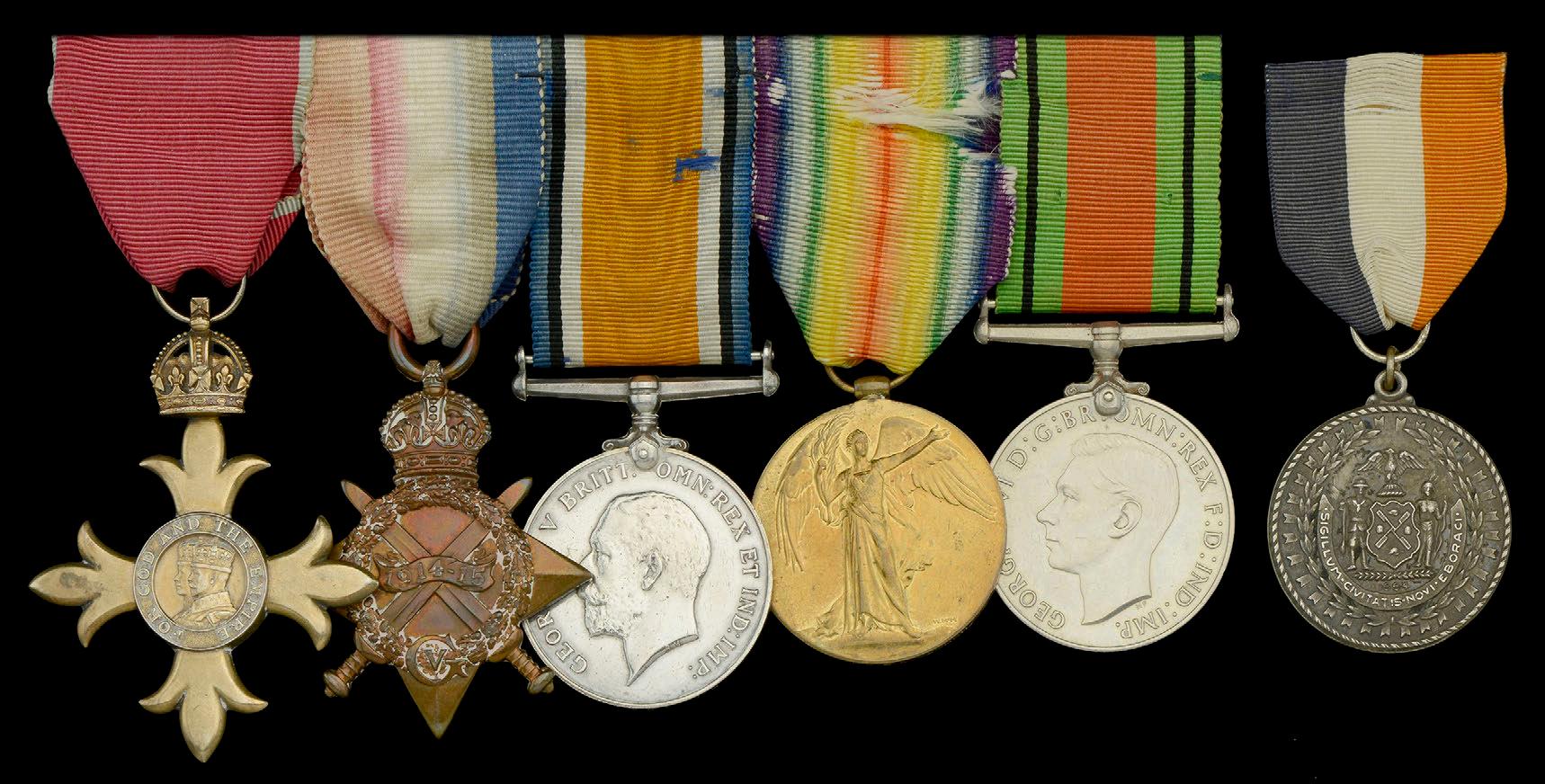
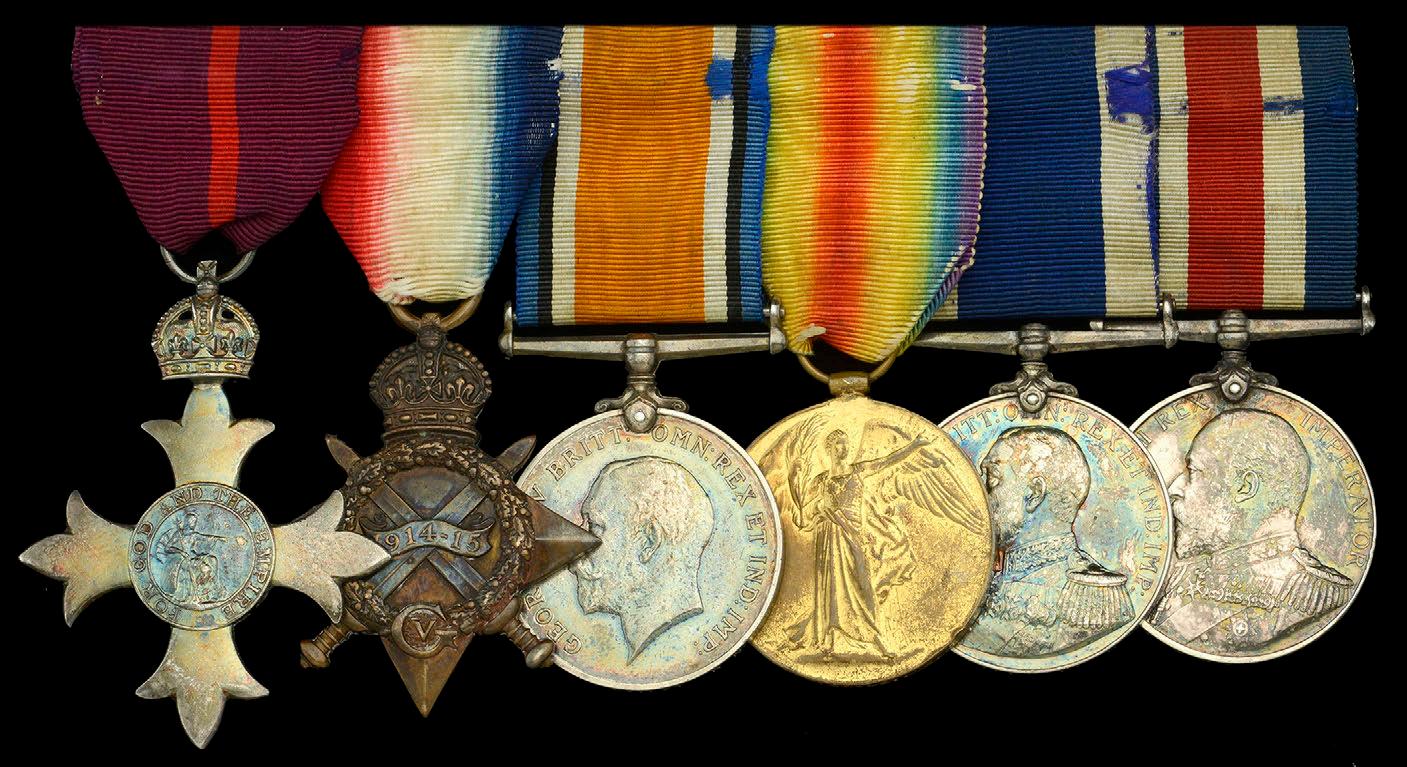
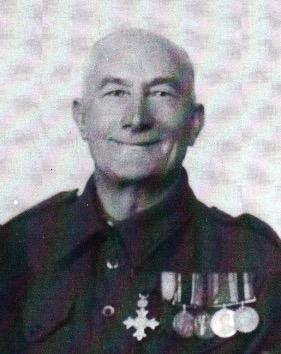
Noonans Orders, Decorations, Medals and Militaria (18 Mar 26)
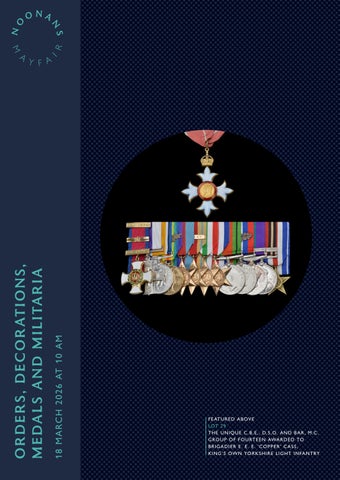
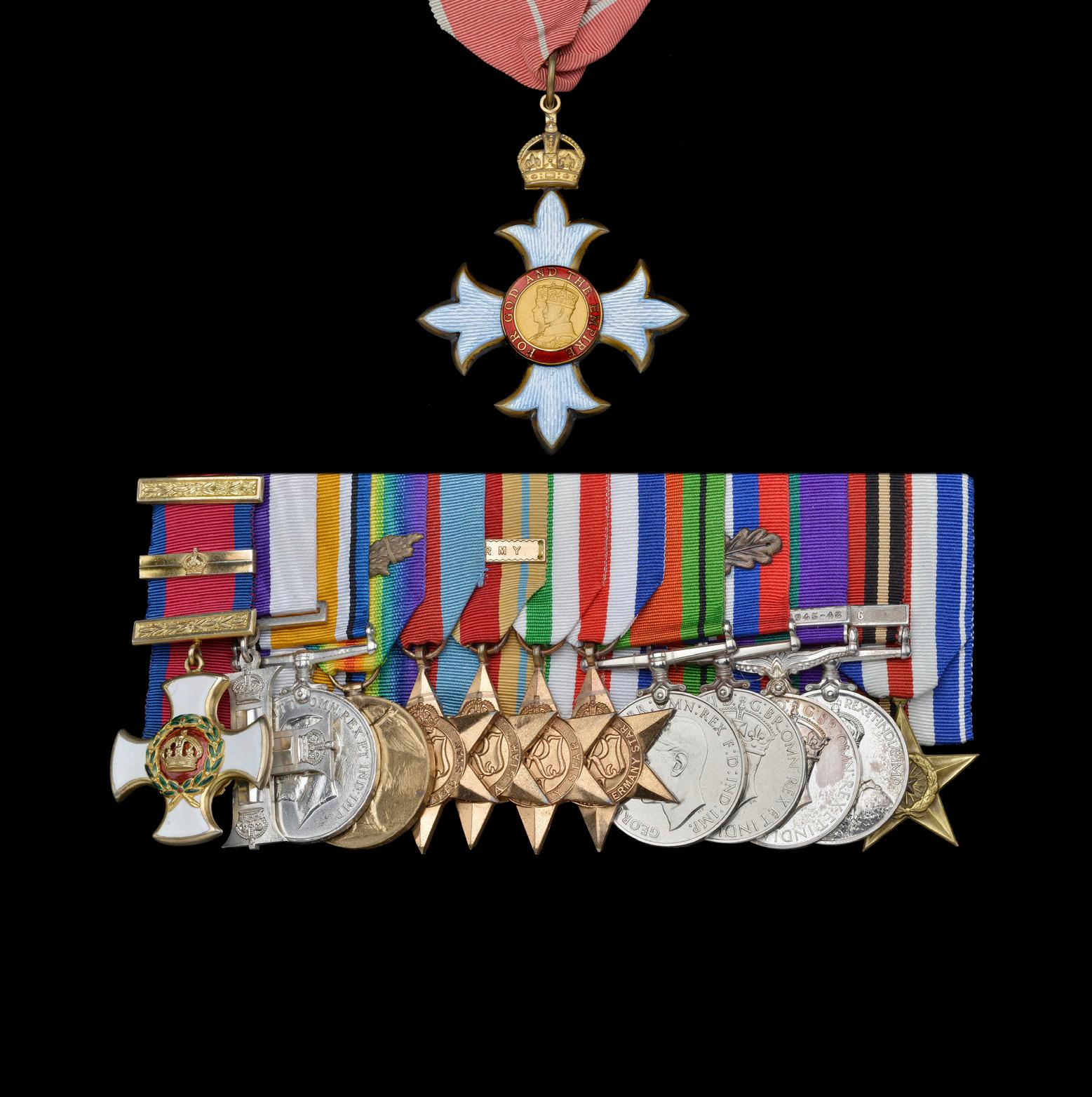
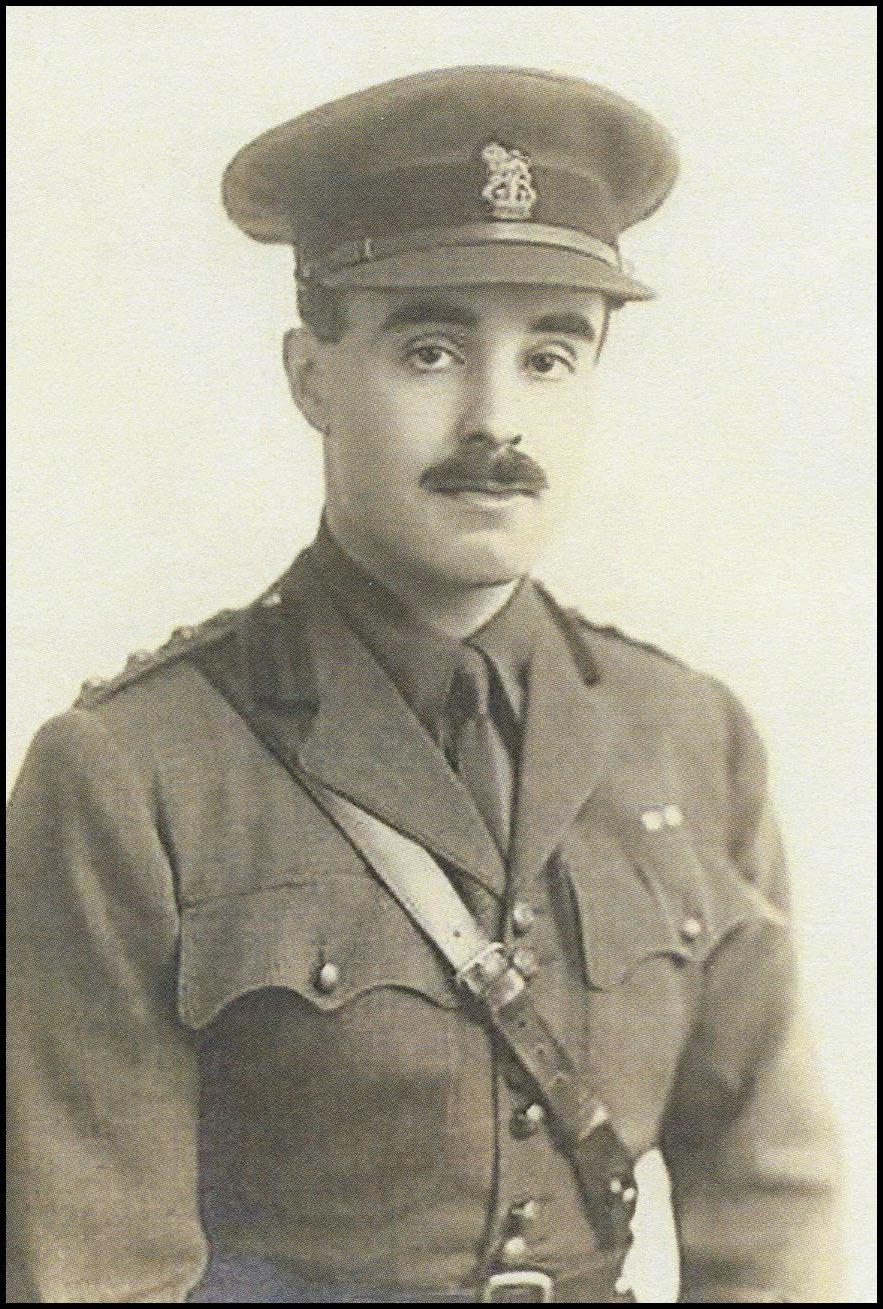
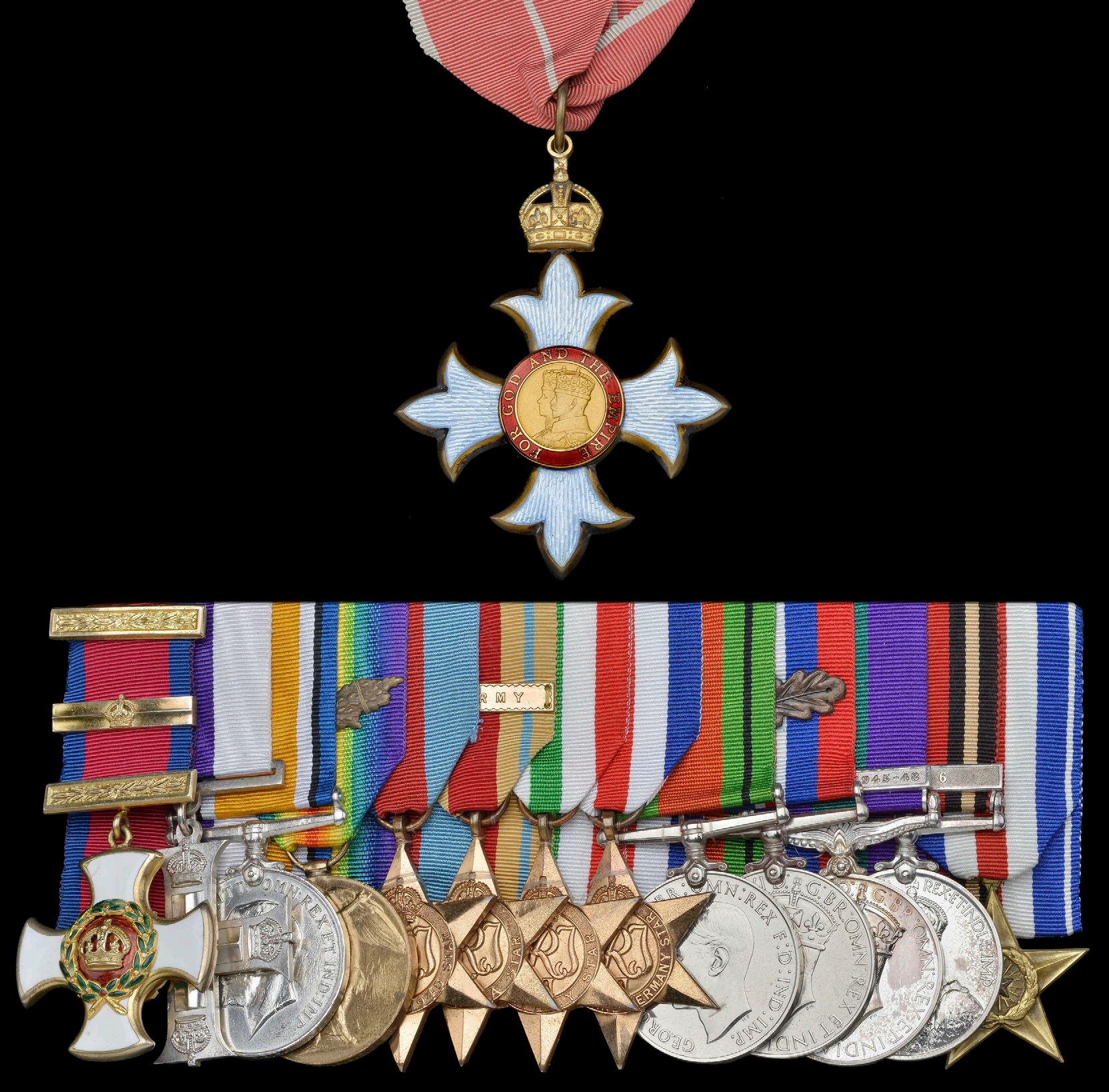
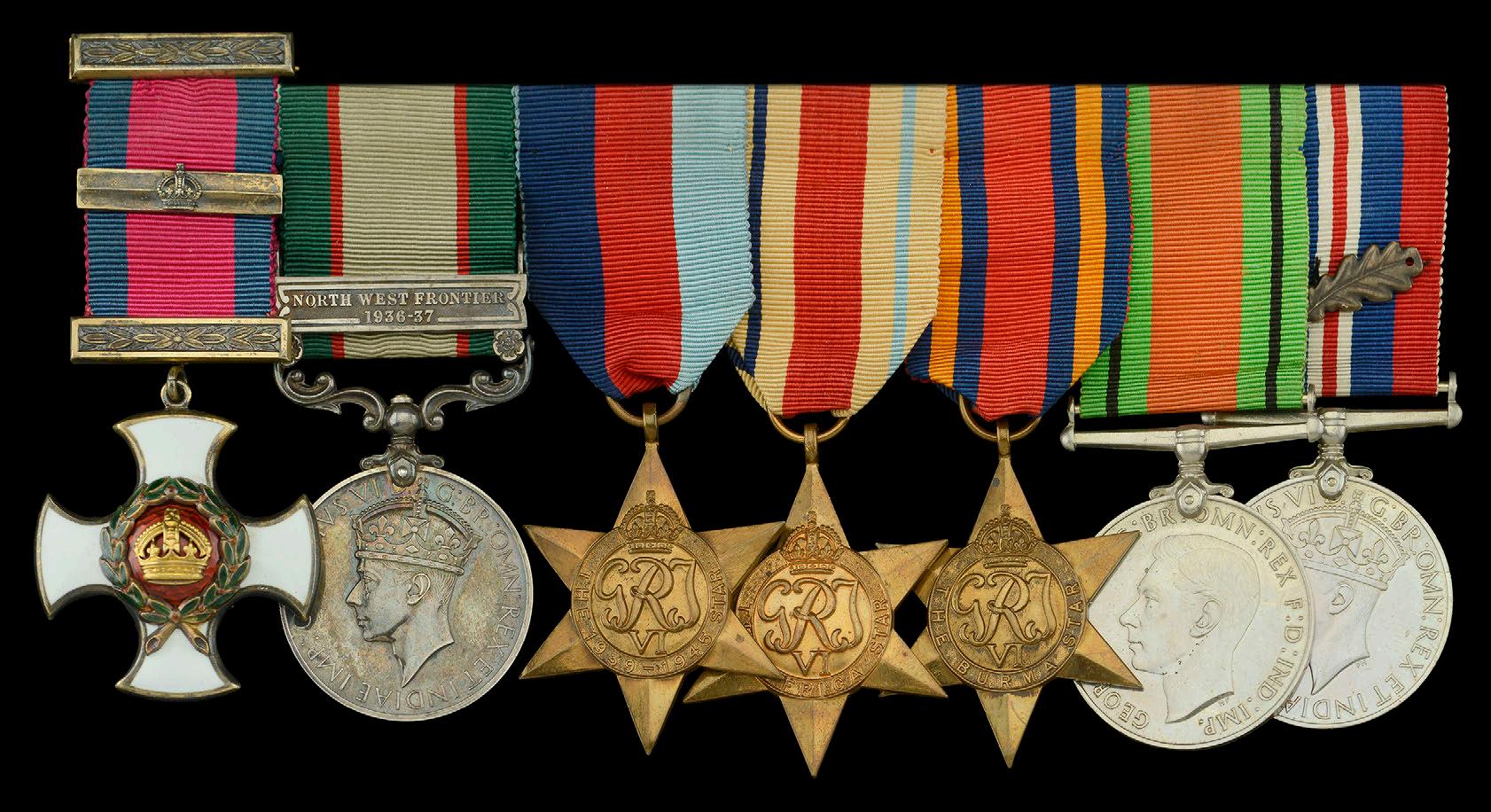
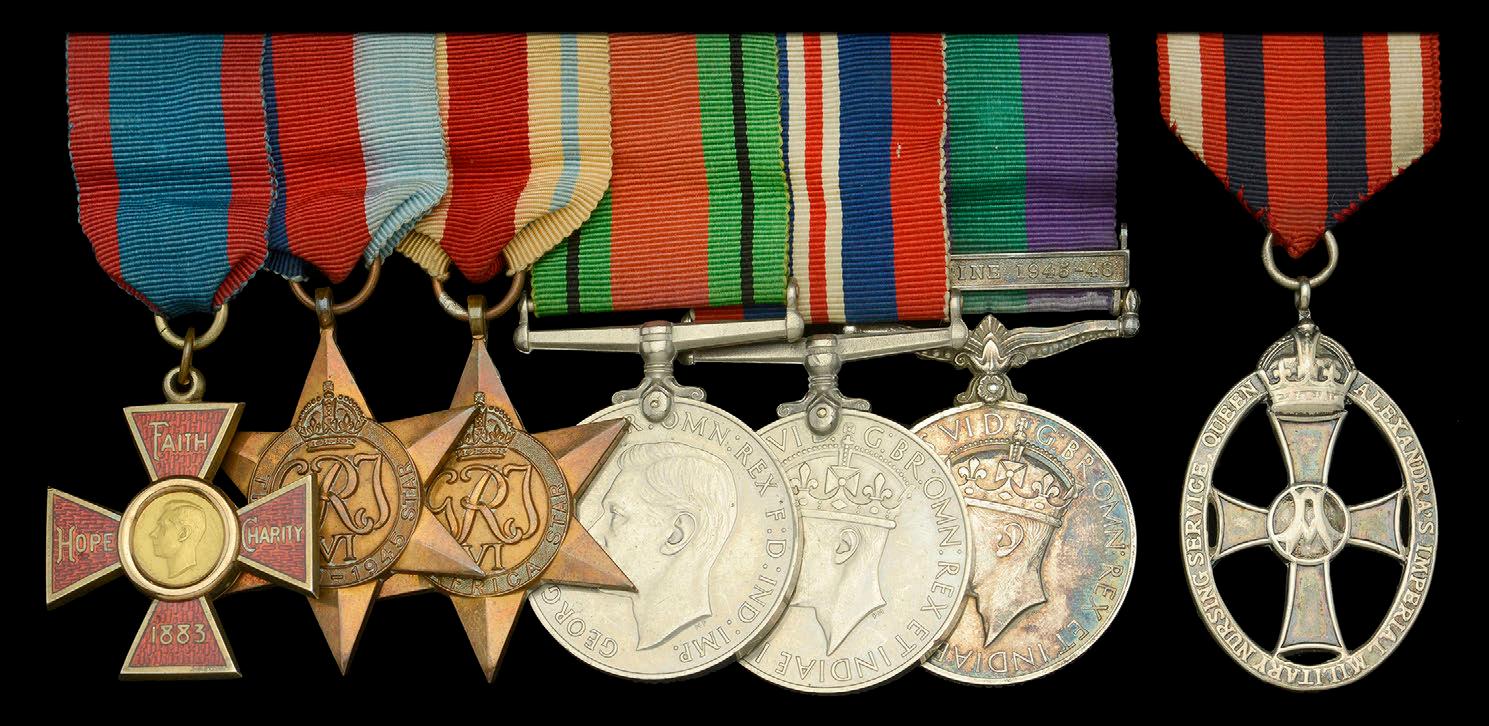
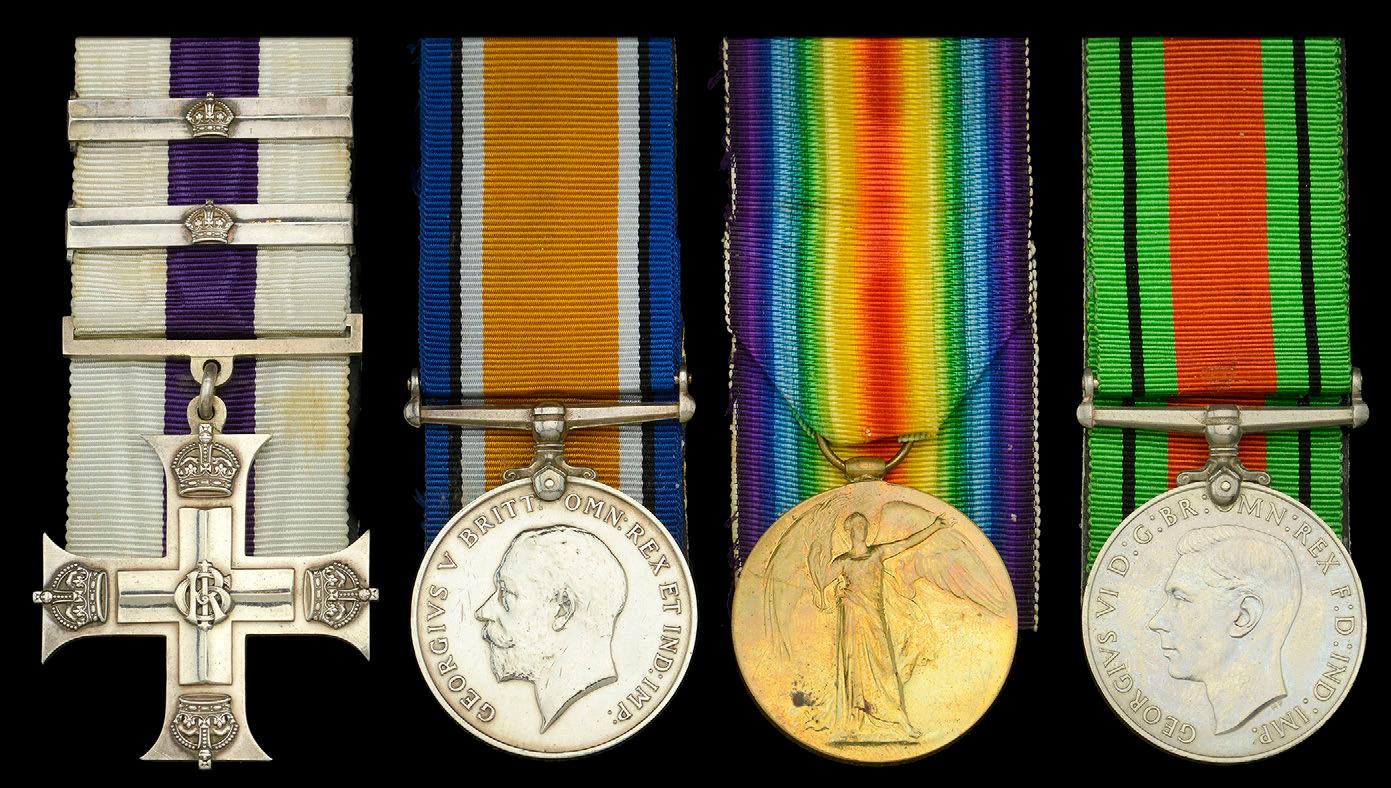
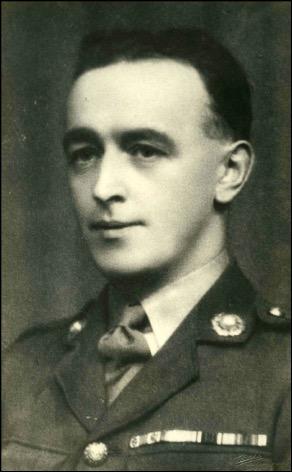
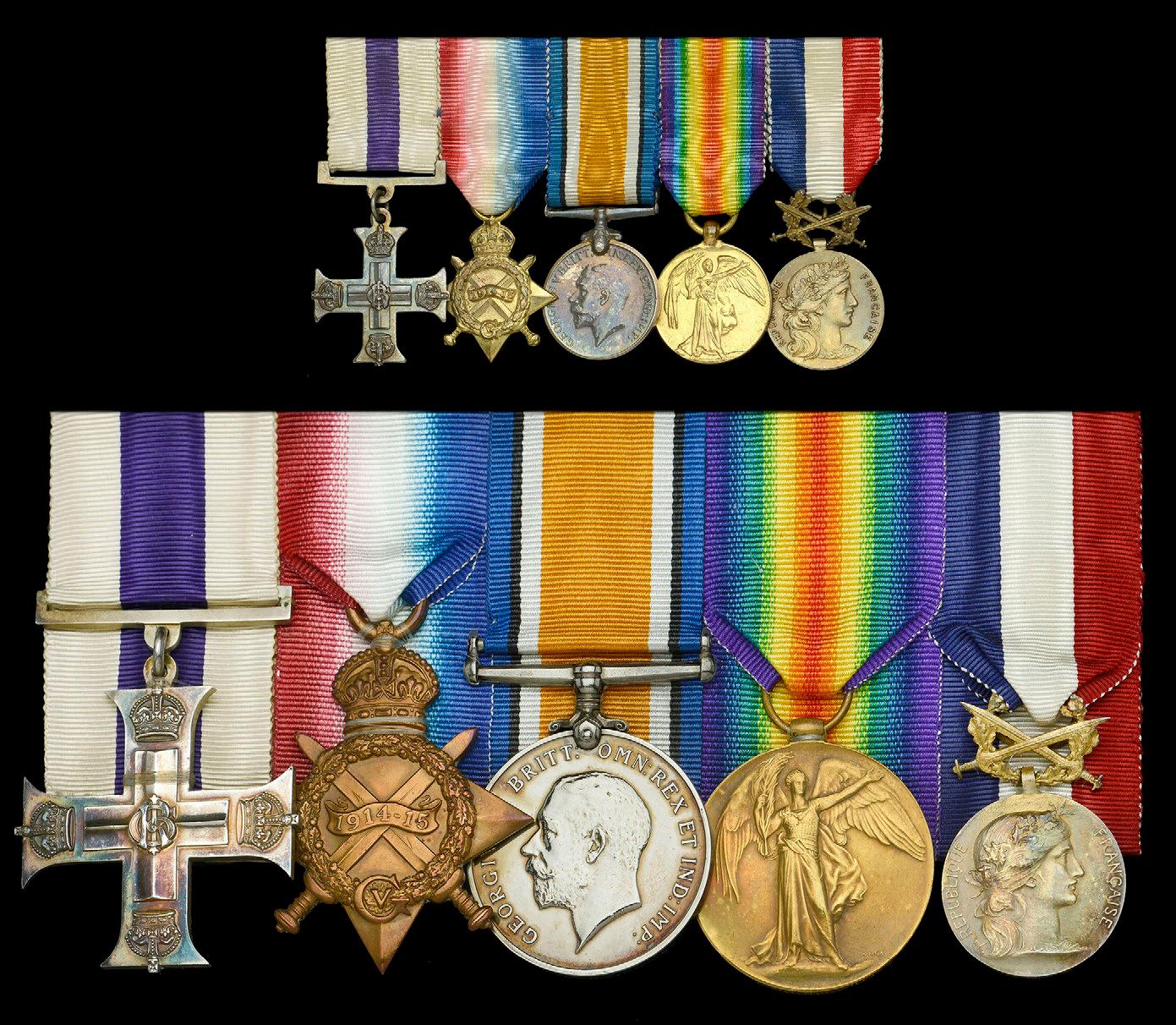
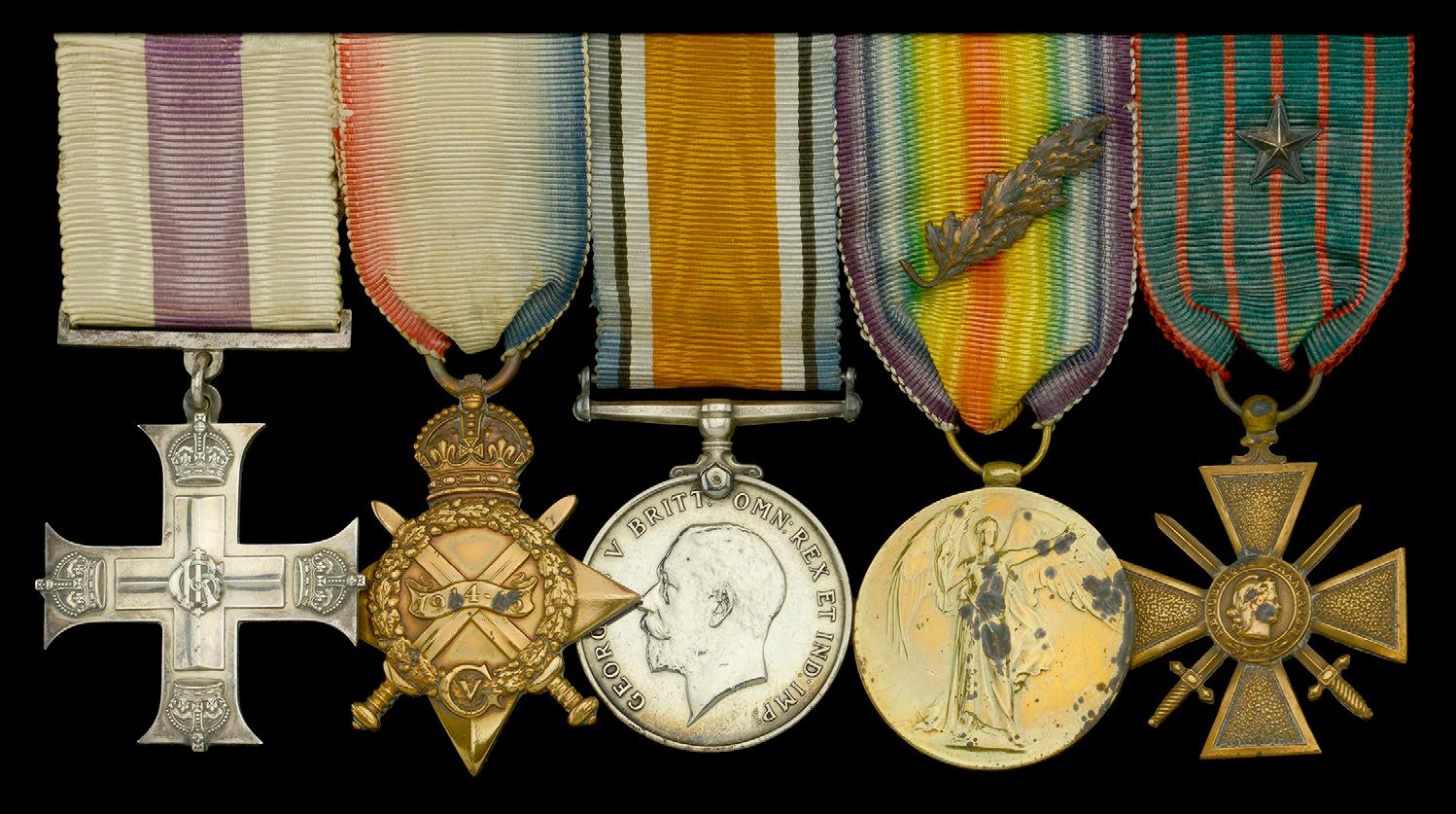
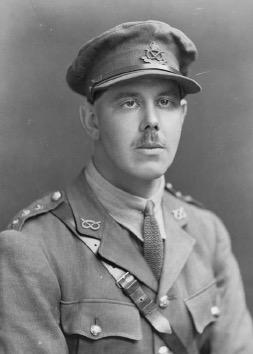
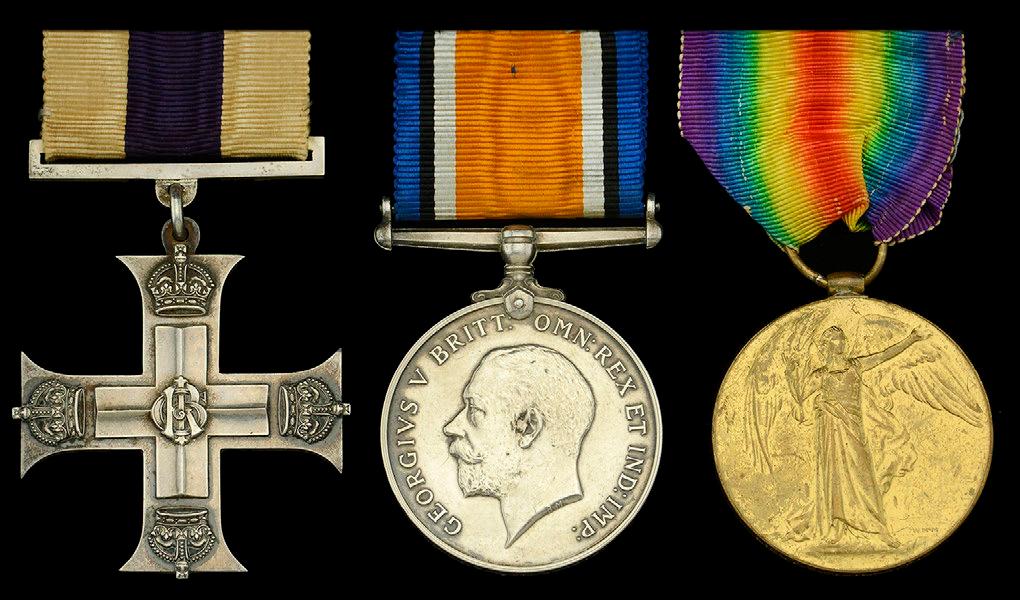
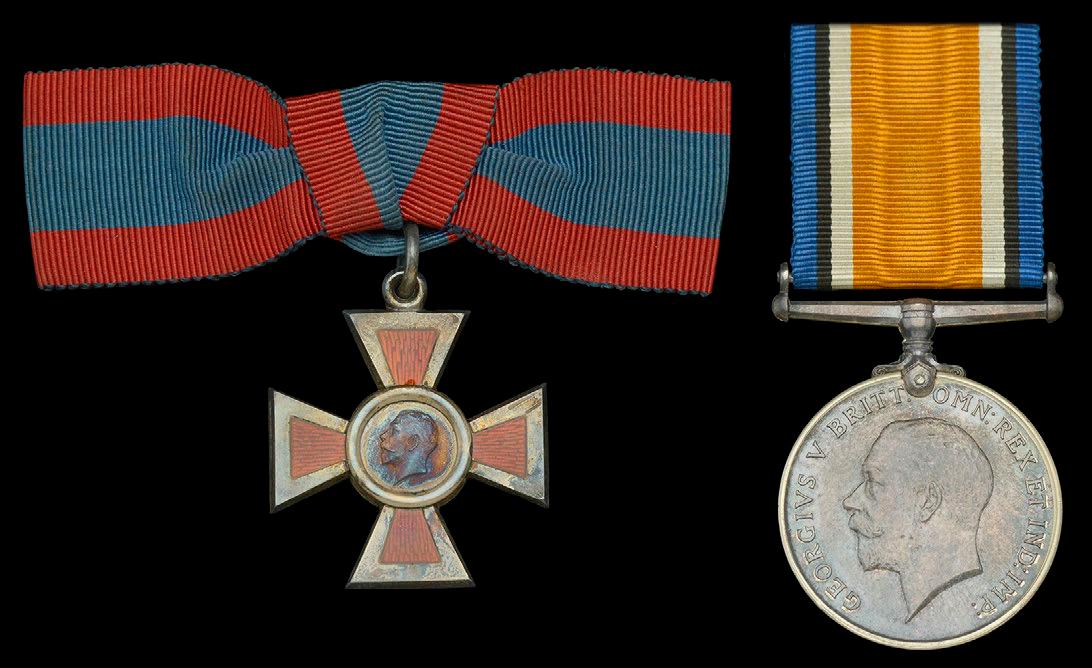
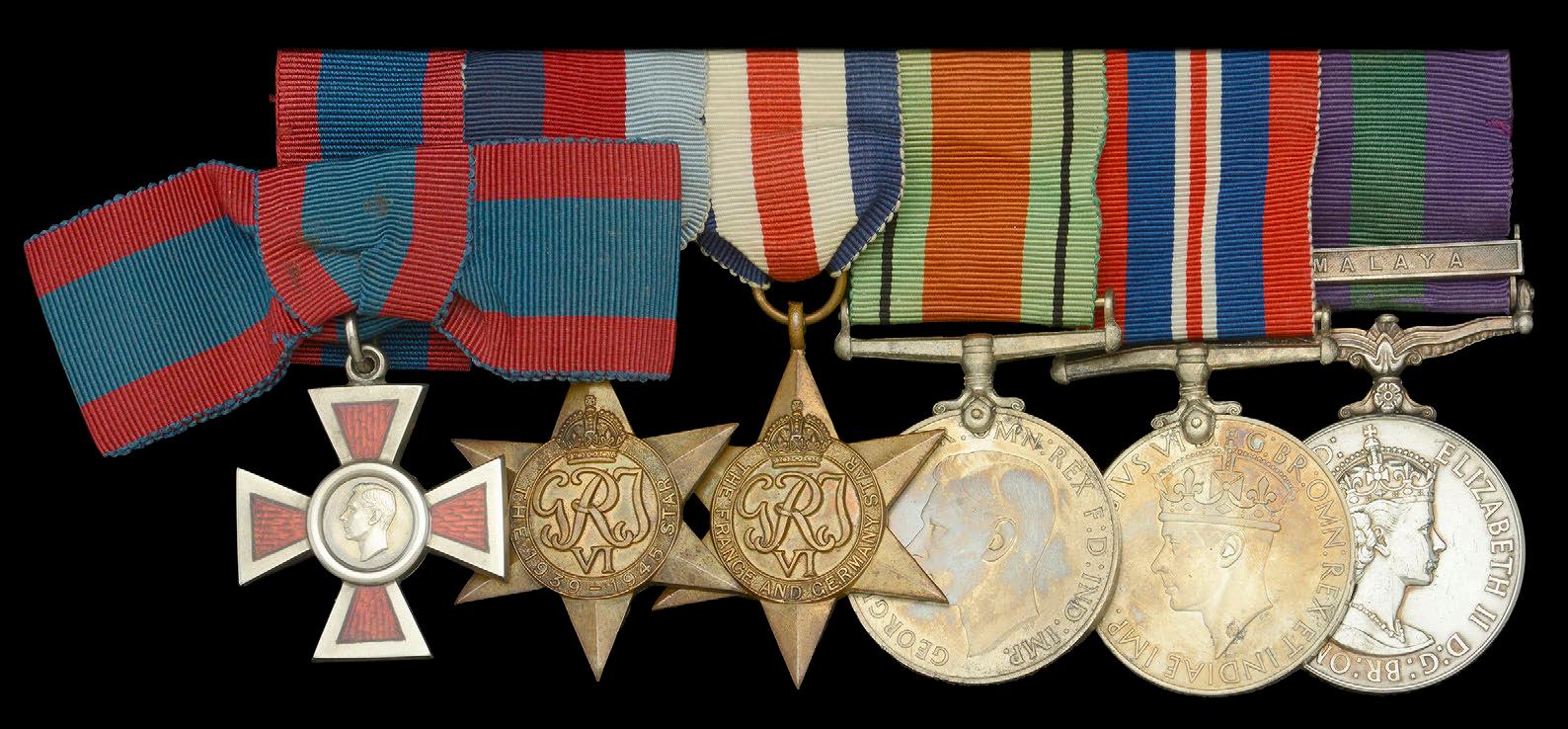
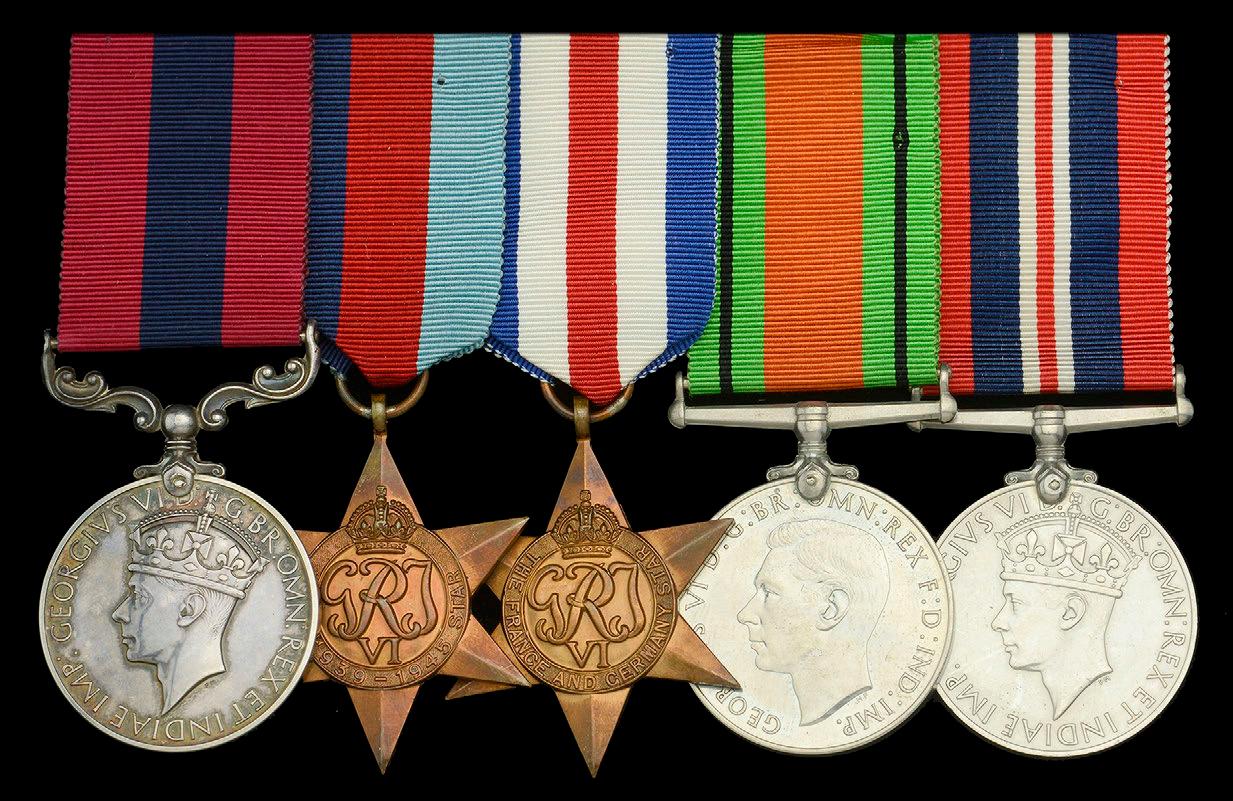
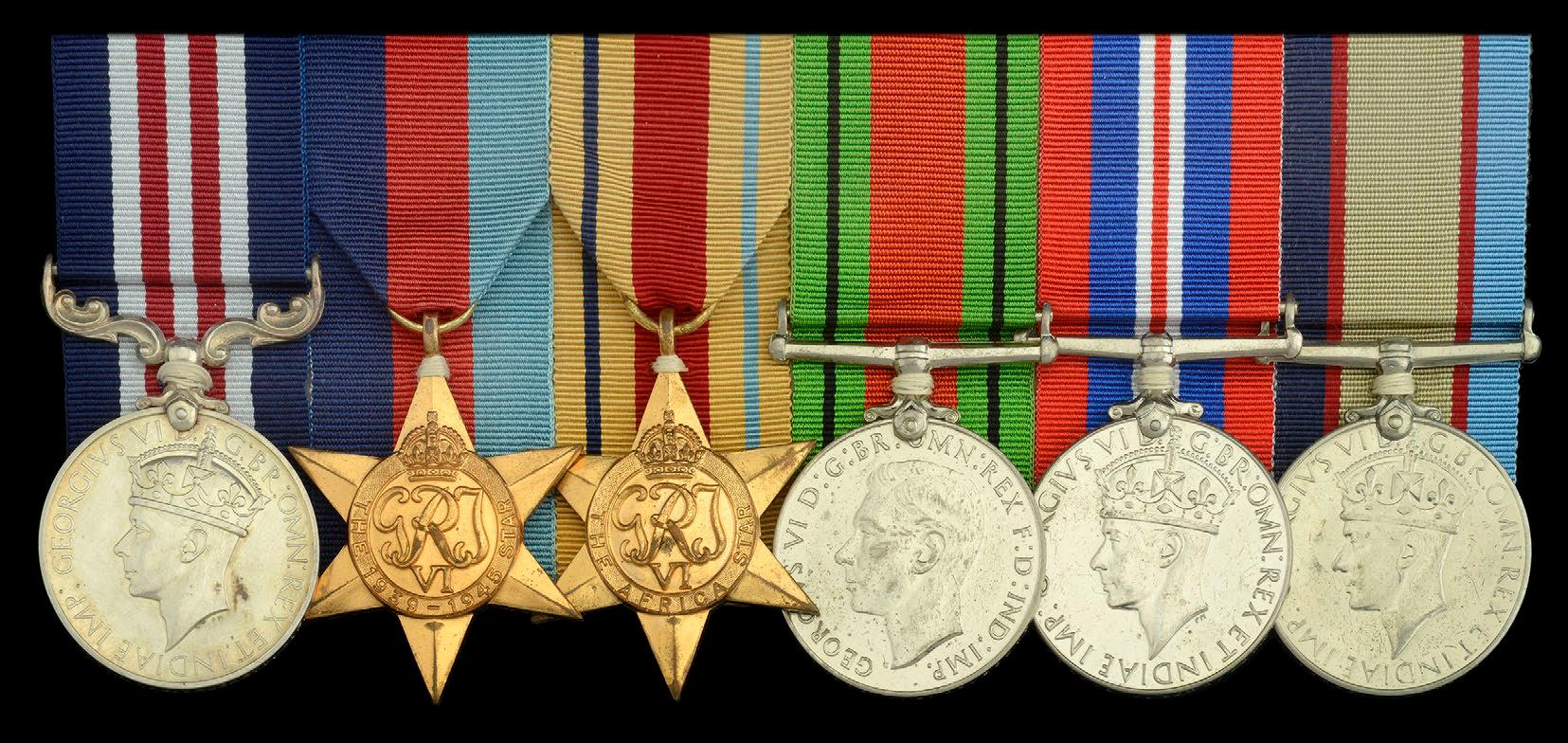
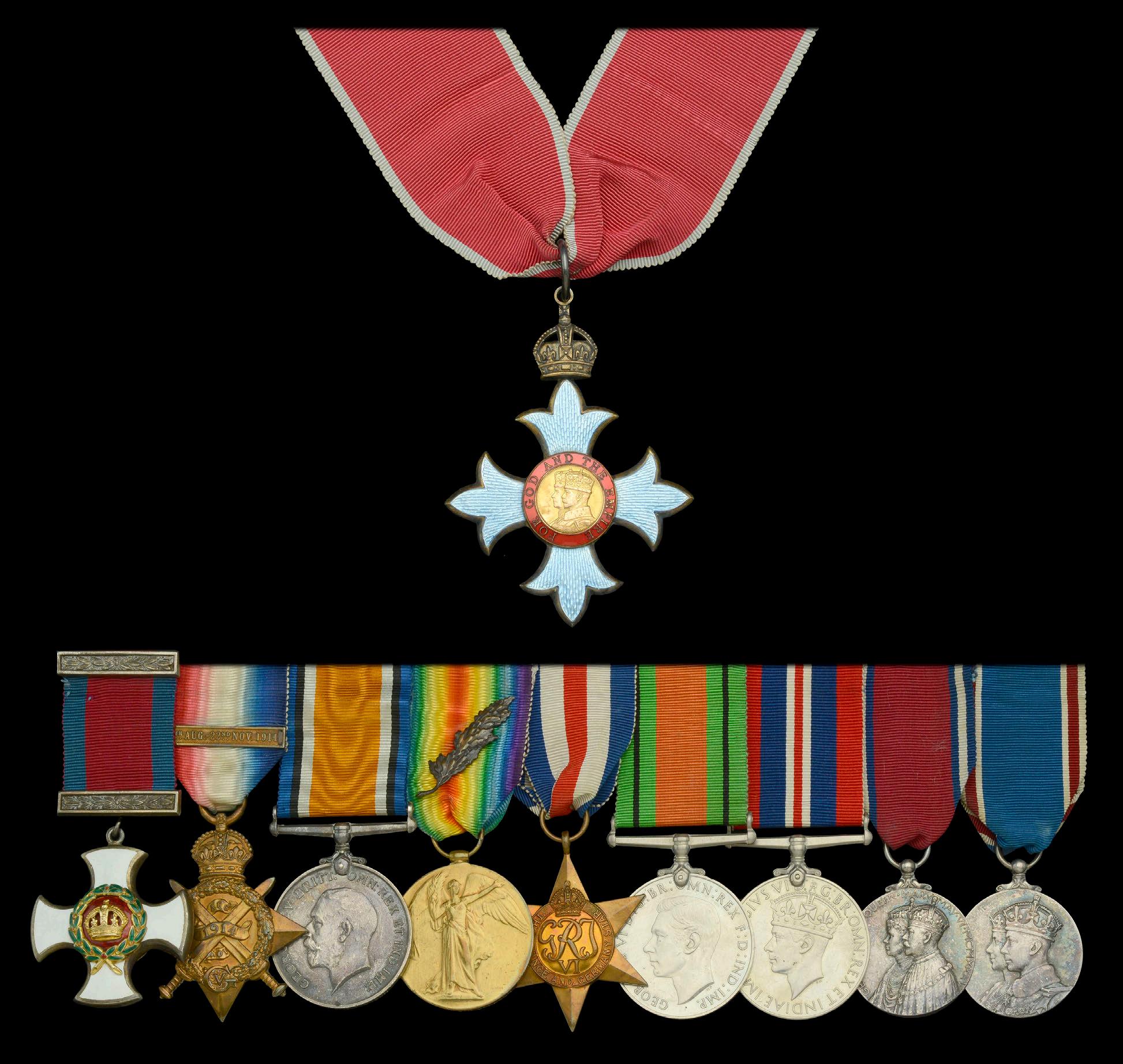
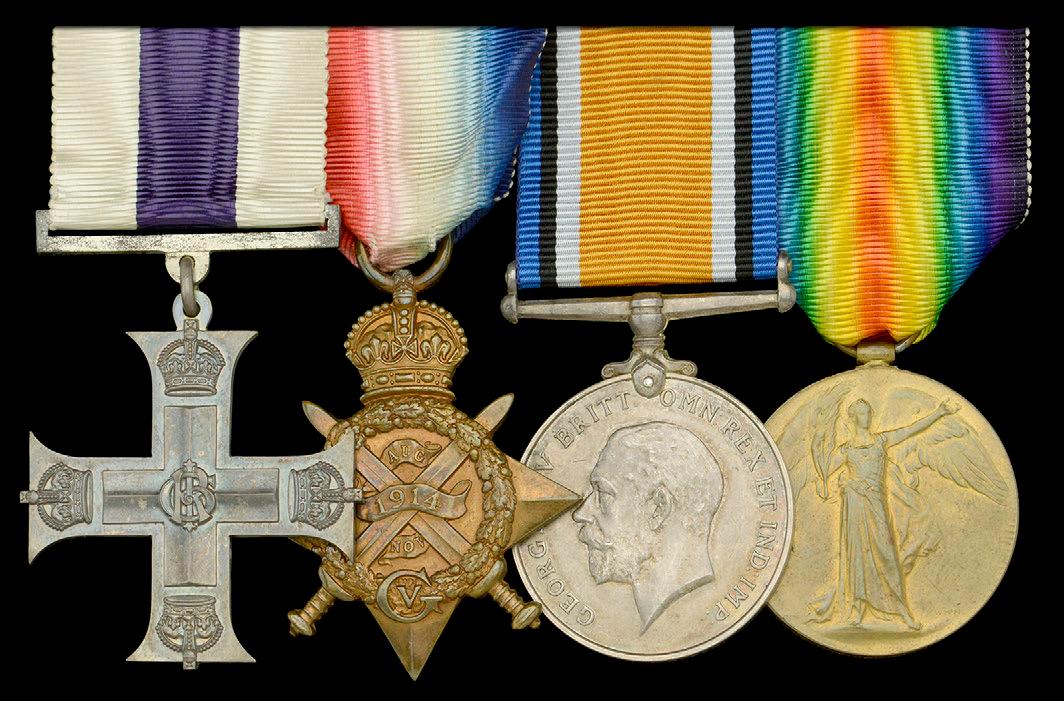
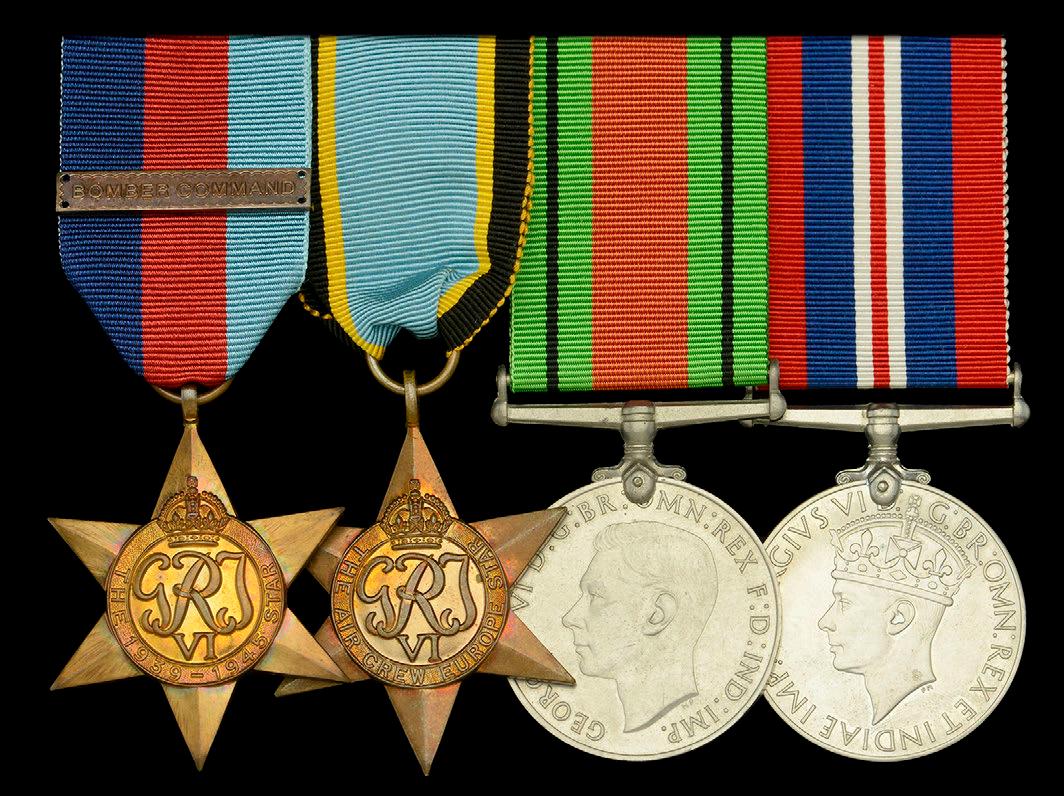
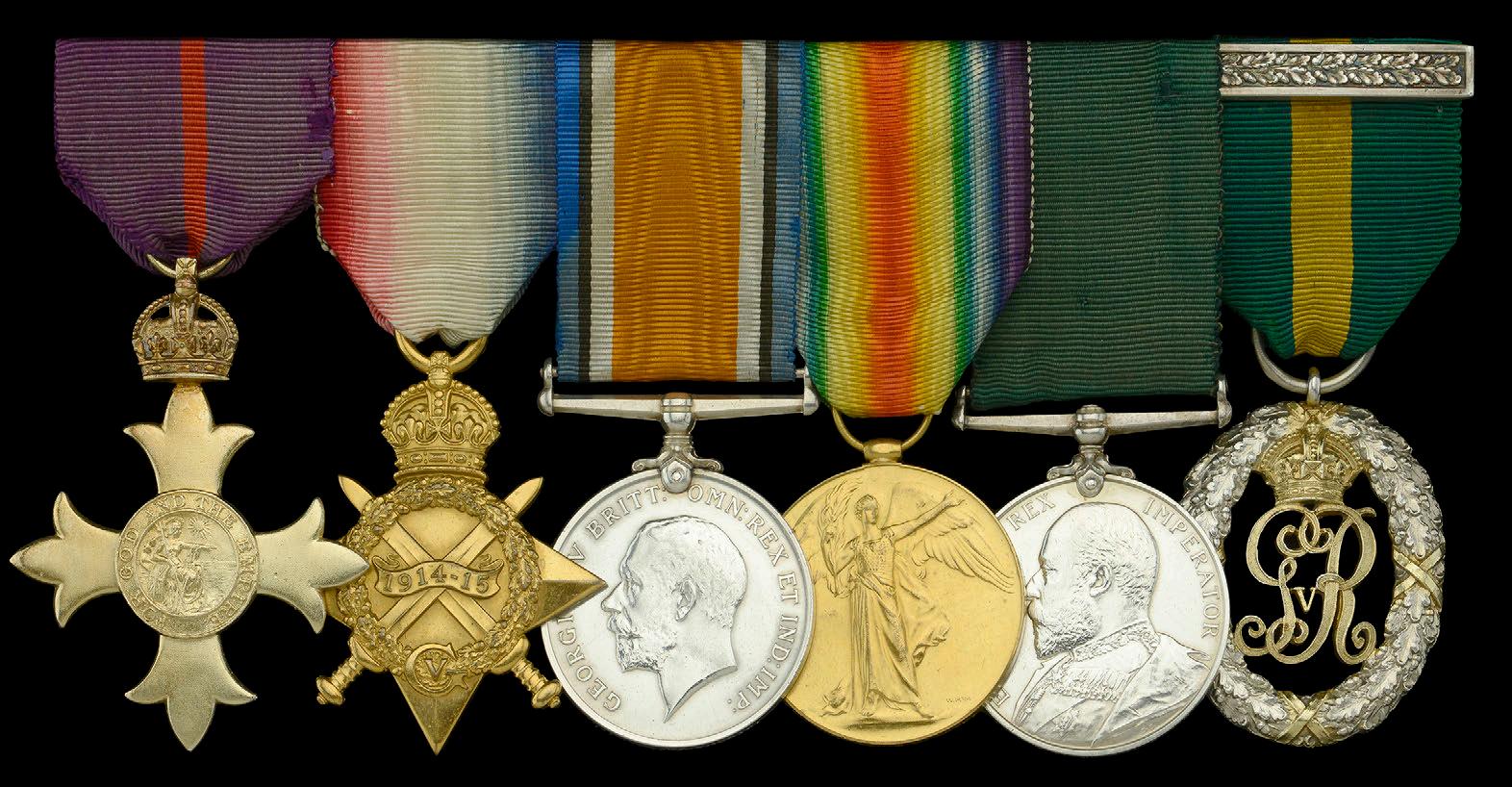
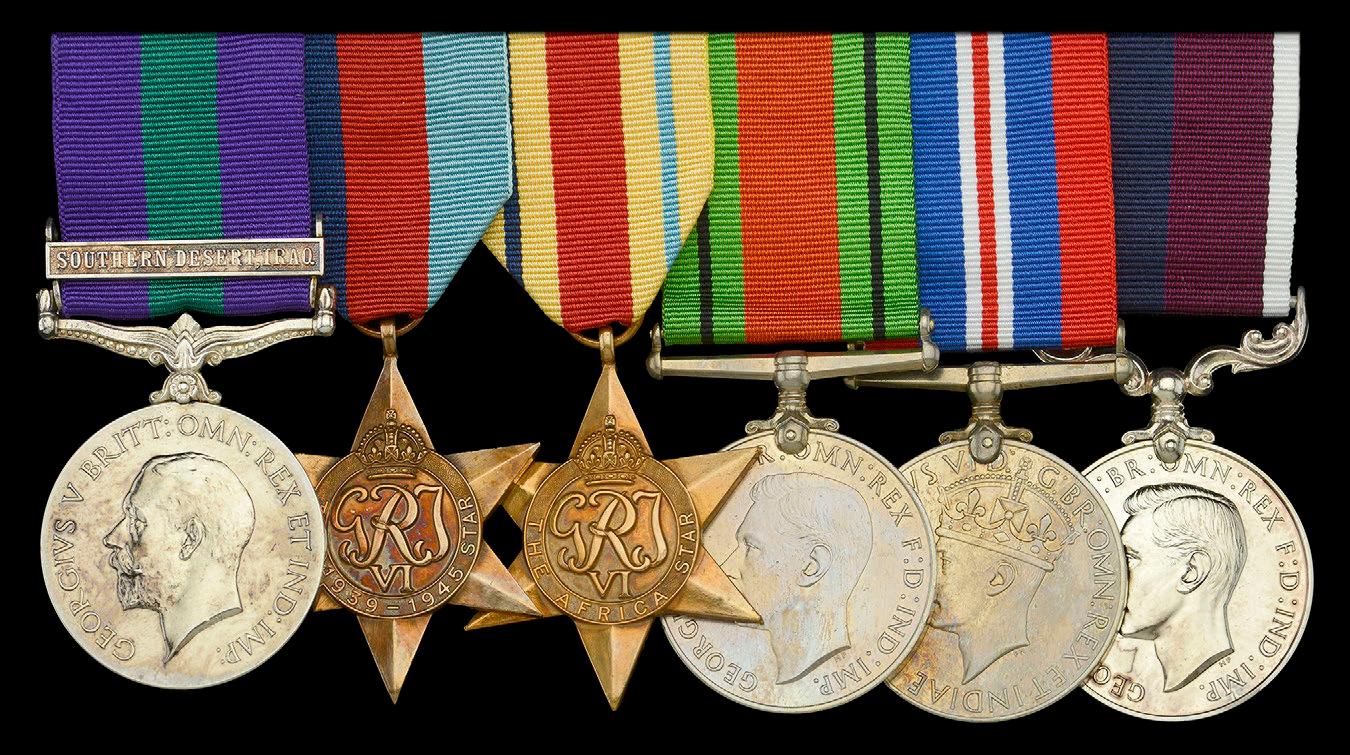
FEATURED ABOVE LOT 29 THE UNIQUE C.B.E., D.S.O. AND BAR, M.C. GROUP OF FOURTEEN AWARDED TO BRIGADIER E. E. E. ‘COPPER’ CASS, KING’S OWN YORKSHIRE LIGHT INFANTRY
AUCTION
AN AUCTION OF: ORDERS, DECORATIONS, MEDALS AND MILITARIA
DATE 18 MARCH 2026 AT 10AM VIEWINGS
ALL APPOINTMENTS TO VIEW PLEASE CONTACT 020 7016 1700 OR VIEWING@NOONANS.CO.UK
ALL LOTS ARE AVAILABLE TO VIEW ONLINE WITH FULL ILLUSTRATIONS AND CONDITION REPORTS AT WWW.NOONANS.CO.UK
HEAD OF MEDAL DEPARTMENT (BOARD DIRECTOR) NIMROD@NOONANS.CO.UK
T. 020 7016 1820
OLIVER PEPYS
MEDAL SPECIALIST (ASSOC. DIRECTOR) OLIVER@NOONANS.CO.UK
T. 020 7016 1811
MARK QUAYLE
MEDAL SPECIALIST (ASSOC. DIRECTOR)
MARK@NOONANS.CO.UK
T. 0 20 7016 1810
ORDER OF SALE
ORDERS, DECORATIONS, MEDALS AND MILITARIA
WEDNESDAY 18 MARCH 2026 AT 10AM
FORTHCOMING AUCTIONS
WEDNESDAY 15 APRIL 2026
ORDERS, DECORATIONS, MEDALS AND MILITARIA
WEDNESDAY 20 MAY 2026
ORDERS, DECORATIONS, MEDALS AND MILITARIA
WEDNESDAY 17 JUNE 2026
ORDERS, DECORATIONS, MEDALS AND MILITARIA
SUMMARY OF INFORMATION FOR BUYERS
REGISTERING TO BID
New clients must register online to bid (whether in person or in absentia). This can be done via our website www.noonans.co.uk
Registrations will be subject to due diligence and Noonans reserves the right to cancel registrations.
Once registered, any client bidding for the rst time online will need to enter their card details so that a security check can be performed to authorise you to bid (www.noonans.co.uk >Your Account > Account Authorisation). This check is secure, your card details are not seen by us and no funds will be deducted.
BIDDING PRIORITY
Please note that we prioritise executing commission bids as early as possible in order to secure the lot for you at the cheapest possible price. It is therefore entirely possible that a lot can sell at your top bid to another bidder. To avoid this happening we o er an optional ‘Plus 1’ bidding increment facility, whereby if the bidding is against you at your maximum bid the auctioneer will execute one further bid on your behalf. Please note that in the event of identical top bids priority is given to the rst bid received.
PLACING BIDS
LIVE BIDDING VIA WWW.NOONANS.CO.UK
You may bid in real time from your computer or mobile device. We provide an optional live video and audio feed of the auctioneer, allowing you to participate in much the same way as attending the auction. You may see your invoice and pay online directly after you’ve nished bidding. There is no additional charge for this facility.
ADVANCE BIDDING VIA WWW.NOONANS.CO.UK
We strongly advise this method if you wish to leave bids in advance as it is the easiest, most accurate and exible way to leave your bids and gives you total control over them right up to the point that the lot is o ered for sale. Bids made online cannot be seen by others and only become live at the point the lot is being sold. Up until this time your bids can be easily altered or cancelled. An automated email is sent to con rm any changes made. There is no additional charge for online bidding.
ADVANCE BIDDING VIA POST, EMAIL OR TELEPHONE
Whilst we are still happy to execute all bids submitted to us using post, email or telephone, it should be noted that all bids left with us in these ways will be entered at our o ces using exactly the same bidding facility to which all our clients have access. There is, therefore, no better way of ensuring the accuracy of your advance bids than to place them yourself online.
If you are registered with Noonans you may bid by email to bids@noonans.co.uk or by telephone to 020 7016 1700. All bids placed by email or telephone must be received before 4 PM on the day preceding the sale.
A bidding form is included in the back of this catalogue. If you wish to use this please ll it in carefully, to include all relevant information. Please ensure that you post this form so that it arrives, at the latest, the day before the sale.
BIDDING IN THE AUCTION ROOM
You are very welcome to attend the auction and bid in person if you are registered with Noonans.
Please note that the auction room is situated on the third oor of a Georgian building which doesn’t have a lift. You may pay for and collect your lots during the auction.
SALEROOM NOTICES
Should the description of a lot need to be amended after the publication of this catalogue, the amendments will appear automatically on the Noonans website, www.noonans.co.uk. All such amendments are also incorporated in the List of Saleroom Notices pertaining to this auction which are posted separately on the website. The auctioneer will refer to any notices at the time any a ected lot is o ered for sale.
C ATALOGUE ILLUSTR ATIONS & THE INTERNET
Prospective bidders are reminded that the Noonans website features high-resolution colour illustrations of every lot in this auction. There may also be additional illustrations of any lot.
BUYERS’ PREMIUM
The rate for this sale is 24% of the Hammer Price (+ VAT where applicable).
IMPOR TATION V AT
Lots marked ‘X’ are subject to importation VAT of 5% on the Hammer Price unless re-exported outside the UK, as per Noonans Ts & Cs.
From 1 January 2021 importation VAT may be levied by EU countries on lots sold by Noonans and subsequently imported into those countries. Although Noonans is unable to advise buyers on customs regulations in their country of domicile, there is further information regarding EU
importation VAT rates for collectable items in the Terms and Conditions published on the Noonans website.
PRICES REALISED
The hammer prices of lots sold at Noonans auctions are posted at www.noonans.co.uk in real time and telephone enquiries are welcome from 9 AM on the day after the auction.
PAYMENT
You may access your invoice shortly after the hammer has fallen on your last lot. As we weigh lots at the time of cataloguing most shipping is already calculated, enabling you to settle your account and receive your lots in a timely fashion. Auction attendees may pay and collect during the course of the auction as soon as they have bid on their last lot.
Full Terms and Conditions of Business are available to read in the back of this catalogue and on our website.
CONTACTS
GENERAL SUPPORT ENQUIRIES
auctions@noonans.co.uk 020 7016 1700 or from overseas (+44) 20 7016 1700
WEBSITE AND LIVE BIDDING SUPPORT ENQUIRIES
Ian Anderson
ian@noonans.co.uk
020 7016 1700 or from overseas
(+44) 20 7016 1700
BRI T ANNIA ME D AL F AIR
S UND AY 10MAY 202 6
• 9 :30 AM–2 PM
CARISBROOKE HALL, THE VIC TOR Y SERVICES
CLUB63/79 SEYMOUR STREE T , LONDON W2 2HF Specialist Collectors, Dealers and Auctioneers from across the UK and beyond will be in attendance.
FREE ENTRY
•
We are pleased to announce that there continues to be no charge for visitors or trade stands
The event is hosted by Noonans on a not-for-pro t basis as a service to the medal collecting community.
The popular Britannia curry will be available from the canteen!
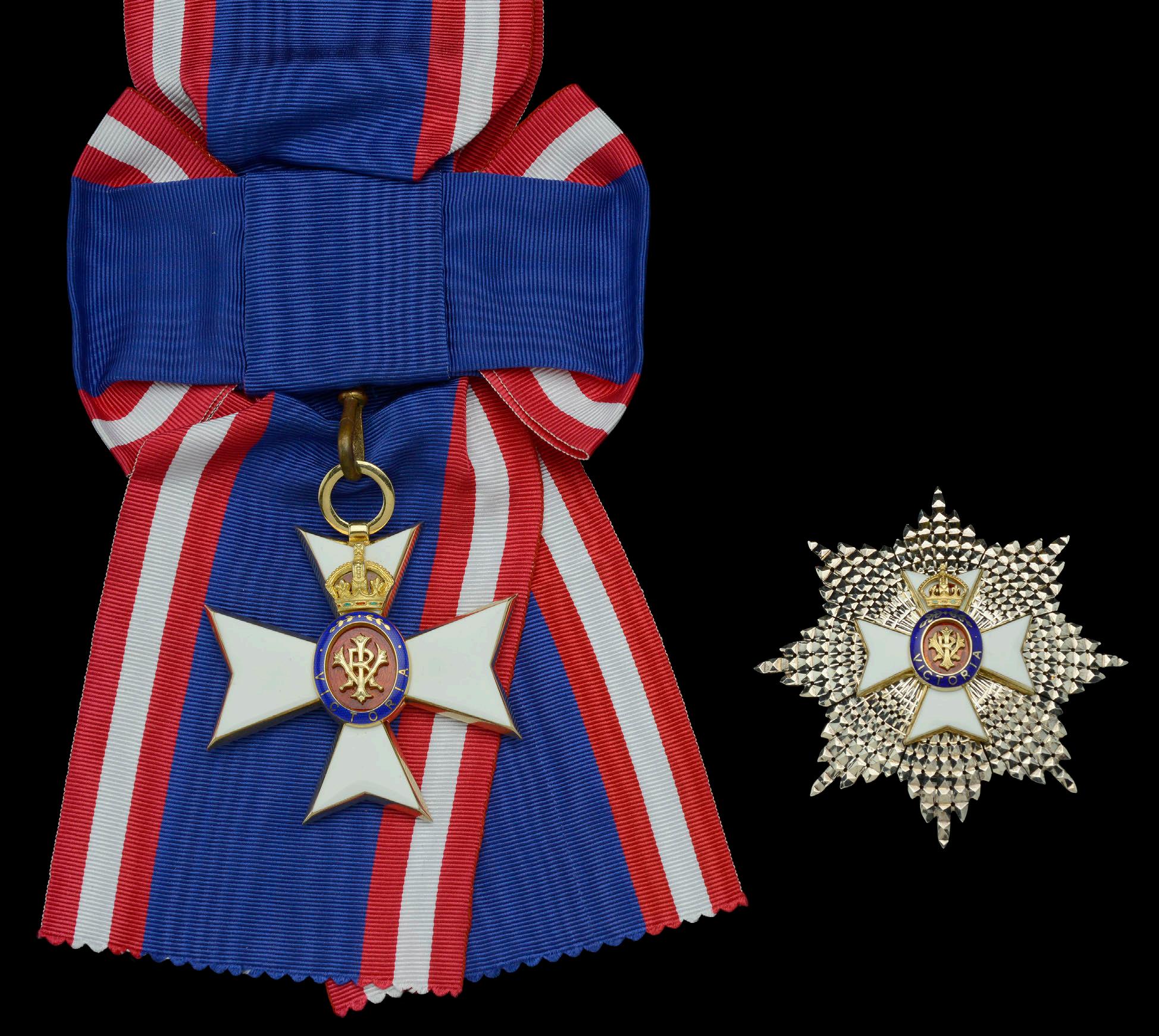
The Royal Victorian Order, G.C.V.O., Knight Grand Cross set of insignia, comprising sash badge, silver-gilt and enamel, reverse officially numbered ‘1145’; and breast star, silver, silver-gilt, and enamel, reverse officially numbered ‘1145’, with gold retaining pin, with full sash riband, extremely fne (2) £1,400-£1,800
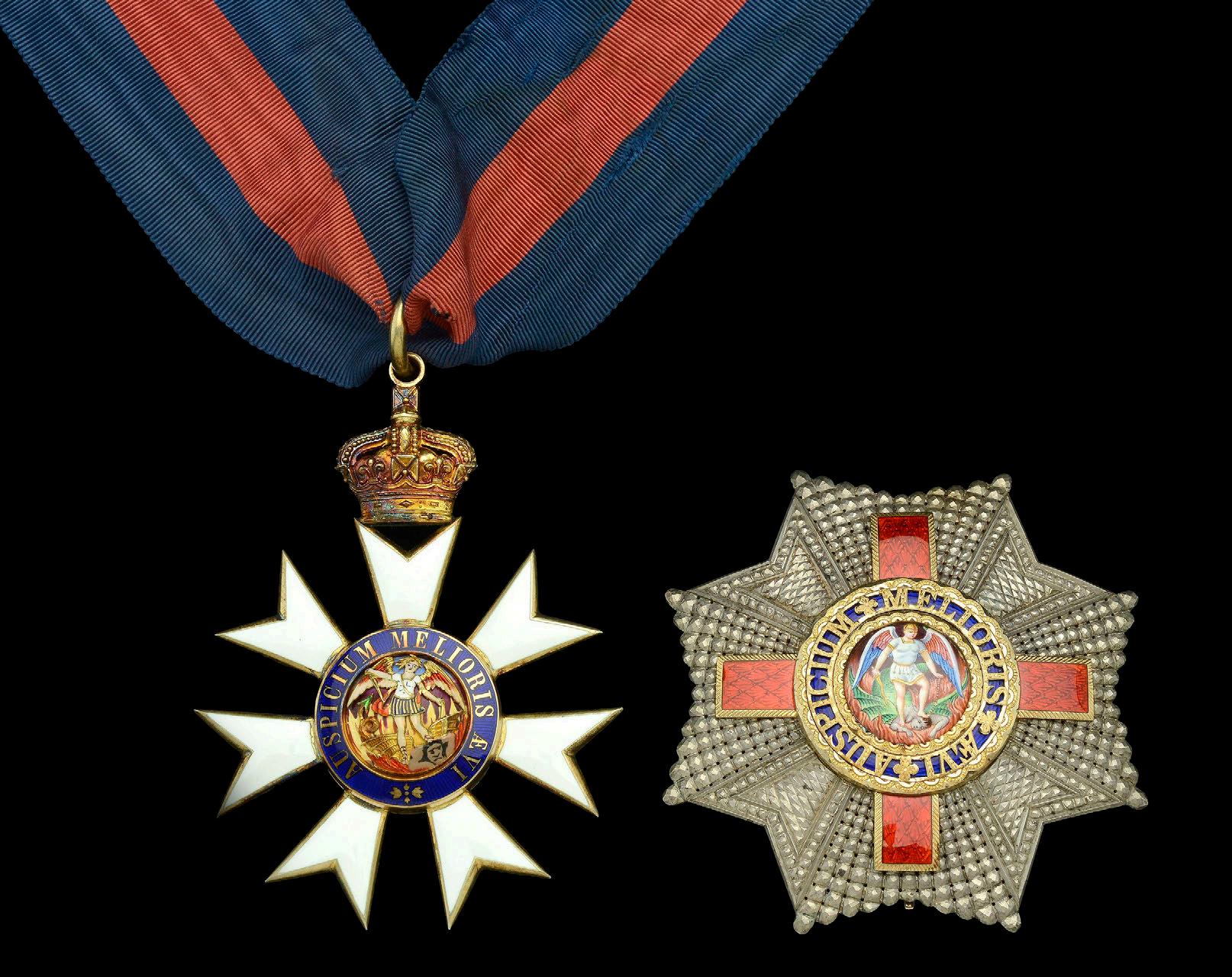
The Most Distinguished Order of St. Michael and St. George, K.C.M.G. Knight Commander’s late 19th century set of insignia, comprising large size neck badge, 100mm excluding ring suspension x 72mm, silver-gilt and enamels, and breast star, 90mm diameter, silver with appliqué centre in gold and enamels, with gold pin for wearing, complete with fll neck cravat with silver-gilt retaining clasp (separate), in Garrard & Co , 25 Haymarket, London, ftted case of issue, some damage to reverse fgure of St George and dragon, otherwise about extremely fne (2) £1,400-£1,800
Knight Bachelor’s Badge, 2nd type breast badge, silver-gilt and enamel, hallmarks for London 1934, light test scratches to reverse, otherwise nearly extremely fne £200-£240
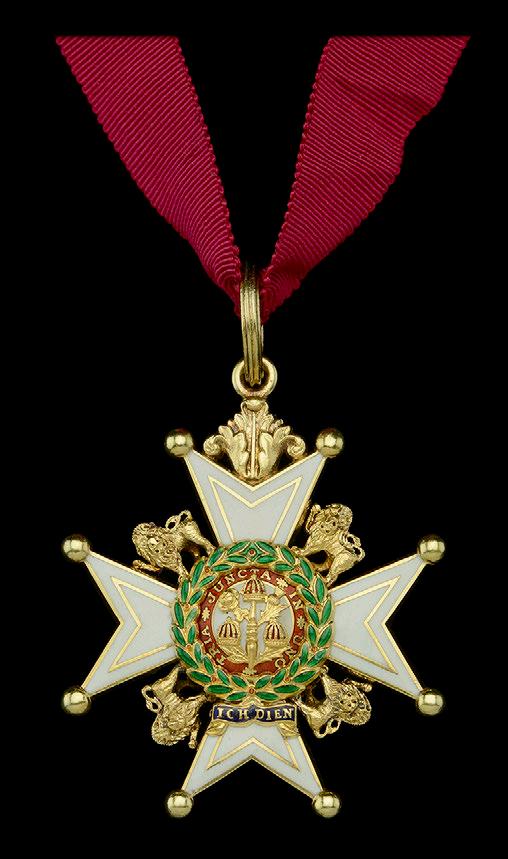
The Most Honourable Order of the Bath, C.B., (Military) Companion’s neck badge, silver-gilt and enamel, with miniature width neck riband, nearly extremely fne £600-£800
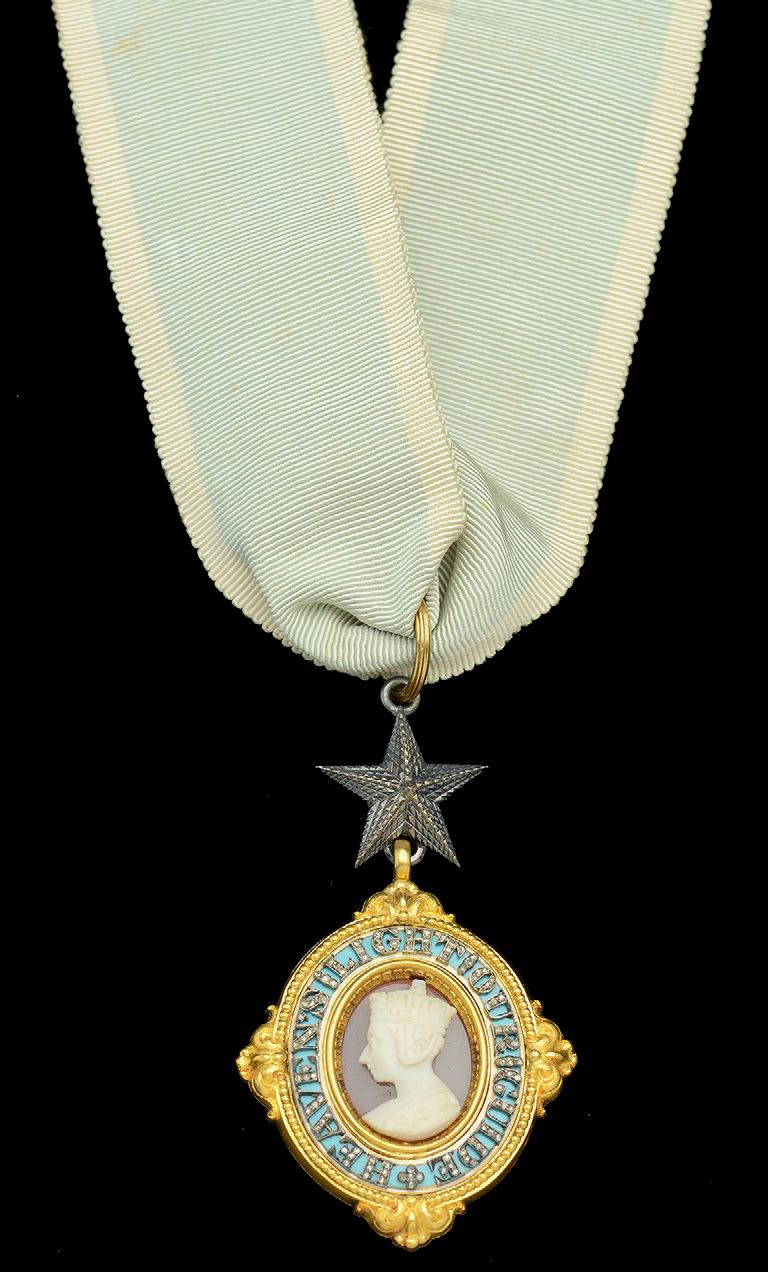
The Most Exalted Order of the Star of India, C.S.I., Companion’s neck badge, gold and enamel, with central onyx cameo of a youthful Queen Victoria, the motto of the order set in rose diamonds, suspended from a fve-pointed silver star and gold ring suspension, with full and miniature width neck ribands, in Garrard, London, case of issue, a perfect badge, extremely fne £4,000-£5,000
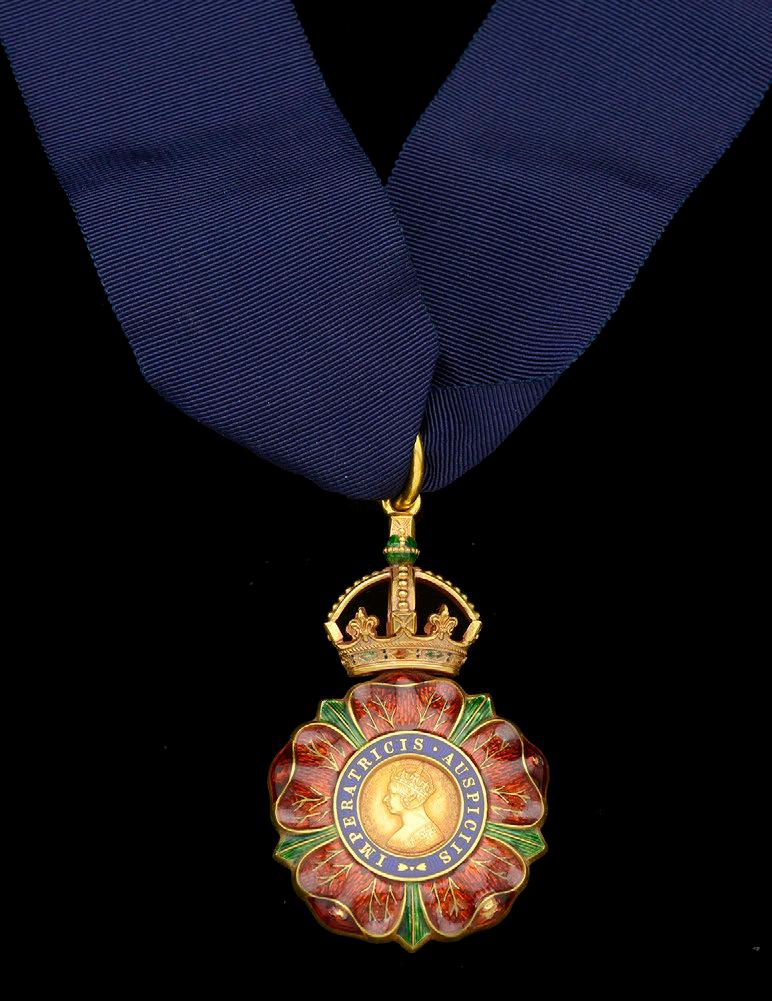
The Most Eminent Order of the Indian Empire, C.I.E., Companion’s 3rd type neck badge, gold and enamels, with full and miniature width neck ribands, in Garrard, London, case of issue, minor enamel chips to red enamel, otherwise about extremely fne £1,400-£1,800
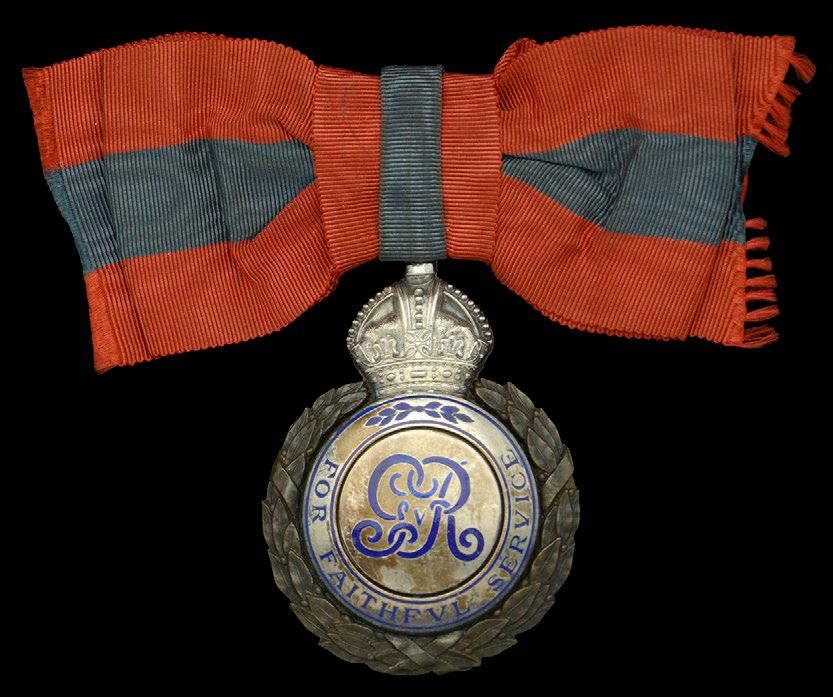
The Most Excellent Order of the British Empire, C.B.E., (Civil) Commander’s 2nd type, lady’s shoulder badge, silver-gilt and enamel, on lady’s bow riband, in Toye, Kenning & Spencer, London, case of issue, extremely fne £200-£240
77 The Most Excellent Order of the British Empire, O.B.E., (Civil) Officer’s 2nd type, breast badge, silver-gilt, in Garrard, London, case of issue, extremely fne £100-£140
The Most Excellent Order of the British Empire, O.B.E., (Civil) Officer’s 2nd type, breast badge, silver-gilt, in Toye, Kenning & Spencer, London, case of issue, extremely fne £100-£140
The Most Excellent Order of the British Empire, M.B.E., (Military) Member’s 1st type, breast badge, silver, hallmarks for London 1917, good very fne £80-£100
The Most Excellent Order of the British Empire, M.B.E., (Civil) Member’s 2nd type, breast badge, silver, maker’s marks ‘G&N’ to reverse of crown, in ftted Royal Mint case, extremely fne £80-£100
The Most Excellent Order of the British Empire, M.B.E., (Civil) Member’s 2nd type, breast badge, silver, in Gaunt, London, case of issue, extremely fne £80-£100
The Most Excellent Order of the British Empire, M.B.E., (Civil) Member’s 2nd type, lady’s shoulder badge, silver, on lady’s bow riband,
£80-£100
The Most Excellent Order of the British Empire, M.B.E., (Civil) Member’s 2nd type, lady’s shoulder badge, silver, on lady’s bow riband, in Royal Mint case of issue, extremely fne £80-£100
e O Orrd d
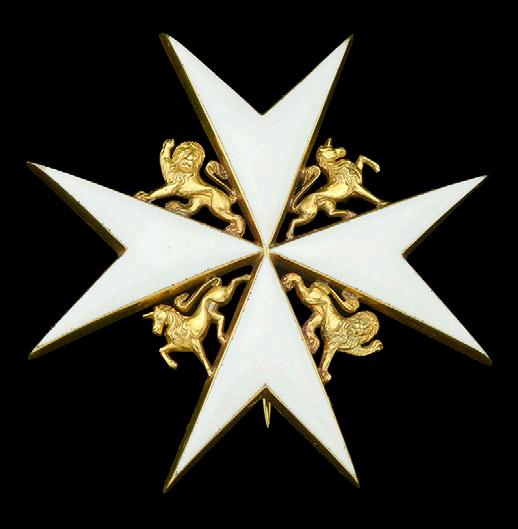
The Order of St. John of Jerusalem, a fne quality pre-1926 Knight of Justice breast star, 63mm, gold and enamel, total weight 32.91g, with heraldic beasts in angles, complete with reverse gold pin suspension, about extremely fne, scarce £1,400-£1,800
(1858-1937), of Feniton Court, Honiton, Devon, was educated at Charterhouse and Commanded the Royal 1st Devon Yeomanry from 1910 to 1914. He served during the Great War at No 3 Base Remount Deport, France, from January 1915 to February 1917, and was later Assistant Director of Labour, Fourth Army, and Labour Commandant, Australian Corps. For his services during the Great War he was Mentioned in Despatches and was awarded the French Croix de Guerre. Created a Knight of Grace of the Order of St. John, he was promoted Knight of Justice in 1916 (London Gazette 18 August 1916), and was appointed a Commander of the Order of the British Empire in 1920 (London Gazette 30 March 1920) for his services as a Trustee of the King’s Fund.
0
The Order of St. John of Jerusalem (3), Commander’s (Brother’s) neck badge, silvered and enamel, with heraldic beasts in angles, on Associate’s neck riband; Serving Brother’s breast badge (2), 2nd type (1932-39), silver and enamel, circular badge with white enamel cross with heraldic beasts in angles raised above the background; 3rd (Wartime) issue (1939-47), skeletal silver badge; together with a Salvation Army Long and Faithful Service Medal, silver and enamel, the reverse engraved ‘M Mrrs s M Maaj joor r JJ FFe errr reei irra a 118 8998 8 ’; and a Royal Medico-Psychological Association Cross for Profciency in Mental Nursing, bronze, the reverse engraved ‘D D M M JJ O Olli ivvi ieer r ’, minor edge bruising, very fne and better (5) £100-£140
The Order of St. John of Jerusalem (3), Officer‘s (Brother’s) breast badge, post-1936 issue, silver and enamel, with heraldic beasts in angles; Officer’s (Sister’s) shoulder badge (2) small post-1936 issue, silver and enamel, with heraldic beasts in angles, on lady’s bow riband; large issue, silver and enamel, with heraldic beasts in angles, on lady’s bow riband, the latter two both in boxes of issue, good very fne and better (3) £100-£140
BBo oeer r W Waar r
The Order of St. John of Jerusalem, Serving Sister’s shoulder badge, silver and enamel, the reverse engraved ‘Mary F. Mc.Kenzie 23rd. Feby. 1904.’, on lady’s bow riband, in Carrington, London, case of issue; together with the related miniature award, this similarly mounted and housed in ftted case, good very fne £80-£100
M Miis sss M Maar ryy FFo orrb bees s M MccK Keen nzzi iee was born in Aberlour, Elginshire, in 1863 and served in South Africa as a Hospital and Camp Matron, Burgher Camp Department (Transvaal). For her service in South Africa she was appointed a Serving Sister of the Order of St. John. The Dundee Evening Post of 16 July 1904 contained the following announcement:
‘Decoration for Dundee Ladies. Honoured for South African Services. Miss M. F. Mackenzie [sic], Miss Grace Mackenzie, and Miss Macgregor, who left Dundee Royal Infrmary to become matrons in South African concentration camps, have each been decorated with the Order of St John of Jerusalem. This honour is the greater because this award has only been granted to ten ladies.’
The Order of St. John of Jerusalem, Serving Sister’s shoulder badge (3), 1st type (1892-1932), silver and enamel, circular badge with white enamel cross with heraldic beasts in angles raised above the background; 4th type (1947-74), silvered and enamel, circular badge with white enamel cross with heraldic beasts in angles raised above the background, in card box; 5th type (1974 -84), silvered and enamel, circular badge with white enamel cross with heraldic beasts in angles fush with background, all on lady’s bow ribands, good very fne (3) £80-£100
Sold with a laminated Northern Daily Telegraph newspaper cutting with a photograph of a group of Lancastrians having been invested with the insignia of the Order of St. John in London on 28 September 1950 (including, presumably, the recipient of the 4th type badge in this lot).
The Order of St. John of Jerusalem, Serving Brother’s breast badge (3), 2nd type (1932-39), silver and enamel, circular badge with white enamel cross with heraldic beasts in angles raised above the background, the reverse engraved ‘L Liie e
C C ((T T A A )) JJu ully y 221 1sst t 119 9333 3 ’; 4th type (1947-74) (2), silvered and enamel, circular badge with white enamel cross with heraldic beasts in angles raised above the background, the silver fnish on the last somewhat rubbed, generally very fne (3) £70-£90 221 1
The Order of St. John of Jerusalem, Serving Brother’s breast badge (4), 5th type (1974-84) (2), silvered and enamel, circular badge with white enamel cross with heraldic beasts in angles fush with background; 6th type (1984-91) (2), skeletal silvered badge badge with heraldic beasts in angles, nearly very fne (4) £70-£90
The Order of St. John of Jerusalem (3), Serving Brother’s breast badge, 5th type (1974-84), silver and enamel, circular badge with white enamel cross with heraldic beasts in angles fush with the background; Serving Sister’s shoulder badge (2), 5th type (1974 -84), silver and enamel, circular badge with white enamel cross with heraldic beasts in angles fush with the background, on lady’s bow riband; 7th type (1991-), Rhodium cross with heraldic beasts in angles, on lady’s bow riband; Service Medal of the Order of St. John (2) ((4 4221 133 A A m mbb, , SSi iss EE M Miil llls s R Raad dccl
iiffffee N Nuur r D Diiv v N Noo 44 D Diis stt SS JJ A A BB 119 9223 3 )) in Lamb, London, case of issue; the second unnamed, with two Additional Award Bars, nearly extremely fne (5) £120-£160
Sold with an E.VII.R. brooch insignia on a bow lapel riband.
Royal Victorian Medal, G.V.R., silver-gilt, unnamed as issued, mounted on investiture pin, in Royal Mint case of issue, extremely fne and scarce £240-£280
Provenance: From the Collection of Richard P. Taylor.
The Most Honourable Order of the Bath, C.B., (Civil) Companion’s breast badge, converted for neck wear, silver-gilt, hallmarks for London 1916, with short section of neck riband; Volunteer Force Long Service Medal, V.R. (Major F. G. Ogilvie, “Forth”. R.E.V.) engraved naming, with named lid of card box of issue, good very fne (2)
£300-£400
C.B. London Gazette 9 November 1906.
SSi irr FFr raan ncci iss G Grra annt t O Oggi illv viie e was born in Monymusk, Aberdeenshire in 1858. He joined the Volunteer Force as a Private soldier in the 18th Company of the Queen’s Edinburgh Rife Brigade, in 1879, and was commissioned as a Lieutenant in the 1st Aberdeenshire Engineer Volunteers on 12 May 1883. He subsequently served as Officer Commanding, Forth Division, Submarine Miners, Royal Engineers (Volunteers), 1887-1900, and was awarded the Volunteer Force Long Service Medal per Army Order 215 on 1 October 1900. He retired from the Volunteer Force in November 1900, retaining the ranks of Major.
In civilian life Ogilvie was Principal of Heriot-Watt College, Edinburgh, 1886-1900; Director of the Museum of Science and Art, Edinburgh, 1900 -1903; Principal Assistant Secretary, Board of Education, 1903-1910; Secretary, Science and Geological Museums and Geological Survey, 1910 -1920; and Director, Science Museum, South Kensington, 1911-1920. He was created a Companion of the Order of the Bath in 1906. Following the outbreak of the Great War he served as a scientifc advisor to the Munitions Invention Department of the Ministry of Munitions, and in 1916 he assumed duties as an Assistant Controller in the Trench Warfare Research Department, Ministry of Munitions. In 1917 he was re-deployed as an Assistant Controller in the Chemical Warfare Department. He relinquished his Army commission on ceasing to be employed on military duties, and was granted the honorary rank of Major on 22 July 1918. For his work as Assistant Controller in the Trench Warfare Research Department he was created a Knight Bachelor ( London Gazette 1 January 1920). He died in Edinburgh on 14 December 1930.
Note: The recipient would have returned his original C.B. breast badge to the Central Chancery in 1917 for it to be converted into a neck award; presumably he was then re-issued with the badge above, hallmarked 1916.
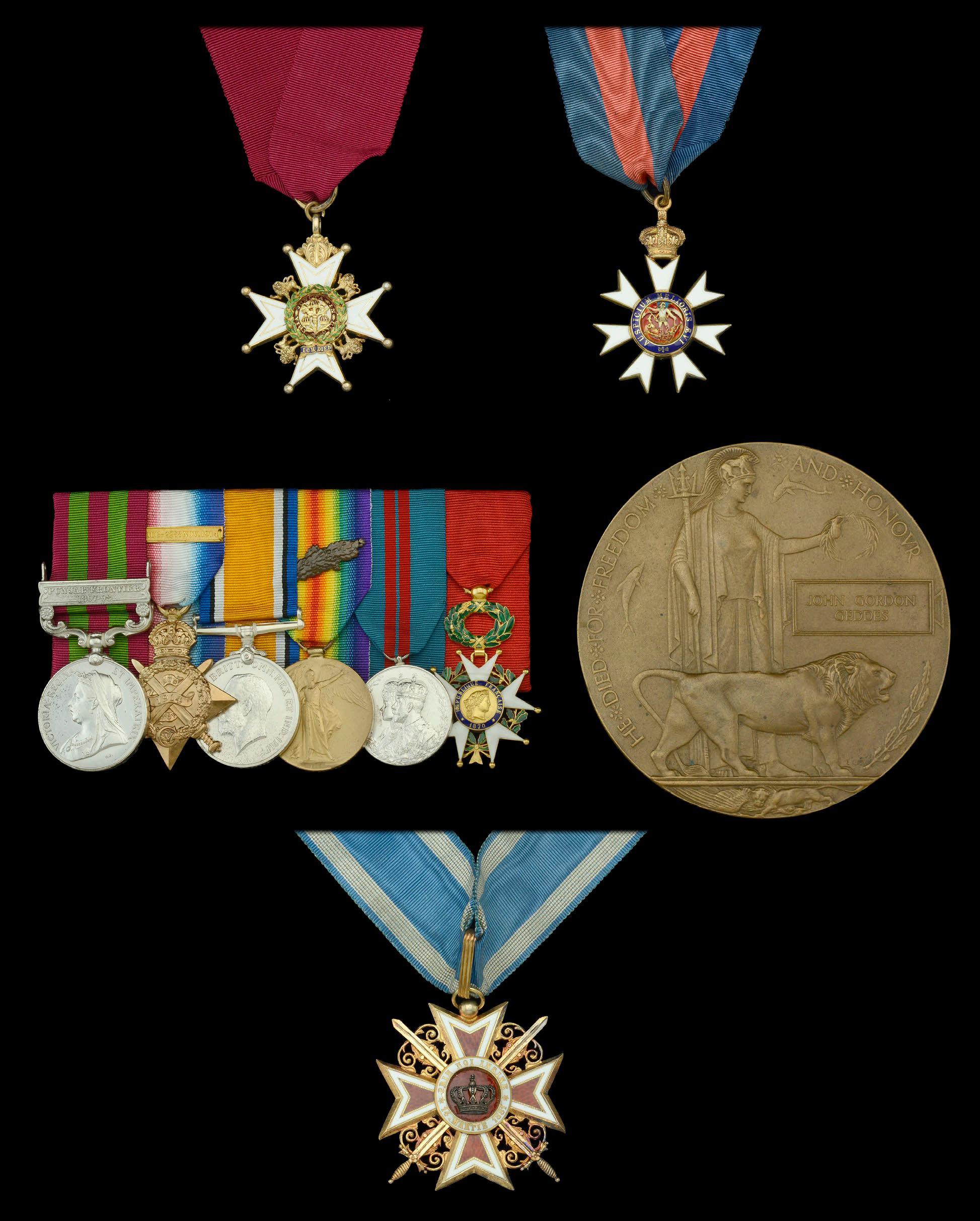
The Most Honourable Order of the Bath, C.B. (Military) Companion’s, breast badge converted for neck wear, silver-gilt and enamels, complete with short neck cravat; The Most Distinguished Order of St. Michael and St. George, C.M.G., Companion’s, neck badge, silver-gilt and enamels, complete with full neck cravat, some small chips to both centres; India General Service 1895 -1902, 1 clasp, Tirah 1897-98 (Captn. J. G. Geddes. R.A.); 1914 Star, with copy clasp (Lt: Col: J. G. Gedder. R.F.A.); British War and Victory Medals, with M.I.D. oak leaves (Brig. Gen. J. G. Geddes.); Coronation 1911, unnamed as issued; FFr raan ncce e,, T Thhi irrd d R Reep puub blli icc , Legion of Honour, Officer’s breast badge, gold and enamels, lacking rosette; R Room maan niia a,, Kiin nggd doom m , Order of the Crown, 3rd Class neck badge with swords, silver-gilt and enamels, complete with full neck cravat, minor chip to obverse centre, the campaign medals mounted court-style, together with Memorial Plaque (John Gordon Geddes), unless otherwise described, nearly extremely fne (10) £1,000-£1,400
C.B. London Gazette 18 February 1915.
C.M.G. London Gazette 1 January 1918.
Legion of Honour, Officer London Gazette 24 October 1919.
Crown of Romania, Commander London Gazette 20 September 1919.
JJo ohhn n G Goor rddo onn G Geed ddde ess was born on the 4th November 1863, the son of Colonel John Gordon Geddes late of the 44th and 76th Regts. and Madeline Mary Geddes. He was educated at Cheltenham College between 1877 and 1881 from where he went on to the Royal Military College Sandhurst, being commissioned into the Royal Field Artillery on the 26th June 1883. Promoted Captain in 1892 and Major in 1900 he saw service on the North West Frontier of India between 1897 and 1898 with the Tirah Expeditionary Force where he was Orderly Officer to the Artillery detachments and was awarded the medal with clasp.
He was promoted to Lieutenant Colonel in 1909 and held the post of Deputy Assistant Adjutant and Quartermaster General of the 3rd Division, Southem Command. On the outbreak of the war he was placed in command of the 25th Brigade Royal Field Artillery and went to France with the expeditionary force in August 1914. He was mentioned in Lord French's despatches of the 20th November 1914 for gallant and distinguished service at Armentières and also on the 14th January 1915, 15th June 1915 and 30th November 1915. He was wounded in action on the 10th September 1914, but continued in command of the 25th Artillery Bde. which was in continuous action from that date for the next seven days during the battle of the Aisne and for which Colonel Geddes received the personal thanks of the General Officer Commanding 18th Infantry Brigade, General Bulfn. It was for his part in this battle that Colonel Geddes was subsequently appointed to the Order of The Bath on the 18th February 1915. He was promoted Brigadier General of 5th Division in the same month and remained in this rank for the duration of the war, being appointed a Commander of the Order of St. Michael and St. George in January 1918 and received the Order of the Star of Romania and the French Legion of Honneur. Brigadier General Geddes died on the 26th August 1919 whilst acting as Officer Commanding Shoreham District and is buried in Grave 40 Old Shoreham Cemetery, Sussex.
Sold with original Warrants for C.B. and C.M.G., together with a quantity of research.
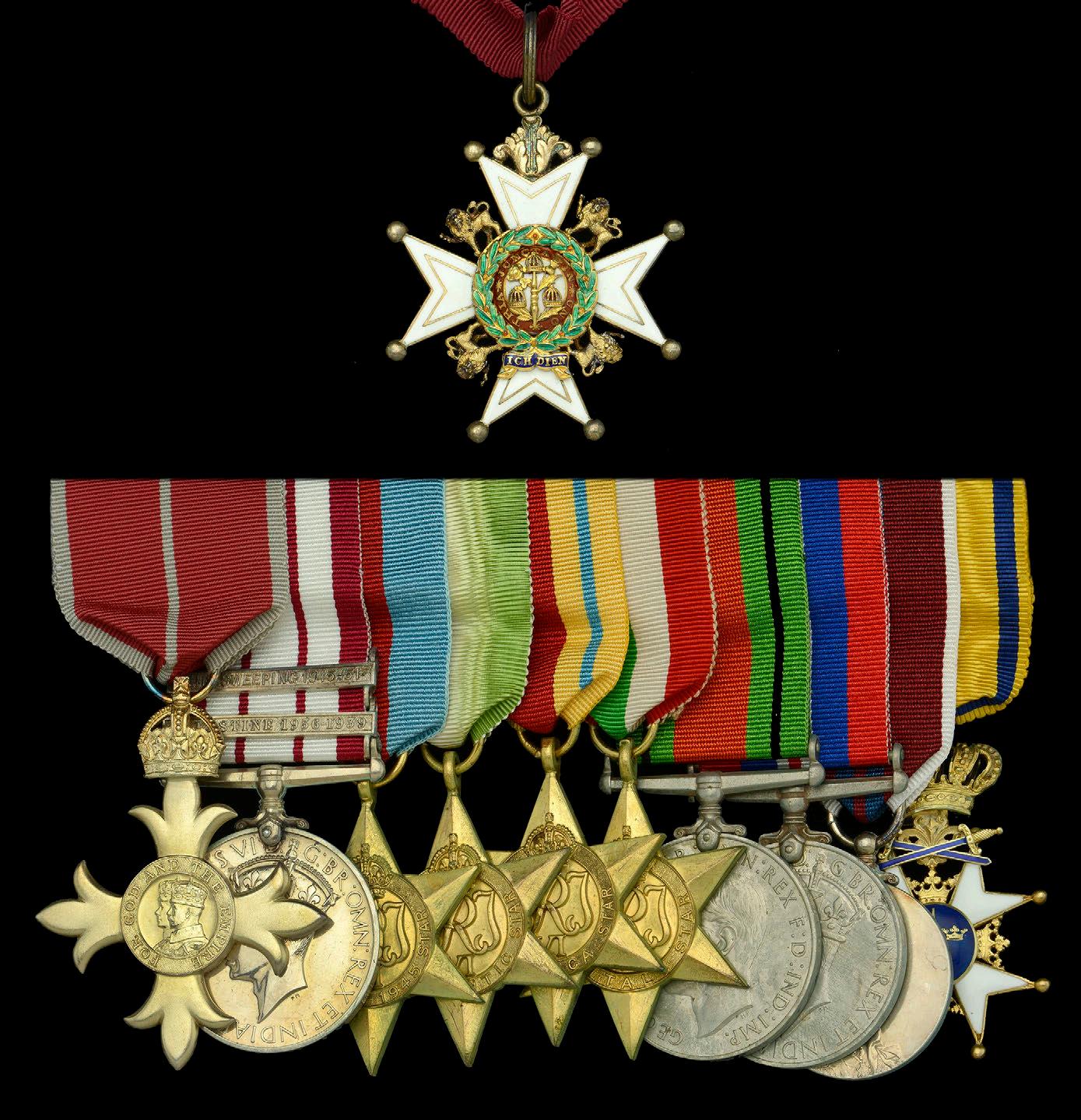
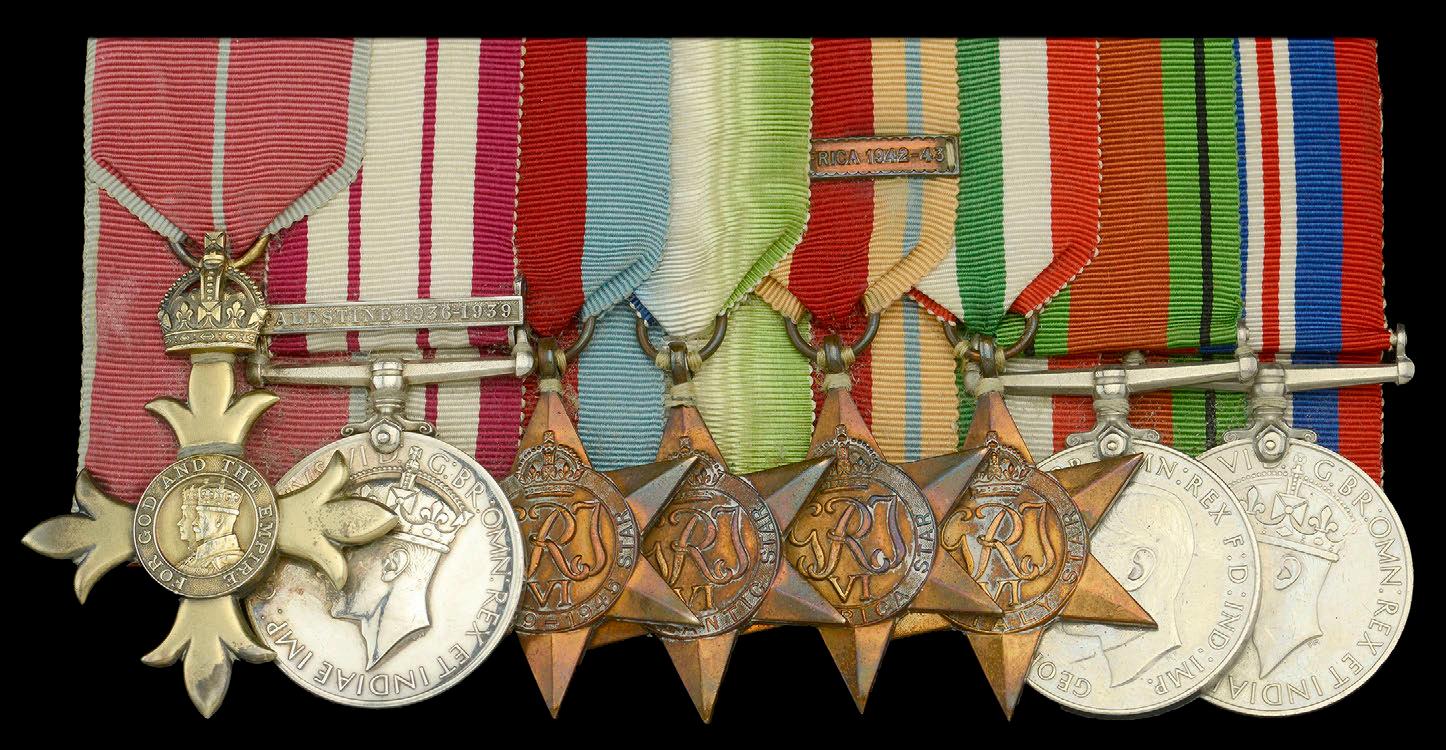
The Most Honourable Order of The Bath, C.B (Military) neck badge, silver-gilt and enamels; The Order of the British Empire, O.B. E. (Military); Naval General Service 1915-62, 2 clasps, Palestine 1936-39, Minesweeping 1945-51 (Lieut. R. E. Portlock R.N.); 1939 -45 Star; Atlantic Star; Africa Star; Italy Star; Defence and War Medals 1939-45; Coronation 1953, SSw weed deen n,, Order of the Sword, Officer’s breast badge, silver-gilt and enamels, all but the last ten mounted as worn, the campaign stars gilded, otherwise generally good very fne (11) £1,400-£1,800
C.B. (Military) London Gazette 31 December 1960: Rear-Admiral, Chief of Staff to C-in-C Far East.
O.B.E. (Military) London Gazette 12 June 1947: Commander, H.M.S. Lioness, minesweeping operations in the East Indies.
Sweden, Order of the Sword: For services as Chief of Staff to C-in-C Nore, for the state visit of the King and Queen of Sweden in June 1954. RRo onna alld d EEt trri iddg gee PPo orrt tllo occk k was born in 1908, attended Dartmouth Naval College 1922-25, and joined the battle cruiser H.M.S. Hood as a Midshipman in May 1926. His sea service from 1926-38 was spent in Home Waters and the Mediterranean, including service in Palestinian waters, and from 1938-39 he was in charge of a section of the Torpedo Experimental Department of H.M.S. Vernon, this post marking the start of his specialisation with underwater weaponry. He was appointed as Torpedo Officer to the Ark Royal when war broke out, and served in her until she was sunk on 14 November 1942. During this period Ark Royal and her aircraft had a most active time, not least when her Swordfsh attacked the Bismarck in May 1941, damaging her steering gear and thus bringing about the subsequent destruction of this infamous pocket battleship. Portlock’s mines and torpedoes in all of Ark Royal’s actions, particularly the Bismarck action, were of great signifcance. On 13 November 1941, Ark Royal was torpedoed by a U-boat near Gibraltar and sank with the loss of only one man. After his survivor’s leave Portlock was assigned to H.M.S. King George V, where he stayed until 1942 when he was made second-in-command of an East African Naval Air Station. In 1943 he returned home and remained on the Staff at the Admiralty until 1946 when he was placed in command of the 10th and 11th Minesweeping Flotillas in the Far East. His peacetime appointments were mostly connected with underwater weapons but in 1955-56 he commanded H.M.S. Newfoundland In 1956 he became Director of Underwater Weapons at the Admiralty and held this post for two years. He was promoted to Rear-Admiral in 1959 and posted to Singapore as Chief of Staff and Deputy to the C-in-C Far East. He retired from the Service when this tour was completed in 1961 and was created C.B. the same year.
SSo olld d w wiit thh tth hee ffo olll loow wiin ngg oor riig giin naal l ddo occu u m meen ntta atti ioon n::
i) The recipient’s Midshipman’s Journal for the period May 1926 to July 1928, mostly aboard the Hood, containing a detailed log of events and well illustrated with maps, charts and technical drawings
ii) Warrants of Appointment for C.B. and O.B.E., together with various covering letters and the Statutes of the Bath
iii) Sub-Lieutenant’s Commission certifcate
iv) Letter granting permission to wear the Order of the Sword, granted in 1954
v) Official Certifcate of Commendation from C-in-C Nore for services in the Flood Relief Operations on the East Coast in February 1953
vi) Various other certifcates of competence and appointment, newspaper cuttings, a visitors’ book (H.M. Underwater Detection Establishment, Portland, Dorset from May 1950 through to his various appointments in the Far East and up until April 1961), and copies of a lecture entitled “Underwater Warfare of the Future”.
Groups and Single Decorations for Gallantry
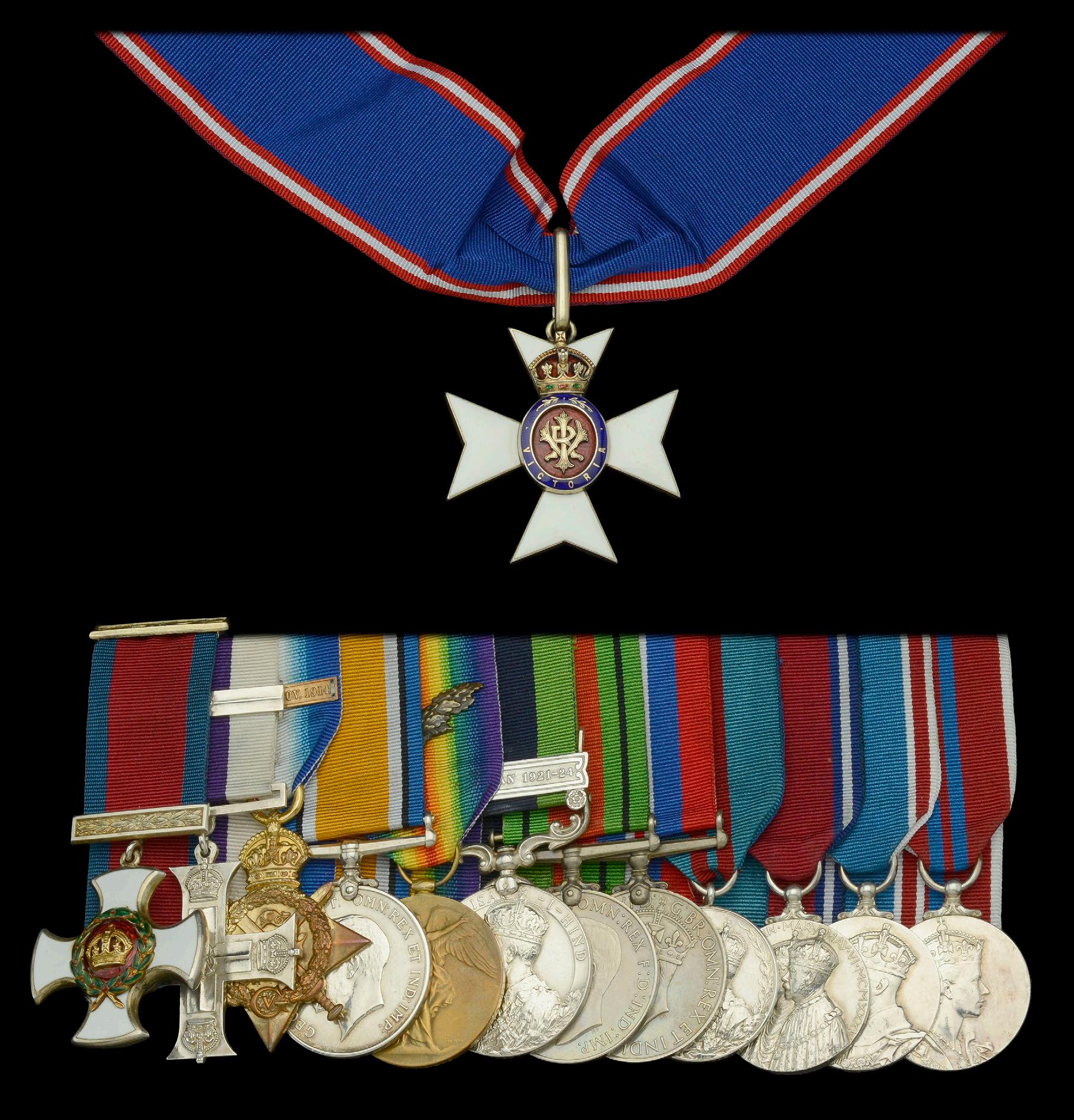
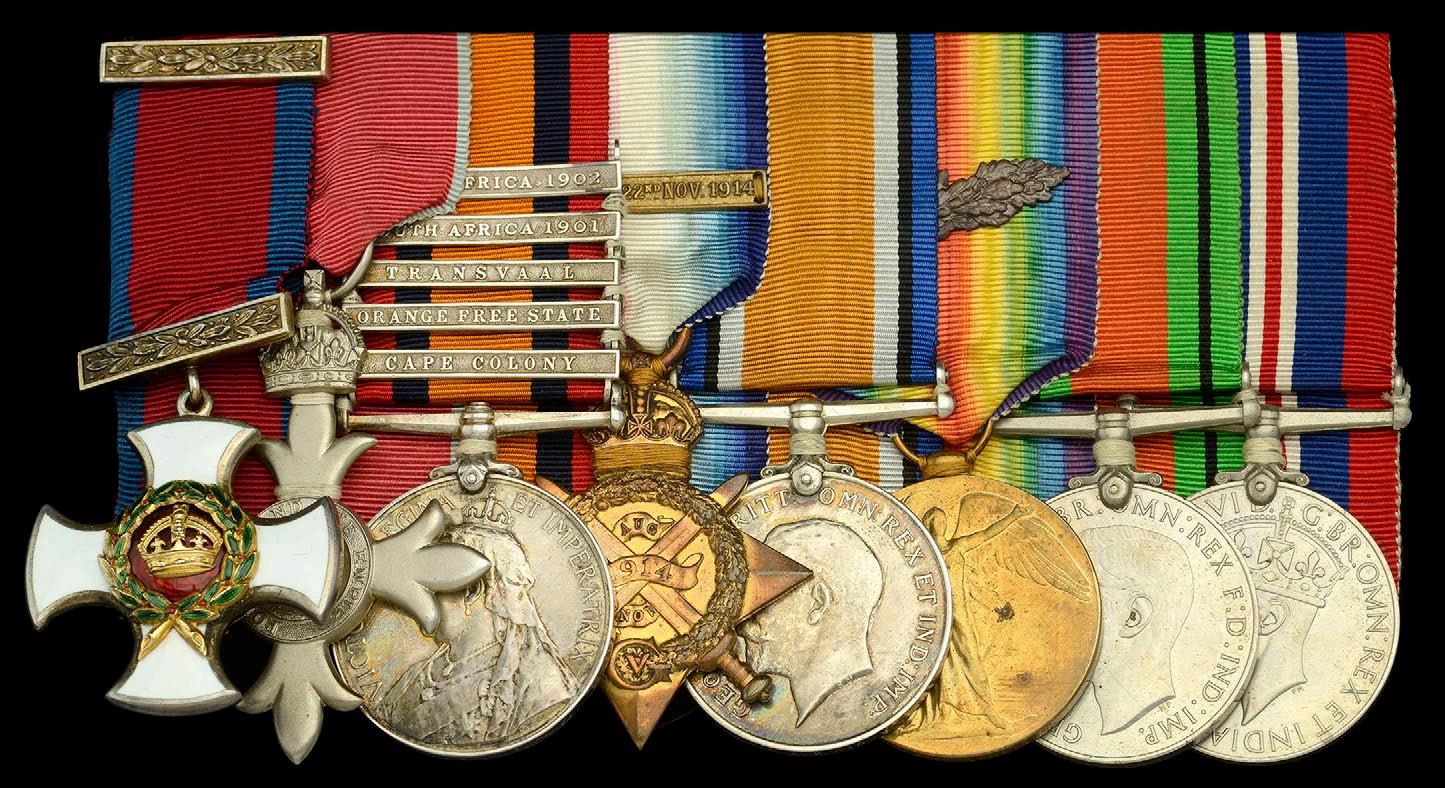
The Royal Victorian Order, C.V.O., Commander’s neck badge, silver-gilt and enamel, the reverse officially numbered ‘C974’, with short section of neck riband; Distinguished Service Order, G.V.R., silver-gilt and enamel, with integral top riband bar; Military Cross, G.V.R., with Second Award Bar, unnamed as issued; 1914 Star, with clasp (Lieut: L. M. Gibbs. C. Gds.); British War and Victory Medals, with M.I.D. oak leaves (Lt. Col. L. M. Gibbs.); India General Service 1908-35, 1 clasp, Waziristan 1921-24 (Maj. L. M. Gibbs. C. Gds.); Defence and War Medals 1939-45; Coronation 1911(2-Lieut. L. M. Gibbs. C. Gds.) contemporarily engraved naming; Jubilee 1935 (Colonel L. M. Gibbs. D.S.O. M.C.) contemporarily engraved naming; Coronation 1937 (Colonel L. M. Gibbs. C.V.O., D.S.O., M.C.) contemporarily engraved naming; Coronation 1953, unnamed as issued, mounted court-style for wear, good very fne (13) £3,600-£4,400
C.V.O. London Gazette 11 May 1937: ‘On the occasion of His Majesty’s Coronation.’
D.S.O. London Gazette 3 June 1919: ‘For gallant and distinguished services in France.’
M.C. London Gazette 1 January 1917: ‘For distinguished service in the Field.’
M.C. Second Award Bar London Gazette 11 January 1919: ‘Nr Morlancourt, France, 24 August 1918. For conspicuous gallantry and devotion to duty. When the position on the left fank was very obscure owing to the next Division failing to reach its objective, he made a daring reconnaissance to gain information and get in touch. He collected troops and organised the situation, and brought most valuable information to the brigade. He was under intense fre from machine-guns and minenwerfer at close range.’
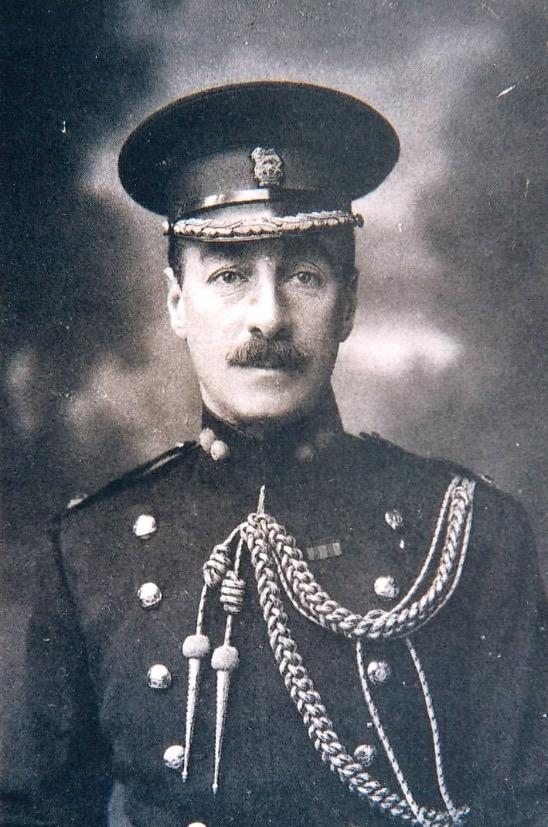
LLa annc ceel loot t M Meer riiv vaal lee G Giib bbbs s was born on 23 December 1889, the seventh and youngest son of Anthony Gibbs, J.P., D.L., and was educated at Eton. He served initially as a Second Lieutenant in the 3rd (Militia) Battalion, Somerset Light Infantry from 1908 to 1910, before being commissioned Second Lieutenant in the Coldstream Guards on 7 December 1910. Promoted Lieutenant on 19 July 1913, he served during the Great War on the Western Front from 21 August 1914. He served as Adjutant of the 2nd Battalion from 16 March 1915 to 21 April 1916, and, having been promoted Captain on 17 July 1915, was slightly wounded near Vermelles on 3 October 1915. His diary entry for the day states: ‘Started off for new trenches east of Vermelles about 6:00 p.m. Hada most unpleasant walk up to them. I got hit by a shell but so slightly that it really only bruised. Relieved the 1st K.R.R. in some very nasty trenches, which had been partially blown in during day by a German attack. Finished relief about 11:00 p.m. Had my shoulder “Dressed”!’ Gibbs was appointed Commanding Officer of the 2nd Grenadier Guards on 25 November 1916, an appointment he held until 8 March 1917. Moving over to the Staff, he was appointed General Staff Officer 3rd Class on 26 February 1918 and served as Brigade Major of the Guards Division from 4 May 1918. For his services during the Great War he was created a Companion of the Distinguished Service Order; was awarded the Military Cross and Bar; and was four times Mentioned in Despatches (London Gazettes 16 February 1915, 31 December 1915, 7 July 1919, and 17 December 1919). Gibbs’ own diary entry for the 24 August 1918, the date of the action for which he was awarded the Bar to his M.C., reads:
‘The hour for the attack was 1:00 a.m. and was started with a heavy barrage. The “Green Line” was taken and some 300 prisoners were taken in Happy Valley. The Bosche who had been expecting these attacks put down a very heavy barrage at once on the Albert-Bray road and also on the “Green Line”. A small pocket of Machine Guns and Trench Mortars remained on the 21 Battalion’s left and stopped the 12th Division on our left coming up. These started to hammer the 21 Battalion causing considerable casualties and the situation looked serious, their left being quite in the air. The 15 Battalion therefore went up and formed a defensive fank. I went up and discovered the situation much better than expected. Going right up to the left I found the Trench Mortar gone but the Machine Guns still active. Otherwise the Brigade front was intact and in touch on the right. The front was reorganised after dark, the 15 Battalion coming up on the right and taking partly over from the right Brigade and a bit from 17 Battalion. The 17 Battalion in the centre with the 21 Battalion, now weak, on the left.’
Gibbs served on staff of the British Section of the Supreme War Council at Versailles from February to June 1919. He then proceeded to India where he participated in operations in Waziristan 1921-24, and was Aide-de-Camp to the Commander-in-Chief in India, General Lord Rawlinson, from December 1922 to March 1925. Promoted Major on 12 September 1923, he was advanced Lieutenant-Colonel on 15 December 1930, and served as Officer Commanding, 1st Battalion, Coldstream Guards from 15 December 1930 to 14 December 1934. His subsequently served as Assistant Adjutant General at the War Office from 1934 to 1938. Transferring to the Retired List, he was appointed His Majesty’s Bodyguard of the Honourable Corps of Gentlemen at Arms in January 1939, before being recalled for service during the Second World War, where he served as Brigadier in charge of Administration, London District. Reverting to the Retired List on the cessation of hostilities, he was recalled to the War Office in connection with planning for the Victory March in January 1946, before reverting to the Retired List for a third and fnal time in July of that year. He died on 8 December 1966.
K Kiin ngg ’’ ss O O w wnn Yoor rkks shhi irre e LLi iggh htt IIn nffa annt trry y,, aa tto opp m maar rkks s m maan n w whho o w woon n tth hee A Arrm myy BBe esst t SSh hoot t M Meed daal l,, aan ndd w waas s w woou unnd deed d iin n bbo otth h W Woor rlld d W Waar rss
C Caas sss ddi issp plla ayye edd ggr reea att gga alll laan nttr ryy ddu urri inng g tth hee 119 9118 8 H Huun nddr reed d D Daay yss ooffffeen nssi ivve e,, iin n N Noor r w waay y iin n 119 9440 0,, aan ndd oon n D D--D Daay y H Hee lle edd BBr riig gaad dees s iin n tth hee aam mpph hiib biio ouus s IIn nvva assi ioon nss oof f T Tuun niis siia a,, SSi icci illy y,, IIt taal lyy tth heen n N Noor r m maan nddy y,, lla a
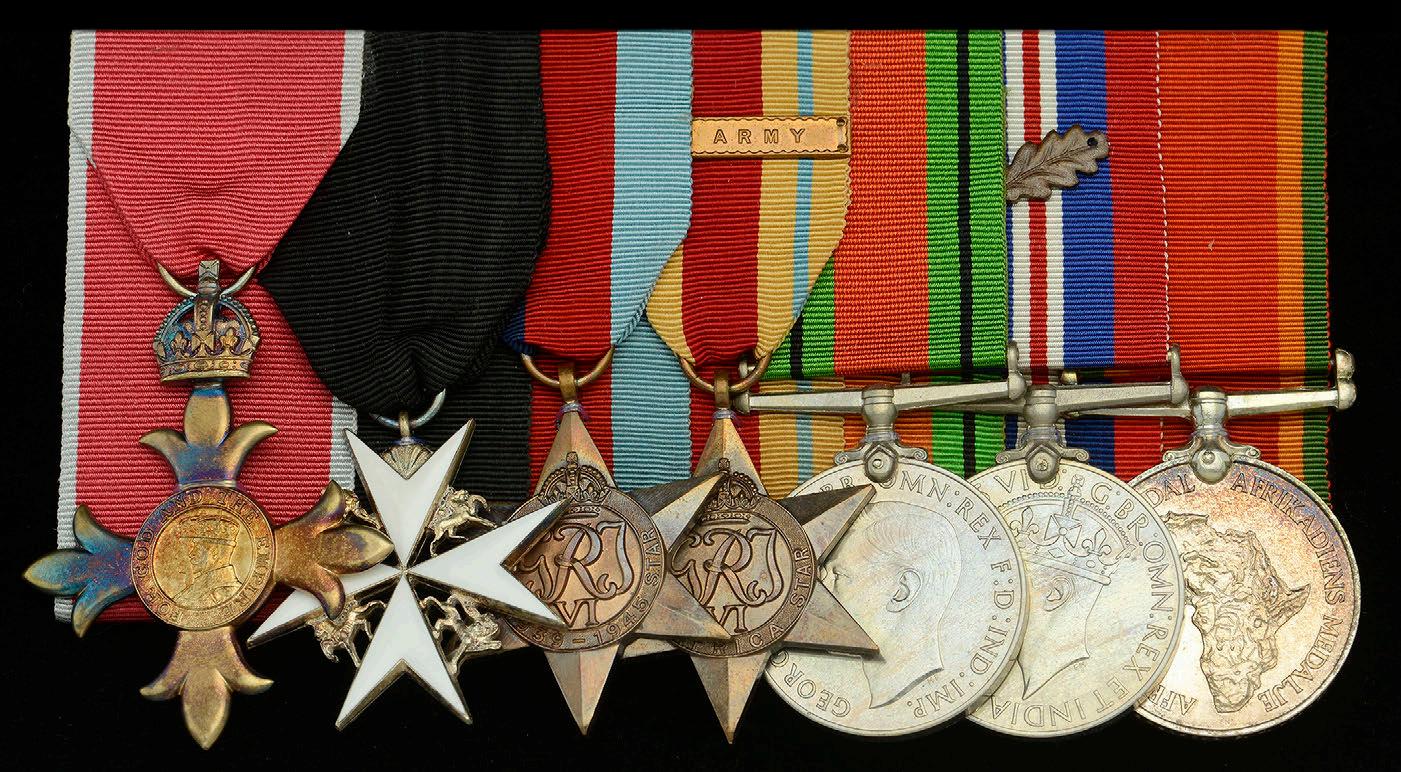
The Most Excellent Order of the British Empire, C.B.E. (Military) Commander’s 2nd type neck badge, silver-gilt and enamel, in Garrard, London, case of issue; Distinguished Service Order, G.V.R., silver-gilt and enamel, with Second Award Bar, the reverse of the suspension bar privately inscribed, ‘Capt. E. E. E. Cass’, and the reverse of the Bar officially dated ‘1940’, with integral top riband bar; Military Cross, G.V.R., the reverse privately inscribed, ‘Capt. E. E. E. Cass’; British War and Victory Medals, with M.I.D. oak leaves (Capt. E. E. E. Cass); 1939-45 Star; Africa Star, 1 clasp, 1st Army; Italy Star; France and Germany Star; Defence and War Medals 1939-45, with M.I.D. oak leaf; General Service 1918-62, 1 clasp, Palestine 1945-48 (Brig. E. E. E. Cass, C.B.E., D.S.O., M.C., Staff); Army Best Shot Medal, G.V.R., 2nd issue, 1 clasp, 1936 (Captain E. E. E. Cass, D.S.O., M.C., K.O.Y.L.I.); U Unni itte edd SSt taat tees s oof f A A m meer riic caa , Silver Star, the lower left arm officially numbered ‘21452’, mounted court-style for display, slightly chipped enamel on D SO wreaths and the Great War pair with contact marks, otherwise generally very fne or better (14) £18,000-£22,000
Provenance: Dix Noonan Webb, March 2014.
Approximately 350 verifed Second World War awards of the Silver Star for gallantry were made to British Empire and Commonwealth recipients. The combination of the Silver Star and the Army Best Shot Medal makes Cass’s group unique.
C.B.E. London Gazette 23 March 1944.
The original Recommendation states: ‘This Officer has commanded his Brigade throughout the North Africa and Sicilian Campaign with distinction. With determination, drive and initiative he has led his Brigade in many successful actions. His personal example in battle has been an inspiration to his Brigade’.
D.S.O. London Gazette 8 March 1919:
‘For conspicuous gallantry, initiative and general leadership of his company in the operations of 29 September 1918 and the following day. Observing the enemy battery withdrawing their guns he directed the concentrated fre of his company at the teams, seizing and working a Lewis gun himself under direct fre of another hostile battery. After which he led forward two platoons of his company and seized the hostile battery, consisting of H.V. and 18-inch howitzers. Later, he led his company right through the village of Livergies, capturing 30 prisoners. He did fne work’.
D.S.O. Second Award Bar London Gazette 6 August 1940.
The original recommendation states: ‘Throughout the action at Kvam on 25-26 April 1940 and again at Dombas on 30 April, this officer showed great coolness and ability in handling his battalion under very difficult circumstances. His confdent bearing and disregard for his own safety had a very steadying effect. He controlled two very difficult withdrawals in the face of the enemy with utmost skill.’
M.C. London Gazette 11 January 1919:
‘For conspicuous gallantry and leadership. This officer led his company in the attack straight to its objective, rushing and capturing many machineguns and prisoners. On arrival he reorganised his company, and with another on his right secured a further 400 yards of ground, which he skillfully held and consolidated, repulsing repeated bombing attacks. He set a personal example of the highest order to his Company’.
M.I.D. London Gazettes 9 July 1919 and 23 September 1943.
United States of America Silver Star, London Gazette 29 June 1944.
The original Recommendation states: ‘Brigadier Cass commanded the 8 British Infantry Brigade which assaulted the beaches on ‘D’ Day. His resolution and drive were very largely responsible for the success achieved by the troops under his command in the initial assault.’ (Imperial War Museum B7046 refers).
EEd d w waar rdd EEa arrn nssh
aas sss was born in Ravenglass, Cumberland on 3 March 1898, the son of a doctor from Yorkshire, who was well-known as a very fne shot, a skill which he passed on to his son. Edward attended boarding school at St Bees, Cumbria 1910-16, becoming an expert cricketer and an outstanding rugby centre three-quarter.
E Eaarrlly y d daayyss: : S Seev
Cass was commissioned into the King’s Own Yorkshire Light Infantry from Sandhurst on 23 October 1916. He joined its 2nd Battalion in France on 15 March 1917, at a time when the British Army was completely revising its tactics as result of the hard-earned lessons of the Somme Offensive. Training Manuals issued in February 1917 decreed that attacks would no longer be made by infantry steadily advancing in line abreast. Every platoon would be divided into four sections, each built around a particular support weapon such as the Lewis gun, the rife grenade, the hand grenade or the sniper rife, with every man trained to use fre and manoeuvre. Second Lieutenant Cass was sent to ‘C’ Company, where he was expected to master these new concepts and train his platoon accordingly. w w w w w w n n oon naan nss cco o u ukk all lots are illustrated on our website and are subject to buyers’ premium at 24% (+VAT where applicable)
Groups and Single Decorations for Gallantry
2nd KOYLI were stationed on the extreme southern end of the British-held section of the front line near its juncture with the French, just west of St Quentin. The weather was cold, with frequent snow and sleet. 2 KOYLI were tasked with making local attacks to support a major French effort to recapture St Quentin (which ultimately failed). Cass quickly established a reputation for gallantry and coolness under all circumstances. The battalion attacked the German line at 4.30 am on 14 April 1917 and by 6.00 am ‘C’ Company had reached its second objective, near the village of Fayet, where it had to repel a strong counter-attack. Fighting continued for the rest of the day, with further advances made at the cumulative cost of 127 casualties. The battalion was relieved and went into billets, but Cass was severely wounded by shellfre and had to be evacuated to England on 19 April.
Cass returned to 2 KOYLI a year later, on 27 April 1918, as a Lieutenant, becoming Acting Captain, in command of ‘D’ Company. On 23 August 1918 the battalion attacked, as part of the exploitation following the Battle of Amiens earlier in the month. The men were cheerful and full of confdence. Zero was at 4.45 am. The Germans fred defensive barrages at 2.30 and again at 4 am, with gas. Cass led the left wing of the attack and advanced straight to the village of Herleville, overran it, taking many machine-guns and prisoners, and consolidated, given the threat of a German counterattack from a large wood on his left. After a day spent fghting off grenade attacks, he advanced again at dusk and seized a better line. He was awarded an immediate MC for conspicuous gallantry, leadership and skill.
A month later, during the assault on the Hindenburg Line, the last of the German great defence lines in France, on the afternoon of 29 September Cass discovered a German Heavy Artillery battery that was withdrawing its guns. He seized a Lewis light machine-gun and shot down the gun detachments and horse teams, while under direct fre from another German artillery battery 2,000 yards away. He then led two platoons of his Company forward and captured four German heavy guns and an 18-inch howitzer. The following afternoon, despite enemy artillery and machinegun fre, at dusk he rushed and captured the village of Levergies, taking 30 prisoners, in a brilliant pincer movement, a success that was largely due to his dash and initiative. As a result, he was Mentioned in Despatches and awarded the D.S.O.
Cass took part in the last battle fought by the KOYLI in the First World War, the capture of Avesnes on 7 November, and his unit moved into Belgium after the Armistice. He reverted to his substantive rank of Lieutenant and transferred to the 1st Battalion KOYLI, which went out to India in 1919. He was an outstanding marksman and was selected for a detached posting in 1920 as an Assistant Instructor at the Small Arms School, Pachamri, central India.
1st KOYLI joined the British Army of the Rhine in 1922-23. Cass led his Battalion to victory in the Rhine Army Rugby Cup and, when they returned to England for home service, played for the Army for several years. He was renowned for his immaculate turn-out. In the austerity army of the 1920s, Cass had to wait until 9 November 1927 for his substantive Captaincy. He was deeply attached to his Yorkshire regiment and, to stay with it, did not apply to Staff College, which severely limited his chances of rising past the rank of Colonel.
Cass became a crack shot, winning the Army Rife Association Silver Jewel in 1925. He was a member of the Army VIII and was listed in the King's Hundred for ten years. From February 1935 to February 1939, he was Chief Instructor at the Indian Small Arms School at Belgaum in the Western Ghats. He won the British Army Shooting Championship in 1936.
Cass was promoted Major on 17 January 1938, when he was almost 40. During the ‘Phoney War’ Cass was Second-in-Command of 1st Battalion, KOYLI in the all-Regular Army 15th Brigade of the British Expeditionary Force, stationed near Lille in France. N Noorrwwaay y 1 1994400: : ‘‘K KOOYYLLI I ffoouugghht t
In April 1940, 15th Brigade was withdrawn from France and sent to join the Norway Campaign. Norway was an ignominious and abject failure, micromanaged from London; its ramshackle combination of muddle, poor decisions and bad judgement caused the fall of Prime Minister Neville Chamberlain and his replacement by Winston Churchill. The performance of 15 Brigade, and specifcally of Cass, was one of its few redeeming elements.
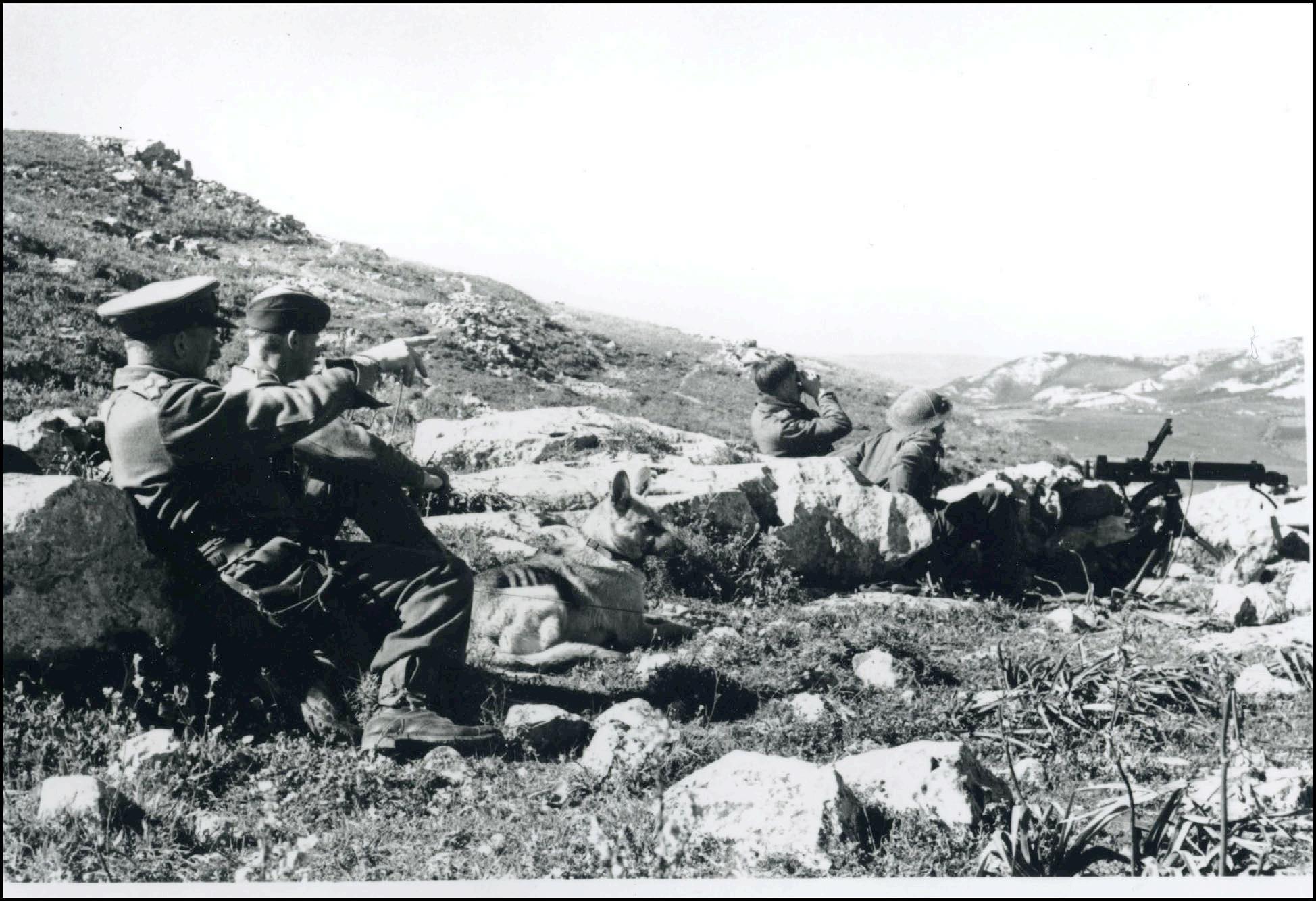
Cass was given the command of 1st KOYLI as Acting Lieutenant-Colonel when his C.O. was appointed 15 Brigade Commander. 15 Brigade was intended to reinforce a mixed British and Norwegian force that had been vainly striving to halt the advance of the German invasion force north from Oslo up the narrow Gudbransdal valley that led to the sea at Andalsnes, south-west of Trondheim. The force commander, Major-General Sir Bernard Paget, wrote: “The battalion fought splendidly under the inspiring leadership of Cass, and of him I would say that there is no one I would sooner have with me in a tight place.”
1st KOYLI landed from the cruiser HMS Glasgow at Andalsnes on the night of 23 April 1940 and the next morning moved inland by rail (all its mechanical transport had been ordered to remain in France); its portable equipment had been made up as one man loads. After the frst of many air attacks, which had to be endured without anti-aircraft guns or fghter cover, the Battalion walked the last 20 miles, reached the little village of Kvam late on the 24th and dug in; its mission was to halt the German thrust.
Cass had hoped for 24 hours to prepare his defences, but by 8.30 a.m. on 25 April the only friendly troops in the area, the Norwegian Navelsakers Battalion, had pulled out. It was a glorious spring morning; in Cass's words “Just the day for a battle”. The sides of the mountains were covered in snow; it was still lying in icy patches and drifts in the valley bottom. 1 KOYLI had no automatic weapons apart from its Bren light machine-guns; its only crew-served weapons were six 25mm anti-tank guns and two 3-inch mortars.
At 11.30 am Cass raised his binoculars and “away down the road saw the Germans appear. First came three tanks and about 50 lightly equipped infantry. Behind came more infantry on foot, motor cyclists, machine-guns mounted in sidecars and towed guns. Behind again came motor vehicle after motor vehicle - lorries full of infantry, wireless trucks, tanks, tracked carriers, guns.” When the German point units were just 150 yards away, Cass's forward Companies opened fre, killing large numbers of the leading infantrymen, causing the enemy to pull off the road and bring their artillery into action. Shells began to fall on 1 KOYLI as they crouched in their foxholes waiting for the next infantry attack, which made no progress. The Germans realized that this was not yet another weak rear-guard that could easily be swatted aside, but a determined attempt to stem their advance which could only be defeated by a set-piece assault. They focused frst on ‘A’ Company, which was holding an exposed position around an island in the frozen river and by 2 pm it had ceased to exist. The Battalion risked being out-fanked. Cass ordered up ‘C’ Company, his depth unit, “personally led a bayonet charge through the village” and restored his defence positions. Despite the overwhelming weight of the attackers, and a few anxious moments, the river fank held, and the Germans switched their focus to ‘B’ Company on the opposite mountainside, shelling it with 5.9-inch close support guns, fring direct over open sights. According to the History of the KOYLI Volume V p 92, “Cass watched and waited, wondering how long it would be before another of his companies was annihilated. He saw an infantry attack start and then stop. The shell fre increased in intensity, another attack started and that too withered away. A medium tank nosed its way cautiously up the road and was duly hit and stopped by shells from an anti-tank gun. With his spirits rising, the Commanding Officer saw yet another attack at 6 pm fade out and then, with a feeling of thankfulness, watched one more broken an hour later” although the enemy had bought up well over the equivalent of a full brigade; more enemy artillery arrived during the night.
The short, bitterly cold night was soon over. By 2.30 am it was light again; for the third night in succession none of the KOYLI had had any real sleep. At 5.30 am the Germans opened up with barrages of artillery and machine gun fre. Cass held out all day against repeated assaults, including a dangerous thrust at 1pm led by armour, winning the battle honour ‘KVAM’ for 1st KOYLI. Then he received an order from 15 Brigade to break contact and withdraw. At about 6 p.m. on 26 April Cass managed both to make a clean break and bring away large numbers of his wounded, even though he had no motor vehicles beyond a few requisitioned civilian buses. The Battalion took up a rearguard position three miles outside Dombaas astride the frozen River Laagen, which melted early on 30 April, stranding four Platoons on the far bank. Cass extricated them just as the Germans appeared, marching along the road in column, behind an advanced group of about 50 men. w w w w w w n n oon naan nss cco o u ukk all lots are illustrated on our website and are subject to buyers’ premium at 24% (+VAT where applicable)
Groups and Single Decorations for Gallantry
Cass’s Companies waited in concealment until the Germans were 150 yards away. The order to fre was given and every single man of the leading group fell. For over an hour the Germans tried in vain to force their way through, suffering severe casualties. Then the enemy tried outfanking, and all of Cass’s force, including the depth units, were heavily engaged. He held on for the rest of the day.
The British government had decided to evacuate central Norway, and Cass was ordered to leave by train for Andalsnes at 10pm. It would be another tricky disengagement, as the Germans pressed forward relentlessly. With great skill, Cass continued to fght his successful rearguard action, then slipped out of the enemy's grasp, entraining his Battalion at Dombaas Station at 10.30pm. The train departed, making a clean getaway under fre from the snow-clad hills. However, shortly after midnight, the front of the train was derailed by bomb damage to the track, killing eight men in the forward carriage.
The KOYLI clambered out and marched 18 miles over frozen pot-holed roads to the Verma Railway Tunnel, which offered protection from enemy bombers and fghters. May Day 1940 found Cass with his officers and men in the 800-yard tunnel, together with the Green Howards, Brigade Headquarters, and two trains, one of which was the only transport that could get them to Andalsnes in time to embark on the evacuation ships. German aircraft bombed both ends of the tunnel but failed to block it. At about 6 p.m., enemy ground forces appeared. The K.O.Y.L.I. and Green Howards, though exhausted, reacted swiftly and checked the enemy with a surprisingly vigorous uphill advance, while the train was backed up out of the tunnel. The troops then rapidly descended from the heights and climbed aboard. At 11 pm Cass went on board H.M.S. Calcutta, which lost no time in embarking the soldiers and shaping a course for Scapa Flow.
In just sixteen days, 1st KOYLI had inficted heavy casualties on a German Battle Group seven times its size. Cass was awarded an immediate Bar to his D.S.O. for his courage, coolness and skill when fghting two successful rearguard actions without armour, artillery or air support. He continued to command 1st Battalion KOYLI for almost two years.
In February 1942, Cass, at 44 still a substantive Major, was appointed temporary Brigadier in command of the regular army’s 11th Infantry (Assault) Brigade. Some of the most seasoned troops in the Home Army, they formed the hard core of 78th ‘Battleaxe’ Division, which assembled in Scotland in June 1942. 78 Division had been created specifcally for Operation Torch, the landings to seize French North Africa and trap Axis forces in Africa between the fres of two Armies, the First in the west and the Eighth in the east. 11 Brigade had Torch’s most demanding mission, to rapidly advance eastwards across 800 km of very difficult terrain and seize Tunisia before the Axis could occupy it. Torch was politically and operationally complex, because the initial enemy was not Nazi Germany but Vichy France. Vichy, nominally a neutral country, did not fgure in US strategic thinking. The invasion was opposed by the US Chiefs of Staff, until President Roosevelt gave a direct order that it must go ahead. It was thought that the Vichy military chiefs hated Britain because of its attacks on the French feet and on various French colonies since 1940, and therefore must be presented as an American project. The US was to take charge of quelling any opposition from the French armed forces. Cass’s Brigade was to spearhead the main British responsibility, which was to blunt the highly likely intervention by the Germans and Italians to bring in troops to occupy Tunisa and eastern Algeria.
11 Brigade landed on two beaches, four miles apart, to the west of Algiers. Almost at the exact moment planned (1 am Sunday 8 November 1942) the assault boats lowered their ramps. The British infantrymen splashed ashore, ran across a short beach and climbed to the top of a ridge two miles inland, held by French colonial troops dug into defensive positions. After a tense pause, the British officers saluted their French counterparts, exactly as Cass had ordered. His landing was off to the best possible start: not a shot was fred on either beach. By 9.30 am and after more salutes to menacing French officers, 11 Brigade had reached and secured all its objectives, the road network around Algiers and the vitally important Bilda Airfeld. Squadrons of British fghters from Gibraltar made safe landings at Blida throughout the day to provide close air support to the invasion.
Elsewhere things had not gone well. The landings in Morocco, around Oran, and the direct assault on Algiers, all of which used only American infantry, had been opposed by French troops. Eisenhower, the Allied commander-in-Chief, wrote, “We are slowed up in the eastern sector when we should be getting towards Bone-Bizerte (Tunisia) at once.” Due to concerns about the threat posed by hostile French troops in Algiers, Eisenhower did not release Cass’s Brigade for exploitation towards Tunis on the evening of the frst day, 8 November, although it was perfectly poised to begin the eastwards dash. The other (36th) British Brigade of 78th Division was mostly still aboard its ships; they were ordered to sail on the night of 9 November, land 112 miles to the east and capture another airfeld for the fghters; sadly, this was poorly executed. The Americans did not subdue the French until 13 November. The Germans began fying in fghters, Stuka ground attack aircraft and troops to Tunisia on 9 November.
Grudging every moment of delay, Cass and 11 Brigade performed well in ‘the rush for Tunis’ despite an evil combination of the air situation and the weather. Allied fghters based at the two airfelds closest to Tunisia suffered a grievous blow on 22 November, when the Luftwaffe destroyed 50% of the planes on one of them. The remaining fghters had to protect airfelds, ports and supply routes as well as the forward troops of 11 Brigade who were now 100 miles away in Tunisia. The Germans had four all-weather airfelds and could draw supplies and reinforcements from excellent airbases in Sardinia and Sicily.
Heavy rains made the clay-soil glutinous, and since 11 Brigade was not equipped with four-wheel drive Jeeps, GMC half-tracks and 14-wheeled trucks, it was an achievement that Cass could advance at all. Yet advance he did, through the mountainous terrain of western Tunisia, with his battalions spread out on wide frontages to minimise the effect of constant air attacks, fghting through steadily increasing German resistance until, on 28 November, the lead elements of his Brigade emerged from the hills and saw the minarets of Tunis, just sixteen miles away.
Three weeks after the landing, on 29 November , Major-General Evelegh, the Divisional Commander came to Cass’s HQ to hold a conference to plan 11th Brigade’s capture of Tunis. He had already lost confdence in Brigadier Kent-Lemon, commanding 36th Brigade on 78 Division’s northern fank. Kent-Lemon had been a senior Battalion Commander of 15 Brigade in France and Norway. But Cass had outperformed him, and the conference was ruined by news of yet another major setback for 36 Brigade. Kent-Lemon duly joined the long list of British generals who had been sacked from their combat commands since 1940. The decisive opportunity quickly passed, and high-quality German units, including heavy Tiger tanks and paratroops, counterattacked 11 Brigade. 78 Division was ordered to retreat into the Tunisian mountains and consolidate there before resuming the offensive.
Hitler’s decision to reinforce Tunisia with top-quality fghting units forced the German army and Luftwaffe into a battle of attrition under unfavourable conditions and, as at Stalingrad, caused losses of men and equipment which they could neither afford nor replace. 11 Brigade endured another fve months of grinding battles around the key town of Medjez-el-Bab, beating off a major German offensive in early March 1943. On 7 May British tanks entered Tunis and over 100,000 Germans surrendered over the next few days, ending the Axis presence in Africa. 11 Brigade and 78th Division were transferred to Montgomery’s Eighth Army for the invasion of southern Europe. Initially held back in North Africa as the Army reserve, the Battleaxe Division landed in Sicily in late July 1943, to tackle the strong German resistance around Mount Etna. The Division fought with distinction in Sicily, particularly at the Battle of Centuripe, which enabled 11 Brigade to push on and participate in the capture of Adrano, forcing the Germans to evacuate to the Italian mainland.
11 Brigade went on to fght in the Italian Campaign, landing in late September 1943 and battling their way up the east coast of Italy. Notable engagements included the breaching of the German ‘Viktor’ Line and the Battle of Termoli. Cass relinquished command of 11th Brigade in October 1943 and 78th Division was pulled out of the frontline for a brief but well-earned rest after a year of almost continuous fghting. Cass was awarded the C.B.E. to recognise the inspiring personal example that he set in battle.
w w w w w w n n oon naan nss cco o u ukk all lots are illustrated on our website and are subject to buyers’ premium at 24% (+VAT where applicable)
O Oppeerraattiioon n O Ovve errl loor rdd:: T Thhe e IInnvvaassiioon n o of f N Noorrmmaannddy y aannd d D D--DDaay y
In Cass’s own, abridged, words (The Bugle Vol 46 no 3 1954): ‘I took over command of the 8th British Infantry Brigade, in the 3rd British Division, and found that I was booked for the invasion of Normandy. [At 46 he was probably the oldest and most experienced Brigadier commanding at any of the beaches.] After six months training with our Naval Assault Force in the Moray Firth, we moved to the Portsmouth area for one last big exercise. On 30 May my frst-wave Assault Brigade began to deploy for battle, as it would have no other chance before reaching the beaches. On 3 June the troops embarked. We should have sailed on 4 June but the weather was so bad that the operation had to be postponed. On the morning of 5 June I received orders to sail that day and to carry out the assault on 6 June.’
The 3rd British Division was to land on the Queen White and Red beaches of Sword sector on the western outskirts of Ouistreham, a small fshing port where the Caen Canal and River Orne fowed into the sea, “on the extreme left fank and well within the range of the heavy batteries sited at Havre and the ‘E’ boats and other enemy naval craft in that vicinity.” Cass’s 8th Assault Brigade was the First Wave to storm ashore here, followed later during D-Day by the two other Brigades of the Division. Their objective was to seize Caen, the frst large urban area inland from the initial beachhead. The beaches were defended by the German 716 Infantry Division, but the 21 Panzer Division, which included several elite fghting units, was deployed around Caen and constituted a clear and present danger to the landing forces.
‘I had in my Brigade Group the 1st Battalion Suffolks, 2nd East Yorkshires, 1st South Lancashires, 76 Field Regiment Royal Artillery, 246 Field Company Royal Engineers, 8th Field Ambulance and in addition the 13/18 Royal Hussars, 33 Field Regiment Royal Artillery, 5 Assault Regiment Royal Engineers, ‘A’ Company 2nd Middlesex (Medium Machine Guns), 4 Commando and 41 Royal Marines Commando. The 1st Special Service Brigade was under command until it could pass through to join the 6th Airborne Division at the Canal Bridges. [About 5,000 men in total.]
The Fire Support in the assault was impressive; two Battleships and a Monitor (all 15-inch guns), fve cruisers (7.5 and 6-inch guns), 13 Destroyers, 4,000 rockets fred from four vessels and many lighter weapons fring from the landing craft during their run-in to the beach. Every man had seen both large scale models and air photos of the beach defences, the Brigade’s objectives and the routes across country to reach them. Along the coast there were strongpoints about every 2,000 yards, well-garrisoned and strongly defended with every type of weapon, mines, wire, in some cases famethrowers, and between them were pillboxes, fortifed houses, wire and mines whilst all beach exits had been walled up. Beach obstacles of knife-rest ramps, stakes, steel hedgehogs and concrete tetrahedra up to a height of six feet and all mined, stretched from high water mark down the beaches towards the sea for a distance of 300 yards.
In the middle of our two landing beaches was a strongpoint, codenamed ‘Cod’. On the farther fank of each beach were two others. In the rear area were four heavily defended strongpoints, two of which contained guns in concrete positions, two batteries in feld positions and numerous feld defences with machine guns, wire and mines, several fxed rocket batteries and tactical minefelds. On the left fank, a battery of heavy guns commanded the beaches at close range from the other side of the River Orne. The beaches were smooth and frm except for a soft strip of sand above the high-water mark which rose in some places to a height of 15 feet, but behind the beaches and the houses scattered along them was a strip of marshland, impassable to vehicles, extending back for some 500 yards.
At about noon on 5 June I set off to join my H.Q. ship, the Destroyer HMS Goathland, in Portsmouth Dockyard, but on the way the car broke down and we were stranded in the streets of Portsmouth. Just in the nick of time a Royal Navy lorry appeared, driven by a Wren and full of dirty washing. We squeezed in the back and she drove off We pressed on, drew alongside the gangway of our ship and jumped out of the back, accompanied by various items of female underwear that had snagged on our webbing, equipment and luggage. Perhaps the Bosun’s pipes trilled a little as we went up the gangway but they kept straight faces under what must have been great provocation. We soon sailed and joined the stream of ships making for the open sea and the point south-east of the Isle of Wight known as Piccadilly Circus, from where the swept channels, all marked by Dan Buoys, led to the various beaches. The weather was cold, with a strong wind and heavy seas that made the ships pitch and roll heavily whilst the landing craft, with their fat bottoms, skated from side to side in a quite alarming manner.
“Copper” Cass directing operations w w w w w w n n oon naan nss cco o u ukk
illustrated on our website and are subject to buyers’ premium at 24% (+VAT where applicable)
Groups and Single Decorations for Gallantry
Darkness fell and the convoys pressed steadily on throughout the night without any enemy interference [complete Strategic and Tactical Surprise had been achieved]. I did not go up to the bridge until dawn was breaking. The weather had moderated but there was still a good sea running and the small craft were having a rough time. I wondered how the DD tanks [Shermans equipped with twin propellers and collapsible fotation screens to keep them precariously afoat] would manage when their turn came to launch. As we moved forward the frst shots were fred by the ships of the Bombardment Squadron and in the half-light of the morning the fashes of the guns were greatly accentuated. Suddenly, away to port, there was a fash and a destroyer reared up out of the water, broke in two and rapidly sank [the result of a torpedo attack by German E-boats.]
It was getting lighter now, and we could see the craft pressing forward to the beach in their assault formations, an aircraft few across our left fank making a smoke screen between us and the heavy batteries in the Havre area who could easily engage the anchorage and beaches. This smokescreen was most effective and was maintained throughout the assault by aircraft and naval craft and greatly contributed to our success. We watched Landing Craft Tanks close to within 5,000 yards of the shore and the DD tanks were safely launched. We were greatly relieved to see them in the water. It was very difficult to see them and the enemy were unaware of their presence until they opened fre from the water’s edge. We were reminded that we were out in front by a number of waterspouts that rose around our ship.’
Recalling his own landing on Queen Beach, Cass wrote: ‘As we neared the shore we were able to pick out the large pillbox on the seafront that was to be our frst H.Q., and we drove straight for it. The beaches were alive with men and vehicles, and at the water's edge craft were unloading whilst the burning wrecks of others rolled in the surf. Fire was still falling on the beaches and many obstacles remained uncleared, but we made a safe landing and I stepped ashore dry-shod. Our passage across the beach was hastened by a long burst of machine-gun fre that ripped up the sand across our front, and we were glad to reach shelter. We found that the pillbox was just being cleared of its former occupants, who were in no condition to argue, a shell having entered the gun slit and exploded inside. We had arrived.’
Brigadier Cass’s orders for the remainder of D-Day were to secure the right fank of the Division by seizing and holding the vital ground around Hermanville cross roads, the start point for the advance on Caen, secure the left fank by clearing Ouistreham, eliminate the four German strongpoints to the rear of his beaches and capture the Periers Ridge, which overlooked the Queen beaches. Cass made an immediate start, pushing all his battalions along their planned routes and personally positioning himself near Hermanville, one of the key routes through the swamps behind the beaches.
‘Wasting no time we pressed on through the Cod strongpoint, crossed the lateral road in rear of the beaches, walked carefully up a lane for a short distance and then choose a feld with a number of cows in it as being much less likely to have any mines, and made our way to the small wood.’ The South Lancashires took Hermanville by 9 am and dug-in to secure the western (right) fank of the landing. It was as well they stayed there, because during the afternoon tanks of 21st Panzer Division probed right down to the sea to the west of the bridgehead. The East Yorkshires struck east and took the two German strongpoints south of Ouistreham. The third of Cass’s battalions, the Suffolks, was the last to land and had cleared one of their allocated strongpoints by noon.
The attack on the last strongpoint, ‘Hillman’, the Headquarters of 736 Coast Defence Regiment, built on an elevated position on the Periers Ridge overlooking the beaches, started at 1 pm but was a difficult proposition. An officer of the Suffolks reported, ‘The area was approx 600 x 400 yards, containing three steel gun and observation cupolas, deep concrete shelters, infantry guns, machine guns etc, very well dug-in, surrounded by wire and anti-tank and anti-personnel mines. It showed no sign of softening up from the air and of course aerial photos did not reveal the depth and complexity of this defensive position. To make matters worse, Cruiser fre was not available as the Forward Officer Bombardment had been wounded. Cruiser fre in my experience was terrifying to an enemy. My memory is of almost continuous enemy fre, bullets whistling very close and the total saving of a highly dangerous situation.’
Armour-piercing 17 pounder rounds simply ricocheted off the cupolas, and casualties were heavy. Cass sent in 8th Brigade’s tanks and assault engineers. The Suffolks consolidated on top of Hillman at 8pm on D-Day, having taken many prisoners. Cass commented, ‘Standing beside the main cupola it is apparent how well-sited the position was and how it commanded all the approaches to the ridge. An excellent view of the sea extends right across the beaches we landed upon. The enemy fought gallantly and had to be blown out of the bunkers by explosive charges.’
By nightfall on D-Day 8th Brigade had achieved all its objectives and Cass was awaiting further instructions. Early next morning, the CO of 736 Coast Defence Regiment and the remainder of his garrison emerged from the depths and surrendered. As a result, a recommendation for a gallantry award was prepared, citing that Cass’s ‘resolution and drive were very largely responsible for the success achieved by the troops under his command in the initial assault.’
No Allied Divisions achieved all their objectives on D-Day. 3rd Division failed to take Caen, which was the objective of the two other Brigades in the Division, 185th and 9th. The CO of 9 Brigade wrote ‘On reaching the northern outskirts of Hermanville I was amazed to see standing inside the wall of an orchard not only Tom Rennie (Commanding 3rd Division) but John Crocker (Commanding 1st British Corps), in their red hats. These two highly responsible and competent men realized that the moment was an extremely critical one and they deemed it necessary to be in a position where they could give an immediate decision on any matter, perhaps affecting the whole course of the battle. They told me to cancel my original role of going straight down on the right to get Caen, and instead get across to Pegasus Bridge to help the Airborne who were very hard pressed. This was disappointing as 9 Brigade had their run down the right fank all buttoned up. However, these two officers would not have taken such a major decision if they had not considered it essential. It cannot be emphasised too strongly that they were on the spot to make their decision, it must have been a very hard order to give knowing what it all entailed.’ As the Brigadier prepared 9 Brigade’s new orders he was wounded by a stick of mortar bombs. ‘The result was a long hiatus when 9 Brigade should have been moving and nothing happened.’
Ten years later, the inevitable revisionist histories began to appear. In 1954 Chester Wilmot, in The Battle of Normandy, criticised Cass over the pace of his Brigade’s advance, claiming that ‘The Brigade Commander (Brigadier E. E. E. Cass) was stolid to the point of being ponderous, and his troops tended to take their cue from his own measured gait’, ignoring the fact that his two immediate superior officers were both on the spot and expressed no dissatisfaction with 8 Brigade, in fact rather the opposite. Wilmot was refuted in 1990 by Colonel J. S. Cowley: ‘From what I know of “Copper” and from what his contemporaries have said he could certainly not be described as ponderous’. Cass was a fery little man: more accurate words would have been ‘resolute’, ‘resilient’ and ‘reliable’.
‘‘T Thhe e B Bllooooddiieesst t
By 10 June both of 3rd Division’s fanks were secure and it had doubled the depth of its bridgehead versus the situation at dawn on D+1. Now it was battling with the tough 12th SS Adolf Hitler Jugend Division as well as 21st Panzer Division. On 13 June the Divisional Commander was injured by a landmine and Cass was appointed in temporary command until another Major-General could be fown in to take over on 23 June. In the meantime, 8 Brigade had launched a major attack on a German salient at La Londe.
A silent night attack by the South Lancashires on 22 June caused the enemy to surrender or fee. The Battalion antitank guns were slow to reach the rife Companies and just before dawn on 23 June the Germans mounted a ferce counterattack, led by tanks. Many British soldiers were crushed to death in their hastily dug foxholes; the survivors were ordered to withdraw on 24 June. A Brigade attack was mounted on June 28 and after heavy casualties they prevailed over the heavy Tiger tanks of 22 Panzer Regiment which had been dug in around the remains of Le Londe Chateau. The area was christened ‘The Bloodiest Square Mile in Normandy’.
The Suffolks officer quoted earlier wrote: ‘After the capture of the Chateau, shelling was continuous until 7 July. First World War conditions w w w w w w n n oon naan nss cco o u ukk all lots are illustrated on our website and are subject to buyers’ premium at 24% (+VAT where applicable)
Groups and Single Decorations for Gallantry
prevailed in my view for more than one month after the landing: the whole battalion in slit trenches, 100% dawn and dusk stand-tos, rations brought up under great difficulty, daily losses of officers and men by active patrolling and by enemy gunfre.’
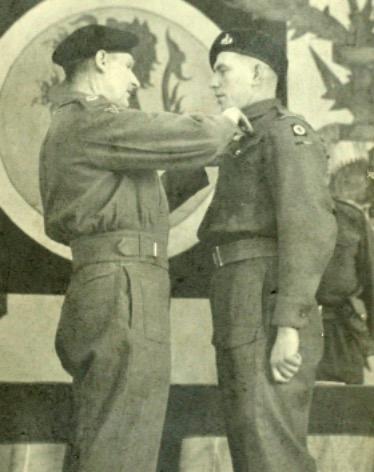
On 13 July Cass was summoned to appear at General Montgomery’s Headquarters without any explanation or reason why; perhaps he feared that he was about to be sacked. Colonel J S Cowley wrote: ‘I remember talking to ‘Copper’ Cass some years later. His feeling was that, as Montgomery was getting stick for not progressing more speedily, he passed the buck down the line by sacking all and sundry.’
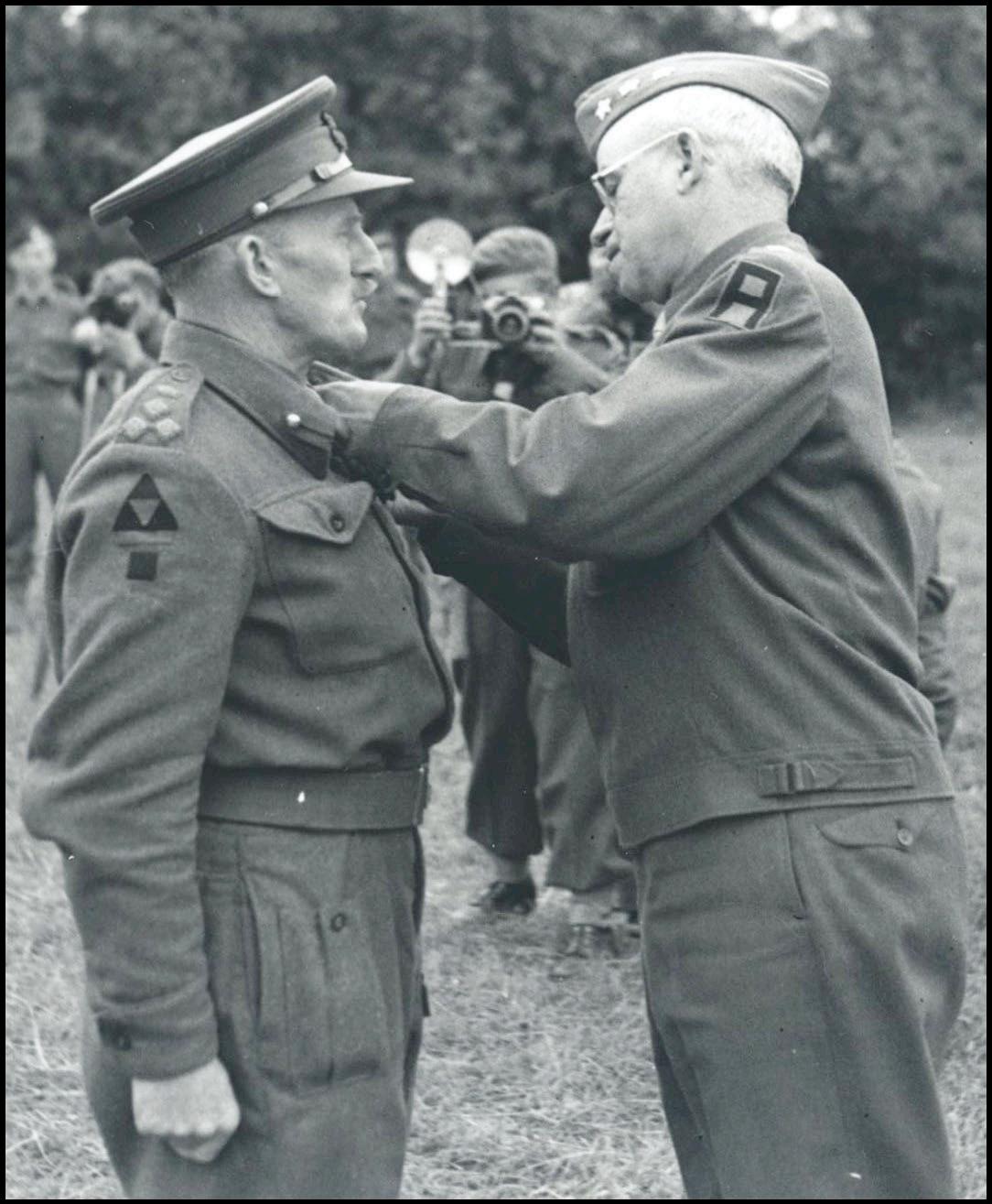
Montgomery was totally engrossed in coordinating with Lieutenant-General Omar Bradley, Commander US First Army, the details of Operation Cobra, the plan for the American breakout and enveloping operation that would decisively defeat the German army in France. Their conference was planned to culminate in a well-publicised display of Anglo-American amity and solidarity.
Cass’s name was not at all on Montgomery’s ‘naughty list’. Monty had sent for Cass and two other senior British officers so that, at the end of the coordinating conference, Omar Bradley could be photographed awarding American decorations to distinguished British officers, on behalf of President Roosevelt. The renowned Major-General Gale of 6 Airborne Division became an Officer of the Legion of Merit and Cass received his Silver Star for personal gallantry in action (a Third Level Gallantry award, equivalent to the Military Cross). The combination of the Silver Star and the Army Best Shot Medal makes Cass’s medal group unique.
To draw German attention away from the American sector of the frontline and pin a maximum of enemy tanks at the eastern end of the battlefeld, on 18 July Montgomery began Operation Goodwood 3rd Division was to push south, protecting the open British left fank. 8th Brigade was in the lead and had seized all its objectives by late afternoon on 18 July, despite having to fght hard to secure one of them. Then the American breakthrough towards St Lo started, the Battle of the Falaise Pocket developed and soon 8th Brigade was chasing a broken enemy who were in full retreat towards Germany. Cass commanded ably, navigating many chaotic and fuid situations. At 7 pm on 13 August Cass was holding an Orders Group when it took a direct hit from a shell. Cass was unharmed, but nearly everyone else was wounded. ‘His simple reaction – “Send for the Seconds in Command” – was admired for its sang froid as well as its expediency.’
Cass continued to command 8th Infantry Brigade until he was wounded by an anti-personnel mine on 26 October 1944. He had to be evacuated to the U.K, thereby losing the opportunity to be ‘in at the death’ of Nazi Germany. On his return to duty after three months of convalescence he was given command of 183 Infantry Brigade from 28 January 1945.
Cass fnally reached the substantive rank of Lieutenant-Colonel on 31 December 1944, which was important for his post-war career. After his brigade command ended he served as a Staff Colonel in Palestine and the Middle East before retiring from the Army on 28 January 1949, aged 50. As a civilian, ‘Copper’ Cass became Secretary of the National Rife Association at Bisley. He returned to Normandy to visit the Sword bridgehead on the anniversaries of D-Day in 1954 and again in 1964. Cass died 31 August 1969 in Scarborough, Yorkshire, aged 70. His obituarist in The Bugle wrote, ‘It is fair to say that as a fghting soldier in both wars he had no Regimental equal and as a Regimental soldier the King’s Own Yorkshire Light Infantry came frst and the rest nowhere.’
Sold with extensive copied research
Note: Brigadier Cass’s private papers are held at the Imperial War Museum.
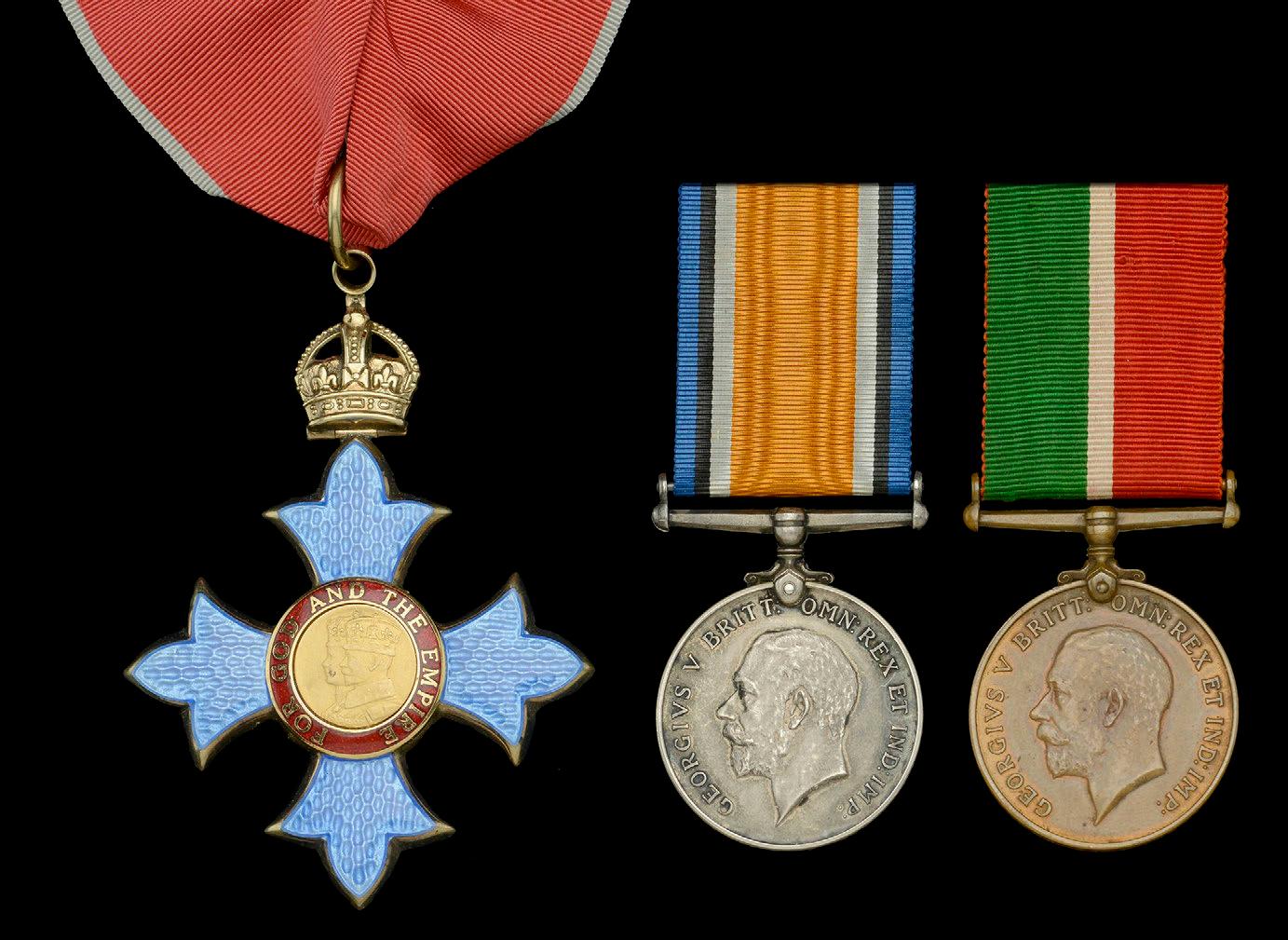
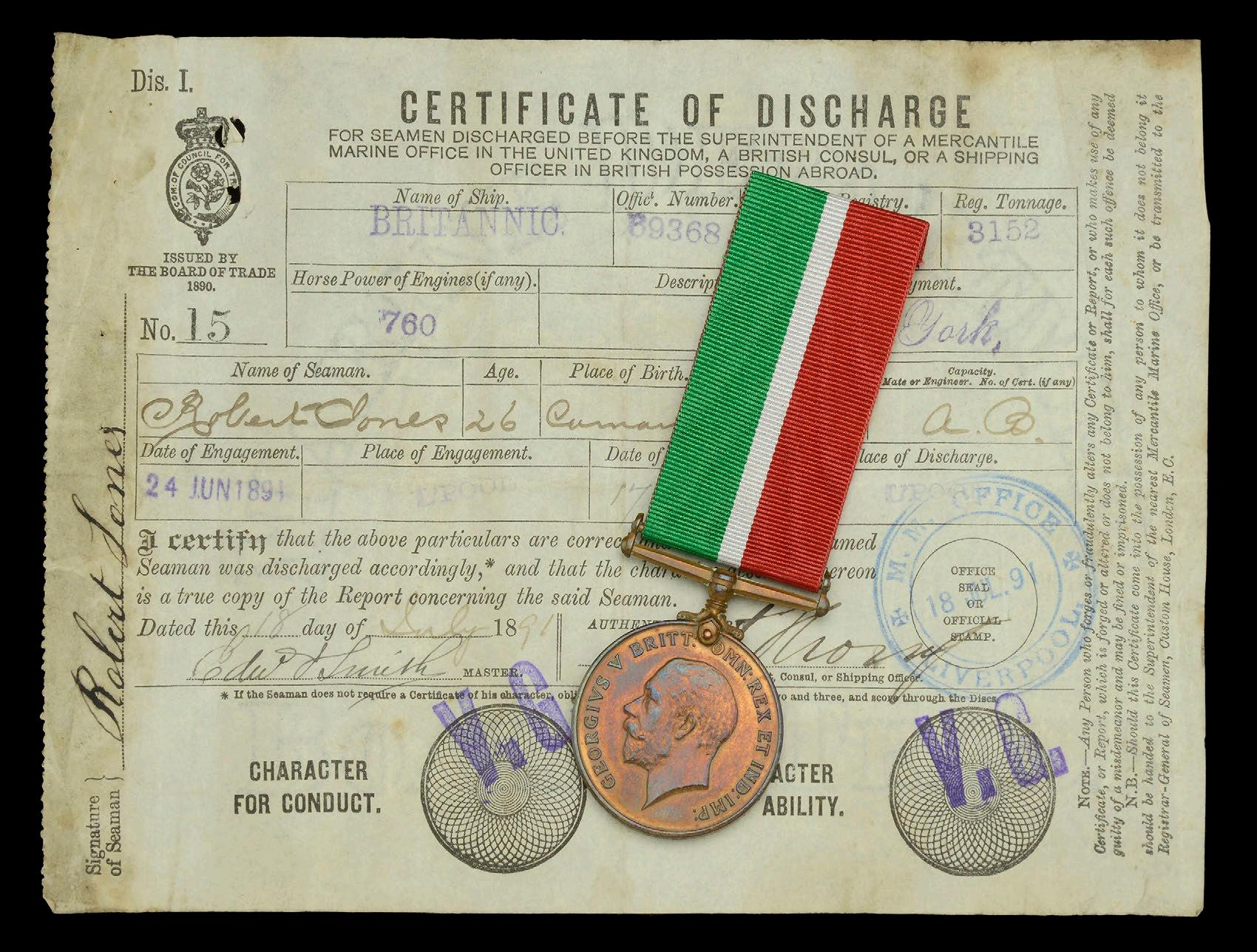
The Most Excellent Order of the British Empire, C.B.E., (Civil) Commander’s 1st type, neck badge, silver-gilt and enamel, in its Garrad, London, case of issue; British War and Mercantile Marine War Medals (George S. Kennedy) good very fne (3) £240-£280
C.B.E. London Gazette, 1 January 1953.
G Geeo orrg gee SSt teew waar rtt KKe ennn need dyy , was born in Hackney, London, on 3 July 1888. He joined the Mercantile Marine and received his Master’s certifcate on 20 September 1912 before service afoat during the Great War. Later serving as a Marine Superintendent with the Orient Steam Navigation Company, he died, aged 91, in Basingstoke, Hampshire, in September 1979.
Sold with copied research.
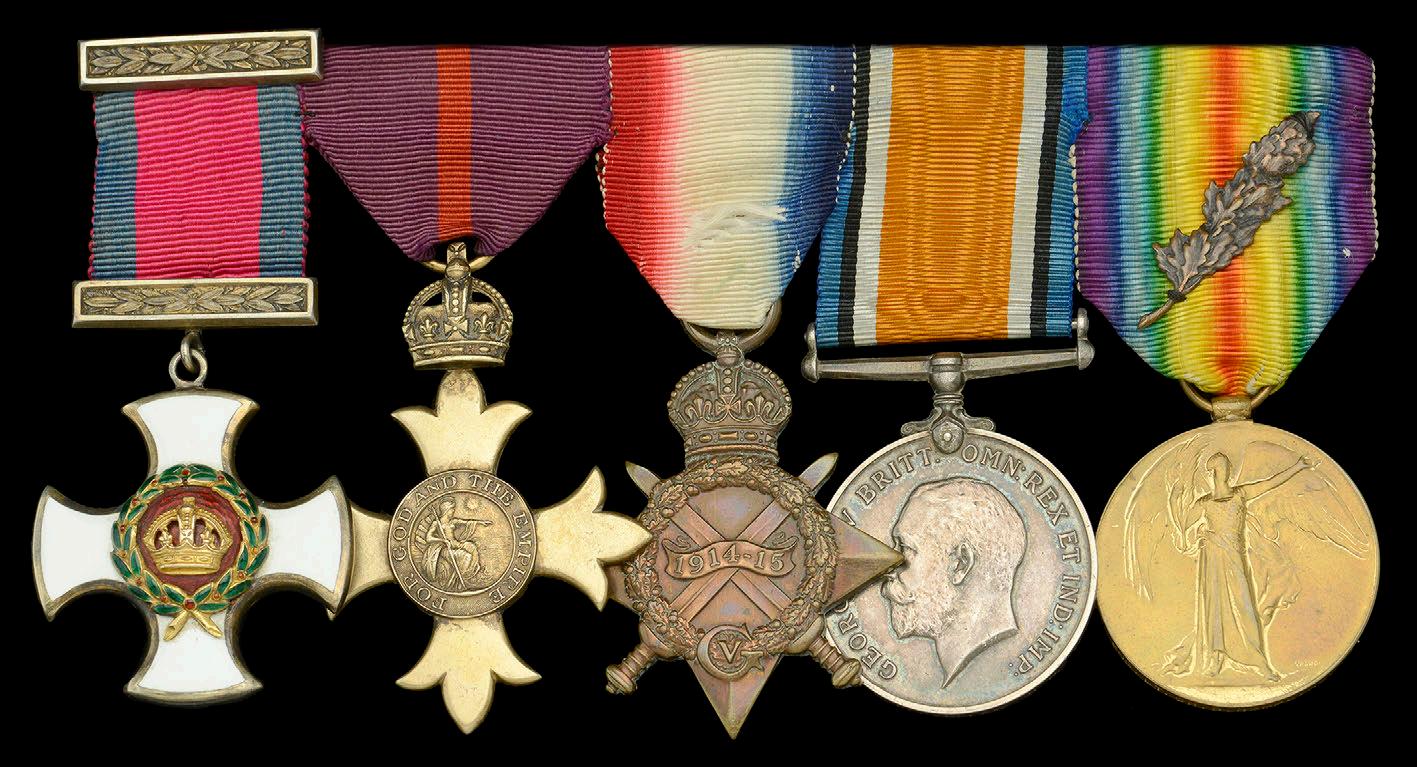
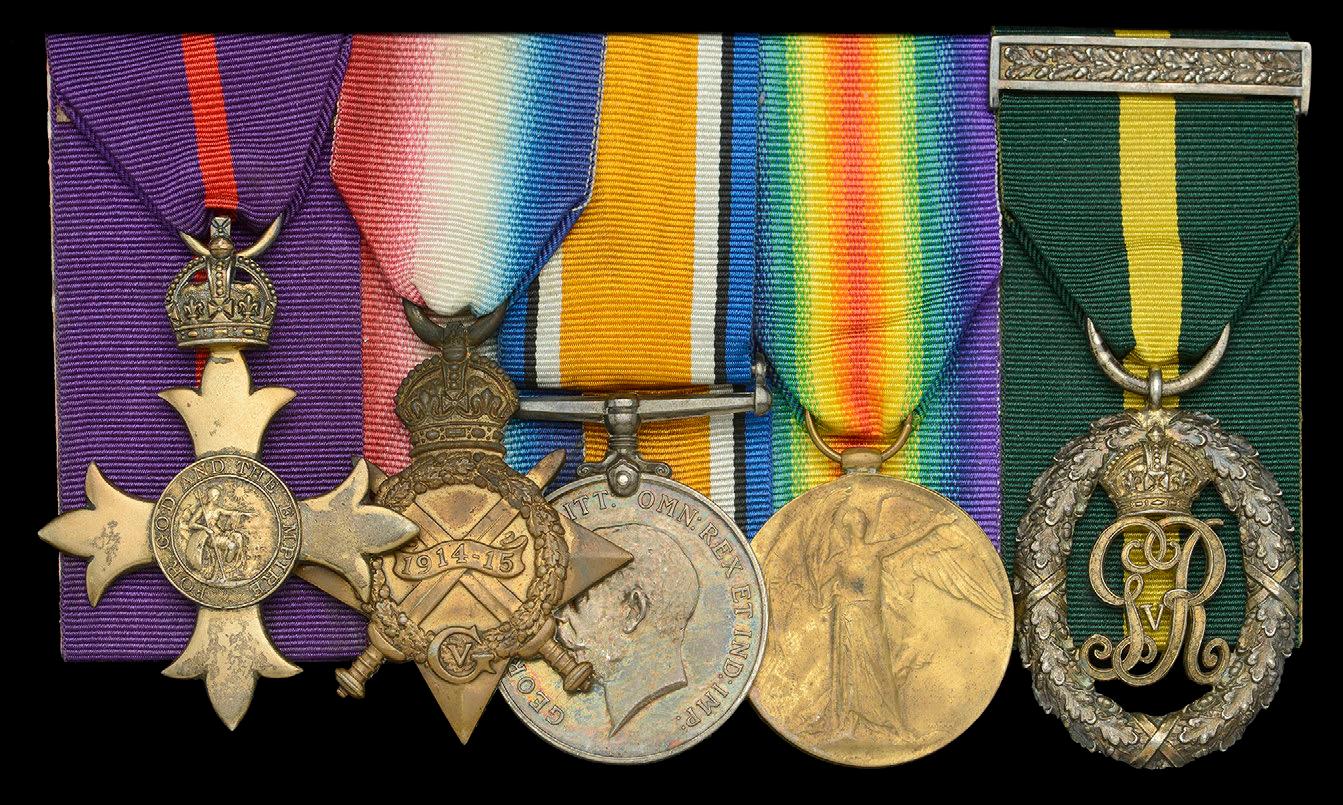
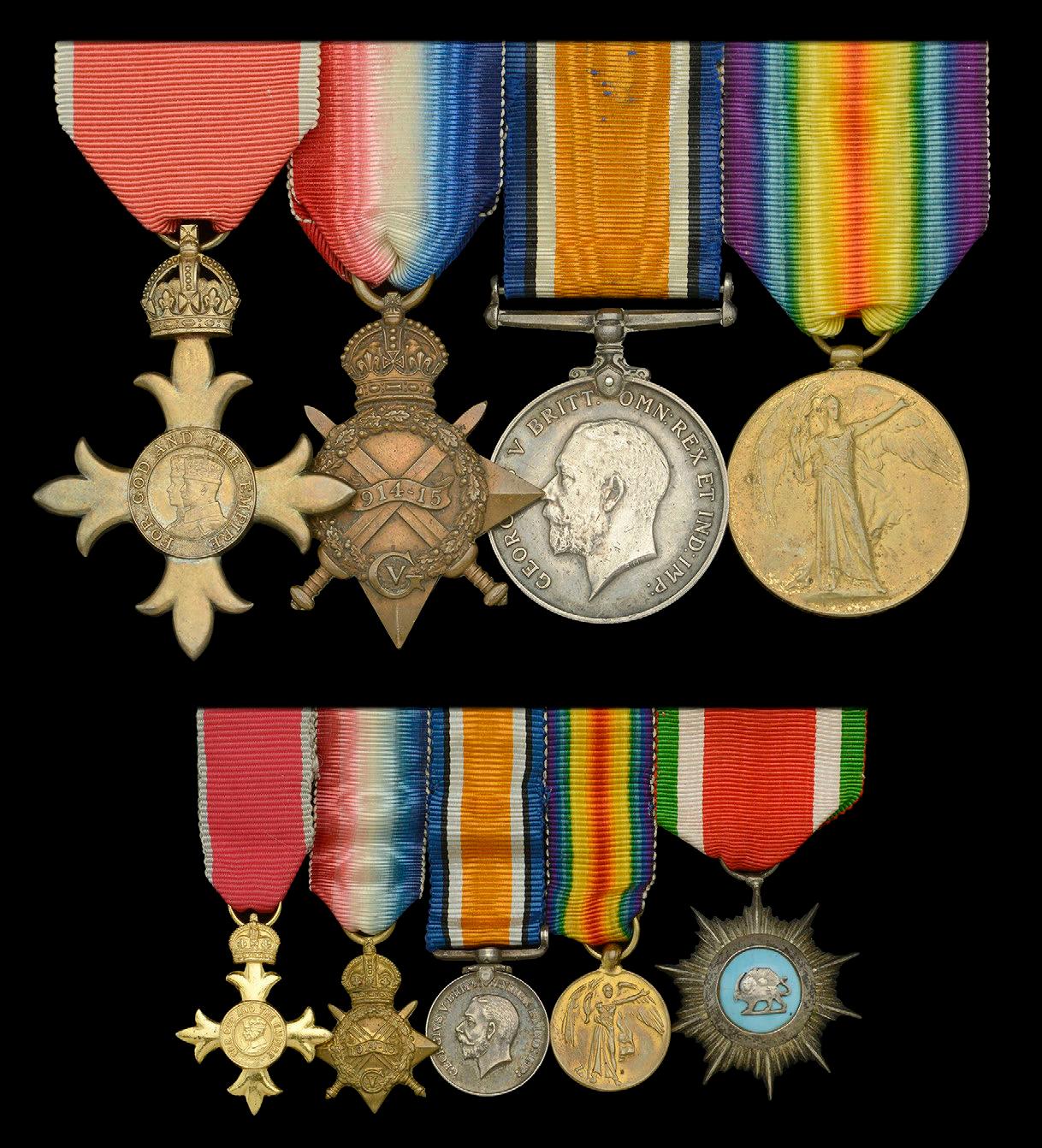
Distinguished Service Order, G.V.R., silver-gilt and enamels, with integral top riband bar; The Most Excellent Order of the British Empire, O.B.E. (Military) Officer’s 1st type, breast badge, silver-gilt, hallmarks for London 1929; 1914-15 Star (Eng. Lt. Cr. R. Rampling, R.N.); British War and Victory Medals, with M.I.D. oak leaves (Eng. Lt. Cr. R. Rampling. R.N.) mounted as worn, good very fne (5) £1,600-£2,000
D.S.O. London Gazette 20 September 1918.
The recommendation by V.A. Dover Patrol (Keyes) states:
‘The prompt and able steps taken by this Officer to shore up bulkheads of H.M.S. Warwick after that ship had been mined off Ostend on the 10 May, 1918, were instrumental in saving the ship. The vessel took a heavy list and water poured into the engine room, but very prompt trimming of the oil tanks brought her upright and enabled the leaks to be kept in hand. Great credit is due to Eng. Lieut-Cdr. Rampling.’
O.B.E. Birthday Honours 1931.
M.I.D London Gazette 28 August 1918.
His record of service states: ‘Mentioned for services Ostend Operations, 9th/10th May, 1918. Despatch from Vice Adml. Sir R. Keyes, 24.7.18, “Displayed courage & coolness under fre. Carried out duties with great steadiness & materially contributed to the success of the operations.”’ This is however, a mistake and his ‘mention’ was unquestionably for the Zeebrugge Raid and is listed as such in Keyes’ Zeebrugge despatch.
RRo obbi inn RRa a m mppl liin ngg was born at Portsmouth on 12 June 1883, and entered the Navy as an Engineer Sub-Lieutenant in June 1903; Engineer Lieutenant, 1 December 1906; Engineer Lieutenant-Commander, 1 December 1914. Appointed to H.M.S. Warwick in August 1917 whilst under construction prior to commissioning in February 1918. Warwick was Vice Admiral Sir Roger Keyes Flag Ship for the raid on Zeebrugge 22-3 April. She also took part in the second raid on Ostend on 9-10 May and was heavily damaged when a mine broke her back and she had to be towed back to Dover by HMS Whirlwind
Warwick’s part in the Zeebrugge Raid is related in the account of her captain, Captain J. S. Cowie, C.B.E., R.N., in The Zeebrugge Raid by Philip Warner, with mention of Rampling and the following footnote: ‘Commander Victor Campbell, Engineer Commander Rampling, Lieutenant Trumble and Lieutenant Bury were mentioned in despatches.’
Rampling was promoted to Engineer Commander, 30 June 1920, and placed on the Retired List with rank of Engineer Captain, 12 June 1933. He died on 24 April 1949.
Sold with copied record of service, Admiralty report of services in Zeebrugge Raid and other research all saved to USB Flash Drive.
For the recipient’s related miniature awards, see Lot 574.
Distinguished Service Order, G.V.R., silver-gilt and enamels, with integral top riband bar; The Most Excellent Order of the British Empire, M.B.E. (Civil) Member’s 2nd type, breast badge; Queen’s South Africa 1899-1902, 5 clasps, Cape Colony, Orange Free State, Transvaal, South Africa 1901, South Africa 1902 (Lieut: A. K. Digby, Imp: Yeo:) officially re-engraved naming, the two date clasps contemporary tailor’s copies; 1914 Star, with copy clasp (Lieut. A. K. Digby, R.F.A.); British War and Victory Medals, with M. I.D. oak leaves (Major A. K. Digby.); Defence and War Medals 1939-45, mounted court-style as worn, very fne or better (8) £1,000-£1,400
Provenance: Charles Lusted, January 1981.
D.S.O. London Gazette 8 May 1915: ‘For conspicuous ability and gallantry during the campaign. He has been at the observing station on almost every occasion when his battalion was in action, and by his coolness and resource greatly contributed to the success attained. He was severely wounded at Neuve Chapelle on 10 March 1915.’
M.B.E. London Gazette 1 January 1961: ‘Honorary Secretary, Lincolnshire Branch, Soldiers’, Sailors’ and Airmen’s Families Association.’
A Arrt thhu urr KKe enne ellm m D Diig gbby y was born in 1879, son of Sir Kenelm Edward Digby, G.C.B, and the Hon. Caroline, daughter of the Rt. Hon. Edward Strutt, 1st Baron Belper. He was educated at Harrow and Corpus Christie College, Oxford (B.A. 1903). He entered the Royal Artillery on 25 April 1902, from the Imperial Yeomanry, becoming Lieutenant, 24 May 1905; Captain, 30 October 1914, and Major, 13 March 1916. He was Acting Lieutenant-Colonel R.A. from 3 January 1919. He served in the South African War 1901-02, with the Imperial Yeomanry; took part in the operations in the Transvaal, Maarch to May 1902; in the Orange River Colony, April 1901 to 31 May 1902; also in Cape Colony, April to May 1901 (Queen’s Medal with 3 clasps). In 1911 Major Digby married Violet, daughter of Sherbrooke Keatinge, late Indian State Railways. He served during the European War 1914-19, was twice wounded, mentioned in despatches (L.G. 22 June 1915), and awarded the D.S.O. Lieutenant-Colonel Digby served in the Second World War between 1939 and 1941. He held the office of Deputy Lieutenant of Lincolnshire in 1961, and died at Cleethorpes, Lincolnshire, on 7 October 1966.
Groups and Single Decorations for Gallantry
Distinguished Service Order, G.VI.R., silver-gilt and enamel, reverse officially dated ‘1941’, with Second Award Bar, the reverse officially dated ‘1942’, with integral top riband bar, white enamel chip to reverse lower arm of cross; India General Service 1936 -39, 1 clasp, North West Frontier 1936-37 (Capt. R. F. E. Chute. R. Tank C.); 1939-45 Star; Africa Star; Burma Star; Defence and War Medals 1939-45, with M.I.D. oak leaf, this loose, mounted for wear, otherwise nearly extremely fne (7) £2,800-£3,400
D.S.O. London Gazette 30 December 1941:
‘In recognition of distinguished services in the Middle East during the period February to July 1941’. The original Recommendation states: ‘This officer has shown great qualities of cool and intrepid leadership whilst in command of his Regiment since 15th May last. In particular on 24th May when, during the enemy advance, he was himself largely responsible for getting RHA vehicles and his own slower moving tanks away by engaging the enemy with his own Regimental Headquarters, who were in faster tanks and fghting a delaying action which allowed the others time to get clear when they were in danger of being surrounded. During 15-16 June he again handled his Regiment with great success until evacuated wounded on the night of 16 June. The good working of his Regiment during the period can largely be attributed to his own examples and qualities as a Commander.’
Chute on the right of the late Queen
D.S.O. Second Award Bar London Gazette 20 January 1942:
‘In recognition of distinguished services in the Middle East’.
The original Recommendation states: ‘This officer handles his Regiment with great boldness and skill in two major engagements at Sidi Rezegh on 21 November 1941, in the frst of which his Regiment destroyed 15 enemy tanks. In the second engagement, with less than 30 tanks, he met the attack of some 60 Mk III and IV tanks, many anti-tank guns and infantry, and in spite of the enemy superiority he held them off for 2 or 3 hours and then counter attacked and destroyed 6 enemy tanks before extricating his few remaining runners.
His leadership and initiative were an inspiration to all, and it was largely owing to his cool and daring judgement and the self-sacrifce of his men that the enemy were prevented from recapturing the Sidi Rezegh position from the South.’
M.I.D. London Gazette 30 December 1941:
‘In recognition of distinguished services in the Middle East during the period February to July 1941’.
M.I.D. London Gazette 28 October 1942:
‘In recognition of distinguished services in Burma during the period December 1941 to May 1942’. RRo o w wlla annd d FFi ittz z m maau urri icce e EEi iddi inng gtto ouun n C Chhu utte e was born in County Kerry, Ireland on 2 October 1899, likely at the family’s residence in Tullygarran.
Educated at Exeter School, he was commissioned in the Royal Munster Fusiliers in July 1919 but transferred to the Royal Tank Corps in July 1921.
Having then served as an instructor at the Tank Driving and Maintenance School in the period January 1928 to November 1931, he was advanced to Captain in March 1932 and witnessed active service on the North-West Frontier in India in 1936-37.
Advanced to Major in the following year, Chute was appointed an Adjutant in the Territorials but appears to have joined the 40th (The King’s) Royal Tank Regiment (R.T.R.) in the immediate lead up to the outbreak of hostilities. Be that as it may, he subsequently transferred to 2nd R.T.R., likely prior to its embarkation for the Middle East in August 1940.
Equipped with A13 cruiser tanks, the regiment joined the 4th Armoured Brigade on its arrival in Egypt and was present in the early desert action at Sidi Barrani in December 1940, in addition to the capture of Bardia and Tobruk.
In May 1941, and by now attached to 7th Armoured Division, Chute took command of 2nd R.T.R., shortly before his D.S.O.-winning exploits in the wake of Operation ‘Brevity’, in which operations he was wounded. He was back in harness by November, however, and added a Bar to his D. S.O. for his exceptional courage and leadership in Operation ‘Crusader’. He also gained a mention in despatches for his services in the Middle East (London Gazette 30 December 1941, refers).
Following his gallant leadership in Operation ‘Crusader’, Chute remained in command of 2nd R.T.R. and was embarked for the Far East at the year’s end, when 7th Armoured Division was destined for Singapore. But rapidly unfolding events necessitated the Division’s diversion to Rangoon, which it reached in February 1942. Equipped with new American Stuart ‘Honey’ light tanks, Chute and his men were quickly in action, facing off the Japanese invasion of Burma, not least after the disaster of the Sittang River.
Moving up from Rangoon to the Pegu River, where they joined the remnants of the 17th Indian Division, close quarters combat was the order of the day, amidst difficult terrain and conditions, and hordes of screaming Japanese troops. On being asked how the fghting in Burma compared with his experiences in North Africa, a trooper from 2 R.T.R. observed, ‘Much the same amount of shit fying around, but the trouble with these Japanese bastards is that they don’t run away like the Italians!’ Notwithstanding such difficulties, 7th Armoured Division reached Prome in late March 1942, a journey much assisted by 2 R.T.R.’s role as the main rearguard.
For his services in Burma, Chute added another ‘mention’ to his accolades (London Gazette 28 October 1942, refers) but he was placed on halfpay on account of ill-health in October 1943. Granted the honorary rank of Lieutenant-Colonel on his retirement in November 1946, he died in Southwark, London in January 1963.
((H
y)), ,
The Most Excellent Order of the British Empire, O.B.E. (Civil) Officer’s 1st type, breast badge, silver-gilt, hallmarks for London 1918; 1914-15 Star (Lt: Col: M. F. M. S. Kittoe. 10/Lond: R.); British War and Victory Medals (Lt. Col. M. F. M. S. Kittoe.); Territorial Decoration, G.V.R., hallmarks for London 1917, with integral top riband bar, mounted for display, very fne (5) £600-£800
O.B.E. Military, 8 January 1919, London Gazette 15 April 1919. M Moon ntta aggu u FFr raan ncci iss M Maar rkkh haam m SSl looa anne e KKi ittt tooe e was born in 1873 and educated at Chatham House, Ramsgate, and Middle Temple. A Stockbroker by profession, he was appointed 2nd Lieutenant, 3rd Volunteer Battalion, Essex Regiment on 3 April 1897; Lieutenant, 10 August 1898; Captain, 26 February 1902; transferred to 6th Battalion, Essex Regiment, 1 April 1908, and to 10th Battalion, London Regiment, 17 October 1912, as Major; Lieutenant-Colonel, 12 December 1914; proceeded to Dardanelles in command of 10th Battalion, London Regiment, 29 July 1915; took part in the action at Suvla Bay in August 1915 and returned to the U.K. in September 1915, suffering from exhaustion and shell shock. He transferred to the Territorial Force Reserve on account of ill-health, 9 December 1916, and was thereafter employed with the Ministry of Munitions.
The Most Excellent Order of the British Empire, O.B.E., (Civil) Officer’s 2nd type breast badge, silver-gilt, in case of issue; 1914-15 Star (2. Lieut. D. S. Davies. S. Wales Bord.); British War and Victory Medals (Lieut. D. S. Davies.); PPe errs s
EEm
, Order of Science and Cultural Merit, Second Class badge, 32mm, silver and enamel; together with the related miniature awards for the British awards, the miniatures mounted as worn alongside the full-sized Persian award, good very fne, the last rare (5) £400-£500
O.B.E. London Gazette 2 June 1943: David Sydney Davies, Esq., M.D., B.Ch., R.F.C.S., Physician at His Majesty’s Legation at Tehran.
D Daav viid d SSy yddn neey y D Daav viie ess was born in Wales on 18 February 1895 and having spent a year at the University of London studying Medicine in 1914, enlisted in the Monmouth Regiment following the outbreak of War. Commissioned Second Lieutenant in the South Wales Borderers on 5 February 1915, he served with them during the Great War on the Western Front from 15 September 1915, before proceeding to Salonika. Returning home in 1918, he went up to Magdalen College, Oxford, and graduated Bachelor of Medicine, before undergoing further medical training at Guy’s Hospital in London. In 1924 he joined the Sudan Medical Service as a Medical Inspector; whilst in the Sudan the Sudanese Rebellion broke out and the Sirdar was murdered; for two nights Davies stood duty as a machine gunner on the palace guard. Returning to London in January 1926 to taken up an appointment at Guy’s Hospital, Davies next joined the Anglo-Persian Oil Company in July 1928 and proceeded frst to Abadan, and then as Medical Attaché to the British Embassy in Tehran. For his serves in Tehran during the Second World War he was appointed an Officer of the Order of the British Empire, and was also decorated by the Persian authorities with the Order of Science and Cultural Merit.
Following the cessation of the Second World War, Davies emigrated to Cape Town, South Africa, where he became a plastic surgeon at Groote Schuur Hospital. He retired in 1961
Sold with the recipient’s Treatment Book; the recipient’s School Certifcate; University of London Matriculation Certifcates; University of Oxford Graduation Certifcates for both Bachelor of Medicine and Doctor of Medicine; various Royal College of Surgeons, Royal College of Physicians, and South African Medical Council Certifcates; a copy of The Sudan Medical Service, by H. C. Squires, C.M.G.; and other ephemera.
The Most Excellent Order of the British Empire, O.B.E., (Military) Officer’s 2nd type breast badge, silver-gilt; Naval General Service 1915-62, 1 clasp, Palestine 1936-1939 (KX.88553 H. H. L. Harvey. Sto. 1. R.N.); 1939-45 Star; Atlantic Star; Africa Star, 1 clasp, North Africa 1942-43; Italy Star; Defence and War Medals 1939-45, mounted court-style as worn, nearly extremely fne (8) £200-£240
The Most Excellent Order of the British Empire, O.B.E., (Civil) Officer’s 2nd type, breast badge, silver-gilt; 1914-15 Star (Lieut: E. S. A. Baynes. K. R. Rif: C.); British War and Victory Medals (Capt. E. S. A. Baynes); Defence Medal, mounted for wear, slight contact marks, some polish residue, very fne (5) £220-£260
O.B.E. London Gazette 2 January 1950.
EEd
s , was born in Pimlico, London, on 25 June 1889. Shortly after studying Architecture at Radley College, Oxford, he was commissioned into the King’s Royal Rife Corps on 13 November 1914, for service during the Great War. He served on the Western Front with the 11th Battalion from 21 July 1915 and, advanced Temporary Captain, was wounded on the Somme. Post War he joined the Department for Overseas Trade, serving in numerous posts across the globe as a United Kingdom Trade Commissioner, for which he was awarded the O.B.E. A keen interest in Lepidoptera led the publication of ‘A list of British Butterfies’ in 1960, followed by ‘The revised catalogue of Irish Macrolepidoptera in 1964. He died in Dublin in 1972.
Sold with a white medal Distinguished Service to the City of New York 1939 medallion, and copied research.
The Most Excellent Order of the British Empire, O.B.E., (Civil) Officer’s 2nd type breast badge, silver-gilt; The Order of St. John of Jerusalem, Officer‘s (Brother’s) breast badge, silver and enamel, with heraldic beasts in angles; 1939-45 Star; Africa Star, 1 clasp, 8th Army; Defence and War Medals 1939-45, with M.I.D. oak leaf, all unnamed as issued to Rhodesian personnel; Africa Service Medal, this last officially impressed ‘SR216806 B. H. Johnson’, mounted court-style for display, nearly extremely fne (7) £240-£280
O.B.E. London Gazette 7 June 1951.
M.I.D. London Gazette 13 January 1944:
‘In recognition of gallant and distinguished services in the Middle East.’
BBe errt trra a m m H Hoow waar rdd JJo ohhn nsso onn was born in Cape Town in 1902 and was educated at Brighton College, and Clare College, Cambridge. Subsequently appointed a Pupil Engineer with the Beira, Mashonaland and Rhodesia Railways [B.M.R.] in September 1923, he was commissioned into the South African Engineers Corps in 1940, and was advanced temporary rank of Major in February 1943. For his services during the Second World War in the Middle East he was Mentioned in Despatches. Released from the Union Defence Force on 17 August 1943, he returned to his employment with the Rhodesia Railways, and was promoted to Chief Engineer of the Rhodesia Railways in 1950. Appointed an Officer of the Order of the British Empire in the 1951 Birthday Honours’ List, he was promoted to Assistant General Manager of the Rhodesia Railways in December 1952.
Admitted as an Officer of the Most Venerable Order of St. John in 1955, he retired the following year, and died in 1980.
The Most Excellent Order of the British Empire, M.B.E., (Military) Member’s 1st type, breast badge, silver, hallmarks for London 1918; 1914-15 Star (Gnr. A. H. Bailey, R.N.); British War and Victory Medals (Gnr. A. H. Bailey. R.N.); Royal Navy L.S. & G.C., G.V. R., 1st issue (184500. A. H. Bailey. P.O. H.M.S. Jupiter.); Naval Good Shooting Medal, E.VII.R. (184500 A. Bailey, P.O. 1 Cl. H.M.S. Formidable. 1907. 12in. B.L.) mounted as worn, light contact marks, nearly very fne and better and a scarce combination (6) £600-£800
M.B.E. London Gazette 17 July 1919: ‘For valuable services in H.M. Ships Iron Duke and Revenge, 1st Battle Squadron.
A Arrt thhu urr H Huub beer rtt BBa aiil leey y was born in Eastington, Gloucestershire, on 6 April 1879 and joined the Royal Navy as a Boy Second Class on 20 July 1895. Advanced Petty Officer First Class on 3 July 1903, he served in H.M.S. Formidable from 6 December 1905 to 26 April 1908, and was awarded the Naval Good Shooting Medal in 1907. Awarded his Long Service and Good Conduct Medal on 18 April 1912, he was promoted Gunner on 1 February 1914, and served during the Great War initially in the battleship H.M.S. Iron Duke, the fagship of Admiral Sir John Jellicoe, and was present in her at the Battle of Jutland on 31 May 1916. Subsequently transferring to the battleship H.M.S. Revenge in February 1917, where he was again borne for ‘instructional duties’, for his services during the Great War he was appointed a Member of the Order of the British Empire, one of only 17 Royal Naval Gunners to be awarded the M.B.E. during the Great War.
Bailey was appointed to the light cruiser H.M.S. Dido in May 1920, where he was borne for ‘Squadron Director Duties, Local Defence Flotilla’, and remained in this ship until placed on the Retired List in 1922. Subsequently promoted Commissioned Gunner, his seniority backdated to his appointment as a Gunner, he died on 13 November 1953.
Sold with the recipient’s Boatswain’s Whistle, this crudely engraved ‘A. H. Bailey, P.O.1’; a pocket compass; two small silver presentation shields, recording that in the 1905 cricket season the recipient had a batting average of 41.3 and a bowling average of 9; a booklet ‘Review of the Fleet by His Majesty The King, July 31 1909’, a photographic image of the recipient, and copied research.
Royal Red Cross, 1st Class, G.VI.R., 1st issue, silver-gilt and enamel, reverse dated 1945; 1939-45 Star; Africa Star; Defence and War Medals 1939-45; General Service 1918-62, 1 clasp, Palestine 1945-48 (Matron. M. H. A. Hudson. R.R.C. Q.A.I.M.N.S.)
mounted as worn; together with the recipient’s Queen Alexandra’s Imperial Military Nursing Service cape badge, generally good very fne (7) £600-£800
R.R.C. London Gazette 14 June 1945.
M Miis sss M Maar ryy H Haav veel looc ckk A
rrc chhe err H Huud dsso onn was was born in Calcutta on 3 December 1903, the daughter of John Hudson, and the grand-daughter of Rear Admiral Joseph Samuel Hudson. Amongst her other forebears she was the great grand-daughter of was Major-General Charles Frederick Havelock; the great great niece of both Lieutenant-Colonel William Havelock (who served as aide-de-camp to Alten at Waterloo) and Sir Henry Havelock (who fought in Burmese, Sikh, Afghan wars and at Relief of Cawnpore and Lucknow); and a frst cousin twice removed of LieutenantGeneral Sir Henry Marsham Havelock-Allen, V.C. Her sister and brother were also industrious in their careers with Eileen Hudson also becoming a nurse and Joseph Edward Hudson going onto serve with the Indian Long Range Squadron.
Returning with her family to Surrey prior to the Great War, Miss Hudson trained at the Radcliffe Infrmary and County Hospital Oxford between 1920 and 1923, and joined Queen Alexandra’s Imperial Military Nursing Service on 24 May 1927, being advanced Staff Nurse on 20 August 1931, ands Sister in 1934. She served throughout the Second World War, and was awarded the Royal Red Cross whilst holding the rank of Acting Principal Matron. She saw further service in post-War Palestine at Bir Ya’acov Military Hospital. Transferring to Queen Alexandra’s Royal Army Nursing Corps, and advanced Major, she retired on 15 May 1953 and was granted the honorary rank of Lieutenant-Colonel. She died at Freshwater, Isle of Wight, on 11 January 1991.
1 ‘Thrice Honoured
An unusual distinction falls to Acting Lieutenant E W T Taylour of the Fleet Air Arm, who has been honoured three times in the Fleet Awards for Norway for gallantry ’ (Flight, 23 May 1940, refers.)
I have the honour to bring to your notice the name of Acting Lieutenant Edward Winchester Tollemache Taylour, Royal Navy, Pilot, who having lost contact with his Squadron on passage to the objective continued alone, attained a possible direct hit, and returned alone ’
(Report of Commander C. L. Howe, 10 April 1940, refers)
T Thhe e rra arre e aan ndd ppo oiig gnna annt t SSe ecco onnd d W Waar r 119 9440 0 ‘‘S Siin nkki inng g oof f tth hee K Köönniiggssbbeerrgg, , A Arrk k R Rooy yaal l A Aiir r G Grro ouup p O Oppe erra atti ioon nss ’’ D D SS C C aan ndd SSe ecco onnd d A A w waar rdd BBa arr ggr roou upp oof f ssi ixx aaw waar rdde edd tto o LLi ieeu utte enna annt t--C Coom m m maan ndde err EE W W T T Taay yllo ouur r,, R Rooy yaal l N Naav vyy, , aa FFl leee ett A Aiir r A Arrm m FFi iggh htte err A Acce e,, aa
D Diiv vee-BBo o m mbbe err, , aan ndd aa BBa attt tlle e oof f BBr riit taai inn PPi illo ott, , w whho o ppa arrt tiic ciip paat teed d iin n tth hee ffrrs stt w waar rtti i m mee ssi innk kiin ngg oof f aa C Caap piit taal l SSh hiip p bby y aai irr aat ttta acck k ((f foor r w whhi icch h hhe e w waas s ssi i m muul ltta anne eoou ussl lyy gga azze ettt teed d w wiit thh tth hrre eee sse eppa arra atte e G Gaal llla annt trry y A A w waar rdds s)), , w waas s oon nee oof f ‘‘T Thhe e FFe e w w ’’ ,, aan ndd ddu urri inng g tth hee cco ouur rsse e oof f hhi iss cca arre eeer r w waas s ccr reed diit teed d w wiit thh aat t lle eaas stt sse evve enn vvi icct toor riie ess, , bbe effo orre e bbe eiin
SSe eppt teem mbbe err 119 9442 2
Distinguished Service Cross, G.VI.R., with Second Award Bar, hallmarks for London 1939, the reverses of both the Cross and the Bar officially dated ‘1940’, the reverse of the Cross additionally engraved ‘E. W. T. Taylour, R.N. c/o Admiralty’, in contemporary Garrard house style, in Garrard, London, case of issue; 1939-45 Star, 1 clasp, Battle of Britain; Atlantic Star, 1 clasp, Air Crew Europe; Arctic Star; Africa Star; 1939-45 War Medal, with M.I.D. oak leaf; together with the recipient’s related miniature D.S.C., with Second Award Bar, this too with reverse inscription ‘E. W. T. Taylour, R.N., c/o Admiralty’ engraved in the same contemporary Garrard house style, extremely fne (6)
£6,000-£8,000
Provenance: Dix Noonan Webb, March 2009 (D.S.C. and Second Award Bar; named miniature D.S.C. and Bar; and miscellaneous related items only). The campaign awards, including the retrospective Arctic Star, have been added to express the recipient’s complete entitlement. Garrard, who manufactured the Distinguished Service Cross until 1952, offered recipients the options of having their medal additionally engraved with the recipient’s name and other personal details and of buying a ‘miniature’, which could also be additionally engraved. Recipients choose the inscription (with or without rank, forenames, initials, ship &c.) and the engraving was executed in a consistent house style. Garrard appear to have discontinued this naming service in 1941-42.
D.S.C. London Gazette 9 May 1940.
D.S.C. Second Award Bar London Gazette 9 May 1940.
M.I.D. London Gazette 9 May 1940.
Remarkably, Taylour’s D.S.C., Second Award Bar, and Mention in Despatches all appear on the same front page (2785) of London Gazette 34845 of 9 May 1940:
‘For daring and resource in the conduct of hazardous and successful operations by the Fleet Air Arm against the enemy, especially on the coast of Norway.’
In addition to his above awards for Norway, Taylour is officially recognised as one of ‘The Few’ who took part in the Battle of Britain. Two Fleet Air Arm Squadrons (804 and 808) plus some Fleet Air Arm pilots seconded to the Royal Air Force took part in the Battle, and Taylour was one of 56 men of the Fleet Air Arm to receive the Battle of Britain clasp. He also undoubtedly, given the circumstances of his death in action, qualifed for the retrospective Arctic Star.
During the course of his career Taylour shared in sinking two important German ships and achieved eight aerial victories, plus one probable and three damaged. His totals of 1 Cruiser, 1 Supply ship sunk; 7/8 Aerial Victories, 1/2 Probables, and 2 Damaged puts Taylour in 12th Place in the Table of Second World War Royal Naval Aces, and his list of victories is tabulated below.
RRe ecco orrd d oof f SSi innk kiin nggs s
10 April 1940, Bergen, Norway, fying Skua White-1 from R.N.A.S. Hatston: DKM Königsberg Fast Cruiser, by dive bombing, shared. (Authority: Report of Commander C.L. Howe R.N, T.N.A.)
14 April 1940, Bergen, Norway, fying Skua L3028 Yellow-2 from RNAS Hatston: Barenfels Supply Ship, by dive bombing, shared. (Authority: Combat Report, T.N.A.)
RRe ecco orrd d oof f D Deec ciis siiv vee A Aiir r C Coom mbba atts s
27 April 1940, Norway, fying Skua A6B from Ark Royal: He 111 bomber, 9/KG 26, crash-landed Grotli, shared. (Authority: Operation D.X., Narrative of Vice-Admiral, Aircraft Carriers, T.N.A. )
28 April 1940, Norway, fying Skua A6G from Ark Royal: He 111 bomber, 4/KG 26, apparently crashed into sea, shared. (Authority: Operation D.X., Narrative of Vice-Admiral, Aircraft Carriers, T.N.A.)
28 April 1940, Norway, fying Skua A6G from Ark Royal: JU 88 fghter-bomber, claimed as Damaged, post-war analysis indicates probably the He 111 fown by Staffelkapitan Hptm von Carolsfeld which force-landed at sea (crew survived). (Authority: Operation D.X., Narrative of Vice-Admiral, Aircraft Carriers, T.N.A.)
27 November 1940, Mediterranean, fying Fulmar I from Ark Royal: Cant Z506B bomber (possibly a Vichy French Farman 223.4), crashed into sea off Bone, shared. Combat Report not yet located. (Authority: Royal Naval Aces of WW2, A Thomas )
9 February 1941, Mediterranean, fying Fulmar I from Ark Royal: Cant Z1007 bomber of 51 Stormo BT, over sea near Sardinia, shared. Combat Report not yet located. (Authority: Royal Naval Aces of WW2)
8 May 1941, Mediterranean, fying Fulmar I Green-I/Yellow-I from Ark Royal: Fiat CR 42 Falco fghter, Probable, near Sardinia. 400 rounds fred. (Authority: Combat Report, T.N.A.)
8 May 1941, Mediterranean, fying Fulmar I Green-I/Yellow-I from Ark Royal: Ju 87 Stuka dive-bomber, shot down in fames near Sardinia. (Authority: Combat Report, T.N.A.)
8 May 1941, Mediterranean, fying Fulmar I Green-I/Yellow-I from Ark Royal: Ju 87 Stuka dive-bomber Damaged. 1,200 rounds fred. (Authority: Combat Report, T.N.A.)
23 August 1941, Mediterranean, fying Fulmar II Black-I from Ark Royal: Cant Z506b foat-plane Damaged, rear gunner killed off North Africa coast, shared. 4,096 rounds fred. (Authority: Combat Report, T.N.A.)
27 September 1941, Mediterranean, fying Fulmar II Black-I from Ark Royal: Fiat BR20 (according to Aces, actually S-84 torpedo-bomber of 108 Gruppo, 36 Stormo BT), near Tunisia, shared. 2,352 rounds fred. (Authority: Combat Report, T.N.A.)
Groups and Single Decorations for
28 September 1941, Mediterranean, fying Fulmar II Black-I from Ark Royal: Cant Z506b foat-plane, crashed into sea 200 yards from Cap de Fer (Algerian coast near Gibraltar), shared. 880 rounds fred. (Authority: Combat Report, T.N.A.)
EEd d w waar rdd W Wiin ncch hees stte err TTo olll leem maac chhe e TTa ayyl loou urr , a direct descendant of King Henry VII and Elizabeth Plantagenet, was born 1 January 1915, the youngest of four children of Captain B. R. H. Taylour R.N., and was appointed a Midshipman on 1 January 1933, rising to Sub-Lieutenant on 16 January 1936. After four years of sea service, Taylour elected to join the Fleet Air Arm of the Royal Air Force. On 5 January 1937 he was granted a temporary commission in the Royal Air Force as a Flying Officer and posted to No. 1 Flying Training School, Netheravon. On 1 March 1938 he was appointed Acting-Lieutenant. After the R.A.F. returned the F.A.A. to Royal Navy control in May 1939, Taylour relinquished his R.A.F. appointment on 26 July 1939, becoming Acting Lieutenant (Air Branch) R.N. In early 1940 Taylour joined No. 800 (F.A.A.) Squadron at Hatston (H.M.S. Sparrowhawk) in the Orkneys, which protected the feet anchorage at Scapa Flow. No. 800 was equipped with the Blackburn Skua Fighter/Dive Bomber, a rugged and relatively versatile aircraft, armed with fve machine-guns and capable of carrying 660lbs of bombs. It had no air-to-air radio, so attacks had to be co-ordinated by hand signals. On the evening of 20 March 1940 Taylour was in action: “While acting as leader of ‘Green Section’ escorting Convoy ON 21, Kirkwall portion, I sighted about ten Heinkel He 111ks approaching the convoy from the north-east. I immediately put my section into line astern and attacked the nearest enemy machine. I succeeded in getting a good shot, and held it long enough to fre all my ammunition. The enemy machine, as soon as I started fring, started to climb up to the cloud base where I lost him. The enemy bombing was disorganised by the Skuas, the bombing being made at random.’
On the night of 8/9 April 1940 Hitler invaded Norway. Gruppe 3 of the invasion force was an amphibious attack intended to capture the strategic seaport of Bergen by sudden coup de main Its transport ships were escorted by the cruisers Königsberg and Köln They arrived off Bergen early on the morning of 9 April. Kvarvan Fort, which guarded the harbour entrance, scored hits on Königsberg, damaging her engines. Königsberg stayed in port to make repairs, protected by Köln During the day, the two cruisers were detected by the R.A.F. Two Bomber Command squadrons dropped thirty bombs, without obtaining a single hit. The Germans knew that a Royal Navy strike force had sailed from Scapa Flow, heading for Bergen. That night, Köln returned to Germany.
Königsberg was a modern fast cruiser designed to locate British warships and then draw them to the main German Battle Fleet. It was an important naval asset that could play a key role in preventing the Allies from recapturing Bergen. Königsberg was moored at Skoltegrund Mole, with her stern towards the harbour entrance; at least two of her three triple 5.9 inch turrets and her port torpedo tubes could engage any British ship that attempted to enter. Radio-equipped spotter parties were deployed on the hills west of Bergen, enabling Königsberg to shell approaching ships. Only the forward part of the cruiser was alongside the mole, so that the crane at the end of the mole could be used to make her repairs.
The British naval force was heavily attacked by German bombers. The Admiralty cancelled its planned bombardment of Bergen and tried a new tactic, the use of dive bombers on naval targets. 800 and 803 Squadrons, the two Skua units from Hatston in the Orkneys, were tasked to execute a dive-bombing attack at dawn. The difficulties were formidable. Bergen was at the outermost limit of the Skua’s range. Spot-on navigation and precise night formation fying were required. 800 Squadron felded 5 aircraft and 7 crews while 803 Squadron provided 11 aircraft and 9 crews. Each Skua carried one 500lb Semi-Armour-Piercing bomb.
The force took off at 05.15 am on 10 April. Taylour was White Section Leader, but he became seperated from the rest of the formation in the darkness and was unable to get back in touch with them. Undaunted, he pressed on alone. The Skuas made landfall 20 miles south of Bergen and arrived over Bergen itself at 07.20 (British time), approaching from the south east at 12,000 ft. They broke through a thin layer of cloud and circled the harbour to look for the enemy warships, quickly identifying Königsberg alongside the Mole. The Skuas fipped over in turn, attacking out of the sun, making their dives from its stem to stern. They dropped their 500 lb bombs between 1,500 to 3,000 feet above Königsberg, though one aircraft made a daring second swoop right down to 200 feet before bomb release.
The German spotter parties gave Königsberg 15 minutes warning of the approach of the British dive bombers; the cruiser had an impressive antiaircraft armament. Flak guns started fring as the frst Skua passed 8,000 feet, but they were fring directly into the rising sun. Königsberg’s midships 3.7 cm fak batteries had been destroyed by the Norwegian coastal guns and the heavy 88 mm fak guns at her stern could not be brought to bear. Additional fak was fred by 2 cm guns manned by Kreigsmarine gunners on Kritiansholmen island. Two Skuas suffered fak damage and a Skua which crashed on the fight home may also have been hit by fak.
Taylour did not arrive over the target until ten minutes after all the other Skuas had made their dives and turned for home. Despite the huge risk of making a solo attack on a fully alert and heavily defended enemy target, Taylour made a 70-degree dive from 6,500 feet right down to 2,000 feet. Undeterred by the fak he released his 500lb bomb fne on Königsberg’s port bow, obtaining a possible direct hit (his Combat Report, Commander Howe’s report and recommendation refers).
German sources state that no less than fve, maybe six, bombs had struck the cruiser, with another exploding close astern and causing extensive damage. Despite frantic efforts to save her, Königsberg rolled onto her port side and sank, nearly three hours after the dive bombing attack. 18 crewmen were killed, 23 injured. However, when credible neutral sources reported that a German cruiser had been sunk, it was not clear to the Admiralty which cruiser it was. Fearful of embarrassing R.A.F. Bomber Command, which had suffered heavy losses from attacking many German warships in their harbours with no results, and of claiming to have sunk a warship that could be shown to be still afoat, the Admiralty did not publicise the achievement of the Skua crews. In fact, they had scored an historic and notable triumph: The frst sinking of a defended major warship by aerial bombing.
F Fuurrtthheer r A Attttaacckks s o on n B Beerrggeen n H Haarrbboouur r aannd d tthhe e ssiinnkkiinng g o of f BBa arre ennf feel lss Taylour returned to Bergen two days later. Three F.A.A. squadrons departed Hatston at 1430 on 12 April and attacked in three waves at 15 minute intervals, the six Skuas of 800 Squadron forming the second wave, which pushed over from 5,000 feet at 1630. The Germans put up strong resistance and a Skua was shot down by enemy anti-aircraft fre. Flying as Yellow-2, Taylour encountered particularly heavy fak and machine-gun fre both from ships and hilltops as his section attacked a large oiler; he released his bomb from 2,000 feet, then went on to use his four forward-fring Browning machine-guns to good effect by strafng a farm of camoufaged oil tanks. The attackers achieved little, having no preidentifed objectives and selecting their targets as they emerged from the low cloudbase, which resulted in hasty, short dives.
A third strike on Bergen was made by 15 Skuas in two waves at dawn on 14 April. 800 Squadron attacked at 0712, dive-bombing ships alongside the Mole, then strafng two U boats and two ‘S boats’. Taylour was the second in a section of three Skuas that dive-bombed the transport Barenfels, whose cargo included 10.5cm heavy anti-aircraft guns. Barenfels was moored on the opposite side of Skoltegrund Mole from the wreck of Königsberg Taylour strafed her during his dive, fring 150 rounds and dropping his 500lb bomb within 18 yards of the target, despite light fak coming from the jetty. On the way home, Taylour spotted S-23 and S-25 and strafed each in turn. His Combat Report reads: ‘Observer states both stopped. Estimated heavy casualties to personnel’.
One bomb exploded between Barenfels and the Mole and she sank by her stern. Taylour’s Mentioned in Despatches award likely resulted from this second successful dive-bombing attack.
Groups and Single Decorations for Gallantry
When the Germans invaded Norway, the heavy Fleet Carriers Ark Royal and Glorious were both in the Eastern Mediterranean. They were recalled to the Home Fleet and arrived in Scapa on 21 April. The following day the Skua squadrons were embarked; 800 Squadron (9 Skuas and 2 Rocs) and 801 Squadron (9 Skuas and 3 Rocs) went aboard Ark Royal The Fleet Carriers’ mission was to provide air support for landings at Namsos and Andalsnes. 800 Squadron’s Skuas few patrols over Andalsnes, despite having to fy over 100 miles to get there. On 25 April 800 Squadron covered the Allied landings at Namsos, until poor weather made fying impossible. The Skuas operated as both bombers (aerial artillery) and fghter cover for the British forces on shore, with the intermittent support of a single squadron of Blenheims from Scotland, operating at the limit of their range.
Taylour scored his frst victory on Saturday 27 April. At 1230, Ark Royal dispatched 800 Squadron’s Yellow Section (Partridge, Taylour and HurleHobbes) on an offensive patrol to protect the British ships at Åndalsnes. At 1330 the three Skuas climbed to attack He-111 1H+CT of 9/KG 26 (piloted by Horst Schopis), which was bombing a British warship from 13,000 feet. Hurle-Hobbes delivered a full defection beam attack that was followed up by Yellow 1 and 2 before the Heinkel turned away to the south. The Skuas gave chase and made several attacks, with Taylour fring off all his ammunition, before the Heinkel crashed near Grotli (40 miles south of Romdalsfjord) at 1400, with one of its air-gunners dead and the other wounded.
The next day, Taylour was in action again At 1140 Red Section (three Skuas) of 800 Squadron was sent to attack enemy aircraft reported to be bombing the cruiser H.M.S. Calcutta and attacking T.M. One, an important convoy of British supply ships. When they arrived, Calcutta reported “no attacks for last forty minutes” but a dozen aircraft were attacking convoy T.M. One. Red Section singled out and attacked a Heinkel 111 of 4/KG26, with Taylour (Red Two) making a beam attack. The aircraft was badly damaged and apparently crashed into the sea, killing all four crew members. Many other bombers appeared and the section broke up, with Taylour chasing a Junkers 88 right down as it attempted a dive-bombing run and so rattling the German that his bombs fell 200 yards from his intended victim. Taylour reported the enemy aircraft as badly damaged, but did not claim to have shot it down, though postwar analysis indicates that it crash-landed. [Andrew Thomas states on page 13 of Royal Naval Aces of WW2 that this aircraft was a He 111. See fyvrak website for crash-site details of two He 111 aircraft downed by 800 Squadron in the sea near Romdalsfjord that day]. Red Section returned to the Ark at 1540. These two days of intensive aerial combat over the approaches to the vital port of Andalsnes won Taylour his second D.S.C. His three gallantry awards were gazetted together on 9 May 1940.
Both Fleet Carriers were withdrawn to Scapa Flow on 1 May. Ark Royal’s Air Group had been in action for eight days, the Skuas making 72 sorties and claiming 13 German aircraft destroyed, 17 damaged. On 4 May Ark Royal left Scapa to cover the Allied forces attacking Narvik, before being released on 21 May.
T Thhe e B Baattttlle e o of f B Brriittaaiin n
Taylour was posted to 808 Squadron, a new unit that was being formed at H.M.S. Kestrel (Worthy Down in Hampshire) to operate the latest Fleet Fighter, the Fairey Fulmar. The Fulmar (a derivative of the infamous Fairey Battle light bomber) was a reliable aircraft with long range and an effective eight-gun wing armament (absurdly, the Navigator/Observer was only armed with a hand-held Thompson Sub-machine Gun) and was capable of carrying 500lbs of bombs. Taylour attended an Investiture at Buckingham Palace, where he was personally presented with his D.S.C. and Bar by King George VI on 11 June 1940.
808 Squadron’s 12 Fulmars became operational on 1 July 1940. 808 N.A.S. was one of only two F.A.A. Squadrons that were assigned to reinforce Fighter Command during the Battle of Britain (July 10 – October 31 1940). When fying Fighter/Interceptor operations during the Battle the pilots few solo, without a Navigator/Observer in the rear seat. On 5 September, 808 moved to the Isle of Man (Castletown), where the Fulmars’ extended range meant they could be more effective than other fghters in defending Belfast, a vital north Atlantic port and industrial centre. 808 Squadron relocated on 2 October 1940 to H.M.S. Merlin (Donibristle) to protect eastern Scotland and the Rosyth Naval Base from the frequent German air attacks made from Norway.
IIn n tthhe e M Meeddiitteerrrraanneeaan n w wiitth h F Foorrcce e ‘‘H H’ ’ aannd d H H M M S S A Arrk k RRo oyya all ’’ ss A Aiir r G Grroouup p
On October 22 1940, Taylour and 808 Squadron embarked in H.M.S. Ark Royal, bound for Gibraltar and the western Mediterranean, where the Ark was destined to see much action as part of the famous Force H. She made her debut as part of Operation ‘MB8’, a complex series of reinforcement convoys for Malta and Greece, which were also intended to distract the Italians and enable the brilliantly successful destruction of half their battle feet by Operation ‘Judgement’, the torpedo attack in Taranto Harbour on 11-12 November 1940.
Two weeks later, Force H deployed to protect a supply convoy to Malta. An Italian Fleet, led by the battleships Giulio Cesare and Vittorio Veneto, was sent to intercept the convoy, an action that developed into the Battle of Cape Spartivento. Taylour achieved his frst success in the Mediterranean on 27 November 1940, when he led a Fulmar patrol which, after a long chase, caught what he believed to be an Italian Cant Z 506b trimotor seaplane and shot it down into the sea off Bone, Algeria, where it exploded on impact. A large, multi-engined Air France Farman 223.4 (F-AROA ‘Le Verrier’), which was transiting through the battle zone, disappeared that day, with the loss of all aboard, including Jean Chiappe, an ardently Anglophobe fascist who was travelling to take up the post of Vichy High Commissioner in Lebanon and Syria. The Vichy French claimed to have picked up an SOS message stating that ‘Le Verrier’ was being machine-gunned by British fghters.
For the British, who were only felding fghters, any large multi-engined plane was almost certain to be hostile. The Farman was similar in appearance to Italian medium bombers and, in the stress of aerial combat, aircraft are frequently mis-identifed. Three factors point towards Taylour as being unwittingly responsible for Chiappe’s not unwelcome demise: frst, it would be natural for a French aircraft confronted with British fghters to make for the safety of French North Africa, as Taylour’s E/A did. Second, it was a long chase. The maximum speed of a Fulmar equals the cruising speed of the Farman, which could reach a maximum speed 40mph faster than the best a Fulmar could achieve. Last, the fact that the E/A exploded on impact is consistent with the French recovering only isolated debris, including an Air France lifebelt, from the sea.
During another daring foray by Force H deep into Italian home waters to attack Genoa, on 9 February 1941 Taylour shared a Cant Z 1007 Alcione trimotor bomber that 808 Squadron shot down off Sardinia.
By May 1941, Greece had fallen, Crete was threatened and Rommel was driving towards the Suez Canal. With British forces close to collapse and strategic locations endangered, it was decided to send a vital reinforcement convoy across the Mediterranean to Alexandria. A convoy of fve fast freighters, code-named ‘Tiger’, sailed from Gibraltar in early May, strongly escorted by Force H and with air cover provided by Ark Royal’s fghters. The Luftwaffe’s Flieigerkorps X had deployed in Sardinia and Sicily early in the Spring to reinforce and support the Italian Regia Aeronautica, and as ‘Tiger’ reached the central part of the Mediterranean passage on 8 May it came under sustained heavy air attack.
The frst incoming raid was reported at about 1345. The fve Fulmars of 808 Squadron that were up on patrol engaged fve SM 79 torpedobombers of 38o Gruppo from Sardinia, but were jumped at 4,000 feet by a dozen Fiat CR.42 Falco biplane escort fghters, who destroyed one Fulmar, damaged others and drove the survivors down to 1,000 feet. In Lieutenant Taylour’s aircraft the TAG, Pilot Officer (A) L. Howard, received a severe leg wound. One CR.42 overshot their aircraft and Taylour managed to score hits on it, forcing it into a spin which he considered could not be recovered. He claimed it as a ‘Probable’.
At 1910, just before dusk, another large formation of enemy aircraft was detected, and seven Fulmars were sent to deal with it. These intruders were Germans, about 30 Ju. 87 Stuka dive-bombers escorted by 6 Me. 110s. Taylour was Yellow Leader; his composite section comprised two planes each from 807 and 808 Squadrons. Climbing blind through cloud, he suddenly found himself at 8,000 feet in the middle of a dozen enemy aircraft.
w w w w w w n n oon naan nss cco o u ukk all lots are illustrated on our website and are subject to buyers’ premium at 24% (+VAT where applicable)
Groups and Single Decorations for Gallantry
Taylour focused on the Stukas, attacked head-on and broke up their formation, chased them into the clouds and fred long bursts at ranges from 400 down to 25 yards (recorded on cine flm). In his own words, ‘Things were pretty hectic for a few minutes, with everyone fring at everyone else, and the Junkers jettisoning bombs like a brood of frightened hens.’ For at least thirty minutes Taylour chased them in and out of the scattered layers of cloud. His Fulmar was hit again and again, its tailplane was riddled, and the starboard landing gear hung free from under the wing. Taylour refused to break away, staying with the Stukas, fring bursts and driving them ever farther from the convoy. He shot one down in fames, damaged another and limped back to make a hazardous emergency landing on Ark Royal, keeping the Fulmar’s weight off its damaged undercarriage.
Taylour scored again on 23 August, when he damaged a Cant Z 506b trimotor foatplane, which was used mostly for locating and shadowing British ships. The Cant, fying at sea-level, took evasive action and kept its rear gun in action until the gunner was killed. Taylour was leading his section, but neither of the other two Fulmars engaged the enemy effectively. One could not close the range due to its partially retracted undercarriage, and the other (after fring 50 rounds from the Navigator’s Tommy Gun!), came down in the sea. Although the remaining Fulmars closed in from 350-250 yards down to 250-50 yards, they were only able to make two effective attacks. The Cant escaped.
The next major convoy sailed from Gibraltar at the end of September 1941. Coordinated air and U boat attacks began about 1300 on 27 September; a group of S.84 torpedo-bombers (often erroneously identifed as the very similar Fiat BR.20) arrived. After a series of sea level beam, quarter and stern attacks at 250-100 yards range, Taylour’s section brought one down (still with its torpedo in place) close to Ark Royal It was standard procedure for the capital ships of Force H to turn back before reaching the Sicilian narrows, and this time the Italians kept attacking even as they headed back to Gibraltar. Shortly before midday on 28 September, two sections from 808 N.A.S., led by Lieutenants Taylour and Hay, shot down another Cant Z 506B foatplane that was shadowing the feet. The Cant turned sharply away when attacked and made for Vichy territory in Algeria. Four Fulmars pursued it at sea level, making stern attacks from 250-100 yards range in 4 second bursts, until the Cant crashed into the sea 200 yards from the Algerian shoreline. No survivors were seen. This was Taylour’s fnal victory, though he continued fying Fulmars for another six weeks and two more major sorties. As she returned from the second sortie, in the afternoon of 13 November 1941, Ark Royal was torpedoed directly under her bridge island by a U-Boat, 30 nautical miles east of Gibraltar. Almost immediately the carrier took on a heavy list, preventing its aircraft from fying off The Ark sank slowly, with no casualties. All the 808 N.A.S. crews were saved, but all their aircraft and equipment were lost. 808 Naval Air Squadron was re-formed with six Fulmars in January 1942, with a new role of operating from Escort Carriers, due to the loss of most of Britain’s large Fleet Carriers.
B Baattttlliinng g tthhe e S Seea a D Drraaggoonns s –– W Wiitth h H
Similarly, in February 1942 802 Naval Air Squadron re-formed at Yeovilton after its destruction two months earlier when the frst British Escort Carrier, H.M.S. Audacity, was torpedoed and sunk by the Germans. On 7 April 1942, Taylour, now a Lieutenant-Commander, was appointed as its new Commanding Officer.
802 N.A.S. was tasked to serve as part of the Air Group of the newly commissioned H.M.S. Avenger, a US-built Escort Carrier that could operate 16 aircraft. Avenger was the second converted ‘C3 freighter’ escort carrier transferred to Britain. She was entirely fat-topped, with a small wooden fight deck and no island superstructure, but she did have an enclosed hanger serviced by a single lift. Her frst mission was to provide air support for the PQ 18 Arctic convoy, carrying essential supplies bound for the Red Army.
The immediately previous convoy (PQ 17) had been a notorious disaster, with 24 ships sunk out of the 35 that set out. PQ 18 (40 freighters) was the frst Arctic convoy to be provided with air cover from an escort carrier. It was assigned a close escort of 20 warships, including Avenger, which had two destroyers tasked specifcally to protect her and her 12 obsolete Sea Hurricane IBs, (six each from 802 and 883 Naval Air Squadrons), while two battleships and a heavy cruiser gave distant protection against a sortie by German surface ships.
The Director of the Naval Air Division had hoped to equip Avenger with at least some Mark IIC Hurricanes armed with four cannons, as they would be more effective against German Fw 200 Condors, Ju 88s and BV 138s, all of which were very hard to shoot down with machine-guns and which were known to be waiting for the next Arctic convoy. Sadly, only the obsolete Sea Hurricane IBs were made available. Ironically, the equipment being sent to the Soviets and loaded on board some merchant ships in PQ 18 included the latest cannon-equipped Mk II Hurricanes.
The Fleet Air Arm pilots were perfectly aware of this.
Admiral Burnett, Senior Officer Escort, and Avenger’s Captain, Commander Colthurst, established tactics for PQ 18, known as ‘Operation EV ’.
Priority was given to destroying shadowing German reconnaissance aircraft, followed by a change of course, rather than waiting for an air or submarine attack. Avenger set sail from Scapa Flow on 3 September 1942. Conditions were cold and rough. Most of the pilots were seasick, and one Sea Hurricane fell overboard. On 9 September Avenger had to shut down its engines for more than three hours and narrowly escaped a surface mine, which was sunk with gunfre. She broke down again north of Jan Mayen Island, rolling badly, which caused her aircraft to break loose. She rejoined the convoy and took station at the tail of Column 2.
Blohm & Voss 138 Seedrache (Sea Dragon) seaplanes from Tromso began to shadow PQ 18 from 12 September. British pilots quickly came to loathe these Sea Dragon maritime reconnaissance aircraft. BV 138s were powered by three diesel engines, which gave them great range at low speed. They could drop mines into the path of the ships. They could sustain a lot of battle damage and still remain airborne, as their diesel fuel tanks rarely ignited. BV 138s also packed a formidable defensive punch, with a 20mm cannon in two front and rear power-operated turrets, plus up to four machine-guns. Attacking cannon-equipped aircraft in Sea Hurricane IBs, which were armed only with multiple .303 machine-guns, was close to being a suicide mission.
In his report, the Commander of Avenger stated ‘The armament of the Sea Hurricane, as was expected, proved to be quite inadequate for dealing with the type of German aircraft encountered. Cannon are absolutely necessary, as is a better performance at low altitudes. It is to be hoped that the experience of this operation will lend still more weight to the demand for an improved Fighter. It is thought that the Mark IIC Hurricane [equipped with four cannons] ftted with an arrestor hook would be very suitable. The Sea Hurricane should never again be allowed to approach such aircraft as the BV 138 I must emphasise that although 802 and 883 squadrons had been demanding cannon wings since joining this ship, during the engagements I heard no word of complaint from any Fighter Pilot. This only emphasises their right to be given a modern weapon with which to fght.’
The next day, Sunday 13 September 1942, was almost windless, with a calm sea surface and steadily clearing weather. About 0900 two merchantmen were torpedoed and sunk. BV 138s were reported to be minelaying ahead of the convoy, and enemy aircraft reappeared on the rim of the horizon. Abortive interceptions of BV 138s were made at 0745, 1030 and 1350. Each time four Sea Hurricanes were fown off and chased them, their puny machine-guns impotent against the sturdy BVs, until the enemy aircraft slipped away into the clouds. Several submarine sightings were reported. Then, at around 1500, German Ju 88s few across the convoy at around 1,500 feet, dropping bombs through breaks in the clouds. The attack was a diversion, which caused the Hurricanes in the air to expend their ammunition. They had just returned for refueling and rearming and were hopelessly out of action when at 1530 a massive raid of 50 torpedo-bombers attacked the convoy, coming in line abreast at a height of 50 feet above the water, just 150 feet apart. Major Klumper, the German formation leader, was hoping to sink Avenger, but fortunately Colthurst had moved her to a better tactical position away from the convoy. Klumpers’ men sank eight freighters in eight minutes, with one petrol tanker exploding spectacularly, while the pilots on Avenger raged at their inability to intervene until the Hurricanes that had landed had been cleared from the fight deck. At 1615 a smaller group of nine torpedo-bombers attacked the starboard fank of the convoy, but this third attack of the day was driven off by an intense barrage put up by the destroyer escorts.
w w w w w w n n oon naan nss cco o u ukk all lots are illustrated on our website and are subject to buyers’ premium at 24% (+VAT where applicable)
Groups and Single Decorations for Gallantry
At 1645 Taylour few off from Avenger, leading three other Sea Hurricanes. The Section was once again tasked to attack a lurking BV 138, the fourth attempt that Colthurst had made that day to drive off the stalkers. Most likely frustrated by the lack of results so far against the Sea Dragons, goaded by the shipping losses he had just witnessed and seeking to set an example, Taylour achieved a successful interception just over two minutes later and took the lead in engaging the BV 138. When pressing home his attack at close range, he was hit by its 20mm cannon. Taylour’s Sea Hurricane caught fre and crashed in fames into the sea at 1648. Hurricanes were notoriously prone to catching fre, as their design placed two fuel tanks in exposed positions to the left and right of the pilot’s feet. The destroyer Onslow raced to the crash site but Taylour and his aircraft had already sunk.
Commander Colthurst confessed in Avenger’s official report that ‘At the end of this unfortunate day I realised that my operation of the ship and her fghters had been very wrong. At the start of it I had not realised the heavy scale of the attack to which the convoy would be subjected, nor the duration of the attack. I had not appreciated the hopelessness of sending even four Sea Hurricanes to attack the heavily armed enemy shadowers. We had not learnt to differentiate between small groups of shadowers and striking forces on the RDF screen. I then decided that with the small number of obsolete fghters at our disposal, and with their slow operation in an Auxiliary Carrier, we must use them only to try to break up large attacking formations rather than to destroy individuals.’
British tactics improved. From 14 September onwards, Colthurst held back his Sea Hurricanes, ignoring the shadowers. PQ 18 fnally reached Murmansk, having lost 13 merchantmen out of 40, against 41 German aircraft and 3 U-boats destroyed. Commander Colthurst concluded that: ‘Nos 802 and 883 Fighter Squadrons distinguished themselves particularly in all the work they were called upon to perform. The Pilots showed extreme zeal, courage and skill, not only in their fghting, but in their quick reactions to orders and directions, their deck landing and in the constant readiness in all respects of themselves and their aircraft…Great credit is due to both Squadron Commanders. The former was unhappily shot down in fames. The name of the latter will be included in my recommendations for honours and awards.’
Edward Taylour left a widow, Dorothea Gatcombe, who he married in 1942. He has no known grave and is commemorated on the Lee-on-Solent Fleet Air Arm Memorial.
Sold with the recipient’s original investiture riband for the D.S.C.; the recipient’s riband bar for the D.S.C. and Bar; Fleet Air Arm cloth brevet; four Royal Navy buttons; additional miniature awards for the 1939-45 Star, 1 clasp, Battle of Britain; Atlantic Star; Africa Star; and War Medal 1939-45, with M.I.D. oak leaf; a framed copy of London Gazette page listing his three awards; a copy of the book ‘Royal Navy Aces of World War 2’, by Andrew Thomas; and extensive copied research.
Note: The recipient’s Royal Navy Officer’s Sword, by Wilkinson, was sold in these rooms as part of the Hal Giblin Collection in September 2003.
Groups and Single Decorations for Gallantry
Military Cross, G.V.R., with Second and Third Award Bars, unnamed as issued; British War and Victory Medals (Lieut. T. Buckley. R.M.); Defence Medal, good very fne (4) £4,000-£5,000
Provenance: Julian Johnson Collection, March 2017.
M.C. London Gazette 26 July 1918: T/Lt. Tom Buckley, R. Marines. [Aveluy Wood]
‘For conspicuous gallantry and devotion to duty. Being entrusted with the work of demolishing stores during the withdrawal, he blew up large ammunition dumps at great personal risk and fred stores and buildings. He accomplished this work under heavy fre, being amongst the last to leave the ground on each occasion.’
M.C. Second Award Bar London Gazette 11 January 1919: T/Lt. Tom Buckley, M.C., 1st Bn., R. Marines. [Le Barque]
‘He led his company forward in an attack with great gallantry and skill in the face of heavy machine-gun and rife fre, and on reaching the objective he consolidated with initiative and ability, repelling a heavy counter-attack which was launched shortly afterwards. It was largely due to his fne example that the line was maintained intact.’
M.C. Third Award Bar London Gazette 11 January 1919: T/Lt. Tom Buckley, M.C., 1st Bn., R. Marines. [Inchy & Canal Crossings]
‘He led an advanced bombing party up a trench towards the objective and gained a footing on the bridgehead, which he maintained till reinforced. He displayed the greatest gallantry and determination under heavy machine-gun and rife fre from both fanks and from the rear, and set a splendid example to his men.’
TTo o m m BBu ucck klle eyy was born on 11 January 1895, second son of William Buckley, of Hyde, Cheshire, his father being a weaving manager of the Newton Moor Mill. A native of Hyde, he was educated at Flowery Field School, and obtained a scholarship to the Hyde Secondary School. On leaving school he joined the Civil Service, but in 1914 he enlisted in the London Scottish Regiment (Entitled to 1915-15 Star as Private, No. 3494, 14th London Regiment). He went to France on 19 March 1915 and was present at the battle of Loos, where he received a bullet wound in the left shoulder. After a period in hospital he went to Richmond Park, London, where he acted as bombing instructor, holding that position for about 12 months. By this time he had been given his frst stripe, and was then offered a commission. He accepted it, and after three months’ training at Newmarket, was gazetted second-lieutenant in the Royal Marine Light Infantry, with which unit he remained until he was demobilised. Shortly after being gazetted he again went out to France, and was chosen as Brigade Bombing Officer.
He received rapid promotion, and at the age of 23 he had been promoted to the rank of Major, being at the time one of the youngest officers in the British Army to hold feld rank. During his investiture at Buckingham Palace by King George V, the King commented on his youthfulness to hold such a high rank in the Army. He was demobilised on 8 April 1919. Before the outbreak of war in 1939, Major Buckley organised the Special Constabulary for Hyde, and became the frst commandant. During the war he was a founding officer of the 36th Cheshire (Hyde) Battalion, Home Guard, of which he was second in command and for a time was also “D” Company Commander. In civilian life he became general manager of Messrs. J. and J. Ashton, Ltd., Newton Moor Mill, Hyde. During the campaign in France, Major Buckley suffered severely from the effects of gas, and the disability became increasingly worse in later years. He died from the effects of gas on 26 September 1946, aged 51 years.
Sold with a good original portrait photograph in uniform, his commission document as 2nd Lieut., R.M., dated 20 March 1917, illuminated certifcate for service to the Home Guard 1940-44, three original news cuttings regarding his three gallantry awards, and an original typed letter home, dated 31 March 1918, in which he describes the events during the Great German March Offensive, for which he was awarded the M.C.: ‘... On the morning of the 21st, I was still in my old chateau which was in the nearest village to that the British held. The terrifc bombardment opened sometime before dawn and we guessed that “the day” had arrived. Although guns fashed as far as one could see, and we all waited standing to arms, the Bosch didn’t come over on our front, naturally all day we were very curious to know what had happened on the remainder of the battle front and about midnight we got orders to withdraw some distance as the Bosche had got in on our fanks. Our line in normal times was at the apex of a very sharp salient so had we remained we would undoubtedly have got captured next day. The whole line was accordingly withdrawn without the Bosche knowing anything about it, and I think I can claim to be about the last man in the village as my own special work was the blowing up of dumps and dug-outs &c. One place I was very loathe to blow in. This was the Catacomb underneath the Church, which was about 200 feet deep and extended for some hundreds of yards. It was consequently very important to destroy the place as it would accommodate about 1000 men with absolute safety. Well, I eventually got away alright and our new line was taken up without a shot having been fred. Next night we again had to go back after coming into contact with Bosche patrols only. Again next afternoon we withdrew to the next line where our frst battle was fought. It was the morning of the 24th, they came for us. Our boys put up a fne fght until, hopelessly outnumbered with Bosche coming in on all sides, tired out with more killing, those who were not killed or captured again withdrew. My own company were left with 5 out of 150. This time it was quite a big withdrawal. The marvellous thing about all the withdrawals was the fact that each one was carried out as though on the Barrack Square. We came back through several villages taken by us since the opening of the offensive on July 1, 1916, and reached our destination in time to get a report that enemy cavalry were right on our heels. Tired as they were the men immediately lined out and kept the Bosche away till next morning. Since then we have been reluctantly giving up small stretches of ground, fghting for every inch until now we have defnitely checked the advance in our section...’
R Reeg giim meen ntt, , lla atte
Military Cross, G.V.R., reverse engraved ‘Lieut. H. B. Willis 1917’; 1914-15 Star (1414 Sjt. H. B. Willis. Can: A.S.C.); British War and Victory Medals (Lieut. H. B. Willis.); FFr raan ncce e,, T Thhi irrd d R Reep puub blli icc , Medal of Honour with Swords, silver-gilt, named on the reverse ‘Lieut. H. B. Willis. M.C.’, mounted court-style for wear; together with the related miniature awards, these mounted as worn, good very fne (5) £1,000-£1,400
M.C. London Gazette 18 February 1918; citation published 18 July 1918: ‘For conspicuous gallantry and devotion to duty. He led a party into the enemy’s lines, rushed an enemy post from the rear, and captured the garrison. He showed splendid leadership and resource.’
French Medal of Honour, ‘avec Glaives en Vermeil’, London Gazette 21 July 1919.
served with the Canadian Army Service Corps during the Great War on the Western Front from 16 September 1915, and was commissioned temporary Second Lieutenant in the Somerset Light Infantry on 26 September 1916. He subsequently transferred to the Hampshire Regiment.
Sold with copied research.
Military Cross, G.V.R., the reverse privately engraved ‘Captain C. C. Harland, South Staffordshire Regt. 1917.’; 1914-15 Star (2. Lieut: C. C. Harland. Hamps: R.); British War and Victory Medals, with M.I.D. oak leaves (Capt. C. C. Harland.);
R Reep puub blli icc , Croix de Guerre, bronze, the reverse dated 1914-1918 and additionally privately engraved ‘C. C. H. Marne 1918’, with silver star emblem on riband, mounted as worn, traces of verdigris to the three bronze awards, otherwise very fne (5)
£900-£1,200
M.C. London Gazette 1 January 1918
M.I.D. London Gazettes 20 December 1918 and 5 July 1919. French Croix de Guerre London Gazette 7 October 1919.
C Chha arrl lees s C Ceec ciil l H Haar rlla annd d was born in Uxbridge, Middlesex, on 17 February 1888 and was commissioned Second Lieutenant in the 3rd Battalion, Hampshire Regiment (Special Reserve), on 15 August 1914. He was promoted Lieutenant on 6 June 1915. He transferred to the South Staffordshire Regiment on 23 February 1916, and was awarded the Military Cross whilst holding the rank of temporary Captain. Posted to the Staff in the fnal year of the War, for his services he was twice Mentioned in Despatches and was awarded the French Croix de Guerre, the latter for his gallantry on the Marne in 1918. He died in Scarborough, Yorkshire, in 1946.
Military Cross, G.V.R., the reverse contemporarily engraved ‘Lieut: G. M. Gillespie., 7th. Batt: Seaforth Highlanders. Winkel St. Eloi, 14th. October 1918.’, in case of issue; British War and Victory Medals (Lieut. G. M. Gillespie.) good very fne (3) £600-£800
M.C. London Gazette 2 April 1919; citation published 10 December 1919: ‘For conspicuous gallantry on 14th October, 1918, during the attack on Winkel-St. Eloi. Later in the day, when the battalion was held up by machine-gun fre near Steenbeek, he led his company forward into a wood, which he cleared with difficulty. On 20th October, 1918, he reached his objective early in the day in face of strong opposition. Throughout the operations 14th/26th October he set a very fne example to his company.’
G Geeo orrg
iie e was commissioned Second Lieutenant in the Seaforth Highlanders (Special Reserve of Officers) on 22 November 1916, and was awarded his Military Cross for his gallantry during the attack on Winkel-St. Eloi on 15 October 1918, whilst attached to the 7th Battalion.
Royal Red Cross, 2nd Class, G.V.R., silver and enamel, unnamed as issued, on lady’s bow riband, in Garrard, London, case of issue; British War Medal 1914-20 (Nurse. L. M. Blackburn.) about extremely fne (2)
A.R.R.C. London Gazette 3 June 1919:
‘In recognition of valuable services within the Union of South Africa in connection with the War.’
rnn was born in Port Elizabeth, Cape Colony, in 1881 and enrolled as a Probationer Nurse in the South African Military Nursing Service at Simon’s Town on 7 August 1917. Appointed an Associate of the Royal Red Cross, she resigned on 27 December 1918.
Royal Red Cross, 2nd Class, G.VI.R., 1st issue, silver and enamel, reverse dated 1946, on lady’s bow riband; 1939-45 Star; France and Germany Star; Defence and War Medals 1939-45; General Service 1918-62, 1 clasp, Malaya, E.II.R. (Capt. A. E. Reynolds. Q.A. R.A.N.C.) mounted as worn, good very fne (6)
£300-£400
A.R.R.C. London Gazette 13 June 1946: W/786005 Private Anne [sic] Elizabeth Reynolds, Voluntary Aid Detachment.
M Miis sss A Annn niie
aab b
thh RRe eyyn nool ldds s was born in Llanelly, Carmarthenshire, on 4 April 1910, and in the 1939 Register she is recorded as living in Weston, Bath and working as a Voluntary Aid Detachment Nurse with St. John Ambulance at the 4th South General Hospital. She served with the Voluntary Aid Detachment throughout the Second World War, and for her services was awarded the Royal Red Cross, Second Class.
Miss Reynolds joined Queen Alexandra’s Imperial Military Nursing Service on 12 January 1946 and completed an intensive nursing course at the Ministry of Health Training Centre at Ryton-on-Tyne during 1946-47, qualifying as a registered nurse on 28 November 1947. Appointed Sister on 10 February 1948, she was advanced Captain in Queen Alexandra’s Royal Army Nursing Corps on 15 January 1954, and saw further service in Malaya. Promoted Major on 16 January 1962, she retired on 13 October 1964, and died in Cheltenham on 27 June 1994.
Sold with copied research.
Family Group:
Kaisar-I-Hind, G.VI.R., 2nd class, silver, with integral top silver brooch bar; Coronation 1937, unnamed as issued, on lady’s bow riband; together with the related miniature awards, these similarly mounted, about extremely fne
Three: A
Delhi Durbar 1911, silver; Jubilee 1935; Coronation 1937, all unnamed as issued, mounted as worn; together with the related miniature awards, these similarly mounted, about extremely fne (5)
£400-£500
The official Recommendation for the award of the Kaisar-I-Hind states: ‘Mrs. Meta Middleton has for many years been closely associated with child welfare work and has rendered many valuable services to the movement. She took a leading part in setting the Ranchi Children’s Welfare Centre on a sound working basis. In Bagalpur she was equally prominent both in welfare work and in her efforts to effect improvements in the women’s hospital. Her help has always been very practical and businesslike, and in everything she has undertaken she has worked indefatigably.’ M Meet taa M Maay y M Maau udde e BBr riis scco oee, , M Mrrs s M Miid dddl leet toon n , née Birch, the daughter of J. B. Birch, a District Superintendent of Police in India, married A Arrt thhu urr PPu urrl liin ngg M Miid dddl leet toon n , at Hopetown, near Darjeeling, on 12 October 1910. Her husband had been educated at Eton and Magdalen College, Oxford, and having briefy held a commission in the 1st Buckinghamshire Volunteer Battalion, was appointed to the Indian Civil Service in 1909. He spent most of his career successively as a Magistrate, Collector, and then Commissioner in Bihar and Orissa, and retired in 1945. Emigrating frst to Kenya, and then to South Africa, he died in Pietermaritzburg in 1966, and his wife died there in 1973.
Sold with the Viceregal Lodge, Simla, Bestowal Document for the Coronation Medal 1937, named to ‘Mrs. Middleton’; an original (undated ands unsigned) citation for the presentation of the award of the Kaisar-I-Hind Medal; and extensive research.
Family Group:
The Order of St. John of Jerusalem, Commander’s (Sister’s) shoulder badge, silver and enamel, with heraldic beasts in angles, mounted from a straight riband; Service Medal of the Order of St John, with seven Additional Award Bars (S.A. 461 L. H. Liesching 1956) mounted as worn; together with the recipient’s Order of St. John of Jerusalem, Officer’s (Sister’s) shoulder badge, silver and enamel, with heraldic beasts in angles, mounted on a lady’s bow riband; Order of St. John of Jerusalem, Serving Sister’s shoulder badge, silver and enamel, mounted on a lady’s bow riband; St. John. Ambulance Association Re-Examination Cross, white metal, the reverse engraved ‘S.A. 1808’; and a St. John Ambulance Priory in Southern Africa War Work lapel badge, very fne
Three: PPr riiv vaat tee FF W W LLi iees scch hiin ngg, , 22n ndd SSo ouut thh A Affr riic caan n IIn nffa annt trry y
British War and Bilingual Victory Medals (Pte. F. W. Liesching. 2nd S.A.I.); Service Medal of the Order of St John, with one Additional Award Bar (5447. F. W. Liesching. South Africa. S.J.A.B.O. 1943) date officially corrected, mounted as worn; together with the recipient’s St. John. Ambulance Association Re-Examination Cross, bronze, the reverse engraved ‘396188 Francis W. Leisching’, with date bars for 1935 to 1941 inclusive, the reverses all engraved ‘396188’; the recipient’s riband bar’ and a Great War wound stripe with original backing plate, very fne
Service Medal of the Order of St John ((S S A A 446 600 EE D D LLi iees scch hiin ngg 119 9554 4)) ; together with the recipient’s St. John Ambulance Priory in Southern Africa War Work lapel badge, very fne £180-£220
M Miis sss LLy y
ettt tee H Haaz zeel l LLi iees scch hiin ngg , the daughter of Francis William and Eileen Dorothy Liesching, served as District Officer, South African Railways Command, Cape Eastern District, St. John Ambulance Brigade. She was admitted as a Serving Sister of the Order of St John in 1964, and was promoted to Officer (Sister) of the Order in 1975, and to Commander (Sister) of the Order in 1988.
FFr raan ncci iss W Wiil llli iaam m LLi iees scch hiin ngg , father of the above, served with the 2nd South African Infantry during the Great War on the Western Front, and was wounded on 21 September 1917.
The Order of St. John of Jerusalem, Officer‘s (Brother’s) breast badge, silver, with heraldic beasts in angles; 1914-15 Star (2. Lieut. B. St J. Storrs. R.F.A.); British War and Victory Medals (Capt. B. St J. Storrs); Defence and War Medals 1939-45, mounted as worn, good very fne (6) £140-£180 550 0
Order of St. John, Officer London Gazette 20 May 1932.
BBe errn naar rdd SSt t JJo ohhn n SSt toor rrrs s was born in Bury St. Edmunds in 1884, the younger brother of Sir Ronald Henry Amherst Storrs, K.C.M.G., C.B.E., sometime District Commissioner of Jerusalem and Southern Palestine, and was educated at Clifton College, and King’s College, Cambridge. Commissioned Second Lieutenant in the Royal Field Artillery (Special Reserve of Officers) on 15 August 1914, he served with the 8th Division during the Great War on the Western Front from 23 January 1915, and subsequently in Mesopotamia and Palestine, and was latterly employed as a Staff Captain, 40th Divisional Artillery. Transferring to the Army Education Corps in November 1920, he was promoted Brevet Major on 2 July 1935, and temporary Lieutenant-Colonel on 1 December 1942. He transferred to the Retired List on 5 October 1944, and was granted the honorary rank of Lieutenant-Colonel.
Storrs’s son, Lieutenant David Valentine Storrs, Royal Engineers, was awarded the Military Cross for bravery while serving with the 1st Airborne Division at Arnhem.
Family Group:
The Order of St. John of Jerusalem, Officer‘s (Brother’s) breast badge, silver and enamel, with heraldic beasts in angles; 1914-15 Star (4294 Sgt. W. Sweet S.A.M.C.); British War and Bilingual Victory Medals (4294 Sgt. W. Sweet. S.A.M.C.); War Medal 1939-45; Africa Service Medal, these both officially impressed ‘295940 W. Sweet.); Service Medal of the Order of St John, with one Additional Award Bar (6670 W. Sweet. Sth. Africa. S.J.A.B. 1951) mounted as worn; together with a second Additional Award Bar for the St. John Service Medal, in named card box of issue, nearly very fne Four: SSe enni ioor r PPr roob baat
1939-45 Star; Italy Star; War Medal 1939-45; Africa Service Medal, these all officially impressed ‘316612 W. E. Sweet’, good very fne (11) £160-£200
Order of St. John, Officer, London Gazette 2 July 1963.
W Wiil lffr reed d SSw weee ett was born in Woodstock, Cape Town, and having attested for the South African Medical Corps served with them during the Great War in German South-West Africa, 1914-15, and then on attachment to the Royal Army Medical Corps in Salonika, 1916-18; he saw further service in South Africa with the South African Medical Corps during the Second World War. Appointed a Serving Brother of the Order of St John in January 1959 (London Gazette 13 January 1959), he was advanced to an Officer of the Order in June 1963 whilst serving as Assistant Commissioner of the Cape of Good Hope District, St. John Ambulance Brigade. He retired in June 1965.
W Wiin niif frre edd EEd dnna a,, M Mrrs s SSw weee ett (née Tyzack), the daughter-in-law of the above, was appointed a Probationer Nurse in the South African Military Nursing Service in 1941, and was promoted to Senior Probationer Nurse on 1 January 1944. She served with No. 107 General Hospital during the Second World War in the Middle East in 1944, and in Italy in 1944-45. Her original medals were reported destroyed, and replacements were issued to her by the Defence Authorities on 15 March 1966.
The Order of St. John of Jerusalem, Serving Brother’s breast badge, circular badge with white enamel cross with heraldic beasts in angles raised above the background; Coronation 1937, unnamed as issued; Coronation 1911, St. John Ambulance Brigade (Cpl. E. D. Callick.); Service Medal of the Order of St John, with four Additional Award Bars (4323 Amb. Offr. E. Collick [sic]. No. 24 Lambeth Div. No. 1. Dist. SJAB. 1924.) mounted as worn in this order, and housed in a contemporary case, edge bruise to frst, very fne £120-£160
EEd d w wiin n Daav viid d C Caal llli icck k served as Divisional Superintendent, No. 1 District, St. John Ambulance Brigade, and founded No. 99 (Lambeth) Division, S.J. A.B., at the Moffat Institute, Kennington in 1929. He was created a Serving Brother of the Order of St. John on 18 June 1937.
The Order of St. John of Jerusalem, Serving Sister’s shoulder badge, 2nd type (1932-39), silver and enamel, circular badge with white enamel cross with heraldic beasts in angles raised above the background, on lady’s bow riband, in case of issue; Service Medal of the Order of St John (2895 D. Grindal. 12 Dis. India. S.J.A.B.O. 1939.) edge bruising to frst, very fne (2) £70-£90
Provenance: Dix Noonan Webb, May 2020.
Order of St. John, Serving Sister London Gazette 2 January 1940.
D Door root thhy y KKa atte e G Grri innd daal l (née Jennings) was born in India in 190, the daughter of the Press Superintendent of the Civil and Military Gazette in Lahore, and married Alan Douglas Grindal, a fnance official in the Punjab Government Service, at Rawalpindi on 27 December 1915. She was awarded her St. John Service Medal in 1939, and was created a Serving Sister of the Order the following year. Leaving India in 1947, she died from carbon monoxide poisoning in Beckenham, Kent, on 21 January 1964, just two days after the death of her husband.
Sold with copied research.
The Order of St. John of Jerusalem, Serving Sister’s badge, 4th type (1947-84), silver and enamel, circular badge with white enamel cross with heraldic beasts in angles raised above the background; Defence Medal; Service Medal of the Order of St John, with three Additional Award Bars (35718. A/Sis. N. S. Harrison. Notts. S.J.A.B. 1946.) mounted court-style for wear, generally very fne (3) £80-£100
Provenance: Dix Noonan Webb, November 2020.
Order of St. John, Serving Sister London Gazette 2 July 1963. M Miis sss N Noor raa SSy ybbi ill H Haar rrri isso onn was born in Wallasey, Cheshire, on 28 February 1911, and was appointed a Serving Sister of the Order of Sr. John in 1963. She died in Nottingham in November 1996.
The Order of St. John of Jerusalem, Serving Sister’s shoulder badge, 6th type (1984-91), skeletal silvered badge badge with heraldic beasts in angles; Service Medal of the Order of St John, with two gilt Additional Award Bars (Div. Off A. Gannon London S.J.A. 1974) mounted court-style for wear, good very fne (2) £70-£90
Provenance: Dix Noonan Webb, May 2020.
Order of St. John, Serving Sister London Gazette 30 January 1986.
M
ppn n was born on 3 May 1942 and joined the St. John Ambulance Brigade as a a Cadet in Harrow in 1954 She was awarded her Service Medal in 1974 after 20 years’ service, and was awarded Additional Award Bars in silver in 1979, 1984, and 1989, before exchanging these in 1994 for a gilt bar representing a further 20 years’ service. She was awarded a further gilt Bar in 1999. She was advanced an Officer of the Order of St. John in 1999 (London Gazette 12 November 1999), the citation stating:
‘Miss Gannon has been instrumental in training cadets and other members in Harrow. Further, she has maintained a very high level of activity and her work has extended bout Automated External Defbrillation training to fnding suitable doctors, paramedics, and level 3 crews for designated and cardiac duties, covering all Royal, Heads of State, and V.I.P. Duties.’
Sold with copied research.
Albert Medal, 2nd Class, for Gallantry in Saving Life at Sea, the reverse engraved ‘Awarded by The King to LieutenantCommander Walter Edmund Fletcher, Royal Navy, for gallantry in attempting to save life in the Thames Estuary on 5th. January 1941.’, in embossed case of issue, about extremely fne £6,000-£8,000
A.M. London Gazette 16 May 1941:
‘On 5th January, 1941, Lieutenant-Commander Fletcher took his ship to the rescue of Miss Amy Johnson, who was piloting an aircraft which had fallen into the sea. Snow was falling and it was bitterly cold. The seas were heavy and a strong tide was running, but he dived in fully clothed. This brave and selfess action, which cost him his life, was typical of the fne spirit which Lieutenant-Commander Fletcher showed at sea and under fre while serving with the Channel Mobile Balloon Barrage.’
W Waal ltte err EEd d m muun ndd FFl leet tcch heer r was born at Kibworth Rectory, Leicestershire, in 1906, the son of the Reverend E. S. B. Fletcher, and was educated at Kibworth Grammar School before joining H.M.S. Conway, from whence he proceeded to the Royal Naval College, Dartmouth. Passing out as Midshipman in January 1924, he was promoted Sub-Lieutenant on 15 February 1927, and Lieutenant on 1 April 1929, and served in the inter-war years in both the Atlantic and the Mediterranean. His practical seamanship and navigational skills resulted in him being seconded out of the Navy to act as Navigator of the schooner Heiman on a scientifc expedition organised by Professor James M. Wordie, a veteran of Shackleton’s 1914-16 Antarctic Expedition, to Melville Bay and North East Baffin Land in the Canadian Arctic Zone from 24 May to 15 September 1934.
Advanced Lieutenant-Commander on 1 April 1937, Fletcher served during the Second World War in command of the Barrage Balloon Vessel H. M.S. Haslemere, and on 5 January 1941 he was escorting a convoy off the Thames Estuary when, on an intensely cold and misty day, he saw a parachutist drop from the cloud wrack into the rough sea. Almost immediately afterwards an Oxford aeroplane with dead engines spun down crashing into the icy waters nearby, breaking up. Fletcher immediately altered course and put on full speed. There was a heavy swell and strong currents. A lifeboat was manned and lowered, but at that point the parachutist, described by eye-witnesses as female, was swept past, just 20 yards from the ship. Observing one of his men getting ready to go over the side in an attempt to rescue the parachutist, Fletcher immediately stopped him, on the grounds that the man was married, and as the only single officer aboard Fletcher decided to attempt the rescue himself. Diving in fully clothed, he searched in vain for the parachutist, before being spotted briefy resting on the door of the Oxford (which had been jettisoned by the pilot before baling out). Another boat was subsequently lowered from the Haslemere in order to pick up her gallant captain, who had been rendered unconscious from exposure to the freezing sea; taken to the Royal Naval Hospital at Gillingham he tragically died shortly after his arrival.
Although unknown to Fletcher and his crew at the time, the unidentifed female parachutist was the celebrated aviatrix Miss Amy Johnson, the pioneering pilot who in 1930 had become the frst woman to fy solo from London to Australia, for which she had been awarded the Harmon Trophy and appointed a Commander of the Order of the British Empire. Throughout the 1930s she set many long-distance fying records, including from London to Cape Town and from Britain to Japan. Following the outbreak of the Second World War she joined the newly-formed Air Transport Auxiliary, transporting R.A.F. aircraft around the country. Advanced First Officer, on 5 January 1941 she was tasked with fying an Airspeed Oxford from R.A.F. Prestwick near Glasgow, to R.A.F. Kidlington near Oxford. Five hours after taking off, and inexplicably gone signifcantly off-course, her aircraft ran out of fuel and crashed into the Thames Estuary. Her watertight fying bag, including her log book, were washed up ashore near to the crash site. Quite why such an experienced pilot should have veered so signifcantly off course, albeit in heavy fog, is unknown, but may have been due to a faulty compass.
Fletcher’s brave and selfess action, which cost him his life, was entirely in keeping with the quiet, dignifed manner which he showed at sea, and was rooted in his strong Christian upbringing. Along with the official telegram that his family received announcing his death, they also received numerous letters from the crew of the Haslemere, all of which spoke of their admiration of their gallant Captain and their pride in having served under him. He is buried in the Royal Navy section of Gillingham (Woodlands) Cemetery, Kent, and is also commemorated on the War Memorial at Monks Risborough. His Albert Medal was posthumously presented to his mother and brother by H.M. King George VI at Buckingham Palace on 10 June 1941.
Sold with a portrait photograph of the recipient; various newspaper cuttings and other ephemera; and copied research.
Distinguished Conduct Medal, G.V.R. (9361 Pte. A. Westacott. 2/R. Welsh Fus:); 1914 Star (9361 Pte. A. Westacott. 2/R. Welsh Fus:); British War and Victory Medals (9361 Cpl. A. Westacott. R. W. Fus.) contact marks, slight edge bruising to frst, otherwise very fne (4) £1,200-£1,600
D.C.M. London Gazette 14 January 1916; citation published 11 March 1916: ‘For conspicuous gallantry. Private Westacott was in a wire party every night his Battalion was in the trenches, and is the only one of the original party who has not been killed or wounded. He invaribly displayed great coolness and bravery and devotion to duty.’
A Allf frre edd W Wees stta acco ottt t , from Bristol, attested into the Royal Welsh Fusiliers, from the Gloucestershire Militia, on 16 February 1907 and served in Burma and India. Returning Home, he was transferred into the Army Reserve, but recalled for service during the Great War. He served on the Western Front with the 2nd Battalion from 11 August 1914 and was wounded, but remained on duty on 29 April 1915. Advanced Corporal on 23 July 1916 following the award of his D.C.M., he was further wounded on 5 November 1916 and transferred Home, where, upon recovery, he was posted to the Regimental Depot at Wrexham. He thas then posted to the 3rd Battalion and served in Ireland, where he became a frequent defaulter, and, after a court martial, was reduced to Private. Returning to the Western Front, he served with the 9th Battalion, and suffered a Gun Shot Wound to the buttock. Upon recovery, he returned to the 2nd Battalion and advanced Lance Corporal, before being posted as missing on 1 September 1918. His wife spent sometime enquiring about him, with it transpiring, from correspondence with his Sergeant who was taken prisoner, that he had been killed by machine gun fre. He is buried in Caterpillar Valley Cemetery, Loungueval, France.
Sold with detailed copied research.
Distinguished Conduct Medal, G.V.R. (5308 A.C.S. Mjr: J. Jones. 1/4 R. W. Fus: - T.F.) slight contact marks, edge bruising affecting the top part of surname and bottom part of battalion, otherwise very fne £700-£900
D.C.M. London Gazette 25 November 1916.
‘For conspicuous gallantry in action. He carried out a valuable reconnaissance in daylight under heavy fne. Later, he showed great courage and determination in organising and superintending the work of his company. He has previously done fne work.’
JJo osse epph h JJo onne ess attested into the Royal Welsh Fusiliers and was advanced Sergeant. He served during the Great War on the Western Front with the 4th Battalion from 6 November 1914 and was advanced Acting Company Sergeant Major.
Sold with copied Medal Index Card, copied medal roll extracts, and copied citation.
Groups and Single Decorations for
Family Group:
Distinguished Conduct Medal, G.V.R. (5106 C.S. Mjr: S. C. Nowlan 1/5 Y. & L.R. -T.F.); 1914-15 Star (5106 Cr: Sjt. S. C. Nowlan. York: & Lanc: R.); British War and Victory Medals (5106 W.O. Cl. 2. S. C. Nowlan. York & Lanc. R.); Army L.S. & G.C., G.V.R., 1st issue (5106 C.S. Mjr: S. C. Nowlan. Y. & L.R.) mounted as worn; together with the recipient’s related miniature awards, these similarly mounted; riband bar; and the recipient’s Silver War Badge, the reverse officially numbered ‘420955’, good very fne
Pair: PPr
British War and Victory Medals (37504 Pte. A. T. Nowlan. Worc. R.) good very fne (7)
D.C.M. London Gazette 13 February 1917:
£800-£1,200
‘For conspicuous gallantry and devotion to duty. He has performed consistent good work throughout, and has at all times under fre set a splendid example.’
SSi iddn neey y C Chha arrl lees s N Noow wlla ann was born in Camberwell, London, on 22 July 1879 and attested for the York and Lancaster Regiment on 5 March 1898. He served with the 1/5th Battalion during the Great War on the Western Front from 9 September 1915. Awarded the Distinguished Conduct Medal and promoted Company Sergeant Major, he was further awarded his Long Service and Good Conduct Medal in May 1918. He was discharged due to sickness on 7 May 1918 in the rank of Acting Regimental Sergeant Major and was awarded a Silver War Badge, no. 420955. His character assessment on discharge stated:
‘A thoroughly sober, honest and reliable man. Awarded the D.C.M. for conspicuous gallantry and devotion to duty. He has performed consistent good work throughout and has at all times under fre set a splendid example.’
Sold with the recipient’s original Character Certifcate; Discharge Certifcate; Record Office enclosures for both the Distinguished Conduct Medal and the Long Service and Good Conduct Medal, both addressed to him at 22 Elm Park Road, Reading, Berkshire; National Health Insurance Book; various postcard photographs of the recipient; York and Lancaster Regiment cap badge; and copied research. For the Indian Mutiny Medal awarded to Corporal P. Nowlan, see Lot 354.
Distinguished Conduct Medal, G.V.R. (420738 Q.M. Sjt: E. J. Naylor. 2/10 Lond. R.); British War and Victory Medals (420738 W.O. Cl. 2. E. J. Naylor. 10-Lond. R.) nearly extremely fne (3) £600-£800
D.C.M. London Gazette 6 February 1918:
‘For conspicuous gallantry and devotion to duty. By his untiring energy, courage and example, he was responsible for getting up rations and ammunition through a heavy barrage to the battalion. The splendid supply arrangements were of the utmost value at a very trying time.’
A more detailed citation is given in Londoners In The Line:
‘On the nights of September 22nd to 26th, on the Ypres Front, by his untiring energy, coolness, and excellent example he was responsible for getting food, water, and ammunition brought up through heavy barrages to the Battalion. The maintenance of a high state of morale amongst the troops holding the sector was only made possible by the excellence of the supply arrangements and determination to get the food and water up to the troops, irrespective of heavy shell fre. This WO was entirely responsible for bringing these arrangements to a successful issue without undue loss.’
Distinguished Conduct Medal, G.V.R. (421746 Pte.-A.L. Cpl. J. Bloxham. 1/10 Lond. R.); British War and Victory Medals (3280 Pte. J. Bloxham. 10-Lond. R.) nearly extremely fne (3)
£800-£1,000
Provenance: Peter Wardrop Collection, Dix Noonan Webb, December 2000.
D.C.M. London Gazette 17 April 1919:
‘For conspicuous gallantry and devotion to duty during the operations of the 19th September 1918, near Sivri Tepe. He off-loaded his gun from the mule single-handed and brought it into action under heavy fre, thereby enabling his platoon to advance. He went forward himself to within an assaulting distance of the enemy ahead of his platoon, and covered with fre the successful assault of the position. His behaviour throughout was of the utmost value at a critical time.’
t
acck k oon n
uttt tee dde e C Chheen nee, , w whhi icch h lla asst teed d cco onnt tiin nuuo
Distinguished Conduct Medal, G.VI.R. (5105178 Sjt. A. G. Dix, R. War. R.); 1939-45 Star; France and Germany Star; Defence and War Medals 1939-45, good very fne and better (5)
£4,000-£5,000
Provenance: William Oakley Collection, Dix Noonan Webb December 2012.
D.C.M. London Gazette 21 December 1944. The original recommendation for an immediate award states:
‘During an action at Butte de Chene, which lasted continuously from the evening of 29 July to the morning of 1 August 1944, Sergeant Dix was a Platoon Commander of ‘B’ Company, 1/7th Battalion, Royal Warwickshire Regiment. This Company had been ordered to capture and hold the Butte de Chene feature. The enemy position was found to be very strongly held by infantry who were protected by artillery and mortars and whose positions were heavily protected by ‘S’ mines laid, in depth, along hedgerows.
Sergeant Dix’s platoon, although suffering many casualties, captured its own objective, but only through Sergeant Dix’s inspiring leadership, courage and disregard for his own safety. Sergeant Dix was severely wounded in the back and shoulders during the last stages of the attack, but remained in command of his platoon.
During the short period of daylight left, Sergeant Dix rapidly set about reorganising and consolidating his position, a task which he carried out without the assistance of his Company Commander who had been badly wounded. This task, already made difficult by many ‘S’ mines in the area, was successfully carried out despite the enemy’s heavy and continuous counter-fre with both mortars and Spandaus which continued throughout the night.
Throughout 30 July Sergeant Dix’s platoon was subjected to intensive enemy fre both from small arms and mortars and further casualties were suffered but Sergeant Dix by his frequent visits to his sections kept up the morale and fghting spirit of the remains of his platoon. During the night 30-31 July the new Company Commander took over ‘B’ Company and, noticing that Sergeant Dix was badly wounded, gave orders for him to be evacuated. Sergeant Dix, however, refused medical aid saying that his ‘men needed his presence in order to maintain the efficiency of the platoon as a fghting body as the devastating fre of the enemy tended to a certain extent to unnerve them.
Sergeant Dix, therefore, remained with his platoon, which during the night beat off further counter-attacks by enemy infantry who had close heavy mortar and Spandau support. It was not until 1 August, when the enemy had failed to dislodge his platoon, and the situation was quieter, that Sergeant Dix allowed himself to be evacuated.
There is no doubt, whatsoever, that the courage, gallantry and high standard of leadership displayed by Sergeant Dix, coupled with his total disregard for his wounds and personal safety, resulted in this key portion of the battalion objective being captured and frmly held in our hands.’
A Arrt thhu urr G Geeo orrg gee D Diix x , who was from Shipton in the Cotswolds, joined the Royal Warwickshire Regiment around the outbreak of hostilities in 1939.
Sometime thereafter posted to the 1/7th Battalion, he was awarded his D.C.M. during his unit’s advance on Caen, the regimental history stating of the fghting that took place between 29 July and 1 August 1944:
‘Accordingly, next afternoon, on 29 July, the 1/7th made a limited advance, with two squadrons of Churchill tanks in support and an artillery programme, to clear up suspected enemy localities in the Butte du Chene area.The attack was attended by a series of grievous mis-chances. In the frst place, it proved extraordinarily difficult to keep direction and to maintain communications. In the second place, the enemy laid down a deadly carpet of mortar and shell-fre, affecting the forward companies and rear troops alike. Thirdly, the forward companies (B on the right, A on the left) were pinned by fre 400 yards short of their objective. Major Hancock (who had been awarded the MC for his part in the Landet Spur battle) and Captain Manton, commanding B and A Companies respectively, were both wounded. And, fourth, mines were encountered, in far greater profusion than anyone had anticipated.The personnel of one section of carriers sent forward to assist the rife companies became casualties on dismounting into an area sown with S-mines. And then in the late evening, when D Company was ordered to come forward and establish itself south of Etregy, the party ran unsuspectingly into another area of S-mines. There were several casualties; and, by the worst blow of all, the Company Commander, Captain Bushill, was killed.
Meanwhile, however, B and A Companies had struggled on to their objectives. Much was owed here to Lieutenant D. E. Hosker, who was awarded the M.C. for his energetic and resourceful leadership of B Company after Major Hancock was wounded. Like other units in Normandy, the 1/7th was experiencing an acute shortage of officers. On arriving from England at this juncture, with the Battalion’s rear-party, Captain R. A. Purnell was put in command of A Company, to which he had belonged. But on the morning of 30 July, A Company was counter-attacked, Captain Purnell, was wounded, and his men fell back upon C Company in their rear.
Here, almost on top of the Battalion command post, they were joined with C Company, all under the leadership of Captain Soole. Not until the next day, 31 July, was Battalion H.Q. able to move back a little. All through 30 July the crump of enemy mortaring was heard around the position. Though everyone dug in, several more men became casualties, and movement of any kind was extremely risky. A Major of the King’s Regiment, sent by the Brigadier to help, took command of B Company, but in less than an hour had been wounded by mortaring. Where so few officers were left, the good N.C.Os who were left played an outstanding part. Sergeant A. G. Dix insisted on remaining with his platoon for three days after being hit in the back by mortar-fre. This splendid example of devotion to duty brought him the D.C.M.’
Dix’s D.C.M. was approved by Montgomery.
Sold with contemporary news cutting descrbing the action and announcing the award to the ‘Gallant Cotswold Sergeant’, together with copied extracts from the regimental history.
Note. The M.M. awarded to Sgt. C. Franks, R. Warwicks R, for the same action sold at Bonhams in December 2005 (£4347 inc. premium).
Indian Distinguished Service Medal, G.V.R., 1st issue (3323 Havdr. Fazal Dad. 58th. Rfs (F.F.)) edge bruising, nearly very fne £300-£400
I.D.S.M. G.G.O. 1178 of 1918 (Egypt).
Distinguished Service Medal, G.V.R. (233222. H. A. V. Puckhaber, P.O., H.M.S. Juno.) polished, otherwise nearly very fne
D.S.M. London Gazette 19 November 1915. The recommendation states:
‘H.M.S. Juno Dilwar, 15 August 1915. For conspicuous bravery during the action of 15 August 1915 in voluntarily going forward unaccompanied by an escort in darkness and blowing a breach in the walls of Dilwar Fort large enough for a storming party to enter.’
Note: another D.S.M. is known to this man.
Awarded for service in action with H.M.S. Juno’s landing party at Dilwar in August 1915 against the Tangistani Tribe who had been incited by Herr Wassmuss, the ex-German Consul at Bushire. On the 12th July they had raided the town, killing two British officers and several sepoys, and wounding others. Puckhaber was apparently serving in Juno’s machine gun section of 11 petty officers and men, with Captain Carpenter, R.M.L.I., in command. Carpenter and two other Naval officers received the D.S.C. for this action in which machine-guns saw signifcant action during the several advances and withdrawals that took place.
H Heer rbbe errt t A Allb beer rtt VVi icct toor r PPu ucck khha abbe err was born at Millwall, London, on 6 July 1887, and joined the navy in July 1905. He served in submarines from 1910 until he joined Juno on 30 July 1914. In May 1915, Juno was in Queenstown for escort duties and, on the 4th of that month, was ordered to rendezvous with the Lusitania when she arrived at a position off the Fastnet Rock. At noon on the 5th, Juno was ordered back to Queenstown, and on the 7th the Lusitania was torpedoed and sunk. Juno was immediately ordered to rescue survivors but was recalled soon afterwards because of the continuing threat from U-boats. In July 1915 Juno was recalled to Gibraltar, and ordered to proceed at full speed to Port Said, and then on to Bombay. On arrival, she completed with stores and was ordered to proceed to Bushire in the Persian Gulf, to co-operate with the troops against the Tangistani Tribe.
Puckhaber left the Juno in January 1916 and returned to submarines. He was killed in action on 25 April 1916, when serving in H.M. Submarine E -22, which was trying to intercept Hipper’s battle cruisers in the North Sea, but she was torpedoed and sunk by UB-18
Sold with copied service record and further research.
Military Medal, G.V.R., with Second Award Bar (7837 Cpl H. J. Hook. 1/Glouc: R.) minor edge bruising, very fne £500-£700
M.M. London Gazette 7 October 1918.
M.M. Second Award Bar London Gazette 14 May 1919.
H Heen nrry y JJo ohhn n H Hooo okk served during the Great War with the 1st Battalion, Gloucestershire Regiment on the Western Front from 13 August 1914.
((T
Military Medal, G.V.R., with Second Award Bar (1666 Pte J. Houghton. 1/3 W.
Lanc: F.A. R.A.M.C. - T.F.) good very fne £500-£700
M.M. London Gazette 6 January 1917.
M.M. Second Award Bar London Gazette 2 November 1917.
JJa
served during the Great War with the 1/3rd West Lancashire Field Ambulance, Royal Army Medical Corps (T.F.) on the Western Front (entitled to BWM and VM).
Military Medal, G.V.R. (315356 Ftr: S. Sjt: A. R. Visick. R.G.A.) contact marks, polished, slack suspension, otherwise good fne and a scarce rank £260-£300
M.M. London Gazette 13 March 1919.
A Arrt thhu urr RR VVi issi icck k , from Bowlish, Shepton Mallet, Somerset, was born in Stepney, London, around 1878. He attested into the Royal Garrison Artillery for service during the Great War and served on the Western Front with the 111th Heavy Battery. Awarded the Military Medal, he died of wounds on 5 October 1918 and is buried in Sunken Road Cemetery, Boisleux-St. Marc, France.
Sold with copied research.
Military Medal, G.V.R. (38382 Cpl P. Ellerby. 1/Nth’d: Fus:) toned, good very fne £260-£300
M.M. London Gazette 23 February 1918.
PPe
was born in Hull, and enlisted in the 1/4th Battalion, Northumberland Fusiliers (T.F.) at Hexham. He served with the Battalion on the Western Front, before seeing further service with the 19th (Service) Battalion (2nd Tyneside Pioneers) and the 1st Battalion. Corporal Ellerby Died on the Western Front, 28 March 1918, and is commemorated on the Arras Memorial, France.
Military Medal, G.V.R. (202129 Pte W. H. Austin. 7/Norf: R.) minor edge bruising, therefore very fne £260-£300
M.M. London Gazette 23 July 1919.
W
served during the Great War with the 7th (Service) Battalion, Norfolk Regiment on the Western Front (entitled to BWM & VM).
772 2 xx
Military Medal, G.V.R. (4522 Pte M. Doolan. 2/R. Ir: R.) minor edge nicks, very fne £260-£300
M.M. London Gazette 9 December 1916. M Miic chha aeel l D Dooo olla ann was the son of Mr and Mrs E. Doolan, of Barrack Street, New Ross, County Wexford, Ireland. He served during the Great War with the 2nd Battalion, Royal Irish Regiment in the French theatre of war from 18 May 1915. Private Doolan died of Meningitis at St Omer, 26 April 1917, aged 26. He is buried in the Longuenesse (St. Omer) Souvenir Cemetery, France.
G
Military Medal, G.V.R. (13986 Pte J. Orton. 8/York: R.) lacquered, good very fne £260-£300
M.M. London Gazette 17 December 1917.
JJo osse epph h O Orrt toon n was born in Kelloe, Sedgefeld. He resided in Trimdon Grange, County Durham. Orton served during the Great War with the 6th (Service) Battalion, Yorkshire Regiment in Gallipoli from 28 September 1915. He subsequently transferred to the 8th Battalion, and was serving with them on the Western Front when he was killed in action, 19 October 1917. Private Orton is commemorated on the Tyne Cot Memorial, Belgium.
Military Medal, G.V.R. (36407 ... E. Lan. R.) rank and name neatly erased, cleaned, very f
M.M. London Gazette 23 July 1919: 36407 Pte. Christian, G., 5th Bn., East Lancashire Regiment.
G Geeo orrg gee C Chhr riis stti iaan n attested for the East Lancashire Regiment at Burnley, Lancashire, on 10 January 1917 and served with them during the Great War on the Western Front. Awarded the Military Medal, he was discharged on account of wounds on 7 July 1919, and was awarded a Silver War Badge no. B247135.
Family Group:
Military Medal, G.V.R. (241045 Pte. E. Dale. 5/W. Rid: R.); Victory Medal
(241045 Pte. E. Dale. W. Rid. R.) nearly extremely f
Pair: PPr riiv vaat t
1914-15 Star (13577 Pte. E. Dale. Linc: R.); Victory Medal 1914-19 (13577 Pte. E. Dale. Linc. R.) nearly extremely fne
Pair: PPr
1914-15 Star (11786 Pte. J. Dale. Linc: R.); Victory Medal 1914-19 (11786 Pte. J. Dale. Linc. R.) nearly extremely fne (6) £300-£400
M.M. London Gazette 11 December 1918.
EEd d w wiin n Daal lee attested for the West Riding Regiment and served with the 5th Battalion during the Great War, being awarded the Military Medal.
EEr rnne esst t D Daal lee , brother of the above, was born in Belton, Lincolnshire, and attested for the Lincolnshire Regiment at Epworth, Lincolnshire. He served with the 6th Battalion during the Great War in Gallipoli from 18 July 1915, and died of wounds there on 10 August 1915. He has no known grave and is commemorated on the Helles Memorial, Turkey.
JJo ohhn n D Daal lee , brother of the above, was born in Belton, Lincolnshire, and attested for the Lincolnshire Regiment at Scunthorpe. He served with the 8th Battalion during the Great War on the Western Front from 10 September 1915, and died of wounds there on 4 August 1916. He is buried in Barlin Communal Cemetery Extension, France.
Military Medal, G.V.R. (G/5070 Sjt F. J. Tooms. 7/R. Suss: R.) edge bruise, very fne £260-£300
M.M. London Gazette 11 February 1919.
FFr reed d
oom mss was the son of Mr and Mrs. G. H. Tooms of 3 Bryant's Court, Rotherhithe. He served during the Great War with the 7th (Service) Battalion, Royal Sussex Regiment in the French theatre of war from 29 June 1915. Tooms advanced to Lance Sergeant, and was serving with ‘A’ Company when he was killed in action on the Western Front, 22 August 1918. On the latter date the Battalion were engaged in the Third Battle of Albert.
Lance Sergeant Tooms in commemorated on the Vis-En-Artois Memorial, Pas de Calais, France.
SSh
y Military Medal, G.V.R. (8062 Sjt: H. Pugh. 1/Shrops: L.I.); 1914 Star, with clasp (8062 Sjt. H. Pugh. 1/Shrops: L.I.); British War and Victory Medals (8062 W. O. Cl. 2 H. Pugh. K.S.L.I.); Army L.S. & G.C., G.V.R., 1st issue (4027064 W. O. Cl. II. H. Pugh. K.S.L.I.) mounted for wear; together with the related miniature awards, contact marks, slightly polished, otherwise nearly very fne (5) £400-£500
M.M. London Gazette 9 December 1916.
H Heen nrry y PPu uggh h attested into the King’s Shropshire Light Infantry and was advanced Sergeant. He served during the Great War on the Western Front with the 1st Battalion from 10 September 1914 and was awarded the M.M. for bravery in the feld during the Battle of Morval in September 1916. Advanced Company Sergeant Major, he was wounded whilst in command of one of four parties, during a trench raid on 1 June 1917. He continued to serve post-War at the regimental depot.
Sold with a regimental cap badge, copied group photograph, and copied research.
Military Medal, G.V.R. (6-120 Pte J. Feeney. 6/R. M. Fus:) edge bruising, nearly very fne £300-£400
M.M. London Gazette 10 April 1918.
JJo ohhn n FFe eeen neey y served during the Great War with the 6th (Service) Battalion, Royal Munster Fusiliers in the Gallipoli theatre of war from 9 July 1915, the Battalion taking part in the Suvla Bay Landings, 7 August 1915. He subsequently served with the 2nd Battalion, and the Hampshire Regiment.
8
Military Medal, G.V.R. (26 Sjt: W. R. Halfacre. 1/9 Lond: R.) very fne £260-£300
M.M. London Gazette 27 October 1916. M.I.D. London Gazette 31 May 1915.
was born in Thatcham, Berkshire in 1879. He attested for the 9th (County of London) Battalion (Queen Victoria’s Rifes), London Regiment in April 1908. Halfacre advanced to Lance Corporal in September 1914, and served with the 1/9th Battalion in the French theatre of war, 4 November 1914 - 26 March 1916 (entitled to 1914 Star trio, Territorial Force Efficiency Medal and Silver War Badge). After the war he resided in Purley.
Military Medal, G.V.R. (572758 Pt. D. Blackburn. 17/Lond: R.); British War and Victory Medals (5722 Pte. D. Blackburn. 17-Lond. R.) polished, otherwise nearly very fne (3) £280-£320
M.M. London Gazette 17 June 1919.
‘Exploration of the marshes partially fooded by the enemy’s cutting of the sluices provided no means of crossing there. A further patrol of two Platoons of the Londons under Second-Lieutenant J. T. Fearon, again crossed on the 24th. After making a difficult reconnaissance and capturing four prisoners and a machine gun by a rush led by Sergeant Noe, they were counter-attacked by superior numbers. Helped however by their Lewis gunners, not least by Rifeman D. Blackburn, they returned successfully to the other bank under heavy machine gun and artillery fre from the enemy, who was by this time fully awake and nervous of bigger things.’
Sold with 30th Division Gallantry Card announcing award of M.M. for gallantry near Helchin, 24/25 October 1918; a metal identity disc, and A Brief History of the 30th Division, giving listings of all awards and many details of acts of gallantry including those cited above.
‘‘W
Military Medal, G.V.R. (M2-020760 Pte. W. G. R. Purchase. A.S.C.); 1914-15 Star (M2-020760 Pte. W. G. R. Purchase. A.S.C.); British War and Victory Medals (M2-020760 Pte. W. G. R. Purchase. A.S.C.) mounted court-style for display, good very fne (4) £300-£400
M.M. London Gazette 27 October 1916. W Wiil llli iaam m G Geeo
e was born on Jersey, Channel Islands, on 24 March 1884 and attested for the Army Service Corps on 28 November 1914, serving with the Motor Transport branch during the Great War on the Western Front from 12 December 1914. Awarded the Military Medal, he was discharged due to sickness on 9 January 1919, and was awarded a Silver War Badge, no. B77069. He died in 1963. Sold with an Army Service Corps cap badge., the reverse lacking lugs.
Groups and Single Decorations for
Military Medal, G.VI.R. (14579418 Tpr. J. W. Bolton. Recce Corps) mounted on investiture pin; 1939-45 Star; France and Germany Star; War Medal 1939-45, very fne (lot) £1,200-£1,600
M.M. London Gazette 1 March 1945:
‘On 30 Oct. 44, as part of the plan to counter an enemy thrust towards Helmond, ‘C’ Squadron, 15th Scottish Reconnaissance Regiment, were ordered to protect the right fank of the 2nd Battalion Glasgow Highlanders in the area of Leinsel [Liessel]. Tpr. Bolton and his commander were sent forward to the edge of the wood as an outpost. During the fore-noon the enemy mounted a counter-attack proceeded by heavy mortar and shell fre, during which Tpr. Bolton’s commander was mortally wounded. When the enemy infantry put in their attack, Tpr. Bolton calmly fred his L.M.G. until all his ammunition was expended, then, as the enemy were closing with his Troop’s position, he drew his pistol and engaged them at short range until he was called to withdraw. Before withdrawing he ascertained that his Commander was dead, and further collected his 13 empty magazines. By his devotion to duty and unshakeable courage, Tpr. Bolton gained sufficient time for the information regarding the counter-attack to be passed back to the 2nd Battalion Glasgow Highlanders. Thus effective measures could be taken to dispose of the threat. During this action Tpr. Bolton personally accounted for about 15 enemy killed or wounded. The example of devotion to duty and supreme courage set by Tpr. Bolton has been an inspiration to his comrades. At all times he put their safety before his own.’
JJo ohhn n W W BBo ollt toon n served during the Second World War with the 15th Scottish Reconnaissance Regiment, Royal Armoured Corps as part of the 15th (Scottish) Infantry Division, 8 Corps in North West Europe. Bolton served in a variety of capacities - from armoured to dismounted infantry, as and when required (C Squadron being a predominately Carrier based Squadron). He distinguished himself in action in the woods around Liessel, Netherlands protecting the Division’s fank.
Sold with the following related items and documents: Reconnaissance Corps lapel badge, and cloth Shoulder Title; Soldier’s Service and Pay Book; named Buckingham Palace enclosure for M.M.; Investiture Programme sheet, listing recipient and that the presentation of medals will be carried out by Field Marshal Montgomery at Zomeren, 13 December 1944; 2 official photographs from Investiture, one of which showing the recipient being given his M.M. by Montgomery - both photographs signed ‘B. L. Montgomery Field Marshal’, and both with reverses annotated by recipient ‘To my dear wife with all my love from your loving husband Billy’; typed copy of recommendation, with accompanying named enclosure forwarded on behalf of Bolton’s commanding officer.
Field Marshal Montgomery presenting Bolton with his M M
Military Medal, G.VI.R. (2074328 A. Cpl. J. R. Shirreffs. R.E.); 1939-45 Star; Africa Star; Italy Star; France and Germany Star; Defence and War Medals 1939-45, with M.I.D. oak leaf; Efficiency Medal, G.VI.R., 2nd issue, Territorial (2074328. Cpl. J. R. Shirreffs. M.M. R.E.) about extremely fne (8) £1,000-£1,400
M.M. London Gazette 22 July 1943:
‘In recognition of gallant and distinguished services in the Middle East.’
The original Recommendation, for an Immediate award, dated 17 April 1943, states: ‘On the morning of 6 April 1943, Corporal Shirreffs was in charge of a section of No. 2 Platoon, engaged in gapping the minefeld up to the Anti Tank ditch in front of the Wadi Akarit in support of 154 Infantry Brigade. The scorpions who were doing the initial gap failed to reach the ditch and Corporal Shirreffs was foremost in pushing the gaps through against heavy small arms fre. During this period, Corporal Shirreffs was continually on the minefeld rallying his men and replacing taps and pickets as they were shot away. At a difficult time after his officer had been killed, his was an example of courage and determination to all around him’
M.I.D. London Gazette 13 January 1944:
‘In recognition of gallant and distinguished services in the Middle East.’
JJo ohhn n RRe eiid d SSh hiir rrre effffss was born in Rubislaw, near Aberdeen, on 7 November 1916 and attested for the Royal Engineers at Aberdeen on 26 April 1939. He served with 274 Field Company as part of the 51st Highland Division in North Africa in 1942, and was awarded the Military Medal for his gallantry at Wadi Akarat in Tunisia on 6 April 1943. Subsequently Mentioned in Despatches, he took part in the Operation Husky, the invasion of Sicily, in 1943, and then during the campaign in North West Europe, landing in Normandy on 9 June 1944. He saw continuous action during the last year of the War in France, Belgium, Holland – where he was wounded – and Germany (newspaper cutting with lot refers). He was discharged in the rank of Lance Sergeant on 26 March 1946.
S Soolld d w wiitth h tthhe e ffoolllloowwiinng g o orriiggiinna
i) The recipient’s original Mentioned in Despatches Certifcate
ii) Named Buckingham Palace enclosure for the M.M.
iii) The recipient’s Soldier’s Service and Pay Book
iv) The recipient’s Soldier’s Release Book and Record of Service Card
v) A 51st Highland Division, Royal Engineers embroidered banner; various newspaper cuttings; and other ephemera.
oof f tth hee een neem myy
Military Medal, G.VI.R. (C.120631 A. Sjt. C. A. Post. C. Inf. C.); 1939-45 Star; France and Germany Star; Defence Medal, Canadian issue in silver; Canadian Volunteer Service Medal, with overseas clasp; War Medal 1939-45, Canadian issue in silver, mounted for display, stars silvered, generally very fne (6) £1,200-£1,600
M.M. London Gazette 21 June 1945:
‘In recognition of gallant and distinguished services in the feld.’
The original recommendation – approved by Field Marshal Montgomery – states:
‘Sergeant Charles Abbott Post, commanding No. 1 Section of the Carrier Section, Stormont, Dundas and Glengarry Highlanders, during the battle of Hochwald Forest on 6 March 1945, showed such gallantry, exceptional leadership and promptness of action that he was largely responsible for the success of the Battalion’s attack on the wood.
Sergeant Post was supporting ‘B’ Company, the right fank company, on its objective with Bren gun and .50 Browning fre when he noted that the company was pinned down and unable to advance. Sergeant Post manoeuvred his carriers further to the fank to discover that ‘B’ Company was being held up by an enemy self-propelled gun. Completely disregarding the safety of himself and his section, Sergeant Post rallied his carriers and with Brownings blazing he rushed the self-propelled gun and set it on fre, allowing ‘B’ Company to advance to their objective.
During the night, when the Battalion was counter-attacked on the right fank, Sergeant Post held the fre of his guns until the enemy was within 300 yards of the battalion forward defended localities, then, although under severe mortar fre, he opened up. The enemy was driven off, leaving 40 dead and as many wounded. Few escaped his withering Browning fre.
Through the gallant and determined actions of Sergeant Post, the Stormont, Dundas and Glengarry Highlanders were able to quickly gain and hold their objective against a most determined enemy in the battle of Hochwald Forest.’
C Chha arrl lees s A Abbb boot ttt PPo osst t was born in Oakland County, Michigan, U.S.A., on 15 March 1924 but his parents emigrated to Windsor, Ontario, Canada, when he was 3-years old.
In respect of his subsequent career in the Canadian Army, he would originally have seen action when the Stormont, Dundas and Glengarry Highlanders landed in Normandy on D-Day. As part of the 9th Canadian Infantry Brigade, a component of 3rd Canadian Infantry Division, 2 Canadian Corps, the regiment was afterwards heavily engaged in the costly fghting in the Falaise Gap and in the push to Caen.
Having then advanced through Holland - where the regiment was deployed to secure the vital bridge at Nijmegen - Post and his comrades crossed into Germany where, in March 1945, as part of Operation ‘Blockbuster’, they participated in the assault on Hochwald Forest. Here, then, the scene of Post’s M.M.-winning exploits, not to mention the V.C.-winning exploits of his fellow Canadian, Major Fred Tilson of the Essex Scottish Regiment.
Having amassed an impressive tally of 25 battle honours by V.E. Day, it is said the Stormont, Dundas and Glengarry Highlanders ‘never failed to take an objective; never lost a yard of ground; never lost a man taken prisoner in offensive action.’ But it did so at great cost, suffering a loss of 278 killed and 781 wounded. Post is believed to have been among those wounded. He returned to Canada at the war’s end and died in British Columbia in June 1973.
Groups and Single Decorations for
Military Medal, G.VI.R. (VX16455. Sigmn. W. J. Truskett. A.I.F.); 1939-45 Star; Africa Star; Defence and War Medals 1939-45; Australia Service Medal, campaign awards all officially impressed ‘VX16455. Sigmn. W. J. Truscott.’ with exception of last which is officially impressed to ‘Truskett’, mounted for display, generally very fne (6)
£1,000-£1,400
M.M. London Gazette 4 November 1941. The original recommendation states:
‘On 20 April 1941, at Levidia [Sic] Railway Station, Greece, Signalman Truskett, on his own initiative, removed explosives, shells, ammunition and fares from burning trains during an intensive bombing attack by enemy aircraft, although senior officers present considered the risk too great for salvage to be undertaken.
He was in constant, grave danger from explosions and enemy action and set a fne example of courage. Despite grave personal risk, he was instrumental in inspiring others to assist in the removing of explosives and gun ammunition, and a large quantity of material was thereby saved.’
W Wiil llli iaam m JJa a m mees s TTr ruus skke ettt t was born at Moonee Ponds, Victoria, on 30 December 1912 and enlisted in the Australian Army in May 1940. Drafted to the 1st Corps of Australian Signals, he was embarked for Greece in March 1941, the scene of his M.M. winning exploits in the following month being at Livadeia, Central Greece - a key stop of the national railway network, roughly 60 miles north-west of Athens. Lucky to be among those to be evacuated during the fall of Greece, he appears to have suffered from ongoing health issues, for he was hospitalised on more than one occasion and fnally discharged in August 1942. He received his M.M. from the Governor-General at Government House on 10 May 1945.
Sold with photographic image of recipient.
annk k Military Medal, G.VI.R. (VX.65728 Tpr. R. B. Bradbrook. A. Mil. F.); 1939-45 Star; Pacifc Star; War Medal 1939-45; Australia Service Medal, campaign awards all officially impressed ‘VX65728 R. B. Bradbrook’, mounted for display, light contact marks overall, generally nearly very fne or better (5) £1,200-£1,600
M.M. London Gazette 6 March 1947.
The original recommendation states:
‘On 16 June 1945, Trooper Bradbrook was the driver of a tank supporting a series of assaults by 2/28th Australian Infantry Battalion on the inner ridges of the Crater Feature, Labuan Island, Borneo. His vehicle went into action at 0900 hours that morning and, after six and a half hours continuous fghting, withdrew for replenishment of ammunition at 1530 hours.
At about 1600 hours his vehicle again went into action supporting a platoon attack on the eastern ridge of the central position. On reaching the northern end of the ridge, he was ordered by his crew commander to proceed through a thick patch of jungle with a view to reaching a fre position on the southern side, but on entering the jungle it was found to be heavily mined with suspended aerial bombs and trip mines. By the time the mines were discovered the crew realised that they had lost contact with their supporting infantry, who had detoured to the left, but it being considered too dangerous to attempt to turn the tank in the mined area, they decided to push on. By Trooper Bradbrook’s skilful driving the area was safely negotiated and the fre position reached, from where the tank was able to give most valuable support to the attacking infantry, now partly visible in a gully to the left of its position.
At about 1830 hours, when ammunition was almost expended, the crew commander, knowing that the tank was in an isolated position, ordered their withdrawal, but as the driver manoeuvred his vehicle to commence the return journey, enemy appeared nearby and made a suicide attack on the tank with a large bomb or mine which, exploding on the left sponson plates, jammed the turret, caused damage to the top hull plates, half opened the driver’s sliding hatch cover, destroyed a vital starting motor fuze box, and badly wounded the driver in the back and shoulder with shrapnel splash.
Disregarding his injuries, Trooper Bradbrook kept the engines of his now crippled vehicle running successfully and drove back through the mined area to our lines, where it was found that the tank motors, once stopped, could not be started again. Had he allowed the engines to fail during the suicide attack, or had he stalled the tank during the drive back, the vehicle and its crew would have inevitably been lost. His cool driving and determination throughout the action were an inspiration to his crew, and enabled them to materially assist the infantry assault. His resolute actions and disregard of personal injuries after the enemy attack at close quarters undoubtedly saved the tank and its personnel from certain destruction at the hands of our enemies.’
RRo
was
in Thornbury, Victoria on 9 August 1920 and enlisted in the Australian Army in November 1941. Drafted to the 2/9th Australian Armoured Regiment, he was embarked for Borneo in April 1945, where he was awarded the M.M. for the above cited deeds in an attack on the Crater Feature on Lambuan Island on 16 June 1945. He received his award from the Governor-General at Parliament House, Melbourne on 15 March 1949 and died at Port Fairy, Victoria, in June 2008.
Sold with photographic image of the recipient.
BBr reen n
SSe eppt teem mbbe err 119 9444 4
Military Medal, G.VI.R. (28526 L/Cpl. R. W. Nicol 2NZEF 45); 1939-45 Star; Africa Star, 1 clasp, 8th Army; Italy Star; War Medal 1939-45; New Zealand War Service Medal, mounted for display, generally good very fne (6) £1,200-£1,600
M.M. London Gazette 10 May 1945:
‘In recognition of gallant and distinguished services in Italy.'
The original recommendation states:
‘On the night of 28-29 July 1944, Lance-Corporal Nicol was in command of a sapper party clearing mines from tracks and roads leading north from Cerbaia to enable tanks and support weapons to follow close behind the leading infantry.
Lance-Corporal Nicol carried out his duties in a fearless and efficient manner working through country covered by enemy mortar and machinegun fre, leading his mine clearing parties, searching for anti-personnel mines and trip wires and inspiring confdence in his men.
When the mine clearing task was fnished, Lance-Corporal Nicol placed his section under cover and reported to the Infantry Headquarters to which he was attached. While he was there a counter-attack developed and Lance-Corporal Nicol returned, collected his men and brought them to a house held by our infantry. He then acquired a Bren gun and took up a position at one of the windows and when driven from there by enemy fre he fought from another window. The enemy threw hand grenades but though shaken by blast Lance-Corporal Nicol was not deterred from carrying on till the counter-attack was repelled.
During the whole night while leading his sappers and when fghting with the infantry, though he had been working for 48 hours, Lance-Corporal Nicol displayed outstanding qualities. His leadership, devotion to duty and complete disregard of personal safety under fre was of the highest order and the culminating point of several years excellent service as a soldier.’
RRo obbe errt t W Wiil llli iaam m N Niic cool l was born in Scotland on 10 May 1901 and emigrated to New Zealand, where he was employed as a waterside worker in Wellington on the outbreak of hostilities. Enlisting in the Royal New Zealand Engineers, he was attached to 8 Field Company N.Z.E. in the 2nd N. Z. Division at the time of the above cited deeds. An account of the action appears in N Z Engineers, Middle East, by J. F. Cody: 'On 6 Brigade front the right fanking unit was followed by Lieutenant Brown and his sappers leading the tanks. The route was via Cerbaia, then across the valley and on to the ridge that carries a road from Castellare to Cigoli between La Romola and San Michele. The infantry had found a soft spot in the defences and were soon out of the sight and hearing of the sappers, sweeping for mines in front of the tanks. It was a confused night, with no clear contact between front and rear. A blown crossroad where the track from Cerbaia met the Castellare road kept the sappers busy for some time in getting the tanks over.
While waiting for further orders a section of infantry who had been covering the working engineers announced that there were enemy in the immediate vicinity. They had two wounded Germans to prove it, so, isolated and without instructions, the sappers decided to hunt the enemy. At this point some men from 24 Battalion appeared with the information that they had collected a few Jerries from a house nearby and that there were no more about; and with no infantry, no tanks, and no orders Brown decided to return to the company lines.
Lance-Corporal Nicol with his section had swept the road as far as the tanks wished to advance, then, leaving his men under cover, he went forward to report to the infantry commander before returning to the main party. While he was there a counter-attack appeared probable, shells were coming in from all sides and all the tanks except one were out of action. Nicol collected his men and brought them to a house where the men of C Company, 24 Battalion, had gathered. He had acquired a Bren gun by this time and took his position by one of the windows, where he exchanged shots with the advancing enemy.
The Company was forced to fall back some distance to another house occupied by A Company, 24 Battalion. Nicol brought his men out safely and was later awarded an M.M. for his determination and example.'
Following his M.M.-winning exploits, Nicol advanced to Corporal and was wounded in action, 25 September 1944. He died in back in Wellington in July 1948, possibly as a consequence of those wounds, for his grave in Karori Cemetery is marked by a military headstone. Nicol is further commemorated on a family headstone back in Scotland, at Knockando Church, Morayshire.
Military Medal, E.II.R., 1st issue (2/4688 Cpl. J. F. Thomas. R. Aust. A.M.C.); Australian Active Service Medal 1945-75, 1 clasp, Korea, the reverse officially named ‘24688 J. F. Thomas’; Korea 1950-53, 1st issue (2/4688 J. F. Thomas); U.N. Korea 1950-54 (2/4688 J. F. Thomas); Australian Service Meal 1945-75, 1 clasp, Korea, the reverse officially named ‘24688 J. F. Thomas’; Australian Defence Medal (24688 J. F. Thomas) mounted for display, minor edge bruising, generally very fne (6) £2,800-£3,400
M.M. London Gazette 19 June 1953:
‘In recognition of gallant and distinguished services in Korea during the period 1st July 1952, to 28th February 1953.’
The original recommendation states:
‘Corporal Thomas has shown himself to be a medical orderly of outstanding quality. He has repeatedly and on his own initiative gone out beyond our forward localities to tend to men who have become casualties in action and has always kept himself informed of the progress of patrols so that in the event of contact with the enemy he could quickly get to the position from which he could render immediate aid. He has more than once voluntarily exposed himself to heavy enemy shell and mortar fre to assist wounded men and even when in reserve he has volunteered for service with other units when heavy casualties have been anticipated. An example of this was when he gave assistance in the forward R.O.K. aid post during a R.O.K. regiment’s attack on the Morrie feature.
In particular, during an attack on Hill 227 on 2 July 1952, Corporal Thomas established a company aid post on the exposed woody spur half way up the feature, where he was able to administer ready assistance to the badly wounded, and personally control his hard-pressed stretcher bearers. Again, during an attack on the same hill by another unit, he personally organised the stretcher bearers of the attacking unit and led them to the top of the hill to bring in the dead and wounded.
His outstanding courage, determination and good humour in adversity have been an inspiration to all who have served with him, and the example he has set of selfess devotion to duty can seldom have been surpassed.’
JJo ohhn n FFr
received his M.M. from Sir Dallas Brooks, the Governor of Victoria, at Government House, Melbourne, on 29 April 1955.
British Empire Medal, (Civil) G.VI.R., 1st issue (George W. Gander) in card box of issue; British War Medal 1914-20 (208165 G. W. F. Gander. P.O. R.N.); Royal Navy L.S. & G.C., G.V.R., 1st issue (208165. G. W. F. Gander. P.O. H.M.S. Hermione.) light contact marks, generally good very fne, the BEM better (3) £180-£220
B.E.M. London Gazette 3 January 1945.
G Geeo o
c
G Gaan ndde err was born in Buckland, Hampshire, on 15 August 1884 and joined the Royal Navy as a Boy Second Class on 9 January 1900. Advanced Leading Seaman on 28 July 1911, he served during the Great War in a variety of ships and shore based establishments, most notably the minesweeper H.M.S. Seagull, and was promoted Petty Officer on 1 June 1916. He was awarded his Long Service and Good Conduct Medal on 5 April 1919, and was shore pensioned on 14 August 1924. He subsequently joined the Royal Fleet Reserve, and served during the Second World War as an Instructor at the Air Ministry Boat School, being awarded a British Empire Medal in the 1945 New Year’s Honours’ List.
British Empire Medal, (Military) G.VI.R., 1st issue (F.263484V. A/Air Sgt. Mrs. W. I. Duncan S.A.W.A.A.F.) good
fne, scarce to unit £300-£400 888 8
B.E.M. London Gazette 13 June 1946.
The original Recommendation states: ‘Temporary Air Sergeant Mrs. Winnie Isabel Duncan is most deserving of recognition for her most outstanding service with this Unit [No. 1 Air Depot, S.A.A.F.]. Over a period of years she has performed all duties allotted to her in a most efficient manner and has shown remarkable aptitude and versatility in all sections in which she has been employed. During her service with the Records Office of this Unit, Temporary Air Sergeant Duncan has risen, via all sub-sections, to fll the post of second in charge of that section. On occasion it has been necessary for her to take complete charge of Records, which arduous duty she has performed in the most exemplary manner. Mention is made here of the fact that only a person possessing outstanding administrative ability and commanding the respect of all ranks whilst maintaining a high standard of discipline is capable of controlling the Records Office in a Unit of this size, particularly with demobilisations proceeding at its present pace. Temporary Air Sergeant Duncan possesses all the required qualifcations and is highly accurate and efficient.
Special attention is drawn to the fact that regardless of ill health which is at times chronic, Temporary Air Sergeant Duncan, who lives many miles from Roberts Heights, regularly reports for duty at 07.00 hrs. In order to do this she is almost entirely dependant on public transport. Furthermore, in addition to overtime work, which she performs willingly almost daily, she has on numerous occasions worked until late on Saturday nights and has again reported early on Sunday mornings to continue working on into the night. Throughout the past year she has steadfastly refused to take any leave in order that the necessary work may be done and has in consequence lost all leave due to expiration of her leave cycle. On the return of her wounded husband from Active Service she voluntarily cancelled her previous application for discharge because of the volume of work and staff shortage.
Her willingness, devotion to duty, loyalty, industry, and the outstanding performance of her duties over and above normal requirements, whilst suffering from ill health, are worthy of the highest recognition.’
A SSe ecco
British Empire Medal, (Civil) G.VI.R., 1st issue (George Watson) in Royal Mint case of issue, extremely fne £100-£140 889 9
Four men with the name George Watson were awarded a George VI 1st issue British Empire Medal (all in the Civil Division): A Foreman in the Experimental Shop, Blackburn Aircraft (London Gazette 11 June 1942); a Bosun on the S.S. Empress of Canada (London Gazette 7 December 1943); a Goods Inspector on the Great Western Railway (London Gazette 3 January 1945); and a Yard Inspector for the London, Midland, and Scottish Railway at Aberdeen (London Gazette 15 June 1945).
British Empire Medal, (Civil) G.VI.R., 2nd issue (William M. Keenan.) in Royal Mint case of issue, together with a related miniature award (this a G.VI.R. 1st issue award), nearly extremely fne £120-£160
Provenance: From the Collection of Richard P. Taylor.
B.E.M. London Gazette 9 June 1949: William Michael Keenan, Works Manager and Foreman, Casartelli Bros. (Liverpool).
n served as Works Manager and Foreman of Casartelli Brothers, the Mathematical Instrument Makers in Liverpool, and was also a member of the Air Raid Protection Service in the First Aid Department during the Second World War, including during the Liverpool Blitz.
British Empire Medal, (Civil) E.II.R. (Phoebe, Mrs. Bradley) with lady’s bow riband, this detached, in Royal Mint case of issue, extremely fne £100-£140 991 1
B.E.M. London Gazette 1 January 1959: Phoebe, Mrs. Bradley, Centre Organiser, Henley Municipal Borough, Women’s Voluntary Services. Sold with a newspaper cutting reporting on the presentation of the B.E.M. to the recipient by the Lord Lieutenant of Oxfordshire, the Earl of Macclesfeld, dated 17 July 1959, with a photograph of the investiture
The C.B.E., D.S.O. Group of Ten to Major F. W. Jackson
Sold by Order of Frank W Goulding & Prof. Celia W Goulding, grandchildren.
For the sole Bene t of The Fire Fighters Charity
‘At all costs, St Paul’s must be saved’
(The iconic message sent by Winston Churchill at the height of the Blitz)
‘Major Jackson’s is the biggest job of its kind in the world. His is the brain which controls the use of all London’s re- ghting resources, from the big stations down to the smallest of its 3,000 appliances. He is the leader of an Army of 33,000 gallant men and women.’
(Daily Telegraph report, 15 February 1941, announcing award of C.B.E. for services during the London Blitz)
‘It is to Major Jackson’s able and inspiring leadership that the success of the London Fire Service is in large measure due. His leadership of the Service throughout has been distinguished. He has shown marked personal gallantry on a number of occasions, and in the fullest sense has shared the dangers of his o cers and men.’
(Extract from original citation refers)
The Most Excellent Order of the British Empire, C.B.E. (Civil) Commander’s 2nd type, neck badge, complete with neck cravat in its Garrard, London case of issue; Distinguished Service Order, G.V.R., silver-gilt and enamels, with integral top riband bar; 1914 Star, with clasp (2.Lieut. F. W. Jackson. A.S.C.); British War and Victory Medals, with M.I.D. oak leaves (Major F. W. Jackson.); Jubilee 1935, unnamed as issued; Coronation 1937, unnamed as issued; France and Germany Star; Defence and War Medals 1939 -45, these last three unnamed as issued, mounted as worn where appropriate, minor enamel chips to wreaths of the D SO, otherwise generally good very fne (10) £20,000-£30,000
Provenance: By direct descent to the present vendor.
C.B.E. London Gazette 14 February 1941.
The original gallantry citation published in the London Gazette states:
‘Major Frank Whitford Jackson, D.S.O., Deputy Chief Officer, Commanding the London Fire Brigade.
Since the outbreak of war the Command of the London Fire Brigade has rested with Major Jackson, and to him has been entrusted the responsibility of coping with the many and difficult situations created in the London area by the enemy’s attacks. The London Fire Service has successfully dealt with outbreaks of fre on a scale and in such numbers as have never previously been experienced. Particularly noteworthy was the manner in which, in spite of severe handicaps, the public Fire Services operated on the occasion of the enemy's incendiary attacks on the City of London on the night of the 29th December, 1940.
It is to Major Jackson’s able and inspiring leadership that the success of the London Fire Service is in large measure due. His leadership of the Service throughout has been distinguished. He has shown marked personal gallantry on a number of occasions, and in the fullest sense has shared the dangers of his officers and men.’
D.S.O. London Gazette 1 January 1918: ‘Temporary Major Frank Whitford Jackson, A.S.C.’
M.I.D. London Gazette 1 January 1916, 4 January 1917, and 24 December 1917.
Eighty-fve years on, The Blitz remains the single most devastating and sustained attack on mainland Britain in recorded history.
Estimates vary but some say it claimed the lives of 43,500 civilians – around half the total who died in the entire war – and made one in every six Londoners homeless. The bombing and frestorms that resulted led to the damage or destruction of 1.1 million homes – 2 million when other cities were taken into account. Vital infrastructure, including docks and railways, were also destroyed.
Other cities, including Liverpool, Bristol, Glasgow, Belfast, Swansea and Hull also suffered as the German bombers targeted the shipyards.
The nightly bombing began on 7 September 1940, and continued unbroken for 57 days. The Blitz lasted until May 1941, the fnal night of devastation raining down on London on 10 May. From then on, Hitler turned his attention to his plans to invade the Soviet Union.
Aided by the Auxiliary Fire Service, the London Fire Brigade was at the heart of the frestorms that raged across the capital over those eight months. They had to deal with countless incendiary devices that had not exploded on impact, while also fghting out-of-control fres in soaring temperatures, often with limited or unreliable access to water to douse the fames. The London Fire Brigade estimates that in the frst 22 days of The Blitz alone, its men had to tackle 10,000 fres.
Buildings would collapse around them as the bombing continued, and factories and warehouses hit by bombs could add to the peril and confagration as their infammable contents caught alight. Meanwhile returning to base gave no let-up as the bombers targeted fre stations too, and communication lines broke down, hampering efforts further. By the end of The Blitz, 327 London fre fghters had lost their lives – the national total was 997. The largest single loss had come in April 1941, when 34 died tackling the devastation at the Old Palace School sub-station in Poplar. It is still the largest loss of life from a single incident for the service in history.
Co-ordinating the battle against the frestorms and devastation in the capital was the Deputy Chief of the London Fire Brigade, Frank Whitford Jackson, who had risen through the ranks to take up the role on the eve of the Second World War in 1939.
Key to the effectiveness of the Brigade under Jackson was his constructive working relationship with John Horner, General Secretary of the Fire Brigades Union (FBU). Together they incorporated the auxiliaries of the Auxiliary Fire Service into the London Fire Brigade to create a uniform, streamlined service. In his 2010 book Firefghters and The Blitz, Francis Beckett recorded the views of Horner: “Jackson believed the Fire Service could not have got through the war without the unions help and incorporation. When (Herbert) Morrison retired (him) from active service he received no honours, no knighthood, but ‘Gentleman Jackson’ deserves honourable mention in this history.”
Once war broke out, Jackson often put himself in the path of danger during raids. “He would often be seen out in the middle of a raid, visiting his men and women as they battled the fery elements that threatened their city,” his biographer revealed. “He was idolised by his men and respected by his peers.”
The Gentleman Jackson soubriquet came from the communist-dominated Fire Brigades Union, and with good reason, as Richard Collier explained in his 1959 book The City That Would Not Die: “They loved everything about him – his urbanity, the gentle smile even when things were worst, the same unhurried, courteous approach to all comers. ‘To some senior officers,’ one freman recalls, ‘ordinary freman were cattle. Major Jackson would walk a hundred yards out of his way to say good morning to a freman swabbing down the foor. He would remember his name and details of his family.’”
Jackson faced numerous perils, having been ordered directly by Winston Churchill, during the night raid of 29 December, to protect St Paul’s Cathedral at all costs. To have lost such an icon as St Paul’s to enemy action would have had a devastating effect on the public morale of the entire country.
A large bomber force arrived over London just after 6 p.m. and saturated the City area and the East End with incendiaries and High Explosive bombs; serious fres occurred in the vicinity of St Paul's Cathedral, the great warehouses in the Minories, London Guild Hall and Moorgate - St. Paul's, although ringed by fre and destruction, escaped virtually undamaged; the most spectacular air-raid of the war, referred to as the "Second Great Fire of London" killed 160 civilians and injured 500; London's Fire Service lost 16 men and over 350 were seriously injured.
King George VI with Major Jackson Lambeth Fire HQ, 16 October 1940 w w w w w w n n oon naan nss cco o u ukk all lots are illustrated on our website and are subject to buyers’ premium at 24% (+VAT where applicable)
On the last night of The Blitz, fve months later, he faced the dilemma of how to protect the rest of the City too. At one point he had planned to create a fre break that would have entailed setting off explosives threatening the foundations of the Cathedral. The reason Jackson considered taking such drastic action was because the fres were endangering the nearby Faraday Building which at the time was the nerve centre for Britain’s wartime overseas communications. This facility had to be saved at all costs, even if it meant putting St Paul’s at risk.
As Beckett writes, “Each lorry slowly worked its way down through the burning narrow streets to deliver 1,000 gallons each into a 5,000 gallon steel dam. Until the Thames rose again, it would be the only way of saving the world’s biggest telegraph exchange, Faraday House. The north east block of Faraday House, known as the Citadel, was also Winston Churchill’s emergency bunker, and was of vital importance to the future planning of the war. Two cabinet ministers were in residence in the bunker that night – John Anderson, after whom the shelters had been named, and Ernest Bevin, Minister for Labour. It was essential to save the exchange if Britain was to remain in contact with the rest of the world. The FFS was less worried about the two ministers.
“Major Jackson looked on as his men fought the fames. If the relay failed to work, he had received orders to dynamite the street, causing a natural fre break. It was to be an action of last resort, as no one could be sure that the explosion would not damage the foundations of St. Paul’s, just 100 yards north, but it would save Faraday House.
“The battle for Faraday House would remain in the balance until 9:30 a.m., when additional fre-fghters, whose leave had been cancelled hours earlier, augmented by fre-fghters from outside London, began to win control. Faraday House and St Paul’s would be declared safe at 6 p.m.”
The deadly nature of that attack fnally persuaded the Government to unify Britain’s fre service. On 13 May, the Home Secretary introduced the Fire Services (Emergency Provisions) Bill to see the plan through and on 22 May it received Royal Assent and passed into law, with the National Fire Service coming into formation on 18 August. Jackson became Chief Fire Commander of 33 Fire Force covering London. He was the only individual ever to hold the title, as his successor in 1943 took the title Chief Regional Fire Officer, which was used for all other Fire Forces around the country.
As The Blitz neared its end in April 1941, it was announced that Jackson has been appointed a C.B.E. The measure of Jackson’s popularity among the officers of the London Fire Brigade was not simply found in the verbal and written tributes paid to him (he was later described as “the most popular Chief Officer the London Fire Brigade ever served under”).
In 1943 Jackson took up a new position with the Department of Scientifc and Industrial Research in connection with fre prevention and allied subjects and it was at this time that he was presented with a magnifcent solid silver salver for his gallant leadership during the ‘Battle of London’
As well as the blow of all the officers and men lost under his command during The Blitz, Jackson suffered a more personal tragedy when, on 12 June 1943, his son, Frank Jnr, died when the Wellington bomber he was piloting crashed at R.A.F. Bircham Newton, Norfolk, on its return from a mission over the Ruhr.
Despite his leaving frontline service in London in 1943, it was by no means the end of Jackson’s war. Having briefy appeared in a propaganda flm as himself in 1943, the following year found him in France and apparently attached to the RAF in an undisclosed role. His later award of the France and Germany Star proves that he was on active service at the time. In 1946, Jackson became Technical Services Advisor to the Fire Prevention Association, and was also a member of various fre committees, including Codes of Practice and Fire Grading. He was also chairman of the London Private Fire Brigades Association and Vice-President of the Fire Service National Benevolent Fund, the charity that he himself had set up in 1940, from an initial donation of £24, which was nationalised in 1943 and is known today as the Fire Fighters Charity
FFr raan nkk W Whhi ittf foor rdd JJa acck ksso onn was born on 23 June 1886, at Strood, Kent, to Arthur Jackson, a naval engineer at Chatham Dockyard, and Celia, neé Mason. The family moved around the country as demanded by Arthur’s work, but settled in Greenwich, with Arthur working at the Royal Woolwich Dockyard and Frank being educated at The John Roan School, Westcombe Park, near Greenwich, followed by King’s College, London. After qualifying for the Civil Service, records show that he worked as a clerk in the Education Department of the London County Council. He was a founder member of the Westcombe Park Rugby Club, and captained the team for several seasons, later becoming club President, a post he held until his death. He was also a keen fy fsherman and took an active interest in athletics. Jackson volunteered for military service on the outbreak of war in 1914, and joined the Army Service Corps at the same time as his younger brother Walter Frederick Jackson, and was commissioned into the Army Service Corps, rising to the rank of Major. He was awarded the Distinguished Service Order in January 1918 and was Mentioned in Dispatches three times. In 1916 he married Lillian Elizabeth Philomena Cummins, a teacher from Newbridge, Co. Kildare, and they had three children. She died in 1931. Retiring in 1951, Jackson died aged 68 on 16 June 1955, and was interred in ‘Fireman’s Corner’ in Highgate Cemetery, the last freman to be laid to rest there.
i. A magnifcent, impressive and large rectangular solid silver serving tray with two carrying handles to the sides and ornate scroll border, hallmarked London 1897, maker’s mark for William and George Sissons, retailer’s stamp of Searle & Co, Lombard Street, aap
805mm x 485mm, with engraved presentation inscription: ‘To F W Jackson, CB E, DSO Chief Fire Commander, London Area Their old Comrade and their Leader in the Battle of London From the Officers and Men of the London Fire Brigade “The deeds of the leader shall live And the hard-worn glory of his exploits” Ovid’, together with the engraved badges of the London Fire Brigade, the London Fire Service, and the National Fire Service.
ii. A silver cigarette box with wood lining, hallmarked London 1935, 130mm x 89mm x 50mm, the front panel with presentation inscription: ‘F W Jackson, CB E, DSO Presented as a Token of Esteem by Certain Officers and Men from Fire Brigades Incorporated in the N FS No 35 Area January 1943 ’
iii. Portrait of Major F. W. Jackson in full dress uniform of the London Fire Brigade wearing medals, oils on canvas by T. Edwards, 1936, image approximately 255mm x 180mm, in gilt frame, 350mm x 280mm overall.
iv. A silver hip fask by Goldsmiths & Silversmiths Company, Regent Street, hallmarked London 1915, with engraved monogram ‘FWJ’
v. Archive material, including photographs of Jackson in uniform with King George VI during a Royal inspection of the London Fire Brigade headquarters, and original photos taken from the early Blitz bombing of Thames Haven on the 7th September 1940; numerous newspaper cuttings about Jackson in his role in charge of the London Fire Brigade, and their work; record of service record from the London Fire Brigade and a copy of a letter from Gowers appointing him as Chief Fire Commander in 1942; copies of his birth, marriage and death certifcates, and other certifcates for members of his family, including copies of his pilot son, Frank’s death certifcate.
Solid Silver Presentation Tray Hallmarked London 1897, weight 55 kilos
Presentation Silver Cigarette Box
Detail of inscription
Sold by Order of Frank W Goulding & Prof. Celia W Goulding, grandchildren
The Most Excellent Order of the British Empire, C.B.E. (Civil) Commander’s 2nd type badge, silver-gilt and enamels; Distinguished Service Order, G.V.R., silver-gilt and enamels, with integral top riband bar; 1914 Star, with clasp; British War and Victory Medals, with M.I.D. oak leaves; Jubilee 1935; Coronation 1937; France and Germany Star; Defence and War Medals 1939-45, the last nine mounted for wearing, lower arm of C B E chipped, otherwise very fne (10) £150-£200
C.B.E. (Civil) London Gazette 14 February 1941:
‘To be an Additional Commander of the Civil Division of the Most Excellent Order of the British Empire:- Major Frank Whitford Jackson, D.S.O., Deputy Chief Officer Commanding the London Fire Brigade.
Since the outbreak of war the Command of the London Fire Brigade has rested with Major Jackson, and to him has been entrusted the responsibility of coping with the many and difficult situations created in the London area by the enemy’s attacks. The London Fire Service has successfully dealt with outbreaks of fre on a scale and in such numbers as have never previously been experienced. Particularly noteworthy was the manner in which, in spite of severe handicaps, the public Fire Services operated on the occasion of the enemy's incendiary attacks on the City of London on the night of the 29th December, 1940.
It is to Major Jackson’s able and inspiring leadership that the success of the London Fire Service is in large measure due. His leadership of the Service throughout has been distinguished. He has shown marked personal gallantry on a number of occasions, and in the fullest sense has shared the dangers of his officers and men.’
D.S.O. London Gazette 1 January 1918: ‘Temporary Major Frank Whitford Jackson, A.S.C.’
M.I.D. London Gazette 1 January 1916, 4 January 1917, and 24 December 1917.
FFr raan nkk W Whhi ittf foor rdd JJa acck ksso onn was born on 23 June 1886, at Strood, Kent, to Arthur Jackson, a naval engineer at Chatham Dockyard, and Celia, neé Mason. The family moved around the country as demanded by Arthur’s work, but settled in Greenwich, with Arthur working at the Royal Woolwich Dockyard and Frank being educated at The John Roan School, Westcombe Park, near Greenwich, followed by King’s College, London. After qualifying for the Civil Service, records show that he worked as a clerk in the Education Department of the London County Council (LCC). He was a founder member of the Westcombe Park Rugby Club, and captained the team for several seasons, later becoming club President, a post he held until his death. He was also a keen fy fsherman and took an active interest in athletics.
Jackson volunteered for military service on the outbreak of war in 1914, and joined the Army Service Corps at the same time as his younger brother Walter Frederick Jackson, and was commissioned into the Army Service Corps, rising to the rank of Major. He was awarded the Distinguished Service Order in January 1918 and was Mentioned in Dispatches three times. In 1916 he married Lillian Elizabeth Philomena Cummins, a teacher from Newbridge, Co. Kildare, and they had three children. She died in 1931. Retiring in 1951, Jackson died aged 68 on 16 June 1955, and was interred in ‘Fireman’s Corner’ in Highgate Cemetery, the last freman to be laid to rest there.
Military Cross, G.V.R., unnamed as issued, in its case of issue; 1914 Star (2.Lieut. W. F. Jackson. A.S.C.); British War and Victory Medals (Capt. W. F. Jackson.) nearly extremely fne (4)
£600-£800
M.C. London Gazette 3 June 1918 (King’s Birthday Honours list).
W Waal ltte err FFr reed deer riic ckk JJa acck ksso onn was the younger brother of Frank Whitford Jackson and was appointed 2nd Lieutenant in the Army Service Corps on 15 September 1914. He embarked for France on 5 October 1914 for service with VII Corps Siege Artillery Park, A.S.C. and is also entitled to the Clasp to his 1914 Star.
1939-45 Star, 1 clasp, Bomber Command, the clasp in its named box of issue; Air Crew Europe Star; Defence and War Medals 1939-45, the medals in Air Ministry card box of issue addressed to his father ‘F. W. Jackson, Esq., 708 Frobisher House, Dolphin Square, London, S.W.1.’, extremely fne (4)
£400-£500
FFr raan nkk W Whhi ittf foor rdd JJa acck ksso onn was born at Dublin, Eire, on 1 April 1923, son of Major Frank Whitford Jackson, D.S.O. In 1938 he was Captain of Beaumont College, Old Windsor, and is shown as a student upon enlisting as an A.C.2 on 5 March 1941. He became a L.A.C. in November 1941 until September 1942 when he was appointed to a temporary commission in the General Duties branch of the R.A.F.V.R. Following fying training in the U.S.A. and with 15 (O.T.U.), he was appointed Flying Officer on 25 March 1943, and joined No. 196 Squadron on 3 May 1943. He was killed in action on the night of 11-12 June 1943 when piloting a Wellington bomber on a mission to Düsseldorf. Both Jackson and his Navigator, Flying Officer R. P. Lea, were killed after their plane had been badly damaged by fak and crashed near Docking, Norfolk. There were three survivors, the wireless operator, the bomb aimer and the rear gunner, the latter being Ivor Prothero who gave the following account of the fate of their Wellington X MS486 ZO-R:
‘R.A.F. Leconfeld, East Yorshire, 11 June 1943.
The afternoon and evening at Leconfeld, base of 196 squadron, was fairly overcast with almost continuous rain and crews awaited whilst a secondary take off time was arranged, eventually set for 23.00 hrs. We had a fairly rough take off having run into what we thought to be runway water puddles causing us to skew to the runway edge before lift off Also concern was expressed over the intercom that the under cart may have been lifted too early (Possible damage?).
This 'R' Roger Wellington X was a new replacement aircraft which we had all tested several days before and the skippers remarks were mainly that he found the controls stiff By coincidence a week or so before whilst at fying control I saw the aircraft land, fown direct from manufactures by a ferry pilot. Of particular interest because it was noticed that it had no squadron lettering on its side when taxiing. To all of us watching, we were very surprised, to see a sole fgure of a rather slight lady carrying a sizeable black bag, emerge. Very soon afterwards an Anson aircraft landed and picked her up where she presumably joined other ferry pilots. We didn’t seem to stick to any particular aircraft although we had previously used ‘Q’ Queen for two or three Ruhr trips. This 'R' Roger was allotted to us and for its frst operational trip to Dusseldorf it was to carry our frst 4000lbs bomb. We all took a good look at it before boarding, agreeing that it looked large and ugly slung beneath the fuselage. Well before reaching the Dutch coast and still climbing the port motor's high temperature reading was causing concern. So eventually it was decided to reduce speed and rate of climb. This would have resulted in putting us behind the scheduled bombing time over the target. To aid the situation it was decided to cut across one of our ‘Dog Legs’ of the planned route. Having altered course, we were at about 12,000ft in 10/10 cloud and most probably crossing the Dutch coast (more likely a fak ship) when there were three distinct A/A bursts, frstly lighting up the cloud beneath us, the second above, the third? shook the aircraft and the starboard motor soon burst into fames. Resulting almost immediately in to a spirally dive to port which delayed some of the urgent actions called for over the intercom "starboard motor fre extinguisher" feathering its propeller, shutting off its fuel supply and urgent bomb release. The effect of 'G' force in the rear turret was so great that I couldn't even lift an arm, whilst over the intercom, I heard them struggling to regain control. Had I been able to move and put my parachute on- I'm pretty certain I would have baled out, those moments seemed so fnal. When the skipper managed to pull out of the dive regaining part control, as for a while the rudder had frozen up. Having lost some 6,000ft and at a higher temperature, it soon eased off
Fortunately no one was hurt, the fre was out, and the reported damage involved many electrical and hydraulic failures, and some problems with the main compass. With this unsettled compass condition it became necessary to break radio silence and obtain an accurate fx/QDM' (Magnetic course to steer to reach you). We received three almost immediate replies from UK bases thus enabling true compass headings, checks and a return course. With increasing difficulties, all our skipper's undoubted skills and energy were now called for in keeping airborne and avoiding further temperature build of that port motor. Although in cloud and owing to cross winds, in order to get back on course the turning of reciprocals didn't help maintain height or level fight. It also became necessary to monitor and balance fuel supply from wing tanks, which became critical at one time. The possibilities of ditching were discussed briefy but none of us suggested any positive action; for example lightening the aircraft by getting rid of heavy equipment etc.
Some way out on approaching the Norfolk coast and through radio contact with RAF 'Docking', we were informed that we were being diverted to nearby Bircham Newton airfeld Norfolk.
On route they had three searchlights coned at cloud base of 2000 feet, which we found without much delay. About this time the skipper told us over the intercom that he intended to land the aircraft, but added it would be a rough landing without the undercarriage (no hydraulics). He reminded us all that as we broke cloud the last chance at 2000 feet to bale out would have to be taken without delay. All replied that we would stay; with the usual comment "That you can't take it back (the Chute) to the stores and change it when it doesn't open." Soon after breaking cloud, with the port wing slightly down from my turret I had a glimpse of the well lit runway and chance lights. Whilst the skipper was in contact with fying control on R/T, I may not have heard all that was said, but there seemed to be a question about "call sign" procedure. However, he made it clear that he intended to come straight in, and not circuit.
He then told us all to get to our crash positions. In my case, turret to beam, and I had time to put my 'chute at head height, in front of the guns. I believe procedure for the rest of the crew in getting to their respective positions, includes disconnecting their intercom. As I had mine still connected, I assume was possibly the last in contact with the skipper, as he suddenly called ‘Can anyone see the lights?' Looking quickly now to my somewhat limited side view and beneath us, I reported likewise- ‘no sign of any lights now’. As there was no answer from anyone else assumed that now at their crash positions, they were no longer on intercom. I'm fairly certain that frstly some rapid "Call Sign" procedure was used by the skipper to fying control. His fnal message to them was clear, "Put your lights on, what are you trying to do, kill us all?"
I believe then, that he must have opened up the throttle of the port motor, with the possibility of doing a circuit. With his intercom still switched on I heard him say, "Sorry chaps crash".
Almost immediately sparks and fames passed the turret from the port motor and wing area. Bracing myself in the turret for the inevitable- fancy the port wing hit frst.
Regaining consciousness somewhere in a fre near the starboard wing, confrmed later to be in a barley crop feld some 3 feet high, I found it best to roll to the right and away from the fre. Experiencing considerable breathing difficulties and right arm/ shoulder problems, but my legs seemed OK. Slight problems getting away from my Mae West which was on fre, stumbling, I managed to undo the tapes with my left hand and also pressed the harness quick release. At this stage probably gathering my senses thoughts of self preservation must have taken over - get away from the fre.
Wherever I turned there seemed to be a fairly strong cool wind blowing in my face, this later turned out to be smarting, effects of burns to hands and face. A week or so earlier we had been issued with whistles which we were advised to attach to the top part of our battle dress blouse, so that in the event of ditching in the sea at any time, they could be an aid to contacting each other. On hearing a whistle I stopped and managed a short blow before it stuck in my mouth, which just increased my breathing difficulties. Having sensed the direction and realising someone else was about, I edged my way round the head of the blazing wreck where I could clearly see someone, Syd Mortimer our wireless operator was alongside a hedgerow. After our brief words and recognition he asked me if I could do anything with his leg, he was in a half sitting position with one leg almost wrapped round the other. I was briefy explaining that my right arm seemed useless and that my hands had deep cuts but were not bleeding (as seen in the light of the fre) when we heard Jack Atherton our Bomber Aimer calling (obviously delirious) at a point nearer to the fre, but not too far away. When I got to him, a broken loop of his parachute harness enabled me to use my left hand and pull him to one side a little way. He was pretty well alight.
I must have passed out for a while, as the next thing I remember was a civilian bending over me, later confrmed to be a Mr Seaman the local ARP warden who I learned was frst on the scene. I'm fairly certain that I said there were still two of our crew to fnd (Pilot and Navigator) and that the crackling sounds were probably small arms ammunition exploding and assured him before he left, that there no bombs on board. Soon afterwards, I got this crazy idea that by walking beyond the fre area it might be possible to get some help. In attempting to get over an iron fence, half way over, I became stuck with insufficient strength to lift a second leg over, but I was soon rescued by the now advancing RAF ambulance crew. Mr Seaman ultimately received his commendation for organising and carrying out his excellent rescue work. The time of the crash is recorded as being 02:20hrs on 12/06/1943 at Stanhoe Hall near Bircham Newton.
We three survivors (Wireless Operator, Bomb Aimer, and myself Rear Gunner) were immediately taken to Bircham Newton RAF medical centre and then transferred to RAF Hospital Ely, where for several months we received that excellent treatment for various orthopaedic needs and frst and second degree burns.
In due course we were informed of the regrettable and upsetting news that both our (Skipper) Frank Jackson and (Navigator) Ron Lee, had not survived the crash.
Some ten days or so later my bed was wheeled from the burns ward to the orthopaedic end, where Syd Mortimer (Wireless Operator) and Jack Atherton (Bomb Aimer) were receiving additional treatment for their serious leg injuries. I believe some of the body burns needed skin grafting also. Jack was not at all well and didn't talk then. However Syd and I had a good update on each other's condition and exchanged thoughts and memories which matched surprisingly well, in spite of some lost periods of time.
The day and night care and attention given to us in the 'Burns Ward' by the nursing staff was obviously superb, not forgetting those visiting ladies who basically wrote letters for us etc. Looking back regretfully, time and circumstances never allowed adequate thanks and appreciation to be expressed before progressing onto convalescence elsewhere. Early on surprise ward visits, including some officers from Leconfeld (196 Squadron) followed during July by some of our own ground crew staff, with their remarkable news that the squadron had been posted to nearby Witchford and were to convert onto Sterling Bombers. Whilst all war time air crews were 'volunteers' for one reason or another, none of us three survivors returned to operational fying. We never got to know the true circumstances of just why the runway lights were extinguished on that fnal approach. Unofficially we heard that there had been 'intruder’ enemy aircraft in the area a night or so before.
Our skipper, Pilot Officer Frank Jackson gave his life trying to save us and the aircraft, he never saw his 21st birthday, a courageous and brave young man which we had the honour to serve under. For example; having just regained some control of the aircraft and before ordering 'bomb jettisoning', he said that we ought to continue to target, but we jointly voiced opinions against such an idea, thus we headed back to the UK.’
Flying Officer Pilot Frank Whitford Jackson, aged 20, is buried in New Hunstanton Cemetery, Norfolk. Sold with copied R.A.F. record of service and transcript of Ivor Prothero’s account written in about 1975.
Frank W Jackson jnr on his way to pilot training at Clewiston in Florida in 1942
The Most Excellent Order of the British Empire, O.B.E., (Military) Officer’s 1st type breast badge, silver-gilt, hallmarks for London 1919; 1914-15 Star (Major H. G. Shorto. A.S.C.); British War and Victory Medals (Major H. G. Shorto.); Volunteer Force Long Service Medal, E.VII.R. (Captain & Q. Mr: H. G. Shorto. 2/V.B. Devon Regt.); Territorial Decoration, G.V.R., silver and silver-gilt, hallmarks for London 1916 (Major H. G. Shorto. A.S.C. T.F. 1917) privately engraved naming, with integral top riband bar, mounted for wear, good very fne (6) £600-£800
O.B.E. London Gazette 3 June 1919: ‘For valuable services rendered during the war.’ T.D. London Gazette 6 December 1917.
H Haar rrry y G Geeo orrg gee SSh hoor rtto o was born in St Andrew, Plymouth in 1866, the son of an Examining Office, H.M. Customs. As an Ironmonger’s Assistant he enlisted as a Private in the Mounted Company, 2nd (Prince of Wales) Volunteer Battalion, Devonshire Regiment on 23 January 1892, in which unit his father was serving as the Quartermaster Sergeant. Later a Commercial Traveller in Hardware he was commissioned Quartermaster in the 2nd (Prince of Wales) Volunteer Battalion, Devonshire Regiment, on 21 February 1903 and was granted the honorary rank of Captain in August 1907. On the formation of the Territorial Force he resigned his commission on being appointed a Captain in the Devon and Cornwall Brigade Company, Wessex Divisional Transport and Supply Column, Army Service Corps, on 1 April 1908. Receiving his Volunteer Long Service Medal in August 1909, he is recorded as having attended 23 Annual Volunteer/Territorial Camps between 1892 and 1914.
Following the outbreak of the Great War Shorto was mobilised at Plymouth on 4 August 1914 and was promoted Major (Temporary) in the Wessex Divisional Train, Army Service Corps in January 1915. Seconded as Temporary Major to the Army Service Corps Regulars, he was appointed Senior Supply Officer of the 29th Division on 5 February 1915. Embarking at Avonmouth in H.M. Transport Aragon for the Mediterranean Expeditionary Force on 21 March 1915, he then embarked in the SS Southland and stood in off W Beach (Lancashire Landing) under fre, at Cape Helles, Gallipoli to land ammunition on 25 April 1915 whilst the Lancashire Fusiliers famously earned 6 Victoria Crosses ‘before breakfast’.
Shorto was landed by lighter with HQ personnel on W Beach to clear a camp site for his unit and provide nightly mule convoys of supplies and ordnance, and was temporary appointed in command of the 29th Divisional Train, Lancashire Landing, on 13 June 1915. Having completed the transfer of the reserve depot to Gully Beach he commenced 6 days ‘sick leave’ on 6 August 1915 only to be invalided home 21 August 1915, aged 48. He disembarked at Devonport Dockyard on 9 September 1915 and was declared unft for service for two months due to ‘General debility and tachycardia caused by service in Gallipoli’.
On recovery Sholto was appointed Officer Commanding, A.S.C. Lough Swilly Garrison and Sub. District (British Command) on 20 November 1915, an appointment he subsequently held until 23 January 1920 - during the Great War Lough Swilly was a principal port for receiving munitions &c. from the United States of America and transporting large quantities of gold for shipment in payment. Appointed an Officer the Military Division of the Order of the British Empire in the 1919 Birthday Honours’ List, he also received a ‘B List Mention’ for ‘valuable services rendered in connection with the war’ ( The Times, 26 February 1917).
Shorto was disembodied at Lough Swilly on 24 January 1920 and retired having attained the age limit on 25 June 1921, after total service of 29 years and 154 days. A prominent Freemason and County Bowls player for Devon, he died at Plymouth on 27 July 1929, aged 62.
Sold with copied research, including an article about the recipient published in Medal News in April 2019, entitled ‘Just a weekend soldier!’.
For the recipient’s related miniature awards, see the following lot, Lot 97.
For the recipient’s father’s medals, see Lot 98.
The Most Excellent Order of the British Empire, O.B.E., (Military) Officer’s 1st type badge, silver-gilt; 1914-15 Star; British War and Victory Medals; Volunteer Force Long Service Medal, E.VII.R.; Territorial Decoration, G.V.R., silver and silver-gilt, with integral top riband bar, mounted as worn and housed in a contemporary silk-lined leather case, good very fne (6) £100-£140
For the recipient’s full sized awards, and a full biographical write-up, see the previous lot, Lot 96.
Volunteer Force Long Service Medal, V.R. ((Q Q M Mrr SSe errg gtt H H W W SSh hoor rtto o 22n ndd ((P P oof f
engraved naming, mounted on original riband brooch, about extremely fne £80-£100
H H
nrry y W Wooo oddl leey y SSh hoor rtto o was born in Exeter in 1838 the son of a watch maker. A Custom House Officer he joined the 2nd (Prince of Wales) Volunteer Battalion, Devonshire Regiment in 1866 and as the Quarter Master Sergeant he served through to 1888. He was subsequently awarded his Volunteer Long Service Medal per Army Order Special of 17 January 1895. The father of Major Harry George Shorto, O.B.E., he died in Knowle, Bristol on 2 December 1905, aged 67.
Sold with copied research.
For the recipient’s son’s medals, see Lot 96.
The Most Excellent Order of the British Empire, O.B.E., (Military) Officer’s 1st type breast badge, silver-gilt, hallmarks for London 1919; British War and Victory Medals, with M.I.D. oak leaves (Major S. F. Pope.); Jubilee 1935, unnamed as issued; Coronation 1937, unnamed as issued, mounted for wear, light contact marks, good very fne (5) £300-£400
O.B.E. London Gazette 3 March 1919: ‘For valuable services rendered with military operations in Mesopotamia.’
M.I.D London Gazettes 12 March 1918; 27 August 1918; and 30 April 1919 (all for Mesopotamia).
SSe eyym moou urr FFe elll l PPo oppe e was born in Crediton, Devon in 1880, the son of William Pope, a local Solicitor, he was educated at Waynfete House Preparatory School, Winchester College, and University College, Oxford. Following his father, he qualifed a Solicitor in December 1904 and returned to practice in Crediton. Initiated into the Unity Lodge, Crediton, as a Freemason in December 1905 he was appointed Clerk, Crediton Rural District Council, in 1908.
Pope was commissioned Second Lieutenant in the 6th Battalion, Devonshire Regiment, on 1 October 1914 and having been appointed temporary Captain he embarked with the 6th Battalion for overseas service on 15 December 1914. Disembarking in India he was posted to the Depot 2/6th Battalion at Chakrata. Embarking for service with the Mesopotamia Expeditionary Force on 22 September 1916 he was appointed Deputy Assistant Quarter Master General, Base HQ, Mesopotamia, and was promoted Captain and then temporary Major whilst still employed s Deputy Assistant Quarter Master General in Mesopotamia on 5 February 1918. For his services in Mesopotamia he was three times Mentioned in Despatches and was appointed an Officer of the Order of the British Empire in the 1919 New Year’s Honours’ List.
Pope returned home in February 1919 and was disembodied at No. 1 Dispersal Unit, Fovant on 21 March 1919, being restored to the establishment 6th Battalion Devonshire Regiment the next day. Promoted Major in the 6th Battalion Devonshire Regiment Territorial Force Reserve on 26 February 1921, he transferred to the Territorial Force Reserve in May 1921 and returned to his solicitors practice in Crediton. He relinquished his commission, having attained the age limit, on 19 March 1930, retaining the rank of Major. In his capacity as Clerk, Crediton Rural District Council he was awarded the King George V Jubilee Medal 1935 and the King George VI Coronation Medal 1937. The 1939 Register shows him residing at Oakfeld, and having in his employ Frederica and Alice Sternlieb, mother and daughter, as Cook and Parlour Maid, both being Austrian Jewish Refugees. Having held several local civil appointments in Crediton relating to his profession he died at Okefeld, Crediton, on 23 October 1968, aged 88. Sold with copied research.
EE iin n rre ecco oggn niit tiio o
tth
The Most Excellent Order of the British Empire, O.B.E., (Civil) Officer’s 2nd type lady’s shoulder badge, silver-gilt; The Order of St John of Jerusalem, Dame of Grace, a post-1936 set of insignia, comprising neck badge, silver and enamel, with heraldic beasts in angles; Star, silver and enamel, with heraldic beasts in angles; Defence Medal; Jubilee 1935, unnamed as issued; Coronation 1937, unnamed as issued; Coronation 1953, unnamed as issued; St. John Service Medal, with six Additional Award Bars (14943. L/Cty Supt. R. Balsdon. Plymouth S.W.D. & S.E.C. Area No 9 Dis. S.J.A.B. 1936.) mounted court style for display, good very fne and better (8) £500-£700
O.B.E. London Gazette 4 January 1944:
‘For services to Civil Defence’
Dame of Grace, Order of St. John London Gazette 25 June 1954
RRo ossi inna a BBa alls sddo onn ((n néée e LLi ibbb byy) ) was born in Morice Town, Stoke Damerel, Devon in 1897, the daughter of a Metropolitan Police Constable based at Devonport Dockyard. In 1919 she married James Balsdon, a Gunner ‘T’, Royal Navy who had been awarded a Distinguished Service Medal in 1917 and later went on to be awarded a George Medal whilst in charge of a 'Render Mine Safe Party’ in the Second World War.
Mrs. Balsdon enrolled as an Ordinary Member in the Devonport Nursing Division, St John Ambulance Brigade in May 1922 and was appointed County Officer for Devon in 1923, later in Command of Nursing Divisions for Devon. She was appointed a Serving Sister of the Order of St John of Jerusalem in January 1931 and was advanced Officer in 1933. As County Officer, St John Ambulance Brigade, she was awarded the King George V Jubilee Medal in 1935.
Mrs. Balsdon qualifed as a Grade I Instructor in Anti-Gas and Chemical Warfare Precautions (Military), Anti-Gas Wing, Winterbourne Gunner, Salisbury in 1935. Appointed Lady County Superintendent for Plymouth, South West. Devon and East Cornwall, St John Ambulance Brigade, in 1936, it was in this capacity that she was awarded the King George VI Coronation Medal in 1937. Appointed County Air Raid Precautions Training Instructor, St John Ambulance Brigade, for First Aid and Nursing Services on 7 April 1938, during the Second World War she served as Member of the Joint War Organisation Committee of the Order of St John and British Red Cross Society and was appointed an Officer of the Order of the British Empire in the 1944 New Year’s Honours’ List. The local press at the time noted the appointment was made in recognition of her services to Civil Defence during the Plymouth Blitz and handling Service and Civilian casualties from the Battle of the Atlantic, and she was invested with her O.B.E. by King George VI at Buckingham Palace in February 1944.
Post-War, Mrs. Balsdon qualifed as a Civil Defence Instructor and was advanced Commander (Sister) of the Order of St John of Jerusalem in January 1948. As County Superintendent, St John Ambulance Brigade, Plymouth, South West Devon and East Cornwall she was awarded the Queen Elizabeth II Coronation Medal in 1953 and was advanced to Dame of Grace of the Order of St John of Jerusalem on 18 June 1954. She died in Saltash, Plymouth on 13 October 1977, aged 80.
Sold with copied research.
Note: The medals to the recipient’s husband, Lieutenant James Balsdon, G.M., D.S.M., Royal Navy, sold in these rooms in April 2024.
The Most Excellent Order of the British Empire, O.B.E., (Civil) Officer’s 2nd type breast badge, silver-gilt; British War and Victory Medals (21018 Pte. R. A. Colwill. Devon R.); Defence Medal, mounted for wear, good very fne (4)
£240-£280
O.B.E. London Gazette 31 May 1956:
‘For services to the Amateur Swimming Association.’
RRe eggi inna alld d A Arrt thhu urr C Cool l w wiil lll was born in Ilfracombe, North Devon in 1885 and was apprenticed to the Ilfracombe Gazette in 1899, being appointed as the paper’s Editor in 1905. In 1909 he moved to Exeter on joining the sub-editorial staff of the Express and Echo and the Western Times Following the outbreak of the Great War he attested for the Devonshire Regiment and served as a Lance Corporal with the Signals Section, 2nd Battalion, on the Western Front.
In early May 1918 the 2nd Devons held 23rd Brigade’s front trenches near Juvincourt, and having been warned of an impending enemy attack they moved to underground shelters at the Bois des Buttes on 26 May 1918. The battalion emerged from the tunnels at 4:00 a.m. the next morning with orders to hold the line to the last. In the epic rear-guard action 23 officers and 528 men of the 2nd Battalion were reported as killed or missing; however, the battalion had successfully delayed the German advance as ordered. Colwill was one of fewer than 50 men, many wounded, who returned across the River Aisne. Following this action the 2nd Battalion was cited in the French Orders of the Day and awarded the Croix de Guerre, the frst British unit to receive this honour.
Having received shrapnel wounds to his right leg in the retreat, Colwill was admitted to hospital in France, and following further hospitalisation at Exeter he was discharged to Class ‘Z’ Reserve on 28 January 1919. Returning to his journalistic career as the Chief sub-editor of the Western Times he was appointed Managing Editor of the Torquay-based Herald Express in 1921. In 1927 he privately published ‘Through Hell to Victory’, the history of the 2nd Devons during the Great War. During the Second World War he was the Emergency Information Officer for the Totnes Parliamentary Division.
A keen swimmer and administrator, Colwill accompanied the British Olympic Swimming Team to every Olympic Games from 1912 to 1948, and was elected President of the Amateur Swimming Association in 1929, as well as serving as Honorary Treasurer from 1937 to 1955. For his services to the Amateur Swimming Association he was appointed an Officer of the Order of the British Empire in the 1956 Birthday Honours’ List. He died at Torquay on 23 December 1958, aged 73.
Sold with copied research.
The Most Excellent Order of the British Empire, M.B.E., (Military) Member’s 1st type breast badge, silver, hallmarks for London 1919; British War and Victory Medals (1392 Pte. G. C. Grimes. Devon R.); Territorial Force War Medal 1914-19 (1392 Pte. G. C. Grimes. Devon. R.); Defence and War Medals 1939-45; Army Meritorious Service Medal, G.V.R., 1st issue (268271 L. Cpl: G. C. Grimes. 1/6 Devon: R.); Territorial Efficiency Medal, G.V.R., with one Additional Award Bar (5610627 Sjt. G. C. Grimes. 4-Devon. R.) mounted for wear, light contact marks, polished, nearly very fne and better (8) £500-£700
Provenance: Glendining’s, September 1991.
M.B.E. London Gazette 4 June 1934.
M.S.M. London Gazette 15 October 1918: ‘In recognition of valuable services rendered with the Forces in Mesopotamia during the present war.’
G Geeo orrg gee C Chha arrl lees s G Grri i m mees s was born in Stoke Damerel, Devonport in 1894, the son of an iron-founder at H.M. Dockyard. Employed as a compositor’s apprentice with the local newspaper in Exeter he enlisted into the 4th Territorial Battalion Devonshire Regiment on 14 February 1911. Embodied for Great War service with the 4th Battalion Devonshire Regiment on 5 August 1914 he embarked with the 4th Battalion in TS Nevasa at Southampton on 9 October 1914, disembarking at Karachi and then entraining for Ferozepore, arriving on 13 November 1914. He subsequently transferred to the 1/6th Battalion Devonshire Regiment and posted to ‘B’ Company he embarked at Karachi in HT Elephanta on 30 December 1915, disembarking at Basrah for service with the Mesopotamia Expeditionary Force on 6 January 1916. The battalion then commenced the 230 miles march up the banks of the River Tigris to El Orah and were in action at Es Sinn, Dujailah Redoubt, on 8 March 1916 and at Beit Aiessa on 15 April 1916. It was for this latter action that Grimes was subsequently awarded an Immediate Meritorious Service Medal. Promoted Corporal on 27 December 1918, he arrived back home on 9 March 1919 and was disembodied on demobilisation at Exeter on 13 May 1919.
Grimes re-attested for the Territorial Force at Exeter on 15 July 1920 and once again joined the 4th Battalion, being appointed Acting Company Quartermaster Sergeant in June 1921. He was awarded his Territorial Efficiency Medal in August 1922 and was appointed Company Quartermaster Sergeant December 1926. He received an Additional Award Bar to his Territorial Efficiency Medal in November 1933, and was appointed a Member of the Order of the British Empire ‘for his long and meritorious service with the Battalion’ in the 1934 Birthday Honours’ List, being decorated by H.M. the King at Buckingham Palace on 26 June 1934.
Having regularly attended annual camps in the inter-war years, Grimes was called up as a member of the Key Party on 25 August 1939 and was embodied for War service in the 4th Battalion Devonshire Regiment on 2 September 1939. Posted to the 10th (HD) Battalion Devon Regiment at Plymouth as Regimental Quartermaster Sergeant on 14 January 1940, he remained with the Battalion throughout the War (the 10th Battalion was re-designated the 30th Battalion December 1941), and was awarded a Certifcate of Good Service in June 1944. He was released to Class ‘Z’ (T) Royal Army Reserve on 13 August 1945 having seen ‘Home Service’ only during the Second World War, and was a member of the party representing the Devon Territorial Battalions at the London Victory March on 8 June 1946. He re-enlisted for 1 year in the Territorial Army and was posted 4th Devons on 10 May 1947 only to be discharged ‘having made a mis-statement as to age on enlistment’ on 27 June 1947, having served with the Regiment for over 36 years. He died in Exeter on 14 August 1958, aged 63.
Sold with copied research.
Distinguished Conduct Medal, E.VII.R. (2194 Clr:-Serjt: R. Smerdon. 2nd Devon: Regt.); India General Service 1895-1902, 2 clasps, Punjab Frontier 1897-98, Tirah 1897-98 (2194 Sergt. R. Smerdon 1st Bn. Devon: Regt.); Queen's South Africa 1899-1902, 4 clasps, Cape Colony, Driefontein, Johannesburg, Diamond Hill (2194 Sgt. R. Smerdon, Devon: Regt.); King's South Africa 1901-02, 2 clasps, South Africa 1901, South Africa 1902 (2194 Serjt: R. Smerdon. Devon: Regt.); Army L.S. & G.C., E.VII.R. (2194 C. Sjt: R. Smerdon. Devon Regt.) light edge bruising and contact marks, otherwise very fne (5) £1,400-£1,800
Provenance: Dix Noonan Webb, September 2018.
D.C.M. London Gazette 27 September 1901: ‘Mounted Infantry, 1st Battalion, Colour-Sergeant M. [sic] Smerdon, Devonshire Regiment.’
M.I.D. London Gazette 10 September 1901.
RRi icch haar rdd SSm meer rddo onn was born at Torquay, Devon, in 1871, and enlisted into the 1st Devonshire Regiment on 28 October 1888, having had prior service in the 3rd (Militia) Battalion. Posted to the 1st Battalion he embarked in H.M.S. Serapis on 28 January 1891 for service in Egypt where he passed his Mounted Infantry Certifcate at Abbassia later that year. Promoted Corporal in December 1892 and embarking for India he was awarded his 2nd Class Certifcate of Education in March 1894. He passed for promotion to Sergeant and was promoted to that rank on 5 May 1897. The 1st Battalion marched out of Fort Bara to join Tirah Field Force at Kohat on 8 October 1897 and were present at the capture of Sampagha and Arhangha Passes before returning by train to Jullundur. He was awarded the India Medal 1895 with clasps Punjab Frontier 1897-98 and Tirah 1897-98.
Posted to the 2nd Battalion Devonshire Regiment at Aldershot in April 1899 Smerdon was ordered along with the battalion to mobilise for South Africa in October and disembarked from SS Manila at Durban, South Africa on 19 November 1899. The 2nd Battalion provided 35 other ranks under Captain N. R. Radcliffe to form a Mounted Infantry Detachment. Sergeant Smerdon served 3 years 9 months with the Mounted Infantry Detachment in South Africa and during this time he was in action at Stormberg, Sanna’s Post and Diamond Hill, Poplar Grove, Dreifontein, Vet and Zand Rivers, Johannesburg, Pretoria and Reit Vlei and was awarded the Distinguished Conduct Medal for service with 1st Battalion Mounted Infantry in June 1900. Returning home from South Africa the battalion was stationed at Bordon Camp, Aldershot. Awarded the Queen’s South Africa Medal with four clasps and the King’s South Africa Medal with two clasps, he was presented with his medals by the Brigade Commander on 27 May 1903.
Smerdon transferred to the Permanent Staff of the 3rd (Militia) Battalion, Devonshire Regiment in November 1903. Promoted Colour Sergeant in May 1904 he was awarded his Long Service and Good Conduct Medal in 1907. Posted to the Permanent Staff of the 6th Battalion on formation of the Territorial Force in July 1908 and permitted to continue in the Service beyond 21 years in May 1909, he was on home service throughout the Great War, being promoted Company Sergeant-Major and appointed Acting Regimental Sergeant-Major in January 1915. He was discharged in the rank of Temporary Regimental Sergeant Major on 16 January 1920 after a total service of 31 years and 82 days, and was admitted for a Royal Hospital Chelsea Out Pension whilst residing at Weir Cottage, Combe Martin, North Devon. He died in Exminster, Devon, on 19 February 1926, Sold with copied discharge papers and other research, including a post card photograph of Smerdon wearing medals with the 6th Battalion on parade.
Military Medal, G.V.R. (9673 Sjt: S. Pope. 8/Devon: R.); 1914 Star, with copy clasp (9773 [sic] L. Cpl. S. Pope. 1/Devon: R.); British War and Victory Medals (9673 Sjt. S. Pope. Devon R.) light contact marks and minor edge bruising, generally very fne (4) £400-£500
M.M. London Gazette 28 January 1918.
SSy ynnd deey y H Haar rool ldd PPo oppe e was born in Torquay, Devon, in 1895 and enlisted there for the Special Reserve Battalion, Devonshire Regiment, on 2 October 1912. Subsequently attesting for Short Service with the Devonshire Regiment on 3 February 1913 he was posted to the 1st Battalion stationed at St Helier, Jersey, and embarked with the Battalion on SS Reindeer for France on 21 August 1914, disembarking at Le Havre. Promoted Acting Corporal on 13 November 1914 he received ‘Gun Shot Wounds Chest/Arm Severe’ on the Ypres Salient in April 1915 and was posted home for convalescence to the Depot Devonshire Regiment, Exeter, on 24 April 1915. Upon recovery he was posted back to the 1st Battalion in France in March 1916 and was promoted Acting Sergeant on 29 August 1916. He received ‘Gun Shot Wounds Left Arm/Hand Severe’ at Morval on 25 September 1916 and was invalided home admitted to Burrington War Hospital, Shrewsbury on 3 October 1916. Discharged from hospital on 5 March 1917 he was posted to the 3rd Battalion, then stationed at North Raglan Barracks, Devonport.
Posted to the 8th Battalion, Devonshire Regiment, Pope embarked for France again on 13 June 1917 and was in action at Bullecourt, during the Third Battle of Ypres, on 9 July 1917. Promoted Sergeant on 25 September 1917 he was captured and taken Prisoner of War whilst serving with ‘A’ Company 8th Battalion at Gheluvelt on 26 October 1917 and was interned in Dülmen, near Müster, Prisoner of War Camp., subsequently transferring to Dyrotz, near Berlin, Prisoner of War Camp on 16 December 1917. He was awarded the Military Medal in January 1918,most likely for his involvement at Gheluvelt on 26 October 1917. Repatriated following the cessation of hostilities, he transferred to the Army Reserve on 10 April 1921 and was later employed as a General Clerk at Infantry Records, Southernay, Exeter before becoming the Secretary and Manager for a Housing Society. He died in Exeter on 6 August 1954, aged 58.
Sold with copied research.
Military Medal, G.V.R. (138077 Gnr: E. R. Stitson. Devon: R.G.A. -T.F.); British War and Victory Medals (138077 Gnr. E. R. Stitson. R.A.) good very fne, extremely rare to unit (3) £300-£400
One of only 6 M.M.s awarded to the 187th Siege Battery, Royal Garrison Artillery, Stitson’s awarded is possibly a unique award to the Devon Royal Garrison Artillery.
M.M. London Gazette 2 November 1917.
EEr rnne esst t RRi icch haar rdd SSt tiit tsso onn was born in East Plymouth, Devon in 1882 and enlisted in the Devon Royal Garrison Artillery Territorial Force, being posted to 187th Siege Battery, which was raised at Plymouth on 13 July 1916. The unit formed a Gun Battery equipped with 6" Breach Loading Mark VII Guns and embarked for France in November 1916. Serving as a Gunner attached to 187 Siege Battery he was awarded the Military Medal. Following the cessation of hostilities he returned to his occupation as a Lamplighter in Plymouth and is recorded in the 1939 Register as a ‘Lamplighter during present blackout’. He died in Crawley, Sussex, on 9 April 1976, aged 93.
Sold with copied research.
Military Medal, G.VI.R. (5628819 Pte. S.E. Cann. Devon R.); 1939-45 Star; Burma Star; Defence and War Medals 1939-45, mounted for wear, minor edge bruise to MM, otherwise nearly extremely fne (5) £1,000-£1,400
1 of 9 M.M.’s awarded to the Devonshire Regiment for services in the Burma theatre of operations. M.M. London Gazette 27 July 1944: ‘In recognition of gallant and distinguished services in Burma.’
The original Recommendation, dated 25 April 1944, states: ‘For Marked Gallantry in Action. Private Cann displayed marked gallantry in the action on Nippon Hill – Tengnoupal on 11 April [1944]. He was a pioneer attached to the assaulting Company. He placed a beehive on the top of a bunker under fre. After the beehive had gone off he jumped into the bunker with his revolver to ensure that any enemy within the bunker were dead. When he came out Sergeant Green of the G/R Platoon saw 4 dead Japs in the bunker. ‘
SSa a m muue ell EEr rnne esst t C Caan nnn was born in Poughill, Stratton, Cornwall in October 1919. Employed as a Horseman on a farm at Broadwoodwidger, Devon he enlisted for the Territorial Army for the duration of the emergency on 17 July 1940. Posted initially to the 11th Battalion Devonshire Regiment, on completion of his training he was posted to the 1st Battalion on 8 February 1944, then stationed at Pynbon Sakan, Burma. Following the withdrawal from Ridge Camp to Imphal Plain the 1st Battalion laid out new positions in Kuntaung area on 9 March 1944 before moving to hold Devon Hill, east of Sibong Bridge later that month. Patrols commenced along the Mombi Track and followed with a withdrawal to Patiala Ridge on 3 April 1944. Next taking part in the attack and capture of Nippon Hill (Tengnoupal Peak) on 11 April 1944, it was here that Cann was awarded his Military Medal for his marked gallantry in action on that day.
Taking up positions on Patiala Ridge (Crete, Cyprus and Scraggy Hills) before relieving the 3/1 Gurkhas on Crete West, Scraggy and Malta Hills on 1 May 1944, the 1st Battalion defended and held the position against constant heavy Japanese attacks until relieved on 10 May 1944. The battalion sustained two hundred casualties, killed wounded and missing in these frst ten days of May before being moved to Punjab Hill to recuperate. Moving next to Kameng later that month they then commenced their advance up the Iril Valley to cut enemy lines along the Ukhrul Road on 6 June 1944. After considerable privation and patrolling towards the Ukhrul Road they captured Lambui on 11 July at which stage the 1st Battalion was withdrawn from the line on the 17 July after 4 months’ constant fghting in jungle conditions.
The battalion subsequently moved to 80th Brigade concentration area at Wangjing and were granted a ‘leave period’. On return to duty they were inspected by H.E. The Viceroy of India, Field Marshal Wavell, at Wangjing on 7 August 1944 and it was following this inspection that Private Cann was decorated with the riband for his Military Medal by the Viceroy at a roadside investiture. The 1st Battalion left Wangjing for the TamuKalemyo Road for road maintenance duties in mid-November 1944 before being ordered to march to Thazi to defend against Japanese threat up the Gangaw Valley at the beginning of December. At the end of the month they commenced their march into central Burma before crossing the Chindwin River at Kalewa on 1 January 1945 to form part of the Brigade assault on Monywa and its fnal capture on the 22 January. Occupying the Myaung area on the north bank of the Irrawaddy on 31 January they moved upriver to Myinmu and continued patrolling the riverbank prior to crossing the Irrawaddy River on 20 February 1945.
Continuing their advance via Kanlan and Talingon, the Battalion assaulted and captured Sinbyugon on 5 March 1945 prior to their last action in Burma when they captured Letpanpin on 30 March 1945. The battalion commenced a move to Pyiban for reorganisation and rest during April before emplaning at Meiktila Airfeld to commence their move to India on 1 May. Flown to Imphal they moved by Motor Transport to Dimapur and crossing the River Ganges they arrived at Visapur Camp, east of Poona, for re-ftting on 13 May 1945.
Cann was appointed Unpaid Lance Corporal on 22 July 1945, and the battalion received news of the Japanese surrender on 15 August. Appointed Paid Acting Corporal in November the battalion embarked MA Sibajak with 6th Infantry Brigade disembarking at Singapore on 22 December 1945. Stationed at Kluang to guard Japanese prisoners of war, Cann was promoted War Substantive Corporal on 30 January 1946 prior to embarking for Home to commence his Release and Overseas Leave on 8 March 1946. Released to Class ‘B’ W/T Reserve on 29 March 1946 after 5 years and 255 days’ service, he was fnally discharged from Reserve Liability in June 1959. He died in Plymouth on 7 June 1997, aged 78.
Sold with copied research.
Sea Gallantry Medal, G.V.R., small silver (Robert Wood ‘Devonian’ 2nd November. 1916); Liverpool Shipwreck and Humane Society, Marine Medal, 3rd type, silver (To Robert Wood. S.S. ‘Devonian’. For Gallant Service. 2nd Nov. 1916.) complete with integral top riband buckle; U
, Humane Society of Massachusetts, 4th type, by Wyon, London, 39mm, silver, the obverse featuring a shield bearing the arms of the Society, the reverse engraved within a wreath of oak and laurel, ‘To Robert Woods for bravery in saving life. Boston Nov. 2. 1916.’, complete with brooch bar, nearly extremely fne (3) £700-£900
‘While the Devonian was lying at Boston, Mass., U.S.A., six shore carpenters who were working in the hold were overcome by the fumes of hydro-cyanic gas. Mr. Selby was called and he immediately went below to their rescue with a handkerchief tied round his face, and Cain followed him with a wet towel wrapped round his head. Ropes were let down and one man was hauled up. While engaged in securing other men Mr. Selby and Cain became unconscious. In the meantime Wood, provided with a gas helmet, went below and he secured the seven men to ropes let down from the deck and they were hauled up. One man was dead when brought up and subsequently two others died. 2nd November 1916.’
For their gallantry, Chief Officer John James Selby, Carpenter’s Mate Robert Wood, and Lamptrimmer George Cain, all of the SS Devonian of Liverpool were each awarded Silver Sea Gallantry Medals.
RRo obbe errt t W Wooo odd was born at St Nicholas, Aberdeen, Scotland on 6 July 1873. He served in the Merchant Navy as a Carpenter and was issued his Identity Certifcate No. 349086 from the Scottish Region No. A695514. Whilst serving on the SS Devonian on 2 November 1916 and docked at Boston, Massachusetts, U.S.A. he, together with his Chief Officer and a Lamptrimmer, attempted to save the lives of six shore carpenters from the SS Devonian’s gas flled hold. In recognition of his gallant service he was awarded the Board of Trade’s Silver Sea Gallantry Medal, which was presented to him by H.M. King George V on 28 March 1917. He was also awarded the Liverpool Shipwreck and Humane Society’s Marine Silver Medal and Certifcate in December 1916. The Humane Society of Massachusetts also recognised his bravery by the award of their Silver Medal. For his services in the Great War he additionally received the British War Medal and the Mercantile Marine War Medal.
Note: The Humane Society of Massachusetts was instituted in 1785 and incorporated in 1791, making it one of the oldest life-saving societies in the world.
Sold with copied research.
British Empire Medal, (Military) G.VI.R., 1st issue (Gnr. Victor G. Gurney 5572890 M.R.A.) edge prepared prior to naming, with fattened card box of issue; 1939-45 Star; Atlantic Star; War Medal 1939-45, mounted for wear, extremely fne (4) £1,000-£1,400
Provenance: Spink, July 1996.
B.E.M. London Gazette 6 July 1943:
‘For fortitude and gallant conduct in a lifeboat, though he was severely wounded, after a defensively equipped Merchantman was lost.’
The original Recommendation, from the Honours and Awards Committee of 19 May 1943 (ADM 1/14354) states: ‘Gunner Gurney was attached to the SS Kongsgaard, which was torpedoed and sunk in February 1943 [sic]. He showed fortitude and endurance while in a life-boat after the ship had been abandoned. Although badly hurt in his back, arms, hands, legs and feet and burned by spraying oil, he pulled an oar with his raw hands until his boat reached safety. He then collapsed. His conduct was an inspiration to all who saw it.’
VVi icct toor r G Geeo orrg gee G Guur rnne eyy was born in Streatham, London in October 1917, the son of a Licensed Victualler. An Apprentice Compositor aged 22 he enlisted into the Territorial Army for the duration of the Emergency on 15 February 1940 and was posted to the Infantry Training Centre, Wiltshire Regiment. On completion of his training he was classifed as Regimental Signaller at Devizes in August 1940 and posted to A.A. Defence of Merchant Shipping in November 1940. Transferred to the Royal Artillery and posted to 3rd Maritime A.A. Regiment on 6 May 1941, he served on several merchant vessels as shown on his DEMS Record Card (WO 436/14 copy included) before embarking on M.V. Kongsgaard, a Norwegian Motor Tanker, on 9 January 1942.
The M.V. Kongsgaard was on passage from Puerto La Cruz to Aruba with 15601 tons of crude oil when she was attacked 7 miles west of North Point, Curacao on 21 February 1942 at 15.32 hours by U-67 (Gűnther Műller- Stöckhelm) with two torpedoes striking the port side. The cargo of oil caught fre sending fames high above the entire afterpart and after a further attack by U-67 the tanker sank. The Master (Leif Moen) and 7 survivors got away in the starboard lifeboat and were rescued by a fshing vessel and taken to Curaçao; a ninth survivor was also picked up; however, 37 men lost their lives. Gunner Gurney was admitted to hospital in Curaçao severely wounded with multiple burns following the torpedoing and sinking of SS Kongsgaard Whilst still recovering from his wounds he was discharged from hospital on 4 May 1942 and returned home disembarking at Liverpool on 6 July. He was granted furlough in October 1942 before being discharged ‘Permanently unft for any form of military service’ on 25 November 1942 ‘due to 60% burns multiple’.
Returning to the printing trade as a Linotype Operator, despite the serious injuries he sustained during the Second World War he survived to see old age and died at Hornchurch on 15 October 1998, aged 81.
Sold with Army Council enclosure for the campaign awards; R.A. Record Office letter regarding the award of the B.E.M.; and copied research.
Three: C C
Crimea 1854-56, 1 clasp, Sebastopol (J. Mortimore ⁎ Cr. St. R.M.L.I.) contemporarily engraved naming; Army L.S. & G.C., V.R., 2nd issue, (3263 Sergt. Jas. Mortimore. 2nd South Devon Militia.) with minor official corrections; Turkish Crimea 1855, British issue (I. Mortimore, Cr. Sgt. R.M.L.I.) contemporarily engraved naming, ftted with an IGS-style suspension, good very fne (4) £400-£500
JJa a m mees s M Moor rtti i m moor ree was baptised at Witheridge, near Tiverton, Devon on 17 April 1822 and attested for Unlimited Service with the Royal Marines at Exeter on 28 April 1841, receiving a bounty of three pounds seventeen shillings and sixpence and being posted 103 Company, Royal Marines. He embarked in H.M.S. Spartan, a 26-gun sixth-rate ship of the line, on 7 September 1841, remaining in her until September 1845. Promoted Corporal in the 79th Company on 15 January 1847, and a Sergeant in the 3rd Company on 1 January 1848, he next embarked in H.M.S. Caledonia, a 120-gun frst-rate ship of the line, on 16 May 1848, remaining in her until 24 June 1851. Embarking, Supernumerary, in H.M.S. Hannibal and H.M.S. Royal Albert, with the Black Sea Fleet, on 9 November 1854, he was next taken in H.M.S. Meteor, an Aetna-class ironclad foating battery, Black Sea Fleet, and was promoted Colour Sergeant in the 105th Company on 10 January 1856. Disembarking from H.M.S. Meteor on 2 May 1856 he returned home and is shown in the 1861 Census as Colour Sergeant R.M., H.M.S. Styx, Port Royal, Jamaica. Disembarking from H.M.S. Styx on 6 June 1861 he was discharged on 9 May 1862 having served 21 years and 12 days. In the 1871 Census he is recorded as Colour Sergeant, South Devon Militia, Depot Compton Gifford, Plymouth, and in the 1881 Census as a Greenwich Pensioner and Bailiff of County Court, 3 Exeter Street, Tavistock. He died in Tavistock on 4 October 1883, aged 62. Sold with copied research.
Crimea 1854-56, 4 clasps, Alma, Balaklava, Inkermann, Sebastopol (Corpl. R. W. Brotherton [sic] Grenr. Gds.) contemporarily engraved naming; Turkish Crimea 1855, Sardinia issue, unnamed as issued, pierced as issued with small ring suspension, edge bruising, nearly very fne (2) £500-£700
RRi icch haar rdd W Wyyn nnn BBr reet thhe errt toon n was born in Warrington, Lancashire, in March 1834, the son of a butcher, and attested there for the Grenadier Guards on 8 May 1854. He served with the 3rd Battalion in the Crimean War and was promoted Corporal 1 June 1855. Present during the actions at Alma, Balaklava and Inkermann, his left arm was shot off and three ribs fractured before Sebastopol. He was discharged on 13 October 1855 in consequence of having lost his left arm in action, his total service being 1 year and 157 days. His medical report dated 23 October 1855 states ‘Loss of the left arm by shell in the trenches, unft for further service’, and he was awarded a Pension 1/3d per diem together with the Crimea Medal 1854 with 4 clasps and Turkish Crimea Medal. Disregarding the loss of left arm, he resumed his trade as a butcher for the next 40 years and he is reported in the local press as having killed a mad dog with a poker in Bridge Street, Warrington on 10 June 1887. He died in Warrington on 19 February 1899, aged 63. Sold with copied research.
R Riio otts s oof f N Noov veem mbbe err 118 8667 7
China 1857-60, 1 clasp, Canton 1857, unnamed as issued; Army L.S. & G.C., V.R., 3rd issue, small letter reverse (4285 Sergt. Wm. Stockwell. 1st. Devon.) very fne (2) £260-£300
W Wiil llli iaam m SSt tooc ckkw weel lll attested for the Royal Marines for Unlimited Service at Plymouth on 15 August 1844, aged 20, receiving a bounty of three pounds seventeen shillings and sixpence. Posted to 39th Company, Royal Marines, he served afoat in a variety of ships of the line, and was advanced Sergeant in the 91st Company on 11 July 1852. Embarking in the Troop Transport Ship Imperador, 2nd Battalion Royal Marine Light Infantry, on 10 August 1857, he landed on the Island of Honan, China, on 15 December 1857 for service during the Second Opium War. Embarking Honan Island the Royal Marine Brigade disembarked 2 miles below the French Folly on 28 December 1857 and entered Canton via the north-east gate to take part in the battle for Canton, 29- 31 December 1857. Returning home he was dischaged on 4 September 1865, after 21 years’ service.
Stockwell next joined and was appointed 4285 Sergeant on the Permanent Staff of the 1st Devon Militia, H.Q. Exeter, on 14 November 1865. In 1867 the country was widely affected by civil unrest due to the price of bread amongst other causes. This disturbance spread to the West Country and the Mayor of Exeter found it necessary to call for the assistance of the Permanent Staff of the 1st Devon Militia to suppress a bread riot in the city on 4 November 1867. The Permanent Staff of the 1st Devon Militia, including Stockwell, held Exe Bridge against more than 1,000 rioters to prevent them entering the City; after the Riot Act was read the Staff charged the mob with fxed swords and cleared the bridge on 5 November 1867. Many of the Sergeants and Drummers as well as the Sergeant Major and the Adjutant received contusions from stones and brickbats during this encounter with the rioters.
Following the suppression of the riots the Commanding Officer, 1st Devon Militia, received the official thanks from the Mayor of Exeter and the Secretary of State for War. He completed the period of his Engagement and was approved for a further term of fve years on 13 November 1875 and a further fve year term in November 1880. In the 1881 Census aged 56 he is recorded as residing in the Town Barracks, Howell Road, Exeter and was fnally discharged and struck off the strength of the 4th Militia Battalion Devonshire Regiment on 17 November 1885. He died at St Neot, Near Liskeard, Cornwall on 5 November 1906, aged 83, with his death registered as William Horatio Nelson Stockwell, Naval Pensioner. Sold with copied research.
Three: SSe errg geea annt t M Maaj joor r W W SSt teen ntti iffo orrd d,, D Deev voon nssh hiir ree R Reeg giim meen ntt Afghanistan 1878-80, no clasp (508 Pte. W. Stentiford. 2/11th Regt.); Army L.S. & G.C., V.R., 3rd issue, small letter reverse (1235 Cr. Sgt. W. Stentiford. Devon. R.); Army Meritorious Service Medal, G.V.R., 1st issue (S. Mjr: W. Stentiford. Devon. R.) contact marks to the Victorian awards, these nearly very fne and better; the MSM extremely fne (3) £300-£400
Approximately 50 Annuity Meritorious Service Medals awarded to the Devonshire Regiment. W Wiil llli iaam m SSt teen ntti iffo orrd d was born Drewsteignton, Devon on 25 July 1859 and attested for the 34th Brigade at Exeter on 19 February 1876. Posted to the 2nd Battalion, 11th Regiment of Foot stationed at Aldershot on 1 April 1876, the 2/11th Foot embarked at Portsmouth in H.M.S. Serapis 9 February 1877 and disembarking at Bombay they entrained for Poona on 15 March 1877. The 2/11th received instructions to move at once to form 2nd Division Kandahar Field Force at Quetta on 5 July 1880 and commenced a rail journey from Karachi across Sind Desert to Nari Base on 23 July followed by a 120-mile march in 6 stages through the Bolan Pass with the frst party arriving at Quetta on 2 August 1880. Next ordered forward to Fort Gulistan in the Pishin Valley with the rear elements, they arrived on 16 August 1880. 13 men died from heat stroke on the march from Karachi to Gulistan, the 2/11th arrived at Kandahar on 19 September 1880 and commenced the move to Arghandab Valley, returning to the Kandahar cantonments on 11 November 1880. The 2/11th left Kandahar for India via Quetta and the Bolan Pass on 15 April and crossed the Afghanistan/India border on 8 May 1881. Of the 22 officers and 720 men that crossed from India in July 1880, only 14 officers and 372 men returned, detraining at Jullundur on the 12 May 1881 at night in order to hide their ragged and disreputable appearance. Stentiford was appointed Lance Corporal in May 1884, and was promoted Corporal in October 1884; Sergeant on 22 April 1885; and Colour Sergeant on 30 March 1888. After over 12 years’ service in India he returned home and disembarked on 9 January 1890, being posted to the Depot Devonshire Regiment, Exeter where he is shown in the 1891 Census as aged 33 Colour Sergeant Infantry, Town Barracks, St David, Exeter. Posted to the 2nd Battalion at Plymouth in 1893, he then moved to Pontypridd, South Wales to suppress the industrial unrest ongoing at the time; the battalion returned to Plymouth with the strikes suppressed in South Wales. He was awarded his Long Service and Good Conduct Medal per Army Order 251 of July 1894 and transferred to 3rd (Militia) Battalion as Sergeant Major on the Permanent Staff on 16 April 1895 being formally promoted Sergeant Major on 1 April 1900. He was discharged Sergeant Major on 31 July 1907 having served 31 years and 163 days only to be appointed Recruiting Staff, Plymouth, on 1 August 1907, a position he fnally retired from on 3 August 1914. He was awarded his Meritorious Service Medal with and Annuity of £10 in September 1920. A member of Queen Victoria Lodge of Freemasons, Plymouth, he died in Plymouth on 25 February 1921, aged 61. Sold with copied research.
India General Service 1854-95, 3 clasps, Burma 1885-7, Burma 1887-89, Hazara 1888, clasp carriage altered between frst ands second clasps in order to accommodate additional clasps (Ltt. E. B. Hawker, 2d Bn. R. Suss. R.); British War and Victory Medals (Lt. Col. E. B. Hawker.); Territorial Force War Medal 1914-19 (Lt. Col. E. B. Hawker. Devon. R.); together with an official replacement later issue India General Service 1854-95, 3 clasps, Burma 1887-89, Hazara 1888, Burma 1885-7 (Lieut. E. B. Hawker. 2- R. Sussex R.) with Great War style impressed naming, suspension claw tightened on frst, the VM and TFWM both gilded (see note below), edge bruising to frst, this nearly very fne; the remainder good very fne (5) £1,000-£1,400
Provenance: Brigadier Brian Parritt Collection, Dix Noonan Webb, June 2007 (original IGS only)
EEd d m muun ndd BBu ullt teee ell H Haaw wkke err was born at Sea View House, Plymouth in 1862, the son of James Hawker, a prominent Plymouth City Wine Merchant. Educated at The Vicarage, Croxall, Tamworth he was appointed a Lieutenant in the 3rd Battalion The Duke of Cornwall’s Light Infantry on 15 October 1881 and transferred as a Lieutenant to the Royal Sussex Regiment in January 1884. Embarking at Plymouth for Ismailia on 16 October 1885 he was attached as a Special Service Officer to the 4th Brigade, Upper Burma Field Force, from 1885 to 1887, and continued in that capacity with the Burma Field Force from May 1887 to March 1888. Posted to the 2nd Battalion Royal Sussex Regiment he served with them during the ‘Black Mountain Expedition’ to Hazara in 1888. Awarded the India Medal 1854 with three clasps Burma 1885-7, Burma 1887-89 and Hazara 1888 he was appointed Captain The Royal Sussex Regiment in October 1892. Returning home he is recorded in the 1901 Census as a Captain, Reserve of Officers, at The Barracks, Broyle Road, Chichester. Hawker was seconded to the Royal Monmouthshire Royal Engineers (Militia) in June 1901 before being appointed Adjutant of the 2nd Volunteer Battalion, Royal Sussex Regiment in January 1902. Appointed Major, Reserve of Officers, in October 1902 he resigned his commission with the Royal Monmouthshire R.E. (Militia) in December 1904, whilst his tenure of appointment as Adjutant 2nd Volunteer Battalion, Royal Sussex Regiment expired in January 1905. He was next appointed Major, 2nd (Prince of Wales’s) Volunteer Battalion, Devonshire Regiment in June 1907 and, on the formation of Territorial Force in April 1908, appointed Major in the 5th Battalion Devonshire Regiment.
Promoted Lieutenant-Colonel in the 5th (Prince of Wales’s) Battalion, Devonshire Regiment, on 12 April 1913, Hawker was embodied for Great War service with his battalion whilst attending annual camp at Woodbury Common on 4 August 1914. As Commanding Officer of the 5th (TF) Battalion he entrained at Plymouth for Salisbury Plain on 9 August 1914 and embarked with his battalion at Southampton in HT Nevasa on 9 October 1914 bound for Bombay and then by rail to Multan, arriving in November 1914. After a period of extensive training in India he embarked with his battalion at Bombay in March 1917 to join the Egypt Expeditionary Force for service in Palestine. The 5th Battalion Devonshire Regiment formed part of 232nd Brigade 75th Division and moved up to El Arish in May 1917 and took over outpost duty on Sampson’s Ridge in June 1917 and then assisted in the raid on Umbrella Hill on 20 July 1917. Hawker requested to be relieved of his command due to his age (55) and ill health on 25 July 1917, his request being confrmed by General Allenby and granting him permission to return to England. He relinquished his command of 5th Battalion on 6 August 1917 and embarked for home arriving later that month to report at the War Office who confrmed that no suitable appointment could be found and he was transferred to the Territorial Force Reserve Lieutenant-Colonel on 15 September 1917. Returning to join the family wine merchants business in Plymouth he fnally retired from the Territorial Army Reserve having attained the age limit on 6 December 1921 after a total service of 40 years and 52 days. Later an Assistant Scout Commissioner for No. 5 Area, Devon, and President of the Plymstock Branch, Royal British Legion, he died at Plymstock on 19 February 1933, aged 70.
Sold with copied research.
Note: For reasons unknown Hawker was issued with the replacement India Medal with 3 clasps on payment in December 1924. His Victory Medal and Territorial Force War Medal are both gilded which was the common practice amongst the senior officers of the 5th Territorial Battalion, Devonshire Regiment, who presumably utilised the services of the same Plymouth jeweller.
India General Service 1854-95, 2 clasp, Burma 1889-92, Waziristan 1894-5, second clasp loose on riband, as issued (1925 Pte. H. Shergold 2nd. Bn. Devon. Regt.); Queen’s South Africa 1899-1902, 5 clasps, Tugela Heights, Orange Free State, Relief of Ladysmith, Transvaal, Laing’s Nek (1925 Pte. H. Shergold, Devon: Regt.) light contact marks, very fne and the IGS with these clasps unique to the Regiment (2) £600-£800
1 Officer and 8 Men from Devonshire Regiment served with the Maxim Gun Detachment during the Waziristan Expedition 1894-5 and received the Waziristan clasp. Of these nine, Private Shergold was the only man who had previously received the India General Service Medal with the clasp Burma 1889-92.
H Heer rbbe errt t FFr reed deer riic ckk SSh heer rggo olld d was born in Winchester, Hampshire on 8 November 1872 and attested there for the Devonshire Regiment on 28 December 1887, giving his age as 18 years 4 months, when in fact he was only 15 years and 1 month. Posted to the 1st Battalion at Aldershot he embarked with a draft for the 2nd Battalion at Rawalpindi, India, on 1 October 1889.
The 2nd Battalion entrained at Rawalpindi for Calcutta and embarked in the R.I.M. Canning for Rangoon on 7 December 1890; disembarking at Rangoon they entrained for Mandalay embarking on river steamers up the Irrawaddy for Kyouk Myoung. With Major Kelsall and 2 companies stationed at Bernardmyo, they formed the Momeik Column, patrolling and carrying out attacks on various villages against Kachin dacoits in the Manton District between 27 January and 28 March 1891. Awarded his Mounted Infantry Certifcate on 15 July 1891, Shergold embarked with a draft of 445 other ranks on posting to the 1st Battalion on 11 December 1892 stationed at Rawalpindi. The Battalion arrived at Gharial, Muree Hills for hot weather quarters on 20 April 1894 and those entitled were presented with their medals for operations in Upper Burma on 14 September 1894. Subsequently 1 Officer and 8 men, including Private Shergold, joined the Waziristan Expedition as a Maxim Gun Detachment on 23 October 1894, returning on the conclusion of the expedition on 13 March 1895, having been the frst men in the British Army to take the Machine Gun into action.
Shergold returned home on 3 December 1895 and transferred to the Army Reserve on 6 December 1895. Recalled to Army Service under Special Army Order of 7 October 1899 he was posted to the 2nd Battalion, Devonshire Regiment, on 9 October 1899 and embarking on SS Manila at Southampton on 20 October 1899 he arrived at Durban on 19 November 1899. He saw active service during the Boer War and was present at the battle of Colenso on 15 December 1899, the Relief of Ladysmith on 3 March 1900, and the capture of Botha's Pass (Laing's Nek) in June 1900. He departed South Africa on 22 November 1900 and was discharged upon the Termination of his Engagement on 20 January 1901. He died in Salisbury on 30 March 1951, aged 79.
Sold with copied research.
India General Service 1895-1902, 2 clasps, Punjab Frontier 1897-98, Tirah 1897-98 (4118 Pte. T. Reed. 1st. Bn. Devon: Regt.); Queen’s South Africa 1899-1902, 2 clasps, Relief of Ladysmith, Tugela Heights (4118 Pte. T. Reed, Devon: Regt.); Army L.S. & G. C., E.VII.R. (Staff Serjt. T. Reed Ordce. Dept.); together with an India Voluntary War Work 1914-19 war badge in H.M. Mint Calcutta case of issue, contact marks, very fne (4) £360-£440
TTh hoom maas s H Heen nrry y RRe eeed d was born in Bristol in 1876. A Labourer by occupation he attested for the 4th (Militia) Battalion, Somerset Light Infantry in 1893, later attesting for the Devonshire Regiment at Bristol on 1 January 1895. Posted to the 2nd Battalion in Plymouth he was drafted to the 1st Battalion then serving in Peshawar, India on 15 October 1896. With the Tirah Field Force he received a gunshot fesh wound to the back in action at Khangarbur on 28 October 1897. His embarkation on 8 December 1899 for South Africa was delayed due to a hernia, and he subsequently joined the 2nd Battalion involved with the Natal Field Force. Invalided home due to ‘Continuous Fever’ he was posted to the 4th (Militia) Battalion in Jersey. On recovery and promoted to Lance Sergeant he was posted to the 1st Battalion in India in November 1903, before transferring to the Bombay Unattached List for employment in the Ordnance Department in May 1904. Promoted to Sergeant, Indian Ordnance Department, Kirkee Arsenal, in April 1912 he was promoted to Sub-Conductor the following year. Awarded his Long Service and Good Conduct Medal in April 1913 he moved to Ferozepore in October 1915. Specially promoted to Conductor in recognition of the services rendered in India in connection with the War on 1 January 1917, he was Mentioned for valuable services rendered in India on June 1918. Sent down from Bannu, North West Frontier due to malaria and debility on 4 December 1919 he was invalided home due to Neurasthenia on 18 March 1920, being transferred to the Pension Establishment with 40% disability pension on 10 April 1921 after 26 years and 3 months’ service. Retiring to Twickenham he died on 14 January 1959, aged 82.
Sold with copied service record, considerable original documentation including amongst others 1) named photograph of the European Staff, Ferozepore Arsenal October 1915, 2) Retirement Certifcate of an Indian Department Warrant Officer on parchment, 3) signed hand written list of stations in which he served and 4) official letter from Secretary to the Government of India dated 18 March 1921 forwarding the India Voluntary War Work 1914-19 war badge and other research.
1914 Star (1414 Pte. F. Draper. 4/Devon: R.); British War and Victory Medals (1414 Pte. F. Draper. Devon. R.) good very fne, the 1914 Star unique to unit (3) £240-£280
FFr raan nkk D Drra appe err was born at Coombpyne, Axminster, Devon in 1892 and enlisted in ‘H’ Company, 4th Territorial Battalion, Devonshire Regiment in March 1911. A Carpenter residing at Uplyme, Devon he was embodied on 4 September 1914 and disembarked in France on 8 October 1914, however in what capacity or with which unit has not been traced. He was re-numbered 202750 Private 4th Battalion Devonshire Regiment in 1916 and later transferred to the 8th Battalion Devonshire Regiment. In the Absent Voter List for Spring 1919 he is recorded in the Honiton Division as 202750 1/4th Devons from Uplyme. He was awarded the 1914 Star as a Private in the 4th Battalion Devonshire Regiment, and is recorded as the only man named on the roll, dated Exeter 11 February 1918. He was disembodied on 23 February 1919. Returning home he was later employed by Arthur George Thomas, Builder & Decorator and residing at Sydney Road, Cowick, Exeter before being self employed as a Carpenter and Joiner. He died at Bovey Tracey on 10 February 1969, aged 76.
Sold with copied research. Three: PPr
fne
TTh hoom maas s PPe ette err ((P Peet trre e)) H Heen ndde err was born at Launceston, Cornwall in 1866 and enlisted initially in the Royal 1st Devon Imperial Yeomanry. Discharged from the Imperial Yeomanry on the formation of the Territorial Army he enlisted in the Royal 1st Devon Yeomanry on 24 April 1908 and was awarded the Imperial Yeomanry Long Service Medal per Army Order 104 of May 1908. He was mobilised with the Royal 1st Devon Yeomanry as Squadron Quartermaster Sergeant of No. 1 Troop, ‘D’ Squadron on 4 August 1914 and entrained for Winchester before moving to St Osyth, Essex on 1 August 1914. There then followed a period of intensive training whilst guarding the East Coast of England against the invasion scare from August 1914 to September 1915.
Entraining for Liverpool on 22 September the Royal 1st Devon Yeomanry embarked on H.M. Transport Olympic, disembarking at Mudros on 2 October 1915. Embarking on Osmanieh, a Khedivial steamer, they landed at Suvla Bay, Gallipoli, on 8 October 1915 and marched to reserve dugouts west of Karakol Dagh. Taking over front line trenches on 3 November 1915, it was whilst in the trenches at Yeoman’s Knoll during a heavy thunderstorm that they were fooded out on 27 November 1915, many men subsequently suffering from severe frostbite. On receipt of notifcation of evacuation the Royal 1st Devon Yeomanry embarked Gallipoli for Imbros and thence to Mudros, arriving on 24 December 1915. Embarking on the Leyland liner Novian for Alexandria they were transported by trams to Sidi Bish Camp on 30 December 1915 and were assigned with the newly-formed brigade to protect the western frontier of Egypt against the Senussi on 12 February 1916.
The Royal 1st Devon Yeomanry and Royal North Devon Hussars amalgamated to form the 16th Battalion Devonshire Regiment on 21 December 1916 resulting in Hender being re-numbered 220002. The newly formed 16th Battalion took over command of part of southern canal section at Deversoir on 8 January 1917. Embarking for home, Hender was discharged on 4 October 1917, aged 50, and was subsequently awarded a 50% Disablement Pension from 7 July 1920. In the 1921 Census he is recorded as a Poultry Farmer aged 54 residing at Buddle Park, St Thomas, Exeter, and in February 1926 he was awarded the Territorial Efficiency Medal and clasp (not present). A prominent member of the Exeter and Devon Poultry Society he successfully won over 5,000 prizes together with 8 challenge cups at poultry fancier’s shows throughout the country and judged at numerous fancy shows. He died in Alphington, Exeter on 30 September 1935, aged 68.
Sold with a November 1914 signed postcard depicting Hender in uniform and mounted which notably for the time includes the following wording ‘this is the mare I am riding if all is well across the water’; and copied research.
Four: SSq quua
Q Q
1914-15 Star (788 Sjt. T. P. Hender. R. 1st Devon. Yeo.); British War and Victory Medals (788 Sjt. T. P. Hender. R. 1-Devon. Yeo.); Imperial Yeomanry L.S. & G.C., E.VII.R. (788 Sjt: T. P. Hender. Rl. 1/Devon I.Y.) cleaned, generally very
(4) £600-£800
British War and Victory Medals (38097 Pte. W. J. Piper. Devon. R.); India General Service 1908-35, 1 clasp, Waziristan 1919-21 (5609835 Pte. W. J. Piper. Devon. R.) light contact marks, polished, very fne (3) £140-£180
Only 31 Officers and Other Ranks of the Devonshire Regiment received the India General Service Medal with clasp Waziristan 1919-21.
W Wiil llli iaam m JJo ohhn n PPi ippe err was born in Holdermoor, Camelford, Cornwall on 3 September 1892 and enlisted for General Service for the period of the War at Exeter on 25 September 1916, being posted to the Depot, Devonshire Regiment. He embarked at Devonport and was posted to the Mediterranean Expeditionary Force on 13 February 1917. Disembarking at Alexandria he was re-numbered Private 345993 and joined the 16th (Yeomanry) Battalion, Devonshire Regiment at El Arish, North Sinai on 10 March 1917 for service in the Palestine campaign. The 16th Battalion moved to front line trenches at Sheik Abbas on 18 May 1917 and later took part in the attack on Beersheba 31 October 1917 and the successful attack on Sheria Station the following month. They attacked and captured Beit zur el Foka followed by Bir es Shafa on 27 December 1917.
Withdrawn from Palestine the 16th Battalion detrained at Gabbary Docks, Alexandria on 30 April 1918 embarking on H.M. Transport Leasowe Castle bound for Marseilles, arriving on 7 May where they entrained for Noyelles to commence a period of intensive retraining before moving to the front line between Robecq and St Venant on 24 July 1918.
The battalion relieved the line in front of Bouchavesnes before advancing on Moislains where Piper was wounded in action on 2 September 1918 and admitted to the 55 Field Ambulance. He transferred to No. 9 (USA) General Hospital at Rouen suffering from ‘Gun Shot Wound Right Leg severe’ before being evacuated home on 6 September 1918. On recovery he was posted to the 3rd Battalion, Devonshire Regiment at Devonport in December 1918 before re-enlisting to serve 4 years and 3 months in April 1919, and was posted to the re-formed 2nd Battalion at Exeter on 1 August 1919.
Embarking at Devonport on HT Huntsend the 2nd Battalion disembarked at Bombay and entrained for the Simla Hills on 7 September 1919 before moving to Quetta, Baluchistan District. In the 1921 Census he is recorded as ‘Troops in the Simla Hills, Clerks School, Kasauli aged 28, Private 2nd Devons’, before being posted to the Clerk Headquarters, 10th Indian Infantry Brigade, Manzai, South Waziristan. Following completion of his term of service he returned home and was discharged ‘Services no longer required on reduction of establishment’ on 30 March 1923 having served 6 years and 187 days. He was awarded the India General Service Medal 1908 clasp Waziristan 1919-21 and shown as ‘Attached Headquarters 10th Indian Infantry Brigade. Roll dated: Manzai 21 April 1923’.
Returning to North Devon, Piper set up business as a market gardener in Ilfracombe. He died in Barnstaple on 31 October 1982, aged 90.
Sold with the recipient’s original ribands; a quantity of photographs apparently from his time in India; 14 contemporary postcards from India (one of which addressed to his family has a personal message signed by him); and copied research.
British War and Victory Medals (206232 Gnr. G. H. Strathon. R.A.); Defence Medal; Coronation 1953, unnamed as issued; Special Constabulary Long Service Medal, G.VI.R., 1st issue, 1 clasp, Long Service 1945 (Inspr. George H. Strathon); with King’s Commendation for Brave Conduct plastic badge for civilians, mounted as worn; together with the recipient’s riband bar, nearly extremely fne (5) £400-£500
King’s Commendation for Brave Conduct in Civil Defence London Gazette 10 April 1942.
The original Recommendation states: ‘Inspector Strathon, who lived in a district of Plymouth which received most of the damage during a very heavy air attack on the 20th March, 1941, had just arrived at his home after having been on duty for many hours when the raid started. Almost immediately incendiary and high explosive bombs fell in large numbers in the vicinity and, without hesitation, Mr. Strathon left his home and extinguished many small outbreaks of fre in the neighbourhood.
A number of serious incidents occurred and owing to the breakdown of communications and the extraordinary demands on the various services Mr. Strathon found himself with little assistance to deal with these. He, however, organised rescue parties and until the arrival of regular police officers assumed control of all the incidents in the area. He continued to render valuable assistance and at great personal risk endeavoured to effect rescues from premises completely demolished by high explosive bombs and in which the work of rescue was rendered even more hazardous by fre, which, owing to the failure of the water supply, for a time, could not be checked. Later, when a very limited water supply was available, Mr. Strathon, for many hours, worked hard and with no thought for his personal comfort on the many large fres which were burning in the district and it was undoubtedly, in no small measure, due to his efforts and example, that the fres in this area were not considerably more extensive than they were.
When Fire Brigade reinforcements arrived Mr. Strathon was able to give useful assistance in connection with the evacuation of areas rendered dangerous by the presence of unexploded bombs and he was on duty in this connection until relieved at about noon, having been continuously on duty since the commencement of the raid more than ffteen hours previously.
Inspector Strathon has since been on duty during the other heavy air raids on Plymouth and on each occasion has rendered sterling service. He is a man of ability and courage whose coolness, devotion to duty and disregard for his a safety and comfort, has made him a most valuable and respected officer of the Special Constabulary.’
G Geeo orrg gee H Heen nrry y SSt trra atth hoon n was born in Charles, Plymouth in 1898. A Laboratory Tester he attested for the duration of the War into the Royal Regiment of Artillery on 5 June 1916 and was mobilised on 6 March 1917. Posted as a Gunner to ‘R’ Battery, Royal Horse Artillery, he embarked for India on 30 April 1917, and thence to Mesopotamia, being posted to ‘W’ Battery on 30 November 1917. Appointed Acting Paid Lance Bombardier in February 1919 he was discharged on demobilisation on 3 February 1920.
Strathon was enrolled into the Special Constabulary, Plymouth in 1938 and was recorded in the 1939 Register as Sergeant Special Constabulary City of Plymouth Police. As an Inspector he was recommended by the Plymouth Chief Constable for ‘Rescue work, fre fghting &c. at Plymouth during a very heavy air attack 20 March 1941’. He was presented with the Special Constabulary Long Service Medal by the Deputy Lord Mayor, chairman of the Watch Committee at Greenbank, HQ City of Plymouth Police on 25 March 1942, and his King’s Commendation was formally confrmed on 8 April 1942. Appointed Divisional Commandant, Plymouth Special Constabulary he was awarded the Queen Elizabeth II Coronation Medal in 1953. He died at Plymouth on 26 January 1961, aged 65.
Sold with extensive copied research including a copy of the Chief Constable’s award recommendation and fve further pages of supporting witness statements confrming his bravery on 20 March 1941.
British War and Victory Medals (Lieut. L. W. Bristowe); India General Service 1908-35, 2 clasps, Waziristan 1919-21, Waziristan 1921-24, with M.I.D. oak leaf (Lieut. L. W. Bristowe, Devon. R.); 1939-45 Star; Africa Star; Defence and War Medals 1939-45, mounted for wear, minor edge bruising and contact marks, the Great War pair polished, therefore good fne; the rest generally very fne and better (7) £400-£500
M.I.D. London Gazette 1 June 1923:
‘For distinguished service during the operations in Waziristan, 1920-21.’
LLe essl liie e W Waal ltte err BBr riis stto o w wee was born at Stonham Parva, Suffolk on 11 November 1895 and was educated at Ipswich School. He attested for the Territorial Force for 4 years’ Service at Saxmundham on 4 January 1915 and was enlisted as 2023 Private 6th Cyclist Battalion Suffolk Regiment, being appointed unpaid Lance Corporal in the 1/6th Battalion Suffolk Regiment in April 1916. Discharged on enlisting into the Machine Gun Corps he was attested for Short Service (For the Duration of the War) at Grantham on 17 June 1916 as 42933 Private, Machine Gun Corps and was posted to the 2nd Battalion as acting Lance Corporal. Transferring to the Cadet Battalion, Bisley, on 25 September 1916 he was discharged being appointed to a temporary commission in the Machine Gun Corps (Infantry) on 25 January 1917. He joined 205 Company Machine Gun Corps at Camiers on 18 April 1917 and received a slight wound to his leg at Ypres but remained on duty 4 October 1917.
Granted leave to the U.K., Bristowe was commissioned Second Lieutenant in the Devonshire Regiment on 13 July 1918. Returning to France he was wounded (gassed) on the Somme on 29 September 1918 and was admitted to the 50th Field Ambulance; transferring to the 20th General Hospital he embarking for England on 8 October 1918 and was admitted to the War Hospital, Cambridge. Rejoining the Machine Gun Corps Training Centre, Grantham on 26 December 1918, he attended the Infantry Officers School, Stafford, and was promoted Lieutenant on 26 June 1919. Posted to the Machine Gun Depot, 11th Battalion, at Shorncliffe on 4 September 1919, he embarked for India with 11th Battalion to be stationed at Cawnpore on 14 November 1919 and formed the Demonstration Troops, Mountain Warfare School, Abbottabad in March 1920. Bristowe joined No. 6 Machine Gun Company, Wana Column, Waziristan, Sarwihnai on 15 December 1920 before proceeding to Lablha, Waziristan. He is recorded in the 1921 Census as aged 25, Lieutenant No 6 Company Machine Gun Company, India. Proceeding to Cawnpore on disbandment of No. 6 Company, he then joined the 2nd Battalion Devonshire Regiment at Quetta, Baluchistan District on 8 April 1922. He embarked with the 2nd Battalion on SS Matiana arriving at Plymouth on 23 April 1923. For his distinguished service in Waziristan he was Mentioned in Despatches.
The 2nd Battalion Devonshire Regiment embarked for Aden in March 1926 returning to Devonport in March 1927. Attached for service with the King’s African Rifes in Nyasaland on 17 May 1928, Bristowe was promoted Temporary Captain and appointed Captain Company Commander, King’s African Rifes at Zomba, Nyasaland on 27 August 1929. Appointed Second in Command, 1st King’s African Rifes, Nyasaland he proceeded to Tabora, Tanganyika Territory in October 1933. Embarking at Dar-es-Salaam for the U.K. on leave pending reversion to Devonshire Regiment he was posted to the 2nd Battalion Devonshire Regiment and was restored to the establishment on 2 May 1934. He joined the Depot, Devonshire Regiment, Exeter for a tour of duty in August 1934 before again being seconded for service under the Colonial Office and embarking for service with the King’s African Rifes, East Africa, on 1 May 1937, and was promoted Major on 1 August 1938. Posted to the 2nd Battalion, Devonshire Regiment, he embarked for Malta on 10 February 1939 and was appointed Second in Command of the battalion during the siege of Malta. Whilst in Malta he was appointed to the Command of the 1st King’s Own Malta Regiment on 26 October 1942 and promoted Temporary Lieutenant-Colonel on 26 January 1943. Posted to the U.K. from 1st King’s Own Malta Regiment in October 1943 he then held various home appointments before attending a course on Repatriation of Prisoners of War at SHAEF HQ in August 1944, and was selected to Command 9 Group as a Temporary Lieutenant-Colonel on 20 April 1945.
Posted to the Depot Devonshire Regiment, Exeter pending retirement in April 1947, having exceeded the age limit, Bristowe was placed on Retired Pay on 18 August 1947 with the Honorary rank of Lieutenant-Colonel after a total service of 31 years and 227 days. In retirement he returned to Africa as a Coffee Plantation Manager in Nyasaland. He died in Bury St. Edmunds on 20 March 1960, aged 64.
Sold with copied research including a named photograph of the Officers of the 2nd Battalion Devonshire Regiment from December 1925, including the recipient.
British War Medal 1914-20 (68009 Pte. J. Bennett. Devon. R.); General Service 1918-62, 1 clasp, Iraq (5610124 Pte. J. Bennett. Devon. R.); Army L.S. & G.C., G.V.R. 3rd issue, Regular Army (5610124 C.Q.M. Sjt. J. Bennett. R. Signals); Special Constabulary Long Service Medal, G.VI.R., 1st issue (Jim Bennett) contact marks, nearly very fne and better (4) £200-£240
M.I.D. London Gazette 13 March 1925: ‘For distinguished service during the operations in Waziristan during the period 21 April 1923 to 31 March 1924.’
JJa a m mees s BBe ennn neet ttt was born at St Mary Redcliff, Bristol on 13 March 1899 and attested Short Service (For the Duration of the War) at Taunton on 4 April 1917, and was posted to the 34th Battalion Training Reserve at Sutton Veny. Following training with the 35th Battalion Training Reserve at Fovant he was posted to the 4th Reserve Battalion Devonshire Regiment prior to joining the 8th Battalion on the Western Front on 26 March 1918. He transferred to 10th Battalion, Royal Warwickshire Regiment, and was reported ‘Missing Prisoner of War’ on 31 March 1918. Repatriated following the cessation of hostilities, he arrived in Holland on 18 November 1918 and was posted to the Depot Royal Warwickshire Regiment. Bennett re-enlisted in the Devonshire Regiment on 6 March 1919; posted to the newly reformed 2nd Battalion at Devonport he embarked with them bound for India in August 1919 destined for the Simla Hills, India and later moving to Quetta, Baluchistan District in November 1919. He transferred to the Indian Signal Service and was posted to the Signal Service Depot, Jubbulpore on 4 March 1920, attached to the 33 Divisional Signal Company, Quetta. Taken on strength with the Mesopotamia Expeditionary Force at Basrah on the 7 September 1920, he saw active service in post-War operations in Iraq. Returning to Bombay on 18 April 1921 he was promoted Corporal, Indian Unattached List (Signal Service) in June 1921 before proceeded to join the Waziristan Frontier Force at Dera Ismail Khan on 11 January 1922. Promoted Lance Sergeant in June 1922 he extended his re-enlistment to complete 12 years later that year and returned to Quetta in December 1923. Promoted Sergeant on the Indian Unattached List on 9 October 1924 he was Mentioned in Despatches for distinguished service in Waziristan, and was awarded the India General Service Medal with clasp Waziristan 1921-24 .
Bennett transferred to the Royal Corps of Signals and was posted to ‘L’ Company Royal Signals at Jubbulpore on 2 July 1927. The following year he re-engaged for the Royal Signals at Quetta to complete 21 years service. Remaining in Northern India he was awarded the clasp North West Frontier 1930-31 to his India General Service Medal. Promoted Company Quarter Master Sergeant, ‘L’ Company Royal Signals in March 1935 he was awarded his Long Service and Good Conduct Medal (with Gratuity) in October 1935. Awarded his third clasp Mohmand 1933 to his India General Service Medal, he was promoted Warrant Officer Class II Company Sergeant Major, ‘L’ Company Royal Signals on 1 June 1936. He disembarked UK from India and was posted to Depot Battalion Royal Signals prior to his discharge at his own request to Pension on 2 March 1939 having served 21 years and 324 days. He is recorded in the 1939 Register residing at Middle Street, Salisbury, a Temporary Clerk and a Special Constable, Salisbury which may well have entitled him to Defence Medal. He died in Salisbury on 20 June 1960, aged 61.
Sold with copied research.
kiin ngg oof f tth hee G Geer r m maan n BBa attt tlle eccr ruui isse err S Scchhaarrnnhhoorrsst t ddu urri inng g T Thhe e BBa attt tlle e oof f tth hee C Caap pee oon n 226 6 D Deec ceem mbbe err 119 9443 3;; w waas
1939-45 Star; Atlantic Star, 1 clasp, France and Germany; Pacifc Star; Italy Star; Defence and War Medals 1939-45; Royal Naval Volunteer Reserve Decoration, E.II.R., the reverse inscribed ‘Lt. Cdr. E. G. Wakefeld-Gush, M.R.N.V.R., 12-10-54’, with ‘E.II.R.’ Second Award clasp, this undated, the frst six mounted as worn, the last loose in Royal Mint case of issue, good very fne and better (7)
£400-£500
Provenance: Richard Schweder Collection, Dix Noonan Webb, December 2008.
EEd d w waar rdd G Giib bbbo onn Waak keeffeel ldd- G Guus shh was born at Cumberland Place, Southampton on 5 June 1914, the son of Engineer Commander Arthur Sydney Gush, O.B.E., R.N. (Retd) and Marie Constance Gush, née Wakefeld. On completion of his education he was employed in 1939 by The Dunlop Rubber Company, Malaya as the Assistant Manager Johol Estate, North Sembilan and later moving to the Johore Labis Estate. Commissioned Acting Sub-Lieutenant Straits Settlements (Singapore) Royal Naval Volunteer Reserve in H.M.S. Sultan on 30 October 1939 he was mobilised on 30 January 1940 and recorded as Sub-Lieutenant in H.M.S. Tapah in April 1940. Next shown as Lieutenant in H.M.S. Edinburgh Castle (Accommodation Ship, Freetown, Sierra Leone) and serving with 108 M/L Flotilla in West Africa on 30 November 1941, he transferred to the Royal Naval Volunteer Reserve as Temporary Lieutenant on 24 July 1942.
Appointed Temporary Lieutenant in H.M.S. Duke of York on 13 August 1943, Gush was present at the sinking of the German Battlecruiser Scharnhorst during The Battle of the Cape (North Norway) on 26 December 1943. He joined H.M.S. Recruit (Algerine Class Fleet Minesweeper) as Gunnery Officer (Temporary Lieutenant) and sailed from Portsmouth with Flotilla for clearance of Channel 8 ahead of 1st Assault convoys on 5 June 1944. H.M.S. Recruit swept Juno Channel arriving off Courseulles on D-Day H-Hours-Minus-Four (0335 hrs) on 6 June 1944 and continued minesweeping off Normandy during Build-up Phase part of Trout Defence Line being retained in the Forward Area for minesweeping during the period June to August 1944. That same year he adopted the hyphenated version of his surname. Wakefeld-Gush was deployed next with the Flotilla for Air Sea Rescue during the Arnhem airborne landings (Operation Market Garden) on 17 September 1944, followed by escort duty for the convoy of Landing Ships (Tank) during passage from Falmouth to Gibraltar on 17 February 1945. It was during this time that H.M.S. Recruit along with Pincher and Rifeman detected and engaged Submarine U300 (Lt. Hein), in the North Atlantic west of Cadiz on 22 February 1945. U300 surfaced and was scuttled by her crew of 4 officers and 37 ratings who were rescued by H.M. S. Recruit and landed at Gibraltar. Lieutenant Wakefeld-Gush submitted his report dated 23 February 1945 to the Admiralty on information gained from the prisoners of U-Boat 300 Recruit continued on her passage to India via the Red Sea in April 1945 to be deployed with the Flotilla and the Indian 37th Minesweeping Flotilla as Force 63 prior to the planned landings in Rangoon (Operation Broom) on 24 April 1945 and was nominated for minesweeping operations in support of planned invasion of the Malayan Peninsula (Operation Zipper) in July 1945, later carrying out a special mine clearance operation off Pukhet Island.
Wakefeld-Gush was transferred to H.M.S. Lanka (RN Base, Columbo, Ceylon) in July 1945 and to H.M.S. Hathi (RN Depot, Delhi) in April 1946. Whilst at Delhi he was involved in a car smash in a military Jeep on duty suffering mild concussion and multiple bruising. Taken onto the books of H.M.S. President I for Class ‘A’ release dispersal in January 1946 he was fnally released on 17 May 1946 and returned to Malaya. Promoted to Lieutenant-Commander in the Malayan Royal Naval Volunteer Reserve on 1 November 1948, he was awarded his Royal Naval Volunteer Reserve Decoration as Lieutenant Commander, Malayan Royal Naval Volunteer Reserve on 12 October 1954. He retired from the Dunlop Rubber Company, Malaya and moved to Jersey in 1960. Transferring from the Malayan Royal Naval Volunteer Reserve to Permanent Royal Naval Reserve in rank of Lieutenant-Commander on 19 September 1961 he was formally transferred for duty at Jersey as NCSO on 6 September 1962. Awarded an Additional Award Bar to the Royal Naval Volunteer Reserve Decoration in January 1966 he transferred to the Special Branch Royal Naval Reserve in July 1966 and was placed on the Retired List on 31 December 1971. He died at St Helier, Jersey, on 5 February 1972, aged 57.
Sold with copied service record obtained from the Admiralty confrming medal entitlement and considerable further research including detailed correspondence and photographs taken on board H.M.S. Recruit and received from a fellow Royal Naval Reserve officer who served on H.M.S. Recruit with Wakefeld-Gush; a photograph of H.M.S. Duke of York; a copy of a report written by Lieutenant Wakefeld-Gush on the information gathered from the prisoners of U-300; testimonial from Captain F. E. W. Lammert, Malayan R.N.V.R., dated 16 February 1960, providing brief details of the recipient’s career; M.O.D. notifcation of the award of a clasp to the R.N.V.R. Decoration, 1 December 1965; and forwarding slip for the same, dated 6 December 1966.
1939-45 Star; Defence and War Medals 1939-45; Efficiency Medal, G.V.R., Territorial, with one Additional Award Bar (5613657 Pte. S. J. Ridler. 4-Devon R.) mounted for wear, nearly extremely fne (4) £240-£280
SSy yddn neey y JJo ohhn n RRi iddl leer r was born at Withycombe Raleigh, Exmouth on 30 November 1904 and attested for the 4th Battalion Devonshire Regiment (Territorial Army) at Exmouth on 14 February 1924, signing the Agreement for Service outside the United Kingdom after Embodiment. He attended each of the Annual Camps from 1924 to 1939, and was advanced Sergeant July 1933. Awarded his Efficiency Medal (Territorial) per Army Order 154 of August 1936 he was posted to the 8th Battalion Devon Regiment August 1939. Embodied for Second War service with the 8th Battalion Devonshire Regiment on 1 September 1939, he embarked with the British Expeditionary Force on 8 May 1940 and was evacuated from Dunkirk on 31 May 1940.
Ridler embarked at Liverpool for Canada as part of Military Guard in the SS Arandora Star on 1 July 1940. The SS Arandora Star was torpedoed by U-47 (commanded by Gunther Prien, of H.M.S. Royal Oak notoriety) and sunk 75 miles west of Bloody Foreland, Ireland on 2 July 1940 with a total of 745 persons lost out of the 1667 carried (Crew, Military Guard, German and Italian Internees and German Prisoners of War). Hocking’s A Dictionary of Disasters at Sea states:
‘The liner was under the command of Captain Moulton and carried 1,178 German and Italian internees proceeding to Canada, the remainder consisting of 176 crew and 254 troops charged with the duty of guarding the prisoners. Immediately the torpedo exploded there was panic among the Germans and Italians, who fought each other with ferocious savagery. In attempting to rush the boats scores were forced overboard and drowned …’
Sergeant Norman Price, a survivor, later recalled:
‘I could see hundreds of men clinging to the ship. They were like ants and then the ship went up at one end and slid rapidly down, taking the men with her Many men had broken their necks jumping or diving into the water. Others injured themselves by landing on drifting wreckage and foating debris near the sinking ship … ’.
Ridler received injuries to his head during the sinking. On recovery he was posted from the Prisoner of War Camp Details to HQ Western Command, Chester on 5 August 1940 and was promoted Quartermaster Sergeant on 9 November 1942. He was discharged Permanently Unft for any form of Military Service with 30% disability on 14 January 1943, presumable as a result of his injuries following the sinking of the SS Arandora Star, having served 18 years and 335 days. He received an Additional Award Bar to his Efficiency Medal per Army Order 45 of March 1950, and died in Exmouth on 12 February 1988, aged 83.
Sold with copied service record confrming medal entitlement and other research and including extensive copied research regarding the sinking of SS Arandora Star
112 255
atte err aat t H Haan nssl loop pee PPa arrk k w wiit thh tth h e e D Diip pllo o m maat tiic c W Wiir reel lees sss SSe errv viic cee ((D D W WSS) );; aas s aa C Ciiv viil l SSe errv vaan ntt eem mppl looy y
Italy Star; Defence and War Medals 1939-45; Army L.S. & G.C., G.VI.R., 1st issue, Regular Army (Lieut. G. A. Jury R. Sigs.) mounted for wear, rank officially corrected on last, good very fne and better (4) £240-£280
G Geeo orrg gee A Allf frre edd JJu urry y was born in Stoke, Devonport, on 10 August 1908, the son of a Moulder at H.M. Dockyard, Devonport. Recognised as an intelligent lad he successfully passed the competitive and demanding examination for acceptance to the Signals Training College and was attested for the Royal Corps of Signals at Plymouth, Regular Army (All Arms) on 23 August 1923. Aged 15 years 13 days he was posted 2315728 Boy to the Signals Training College, Maresfeld Park. Awarded his 3rd Class Certifcate of Education at Maresfeld that month and his 2nd Class Certifcate two weeks later, he passed the 1st Test for Boy Operator Wireless on 12 March 1924, the 1st NEW Test for Boy Operator Wireless the following December and the 2nd Test for Boy Operator W/T in May 1925, and was awarded his 1st Class Certifcate of Education at Maresfeld whilst still aged only 16. Passing his 3rd Test for Boy Operator W/T on 15 February 1926 he reached the age for ‘man service’ and was posted as Signalman, Trade Operator W/T Group B Class III on the 10 August 1926 and transferred to ‘D’ Troop Cavalry Signals Aldershot the following month.
Jury embarked at Southampton for Egypt per HT City of Marseilles on 4 November 1927 and was posted to No 1 Company Egypt Signals transferring to No 3 Company Egypt Signals in January 1928. Returning home he was posted to 5th Divisional Signals in January 1933 and elected to extend his present terms of service to complete 12 years with the Colours on 16 March 1934. Appointed Lance Corporal he was posted back to Egypt where he joined ‘F’ Troop Cavalry Divisional Signals 12th Royal Lancers on 9 January 1936. Returning home he was promoted Corporal Royal Signals, 12th Royal Lancers on 18 June 1937.
At this stage of his career Jury must have come to the attention of Colonel (later Brigadier) Richard Gambier-Parry and his staff as he was (prematurely) discharged to Pension on termination of engagement on 9 August 1938 having served 14 years 352 days with his conduct shown as ‘Exemplary’. Just prior to his discharge he is shown as attesting for Section D of Army Reserve at Government Training Centre, Redbridge, Southampton on 18 July 1938 aged 29 and recorded as a Post Office Telephone Fitter residing in Plymouth. Posted 2315728 Corporal, Royal Signals Section ‘D’ Reserve only to be struck off the strength Section ‘D’ on 9 December 1938 under authority War Office Letter 6 March 1939, this being the date it is assumed he officially joined the staff of the Secret Intelligence Service (later MI6) Section VIII at Whaddon under Colonel (later Brigadier) Richard Gambier-Parry.
Next attesting for the Territorial Army at Whaddon with his papers clearly marked ‘Not Paid from Army Funds’ on 16 August 1940, Jury was posted 2315728 Signalman (Rank Local Sergeant), Special Signal Unit No 1, Whaddon on the same date. Posted to Special Communication Unit No 3 Hanslope Park on 23 November 1942 he was discharged for the purpose of being appointed to an Emergency Commission in the Royal Signals (Not Paid from Army Funds) on 21 December 1942. Commissioned in the Royal Signals as Second Lieutenant (without pay and allowances from Army Funds) the following day, he was still with the Special Communication Unit No 3, Hanslope Park, before being promoted War Substantive Lieutenant and attached to the Special Communication Unit No 1 for all purpose at Whaddon on 22 December 1942. Posted from Special Communication Unit No 3 to Special Communication Unit No 1 in March 1943 and then to Special Communication Unit No 2 on 26 January 1945, Jury was further promoted Acting Captain on 8 March 1945 and embarked UK on 4 April 1945. At this stage his records are not clear; however, it is likely he was working with ISLD (Inter Services Liaison Department) HQ in Cairo. Posted then to the ISLD unit based in Bari on the Adriatic Coast and especially concerned with working to agents in Yugoslavia and Northern Italy to qualify for award of the Italy Star as shown in his service records.
Promoted Temporary Captain on 8 June 1945, Jury disembarked UK from Special Duties Overseas on 21 August 1945 before resuming his Special Duty Overseas on 27 February 1946. He disembarked UK from Service Overseas, Special Communication Unit on 10 September 1946 and was struck off Unit Strength Hanslope Park on 4 October 1946 to commence release leave at his home address at Billington Road, Leighton Buzzard, Bedfordshire. Finally released from Service 16 December 1946 he was issued with the Italy Star, Defence and War Medals. Awarded his Long Service and Good Conduct Medal (Military) in the London Gazette of 6 December 1947 he was officially appointed Skilled Worker Class II, Bedford Telephone Area, in March 1949; presumably following his release from service in December 1946 he continued his service with MI6 at Hanslope Park with the Diplomatic Wireless Service (DWS) under cover employment as a ‘Post Office Engineer’ and was working with the Government Code and Cypher School which in 1946 became known as Government Communications Headquarters (GCHQ). Relinquishing his Commission and granted the Honorary Rank of Captain on 15 March 1954 whilst still residing at Leighton Buzzard, Bedfordshire, he died at Leighton Buzzard on 19 November 1977, aged 69, and is recorded as a Post Office Engineer (Retired).
Sold with copied service record confrming medal entitlement and further research including a copy of The Secret Wireless War – The Story of MI6 Communications 1939-1945 by Geoffrey Pidgeon who served with Special Communications and DWS 1942-1947 published by the author in 2008 in which the signifcance of the term ‘Not Paid from Army Funds’ is explained.
Three: PPr riiv vaat tee T T PPa avve eyy, , D Deev voon nssh hiir ree R Reeg giim meen ntt Defence and War Medals 1939-45; Efficiency Medal G.VI.R., 1st issue, Territorial, with one Additional Award Bar (5615980 Pte. T. Pavey. 9-Devon R.) mounted for wear, nearly extremely fne (3) £60-£80
TTh hoom maas s PPa avve eyy was born in Barnstaple in 1914 and attested for the Territorial Army on 16 October 1929, aged 15 years 5 months by trade an Errand Boy. Posted as Boy to the 6th Battalion Devonshire Regiment (T.A.), he attended annual camp regularly from 1930 through to 1939 and was appointed Drummer in 1935. Posted as Drummer to the newly formed 9th Battalion on 20 August 1939 he was called out for service with the 9th Battalion Key Party fve days later. Reverting to Private he was embodied with the 9th Battalion on 2 September 1939, and was awarded his Efficiency Medal in May 1942 whilst stationed at Colchester. The 9th Battalion Devonshire Regiment was disbanded at Raleigh and he was posted to the 8th Battalion also at Raleigh on 20 November 1942, before being posted 30th Battalion stationed in Cornwall in June 1943. Awarded an additional award Bar to his Efficiency Medal in September 1944 he was fnally released to Class ‘Z’(T) Royal Army Reserve (Class ‘A’ Release) on 12 January 1946 after 6 years and 103 days’ embodied service. He died at Chestwood House, Bishops Tawton, on 22 April 1997, aged 82.
Sold with copied research.
Note: The 9th Battalion was in existence from August 1939 until disbandment in November 1942. The total number of Efficiency Medals awarded to 9th Battalion during this period is unknown but thought to be very limited.
Africa General Service 1902-56, 1 clasp, Kenya (22550520 Sgt. N. Ryder. Devon.); General Service 1918-62, 1 clasp, Cyprus (22550520 Sgt. N. Ryder. Devon Dorset.); Army L.S. & G.C., E.II.R., 2nd issue, Regular Army (22550520 S. Sgt. N. J. Ryder. D & D.) minor edge bruising and light contact marks, good very fne (3) £360-£440
N Niic chho olla ass JJo ohhn n RRy ydde err was born in Plymouth on 3 September 1933 and attested there for the Devonshire Regiment on 6 March 1951, giving his civilian occupation as a Policeman (Singapore) [sic]. Posted to the 1st Battalion, he served with them at Derna, Cyrenaica, from January 1952. Returning home to Colchester with the 1st Battalion he was promoted Substantive Corporal on 10 December 1952. Emplaning for East Africa, Kenya in March 1953 the 1st Battalion were deployed for operations during the Mau Mau Emergency in the Aberdare Forest in May 1953, and he was ambushed whilst leading a patrol from ‘A’ Company in Molo-Turi area in April 1954.
Promoted Acting Sergeant on 26 June 1954, Ryder embarked with the 1st Battalion at Mombasa in HMT Dunera, returning home on 23 February 1955. The 1st Battalion embarked at Harwich for BAOR Trenchard Barracks, Celle in June 1955 and he was promoted Sergeant ‘A’ Company on 14 December 1955. Changing his engagement to one of 22 years in December 1957 he was present at The Devonshire and Dorset Regiment, Amalgamation Day at Minden on 17 May 1958. He subsequently served in Cyprus from 23 November 1958; still with ‘A’ Company, he was based at Kophinou, at the junction of the Nicosia/Limassol and Larnaca/Limassol roads. Following a tour of duty with Wessex Brigade Depot, Exeter he rejoined 1st Battalion, Devons and Dorsets in Cyprus in January 1961 before taking part in a major exercise in Libya in March 1961. Posted next to the Junior Tradesman Regiment at Rhyl in March 1962 he qualifed as a Specialist Assistant Instructor Platoon Weapons in October 1963. He was promoted substantive Colour Sergeant 2 September 1964, and was awarded his Long Service and Good Conduct Medal in March 1969. Posted to the Junior Tradesmen’s Regiment, Rhyl as Company Quartermaster Sergeant in March 1971 he was discharged to Reserve Staff Sergeant – Pensioner on 2 September 1973 after 22 years and 181 days’ service. He died in Liverpool on 11 January 1992, aged 58.
Sold with copied research.
General Service 1962-2007, 1 clasp, Northern Ireland (24692620 Pte M J Cole D and D); U.N. Medal, on UNPROFOR riband; Iraq 2003-11, no clasp (24692620 S SGT M J Cole D and D) laser engraved naming; Jubilee 2012, unnamed as issued; Accumulated Campaign Service Medal 1994, E.II.R. (24692620 M J Cole D and D) mounted court-style as worn; together with the named card boxes of issue for the Jubilee Medal and Accumulated Service Campaign Service Medal, scratches to obverse feld of frst, otherwise nearly extremely fne (5) £500-£700
M Maat ttth heew w JJa a m mees s C Cool lee was born in Cheltenham on 28 May 1965 and attested for the Devonshire and Dorset Regiment in 1984. He is recorded in numerous edition of the Regimental Newsletter as serving in Northern Ireland; in Bosnia between May and November 1995 when a Corporal with Fire Support Company; and in Iraq in 2005. He was advanced Sergeant in 2001, and Company Quartermaster Sergeant of ‘B’ Company in 2002. He was discharged in 2010. Sold with various correspondence and further research.
Military General Service 1793-1814, 5 clasps, Salamanca, Pyrenees, Nivelle, Nive, Orthes ((H
edge bruising, slight contact marks, very fne £1,200-£1,600
Provenance: A. L. T. Mullen Collection, Dix Noonan Webb, June 2006.
Approximately 279 Military General Service Medals awarded to the 11th Regiment of Foot, of which 62 (22%) are recorded as extant.
H Heen nrry y C Coon neel llly y was born in Magheralin, Dromore, Down in 1791. A Labourer by occupation, he attested for the 11th Regiment of Foot on 27 August 1809, and served with them in the Peninsula, being wounded through his left ankle in action at Salamanca on 22 July 1812. Admitted to Pension on 9 May 1832 on discharge after 22 years and 257 days’ service, he was granted a pension of 10d per diem for life. He died in Belfast on 20 July 1862.
Sold with copied discharge record from WO 97/323 together with Tony Mullen’s original notes.
Crimea 1854-56, 1 clasp, Sebastopol, ((H H K Keen nnne eddy y C Caap pttn n R R M M LL II )) engraved naming, with the naming separated by the suspension post, on original riband with contemporary top silver brooch suspension, nearly very fne £300-£400
Provenance: Purchased by Peter Helmore in 1959 ‘one of my very frst purchases’, for 15/- (75p!)
H Huug ghh KKe ennn need dyy was born at Walmer, Kent, circa 1817 and was commissioned into the Royal Marine Light Infantry on 21 March 1834. Posted 2nd Lieutenant,Woolwich Headquarters between April 1834 and March 1836, he embarked in H.M.S. Hercules for Cadiz, Lisbon where he served from 31 March 1836 to 13 December 1837. He was with the Royal Marine Battalion in Spain during the Carlist Wars and served on the North Coast of Spain from December 1837 to 29 March 1839. Returning home to Woolwich Headquarters until he embarked in H.M.S. Southampton for service in the Brazils and Cape of Good Hope from 31 July 1840 to 8 December 1842 having been promoted to 1st Lieutenant in August 1840. He was 3 months in charge of detachment Royal Marines at Simon’s Town, Cape of Good Hope and on on-board H.M.S. Southampton during her action at Durban on 26 June 1842. Returning to Plymouth Headquarters September 1842 until August 1843 he was next posted to the Royal Marine Battalion at Pidgeon House Fort, Dublin where he served until 29 March 1846. Various HQ posting then followed during which he was promoted to Captain on 26 October 1848.
Kennedy embarked in H.M.S. Princess Royal for service in the Baltic and North Sea from 7 November 1853 to 3 October 1854. Returning to Portsmouth Headquarters he next embarked at Avon in H.M.S. St Jean D’Acre for service in the Crimea on 15 December 1854. Promoted Brevet Major on 4 September 1855 he was granted Full Pay Retirement while serving in the Crimea and embarked in SS Cape of Good Hope at Constantinople on 15 September 1855, arriving at Spithead with invalids on 11 October of that year.
Kennedy was appointed a Lieutenant in the 14th Gloucestershire Rife Volunteers on 8 August 1860. He attended the frst parade in full uniform of the 14th Gloucestershire Rife Volunteers at Gloucester in September 1860. His next appointment was as Adjutant of the 3rd Battalion Gloucestershire Rife Volunteers in December 1860, and he is shown in the 1861 Census as a retired Brevet Major, residing at Percy House, North Cheltenham, Gloucestershire. Appointed Acting Adjutant May 1864 and Adjutant of the 2nd West Riding of Yorkshire Rife Volunteer Corpsin January 1865, he was advanced Temporary Captain in the Army and Adjutant of the 80th Lancashire Rife Volunteer Corps on 25 February 1874. He fnally retired as an Honorary Major and Adjutant of the 19th Lancashire Rife Corps on 12 September 1881 and was awarded a Greenwich Hospital Pension of £50 per annum. He died at Oxton, Cheshire, on 19 June 1897, aged 80.
W Wiil llli iaam m D Drru u m m m moon ndd PPr raat ttt was on born at the Garrison Hospital, Devonport, on 5 October 1874, the son of William Drummond Pratt, Sergeant 2/11th Regiment, and was baptised in the Garrison Chapel, In the 1881 Census, aged 6, he is recorded onboard H.M.S.Crocodile returning from India with the 2/11th Regiment. He enlisted as Boy for Devonshire Regiment circa 1889/90, and as a Drummer was posted to 1st Battalion Devonshire Regiment then stationed at Peshawar, India. The 1st Battalion marched out of Fort Bara to join Tirah Field Force at Kohat on 8 October 1897 and were present at the capture of Sampagha and Arhangha Passes before returning by train to Jullundur.
Proceeding to South Africa, Pratt disembarking at Durban on 5 October 1899 and entrained with the Battalion in cattle trucks for Ladysmith. In action at Elandslaagte 21 October, at Reitfontein on 24 October and at Farquhar’s Farm (Lombard’s Kop) before withdrawing into Ladysmith on 30 October 1899, he was present during the Siege of Ladysmith which commenced on 2 November 1899. On the 6 January 1900 the Boers made a major assault on Wagon Hill, overlooking Ladysmith; three Companies 1st Battalion were ordered to charge with fxed bayonets to clear Wagon Hill and it was during this action that Drummer Pratt was killed and Lieutenant Masterson of the 1st Battalion, Devonshire Regiment was awarded the Victoria Cross. He was buried at Wagon Hill together with 12 colleagues from 1st Battalion who likewise were killed in the charge.
Sold with a circa 1900 tinted postcard depicting the 13 graves at Wagon Hill on which Drummer Pratt’s name is clearly visible on his individual headstone; and copied research. India General Service 1895-1902, 2 clasps Punjab Frontier
Queen’s South Africa 1899-1902, 4 clasps, Cape Colony, Orange Free State, Diamond Hill, South Africa 1901, unofficial rivets between third and fourth clasps ((6 6555 588 PPt tee W W LL T Thho orrn nee, , 227 7tth h C Cooy y 77t thh IIm mpp: : Yeeo o::) ) nearly extremely fne £140-£180
W Wiil llli iaam m LLo occk k TTh hoor rnne e was born in Tiverton, Devon in 1877. An Ironmonger by occupation he enlisted in the Royal 1st Devon Yeomanry Cavalry, and following the outbreak of the war in South Africa he volunteered at Exeter for one year with the colours for the Imperial Yeomanry on 30 December 1899. Posted 6558 Private to the 27th (Devon) Company 7th Battalion Imperial Yeomanry at Topsham Barracks, Exeter he embarked on SS Manchester Merchant with the 1st Contingent of the 27th Company for South Africa on 1 March 1900 and took part in various actions including those at Constantia Farm, Pretoria and Diamond Hill. During his time in South Africa he was attached to the Provisional Transvaal Constabulary from June to October 1900.
Whilst conducted a convoy to Nooitgedacht the 27th Company where surprised by the Boers whilst in camp on 13 December 1900 and Private Thorne was severely wounded in the action; in all the 27th Company suffered 2 Officers wounded, 5 men killed and 9 wounded, both Sergeant Bright and Trooper Cole being awarded the Distinguished Conduct Medal. On recovery from his wounds he rejoined 27th Company and spent the remainder if his time in South Africa employed in trekking and clearing operations in Western Transvaal before embarking for home arriving on 11 April 1901. He was discharged at his own request from further service on 25 May 1901 having service 1 year and 147 days. His Queen’s South Africa Medal with three clasp was presented to him at Exeter by General Sir Redvers Buller VC on 25 October 1901 and his South Africa 1901 clasp followed in September 1903.
Returning to his family Ironmongery business in Tiverton he enlisted with the 4th Territorial Battalion Devonshire Regiment and was mobilised in 1914 as Corporal 3/4th Devonshire Regiment Depot Exmouth as Battalion Armourer. Tested at Devonport and found to be ‘a good fler and likely to make a good Armourer’ he was transferred to the Army Ordnance Corps (New Army) on 29 December 1915. Posted Armourer Private Regimental to Army Ordnance Corps (N.F.) Armourer Section he was promoted Sergeant Armourer and appointed Sergeant and then further promoted Staff Sergeant Armourer on 3 May 1916. He embarked for France on 27 July 1916 and returned Home on 13 October 1917 being posted to No. 8 Section Colchester and then to No. 4 Section Devonport from whence he proceeded to Dispersal Station Fovant in January 1919 (only to fall over barbed wire at Fovant Camp and injure his leg). Admitted to hospital at Fovant with a fractured right leg on 20 January 1919 the leg was subsequently amputated. Granted extended furlough from Military Hospital, Devonport whilst awaiting the ftting of an artifcial limb he was fnally discharged no longer physically ft for War Service on 11 September 1920 and awarded a 50% Disability Pension. He died in Tiverton on 22 February 1936, aged 57.
Sold with copied research.
Imperial Service Medal, G.VI.R., 1st issue (George Scoble) in card box of issue; Coronation 1937, unnamed as issued; Royal Humane Society, small bronze medal (successful) (George S. Scoble. 4th Jany. 1910.) with integral bronze riband buckle, in Elkington, London, case of issue, nearly extremely fne (3)
R.H.S. Case no. 37,252: ‘At 6.20pm on 4 January 1910 L Donovan aged 35 threw himself from H.M.S. Collingwood into the dock 36 feet deep and dark at the time. Scoble plunged in and swam with him to the side where he was got out.’
G Geeo orrg gee SSe elll liic ckk SSc coob beel lll was born in Plymouth on 22 May 1882, the son of Samuel Scoble, a Shipwright at H.M. Dockyard Devonport. Like his father he found employment with the Dockyard as a Boy Labourer on 4 April 1899 and advanced to Hired Skilled Labourer in April 1900. Whilst at work on 4 January 1910 he saved L. Donovan from No. 9 Dock, Devonport and was subsequently awarded the Royal Humane Society Bronze Medal. In the 1911 Census he is recorded as aged 28, an Iron Caulker at H.M. Dockyard. Established as a Skilled Labourer Devonport Dockyard in May 1918, he was appointed Temporary Chargeman Devonport Dockyard on 21 October 1918. In the 1921 Census, and now aged 39, he is shown as Chargeman Iron Caulkers employed at H.M. Dockyard Devonport (South). Appointed Permanent Chargeman Devonport Dockyard on 9 November 1928, he was awarded the 1937 Coronation Medal as Chargeman of Iron Caulkers, Devonport Dockyard.
A prominent City of Plymouth Labour Councillor for 26 years, Scobell was elected Lord Mayor of Plymouth for 1938-39, his Dockyard records for 15 September 1938 being noted that approval had been given that he ‘May be granted such leave without pay as may be necessary to enable him to carry out official duties and arrangements as Lord Mayor of Plymouth’. The 1939 Register records him as residing at Efford Road, Plymouth with possible the unique occupation of ‘Chargeman of Iron Caulkers HM Dockyard (Lord Mayor)’. His year of office was rather overshadowed by the outbreak of the Second World War, but there were happier moments, including the visits of the Duke and Duchess of Gloucester, the Duchess of Kent, and the Princess Helena Victoria. Retiring from H.M. Dockyard he was superannuated on 26 May 1945 and awarded a Pension £130. 13s. 0d together with Additional Allowance of £391. 19s. 0d. His Imperial Service Medal, Skilled Labourer (Permanent Chargeman) HM Dockyard, Devonport, was announced in the London Gazette of 13 July 1945. He died in Plymouth on 30 December 1963.
Sold with copied research.
Pair: M Mrr SS LL R Roow wee, , A Acct
Imperial Service Medal, G.VI.R., 1st issue (Stanley Leopold Rowe) officially re-impressed naming, in card box of issue; Coronation 1937, unnamed as issued; together with a silver A.R.P. lapel badge, generally very fne and better (2)
£60-£80
pool ldd RRo o w wee was born at Morley Place, Plymouth, on 23 March 1882, the son of a Shipwright in H.M. Dockyard, Devonport. He was employed by Devonport Dockyard as a Hired Carpenter on 25 November 1903 only to be discharged Devonport Dockyard due to ‘Reduction’ on 16 August 1906 but was re-employed again as a Hired Carpenter in November 1906. He continued at H.M. Dockyard throughout the Great War and is shown in the 1921 Census as a Carpenter Joiner employed by the Admiralty at R.N. Barracks, Stonehouse. Appointed Temporary Leading Man at Devonport Dockyard in June 1925, he was awarded the Coronation Medal in 1937 as a Leading Man, Devonport Dockyard, and was appointed Acting Foreman of Works, Devonport Dockyard on 19 July 1937. Invalided to Pension on 14 August 1946 he was awarded the Imperial Service Medal as an Acting Foreman of Works, H.M. Dockyard, Devonport (London Gazette 20 September 1946). He died in Plymouth on 7 March 1968, aged 85.
Sold with copied research.
Service Medal (2), G.VI.R., 1st issue ((L
) in Royal Mint case of issue, extremely fne (2)
LLo ouui iss G Gaar rffeel ldd W Wiil llli iaam mss was born in Devonport in 1885 and was employed by Devonport Dockyard as Hired Fitter on 27 October 1908. He was appointed Temporary Chargeman in July 1915 and was advanced Established Fitter Devonport Dockyard on 3 January 1918. Appointed Acting Inspector Devonport Dockyard on 3 June 1940 he retired on 31 May 1945 and was awarded Pension of £165. 2s. 10d per annum together with Additional Allowance of £440. 7s. 6d. His Imperial Service Medal (London Gazette 22 June 1945) was presented to him at H.M. Dockyard Devonport by Admiral Dowding on 24 July 1945. He did not live long in retirement, and died in Greenbank, Plymouth, on 20 August 1945, aged 60.
JJo ohhn n H Heen nrry y M Miin neer rss was born in Cornwall in 1891, and is recorded in the 1921 Census residing at St Budeaux, Plymouth, a Shipwright employed at H.M. Dockyard North, Devonport. In the 1939 Register he is shown as a Storehouseman, Naval Store H.M. Dockyard, residing 91 Browning Road, Plymouth. Retiring as a Shipwright he was awarded the Imperial Service Medal (London Gazette 29 January 1957).
Sold with copied research.
Army Meritorious Service Medal, G.VI.R., 3rd issue (7795 W.O. Cl. 2. W. E. West. Devon.) in card box of issue with outer OHMS transmission envelope addressed to ‘W. E. West Esq., 44 Belmont Road, Exeter, Devon’; Army L.S. & G.C., G.V.R., 1st issue (7795 L. Cpl W. E. West. Devon: Regt.) extremely fne (2)
stt was born in Marylebone, Middlesex in 1874 and attested for the Royal Sussex Regiment at Chichester on 22 May 1894, having previously served in the Regiment’s 3rd (Militia) Battalion. Posted to the 2nd Battalion Royal Sussex Regiment in India on 2 December 1895 he passed Course in Telegraphy in 1897. Transferring to the 1st Battalion Royal Sussex Regiment whilst still in India on 4 November 1902, the 1st Battalion moved to Rangoon, Burma in October 1905 and he was appointed Lance Corporal just prior the battalion embarking at Rangoon for Bombay en route UK on 21 December 1908.
West was awarded his Long Service and Good Conduct Medal per Army Order 286 of 1912 and was permitted to continue in the service beyond 21 years on 17 June 1914, being promoted Corporal on 8 August 1914. Attached to the 3rd (S.R) Battalion Devonshire Regiment, Raglan Barracks, Devonport he was posted to the 11th (Service) Battalion Devonshire Regiment, Devonport on 14 November 1914 and appointed Acting Quartermaster Sergeant. Promoted Warrant Officer Class II, Regimental Quartermaster Sergeant on 5 August 1915 he agreed to continue in the Service for the duration of the War thus entitling him to Bounty of £15 in 1916. The 11th (Reserve) Battalion became 44th Training Reserve Battalion August 1916 and were stationed at Wareham, Dorset. The battalion was disbanded in February 1918 and he was posted to 3rd Battalion Devonshire Regiment, Devonport and reverted to Devonshire Regiment. Re-joining the Depot Devonshire Regiment at Exeter he was discharged Class ‘Z’ Reserve on demobilisation on 4 April 1919, after 24 years and 318 days’ service. Having served throughout the Great War at home he was not entitled to receive any war medals. The 1921 Census records him residing in Exeter aged 46, Storeman employed by Officer in Charge R.E. Stores, Plymouth at R.E. Stores, Town Barracks, Exeter. The 1939 Register reveals him still in Exeter an Army Storekeeper Pensioned Regimental Quarter Master Sergeant, Special Constable, Exeter City Police which may indicate he was subsequently entitled to the Defence Medal. He was awarded his Meritorious Service Medal with Annuity of £10 to commence 1 January 1954, and died at Exmouth, Devon, on 21 September 1963, aged 88.
Sold with War Office letter regarding the recipient’s M.S.M. annuity; and copied research.
Army L.S. & G.C., E.II.R., 2nd issue, Regular Army ((2
tyy was born in St Thomas, Exeter in 1937 and frst entered the Devonshire Regiment as a National Serviceman in 1956. He enlisted in the Regular Army in the 1st Battalion Devonshire and Dorset Regiment in 1959 and retired to Pension in 1977, his fnal appointment being Regimental Sergeant Major at the T.A. Centre, Wolverhampton. He died at Exeter on 19 April 2008, aged 70.
Sold with copied research.
One of only 4 Militia Long Service Medals awarded to the Plymouth Division (Submarine Miners), Royal Engineers Militia.
W Wiil llli iaam m M Meew w was awarded his Militia Long Service Medal per Army Order 34 of February 1907.
The Plymouth Division Royal Engineers (Militia) Submarine Miners were part of the Royal Engineers' Submarine Mining Service, which was established to defend Britain's dockyards. The division was part of the Southern Division Submarine Mining Militia, which was formed in 1883 and expanded to include four companies stationed at Portsmouth, Plymouth, and Chatham dockyards. By 1892, these divisions had expanded to cover the main naval dockyards in the United Kingdom. The service was responsible for the defence of the dockyards using fxed mines and later electric searchlights. After the submarine mining branch was abolished in 1907, the Regular units were converted into Fortress Companies, and the Militia units disbanded.
Two men with the name ‘Thomas Parker’ appear on the surviving rolls for the Rocket Apparatus Volunteer Long Service Medal, both entries being for Morthoe Station – father and son. Thomas Senior was awarded his medal in 1919 and Thomas Junior in 1931.
Sold with copied research. Rocket Apparatus Volunteer Long Service Medal, G.V.R. ((T
National Fire Brigades Association Long Service Medal, silver, with clasps for Five Years and Twenty Years’ service, the edge officially numbered ‘2 2881 188 ’ and additionally contemporarily engraved ‘E Eddw waar rdd BBa a m msse eyy ’, the reverse engraved ‘E Exxe ette err 119 9224 4 ’, nearly extremely fne £50-£70
EEd d w waar rdd BBa a m msse eyy was born in Woodbury, Devon in 1876. A Fireman with the Exeter City Fire Brigade residing in Exeter, he enlisted in the Royal Field Artillery (Territorial Force) Wessex Division, 4th Brigade and was mobilised for Great War service as an Acting Bombardier, and was advanced Acting Sergeant in 1916. He served in India and was awarded the British War Medal and Territorial Force War Medal. Resuming his career as a Fireman he was awarded his National Fire Brigades Association Long Service Medal in silver on 6 June 1924. He died in Exeter on 3 June 1944, aged 67.
Sold with copied research.
Royal National Institution for the Preservation of Life from Shipwreck, G.IV.R., silver ((T Thho
with uniface ‘double-dolphin’ suspension, edge bruising, very fne
‘On 27 August 1857 A boat capsized at night on Bantham Bar at the mouth of the River Avon, Devon, throwing its three occupants into the water. The three boatmen [Wedge, Turpie and Warder] launched their small boat and, in great danger, rescued two out of the three. Voted Silver Medal.’ (Lifeboat Gallantry by Barry Cox refers).
TTh hoom maas s D Daav viid d W Waar rdde err (also recorded as David Thomas Warder), the son of a Shipwright, was baptised on 20 January 1812 in Portsea. He entered the Royal Navy aged 18 as Boy 2nd Class in H.M.S. Atholl (6th Rate Sloop) on 14 May 1829. Departing Portsmouth for the West Coast of Africa to combat slave trading on 6 August 1829, later that year HMS Atholl detained 3 slave vessels (2 French, 1 Brazilian containing a total 1029 African slaves) off Rio Grande. He served on various ships in the Mediterranean, East Indies, Mexico, East Coast of Africa and China during the 1830’s being promoted to Quartermaster on 21 March 1841. Embarking in H.M.S. North Star (6th Rate Sloop) as Quartermaster on 18 September 1841 for service in the East Indies, China and New Zealand between 1841 and 1846, he was awarded the China Medal 1840-42 as Quartermaster in H.M.S. Modeste
Returning home Warder transferred to H.M. Coastguard and was appointed Boatman on 3 January 1847. In the 1851 Census he is recorded as aged 38 Coast Guard Man, Charlaborough Coast Guard Station, Ringmore, Devon. Temporally returning to serve with the Royal Navy he embarked in H.M.S. James Watt (91-gun 2nd Rate) and was rated First Class Petty Officer at Devonport in March 1854 for service in the Baltic Sea before returning to H.M. Coastguard as a Boatman on 3 May 1856. Whilst a Boatman with H.M. Coastguard he took part in the rescue of two men from a capsized boat at Bantham Bar on 27 August 1857 and was awarded the Royal National Institution for the Preservation of Life from Shipwreck’s silver medal. He retired to Pension on 21 April 1862 having served 32 years and 137 days, and died in Chatham on 2 February 1870, aged 58.
Sold with copied record of service and other research.
Note: The Royal National Lifeboat Institution Medal awarded to James Turpie for the same rescue was sold in these rooms in March 2025.
One of seven known examples of the Plym Tamar Lynher and Tavy Humane Society Medal for the period 1832-61. JJo osse epph h FFr reen ncch h was born in Athlone, Westmeath, Ireland, circa 1841, and attested for the Royal Artillery at Dublin on 14 January 1859. It would appear from surviving records that he immediately absconded, being apprehended 21 January 1859 and detained in Richmond Bridewell as a Military Prisoner before being discharged back to the Royal Artillery on 11 July 1859. Posted to the 3rd Brigade at Plymouth on 1 May 1859, in the 1861 Census he is recorded as aged 20, Gunner Royal Artillery, St Nicholas Island [Drakes Island Fort], Plymouth Sound. Whilst stationed on the island he saved a life and was awarded the Plym Tamar Lynher and Tavy Humane Society Bronze Medal on 27 March 1861. He later served in Corfu, Malta, Canada, Jamaica and Gibraltar, and was dischagred on 18 May 1880, after 21 years’ service. In the 1881 Census he is shown as Butler to Lieutenant-Colonel Hugh Chichester, Royal Artillery, and in the 1891 Census, now aged 50, he is a Gentleman Cadet’s Servant at the Royal Military Academy, Woolwich. He died in Maidstone, Kent, on 25 July 1893, aged 54. Sold with copied research.
Tamar Lynher and Tavy Humane Society,
Royal Artillery Gunner
with integral top bronze riband buckle, in ftted case of issue,
Provenance: Dix Noonan Webb, December 2010.
‘The cries of a drowning man in the sea a few yards from Plymouth Pier, early yesterday afternoon, were heard by Percy Rashbrook, Portland Road, Stoke, and Arthur Matthews, Albany Place, who immediately rushed to his assistance. Matthews promptly dived from the rocks and, with the help of his companion, brought the unconscious man ashore. He recovered after nearly an hour’s artifcial respiration had been applied by officers of the George Street Ambulance Brigade and a police constable. At the Homeopathic Hospital it transpired that he was William Alfred Pengelly, age 40, a labourer, of Moon Street, Plymouth.’ (The Western Morning News and Mercury, 19 April 1921 refers).
A Arrt thhu urr EEr rnne esst t M Maat ttth heew wss was born at Morice Town, Plymouth, on 5 March 1904, and in the 1921 Census he is recorded as residing at 5 Albany Place, Plymouth aged 17, a Drapers Assistant employed by Welsh Brothers, Credit Drapers, Coburg Street, Plymouth. He dived from the rocks near Plymouth Pier to rescue William Arthur Pengelly on 18 April 1921 and was awarded the Bronze Cross and Certifcate by the Port of Plymouth Humane Society. He died in Plymouth on 17 December 1993, aged 89.
Sold with copied research.
Royal Humane Society, small bronze medal (successful) ((H
edge
marks, good very fne £120-£160
R.H.S. Case no. 73,414: ‘At 12 noon on 2 December 1970 at Pottingdon, Barnstaple, Devon, Hedley Stewart Davie, a Labourer aged 21, was one of three men working 30 feet below ground laying concrete sewer pipes 4 feet in diameter each weighing about 5 tons. Davie and Gillon were working in the lead section about 30 yards from the shaft and Rigler was working in an 18 inch gap between the lead section and the main pipe, when he was buried by a fall of mud and shale. Gillon returned to the main pipe; but Davie remained in the lead pipe where he was in danger of being cut off He freed Rigler’s face and held his arm on the ledge of the pipe to protect him. There was a further fall. Gillon went for help. Davie kept his arm in the same position to give Rigler breathing space. They were completely buried. Gillon, John, Hewson, and Dennis worked in the narrow pipes at frst without light, they were wet through, oxygen was short, it was humid and there was continuous danger of further falls. It is estimated that 7 tons of shale was removed manually over a period of 2 hours before rescue was achieved under the direction of Station Officer Mason and the Devon County Fire Service. Honorary Representative considers Davie worthy of special consideration for an award.’ H Heed dlle eyy SSt teew waar rtt D Daav viie e was born in Goodleigh, near Barnstaple, North Devon on 23 August 1949. A Labourer employed laying a new sewer pipe near the Pottington Sports Ground at Barnstaple, he saved Michael Rigler when trapped and buried 30 feet below ground, for which he was awarded the Royal Humane Society’s Bronze medal.
Sold with copied research including contemporary newspaper reports of the rescue.
Note: The Royal Humane Society Medals from this period were not issued with an integral riband buckle.
South Devon Regiment of Yeomanry Cavalry Medal 1834, 33mm, silver, the obverse with the letters ‘MLV’ interwoven within an oak wreath, the reverse embossed ‘Bene Merentibus South Devon Regt. of Y.C. W.H. Tonkin Commandant 1834’, the edge engraved ‘P Prre esse ennt teed d tto o T Thho o m maas s R Roon
tted with silver bar suspension which has partially obscured the year engraved on the edge, edge bruising, nearly very fne, rare £100-£140
Provenance: Glendining’s, June 1994.
Referenced in Balmer, V.244.
TTh hoom maas s RRo onnc chhe ettt tii was born in Exeter on 6 April 1813, the son of Thomas Ronchetti, late First or East Devon Regiment of Militia, and enlisted in the South Devon Regiment of Yeomanry Cavalry. As Trumpet Major he was awarded the Regimental Medal. He died in Exeter on 21 May 1881, aged 67.
Sold with copied research.
A well-constructed wooden collectors medal cabinet, measuring 940mm (37 inches) long, 535mm (21 inches) high and 280mm (11 inches) deep, with 14 drawers, each drawer ftted with a lift out wooden display board covered with sheet cork and fnished in green felt, with each drawer giving a clearance (when closed) of 30mm, good condition
Please note that this lot is not suitable for shipping, but can be hand delivered within mainland Britain by prior arrangement.
£100-£140
Pair: A Addm miir raal l W W H H W Whhy ytte e,, R Rooy yaal l N Naav vyy
China 1842 (W. H. Whyte, Volunteer, 1st Cls. H.M.S. Cornwallis.) original suspension re-affixed; Baltic 1854-55, unnamed as issued, nearly very fne (2) £1,000-£1,400
Provenance: Christies, November 1985.
W Wiil llli iaam m H Heen nrry y W Whhy ytte e was born on 24 January 1829, third son of Captain Edward Whyte, R.N. He was appointed to H.M.S. Cornwallis as a First Class Volunteer on 29 May 1841, and served in the China campaign of 1842 and with the Naval Brigade ashore, including the actions of Tsekee on 14th March, at Chapoo on 17 May, and the storming and capture of Nanking on 16 June (Medal); in the Baltic campaign of 1854, as Lieutenant of H.M.S. Desperate; in the Baltic campaign of 1855, as Lieutenant of H.M.S. Pylades, including, on 15 August, the capture of four craft under fre from Rissian troops in the Bight of Kossoria (Medal); also the campaign against the Sooso tribe on the Scarcies River, 30 miles north of Sierra Leone, December 1857 to 1 February 1858, as Lieutenant commanding H.M.S. Teazer, including the bombardment of Kambia on 1 February 1858, and with the Naval Brigade in destroying hostile villages further up river. He was specially promoted to Commander for these services, 1 April 1858; Captain, 25 July 1864; Rear-Admiral, 3 January 1881; Second in Command of the Channel Squadron, May 1884 to July 1885; Vice-Admiral, 18 October 1887; Admiral, 25 July 1892; retired 9 August 1892.
China 1842 (Richard Jinks, H.M.S. Cornwallis) original suspension and ftted with silver brooch pin; Baltic 1854-55, unnamed as issued, ftted with silver brooch pin; Royal National Lifeboat Institution, V.R., silver (Mr. Richard Jinks Voted 2nd October, 1873.) with uniface ‘double dolphin’ suspension and ftted with silver ribbon buckle, all mounted in ftted velvet lined display pad, toned, nearly extremely fne (3) £1,800-£2,200
13 September 1873: ‘In acknowledgement of his general gallant conduct in saving life from shipwreck in the lifeboats of the Institution’, particularly on the 13th when he put off twice in the Cardigan Coastguard boat and saved the crew of 2 men of the smack Ocean of Milford, which had been driven on Cardigan Bar during a violent south-easterly wind and a heavy sea.’
‘CARDIGAN - In heavy weather the Lifeboat John Stuart was launched from this station on the 7th March, and succeeded in saving 7 men from the Hanoverian schooner Dollart
On the 20th Oct. this boat was launched at 5.30 a.m., and saved the crew of the sloop Peggy, of Cardigan, which, in a strong N.N.W. gale, was riding at anchor in the breakers of Cardigan Bar and burning distress signals. Owing to the distance of the crew from the station only 8 of them could be got together, and with this number the John Stuart performed the service, after three hours’ hard work, under the charge of Mr JINKS, of H.M. Coastguard, who volunteered for the duty of coxswain, the coxswain taking an oar. A farmer, who rode some distance during the night with the intelligence of the wreck to the coastguard station, took another oar. For this and another gallant service on the 13th Sept., in a coastguard galley, the Institution presented Mr JINKS with its silver medal. (The Life-Boat, February 1st, 1875, refers).
China 1842 ((J
replacement straight bar suspension, faint obverse brooch marks, otherwise nearly very
£400-£500
Provenance: Spink, July 1982.
A
((H
suspension and ftted with contemporary ribbon slide and suspension brooch pin, toned, good very
£500-£700
China 1842 ((C
and ftted with replacement scroll suspension, toned, good very fne £400-£500
Provenance: Baldwin & Sons, April 1974. C Chhr
was appointed Assistant Paymaster, 24 May 1847; Paymaster, 29 August 1854; retired 15 June 1870.
China 1842 ((W
with replacement straight bar suspension, obverse brooch marks and heavily polished with edge bruising, therefore fne and scarce £300-£400
ll is also entitled to the clasp ‘China 1842’ in recognition of his service as Captain of the After Guard aboard H.M.S. Infexible during the Second China War (OMRS Miscellany of Honours 1979 refers).
Provenance: Seaby, August 1972,
Provenance: Capital Medals, September 1981. China 1842 ((C C
Provenance: Spink, November 1983.
1854-55
contemporary naming engraved in running script, edge bruise, otherwise very fne £140-£180
Three: PPe ettt tyy O O ffi fficce err T T LL K Kiir rkkl laan ndd, , R Rooy yaal l N Naav vyy East and West Africa 1887-1900, 1 clasp, Benin 1897 (170934 T. L. Kirkland. A.B. H.M.S. Theseus:); Naval General Service 1915 -62, 1 clasp, Persian Gulf 1909-1914 (170934 T. L. Kirkland P.O. H.M.S. Highfyer.); Naval Good Shooting Medal, E.VII.R. (170934 T. L. Kirkland, Ldg. Sean. H.M.S. Cornwallis: 1905. 6 In. B.L:) good very fne (3)
£300-£400
Provenance: Glendining’s, March 1975.
Duplicate East and West Africa medal sent to widow on 2 April 1915, following his death in action. TTh hoom maas s LLi innd dssa ayy KKi irrk klla annd d was born at Campbeltown, Argyll, on 19 June 1876, and joined the Royal Navy on 22 November 1892. Amongst many other ships he served aboard H.M.S. Theseus from January 1896 to July 1897, including the Benin operations; H.M.S. Cornwallis from November 1904 to February 1906, winning the Naval Good Shooting medal for his services as a gunlayer in 1905; H.M.S. Highfyer from September 1910 to June 1913, including the Persian Gulf operations. He fnally joined H.M.S. Hogue on 30 July 1914, and was ‘Discharged Dead’ on 22 September 1914, ‘Drowned in the North Sea when H.M.S. Hogue was sunk by German submarines.’ Sold with copied record of service.
Five: PPe e
China 1900, no clasp (L. Walsh, Ord., H.M.S. Goliath.) suspension claw re-affixed; 1914-15 Star (196677, L. Walsh. P.O., R.N.); British War and Victory Medals (196677 L. Walsh. P.O. R.N.); Royal Navy L.S. & G.C., G.V.R., 1st issue (196677 Lawrence Walsh, Ldg. Seaman., H.M.S. Cornwallis.) good very fne (5)
£240-£280
Provenance: Spink, December 1974.
LLa auur reen ncce e Waal lssh h was born at Shanbally, County Cork, on 15 April 1881, and joined the Royal Navy on 22 November 1897. He received his L.S. & G.C. medal in July 1914 and served aboard H.M.S. Talbot from July 1914 to November 1918. He was shore pensioned as Chief Petty Officer in April 1921.
Sold with copied record of service.
Five: PPr
1914-15 Star (PLY. 11760, Pte. F. T. Gorman, R.M.L.I.); British War and Victory Medals, with M.I.D. oak leaves (PLY. 11760 Pte. F. T. Gorman. R.M.L.I.); Naval Good Shooting Medal, G.V.R. (PLY. 11760 Pte. F. Gorman, H.M.S. Cornwallis. 1912. 12 Pr. Q.F.); FFr
, Croix de Guerre with bronze Palme, good very f
Provenance: Wallis & Wallis, May 1988.
(5) £300-£400
FFr raan nkk TTh hoom maas s G Goor r m maan n was born in London on 16 September 1884, and enlisted into the Royal Marine Light Infantry on 20 August 1902. He won the ‘Gunnery’ medal aboard H.M.S. Cornwallis in 1912 and served aboard H.M.S. Exmouth from July 1913 to August 1917, including service in the Dardanelles in 1915, and at Athens in 1916, for which latter he received his M.I.D. and Croix de Guerre.
Sold with copied record of service which confrms all awards and additional entitlement to R.F.R. L.S. & G.C. awarded in July 1931.
Provenance: Glendining’s, May 1980. LLe
m was born at Kingston, Hampshire, on 26 June 1882, and joined the Royal Navy from Greenwich Hospital School on 1 July 1897. He served as a Ships Steward aboard H. M.S. Cornwallis from 1 July 1915 until she was torpedoed and sunk in January 1917, luckily with just a few casualties. Cornwallis served in all the operations in the Dardanelles until after the fnal evacuation. Larkham received his L.S. & G.C. medal in September 1915. Sold with copied record of service.
Collection
£240-£280
Military General Service 1793-1814, 3 clasps, Albuhera, Vittoria, Toulouse (William Paddimore, 13th Light Dragoons.); Waterloo 1815 (William Paddimore, 13th Reg. Light Dragoons) ftted with original steel clip and silver bar suspension, edge bruising and contact marks, otherwise nearly very fne (2) £2,400-£2,800
Provenance: Sotheby’s, March 1888; Glendining’s, June 1908; Sotheby’s, April 1978; Glendining’s, September 1988; Spink N.C., April 1989; Dix Noonan Webb, December 2019.
W Wiil llli iaam m PPa addd diim moor ree ((P Paat ttte e m moor ree) ) was born in the Parish of Merriot, Somerset, and was enlisted into the 13th Light Dragoons at Crewkerne on 25 September 1805, aged 18, for ‘Life’. He served for 15 years 181 days, including 2 years allowance for Waterloo, and was discharged at Manchester on 24 March 1819, in consequence of ‘rheumatism and being unft for service in India.’ He died on 15 November 1869.
‘Mr William Pattemore, aged 84, was the last of the Waterloo soldiers in Hull. He served in the 13th Dragoons, and was also fve years under Wellington in the Peninsular campaign.’ (The Hull Packet and East Riding Times, Hull, 26 November 1869 refers).
Sold with copied discharge papers.
Military General Service 1793-1814, 10 clasps, Busaco, Fuentes D’Onor, Ciudad Rodrigo, Badajoz, Salamanca, Vittoria, Pyrenees, Nivelle, Nive, Orthes (A. Unsworth, Serjt. H. Arty.); Waterloo 1815 (Abel Unsworth, Bomb., Royal Horse Artillery) ftted with steel clip and ring suspension, the second with edge bruising, contact marks and heavily polished, fne, the frst very fne (2) £3,000-£4,000
A Abbe ell U Unns s w woor rtth h was born in the Parish of Leth, near Wigan, Lancaster, and originally enlisted into the 6th Foot on 1 August 1808, aged 18, a weaver by trade. He joined the Royal Horse Artillery from the 6th Foot as a Gunner on 25 January 1809, and was promoted to Bombardier on 20 July 1813, serving in Ross’s “A” Troop at Waterloo in this rank. Reduced to Gunner on 20 March 1816, he was promoted to Bombardier again on 1 July 1827, promoted to Corporal on 5 December 1830, and to Sergeant on 14 January 1835. He served ‘Five years in the Peninsula, and was present at the following Battles, viz: Busaco, Redhina, Sabugal, Fuentes D’Onor, Rodrigo, Badajoz, Salamanca, Vittoria, Pyrenees, Nivell, Nive, Orthes, and several skirmishes - Battle of Waterloo and eight months France - the remainder in England and Ireland.’ He was discharged to pension at Woolwich on 10 April 1838, suffering from vertigo and chronic rheumatism, and was admitted an In-Pensioner on 25 March 1857, latterly residing at Sheffield. He died on 10 May 1860.
Abel Unsworth is probably related to Gunner Israel Unsworth and Sergeant William Unsworth, both of whom also served at Waterloo in Ross’s “A” Troop Royal Horse Artillery.
“A” Troop Royal Horse Artillery was formed in 1793 and is the senior battery in the Royal Regiment of Artillery. Equipped exclusively with chestnut horses from the start, Wellington asked about the whereabouts of the ‘Chestnut Troop’ during the battle of Waterloo. This unofficial title stuck until Edward VII sanctioned the honour title of “A” Battery (The Chestnut Troop) Royal Horse Artillery in 1902.
Sold with copied discharge papers and other research.
Pair: SSe
Military General Service 1793-1814, 6 clasps, Talavera, Busaco, Fuentes D’Onor, Ciudad Rodrigo, Salamanca, Vittoria (W. Merriman, Coldstm. Guards); Waterloo 1815 (Serj. Wm. Merriman, 2nd Batt. Coldstream Gds.) ftted with contemporary replacement silver bar suspension, this engraved ‘Salamanca Vittoria Bayonne’ and with silver ribbon slide, also engraved ‘Oporto Talavera Busaco Fuentes D’Onor’, dark toned, the frst good very fne, the second with edge bruising and contact marks, good fne (2) £2,600-£3,000
W Wiil llli iaam m M Meer rrri i m maan n was born in the Parish of St Mary in Nottingham and was enlisted there for the Coldstream Regiment of Foot Guards on 11 June 1806, aged 16 years, for unlimited service, a stockinger by trade. He served as a Private, 6 years 3 months, a Corporal, 1 year 9 months, and as a Sergeant for the remaining 13 years of his service. He was a sergeant in Lieutenant-Colonel Hon. E. Acheson’s Company at Waterloo and was discharged at London on 27 March 1827. Admitted to an out-pension of 1s/10d payable in Nottingham District from late April 1827, he transferred to the Guernsey District in August 1845, and died on 1 March 1850, aged 63. Sold with copied discharge papers.
Military General Service 1793-1814, 2 clasps, Salamanca, Nivelle (T. Hopkins, 32nd Foot.); Waterloo 1815 (Thomas Hopkins, 32nd Regiment Foot.) ftted with steel clip and ring suspension, light traces of brooch mounting and tooling to the last, otherwise nearly very fne or better (2) £4,000-£5,000
Provenance: Bought by Whalley in 1876 in Birmingham; E. Hyde Gregg Collection 1879; Whitaker Collection 1908; Spink, November 1905.
TTh hoom maas s H Hoop pkki inns s was born in the Parish of Kinlett, Worcester, and enlisted for the 32nd Foot at Worcester on 17 July 1807, aged 15, a brush maker by trade. He ‘served Three years on the Peninsula, wounded in the right arm at Salamanca, in the right arm at Pampelona, through the right thigh and in the left on the Pyrenees, slightly in the face at Waterloo. Served 8 years and three months in the Ionian Islands and the remainder at Home.’ This ‘very good, efficient and brave soldier’ was discharged ‘at his own request on a modifed Pension’ on 24 May 1830, with a total service after the age of 18 amounting to 21 years 312 days, including 2 years allowance for Waterloo where he served in Captain Hugh Harrison’s Company.
Sold with copied discharge papers and various Pay and Muster lists.
Army of India 1799-1826, 3 clasps, Asseerghur, Argaum, Gawilghur (B. Nice, 94th Foot) short hyphen reverse, officially impressed naming, suspension claw reftted, marks around edge from a case ftting; Military General Service 1793-1814, 1 clasp, Java (B. Nice, Troop Serjeant Major, 22nd Light Dragoons) mounted for wear from a silver brooch bar, edge bruising, contact marks, otherwise nearly very fne (2)
Provenance: Christie’s, July 1983.
£6,000-£8,000
Approximately 150 Army of India medals issued to Europeans with three clasps, including 38 with this combination, of which 33 went to the 94th Foot.
BBe ennj jaam miin n N Niic cee was born in Inveresk, near Musselburgh, Midlothian. A Labourer by occupation, he enlisted into the 94th Regiment on 9 April 1799. With them he served in India, seeing action in the Deccan campaign 1803, at the capture of the fort at Asseerghur, 21 October 1803; the battle of Argaum, 29 November and, fnally, the capture of Gawilghur, 15 December.
Of the important part played by the 94th (Scotch Brigade) at Gawilghur, Mountstuart Elphinstone wrote: ‘The advance of the 94th was silent, deliberate and even solemn. Everybody expected the place to be well defended. As we got near we saw a number of people running on the rampart, near the breach. I was amazed they did not fre: our cannon fred over our heads. We got to the breach where we halted, and let the forlorn-hope, a sergeant's party, run up: then we followed, ran along and dashed up the second breach and huzzaed. Perhaps the enemy fred a little from some huts by the second breach: I did not see them do that. I saw some of them bayoneted there. We kept to the right after entering the second breach and soon after the troops poured in, so that there was no distinguishing forlorn-hope or anything. We huzzared and dashed up the second breach and leaped down into the place. Such of the enemy as stood were put to the bayonet, but most of them ran off to the right and down a narrow valley which led to a gate. Here they met Colonel Chalmers coming on with half the 78th.
The 94th pressed behind, fring from above and a terrible slaughter took place. After this we endeavoured to push on, when to our astonishment we discovered that we had only gained a separate hill, and that the fort lay behind a deep valley, beyond which appeared a double wall and strong gates. I thought we should have to entrench ourselves and wait till guns could be brought up to breach the inner walls. The 94th followed the road down and crowded around the gate. The frst wall was joined to a steep hill and the 94th began slowly and with difficulty to climb up one by one. Beyond the frst wall was a narrow rocky road, overtopped by a steep rock, and another wall and gate, over which those who climbed the frst wall would have to go, which the steepness and height of the wall made impossible. While the 94th were climbing over, the enemy kept up a fre from their works: in the meantime our people poured in at the breach and covered the hill opposite to the enemy. They fred on the enemy and the valley was flled with such a roar of musketry as can hardly be conceived. The sight cannot be described. At last our men got over and opened the frst gate. Scaling ladders were brought, got up the hill and applied to the second wall. The enemy fed from their works: we rushed over the wall, and the fort was ours.’
The capture of the fort at Gawilghur, crowning the decisive victory at Argaum, ended the war, with Bonsia Rajah of Berar suing for peace and accepting British terms.
At Madras on September 1807 Nice transferred to the 22nd Light Dragoons and served with them in the Java campaign, 4-26 August 1811. As Troop Sergeant-Major he was discharged on 12 September 1820, on the ‘disbandment of the regiment and leg broken from the kick of a horse on the march.’
Sold with copied discharge papers. Pair:
711
Cabul 1842 (J. Chapman. 1153. 13 P.A. Own. L.I.) contemporary engraved naming, original steel clip and straight bar suspension; Sutlej 1845-46, for Moodkee 1845, 2 clasps, Ferozeshuhur, Aliwal (John Chapman 31st Regt.) minor contact marks, otherwise very fne or better (2) £1,400-£1,800
Provenance: According to D. C. L. Gosling’s roll this pair was once held by the regimental collector Major W. Kerr, but sometime separated and later reunited; Sutlej, Lockdales, July 2013; Cabul, Dix Noonan Webb, December 2013.
JJo ohhn n C Chha appm maan n attested for the 13th Light Infantry at Leeds on 26 June 1839, and landed at Bombay in April 1840. He was present at the Defence of Jellalabad and in the retreat to Cabul (2 medals). Promoted Corporal on 6 June 1844, he was reduced to Private a little over two weeks later and transferred to the 31st Foot on 14 October 1844. He was present in the actions of Moodkee and Ferozeshuhur and killed in action at the battle of Aliwal on 28 January 1846, the only man of the regiment killed in this action, although a few later died if their wounds.
Sold with copied research.
Pair: PPr riiv vaat tee H H BBa aiil leey y,, 661 1sst t FFo ooot t Punjab 1848-49, 2 clasps, Chilianwala, Goojerat (Henry Bailey, 61st Foot.); Army L.S. & G.C., V.R., 3rd issue, small letter reverse (2141 Heny. Bailey 61st Foot) the frst with re-fxed suspension and contact marks, good fne, the second good very fne (2) £400-£500
Provenance: David Lloyd Collection, Dix Noonan Webb, January 2021.
H Heen nrry y BBa aiil leey y was born in the Parish of Halse, near Milverton, Somerset, and attested for the 40th Foot at Taunton on 12 April 1844, aged 21, but volunteered to the 61st Foot on 30 June 1844, serving with that regiment until discharged at Dublin on 16 May 1865. He was then in possession of fve good conduct badges and the ‘Punjab Medal of 48/49 with 2 clasps for “Chilianwala” and “Goojerat.” Bailey’s L.S. & G.C. medal was issued on 30 September 1865.
Sold with copied discharge papers and medal roll extracts.
R
5 Crimea 1854-56, 1 clasp, Sebastopol (Ferdd. Wilmot 23rd. Regt.); Turkish Crimea 1855, British issue, unnamed as issued, slight contact marks, otherwise good very fne (2) £300-£400
Sold with copied casualty roll and copied medal roll extracts.
733
Three: SSe errg geea annt t JJ SSm miit thh, , 993 3rrd d H Hiig ghhl laan ndde errs s,, oon nee oof f tth hee ‘‘T Thhi inn R Reed
Crimea 1854-56, 3 clasps, Alma, Balaklava, Sebastopol (2918. Serjt. John Smith. 93. Sutherland. Highlanders.) Regimentally impressed naming; Indian Mutiny 1857-59, 2 clasps, Relief of Lucknow, Lucknow (John Smith, 93rd. Highlanders.); Turkish Crimea 1855, British issue, unnamed as issued, pierced as issued with ring suspension, contact marks, generally very fne (3) £1,800-£2,200
JJo ohhn n SSm miit thh was born in Glen Urquhart, Inverness, Scotland, in 1833 and attested for the 93rd (Sutherland) Highlanders at Nairn, Scotland, on 8 February 1853. He served with the Regiment in the Crimea, and was present at Balaklava on 25 October 1854, when the 93rd routed the Russian cavalry and won themselves the title of ‘The Thin Red Line’. The Times correspondent, William Howard Russell, who, standing on the hills above, could clearly see that nothing stood between the Russian cavalry and the defenceless British base but the ‘thin red streak tipped with a line of steel’ wrote of the 93rd:
‘With breathless suspense everyone awaits the bursting of the wave [of Russian Cavalry] upon the line of Gaelic rock, but ere they came within 200 yards another deadly volley fashes from the levelled rife, and carries terror into the Russians. They wheel about, open fles right and left, and fy back faster than they came. “Brave Highlanders! Well done!” shout the spectators.’
Smith was promoted Corporal on 21 May 1855, and, after proceeding with the Regiment to India, was further promoted to Sergeant on 25 April 1857. Whilst in India he saw service during the Great Sepoy Mutiny, being present at the Second Relief of Lucknow and subsequent operations, but was reduced to Private for ‘disobedience of orders’ on 17 October 1857. His discharge papers state that he was also in possession of ‘Indian N.W. Frontier Medal and 1 clasp’- the clasp is most likely to be for Umbeyla, as the Regiment took part in the expedition under General Sir Neville Chamberlain between 20 October and 23 December 1863. Returning to Scotland, Smith was discharged on 28 April 1874, after 21 years and 37 days’ service.
Sold with copied discharge papers medal roll extracts, which further confrm that he was the only ‘John Smith’ in the Regiment at the time of both the Crimea and the Indian Mutiny.
Pair: SSe errg geea annt t JJ W Waat ttts s,, 223 3rrd d ((R Rooy yaal l W Weel lssh h FFu ussi illi ieer rss) ) R Reeg giim meen ntt oof f FFo ooot t Indian Mutiny 1857-59, 1 clasp, Lucknow (John Watts, 1st Bn. 23rd. R. W. Fusrs.); Army L.S. & G.C., V.R., 3rd issue, small letter reverse (5369. Corpl. J. Watts. 1-23rd. Foot) contact marks,very fne (2) £300-£400
JJo ohhn n Waat ttts s , a Labourer from Allington, Bedford, attested into the Royal Welsh Fusiliers, aged 19, at Westminster, on 29 January 1856. He served in India with the 1st Battalion and was present at Lucknow during the Great Mutiny. Advanced Corporal on 5 October 1866, his L.S.G.C. was issued under Army Order 43 of 1876, with a £5 gratuity, and he was further advanced Sergeant on 11 August 1876. He was discharged in Dublin on 20 January 1877.
Sold with copied discharge papers and copied medal roll extract.
Three: C Coon
South Africa 1877-79, 1 clasp, 1878-9 (Conductor. T. Renshy [sic]. Commt. Dept.); Queen’s South Africa 1899-1902, no clasp (Condr: J. C. Rentzke. A.S.C.); King’s South Africa 1901-02, no clasp (Condr: J. C. Rentzyke [sic]. A.S.C.) good very fne (3)
£600-£800
755
Approximately 106 no clasp King’s South Africa Medals awarded to Conductors. JJo ohha annn nees s C Caar rll RRe ennt tzzk kee was born in Cape Town on 3 September 1847.
Pair: PPr riiv vaat tee D D M MccP Phhe eee, , 772 2nnd d H Hiig ghhl laan ndde errs s Afghanistan 1878-80, 3 clasps, Charasia, Kabul, Kandahar (58B/566 Pte. D. M’Phee. 72nd Highrs.); Kabul to Kandahar Star 1880 (58B/566 Private D. McPhee 72nd Highlanders) heavy contact marks on frst medal from point bruised point of star, otherwise nearly very fne (2) £400-£500
Provenance: From the Collection of Richard P. Taylor.
Pair: D Drri ivve err JJ SSa a w wyye err, , R Rooy yaal l A Arrt tiil llle erry y Egypt and Sudan 1882-89, dated reverse, 1 clasp, Tel-El-Kebir (5354. Driv: J. Sawyer. C/3 Bde. R.A.); Khedive’s Star, dated 1882, unnamed as issued, heavy pitting from star, nearly very fne (2) £120-£160
Pair: PPr riiv
Egypt and Sudan 1882-89, undated reverse, 1 clasp, Suakin 1885 (170 Pte. T. Hartley, 1/Shrops. L. I.); Khedive’s Star, dated 1884-6, unnamed as issued, slight edge bruising to the frst, nearly extremely fne (2) £260-£300
Provenance: Dix Noonan Webb, September 2004 (Egypt and Sudan Medal only) Sold with copied medal roll extracts and a photograph of the copied regimental Suakin memorial in St. Chad’s Church, Shrewsbury, which lists the recipient.
Three: M Maaj joor r EE R R
Egypt and Sudan 1882-89, undated reverse, 1 clasp, Gemaizah 1888 (Lieut: E. R. Cureton. 2/K.O. Sco: Bord:); India General Service 1895-1902, 3 clasps, Relief of Chitral 1895, Punjab Frontier 1897-98, Tirah 1897-98 (Lieutt. E. R. Cureton 2nd Bn. K.O. Sco: Bord:) last two clasps unofficially attached with wire loops; Khedive’s Star, undated, light contact marks and pitting from star, otherwise very fne (3)
£1,000-£1,400
EEd d w waar rdd RRo obbe errt t C Cuur reet toon n was born on 6 November 1865, and was frst commissioned into the Manchester Regiment on 30 January 1886. He transferred as Lieutenant to the King’s Own Scottish Borderers on 20 June 1888, becoming Captain on 28 September 1895 and Major on 10 November 1905. He served during the campaign in Egypt in 1888-89, taking part in the operations with the Suakin Field Force, including the investment of Suakin and the engagement at Gemaizah. He was also present in during the operations on the Soudan Frontier in 1889. He served with the Chitral Relief Force under Sir Robert Low in 1895, as signalling officer to the 2nd Brigade, and participated in the capture of the Malakand Pass, the passage of the Swat River, and the engagement at Panjkora. He took part in the campaign on the North West Frontier of India under Sir William Lockhart in 1897-98, with the Tirah Expedition, being present at Dargai on 18 October 1897, and the forcing of the Sampagha and Arhanga Passes. Major Cureton’s subsequent posts and appointments included Kuldunna, Punjab, and Cawnpore and Lebong, Bengal. He retired (Reserve of Officers) on 29 November 1905, and was later appointed Brigade-Major (Lothian Brigade), Scottish Coast Defences. He served for a while during the Great War, but on the Home Front and from 11 October 1915, he was Officer Commanding the Hampshire Regimental Depot. Sold with copied research including medal roll extracts.
118 800
Pair: PPr riiv vaat tee JJ M Moor raan n,, R Rooy yaal l W Weel lssh h FFu ussi illi ieer rss
India General Service 1854-95, 2 clasps, Hazara 1891, Burma 1885-7 (836 Pte. J. Moran. 1st. Bn. R. W. Fus.); Queen’s South Africa 1899-1902, 4 clasps, Cape Colony, Transvaal, Orange Free State, South Africa 1901, clasps mounted in this order (836 Pte. J. Moran, 1st. R. Welsh Fus:) contact marks, edge bruising, nearly very fne (2) £240-£280
JJo osse epph h M Moor raan n , a Blacksmith from Bradford, Yorkshire, attested into the Royal Welsh Fusiliers on 28 October 1884. He served in India with the 1st Battalion from 15 December 1884 where he took took part in the Burma 1885-7 and Hazara 1891 campaigns. Discharged on 27 October 1896, he was recalled to the Army Reserve on 19 December 1896 and served in South Africa with the 1st Battalion during the Boer War. Sold with copied service papers and medal roll extracts confrming the entitlement to all clasps.
811
Five: SSt took keer r PPe ettt tyy O O ffi fficce err JJ W Wiil llls s,, R Rooy yaal l N Naav vyy East and West Africa 1887-1900, 1 clasp, Benin River 1894 (J. Wills, Sto. H.M.S. Philomel.) renamed; Queen’s South Africa 1899 -1902, 1 clasp, Defence of Ladysmith (160756 Sto. J. Wills. H.M.S. Powerful.) engraved naming; 1914-15 Star (160756 J. Wills, S.P. O., R.N.); Victory Medal 1914-19 (160756 J. Wills. S.P.O. R.N.); Royal Navy L.S. & G.C., G.V.R., 1st issue (160756. Joseph Wills. Sto. P.O. H.M.S. Constance.) very fne and better (5) £400-£500
JJo osse epph h W Wiil llls s was born in Stonehouse, Devon, on 23 February 1872 and joined the Royal Navy as a Stoker Second Class on 25 May 1891. He served in H.M.S. Philomel from 10 November 1891 to 30 November 1894, and was promoted Stoker on 24 July 1892. He saw further service in H.M.S. Powerful from 8 June 1897 to 8 June 1900, and was part of the Naval Brigade at the Defence of Ladysmith. Advanced Stoker Petty Officer on 1 July 1906, he was shore pensioned on 21 June 1913, and joined the Royal Fleet Reserve the following day. Recalled for War service, on 2 August 1914, he served during the Great War in a variety of ships and shore based establishments, and was awarded his Long Service and Good Conduct Meal in August 1918. He was shore demobilised on 12 March 1919.
Pair: PPr riiv vaat tee JJ M MccL Leea ann, , SSe eaaf foor rtth h H Hiig ghhl laan ndde errs s
Queen’s Sudan 1896-98 (4724 Pte. J. Mc.Lean. 1/Sea Hrs.); Khedive’s Sudan 1896-1908, no clasp (4724 Private J. Mc.Lean 1st. Sea. Highrs.) contemporarily engraved naming, edge bruising to latter, this very fne; the QS good very fne (2) £260-£300
118 822
Six: PPr riiv vaat tee G G SSh heep pppa arrd d,, Q Quue eeen n ’’ ss O O w wnn C Caam meer roon n H Hiig ghhl laan ndde errs s
Queen’s Sudan 1896-98 (2915 Pte. G. Sheppard. 1/Cam: Hdrs.); Queen’s South Africa 1899-1902, 4 clasps, Cape Colony, Orange Free State, Johannesburg, Diamond Hill (2915 Pte. D. [sic] Sheppard, 1st. Cam’n: Highrs:); 1914-15 Star (6328 Pte. G. Sheppard. Cam’n ‘Highrs.); British War and Victory Medals (6328 Pte. G. Sheppard. Cam’n Highrs.); Khedive’s Sudan 1896-1908, 2 clasps, The Atbara, Khartoum, with unofficial top retaining rod (2915 Pte. Sheppard 1 Cam. Highrs.) Regimentally engraved naming; together with a City of Birmingham Boer War Tribute Medal in white metal, unnamed, with 1899-1902 riband bar; and an unofficial City of Birmingham Jubilee Medal 1935 in bronze, edge bruising and contact marks, generally nearly very fne Efficiency Medal, G.VI.R., 1st issue, Territorial ((2 2003 3772 2440 0 BBd drr G G R R M Miil lees s R R A A )) very fne (9)
£400-£500
G Geeo orrg gee SSh heep pppa arrd d served with the Queen’s Own Cameron Highlanders during the Great War on the Western Front from 2 October 1915.
Pair: PPr r
sssa arrs s Queen’s South Africa 1899-1902, 4 clasps, Defence of Ladysmith, Orange Free State, Laing’s Nek, Belfast (4249. Pte. J. Vicary. 19/Hrs.) engraved naming; King’s South Africa 1901-02, 2 clasps, South Africa 1901, South Africa 1902 (4249 Pte. J. Vicary. 19th. Hussars.) edge bruising, good very fne (2)
£140-£180
Five: C Caap
Queen’s South Africa 1899-1902, 1 clasp, Cape Colony (14173 Tpr: W. S. K. Hole, 47th. Coy. 13th. Impl: Yeo:) inverted naming; 1914-15 Star (Capt. W. S. K. Hole. A.S.C.); British War and Victory Medals (Capt. W. S. K. Hole.); Special Constabulary Long Service Medal, G.V.R., 2nd issue (Sergt. William S. K. Hole.) mounted court-style for display, good very fne (5) £200-£240
chhe evva all H Hool lee was initially commissioned Second Lieutenant, in the 3rd (Militia) Battalion, Duke of Cambridge’s Own (Middlesex Regiment) on 10 August 1897, before he resigned his commission on 24 January 1900. Immediately enlisting as a Trooper in the Imperial Yeomanry, he served with the 47th Company (Duke of Cambridge’s Own), as part of the 13th Battalion in South Africa during the Boer War, before being discharged at his own request at Stellenbosch on 28 March 1900, after 57 days’ service.
Following the outbreak of the Great War, Hole was commissioned temporary Lieutenant in the Army Service Corps on 3 March 1915, and was promoted temporary Captain on 20 March 1915. He served with the 14th Divisional Train during the Great War on the Western Front from May 1915, and was invalided back to the United Kingdom on 20 December 1915. He relinquished his commission on 23 July 1919.
Three: SSe errg
Coronation 1911, Metropolitan Police (P.C. W. Stride.); Queen’s South Africa 1899-1902, 4 copy clasps, Paardeberg, Belfast, Natal, Cape Colony (7446 Serjt: W. Stride, Rl: Scots.); King’s South Africa 1901-02, 2 clasps, South Africa 1901, South Africa 1902 (7446 Serjt: W. Stride, Rl. Scots.) the KSA renamed, mounted as worn in this order, the clasp on the QSA all tailor’s copies, generally good very fne (3) £120-£160
W W SSt trri idde e served with the 2nd Volunteer Company, 1st Battalion, Royal Scots in South Africa during the Boer War from 12 April 1901, and according to the medal roll was entitled to the Queen’s South Africa Medal with the clasps Cape Colony, Orange Free State, Transvaal, South Africa 1901, and South Africa 1902; he was not entitled to a King’s South Africa Medal.
Queen’s South Africa 1899-1902, 3 clasps, Cape Colony, Orange Free State, Transvaal;, OFS and T clasp block loose on riband (Lieut. E. T. Weston. Brabant’s Horse) engraved naming; King’s South Africa 1901-02, 2 clasps, South Africa 1901, South Africa 1902 (Lieut. E. T. Weston. Brabant’s Horse); Natal 1906, 1 clasp, 1906, this a modern copy; 1914-15 Star (Capt. E. T. Weston. S. A.S.C. - T. & R.); British War and Victory Medals (Lt. Col. E. T. Weston.) mounted court-style for display, light contact marks, generally good very fne (6)
£300-£400
EEd d w waar rdd TTh hoom maas s W Wees stto onn was originally commissioned Second Lieutenant in the 3rd (South) Battalion, Royal Jersey Militia, on 4 March 1899. Proceeding to South Africa following the outbreak of the Boer War, he enlisted as Trooper, no. 9173, in Roberts’ Horse at Cape Town on 17 May 1900, before being commissioned Lieutenant in Roberts’ Horse on 3 July 1900. He transferred as Lieutenant to the 2nd Regiment, Brabant’s Horse, on 11 February 1901, and then to the 1st Regiment, Brabant’s Horse, on 1 June 1901. Remaining in South Africa, he served on operations in the Natal Native Rebellion in 1906 (Medal and clasp).
Following the outbreak of the Great War, Weston was commissioned Captain in the South African Service Corps (Transport and Remounts) on 24 August 1914, and served with them during operations in German South-West Africa. Released from the Union Defence Force on 7 January 1915 he returned to the U.K. and was commissioned temporary Major in the 18th (2nd South East Lancs) Battalion, Lancashire Fusiliers, on 12 March 1915. He served with them in France from January 1916, before assuming temporary command of the 17th Battalion, Royal Scots, on 28 August 1916, being appointed acting Lieutenant-Colonel while in command of the Battalion. He relinquished his command on 23 November 1916. Demobilised at the end of the War, his career went full circle with his appointment as a Major in the Channel Islands Militia on 3 March 1920.
Pair: PPr riiv vaat tee A A G Grre eeen n w wooo odd, , EEa asst t LLa annc caas shhi irre e R Reeg giim
Queen’s South Africa 1899-1902, 3 clasps, Cape Colony, Orange Free State, Johannesburg (1024 Pte. A. Greenwood, E. Lanc: Regt.); King’s South Africa 1901-02, 2 clasps, South Africa 1901, South Africa 1902, (1024 Pte. A. Greenwood, E. Lanc: Regt.) extremely fne (2)
£140-£180
A Arrt thhu urr G Grre eeen n w wooo odd , a Weaver from Colne, Lancashire, attested into the East Lancashire Regiment on 18 February 1885. After earlier service in India and at Home, he served in South Africa during the Boer War with the 1st Battalion and was discharged on 17 August 1902. Sold with copied service papers and copied medal roll extracts.
SSo ouut thh A Affr riic caa M Meed daal l
Queen’s South Africa 1899-1902, 3 clasps, Cape Colony, Orange Free State, Transvaal (1552 Pte. Pte. J. H. Ford, 2: Yorks: Lt. Infy.); King’s South Africa 1901-02, 1 clasp, South Africa 1901 [sic] (1552 Pte. J. H. Ford, 2: York: L. I.) contact marks, slightly polished, nearly very fne and a numismatic curiosity (2) £240-£280 118 888
Sold with three copied medal roll extracts, the frst showing entitlement to the Cape Colony, Orange Free State, and Transvaal clasps; the second showing entitlement to the South Africa 1901 clasp to his QSA; and the third stating that he was issued with a King’s South Africa Medal on 12 March 1903, with the single clasp South Africa 1901 to his KSA being issued on 28 November 1904. Pair: PPr
Pair: PPr riiv vaat tee A A FF EEv vaan nss, , R Riiffee BBr riig gaad dee
Queen’s South Africa 1899-1902, 1 clasp, Transvaal (2230 Pte. A. F. Evans. K.R.R.C.); King’s South Africa 1901-02, 2 clasps, South Africa 1901, South Africa 1902 (2230 Pte. A. Evans. K.R.R.C.) contact marks, nearly very fne (2) £140-£180 118 899
A Arrt thhu urr FFr reed deer riic ckk EEv vaan nss attested into the King’s Royal Rife Corps and served in South Africa during the Boer War. He saw further service during the Great War on the Western Front from 9 November 1914. Sold with copied research.
Pair: PPr riiv v
Queen’s South Africa 1899-1902, 1 clasp, Defence of Kimberley (Pte J. Simpson. Kimberley Town Gd:); Mayor of Kimberley’s Star 1899-1900, reverse hallmark with date letter ‘a’, unnamed as issued, with integral top riband bar, nearly extremely fne (2)
119 922
M Moou unnt teed d R Riiffees s
Queen’s South Africa 1899-1902, no clasp (Mr. A. Clark. Natal Govt: Rlys:); Natal 1906, 1 clasp, 1906 (Tpr: A. Clark, Umvoti Mtd. Rifes.); 1914-15 Star (Gnr. A. Stuart [sic] S.A.H.A.); Bilingual Victory Medal 1914-19 (Bombr. A. S. Clark. S.A.H.A.) nearly very fne and better
Pair: PPr riiv vaat tee
British War and Victory Medals (351640 Pte. G. S. Clark. R. Scots.) very
Eight: W W
British War and Victory Medals (S-42257 Pte. A. S. Clark. Gordons.); 1939-45 Star; Africa Star; Italy Star; Defence and War Medals 1939-45, with M.I.D. oak leaf; Africa Service Medal, these all officially impressed ‘164774 A. S. Clark’; together with a large number of badges, metal and cloth insignia, and buttons, very fne (14)
£500-£700
C
arrk k ((s seen niio orr) ) was born in Aberdeenshire in 1876 and having emigrated to South Africa served during the Boer War as an employee of the Natal Government Railways and also with Loxton’s Horse, before being discharged, time expired. He saw further service during the Natal Rebellion as a Trooper in the Umvoti Mounted Rifes in 1906 and then, following the outbreak of the Great War he enlisted in the Heavy Artillery, and served on operations in German South West Africa. Discharge on 31 July 1915, his name on the medal index card for his 1914-15 Star incorrectly records him as ‘Alexander Stuart’. He re-attested for service in the South African Heavy Artillery [Imperial Service Unit] in Cape Town on 11 August 1915, declaring previous service as ‘Umvoti Mounted Rifes (Time expired); Heavy Artillery (Disbanded); Loxtons Horse (Time expired)’. He died in Greytown, Natal, in 1948.
G Geeo orrg gee SSi i m mpps soon n C Clla arrk k , the bother of the above, was born in Aberdeenshire in 1878, and attested for the Royal Scots at Lanark. He served with the 9th Battalion during the Great War on the Western Front, and was killed in action on 3 August 1917. He has no known grave and is commemorated on the Ypres (Menin Gate) Memorial, Belgium.
A Alle exxa annd deer r SSt teew waar rtt C Clla arrk k ((j juun niio orr) ) , the son of Alexander Stewart Clark (senior), was born in Aberdeenshire in 1899, and attested for the Gordon Highlanders at Lanark, serving with them during the Great War. He saw further service with the Union Defence Force during the Second World War, and served on active service in Kenya, the Sudan, Eritrea, Egypt and Italy. Advanced Warrant Officer Class II, for his services during the Sudan-Eritrea campaign he was Mentioned in Despatches (London Gazette, 30 December 1941). He died in Pietermaritzburg, Natal on 11 April 1991.
Four: PPr riiv vaat tee W W K Kiin ngg, , K Kiin ngg ’’
King’s South Africa 1901-02, 2 clasps, South Africa 1901, South Africa 1902 (4235 Pte. W. King. York: L.I.); British War and Victory Medals (144126 Spr. W. King. R.E.); Imperial Service Medal, G.V.R., Circular issue, 2nd ‘Coronation robes’ issue (William King) generally good very fne (4)
£100-£140
119 933
Three: PPr riiv vaat tee H H G Gaar rnnh haam m,, Rooy yaal l
Queen’s Mediterranean 1899-1902 (2328 Pte. H. Garnham. Rl: W. Kent Regt.); British War and Victory Medals (86213 Pte. H. Garnham. L’pool R.) polished, very fne (3) £240-£280
Provenance: From the Collection of Richard P. Taylor.
Six: PPe ettt tyy O O ffi fficce err T Toor rppe eddo o G Guun nnne err ’’ ss M Maat tee H H W W LLu uxxt toon n,, R Rooy yaal l N Naav vyy China 1900, no clasp (H. W. Luxton, A.B., H.M.S. Hart..) suspension re-affixed; 1914-15 Star (181202, H. W. Luxton, P.O., R.N.); British War and Victory Medals (181202 H. W. Luxton. C.P.O. R.N.); Royal Navy L.S. & G.C., G.V.R., 1st issue (181202 H. W. Luxton, P.O. H.M.S. Hood.); Royal Naval Meritorious Service Medal, G.V.R. (181202, H. W. Luxton, Act. C.P.O., “Oak” Services During War.) mounted for display, contact marks, otherwise very fne or better (6) £400-£500
Just 57 China medals issued to H.M.S. Hart, all without clasp. M.S.M. London Gazette 11 June 1919.
H Heen nrry y W Wiil llli iaam m LLu uxxt toon n was born on 20 June 1879, at East Stonehouse, Devon, and joined the Navy as a Boy 2nd Class on 13 August 1894. He served in China aboard the small torpedo boat destroyer H.M.S. Hart, and would have been on detachment from either Pique or Goliath, in both of which ships he served on the China station. He received his L.S. & G.C. medal aboard H.M.S. Hood in July 1912, and advanced to Chief Petty Officer in H.M.S. Oak in March 1919, having served in this ship as a torpedo specialist for the duration of the war. He was demobilized on 25 October 1919.
Sold with white metal Jutland commemorative medal by Spink, and bullion cloth insignia for Torpedo Gunner’s Mate, together with copied record of service.
with the Royal Marine Artillery during the Boxer Rebellion at the North West Fort, Taku, from July to December 1900. Pair:
China 1900, no clasp (A. Armstrong, Gunr. R.M.A.); British War Medal 1914-20 (R.M.A. 7631 Cpl. A. Armstrong.) edge bruising, nearly very fne (2) £140-£180
Pair:
India General Service 1908-35, 1 clasp, North West Frontier 1908 (9458 Pte. J. Dunbar 1st Bn. Sea. Highrs.); 1914 Star (9458 Pte. J. Dunbar. 1/Sea. Highrs.); together with a Regimental Piping Medal, silver, hallmarks for Birmingham 1912, unnamed, good very fne (3) £160-£200
JJo ohhn n D Duun nbba arr was a native of Caithness, Scotland, and attested for the Seaforth Highlanders in 1901. He ‘served as a Piper with the 1st Battalion. Took part in operations on the North West Frontier of India in 1908, serving in ‘F’ Company with the Bazar Valley and Mohmand Field Forces. Also served with the Battalion in the 7th (Meerut) Division during the Great War and was wounded at the battle of Sheik Saad, Mesopotamia, on the 7th January 1916.’ (Pipers of the Highland Regiments 1854-1902, by R. H. Crawford refers)
Five: PPe ettt tyy O O ffi fficce
rr FFi irrs stt C Clla asss s T T EE D Daav viid dgge e,, R Rooy yaal l N Naav vyy
Naval General Service 1915-62, 1 clasp, Persian Gulf 1909-1914 (174188. T. E. Davidge, P.O. 1Cl., H.M.S. Alert.); 1914-15 Star (174188, T. E. Davidge, P.O.1., R.N.); British War and Victory Medals (174188 T. E. Davidge. P.O. R.N.); Royal Navy L.S. & G.C., E. VII.R. (174188 T. E. Davidge. P.O. 1Cl., H.M.S. Blenheim.) light contact marks, very fne (5) £200-£240
Provenance: From the Collection of Richard P. Taylor.
TTh hoom maas s EEd d w wiin n D Daav viid dgge e was bon in Weedon, Northamptonshire, on 7 April 1878 and joined the Royal Navy as a Boy Second Class on 27 June 1893. Advanced Petty Officer First Class on 1 July 1909, he was awarded his Long Service and Good Conduct Medal on 12 April 1911, and served in H.M.S. Alert in the Persian Gulf from 7 March to 16 August 1914. He saw further service during the Great War, and was shore demobilised on 18 October 1919.
Naval General Service 1915-62, 1 clasp, Persian Gulf 1909-1914 (224181 H. C. Bird. A.B., H.M.S. Fox.); 1914-15 Star (224181. H. C. Bird. L.S. R.N.); British War and Victory Medals (224181 H. C. Bird. P.O. R.N.); War Medal 1939-45; Royal Navy L.S. & G.C., G. V.R., 2nd issue, fxed suspension (224181 H. C. Bird. R.P.O. H.M.S. Vivid.) mounted for display purposes, the ffth medal loose, contact marks, otherwise nearly very fne (6) £220-£260
H Haar rool ldd C Chha arrl lees s BBi irrd d , a Labourer from Bridgwater, Somerset, attested into the Royal Navy as a Boy on 10 July 1906. He served in H.M.S. Fox in the Persian Gulf before further service afoat during the Great War in H.M.S. Defance and H.M.S. Revenge, including service at the Battle of Jutland. Advanced Regulating Petty Officer. His L.S.G.C. was traced on 17 December 1924 and he was shore pensioned on 9 February 1923. Recalled for service during the Second War, he was invalided from the service on 10 February 1940. Sold with copied service papers.
Seven: LLa annc cee- C Coor rppo orra all A A H H EEy yrre e,, R Rooy yaal l EEn nggi inne eeer rss 1914 Star, with clasp (16432 Sapr: A. H. Eyre. R.E.); British War and Victory Medals, with M.I.D. oak leaves (16432 T.2.Cpl. A. H. Eyre. R.E.); Defence and War Medals 1939-45, with M.I.D. oak leaf [not confrmed]; Imperial Service Medal, G.VI.R., 1st issue (Arthur Henry Eyre) officially re-engraved naming; Meritorious Service Medal, G.V.R., 1st issue (16432 L. Cpl. - A.2. Cpl. - A. H. Eyre. 2/Cav: Sig: Sqn: R.E ) good very fne (7) £300-£400
M.S.M. London Gazette 17 June 1918:
‘In recognition of valuable services rendered with the Forces in France during the war.’ I.S.M. London Gazette 16 August 1946: Overseer, Post Office, Bristol
A Arrt thhu urr H Heen nrry y EEy yrre e was born in Etwall, Derbyshire in 1886 and was working as a Telegraphist at the time of his attestation for Short Service in the Royal Engineers in Birmingham on 26 November 1906. In 1909 he extended his service to seven years and transferred to the Army Reserve on 26 November 1913 from which he was mobilised on 5 August 1914. He served in France with the British Expeditionary Force from 14 August 1914, initially as a Sapper with “A” Signal Company, Royal Engineers and was mentioned in Field Marshal French’s Despatch of 30 November 1915 for ‘For gallant and distinguished service in the feld.’ (London Gazette 1 January 1916). He transferred to the 2nd Cavalry Divisional Signal Squadron, Royal Engineers, on 17 June 1916 and was awarded the M.S.M. in 1918 while serving with them in the rank of Lance Corporal (A/2nd Cpl.). He was discharged to the Class Z reserve on 24 March 1919.
Sold with copied research.
Note: No trace of the recipient being Mentioned in Despatches for services during the Second World War has been found.
Three: LLa annc cee- C Coor
£240-£280 220 000
y oof f tth hee BBa attt tlle e oof f LLo ooos s,, 225 5 SSe eppt t
mbbe err 119 9115 5 1914 Star, with clasp, the clasp with enlarged holes (10149 L. Cpl. F. Goodyear. 1/R. W. Fus.); British War and Victory Medals (10149 Pte. F. Goodyear. R. W. Fus.); Memorial Plaque (Frederick Goodyear) good very fne (4)
FFr reed deer riic ckk G Gooo oddy yeea arr , from Foleshill, Coventry, Warwickshire, attested into the Royal Welsh Fusiliers and served during the Great War on the Western Front with the 1st Battalion from 6 October 1914. He was killed in action on the First Day of the Battle of Loos, 25 September 1915, during the attack at Vermelles, which resulted in the loss of 16 officers and 426 other ranks. Sold with copied research and copied Battalion war diary extract.
220 033
1914 Star, with copy clasp (10698 Pte. T. O’Brien. 1/R.W. Fus:) initial officially corrected; British War and Victory Medals (10698 Pte. T. O’Brien. R. W. Fus.); ‘Daily Herald’ Order of Industrial Heroism, in its ftted case of issue with original ribbon pin-brooch (To Timothy O’Brien 23rd November 1940) the frst three mounted for wear, with contact marks and edge bruising, nearly very fne, the last extremely fne (4) £1,600-£2,000
TTi i m moot thhy y O O’’B Brri ieen n , a Colliery Worker from Aberavon, Glamorgan, attested into the Royal Welsh Fusiliers and served during the Great War on the Western Front with the 1st Battalion from 6 October 1914 and was taken prisoner during the First Battle of Ypres, at Zandvoorde Ridge, on 30 October 1914. Post war he worked as a Docker at Cardiff Docks, where, during the Second War, on 8 August 1940, the following deed took place, as reported in The Daily Herald on 25 November 1940:
‘Timothy (Tim the Divil [sic]) O’Brien, 54 year old Docker and Soldier in the Great War (prisoner in Germany). Tim was at work in the hold of a ship at a Welsh port when a Nazi raider dropped a bomb into the next hold. Some of the men trapped below were killed instantly, several were injured, and two died later from wounds. Tim left his own hold, and snatching a gas mask from an A.R.P. warden, climbed down into the wrecked hold, from which fumes poured. Groping around in the smoke he found J. Pantin, who was alive and still conscious, and shouted for a tube to be lowered. Into this he put the injured man and sent him up to safety. Then he went on with his search and sent up two other men. When he fnally came up and stood panting on the quayside a dock official said. ‘my word, what a man’. He was a well known rugby player. He has fve children.’
Sold with an original post card sent by the recipient during his time as a prisoner during the Great War, an original Daily Herald press clipping in relation to the presentation of The Order of Industrial Heroism to the recipient by the Minister of Labour and National Service, Ernest Bevin MP, and copied research.
Four: PPr
1914 Star (6910 Pte. H. W. Jackson. S. Gds.); British War and Victory Medals (6910 Pte. H. W. Jackson. S. Gds.); Coronation 1911, City of London Police (P.C. H. W. Jackson.) mounted for display purposes with a bronze Royal Lifesaving Society examination medallion (H. W. Jackson. Sep. 1913.) slight edge dig to second, otherwise good very fne (4) £220-£260
H Heen nrry y W Waal lkke err JJa acck ksso onn , a Farm Labourer from Cockermouth, Cumbria, attested into the Scots Guards on 27 November 1907. Transferring to the Army Reserve on 27 November 1910, he joined the City of London Police and was on duty during the 1911 coronation. Recalled for service during the Great War on 5 August 1914, he served on the Western Front from 13 August 1914 and received a Gun Shot Wound to the thorax on 26 October 1914, during the defence of Kruiseke. Returning Home, he was discharged no longer physically ft on 9 July 1915, and died at Home on 17 January 1918. He is buried in Whicham (St. Mary) Churchyard, Cumbria, and is commemorated on the Cumberland and Westmoreland Constabulary Memorial at Cumbria Police Headquarters, Penrith.
Four: SSe errg geea annt t G G BBr raac ckke enn, , R Rooy yaal l W Weel lssh h FFu ussi
ieer rss 1914 Star (9777 Pte. G. Bracken. 2/R. W. Fus.); British War Medal 1914-20, erased; Victory Medal 1914-19 (9777 Sjt. G. Bracken. R. W. Fus.); Army Meritorious Service Medal, G.V.R., 1st issue (9777 Sjt. G. Bracken. R. W. Fus.) good very fne (4) £140-£180
M.S.M. London Gazette 25 January 1919.
G Geeo orrg gee BBr raac ckke enn attested into the Royal Fusiliers and served during the Great War on the Western Front with the 2nd Battalion from 11 August 1914. Advanced Sergeant, he is believed to have served as a Sergeant in the signalling platoon, and continued to serve post war, before committed suicide, whilst serving with the regiment in India, in 1924. Sold with copied research.
Campaign Groups and Pairs
Pair: PPr
1914 Star (4368 Pte. W. Roberts. 1/R. W. Fus:); Victory Medal 1914-19 (4368 Pte. W. Roberts. R. W. Fus.); Memorial Plaque (William Owen Roberts) good very fne (3) £100-£140
W Wiil llli iaam m O O w ween n RRo obbe errt tss , from Penmaenmawr, Carnarvonshire, attested into the Royal Welsh Fusiliers and served during the Great War on the Western Front with the 1st Battalion from 6 October 1914. He died of wounds on 28 May 1916 and is buried on Corbie Communal Cemetery Extension, France.
Sold with copied research.
1914 Star (E. Ritchie. B.R.C.S. & O. St. J.J.); British War and Victory Medals (E. Ritchie. B.R.C. & St. J.J.) mounted court-style for display, good very fne (3) £200-£240
(later Mrs. MacMillan) enrolled in the British Red Cross Society and served with them as a Nursing Sister during the Great War at the 13th Stationary Hospital, Boulogne, from 19 August 1914 - located in old sugar warehouses on the docks, the hospital was often referred to as the ‘Sugar Sheds’ hospital, and it became the main specialist unit for the treatment of eye, face, and jaw injuries.
Sold with copied medal index card and medal roll extract.
,
1914-15 Star (221007, F. King, P.O., R.N.); British War and Victory Medals (221007. F. King. P.O. R.N.); Royal Navy L.S. & G.C., G. V.R., 1st issue (221007. Fred King. P.O. H.M.S. Columbine.) mounted as worn, edge bruising and contact marks, nearly very fne (4) £100-£140
FFr reed d KKi inng g was born in Tillingham, Essex, on 18 October 1886 and joined the Royal Navy as a Boy Second Class on 7 June 1902. He was promoted Able Seaman on 8 July 1905, and Leading Seaman on 20 April 1910, and served in H.M.S. Bedford from 2 February 190 to 29 October 1910 - he was thus serving in her when she ran hard aground in the Yellow Sea whilst on passage from Wei Hei Wei to Nagasaki on 20 August 1910, leading to the ship becoming a total loss.
Promoted Petty Officer on 1 May 1914, King served during the Great War in a variety of ships and shore based establishment,s notably H.M.S. Penelope from 10 December 1914 to 19 May 1916, and was awarded his Long Service and Good Conduct Medal on 16 December 1919. Promoted Chief Petty Officer on 1 November 1920, he was shore pensioned on 17 October 1926. Sold with copied record of service and other research.
1914-15 Star (182351 E. Parvin., P.O., R.N.); British War and Victory Medals (182351 E. Parvin. C.P.O. R.N.); Royal Navy L.S. & G. C., G.V.R., 1st issue (182351 Edward Parvin, P.O. 1Cl. H.M.S. Exmouth); R Ruus s
, Medal of St George for Bravery, 4th Class, silver, the reverse numbered ‘No. 1273087’, mounted for display, nearly extremely fne (4) £600-£800
EEd d
was born at Otterbourne, Hampshire, on 1 August 1878, and joined the Navy as a Boy 2nd Class on 11 January 1895. He achieved the rate of Petty Officer 1st Class at Excellent in August 1905, and qualifed as Petty Officer (Gunner) at the same establishment in August 1909. He served in that rate aboard the battlecruiser H.M.S. Tiger from 3 October 1914, and was present in her at the battle of Dogger Bank in 1915 and in the battle of Jutland, 31 May-1 June, 1916. He was discharged to Victory I at the end of the same month, transferred to the Royal Fleet Reserve on 1 August 1918, and was demobilized on 8 January 1919. Sold with copied record of service and confrmation of Russian award.
221 122
1914-15 Star (144866, W. J. Cole. S.P.O., R.N.); British War and Victory Medals (144866 W. J. Coles. S.P.O. R.N.) the B.W.M. officially re-impressed; R Ruus sssi iaa, , EEm mppi irre e , Medal for Zeal, Nicholas II, silver, unnamed, on St Stanislas ribbon, with named card box of issue for Star, nearly extremely fne (4) £160-£200
W Wiil llli iaam m JJo ohhn n C Cool lees s was born in the Parish of St Simons, Bristol, on 16 March 1869, and entered the Royal Navy as a Stoker 2nd Class in Asia on 22 March 1888. Achieving Stoker Petty Officer status in July 1906, he was serving aboard Superb at the time of the Fleet Review in July 1909, although his permission to wear letter is addressed to him in H.M.S. Bellerophon, one of her sister ships that also participated in the Review. He was shore pensioned in May 1910 and joined Portsmouth R.F.R. Recalled in August 1914, he was fnally demobilised on 26 February 1919. Sold with original Buckingham Palace letter dated August 16th 1909, granting ‘permission to wear Silver Medal of St Stanislas presented to you by The Emperor of Russia - Stoker Petty Officer William J. Coles H.M.S. Bellerophon’, and a ribbon brooch bar for same.
Four: A Abbl lee SSe eaam maan n T T H H BBa akke err, , R Rooy yaal l N Naav vyy 1914-15 Star (J.2449. T. H. Baker. A.B., R.N.); British War Medal 1914-20 (J.2449 T. H. Baker. R.N.); Victory Medal 1914-19 (J.2449 T. H. Baker. A.B. R.N.); Royal Navy L.S. & G.C., G.V.R., 3rd issue, coinage head (J.2449 T. H. Baker. A.B. H.M.S. Repulse) mounted as worn, contact marks, nearly very fne (4) £100-£140
TTh hoom maas s H Heen nrry y BBa akke err was born in Camden Town, London, on 19 Octoebr 1890 and joined the Royal Navy as a Boy Second Class on 8 August 1908. Promoted Able Seaman on 12 May 1910, he served during the Great War in a variety of ships and shore based establishments. He was awarded his Long Service and Good Conduct Medal on 14 March 1930, and was shore pensioned on 1 January 1932.
llo
1914-15 Star (Ply. 6629, Pte. M. W. Hobbey, R.M.L.I.); British War and Victory Medals (Ply. 6629 Pte. M. W. Hobbey. R.M.L.I.) good very fne (3) £200-£240
M Maar rkk Wiil llli iaam m H Hoob bbbe eyy was born in Bristol on 23 October 1875 and joined the Royal Marine Light Infantry there on 24 August 1893. Posted to the Plymouth Division, he served afoat in a variety of ships, including H.M.S. Monmouth from 1 August 1914. Early in August 1914 a force, consisting of the old armoured cruisers Good Hope and Monmouth, the light cruiser Glasgow and the armed merchant cruiser Otranto, all under the command of Rear-Admiral Sir Christopher Cradock, R.N., was sent to protect the southern trade routes and to intercept German cruisers operating on the high seas. In October 1914 the squadron was reinforced by the addition of the old battleship Canopus but reports of the ship’s lack of speed led the admiral to leave her behind as he searched for the German East Asiatic Squadron. The German squadron, commanded by Admiral Graf von Spee consisted of the armoured cruisers Scharnhorst and Gneisenau and the light cruisers Leipzig, Nurnberg and Dresden Both admirals became aware of the proximity of the other on 31 October. At 6.40 p.m. on 1 November the squadrons made contact off Coronel, Chile and at 7.04 p.m. the battle opened at a range of 11,500 yards. As the German ships had a greater number of heavier guns, Cradock’s tactics were to close the range to allow his ships’ more numerous smaller calibre guns to come into play; this however was partly negated by the rough seas and high speeds which prevented many of the British armoured cruisers’ casement guns being brought into action. The British armoured cruisers were repeatedly hit as the range was reduced. As the range reduced to 5,500 yards, the Good Hope was on fre in several places and in a bad way. Endeavouring to reduce the range even further, so as to be able to fre torpedoes in a last ditch attempt to do damage to his adversary, the ship was repeatedly hit by heavy calibre shells and at 7.53 Good Hope blew up, taking the Admiral and all hands with her. At about 9.30 the Monmouth too was hunted down and sunk with the loss of her entire complement of 678; the Glasgow and Otranto were able to make their escape under the cover of darkness. Hobbey was amongst those killed in action at the Battle of the Coronel on 1 November 1914. He is commemorated on the Plymouth Naval Memorial.
Sold with copied research.
1914-15 Star (PLY. 3648. Pte. R. J. Nixon, R.M.L.I.); British War and Victory Medals (PLY. 3648. Pte. R. J. Nixon. R.M.L.I.); Royal Navy L.S. & G.C., G.V.R., 1st issue (PLY/ 3648. R. J. Nixon, Private R.M.L.I.); R Ruus sssi iaa, , EEm mppi irre e , Silver Medal for Zeal (PLY. 3648 Pte. R. J. Nixon. R.M.L.I. H.M.S. Jupiter) officially impressed naming, on St Stanislas ribbon, good very fne (5) £600-£800
Three: M Maaj joor r SS T Taay yllo
1914-15 Star (Lieut. S. Taylor. R.F.A.); British War and Victory Medals, with M.I.D. oak leaves (Major S. Taylor.) generally very fne (3) £100-£140
M.C. London Gazette 3 June 1919.
M.I.D. London Gazette 23 December 1918.
SSt taan nlle eyy TTa ayyl loor r was commissioned in the 22nd London (Howitzer) Battery, Royal Field Artillery in May 1914, and advanced to Lieutenant in December of the same year. He served during the Great War with ‘D’ Battery, 236th Brigade, Royal Field Artillery in the French theatre of war from 16 March 1915. Taylor advanced to Acting Captain in January 1917, took command of the Battery, and advanced to Acting Major in August 1918. Sold with copied research.
Four: C Coor rppo orra all FF W W PPl loow wrri iggh htt, , R Rooy yaal l FFi ieel ldd Arrt tiil llle erry y 1914-15 Star (346. A-Bmbr. F. W. Plowright, R.F.A.); British War and Victory Medals (346 Cpl. F. W. Plowright. R.A.); Territorial Force Efficiency Medal, G.V.R. (880140 Cpl. F. W. Plowright. R.F.A.) mounted as worn, minor edge bruise to last, very fne (4) £100-£140
FFr reed deer riic ckk W Wiil llli iaam m PPl loow wrri iggh htt attested for the 2nd East Anglian Brigade, Royal Field Artillery (Territorial Force), at Romford, Essex, on 23 April 1912 and served with the 54th Divisional Artillery during the Great War on the Western Front from 17 November 1915. He subsequently served in Egypt, Palestine, and Lebanon, and was awarded his Territorial Force Efficiency Medal in November 1920.
Three: G Guun
1914-15 Star (22181 Gnr: J. H. Graves. R.F.A.); British War and Victory Medals (22181 Gnr. J. H. Graves R.A.) very f
Pair: G
British War and Victory Medals (164319 Gnr. J. Mills. R.A.) good very f
Pair: A Acct tiin ngg C Coom mppa
British War and Victory Medals (WR-350030 A.W.O. Cl. 2. H. V. Hickman. R.E.) in named card box of issue, in outer OHMS transmission envelope, Mint state
Pair: PPr riiv vaat t
British War and Victory Medals (M2-134116. Pte. J. G. Cessford. A.S.C.) both in individual named card boxes of issue, extremely fne (9) £120-£160
JJo osse epph h H Haar rrry y G Grra avve ess was born in Hertford and attested there for the Royal Field Artillery on 17 March 1902. He served in South Africa from 5 February 1903 to 24 October 1906, and in India from 25 October 1906 to 1 November 1911. Discharged on 16 March 1914, after 12 years’ service, he immediately re-engaged to serve four years in Section ‘D’ of the Army Reserve, and served with the Royal Field Artillery during the Great War on the Western Front from 16 January 1915. Wounded by gun shot to the right hand in September 1916, he was discharged on 3 March 1920.
Sold with copied service papers.
JJo ohhn n M Miil llls s was born in Chelsea, London, on 24 February 1877 and attested for the Royal Garrison Artillery on 10 December 1915. He served with the Royal Artillery during the Great War on the Western Front from 26 July 1917, and suffered an injury to the left side of his head and left ear, caused by gun fre, in September 1918: his eyes were affected by the same incident and by the ‘strain of spotting for aeroplanes’, and his chest was affected ‘through gas.’ He was demobilised on 1 March 1919.
H Heen nrry y VVi innc ceen ntt H Hiic ckkm maan n attested for the Royal Engineers and was mobilised in August 1916. Posted to the Inland Water Transport Corps, he was employed on cross Channel duties, and was advanced acting Company Sergeant Major in September 1918. He was demobilised in March 1919.
JJo ohhn n G Glle enn C Cees sssf foor rdd served during the Great War with 602 Motor Transport Company, Army Service Corps, on attachment to the 48th Siege Battery, Royal Garrison Artillery.
Three: G Guun nnne err FF G Grre eeed dyy, , R Rooy yaal l G Gaar rrri isso onn A Arrt tiil llle erry y 1914-15 Star (872. Gnr. F. Greedy. R.G.A.); British War and Victory Medals (SR-872 Gnr. F. Greedy. R.A.) good very fne
Three: W Waai itte err H H LLa anni igga ann, , M Meer rcca annt tiil lee FFl leee ett A Auux xiil liia arry y Mercantile Marine War Medal 1914-18 (H. Lanigan.) renamed; British War and Victory Medals (H. Lanigan. Watr. M.F.A.) mounted as worn in this order; together with the recipient’s related miniature awards, these similarly mounted, and the recipient’s riband bar, again in this order, very fne (6) £80-£100
FFr reed deer riic ckk G Grre eeed dyy originally attested for the Royal Artillery at Merthyr in Wales in 1892. Discharged to the Reserve in 1904, he-attested in August 1914, and served with them during the Great War on the Western Front from 8 March 1915. He was discharged due to sickness on 3 September 1918.
H Haar rrry y LLa anni igga ann was born in Cape Town in 1900 and served during the Great War as an Assistant Steward (waiter) in the Mercantile Fleet Auxiliary. In later life he was the manager of the Hartley Hotel, in Hartley, Southern Rhodesia, and died there on 6 December 1954.
1914-15 Star (45387. Gnr. W. A. Staff R.G.A.); British War and Victory Medals (45387 Gnr. W. A. Staff R.A.); India General Service 1908-35, 1 clasp, Malabar 1921-22 (1410512 Gnr. W. A. Staff R.A.); War Medal 1939-45; Defence Medal, mounted as worn in this order, light contact marks, generally good very fne (6) £200-£240
W Wiil llli iaam m A Arrt thhu urr SSt taaffff was born in Great Yarmouth in 1896 and attested for the Royal Garrison Artillery on 12 October 1914. He served with them during the Great War on the Western Front from 30 December 1915, and was captured and taken prisoner of war at Essigny le Grand on the frst day of the German Spring Offensive, 21 March 1918. Repatriated following the cessation of hostilities, he was subsequently posted to the 10th Pack Battery, R.G.A., in India, ands took part in the suppression of the Moplah Rebellion in Malabar in October 1921. He was discharged on 11 October 1926, but saw further service during the Second World War at home with the 9th (Norfolk) Group, National Defence Companies (later the 8th (Home Defence) Battalion, and the 30th Battalion, Norfolk Regiment) from August 1939.
222 211 xx
1914-15 Star (636 L. Cpl. G. F. Page, H.A.C.); British War and Victory Medals (636 Pte. G. F. Page. H.A.C. (Inf.)) good very fne
Pair: LLi ieeu utte enna annt t W W EE D Deew wbbe erry y,, R Rooy yaal l A Aiir r FFo orrc cee
British War and Victory Medals (Lieut. W. E. Dewbury. R.A.F.); together with a pair of R.A.F. officer’s metal cuff badges, nearly extremely fne
Canadian Memorial Cross, G.V.R. ((4 4991 1228 800 PPt tee H H D Duun nssm muur ree) ) traces of brooch mounting to reverse, nearly very fne (5) £120-£160
G Geeo orrg gee FFr reed deer riic ckk PPa agge e attested for the Honourable Artillery Company and served with them during the Great War on the Western Front from 27 April 1915. He later transferred to the Royal Flying Corps, and then to the Royal Air Force with the rank of Corporal Mechanic Instructor as a Founder Member on 1 April 1918.
H Haar rrry y D Duun nssm muur ree was born in Edinburgh, Scotland, on 1 January 1887 and having emigrated to Canada attested for the Canadian Overseas Expeditionary Force at Windsor, Ontario, on 16 September 1915. He served with the 4th Canadian Mounted Rifes during the Great War on the Western Front from 23 September 1917, and died of wounds a month later on 26 October 1917. He is buried in Nine Elms British Cemetery, Belgium.
Sold with an empty Princess Mary Christmas Tin 1914.
Four: C Coor rppo orra all W W PPe ennn niic coot ttt, , R Rooy yaal l EEn nggi inne eeer rss
1914-15 Star (35780 Spr. W. Pennicott. R.E.); British War and Victory Medals (35780 A. Cpl. W. Pennicott. R.E.); SSe errb biia a,, K Kiin nggd doom m , Gold Medal for Bravery, bronze (25780 Spr. W. Pennicott. R.E.) privately named, good very fne (4) £140-£180
Serbia, Gold Medal for Bravery London Gazette 15 February 1917: ‘Decorations and Medals conferred by the King of Serbia. (September and October 1916.)’
W Wiil llli iaam m PPe ennn niic coot ttt served with the Army Troops Company, Royal Engineers in the Greek Macedonia, Serbia, Bulgaria and European Turkey theatre of war from 8 October 1915.
Sold with copied Medal Index Card which is annotated ‘SWB List?’
Three: C Coor
ee W Wees stte errn n FFr roon ntt iin n O Occt toob beer r 119 9116 6 1914-15 Star (17515 Pte. J. P. Ott, North’d Fus.); British War and Victory Medals (99249. Cpl. P. Ott. R.A.F.) nearly extremely fne
Pair: PPr riiv vaat tee R R M MccA Allp piin nee, , A Arrg gyyl lll aan ndd SSu utth heer rlla annd d H Hiig ghhl laan ndde e
FFr roon ntt iin n A Appr riil l 119 9117 7
British War and Victory Medals (5799 Pte. R. Mc Alpine. A. & S.H.) good very fne (5) £100-£140
JJ PPe errc cyy O Ottt t attested for the Northumberland Fusiliers, and served with the 8th Battalion during the Great War in the Gallipoli theatre of War from 27 September 1915. Transferring to the Western Front in July 1916, he was wounded by gun shot to the face in October 1916, and was treated at the 3rd Canadian Field Ambulance. He transferred to the Royal Flying Corps, in September 1917, and then to the Royal Air Force as a Founder Member on 1 April 1918.
RRo obbe errt t M MccA Allp piin nee attested for the Argyll and Sutherland Highlanders on 6 December 1915 and served with the 2/7th Battalion, during the Great War on the Western Front; transferring to the 1/5th Battalion, Gordon Highlanders, he was seriously wounded in April 1917, and was discharged on account of his wounds on 24 April 1918, being awarded a Silver War Badge no. 409,428.
Three: LLa annc cee- C Coor rppo orra all FF T T A Attt teew weel lll, ,
1914-15 Star (6131 L. Cpl. F. T. Attewell. R. Fus.); British War and Victory Medals (6131 Pte. F. T. Attewell. R. Fus.) good very fne
Three: PPr riiv vaat t
1914-15 Star (G-1253. Pte. A. E. Devereux. Middx. R.); British War and Victory Medals (G-1253. Pte. A. E. Devereux. Middx. R.) good very fne (6) £100-£140
FFr raan ncci iss TTh hoom maas s A Attt teew weel lll attested for the Royal Fusiliers and served with the 4th Battalion during the Great War on the Western Front from 27 December 1914. He contracted frostbite through exposure in the trenches in January 1915, and was evacuated to England. A Allb beer rtt EEd d w waar rdd D Deev veer reeu uxx attested for the Middlesex Regiment on 10 September 1914, and served wit hthe 1st Battalion during the Great War on the Western Front from 3 December 1914. He was severely wounded during the Battle of Loos, ultimately having to have his leg amputated, and was discharged on account of his wounds on 20 September 1916, being awarded a Silver War Badge no. 117,470.
Three: PPr riiv vaat tee H H BBi irrd d,, SSu uffff
1914-15 Star (21035 Pte. H. Bird. Suff: R.); British War and Victory Medals (21035 Pte. H. Bird. Suff R.); together with the recipient’s Silver War Badge, the reverse officially numbered ‘178074’, good very fne (3)
£60-£80
H Heen nrry y BBi irrd d attested for the Suffolk Regiment on 27 July 1915, and served with them during the Great War on the Western Front from 29 December 1915. He was discharged on account of wounds on 23 May 1917, and was awarded a Silver War Badge no. 178074. Sold with a London County Council School Attendance Medal for the year 1909-10 in white metal, named to ‘H. Bird’.
Campaign Groups and Pairs
1914-15 Star (15653 L. Cpl. P. O. Mack. Worc. R.); British War and Victory Medals (15653 Pte. P. O. Mack. Worc. R.) staining to surname on the third, otherwise good very fne (3) £70-£90
PPh hiil liip p Ow ween n M Maac ckk , originally from Liverpool, attested into the Worcestershire Regiment for service during the Great War and served on the Western Front with the 2nd Battalion from 19 July 1915. Advanced Lance Corporal, he was killed in action on 21 April 1917 and is buried in St. Leger British Cemetery, France. Sold with copied research. Three:
Four: PPr
1914-15 Star (2137 Pte. F. J. A. Payton. S. Staff R.); British War and Victory Medals (2137 Pte. F. J. Payton. S. Staff R.); R Ruus sssi iaa, , EEm mppi irre e , Medal of St George for Bravery, 3rd Class, silver, the reverse numbered ‘No. 22151’ (2137 L.Cpl. P. J. A. Payton. 1/6 S. Staffs. R.) officially impressed naming, mounted as worn, very fne (4) £500-£700
Medal of St George, presented to No. 2157 Cpl. F. J. A. P. Payton, 5th (R) Bn. South Staffordshire Regiment, by Major-General J. A. Ferrier, C.B., D.S.O., Commanding Humber Garrison, on 15th January 1917:
‘’On the 2nd April, 1915, he went into the open under Artillery fre, and also onservation from the enemy trenches, and succeeded in bringing into safety a wounded comrade from a shell hole flled with water. He also made an attempt to rescue another wounded comrade.’
Sold with contemporary presentation certifcate typed on War Office paper with citation as above.
FFo orrc cee
1914-15 Star (8966 Pte. R. H. Calcutt. Oxf. & Bucks. L.I.); British War and Victory Medals (40286 A. Cpl. R. H. Calcutt. R.A.F.) mounted as worn alongside a cast copy Italian Al Valore Militare in bronze, traces of verdigris, nearly very fne
1939-45 Star (2); Atlantic Star; Africa Star (2); Burma Star (2); Italy Star; France and Germany Star; Defence Medal (2); War Medal 1939-45 (3), good very fne
A
Naval General Service 1915-62, 1 clasp, Malaya, E.II.R.; General Service 1962-2007, 2 clasps, Borneo, Malay Peninsula; Royal Navy L.S. & G.C., E.II.R., 2nd issue, mounted as worn, very fne (21)
£80-£100
RR H H C Caal lccu uttt t attested for the Oxfordshire and Buckinghamshire Light Infantry, and served with them during the Great War on the Western Front from 26 January 1915. He subsequently transferred to the Royal Flying Corps, and then as a Founder Member to the Royal Air Force. Three: A Acct
Four: PPr
1914-15 Star (160 Pte. W. Barker. Notts: & Derby: R.); British War and Victory Medals (160 Pte. W. Barker. Notts. & Derby. R.); Territorial Force Efficiency Medal, G.V.R. (240016 Pte. W. Barker. 6/Notts: & Derby: R.) mounted for wear, contact marks, very fne (4) £100-£140
Shoemaker from Chesterfeld, Derbyshire, attested into the 2nd Volunteer Battalion, Sherwood Foresters, in December 1904, before further service with the Territorial Force. He served during the Great War with the 1/6th Battalion on the Western Front from 28 February 1915 and was discharged on 27 August 1919. His Territorial Force Efficiency Medal was awarded under Army Order 178 of 1919. Sold with copied service papers and copied Medal Index Card.
,
Pair: C Caap p
1914-15 Star (2. Lieut. W. H. Aikman. High. L.I.); Victory Medal 1914-19 (Capt. W. H. Aikman); together with an H.L.I. button containing a small portrait photograph of the recipient, nearly extremely fne
Pair: LLi ieeu utte enna annt t D D R R D Doou uggl laas s,, R Rooy yaal l A Aiir r FFo orrc cee
British War and Victory Medals (Lieut. D. R. Douglas. R.A.F.) mounted for wear, good very fne (4) £80-£100
W Wiil llli iaam m H Huud dsso onn A Aiik k m maan n originally attested into the Royal Scots before being commissioned Second Lieutenant in the Highland Light Infantry. He served with the 1/6th Battalion during the Great War on the Western Front from 1 December 1915, and died of wounds on 29 September 1918. He is buried in Terlincthun British Cemetery, Wimille, France.
Five: LLi ieeu utte enna annt t
1914-15 Star (1844 Pte. A. Moffat. A. & S. Highrs.); British War and Victory Medals (2.Lieut. A. R. Moffat.) official correction to last two letters of surname on BWM; Defence Medal; IIt taal lyy, , K Kiin nggd doom m , Al Valore Militare, silver, mint mark crowned ‘Z’ over ‘F.G’, unnamed, mounted as worn, edge bruise to the last, otherwise very fne or better (5) £400-£500
Al Valore Militare London Gazette 12 September 1918.
A Alle exxa annd deer r RRo obbe errt t M Mooffffaat t entered the French theatre of war on 15 December 1914. He was commissioned into the 13th Battalion, Argyll and Sutherland Highlanders on 27 March 1917, and relinquished his commission as Lieutenant due to ill health caused by wounds in 1919. Regimental War Diary mentions that he was wounded three times by shell splinters during aerial bombardment and awarded Al Valore Militare.
Three: PPr riiv vaat tee EE IIv vees s,, R Riiffee BBr riig gaad dee aan ndd M Maac
1914-15 Star (Z-2697 Pte. E. Ives, Rif. Brig.); British War and Victory Medals (Z-2697 Pte. E. Ives. Rif. Brig.) together with the recipient’s riband bar, good very fne
Three: PPr riiv vaat tee R R PPl laat ttt, , 114 4tth h BBa attt taal liio o
1914-15 Star (26113 Pte. R. Platt. 14/Can: Inf:); British War and Victory Medals (26113 Pte. R. Platt. 14-Can. Inf.) good very fne (6) £100-£140
EEd d w wiin n IIv vees s attested for the Rife Brigade and served with them during the Great War on the Western Front from 9 February 1915. He subsequently transferred to the Machine Gun Corps and was discharged Class Z Reserve on 22 February 1919. RRi icch haar rdd PPl laat ttt was born in Failsworth, Lancashire, England, on 4 January 1882 and having emigrated to Canada attested for the Canadian Overseas Expeditionary Force at Valcartier on 22 September 1914. He served with the 14th (Quebec) Battalion, Canadian Infantry during the Great War on the Western Front from 12 January 1915, and was mortally wounded on 27 April 1916, succumbing to his wounds on 1 May 1916. He is buried in Bedford House Cemetery, Belgium.
1914-15 Star (3336 Pte. R. P. Turgel. 4-Lond. R.); British War and Victory Medals (3336 Pte. R. P. Turgel. 4-Lond. R.); Defence and War Medals 1939-45; together with the recipient’s Silver War Badge, the reverse officially numbered ‘36352’, in numbered card box of issue, good very fne (6) £300-£400
Provenance: From the Collection of Richard P. Taylor. RRe enne e PPe errc ciiv vaal l TTu urrg geel l was born in Hackney, London, on 11 October 1895 and was embodied for service with the 2/4th Battalion, London Regiment. He served with them during the Great War with the Egyptian Expeditionary Force from 24 August 1915, before proceeding to the Western Front in March 1916. He transferred to the 1/4th Battalion on 23 May 1916, and was wounded in action on the frst day of the Battle of the Somme, 1 July 1916, on which date his battalion was in action at Gommecourt. Treated initially at 43 Casualty Clearing Station, and then as 2 Canadian General Hospital, he was repatriated back to Britain, ands was invalided on account of his wounds on 9 March 1917, being awarded a Silver War Badge. He saw further service during the Second World War, being commissioned Second Lieutenant on the General List (Infantry) on 14 September 1942. He relinquished his commission on 16 December 1946, and was granted the rank of Honorary Captain. He died in Guildford, Surrey, on 9 May 1976.
Turgel’s son, Squadron Leader Philip Raymond Turgel, D.F.C., served with 100 and 144 Squadrons during the Second World War, and was shot down by enemy action on 26 May 1943. Sold with a R.A.F. sweetheart’s brooch.
1914-15 Star (1813. Pte. F. J. Corby. R.A.M.C.); British War and Victory Medals (1813 Sjt. F. J. Corby. R.A.M.C.); Army Meritorious Service Medal, G.V.R., 1st issue (338218 Sjt. F. J. Corby. R.A.M.C.) good very fne (4)
£140-£180
M.S.M. London Gazette 3 June 1919.
FFr reed deer riic ckk JJ C Coor rbby y attested for the Royal Army Medical Corps and served with them during the Great War on the Western Front from 14 March 1915. Advanced Sergeant and awarded an immediate Meritorious Service Medal whilst serving with the 6th Field Ambulance, he was discharged on 14 February 1919.
Campaign Groups and Pairs
223 366
Pair: N Nuur
1914-15 Star (Sister J. A. Gordon. Q.A.I.M.N.S.R.); British War Medal 1914-20 (Sister J. A. Gordon.); together with the recipient’s Queen Alexandra’s Imperial Military Nursing Service Reserve silver cape badge; Dundee Royal Infrmary cape badge, bronze, the reverse engraved ‘J. A. G. 24 Jan. 1911.’; and three smaller medallets, very fne (7) £80-£100
M Miis sss JJa anne e A A G Goor rddo onn enlisted in Queen Alexandra’s Imperial Military Nursing Service Reserve and served with them as a Nursing Sister during the Great War in Egypt from 6 August 1915.
Three: SSt taaffff N Nuur rsse e D Daai issy y T Thho
1914-15 Star (S. Nurse D. Thomas, Q.A.I.M.N.S.R.); British War and Victory Medals (S. Nurse D. Thomas.); together with the recipient’s Queen Alexandra’s Imperial Military Nursing Service Reserve cape badge, silver, light contact marks, good very fne (4) £140-£180
Provenance: From the Collection of Richard P. Taylor.
1914-15 Star (S/Nurse H. Waddell T.F.N.S.); British War and Victory Medals (Sister H. Waddell) mounted court-style for display, nearly extremely fne (3) £120-£160
M Miis sss H Heel leen n W Waad ddde elll l was born in Sunderland on 28 March 1878 and in the 1911 Census she is recorded as a Nurse employed at the Royal Victorian Infrmary, Newcastle. Enrolling in the Territorial Force Nursing Service, she served during the Great War in the Hospital Ship Mauretania in the Egyptian theatre of War from 24 July 1915, before transferring to the 16th General Hospital on February 1916. Promoted Acting Sister on 17 July 1916, she served in various hospitals on the Western Front before falling ill with appendicitis and bacilluria on 18 September 1917, whilst at No. 44 Casualty Clearing Station at Abbeville, and was admitted to the 10th Stationary Hospital on 24 October 1917. Returning home the following month, having recovered she returned to France on 16 March 1918 and was posted to the 2nd Stationary Hospital, remaining there until the end of the War. She was fnally demobilised on 14 November 1919.
Miss Waddell subsequently worked at the 2nd Scottish General Hospital, Edinburgh, and later at the Ministry of Pensions Hospital, Mossley Hill, Liverpool. She resigned from the Territorial Force Nursing Service on 17 July 1936.
Three:
N Noov veem mbbe err 119 9118 8
1914-15 Star (84870 A. Bmbr. J. A. McGuckin. R.F.A.); British War and Victory Medals (49572 2. A.M. J. A. McGuckin. R.F.C.); Memorial Plaque (Joseph Alexander McGuckin) in card envelope, verdigris stains to star and plaque, generally very fne (4) £160-£200
, originally from Desertmartin, Co. Londonderry, living in Newcastle upon Tyne, attested into the Royal Field Artillery for service during the Great War. Advanced Acting Bombardier, he served on the Western Front from 19 May 1915 before further service with the Royal Flying Corps. He died at home on 30 November 1918 and is buried in Ashburton Roman Catholic Cemetery, Gosforth. Sold with copied research.
1914-15 Star (522 Pte. W. Griffiths. 16/Bn. A.I.F.); British War and Victory Medals (522 L. Cpl. W. Griffiths. 16-Bn. A.I.F.) extremely fne (3) £100-£140
W Wiil llli iaam m G Grri i ffi ffitth hss , from Perth, Australia, was born in Llangunnor, Carmarthenshire, in 1890. He attested into the Australian Imperial Forces for service during the Great War and served with the 16th Battalion at Gallipoli from 25 April 1915. He was wounded on 3 May 1915, and upon recovery, was advanced Lance Corporal. He saw further service on the Western Front where he was killed in action during the Battle of Polygon Wood on 26 September 1917. He is commemorated on the Ypres (Menin Gate) Memorial, Belgium. Sold with copied research.
Three: M Maaj joor r A A A A PPo
1914-15 Star (Captain A. A. Pocock. Enslins Horse.); British War and Bilingual Victory Medals (Major A. A. Pocock) all in individual named card boxes of issue, Mint state (3) £100-£140
A Auus stti inn A Allf frre edd PPo occo occk k was born in 1881 and was educated at the Bishops Diocesan College, Rondebosch, where he was a member of the Rugby XV in the 1900 and 1901 seasons. Commissioned initially into Enslin’s Horse, he transferred to the 5th South African Horse (Imperial Service Units) with the rank of Captain on 11 April 1916 (with seniority from 26 January 1915), and served with them during the Great War. Invalided back to South Africa, aboard the transport Aragon in November 1916, he died of appendicitis and heart failure at No. 4 General Hospital, Roberts’ Heights, Pretoria, on 16 January 1917. He is buried under a C.W.G.C. Headstone in Pretoria Old Cemetery, South Africa.
Four: R Riiffeem
1914-15 Star (Rfn. T. F. Lucey 3rd. S.A.M.R.); British War and Bilingual Victory Medals (Rfm. T. F. Lucey. 3rd S.A.M.R.); SSo ouut thh A Affr riic caa , Police Faithful Service Medal (No. 8598 (M) Constable F. T. Lucey.) very fne
Three: W Waar rrra annt t O O ffi fficce err C C
1914-15 Star (S/Sjt. A. Mitchell. F. Amb. S.A.M.C.); British War and Bilingual Victory Medals (2nd C/W.O. A. Mitchell. S.A.M.C.) very fne
Four: C Caap ptta aiin n FF R
British War and Victory Medals (317078. F/Cadet. F. W. Kurtz. R.A.F.); War Medal 1939-45; Africa Service Medal, these both officially impressed ‘202902 F. W. Kurtz’, mounted court-style for display, very fne (11) £120-£160
TTh hoom maas s FFr reed deer riic ckk LLu ucce eyy (also recorded as Frederick Thomas Lucey) was awarded the South African Police Faithful Service Medal per Force Order 33 of August 1931. His medal is a second type medal (1932-1951).
A Alle exxa annd deer r M Miit tcch heel lll was a native of Dublin, Ireland, and qualifed as a chemist in Ireland in 1908. FFr reed drri icch h W Wiil lhhe ellm m KKu urrt tzz was born in Keiskama Hoek, Eastern Cape Colony, in 1894. He originally attested as a Private soldier in the 5th Infantry (Kaffrarian Rifes) in 1913, but took his discharge in 1914. Attesting next at Roberts Heights (Pretoria) as a Private, no. MT6173, S.A.S.C. Mechanical Transport on 21 May 1917, he served on operations in German East Africa, before taking his discharge from the Army in order to reattest in the Royal Flying Corps on 13 February 1918. Commissioned temporary Second Lieutenant in the Royal Air Force, he was released on 7 April 1919., and was later appointed a Second Lieutenant in the South African Air Force Special Reserve of Flying Officers in 1927, being permitted to wear the South African Air Force ‘Wings’. Appointed Lieutenant in the South African Air Force, Active Citizen Force, on 26 June 1940, he was appointed acting Captain on 1 July 1940, and was promoted temporary Captain on 7 April 1941. He was released from full-time service with the Union Defence Forces in order to resume duties with the Railways and Harbours on 30 April 1944.
Three: SSe errg geea annt t FF LL PPe eeel l,, SSo ouut thh A Affr riic caan n M Meed diic caal l C Coor rpps s 1914-15 Star (Pt.e F. L. Peel. 7th F. Amb. S.A.M.C.); British War and Bilingual Victory Medals (Sjt. F. L. Peel. S.A.M.C.) good very fne SSo ouut thh A Affr riic caa , Police Medal for Faithful Service, bronze ((W W662 2772 2556 6 SS SSe
Provenance: From the Collection of Richard P. Taylor. Sold with a cast copy Queen’s South Africa Medal 1899-1902, no clasp, bronze issue, the edge inscribed ‘S Syyc cee
unofficial style, good fne
399
Three: C Chhi ieef f A Arrm moou urre err W W JJ PPr riid dddi iss, , R Rooy yaal l N Naav vyy
in
British War and Victory Medals (344784 [sic] W. J. Priddis. Act. Ch. Arm. R.N.); Royal Navy L.S. & G.C., G.V.R., 1st issue (377874 W. J. Priddis. Armr. H.M.S. Tamar.) nearly very fne (3) £70-£90
W Wiil llli iaam m JJo ohhn n PPr riid dddi iss was born in Portsmouth on 20 July 1883 and joined the Royal Navy as Armourer’s Crew on 14 February 1902. Advanced Armourer on 1 July 1914, he served during the Great War in a variety of ships and shore based establishments (for which he was also awarded a 1914-15 Star), notably H.M.S. Tamar from 1 January 1917 until 12 January 1921, in which he was awarded his Long Service and Good Conduct Medal on 20 February 1917, and was advanced Chief Armourer on 1 April 1919. He was shore discharged, time expired, on 13 February 1923.
Pair: A Abbl lee SSe eaam maan n JJ W W SSa allt t,, R Rooy yaal l N Naav vyy British War and Victory Medals (S.S. 7605 J.W. Salt. A.B. R.N.) good very fne
Six: A Aiir r M Meec chha anni icc SSe ecco onnd d C Clla asss s H H JJ EEd d w waar rdds s,, R Rooy yaal l A Aiir r FFo orrc cee British War and Victory Medals (68325. 2.A.M. H. J. Edwards. R.A.F.); 1939-45 Star; Defence and War Medals 1939-45, these three witjh Defence Council enclosure, in card transmission box, addressed to ‘Mr. H. J. Edwards, 95 Mossley Avenue, Wallisdown, Poole, Dorset’; Imperial Service Medal, E.II.R., 2nd issue (Horace Jeffries Edwards) in Royal Mint case of issue, extremely fne (8) £80-£100
Four: O Orrd diin naar ryy SSe eaam maan n EE G G SSt teee elle e,, R Rooy yaal l N Naav vyy British War and Victory Medals (J.69239 H. G. Steele. Ord. R.N.); Imperial Service Medal, G.V.R., Circular issue, 2nd ‘Coronation robes’ issue (Edward George Steele.); Jubilee 1935 (E. G. Steele. Civil Service) privately engraved naming, mounted for wear, nearly extremely fne
Three: W Waar rrra annt t O O ffi fficce err C Clla asss s III I A A EE C Clla arrk kee, , R Rooy yaal l A Arrm myy PPa ayy C Coor rpps s Defence and War Medals 1939-45; Army L.S. & G.C., G.VI.R., 1st issue, Regular Army (1066231 W.O. Cl.2. A. E. Clarke. R.A.P.C.) mounted as worn, minor edge bruise to last, otherwise good very fne (7) £120-£160
EEd d w waar rdd G Geeo orrg gee SSt teee elle e was born in Marylebone, Middlesex, on 18 August 1877 and was employed as a Postman in the London Region. He joined the Royal Navy on a hostilities only basis on 27 March 1917, and served during the latter stages of the Great War in a variety of ships and shore based establishments. He was shore dispersed on 15 February 1919 and resumed his employment as a Postman, being awarded the Imperial Service Medal upon his retirement in 1937 (London Gazette 7 September 1937).
w w w w w w n n
n
n
cco
ukk all lots are illustrated on our website and are subject to buyers’ premium at 24% (+VAT where applicable)
Pair: BBl
British War and Victory Medals (M.34192 L. Paxton. Blk. Mte. R.N.) edge bruise to BWM, very fne
Pair: SSu urrg
British War and Victory Medals (Surg. S. Lt. J. R. H. Pasqual. R.N.V.R.) very
(4) £80-£100
LLe eoon naar rdd PPa axxt toon n served during the Great War as a Blacksmith, Fifth Class, in the Royal Navy, and was a member of the crew of H.M.S. Centaur, which sank the German torpedo boat S20 on 5 June 1917, and which was severely damaged (probably by a mine) on 23 October 1917; he was subsequently a member of the crew of H.M.S. Curacoa which struck a mine east of Reval (now Tallinn) on 14 May 1919.
JJa a m mees s RRo obbe errt t H Hyyl ltto onn PPa assq quua all was born in the Straits Settlements in 1898 and was educated at Stonyhurst College and the University of Edinburgh. Appointed as a temporary Surgeon Probationer in the Royal Naval Volunteer Reserve on 22 April 1918 he served during the latter stages of the Great War in H.M.S. Viking He relinquished his commission in March 1920. He graduated as a Bachelor of Medicine and Bachelor of Surgery in 1923 and subsequently served as Senior Medical Officer, Nigeria, and as Medical Officer, British North Borneo. A noted herpetologist, he died in October 1976.
British War and Victory Medals, with M.I.D. oak leaves (Capt. A. B. MacDonald.); 1939-45 Star; Defence and War Medals 1939-45, with M.I.D. oak leaf; Jubilee 1935, unnamed as issued, mounted as worn, very fne and better (6) £200-£240
M.I.D. London Gazette 14 December 1917.
M.I.D. London Gazette 20 December 1940:
‘In recognition of distinguished services in connection with operations in Norway.’ A
oon naal ldd was born in Kelvinside, Glasgow in 1897 and was commissioned Second Lieutenant in the Royal Artillery from the Royal Military Academy, Woolwich on 28 July 1915. He served with the Royal Artillery during the Great War on the Western Front from January 1916, and was Mentioned in Field Marshal Sir Douglas Haig’s Despatch of 7 November 1917. Remaining in the Army, he was awaerded the Silver Jubilee Meal in 1935 whilst a Captain, Royal Artillery.
Appointed Acting Lieutenant-Colonel on 1 December 1939, MacDonald served during the Second World War with the North Western Expeditionary Force on operations at Narvik during May and June 1940 where he commanded the 2nd Anti-Aircraft Defence, Narvik Area), and for his services here he was Mentioned in Despatches. Promoted temporary Brigadier on 1 July 1942, whilst commanding the 65th Anti-Aircraft Brigade at Hull, he retired on retired pay in September 1946, and was granted the honorary rank of Brigadier.
Pair: D Drri ivve err H H D Daav viie ess, , R Rooy yaal l A Arrt tiil llle erry y
British War and Victory Medals (1550 Dvr. H. Davies. R.A.) very fne
Pair: PPr riiv vaat tee R R H H D Daav viie ess, , A Arrm myy SSe errv viic cee C Coor rpps s
British War and Victory Medals (DM2-134754 Pte. R. H. Davies. A.S.C.) very fne
British War Medal 1914-20 (2) ((J J 557
; Victory Medal 1914-19 (3) ((2 2003 3220 077 PPt tee SS D Daav viie ess BBo orrd d R R ;;
contact marks, some staining, generally very fne (9) £180-£220
D Daav viid d Daav viie ess , from Pen-y-cae, Denbighshire, attested into the Royal Welsh Fusiliers for service during the Great War. He served on the Western Front with the 15th Battalion and afterwards the 16th Battalion, with whom he died of wounds on 3 September 1918. He is buried in Varennes Military Cemetery, France.
Sold with copied research.
Five: G
British War and Victory Medals (222974 Gnr. A. H. Bartram. R.A.); Defence Medal; Imperial Service Medal, G.VI.R., 1st issue (Arthur Herbert Bartram); Service Medal of the Order of St John (18679. Cpl. A. H. Bartram. Brandon Colliery Dvn. 1938.) edge bruise to last, light contact marks, very fne and better (5) £80-£100
A Arrt thhu urr H Heer rbbe errt t BBa arrt trra a m m attested for the Royal Field Artillery on 8 December 1915 and served with them during the Great War on operations in Mesopotamia, Egypt, and France with the 56th Brigade, R.F.A. Discharged due to sickness on 4 September 1918, he was awarded a Silver War Badge, no. 445,156. Post-War, he served as a Corporal with the Brandon Colliery Division, St John Ambulance Brigade, as well as being a Hospital Principal Officer, H.M. Prisons Service, and was awarded the Imperial Service Medal upon his retirement in 1940 (London Gazette 7 June 1940).
Pair: SSe e
British War and Victory Medals (2. Lieut. E. H. Poynton.) mounted as worn; together with the recipient’s related miniature awards, these similarly mounted; the recipient’s riband bar; and a Memorable Order of Tin Hats lapel badge, nearly extremely fne
Pair: LLi
British War and Victory Medals (Lieut. E. W. Kahn.) extremely fne (4) £80-£100
EEd d w waar rdd H Haar rvve eyy PPo oyyn ntto onn was born in Durban, South Africa, in 1897 and was commissioned Second Lieutenant in the Royal Garrison Artillery (Special Reserve of Officers) on 17 September 1917, serving with them during the Great War on the Western Front. An Attorney at Law in civilian life, he died in Durban in 1963.
EEr rnne esst t W Wiil llli iaam m KKa ahhn n was commissioned Second Lieutenant in the Machine Gun Corps on 26 April 1917, having previously served as an Able Seaman on the Royal Naval Division, and served during the Great War with the 65th Machine Gun Company in Salonika. Wounded in action in operations on the Doiran sector on 18 April 1918, he relinquished his commission in 1919 and emigrated to South Africa, 1919. He died in Cape Town in August 1947
Campaign Groups and Pairs
225 500
Pair: PPr
British War and Victory Medals (5065 Pte. G. E. D. Foster. H.A.C. (Inf.)) very fne (2)
£60-£80
G Geeo orrg gee EEd d w waar rdd D Daav vyy FFo osst teer r attested for the Honourable Artillery Company and served with them during the Great War on the Western Front from 18 November 1916. Posted on attachment to 21 Officer Cadet Battalion at Crookham on 7 September 1918, he transferred to 8 Officer Cadet Battalion at Lichfeld on 5 February 1919, and was commissioned temporary Second Lieutenant in the Dorset Regiment (Service Battalions) on 17 March 1919. He subsequently became a tea planter in Ceylon.
British War and Victory Medals, with M.I.D. oak leaves (2. Lieut. R. W. R. Rankin.) mounted as worn, good very fne
Pair: SSa
British War and Victory Medals (283761 Spr. W. J. Rook. R.E.) good
(4)
RRo obbe errt t W Wiil llli iaam m RRo oyy RRa annk kiin n was born in Omaha, Nebraska, United States of America, and was educated at Mountjoy School, and Trinity College, Dublin. Commissioned Second Lieutenant in the Royal Engineers on 16 October 1915 he served with them during the Great War on the Western Front from January 1916, and was Mentioned in Despatches (London Gazette, 4 January 1917). Granted a temporary commission as a Flying Officer, in the Technical Branch of the Royal Air Force in June 1920, he relinquished his commission in October 1921.
Emigrating to India, Rankin joined the Indian State Railways in 1922, and was ultimately advanced Deputy Chief Engineer, Madras and South Mahratta Railway. He was commissioned Second Lieutenant in the Indian Army in January 1943 and relinquished his commission on 1 December 1945, being granted the honorary rank of Major. He died in Cape Town, South Africa in 1956.
W Wiil llli iaam m JJo ohhn n RRo oook k attested for the Royal Engineers under the Derby Scheme and served with the Egyptian Expeditionary Force during the Great War from 1917. Pair: SSe ecco
Family Group:
Pair: PPr riiv vaat tee T T JJa a m mees s,, C Cool ldds sttr reea a m m G Guua arrd dss
British War and Victory Medals (15333 Pte. T. James. C. Gds.) good very fne
Memorial Plaque ((L Leev vii JJa a m mees s)) good very fne (3)
£80-£100
TTh hoom maas s JJa a m mees s attested for the Coldstream Guards and served with them during the Great War on the Western Front from 13 October 1915 (also entitled to a 1914-15 Star). He later served with the Royal Defence Corps.
LLe evvi i JJa a m mees s , brother of the above, attested for the Coldstream Guards and served with them during the Great War on the Western Front from 13 August 1914. He was captured and taken Prisoner of War, and died in captivity at Doeberitz, Germany, of pneumonia on 30 November 1914. He is buried in Berlin South-Western Cemetery, Germany.
Sold with a Coldstream Guards memorial card, and other ephemera.
Pair: LLi ieeu utte enna annt t D D G SS M MccL Laac chhl laan n,, R Rooy yaal l SSc coot tss
British War and Victory Medals (Lieut. D. G. S. Mc Lachlan) both in individual named card boxes of issues, extremely fne
Pair: C Caap ptta aiin n N N C C K Kiir rbby
British War and Victory Medals (Capt. N. C. Kirby) good very fne
Pair: PPr riiv vaat tee W W R Ryyd deer r,, LLi ivve errp pooo oll R Reeg giim meen ntt
British War and Victory Medals (3419 Pte. W. Ryder. L’pool R.) extremely fne (6)
£120-£160
D Doon naal ldd G Goor rddo onn SSt teew waar rtt M MccL Laac chhl laan n “An assiduous student, an enthusiastic investigator and an attractive teacher; unusually modest, unselfsh to a degree.” Born in the schoolhouse at Star, Kennoway in Fife in 1897, and educated at George Heriot’s School in Edinburgh, he was appointed to a commission as a temporary Second Lieutenant, and posted to a Service Battalion of the Royal Scots on 25 January 1917, serving in France and Flanders. Promoted temporary Lieutenant, Royal Scots, he was posted on attachment to the 8th (Pioneer) Battalion, The Welch Regiment, and served on operations in Mesopotamia. Relinquishing his commission on 4 March 1919, he qualifed in medicine, and became Extra Bacteriologist to the Edinburgh Royal Infrmary. He died of tuberculosis in the Southfeld Sanatorium, Liberton in Edinburgh, on 24 August 1935.
N Noor r m maan n C Coon nyye errs s KKi irrb byy Born in Newport in Monmouthshire, 26 March 1897. Commissioned as a Second Lieutenant, and appointed to the Seventh Battalion, the Royal Warwickshire Regiment (Territorial Force), 29 August 1914. Promoted temporary Lieutenant, October 1915; served on operations in France and Flanders. Appointed to the Indian Army (on probation), as a Lieutenant, 25 March 1918, and attached to the Second Battalion, 35th Sikhs. Restored to the establishment of the 7th Royal Warwicks in the rank of Captain, 11 May 1919. Demobilised, and released from the Army, 1919.
W Wiil llli iaam m RRy ydde err Entitled to 1914-15 Star. Cadet No. 321941, Royal Air Force, 24 May 1918, Discharged from the Royal Air Force on appointment to an honorary commission as Second Lieutenant, 25 April 1919.
Pair: PPr riiv vaat tee W W A Adda a m mss, , R Rooy yaal l W Waar r w wiic ckks shhi irre e R Reeg giim meen ntt
225 511 xx w w w w w w n n oon naan nss cco o u ukk all lots are illustrated on our website and are subject to buyers’ premium at 24% (+VAT where applicable)
British War and Victory Medals (305517 Pte. W. Adams. R. War. R.) in outer transmission envelope, addressed to ‘Mr. W. Adams, 14 Bethune Street, Birkenhead’; together with the recipient’s Silver War Badge, the reverse officially numbered ‘215968’, extremely fne (2) £50-£70
W Wiil llli iaam m A Adda a m mss attested for the Royal Warwickshire Regiment on 16 October 1914 and served with the 8th Battalion during the Great War on the Western Front post 1916. He was discharged on account of wounds on 12 June 1917, and was awarded a Silver War Badge, no. 215968, as well as being awarded a pension.
Sold with the recipient’s large ‘Honourable Discharge’ Certifcate; a Warwickshire Regiment cap badge; and a newspaper cutting.
544
Three: PPr riiv vaat tee H H JJ H Haam m m moon ndd, , SSu uffffool lkk R Reeg giim meen ntt
British War and Victory Medals (52535 Pte. H. J. Hammond. Suff R.) in named card box of issue; Imperial Service Medal, G.VI.R., 1st issue (Henry James Hammond) in card box of issue, extremely fne
Pair: PPr riiv vaat tee G G LLo ovve ejjo oyy, , R Riiffee BBr riig gaad dee
British War and Victory Medals (P-1225 Pte. G. Lovejoy. Rif. Brig.); together with the recipient’s Silver War Badge, the reverse officially numbered ‘155803’, good very fne
Pair: PPr riiv vaat tee JJ EE K Keer rrr, , M Maac chhi inne e G Guun n C Coor rpps s
British War and Victory Medals (64557 Pte. J. E. Kerr. M.G.C.) good very fne (7)
£120-£160
H Heen nrry y JJa a m mees s H Haam m m moon ndd attested for the Suffolk Regiment and served with the 1st (Reserve) Garrison Battalion during the Great War on the Western Front from March 1918. In civilian life he was a Night Supervisor, Higher Grade, London Telecommunications Region, General Post Office, and was awarded the Imperial Service Medal upon his retirement in 1945 (London Gazette 19 October 1945).
G Geeo orrg gee LLo ovve ejjo oyy attested for the Rife Brigade and served with the 16th Battalion during the Great War on the Western Front. He was Discharged due to wounds on 6 April 1917, and was awarded a Silver War Badge, no. 155,803.
JJo ohhn n EEr rssk kiin nee KKe errr r attested for the Machine Gun Corps and served with the 78th Company during the Great War in Salonica.
Three: PPr riiv vaat tee EE H Hiil lll, , R Rooy yaal l SSc coot tss FFu ussi
British War and Victory Medals (51073 Pte. E. Hill. R.S. Fus.) in fattened named card box of issue; Defence Medal, with Home Secretary’s enclosure, good very fne (3)
£60-£80
EEd d w waar rdd H Hiil lll was born in 1898 and attested for the Royal Scots Fusiliers at Glasgow on 29 February 1916. He served with them during the Great War on the Western Front and was discharged due to sickness on 5 August 1919, being awarded a Silver War Badge, no. B279172.
Sold with the recipient’s large ‘Honourable Discharge’ Certifcate (this in rather fragile condition); the recipient’s Discharge Certifcate; enclosure for the above mentioned Silver War Badge; two letters from the Ministry of Pensions; Certifcate of Identity; a photographic image of the recipient; and other ephemera.
ulll l dda ayy oof f ffggh htti inng g oon n tth hee W Wees stte errn n FFr r o onnt t
British War and Victory Medals (L-6002 W.O. Cl. 2. G. Downes. Midd’x R.) good very fne (2) £140-£180
G Geeo orrg gee D Doow wnne ess was born in St. Leonard’s, Sussex, and attested for the Duke of Cambridge’s Own (Middlesex Regiment) at Hounslow, Middlesex. He served with the 3rd Battalion during the Boer War guarding Boer Prisoners of War on St. Helena (entitled to a no clasp Queen’s South Africa Medal), and then with the 4th Battalion during the Great War on the Western Front from 14 August 1914, and was killed in action at Mons on 23 August 1914, the British Expeditionary Force’s frst full day of fghting on the Western Front.
On this day the Battalion was charged with the defence of Oburg Railway Station, a key point on the Mons-Conde canal. Two Companies were placed along the canal, with “D” Company in the railway station area, and another Company in reserve in the woods. The Germans pressed hard against these positions, inficting heavy losses with artillery from the higher positions on the opposite side of the canal. One account recalls: ‘To the right of Nimy Bridge the 4th Middlesex were in the meanwhile putting up a no less stubborn defence, and against equally desperate odds. Major Davey, whose company was on the left, in touch with the right of the Royal Fusiliers, had fallen early in the day, and the position at that point fnally became so serious that Major Abell’s company was rushed up from the reserve to support it. During this advance Major Abell himself, Captain Knoles and Second Lieutenant Henstock were killed, and a third of the rank and fle fell, but the balance succeeded in reaching the fring line trenches and, with this stiffening added, the position was successfully held for the time being.’
However, later in the day the line faltered and the enemy began to outfank the battalion which began a withdrawal through the Bois d’Harve, the wood to the south of Obourg Railway Station. A rear-guard was fought at the railway station, with an unknown private fring from the station roof until he was fnally hit and killed. Total casualties for the battalion on this day were 9 Officers and 453 other ranks killed, wounded, or taken Prisoner of War.
Downes is buried in St. Symphorien Military Cemetery, Belgium.
Sold with copied research.
555
Pair: PPr riiv vaat t
British War and Victory Medals (203375 Pte. A. Lee. Midd’x. R.); Memorial Plaque (Arthur Lee) the pair mounted for display along with a Middlesex Regiment cap badge in a glazed frame; the Plaque mounted separately in a circular wooden frame, two small drill holes to plaque at 3 and 9 o ’clock for mounting purposes, otherwise good very fne (3) £80-£100
A Arrt thhu urr LLe eee was born in Northill, Bedfordshire, and attested for the Middlesex Regiment at Biggleswade, Bedfordshire. He served with the 1/8th Battalion during the Great War on the Western Front, and was accidentally killed on 10 April 1918. He is buried in Tilloy British Cemetery, France.
Campaign Groups and Pairs
British War and Victory Medals (79695 Sjt. B. E. Carter. M.G.C.); R Ruus sssi iaa, , EEm mppi irre e , Medal of St George, 4th Class, silver, the reverse impressed ‘No. 1233927’, on St Stanislas Ribbon, good very fne (3) £400-£500
BBe errt tiie e EEr rnne esst t C Caar rtte err enlisted for the Royal Naval Air Service as a Petty Officer Mechanic (F9721) on 16 November 1915 and was based at President II until 1 December 1915, when he embarked for Russia for service with the Armoured Car Division. ‘August-September 1916 - on detached service on Caucasian Front, Haskoi; November-December - on detached service in Dobrudsha, Hirsova; December - on detached service in Roumania, Galatz base; 7 June 1917 - left Tiraspol Base for service in Galicia, Doobsche; 31 July - left Proskurov Base for Brovary Base; 17 September - left Brovary for England on leave; 15 October - awarded Silver Breast Medal with St Stanislas Ribbon for Hard Work; 18 October - arrived in England; 22 January 1918 - transferred to M.G.C.’ (R.N.A.S. record of service refers). Sold with copied record of service and Admiralty medal roll which confrms entitlement to British War and Victory Medals (issued by War Office).
W Wees stte e
n FFr roon ntt oon n 33 M Maay y 119 9117 7 British War and Victory Medals (5892 Pte. A. F. Hart. 2-Lond. R.); Memorial Plaque (Albert Frank Hart) good very fne (3) £80-£100
A Allb beer rtt FF H Haar rtt attested for the 2nd Battalion, London Regiment, and served with them during the Great War on the Western Front. He was killed in action on 3 May 1917; he has no known grave and is commemorated on the Arras Memorial, France. Pair: PPr riiv vaat tee A A FF H Haar rtt, , 22n ndd ((C Ciit
Pair: LLi ieeu utte enna
British War and Victory Medals (2. Lieut. E. L. H. Petrie) nearly extremely fne (2)
d
dddo o
PPe
225 599
£70-£90
riie e,, BBt t , was born on 30 September 1881, the son of Sir Charles Petrie, 1st Baronet, and was educated at Shrewsbury School and Pembroke College, Cambridge. He was commissioned Second Lieutenant in the Army Service Corps on 30 September 1917 and served with them during the Great War on the Western Front from October 1917. He succeeded to the Baronetcy upon the death of his father on 8 July 1920, and died on 13 December 1927. The Baronetcy was inherited by his brother, and is still extant.
Pair: LLi ieeu utte enna annt t T T LL G Gooo oddm maan n,, A Arrm myy SSe errv viic cee C Coor rpps s
British War and Victory Medals (Lieut. T. L. Goodman.) good very fne
Pair: G Guun nnne err SS N N A Alle exxa annd deer r,, SSo ouut thh A Affr
British War and Bilingual Victory Medals (Gnr. S. N. Alexander. S.A.F.A.) both in individual named card boxes of issue, in outer transmission envelope, good extremely fne
Pair: G Guun nnne err A A EE W Whhi itte e,, SSo ouut thh A Affr riic caan n FFi ieel ldd A Arrt tiil llle erry y
British War Medal 1914-20 (Gnr. A. E. White. S.A.F.A.); Bilingual Victory Medal 1914-19 (Pte. A. E. White. 8th. S.A.I.) good very fne (6) £100-£140
TTh hoom maas s LLa a w wtto onn G Gooo oddm maan n was commissioned Second Lieutenant in the Army Service Corps and served during the Great War with No. 622 Motor Transport Company, Naval Kite Balloon Section, in British East Africa, 1916-17. SSt taan nlle eyy N Noor r m maan n A Alle exxa annd deer r attested for the South African Field Artillery and served with “A” Battery during the Great War in Egypt from 26 July 1917. He was discharged in Durban on demobilisation in June 1919.
A Allf frre edd EEl lvvi inn Whhi itte e attested initially for the 8th South African Infantry and served on operations in German East Africa in 1916. Subsequently enlisting in South African Field Artillery in June 1917, he was discharged in November 1917, permanently unft for tropical service, and temporarily medically unft for military service.
Five: W Woor rkke err D D FF H Haat tffeel ldd, , Q Quue eeen n M
British War and Victory Medals (36125 Wkr. D. F. Hatfeld. Q.M.A.A.C.); Defence Medal; Imperial Service Medal, G.VI.R., 2nd issue (Dora Frances Hatfeld); Service Medal of the Order of St John, silver, straight bar suspension, with two Addditional Award Bars (10556. A/S.S. D. Hatfeld. Brixton Nsg. Sec. No. 1 Dis. S.J.A.B. 1932.) contact marks, edge bruising to last, very fne (5) £180-£220
I.S.M. London Gazette 24 June 1938.
D Door raa FFr raan ncce ess H Haat
, a Telephone Operator from Vauxhall, London, was born in Ryhall, Rutland, on 29 November 1879. She attested into Queen Mary’s Army Auxiliary Corps for service during the Great War and served on the Western Front. Awarded her Order of St. John Service Medal in 1932, she appears on the 1939 Register as an active member. She died, aged 76, in London, on 7 December 1955.
Sold with copied research.
Pair: W Woor rkke err N Neel llli
British War and Victory Medals (46368 Wkr. N. Kimpton. Q.M.A.A.C.) good very fne (2)
£70-£90
Campaign Groups and Pairs
British War and Victory Medals (H. H. Williams.) mounted as worn; together with the related miniature awards, these similarly mounted, extremely fne (2) £80-£100
SSi irr H Haar rool ldd H Heer rbbe errt t W Wiil llli iaam mss was born in Tokyo, Japan, on 25 July 1880, the son of an Anglican missionary in Japan, and was educated at Liverpool College and Christ’s College, Cambridge. Ordained Priest in 1904, he served as a Lecturer and Chaplain at Ripon Theological College, 1905-06. He resigned as a Priest in 1909, and initially served with the French Red Cross during the Great War on the Western Front, before receiving a commission in the Army Service Corps (Mechanical Transport). Called to the Bar in 1920, he served as a Justice of the Peace for Hertfordshire, and was a major fgure in local Government, serving as Chairman of Hertfordshire County Council from 1947 to 1950. A noted scholar and bibliophile, he was elected to the British Academy in 1944, and was an acknowledged expert on the works of Jonathan Swift, publishing fve volumes of Swift’s Letters For his services to local government in Hertfordshire and to bibliography he received a knighthood in the 1951 Birthday Honours’ List (London Gazette 7 June 1951). He died on 24 October 1964.
Sold with copied research.
Pair: A Aiir r
British War and Victory Medals (62254. 1.A.M. W. G. Brenchley. R.A.F.) with two fattened named lids of card boxes of issue, extremely fne
British War Medal 1914-20 (2) ((F
in
box of issue, nearly extremely fne (4) £100-£140
W Wiil llli
m G Geeo orrg
BBr reen ncch hlle eyy served during the Great War on the Western Front with 22 Balloon Section, Royal Flying Corps, frequently coming under shell fre.
FFr reed deer riic ckk FFo oxx enlisted in the Royal Naval Air Service on 1 February 1916, and was advanced to Leading Mechanic (Carpenter) on 1 November 1917. He transferred to the Royal Air Force as a Founder Member on 1 April 1918, and was advanced to Sergeant Mechanic on 26 September 1918. He was demobilised in February 1919. He saw further service during the Second World War as a part time Air Raid Precautions Warden in Elstree, Hertfordshire.
H Heer rbbe errt t EEd d w waar rdd PPu ulll liin ngge err served during the Great War with the Royal Naval Air Service at Orfordness.
LLi
British War and Victory Medals (Lieut. C. P. Steer.); Memorial Plaque (Charles Pearman Steer); Canadian Memorial Cross, G.V.R. (Lieut. C. P. Steer) generally nearly very fne or better (4) £260-£300
Provenance: From the Collection of Richard P. Taylor.
C Chha arrl lees s PPe eaar r m maan n SSt teee err was born in Hampstead, London in January 1882. He served in the ranks with the 34th Company (Middlesex) Imperial Yeomanry in South Africa during the Second Boer War (entitled to Q.S.A. with ‘Cape Colony’, ‘Orange Free State’, ‘Transvaal’, ‘South Africa 1901’ and ‘South Africa 1902’ clasps). Steer was engaged in surveying prior to the Great War, and then served with the 2nd Canadian Mounted Rifes in the French theatre of war from September 1915 (entitled to 1914-15 Star). Steer advanced to Company Sergeant Major in February 1916, and was commissioned Temporary Lieutenant in ‘D’ Company, 2nd Canadian Mounted Rifes in January 1917.
Lieutenant Steer was killed in action in positions on Vimy Ridge, 22 May 1917: ‘The following week was spent in cleaning up and training, afternoons given over to sports. On the 20th we were moved back up to the Ridge and were set to work digging new defences and putting up wire entanglements. At times our work parties, who were under observation from Lens and Mericout, were shelled. As a result Lieutenant Steer was killed on the afternoon of the 22nd. The same day, Lieutenant Darcus, with three of his men, who were putting in screw stakes, unknowingly stirred up a buried bomb and were all wounded.’ (Regimental History refers)
Lieutenant Steer is buried in Ecoivres Military Cemetery, Mont-St. Eloi, Pas de Calais, France.
Sold with copied research.
British War and Victory Medals (Hon. Capt. S. C. Deacon.) good very fne (2)
was appointed Catechist in the Diocese of Saskatchewan in 1907, and was ordained Deacon in the Anglican Church in Canada by the Bishop of Saskatchewan in 1910, and Priest in 1912. He joined the Overseas Military Forces of Canada in London and was appointed temporary Chaplain and Honorary Captain, Canadian Chaplain Services, on 28 March 1918. Released from the Army in Regina, Saskatchewan, on 22 June 1919, he was killed in a car crash in Prince Rupert, British Columbia, on 27 July 1952.
British War Medal 1914-20 (Gnr. D. B. Hosie. S.A.H.A.); Bilingual Victory Medal 1914-19 (Pte. D. B. Hosie. 1st. S.A.H.) good very fne
Pair: C Coor
British War and Bilingual Victory Medals (Cpl. T. Millican. 8th. S.A.H.) staining to VM, nearly very fne
Pair: G G
British War and Bilingual Victory Medals (Gnr. S. H. Ducasse. S.A.F.A.) nearly extremely fne (6) £100-£140
D Daav viid d BBa aiir rdd H Hoos siie e was born in Hamilton, Lanarkshire, in 1899 and attested in the South African Horse in February 1916. He served on operations in German East Africa with the 1st South African Horse, and was discharged ‘physically unft for further war service’ in December 1916. He subsequently attested in the South African Heavy Artillery in August 1918, and was discharged in January 1919.
ssse e were brothers-in-law and both served on operations in German East Africa. Pair: PPr
Family Group:
Pair: SSa appp peer r FF M M H Haar rddy y,, W Waat teer r SSu uppp plly y C Coor rpps s,, SSo ouut thh Affr riic caan n FFo orrc cees s British War and Bilingual Victory Medals (Spr. F. M. Hardy. W.S.C.) traces of verdigris to VM, otherwise good very fne
Four: M M JJ H Haar rddy y,, SSo ouut thh A Affr riic caan n EEn nggi inne eeer r C Coor rpps s,, U Unni ioon n D Deef feen ncce e FFo orrc cee 1939-45 Star; Africa Star; War Medal 1939-45; Africa Service Medal, all officially impressed ‘189762 M. J. Hardy’, with Medal entitlement enclosure, good very fne (6) £60-£80
FFr raan nkk M Maau urri icce e H Haar rddy y served during the Great War on operations in German East Africa with the Water Supply Corps. M Maau urri icce e JJa a m mees s H Haar rddy y , son of the above, was born in Nairobi, British East Africa, in 1909, and served during the Second World War on operations with the South African Engineer Corps in North Africa.
£140-£180 226 688
Pair: PPr riiv vaat tee PP M Muun niia ann, , 22n ndd IIn nddi iaan n BBe eaar reer r C Coom mppa anny y British War and Bilingual Victory Medals (Pte. P. Munian. 2nd I.B.C.) nearly very fne, extremely rare to unit (2)
PPe erri iaap pppa a M Muun niia ann was born in India and served with the 2nd Indian Bearer Company during the Great War on operations in German East Africa. He was discharged, temporarily unft, in August 1917.
Pair: FFi irrs stt C Clla asss s M Maas stte err oof f Y Yaar rdd C Crra afft t JJ LL M Miil llls
British War Medal 1914-20 (J. L. Mills. Service with the Royal Navy); Imperial Service Medal, G.VI.R., 1st issue (John Leonard Mills) in card box of issue, nearly extremely fne A Ann uun naat tttr riib buut teed d SSe ecco onnd d W Woor rlld d W W
1939-45 Star; Atlantic Star; Defence and War Medals 1939-45, mounted as worn; together with the related miniature awards, these similarly mounted; a Dunkirk Medal 1940; and separate Defence Medal, good very fne (8) £80-£100
JJo ohhn n LLe eoon naar rdd M Miil llls s was employed as a First Class Master of Yard Craft at H.M. Dockyard, Portsmouth, and was awarded his Imperial Service Medal upon his retirement in 1948 (London Gazette 23 January 1948). Sold with a small Naval clock.
British War Medal 1914-20 (Elizabeth M. Seymour); Mercantile Marine War Medal 1914-18 (Elizabeth M. Seymour) good very fne (2) £90-£120
M
aar ryy SSe e
oou urr , a Stewardess with the Union Castle Mail Steamship Company Limited, was born in Gosport, Hampshire, on 3 November 1880. She served afoat during the Great War in the Mercantile Marine, with her employers, before attesting into Queen Mary’s Army Auxiliary Corps on 27 August 1918, serving as Clerk at Fort Brockhurst, Hampshire, before her discharge on 4 February 1919. Sold with copied service papers and detailed copied research.
Three: A Acct tiin ngg SSe errg geea annt t W W C C
British War Medal 1914-20 (46771 A. Sjt. W. C. Whittingham. R.A.M.C.); Defence Medal; Special Constabulary Long Service Medal, G.V.R., 1st issue, 1 clasp, Long Service 1939 (William C. Whittingham) minor edge bruising, very fne
Pair: C Caap
Defence and War Medals 1939-45, in card transmission box, addressed to ‘G. B. Portsmouth, Esq., 5 King’s Court, Hamlet Gardens, London W6’, extremely fne (5) £70-£90
enlisted in the Royal Army Medical Corps and served with the Malta Company, R.A.M.C. during the Great War. He was commissioned temporary Second Lieutenant, General List, to do duty with the 11th Battalion, East Lancashire Regiment in August 1917, but was instead posted to the 3rd (Reserve) Battalion. He was also awarded a Silver War Badge. G
h was born in East Sheen, Surrey in November 1908 and was commissioned Second Lieutenant in the Royal Army Ordnance Corps (Mechanical Maintenance Branch) in May 1942 (afterwards R.E.M.E.). Promoted temporary Captain on 1 June 1945, he died Newlands, Cape Town, South Africa in September 1971.
British War Medal 1914-20 (Lieut. C. R. Smythe. R.A.F.); India General Service 1908-35, 1 clasp, Waziristan 1919-21 (F/O. C. R. Smythe. R.A.F.); Victory Medal 1914-19 (Lieut. C. R. Smythe. R.A.F.); Defence and War Medals 1939-45, mounted as originally worn in this order, with related miniature awards which are mounted in the correct order, generally nearly very fne (lot)
£1,800-£2,200
Campaign Groups and Pairs
C Cyyr riil l RRi icch haar rdd SSm myyt thhe e was born at 41 Lyncroft Mansions, Lyncroft Gardens, London in July 1899. He was the son of the eminent mezzotinter Richard Smythe of the The Hollies, Hampton Hill, and was educated at Hazeman’s College Hampstead and Kingston Grammar School. Smythe enlisted as a Private in the Army in October 1916, and was called up for service in January 1917. He was posted as a Private to the Inns of Court O.T.C., and discharged to commission in the Royal Flying Corps as a Temporary Second Lieutenant (On Probation) in May 1917. Smythe advanced to Flying Officer in October 1917, and carried out training as a pilot at ‘Reading.... From January to November, 1918, he served in France with No. 11 Squadron. He was demobilized un October, 1919, and a year later returned to active duty with a permanent commission. While serving in India in 1921 he was missing for a week, through a forced landing in Afghanistan, but arrived safely at Kabul. ( The Times, 15 June 1936 refers)
The above brief extract from The Times perhaps does not do justice to either Smythe’s Great War service, nor the trials and tribulations faced in Afghanistan. Flying Bristol F.2b’s over the Western Front, Smythe and his Observer Lieutenant W. T. Barnes, claimed 6 Fokker VII’s as follows:
22 August 1918. Fokker VII near Bapaume, Destroyed in Flames.
29 August 1918. Fokker VII near Bourlon Wood, Forced Down Out of Control.
4 September 1918. Fokker VII South of St. Hilaire, Destroyed in Flames.
1 October 1918. Fokker VII South of Le Cateau, Destroyed.
1 October 1918. Fokker VII South of Le Cateau, Forced Down Out of Control.
3 October 1918. Fokker VII North East of Cambrai, Forced Down Out of Control.
Smythe subsequently served with 20 Squadron on the North West Frontier, and whilst carrying mail was forced to land in Afghanistan, 19 January 1921. He and his observer eventually made safe passage to Kabul on 26 January 1919, with the following contemporary account offering further detail:
‘Respected Sir,
With due respect and humble submission, I beg to lay down a few lines of request before you for your kind perusal.
Last year in January 1921, near the village of Zafar Khal there fell an aeroplane. Because the aeroplane was fying about the village and hill, the villagers followed it, and as my house was also near to that village, I saw that the aeroplane was lying on the ground and the villagers were running after it. I also went there riding on a pony and saw that many men and villagers assembled there having rifes in their hands around the Fort, where two British Officers were sitting in very pitiable condition. I asked the matter from the head of the villages. He replied that the villagers were doing infamous wrong to them, and I asked to get them out from the Fort, so that they may not killed them. I gave satisfaction to the villagers with the words that they may kill them in the morning, and asked the leader to get the door open so that I may have conversation with them. He did as he was requested. When I entered in the Fort, I saw the Officers sitting in a fearful manner, I talked to them and asked if the petrol ran short or whatever the case was. They replied that everything was all right, but they only asked the way to Wana Column, and requested to be accompanied by a man to let them know the way of their camp, saying that they would reach their destination in an hour, and that their O.C. would give them much reward for this kindness. The accompanied man, I said, will and went to see if the aeroplane was lying in a damaged condition. I explained the matter to the Officers as I saw, with the remark that they would come and kill them. Then they asked if there was any proposal by which their lives can be saved. I replied that your lives can only be saved by running to Kabul. They agreed to that, with the request that they will be more satisfed if I would accompany them. I agreed. After that the villagers and hillers came and asked to hand over to them those Officers, I replied them that, that time was negative, and would give them in the morning. They said well. At 12 o’clock at night I had horses saddled and with eight bodyguards and those Officers, I marched off, and arrived at Gerdez in a few days, giving them every satisfaction. The Commander of Gerdez sent a number of men of his Cavalry to lead us to Kabul, we arrived at Kabul and the Officers were handed over to Nadir Khan. When I returned to my village, the villagers became my enemy and tried to kill me, so with my family I run away with from my village.
Further I beg to state that the matter may kindly be asked from both of the Officers that how far it was right, and therefore request that a Railway Second Class Compartment may please kindly be granted again to my priest (From Delhi to Quetta, and Quetta to Delhi) as a reward as it was before for him and it was stopped since Afghan War.
For this act of kindness I shall pray for your long life and prosperity.’
Smythe advanced to Flight Lieutenant in July 1925, and to Squadron Leader in June 1936. In the 1930’s he was stationed at Calshot, and got to know T. E. Lawrence. Smythe subsequently wrote:
‘My frst introduction to boats was when I was posted to Calshot in charge of the Marine Craft Section there.... It was on power boats that I met T. E. Lawrence, or as he was known then, Aircraftsman Shaw. His work was to watch the Air Ministry interests and to make suggestions to the Ministry on any suitable modifcations or additions to boats.
He often came to tea with us [Smythe and his wife], but always in his flthiest clothes, but he was amusing and we liked him. I think he was always trying to shock people, particularly those in high places. He knew the Under Secretary of State for Air Sir Philip Sassoon very well and was often invited down to Hythe Kent where Sir Philip had a seaside house. Shaw always went there dressed in uniform on his loaned Brough Superior motor bike, and to any protests by Sir Philip he replied that he hoped that one day breeches and puttee for the Air Force might be discarded in favour of trousers.”
Smythe was posted for further administrative duties, and advanced to Wing Commander in March 1939. His fnal posting was as Officer Commanding in Lagos, and he was forced to retire due to ill heath in September 1946. In retirement he initially resided in Yately, and was appointed a Justice of the Peace for Hampshire. Smythe subsequently farmed in Devon, before moving to Malta in 1967. Whilst in Malta he helped found the British Residents’ Association Malta.
Sold with the following related items and documents: Royal Air Force officer’s sword, the blade by Rogers & Co., 8 New Burlington Street, London W.1., etched with Royal Arms foliate scrolls eagle and vacant ribbons, minor rust marks otherwise retaining most original fnish, additionally etched ‘C.R.S.’ and edge of blade impressed ‘15966’, regulation hilt the pierced brass guard incorporating crowned GVR cypher, pommel in the form of a crowned eagle, fsh-skin covered grip bound with copper wire, gold bullion sword knot, complete with its black patent leather scabbard with matching mounts, generally good condition overall; Flying Gauntlets, brown leather and sheep wool; Commission appointing recipient as a Flying Officer in the Royal Air Force, dated 1 July 1925; a newspaper cutting, 2 photographs of recipient in uniform, a signed Caricature of recipient; a contemporary typed account of what happened to the recipient and his observer in Afghanistan in January 1921; a handwritten letter to recipient from Khan Zaman, one of his rescuers, and other ephemera.
Six: W W
General Service 1918-62, 1 clasp, Southern Desert, Iraq (349442. Sgt. L. J. Bulbick. R.A.F. ); 1939-45 Star; Africa Star; Defence and War Medals 1939-45; Royal Air Force L.S. & G.C., G.VI.R., 1st issue (W/O. L. J. Bulbick. R.A.F.) mounted for wear, lacquered, light contact marks overall, generally very fne (6) £800-£1,000
LLe esst teer r JJa a m mees s BBu ullb biic ckk was born in April 1903, and enlisted at the Royal Air Force Depot on 29 August 1921 as a Carpenter Rigger. After completing his trade training, Bulbick went to No. 2 F.T.S. at Sealand, and Egypt in May 1923 when he joined 14 Squadron at Ramleh in Palestine. Bulbick became an airman gunner on the squadron’s Bristol Fighters and DH 9As. After two years he joined 55 Squadron at Hinaidi, Iraq and took part in the Southern Desert actions.
Bulbick returned to the Home Establishment on 31 March 1928, and was posted to C.F.S. at Wittering. In February 1933 he completed a Metal Rigger’s course and was attached to No. 3 F.T.S. at Spitalgate before spending a year at Halton completing his Fitter’s Course (engines). Bulbick joined 19 (F) Squadron at Duxford in January 1935 and a year later went to Tangmere and joined 1(F) Squadron. He was posted to the Middle East and on 28 October 1937 joined 47 Squadron at Khartoum, where he remained until December 1940 when he went to Abu Sueir, Egypt to join No 102 MU (awarded L.S. & G.C. in April 1940).
Bulbick returned to the UK in December 1941 and served with No. 17 O.T.U. at Upwood until April 1944 when he went to Great Massingham and served on 1692 Bomber Support Training Unit with Beaufghters. On the unit’s disbandment in July 1945, Bulbick moved to 29 M.U. at High Ercall and was released from the R.A.F. on 19 January 1946. He died in Stamford in 1981.
Sold with copied service papers.
General Service 1918-62, 1 clasp, Palestine (6977716 Fsr. R. Bateman. R. Ir. Fus.); 1939-45 Star; Burma Star; Defence and War Medals 1939-45, mounted for wear, nearly extremely fne (5)
£80-£100
General Service 1918-62, 1 clasp, Palestine (598 B. Const. A. N. Dobson, Pal. Police.) in named card box of issue; 1939-45 Star; Africa Star; Burma Star; Defence and War Medals 1939-45, nearly extremely fne (6) £80-£100
as a British Constable in pre-War Palestine, and was commissioned as a temporary Paymaster Sub-Lieutenant in the Royal Naval Volunteer Reserve in April 1941. Advanced temporary Paymaster Lieutenant, he was transferred to the Air Branch in March 1943, and served on operations with 790, 748, and 1770 Naval Air Squadrons. He died in the Eastern Cape, South Africa, in December 1995.
Sold with named War Office enclosure for the General Service Medal. Six: LLi
1939-45 Star; Pacifc Star; War Medal 1939-45, these three all engraved ‘R. Mc.Kay N.Z. 4977.’; New Zealand War Service Medal, unnamed as issued; U.N. Korea 1950-54 (R. McKay. E.A. N.Z. 4977); Royal Navy L.S. & G.C., E.II.R., 2nd issue (R. Mc.Kay. N.Z. 4977. P.O. El. H.M.N.Z.S. Pukaki.) engraved naming, good very fne (6) £180-£220
1939-45 Star; Atlantic Star; War Medal 1939-45, with named Admiralty enclosure, in card transmission box, addressed to ‘Mrs. I. Smith, 19 Marywell Brae, Kirriemuir, Angus, Scotland’, extremely fne (3) £140-£180
C Chha arrl lees s C Caam mpps siie e enlisted in Royal Navy and served during the Second World War as an Able Seaman in H.M.S. Royal Oak On 14 October 1939, whilst at anchor at H.M. Naval Base Scapa Flow, Orkney, the Royal Oak was torpedoed and sunk by the German submarine U-47 under the command of Günther Prien; of the total ship’s complement of 1,234 men and boys, 833 were killed or subsequently died of wounds, including Rear-Admiral Henry Blagrove, commander of the Second Battle Squadron.
Prien later said of his actions:
‘Inside of Scapa Flow, the harbour of the English sea force, it was absolutely dead calm in there. The entire bay was alight because of bright northern lights. We then cruised in the bay for approximately one and a half hour, chose our targets, fred our torpedoes. In the next moment there was a bang and the next moment the Royal Oak blew up. The view was indescribable. And we sneaked out, in a similar fashion as we got in, close past the enemy guards, and they did not see us. You can imagine the excitement and happiness we all felt, about the fact that we managed to fulfl our task and achieve such a huge victory for Germany.’
Campsie was amongst those killed, and he is commemorated on the Portsmouth Naval Memorial.
1939-45 Star; Atlantic Star; War Medal 1939-45, with named Admiralty condolence slip (Temporary Sub-Lieutenant Henry Clutterbuck, R.N.V.R.) and card box of issue addressed to his mother, extremely fne (3) £180-£220
H Heen nrry y C Cllu uttt teer rbbu ucck k was the son of William and Mabel Gertrude Clutterbuck, of Edgbaston, Birmingham, and the nephew of Captain Clutterbuck, King’s Own Royal Lancaster Regiment, who was killed in 1914 (See Lot 1129). He was serving as Sub-Lieutenant of H.M.S. Bedfordshire, an antisubmarine corvette on loan to the U.S. Navy to combat the increasing successes of German U-boats operating along the eastern seaboard of the United States. The Bedfordshire was one of twenty-four such vessels that left England in early March 1942, travelling across the North Atlantic to Newfoundland, then Halifax, and on to New York. The Bedfordshire spent April and part of May patrolling off the North Carolina coast between Morehead City and Norfok. On the night of 11/12 May she was detected by the U-558, captained by Gunther Krech who, visibility being very limited, decided to make a surface attack. The frst torpedo fred missed but the second torpedo hit the Bedfordshire squarely amidships, catapulting the ship into the air and sinking it almost immediately. No one survived the sinking and only four bodies were subsequently recovered, two of which were unidentifable. These four were buried with full honours in a small plot next to a local cemetery at Ocracoke Village, N.C. This small plot was subsequently deeded to the British government and is now an official Commonwealth War Grave. Sub-Lieutenant Henry Clutterbuck is commemorated by name on the Lowestoft Naval Memorial in Suffolk. Three:
Four: G Guun nnne err H H C C LLe eggg geet ttt,
1939-45 Star; Pacifc Star; War Medal 1939-45; Efficiency Medal, G.VI.R., 1st issue, Territorial (869951 Gnr H C Leggett RA) court mounted for wear together with an unofficial International Prisoners of War Medal, good very fne (4) £160-£200
Labourer from Hitchin, Hertfordshire, was born on 17 March 1910. He attested into the 13th (East Anglian) (Hertfordshire Yeomanry) Field Regiment, Royal Artillery, Territorial Army, and served in Malaysia during the Second War. Taken prisoner at the fall of Singapore on 15 February 1942, he was released from captivity in August 1945, and discharged in 1955 upon reaching the upper age limit. He died in Hitchin in 1987.
The 135th (East Anglian) (Hertfordshire Yeomanry) Field Regiment, Royal Artillery suffered 67 casualties at the fall of Singapore, with a further 159 casualties at the hands of the Japanese, whilst in captivity. Sold with the recipient’s corresponding court mounted miniature group, an unofficial miniature Territorial Army centenary medal and pin badge, and copied research.
Campaign Groups and Pairs
1939-45 Star; Italy Star; France and Germany Star; Defence and War Medals 1939-45; together with the recipient’s Soldier’s Service and Pay Book; and a Liberation of Norway Certifcate named to ‘36007398 Pte. J. Hamer Border’, good very fne (5)
£600-£800
Hamer (centre) with a Polish Glider Pilot and a Para in the grounds of the Hartenstein Hotel towards the end of the Battle of Arnhem
JJo ohhn n H Haam meer r was born on 13 April 1923 and attested for the Border Regiment at Blackpool on 29 December 1941. He joined the 1st (Airborne) Battalion and qualifed for his Glider Badge on 20 February 1942. As part of the 1st (Airborne) Battalion he took part in Operation Ladbrooke, the invasion of Sicily, in July 1943, where the Battalion suffered heavy casualties as many of their gliders were released too early and ended up in the Mediterranean, with their occupants being drowned.
Hamer subsequently took part in Operation Market Garden, the Battle of Arnhem, where his battalion served as part of the 1st Airlanding Brigade: having arrived in Horsa gliders on Landing Zone ‘S’ - just north of the Amsterdam to Arnhem railway line - on 17 September 1944, the 1st Borders encountered bitter opposition over the coming days with well over 100 of its men being killed in action and many more wounded or taken Prisoner of War. Luckily for Hamer, who would have ended up on the western side of the Oosterbeek perimeter, he was among those who made it back over the Rhine on 25 September 1944, one of only 9 officers and 241 other ranks to make it back. He later served in Operation Doomsday, the Liberation of Norway, in May 1945.
Whilst at Arnhem, Hamer was photographed in the gardens of the Hartenstein Hotel, together with a Polish Glider Pilot and a Para, an image which was featured in When Dragons Flew - An illustrated history of the 1st Battalion, The Border Regiment, 1939-45
Sold with a copy of When Dragons Flew.
1939-45 Star; War Medal 1939-45, with named Army Council enclosure and Buckingham Palace condolence letter, in envelope addressed to ‘J. Knight, Esq.’; together with a Dunkirk 1940 Commemorative Medal,
G Geeo orrg gee TTh hoom maas s JJo osse epph h KKn niig ghht t was born in High Wycombe on 2 April 1915 and attested for the 1st (Buckinghamshire) Battalion, Oxfordshire and Buckinghamshire Light Infantry, being called up on 1 September 1939. He served with ‘D’ Company as part of the British Expeditionary Force during the Second World War in France from January 1940, and was posted missing during the Retreat from Dunkirk, subsequently officially recorded as having been died between 27-28 May 1940.; on these dates the Battalion, having held the trenches in the Hazebrouck sector, were surrounded and overrun by the enemy. He has no known grave and is commemorated on the Dunkirk Memorial, France.
SSo
i) Eight original letters written home from the recipient to his family whilst training at Newbury, dated 24 September 1939, 26 September 1939, 29 September 1939, 3 October 1939, 11 October 1939, 15 October, 16 October 1939, and 4 January 1940,
ii) Ten original letters written home from the recipient to his family whilst serving with the British Expeditionary Force, dated 26 January 1940, 2 February 1940 25 February 1940, 4 March 1940, 19 March 1940, 4 April 1940, 16 April 1940, 28 April 1940, 3 May 1940, and 9 May 1940.
iii) Various letters to the recipient’s family from the War Office regarding him being posted Missing, and subsequent enquiries concerning him possibly being a Prisoner of War.
iv) Letters to the recipient’s mother from the War Office regarding the stopping of a continuing allowance; with follow up letter from her M.P., Major-General Sir Alfred Knox, K.C.B., C.M.G., M.P.
v) Infantry Record Office letter stating that the recipient is now officially deemed to be dead, dated 4 November 1943.
vi) Letters to the recipient’s mother from the Imperial War Graves Commission vii) Various photographs of the recipient; and other ephemera.
226 6 O Occt toob beer r 119 9442 2
1939-45 Star; Africa Star, 1 clasp, 8th Army; Defence and War Medals 1939-45, with Army Council enclosure, in card box of issue addressed to ‘Mrs. G. Wilkins, 25 Rochester Road, Camden Town, London NW1’, extremely fne
Four: LLa annc cee- C Coor rppo orra all R R G Glli itth hrro o,, R Rooy yaal l SSi iggn naal lss
1939-45 Star; France and Germany Star; War Medal 1939-45; Imperial Service Medal, E.II.R., 2nd issue (Rex Glithro) extremely fne
Three: M Maaj joor r SS H H SSp prra annk klli inng g,, R Rooy yaal l EEn nggi inne eeer rss
Defence and War Medals 1939-45; Indian Independence Medal 1947 (Major S. H. Sprankliong. R.E.) in named card box of issue; together with the recipient’s father’s Special Constabulary Long Service Medal, G.V.R., 1st issue ((E Errn nees stt SSp prra annk klli inng g)) nearly extremely fne (12) £100-£140
TTh hoom maas s A Allb beer rtt N Nood ddde err attested for the King’s Royal Rife Corps and served with the 11th (1st Queen's Westminsters) Battalion as 6853345 Corporal during the Second World War in North Africa as part of the 24th Armoured Brigade. He was killed during the Second Battle of El Alamein on 26 October 1942, and is buried in El Alamein War Cemetery, Egypt. His medals were sent to his widow, who had since re-married.
RRe exx G Glli itth hrro o attested for the Royal Signals and served with them during the Second World War as 2320539 Lance-Corporal. In civilian life he was employed as a Technical Officer at the General Post Office, Southend-on-Sea, Essex, and was awarded the Imperial Service Medal upon his retirement (London Gazette, 16 April 1973).
SSt tuua arrt t H Heen nrry y SSp prra annk klli inng g , a Member of the Institute of Registered Architects, was granted an emergency commission as a Second Lieutenant in the Royal Engineers on 20 March 1942, and was promoted temporary Captain on 20 January 1944. Appointed Staff Officer, Royal Engineers, 3rd Grade (SORE3), Directorate of Works, Engineer-in-Chief's Branch, HQ Staff of the Army in India, on 4 September 1944, he relinquished his commission on 16 December 1953, and was granted the honorary rank of Major. His father, EEr rnne esst t SSp paan nkkl liin ngg , was elected as a Licentiate of the Royal Institute of British Architects [L.R.I.B.A.] on 19 December 1910.
Five: PPr riiv vaat tee SS JJ M M W Waar r
, R Rooy yaal l A
myy M Meed diic
l C Coor rpps s 1939-45 Star; Africa Star; France and Germany Star; Defence and War Medals 1939-45, in named card box of issue, addressed to ‘Mr. S. J. Ward, 86A Hednesford Rd, Cannock, Staffs.’; together with a Dunkirk 1940 Commemorative Medal, good very fne (6) £80-£100
SSt taan nlle eyy JJa a m mees s M Maan nssffeel ldd Waar rdd was born in Rugeley, Staffordshire on 8 November 1918, and attested for the Royal Army Medical Corps on 1 November 1939. He served with the British Expeditionary Force in Northern France in 1940, prior to the retreat from Dunkirk, and then with the 16th British General Hospital, Middle East Forces, in North Africa and the Middle East. Sold with the recipient’s card identity tags and various R.A.M.C. cap badges, buttons, and other unit insignia; Soldier’s Service and Pay Book; Soldier’s Release Book; named Certifcate for the Dunkirk Medal; and a portrait photograph of the recipient, glazed and framed.
1939-45 Star; War Medal 1939-45; together with a Dunkirk 1940 Commemorative Medal, extremely fne (3) £120-£160
JJa a m mees s TTy ysso onn , a native of Egremont, Cumberland, served with the Coldstream Guards before joining the Burnley Police Force in 1934. Following the outbreak of the Second World War he was called up to the Coldstream Guards on 1 December 1939, and was subsequently transferred to the Corps of Military Police. He served with the British Expeditionary Force during the Second World War, and was killed in action at Middelkerke, Belgium, during the retreat to Dunkirk, on 3 June 1940. He is buried in Middelkerke Communal Cemetery, Belgium. Sold with a quantity of original letters and documents relating to the recipient’s death, all addressed to the recipient’s widow, Mrs. D. Tyson, 72 Lyndhurst Road, Burnley, Lancashire, including War Officer letter; two Corps of Military Police Record Office letters; International Red Cross letter; and two British Red Cross Society and Order of St. John of Jerusalem letters; together with the recipient’s mobilisation papers, and copied research.
ffo o
1939-45 Star; Africa Star, 1 clasp, 8th Army; Italy Star; Defence and War Medals 1939-45, with M.I.D. oak leaf, mounted as worn; together with the recipient’s original Mention in Despatches Certifcate this mounted in a glazed frame, good very fne (5) £100-£140
M.I.D. London Gazette 13 January 1944:
‘In recognition of gallant and distinguished services in the Middle East.’
M Miis sss JJa anne e N Nuut tttl lee JJo ohhn nsst toon n was born in South Shields on 6 June 1899 and trained as a nurse at Paddington Hospital from March 1924 to May 1928, becoming a registered nurse on 21 December 1928. After a brief spell at Queen Mary’s Maternity Hospital, Glasgow, she enrols into private nursing and starts globetrotting, working over the next decade in New Zealand, Genoa, Monte Carlo, Nice, and Boston, Massachusetts.
Returning to the U.K. in 1939 Miss Nuttle enrolled in Queen Alexandra’s Imperial Military Nursing Service on 18 September 1939. She served during the Second World War in Egypt from March 1941 in Egypt, and was posted to the 6th General Hospital in Gebeit, Sudan, and then to the 15th General Hospital in Cairo until 13 January 1943. On 26 January 1943 she joined the 14th Casualty Clearing Station at Benghazi, Libya, and it was here according to her service record that she earns the 8th Army clasp to her Africa Star. She remained there until 13 July 1943 when she transferred to the 48th General Hospital in Tripoli. For her services in North Africa she was Mentioned in Despatches.
Miss Johnston subsequently moved with the 48th General Hospital to Cancello and Rome from 6 June 1944 until August 1945, and then onto Graz in Austria, before arriving back in the U.K. on 9 March 1946. Attached to a Military Hospital in Tunbridge Wells, she was subsequently posted to Hamburg in February 1947. She relinquished her appointment on 27 December 1947, and was subsequently employed by Middlesex County Council. She died in Teddington, Middlesex, on 10 August 1986.
Sold with a letter of congratulations to the recipient on the award of her M.I.D. from Katherine H. Jones, Matron-in-Chief, Q.A.I.M.N.S., dated January 1944; named War Office enclosure for the M.I.D. emblem and receipt postcard for the M.I.D. Certifcate; and copied research.
Four: N Nuur rssi inng g SSi isst teer r D D LL BBa arrl loow w--W Whhe eeel leer r,, T Teer rrri itto orri iaal l Arrm myy N Nuur
1939-45 Star; Africa Star; Defence and War Medals 1939-45, all privately impressed Boots style ‘Sister D. L. Barlow-Wheeler T.A. N.S.’, mounted as worn; together with the recipient’s Territorial Army Nursing Service cape badge; and General Nursing Council for England and Wales lapel badge, the reverse engraved ‘D. L. Barlow-Wheeler S.R.N. 79406 22-11-35’, nearly extremely fne (6) £80-£100
M Miis sss D Door root thhy y LLo oiis s BBa arrl loow w--W Whhe eeel leer r was appointed a Sister in the Territorial Army Nursing Service on 30 May 1941, ands served with them during the Second World War in North Africa. Her brother, Colonel William Hubert Barlow-Wheeler, D.S.O., M.B.E., Indian Army, served as Sir Winston Churchill’s political agent in his Woodford constituency.
1939-45 Star; Air Crew Europe Star; Africa Star; Italy Star; Defence and War Medals 1939-45, all in card transmission box, addressed to ‘F/L J. L. Brown, 12, Corve Street, Ludlow, Shropshire.’, extremely fne (6) £300-£400
Sold with a full-size Royal Air Force 19 Fighter Squadron wall plaque, 286mm x 215mm, hand-painted alabastor, the crowned Squadron badge in the centre depicting elevated wings conjoined at the base, with a dolphin head downwards at the centre, ‘XIX Fighter Squadron XIX Royal Air Force’ around, with motto ‘Possiunt quia posse videntur [They can because they think they can]’ below, complete with mounting pins to the reverse, small chip and signs of repair to top left of the motto scroll, otherwise good condition
1939-45 Star; Air Crew Europe Star; War Medal 1939-45, with named Air Council enclosure, in card transmission box, addressed to ‘W. Lindsay, Esq., 35 Barnes Avenue, Dundee, Angus’, extremely fne (3) £260-£300
W W
yy enlisted in the Royal Air Force Volunteer Reserve and served with 635 Squadron during the Second World War. He was killed during the disastrous Nuremberg Raid of 30-31 March 1944, when his Lancaster ND711, having taken off from R.A.F. Downham Market at 22:06, was shot down as it few the extended outward leg, by a night fghter, crashing 500 metres east of Steinen, 5km east of Herschbach. All the crew were killed. The Nuremberg raid was Bomber Command’s worst day of the War, in which 95 aircraft were lost. Lindsay is buried alongside his crew in Rheinberg War Cemetery, Germany. His medals were sent to his father William Lindsay, of Dundee.
Sold with a photograph of the recipient.
229 933 xx
Four: SSe errg geea
1939-45 Star; Africa Star; War Medal 1939-45, with M.I.D. oak leaf; Africa Service Medal, all officially impressed ‘189058 K. G. Campbell’, mounted as worn, very fne
Six:
1939-45 Star; Africa Star; Italy Star; Defence and War Medals 1939-45; Africa Service Medal, all officially impressed ‘316509 A. M. Balne’, good very fne (10) £100-£140
KKe ennn neet thh G Grra annt t C Caam mppb beel lll served with the Union Defence Forces on operations against Italian forces in Abyssinia and Somaliland, and against Axis forces in North Africa, and was Mentioned in Despatches for his ‘gallant and distinguished services in the Middle East during the period November 1941 to April 1942’ (London Gazette, 11 December 1942).
A Auud drre eyy M Muur riie ell BBa alln nee served during the Second World War as a Nursing Sister with the South African Military Nursing Service, and served at 4 (South African) General Hospital, Buscelli; 5 (South African) General Hospital, Helmieh; 101 (Non-European) (South African) General Hospital, Tahag; and 102 (South African) Combined General Hospital, Egypt and Italy.
BBa allk kaanns s,, H Huun ngga arry y,, A Auus sttr riia a,, R Room maan niia a,, N Noor rtth heer rnn IIt taal lyy aan ndd iin n ssu uppp poor rtt oof f tth hee PPo olli issh h H Hoom mee A Arrm myy ddu urri inng g tth hee W Waar
1939-45 Star; Africa Star, 1 clasp, North Africa 1942-43; Italy Star; War Medal 1939-45; Africa Service Medal, all officially impressed ‘206764 D. B. Brandsma’; Polish Warsaw Uprising Medal, in box of issue, with named card certifcate of issue named to ‘Pan Brandsma’; South African Memorial Plaque, bronze cross, 76 x 76mm., mounted on a wooden plaque, with associated bronze label inscribed, ‘Killed in Action - World War 1939 1945 Gesneuwel - Wereldoorlog 20678VA. 0.0.I. D. B. Brandsma S.A.L.M.’, all mounted for display on card with items including a First Day Cover commemorating the Warsaw Uprising, signed by Major J. L. Van Eyssen D.F.C., generally good very fne (lot) £300-£400
D Doou u w wee BB BBr raan ndds s m maa was the son of Mr and Mrs Jacobus G. J. Brandsma of Pietermaritzburg, Natal, South Africa. He served with 15 Squadron from 25th June 1942 as part of SAAF Coastal Command. Brandsma was posted to 31 Heavy Bomber Squadron (Liberators) in April 1944 based in Southern Italy (part of No. 205 Group RAF) fying on operational sorties over Crete, the Aegean, the Balkans, Hungary, Austria, Romania and Northern Italy. In the summer of 1944, the squadron took part in the invasion of Southern France. It was also one of the Squadrons (together with 34 Squadron SAAF and 178 Squadron RAF) that took part in the long-range airlift of supplies to the underground Polish Home Army in Warsaw between 12 and 17 August 1944. During the airlift 25 Liberator Bombers of the 93 sent to Warsaw were shot down including eight from 31 Squadron. In all 69 South African Aircrew were never to return from this mission.Warrant Officer Class I Brandsma was shot down and killed over Warsaw on the night of 16/17 August 1944, aged 24. He is buried in the Krakow Rakowicki Cemetery, Poland.
Sold with copied service papers
1939-45 Star; Africa Star; Defence and War Medals 1939-45; Africa General Service 1902-56, 1 clasp, Kenya (F.4872 Const. (R). Odhiambo Othieno) contact marks, slightly polished, nearly very fne (5) £80-£100
1939-45 Star; Burma Star; Defence and War Medals 1939-45; General Service 1918-62, 1 clasp, Malaya, G.VI.R. (N.27612. Pte. Elexanda Onyango. K.A.R.); Africa General Service 1902-56, 1 clasp, Kenya (N.27612 Cpl. Alexander Onyango K.A.R.) mounted for wear, contact marks, slightly polished, good fne and better (6) £140-£180
Four: LLi ieeu utte enna annt t--C Cool loon neel l R R JJ D Drru u m m m moon ndd, , R Rooy yaal l Arrm myy PPa ayy C Coor rpps s Defence and War Medals 1939-45; U.N. Korea 1950-54, unnamed as issued; Army L.S. & G.C., G.VI.R., 1st issue, Regular Army (7733561 Sjt. R. J. Drummond. R.A.P.C.) mounted court-style for display, minor edge bruising to last, good very fne (4) £60-£80
RRo obbe errt t JJo osse epph h D Drru u m m m moon ndd was commissioned Second Lieutenant from the ranks in the Royal Army Pay Corps on 1 July 1945, and was promoted Lieutenant and Paymaster on 1 March 1947; Captain and Paymaster on 29 August 1951; and Major on 19 April 1954. He retired on 27 July 1965, and was granted the rank of Lieutenant-Colonel. Sold with a R.A.P.C. cap badge and lapel badge; a cigarette card depicting the Royal Army Pay Corps; and copied research.
229 966
Campaign Groups and Pairs
Three: FFl lyyi inng g O O ffi fficce err T T.. EE. . BBi irrd d,, R Rooy yaal l A Aiir r FFo orrc cee
Defence and War Medals 1939-45; Royal Air Force L.S. & G.C., G.VI.R., 2nd issue (514371 F. Sgt. T. E. Bird. R.A.F.) mounted court-style for display, about extremely fne (3) £70-£90
TTh hoom maas s EEd d w waar rdd BBi irrd d was born in 1911, and was commissioned as Flying Officer in the Medical Technician Branch of the Royal Air Force in June 1950. He retired in July 1953. Sold with an original Identity Certifcate as Warrant Officer, Medical Department, Air Command South-East Asia; a portrait photograph of the recipient in the uniform of a Flying Officer wearing the three medal ribands; and two group photographs of R.A.F. personnel which include the recipient.
Three: PPr riiv vaat t
Defence Medal; Special Constabulary Long Service Medal, E.II.R., 2nd issue (David Maynard); Service Medal of the Order of St John, with one Additional Award Bar (Pte. D. Maynard. Yorks. S.J.A.B. 1952.) mounted court-style for wear; together with the recipient’s riband bar, good very fne (3)
£60-£80
Provenance: Dix Noonan Webb, May 2020.
Three: SSe
C
cees s Canadian Volunteer Service Medal; War Medal 1939-45, Canadian issue in silver; Canadian Forces Decoration, G.VI.R. (Sgt A. E. Magee) mounted as worn, good very fne
Africa Service Medal ((5 5991 1449 922 BB M Miil llls s)) officially re-impressed naming; Australia Service Medal ((Q Q X X119 9664 411 JJ A A BBe errg g
)) ; Korea 1950-53, Canadian issue, silver ((S SFF 880 0001 1331 1 C C M M SSt teew waar rtt) ) ; U.N. Korea 1950-54, unnamed as issued; together with a small ANZAC Day 1918 commemorative silver medal, the reverse inscribed ‘Gallipoli, France, Palestine’; and a United Arab Emirates Medal for the Liberation of Kuwait, good very fne (9) £80-£100
Pair: LLe eaad
Korea 1950-53, 1st issue (L/FX.821269 C. W. Bonser. L.A.P.M. R.N.); U.N. Korea 1950-54, unnamed as issued, good very fne, scarce to rate (2) £80-£100
New Zealand Operational Service Medal, unnamed as issued; Korea 1950-53, 1st issue (204382 Gnr H. Maihi); U.N. Korea 1950-54, unnamed, frst and last in card boxes of issue, generally good very (3) £280-£320
H
hhi i was born in Northland, New Zealand in October 1922. He resided in Whangarei prior to his enlistment in the Royal New Zealand Army in 1950. Maihi served with ‘C’ Troop, 162nd Battery, 16th New Zealand Field Regiment in Korea, and was one of ‘Four K Force men returned to New Zealand by Solent fyingboat today. They were Warrant Officer A. G. Taylor, of Hamilton, who is to attend an officer cadet training course; Gunner H. Maihi, of Whangarei, who was badly wounded in Korea; Gunner P. Ginders, of Petone, who is on compassionate leave; and Gunner T. W. Neale, of Auckland, who is a medical case.
The Railways Department made special arrangements for Gunner Maihi to be accommodated on a stretcher and provided with an attendant on the afternoon train to Auckland.’ (Newspaper cutting refers)
Gunner Maihi died in October 1979.
Sold with copied research, and photographic image of recipient in uniform.
General Service 1918-62, 1 clasp, Cyprus (W/380369 Cpl. J. E. Hamilton. WRAC.); Army L.S. & G.C., E.II.R., 2nd issue, Regular Army (W/380369 Pte. J. E. Hamilton. WRAC.) both with individual named card boxes of issue, mounted as worn, nearly extremely fne (2) £120-£160
Pair:
General Service 1962-2007, 1 clasp, Northern Ireland (24522282 Pte A J Nesbitt LI); U.N. Medal, on UNFICYP riband, this a modern striking; mounted for wear together with three unofficial medals, viz British Forces Germany Medal 1945-89, 2 clasps, Germany, Munster 1981-1984, the reverse engraved ‘24522282 Pte Nesbitt A. J. 1981-1984’; Cold War Meal 1945-91, 1 clasp, Germany (24522282 Pte Nesbitt A. J. 1979-1985 1 Bn L.I.); Border Service Medal, 1 clasp, Cyprus 1979-1980, the reverse engraved ‘24522282 Pte A. J. Nesbitt’, edge bruising to frst, very fne and better (5) £80-£100
Sold with a copy Iraq Medal 2003-11, no clasp ((2
Sold with the recipient’s Aluminium identity disc. Three: W Waar
General Service 1962-2007, 1 clasp, Northern Ireland (23763857 S.Sgt. W. T. Bamford RAMC.); Gulf 1990-91, 1 clasp, 16 Jan to 28 Feb 1991 (23763857 WO1 W T Bamford RAMC); Army L.S. & G.C., E.II.R., 2nd issue, Regular Army (23763857 WO1 W T Bamford RAMC), mounted court-style for wear together with a copy South Atlantic 1982, with rosette, edge bruising and contact marks to frst, generally very fne and better (4) £240-£280
Naval General Service 1793-1840, 1 clasp, Trafalgar ((J Jooh hnn W Waat teer rss )) small edge bruise, otherwise nearly very fne £3,000-£4,000
JJo ohhn n W Waat teer rss is confrmed on the roll as a Private Royal Marines aboard H.M.S. Defence at the battle of Trafalgar. Two other men of this name are shown on the rolls, one for 1 June 1794 and St Domingo, the other for Syria.
Naval General Service 1793-1840, 1 clasp, Copenhagen 1801 ((W Wiil llli iaam m G Grre eggs soon n )) on section of original riband, edge bruise, otherwise nearly extremely fne £1,800-£2,200
W Wiil llli iaam m G Grre eggs soon n (a unique name on the Admiralty Claimants’ List) served as Carpenter’s Crew in H.M.S. Defance at the Battle of Copenhagen on 2 April 1801, where a British Fleet, under the command of Admiral Sir Hyde Parker, with Vice-Admiral Lord Nelson as second-in-command, defeated a smaller force of the Danish-Norwegian Navy anchored off Copenhagen. It was during this engagement that Nelson famously ignored Parker’s signal of recall when, with his glass to his blind eye, he said, ‘I have a right to be blind sometimes... I really do not see the signal.’
Naval General Service 1793-1840, 1 clasp, Gut of Gibraltar 12 July 1801 ((T Thho o m maas s H Hiil lll )) suspension slack, edge bruising, nearly very fne £1,000-£1,400
Provenance: Glendining’s, July 1957; Alan Wolfe Collection, Dix Noonan Webb, December 2005; Dix Noonan Webb, May 2019.
TTh hoom maas s H Hiil lll is confrmed on the roll as a Boy aboard H.M.S. Venerable during the action on 12 July 1801, with a Franco-Spanish squadron when the Spanish ships Real Carlos and San Hermenegildo, each of 112 guns, and the French ship Antoine, of 74 guns, were destroyed in the Gut of Gibraltar. Seven men of this name appear on the published medal roll, including four for ‘Syria’.
Provenance: Sotheby, October 1983; Spink, July 2000.
£2,400-£2,800
William Willson is confrmed on the rolls as a Boy aboard H.M.S. Stately One other man of this name is shown on the roll for Syria but refer note below.
Approximately 31 clasps issued for ‘Stately 22 March 1808’.
W Wiil llli iaam m W Wiil llls soon n (occasionally Wilson) was born in Walstead, West Sussex, around 1794. At the age of 13, on 11 August 1807, he enlisted as a Volunteer in the Royal Navy at Yarmouth. He was entered on the books of H.M.S. Stately 64, as a Boy 3rd Class. He served in Stately for a little over 2 years 6 months and witnessed the destruction by Stately and Nassau, also a 64-gun frigate, of the last surviving Danish man-of-war Prins Christian Frederik 64, off the north coast of Zealand on 22 March 1808. He was invalided out of Stately on 31 January 1810, probably because of some sickness or wound. He most likely took passage home in a merchant ship, and was entered on the books of the Gladiator 44, with the notation ‘on passage’. Gladiator was a convalescent ship which never went to sea. He was dismissed as ‘unserviceable’ from the books of Gladiator a bit over a week later, on 9 February 1810. At this point we lose track of his whereabouts until December 1818.
However, at the claimed aged of 27, he appears on the books of Icarus 10, on 26 December 1818, where he was rated Able Seaman. It is likely he had had further service in the merchant marine because of this immediate higher ranking. He served in Icarus on the South American Station for 2 years 6 months, until the ship was paid off on 14 June 1821. Icarus was involved in pirate suppression. We again lose track of him until May 1828.
On 30 May 1828 he appears in the Grasshopper 18, where he is again rated Able Seaman. But less than 3 weeks later he is rated ‘Captain of the Forecastle’, a Petty Officer rank indicating he is now a seasoned sailor with ability to supervise and lead others. Based in Jamaica, Grasshopper served on the West Indian Station during the years 1828-30, where she was involved in suppressing the slave trade. For some unknown reason, possibly he was guilty of some minor offence, Willson reverted back to the rating of Able Seaman, on 15 June 1830, and stayed in that rate until 8 November 1830, when he was again rated Captain of the Forecastle, in which rate he served until the ship was paid off on 6 September 1831. At this point we lose track of his naval career. On 5 December 1846 the Admiralty summarised his service in the Royal Navy as 8 years, 3 months, 1 week, and 1 day.
Sold with a USB stick with all research material in digital form including several copied pictures of the action.
N Nootte e
A lengthy and ongoing research project, led by Peter Lomdahl and Dr Arthur Satterley (now nearing completion) to investigate the relationship between the Admiralty claim reference of an individual and the Royal Mint die variety of the obverse and/or reverse of the issued medal, has established that it is possible in many cases of ‘multiple name’ medals to state unequivocally that a particular medal with a specifc clasp is correct and has not been ‘ftted up’ from a common clasp medal like Syria or Navarino.
In the case of the above medal, claim reference U/1277 with obverse die ‘F’ matches with a circa 1853 claim. Although there is one another man of this name for Syria, it cannot be this medal as the relevant claim reference dates to late 1848 at which time die ‘F’ would not even have been in existence at the Royal Mint and therefore impossible that it is the ‘Syria’ medal with a switched clasp.
Upon completion of this enormous project it is anticipated that a verifcation service with a Certifcate of Authenticity will be established for which this medal will qualify. Naval General Service 1793-1840, 1 clasp, Stately 22 March 1808
Naval General Service 1793-1840, 1 clasp, Syria ((G
£400-£500
Two men with the name George Scott appear on the Admiralty Claimant’s List for Syria: a Quartermaster in H.M.S. Phoenix, and an Able Seaman in H.M.S. Revenge. In addition, a further two men with this name appear on the Admiralty Claimant’s List for other clasps.
Naval General Service 1793-1840, 2 clasps, Egypt, Gluckstadt 5 Jany
Provenance: Spink, July 1997.
Approximately 42 clasps issued for Gluckstadt, unique in combination with Egypt.
LLe eiig ghh SSp paar rkk JJa acck k entered the Navy on 7 May 1798, as First Class Volunteer, on board the Powerful 74, Captain William O’Brien Drury, employed off Cadiz and in the Mediterranean; and in the following July attained the rating of Midshipman. He continued to serve on the station last named from January 1800 until August 1804 in the Cyclops sloop, Captain John Fyffe, including operations off the coast of Egypt; after which we fnd him employed for fve years on board the Pheasant 18, Captains Robert Paul, Robert Henderson, and John Palmer; being during that period successively created, on 2 November 1804 and 28 August 1806, an acting and a confrmed Lieutenant. In the latter capacity, after he had endured a servitude of two years in the West Indies, Mr. Jack accompanied the expedition to the Rio de la Plata under Sir Sam. Achmuty, and was in consequence present at the capture of Monte Video in February 1807. He then served for some time on the coast of Africa, and ultimately on the Home station; where, off the Western Islands, and at the Cape of Good Hope, he was next, from August 1809 until April 1816, employed on board the Désirée 36, and Liverpool 40, both commanded by Captain Arthur Farquhar. In the former ship he distinguished himself by his activity as Senior Lieutenant at the blockade of the German rivers, and at the reduction of Cuxhaven and Glückstadt, in December 1813 and January 1814; and when on his return to England in the Liverpool, after having been engaged at the blockade of Ile de Bourbon, he appears to have been nearly lost off Dover, in consequence of that frigate having taken the ground at the foot of Shakspeare’s Cliff, from which perilous position she was only extricated by cutting away all her masts and spars, and throwing overboard her guns, provisions, and stores. Mr. Jack, who had been on half-pay since 1816, accepted his present rank of retired Commander on 21 April, 1840.
Single Campaign Medals
Naval General Service 1793-1840, 3 clasps, Martinique, Pompee 17 June 1809, Guadaloupe ((T Thho oss LLo
Provenance: Glendining’s, May 1942 and March 1992.
£3,000-£4,000
TTh hoom maas s LLo o w wee is confrmed on the rolls as a Private Royal Marines aboard H.M.S. Pompee at all three actions. One other man of this name received a medal for Syria.
Early in February 1809, the French dispatched a force under the command of Commodore Amable-Gilles Trude, on a mission to resupply the garrison at Martinique. His force comprised the 74-gun ships of the line Courageux, Polonais, and D’Haultpoult These ships were escorting the en-fute frigates Felicité and Furieuse The term en-fute meant a warship with some of it's armament removed to make room for cargo. Trude's force arrived in the Leeward Islands on 29 March and found that Martinique had already fallen. He anchored his small force off the Iles des Saintes, off Guadeloupe, where they were spotted by patrolling British warships. Admiral Cochrane, on learning of this, ordered that men and heavy guns be landed on the islands to drive the French out to sea, where they could be pursued and brought to action. Operations on the islands commenced on 14 April 1809 and by 8 p.m. that day, fre from the guns landed by the British had the desired effect and Troude ordered his ships to weigh anchor and put to sea. This had been seen by the Hazard 18 and reported to the blockading squadron which comprised of the fagship Neptune with York, Pompee, Polyphemus and Recruit By 10 p.m., Pompee and Recruit had caught up with the rear-most French ship, the 74 gun ship-of-the-line D’Haultpoult Pompee fred two broadsides into D’Haultpoult without effect and the French ship continued on without returning fre. At 8.15 p.m., Commander Napier managed to manoeuvre his vessel under the stern of the D’Haultpoult and opened fre. Napier was displaying a level of courage bordering on the insane. The D’Haultpoult was after all, almost six times the size of his vessel and was several orders of magnitude more powerful. At 30 minutes past midnight, Neptune got close enough to open fre and her broadside killed one and wounded four of D’Haultpoult’s men. At 4 a.m., Recruit got close enough to fre another broadside into the French ship. Pompee opened fre from long range with her bow-chasers and throughout the night, Recruit continued to harass the French ship. At 10.45 a.m., the French ship's commander decided to do something about Recruit's fre, so he briefy turned his ship into the wind and fred a full broadside at the relatively small British vessel. This damaged Recruit's rigging on the port side, but did no signifcant damage and caused no casualties. Napier was not intimidated by this and as soon as D'Haultpoult had resumed her course, he continued with his attacks, pulling up to the Frenchman's stern and letting them have two broadsides through the stern. This continued throughout the day, with Pompee joining in the running battle while she was able to. By daybreak on the 16 April, Recruit had been forced to drop astern of D'Haultpoult as a result of the damage to her rigging. In the meantime, the chase had been joined by Latona, an 18-pdr armed 38-gun frigate and the Castor, a 12-pdr armed 32-gun frigate. Castor took Recruit's place off D’Haultpoult’s stern and continued to harass the larger French ship until Pompee closed the range sufficiently to bring her to action properly. The harassing from Recruit and then Castor had slowed the French ship enough for Pompee to come alongside and batter her into surrender.
“I should feel myself unworthy having such a Regiment as the 59th under my command were I to omit mentioning to you as its Colonel its conspicuous conduct in the assault of the breach Nothing could exceed the intrepidity of the Regiment; it rushed forward cheering and gained the top of the breach under a fre that threatened the destruction of the whole party. I cannot do justice to the subject, but hope I have said enough to convince you the that the 59th Regiment is an ornament to the British Army ” Letter from Major-General Robinson to General Ross (Colonel of the 59th), dated St. Sebastian 5 September 1813.
, w whho o rre ecce eiiv veed d hhi iss bbr reev veet t ffo orr V Viit ttto orri iaa uup poon n tth hee dde eaat thh oof f hhi iss ttw woo sse enni ioor r ooffi fficce errs s,, aan ndd w waas s kki illl leed d iin n aac ctti ioon n lle eaad diin ngg hhi iss rre eggi i m meen ntt iin n tth hee ssu uccc cees sssf fuul l sst toor r m miin ngg oof f SSt t SSe ebba asst tiia ann oon n 331 1 A Auug guus stt 118 8113 3 -- ccl loos see bbe
LLi iggh htt C Coom mppa anni iees s cca a m mee tth hee oot thhe errs
Field Officer’s Small Gold Medal, for Vittoria, 1 clasp, St. Sebastian (Captain Francis Scott) complete with three-pronged gold ribbon buckle, replacement glass lunette to reverse, otherwise good very fne £16,000-£20,000
FFr raan ncci iss SSc coot ttt was appointed Lieutenant in the 59th Foot on 7 October 1803 and promoted Captain on 2 June 1808. He served in the Peninsula from September 1812, arriving at Cadiz just after the siege had been raised. He was given the Brevet of Major having assumed command of the regiment at the battle of Vittoria following the deaths in action of his two superior officers, and commanded it at the storming of St Sebastian, 31 August 1813, on which occasion he was killed in the breach leading his men.
TTh hee bba attt tlle e oof f VVi ittt toor riia a,, 221 1 JJu unne e 118 8113 3
Napoleon’s disastrous campaign in Russia in 1812 had cost him his best troops and the French were now retreating across Eastern Europe in disarray; this gave Wellington and the Spanish the confdence to launch a new offensive and in spring 1813 the 2/59th along with other units sailed to Lisbon to bolster the forces massing there for the big offensive. Reaching Lisbon the 59th commenced upon a 21 day march along the banks of the River Duoro and then fast marched across Northern Spain. Joseph Bonaparte, the Emperor’s brother and usurper of the Spanish throne, moved in to confront Wellington with 60,000 men. On the morning of 21 June 1813, 70,000 British and Spanish troops met Joseph Bonaparte’s 58,000 at a place called Vittoria. Between both forces ran the River Zadorra which Wellington intended to cross where a bridge lay at a village called Gamarra Mayor which was held by the French. He frst needed to secure the village and bridge, and sent in Robinson’s brigade consisting of the 59th, 4th and 47th regiments to take the village and secure a crossing point for the main army. The brigade advanced in 3 columns, but the French artillery and musket fre forced the steady advance into a run. As the columns hastily pressed on to the village they halted, formed line and fred a devastating volley into the French ranks, then with a cheer they broke rank and charged headlong into the French troops holding the village. Swarming into the village, the French were unable to hold them back and inevitably broke rank and scattered. As the brigade chased down the feeing French and pressed on to take the bridge a dozen cannons opened fre on them from the French side of the river. This checked the brigades advance and forced them to retreat allowing the French to come back across and re-occupy the bridge. The British and French found themselves at a stalemate with the British occupying the village but the French occupying the bridge. The fght for the bridge had cost the entire brigade 500 men of whom 160 were from the 2/59th, including in that number Lieutenant Colonel Fane, who surviving the bullet to the head at Corruna was hit in the thigh by a cannon ball and died a few days later. Elsewhere on the feld, Wellington managed to force an opening in the French lines and split the French position in two. This meant that the French units near the bridge were sent into panic and tried to cross back onto the British side to escape but found their way barred by Robinson’s brigade still holding the village. The result was complete carnage with a massive crush on the bridge forcing men and horses into the water to be swept away to their fates.
331 100
Single Campaign Medals
Vittoria was the victory Wellington needed to gain a foothold in Spain and secure his position there. Following the battle the 59th’s division was sent south to pursue the French who fell back to the medieval fortress of San Sebastian.
With a small French army holed up in the fortress, Wellington decided to lay siege in a manner similar to Badajoz and Cuidad Rodrigo in early 1812. Fearing the repercussions of these sieges, when the British troops, eventually breaking through after months of entrenchment, went on a rampage of loot, murder and drunkenness; Wellington wanted a quick siege to prevent any frustrations from boiling over.
The British frst attacked the island of Santa Clara and took the monastery of San Bartolomeo to establish batteries from which they could bombard the fortress walls and bring them crumbling down, forming a breach into which Wellington could pour his infantry. Learning from his lessons during Badajoz and Cuidad Rodrigo, Wellington ordered a proper siege train to be brought up by boat with proper siege guns instead or regular artillery pieces and outdated Spanish cannons. This was also to be the frst siege conducted with the newly established Corps of Sappers and Miners who had been created following the previous sieges where infantry had to dig all entrenchment systems.
As San Sebastian was on the coast, Wellington planned to attack on the morning of 31 August as he could guarantee the tide would be out and the men could assault a third wall. At 11am he sent in the Forlorn Hope, a group of volunteers who would be the frst to attack the fortress. The survival rate of the Forlorn Hope was minimal as these were the men to take the brunt of any traps, such as mines exploding and also test the fre power of the defenders. Robinson’s brigade consisting of the 2/59th, the 1/4th and 2/47th, was chosen to attack the main breach and attacked in two columns. The Forlorn Hope had already attacked the main breach and had been slaughtered to the last man by the mines hidden within the rubble. This meant, however that Robinson’s brigade only had to deal with defenders on the walls and escaladed the breach. Reaching the top of the breach however the brigade realised there was an inner wall behind from which the defenders were pouring heavy fre into the breach in which the British troops were bottle-necked. To make matters worse, between the breach in the main wall and the wall behind it was a 30 foot drop lined with chevaux de frise, blocks of wood with sharpened logs, and sword blades hammered in to snag, cut and maim troops. Robinson’s brigade was left with very little option but to navigate their way either side of the breach across a narrow wall faced with heavy fre opposite them and buttresses that cut across their path. It was a risky and murderous manoeuvre. To alleviate the pressure on the British troops on the walls and building up in the breaches, the British siege guns opened up and began to fre into the fortress and onto the walls harbouring French soldiers. This helped to alleviate the fre being directed towards the British attackers as the French ran for cover. More and more British troops cleared the walls and began to pour into the fortress to tackle the defenders inside. With the town now in British hands the castle towards the rear fell a week later to the 2/59th with Captain Francis Fuller, who had assumed command of the 59th in the assault when Captain Scott had been killed in the breach, being awarded a Gold Medal. Captain and Brevet Major Francis Scott, received a Gold clasp to the medal he had won at Vittoria.
It had been a costly affair but San Sebastian had fallen to the British, at a cost of 1,300 casualties. Robinson’s brigade, having led the attack, suffered 57% casualties of which 350 belonged to the 2/59th whose Light Company was obliterated in the attack.
Military General Service 1793-1814, 1 clasp, Maida ((J Jooh hnn JJo onne ess, , 881 1sst t FFo ooot t)) edge bruising, good very fne £1,200-£1,600
Provenance: Stansfeld Collection 1889; Spink, June 1984; Dix Noonan Webb, February 1999 and September 2015.
JJo ohhn n JJo onne ess was born in Wrexham, Denbighshire. He served in the Caithness Fencibles from November 1799 to July 1802 and in the 81st Regiment of Foot from July 1802 to December 1816. Serving in General John Stuart’s expedition to Calabria, Southern Italy, he was present at the battle of Maida on 4 July 1806 where the French forces under the command of General Reynier were defeated. The heaviest casualties in the battle were suffered by the 78th and 81st Regiments. Jones was discharged on 30 December 1816, aged about 43 years, due to ‘pectoral complaints contracted on service in N. America’.
Sold with copied research.
Military General Service 1793-1814, 1 clasp, Roleia (Samuel Nicholls, Lieut. 9th Foot.); together with another similar medal (S. Nicholls, Lieut. 9th Foot) both officially impressed original issues, the frst good very fne, the second with small edge bruise, toned, extremely fne and very rare (2) £2,800-£3,400
Provenance: ‘Samuel Nicholls’, Glendining’s, July 1959; Dix Noonan Webb, May 1992. ‘S. Nicholls’, Broadley Collection, Sotheby, July 1982.
Only 10 single clasp medals issued for Roleia, including three to officers.
SSa a m muue ell N Niic chho olll lss was appointed Ensign in the 9th Foot in February 1808 and, on 9 June 1808, embarked at Cork under the command of Lieutenant-General John Stuart, for Portugal to fght the French. The regiment arrived off the coast of Portugal at the end of July and early August. On 3rd August the Colonel of the 9th Foot recommended Nicholls, and three other Ensigns, for promotion to Lieutenant, ‘there being four Lieutenancies wanting to complete the Establishment.’ His wish was granted and Nicholls was promoted to Lieutenant on 11 August 1808. The British troops under Lieutenant-General Sir Arthur Wellesley advanced on Lisbon and on 17 August moved to attack the French forces under General Laborde at Roliça.
Lieutenant Nicholls was part of the centre column which ascended the rocky heights where the enemy was formed. The 9th and 29th Foot reached the crest frst and fought fercely against superior numbers until aided by the 5th Foot and the remainder of the British force. At 4 p.m. General Laborde’s forces left the feld leaving behind three cannon.
The distinguished conduct of the 9th Foot was recognised by Sir Arthur Wellesley, and for their ‘gallant bearing’ the battle honour ‘Roliça’ was granted to be displayed on their colours. The battle was not without cost, however, the 9th’s commanding officer Lieutenant-Colonel Stewart and four men were killed, twelve men were missing and forty-nine rank and fle were wounded. Major George Molle, Captain Samuel Sankey, and Ensign/Lieutenant Nicholls were also wounded (Vide London Gazette).
Despite being debilitated by his wound, Nicholls continued to serve with the 9th Foot until 1812. He transferred to the 60th Foot for a short time and left the Army due to his injury in 1813.
Military General Service 1793-1814, 2 clasps, Martinique, Guadaloupe ((W Wiil llli iaam m BBi irrd d,, 115 5tth h FFo ooot t )) edge bruising and contact marks, therefore good fne £1,800-£2,200
23 medals to the 15th Foot with these two clasps.
W Wiil llli iaam m BBi irrd d was born in the Parish of Poleshill, Warwickshire, and was enlisted for the 15th Foot at Coventry on 14 June 1805, aged 15, a silk weaver by trade. He served in the West Indies from 10 July 1808 to 9 April 1817, and from 6 July 1819 to 26 July 1821, being discharged at Portsmouth on 30 April 1822, in consequence of ‘Cataract of left eye, vision of right being impaired.’ Sold with copied discharge papers.
Military General Service 1793-1814, 2 clasps, Orthes, Toulouse ((M
marks, otherwise good very fne £2,000-£2,400
Provenance: Baldwin 1948; J. B. Hayward & Son 1974; R. W. Gould Collection, Dix Noonan Webb, June 2012, when sold in pair with Brunswick Medal of Honour for the Peninsula Campaign, Carl II, silver.
39 M.G.S. medals to this regiment, including 16 to officers.
M Miic chha aeel l C Chha arrl lees s EEd d w waar rdds s was born at Worting House, Longparish, Hampshire, on 30 September 1787, and was the only Englishman to serve with the Brunswickers. Appointed Ensign by the Duke of Brunswick on 28 October 1813, he was later promoted to Lieutenant in December 1813. He served in the South of France in 1814, and was wounded at the battle of Quatre Bras, 16 June 1815. He was placed on half-pay in 1824 and lived thereafter in Brunswick, apparently unmarried, until his death from apoplexy on 25 June 1857.
The Brunswick Light Infantry or Brunswick-Oels-Jagers (The Black Brunswickers), was formed from the remnants of a volunteer army which, led by the hard-fghting Frederick William, Duke of Brunswick and nephew of George III, cut its way through French dominated Westphalia to Brake on the Frisian coast and thence by ship to England. Reformed as rife and hussar regiments, whose black uniforms reproduced that of the former Duke’s standing army, the units were taken into the British service and landed at Lisbon on 8 October 1810.
However, as the war continued and the black-clad ranks were flled by deserters of all nationalities, their early promise faded. Professor Oman in Wellington’s Army, London 1913, writes, ‘They were a motley crew, much given to desertion... One great Court-Martial in 1811 sat on ten Brunswick Oels deserters in a body, and ordered four to be shot and the rest to be fogged.’ But he also adds, ‘... the regiment was full of good shots and bold adventurers.’
Military General Service 1793-1814, 3 clasps, Vittoria, Pyrenees, Toulouse ((S S PPo o w w
ll, , 557 7tth h FFo ooot t )) traces of having been held in a circular mount, with naming consequently rubbed and suspension claw re-affixed, and with replacement retaining rod, edge bruise, nearly very fne £600-£800
Military General Service 1793-1814, 4 clasps, Barrosa, Vittoria, Pyrenees, Nivelle (Owen Grady, 28th Foot.) minor marks, otherwise extremely fne £1,600-£2,000
Provenance: Spink, December 1976; Robin Scott-Smith Collection, Dix Noonan Webb, July 2019.
O O w ween n G Grra addy y was born in the Parish of Killarney, County Kerry, and enlisted into the 28th Foot on 10 May 1805, aged 21. The muster roll for the December 1813 shows that he was ‘Sick General Hospital’. He was discharged on 24 December 1814, in consequence of ‘amputated left leg from gun shot wound in France’. Admitted to an out-pension of 9d per diem on 31 March 1815, and died at Tralee, Ireland, on 10 April 1850.
Sold with copied discharge papers.
Military General Service 1793-1814, 6 clasps, Talavera, Pyrenees, Nivelle, Nive, Orthes, Toulouse (Geo. Glover, 61st Foot) good very fne £2,000-£2,400
Provenance: Glendining’s, November 1907; Robin Scott-Smith Collection, Dix Noonan Webb, July 2019.
G Geeo orrg
G Gllo ovve err was born in the Parish of Ovingham, Northumberland, and enlisted into the 61st Foot on 4 August 1806, aged 23, a shoemaker by trade. The muster rolls for 25 July to 25 September, 1809, record him as having been wounded at Talavera. He was discharged at Dundalk on 16 October 1814, in consequence of a ‘wound in the knee received at the battle of Toulouse in France, 10 April 1814.’
Sold with copied discharge papers.
Military General Service 1793-1814, 9 clasps, Roleia, Vimiera, Talavera, Busaco, Ciudad Rodrigo, Badajoz, Vittoria, Pyrenees, Orthes (Roger Crossman, 40th Foot.) good very fne £2,400-£2,800
Provenance: Spink, November 1949.
A unique combination of clasps to the M.G.S. medal.
RRo ogge err C Crro osss s m maan n was born in the Parish of Lifton, Devonshire, and enlisted into the 40th Foot on 25 April 1805, aged 26. He was transferred to the 3rd Garrison Battalion on 25 May 1815, and was discharged on 21 March 1816, in consequence of ‘asthma and affliction of the liver occasioned by a stab of a sword.’ He was admitted to pension on 22 April 1816, resided at Plymouth and died at Tavistock on 23 May 1863. Sold with copied discharge papers and pension register.
Waterloo 1815 ((H H yy LLe eee, , 110 0tth h
)) ftted with unusual contemporary replacement ‘clasped hand’ silver clip and later ring suspension, edge bruising, polished and generally rather worn, therefore fne £1,200-£1,600
H Heen nrry y LLe eee attested for the 10th Hussars in June 1811. He served with the Regiment in the Peninsula and France in 1813 and 1814, and was reported as a Prisoner of War at Orthes. Lee served with the Regiment at Vittoria (entitled to M.S.G. with clasp ‘Vittoria’), before serving in Captain H. Floyd’s No. 6 Troop at Waterloo. He subsequently served in Portugal, 1827-28, before retiring to pension in July 1833.
Waterloo 1815 ((D D C Caam mppb beel lll 22
uua arrd d
)) ftted with replacement steel clip and large ring suspension, heavily polished and worn, with some of the naming details re-touched, therefore fne £800-£1,000
D Daav viid d C Caam mppb beel lll was born in Stirling in 1792 and attested for the Coldstream Guards at Leeds on 19 October 1813. He ‘served in the Netherlands and France four years and eight months, present at the Battle of Waterloo, wounded in the left arm’ (the recipient’s discharge papers refer). He was promoted Corporal on 27 January 1821, and Sergeant on 28 March 1826, and was discharged on 7 May 1833, after 21 years ands 225 days’ service.
Sold with copied discharge papers.
Waterloo 1815 (Lieut. Geo. Lane, 3rd Bat. 1st Foot. or R. Scots.) ftted with steel clip and contemporary silver bar suspension; together with oval portrait miniature of Lane in uniform, attributed to Frederick Buck (1771-1839),watercolour and gouache, oval, 63mm x 52mm, encased in metal frame with remains of pin ftting to verso; and another of his wife, in Regency dress reading a book, artist unknown, watercolour mounted on card, 98mm x 75mm, inscribed on verso ‘Jane Belinda Lane, Cheltenham April the 6th 1816’, the medal polished and worn overall, therefore good fne and rare, the portraits fair condition (3) £8,000-£10,000
G Geeo orrg gee LLa anne e was appointed Ensign in the 1st or Royal Scots Regiment of Foot on 28 February 1812, becoming Lieutenant on 26 July 1813. He served with the 3rd Battalion in the Walcheren Expedition in 1809, and in the Peninsula from July 1812 to April 1814, being present at Osma, Vittoria, St Sebastian, Nivelle and Bayonne; and in the Waterloo campaign of 1815 at the battles of Quatre Bras and Waterloo, where he was severely wounded. He left the Army upon the disbandment of the Battalion in April 1817.
The 3rd Battalion, 1st Foot (Royal Scots), suffered very heavy casualties of 362 officers and men at Quatre Bras and Waterloo; in fact, no Regiment suffered higher casualties amongst its officers, as a percentage, than the Royal Scots, in killed and wounded, only four of its thirty-seven combatant officers remaining unwounded.
Sold with his original vellum commission as Lieutenant in the First (or the Royal Scots) Regiment of Foot, dated Carlton House, 26th day of August 1813; and another document on vellum appointing him as a Master Mason of Lodge No. 25 at Cork, 27th October 1814.
Single Campaign Medals
tted with original steel clip and replacement ring suspension, edge bruising and contact marks, otherwise nearly very fne £1,600-£2,000
JJo ohhn n BBo onnd d was born in the Parish of Ottery St Mary, near Honiton, Devon, and was enlisted for the 28th Regiment at Chapelizod, County Dublin, on 10 June 1805, aged 26, a cord wainer by trade. He served a total of 19 years 71 days, including 2 years allowance for Waterloo and previous service in the Devon & Cornwall Fencibles (November 1800 to July 1802) and in the Royal Army of Reserve (August 1803 to June 1805). He was discharged at Albany Barracks (Newport, Isle of Wight) on 17 November 1817, in consequence of ‘being over age, and worn out in the service,’ ‘General Conduct as a soldier has been Good, and that he served in the actions of Copenhagen, Corunna, Barrosa, Vittoria, Maya Heights, Bayonne & Toulouse.’
Sold with copied attestation and discharge papers. Waterloo 1815 ((J
with original steel clip and ring suspension, light marks, otherwise very fne £2,400-£2,800
Provenance: Sotheby, February 1879 and March 1888; Henry Gaskell Collecion 1905; Glendining’s, December 1909; T. K. Mackenzie Collection 1910, acquired by E. E. Needes.
C Chha arrl lees s G Giil lees s was born in the Parish of Broadclyst, near Exeter, Devon, and joined the Royal Army of Reserve on 6 August 1803. He enlisted into the 28th Foot at Fermoy, County Cork, on 26 March 1805, aged 23, for life, a mason by trade. He served 23 years 77 days, including 2 years for Waterloo, and was discharged at Corfu on 2 November 1823, in consequence of ’being worn out’. His conduct was stated to have been ‘good and that he was wounded slightly in the left hip at Bayonne on the 18 December 1818.’ His discharge was confrmed on 23 October 1824. Sold with copied discharge papers and reprodiction of Lady Butler’s depiction of the 28th Foot at Quatr Bras.
Single Campaign Medals
ftted with original steel clip and replacement ring suspension, nearly very fne £1,600-£2,000
JJa a m mees s H Haar rddi iee was born in the Parish of Gorbals, near Glasgow, Lanarkshire, and enlisted for the 71st Foot at Glasgow on 3 September 1805, aged 19, a weaver by trade. He served as a Private 6 years 20 days, as a Drummer 5 years, and as a Corporal, 6 years 20 days, a total of 18 years 51 days, including 2 years allowance for Waterloo where he served as a Drummer in Captain A. Grant’s Company. He was discharged on 23 October 1821, on reduction of the establishment. His conduct as a soldier was stated as ‘Very good, and was wounded severely in the left thigh at Cambo [battle of the Nive] 9th December 1813. He lived to claim the M.G.S. medal with 6 clasps for Corunna, Fuentes D’Onor, Vittoria, Pyrenees, Nivelle and Toulouse [shown as ‘Hardle’ on Mullens roll], and died on 17 April 1854. Sold with copied discharge papers.
Waterloo 1815 ((J
)) ftted with replacement metal hinged bar suspension, surname with engraved correction, contact marks, good fne or better £800-£1,000
JJo ohhn n W Wiis shha arrt t served in Captain J. F. Pidgeon’s Company, 1st Battalion, during the Waterloo campaign, 16-18 June 1815.
Waterloo 1815 ((C Chhr
Single Campaign Medals
with original steel clip and replacement ring suspension,
£1,400-£1,800
C Chhr riis stto opph h M Moon ncch h was born in the Parish of Walften, near Catlonburg, Hanover, was enlisted into the First Light Dragoons, King’s German Legion, aged 18, and served in the 8th or Captain Decken’s Troop, for a total of 14 years 3 months, including 2 years allowance for Waterloo. He was discharged at Celle, Hanover, on 25 February 1816, ‘his services no longer being required, of a fstula ano, & a lameness of the right leg, occasioned by a fall with his horse on the 23d July at Salamanca [and] is unft for service.’
edge bruising and some scratches to obverse, otherwise very fne
JJa a m mees s FFi irrt thh was born in Doncaster, Yorkshire, in 1821 and attested for the 50th (Queen’s Own) Regiment of Foot in February 1838, aged 17. He served with the Regiment initially in New South Wales, Australia, before proceeding with the Regiment to India in the troopship Fergusson He was ship-wrecked when the ship went aground on the Great Barrier Reef in the Torres Strait between Australia and New Guinea on 7 April 1841; fortunately no lives were lost and Firth was amongst those safely transferred to the Marquess of Hastings for the onward voyage to India. Firth saw active service with the 50th Foot throughout the First Sikh War, and was present at all four major battles, being severely wounded at the Battle of Sobraon, the ‘India Waterloo’, on 10 February 1846. Returning to England he was discharged due to a reduction of the establishment in 1849, his medical records stating that he was suffering from a severe cough bought on by climate, and that he suffered a great deal from the gunshot wound, particularly on long marches.
Sold with copied record of service.
355
marks and slight shearing to suspension bar, therefore very fne £300-£400
C Chha arrl lees s KKe errr riis soon n was born in Holt, Norfolk, on 4 December 1836 and entered H.M.S. Cornwallis as an Able Seaman on 5 January 1860, being rerated Shipwright on 26 January 1860. He transferred to H.M.S. Curacao as a Shipwright on 1 March 1863, and served with her until being shore discharged at Sydney on 22 August 1866.
Sold with copied research. New Zealand 1845-66, reverse dated 1863 to 1864 ((C
suspension brooch, edge bruising, nearly very fne £500-£700
Provenance: Dix Noonan Webb, November 2015. JJo ohhn n RRo obbi inns soon n was born at Aston, Birmingham.
Punjab 1848-49, 2 clasps, Mooltan, Goojerat ((P P
South Africa 1834-53 ((I I PPu ucck keet ttt SSt took keer r )) correctly impressed naming, ‘695’ engraved on edge, date ‘1853’ erased from reverse exergue and replaced with engraved shield and crossed assegais, and ftted with privately made clasp ‘Ulundi’, contact marks and wear, otherwise nearly very fne £200-£240
IIs saaa acc PPu ucck keet ttt is confrmed on the Admiralty roll as a Stoker aboard H.M.S. Hermes, but is not listed on Gordon Everson’s published roll in error.
((J J C
1854-55,
Crimea 1854-56, no clasp ((T Thho oss M Meel llli issh h C Caap ptt oof f M Maas stt ‘‘A Allb biio onn’’) ) privately engraved naming, but not in the official style as issued to this ship and therefore likely a ‘replacement’ for the original (see footnote), edge bruising, nearly very fne £80-£100
TTh hoom maas s M Meel llli issh h served in H.M.S. Albion from 11 December 1850 until being paid off on 5 January 1856, and was advanced Captain of Mast on 12 March 1852.
Note: As someone who served in H.M.S. Albion, Mellish would have received an officially engraved medal by Messrs Hunt and Roskell, and the medal roll confrms that this medal was delivered on board H.M.S. Albion on 30 December 1855 (and the engraving on it wold have included ‘H. M.S.’ before ‘Albion’).
Sold with copied research.
Crimea 1854-56, no clasp ((J Jaam mees s H Huur rlly y H H M M SS G Glla addi iaat toor r)) privately engraved naming, heavy contact marks, nearly very fne £100-£140
JJa a m mees s H Huur rlly y (also recorded as Hurley) was born in Taunton in 1835 and enlisted in the Royal Marines on 1 November 1853. He served in H.M.S. Gladiator in both the Baltic and Crimea campaigns. Sold with copied medal rolls; muster rolls; and copied research.
Crimea 1854-56, no clasp, unnamed as issued, minor edge bruising, good very fne
£80-£100
IIn
118 8554 4
Crimea 1854-56, 1 clasp, Inkermann (Brigr. Genl. T. L. Goldie.) naming officially engraved by Hunt & Roskell, nearly extremely fne4 £2,000-£2,400
Provenance: Christies, February 1973; Spink, ‘Medals to the Goldie, Goldie-Taubman Family’, July 2007.
TTh hoom maas s LLe eiig ghh G Gool lddi iee (1807-1854), second son of General A. J. Goldie and Isabella Christian Taubman, of the Nunnery, Isle of Man; T. L. Goldie's Great Uncle was Fletcher Christian of the Bounty, and he himself was the Uncle of Sir George Dashwood Taubman Goldie, K.C.M.G., the Founder of Nigeria; commissioned Ensign 66th Foot, 1825; Major 1838; acted as Military and Private Secretary to Sir John Colborne (later Lord Seaton); 'he went with his regiment to Canada to assist in quelling the disturbances there. For the ability and zeal he displayed at that time he was promoted to the Colonelcy of the 57th Regiment' (Manx Worthies refers); Brevet-Brigadier General, 28 July 1854, and upon arrival of the 57th to the Crimea, he was appointed Brigadier of the 1st Brigade, 4th Division, which he commanded during the march to Balaklava, at the commencement of the siege of Sebastopol and at the battle of Balaklava; at the battle of Inkermann he led his men against the Russians at Home Ridge, 'On arriving at the scene of action, Sir George Cathcart's small force [approximately 1700 men] was at once split up and sent in different directions, the 57th and a wing of the 20th advancing, under Brigadier-General Goldie, by the ruined camp of the 2nd Division, all torn up and devastated by the Russian artillery, on to the right of the Ridge.
The fght had been raging now with the greatest fury on both sides for some time, the troops of the light and 2nd Divisions, although greatly outnumbered, fghting desperately amid the brushwood with which the sides of the Ridge were covered, against the masses of Russians that from time to time advanced against them.
Brigadier-General Goldie, on reaching the Home Ridge, at once advanced with the wing of the 20th and gallantly charged a body of Russians advancing against the right of it, while the 57th were ordered to lie down in front of the centre of the breastwork erected on the crest, and protect the guns there which fred over their heads. Whilst here several casualties occurred.' (History of the 57th Regiment, refers).
After more intense fghting the British managed to reach the summit of the Ridge, and once in position were ordered to hold to the last, 'the state of affairs was now very critical, as there were only some 600 infantry left to hold the Ridge, and protect the guns there, and the Russians were preparing for a concentrated attack on this important point. Their guns opened a heavy fre on the troops holding the breastwork, and caused great havoc among them. Within a short period Brigadier-General Goldie (who had already been slightly wounded and had his horse killed), Captain Stanley, Lieutenant Hague, Colour-Sergeant Hewitt, Sergeant Gree, and many men of the 57th were struck down' (lbid).
Goldie was mortally wounded and died later the next day. Lord Raglan, in the despatch announcing the result of the battle refers to Goldie as having been "an officer of considerable promise" who “gave great satisfaction to who he has served". The Manx Sun also spoke highly of him in the obituary they published, "he was remarkable alike for the strict performance of his own duties to the minutest item, and for his equally strict enforcement of the duties of those under him, but that without needless severity of the martinet... this in no way diminished his personal popularity, which was very great."
Brigadier-General Goldie was carried off the feld of battle, and later interred at Cathcart's Hill, near Sebastopol, where there is a monument to him. There is also a large monument to him in the grounds of the family home at the Nunnery, and a tablet at Malew Church, Isle of Man.
An officer standing at the grave of Brigadier-General Goldie on Cathcart’s Hill Photograph by Roger Fenton
Crimea 1854-56, 1 clasp, Sebastopol ((J
Single Campaign Medals
depot impressed naming, contact marks, good fne £240-£280
JJo ohhn n G Grra avve ess , a Musician from Watford, Hertfordshire, attested into the 13th Light Dragoons on 5 July 1854. He served in the Crimea for 11 months before transferring into the 17th Lancers on 1 September 1857. Advanced Corporal on 1 December 1860, he reverted to Private at his own request on 2 December 1862. Further advanced Sergeant 4 September 1865, he reengaged the following year to complete his 21 years service. Discharged medically unft on 20 February 1872 after 17 years and 169 days service, his character was described as ‘Very Good’. Sold with copied service papers and copied medal roll extracts.
Crimea 1854-56, 2 clasps, Azoff, Sebastopol ((T
Provenance: Spink, November 2020.
impressed naming, good very fne £200-£240
TTh hoom maas s W Woor rlld d was born at Seafort, Kent on 6 July 1822, and frst went to sea as a Boy in 1838. He served as Coxswain of the Cutter in H.M.S. London during the Crimea operations. Entitled to Crimea Medal with clasp for Sebastopol only and listed as such in Naval Medals 1793-1856, By Captain K. J. Douglas-Morris (1987), in his list of then known surviving officially impressed medals. He is not entitled to the clasp for Azoff
) contemporary engraved naming in the style of Hunt & Roskell, mounted on old silk ribbon with silver top ribbon bar, two unofficial rivets and one missing, contact marks, nearly very fne £1,800-£2,200
Provenance: J. Coolidge Hills Collection, American Numismatic Society Auction, Morton & Eden 2006.
M Miic chha aeel l SSe eaab brro oook k was born at Chatteris, Cambridgeshire and was a groom by trade upon his enlistment in the 17th Lancers in June 1839. He served with his Regiment in Bulgaria and the Crimea during the campaign in 1854-1856, and was never absent from duty. Eventually discharged at Dublin on 12 December 1856, as ‘unft for further service' as a consequence of debility aggravated by service in the Crimea, Seabrook later found employment as a Cabman in London, and died of pneumonia on 18 March 1875’ at St Pancras, Highgate Infrmary. Although Seabrook's name does not appear on the list of confrmed ‘Chargers’, this does not preclude him from having taken part in the Charge of the Light Brigade. Most members of the Light Brigade entitled to the Balaklava clasp, in the absence of any evidence or status details to the contrary, took part in the Charge.
Sold with original Coolidge Hill Bequest label, Stating in ink ‘Pte Michl Seabrook 17th Lancers (Light Brigade), together with copied research and muster rolls.
Crimea 1854-56, 4 clasps, Alma, Balaklava, Inkermann, Sebastopol (Serjt. G. Botell. 20th Regt.) officially impressed naming, with hallmarked silver ribbon brooch; together with a hand coloured glass-plate portrait photograph in gilt metal mount and contemporary glazed frame, some paint loss to tunic but good condition for age, the medal extremely fne (2) £1,200-£1,600
Provenance: Robin Scott-Smith Collection, Dix Noonan Webb, July 1919.
SSe errg geea annt t G Geeo orrg gee BBo otte elll l was killed in action at the battle of Inkermann on 5 November 1854.
The casualties of the 20th at Inkermann exceeded those of any other corps, Guards excepted. Lieutenant W. H. Dowling, Sergeants G. Botell and J. Young, and 26 men were killed, whilst 8 officers, 9 sergeants and 120 men were wounded.
Sold with a copy of the original War Office transmission letter forwarding the medal to his widow, Mary Botell, dated 12 September 1857.
Turkish Crimea 1855 (2), British issue ((J
nll )) contemporarily engraved naming; Sardinian issue ((7 7tth h C Coom
re-engraved naming, both plugged and ftted with swivel ring suspensions, generally very fne (2) £100-£140
JJo ohhn n
nnd d
yy was appointed Deputy Assistant-Commissary-General in the Commissariat Department on 7 November 1854, and was promoted Assistant-Commissary-General on 12 June 1865.
Turkish Crimea 1855, British issue, unnamed as issued, ftted with usual rings for suspension, nearly extremely fne £80-£100
Turkish Crimea 1855, Sardinian issue, unnamed as issued, pierced with small ring suspension, minor edge bruise, good very fne £60-£80
Provenance: From the Collection of Richard P. Taylor.
contact marks, very fne £140-£180
y served with ‘C’ Troop, Madras Horse Artillery in Burma, where they encountered terrible jungle terrain, monsoon rainfall, cholera, and stiff fghting against Burmese forces, especially around Rangoon and the Shwe Dagon Pagoda India General Service 1854-95, 1 clasp, Pegu ((G
India General Service 1854-95, 1 clasp, Pegu ((C
Provenance: Dix Noonan Webb, June 2002.
G Geeo orrg gee FFr reed deer riic ckk SSa allm moon n was born in Sandbach, Cheshire in 1817 and was commissioned Ensign in the Honourable East India Company’s Forces on 4 October 1836. Appointed to the 30th Madras Native Infantry, he was promoted Lieutenant on 8 October 1839 and Captain on 2 October 1843. He saw active service in the Second Burmese War, 1852-1853. Promoted Major on 24 March 1854 and Lieutenant-Colonel on 25 October 1859, he took command of the 29th Madras Native Infantry on 11 November 1860, exchanging into the 9th Madras Native Infantry, in command, on 5 February 1861. He retired on full pay, with effect from 31 December 1861, and was advanced Colonel on the Retired List in March 1862. He died in Southsea, Hampshire, on 11 October 1889.
India General Service 1854-95, 1 clasp, Persia
Single Campaign Medals
India General Service 1854-95, 1 clasp, Burma 1885-7 ((2
otherwise very fne £120-£160
W Wiil llli iaam m BBa arrc clla ayy , a Farm Servant from King Edward, Banff, attested into the 23rd Brigade at Aberdeen on 24 March 1879. Joining the 1st Battalion, Royal Welsh Fusiliers at Enniskillen on 28 March 1879, he served in India from 16 August 1880 to 25 April 1889, including service during the Burma 1885-7 campaign. He extended his service on 21 August 1883 and was transferred to the Army Reserve on 1 May 1889 before his discharge on 25 March 1891. Sold with copied medal roll extract.
India General Service 1854-95, 1 clasp, Burma 1885-7 ((C
cially engraved in running script, good very fne, scarce £400-£500
W W II RRo ogge errs s served as Chief Officer of the Irrawaddy Flotilla Company’s Steamer Ngawoon, a 140ft iron screw steamer built by William Denny & Bros, Dumbarton in 1880 and frst owned by the Irrawaddy Flotilla Company. The Ngawoon participated in the Third Burmese War and was part of the Naval Brigade - she carried a Naval Brigade River survey party onboard and sailed alongside a barge which had been converted to a gunboat, carrying a 64-pdr gun which engaged a number of enemy positions.
India General Service 1854-95, 1 clasp, Burma 1887-89 ((5
toned, minor edge bruise, nearly extremely fne £160-£200
TTo o m m C Clla arrk kee was born at Wesson, Northamptonshire, and served with the 4th Rife Brigade in Burma from 13 December 1888 to 16 May 1889. He was transferred to Army Reserve on 6 May 1890. Also entitled to clasp ‘Burma 1889-92’.
India General Service 1854-95, 1 clasp, Hazara 1891 ((8 8
suspension, otherwise nearly very fne
W
iil llli iaam m N Noor rtth haam m , was born in Creech, Taunton, Somerset, in 1870. He attested into the Royal Welsh Fusiliers, aged 14, on 14 October 1884 and served in India with the 1st Battalion during the Hazara 1891 campaign. He saw further service with the West India Regiment as No. 4116 and was advanced Company Sergeant Major. Additionally entitled to an Africa General Service with the Gambia clasp, after discharge, he further re-enlisted as a Gunner into the Royal Garrison Artillery and served in Malta and South Africa. He appears on the 1911 census working as a Barrack Warden in Salisbury, Wiltshire. He died in Bournemouth in April 1936. Sold with copied service papers and copied research.
India General Service 1854-95, 1 clasp, Hazara 1891 ((1 1443 3
India General Service 1854-95, 1 clasp, Waziristan 1894-5 ((M
engraved naming, nearly extremely fne £300-£400
One of four civilian political officers attached to the Waziristan Delimitation Escort. Sold with copied research indicating that the recipient served with 1st Brigade.
Single Campaign Medals
W Wiil llli iaam m SSt teew waar rtt was born in Balbegie, Perthshire, in 1836, and attested for the 42nd Royal Highlanders at Stirling on 10 October 1854. He deserted on 27 January 1855, and rejoined at Camp on 18 October 1855. Tried by District Court Martial for desertion, he was sentenced to 50 lashes. He transferred to the 93rd Highlanders on 1 April 1857 and served with them in India during the Mutiny. He was severely wounded (blinded) in action at the Shah Najaf Mosque, during the relief of Lucknow, on 16 November 1857: ‘When the battle for the Secunderabagh was still going on, Captain Peel’s naval brigade advanced towards the Shah Najaf Mosque, which the mutineers had fortifed, and bombarded it with six 24-pounders, under Lieutenant T. Young, as well as mortars and rockets. They made little initial impression on its stout walls. An attack by the 93rd Highlanders was equally unavailing. The British guns were brought right up to the Mosque and Peel called for volunteers to climb a nearby tree to dislodge snipers on its walls, who were causing havoc amongst the gun crews. Lieutenant Nowell Salmon, Leading Seaman John Harrison, and Able Seaman Richard Southwell responded, though Southwell was killed almost immediately. The British were, in fact, on the point of retiring when Sergeant J. Paton, 93rd Highlanders, discovered a small gap in one of the walls. He led a party of Highlanders, who opened the main gate of the Mosque as its last defenders withdrew.’ (The Victoria Cross and the George Cross, The Complete History refers).
For his gallantry in this action Sergeant John Paton, of the 93rd Highlanders, was awarded the Victoria Cross, one of fve awarded for this action. Stewart was discharged having been found unft for further military service, probably as a result of his wounds, on 24 August 1858, after 2 years and 304 days’ service.
Note: Six private soldiers with the name ‘William Stewart’ appear on the Indian Mutiny Medal Roll for the 93rd Highlanders; although the other fve recipients all received two clasp (Relief of Lucknow and Lucknow) medals - the above recipient, having been blinded in the action at the Shah Najaf Mosque of course could not possibly have participated in the later actions. Indian Mutiny 1857-59, 1 clasp,
Indian Mutiny 1857-59, 1 clasp, Lucknow ((D Drru u m mrr PPa attk k N Noow wlla ann, , 884 4tth h R Reeg gtt )) with contemporary top silver brooch bar, surname partially unofficially corrected, edge bruising, suspension post re-pinned (and loose), nearly very fne £240-£280
PPa attr riic ckk N Noow wlla ann was born in Wapping, London, in 1841 and attested for the 84th Regiment of Foot at Liverpool on 21 January 1856, aged 14. He served with the Regiment in India during the Great Sepoy Mutiny, and was present at the Siege and Capture of Lucknow and the action at the Alimbagh (the recipient’s Service and Pay Book states that he was also entitled to the Defence of Lucknow clasp, but the medal roll lists him as receiving just the Lucknow clasp). He was promoted Corporal on 21 October 1868, and was discharged at Dublin on 20 July 1880, after 21 years and 15 days’ man’s service, of which 8 years and 5 months were spent soldiering in India.
Sold with the recipient’s original Solders Service and Pay Book (this in relic condition); original Parchment Certifcate of Discharge; Royal Hospital Chelsea Out-Pension Certifcate; and copied research.
For the medals awarded to Company Sergeant Major S. C. Nowlan and Private A. T. Nowlan, see Lot 60.
Indian Mutiny 1857-59, 1 clasp, Central India ((G Guun nrr
bruise, nearly extremely fne £240-£280
Indian Mutiny 1857-59, 2 clasps, Delhi, Relief of Lucknow ((A Alle exxr r R
soon n served with the 1st Battalion, 8th (The King’s) Regiment of Foot in India during the Great Sepoy Mutiny, and died at Futteghur.
Indian Mutiny 1857-59, 2 clasps, Defence of Lucknow, Lucknow ((C Crr SSe errg gtt II LLo o
IIs siia ahh LLo ovve e is confrmed on the roll for both clasps and states ‘Engaged near Murzapore against Dinapore mutineers 20th August 1857. Served in Gen. Havelock’s relieving column Sept. 1857. Defence of Lucknow Oct./Nov. 1857. Before Lucknow Dec. 1857 and Jan., Feb., March 1858.’ He died of cholera on 2 June 1859, aged 30, and is buried at Allahabad. Sold with copied medal roll extract and burial register.
633
Indian Mutiny 1857-59, 2 clasps, Relief of Lucknow, Lucknow ((W
otherwise very fne £500-£700
Indian Mutiny 1857-59, 2 clasps, Relief of Lucknow, Lucknow
336 644
Indian Mutiny 1857-59, 2 clasps, Relief of Lucknow, Lucknow ((W
carriage reconstituted, nearly very fne
C Caar rrr served with the 1st Madras Fusiliers during the Indian Mutiny, and was wounded in the right leg at Lucknow, 18 October 1857.
Indian Mutiny 1857-59, 3 clasps, Delhi, Relief of Lucknow, Lucknow
Provenance: From the Collection of Richard P. Taylor.
Four Privates with the name ‘William Smith’ appear on the latest published transcript of the Indian Mutiny Medal roll having served with the 9th Lancers – one entitled to a no clasp medal; two entitled to a single clasp medal for Delhi (one of whom died at Delhi on 10 July 1857); and one entitled to a single clasp medal for Lucknow. No man with this name from the 9th Lancers is entitled to a medal with the above three clasps.
Canada General Service 1866-70, 1 clasp, Fenian Raid 1866 ((G Grr
)) Canadian-style impressed naming, good very fne £240-£280
655
isst t was appointed Ensign in the 26th Foot on 4 August 1865, was admitted to the Bengal Staff Corps on 19 July 1869, and appointed Lieutenant in the 4th Cavalry Hyderabad Contingent in 1870. Appointed Major/Commandant of the 3rd Cavalry Hyderabad Contingent in 1891, he became Lieutenant-Colonel, Indian Staff Corps on 4 August 1891, and was transferred as Colonel to the Unemployed Supernumerary List on 26 November 1902.
1873-74, no
contact marks, nearly very fne £200-£240
JJo ohhn n C Caar rnne eyy , a Labourer from Ballyshannon, Co. Donegal, attested into the Royal Welsh Fusiliers on 1 September 1858. He served at Home, in Malta and Canada, before service in the Gold Coast during the Third Ashanti War of 1873-4. Awarded his L.S.G.C. he was discharged on 11 July 1881 whilst in possession of fve good conduct badges, with his character noted as ‘very good’. Sold with copied service papers and copied medal roll extract.
South Africa 1877-79, 1 clasp, 1877-8 ((P
Approximately 76 medals issued to Sansom’s Horse, all but one with the clasp 1877-8, of which 21 were returned to the Mint.
337 700
Family Group:
Afghanistan 1878-80, no clasp ((6
Three: SSe ecco
digs, otherwise very
y 1914-15 Star (89555 Cpl. F. J. Tye. R.F.A.); British War and Victory Medals (2. Lieut. F. J. Tye.) slight contact marks, otherwise very fne (4) £160-£200
W Wiil llli iaam m TTy yee attested into the Royal Field Artillery and served with D Battery, A Brigade during the Afghanistan campaign. He is recorded as ‘Died 17/7/79 at Peshawar.’
FFr raan nkk JJa a m mees s TTy yee , nephew of the above, attested into the Royal Field Artillery for service during the Great War and was advanced Corporal. He served on the Western Front with A Battery, 24th Division, from 30 August 1915 and saw action at Vermelles, the Second Battle of Ypres, and on the Somme. He returned home for officer training and was commissioned on 23rd December 1917 into the Royal Garrison Artillery. Returning to France, he served with 1/1st Heavy Lowland Artillery at Arras, and Cambrai, where he was wounded as a result of mustard gas following a direct hit on his gun pit. After which, he was sent Home for recovery.
Sold with original commissioned scroll, detailed research, including original correspondence from Frank Tye, references to his Great War service, and copied medal roll extracts.
Afghanistan 1878-80, no clasp ((S Suur rgg: : SS H H BBr r
£200-£300
SSa a m muue ell H Haas slle ettt t BBr roow wnne e was educated at Queen’s University, Ireland (M.D., M.Ch.), and entered the Indian Medical Service as a Surgeon on 31 March 1874. He saw active service during the Second Afghan War, and was advanced Surgeon Major on 31 March 1886, and Surgeon LieutenantColonel on 31 March 1894. Latterly Principal of the Lahore Medical School, he was appointed a Companion of he Order of the Indian Empire in the 1896 New Year’s Honours’ List (London Gazette 1 January 1896). He was promoted to his ultimate rank of Colonel on 10 April 1903, and retired on 29 April 1906.
Afghanistan 1878-80, 1 clasp, Ali Musjid ((2 2
Afghanistan 1878-80, 1 clasp, Ahmed Khel ((K Kaah haar r
)) ftted with unofficial top retaining rod, minor edge nicks, very fne £100-£140
Kabul to Kandahar Star 1880 ((5 566/ /118 866 PPr riiv vaat tee JJ R Roob beer rtts soon n 992 2nnd d H Hiig ghhl laan ndde errs s)) cleaned, very fne
699 JJa a m mees s RRo obbe errt tsso onn served with the 92nd Regiment of Foot during the Second Afghan War, and was additionally entitled to an Afghanistan Medal with clasps Charasia, Kabul, and Kandahar.
£240-£280
£140-£180 337 711
337 722
Kabul to Kandahar Star 1880, unnamed, good very fne
Egypt and Sudan 1882-89, dated reverse, 1 clasp, Tel-El-Kebir ((1 1222 288 SSe errg gtt R R M MccC Coon nooc chhi iee 11/ /SSe eaa: : H Hiig ghhr rss )) pitting from star, edge bruising and polished affecting parts of naming, therefore fne
£140-£180
337 733 w w w w w w n n oon naan nss cco o u ukk all lots are illustrated on our website and are subject to buyers’ premium at 24% (+VAT where applicable)
Egypt and Sudan 1882-89, dated reverse, 5 clasps, Tel-El-Kebir, Suakin 1884, El-Teb_Tamaai, The Nile 1884-85, Kirbekan ((1 1779 9.. PPt tee C C M MccD Doon naal ldd 11/ / G Goor rdd: : H Hiig ghhr rss: :)) light pitting from star, otherwise very fne
£600-£800
337 788
Khedive’s Star (2), dated 1882, the reverse engraved ‘F F R R D Daad ddd ’; dated 1884-6, unnamed as issued, good very fne (2) £100-£140
Khedive’s Star, dated 1882 (2), both unnamed as issued, the frst lacquered, the other with light contact marks, very fne (2) £100-£140
East and West Africa 1887-1900, 1 clasp, Benin 1897 ((E E BBl
EEd d w waar rdd BBl looo o m meer r was born in Crowbage, County Tyrone, Ireland, on 12 February 1872 and joined the Royal Navy as a Stoker Second Class on 14 February 1895. He served in H.M.S. Thetis from 14 January 1896 to 8 July 1897, and was promoted Stoker on 20 July 1896. He saw further service during the Boxer Rebellion in H.M.S. Arethusa from 12 July 1900 (entitled to a no clasp China Medal), and was shore discharged, time expired, on 13 February 1907.
British South Africa Company Medal 1890-97, reverse Rhodesia 1896, no clasp ((4 4006 644
edge nicks, good very fne
H Heen nrry y W Whhi ittt tlle e served with the 7th Hussars during the operations in Matabeleland and Mashonaland in 1896, and died at Bulawayo, Rhodesia, from accidental poisoning on 21 January 1897, aged 23. Sold with copied research.
British South Africa Company Medal 1890-97, reverse Rhodesia 1896, no clasp ((G G
)) minor edge bruising, good very fne
Hunza Nagar Badge 1891, the reverse impressed, ‘Gurney & Son, Woodstock Street, London’, with original reverse lugs and split pin for wearing, very fne £400-£500
338 800
India General Service 1895-1902, 1 clasp, Relief of Chitral 1895 ((1 1441 166 LLc c
India General Service 1895-1902, 2 clasps, Punjab Frontier 1897-98, Malakand 1897 ((4 4886
M Miin neer rss) ) suspension slightly loose, very fne £80-£100 338 811
338 822
Queen’s South Africa 1899-1902, no clasp ((N Nuur rssi inng g SSi isst teer r SS A D Daau unne eyy )) officially re-impressed naming as typically encountered with QSAs to Nurses, nearly extremely fne £160-£200
SSy ybbl liil l A Arri iss D Daau unne eyy served as a Nursing Sister with Princess Christian’s Army Nursing Service Reserve. Sold with copied medal roll extract.
Queen’s South Africa 1899-1902, no clasp ((N Nuur rssi inng g SSi
G G FFo orrr rees stt served as a Nurse with the Civil Nursing Staff from 5 June to 31 July 1900, attached to 15th Brigade. Sold with copied medal roll extract.
Queen’s
Provenance: From the Collection of Richard P. Taylor. M Miis sss EEd diit thh A Annn niie e SSn naap pee enlisted in Princess Christian’s Army Nursing Service Reserve and sailed with them to South Africa on 9 February 1900. For her services she was Mentioned in Lord Roberts’ Despatch (London Gazette 4 September 1901).
Queen’s South Africa 1899-1902, no clasp ((P Ptte e G G W Waad dee T Tsso
£160-£200 338 855
M R R C C )) together with a silver love token, 32mm, scratch engraved on both sides: ‘To Mary / From Geo / Tsomo Nov 16th 1904 / True till Death’ on four lines with conjoined hearts pierced by an arrow, and on seven lines ‘Forget-me-not! / Tho’ many a mile between / us be: Tho’ distance be / our lot. O’cultivate / that little fower / ‘tis called / Forget Me Not’, lightly toned, good very fne and rare (2)
33 medals issued to the Tsomo Mounted Rife Club, a small unit in Cape Colony under Captain Elson, all without clasp (WO 100/285 refers).
Queen’s South Africa 1899-1902, no clasp ((3
bruise, very fne
£140-£180
Approximately 240 Medals awarded to the Namaqualand Town Guard, many of whom also qualifed for the Cape Copper Company’s Medal for the Defence of Ookiep.
JJa a m mees s C Crru uyyw waag geen n served with the Namaqualand Town Guard, and engaged with the enemy at Ookiep, being awarded the Cape Copper Company’s Medal for the Defence of Ookiep.
Queen’s South Africa 1899-1902, no clasp ((P
Single Campaign Medals
One of only 12 Queen’s South Africa Medals awarded to the Springbokfontein Town Guard. The Town Guard was in existence from the building of the blockhouses on 1 December 1901 until the attack by the Boer forces on 1 April 1902. Sold with copied medal roll extract which is annotated ‘Served against the enemy at Springbokfontein’.
Queen’s South Africa 1899-1902, no clasp ((M Mrr W W H H
) suspension re-affixed, and retaining rod reconstituted, some scratches to obverse feld, minor edge bruising, polished, nearly very fne £60-£80
Sold with an empty South Africa 1900 Christmas tin.
Queen’s South Africa 1899-1902, no clasp, bronze issue ((1 1009 9559 9 BB
engraved naming, edge digs to the reverse, otherwise nearly extremely fne and a scarce rank £200-£300
Sold with copied medal roll extract confrming that the recipient served in South Africa during the Boer War with Messrs. C. Dhanji Bhai and Company’s Tonga Train and would have been additionally entitled to the clasps ‘Cape Colony’, ‘Orange Free State’ and ‘Transvaal’, had the award of clasps to bronze medals been sanctioned. This rank is possibly a ‘Bellows Boy’ or ‘Blacksmith’s Boy’, hence a very scarce award.
Queen’s South Africa 1899-1902, 1 clasp, Cape Colony ((2 2
)) slight contact marks, slack suspension, nearly very fne £80-£100
Sold with copied medal roll extract.
Queen’s South Africa 1899-1902, 1 clasp, Cape Colony ((R
Provenance: John Chidzey Collection, Dix Noonan Webb, March 2012.
A Alla ann W Wiil llli iaam mss was educated at Christ’s College, Cambridge and Wells Theological College and was ordained Deacon in 1886 and Priest in 1887 at Worcester. He was appointed Curate of St. Nicholas, Warwick, 1886-92, after which he was Chaplain to the Mersey Mission to Seamen and the training ship Indefatigable at Rock Ferry, 1892-96. Moving to South Africa, he became the Port Chaplain to the Mission to Seamen at Capetown, 1897-1906, and served as Acting Chaplain to the Forces in South Africa, 1899-1900. Returning to England, he was Curate of Vernham Dean, 1906-07 and then Vicar of St. Mary, Warwick, 1907-14. Williams was then permitted to Officiate in the Diocese of Sarum (Salisbury), 1917 -31 and was Rector of Oborne in Dorset, 1931-36. He died in Bournemouth on 12 November 1947. Sold with copied research.
A Q Quue eeen n ’’ ss
Queen’s South Africa 1899-1902, 1 clasp, Cape Colony (1134 Pte. J. H. Adriancie. Kimberley Vol: Regt.) slight scratches, good very fne and somewhat scarce £80-£100
JJo ohhn n H Heen nrry y A Addr riia annc cee , a Railway Guard from Beaconsfeld, Kimberley, Northern Cape, attested into the Kimberley Volunteer Regiment for service during the Boer War. He saw further service with the Kimberley Light Horse and the Bechuanaland Rifes and is additionally entitled to three further clasps, Transvaal, South Africa 1901 and South Africa 1902. He died, aged 69, in Cape Town on 13 December 1953. Sold with copied medal roll extracts and copied research including copied death certifcate confrming the recipient’s ethnicity.
339 944
Queen’s South Africa 1899-1902, 1 clasp, Talana ((5 5332
Provenance: Anglo-Boer War Anniversary Sale, Spink, October 1999.
M Miic chha aeel l M Moor raan n was born in Dublin and attested there for the Royal Dublin Fusiliers on 24 December 1894, having previously served in the Regiment’s 4th (Militia) Battalion. He served with the 2nd Battalion in India from 15 May 1896 to 1 June 1897, and then in South Africa during the Boer War from 9 November 1899 to 1 March 1902. Posted missing on 22 October 1899 after the Battle of Talana Hill, he was not confrmed as having been taken Prisoner of War until the fate of Colonel Moller’s force became known, and he was released eight months later when Pretoria was taken. He transferred to the Army Reserve on 23 November 1902, and was discharged on 23 December 1906, after 12 years’ service.
Sold with copied record of service, medal roll extracts (which confrms the entitlement to a King’s South Africa Medal) and other research.
Queen’s South Africa 1899-1902, 2 clasps, Cape Colony, Orange Free State ((6 6776 6
)) good very fne
W Wiil llli iaam m JJa a m mees s RRo ollp phh- M Mooo orre e , a Jeweller from Stirling, attested into the 11th Hussars on 3 October 1899, stating previous service with the Argyll and Sutherland Highlanders. Transferring into the Seaforth Highlanders the same day, he served in South Africa during the Boer War with the 2nd Battalion and was invalided Home on 16 March 1900.
Sold with copied service papers and medal roll extract.
Queen’s South Africa 1899-1902, 2 clasps, Cape Colony, Wittebergen ((2 2664 4
the obverse, very fne £80-£100
TT D Daav viie ess attested into the South Staffordshire Regiment and served in South Africa during the Boer War. He died of disease at Reitz on 3 December 1900.
Sold with copied medal roll extract.
Queen’s South Africa 1899-1902, 2 clasps, Cape Colony, South Africa 1901 ((T Tppr
JJo osse epph h JJa
ees s JJa acck
nn , a clerk from Port Elizabeth, attested into the Colonial Defence Force on 25 May 1901 and served during the Boer War with Gorringe’s Flying Column. He died, aged 69, in Port Elizabeth, on 29 April 1953. Sold with copied enlistment papers, copied medal roll extracts and copied research.
EE PPe errc ciiv vaal l served with the Coldstream Guards in South Africa during the Great War, and wounded at Modder River on 28 November 1899. Queen’s South Africa 1899-1902, 2 clasps, Belmont, Modder River ((8 8
Queen’s South Africa 1899-1902, 2 clasps, Tugela Heights, Relief of Ladysmith ((2 2
edge nick, nearly extremely fne
Queen’s South Africa 1899-1902, 2 clasps, Transvaal, South Africa
nearly extremely fne
440 044
Queen’s South Africa 1899-1902, 3 clasps, Cape Colony, Orange Free State, Transvaal ((6
FF JJo ohhn nsso onn , attested into the Royal Welsh Fusiliers and served in South Africa with the 22nd Mounted Infantry Battalion, 1st Battalion, Royal Welsh Fusiliers.
Sold with copied medal roll extract confrming clasp entitlement.
Queen’s South Africa 1899-1902, 3 clasps, Cape Colony, Orange Free State, Transvaal, unofficial rivets between second and third clasps ((5 5770 0
Queen’s South Africa 1899-1902, 3 clasps, Cape Colony, Orange Free State, South Africa 1901 ((7
W Waar r w wiic ckk: : R Reeg gtt )) slight scratches, edge bruising, nearly very fne
tth h , a Driller from Gloucester, was born around 1878. He attested into the Royal Warwickshire Regiment on 13 July 1899 and served in South Africa during the Boer War with the 6th Battalion. Advanced Corporal on 16 April 1900, he was further advanced Sergeant on 10 August 1904.
Sold with copied service papers and copied medal roll extracts.
Queen’s South Africa 1899-1902, 3 clasps, Cape Colony, Transvaal, Wittebergen ((5 5332 255 PPt tee JJ H H H H
Sold with copied medal roll extracts confrming that the recipient served with the 2nd Battalion, as is additionally entitled to a King’s South Africa Medal with the usual two date clasps.
Queen’s South Africa 1899-1902, 3 clasps, Cape Colony, Transvaal, South Africa 1901 ((3 3446 6006 6 SSh hgg: : SSt
IIm mpp: : Yeeo o::) ) ; together with the recipient’s Montgomeryshire Imperial Yeomanry Tribute Medal 1901, 38mm, bronze, the obverse featuring the arms of Mongomeryshire, ‘Mongomeryshire Imperial Yeomanry’ around, the reverse featuring a mounted trooper with a soldier knelt fring a rife at his side, ‘South African Campaign 1901’ around, unnamed as issued, slight edge bruising, otherwise very fne (2) £240-£280
Sold with copied medal roll extracts confrming the recipient’s entitlement to all clasps, and two brass Montgomeryshire Yeomanry Shoulder Titiles, one with ‘Y’ above ‘Montgomery’, the other with ‘T’ above ‘Y’ above ‘Montgomery’, both reverses with their original lugs.
Queen’s South Africa 1899-1902, 3 clasps, Cape Colony, South Africa 1901, South Africa 1902 ((3
C C )) severe edge bruising at six o ’clock on the reverse, otherwise very fne £80-£100 440 055
JJo ohhn n H Haar rttl leey y RRh hood dees s , a Woollen Manufacturer from Morley, Yorkshire, attested into the Cape Colony Cyclist Corps on 27 August 1901 for service during the Boer War. He saw further service with the Cape Town Highlanders and was discharged on 14 January 1902.
Sold with copied research
Queen’s South Africa 1899-1902, 3 clasps, Tugela Heights, Relief of Ladysmith, Transvaal ((6 6667 755 PPt tee W W SSw waai inn R
M C C )) toned, extremely fne
Queen’s South Africa 1899-1902, 3 clasps, Orange Free State, Transvaal, Laing’s Nek ((1 1995 555 PPt t
. SSu urrr reey y R Reeg gtt )) good very fne
Sold with copied medal roll extract annotated that the recipient served with the 2nd Battalion, and was invalided to England.
Queen’s South Africa 1899-1902, 3 clasps, Transvaal, South Africa 1901, South Africa 1902 ((3 3882 2221 1 T Tppr r:: W W SSp peen ncce err SSc coot ttti issh h H Hoor rsse e)) ; 1914-15 Star ((2 2
served with the 2nd Battalion, Scottish Horse and was ‘Discharged, PMBurg, 31/07/02’.
Queen’s South Africa 1899-1902, 4 clasps, Cape Colony, Transvaal, Laing’s Nek, South Africa 1901, date clasp loose on riband, as issued ((7 7882 266 C Coor rll G G D Daar rlli
Queen’s South Africa 1899-1902, 4 clasps, Tugela Heights, Orange Free State, Relief of Ladysmith, Transvaal ((4
rre e served with the 1st Battalion, Royal Dublin Fusiliers in South Africa during the Boer War, and was severely wounded at Colenso on 16 December 1899. Sold with copied research.
441 122
441 133
441 144 xx
Queen’s South Africa 1899-1902, 4 clasps, Orange Free State, Defence of Mafeking, Transvaal, South Africa 1901 ((5 5
r:: JJ FFl
JJa a m mees s FFl laah heer rtty y served with ‘C’ Squadron, Protectorate Regiment Frontier Force at the Defence of Mafeking, and subsequently with the Commander-in-Chief’s Bodyguard.
Queen’s South Africa 1899-1902, 5 clasps, Cape Colony, Tugela Heights, Relief of Ladysmith, Transvaal, Orange Free State ((5
:)) edge bruising, slack suspension, otherwise very f
TTh hoom maas s G G C Caar rttn neer r attested into the Royal Welsh Fusiliers and served in South Africa with the 1st Battalion during the Boer War. He served during the Great War with the South Wales Borderers on the Western Front from 5 September 1915 and was advanced Company Sergeant Major, before his discharge ‘Class Z’ on 21 February 1919. Sold with copied medal roll extracts.
Queen’s South Africa 1899-1902, 5 clasps, Orange Free State, Transvaal, Cape Colony, South Africa 1901, South Africa 1902, unofficial rivets between second and third clasps ((6 6997 700 PPt t
King’s South Africa 1901 -02, 2 clasps, South Africa 1901, South Africa 1902 ((4 4886
bruising, the QSA polished and worn, therefore nearly very fne; the KSA better (2)
£120-£160
Queen’s South Africa 1899-1902, 6 clasps, Cape Colony, Tugela Heights, Orange Free State, Relief of Ladysmith, Laing’s Nek, Belfast ((L Liie euut t:: R R H Heew wiit tsso
)) engraved naming, nearly extremely fne
£300-£400
Provenance: Dix Noonan Webb, March 2011. RRo obbe errt t H Heew wiit tsso onn attested for the Natal Volunteer Ambulance Corps at Durban on 11 December 1899 and for the South African Light Horse at Durban on 28 February 1901. He was also awarded the King’s South Africa Medal with both date clasps.
Queen’s South Africa 1899-1902, 6 clasps, Relief of Kimberley, Paardeberg, Driefontein, Johannesburg, Diamond Hill, Belfast ((4 4119 900 PPt tee JJ FF W Wrri iggh htt, , 11s stt EEs ssse exx R Reeg gtt )) pawn broker’s mark
Cape Copper Company Medal for the Defence of Ookiep, bronze issue ((S S Y Yoou unng g )) minor staining, very fne £1,000-£1,400
SS YYo ouun ngg served with the Namaqualand Town Guars, and engaged with the enemy at Ookiep. He is not listed as being entitled to a Queen’s South Africa Medal.
441 166 G Gaab brri ieel l N Niic cool laaa ass vva ann dde err BBe errg g served with the Krugersdorp Commando during the Boer War in Natal, under General Botha and Kommandant Kemp, and was present at Colenso, Ladysmith, Platrand, and Donkerpoort. His claim was approved in November 1941, and his medal was issued in May 1942.
441 177 w w w w w w n n oon naan nss cco o u ukk all lots are illustrated on our website and are subject to buyers’ premium at 24% (+VAT where applicable)
Anglo-Boer War Medal 1899-1902 ((B Buur rgge err G G N N vva ann dde err BBe errg g)) good very fne £120-£160
Sold with a bronze Bulawayo Municipal Council peace celebrations 1919 medallion.
442 266 xx
442 255 A Allb beer rtt A Alll lssw woor rtth h was also awarded a British War Medal for service in India, and was disembodied on 8 January 1920.
India General Service 1908-35, 1 clasp, Afghanistan N.W.F. 1919 ((9 9443 3558 8 PPt tee A A A Alll lssw woor rtth h M M G C C )) nearly extremely fne £60-£80
India General Service 1908-35, 1 clasp (3), Afghanistan N.W.F. 1919 (2) ((1 1661 144 SSo o w waar r PPa alla a SSi inng
C Chha annd d,, 44 C Caav vyy )) ; Waziristan 1919-21 ((3 3116 644 LL- D Dffd drr H Haar rii C Chha annd d,, 116 6 C Caav vyy
India
SSi inng ghh, , 440 0//C Caav vyy ;; 119 9
)) ; General Service 1918-62, 1 clasp, Palestine 1945-48 ((1
enclosure, in named card box of issue, nearly extremely fne (2) £100-£140
Khedive’s Sudan 1910-21, 2nd issue, no clasp ((2 2227 711 PPt tee LL W W N Niic chho olls s 11-111 1 LLo onnd d R R )) officially impressed naming, mounted on card with Finsbury Rifes blackened cap badge and M.G.C. badge, medal extremely fne and rare (3) £300-£400
LLe essl liie e W W N Niic chho olls s served with the 11th London Regiment at Gallipoli from 15 August 1915, and was later with the Maxim machine gun detachment from the Egyptian Expeditionary Force that served in the Sudan. He was one of 16 O.R.’s of the 1/11th London Regiment that transferred to 162nd Company, Machine Gun Corps, and is entitled to the clasp for ‘Darfur 1916’. Also entitled to the 1914-15 Star (2271 11 London Regiment) and British War and Victory Medals (48327 M.G.C.).
Sold with copied Medal Index Card which confrms Sudan Medal and Clasp, and shows that his 1914-15 Star was named to ‘Nicholls’ in error but that it was ‘desp. & accepted.’ Also with copied article from O.M.R.S. Journal, Autumn 1987, The British Maxim Gun Detachment in Darfur, 1916 by M. D. Cassell.
1914 Star (8658 Sjt. E. L. Wainwright [sic]. 31/Div. Sig. Co. S. & M.) small spots of verdigris, otherwise
EEr riic c LLa a w wrre ennc cee W Waai innr riig ghht t served with the 31st Indian Divisional Signal Company, Sappers and Miners, during the Great War on the Western Front from 16 October 1914 (also entitled to a clasp to his 1914 Star). He was subsequently commissioned as a Lieutenant into the 15th (Ludhiana) Sikhs, Indian Army, and died at Home as a consequence of the effects of gas on 15 September 1915. He is buried in Highgate Cemetery, London.
Sold with copied research.
with
M.I.D. oak leaves emblem, edge bruising, generally very
JJo ohhn n JJo osse epph h KKn niig ghht t was born in Chelsea, London, on 2 December 1880 and joined the Royal Navy as a Boy Second Class on 6 March 1896. Promoted Able Seaman on 26 April 1900, he was shore discharged on 20 July 1906, and joined the Royal Fleet Reserve the following day. Recalled for War service on 1 August 1914, he served during the Great War in a variety of ships and shore based establishments, notably the seaplane carrier H.M.S. Engadine from 4 December 1915 to 16 July 1917. Promoted Leading Seaman on 14 January 1916, he served in Engadine at the Battle of Jutland on 31 May 1916, and was demobilised to join the Fire Brigade on 17 July 1917.
W Wiil llli iaam m JJa acck ksso onn was born in Manchester on 28 December 1878 and joined the Royal Navy as an Engine Room Artifcer Fourth Class on 22 May 1900. Advanced Chief Engine Room Artifcer on 11 February 1913, he was commissioned an Artifcer Engineer on 1 February 1914, and served in that capacity during the Great War, being Mentioned in Despatches for his ‘services in Operations of Dover Patrol between 3 December 1915 and 20 May 1916’ (London Gazette 25 July 1916). Advanced Engineer Lieutenant in 1922, he was still serving in 195.
H Heen nrry y W Wiil lsso onn was born in Southwark, London, on 22 October 1897 and enlisted into the Royal Marine Light Infantry at Chatham on 17 November 1914. He served throughout the Great War and was invalided out of the service on 17 March 1920.
Sold with copied research.
1914-15 Star (2) ((1 1884 4
; Victory
LL. . N N.. LLa ann. . R R..) ) ; Coronation 1937, unnamed as issued; together with an unofficial Coronation Medal 1937 in white metal; Memorial Plaque ((W Wiil llli iaam m PPe errr ryy) ) this housed in a handmade black and yellow painted wooden frame, the plaque polished and worn, thus fne; the medals good very fne (6) £100-£140
JJa a m mees s H Heen nrry y LLe eee attested for the Royal Scots and served with the 7th Battalion during the Great War in the Gallipoli theatre of War from 6 June 1915. He later transferred to the Liverpool Regiment. H Heer rbbe errt t PPe errr ryy was born in Westgate-on-Sea, Kent, on 6 May 1890 ands attested for the 21st (County of London) Battalion (1st Surrey Rifes), London Regiment, on 31 August 1914. He served with them during the Great War on the Western Front from 16 March 1915, and was discharged due to sickness on 28 August 1915, being awarded a Silver War Badge no. 84120. He died in Camberwell, Surrey, on 25 November 1952.
JJo ohhn n M Moor rgga ann attested for the Loyal North Lancashire Regiment and served with the 4th Battalion during the Great War on the Western Front from 4 May 1915.
There are numerous men with the named William Perry commemorated on the Commonwealth War Graves Commission Roll of Honour. Sold with copied research.
Star (3) ((N Noo
338 8//C C II H Hoor rsse e )) ; British War Medal 1914-20 (3) ((2 2994 422
;; 227 7118 8 SSo o w waar r G Ghhu ulla a m m H Huus sssa aiin n SSh haah h,, 118 8 LLc crrs s )) ; Victory Medal 1914-19
was born in Perth, Scotland, on 4 June 1878 and served with as a Trooper with Scott’s Railway Guard in South Africa during the Boer War (entitled to a Queen’s South Africa Medal with clasps for Cape Colony, Orange Free State, South Africa 1901, and South Africa 1902), and then with the Natal Carbineers during he Rebellion of 1906 (entitled to a Natal Medal 1906 with clasp). Subsequently emigrating to Canada, he attested for the Canadian Overseas Expeditionary Force at Valcartier on 23 September 1914, and served with the 7th Battalion, Canadian Infantry during the Great War on the Western Front. Appointed Lance-Corporal on 12 March 1915, he was killed in action on 26 April 1915. He has no known grave and is commemorated on the Ypres (Menin Gate) Memorial, Belgium.
Sold with copied research.
Note: William Drummond’s Queen’s South Africa and Natal Medals sold in these rooms in May 1992, and again at Spink in April 2012.
t JJo onne ess served as Hydrographical Surveyor to the Southampton Harbour Board. H Heen n
y EE W Wiil lsso onn initially served with the Northern Cyclist Battalion.
Family Group: British War Medal 1914-20 ((P Paay yrr SS LLt t FF BB N Noor rtth hcco otte e R R N N R R )) good very fne
Three: LL. . FF. . JJ. . N Noor rtth hcco otte e,, R Rooy yaal
N Naav vyy, ,
1939-45 Star; France and Germany Star; War Medal 1939-45, with Admiralty enclosure, in card transmission box addressed to ‘Mr. L. F. Northcote, 40 Eastern Avenue, Reading, Berks’; together with the recipient’s fbre identity disc, extremely fne (4) £100-£140
was born in Iquique, Chile in 1893 and was appointed Clerk to Admiral Boyle’s Secretary in H.M.S. Iolaire (Naval Base, Stornaway) in November 1917. Appointed to H.M.S. Europa, for duty with Senior Naval Officer, Salonica, on 2 May 1919, he was demobilised in December 1919 as a Paymaster Lieutenant, Royal Naval Reserve. LLe eoon n FFr reed deer riic ckk JJa a m mees s N Noor rtth hcco otte e , son of the above, was born in April 1924 and served in the Royal Navy during the Second World War where, according to Debrett's Peerage and Baronetage (1990), he was in the frst wave of tank landing craft on Juno Beach on D-Day, 6 June 1944. He died in April 1997.
British War Medal 1914-20 (Po.17921 Pte. F. J. Thompson. R.M.L.I.) mounted for display in an attractive glazed frame, extremely fne £60-£80
oom mpps soon n was born in Redcar, Yorkshire, on 26 August 1897 and enlisted in the Royal Marine Light Infantry at Portsmouth on 29 September 1914. he served during the Great War in H.M.S. Invincible, and was killed in action at the Battle of Jutland on 31 May 1916, when the armour of one of Invincible’s gun turrets was penetrated, causing her to be blown in half by a magazine explosion amidships and sink within 90 seconds with the loss of all but six of her crew of 1,032 officers and ratings. He is commemorated on the Portsmouth Naval Memorial.
D.F.M. London Gazette 1 January 1919.
M.I.D. London Gazette 1 January 1919 [Sea Patrol].
A Arrt thhu urr SSt taan nlle eyy JJo onne ess was born in Weymouth, Dorset, in June 1900. He joined the Royal Naval Air Service as Boy Mechanic in November 1917, and was initially posted to R.N.A.S. Tregantle, Cornwall. Jones was then posted to the Airship Station at R.N.A.S. Cranwell in December 1917, and was still serving there when he transferred as a Boy (Wireless Operator) to the Royal Air Force in April 1918. His subsequent postings included to Eastchurch and Houton Bay (Seaplane Base), Orkney, the latter being in May 1918. Jones mustered to Man Service and advanced to Sergeant Mechanic the following month - his trade listed as Wireless Operator/Observer.
Jones served at Leuchars and Halton prior to his transfer to the R.A.F. Reserve in December 1919, and was discharged to an Honorary Commission in March 1920.
Note: The recipient’s D.F.M. was sold in these rooms in July 2024.
Sold with copied research.
Sold with the backplate for a Great War wound stripe.
M.M. London Gazette 30 January 1920:
‘In recognition of gallant and distinguished services in the Field, which have been brought to notice in accordance with the terms of Army Order 193 of 1919. To be dated 5 May 1919.’
A Arrt thhu urr M Meet tcca allf fee , a native of Bradford, attested for the Royal Munster Fusiliers and served with them prior to the Great War. Transferring to the Reserve, he was employed with both the Bradford City Fire Brigade and subsequently the Bradford City Police Force. Following the outbreak of the Great War he was recalled to the Colours and served with the 2nd Battalion, Royal Munster Fusiliers on the Western Front from 13 August 1914 (entitled to a 1914 Star with clasp). Captured and taken Prisoner of War during the retreat from Mons in 1914, he was held as a Prisoner for over four years before escaping from captivity in September 1918. The Keighley News takes up the story:
‘Bandsman Arthur Metcalfe, of the Royal Munster Fusiliers, whose parents live at Walton Street, Cowling, on Thursday returned to Cowling after escaping from a German prison camp, where he had been a prisoner of war for over four years. Bandsman Metcalfe, whose home is at Bradford, served a term in the Regular Army, and, on being transferred to the Reserve, was employed for a time by Messrs. Harry Newman and Sons, Springwell Laundry, Cowling, afterwards joining the Bradford City Fire Brigade and subsequently the Bradford City Police Force. He left the police force to re-join his regiment on the outbreak of war, and was immediately drafted to France, being a member of the frst Expeditionary Force. He took part in the frst actions against the enemy, but had the misfortune to be taken prisoner at Mons.
From Mons he was sent into Germany and while there was compelled to undergo treatment which caused him and two comrades to resolve to escape at the frst opportunity. Eventually they got clear of the confnes of the prison camp successfully, and in seven days and nights, swimming rivers and walking across country, they covered 115 miles and reached the Dutch frontier. Just as they were about to make the fnal dash across the frontier they found they were very near a sentry, a fact which was revealed to them by the man stamping his feet to keep warm. Eventually they passed the man within a distance of ten yards and reached freedom, very much exhausted. Though in fairly good health, Bandsman Metcalfe has suffered by his confnement and though always of slim build he has lost three stones in weight during his internment. He was greatly exhausted on his return but after a few hours at his home in Bradford he was able to pay a visit to his parents at Cowling.’ Metcalfe was awarded the Military Medal in the ‘P.O.W. Gazette’ of 30 January 1920, presumably for his services either whilst a Prisoner of War, or in his escape.
Sold with copied research.
Sold with copied medal roll extracts (which gives the second recipient’s name as ‘Hayhoe’).
Mercantile Marine War
Provenance: Sotheby’s, July 2012. The certifcate sold as part of a lot.
RRo obbe errt t JJo onne ess There are number of recipients of this name who served with the Mercantile Marine during the Great War, with the two likeliest recipients both having been born in Caernarfon in 1867.
Sold with an original Certifcate of Discharge, ink on paper, dated 17 July 1891, New York, for Robert Jones, Able Seaman, aged 26, signed by Captain Edward J. Smith, R.M.S. Britannic, White Star Line, who later served as Captain of the R.M.S. Titanic on her ill fated maiden voyage from Liverpool to New York, and was amongst those who died in the sinking.
General Service 1918-62 (2), 1 clasp, S. Persia ((2
contact marks, very f
Service 1918-62, 1 clasp, Palestine 1945-48 (2)
) the frst in named card box of issue, middle initial officially corrected on frst; the second a somewhat later issue, extremely fne (2) £100-£140
General Service 1918-62, 1 clasp, Palestine 1945-48 ((1 1991 1
D Doon naal ldd G Grra ahha a m m PPa arrr ryy served as a Sergeant, in the Royal Army Educational Corps, and was later Headmaster of St. Mark’s Primary School, Mbabane in Swaziland, and the Royal Swaziland Sugar Corporation School, Simunye Estate in Swaziland. Sold with a typed account of the recipient’s service in Palestine, 20 November 1947 to May 1948.
General Service 1918-62, 1 clasp, Bomb & Mine Clearance
before number, extremely fne £800-£1,000
Provenance: Dix Noonan Webb, July 2018.
446 611 General Service 1918-62, 1 clasp, Malaya, E.II.R.
Defence Medal, Canadian issue in silver; War Medal 1939-45, Canadian issue in silver; together with a 2nd New Zealand Expeditionary Force Masonic Association Jewel, gilt and enamel, unnamed, with integral top ‘Founded 1940’ brooch bad, and ‘fying bullet’ riband device; and a Union Defence Force bilingual ‘On Service’ lapel badge, the reverse numbered ‘26425’, good very fne (4) £100-£140
SSt teep phhe enn W Wiil llli iaam m JJo ohhn n BBy yttn neer r served with the Royal Corps of Transport in Northern Ireland, and received a General Officer Commanding’s Certifcate of Appreciation on 15 September 1978.
The original Recommendation, for an Operational Award, states: ‘On the night of 13 November 1977 there was a bomb explosion at 58 Duncairn Gardens, Belfast. At 2110 hours a Ford Transit Van with two male occupants broke through the cordon and despite repeated efforts of soldiers and policeman, it continued at speed through the area, forcing men to jump out of its way. Lance Corporal Bytner was the driver of an armed one ton vehicle, operating as part of the bomb disposal team. He assessed immediately that the vehicle’s occupants were almost certainly up to no good. Without consideration for his own safety and displaying considerable presence of mind he placed his vehicle in the path of the van. A collision ensued as a result of which the van was halted and both the occupants detained. The van was found to have been hijacked and had it not been for Lance Corporal Bytner’s quick thinking and courageous action the occupants would probably have gone straight through the cordoned area and escaped.’
Sold with the recipient’s Headquarters Northern Ireland General Officer Commanding’s Certifcate of Appreciation, this mounted in a glazed frame; and a copy of the above Recommendation, this similarly mounted. General Service 1962-2007, 1 clasp, Northern Ireland ((2 2441 1339 9992 255 D D
Rhodesia 1980, unnamed as issued, usual Rhodium plate fnish, in card box of issue, with Royal Mint enclosure card, the lid inscribed in ink ‘J Street Esq’, extremely fne £300-£400
Empress of India 1877, gold (22ct., 128.88g), the edge engraved ‘James Gibbs Member of Council Bombay’, half of the suspension bar missing, some light cabinet marks, otherwise about extremely fne, rare £10,000-£14,000
JJa a m mees s G Giib bbbs s was born in 1825, the son of a former Lord Mayor of London, and was educated at Merchant Tailors’ School and Haileybury College, before entering the Indian Civil Service in 1846. After serving in the Scinde he was appointed Judge of Poona in 1864, before being elevated to the High Court in Bombay, where he was also President of the Asiatic Society. He was appointed to the Governor’s Council of Bombay in 1874, ands it was in this capacity that he attended the Imperial Assemblage in Delhi in 1877, where he was one of the small number of high ranking British officials to received the Empress of India Medal in Gold. Appointed a Companion of the Order of the Star of India in 1878 (London Gazette 25 May 1878), and a Companion of the Order of the Indian Empire two years later (London Gazette 19 May 1880), he died in 1886.
Jubilee 1897, silver; Coronation 1902, silver; Coronation 1911, all unnamed as issued; IIt
, Messina Earthquake Medal of Merit, silver, 35mm, all unnamed as issued and on a contemporary court-style mounting as worn, together with the Musicians Company Livery Medal, silver, 1st type, named on the reverse (The Hon Alexander Nelson Hood Duke of Bronte 13th July 1909) mounted as worn, nearly extremely fne (5)
Provenance: Spink, May 1982.
took
leading part in organising the voluntary nursing and relief groups at Taormina and Siracusa. At the time of the earthquake, he was residing at the family estate near the small town of Bronte on the western slopes of Mount Etna. These lands and the dukedom had been originally conferred upon his forebear, Admiral Lord Nelson, by the King of Naples after the battle of the Nile. He was Treasurer to H.M. Queen Mary, having been formerly a Gentleman Usher to Queen Victoria and Comptroller of the Household of H.R.H. the Princess Mary Adelaide, Duchess of Teck. Already decorated by the King of Italy for his services to Italian agriculture (Knight Commander of the Order of the Crown), he was elevated Grand Officer of the order for his services in connection with the earthquake. Born on 28 June 1854, he was the 4th son of General Viscount Bridport, Duke of Bronte, G.C.B. Educated at Wellington College, he afterwards held many important positions within the Royal Household. He was made C.V.O. in 1910 for his services as Treasurer to H.M. Queen Mary, and elevated to K.C.V.O. in 1917 for similar services. The Hon. Sir Alexander Hood, 5th Duke of Bronte, died on 1 June 1937 at La Falconara in Taormina, Sicily, aged 82.
Coronation and
Jubilee 1897, silver ((F F
) contemporarily engraved naming, in Wyon, London, case of issue, nearly extremely
£140-£180
FFr reed deer riic ckk RRu uttl laan ndd (1850-1916) served as Director of Music and Organist of Holy Trinity Church, Cowes, and was for many years the organist and choirmaster at Queen Victoria’s private chapel at Osborne House. He is regularly mentioned in Queen Victoria’s private journals, and brought his amateur orchestra to perform at Osborne House on numerous occasions: ‘After dinner Mr. Rutland’s small amateur band, numbering now 26, played extremely nicely. His eldest daughter [Ethel], for whose studies at [the Royal] Manchester [College of Music] I paid, played wonderfully well on the violin, and another is very good on the piano.’ (Queen Victoria’s personal diary, 12 February 1898, refers). Sold with copied research.
Jubilee 1897, silver, unnamed as issued, slight contact marks and edge bruising, nearly very fne
Jubilee 1897, silver, unnamed as issued, on lady’s bow riband, light contact marks, good very fne
Three: PPo olli icce
£100-£140
£120-£160
Jubilee 1897, Metropolitan Police (-P.C. H. Assiter. F. Divn.-); Coronation 1902, Metropolitan Police, bronze (P.C. H. Assiter. R. Div.); Coronation 1911, Metropolitan Police (P.C., H. Assiter.) mounted as worn, nearly extremely fne (3) £80-£100
Jubilee 1897, Metropolitan Police (P.C. -W. Waters- N. Divn.); Coronation 1902, Metropolitan Police, bronze (P.C. W. Waters. N. Div.); Coronation 1911, Metropolitan Police (P.C.. W. Waters.) edge bruising, nearly very fne (3) £70-£90
Jubilee 1897 (2) St. John Ambulance Brigade ((P Prri i
A A O Oaak kees s)) good very fne (2) £120-£160 448 844
Coronation
(2)
Sold with a Masonic 1925 Peace Memorial jewel, silver gilt, (34.52 g) with hallmarks for Birmingham, 1925.
Coronation 1902, Mayors’ and Provosts’ issue, silver, unnamed as issued, very fne
Coronation 1902, St. John Ambulance Brigade, bronze ((A A C Crro o w w PPt tee )) ; Coronation 1911, County and Borough Police, unnamed, the frst with edge bruising, polished and worn, therefore fne; the second very fne (2) £70-£90
449 922
Delhi Durbar 1903, gold (22ct., 58.31g), unnamed as issued, with integral top gold riband buckle, minor edge bruise, otherwise extremely fne, rare £4,000-£5,000
Coronation 1911, unnamed as issued, in Elkington, London, embossed case of issue, light contact marks, good very fne £70-£90
nn) ) ; together with a Jubilee 1935 Commemorative Medallion; and a Sussex Police Jubilee 2012 Commemorative Medallion, nearly extremely fne (5) £80-£100 449 933
449 944
Coronation 1953, unnamed as issued, in card box of issue; Jubilee 2022, unnamed as issued, in card box of issue; Special Constabulary Long Service Medal, G.V.R., 1st issue, 1 clasp, The Great War 1914-18 ((T Thho
Provenance: From the Collection of Richard P. Taylor. Sold with an empty Royal Victorian Medal (Silver) outer card box.
SSe eccu urri itty y
Jubilee 1977, unnamed as issued, in Royal Mint card box of issue; together with the accompanying Buckingham Palace Certifcate, named to ‘Norman W. Malone’, in O.H.M.S. transmission envelope, addressed to ‘Mrt. N. W. Malone, 79 Arbirlot Road West, Arbroath, Angus, DD11 2JE’, extremely fne £70-£90
cer at the Arbroath Integrated Local
allocation.
Jubilee 2002 (2); Jubilee 2012 (2), all unnamed as issued, all in card boxes of issue, one of the Golden Jubilee boxes named to ‘554665 2Lt P Howman’, extremely fne (4) £100-£140
Sold with a copy Jubilee Medal 1977, engraved ‘2 2
Provenance: From the Collection of Richard P. Taylor. Coronation 2023, unnamed as issued, in card box of issue, extremely fne
550 066
I.S.M. London Gazette 6 April 1909: W
, Shipwright, Royal Dockyard, Portsmouth.
Provenance: From the Collection of Richard P. Taylor. I.S.M. London Gazette 1 January 1910:
Service Medal, G.V.R.,
I.S.M. London Gazette 14 November 1919: FFr
, Skilled Labourer, H.M. Dockyard, Chatham.
lli iaan n SSl laat ttte erri iee was employed as a Boilermaker at H.M. Dockyard, Portsmouth, and was awarded his Imperial Service Medal upon his retirement in 1914 (London Gazette 13 January 1914). Imperial Service Medal, G.V.R., Star issue ((E
Imperial Service Medal, G.V.R., Star issue ((J Jooh hnn A A T Trru ussc coot ttt) ) in Elkington, London, case of issue, extremely f
I.S.M. London Gazette 4 July 1911: JJo ohhn n A Alle exxa annd deer r TTr ruus scco ottt t , Storeholder, Army Ordnance Department, Woolwich.
Imperial Service Medal, G.V.R., Lady’s badge with wreath ((M Maar rgga arre ett JJ M Miil llla arr )) on lady’s bow riband, in Elkington, London, case of issue, nearly extremely fne £300-£400
Provenance: From the Collection of Richard P. Taylor.
I.S.M. London Gazette 19 October 1917: Millar, Margaret Jane, Telegraphist, Central Telegraph Office. M Maar rgga arre ett JJa anne e M Miil llla arr was employed by the Post Office in Greenock until 1914, when she moved to the Central Telegraph Office in London. She retired due to ill health in 1917, aged 45 (GPO Pension records refer).
cck k , Principal Leading Tracer, Ministry of Defence, Devonport. Sold with an empty Royal Mint case of issue for the Imperial Service Medal. Imperial Service Medal (4), G.V.R., Circular issue, 2nd ‘Coronation robes’ issue (3) ((D Daan niie ell M Mcc N Naau uggh htto onn M Maax x w weel lll; ; R Raal lpph h A Auug guus sttu uss LLi innd deel lll; ; W Wiil llli iaam m JJo ohhn n EEx xtto onn )) last in case of issue; E.II.R., 2nd issue ((V Veer raa LLi illi iaan n H Hiit tcch hcco occk k)) in Royal Mint case of issue, minor edge bruise to frst, otherwise nearly extremely fne, the last extremely rare to a Principal Leading Tracer (4) £100-£140 550 077 w w w w w w n n oon naan nss cco o u ukk all lots are illustrated on our website and are subject to buyers’ premium at 24% (+VAT where applicable)
I.S.M. London Gazette 12 April 1932: D Daan
I.S.M. London Gazette 16 October 1934: RRa
, Assistant Inspector, Post Office, Glasgow.
, Assistant Preventive Officer, His Majesty’s Customs & Excise, Bristol.
I.S.M. London Gazette 25 June 1935: W Wiil llli iaam m JJo ohhn n EEx xtto onn , Engine Fitter, His Majesty’s Dockyard, Chatham.
I.S.M. London Gazette 1 September 1964: VVe erra a LLi
lli iaan n LLo orra aiin
H Hiit tcch hcco
550 088
Long Service Medals
Imperial Service Medal (4), G.V.R., Circular issue, 2nd ‘Coronation robes’ issue ((H Haar rool ldd PPe errc cyy H Heea atth h )) in case of issue; G.VI.R., 2nd issue ((P Peet teer r FFr raan neey y)) in Royal Mint case of issue; E.II.R., 2nd issue (2) ((W Wiil llli iaam m JJa a m mees s W Whhi itte e)) in Royal Mint case of issue; ((J Jooh hnn W Wiil llli iaam m W Whhi itte ebbr reea add) ) in Spink, London, case of issue; Indian Army L.S. & G.C., G.V.R., 1st issue ((1 1
JJa att R R )) very fne and better (5) £100-£140
I.S.M. London Gazette 23 May 1933: H Haar rool ldd PPe errc cyy H Heea atth h , Sorting Clerk and Telegraphist, Stoke-on-Trent Post Office.
I.S.M. London Gazette 28 April 1950: PPe ette err FFr raan neey y , Inspector of Storehousemen, Royal Dockyard, Portsmouth.
I.S.M. London Gazette 28 June 1960: W Wiil llli iaam m JJa a m mees s Whhi itte e , Welder, Portsmouth.
I.S.M. London Gazette 12 November 1976: JJo ohhn n W Wiil llli iaam m W Whhi itte ebbr reea add , Hammerman, Department of the Environment.
Imperial Service Medal, E.II.R., 2nd issue ((E Eddg gaar r T Thho o m maas s LLe eiig ghht toon n)) in Royal Mint case of issue; Royal Naval Reserve L.S. & G.C., E. VII.R. ((8 8440 0778 8 G G H Haay y,, SSe eaan n 11 C Cll, , R R N N R R )) ; Fire Brigade L.S. & G.C., E.II.R. ((F Fiir reem
(3)
551 100
Army Meritorious Service Medal, G.V.R., 1st issue (43980 Pte. A. J. Thorogood. 2-Bedf. & Herts. R.) edge bruising, polished and worn, good fne, rare to theatre £150-£200
One of only seven Meritorious Service Medals awarded for North and North East Persia.
M.S.M. London Gazette 8 May 1922: ‘In recognition of valuable services rendered in connection with minor Military Operations in North and North East Persia during the period 1917 -21. To be dated 15 September 1921.’ A Arrt thhu urr JJa a m mees s TTh hoor roog gooo odd served with the Bedfordshire Regiment during the Great War (entitled to a British War and Victory Medal pair), and then with 2nd Battalion, Bedfordshire and Hertfordshire Regiment in post-War Persia, and was awarded the Meritorious Service Medal. Sold with copied research.
Indian Army Meritorious Service Medal, G.VI.R. ((1
111 Army L.S. & G.C., V.R., 3rd issue, small letter reverse ((1
£60-£80
The 5th Battalion (Pathans), 14th Punjab Regiment, was sent to Malaya in 1941 to bolster the defences there but ended up being told to surrender when Singapore was handed over to the Japanese in February 1942. Many officers and men were obliged to work as slave labourers on the Burma Siam railway.
£70-£90 551 122
551 133
Navy L.S. & G.C., V.R., narrow
edge bruising, good very fne £120-£160
impressed naming, extremely fne £100-£140
C Chha arrl lees s M Mooi isst t was born in Plymouth, Devon, on 1 December 1856 and joined the Royal Navy as a Blacksmith on 17 January 1878. He was awarded his Long Service and Good Conduct Medal on 28 February 1888, and was shore pensioned on 23 January 1898. Royal Navy L.S. & G.C., V.R., narrow suspension ((C
155
Navy L.S. & G.C., V.R., narrow suspension ((J Jaam mees s A
)) impressed naming, edge bruise, good very fne £80-£100
551 166
Royal Navy L.S. & G.C., E.VII.R. ((1 1556 6559 977 T T LL D Daav viie ess, , BBo oaat tnn, , H
C Cooa asst t G Guua arrd d )) good very fne; Royal Fleet Reserve L.S. & G. C., G.V.R., 2nd issue ((J J 777 7448 855 ((C C H H BB 119 9227 777) ) A A N N
FF R R )) attempted erasure of frst part of service number, edge digs and contact marks, nearly very fne (2) £90-£120
TTh hoom maas s LLe e w wiis s D Daav viie ess , a Messenger and Porter from St. Mary’s, Pembrokeshire, was born on 9 March 1875. He attested into the Royal Navy as a Boy on 12 August 1890 and was advanced Boatman on 20 May 1903. His L.S.G.C. was traced on 23 March 1908. Further advanced Leading Boatswain, he served at Home during the Great War and is additionally entitled to a British War Medal. He was demobilised on 3 April 1919. Sold with copied service papers and copied medal roll extract.
A Allf frre edd N Noor r m maan n Daav viis s , a Boy serving in T.S. Warspite, was born in Greenwich, on 27 September 1901. He attested into the Royal Navy as a Boy on 1 September 1917 and served afoat during the Great War in H.M.S. Barham from 2 August 1918. He continued to serve post war and was advanced Able Seaman on 8 June 1921. Discharged to shore, by purchase, on 15 October 1925, he joined the Royal Fleet Reserve the following day. Afterwards employed as a Bus Driver, his L.S.G.C. was issued on 20 December 1935 before he re-entered the service on 25 May 1936. He served afoat during the Second War in H.M.S. Rockrose before his release from the service on 19 October 1945. Additionally entitled to a British War and Victory Medals and unconfrmed Second War medal entitlement, he died in Hull on 30 December 1978. Sold with copied service papers and copied medal roll extracts.
2
552 244
Long Service Medals
G Geeo orrg gee FFr reed deer riic ckk W Waar reeh haam m was born in Emsworth, Hampshire, on 7 March 1880 and joined the Royal Navy as a Boy Second Class on 10 March 1897. He was promoted Able Seaman on 16 August 1900, and served in the Royal Yacht Victoria and Albert from 8 February 1906 to 7 January 1915. Rated Able Seaman (Rigger) from 11 June 1909, he was awarded his Long Service and Good Conduct Medal in March 1913. Wareham served during the Great War in H.M.S. Maori, and was taken Prisoner of War following the sinking of Maori on 7 May 1915, after she had struck a mine in the north Sea off Zeebrugge. Repatriated following the cessation of hostilities, he returned to the Royal Yacht on 17 January 1919, and was shore pensioned on 30 November 1924, subsequently joining the Royal Fleet Reserve.
Navy
FFr reed d D D H Haan nsse enn served in the Royal New Zealand Navy from 11 July 1946 to 16 November 1953, and later from 8 November 1956 to 23 January 1975. Advanced Chief Petty Officer, he was awarded his Long Service and Good Conduct Medal on 8 November 1965. A typed note with the medal states that Hansen qualifed for the New Zealand Special Service Medal for service in H.M.N.Z.S. Rotoiti during nuclear testing in 1957; and the New Zealand Operational Service Medal for service in H.M.N.Z.S. Royalist during the Malayan emergency in 1959.
Royal Air Force L.S. & G.C., G.VI.R., 1st issue ((A Acct t FFl ltt LLt t W W H Haan
Volunteer Officers’ Decoration, V.R. cypher, silver and silver-gilt, hallmarks for London 1892, unnamed, lacking integral top riband bar; Volunteer Force Long Service Medal, V.R., unnamed as issued, gilding slightly rubbed on frst, good very fne (2) £120-£160
Volunteer Force Long Service Medal, V.R. ((1 1005 599 O O R R SSg gtt W W PP M M
teer r 33r rdd D Duur rhha a m m V Vool l:: A Arrt t::) ) impressed naming, good very fne £80-£100
Wiil llli iaam m PPh hiil liip p M M
laat teer r was born in South Shields, County Durham, in 1846, and was by profession a print compositor. He served with the 3rd Durham Volunteer Artillery, and died in South Shields in 1906.
Force Long Service Medal, V.R. ((C
5 )) engraved naming; Royal Naval Reserve L.S. & G. C., E.VII.R. ((E E
Volunteer Force Long Service Medal, V.R. ((1 1sst t V Vool l BBa attt tnn H Haan ntts s R Reeg gtt
naming, the end date ‘1903’ added in a later hand, extremely f
552 233 Volunteer Force Long Service Medal, E.VII.R. (2) ((1
stte err was born in Andover, Hampshire, in 1848 and was by profession a Printer’s Overseer. He served with the 1st Volunteer Battalion, Hampshire Regiment, and died in Andover in 1932.
both impressed naming, minor official correction to unit on frst,
fne (2) £120-£160
JJa a m mees s M Maar rrr was born in Alnwick, Northumberland, in 1867 and joined the 2nd Northumberland (Percy) Artillery Volunteer Corps in 1883. Promoted Sergeant in 1890, he transferred to the 1st Berwick-on-Tweed Royal Garrison Artillery Volunteers in 1902, following the Percy Artillery’s disbandment, and was awarded his Volunteer Force Long Service Medal in August 1904. He died in Alnwick in 1921. Sold with a photographic image of the recipient, and copied research.
552 266
Militia L.S. & G.C., E.VII.R. ((8 8
Long Service Medals
edge bruise, good very fne
£300-£400
One of 20 Militia Long Service and Good Conduct Medals awarded to the 3rd Battalion, Suffolk Regiment. JJ RRe eeed d was awarded his Militia Long Service and Good Conduct Medal per Army Order 27 of February 1905, one of the initial 677 recipients of the award.
Pair: LLi ieeu
)
Territorial Decoration, G.V.R., silver and silver-gilt, hallmarks for London 1912, the reverse engraved ‘Lieut. Colonel G. Dixon 1913 5th Battalion, The Border Regt.’, with integral top riband bar, in Garrard, London, case of issue; Volunteer Force Long Service Medal, E.VII.R. (Major G. Dixon. 3/V.B. Border Regt.) nearly extremely fne (2)
£180-£220
552 277
G Gooe errg gee D Diix xoon n was born in St. Bees, Cumberland, on 13 March 1870, and died in Whitehaven, Cumberland, in 1950.
Efficiency Decoration, E.II.R., Territorial, reverse officially dated 1963, with integral top riband bar, in Royal Mint case of issue, extremely fne £80-£100
552 288 W W
Royal Naval Reserve L.S. & G.C., E.VII.R. ((K K
)) slight scratches and edge bruising, very fne; Volunteer Force Long Service Medal, V.R. ((S
)) contemporarily engraved in block capitals, slight scratches, very fne (2) £90-£120
553 377
553 388
with a letter of commendation.
Hong Kong Royal Naval Dockyard Police Long Service Medal, G.VI.R., 2nd issue ((S
Confrmed on roll, awarded in 1954.
Order of St. John Lifesaving Medal, 2nd type, bronze ((A
)) nearly extremely f
and extremely rare for a rescue in Namibia
‘On 17 February 1956 a Post Office truck attempted to cross the Fish River Bridge near Seeheim in Namibia [South West Africa]. Adolf Friedrich Triebner, a Post Office electrician came on the scene, accompanied by one Moses Angura. As they were trying to salvage the truck, Angura was swept away in the river. Triebner dived in to rescue him, “but himself became immersed in a whirlpool, from which imminent peril he was only relieved by those who were able to assist him. The force of the water at this stage was so heavy that it required four men to haul Mr. Triebner on to the bridge.” The rescue attempt was unsuccessful, but at the subsequent post mortem, the Magistrate of Keetmanshoop, “desired to put on Court Record that the action taken by Mr. A. F. Triebner, regardless of personal safety, to save the deceased, should be regarded as an act of bravery”.’ (Call of St John (Johannesburg), September 1957 refers).
Corporation of Glasgow Bravery Medal, 1st type, silver ((J Jaam
)) with integral top ‘Gallantry’ riband bar, extremely fne £140-£180 554 400
Provenance: From the Collection of Richard P. Taylor.
‘The Magistrates Committee agreed on the 12th August, 1930 to award the medal to James M. Archer, Jnr. of 59 Craigmont Drive, Maryhill for rescuing two girls from drowning in the Forth and Clyde Canal near Ruchill Bridge on 11th April, 1930.’
554 411
S.S. Drummond Castle Medal 1896, silver, unnamed as issued, about extremely fne £180-£220
Provenance: From the Collection of Richard P. Taylor.
The Castle Mail Packets Company liner S.S. Drummond Castle, homeward bound from Natal and Cape Town, struck a reef off Ushant in a fog on the night of 16 June 1896. Of the 143 passengers and 104 officers and crew, only three escaped. Silver medals were struck with the approval of Queen Victoria for award to the Breton fshermen and other inhabitants of Brest, Ushant, and Molene who helped in rescuing the survivors, and in the recovery and burial of those lost.
C.Q.D. Medal 1909, silver, unnamed as issued, complete with double ring suspension, minor edge bruising, good very fne £200-£240 554 422
Provenance: From the Collection of Richard P. Taylor.
In the early morning of 23 January 1909, the White Star Line’s R.M.S. Republic, sailing from New York to Gibraltar, collided with the Italian liner S. S. Florida in fog off the island of Nantucket, Massachusetts, USA. The White Star Line’s R.M.S. Baltic responded to the C.Q.D. call sent out by radio. Three passengers died in the collision; the remaining passengers from the Republic were transferred, frst to the less-damaged Florida, and then, on her arrival, to the Baltic The Republic sank the next day whilst under tow to New York. The saloon passengers of the two White Star Liners subscribed to a fund to provide medals to the crews of the three ships involved, in recognition of the fact that they saved more than 1,700 lives. Three silver-gilt medals were given to the three captains, with the officers and crew given silver and bronze medals. This was the frst occasion on which the C.Q.D. distress call had been sent by wireless transmission.
U Unni itte edd SSt taat tee oof f A A m meer riic caa , Life Saving Benevolent Association of New York Medal, bronze medal, by Tiffany & Co , New York, the reverse inscribed ‘A
with integral suspension bar dated ‘October 10, 1913’, in Tiffany & Co case of issue, extremely fne £140-£180
Alle e
annd deer r
nnd diil laan ndds s served as Fourth Engineer in the S.S. Kroonland, of New York, and was awarded the Life Saving benevolent Association of New York’s Bronze Medal for his gallantry on the occasion of the Volturno disaster of 9-10 October 1913. He was also awarded a Sea Gallantry Medal (Foreign Services) by the British authorities for his services in the rescue.
The Volturno, a British steamer, chartered by the Uranium Steamship Co. of Rotterdam, and bound thence to New York, was engulfed by fre in mid-Atlantic during a heavy gale. Of the 657 on board, 521 were saved by a feet of eleven steamers, including the Kroonland, that sped to her aid. Heavy seas interfered with the launching of boats, but the difficulty was eventually overcome by the use of oil; those who perished were mostly lost in the boats. The hull of the Volturno was eventually found by a Dutch steamer and scuttled as a dangerous derelict.
Numerous awards were made for this famous rescue, including 78 Sea Gallantry Medals in Silver to crew members of the six British vessels, and 152 Sea Gallantry Medals (Foreign Services) in silver to the crews (including Sandiland) serving on foreign vessels at the rescue.
554 444
Naval Good Shooting Medal, G.V.R., a most unusual and impressive Royal Mint specimen mounted with each of the specially struck Second Award Clasps (36) awarded for the years 1910 (7), 1911 (5), 1912 (5), 1913 (10), and 1914 (9), officially riveted, approximately 47cm in length overall, unnamed but with traces of museum catalogue number to lower edge, small edge bruise, otherwise nearly extremely fne and rare £600-£800
37 Second Award Clasps were given in the period 1910-14 including two awards for ‘H.M.S. “Thunderer” 1913. 13.5” B.L.’. Each of these unique clasps are identifable to all 38 recipients of a Second Award Clasp to the Naval Good Shooting medal for the period 1910-14, as listed in The Naval Good Shooting Medal 1903-1914, by R. J. Scarlett.
554 455
554 466
554 477
Provenance: From the Collection of Richard P. Taylor.
Referenced in Balmer, V.699. Nottinghamshire Yeomanry Volunteer’s Medal 1802, 36mm, silver, obverse featuring a George III facing right, ‘MDCCCII’ below, the reverse featuring the Green Dale Oak tree in full fower, ‘Foi Loi Roi’ inscribed on trunk, ‘Notts. Yeomanry’ above, edge plain, with small ring suspension, nearly extremely fne £100-£140
Capture of Badajoz Medal 1812, 41mm, bronze, the obverse depicting the uniformed bust of Lieutenant-General Sir Thomas Picton facing front, the revrese depicting Picton standing on a wall, holding a fag and sword, ‘Badajoz Aprl. VI MDCCCXII’ in exergue, plain edge, minor edge nicks, nearly extremely fne
£60-£80
Referenced in British Historical Medals 730; Eimer 1021.
Northwich Tribute Medal 1900-01, obverse, a mounted trooper with a soldier standing by his side, ‘22nd Cheshire Compy. Imperial Yeomanry & Volunteers’, reverse, inscribed (name and rank engraved) ‘Presented by the Town of Northwich to Pte. J. H. Lowery for Meritorious Service in South Africa 1900-1’, 38mm., bronze, very fne, rare
£500-£700
Sold with copied medal roll extract confrming the recipient’s entitlement to a Queen’s South Africa Medal with the clasp ‘Cape Colony’.
Memorial Plaque ((D
was born in Leith and attested initially for the Fife and Forfar Yeomanry at Kirkcaldy, Fifeshire, serving with them during the Great War initially in East Africa, Nyasaland, and Northern Rhodesia from 7 September 1915. Transferring frst to the King’s Own Scottish Borderers, and then to the Royal Scots, he saw further service with the 11th Battalion, Royal Scots, on the Western Front, and was killed in action on 9 April 1917. He is buried in Point-du-Jour Military Cemetery, Athies, France
Memorial Plaque (Gwilliam Emmanuel Henry Ross) with Buckingham Palace enclosure, in original card envelope, extremely fne £100-£140
G G w wiil liia a m m EEm m m maan nuua all H Heen nrry y RRo osss s was educated at Crypt Grammar School, Gloucester, later being articled to the City Surveyor. He enlisted as No 2768 in F Coy, 1/5th (Territorial) Battalion, Gloucestershire Regiment on the outbreak of war and was transferred to C Coy before going to France in March 1915. He was granted a temporary commission in the 8th Battalion Gloucestershire Regiment on the 8th November 1915 and was in the Somme sector for the British offensive, planned for July of 1916.
On 3 July the 8th Gloucesters were situated in the line near Ovillers-La-Boisselle, near which a huge mine had been detonated on 1 July. The village was, by now, merely a heap of rubble, amongst which the Germans had built fearsome defensive positions. It had resisted strong attempts at capture on the preceding two days and at dawn on 3 July the Gloucesters were amongst several battalions given the order to take the village, come what may. Second Lieutenant Ross was killed in the taking and holding of La Boisselle. He has no known grave and is commemorated on the Thiepval Memorial. He left a widow, Gladys Mary Ross (née Berrow) whom he had married on 1 June that year.
Sinking of the SS Lusitania, 1915, a cast English copy of the medal by K. Goetz, 55mm, bronze, the obverse depicting the liner sinking, legend and date 5 may 1915 in exergue, the reverse depicting passengers buying tickets from a skeleton at the Cunard booth, in original card box of issue; together with a Board of Trade Rocket Apparatus Proof of Service at a Wreck Medallion, 36mm, bronze, unnamed, good very fne (2) £60-£80
Provenance: From the Collection of Richard P. Taylor.
Regimental Sports Medallion and Royal Tournament Medallion.
A small Southern Counties Cross Country Association bronze medal, the reverse engraved ‘Comrades Relay Race, 3rd. Team Home, “B” Coy., 52nd. Hants, Captn. E. H. Savill, Canterbury, 12-12-17’, in embossed Vaughtons, Birmingham, ftted case; together with a Royal Tournament Prize Medal, silver, with enamelled detailing, the obverse depicting a Crown above an Anchor and inscribed ‘R.T.’, the reverse inscribed ‘12 Pr. F.G. Olympia 1908’, with small loop suspension, in J Daffern & Co , Hatton Garden, case, generally very fne (2) £80-£100
rre eyy SSa avvi illl l,, KK C C VV O ,, C C BB EE ,, M M C C , a Trainee Chartered Surveyor from Chelsea, London, was educated at Malvern College and Magdalene College, Cambridge. He was commissioned into the Devonshire Regiment for service during the Great War and served on the Western Front with the 2nd and 8th Battalions. Wounded on the Somme, at High Wood, on 20 July 1916, he was lying in no-man’s land when rescued by Private T. W. H. Veale, during an act of conspicuous bravery, for which Veale was subsequently awarded the Victoria Cross. Post war, he graduated in 1920 and joined his father's company, Savills, where he became a partner in 1926. He became Deputy Surveyor at Windsor Great Park in 1930, managing an extensive and varied estate. Promoted Deputy Ranger in 1937, and Director of Forestry to the Crown Estate in 1958, he retired in 1970. The Savill Gardens at Windsor became his living memorial. They were so named on command of H.M. King George VI in 1951. A founder of the Ministry of Transport's Landscape Advisory Committee, of which he was Chairman from 1962-9, he was closely involved with the Royal Horticultural Society, receiving the Victoria Medal of Honour in 1955 and a gold Veitch memorial medal in 1963. He died in Windsor in 1980.
V.C. London Gazette, 9 September 1916.
10799 Pte. Theodore William Henry Veale, Devonshire Regiment
‘For most conspicuous bravery. Hearing that a wounded officer was lying out in, front, Private. Veale went out in search, and found him lying amidst growing corn within ffty yards of the enemy. He dragged the officer to a shell hole, returned for water and took it out. Finding he could not single handed carry in the officer, he returned for assistance, and took out two volunteers. One of the party was killed when carrying the officer, and heavy fre necessitated leaving the officer in a shell hole. At dusk Private Veale went out again with volunteers to bring in the officer. Whilst doing this an enemy patrol was observed approaching. Private Veale at once went back and procured a Lewis gun, and with the fre of the gun he covered the party, and the officer was fnally carried to safety. The courage and determination displayed was of the highest order.’
The Royal Tournament medallion was awarded for the Royal Navy Field Gun Tournament held at the Royal Tournament at Olympia, which used a 12 pounder Field Gun.
Royal Warrant Holders’ Association Medal, V.R., silver, the reverse engraved ‘Herbert Johnson’; Royal Warrant Holders’ Association Medal, E.VII.R., silver, the reverse engraved ‘Herbert Johnson’; Royal Warrant Holders’ Association Medal, G.V.R., silver, the reverse engraved ‘Herbert Johnson’, all with top silver brooch bars, extremely fne (3) £400-£500
H Heer rbbe errt t LLe e w wiis s JJo ohhn nsso onn (1856-1942) founded the eponymous hatters in 1889, with a shop on New Bond Street. Their hats have graced the battlefeld, high society, and the big screen; perhaps their most famous hats were the fedoras worn by Harrison Ford as the title character in the Indiana Jones flms.
Southern Railway St. John Ambulance Association Service Medal, bronze, for 7 Years’ Service
with integral top bronze riband bar; St. John Ambulance Association Re-Examination Cross (14), in silver, the reverse engraved ‘1 1
4224 455 G Geeo orrg gee A A W Waat tkki inns s ’’ ; in white metal (3), the reverses engraved ‘4 4888 8119 922 C Chhr riis stti inne e H Huun ntt; ; A A
bby y;; SSh heei illa a T Trru uddg geeo onn 220 0--6 6--6 622’ ’ in bronze (10), variously named, collectively with date bars for 1930, 1934, 1939, 1941 (2), 1946, 1947, 1948, 1949, 1950, 1953, 1957, 1958, 1959, and 1960; Order of St. John Priory for Wales Re-Examination Cross (3), in white metal, the reverse engraved ‘W W A A 440 0114 444 G Geeo orrg gee PPr riin ncce e--H Haar rddi inng g ’; in bronze (2), the reverses engraved ‘W W A A117 7773 333 G Glla addy yss M M W Wiil llli iaam mss ;; W W A228 8996 699 M Maar rjjo orri iee LLl looy ydd ’; together with a 3rd Manchester Regiment Shooting Medallet, silver, the obverse engraved ‘H H SSn noow wdde enn, , 33r rdd M Maan ncch hrr R Rggt t FF C Cooy y ’, the reverse engraved ‘B Baay yoon neet t T Teea a m m 119 9115 5 SSe ecco onnd d ’, generally very fne (lot) £80-£100
w w w w w w n n oon naan nss cco o u ukk
Dated Lloyd’s December 3d 1805, awarding the Sum of Twenty Pounds to Mr. Thomas Tront, Marine, His Majesty’s Ship Mars, on usual decorative printed certifcate signed by James Shaw, Mayor of London, 43.7cm x 54.5cm, framed and glazed, excellent condition £1,000-£1,400
Provenance: Nelson & The Royal Navy, Bonhams, 5 July 2005 (Lot 197).
TTh hoom maas s TTr roou utt (Tront) Private, Plymouth Division R.M., was admitted to a Greenwich Hospital out-pension on 3 November 1814, service 15 years 7 months, on an annual rate of £18.0.0. He is confrmed on the muster list of H.M.S. Mars in the name of Trout for the battle of Trafalgar (ADM 36/16262 refers) and was ‘Discharged Dead’ on 26 February 1845, thereby missing out on claiming his N.G.S. medal. The award of £20 from the Patriotic Fund indicates that he was dangerously or badly wounded but not involving amputation. Under the command of Captain George Duff the Mars was distinguished and lost heavily at Trafalgar, on the 21st October 1805. She was in the lee column, and followed the Belleisle into action. When endeavouring to fnd an opening at which to pass through the hostile line, she was engaged from astern by the French 74, Pluton To avoid running into the Spanish Santa Ana, she was obliged to turn her head to wind, and so exposed her stern to the fre of the Spanish Monarca and French Algésiras, which punished her severely, until the coming of our Tonnant took off their attention. Quite unmanageable as she had become, the Mars paid off, but was further wounded by the French Fougueux, and again by the Pluton, one of whose shots carried off the head of Captain Duff Her losses amounted to ninety-eight killed and wounded. Her main topmast and spanker boom were shot away, and all her lower masts left in a tottering state. She had several guns disabled, her rudder head injured, and all her yards more or less shot. On the surrender of the French Commander-in-Chief and his retinue, they were received on board the Mars
555 555
555 577
Red leather case of issue for a Field Officer’s Gold Medal, paper trade label of Rundell Bridge & Rundell to inner silk lining of lid, good condition £600-£800
Cases of Issue: Distinguished Service Cross, G.V.R., gold embossed on lid ‘D. S. Cross’, Garrard & Co Ltd; FFr raan ncce e , Medaille Militaire case by A Krétly, Palais-Royal, Paris; together with a small privately made blue leather case for housing a group of miniatures, and seven Royal Fleet Auxiliary gilt tunic buttons by Firmin, London, generally good condition (10) £60-£80
555 566 Specimen Medal: New Zealand Meritorious Service Medal, G.VI.R., 2nd issue, the edge stamped ‘Specimen’, lacquered, extremely fne £100-£140
555 588 Clasps.
King’s Commendation for Brave Conduct, a pair of plastic pin-backed badges, in their card box of issue, extremely fne as issued (2) £100-£140
Provenance: From the Collection of Richard P. Taylor.
A miscellaneous selection of both full-sized and miniature clasps, including Tel-el-Kebir (this affixed to a suspension bar), Wittebergen, South Africa 1901, South Africa 1902, Malay Peninsula, 1960- (2) (these all full-sized); and Relief of Mafeking (2), Elandslaagte, Orange River Colony, Wepener, Transvaal, Wittebergen, Kenya, Waziristan 1919-21, 5th Aug.-22nd. Nov. 1914, Persian Gulf 1909-14, Malay Peninsula, Near East, Atlantic, France & Germany, 1st Army, Korea 1960-, Borneo (these all miniature), generally very fne (lot) £80-£100
Medal Clasps for 1914 Star, 5th Aug. - 22nd Nov. 1914 (6), generally good condition (6)
Medal Clasps for 1914 Star, 5th Aug. - 22nd Nov. 1914 (7), generally good condition (7)
556 622
Medal Clasps for 1914 Star, 5th Aug. - 22nd Nov. 1914 (7), generally good condition (7)
£120-£160
556 655
556 666
556 677
£120-£160
Medal Clasps for 1914 Star, 5th Aug. - 22nd Nov. 1914 (7), generally good condition (7) £120-£160
Medal Clasps for Second War Stars; 1st Army (9); 8th Army (11); North Africa 1942-43 (8), generally good condition (lot) £60-£80
Medal Clasps for Second War Stars; Pacifc (3); Burma (4); France and Germany (8), generally good condition (15) £60-£80
A Selection of Silver Riband Buckles.
A selection of mainly 19th Century silver riband buckles, of varying designs, including a ‘Bailey, Coventry’ top laurel leaves riband bar (of the design typically encountered on Crimea Medals); three-prong buckles (2); two-prong buckles (5), one by Hunt & Roskell, generally good condition (8) £120-£160
A Selection of Silver Riband Buckles.
A selection of mainly 19th Century silver riband buckles and hangers, of varying designs, generally good condition (lot) £80-£100
556 688 w w w w w w n n oon naan nss cco o u ukk
Defective Medal: Military General Service 1793-1814, planchet only mounted in a silver circular swivel brooch mount, ((J J SSp prra aggg g,, SSe errj jeea annt t,, 223 3rrd d LLi iggh htt D Drra aggo ooon nss )) mount obscuring seventh letter of rank, edge bruising, contact marks, nearly very fne £300-£400
JJo osse epph h SSp prra aggg g was born in Brixton (Brighstone), Isle of Wight, around 1781. He attested into the 26th, later the 23rd, Light Dragoons, aged 16, on 6 August 1797 and served during the Egypt campaign of 1801. Advanced Corporal on 25 June 1805 and further advanced Sergeant on 25 March 1809, he saw further service during the Peninsular War at the Battle of Talavera and was discharged ‘worn out’ at Radipole, Dorset, on 21 April 1817.
Sold with copied medal roll extracts and copied regimental register of service extracts.
our website and are
to buyers’ premium at 24% (+VAT where applicable)
R Reeg gtt )) renamed; together with a Boer War Commemorative Medallion, 51mm, silver-gilt, the obverse featuring Field Marshal Lord Roberts, the reverse a mounted trooper, silver marks to edge, in ftted case, generally very fne and better (3) £140-£180 556 699
557 700
557 711
Renamed and Unofficial Medals (3): Matthew Boulton’s Medal for Trafalgar 1805, bronze, a 20th century restrike without edge inscription; Egypt and Sudan 1882-89, undated reverse, 1 clasp, The Nile 1884-85 ((2 2007 777 SSe errg
Renamed and Defective Medals (2): Queen’s South Africa 1899-1902, 3 clasps, Cape Colony, Transvaal, Wittebergen ((3 3446 611: : PPt tee M Mcc FFa arrl laan nee 11s stt Y Yoor rkks s:: LLt t IIn nffy y )) number, rank, and name renamed; King’s South Africa 1901-02, 2 clasps, South Africa 1901, South Africa 1902 ((3 3446 611: : PPt tee M Mcc FFa arrl laan nee 11s stt Y Yoor rkks s:: LLt t IIn nffy y )) renamed; together with a cat copy of the Honourable East India Company Medal for the Coorg Rebellion 1837, bronze, pierced for ring suspension, light contact marks, very fne (3) £70-£90
JJo ohhn
Coor rpps s
The Most Excellent Order of the British Empire, C.B.E., (Military) Commander’s 1st type badge, gold (18ct) and enamel; Distinguished Service Order, G.V.R., gold (18ct) and enamel, with integral top gold riband bar; Queen’s South Africa 1899-1902, 1 clasp, Orange Free State; British War and Victory Medals, with small full-sized M.I.D. oak leaves; FFr
Legion of Honour, Officer’s breast badge, silver, gold appliqué, and enamel, with rosette on riband, mounted as worn, extremely fne (6) £300-£400
C.B.E. London Gazette 12 December 1919.
D.S.O. London Gazette 1 June 1917.
M.I.D. London Gazette 23 July 1917.
French Legion of Honour, Officer London Gazette 17 March 1920.
PPh hiil liip p H Heen nrry y JJo ohhn nsso onn was born in 1877 and served with the Steam Road Transport Department as assistant to the Deputy Assistant Adjutant General of Steam Transport in South Africa during the Boer War. Employed by the Ministry of Munitions following the outbreak of the Great War, he was commissioned Second Lieutenant in the Army Service Corps on 20 April 1916, and served with 711 Motor Transport Company during the Great War on the Western Front from 22 September 1916. He transferred to ‘A” Heavy Branch, Machine Gun Corps as a Workshop Officer on 18 November 1916, and then to the Tank Corps; with a background in heavry machinery and traction engines, by the end of the War he had risen to the rank of temporary Lieutenant-Colonel and was employed as a Superintendent in the Tank Design and Experimental Department. Post-War he directed the development of the Medium ‘Mark D’ Tank which achieved a top speed of 20 m.ph.
Sold with copied research.
The Most Excellent Order of the British Empire, C.B.E., (Civil) Commander’s 2nd type badge, gilt and enamel; British Empire Medal, (Military) G.VI.R., 1st issue; Defence and War Medals 1939-45; General Service 1918-62, 1 clasp, Near East, mounted for wear, good very fne A
Military Cross, E.II.R.; General Service 1918-62, 1 clasp, Malaya, G.VI.R.; Korea 1950-53, 2nd issue; U.N. Korea 1950-54, mounted for wear, good very fne (9) £80-£100
C.B.E. London Gazette 1 January 1971: Captain Leslie Norman Goddard, B.E.M., Royal Navy.
B.E.M. London Gazette 1 July 1941: Leading Writer Leslie Norman Goddard, P/DX.93 R.N.V.R.
M.C. London Gazette 30 January 1953: Captain (temporary) Richard Terence Derek Sullivan (382620), Corps of Royal Engineers ‘In recognition of gallant and distinguished services in Korea.’
Note: Richard Terence Derek Sullivan’s full-sized awards sold in these rooms in June 2014.
Distinguished Service Order, G.V.R., gold and enamels, with integral top riband bar; The Most Excellent Order of the British Empire, O.B.E. (Military) Officer’s 1st type, breast badge, silver-gilt; 1914-15 Star, British War and Victory Medals, with M.I.D. oak leaves, good very fne (5) £100-£140
D.S.O. London Gazette 20 September 1918.
The recommendation by V.A. Dover Patrol (Keyes) states:
‘The prompt and able steps taken by this Officer to shore up bulkheads of H.M.S. Warwick after that ship had been mined off Ostend on the 10 May, 1918, were instrumental in saving the ship. The vessel took a heavy list and water poured into the engine room, but very prompt trimming of the oil tanks brought her upright and enabled the leaks to be kept in hand. Great credit is due to Eng. Lieut-Cdr. Rampling.’
O.B.E. Birthday Honours 1931.
M.I.D London Gazette 28 August 1918.
His record of service states: ‘Mentioned for services Ostend Operations, 9th/10th May, 1918. Despatch from Vice Adml. Sir R. Keyes, 24.7.18, “Displayed courage & coolness under fre. Carried out duties with great steadiness & materially contributed to the success of the operations.”’ This is however, a mistake and his ‘mention’ was unquestionably for the Zeebrugge Raid and is listed as such in Keyes’ Zeebrugge despatch.
RRo obbi inn RRa a m mppl liin ngg was born at Portsmouth on 12 June 1883, and entered the Navy as an Engineer Sub-Lieutenant in June 1903; Engineer Lieutenant, 1 December 1906; Engineer Lieutenant-Commander, 1 December 1914. Appointed to H.M.S. Warwick in August 1917 whilst under construction prior to commissioning in February 1918. Warwick was Vice Admiral Sir Roger Keyes Flag Ship for the raid on Zeebrugge 22-3 April. She also took part in the second raid on Ostend on 9-10 May and was heavily damaged when a mine broke her back and she had to be towed back to Dover by HMS Whirlwind Warwick’s part in the Zeebrugge Raid is related in the account of her captain, Captain J. S. Cowie, C.B.E., R.N., in The Zeebrugge Raid by Philip Warner, with mention of Rampling and the following footnote: ‘Commander Victor Campbell, Engineer Commander Rampling, Lieutenant Trumble and Lieutenant Bury were mentioned in despatches.’
Rampling was promoted to Engineer Commander, 30 June 1920, and placed on the Retired List with rank of Engineer Captain, 12 June 1933. He died on 24 April 1949.
For the recipient’s full sized awards, see Lot 31.
557 755 xx
British Empire Medal, (Civil) E.II.R., with gallantry emblem; 1939-45 Star; Pacifc Star; War Medal 1939-45; Australia Service Medal; Police L.S. & G.C., E.II.R., 2nd issue, mounted court-style as worn, the reverse of the mounting bar scratched ‘B. Pearson’, good very fne (6) £70-£90
B.E.M. London Gazette 31 January 1956: Bruce Pearson, Constable, 1st Class, New South Wales Police Force.
Constable Pearson was called to the scene of a disturbance at Peakhurst. A group of men standing in the roadway complained that a rife bullet had been fred through a bedroom by a man who was then standing inside the front fence of premises nearby with a rife to his shoulder. After the arrival of the Police he fred three or four shots from the rife in quick succession towards the men and one of them fell with a wound in the right thigh.
Constable Pearson immediately walked to wards the offender, at the same time calling out to him to put down the rife. The man refused and fred two more shots in the direction of the men in the roadway. The Constable stepped over a wire fence and, as he drew nearer, again indicated that he was a member of the Police Force and directed the man to hand him the rife. He refused and stepped onto the verandah of his house, holding the rife in both hands across his chest. The Constable followed him to the verandah and pulled the rife from his grasp. Constable Pearson acted in the fnest tradition of the Police Force and in doing so he placed his own life in extreme jeopardy.’ T Thhe e m moou unnt teed d ggr roou upp oof f ssi ixx m miin niia attu urre e ddr rees
The Most Excellent Order of the British Empire, M.B.E. (Military) Member’s 1st type breast badge, silver; Queen’s South Africa 1899-1902, 3 clasps, Cape Colony, Relief of Ladysmith, South Africa 1901; 1914 Star, with clasp; British War and Victory Medals; Army L.S. & G.C., G.V.R., 2nd issue with fxed suspension;
, Medaille Militaire, silver-gilt and enamel, with trophy of arms suspension, mounted as worn, good very fne (7) £70-£90
The Most Excellent Order of the British Empire, M.B.E., (Military) Member’s 2nd type badge, silver; War Medal 1939-45; General Service 1918-62, 3 clasps, Palestine 1945-48, Canal Zone, Cyprus; Army L.S. & G.C., E.II.R., 2nd issue, Regular Army, mounted for wear, very fne
The Most Excellent Order of the British Empire, M.B.E., (Military) Member’s 2nd type badge, silver; General Service 1918-62, 2 clasps, Near East, Cyprus; General Service 1962-2007, 3 clasps, Borneo, Malay Peninsula, South Arabia, mounted court-style as worn, good very fne (7) £60-£80
The Order of St. John of Jerusalem, Officer‘s (Brother’s) badge, silver and enamel; Special Constabulary Long Service Medal, G.V. R., 1st issue, 1 clasp, The Great War 1914-18, mounted as worn, very fne
A Ann uun naat tttr riib buut teed d m moou unnt teed d ppa aiir r oof
Queen’s Police Medal, E.II.R., 2nd issue, for Distinguished Service; Police L.S. & G.C., E.II.R., 2nd issue, mounted as worn, very fne
A Ann uun naat tttr riib buut teed d m moou u
British Empire Medal, (Military) E.II.R.; War Medal 1939-45; Africa General Service 1902-56, 1 clasp, Kenya; Army L.S. & G.C., E.II. R., 2nd issue, Regular Army, mounted as worn, very fne
Miniature Medal: Burma Police Medal, G.VI.R., very fne (9) £60-£80
The Order of St. John of Jerusalem, Serving Brother’s badge; British War and Victory Medals; Defence Medal; Service Medal of the Order of St John, mounted court-style for wear, very fne
The Order of St. John of Jerusalem, Serving Brother’s badge; Defence Medal, mounted as worn, good very fne;
1914-15 Star; British War and Victory Medals; FFr
, Croix de Guerre, bronze, reverse dated 1914-1916, with bronze star on riband, mounted as worn, good very fne
A Ann uun naat tttr riib buut teed d m moou unnt teed d ggr roou upp oof
1939-45 Star; Africa Star; Burma Star; Defence and War Medals 1939-45; IIn ntte errn naat tiio onna all , Sovereign Military Order of St. John of Jerusalem, Rhodes & Malta badge, with trophy of arms suspension, mounted as worn, good very fne
A Ann uun naat tttr riib buut teed
1939-45 Star; France and Germany Star; Defence and War Medals 1939-45; General Service 1918-62, 1 clasp, Malaya, E.II.R.; Coronation 1953, mounted for wear, good very fne (23) £100-£140 557 799
A Ann uun naat tttr riib buut teed d m
meed daal lss
Queen’s South Africa 1899-1902, 2 clasps, Transvaal, South Africa 1902 [sic]; King’s South Africa 1901-02, 2 clasps, South Africa 1901, South Africa 1902; British War and Victory Medals; India General Service 1908-35, 1 clasp, Mohmand 1933; Colonial Police Forces L.S. & G.C., G.VI.R., 1st issue, mounted court-style for wear, good very fne
A Ann uun naat tttr riib
1914 Star, with clasp; British War and Victory Medals; India General Service 1908-35, 1 clasp, Afghanistan N.W.F. 1919; Colonial Auxiliary Forces Officers’ Decoration, G.V.R., lacking integral top brooch bar, mounted for wear, good very fne
1914-15 Star; British War and Victory Medals; India General Service 1908-35, 1 clasp, Waziristan 1921-24, mounted as worn, nearly very fne (15) £80-£100
1914 Star, with clasp; British War and Victory Medals; India General Service 1908-35, 2 clasps, Mahsud 1919-20, Waziristan 1919 -21; Delhi Durbar 1911, silver; Army L.S. & G.C., G.V.R., 3rd issue, Regular Army, mounted court-style for wear, good very fne
A Ann uun naat tttr riib buut
British War Medal 1914-20; India General Service 1908-35, 3 clasps, Afghanistan N.W. Frontier 1919, Waziristan 1921-24, N.W. Frontier 1930-31, mounted as worn, nearly very fne
India General Service 1908-35, 1 clasp, N.W. Frontier 1935, with M.I.D. oak leaf; India General Service 1936-39, 2 clasps, North West Frontier 1936-37, North West Frontier 1937-39; 1939-45 Star; Burma Star; Defence and War Medals 1939-45, mounted court-style as worn, nearly very fne and better (14) £80-£100 558 811
558 855 xx
1914-15 Star; British War and Victory Medals, mounted as worn, good very fne A
British War and Victory Medals; Defence Medal; Coronation 1953; Special Constabulary Long Service Medal, G.VI.R., 2nd issue, mounted as worn, good very fne A
British War and Victory Medals, mounted as worn, good very fne
1939-45 Star; Africa Star; Italy Star; France and Germany Star; Defence and War Medals 1939-45, with M.I.D. oak leaf; Efficiency Medal, G.VI.R., 1st issue, Territorial, with one Additional Award Bar, mounted as worn, minor traces of corrosion, nearly very fne (17) £70-£90
Sold with a S Mordan & Co Compass, the reverse numbered 98029 1918, in leather case.
British War and Victory Medals, with M.I.D. oak leaf [sic]; General Service 1918-62, 1 clasp, Iraq, mounted as worn, very fne
General Service 1918-62, 3 clasps, Palestine, Near East, Malaya; Africa Star; Defence and War Medals 1939-45, mounted as worn, very fne A
1939-45 Star; France and Germany Star; Defence and War Medals 1939-45; General Service 1918-62, 1 clasp, Palestine 1945-48, mounted as worn, good very fne
A Ann uun naat tttr riib buut teed d m moou unnt teed d ppa aiir r oof f m miin niia attu urre e ddr rees sss
General Service 1918-62, 1 clasp, Malaya, E.II.R., with M.I.D. oak leaf; Royal Air Force L.S. & G.C., E.II.R., 2nd issue, mounted as worn, very fne (14) £80-£100
A Ann uun naat tttr riib buut teed d m moou unnt teed d ggr roou upp oof f sse
British War and Victory Medals; 1939-45 Star; Atlantic Star; Pacifc Star, 1 clasp, Burma; Defence and War Medals 1939-45, with M.I.D. oak leaf, mounted as worn, good very fne
A Ann uun naat tttr riib buut teed d m moou unnt teed d ggr roou
Naval General Service 1915-62, 1 clasp, Palestine 1936-1939; 1939-45 Star; Atlantic Star; Burma Star, 1 clasp, Pacifc; Defence and War Medals 1939-45, mounted as worn, good very fne
A Ann uun naat tttr riib buut teed d m moou unnt teed d
1939-45 Star; Atlantic Star, 1 clasp, France and Germany; Africa Star; Pacifc Star, 1 clasp, Burma; Italy Star; Defence and War Medals 1939-45; Royal Navy L.S. & G.C., G.VI.R., 1st issue, mounted court-style for wear, good very fne £70-£90
A Ann uun naat tttr riib buut teed d m moou unnt teed d ggr roou upp oof f ssi ixx m miin niia attu urre e ddr rees sss m meed daal lss
1939-45 Star; Pacifc Star; War Medal 1939-45; Australia Service Medal; Vietnam 1964-73; South Vietnam Medal 1964, 1 clasp, 65-, mounted as worn, nearly very fne
1939-45 Star; France and Germany Star; Defence Medal; Canadian Volunteer Service Medal, with overseas clasp; War Medal 1939 -45; Efficiency Medal, G.VI.R., 1st issue, Canada; Canadian Forces Decoration, E.II.R., mounted court-style as worn, good very fne
A
Vietnam 1964-73; Australian Defence Force Service Medal; South Vietnam Medal 1964, 1 clasp, 60-, mounted as worn, nearly very fne (16) £80-£100
1939-45 Star; Italy Star; France and Germany Star; Defence Medal; Canadian Volunteer Service Medal, with overseas clasp; War Medal 1939-45, mounted court-style as worn, good very fne
1939-45 Star; France and Germany Star; Canadian Volunteer Service Medal, with overseas clasp; War Medal 1939-45, mounted court-style as worn, good very fne
Canadian Volunteer Service Medal; War Medal 1939-45; Korea 1950-53, Canadian issue; U.N. Korea 1950-54; Canadian Forces Decoration, E.II.R., with one Additional Award Bar, mounted court-style as worn, traces of corrosion to medals, nearly very fne
Korea 1950-53, 1st issue; Canadian Volunteer Service Medal for Korea; Special Servive Medal, 1 clasp, Nato + Otan; U.N. Korea 1950-54; Canadian Forces Decoration, E.II.R., with one Additional Award Bar, mounted court-style as worn, corrosion to medals, therefore fne (20) £70-£90
Miniature Medal: The Royal Guelphic Order, K.H. (Military) Knight’s breast badge with swords, gold (18ct., 3.73g) and enamels, lacking its gold riband buckle, otherwise good very fne £300-£400 558 877
558 888
Miniature Medals: The Most Honourable Order of the Bath, C.B., (Civil) Companion’s badge, gilt; Distinguished Service Cross, G. VI.R.; Royal Red Cross, 2nd Class, G.V.R., silver and enamel, on lady’s bow riband; Distinguished Service Medal, E.II.R., 2nd issue; British Empire Medal, (Military) G.VI.R., 1st issue; Royal Air Force L.S. & G.C., E.II.R., 2nd issue, the ARRC and RAF LS&GC both individually mounted as worn; the others loose, generally nearly very fne and better (6) £70-£90
558 899
Miniature Medals: The Order of St. John of Jerusalem (14), Officer’s (Sister’s) badge (2), both on lady’s bow ribands; Serving Brother’s badge (8); Serving Sister’s badge (4), all on lady’s bow ribands, generally good very fne (14) £140-£180
Miniature Medals: Africa Service Medal; South Africa Medal for War Service; U.N. Medal; U.N.E.F. Medal; Colonial Police Forces L. S. & G.C., E.II.R., 2nd issue; Colonial Fire Brigades Long Service Medal, E.II.R., 2nd issue; Colonial Prison Service Long Service Medal, E.II.R.; Overseas Territories Police Long Service Medal, E.II.R.; BBe ellg giiu u m m , Decoration for Workers and Artisans; Civil Decoration, with 1940-1945 clasp, in H Walravens, Brussels, case of issue; Cross for Allies; JJa a m maai icca a , Long Service Medal; M Maal laay yssi iaa, , FFe edde erra atti ioon n , State of Kedah, Sultan Badlishah Accession Medal 1943; M Maal laaw wii , Silver Jubilee Medal 1989; Regular Army Meritorious Service Medal; Police Meritorious Service Medal; U Unni itte edd SSt taat tees s oof f A A m meer riic caa , Naval Expert Pistol Shot Medal; Navy Expert Rifeman Medal; Global War on Terrorism Medal; Operational Support Medal; NASA Exceptional Service Medal; NASA Equal Employment Opportunity Medal; NASA Exceptional Bravery Medal; IIn ntte errn naat tiio onna all , Military & Hospitaller Order of St. Lazarus of Jerusalem badge (2), one with trophy-of-arms suspension; together with a full-size U.N. Medal; a full-sized London County Council King’s Medal ((A A SSe eaar rlle e)) with ‘1914-15’ clasp, and integral ‘L.C.C.’ top brooch bar; a full-sized London County Council Medal for Regular Attendance, white medal, with top ‘1912’ brooch bar; a full-sized R.M.P. and City of Chichester March Medal, with top ‘1989’ brooch bar; and a full-sized French Croix du Combattant, generally very fne and better (lot) £80-£100
Sold with various Polish and United States of America medal lapel badges; and a large quantity of full-sized British riband bars, the majority postWar, and some still on their original mounting pins.
559 922 xx
Miniature Medals: FFr raan ncce e,, T Thhi irrd d R Reep puub blli icc , Legion of Honour, Officer’s neck badge, silver and enamel, enamel damage to both sides, otherwise nearly very fne; FFr raan ncce e , Siege of Paris, 1870-1, Le Comité des Ambulances, a bronze award medal by Guerchet, medical orderlies help wounded soldier at the barricades, rev. legend, unnamed, 38mm., in scuffed ftted case of issue, the lid embossed ‘Mr Brodhurst’, this extremely fne (2) £220-£260
BBe errn naar rdd EEd d w waar rdd BBr rood dhhu urrs stt was born at the Friary, Newark, on 4 February 1822, and in 1840 was articled at the Royal College of Surgeons to John Goldwyer Andrews, the Senior Surgeon of the London Hospital. After qualifying he was appointed House Surgeon, and after serving a year went to Paris where he attended the hospitals and made the acquaintance of Maisonneuve, whose private surgical operations he attended. He then went to Vienna and studied ophthalmic surgery with Jaeger and Rosas, and pathological anatomy with Rokitansky. In the large Viennese school, with its 4,000 beds, he studied for twelve months. Prague was next visited by him, then Berlin. He afterwards turned south and visited the schools of Pavia, Pisa, and Florence. Arriving in Rome at the end of 1848, or more likely early in 1849, in company with Arthur Hugh Clough (1819-1861), the poet, who during his stay there wrote his ‘Amours de Voyage’ Garibaldi at this time occupied the city with his troops, and on 30 April 1849, 5,000 French under Oudinot advanced against it. The French general expected to enter Rome without fring a shot; he brought no cannon with him, and his men carried unloaded rifes, Garibaldi, who had planted guns on the French road of approach outside the city, repulsed the invaders with great loss, and took 300 prisoners. An ambuscade was formed in the gardens of the Vatican, where for a short time the fght was very bloody, and many students and other young men of the Roman States were slain. About thirty of the prisoners who were brought within the walls were badly wounded. They were conveyed to the Hospital della Spirito Santo. The beds which they occupied were arranged along one side of the ward, whilst their enemies, the wounded Italians, were placed along the opposite side. After this exploit the French retreated to Palo, there to await reinforcements. The French prisoners had not sufficient faith in their victors to trust their bodies to the Italian surgeons, and in consequence requested that they might be attended by any foreigner who chanced to be in Rome. The triumvirs, of whom Mazzini was chief, made this request known to the English then residing there, and added their own desire that they should undertake the duty. This was agreed to. But after the event of April 30th strangers were anxious to get away, and departed as fast as they could; so that in a short time only a few were left. Brodhurst agreed to remain with a non-medical friend to see the end of the matter, and during the greater part of the siege, which continued until June 30th, they were, with the exception of a few artists and three or four other English residents, the only English remaining in Rome. Thus it devolved upon Brodhurst to superintend the treatment of the wounded. When it is mentioned that on the side of the French 5,000 men were slain, wounded, or prostrated by malaria, it will at once be seen that the siege of Rome afforded a good opportunity for observations in military surgery. The invading army consisted of 45,000 men.
On leaving Rome Brodhurst was presented with the cross of the Legion of Honour by the Commander-in-Chief of the French troops, Marshal Baraquay d’Hilliers. Lord Palmerston is said to have offered him a baronetcy for his services. Returning to London, he was elected in 1852 a Surgeon on the staff of the Royal Orthopaedic Hospital, and in 1862 was elected Assistant Surgeon at St George’s Hospital. In 1869 he intimated his inability, owing to pressure of private practice, to continue to devote so much time to hospital work, and he was then elected Surgeon with Orthopaedic Wards and held this post till 1874. He was Surgeon to the Orthopaedic Hospital at the time of his death. He was also for a time Lecturer on Orthopaedic Surgery at St George’s, and was on the staff of the Royal Hospital for Incurables, and Consulting Surgeon of the Belgrave Hospital for Children. For many years he had the chief orthopaedic practice in England, and he roused some jealousy in the profession by what were then thought to be unduly high fees for his operations. He was well known abroad, and was an Associate of the Academy of Sciences of Rome, and Corresponding Member of the Medical Societies of Lyons, Odessa, and Rome, of the Chirurgical Society of Paris, and of the American Orthopaedic Association. His London address was frst at 14 Brook Street, Grosvenor Square, then at 20 Grosvenor Street for many years, and fnally at 21 Portland Place, W. He died on 30 January 30 1900.
Sold with copied research including the above biographical entry, quoted at length, from the Library of the Royal College of Surgeons
A A C Coon n
eed daal lss
FFr raan ncce e,, FFi ifft thh R Reep puub blli icc , Legion of Honour, Officer’s badge, silver and enamel, with rosette on riband; PPo orrt tuug gaal l,, R Reep puub blli icc , Military Order of Christ, Officer’s badge, silver-gilt and enamel, with rosette on riband; N Neet thhe errl laan ndds s,, K Kiin nggd doom m , Order of Orange Nassau, Civil Division, Knight’s badge, silver and enamel; BBe enni inn, , FFr reen ncch h C Cool loon niia all , Order of the Black Star, Chevalier’s badge, silver and enamel; M Moor rooc ccco o,, K Kiin nggd doom m , Order of Ouissam Alaouit Cherifen, Chevalier’s badge, silver, gilt, and enamel, mounted Continentalstyle as worn from a double braided gilt chain with affixing pins at both ends, good very fne
A A m moou unnt teed d ggr roou upp oof f tth hrre eee m miin niia attu urre e ddr rees sss m meed daal lss M Moor rooc ccco o,, K Kiin nggd doom m , Order of Ouissam Alaouit Cherifen, Chevalier’s badge, silver, gilt, and enamel; BBe enni inn, , FFr reen ncch h C Cool loon niia all , Order of the Black Star, Chevalier’s badge, silver and enamel; FFr raan ncce e,, T Thhi irrd d R Reep puub blli icc , Physical Education Merit Medal, silver, mounted as worn, very fne (8) £120-£160
EEg gyyp ptt, , K Kiin nggd doom m , Order of Ismail, a fne quality Grand Officer’s set of insignia, comprising neck badge, 93mm including crown suspension x 67mm, silver-gilt and enamel, unmarked; Star, 83mm, silver-gilt and enamel, unmarked, with reverse pin suspension; together with the related miniature award, in modern embossed case of issue, extremely fne (2) £3,000-£4,000
EEg gyyp ptt, , K Kiin nggd doom m , Order of the Nile, First Class set of Insignia, by J Lattes, Cairo, comprising sash badge, 90mm including crown suspension x 64mm, silver, silver-gilt, and enamel, maker’s name on reverse; Star, 94mm, silver, silver-gilt, and enamel, with retaining pin and two additional support hooks, maker's name on reverse, with full sash riband, in case of issue, very fne and better (2) £700-£900
559 955
559 966
EEg gyyp ptt, , K Kiin nggd doom m , Order of the Nile, Second Class set of Insignia, by J Lattes, Cairo, comprising neck badge, 93mm including crown suspension x 64mm, silver, silver-gilt, and enamel, maker’s name on reverse; Star, 78mm, silver, silver-gilt, and enamel, with retaining pin and two additional support hooks, maker's name on reverse, with neck riband, in case of issue, very fne and better (2) £400-£500
EEg gyyp ptt, , K Kiin nggd doom m , Order of the Nile, Third Class neck badge, by J Lattes, Cairo, 93mm including crown suspension x 64mm, silver, silver-gilt, and enamel, maker’s name on reverse, with neck riband, in case of issue, very fne £160-£200
559 977
EEg gyyp ptt, , K Kiin nggd doom m , Order of the Nile, Third Class neck badge, 93mm including crown suspension x 64mm, silver, silver-gilt, and enamel, the reverse ftted with a replacement unmarked back-plate, with neck riband, in J Lattes, Cairo, case of issue, very fne £140-£180
EEg gyyp ptt, , K Kiin nggd doom m , Order of the Nile, Fourth Class breast badge, by J Lattes, Cairo, 74mm including crown suspension x 52mm, silver, silver-gilt, and enamel, maker’s name on reverse, with rosette on riband, in case of issue, very fne £140-£180 559 988
559 999
660 000
EEg gyyp ptt, , Kiin nggd doom m , Order of the Nile, Fifth Class breast badge, 64mm including crown suspension x 43mm, silver, silver-gilt, and enamel, the reverse ftted with a replacement unmarked back-plate, with neck riband, in J Lattes, Cairo, in case of issue, good very fne £100-£140
Sold with the Licence to wear the Insignia of the Fifth Class of the Order of the Nile named to William Clethero, Esquire, and dated 25 August 1917; and the recipient’s Passport, issued by H.M. Consul at Cairo, and dated 25 January 1924.
Sold also with a modern Egyptian Badge, depicting the coat of arms of the Arab Republic of Egypt, with crosses swords behind.
EEg gyyp ptt, , K Kiin nggd doom m , Order of the Nile, Fifth Class breast badge, by J Lattes, Cairo, 66mm including crown suspension x 44mm, silver, silver-gilt, and enamel, maker’s name and hallmarks for Cairo 1924 on reverse, in case of issue, good very fne £100-£140
EEg gyyp ptt, , K Kiin nggd doom m , Order of the Nile, Fifth Class breast badge, by J Lattes, Cairo, 64mm including crown suspension x 43mm, silver, silver-gilt, and enamel, maker’s name and hallmarks for Cairo 1924 on reverse, in case of issue, good very fne £100-£140 660 011
EEt thhi ioop piia a,, EEm mppi irre e , Order of the Star of Ethiopia, Grand Officer’s Star, by B A Sevadjian, Addis Ababa, 78mm, gilt, of skeletal construction, with maker’s name to retaining pin, and two additional support hooks, good very fne £80-£100
Legion of Honour, Officer’s breast badge, silver-gilt and enamel, with rosette on riband, in case of issue; Croix de Guerre, bronze, reverse dated 1914-1916, with bronze palm emblem on riband; Order of the Academic Palms, Officer’s breast badge, silver and enamel, with rosette on riband; together with the recipient’s related miniature awards, these mounted as worn, minor enamel damage to frst, very fne (3) £100-£140
Provenance: From the Collection of Richard P. Taylor.
FFe
uu was born in Cholet on 14 June 1887 and served with the French Artillery during the Great War, being awarded the Croix de Guerre for his gallantry during the Battle of Verdun. He worked closely with the British and American Forces on the Western Front as an interpreter, and after the War became a Professor of English. He died in Cholet on 15 June 1958
Sold with a portrait photograph of the recipient in uniform and a portrait photograph of him in later life.
FFr raan ncce e,, T Thhi irrd d R Reep puub blli icc , Legion of Honour, Officer’s breast badge, silver-gilt and enamel, unmarked, with rosette on riband; Order of Public Health, Officer’s breast badge, silver-gilt and enamel, unmarked, with rosette on riband; Order of the Academic Palms, Officer’s breast badge, silver and enamel, unmarked, with rosette on riband, minor enamel damage to frst, nearly very fne IIt taal lyy, , K Kiin nggd doom m , War Merit Cross, bronze; East Africa Medal (3), bronze, one with bronze Gladius device on riband, with related riband bar with emblem, good very fne (7) £80-£100
FFr raan ncce e,, FFi ifft thh R Reep puub blli icc , Legion of Honour, Officer’s breast badge, 55mm including wreath suspension x 41mm, silver-gilt and enamel, unmarked, with rosette on riband, gilding slightly rubbed, very fne
N Neet thhe errl laan ndds s,, K Kiin nggd doom m , Order of Orange Nassau, Civil Division, Knight’s breast badge, 60mm including crown suspension x 39mm, silver and enamel, maker’s mark ‘WB’ to suspension ring; together with the related miniature award and lapel bow riband, minor enamel damage to one tip of lower arm, otherwise good very fne (2) £120-£160
A privately manufactured badge of local manufacture, 40mm x 33mm, gold (14ct, 19.16g), in the form of a Cross of Lorraine within a Crescent, with Star above, the crescent inscribed ‘Les Officiers de la Garnison de Damas au General Collet, Septembre 1943’ [The Officers of the Damascus Garrison to General Collet, September 1943], ftted with ring suspension, with gold marks to reverse, light traces of brooch mounting to the reverse, the inscription somewhat worn, therefore good fne £800-£1,000
PPh hiil liib beer rtt C Cool llle ett was born in Sidi Bel Abbès, Algeria, on 12 December 1896 and served with the 2nd Zouaves Regiment during the Great War, fnishing the War as a Second Lieutenant and a Chevalier of the Legion of Honour. He served as an Intelligence Officer in Northern Syria from 1919, and joining the Free French Forces in Transjordan on 21 May 1941, subsequently played a key role in the Syria Campaign during the Second World War. Promoted Brigadier-General in July 1941, he was appointed Delegate to Damascus. Returning to France following Liberation, he was promoted General of Division and was appointed Commander of the 17th Military Region in Toulouse in October 1944. Advanced Grand Officer of the Legion of Honour at the end of 1944, he died in Toulouse on 15 April 1945.
G Geer r m
iic ckk , Peninsula Medal for Officers, silver, type II, Wilhelm, stamped ‘F. Streuber’ in exergue, with small ring and loop for suspension, very fne and rare £200-£300
,
tted with original steel clip and split ring suspension, modern ribbon ftted with gilt metal slide buckle, very fne and a
£1,000-£1,400
JJo ohha annn n SSi ieeb brre ecch htt was born in the town of Meinbrexen in Brunswick and served as a Jäeger with the famous Brunswick Lieb (Light) Battalion during the Waterloo campaign and was killed in action on the feld at Waterloo on 18 June 1815. The Brunswick Waterloo Medal roll shows ‘geblieben’ against his name - meaning killed on the battlefeld. Sold with detailed research including copied medal roll extract and an original early post card of Meinbrexen showing the Church and the Siebrecht family guesthouse, G Geer r
Medal 1815, silver, unnamed as issued, ftted with gilt ribbon slide buckle, nearly
,
661 166
G Grre eeec cee, , K Kiin nggd doom m , Royal Order of the Phoenix, 4th type, Grand Officer set of insignia, by S Anagnostopoulos, Athens, comprising neck badge, 82mm including crown suspension x 57mm, silver-gilt and enamel, star on upper arm of cross, P.I.R. cipher on reverse, with neck riband; Star, 76mm, silver, maker's mark on retaining pin, with two additional retaining hooks, in embossed case of issue, gilding somewhat rubbed, otherwise very fne (2) £180-£220
661 177
G Grre eeec cee, , R Reep puub blli icc , Greek Medal of Military Merit, bronze; Commendation Medal of Merit and Honour, bronze; Army Formation Command Medal, 2 clasps, 4H ΤΑΞΥΠ [4th Support Brigade], XV ΜΠ [15th Infantry Regiment], bronze; Army Meritorious Command Medal, gilt; Staff Officer Service Commendation Medal, silvered, with gilt laurel wreath on riband, mounted for display, good very fne £60-£80
Three: C Chhi ieef f M Meec chha anni icc T Teer rsse e m m SSi inng ghh, , BBo o m mbba ayy EEn nggi inne eeer rss
IIn nddi iaa, , R Reep puub blli
cc , Indian General Service Medal 1947, 1 clasp, Naga Hills (1510755 L-Nk. Tersem Singh, Bombay Engr. Gp.); Sainya Seva Medal 1960, 1 clasp, Jammu & Kashmir (1510755 CHM. T. Singh. Bombay Engr.); 25th Independence Anniversary Medal 1972, unnamed as issued, mounted for wear, very fne
Six: R Riiffeem maan n D Dhha ann BBa ahha a
s IIn nddi iaa, , R Reep puub blli icc , Poorvi Star (5238471 Sep. D. B. Gurung. N.R.); Paschimi Star (5238471 Sep D. B. Gurung. N.R.); Raksha Medal (5238471 Rfn/ Dhan Bahadur Gurung 3 GR); Sangram Medal, unnamed as issued; Sainya Seva Medal 1960, 1 clasp, NEFA (5238471 Rfn. Dhan Bahadur Gurung GR.); Armed Forces 9 Years Long Service Medal (5238471 Sep D. B. Gurung. Kumaon R) mounted for display, very fne
Five: SSu ubbe edda arr H Huuk kaam m D Daad d,, PPa akki isst taan n R Riiffees s PPa akki isst taan n , Pakistan Independence Medal 1947 (PJO-10056 Subedar Hukam Dad 1 PR); Pakistan Republic Medal 1957, unnamed as issued; 1939-45 Star; Burma Star; War Medal 1939-45, mounted as worn, nearly very fne (14) £80-£100
IIt taal lyy, , K Kiin nggd doom m , Order of the Crown of Italy, Knight’s breast badge, by Cravanzola, Rome, 38mm, gold and enamel, unmarked, in ftted case of issue, the inside silk lining of the case inscribed ‘Dco. Cravanzola, Successore Fratelli Borani, Proveditore della R. Casa e R.R. Ministreri, Corso 338, 339, 340, Roma’, with embossed V. crowned cypher to lid, extremely fne £80-£100
N Noor r w waay y,, K Kiin nggd doom m , Order of St. Olav, 2nd type, Civil Division, Grand Cross set of insignia, by Tostrup, Oslo, comprising sash badge, 88mm including crown suspension x 63mm, silver-gilt and enamel, unmarked; Star, 79mm, silver, silver-gilt, and enamel, maker's cartouche to reverse, with full sash riband, in slightly damaged case of issue, minor white enamel restoration to tip of one obverse arm of cross on badge, otherwise nearly extremely fne (2) £1,000-£1,400
661 199
662 200
662 211
N Noor r w waay y,, K Kiin nggd doom m , Order of St. Olav, 2nd type, Civil Division, Grand Cross sash badge, by Tostrup, Oslo, 88mm including crown suspension x 60mm, gold and enamel, total weight 35.28g, maker's name and gold mark ‘750’ to suspension ring, nearly extremely fne £1,600-£2,000
O Ottt toom maan n EEm mppi irre e , Order of the Medjidie, Second Class Star, 78mm, silver, gold appliqué and enamel, silver marks to reverse, with original retaining pin and two additional support hooks, nearly extremely fne £240-£280
662 222 xx
O Ottt toom maan n EEm mppi irre e , Order of the Medjidieh, Fifth Class breast badge, 76mm including star and crescent suspension x 63mm, silver, gold appliqué, and enamel, mint mark and silver marks to reverse, very fne £160-£200
PPo olla annd d,, R Reep puub blli icc , Order of Virtuti Militari, Fifth Class breast badge, silvered and enamel; PPe eoop plle e ’’ ss R Reep puub blli icc , Order of Polonia Restituta, Knight’s breast badge, gilt and enamel, very fne (2) £70-£90
PPo orrt tuug gaal l,, R Reep puub blli icc , Military Order of Christ, Officer’s breast badge, 34mm x 26mm, silver-gilt and enamel, unmarked, with riband slide bar and miniature rosette on riband, together with two lapel rosettes; Order of Industrial Merit, Grand Officer’s Star, by Frederico Costa, Lisbon, 76mm, silver, gilt, and enamel, maker’s cartouche to reverse, nearly very fne (2) £240-£280
R Rhho odde essi iaa, , Bronze Cross of Rhodesia (Army) (1276 W.O. II A. K. Tourle); Rhodesia General Service Medal (1276 T./W.O. I A. K. Tourle); G Grre eaat t BBr riit taai inn , Queen’s Best Shot Medal, E.II.R., 1 clasp, 1966 (W.O. II A. K. Tourle), mounted as worn, good very f
and better (3)
£4,000-£5,000
Tourle was presented with his Bronze Cross of Rhodesia (B.C.R.) by the President, the Honourable Clifford Dupont, at the frst investiture of Rhodesian awards to be held at Government House, Salisbury, on 13 October 1971, the citation stating: ‘Warrant Officer Tourle, as Commando Sergeant-Major, 3 Commando, has on two occasions commanded elements of his commando and shown outstanding powers of leadership and personal bravery of the highest order on active operations.
Throughout the 18 July 1968, troops of 3 Commando were engaged in a ferce battle with a large gang of determined and well trained terrorists in the Kariba area of North Mashonaland. Before nightfall, stop groups were positioned on high ground North of the enemy to prevent their escape under cover of darkness. Sergeant-Major Tourle was put in charge of one such stop group consisting of Headquarters personnel and elements of a Police Anti Terrorist Unit.
At 0600 hours on the 19 July 1968, four terrorists were seen moving cautiously towards a gap in the stop line. With commendable leadership and tactical skill, Sergeant-Major Tourle re-deployed his group across the enemy’s route and then with great determination attacked the terrorists with a small group of men. In the ensuing action, three terrorists were killed by Sergeant-Major Tourle himself while the fourth attempting to escape was killed by one of Sergeant-Major Tourle’s well sited stop groups.
The success of this contact was entirely due to Sergeant-Major Tourle’s quick deployment, aggressive action, and exemplary leadership of an ‘ad hoc’ force.
On 22 July 1968, Sergeant-Major Tourle with elements of Commando Headquarters joined with 1 Troop, 3 Commando, in the follow-up of a gang of nine terrorists. Contact was made during the afternoon and a ferce fre fght ensued. On his own initiative, Sergeant-Major Tourle quickly deployed his group onto high ground covering the terrorist position and engaged them with such effective fre that they were unable to escape. Then, because the Troop Commander, who was less advantageously placed, could not issue orders because of a faulty radio, Sergeant-Major Tourle shouted commands to the remaining sections of the troop, and deployed them as stops at the sides and the rear of the terrorist position. Although this brought heavy fre onto himself, he nevertheless directed the movement of the two cut off sections until the terrorist position was surrounded. Until these sections were in position, Sergeant-Major Tourle and his group successfully contained the terrorists with rife, rocket and light mortar fre.
Throughout the contact, Sergeant-Major Tourle repeatedly exposed himself to terrorist fre while directing the outfanking deployment and when engaging the enemy with his grenades and rockets. So successful was he in the prosecution of the engagement that all nine terrorists were eventually killed; at least six of them by Sergeant-Major Tourle himself.
Sergeant-Major Tourle again displayed quite outstanding qualities of leadership in taking and maintaining the initiative when he saw his troop commander was ill-placed to execute control. His gallantry, determination, aggressive actions and complete disregard for his own safety were an inspiration to all, and were undoubtedly the major factor contributing to the outstanding success of the engagement.’
A Allb beer rtt KKn niig ghht t ‘‘A A KK ’’ TTo ouur rlle e , a legendary fgure in Rhodesian Army circles, ‘was born in Bulawayo on 29 June 1939, and was educated at the Chaplin High School in Gwelo, where he was a regular member of the 1st Rugby XV. He took an early interest in the art of rife shooting, and at the age of 16 was shooting with the Gwelo Rife Club where he was coached by Freddie Morgan. This sound coaching was soon to show itself in the shooting world.
On leaving school he completed his National Service in 1957, and during this time decided that the Regular Army was to be his life. He got his parachute wings with one of the frst parachute courses held in the Army. He believed in supreme ftness of mind and body and in this, was an example to all with whom he came into contact. He was a keen sportsman and played rugby, hockey and tennis with more than commendable skill. However it was in the art of rife shooting that he excelled.
In 1965 at the Rhodesian National Bisley he won the Jongwe Memorial Cup for the Military Shooting Aggregate with a record score. He then went on to make a clean sweep by winning the Service Rife Championship and the Ralston Prize for the Service Rife Grand Aggregate.
In 1966 he won the trophy for the best individual rife shot of the Rhodesian Army, and went on to win Her Majesty the Queen’s Medal, for the Champion Rife Shot of the Rhodesian Forces and British South Africa Police with a record score.
He again won the Rhodesian Army best individual rife shot competitions in 1967, 1969 and 1971. He won the best all round shot with rife, pistol and machine carbine in 1968 and 1970. At the Command Weapons Meeting in 1969 he tied for the best S.M.G. shot and won the Freddie Morgan Cup for the best Bisley Shot. At the National Bisley in 1969 he won the Bulawayo Anniversary Cup fred at 900 and 1000 yards with a score of 99/100. His frst shot to count at 900 yards was an “Inner” and then to coin a Canadian expression, he “Bulled” out.
In 1970 in the frst match of the Presidents Medal he scored 194/200 which is thought to be a world record for this shoot. In 1968 he was a member of the Rhodesian team which travelled to Bloemfontein and won both Test Matches against South Africa. In 1969 he was again a member of the Rhodesian team which took part in the South African Games in Bloemfontein, winning one of the two Test Matches against the Springboks.
Wherever he was stationed he encouraged the younger soldiers to take up competitive shooting and made many trips to District Weapons Meetings with them and became affectionately known throughout Rhodesia as ‘A. K.’ He was commissioned in 1970 and awarded the Bronze Cross of Rhodesia for displaying outstanding qualities of leadership and gallantry during security force engagements against terrorists. On one occasion in 1968 his initiative lead to the elimination of nine terrorists, six of whom he accounted for himself.’ (the recipients’ obituary refers).
Appointed Officer Commanding of the Rhodesian Army’s Tracker Combat Training Wing in Kariba, Tourle was killed by a lion whilst running a Combat Tracker Training Course in the Matusadona alongside Lake Kariba on 9 April 1972. Eye-witness accounts describe the attack thus:
‘With the day having ended and the persistent guti [a peculiar Rhodesian weather phenomenon made up of mist and drizzle] hanging at ground level, fltering out what little light was left, the tracker students quietly moved about. Like feeting shadows in the African twilight, they readied themselves for a cold and damp night. Prior to last light the candidates and their instructors had been seated around a small fre which had burned itself out by the onset of darkness. In the faintly glowing light of the dying embers, Tourle stood up and moved slightly beyond and away from the group. Lieutenant Fred Watts also moved across to join Tourle; both officers were standing alongside each other talking quietly over a mug of coffee. Each of them had their issue 7.62mm FNs with them.
Sergeant Pete Clemence recalls that the officers had not been talking for long when he caught a quick glimpse of a lioness hugging the ground and digging her rear paws into the damp soil during the split second before launching herself at Tourle. As she attacked, she let out a remarkably throaty, nerve chilling, and guttural growl. A lioness averages about 280lbs, and hurtling towards Tourle like a tawny missile, she hit him from behind, simultaneously breaking his neck and spine before grabbing him around his chest with her paws. Such was Lieutenant Watts’ proximity to Tourle during the initial attack, Watts received a laceration on his arm from one of the lioness's claws. By this time, the lioness had Tourle on the ground, at the same time, puncturing his left lung with her claws, All of this was done in one fuid motion, before she began moving forwards with him sill frmly clamped in her jaws, and as she dragged him across the ground, he was heard to yell out twice for his wife Molly, This reaction surprised Clemence, who recounts that he had expected Tourle to call out to his men. Given the circumstances, however, calling our his wild name was undoubtedly a perfectly natural reaction, brought on by the sheer unexpected shock and pain of what had happened with such lightning swiftness.
Corporal Colin Young remembers that whilst the lioness was mauling Tourle, Sergeant Andre Rabie immediately put a few shots into the ground next to it causing it to release Torle and disappear into the dark. However, suddenly there was a terrifying snarl and the lioness charged back in from the darkness to try and grab Tourle for a second time. At this point in time Lieutenant Watts opened fre on automatic, and Rabie and the others got a huge bonfre going, but we could still hear two lions moving around in the dark. Pete Clemence further recalled that it was not very pleasant knowing that there was a determined and angry killer lion in close proximity to them, and equally frustrating was not being able to see her. It was also clearly apparent to the huddled and nervous group of soldiers that none of their rounds had hit the lioness.
Despite courage and fortitude from all of those involved in this night of horror, a night that had commenced at about 1930hrs the previous evening, the brave Lieutenant Tourle eventually succumbed to his injuries at about 0445hrs on the morning after. Throughout this ordeal, Tourle had remained conscious and never once complained of his predicament. At one stage the officer instructed Sergeant Rabie to write a letter for him on a message pad, and so with the dying Tourle dictating, Rabie sat alongside him and wrote down a poignant letter to his family.
Tourle’s composure and acceptance of his predicament was a fne example to those young soldiers present. As beftting this exceptional Rhodesia Light Infantry Officer, he was accorded a full military funeral well attended by military personnel and civilians alike, to remember one of the most professional soldiers in the Rhodesia Army at that time.’ (Shadows in an African Twilight, by Kevin Thomas refers). w w w w w w n n oon naan nss cco o u ukk
S Soolld d w wiitth h tthhe e ffoolllloowwiinng g aarrcchhiivvee: :
i) Personal letters from the Prime Minister of Rhodesia (Ian Douglas Smith) and the Army Commander (Major-General Putterill, C.B.E), congratulating him on the award of the Queens Best Shot Medal
ii) The citation for the Bronze Cross of Rhodesia
iii) A personal scrapbook compiled by Tourle covering his shooting career in the army, some 60pp., containing various photographs, newspaper cuttings, score sheets, and other archive material.
iv) A quantity of original and official photographs, including images of the President of Rhodesia presenting Tourle with his Bronze Cross of Rhodesia; Parachute Training Group in front of a Rhodesian Air Force Dakota; Tourle landing in his parachute and on board the Dakota ready to jump; School of Infantry Shooting Team 1971; Rhodesia Light Infantry Shooting Team 1966 (Tourle wearing his Queen’s Medal); Tourle with two Rhodesia African Rifes gallantry winners; a large framed group photograph of the Rhodesian National Rife Team, Bloemfontein 1968, including famous names like Rosenfels and Hollingworth (Queens Best Shot Medal winners), and Tarr (President’s Shooting Medal winner); and six official photographs of Tourle’s military funeral with the fag draped coffin on a gun-carriage escorted by S.A.S., R.L.I. and R.A.R. officers and an Rhodesia African Rifes band in support.
v) Assorted Rhodesian Army badges; two ornate silver shooting spoons; and other ephemera.
R Ruus sssi iaa, , EEm mppi irre e , Kuban Cossack Troops Jetton, 50mm x 34mm, bronze and enamel, featuring the combined monograms of Catherine II and Nicholas II topped by a double headed eagle which has on its breast a small white shield with the fgure 200, below the monogram the emblem of the Kuban Cossacks with banners around, the whole surrounded by a laurel and oak wreath, at the base a ribbon with the Jubilee dates 1696-1896, with screwback suspension and reverse retaining plate, unmarked, rather crudely manufactured in base metal, and therefore likely a post-Revolution ‘replacement’, with signifcant adhesive to reverse, overall good fne £80-£100
SSe errb biia a,, K Kiin nggd doom m , Order of St. Sava, 3rd type, Knight’s breast badge, 67mm including crown suspension x 42mm, silver and enamel, Bishop with green robes, unmarked, crown suspension re-affixed, minor blue enamel damage to motto around central medallion, generally very fne £60-£80 662 255 JJo osse epph
662 277
, Police Star for Merit (S/A/Off J. H. G. C. L. du Toit 14561 1.9.63); Police Medal for Faithful Service (14561 S/A/Off J. H. G. C. L. du Toit 2.1.64); 1939-45 Star; Africa Star; War Medal 1939-45; Africa Service Medal, these all officially impressed ‘SAP 198303 J. H. G. du Toit’; SSo ouut thh A Affr riic caa , Police Good Service Medal (14561 (B) 2/S Serst du Toit J. H. G. C.L.) mounted courtstyle for display, good very fne (7) £140-£180
TTo oiit t was born on 25 September 1910 and served with the South African Police, being awarded his Police Good Service Medal on 2 January 1949 whilst holding the rank of ‘Berede 2 Klas Speurder Sersant’ [Mounted Second Class Detective Sergeant]. He was awarded his Police Star of Merit in 1963 and Police Medal for Faithful Service in 1964 whilst holding the rank of ‘Speurder Adjudant-Offisier’ [Detective Warrant Officer], shortly before his death on 31 August 1964, aged 53.
SSp paai inn, , FFr raan ncce e PPe erri iood d , Order of Military Merit, Third Class Star, 59mm, silver, gilt, and enamel, with white enamel cross, unmarked, with retaining pin; for a peace-time award; Royal and Military Order of St. Hermenegildo, Commander’s Star, 63mm, gilt and enamel, unmarked, with retaining pin and two additional support hooks, very fne and better (2) £80-£100
Four: PPo olli icce e SSu uppe erri innt teen ndde ennt t V V M Maap poon ngga a,, Z Ziim mbba abbw wee PPo olli icce
Z Ziim mbba abbw wee , Independence Medal 1980 (30712); Long and Exemplary Service Medal (Supt. V. Maponga.); Ten Year Service Medal (21069 So Maponga V.); R Rhho odde essi iaa , General Service Medal (21069 Const Maponga) mounted court-style as worn, minor edge bruising, very fne
R Rhho odde essi iaa , General Service Medal (5)
IIn ntte errn naat tiio onna all , Military & Hospitaller Order of St. Lazarus of Jerusalem, Knight’s badge of the Paris Obedience, 105mm including trophy-of-arms suspension x 57mm, gilt and enamel, unmarked, together with the related miniature award, very fne £80-£100
663 300
IIn ntte errn naat tiio onna all , Military Order of the Collar of Aragon, Grand Officer’s set of insignia, comprising neck badge, 127mm including trophy of arms and crown suspension x 57mm, gilt and enamel, uniface, with neck riband; Star, 69mm, silvered, gilt, and enamel, both in Toye, Kenning & Spencer, London, cases of issue; together with a smaller breast Star; miniature award; and various lapel rosettes; Royal Order of James I of Aragon, Grand Officer’s set of insignia, comprising neck badge, 97mm including crown suspension x 40mm, gilt and enamel, uniface, with neck riband; Star, 88mm, gilt and enamel, central red enamel cross detached from Star, but present, both in Toye, Kenning & Spencer, London, cases of issue; Order of St. Salvador of Aragon, Commander’s neck badge, 88mm including crown suspension x 46mm, gilt and enamel, uniface, with neck riband, in Toye, Kenning & Spencer, London, cases of issue, all of modern manufacture, extremely fne as issued (lot)
£80-£100
663 311
A History of the Peninsular War 1807-1814
Volumes I-VII, 1807 to April 14, 1814, by Sir Charles Oman, published by Greenhill Books 1996.
Volume VIII: The Biographical Dictionary of British Officers Killed and Wounded 1808-14, by John A. Hall, published by Greenhill Books 1998
Volume IX: Modern Studies of the War in Spain and Portugal, 1808-1814, edited by Paddy Griffith, published by Greenhill Books 1999, all hardback, with dust jackets, good condition
Together with A Complete Assembly of all Maps & Plans from Sir Charles Oman’s Atlas of the Peninsular War, facsimile printing by The Naval & Military Press, card covers, good condition (10) £60-£80
History of the Indian Navy 1613-1863.
By Charles Rathbone Low, originally published by Richard Bentley & Son, London, 1877, two volumes, Vol. I, 541pp.; Vol. II, 596pp., this edition reprinted by Vintage Naval Library, 1990, hardback, with slip case, extremely good condition
Dictionary of Disasters at Sea during the age of Steam 1824-1962.
Compiled by Charles Hocking, published by Lloyd’s Register of Shipping, London, 1969, two volumes, Vol. I, 438pp.; Vol. II, 341pp., hardback, good condition
Ships of the Royal Navy.
Compiled by J. J. Colledge, published by Greenhill Books, 1987 and 1989, two volumes, Vol. I, 388pp.; Vol. II, 345pp., hardback, both with dust jackets, generally good condition
British Warship Names.
Compiled by Captain T. D. Manning, R.N.V.R., and Commander C. F. Walker, R.N., published by Putnam, 1959, 498pp., hardback, fair condition
Shore Establishments of the Royal Navy.
Compiled by Lieutenant-Commander B. Warlow, R.N., Second Edition, published by Maritime Books, 2000 , 182pp., hardback, with dust jacket, extremely good condition (lot) £60-£80
Sold with bound copies of the Fleet Annual for 1915 and 1916; A Deathless Story, the Birkenhead and its Heroes, by A. C. Addison and W. H. Matthews; and Log-Letters from ‘The Challenger’, by Lord George Campbell.
663 344
Royal Irish Constabulary Constable’s Helmet.
A very good large size example black cloth four panel Home Service pattern Helmet with blackened copper metal fttings including an elaborate Celtic design spike with a cruciform base and rosettes, with a blackened leather backed Chin Chain and a blackened Helmet Plate with a King’s crown above a shamrock wreath bearing title scrolls inscribed ‘Royal Irish Constabulary’, centred with a large Irish Harp, with red cloth backing, the interior in very good condition, with red ink stencilled numerals ‘16’, above ‘54939’ with remnants of a paper label, leather headband, very good service worn condition
£500-£700
Dublin Metropolitan Police Officer’s Helmet.
A very good large size example of a Dublin Metropolitan Police Officer’s Helmet, a black cloth Home Service four panel pattern Helmet with white metal fttings including a ball and laurel base, with rosettes of shamrock pattern with a three shamrock chin trap hanger, black velvet backed Chin Chain, with a white metal King’s crown Plate, with a crown above a laurel wreath, with a garter strap with the title ‘Metropolitan Police’, the voided centre with an ornate Harp, the interior in very good condition, lacking any maker’s or retailer’s marks, with a roan leather headband with crimson silk edging, the silk loose from the sweatband to the front, very good condition
£500-£700
663
Irish Police Officer’s and Constable’s Peaked Caps
Two good Irish Police Officer’s and Constables Peaked Caps, the frst as worn by a Senior Officer with embroidered laurel leaves to the patent leather peak and a blackened King’s crown Cap Badge and Buttons, all green with a black shamrock cap band, with a maker’s label to the interior for ‘Hatter A P Dalzell, 15, Royal Avenue Belfast’, the leather headband chin strap damaged where it affixes to the button, otherwise very good condition; And a good early example Constable’s cap, with its original blackened badge to the front, named to the interior ‘H J Blair’ Partial number ‘446’ upon a crimson cap liner, with two minor holes to the top of the cap, one with a period repair, lacking its buttons, chin strap and sweatband liner, otherwise good condition (2) £140-£180
Irish Guards Valise Badges and Caps
Very good examples of a pair of brass Irish Guards Valise Badges with their original black leather star backing and box ftting to the reverse; with a pair of Other Ranks No. 1 Dress Caps, one with two rims, one wide and one narrow, with a maker’s label for ‘Compton and Webb size 50, 1990’, with anodised buttons, the other a much earlier example, with a single brass rim to the peak, with King’s crown Buttons, the second lacking its chin strap, very good condition (4) £40-£60
663 388
663 399
664 400 xx
664 411
664 422
664 433
1st (Royal) Regiment of Foot Officer’s Forage Cap Badge.
A very good and scarce post 1861 example with a silver Order of The Thistle Star mounted with a gilt oval with the motto ‘Nemo Me Impune Lacessit’ above the regimental title ‘The Royal Regiment’, within the oval, a fretted order of the Thistle Collar centred with Saint Andrew holding a Saltire, mounted upon a deep blue enamel ground, as worn by the 1st Battalion, the reverse with a brooch pin fxing, excellent condition
£200-£240
664 444
2nd Administration Battalion, Lincolnshire Rife Volunteers, Other Ranks Helmet Plate.
A very good Victorian die-stamped white metal example, circa 1880-1883, with a Victorian crown surmounting a star bearing a laurel wreath, with a curled bugle and to the voided centre, with a Garter strap inscribed with the regimental title '2nd A B Lincolnshire Rife Vols.', the reverse with three loops, very good condition
£80-£100
664 455
Leicestershire Regiment Officer’s Forage Cap Badge.
A very good and scarce very fnely detailed Victorian unmarked silver (untested) example, pre 1896, with a gilt silver star mounted with silver (untested) fttings surmounted with a battle honour scroll ‘Hindoostan’, centred with a Tiger resting upon the Maid of Erin and Harp, above a regimental title scroll ‘Leicestershire Regiment’, the reverse with two silver (untested) loops to the reverse, heavily tarnished with little gilt remaining upon the star, otherwise very good condition and a most aesthetically pleasing example £100-£140
Yorkshire Regiment Other Ranks Helmet Plate
A good Victorian two part brass example with a Victorian crown surmounting a garter star bearing a wreath of laurels, centred with Princess Alexandra’s cypher and a Dannebrog cross upon a red velvet ground, all inside a centre belt inscribed ‘Yorkshire’ above a laurel spray, the reverse with its two original copper loops, verdigris spots to the reverse, otherwise very good condition £70-£90
Sold with a British War Medal 1914-20 ((3 3776 6
generally very fne, both with copied research.
King’s Own Borderers Officer’s Glengarry Badge.
and a Victory Medal 1914-19 ((Q
A very good unmarked silver, or fne silver plated, die stamped Victorian example with a Victorian Royal crest surmounting a Saltire and pieced circlet inscribed with the regimental title ‘The King’s Own Borderers’, with Edinburgh castle to the voided centre, above the uppermost arms, a motto scroll inscribed ‘In Veritate Religionis Confdo’, below the thistle wreath, a pieced tripart motto scroll inscribed ‘Nisi’ ‘Dominus’ ‘Frustra’, the reverse with two loop fxings, very good condition £100-£140
Sherwood Foresters (Nottinghamshire and Derbyshire) Regiment Officer’s Helmet Plate.
An excellent Edwardian example, 1904-14 pattern, with an Edwardian surmounting a fnely gilded eight pointed star with a laurel overlay, centred with a silver Maltese cross with three gilt regimental title scrolls inscribed ‘The’ ‘Notts & Derby’ ‘Regt’, with a silver stag couchant upon a blue enamel ground within a wide gilt oak wreath, above a silver regimental title scroll inscribed ‘Sherwood Foresters’, the reverse with three loop fasteners, excellent condition
£180-£220
Queen’s Own Cameron Highlanders Officer’s Plaid Brooch.
A very good Edwardian unmarked example of a standard form with a frosted silver plate fnish, with an outer circle of continuous thistle sprays enclosing scrolls with the battle honours ‘Peninsula’ and ‘Waterloo’, centred with a Sphinx resting upon a tablet inscribed with the further battle honour ‘Egypt’, the reverse with a stout pin and hook, very good condition £120-£160
88th Connaught Rangers Other Ranks Glengarry Badges.
Two good quality brass die-stamped examples, circa 1874-81, each with a Victorian crown surmounting a spray of shamrocks enclosed with a Harp above the numerals ‘88’, (see K.K. 559), the reverses with two period loop fasteners North and South, one with brass loops, the other with copper loops, very good condition (2) £80-£100
88th (Connaught Rangers) Regiment, Other Ranks Glengarry Badge.
A good Victorian die stamped brass example, circa. 1874-81, with a Victorian crown surmounting a harp, with the numerals ‘88’ below, the reverse with two copper loops North and South, good condition £50-£70
664 466
South Mayo Rifes Militia Other Ranks Glengarry Badge.
A very good Victorian white metal die-stamped example, circa 1874-81, with a Victorian crown surmounting shamrock sprays enclosing an oval with the regimental title ‘South Mayo Rifes ’ and the county precedence number ‘15’, with a spread eagle to the voided centre, the reverse with two loops. (see K.K.1293), very good condition £60-£80
664 477
1st Argyll Highland Rife Volunteers Other Ranks Glengarry Badge.
A very good and scarce die-stamped white metal example, in the style of the pattern worn by the Argyll and Sutherland Highlanders, with a wreath of thistles around a slightly domed central circlet, inscribed ‘1st Argyll Highland Rife Volunteers’, with a coronet above a boar’s head, centred with a cat and cypher, the reverse with two loops, both nicely tarnished, very good condition £70-£90
664 488
Prince of Wales’ Royal Regiment of Longford Light Infantry Militia Other Ranks Glengarry Badge.
A very good Victorian die-stamped brass example, circa 1874-1881, with the Prince of Wales’ plume of feathers and a coronet surmounting a bugle horn, (see K.K. 1275), very good condition £70-£90
664 499
665 500
665 511
665 522
101st Royal Bengal Fusiliers Officer’s Fur Cap Grenade.
A very good gilt metal example with a laurel wreath overlay affixed by two pins to the ball of the grenade with the battle honours ‘Buxar’, ‘Plassey’, ‘Ghuxnee’, ‘Ferozeshah’, ‘Deig’, ‘Guzerat’, ‘Bhurtpore’, ‘Affghanistan’ and ‘Sobraon’ above ‘Pegu’, ‘Lucknow’ and ‘Delhi’, within the wreath a Garter Strap inscribed ‘Royal Bengal Fusiliers’, surmounted with a Victorian crown, centred with the numerals ‘101’, the reverse with four loops, very good condition
£300-£400
665 533
Dublin County Light Infantry Militia Other Ranks Glengarry Badge.
An very good die-stamped white metal Victorian example, circa 1874-81, with a Victrian crown surmounting a union spray, with the Maid of Erin and Harp above a strung bugle horn to the voided centre, above a regimental title scroll ‘Dublin County, Light Infantry’, the reverse with two loops,(see K.K. 1279) very good condition
£80-£100
665 544
London Irish Rifes, or South African Irish Rifes, Pipe Major’s Caubeen Badge.
A very good unmarked silver, or silver plate example with a King’s crown surmounting a polished oval domed ground, centred with a harp, surrounded with a wreath of shamrocks, the reverse with two loop fttings, six screw posts and a plume holder, very good condition £140-£180
Montserrat Defence Force, and Defence Corps Badges.
Very good die-stamped examples (2), the frst a Montserrat Defence Force Badge in white metal centred with a female fgure holding both a Cross and Harp, the outer edge inscribed ‘Montserrat Defence Force’, the lower portion with a laurel sprays, the reverse with two copper loops; the other a chromed Montserrat Defence Corps example centred with a female fgure holding both a Cross and Harp, the outer edge inscribed ‘Montserrat Defence Corps’, the lower portion with a laurel sprays, the reverse with two chromed loops, very good condition (2) £30-£40
Royal Irish Constabulary Constable’s Helmet Plate.
A very good blackened die-stamped example, 1902-22 pattern, with a King’s crown surmounting a spray of shamrocks, with a large Harp to the voided centre, above a three part title scroll ‘Royal Irish Constabulary’, the reverse with three loops, very good condition £120-£160
Royal Irish Constabulary Constable’s Helmet Plate.
A good die-stamped blackened example, 1902-22 pattern, with a King’s crown surmounting a spray of shamrocks, with a large Harp to the voided centre, with a three part title scroll ‘Royal Irish Constabulary’, the reverse with three pinched loops, with red velvet backing cloth, good condition £100-£140
665 555
Assorted Other Ranks Helmet Plates.
A good selection including a Victorian brass example 6th Dragoon Guards Other Ranks Helmet Plate for the 1871 pattern helmet, centred with a white metal oval Garter strap with motto, upon a 12 pointed brass star, centred with a brass numeral ‘6’, the reverse with four screw posts and its nut and washer fxings; a Victorian brass example 86th Regiment of Foot Other Ranks Helmet Plate, with a Victorian crowned brass star with a Garter Belt and motto with ‘86’ to the voided centre, this centre piece possibly of later manufacture, the crown reenforced at its base, the reverse with two loops; a Victorian brass example 101st Regiment of Foot Other Ranks Helmet plate, pre 1881, with a Victorian crowned brass star with a Garter Belt and motto with ‘101’ to the voided centre, this centre piece of later manufacture, the reverse with two loops; generally good condition (3) £ 60-£80
665 566
Dockyard Police Constable’s Helmet Plate, and Belfast Harbour Police Officer’s Cap Badge, both at fault.
A scarce Victorian white metal Dockyard Police Shako Plate with a Victorian crown surmounting a hobnailed Maltese cross, with a Garter strap inscribed ‘Dockyard Police‘ and a large fouled anchor to the domed centre, the garter belt cracked and repaired on both the left hand side and top parts of the cross with a small plate affixed behind the crown, solder residue and two pinched loop fttings, otherwise generally good condition; a white metal example Belfast Harbour Police Officer’s Cap Badge with an oval Garter strap inscribed ‘Belfast Harbour Police’ and a fouled anchor to the voided centre, the reverse lacking its original two loops which have been replaced with a slider, otherwise good condition (2) £80-£100
665 577
London and North Eastern Railway Police Helmet Plate.
A good and scarce bronze example with a sixteen point blackened star, with an oval circlet to the outer ring inscribed ‘London & North Eastern Railway’, centred with coat of arms above a motto scroll ‘Forward’ , the reverse with two loops, one of which is bent, very good condition £60-£80
A very good and scarce white metal example with a King’s crown surmounting a wreath of laurels, with an oval Garter belt inscribed ‘Denbighshire Constabulary’, centred with a lion rampant, the reverse with two loops, very good condition £80-£100
665 599
Canterbury City Police Constable’s Helmet Plate.
A very good and scarce example with a blackened wreath, centred with a white metal overlay bearing the city coat of arms surmounted by a coronet, with a three part motto scroll below ‘ Ave Mater Angliae’, the reverse with two loops and a fxing pin and loops for the overlay, very good condition £140-£180
Assorted Police Badges.
A good and scarce selection of Police Badges including a white metal Reigate Police Collar Badge; a City of London Special Constabulary brass Cap Badge, with a slider reverse; an Edwardian white metal crown above a blue enamelled circle inscribed ‘Special Constable’ large lapel badge with button hole ftting to its reverse; a City of Winchester Constable’s Helmet Plate with an eight pointed star, a King’s Crown with a circlet inscribed ‘City of Winchester’, all in white metal, the reverse with two loops present, the Crown has become detached from the plate, and shows signs of being previously repaired; a blackened Metropolitan Police Helmet Plate with a Queen’s crown surmounting an eight pointed star, the circlet inscribed ‘Metropolitan Police’ centred with the numerals ‘39’, the reverse with three loops; an unidentifed South Shields white metal Helmet Plate with a King’s crown above a Garter strap within a wreath of oak leaves and laurels, the strap inscribed ‘Courage Humanity Commerce ’, to the voided centre a shield, ‘Always Ready’, with a lifeboat and crew rowing on the ocean an anchor above and the date ‘1850’ below, the reverse with two loops; a die-struck Victorian County Borough of Bolton Police gilding metal Helmet Plate, the reverse damaged with replaced loops, with damage to the reverse with replaced loops, possibly a copy, all generally very good condition and better (7) £120-£160
Cape Town Highlanders Glengarry Badge.
£40-£50 666 611
A good and scarce die stamped white metal Victorian example, circa 1885-1902, with tartan cloth backing, with an Order of the Thistle star bearing a garter strap inscribed with ‘Cape Town Highlanders’, with a bulbous thistle and yellow cloth backing to the voided centre, the reverse with two large toned loop fxings, (see Owen 83), very good condition
Duke of Edinburgh’s Own Volunteer Rifes Helmet Plate.
A good Victorian die stamped white metal example with a Victorian crowned Maltese cross mounted with an Order of the Thistle star bearing a garter strap impressed with ‘Duke of Edinburgh’s Own Volr Rifes ’ , centred with a bulbous thistle, the reverse with three large nicely toned loop fxings, very good condition
£120-£160
666 644
666 655
Maritzburg Rifes Glengarry Badge.
A very good and scarce die stamped white metal example Non Commissioned Officer’s or Other Ranks Glengarry Badge, with a wreath of laurel leaves, with the foureated initials ‘MR’ to the voided centre, the reverse with two toned loops, (see Owen 144), excellent condition £60-£80
Duke of Edinburgh’s Own Volunteer Rifes Glengarry Badge.
A very good and scarce white metal polished die stamped example, pre 1902 pattern with an Order of the Thistle star bearing a garter strap with the regimental title ‘Duke of Edinburgh’s Own Volunteer Rifes ’ , with a bulbous thistle to the voided centre, with wire mesh backing, the reverse with two large pinched toned loop fxings, (see Owen 03), very good condition £40-£50
Prince Alfred's Own Cape Volunteer Artillery Helmet Plate.
A very good and scarce British made die stamped white metal example, circa 1870-99, with joined motto scrolls above a further scroll ‘26TH AUGUST 1857’ above a cannon, below this a regimental title scroll ‘P A OCV ARTILLERY’, the reverse with three well toned loops, very good condition £140-£180
The Cape Town Volunteer Artillery was formed at the Town House, Greenmarket Square, Cape Town on the 26th August 1857, becoming, globally, the second oldest volunteer artillery unit, after the Honourable Artillery Company.
Kaffrarian Rifes Glengarry Badges.
Two very good white metal die stamped examples, pre 1902 pattern, the frst, an Officer’s example in white frosted silver fnish; the second, an Other Ranks white metal example, both surmounted with a Victorian crown above a circlet inscribed with regimental title ‘Kaffrarian Rifes ’ and motto ‘(Nung Animis)’, with a Lion upon the ground to the voided centre, both reverses with two toned loops, very good condition (2) £80-£100 666 666
666 677
New York National Guard Shako Plate.
A good brass die-stamped early example Shako Plate, centred with a white metal numeral ‘4’ affixed to a shield bearing the New York coat of arms, surmounted by an eagle, with a scroll inscribed ‘Excelsior’ to the lower section, the reverse with two reenforced brass loops, very good condition £40-£50
666 688
Royal Navy Commander’s full dress Epaulettes.
A very good example of bullion wire Victorian full dress Epaulettes, each with a Victorian crown below a gilt Royal Navy button, above an eight pointed Commander’s rank star and a fouled anchor, complete with bullion surrounds and tassels, the reverses with slightly scuffed black leather above navy blue silk, lacking its tin, some bullion wire slightly loose on one of the fouled anchors, otherwise very good condition £140-£180
A good quality gilt pair of standard overlapping scales and raised crescents, c.1814-28, no monogram, with domed buttons, lacking cloth lining; together with a similar pair, c.1828-72, bearing the monogram of the North Salopian Yeomanry Cavalry, with plain domed buttons, and lacking cloth lining, reasonable condition (4) £80-£100
667 700
Victorian Regimental Undress Epaulettes.
A good example pair of cloth and metal Victorian Regimental Undress Epaulettes, with a black cloth background with lace to the edging above aa gilt crescentm with a button bearing a Queen’s crown attached to each, some damage to the cloth area on one, otherwise good condition (2) £60-£80
Sold with an accompanying note mentioning John Patrick O’Meara (1793-1870), 2nd Regiment of Foot, The Royal West Surrey Regiment, but this lot is offered as unattributed.
667 711
Swords.
Two Officer’s 1895 pattern Swords, the frst by Henry Wilkinson, Pall Mall, London, on an etched blade, with G.V.R. cypher to the hilt, with a fsh skin covered grip to handle, scabbard, sword knot and leather strap; the second by S & J Kitchin, Sheffield, on an etched blade, with G.V.R. cypher to the hilt, with a leather covered grip to handle, scabbard and sword knot and damaged leather strap, some staining and rust spots, the plating lacking in places, commensurate with service use, generally good condition (2) £140-£180
This is an age restricted lot: the successful buyer will be required to either collect in person, or arrange specialist shipping.
667 722
A Victorian Regimental Colours Finial
A Victorian Regimental Colours brass fnial, depicting a Lion standing atop a Crown, with metal stem, the top cross of the small crown on the lion’s head missing, otherwise reasonable condition £140-£180
667 744 xx
Royal Engineers Officer’s Fur Cap Grenade Badge.
Victorian silver-gilt Armorial cloak badge of Admiral Sir George BrokeMiddleton, C.B.
A fnely made silver-gilt Armorial cloak brooch of Admiral Sir George BrokeMiddleton, C.B. (1812-87), 69mm x 65mm, formed as a garter with the motto ‘Saevumque Tridentum Servamus’ around three crests, for Middleton and Broke, and the Naval Crest of Honour with pendant badge of the Order of the Bath, brooch pin ftting to reverse, extremely fne £120-£160
was the last surviving son of Sir Philip Bowes Vere Broke, R.N., whose ship, Shannon, defeated and capture the American Chesapeake off Boston on 1 June 1813. The brooch bears the Naval Crest of Honour awarded to Philip Broke when he was made a Baronet for this action. Sor George Broke took his mother’s name (Middleton) adding it to his own. He died in 1887, the last surviving heir of Broke of the “Shannon”.
Sold with a copy of Guns off Cape Ann, by Kenneth Poolman, Evans Bros. Ltd, 1961, which narrates the story of the Shannon and the Chesapeake
A very good and scarce late Victorian die-stamped two part brass example, circa 1896-1901, the centre piece surmounted by a Victorian crown above a circular belt, impressed with ‘Royal Engineers’, centred with ‘VR’, surrounded by a wreath of laurels, the reverse with its original two loops and both centre piece affixing pins, very good condition and scarce £140-£180
667 755 xx
667 766
Lancashire Fusiliers Officer’s Fur Cap Grenade Badge, and Northumberland Fusiliers Other Ranks Fur Cap Grenade Badge. Two good examples, the frst with a fne gilt faming grenade, the ball with a silver sphinx sitting above a tablet inscribed with the battle honour ‘Egypt’ within a laurel wreath, the reverse with its top screw post, washer and nut fxings, lower screw post replaced with a brass butterfy clip, with solder residue, otherwise very good condition; with a good die-stamped brass example Northumberland Fusiliers Other Ranks Grenade Badge, the ball of the grenade with a circular motto strap ‘Quo Fata Vocant’, centred with St. George slaying the dragon, the reverse with its two original loops, very good condition (2) £120-£160
Assorted Fusilier Fur Cap Grenade Badges and Glengarry Badges.
A very good selection of post 1881 gilding metal and brass examples including Royal Dublin Fusiliers Glengarry Badges (3), a Royal Dublin Fusiliers large Fur Cap Grenade; a Royal Munster Fusiliers Glengarry Badge; a Royal Irish Fusiliers Glengarry Badge; a scarce Royal Irish Fusiliers Fur Cap Grenade Badge, the reverse with one original loop of brass and the other original loop in toned copper, all examples with two original loops to the reverse, very good condition (7) £140-£180
667 777
The King’s Colonials Squadron Badges.
A very good selection of King’s Colonials Slouch Hat Squadron Badges including a brass British African Squadron example with an Ostrich above a title scroll ‘British African’ (see K. &.K. 1372) the reverse with two copper loops east and west; a brass British Asian Squadron example with an Elephant above a title scroll ‘British Asian’ (see K. &.K. 1373), the reverse with two copper loops east and west, with a matching smaller example; a bronze British American Squadron example with a Beaver above a title scroll ‘British American’ (see K. &. K. 1374) the reverse with two loops north and south to the reverse; a bronze Australasian Squadron example with a Kangaroo above a title scroll ‘Australasian’ (see K.&.K. 1376) the reverse with two loops north and south, very good condition (5)
£100-£140
667 788
8th King’s Royal Irish Hussars and associated Insignia.
A good selection including bi-metal Cap Badges (5),Victorian (3) one with its reverse brooched, King’s crown (1), E.R. II (2) with maker’s marks for ‘Gaunt London’ (2); a brass Shoulder Title ‘8H’, a Victorian Officer’s Horse Harness Badge with a Victorian crown surmounting a Harp with the Maid of Erin within a Garter Belt aith the regimental motto, mounted in the centre with a white metal Maid and Harp with shamrock sprays, with its original leather backing; an unnamed brass Bed or Duty plate, etc., very good condition (17) £80-£100
667 799
King’s Own Scottish Borderers assorted Badges.
A good small selection of Other Ranks Glengarry Badges, Helmet Plates, Collar Badges and Shoulder Titles, from 1874 onwards including Victorian, Edwardian, and Queen Elizabeth examples, in white metal, nickel silver and anodised variants, some pairs of Collar Badges in white metal, brass and service dress bronze, generally good condition (23) £120-£160
668 811
668 822
668 833
2nd Cheshire Royal Engineers (Railway) Volunteer Corps, Other Ranks Cap Badge.
A very good and scarce white metal example, with a fnely detailed white metal locomotive, the reverse with two small cooper loops, very good service worn condition, scarce £200-£240
Royal Inniskilling Fusiliers Insignia.
A good selection of Officer’s and Other Ranks examples including a very good example Officer’s silver and gilt Cap Badge; Other Ranks Fur Cap Grenades (2) one likely a Non Commissioned Officer’s example with a gilt fnish, the other brass; a silver coloured Second War era economy example; Other Ranks Cap Badge, 1926-1934 pattern (2), with sundry Cap and other Badges, good condition (12) £100-£140
Royal Inniskilling Fusiliers Piper’s Caubeen Badges.
A very good solid frosted die-cast example with a castle above a regimental title scroll ‘Inniskilling’, the reverse with loop fasteners and provision for a supporting a plume; a smaller silver plated example, the reverse with two loops; a large cast example possibly Indian made, the reverse with three long loops, very good condition (3) £60-£80
Queen’s Own Cameron Highlanders, Other Ranks assorted Insignia, with assorted Regimental anodised Badges.
A good selection including a pre 1881 example Glengarry Badge, a Silver plated Bonnet Badge, 1897-1961 pattern, the reverse with long brass loops; a standard Glengarry Badge, 1897-1966 pattern, the reverse scratched with ‘A H 44’; Two 79th Foot Glengarry Badges. both lacking their ‘79’ numerals; a brass pair of ‘CAMERON’ shoulder titles, etc., very good condition; with a good small selection of assorted regimental anodised Badges including Lowland Brigade (2); Highland Brigade; Argyll and Sutherland Highlanders; Royal Scots; Cameron Highlanders; Gordon Highlanders; Cameronians (Scottish Rifes); Gloucestershire Regiment; Home Counties Brigade; Rife Brigade; Royal Artillery; Royal Engineers; Royal Welch Fusiliers, many with maker’s marks, the reverses with both slider and loop fttings, very good condition (22) £60-£80
Royal Ulster Rifes Insignia.
Very good examples of Officer’s and Other Ranks insignia including an Officer’s Cap Badge marked ‘sterling silver’, with a frosted silver face and a King’s crown surmounting a Maid of Erin and Harp with a regimental title scroll ‘Royal Ulster Rifes ’ , the reverse with loops east and west; a smaller unmarked possibly silver Officer’s example, the reverse with two loops north and south; similar white metal examples (2); a later Pouch Badge with a Sphinx surmounting a plinth inscribed ‘Egypt’, above a light infantry horn, the reverse with two screw posts and its washer and nuts fxings; Blackened Collar Badges, EIIR (4); a lacquered King’s crown Collar Badge; a Second War era Other Ranks economy WW2 badge in silvered plastic, the reverse with its two blades; a white metal example Other Ranks Cap Badge, the reverse with a slider, etc., very good condition (14) £80-£100 668
668 855
Assorted Irish Military Badges. A good and scarce selection including a very good gilding metal example 14th (Young Citizen Volunteers) Battalion, Royal Irish Rifes Other Ranks Cap Badge, with an Imperial crown surmounting a shamrock, centred with the Hand of Ulster, the reverse with two loops; a bronzed example North of Ireland Imperial Yeomanry Cap or Slouch Hat Badge with an Imperial Crown surmounting the Maid of Erin above a tri-part regimental title scroll inscribed ‘North Of Ireland I Y ’, the reverse with two nicely toned loops; a good gilding metal example Royal Irish Reserve Regiment Field Cap Badge, with a crown surmounting a Harp with voided strings, the reverse with two toned loops north and South; a very good example gilt metal Royal Irish Reserve Regiment Officer’s Field Cap Badge, or possibly an Officer’s Full Dress Collar Badge, with a crown surmounting a Harp with voided strings, the reverse with two short gilt loops north and south; a gilded metal example with the Maid of Erin, the reverse with two damaged loops; and a bronzed example South Irish Horse Badge with a veined shamrock centred with intertwined letters ‘S I H’, the reverse lacking its blades and now repaired with a soldered large single loop, generally very good condition (6) £100-£140
668 888
Royal Irish Fusiliers Cap Badges.
A very good and scarce die-cast Officer’s example with a coronet above a gilt faming grenade, the ball centre mounted with a silver Maid of Erin Harp surmounted with the Prince of Wales’ plumes, with a brooch ftting; another Officer’s example, surmounted with a large silver die-stamped coronet, the grenade attached via a gilt bar, the reverse with two long gilt loops; an Other Ranks Badge with green and red enamels, the reverse with a slider ftting, very good condition £80-£100
Connaught Rangers Assorted Insignia c.1881-1922.
A good selection of examples circa.1881-1922, including an Other Ranks Helmet Plate, the voided centre with green felt backing cloth; Victorian crowned cap badges, the reverses with two loops (2); Other Ranks King’s crown Cap Badges (5), the reverses with sliders (40, the other with a brooch ftting; a good Officer’s bronzed King’s crown example, the reverse with two blades; A pair of matching elephant Collar Badges, the reverses with two loops, with single right facing elephant Collar Badges (4), the reverses with two loops, and single left facing elephant Collar Badges (2), the reverses with two loops, one lacking a loop; a large gilding metal regimental title scroll ‘The Connaught Rangers, the reverse with two loops; a scarce large King’s crown Piper’s Badge, the reverse with two loops, very good condition (20) £100-£140
Leinster Regiment assorted Badges.
A very good selection of Officer’s and Other Ranks examples including a large Victorian Officer’s Forage Cap Badge in silver and gilt, with the Prince of Wales’ plumes, a coronet and regimental title scroll ‘The Leinster Regiment’, the reverse with three nicely toned loops; an Officer’s Service Dress Cap Badge, the reverse with three loops; another very good Officer’s Service Dress Cap Badge, this example with two loops to the reverse; an Officer’s Service Dress Collar Badge, the reverse with two loops; an economy Other Ranks brass example the reverse with a slider ftting, with maker’s marks ‘J R Gaunt London’; a very good late Victorian Other Ranks example; an early Edwardian example, the reverse with loops; an unmarked silver (untested) Badge, the reverse with a hinged bar, lacking its lower overlay; a white metal Victorian Swagger Cane Top; Other Ranks Cap Badges, etc., good condition (11) £100-£140
668 899
Army Cyclist Cap Badges.
Good examples including a 25th (County of London Cyclists) Battalion, London Regiment, bronzed example with an Imperial crown surmounting a laurel wreath with a circlet inscribed ‘County of London Cyclists’, centred with a cycle wheel behind the numerals ‘25’, above a motto tablet inscribed ‘Tenax Et Audax’, the reverse with two loops; a similar brass example, upon a slider reverse; a brass example Northern Cyclist Battalion Cap Badge with an Imperial crown surmounting a cycle wheel superimposed upon crossed rifes surmounted by an Imperial Crown, with a slider reverse; and a brass example altered Army Cyclist Corps Cap Badge, lacking its scroll which has been carefully removed into a style similar to that worn by the Northern Cyclist Battalion, save for the remaining rife slings, upon a slider reverse, generally good condition, and better (4) £30-£40
669 900
School of Musketry, Small Arms School, and Officer Training Corps Badges.
A good selection including a scarce brass example School of Musketry Cap Badge, 1902-19 pattern, with a King’s crown between two crossed rifes, with red velvet backing to the crown, upon a slider reverse; a Small Arms School Brass Cap Badge, upon a slider reverse; a scarce gilded brass standard pattern Queen’s University O.T.C. Belfast Contingent, Shoulder Title, the reverse with two loops; and an Inns of Court O.T.C. Cap Badge, with a King’s crown surmounting a wreath and four shields to the centre, with regimental title scroll below, the reverse with two loops, the last with its high points polished, otherwise generally very good condition (4) £40-£50
669 911
Assorted military Badges, with at fault fttings.
A large selection of original military Officer and Other Ranks Badges, mostly Irish examples, including Royal Dublin Fusiliers, Officer’s Cap Badges (2), Other Ranks Cap Badges (3); a good example Connaught Rangers Shoulder Belt Plate central overlay, with its gilt remaining; a Connaught Rangers Other Ranks Helmet Plate centre part; an Inniskilling Fusiliers Officer’s Pagri Badge; a hallmarked silver Rife Brigade Officer’s Shoulder Belt Plate, the crown lacking a screw post; many more examples, most of which are repairable, generally good condition excepting their damaged, missing, poorly repaired loop, slider fttings etc , (lot) £100-£140
669 922
Assorted Economy Plastic Regimental Cap Badges.
A good selection of economy Infantry and Corps plastic Cap Badges including Royal Engineers (2); Welch Regiment; Royal Army Service Corps; King’s Royal Rife Corps; General Service; Rife Brigade, the reverses with their two original blades, the last damaged, lacking a portion of its centred voided Maltese cross, otherwise very good condition (8) £40-£50
Colonial Military Badges.
£80-£100 669 933
669 944
A small selection of Colonial Headdress Badges, including a St Helena Rifes die stamped white metal example, circa 1914-1946, ftted to a small attractive carved boxwood backing, with its slider to the reverse; A very good Victorian 1st Regiment South Africa Mounted Rifes Victorian crowned blackened Slouch Hat Badge, the reverse with two loops and its original coloured backing fash; A very good Victorian, pre 1902 pattern, die stamped white metal example Kaffrarian Rifes Other Ranks Glengarry Badge, with a Victorian crown surmounting a circlet inscribed with regimental title ‘Kaffrarian Rifes ’ and motto ‘(Nung Animis)’, with a Lion upon a ground to the voided centre, the reverse with two toned loops, very good condition90
South of Ireland Yeomanry Officer’s Pouch Badge.
A very good and scarce brass example South of Ireland Yeomanry Officer’s Pouch Badge, with a veined shamrock centred with intertwined letters ‘S I Y ’ , the reverse with two screw posts, one slightly bent, with their washer and nut fxings, lacking its gilt due to polishing, the reverse with some traces of verdigris, otherwise very good condition and scarce £120-£160
669 955
Royal Ulster Constabulary Cap Badges and Collar Badges.
Queen’s crown example Royal Ulster Constabulary blackened Cap Badges (2) with a crown above an oval Garter strap inscribed ‘Royal Ulster Constabulary’, centred with a harp above shamrock sprays, the reverses with two loops; with a scarce pair of second pattern King’s crown, circa 1922-25, transitional Collar Badges of the Royal Ulster Constabulary, with a crown above a chained oval, with a cross and red hand to the fretted centre backed with red felt, the reverses with two loops north and south, very good condition (4) £70-£90
669 966
Irish Garda Siochana Badges.
A small selection of Irish Garda Siochana Badges, including two Cap Badges, one in gilding metal, the other white metal; a pair of gilding metal Collar Badges; and a pair of anodised gold Collar Badges, very good condition (6) £30-£40
669 977
Military and Constabulary Badges, at fault.
A selection of original Badges, some Irish, Officer and Other Ranks examples, all damaged or at fault, including: A 6th (Inniskilling) Dragoons Guards Non Commissioned Officer’s silver Arm Badge, with hallmarks for London 1877 and maker’s marks ‘WTM’, with a damaged loop, lacking a fag and damage to the turrets; a Somerset Constabulary Helmet Plate, lacking its crown; and assorted other Badges, all at fault, lacking parts, otherwise generally good condition (lot) £40-£50
669 988
Roscommon Militia Collar Badges.
Very good examples of two pairs of Roscommon Militia Collar Badges, with a Maid of Erin within a spray of shamrocks, one pair brass, the reverse with brass loops; the other white metal, the reverse with toned copper loops; with another single white metal example with brass loops, very good condition (5) £60-£80
669 999
Irish Regimental Officer’s Collar Badges.
A good selection of pairs of Irish Regimental Officer’s Collar Badges including; a matched pair of King’s crown Irish Regiment of Canada with the Maid of Erin in frosted silver plate, with maker’s marks for ‘J R Gaunt Montreal’, the reverse with two loops north and south; 16th/5th Lancers, a Queen’s crowned frosted silver pair, the reverse with two loops; a pair of Royal Inniskilling Fusiliers gilt grenades with silver castles upon a roped ball; a pair of 5th Royal Inniskilling Dragoon Guards, very fne silver examples with maker’s marks for ‘J R Gaunt, London, S’, all silver remaining; a scarce plated pair of Royal Inniskilling Fusiliers, with maker’s marks for ‘J R Gaunt, London, P’, all reverses with two loops, excellent condition (10) £80-£100
770 000
Irish Regimental Other Ranks Collar Badges.
A very good selection including Victorian, Edwardian and later examples, matched pairs and singles, including 4th Royal Irish Dragoon Guards (4); 4th/7th Royal Dragoon Guards, (2); 5th Royal Inniskilling Dragoon Guards (5); 5th Royal Irish Lancers, (4); 6th Inniskilling Dragoon Guards, (2); 8th Kings Royal Irish Hussars (6); 16th/5th Lancers (6); North of Ireland Imperial Yeomanry (1); South of Ireland Yeomanry, circa 1900-08 (1); Leinster Regiment (5); Royal Inniskilling Fusiliers (6); Royal Ulster Rifes, in Sterling silver (1); White metal shamrocks (3) etc., very good condition (lot)
£80-£100
Irish Regimental Officer’s and Other Ranks Insignia.
A good selection including Royal Dublin Fusiliers Other Ranks Glengarry Badges and Cap Badges, bi-metal with slider reverses, one a gilding metal example, another a very good Officer’s Service Dress example, the reverse with marker’s marks for ‘J R Gaunt London’, with a bladed reverse; Princess Victoria’s (Royal Irish) Fusiliers, all with their coronets, some separate, including an all brass example, the reverse with maker’s marks for ‘Firmin’ upon the slider; Royal Irish Fusiliers; Royal Munster Fusiliers, including examples with two loops to the reverse, one with a standard slider, and another with a scarce longer slider reverse, this with its green felt shamrock backing cloth Pagri; Inniskilling Fusiliers, an early anodised example, with maker’s marks for ‘Firmin London’ upon the slider reverse; a Scarce Edwardian Officer’s Service Dress example, with a bronzed faming grenade, the ball with bronzed overlay of the Maid of Erin and Harp surmounted by Prince of Wales’ plumes, a coronet and motto, the reverse with two loops, etc., generally very good condition (lot)
£160-£200
Assorted Officer’s Cap Badges, Collar Badges and Helmet Plate centres. A good selection including a Somersetshire Light Infantry brass Helmet Plate centre; a Hampshire Regiment gilding metal Helmet Plate centre; an anodised Irish Guards Cap Badge, the reverse with two loops; a Leicestershire Regiment Cap Badge in gilding and white metal, the reverse with two loops; ; an Honourable Artillery Pouch Badge centred with Light Cavalry; a King’s Own Lancaster Regiment Cap Badge and Collar Badges, the reverses with two loops; an Essex Regiment Cap Badge, the reverse with a long slider; a brass Gloucestershire Regiment back badge, the reverse with two loops; a Great War brass economy Northumberland Fusiliers Cap Badge; Shoulder Titles, ‘N F’ ; a Durham Light Infantry Cap Badge, the reverse with a slider; a scarce brass economy issue Prince of Wales’ Volunteers, South Lancashire Regiment Territorial Force Cap Badge with a blank scroll; Highland Light Infantry, the reverse with two loops, etc., generally good condition and better (lot)
£80-£100
770 033
Cape Rural Police Helmet Plate, and a Bechuanaland Protectorate Police Cap Badge and Collar Badge.
A very good and scarce Victorian large die-stamped white metal example with a Victorian crown surmounting a spray of laurel and oak leaves, with an elaborate ‘VR’ cypher to the voided centre, the reverse with three toned loops, one loop slightly pinched, very good condition; A scarce gilt Officer’s British made brass Cap Badge, circa 1934-52, with a Royal Coat of Arms surmounted with a King’s Crown, with a tri-part title scroll below inscribed ‘Bechuanaland Protectorate Police’, all in gilt metal, the reverse with two long loops, excellent condition, with a similar brass Collar Badge, the reverse with two loops, this somewhat polished, otherwise good condition (3) £120-£160
Irish Maid of Erin Arm Badges.
A good selection of die-stamped Arm Badges including a very good and scarce Victorian brass example surmounted with a Victorian crown, the reverse with three toned loops; a gilding metal King’s crown example, the reverse with three toned loops; and a gilt Elizabethan example surmounted with a Queen’s Crown, this with a brass back plate, the reverse with three loops, all in the style of 5th (Royal Irish) Lancers cavalry Arm Badges, save that these are gilt and brass examples, very good condition (3) £60-£80
Palestine Police assorted Badges, Buttons and Insignia.
A good selection, both mounted upon a small board, and loose, including an Officer’s white metal Cap Badge, the reverse with a brooch ftting; an Other Ranks Cap Badge, the reverse with a brooch ftting, further Other Ranks Cap Badges (5) with both loop and slider fttings to the reverse, an Officer’s lanyard; A pair of “Sergeant P P ’ Collar Badges, and Buttons (9), generally very good condition (21) £120-£160
Cavalry Badges, Shoulder Titles and Buttons.
A good selection of Officer and Other Ranks examples including a 4th Royal Irish Dragoon Guards Officer’s mint bronze lacquered Service Dress Cap Badge with maker’s marks for ‘J R Gaunt London’, with blades to reverse; a 16th Lancers Other Ranks Cap Badge, with maker’s marks for ‘Firmin London’, with a slider to reverse; 4th Royal Irish Dragoon Guards (4); 6th Inniskilling Dragoon Guards, with a slider reverse; 4th Queens Own Hussars (2); 5th Lancers, Other Ranks, on a slider reverse; . 4th/7th Royal Dragoon Guards anodised,white metal and gilding metal examples (3); 5th Dragoon Guards Cap Badge bi-metal with a King’s Crown; Royal Scots Greys die-cast Arm Badge in frosted silver, the reverse with three silver loops; 5th Royal Inniskilling Dragoon Guards Cap Badges (4); ‘5 L’ Shoulder Titles (3); a pair of ‘7 D G ’ Shoulder Titles; 16/5th Lancers Shoulder Title; 5th Lancers King’s crowned high quality blazer buttons, large (3), small (4); etc., good condition (lot) £120-£160
771 100
Assorted Militaria.
A good selection including Cap Badges, Carnarvonshire Volunteer Regt. V.T.C., Cheshire Regiment, lacking its pin; assorted Collar Badges; assorted buttons of various sizes including Royal Navy, Royal Welsh Fusiliers (12) with maker’s marks for ‘Jennens & Co Ltd, London’, General Service, etc.; Rank Badges; a Royal Welsh Fusiliers blue Beret Hackle; medal riband bars; a Royal Welsh Fusiliers silver and tortoiseshell sweetheart brooch; a Second War 38th (Welsh) Infantry Division cloth Badge; a late 19th century copper and brass English gunpowder fask; a coronation 1937 commemorative medallion, etc., generally good condition (lot)
£60-£80
Note: The lot is subject to CITES legislation. Organic materials, such as tortoiseshell may be covered by CITES legislation and this may impact export to other countries. Please be aware that it is the buyer’s responsibility to arrange for any CITES export licences for their purchase. In addition to CITES, tortoiseshell, if imported into the United States of America, will be subject to USA Fish and Wildlife regulations.
Miscellaneous Irish Cavalry and Yeomanry Shoulder Titles.
A good selection of Irish Cavalry Shoulder Titles including 4th/7th Dragoon Guards (5); 5th Dragoon Guards (3); 6th Dragoon Guards (2). 4th Royal Irish Dragoon Guards, (3); Queens Royal Irish Hussars; 6.I.D. this example possibly a copy; North Irish Horse; some pairs, good condition (16) £30-£40
Cameronians (Scottish Rifes) Officer’s Cross Belt Boss, Whistle Guard and Fittings.
An excellent and scarce Victorian unmarked silver (tested) example (141 g) Officer's special pattern whistle guard and chain, a distinctive piece most notably featuring a unique Pharaoh or Sphinx-headed whistle and guard, worn attached to the Officer's Cross Belt comprising of whistle and holder, three separate chains and a very ornate boss of fourteen joined thistle leaves with the regimental battle honours inscribed on each, centred with a Chinese Dragon mounted above the central fxings, excellent condition and scarce £300-£400
A Rifes Officer’s Whistle and Lion Head Boss.
A good example standard pattern silver Whistle, the case with leaf and feather decoration with hallmarks for London 1859, with a standard lion’s mask and circular background guard, with hallmarks upon the silver ring, the circular background unmarked, the reverse to each with two screw posts, the whistle lacking one of its fastener nuts, very good condition £100-£140
771 111
101st Royal Bengal Fusiliers Other Ranks Waist Belt Clasp.
A very good solid brass example, 1861-1881 pattern, in the centre on a lined ground the raised numerals ‘101’ surrounded with the regimental title ‘Royal Bengal Fusiliers+’ within a circle belt, very good condition
£120-£160
771 122
Assorted Military, Police and Civil Buttons.
A good and large selection in assorted sizes and metals with Officer’s and Other Ranks examples including: Royal Artillery; 16th (Bedfordshire) Regiment of Foot; King’s Own Scottish Borderers; Highland Light Infantry; Rife Brigade; 91st Argyllshire Regiment; 93rd Sutherland Highlanders; 25th London Regiment; Artist’s Rifes; 4th West India Regiment; 1st European Regiment; Chinese Regiment; General Officer’s; New Zealand Forces; British South African Police; Palestine Police; Trinidad Police Force; Civil Defence; Fire Brigade; Mass. Volunteer Militia; French 97th and 84th; Caledonian Railway Company, etc., generally good condition (lot)
£40-£50
771 166
Assorted Irish and Northern Irish Constabulary Buttons.
A good and scarce selection, some Victorian and Edwardian examples, including Royal Irish Constabulary; Harbour Police Belfast; Royal Ulster Constabulary; some early examples together with civil examples in white metal, gilt, brass, etc., good condition (lot) £60-£80
North Irish Horse Badges and Buttons.
A very good selection of mixed Cap Badges, Collar Badges, Pouch Badge and Buttons, King’s and Queen’s crowns, including a scarce Queen’s crown pair of Collar Badges in frosted silver, with a crown above the Maid of Erin, with a regimental title scroll inscribed ‘North Irish Horse’; a very fne Officer’s Pouch Badge with maker’s marks for ‘J R Gaunt London’, the reverse with two screw posts and their washer and nut fxings; a Beret Badge, painted; another with a brooch backing, etc., generally very good condition (lot) £100-£140
Irish Military Buttons.
A very good, post 1881, large selection of various sizes and metals, including Officer’s and Other Ranks examples, manufactured by assorted makers in Ireland and the United Kingdom, including: 4th (Royal Irish) Dragoon Guards; 5th Dragoon Guards; 6th Dragoon Guards; 5th (Royal Irish) Lancers; Royal Dublin Fusiliers; Royal Inniskilling Fusiliers; Royal Irish Rifes; Connaught Rangers; Leinster Regiment; Royal Irish Regiment; Irish Volunteers, etc. generally good condition (lot) £80-£100
A selection of British and Foreign Cap Badges and Buttons.
A good selection of assorted Cap Badges including Royal Marines; Welsh Guards; Royal Artillery; Honourable Artillery Company; Royal Engineers; Royal Fusiliers; Sherwood Foresters; 8th West Yorkshire Regiment; Duke of Cornwall’s Light Infantry; Royal Sussex Regiment; Wiltshire Regiment; York and Lancaster Regiment; Dorsetshire Regiment; Intelligence Corps, brooched; Devonshire Regiment QC Officer’s Collar Badges (matched pair); A.T.S.; Royal Army Service Corps; Royal Army Ordnance Corps; R.A.M.C.; Berkshire Regiment; R.E.M.E.; Loyal North Lancashire Regiment, Officer’s 1920-53 pattern with an enamel rose and maker’s marks for ‘Gaunt’; Hampshire Regiment (silvered Plastic); Intelligence Corps (Plastic); R.A.C. (Plastic); Gloucestershire Regiment (Plastic); Royal Air Force (Plastic); Middlesex Regiment (Plastic); 199th Canadian Bn., Collar Badge; Loretto School, including anodised examples; Highland Light Infantry; Devon and Dorset Regiment; R.C.T.; The Rifes; Wessex Brigade; Polish 2nd Corps, silver plated, numbered ‘00154’, with disc and backing cloth; a small quantity of assorted buttons, etc., generally good condition and better (lot) £100-£140
771
St. John Ambulance Brigade Insignia.
Miscellaneous insignia relating to the St. John Ambulance Brigade, comprising an Order of St. John Priory for Wales belt buckle; three St. John Ambulance Arm Badges, one for Sunderland and Western Div., the other for Hetton-le-Hole; and fve cloth badges (including one Grand Priors badge); together with assorted cap badges, lapel badges, shoulder titles, and buttons, generally good condition (lot) £80-£100
771 188 xx
United States of America Navy Wings
Five post-Second World War gilt examples, comprising U.S. Navy Aviator full-sized Wing; U.S. Navy Balloon Pilot full-sized Wing; U.S. Navy Aircrew full-sized Wing; U.S. Navy Observer full-sized Wing, by Meyer, New York; and U.S. Navy Observer reducedsize Wing, all with twin pin suspensions; together with two U.S. Navy Aviator Wing lapel badges (one in 10ct gold), generally good condition (7) £100-£140
771 199 xx
United States of America Navy Aircrew Wings
Seven Second World War silver examples, comprising U.S. Navy Aircrew full-sized Wing with brilliants; four U.S. Navy Aircrew full-sized Wings; and two U.S. Navy Aircrew reduced-sized Wings, all with reverse brooch suspensions, the frst missing some of the small brilliants, otherwise generally good condition (7) £140-£180
772 200 xx
United States of America Army Aircrew Wings
Four Second World War silver examples, comprising Senior Aircrew full-sized Wing; Aircrew full-sized Wing; Senior Aircrew reduced-sized Wing; and Aircrew reduced-sized Wing, all with twin pin suspensions, generally good condition (4) £80-£100
End of Sale
Please bid on my behalf at the above sale for the following Lot(s) up to the price(s) mentioned overleaf. These bids are to be executed as cheaply as is permitted by other bids or any reserve.
I understand that in the case of a successful bid, a premium of 24 per cent (plus VAT if delivered or collected within the UK) will be payable by me on the hammer price of all lots.
Please see the Terms and Conditions of Business for any other charges which may be applicable.
a y m y
100 by £5
100 00 by £10
00 00 by £20
00 1 000 by £50
1 000 000 by £100
000 000 by £200
000 10 000 by £500
10 000 0 000 by £1,000
0 000 0 000 by £2,000 etc.
Bids of unusual amounts to the bid step below and will take precedence over a similar bid unless received rst.
All bids placed other than via our website should be received by 4 PM on the day prior to the sale. Although we will endeavour to execute any late bids, Noonans cannot accept responsibility for bids received after that time. It is strongly advised that you use our online Advance Bidding Facility. If you have a valid email address bids may be entered, and amended or cancelled, online at a right up until a lot is o ered. You will receive a con rmatory email for all bids and amendments, Bids posted to our o ce using this form will be entered by our sta using the same Advance Bidding Facility. ay a a y y a a a a m y
I con rm that I have read and agree to abide by the Terms and Conditions of Business in the catalogue.
SIGNED
NAME (block capitals)
ADDRESS
TELEPHONE
If successful, payment can be made in the following ways: a online via www.noonans.co.uk a a
CLIENT CODE
Bankers: Lloyds; Address: 39 Piccadilly, London W1J 0AA; Sort code: 30-96-64; Account No.: 00622865; Swift Code: LOYDGB2L; IBAN: GB70LOYD30966400622865; BIC: LOYDGB21085 payable to Noonans a up to a maximum of £5,000
A aym ma
Please note payment is due within ve working days of the end of the auction.
Y MAY A A
y a a a 1 a
A M
Any Saleroom Notices relevant to this auction are automatically posted on the Lot Description pages on our website. Prospective buyers are strongly advised to consult the site for updates.
Should you be a successful bidder you will receive an invoice detailing your purchases. All purchases are sent by registered post unless otherwise instructed, for which a minimum charge of £12.00 (plus VAT if resident in the UK) will be added to your invoice. A aym a m ma a y a y
The hammer prices bid at the auction are posted on the Internet at www.noonans.co.uk in real time. A full list of prices realised appear on our website as the auction progresses. Telephone enquiries are welcome from 9 AM the following day.
CONDITIONS MAINLY CONCERNING BUYERS
1 The buyer
The highest bidder shall be the buyer at the ‘hammer price’ and any dispute shall be settled at the auctioneer’s absolute discretion. Every bidder shall be deemed to act as principal unless there is in force a written acknowledgement by Noonans Auctions Ltd. (“Noonans”) that he acts as agent on behalf of a named principal. Bids will be executed in the order that they are received.
2 Minimum increment
The auctioneer shall have the right to refuse any bid which does not conform to Noonans’ published bidding increments which may be found at noonans.co.uk and in the bidding form included with the auction catalogue.
3 The premium
The buyer shall pay to Noonans a premium of 24% on the ‘hammer price’ and agrees that Noonans, when acting as agent for the seller, may also receive commission from the seller in accordance with Condition 16.
4 Value Added Tax (VAT)
The buyers’ premium is subject to the current rate of Value Added Tax if the lot is delivered to or collected by the purchaser within the UK.
Lots marked ‘X’ are subject to importation VAT of 5% on the hammer price unless re-exported outside the UK, as per the conditions below.
Buyers who wish to hand carry their lots to export them from the UK will be charged VAT at the prevailing rate and importation VAT (where applicable) and will not be able to claim a VAT refund.
Buyers will only be able to secure a VAT free invoice and/or VAT refund if the goods are exported by Noonans or a pre-approved commercial shipper. Where the buyer instructs a pre-approved commercial shipper, proof of correct export out of the UK must be provided to Noonans by the buyer within 30 days of export and no later than 90 days from the date of the sale. Refunds are subject to a £50 administrative fee.
5. Artist’s Resale Rights (Droit de Suite)
Lots marked ARR in the catalogue indicate lots that may be subject to this royalty payment.
The royalty will be charged to the buyer on the ‘hammer price’ and is in addition to the buyers’ premium. Royalties are charged on a sliding percentage scale as shown below but do not apply to lots where the hammer price is less than 1000 euros. The payment is calculated on the rate of exchange at the European Central Bank on the date of the sale.
All royalty charges are paid in full to The Design and Artists Copyright Society (DACS).
Portion of the hammer price Royalties
From 0 to €50,000 4%
From €50,000.01 to €200,000 3%
From €200,000.01 to €350,000 1%
From €350,000.01 to €500,000 0.5%
6 Payment
When a lot is sold the buyer shall:
(a) con rm to Noonans his or her name and address and, if so requested, give proof of identity; and
(b) pay to Noonans the ‘total amount due’ in pounds sterling within ve working days of the end of the sale (unless credit terms have been agreed with Noonans before the auction). Please note that we will not accept cash payments in excess of £5,000 ( ve thousand pounds) in settlement for purchases made at any one auction.
7 Noonans may, at its absolute discretion, agree credit terms with the buyer before an auction under which the buyer will be entitled to take possession of lots purchased up to an agreed amount in value in advance of payment by a determined future date of the ‘total amount due’.
8 Any payments by a buyer to Noonans may be applied by Noonans towards any sums owing from that buyer to Noonans on any account whatever, without regard to any directions of the buyer, his or her agent, whether expressed or implied.
9 Collection of purchases
The ownership of the lot(s) purchased shall not pass to the buyer until he or she has made payment in full to Noonans of the ‘total amount due’ in pounds sterling.
10 (a) The buyer shall at his or her own expense take away the lot(s) purchased not later than 5 working days after the day of the auction but (unless credit terms have been agreed in accordance with Condition 7) not before payment to Noonans of the ‘total amount due’.
(b) The buyer shall be responsible for any removal, storage and insurance charges on any lot not taken away within 5 working days after the day of the auction.
(c) The packing and handling of purchased lots by Noonans sta is undertaken solely as a courtesy to clients and, in the case of fragile articles, will be undertaken only at Noonans’ discretion. In no event will Noonans be liable for damage to glass or frames, regardless of the cause. Bulky lots or sharp implements, etc., may not be suitable for in-house shipping.
11 Buyers’ responsibilities for lots purchased
The buyer will be responsible for loss or damage to lots purchased from the time of collection or the expiry of 5 working days after the day of the auction, whichever is the sooner. Neither Noonans nor its servants or agents shall thereafter be responsible for any loss or damage of any kind, whether caused by negligence or otherwise, while any lot is in its custody or under its control.
Loss and damage warranty cover at the rate of 1.5% will be applied to any lots despatched by Noonans to destinations outside the UK, unless speci cally instructed otherwise by the consignee.
12 Remedies for non-payment or failure to collect purchase
If any lot is not paid for in full and taken away in accordance with Conditions 6 and 10, or if there is any other breach of either of those Conditions, Noonans as agent of the seller shall, at its absolute discretion and without prejudice to any other rights it may have, be entitled to exercise one or more of the following rights and remedies:
(a) to proceed against the buyer for damages for breach of contract.
(b) to rescind the sale of that or any other lots sold to the defaulting buyer at the same or any other auction.
(c) to re-sell the lot or cause it to be re-sold by public auction or private sale and the defaulting buyer shall pay to Noonans any resulting de ciency in the ‘total amount due’ (after deduction of any part payment and addition of re-sale costs) and any surplus shall belong to the seller.
(d) to remove, store and insure the lot at the expense of the defaulting buyer and, in the case of storage, either at Noonans’ premises or elsewhere.
(e) to charge interest at a rate not exceeding 2 percent per month on the ‘total amount due’ to the extent it remains unpaid for more than 5 working days after the day of the auction.
(f) to retain that or any other lot sold to the same buyer at the sale or any other auction and release it only after payment of the ‘total amount due’.
(g) to reject or ignore any bids made by or on behalf of the defaulting buyer at any future auctions or obtaining a deposit before accepting any bids in future.
(h) to apply any proceeds of sale then due or at any time thereafter becoming due to the defaulting buyer towards settlement of the ‘total amount due’ and to exercise a lien on any property of the defaulting buyer which is in Noonans’ possession for any purpose.
13 Liability of Noonans and sellers
(a) Goods auctioned are usually of some age. All goods are sold with all faults and imperfections and errors of description. Illustrations in catalogues are for identi cation only. Buyers should satisfy themselves prior to the sale as to the condition of each lot and should exercise and rely on their own judgement as to whether the lot accords with its description. Subject to the obligations accepted by Noonans under this Condition, none of the seller, Noonans, its servants or agents is responsible for errors of descriptions or for the genuineness or authenticity of any lot. No warranty whatever is given by Noonans, its servants or agents, or any seller to any buyer in respect of any lot and any express or implied conditions or warranties are hereby excluded.
(b) Any lot which proves to be a ‘deliberate forgery’ may be returned by the buyer to Noonans within 15 days of the date of the auction in the same condition in which it was at the time of the auction, accompanied by a statement of defects, the number of the lot, and the date of the auction at which it was purchased. If Noonans is satis ed that the item is a ‘deliberate forgery’ and that the buyer has and is able to transfer a good and marketable title to the lot free from any third party claims, the sale will be set aside and any amount paid in respect of the lot will be refunded, provided that the buyer shall have no rights under this Condition if:
(i) the description in the catalogue at the date of the sale was in accordance with the then generally accepted opinion of scholars and experts or fairly indicated that there was a con ict of such opinion; or (ii) the only method of establishing at the date of
publication of the catalogue that the lot was a ‘deliberate forgery’ was by means of scienti c processes not generally accepted for use until after publication of the catalogue or a process which was unreasonably expensive or impractical.
(c) A buyer’s claim under this Condition shall be limited to any amount paid in respect of the lot and shall not extend to any loss or damage su ered or expense incurred by him or her.
(d) The bene t of the Condition shall not be assignable and shall rest solely and exclusively in the buyer who, for the purpose of this condition, shall be and only be the person to whom the original invoice is made out by Noonans in respect of the lot sold.
CONDITIONS MAINLY CONCERNING SELLERS AND CONSIGNORS
14 Warranty of title and availability
The seller warrants to Noonans and to the buyer that he or she is the true owner of the property or is properly authorised to sell the property by the true owner and is able to transfer good and marketable title to the property free from any third party claims. The seller will indemnify Noonans, its servants and agents and the buyer against any loss or damage su ered by either in consequence of any breach on the part of the seller.
15 Reserves
The seller shall be entitled to place, prior to the rst day of the auction, a reserve at or below the low estimate on any lot provided that the low estimate is more than £100. Such reserve being the minimum ‘hammer price’ at which that lot may be treated as sold. A reserve once placed by the seller shall not be changed without the consent of Noonans. Noonans may at their option sell at a ‘hammer price’ below the reserve but in any such cases the sale proceeds to which the seller is entitled shall be the same as they would have been had the sale been at the reserve. Where a reserve has been placed, only the auctioneer may bid on behalf of the seller.
16 Authority to deduct commission and expenses
The seller authorises Noonans to deduct commission at the ‘stated rate’ and ‘expenses’ from the ‘hammer price’ and acknowledges Noonans’ right to retain the premium payable by the buyer.
17 Rescission of sale
If before Noonans remit the ‘sale proceeds’ to the seller, the buyer makes a claim to rescind the sale that is appropriate and Noonans is of the opinion that the claim is justi ed, Noonans is authorised to rescind the sale and refund to the buyer any amount paid to Noonans in respect of the lot.
18 Payment of sale proceeds Noonans shall remit the ‘sale proceeds’ to the seller 35 days after the auction, but if by that date Noonans has not received the ‘total amount due’ from the buyer then Noonans will remit the sale proceeds within ve working days after the date on which the ‘total amount due’ is received from the buyer. If credit terms have been agreed between Noonans and the buyer, Noonans shall remit to the seller the sale proceeds 35 days after the auction unless otherwise agreed by the seller.
19 If the buyer fails to pay to Noonans the ‘total amount due’ within 3 weeks after the auction, Noonans will endeavour to notify the seller and
take the seller’s instructions as to the appropriate course of action and, so far as in Noonans’ opinion is practicable, will assist the seller to recover the ‘total amount due’ from the buyer. If circumstances do not permit Noonans to take instructions from the seller, the seller authorises Noonans at the seller’s expense to agree special terms for payment of the ‘total amount due’, to remove, store and insure the lot sold, to settle claims made by or against the buyer on such terms as Noonans shall in its absolute discretion think t, to take such steps as are necessary to collect monies due by the buyer to the seller and if necessary to rescind the sale and refund money to the buyer if appropriate.
20 If, notwithstanding that, the buyer fails to pay to Noonans the ‘total amount due’ within three weeks after the auction and Noonans remits the ‘sale proceeds’ to the seller, the ownership of the lot shall pass to Noonans.
21 Charges for withdrawn lots
Where a seller cancels instructions for sale, Noonans reserve the right to charge a fee of 15% of Noonans’ then latest middle estimate of the auction price of the property withdrawn, together with Value Added Tax thereon if the seller is resident in the UK, and ‘expenses’ incurred in relation to the property.
22 Rights to photographs and illustrations
The seller gives Noonans full and absolute right to photograph and illustrate any lot placed in its hands for sale and to use such photographs and illustrations and any photographs and illustrations provided by the seller at any time at its absolute discretion (whether or not in connection with the auction).
23 Unsold lots
Where any lot fails to sell, Noonans shall notify the seller accordingly. The seller shall make arrangements either to re-o er the lot for sale or to collect the lot.
24 Noonans reserve the right to charge commission up to one-half of the ‘stated rates’ calculated on the ‘bought-in price’ and in addition ‘expenses’ in respect of any unsold lots.
GENERAL CONDITIONS AND DEFINITIONS
25 Noonans sells as agent for the seller (except where it is stated wholly or partly to own any lot as principal) and as such is not responsible for any default by seller or buyer.
26 Any representation or statement by Noonans, in any catalogue as to authorship, attribution, genuineness, origin, date, age, provenance, condition or estimated selling price is a statement of opinion only. Every person interested should exercise and rely on his or her own judgement as to such matters and neither Noonans nor its servants or agents are responsible for the correctness of such opinions.
27 Whilst the interests of prospective buyers are best served by attendance at the auction, Noonans will, if so instructed, execute bids on their behalf. Neither Noonans nor its servants or agents are responsible for any neglect or default in doing so or for failing to do so.
28 Noonans shall have the right, at its discretion, to refuse admission to its premises or attendance
at its auctions by any person.
29 Noonans has absolute discretion without giving any reason to refuse any bid, to divide any lot, to combine any two or more lots, to withdraw any lot from the auction and in case of dispute to put up any lot for auction again.
30 (a) Any indemnity under these Conditions shall extend to all actions, proceedings costs, expenses, claims and demands whatever incurred or su ered by the person entitled to the bene t of the indemnity. (b) Noonans declares itself to be a trustee for its relevant servants and agents of the bene t of every indemnity under these Conditions to the extent that such indemnity is expressed to be for the bene t of its servants and agents.
31 Any notice by Noonans to a seller, consignor, prospective bidder or buyer may be given by rst class mail or airmail and if so given shall be deemed to have been duly received by the addressee 48 hours after posting.
32 These Conditions shall be governed by and construed in accordance with English law. All transactions to which these Conditions apply and all matters connected therewith shall also be governed by English law. Noonans hereby submits to the exclusive jurisdiction of the English courts and all other parties concerned hereby submit to the non-exclusive jurisdiction of the English courts.
33 In these Conditions:
(a) ‘catalogue’ includes any advertisement, brochure, estimate, price list or other publication; (b) ‘hammer price’ means the price at which a lot is knocked down by the auctioneer to the buyer;
(c) ‘total amount due’ means the ‘hammer price’ in respect of the lot sold together with any premium, Value Added Tax chargeable and additional charges and expenses due from a defaulting buyer in pounds sterling;
(d) ‘deliberate forgery’ means an imitation made with the intention of deceiving as to authorship, origin, date, age, period, culture or source which is not shown to be such in the description in the catalogue and which at the date of the sale had a value materially less than it would have had if it had been in accordance with that description;
(e) ‘sale proceeds’ means the net amount due to the seller being the ‘hammer price’ of the lot sold less commission at the ‘stated rates’ and ‘expenses’ and any other amounts due to Noonans by the seller in whatever capacity and howsoever arising;
(f) ‘stated rate’ means Noonans’ published rates of commission for the time and any Value Added Tax thereon;
(g) ‘expenses’ in relation to the sale of any lot means Noonans charges and expenses for insurance, illustrations, special advertising, certi cation, remedials, packing and freight of that lot and any Value Added Tax thereon; (h) ‘bought-in price’ means 5 per cent more than the highest bid received below the reserve.
34 Vendors’ commission of sales
A commission of 15 per cent is payable by the vendor on the hammer price on lots sold. Insurance is charged at 1.5 per cent of the hammer price.
35 VAT
Commission, illustrations, insurance and expenses are subject to VAT if the seller is resident in the UK.
AT NOONANS OUR EXPERTISE EXTENDS BEYOND THE KNOWLEDGE WITHIN OUR SPECIALIST DEPARTMENTS TO INCLUDE ALL ASPECTS OF OUR AUCTION HOUSE, FROM OUR PHOTOGRAPHY STUDIO TO OUR ADVANCED PROPRIETARY ONLINE BIDDING SYSTEM.
We’re a close-knit team of experts with deep knowledge across our specialist subjects: banknotes, coins, detectorist finds, historical & art medals, jewellery, medals & militaria, tokens and watches. Focusing on these fascinating items, we share this expertise with an international community of sellers and buyers.
Each sale item that passes through our Mayfair auction house is appraised by an expert recognised as a leading authority in a particular field of interest, ranging from ancient coins and military medals to jewellery and vintage watches. This depth of knowledge across all departments sets us apart from other generalist auctioneers.
SELL WITH US
Respected worldwide for the breadth and depth of our specialist expertise, we can connect you to a broad, deep pool of potential buyers. Over the years, we’ve brought together an international community of people who share our particular passion. As recognised experts, with a vast store of freely available in-house knowledge and experience, we’ve earned the trust of buyers across the globe.
Our fees are transparent. Unlike many other auction houses, we don’t charge for collecting your lots, photography or marketing and there’s no minimum lot charge.
Not surprisingly, our position as a trusted authority, with deep global reach, often leads to the achievement of higher than expected prices at auction.
Free valuation
If you’re interested in selling your items and you’d like a free auction valuation, without obligation, our specialists will be happy to help. You can submit online or bring your sale item to a valuation day at our Mayfair auction house or at a regional venue. Alternatively, request a home visit.
BUY WITH US
We’re here for you, whether you’re an experienced collector with a depth of knowledge or an occasional buyer attracted to a particular piece of jewellery or vintage watch.
Be assured that the item in question has been accurately described and photographed, detailing all available information, from its provenance to its current condition. Be certain that our price estimate is fair and sensible.
Delve deep into our website and you’ll discover a vast store of helpful background data, including prices achieved for similar items at previous auctions. Informed and empowered, study our detailed online catalogue, then place your bid in complete confidence.