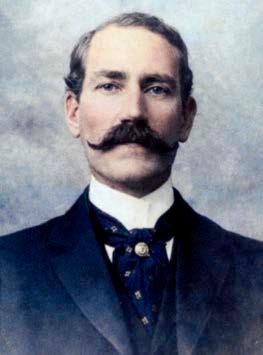
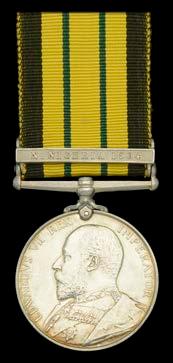
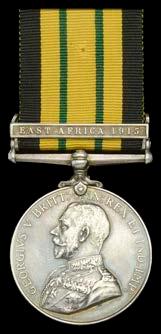
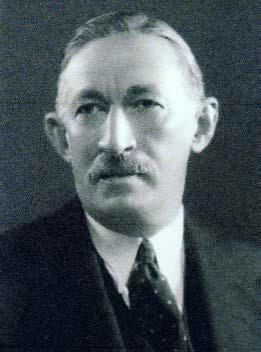
HEAD OF MEDAL DEPARTMENT (BOARD DIRECTOR) NIMROD@NOONANS.CO.UK
T. 020 7016 1820
OLIVER PEPYS
MEDAL SPECIALIST (ASSOC. DIRECTOR) OLIVER@NOONANS.CO.UK
T. 020 7016 1811
MARK QUAYLE
MEDAL SPECIALIST (ASSOC. DIRECTOR)
MARK@NOONANS.CO.UK
T. 0 20 7016 1810
ORDERS, DECORATIONS, MEDALS AND MILITARIA
WEDNESDAY 15 JULY 2026 AT 10AM
FORTHCOMING AUCTIONS
WEDNESDAY 9 SEPTEMBER 2026 ORDERS, DECORATIONS, MEDALS AND MILITARIA
WEDNESDAY 7 OCTOBER 2026 ORDERS, DECORATIONS, MEDALS AND MILITARIA
WEDNESDAY 4 NOVEMBER 2026
ORDERS, DECORATIONS, MEDALS AND MILITARIA
SUMMARY OF INFORMATION FOR BUYERS
REGISTERING TO BID
New clients must register online to bid (whether in person or in absentia). This can be done via our website www.noonans.co.uk
Registrations will be subject to due diligence and Noonans reserves the right to cancel registrations.
Once registered, any client bidding for the first time online will need to enter their card details so that a security check can be performed to authorise you to bid (www.noonans.co.uk >Your Account > Account Authorisation). This check is secure, your card details are not seen by us and no funds will be deducted.
BIDDING PRIORITY
Please note that we prioritise executing commission bids as early as possible in order to secure the lot for you at the cheapest possible price. It is therefore entirely possible that a lot can sell at your top bid to another bidder. To avoid this happening we offer an optional ‘Plus 1’ bidding increment facility, whereby if the bidding is against you at your maximum bid the auctioneer will execute one further bid on your behalf. Please note that in the event of identical top bids priority is given to the first bid received.
PLACING BIDS
LIVE BIDDING VIA WWW.NOONANS.CO.UK
You may bid in real time from your computer or mobile device. We provide an optional live video and audio feed of the auctioneer, allowing you to participate in much the same way as attending the auction. You may see your invoice and pay online directly after you’ve finished bidding. There is no additional charge for this facility.
ADVANCE BIDDING VIA WWW.NOONANS.CO.UK
We strongly advise this method if you wish to leave bids in advance as it is the easiest, most accurate and flexible way to leave your bids and gives you total control over them right up to the point that the lot is offered for sale. Bids made online cannot be seen by others and only become live at the point the lot is being sold. Up until this time your bids can be easily altered or cancelled. An automated email is sent to confirm any changes made. There is no additional charge for online bidding.
ADVANCE BIDDING VIA POST, EMAIL OR TELEPHONE
Whilst we are still happy to execute all bids submitted to us using post, email or telephone, it should be noted that all bids left with us in these ways will be entered at our offices using exactly the same bidding facility to which all our clients have access. There is, therefore, no better way of ensuring the accuracy of your advance bids than to place them yourself online.
If you are registered with Noonans you may bid by email to bids@noonans.co.uk or by telephone to 020 7016 1700. All bids placed by email or telephone must be received before 4 PM on the day preceding the sale.
A bidding form is included in the back of this catalogue. If you wish to use this please fill it in carefully, to include all relevant information. Please ensure that you post this form so that it arrives, at the latest, the day before the sale.
BIDDING IN THE AUCTION ROOM
You are very welcome to attend the auction and bid in person if you are registered with Noonans.
Please note that the auction room is situated on the third floor of a Georgian building which doesn’t have a lift. You may pay for and collect your lots during the auction.
SALEROOM NOTICES
Should the description of a lot need to be amended after the publication of this catalogue, the amendments will appear automatically on the Noonans website, www.noonans.co.uk. All such amendments are also incorporated in the List of Saleroom Notices pertaining to this auction which are posted separately on the website. The auctioneer will refer to any notices at the time any affected lot is offered for sale.
CATALOGUE ILLUSTRATIONS & THE INTERNET
Prospective bidders are reminded that the Noonans website features high-resolution colour illustrations of every lot in this auction. There may also be additional illustrations of any lot.
BUYERS’ PREMIUM
The rate for this sale is 24% of the Hammer Price (+ VAT where applicable).
Lots marked ‘X’ are subject to importation VAT of 5% on the Hammer Price unless re-exported outside the UK, as per Noonans Ts & Cs.
From 1 January 2021 importation VAT may be levied by EU countries on lots sold by Noonans and subsequently imported into those countries. Although Noonans is unable to advise buyers on customs regulations in their country of domicile, there is further information regarding EU
importation VAT rates for collectable items in the Terms and Conditions published on the Noonans website.
PRICES REALISED
The hammer prices of lots sold at Noonans auctions are posted at www.noonans.co.uk in real time and telephone enquiries are welcome from 9 AM on the day after the auction.
PAYMENT
You may access your invoice shortly after the hammer has fallen on your last lot. As we weigh lots at the time of cataloguing most shipping is already calculated, enabling you to settle your account and receive your lots in a timely fashion. Auction attendees may pay and collect during the course of the auction as soon as they have bid on their last lot.
Full Terms and Conditions of Business are available to read in the back of this catalogue and on our website.
CONTACTS
GENERAL SUPPORT ENQUIRIES
auctions@noonans.co.uk 020 7016 1700 or from overseas (+44) 20 7016 1700
WEBSITE AND LIVE BIDDING SUPPORT ENQUIRIES
Ian Anderson
ian@noonans.co.uk
020 7016 1700 or from overseas (+44) 20 7016 1700
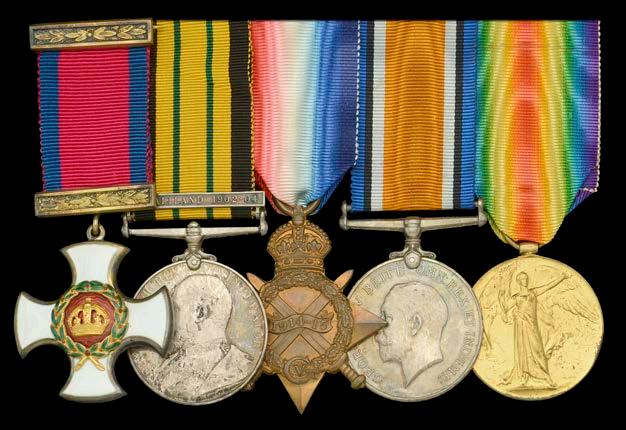
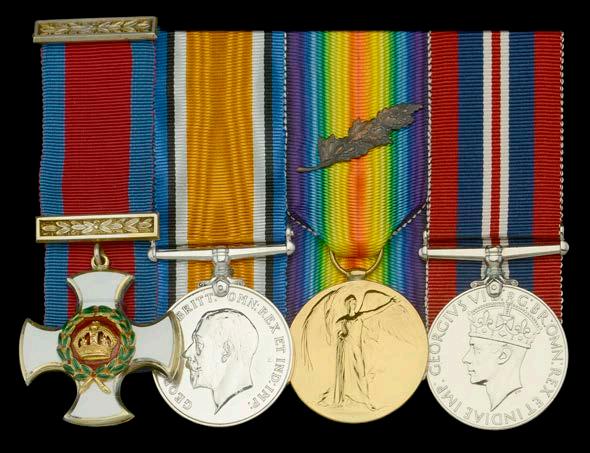
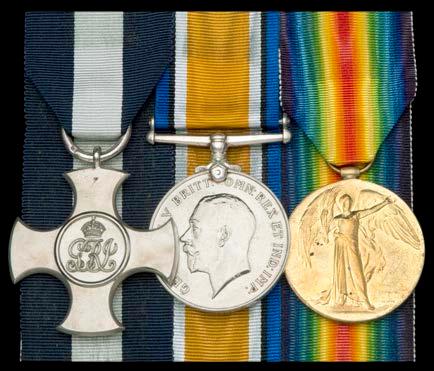
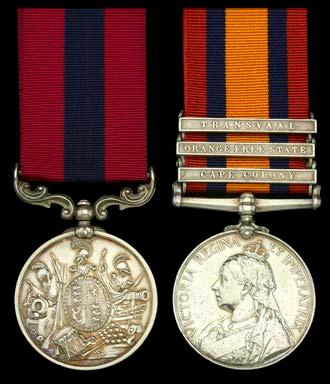
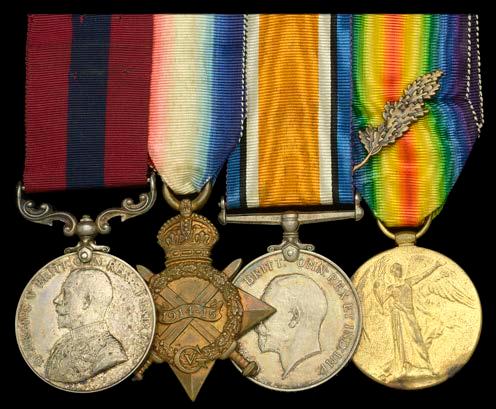
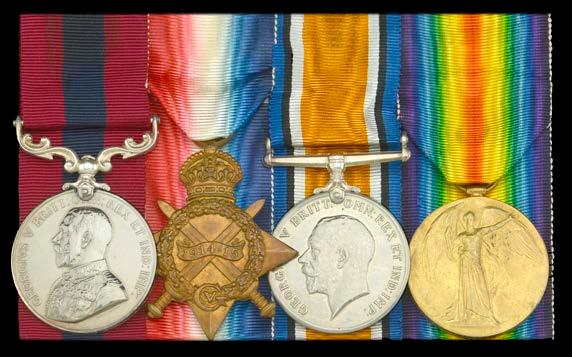
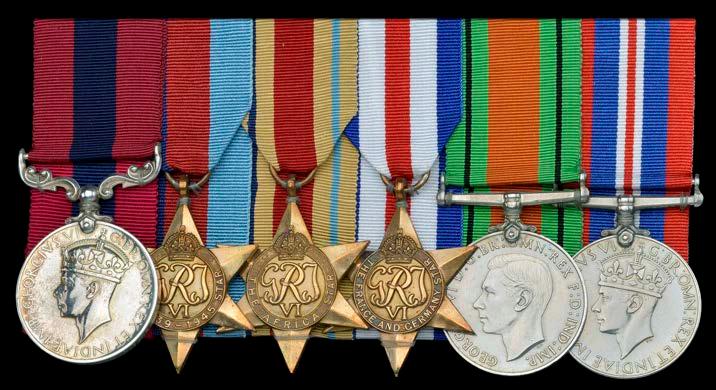
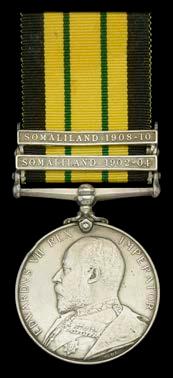
Distinguished Service Order, G.V.R., silver-gilt and enamels, with integral top riband bar, in its Garrard & Co case of issue; Africa General Service 1902-56, 1 clasp, Somaliland 1902-04 (Eng. Sub. Lt. P. L. Butt, H.M.S. Hyacinth.); 1914-15 Star (Eng. Lt. Cr. P. L. Butt. R.N.); British War and Victory Medals (Eng. Lt. Cr. P. L. Butt. R.N.) extremely fne (5) £1,000-£1,400
D.S.O. London Gazette 24 May 1919:
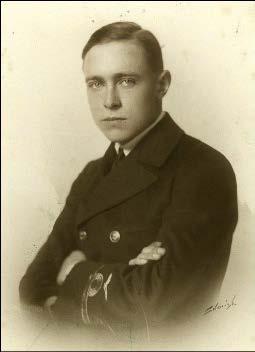
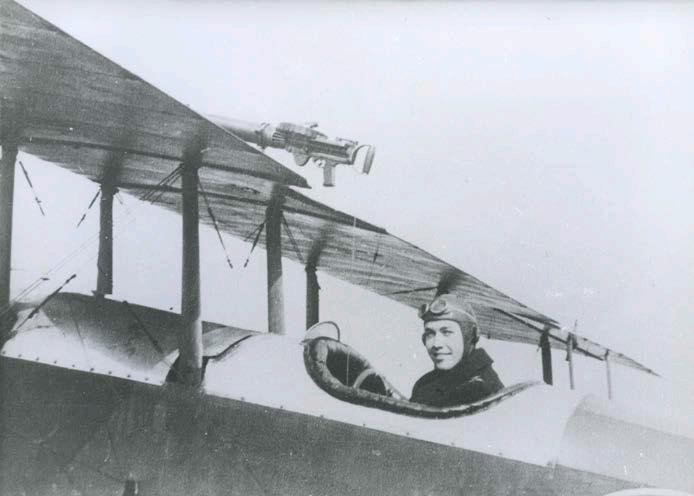
‘B Buut ttt, , PPe errc cyy LLo ovve ell , Engineer Lieutenant-Commander (now Engineer-Commander), Royal Navy. For gallant conduct in action on board H.M.S. Partridge on the 12th December 1917. H.M.S. Partridge, while screening a Scandinavian convoy, was attacked by a superior enemy force and put out of action. Engineer Lieutenant-Commander Butt, in order to make sure that the ship would sink and not fall into the enemy’s hands, went three times into the engine room, which was full of steam, and remained there until there was no doubt that the vessel would sink.’
A lengthy account of the attack on the Scandinavian Convoy, 11-12 December 1917, is given in Naval Operations, Vol. 5, by Henry Newbolt from which the following extract is taken:
‘Lieutenant-Commander J. R. C. Cavendish of the Pellew hoped that he would be able to gain time for the convoy by engaging the enemy closely and hotly; but the Germans were in sufficient strength to thwart his manœuvre. Three of their destroyers steered a parallel course to that of the Pellew and Partridge, and engaged them fercely; the fourth was detached to deal with the convoy.
The British destroyers were no match for their opponents, and they were, moreover, in the leeward position. The north-west wind swept a blinding storm of spray into the faces of their gunners, and when the Partridge and Pellew were in the trough of the waves, nothing was to be seen of the enemy except their masts, and the tops of their funnels.
The Germans made admirable use of their advantage; and, as usual, their fre was extremely accurate and rapid. Although the terrible precision of the enemy's shooting meant death to most of those who saw it, the officers and men in the British destroyers watched the fall of the German salvoes with a sort of bitter admiration. From the very beginning matters went badly with the British destroyers, and both began to suffer. The Partridge, indeed, was a doomed ship.
After a few moments of fring, a shell struck her at the forward end of the engine-room, and severed the main steam-pipe. In an instant the engine-room was flled with scalding steam, and the ship came to a standstill. Everybody working at the engines was scalded to death, and, though Engineer-Commander P. L. Butt and a chief engine-room artifcer attempted repeatedly to enter the engine-room and give assistance, they were always driven out by the boiling steam.
A few minutes later another shell struck the after gun, and put it out of action; almost simultaneously a torpedo struck the ship forward, and she began to settle down. The Partridge had now as little power of manœuvre or resistance as an ordinary practice target, and LieutenantCommander R. H. Ransome, the commanding officer, gave orders that the ship was to be abandoned; at the same time he directed the engineroom staff to do everything in their power to see to it that the ship sank rapidly.
For his gallantry Engineer-Commander Butt was awarded the D.S.O. He tried, three times, to get into the engine-room after the main steam-pipe had been severed. He fnally succeeded when the ship was sinking: it was still full of steam, and pitch dark, as the dynamos had long since ceased to work; but he groped his way through the steam and darkness, and rising water, and opened the door of the starboard condenser, in order to make the ship sink more rapidly.’
For the recipient’s related miniature awards, see the following lot, Lot 2.
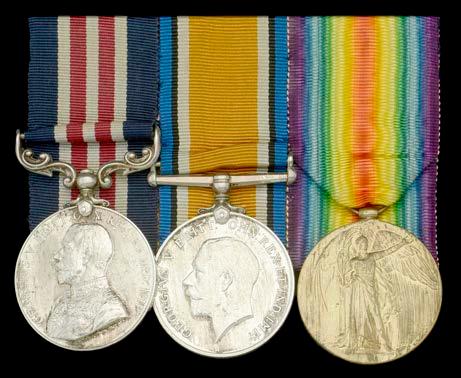
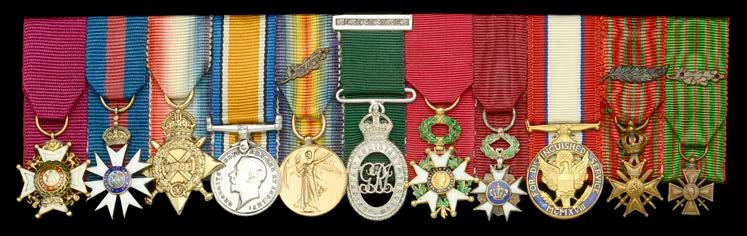
Distinguished Service Order, G.V.R., silver-gilt and enamel, with integral top riband bar; Africa General Service 1902-56, 1 clasp, Somaliland 1901; 1914-15 Star; British War and Victory Medals, mounted as worn, good very fne (5) £80-£100
For the recipient’s full-sized awards, see the previous lot, Lot 1.
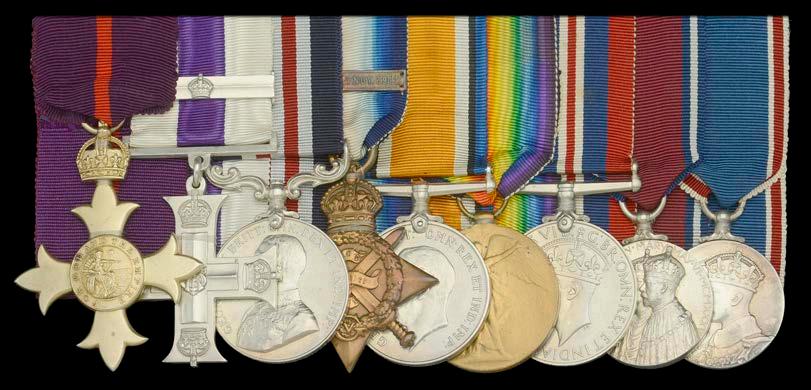
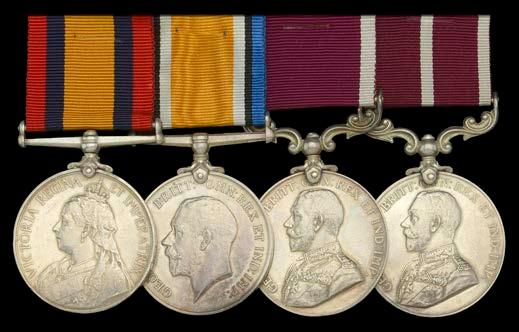
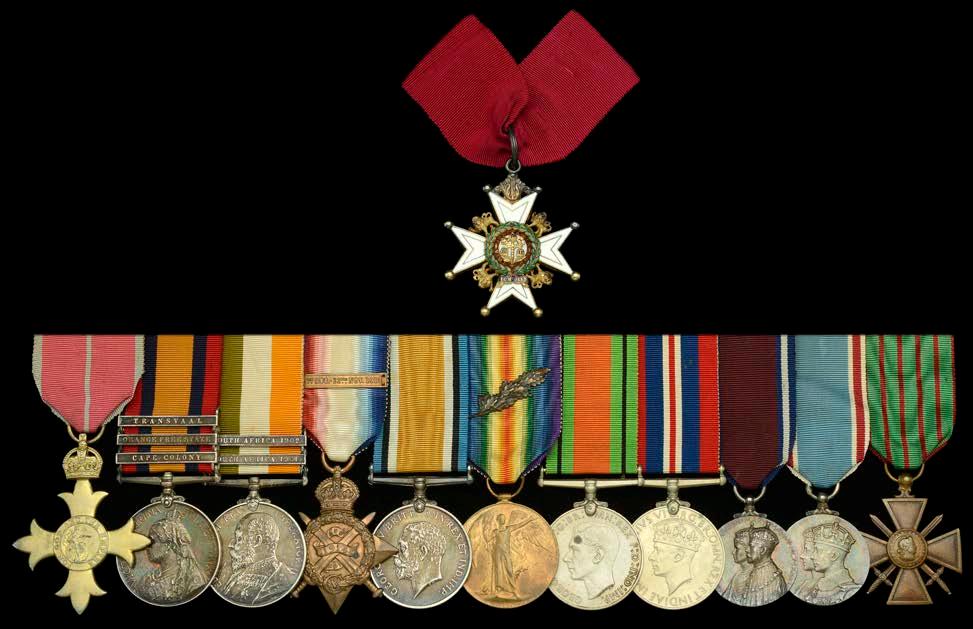
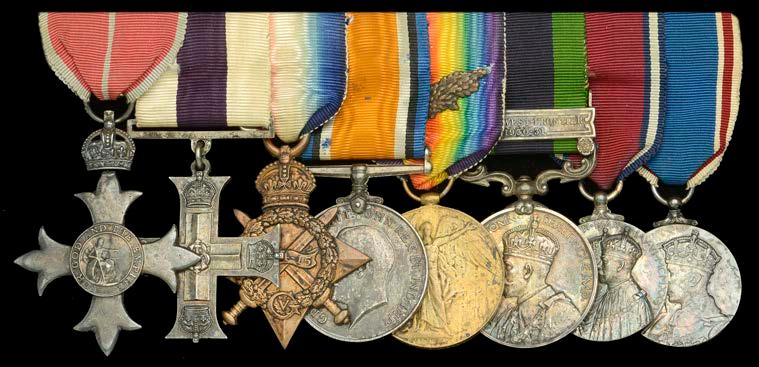
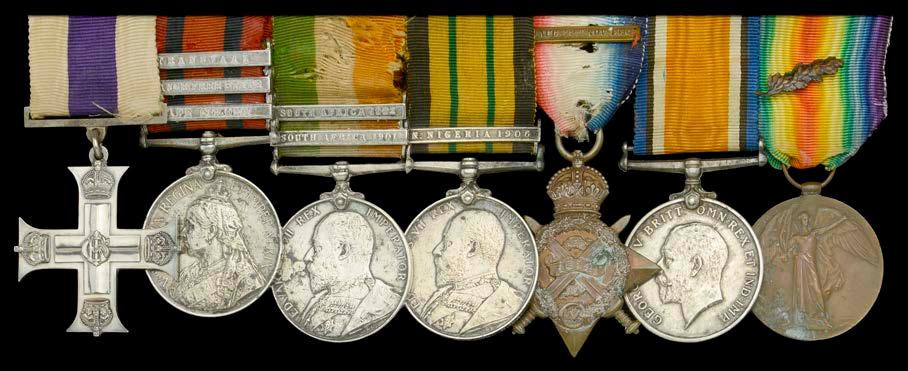
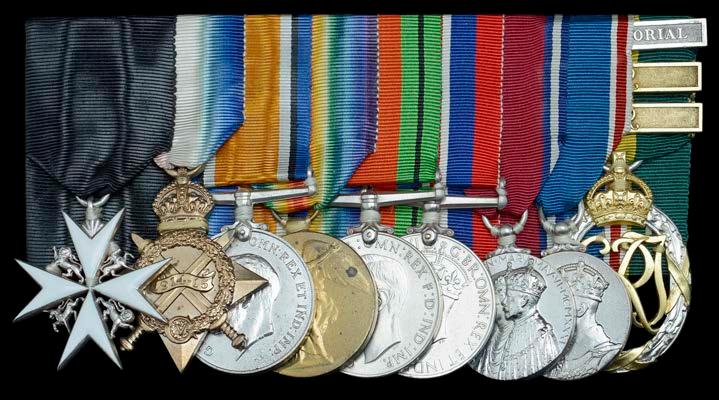
The Order of the British Empire, O.B.E. (Military) 1st type, the reverse with ‘Jubilee’ hallmark for 1935; Military Cross, G.V.R., with Second Award Bar; Military Medal, G.V.R. (13121 Cpl. W. M. Harrington, 13/K.R.R.C.); 1914 Star, with clasp (33279 L.Cpl. W. M. Harrington. A.S.C.); British War and Victory Medals (Capt. W. M. Harrington.); War Medal 1939-45; Jubilee 1935; Coronation 1937, mounted court-style for display, some polishing to the earlier medals, otherwise nearly very fne or better (9) £3,000-£4,000
Provenance: Dix Noonan Webb, June 1998.
O.B.E. London Gazette 1 January 1936: ‘Captain William Maurice Harrington, M.C., M.M., Regular Army Reserve of Officers, Staff Quartermaster, Gold Coast Regiment, Royal West African Frontier Force.’
M.C. London Gazette 1 February 1919: ‘2nd Lt., M.M., K.R.R.C., attd. 18th Bn. For conspicuous gallantry and devotion to duty from 30th September to 3rd October 1918, south-east of Ypres. He was slightly wounded in the attack on the frst day, but continued with his task under heavy machine-gun and rife fre, afterwards assisting to bring in a badly wounded officer from a position in front of the line, although fred on by snipers. He remained at duty the whole period.’
M.C. Second Award Bar London Gazette 21 January 1920: ‘Immediate awards for conspicuous gallantry and devotion to duty in North Russia conferred by Maj.-Gen. C. C. M. Maynard, K.C.B., C.M.G., D.S.O., in pursuance of the powers vested in him by His Majesty:- ‘Lt. William Maurice Harrington, M.C., M.M., K.R.R.C.
For coolness and gallantry on patrol on the night of 4/5th July, 1919, north of Kapaselga. He led a patrol of 6 other ranks to within three hundred yards of the enemy main position, and under heavy fre maintained his position until he had noted the position of the enemy trenches. This information was of great importance to the artillery barrage next day.’
M.M. London Gazette 9 July 1917.
W Wiil llli
served in France and Flanders as a Private, Army Service Corps, attached 3rd Cavalry Division, from 6 October 1914. He subsequently transferred to the King’s Royal Rife Corps, winning the M.M. with the 13th Battalion before being commissioned into the 18th Battalion, K.R.R.C. He died on 23 January, 1940, at which time he is shown as serving as a Captain with the Cameronians. Sold with the original Edward VIII warrant for the O.B.E., dated 5th February 1936.
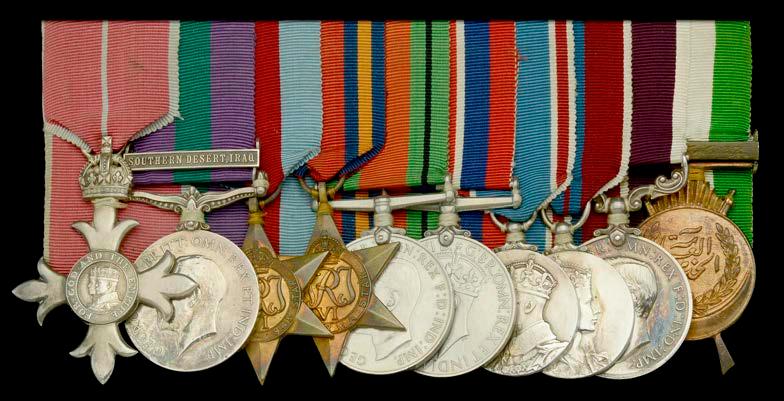
The Most Excellent Order of the British Empire, M.B.E., (Military) Member’s 2nd type, breast badge, silver; General Service 1918 -62, 1 clasp, Southern Desert, Iraq (352436. Cpl. A/Sgt. W. G. Hughes. R.A.F.); 1939-45 Star; Burma Star; Defence and War Medals 1939-45, Second War campaign awards named ‘Boots style’, ‘S-Ldr W. G. Hughes’; Coronation 1937, unnamed as issued; Coronation 1953, unnamed as issued; Royal Air Force L.S. & G.C., G.VI.R., 1st issue (Fg. Off W. G. Hughes. R.A.F.); Iraq, Active Service Medal, 1 clasp, Southern Kurdistan 1931, mounted as worn, generally very fne or better (10) £1,000-£1,400
M.B.E. London Gazette 1 January 1954.
W Wiil lffr reed d G Gooo oddi ieer r H Huug ghhe ess was born in Stockton Heath, Warrington, Cheshire in September 1902. He enlisted in the Royal Air Force in November 1922, and mustered as Aircrafthand and u/t Driver. Hughes served with No. 4 Armoured Car Company, R.A.F. in Iraq from November 1924. He remustered as Armoured Car Crew in June 1925, advanced to Corporal in December 1925, and to Acting Sergeant in January 1927. Hughes advanced to Warrant Officer, and was commissioned Flying Officer (on probation), Administrative and Special Duties Branch in March 1940. He advanced to Flight Lieutenant in November 1942, and served in the Engineer Branch advancing to Squadron Leader. Hughes served with No. 40 Group Maintenance Command prior to his retirement in July 1955.
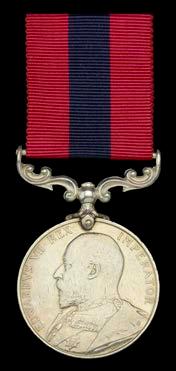
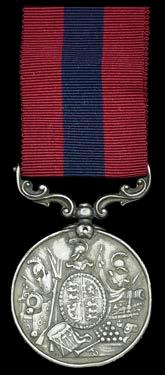
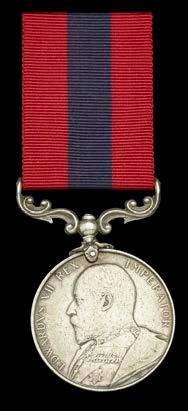
Distinguished Conduct Medal, E.VII.R. (3566 Corpl: J. Milne. Cameron Highrs:) contact marks, otherwise very fne £800-£1,000
D.C.M. London Gazette 27 September 1901; Army Order 15 of 1902.
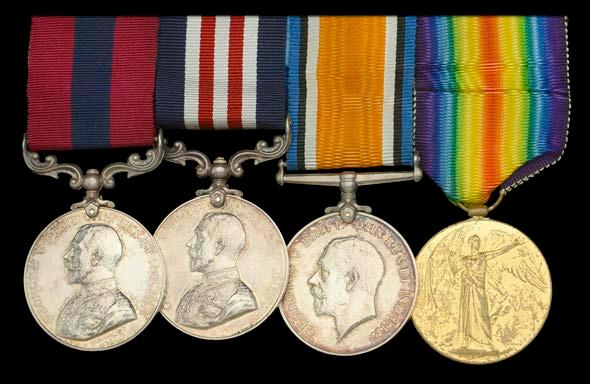
Distinguished Conduct Medal, G.V.R. (376870 Pte. S. Barnes. 2/10 Manch: R.-T.F.); Military Medal, G.V.R. (376870 Pte. S. Barnes. 2/10 Manch: R.-T.F.); British War and Victory Medals (4840 Pte. S. Barnes. Manch. R.) nearly
(4) £1,200-£1,600
D.C.M. London Gazette 1 January 1918; citation published 17 April 1918: ‘376870 Pte. S. Barnes, Manch. R. (Oldham).
For conspicuous gallantry and devotion to duty as a stretcher bearer. On one occasion he was for several hours under continuous
and machine-gun fre, searching for two men who had been lost on a patrol.’
M.M. London Gazette 14 January 1918.
SSa a m muue ell BBa arrn nees s was from Oldham, Lancashire, and enlisted into the 2/10th Battalion, Manchester Regiment on 11 December 1916, and was discharged on 31 July 1919.
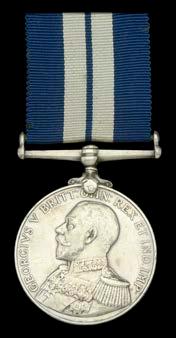
Distinguished Service Medal, G.V.R. (SD.2151. F. Walker, Ldg. Dk. Hnd. R.N.R. Atlantic Ocean. 21 Apl. 1918.) very fne £600-£800
D.S.M. London Gazette 7 June 1918.
The recommendation states: ‘H.M.T. Anthony Aslett Action with enemy submarine 21 April 1918. Gunlayer. Did especially good and cool work. Fire was opened up at submarine at a range of 8,000 yards but shells were dropping considerably short of the enemy. In order to entice the enemy closer we fred fve 6pdr rounds at intervals considerably short of him. This ruse apparently succeeded, for he drew closer, shelling us rapidly with both guns, the greater number of shells being gas shells. The submarine by this time had approached to within 7,000 yards and I ordered the range to be increased to 7,000 yards frst shell falling in line but short but with the third round I believe submarine was damaged. In total 58 rounds fred but the enemy fred at least three times the amount. The Gunlayer Frank Walker, Leading Deck Hand R.N.R.(T) throughout the action was extremely cool and collected and his conduct undoubtedly had an infuence upon the gun’s crew (ADM137/1494/120 refers).
Military Medal, G.V.R. (98930 2/Cl: A.M. J. G. Glass. No: 44 Bal: Sec: R.A.F.); British War and Victory Medals (98930. 2. A.M. J. G. Glass. R.A.F.) mounted for wear, cleaned, very fne (3)
£700-£900
M.M. London Gazette 12 June 1918:
‘For gallantry when his Kite Balloon Section was under heavy attack.’
Approximately 92 M.M.s awarded to the R.A.F. for the Great War.
JJa a m mees s G G G Glla asss s was the son of Philip Glass, and was born in India where his father was employed by Whiteaway, Laidlaw & Co., Calcutta. He initially served during the Great War with the Middlesex Regiment in the French theatre of war, 25 May 1915 - 5 July 1916 (received a gun shot wound to the head and arm, 3 July 1916), and 13 March 1917 - 13 August 1917 (entitled to 1914-15 Star). Glass transferred to the Royal Flying Corps as Air Mechanic 2nd Class., 14 August 1917. He served as a Telephonist with 44 Kite Balloon Section (under the command of Captain P. S. Kershaw) as part of the 19th Balloon Company, 3rd Balloon Wing on the Western Front.
Sold with copied research.
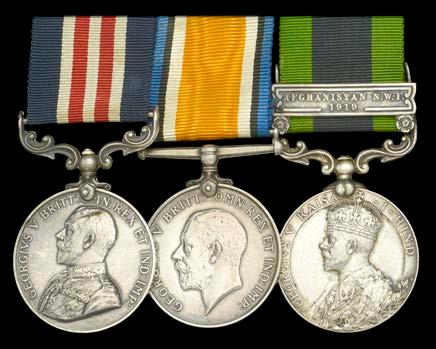
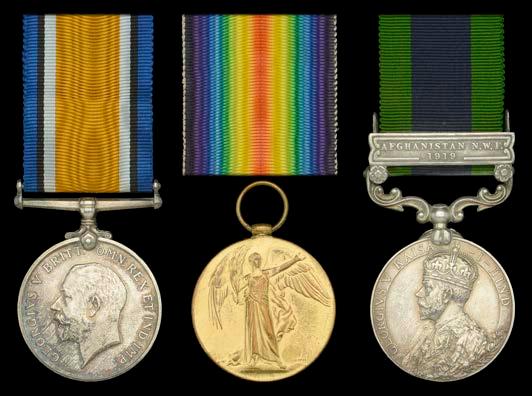
Military Medal, G.V.R. (163533 B.S. Sjt. T. E. Vickers. 11/Arm: M. By: M.G.C.); British War Medal 1914-20 (305993 Sjt. T. E. Vickers. Hamps. R.); India General Service 1908-35, 1 clasp, Afghanistan N.W.F. 1919 (163533 S-Sgt. T. E. Vickers, M.G.C.) mounted as worn, good very fne (3) £1,000-£1,400
42 M.M.’s awarded for Afghanistan 1919, nine of which have citations published in the London Gazette M.M. London Gazette 26 May 1920: ‘His Majesty the King has been graciously pleased to approve of the award of the Military Medal to the undermentioned Non-commissioned Officer and Man for bravery in the Field with the Baluchistan Field force, North West Frontier, India:Machine Gun Corps
163533 By./S./Sjt. Vickers, T. E., 11th Arm. Motor By.. (Fordingbridge). For great coolness under fre at Hindubagh on the 28th July, 1919. He kept the two guns in his
working
and inficted heavy casualties on the enemy.’
Sold with copied London Gazette notice and Medal Index Card which confrms single B.W.M. and I.G.S.
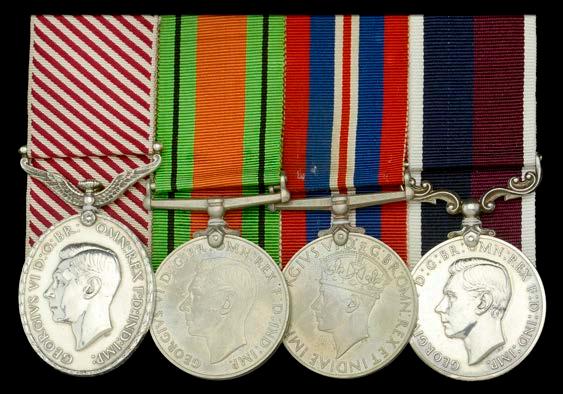
Air Force Medal, G.VI.R. (561993. Sgt. W. B. Burden. R.A.F.); Defence and War Medals 1939-45; Royal Air Force L.S. & G.C., G.VI. R., 1st issue (W/O. W. B. Burden. (561993). R.A.F.) mounted for display, very fne (4)
£1,000-£1,400
A.F.M. London Gazette 17 March 1941. The original recommendation states:
‘No. 12 Operational Training Unit, No. 6 Group. This pilot has instructed 176 pupils and has fown 580 hours since the outbreak of war. When reinforcements were urgently needed, he has pushed on with the training in extremely bad weather, and has never considered his personal safety.’ W Waal
was a Halton Apprentice (17th Entry). He served with No. 12 O.T.U. (Bomber Command) at R.A.F. Benson from 1940.
Thhe e G C C
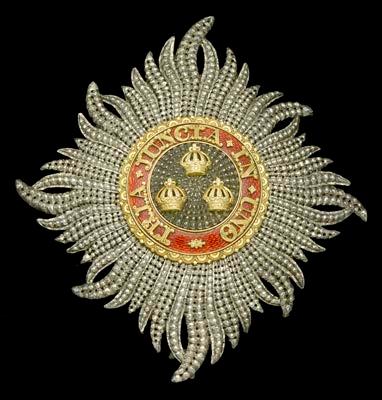
The Most Honourable Order of the Bath, G.C.B. (Civil) Knight Grand Cross, breast star, 95mm x 90mm, silver with appliqué centre in gold and enamel, the reverse unmarked and ftted with silver-gilt pin for wearing, extremely fne £1,200-£1,600
Provenance: Woolley & Wallis, March 1977.
JJo ohhn n A Arrt thhu urr D Doou uggl laas s BBl looo o m mffeel ldd , 2 Baron, eldest child of Benjamin Bloomfeld, 1 Baron Bloomfeld (1768-1846) was born on 12 November 1802; attaché at Vienna 16 February 1818; envoy extraordinary and minister plenipotentiary at St. Petersburgh 3 April 1844, at Berlin 28 April 1851, at Vienna 22 November 1860 to 28 Oct. 1871, when he retired on a pension; succeeded 15 August 1846; C.B. 27 April 1848, K.C.B. 1 March 1851, G.C.B. 3 September 1858, P.C. 17 December 1860; created Baron Bloomfeld of Ciamhaltha in the United Kingdom 7 August 1871. Died at Ciamhaltha, Newport, Tipperary on 17 August 1879.
Sold with Woolley & Wallis letter dated 12 April 1977, attributing this star as having been sold by ‘an immediate descendant of John Arthur Douglas Bloomfed, 2nd baron Bloomfeld. The same gentleman also sold the G.C.H. (Civil) bestowed upon the 1st baron Bloomfeld.’
The Most Distinguished Order of St. Michael and St. George, C.M.G., Companion’s neck badge, silver-gilt and enamels, complete with neck cravat in its Garrard & Co Ltd case of issue, two minor chips to blue enamel legend on reverse centre, otherwise nearly extremely fne £300-£400
T
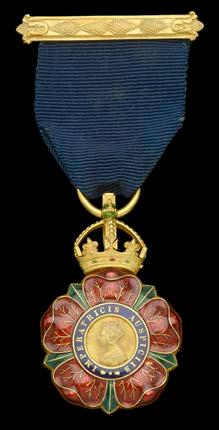
The Most Eminent Order of the Indian Empire, C.I.E., Companion’s 2nd type breast badge, gold and enamels, complete with gold suspension brooch bar, very minor dent to reverse, otherwise extremely fne £1,000-£1,400
H Heen nrry y KKi inng g BBe eaau ucch haam mpp (1866-1907), editor Madras Mail from 1890; Sheriff of Madras 1902-03, awarded C.I.E. 1903; author of Hindu Manners, Customs, and Ceremonies (edition and annotation of the Dubois French MS., 1897; Died 19 February 1907. For the recipient’s related miniature C.I.E., see the following lot, Lot 14.
The Most Eminent Order of the Indian Empire, C.I.E., Companion’s 2nd type breast badge, gold and enamels, complete with gold suspension brooch bar, extremely fne £120-£160
For the recipient’s full-sized C.I.E., see the previous lot, Lot 13.
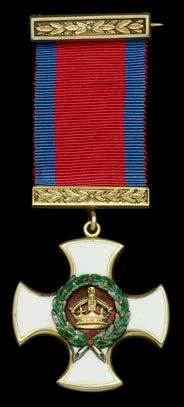
Distinguished Service Order, V.R., silver-gilt and enamels, with integral top riband bar, in later Garrard & Co Ltd case of issue, light chips to both wreaths, otherwise good very fne £1,000-£1,400
Provenance: Baldwin’s Auctions, September 2009.
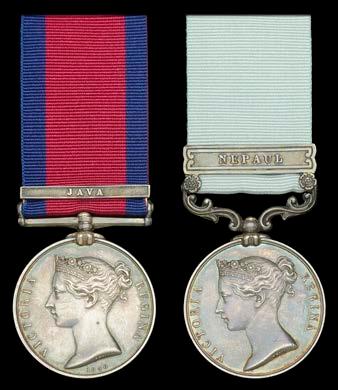
Military General Service 1793-1814, 1 clasp, Java (Thos. Frobisher, Lieut. 5th Batn. Bengal Volrs.); Army of India 1799-1826, 1 clasp, Nepaul (Lieut. T. Frobisher, Eurn. Regt.) short hyphen reverse, officially impressed naming, lightly polished, otherwise toned, good very fne and rare (2) £4,000-£5,000
TTh hoom maas s FFr roob biis shhe err was born in York on 5 February 1789, 3rd son of Nathanial Frobisher, bookseller, of Halifax, Yorkshire. Nominated a Cadet on the Bengal Establishment in 1804, he was present at the capture of the Cape of Good Hope in January 1806, under Sir David Baird. Appointed Ensign on 23 April 1806, he arrived in India on 13 May 1806, and was posted to the 26th Bengal Native Infantry. Promoted to Lieutenant, 14 March 1808, he was present with the 5th Battalion, Bengal Volunteers, at the capture of Java in 1811, and served there until 1814, when he departed for Nepaul as Lieutenant with the 8th Company of Pioneers, in the 3rd or Benares Division under Wood. He also took part in the Third Mahratta War and action with Pindaries on 14 December 1817, as Lieutenant 1/26th N.I.. He was 2nd in command 3rd Rohilla Cavalry, 1818-19, in 2/26th N.I. but served as Adjutant Ramgarh Battalion, 1820, and with the Nagpur Auxiliary Horse, 1821-30. Promoted to Captain in July 1823, he transferred to 51st N.I. (late 1/26th) in May 1824 and went on furlough from January 1831, until his retirement on 6 May 1833. Made Hon. Major, 28 November 1854, he was a J.P. and D.L. for Gloucestershire and died in Cheltenham on 8 January 1863.
Sold with comprehensive research conducted by Tim Ash at the India Office Library.
For the recipient’s related miniature awards, see the following lot, Lot 17.
118 8114 4 --1 1
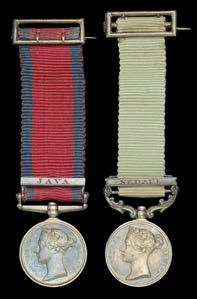
Military General Service 1793-1814, 1 engraved clasp, Java; Army of India 1799-1826, 1 engraved clasp, Nepaul, each mounted from two-prong silver brooch buckle with gold pin for wearing, nearly
(2) £400-£500
For the recipient’s full-sized awards, see the previous lot, Lot 16.
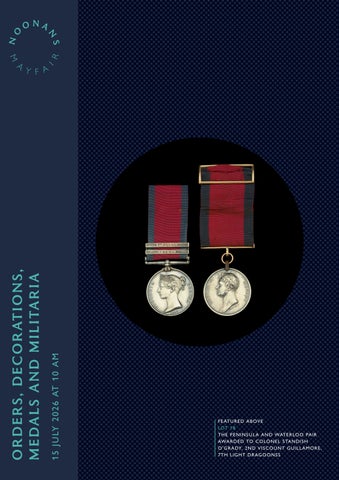
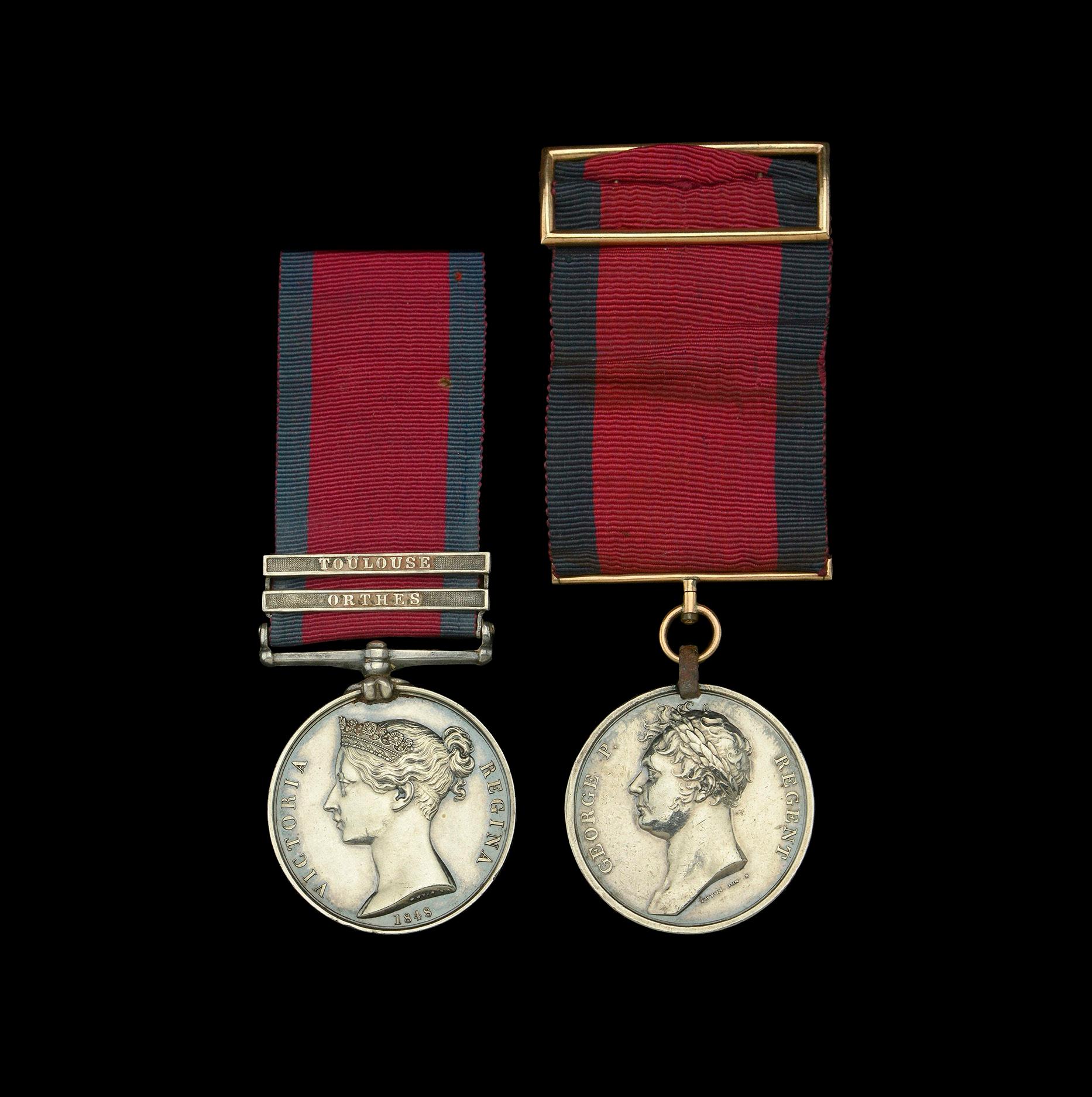
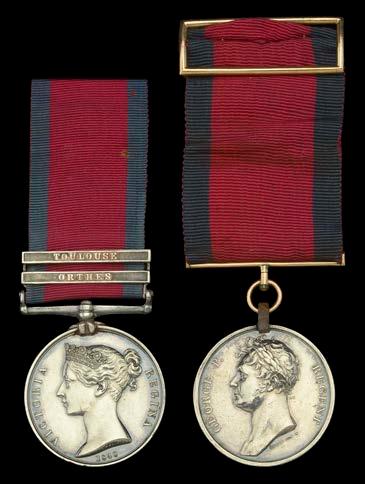
Military General Service 1793-1814, 2 clasps, Orthes, Toulouse (Viscount Guillamore, Lieut. 7th Lt. Dgns.); Waterloo 1815 (Lieut. S. O. Grady, 7th Regiment Hussars.) original steel clip and contemporary gold swivel-ring bar suspension, and with three pronged gold ribbon buckle, contained in a contemporary ftted leather case, the second with light contact marks, otherwise good very fne, the frst extremely fne (2) £5,000-£7,000
SSt taan nddi issh h O O’’G Grra addy y,, 22n ndd VVi issc coou unnt t G Guui illl laam moor ree , was born at Cahir Guillamore, County Limerick, on 26 December 1792, eldest son of Standish O’Grady, 1st Viscount Guillamore (1766-1840). He was educated at Westminster School and at Trinity College, Dublin, where he matriculated on 4 July 1809. He did not take a degree but entered the army as a Cornet in the 7th Hussars on 21 March 1811, becoming Lieutenant on 6 August 1812. He served with the regiment in the Peninsula from August 1813 until the end of the war and was present at the actions of Orthes and Toulouse.
On 17 June 1815, he had command of the troop of the 7th Hussars on the high road from Genappe to Quatre Bras and was involved in the action at Genappe. The regiment was covering the British march from Quatre Bras to Waterloo. Sir William Dörnberg left O'Grady outside the town on the Quatre Bras road to hold in check the advancing French cavalry while the main body of the regiment proceeded in fle across the narrow bridge of Genappe and up the steep street of the town. O'Grady advanced at the head of his troops as soon as the French appeared, and presented so bold a front that, after a time, they retired. When they were out of sight, he crossed the bridge at the entrance of Genappe. He took his troop at a gallop through the town, rejoining Sir William Dörnberg, who had drawn up the main body of the regiment on the sloping road at the Waterloo end of Genappe. A severe cavalry combat ensued when the French lancers reached the top of the town, in which O'Grady's regiment made a gallant charge, with considerable loss.
At Waterloo on 18 June he was stationed on the ground above Hougoumont on the British left. ‘The 7th’ he says in a letter to his father ‘had the opportunity of showing what they could do if they got fair play. We charged 12 or 14 times and once cut off a squadron of cuirassiers, every man of whom we killed on the spot except 2 officers and one Marshal de Logis, whom I sent to the rear.’ Two letters of his to Captain William Siborne, describing the movements of his regiment on 17 and 18 June 1815, were published in Waterloo Letters, edited by Major-General H. T. Siborne (London 1891). The following extract is taken from the second of these and concerns the affair at Genappe:
‘Early in the morning of the 17th the Army was drawn up to show a front, and soon afterwards the Infantry began to move to the rear. When they moved off, leaving the Cavalry, Sir C. Grant called the Field Officers together, and spoke to them for some time. When Major Hodge (who was in command of the right Squadron, to which I belonged) returned, he called me aside, and told me that the Prussians had been beaten and obliged to fall back, and that we must make a similar movement to prevent the two Armies from being disunited; that our Brigade was to retire by Regiments from the left, and that the 7th had the post of honour, the main road to cover and protect; that Sir William Dörnberg was to take charge of the skirmishers of the Brigade, and that our Squadron was to skirmish. There was at this time no appearance on the part of the Enemy of an advance, and we were to hold our ground until driven from it.
We did so and (though I cannot pretend to accuracy in point of time) I think it was twelve before their advance put us in motion. We threw out the right Troop to skirmish, and Major Hodge went with them. I held the high road with the left Troop, and had from time to time to send them assistance, and frequently to advance to enable them to hold their ground, as their movements were difficult through ploughed felds so soft that the horses were sunk up to their knees always, and sometimes to their girths.
Whilst I was so employed Sir William Dörnberg joined me. Thus we continued to dispute every inch of the ground until we came within a short distance of the town of Genappe. Here Sir William Dörnberg told me that he must leave me; that it was of the utmost importance to face the Enemy boldly at this spot, as the bridge in the town of Genappe was so narrow we must pass it in fle; that I should endeavour if possible to obtain time for the skirmishers to come in, but that I was not to compromise my Troop too much. Sir William had been riding with me some hours, and when he bid me farewell he shook my hand, and I saw plainly he never expected to see me again.
I then called in the skirmishers and advanced at a trot up the road. The troops opposed to me went about, and as I followed them they did not stop as soon as I did. I continued advancing and retiring alternately, until I saw all my right Troop safe on the road in my rear, and then I began to retire at a walk, occasionally halting and fronting until I turned the corner of the town of Genappe. I then fled the men from the left and passed through the town at a gallop, no enemy in sight. When I arrived at the opposite entrance of the town I found the 7th drawn up on the road in a column of divisions, and having re-formed our Squadron we took our place between those already formed and the town.
A Fine Collection of Medals, the Property of a Lady, Part 1
Here I met Sir William Dörnberg, who appeared surprised to see me, and asked me how we had effected our retreat, and if we had saved any of the skirmishers, and when I told him we had not lost a man or a horse, he exclaimed, "Then Buonaparte is not with them; if he were, not a man of you could have escaped.”
Here we remained drawn up about twenty minutes before any of the Enemy appeared, and then only a few stragglers, some of whom rode into us and were found to be quite drunk. As well as I can guess, the Cavalry Column by which we were pursued, and which moved slowly, but shouting loudly along the high road, were about fourteen Squadrons. Occasionally I was able to count them, but not accurately. They might have been eighteen. And this Column now showed its head within the town. This head consisted of a Troop of Lancers, all very young men, mounted on very small horses, and commanded by a fne-looking and a very brave man. For about ffteen minutes they remained in the jaws of the town, their fanks being protected by the houses; and the street not being straight, and those in the rear not knowing that the front were halted, they soon became so jammed that they could not go about.
In this state of affairs Lord Anglesey gave us orders to charge them, which we immediately did. Of course, our charge could make no impression, but we continued cutting at them, and we did not give ground, nor did they move. Their Commanding Officer was cut down, and so was ours (Major Hodge), and this state of things lasted some minutes, when they brought down some Light Artillery, which struck the rear of the right (the charging) Squadron and knocked over some men and horses, impeding the road in our rear. We then received orders to go about from Lord Anglesey, who was up with us, but not on the road during all this time. The Lancers then advanced upon us, and in the mêlée which ensued they lost quite as many as we did, and when at last we were able to disengage ourselves they did not attempt to pursue us.
We retired through a Regiment of Light Cavalry, and the frst pass we found off the road we took, and formed in the feld by the road side. I then got the remnant of the right Squadron and moved them down towards the town of Genappe to look after any of our wounded, whom it might be in our power to save. When I saw the ground upon which we had charged it was strewed with men and horses, but I saw very few fghting men of the Enemy. In the meantime the Light Brigade having been removed from the road where they were when we passed through them, the Life Guards came down the road and charged into the town.
I could not, of course, see what they did, but I believe they fell upon the rear of a retiring Column, impeded by the narrowness of the bridge, and did their duty manfully.
The Enemy did not again attempt to molest us, and we reached our position without further interruption, except some picket affairs in taking up our respective Lines, in one of which Captain Heyliger of the 7th made a very brilliant charge with his Troop, and when the Duke of Wellington sent to stop him he also desired to know his name. I thought at the time, and I still think, that when we charged the Enemy at Genappe their entire Column was in the town, and that being the case it is clear that as soon as they found the head of their Column engaged, they commenced clearing their rear out of the town.
If this be the case it is obvious that the success or failure of the 7th in their charge was simply a matter of time. A little delay and they would not have had to charge, but to pursue. This as well as I recollect was Sir Wm. Dörnberg's opinion at the time when he objected to charging before their fanks were open to us. I feel, however, that I have no right to pursue this, and satisfy myself that I have given you, as well as I can now recollect them, all the facts as they came before me. A few minutes before we charged, one of the heaviest showers of rain I can remember fell, which, as it wet everybody and everything, rendered fre-arms useless, and though the French fred a few pistol shots, I don't think they did any damage; our engagement was therefore one of sabre and lance.’
Standish O’Grady’s military career continued in fts and starts. He was promoted to Captain on 20 July 1815, but was put into the reserves on half-pay the following year, probably because his father wanted him to enter politics. However, he failed in his frst attempt to get into parliament and went back on active service as a Captain in the 18th Dragoons in 1819. After his election to parliament in 1820, he was again placed in the reserves in 1821. In 1825, still in the reserves, he was promoted to Major. He was placed on active service with the 24th Foot from 1828 to 1829 when he was again placed in the reserves. Meanwhile, on 16 October 1828, he married the Hon. Gertrude Jane Paget, eldest daughter of the Hon. Berkeley Paget. He succeeded to the peerage as Viscount Guillamore on 21 April 1840, on the death of his father, the 1st Viscount. In 1842 he was promoted to Colonel and became A.D.C. to the Queen the same year, a position he held until his death. Viscount Guillamore died suddenly in Dublin on 22 July 1848.
Sold with the following related prize medals: SSt taan nddi i
a. Historical Society of the University of Dublin, a silver award medal, unsigned, standing robed female with lyre, rev.
EEs sqqr r for his Poem which he read to them on Wednesday the 3rd of March MDCC 84), 53mm, lacking clip and ring for suspension, very fne and rare
b. Historical Society of the University of Dublin, a silver award medal, unsigned, standing robed female with lyre, rev. named ((S Stta a
y EEs sqqr r for his Poem which he read to them on Wednesday the 6th of Feby. 1782), 53mm, with clip and ring for suspension, very fne and rare
c. Oxford & Cambridge Athletic Sports Prize Medal, silver medal, unsigned, college arms, rev. named ((H Hoon n FF SS O O’’G Grra addy y High Jump 1868) 60mm, very fne
Frederick Standish O’Grady married in 1881 Mary Theresa Burdett Coventry, daughter of Hon. William James Coventry, son of George Coventry, 7th Earl of Coventry.
G Geeo orrg gee G G C C
d. Oxford V. Cambridge Putney Medal, silver-gilt, edge named ((G G G G C Coov veen nttr ryy) ) 51mm, very fne
e. Oxford University Eight Oar Trial Race, Presented by the O.U.B.C., silver, edge named ((G G G G C Coov veen nttr ryy) ) 51mm, good very fne
Pair: LLi
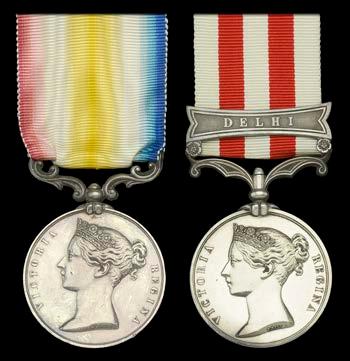
Cabul 1842 (Lt. A. Martin. 33rd B.N.I. Adjt.) naming impressed in small capitals, ftted with scroll suspension; Indian Mutiny 1857 -59, 1 clasp, Delhi (Majr. A. Martin, 4th Irregr. Cavy.) extremely fne
£800-£1,000
A Annt thho onny y PPe ette err M Maar rtti inn was born in Lisbon, Portugal, in February 1811, and was appointed a Cadet for the H.E.I.C. Bengal Presidency in 1829, arriving in India in May 1830 and doing duty with the 33rd Bengal N.I. from June 1830; Ensigb 23 April 1830; Lieutenant 14 November 1837; Captain 11 May 1846; Major 21 July 1857; Retired as Hon. Lieutenant-Colonel 31 December 1861. Martin served in the Cole campaign in 1832; Affghanistan campaign of 1842, present with the regiment in every engagement from the Khyber Pass to Cabul (Medal); Sutlej campaign 1845-46, including the battle of Sobraon (Medal); and with the 4th Irregular Cavalry at the surrender of Kote Kangra in April 1846; Second in Command of 4th Irregular Cavalry from February 1846 till November 1850; Commandant of same 23 November 1850, and was commanding when part of that regiment mutinied in May 1857; Mutiny campaign, present at the siege and capture of Delhi (Medal with Clasp). Martin went on furlough from February 1858 until his retirement in 1861. Lieutenant-Colonel Martin died at Fleetlands, near Fareham, Hampshire, on 28 December 1898.
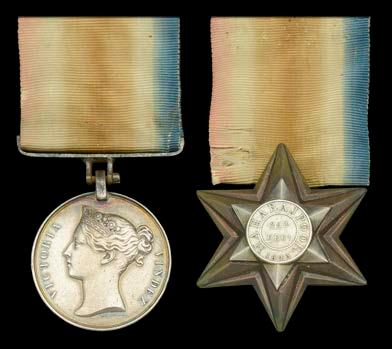
Candahar Ghuznee Cabul 1842, unnamed as issued, original steel clip and bar suspension; Maharajpoor Star 1843 (Private William Coalman H.M. 40th Regt.) original brass hook suspension, good very fne (2) £800-£1,000
W Wiil llli iaam m C Cooa allm maan n was born in the Parish of Yeatsbury, near Colne, Wiltshire, and was attested for the 40th Regiment at Bath on 24 December 1838, aged 22 years. He proceeded to India on 22 April 1839, serving there for 1 year 101 days and subsequently in Lower and Upper Scinde, Baluchistan & Affghanistan 3 years 61 days. He participated in the First Afghan war and was present at Candahar, Ghuznee and Cabul during 1842, and at the battle of Maharajpoor on 29 December 1843. He was severely wounded at the latter battle as detailed in the Surgeon’s report shortly afterwards: ‘Private William Coalman wounded in action with the enemy on the 29th December 1843 by a grape shot causing compound fracture of the thigh bone - leg amputated - unft for further service.’ Following a further examination by the Principal Medical Officer at Chatham on 27 July 1844, Coalman was discharged on 13 August 1844, in consequence of ‘Disability’, his character and conduct described thus, ‘he has never been tried by a Court Martial & that his conduct has been Very Good. Granted a Medal inscribed “Candahar”, “Ghuznee”, “Cabul” 1842 for 2nd Affghan Campaign. Wounded at the Battle of Maharajpoor, in the State of Scindiah, 29th December 1843.’
Sold with copied attestation and discharge papers.
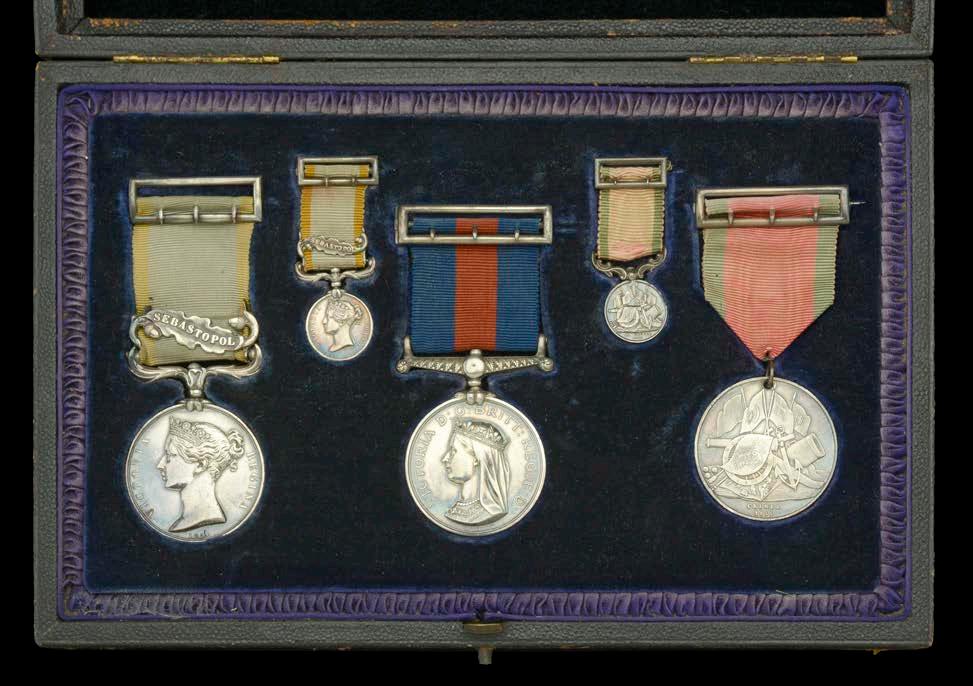
Three: C Caap ptta aiin n FF R R C Clla arrk ksso onn, , 668 8tth h FFo ooot t,, lla atte err 77t thh FFo ooot t Crimea 1854-56, 1 clasp, Sebastopol, unnamed as issued; New Zealand 1845-66, reverse undated (Lieut. Fredk. R. Clarkson. 68th Foot.) impressed naming; Turkish Crimea 1855, British issue, unnamed as issued, all medals ftted with silver ribbon buckles and contained in ftted glazed display case together with related miniature medals for the Crimea, these also with silver ribbon buckles, generally good very fne or better (5) £400-£500
FFr reed deer riic ckk RRe eeed deer r C Clla arrk ksso onn (also recorded as both John Reeder Clarkson, and, more commonly, as Thomas Reeder Clarkson) was born on 19 August 1837, son of Ebeneezer Thomas Clarkson, of Calne, Wiltshire. He was educated at Rugby School and appointed Ensign in the 68th Foot, 14 December 1854; Lieutenant, 9 March 1855; Captain, 27 July 1866; Exchanged to 7th Foot, 2 October 1866; Retired 12 June 1867. Captain Clarkson served with the 68th Foot in the Crimean War from 6 September 1855, and was present at the siege and fall of Sebastopol (Medal with Clasp and Turkish Medal). Served also in the New Zealand War in 1864-65 (Medal).
Pair: C Cool loon neel l A A R R H Hoos skki inns s,, BBo o m mbba
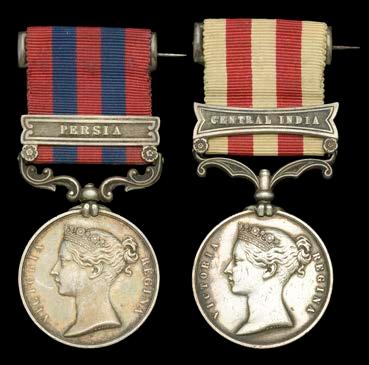
India General Service 1854-95, 1 clasp, Persia (Lieut. A. R. Hoskins. Arty.); Indian Mutiny 1857-59, 1 clasp, Central India (Lieut. A. R. Hoskins, 3rd Tp. H. Bde. Bombay Arty.) each ftted with contemporary silver ribbon brooch buckle, contact marks, otherwise very fne and better (2) £800-£1,000
A Arrt thhu urr RRe eggi inna alld d H Hoos skki inns s was born on 28 January 1832, and attended Addiscombe 1849-52; 2nd Lieutenant, 13 June 1851; Lieutenant, 28 April 1856 (ante-dated to 12 December 1851); 2nd Captain, 30 March 1860; 1st Captain, 16 March 1866; Major, 5 July 1872; Lieutenant-Colonel, 27 February 1877.
Served in Persia 1856-57, Reshire, Bushire, Khooshab, and Mohumra (Medal with Clasp); Mutiny 1857-59, Kotah, recapture of Chandaree, Kotahke-Serai, Gwalior, Powree, and actions of Beejapore, Sindwala, Kurai, and pursuit at Koondrai (Medal with Clasp). Retired with honorary rank of Colonel on 28 February 1877, and died on 16 March 1902, at King Ina’s Palace, South Petherton, Somerset.
Three: LLi ieeu utte
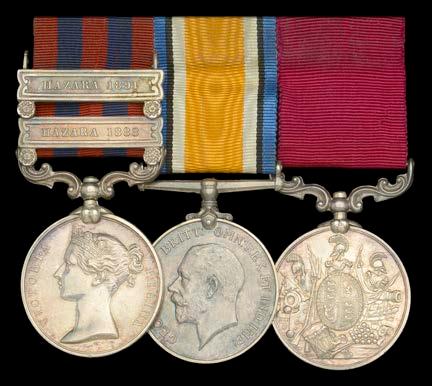
India General Service 1854-95, 2 clasps, Hazara 1888, Hazara 1891 (24940 Sergt. W. Roddy No. 2 By. 1st Bde. Sc. Dn. R.A.); British War Medal 1914-20 (Q.M. & Lieut. W. M. Roddy. R.A.); Army L.S. & G.C., V.R., 3rd issue, small letter reverse (24940. 3/Cl: Mr. Gr. W. Roddy. R.A.) good very fne (3) £240-£280
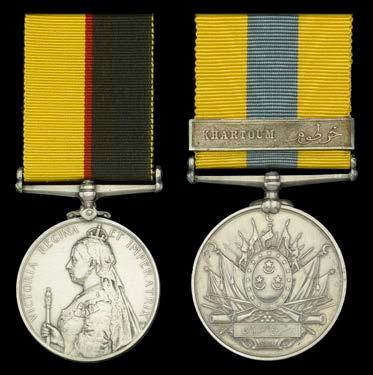
Queen’s Sudan 1896-98 (3944 Pte Case 21/L’crs); Khedive’s Sudan 1896-1908, 1 clasp, Khartoum, clasp face only glued to ribbon (3944 Pte. H. Case 21st Lcrs.) good very fne (2)
£1,600-£2,000
PPr riiv vaat tee H H C Caas see , “B” Squadron, 21st Lancers is considered to be a confrmed charger at Omdurman, 2 September 1898 (Forgotten Heroes: The Charge of the 21st Lancers at Omdurman, by Roy Dutton refers). No initial given on the Queen’s Sudan roll (as per actual medal) and comments ‘Deceased address of N. of K. not known’. He is known to have died of heat exhaustion at Luxor on 25 September 1898, during the march north to Atbara. Terry Brighton, in his book The Last Charge, notes ‘During the days that followed the regiment proceeded north, marching from 5.30a. m. to 1.00p.m. each day, by which time all were exhausted. Many found the return march worse than the advance; the sun seemed stronger, and one man (Private Case) died of heat exhaustion.’
Sold with copied medal roll extracts.
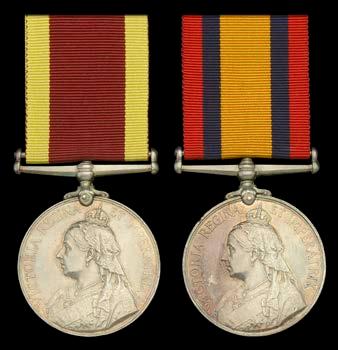
Pair: SSt took keer r W W T T BBa akke err, , H H M M SS T Teerrrriibblle e China 1900, no clasp (W. T. Baker, Sto., H.M.S. Terrible.); Queen’s South Africa 1899-1902, no clasp (W. T. Baker, Sto. H.M.S. Terrible) light contact marks, otherwise good very fne (2) £280-£340
W Wiil llli iaam m TTh hoom maas s BBa akke err was born at Warblington, Hampshire, on 4 February 1878, and was a dairyman prior to joining the Royal Navy as a Stoker 2nd Class on 30 April 1897. After a period at Victory II, he joined H.M.S. Terrible on 24 March 1898, and remained in her until 16 January 1903. He qualifed as a Diver in June 1904, was advanced to Leading Stoker in May 1906, and to Stoker Petty Officer in January 1909. He was Discharged Dead on 21 April 1911 at Cromarty N.B. from caisson disease [the ‘Bends’] after diving. Sold with copied record of service.
Four: PPr riiv vaat tee C C T Taay yllo orr, , R Rooy yaal l W Wees stt K Keen ntt R Reeg giim meen ntt
Queen’s Mediterranean 1899-1902 (2194 Corpl: C. Taylor. Rl: W. Kent Regt.); British War Medal 1914-20 (L-6390 Pte. C. Taylor. R.W. Kent R.); Army L.S. & G.C., G.V.R., 1st issue (L-6390 Pte. C. Taylor. R.W. Kent R.); Army Meritorious Service Medal, G.V.R., 1st issue (L-6390 Pte. C. Taylor. 2/R.W. Kent R.) very fne and better (4)
£400-£500
M.S.M. (Immediate) London Gazette 3 August 1920: ‘For valuable services rendered in India in connection with the War.’
C Chha arrl lees s TTa ayyl loor r was born in the Parish of Greenwich, London, on 28 August 1881, and enlisted at New Cross, Kent on 9 January 1902. His Queen’s Mediterranean medal was issued for service with the 3rd Battalion, Royal West Kent Regiment, on 3 January 1903. He afterwards served in Ceylon, China, Singapore, and India, where he arrived in December 1908. He was discharged from the 1st Battalion after 21 years 11 days service with the Colours on 23 July 1921.
Sold with original Small Book which confrms all awards.
Pair: SSu u
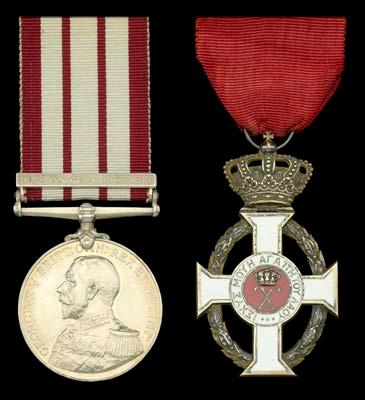
Naval General Service 1915-62, 1 clasp, Persian Gulf 1909-1914 (Surgn. D. A. Mitchell, M.B., R.N., H.M.S. Alert.); G Grre eeec cee, , K Kiin nggd doom m , Order of George I, Officer’s breast badge, silver-gilt and enamel, with hinged suspension, gilding almost all rubbed on latter, good very fne (2) £200-£240
Greek Order of George I, Officer London Gazette 24 May 1919: ‘For distinguished services rendered during the War.’ D Doou uggl laas s A Assh hlle eyy M Miit tcch heel lll was born on 18 December 1886 and having qualifed MRCS and LRCP in 1909 entered the Royal Navy as a Surgeon on 6 May 1910, He served in H.M.S. Alert on the East Indies Station from 27 February 1912 to 18 May 1914, and subsequently served during the Great War, initially at the R.N. Hospital Malta, and then in H.M.S. Diamond from 16 December 1916 until the cessation of hostilities. Promoted Surgeon Lieutenant-Commander on 6 May 1918, for his services during the Great War he was appointed an Officer of the Greek Order of George I, and was awarded the British War and Victory Medals. He relinquished his commission on 18 August 1919. Sold with copied research.
Three: PPr riiv
British War and Victory Medals (19335 Pte. W. Baker. Norf. R.); India General Service 1908-35, 1 clasp, Afghanistan N.W.F. 1919 (19335 Pte. W. Baker. Norf. R.) in named card boxes of issue, extremely fne, the IGS rare to unit (3)
£120-£160
Sold with copied Medal Index Card.
Four: LLi i
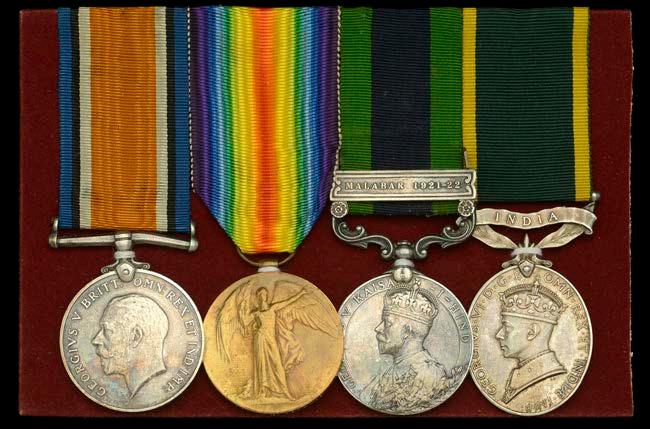
British War and Victory Medals (Lieut./Lt. A. R. Stewart.); India General Service 1908-35, 1 clasp, Malabar 1921-22 (Lt. A. R. Stewart, I.A. Attd Leinster R.); Efficiency Medal, G.VI.R., 1st issue, India (Tpr. A. R. Stewart. Cawnpore Contgt. A.F.I.) mounted on card for display together with ribbon bar and related badges, suspension bar of B W M bent, otherwise good very fne (4) £280-£340
Sold with copied Medal Index Card which shows British War and Victory Medals issued in India for service with 3/154 Infantry and 2/61st K.G.O. Pioneers. He appears to have claimed for the 1914-15 Star but with Theatre of War and Qualifying Date given as Suez 10 August 1918, he clearly did not qualify for this.
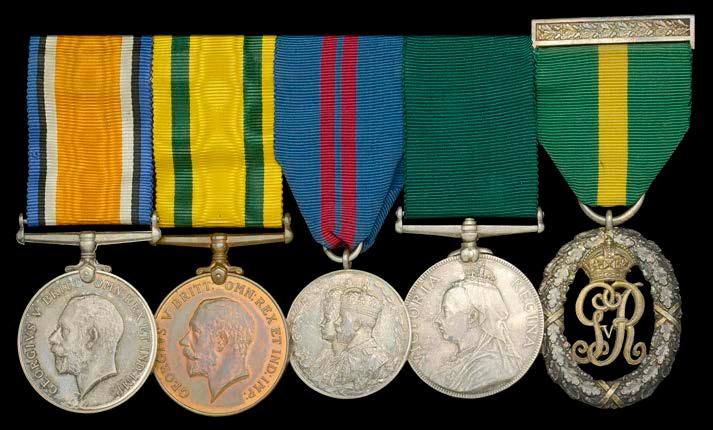
British War Medal 1914-20 (Q.M. & Major H. D. Norwood.); Territorial Force War Medal 1914-19 (Q.M. & Major H. D. Norwood Midd’x R.); Coronation 1911, unnamed as issued; Volunteer Force Long Service Medal, V.R. (2404. Q.M. Sjt: H. D. Norwood. 2/V.B. Midd: Rgt.); Territorial Decoration, G.V.R., hallmarks for London 1913, with integral top riband bar, mounted as worn, extremely fne (5) £400-£500
Territorial Decoration London Gazette 5 May 1914.
H Heen nrry y D Daav viid d N Noor r w wooo odd was appointed Quartermaster and Lieutenant, 2nd V.B. Middlesex Regiment, 19 October 1907; Quartermaster and Major, 7th Battalion, Middlesex Regiment, 30 April 1909; Quartermaster and Major, Territorial Force Reserve, 21 October 1916; employed Ministry of National Service at Gibraltar from February 1915; retired 22 December 1918, having attained the age limit and granted the rank of Major.
Five: FFl
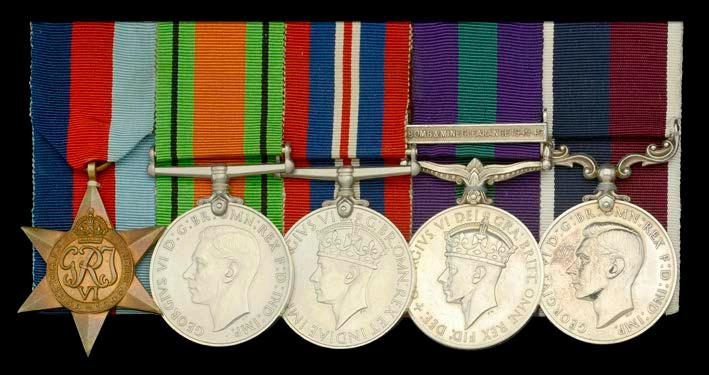
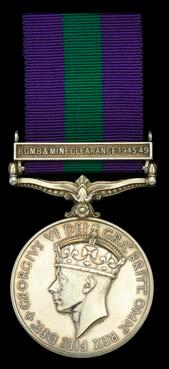
1939-45 Star; Defence and War Medals 1939-45; General Service 1918-62, 1 clasp, Bomb & Mine Clearance 1945-49 (Flt. Lt. A. W. Williams. R.A.F); Royal Air Force L.S. & G.C., G.VI.R., 1st issue (Plt. Off A. W. Williams. R.A.F.) mounted for display, generally very fne or better, and scarce (5) £1,000-£1,400
W
bbe err W Wiil
lli iaam mss was born in Liverpool in January 1910. He enlisted in the R.A.F. as a Halton Apprentice in September 1925. Williams advanced to Corporal in February 1936, and to Sergeant in June 1939. He served with No. 24 Equipment Unit, R.A.F. Ternhill, April 1938September 1940, and subsequently at No. 5 (Pilots) Advanced Flying Unit and No. 11 (Pilots) Advanced Flying Unit. Williams was commissioned from Temporary Warrant Officer to Pilot Officer (on probation) in the Technical Branch in August 1943 (awarded L. S. & G.C. in September 1943). He advanced to Flying Officer in February 1944, and to Flight Lieutenant in February 1947. Williams was stationed at Bridgnorth and Eastchurch, 1943-44, and served with the 5132 and 5133 Bomb Disposal Squadrons, August 1944 - May 1945. He served at R. A.F. Sylt, October - November 1946. Williams was posted to the Bomb Disposal School prior to retiring in July 1948. In later life he resided in Ashton-in-Makerfeld, and died in Broadgreen Hospital in October 1973. Sold with copied research.
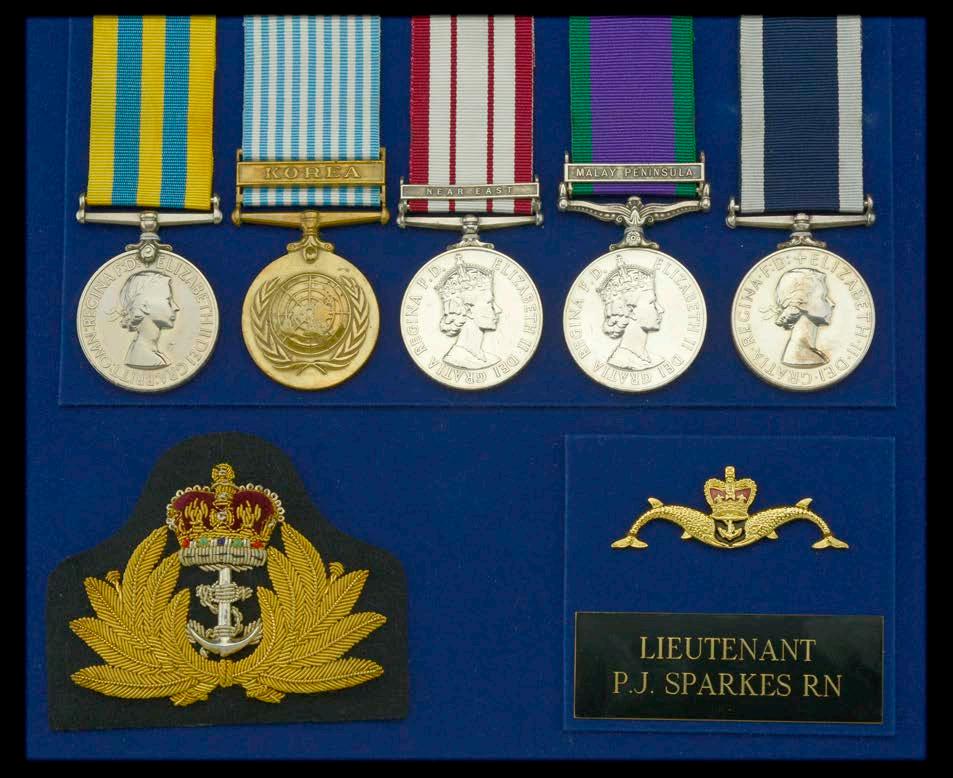
Five: LLi ieeu utte enna annt t PP JJ SSp paar rkke ess, , R Rooy yaal l N Naav vyy Korea 1950-53, 1st issue (D/SSX. 857022 P. J. Sparkes Tel. R.N.); U.N. Korea 1950-54; Naval General Service 1915-62, 1 clasp, Near East (D/JX. 857022 P. J. Sparkes. L. Tel. R.N.); General Service 1962-2007, 1 clasp, Malay Peninsula (S/Lt P J Sparkes RN); Royal Navy L.S. & G.C., E.II.R., 2nd issue (A/Sub Lt P J Sparkes RN) mounted on board for display together with bullion R.N. badge and Submarine Service gilt and enamel badge, light contact marks, otherwise good very fne or better (5) £400-£500
PPh hiil llli ipp JJo ohhn n SSp paar rkke ess was born in Honiton, Devon, on 19 October 1932, and joined the Royal Navy as a Boy Telegraphist at St Vincent on 9 November 1948. Following further training at Ganges and Drake, he joined the cruiser Jamaica in February 1950 for service in Korea. He next served in the destroyer Cockade from December 1950, returning to Drake in September 1951, and then Lochinvar minesweeping school July 1953 to July 1954. Now rated A/Leading Telegraphist he passed through Drake briefy before joining the submarine base Dolphin in August 1954. In October 1959 he was posted to the submarine Sidon but had fortunately left the boat 4 days before Sidon sank in Portland Harbour, Dorset, on 16 June 1955, after an experimental hydrogen peroxide-powered torpedo catastrophically exploded inside the hull. The blast and subsequent fooding claimed the lives of 13 crew. Sparkes continued in submarines and saw service in Tudor and Trenchant, the latter in the Near East, before joining Seneschal in May 1957 as Acting P.O. Telegraphist. There followed several appointments to various land establishments including Drake and the signals school Mercury, January 1959 to January 1966, during which period he was advanced to Radio Operator 1, Leading R.O., and Radio Supervisor. He was commissioned Sub-Lieutenant on 2 January 1966, and served aboard the coastal minesweeper Invermoriston in the Malay Peninsula later that year. He was promoted to Lieutenant in April 1971 and, following a stint at the R.N. Gunnery School Excellent, retired in 1974.
Sold with original Certifcate of Service.
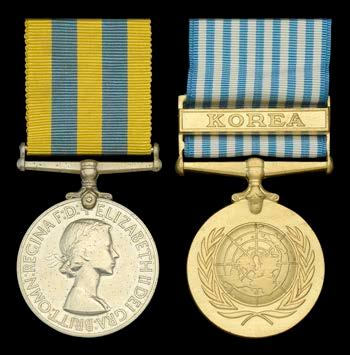
Korea 1950-53, 1st issue (22341311 Pte. N. Dymott. Glosters.); U.N. Korea 1950-54, unnamed as issued, in its named card box of issue, extremely fne (2)
£300-£400
Pair: T Trro
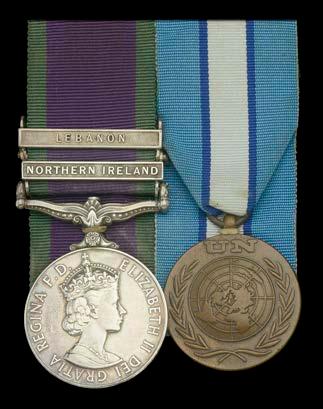
General Service 1962-2007, 2 clasps, Northern Ireland, Lebanon (24386782 Tpr. D. E. Roberts 16/5L.); U.N. Medal, on UNFICYP ribbon, mounted court-style as worn, nearly extremely fne (2)
£800-£1,000
One squadron of the 16th/5th Lancers were present in Lebanon; comprising 7 officers and 56 other ranks (British Battles and Medals refers).
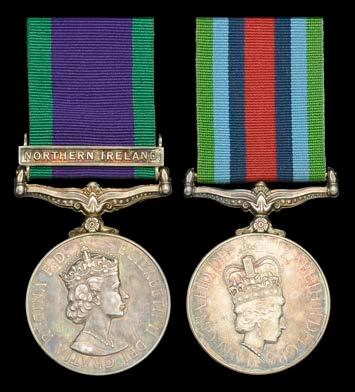
General Service 1962-2007, 1 clasp, Northern Ireland (25100869 Rfn M J Weaver RGJ); Operational Service Medal 2000, for Sierra Leone, without rosette (25100869 Rfn M J Weaver RGJ) with named card boxes of issue together with Rife Brigade cloth badge, extremely fne (2)
£200-£240
Pair:
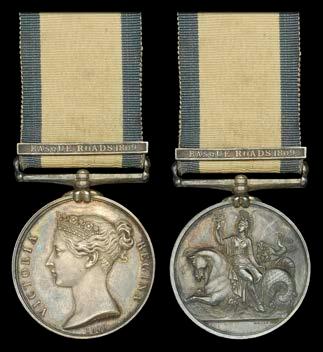
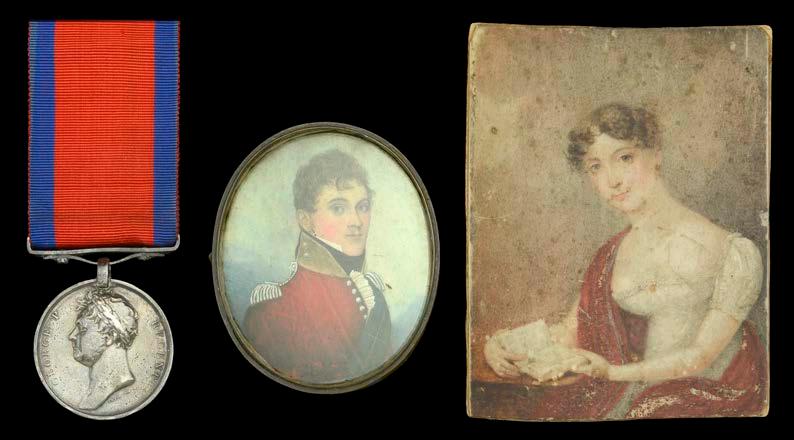
Naval General Service 1793-1840, 1 clasp, Basque Roads 1809 ((F
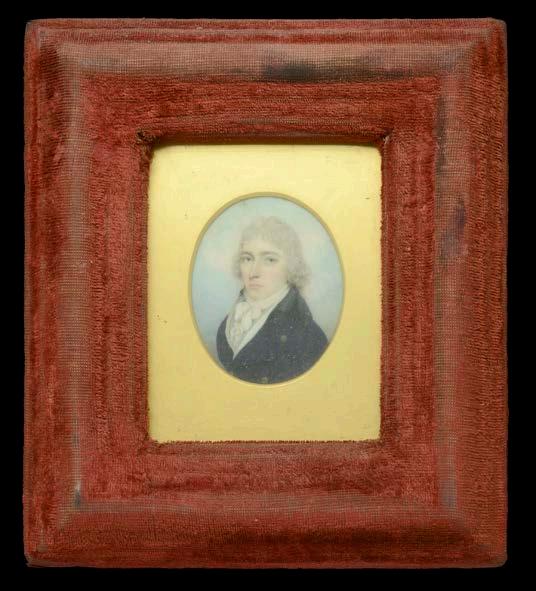
original ribbon Sold with two very fne portrait miniatures believed to be of Lieutenant Phillips R.N. and his wife, together with a Victorian period photograph of a mother and child, all three in red cloth frames, cloth worn but images in good condition, the medal dark toned, extremely fne (4) £2,000-£3,000
Provenance: Purchased many years ago from a family source together with M.G.S. to Ensign Joseph Wickham (see Lot XXX) and possibly related in some way.
FFr reed deer riic ckk PPh hiil llli ipps s entered the Navy, 28 August 1805, as First-class Volunteer, on board the Bellona 74, Captains Charles Dudley Paler and John Erskine Douglas; under the latter of whom we fnd him present, as Midshipman, at the destruction of the French 74-gun ship Impétueux, off Cape Henry, 14 September 1806, also in the attack upon the enemy’s feet in Basque Roads and in the expedition to the Walcheren in 1809, and at the capture, 18 December 1810, of Le Héros du Nord privateer of 14 guns and 44 men. On 22 June 1807, he chanced to be, as a Supernumerary, on board the Leopard 50, Captain Salusbury Pryce Humphreys, when that ship compelled the U.S. frigate Chesapeake to surrender, in consequence of a refusal on the part of the latter to allow the British to search her for deserters. Following Captain Douglas from the Bellona, in May 1812, into the Prince of Wales 98, he sailed with him soon afterwards for the Mediterranean, where, in April 1814, he beheld the fall of Genoa. On his return to England in April 1815, from the West Indies, whither he had gone with convoy in the Swiftsure 74, Captain William Henry Webley Parry, Mr. Phillips found that he had been promoted to the rank of Lieutenant 7 February preceding. From May 1824, until March 1831, he served in the Coast Blockade as a Supernumerary of the Ramillies 74 and Hyperion 42, Captains William M‘Culloch and William James Mingaye. He has been since serving in the Coast Guard.
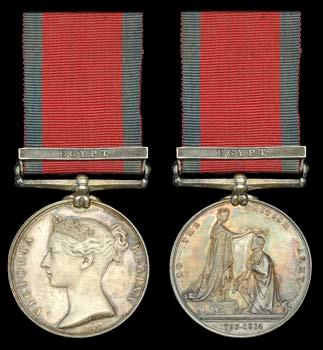
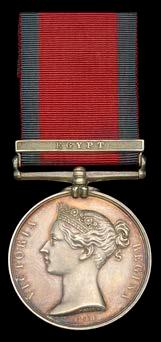
Military General Service 1793-1814, 1 clasp, Egypt ((J
correction to initial, original ribbon, brilliant extremely fne
£1,400-£1,800
Provenance: Purchased many years ago from a family source together with N.G.S. to Midshipman Frederick Phillips (see Lot XXX) and possibly related in some way.
JJo osse epph h W Wiic ckkh haam m is confrmed on the Egypt Officers List of 40th Foot and is noted on Mullen’s roll as ‘Wounded’.
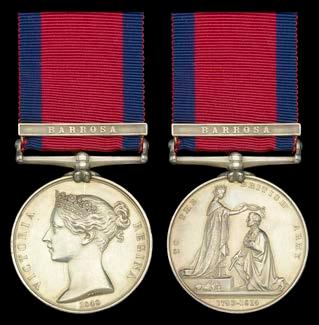
Military General Service 1793-1814, 1 clasp, Barrosa ((J
Provenance: Glendining’s, April 1918 and December 1930.
fne and a rare casualty
£1,400-£1,800
JJa a m mees s EEn nttw wiis sttl lee was born in the Parish of Chorley, Lancashire, and was enlisted into the 2nd Battalion, 95th Regiment on 16 July 1800, aged twenty years, a crofter by trade. He served 12 years 91 days and was discharged on 14 October 1812, in consequence of ‘a Gun Shot wound of Head which he received at the Battle of Barrosa. He has been in the Regiment since its formation, has been four years a Corporal and always borne an excellent character.’ Entwistle was admitted to an out-pension of 1/- at the Royal Hospital, Chelsea, on 28 October 1812. Sold with copied discharge papers.
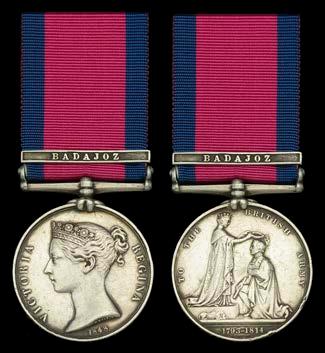
Military General Service 1793-1814, 1 clasp, Badajoz ((J
£1,400-£1,800
JJo ohhn n G Giil lees s was born in the Parish of Broadon, Oxfordshire, and was enlisted into the 1st Battalion, 95th Foot, on 1 September 1813, aged 21, a labourer by trade. He served 3 years 30 days and was discharged on 30 September 1813, ‘in consequence of ‘a Wound of right Arm at Badajoz 6 April 1812 & contracted fngers.’ Giles was admitted to an out-pension of 9d per diem at the Royal Hospital, Chelsea, on 19 October 1813, drawn at Gloucester, and increased to 1/6 per diem on 23 June 1874.
Sold with copied discharge papers.
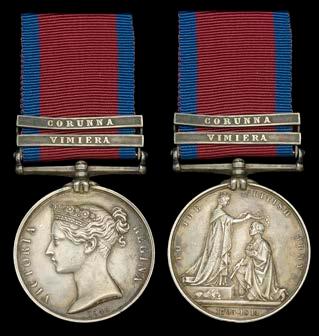
Military General Service 1793-1814, 2 clasps, Vimiera, Corunna ((W
distortion to upper clasp, otherwise good very fne
W Wiil llli iaam m U Uppc crro offt t was born in the Parish of Kenninghall, Norfolk, and was enlisted into the 9th Foot at Norwich on 14 June 1796, aged 16 years, for unlimited service. He served a total of 25 years 336 days, after the age of 18, and was discharged in the rank of Sergeant at Albany Barracks on 22 July 1823, in consequence of a ‘Disease of the Spleen and chronic infammation of the lungs, the disease of the spleen was contracted in Portugal in the year 1810.’ He was a Corporal for 1 year 27 days, a Sergeant for the last 8 years 314 days, and his conduct as a soldier was described as being ‘universally most exemplary during the whole period of his Service.’ Sergeant Upcroft was admitted to an out-pension at the Royal Hospital, Chelsea, from 23 July 1823.
Sold with copied discharge papers.
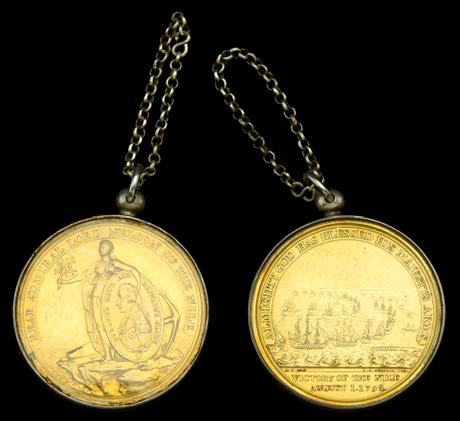
Alexander Davison’s Medal for The Nile 1798, bronze-gilt, unnamed, housed in a repurposed silver frame with glass lunettes, the edge hallmarked London 1822, ftted with silver ball and loop suspension from a short silver chain, very fne £300-£400
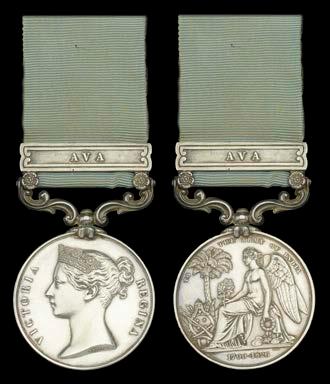
Army of India 1799-1826, 1 clasp, Ava ((L
short hyphen reverse, officially impressed naming, extremely fne £1,600-£2,000
JJo ohhn n LLu uddl loow w was born at Llantillio-Pertholey, Monmouthshire, on 13 May 1801, eldest son of Edmund Ludlow, of Westminster, hop merchant, and Anne Elizabeth his wife. Educated at Merchant Taylors’ from October 1813 to March 1816, he was appointed a Cadet for the H.E.I.C. Bengal Presidency in 1818, and admitted as Ensign on 26 June 1819, doing duty with the 19th Bengal Native Infantry; Lieutenant, 15 August 1820, and posted to the 2/3rd N.I. He was a military student at the College of Fort William from 4 January till 7 July 1821. Attached to the Pioneers from 28 December 1822, and Adjutant of same from 28 September 1825 to 27 July 1829, being promoted to Captain the previous 1 April 1829. Transferred to 6th N.I. (late 1/3rd) in May 1824 and took part in the operations against the Bhils in that year; commanded a company of Pioneers under Brigadier J. R. Lumsden during the First Burma War, persent at Sylhet and Cachar in 1824, and in the Arakan in 1825 (India Medal). Appointed Agent to the Governor General of Rajputana 21 February 1835, the suppression of female infanticide and Suttee in Rajputana was in great measure due to his efforts; officiating Political Agent at Kotah 11 October 1837; appointed Political Agent at Jodphur 19 September 1839, and severely wounded by sabre cut on head and hands at the occupation of Jodhpur in November 1839; promoted to Major on 20 December 1843, and appointed Political Agent at Jaipur 8 January 1844 till 25 December 1847. Promoted to Lieutenant-Colonel on 6 April 1850; posted to 12th N.I. in July 1850. Transferred to 14th N.I. 21 March 1853; to 9th N.I. August 1853; to 36th N.I. 2 February 1854; retired 9 August 1854; brevet Colonel 28 November 1854; Hon. Major-General 1857. Major-General John Ludlow died at his residence, Yotes Court, Maidstone, Kent, on 30 November 1882.
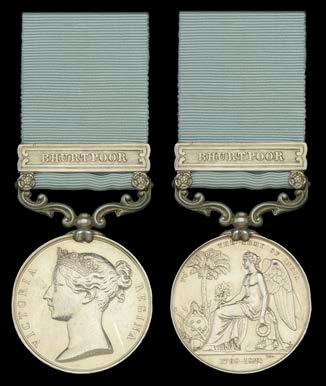
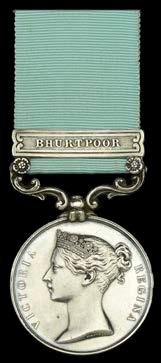
Army of India 1799-1826, 1 clasp, Bhurtpoor
short hyphen reverse, officially impressed naming, obverse contact marks, otherwise very fne £1,000-£1,400
D Daan niie ell M Maay y was born at Ellerton, Gloucester, c. 1801, and enlisted into the 59th Foot on 5 February 1819, aged 18, for unlimited service. Promoted Corporal 25 January 1822; Sergeant 25 February 1823, Colour-Sergeant 12 April 1827, and Sergeant-Major 27 April 1838. Served in the East Indies from 10 September 1819, till 31 December 1828. He was wounded in the left knee at Bhurtpoor. Discharged on 12 August 1840, he was awarded the L.S. & G.C. medal in the same year, being described at this time as ‘a very good N.C.O. and soldier. A labourer by trade, he received a pension of 2/- per diem, later increased for his service as Barrack Depot Sergeant. He died on 28 November 1874, whilst drawing his pension at Southampton (Sudden Death, Sudden Glory by Daavid Ingham refers).
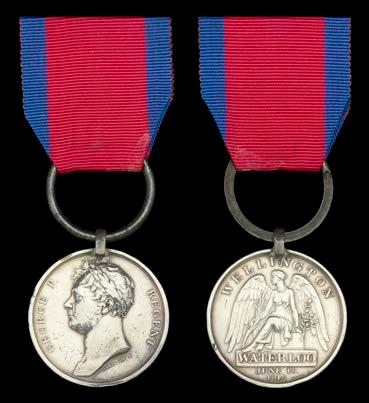
ftted with steel clip and half of split ring suspension, ‘Royal’ largely erased, light contact marks, otherwise very fne £800-£1,000
M Maar rtti inn PPi innd deer r served as a Driver in Captain W. H. Humphrey’s “H” Troop, Royal Artillery Drivers. Waterloo 1815 ((M
Provenance: Tim Ash Collection, July 2012.
JJo ohhn n G Grre eeen n came from Whitehaven in Cumberland, and joined H.M.S. Calliope on 12 December 1837, his age would then have been 27 and he was unmarried. He had previously served aboard the William and Mary Yacht. The Calliope, of 26 guns, was commanded by Captain Thomas Herbert. The frst destination of the Calliope was across the Atlantic to the Rio del Plata for the protection of British interests at Buenos Ayres and Monte Video. Subsequently the Calliope was to sail around Cape Horn to Valparaiso, and then to China through the Philippine Islands in the Pacifc Ocean. John Green was appointed to the post of Captain's Coxswain whilst the vessel was in China. In July 1840 Captain Herbert left the Calliope and the command was given to Captain Kuper. The last action in China in which the Calliope took part was the assault and capture of the town of Chin Keang Foo on the Yang-tse-kiang River in 1842.
The Callliope later returned to England after an absence of just over fve years; John Green had, therefore, with the rest of the crew, sailed around the globe in fve years, three months and three days. He was discharged from the Calliope on 15 March 1843, when the ship returned to England. What John Green may have done after his time at sea is not known; however, on 27 October 1847, after a gap of four years, he again joined the crew of the Calliope as an Able Seaman, number 178 in the Ship's Description Book. He was then aged 37, fve feet and eight inches tall, of a forid complexion with hazel eyes and dark hair. He produced his Certifcate of his previous service aboard the Calliope, signed by Captain Kuper, who stated his conduct had been "Good". Some ten months later when the Calliope was at Wellington, New Zealand, John Green, deserted the ship on 22 August 1848. From then on John Green is an enigma - nothing is known of his ultimate fate or date of death.
Sold with comprehensive research including detailed account of Calliope’s services in China,
Provenance: Tim Ash Collection, July 2012.
Approximately 92 medals to the ship.
RRo obbe errt t PPo oool lee , Carpenter of the Nemesis, was the only man to hold this appointment throughout the ship's commission from Liverpool in 1840 to Calcutta in 1843. He is one of only eight men, including Mr Hall, the Master, to have served throughout the ship's commission.
Robert Poole would have been one of the most valuable artisans on board the Nemesis One only has to read the account of the voyage to the near shipwreck and to the Nemesis’ arrival at Delagoa Bay, on the south east coast of Africa to effect repairs to realise that he must have been an extremely capable and extremely hard working, ship's carpenter. He was probably fully employed on a daily basis during his period in the Nemesis The laudatory comments on the condition of the vessel when it was subsequently inspected at the Bombay Dockyard in 1843 must stand as a complement to him and to the remainder of the Nemesis crew.
Two other ratings are mentioned in the Ledger as holding carpentry appointments. John Williams (Carpenter's Crew) who joined the Nemesis at Point De Galle on 14 October 1840 and was discharged at Macao on 17 April 1841; and John Gill (Carpenter's Mate and Caulker) who joined on 5 August 1841, at Macao and was discharged on 9 November 1842, at Chusan. Both men appear on the Medal Roll but their medals were never claimed.
The steamer Nemesis witnessed extensive action during the course of the First China War, not least at the capture of the city of Chapoo on 16 June 1842, when, as stated in The Illustrated London News, ‘Our casualties were numerous, two men being killed and twenty-fve being wounded, but confned entirely to the naval arm of the expedition. The enemy are said to have lost about eighty killed and a proportionate number wounded. They served their guns extremely well, and some of the vessels (particularly Her Majesty’s Ship Blonde and the steamers Nemesis and Sesostris) suffered a great deal from the heavy destructive fre. The Nemesis’ rigging was cut to pieces ...’
The Nemesis had earlier participated in the historic forcing of the inner passage from Macao to Whompoa, in company with boats from the Samarang and Atalanta, an account of which was afterwards published by her commanding officer, Captain W. H. Hall, R.N., in his Narrative of the Voyages and Services of the “Nemesis” from 1840 to 1843; see, too, Low’s History of the Indian Navy 1613-1863, for frequent mention of the Nemesis in action.
Sold with comprehensive research.
A Fine Collection of Medals, the Property of a Lady, Part 1
China 1842 ((O O w ween n R Reei illl lyy, , 118 8tth h R R.. IIr riis shh R Reeg g.. IIn nffa annt trry y..) ) original suspension, naming rubbed in weak attempt to erase but fully legible, nearly very fne £300-£400
Sutlej 1845-46, for Ferozeshuhur 1845, 1 clasp, Sobraon ((A Alle exxa annd deer r D Doou uggl laas s 662 2nnd d Reeg gtt )) edge bruising and polished, otherwise nearly very fne £400-£500
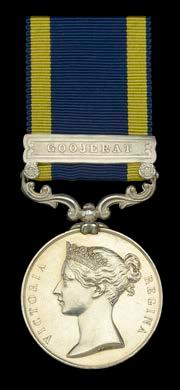
Punjab 1848-49, 1 clasp, Goojerat ((J J
JJo
died on 20 May 1850.
£200-£240
1
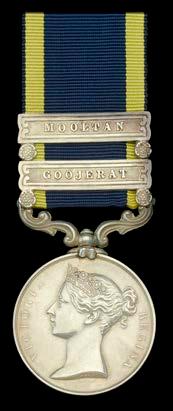
Punjab 1848-49, 2 clasps, Mooltan, Goojerat ((L Liie euut t.. BB. . T T.. R Reei idd. . A Acct tiin ngg IIn nttr r..
110 0tth h FFt t )) officially engraved naming, good very fne £200-£240
BB TT RRe eiid d was appointed an Ensign in the 3rd European Regiment on 12 June 1841; Lieutenant, 24 January 1845; brevet Captain, 12 June 1856; Captain, 3rd European Regiment, 23 November 1856. Captain Reid served with H.M. 10th Foot at the siege and surrender of Mooltan and battle of Goojerat, medal and clasps. He passed an examination in the Punjaubee language, 10 December 1851. Sold with copied extracts from the Bengal Army List.
South Africa 1834-53 ((Q Qrr M Mrr JJ C C C Crro okke err, , 66t thh R Reeg gtt )) ftted with contemporary forally engraved silver ribbon buckle, good very fne £400-£500
JJo ohhn n C C C Crro okke err was appointed Quartermaster in the 6th (Royal Warwickshire) Regiment on 28 July 1846, and took part in the 2nd and 3rd wars in South Africa. He was Adjutant in the expedition beyond the Kei in January 1847; was Field Adjutant at the beginning of the 3rd war, was acting Brigade Major in July 1851 and D.A.Q.M.G. of the 1st Brigade in February 1852.
South Africa 1834-53 ((W W A
ngge err also served with the 45th Regiment in the 3rd war. 552 2
£260-£300 W Wiil
iaam m A A
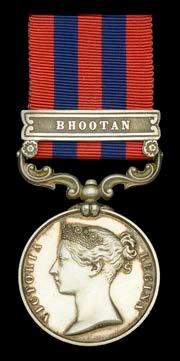
India General Service 1854-95, 1 clasp, Bhootan ((A Asss stt. . SSu urrg gnn. . EE JJ H Hoos skki inns s 114 4tth h BBe enng gaal l C Caav vyy )) extremely fne £200-£300
EEd d m muun ndd JJo ohhn n H Hoos skki inns s was born in 1836 and qualifed at Bart’s. M.R.C.S. 1858; L.S.A. 1859; M.D. St Andrew’s 1860; Assistant Surgeon, 1 October 1860; Surgeon, 1 October 1872; Surgeon Major, 1 July 1873; retired 7 April 1879; died in London on 22 January 1916.
For the recipient’s related miniature award, see Lot 55.
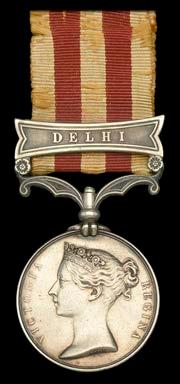
Indian Mutiny 1857-59, 1 clasp, Delhi ((L Liie euut t W W A Attk kiin nsso onn, , 552 2nnd d LL II )) a little polished, otherwise very fne £600-£800
LLi ieeu utte e
m A Attk kiin nsso onn was present in the actions at Trimmu Ghaut Puttun, 12 July 1857, and at the siege of Delhi, being slightly wounded in the fnal assault on the city, 14 September 1857. The 52nd had one officer killed and three officers wounded in the fnal assault. Atkinson exchanged into the 13th Light Dragoons and retired by sale of his commission in 1868.
Sold with copied medal roll extract.
For the recipient’s related miniature award, see Lot 55.
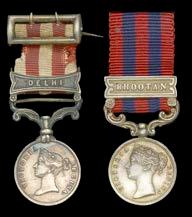
India General Service 1854-95, 1 clasp, Bhootan, mounted on sterling silver brooch bar with gold pin for wearing, extremely fne
Indian Mutiny 1857-59, 1 clasp, Delhi, mounted as worn from a contemporary silver ribbon buckle, very fne (2) £160-£200
For the recipients’ full-sized medals, see Lots 53 and 54 respectively.
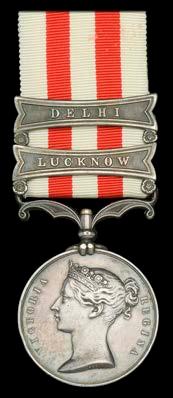
Indian Mutiny 1857-59, 2 clasps, Delhi, Lucknow ((D Drru u m mrr. . JJa ass. . R Roow wbbo otth haam m,,
11s stt EEu urrn n BBe enng gaal l FFu ussr rss )) dark toned, very fne
Provenance: Tim Ash Collection, July 2012.
£300-£400
JJa a m mees s RRo o w wbbo otth haam m , a soldier of the East India Company serving in the 1st Bengal European Fusiliers, was born about 1831 at Hyde, Cheshire. His occupation was a bobbin turner in a textile mill. In 1852 at the age of 20 years he enlisted at Manchester for the East India Company's military service in the Infantry, travelling aboard the ship Soubahdar which landed at Calcutta on 15 November 1852. He was posted to the 1st Bengal European Fusiliers as a Private and saw service in Burma during the Burma War of 1852-3, receiving the India General Service medal clasp Pegu - since lost. At the time of the Mutiny in 1857 he took part in the campaign at Delhi and in the storming of the Cashmere Bastion on 14th September. From the time of the fnal capture of Delhi the Fusiliers were engaged at Lucknow taking part in its fnal capture. Subsequent to the Mutiny, the East India Company's rule in India ceased and was taken over by the Crown. The European element of the Company's forces was given the choice of staying on to serve the Crown or to take a discharge. Corporal, as he now was, James Rowbotham opted for a discharge from April 1860. He returned to England and his former employment as a bobbin turner in a textile mill at Ashton under Lyne. He made application to the India Office in London for his Mutiny medal, issued as Drummer James Rowbotham, with two clasps, for Delhi and Lucknow, and for his Prize Money, all of which he had received by 1865. Sold with comprehensive research.
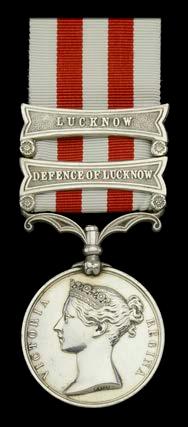
Indian Mutiny 1857-59, 2 clasps, Defence of Lucknow, Lucknow ((3 3339 999 PPt tee JJa a m mees s FFr riil l
, 11 M Maad d FFu uss )) second clasp a contemporary copy, later impressed naming, good very fne
Roll confrms both clasps and remarks ‘Discharged’.
£300-£400
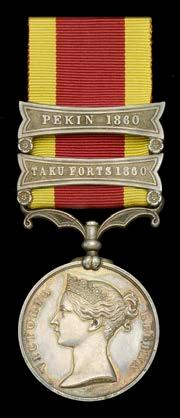
China 1857-60, 2 clasps, Taku Forts 1860, Pekin 1860 ((7 755 PPt tee W W C Ceer r
s 22/ /FFo ooot t )) later impressed naming, extremely fne
£160-£200 W W
frmed on the roll for both clasps. He deserted on 9 June 1862, rejoined, and was discharged on 18 November 1869.
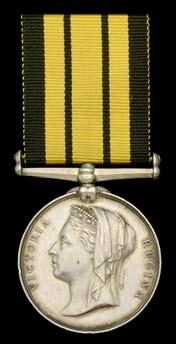
Ashantee 1873-74, no clasp ((S Suub b.. LLt t..
773 3--7 744) ) good very fne
C Chha arrl lees s EE M Moor riis soon n was appointed a Sub-Lieutenant in the Royal Navy on 13 February 1871, and joined Encounter in that rank on 27 August 1873. His medal was sent to R.N. Barracks, Sheerness 29 June 1875. Not traced after this date.
Ashantee 1873-74, no clasp ((R
)
Only two Ashantee medals issued to the rank of Chaplain and Naval Instructor. RRi icch haar rdd LLe eaa N Neea alle e entered the Royal Navy as a Chaplain and Naval Instructor on 4 July 1865. During the Ashantee war he served in H.M.S. Amethyst On 29 May 1877 he was present in Amethyst during the pursuit and engagement with the Peruvian rebel turret ship Huascar off Ylo.
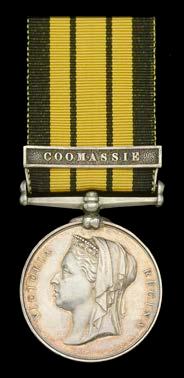
Ashantee 1873-74, 1 clasp, Coomassie ((L
EEd d w wiin n W Wyyn nnne e H Huug ghhe ess was appointed Sub-Lieutenant in the 1st West India Regiment, 30 December 1871. He transferred as Lieutenant to the 28th Regiment in 1874 and resigned his commission in 1876. Lieutenant Hughes served with the 1st West India Regiment during the second phase of the Ashanti War, and was present at the repulse of the enemy’s attack on the post of Fommanah (Medal with Clasp).
A Fine Collection of Medals, the Property of a Lady, Part 1
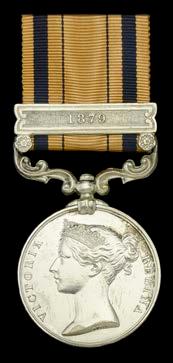
South Africa 1877-79, 1 clasp, 1879 ((2 2001 155. . PPt tee. . H H.. BBa arrn nees s.. 999 9tth h FFo ooot t..) )
tightened at claw and minor edge bruising, otherwise nearly extremely fne £400-£500
Afghanistan 1878-80, no clasp ((C Cool l JJ H Haar rppu urr, , 223 3rrd d BBo o N N II )) extremely fne £240-£280
C Cool loon neel l JJ H Haar rppu urr commanded the regiment throughout the period it was employed in the war, and the troops at Sibi from 6th May till 21st August, 1880.
JJo osse epph h LLi iggh htt was killed in action at Kabul, 14 December 1879, by a gun shot wound to the chest.
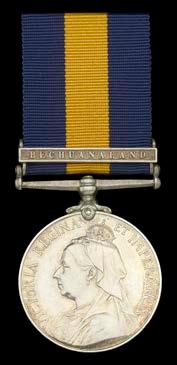
Cape of Good Hope General Service 1880-97, 1 clasp, Bechuanaland ((6 6222 2
SSe errv v (sic) JJ M M H H BBl loow wss D D EE O O V V R R )) extremely fne £200-£240
Confrmed on the roll as Private.
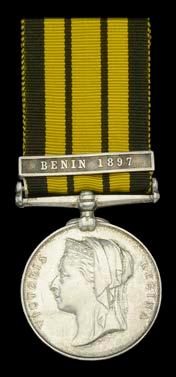
East and West Africa 1887-1900, 1 clasp, Benin 1897 ((C C M M W Wooo odd, , A A BB H H M M SS T Thhe esse euus s )) good very fne £180-£220
Confrmed on roll and landed from Theseus as part of the ‘Flying Column’ in the Benin operations.
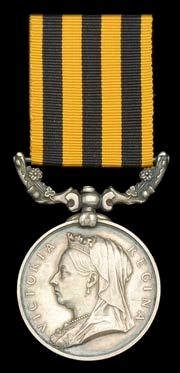
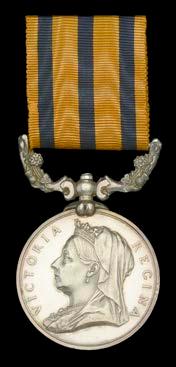
British South Africa Company Medal 1890-97, reverse Matabeleland 1893, no clasp ((S S
£400-£500
A Fine Collection of Medals, the Property of a Lady, Part 1
British South Africa Company Medal 1890-97, reverse Rhodesia 1896, no clasp ((S Suur rggn n W W C Crra avve enn, , M Meed d SSt t C Coor rpps s )) extremely fne £400-£500
A total of 52 medals and 7 clasps for Rhodesia 1896 issued to the Medical Staff Corps, including 6 Surgeon Captains and 3 Surgeons.
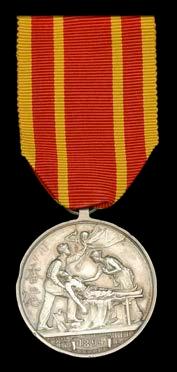
Hong Kong Plague 1894, silver issue ((P Prri
cially impressed naming, edge bruise, otherwise good very fne £1,200-£1,600
.
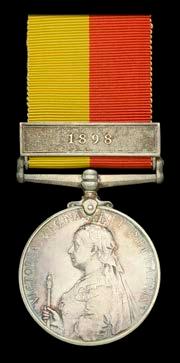
East and Central Africa 1897-99, 1 clasp, 1898
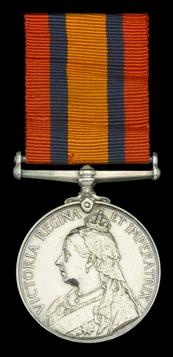
Queen’s South Africa 1899-1902, no clasp (Mr. F. Villiers. “Illustrated London News”) good very f
£1,200-£1,600
FFr reed deer riic c VVi illl liie errs s was a pioneering British war artist, engraver, and correspondent who documented major military conficts through on-the-spot sketches, written dispatches, and innovative battlefeld photography and flm. He was born in London on 23 April 1851, but spent his early childhood and schooldays in the north of France, specifcally in Guînes, Pas-de-Calais, where he remained until 1869. Villiers began his career in the 1870s, travelling to post-Commune Paris in 1871 under an alias to sketch scenes of destruction for panoramic illustrations, narrowly escaping arrest as a suspected spy. He gained prominence during the Servian-Turkish War of 1876, experiencing his frst combat at the Battle of Sinitza on the Bosnia border, where he sketched amid shellfre and witnessed devastating infantry casualties. In the RussoTurkish War of 1877-78, he covered the Russian defeat at Plevna and formed a close friendship with General Mikhail Skobelev, whom he later compared to historical fgures like Napoleon and Wellington for his strategic brilliance. His work extended to the Anglo-Egyptian War of 1882, the Mahdist War in the Soudan 1884-85, including the battles of Tamaai and Abu Klea, where he sketched from within infantry squares under intense enemy fre, and the Second Boer War 1899-1900), attached to the Kimberley relief column under Lieutenant General John French.
Renowned for his bravery, Villiers often risked his life to capture authentic scenes, dressing in practical attire like a Wolseley jacket and Stanleystyle cap while carrying sketching tools into battle; he was credited with early innovations such as using a bicycle for mobility and a cine-camera on the front lines. His illustrations appeared in prominent publications including The Graphic, Black and White, The Standard, and The Illustrated London News, and he produced annotated pencil-and-watercolor sketches of key moments, such as the surrender of Boer General Piet Cronje at Paardeberg Drift and the relief of Kimberley. Later, Villiers lectured on his experiences across North America and Europe, earning acclaim for his vivid depictions of soldiers' valour and the human cost of war, while collecting artifacts from campaigns, like Afghan rifes and Egyptian divans that flled his London studio. He published memoirs such as Peaceful Personalities and Warriors Bold (1907) and Villiers: His Five Decades of Adventure (1921), cementing his legacy as one of the Victorian era's most famboyant and respected chroniclers of global confict. Frederic Villiers died on 5 April 1922, in London after a prolonged illness, at the age of 70. His passing marked the end of a prolifc career that had signifcantly shaped visual journalism, though much of his recognition came posthumously through archival preservation and scholarly re-evaluation. He served as the model for Rudyard Kipling's character Dick Heldar in the novel The Light That Failed (1891).
Sold with copied ‘War Correspondents’ medal roll extract and other research.
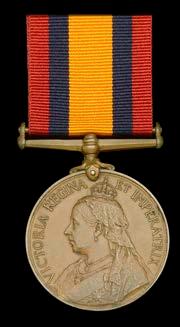
Queen’s South Africa 1899-1902, no clasp, bronze issue ((H
)) officially impressed naming, good very fne and rare £200-£300
Recipient so far not traced on any medal roll.
774 4
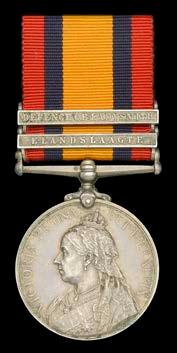
Queen’s South Africa 1899-1902, 2 clasps, Elandslaagte, Defence of Ladysmith ((3 3114 4 T Tppr r:: G G T Thho o m maas s N Naat taal l M M R R )) toned, nearly extremely fne
Died of disease at Ladysmith, 24 January 1900.
775 5
King’s South Africa 1901-02, 1 clasp, South Africa 1902 ((3 3228 866 PPt tee W W SSp paar rssh hoot ttt EE K Keen ntt R Reeg gtt )) good very fne
Rolls confrm Q.S.A., 3 clasps, Paardeberg, Driefontein, Transvaal, and K.S.A., 2 clasps, South Africa 1901, South Africa 1902.
£300-£400
£50-£70
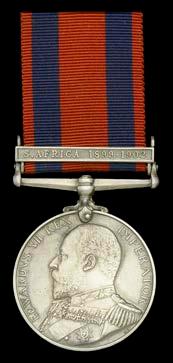
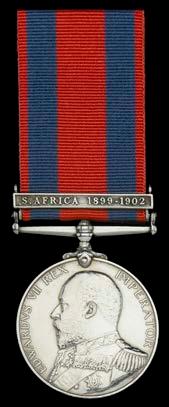
Transport 1899-1902, 1 clasp, S. Africa 1899-1902 ((F F G G C Clla arrk kee )) nearly extremely fne £500-£700
FF G G C Clla arrk kee is confrmed on the roll as Chief Engineer aboard the Union Castle Line’s Kildonau Castle His medal was presented by H.M. the King on 4 November 1903.
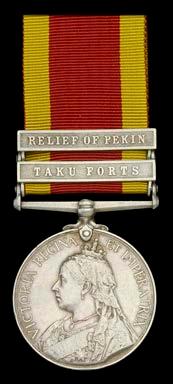
China 1900, 2 clasps, Relief of Pekin, Taku Forts ((H H G Giib bsso onn, , A Arrm mrrs s C Crr ,, H H M M
SS A Auur roor raa )) very fne and scarce £600-£800
Confrmed on the roll, one of 46 medals issued with these two clasps to H.M.S. Aurora H Heen nrry y G Giib bsso onn was born at Gunnislake, Cornwall, on 6 July 1879, and was a Blacksmith by trade when he joined the Royal Navy on 6 December 1897, as provisional Armourer’s Crew in H.M.S. Cambridge He was rated Armourer’s Crew in April 1898 and served aboard Aurora from February 1899 to April 1902. He was advanced to Armourer’s Mate in November 1902, and to Armourer aboard Leviathan in August 1911, receiving his L.S. & G.C. medal in this ship in December 1912. He was advanced to Acting Electrical Artifcer 4th Class in March 1913, to E.A. 4 in March 1915, and to E. A. 3 in March 1917. He served throughout the Great War in Marlborough from June 1914 to November 1919, including the battle of Jutland, and was discharged to Shore from Defance on 19 March 1920.
Sold with copied record of service.
Ashanti 1900, no clasp, silver issue, low relief
)) extremely fne
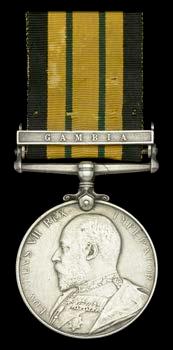
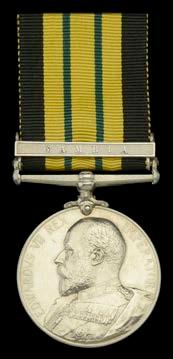
Africa General Service 1902-56, 1 clasp, Gambia ((I Innt tppr r A Addj juum
aa SSi issi i )) later impressed naming and with fxed suspension, lightly scratched overall from cleaning, otherwise very fne and scarce
Sold with manuscript note by H. Biddulph, Brig. Genl. late R.E., dated Salisbury 21.9.42, which states ‘This W. Africa Medal with “Gambia” clasp was obtained in 1942 by my son R. G. Biddulph, Provincial Commissioner, Gambia, from the family of Interpreter Adjuma Sisi, after the death of the latter whom he knew quite well.’ Together with copied medal roll extract for ‘Civilians’ which includes 5 interpreters and confrms issue of ‘Replacement’ medal on 29 September 1923.
General Service 1902-56, 1 clasp, Nandi
Tibet 1903-04, no clasp, bronze issue ((C Cooo olly y G
light verdigris, otherwise nearly extremely fne
Tibet 1903-04, 1 clasp, Gyantse ((8
JJa a m mees s A A C Cooo oppe err died of wounds in France on 10 February 1916, whilst serving as a Sergeant with 1st Battalion, Royal Fusilers, and is entitled to the 1914 Star trio.
Khedive’s Sudan 1910-21, 2nd issue, no clasp ((1 1772 2
W Waar r R R )) officially impressed naming, small edge bruise, otherwise toned, good very f
in action on 18 October 1916, as a Sergeant in the 2nd Battalion, Wiltshire Regiment.
served in France and Flanders from 11 August 1914 and is not entitled to clasp.
4
General Service 1915-62, 2 clasps, Palestine 1945-48, Minesweeping
India General Service 1936-39, 1 clasp, North West Frontier
(No. 5497139) Lance Corporal, 1st Bn., Hampshire Regiment, was killed in action on 30 July 1944, aged 31 years. The son of Henry Carpenter, and of Kathleen Carpenter, of Brook, Isle of Wight, he is buried in the Bayeux War Cemetery.
1939-45 Star, 1 copy clasp, Battle of Britain; Atlantic Star, 1 copy clasp, Air Crew Europe; Africa Star, 1 copy clasp, North Africa 1942-43; Pacifc Star, 1 copy clasp, Burma; Burma Star, 1 copy clasp, Pacifc; Italy Star; France and Germany Star, 1 copy clasp, Atlantic; Defence and War Medals 1939-45; Defence and War Medals 1939-45, both Canadian issues in silver; India Service Medal, very fne or better (12) £100-£140
naming, good very fne £180-£220
Fewer than 100 South Vietnam clasps to the General Service Medal 1962-2007 were awarded, mainly to members of the Australian Army Training Team but also allowed to some supporting units on a case by case basis, for the period from 24 December 1962 to 29 May 1964. RRo o
t JJa a
s BBr roow wnn was born in Perth, Western Australia, on 11 September 1934. He served as a Private (Signalman) with 547 Signal Troop, Royal Australian Corps of Signals, and is confrmed on the roll of personnel who served in Vietnam up to 29 May 1964. His period of service is given as 1 June 1963 to 4 February 1964, well over the 30-day qualifying period for the clasp. 547 Signal Troop was a unit that monitored enemy signals via various means and it is believed that Brown might have been attached to the military attaché staff
General Service 1962-2007, 1 clasp, Dhofar ((2 2442 2009 9664 477 SSp prr
extremely fne £140-£180
General Service 1962-2007, 3 clasps, Borneo, South Arabia, Malay Peninsula ((2 2335 5220 0110 000 LLC CPPL L EE T
eea arr R REEM MEE) ) edge additionally impressed ‘R’ for replacement, extremely fne £80-£100
South Atlantic 1982, with rosette ((L L
mounted as worn, with related miniature award, good very fne £700-£900
JJ C C W W O Ossm moon ndd was commissioned Lieutenant in the Fleet Air Arm in February 1980. He was an Engineer, and served with 824 Squadron during the Falklands confict. The latter was a Sea King Helicopter Squadron, which was split into fights amongst the task force. Osmond was serving at A & AEE, Boscombe Down in 1984.
King’s Messenger Badge, G.VI.R., silver-gilt and enamel with pendant silver greyhound, the reverse officially numbered ‘25’, complete with neck ribbon in its Garrard & Co Ltd ftted case of issue, lightly tarnished, otherwise nearly extremely fne £1,000-£1,400
Attributed to Mr A. E. C. Moore who was issued with badge 25 in 1956.
The Most Honourable Order of the Bath, C.B. (Military) Companion’s neck badge, silver-gilt and enamels; The Most Distinguished Order of St. Michael and St. George, C.M.G., Companion’s neck badge, silver-gilt and enamels; Distinguished Service Order, E.VII. R., silver-gilt and enamels, lacking integral top riband bar; India General Service 1895-1902, 3 clasps, Punjab Frontier 1897-98, Samana 1897, Tirah 1897-98 (Captn. C. H. Davies. 3d Sikh: Infy.); China 1900, no clasp (Captn. C. H. Davies 3d Sikh Infy.); India General Service 1908-35, 1 clasp, North West Frontier 1908 (Major C. H. Davies D.S.O. 53d Sikhs); 1914-15 Star (Lt. (sic) C. H. Davies D.S.O., 53/Sikhs F.F.); British War and Victory Medals, with small M.I.D. oak leaves (Brig-Genl. C. H. Davies.); General Service 1918-62, 1 clasp, Kurdistan (Brig. Gen. C. H. Davies.); Jubilee 1935; Coronation 1937; R Ruus sssi iaa, , EEm mppi irre e , Order of St Stanislas, Military Division, Second Class neck badge, with silver-gilt crossed swords, by Edouard, St. Petersburg, 48mm, gold (56 zolotniki) and enamel, maker’s mark on reverse, gold mark and 1908-17 kokoshnik mark on suspension ring and elsewhere, chips to enamel wreaths of D SO, light contact marks, otherwise generally very fne or better (13)
£4,000-£5,000
C.B. (Military) London Gazette 3 June 1919.
C.M.G. London Gazette 25 August 1917 (Mesopotamia).
D.S.O. London Gazette 3 July 1903:
‘In recognition of services on the occasion of the capture of Gumatti Fort during the operations against the Darwesh Khel Waziris in November 1902.’ One of two D.S.O.’s awarded for this action.
M.I.D. London Gazettes 21 June 1916, 4 July 1916, 19 October 1916, 15 August 1917, 22 January 1919, and 5 June 1919.
Order of St Stanislas, 2nd Class with Swords London Gazette 15 May 1917
C Chha arrl lees s H Heen nrry y D Daav viie ess was born on 20 November 1867, at Dibrugarh, India, son of the late Major-General Frederick John Davies (died 1901) of Teignmouth. He was educated at the United Service College, Westward Ho! and at Newton College, Newton Abbott, and joined the Army on 5 February 1887, as a Second Lieutenant in the Cheshire Regiment. He became Lieutenant in the Indian Staff Corps 1 September 1889, and Captain in the Indian Army 5 February 1898. He served with the 3rd Sikh Infantry on the North-West Frontier, 1897-8, taking part in operations on the Samana and in the Kurram Valley during August and September 1897 (Medal with two clasps); and in the Tirah, 1897-8, including the action at Dargai and the capture of the Sampagha and Arhanga Passes, the reconnaissance of the Saran Sar and the action of 9 November 1897; the operations against the Khani Khel Chamkanis; the operations in the Bazar Valley, 25 to 30 December 1897 (clasp). He received a Medal for service in China, 1900, and served in 1902 in the operations against the Darwesh Khel Waziris, North-West Frontier. In this campaign he was wounded slightly, and for his services was mentioned in Despatches [London Gazette 5 June 1903], and created a Companion of the Distinguished Service Order [London Gazette 3 July 1903]: "Charles Henry Davies, Capt., Indian Army. For operations against the Darwesh Khel Waziris." He was promoted Major 5 February 1905; served in the Zakka Khel Expedition in 1908; in the Mohmand Expedition, including the engagement at Kargha, 1908 (Despatches; Medal with clasp). He became Lieutenant-Colonel 5 February 1913. He served in the European War, in Mesopotamia, 1914-18. He was given the Brevet of Colonel 3 June 1916; was promoted Temporary Brigadier-General on becoming Brigade Commander, 28th Infantry Brigade, Indian Expeditionary Force "D," Mesopotamian Expeditionary Force, 6 July 1916. He was wounded; was created a C.M.G. in 1917 and a C. B. in 1919. Brigadier-General Davies married, 5 September 1894, at Teignmouth, Devon, Beatrice Mary, fourth daughter of the late Christopher Sparrow, of Bitton, Teignmouth, and Urmston Lodge, near Manchester, and they have one son, Frederick Arthur Davies (Second Lieutenant, Queen's Own Corps of Guides). Brigadier-General Davied died on 2 January 1955, aged 87, and is buried in St Neot, Cornwall.
The Most Honourable Order of the Bath, C.B. (Military) Companion’s neck badge, silver-gilt and enamesl; The Most Excellent Order of the British Empire, O.B.E. (Military) Officer’s 1st type breast badge, silver-gilt, hallmarks for London 1919; Queen’s South Africa 1899-1902, 3 clasps, Cape Colony, Orange Free State, Transvaal (Lieut. F. W. Barron, R.G.A.); King’s South Africa, 2 clasps, South Africa 1901, South Africa 1902 (Lt. F. W. Barron, R.G.A.); 1914 Star, with clasp (Capt. F. W. Barron, R.G.A.); British War and Victory Medals, with M.I.D. oak leaves (Lt. Col. F. W. Barron.); Defence and War Medals 1939-45; Jubilee 1935; Coronation 1937; FFr raan ncce e,, T Thhi irrd d R Reep puub blli icc , Croix de Guerre 1914-1918, contact marks and polished, nearly very fne or better (12) £1,600-£2,000
C.B. London Gazette 1 January 1936.
O.B.E. London Gazette 12 December 1919: ‘In recognition of valuable services rendered in connection with the Military Operations in Mesopotamia'.
FFr reed deer riic ckk W Wiil l m moot t BBa arrr roon n was born in June 1880 and was educated at Radley and the R.M.A. Woolwich. Commissioned 2nd Lieutenant in the Royal Artillery on the eve of the outbreak of the Boer War, he was quickly embarked for South Africa, and served in operations in the Transvaal, east of Pretoria, July to November 1900, including the actions at Reit Vlei and Lydenburg; also in later operations in the Orange River Colony and Cape Colony (Queen’s Medal & 3 clasps; King’s Medal & 2 clasps).
He attended the Gunnery Staff Course 1906-07, was Instructor in Gunnery (1st Class) 1909-13, and attended Staff College 1914. He was also a Gold Medallist, R.A. Institution.
By the outbreak of hostilities in August 1914, he was serving as a Captain at the War Office. Quickly advanced to Major, he was embarked for France as a Staff Officer, in which capacity he afterwards served in Gallipoli, Mesopotamia and Persia, latterly as Assistant Quartermaster-General, Lines of Communication, Indian Expeditionary Force “D” (Mesopotamia) 1917-19. According to one obituarist, he was ‘in the thickest of the fghting’ and, in addition to his award of the O.B.E., he was fve times mentioned in despatches (London Gazettes 13 July 1916, 15 August 1917, 12 March and 27 August 1918, and 5 June 1919, refer); so, too, awarded the French Croix de Guerre (London Gazette 7 June 1919, refers).
Between the wars, Barron remained employed on the Staff at the War Office, latterly as Inspector of Fixed Defences 1934-38, in which capacity he visited Hong Kong and Singapore and was awarded the C.B. Having then been placed on the Retired List as a Major-General in the latter year, he was recalled in September 1939 and served as Inspector of Fixed Defences, G.H.Q. Home Forces and War Office 1939-41, as well as serving as a Lieutenant-Colonel in the Home Guard.
The General, ‘a kind and Christian gentleman’, who always ‘treated others with consideration and respect’, died at his home in Whitchurch, Devon in January 1963, aged 83 years.
Sold with portrait photograph and copied research.
Distinguished Service Order, V.R., silver-gilt and enamel, with integral top riband bar; South Africa 1877-79, 1 clasp, 1877-8 (Lieut. G. C. Palmes. 1-24th Foot.); Queen’s South Africa 1899-1902, 3 clasps, Cape Colony, Orange Free State, Johannesburg (Major G. C. Palmes, D.S.O., S.W: Bord.); King’s South Africa 1901-02, 2 clasps, South Africa 1901, South Africa 1902 (Maj. G. C. Palmes. D. S.O. S. Wales Brd.) mounted court-style for display, minor chipping to both wreaths on the frst, light contact marks to the campaign medals, otherwise very fne and better (4) £6,000-£8,000
D.S.O. London Gazette 27 September 1901: ‘In recognition of services during the operations in South Africa.’
G Geeo orrg gee C Chha a m mppn neey y PPa allm mees s was born on 9 February 1857, third son of the Venerable James Palmes, D.D. He entered the Army on 10 September 1875, as 2nd Lieutenant, 24th Foot, becoming Lieutenant on 10 September 1877. He served in the South African War of 1877-79, taking part in the Kaffir campaign, operations against the Galekas and the battle of Quintana. Here, 'G' Company, along with “D” Company bore a conspicuous part at the battle of Quintana, being the only two Imperial Companies present. During the Zulu War of 1879, Palmes was at Helpmekaar at the time of Isandhlwana, his company having been ordered to take over from “B” Company 1-24th at Rorke’s Drift several days prior to the battle but due to some miscommunication they did not depart until 22nd January. Now joined by Captain Upcher's “D”Company, “G” Company moved to Roke’s Drift but, before reaching that place, met Major Spalding who informed them that Rorke’s Drift had been taken by the enemy. Fires could be clearly seen at the Drift and it was decided the wise option would be to return to Helpmekaar. Upon their return they were greeted by a small number of fugitives from Isandhlwana and therefore prepared for the defence of Helpmekaar against an attack they were sure would follow. The attack never happened and they were relieved within a few days. During the rest of the war Palmes and “G” Company served at various bases on the lines of communication. Although Lieutenant Palmes served with his Regiment during the Zulu War of 1879, he did not cross the border into Zululand and like many others of the 1-24th who took part in the war but did not cross the border, received the medal with the 1877-8 clasp. Palmes was promoted to Captain on 9 June 1882, and became Major on 9 June 1892; he was Adjutant, Volunteers, 1 October 1891 to 30 September 1895. He served in the South African War 1899-1902, was Commandant of Klerksdorp, and took part in operations in Orange Free State, February-May 1900, including actions at Karee Siding, Vet River (5 and 6 May) and Zand River. Operations in the Transvaal in May and June 1900, including the action near Johannesburg, and West of Pretoria, August to 29 November 1900. Operations in the Orange River Colony, June to August 1900. Operations in the Transvaal, 30 November 1900 to May 1902. Palmes was mentioned in despatches London Gazette 10 September 1901, and created a companion of the Distinguished Service Order. The insignia were sent to Lord Kitchener in South Africa and were presented by Brigadier-General Barber at Klerksdorp on 16 March 1902. Major Palmes retired on 23 July 1902 and died on 22 October 1946.
Distinguished Service Order, G.V.R., silver-gilt and enamel, with integral top riband bar; British War and Victory Medals, with M.I. D. oak leaves (Lt. Col. W. M. Alpine.); War Medal 1939-45, mounted court-style for wear, lacquered, good very fne and better (4) £800-£1,000
D.S.O. London Gazette 3 June 1918: ‘For distinguished service in connection with military operations in Italy.’
M.I.D. London Gazette 30 May 1918.
W Wiil llli iaam m M Mooo orre e A Allp piin nee was born in Ayrshire, Scotland, on 2 June 1882 and was commissioned temporary Lieutenant in the 18th (Arts and Crafts) Battalion, King’s Royal Rife Corps on 23 June 1915. According to his Medal Index Card served with them during the Great War on the Western Front from 2 December 1915 (although his M.I.C. gives no indication that he was ever issued a 1914-15 Star, and the Battalion did not go out to France until 2 May 1916). He took command of the battalion after the carnage of the Battle of Flers on 15 September 1916, and was promoted temporary Lieutenant-Colonel on 20 September 1916. He left the battalion on admission to hospital on 21 December 1916, and subsequently served on the Staff of the 123rd Infantry Brigade in Italy. For his services in Italy he was both Mentioned in Despatches and appointed a Companion of the Distinguished Service Order. He died in Hythe, Kent, on 29 September 1950.
The Most Excellent Order of the British Empire, O.B.E., (Military) Officer’s 1st type breast badge, silver, hallmarks for London 1919; Military Cross, G.V.R., reverse contemporarily engraved ‘F. W. Trott. 8th Battn Devon Regt Loos, Sep. 25th 1915.’; 1914-15 Star (2. Lieut. F. W. Trott. Devon. R.); British War and Victory Medals, with M.I.D. oak leaves (Capt. F. W. Trott.); India General Service 1908-35, 1 clasp, North West Frontier 1930-31 (S/L. F. W. Trott. R.A.F.); Jubilee 1935, unnamed as issued; Coronation 1937, unnamed as issued, mounted as originally worn, generally very fne or better (8) £1,200-£1,600
O.B.E. London Gazette 1 January 1919.
M.C. London Gazette 14 January 1916.
M.I.D. London Gazette 1 January 1916.
U.S.A. Legion of Merit, London Gazette Officer 15 March 1946.
FFr raan ncci iss W Wiil llli iaam m TTr root ttt was born in Heavitree, Exeter, Devon in 1892. He was the son of John Trott, who taught science at the University of Exeter. Trott was educated at St. John’s College, Cambridge. He initially served as a Second Lieutenant during the Great War with the 8th (Service) Battalion, Devonshire Regiment in France from 25 July 1915.
Trott distinguished himself during the Battle of Loos, 25 September 1915, when the 8th Battalion under the surviving officers - Captain H. Gwynn and Trott - spotted and captured a German Battery during the assault on the German held positions at Hulluch. Gwynn was awarded the D.S.O. for his bravery, and Trott the M.C. Further details behind the awards were given in The Western Morning News, 5 April 1919: 'The gunners were, on the orders of Lt. Trott - a gallant officer whose bandaged head and bloodstained face bore evidence of an earlier woundtaken prisoners and sent to the rear The back of the town was packed with the enemy. They had expected the attack, and had made every preparation to resist it. So strong was their defence that within a very short time the Devons were only a handful of ffty men with captain Gwynn and Lieut. Trott, and at a quarter to nine the order was given to retire from the town and dig in just outside. Whilst they were falling back more men fell, Capt. Gwynn was wounded with a bomb, and Lieut. Trott took command. In order to be able to put up a better resistance he withdrew again slightly, and the men who were left, fring from their knees, put up a plucky resistance. Then Lieut. Trott was again wounded in the hand, and the charge fell on Company Sergt.-Major Bryant.'
The men of the 8th Battalion captured 4 feld guns in ‘Gun Trench’, but suffered heavily during the Battle of Loos. The Battalion’s total casualties were 639, including 19 officers - 227 men were listed as killed or missing, and 343 as wounded or gassed.
Trott recovered from his wounds, advanced to Captain and transferred to the Royal Flying Corps in February 1917. He got married at Exeter Cathedral in June 1918, and subsequently advanced to Acting Major, Royal Air Force. Trott remained in the R.A.F. after the Great War, and served as a Flight Lieutenant with 24 Squadron at Kenley in 1921. His family address being “Comroye”, Topsham Road, Exeter.
Trott advanced to Squadron Leader in January 1926, and served on the North West Frontier - including the command of 28 Squadron, 22 November 1931 - 19 March 1932. He was promoted to Wing Commander in 1934, and served at the Air Ministry (Directorate of Postings). Trott was appointed Group Captain, and the frst Commanding Officer of No. 1 Air Armament School in Lincolnshire, in January 1938. He continued to serve during the Second World War, and was Head of Air Mission in Washington and then as London liaison with the US Army from 1940 to 1945. Trott was awarded the USA Legion of Merit in 1946, and retired as a Group Captain in April 1946. He died in 1975.
)
The Most Excellent Order of the British Empire, O.B.E. (Military) Officer’s 1st type breast badge, hallmarked London 1919; Queen’s South Africa 1899-1902, 3 clasps, Cape Colony, Orange Free State, Transvaal (3339 S.Q.M. Sgt. C. P. Warner, 15th Coy. 5th Impl: Yeo:); King’s South Africa 1901-02, 2 clasps, South Africa 1901, South Africa 1902 (Lieut: & Qr. Mr. C. P. Warner. Imp: Yeo:) mounted as worn, edge bruise to the second, otherwise very fne (3) £280-£340
O.B.E. (Military) London Gazette 1 January 1919: T./ Maj., R.A.S.C., ‘For valuable services rendered in connection with the War.’ C Cuut thhb beer rtt PPh hiil liip p W Waar
enlisted on 10 January 1900 as a Private in the 15th Northumberland Company, Imperial Yeomanry at Newcastle on Tyne. He soon made S.Q.M. Sergeant and was commissioned Lieutenant and Quartermaster on 14 September 1901. He was severely wounded at Mooiplatz on 14 January 1902, and discharged on 20 December 1903.
The Most Excellent Order of the British Empire, O.B.E., (Civil) Officer’s 2nd type breast badge, silver-gilt, in Royal Mint case of issue; 1939-45 Star; Atlantic Star; War Medal 1939-45; Lloyd’s War Medal for Bravery at Sea, silver (Chief Engineer Officer S. G. Moffitt, M.V. “Maja” 15th. January 1945.) with original wearing pin, extremely fne (5)
£1,600-£2,000
O.B.E. London Gazette 8 May 1945.
The official citation states: ‘The tanker was sailing alone when she was torpedoed. The explosion caused a fairly heavy list and, whilst attempts were being made to trim the ship, two more torpedoes hit her. She caught fre and later sank. The loss of life was heavy, 25 of the crew being missing out of a total of 65 on board. The Chief Engineer Officer displayed outstanding bravery and disregard of his safety. When the ship was frst hit, it was apparent that trimming or discharge of the cargo might be necessary and he volunteered to go into the pump room to operate the valves. The pump room was about thirty feet below decks and he was fully aware of the tremendous risks of fre, explosion, or of being trapped below. He was in the pump room when the second and third torpedoes hit the ship and was fortunate in being able to escape.’
Lloyd’s War Medal for Bravery at Sea London Gazette 26 July 1946.
SSy yddn neey y G Goos sss M Mooffi ffittt t was born in Tynemouth, Northumberland, on 17 August 1903, the son of grocer’s assistant John Moffitt of 110 Middle Street, Newcastle. Employed by the Anglo-Saxon Petroleum Company, he survived the attentions of the Luftwaffe, German surface feet and the submarine menace for almost the entire Second War, only to become victim of what the contemporary press later headlined as the enemy’s “Last Fling” in January 1945. The Isle of Man Times of 9 June 1945, describes the circumstances:
‘Tanker Sunk off Manx Coast – Smoke 3,000 Feet High and Flames 200 feet.
The story of the sinking of the 12,000 tons tanker Maja by a German U-boat off the Manx coast on January 15 can now be told. It was the last fing of a pack of U-boats which had penetrated to within a few hundred yards of the Welsh coast, and had got through the approaches to the Bristol Channel and the Western Approaches.
The story of the sinking of the tanker is told by Frederic Frans Van Derwal, skipper of the Dutch motor trawler Hendrik Conscience About 2 p. m. on the 15th January he was trawling three miles west of the Chickens Rock, off the Calf of Man. All his crew of six, including himself, were on deck. Suddenly they heard an explosion, and on looking round saw smoke rising. The captain of the trawler made for the scene at once, guided by fares dropped by a Catalina fying boat, and amid the smoke and fames he could see the stern of the ship. Patches of burning oil and wreckage were strewn over the sea. The tanker settled by the stern, and for a long time they could see the forepart of the ship, red hot, still above the water.’
Captain W. Robinson of Dundee initially thought that he had struck a mine, believing his ship to be salvageable; volunteering to go beneath deck to the engine room to operate the water pumps, Moffitt soon discovered his Captain’s assumption to be fawed, confrmed when two more torpedoes slammed into the hull, causing the benzine tanks to explode. Fatally holed, the tanker began to slip beneath the waves with the survivors heeding the call to ‘abandon ship’ and launch the lifeboats. Taken on board the Dutch vessel, Moffitt and his fellow crewmen were later transferred to a naval motor torpedo boat bound for Holyhead. That afternoon, H.M.S. Ramsay and a small fotilla of fshing vessels conveyed the charred bodies of the dead to Douglas.
Returning home to Monkseaton to recover from his ordeal, Moffitt was decorated with the O.B.E. by King George VI at an investiture held at Buckingham Palace in 1945. Conscious of the efforts of others, especially the large numbers of Chinese Seaman aboard the M.V. Maja, Moffitt later notifed his employers of the courageous assistance afforded him by the pump man, Seaman Chan Chou; the Liverpool Echo of 14 August 1945, confrms that Chan was fttingly presented with a silver watch by the Anglo Saxon Petroleum Company at the Cunard Building, in the presence of Mr. B. C. T. Chen, of the Liverpool Chinese Consulate.
Moffitt survived the Second War and retired to Northumberland where he died in 1971.
The Most Excellent Order of the British Empire, O.B.E., (Military) Officer’s 2nd type breast badge, silver-gilt; British War and Victory Medals (267697 Dvr. G. W. Harris. R.E.); 1939-45 Star; Africa Star; Italy Star; France and Germany Star; Defence and War Medals 1939-45; Coronation 1937, unnamed as issued; Army L.S. & G.C., G.V.R., 3rd issue, Regular Army (2307026 W.O. Cl. 1. G. W. Harris. R. Signals.); Police L.S. & G.C., E.II.R., 2nd issue (Const. George W. Harris) contact marks to BWM, otherwise very fne and better (12)
£300-£400
O.B.E. London Gazette 24 January 1946.
The original recommendation states: ‘Lieutenant-Colonel Harris, since he frst went abroad in July 1941 has been occupied with Royal Engineer Works Services and been under command of numerous headquarters but always for comparatively short periods. The following is a summary of his service, since June 1944:
June to July 1944: CRE half of Naples Area.
August 1944: CRE on roads under 5 Army.
September 1944 to January 1945: CRE Florence under 5 Army, where he was operating immediately behind the forward troops mainly occupied with water supply and a heavy mine clearance commitment.
January to April 1945: CRE Sierra.
April 1945: CRE 9 L of C Sub Area in NW European Theatre.
While he has been my CRE he has carried out three heavy accommodation commitments in an exceptionally short time and with excellent results. He has done this only by making the best use of Belgian engineers and Prisoner of War labour as Royal Engineers personnel were in short supply. His branch runs in an exceptionally smooth manner. He accepts inevitable changes of plan without fuss or any apparent dislocation of his organisation. He blends complete co-operation with an ability to ensure that Royal Engineer services are not wastefully used. The success of the Royal Engineer Works Service is due to this officer’s good organising ability, his ceaseless devotion to duty and to his quiet, strong, cheerful character which is an inspiration to all under his command or with whom he comes in contact.’
G Geeo orrg gee W W H Haar rrri iss initially served as Driver in the Royal Engineers during the Great War. Appointed Temporary Lieutenant Colonel during the Second War, he was decorated for his service with No. 73 CRE (Works Service), Royal Engineers, his home recorded at that time as Farnham. Remaining a member of the Regular Army Reserve of Officers, Harris was discharged on 11 May 1955 upon exceeding the age limit of liability to recall.
Sold with copied research.
M Meen ntti ioon need d iin n D
The Most Excellent Order of the British Empire, O.B.E., (Military) Officer’s 2nd type breast badge, silver-gilt, in Royal Mint case of issue; 1939-45 Star; 1939-45 Star; Africa Star; Italy Star; France and Germany Star; Defence and War Medals 1939-45, with M.I.D. oak leaf, in named card box of issue, with Army Council enclosure slip, addressed to ‘Lt Col H. N. Inwood, O.B.E., 8 North Common Road, Ealing, London W5’; together with the recipient’s related miniature awards, these mounted for wear; and the recipient’s Freedom of the City of London parchment certifcate, in its card envelope, nearly extremely fne (7) £300-£400 110 099
O.B.E. London Gazette, 13 December 1945.
M.I.D. London Gazette, 13 January 1944; 22 February 1945; 2 August 1945.
H Heed dlle eyy N Noor r m maan n IIn n w wooo odd was born in West Ealing, Middlesex, on 11 May 1905. He attested into the Royal Signals and served during the Second War. Advanced Corporal, he was commissioned Second Lieutenant on 9 July 1940, serving in the Middle East, Italy and North West Europe. Advanced Lieutenant Colonel and appointed O.B.E., and three times mentioned in despatches, post war he worked as a Bank Manager and died in Somerset, aged 57, on 16 November 1962.
Sold with copied gazette entries. A A SSe ecco onnd d W Waar r O O BB EE ggr
The Most Excellent Order of the British Empire, O.B.E., (Military) Officer’s 2nd type breast badge, silver-gilt; 1939-45 Star; Africa Star, 1 clasp, 8th Army; Italy Star; Defence and War Medals 1939-45, with M.I.D. oak leaf; General Service 1918-62, 1 clasp, Palestine 1945-48 (Lt. Col. C. C. Danby. O.B.E. R. Sigs.); Coronation 1953, unnamed as issued, mounted for wear, contact marks, very fne (8) £300-£400
O.B.E. London Gazette 28 June 1945.
M.B.E. London Gazette 11 June 1942.
M.I.D. London Gazette 11 January 1945.
C Ceec ciil l C Chha arrl lees s D Daan nbby y was born in Kensington, London, on 27 July 1904. He was commissioned into the Royal Signals on 3 September 1925 and served during the Second War and advanced Temporary Lieutenant Colonel on 23 November 1940 before service in the North Africa and Italian theatres. Appointed O.B.E. and mentioned in despatches for services in Italy, he continued to serve post war and was advanced Lieutenant Colonel on 25 March 1946. He served in Palestine with the Army Signal School from 28 December 1946 to 31 October 1947 and retired on 15 August 1953 the same day that he was appointed Honorary Colonel. He died, aged 93, in Newbury, Berkshire, on 11 March 1989. Sold with copied research.
The Most Excellent Order of the British Empire, O.B.E. (Military) Officer’s 2nd type breast badge, silver-gilt; 1939-45 Star; France and Germany Star; Defence and War Medals 1939-45; General Service 1918-62, 3 clasps, Palestine 1945-48, Malaya, Cyprus, unofficial retaining rods between clasps (Maj. J. D. B. Thornton. R. Sigs.) very fne (6)
£300-£400
O.B.E. London Gazette 1 January 1963.
The original recommendation states: ‘17 October, 1960. Commandant, Army School of Recruiting. In 1960 it was found essential to inaugurate Courses for all Army recruiting and liaison staffs. This resulted in the formation of the Army School of Recruiting, of which Lieutenant-Colonel J. D. B. Thornton became the frst Commandant in November, 1960.
The opening of this School was undoubtedly one of the biggest of the factors which have contributed to the success of Army recruiting generally. Apart from organising the formation of the School, which in itself was a formidable task due to the need for urgency, Lt. Col. Thornton was charged with producing new recruiting doctrine and techniques which involved large scale research and a period of intensive thought and study. The difficulties of his problem were exacerbated by the fact that time was precious. All this resulted in an overall task of awesome proportions but Lieut. Col. Thornton faced it in such a determined and capable way, and with no thought whatever for the very severe strain he placed on himself, that it was completed well within schedule. The doctrine and techniques which he advised have been accepted virtually unchanged, and have undoubtedly been the basis of the startling improvement in Army recruiting fgures in 1962.
His duties have also included a very close liaison with the other two Services, the Ministry of Defence and Territorial Army. The results of his long hours of work and excellent organisational ability are directly refected in the improvement of recruiting for the Regular Army and by his efforts he has given inspiration and been an example to all. Lieutenant-Colonel Thornton has been able to make a unique personal contribution to the future welfare of the Army. His devotion to duty and the excellent results he has achieved during a period so vital to the Regular Army are deserving of the highest commendation and recognition and well merit special consideration for appointment as an Officer of the Order of the British Empire.’
M.B.E. London Gazette 12 June 1958.
The original Recommendation states: ‘This officer has been an inspiring leader and indefatigable worker in three and a half difficult years of reorganisation in Germany. His energy and farsightedness in tackling problems which might have proved insuperable to many; his insistence on the highest standards and his tireless efforts to promote the welfare of the Regiment have all set an example which few can hope to surpass. In every sphere of military activity, Major Thornton has set himself one aim - that of perfection. He has never allowed any matter to appear too detailed or too trivial to warrant his interest and attention. Foremost amongst his achievements has been the creation of excellent relations between the Regiment and the Staff, civilian and German organisations which have greatly lightened the administrative tasks of the Unit. In sport, too, especially cricket, his energy and infectious enthusiasm have created a similar wide circle of infuence which can only but promote all that is best in the many sportsmen with whom he has come into contact. Both in his personal conduct and in his many achievements, Major Thornton has set the highest possible standards which have inspired officer and man alike to emulate.’
JJo ohhn n D Doou uggl laas s BBe eaau ucch haam mpp TTh hoor rnnt toon n was born in Cheshire on 20 May 1913 and was appointed to a commission in the Royal Corps of Signals on 24 March 1943. Raised Captain 27 May 1947, he served during the Jewish Revolt in Palestine and was appointed M.B.E. in the Queen’s Birthday Honours’ list in 1958. Awarded for service as Second in Command of the 5th Infantry Division Signal Regiment in Hereford and with the British Army of the Rhine, the citation notes: ‘his insistence on the highest standards and his tireless efforts to promote the welfare of the Regiment, have all set an example which few can hope to surpass.’
An energetic and enthusiastic cricketer, Thornton proved keen to promote sport as a means to bring out the best in his men. Such passion and ability to fnd ‘common ground’ with the younger recruits undoubtedly led to his later appointment as Commandant of the Army School of Recruiting and subsequent award of the O.B.E. Transferred from the Supernumerary List to the Special List on 21 May 1963, Thornton retired as a Lieutenant-Colonel on 20 May 1968.
Sold with copied research.
The Most Excellent Order of the British Empire, M.B.E. (Military) Member’s 2nd type, breast badge; 1939-45 Star; France and Germany Star; Defence and War Medals 1939-45, with M.I.D. oak leaf; Efficiency Decoration, E.II.R., reverse officially dated 1955, with Army Emergency Reserve top riband bar, mounted as worn, very fne and better (6) £240-£280
M.B.E. London Gazette 24 January 1946.
The original recommendation states: ‘During the period 22 July 1944 to 8 May 1945 this officer has displayed devotion to duty of a high order. As officer commanding a Line Company responsible for the provision of extensive line communications for 2nd Tactical Air Force H.Q.’s, his grit and determination were an inspiration to the officers and men under his command.
Throughout the campaign he was continuously in the forward areas reconnoitring line routes and supervising the building of main arteries. He has spared no effort to ensure the provision of the vital communications at the required moment.’
M.I.D. London Gazette 10 May 1945:
‘In recognition of gallant and distinguished services in North West Europe.’
EEr rnne esst t SSp peee ecch hlle eyy was born in Grantham, Lincolnshire, in 1907. Appointed to a commission in the Royal Signals on 21 January 1939, he was raised War Substantive Captain on 25 September 1941 and for his services during the Second World War was Mentioned in Despatches and appointed a Member of the Order of the British Empire. Further recognised with the award of the Emergency Reserve Decoration in the London Gazette of 28 June 1955, Speechley retired from the Territorial Army Reserve of Officers on 26 June 1957. He died at Skelton, York, in August 1977.
Sold with a fne selection of original documentation including named Buckingham Palace enclosure for M.B.E.; Mention in Despatches Certifcate and War Office letter regarding issue of emblem; forwarding letter regarding Emergency Reserve Decoration from the Army Medal Office, Droitwich, dated 2 January 1956; a newspaper cutting regarding the award of the M.B.E., noting the recipient as a footballer in the Royal Artillery T.A. and York Post Office teams; with three large contemporary photographs of the recipient in military uniform.
The Most Excellent Order of the British Empire, M.B.E. (Military) Member’s 2nd type breast badge, silver, in Royal Mint case of issue; 1939-45 Star; France and Germany Star; Defence and War Medals 1939-45, in named card box of issue, addressed to ‘Capt. K. M. Hint, M.B.E., The Paddock, Duck Lane, Limington, Yeovil’; Coronation 1953, in case of issue; Efficiency Medal, G.VI.R., 1st issue, Territorial (Lt K M Hunt MBE R Signals) with named lid of card box of issue, the Second War campaign awards and the EM somewhat later issues, extremely fne (7) £240-£280
M.B.E. London Gazette 29 March 1945:
‘In recognition of gallant and distinguished services in North-West Europe.’
The original Recommendation states: ‘Captain Hunt, the Officer Commanding Signals Section of this Brigade, has by his own personal endeavour done more to make possible the efficient functioning of this Brigade than any other member of the formation. During the operations which involved the Anti-Aircraft defences of many units in the advance from Caen to Abbeville, when communications were stretched far beyond their visualised limits, his personal effort and force of example resulted in the communication life-line being maintained.
The abnormally long and complicated communication system required for the Investment of Dunkirk has been organised and maintained in a high state of efficiency, again mainly due to his initiative, his ability to improvise, and the example of his untiring energy.’
KKe ennn neet thh M Meer rvvy ynn H Huun ntt was commissioned Second Lieutenant in the Royal Corps of Signals on 7 November 1942. Sold with named Buckingham Palace enclosure for the M.B.E.
The Most Excellent Order of the British Empire, M.B.E., (Civil) Member’s 2nd type, breast badge, silver, in Royal Mint case of issue; British War and Victory Medals (DM2-164502 A. Sjt. W. C. Barrons. A.S.C.) extremely fne (3) £120-£160
M.B.E. London Gazette 9 January 1946.
W Wiil llli iaam m C Coow wppe err BBa arrr roon nss was born in Fife, Scotland, in 1891. A journalist, he attested into the Army Service Corps for service during the Great War. Serving on the Western Front, he was advanced Acting Sergeant. Post war he returned to journalism later serving at Editor of the Yorkshire Evening Post before taking up the same role with the Northampton Chronicle He served during the Second War with the Ministry of Information, specifcally as the Honorary Secretary of the Northampton and Northamptonshire Information Committee, for which was was awarded an M.B.E. in the 1946 New Years Honours List. He died in 1965.
Sold with copied Medal Index Card, copied Medal roll extract and copied gazette entry.
The Most Excellent Order of the British Empire, M.B.E., (Civil) Member’s 2nd type, breast badge, silver; 1939-45 Star; Africa Star, 1 clasp, 8th Army; Defence and War Medals 1939-45; General Service 1918-62, 2 clasps, Palestine 1945-48, Malaya, the top clasp loose on riband, held together with cotton (Maj. T. H. Howat. R. Sigs.) mounted court-style as worn; together with the related miniature awards, these similarly mounted, light contact marks, very fne (6)
£260-£300
M.B.E. London Gazette, 21 October 1955.
TTh hoom maas s H Heen nrry y H Hoow waat t was commissioned into the Royal Signals on 28 February 1941 and served during the Second War in North Africa. He continued to served post war and was advanced Captain on 24 August 1945. Further advanced Major, he saw further service in Palestine and Malaya and was appointed M.B.E. in October 1955. After retirement, he served as an Army Cadet Force instructor at George Heriot’s School, Edinburgh.
Sold with copied gazette entries.
The Most Excellent Order of the British Empire, M.B.E., (Civil) Member’s 2nd type breast badge, silver; 1939-45 Star; France and Germany Star; Defence and War Medals 1939-45; General Service 1918-62, 1 clasp, S.E. Asia 1945-46 (Capt. D. O. Fairlie. R. Sigs.); Korea 1950-53, 2nd issue (Capt. D. O. Fairlie. R. Sigs.); U.N. Korea 1950-54, unnamed as issued, mounted for wear, contact marks, verdigris stains to the reverse of the last, otherwise very fne (8) £360-£440
M.B.E. London Gazette 31 December 1983.
D.L. London Gazette 31 January 1975.
D Daav viid d O Oggi illv vyy FFa aiir rlli iee , the son of James Ogilvy Fairlie and Constance Gertrude Lascelles. of Myres Castle, Auchtermuchty, Fife, was born on 1 October 1923. He was commissioned into the Royal Signals on 11 August 1943 and served during the Second War in North West Europe before further service in South East Asia after the cessation of hostilities. Inheriting Myres Castle in 1949, he was advanced Captain on 1 October 1950, and served in Korea during the Korean War before retiring on 21 December 1959. Appointed a Deputy Lieutenant for the County of Fife on 21 January 1975, he was further appointed M.B.E. for services to the Scout Association in Scotland on 31 December 1983. He died in Guildford, Surrey, aged 89, on 16 January 2013. As a Deputy Lieutenant, he would have been additionally entitled to Jubilee 2002 and Jubilee 2012 medals. Sold with copied gazette entries, a corresponding miniature medal group, mounted for wear, a miniature Queen’s Korea Medal, and a medal riband bar.
Distinguished Service Cross, G.V.R., hallmarks for London ‘1917’, unnamed as issued; British War and Victory Medals (Capt. C. B. Ridley, R.A.F.) mounted on card for display, good very fne (3)
£6,000-£8,000
Provenance: Dix Noonan Webb, September 2012
D.S.C. London Gazette 17 April 1918:
‘For distinguished services as a pilot and for courage in low-fying expeditions during which he attacked enemy trenches with machine-gun fre from a height of 30 feet. On 9 March 1918, he attacked a formation of enemy scouts, selecting one which was attacking one of our machines. The enemy aircraft dived down with a quantity of smoke issuing from it, but it appeared to fatten out at 2,000 feet and disappeared in the mist. He has previously destroyed several enemy machines, and has at all times led his fight with great skill and courage.’
C Cyyr riil l BBu urrffeel ldd RRi iddl leey y , who was born in Esher, Surrey, in January 1895, was living in Toronto, Canada, at the time of the outbreak of hostilities.
Subsequently commissioned as a Sub. Lieutenant in the Royal Naval Air Service in June 1916, after qualifying for his aviator’s certifcate (No. 2474) at Hendon earlier in the year, he was posted to Dover and thence to No. 1 Naval Squadron at Dunkirk, where he completed a number of fghter patrols and bomber escort sorties before the year’s end.
But it was not until April 1917 that he opened his account with a shared Albatros DIII over Villers les Cagnicourt on 29th and, as confrmed by accompanying extracts from squadron records, he was thereafter regularly engaged in combats, sharing in an Albatros DV east of Messines on 17 July, and claiming solo ‘kills’ of another Albatros DV near Ypres on 14 August, after ‘a very hot engagement with six enemy scouts’, and a DFW over Zillibeke on 10 September. Of this action, he wrote in his report:
‘One two-seater observed approaching our formation over Zillibeke at 16,000 feet at 5.05 p.m. On being observed it immediately dived east and I fred a short burst into it, whereupon it dived vertically and turned west, eventually appearing to fatten out at 1,000 feet over Ypres. I followed it down fring continuously at it from point-blank range until my gun jammed over the enemy trenches. The E.A. was last seen going down low over the trenches with puffs of smoke emitting from its engine. Following signal received from 1st Anzac Ground Observers: two-seater was driven down out of control by triplane.’
And as had been the case back in June, he fought many more inconclusive combats, including driving down an enemy scout to 900 feet over Wyschaete on 3 September, strikes being seen entering the fuselage and wings. Three days later, north of Lille, he shot-up an enemy kite balloon from point blank range with Buckingham ammunition, the enemy Observer taking to his parachute and Ridley being lucky to clear ‘very intense A. A. fre’ while climbing away from the target. Even so, the relevant combat report states only that ‘the balloon appeared to be hit (looked fabby) but did not catch fre’, though the true result of the combat might be refected in an intriguing margin note: ‘Balls’
Ridley was promoted to Flight Lieutenant and continued to add to his score on the unit converting to Camels, namely an Albatros DV near Passchendaele on 6 December, which plunged down vertically from 18,000 feet. He then returned to Dover, where he carried out home defence duties until mid-February 1918, including a night patrol over London. And back in France he shared an enemy kite balloon over Ypres on 12 March 1918 which, on coming down near Kemmel, was observed to be a decoy-balloon with a straw Observer.
His unit then having been re-titled No. 201 Squadron, R.A.F., that April, he added another balloon to his tally east of Boyelles on the 8th, this time the real thing with the enemy Observer taking to his parachute, followed by four further enemy aircraft in the period leading up to his appointment as a Flight Commander, these comprising a Pfalz DIII near Villers Brettoneaux, two Fokker Dr. Is over Albert and Pozieres in May, and fnally a Fokker DVII over Foucaucourt on 4 July, which was seen to go down ‘completely out of control’.
But the truth be known - and once again as confrmed by squadron records - Ridley was fghting combats on virtually a daily basis, and sometimes against appalling odds. Thus a run-in with 10 enemy scouts on 21 April 1918, from which he somehow emerged unscathed even though his guns jammed. In fact, a quick survey of relevant records reveals he few well over 200 operational sorties in the period April 1917 to April 1918, many of them ‘special missions’, including a combat with Gothas off Westende on 13 November 1917, fown with fellow Naval ace, a South African, Flight Lieutenant S. M. “Kink” Kinkead - one of around 40 recorded combats he fought in this period. No surprise then that one version of his D.S. C. recommendation credits him with 17 enemy aircraft destroyed (T.N.A. AIR 1/74/15/9/165 refers).
Yet his gallantry in air-to-air combat was also matched by his low-level ground work, as cited in the opening lines of the citation for his D.S.C. - a strafng attack in September 1917, delivered from 30 feet and one that resulted in him receiving the personal thanks of General Birdwood. The following extracts taken from the Squadron Record Book reveal further daring low-level attacks, including one delivered from 10 feet:
13 July 1917:
‘Flight Lieutenant Ridley attempted an attack on Rechem. He fred 150 rounds from 250 feet at troops on the ground in a small town probably near Menin, being unable to fnd the aerodrome. He experienced very severe machine-gun and A.A. fre and fying onions. He encountered E.A. in mist and returned with his machine riddled with bullets’.
20 September 1917:
‘Flight Lieutenant Ridley observed bodies of troops in shell holes and trenches just in front of our advancing troops near Becelaere. He went down to within 10 feet of the ground and was much below the level of the trees at times. He dived at these batches of troops who ran from shell hole to shell hole pursued by the triplane. Our troops waved and cheered as the pilot few over them and dived towards the enemy who were in complete panic.’
26 September 1917:
‘Flight Lieutenant Ridley saw a block-house behind which were about 100 men. Some appeared to be climbing over the top or perhaps sniping our troops. He fred 150 rounds at these men and took several dives at them until too close to the ground, when he had to pull off Apparently some of these troops were shot. Position N. of Becelaere.’
Rested from operations in July 1918, Ridely’s immense experience was quickly put to use in testing new aircraft, among them a fight in R.A.M.B. 8783, and he was as uncompromising in his subsequent report as he had been with the enemy:
‘Having fown this machine, I consider it very slow, exceedingly heavy on controls, and unmanageable for manoeuvring near the ground. I therefore consider it unsuitable for low-fying and ground strafng work. After I had been in the air for ffteen minutes, the engine failed, owing to a broken piston liner, and I was forced to land.’ A few days later, in a memorandum to the Air Ministry, the Brigadier-General, R.A.F., in the Field, concluded there is ‘little doubt that this machine is unsuitable for any military purposes.’
Remaining in the newly established R.A.F. after the War, he was killed in a fying accident at Cologne on 17 May 1920, while serving in No. 12 Squadron, his aircraft colliding with that of Captain J. D. de Pencier.
Sold with a quantity of original documentation, including the recipient’s commission warrants for the rank of Flight Sub. Lieutenant, R.N.A.S., dated 25 June 1916, and Captain, R.A.F., dated 1 April 1918, several portrait photographs and newspaper obituaries, and an extensive fle of research, with photocopied fying log book entries for 1918-19, and an evocative array of copied photographs taken from an old album (approximately 40 images), the whole relative to Ridley’s active service.
Military Cross, G.V.R., unnamed as issued, in case of issue; Queen’s South Africa 1899-1902, 3 clasps, Cape Colony, Orange Free State, Transvaal (Lieut. R. W. Lamb, R.F.A.) engraved naming; King’s South Africa 1901-02, 2 clasps, South Africa 1901, South Africa 1902 (Lieut. R. W. Lamb, R.F.A.) engraved naming; Africa General Service 1902-56, 1 clasp, N. Nigeria 1906 (Lieut: R. W. Lamb. R.F.A.); 1914 Star, with clasp (Capt: R. W. Lamb. R.F.A.); British War and Victory Medals, with small M.I.D. oak leaves (Capt. R. W. Lamb.) the pre-Great War awards mounted as worn, the Great War awards loose, traces of verdigirs to Star and VM, contact marks and minor edge bruising, cleaned, generally very fne (7) £1,600-£2,000
M.C. London Gazette 23 June 1915.
M.I.D. London Gazette 22 June 1915.
RRe eggi inna alld d W Wiil lffr reed d LLa a m mbb was commissioned Second Lieutenant in the Royal Field Artillery on 22 December 1898 and was promoted Lieutenant on 16 February 1901. He served with the Royal Field Artillery in South Africa during the Boer War, during the operations in the Orange River Colony from the outbreak of War to April 1901, and again from November 1901 to March 1902; and in the Transvaal from April to November 1901, and again from March to May 1902. He subsequently served during the operations in North Nigeria in 1906, and was promoted Captain on 14 November 1906. Appointed Adjutant at the Bradford depot on 12 April 1907, he served with the 7th Divisional Ammunition Column during the Great War on the Western Front from 6 October 1914, and for his services during the Great War was both Mentioned in Field Marshal Sir John French’s Despatch of 31 May 1915, and was awarded the Military Cross.
Sold with the recipient’s original Mentioned in Despatches Certifcate, named ‘Royal Field Artillery, Capt. R. W. Lamb, R. of O.’, and dated 31 May 1915, with tear, this repaired with sellotape
Military Cross, G.V.R., the reverse contemporarily engraved ‘Lt. J. W. Mc.Cutcheon, 13th. Kings (L’pool) Regt.’; 1914-15 Star (15705 L. Cpl. J. W. Mc.Cutcheon. L’pool. R.); British War and Victory Medals (2. Lieut. J. W. Mc.Cutcheon.) nearly extremely fne (4) £1,000-£1,400
M.C. London Gazette 8 March 1919; citation published 4 October 1919: ‘For conspicuous gallantry and devotion to duty during the attack on Ruesnes on 24th October, 1918. He was in charge of the scouts and intelligence, and repeatedly reconnoitred route for the battalion during the advance. During the time we held our objective he was continually up the line at all times of the day and night, many times under heavy fre. The slight losses sustained by the battalion are in a large measure due to the untiring work of this officer.’
JJo ohhn n W Wrri iggh htt M MccC Cuut tcch heeo onn was born Douglas, Isle of Man, and attested for the 17th Battalion, Liverpool Regiment on 2 September 1914. Appointed Lance-Corporal on 9 April 1915, he served with them during the Great War on the Western Front from 7 November 1915. He was wounded in action on 12 October 1916, on which date the Battalion was in action at Flers; recovering, he was subsequently admitted to hospital on 7 February 1917 suffering from pleurisy, and then again on 30 August 1917 suffering from an infected eyelid. Sent back to to the U.K. as a candidate for a commission on 6 November 1917, he was commissioned Second Lieutenant in the Liverpool Regiment on 31 July 1918, and was posted to the 13th Battalion. He saw further service on the Western Front, being awarded the Military Cross for his gallantry at Ruesnes on 24 October 1918, and later served with the Army of Occupation in Germany. He relinquished his commission on 17 December 1919.
Sold with copied research.
Distinguished Flying Cross, G.VI.R., reverse officially dated ‘1945’, mounted on investiture pin, in Royal Mint case of issue, good very fne £1,000-£1,400
D.F.C. London Gazette 27 February 1945.
was born in Wandsworth, London in March 1922. He was the son of Nikolaus Francis Tuczek and Gertrude Frances Hill. Tuczek served during the Second World War as a an Air Gunner/Wireless Operator with 98 Squadron (Mitchells), who from the second part of 1944 where increasingly involved in tactical bombing in support of the Allied armies on the continent. After the war Tuczek served as part of the British Commonwealth Occupation Force (BCOF) in Japan. He committed suicide at Herne Bay, Kent in January 1948.
Sold with individual riband bars for D.F.C. and Air Crew Europe Star; Officer’s Identity Card, B.C.O.F., complete with photograph of recipient; and photograph of recipient in uniform with female after investiture.
SSe ecco onnd d W Woor rlld d W Waar r;; iin n tth hee iin ntte err- W Waar r yye eaar rss hhe e sse errv veed d aas s M Meem mbbe err oof f PPa arrl liia a m meen ntt ffo orr tth hee A Abbb beey y D Diiv viis siio onn oof f W Wees sttm miin nsst teer r,, dde effe eaat tiin ngg tth hee ffu uttu urre e PPr riim mee M Miin niis stte err W Wiin nsst toon n C Chhu urrc chhi illl l iin n tth hee 119 9224 4 bby y--e elle ecct tiio onn bby y jju usst t 443 3 vvo otte e
The Order of St John of Jerusalem, Officer’s (Brother’s) breast badge, silver and enamel, with heraldic beasts in angles; 1914-15 Star (2. Lieut. O. W. Nicholson. Rif. Brig.); British War and Victory Medals (2. Lieut. O. W. Nicholson); Defence and War Medals 1939-45; Jubilee 1935, unnamed as issued; Coronation 1937, unnamed as issued; Efficiency Decoration, G.VI.R., 1st issue, Territorial, reverse officially dated 1942, with two Additional Award Bars and integral top riband bar, mounted court-style by Spink, London, as worn, and housed in a Spink, London, leather case, lacquered, good very fne (9)
£400-£500
Provenance: Canon Nigel Nicholson Collection, Dix Noonan Webb, April 2020. Commander, Order of St. John, London Gazette 1 January 1946.
O Otth hoo W Wiil llli iaam m N Niic chho olls soon n was born in Marylebone, London, on 30 November 1891, the son of Colonel the Rt. Hon. William Nicholson, and was educated at Harrow and Magdalene College, Cambridge. He was commissioned Second Lieutenant in the 5th Battalion, Rife Brigade, on 15 August 1914, and served during the Great War on the Western Front from 5 June 1915, before transferring to the Wireless Intelligence Section of the Royal Engineers.
Following the cessation of hostilities Nicholson entered politics, serving as Mayor of Finsbury from 1923 to 1924, before being elected Member of Parliament for the Abbey Division of Westminster in the by-election of 1924. Standing as the official conservative candidate, he defeated the Rt. Hon. Winston Churchill, who, upset that he had not been chosen as the Conservative candidate, stood as an independent ‘Constitutionalist’ candidate, by 8,187 votes to 8,144 votes. He retained the seat in the forthcoming General Elections, and held his seat until 4 July 1932, when he was disqualifed by virtue of being appointed Crown Steward and Bailiff of the Manor of Northstead (a peculiarity of the United Kingdom’s unwritten constitution is that Members of Parliament cannot resign, but can engineer their own disqualifcation by accepting this obscure sinecure - future incumbents of the Stewardship included Prime Ministers Anthony Eden, David Cameron, and Boris Johnson). Advanced Honorary Colonel, 1st Anti-Aircraft Divisional Signals, Royal Corps of Signals (Territorial Force), Nicholson was appointed a Deputy Lieutenant of Middlesex in July 1938, and served during the Second World War as Brigadier Commanding the 40th and 51st Anti-Aircraft Brigades, receiving his Efficiency Decoration in 1942. He latterly held the post of Assistant Commandant at the School of Anti-Aircraft Artillery at Shrivenham.
On 2 March 1948 Nicholson was one of the only survivors when a Sabena Airlines DC3 aircraft crashed on landing at London Heathrow Airportof the 21 people on board, only 3 survived. He died in Ringwood, Hampshire, on 29 June 1978.
Distinguished Conduct Medal, V.R. (Peter Doulon. 6th. Inniskn. Drags.) contact marks and edge bruising, with traces of having been held in a circular mount and suspension claw re-affixed, very fne £1,800-£2,200
D.C.M. Recommendation dated 2 January 1855.
PPe ette err D Doou ulla ann (also recorded as Donlon) is shown on the Musters as being effective from 1 October to 31 December 1854, and was one of eight men from the Regiment to be awarded the Distinguished Conduct Medal for the Crimea – all were Recommended on 2 January 1855, and is reasonable to assume that they were all awarded for gallantry during the Charge of the Heavy Brigade, 25 October 1854. Doulan also received a Gratuity of £5. He was later appointed assistant to the Deputy Provost-Marshal of the Cavalry Division. Sold with copied research.
Distinguished Conduct Medal, V.R. (1925 St. Serjt. G. F. Hudson. A.O.C.) officially impressed naming; Queen’s South Africa 1899 -1902, 3 clasps, Cape Colony, Orange Free State, Transvaal (1925. S/Serjt. G. F. Hudson. A.O.C.) contact marks, otherwise very fne (2) £1,600-£2,000
D.C.M. London Gazette 27 September 1901.
M.I.D. London Gazette 10 September 1901.
G Geeo orrg gee FF H Huud dsso onn was invalided to England on 11 November 1900.
Groups and Single Decorations for Gallantry
Distinguished Conduct Medal, G.V.R. (9185 L. Cpl. C. Goldsmith. S. Lanc: R.); 1914-15 Star (9185 L. Cpl. C. Goldsmith, S. Lan. R.); British War and Victory Medals, with M.I.D. oak leaves (9185 Pte. C. Goldsmith. S. Lan. R.) traces of verdigris to VM, otherwise good very fne (4) £800-£1,000
D.C.M. London Gazette 18 February 1918:
‘For conspicuous gallantry and devotion to duty. Though aware that an enemy force was approaching his isolated position he remained at his post until the enemy arrived. He then sent back information of the fact by runner and hid himself for three days until the enemy cleared away. He at once resumed his post and informed headquarters. By his initiative and determination he obtained much valuable information.’
M.I.D. London Gazette 5 June 1919.
C Chha arrl lees s G Gool ldds s m miit thh attested for the South Lancashire Regiment in 1908, and served with them overseas in India from 1910; upon the outbreak of the Great War he was serving on the North West Frontier. Loaned to the Royal Navy as a signaller, he helped chase gun runners in the Persian Gulf, before being posted to German East Africa in “Z’ Division Signals Company, Royal Engineers, attached to the 3rd Battalion, King’s African Rifes, from 5 July 1915. He was awarded his Distinguished Conduct Medal for his gallantry in his defence of a small fort in East Africa: according to the recipient’s own recollections, he was a sergeant in charge of the small fort, and had under him three Europeans and ten Indians – they were all signallers, not a fghting force – and had about eight rifes between them. The fort was surrounded by 200 Germans, but they held out for two days and three nights until the Germans withdrew. During this time he kept in contact with the British troops, who were 85 miles away, by heliograph. (newspaper cutting with lot refers).
Goldmith was advanced Acting Company Sergeant Major, and was further Mentioned in Despatches. He was discharged Section ‘B’ Reserve on 5 July 1919, and was subsequently employed as station foreman at Ramsgate Railway Station.
Sold with the recipient’s original Mentioned in Despatches Certifcate, inscribed ‘South Lancashire Regiment, 9185 L/C. (A/C.S.M.) C. Goldsmith, D.C.M., attd. 3rd. R., K.A.R.’, and mounted in a glazed frame; various contemporary photographs; and a newspaper cutting containing a photograph of the recipient.
Distinguished Conduct Medal, G.V.R. (Z.179 Sgt. A. J. Horne. S. A. Aviatn C.); 1914-15 Star (Pte A. J. Horne. 1 Rhodn Rgt.); British War and Bilingual Victory Medals (Sjt. A. J. Horne. S. A. Aviatn C.) generally very fne or better (4)
£1,600-£2,000
D.C.M. London Gazette 30 January 1917; citation published 3 March 1917: ‘For conspicuous devotion to duty. He has performed consistent good work and has at all times set a fne example.’
A Allb beer rtt JJa a m mees s H Hoor rnne e appears to have enlisted in the South African Aviation Corps in August 1915, direct from his services in the disbanded 1st Rhodesia Regiment. The latter unit had fought in the German South-West Africa campaign, including the battle of Trekkopjes in April 1915.
Subsequently drafted to 26 Squadron - which was formed at Netheravon from South African Aviation Corps personnel in October 1915 - Horne would have witnessed further action in East Africa, following the unit’s arrival at Mombasa in January 1916. He was subsequently accidentally killed in a Lewis gun exercise at Morogoro in Eastern Province, Tanzania, on 28 November 1916. The son of James Peter Horne of Poste Restante, Gwelo, Rhodesia, he was buried in the local cemetery.
Distinguished Conduct Medal, G.VI.R. (1423930 W. O. Cl. II. W. S. James. 12-L.); 1939-45 Star; France and Germany Star; Defence and War Medals 1939-45; Army L.S. & G.C., G.VI.R., 1st issue, Regular Army (Lieut. (Q.M.). W. S. James. D.C.M. R.A.C.) mounted as worn, light contact marks, otherwise good very fne (6) £2,600-£3,000
D.C.M. London Gazette 5 July 1940: ‘No. 1423930 Warrant Officer Class II (Regimental Quarter-Master Sergeant) William Sidney James, 12th Royal Lancers (Prince of Wales’s), Royal Armoured Corps.’
The recommendation submitted by Lieutenant-Colonel F. Lumsden, commanding 12th Lancers, states: ‘This WO. acted as Qr. Mr. to the Regiment throughout the period 10-31 May and it is due to his excellent common sense, personal disregard for bombing, and exceptional continuous efforts that the Regiment never lacked for supplies, ammunition or petrol although constantly on the move during this period. The Armoured Cars of the Regiment covered in some cases 2000 miles and the Regiment was attached to nine different formations for operations, so that the magnitude of his task will be readily appreciated and yet without those supplies the Regiment would have been immobilised.’
W Wiil llli iaam m SSi iddn neey y JJa a m mees s was born at Chorlton-Cum-Hardy, near Manchester, on 16 March 1903, and enlisted into the Royal Garrison Artillery on 4 September 1922. He transferred to the Royal Army Pay Corps in April 1923, and to the 12th Royal Lancers as a Sergeant in March 1932. Promoted to Regimental Quartermaster Sergeant in May 1938, and served in that rank with the 12th Lancers in France with the British Expeditionary Force, when he undertook the duties of Quartermaster during the critical period of May 1940 and was awarded the D.C.M. Having completed 18 years’ continuous service in the ranks he was commissioned on 27 June 1940, into the Fife and Forfar Yeomanry and spent the next few years on the Home Establishment as a Quartermaster officer with various units including 137 Tank Delivery Unit, 51st Training Regiment, and 161st Reconnaissance Regiment. When this latter regiment was disbanded in late 1944, he was embarked for North West Europe where he was posted as Captain (Quartermaster) to 2nd Fife and Forfar Yeomanry and fought with that regiment through the Ardennes, in the Reichswald Forest, crossing of the Rhine, and the charge to the Baltic, eventually reaching the River Elbe.
James was released Class A to the U.K. on 31 July 1945, amongst the frst group to be released after the war in Europe ended. In later life he became the last civic Mayor of Aldershot before the reorganisation of local authorities in 1974 created the borough of Rushmoor. Captain James died at Brookwood Hospital, Woking, on 1 July 1978.
Sold with a quantity of original documents including Officers Record of Service and Regular Army Certifcate of Service, letters of congratulation and testimonials, photographs, news cutings, mounted group of miniature medals, various military insignia and badges, and Past Mayor’s gilt and enamel badge for Borough of Aldershot 1973-74.
Distinguished Conduct Medal, G.VI.R. (3385592 Sjt R O Jones R W Fus) and additionally stamped ‘R’ for replacement; 1939-45 Star; Burma Star; Defence and War Medals 1939-45, mounted for wear, good very fne (5) £500-£700
D.C.M. London Gazette 16 June 1942.
M.I.D. London Gazette 9 May 1946.
M.I.D. London Gazette 19 September 1946.
‘This NCO was part of ‘A’ Company 2nd Battalion who advanced into the night attack under command of 6th Battalion Seaforth Highlanders. On reaching the pillbox area, several men both of 6th Battalion and ‘A’ Company 2nd Battalion fell; Sergeant Jones continued his advance and entered the machine-gun pill box single handed, when he immediately killed (with the bayonet) three men who were working the gun, whereupon twelve other men who were sheltering in the pill box, having come in from the trenches, surrendered to him. This NCO showed dash and determination and disregard for his own safety.’
RRo obbe errt t O O w ween n JJo onne ess , a Warehouseman from Llanbeblig, Caernarvon, was born on 11 March 1915. He attested into the East Lancashire Regiment on 27 March 1935 and transferred into the Royal Welsh Fusiliers on 6 January 1936 before service in Sudan, Hong Kong, Shanghai and India. Advanced Sergeant, he served during the Second War in Madagascar and was awarded the D.C.M. before further service in India ahead of deployment to Burma where he was twice mentioned in despatches and twice wounded, frst by a mortar bomb fragment in his left breast, and latterly by a bayonet wound to his groin. From regimental records, he described the injury thus ‘We were advancing on the outskirts of the jungle when I saw a ‘dead’ Jap lying in the ditch. As I stepped over him he suddenly lifted his arm and stabbed me in the groin with his bayonet, the blade went in 1 1/2” or 2”. As I fell a comrade who was coming up behind me let go at the Jap with a burst from his Tommy gun - He was dead then and no mistake’. Advanced Company Sergeant Major, he was discharged on 20 March 1946 and awarded a medical pension until February 1950. It is suggested that, unbeknown to him, his original medals were possibly sold by a family member around 1972, resulting in the issue of a replacement set.
Sold with a copied photograph of the recipient in uniform and detailed copy research.
Distinguished Conduct Medal, G.VI.R. (7885179 A./Sjt. S. Burrage, R. Tank R.); 1939-45 Star; Africa Star; France and Germany Star; Defence and War Medal 1939-45, mounted court-style for wear, minor edge knocks, generally good very fne (6) £4,000-£5,000
Provenance: Dix Noonan Webb, March 2014.
D.C.M. London Gazette 19 March 1942:
‘In recognition of gallant and distinguished services in the Middle East.’
The original recommendation for an immediate award states: ‘At Sidi Rezegh on 23 November 1941, he showed the greatest coolness and courage during most difficult circumstances. As a Tank Commander, he held his fre until the last moment and knocked out two enemy tanks. When his tank was fnally put out of action and his crew killed, he acted magnifcently under heavy fre, evacuating the wounded and forming a small First Aid Post himself. Throughout this action he caused many casualties to the enemy and was instrumental in saving the lives of many wounded, and his personal example of outstanding calmness and bravery under fre was an inspiration to all.’
SSt taan nlle eyy ‘‘G Giin ngge err ’’ BBu urrr raag gee enlisted in the Royal Tanks Corps in 1934, and was serving in 6th Royal Tank Regiment (R.A.C.), 7th Armoured Brigade, at the time of winning his D.C.M. at Sidi Rezegh, the same occasion on which Brigadier J. C. ‘Jock’ Campbell was awarded the Victoria Cross. One of the great actions of the Desert War, by close of play on 23 November 1941, 7th Armoured Brigade could only muster nine tanks of the 7th Hussars, six of the 2nd Royal Tanks, one of the 6th Royal Tanks and three of Brigade H.Q., and most of these had been hit more than once.
A glimpse of the battle and Burrage in action is to be found in With Pennants Flying, The Immortal Deeds of the Royal Armoured Corps, by David Masters:
‘The battle swayed to and fro for days, so deadly to both sides that the valley to the south of the aerodrome was dubbed Death Valley. At its height, when the tanks were going up in fames and the survivors were roaring and weaving about amid clouds of dust to kill their adversaries, Major W. G. Carr, D.S.O., calmly got out of his tank under the most intense fre to direct his crews and rally them for another grim effort. In that critical hour he proved himself a leader of men.
Most men who fought at Sidi Rezegh can recall similar heroic actions. For instance, Sergeant Stanley Burrage was seen to grapple with several enemy tanks. With skill and patience he jockeyed them into a favourable position, when he darted in and knocked out two in rapid succession. His luck did not hold.
A little later his tank was struck and his crew killed; but by one of those strange chances of war he escaped. Deprived of his tank, with his crew killed, he might at that moment have considered he had done all that was humanely possible, and made his way to the rear. Instead, the sight of the wounded around him on the battlefeld prompted him to set up a little First Aid Post, where amid all the shelling and machine-gunning he tended his suffering comrades to the best of his ability. Many men owe their lives to his humane action, which was recognized by the award of the D.C.M.’
Groups and Single Decorations for Gallantry
Among one or two letters from veterans of the action which are included in an accompanying fle of research, is the following statement:
‘It was, I am certain, the Rife Brigade battalion that initiated the award [Burrage’s D.C.M.]. I gather that when he had no tank left he came across a group of Rife Brigade men who had suffered heavy casualties and had very few personnel of senior rank left and he virtually took command of them.
A few weeks after, when the 6th R.T.R. were back in the Citadel Barracks in Cairo, some - I think two - Rife Brigade officers came into the Orderly Room and after speaking to the C.O. and Adjutant the result was that the R.S.M. made certain that all available Warrant Officers and Sergeant were in the Mess at lunch time. The R.S.M. invited the R.B. officers in who identifed Stanley “Ginger” Burrage, got his service particulars from the Orderly Room and, so the story goes, actually recommended him for the V.C.’
Returning to the U.K. in 1942, Burrage served in 56 Training Unit, R.A.C., until joining 1st R.T.C. back on active service in North-West Europe. Sold with copied research.
Military Medal, G.V.R. (KP-664 AB: SMN: G. Cook. Anson Bn: R.N.V.R.) edge nicks, very fne £300-£400
M.M. London Gazette 19 February 1917.
G Geeo orrg gee C Cooo okk , a native of Durham, was born on 6 February 1895 and joined the Royal Naval Volunteer Reserve as an Ordinary Seaman in September 1914. Drafted to the Royal Naval Division and advanced to Able Seaman, he joined Anson Battalion in Gallipoli and was wounded in early June 1915; entries on his service record refer to gunshot wounds to his chest, back and stomach and he was invalided home to the R.N.H. Haslar.
Cook rejoined Anson Battalion as a bomber at Stavros in early 1916, from whence he was embarked for France in May. And he was awarded his M.M. in a routine order dated 12 December 1916, for services ‘in connection with recent operations north of the Ancre’. Having then remained on active service in the interim, he was admitted to hospital with infuenza in July 1918 and was demobilised at Ripon, Yorkshire in February 1919. However, particulars of his service were forwarded to the O.C. of 174th A.A. Battery, R.A., in Yorkshire in April 1939, so it seems Cook may have served on home defence duties as a gunner in the last war.
Military Medal, G.V.R. (RMA-7437 C. Sjt: J. D. Ottignon. ‘D’ By: A.A. Bde: R.M. A.) edge bruising, therefore nearly very fne £260-£300
M.M. London Gazette 11 October 1916.
JJu
was born in Birmingham, Warwickshire on 7 June 1880 and enlisted in the Royal Marine Artillery in May 1898. Advanced to Sergeant in July 1909 and awarded the L.S. & G.C. Medal in August 1913, he was among those deployed to Ostend in the R.M. Brigade on the outbreak of war.
Subsequently – in a nod to his future employment in an anti-aircraft battery – he was attached to the Royal Flying Corps on airfeld defence duties. And his service record does indeed confrm his extended tour of duty in the R.M. A.A. Brigade in France and Flanders in the period April 1915 to May 1917, services which resulted in the award of his M.M.
Ottignon, who was appointed to a commission as a Lieutenant in the Royal Garrison Artillery in June 1918, died in Nuneaton, Warwickshire in December 1948.
Military Medal, G.V.R. (H-71279 Sjt: W. Mc.Murray. N. Irish H.) scratches to obverse and reverse felds and attempt to obliterate naming (but details all still legible), therefore good fne £180-£220
Approximately 23 Military Medals awarded to the North Irish Horse during the Great War.
M.M. London Gazette 20 August 1919.
W Wiil llli iaam m M MccM Muur rrra ayy served with the North Irish Horse during the Great War post-1916, and was discharged Class ‘Z’ Army Reserve on 3 March 1919.
Military Medal, G.V.R. (406214 Sjt: D. Coull. 51/High: D.S. Coy. R.E. - T.F.) good very f
£160-£200
M.M. London Gazette 9 July 1917.
D
attested initially for the Seaforth Highlanders, before transferring to the Royal Engineers, and was awarded his Military Medal whilst serving with the 51st (Highland) Division Signal Company.
Military Medal, G.V.R. (202095 Sjt. E. Field. 260/Rly: Coy. R.E.) good very fne £160-£200
M.M. London Gazette 27 June 1918.
EEr rnne esst t FFi ieel ldd attested for the Royal Engineers on 30 October 1916 and served with the 260th Railway Company during the Great War on the Western Front, being awarded the Military Medal, He was discharged due to sickness on 26 April 1919, and was awarded a Silver War Badge, no. B194808.
Military Medal, G.V.R. (266872 A. Cpl. R. Hawke. 264/Rly: Coy. R.E.) worn in parts, nearly very fne £160-£200
M.M. London Gazette 2 November 1917.
Military Medal, G.V.R. (75435 A.L. Cpl. J. Pawson. Gds: D.S. Co: R.E.) extremely f
£160-£200
M.M. London Gazette 11 October 1916.
JJo ohhn n PPa a w wsso onn served with the Royal Engineers during the Great War on the Western Front from 29 August 1915, and was awarded the Military Medal whilst serving with the Guards Division Signal Company. Promoted Corporal, he transferred to Class ‘Z’ Reserve on 20 February 1919.
EEn
Military Medal, G.V.R. (45325 Sapr. D. T. Dolby. 20/D.S. Co: R.E.) minor edge bruise, nearly extremely fne £180-£220
M.M. London Gazette 3 June 1916.
D Doon naal ldd TTh hoom maas s Dool lbby y attested for the Royal Engineers on 1 September 1914 and served with the 20th Divisional Signal Company during the Great War on the Western Front from 21 July 1915. He was discharged due to wounds on 20 May 1918 and was awarded a Silver War Badge no. 367588.
Military Medal, G.V.R. (136417 Sapr. T. O’Toole. 251/T’lg: Co: R.E.) small scratch to obverse feld, otherwise about extremely fne £200-£240
M.M. London Gazette 1 September 1916. TTh hoom maas s O O’’T Tooo olle e attested initially for the Border Regiment, before transferring to the Royal Engineers, and served with the 251st Tunnelling Company during the Great War on the Western Front from 27 December 1915. He transferred Class ‘Z’ Reserve on 6 March 1919.
Military Medal, G.V.R. (215712 Sapr. J. Steel. 1/Fd: Sur: Coy. R.E.) good very fne £160-£200
M.M. London Gazette 12 June 1918.
Military Medal, G.V.R. (289177 Sapr. J. Timson. 19/L.R.T. Crew Coy. R.E.) very fne £160-£200
M.M. London Gazette 12 June 1918.
Military Medal, G.V.R. (343535 Pr. W. Henderson. R.TG.E. R.E.) polished, nearly very fne £160-£200
M.M. London Gazette 16 July 1918.
Military Medal, G.V.R. (WR-23681 Pnr: W. Hughes. R.E.) good very fne £160-£200
M.M. London Gazette 29 March 1919.
awarded his Military Medal for service with the 319th Road Construction Company, Royal Engineers.
Military Medal, G.V.R. (279977 Pr J. Taylor. 332/Rd: Con: Coy: R.E.) very fne £180-£220
M.M. London Gazette 12 December 1917. JJo ohhn n TTa ayyl loor r served during the Great War with the 332nd Road Construction Company, Roads and Quarries Division, Royal Engineers (entitled to BWM & VM).
Military Medal, G.V.R. (79110 Pte. A. E. Roberts. 23/Ches: R.); 1914-15 Star (20756 Pte. A. E. Roberts, R.W. Fus.); British War and Victory Medals (20756 Pte. A. E. Roberts. R.W. Fus.); Service Medal of the Order of St. John, with one Additional Award Bar (48093 Pte. A. Roberts. P. For. W. S.J.A.B. 1951.) contact marks and general wear throughout, therefore fne (5) £200-£240
M.M. London Gazette 24 January 1919.
A Allb beer rtt EEd d w waar rdd RRo obbe errt tss was born in 1891 and served in France from 2 December 1915 with the 14th Battalion, Royal Welsh Fusiliers. Transferred to the 23rd Battalion, Cheshire Regiment upon its creation on 1 January 1917, Roberts returned to the Western Front as part of 121st Brigade, 40th Division, witnessing heavy action during the Hundred Days Offensive from 8 August to 11 November 1918. Awarded the Military Medal in January 1919, Roberts was demobilised a few days later on 4 February 1919. Sold with copied research.
Military Medal, G.V.R. (34012 Cpl. W. Biggs. 24/R.W. Fus.) very f
M.M. London Gazette 23 July 1919.
W Wiil llli iaam m BBi iggg gss , a native of Oldham, served in France from 13 August 1914 with the 2nd Battalion, Welsh Regiment. Present at the Battle of Mons and the subsequent retreat, the Battle of the Marne, the Battle of the Aisne and First Battle of Ypres, Biggs transferred to the 1st Garrison Battalion, Royal Welsh Fusiliers on 11 August 1915. Advanced Corporal, he was posted to the 24th Battalion and was later awarded the Military Medal for gallantry in the fnal stages of the campaign in France, including the action at Tieghem on 1 November 1918, the crossing of the River Scheldt and the advance on Everbecque in the Ardennes region of Belgium.
Sold with copied research.
Military Medal, G.V.R. (15084 Pte. E. A. Roberts. 10/R.W. Fus:) minor edge bruising, very fne £200-£240
M.M. London Gazette 11 October 1916.
EEd d w waar rdd A Annd deer rsso onn RRo obbe errt tss was born in Llysfaen in 1895. Posted to France from 27 September 1915 with the 10th Battalion, Royal Welsh Fusiliers, he was awarded the Military Medal for his bravery on the Somme battlefeld. The North Wales Weekly News of 19 October 1916, adds: ‘Recently he received a note from the Colonel of his Battalion to the following effect: “Your gallant conduct in the feld on the 6th and 26th July has been reported to me, and I have much pleasure in bringing it to the notice of higher authority.”’
Transferred to the 24th Battalion, Roberts was treated for shell shock at the 19th General Hospital at Alexandria in July 1917; sent to the 6th Garrison Battalion at Cairo, he was discharged on 3 June 1919 and was later issued a Silver War Badge. He returned home to Denbigh and attempted to forge a life as a local plumber, but his experiences of the Great War resulted in what is recognised today as post traumatic stress disorder. Recorded in 1939 as an inmate of the North Wales County Mental Hospital, Roberts died in that institution on 17 May 1978.
Sold with copied research.
SSt
Military Medal, G.V.R. (39175 Sjt. J. T. Wilson. 1/S. Wales Bord.); British War and Victory Medals (3573 Sjt. J. T. Wilson. Montgom. Yeo.) nearly very fne and better (3) £240-£280
M.M. London Gazette 14 May 1919.
JJo ohhn n TTh hoom maas s W Wiil lsso onn , a potter’s placer, was born in Burslem in 1893, the third son of potter’s slipmaker Thomas Wilson of 2 Maddock Street, Burslem, Staffordshire. He attested for the Montgomeryshire Yeomanry in 1914 and was later awarded the Military Medal for his gallantry in the latter months of the campaign whilst serving in France with the 1st Battalion, South Wales Borderers. Heavily engaged during the Hundred Days Offensive from 8 August 1918 to 11 November 1918, Wilson and his comrades took part in a relentless and ultimately successful series of attacks designed to break the will of the Imperial German Army and redraw the battle lines.
Wilson survived the campaign and is listed in 1920 as a serving Sergeant in the 1st Battalion, South Wales Borderers, attached 1st Corps Infantry School. The Staffordshire Sentinel of 4 January 1932, adds:
‘At the 5th North Staffords’ treat at Burslem about 220 children were given a happy time, and, thanks to the generosity of Miss I. M. Boote, each child received at the hands of Father Christmas, in the person of Sergeant Major J. T. Wilson, a gift from a large Christmas tree which stood in the hall.’
Sold with copied research.
Family Group:
Military Medal, G.V.R. (241045 Pte. E. Dale. 5/W. Rid: R.); Victory Medal
(241045 Pte. E. Dale. W. Rid. R.) nearly extremely fne
Pair:
1914-15 Star (13577 Pte. E. Dale. Linc: R.); Victory Medal 1914-19 (13577 Pte. E. Dale. Linc. R.) nearly extremely fne
Pair: PPr riiv vaat tee EE D D
1914-15 Star (11786 Pte. J. Dale. Linc: R.); Victory Medal 1914-19 (11786 Pte. J. Dale. Linc. R.) nearly extremely fne (6) £240-£280
M.M. London Gazette 11 December 1918.
EEd d w wiin n Daal lee attested for the West Riding Regiment and served with the 5th Battalion during the Great War, being awarded the Military Medal.
EEr rnne esst t D Daal lee , brother of the above, was born in Belton, Lincolnshire, and attested for the Lincolnshire Regiment at Epworth, Lincolnshire. He served with the 6th Battalion during the Great War in Gallipoli from 18 July 1915, and died of wounds there on 10 August 1915. He has no known grave and is commemorated on the Helles Memorial, Turkey.
JJo ohhn n D Daal lee , brother of the above, was born in Belton, Lincolnshire, and attested for the Lincolnshire Regiment at Scunthorpe. He served with the 8th Battalion during the Great War on the Western Front from 10 September 1915, and died of wounds there on 4 August 1916. He is buried in Barlin Communal Cemetery Extension, France.
BBe esss siin n oon n 77 JJu unne e 119 9444 4,, tth hee dda ayy ffo olll loow wiin ngg tth hee D D--D Daay y lla
Military Medal, G.VI.R. (PO.X.105331 R. Emsley. Mne. R.M.); 1939-45 Star; France and Germany Star; Defence and War Medals 1939-45, mounted for wear, very fne (5) £4,600-£5,500
Provenance: Dix Noonan Webb, May 2016
M.M. London Gazette 12 September 1944:
‘For gallant and distinguished service while operating with the Army in Normandy.’
The original recommendation for an immediate award – submitted ‘In The Field’ on 15 June 1944 by Lieutenant Colonel C. F. Phillips, Commanding 47 (R.M.) Commando – states: ‘During the attack on Port-en-Bessin on 7 June, Marine Emsley was seriously wounded by a German mortar bomb. Despite his injuries, he continued to give supporting fre with his Bren and throughout showed an excellent offensive spirit. By this fne act and devotion to duty Marine Emsley very materially assisted the advance and fnal success of his comrades.’
RRo oyy EEm mssl leey y was born in Burnley, Lancashire in November 1922 and joined the Royal Marines in April 1941, direct from his employment at the Northern Diecasting Company.
47 Commando (R.M.) landed on Gold Beach at 9.50 a.m. on 6 June 1944, following a perilous run-in in rough sea and and among mines which knocked out four of its 14 assault craft: as a consequence 28 men were killed or drowned, 21 wounded and another 27 posted ‘missing’. Notwithstanding such casualties and the loss of considerable amounts of ammunition, the Commando then made a forced march nine miles west to its main objective, the small harbour of Port-en-Bessin, which was to become the main port for fuel supplies until the liberation of Cherbourg. The port was attacked at 1600 hours on the following day and, after a fercely contested battle, aided by supporting fre from the cruiser H.M.S. Emerald, was fnally captured during the following afternoon. Here, then, the point at which Emsley won his M.M., a local newspaper report confrming that he suffered multiple wounds on the same occasion:
‘Emsley was providing covering fre for a comrade who was attempting to rescue two wounded men under heavy crossfre. Whilst doing so a mortar shell exploded, taking out his left eye and flling his body with shrapnel. Despite being terribly wounded he continued fring his gun enabling the two soldiers to be rescued.’
It is likely that Emsley was among 50 Marines led up a zigzag path by Captain T. F. Cousins, in order to capture the enemy’s third and fnal strongpoint. As darkness fell, the position was taken with 100 prisoners, but Cousins was shot dead by a sniper.
General Sir Brian Horrocks, commander of British 30 Corps in Normandy, wrote of 47 Commando’s capture of Port-en-Bessin, ‘It is doubtful whether, in their long, distinguished history, the Marines have ever achieved anything fner.’
Emsley was still being treated for his wounds when presented with his Military Medal by the King at Buckingham Palace in February 1945. He was discharged in October of the same year and died in Burnley, Lancashire in December 1991.
Groups and Single Decorations for Gallantry
Military Medal, G.VI.R. (2586638 Sgln. A. Coxon. R. Signals.); 1939-45 Star; Africa Star, 1 clasp, 8th Army; Italy Star; War Medal 1939-45; Efficiency Medal, G.VI.R., 2nd issue, Territorial (2586638 Sigmn. A. Coxon. M.M. R. Sigs.) mounted for display, generally good very fne (6) £800-£1,000
Provenance: Dix Noonan Webb, September 2009
M.M. London Gazette 11 July 1940. The original recommendation states: ‘For conspicuous gallantry and devotion to duty. At 0900 hours on 20 May 1940, an officer of the 11th Battalion, Durham Light Infantry, reported at Brigade Headquarters Gouy that enemy A.F.V. had broken through between Wancourt and Beaumetz. Signalman Coxon was sent with orders to the 11th Battalion, Durham Light Infantry at Beaumetz and to the 1st Battalion, Tyneside Scottish at Saulty. He carried out his mission successfully although with A.F.V. operating in the area. His courage and determination to establish communications under heavy hostile action rendered valuable service to his commander and the troops concerned.’
A Allf frre edd C Coox xoon n was attached to 70th Infantry Brigade, 23rd (Northumbrian) Division, at the time of the above cited deeds.
Military Medal, G.VI.R. (4536214 L/Cpl. A. OThick. [sic] Y. & L. R.) minor edge nicks; 1939-45 Star; Burma Star; Defence and War Medals 1939-45, mounted for display, very fne (5)
£1,000-£1,400
M.M. London Gazette 17 January 1946. The original recommendation states:
‘Throughout the campaign in Arakan, culminating in the action at Ru-ywa in February, 1945, L/Cpl. O’Thick was an outstanding and aggressive soldier. He excelled in patrol work, and on three separate occasions he “got his man” in clashes with the enemy. On one occasion his quick and cool skill and disregard for his own safety save the life of his patrol commander, when he shot a Japanese at close range.
Throughout the campaign this junior N.C.O.’s service was outstanding, and he was largely responsible for the fact that his section’s morale and aggressive spirit were maintained at a high level to the end.’
A Arrt thhu urr O’’T Thhi icck k initially served during the Second World War with the West Yorkshire Regiment. He subsequently transferred to the 9th Battalion, York and Lancaster Regiment and served as part of the 53rd Indian Infantry Brigade, 25th Indian Division, 15th Indian Corps in the Arakan Campaign in Burma, 1944-45. Culminating in taking part in the amphibious landings and assault at the coastal village of Ru Ywa, 16 February 1945.
JJa
Military Medal, G.VI.R. (7601493 Pte. A. W. Sanders. R.A.O.C.); 1939-45 Star; Africa Star; Defence and War Medals 1939-45, mounted for display, very fne (5) £700-£900
M.M. London Gazette 12 May 1942.
The original recommendation states: ‘On the night of Thursday, 22nd January 1942, when this Unit left Saunnu [south of Benghazi, Libya], this man’s lorry, of which he was the driver, became sandbogged in a Wadi under enemy fre. Although advised by a Major who was commanding another convoy, to abandon his truck, he decided despite the near presence of the enemy, to stay and try to free it. The whole of that day and the next day, he made repeated attempts to do so, although enemy tanks and troops were active in the neighbourhood and he was bombed from the air.
Finding it impossible to extricate the lorry, he rendered it unserviceable to the enemy and fnding an R.A.S.C. vehicle, less badly bogged, he dug it out and made his way back to his Unit.’
A Allb beer rtt W Wiil llli iaam m SSa annd deer rss served during the Second World War with the 22nd Armoured Brigade, Ordnance Field Park, Royal Army Ordnance Corps as part of 30 Corps in Libya.
lly y bbe eggg giin ngg ffo orr lli ifft tss aan ndd aar rrri ivvi inng g iin n N Naan ntte ess oon n 117 7 JJu unne e 119 9440 0 A Afft teer r aa nnu u m mbbe err oof f uun nssu uccc cees sssf fuul l aat ttte e m mppt tss tto
Military Medal, G.VI.R. (613552 Sjt. G. Roskell. R.A.F.) minor official correction to surname, suspension slack; 1939-45 Star; War Medal 1939-45, mounted for display, nearly very fne (3) £3,000-£4,000
M.M. London Gazette 13 March 1942. The original recommendation states:
‘On June 14th, 1940 this Sergeant Pilot was wounded as a result of a German air attack on his aerodrome. His arm was amputated on the same day. Two days later, as the Germans were approaching, he left hospital and, partly walking, partly begging for lifts, succeeded in reaching Nantes on June 17th. A week later the Germans occupied Nantes where Sgt. Roskell was in hospital. After two months he escaped with French help, crossed the line of demarcation on foot, and eventually reached Perpignan. He was unable to raise sufficient money for guides so was obliged to return to Marseilles where he was repatriated by the Medical Board. This sergeant showed great courage and persistence in attempting to escape whilst badly wounded.’
Approximately 119 Military Medals awarded to the RAF during the Second World War.
G Geeo orrg gee RRo ossk keel lll was born in Leyland, Preston in June 1919. He enlisted in the Royal Air Force as a Fitter Airframes Engineer in June 1938, and subsequent postings included to No. 7 F.T.S., Peterborough in July 1939, where he re-mustered to become a Fitter II (Engines). Roskell was posted to No. 2 Air Depot at Henlow in September 1939, and moved with them to France. The following month he was posted to No. 1 Salvage Section as part of 72 Wing, and then joined No. 6 Repair & Salvage Unit in February 1940. He advanced to Sergeant (but was not aircrew as erroneously listed in recommendation), and was serving with 226 Squadron, and had been taxiing aircraft when his airfeld was attacked by German aircraft, 14 June 1940.
226 Squadron few Battles, and was one of the day-bomber squadrons that made up the Advanced Air Striking Force in France. The latter took a hammering during the fall of France, regardless of which 226 Squadron carried on fghting a retreating battle until its surviving aircraft few back to the UK on 15 June 1940 (the day after Roskell was wounded).
Roskell’s M.I.9 debrief adds the following:
‘On 14 June, while engaged in salvage work, connected with the coming evacuation of the aerodrome in the village of Sooge (sic), about 30 miles north of Paris, I was hit by pieces of a bomb in a G.A.F. raid. Was removed in an ambulance with two other (L.A.C. Victor MacFarlane - slight injuries, L.A.C. Taylor - right leg blown off) Air Force personnel to a hospital in Sooge. There was also a Canadian, Pte. Thompson, George, lying in hospital with internal trouble. My fore-arm was amputated the same day.
Two days later, having been told that the Germans were rapidly approaching, MacFarlane [also awarded the M.M. for his gallantry during evasion], Thompson and I left, and shortly afterwards we were picked up by a French convoy and taken as far as Angers. We walked south for about ten miles and were picked up by another French ambulance and taken to Nantes (17th June). We were admitted to a large French Military Hospital on the outskirts of Nantes. A week later the Germans occupied Nantes, took over the hospital, but, fortunately, the French were able to smuggle us out and took us to a small hospital in a convent in the centre of town. A week later the Germans had evidently been informed of our whereabouts as they entered the hospital and we were informed that we were P/W and were not to leave the buildings. We were two months in this convent, and towards the end of this period a Frenchman, Monsieur B. (a dental mechanic working in Nantes), came and offered to get us out.
About 30th September we availed of his plan and scrambled over the outside wall into the street, where the Frenchman and two others were waiting to guide us. They took us to the house of a friend of theirs and we hid there for seven days; during this time the Frenchman got us civilian clothes and collected about 5,000frs. for us from among his friends. We went with him, and two other Frenchmen and a Frenchwoman, in a train to Angouleme, which we reached the following evening. We then took a small local train to Celle Frome and went on foot to La Pladieure at the line of demarcation and were guided across by friendly farmers.
Once in Unoccupied France we went by train again to Limoges and Toulouse and from there to Perpignan, where we intended to cross the Pyrenees into Spain. As we could not raise sufficient money between us for guides and the necessary bribing, we decided to maker for Marseilles, where we approached Mr. Fullerton, the American Consul. On his advice we three Air Force personnel went to 36 Rue de Forbin, where the Rev. Caskie looked after us during our stay in Marseilles. On the 14th December I went before the Mixed Medical Board at the Michel-Levy Hospital and was passed for repatriation, as being unft.’ Roskell left Gibraltar on 14 February 1941, and arrived at Greenock on 23 February. He was eventually transferred to Halton Hospital, and was presented with his M.M. by His Majesty the King at Buckingham Palace, 5 May 1942. Sergeant Roskell was discharged ‘Medically Unft’ in August 1941, and died in Chelmsford in 1981.
Military Medal, G.VI.R. (44167 Nk Wali Mohd RIA); 1939-45 Star; Burma Star; War Medal 1939-45; India Service Medal, mounted for display, generally very fne (5) £500-£700
M.M. London Gazette 21 June 1945.
The original recommendation – for the I.D.S.M. – states: ‘In the Kyigon area on 16-17 February 1945, during the operations covering the bridgehead across the River Irrawaddy, Naik Wali Mohd was the senior N.C.O. of the battery O.P. party with a company of 1st Northamptons holding an isolated feature essential to the bridgehead.
At 0300 hours on 17 February, an advanced post of the company was attacked by about 40 Japs and was driven in, the enemy establishing themselves in the trenches thus vacated within 15 yards of the O.P.
At one period there was no one between the O.P. and the enemy, but without heed to the shower of grenades falling all round the O.P., and the heavy fre to which it was subjected for several hours, Naik Wali Mohd continued to work calmly and unremittingly on the maintenance of his communications to the battery, which never failed. When the telephone line was broken, he went out immediately on his own initiative to supervise its repair, showing complete disregard for his personal safety. At one period, there was considerable wireless interference which made communication difficult but Wali Mohd, with complete calm, directed the operators at both ends in methods of improving speech, quite regardless of the proximity of the enemy and the heavy fre.
The action lasted till 0730 hours when the enemy were fnally driven back with many casualties and the situation in the position was restored. During the whole action Naik Wali Mohd displayed courage and resource of a very high order. His calm efficiency and complete disregard of his personal safety were an inspiration to those round him. His gallantry and devotion to duty in successfully maintaining uninterrupted communication throughout the night, enabling the F.O.O. to bring down effective gun fre at a critical time, contributed largely to the defeat of the enemy and holding of the vital position.’
W Waal lii M Mooh hdd was from Mawara village in Rawalpindi district and was serving on attachment to the 32nd Indian Infantry Brigade, a component of the 20th Indian Division, at the time of the above cited deeds.
Military Medal, G.VI.R. (12065 L-Nk Tore Baz Khan Punjab R) officially impressed naming, edge bruising; 1939-45 Star; Burma Star; War Medal 1939-45, mounted for display, nearly very fne (4)
£500-£700
Provenance: Dix Noonan Webb, May 2020 (when sold as a single M.M.)
M.M. London Gazette 21 June 1945.
The original recommendation states: ‘On the night of 31 January 1945, Lance-Naik Tore Baz Khan was commanding a section of the leading platoon during an attack on the northern tip of Hill 170 in the Kangaw area, where the enemy had succeeded in obtaining a footing only a short distance from our positions.
He was ordered by his Platoon Commander to take his L.M.G. to the left fank to cover the advance of the leading section down the ridge. When the enemy opened fre, he immediately engaged them with his L.M.G. and an enemy machine-gun post at once directed heavy fre on to his position, wounding his No. 1.
Seeing the danger to his gun group, he ordered them to a new position and ignoring the fact that the enemy were in a bunker only a few yards from him, he crawled forward to within four yards of their positions and threw grenades into the bunker, killing the occupants and silencing the gun.
At frst light next morning this N.C.O. volunteered to accompany his Platoon Commander in an effort to recover the body of a sepoy who had been killed in the previous night’s action.
Lance-Naik Tore Baz Khan’s devotion to duty and cool courage under heavy enemy fre were a splendid example to his comrades.’
TTo orre e BBa azz JJh haan n was from Bhatna village in Campellpore district and was serving in 51 Infantry Brigade, a component of 20 Indian Division, at the time of the above cited deeds.
Military Medal, G.VI.R. (50197 Hav Walayat Khan) suspension claw re-affixed; 1939-45 Star; Africa Star; Italy Star; Defence and War Medals 1939-45, mounted for wear, with official corrections, contact marks overall, nearly very fne (6) £300-£400
M.M. London Gazette 28 June 1945.
The original recommendation – for an I.D.S.M. – states: ‘Havildar Walayat Khan has served frst as the Company Naik and, since 12 October 1944, as the Company Havildar with the forward Advanced Dressing Station of 17 Indian Field Ambulance throughout the active operational period in Italy.
Fearless and tireless, he supervised and controlled his company and forward stretcher bearers. Day after day he walked over the exposed hillsides, frequently in view of the enemy and under mortar and artillery fre, in order to visit his stretcher bearer parties, whom he encouraged and inspired by his personal bravery and contempt of danger. On many occasions he fearlessly rendered frst aid to wounded under fre.
His example of cool courage under fre in the most exposed positions had a great effect on all of his company personnel and all who came in contact with him.
Throughout the period under great strain and in very severe weather conditions of rain and mud, he maintained the utmost cheerfulness and complete control of his company in every situation.
His example and devotion to duty were quite outstanding and won the admiration of all.’
W Waal laay yaat t KKh haan n was serving in the 7th Indian Infantry Brigade, a component of the 4th Indian Division, at the time of the above cited deeds.
Military Medal, G.VI.R. (VX.135639 Spr. J. D. Field. A. Mil. F.) minor edge bruise; 1939-45 Star; Pacifc Star; War Medal 1939-45; Australia Service Medal, campaign awards all unnamed, mounted for display, generally very fne (5) £1,000-£1,400
M.M. London Gazette 6 March 1947.
The original recommendation states: ‘On 26 June 1945, Sapper Field of 15 Australian Field Company was a bulldozer operator with the task of constructing a track for tanks through the jungle and over river escarpments behind the enemy lines in support of the operations of the 24 Australian Infantry Battalion to seize important ground mid-way between the Mobiaia and Mivo rivers.
Although the enemy were occupying many positions in the area of the tank track, Sapper Field displayed great personal courage and devotion to duty in continuing to construct the track for fve consecutive days, working from daylight to dark every day to get the tanks through.
Perched high up on his bulldozer he was a most vulnerable target to enemy parties endeavouring to hinder the operations but he showed amazing coolness and disregard for his own safety to do his duty.
On completion of a successful attack, Sapper Field was driving his bulldozer along the Buin Road to once again carry out further essential work when his bulldozer was hit by several shells from a cleverly concealed enemy 150 mm. gun. Sapper Field was blown into the jungle by the force of the explosions and, although considerably dazed, rushed back to his post where he found that most of the sappers accompanying the bulldozer were killed or wounded. Sapper Field displayed great resourcefulness in assisting in attending the wounded and arranged their evacuation despite the fact that the enemy were still in occupation of the position.
Throughout this important and arduous operation, Sapper Field showed outstanding devotion to duty and admirable courage. He spared no effort in playing this dangerous part in the operation.’
JJa a
ldd was born on 17 September 1918 and was living with his wife at Dumbalk, Victoria, about the time of his enlistment in the Australian Army. Details of his M.M.-winning exploits were frst reported in the Sydney Morning Herald and his award was sent to him in July 1949.
Military Medal, G.VI.R. (597V Sgt. S. P. Austin. 1. R.N.C.); 1939-45 Star; Africa Star; Italy Star; Defence and War Medals 1939-45; Africa Service Medal, campaign awards all officially impressed ‘597 S. P. Austin’, mounted for display, cleaned, generally good very fne (7) £700-£900
M.M. London Gazette 8 March 1945.
The original recommendations states: ‘On Friday morning, 6 October 1944, Sergeant Austin’s platoon was ordered to attack and occupy part of the precipitous Monte Vigese, known to be occupied by S.S. troops. It was pouring with rain and visibility very limited.
Shortly before reaching the objective, this N.C.O. discovered a well-concealed German M.G. post. He immediately engaged the post at close range with his Tommy gun, killing one of the crew. The other two emerged from the position and attempted to fre on Sergeant Austin’s platoon. Sergeant Austin, after demanding their surrender, closed in single-handed and cleaned up the post and enabled his platoon to move on to its fnal objective, without suffering any casualties.
His courage and leadership inspired his whole platoon.’
SSt taan nlle eyy PPh hiil liip p A Auus stti inn was serving in the 1st Battalion, Royal Natal Carbineers, 11th South African Armoured Brigade, a component of the 6th South African Division, attached to IV U.S. Corps, at the time of the above cited deeds.
Military Medal, G.VI.R. (No. N. 9480 Pte. J. Maoela. N.M.C.) with official corrections; 1939-45 Star; Africa Star; Defence and War Medals 1939-45; Africa Service Medal, campaign awards all officially impressed ‘N9480 J. Maoela’, mounted for display, generally nearly very fne or better (6) £700-£900
M.M. London Gazette 26 August 1943 [under the name of ‘John Mawela’]. The original recommendation for the M.M. – written by a Middle East representative of M.I. 9 – is marked ‘SECRET’ and further inscribed ‘Not for publication’, states:
‘Private Mawela [sic] escaped from Tobruk P./W. Camp on 7 August 1942, with four other native troops, when their guards ran for cover during an air raid.
They were anxious to escape earlier, but they were told that Alexandria, Suez and Cairo were in German hands and did not know therefore where to go. When they learnt from a truck driver that the British line was at El Alamein, they decided to escape at the earliest possible opportunity.
Once at large, they went south for two nights and a day, hiding during the day in trenches. They then went east to Sidi Rezegh, leaving El Adem on their left. They then turned south again into the desert for two nights, then continued east.
They found food in old battle areas, and water in abandoned trucks. But soon they ran out of water and could not swallow their dry biscuits. They put out tins to collect the dew, but eventually even these supplies were exhausted, and they turned north to fnd the army route and further supplies. Having collected enough, they continued east again for four or fve days. Water ran out, but they staggered on till they reached a high escarpment, at the bottom of which was a salty swamp. They dug for water. They were so thirsty that four of them drank the salty water, but it upset them and fnished their strength. Fortunately, Private Mawela had refused to touch it – so they told him to go on alone.
He dragged on alone for three days, still without water till picked up south of Alamein by some British troops in a Bren-gun carrier. Private Mawela told them where he had left his four companions and was then admitted to hospital.
This Private showed great courage and spirit in the face of extreme hardship and only won through by his unfinching determination and perseverance.’
JJo ohhn n M Maao oeel laa was serving in South African 4 Brigade’s ‘Q’ Service Corps at the time of his capture and escape.
Military Medal, G.VI.R. (21141400 Rfn. Chandrabahadur Rai. 10 G.R.) officially impressed naming; 1939-45 Star; Burma Star; War Medal 1939-45; General Service 1918-62, 1 clasp, Malaya, G.VI.R. (21141400 Rfn. Chandrabahadur Rai. 10 G.R.) minor official correction to unit; Indian Independence Medal 1947 (21141400 Rfn. Chandrabahadur Rai. 10 G.R.) mounted for display, contact marks, generally nearly very fne (6) £1,200-£1,600
Provenance: Dix Noonan Webb, July 2020
M.M. London Gazette 7 August 1951:
‘In recognition of gallant and distinguished services in Malaya.’
The original recommendation states: ‘On 3 April 1951, Rifeman Chandrabahadur Rai was a member of a small party protecting the patrol base, when information was received that nine bandits were approaching.
Whilst moving out to a fre position on the fank of the bandits’ line of approach, Rifeman Chandrabahadur and his party came under heavy fre and immediately charged.
Firing well aimed and controlled bursts from his Bren, as he charged, Rifeman Chandrabahadur continued the pursuit with the greatest determination and courage and personally accounted for four or fve bandits killed.
This Rifeman’s keenness, efficiency and complete disregard for his own safety, have been an inspiration to all and have resulted in his killing a total of seven bandits.’
C Chha annd d
RRa
ii was born in 1924, and enlisted in the Indian Army at Rangoon in December 1942. He served with 1/10th Princess Mary’s Own Gurkha Rifes from January 1948, and served with the Regiment in Malaya January 1948 - November 1949, August 1950 - April 1953, January 1954 - March 1956 and May 1958 - January 1961. Chandrabahadur Rai advanced to Corporal and was discharged on 26 August 1961, having served for 18 years and 241 days.
Distinguished Flying Medal, G.V.R. (202067 Sergt. Mech: Crook. S. H. R.A.F.); 1914-15 Star (F.2057. S. H. Crook. P.O. M., R.N.A.S.); British War and Victory Medals (F. 2067 S. H. Crook. L.M. R.N.A.S.) mounted for display, last officially renamed, generally good very fne (4) £1,400-£1,800
Just 104 awards of the D.F.M. were made in the Great War, two of them with Second Awards Bars, in addition to four honorary awards.
D.F.M. London Gazette 21 September 1918: ‘Has carried out a great deal of useful work as engineer on seaplane long-distance patrols. Has been in many engagements with hostile seaplanes and has always behaved with courage and coolness.’
SSi iddn neey y H Hiin ntto onn C Crro oook k was born in Eastbourne, Sussex on 15 February 1895 and was employed as a motor mechanic at the time of his joining the Royal Naval Air Service in November 1914. Quickly appointed a Petty Officer (E.), he served in armoured cars in the period leading up to March 1916, his service record confrming his part in just such land operations.
His subsequent appointments included a protracted tour of duty on the books of President II at Great Yarmouth, and he was likewise employed on being re-mustered as a Corporal in the newly formed R.A.F. in April 1918; his service record also reveals that he was ‘entitled to continuous fying pay’.
Crook was advanced to Sergeant Mechanic in June 1918, Chief Mechanic in November 1918 and was posted to the seaplane base at Killingholme, Lincolnshire in July 1919.
Distinguished Flying Medal, G.V.R. (107715 Sergt Mech. Hooton, T. R.A.F.) mounted for display, suspension slack, very fne £1,600-£2,000
Provenance: Dix Noonan Webb, February 2015
Just 104 awards of the D.F.M. were made in the Great War, two of them with Second Awards Bars, in addition to four honorary awards. D.F.M. London Gazette 1 January 1919.
The original recommendation states: ‘While fying a sortie the pilot, Lieutenant J. S. Tarbolton was wounded. When he managed to force land the aircraft both crewmen were taken to hospital. Sergeant Hooton, although not wounded, was fying on operations even though he was sick.’
TTr reev voor r H Hooo otto onn was born in Taff’s Wells, Glamorganshire on 18 July 1896 and enlisted in the Army Service Corps in September 1914.
Actively employed as a driver in France from May 1916, he transferred to the Royal Flying Corps as a 2nd Class Air Mechanic in November 1917. He subsequently served on the strength of No. 42 Squadron, prior to transferring to 22 Squadron in April 1918, and is confrmed on his service record as having acted as a ‘Gunner Observer’.
And it was in that capacity, on 23 August 1918, in a Bristol Fighter of 22 Squadron, that he and his Canadian pilot - Lieutenant J. T. Tarboltoncame under heavy A.A. fre while escorting a bombing raid to Valenciennes. Resultant damage included the loss of their aircraft’s propeller and gearbox but Tarbolton somehow managed to make a forced landing behind our lines. Both men were admitted to hospital.
Returning to the U.K. in September 1918, Hooton was awarded the D.F.M. and placed on the R.A.F. Reserve in January 1919.
Distinguished Flying Medal, G.VI.R. (547912 F/Sgt. J. N. Oliver. R.A.F.); 1939-45 Star; Air Crew Europe Star; Defence and War Medals 1939-45, very fne (5) £1,000-£1,400
D.F.M. London Gazette 7 December 1945.
The original recommendation states: ‘Flight Sergeant Oliver has now carried out 42 operational sorties against the enemy as an Air Gunner in heavy bombers. By his conscientious sense of responsibility he has shown himself to be a gunner of very fne ability. His keenness to fy on operations and his coolness under fre have gained for him a fne reputation and made him a most valuable member of the squadron.
Recommended for the non-immediate award of the Distinguished Flying Medal.’
JJa acck k N Noor r m maan n O Olli ivve err served during the Second World War with the Royal Air Force. He was posted for operational service as an Air Gunner with 35 Squadron (Lancasters) Gravely, at the end of September 1944. Crewed with Flying Officer J. A. Murrell as his pilot, Oliver carried out at least 42 operational sorties with the Squadron by 23 April 1945. These including: Walcheren (2); Cologne (2); Oberhausen; Dusseldorf; Bochum; Duren; Wesel; Urft Dam; Merseburg Leuna; Essen; Ludwigshafen (2); Duisburg (2); Koblenze; Ryhdt; Bonn (2); Buer; Hanover; Hanau; Munich; Grevenbroich; Magdeburg; Stuttgart; Wanne Eickel; Goch; Politz; Bohlen; Chemnitz (2); Pforzheim; Kamen; Dessau; Hamburg; Paderborg; Leuna; Kiel; Leipzig and Schwandorf.
Distinguished Flying Medal, G.VI.R. (1561906 F/Sgt. W. R. Mc.Intyre. R.A.F.); 1939-45 Star; Air Crew Europe Star; War Medal 1939 -45, good very fne (4) £1,400-£1,800
D.F.M. London Gazette 13 April 1943.
The original Recommendation, dated 18 January 1943, states: ‘Flight Sergeant McIntyre has completed 31 operational sorties including many of the most heavily defended areas in Germany. His keenness and skill have at all times been an inspiration to his crew and a fne example to the less experienced Air Gunners of the squadron. On three occasions he saved his aircraft from damage and possible destruction by sighting enemy fghters frst and driving them off by his accurate shooting before the enemy aircraft opened fre. I wish to recommend Flight Sergeant McIntyre for the award of the Distinguished Flying Medal.
Remarks by the Station Commander: This Air Gunner has maintained a high standard of keenness and devotion to duty throughout his tour and has set an excellent example to other gunners in the squadron. I strongly support his Squadron Commander's recommendation.’
W Wiil llli iaam m RRo oyy M MccI Innt tyyr ree served during the Second World War as a Flight Sergeant in 218 (Gold Coast) Squadron, fying 31 Operational Sorties in both Wellingtons and Stirlings.
Sold with a R.A.F. cap badge.
Distinguished Flying Medal, G.VI.R. (CAN/R.159124. F/Sgt. R. W. Shopland. R.C.A.F.); 1939-45 Star; France and Germany Star; Defence Medal, Canadian issue in silver; Canadian Volunteer Service Medal, with overseas clasp; War Medal 1939-45, mounted for display, good very fne (6) £1,200-£1,600
D.F.M. London Gazette 19 January 1945.
The original recommendation states: ‘Flight Sergeant Shopland is a highly efficient Bomb Aimer in a crew which has a splendid operational record. He has participated in attacks on such heavily defended targets as Russelsheim, Dortmund and Duisburg.
He has invariably displayed a fne offensive spirit and a keen sense of responsibility, which has inspired his fellow crew members on to greater efforts. Although on many occasions, he has been placed in great personal danger, he has not faltered from pressing home his attacks to the full and seeing that his bombs hit the proper objective. Undoubtedly, this N.C.O.’s fne example will be difficult to surpass.
Strongly recommended for the non-immediate award of the Distinguished Flying Medal.’
RRo obbe errt t W Wiil lsso onn SSh hoop plla annd d was born in Rochester, Alberta on 1 March 1916, the son of a farmer.
Qualifying as a Bomb Aimer in the Royal Canadian Air Force after the commencement of hostilities, he was embarked for the U.K. and posted to 405 (Vancouver) Squadron at R.A.F. Gransden Lodge, a Lancaster unit in No. 8 (Pathfnder) Group, in June 1944.
It being the time of the Normandy landings - and the eve of the V.1 offensive – his subsequent tour of 39 sorties was evenly divided between targets of a French and German nature. Thus, a strike on the V-weapon storage base at Trossy St. Maximin on 4 August 1944 and, by way of freeing up the Channel ports and coast, several attacks on Boulogne, Calais and the Todt battery located at Cap Gris-Nez. Germany, too, appeared on the squadron’s hit list from mid-August, Shopland and his crew twice mounting attacks against Bottrop, Duisburg, Russelsheim and Stettin, among other heavily defended targets. Their fnal sortie was fown against Duisburg on 14 October 1944. Shopland - who was recommended for his D.F.M. a few days later - died in Edmonton, Alberta in June 1989.
Distinguished Flying Medal, G.VI.R. (NZ405231 FS. R. W. L. Cargill. RNZAF) officially impressed, a slightly later issue, suspension slack; 1939-45 Star; Africa Star, 1 clasp, North Africa 1942-43; Pacifc Star; Italy Star; Defence and War Medals 1939-45; New Zealand War Service Medal, mounted for wear, lacking retaining pin, cleaned, very fne or better (8) £1,000-£1,400
D.F.M London Gazette 6 April 1943.
The original recommendation states: ‘This pilot has completed 365 operational hours in a single tour. He has carried out long and exhausting fights over mountainous areas, often at extreme range. He has frequently encountered and has been through appalling weather conditions. The nature of his duties has required skill, resourcefulness and endurance, which this pilot has never failed to show. His enthusiasm has been an inspiration to all his comrades.’
RRo obbe errt t W Wiil
C C
illl l was born in Wellington, New Zealand on 20 February 1921 and undertook his pilot training in Canada.
His subsequent postings included to 159 Squadron and 267 Squadron in the Middle East, in addition to the ‘Special Liberator Flight’, in which he few numerous long-range sorties of a ‘special duties’ nature, including probable supply drops to partisans.
Latterly, he served in 41 (R.N.Z.A.F.) Squadron, which was formed in New Zealand in August 1944. Initially equipped with Hudsons and Lodestars, it later re-equipped with Dakotas and few countless trips to Allied forces in Guadalcanal in the Solomon Islands.
Such operational activities aside, Cargill also gained election to membership of the Goldfsh Club, when his Dakota ran out of fuel on a fight from Tunis to Malta on 9 July 1943, and he was forced to ditch in the sea off Sfax. After eleven hours in the water, he drifted ashore at Chergui Island. Sadly, his fellow crew members, Warrant Officer J. J. Smith and Flight Sergeant D. J. A. Hannan, did not survive the ordeal. Cargill died in Wanganui, New Zealand in November 1993.
Royal Victorian Medal, E.VII.R., silver, unnamed as issued; Queen’s South Africa 1899-1902, 4 clasps, Cape Colony, Orange Free State, Transvaal, South Africa 1901 (8034 Q.M. Sgt. G. Winter, 40th. Coy. 10th. Impl: Yeo:) mounted as worn, and housed in a Spink, London, case of issue; together with the related miniature awards, these similarly mounted, extremely fne (2) £400-£500
G Geeo orrg gee W Wiin ntte err served with the 40th (Oxfordshire) Company, 10th Battalion, Imperial Yeomanry in South Africa during the Boer War, and later as Sergeant Major of the Queen’s Own Oxfordshire Hussars. He was awarded the Royal Victorian Medal in silver on 22 July 1907, reputedly as consolation for not having been awarded the 1902 Coronation Medal.
British Empire Medal, (Military) G.VI.R., 1st issue (C.P.O.David Ashenden C/239819); 1914-15 Star (239819 D. Ashenden. L.S. R. N.); British War and Victory Medals (239819 D. Ashenden. P.O. R.N.); 1939-45 Star; Africa Star; Defence and War Medals 1939 -45; Royal Navy L.S. & G.C., G.V.R., 2nd issue, fxed suspension (239819 D. Ashenden. P.O. H.M.S. Marlborough.) mounted as worn lacking its pin, for display purposes with a Royal Navy Chief Petty Officer’s Cap Badge, some edge bruising and contact marks, fne and better (9) £360-£440
B.E.M. London Gazette 8 June 1944.
Recommendation reads: ‘Recommended for excellent service as Chief Bosun’s Mate of H.M.S. Cyclops since the outbreak of war. He is a fne seaman and his alertness, drive and cheerfulness have been a great asset in the ship. He has been of great service in training the younger ratings whom he is always willing to teach’.
D Daav viid d A Assh heen ndde enn was born in Lewisham, London, on 21 August 1891. Joining the Royal Navy as a Boy 2nd Class in October 1907, he was advanced to Boy 1st Class in October 1908. He was promoted to Ordinary Seaman in August 1909 and to Able Seaman in March 1911. At the beginning of the war he was based at H.M.S. Attentive II (Dover) and was advanced to Leading Seaman in February 1915 and Petty Officer in June 1916. Based at Attentive, he served on the destroyer H.M.S. Cossack, February 1916-July 1917 and again April 1918-January 1919. As such he was in action against German torpedo boats on the night of 26/27 October 1916. His frst period of service on Cossack ended soon after an incident on 1 July 1917 when the destroyer collided with the transport S.S. The Duchess, near Eastbourne. Cossack’s depth charges exploded as a result of the collision - sinking The Duchess and blowing the stern off Cossack After being repaired the Cossack found itself on 16 September 1918 with the unhappy duty of being required to torpedo and sink the burning monitor H.M.S. Glatton in Dover harbour when it was feared it might detonate further explosions on a nearby ammunition ship. The destroyer fred two torpedoes - one of which failed to explode, the other failed to pierce the monitor’s anti-torpedo bulges. A further torpedo from another destroyer was required to sink the stricken vessel. Less exciting service followed after the war and serving on the battleship H.M.S. Marlborough Ashenden was awarded the long service medal in September 1924. Ashenden attained the rank of Chief Petty Officer in May 1925. During the Second World War Ashenden served extensively on the submarine repair and depot ship H.M.S. Cyclops - his services on which vessel earned him the B.E.M. With copied research.
British Empire Medal, (Military) G.VI.R., 1st issue (2323213 C-Q-M-S. William Cornish R.C.S.); General Service 1918-62, 1 clasp, Palestine (2323213 Sgln. W. Cornish. R. Sigs.); 1939-45 Star; Africa Star; Defence and War Medals 1939-45, with M.I.D. oak leaf; General Service 1918-62, 1 clasp, Cyprus (Capt. W. Cornish. R. Sigs.); Army L.S. & G.C., G.VI.R., 2nd issue, Regular Army (Lt. W. Cornish. R. Sigs.) mounted for wear, with the exception of the sixth, (this a double issue in its named card box of issue), slight contact marks, very fne and better (8) £300-£400
B.E.M. London Gazette, 13 June 1946.
M.I.D. London Gazette, 30 December 1941.
W Wiil llli iaam m C Coor rnni issh h , from High Spen, Co. Durham, attested into the Royal Signals and served during the Palestine. He served during the Second War and was mentioned in despatches for distinguished services in the Middle East. He continued to serve post war and was awarded the British Empire Medal in the 1946 Birthday Honours list. Awarded his L.S.G.C., he was further advanced Regimental Sergeant Major before receiving his commission on 29 July 1949. Advanced Captain, he served in Cyprus during the Emergency and was further advanced Major.
Sold with a mounted miniature group of seven medals, mounted for wear, the GSM lacking any clasps, original paperwork including congratulatory letters for his awards from William Whiteley, a Treasury Secretary at 12 Downing Street, London, photographs of the recipient in uniform, newspaper articles, assorted badges including a Supreme Headquarters Allied Powers Europe lanyard badge, a Battle of Jutland commemoration medallion, this with edge bruising, and copied gazette entries.
711
Baronet’s Badge, of the United Kingdom, neck badge, silver-gilt and enamel, the reverse engraved ‘N
uup poon n--H Huul lll 119 9006 6 ’, with section of neck riband for display purposes, nearly extremely fne
£600-£800
Note: No Baronetcy of this name has been created. In 1906 Charles Henry Wilson, M.P. for Kingston-upon-Hull, was raised to the peerage as 1st Baron Nunburnholme, and the title is extant.
The Most Honourable Order of the Bath, C.B. (Civil) Companion’s breast badge, by Garrard, London, silver-gilt, hallmarks for London 1901, with integral top silver-gilt riband buckle, with gold retaining pin, nearly extremely fne £240-£280
The Most Excellent Order of the British Empire, M.B.E., (Civil) Member’s 2nd type, lady’s shoulder badge, silver, on lady’s bow riband, in Royal Mint case of issue, extremely fne £80-£120
M.B.E. London Gazette 2 June 1973: Miss Cicely Alicia Winifred McCall. ‘For services to the Norfolk and Norwich Association for Mental Health.’
(1900-2003) was a British prison reformer and social worker, who co-founded the Norfolk and Norwich Association for Mental Health.
722 Military Cross, G.VI.R. reverse officially dated 1945, in case of issue, extremely fne
The Order of St. John of Jerusalem, Dame Grand Cross sash badge, silver-gilt and enamel, heraldic beasts in angles, with full lady’s sash riband, this 2 inches wide, in ftted case of issue, the lid embossed with the insignia of the Order and additionally embossed ‘D.G.C. O.S.J.J.’, some enamel chipping to one arm, gilding slightly rubbed to reverse of badge, otherwise very fne, scarce £180-£220
Sold with a riband bar with the ribands for the Order of St. John and the Royal Red Cross decoration.
£600-£800
Pair: SSe errg geea annt t M Maaj joor r PP N Nees sss, , R Rooy yaal l EEn nggi inne eeer rss South Africa 1834-53 (Serjt. P. Ness. Rl Saprs & Minrs.); Army L.S. & G.C., V.R., 3rd issue, small letter reverse (460. Cr Serjt Philip Ness, Rl Engrs) contact marks, therefore nearly very fne or better (2) £360-£440
PPh hiil liip p N Nees sss was born in Cupar, Fife, and attested for the Royal Sappers and Miners at Glasgow in September 1841. He advanced to Sergeant in January 1851, and served with the 15th Company in the Kaffir War of 1851-53. Ness advanced to Colour Sergeant in January 1858, and to Sergeant Major in August 1867. He was discharged in March 1868, having served 26 years and 169 days.
Crimea 1854-56, 3 clasps, Balaklava, Inkermann, Sebastopol (Tp-Sjt-Mr. W. Ellison. 5th Drago.....) officially impressed naming partially obscured by edge bruising; Turkish Crimea 1855, Sardinian issue (No 1007. Troop. Serjt. Mjr. W. Ellison. 5th Dragn. Gds.) regimentally impressed naming, the frst with edge bruising and contact marks, therefore fne, the second very fne (2) £1,000-£1,400
Provenance: Dixon’s Gazette, Autumn 2005. W Wiil llli iaam m EEl llli isso onn was born in the Parish of All Saints Peaceholme, York, and attested for the 5th Dragoon Guards at York on 9 March 1848, aged 21 years 8 months, a clerk by trade. He was promoted to Corporal in July 1853, to Paymaster Sergeant in October 1853, and to Troop Sergeant Major in October 1856. He served abroad 2 years in the Crimea and the musters show that he was effective from 1st-16th October and from 21st October to 31st December 1854 (remarks state Scutari 17th-20th October), and is therefore considered to be a ‘probable charger’ (Forgotten Heroes - The Charge of the Heavy Brigade by Roy Dutton refers). Ellison re-engaged at Aldershot for 12 years as Troop Sergeant Major on 8 March 1860, but in March 1869 was deemed to have committed some unknown offence, being ‘In arrest’ 14-26 March, tried, reduced and Imprisoned, 27 March to 7 May 1869. He continued to serves a Private until his fnal discharge on 13 July 1869. Sold with copied discharge papers.
Pair: PPr r
Crimea 1854-56, 4 clasps, Alma, Inkermann, Balaklava, Sebastopol, clasps mounted in this order (4466. Pte. W. Wright.1/Sc: Fus: Gds.) engraved naming; Turkish Crimea 1855, Sardinian issue (4466. Pte. W. Wright. 1st. Bn: Scot: Fuslrs: Gds:) engraved naming, pierced but then subsequently ftted with an IGS-style suspension, this lacking retaining rod, both ftted with contemporary ‘oak leaf’ top silver brooch bars, nearly very fne (2) £400-£500 117 766
Pair: PPr riiv vaat
Crimea 1854-56, 1 copy clasp, Sebastopol, unnamed as issued, ftted with copy suspension; India General Service 1854-95, 1 clasp, Umbeyla (642 A Mill 71st. Highlanders) edge bruising to frst, polished and worn, particularly to high relief points, therefore good fne (2)
£260-£300
A Alle exxa annd deer r M Miil lll attested for the 42nd Highlanders on 27 December 1854, and served with them in the Crimea, being twice wounded before Sebastopol, frstly on 12 July 1855, and secondly during the fnal assault on the Grand Redan by a shell fragment to the head on 8 September 1855. He transferred to the 71st Highlanders on 1 September 1859, and saw further service in India during the Umbeyla campaign. Mill injured the four fngers on his right hand whilst cleaning his sword on 29 February 1864, and was discharged on 6 July 1865, after 10 years and 192 days’ service. Sold with copied service records and medal roll extracts.
South Africa 1877-79, 1 clasp, 1879 (Corpl. F. Evans. Natal Horse.); Cape of Good Hope General Service 1880-97, 1 clasp, Basutoland (Tpr. F. Evans. Natal M. Pol.); Queen’s South Africa 1899-1902, 2 clasps, Natal, South Africa 1901, unofficial rivets between clasps (Sub:- Insptr: F. Evans. Natal Police.); Natal 1906, 1 clasp, 1906 (Capt. F. Evans. Natal Police.) engraved naming, mounted for wear but lacking mounting pin, minor damage to SA01 clasp, otherwise good very fne and a rare ‘full house’ of South African campaign medals to a Natal unit (4) £1,200-£1,600
Provenance: Anglo-Boer War Anniversary Sale, Spink, October 1999.
Approximately 32 South Africa Medals awarded to the Natal Horse (20 with clasp 1879), of which 9 were returned to the Mint. Only 28 members of the Natal Police served in the Basutoland campaign of 1880-81 ands Major General Sir John Dartnell and Captain Evans were the only ones who served in the Natal Rebellion some 25 years later.
Six: LLi
y
Coronation 1911, privately engraved (Major T. Munro. R.A.); Egypt and Sudan 1882-89, dated reverse, no clasp (22978. Corpl. T. Munro. 4/1st. Div: R.A.); British War and Victory Medals (Major T. Munro.); Khedive’s Star, dated 1882, privately engraved (4/1 L.D. R.A. Corpl. Munro); Army L.S. & G.C., V.R., 3rd issue, small letter reverse (22978. 3rd. Cl.: Mr: Gr. T. Munro. R.A.) the frst mounted as worn in this order, the last loose, heavy wear, contact marks and pitting to Egypt and Sudan Medal, naming obscured in places, therefore fne, the remainder very fne and better (6) £360-£440 117 799
TTh hoom maas s M Muun nrro o was born in Chatham around 1859 and attested for the Royal Artillery at Sheerness on 10 October 1873, aged fourteen years. Appointed to 1st Brigade as Boy (under age), he was advanced Trumpeter 1 July 1875 and posted overseas to Barbados from October 1875 to March 1876. Transferred to Halifax and then Malta, he served in Egypt and the Sudan during the Mahdist uprising from 20 July 1882 to 13 October 1882. Promoted Battery Sergeant Major Clerk 15 November 1886, he joined the Coastal Brigade, Royal Artillery, and was appointed Master Gunner 1 April 1888; the recipient’s Army Service Record confrms the award of the Army L.S. & G.C. Medal without gratuity under Army Order 191 of 1892.
Returned to Bermuda from 1892-95, Munro was appointed to a commission as ‘Lieutenant (District Officer), vice R. Wark, removed from the Army’, in the London Gazette of 10 March 1899. He saw steady progression through the officer ranks and was raised Major on 31 January 1911. Posted to the Western Front with the Royal Garrison Artillery from 28 August 1916 to 11 November 1918, he took his retirement on 1 December 1919 after 46 years of continuous service with the British Army, his last address recorded as ‘1, Longhill Terrace, Rodwell, Weymouth’. Sold with copied Army Service Record and private research.
Pair: C Coom mppa
Egypt and Sudan 1882-89, undated reverse, 1 clasp, Suakin 1885 (17355. Sapr. A. Steel. 3/Sec T. Bn. R.E.); Queen’s South Africa 1899-1902, 2 clasps, Transvaal, South Africa 1902 (17355 C. Serjt. Mjr. A. Steel. R.E.) heavy pitting to frst from Star, this good fne; the QSA extremely fne (2) £200-£240
A Allf frre edd SSt teee ell served with the 3rd Section, Telegraph Battalion, Royal Engineers in Egypt and the Sudan, later being posted to the 2nd Division Telegraph Battalion.
Three: PPr riiv
India General Service 1854-95, 1 clasp, Burma 1889-92 (3627 Pte. S. Jackman. 4-K.R.R.C.) later impressed naming; Queen’s South Africa 1899-1902, 2 clasps, Orange Free State, South Africa 1902 (3627 Pte. S. Jackman. 4-K.R.R.C.) later impressed naming and fxed suspension; Army L.S. & G.C., E.VII.R. (3627 Pte. S. Jackman. K.R.R.C.) later impressed naming, obverses heavily polished, edge bruising and contact marks, therefore fne (3) £120-£160
844 xx
Three: SSe errg
British South Africa Company Medal 1890-97, reverse Matabeleland 1893, no clasp (Troopr. J. C. H. Klintworth. Victoria Column.); Queen’s South Africa 1899-1902, 2 clasps, Tugela Heights, Relief of Ladysmith (163 Serjt: J. Klintworth. Umvoti M.R.); Coronation 1902, bronze, unnamed, the frst with small edge bruise, otherwise good very fne and better (3) £400-£500
JJ C C H H KKl liin nttw woor rtth h served as a Trooper in the Victoria Column during the Matabeleland rebellion of 1893, and as a Troop Sergeant Major in the Umvoti Mounted Rifes from 29 September 1899 to 11 January 1903, during which period he was also a member of the Coronation contingent.
Five: W Waar rrra
India General Service 1895-1902, 1 clasp, Relief of Chitral 1895 (3039 Lce. Corpl. A. Gauld 2d Bn. Seaforth Highlrs.); Queen’s South Africa 1899-1902, 1 clasp, Cape Colony (3039 Sejt. A. Gauld, 2: Sea: Highrs:); 1914-15 Star (7980 Sjt. A. Gauld, Sea. Highrs.); British War and Victory Medals (7980 A.W.O. Cl. 2. A. Gauld. Sea. Highrs.) edge bruising and contact marks, otherwise nearly very fne or better (5) £180-£220
M.I.D. London Gazette 10 July 1919 (C.Q.M.S., Labour Corps).
A
G Gaau ulld d served in France with the Seaforth Highlanders from 10 June 1915, and afterwards as Company Quartermaster Sergeant in the Labour Corps.
Four:
India General Service 1895-1902, 1 clasp, Relief of Chitral 1895 (3078 Pte. D. Archibald 2d Seaforth Highlrs.); Queen’s South Africa 1899-1902, 4 clasps, Cape Colony, Paardeberg, Driefontein, Transvaal (3078 Pte. D. Archibald, 2: Sea: Highrs:); King’s South Africa 1901-02, 2 clasps, South Africa 1901, South Africa 1902 (3078 Pte. D. Archibald. Seaforth Highrs.); Army L.S. & G.C., E.VII.R. (3078 Cpl. D. Archibald. Seaforth Hdrs.) edge bruising and contact marks, otherwise nearly very fne or better (4)
£280-£340
855 xx
Three: PPr riiv vaat tee D D M Miil llle err, , SSe eaaf foor rtth h H Hiig ghhl laan ndde errs s
India General Service 1895-1902, 1 clasp, Relief of Chitral 1895, clasp affixed by rivets, and lacking retaining rod (4401 Pte. D. Miller. 2nd. Bn. Seaforth Highlrs.); Queen’s Sudan 1896-98 (4401. Pte. D. Miller. 1/Sea. Hrs.); Khedive’s Sudan 1896-1908, 1 clasp, The Atbara (4401 Private D. Miller 1s. Sea Highrs.) contemporarily engraved naming, very heavily polished and worn, lacquered, therefore fair, the naming details all perfectly legible (3) £200-£240
Three: SSe errg
British South Africa Company Medal 1890-97, reverse Rhodesia 1896, no clasp (Trpr. J. A. Reilly M.R.F.); Queen’s South Africa 1899-1902, 1 clasp, Relief of Mafeking (263 Cpl. J. A. Reilly. Rhodesia Regt.); King’s South Africa 1901-02, 2 clasps, South Africa 1901, South Africa 1902 (681 Serjt. J. A. Reilly. Colonial L.H.) generally good very fne (3) £400-£500
Sold with copied medal roll extracts.
British South Africa Company Medal 1890-97, reverse Rhodesia 1896, no clasp (8718 Pte. A. Bishop, Med. Staff.); Queen’s South Africa 1899-1902, 1 clasp, Natal (8718 Cpl. A. Bishop. R.A.M.C.) edge bruise to the frst, otherwise extremely fne (2) £280-£340
Pair:
India General Service 1895-1902, 2 clasps, Punjab Frontier 1897-98, Tirah 1897-98 (22718 Sergt. J. Thomson. R.E. 4th. Cy. Bo. S. & M.); Army L.S. & G.C., E.VII.R. (22718 Serjt: J. Thomson. R.E.) edge bruising and light contact marks, very fne (2) £120-£160
Three: PPr riiv vaat tee EE LLi ittt tlle effeel ldd, , R Rooy yaal l W Wees stt K Keen ntt R Reeg giim meen ntt
India General Service 1895-1902, 1 clasp, Punjab Frontier 1897-98 (4098 Pte. E. Littlefeld 1st Bn. Ryl. W. Kent Regt.) official correction to initial; Queen’s South Africa 1899-1902, 3 clasps, Cape Colony, Transvaal, Wittebergen (4098 Pte. E. Littlefeld. 2nd Rl. W. Kent Regt.); King’s South Africa 1901-02, 2 clasps, South Africa 1901, South Africa 1902 (4098 Pte. E. Littlefeld. Rl. W. Kent Regt.) edge bruising and contact marks, otherwise nearly very fne (3) £260-£300
EEd d w waar rdd LLi ittt tlle effeel ldd was born at Clapham, London, in August 1875 and enlisted for the Royal West Kent Regiment in London on 11 January 1894. He served with the 1st Battalion in India, November 1896 to October 1899, then with the 2nd Battalion in Egypt until February 1900, and in South Africa from March 1900 to September 1902. He was discharged on 10 January 1906. Sold with copied discharge papers which confrm all medals and clasps.
Four: PPr riiv vaat tee T R R C Crro o w wlle eyy, , R Riiffee BBr riig gaad dee
Queen’s Sudan 1896-98 (4308. Pte. T. Crowley. 2/R. Bde:); Queen’s South Africa 1899-1902, 3 clasps, Defence of Ladysmith, Laing’s Nek, Belfast (4308 Pte. T. R. Crowley, Rife Brigade.); King’s South Africa 1901-02, 2 clasps, South Africa 1901, South Africa 1902 (4308 Pte. T. Crowley. Rife Brigade.); Khedive’s Sudan 1896-1908, 1 clasp, Khartoum (4308. Pte. T. Crowley. 2/R. Bde.) contemporarily engraved naming, mounted as worn, contact marks, polished and worn, fne (4)
£460-£550
Sold with an empty South Africa 1900 Christmas tin.
Pair: EEn nggi inne e R Rooo o m m A Arrt tiiffcce err G G M MccV V T Taar rbbe ett, , R Rooy yaal l N Naav vyy
Queen’s South Africa 1899-1902, no clasp (G. M. Tarbet. E.R.A. H.M.S. Niobe); Royal Navy L.S. & G.C., G.V.R., 1st issue (269681 G. McV. Tarbet, E.R.A. 1Cl., H.M.S. Warrior.) light contact marks, otherwise very fne (2) £180-£220
G Geeo orrg gee M MccV Viic caar r TTa arrb beet t was born in Glasgow on 19 September 1876, and joined the Royal Navy as an Acting E.R.A. 4th Class on 25 March 1899, an engine ftter by trade. He served aboard Niobe from 8 September 1899 to 16 October 1900. By March 1911 he had advanced to E.R.A. 1st Class and he received his L.S. & G.C. medal whilst serving aboard Warrior in May 1914. Entitled to the 1914-15 trio, he was recommended for Chief E.R.A. in July 1918 and was shore pensioned on 12 April 1921. Sold with copied record of service.
Three: PPr riiv vaat tee T T A Adda a m mss, , R Rooy yaal l M Maar riin nee LLi iggh htt IIn nffa annt trry y
Queen’s South Africa 1899-1902 (T. Adams. Pte. R.M.L.I., H.M.S. Doris) impressed naming; British War Medal 1914-20 (CH.9284 Pte. T. Adams. R.M.L.I.); Royal Fleet Reserve L.S. & G.C., G.V.R., 1st issue (CH.9284 B.933 Pte. T. Adams. R.F.R.) mounted for display purposes with an R.M.L.I. sweetheart brooch, extremely fne £220-£260 119 922
TTh hoom maas s A Adda a m mss , a Labourer from Soho, London was born on 11 September 1878. He attested into the Royal Marine Light Infantry on 22 September 1896 and served during the Boer War in H.M.S. Doris, from September 1900 to April 1901. Transferring into the Royal Fleet Reserve in 1905, he was mobilised for service during the Great War and served afoat in the Armed Merchant Cruiser H.M.S. Marmora from August 1914 to January 1917 (the ship was later sunk on 23 July 1918). He was demobilised in March 1919.
933 xx
Pair: PPr
Queen’s South Africa 1899-1902, 4 clasps, Cape Colony, Orange Free State, Johannesburg, Belfast (3104 Pte. W. Rhodes. 6th Dragoons.); King’s South Africa 1901-02, 2 clasps, South Africa 1901, South Africa 1902 (3104 Pte. W. Rhodes. Innis: Drgns:) suspension bent on the last, edge bruising and contact marks, otherwise nearly very fne (2)
£140-£180
Three: LLi ieeu utte enna annt t EE BB W Whha alll leey y,, R Rooy yaal l EEn nggi inne eeer r
Queen’s South Africa 1899-1902, 4 clasps, Cape Colony, Transvaal, Wittebergen, South Africa 1901, CC, T, and W clasps loose as a block on riband, the SA01 clasp separately loose (9863 Pte. E. B. Whalley, 4th. Coy. 1st. Imp: Yeo:); British War and Victory Medals (Lieut. E. B. Whalley.) very fne and better (3) £120-£160
EE BB W Whha alll leey y served with the 4th (Glamorganshire) Company, 1st Battalion, Imperial Yeomanry in South Africa during the Boer War (entitled to all four clasps), and subsequently as a Lieutenant in the Royal Engineers during the Great War on the Western Front from 8 June 1917.
Queen’s South Africa 1899-1902, 4 clasps, Cape Colony, Orange Free State, Transvaal, South Africa 1901 (9557 Pte. A. Brown, 54th Coy. 13th Impl: Yeo:); British War Medal 1914-20 (L/Cpl. A. Brown. C.P.G. Rgt.) very fne (2) £120-£160
Taken prisoner at Lindley on 31 May 1900.
Campaign Groups and Pairs
Queen’s South Africa 1899-1902, 5 clasps, Cape Colony, Orange Free State, Transvaal, South Africa 1901, South Africa 1902 (34626 Pte. A. W. Porter. 93rd Coy. Imp: Yeo:); Natal 1906, 1 clasp, 1906 (Dvr. A. W. Porter, B. Border N.F.A.) mounted as worn, edge bruising and contact marks, otherwise good very fne (2) £180-£220
Sold with copied medal roll extract for Q.S.A. and confrmed on roll for Natal 1906 as Driver in “B” Battery, Natal Field Artillery. Note ‘Border’ in naming.
A Acct
Queen’s South Africa 1899-1902, 5 clasps, Cape Colony, Orange Free State, Transvaal, South Africa 1901, South Africa 1902 (33431 Pte. C. H. Rawlins. 97th Coy. Imp: Yeo:); 1914-15 Star (2157 Pte. C. H. Rawlins. R. Fus:); British War and Victory Medals (GS-50432 A. Sjt. C. H. Rawlins. R. Fus.) star gilded, otherwise very fne (4)
£120-£160
C Chha arrl
RRa a w
served with the 97th Company (Metropolitan Mounted Rifes) Imperial Yeomanry during the Second Boer War, and with the 24th (2nd Sportsman’s) Battalion, Royal Fusiliers in France from 15 November 1915, ending the war as an Acting Sergeant.
N Noov veem mbbe err 118 8999 9 tto o 228 8 FFe
rry y 119 9000
Queen’s South Africa 1899-1902, 4 clasps, Defence of Ladysmith, Laing’s Nek, Belfast, Orange Free State (11939 Bomb: & Cr: Mkr: M. Smyth. 53rd. Bty: R.F.A.); King’s South Africa 1901-02, 2 clasps, South Africa 1901, South Africa 1902 (11939 Bomb: -Clr: -Mkr: M. Smyth. R.F.A.); 1914-15 Star (11939 Sdlr: Q.M. Sjt. M. Smyth. R.F.A.); British War and Victory Medals (11939 W.O. Cl. 2. M. Smyth R.A.); Army L.S. & G.C., G.V.R., 1st issue (11939 Sd: Q.M.Sjt: M. Smyth. R.F.A.) minor contact marks to the Boer War pair, these nearly very fne, the remainder good very fne and better (6)
£260-£300
M Maat ttth heew w SSm myyt thh , a saddle and harness maker, was born in Dublin in 1877 and enlisted in the Royal Field Artillery on 6 November 1895. Initially posted overseas to India on 23 September 1896, he passed a class of Instruction as Collar maker at Cawnpore on 13 July 1899 and was subsequently transferred to South Africa with the 53rd Battery from 19 September 1899 to 8 October 1902; heavily engaged during the Siege of Ladysmith, Smyth’s Battery was commended by Sir George White for a ‘well carried out’ reconnaissance of Boer positions on 7 December 1899.
On 6 January 1900, the guns of the 53rd inficted heavy losses on the enemy at the Klip River Flats, the Battery Commanding Officer, Major Abdy, being mentioned in Sir George White’s despatch of 23 March 1900, 1 of approximately 10 ‘mentions’ to the 53rd during the campaign.
Advanced Saddler Quartermaster Sergeant 16 October 1912, Smyth went on to witness further active service in France from 21 December 1914. Transferred to Salonika from January 1916 to January 1918, he was discharged upon termination of his second period of engagement on 23 February 1918 and returned home to his wife who was living at 78 Princess Street, Rusholme, Manchester.
Sold with original fattened named box of issue for 1914-15 Star with corresponding Record Office letter; O.H.M.S. envelope of transmittal bearing the above address; and copied research.
Pair: G Guun nnne err G G T Tiiz zaar rdd, , 668 8tth h BBa attt teer
Queen’s South Africa 1899-1902, 2 clasps, Cape Colony, Orange Free State (52430 Gnr. G. Tizard, 68th Bty., R.F.A.); King’s South Africa 1901-02, 2 clasps, South Africa 1901, South Africa 1902 (52430 Gnr: G. Tizard. R.F.A.) a few edge bruises, otherwise very fne (2) £140-£180
G Guun nnne err G Geeo orrg gee TTi izza arrd d was taken prisoner at Dewetsdorp on 23 November 1900, and released on 5 December 1900.
Pair: BBo o m mbba arrd diie err A A H H A Arrn nool ldd, , R Rooy yaal l G Gaar r
y Queen’s South Africa 1899-1902, 3 clasps, Cape Colony, Orange Free State, Transvaal (11214 Bomb: A. H. Arnold. 15th. W. D., R.G.A.); King’s South Africa 1901-02, 2 clasps, South Africa 1901, South Africa 1902 (11214 Bomb: A. H. Arnold. R.G.A.) edge bruising and contact marks, nearly very fne (2) £120-£160
A Allf frre edd H Heen nrry y A Arrn nool ldd , a miner, was born in the village of Brotton, North Yorkshire, around 1872, and joined the Western Division, Royal Artillery at Scarborough on 3 September 1895. Sent to Devonport, he passed a class of instruction in Regimental Signalling in 1896 and Telephony in 1897. Posted to South Africa from 9 December 1899 to 21 September 1902, he continued his overseas service on the islands of Malta and Ceylon before being discharged in July 1907. Sold with copied research.
Four: C Cool loou urr-SSe errg
W W H H
Queen’s South Africa 1899-1902, 3 clasps, Cape Colony, Transvaal, Wittebergen (356 Serjt. W. Hammond. Scots Gds.); King’s South Africa 1901-02, 2 clasps, South Africa 1901, South Africa 1902 (356 Serjt: W. Hammond. Scots Guards.); British War Medal 1914-20, with M.I.D. oak leaves (356 A.W.O. Cl. 2. W. Hammond. S. Gds.) official corrections; Army L.S. & G.C., G.V.R., 1st issue (356 C. Sjt: W. Hammond. S. Gds.) mounted as worn, contact marks, otherwise nearly very fne or better (4) £300-£400
M.I.D. London Gazette 24 February 1917: ‘For valuable services rendered in connection with the War.’ W Wiil llli iaam m H Haam m m moon ndd served with the Scots Guards in South Africa from March 1900 to 27 October 1902. He received his L.S. & G.C. medal with £5 Gratuity in 1912, and during the Great War he served on the Permanent Staff of the Oxford University O.T.C. Contingent as Regimental Sergeant Major, later being commissioned Q.M. and Lieutenant. He was ineligible for the Victory Medal. Sold with copied Medal Index Card and other research.
220 044
Four: PPr riiv vaat tee T PPe errr reen n,, R Rooy yaal
Campaign Groups and Pairs
Queen’s South Africa 1899-1902, 4 clasps, Cape Colony, Orange Free State, South Africa 1901, South Africa 1902 (3391 Pte. T. Perrin [sic]. Rl: Fus:); 1914 Star (10379 Pte. T. Perren. 4/R. Fus.); British War and Victory Medals (L-10379 Pte. T. Perren. R. Fus.) 1914 Star and BWM both officially re-impressed, suspension to QSA loose, good very fne and better (4) £140-£180
TTh hoom maas s PPe errr reen n served in South Africa during the Boer War with the 5th Battalion (City of London Regiment), Royal Fusiliers. Transferred to the 4th Battalion, he disembarked in France on 13 August 1914 as part of 9th Infantry Brigade, 3rd Division, and was likely engaged in the Battles of Le Cateau, the Marne and the Aisne. Transferred to India on garrison duties, Perren died in the late spring of 1920, likely in consequence of disease. His name is commemorated upon the Kirkee 1914-18 Memorial at Poona, near Bombay.
Queen’s South Africa 1899-1902, 3 clasps, Cape Colony, Orange Free State, Transvaal (3872 Lce. Corl. H. Littleford, Bedford Regt.); King’s South Africa 1901-02, 2 clasps, South Africa 1901, South Africa 1902 (3872 Corpl: H. Littleford. Bedford: Regt.) light contact marks, generally very fne (2) £140-£180
l
s LLi i
tlle effo orrd d was born in Hertfordshire in 1881 and attested for the 4th Battalion, Bedfordshire Regiment on 6 December 1898. Appointed paid Lance Corporal 16 January 1900, he proceeded to South Africa on 27 February 1900 and later enlisted in the newly created Western Light Horse as Corporal on 5 May 1902. A somewhat controversial unit, its nucleus consisted of ‘ffty Britishers’ principally South Africans, with the balance composed of surrendered rebels ‘who preferred fve shillings a day to a scanty subsistence’. According to A Fight to the Finish by Major C. G. Dennison, D.S.O., Officer Commanding:
‘The life of the corps was a short one, for peace soon followed, and, excepting a bit of a skirmish outside the town, practically the last of the war down west [Vryburg], the Western Light Horse saw no service in the feld.’
Sold with copied Army Service Record and private research which notes further service during the Great War in the 1st Battalion, Hertfordshire Regiment and Military Foot Police.
Queen’s South Africa 1899-1902, 3 clasps, Cape Colony, Orange Free State, Johannesburg (4194 Pte. A. Chick, 2nd D. of C. Lt. Infy.); King’s South Africa 1901-02, 2 clasps, South Africa 1901, South Africa 1902 (4189 Pte. A. Chick. D. of C. L.I.); together with a brass shoulder title, this lacking lugs, dark toned, good very fne (2) £120-£160
220 055 xx
Pair: SSe errg geea annt t W W W Wrri iggh htt, , R Rooy yaal l H Hiig ghhl laan ndde errs s
Queen’s South Africa 1899-1902, 4 clasps, Orange Free State, Transvaal, South Africa 1901, South Africa 1902 (6104 Pte. W. Wright. Rl. Highrs.); Army L.S. & G.C., G.V.R., 1st issue (6104 Sjt: W. Wright. R. Hdrs.) good very fne (2) £180-£220
Pair: PPr riiv vaat tee M M M MccD Doon naal ldd, , R Rooy yaal l H Hiig ghhl laan ndde errs s
Queen’s South Africa 1899-1902, no clasp (6269 Pte. M. McDonald, 2nd Rl. Highldrs:); King’s South Africa 1901-02, 2 clasps, South Africa 1901, South Africa 1902 (6269 Pte. M. McDonald. Rl: Highrs:) very fne (2) £140-£180
Pair: PPr riiv vaat t
Queen’s South Africa 1899-1902, 2 clasps, Natal, Belfast (6165 Pte. J. Curran. Manch: Regt.) partially officially corrected; King’s South Africa 1901-02, 2 clasps, South Africa 1901, South Africa 1902 (6165 Pte. J. Curran. Manch: Regt.) heavy edge bruising to KSA, with right hand top lug broken off, this fair; the QSA good very fne (2)
JJo osse epph h C Cuur rrra ann was born in Poona, Bombay, in 1867, and enlisted in the Lancashire Fusiliers on 5 September 1885. Sent to India in November 1888, he was posted to a variety of cities and hill stations, latterly Poona in 1892 and Quetta in 1894; the recipient’s Army Service Record notes repeated absence from the 2nd Battalion during this period, resulting in imprisonment and a poor character reference upon discharge. Returning home to England,
Curran re-enlisted in the 3rd Battalion, Manchester Regiment on 28 April 1898 and served in South Africa with the 1st Battalion from 17 February 1900. He survived the campaign and was discharged time expired in August 1902.
Queen’s South Africa 1899-1902, no clasp (9012 Pte. J. Leggat. Gordon Highrs:); 1914-15 Star (Pte. J. Leggatt 2nd Infantry); British War and Bilingual Victory Medals (S/Sjt. J. Leggatt. S.A.M.C.) good very fne (4) £100-£140
Three: PPr
Queen’s South Africa 1899-1902, 3 clasps, Cape Colony, South Africa 1901, South Africa 1902 (15052 Pte. A. S. Fyall. R.A.M.C.) officially re-impressed naming; British War and Victory Medals (4574 Pte. A. S. Fyall. R. Scots.) mounted as worn, toned, good very fne (3) £70-£90
lll was born in Morningside, Edinburgh in 1877 and attested for the Royal Army Medical Corps on 25 February 1901. He served in South Africa from 7 October 1901 to 15 January 1907, fnally fnishing his engagement on 25 February 1910. He was subsequently recalled for Great War service with the Royal Scots.
Campaign Groups and Pairs
Pair:
Queen’s South Africa 1899-1902, 2 clasps, Cape Colony, South Africa 1902 (641 Corpl: W. M. McRill. A.P.C.); Army L.S. & G.C., G.V.R., 1st issue (641 S.Q.M. Sjt: W. N. McRill. A.P.C.) note second initial, dark toned, nearly extremely fne (2)
£120-£160
221 144 xx
Sold with copied medal roll extracts which show initials as on medals. L.S. & G.C. medal recommended in July 1911.
Queen’s South Africa 1899-1902, 3 clasps, Orange Free State, Transvaal, Cape Colony, clasps mounted in this order, with unofficial rivets between second and third clasps (J. H. Saunders, Surgeon) engraved naming; King’s South Africa 1901-02, 2 clasps, South Africa 1901, South Africa 1902 (Civ:- Surg: J. H. Saunders.); British War Medal 1914-20 (Capt. J. H. Saunders.); together the related miniature awards for the Boer War pair (the QSA with clasps Cape Colony, Orange River Colony, and Transvaal), extremely fne (3) £300-£400
Queen’s South Africa 1899-1902, 1 clasp, Cape Colony (375 Dvr: W. Windsor. Prince Alf: O. Cape A.); 1914-15 Star (2nd Cpl. W. Windsor S.A.E.C.); British War and Bilingual Victory Medals (2nd Cpl. W. Windsor. S.A.E.C.) good very fne (4) £160-£200
Family Group:
Four:
Queen’s South Africa 1899-1902, no clasp (A. Hall. Imp: Mil: Rlys:); 1914-15 Star (Spr. A. H. Hall. S.A.E.C.); British War and Bilingual Victory Medals (Cpl. A. H. Hall. S.A.R.O.D.S. Sec. 2.) mounted as worn; together with two Masonic Jewels, the frst gold (9ct ?) named to ‘Albert Hall’ and dated 1911-12, the second silver-gilt, named to ‘A. H. Hall’ and dated 1928-29, both with top brooch bars, very fne
Five: SSe errg geea annt t JJ H H H Haal lll, ,
1914-15 Star (Pte. J. H. Hall 11th. Infantry); British War and Bilingual Victory Medals (Sjt. J. H. Hall. D.S.C.); War Medal 1939-45; Africa Service Medal, these both officially impressed ‘213742 J. H. Hall’, the last officially re-impressed; together with a Johannesburg District Football Association silver prize shield, the reverse engraved ‘Junior Cup C.S.A.R. 1909 J. H. Hall’; , nearly very fne (9) £240-£280
Sold with a group of three miniature dress medals, comprising King’s South Africa 1901-02, 2 clasps, South Africa 1901, South Africa 1902; British War Medal 1914-20; and Victory Medal 1914-19; and a ‘Britannia’ brooch, fashioned from a 1918 penny, and mounted from a 9ct gold riband bar.
Pair: C Coor rppo orra all R R.. W Waar rdd, , C Caap pee FFo orrt trre esss s EEn nggi
Queen’s South Africa 1899-1902, 3 clasps, Cape Colony, Orange Free State, Transvaal (1146 Pte. R. Ward. Cape Rly: Shptrs:); British War Medal 1914-20 (2nd Cpl. R. Ward. C.F.E.) very fne and better (2)
£180-£220
221 155 xx
Pair: PPr riiv vaat tee JJ JJ K Keen nnny y,, 111 1tth h SSo ouut thh A Affr riic caan n IIn nffa annt trry y,, lla atte e SSe errg
rsse e
Queen’s South Africa 1899-1902, 4 clasps, Cape Colony, Wepener, Wittebergen, Belfast (653 Sjt: J. Kenny. Brabant’s Horse); British War and Bilingual Victory Medals (Pte. J. J. Kenny. 11th S.A.I.) good very fne (2)
£400-£500
221 166
SSe errg geea annt t JJ JJ KKe ennn nyy was discharged 15 October 1900 and afterwards served with Ashburner’s Light Horse.
Pair: SSe errg geea annt t A Allf frre edd SSa a m mpps soon n,, T Thho orrn
Queen’s South Africa 1899-1902, 3 clasps, Cape Colony, Orange Free State, Transvaal (1160 Serjt: A. Sampson. Th’croft’s M.I.); Coronation 1902, bronze, unnamed, nearly extremely fne (2) £200-£240
Sold with copied medal roll which carries annotation ‘Issued with Coronation Medal’.
Pair: LLi ieeu utte
Queen’s South Africa 1899-1902, 1 clasp, Cape Colony (730 Lieut. P. M. Joubert. C.C.F.) rank and unit unofficially re-impressed; King’s South Africa 1901-02, 2 clasps, South Africa 1901, South Africa 1902 (Lieut. P. M. Joubert. C.C. Forces.) toned, very fne (2) £160-£200
Queen’s South Africa 1899-1902, 1 clasp, Transvaal (327 Tpr: C. R. Waugh. Natal Comp: Regt.); Natal 1906, 1 clasp, 1906 (Tpr: C. R. Waugh, Natal Carbineers.); 1914-15 Star (Pte. C. R. Waugh S.A.S.C. Supplies); British War and Bilingual Victory Medals (Sjt. C. R. Waugh.S.A.S.C.) light contact marks, otherwise good very fne (5) £240-£280
Sold with copied medal roll extracts and other research.
222 222
Four: T Trro ooop peer r ((S Scco ouut t)) LL H H Y Yoou unng
Campaign Groups and Pairs
Queen’s South Africa 1899-1902, 4 clasps, Cape Colony, Orange Free State, Transvaal, South Africa 1901 (Tpr: L. Young. French’s Scouts.); 1914-15 Star (Pte. L. H. Young Rand 7th Intell.); British War and Victory Medals (9 W.O. Cl. 1. L. H. Young. E. Afr. I.D.) very fne (4) £160-£200
Sold with copied rolls for French’s Scouts which list him both as Trooper and Scout, Medal Index Card and other research.
Pair: PPr riiv v
Queen’s South Africa 1899-1902, 1 clasp, Cape Colony (1052 L. Corpl. A. McCarthy. D. of E. Own V.R.); King’s South Africa 1901 -02, 2 clasps, South Africa 1901, South Africa 1902 (1052 Pte. A. McCarthy. D.E.O.V.R.C.) very fne (2) £140-£180
A A M MccC Caar rtth hyy served with the D.E.O.V. Rifes from 1 July 1898, and in the Anglo-Boer War from 18 October 1899 to 21 May 1902. He was discharged at Cape Town on 17 July 1905. Sold with original Volunteer Discharge Certifcate.
Pair: PPr riiv vaat tee EE H Hoop psso onn, , D D
Queen’s South Africa 1899-1902, 1 clasp, Relief of Ladysmith (123 Pte. E. Hopson. Durban L.I.); Natal 1906, 1 clasp, 1906 (Pte: E. Hopson, Durban Light Infantry) mounted court-style for display, minor edge bruising and contact marks, good very fne (2) £200-£240
Provenance: Michael Haines Collection, Dix Noonan Webb, December 2002.
Pair: PPr riiv vaat tee LL M Maar riis s,, K Kiim mbbe errl leey y T Toow wnn G Guua arrd d
Queen’s South Africa 1899-1902, 1 clasp, Defence of Kimberley (Pte. L. Maris. Kimberley Town Gd:); Mayor of Kimberley’s Star 1899-1900, reverse hallmark with date letter ‘a’, unnamed as issued, with integral top riband bar, this ftted with a replacement pin, light scratch marks to obverse feld of frst, otherwise very fne (2) £360-£440
LL M Maar riis s served in ‘G’ Company during the Defence of Kimberley.
Pair: LLa annc cee-SSe errg geea annt t C C PP LLa annd dssb beer rgg, , N Naat taal l PPo olli icce e
Queen’s South Africa 1899-1902, 4 clasps, Tugela Heights, Relief of Ladysmith, Transvaal, South Africa 1901 (2364 Tpr: C. P. Landsberg. Natal Police) last clasp loose on ribbon; Natal 1906, 1 clasp, 1906 (L. Sgt. C. P. Landsberg, Natal Police.) toned, good very fne (2) £180-£220
Pair: G Gaao olle err SS A A BBr raan nssg grro ovve e,, N Naat taal l PPo olli icce e
Queen’s South Africa 1899-1902, 1 clasp, Natal (1659 2nd Cl: Sjt: S. A. Bransgrove. Natal Police.); Natal 1906, 1 clasp, 1906 (Gaoler S. A. Bransgrove, Natal Police.) very fne (2) £180-£220
Five: T Trro ooop peer r W W SS PPe
Queen’s South Africa 1899-1902, 3 clasps, Cape Colony, Orange Free State, Transvaal (64 Pte. W. S. Percival. S.A.C.); King’s South Africa 1901-02, 2 clasps, South Africa 1901, South Africa 1902 (64 Tpr: W. S. Percival. S.A.C.); 1914-15 Star (Rfm. W. S. Percival 1st S.A.M.R.); British War and Bilingual Victory Medals (Rfm. W. S. Percival. 1st S.A.M.R.) mounted as worn, good very fne (5) £200-£240
W Waal ltte err SSt taan nlle eyy PPe errc ciiv vaal l was born in Adelaide, Australia, on 8 November 1880. He attested for Kitchener’s Horse (No. 9773) on 20 August 1900, transferred to the South African Constabulary on 30 October 1900, and was discharged ‘time expired’ on 7 November 1902. Although his character is described as ‘V. Good’ on his discharge papers, he was found guilty of ‘Not complying with an order’ at Daniel’s Kuil on 20 March 1901, and fned £2. Despite this his Officer Commanding 3 Troop S.A.C. wrote: ‘No. 64 2/c. Tpr. Percival recommended to be Promoted to Corporal. Tpr. Percival has been acting as a Squad Leader in the Troop for some months. He is a good soldier and Squad Leader in the Field and a steady, hard working, reliable man in Camp.’ When the war broke out in 1914 he attested for the 1st South African Mounted Rifes.
Sold with copied record of service.
Queen’s South Africa 1899-1902, 3 clasps, Rhodesia, Relief of Mafeking, Transvaal (753 Bandsman T. Bond. B.S.A. Police.); 1914-15 Star (Pte. T. P. Bond 8th Infantry); British War and Bilingual Victory Medals (Gnr. T. P. Bond. S.A.F.A.) good very f
288
Three: PPr
311
Campaign Groups and Pairs
1914 Star, with clasp (6385 Pte. G. Nelson. S. Gds:); British War and Victory Medals (6385 Pte. G. Nelson. S. Gds.) good very fne (3) £120-£160
G Geeo orrg gee N Neel lsso onn was born in Edinburgh and attested there for the Scots Guards. He served with the 2nd Battalion during the Great War on the Western Front from 15 September 1914, and was killed in action on 12 March 1915. He has no known grave and is commemorated on Le Touret Memorial, France.
Three: PPr riiv
1914 Star, with clasp (L-7638 Pte. G. F. Stilton. 1/E. Surr: R.); British War and Victory Medals (L-7638 Pte. G. F. Stilton. E. Surr. R.) nearly extremely fne (3)
£100-£140
G Geeo orrg gee FFr reed deer riic ckk SSt tiil ltto onn attested for the East surrey Regiment on 16 August 1914 and served with the 1st Battalion during the Great War on the Western Front from 16 August 1914. He was discharged due to sickness on 3 February 1916.
1914 Star, with copy clasp (6630 Pte. A. Clipsham. 1/North’n R.); British War and Victory Medals (6630 Sjt. A. Clipsham. North’n R.) good very fne and better (3) £80-£100
A Allb beer rtt C Clli ipps shha a m m served in France with the 1st Battalion, Northamptonshire Regiment from 31 August 1914. The National Roll of the Great War, adds:
‘He was mobilised at the outbreak of hostilities and was immediately drafted to France where he took part in the Retreat from Mons. He also served at the Marne, the Aisne, La Bassee, Ypres, Givenchy, Neuve Chapelle, Loos, the Somme, Mametz Wood, High Wood, Messines, and in many later engagements in the Offensives of 1918 until the Armistice was signed, and was wounded on one occasion. He advanced with the Army of Occupation into Germany, and after returning to England in January 1919 was demobilised. 13, Meyrick Road, Landport.’ Sold with copied research.
Three: PPr riiv vaat tee JJ H H BBa allk khha a m m,, R Riiffee BBr riig gaad dee 1914 Star, with copy clasp (3900 Pte. J. Balkham. 2/Rif: Brig.); British War and Victory Medals (3900 Pte. J. H. Balkham. Rif. Brig.) good very fne (3) £70-£90
JJo ohhn n H Heen nrry y BBa allk khha a m m enlisted in the Rife Brigade on 7 September 1910 and served in France with the 2nd Battalion from 7 November 1914. Discharged 23 July 1915, he was issued Silver War Badge ‘15402’ on 18 October 1916. His death later caught the attention of the Eastbourne Herald on 27 June 1970: ‘40 Years at the Wheel.
The death occurred last week of Mr. John Henry Balkham, aged 79, of 3 Fairlight-road, an Eastbourne taxi driver for more than 40 years. Following service in the Rife Brigade in the First World War, Mr. Balkham, who sustained a foot injury in a French battle, came home to Eastbourne and became a taxi driver. For many years he operated from a rank outside the Queen’s Hotel.’ Sold with contemporary cap badge by J R Gaunt and two white metal shoulder titles.
Four: C Coom mppa anny y SSe errg geea a
1914 Star, with later slide clasp (T-22974 Dvr: E. Cave. A.S.C.); British War and Victory Medals (T-22974 Dvr. E. Cave. A.S.C.); Efficiency Medal, G.V.R., Territorial (S734643 W.O. Cl. II. E. Cave. R.A.S.C.) mounted for display with a R.A.S.C. cap badge, the frst three somewhat polished, generally good fne and better (4) £80-£100
EEr rnne esst t C Caav vee attested into the Army Service Corps, Territorial Force and served during the Great War with I Company, 6th Divisional Train on the Western Front from 8 September 1914. Post war, he was advanced Company Sergeant Major. Sold with an original photograph of the recipient in uniform, and copied Medal Index Card.
333
1914 Star, with clasp (M-31778 L. Cpl. A. H. Bradford. A.S.C.); British War and Victory Medals (M-31778 A.W.O. Cl. 2. A. H. Bradford. A.S.C.); Defence Medal; Army L.S. & G.C., G.V.R., 2nd issue with fxed suspension (M-14709 S. Sjt. A. H. Bradford. R.A.S. C.) BBe ellg giiu u m m,, K Kiin nggd doom m , Cross for the Veterans of King Albert I, gilt, the frst fve mounted for wear, the last with a pin for wearing, light contact marks, slightly polished, otherwise nearly very fne (6) £100-£140
A Arrt thhu urr H Heen nrry y BBr raad dffo orrd d , a Railway Cleaner from Hereford, served with the Herefordshire Regiment (Territorial Force) before enlisting into the Army Service Corps on 3 May 1909. He served during the Great War on the Western Front from 7 October 1914 to 8 July 1918 and was advanced Acting Company Sergeant Major. He continued to serve post war including service in India from 1924 to 1928, before being discharged at Home on 14 August 1928. He was commissioned as a Lieutenant for service at Home during the Second War, with the Herefordshire Home Guard,
Sold with a corresponding mounted miniature medal group for the frst fve medals; the recipient’s ‘Red Book’ certifcate of service; an empty Princess Mary 1914 Christmas Tin; a Bronze Herefordshire Regiment Cap Badge, the reverse with two blade fxings; a cloth Home Guard Shoulder Title with two cloth Badges, and a family photograph album including numerous original photographs of the recipient in uniform.
Three: PPr riiv vaat tee C C T T PPo
1914 Star (5251 Pte. C. T. Pocklington. 3/D. Gds:); British War and Victory Medals (3DG-5251 Pte. C. T. Pocklington. 3-D. Gds.) polished and worn, good fne (3)
£80-£100
C Chha arrl lees s TT PPo occk klli inng gtto onn served with the 3rd Dragoon Guards during the Great War on the Western Front from 5 October 1914, and was discharged on the termination of his period of engagement on 14 September 1915.
1914 Star (1895 S. Sth: C. E. Barrett. 7/D. Gds.); British War and Victory Medals (1895 Pte. C. E. Barrett. 7-D. Gds.); General Service 1918-62, 1 clasp, Iraq (7816284 Pte. C. E. Barrett. 7-D. Gds.); Defence and War Medals 1939-45, nearly extremely fne (6) £160-£200
C Chha arrl lees s EEr
ttt served with the 7th Dragoon Guards during the Great War on the Western Front from 13 October 1914, and transferred to the Machine Gun Corps (Cavalry) on 27 June 1916. Six: PPr riiv vaat tee ((S Shho o
Three: C Coor rppo
1914 Star (57688 Gnr: F. A. Donovan. R.F.A.); British War and Victory Medals (57688 Cpl. F. A. Donovan. R.A.); together with the recipient’s Memorial Scroll ‘Cpl. Frank Alexander Donovan, Royal Field Artillery.’ this mounted on card, nearly extremely fne (4) £120-£160
FFr raan nkk A Alle exxa annd deer r D Doon noov vaan n enlisted in Sheffield and served in France with 42nd Brigade, Royal Field Artillery from 19 August 1914. His death was later reported in the Penistone, Stocksbridge and Hoyland Express on 25 August 1917: ‘Corporal F. A. Donovan (R.F.A.), youngest son of Mr. John Donovan, of 14, Burton-street, Hillsboro’, has died from gas poisoning. In a letter conveying the news, one of his officers writes:- “Corporal Donovan was sleeping in his dugout early in the morning when a German gas shell fell. The dugout was partly knocked in, and all the men inside were severely gassed. Your son lived a few hours. He will be greatly missed in this Battery, where he was very popular with all the officers and men.” Corporal Donovan joined the Army when he was 16 years old, and served for eight years. He was wounded in the Second Battle of Ypres. He was a Roman Catholic, and formerly attended the Sacred Heart School, Hillsboro’. His brother, Pte. W. Donovan (West Yorks) was killed last May, having been previously wounded at the Battle of the Aisne. Mr. Donovan sen., served 23 years in the Army, and was awarded the good-conduct medal.’ Aged 24 years, Donovan is buried at Brandhoek Military Cemetery.
Three: SSe errg geea annt t A A C Crro oook k,, Grre enna addi ieer r G Guua arrd dss
1914 Star (10473 Sjt. A. Crook. 1/G. Gds:); British War and Victory Medals (10473 Sjt. A. Crook. G. Gds.) good very fne (3) £80-£100
A Allf frre edd C Crro oook k , an iron moulder, was born in Bury, Lancashire, around 1884, and enlisted in the Grenadier Guards at Manchester on 17 September 1902. Posted to France with the 1st Battalion from 12 November 1914 to 1 April 1915, he was discharged at Chelsea Barracks upon termination of his frst period of engagement on 16 September 1915, after 13 years of service with the Colours. The recipient’s Army Service Record adds: ‘Character exemplary, thorough & reliable, clean, sober & hardworking.’
Sold with copied Army Service Record.
Three: PPr
1914 Star (12554 Pte. J. Morris. 1/G. Gds.); British War and Victory Medals (12554 Pte. J. Morris. G.Gds.) mounted as worn, heavy staining to obverse of VM, good fne, the remainder very fne (3) £100-£140
JJa a m mees s M Moor rrri iss enlisted in the Grenadier Guards on 25 August 1903 and served in France with the 1st Battalion from 12 November 1914. Heavily engaged at the First Battle of Ypres as part of 20th Infantry Brigade, the Battalion spent December 1914 constantly engaged in digging and improving the trench network of the Western Front. According to The Grenadier Guards in the Great War of 1914-1918:
‘The water-logged conditions of the ground, combined with the vigilance of the German snipers, made the work difficult. The bombing and shelling continued daily, and were accompanied occasionally by high-explosive shells... On one of the visits which the Prince of Wales paid to the 1st Battalion, he narrowly escaped one of these shells, which exploded outside the house he was in.’
Morris survived the Battles of Neuve Chapelle and Loos in 1915, but his health began to suffer over the winter of 1915-16 and he was discharged due to sickness on 22 April 1916.
1914 Star (8812 Pte. A. L. Redman. 1/North’d Fus.); British War and Victory Medals (8812 Pte. A. L. Redman. North’d Fus.); Defence and War Medals 1939-45, very fne (5) £120-£160
n was born in Bradford around 1889 and enlisted in the Northumberland Fusiliers at Newcastle-on-Tyne on 10 November 1902, his Army Service Record stating his age as 14 years. Posted to the 1st and 2nd Battalions as Boy, he served in Mauritius from 1903-04 and was later tried by District Court Martial in England for stealing and receiving; found guilty, he spent 21 days in military detention in the summer of 1908.
Disembarked in France with the 1st Battalion on 13 August 1914, Redman served as part of 9th Brigade, 3rd Division, British Expeditionary Force. Sent to Belgium, he fought at Mons and the rearguard action at Solesmes, later taking part in the Battle of Le Cateau and the First Battle of the Marne. Wounded in Action on 12 September 1914, his Army Service Record is additionally annotated ‘Nantes’ in reference to No. 9 General Hospital where he received treatment. Evacuated to England per H.S. Carisbrook Castle, Redman was later discharged from the Army upon termination of his frst period of engagement on 9 September 1915.
Redman later re-enlisted in the Royal Engineers, serving with the Railway Operating Division as Acting Warrant Officer Class II. Sent to Mespotamia, he spent much of 1918-19 suffering from dysentery at hospitals in Alexandria and Bath. He later rejoined the Royal Engineers for service during the Second War and died aged 58 years on 15 March 1947; he is buried under a C.W.G.C. headstone in Bingley Cemetery, Yorkshire.
Sold with copied Army Service Record.
Three: PPr riiv vaat t
1914 Star (7324 Pte. J. E. Jones. 1/North’d Fus.); British War and Victory Medals (7324 Pte. J. E. Jones. Norh’t Fus.) extremely fne (3) £90-£120
JJo ohhn n EEd d w waar rdd JJo onne ess , from Mold, Flintshire, attested into the Northumberland Fusiliers and served during the Great War on the Western Front with the 1st Battalion from 2 November 1914. He was killed in action at Bellewaarde on 16 June 1915; he has no known grave and is commemorated on the Ypres (Menin Gate) Memorial, Belgium.
Sold with copied research.
For the medals awarded to the recipient’s brother-in-law John Finch, see Lot 300.
Three: PPr riiv vaat tee FF H Hiil lll, , D Deev voon
1914 Star (8378 Pte. F. Hill. 2/Devon: R.); British War and Victory Medals (8378 Pte. F. Hill. Devon R.) very fne (3) £70-£90
FFr reed deer riic ckk H Hiil lll enlisted in the Devonshire Regiment on 10 June 1907 and served in France with the 2nd Battalion from 6 November 1914. Discharged due to shell shock on 2 April 1918, he was later issued Silver War Badge ‘401328’.
1914 Star (9207 Pte. W. Stocks. 2/W. York: R.); British War and Victory Medals (9207 Pte. W. Stocks. W. York. R.) good very fne and better (3) £70-£90 224 411
Battalion, West Yorkshire Regiment from 5 November 1914.
224 444
224 455
Campaign Groups and Pairs
1914 Star (2929 Pte. J. J. Mason. 2/Lan: Fus.); British War and Victory Medals (2929 Pte. J. J. Mason. Lan. Fus.); Memorial Plaque (John Mason) good very fne (4)
£160-£200
JJo ohhn n JJa a m mees s M Maas soon n attested for the Lancashire Fusiliers at Bury and served with the 2nd Battalion during the Great War on the Western Front from 22 August 1914. He died of wounds on 7 July 1916, presumably from wounds sustained in the opening week of hte Battle of the Somme, and is buried at Sucrerie Military Cemetery, Colincamps, France. Three: PPr
1914 Star (13099 Pte. J. J. James. S. Wales Bord.); British War and Victory Medals (13099 Pte. J. James. S. Wales Bord.) good very fne (3) £80-£100
JJa a m mees s JJo ohhn n JJa a m mees s , a collier, enlisted in the South Wales Borderers on 21 August 1914. Initially posted to the 3rd Battalion, he served in France with the 1st Battalion from 11 November 1914 and was admitted to No. 9 General Hospital at Rouen on 24 December 1914 suffering from a severe shrapnel wound to the left foot. Evacuated to Birmingham for medical attention, he was later discharged no longer physically ft for war service due to chronic bronchitis on 2 October 1917. Sold with copied research.
SSe
1914 Star (8548 Pte. T. W. Smith. 3/Worc. R.); British War and Victory Medals (8548 Sjt. T. W. Smith. Worc. R.) mounted as worn, very fne (3)
£80-£100
TTh hoom maas s W W SSm miit thh served in France with the 3rd Battalion, Worcestershire Regiment from 12 August 1914. The Battalion saw saw fghting at the Battle of Mons and the rearguard action at Solesmes, later taking part in the Battle of the Marne and Battle of the Aisne. Transferred to the 9th Battalion as Sergeant, Smith survived the campaign and was later issued the clasp to his 1914 Star.
Three: PPr riiv vaat tee W W H Haar rrri iss, , W Woor rcce esst teer rssh hiir ree R Reeg giim meen ntt
1914 Star (9162 Pte. W. Harris. 2/Worc. R.); British War and Victory Medals (9162 Pte. W. Harris. Worc. R.) polished, fne (3)
£60-£80
W Wiil llli iaam m H Haar rrri iss was born in Aston, Birmingham, around 1887, and enlisted in the Worcestershire Regiment on 10 March 1905. Posted to France with the 2nd Battalion from 12 August 1914, he was later discharged due to sickness on 15 May 1916 and awarded Silver War Badge ‘106409’. According to the recipient’s MIC, he received the clasp to his 1914 Star in November 1938.
C Chha arrl lees s JJo ohhn n A Auug guus sttu uss H Hiit tcch hcco occk k , a resident of Kingston on Thames, was born in 1876 and enlisted in the East Surrey Regiment on 21 March 1894. Advanced Sergeant in the 1st Battalion on 5 August 1914, he disembarked in France 16 August 1914 and witnessed ferce fghting during the Retreat from Mons and Battle of Le Cateau. Evacuated home on 16 September 1914, reason unknown, Hitchcock was discharged on 20 March 1915. He later rejoined the Colours on 21 March 1916, serving at home with the 97th Training Reserve and 209th Infantry Battalion. He transferred to Army Reserve on 18 March 1919, and died in 1933. Sold with the recipient’s original Certifcate of Demobilisation. Three: SSe errg
1914 Star (L-4761 Sjt. C. J. A. Hitchcock. 1/E. Surr: R.); British War and Victory Medals (L-4761 Sjt. C. J. A. Hitchcock. E. Surr. R.) good very fne (3) £70-£90
Three: PPr riiv vaat tee H H H Heel llla a w weel lll, , D Duuk kee oof f W Weel llli inng gtto onn ’’ ss R Reeg giim meen ntt, , lla atte err R Rooy yaal l FFl lyyi
1914 Star (10461 Pte. H. Hellawell. 2/W. Rid: R.) surname partially officially corrected; British War and Victory Medals (10461 Pte. H. Hellawell. W. Rid. R.) heavily polished with pitting from Star, fne
Three: PPr riiv
1914 Star (9837 Pte. P. Kennedy. 2/S. Lan: R.); British War and Victory Medals (9837 Pte. P. Kennedy S. Lan. R.) heavily polished, fair (6) £100-£140
,
machine ftter, was born in Wakefeld in 1884 and served in France with the 2nd Battalion, West Riding Regiment from 7 October 1914. Admitted to the 2nd General Hospital suffering from a shell wound to the buttock on 4 June 1915, he was discharged 12 days later and sent to Rouen in reserve. He subsequently transferred to the Royal Flying Corps in September 1917 as Air Mechanic II Class, serving at home for the remainder of hostilities.
PPe ette err KKe ennn need dyy served in France with the 2nd Battalion, South Lancashire Regiment from 14 August 1914. He fought at the Battle of Mons on 23 August 1914 and remained in the service of the 2nd Battalion for the duration of the war. Sold with copied research.
225 500
1914 Star (1185 Pte. R. P. Monks. 2/S.Lan: R.); Victory Medal 1914-19 (1185 Pte. R. Monks. S. Lan. R.) very f
Pair: PPr riiv vaat t
1914-15 Star (2636 Pte. A. E. Taylor, W. Rid. R.); Victory Medal 1914-19 (2636 Pte. A. E. Taylor. W. Rid. R.) good
Pair: PPr riiv v
British War and Victory Medals (5476 Pte. W. Wimberley. 16-Lond. R.) nearly extremely
(6) £140-£180
RRi icch haar rdd PPe ette err M Moon nkks s was born in Dublin on 14 December 1891 and was admitted to the Liverpool Board of Guardians Workhouse in 1903, when just twelve years old. Posted to France with the 2nd Battalion, South Lancashire Regiment from 21 September 1914, he was captured at La Pellee in the late autumn of 1914 and held at prisoner of war camps in Limburg and Giessen (Lahn). Repatriated upon the cessation of hostilities, he returned home to Liverpool and employment as a warehouseman.
A Allb beer rtt EE TTa ayyl loor r served in France with the 7th Battalion, West Riding Regiment from 16 April 1915, and was discharged to Army Reserve on 14 February 1919.
W Wiil llli iaam m dde e RRo ossa a C Cool
, a fshmonger, was born in 1895 and enlisted in the 16th Battalion, London Regiment on 9 November 1915. Posted to France with the 2/16th Battalion, he survived the Great War and was transferred to Army Reserve on 29 April 1919. Sold with a large selection of original documentation including Protection Certifcate and Certifcate of Identity; Certifcate of Demobilisation; Certifcate of Employment during the War. Pair: LLa
iim mbbe errl leey
1914 Star (10034 Pte. G. Cappendell. 2/Notts: & Derby: R.); British War and Victory Medals (10034 Pte. G. Cappendale [sic]. Notts. & Derby. R.); Imperial Service Medal, G.VI.R., 1st issue (Gerald Cappendell) good very fne (4)
£100-£140
G Geer raal ldd C Caap pppe ennd deel lll served with the 2nd Battalion, Nottinghamshire and Derbyshire Regiment during the Great War on the Western Front from 8 September 1914. A postman in civilian life, he was awarded his Imperial Service Medal upon retirement from the Romily Sub Office, Stockport (London Gazette 2 April 1948).
Three: PPr riiv vaat tee W W BBu ulll l,, N Noor rtth haam mppt toon nssh hiir ree R Reeg giim meen ntt 1914 Star (9036 Pte. W. Bull. 2/North’n R.); British War and Victory Medals (9036 Pte. W. Bull. North’n. R.); with the recipient’s Silver War Badge (142927) the second digit re-struck, lacking its wearing pin, contact marks, edge bruising, the second polished, generally fne
Pair: LLi ieeu utte enna annt t JJ R Raan nkki inn, , W Weel lssh h R Reeg giim meen ntt British War and Victory Medals (Lieut. J. Rankin.) good fne (5)
£120-£160
W Wiil llli iaam m BBu ulll l attested into the Northamptonshire Regiment on 10 September 1909. He served during the Great War on the Western Front with the 1st Battalion from 6 November 1914. Discharged a s a consequence of wounds on 21 July 1916, he was awarded a Silver War Badge, No. 117255.
Sold with a polished Royal Life Saving Society Medallion, (Pte. W. Bull).
JJa a m mees s RRa annk kiin n was commissioned into the Welsh Regiment for service during the Great War and served on the Western Front. He was awarded a Silver War Badge, No. 341089.
Sold with copied research.
1914 Star (9425 Pnr: M. E. Durrington. 1/Shrops: L.I.); British War and Victory Medals (9425 Pte. M. E. Durrington. Shrops. L.I.) very fne (3) £80-£100
M Maau urri icce e EEd dgga arr D Duur rrri inng gtto onn , a bricklayer, was born in the Parish of Long Sutton, Lincolnshire, around 1890, and enlisted in the King’s Shropshire Light Infantry at Hyde on 26 April 1910. Transferred from Tipperary to France with the 1st Battalion, Durrington disembarked at Saint Nazaire on 10 September 1914 and was soon in action at Chemin des Dames in support of the hard pressed British Expeditionary Force. Sent to Le Quesne Farm and defensive positions at Bois Grenier, the Battalion suffered 55 killed, 79 wounded and 11 missing between 20-25 October 1914, representing 10% of strength in less than a week.
Remaining in the Armentieres Sector, the 1st Battalion spent the spring and summer of 1915 on trench holding operations. Deployed to Hooge in July 1915, they were present when the Germans successfully captured the British front line trenches using liquid fre. A few days later, on 9 August 1915, the British attempted to attack and recover the lost ground, including a large mine crater and 1000 yards of trench; the assault proved a success, but with high casualties to the 1st Battalion of 41 killed and 169 wounded, including Durrington.
Recorded as suffering a shell wound to the arm 10 August 1915, Durrington was evacuated home to England for medical treatment. He returned to the Western Front just a week before the opening engagements of the Battle of the Somme, later joining his comrades in the trenches opposite Beaumont-Hamel on 15 August 1916. Fighting alongside the 8th Battalion, Bedfordshire Regiment, Durrington took part in the capture of the Quadrilateral and ‘mopping up’ operations near Bourleaux Wood. He was subsequently wounded again to the arm on 22 March 1918 at Queant, attempting to hold back waves of storm troopers during the German Spring Offensive; the Battalion War Diary reports 21 officers and 492 other ranks as casualties during a desperate 2-day defensive action. He survived the campaign and was discharged in April 1919.
Sold with regimental cap badge and copied Army Service Record. Three: PPr
1914 Star (6890 Pte. C. Gulliver. 1/K.R. Rif: C.); British War and Victory Medals (6890 Pte. C. Gulliver. K.R. Rif. C.); Army L.S. & G. C., G.V.R., 2nd issue with fxed suspension (2312090 Cpl. C. A. Gulliver. R. Signals.) the Great War medals heavily polished with edge nicks, these fair; the LS&GC better (4) £100-£140
C Chha arrl lees s A Auub brre eyy G Guul llli ivve err was born in Buxton on 20 November 1889, and served in France with the 1st Battalion, King’s Royal Rife Corps from 31 August 1914. Arriving as replacements for the men lost at Mons and during the Retreat from Mons, Gulliver and his comrades engaged the Germans on the Vierley-Chezy road on 10 September 1914, the Battalion War Diary noting the enemy surrendering after 1.5hrs of intense fghting having lost 80 killed and wounded; 450 Germans were taken prisoner. Sent to Tilleul a few days later, the 1st Battalion was later recorded as ‘putting up a good fght’ and killing a large number of Germans.
Relieved by French troops, the Battalion took over billets at Ypres on 20 October 1914. Constantly moved between support positions at Wieltje, Potijze and Zillebeke, they moved from Zonnebeke to Polygon Wood on 25 October 1914 and were soon facing repeated enemy assaults; it was during one of these massed infantry attacks on 2 November 1914 that Gulliver was captured, the War Diary noting 437 other ranks as missing after the British front line had been driven 300 yards back in confusion.
Incarcerated in Germany for the remainder of hostilities, Gulliver was later repatriated home to England. Transferring to the Royal Signals, he is recorded in 1939 as an army pensioner living with his wife Lily in Buckley Road, Willesden, Middlesex.
tth
1914 Star (7084 Pte. J. Blois. 1/K.R. Rif: C.); British War and Victory Medals (7084 Pte. J. Blois. K.R. Rif. C.) edge knocks to BWM and VM, otherwise very fne (3) £80-£100
JJa a m mees s BBl looi iss , a labourer, was born in Lowestoft in 1887 and enlisted in the King’s Royal Rife Corps on 12 June 1906. Posted to India with the 2nd Battalion from 1907 to 1913, he transferred to the 1st Battalion and disembarked in France on 27 August 1914. Wounded on the Aisne in the left leg and right hip on 23 September 1914, he returned home to England for medical attention. Returned to the Western Front 2 November 1915, Blois witnessed a further 141 days of active service before being discharged medically unft on 13 October 1916. The recipient’s medical records, add:
‘Has frequent attacks of maniacal excitement. Fairly good health, large scar inner side left leg, lower 1/3 old wound, Oct 1914 [sic], result of active service. Stress of campaign and shrapnel wound of left leg. Permanent.’
Sold with copied research.
Four: A Acct
1914 Star (332 L.Cpl. W. B. Hughes. 9/High: L.I.); British War and Victory Medals (1096 Cpl. W. Hughes. H.L.I.); Territorial Force Efficiency Medal, G.V.R. (330009 Sjt.-A.C.Q.M.Sjt.- W. B. Hughes. 9/High: L.I.) nearly extremely fne (4) £120-£160
533 W Wiil llli iaam m BB H Huug ghhe ess served in France with the 9th Battalion, Highland Light Infantry from 5 November 1914, and was later issued the Territorial Force Efficiency Medal per Army Order No. 275 of 1 August 1919.
Seven: LLa
1914 Star (9485 L. Cpl. R. Ritchie. 1/Sea: Highrs.); British War and Victory Medals (9485 Pte. R. Ritchie. Sea. Highrs.); Defence Medal, Canadian issue in silver; Canadian Volunteer Service Medal; War Medal 1939-45, Canadian issue in silver; Efficiency Medal, G.VI.R., 1st issue, Canada (C.Q.M.S. R. Ritchie Camerons of C.) all polished and lacquered, contact marks and edge bruising to the Great War awards, these nearly very fne; the Second War awards good very fne (7) £200-£240
RRo obbe errt t RRi ittc chhi iee attested for the Seaforth Highlanders on 3 September 1906, and served with the 1st Battalion during the Great War on the Western Front from 9 November 1914. He was discharged due to sickness on 25 March 1915, and was awarded a Silver War Badge no. B112771. Subsequently emigrating to Canada, he later served with the Cameron Highlanders of Canada, and was advanced Company Quartermaster Sergeant.
1914-15 Star (157110, D. W. Barclay. P.O.1., R.N.); British War and Victory Medals (157110 D. W. Barclay. C.P.O. R.N.) good very fne (3) £80-£100
D Daav viid d W Weem myys sss BBa arrc clla ayy , a potter, was born in Kirkaldy, Fife, on 7 September 1874, and joined the Royal Navy as Boy 2nd Class on 3 September 1890. Advanced Petty Officer 2nd Class in H.M.S. Furious 16 May 1902, he was raised Petty Officer 1st Class whilst serving aboard the protected cruiser H.M.S. Hermes on 10 March 1904. Posted aboard H.M.S. Cressy from 2 July 1914, he transferred to H.M.S. Sapphire as Acting Chief Petty Officer on 25 July 1914; a fortuitous transfer given the torpedoing of H.M.S. Cressy and loss of 560 sailors two months later.
Initially detailed to guarding the English Channel as part of 7th Battle Squadron, Channel Fleet, H.M.S. Sapphire spent October 1914 in support of Allied land forces fghting on the Belgian coast. Deployed to the Eastern Mediterranean in early 1915 to support the Gallipoli Campaign, her ship’s log reports opening fre on Turkish infantry at Dikili on 4 March 1915 and the destruction of the telegraph station at Tuz Burnu the following day. On 25 April 1915 she played a pivotal role in disembarking the King’s Own Scottish Borderers at the base of 100-foot cliffs at “Y” Beach, adding: ‘Opened heavy fre on Turkish troops attacking from northward. Action stations and patrolling off Y Beach.’
The following morning H.M.S. Sapphire landed 20,000 rounds of .303 ammunition ashore, her boats returning with dozens of servicemen wounded in the frst day’s assault. She then proceeded to chase a hostile submarine reported off Gaba Tepe on 27 April 1915, spending the rest of the day protecting the balloon ship H.M.S. Manica Returned to shore to collect more wounded, the entry for 2 May 1915 states ‘heavy rife fre against ship. Firing 4” guns at intervals. Anchored to cover advance of left fank’. On 20 May 1915, she sank a foating mine off Ponente Point and on 4 June 1915 sighted a hostile submarine and attacked. Transferred to H.M.S. Euralyus 31 October 1917, Barclay survived naval operations and was demobilised on 19 February 1920.
Sold with copied research.
Four: C Chhi ieef f SSt took keer r JJ W Wiil l
1914-15 Star (301404, J. Wilkinson. S.P.O., R.N.); British War and Victory Medals (301404 J. Wilkinson. Ch. Sto. R.N.); Royal Navy L.S. & G.C., G.V.R., 1st issue (301404. John Wilkinson, Ch. Sto. H.M.S. Princess Royal.) mounted as worn, better than very fne (4) £120-£160 225 577
JJo ohhn n W Wiil lkki inns soon n , a plumber’s mate, was born in Gosport on 6 May 1884 and joined the Royal Navy as Stoker 2nd Class on 19 August 1902. Advanced Stoker Petty Officer aboard H.M.S. Prince of Wales 2 October 1909, he served during the Great War in H.M.S. Princess Royal from 14 November 1912 to 15 May 1919, latterly as Chief Stoker. Present at the Battles of Heligoland Bight and Dogger Bank as part of Admiral Beatty’s battlecruiser force, H.M.S. Princess Royal later served as the fagship of the 1st Battlecruiser Squadron at Jutland on 31 May 1916. She was struck during the engagement by two heavy calibre 12-inch shells fred by the German battleship Markgraf, one of which disabled ‘X’ turret with the other penetrating the ship’s side armour. Hit nine times in total, her crew suffered 22 killed and 81 injured.
Awarded the Royal Navy L.S. & G.C. Medal in 1917, Wilkinson later witnessed the surrender of the High Seas Fleet as part of the guard force at Scapa Flow. He further survived the fu pandemic of late 1918 which left H.M.S. Princess Royal at one point without sufficient healthy crewmen to leave port. Transferred home to Portsmouth, Wilkinson was discharged on 18 August 1924.
Sold with copied record of service.
Three: PPe ettt
1914-15 Star (94627, J. Hurst, P.O.1., R.N.); British War and Victory Medals (94627 J. Hurst. P.O.1 R.N.) nearly extremely fne
Three: A Acct tiin ngg LLe
225 5 A Appr riil l 119 9115 5
1914-15 Star (SS.114826, J. Samways. Sto.1., R.N.); British War and Victory Medals (SS.114826 J. Samways. Act. L. Sto. R.N.) very fne (6) £100-£140
JJo ohhn n H Huur rsst t was born in Camberwell on 19 November 1860 and joined the Royal Navy as Boy 2nd Class on 22 February 1876. Four times sent to the cells between 1883 and 1886, he was advanced to the rank of Petty Officer 1st Class in H.M.S. Severn on 10 April 1891. Transferred to the Royal Fleet Reserve at Chatham 28 October 1901, Hurst was discharged due to age on 18 November 1910, but returned to serve during the Great War aboard Duchess of Devonshire from 18 November 1914 to 26 July 1915.
JJa acck k SSa a m m w waay yss , a wine store shop assistant, was born in Nantwich on 18 May 1895. He joined the Royal Navy as Stoker 2nd Class on 18 September 1913 and served during the Great War in the pre-dreadnought battleship H.M.S. London Present during the Gallipoli campaign, H.M.S. London supported the frst day landings at Gaba Tepe and Anzac Cove on 25 April 1915, providing covering fre which helped to suppress the Ottoman artillery. Transferred to the Royal Fleet Reserve 6 March 1919, Samways was demobilised on 8 June 1920. Sold with copied research.
Three: LLe eaad diin ngg SSe eaam maan n G G H Haar rrri isso onn, , R Rooy yaal l N Naav vyy, , w whho o
1914-15 Star (J.19548, G. Harrison, A.B., R.N.); British War and Victory Medals (J.19548 G. Harrison. L.S. R.N.) minor edge
bruising, nearly very fne
Pair: A Abbl lee SSe eaam maan n SS A Alll leen n,, R Rooy yaal l N Naav vyy
British War and Victory Medals (J. 73718 S. Allen. A.B. R.N.) mounted as worn, better than very fne
Pair: A Abbl lee SSe eaam maan n H H R
British War and Victory Medals (L.Z.3364 H. Roberts. A.B. R.N.V.R.) nearly extremely fne
Mercantile Marine War Medal 1914-18 ((J
G Geeo orrg gee H Haar rrri isso onn , a pony driver, was born in Rawal Pindi, India, on 23 August 1895, and joined the Royal Navy as Boy 2nd Class on 31 August 1912. He spent much of the Great War stationed in Greece, before returning to Portsmouth on 10 April 1918 and serving in the destroyer H.M. S. Syren as part of the Dover Patrol from 22 July 1918 to 31 December 1918. Admitted to hospital in Gosport suffering from infuenza and brocho-pneumonia, he was discharged dead on 11 January 1922.
SSa a m muue ell A Alll leen n , an engine cleaner, was born in Northampton on 2 January 1897, and joined the Royal Navy as Ordinary Seaman on 13 July 1917. Posted briefy to Portsmouth, he spent the remainder of the Great War in the submarine service before being demobilised on 2 April 1919. He is later recorded in 1939 as a resident of Daventry, employed as a locomotive driver for the London and North Eastern Railway.
H Heer rbbe errt t RRo obbe errt tss , a milk carrier, was born on 18 March 1897 and spent his childhood living with his mother at Lower Munlyn, Forden, Montgomeryshire. He joined the Royal Naval Volunteer Reserve on 2 October 1915 and was sent to the Q-Ship H.M.S. Zylpha under the command of Lieutenant-Commander Jock McLeod. An ex-collier built in 1894, H.M.S. Zylpha patrolled the waters of the North Atlantic and Irish Sea on the lookout for German submarines, experiencing a number of skirmishes with enemy u-boats in the spring of 1917.
Spotted by the U-72, her luck ran out on 11 June 1917 when struck by a torpedo which killed the Third Engineer. Sea Killers in Disguise by author Tony Bridgland, sets the scene:
‘Suddenly there was the almighty roar of an explosion and Zylpha seemed to leap clean out of the water in surprise. Nobody had seen the torpedo coming. It had crashed through the Q-Ship’s hull on the port side of the engine room. Almost instantly the ship’s engines were fooded and she lost way.’
McLeod ordered the ‘panic party’ away and they rowed around aimlessly, hoping to entice the submarine to the surface; unconvinced, the German Commander followed the ‘long range’ hit and run code and left the scene. Remaining afoat due to her holds being stacked full of timber, the crew waited for a second torpedo which never came. Taken in tow by H.M.S. Daffodil, the stricken Q-ship proceeded towards Bantry Bay on the Irish coast, but settled further in the water near the Great Skellig Rocks and eventually sank in a stiff squall. Her crew, including Roberts, were taken aboard the USS Warrington and returned to port in Liverpool.
JJo ohhn n RRo obbe errt t G Grri i ffi ffitth hss was born in Corwen, Merionethshire, on 25 July 1889, and joined the Royal Navy as Stoker 2nd Class on 16 July 1908. He served in the battlecruiser H.M.S. New Zealand from 23 November 1912 to 27 February 1918, and fought aboard her at the Battle of Jutland on 31 May 1916.
A Allb beer rtt G Geeo orrg gee TTr raay yllo orr , a gardener, was born in Radnorshire on 13 October 1895 and enlisted in the Royal Marine Light Infantry at Birmingham on 15 September 1914. He served with the Royal Marine Brigade in the Dardanelles and France, and was later discharged from the Chatham Division on 15 June 1922.
JJo ohhn n A Allb beer rtt W Waag ggge ettt t , a painter, was born on 15 January 1888 and enlisted in the Royal Naval Volunteer Reserve on 27 November 1915. He served in the steam drifter H.M.S. Lavatera as part of the Auxiliary Patrol from 16 February 1918 to 5 March 1918, and was demobilised on 7 March 1919.
Sold with copied research.
Three: SSt took
M Maay y 119 9116 6
1914-15 Star (SS.111385, R. Briggs, Sto.1., R.N.); British War and Victory Medals (SS.111385 R. Briggs. Sto.1 R.N.) very fne and better (3) £120-£160
The battlecruiser H.M.S. New Zealand was launched on 1 July 1911 and was fagship of the 2nd Battlecruiser Squadron at the Battle of Jutland, where she fred a total of 420 shells from her main guns during the battle, more than any other ship on either side.
RRe eggi inna alld d BBr riig gggs s was born in Manchester on 28 November 1892, and joined the Royal Navy as Stoker 2nd Class on 13 October 1911. Posted to the newly commissioned battlecruiser H.M.S. New Zealand on 25 January 1913, he was aboard the ship when she went on tour to the Dominions in 1913, including a visit to her namesake from 12 April-25 June 1913. Whilst there the ship was estimated to have been visited by almost half the population of New Zealand - most pertinent of whom was a Maori chieftain who presented the captain with a Maori piupiu (a warrior’s skirt) and a greenstone tiki (pendant) which were intended to ward off evil, with the injunction that they were always to be worn by the captain when the ship was in action. Their efficacy was to be proved as the ship saw action at the battles of Heligoland Bight 1914, Dogger Bank 1915 and Jutland 1916.
At Dogger Bank, command of the British squadrons fell to Rear-Admiral Moore of the New Zealand when Beatty’s Lion was badly damaged by three 12-inch shells from the Derfflinger, and as a consequence she was directly engaged in the three hour duel that resulted in the loss of the Blucher
At Jutland, the crew of the New Zealand had the misfortune to witness the loss of the Indefatigable and the Queen Mary, passing the latter battle cruiser on the port beam at just 100 yards distance when she blew up. The New Zealand though survivedalmost unscathed with just one shell hitting her on her after turret causing no casualties.
Briggs continued in H.M.S. New Zealand until 23 September 1916, and was invalided out of the navy in consequence of disease of the brain on 8 November 1916.
226 633
Campaign Groups and Pairs
1914-15 Star (186050, F. Lang, A.B., R.N.); British War and Victory Medals (186050. F. Lang. A.B. R.N.) good very fne
Pair: A Abbl lee SSe eaam maan n R R R Riic cee, , R Rooy yaal l N Naav vyy British War and Victory Medals (J.49763 R. Rice. A.B. R.N.) mounted court-style for display, good very fne (5) £100-£140
FFr reed d LLa anng g was born in Topsham, Devon, on 13 November 1879, and joined the Royal Navy as Boy 2nd Class on 13 November 1897. Advance Able Seaman in H.M.S. Imperieuse 29 July 1899, he served during the Great War in the dreadnought battleship H.M.S. Agincourt from 6 August 1914 to 31 March 1919. Present at the Battle of Jutland on 31 May 1916, H.M.S. Agincourt fred 144 12-inch shells and 111 6-inch shells during the engagement, witnessing a heavy concentration of enemy retaliatory fre at ‘Windy Corner’ which drenched her upper decks but failed to do any damage.
Transferred to Scapa Flow on convoy escort duties, Lang later watched the surrender of the High Seas Fleet on 21 November 1918 and was discharged to shore on 11 December 1919.
RRe eggi inna alld d RRi icce e was born at Sherston, near Malmesbury, Wiltshire, on 7 February 1892, and joined the Royal Navy as Ordinary Seaman on 7 February 1916. Posted to Queenstown, he was advanced Able Seaman 7 February 1917 and spent the fnal 6 weeks of the Great War serving in the cruiser H.M.S. Diana, engaged in patrols of the Red Sea and Indian Ocean.
Five: A Abbl lee SSe eaam maan n JJ LLo ooos skka ann, , R Rooy yaal l N Naav vyy 1914-15 Star (J.15977. J. Looskan. A.B. R.N.); British War and Victory Medals (J.15977. J. Looskan. A.B. R.N.); Defence Medal; Royal Navy L.S. & G.C., G.V.R., 2nd issue, fxed suspension (J. 15977. J. Looskan. A.B. H.M.S. Mansittart.) monuted for display with a Royal Navy Cap Badge and Button, edge bruise to the last, slightly polished, good fne and better (5) £70-£90
JJo ohhn n LLo ooos skka ann , an Apprentice Boot Repairer from Newcastle under Lyne, Staffordshire, was born on 3 October 1895. He attested into the Royal Navy as a Boy on 12 February 1912. Advanced Able Seaman on 11 August 1914, he served afoat during the Great War in H.M.S. Argyll, H.M.S. Sunfower, H.M.S. Colleen and H.M.S. Marlborough and was awarded his L.S.G.C. in 1928. Discharged to pension on 2 October 1935, he appears in the 1939 Register as a Coastguard Man in Durham, and died in Bristol, aged 58, around July 1954. Sold with copied service papers and copied research.
Pair: A Abbl lee SSe eaam maan n A A.. M MccD Doon naal ldd, , R Rooy yaal l N Naav vyy, , w whho o ssu urrv viiv veed d tth hee llo osss s oof f H H..M M..S S.. H Heerrmmees s oon n 331 1 O Occt toob beer r 119 9114 4 1914-15 Star (176535, A. Mc. Donald, A.B., R.N.); Victory Medal 1914-19 (176535 A. Mc. Donald. A.B. R.N.) nearly very fne and better
Pair: C Chhi ieef f SSh hiip p ’’ ss C Cooo okk PP G Giil lllo onn, , R Rooy yaal l N Naav vyy British War and Victory Medals (340941 P. Gillon. Ch.Sh.Ck. R.N.) nearly extremely fne
Pair: A Abbl lee SSe eaam maan n A A C Clla arre e,, R Rooy yaal l N Naav vyy British War and Victory Medals (J.78184 A. Clare. A.B. R.N.) good very fne (6)
£80-£100
A Arrc chhi ibba alld d M MccD Doon naal ldd , a labourer, was born in Stornoway on 16 November 1878 and joined the Royal Navy as Boy 2nd Class on 19 October 1893. Advanced Able Seaman in H.M.S. Barracouta 9 May 1898, he served in the protected cruiser H.M.S. Hermes from 25 August 1914; recommissioned as an aircraft ferry and depot ship for the Royal Naval Air Service, she was torpedoed and sunk in the Straits of Dover by the German submarine U-27, with the loss of 21 lives. Demobilised 30 December 1915, McDonald spent the remainder of the war employed ‘in connection with Government contracts.’
PPe errc cyy G Giil lllo onn , a labourer, was born in Kennington on 17 January 1877 and joined the Royal Navy as Cook’s Mate 2nd Class on 2 October 1895. He served during the Great War in H.M.S. Boadicea from 3 March 1913 to 10 November 1916, and was discharged from H.M.S. Coventry as Chief Ship’s Cook on 24 February 1919.
A Allf frre edd C Clla arre e , a woollen piercer, was born in Olney, Northamptonshire, on 22 August 1899, and joined the Royal Navy as Ordinary Seaman on 18 September 1917. Posted to the battleship H.M.S. Revenge from 27 November 1917, he was demobilised on 7 July 1919.
Pair: O Orrd diin naar ryy SSe eaam maan n LL D Deen ntto onn, , R Rooy yaal l N Naav vyy 1914-15 Star (J.39335. L. Denton, Boy. 1., R.N.); Victory Medal 1914-19 (J.39335 L. Denton. Ord. R.N.) very fne
Pair: C Chhi ieef f PPe ettt tyy O O ffi fficce err W W JJ BBe ennn neet ttt, , R Rooy yaal l N Naav vyy British War and Victory Medals (156901 W. J. Bennett. C.P.O. R.N.) good very fne
Pair: PPa ayym maas stte err SSu ubb-
British War and Victory Medals (Payr. S.Lt. T. M. Williams. R.N.R.) nearly extremely fne (6) £100-£140
LLe eoon naar rdd D Deen ntto onn was born in Pontefract on 1 May 1898 and joined the Royal Navy as Boy 2nd Class on 14 May 1915. Posted to the dreadnought battleship H.M.S. Bellerophon from 21 September 1915, he was advanced Ordinary Seaman 1 May 1916 and was present at the Battle of Jutland on 31 May 1916 when H.M.S. Bellerophon fred sixty two 12-inch shells and received no damage. Transferred to the books of Vivid I on 22 July 1916, Denton was invalided from the service on 29 May 1917.
W Wiil llli iaam m JJo ohhn n BBe ennn neet ttt , a porter, was born in Mile End on 4 November 1874 and joined the Royal Navy as Boy 2nd Class on 6 August 1890. Advanced Acting Chief Petty Officer in H.M.S. Robin 11 October 1910, he served during the Great War in the shallow draught gunboat H.M.S. Cicala from 10 August 1916 to the cessation of hostilities.
and are subject to buyers’ premium at 24% (+VAT where applicable)
Family Group:
Three: A Acct tiin ngg A Arrm moou u
’’ ss M Maat t
A A A A W Waay y,, R Rooy yaal l N Naav vyy 1914-15 Star (M.7658. A. A. Way. Ar. Cr., R.N.); British War and Victory Medals (M.7658. A. A. Way. Act. Ar. Mte. R.N.) mounted for display with a Royal Navy Petty Officer’s cloth badge, the suspension on the second slightly bent, otherwise very fne
Four: C Chhi ieef f PPe ettt tyy O O ffi fficce err R R A A W Waay y,, R Rooy yaal l N Naav vyy
Naval General Service 1915-62, 1 clasp, Palestine 1936-1939 (JX.142231 R. A. Way. Boy. 1. R.N.); 1939-45 Star; Defence and War Medals 1939-45, mounted for display with a Royal Navy Button, very fne (7) £200-£240
A Alle ecc A Allb beer rtt W Waay y , a Fitter’s Mate from Hammersmith, London, attested into the Royal Navy, as a Boy on 13 October 1910 and served afoat during the Great War in H.M.S. Vengeance and H.M.S. Severn Advanced Assistant Armourer’s Mate on 4 May 1916, he was invalided from the service on 6 August 1919. He died in Hillingdon, Middlesex around April 1958.
Sold with copied service papers.
RRo obbe errt t A Alle ecc W Waay y , son of the above, a Woodworker from Marylebone, London, was born on 26 April 1919. He attested into the Royal Navy as a Boy on 24 July 1924 and served afoat during the Second War in H.M.S. Pelican and assorted shore establishments including H.M.S. Lanka in Ceylon. Advanced Petty Officer on 1 March 1946, he was discharged to the Reserve on 25 April 1949. He died in Westminster, London, on 23 January 1993.
Sold with original service papers, ephemera and photographs.
Pair: BBl laac ckks s m miit thh’ ’ ss M Maat tee BB H Haar rppe err, , R Rooy yaal l N Naav vyy
1914-15 Star (162637, B. Harper. Blk. Mte., R.N.); Victory Medal 1914-19 (162637 B. Harper. Blk. Mte. R.N.) nearly very fne
Pair: G Guun nnne err JJ W Waai innw wrri iggh htt, , R Rooy yaal l G Gaar rrri isso onn A Arrt tiil llle erry y
1914-15 Star (51011. Gnr. J. Wainwright. R.G.A.); Victory Medal 1914-19 (51011 Gnr. J. Wainwright. R.A.) slight edge digs, nearly very fne
Pair: PPi ioon neee err D D JJo onne ess, , R Rooy yaal l EEn nggi inne eeer rss
1914-15 Star (111800. Pnr. D. Jones. R.E.); Victory Medal 1914-19 (111800 Pnr. D. Jones. R.E.) nearly very fne
Pair: PPr riiv vaat tee A A D Daav viie ess, , K Kiin ngg ’’ ss R Rooy yaal l R Riiffee C Coor rpps s
1914-15 Star (R-8663 Pte. A. Davies. K.R.Rif:C.); Victory Medal 1914-19 (R-8663 Pte. A. Davies. K.R.Rif:C.) nearly very fne
Pair: PPr riiv vaat tee EE T Thhi isst tlle e w waai itte e,, M Maan ncch hees stte err R R
ntt 1914-15 Star (12221 Pte. E. Thistlewaite. Manch. R.); Victory Medal 1914-19 (12221 Pte. E. Thistlewaite. Manch. R.) nearly very fne
Pair:
1914-15 Star (13209 C. S. Mjr. D. Bradshaw. High: L.I.); Victory Medal 1914-19 (13209 C. Sjt. D. Bradshaw. High. L.I.) nearly very fne
Pair: PPr
119 9117 7
1914-15 Star (839 Pte. F. E. Campbell. P.P.C.L.I.); Victory Medal 1914-19 (839 Pte. F. E. Campbell) the VM renamed, nearly very fne (14) £180-£220
Nine: LLe
1914-15 Star (S.2-150. F. Elliott. L.Smn., R.N.V.R.); British War and Victory Medals (S.2-150 F. Elliott. L.S. R.N.V.R.); 1939-45 Star; Atlantic Star; Africa Star; Italy Star; War Medal 1939-45; Royal Naval Volunteer Reserve L.S. & G.C., G.V.R., 2nd issue, fxed suspension (2/150. F. Elliot, Ldg. Sig. R.N.V.R. Sussex Divn.) mounted on board for display, very fne and better (9) £140-£180
FFr raan nkk EEl llli ioot ttt , a coach painter, was born on 10 September 1890 and joined the Royal Naval Volunteer Reserve as Able Seaman on 5 March 1909. He served during the Great War in H.M.S. Royal Arthur from 1 October 1914 to 2 December 1914, and the armed merchant cruiser H.M.S. Digby from 21 December 1914 to 20 November 1915, latterly as part of the North Sea blockade of Germany. Her patrols off the coast of Iceland in the summer of 1915 proved fruitful; on 3 June her sailors boarded the Swedish trawler Violette, escorting the blockade runner under armed guard to Kirkwall Harbour for further examination. Transferred to H.M.S. Actaeon and H.M.S. Campania from 1916-18, Elliott survived the Great War and was awarded his L.S. & G.C. Medal on 15 December 1920.
1914-15 Star (Wt. Tel. A. W. Phillips, R.N.R.); British War and Victory Medals, with M.I.D. oak leaves (Flt. S. Lt. A. W. Phillips. R.N. A.S.) mounted on card for display, generally good very fne (3) £400-£500
M.I.D. London Gazette 16 December 1919:
‘For gallantry whilst Prisoners of War in escaping, or attempting to escape, from captivity, or for valuable services rendered in the prison camps of the enemy.’
A Allf frre edd W Waal ltte err PPh hiil llli ipps s was born in December 1895, and was a native of Golders Green. He served as a Warrant Telegraphist with the Royal Naval Reserve prior to transferring to the Royal Naval Air Service in November 1916. Phillips trained as a seaplane pilot, and was stationed at R.N. A.S. Calshot, Killingholme and Dover before being posted for operational fying from Dunkirk.
Phillips was carrying out a bombing raid on an enemy destroyer, 24 September 1917, when ‘a shell burst under port wing, fying shrapnel struck engine and put it out of control.’ (Service papers refer). Phillips was forced down into the sea, and was picked up by the ship along with his Observer Chief Petty Officer E. A. Boyd. Both were taken prisoner of war, and interned in Germany.
Phillips transferred to the Royal Air Force in April 1918, and was repatriated to the UK in December of the same year. He served with the carrier H.M.S. Ark Royal after the war.
Sold with bullion cap badge, R.A.F. Sweetheart brooch, and copied research, including photographic image of recipient in uniform.
Three:
Three: LLi ieeu utte enna annt t G G BB W Wiin ntte err, , R Rooy yaal l FFi ieel ldd A Arrt tiil llle erry y
1914-15 Star (Lieut. G. B. Winter. R.F.A.); British War and Victory Medals (Lieut. G. B. Winter.) mounted as worn; together with the related miniature awards, these similarly mounted, and all housed in a slightly damaged contemporary case of issue, nearly extremely fne (3) £80-£100
G G BB W Wiin ntte err served with the Royal Field Artillery during the Great War on the Western Front from 29 August 1915.
Three: SSe errg
y
1914-15 Star (1401. Bmbr. -A-Cpl.- E. Frith, R.F.A.); British War and Victory Medals (1401 Sjt. E. Frith. R.A.) machine engineered light vertical scratches to reverse of Star, otherwise very fne
Three: PPr
1914-15 Star (11661 Pte. W. Boothman. Shrops: L.I.); British War and Victory Medals (11661 Pte. W. Boothman. Shrops. L.I.); together with a hallmarked silver prize Medal, the obverse engraved ‘Presented to 11661. L/Cpl. W. Boothman 6th. K.S.L.I. B.E.F. 1918.’, good very fne (7) £100-£140
EEr rnne esst t FFr riit thh was born in 1889 and served in France with the Royal Field Artillery from 5 October 1915. Posted to the 1/3rd London Brigade, R.F. A. (T.) in 1916, he survived the campaign and was discharged on 9 December 1918. W Waal ltte err BBo ooot thhm maan n , a resident of Accrington, Lancashire, served in France with the 5th Battalion, King’s Shropshire Light Infantry from 22 May 1915. Reported as wounded in action in the Bishop’s Castle Advertiser & Clun News on 15 October 1915, he was later reported by the Ludlow Advertiser in the (Battle of the Somme) casualty roll of 4 November 1916. A year later he was reported as wounded in action in the Weekly Casualty List (War Office & Air Ministry) on 2 October 1917, likely in consequence of the Battle of Passchendaele. Boothman survived the Great War and was discharged to Army Reserve on 25 February 1919.
1914-15 Star (56495 Sjt. P. White. R.F.A.); British War and Victory Medals (56495 Sjt. P. White. R.A.); Army L.S. & G.C., G.V.R., 1st issue (1026191 Sjt. P. White. R.F.A.) good very fne and better (4) £100-£140
PPe errc cyy W Whhi itte e , a machinist, was born in Coventry in 1883 and enlisted in the Royal Artillery on 2 April 1901. Posted to Egypt from 14 July 1915, he was wounded on 11 October 1915 and later served in Salonika from 1917-19 (Royal Artillery Attestations 1883-1942 , refers). Awarded the Army L.S. & G.C. Medal with gratuity in April 1921, he was discharged upon termination of his second period of engagement in 1922 and returned home to 28, Burnaby Street, Sheffield.
Family Group:
Three: A A
y 1914-15 Star (L-21036 Gnr: F. C. Lane. R.F.A.); British War and Victory Medals (L-21036 A. Bmbr. F. C. Lane. R.A.) good very fne Six: LLi i
e
nnj jaab b R Reeg
iim meen ntt, , IIn nddi iaan n A Arrm myy 1939-45 Star; Burma Star; War Medal 1939-45; India Service Medal; Indian Independence Medal 1947, unnamed as issued; Cadet Forces Medal, E.II.R., 2nd issue (Lt. F. C. Lane. ACF.) very fne (9) £160-£200
FFr reed deer riic ckk C Chha arrl lees s LLa anne e , a Pawnbroker’s Assistant from Honour Oak Park, London, attested into the Royal Artillery on 4 May 1915, for service during the Great War, he served on the Western Front from 11 December 1915 to 14 May 1917, and in Egypt from 7 April 1918 to 16 July 1919. He was discharged at Home on 31 March 1920.
Sold with copied service papers and copied Medal Index Card.
FFr reed deer riic ckk C Chha arrl lees s LLa anne e , son of the above, was born on 13 March 1923. He served during the Second War with the 7th Battalion, 14th Punjab Regiment, Indian Army and was commissioned on 1 November 1944. Post War he settled in Horsham, Sussex and was commissioned into the Army Cadet Force on 17 April 1957. Awarded the Cadet Forces Medal on 30 September 1969, having resigned his commission on 16 July 1969. He died, aged 81, on 8 April 2004.
Sold with the original award letter for the Cadet Forces Medal, and copied research.
Three: G Guun nnne
1914-15 Star (46691 A.Bmbr: W. H. Barnes. R.F.A.); British War and Victory Medals (46691 Gnr. W. H. Barnes. R.A.) with named card boxes of issue and O.H.M.S. envelopes of transmittal, official correction to second initial on Star, nearly extremely fne
Five: C Coor r
1914-15 Star (02846 Pte. R. Orr, A.O.C.); British War and Victory Medals (02846 Cpl. R. Orr. A.O.C.); Defence Medal; Special Constabulary Long Service Medal, G.VI.R., 1st issue (Robert Orr) very fne (8) £100-£140
W Wiil llli iaam m H Heen nrry y BBa arrn nees s , a butcher’s assistant, enlisted in the Royal Artillery at Southwark on 30 November 1914, his attestation documents stating his age as 19 years. Posted to the 97th Ammunition Column, Royal Field Artillery, he served in France from 9 September 1915 to 3 May 1916. Returned to England, he was discharged at Norwich on 11 June 1916 having made a mis-statement to age, the Proceedings on Discharge document noting his true age at that time as 16 years and 2 months. Described as of ‘good’ military character, Barnes likely returned home to his mother’s house in Paragon Road, Southwark, London.
RRo obbe errt t O Orrr r was born in 1894 and enlisted in the Army Ordnance Corps at Glasgow on 28 November 1914. Posted to the Mediterranean theatre of operations 26 October 1915, he transferred to the Inland Water Transport, Royal Engineers on 5 November 1917 and spent much of the remainder of the Great War in Salonika. He was later transferred to Army Reserve on 25 March 1919. Sold with copied research.
227 766
Three: G Guun nnne err SS H H H Huun ntt, , R Rooy yaal l FFi ieel ldd A Arrt tiil llle erry y
1914-15 Star (196895 Gnr. S. H. Hunt, R.F.A.); British War and Victory Medals (196895 Gnr. S. Hunt. R.A.) good very fne
Three: D Drri ivve err JJ BBa axxt teer r,, Arrm myy SSe errv viic cee C Coor rpps s 1914-15 Star (028011 Dvr. J. Baxter. A.S.C.); British War and Victory Medals (T3-028011 Dvr. J. Baxter. A.S.C.) in fattened named card box of issue, very fne (6) £80-£100
SSe eppt tiim muus s H Hooo oppe err H Huun ntt was born in 1894 and served in France with the Royal Field Artillery from 6 March 1915. Discharged on 15 July 1919, he returned home to Grimsby, Lincolnshire.
JJa a m mees s BBa axxt teer r served in France with the Army Service Corps from 2 August 1915 and was discharged to Army Reserve on 22 April 1919. Sold with a small white metal Boxing Competition December 1917 fob medallion, engraved ‘Runner Up Open Featherweight Dr. J. Baxter’.
Three: G Guun nnne err A A W Waal l m mssl leey y,, R Rooy yaal l FFi ieel ldd A Arrt tiil llle erry y 1914-15 Star (1006. Gnr. A. Walmsley, R.F.A.); British War and Victory Medals (1006 Gnr. A. Walmsley. R.A.) very fne
Three: G Guun nnne err JJ W Ween ntt, , R Rooy yaal l FFi ieel ldd A Arrt tiil llle erry y 1914-15 Star (98479 S.Sth. J. Went. R.F.A.); British War and Victory Medals (98479 Gnr. J. Went. R.A.) very fne
Three: PPr riiv vaat tee R R EEd d w waar rdds s,, A Arrm myy SSe errv viic cee C Coor rpps s
1914-15 Star (T4-141502, Pte. R. Edwards, A.S.C.); British War and Victory Medals (T4-141502 Pte. R. Edwards. A.S.C.) very fne (9) £100-£140
A Allb beer rtt W Waal l m mssl leey y , a weaver, was born in Accrington in 1893 and served in France with the 11th (Lancashire) Battery, Royal Field Artillery from 29 September 1915.
JJo osse epph h W Ween ntt served in France with the Royal Field Artillery from 8 May 1915. RRi icch haar rdd EEd d w waar rdds s was born in 1872 and initially served in France with the Army Service Corps from 17 December 1915. Posted to 28th Divisional Supplies, he is recorded in December 1918 as suffering from malaria; he subsequently returned home to England per H.M.A.T. Kashmir in January 1919.
Three: D Drri ivve err PP T Thho o m maas s,, R Rooy yaal l FFi ieel ldd Arrt tiil llle erry y
1914-15 Star (12383 Grn: P. Thomas. R.F.A.); British War and Victory Medals (12383 Dvr. P. Thomas. R.A.) note rank to Star which should read ‘Gnr’, mounted as worn, better than very fne
Three: PPr riiv vaat tee G G EE SSh heer rllo occk k,, A Arrm myy SSe errv viic cee C Coor rpps s
1914-15 Star (M2-051675 Pte. G. E. Sherlock, A.S.C.); British War and Victory Medals (M2-051675 Pte. G. E. Sherlock. A.S.C.) light pitting from Star, good fne to nearly very fne (6)
£80-£100
PPi ieer rcce e TTh hoom maas s served in Egypt as Gunner in the Royal Field Artillery from 1 July 1915.
G Geeo orrg gee EEd d w waar rdd SSh heer rllo occk k served in France with the Army Service Corps from 1 May 1915 and was discharged to Army Reserve on 14 July 1919.
1914-15 Star (45387. Gnr. W. A. Staff R.G.A.); British War and Victory Medals (45387 Gnr. W. A. Staff R.A.); India General Service 1908-35, 1 clasp, Malabar 1921-22 (1410512 Gnr. W. A. Staff R.A.); War Medal 1939-45; Defence Medal, mounted as worn in this order, light contact marks, generally good very fne (6) £160-£200 227 777
W Wiil llli iaam m A Arrt thhu urr SSt taaffff was born in Great Yarmouth in 1896 and attested for the Royal Garrison Artillery on 12 October 1914. He served with them during the Great War on the Western Front from 30 December 1915, and was captured and taken prisoner of war at Essigny le Grand on the frst day of the German Spring Offensive, 21 March 1918. Repatriated following the cessation of hostilities, he was subsequently posted to the 10th Pack Battery, R.G.A., in India, ands took part in the suppression of the Moplah Rebellion in Malabar in October 1921. He was discharged on 11 October 1926, but saw further service during the Second World War at home with the 9th (Norfolk) Group, National Defence Companies (later the 8th (Home Defence) Battalion, and the 30th Battalion, Norfolk Regiment) from August 1939.
Three: C Coor rppo orra all JJ EE M M H Heer rbbe errt t,, R Rooy yaal l EEn nggi inne eeer rss 1914-15 Star (1517. Spr. J. E. M. Herbert. R.E.); British War and Victory Medals (1517 2.Cpl. J. E. M. Herbert. R.E.) mounted courtstyle as worn, good very fne
Three: C Coor rppo orra all R R G G W Waar rdd, , R Rooy yaal
1914-15 Star (200285 Pte. R. G. Ward. Hamps. R.); British War and Victory Medals (406595 Cpl. R. G. Ward. R.A.F.) nearly extremely fne (6) £80-£100
JJo ohhn n EEd d w waar rdd M Moop p H Heer rbbe errt t , a mechanical engineer’s apprentice, was born in Woolwich on 24 April 1892 and served in Egypt with the Royal Engineers from 30 March 1915. Discharged 9 April 1919, Herbert is listed in 1939 as an industrial purchasing agent residing at Ermington Road, Woolwich, London. Emigrating to Canada, he died in 1960 and is buried in Thomson in the Park Cemetery, Manitoba. RRi icch haar rdd G Geeo orrg gee W Waar rdd , a decorator, was born in Plymouth in 1896 and served with the Hampshire Regiment in Mesopotamia from 27 March 1915. Transferred to the Royal Flying Corps as Air Mechanic Class III on 26 September 1917, he later qualifed as a wireless operator in the Royal Air Force.
Campaign Groups and Pairs
Three: PPr riiv vaat t
1914-15 Star (G-910 Pte. G. S. Howe. E. Kent R.); British War and Victory Medals (G-910 Pte. G. S. Howe. E. Kent R.) very fne and better
Three: PPr riiv vaat tee EE JJ IIn ncch h,, R Rooy yaal l SSu usss seex x R Reeg giim meen ntt
1914-15 Star (G-3815 Pte. E. J. Inch. R. Suss: R.); British War and Victory Medals (G-3815 Pte. E. J. Inch. R. Suss. R.) good very fne (6) £100-£140
G Geeo orrg gee SSa a m muue ell H Hoow wee , a greaser, was born in Ipswich on 7 July 1878 and attested for the East Kent Regiment in London on 3 September 1914. Posted to France with the 6th Battalion from 1 June 1915, the recipient’s Army Service Record states that he received a gunshot wound to the left arm on 10 October 1915. Evacuated home to England 2 November 1915, he was discharged no longer physically ft for war service on 13 June 1917.
EEd d w waar rdd JJo ohhn n IIn ncch h , a clerk, was born in Lambeth on 14 January 1894 and attested for the Royal Sussex Regiment at Steyning on 17 September 1914. Posted to the 7th Battalion, he served in France from 31 May 1915 and was discharged no longer physically ft for war service on 21 November 1916. Listed in 1939 as a solicitor living at 78 Westbrook Avenue, Margate, Kent, he died on 18 December 1962. Sold with copied research.
Three: PPr riiv vaat tee SS A A SSm miit thh, , N Noor rtth huum mbbe
r
1914-15 Star (3877 Pte. S. A. Smith. North’d Fus:); British War and Victory Medals (3877 Pte. S. A. Smith. North’d Fus.) mounted as worn, very fne
Three: PPr riiv vaat tee W W SSa anng gsst teer r,, G Goor rddo onn H Hiig ghhl laan ndde errs s 1914-15 Star (3078 Pte. W. Sangster. Gord. Highrs.); British War and Victory Medals (3078 Pte. W. Sangster. Gordons.) mounted as worn, very fne (6) £100-£140
SSi iddn neey y A Auug guus sttu uss SSm miit thh enlisted in the 2nd Battalion, Northumberland Fusiliers on 26 May 1914, and served in France from 6 March 1915. He was discharged due to wounds on 29 January 1917 and was awarded a Silver War Badge ‘295582’. W Wiil llli iaam m SSa anng gsst teer r served in France with the 4th Battalion, Gordon Highlanders from 4 December 1915. He was discharged on 10 April 1919 and was awarded a Silver War Badge ‘B250257’.
1914-15 Star (2088 Pte. E. Mills. R. War. R.); British War and Victory Medals (2088 Pte. E. Mills. R. War. R.) nearly extremely fne (3) £100-£140 228 8
EEr rnne esst t M Miil llls s was born in King’s Heath, Warwickshire, and enlisted at Birmingham for the Royal Warwickshire Regiment. Posted to France with the 6th Battalion from 22 March 1915, he transferred to the 10th (Grimsby Chums) Battalion, Lincolnshire Regiment and was killed in operations on the Arras front, between the villages of Hardicourt and Villeret. Author Peter Chapman in his book Grimsby’s Own: The Story of the Chums, sets the scene:
‘In August, and in order to obtain a good view of the new Hindenburg Line – to which the Germans had withdrawn earlier that year – the Chums went into action once again. During the early morning of August 25 and in complete silence, they formed up for a dawn attack. Their now familiar friends the Suffolks and the Royal Scots were with them when, after a brief and stunning artillery barrage, they took the Germans completely by surprise. Almost unbelievably there was no wire to impede their approach and, suffering few casualties, they either took prisoner or shot every German they came across. The German counter-attack on the following day was snuffed out and that night the Chums, once again happy men were withdrawn. The raid had not been without loss. Few were. Three officers and 32 soldiers had been killed and another 188 wounded.’
Mills has no known grave and is commemorated on the Thiepval Memorial, France.
Sold with a copy of Grimsby’s Own: The Story of the Chums
228 822
Three:
1914-15 Star (2711 Pte. B. Inch. R. War. R.); British War and Victory Medals (2711 Pte. B. Inch. R. War. R.) nearly extremely fne Three:
1914-15 Star (18268 Pte. E. A. Emery. R.W. Fus.); British War and Victory Medals (18628 Pte. E. A. Emery. R.W. Fus.) note numbers, the Star with light silver tone, generally very fne (6) £100-£140
BB IIn ncch h served at Gallipoli with the 9th Battalion, Royal Warwickshire Regiment from 11 July 1915. Landing at Cape Helles to relieve 29th Division, the men were soon in action at Sari Bair, Russell’s Top and the Battle for Hill 60. Moved to the Helles bridgehead, the 9th Battalion repulsed the last Turkish attacks on 7 January 1916 and were evacuated to Mudros and on to Port Said just hours later. Transferred to the Essex Regiment, Inch survived the Great War and was discharged to Army Reserve on 11 March 1919. EEr rnne esst t A A EEm meer ryy served in France with the 16th Battalion, Royal Welsh Fusiliers from 3 December 1915. Transferred to the Royal Engineers he was discharged to Army Reserve on 18 March 1919.
Campaign Groups and Pairs
1914-15 Star (5127 Pte. W. Jackson. R. Fus:); British War and Victory Medals (PS-5127 Pte. W. Jackson. R. Fus.); Memorial Scroll, in its original cardboard tube (Private Wallace Jackson, Royal Fusiliers) good very fne (3) £100-£140
W Waal llla acce e JJa acck ksso onn , from Manchester, attested into the 20th (Public Schools) Battalion, Royal Fusiliers, for service during the Great War. He served on the Western Front from14 November 1915 and was reported ‘missing’ in the attack on High Wood on 20 July 1916 undertaken by the 1st Cameronians and 5th Scottish Rifes, with the 20th Royal Fusiliers being in support and the 2nd Royal Welsh Fusiliers being in reserve. He is commemorated on the Thiepval Memorial. The action at High Wood was later a cause of public outcry. Robert Graves in the frst edition of Goodbye to all that refers to the officers and men feeing the battle. After further consultation, Graves changed the entry in the 1924 edition to ‘some brave men of the 20th held their position’. The 20th Battalion War Diary entry for the day gives ample testament to the bravery of the unit in gaining and holding their position until relieved; listing four officers killed, three officers missing believed killed, one officer missing, seven officers wounded and 375 ‘other ranks’ killed, wounded and missing’. Sold with copied Medal Index Card.
Three: PPr riiv vaat tee A A EE R
1914-15 Star (2895 Pte. A. E. Reeves. R. Fus:); British War and Victory Medals (Spts-2895 Pte. A. E. Reeves. R. Fus.); together with the recipient’s Silver War Badge, the reverse officially numbered ‘42967’, extremely fne
Three: SSe errg geea annt t W W BBe ecck k,, K Kiin ngg ’’ ss R Rooy yaal l R
hha
1914-15 Star (R-2017 L. Cpl. W. Beck. K.R. Rif: C.); British War and Victory Medals (R-2017 Sjt. W. Beck. K.R. Rif. C.) better than very fne (7) £100-£140
A Arrt thhu urr EEd d w wiin n RRe eeev vees s , an earthenware manufacturer, was born in Holloway in 1870 and served in France with the 24th Battalion, Royal Fusiliers from 15 November 1915. Discharged due to sickness on 28 June 1916, he later re-enlisted and served at home with the Royal Army Service Corps.
W Wiil llli iaam m BBe ecck k , a tool ftter, was born in Stafford in 1891 and enlisted in the King’s Royal Rife Corps on 2 September 1914. Posted to the 7th Battalion, he served in France from 19 May 1915 and was advanced Sergeant 25 July 1916 during the Battle of the Somme. The recipient’s Army Service Record states that he suffered a gunshot wound to the left leg on 17 September 1916 and a contusion to the foot at Dauville on 14 April 1917, later confrmed as an accidental fracture of the metatarsals:
‘He states on returning to billet at night 10pm., passing a convoy of motor lorries they crushed his foot, causing fracture of the 2nd, 3rd & 4th metatarsals, lt. foot. The road was very narrow & it was pitch dark.’
Transferred to Tipperary 22 October 1917, Beck was posted to Army Reserve on 7 June 1918. Sold with copied research.
Three: PPr riiv vaat tee C C C C D Duun nnne e,, LLi ivve
1914-15 Star (14556 Pte. C. C. Dunne. L’pool R.); British War and Victory Medals (14556 Pte. C. C. Dunne. L’pool R.) very fne
Three: PPr riiv vaat tee A A EE SSc caal lees s,, D Duuk kee oof f C Coor rnnw waal lll’ ’ ss LLi iggh htt IIn nffa annt trry y 1914-15 Star (17155 Pte. A. E. Scales. D. of Corn: L.I.); British War and Victory Medals (17155 Pte. A. E. Scales. D. of Corn. L.I.) good very fne (6) £80-£100 228 855
C Chha arrl lees s C Chhr riis stto opph heer r D Duun nnne e served in France with the 4th Battalion, King’s Liverpool Regiment from 4 March 1915. He was discharged surplus to military requirements having suffered impairment since entry into the service on 3 January 1919, and was later issued Silver War Badge ‘B318975’. A Allb beer rtt EEd d w waar rdd SSc caal lees s served in France with the 6th Battalion, Duke of Cornwall’s Light Infantry from 21 May 1915. He survived the campaign and was discharged to Army Reserve in February 1919. Sold with copied research for both recipients.
Three: PPr riiv
1914-15 Star (10936 Pte. J. Smith. L’pool R.); British War and Victory Medals (10936 Pte. J. Smith. L’pool R.) good
Three: PPr
1914-15 Star (14394 Pte. J. Barrack. Essex R.); British War and Victory Medals (14394 Pte. J. Barrack. Essex R.) nearly extremely fne (6) £100-£140
JJo osse epph h SSm miit thh served in France with the 1st Battalion, Liverpool Regiment from 30 November 1914. Transferred to the 52nd (Graduated) Battalion, Manchester Regiment, he survived the campaign and was discharged on 19 February 1919. JJ BBa arrr raac ckk served in France with the 11th Battalion, Essex Regiment from 30 August 1915. Listed as wounded by the Barking, East Ham & Ilford Advertiser on 23 October 1915, the Chelmsford Chronicle on 3 November 1916, and the East Anglian Daily Times on 25 May 1917, he survived the Great War and was discharged to Army Reserve on 31 July 1919.
Campaign Groups and Pairs
1914-15 Star (24270 Pte. W. Woodley. L’pool R.); British War and Victory Medals (24270 Pte. W. H. Woodley. L’pool R.) in original named card boxes of issue, nearly extremely fne (3) £70-£90
W Wiil llli iaam m H Heen nrry y W Wooo oddl leey y was born in Liverpool on 11 October 1891 and initially enlisted in the 3rd Battalion, The King’s (Liverpool) Regiment on 15 December 1914. Transferred to the 19th Battalion (3rd City), he served in France from 7 November 1915 as part of 89th Brigade, attached 30th Division. Posted to the Somme, the 19th Battalion engaged in heavy fghting at Montauban and in the Fricourt and Guillemont sectors in July 1916, witnessing at frst hand Liverpool’s ‘blackest day’ when over 500 of the Liverpool Pals were killed on 30 July 1916.
Woodley and his comrades continued to fght at the Battle of Transloy Ridges in October 1916 and the Battle of Arras in the late spring of 1917, but heavy casualties of over 680 men killed in action resulted in a signifcant reduction in strength; disbanded in July 1918, the survivors from the 19th Battalion were redeployed to other units, Woodley ending his campaign in the service of the 13th Battalion. He was subsequently discharged no longer physically ft for further war service in August 1918 and issued Silver War Badge ‘442226’.
Returned home to Liverpool, Woodley took employment as a postman and set up home with his wife Elizabeth in Wallasey. He later retired to Abergele, Clwyd, where he died on 26 January 1982, aged 90 years.
Sold with 2 original card identity discs, these impressed ‘24270 W. Woodley W L’pool Regt’.
Three: PPr riiv vaat tee EE JJ C Clle eaav veel leey y,, SSo o m meer rsse ett LLi iggh htt IIn nffa annt trry y,,
1914-15 Star (6874 Pte. E. J. Cleaveley. Som. L.I.); British War and Victory Medals (6874 Pte. E. J. Cleaveley. Som. L.I.) nearly extremely fne
Three: PPr
iggh htt IIn
a
trry y 1914-15 Star (3-7512 Pte. T. Stephens. Som: L.I.); British War and Victory Medals (3-7512 Pte. T. Stephens. Som. L.I.) good very fne (6) £100-£140
EEd
JJa a m mees s C Clle eaav veel leey y enlisted in the 12th Battalion, Somerset Light Infantry on 12 August 1914. Posted to France from 21 May 1915, his Army Service Record notes the repeated forfeiture of pay for absence and 14 days’ feld punishment No. 1 for ‘using obscene language to an N.C.O. & creating a disturbance’ in March 1916. Admitted to hospital suffering from a gunshot wound to the neck 19 August 1916, Cleaveley spent further time under medical care at Le Treport in December 1916, in consequence of nephritis. Disembarked at Alexandria on 31 March 1917, he transferred from the 3rd Battalion, Somerset Light Infantry to the Railway Transport as checker on 14 October 1917, spending the remainder of the campaign in Egypt.
TTh hoom maas s SSt teep phhe enns s served in France with the 1st Battalion, Somerset Light Infantry from 3 December 1914, being later discharged on 15 January 1919.
Three: PPr riiv vaat tee II G G W Wiil l
1914-15 Star (4069 Pte. I. G. Wildman. Bedf. R.); British War and Victory Medals (4069 Pte. I. G. Wildman. Bedf. R.) mounted court-style for display, very fne
Three: A Acct tiin ngg SSe errg geea annt t A A BBr reew weer r,, A Arrm myy PPa ayy C Coor rpps s
1914-15 Star (1539. Pte. A. Brewer. A.P.C.); British War and Victory Medals (1539 A.Sjt. A. Brewer. A.P.C.) mounted court-style for display, nearly extremely fne
Three: A Acct tiin ngg C Coor rppo orra all H H A A D Daav viie ess, , Arrm myy PPa ayy C Coor rpps s
1914-15 Star (1867. Pte. H. A. Davies. A.P.C.); British War and Victory Medals (1867 A.Cpl. H. A. Davies C.) part erasure of unit to BWM and VM, otherwise very fne
Pair: C Coor rppo orra all H H JJ D Daaw wkki inns s,, A Arrm myy PPa ayy C Coor rpps s British War and Victory Medals (12097 Cpl. H. J. Dawkins. A.P.C.) BWM officially re-impressed, nearly very fne (11) £120-£160
IIv vaan n G Goor rddo onn Wiil lddm maan n was born in Luton on 25 March 1895 and enlisted at Luton for the 5th Battalion, Bedfordshire Regiment on 8 September 1914. Embarked for Gallipoli per H.M.T. Braemar Castle, he disembarked upon the peninsula 11 August 1915 and suffered a gunshot wound to the right shoulder fve days later. Admitted to No. 15 Stationary Hospital at Mudros, he was invalided to the U.K. and sent to the 2nd Southern General Hospital at Bristol.
Enlisting in the Army Pay Corps at Dublin 9 July 1917, Wildman was advanced Corporal 19 April 1918 and admitted to the Horton War Hospital on 11 April 1919 - likely suffering from infuenza. Discharged from the Army Pay Corps 24 April 1920, Wildman later lived with his wife Gladys at Fulwood Gardens in Twickenham; he died at the West Middlesex Hospital in Isleworth on 31 March 1982.
Three: PPr riiv vaat tee W W M Miil
ss 1914-15 Star (12667 Pte. W. Miller. R. Sc. Fus.); British War and Victory Medals (12667 Pte. W. Miller. R.S. Fus.) nearly very fne
W Wiil llli iaam m M Miil llle err attested into the Royal Scots Fusiliers for service during the Great War and served on the Western Front with the 1st Battalion from 7 December 1915.
W Wiil llli iaam m RRa aee , from Hawick, Roxburghshire, attested into the King’s Own Scottish Borderers for service during the Great War and served at Gallipoli with the 1/4th Battaion. He was killed in action on 12 July 1915 during the attack on the Turkish Trenches at Achi Baba Nullah and is commemorated on the Helles Memorial, Turkey.
Sold with copied research.
Three: PPr riiv vaat tee W W R Raae e,, K Kiin ngg ’’ ss O O w wnn SSc coot ttti issh h BBo orrd deer reer rss, , w whho o w waas s kki illl leed d iin n aac ctti ioon n aat t G Gaal llli ippo olli i oon n 112 2 JJu ully y 119 9115 5 1914-15 Star (7415 Pte. W. Rae. K.O. Sco: Bord:); British War and Victory Medals (7415 Pte. W. Rae. K.O. Sco. Bord.) staining to frst and last, otherwise very fne (6) £160-£200 229 900 w w w w w w n n oon naan nss cco o u ukk
are illustrated
our website and are subject to buyers’ premium at 24% (+VAT where applicable)
Three: PPr riiv
1914-15 Star (11561 Pte. E. T. Oakley, Ches: R.); British War and Victory Medals (11561 Pte. E. T. Oakley. Ches. R.) minor edge bruising to VM, good very fne
Three: PPr riiv vaat t
1914-15 Star (2379 Pte. H. Evans. E. Lan. R.); British War and Victory Medals (2379 Pte. H. Evans. E. Lan. R.) very fne (6) £100-£140
EEd dgga arr TTh hoom maas s O Oaak klle eyy , an ironworker, was born in Portsea in 1893 and attested for the Cheshire Regiment on 14 August 1914. Posted to the 8th Battalion, he served at Gallipoli from 26 June 1915 and was evacuated to hospital in Malta suffering from rheumatism in December 1915. Posted to Egypt with the 3rd Battalion, he further suffered from appendicitis in December 1916 and a gunshot wound to the face received on 8 April 1917; sent to hospitals in Basra and Baghdad, he was forced to return to England on 15 October 1917 for specialist eye care, effectively ending his campaign. Oakley died in the Wirral in 1928, his health never recovering from the extremes of climate and deprivations of war.
H Heer rbbe errt t EEv vaan nss , a chimney sweep, was born in Welshpool on 9 December 1886 and served in Egypt with the 1/4th Battalion, East Lancashire Regiment from 10 September 1914. Transferred to the 17th Battalion, Gloucestershire Regiment on 29 October 1917, he was later discharged ‘medically unft and wounded’. Returning home to 20 Rock Terrace, Welshpool, Evans recovered from his injuries and attested for the 7th Battalion, Royal Welsh Fusiliers in July 1920; this fnal period of home service proved feeting and he was discharged on 15 July 1921. Sold with copied research.
Maay y 119 9117 7
1914-15 Star (16034 Pte. H. L. M. Ellis. R.W. Fus:); Victory Medal 1914-19 (2. Lieut. H. L. M. Ellis.) nearly extremely fne
Three: SSe ecco onnd d LLi i
1914-15 Star (32519 L.Sjt. J. Doherty. Welsh R.); British War and Victory Medals (2. Lieut. J. Doherty.) mounted as worn, polished, fne (5) £120-£160
H Huug ghh LLo oddw wiic ckk M Maal lddw wyyn n EEl llli iss was born at Porth, Glamorgan, around 1889, the son of Evan Lodwick and Elizabeth Ellen Ellis of The Rectory, Ysceifog. Educated at Ellesmere College, Ellis proceeded to take up Holy Orders and followed in his father’s footsteps, working under his father as a curate in the Parish of Ysceifog while he pursued his studies at Jesus College (the Welshmen’s college), Oxford.
Posted to France with the 13th Battalion, Royal Welsh Fusiliers on 1 December 1915, Ellis was discharged to a commission in the 21st (Reserve) Battalion on 7 February 1916 and returned to the Western Front with the 1/2nd Battalion. Sent to front line trenches near the village of Bullecourt, Ellis died in the late spring of 1917 whilst attempting to advance on the Hindenburg Line. An extract from his local Welsh newspaper, adds:
‘The late soldier was a favourite with the parishioners and there was a large crowd of them present [at his Memorial Service], in addition to the sorrowing family. He was a staunch patriot, full of enthusiasm for all things Welsh.’ Ellis is buried in Achiet-Le-Grand Communal Cemetery Extension; his father died not long afterwards aged 57 years on 24 February 1919. JJa a m mees s D Dooh heer rtty y served in France from 4 December 1915 as Lance Sergeant in the 16th (Service) Battalion (Cardiff City), The Welsh Regiment. Posted to front line trenches in the Moated Grange Sector, near Neuve Chapelle, the men spent the new year gaining considerable experience of raiding and trench warfare. Moved to the Somme on 11 June 1916, the Battalion fought at Mametz Wood from 7-12 July 1916; described as a ‘vicious melee amongst shell-torn trees and undergrowth’ the Battalion lost over 350 officers and men, part reaching their objective in controlling the majority of the wood. Deployed to Pilckem and Langemarck in 1917, Doherty was sometime advanced Sergeant and later appointed to a commission as Second Lieutenant in the 3rd Battalion, Welsh Regiment on 26 June 1918. Sold with copied research. Pair: SSe
Three: LLa annc cee C Coor rppo o
1914-15 Star (16683 L. Cpl. D. Scott. R.W. Fus:); British War and Victory Medals (16683 Pte. D. Scott. R.W. Fus.) in fattened named card boxes of issue with original O.H.M.S. envelopes of transmittal, extremely fne
Pair: C Coor rppo orra all EE R Roob beer rtts s,, R Rooy yaal l W Weel lssh h FFu ussi illi ieer rss, , w whho o w waas s kki illl leed d iin n aac ctti ioon n oon n tth
lly y 119 9116 6
British War and Victory Medals (15100 Cpl. E. Roberts. R.W. Fus.) mounted court-style for display, nearly very f
Pair: PPr
British War and Victory Medals (75483 Pte. I. Davies. R.W. Fus.) mounted court-style for display, very fne (7) £120-£160
D Daav viid d SSc coot ttt , a draper, was born in Dumfries in 1893 and enlisted in the Royal Welsh Fusiliers at Wrexham on 30 October 1914. Appointed to the 13th (Service) Battalion (1st North Wales), he disembarked in France on 1 December 1915 and is recorded in his Army Service Record as suffering from ‘disability, tubercule of lung, Ypres 6-5-17’. Evacuated home for medical attention the following day, he was discharged due to sickness on 28 June 1917 and issued Silver War Badge ‘214078’. He died not long afterwards on 20 February 1920 and is buried in Corsock United Free Churchyard, Parton.
Sold with original Record Office forwarding letter for 1914-15 Star.
EEv vaan n RRo obbe errt tss was born in Dolgelly, Merionethshire, in 1888, and spent his childhood living with his parents at 99 Glyndwr Street, Dolgelly. He enlisted in the 2nd Battalion, Royal Welsh Fusiliers, and served in France from 1916. Killed in action on 6 July 1916, during the frst week of the Battle of the Somme, he has no known grave and is commemorated on the Loos Memorial.
IId d w waal l D Daav viie ess was born in Caernarvon in 1887 and enlisted at Bethesda for the 25th (Montgomery & Welsh Horse Yeomanry) Battalion, Royal Welsh Fusiliers. Posted to the Western Front, he was killed in action during operations around Bethune on 19 August 1918 and is buried at St. Venant-Robecq Road British Cemetery, France.
Sold with copied research.
1914-15 Star (S/2 SR/01222 Pte. (A/Cpl) H. Glyde. A.S.C.); British War and Victory Medals (2. Lieut. H. Glyde.) good very fne
Three: LLa a
uua
rry y 119 9116 6 1914-15 Star (19423 L. Cpl. W. Haynes. R.W. Fus:); British War and Victory Medals (19423 Pte. W. Haynes. R.W. Fus.) good very fne (6) £80-£100
H Heen nrry y G Glly ydde e was born in New Tredegar on 5 April 1885, and was educated at Llanfaes School in Brecon: a master butcher, he had previously served in the Glamorgan Imperial Yeomanry and the Territorials. Described as a horse rider, he attested for the Army Service Corps on 8 October 1914, and having been promoted Acting Corporal on 12 January 1915, served with them during the Great War on the Western Front from 14 January 1915 with 28 Field Bakery. Promoted Acting Sergeant on 6 October 1915, he returned to England on 27 November 1916, and transferred to E Company, 100 T.R.B., Talavera Barracks, Wellington Lines in Aldershot for Officer training. Posted to the 6th Battalion, Middlesex Regiment on 26 September 1917, he was commissioned Second Lieutenant in the 3rd Battalion, South Wales Borderers on 1 May 1918. Returning to the Western Front, he was wounded by mustard shell gas on 29 September 1918 at Fins Ridge, one of four officers and eighteen ranks from the 3rd Battalion, South Wales Borderers wounded whilst attached to the 14 (Swansea Pals) Battalion, Welsh Regiment. Promoted Lieutenant on 1 November 1919, he was demobilised on 6 November 1919, his address given as 11 Picton Terrace, Swansea W Waal ltte err H Haay ynne ess attested for the Royal Welsh Fusiliers and served with the 16th Battalion during the Great War on the Western Front from 2 December 1915. Wounded on 9 February 1916, he transferred to the 13th (1st North Wales) Battalion, Royal Welsh Fusiliers and was demobilised on 8 March 1919.
Three: PPr riiv vaat tee JJ JJ N Naay yllo orr, , SSo o
1914-15 Star (21299. Pte. J. J. Naylor, S. Wales Bord.); British War and Victory Medals (21299 Pte. J. J. Naylor. S. Wales Bord.) better than very fne
Three: PPr riiv vaat tee W W C Caam meer roon n,, W Weel lssh
1914-15 Star (34415 Pte. W. Cameron. Welsh R.); British War and Victory Medals (34415 Pte. W. Cameron. Welsh R.) pitting to BWM from Star, good fne (6) £100-£140
JJo ohhn n JJa acck ksso onn N Naay yllo orr was born in Warrington around 1874 and served in France with the 11th Battalion, South Wales Borderers from 3 December 1915. Transferred to the Labour Corps, he survived the campaign and likely returned to pre-war employment as a telegraph wire man in Winsford, Cheshire.
W Waal llla acce e C Caam meer roon n enlisted in the Welsh Regiment on 29 April 1915 and served in France with the 2nd Battalion from 16 December 1915. Discharged 2 November 1917, he was later issued Silver War Badge ‘267847’.
Three: C Coor rppo orra all SS SSt teew waar rtt, , SSc coot ttti issh h R Riiffees s 1914-15 Star (11319 L. Cpl. S. Stewart. Sco: Rif:); British War and Victory Medals (11319 Cpl. S. Stewart. Sco. Rif.) edge bruising, nearly very fne
Three: PPr riiv vaat tee FF W W A Avve erry y,, O Oxxf foor rdds shhi irre e aan ndd BBu u
1914-15 Star (2692 Pte. F. W. Avery, Oxf. & Bucks. L.I.); British War and Victory Medals (2692 Pte. F. W. Avery. Oxf. & Bucks. L. I.) good very fne (6) £80-£100
SSa a m muue ell SSt teew waar rtt attested for the Scottish Rifes on 17 August 1914 and served with the 9th Battalion during the Great War on the Western Front from 12 May 1915. He was discharged due to wounds on 17 July 1917, and was awarded a Silver War Badge, no. 228,412. FFr reed deer riic ckk W Wiil llli iaam m A Avve erry y served with the Oxfordshire and Buckinghamshire Light Infantry during the Great War on the Western Front from 30 March 1915, later transferring to the Labour Corps.
1914-15 Star (2. Lieut. G. J. Lunnon. D. of Corn. L.I.); British War and Victory Medals (2. Lieut. G. J. Lunnon.) nearly extremely fne (3) £100-£140 229 977
223 3 A Appr riil l 119 9115 5
G Geeo orrg gee JJo ohhn n LLu unnn noon n was commissioned Second Lieutenant in the Duke of Cornwall’s Light Infantry from the ranks on 15 December 1914 and served with the 2nd Battalion during the Great War on the Western Front from 19 December 1914. He was killed in action on 23 April 1915; he has no known grave and is commemorated on the Ypres (Menin Gate) Memorial, Belgium.
Six: PPr riiv vaat tee R R JJ SSm maar rtt, , R Rooy yaal l SSu usss seex x R Reeg giim meen ntt
229 988 w w w w w w n n oon naan nss cco o u ukk all lots are illustrated on our website and are subject to buyers’ premium at 24% (+VAT where applicable)
1914-15 Star (L-9161 Pte. R. J. Smart. R. Suss: R.); British War and Victory Medals (L-9161 Pte. R. J. Smart. R. Suss. R.); India General Service 1908-35, 1 clasp, Afghanistan N.W.F. 1919 (L-13215 Pte. R. J. Smart. R. Suss. R.); Defence Medal; Army L.S. & G.
C., G.V.R., 2nd issue with fxed suspension (6392043 Pte. R. J. Smart. R. Suss. R.) mounted as worn, the GVR awards all heavily polished, therefore fair; the Defence Medal better (6) £100-£140
RRo obbe errt t JJa a m mees s SSm maar rtt was born in Pulborough on 17 February 1890, and served with the 1st Battalion, Royal Sussex Regiment in the Asiatic theatre of operations from 17 August 1915. Stationed at Peshawar, India, the Battalion spent the duration of the Great War on garrison duty and maintaining security along the North West Frontier.
330 011
Three: PPr
1914-15 Star (15021 Pte. E. Holtham. Notts. & Derby: R.); British War and Victory Medals (15021 Pte. E. Holtham. Notts. & Derby. R.) good very fne
Three: SSe errg g
A Appr riil l 119 9118 8
1914-15 Star (2884 Cpl. T. Smith. Durh: L.I.); British War and Victory Medals (8-2884 Sjt. T. Smith. Durh. L.I.) very fne (6) £120-£160
EEr riic c H Hool ltth haam m , an engineer work examiner, was born on 28 December 1893 and served in France with the 2nd Battalion, Nottinghamshire and Derbyshire Regiment from 17 August 1915. Transferred to the 2/5th Battalion, he survived the campaign and was discharged to Army Reserve on 18 March 1919. He died in the Market Bosworth District of Leicestershire in 1965.
TTh hoom maas s SSm miit thh , a resident of 18 Mary Street, West Stanley, attested for the Durham Light Infantry on 17 September 1914. Posted to the 8th Battalion, he served in France from 30 October 1915 and was advanced Sergeant 18 October 1916 during the Battle of the Somme. He was later captured and taken Prisoner of War during the German Spring Offensive on 13 April 1918, being repatriated at the cessation of hostilities. Sold with copied research.
Three: PPr
1914-15 Star (S-742 Pte. J. Finch. R. W. Kent. R.); British War and Victory Medals (S-742 Pte. J. Finch. R. W. Kent. R.); Memorial Plaque (John Finch) extremely fne
Three: PPr riiv vaat tee A A BBa arrt toon
1914-15 Star (G-6369 Pte. A. Barton. R. W. Kent. R.); British War and Victory Medals (GS-6369 Pte. A. Barton. R.W. Kent. R.) extremely fne (7) £120-£160
JJo ohhn n FFi innc chh , a Fitter’s Mate from Gravesend, Kent, attested into the Royal West Kent Regiment on 12 September 1914 for service during the Great War. He served on the Western Front with the 7th Battalion from 11 August 1915 and was killed in action during the Battle of the Somme on 29 September 1916. He is buried in Connaught Cemetery, Thiepval, France. He was the brother-in-law of John Edward Jones (see below).
A Allf frre edd BBa arrt toon n attested into the Royal West Kent Regiment for service during the Great War and served on the Western Front with the 8th Battalion from 8 October 1915. He married Rose Jones, widow of John Edward Jones. Sold with copied research.
For the medals awarded to John Edward Jones, see Lot 239.
Three: LLi ieeu utte enna annt t JJ BBa arrt toon n,, K Kiin ngg ’’ ss R Rooy yaal l R Riiffee C Coor rpps s,,
1914-15 Star (R-7098 Pte. J. Barton. K.R. Rif: C.); British War and Victory Medals (Lieut. J. Barton.) nearly extremely fne
Three: PPr riiv vaat tee G G SS T Taay yllo orr, , K Kiin n
1914-15 Star (12173 Pte. G. S. Taylor. K.R. Rif: C.); British War and Victory Medals (12173 Pte. G. S. Taylor. K.R. Rif. C.) nearly extremely fne (6) £80-£100
JJo ohhn n BBa arrt toon n was born in Prescot on 8 April 1895 and attested for the King’s Royal Rife Corps on 14 November 1914. Posted to the 8th Battalion on 26 November 1914, he was promoted Lance Corporal on 9 August 1915, and served with them during the Great War on the Western Front from 18 May 1915. Promoted Corporal on 25 March 1916, he was wounded in action on 17 April 1916 by gunshot to the thigh in Rouen, France. Upon recovery he transferred to 1 Company, 5th Battalion, K.R.R.C. as a Lance Sergeant on 7 July 1916, and was commissioned Second Lieutenant in the same Battalion in the King’s Royal Rife Corps on 27 March 1917. He was discharged on 4 February 1920, his last unit being the 18th (Arts and Crafts) Battalion, K.R.R.C.. His address was given as St. Philips Road, Garton, Manchester. G Giil lbbe errt t SS TTa ayyl loor r attested for the King’s Royal Rife Corps and served with them 3rd Battalion during the Great War on the Western Front from 8 June 1915.
Three: PPr riiv vaat tee R R SSi i m mpps s
1914-15 Star (3-7879 Pte. R. Simpson. Sea: Highrs.); British War and Victory Medals (3-7879 Pte. R. Simpson. Seaforth.) good very fne
Three: PPr
y
9
1914-15 Star (2-354 Pte. S. Davies. Rif: Brig:); British War and Victory Medals (2-354 Pte. S. Davies. Rif. Brig.) good very fne (6) £120-£160
RRo obbe errt t SSi i m mpps soon n was born in Huntley, Aberdeenshire, in 1868, and served in France with the 2nd Battalion, Seaforth Highlanders from 24 November 1914. The Ross-shire Journal of 30 April 1915, adds: ‘The War Office notifes that death was due to natural causes, now shown to have been from heart failure, on 1st April, in France. Although fortyfve [sic] years of age, he offered his services at the outbreak of the war, and was accepted, being in France as early as September [sic], taking part in several of the great events there.’
The 47 year-old husband of Mary J. Dalziel Simpson of 7 McKerrell Street, Paisley, he is buried in the Berkshire Cemetery Extension, Belgium. SSt taan nlle eyy D Daav viie ess enlisted in the Rife Brigade at Warrington and served in France with the 2nd Battalion from 27 July 1915. Present on the Somme in 1916, the Battalion fought at Passchendaele as part of 8th Division. Emerging from the trenches at 3.50 a.m. on 31 July 1917, the infantry suffered grievous losses as they attempted to capture and hold Pilckem Ridge; faced with a determined German counter-attack, the slaughter to both sides was only halted by mud and an impenetrable wall of artillery and machine-gun fre which made further movement impossible. Listed as ‘presumed dead’, he has no known grave and is commemorated on the Ypres (Menin Gate) Memorial, Belgium.
330 066
1914-15 Star (3336 Pte. R. P. Turgel. 4-Lond. R.); British War and Victory Medals (3336 Pte. R. P. Turgel. 4-Lond. R.); Defence and War Medals 1939-45; together with the recipient’s Silver War Badge, the reverse officially numbered ‘36352’, in numbered card box of issue, good very fne (6) £240-£280
Provenance: From the Collection of Richard P. Taylor.
RRe enne e PPe errc ciiv vaal l TTu urrg geel l was born in Hackney, London, on 11 October 1895 and was embodied for service with the 2/4th Battalion, London Regiment. He served with them during the Great War with the Egyptian Expeditionary Force from 24 August 1915, before proceeding to the Western Front in March 1916. He transferred to the 1/4th Battalion on 23 May 1916, and was wounded in action on the frst day of the Battle of the Somme, 1 July 1916, on which date his battalion was in action at Gommecourt. Treated initially at 43 Casualty Clearing Station, and then as 2 Canadian General Hospital, he was repatriated back to Britain, ands was invalided on account of his wounds on 9 March 1917, being awarded a Silver War Badge. He saw further service during the Second World War, being commissioned Second Lieutenant on the General List (Infantry) on 14 September 1942. He relinquished his commission on 16 December 1946, and was granted the rank of Honorary Captain. He died in Guildford, Surrey, on 9 May 1976.
Turgel’s son, Squadron Leader Philip Raymond Turgel, D.F.C., served with 100 and 144 Squadrons during the Second World War, and was shot down by enemy action on 26 May 1943. Sold with a R.A.F. sweetheart’s brooch.
1914-15 Star (15-922 Cpl. W. Vere [sic]. W. York. R.); British War and Victory Medals (Capt. W. Vero.); 1939-45 Star; France and Germany Star; Defence and War Medals 1939-45, with M.I.D. oak leaf, the Second War awards all privately engraved ‘Colonel W. Vero. R.A.P.C.’, mounted court-style for wear, very fne and better (7) £140-£180
W Wiil llli iaam m VVe erro o was born in Leeds on 16 May 1892, the son of clothiers cutter James Frederick Vero. Educated at Leeds Central High School, he attested for the 15th Battalion, West Yorkshire Regiment on 13 September 1914 and embarked for Egypt on 6 December 1915. Transferred to France 8 March 1916, he suffered a gunshot wound to the right leg and right arm on 1 July 1916 and was evacuated from the Somme battlefeld home to England the following day.
Appointed Temporary Second Lieutenant in the 3rd Battalion, West Yorkshire Regiment 28 March 1917, Vero suffered a further gunshot wound to the right foot on the Somme on 22 April 1918. Posted to Accounts at the War Office 1 November 1918, he was attached to the Corps of Military Accountants from 1 April 1919 and appointed to a permanent commission in the C.M.A. on 1 November 1920. He later served at Tientsin in 1931 and in France from 12 September 1939; returned home via Margate in January 1940, he was mentioned in despatches on 26 July 1940.
Placed on sick leave and admitted to the North Devon Infrmary at Barnstaple, Vero was subsequently admitted to the Princess Elizabeth Orthopaedic Hospital at Exeter on 22 July 1941 in consequence of enemy action. He recovered and was advanced Acting Colonel & Chief Paymaster 1 November 1943. Disembarked in North West Europe with No. 9 C.P.O., 14 August 1944, Vero survived the Second World War and continued to serve in The Gambia and Gold Coast; he retired as Honorary Colonel on 16 May 1949 upon reaching the age limit, and died in Kenya on 13 December 1979.
Sold with copied research including two photographic images of the recipient.
1914-15 Star (2. Lieut. E. R. Kelly. Welsh R.); British War and Victory Medals (Lieut. E. R. Kelly); General Service 1918-62, 1 clasp, Palestine (Major. E. R. Kelly. R.A.P.C.); Defence and War Medals 1939-45, minor contact marks, otherwise very fne and better (6) £80-£100
EEd d w waar r
RRu uppe errt t KKe elll lyy was born in Southsea on 13 September 1891 and originally worked as a fruit farmer in British Columbia from 1911-13. Appointed to a commission as Temporary 2nd Lieutenant, Welsh Regiment 1 February 1915, he proceeded to France and served with the 9th Battalion from 9 February 1915. Placed in command of the Battalion bombers 2 July 1916, the recipient’s Army Service Record states that he received wounds to the jaw, neck and shoulder during the attack on La Boiselle; evacuated home to recover 16 July 1916, Kelly transferred to the Essex Regiment and returned to France on 4 November 1917.
Wounded in the left arm and leg during the German Spring Offensive of 1918, Kelly relinquished his Captaincy 19 March 1919 and joined the Essex Regimental Depot at Warley; a medical board later found him unft for further General Service due to the amputation of his right leg. Placed on half-pay due to ill-health 24 January 1923, Kelly transferred to the Royal Army Pay Corps as Lieutenant & Paymaster upon completion of probation 27 April 1923. Sent to Palestine from 14 October 1938, he retired as Honorary Lieutenant Colonel having reached the age limit 8 November 1946; he died at the French Hospital in Jerusalem four years later.
Sold with copied research.
Three: PPr riiv v
EE T
33 M Maar rcch h 119 9118 8
1914-15 Star (1684. Pte. E. Thomson. A.P.C.); British War and Victory Medals (1684 Pte. E. Thomson. A.P.C.); Memorial Plaque ‘Edward Thomson’, the medals mounted court-style for display, nearly extremely fne and a rare casualty to unit (4) £120-£160
EEd d w waar rdd TTh hoom msso onn was born in Tayport, Fife, in 1867, and served in France as a Private in the Army Pay Corps from 18 November 1915. Appointed to Base Army Pay Office (Wimereux), he died of syncope - a benign loss of consciousness which can be fatal if caused by underlying cardiac conditions like arrhythmia, heart disease or ventricular tachycardia. He is buried in Wimereux Communal Cemetery, one of only 15 Army Pay Corps soldiers to have died outside the UK whilst on active service during the Great War.
iia alll lyy sse errv veed d aas s aa ‘‘B Booy y SSo olld diie err ’’ ,, uun ndde erra agge e iin n tth hee rra annk kss oof f tth hee 118 8tth h ((S Seer rvvi icce e)) BBa attt taal liio onn ((1 1sst t PPu ubbl liic c SSc chho oool l
),, R Rooy yaal l
ussi i
n FFr r
H Haav viin ngg ttr raai inne edd aas s aa ppi illo ott, , C Cuur rtti iss w ween ntt oon n tto o ccl laai i m m aat t lle eaas stt 115 5 V Viic ctto orri iees s oov veer r tth hee W Wees stte errn n FFr roon ntt, , 116 6 JJu unne e -- 115 5 SSe eppt teem mbbe err 119 9117 7,, ssc coor riin ngg ‘‘d doou ubbl lees s ’’ iin n aa dda ayy oon n tth hrre eee sse
ecco o
iin n
oon nee oof f tth hee m moos stt ssu uccc cees sssf fuul l BBr riis stto oll FFi iggh htte err ppi illo otts s oof f 119 9117 7 H Hee w waas s aa ssq quua addr roon n cco onnt teem mppo orra arry y oof f K Keei itth h PPa arrk k,, aan ndd iin ndde eeed d ssh haar reed d aan n een neem myy aai irrc crra afft t ssh hoot t ddo o w wnn w wiit thh hhi i m m T Thhe e aac ccco olla adde ess tth haat t PPa arrk k w ween ntt oon n tto o w wiin n w weer r ee nno ott tto o bbe e ffo orr C Cuur rtti iss -- w whho o w waas s ssh hoot t ddo o w wnn aan ndd m moor rtta a
r
n ‘‘A Acce e ’’ aan ndd BBl luue e M Maax x
1914-15 Star (6665 Pte R. L. Curtis. R. Fus.); British War and Victory Medals (2. Lieut. R. L. Curtis.) medals housed in a small glazed display case; Memorial Plaque (Ralph Luxmore Curtis); Memorial Scroll ‘2/Lieut. Ralph Luxmore Curtis Royal Flying Corps’, with portrait photograph of recipient, last two items contemporarily and attractively framed in gilded wooden frames by H W Hole, Picture Frame Maker and Fine Art Dealer, 60 South street, Romford, all generally good very fne (lot) £4,000-£5,000
RRa allp phh LLu uxxm moor ree C Cuur rtti iss was the son of William and Amy Curtis, and was born in Rainham, Essex in March 1898. The family were farmers, and Curtis attended Chigwell School. Curtis initially served during the Great War underage in the ranks of the 18th (Service) Battalion (1st Public Schools), Royal Fusiliers in France from 14 November 1915. He was commissioned into the Royal Flying Corps in September 1916, and carried out his initial training as a pilot before gaining his Aviator’s Certifcate at Hendon, 17 February 1917.
Curtis was confrmed in the rank of Second Lieutenant, and posted for operational fying as a pilot with 48 Squadron (Bristol F.2b’s) in Bellevue, France in May 1917.
Curtis seems to have been a natural, claiming 15 ‘Victories’ over his frst three months in the air, 16 June - 15 September 1917. His frst Victory came with the experienced Lieutenant L. W. Allen, M.C. as his observer/gunner (this was to be Allen’s 10th and fnal victory). Having proved himself more than capable, Curtis then went on to shoot down the vast majority of his total with Second Lieutenant D. P. F. Uniacke as his observer/gunner - including three ‘doubles’ in a day (on 16 August, 22 August and 5 September). His record as follows:
16 June 1917: Alb. DIII (Destroyed), over Fresnes le Montauban
3 July 1917: C. (Out of Control), over Queant
5 July 1917: Alb. DV (Out of Control), over Bapaume
7 July 1917: Alb. D (Destroyed), over Vitry
28 July 1917: Alb. DIII (Out of Control), over Ghistelles
16 August 1917: Alb. DV (Destroyed in Flames), over St. Pierre Cappelle
16 August 1917: Alb. DV (Out of Control), over St. Pierre Cappelle
20 August 1917: Alb. DV (Out of Control), over Ghistelles
22 August 1917: Alb. DV (Destroyed), over Ostend
22 August 1917: Alb. DV (Out of Control), over Ostend
2 September 1917: Alb. DV (Out of Control - Shared with Lieutenant K. R. Park and his observer/gunner Second Lieutenant A. D. Light), 5 miles East of Dixmude
5 September 1917: DFW. C (Out of Control), over Middlekerke
5 September 1917: Alb. DV (Destroyed in Flames), off Westende (This was believed to be Leutnant Franz Pernet of Jasta Boelcke, and stepson of General Erich Ludendorff, although other sources credit K. R. Park with Pernet’s death)
14 September 1917: Alb. DV. (Destroyed), over Ghistelles
17 September 1917: C. (Out of Control - Shared with Sergeant J. Oldham and 2 AM W. Walker), over Leke.
330 099 xx
Campaign Groups and Pairs
Royal Flying Corps Communiques 1917-18 (in which Curtis is listed as ‘R. V. Curtis’ throughout) gives a favour of Curtis’s combats:
16 August 1917: ‘2nd Lts R V Curtis and D Uniacke, 48 Squadron, dived at a hostile two-seater but lost sight of it and found themselves in the midst of Albatross scouts, while several more were lower down. One which they attacked crashed in a feld and burst into fames...’
20 August 1917: ‘Sixteen Albatros scouts were met at 17,000 feet by Bristol Fighters of 48 Squadron. One engaged by Capt. J Milne and 2nd Lt W O’Toole crashed near Ghistelles aerodrome, and the same pilot and Observer drove down a second EA out of control and on fre. 2nd Lts R V Curtis and D Uniacke drown down a third EA out of control....’
22 August 1917: ‘Five Bristol Fighters of 48 Squadron engaged 20 EA over Ghistelles aerodrome and in the the ensuing fghting two EA were seen to crash, one was shot down in fames, one was forced to land near the aerodrome, and three others were shot down out of control. 2nd Lt J Binnie and Cpl V Reed shot the EA down in fames; Lt A D Coath and Lt A D Light destroyed one and drove one down out of control, while 2nd Lts R V Curtis and D Uniacke destroyed the third.’
14 September 1917:‘While on photographic work 2nd Lts R V Curtis and D Uniacke, 48 Squadron, were attacked by three EA, one of which they destroyed and drove the others down. Another EA was destroyed by 2nd Lts K Park and Owen of the same squadron...’
One of Curtis’s squadron contemporaries was Lieutenant K. R. Park, with whom he shared an aircraft shot down out of control - Park later being Air Chief Marshal Sir Keith Park, G.C.B. K.B.E, M.C., D.F.C., D.C.L.
Over the course of the three months, Curtis had become one of the most successful Bristol Fighter pilots of 1917. But he and Uniacke’s luck was to come to an end, 21 September 1917. On the latter date Curtis and his observer Uniacke engaged in aerial combat with Oberleutnant Hermann Göring, commander of Jasta 27, over Sleyhage, near Roeselare, West Flanders, also known as Roulers. Curtis was piloting Bristol F.2b A7224 - an aircraft in which he had gained 6 Victories fying. At 09:05, their Bristol Fighter was shot down by Göring - becoming his 14th Victory.
Uniacke was captured and became a prisoner of war, and Curtis died that day in a German dressing station from the wounds that he had sustained in the combat. Curtis was initially interred at Hooglede Ost German Military Cemetery in Hooglede, West Flanders. In 1924, his remains were transferred to Harlebeke New British Cemetery in Harelbeke, West Flanders, Belgium. Second Lieutenant Curtis is also listed on the Rainham War Memorial, a clock tower monument in the centre of the town of Rainham, which commemorates the fallen of the Great War
Three:
1914-15 Star (3011 Gnr. R. Brown. R.F.A.); British War and Victory Medals (302314. 3.A.M. R. Brown. R.A.F.) very f
Pair:
British War and Victory Medals (18399. Cpl. C. N. Parks. R.F.C.) good very fne (5)
£120-£160
RRo obbe errt t BBr roow wnn , a motor driver, was born in Marylebone in 1894 and served with the Royal Field Artillery in the Mediterranean theatre of operations from 1 July 1915. Transferred to France and Salonika from 3 October 1915 to 4 September 1917, Brown joined the Royal Air Force as Air Mechanic 3rd Class on 27 May 1918 and ended his campaign as a driver in Palestine. Appointed to the Royal Air Force Reserve 18 April 1919, he was discharged a year later and returned home to Chelsea. Sold with copied Royal Air Force service record.
C Ceec ciil l N Niic chho olla ass PPa arrk kss , a carpenter and joiner, was born in 1897 and enlisted in the Royal Flying Corps as Air Mechanic 2nd Class on 15 January 1916. Admitted to No. 18 General Hospital at Dannes-Camiers, suffering from an infected knee, 10 July 1917, he was later advanced Corporal 1 February 1918 and discharged home to Badminton Road, Balham, in 1919.
Sold with 2 large bronze medallions, the frst a Stampex Trophy Contest Award awarded to the recipient, impressed to edge ‘C. N. Parks, 1967.’, the second a National Medal for Success in Art awarded by the Science and Art Department, this impressed to edge ‘Walter A. Parkes. Lincoln. Stage 23A 1877.’ as awarded to another family member; with copied Royal Air Force service record.
y 1914-15 Star (6146 Gnr. G. Ellwood, R. Can. H.A.); British War and Victory Medals (6146 Dvr. G. Ellwood. R.C.H.A.) mounted court-style for display, nearly extremely fne
Three: LLi ieeu utte enna annt t JJ R Ruug ggg, , 22n ndd C Caan naad diia ann M Moou unnt teed d R Riiffees s 1914-15 Star (107500 Sjt. J. Rugg. 2/Can: Mtd: Rif:); British War and Victory Medals (Lieut. J. Rugg.) good very fne (6) £100-£140
Three: SSe errg geea annt t SS JJ LLo onng g m miir ree, , A Auus sttr raal liia ann IIm
1914-15 Star (2386 Pte. S. J. Longmire. 8/Bn. A.I.F.); British War and Victory Medals (2386 Pte. S. J. Longmire. 8 Bn. A.I.F.) contact marks, nearly very fne (3) £80-£100
SSt taan nlle eyy JJa a m mees s LLo onng g m miir ree was born in Footscray, Victoria, in 1892 and attested for the Australian Imperial Force on Australia Day (26 January) 1915. Posted to the 8th Battalion, he embarked from Australia in H.M.A.T. Demosthenes on 16 July 1915, he served during the Great War initially at Gallipoli, and then in Egypt, being promoted Sergeant on 6 June 1916. He saw further service on the Western Front from 13 June 1916. Sold with copied record of service.
1914-15 Star (2688 Pte. H. S. Leach. 4 L.H.F. Amb. A.I.F.); British War and Victory Medals (2688 Pte. H. S. Leach. 4 L.H.F. Amb. A. I.F.) mounted as worn, contact marks, very fne (3) £120-£160
Three: SSe errg geea annt t D D R R D Daav viie ess, , EEa asst t A Affr
1914-15 Star (4025 L.Cpl. D. R. Davies. E. Afr. S.C.); British War and Victory Medals (4025 Sjt. D. R. Davies. E. Afr. S.C.) nearly extremely fne, scarce to unit (3) £80-£100
D Daav viid d RR D Daav viie ess , an assistant bookseller, was born in Llanbeblig in 1876, the son of newspaper publisher David William Davies of 24 Castle Square, Llanbeblig, Caernarvonshire. He enlisted in the East Africa Supply Corps on 18 November 1914 and died of malaria on 4 March 1917. Aged 41 years, he is buried in Dodoma Cemetery.
all lots are illustrated on our website and are subject to buyers’ premium at 24% (+VAT where applicable)
British War and Victory Medals, with M.I.D. oak leaves (Commr. S. T. H. Wilton. R.N.); R Ruus sssi iaa, , EEm mppi
rre e , Order of St. Stanislas, Military Division, Second class neck badge, with crossed swords, by Eduard, St Petersburg, gold (56 zolotniki) and enamel, maker’s mark to reverse and gold marks and 1908-17 kokoshnik mark to suspension ring, with additional kokoshnik marks to hilts of swords, with neck riband; BBe ellg giiu
,, K Kiin
oom m , Order of the Crown, Officer’s breast badge, silver-gilt and enamel, with rosette on riband, blue enamel damage to reverse central medallion of last (this detached but present), otherwise good very fne and better (4) £1,400-£1,800
M.I.D. London Gazette 15 September 1916:
‘For service in the Battle of Jutland.’
Russian Order of St. Stanislas Second Class with Swords London Gazette 5 June 1917:
‘For services rendered in the Battle of Jutland.’
Belgian Order of the Crown Fourth Class London Gazette 29 August 1917:
‘For distinguished services rendered during the War.’
SSt taan n
was born at Bath on 4 June 1879 and entered the H.M.S. Britannia at Dartmouth as a Cadet in July 1893.
Appointed a Midshipman on 15 September 1895, he was commissioned Sub-Lieutenant on 15 March 1899, and was promoted Lieutenant on 15 September 1900. He qualifed as a Lieutenant in Gunnery at H.M.S. Excellent in 1904, and subsequently served as Gunnery Lieutenant in H.M. Ships Lancaster, Repulse, Achilles, and Vanguard
Promoted Commander on 30 June 1913, Wilton served during the Great War initially at the Admiralty as assistant to the Director of Naval Ordnance, before being appointed as Second in Command of the battleship H.M.S. Malaya in December 1915, and served in her at the Battle of Jutland, 31 May 1916. For his services at Jutland he was Commended by the Admiralty, and was awarded the Russian Order of St. Stanislas, Second Class.
Wilton returned to the Admiralty in August 1917, and was promoted Captain on 31 December 1918. He transferred to the Retired List at his own request in 1922, and was subsequently employed by the Department for Overseas Trade. He died in Bushey, Hertfordshire, on 30 November 1930.
Sold with copied research.
Three: LLe eaad diin ngg SSe eaam maan n W W BBu urrg gees sss, , R Rooy yaal l N Naav vyy
British War and Victory Medals (J.30203 W. Burgess. A.B. R.N.); Royal Navy L.S. & G.C., G.V.R., 3rd issue, coinage head (30203 W. Burgess. L.S. H.M.S. Cambrian.) mounted for wear, edge bruise to frst at six o ’clock, contact marks, good fne (3) £70-£90
W Wiil lffr reed d BBu urrg gees sss , an Exmouth Training Ship Boy, was born on 24 May 1898. He attested into the Royal Navy on 20 March 1915 and served during the Great War including service in H.M.S. Idaho Post War, he was advanced Leading Seaman on 1 March 1923, awarded his L.S.G.C. in 1931 and invalided to shore as a consequence of a gastric ulcer on 6 October 1937.
Sold with copied medal roll extract and copied service papers.
Pair: SSt took keer r SSe ecco onnd d C Clla asss s G G BBr rooo okks s,,
British War and Victory Medals (K.48680 G. Brooks. Sto.2 R.N.); Memorial Plaque (George Brooks), nearly extremely fne (3) £80-£100
G Geeo orrg gee BBr rooo okks s was born in Warrington, Lancashire, on 16 October 1899, and joined the Royal Navy as Stoker 2nd Class on 18 January 1918. Posted to the depot ship H.M.S. Vigorous 26 March 1918, he spent the remainder of the Great War at Larne in Northern Ireland, supporting the operations of the Auxiliary Patrol in the North Atlantic and Irish Sea. Transferred briefy to H.M.S. Albatross, Brooks died in January 1919, his story catching the attention of the Larne Times on 18 January 1919:
‘Naval Stoker’s Sudden Death.
The rather mysterious illness and death of a young naval stoker at Larne Harbour, formed the subject of an inquiry by the Coroner for the District (Dr. J. J. Adams, J.P.), at Larne Workhouse, on Monday afternoon last. George Brooks, a trimmer on the drifter Albatross, was taken ill with vomiting on board at mid-day on Saturday, and was removed to the “sick bay” on shore. He was semi-unconscious until seen and examined by the naval surgeon nearly two hours later, when he lapsed into heavy unconsciousness. He was removed to the Fever Hospital, where he died early on Sunday morning without regaining consciousness, and with the cause of death more or less a mystery.’
Described as a sober and ‘very healthy’ man, Brooks was later found to have suffered a slow bleed to the brain which ultimately killed him. He is buried in Warrington Cemetery.
Pair: SSt taaffff SSe errg geea annt t FF W W PPr riiv veet ttt, , 112
British War and Victory Medals (L-12942 S. Sjt. F. W. Privett. 12-Lcrs.), with an unnamed Indian Army Temperance Medal, silver, nearly very fne
Pair: C C
British War and Victory Medals (306600 Cpl. J. W. Barker. Tank Corps.) extremely fne Pair:
British War and Victory Medals (6317 Pte. A. E. Clarke. 9-Lond. R.), with the recipient’s Silver War Badge (42795) nearly very fne663 £120-£160
JJo ohhn n W Wiil llli iaam m BBa arrk keer r , from Bedford, attested into the Tank Corps for service during the Great War. Advanced Corporal, he served on the Western Front and died on 7 November 1918. He is buried in St. Sever Cemetery Extension, Rouen, France.
A Allb beer rtt EE C Clla arrk kee attested into the 9th (Queen Victoria’s Rifes) Battalion, London Regiment on 27 May 1916 for service during the Great War and served on the Western Front. Discharged as a consequence of sickness, he was awarded a Silver War Badge, No. 427945. Sold with copied research.
British War and Victory Medals (1967 Pte. G. J. Williams. Montgom. Yeo.); Territorial Force War Medal 1914-19 (1967 Pte. G. J. Williams. Montgom. Yeo.); Defence Medal; Special Constabulary Long Service Medal, G.VI.R., 1st issue, 1 clasp, Long Service 1954 (Gilbert J. Williams) mounted as worn, good very fne (5) £300-£400
was born in Builth, Breconshire, in 1894, and served during the Great War with the 1st Battalion, Montgomeryshire Yeomanry, later transferring to the 25th Battalion, Royal Welsh Fusiliers. He was discharged due to disability on 8 January 1919.
British War and Victory Medals (215569 Pte. S. Donnelly, R.A.), in fattened named card box of issue, extremely fne
Pair: G Guun nnne
British War and Victory Medals (12867 Gnr. A. C. Laing. R.A.) very fne and better
Pair: A Acct tiin
British War and Victory Medals (164240 A. Cpl. T. C. Cuthbert. R.A.) extremely fne
Pair: D Drri ivve err EE JJ JJe effffcco
British War and Victory Medals (206016 Dvr. E. J. Jeffcoate. R.A.), in damaged named card box of issue, extremely fne (8) £140-£180
SSt teep phhe enn Doon nnne elll lyy , from Lancaster, attested into the Royal Artillery for service during the Great War. He was killed in action on 31 March 1918 whilst serving with 16th Brigade Royal Horse Artillery, and is commemorated on the Pozieres Memorial, France.
A Allf frre edd C Chha arrl lees s LLa aiin ngg was born in Stoke Newington, London, in 1897. He attested into the Royal Artillery for service during the Great War and served on the Western Front with ‘F’ Battery, Royal Horse Artillery, and was killed in action at St. Leger on 24 August 1918. He is buried in St. Amand British Cemetery, France.
TTh hoom maas s C Chha arrl lees s C Cuut thhb beer rtt , a Labourer and Carman from Brentwood, Essex, attested into the Royal Artillery on 4 February 1916 for service during the Great War. He served in South Africa and India with the 13th Mountain Battery, Royal Garrison Artillery and was advanced Temporary Corporal and discharged ‘Class Z’ on 13 February 1920.
EEd d w waar rdd JJa a m mees s JJe effffcco oaat tee , from Northampton, attested into the Royal Artillery on 12 November 1915 for service during the Great War. He served on the Western Front with 16th Brigade, Royal Horse Artillery, from 27 April 1916 and transferred to the Royal Engineers 25 April 1918. Sold with an original post card photograph of the recipient in uniform, original certifcate of transfer to the reserve, original envelope for issue of the medals, and copied research.
Pair: SSe errg geea annt t JJ
British War and Victory Medals (L-26953 Sjt. J. W. Dunford. R.A.) very fne
Four: PPr riiv vaat tee H H H H C Crra avve enn, , R Rooy yaal l W Weel lssh h FFu ussi illi ieer rss, , lla
British War and Victory Medals (9352 Pte. H. H. Craven R.W. Fus.); Defence and War Medals 1939-45, in named card boxes of issue, extremely fne
Pair: PPr riiv vaat tee R R R Roow wlla annd dss, , R Rooy yaal l W W
British War and Victory Medals (25870 Pte. R. Rowlands. R.W. Fus.) nearly extremely fne (8) £100-£140
JJa a m mees s W Wiil llli iaam m D Duun nffo orrd d , a fsh porter, was born in 1890 and attested for the Royal Field Artillery at Deptford on 27 May 1915. Posted to France from 5 March 1916, he was wounded by a gas shell in June 1917 and was later admitted to hospital on 6 September 1918 after receiving wounds to the scalp and left thigh. He survived the campaign and was discharged in 1920, returning home to Peckham.
H Heer rbbe errt t H Haar rrry y C Crra avve enn , a commercial artist, was born in Wrexham on 12 October 1897 and served during the Great War with the 4th Battalion, Royal Welsh Fusiliers.
Sold with a large copied photograph of the recipient in military uniform.
Pair: C Coor r
British War and Victory Medals (109098 Cpl. J. Gilmour. R.A.), good very f
Pair:
British War and Victory Medals (911549 Dvr. B. J. Smith. R.A.), extremely f
Pair: G Guun
British War and Victory Medals (300636 Gnr. A. Melvin. R.A.) edge
British War and Victory Medals (75730 Gnr. A. J. Richards. R.A.)
(8)
JJa a m mees s G Giil l m moou urr was born in Dunfermline, Fife, in 1892. He attested into the Royal Field Artillery for service during the Great War and served on the Western Front with ‘V’ 32nd Heavy Trench Mortar Battery. He was killed in action on 3 June 1917 and is buried in Pond Farm Cemetery, Belgium.
BBe errt tiie e JJ SSm miit thh attested into the Royal Field Artillery and served during the Great War in Mesopotamia with the 337th Brigade. He died on 17 November 1918 and is buried in Baghdad (North Gate) War Cemetery, Iraq.
A Alle exxa annd deer r M Meel lvvi inn , from the Isle of Bute, was born in 1890. He attested into the Royal Artillery for service during the Great War and served on the Western Front with the 4th (Highland) Brigade.
A Arrt thhu urr JJo ohhn n RRi icch haar rdds s from St. Austell, Cornwall, attested into the Royal Garrison Artillery and served during the Great War on the Western Front with the 143rd Siege Battery. Sold with two original photographs of the recipient in uniform, and copied research.
British War and Victory Medals (680182 Dvr. E. Collett. R.A.); Territorial Force War Medal 1914-19 (680182 Dvr. E. V. Collett. R. A.) very
(3)
Pair: M Maaj joor r W W M M JJ M Maar rtti inn, , R Rooy yaal l G Gaar r
Campaign Groups and Pairs
British War and Victory Medals (Major W. M. J. Martin.) mounted court-style for display purposes, good very fne
Pair: LLi
British War and Victory Medals (Lieut. P. C. Larmuth.) both in individual named card boxes of issue, extremely fne
Pair: C Caap p
British War and Victory Medals (Capt. G. H. Pethick.) mounted court-style for display purposes, good very fne (6) £120-£160
Pair: G Guun nnne err C C D Diix x
British War and Victory Medals (175338 Gnr. C. Dixon. R.A.) very fne
Pair: SSe ecco onnd d LLi ieeu u
W
British War and Victory Medals (2. Lieut. W. Jones.) mounted as worn, very fne
Pair: A Aiir r M
British War and Victory Medals (10787. 1.A.M. J. G. Rarp. R.A.F.) very fne (6)
JJo ohhn n G Geeo orrg gee RRa arrp p was born in Edmonton, London, in 1897, and enlisted in the Royal Flying Corps as Air Mechanic Second Class (Aero Engine Fitter) on 28 October 1915. Posted to France from 18 October 1918 for service with 75 Squadron, he was discharged on 30 April 1920. Sold with copied research.
British War and Victory Medals (1012 Gnr. V. S. Cann B.C.R.G.A.) mounted court-style for display, contact marks, polished and lacquered, good fne and rare to unit (2) £100-£140
Four: G Guun nnne err JJ W W BBu urrd deen n,,
British War and Victory Medals (159413 Gnr. J. W. Burden. R.A.); Defence Medal; Special Constabulary Long Service Medal, G.V. R., 1st issue (John W. Burden) contact marks, very fne
Pair: A Acct t
British War and Victory Medals (890724 A.W.O.Cl. 2. W. Artherton. R.A.) contact marks, otherwise very fne
Pair: G Guun nnne err JJ C Caam meer roon n,, R Rooy yaal l A Arrt tiil llle erry y
British War and Victory Medals (618458 Gnr. J. Cameron. R.A.) some staining, good very fne
Pair: G Guun nnne err PP C Clla arrk
British War and Victory Medals (625984 Pte. P. Clarkson. H.A.C.-Art.-) extremely fne
Three: BBa attt teer ryy SSe errg g
British War and Bilingual Victory Medals (B.S.M. J. S. Burgess. S.A.F.A.); Defence Medal, very fne (13) £160-£200
JJo ohhn n W Wiil llls s BBu urrd deen n , a Grocer and from Abbotsbury, Dorset, attested into the Royal Artillery on 18 May 1917 for service during the Great War and served in East Africa from 27 September 1917. Discharged ‘Class Z’ on 8 August 1919, he saw further service with the Special Constabulary. W Wiil llli iaam m A Arrt thhe errt toon n , a Bricklayer’s Labourer from Hempton Norfolk, attested into the Royal Artillery and served during the Great War with the 4th (Hertfordshire) Brigade. He was advanced Acting Battery Sergeant Major.
Sold with original Silver War Badge certifcate.
JJa a m mees s C Caam meer roon n , from Beauly, Invernesshire, attested into the Royal Artillery opn 7 October 1915 for service during the Great War and served on the Western Front with 298th Brigade. He was discharged medically unft as a consequence of pleurisy on 27 June 1918.
PPe errc cyy C Clla arrk ksso onn , an Assistant Examiner with the Patent Office, Board of Trade, attested into the Honourable Artillery and served during the Great War with ‘D’ Battery, Honourable Artillery Company and 309th Siege Battery, Royal Garrison Artillery.
JJa a m mees s SSe ellb byy BBu urrg gees sss , a Draughtsman from Gunnersbury, London, attested into the Royal Artillery on 24 August 1915 for service during the Great War. Transferred into the South African Field Artillery, he was advanced Battery Sergeant Major and served in East Africa where he contracted Malaria. Discharged medically unft in Maitland on 25 August 1917, he was awarded a Silver War Badge. Sold with copied research.
Five: W Waar rrra annt
British War and Victory Medals (234393 Gnr. J. E. Thomas. R.A.); Defence and War Medals 1939-45; Army L.S. & G.C., G.V.R., 3rd issue, Regular Army (1030640 Sjt. J. E. Thomas. R.A.P.C.) mounted as worn, nearly very fne
Five: LLi ieeu
tte enna annt t C C W W
1939-45 Star; Africa Star, 1 clasp, 1st Army; Italy Star; War Medal 1939-45; Army L.S. & G.C., G.VI.R., 1st issue, Regular Army (325479 W.O.Cl.1. C. W. Mander. R.A.P.C.); together with a bronze sporting medal ‘Inter-Unit Cricket 1929 Winners R.A.P.C. Cpl. C. W. Mander.’, good very fne and better (10)
£120-£160
JJo ohhn n EEd d w waar rdd TTh hoom maas s was born in Isleworth on 8 January 1904 and initially joined No. 4 Depot, Royal Field Artillery (Woolwich) as Boy 14 May 1917. Appointed Trumpeter 24 October 1919, he served in Constantinople from 1 February 1920 and later transferred to the Royal Army Pay Corps on 15 June 1923. Sent to Gibraltar and Malta, he was awarded the L.S. & G.C. Medal in 1935. Sold with the recipient’s original Regular Army Certifcate of Service Red Book; and copied research.
C Chha arrl lees s Wiil llli iaam m M Maan ndde err was born in Burslem, Staffordshire, on 27 November 1906. He enlisted at Worcester for the Royal Artillery 18 August 1925 and joined the 45th Field Battery, 20th Field Brigade on 4 December 1925. Sent on attachment to the Royal Army Pay Corps at Chatham 1 September 1927, he passed his professional exams and ensured transfer was effective as of 31 August 1927. Advanced Warrant Officer 1st Class 12 September 1942, he served briefy at Scottish Command before departing the UK for Africa 23 November 1942. Taken on strength 2nd C.P. O. Algiers (employed as Chief Clerk), Mander was awarded the Army L.S. & G.C. Medal and discharged to a commission on 8 June 1944; released Class ‘A’ Reserve 15 December 1945, he died at the Edinburgh Royal Infrmary on 31 July 1969, his profession recorded as Higher Grade Officer, Inland Revenue.
Sold with the recipient’s original Regular Army Certifcate of Service Red Book; and copied research.
British War and Victory Medals (Lieut. G. M. Welsford.); 1939-45 Star; Italy Star; Defence and War Medals 1939-45; Efficiency Decoration, G.VI.R., 1st issue, Territorial, reverse officially dated 1943., with three further award bars, the reverses dated 1952, mounted for wear, with corresponding mounted miniature group, very fne (7) £240-£280
T.D. London Gazette, 19 August 1943.
G Guuy y M Miil llls s W Weel lssf foor rdd , a Barrister with the Inner Temple, London, was born in Hampstead on 12 January 1897. Educated at Trinity College, Cambridge, he was commissioned into the King’s Royal Rife Corps for service during the Great War and served on the Western Front with the 5th Battalion from 21st February 1917. Post War he returned to chambers and served with the Royal Signals, Territorial Army, before further service during the Second War in the Italian theatre. Appointed Honorary Lieutenant Colonel, he died in London, aged 85, in September 1982. Sold with copied gazette entries.
s was born in Berkshire on 23 November 1889, the son of the Reverend John Ernest Cowburn Smith-Masters. Educated at Haileybury School, he was appointed to a commission in the Royal Engineers on 13 January 1915 and served in Mesopotamia from January 1916. Transferring to the Royal Signals, he was conferred with the Award of the Army Emergency Reserve Decoration in the London Gazette of 4 June 1954. Five: H Hoon
British War and Victory Medals (Capt. L. Smith-Masters.); Defence and War Medals 1939-45; Army Emergency Reserve Decoration, E.II.R., reverse officially dated ‘1954’ and privately engraved ‘Major E. L. Smith-Masters. R.E., R. Signals 1915-1944 France, Mesopotamia, N. Africa, U.K.’, with Second Award Bar dated ‘1954’ and Army Emergency Reserve top riband bar, the frst four mounted as worn, the last loose in Royal Mint case of issue; together with the related miniature awards (the last a G.VI.R. rather than E.II.R. example), these similarly mounted, good very fne (5) £140-£180
British War and Victory Medals (907 Pte. T. Davidson North’d Fus.) very
Pair:
British War and Victory Medals (376706 Pte. W. Baker. Durh. L.I.) mounted as worn, good
British War and Victory Medals (6733 Pte. A. Grizzell. Durh. L.I.)
Pair: PPr
British War and Victory Medals (4699 Pte. J. Shenton. Monmouth. R.) good very fne (8)
£120-£160
TTh hoom maas s Daav viid dsso onn , a paper maker, was born in 1897 and enlisted in the Northumberland Fusiliers at Sunderland on 5 January 1915. Initially posted to the 27th Battalion, he transferred to the 11th Battalion and later voluntarily joined the Royal Engineers as Pioneer in “N” Company, Special Brigade, from 21 April 1918.
W Wiil llli iaam m BBa akke err , a gas ftter, was born in the Parish of Chalfont St. Peter, Buckinghamshire, on 13 April 1899, and enlisted in the Durham Light Infantry at High Wycombe on 17 March 1917. Posted to the Western Front, the recipient’s Army Service Record states that he received a gunshot wound to the chest and face on 2 October 1918; admitted to No. 83 General Hospital at Boulogne, he was later compulsorily transferred from the 3rd Battalion, Durham Light Infantry to the Royal Army Service Corps (Motorised Transport) and found suitable for instruction as a lorry driver.
A Allb beer rtt G Grri izzz zeel lll , a blacksmith, was born around 1890 and attested for the 2nd Battalion, Durham Light Infantry on 3 July 1916. Posted to the 7th Battalion, he served in Salonika from 6 November 1916 and transferred to the 277th Company, Machine Gun Corps in August 1918.
JJo ohhn n SSh heen ntto onn survived the Great War and was discharged to Army Reserve on 19 February 1919. Sold with copied research.
Seven: M Maaj joor r W W W W SSc coot ttt, , R Rooy yaal l A A
British War and Victory Medals (59811 Cpl. W. W. Scott. R. War. R.); General Service 1918-62, 1 clasp, Palestine (7657468 W.O. Cl.1. W. W. Scott. R.A.P.C.); Defence and War Medals 1939-45; Coronation 1953, unnamed as issued; Army L.S. & G.C., G.V.R., 3rd issue, Regular Army (7657468 W.O.Cl.II. W. W. Scott. R.A.P.C.) mounted court-style for display, very fne and better (7) £120-£160
W Waal ltte err W Wiil llli iaam m SSc coot ttt was born in Marlborough on 29 June 1895 and attested at Winchester for the Army Pay Corps on 9 January 1915. Transferred to the 3rd Battalion, Royal Warwickshire Regiment 15 October 1918, he was raised Sub Corporal and posted to “D” Infantry Base Depot at Rouen. This was followed by a posting to Cologne in 1919 attached to the Army Pay Corps.
Awarded the L.S. & G.C. Medal in 1933, Scott served on the island of Malta from 16 November 1935 and was transferred to Palestine on 7 April 1937. Discharged to an Emergency Commission as Lieutenant in the Army Pay Corps 19 December 1939, he was raised Staff Paymaster 2nd Class 29 May 1945 and posted to R.P.O. Shrewsbury as Major on 9 December 1947. Retired on 9 July 1953, Scott died of cancer at Bournemouth on 21 March 1976.
Sold with copied research.
British War and Victory Medals (26731 Cpl. G. J. Pass. R. Fus.); Defence Medal (Gilbert Pass) privately impressed naming; Special Constabulary Long Service Medal, G.VI.R., 1st issue (Gilbert Pass.) mounted as worn, better than very fne
Four: PPr
British War and Victory Medals (3577 Pte. P. R. Gladwell. A.P.C.); Defence Medal; Special Constabulary Long Service Medal, G.VI. R., 1st issue (Percy R. Gladwell.) mounted as worn, minor edge bruise to VM, generally very fne (8) £80-£100
G Giil lbbe errt t JJo ohhn n PPa asss s , a schoolmaster, enlisted at Mill Hill for the 7th Battalion, Royal Fusiliers on 10 December 1915. Disembarked at Havre 28 July 1916, he likely fought during the Battle of the Somme and was later admitted to hospital at Etaples suffering from bronchitis. Transferred to Base Details 3 January 1917, Pass joined the Army Pay Department unit at Wimereux 26 February 1917. He survived the Great War and later taught at St. Christopher’s School in Eastbourne; recorded in 1939 as a Special Constable in Eastbourne, he died in the coastal resort on 8 January 1952. PPe errc cyy RRo obbi inns soon n G Glla addw weel lll was born in Woodford, Essex, on 16 December 1894. He attested for the Army Pay Corps in London on 12 November 1914 and served initially as a Clerk at York. Posted to France 7 June 1916, he returned home to the A.P.O. Dover 27 May 1917 and was subsequently twice charged with neglect of duty; admonished on the second occasion, he transferred to Army Reserve in May 1918 and was discharged in December 1918. Recorded in 1939 as a Senior Clerk and Cashier at Slough, he died in Southampton in 1967.
British War and Victory Medals (Lieut. G. S. Harris.); Defence and War Medals 1939-45, mounted court-style for display, nearly very fne
Pair: A
British War and Victory Medals (3435 A.Cpl. H. V. Heyes. A.P.C.) mounted court-style for display, nearly extremely fne
Pair: PPr riiv
British War and Victory Medals (22645 Pte. P. Martin. A.P.C.) edge knock to BWM, nearly very fne (8) £80-£100
G Geeo offffrre eyy SSt toou uggh htto onn H Haar rrri iss was born in Ealing on 16 June 1894 and served with the University of Leeds O.T.C. from August 1914. Appointed to a commission as Second Lieutenant, 2/5th West Yorkshire Regiment in March 1915, Harris served in France with the 1st Battalion from 6 October 1916 and was wounded in the left arm at Loos on 11 April 1917; struck by a bomb fragment, the piece of metal was extricated at No. 33 Casualty Clearing Station. Placed on sick leave, Harris returned home to England and served with the 5th (Reserve) Battalion, West Yorkshire Regiment at Clipstone. Appointed Instructor West Riding (Reserve) Brigade Signal School at Rugeley in February 1918, he was disembodied on 15 January 1919.
Recalled from the Reserve of Army Officers in 1939, Harris was appointed Lieutenant in the Royal Army Pay Corps 21 September 1939. Sent to the R.P.O. Reading and R.P.O. Leeds, he was raised Temporary Major and Staff Paymaster, C.P.O. Southern Command, Salisbury, on 24 October 1942. Released from further military service 23 August 1945, Harris died at his home in Horsell, Woking, on 24 August 1966.
Pair: PPr r
British War and Victory Medals (78091 Pte. B. R. Bland. W. York. R.)
Pair: PPr riiv
British War and Victory Medals (242767 Pte. R. Lee. York. R.) nearly extremely f
Pair: PPr
British War and Victory Medals (202451 Pte. E. Wheeler. Worc. R.) nearly extremely fne
Pair: PPr riiv vaat tee JJ EEm meer rtto
British War and Victory Medals (121343 Pte. J. Emerton. Notts. & Derby. R.) in named card box of issue, nearly extremely fne (8) £100-£140
BBa assi ill RRa ayym moon ndd BBl laan ndd , a surgical instrument salesman, was born around 1899 and enlisted in the 3rd Battalion, West Yorkshire Regiment on 9 May 1916. Posted to France with the 1st Battalion from 22 October 1918, he transferred to the 1/6th Battalion on 29 November 1918 and returned home to 177, King James Street, Sheffield, in February 1919.
RRi icch haar rdd LLe eee was born at Ford, near Shrewsbury, Shropshire, around 1881, and enlisted in the 2/5th Battalion, Yorkshire Regiment on 9 December 1915. Posted overseas from 22 September 1916, the recipient’s Army Service Record states that he suffered from a hernia and dental decay; transferred to No. 1 Detachment, 1503 Artisan Works Company, Royal Engineers, he qualifed as a skilled carpenter on 25 October 1918 and was demobilised on 9 May 1919.
Sold with three postcard photographs of the recipient in military uniform.
Pair: PPr riiv vaat tee W W SSm
British War and Victory Medals (61740 Pte. W. Smith. W. York.
Pair:
atte err C Chhe essh hiir ree R Reeg giim meen ntt, , LLa abbo ouur r C Coor rpps s aan ndd R Rooy yaal
British War and Victory Medals (42905 Pte. T. Loosemore. Ches. R.) good very fne
Pair: PPr riiv vaat tee H H R R M Muur rdde
SSp prri inng g O Offffeen nssi ivve e iin n 119 9118 8
aas s cca appt tuur reed d aan ndd tta akke enn PPr riis soon neer r oof f W Waar r ddu urri inng g tth hee G
British War and Victory Medals (95195 Pte. H. R. Murden. R.A.M.C.) in original named box of issue with 2 card identity discs ‘95195 H. R. Murden R.A.M.C. C.E.’, extremely fne
Pair: LLa annc cee C Coor rppo orra all JJ D D EEd d
British War and Victory Medals (P-7033 L.Cpl. J. D. Edwards. M.F.P.) good very fne (8)
W Waal ltte
£120-£160
SSm miit thh , a pressman, was born in Leicester and enlisted in the 7th Training Reserve Battalion on 14 May 1917. Transferred to the 51st (Graduated) Battalion, West Yorkshire Regiment, he served in France from 1 April 1918 with the 15th/17th Battalion, West Yorkshire Regiment. Initially reported as missing in action, the recipient’s Army Service Record adds: ‘Presumed to have died on or since 12-4-1918.’ He is buried in Le Grand Beaumart British Cemetery, Steenwerck.
TTh hoom maas s LLo ooos seem moor ree , a farm labourer, was born in 1898 and attested for the Welsh Regiment at Cardiff on 11 May 1916. Posted to the 21st Battalion, he transferred to the 20th (Labour) Battalion, Cheshire Regiment on 28 June 1916 and served in France from 21 July 1916. Appointed to 60th Company, Labour Corps 14 May 1917, he returned to England on 24 July 1917 and was discharged to Army Reserve in July 1919.
H Haar rool ldd RRe eggi inna alld d M Muur rdde enn was born in Derby on 14 September 1893 and is recorded in 1911 as a boarding resident of 25, Eden Street, Alvaston, Derby. He served during the Great War with the 2/3rd North Midland Field Ambulance, Royal Army Medical Corps, and was captured on the Western Front in April 1918. Repatriated to Dover on 22 November 1918, he later returned home to Derby and his civilian employment as a cutter.
JJo ohhn n D Deev veen nppo orrt t EEd d w
s was born in 1895 and lived at Frankwell, Shrewsbury. He originally attested for the 4th Battalion, King’s Shropshire Light Infantry on 24 October 1914, before transferring to the Military Foot Police in September 1916 and qualifying as a Military Policeman at Swansea on 8 January 1917. Posted to Italy from 17 August 1917 to 10 April 1919, Edwards was demobilised in May 1919. Sold with copied research
Pair: PPr riiv vaat tee W W SSh haac ckkl leet toon n,, EEa asst t Yoor rkks shhi irre e R Reeg giim meen ntt
British War and Victory Medals (40403 Pte. W. Shackleton. E. York. R.) very fne
Pair: PPr riiv vaat tee D D W Wiil llli iaam mss, , C Chhe essh hiir ree R Reeg giim meen ntt
British War and Victory Medals (38647 Pte. D. Williams. Ches. R.) good very fne
1914-15 Star ((9 9446 666 PPt tee SS H H C Chha annc cee W Wiil ltts s:: R R )) good very fne (5)
£100-£140
SSt teep phhe enn H Heen nrry y C Chha annc cee served with the Wiltshire Regiment in the Gallipoli theatre of War from 30 June 1915. Promoted Sergeant, he was discharged Class ‘Z’ Reserve on 20 January 1920.
British War and Victory Medals (36831 Pte. D. Arrowsmith, S. Staff R.); Memorial Plaque (Daniel Arrowsmith); Memorial Scroll ‘Pte. Daniel Arrowsmith Bedfordshire Regt.’ in O.H.M.S. card tube of transmittal, good very fne and better (4) £120-£160
D Daan niie ell A Arrr roow wssm miit thh , a biscuit placer, was born in Longton, Staffordshire, around 1885, and enlisted in the South Staffordshire Regiment at Lichfeld. Transferred to the 2nd Battalion, Bedfordshire Regiment, he was killed in action on the Western Front on 6 August 1918, during the opening phase of the Hundred Days Offensive. He has no known grave and is commemorated on the Pozieres Memorial.
Sold with original Record Office letter forwarding medals, dated 31 March 1921.
Three: PPr riiv vaat t
uul laar ryy
British War and Victory Medals (67116 Pte. W. Strangward. Ches. R.); Special Constabulary Long Service Medal, G.VI.R., 2nd issue (William G. Strangward) in named box of issue, edge bruising to pair, these very fne, the last extremely fne
Pair: C Coor rppo orra all R R T T D Daav viie ess, , R Rooy yaal l W Weel lssh h FFu ussi
British War and Victory Medals (9306 Pte. R. T. Davies. R.W. Fus.) minor official correction to number on VM, extremely fne
Pair: PPr riiv v
British War and Victory Medals (265828 Pte. A. E. Jones. R.W. Fus.) good very fne (7) £120-£160
W Wiil llli iaam m SSt trra anng g w waar rdd was born in Brecon on 10 April 1899 and served overseas with the Cheshire Regiment and 6th Battalion, King’s Shropshire Light Infantry. Discharged from the Royal Welsh Fusiliers 22 July 1921, he was awarded a retrospective Special Constabulary Long Service Medal in July 1962, and a Bar in recognition of ‘faithful service’ in December 1962.
Sold with original Army Certifcate of Discharge and two letters of congratulations from the Chief Constable’s Office, Newtown, Montgomeryshire, one noting the recipient’s address in 1962 as ‘Holp View, Defynock.’ RRo obbe errt t TTh hoom maas s Daav viie ess was born in Holywell in 1895, the son of Mary Ann Davies of 1 Summer Hill, Brynford, Holywell, Flintshire. He originally enlisted in the 1/4th Battalion, Royal Welsh Fusiliers, witnessing two years of service, latterly with the 2/1st Pembrokeshire Yeomanry. Returned to his mother’s house, he died at home on 5 November 1918 and was buried in Holywell (St. Peter) Churchyard, attached to the Mission Church on the road to Bagillt, North Wales.
Sold with original Record Office letter forwarding medals, dated 23 May 1921.
A Allb beer rtt EEd d w waar rdd JJo onne ess was born in St. Asaph, Flintshire, and lived at Beaumaris, Anglesey. He enlisted in the Royal Welsh Fusiliers at Caernarvon and served with the 19th Battalion on the Western Front. Created specifcally for shorter men who enthusiastically volunteered, the 19th ‘North Wales Bantams’ crossed to France in June 1916 and witnessed heavy fghting on the Somme and around Cambrai in late 1917; such was the attrition of manpower and resources that the 19th Battalion was disbanded on 6 February 1918, the survivors being transferred to other units. He has no known grave and is commemorated upon the Cambrai Memorial, Louverval.
Sold with copied research.
Pair: PPr riiv vaat t
oon n 222 2 A Appr riil l 119 9118 8
British War and Victory Medals (61038 Pte. R. Williams. R.W. Fus.) good very fne
British War and Victory Medals (2. Lieut. I. M. T. Wilson.) nearly extremely fne
Pair: PPr riiv vaat tee FF EE BBu urrg g
British War and Victory Medals (252473 Pte. F. E. Burgess. Manch. R.) staining to obverse of VM, otherwise very fne (6) £120-£160
RRo obbe errt t W Wiil llli iaam mss , a van driver, was born in Corwen in 1887, and spent his childhood living with his parents at 3 Corwena Terrace, Corwen, Merionethshire. He enlisted in the Royal Welsh Fusiliers at Wrexham and was killed in action on 22 March 1918 whilst serving with the 13th Battalion on the old Somme battlefelds. He is buried at Bouzincourt Ridge Cemetery, Albert, France.
IIa ann M Maac cLLe elll laan n TTu urrn neer r W Wiil lsso onn was born in Hampstead on 18 November 1889, the son of Mr. J. Wilson of Thurlow Road, Hampstead, London. Educated at Highgate School, he is recorded in 1911 as a mercantile clerk and colonial produce broker. He later served as Cadet in the Artists Rifes Officer Training Corps and was appointed Second Lieutenant on probation in the Gloucestershire Regiment on 5 September 1916.
FFr reed deer riic ckk EEr rnne esst t BBu urrg gees sss , a relieving officer, was born in Prescot on 12 July 1876 and lived in Clitheroe. He served in France with the 8th Battalion, Manchester Regiment from 6 March 1917, and was wounded in action on 25 July 1917; admitted to No. 2 Canadian General Hospital at Le Treport, he recovered from his injuries and joined the Royal Flying Corps on 15 February 1918 as Air Mechanic 3rd Class (Clerk). He was subsequently discharged from the Royal Air Force on 22 July 1918 and issued a Silver War Badge. Sold with copied research.
Pair: PPr
£80-£100 333 399
British War and Victory Medals (39569 Pte. S. G. Leavold. Bedf. R.); Memorial Plaque (Samuel Gutteridge Leavold); together with the recipient’s original card identity disc ‘21389 S G Leavold Suff R. Cong.’, traces of solder to reverse of plaque, nearly extremely fne (3)
SSa a m muue ell G Guut ttte erri iddg gee LLe eaav vool ldd , a general labourer, was born in Great Yarmouth around 1872, and is recorded in 1911 as living with his wife Lilian at 17 Dolman Square, Cobholm, Great Yarmouth, Norfolk. He initially served at home with the Suffolk Regiment before transferring to the Bedfordshire Regiment, and then the 2nd Battalion, South Wales Borderers. Captured and taken prisoner of war on the Western Front, he died in German hands on 4 December 1917 and is buried at Quievy Communal Cemetery Extension, approximately 15 kilometres east of Cambrai in the Nord District, a part of occupied France which remained in enemy hands until October 1918.
Sold with copied research.
IIn nffa annt trry y
British War and Victory Medals (200330 Pte. E. Woodhall. K.S.L.I.); Territorial Force War Medal 1914-19 (1764 Pte. E. Woodhall. K.S.L.I.) minor edge bruise to last, light contact marks, very fne and better (3) £160-£200
Coor rpps s British War and Victory Medals (92570 Pte. P. J. Ennis. Tank Corps.) in named card box of issue and damaged Registered packet addressed to the recipient in London, good very fne Marine Society Reward of Merit, silver ((H H H H
British War and Victory Medals (D. S. Holmes. V.A.D.) nearly extremely fne (2)
oor
y SSc coot ttt H Hool l m mees s was born in Liverpool in 1882, the daughter of Isaac and Isabel Holmes. She served as a nurse in Egypt from 26 October 1915 to 26 April 1916 and France from 7 June 1916 to 7 December 1916, later working in London at Camberwell and Millbank Military Hospitals. Awarded one scarlet efficiency stripe in March 1918, she returned home to Liverpool following the cessation of hostilities and died there on 30 November 1956. Sold with copied research. Pair: N Nuur r
A A ppo oiig gnna annt t aan ndd w weel lll ddo occu u m meen ntte edd G Grre eaat t W Waar r ‘‘ffggh htte err ppi illo ott’ ’ cca assu uaal ltty y ppa aiir r aaw waar rdde edd tto o SSe ecco onnd d LLi ieeu utte enna annt t EE. . A A.. C Caav vee, , 224 4 SSq quua addr roon n,, R Rooy yaal l FFl lyyi inng g C Coor rpps s,, w whho o ffeew w D D H H 22s s aas s ppa arrt t oof f tth h
R
C C ’’ ss ffrrs stt ssi inng glle e sse eaat teer r ffggh htte err ssq quua addr roon n H Hee w waas s kki illl leed d iin n aa ffyyi inngg aac ccci idde ennt t w whhe enn rre ettu urrn niin ngg ffr room m aa ppa attr rool l,, 113 3 FFe ebbr ruua arry y 119 9116 6,, jju usst t 77 dda ayys s aaf ftte err aar rrri ivvi inng g iin n FFr raan ncce e C Caav vee ’’ ss ffa a m miil lyy w weer ree tto o rre ecce eiiv vee aa lle ettt teer r oof f cco onnd dool leen ncce e,, w whhi icch h iis s iin nccl luud deed d iin n tth hee
British War and Victory Medals (2. Lieut. E. A. Cave.) with named card boxes of issue, and Memorial Scroll, medals mounted on card for display, extremely fne (lot) £500-£600
Campaign Groups and Pairs
EEr riic c A Arrt thhu urr C Caav vee was born in Rushden, in August 1893, the only son of Mr and Mrs A. Cave of “The Hutt”, Higham Road, Rushden, Northamptonshire. He was educated at Kent College, Canterbury, and prior to the war was employed on the literary staff of the Northampton Daily Echo; Northampton Independent and on the editorial staff of The Yorkshire Observer
Cave attested for the Royal Flying Corps in July 1915, carried out his fying training at Brooklands, and obtained his Aviator’s Certifcate as well as his commission on his birthday - 9 August 1916. He was posted for operational fying to 24 Squadron (DH.2s), the R.F.C.’s frst single seater fghter squadron, and served with them in the French theatre of war from 6 February 1916. He wrote of his initial experiences in a letter to his parents, dated 7 February 1916:
‘My Dear All,
We arrived here today in a howling gale, yesterday evening quite unft for fying because of rain. Four of the machines crashed more others badly at Folkestone & at present only just over half the Squadron have arrived. We have to go out on patrol duty over the lines tomorrow all day, and as we are so short handed it means rather a heavy job.
However, will write you later. Am awfully tired & have to get up at six.’
Six days later Cave was killed in a fying accident. On 14 February his C.O., Major Lanoe Hawker, V.C., D.S.O. wrote to the following to Cave’s mother:
‘Dear Mrs Cave,
Permit me frst, on behalf of myself and the whole of no 24 Squadron, to express our deepest sympathy with you in your sad bereavement. This Squadron, as you probably know, is equipped with fast Scouts, which are undoubtedly very tricky to fy. Your son however, was a good pilot, and handled the machine very well.
Unfortunately, while planing down to land about 4 o’clock yesterday afternoon, he made too steep a turn, the machine got out of control, and dived to the ground before he had time to recover control again.
Help arrived within 2 minutes of the accident, but there was nothing to do - death was instantaneous:- at least he did not suffer any pain....’
The crash was to prove a turning point for the Squadron, as related in Hawker, V.C. in the chapter ‘Arrival in France’:
‘The 13th of February turned out to be a critical day for the squadron. Cave on his way back from a patrol got into a spin, crashed and was killed on the neighbouring aerodrome occupied by No. 11 Squadron. Two of his best pilots, for to Lanoe all his pilots were his best, were killed before a shot had been fred at the enemy. Lanoe, with his ready sympathy, felt their loss acutely. The DH.2 was living up to his evil reputation... his squadron had reached a crisis. When he returned to his own mess, he found discussion being carried on by some of his pilots as to whether it was really possible to get the DH.2 out of a spin when once it started. So far it was considered fatal to get the DH.2 into a spin, and the pilots had taken great pains to avoid it... and that the machine was a death trap. Listening quietly, Lanoe realised that the fghting value of his squadron was in peril. His was the frst squadron of DH.2s, and there was a possibility of his pilots losing confdence in their machines in which case the morale of the squadron was gone....
Without a word Lanoe left the mess and ordered out a machine, climbed to 8,000 feet and deliberately threw it into a spin. If he failed to get it out of a spin... but Lanoe never thought of failure. Putting his theories in practise he recovered from the spin without difficulty. He tried again and again, with engine on, with engine off, left spin, right spin.... Down Lanoe came to the aerodrome and radiating confdence he walked briskly into the mess. “It’s all right, you fellows,” he said, “You can get the DH.2 out of any spin. I have just tried it out.”
The pilots gathered eagerly around him, and he carefully explained the correct manoeuvres until they all understood them clearly, but he warned them above everything not to get into a spin near the ground. Out they all went to follow his example. It was an anxious moment, for another crash might have shaken irreparably the confdence of his pilots, but all went well...
Cave was buried quietly [originally at Villers-Bocage Cemetery, and then moved to Terlincthun British Cemtery, Wimille] and, though Lanoe showed a brave face to his squadron, he carried a heavy heart.
“13.2.16
After four months of school work at Hounslow without an injury to anyone, we have struck some dreadfully bad luck - one of my lads was killed on Wednesday, and another again today, two in a week is really too terrible, and both fying accidents. Two so close together is dreadfully hardand I am feeling very depressed in consequence. I have such nice keen lads, and it does seem such a pity and it is such a waste, and I have to write to their people as their commanding officer.”
Sold with the following related documents: Commission appointing Eric Arthur Cave Second Lieutenant in the Special Reserve of Officers, Royal Flying Corps, military Wing, dated 9 August 1915; Aviator’s Certifcate, numbered 1546, and dated 9 August 1915; Royal Flying Corps (Officers) Certifcate “A”, dated 28 October 1915; Overseas Ex-Servicemen Association Roll of Honour Scroll, named to recipient; Letter from recipient addressed to his parents, dated 7 February 1916; a half-written letter to recipient’s parents, dated 12 February 1916, additionally annotated ‘This was in Eric’s kit’; Letter of Condolence to recipient’s mother from Major L. Hawker, V.C., D.S.O., Commanding Officer 24 Squadron, dated 14 February 1916; three Calling Cards, two for pre-war employment and named to recipient as of the Northampton Independent and The Yorkshire Observer; several photographs of recipient, newspaper cuttings and other ephemera.
War and Victory Medals (Lieut. W. E. Lunnon. R.A.F.)
334 477 xx
British War and Victory Medals (53100 Pte. 1. A. H. Jones. R.A.F.) good very fne Victory Medal 1914-19 (4) ((5 5880 0
JJo ohhn nsso onn R R A
2221 1770 0 22 A A M M C C M M W Wiil llli iaam mss R R A A FF )) generally very fne and better (6) £80-£100
A Arrt thhu urr H Haat tcch heet ttt JJo onne ess was born in Shoreditch on 21 May 1978 and lived at Clapham Common, London. He enlisted into the Royal Flying Corps on 4 January 1917, transferring to the Royal Air Force as a founder member on 1 April 1918, and served in France from 20 April 1918 to 11 February 1919. It was during this period whilst serving with 99 Squadron (according to the Absentee Voters List) in France as 2nd Private, that he was wounded according to the casualty report dated 16 August 1918. Other names mentioned on the same report seemed to have been involved with the disastrous air raid on Saarbrucken in which seven out of nine de Havilland DH9 Bombers were shot down on 31 July 1918. 99 Squadron went on to carry out 76 bombing raids, dropping 61 tonnes and destroying 12 German planes during the Great War. Jones was on the Reserve from 17 March 1919 and was fnally discharged on. 20 April 1920.
N Neel lsso onn VVi icct toor r BBr raad dees s was born in Eton, Buckinghamshire, in 1897 and joined the Royal Flying Corps on 1 June 1915, served in France from 7 March 1917 to 28 June 1919. On 1 April 1918 he was serving with 49 Squadron until 5 May 1919, and then in 79 and 29 Squadrons.
H Heen nrry y JJa a m mees s RRe eees s C Caar rtty y was born in Westminster on 10 June 1895, a Civil Servant in the Ministry of Health, and joined the Royal Flying Corps on 14 January 1916. Promoted Air Mechanic 1st Class 1 February 1917, he served in France from 19 March 1916 to 25 June 1917, and in Egypt from 27 September 1917 to 5 February 1919. Posted to the reserve on 5 March 1919, by 1955 he was the Higher Executive Officer in the Ministry of Health, and died in Worthing in 1975.
JJa a m mees s W Wiil llli iaam m JJo ohhn nsso onn was born in Exmouth on 15 February 1891, and joined the Royal Naval Air Service on 16 October 1916 serving in H.M.S. President II (Crystal Palace and Cranwell) until 5 June 1917 when he was sent to Dunkirk, France serving with No. 1 Naval Aircraft Park (within this period he was now part of the Royal Air Force) and then from 3 November 1918 with 11 Aircraft Park until 3 March 1919. He was posted to the reserve on 4 April 1919.
C Chha arrl lees s M Moor rgga ann W Wiil llli iaam mss was born in Henllys, Newport, Monmouthshire, on 24 August 1885 and served with the Royal Naval Air Service in H.M. S. President II: Crystal Palace and R.N.A.S. Killingholme (A Seaplane Base in the Humber Estuary that would hunt for enemy submarines, protect energy resources such as oil infrastructure and protect Naval Convoys) from 19 October 1916 to 31 March 1918 and then with the Royal Air Force from 1 April 1918 until 8 August 1918. He was posted to H.M.S. Pegasus from 28 August 1918, which was used for pilot training and ferrying aircraft to ships equipped with fying off platforms, and then to the reserve on 22 March 1919. He was discharged on 30 April 1920.
Pair: G Guun nnne err G G H H M Maar rcch h,, C Caan naad diia ann FFi ieel ldd A Arrt tiil llle erry y
British War and Victory Medals (2021997 Gnr. G. H. March. C.F.A.) very fne
Pair: G Guun nnne err W W M M M Maay ynna arrd d,, C Caan naad diia ann FFi ieel ldd A Arrt tiil llle erry y
British War and Victory Medals (1250588 Gnr. W. M. Maynard. C.F.A.) very fne
Pair: A Acct tiin ngg SSe errg geea annt t T T FF D Doon naal ldd, , 113 3tth h BBa attt taal liio onn, , C Caan naad diia ann IIn nffa annt trry y
British War and Victory Medals (841308 A. Sjt. T. F. Donald. 13-Can. Inf.) mounted for wear, very fne
Pair: PPr riiv vaat tee W W JJe ennk kiin nsso onn, , 119 9tth h BBa attt taal liio onn, , C Caan naad diia ann IIn nffa annt trry y
British War and Victory Medals (767047 Pte. W. Jenkinson. 19-Can. Inf.) mounted for wear, nearly very fne
Pair: LLa annc cee- C Coor rppo orra all BB BBu urrk kee, , 887 7tth h BBa attt taal liio onn, , C Caan naad diia ann IIn nffa annt trry y
British War and Victory Medals (177426 L. Cpl. B. Burke. 87-Can. Inf.) very fne (10)
£140-£180
BBr riia ann BBu urrk kee served with the 87th Battalion, Canadian Infantry during the Great War, and died at home on 15 August 1919. He is buried in Montreal (Mount Royal) Cemetery, Canada.
Sold with a Canadian Expeditionary Force ‘For Service at the Front’ lapel badge, the revere numbered ‘229141’; and copied research.
Seven: M Maaj joor r EE C C BBa annk kss, , W Wiin nnni ippe egg LLi iggh htt IIn nffa annt trry y
British War Medal 1914-20, naming erased; Victory Medal 1914-19 (Capt. E. C. Banks.); Canadian Volunteer Service Medal; War Medal 1939-45, Canadian issue in silver; Jubilee 1935, unnamed as issued; Colonial Auxiliary Forces Long Service Medal, G.V.R. (Major E. C. Banks. Winn. L.I.); Efficiency Decoration, G.V.R., the reverse officially named ‘Major E. C. Banks’, lacking integral top riband bar; the medals all lacquered, the Great War Medals both polished and worn, these good fne; the later awards good very fne (7) £240-£280
EE C C BBa annk kss was awarded the Colonial Forces Long Service Medal on 1 March 1929, and the Efficiency Decoration (Canada) per General Order 68 of 1 July 1933, in both instances whilst serving as a Major in the Winnipeg Light Infantry. Sold together with a Canadian Expeditionary Force ‘For Service at the Front’ lapel badge, the reverse numbered ‘222972’; and a General Service lapel badge.
Four: M Maaj joor r R R M M H Hoop pee, , C Caan naad diia ann A Arrm myy PPa ayy C Coor rpps s
British War and Victory Medals, with M.I.D. oak leaves (Capt. RF. M. Hope.); Jubilee 1935, unnamed as issued; Efficiency Decoration, G.VI.R., 1st issue, Canada, the reverse officially named ‘Major (Pmr) R. M. Hope’, with integral top riband bar, mounted as worn, good very fne (4) £120-£160
RRo obbe errt t M Maal lcco ollm m H Hoop pee was born in Perth, Scotland on 13 January 1886 and having emigrated to Canada in 1904 was employed at the Bank of New Brunswick at St. John, N.B., He served during the Great War in the Canadian Army Pay Corps as Paymaster of the 26th Battalion, Canadian Infantry, on the Western Front from 13 May 1917 and subsequently served as Paymaster of the 5th Canadian Infantry Brigade from 5 August 1918. For his services during the Great War he was Mentioned in Despatches (London Gazette 16 March 1919). Advanced Major, he was awarded the Silver Jubilee Medal in 1935 whilst holding the rank of Major.
Sold with the recipient’s original Mentioned in Despatches Certifcate; named Bestowal Document for the Jubilee Medal; and various other letters, documents, and research, including a photographic image of the recipient.
British War Medal 1914-20 (147040 W. Dixon. Act. C.P.O., R.N.); Jubilee 1897, bronze; Coronation 1902, bronze; Royal Navy L. S. & G.C., E.VII.R. (147040 Walter Dixon, A.B. Rigger, H.M.Y. Osborne) mounted for wear and display with a Royal Navy button, some contact marks, nearly very fne and better (4) £260-£300
M.S.M. London Gazette, 24 March 1919.
M.I.D. London Gazette, 20 September 1918.
W Waal ltte err Diix xoon n , from Ash, near Sandwich, Kent, was born on 30 April 1873. He attested in the Royal Navy as a Boy on 30 April 1891 and was advanced Petty Office Rigger on 11 October 1908. His L.S.G.C. was awarded whilst serving in H.M.Y. Osborne from 24 November 1895 to 6 May 1902 and was pensioned to shore on 23 July 1913. Joining the Royal Fleet Reserve on 18 June 1914, he served during the Great War in H.M.S. Leander and H.M.S. Pekin Additionally entitled to the 1914-15 Star and Victory Medal, he was advanced Chief Petty Officer on 1 December 1916, mentioned in despatches for minesweeping operations in 1918 and awarded the Meritorious Service Medal in 1919. Sold with copied service papers and copied gazette entries.
Three: C Coom m m miis sssa arry y aan ndd M Maaj joor r C C.. G G.. BBa arrt toop p,, M M..B B..E
British War Medal 1914-20 (S-Condr. C. G. Bartrop, I.M.L.) surname partially officially corrected; Army L.S. & G.C., G.V.R., 1st issue (Sub-Conductor C. G. Bartrop. India Misc. List.); Meritorious Service Medal, G.V.R., 1st issue (Sub-Condr: C. G. Bartrop. I.M. List.) mounted for display with an Indian Army Ordnance Department cap badge, very fne (3) £140-£180
M.B.E. London Gazette 3 June 1925 (Assistant Commissary and Lieutenant, Indian Miscellaneous List).
M.S.M. London Gazette 29 August 1917 (Mesopotamia).
C Chha arrl lees s G Goor rddo onn BBa arrt trro opp was born in the City of London Hospital in July 1874, and his parents resided in Hoxton. Bartrop served during the Great War as a Sub-Conductor in the Mespotamian theatre of war. He was appointed Assistant Commissary and Lieutenant, Indian Miscellaneous List in March 1923, and advanced to Commissary and Major in June 1927.
General Service 1918-62, 1 clasp, Palestine (4342536 Pte. M. Carr. E. York. R.) minor official correction to surname; 1939-45 Star; Africa Star; Italy Star; Defence and War Medals 1939-45; Army L.S. & G.C., E.II.R., 2nd issue, Regular Army (4342536 W.O.Cl.2. M. Carr. R.A.) contact marks to last, very fne and better (7) £140-£180
M M C Caar rrr served in the British Mandate of Palestine during the Arab Revolt with the 2nd Battalion, East Yorkshire Regiment. Transferred to the Royal Artillery upon the conversion of the 8th Battalion, East Yorkshire Regiment into an air defence role, Carr is later reported as wounded on 3 April 1943 whilst serving in North Africa as Warrant Staff Sergeant in the 377th Battery, 115th Light Anti-Aircraft Regiment.
Six: PPr riiv vaat tee H H G G SSt taan nlle eyy,
119 9441 1 aan ndd N Noor rtth h W Wees stt EEu urro oppe e iin n 119 9444 4 General Service 1918-62, 1 clasp, Palestine (5948289 Pte. H. G. Stanley. Bedfs. & Herts. R.) rank officially corrected; 1939-45 Star; Africa Star; France and Germany Star; Defence and War Medals 1939-45, nearly extremely fne (6) £100-£140
H H G G SSt taan nlle eyy initially served in Palestine during the Arab Revolt with the 1st Battalion, Bedfordshire and Hertfordshire Regiment. He is later recorded as wounded on 23 November 1941, and again around early August 1944, latterly whilst serving with the 2nd Battalion, Hertfordshire Regiment in Normandy; the casualty list is marked ‘D.N.R.’ (date not recorded), likely a refection of the intensity of the fghting in the bocage. Due to a severe shortage of infantry replacements, the Battalion was officially disbanded on 21 August 1944.
Six: PPr riiv vaat
General Service 1918-62, 1 clasp, Palestine (4914190 Pte. E. V. Bryan. S. Staff R.); 1939-45 Star; Africa Star, with rosette on riband; Burma Star; Defence and War Medals 1939-45, the GSM loose, the last fve mounted as worn (and added to the GSM as representative of the recipient’s full entitlement), good very fne (6) £160-£200
EEr riic c VVe errd doon n BBr ryya ann was born in Nottingham on 15 April 1917 and attested there for the South Staffordshire Regiment on 15 April 1935, serving initially as a Drummer with the 1st Battalion. Research with the lots states the he served in pre-War Palestine, and then during the Second World War in North Africa, before being employed escorting Italian Prisoners of War to India. Whilst in India he took part in counter-insergency duties against the Quit India campaign, before seeing action during the Chindit campaign in Operation Thursday, including the action at Pagoda Hill; he survived the action unscathed, and subsequently trained as a Paratrooper, serving in 16th Battalion, Parachute Regiment. He was discharged on 14 December 1945.
Sold with two 1st Battalion, South Staffordshire Regiment group photographs, one of the Band in 1936, the other of the Battalion Cross Country Team in 1935, these both mounted on card, with the recipient identifed in the latter; the recipient’s Certifed Copy of Attestation; the recipient’s Army Certifcate of Education, Second Class, dated 26 November 1936; the recipient’s Soldier’s Release Book; two fne photograph albums, compiled by the recipient during his service overseas; an Aldershot Command Prize Medal, bronze, named to the recipient, in Phillips, Aldershot, ftted case; the recipient’s cap badge and shoulder title; and other ephemera.
Six: C Cool loou
General Service 1918-62, 1 clasp, Palestine (5333390 Pte. T. Maund. R. Berks. R.); 1939-45 Star; France and Germany Star; Defence and War Medals 1939-45; Army L.S. & G.C., G.VI.R., 2nd issue, Regular Army (5333390 Col. Sjt. T. Maund. R. Berks.) edge nicks to last, good very fne (6) £120-£160
iin n aac ctti ioon n iin n 119 9444 4
General Service 1918-62, 1 clasp, Palestine (5335048 Pte. J. Prendergast. R. Berks. R.); 1939-45 Star; Africa Star; Italy Star; France and Germany Star; Defence and War Medals 1939-45, light contact marks to frst, generally very fne (7) £140-£180
JJ PPr reen ndde errg gaas stt was wounded in action in France during Operation Goodwood on 18 July 1944 whilst serving as Sergeant in the 5th Battalion, Queen’s Own Cameron Highlanders. He was further wounded around 4 November 1944 in preparation for Operation Noah as the Highland Division attempted to support the bridgehead between the River Waal and River Rijn in Holland, to the west of Nijmegan and Arnhem. Sold with copied research. Seven: SSe
Four: W Waar rrra annt t O O ffi fficce err C Clla asss s II R R FF W Wiil lbbu urrn n,, R Rooy yaal
General Service 1918-62, 1 clasp, Palestine (7261252 Sjt. R. F. Wilburn. R.A.P.C.); Defence and War Medals 1939-45; Army L.S. & G.C., G.VI.R., 2nd issue, Regular Army (7261252 W.O.Cl.1 R. F. Wilburn. R.A.P.C.) mounted as worn, better than very fne
Five: SSe e
1939-45 Star; Burma Star; Defence and War Medals 1939-45; Army L.S. & G.C., G.VI.R., 1st issue, Regular Army (7248831 Sjt. R. J. Statham. R.A.P.C.) mounted court-style for display, good very fne (9) £100-£140
RRo onna alld d FFr reed deer riic ckk W Wiil lbbu urrn n was born in Lewisham on 23 January 1906 and joined Dulwich College O.T.C. in January 1920. Appointed to a commission in the 63rd Field Brigade, Royal Horse Artillery (T.A.) 20 February 1924, he was raised Lieutenant 20 February 1926, but applied to transfer to the T.A. Reserve in 1928. Relinquishing his commission 2 December 1930, he joined the Royal Army Pay Corps in September 1933. RRo obbe errt t JJa a m mees s SSt taat thha a m m was born in Shelton, Staffordshire, on 30 March 1900. He served with the Royal Army Pay Corps in Hong Kong in 1931 and Shanghai in 1932, and was later awarded the L.S. & G.C. Medal under Army Order 224 of October 1937. He died at home at Stoke D’Abernon, Surrey on 12 July 1977.
Six: W Waar rrra
cce err C Clla asss s III I FF A A JJ SSe eaar rlle e,, R Rooy yaal l A Arrm myy PPa ayy C Coor rpps s,, lla
General Service 1918-62, 1 clasp, Palestine (2321450 Cpl. F. A. J. Searle. R.A.P.C.); 1939-45 Star; Atlantic Star; Africa Star; Defence and War Medals 1939-45, mounted as worn, light contact marks, very fne Four: W Waar rrra annt t O O ffi fficce err C Clla asss s III I EE H H H Heew wiit ttt, , R Rooy yaal l A Arrm myy PPa ayy C Coor rpps s Defence and War Medals 1939-45; General Service 1918-62, 1 clasp, Malaya, E.II.R. (7669109 W.O. Cl. 2. E. Hewitt. R.A.P.C.); Army L.S. & G.C., E.II.R., 2nd issue, Regular Army (7669 109 W.O. Cl. 2. E. H. Hewitt. R.A.P.C.) mounted as worn, very fne (10) £120-£16
FFr reed deer riic ckk A Arrt thhu urr JJa a m mees s SSe eaar rlle e was born in Catford on 18 August 1902 and enlisted in the Royal Signals on 28 April 1931. Appointed Signaller on probation at Preston, he was raised Lance Sergeant 5 December 1936 and served in Palestine from 19 November 1938. Posted to R.P.O. Whitchurch November 1955, he died at Hayling Island, Hampshire, on 4 August 1997. EEr rnne esst t H Haar rool ldd H Heew wiit ttt was born in Kenilworth, Warwickshire, on 30 November 1913. Recorded in 1939 as an Accounts Clerk, he enlisted at Coventry for the Royal Army Pay Corps (T.A.) and was posted to Detachment, R.A.P.C. Warwick. Posted to North West Europe 13 May 1945, Hewitt qualifed as an operator on the Burroughs Class 9 (Simplex) posting machine and was later sent to the R.A.P.C. Training Centre at Aldershot as C.S.M. “A” Company. Posted to Singapore as part of FARELF, he served at the R.P.O. Malaya and was issued the GSM, clasp Malaya on 19 June 1957. He qualifed for the L.S. & G.C. Medal under List 40 of 1958, and was discharged on 29 September 1962.
Seven: LLi ieeu utte enna annt t--C Cool loon neel l G A D Duut ttto onn, , R Rooy yaal l SSi iggn
India General Service 1936-39, 1 clasp, North West Frontier 1937-39 (Lieut. G. A. Dutton. R. Sigs.) officially re-impressed naming; 1939-45 Star, privately engraved ‘Capt. G. A. Dutton. R. Sigs.’; Burma Star, privately engraved ‘Major C. A. Dutton. R. Sigs.’; Defence and War Medals 1939-45, with M.I.D. oak leaf, privately engraved ‘Lieut. Col. G. A. Dutton R. Sigs.’; General Service 1918 -62, 2 clasps, S.E. Asia 1945-46, Malaya, second clasp attached with thread (Lieut. Col. G. A. Dutton. R. Sigs.); Coronation 1953, privately engraved ‘Lt Col G A Dutton R Sigs’, mounted as worn, very fne (7) £300-£400
Provenance: Dix Noonan Webb, June 2014, M.I.D. London Gazette 22 August 1946 (Far East).
1939-45 Star; Atlantic Star; Burma Star, 1 clasp, Pacifc; War Medal 1939-45; Naval General Service 1915-62, 1 clasp, Yangtze 1949 (Cd. O.O. J. W. F. Harding. R.N.); Royal Navy L.S. & G.C., G.VI.R., 1st issue (MX.46533 J. W. F. Harding, O.A.1. H.M.S. Drake.) mounted as worn, good very fne (6) £800-£1,000
JJa a m mees s W Wiil llli iaam m FFr raan nkk H Haar rddi inng g was born at Portsmouth on 3 February 1912. He joined the Royal Navy as an Ordnance Artifcer Apprentice at H. M.S. Fisgard on 1 August 1927. Following further service at various training establishments, he joined H.M.S. Rodney as O.A.5, August 1932 to January 1934, H.M.S. Berwick as O.A.4, October 1934 to August 1937, H.M.S. Resolution as O.A.3, February to July 1938, H.M.S. Ramilles, July to October 1938, and H.M.S. Fame, October 1938 to January 1941, as O.A.2 from January 1940. On 11 March 1941 he Joined the heavy cruiser H.M. S. Exeter, engaged on convoy escort duties before she was transferred to the Far East after the start of the Pacifc War in December. Exeter was generally assigned to escorting convoys to and from Singapore during the Malayan Campaign, and she continued on those duties in early February 1942 as the Japanese prepared to invade the Dutch East Indies. Later that month, she was assigned to the Striking Force of the joint AmericanBritish-Dutch-Australian Command (ABDACOM), and she took on a more active role in the defence of the Dutch East Indies. The culmination of this was her engagement in the Battle of the Java Sea later in the month as the Allies attempted to intercept several Imperial Japanese Navy invasion convoys. Exeter was crippled early in the battle, and she did not play much of a role as she withdrew. Two days later, she attempted to escape approaching Japanese forces, but she was intercepted and sunk by Japanese ships at the beginning of March in the Second Battle of the Java Sea. On 27 February she was in action against Japanese cruisers Haguro, Naka, Nachi, and Jintsu escorted by 14 destroyers covering invasion ships with ESF ships. She was hit by an 8in shell on the starboard side which exploded in her boiler. Speed was reduced to 11 knots and she was ordered to return to Soerabaya for repair escorted by Dutch destroyer Witte de With On 28 February she was ordered to take passage to Australia with H.M.S. Encounter and U.S. Destroyer U.S.S. Pope., but her destination was changed to Colombo because the ship’s draught was too great to allow passage via the Bali Channel and threat of air attacks from newly established airfelds. The damage to her boilers restricted speed to 23 knots. She was sighted by Japanese aircraft soon after leaving harbour and, on 1 March 1941, she was ambushed by the Japanese cruisers Haguro and Nachi, escorted by four destroyers which were engaged in a running fght. Soon afterwards she was hit in the boiler room and lost use of director control for her main armament. Despite smoke screens laid by destroyers she received more hits. Fires broke out and all electrical power supplies failed. The ship was abandoned after 3 hours in action and fnally sunk by torpedo. 54 of the ship’s company were killed in this action and 651 were rescued by Japanese ships and became POW's. Although most of her crewmen survived the sinking and were rescued by the Japanese about a quarter of them died during Japanese captivity. In September 1945 those who survived captivity, including Ordnance Artifcer Harding, were embarked in H.M. Depot Ship Maidstone at Maccassar and arrived at Fremantle on 30 September for repatriation to the U.K. Harding was commissioned as Ordnance Officer with seniority 23 May 1945, and in this capacity served aboard H.M.S. London during the Yangtze incident in 1949. He was promoted to Senior Commissioned Ordnance Engineer on 1 April 1952.
1939-45 Star; France and Germany Star; Defence and War Medals 1939-45; Efficiency Medal, G.VI.R., 1st issue, Territorial (393557 Cpl. A. N. Brewis. R.E.M.E.) mounted as worn, nearly extremely fne
Five: FFu ussi illi ieer r SS T T R Ruus ssse elll l,, R Rooy yaal l W Weel lssh h FFu ussi illi ieer rss 1939-45 Star; Burma Star; Defence and War Medals 1939-45; Army L.S. & G.C., G.VI.R., 1st issue, Regular Army (5242466 Fsr. S. T. Russell. R.W. Fus.) minor contact marks to last, very fne
Three: PPr riiv vaat tee JJ A A H Huug ghhe ess, , C Chhe essh hiir ree R Reeg giim meen ntt
Defence and War Medals 1939-45; General Service 1918-62, 1 clasp, Palestine 1945-48 (4209099 Pte. J. A. Hughes. Cheshire.) nearly extremely fne (13) £140-£180
A Allb beer rtt N Noor r m maan n BBr reew wiis s was born on 12 September 1902 and enlisted in the Dragoons of the Line at Newcastle on 2 February 1920. Posted as Trooper to the newly created 3rd Carabiniers, formed upon the amalgamation of the 3rd and 6th Dragoon Guards (Carabiniers), Brewis served in India from 1921-24, followed by a further 7 years at home. Discharged at Canterbury on 1 February 1932, his military conduct was given as ‘exemplary’: ‘A good, steady, reliable and sober man. Has been employed during the last ffteen months as a officer’s valet and has carried out his duties efficiently. Shoeing Smith before enlistment.’
Brewis later returned to service during the Second War with the Royal Electrical and Mechanical Engineers, Posted to North West Europe as Corporal from 28 August 1944 to 26 July 1945, he was discharged after 8 further years with the Colours on 12 September 1947, the last three months being spent with the R.A.S.C.
Sold with original Regular Army Certifcate of Service; Soldier’s Release Book Class “A”; Soldier’s Service and Pay Book and pension documentation.
JJo ohhn n A Arrf foon n H Huug ghhe ess served with the Cheshire Regiment from 22 June 1945 and was present with the 2nd Battalion in Palestine during the State of Emergency between 27 September 1945 and 30 June 1948. Five:
Four: G Guun nnne err W W EEx xlle eyy, , R Rooy yaal l A A
£160-£200 336 611
D Deec ceem mbbe err 119 9441 1 1939-45 Star; Pacifc Star; War Medal 1939-45; Army L.S. & G.C., G.VI.R., 2nd issue, Regular Army (828121 Gnr. W. Exley. R.A.) nearly extremely fne (4)
W Wiil llli iaam m EEx xlle eyy was born in Enniskillen, Ireland, on 29 May 1906, and enlisted in the Royal Artillery on 31 October 1924. He was serving as Gunner with the 8th Coast Regiment when captured by the Imperial Japanese Army at the Fall of Hong Kong on 25 December 1941. Repatriated on 9 September 1945, he remained in the service in the British Army and was later discharged on 6 March 1952; his discharge records further note that he sometime served under the alias ‘J. J. Gilligan’.
Sold with copied research.
Eight: LLi ieeu utte enna annt t--C Cool loon neel l EE A SSi innn nooc ckk, , R Rooy yaal
sse errv viic cees s iin n M Maal laay yaa ’’ 1939-45 Star; Africa Star; Italy Star; France and Germany Star; Defence and War Medals 1939-45; General Service 1918-62, 2 clasps, Malaya, Near East, G.VI.R., with M.I.D. oak leaves, unofficial retaining rod between clasps (Major. E. A. Sinnock. R. Sigs.); Efficiency Medal, G.VI.R., 2nd issue, Militia (Lt. E. A. Sinnock. R. Sigs.) mounted as worn, good very fne (8) £240-£280
M.I.D. London Gazette 13 December 1949.
EEr rnne esst t A Annt thho onny y SSi innn nooc ckk was born in Brighton on 4 January 1916 and served in the ranks for over six years. Appointed to a commission in the Royal Signals in 1943, he was raised Acting Captain 1945, Major 1952, and Lieutenant-Colonel in 1959. Mentioned in Despatches ‘for gallant and distinguished services in Malaya’ (London Gazette 13 December 1949), he retired in 1961 and died in Brighton in 2004.
Seven: M Maaj joor r A A.. W W.. D Deea ann, , R Rooy yaal l SSi
1939-45 Star; Africa Star, 1 clasp, 8th Army; Italy Star; Defence and War Medals 1939-45; General Service 1918-62, 1 clasp, Palestine 1945-48 (Major A. W. Dean. R. Sigs.); Efficiency Medal, G.VI.R., 1st issue, Territorial (Lt. A. W. Dean. R. Sigs.) light contact marks, generally good very fne and better (7) £200-£240
M.I.D. London Gazette 7 January 1949: ‘In recognition of gallant and distinguished services in Palestine.’ A Arrt thhu urr W Wiil llli iaam m D Deea ann was commissioned into the Royal Signals, from 151st Officer Cadet Unit, on 26 October 1940, and served during both the Second World War ands in post-War Palestine. He was awarded the Efficiency Medal (Territorial), together with a frst clasp in 1950 (both awards announced in the London Gazette 7 July 1950), and from a wartime emergency commission was appointed Captain, Royal Corps of Signals, on 12 June 1952, with seniority from 9 September 1948. He relinquished his commission in the Army Emergency Reserve of Officers on 7 March 1962 and was granted the honorary rank of Major.
Six: M Maaj joor r BB SS FFo orrd dyyc cee, , R Rooy yaal l C Coor rpps s oof f
1939-45 Star; France and Germany Star; Defence and War Medals 1939-45, with M.I.D. oak leaf; Efficiency Medal, G.VI.R., 2nd issue, Militia (Lt. B. S. Fordyce. R. Sigs.); U Unni itte edd SSt taat tees s oof f A A m meer riic caa, , Bronze Star, the reverse officially inscribed ‘Benjamin S. Fordyce’, generally very fne or better (6) £300-£400
Provenance: Dix Noonan Webb, June 2000.
M.I.D. London Gazette 22 March 1945:
‘In recognition of gallant and distinguished services in North West Europe. United States of America Bronze Star London Gazette 17 October 1946. The original Recommendation states: ‘Captain Fordyce has distinguished himself by meritorious achievement and service not involving participation in aerial fight.
A party of British Royal Signals had the task in June 1944 of providing line communications with Britain from the American Forces in the Cherbourg Peninsula. Included in the work was the establishment of a line communications centre to serve the needs of the American Headquarters near St. Sauveur. An essential cable distribution point was a blockhouse lately used by the enemy for a similar purpose and now on fre. Led by Captain Fordyce, a few men, stripped to the waist, removed a considerable quantity of ammunition and burning explosives from this blockhouse. Before the place was cool, the party commenced installation of equipment and establishment of communications During the succeeding days ands weeks this officer worked with untiring energy on the establishment and maintenance of communications, often remaining on duty for days and nights without a break.
His zeal and devotion to duty and his skilful technical direction of the work and tactful handling of situations full of conficting interests combined to make an outstanding achievement at that critical time in the operations.’
BBe ennj jaam miin n SSy yddn neey y FFo orrd dyyc cee was commissioned Second Lieutenant in the Royal Corps of Signals on 18 October 1942, and served with them during the Second World War as a War Substantive Lieutenant and Acting Captain. He was awarded his Efficiency Medal on 24 October 1947, and was promoted Captain on 3 November 1949, with seniority from 5 January 1946. He was advanced Major on 17 October 1959, and relinquished his commission on 15 November 1965, being granted the honorary rank of Major.
Six: M Maaj joor r M M JJ M Maac clle ennn naan n,, R Rooy yaal l SSi iggn naal lss 1939-45 Star; Africa Star; Italy Star; Defence and War Medals 1939-45, with M.I.D. oak leaf; General Service 1918-62, 1 clasp, Cyprus (Maj. M. J. MacLennan, R. Sigs.) very fne
Three: C Caap ptta aiin n C C C C SSy yddn neey y,, R Rooy yaal l SSi iggn naal lss Defence and War Medals 1939-45; General Service 1918-62, 1 clasp, Cyprus (Capt. D. C. Sydney. R. Sigs.) mounted for wear, the last an official replacement, with the ‘R’ neatly erased, very fne (9) £160-£200 336 655
M.I.D. London Gazette, 11 January 1945.
M M JJ M Maac cLLe ennn naan n was commissioned into the Royal Signals for service during the Second War and was mentioned in despatches for gallant and distinguished services in the Italian theatre. He continued to serve post war and, advanced Major, served during the Cyprus Emergency. Sold with copied gazette entries and copied Second War medal tracer cards.
Six: C Caap ptta aiin n W W N N C Cool leem maan n,, R Rooy yaal l SSi iggn naal lss 1939-45 Star; Italy Star; Defence and War Medals 1939-45; General Service 1918-62, 1 clasp, Malaya, G.VI.R. (Capt. W. N. Coleman. R. Sigs.); Civil Defence Long Service Medal, E.II.R. (W. N. Coleman) privately engraved naming to last, very fne (6) £140-£180
336 699
Five: C Caap ptta aiin n R R A A D Deea avve ess, , R Rooy yaal l SSi iggn naal lss 1939-45 Star; Burma Star; Defence and War Medals 1939-45, with M.I.D. oak leaf; General Service 1918-62, 1 clasp, S.E. Asia 1945-46 (Capt. R. A. Deaves. R. Sigs.) good very fne (5)
£140-£180
722
M.I.D. London Gazette 19 September 1946.
RRa ayym moon ndd A Arrt thhu urr D Deea avve ess was born on 25 October 1916 and attested for the Coldstream Guards at Southampton on 14 February 1940. Posted to OCTU in India on 7 May 1942, he was commissioned Second Lieutenant in the Royal Signals on 26 November 1942, and was promoted War Substantive Lieutenant on 26 May 1943. He is listed in the April 1944 Indian Army List as a Cipher officer. For his services during the Second World War he was Mentioned in Despatches, ‘in recognition of gallant and distinguished services in Burma’ (London Gazette 19 September 1946). As a Temporary Captain with the 23 Indian Divisional Signals he served in South East Asia, October 1945 to September 1946, qualifying for the GSM and clasp.
In 1957 Deaves applied for membership of the Burma Star Association, stating that he had served with 14th Indian Division, 26th Indian Division, HQ 4 Corps, and 23rd Indian Division. His address at that time was 199 Field Heath Road, Hillingdon, Middlesex.
Six: C Caap ptta aiin n W W H H LLy ynnc chh, , R Rooy yaal l SSi iggn naal lss
1939-45 Star; Burma Star; War Medal 1939-45; General Service 1918-62, 1 clasp, Palestine 1945-48 (Capt. W. H. Lynch. R. Sigs.); Korea 1950-53, 1st issue (Capt. W. H. Lynch. R. Sigs.) rank partially officially corrected; U.N. Korea 1950-54, unnamed as issued, mounted for display, generally very fne (6) £240-£280
Four: C Caap ptta aiin n T EE SSa ayye errs s,, R Rooy yaal l SSi iggn
1939-45 Star; France and Germany Star; Defence and War Medals 1939-45, with M.I.D. oak leaf, with miniature oak leaf emblem on a pin and hook reverse, Army Council enclosure and damaged named Card box of issue addressed to ‘Capt. J. E. Sayers, Lockners Farm, Chilworth, Guildford, Surrey.’ good very fne
Four: aat tttr riib buut teed d tto o C Caap ptta aiin n H Haam
1939-45 Star; Italy Star; Defence and War Medals 1939-45, with Army Council enclosure and a stamp addressed box to ‘Captain Hammond, Royal Signals, Headquarters Mess, Messiners, Lincs, Catterick Camp, Yorkshire.’ good very fne (8) £70-£90
M.I.D. London Gazette, 28 January 1944.
JJo ohhn n EEd d w waar rdd SSa ayye errs s was commissioned into the Royal Signals on 29 December 1943 for service during the Second Warr and was mentioned in despatches for distinguished services during the North West Europe campaign.
Five: LLi ieeu utte enna annt t EE N N A Attk kiin n
1939-45 Star; Africa Star, 1 clasp, 8th Army; Defence and War Medals 1939-45; Efficiency Medal, G.VI.R., 2nd issue, Territorial (Lt. E. N. Atkinson. R. Sigs.) mounted as worn, good very fne (5) £70-£90
Five: C
1939-45 Star; Burma Star; Defence and War Medals 1939-45; Army L.S. & G.C., G.VI.R., 1st issue, Regular Army (4184734 Sjt. R. Austin. R.W. Fus.) mounted as worn, nearly extremely fne
Four: FFu ussi illi ieer r W W SSm miit thh, , R Rooy yaal l W Weel lssh h FFu ussi illi ieer rss 1939-45 Star; Defence and War Medals 1939-45; Army L.S. & G.C., G.VI.R., 1st issue, Regular Army (4179264 Fsr. W. Smith. R.W. Fus.) mounted as worn, good very fne and better (9) £100-£140
RRo obbe errt t A Auus stti inn , a farm labourer, was born in Shrewsbury around 1905, and enlisted in the Royal Welsh Fusiliers at Wrexham on 5 March 1923. Posted to Burma with the 1st Battalion, he is recorded as wounded in action on 18 March 1943 during operations designed to overwhelm a strongly-held Japanese position at Donbaik; the objective remained in Japanese hands following a bloody engagement. W W SSm miit thh was awarded the Army L.S. & G.C. Medal under Army Order 231 of 1938.
Sold with two “For Loyal Service” King’s Badges awarded to British Armed Forces personnel during the Second War who were honourably discharged due to wounds or disablement.
Five: W Waar rrra annt t O O ffi fficce err C Clla asss s III I H H T T R Roob beer
1939-45 Star; France and Germany Star; Defence and War Medals 1939-45; Army L.S. & G.C., G.VI.R., 1st issue, Regular Army (4184652 W.O.Cl.2. H. T. Roberts. R.W. Fus.) the last stamped ‘Duplicate’, good very fne and better
Five: SSe errg geea annt t JJ FF FFa allc coon neer r,, R Rooy yaal l W Weel lssh h FFu ussi illi ieer rss
1939-45 Star; France and Germany Star; Defence and War Medals 1939-45; Army L.S. & G.C., G.VI.R., 1st issue, Regular Army (4187193 Sjt. J. F. Falconer. R.W. Fus.) mounted court-style for display; together with the recipient’s Royal Life Saving Society Swimming Profciency bronze medal ‘J. F. Falconer Sept. 1932’, nearly extremely fne (10) £100-£140
H Heen nrry y TTh hoom maas s RRo obbe errt tss was born in Manchester and enlisted in the Royal Welsh Fusiliers at Wrexham on 24 January 1923. JJo ohhn n FFr reed deer riic ckk FFa allc coon neer r was born in Eastney, Portsmouth, on 14 February 1908, and enlisted in the Royal Welsh Fusiliers at Chester on 24 June 1926. He was awarded the L.S. & G.C. Medal in December 1944, and was discharged in February 1946.
337 766
, 11 JJu ully y 119 9442 2
1939-45 Star; Africa Star; War Medal 1939-45; Efficiency Medal, G.VI.R., 1st issue, Territorial (6016091 Pte. S. R. Lucas. Essex.) good very fne (4) £80-£100
SSt taan nlle eyy RRi icch haar rdd LLu ucca ass was born in 1920 and served with the 2nd/5th Battalion, Essex Regiment during the Second World War: the battalion was mobilised to Freetown, Sierre Leona and then sent to Egypt and Iraq in 1941. The following year they were sent to North Africa and were heavily defeated on the frst day of the First Battle at El Alamein, 1 July 1942 – although they were beaten by the 15th Panzer Division, this one day delay actually allowed the retreating 8th Army to establish the important Alamein Line. It was on this day that Lucas was reported missing and was later confrmed to have been taken Prisoner of War on 1 July 1942, being held at Stalags 344 and VIIIB at Lamsdorf. Repatriated following the cessation of hostilities, he was awarded his Efficiency Medal per Army Order 119 of July 1946 and he was discharged 10 April 1946. His Second War medals were sent to 340 Mortlake Road, Ilford.
Five: M Maaj joor r G G H H T T SSl leee e m maan n,, R R
1939-45 Star; Africa Star; Defence and War Medals 1939-45; General Service 1918-62, 1 clasp, Malaya, G.VI.R. (Capt. G. H. T. Sleeman. R.A.P.C.) the last in named card box of issue, good very fne and better (5) £60-£80
G Geeo orrg gee H Heen nrry y TTr reev voor r SSl leee e m maan n was born in Penzance on 13 May 1918 and initially served with the Devon Regiment from 8 May 1939. Appointed to an Emergency Commission as Second Lieutenant in the Royal Army Pay Corps 29 November 1945, he was offered a Regular Commission as Lieutenant (Paymaster) 21 May 1946 and was posted to Hamburg as Major in October 1955. Taking his retirement on 1 August 1960, Sleeman later served four years in the Devon Army Cadet Force as Lieutenant, and died in Barnstaple on 23 March 2005.
Six: C Caap ptta aiin n SS C C M Moos seed daal lee, , R Rooy yaal l A Arrm myy PPa ayy C Coor rpps s,, lla atte e R Rooy yaal l A Arrt tiil llle erry y
1939-45 Star; France and Germany Star; Defence and War Medals 1939-45; U.N. Korea 1950-54, unnamed as issued; Efficiency Medal, G.VI.R., 2nd issue, Territorial (Capt. S. C. Mosedale. R.A.P.C.) mounted as worn, nearly very fne
Four: LLi ieeu utte enna annt t EE G G D Daav viie
n
1939-45 Star; Defence and War Medals 1939-45; Efficiency Medal, G.VI.R., 1st issue, Territorial (Lt. E. G. Davies. R.A.P.C.) good very fne (10) £100-£140
SSt taan nlle eyy C Chha arrl lees s M Moos seed daal lee was appointed to an Emergency Commission as Second Lieutenant in the Royal Artillery 5 November 1942. Appointed Instructor at the Army Mechanical Transport School 25 March 1948, he transferred to the Royal Army Pay Corps as Captain on 24 December 1951. Sent to R.P.O. Stockbridge May 1954, he joined the Regular Army Reserve of Officers 1 January 1955. EEr rnne esst t G Geeo orrg gee D Daav viie ess was born at Burlington Terrace, West Cardiff, on 23 September 1910. He enlisted in the Worcestershire Regiment (T.A.) at Malvern on 19 April 1939, and was posted to No. 103 Prisoner of War Camp in April 1940. Sent to France 15 May 1940, he served barely two weeks on the continent before being evacuated home to England via the Channel Ports. Sent to the Royal Army Pay Corps at Milford-on-Sea 24 May 1941, Davies was appointed to an Emergency Commission on 19 July 1941 and was soon posted to the R.P.O. Kidderminster. Promoted Temporary Captain 27 July 1945, he was awarded the Efficiency Medal in the London Gazette of 28 November 1946.
Five: LLi ieeu utte enna annt t G G W W C Cool
rry y 1939-45 Star; Defence and War Medals 1939-45; Coronation 1953, unnamed as issued; Efficiency Medal, G.VI.R., 2nd issue, Territorial (Lt. G. W. Collings. R.A.P.C.) very fne and better
Three: LLi ieeu utte enna annt t
oor rpps s Defence and War Medals 1939-45; Efficiency Medal, G.VI.R., 2nd issue, Territorial (Lt. A. M. James. R.A.P.C.) mounted as worn, good very fne
Three: LLi ieeu utte enna annt t H H SS H Haar rssa annt t,, R Rooy yaal l A Arrm myy PPa ayy C Coor rpps s
Defence and War Medals 1939-45; Efficiency Medal, G.VI.R., 1st issue, Territorial (7659721. W.O.Cl.2. H. S. Harsant. R.A.P.C.) mounted court-style for display, nearly extremely fne (11) £140-£180
G Guuy y W Waar rdd C Cool llli inng gss was born in Burgess Hill, West Sussex, on 3 September 1919. In November 1938 he enlisted in a 4 year engagement with the Territorial Army as Gunner in No. 231 Battery, 58th Sussex Field Regiment, Royal Artillery. Posted to France 27 March 1940, he was evacuated via the Channel Ports on 10 June 1940 and was later posted to the Royal Army Pay Corps in February 1942. Appointed War Substantive Lieutenant 16 November 1942, he served as Lieutenant & Paymaster in Nigeria from August 1943. Awarded the Efficiency Medal in the London Gazette of 6 February 1947, Collings served in Singapore in 1949 as Auditor and later returned to Lagos in 1957 for Colonial Government Administrative employment; he died at Hove on 8 April 1993, his profession recorded as Overseas Civil Servant.
A Arrt thhu urr M Maal lttb byy JJa a m mees s was born in Rhondda, Glamorgan, on 22 September 1913. Appointed to an Emergency Commission in the Royal Army Pay Corps 23 March 1941, he served in Sierra Leone and Nigeria in 1944, and was later awarded the Efficiency Medal on 25 March 1949. H Heer rbbe errt t SSt taan nlle eyy H Haar rssa annt t was born in Finsbury, London, on 8 January 1907. He served from November 1939 as Classifed Clerk, Royal Army Pay Corps, Group C, Class 2, and was later raised Warrant Officer 1st Class having spent the latter years of the Second World War employed at the Army Branch Post Office in Knightsbridge. Appointed to a commission 26 June 1946, he served at the Jamaican Pay Office in 1947 and later with MELF.
Sold with copied research.
Six: W Waar rrra annt t O O
fficce err C Clla asss s III I W W SSl laat teer r,, R Rooy yaal l Arrm myy PPa ayy C Coor rpps s 1939-45 Star; Defence and War Medals 1939-45; General Service 1918-62, 1 clasp, Malaya, G.VI.R. (7260437 W.O. Cl.2. W. Slater. R.A.P.C.); U.N. Korea 1950-54, unnamed as issued; Army L.S. & G.C., G.VI.R., 2nd issue, Regular Army (7260437 W.O. Cl. 2. W. Slater. R.A.P.C.) very fne (6) £80-£100 337 777 w w w w w w n n oon naan nss cco o u ukk all lots are illustrated on our website and are subject to buyers’ premium at 24% (+VAT where applicable)
337 799
Seven: W Waar rrra annt t O O fficce e
1939-45 Star; Africa Star, 1 clasp, 1st Army; Italy Star; France and Germany Star; Defence and War Medals 1939-45; Africa General Service 1902-56, 1 clasp, Kenya (7678710 W.O.Cl.2. L. Virgo. R.A.P.C.) mounted court-style for display alongside the ribands of the GSM 1918-62 and Army L.S. & G.C. Medal, good very fne and better
Five: SSe errg geea annt t FF BBu urrt toon n,, R Rooy yaal l A
1939-45 Star; France and Germany Star; Defence and War Medals 1939-45; Army L.S. & G.C., E.II.R., 2nd issue, Regular Army (2327842 Sgt. F. Burton. R.A.P.C.) mounted court-style for display alongside the riband of the GSM 1918-62, good very fne and better (12) £120-£160
LLe eoon naar rdd VVi irrg goo was born in Brighton on 30 June 1906 and joined the Royal Army Pay Corps at Bournemouth 2 December 1940. He embarked for North Africa 23 November 1942 and served at No. 9 Field Cashier’s Office, Algiers from 6 December 1942. Taken on strength 21 Army Group in Germany 1 June 1945, he later served in the Command Costing Departments at Headquarters, Eastern Command, and the War Office. Transferred to BAOR 27 June 1952, he served at the Depot of the King’s African Rifes in East Africa from 16 April 1956 and returned home to the R.P.O. Brighton in June 1962.
FFr reed deer riic ckk BBu urrt toon n was born in Leeds on 25 November 1919 and initially served with ‘A’ Company, Royal Signals from 22 October 1938. Transferred to the Royal Army Pay Corps a few days later, he was sent to the Military Experimental Section, S.E.E. at Woolwich from 17 November 1939. Advanced Lance Corporal, he embarked for North West Europe 29 June 1944 and later served with BAOR from 5 August 1946.
Sold with copied research.
Six: SSe errg geea annt t JJ R R PP N Niim m m moo, , R Rooy yaal l A Arrm myy PPa ayy C Coor rpps s 1939-45 Star; France and Germany Star; Defence and War Medals 1939-45; General Service 1918-62, 1 clasp, Arabian Peninsula (14530367 S/Sgt. J. R. P. Nimmo. R.A.P.C.); Army L.S. & G.C., E.II.R., 2nd issue, Regular Army (14530367 Sgt. J. R. P. Nimmo. R.A.P. C.) mounted as worn, better than very fne (6) £80-£100
JJo ohhn n RRo onna alld d PPa attr riic ckk N Niim m m moo was born in Glasgow on 27 June 1924 and served as Sergeant at the R.P.O. Dorchester from June 1955. Sent to Aden and Hong Kong 1959-60, he qualifed for the L.S. & G.C. Medal in List 51 of 1961. Discharged 3 February 1965, Nimmo died at St. Oswald’s Hospice in Ashbourne on 6 June 2001, his profession recorded as Security Officer (retired).
ffff SSa aiin ntt- N Naaz zaai irre e,, FFr raan ncce e,, oon n 117 7 JJu unne e 119 9440 0 –– tth hee
ssi inng glle e--s shhi
1939-45 Star; War Medal 1939-45, with original Army Council condolence slip named to ‘7663512 Pte. D. W. Spriddle. R.A.P.C.’, the medals mounted court-style for display, good very fne (2) £100-£140
D Daav viid d W Wiil llli iaam m SSp prri iddd dlle e was born in the village of Saint Germans, Cornwall, in 1917, the son of Dockyard Inspector William Henry Spriddle. He enlisted in the Royal Army Pay Corps at the outbreak of the Second World War and was sent to France with the British Expeditionary Force. The success and speed of the German invasion soon had the Corps on the move and in June 1940, Spriddle and his comrades were waiting at Saint Nazaire for evacuation home to England.
Sent to the Loire Estuary in response, the H.M.T. Lancastria was a British ocean liner which had been stripped out and requisitioned as a troopship; anchored about 8 miles offshore, the troops were rapidly ferried out to her with reports of between 6,000 and 9,000 souls aboard upon departure. Overcrowded and spotted by the Luftwaffe - which had already targeted Oronsay in the early afternoon - the Lancastria steamed out of the Estuary and began to make her way towards deeper waters. It was at this time that she was attacked by Ju88 bombers with devastating consequences; struck by a stick of three bombs, 1 succeeded in going directly down her funnel and detonating in her bunkers. Thousands of tons of fuel oil were spilled into the sea, which then caught ablaze. In twenty minutes she turned over and sank, the survivors being machine-gunned in the water or upon the upturned hull by the enemy.
The total number of people on board is unknown; however, some estimates put the fgure as high as 9,000, which would mean a total loss of life of around 6,500, and account for approximately a third of the total casualties of the British Expeditionary Force in 1940; even conservative estimates put it at 3,000 souls, making it the largest single-ship loss of life in British maritime history. Many of the dead were recorded as simply ‘missing in action during the evacuation of the British Expeditionary Force from France’. News of the sinking of the Lancastria was initially suppressed by Prime Minister Winston Churchill for fear of its impact on British morale. It is believed that 24 men of the Royal Army Pay Corps died in the disaster, including Spriddle. Aged 22 years, he is commemorated on the Escoublac-La-Baule War Memorial, France. Sold with copied research.
1939-45 Star; Italy Star; Defence and War Medals 1939-45; General Service 1918-62, 1 clasp, Palestine 1945-48 (W/O. E. E. Woodhouse (1608532). R.A.F.); Cadet Forces Medal, E.II.R., 2nd issue (Act. Sqn. Ldr. E. E. Woodhouse. R.A.F.V.R. (T)) mounted as worn; together with the related miniature awards, these similarly mounted, minor contact marks, very fne and better (6) £400-£500
EEr riic c EEr rnne esst t W Wooo oddh hoou usse e was born on the Isle of Wight on 12 October 1923, the son of Arthur Albert Osmond Woodhouse. Posted to No. 48 Air School and No. 1 School of General Reconnaissance at George, South Africa, he qualifed as Navigator Bomber on 24 November 1944 and was sent to No. 78 O.T.U. at Ein Shemer, Palestine, on 4 February 1945. Transferred to 621 Squadron at Khormaksar, Aden, from 7 May 1945, Woodhouse had a particularly eventful fight aboard Wellington NB164 in September 1945. Memories of 621 Squadron, the recipient’s unpublished memoir takes up the story:
‘One interesting task our crew was given on 20th September was to take the British Government’s payment for facilities at Salalah to the Sultan of Oman - at Salalah. We were sealed in our aircraft at Khormaksar with a box of cash amounting to 8,000,000 rupees (£600,000 in English money) and, on arrival at Salalah, the aircraft seals were opened in the presence of the Sultan and his horsemen escorts. The Sultan - in a magnifcent carand his escort, plus a Jeep with the money crate loaded on to it from the aircraft, drove away and, only then were we allowed to leave the aircraft.’
Returned to transport duties for the remainder of the autumn, Woodhouse and his colleagues in 621 Squadron were sent Mersa Mutra on 8 November 1945 initially tasked with Air/Sea rescue operations over the Eastern Mediterranean. Converted to Warwick V aircraft, he arrived in Palestine on 10 December 1945 and was soon selected for ‘Sunburn’ Operations - the search for illegal immigrant vessels carrying Jewish refugees from Europe to Palestine. The recipient’s log book shows a large number of shadowing fights aimed at directing British destroyers towards interception. On 22 January 1946, Woodhouse conducted a leigh-light night search in foul weather but found ‘nothing suspicious’. Six days later, Woodhouse had a close escape when ten Jewish terrorists in R.A.F. uniforms, one dressed as a Squadron Leader, another as a Warrant Officer, and the rest as airmen, drove onto the airfeld at Aqir via the main guardroom gate in a stolen R.A.F. lorry and Jeep. They then calmly proceeded to enjoy a lunch at the NAAFI, and then made their way to the armoury and helped themselves to 600 Sten guns and ammunition. As they exited through the gateway, the Station attack alarms sounded: ‘Barney Millett, my skipper, and I had been watching this from the top of an air-raid shelter mound near our detachment offices where we had gone on hearing the sirens. Surprise, surprise when Barney leapt into action whilst ordering me to ‘draw your pistol and follow me!’ at the same time racing off through the perimeter gate and into the feld. When we were about 150 yards from the two vehicles and, to the accompaniment of yells from Barney, all ten terrorists piled on to the Jeep and drove off, leaving the 3-tonner, with the arms, etc., behind. The terrorist party escaped, in spite of a pursuit by the Palestine Police, but all the armaments were recovered. We were later told by the Police Superintendent who came to examine the vehicle that, had they succeeded, the haul would have been the biggest ever made in the history of terrorism in Palestine. Barney and I never received any thanks for saving the loot, in fact, one senior Officer told Barney we had been ‘bloody fools’ to try to tackle them... We were much younger then!’
Returned to night fying sorties using leigh-lights, Woodhouse continued the hunt for illegal vessels in the waters between Cyprus and Palestine. Seeking respite and a good coffee in Tel-Aviv, he and his fellow aircrew soon caught the attention of the Hagana organisation after one of their number left his R.A.F. log book in a cafe:
338 833 xx
Campaign Groups and Pairs
‘It fell into Jewish hands. As well as naming all of our crew in their [Christmas] broadcast, our next-of-kin at home - in my case, my mother - were all written to [by the terrorist organisation] telling them of the fate they proposed for us if we were captured.’
The threat proved very real; on 26 February 1946, simultaneous attacks took place on dispersed aircraft at the R.A.F. Stations at Qastina, Petah Tiqvah and Lydda. Twenty aircraft were destroyed. Cuts in the wire around various airfelds were booby-trapped and all the terrorist attackers escaped. Returned to ‘Sunburn’ Operations, Woodhouse spent 30 June 1946 shadowing the Akbel off the coast off southern Cyprus. On 19 October 1946 he concluded his fnal round-up of an ‘illegal’ ship, the Fernice, which was packed with 1,000 Jewish refugees. He subsequently returned home to England in November 1946, travelling across the Mediterranean ‘in peacetime luxury’ aboard the Union Castle Motor Vessel Dunnottar Castle
Appointed Warrant Officer in the Royal Air Force from 23 June 1946, Woodhouse was advanced Pilot Officer in the Royal Air Force Volunteer Reserve on 28 April 1953 and ended his career as Acting Squadron Leader. Retired to Cambridgeshire, he died on 13 December 1992 and is buried at Ashey Cemetery.
SSo olld d w wiit thh tth hee ffo olll loow wiin ngg aar rcch hiiv vee: :
i) The recipient’s Observer’s and Air Gunner’s Flying Log Book, covering the period 25 May 1944 to 31 July 1961, the fnal entry being as a passenger in a Hastings aircraft of Coastal Command: ‘Canadian Cadets’ Tour, R.A.F. Leuchars - R.A.F. Aldergrove (N.I.)’.
ii) A second record of fights compiled by the recipient in a notebook, a replacement if the original Log Book was lost or destroyed, 25 May 1944 to 31 August 1946, a few pages separate;
iii) Royal Air Force Sight Log Book
iv) “Down Memory Lane”, a typed accounts of the recipient’s career and experiences in Palestine
v) “Mog, Sunburn and Bobcats”, a typed account of sorties and terrorist activities
vi) A fne photo album containing over 110 photographs of the recipient in Palestine, including photographs in R.A.F. uniform, aircraft, famous sites and sports fxtures; a large number of loose photographs taken by Woodhouse, including many images of ships attempting to get through the Palestine blockade
vii) Record Office correspondence regarding the issue of the GSM, clasp Palestine 1945-48, dated 12 August 1952
viii) The recipient’s Royal Air Force Navigation Warrant Certifcate, dated 31 December 1946
ix) The recipient’s Royal Air Force Warrant Document, dated 23 June 1946
x) The recipient’s Royal Air Force Volunteer Reserve Commission Document, dated 28 April 1953
xi) 10 wooden shield plaques relating to various R.A.F. Squadrons.
xii) The recipient’s officer’s service cap
xiii) Various Dinner menus, letters, and other ephemera
Four: C Coor rppo orra all N N A A EEl llli ioot ttt, , R Rooy yaal l A Aiir r FFo orrc cee V Vool luun ntte eeer r R Rees seer rvve e
1939-45 Star; Italy Star; Defence and War Medals 1939-45, with Royal Air Force Service and Release Book, nearly extremely fne
Five: PPr riiv vaat tee D D V V A Arrr roow wssm miit thh, , BBr riit tiis shh A Arrm myy
1939-45 Star; Africa Star; Italy Star; Defence and War Medals 1939-45, in original O.H.M.S. box of transmittal, this addressed to ‘Mr. D. V. Arrowsmith, 43 Park Road, Fenton, Stoke-on-Trent’; together with the recipient’s original fbre identity discs ‘7372616 DV Arrowsmith CE.’, extremely fne
Pair: SSe errg geea annt t R R EE H Hiil lll, , R Rooy yaal l A Aiir r FFo orrc cee
Defence and War Medals 1939-45, in original O.H.M.S. box of transmittal, this addressed to ‘R. E. Hill, Esq., Honeysuckle Cottage, Cotham, Nr. Newark, Notts.’ with ticker tape ‘1713514 Sgt.’ confrming entitlement to a pair, extremely fne
Pair: LLe eaad diin ngg A Aiir rccr raaf fttm maan n T T C Clla ayy, , R Rooy yaal l A Aiir r FFo orrc cee
Defence and War Medals 1939-45, later issues, contained in card box with affixed address ‘Mr. T. Clay, 54 Fairview Road, Dronfeld, Sheffield, S18 6HG.’, with ticker tape confrming entitlement to a pair, nearly extremely fne
Pair: C Coor rppo orra all A Annn niie e LLi illy y EEd d w waar rdds s,, A Addm miin niis sttr raat tiio onn D Deep paar rttm meen ntt
Defence and War Medals 1939-45, with Soldier’s Service Book, nearly extremely fne
Pair: C Coon nsst taab blle e R R M Mooo orrm maan n,, SSp peec ciia all C Coon nsst taab buul laar ryy
Defence Medal; Special Constabulary Long Service Medal, E.II.R., 2nd issue (Reginald Moorman) mounted as worn, good very fne (17) £120-£160
N Noor r m maan n A Arrt thhu urr EEl llli ioot ttt , a plumber, was born on 16 June 1921 and served as part of P.A.I. Force from 11 November 1941 to 18 March 1944. Transferred to the Middle East, he was released from further military service on 7 December 1945, returning home to Washwood Heath, Birmingham.
Sold with original Identity Card bearing a photograph of the recipient, noting service with No. 237 Wing in 1942.
A Annn niie e LLi illy y EEd d w waar rdds s , a bus conductress, was born on 3 April 1922 and enlisted in the British Army for administrative and secretarial duties on 22 August 1941.
Six: C Coor rppo orra all A A M M D Daav viis s,, C Caan naad diia ann FFo orrc cees s 1939-45 Star; Italy Star; France and Germany Star; Defence Medal, Canadian issue in silver; Canadian Volunteer Service Medal, with overseas clasp; War Medal 1939-45, Canadian issue in silver, all privately engraved ‘Cpl. A. M. Davis. K.76987’, mounted court-style for wear, lacquered, nearly extremely fne
Pair: SSe
llle erry y Canadian Volunteer Service Medal; War Medal 1939-45, mounted as worn; together with the recipient’s fbre identity disc ‘K -46545 Sgt. A. Hutcheson C-E. Cdn.’; and parchment Discharge Certifcate, extremely fne
Pair: BBo o m mbba arrd diie err G G SS T Taan nnno occk k,, R Rooy yaal l C Caan naad diia ann A Arrt tiil llle erry y Canadian Volunteer Service Medal; War Medal 1939-45, both in card boxes of issue; together with the recipient’s Canadian Army Soldier’s Service and Pay Book; and parchment Discharge Certifcate, extremely fne (10) £140-£180
Sold with a Canadian side cap; and other ephemera.
Four: LLi
1939-45 Star; Africa Star; War Medal 1939-45; Africa Service Medal, all officially impressed ‘108980 T. E. Kershaw’, the Stars gilded, good fne and better Pair: LLi ieeu utte enna annt t D D G M Muun n--G
War Medal 1939-45; Africa Service Medal, both officially impressed ‘90282 D. G. Mun-Gavin’, nearly very fne
South African Memorial Plaque, bronze cross, 76 x 76mm., mounted on a wooden plaque, with associated bronze label inscribed, ‘Died on Service - World War 1939 1945’ ((1
TTh hoom maas s EEd d w waar rdd KKe errs shha a w w was born in Hannover, Cape Province, on 20 July 1906. He enlisted at Cape Town 27 May 1940 and served in East Africa as Gunner in the 6th Anti-Aircraft Battalion, 2nd Anti-Aircraft Brigade. Appointed to a Commission as Acting Lieutenant (unpaid) Junior Audit Officer, Military Audit Department 5 August 1941, Kershaw served at the OCTU Njoro Administrative Centre and later joined No. 87 Company, Royal Army Pay Corps Pay Services, East Africa Command.
D Deen nnni iss G Geeo orrg gee M Muun n--G Gaav viin n was born on 20 January 1919 and served as Temporary Lieutenant, South African Pay Corps, at Military Pay Headquarters from 1 April 1944. He was released from service on 25 November 1945. Sold with copied research.
1939-45 Star; Africa Star; War Medal 1939-45; Africa Service Medal, all officially impressed ‘1796 C. W. Rosenhahn’, good very fne
1939-45 Star; Defence Medal; War Medal 1939-45 (2); Africa Service Medal ((1 1
gg) ) ; India Service Medal; New Zealand War Service Medal; Australia Service Medal ((Q Q X X
)
(12) £120-£160
r
W Wiil llli i
m RRo osse ennh haah hnn was born in Richard’s Bay, Zululand, on 6 July 1910, the son of Frederick Carl Maree Rosenhahn. He joined the Umvoti Mounted Rifes and was captured in North Africa on 21 June 1942, likely when nearly the whole Regiment was taken Prisoner of War by Rommel’s Afrika Korps at the Fall of Tobruk. Transferred to Italy, Rosenhahn successfully escaped to neutral Switzerland in September 1943, where he was interviewed by the Allied authorities.
Returning home to South Africa, Rosenhahn married Iris May Osborn on 5 June 1948 at Empangeni, Kwazulu-Natal. He likely returned to pre-war employment as a ftter ands turner and died at Hibberdene on 12 September 1996.
Sold with original Swiss identity card for Military escapers; U.D.F. escaper identity card, dated 30 October 1944; U.D.F. medal entitlement slip and O.H.M.S. envelope of transmittal for medals, this addressed to ‘C. W. Rosenhahn, P.O. Felixton, Zululand.’
Six: PPr riiv vaat tee K K SSt teev veen nss, ,
1939-45 Star (C301144 K. Stevens); Africa Star, 1 clasp, North Africa 1942-43 (C301144 K. Stevens); Defence and War Medals 1939-45, these unnamed as issued; Africa Service Medal (C301144 K. Stevens); Coronation 1953, unnamed as issued, very fne (6) £50-£70
KKo ooos s SSt teev veen nss was from Hout Bay, Capetown, and attested for the Cape Corps at Beaconsfeld on 30 July 1941, aged 34. He was posted to the Middle East in September 1941 for service with 4th Fighter Squadron and subsequently No. 1 Squadron and No. 16 Squadron S.A.A.F.. Returned to the Union in February 1945 and was discharged on 28 August the same year.
Sold with record of service.
Three: PPr riiv vaat tee JJ H H JJa acck ksso onn, , R Rooy y
C Coor rpps s Africa Star; Defence and War Medals 1939-45; together with the recipient’s Soldier’s Service and Pay Book, very fne
Three: PPr riiv vaat tee W Wiin niif f
‘‘B
Defence and War Medals 1939-45; Women’s Royal Voluntary Service Medal, unnamed, with Royal Mint case of issue, mounted court-style for display; together with the recipient’s original A.T.S. and V.A.D. Book; and the recipient’s Soldier’s Service and Pay Book, very fne
Pair: SSt
General Service 1918-62, 1 clasp, Cyprus (22482051 Sgt. J. Richards. R.A.P.C.); Army L.S. & G.C., E.II.R., 2nd issue, Regular Army (22482051 S. Sgt. J. E. S. Richards RAPC.) light contact marks, very fne 1939-45 Star; Atlantic Star; Africa Star; Defence and War Medals 1939-45, mounted court-style for display, good very fne (13) £100-£140
JJo ohhn n H Heen nrry y JJa acck ksso onn , a clerk, was born on 9 July 1916 and enlisted in the Royal Army Pay Corps in London on 2 July 1940. Sold with a number of Educational Certifcates from the London College of Music and Northern Polytechnic (Holloway), the latter a Sessional Report regarding an evening course in Administration & Estimating, dated July 1948.
W Wiin niif frre edd M Maar ryy G Grra annt t , a shop assistant, served as a Clerk in the A.T.S. from 17 March 1943.
JJo ohhn n EEl llli iss SSu ullw wyyn n RRi icch haar rdds s was born at Penmachne, Caernarvon, on 13 February 1933. He served with the BAOR from February 1956 and transferred to the Costings Division, FARELF, from January 1966. Awarded the L.S. & G.C. Medal in 1971, Richards died in Oxford on 26 April 2018, his profession listed as Accountant, British Armed Forces (retired).
Sold with a small quantity of insignia relating to the Army Pay Corps and associated units; and a Royal Scots Medal presented to C Caap ptta aiin n C
hha arrl lees s H Heen nrry y SSa annf foor rdd , who served as Paymaster of the Regiment from 19 May 1879, and was promoted honorary Major on 19 May 1884, the obverse bearing the Regimental badge, the reverse engraved ‘Capt. C. H. Sanford’, and all mounted in a glazed display frame.
Three: LLi ieeu
Defence and War Medals 1939-45; Efficiency Medal, G.VI.R., 1st issue, Territorial (Lt. G. L. Hills. R.A.P.C.) nearly extremely fne
Three: SSt taaffff SSe errg geea annt t
Defence and War Medals 1939-45; Efficiency Medal, G.VI.R., 1st issue, Militia (7658383 S.Sjt. R. P. Dyer. R.A.P.C.) court mounted for display alongside the ribands of the BWM and VM, nearly extremely fne
Three: C Coor rppo orra all EE V V M M
Defence and War Medals 1939-45; Efficiency Medal, G.VI.R., 1st issue, Territorial (6897869 Cpl. E. V. Murkin. R.A.P.C.) the last lacking riband, nearly extremely fne (9) £100-£140
G Geeo orrg gee LLl looy ydd H Hiil llls s was born in Croydon on 9 January 1903 and was appointed to an Emergency Commission in the Royal Army Pay Corps on 26 April 1941. Appointed Lieutenant & paymaster 26 October 1942, he was admitted to Military Hospital dangerously ill on 21 July 1943. Sent to Fulford Hospital in York, he recovered and was awarded the Efficiency Medal on 14 October 1949.
RRi icch haar rdd PPe errc ciiv vaal l D Dyye err was born in Delabole, Cornwall, on 28 March 1897. He enlisted in the 1/5th Battalion, Duke of Cornwall’s Light Infantry on 5 February 1914 and served in France from 21 May 1916. Disembodied upon demobilisation 9 April 1919, Dyer enlisted at Hounslow for the Royal Army Pay Corps in November 1934 and served at Stockport, Bradford and Leeds during the Second World War. Awarded the Efficiency Medal 8 March 1944, he died at St. Leonard’s Hospital on 1 February 1979, his profession recorded as Post Office Clerk.
EEr rnne esst t VVi icct toor r M Muur rkki inn was born in Peckham on 22 November 1919 and served with the Royal Army Pay Corps from 12 November 1942. He died at King’s College Hospital in Denmark Hill on 27 February 1980, his profession recorded as School Teacher (retired).
Four: W Waar rrra annt t O O
Defence Medal, Canadian issue in silver; Canadian Volunteer Service Medal, with overseas clasp; War Medal 1939-45, Canadian issue in silver; Army L.S. & G.C., G.VI.R., 1st issue, Canada (WO11 A. Catt, RCA) mounted as worn; together with the related miniature awards, these mounted court-style as worn, good very fne (4)
£80-£100
Three: SSt taaffff SSe errg geea annt t C C M M W Waal lkke err, , Auus sttr raal liia ann Arrm myy PPa ayy C Coor rpps s
Defence and War Medals 1939-45; Australia Service Medal, all officially impressed ‘WX1688 C. M. Walker’, very fne
Three: SSt taaffff SSe errg geea annt t V H H Y Yoou ulld
Defence and War Medals 1939-45; Africa Service Medal, all officially impressed ‘172839 V. H. Youlden’, very fne
Three: W Waar rrra annt t O O ffi fficce err 22n ndd C Clla asss s D D A A C C M MccC
,, SSo o
thh A Affr riic caan n PPa ayy C Coor rpps s
War Medal 1939-45; Africa Service Medal, both officially impressed ‘143661 D. A. C. McCallum’; Efficiency Medal, G.VI.R., 1st (bilingual) issue, Union of South Africa (W.O.2 D. A. C. McCallum S.A.P.C.) very fne (9) £80-£100
VVe erre e H Heer rbbe errt t YYo ouul ldde enn was born in Pretoria on 30 April 1903 and was taken on strength of the S.A.P.C. on 1 November 1940. Sent to C.P.O. Barberton, he was raised Sergeant 12 December 1940 and sent to Headquarters, Impala House. Transferred to the High Commission in London in August 1944, Youlden later served on special duty with the Swiss Clearing House, London, until 11 January 1945. Returned to Pretoria in August 1945, he was discharged on 27 January 1946.
C Clli iffffoor rdd M Moon nttg goom meer ryy W Waal lkke err was born in Perth, Western Australia, on 10 August 1914. He enlisted at Swan Barracks, Perth, on 19 February 1940 and was detached to A.A.P.C. Western Command Headquarters 5 March 1940. Disembarked at Kantara, Egypt, he transferred to Headquarters A.I.F. (Middle East) at Gaza on 15 August 1940, and later served with the 1st Australian Corps Cash Office from 27 January 1942. Returned home to Australia in the late spring of 1942, Walker was posted to District Accounts (Queensland) on 5 August 1943 and was discharged 15 September 1945.
Sold with copied research.
Three: W Waar rrra annt t O O ffi fficce err C Clla asss s III I A A R Roow wlle eyy, , R Rooy yaal l A Arrm myy PPa ayy C Coor rpps s
War Medal 1939-45; General Service 1918-62, 1 clasp, Malaya, E.II.R. (14441937 S/Sgt. A. Rowley. R.A.P.C.); Army L.S. & G.C., E.II. R., 2nd issue, Regular Army (14441937 W.O.Cl.2. A. Rowley. RAPC.) mounted court-style as worn, good very fne
Three: SSe errg
A
War Medal 1939-45; General Service 1918-62, 1 clasp, Cyprus (14061547 Sgt. A. Wilson. D.L.I.); Army L.S. & G.C., E.II.R., 2nd issue, Regular Army (14061547 Cpl. A. L. Wilson. RAPC.) mounted as worn, very fne and better (6) £100-£140
A Arrt thhu urr RRo o w wlle eyy was born in Derby on 27 April 1917 and served as Sergeant with the Royal Army Pay Corps in Hong Kong from January 1956. Awarded the L.S. & G.C. Medal in Army Order 58 of 1963, he died at Thornbury Hospital on 11 May 2005.
A Alle exxa annd deer r LLe eiig ghht toon n W Wiil lsso onn was born in Tyne and Wear on 8 June 1927 and originally served with the Durham Light Infantry and No. 5 Field Squadron, Royal Engineers, latterly as part of BAOR from June 1964. Sent to the Royal Army Pay Corps Training Centre March 1971, he was advanced Staff Sergeant 20 September 1971 and discharged the next year. Wilson died at the Queen Alexandra Hospital in Portsmouth on 24 February 2007, his fnal employment listed as M.O.D. Chief Coxswain (retired).
Sold with copied research.
War Medal 1939-45; Army L.S. & G.C., E.II.R., 2nd issue, Regular Army (14458671 Sgt. B. D. N. Stevens. RAPC.); General Service 1918-62, 1 clasp, Canal Zone (14458671 Sgt B D N Stevens RAPC) the frst two mounted as worn, the last in named card box of issue, nearly extremely fne and better (3) £120-£160
BBr riia ann D Dees s m moon ndd N Niic
and served with the Royal Army Pay Corps in Aden from April 1961. He qualifed for the L.S & G.C. Medal in list 75 of 1967 and was advanced Warrant Officer Class II on 22 May 1967, a year prior to his discharge. Three: W W
all lots are illustrated on our website and are subject to buyers’ premium at 24% (+VAT where applicable)
Pair: PPr riiv vaat tee T T JJo onne ess, , M Miid dddl lees seex x R Reeg giim meen ntt
Korea 1950-53, 1st issue (22451450 Pte T Jones MX) additionally marked ‘R’ for replacement; U.N. Korea 1950-54, unnamed as issued, mounted for display with a Middlesex Regiment cap badge, sold with original Soldier’s Service and Pay Book and ‘red book’ Certifcate of Service, very fne (2) £60-£80 339 933
TTh hoom maas s EEd d w waar rdd JJo onne ess , a Warehouseman from Holloway, London, attested into the Middlesex Regiment on 8 May 1951 and served in Korea from 20 December 1951 to 29 October 1952. Advanced Corporal on 29 December 1953, he was discharged on 3 December 1954
Pair: N Naav vaal l A Aiir r m maan n SSe ecco onnd d C
Korea 1950-53, 1st issue (A.38508. A. W. Kelly.); U.N. Korea 1950-54 (A.38508. A. W. Kelly.); together with an unofficial ‘Occupation of Japan’ Medal, unnamed, good very fne (3) £120-£160
A Alla ann W Wiil llli iaam m KKe elll lyy was born on 21 July 1931 and served as a Naval Airman Second Class in H.M.A.S. Sydney from 31 August 1951 to 22 February 1952.
Three: M Maaj joor r
General Service 1918-62, 1 clasp, Malaya, E.II.R. (23127618 Pte. A. Summers. RAMC.); Efficiency Decoration, E.II.R., Territorial, reverse officially dated 1984, with one Additional Award Bar, the reverse officially dated 1991, with integral top riband bar; M Maal laay yssi iaa, , FFe edde erra atti ioon n , Pingat Jasa Malaysia, mounted court-style as worn; together with the related miniature awards, these similarly mounted; together with a group of three unofficial medals, comprising National Service 1939-60, unnamed; General Service Cross, silver (Maj. A. Summers. RAMC.) privately engraved to reverse; Voluntary Service Medal (Major A. Summers. TD. RAMC. (V).) privately named, mounted as worn; together with the corresponding miniature medals, these similarly mounted; and a further group of full-size commemorative medals, comprising On Active Service Medal, 1 clasp, Malaya, gilt (Major A. Summers RAMC (V)) privately named to obverse; For National Service Medal, silver (Major A. Summers. RAMC (V).) privately named; Queen Elizabeth II Golden Jubilee 2002 , 1 clasp, Army, gilt (Major A. Summers. RAMC (V).) privately named; Eastern Service Medal for Eastern and Asiatic Service, unnamed; The Orderly Medal (Verzorgingsmedaille), with Vierdaagse Nijmegen brooch bar, unnamed; Nijmegen Cross, gilt, with No. 4 insignia and 4-Daagse Nijmegen brooch bar, unnamed, the frst three mounted as worn, the remainder mounted from original wearing pins, nearly extremely fne (lot) £160-£200
A Allf frre edd SSu u m m m meer rss was born in 1934 and witnessed initial service with No. 34 Company, Royal Army Medical Corps from 24 March 1954 to 1 November 1956. Posted overseas during the Malayan Emergency, he treated the sick and wounded who were engaged in operations against communist guerillas in Malaya and Singapore. Returning home to England, Summers qualifed at Broadgreen Hospital (Liverpool) as a Registered Nurse of the General Nursing Council for England and Wales on 29 March 1961, and was subsequently appointed to the Queen’s Roll having completed training in District Nursing on 10 September 1964. He was later awarded the Territorial Decoration and Second Award Bar whilst serving in Queen’s Alexandra’s Royal Army Nursing Corps, before taking his retirement on 4 June 1995. Sold with a large archive of original documentation, including Broadgreen Hospital Training School for Nurses Certifcate; N.H.S. District Nursing Certifcate; City & Guilds Advanced Management for Care Certifcates (3), Liverpool Community College (1992); Queen’s Institute of District Nursing letters forwarding the recipient’s Queen’s Nurse’s badge and stating his number as ‘30542’; General Nursing Council correspondence; Buckingham Palace Garden Party invitation and ticket, 1981; Regimental Ball invitation, 208 (Merseyside) General Hospital, R.A.M.C. (V)., dated 3 March 1984; with 14 colour photographs of the recipient whilst a serving member of the Territorial Army, including mess dinners and commemorative events.
Naval General Service 1915-62, 1 clasp, Near East (P/SKX.907333 G. M. Small. L.M.(E). R.N.); General Service 1962-2007, 1 clasp, South Arabia (23925788 Cpl. G. M. Small. RE.) mounted as worn, nearly extremely fne (2) £100-£140 339 966
Pair: R Riiffeem maan n D D A A JJ BBr roow wnn, , G Grre eeen n JJa acck keet tss
General Service 1918-62, 1 clasp, Brunei (23887804 Rfn. D. Brown. 1 Green Jackets) officially re-impressed naming, with area of erasure after naming (presumably to remove ‘Duplicate’); General Service 1962-2007, 2 clasps, Borneo, Malay Peninsula, unofficial retaining rod between clasps (23887804 Rfn. D. A. J. Brown. 1 Green Jackets.) minor official correction to number on latter, light contact marks, very fne (2) £100-£140 339 977
339 988 xx
Pair: G Guun nnne err G G W W SSh heel llle eyy, , R Rooy
Vietnam 1964-73 (1735604 G. W. Shelley); South Vietnam Medal 1964, 1 clasp, 1960- (1735604 G. W. Shelley) mounted courtstyle for display, good very fne (2) £240-£280
G Grra ahha a m m Wiil llli iaam m SSh heel llle eyy was born in Kingaroy, Queensland, on 12 June 1947 and served as a Gunner in the Royal Australian Artillery, with the 1st Field Regiment from 7 January to 4 February 1970, and then with the 4th Field Regiment from 5 February 1970 to 7 January 1971.
South Atlantic 1982, with rosette (AB(M) M J Thomas D158824U HMS Bristol); General Service 1962-2007, 1 clasp, Gulf (AB(M) M J Thomas D158824U RN) slight contact marks, very fne (2)
£700-£900
South Atlantic 1982, with rosette (24546225 Gdsm K I Weeks WG); General Service 1962-2007, 1 clasp, Northern Ireland (24546225 Gdsm K I Weeks WG) mounted court-style as worn, small edge bruise to frst, otherwise good very fne (2) £800-£1,000
General Service 1962-2007, 1 clasp, Northern Ireland (23980828 Pte. G. E. Hallam. Para.); Army L.S. & G.C., E.II.R., 2nd issue, Regular Army (23980828 SSgt. G. E. Hallam. Para.) with minor official corrections; Efficiency Medal, E.II.R., 2nd issue, Territorial (23980828 SSgt. G E Hallam. SAS.); Volunteer Reserve Service Medal, E.II.R. (23980828 SSgt G E Hallam SAS) good very fne and better (4) £800-£1,200
r
nkk W Woor rtth hiin nggt toon n,, aa nna attu urra all bbo orrn n aad dvve ennt tuur reer r aan ndd aac cqqu uaai innt taan ncce e oof f C Ceec ciil l R Rhho odde ess, , whho o aac ccco o m mppa anni ieed d C Cool loon neel l C Coor ryyn nddo onn aas s hhi iss ppr riiv vaat tee sse eccr reet taar ryy oon n hhi iss eex xppe eddi itti ioon n tto o BBa arro otts see iin n O Occt toob beer r 118 8997 7,, aan ndd m maan naag geed d tto o w wrre ecck k R Rhho odde ess ’’ bba atth httu ubb uup poon n hhi iss rre ettu urrn n W Woor rtth hiin nggt toon n rra ann tth hee ““S Seec crre ett IIn nkk BBu urre eaau u ”” iin n ssu uppp poor rtt oof f M M II 66 ddu urri inng g tth hee G Grre eaat t W Waar r,, w wiit thh hhi iss sse errv viic cees s bbe eiin ngg iin n hhi iggh h dde e m maan ndd ffr room m tth hee A A m meer riic caan nss -- lle edd tto o aan n iin ntte errv viie e w w w wiit thh
PPr rees siid deen ntt W W ooo oddr roow w W Wiil lsso onn H Hee aal lsso o aau utth hoor reed d sse evve erra a
The Most Excellent Order of the British Empire, C.B.E. (Civil) Commander’s 1st type, neck badge, silver gilt and enamel, in Garrard & Co Ltd case of issue; British South Africa Company Medal 1890-97, reverse Rhodesia 1896, no clasp (Troopr. F. Worthington. M.R.F.); FFr raan ncce e , Order of the Academic Palmes, Chevalier’s breast badge, silver and enamel, with purple enamel damage, last two mounted as originally worn, toned, generally very fne or better unless otherwise stated (3) £1,600-£2,000
C.B.E. London Gazette 30 March 1920: Deputy Chief Censor, War Office.
FFr raan nkk W Woor rtth hiin nggt toon n was born in 1874, and educated at Repton:
‘I was only a boy of eighteen when I went out to South Africa with the idea of joining an uncle in Rhodesia. Shortly after I arrived in Johannesburg, Jameson crossed the border, and I enlisted in Bettington’s Horse as a trooper at eleven o’clock one morning. I was promoted lance-corporal at twelve, and subaltern the next morning; but three days later we were all disarmed by the British Resident, as Jameson had surrendered to the Dutch at Doornkop.
Then the Matabeleland Rebellion broke out, and I enlisted under Colonel (now Lord) Plumer, and went through the Rebellion. To get across the border from the Transvaal to Bechuanaland was a job. By reason of my youth I did not think I should be accepted unless I was mounted. I therefore bought a pony, and after several adventures I reached Mafeking and enlisted. It was being accepted which led to my meeting Cecil Rhodes....
The next time I saw Cecil Rhodes was under fre, in the Matoppa Hills, I was told off with others as an escort for him.... As we were going down a narrow valley, the Matabele opened fre on us from sides. Cecil Rhodes immediately took command of the party, and although he was a colonel only on paper, he probably gave the frst military command he had ever given. It was “Files about,” and we rode, hell for leather, for the open.
When we got to the open, he pulled up and said to the man in command of the expedition, “When you took us up that kloof did you know we could get out at the other side?”
The man’s reply was “No.”
Then Cecil Rhodes ticked him off in his very characteristic manner. He said most severely to him, “If I had been shot in the leg I should have been very much annoyed; in fact I should have been very angry.....”
The next time I met him was towards the end of the Rebellion. I realised that it must come to an end soon, and I thought I might be able to get a job through Rhodes, so one morning I got leave of absence and went off to try and see him.
When I arrived at his camp he was shaving outside his tent... I sat on a stone until a more auspicious moment for approaching him.
Whenever Rhodes looked up, he noticed me; and, as I did not budge, I evidently began to annoy him, for he sent his brother, Colonel Frank Rhodes, to ask what I was doing there.
Frank Rhodes told his brother, who said “Tell him to come back again after the Rebellion. He has plenty of time to get shot yet; but if he comes through I will give him a job.”
A little later Rhodes came and camped among us, so I went to his camp to ask him about my job.
The message came back: “Mr Rhodes wants to you to come to dinner tonight.”
Naturally I had to ask the sergeant-major for leave of absence.
“What do you want it for?” he asked.
“I am invited to dinner with Mr Rhodes.” I replied.
The sergeant-major glared back at me. “Trying to pull my leg, are you, you young ruffian? Are you sure you do not mean Queen Victoria?” and he ordered me off
I therefore went to the commanding officer, and on assuring him that I had had a defnite invitation, he gave me leave.
His manner to me ever after was more like a brother than that of the commanding officer to a trooper; more particularly as we met at dinner that night... The one topic of conversation at dinner was that of rank. I was the only trooper there, and the rest of the seven or eight men were captains, majors, and colonels...
After dinner he started to cross-question me, and one of the frst things he asked me was “Can you write?”
My answers to his questions satisfed him, for, he said, “When you are disbanded go to the Administrator’s office in Bulawayo for your job. You can say I sent you.” (A Page from My Life, Roughing it with Cecil Rhodes, article by recipient which was published in The Graphic December 1927, refers)
Rhodes secured a job for Worthington as personal secretary to Major R. Coryndon:
‘In time, Cecil Rhodes sent up Major “Bob” Coryndon (afterwards Sir Robert Coryndon, later Governor of Uganda, and afterwards of Kenya Colony) on the expedition to Barotseland, now Northern Rhodesia.
I begged to be allowed to go with the expedition, and was accepted. We went by wagon to Francistown, and Rhodes made a special journey from Bulawayo to say good-bye to us. He made us a little speech: “Good-bye; you are going North to do my work. I shall look after you.” He shook hands with Sir Robert, then with me, and then with the fve policemen who represented our armed forces.
Coming down once from the North I got a bad attack of prickly heat.
As soon as Rhodes saw me he said, “What is the matter with you?” I replied I did not know, adding that the rash was not painful but very irritating.
He sent for his doctor and had me vetted. The doctor said it might be blood poisoning or prickly heat, and advised a bath containing carbolic acid.
In Rhodes’s bathroom was a large bath made of a solid, highly-polished block of granite. I poured in a lot of carbolic acid, and the relief was enormous. I therefore added more and more, with the result that I took all the skin off one part of my body and all the polish off the bath.
When Rhodes saw it, he said, with characteristic bluntness, “You have burnt my bath.”
“Yes, and I have burnt myself too,” I replied.’ (Ibid)
Further details about the expedition to Barotse are given in Northern Rhodesia in the days of the Charter, by G. Gelfand:
The British South Africa Company had now consolidated its position south of the Zambesi and was at last ready to extend its powers to the north. On 22 August 1897, Lewanika received a letter from the Governor of the Cape Colony informing him that the British Resident, Major Coryndon, had arrived in June and asking him to send canoes to escort him to Lealui. Coryndon was accompanied by his secretary, Mr Frank Vigers Worthington and his tiny British South Africa Police force of fve men. Their journey from Bulawayo had been difficult because many of their oxen died while pulling the over-laden wagons through the heavy sandy road. At Kazungula they were met with by Lewanika’s son, Letia, who escorted them to Lealui with sixty canoes. Coryndon arrived there on 20 October 1897, and camped near the capital. He was given a tremendous welcome by 10,000 people who had gathered to greet him.
Thereafter he and his party proceeded by barge to the assembly, of Khotla, where the king was seated with forty old men on his left, and watched his regiments fling past. When the ceremony was over, the king took Major Coryndon and Mr Worthington to dine with him.’
Medals from an Africa Collection
Worthington was later appointed Secretary for Native Affairs, and then became a judge. He retired in 1914, and returned to the UK. Worthington almost immediately became Deputy Chief Postal Censor. As part of his responsibilities he ran the “Secret Inks Bureau” in support of M.I.6 during the Great War. His abilities were nationally recognised, and the Americans requested his assistance:
‘Major Dansey of the Intelligence Department, War Office, attached to Balfour’s mission, is taking copious memoranda on censorship. He personally may be well acquainted with the theory but can have but little practical knowledge. War Office have promised me that, if our Government request it, they will lend us their best technical experts capable of explaining to ours the organisation and practical workings of this vitally important department. Frank Worthington, Deputy Chief Censor, second in command, who understands the work better than any Englishman living, has promised me he will go to America if asked. War Officer agree with me no need to await arrival of Dansey to decide this matter. Please consult proper people and have Ambassador officially instructed to ask for loan of Worthington and assistants if you want them.’ (Papers Relating to the Foreign Relations of the United States, Vol 2, The Ambassador in Great Britain to the Secretary of State, 13 April 1917, refers)
The following year this led to a meeting between Worthington and President Woodrow Wilson. Subsequent appointments for Worthington included as Deputy Director General Ministry of Pensions; Chief Postal Censor, 1939-40; Member of the Standing Interdepartmental Committee on Censorship; Member of the Linguistics Committee, Ministry of Labour 1939; and Committee of Imperial Defence 1938-40. He also wrote several books, most of which he also illustrated - including Chiromo the Witchdoctor; Little Wise One and Sunday at the Zoo In later life Worthington resided at Westfeld Hall, Ipswich, Suffolk and died in January 1964.
Sold with copied research, including several photographic images of recipient.
Egypt and Sudan 1882-89, dated reverse, 3 clasps, Tel-El-Kebir, Suakin 1884, El-Teb (1313. Pte. H. Cottle. 19th Hussars.) pawn broker’s mark to edge at 10 o ’clock, good very fne
£1,400-£1,800
Provenance: Dix Noonan Webb, December 2005
H H C Coot tttl lee served as a Trumpeter with the 19th Hussars, and was killed in action at the battle of El-Teb, 29 February 1884. According to the regimental history the 19th Hussars suffered 14 killed or died of wounds, and 22 wounded, out of the total British casualties of 35 killed and 155 wounded at El-Teb.
The following is given in Khartoum - The Ultimate Imperial Adventure by M. Asher: ‘Herbert Stewart, with the Cavalry Brigade, had hung back waiting for the infantry square to do its work. Now he saw a column of dervishes withdrawing from El-Teb, making for Tokar. Graham [Major General Sir Gerald] had been given strict instructions not to attack until the enemy were completely crushed and retreating in panic. Stewart assumed that the Beja emerging from the village were the broken enemy; in fact they were the rebel reserve, some four thousand strong. They had not been engaged in any serious fghting.
Stewart gave the order to charge. The cavalry, with sabres drawn, thundered forward in three waves - the 10th Hussars leading, followed by the frst line of the 19th Hussars led by their C.O. Lieutenant Colonel Percy Burrow. Three lines of British light cavalry should have been enough to terrify the most tenacious of infantry. But the Beja refused to be intimidated. A squadron of dervish horsemen actually counter-charged. At the last moment they sprang off their mounts and, sheltering under the animals bellies, tried to cut at the Hussars as they passed. As the 10th and 19th sprang through the enemy ranks, the Beja footmen fell fat, where the Hussar sabres could not reach them. As the horses cantered past, they leapt up hacking at the troopers with their broad swords from behind. They hurled spears and boomerang like throwing sticks with deadly accuracy, knocking Hussars out of the saddle. Others cut at the horses’ hocks, ham-stringing them. Some squadrons failed to get through the dervish mass.
The lines regrouped on the far side of the enemy and charged back again to rescue their comrades, in reverse order, the 19th leading and the 10th following. They smashed into the dervishes a second time, cutting around frantically. The contact degenerated into a melee. More troopers were dragged from their horses and speared and hacked to death. The cavalry withdrew a second time, and were ordered to dismount. Slowly the Beja melted away into the scrub. Twenty Hussars were killed and forty-eight wounded in the double charge.’ Sold with copied research.
Egypt and Sudan 1882-89, dated reverse, no clasp (Revd. F. L. Warleigh, B.A. Chap. R.N. H.M.S. “Northumberland”); Khedive’s Star, dated 1882, reverse engraved ‘F. L. Warleigh’, nearly extremely fne (2) £300-£400
Provenance: Captain K. J. Douglas-Morris Collection, Dix Noonan Webb, February 1997 (when sold as a single Egypt Medal).
FFr reed deer riic ckk Waar rlle eiig ghh was born on the Isle of Wight in August 1847. He received his Bachelor of Arts Degree from St John’s College, Cambridge, in 1870 and was ordained in 1871. Warleigh entered the Royal Navy as a chaplain on 5 February 1873, his frst ship appointment being to H.M.S. Resistance, Channel Squadron, in July 1873. He joined the Naval College in 1875 where he qualifed as a naval instructor with seniority date of 21 June 1876. Warleigh served with H.M.S. Wolverine in the Australian Squadron (August 1876) and the Northumberland in the Channel Squadron (February 1881). He was next appointed to H.M.S. Royal Adelaide, Flagship at Devonport (October 1883), Rover, Training Squadron (June 1886), Champion, Pacifc Station (January 1889), Lion, training ship for boys (February 1892), and as chaplain to the Royal Marine Light Infantry, Walmer Depot (July 1895).
The Reverend Warleigh died in a road accident with a traction engine in September 1899:
‘The reverend gentleman rode past the engine. In endeavouring to avoid a boy, who was also riding a bicycle. Mr Warleigh’s machine fell, and the unfortunate gentleman was thrown under one of the large hind wheels of the engine, and instantly crushed to death. The bicycle was so close to the engine that there was no time to pull up on the part of the driver. The large hind wheel passed over the reverend gentleman’s legs, and crossways over his body, but missed his face. The body was removed as quickly as possible.’ (The Dover Express, 15 September 1899)
Sold with copied research.
Egypt and Sudan 1882-89, undated reverse, 2 clasps, The Nile 1884-85, Abu Klea (1410. Pte. G. Thornhill. 5th Dgn. Gds.) remnants of lacquer, good very fne £2,000-£2,400
G G TTh hoor rnnh hiil lll served with the 5th Dragoon Guards, and was killed in action at Abu Klea, 17 January 1885.
4 officers and 44 other ranks of the 5th Dragoon Guards served in the Heavy Cavalry Regiment on the Nile, of whom Major Atherton and 31 other ranks fought at Abu Klea. Major Atherton and 10 men were killed in action or died of wounds, mostly when the Heavy Camel Regiment section of the square was overwhelmed.
The following is given in Khartoum - The Ultimate Imperial Adventure by M. Asher:
‘The Guards were also on the right face, and the Mounted Infantry and Heavies on the left. At exactly 1000 hours on 17 January 1885, the buglers sounded the advance. The British kept up a funeral pace. Dervish sharpshooters followed them leaping from boulder to boulder. Bullets whanged and hissed into the ranks. Men staggered and fell. The deadly fre walk had now covered a mile and a half and had gone on for more than an hour. For most of the soldiers present, it was the longest hour of their lives. Stewart had been expecting an attack from the high ground on the right. For this reason he put the Heavies - the least experienced infantrymen - at the left hand corner. What followed was a sight no British soldier present would ever forget. From a hidden ravine thousands and thousands of black fgures appeared. Many carried spear, swords and knives which glowed like red gold in the sunlight. The left fank, a second ago dead, was now teeming with dervishes brandishing their weapons, as numerous as swarming wasps. Stewart acting with remarkable coolness. He did not want to be caught on the low ground, and ordered the square to move thirty yards, to the top of the next ridge. It was an awkward movement, and a gap appeared at the corner of the left fank manned by the Heavies. “The sides of the square literally blazed with fre”. The British poured volley after volley into the onrushing whirlwind. For a moment Wilson was certain the attack would be broken off, he was amazed to see the dervish army wheel sharply to the right as if on manoeuvres. The front rank of the enemy rushed directly towards the Heavy Camel Regiment. The subsequent action at Abu Klea lasted only ten minutes. Lord Charles Beresford gleefully ran out the Gardner gun, thirty yards out of the ranks. When Burnaby saw Beresford’s intention, he did something unforgivable - he ordered 3 and 4 Companies of Heavy Camel regiment to wheel out of the square. The Baggara surged forwards, smashing into the Heavies No. 4 Company like a battering ram, screaming, hacking and thrusting with their ten foot spears. The Heavies rattle off a few wild shots before the enemy hit them. A moment later they were jammed face to face with the foe, so tightly that neither British nor Sudanese could use their weapons. The Heavies fell back fast facing the enemy. The front and right ranks of the square held steady. The Heavies and Sussex Regiment in the rear face had also turned to fre inwards. The British were shooting at close range with terrible accuracy. Soon there was not a single living dervish in what remained of the square. Wilson inspected the place where the square had broken. The desert was shiny with blood. Sixty-eight of the Heavy Camel Regiment had been killed or mortally wounded.’ Sold with copied research.
Egypt and Sudan 1882-89, undated reverse, 2 clasps, Gemaizah 1888, Toski 1889 (2757. Pte. J. Washbrooke. 20th Husrs.) edge bruise, good very fne £2,000-£3,000
Provenance: Dix Noonan Webb, December 2005 (when sold with a Khedive’s Star)
Approximately 4 officers and 77 men of the 20th Hussars were awarded this clasp combination.
JJo ohhn n W Waas shhb brro oook kee was killed in action at Toski, 3 August 1889, the only British fatality at this action. In 1889 the Khalifa Abdallah ibn Muhammed sent his Emir Wad-el-Njumi into Egypt from the Sudan with an army of approximately 6,000 men. The Mahdists avoided Wadi Halfa where most of the Egyptian Army were garrisoned, and camped at Toski which was some ffty miles within the Egyptian border.
The Mahdists were attacked at Toski by the Egyptian Army under Sir Francis Grenfell and were completely annihilated after a fve hour fght. The Emir himself was killed as he tried to rally his men. Apart from the British officers commanding Egyptian units, the only British troops to participate were a squadron of the 20th Hussars - numbering just over 80 men.
Medical Transactions of the Nile F F gives the following re British casualties for Toski:
‘On the 3rd of August, Surgeon [J. J. C.] Donnet paraded at an early hour with the troops, and had cacolets and litters ftted on to the camels for service in the feld. At 5.30am the engagement commenced. No man of the Hussars was wounded until 2pm, when the following casualties occurred:
Killed - Private - Spear wound of abdomen [a copy of Washbrooke’s death certifcate gives this as cause of death, and was originally signed by Donnet]. Wounded severely - Corporal - Bullet wound, middle third of right tibia; Private - Bullet wound in right groin, two sword cuts on head, and a spear wound in left buttock. Wounded slightly - Private - Bullet wound of outer surface of right arm (ricochet). Trumpeter - Slight spear wound of left hand. Private - Contusion from fall from his horse during a charge.
All the wounded had feld dressings applied at once, and 5pm they were safely transported to the hospital tent and redressed antiseptically. Brandy and milk were given on the feld, and on arrival in hospital they received cocoa, extractum carnis, brandy and milk. The men expressed themselves as comfortable, and at bed time opium was given hypodermically.’
Sold with copied research.
East and West Africa 1887-1900, 1 clasp, 1892 (Mr. G. Stallard.) officially engraved naming, good very fne £500-£600
Provenance: J. Tamplin Collection, Dix Noonan Webb, September 2003.
G Geeo orrg gee SSt taal llla arrd d was born in January 1856, the ffth son of Josiah Stallard, of “The Blanquettes”, Worcester. He was educated at Rossall, and at Emmanuel College, Cambridge, and London University, where he read law. Stallard took the LL.B. degree at Cambridge in 1878, and was called to the Bar at the Inner Temple in the following year. He went out to West Africa as private secretary to the Governor of Lagos, Sir Alfred Maloney, and was appointed Queen’s Advocate of Lagos in September 1887. Stallard was appointed a District Commissioner at Lagos in February 1889, and as the principal judicial officer he accompanied the expedition in fghting the Jebu, 12 - 25 May 1892 (Mentioned in Despatches and medal).
The following additional detail is given in Yoruba History & Historians by Professor G. O. Oguntomism:
‘In July 1892 [Governor] Carter sent his principal judicial officer, George Stallard to Ijebu Ode to obtain from the Awujale [King], the ruler of the Ijebu Kingdom, an agreement to cede locations on the north bank of the Lagos Lagoon to the British Crown. Not surprisingly then, Stallard obtained all he requested from the Awujale even beyond the instructions in his brief, for he secured additional territorial concessions”.
In 1897 Stallard was appointed Deputy Governor of the Colony of Lagos, and in May of the same year he was appointed Chief Justice of Sierra Leone. On his retirement in 1907 he was offered a knighthood which, however, he declined. In later life Stallard resided at 39 Oxford Mansions, Oxford Circus, and additionally spent time fshing at North Tawton, Devon. He died in August 1912.
Sold with further research including an original obituary from The Times, and a photographic image of recipient.
East and West Africa 1887-1900, 1 clasp, 1897-98 (Asst: C. Surgeon E. H. Tweedy, G. C. Constby:); Ashanti 1900, 1 clasp, Kumassi (Dr: E. H. Tweedy. A.F.F.); 1914-15 Star (E. H. Tweedy.); British War and Victory Medals (E. H. Tweedy.) mounted as originally worn, generally nearly very fne or better (5)
£3,600-£4,400
Provenance: Dix Noonan Webb, April 2003.
EEd d w waar rdd H Heer rbbe errt t TTw weee eddy y (LRCSI & LM, LRCPI & LM) appears to have frst registered as a civil surgeon in 1892 at the Rotunda Hospital, Dublin. He was appointed a medical officer in the Gold Coast in 1897, and served attached to the Gold Coast Constabulary in the Northern Territory Expedition 1897-98 (mentioned in despatches, medal with clasp, and wounded).
The following is given in relation to Tweedy being wounded:
‘Gold Coast. Wanton attacks made on British subjects by the natives in the Gold Coast hinterland, south of Gambaga, induced Colonel Northcott with 100 Hausas to make a punitive visit to that region in March. Some fghting took place in occupying the town of the rebellious tribe. Among the seventeen wounded of the British force were Lieutenant Middlemist and Dr Tweedy.’ (Annual Register of World Events 1899, by J. Dodsley refers)
Doctor Tweedy was one of the Assistant Colonial Surgeons at Kumassi in 1900 and with Captain Davidson-Houston, the acting Resident, greeted the Governor, Sir Frederick Hodgson, and Lady Hodgson on the outskirts of Kumassi on 25th March 1900. During the siege that followed the ‘daily issue of rations was carried out with great care and scrupulous fairness by Dr Tweedy and Mr Grundy, one of the mines officials, who had to keep a remarkably sharp look out for attempts on the part of the soldiers to snatch an extra biscuit or two.’ (The Golden Stool, by F. Myatt refers)
Tweedy was wounded during the siege, 29 April 1900:
‘The result of the battle was an overwhelming defeat of the rebels on the north side. The next day we buried 130 bodies, and I have no doubt that in addition to those their losses were very heavy. Our casualties I am happy to say were insignifcant. Doctor Tweedy was wounded on the head, but is doing well. No other Europeans were touched.
Insurgent bands every day becoming bolder. In view of telegram from Governor of Lagos, intend to detain Tweedy. He is in bad health and must be relieved as soon as possible. Urge despatch from England of Medical Officers as soon as possible.’ (Sessional Papers House of Commons 1901 Volume 48 refers)
With the besieged garrison in imminent danger of starvation, Sir Frederick and Lady Hodgson fnally, on the 23rd June, together with 24 Europeans, including Dr Tweedy, a force of some 600 native soldiers and over a thousand non-combatants, left Kumassi. They left behind them a small garrison of two officers and and a medical officer with about a hundred men, who were relieved by the relief force under Brigadier-General Sir J. Willcocks on the 15th July. Willcocks took away the sick and wounded and again left behind a small garrison. This was in turn relieved by the force under Colonel A. P. Burroughs on the 5th August.
Doctor Tweedy was mentioned in the despatch of Major A. Morris, Commanding Kumassi Garrison, dated 12 July 1900, London Gazette 4 December 1900: ‘Assistant Colonial Surgeons E. H. Tweedy and A. J. Chalmers displayed much zeal and energy in their manifold duties.’
On the outbreak of the Great War Doctor Tweedy was Deputy Principal Medical Officer, Gold Coast, and took part in the Togoland Expedition in 1914:
‘On 18th August [1914] the Deputy Medical Officer of the Gold Coast Colony, Doctor E. H. Tweedy with one other medical officer, Doctor J. M. O’Brien, three dispensers and three dressers arrived at Lome from Accra, and took charge of the base there.’ (Medical Services General History 1921 refers)
By the end of the war Tweedy was Principal Medical Officer, West African Medical Staff, in Sierra Leone. He was described as a ‘good hinterland medical officer... well suited to the Northern Territories.’
Tweedy returned to Dublin upon his retirement, and resided at 25 South Frederick Street. He died in 1938.
Sold with copied research, and a group photographic image of the Europeans besieged in the Fort at Kumassi.
East and Central Africa 1897-99, 1 clasp, Uganda 1897-98 (Rev: Martin. J. Hall.)
Provenance: Buckland Dix and Wood, March 1997
£1,000-£1,400
Nineteen awards were made to the clergy, 13 Church of England and 6 Roman Catholic. TTh hee RRe evve erre ennd d M Maar rtti inn H Haal lll studied at St. John’s College, Cambridge and Ridley Hall, Cambridge. He was ordained Deacon in 1889, and held a living at St. Thomas, Birmingham, 1889-1892. Reverend Hall joined the Church Missionary Society in Uganda in 1895. He transferred from Ngogwe, in September 1896, to the Church Missionary Society mission station at Bukassa, in the Sese Islands, on Lake Victoria.
Reverend Hall drowned when his canoe capsized on Lake Victoria, 15 August 1900. Further details were offered in the Surrey Mirror, 30 November 1900:
‘Particulars have just reached the Church Missionary Society of the accident on the Victoria Nyanza in which the Rev. Martin J. Hall lost his life. On August 9th he and his two Baganda boys and two Basese boatmen left Nassa to cross the lake to Uganda in Mr. Hall’s canvas sailing boat, which was built in sections. All went well until the 15th. At daybreak they left camp at Majita (three or four days’ canoe journey from Nassa), and a terrifc storm came on, with terrible waves, and the frst three sections of the boat flled with water. The men baled out as hard as possible with bucket and saucepans, but to no purpose. Finally Mr. Hall took up his tent and table to throw overboard to lighten the boat, and apparently the act of doing this capsized it. The fve occupants climbed up and sat on the keel of the upturned boat for some time, but the wind and the force of the waves probably broke the airtight compartments, for the boat sank. The two Basese managed to cling to the foating table. One boy sank almost at once, and very soon Mr. Hall, who was trying to undress, being a strong swimmer, sank too. He was carried some hundreds of yards from the men by the force of the wind. His hat and coat came to the surface as he sank. Next his other sank. At noon the storm abated, and a canoe put off and rescued the two Bases.’
The Church Missionary Society published Through my Spectacles in Uganda, Or, The Story of a Fruitful Field by The Rev. M. J. Hall in 1898. His sister, F. E. R. Hall wrote In Full and Glad Surrender: The Story of the Life and Work of Martin J Hall (CMS Missionary in Uganda), which was published in 1905.
Sold with copied research, including a photographic image of the recipient.
British War Medal 1914-20 (Major C. H. Townsend.);
, Order of Osmanieh, Fourth Class breast badge, silver-gilt and enamel; Order of the Medjidieh, Fourth Class breast badge, silver-gilt and enamel; Khedive’s Sudan 1896-1908, 1 clasp, Sudan 1899, unnamed as issued; EEg gyyp ptt, , K Kiin nggd doom m , Order of the Nile, 3rd Class neck badge, silver, silver-gilt and enamels, the frst four mounted court-style as worn, together with similarly mounted set of fve miniature dress medal and tunic riband bar, all contained in a specially ftted double-fronted glazed leather display case by Spink, Piccadilly, nearly extremely fne (5) £1,200-£1,600
Order of Medijieh London Gazette 23 September 1902.
Order of Osmanieh London Gazette 22 March 1912.
Order of the Nile London Gazette 20 June 1916.
C Cuut thhb beer rtt H Haan nsso onn TTo o w wnns seen ndd was born on 5 April 1872, at Rushbrook, near Queenstown, son of Admiral S. P. Townsend, R.N. He was educated at United Service College, Westward Ho!, North Devon, and R.M.C. Sandhurst 1891. Noted to be acquainted with French and German, following training at the Royal Military College he was commissioned 2nd Lieutenant on 18 June 1892, into the East Surrey Regiment. Promoted Lieutenant on 29 May 1894, he was appointed Adjutant in November 1896. Seconded to Egyptian Army on 9 March 1899, he was Assistant Adjutant General Egyptian Army 1905-07. He retired from the British Army in 1910 but continued to serve in Egypt. He was Governor of Berber Province for three years, then Governor and Commandant of Troops, Kassala Province for four years. He retired from the Egyptian Army and Sudan Government Service in 1917, and was employed at the War Office 1917-18 (single B.W.M. for
and M.I.D. 1916 ‘For
441 111
Medals from an Africa Collection administrative work connected with the situation in the Sudan created by the War’).
The following appeared in Near East 1917, Volume 13:
‘The Sirdar and Governor General of the Sudan has issued a special army order on the occasion of the retirement of Lewa [equivalent to Major General] C. H. Townsend, Pasha, Governor of Kassala on pension. In which the eminent services which this officer has rendered during the 18 years spent in the Egyptian Army and Sudan Government as O.C. 2nd Battalion, Assistant Adjutant General and Governor of Halfa, Berber and Kassala have been placed on record.’
Correspondence between Townsend and General Sir Reginald Wingate, covering 1915-16, is held in the Durham Archive. Towsend was afterwards Regional Director of Pensions for the N.W. Region, 1919-25.
Townsend’s frst wife, Letitia (the youngest daughter of the 18th Baron Trimlestown), died on 2 May 1938, and he remarried on 2 April 1946 to Muriel Amy Denton. He died on 27 January 1956, while living at Godrevy, Park Hill Road, Ewell, Surrey.
Sold with original Commission Certifcate dated 18 June 1892, and copied research saved to CD.
Queen’s South Africa 1899-1902, 4 clasps, Transvaal, Orange Free State, South Africa 1901, South Africa 1902 (2324 Pte H. Hudson. K.R.R.C.) clasps mounted in this order; Africa General Service 1902-56, 1 clasp, Somaliland 1902-04 (2324 Pte H. Hudson. 4th K.R.R.); British War and Victory Medals (2324 Pte. H. Hudson. K.R.Rif.C.) the frst two with contact marks, nearly very fne, otherwise nearly extremely fne (4) £400-£500
Provenance: P. Wardrop Collection, Dix Noonan Webb, December 2000.
H Heen nrry y H Huud dsso onn was born in Burnley, Lancashire. The following extract from the Burnley Express, 27 September 1916, gives the details of his service, and his father’s employment in the town:
‘Mr Hudson the Burnley Football Club’s groundsman, lost his only son Henry, a telegram being received on Monday to the effect that he had fallen on the battlefeld. Mr Hudson, who now resides at 101, Lyndhurst Road, came to Burnley in 1887, and about seventeen years ago his son Henry, who was then a weaver at Messrs. Pickles’ Shed, Brierfeld, enlisted in the King’s Royal Rifes. Henry had been in the Army ever since, and was hoping to complete the twenty-one years and retire on pension. He served throughout the Boer War, and was slightly wounded. Rifeman Hudson was aged 35 years, married, and leaves a wife and young son, who live at Winchester.’
Private Hudson served during the Great War with the 2nd Battalion, King’s Royal Rife Corps on the Western Front. He was killed in action during the attack on High Wood, Somme, 8 September 1916, and is buried in Caterpillar Valley Cemetery, Longueval, Somme, France.
Sold with photographic image of recipient in uniform, and copied research.
ffi fficci iaal l ddu utti iees s w wiit thh bbi igg gga a m mee ‘‘ ppo oaac chhi inng g ’’ aas s rre ecco orrd deedd iin n A Affrriiccaan n R Roossees s bby y JJ R R PP PPo osst tlle etth h w waai itte e T Thhe e lla attt teer r ’’ ss bbo oook k oof f ssh hoor rtt sst toor riie ess aan ndd ppo oeem mss cch hrro onni iccl leed d BBr riit tiis shh cco ollo onni iaal l ffggu urre ess lli ivvi inng g aan ndd w woor rkki inng g iin n A Affr riic caa T Thhe e bbo oook k w waas s ppu ubbl liis shhe e
iin n
9
7,, bbu utt tth hee nna a m mees s uus seed d w weer ree ffcct tiit tiio ouus s aan ndd iin n tth hee cca asse e oof f BBr r oow wnni i
Africa General Service 1902-56, high relief bust, 1 clasp, Uganda 1900 (S. Browning. Uganda F.F.) mounted for wear, very fne £800-£1,200
SSi iddn neey y BBr roow wnni inng g was born in 1866, and was a native of Richmond Surrey. He was appointed Assistant Collector, British Central Africa in 1893, and served in a similar capacity in Nyasaland Protectorate the following year. Browning was employed as a 3rd Class Assistant Collector in Uganda in May 1900. He was attached to the Uganda Rifes for operations in the Nandi country, 3 July - October 1900.
Browning transferred to the Uganda Protectorate Accounts Department at Entebbe in May 1901, and was appointed the Chief Cashier the following month. After a period of leave in the UK, Browning transferred from the post of Assistant Treasurer to Assistant Collector in October 1904. He served in the latter capacity at Masaka, and was promoted to Collector in January 1905. Browning subsequently became District Commissioner and then Provincial Commissioner, Western Province in 1914.
Browning was an active big game hunter during his spare time, and his activities are described in African Roses by J. R. P. Postlethwaite. The latter being a British Colonial Administrator, whose book of short stories and poems chronicle British colonial fgures living and working in Africa. The book was published in 1937, but the names used were fctitious and in the case of Browning - he was represented by ‘Pete Pearson’. In the book there is a poem dedicated to ‘Pete’, and a whole chapter detailing his poaching activities. In 1910 Parliament discussed the particularly undisciplined behaviour of certain British officers hunting elephants in Lado, as the territory changed ownership.
A favour of Pearson/Browning’s character is given below:
‘Six weeks before this story commences, a safari left Nimule for an unknown destination. Six tough looking natives of various tribes and types, armed with more or less serviceable martinis, a string of Swahili porters carrying kit and provisions and Pete Pearson strolling along, rife on shoulder, and the inevitable cigarette in the corner of his mouth.
All went according to plan until fve weeks later, when on the return journey the hunting party were only one day’s march from the river. They had camped for the night in a rocky nullah secure, as they thought from attack. A returning body of Congo native police, however, who had been engaged on tax collecting duty not entirely free from personal commission, happened to notice the smoke of the camp fres in the distance. The scrap that followed would have made the fortune of any flm company but it had a somewhat different effect on Pete’s fnancial resources. The askaris outnumbered the poacher’s fghting force by three rifes to one and in addition had the supreme advantage of surprise and cover in the rocky hills that overlooked the encampment.
The porters rapidly panicked and fed leaving three dead on the ground while the armed members of the party, taking what shelter they could fnd, proceeded to back slowly down the valley. This is not an account of the gorgeous fght that followed, which has become a saga often told by the natives of the hill villages, suffice to say that Pete and three natives reached the river and safely leaving his kit, ivory and the rest of his rifes, and ammunition in the hands of the protectors of law and order, who also paid their toll, losing two-thirds of their number dead and wounded.
A mule cantered up to the District Commissioner’s house and Willoughby [D. L. Baines] dismounted, throwing an official looking document on Pete’s knee. The paper was in French and was to the effect that a reward of two thousand francs was offered for the capture of one Pete Pearson, alleged to be a British subject, who had broke the Congo game laws and was accused of the murder of ten native policemen. Pete refectively tossed the butt of his cigarette over the edge of the verandah. “Murder”, he said. “I like that. If I hadn’t been pretty quick with my gun the devils would have had me, it was them or me.” His grammar was not his strong point.’ (African Roses, by J. R. P. Postlethwaite)
Browning’s brushes with foreign officials seems to have had no effect on the rest of his career, and he retired in 1921 (C.M.G.). He died in October 1928.
Sold with copied research, including a small photographic image of recipient as illustrated in Europeans in British Administered East Africa: A Biographical Listing (1888-1901) by S. J. North.
Africa General Service 1902-56, 1 clasp, Jubaland (Lt: Col: P. R. Legh, 16/Bombay Inf.) toned, good very fne £700-£900
PPi ieer rss RRi icch haar rdd LLe eggh h was the son of Mr and Mrs P. F. Legh of Hyde House, Chalford, Gloucestershire, and was educated at Cheltenham College. Obtaining ‘his commission in the Army January 22, 1879, he was posted to the 4th Foot as 2nd Lieutenant, and on April 30, 1879,went to the 32nd Foot. Transferring to the Bombay Staff Corps as Lieutenant October 2, 1880, he became Captain January 22, 1890, and Major January 22, 1899. He was appointed to the command of the 16th Bombay Infantry (now the 116th Mahrattas) in March, 1901, and the same year served with his regiment in the British East Africa during the operations against the Ogaden Somalis (medal with clasp). He was promoted to Lieutenant Colonel June 1, 1904, and to Brevet Colonel June 1, 1907. Colonel Legh vacated the command of the 116th Mahrattas in March last [1908].’ (Army and Navy Gazette 6 February 1909 refers)
During the punitive expedition against the Ogaden Somalis, Legh also commanded the Camel Corps and carried out reconnaissance. He also temporarily took command of the overall force, when Colonel Ternan was placed on the sick list. The latter wrote the following in his despatch from Mombassa, 23 February 1901:
‘Major Legh, (Indian Staff Corps), commanded 16th Bombay Infantry throughout the operations in an entirely satisfactory manner, and proved himself to be a most hard working and energetic officer.
I should like to take this opportunity of recording the excellent conduct of the whole of the Indian contingent while serving in Jubaland. I was particularly pleased with the steadiness shown by the detachment of the 16th Bombay Infantry, in action on the 17th and 18th February. The control of fre was remarkably good. The volleys were regular and there was not wild fring - all orders regarding sighting and the direction of fre were promptly carried out.’
Colonel Legh died in January 1909.
Sold with copied research, including photographic image of recipient.
Africa General Service 1902-56, high relief bust, 1 clasp, Gambia (Comr. P. Wainewright, Gambia F.F.) good very fne £600-£800
Provenance: Awards to Civilians from the Collection of John Tamplin, Dix Noonan Webb, September 2003
Approximately 13 A.G.S. ‘Gambia’ clasps awarded to Civilians.
PPe errc cyy EEr rrri inng gtto onn W Waai inne e w wrri iggh htt was born in Plomesgate, Suffolk in 1865, and baptised at Iken, Suffolk in April of the same year. He was the son of Reverend Arnold Wainewright, and was appointed a Travelling Commissioner at South Bank, in the Gambia, 4 November 1896. Wainewright arrived in the Colony on that same day and was appointed a Justice of the Peace for the Colony two days later. At the time of the Diamond Jubilee of Queen Victoria in June 1897, Wainewright was one of the many inhabitants of the Gambia whose name appears on an Address to the Queen, published in the Gambia Special Gazette of June 1897. He attended a Levée at Government House on 21 of June, given by His Excellency the Administrator, Robert Llewelyn, C.M.G., but was unavoidably absent from a Dinner given by the Administrator three days later. Wainewright transferred from South Bank to McCarthy’s Island District in November 1897, and an indication of what his circumstances were like is given in The Work of Samuel Budgett Balfour -Student of the University of Cambridge (the latter being record of Balfour’s travels and zoological fndings, published in 1907):
‘During his stay on the Gambia, which lasted over eight months he made his headquarters at McCarthy Island some 150 miles from the mouth of the river. Here he met much kindness from officials, especially from the late Mr. P. Wainewright - Travelling Commissioenr with whom he stopped at Government House which he thus describes, “The House itself lays back from the river and near it laid two or three ruins of the barracks of former days. All is now waste and overgrown with bushes and jungle”. From time to time he accompanied Mr. Wainewright on his tours through the district under his charge, and lived under all sorts of varying conditions. Thus on 29th November 1898 he writes: “At times things were dangerous. At eleven o’clock at night a man tried to get into the hut where we slept, but stumbled over our native boy who slept at the door. Then Wainewright heard two men at the other door, which was lightly barricaded, discussing the possibility of killing the two white men. So we got our interpreter to sleep outside the hut, and we held our pistols in readiness, and passed the night in quietness”.
The frequent illness of his friend Mr. Wainewright caused him constant anxiety. On 27th May 1899, he writes “Worked in the swamp between the showers of rain. Read and wrote, Wainewright better in the evening. A herd of Elands are believed to have been seen in the distance, and I was presented with a skull taken by Mr. Wainewright from a carcass foating down the river”.
Wainewright took part in the operations in the Gambia from January to March 1901, for which he received the medal and clasp. He contracted malarial fever and died shortly afterwards, on 16 May 1901, at McCarthy Island. As Wainewright died intestate, his effects were sold by public auction at the Court House, Bathurst, 30 July 1901. He is commemorated on a plaque at St. Botolph’s Church, Iken.
Sold with copied research.
ioor r R Rees siid deen ntt
Africa General Service 1902-56, 1 clasp, Aro 1901-1902 (Dis: Commr J. Watt. Aro. F.F.) minor edge bruise, otherwise good very fne £500-£700
Approximately 11 A.G.S. with ‘Aro 1901-1902’ clasps awarded to District Commissioners. JJa a m mees s W Waat ttt was born in 1870, and educated at Dumfries Academy; Edinburgh University and Balliol College, Oxford. He was appointed Assistant District Commissioner Southern Nigeria in 1899, and also as Acting Governor of Old Calabar Goal, September - December 1900. Watt was attached for service with No. 2 Column of the Aro Field Force, 30 November 1901, and was appointed District Commissioner in 1902.
A number of Watt’s Reports whilst based at Agbor in 1906 exist in CO 520/37, including his residing over various murder cases including for Mr Crewe-Read (who had set fre to a Ju Ju house as punishment for local chiefs not sending enough labourers for official works). Watt is also mentioned in Life in Southern Nigeria: The Magic, Beliefs and Customs of the Ibibio Tribe by P. A. Talbot: ‘(Eket to Ibeno). The night I arrived, the wily Ekets celebrated the occasion by breaking into the factory. Later on in the scrimmage Oko lost his Idiong (ring) crown. I therefore had to retire as gracefully as I could. Later on we all joined up with the rest of the party and reached the factory safely. After a vigourous report from me, a column arrived, and afterwards dealt with these refractory savages and reduced them to order. But it took several separate expeditions to reduce these truculent savages to order; that is, in order that such as you, a District Commissioner in 1913 fnd them in, for they had a wonderful knack of bobbing up again and giving trouble after being beaten, and from a military point of view are the most “sporting tribe” imaginable. The various doings of the several Political Officer’s, and their “holdings up”, are they not written in the Official Intelligence Book? They include Crewe-Read (who was murdered), James Watt, who admitted to me once he thought his hour had come; and among this sporting tribe (who were no respecter of persons) sundry “Brass Hats” suffered a similar fate.’
Watt retired as Senior Resident in 1923 (C.M.G. the following year). In later life he resided at “Whiteleaf”, Montague Road, Berkhampstead, Hertfordshire and died in April 1945.
Sold with copied research.
166
Africa General Service 1902-56, 1 clasp, Somaliland 1902-04 ((M Mrr
PPa attr riic ckk M MccE Enne erry y is listed on the Medal Roll for ‘Somaliland 1902-04’ for the Remount Department. The roll was signed at the Curragh, 23 August 1905, by the Lieutenant Colonel commanding the 11th Hussars - who added in the Remarks Section: ‘I remember this man well. He was an old soldier who marched across the Bayuda Desert in January of 84 when I was attached to the Royal Irish Regiment in which he then served.’ Sold with copied research.
Approximately 58 A.G.S. ‘Somaliland 1902-04’ clasps to the Telegraph Section, Royal Engineers. W Whhi itte effo orrd d O O m m m maan neey y was born in March 1881. He was the son of Captain F. M. Ommaney, R.N., and had two brothers who held commissions in the Royal Engineers. Ommaney’s uncle was Captain Sir Montagu F. Ommaney, G.C.M.G., K.C.B. who was Head of the Colonial Officer, 1900 -1907, and his cousin was Rear-Admiral R. N. Ommaney who was Superintended of Chatham Dockyard. Ommaney was commissioned Second Lieutenant in the Royal Engineers in January 1900, and he died, 20 April 1911, when ‘Adjutant of the Training Battalion, which took place at Chatham from pneumonia following an attack of measles... The deceased, who had just completed his 30th year, joined the Corps in January, 1900, and was promoted to Captain on 6 January, 1909. He served in the Somaliland operations, 1903-04, being awarded the medal with clasp; his other foreign service was in South Africa from December, 1904, to April, 1909. The funeral took place at Gillingham (Grange Road) Cemetery on April 25th. Every regiment stationed in the Garrison was represented, and there was also a party of bluejackets from the Royal Naval Depot, Chatam. The fring party was commanded by Capt. B. H. Willbraham... Every R.E. Officer at Chatham was present, and in addition to the Commander-in-Chief at the Nore, Admiral Sir Chas. Drury, a number of other Naval Officers and Officers of the various units stationed in the Garrison.’
Sold with copied research.
T Thhe e aac ctti ioon n w waas s ppa arrt t w wiit tnne esss seed d aan ndd rre ecco orrd deed d iin n dde etta aiil l bby y G Geeo orrg gee W Wyym maan n BBu urry y -- tth hee BBr riit tiis shh EEx xppl loor reer r aan ndd PPo olli itti icca all O O fficce err -- iin n hhi iss bbo oook k T Thhe e L Laannd d o of f U Uz
sst trre esss seed d tto o ffnnd d tth haat t tth hee C Coom m m maan ndda annt t oof f tth haat t ppo osst t sse evve erre elly y iin njju urre edd w wiit thh aa bba addl lyy ssh haat ttte erre edd tth hiig ghh aan ndd
Africa General Service 1902-56, 2 clasps, Somaliland 1902-04, Somaliland 1908-10 (Capt: F. L. Lloyd Jones 102nd P.W.O. Grendrs.) edge bruise, nearly very fne £800-£1,000
M.I.D, London Gazette 17 February 1905:
‘Captain F. L. Lloyd-Jones 113th Infantry attached 102nd Grenadiers, who was in command of the Sulek [sic] Post when it was attacked by the Kotaibis from 25th to 29th October, 1903 and who was severely wounded in action of 29th October.’
M.I.D. London Gazette 12 January 1920 [Mesopotamia].
FF LL LLl looy ydd-JJo onne ess was born in September 1867, and commissioned Second Lieutenant in February 1888. He advanced to Captain in February 1899, and served with the 113th Infantry, Indian Army. Lloyd-Jones was attached to the 102nd Grenadiers for operations in Somaliland. He was in command of the troops at Fort Sulaik when the following happened:
‘Severe Fighting in the Aden Hinterland - News comes by way of Aden that Captain Lloyd-Jones and sixty men were surrounded by 1,000 of the Kotaibi tribe at Sulaik, four miles west of Hardaba. The captain reported that he was running short of ammunition and had eight men killed. Sulaik was relieved by Colonel Scallon after a sharp fght, in which Captain Lloyd-Jones was wounded, but is doing well’ (Driffield Times, 7 November 1903 refers)
Additional details were added a few days later in the Edinburgh Evening News:
‘From some of the earliest details of the Hinterland just received here it appears that Captain Lloyd-Jones, commanding at Suleik [sic] sent out a patrol of native light infantry, which was ambushed, four men being killed and one wounded. The Kotaibees then attacked Suleik which was besieged for four days. An attack was made on the hill commanding Suleik camp by Captain Lloyd-Jones with native infantry. A determined resistance was offered, but the position was carried at the point of a bayonet. Captain Lloyd-Jones received four wounds but is doing well and is being sent down to Aden.’
The action was also recording in detail by the British Explorer and Political Officer George Wyman Bury in his book The Land of Uz (written under his Arabic pseudonym, Abdullah Mansur):
‘Meanwhile the Kotaibi tribe had been seething for some time. A stony thinly bushed expanse commanded from a low ridge on the left bank of the wadi by a defensible serai known general as Fort Salaik [sic]. The post was garrisoned by a detachment of the 102nd Bombay Grenadiers under a double company commander (the Commandant of Salaik).
A messenger got through from Salaik with a letter from the Commandant [Lloyd-Jones] reporting that the Habilein patrol had been ambuscaded from the tamarisk belt further down the wadi near the former Customs Post of the Kotaibi, presumably by the members of that tribe, who had killed seven sepoys and a havildar. Another sepoy had been wounded but got back to the fort. The post was beset. The Commandant had called for volunteers and brought in the bodies which had not been mutilated.
The column halted near the head of the pass to straighten out its tail, and as I drew rein the G.O.C. came up and with a hand on the mares neck emphasised his fnal instructions. “To relieve Salaik, to thrust the Kotaibi back across the wadi leaving Salaik plain clear for the arrival of the supporting column”. For Salaik must have been awaiting this development and re-opened with a ferce and strenuous rattle to enflade that reach, and the Kotaibi skirmishers were pushed back across the wadi.
The Commandant met me in the wadi at the foot of the “col” on either eminence of which stand the village and the post respectively. I sniffed enquiries and the Commandant pausing remarked pensively. “That’s all this is left of my best havildar”. I tendered my condolences. “Come up”, he replied “and watch the men getting some of their own back”. He led the way up into a little “keep” on the crest with a guard hut annexed, all home made of undressed stone. I looked round to see what the column was doing. “They won’t want you yet a while”, observed the Commandant. “Look there go the guns”. It was a sight worth looking at. Meanwhile the Commandant showed me round the post to see the various fakements he had introduced since I was there last, for the beneft of the Kotaibi. A barbed wire fence encircled the position, with empty tin cans strung along it each containing a pebble or two. “The old Sheikh in the village”, the Commandant remarked, “told me that the Kotaibi would probably try and taint our well by emptying a tin of kerosene down it. He said it was a favourite trick”.
The preliminary step was heralded by a brisk crackle of fring which ran along the right bank of the wadi up to our “keep”. Here the Commandant and myself were attending to a sportsman who was making himself very obnoxious from two alternate positions on either side of a boulder high up on the fank of the near kopje. After several well meant efforts, we watched him fre from position number one and then sighting on position number two, fred simultaneously at his smoke. The prolonged silence that ensued from that spot aroused in us grave hopes. I thank the Commandant for his entertainment. “Good luck - take care of yourself - good people are scarce”, was his farewell. “Rather” I replied making my own way down the slope.
When I got back to Salaik I was much distressed to fnd that the Commandant of that post severely injured with a badly shattered thigh and several fesh wounds. He had been shot down at the head of the main attack and while fring from the ground drew repeated shots from the Kotaibi positions at pistol range.’
Lloyd-Jones ultimately returned to the 1/113th Infantry, advanced to Major in February 1906, and to Lieutenant Colonel in February 1914. He served with the regiment during the Great War in Mesopotamia (entitled to BWM and VM; M.I.D.).
Sold with copied research, including a photographic image of Fort Sulaik - as illustrated in The Land of Uz
bby y tth hee M Maad d M Muul lllaah h tth hrre e w w tth heem msse ellv vees s oon n aan n iis sool laat teed d ssq quua arre e oof f iin nffa a
een n kki illl leed d aan ndd 229 9 w woou unnd deed d Thhe erre e w weer ree oon nlly y ssi ixx uun n w woou unnd deed d ssu urrv viiv voor rss ’’ K Knno o w wnn aaf
Africa General Service 1902-56, 1 clasp, Somaliland 1902-04 (1677 Sepoy Niyaz Ali. 52nd Sikhs.) good very fne £500-£700
N Niiy yaaz z A Alli i was killed in action at Gumburu, 17 April 1903. The following additional detail is given about the “Gumburu Disaster” in D. J. Jardine’s The Mad Mullah of Somaliland: ‘On the following day, the 17th April, Cobbe ordered two reconnaissances. The one, which will ever be remembered in the annals of Somaliland, was to the westward and consisted of one company of the 2nd Battalion of the King’s African Rifes, under Captain H. E. Olivey, of the Suffolk Regiment. This company left camp at 4.45am. Three hours later Olivey despatched a message to Cobbe saying that he was three to four miles out, had seen no enemy, and was about to return. Twenty minutes later at 8.15am he despatched a second message to say that the Dervishes, horses and foot, were advancing; that he was retiring; and that he required reinforcements. Lieutenant Colonel A. W. V. Plunkett, of the Manchester Regiment was immediately ordered to take out another company of the 2nd Battalion King’s African Rifes, together with ffty men of the 2nd Sikhs, who had joined Cobbe’s column on the previous day, and two Maxims, and to bring in Olivey’s company. Just as Plunkett was starting, another message was received from Olivey saying that he was within a mile and a half of the camp and was not in action. It was to prove the last message received from the British officers employed on this ill-fated reconnaissance or from Plunkett’s relieving force.
Although Plunkett’s instructions had been confned to bringing Olivey in, and although the latter was within a mile and a half of the camp when the relieving force went out, the fght at Gumburu took place some seven miles from the zariba. The presumption, therefore, is that after meeting Olivey, which he should have done within a mile of the camp, Plunkett must have proceeded further and been drawn on by the enemy until he was attacked by the whole of the Mullah’s forces. As no British officer survived to tell the tale of Gumburu it is necessary to reconstruct the story from the evidence given by the Yao survivors.
It appears that after Plunkett’s force met Olivey’s they formed square, with the Sikhs in the front face, and marched some six miles further on to an open spot surrounded by thick bush, in which the enemy were mustered, commanded so it was said, by the Mullah in person, and numbering some 4,000 horse and 10,000 foot. From three sides the Dervish horsemen swooped down upon the square, fring from the saddle as they came. While the front face and fanks were thus completely engulfed in a surge of horsemen calling on Allah and hurling imprecations at the infdels, the spearmen and dismounted rifemen attacked our rear.
Again and again the Mullah’s cavalry precipitated themselves into the square which stood frm, fghting with grim determination. The Maxims at the corner of the square swept the enemy, whose dead lay in great heaps all round. One by one the British officers fell urging their men to stand. Plunkett was the frst to be hit, and he also received a spear thrust. But he fought on until the last. Neither the Maxim nor the rife fre of the square succeeded in stopping the rushes of the Dervishes, whose frenzied valour, encouraged by the shrill cries of their womenkind in the rear, impelled them to charge the square time and again, impervious to the terrible punishment that was being meted out to them. Indeed, it is difficult to know which to admire most - the dogged courage of the Sikhs, Yaos and Somalis as they stood frm in the square, hopelessly outnumbered, or the fanatical contempt for death displayed by the savage enemy. Finally when our ammunition was all but expended, Plunkett gave the order to break up the square and charge back to Cobbe\s zariba, some seven miles distant. With fxed bayonets, the survivors of the square fercely rushed the exulting Dervishes, but, although they put up a most heroic fght, the British force was eventually worn down by sheer numbers. Our total casualties were 9 British officers killed, and 187 men killed and 29 wounded. There were only six unwounded survivors.’
The Regimental Medal Roll contained in W.O.100 shows the 2nd Sikh Regiment listed under its new Regimental title as the 52nd Sikhs. Noted against the names of the men who were killed at Gumburu is the date 17 April 1903. All ffty men of the force which accompanied Plunkett were killed - there were no survivors from the 52nd.
A British officer visiting the battlefeld soon after the engagement reported that the 2nd Sikhs lay dead in an unbroken line and that their face of the square was unbroken. Indeed, the staunch behaviour of the Sikh contingent at Gumburu was universally praised; in May 1903, Lord Kitchener, C-in-C in India, commended them in a public lecture and General Manning, commanding forces in Somaliland, spoke of the universal admiration for their bravery and dedication.
Sold with copied research.
Africa General Service 1902-56, 1 clasp, Somaliland 1902-04, bronze issue
ttw w eel lvve e cci ivvi ill ppo olli icce e aan ndd m maar rcch heed d tto o tth hee rre essc cuue e T Thhe e een n
anng geer reed
iis sssi ioon naar riie ess ees scca appe edd tto o A Assa abba a,, sso o W Wiil llli iaam m ees stta abbl liis shhe edd aa dde effe enns siiv vee ppo ossi itti ioon n aar roou unnd d tth hee R Room maan n C Caat thho olli icc sst
Africa General Service 1902-56, 1 clasp, S. Nigeria 1903-04 (W. E. B. Copland-Crawford, S. N. Regt) mounted for wear, good very fne £1,000-£1,400
Provenance: The Richard Magor Collection of Medals Relating to India and Africa, and other Fine Awards, Dix Noonan Webb, July 2003
W. E. B. Copland-Crawford is recorded in The Colonial Office List as a District Commissioner, afterwards Divisional Commissioner, Nigeria for the period 1903-04. The clasp ‘S. Nigeria 1903-04’ was awarded to all of those who served under the command of Brevet Major I. G. Hogg, D.S. O., 4th Hussars, in the punitive expedition against the towns of Osea, Oriri and Ndoto between December 1903 and January 1904. Around 330 members of the Southern Nigeria Regiment were entitled - to which Copland-Crawford was attached on the medal roll.
W Wiil llli iaam m EEd d w waar rdd BBo oyyd d C Coop plla annd d--C Crra a w wffo orrd d was born in Edinburgh, Scotland in June 1861. He was the son of General R. F. Copland- Crawford, R. A. of Wembley. Copland-Crawford was employed as a District Commissioner in Southern Nigeria in 1900. Hogg’s punitive expedition is described as follows in the London Gazette 25 August 1905:
‘Operation No. 6 was undertaken with a view to suppressing a rising among the natives of the Asaba Hinterland. Under pressure of a secret society known as the “Ekumeku” or “Silent Ones”, several mission stations had been destroyed and numerous friendly natives murdered. A force (6 Officers, 4 British Non-Commissioned Officers, 215 rank and fle, 1 7-pr. gun, 2 Maxims, W. E. B. Copland-Crawford, Political Officer, assisted by J. Davidson and W. S. Boyle) left Asaba on the 17th January, commanded by Captain I. G. Hogg, 4th Hussars. Severe fghting took place, Colour-Sergeant W. Mendham being killed in an attack on the town of Ukunzu on the 28th January. On the 11th February Captain Hogg’s command was reinforced by 1 Officer, 2 British Non-Commissioned Officers, 90 rank and fle, 1 2.95 gun, under Local Captain H. P. Gordon, 4th Battalion, Connaught Rangers.
On the 14th and 15th of February a fnal stand was made by the hostile natives in the town of Okuruku; stubborn resistance was met with, and the enemy was not completely routed until the King’s compound, about a mile distant from the town, had been destroyed. This was effected after some 3 hours’ fghting. By the 25th of April over 300 of the “Ekumeku” Society had been captured, and have since been tried by the Courts.’ The High Commissioner for Southern Nigeria praised Copland-Crawford for his conduct during the period thus:
‘The Divisional Commissioner, Mr Copland-Crawford, showed marked courage in at once advancing to the Issle pending the return of Captain Hoggs’ force from the Ishan Country, thereby ensuring the loyalty of that place and disconcerting the plans of hostile natives. This officer has been indefatigable in his efforts to expedite the re-establishment of peace and order in the disturbed areas, and in bringing to justice those responsible for the outrages which have taken place.’
More detail as to what the High Commissioner was referring to, is found in The Copland-Crawfords of Wembley by R. E. Brock:
‘Early in 1904 there was a rising in the hinterland north of Asaba on the Niger River. The bulk of the local military force was engaged elsewhere, but on the report that two missionaries were cut off, Crawford assembled twenty soldiers and twelve civil police and marched to the rescue. The endangered missionaries escaped to Asaba, so William established a defensive position around the Roman Catholic station at Issele-Oku and undoubtedly saved it. His action checked the whole rising, until more forces arrived to deal with it. The mission station which he defended was popularly renamed “Fort Crawford”. He recalled also an African newspaper which wrote that he had dotted Nigeria with cricket grounds and turned the sons of cannibals into country players.’
Copland-Crawford provided an 8 page report dated 25 April, which can be found in C.O. 520/24 and is titled Report on the Rising of the Ekumeku Society in Asasba Hinterland 1904
Copland-Crawford was appointed Assistant Provincial Commissioner in 1911, and as 2nd Class Resident in 1917. He retired in August 1920, and lived in Highcliffe, Louisa Terrace, Exmouth, Devon in later life. Copland-Crawford died September 1941, and is buried in St. Margaret and St. Andrew Churchyard, Littleham, Devon.
Sold with copied research, including a photographic image of the recipient.
Africa General Service 1902-56, 1 clasp, N. Nigeria 1904 (Doctor G. B. Norman, N.N.M.D.) suspension slack, otherwise nearly extremely fne £600-£800
Provenance: Awards to Civilians from the Collection of John Tamplin, Dix Noonan Webb, September 2003
G Geeo orrg gee BBl laak kee N Noor r m maan n was born in Oakham, Rutland, on 5 December 1875, son of Dr Alfred Blake Norman, L.R.C.P., M.R.C.S., L.M., of Oakham. He was educated at Oakham School, and at St John’s College, Cambridge, being admitted a pensioner there on 5 October 1894. Norman’s prowess as a cricketer whilst at university is illustrated in the college magazine - The Eagle:
‘G. B. Norman. Has scored very heavily. Very good bat, hits hard, has a slight tendency to hit too frequently. Can play good bowling. A useful man in any team. 100 not out and 186.’
Norman received his medical training at Cambridge, and at St Thomas’s Hospital; B.A. 1897; B.Chir. 1903, M.B. 1904. Before sailing to Africa he spent some time as a Resident Casualty Officer at St. Mary’s. Norman was appointed a Medical Officer in the Medical Department in Northern Nigeria, 13 August 1904. In that year he took part in the operations against the small tribes at the head of the Benne River around Yola, for which he received the medal and clasp (Three Doctors are listed in total on the medal roll).
Norman was promoted Senior Medical Officer in the Southern Provinces, Nigeria, in 1915, Senior Medical Officer of the Northern Provinces, Nigeria, in 1920, and Assistant Director of Medical Services on 1 January 1921. He retired on pension in September 1926, and returned to England. Norman initially resided at 60 Middleway, London, N11, before moving to “The Elms”, East Tytherton, Chippenham, Wiltshire. He died in Edgware, London in January 1954.
Sold with copied research. T
Africa General Service 1902-56, 1 clasp, East Africa 1915 (E. J. Waddington Ration Escort.) attempted erasure to naming details, otherwise very fne £600-£800
EEu ubbu ulle e JJo ohhn n W Waad dddi inng gtto onn is listed on the East Africa Police roll as the only “Ration Escort” to receive the A.G.S. with ‘East Africa 1915’ clasp. His obituary which appeared in The Times, 21 January 1957, gives further insight into the man who became a Colonial Governor: ‘Sir John Waddington, G.B.E., K.C.M.G., K.C.V.O., who was Governor of Northern Rhodesia during the last war, died on Friday in hospital in London. He was 66.
Eubule John was the son of Thomas Waddington and was born on April 9, 1890. Having received his education at Dulwich College and Merton College, Oxford, he entered the Colonial Service in 1913. He spent 19 years in East Africa as provincial commissioner in Jubaland, senior assistant secretary in the Kenya secretariat, and later as resident commissioner at Mombasa. In 1932 he was appointed Colonial Secretary of Bermuda, and three years later he transferred to British Guiana. He was appointed Governor and Commander-in-Chief of Barbados in 1938 and a few months later he also assumed the administration of the Government of British Guiana when the Governor of that colony was absent on medical advice. In 1941 he went as Governor to Northern Rhodesia. His turn of office there was extended by a year and he retired in 1947.
In 1950 Waddington was appointed chairman of a commission to review the franchise and other constitutional questions in British Guiana. The commission reported the next year, and in 1953 a constitution for the colony was introduced which followed closely the recommendations of the commission.’
Two weeks after the obituary appeared in The Times, the paper published a letter written in by Sir George Beresford-Stooke, K.C.M.G. (Chief Secretary of Northern Rhodesia, 1942-45, and later Governor of Sierra Leone):
‘May I be permitted to add a few lines to the obituary notice about Sir John Waddington which appeared in your columns? During his term of office as Governor of Northern Rhodesia he showed himself to be an outstanding leader of men. His standards were high and he lived up to them. His dignity was in his personality and needed no pomp or artifce to sustain it. No Governor could have won greater respect and affection from his colleagues and subordinates. In 1948 he accepted an invitation to serve on the Council of the African Institute, and in March 1949 the council unanimously elected him as its chairman, an office he continued to hold until his death. The qualities which had contributed so much to his success as a Governor were quickly recognised and appreciated by the council, and by his tact and sympathy as well as the scrupulous fairness with which he conducted the meetings and affairs of the Institute he endeared himself to all members.’ Waddington is also mentioned in The Welensky Papers and The Rhodesian - The Life of Sir Roy Welensky, as well as featuring in Black Heart, Gore-Browne and the Politics of Multi-Racial Zambia by R. I. Rotberg. He was also elected as a Fellow of the Royal Geographical Society in 1920. Sold with copied research, including a photographic image of recipient - as held by the National Portrait Gallery.
Naval General Service 1793-1840, 1 clasp, Algiers ((J Joo[ [hhn n M M]]o ooor ree )) three letters of name erased, heavily polished and worn £400-£500
Five men named John Moore shown on the rolls, including two for Algiers, Private R.M. aboard Impregnable and Ordinary Seaman aboard Albion
Provenance: Sotheby’s, May 1989; Dix Noonan Webb, September 2008.
Only 7 clasps for Egypt were issued to the Royal Sappers and Miners.
D Daav viid d FFi iffe e was born in 1776 at Arbroath, Angus, and was attested in Dundee for the Royal Sappers and Miners as a Wheeler on 4 August 1797, aged 21. In April 1800 he joined a special detachment of 33 sappers, under Major Mackerras RE, accompanying the 17,000-strong force to Egypt, which was then occupied by Napoleon.
The force from Britain, led by General Sir Ralph Abercromby, assembled at Marmorice Bay, in Turkey, on 2 January 1801. Prior to the landing in Egypt, Major Mackerras RE, the Commanding Engineer, with a party of sailors from HMS Peterel, led a reconnaissance party on the night of 27 February to select a landing beach on the Egyptian coast at Aboukir Bay. They were attacked on their return by a French gunboat and Major Mackerras was killed, and the rest of the party taken prisoner. Captain A. Bryce RE was then appointed the new Commanding Engineer, and the assault feet arrived in Aboukir Bay on 1 March 1801, during a heavy storm. Early on the morning of 7 March, ships' boats were rowed to the shore, and the infantry of the 1st Division were landed, with seven sappers from H.M.S. Ajax The remaining 26 members of the sapper detachment, aboard the Asia transport, were landed the next day from ships' boats and dispersed in small parties of about four each to the several brigades of the army. The opposed landing was successful but British casualties were high, 500 men having been killed or wounded.
The troops then advanced towards Alexandria, and the French took up a position at Mandora Tower which was attacked on the 13th. The French withdrew to the west towards Alexandria itself, which lies on a thin neck of land with the sea on the north and Lake Mareotis on the south. The two armies faced each other on this strip from 13 to 21 March, on which latter day the French attacked the British position and broke through. Wheeling left, it encircled the 28th North Gloucestershire Regiment, which, attacked both in front and rear, earned its right to wear two badges on the head-dress, one in front and one behind. After severe fghting though, the French surrendered to Major Stirling of the 42nd Royal Highland Regiment, and the French handed over their Standard. General Abercromby was wounded in this battle and Lieutenant-General Hutchinson assumed command; he contained the French garrison in Alexandria and attacked Cairo. On 21 May, the day after the investment of Cairo by the British, the French force of 14,000 men surrendered. General Menou, still besieged in Alexandria, refused to surrender, so a landing was made to the west of the town. After the destruction of Fort Marabout and the surrender of the garrison there to the 54th West Norfolk Regiment on 21 August, a massive bombardment began of the the French forces in Alexandria on the 26th. Severe fghting ensued both to the west and east of the town, which fnally capitulated on 2 September, and the last French troops then evacuated Egypt. Some of the sapper detachment returned to England in February 1802, the remainder in August 1803. Fife received War Prize Roll payment for service in Egypt.
After nearly 12 years service, Fife was promoted 2nd Corporal on 1 December 1808. In 1816 he was serving with the 2nd Company 3rd Battalion,and was discharged at Woolwich on 23 January 1817, suffering from debility, having served for 19 years 207 days. He was pensioned at 1s. 4d. per day and returned initially to Dundee, in Angus. He eventually lived in Portsmouth, where he died on 27 March 1858, aged 82.
Army of India 1799-1826, 1 clasp, Bhurtpoor ((L
short hyphen reverse, officially engraved naming, minor edge nicks, otherwise nearly extremely fne £800-£1,000
EEd d m muun ndd SSw weet teen nhha a m m was born in Chester on 1 October 1795 and was an Addiscombe Cadet from 18 November 1812 to 13 November 1815. He entered the Honourable East India Company’s service on 4 November 1817, and was commissioned Ensign on 1 September 1818. Promoted Lieutenant on 1 March 1821, he was present at the siege and capture of Bhurtpore. Subsequently appointed Superintendent of the Delhi canals, he was promoted Captain on 28 September 1827, and Major on 20 May 1839, and commanded the Sappers ands Miners at Delhi from 25 October 1838. Invalided out of the service on 30 September 1840, he died at Dehra Dun on 6 March 1863.
Waterloo 1815 (Lieut. Geo. Lane, 3rd Bat. 1st Foot. or R. Scots.) ftted with steel clip and contemporary silver bar suspension; together with oval portrait miniature of Lane in uniform, attributed to Frederick Buck (1771-1839),watercolour and gouache, oval, 63mm x 52mm, encased in metal frame with remains of pin ftting to verso; and another of his wife, in Regency dress reading a book, artist unknown, watercolour mounted on card, 98mm x 75mm, inscribed on verso ‘Jane Belinda Lane, Cheltenham April the 6th 1816’, the medal polished and worn overall, therefore good fne and rare, the portraits fair condition £6,000-£8,000
G Geeo orrg gee LLa anne e was appointed Ensign in the 1st or Royal Scots Regiment of Foot on 28 February 1812, becoming Lieutenant on 26 July 1813. He served with the 3rd Battalion in the Walcheren Expedition in 1809, and in the Peninsula from July 1812 to April 1814, being present at Osma, Vittoria, St Sebastian, Nivelle and Bayonne; and in the Waterloo campaign of 1815 at the battles of Quatre Bras and Waterloo, where he was severely wounded. He left the Army upon the disbandment of the Battalion in April 1817.
The 3rd Battalion, 1st Foot (Royal Scots), suffered very heavy casualties of 362 officers and men at Quatre Bras and Waterloo; in fact, no Regiment suffered higher casualties amongst its officers, as a percentage, than the Royal Scots, in killed and wounded, only four of its thirty-seven combatant officers remaining unwounded.
Sold with his original vellum commission as Lieutenant in the First (or the Royal Scots) Regiment of Foot, dated Carlton House, 26th day of August 1813; and another document on vellum appointing him as a Master Mason of Lodge No. 25 at Cork, 27th October 1814.
Only 28 officers and 27 other ranks of the Bengal Sappers and Miners were entitled to the Sutlej Medal. Sutlej 1845-46, for Sobraon 1846, no clasp
New Zealand 1845-66, reverse dated 1863 to 1864 ((5
Provenance: Dix Noonan Webb, June 2000 and March 2008.
One of only 17 Royal Engineers to receive the New Zealand medal with these reverse dates. The Royal Engineers as a whole only receive 121 New Zealand medals.
W Wiil llli iaam m RRo obbe errt tss served with the 6th Company, Royal Engineers during the Waikato campaign of 1863-64, and was present at the action at Rangiriri on 20 November 1863.
New Zealand 1845-66, reverse dated 1864 ((6 6994
cially impressed naming, minor edge nicks, nearly very fne and extremely rare to unit £500-£700
One of only 2 Royal Engineers to receive the New Zealand medal with this reverse date (to Captain Francis Rawdon Chesney and Sapper William Roberts). The Royal Engineers as a whole only receive 121 New Zealand medals.
W Wiil llli iaam m RRo obbe errt tss served with the 6th Company, Royal Engineers during the Waikato campaign of 1864, and was present at the action at Pukerima on 2 April 1864.
New Zealand 1845-66, reverse undated ((A
and surface marks, otherwise better than very fne
Provenance: Kuriheka Collection, Dix Noonan Webb, June 2006.
Approximately 22 New Zealand medals issued to the Auckland Volunteer Engineers. A Annd drre e w w D Dee C Coou urrc ceey y PPa
onn served with the Auckland Volunteer Engineers at Te Irihanga and Te Akeake and was issued with his medal on 7 November 1873.
South Africa 1834-53 ((J J BBu uttl leer r 445 5tth h R Reeg gtt )) minor edge bruising and light contact marks, otherwise very fne £300-£400
JJa a m mees s BBu uttl leer r was born at Banbury, Oxfordshire, and enlisted into the 45th Foot on 26 July 1837, aged 18 years 3 months, a whitesmith by trade. He served abroad at Gibraltar 1 year 9 months, at Monte Video 10 months, and at the Cape of Good Hope 9 years 7 months, where he participated in the 3rd Kaffir War. His conduct was noted as ‘Bad’. He was tried fve times by Court Martial, for habitual drunkenness three times and twice for desertion, at Windsor 10 July 1839 and at Brecon 30 December 1840 - marked with a scar “D” for deserter. He was discharged at Chatham on 14 October 1856, to reside in Banbury.
Crimea 1854-56, 3 clasps, Balaklava, Inkermann, Sebastopol (Pte. A. Locke 1st Rl. Dragoons.) regimentally impressed naming, good very fne £600-£800
A Allf frre edd LLo occk kee was born in the Parish of Nailsea, near Bristol, Somerset, and attested for the 1st Dragoons at Bristol on 12 October 1846, aged 18. He served 2 years in Turkey and the Crimea, the musters confrming that he was effective from 1 October to 31 December 1854, with 1d per diem good conduct paid for the period and therefore considered to be a ‘probable charger’. He was discharged at Netey Hospital on 26 April 1864, having been found unft for further service in consequence of ‘diplopia & impaired mental faculties.’ His discharge papers state: ‘His conduct has been good. He is in possession of three Good Conduct Badges, the Crimea medal with three clasps, and the Turkish medal. His name has been 6 times entered in the Defaulters book. He has been once tried by Court Martial.’ Sold with copied medal roll extract and discharge papers.
Crimea 1854-56, 3 clasps, Balaklava, Inkermann, Sebastopol (J. Warren, 2nd Dragns.) officially impressed naming, suspended by silver chains from B Bailey Coventry silver foral brooch for wearing, light contact marks, nearly very fne £1,000-£1,400
JJo ohhn n W Waar rrre enn is shown in the musters as being effective from 1 October to 31 December 1854, and therefore considered to be a ‘probable charger’ (Forgotten Heroes - The Charge of the Heavy Brigade by Roy Dutton refers). He was recommended for the L.S. & G.C. medal on 19 April 1868, which was issued on 30 June 1868, together with gratuity of £10. He was discharged in May 1871.
Crimea 1854-56, 3 clasps, Sebastopol, Inkermann, Balaklava, clasps mounted in this order, with unofficial retaining rod and unofficial rivets between clasps, unnamed as issued; Victory Medal ((2 2 LLi ieeu utt A A EE M Maas soon n )) ; U.N. Korea 1950-54, South Korean issue, the frst with edge bruising and polished, this nearly very fne; the latter two nearly extremely fne (3) £160-£200
A A
thhu u
m muun ndd M Maas soon n was commissioned Second Lieutenant with the 8th (City of London) Battalion (Post Office Rifes), London Regiment on 28 November 1917, and served with them during the Great War on the Western Front. He was killed in action on 8 August 1918 and is buried in Dive Copse British Cemetery, Sailly-le-Sec, France.
588
India General Service 1854-95, 1 clasp, Pegu ((1
India General Service 1854-95, 1 clasp, Pegu ((2
India General Service 1854-95, 1 clasp, Pegu ((2
445 599
attested for the Royal Engineers on 5 January 1875, aged 25, and embarked for India in H.M.T. Crocodile on 27 December 1881. He served during the initial stages of the Burma campaign of 1885-7, and died at Bangalore in 1886.
Provenance: A. M. Shaw Collection, Dix Noonan Webb, June 2013. Jhorawallah - Syce or Groom. India General Service
in Portsea, Hampshire, and served with the 1st Battalion, Hampshire Regiment in Burma from 18 November 1888 to 31 March 1889.
India General Service 1854-95, 1 clasp, Hazara 1888 ((5
India General Service 1854-95, 1 clasp, Chin-Lushai 1889-90 ((1 1
Provenance: Dix Noonan Webb, September 2000.
H Heen nrry y LLa ayy attested for the Royal Engineers on 1 November 1887, aged 25, and embarked for India in H.M.T. Jumna on 8 March 1881. He served during the Chin Lushai expedition, being present at Fort White from 15 November 1889 to 30 April 1890, and committed suicide whilst temporarily insane at Bangalore on 20 May 1898.
India General Service 1854-95, 1 clasp, Waziristan 1894-5 ((7
to obverse feld, edge bruise and minor edge nicks, otherwise good
India General Service 1854-95, 3 clasps, Burma 1889-92, Chin-Lushai 1889-90, Burma 1887-89, clasps mounted in this order, as usual, with top lugs removed and unofficial rivets between clasps ((L L
LLe eoon naar rdd PPa allm meer r C Chha appm maan n was born in London in 1865 and served with the 5th Company, Sappers and Miners during the Burma campaign of 1887-89; during the Chin Lushai expedition of 1889-90 at Fort White from 15 November 1889 to 30 April 1890; and then in Burma with the Wuntho Column from 20 February to 23 April 1891, being Mentioned in Despatches (London Gazette 9 February 1892). Advanced Major, he died in India of peritonitis on 18 February 1906, aged 40.
Mutiny
Approximately 253 Indian Mutiny Medals awarded to H.M.S. Pearl
Sold with War Office OHMS registered packet sending ‘Ind Medal’ to Mr Francis Jackson at 89 Patrick Street, Cork. Indian Mutiny 1857-59, no clasp ((G
Mutiny 1857-59, 1 clasp, Relief of Lucknow
Indian Mutiny 1857-59, 1 clasp, Lucknow ((S S
RRi icch haar rdd RRo obbi inns soon n served with the 23rd Company, Royal Engineers, in India during the Great Sepoy Mutiny, and died of sunstroke on 24 May 1858.
446 677 JJo osse epph h W W
Indian Mutiny 1857-59, 1 clasp, Lucknow ((W W
Provenance: Dix Noonan Webb, June 2005.
Indian Mutiny 1857-59, 2 clasps, Relief of Lucknow, Lucknow ((2 2
enn served with the 23rd Company, Royal Engineers, in India during the Great Sepoy Mutiny, and died of sunstroke on 5 May 1858.
Provenance: Dix Noonan Webb, October 1997.
JJo ohhn n FFo orrd d was killed in the powder explosion at Jumna Musjid, Lucknow, on 17 March 1858. At Jumna Musjid there were nine cartloads of powder found in a courtyard which General Outram directed to be destroyed. This task was undertaken by the 23rd Company on 17 March 1858. As there was a well on the spot it was considered best to throw the powder, which was in tin cases, down the well into the water. A line of men was formed and the cases passed from hand to hand as rapidly as possible but, by some fatality, one of them exploded in falling. A ball of fre fashed up and ignited case after case along the line until the carts were reached, when they also exploded. Captain Clerke, Royal Engineers, and Lieutenant Brownlow, Bengal Engineers, who were superintending the operation, were both killed, as were all but one of the twenty men forming the party. Indian Mutiny 1857-59, 2 clasps, Relief of Lucknow, Lucknow ((S Saap pppe
Provenance: Dix Noonan Webb, March 2000. China 1857-60, no clasp ((E
447 722
contemporarily engraved naming but with some
with the 10th Company, 1st Division, Royal Engineers in China, and was invalided on H.M.S. Belleisle on 10 March 1859. China 1857-60, no clasp ((S
China 1857-60, 2 clasps, Taku Forts 1860, Pekin 1860 ((S
Provenance: Dix Noonan Webb, October 1997.
Canada General Service 1866-70, 1 clasp, Fenian Raid 1866 ((2 2446 6 22d d C Coor rll T T BBa arrr ryy, , R R EE )) impressed naming, extremely fne, scarce to unit £240-£280 447 733
Approximately 46 Canada General Service Medals issued to the Royal Engineers.
Canada General Service 1866-70, 1 clasp, Fenian Raid 1866, clasp facing re-affixed to carriage ((P Ptte e JJo ohhn n SSc coot ttt, , G G T T R R BBd dee )) edge bruising, nearly very fne £140-£180 447 744 xx
JJo ohhn n SSc coot ttt does not appear on the latest published roll for the Grand Trunk Railway Brigade.
Canada General Service 1866-70, 2 clasps, Fenian Raid 1866, Fenian Raid 1870 ((E Enns s H Hoon n M M A Ayyl l m meer r,, 77t thh R R FFu uss )) light contact marks, lacquered, good very fne £500-£700
M Maat ttth heew w A Ayyl l m meer r,, 88t thh BBa arro onn A Ayyl l m meer r , served with the 7th Royal Fusiliers during the Fenian Raid of 1866, and then with the 54th (Richmond Infantry) Battalion, Canadian Forces. He was later advanced Major-General in the Canadian Forces, and succeeded his father as 8th Baron Aylmer in 1901. He died in 1923, and was succeeded to the peerage by his eldest son; the title is extant.
Abyssinia 1867 ((C Caap pttn n H H H H W Wooo o
Abyssinia 1867 ((L
788
447 799
R
ooy yaal l EEn nggr rss )) suspension neatly repaired, otherwise good very fne £300-£400
minor
811
822 xx
Provenance: Dix Noonan Webb, September 2004.
Ashantee 1873-74, 1 clasp, Coomassie ((R R.. W Wiin ndds soor r,, SSh hiip p w wtt. . H
Ashantee 1873-74, no clasp ((J J R Reee
--7 744) ) official correction to ‘73’, toned, good very fne £240-£280
JJo ohhn n RRe eeev vee was born at Harlestone, Norfolk, on 6 June 1849, and served as a Sick Berth Attendant aboard H.M.S. Rattlesnake from 1 January 1873 to 7 January 1874, when he was discharged to shore at his own request.
Sold with copied record of service and medal roll extract.
Ashantee 1873-74, no clasp ((A A JJ FFa arrl leey y PPt
A Allf frre edd JJa a m mees s FFa arrl leey y was born in the Parish of Mildenhall, near Marleborough, Wiltshire, and attested for the Royal Marines at Salisbury on 17 January 1872, aged 17 years, and was embarked with the ‘African Battalion’, December 1873 to February 1874. He was discharged by purchase on 28 May 1882, being then ‘in possession of Ashanti War Medal & was under fre at Elmina.’ Sold with copied record of service.
Ashantee 1873-74, 1 clasp, Coomassie ((9 9666 633, , 22n ndd C Coor rppl l H H Teea arr, , R R EE 118 8773 3--4 4 )) very fne
Provenance: Dix Noonan Webb, December 1999.
£240-£280
””) ) removed from a circular mount, neatly plugged at 9 and 3 o ’clock, suspension re-affixed, nearly very fne
£220-£260
South Africa 1877-79, no clasp ((1 1115 566, , PPt tee JJ BB O O
550 044
Afghanistan 1878-80, 2 clasps, Charasia, Kabul ((1
otherwise good very fne and rare £600-£800
D Doon naal ldd FFo orrb bees s enlisted at Inverness District as a Private with the 92nd Highlanders on 24 January 1865, aged 18 years. He went with his regiment to India in January 1868, was appointed Piper on 21 June 1877, and served with the Kurrum Field Force in Afghanistan from January 1879. He died at Kabul on 4 February 1880.
Sold with Muster details and copied medal roll entry.
Cape of Good Hope General Service 1880-97, 1 clasp, Transkei ((P
Provenance: Dix Noonan Webb, July 2001.
550 055 xx
Cape of Good Hope General Service 1880-97, 1 clasp, Basutoland ((T
£240-£280
naming, good very fne £200-£240
£220-£260 550 066 xx
550 077 xx
550 088 xx
Cape of Good Hope General Service 1880-97, 1 clasp, Basutoland ((P
Cape of Good Hope General Service 1880-97, 1 clasp, Basutoland ((S Suub b IIn nssp p
PPo
Q Quui itth hiin ngg )) nearly extremely fne and unique to unit £300-£400
Confrmed on roll of Qutheng and Masitisi Native Contingent, also listed as Native Police Quithing Contingent. The only medal issued to this unit which served in the southern area of Basutoland throughout the Rebellion of 1880-81.
Cape of Good Hope General Service 1880-97, 1 clasp, Bechuanaland ((P Ptte e W W JJ M Maas soon n PP A A V V G G )) toned, extremely fne £180-£220
Cape of Good Hope General Service 1880-97, 1 privately engraved clasp, ‘Bechuanaland 1897’ ((P Ptte e G G H H V Vaan n D Deer r W Waal ltt D D m m
FFd d H Hsse e )) good fne £100-£140
551 111
H H BB H Haaw wkki inns s served with ‘C’ Telegraph Troop, Royal Engineers in Egypt in 1882.
Egypt and Sudan 1882-89, dated reverse, no clasp ((1 1443 3008 8 22n ndd C Coor rppl l H H BB H Haaw wkki inns s C C T Tpp: : R R EE )) pitting from Star, nearly very fne £70-£90 551 100 G Geeo
Egypt and Sudan 1882-89, dated reverse, 2 clasps, Suakin 1885, Tofrek ((1 1443 3442 2 SSa appr r G G W W T Thho orrn n 118 8tth h C Coo R R EE )) minor edge bruise and pitting from Star, nearly very fne £140-£180
W
TTh hoor rnn initially served with the 18th Field Company, Royal Engineers, later transferring to the 24th Company.
551 122 w w w w w w n n oon naan nss cco o u ukk all lots are illustrated on our website and are subject to buyers’ premium at 24% (+VAT where applicable)
Egypt and Sudan 1882-89, dated reverse, 3 clasps, Tel-El-Kebir, Suakin 1885, Tofrek ((1 1555 5993 3,, D Drri ivv: : W W G Gaar rddn neer r,, C C Tpp: : R R EE )) pitting from Star, nearly very fne £140-£180
W Wiil llli iaam m G Gaar rddn neer r served with ‘C’ Telegraph Troop, Royal Engineers, and later served with the 2nd Section Telegraph Battalion, and then with the 1st Division Telegraph Battalion.
551 133
Egypt and Sudan 1882-89, undated reverse, 1 clasp, The Nile 1884-85 ((1 1557 7229 9
JJ D Diin nees s served with the Field Park, Royal Engineers during the Nile Expedition of 1884-85, and transferred to the 7th Company on 1 March 1886.
Provenance: Peter Wardrop Collection, Dix Noonan Webb, December 2000.
SSa a m muue ell SSk kiip ppp , a native of Birmingham, served with the 2nd Section, Telegraph Battalion, Royal Engineers, and later with the 1st Division Telegraph Battalion.
Khedive’s Star, dated 1882, unnamed as issued, very fne
and West Africa 1887-1900, 1 clasp, 1897-98 ((2 2887 7115
£50-£70
r attested for the Royal Engineers on 22 November 1894 and saw further service during the Great War as a Foreman of Works Staff Sergeant in Egypt from 11 June 1914. He was discharged due to sickness on 4 December 1918, and was awarded a Silver War Badge, no. B58765.
and West Africa 1887-1900, 1 clasp, Sierra Leone 1898-99 ((1
fne, scarce to unit £200-£240 551 177
Provenance: Dix Noonan Webb, June 1999. Approximately 56 Sierra Leone 1898-99 clasps issued to the Royal Engineers.
551 188
East and West Africa 1887-1900, 1 clasp, Sierra Leone 1898-99 ((2 2
scarce to unit
Provenance: Dix Noonan Webb, December 1999.
Approximately 56 Sierra Leone 1898-99 clasps issued to the Royal Engineers.
British South Africa Company Medal 1890-97, reverse Rhodesia 1896, no clasp ((T T
552 200
British South Africa Company Medal 1890-97, reverse Rhodesia 1896, no clasp ((T
very fne
G G
was born in Henley, Oxfordshire in 1871, the son of Windham George Conway Carmichael Anstruther (1845-98) and Ellen Anne Katherine, daughter of John Adam H.E.I.C.S. He was educated at Shrewsbury School and entered the insurance business with Standard Life Assurance Company, before then emigrating to South Africa as a young man where he worked as an accountant, in-between taking up arms in both the 1896 Rhodesian War and the Second Boer War. After spending about 15 years in South Africa, he fnally returned home on 21 June 1910. As grandson of Sir Wyndham Frederick Carmichael-Anstruther, 10th and 7th Baronet, he was heir-presumptive to the family baronetcy but died suddenly just 7 days after returning to London. He left behind a son, Windham Eric Francis Carmichael-Anstruther, born in 1900, who succeeded to the titles in 1928. Anstruther’s Queen’s South Africa, 2 bars, Cape Colony, South Africa 1901, as a Corporal in the Midland Mounted Rifes, was sold in these rooms in June 2024.
India General Service 1895-1902, 4 clasps, Punjab Frontier 1897-98, Samana 1897, Tirah 1897-98, Relief of Chitral 1895, clasps mounted in this order, as usual, with top lugs removed and unofficial rivets between clasps ((1
Provenance: Dix Noonan Webb, July 2004.
was commissioned Second Lieutenant in the Royal Engineers from the Royal Military Academy, Woolwich, on 17 August 1894, and was promoted Lieutenant on 17 August 1897. He served with the Royal Engineers in the Sudan, and for his services there during 1899 was awarded the Ottoman Order of the Medjidieh, Fourth Class (London Gazette 17 July 1900). He died in service on 8 April 1901.
) contemporarily engraved naming, good very fne £100-£140
255 xx
Single Campaign Medals
British North Borneo Company Medal 1897-1916, silver, 1 clasp, Punitive Expeditions ((R R M M LLi ittt tlle
,, EEs sqq )) modern engraved naming, with original watered silk ribbon and contained in its original Spink & Son, London card box of issue, the lid inscribed in ink ‘Punitive Expeditions Silver’, the bottom also with contemporary inscription in ink ‘R. M. Little Dep. Governor’ and repeated in later ball-point, some careful restoration to box, otherwise extremely fne and of the highest rarity being one of only fve original issues in silver £3,000-£4,000
Provenance: Ex Peter Minns Collection, purchased from C. A. Lusted, June 1972 (when sold unnamed). The medal has since been privately engraved to ensure its continued provenance.
Only fve silver medals with clasp ‘Punitive Expeditions’ were awarded to officers and 47 bronze medals with clasp to non-commissioned officers and men. Bronze medals were allowed to be exchanged for silver in 1905-06 and Spink records indicate that 9 silver Punitive Expeditions medals with impressed naming were supplied in 1905, and a further 12 unnamed examples were supplied in 1909.
RRo obbe errt t M MccE E w ween n LLi ittt tlle e was born on 16 October 1860, in Singapore where his father was a doctor, and entered the service of the British North Borneo Company as a Treasury Clerk in Sandakan on 14 February 1883. In the same year he was appointed Acting Residential Secretary and a few months after this appointment was Cadet-in-Charge, Papar. In January 1884 he was Magistrate-in-Charge, Province Keppel and at the end of that year was appointed Assistant Resident, West Coast. In June 1887 he was appointed Assistant Resident, Province Dent and in January 1890 Assistant Resident, Darvel Bay. In May 1891 he received the appointment of Acting Resident, West Coast and in February 1892 was confrmed Resident, West Coast. In February 1898 he was appointed Resident, Labuan, and in April 1899 was for a short time Deputy Governor, Labuan and one of three Commissioners to Administer the Government of North Borneo. In 1902 he was appointed Resident, Province Alcock which appointment he held at the time of his death in 1905.
During the long period of nearly twenty-three years in the service of the Chartered Company, Mr Little had the most varied and interesting experiences. He accompanied the frst expedition to the Interior against Puroh and Gana in October 1883, in company with Chief Inspector de Fontaine. He also took part in the Kawang expedition in May 1885, on which occasion he was wounded by a spear in the arm when several Bajaus ‘ran amok’. Despite his wound, Little ‘disposed of his opponent with his revolver’. In addition, Dr Manson Fraser was shot at point blank range, the Sikh Jemadar killed and eight other police were wounded. Chief Inspector de Fontaine pluckily pursued several of the attackers but tripped and fell just at their heels. He was speared nine times and dropped three men with his revolver but died of his wounds a week later.
Little participated in two further expeditions, frstly to the Marudu Hills in June 1894, narrowly escaping with his life when the Police post was attacked, and in the expedition up the Labuk and Sugut Rivers in September 1896. At the Durbar held at Sandakan on 28 May 1889, in celebration of Her Majesty’s birthday, Little had another very narrow escape with his life. Whilst superintending the tug of war near the conclusion of the athletic sports, a Bajow named Drah suddenly ‘amoked’, having procured a Dyak Parang, rushed upon Little who was badly cut about the head and cheek. He also succeeded in wounding two police constables before being knocked down by the Battery Sergeant-Major and secured and ironed. The prisoner was tried and sentenced to 28 years imprisonment and died in Sandakan Gaol in November 1899.
In addition to his other duties, Little served many years as a Magistrate and was appointed a Judge of the High Court in August 1904. In March 1905 he was permitted extended leave to the U.K. to attend to urgent private affairs but fell ill and died in Edinburgh on 17 December 1905, from pneumonia and pleurisy. “The Service,” it was reported, “has lost a zealous and loyal Official, and there is no doubt that his death will be mourned throughout North Borneo by Europeans and natives alike. He had served the Company faithfully and well for over twenty-two years, during which time he was more than once placed in a position of imminent danger.”
Sold with research including copied pages from The British North Borneo Official Gazette and The British North Borneo Herald
V.R., 1st issue ((1 1772
Sold with a contemporary post card of The Dockyard Gates, Chatham. Queen’s South Africa 1899-1902, no clasp ((C
with related
Marine Schools attendance medal ‘Chatham 1920’, generally
South Africa 1899-1902, no clasp
Sold with copy of the Fingo Levies medal roll which contains 19 names.
South Africa 1899-1902, no clasp
553 355
Family Group:
Queen’s South Africa 1899-1902, no clasp ((1 1665
Pair: PPr r
British War and Bilingual Victory Medals (Pte. H. G. W. Simons. 10th S.A.I.)
Queen’s South Africa 1899-1902, no clasp, bronze issue
Queen’s South Africa
Queen’s South Africa 1899-1902, 1 clasp, Cape Colony ((C
Queen’s South Africa 1899-1902, 1 clasp, Cape Colony ((8 8
arrl liin ngg attested into the Royal Field Artillery and was advanced Corporal and served in South Africa during the Boer War. He later reenlisted for service during the Great War under service number 49513, and was advanced Battery Sergeant Major, serving on the Western Front from 30 December 1915. He is additionally entitled to a 1914-15 Star trio. Sold with copied medal roll extract and copied Medal Index Card.
Queen’s South Africa 1899-1902, 1 clasp, Cape Colony ((4 4110 0
South Africa 1899-1902, 1 clasp, Cape Colony
Queen’s South Africa 1899-1902, 1 clasp, Cape Colony ((4
engraved naming, contact marks, polished and worn, therefore good fne £60-£80
sso onn was born in Greenock, Renfrewshire, around 1857. He attested at Newcastle for the Northumberland Fusiliers 8 November 1882 and was transferred to the Army Pay Corps as Probationary Staff Clerk 31 December 1891. Posted to South Africa from 4 December 1899, he was discharged after 21 years of service on 7 November 1903, his character noted as ‘fair - formerly good’. The recipient’s Army Service Record adds: ‘This N.C.O. is occasionally addicted to drink.’
Sold with copied research.
Queen’s South Africa 1899-1902, 1 clasp, Cape Colony ((1 1228
Sold with a plated Hunter pocket watch, inner case inscribed ‘V. W. R. Wilson’, poor condition and not in working order.
553 377
Queen’s South Africa 1899-1902, 1 clasp, Rhodesia ((1
)
£100-£140
553 366 xx TT A Auus stti inn served with the 60th (North Irish Horse) Company, 17th Battalion Imperial Yeomanry in South Africa during the Boer War, and died of dysentery at Enkeldoorn on 24 August 1900.
553 388 xx
scratches to reverse, otherwise good very fne £300-£400
Queen’s South Africa 1899-1902, 1 clasp, Defence of Kimberley ((S Seer rjjt t JJ JJ SSm myyt t
Family Group:
Queen’s South Africa 1899-1902, 1 clasp, Defence of Kimberley ((P Ptte e JJ R Ruuc caas sttl lee, , K Kiim mbbe errl leey y
Three: PPr riiv v
1914-15 Star (Pte. R. M. Rucastle 7th Infantry); British War and Bilingual Victory Medals (Pte. R. M. Rucastle. 7th Infantry.) good very fne
Six: LLa annc cee- C Coor rppo orra
1939-45 Star; Africa Star; Italy Star; Defence and War Medals 1939-45; Africa Service Medal, these all officially impressed ‘20545 L. T. P. Rucastle’, good very fne (10) £240-£280
Sold with copied record of service for Lance-Corporal L. T. P. Rucastle.
554 400
Queen’s South Africa 1899-1902, 1 clasp, Defence of Kimberley ((P Ptte
very fne
A A SS VVa arrr riie e served n No. 1. Section, ‘L’ Company, during the Defence of Kimberley.
Queen’s South Africa 1899-1902, 1 clasp, Natal ((3
contact marks, otherwise good very fne £80-£100 554 411 xx
Queen’s South Africa 1899-1902, 1 clasp, Transvaal ((9 9
For the Queen’s South Africa Medal awarded to the recipient’s brother, see Lot 576.
Queen’s South Africa 1899-1902, 1 clasp, South Africa 1901 ((T Tppr
554 444 xx
Queen’s South Africa 1899-1902, 2 clasps, Cape Colony, Paardeberg ((2
554 455 xx
Queen’s South Africa 1899-1902, 2 clasps, Cape Colony, Orange Free State
edge bruise, otherwise nearly extremely fne1
62nd (Middlesex) Company, 14th Battalion, Imperial Yeomanry. Also entitled to clasp ‘South Africa 1901’.
Queen’s South Africa 1899-1902, 2 clasps, Cape Colony, Orange Free State ((7
very fne
Sold with unrelated hexagonal silver pill box, 50mm, the hinged lid decorated with an Arabic scene.
554 477 xx
Queen’s South Africa 1899-1902, 2 clasps, Cape Colony, Orange Free State ((C
cially re-impressed naming, good very fne and rare
£300-£400
554 499
C Chha a
lees s JJe
niin nggs s is confrmed as a Cook serving with the Van Alen American Field Hospital.
The medal roll for ‘The Van Alen American Field Hospital’ contains 15 names, including Van Alen himself and 9 men of the St John Ambulance Brigade. The Van Alen American Field Hospital was the smallest of the donative hospitals to serve in South Africa, and was formed by Mr. Van Alen, an American citizen who agreed to provide - at his own expense - all necessary equipment and transport. The War Office, for its part, agreed to convey the hospital to South Africa and return it to England when no longer required. Cook Charles Jennings was added to the roll as the 15th and fnal name on 2 August 1902, and the medal itself was issued on 7 August 1902. Sold with copied medal roll and article by W. H. Fevyer from the O.M.R.S. Journal, Summer 1978.
Queen’s South Africa 1899-1902, 2 clasps, Cape Colony, Orange Free State ((2
engraved naming, extremely fne £100-£140
Provenance: Dix Noonan Webb, June 1998. W W PP FFi ieel ldd served with the 10th Railway Company, Royal Engineers during the Boer War in South Africa, and died of disease at Bloemfontein on 20 April 1900.
Queen’s South Africa 1899-1902, 2 clasps, Cape Colony, Orange Free State ((1
edge bruising, suspension claw re-affixed, nearly very fne £60-£80
G G C Crro ossb biie e served during the Boer War with the 5th Battalion, The Royal Fusiliers (City of London Regiment), and was invalided on 27 November 1901.
Queen’s South Africa 1899-1902, 2 clasps, Cape Colony, South Africa 1902 (2) ((3 3995 5
W W SS N Neee eddl leer r served with the 135th Company, 30th Battalion Imperial Yeomanry in South Africa during the Boer War. TT SSt teee elle e served with the 177th (Fincastle’s Horse) Company, 31st Battalion Imperial Yeomanry in South Africa during the Boer War.
Queen’s South Africa 1899-1902, 2 clasps, Transvaal, South Africa 1902 ((4 4
555 533
555 577
Queen’s South Africa 1899-1902, 2 clasps, Transvaal, South Africa 1902 ((L Liie euut t:: T T FF LLy ylle e,, K
Queen’s South Africa 1899-1902, 3 clasps, Cape Colony, Orange Free State, Transvaal ((2 2009 9884 4 T Tppr r::
o::) ) extremely fne
RR RR RRi icch hees s served with the 44th (Suffolk) Company, 12th Battalion Imperial Yeomanry in South Africa during the Boer War.
Queen’s South Africa 1899-1902, 3 clasps, Cape Colony, Orange Free State, Transvaal ((2
o::) ) edge bruise, good very fne
JJ D Drru urry y served with the 66th (Yorkshire) Company, 3rd Battalion Imperial Yeomanry in South Africa during the Boer War (also entitled to the two date clasps).
Queen’s South Africa 1899-1902, 3 clasps, Cape Colony, Orange Free State, Transvaal ((3
Y
eeo o::) ) extremely fne
FFr raan nkk Whhi itte e served with the 102nd (Worcestershire) Company, 5th Battalion Imperial Yeomanry in South Africa during the Boer War, and was killed in action at Elandslaagte on 25 February 1902 (also entitled to the two date clasps).
Queen’s South Africa 1899-1902, 3 clasps, Cape Colony, Orange Free State, Transvaal ((2 2006 6993
C Cooy y IIm mpp: : Y Yeeo o::) ) edge bruise, the obverse polished and worn, therefore fne, the reverse better
FF G G W Whhi itte ehhe eaad d served with the 106th (Staffordshire) Company, 4th Battalion Imperial Yeomanry in South Africa during the Boer War (also entitled to the two date clasps).
Queen’s South Africa 1899-1902, 3 clasps, Cape Colony, Orange Free State, Transvaal ((T Tppr r:: JJ W W
extremely fne
JJ W W LLi illl l served with the 112th (Middlesex) Company, 11th Battalion Imperial Yeomanry in South Africa during the Boer War, and died of disease at Pretoria on 16 September 1901 (also entitled to the 1901 date clasps).
Queen’s South Africa 1899-1902, 3 clasps, Cape Colony, Orange Free State, Transvaal ((1
BBo o m mbba arrd diie err C Cool llla arr- M Maak
r G G W W H H
rvve eyy died of disease at Naauwpoort on 31 Jule 1901.
Queen’s South Africa 1899-1902, 3 clasps, Cape Colony, Orange Free State, Transvaal ((1 1110
H
Queen’s South Africa 1899-1902, 3 clasps, Cape Colony, Orange Free State, Johannesburg ((8
)) engraved naming, extremely fne £120-£160
JJ M Meed dhhu urrs stt served with the 26th Fortress Company, Royal Engineers in South Africa during the Boer War, being discharged at Pretoria on 30 September 1902 (also entitled to a King’s South Africa Medal).
556 611
Queen’s South Africa 1899-1902, 3 clasps, Cape Colony, Orange Free State, South Africa 1901, unofficial rivets between second and third clasps ((1
) edge bruising and contact marks, nearly very fne £80-£100
JJ BBr raad dlle eyy served with the 55th (Northumberland) Company, 14th Battalion Imperial Yeomanry in South Africa during the Boer War.
Queen’s South Africa 1899-1902, 3 clasps, Cape Colony, Orange Free State, South Africa 1901 ((7 7006 6
)) very fne £80-£100 556 622
H Haar rrry y A Atta acck k , a Labourer from Castleford, Yorkshire, attested into the Royal Field Artillery on 26 January 1889. He served in Aden from 8 March 1890 to 14 November 1892, during which time he was advanced Bombardier. After a period of service at Home he served in Sierra Leone from 20 October 1893 to 27 November 1894 before transferring into the Army Reserve on 9 April 1895. Recalled for service during the Boer War, he served in South Africa from 17 January 1900 to 18 February 1901 before his discharge the following day.
Sold with copied service papers and copied medal roll extracts, one annotated that the recipient was invalided on 25 January 1901.
Queen’s South Africa 1899-1902, 3 clasps, Cape Colony, Orange Free State, South Africa 1901 ((4 4
556 644
556 655 xx
556 677
Queen’s South Africa 1899-1902, 3 clasps, Cape Colony, South Africa 1901, South Africa 1902 ((1 1
EE )) edge bruising, nearly very fne £70-£90
Queen’s South Africa 1899-1902, 3 clasps, Cape Colony, South Africa 1901, South Africa 1902 ((C
)) toned, good very fne £60-£80
666 JJ LLy yoon nss was discharged, medically unft, on 17 September 1901.
556 688
556 699 xx
557 700 xx
Queen’s South Africa 1899-1902, 3 clasps, Orange Free State, Defence of Mafeking, Transvaal ((5
suspension bar a little bent, contact marks, otherwise nearly very fne
Provenance: Charles Lovell Collection, November 1978.
Queen’s South Africa 1899-1902, 4 clasps, Cape Colony, Orange Free State, Transvaal, South Africa 1901 ((3 3550 0667 7 PPt tee JJ LLy yoon nss BBa asse e C Cooy y IIm mpp: : Y Yeeo o::) ) heavy pitting, fne £80-£100
Queen’s South Africa 1899-1902, 4 clasps, Cape Colony, Transvaal, South Africa 1901, South Africa 1902, lacking rivets between frst and second clasps ((2 2669 9554 4 T Tppr r FF N Nuut ttta alll l 888 8tth h C Cooy y IIm mpp: : Y Yeeo o::) ) nearly extremely fne £100-£140
FF N Nuut ttta alll l served with the 88th (Welsh Yeomanry) Company, 9th Battalion Imperial Yeomanry in South Africa during the Boer War.
Queen’s South Africa 1899-1902, 4 clasps, Wittebergen, Belfast, South Africa 1901, South Africa 1902 ((7
BBr raab baan ntt’ ’ ss H Hoor rsse e )) ftted with silver top suspension, nearly extremely fne £100-£140
FFr raan nkk EEd d w waar rdd PPe ennn n afterwards served in Gorringe’s Flying Column and Frontier Light Horse. He died at Frere Hospital, East London, Cape Town, on 4 February 1964.
Sold with a discharged bullet, marked by four rife marks, and a fragment of a silver coin perhaps broken by the bullet, together with two news cutting announcing his death and copied medal roll extracts.
Queen’s South Africa 1899-1902, 5 clasps, Cape Colony, Tugela Heights, Orange Free State, Relief of Ladysmith, Transvaal ((3 3449 988 PPt tee JJ M MccK Keen nnna a,, 11s stt BBo orrd deer r R Reeg gtt )) together with red silk commemorative riband ‘Boer War, Ladysmith Siege, Nov. 2nd, 1899 to Feb. 28th, 1900’, good very fne (2) £140-£180
Queen’s South Africa 1899-1902, 5 clasps, Cape Colony, Orange Free State, Transvaal, South Africa 1901, South Africa 1902 ((3 3889 922 PPt tee FF M Moos seel leey y 77t thh H Huus sssa arrs s)) good very fne £100-£140
557 711 xx A A EE O O’’N N KKi itts soon n served with the 5th (Warwickshire) Company, 2nd Battalion Imperial Yeomanry in South Africa during the Boer War, and was discharged, medically unft, on 16 May 1902.
Queen’s South Africa 1899-1902, 5 clasps, Cape Colony, Orange Free State, Transvaal, South Africa 1901, South Africa 1902, unofficial rivets between state and date clasps ((2 2002 2337 7 T Tppr r:: A A EE O O’’N N K Kiit tsso onn 55t thh C Cooy y IIm mpp: : Y Yeeo o::) ) nearly very fne £100-£140
557 733 w w w w w w n n oon naan nss cco o u ukk all lots are illustrated on our website and are subject to buyers’ premium at 24% (+VAT where applicable)
Queen’s South Africa 1899-1902, 5 clasps, Cape Colony, Orange Free State, Transvaal, South Africa 1901, South Africa 1902 ((2 2779 9881 1 SSe errj jtt: : JJ JJo ohhn nsst toon nee 229 9tth h C Cooy y IIm mpp: : Y Yeeo o::) ) edge bruise, very fne £100-£140
557 722 JJ JJo ohhn nsst toon nee served with the 29th (Denbighshire) Company, 9th Battalion Imperial Yeomanry in South Africa during the Boer War, and was discharged, medically unft, on 20 April 1902.
557 744 xx
557 755 xx
557 777
Queen’s South Africa 1899-1902, 5 clasps, Cape Colony, Orange Free State, Transvaal, South Africa 1901, South Africa 1902 ((C Ciiv v:: W Whhl lrr: : G G BB A A m miis s A A SS C C )) officially re-impressed naming, good very fne £80-£100
Queen’s South Africa 1899-1902, 5 clasps, Belmont, Modder River, Orange Free State, Johannesburg, Diamond Hill ((1 1227 722 PPt tee FF T Thho o m mpps soon n,, C Clld dsst t m m:: G Gdds s::) ) extremely fne £140-£180
Queen’s South Africa 1899-1902, 6 clasps, Cape Colony, Tugela Heights, Relief of Ladysmith, Transvaal, Laing’s Nek, South Africa 1901 ((2 2664 4005 5 SSa appr r W W H Haar rrri iss R R EE )) polished, otherwise very fne
£100-£140
W Wiil lllu uoog ghhb byy H Haar rrri iss was born at Farnham, Hampshire, and attested for the Royal Engineers at Gosport on 1 March 1892, aged 20 years 4 months, a carpenter and joiner by trade. He served in South Africa from 21 October 1899 to 20 April 1901, and was discharged on 27 March 1902. Sold with copied discharge papers which confrm medal and clasps.
For the Queen’s South Africa Medal awarded to the recipient’s brother, see Lot 542.
Queen’s South Africa 1899-1902, 6 clasps, Tugela Heights, Orange Free State, Relief of Ladysmith, Transvaal, Laing’s Nek, South Africa 1901, unofficial rivets between second and third clasps, and state and date clasps ((3 3116 633
engraved naming, with contemporary pin for wearing, edge bruising, very fne
557 788 xx
£100-£140
C Chha arrl lees s RRa attc clli iffffee , a Carter from Wareham, Dorset, attested into the Dorsetshire Regiment on 8 January 1891. He served in Gibraltar, Malta and Crete, including during the 1898 occupation, before service in South Africa with the 2nd Battalion during the Boer War from 24 November 1899 to 30 May 1901. He was discharged at Home on 9 July 1901.
Sold with copied medal roll extracts confrming clasp entitlement, and copied service papers.
Queen’s South Africa 1899-1902, 7 clasps, Cape Colony, Tugela Heights, Orange Free State, Relief of Ladysmith, Transvaal, Laing’s Nek, South Africa 1901 ((L Ltt D D
)) minor correction to unit, otherwise extremely fne £260-£300
557 799 xx
558 800
558 811
Sold with medal roll confrmation.
Queen’s South Africa 1899-1902, 7 clasps, Tugela Heights, Orange Free State, Relief of Ladysmith, Transvaal, Laing’s Nek, South Africa 1901, South Africa 1902 ((5 5447 755 PPt t
eeg gtt )) better than very fne £140-£180
Queen’s South Africa 1899-1902, 7 clasps, Relief of Kimberley, Paardeberg, Driefontein, Johannesburg, Diamond Hill, Belfast, South Africa 1901, unofficial rivets between sixth and seventh clasps ((2 2337 7773 3,, SSa appr r EE A A BBu urrb biid dgge e R R EE )) engraved naming, very fne £120-£160
EE A A BBu urrb biid dgge e served with the 1st Field Troop, Royal Engineers in South Africa during the Boer War.
King’s South Africa 1901-02, 2 clasps, South Africa 1901, South Africa 1902 ((4 4224 444 PPt t
G G PPa ayyn nee 88t thh H Huus sssa arrs s )) edge bruising, good very fne £70-£90
PPe errc cyy G Geeo orrg gee PPa ayyn nee , a moulder, was born in Smethwick around 1880, and attested for the 8th (The King’s Royal Irish) Hussars in November 1898. Posted to South Africa from 16 May 1900, his Army Service Record states that he was tried by Field General Court Martial for disobeying a lawful command whilst on active service; found guilty, he spent 28 days in prison before being released on 23 June 1901. He was subsequently imprisoned by his Commanding Officer for a further 14 days from 24 September 1901, reason not stated. Returned to England in June 1903, Payne was discharged medically unft for further service at Netley on 13 October 1903.
Sold with copied research.
558 822
Queen’s Mediterranean 1899-1902 ((2 2776 622 PPt tee A T Trri i m mbby y R Rll: : W W K Keen ntt R Reeg gtt )) nearly extremely fne £240-£280
A Allb beer rtt TTr riim mbby y was born at Weston Super Mareand, following Boer War service with the 3rd Battalion, Royal West Kent Regiment, attested for the Royal Artillery at Dalston on 3 September 1901. He served abroad with “F” Battery R.H.A. in India, January 1903 to December 1907, otherwise at Home. He was seriously injured in August 1908 when driving a pair of horses attached to a gun and limber in Woolwich which collided with an ‘electric standard’, throwing him to the ground and fracturing his skull. He was consequently found medically unft for further service and discharged on 23 January 1909.
Sold with copied discharge papers and Census details.
558 833 xx
558 844 xx
Mayor of Kimberley’s Star 1899-1900, reverse hallmark with date letter ‘a’, unnamed as issued, with integral top riband bar, good very fne £180-£220
Mayor of Kimberley’s Star 1899-1900, reverse hallmark with date letter ‘a’, unnamed as issued, lacking integral top riband bar, harshly cleaned, otherwise nearly very fne £140-£180
558 855
Yorkshire Imperial Yeomanry Medal 1900-1902, 3rd Battalion, South Africa 1901-1902 ((2
contact marks, very fne £200-£240
FFr reed deer riic ckk W Wiil llli iaam m D Drro onnffeel ldd was born in Sheffield, Yorkshire, in 1880 and attested for the Imperial Yeomanry at Doncaster on 15 February 1901, having previously served in the York and Lancaster Regiment. He served with the 9th (Yorkshire Hussars) Company, 3rd Battalion Imperial Yeomanry in South Africa during the Boer War from 13 March 1901 to 5 January 1902 (entitled to a Queen’s South Africa Medal with clasps for Cape Colony, Orange Free State, Transvaal, and South Africa 1901), and was discharged, medically unft, on 22 February 1902, after 1 year and 8 days’ service.
Sold with copied service papers.
China 1900, no clasp ((2 2665 5114 4 D Dvvr r:: R R R R
558 888
£400-£500
RRa annd dlle e RRo obbi inns soon n was born in Bagshot, Surrey, and attested for the Royal Engineers on 9 June 1892. He served with the 4th Balloon Section, Royal Engineers, in China from 11 August 1900 to 17 August 1901, and was discharged on 8 June 1904, after 12 years’ service
China 1900, no clasp ((S Seer rggt t W W W W
cially re-engraved naming, ftted with a Crimea-style ‘oak leaf’ top silver brooch bar, very fne £70-£90 558 877 JJ TT C Coor rnni issh h served with the Telegraph Battalion, 1st Division, Royal Engineers in South Africa during the Boer War (also entitled to a Queen’s South Africa Medal with clasps Cape Colony, Orange Free State, Transvaal, South Africa 1901, and South Africa 1902).
Africa General Service 1902-56, 1 clasp, Somaliland 1902-04 ((5 5883 355 SSa appr r:: JJ T T C Coor rnni issh h R R EE )) nearly very fne £120-£160
Africa General Service 1902-56, 1 clasp, Somaliland 1902-04, bronze issue ((B Buut tlle err V Veen nkka atts saam mii, , EEn nggt t
.PP. .)) good fne and rare £240-£280 558 899
Africa General Service 1902-56, 2 clasps, Somaliland 1902-04, Jidballi ((1 1447 711 SSa appr r:: C
922 xx
559 933 xx
559 944
Natal 1906, 1 clasp, 1906 ((P Ptte e:: SS D D M Mcc D Doon naal ldd, , 22n ndd R
Natal 1906, 1 clasp, 1906 ((T Tppr r:: LL JJ M Maar ree,
India General Service 1908-35 (2), 1 clasp, Afghanistan N.W.F. 1919 ((C Coop ptt. . [sic] R R.. PPe e
. & & M M..) ) ; 2 clasps, Waziristan 1919-21, Waziristan 1921-24, unofficial retaining rod between clasps ((1 1885 5003 3884 4 SSp prr W W C Caar rttn n
lll FF D Dvvl l SSi iggn naal lss) ) minor official correction to surname on latter, good very fne (2) £100-£140
Star, with copy clasp
FFr reed deer riic ckk A Arrt thhu urr H Haar rtt was born in Reading in 1888 and is recorded in 1911 as a Private in the 2nd Battalion, Border Regiment., stationed at Longmoor Camp. Posted to France from 5 October 1914, he transferred to the 7th Battalion and was Killed in Action on 3 November 1916. The husband of Hannah Garmon (formerly Hart) of 35, Back, Portland Crescent, Leeds, he is buried on the Somme at the A.I.F. Burial Ground, Flers. W Wiil llli iaam m BBe ennn neet ttt was born at Toxteth in 1873 and served in France with the 2nd Divisional Ammunition Column, Royal Field Artillery from 16 August 1914. Transferred to the 34th Divisional Ammunition Column, he was discharged due to sickness on 8 November 1917 and issued a Silver War Badge; he died a few years later on 7 February 1921 and is buried at Preston (New Hall Lane) Cemetery. JJa a m
ees s TTa ayyl
oor r was born in 1894 and served in France with the 1st Battalion, Worcestershire Regiment from 5 November 1914. Evacuated from the Western Front, he died from purulent bronchitis at the 13th General Hospital, Boulogne, on 24 February 1916. The son of James and Clara Taylor of 55 Geach Street, Birmingham, he is buried in Boulogne Eastern Cemetery.
559 988
1914-15 Star ((F Ftt SSu urrg
)) ; together with the recipient’s 2nd Cruiser Squadron Medal 1908, 11 clasps, Durban, Pietermaritzburg, Pretoria, Johannesburg, Bloemfontein, Ladysmith, Capetown, St Helena, Rio De Janeiro, Monte Video, Buenos Aires, unnamed as issued, suspension claw tightened on last, good very fne and better (2) £300-£400
Provenance: Dix Noonan Webb, March 2010.
SSy yddn neey y TTh hoom maas s RRe eiid d was born on 4 March 1868 and joined the Royal Navy as a Surgeon on 15 May 1895. Awarded the Gilbert Blane Medal in 1904 and promoted to Staff Surgeon in February 1905, he was posted to H.M.S. Antrim and served in her during the 2nd Cruiser Squadron’s goodwill cruise around South Africa and South America in 1908. Promoted Fleet Surgeon in October 1911, he served during the Great War in a variety of ships and shore based establishments, and retired in December 1919. He died on 29 July 1939.
The 2nd Cruiser Squadron Medal was struck at the expense of the officers of H.M. Ships Antrim, Caernarvon, Devonshire and Good Hope to commemorate their visit to South Africa and South America.
Sold with copied research.
1914-15 Star (9) ((D
W Wiil llli iaam m TT JJo onne ess attested into the Royal Engineers for service during the Great War and served on the Western Front from 4 December 1915 and was awarded the Military Medal (London Gazette, 16 November 1916).
Sold with copied research.
Star (3) ((1
R R )) very fne and better (5)
;
H Haar rrry y D Duun nffo orrd d served in France with the 9th Battalion, Devonshire Regiment from 27 July 1915. He later transferred to the Machine Gun Corps and was discharged to Army Reserve on 11 March 1919. 113 3442 211 PPr riiv vaat tee A Arrt thhu urr D Duun nffo orrd d served at Gallipoli with the 5th Battalion, Dorset Regiment from 14 September 1915, and was later discharged on 9 July 1916.
SS-444 4887 7 PPr riiv vaat tee A Arrt thhu urr D Duun nffo orrd d served in France with the Army Service Corps from 13 April 1915. He later transferred to the Royal Berkshire Regiment and was discharged to Army Reserve on 27 March 1919.
SSt taan nlle eyy D Duun nffo orrd d served during the Great War with the 6th Battalion, The Queen’s (Royal West Surrey) Regiment. G Geeo orrg gee Duun nffo orrd d served during the Great War with the Dorset Regiment and Machine Gun Corps.
D D RRe ennn niie e served with the 7th Battalion, Scottish Rifes, during the Great War in the Gallipoli theatre of War from 14 June 1915, and was disembodied on 4 April 1919.
D Doon naal ldd H Hiin ntto onn BBi issh hoop p attested for the London Regiment at Westminster and served with the 1/16th (Queen’s Westminster Rifes) Battalion, London Regiment, during the Great War on the Western Front from 24 January 1915. He died of wounds at home on 18 August 1916, and is buried in Acton Cemetery, Middlesex.
JJo ohhn n IIn nggl liis s served with the British Red Cross Society during the Great War on the Western Front from 9 February 1915.
D.S.O. London Gazette 14 March 1916:
‘For conspicuous gallantry when leading bombers in a raid on enemy trenches. Although wounded, Captain Taylor jumped into the trench, and disposed of several of the enemy with bomb, revolver and bayonet. Later he withdrew his men most coolly, and assisted in taking back wounded.’
KKe ennn neet thh C Chhu urrc chhi illl l C Crra aiig giie e TTa ayyl loor r was born in Montreal, Quebec, on 20 March 1888 and was commissioned in the 11th Regiment, Canadian Militia, in June 1908. He attested for the Canadian Overseas Expeditionary Force at Vancouver, British Columbia, on 16 November 1914, and was appointed a Captain in the 29th Battalion, Canadian Infantry. He served with the 29th Battalion, Canadian Infantry, during the Great War on the Western Front from 18 September 1915, and was wounded at Kemmel by a gun shot wound to the chest on 30 January 1916. Appointed a Companion of the Distinguished Service Order, he was killed in action on 12 September 1916, and is buried in Sunken Road Cemetery, Contalmaison, France.
Sold with various photographic images of the recipient; and copied research.
War Medal 1914-20 (5) ((5
W Wiil lffr reed d M Maar rssh haal lll attested for the Lincolnshire Regiment at Alfreton, Derbyshire, and served with the 1st Battalion during the Great War on the Western Front post-1916. He was killed in action on 23 October 1918, and is buried in Vendegies-au-Bois British Cemetery, France.
A Allf frre edd JJo ohhn n RRa a w wlli inng gss was born in Burnham, Somerset, and attested originally for the Army Service Corps at Park Royal Middlesex. Transferring frst to the Lancashire Fusiliers, and then to the Border Regiment, he served with the 1st Battalion, Border Regiment during the Great War on the Western Front post-1916. He was killed in action on 11 April 1918: on this date the Battalion managed to advance with considerable threat and power, breaking through and forcing another retreat. Orders followed to withdraw to new lines, which was completed by the morning of 12 April. The period 11-12 April holds particular interest, as this is the instance the 1st Battalion Border Regiment won its third Victoria Cross, the recipient being Captain (Acting Lieutenant Colonel) J. R. Forbes-Robertson D.S.O. M.C.: ‘On April 11–12, 1918, during a desperate German advance, Forbes-Robertson made rapid recognitions on horseback under heavy fre. He organised and led counter-attacks that saved the British line from breaking on four separate occasions, continuing on foot even after two of his horses were shot out from under him.’ Rawlings has no known grave and is commemorated on the Ploegsteert Memorial, Belgium.
RRo obbe errt t JJo ohhn n A Annd deer rtto onn was born in Prescot, Lancashire, and attested for the Manchester Regiment at Oldham, Lancashire. He served with the 2nd Battalion during the Great War on the Western Front post-1916, and was killed in action on 15 March 1918. He is buried in Artillery Wood Cemetery, Belgium.
JJo ohhn n Wiil llli iaam m O Oggd deen n was born in Jarrow, County Durham, and attested there for the North Staffordshire Regiment. He served with them during the Great War on the Western Front post-1916, before transferring to the 2/5th Battalion, Royal Warwickshire Regiment, and was killed in action on 3 December 1917, during the German counter attack during the battle of La Vacquerie. On that day the 2nd/5th Battalion Wiltshire Regiment lost 44 men killed, or missing. The battle of La Vacquerie was a critical, high casualty sector of the November 1917 Battle of Cambrai, where the British 20th and 29th divisions captured key German Hindenburg line positions, including Welsh Ridge. After initial successes German counter attacks in early December 1917 forced a British withdrawal from the village. La Vacquerie was vital for protecting the southern fank of the British advance, particularly for the 51st Highland Division, operating near Flasquieres. Ogden has no known grave and is commemorated on the Cambrai Memorial, France.
JJa a m mees s A Allf foor rdd served with the 1/5th Battalion, Highland Light Infantry during the Great War on the Western Front, before transferring to the Queen’s Own Cameron Highlanders. For his gallantry during the Great War he was awarded the Military Medal (London Gazette 11 February 1919).
Single Campaign Medals
JJo ohhn n N Neew wlla annd d was born in Blakeney, Norfolk, and enlisted in the 4th Battalion, Norfolk Regiment on 22 November 1915. Transferred to the 8th Battalion, East Yorkshire Regiment, he suffered a gunshot wound to the abdomen in France and died at No. 142 Field Ambulance on 3 May 1917.
O O w ween n EEd d w waar rdds s was born in Llangollen in 1883, the son of farm labourer John Edwards of 2 Dafrin Bridd, Newborough, Anglesey. He enlisted in the Royal Welsh Fusiliers at Llangefni and was Killed in Action whilst serving with the 15th Battalion on 27 July 1917. Aged 34 years, his name is commemorated upon the Ypres (Menin Gate) Memorial.
G Geeo orrg gee RRi icch haar rdds soon n was born in 1887 and joined the Royal Flying Corps as Air Mechanic 3rd Class on 11 September 1917. He served two months in France as a storeman, returning to England on 21 November 1917.
JJo ohhn n TTh hoom maas s , a church bell hanger, was born in Bristol and joined the Royal Flying Corps as Air Mechanic 2nd Class on 22 July 1916. He served in France from 1 February 1917 to 28 September 1917, and was later issued a Silver War Badge after severely injuring his humerus whilst on active service.
W Waal ltte err H H FFo ollw weel lll served in France as a Driver in the French Red Cross from September 1916 to May 1917. British War Medal 1914-20 (5) ((2
(6)
SSy yddn neey y LLo oddg gee TTh hoor rnne e served as a Major in the 60th Battalion, Canadian Infantry, and died on 26 November 1916. He is buried in Nine Elms Military Cemetery, Thelus, France.
better (7) £140-£180
A A TTi ieer rnne eyy served with the 78th Battalion, Canadian Infantry during the Great War on the Western Front, and died on 28 September 1918. He is buried in Bucquoy Road Cemetery, Ficheux, France.
British War Medal 1914-20 ((C Cppl l A A EE W Wiil llli iaam mss 77t thh IIn nffa annt trry y )) ; Defence Medal; Coronation 1953, unnamed as issued; Volunteer Force Long Service Medal, V.R., unnamed as issued, good very fne (4) £120-£160
A Arrt thhu urr EEr rnne esst t Wiil llli iaam mss was born in Kimberley on 1 July 1879 and served with the Kimberley Light Horse during the Boer War, being present during the Defence of Kimberley (wounded on 25 November 1899). A keen Rugby player, he played 38 times for the Griqualand West Provincial Rugby team from 1903 to 1911, and was part of the team that won the Currie Cup in 1911. He played one Test Match for South Africa, as a forward against the British Lions in 1910, in a match the hosts won 14-10. He saw further service during the Great War with the 7th (Kimberley) Infantry, and died in Kimberley on 21 July 1930.
Sold with three small silver Rugby prize medallets, all hallmarked silver, all named to ‘A. E. Williams’, and dated 1906, 1909, and 1911, and all housed in Fattorini, Bradford, cases of issue.
Sold with copied research.
A Allb beer rtt FFr reed deer riic ckk H Huur rrre elll l , a Printer from St. Andrew’s Plymouth, was born on 14 May 1876. He attested into the Royal Navy as a Boy, on 14 May 1895 and served during the Great War afoat in assorted ships. Advanced Acting Chief Petty Officer on 1 January 1918, he was Mentioned in Despatches for distinguished service during the Zebrugge Raid, 22-23 September 1918 whilst serving in H.M.S. Attentive (London Gazette, 23 July 1918). He was demobilised on 16 July 1919 and joined H.M. Coastguard on 1 October 1919.
FFr reed deer riic ckk SSm miit thh , a Fitter and Turner from Chatterham, Suffolk, attested into the Royal Navy on 27 August 1902. He served during the Great War afoat in H.M.S. Attentive and H.M.S. Britannia surviving her sinking on 9 November 1918, when she was torpedoed and sunk with the loss of 50 lives, becoming one of the last the last warships to be sunk during the Great War. He was discharged on 29 September 1922.
JJo ohhn n W Wiil llli iaam m RRo ossa a m moon ndd was born in Middlesborough in 1896. He attested into the Royal Flying Corps and served during the Great War on the Western Front from 21 March 1915. Transferring into the Royal Air Force upon its foundation, he was advanced Corporal. Sold with copied research.
EEd d w waar rdd BBu usss s , a native of West Peckham, attested for the Coldstream Guards on 1 June 1916, and was wounded by gunshot to the left hand on 17 October 1918 whilst serving with the 1st Battalion on the Western Front. He transferred to the Reserve on 20 February 1919.
JJo ohhn n D Diic ckks soon n PPr rees stto onn was born in Dalry, Midlothian, ands attested there for the Royal Scots. He served with the 13th Battalion during the Great War on the Western Front from 9 July 1915, and was killed in action on 23 April 1917. He is buried in Feuchy Chapel British Cemetery, Wancourt, France.
H Heen nrry y JJa a m mees s G Grre eeen n served with the 9th Battalion, Essex Regiment during the Great War on the Western Front, and was wounded in action in 1916.
G Geeo orrg gee SSt taan nyya arrd d served in the Transport Section, 1st Battalion, Essex Regiment during the Great War on the Western Front.
A Arrt thhu urr C Chhi illd d served initially with the 14th (2nd Barnsley Pals) Battalion, York and Lancaster Regiment during the Great War on the Western Front; he subsequently transferred to the Middlesex Regiment and was wounded with them in 1917 and additionally reported missing in 1918.
W Wiil llli iaam m KKi inng g was born in Edinburgh and attested there for the Queen’s Own Cameron Highlanders. He served with the 5th Battalion during the Great War on the Western Front from 1 October 1915, and was killed in action on 18 July 1916. He has no known grave and is commemorated on the Thiepval Memorial, France.
H Huut tcch hiin nsso onn R R
W Wiil llli iaam m SSt tuur rrro occk k , a factory worker, was born in Forfar in 1877, and enlisted in the Scots Guards on 2 August 1899. He served with the 3rd Battalion from 6 August 1914 and was reposted to the Army Gymnastic Staff on 16 June 1915. Awarded the L.S. & G.C. Medal in 1916, he served in France from September 1917 to March 1919.
EEd d w waar rdd JJa a m mees s RRi iaal lll was born in Emsworth in 1880 and served in France from 20 July 1916 with the 2nd Battalion, Suffolk Regiment.
W Wiil llli iaam m H Huut tcch hiin nsso onn was born in 1875 and served in the Balkans with the 5th Battalion, Royal Inniskilling Fusiliers from 17 October 1915. Transferred to the Royal Defence Corps, he was demobilised in March 1919. Sold with original Certifcate of Demobilisation.
A Auub brre eyy H Haam m m miic ckk FFo orrd d , a clerk for the Bank of England, was born in Hampstead in 1891 and served in France as Lieutenant in the 6th Battalion, London Regiment from 2 September 1915. Advanced Captain, he claimed his medals in 1922, his address recorded as ‘11 Eldan Road, Hampstead, N.W.3.’
PPe errc cyy BBe errt trra a m m Waar rdde elll l SSi icch h was born in Chiswick in 1881, the son of brewery company director Alexander Sich. Recorded in 1911 as a surveyor, he served on the Western Front with the 17th Battalion, London Regiment from 9 November 1916. He survived the campaign and later joined the Chiswick A.R.P. Service in 1939.
BBe errt tiie e EEv vaan nss served in France with the 1st Battalion, Welsh Guards from 17 August 1915. Discharged due to wounds on 18 October 1917, he succumbed to his injuries on 11 August 1920 and is buried in Gwersyllt (Holy Trinity) Churchyard.
EEd d w waar rdd JJo ohhn n A Atty yeeo o , a collier, enlisted in the Welsh Guards at Brecon on 21 April 1918. He qualifed as a Lewis gunner and served in France from 10 November 1918 to 3 January 1919, witnessing the last 24 hours of the Great War.
A Arrt thhu urr M Moor rtto onn BBl looi iss was killed in action on 16 September 1916 whilst serving with “A” Company, 9th Battalion, Suffolk Regiment. He has no known grave and is commemorated upon the Thiepval Memorial, France.
Daav viid d RRo obbe errt tss was born in 1885 and served in France with the 17th Battalion, Royal Welsh Fusiliers from 5 December 1915. He was killed in action on 31 July 1917; he has no known grave and is commemorated on the Ypres (Menin Gate) Memorial, Belgium.
JJo ohhn n FFr reed deer riic ckk TTh hoom maas s was born in Beaumaris, Anglesey, and enlisted in the Royal Welsh Fusiliers at Caernarvon. He transferred to the 2nd Battalion, South Wales Borderers and was killed in action on 19 May 1917. He has no known grave and is commemorated on the Arras Memorial, France.
RRe euub been n G Geeo orrg gee , from Hamilton, served in the Royal Garrison Artillery and was wounded in action according to Casualty List 5626 dated 1 July 1918.
EEd d w waar rdd EEr rnne esst t SSt teev veen nsso onn served with 333 Siege Battery, Royal Garrison Artillery.
SSt taan nlle eyy RRu uddo ollp phh PPo oool lee was a Line Telegraphist and joined the Royal Engineers 4 March 1916, and then transferred to the 7th Reserve Battalion, Middlesex Regiment.
JJo ohhn n FFe elli ixx C Caan nnna ann was born in Manchester in 1898 and served with the Army Remount Service, Army Service Corps, who were responsible for the supply of horses and mules to the Army. He later transferred to the 7th Battalion, the Somerset Light Infantry, and then to the Reserves on 30 March 1919.
A Allb beer rtt C Chha appm maan n was born in Ripley, Derbyshire, and attested for the Army Service Corps at Chesterfeld. He served with the 648th Motor Transport Company during the Great War in East Africa, and died on 3 August 1918. He is buried in Lumbo British Cemetery, Mozambique.
H Haar rool ldd LLi ittt tlle e lived in Winsley, Bradford upon Avon and joined the Army Service Corps 3 September 1916 aged eighteen and served at home until 2 March 1917, Egypt until 6 November 1919 with the 35th Motor Ambulance Convoy until he was demobilised.
C Chha arrl lees s W Wiig glle eyy served with the Army Veterinary Corps, Territorial Force.
H Haar rrry y C Cooh heen n served with the 10th Ordnance Mobile Works, Army Ordnance Corps and lived at 2a Lombard Street, London. He is also listed in the Jewry Book of Honour.
contact marks, some staining, generally nearly very f
and better (11) £120-£160
erased Victory Medal 1914-19, generally good very fne (11) £100-£140 661 133
T Thho o m mpps soon n EE LLa annc c R R ;; 88--6 6336 633 PPt tee G G FFe eaat thhe errs stto
G Geeo orrg gee FFe eaat thhe errs stto onne e attested into the Durham Light Infantry for service during the Great War and served on the Western Front with the 1/8th Battalion. He was killed in action on 18 September 1916 and is buried in Adanac Military Cemetery, France. Sold with copied research.
TTh hoom maas s BBe ennn niio onn served in France with the 1/4th Battalion, Royal Welsh Fusiliers from 11 December 1915, and died on 20 August 1918. Aged 36 years, he is buried at Corbie Communal Cemetery Extension.
H Huug ghh BBe e w wlle eyy served in France with the 4th Battalion, Royal Welsh Fusiliers from 11 July 1917. W Waal ltte err SSc coot ttt , an apprentice iron moulder, was born in 1898 and served with the 2/24th Battalion, Royal Welsh Fusiliers in Egypt and Palestine from 9 February 1917.
KKe enne ellm m JJu ulli iaan n SSt teev veen nsso onn was born in Stockwell in 1877 and enlisted in the Royal Welsh Fusiliers at Caernarvon. Posted to the 16th Battalion, he died of wounds on 26 August 1918 and is buried at Daours Communal Cemetery Extension.
TTh hoom maas s H Heen nrry y W Wiil llli iaam mss enlisted in the 4th Battalion, Royal Welsh Fusiliers on 11 April 1916. Transferred to the 19th Battalion, he ended his campaign attached to Hawke Battalion, Royal Naval Division.
199
662 200
from frst,
very fne and better (11)
Naval General Service 1915-62, 1 clasp, Near East ((D D//S
)) ; Imperial Service Medal, E.II.R., 2nd issue ((R Roob beer rtt W Whhi itte e)) in Royal Mint case of issue; Royal Navy L.S. & G.C., E.VII.R. ((E
)) very fne and better (3)
RRo obbe errt t W Whhi itte e served as a Fuelling Supervisor with the Ministry of Defence and was awarded his Imperial Service Medal upon his retirement in 1987 (London Gazette 15 May 1987).
EEn noos s C Clli innc chh was born in Pagham, Sussex on 10 March 1863. He attested into the Royal Navy on 24 May 1883 and was awarded his L.S.G.C. whilst serving in H.M.S. Leviathan, he was advanced Stoker Petty Officer on 1 July 1906 and discharged to pension on 16 June 1907, before joining the the Royal Fleet Reserve two days later. Sold with copied service papers.
Naval General Service 1915-62, 1 clasp, Near East ((D D A A BBa akke err) ) in original card box of issue, the edge inscribed ‘D A Baker, Chief Stoker, Yard Craft 102’, extremely fne and scarce to a Merchant Navy recipient £100-£140
D Deen nnni iss A Arrt thhu urr BBa akke err was born in Caterham on 10 April 1926 and served during the Second World War in the Merchant Navy in the Fort Romaine (entitled to a 1939-45 Star, France and Germany Star, and a War Medal 1939-45). He served in the MV Empire Marshall during the Suez crisis, his ship forming part of Joint Task Force 7, and he claimed his medal in 1978. Sold with copied research.
662 211 G Geeo orrg
Naval General Service 1915-62, 2 clasps, Yangtze 1949, Malaya ((D
N N )) nearly extremely fne £1,400-£1,800
KK JJ A Adda a m mss is listed as a casualty aboard H.M.S. Consort on the www.roll-of-honour.com site where he is listed as being from Dudley. H.M.S. Consort, a C Class destroyer is the ship that H.M.S. Amethyst was attempting to relieve in July 1949; she played an important role in attempting to recover the Amethyst and suffered many casualties as a result.
£100-£140 662 222
lsso onn RRa ayym moon ndd served during the Great War initially as a Sergeant with the Honourable Artillery Company in Egypt from 21 April 1915 (also entitled to a 1914-15 Star trio), before being commissioned Second Lieutenant in the Royal Engineers on 18 September 1916. General Service 1918-62, 1 clasp, Iraq ((C Caap ptt G G N N R Raay y m moon ndd )) good very fne
662 277
Waziristan 1921-24 ((C C
)) ; Memorial Plaque ((M
the
mounted court-style for display alongside the ribands of a 1914-15 Star trio, generally very fne and better (3) £120-£160
D Daan niie ell LLa annn neer ryy was born in Dublin around 1874 and originally enlisted in the Dublin City Artillery on 7 September 1899. Transferred to the Royal Garrison Artillery 28 November 1899, he served in France with the Army Pay Corps from 3 May 1915; Lannery later applied for the GSM and clasp on 8 July 1926, his address recorded as 3 Avonmore Terrace, Dublin.
M Mooh haam m m meed d A Affz zaal l served with the Military Accounts Department during operations in Waziristan from 1921-24.
M Maar rtti inn JJa a m mees s RRo obbe errt tss was born in St. Agnes, Cornwall, on 21 December 1890. He initially served as Private during the Great War with The Queen’s (Royal West Surrey) Regiment and later transferred to the Royal Army Pay Corps (Board of Trade - Labour Department, South Western Division). He died at home on 4 November 1918 and is buried at Portsmouth (Kingston) Cemetery, Hampshire. General Service 1918-62, 1 clasp, N.W.
General Service 1918-62, 1 clasp (3), S.E. Asia
((C
, a Cadet Sergeant with the Liverpool College School Contingent O.T.C., was commissioned into Royal Signals in July 1934. Resigning his commission on 7 October 1938 he was recalled for service during the Second War and commissioned into the Border Regiment on 7 September 1939, before transferring into his old regiment on 1 May 1942, with whom he saw later service in South East Asia. Advanced Captain, he resigned his commission on 27 February 1948.
JJo ohhn n C Chha
t attested into the Royal Signals and served during the Second War. Advanced Sergeant, he was commissioned on 1 November 1940 and was taken prisoner on 28 April 1941 during the defence of Kalamata, Greece, spending the remainder of the War in captivity in Germany. Advanced acting Captain, post War he received an emergency commission into his old regiment and served in Malaya during the Emergency.
W W JJ O EEt tttr riid dgge e was commissioned into the Royal Signals and served in Malaya during the Emergency. He later served at Station Controller of British Forces Broadcasting Service Singapore.
General Service 1918-62, 1 clasp, Bomb & Mine Clearance 1945-49 ((1
Provenance: Bill and Angela Strong Collection, Dix Noonan Webb, May 2011. BBe e
ooo odd was born in Bushey, Hertfordshire on 12 May 1919 and entered the Army as a Gunner in the Royal Artillery on 17 June 1940. Serving on Searchlights, he was transferred to the Royal Engineers on 4 October 1940, serving with 9th Field Squadron R.E., from October 1940 to September 1943, including in the Middle East from May 1942 to August 1943; and then with 629 Field Squadron until December 1945. In 1943 he suffered wounds to his face and scalp. Posted to a 16 Bomb Disposal Unit in December 1945, he was discharged on 22 August 1946. For his services during the Second World War he was also awarded the 1939-45 Star; the Africa Star with 8th Army clasp; and the Defence and War Medals.
General Service 1918-62, 1 clasp, Palestine
mounted for wear; General Service 1962-2007, 1 clasp, Borneo ((2
W Wiil l
iaam m M Maar rtti inn JJo onne ess attested into the Royal Artillery and served in Palestine during the post Second War campaign. After discharge, he attested into 279 Field Regiment, Royal Artillery (Territorial Army), on 26 September 1949 and was discharged on 25 September 1951. Sold with copied medal roll extract and copied Royal Artillery Tracer Cards. RRa ayym moon ndd H Heer rvve e was born on 25 February 1943. He attested into the Royal Artillery and served in Borneo during the Emergency. Discharged on 9 April 1971, he died in Bridgend in 2003.
Sold with copied Royal Artillery Tracer Card.
663 300
663 311 xx
General Service 1918-62, 1 clasp, Palestine 1945-48 (1451461 P.II. B. N. Edwards. R.A.F.) nearly extremely fne, scarce to rank £100-£140
Queen’s Commendation for Valuable Service in the Air London Gazette 30 December 1970.
BBr ryya ann N Nooe ell EEd d w waar rdds s was born in Chester on 25 December 1923, the son of Charles Cadogan Edwards. Educated at Roan School, Greenwich, he caught the attention of the Cheshire Observer on 30 December 1939:
‘Boy’s Double Rescue – Presented with Life Saving Certifcate Bryan Noel Edwards, a 15-years old school boy, staying with his aunt at the White House Hotel, Dee Banks, Chester, was this morning presented, in the City Police Court, with a life-saving certifcate of the Royal Shipwreck and Humane Society [sic], for rescuing two people from drowning in the Dee... He heard the woman shout for help and then saw another swimmer go in to help her. Edwards then jumped into the White House Ferry boat and rowed across the river to the woman and threw her a lifebuoy. On his arrival, the woman and the other swimmer were on the point of exhaustion, and there was no doubt that but for the timely act of Edwards, both would have been drowned. Edwards towed the two persons to the bank, where they were assisted.’
Returning home to London following his holiday, Edwards appears to have joined the Royal Air Force around 1941-42 and later served in the British Mandate of Palestine during the State of Emergency between 27 September 1945 and 30 June 1948. Awarded the GSM and clasp Palestine, the medal bears his rank as ‘P.II’; a rare rank to N.C.O. aircrew, equivalent to Sergeant Pilot, which existed between August 1947 and August 1950.
Advanced Master Pilot, Edwards was awarded the Queen’s Commendation for Valuable Service in the Air in 1970. Retired to Caernarvon, he died in May 1998.
General Service 1918-62, 1 clasp, Cyprus ((2 2//L Ltt H
H Huug ghh H Huum mpph hrre eyy PPi ieer rcce e was born in Pontypridd, Glamorgan, on 13 October 1931. Educated at Brightlands School, Newnham, and St. Catherine’s College, Cambridge, he was a Lincoln’s Inn Cholmeley Scholar in 1955 and days later was married in Nottingham. His Barrister skills would be of use as he was commissioned Second Lieutenant on 10 December 1955 into the Intelligence Corps and doubtless his investigative skills were in demand with the ability to screen different types of people. Promoted Lieutenant on 24 September 1960 whilst on the Army Emergency Reserve list, he died in Islington, London, 10 September 1998. Sold with copied gazette entries.
Service 1918-62, 1 clasp, Canal Zone ((2
impressed naming, about extremely fne £140-£180
1939-45 Star (5); Atlantic Star; Africa Star (2); Burma Star; Italy Star; France and Germany Star (2); Defence Medal, Canadian issue in silver (2), one in card box of issue; Canadian Volunteer Service Medal, with overseas clasp (3); War Medal 1939-45; War Medal 1939-45, Canadian issue in silver (4); U.N. Korea 1950-54 ((Z Z D D 221 1339 9 C C M M JJ BBe eaau
yy) ) mounted for display alongside a P.P.C.L.I. cloth badge and U.N. Canada Shoulder Patch for Korea; FFr raan ncce e,, T T
rrd d R Reep
uub blli icc , Croix de Guerre, bronze, reverse dated 1914 -1918, with bronze palm on riband, generally nearly extremely fne (24) £160-£200
663 322 Air Crew Europe Star, unnamed, good very fne
1939-45 Star; Air Crew Europe Star; Defence Medal; War Medal 1939-45 (2); together with a copy Air Crew Europe Star; a Belgian King Leopold III Veteran’s Cross, gilt and enamel, with crossed swords device on riband; a French Battles of the Somme 1914-1918-1940 Medal, bronze; and a Confederation of European Veteran’s Cross, gilt and enamel, good very fne (9) £180-£220
Sold with three miscellaneous cap badges.
663 333
£160-£200
Burma Star; Defence Medal; Canadian Volunteer Service Medal; War Medal 1939-45; India Service Medal; New Zealand War Service Medal; Australia Service Medal; U.N. Korea 1950-54; N.A.T.O. Medal 1994, no clasp, with Former Yugoslavia riband; BBe ellg giiu u m m , Great War Victory Medal; FFr raan ncce e,, T Thhi irrd d R Reep puub blli icc , Croix de Guerre, reverse dated 1914-1918, bronze; Allied Victory Medal; K Kuuw waai itt , Liberation Medal 1991, 5th Class; PPa akki isst taan n , Independence Medal 1949 ((6 6224 4002 2338 8 SSi iggm mnn A Attt taa
Southern Rhodesia Service Medal, unnamed as issued, good very fne
C Chhr riis stto opph heer r & & N Neev viis s , Independence Medal 1983; Army Temperance Association Medal, silver; Army Temperance Association India Medal, silver, sold with a British Red Cross Society Profciency Medallion named ‘O24371 E. Palmer’ and a King’s School Attendance Medal, with three additional award clasps, named ‘F. Bishop’, the Croix de Guerre somewhat polished, otherwise generally good fne and better (17) £120-£160 663 344 Sold with a Rhodesia Regiment cap badge.
366
377
663 388
General Service 1962-2007, 1 clasp (2), Borneo ((2
W
G )) nearly extremely fne (2)
General Service 1962-2007, 1 clasp, Northern Ireland ((2
General Service 1962-2007 (2), 1 clasp, Northern Ireland ((2
South Arabia, Northern Ireland, unofficial retaining rod between clasps ((2
399
11
2
and better (2)
General Service 1962-2007, 2 clasps, Radfan, Borneo, unofficial retaining rod between clasps ((2
nearly extremely fne
Atlantic 1982, with rosette ((S
H.M.S. Intrepid, an amphibious assault ship launched in 1964, was undergoing decommissioning at the time of the outbreak of the Falklands War, and had been due to be sold to the Argentine Navy. She was hastily brought back into commission, and served during the Falklands War under the command of Captain P. Dingemans. She came under attack in San Carlos Water on 25 May, and was the main participant in the landings at Bluff Cove on 6 June. She was later used to house Argentinean prisoners-of-war. The surrender ending the war was signed on her deck.
South Atlantic 1982, with rosette ((M
) slight scratch to obverse, otherwise very fne
RFA Engadine, a helicopter support and aviation training ship, played a crucial operational and logistical role during Operation Corporate serving as a vital foating platform. Sailing from Devonport in May 1982 carrying four Westland Wessex helicopters and maintenance crews, she operated and refuelled helicopters directly from the confict zone, proving essential support after the loss of the M.V. Atlantic Conveyor and remained anchored in San Carlos Water throughout the heaviest fghting. Naval Air Squadrons based from, and supported by her, assisted in the rescue and recovery operations following the bombings of R F A Sir Galahad and R.F.A. Sir Tristram in Bluff Cove. She remained in theatre following the Argentinean surrender on 14 June 1982 and returned Home the following month. South Atlantic 1982, with rosette ((Q
R.F.A. Regent served during the Falklands War as an ammunition, explosives, and stores supply ship, and survived at least one exocet attack.
664 488
664 499
South Atlantic 1982, with rosette ((D D A A N N M MccN Neei ill) ) impressed naming, slight edge dig to reverse, some light scratches, otherwise very fne £340-£400
D D A A N N M MccN Neei ill served as the Chief Cook on the C.S. Iris, during the Falklands War, during the voyage south, when the ship crossed the equator on 11 May 1982, he is noted as having acted in the role of ‘Royal Barber’ during the ship’s ‘Crossing the Line’ ceremony. C.S Iris, a cable ship whose traditional role was laying and repairing submarine telecommunications cables, was owned by British Telecom International. Requisitioned by the British Government under the S.T.U.F.T. (Ships Taken Up From Trade) program during Operation Corporate, she served primarily as a despatch and support vessel for the British Fleet.
South Atlantic 1982, with rosette ((T T BB R Roos scco oee) ) officially named in the style associated with the Mercantile Marine, extremely fne £240-£280
Gulf 1990-91, 1 clasp, 16 Jan to 28 Feb 1991 ((2 2
yy R REE) ) ; together with the recipient’s Kuwati Medal for the Liberation of Kuwait, nearly extremely fne (2) £100-£140
The Order of Merit, E.VII.R., (Civil) Member’s neck badge, gold and enamel, with neck riband, in Collingwood, London, embossed case of issue, very minor white enamel damage to ‘pearls’ on crown suspension, otherwise extremely fne and rare £10,000-£14,000
The Royal Victorian Order, C.V.O., Commander’s neck badge, silver-gilt and enamel, the reverse officially numbered ‘C 235’, with short section of neck riband for display purposes, in Collingwood, London, ftted case of issue, this lacking stock sticker, good very fne £400-£500
H Huug ghh TTy yrrw whhi ittt t was born on 14 July 1856, at Ashwell Thorpe, Norfolk, the second son of Sir Henry Thomas Tyrwhitt, 3rd Baronet and Harriet Wilson, 12th Baroness Berners. He was commissioned a Sub-Lieutenant in the Royal Navy in June 1876 and promoted to Lieutenant in February 1881. He served as Flag Lieutenant to the Commander-in-Chief of the Mediterranean Fleet, served with the Naval Brigade in Sudan and took part in the Nile Expedition to relieve General Charles Gordon in 1884. He was promoted to Commander in June 1893, and to Captain in January 1889. On 19 March 1900 he was appointed Flag Captain of the battleship H.M.S. Renown, fag ship to Admiral Sir John Fisher, Commander-inChief of the Mediterranean Fleet. Fisher resigned from this position in June 1902 to become Second Sea Lord. Following Fisher’s recommendation, Tyrwhitt was appointed Private Naval Secretary to the First Lord of the Admiralty in October 1902. In 1905 he was appointed Commodore 2nd Class of the battleship H.M.S. Renown to escort the Prince and Princess of Wales to India. He was made Naval aide-de-camp to the King in 1906, and he died of kidney failure on 26 October 1907, and fttingly was buried at sea.
Sold with copied research and original Central Chancery letter confrming that ‘C.V.O. Badge No. 235 was awarded to Captain The Honourable Hugh Tyrwhitt R.N. on the 11th March 1906 on the occasion of the Prince of Wales visit to India.’
The Imperial Service Order, E.VII.R., silver, gold and enamel, good very fne
£240-£280
Royal Red Cross, 1st Class, E.VII.R., silver-gilt and enamel, unnamed as issued, on lady’s bow riband, in Garrard, London, case of issue, about extremely fne, scarce £600-£800 665
Kaisar-I-Hind, E.VII.R., 2nd class, silver, with integral top riband bar, this lacking pin, nearly extremely fne £300-£400
665
Distinguished Conduct Medal, E.VII.R. (Serjt: W. M. Strong. Thorneycroft’s M.I.) edge bruise and contact marks, nearly very fne £1,000-£1,400
D.C.M. London Gazette 27 September 1901.
W W M M SSt trro onng g served with Thorneycroft’s Mounted Infantry during the Boer War, and in addition to being awarded the Distinguish Conduct Medal was Mentioned in General Buller’s Despatch of 9 September 1900: ‘Privates A. Neilson and W. Strong are brought specially to notice for gallant conduct’ (London Gazette 8 February 1901).
Sea Gallantry Medal (Foreign Services), E.VII.R., silver, ‘From the British Government, For Gallantry and Humanity’ (Poul Peder Jorgensen. Wreck of the Schooner “Olwen” on the 9th. July. 1903.) good very fne £240-£280
Third Mate of the Danish steamship Gallia, of Copenhagen, was awarded the Sea Gallantry Medal (Foreign Services), as well as a gratuity of £2, for his rescue of the Schooner Olwen, of Milford, which was abandoned eight miles north north west of Penel, Holland.
Sea Gallantry Medal, E.VII.R., small 2nd issue, bronze (John West. Wreck of the “Lizzie Lee” of Goole, on the 21st February 1905) extremely fne £400-£500
JJo ohhn n W Wees stt , the Second Hand of the fshing smack Satanita of Ramsgate, was, along with the Third Hand Edward James Wells, awarded the Sea Gallantry Medal, as well as a gratuity of £2, for manning a boat and rescuing the crew of the schooner Lizzie Lee, of Goole, which was sinking in the North Sea on 21 February 1905. The Belpher News gives the following account:
‘On 21 February the Schooner Lizzie Lee, bound to Fareham, Hampshire, from Rotterdam with a cargo of fint sprang a leak in a gale off the Mass Lightship. The crew worked at the pumps for 30 hours but the water gained on them and when the Satanita approached an observed their signals of distress the water was awash with the deck and the gale had increased in fury. West and Wells nevertheless put out in the small boat and despite the heavy waves which threatened destruction at every moment, succeeded in taking off the fve man crew, landing them at Ramsgate.’
The landing at Ramsgate was not without further incident: as the Satanita was entering Ramsgate Harbour with the rescued crew she collided with the west pier and drifted out to sea, being brought in by the Ramsgate tug and lifeboat.
West was presented with his medal by the Mayor of Ramsgate on 21 December 1905. The Master of the Satanita, Mr. William West, was awarded a pair of binocular glasses, and the Fourth Hand, C. A. Plummer, was awarded a gratuity of £2.
For the Sea Gallantry Medal awarded to Edward James Wells for the same rescue, see the following lot, Lot 658.
Sea Gallantry Medal, E.VII.R., small 2nd issue, bronze (Edward James Wells. Wreck of the “Lizzie Lee” of Goole, on the 21st February 1905) extremely fne £400-£500
EEd d w waar rdd JJa a m mees s W Weel llls s , the Third Hand of the fshing smack Satanita of Ramsgate, was, along with the Second Hand John West, awarded the Sea Gallantry Medal, as well as a gratuity of £2, for manning a boat and rescuing the crew of the schooner Lizzie Lee, of Goole, which was sinking in the North Sea on 21 February 1905. The Belpher News gives the following account:
‘On 21 February the Schooner Lizzie Lee, bound to Fareham, Hampshire, from Rotterdam with a cargo of fint sprang a leak in a gale off the Mass Lightship. The crew worked at the pumps for 30 hours but the water gained on them and when the Satanita approached an observed their signals of distress the water was awash with the deck and the gale had increased in fury. West and Wells nevertheless put out in the small boat and despite the heavy waves which threatened destruction at every moment, succeeded in taking off the fve man crew, landing them at Ramsgate.’
The landing at Ramsgate was not without further incident: as the Satanita was entering Ramsgate Harbour with the rescued crew she collided with the west pier and drifted out to sea, being brought in by the Ramsgate tug and lifeboat.
Wells was presented with his medal by the Mayor of Ramsgate on 21 December 1905. The Master of the Satanita, Mr. William West, was awarded a pair of binocular glasses, and the Fourth Hand, C. A. Plummer, was awarded a gratuity of £2.
Sold with copied research.
For the Sea Gallantry Medal awarded to John West for the same rescue, see the previous lot, Lot 657.
Sea Gallantry Medal, E.VII.R., small 2nd issue, silver (Owen Bowden, wreck of the “British King” on the 11th March 1906) nearly extremely fne £500-£700
Provenance: Dix Noonan Webb, September 2017.
O O w ween n BBo o w wdde enn , a seaman in the S.S. Bostonian, was one of thirteen men of the Bostonian awarded the Sea Gallantry Medal for the rescue of the crew of the S.S. British King ‘The steamship British King (4,717 tons), built 1891, of Liverpool, sprang a leak during a hurricane in the North Atlantic Ocean and began to sink on 10 March 1906. In answer to signals of distress the Mannheim bore down, but as the weather was too bad for a boat to be launched she stood by all night, and in the morning with the assistance of the Bostonian tried to form a lee so that a rescue might be attempted. After much difficulty and in spite of terrifc weather, a boat was launched by the Mannheim and was so skilfully handled that 11 of the crew of the British King were rescued, but the boat was destroyed. The Bostonian then launched a boat but it was smashed alongside and the crew of the boat were injured and only rescued with difficulty. A second boat was launched from the Bostonian and rescued 13 of the crew of the British King before it was destroyed. Subsequently the British King foundered and fve men were picked up clinging to her wreckage. There was a heavy sea at the time of the rescue and those who rendered assistance incurred great risk to life.’ (The Sea Gallantry Medal, by R. J. Scarlett refers).
Thirteen men of the Bostonian were awarded the Sea Gallantry Medal in Silver for the rescue. First Mate William Brown and Second Mate Sydney Arthur Cornwell were additionally awarded binoculars; other crew members were each awarded £3. One gold and four silver Foreign Service medals were awarded to men of the German S.S. Mannheim Bowden was presented with his Medal by the Lord Mayor of Manchester in Manchester Town Hall on 4 October 1906. ‘The Lord Mayor complimented Bowden on the part he played in the heroic rescue. His Lordship said he had heard more about the gallant deed than appeared in the log, and he did not think anything more splendid had been recorded.’ (The Manchester Courier, 5 October 1906 refers).
B Brriittiissh h
King’s Police Medal, E.VII.R. (J. C. Gates, Sen. Const., N.S. Wales P.) on gallantry riband, good very fne, rare £1,800-£2,200
Approximately 95 Edward VII King’s Police Medals were awarded (for both gallantry and distinguished service), of which only 4 were awarded to Australians.
K.P.M. London Gazette 14 January 1910.
JJa a m mees s C Chha arrl lees s G Gaat tees s was born in Christchurch, New Zealand on 28 February 1885, the son of a distiller, before emigrating to Australia where he was working as a blacksmith when he enlisted in the New South Wales Police as a Constable. By the time of his K.P.M.-winning exploits in North Sydney, Gates had been advanced to Constable 1st Class but, as reported in various newspapers, he was about to receive accelerated promotion to Senior Constable.
The incident in question commenced in Carabella Street, on the heights overlooking Neutral Bay, when an armed burglar broke into the house of Mr. Russell Sinclair in the early morning hours of 1 April 1909. Alerted by a lodger to the burglar’s presence, Sinclair gave chase and a violent struggle ensued, in which he was twice shot in the groin. The burglar then made off down the street, at which point Gates arrived on the scene. A newspaper report takes up the story:
‘It was after his escape into the streets that the fugitive waged another fght, this time with the constable who arrested him. When Constables McDonald and J. C. Gates, having been informed of that had occurred, proceeded to the locality, Gates saw a man near Milson's Point ferry. He watched the man, and at last he accosted him near Jeffrey Street. The man, who kept his right hand in his pocket, replied that he was on his way to visit someone in Carabella Street. The constable asked him why he kept his hand in his pocket, whereupon the man drew a revolver, fred, and then bolted. The shot missed Gates, who started off after the man, who, while he ran, turned and fred again twice, but still without effect. Constable Gates then fred, and an exchange of shots was kept up. The policeman was not hit but it was afterwards shown that one of his bullets grazed the fugitive's neck, causing a slight fesh wound. Gates, still in pursuit, reached his quarry near Livingstone Lane, and a hand-to-hand fght ensued.
The man hit Gates a blow with the butt end of his revolver, and partially stunned him, but the Constable never allowed his prisoner to elude him, and was all the time endeavouring to hand cuff him. The Constable was furiously attacked, blow after blow being delivered about his head with the butt end of the revolver, and at length the man actually got free, but Gates, gallantly refusing to be beaten off, followed him and was joined by a civilian who had been alarmed by the noise of the confict. Finding the chase hot, the fugitive dashed down some steps into an area in Fitzroy Street, and here he was fnally captured, the Constable getting the hand cuffs on him.’
For his gallantry Gates was awarded the K.P.M. and was advanced to Senior Constable. He was also presented with a Testimonial by the Mayor of North Sydney. His assailant - James Frederick Crook - was sentenced to death, a sentence later commuted to life imprisonment. Gates died at Ghatswood in the northern district of Sydney in July 1955.
Sold with copied research.
Royal Victorian Medal, E.VII.R., silver, unnamed as issued, in embossed case of issue, in outer card box,
Royal Victorian Medal, E.VII.R., bronze (H. H. Trodd, June 26th. 1909) contemporarily engraved naming, in case of issue, gilded, minor edge bruise, otherwise extremely fne £160-£200
Provenance: Dix Noonan Webb, December 2016. H Heer rbbe errt t H Heen nrry y TTr rood ddd was employed as House Steward to Mr. Alfred de Rothschild at Halton House, his country home in Buckinghamshire, where the latter lived and entertained lavishly between 1883 and the outbreak of the Great War in 1914. H.M. King Edward VII was a frequent guest, both whilst Prince of Wales and as Sovereign, and awarded Trodd the Royal Victorian Medal following his visit on 28 June 1909. The signatures in the visitors’ book for the week-end of 26-28 June 1909 include not only the King’s, but also that of Alice, the Hon. Mrs. George Keppel, the most famous of his mistresses.
700
Royal Victorian Medal, E.VII.R., bronze, unnamed as issued, suspension loose, fne £60-£80
India General Service 1895-1902, 1 clasp, Waziristan 1901-2 ((L
EEr rnne esst t EEd d w waar rdd SSe ebba asst tiia ann BBe ennn neet ttt was born on 3 November 1879 and was commissioned Second Lieutenant on the Unattached List, Indian Army, on 17 January 1900. Promoted Lieutenant on 10 April 1901, he served on attachment to the 11th Rajputs during the Waziristan campaign 1901-02. He served during the Great War as a Major in the 66th Punjabis in the Asiatic theatre of War from 1 April 1915 (entitled to a 1914-15 Star trio), and died in service on 26 March 1919. He is buried in Delhi War Cemetery, India. Sold with copied research.
King’s South Africa 1901-02, 2 clasps, South Africa 1901, South Africa 1902 ((8
Transport 1899-1902, 1 clasp, S. Africa 1899-1902 ((H H R R
n served as Chief Officer of the Atlantic Transport Company’s S.A. America
Transport 1899-1902, 1 clasp, China 1900 ((W W C Chha
s )) nearly extremely fne £600-£800
W W C Chha arrl lees s (listed as M. Charles on the latest published transcript of the medal roll) served as 2nd Engineer of the Asiatic S.N. Company’s Rajah
Africa General Service 1902-56, 1 clasp, Somaliland 1902-04 ((W W H H FFi ieel ldd, , A A BB ,, H H M M SS FFo oxx )) traces of brooch mounting, otherwise good very fne £100-£140
W Wiil llli iaam m H Haar rrry y FFi ieel ldd was born in Portsea, Hampshire, on 12 December 1883, and joined the Royal Navy as a Boy 2nd Class on 3 November 1900. He joined H.M.S. Fox on 10 September 1901, and remained in her until 25 November 1904, being advanced to Able Seaman on 30 October 1902. He was discharged dead on 24 April 1905 in the Royal Naval Hospital Haslar, suffering from mastoid disease.
Sold with copied research.
Africa General Service 1902-56, 2 clasps, N. Nigeria 1903-04, N. Nigeria 1904 ((3
tt )) lacquered, nearly extremely fne £240-£280
Provenance: Dix Noonan Webb, December 2001.
667 766
667 777
Provenance: Colonel Richard Harris Collection, Dix Noonan Webb, March 2008.
Note: The 20th Duke of Cambridge’s Own Infantry (Brownlow’s Punjabis), are not known to have been present in the expedition.
was born in 1881 and was educated at Wellington College. He was commissioned Second Lieutenant initially in the Bedfordshire Regiment on 8 January 1901. After an initial period of service with the Bedfordshire Regiment, he was promoted to Lieutenant in the Indian Army on 8 April 1903 and served as a Company Commander with the 19th Punjabi Regiment during the expedition to Tibet of 1903-04. While the roll confrms his service with the 19th Punjabis in Tibet, it appears to show that he is not entitled to the Gyantse clasp (although the clasp offered here is genuine, and the medal appears to be entirely as worn).
Dunsford was subsequently appointed Adjutant with the Malay State Guides in 1907, with whom he was employed with the local rank of Captain in 1908. During the Great War, he re-attested for service with the 10th Royal Fusiliers in the Great War (entitled to a 1914-15 Trio), initially enlisting as a Private on 30 July 1915, but soon after was commissioned on 6 July 1916, and eventually returned to his old rank of Captain by the end of the Great War. He M.I.C. gives a contact address at 10 Victoria Crescent, St. Heliers, Jersey. He died in 1949.
Sold with copied medal roll extract (that stats ‘no’ for entitlement to the clasp); and copied Medal Index Card.
667 788
667 799
668 800
Natal 1906, 1 clasp, 1906 ((D Deet t::
Sold with a Natal Police cap badge.
£160-£200
Natal 1906, no clasp, a bronze trial striking ftted with fxed suspension and impressed on the edge ‘A Arrt thhu urr FF R Roob beer rtts s ’, very f
rare £300-£400
Provenance: Dix Noonan Webb, December 2003 and March 2011.
Sold with the planchet only of another bronze trial striking of the Natal 1906 Medal, the edge impressed with the full range of letters A-Z and numbers 1-9.
India General Service 1908-35, 1 clasp, North West Frontier 1908 ((3 3004 4 LLc cee N
£60-£80
India General Service 1908-35, 2 clasps, North West Frontier 1908, Abor 1911-12, unofficial rivets between clasps ((8 8335 5 K Koot tee D Duuf frr A Abbd duul l K K
£140-£180
Imperial Service Medal, E.VII.R., Star issue ((W Wiil llli iaam m JJ PPe essc cood d)) in Elkington, London, case of issue, extremely fne £80-£100
I.S.M. London Gazette 14 October 1910: Pescod, William J., Draughtsman, Ordnance Survey, Southampton. Sold with original named Home Office enclosure, dated October 1910.
668 833
Imperial Service Medal, E.VII.R., Lady’s badge with wreath ((J Jooh haan nnna a PPh heel laan n)) mounted on original lady’s bow riband with Elkington pin brooch, good very fne and rare to a female Irish recipient
£400-£500
I.S.M. London Gazette 14 October 1910: ‘Johanna Phelan, Assistant Supervisor, Post Office, Dublin.’
Visit of the Prince of Wales to India 1875-76, small silver medalet, 24mm x 21mm, with integral loop but lacking ring suspension, good very fne £100-£140
Coronation 1902, silver, unnamed as issued, in Elkington, London, case of issue, nearly extremely fne
Coronation 1902, bronze (2), both unnamed as issued, one gilded, good very fne (2)
£120-£160
£160-£200
855
Coronation 1902, bronze, the reverse contemporarily engraved ‘P Prre esse e
n , who was employed in the Royal Kitchens, and was awarded the Royal Victorian Medal in silver in the 1929 Birthday Honours’ List.
668 866 Coronation 1902, Mayors’ and Provosts’ issue,
Coronation 1902, bronze, the reverse contemporarily engraved ‘R R
extremely fne
668 888
1902 (3), Metropolitan Police,
St. John Ambulance Brigade, bronze ((J
(2) £100-£140 668 899
900
Coronation 1902, L.C.C.M.F.B., bronze (2) ((T Thho o
Unofficial Coronation Medal 1902, 40mm, silver, the obverse depicting the conjoined busts of H.M. King Edward VII and Queen Alexandra, the reverse depicting Britannia holding a crown aloft with Westminster Abbey in the background, ‘God Save the King’ around, and ‘Crowned June 26th 1902’ in exergue, the edge engraved ‘W Woon n bby y W W LL M Maac cnna auug ghht toon n H Hool ldde err
with
Delhi Durbar 1903, silver, unnamed as issued, lacking integral top riband buckle, light contact marks, very fne
£180-£220
W W BBu unnk keer r was awarded his Meritorious Service Medal, together with an annuity of £10, on 13 April 1906. He died on 6 January 1909. Meritorious Service Medal, E.VII.R. ((S
Tasmania Meritorious Service Medal, E.VII.R. (Warrant. Officer. J. Chisholm. 1903.) impressed naming; Commonwealth of Australia
L.S. & G.C., E.VII.R. (Warrant Officer. J. Chisholm, 1904.) engraved naming, extremely fne and extremely rare (2) £3,000-£4,000
Tasmania Meritorious Service Medal awarded per Commonwealth of Australia Gazette 31 October 1902.
Note: State Meritorious Service Medals were discontinued in March 1902 when they were replaced by the Commonwealth of Australia Meritorious Service Medal.
JJa a m mees s C Chhi issh hool l m m was born in Edinburgh in 1831, the son of Mr. James William Chisholm, an Armourer at Edinburgh Castle, and emigrated to Tasmania in August 1852, being employed as a gun maker. He joined the 3rd Volunteer Rife Company as an Armourer on 7 June 1860, and was appointed to the Permanent Force as Armourer-Sergeant on 1 January 1965. He was promoted Master Gunner on 1 June 1872, and served as military storekeeper from 1 July 1886. He had, at the time he was awarded his Meritorious Service Medal, served for over 42 years in the Defence Forces of Tasmania, and was presented with his M.S.M. by the Governor of Tasmania, Sir Arthur Havelock, G.C.S.I., G.C.M.G., G.C.I.E. on 9 November 1903. Subsequently employed by the Tasmanian Government as Magazine Keeper and Inspector of Explosives, he was awarded his Long Service and Good Conduct Medal in November 1904, and died in Hobart on 28 September 1910. Sold with a Warrant Officer’s King’s crown gilt arm badge with backing plate; and an Armourer-Sergeant brass arm badge with backing plate.
770
Indian Volunteer Forces Officers’ Decoration, E.VII.R., silver and silver-gilt, hallmarks for Birmingham 1904, the reverse engraved ‘S Suur rggn n M M
lacking integral top brooch bar, very fne £240-£280
Provenance: John Tamplin Collection, Dix Noonan Webb, March 2009. C Chha arrl lees s JJa a m mees s SSo orrt taai inn H Haan ncco occk k received his medical training at St. Bartholomew’s Hospital and at the University of Durham. He became a M.R.C. S., Eng., 1875; L.R.C.P., Edin. and L.M. 1876; L.S.A., London, 1876; and a M.D. Dunelm, 1900. He went out to India in about 1880 and became the Medical Officer to several of the tea companies in operation there being appointed Honorary Surgeon of the Lakhimpur Mounted Rifes on 31 August 1883 - the unit later forming part of the Assam Light Horse. Advanced Surgeon Major in July 1895, he retired from the Volunteers in about 1902-03, and was awarded the Indian Volunteer Force Officers’ Decoration by the Gazette of India of 14 October 1905. Returning to England, he was latterly the Senior Medical Officer at the Leicester Infrmary, and later at the Fever Hospital. He died in Leytonstone, Essex, on 8 May 1923.
Colonial Auxiliary Forces Officers’ Decoration, E.VII.R., silver and silver-gilt, hallmarks for London 1908, unnamed as issued, lacking integral top brooch bar, good very fne £100-£140
770
Colonial Auxiliary Forces Long Service Medal, E.VII.R. ((C
Permanent Forces of the Empire L.S. & G.C., E.VII.R., unnamed, extremely fne £160-£200
Approximately 11 Militia Long Service and Good Conduct Medals awarded to the Sussex Royal Garrison Artillery. JJ M Maan nnn was awarded his Militia Long Service and Good Conduct Medal in February 1905. Militia L.S. & G.C., E.VII.R. ((3 3662 2 G Gnnr r JJ M M
Approximately 56 Imperial Yeomanry Long Service and Good Conduct Medals awarded to the South Nottinghamshire Hussars. JJ C Caar rlli inn served with the South Nottinghamshire Hussars, and was awarded his Imperial Yeomanry Long Service and Good Conduct Medal in May 1906.
Territorial Decoration, E.VII.R., silver and silver-gilt, hallmarks for London 1909, with integral top riband bar, extremely fne £120-£160
Territorial Force Efficiency Medal, E.VII.R. ((1
A )) ; together with National Artillery Association King’s Prize medals for R.H.A. and R.F.A. for 1908 (Shoeburyness) and 1909, silver, each with three loop fasteners to the reverse, good very fne (3) £160-£200
T.F.E.M. Army Order 7 of January 1909.
Sold with Royal Artillery Institution letter confrming that the King’s Prize for R.H.A. and R.F.A. in 1908 was won by 2nd Hants Battery, 1st Wessex Brigade R.F.A.
111
Territorial Force Efficiency Medal, E.VII.R. ((1 155 SSj jtt: : W W G G PPe ennd deer r 66/ /LL’ ’
W Wiil llli
yy PPe
£80-£100
nnd deer r was born in Toxteth, Liverpool, on 3 July 1876 and attested for the 2nd Volunteer Battalion, Liverpool Regiment on 11 January 1893. Transferring to the 6th Rife Battalion, Liverpool Regiment, following the formation of the Territorial Force on 1 April 1908, he was awarded the Territorial Force Efficiency Medal in 1909. Embodied for War service on 5 August 1914, he was appointed Colour Sergeant on 31 October 1914, and was discharged due to sickness on 9 March 1915, not having served overseas. sold with copied service papers.
122
133
144
cial correction to number, generally good very f
Approximately 28 Special Reserve Long Service and Good Conduct Medals awarded to the 4th Battalion, Nottinghamshire and Derbyshire Regiment.
SS H Hiic ckkl leey y served with the 4th Battalion, Nottinghamshire and Derbyshire Regiment (Sherwood Foresters), and was awarded his Special Reserve Long Service and Good Conduct Medal in October 1909. Special Reserve L.S. & G.C., E.VII.R. ((9 9
British War Medal 1914-20 (Pay. Lt. Cr. E. Taffs, R.N.R.); Royal Naval Reserve Decoration, E.VII.R., silver, silver-gilt, hallmarks for London 1909, good very fne (2) £160-£200
Provenance: Dix Noonan Webb, September 2009.
EEd d w wiin n TTa affffss was awarded his Royal Naval Reserve Decoration in 1909 (London Gazette 9 November 1909). The British War Medal was his sole medallic entitlement for his services in the Great War.
New Zealand Volunteer Service Medal, E.VII.R., 2nd issue ((N
V Vool lss ((1 1990 099) ))) edge bruising and contact marks, better than good fne £100-£140
New Zealand L.S. & G.C., E.VII.R. ((S
cially impressed naming, good very fne and rare
£500-£700
Provenance: John Tamplin Collection, Dix Noonan Webb, December 2008. Only 18 Edward VII New Zealand Long Service and Good Conduct Medals issued. Sergeant T. White’s name has not been found in the New Zealand Gazettes for this period. The New Zealand government at this time did not possess an impressing machine so all the period awards of this medal had engraved naming. Whilst this medal is unquestionably a genuine piece, it is speculated that it was named up as a trial or practise piece upon the arrival of a naming machine in New Zealand after the Great War. Another example is known impressed to ‘Corpl. J. Brown, N.Z. M.R.’ whose name also does not appear in the gazettes.
Royal National Lifeboat Institution, E.VII.R., silver, an unnamed specimen, with double dolphin suspension, extremely fne £200-£240
Provenance: Dix Noonan Webb, March 2017.
C.Q.D. Medal 1909, silver, unnamed as issued, complete with double ring suspension, extremely fne
£200-£240
In the early morning of 23 January 1909, the White Star Line’s R.M.S. Republic, sailing from New York to Gibraltar, collided with the Italian liner S. S. Florida in fog off the island of Nantucket, Massachusetts, USA. The White Star Line’s R.M.S. Baltic responded to the C.Q.D. call sent out by radio. Three passengers died in the collision; the remaining passengers from the Republic were transferred, frst to the less-damaged Florida, and then, on her arrival, to the Baltic The Republic sank the next day whilst under tow to New York. The saloon passengers of the two White Star Liners subscribed to a fund to provide medals to the crews of the three ships involved, in recognition of the fact that they saved more than 1,700 lives. Three silver-gilt medals were given to the three captains, with the officers and crew given silver and bronze medals. This was the frst occasion on which the C.Q.D. distress call had been sent by wireless transmission.
Naval Good Shooting Medal, E.VII.R., 1 clasp, H.M.S. “Bellerophon” 1910. 4” B. L. ((1 1667 7556 655 R R H Heen nrry y,, LLg g SSe eaa H H M
119 9009 9 44 IIn n BB LL )) obverse a little polished, otherwise very fne £500-£700
Provenance: Dix Noonan Webb, February 1998.
RRo obbe errt t H Heen nrry y was born at Portsmouth on 5 December 1876, and was a rivet maker before joining the Royal Navy as a Boy 2nd Class on 6 April 1892. Whilst serving in H. M.S. Phoebe as an Able Seaman he took part in the Benin operations of 1897 and earned the East and West Africa Medal with clasp. He served in H.M.S. Bellerophon from 20 February 1909 until 31 January 1911, in which ship he was a winner of the Naval Good Shooting Medal in 1909, and a Second Award Bar in 1910. He was ‘discharged dead’ on 4 March 1913, ‘killed in performance of his duty by a heavy sea, being dashed against coaling bollard.’ Sold with copied research.
A Collection of H.M. King Edward VII Medals
2nd Cruiser Squadron Medal 1908, 14 clasps, Durban, Pietermaritzburg, Pretoria, Johannesburg, Bloemfontein, Ladysmith, East London, Port Elizabeth, Simonstown, Capetown, St. Helena, Rio de Janeiro, Monte Video, Buenos Aires, unnamed as issued, good very fne and scarce with full tally of clasps £300-£400
The 2nd Cruiser Squadron Medal was struck at the expense of the officers of H.M. Ships Antrim, Caernarvon, Devonshire and Good Hope to commemorate their visit to South Africa and South America. A total of 14 clasps were awarded.
Marine Society Reward of Merit, 47mm, silver, the reverse engraved ‘A
King’s Messenger Badge, E.VII.R., silver-gilt and enamel, with pendant silver greyhound, unmarked, with short section of neck riband for display purposes, minor test mark to edge, otherwise nearly extremely fne, rare
£700-£900
Badge of Chaplain to the King, E.VII.R., silver-gilt and enamel, with reverse retaining pin, good very fne, rare
Badge of Priest-in-Ordinary to the King, E.VII.R., silver, with reverse retaining pin, in Elkington, London, case of issue, extremely fne, rare £300-£400
Corps of Commissionaires Medal, bronze and enamel, with reverse silver backplate engraved ‘O
A
Specimen Medal: Edward Medal (Mines), E.VII.R., silver, an unnamed specimen, extremely fne
£400-£500
Specimen Medal: West African Frontier Force Distinguished Conduct Medal, E.VII.R., an unnamed specimen, extremely fne £500-£700
Specimen Medal: Queensland Meritorious Service Medal, E.VII.R., the edge stamped ‘Specimen’, extremely fne and extremely rare £400-£500
Specimen Medal: Commonwealth of Australia Meritorious Service Medal, E.VII.R., an unnamed specimen, extremely fne, scarce £140-£180
Specimen Medal: South Australia L.S. & G.C., E.VII.R., the edge stamped ‘Specimen’, extremely fne and extremely rare £240-£280
Miniature Medals: Imperial Service Order, E.VII.R.; Edward Medal (Mines), E.VII.R. (2), silver; bronze; Transport 1899-1902, 1 clasp, China 1900; Natal 1906, 1 clasp, 1906; India General Service 1908-35, 1 clasp, North West Frontier 1908; Royal Navy L.S. & G.C., E.VII.R.; Volunteer Officers’ Decoration, E.VII.R., with integral top riband bar, in contemporary leather case; Territorial Decoration, E.VII.R., on H.A.C. riband, with integral top riband bar; Queen Alexandra’s Imperial Military Nursing Service cape badge, bronze, generally very fne and better (10) £140-£180
Sold with a modern planchet ‘token’ of the 1st issue reverse of the India General Service 1895-1902.
773 333
Miniature Medals: Coronation 1902 (7), City of London Police, silver; Metropolitan Police (3), bronze, two named on edge, ‘1 1221 1 PP C C H H BBa arrt thho ollo o m meew w,, 22n ndd D Diiv v ’ and ‘2 2 PP SS SSt tnn EE BBa alll l,, PP D Diiv v ’; St. John Ambulance Brigade, gilt; Police Ambulance Service (2), bronze; Visit to Scotland 1903, silver, complete with integral top thistle brooch bar; Visit to Ireland 1903 (2), one with ‘1900’ reverse, gilt, complete with integral top shamrock brooch bar; the second with correct reverse, bronze, lacking integral top shamrock brooch bar; Delhi Durbar 1903, silver, lacking integral silver riband buckle, very fne and better (11) £180-£220
Provenance: D. Robinson Collection, Dix Noonan Webb, April 2003.
773 344 xx
773 355 xx
773 366 xx
Visit of the Prince of Wales to India 1875-76, small silver medalet, 24mm x 21mm, with integral loop for suspension and later ring, good very fne £60-£80
Jubilee 1897, silver, unnamed as issued, good very fne
773 377
773 388 xx
773 399 xx
£100-£140
Coronation 1902, Natal issue (2), 51mm, silver, unnamed as issued, with suspension claw and small ring suspension; 29mm, silver, unnamed as issued, pierced, with small ring suspension, edge bruising to frst, this nearly very fne, the second good very fne (2) £300-£400
Jubilee 1935 (2), both unnamed as issued, one in card box of issue; Coronation 1937 (2), both unnamed as issued, one in card box of issue, nearly extremely fne (4) £60-£80
Jubilee 1935 (2), both unnamed as issued, one on lady’s bow riband; Coronation 1953 (2), both unnamed as issued, one on lady’s bow riband, good very fne (4) £100-£140
Pair: A Annn naa FF W Wooo ottt toon n Canadian Centenary Medal 1867-1967, unnamed as issued, in case of issue; Jubilee 1977, Canadian issue, silver, unnamed as issued, on lady’s bow riband, in card box of issue, extremely fne (2) £100-£140
Sold with the named Bestowal Certifcate forth e Canadian Silver Jubilee Medal; and a commemorative Silver Jubilee Crown coin.
L.S. & G.C. (2), V.R., 3rd issue, small letter
A
ciency Medal, G.V.R.
JJo ohhn n D Doon noov vaan n , a mason, was born in Kingston on Thames in 1846 and attested for the Royal Artillery at Woolwich on 28 January 1864. Posted to India from 1969 to 1874, he was awarded the Army L.S. & G.C. Medal with £5 gratuity in March 1883 and was discharged at his own request on 16 November 1886.
FFr raan nkk A Alll lcco occk k , a labourer, was born in Norwood, London, around 1877, and attested for the Royal Artillery on 4 February 1897. Posted to Aden, India and Malta, he spent the entirely of the Great War on home service, latterly with 370 (Siege) Battery, Royal Garrison Artillery, and was discharged on 6 January 1920.
TTh heeo oddo orre e JJo ohhn n W Wiil llli iaam msso onn served during the Great War as Corporal in “B” Battery, Anti-Aircraft Section, Royal Garrison Artillery, and was later awarded the Territorial Efficiency Medal in 1924. Sold with copied research.
774 422
Army L.S. & G.C. (3), E.VII.R. ((2 222 SSt t --S Seer rjjt
ncci iss EEd dgga arr M Maar rtti inn was awarded the L.S. & G.C. Medal under Army Order 10 of 1903. Discharged from the Army Pay Corps at Dublin on 21 August 1905, he died at Bognor Regis on 2 June 1932. W Wiil llli iaam m EEv veer reet ttt was born in Dundalk on 18 October 1891 and enlisted as Boy for the 18th Hussars at York on 30 September 1907. Appointed Bandsman, he transferred to the Army Pay Corps 6 April 1911 and was advanced Staff Sergeant whilst at Hong Kong 1 July 1920. Awarded the L. S. & G.C. Medal in 1926, he served 9 months in China in 1927 and was discharged from R.P.O. Footscray in 1939. Sold with copied research.
433
riveted on latter, very fne (2) £80-£100
C Chha arrl lees s PPi ittc chhe err was born in Jevington, Eastbourne, on 20 January 1868. Appointed Acting Bombardier in the Cinque Ports Division, Royal Artillery, from 19 February 1889, he transferred to the Army Pay Department as Probationary Staff Clerk in 1891. Awarded the L.S. & G.C. Medal under Army Order 90 of 1906, he died in Winchester in 1939, the death certifcate stating: ‘Captain & Quartermaster, Royal Lancashire Fusiliers (retired).’
EEd d w waar rdd TTh hoom maas s SSa allm moon n was born in St. Pancras on 21 June 1865. He initially served in Bermuda and Halifax (Nova Scotia) with the West Riding Regiment, and was appointed probationary Staff Clerk 18 November 1890. Transferred to the Army Pay Corps 1 April 1893, he was awarded the L.S. & G.C. Medal in 1903.
W Wiil llli iaam m SSp peen ncce e was born at Kirkwall, Orkney, on 13 May 1877. He initially served with the 1st Orkney Volunteer Artillery before attesting at Fort George for the Seaforth Highlanders on 6 October 1896. Posted to Dover, Fort George, Ballater and Aberdeen, he transferred to the Army Pay Corps 11 September 1899 and was awarded the L.S. & G.C. Medal under Army Order 377 of 1915. Appointed to a commission in the Army Pay Corps 22 May 1917, he was raised Major 22 May 1932 and retired upon reaching the age limit in 1937; Spence died at the Balfour Hospital in Kirkwall on 11 June 1970. Sold with copied research.
Army L.S. & G.C. (4), G.V.R., 3rd issue, Regular Army (2) ((7
)) ; E.II.R. (2), 1st issue, Regular Army ((5
H Hool lddw waay y R R A APPC C )) the frst mounted court-style for display alongside the ribands of the British War and Victory Medals; the last mounted court-style for display purposes alongside the ribands of the GSM 1918-62 and Africa General Service 1902-56, generally good very fne and better (4) £100-£140
VVi ivvi iaan n H Haar rrry y RRo obbi inns s was born in Warrington on 4 August 1880. He was called to service on 10 April 1917 and joined the Signal Depot of the Royal Engineers. Posted to East Africa 22 July 1917 he re-mustered as Sapper Telegraph Operator 1 March 1918 and transferred to the Corps of Military Accountants as Warrant Officer 2nd Class 19 June 1920. Appointed Accountant Quartermaster Sergeant at the War Office, he joined the Royal Army Pay Corps in 1925 and was awarded the Army L.S. & G.C. Medal under Army Order 198 of 1935.
W Wiil llli iaam m G Geeo orrg gee W Whhi itte e was born in Holborn on 9 July 1889. he enlisted in London for the Army Pay Corps 4 November 1914 and served with the 12th Battalion, Norfolk Regiment in Egypt from February 1917 to May 1918. Returned to the Army Pay Corps at Wimereux 25 February 1919, White served in Shanghai and Hong Kong, and was later awarded the Army L.S. & G.C. Medal in April 1933.
A Allf frre edd G Geeo orrg gee W Whhi itte e was born on 30 June 1917 and originally enlisted in the Royal Norfolk Regiment. Posted to the 4th Battalion in Malaya, he was reported as missing 15 February 1942 and was later confrmed as a Japanese Prisoner of War. Liberated 2 September 1945, he served at the C.P.O. Western Command from January 1958 and was discharged from the Royal Army Pay Corps on 6 June 1961; he died at Stoke-on-Trent in 1986.
C Cyyr riil l SSt teep phhe enn H Hool lddw waay y was born in Forest Gate on 1 December 1929 and served with the 1st Battalion, King’s Own Yorkshire Light Infantry as part of the BAOR. He qualifed Clerk 1st Class, Royal Army Pay Corps 21 February 1956 and was taken on strength of No. 77 (Motorised Transport), R.A.S.C. at Nairobi on 23 March 1956. Transferred to Malta and Libya, he was discharged in 1973.
Sold with a copy Army L.S. & G.C., E.II.R., 2nd issue, Regular Army ((2
; and copied research.
774 455
Army L.S. & G.C., G.V.R., 3rd issue, Regular Army (3) ((7
H Haar rrry y VVi icct toor r SSc coot ttt was born in Norwood on 29 March 1893 and enlisted in London for the Army Pay Corps on 29 March 1915. Transferred to the Corps of Military Accountants as Accountant Quartermaster Sergeant 1 January 1920, he served overseas in Sierra Leone and was awarded the L.S. & G.C. Medal in April 1932. Appointed to a commission 19 August 1939, he retired due to disability in 1949 having attained the rank of Major.
JJa a m mees s JJo onna atth haan n W Waar rrre enn was born at Walworth on 15 February 1880 and joined the Army Pay Corps Detachment at Hounslow 21 January 1915. Transferred to the Corps of Military Accountants in 1920, he was awarded the L.S. & G.C. Medal in 1933.
C Chha arrl lees s H Heen nrry y W Wees stto onn was born in Lambeth on 17 November 1900 and attested at Whitehall for The Queen’s (Royal West Surrey) Regiment on 17 September 1918. Posted to France 7 April 1919, he transferred to the Army Pay Corps at Woking 9 March 1920 and was awarded the L.S. & G.C. Medal in 1937. Appointed to a Commission 25 September 1941, he was released from the Royal Army Pay Corps in the rank of Captain on 23 December 1947; emigrating to New Zealand, Weston died on 23 April 1977.
Sold with copied research.
774 466
Volunteer Force Long Service Medal, V.R. ((1
naming, the end date ‘1903’ added in a later hand, extremely fne
FFr raan nkk G Gaam mees stte err was born in Andover, Hampshire, in 1848 and was by profession a Printer’s Overseer. He served with the 1st Volunteer Battalion, Hampshire Regiment, and died in Andover in 1932.
with integral top riband bar, in its Royal Mint case of issue, nearly extremely fne £240-£280
W Wiil
llo orr was born on 2 December 1905. He was commissioned into the West Yorkshire Regiment on 29 January 1925. Later joining the Colonial Service in Nigeria, he was granted an Emergency Commission during the Second War on 3 October 1941, later relinquishing his rank on 9 December as an Honorary Captain. Sold with copied gazette entries.
Territorial Force Efficiency Medal, G.V.R. ((2
Miniature Medals: Ashanti Star 1896; Queen’s South Africa 1899-1902, 4 clasps, Cape Colony, Orange Free State, Transvaal, South Africa 1901; 1914-15 Star; British War Medal 1914-20; Victory Medal 1914-19, good very fne (6) £80-£100
Efficiency Medal (3), G.V.R. ((R R Q Q
((W
f C C )) planchet only, lacking ‘Canada’ suspension, and with minor official correction to rank; G.VI.R., 1st issue, Canada (2) ((S Sggt t C C M M SSh haar rpp R R C C A A)) ; with one Additional Award Bar ((G Gnnr r JJ LL C Caam mppb beel lll R R C C A A )) ; Canadian Centenary Medal 1867-1967, unnamed as issued, in case of issue; Canadian Forces Decoration, E.II.R. ((M Maaj j JJ BB D Duug gdda alle e)) ; together with a Vimy Pilgrimage Medal 1936, silvered bronze, unnamed, with integral top ‘Canadian Legion 1936’ brooch bar, good very fne (6) £160-£200 774 499 xx w w w w w w n n oon naan nss cco o u ukk all lots are illustrated on our website and are subject to buyers’ premium at 24% (+VAT where applicable)
775 500
775 533
generally nearly very fne (2)
M.I.D. London Gazette, 4 April 1946.
Long Service Medals
N Noor r m maan n EEd d w waar rdd FFr raan ncci iss was commissioned into the Royal Signals on 10 January 1943 and served during the Second War. He was mentioned in despatches for gallant and distinguished services in North West Europe, and later awarded the Efficiency Decoration on 2 May 1947. Sold with copied research. Efficiency Medal, G.VI.R. (2) 1st issue, Territorial ((L
Efficiency Medal (3), G.VI.R., 1st
C Clla arre e R R A A PP C C )) ; E.II.R., 2nd issue, Territorial ((2
(3) £80-£100
RRe eggi inna alld d C Clla arre e was born in Ashvale on 16 December 1903 and attested for the 15/19th Hussars at Aldershot on 17 October 1922. Transferred to the 7th Hussars, he was discharged at Canterbury 16 October 1934 and later enlisted in the Royal Army Pay Corps Special Reserve on 1 January 1935; awarded the Efficiency Medal under Army Order 123 of 1944, Clare died at the Kent and Canterbury Hospital on 27 February 1963, his profession recorded as Telephonist (GPO).
Family Group:
Metropolitan Fire Brigade L.S. & G.C. Medal, bronze ((W Wiil
)) with top silver brooch bar engraved ‘July 3rd. 1884’, good very fne
Four: D Diis
Coronation 1911, London Fire Brigade (Fireman D. B. J. Fuller.); Jubilee 1935, unnamed as issued; Coronation 1937, unnamed as issued; London Fire Brigade Good Service Medal (Sub-Officer D. B. J. Fuller); together with the recipient’s London County Council First Aid badge, gilt and enamel, the reverse engraved ‘David B. J. Fuller 10.2.14’, nearly extremely fne
Three:
Defence Medal; Fire Brigade L.S. & G.C., E.II.R. (Asst. Div. Offr. Wilfred E. Fuller) with named card box of issue; London Fire Brigade Good Service Medal (Wilfred E. Fuller 1946); together with the recipient’s card identity disc ‘196621 Fuller W. E., N.F.S. 35’, nearly extremely fne (8) £300-£400
D Daav viid d BBa alll liin nggt toon n JJa a m mees s FFu ulll leer r is confrmed on the rolls for both the Jubilee Medal 1935 and Coronation Medal 1937 as a District Officer, London County Council Fire Brigades.
Sold with a Hertfordshire Fire Brigade cap badge’ a ‘Fire Guard Sector Captain’ cloth badge; and a whistle.
Imperial Service Medal, G.VI.R., 1st issue ((F Frra annk k W Wooo odd )) in box of issue; Special Constabulary Long Service Medal, G.V.R., 1st issue ((T Thho o m maas s EE BBa aggl leey y)) ; Volunteer Medical Service Medal, with one Additional Award Bar, silver ((M Mrrs s JJo ohhn n M M K Keen nnne eddy y)) in box of issue; IIr reel laan ndd , Emergency Service Medal 1939-46, Air Raid Precautions; London County Council attendance medal, gilt ((E E G Gool ltte ennb boot thh) ) ; The Royal Society for the Prevention of Accidents medal, dated 1957, with three Additional Award clasps, unnamed; A.S.C.B. 1922 India bronze medal, unnamed; BBe ellg giiu u m m , 1914-18 commemorative medal; States of Guernsey, Liberation from German Occupation May 9th 1945 medal, nearly extremely fne and better (lot)
£80-£100
Sold with a Belgian Veterans of Albert I Certifcate, named to Captain Howell Trevor Williams, and dated 8 May 1978; a German Second World War Wherpass; a scarce edition of ‘Meet the Members’ - a record of the Timber Corps of the Women’s Land Army, with somewhat torn dust jacket and with two related brass crossed axes badges; two Second World War 6th Airborne Division cloth formation badges; and other ephemera.
Board of Trade Medal for Gallantry in Saving Life at Sea, V.R., large, silver (Thomas Calligan wreck of the “Millfeld” on the 11th December 1897.) ftted with a top silver stirrup loop for wearing, and housed in the original damaged embossed case of issue, edge bruising, good very fne £600-£800
TTh hoom maas s C Caal llli igga ann (also recorded as Callaghan) was awarded the Board of Trade Silver Medal for Gallantry in Saving Life at Sea, and a gratuity of £3, in recognition of his services, together with eight other men of the S.S. Esturia, in rescuing the shipwrecked crew of the S.S. Millfeld, of Whitby, which was abandoned in the North Atlantic Ocean.
On 11 December 1897, the steamship Millfeld had become waterlogged after a gale had carried away the hatches and funnel. Water was pouring into her in great volumes and it was only a question of how long she would survive. Fortunately, she was sighted by the Etruria but so bad were the conditions that Captain Ferguson, of the Etruria, decided not to risk the lives of its crew. She stood by for 12 hours before conditions improved sufficiently for a rescue attempt to be made. A lifeboat was lowered at 3.05 a.m. containing the extra Second Mate Mr. Broadbent on the bow oar, seven seamen, and the First Mate Mr. Dodd steering. When the lifeboat reached the Millfeld care had to be taken to prevent the lifeboat being stove in against the ship's side before the boat could be flled and return to the Etruria where the rescued mariners were hauled up to the deck of the ship. The second trip by the lifeboat was much more arduous as the ships had drifted apart and the lifeboat was not initially sheltered in the Etruria’s lee. The second rescue was again a success as the remainder of the Millfeld’s crew were brought back to the Etruria, and again hauled up the ship’s side to safety. The lifeboat had to be abandoned.
In addition to the Board of Trade Medals, for this gallant action Lloyd's awarded its Silver Medal for Saving Life (at Sea) to First Mate George Henry Dodd, and its Bronze Medals to Extra Second Mate Harvey William Broadbent, Boatswain’s Mate Daniel Garster, Master-at-arms John Henderson, Quartermaster John Hayes, and Seamen Richard Collins, James Murphy, Thomas Calligan and Frederick William Young. Dodd also received the Liverpool Shipwreck and Humane Society's Silver Marine Medal. The Mercantile Marine Service Association awarded its Gold Medal to Dodd and its Silver Medal to Broadbent.
For his services in leading the rescue, the Captain of the Esturia, Mr. John Ferguson, was awarded a piece of Silver Plate by the Board of Trade and a Gold Marine Medal from the Liverpool Shipwreck and Humane Society.
Board of Trade Medal for Gallantry in Saving Life at Sea, V.R., large, bronze (William Tottle, Wreck of the schooner “Jane & Alice” on the 19th September 1892) good very fne £300-£400
Provenance: Dix Noonan Webb, September 2010.
W Wiil llli iaam m TTo ottt tlle e , of the steam trawler Magneta of Hull, was awarded the Board of Trade gallantry Medal in Bronze plus a gratuity of £2 for a rescue effected upon the schooner Jane & Alice of Carnarvon:
‘The Jane & Alice was disabled in the St. George’s Channel on the 19th Feb. 1892. The Magneta bore down and launched a boat and succeeded in rescuing the crew. A heavy sea was running at the time’ (Board of Trade records refer).
For this action, one silver ‘Humanity’, one silver ‘Gallantry’ and two bronze ‘Gallantry’ medals were awarded.
Life Saving Awards
Sea Gallantry Medal, G.V.R., bronze (Phillip John Farrell “Ivy” 21st October. 1914); Royal Navy L.S. & G.C., G.V.R., 2nd issue, fxed suspension (K.2360. P. J. Farrell, S.P.O. H.M.S. Concord.) slightly polished good fne and better (2)
£400-£500
Sea Gallantry Medal (Bronze)
‘For gallantry in saving life when the whaler belonging to the Nigerian Government Yacht “Ivy” capsized when crossing the bar of the Njong River 21.10.1914.’
PPh hiil llli ipp JJo ohhn n FFa arrr reel lll , a Boatman from Devonport, was born on 15 June 1884. He attested into the Royal Navy on 8 March 1906 transferring for continuous service on 22 February 1909. He served afoat during the Great War in H.M.S. Cumberland and H.M.S. Carysfort, His Sea Gallantry medal was one of nine awarded for the rescue from S.S. Bullah on 21st July 1914:
‘A whaler belonging to the Nigerian Government yacht Ivy, with four officers and nine natives on board, was capsized in the surf on the bar of the Njong River. The lifeboat of the S.S. Fullah was immediately launched and under the command of Commander Cheetham and manned by Lieutenant Clough, Lieutenant Daniel, Odam, Grant, Farrell and Davis, succeeded in rescuing Captain Fuller and eight natives. Before being rescued Captain Fuller had twice been dragged away from the capsized whaler by natives clinging to him but he managed to pull them up to the boat, thus saving their lives. Lieutenant Webb jumped overboard from the Fullah with a line round him and attempted to rescue those in the water but was unable to reach them. Considerable risk was incurred in rendering the services on account of the heavy surf on the bar.’ Additionally entitled to a 1914-15 Star trio, he was advanced Stoker Petty Officer on 1 October 1916 and his L.S.G.C. was traced on 20 April 1921. Shore pensioned on 7 March 1928, he joined the Royal Fleet Reserve the following day and was recalled for service on 20 September 1938 and demobilised the following month on 8 October 1938. He died in Plymouth in 1955.
Sold with copied service papers.
775 588 xx
Royal Navy L.S. & G.C., E.II.R., 2nd issue (K874352T E. Marson A/CMEM HMS Jaguar); Royal Humane Society, small bronze medal (successful) (Stoker Mechanic Edwin Marson. R.N. 8th March 1953.) lacking integral bronze riband buckle, mounted court-style for display, minor edge bruise to second, otherwise good very fne (2) £200-£240
One of only 23 Royal Humane Society Bronze Medals awarded in 1953.
R.H.S. Case no. 63,007:
‘Stoker Mechanic Edwin Marson, aged 20, Royal Navy, H.M.S. Rooke, attempted to save James Thomas Grieg, aged 66, Seaman of Royal Fleet Auxiliary Wave Premier in the Harbour, Gibraltar, at 4:20 p.m. on 8 March 1953. There was an easterly wind of force fve (moderate breeze, 17 -31 m.p.h.) gusting heavily at the time and the sea was very choppy. The RFA Wave Premier was secured to a buoy in an exposed position under the full force of wind and sea.
Greig was being taken to his ship in a diesel launch from H.M.S. Rooke and on arriving alongside the Wave Premier, which was seaward in an exposed position in the full force of the wind, he lost his balance whilst going from the starboard side of the Rooke’s boat to the port side where the companion ladder was. He fell overboard. A line was thrown from the Rooke’s boat but he failed to grasp it and Stoker Mechanic Marson, who had come on deck from the engine room of the Rooke’s boat, immediately jumped over the side fully clothed, a distance from the water of over 3 feet, in order to go to the rescue of Greig. He was 250 yards from shore in depth of 35 feet, and swam 12 yards in conditions of considerable danger. He did not put on a lifejacket or other life-saving equipment as a conditions of the sea made it imperative to act quickly if his efforts were to be of any avail. He worked heroically to get Greig to the gangway of his ship where two men of the Wave Premier were at the time. Marson succeeded in doing so at great risk of being crushed between the side of the Wave Premier and his own boat. Greig was in the sea for 4 minutes. He was taken on board and artifcial respiration applied by his shipmates and a Medical officer called, but he died 15 minutes after being rescued.’
EEd d w wiin n M Maar rsso onn was born in Mansfeld, Nottinghamshire on 8 June 1932 and by 1953 he was a Stoker Mechanic in the Royal Navy, based at the shore established in Gibraltar, H.M.S. Rooke A coroner’s jury in Gibraltar commended Marson for his diving and rescue efforts on Grieg, whom later died. A verdict of death by misadventure was recorded. Soon after Marson was awarded the Royal Humane Society Medal.
H.M.S. Jaguar was a Leopard Class Frigate that was commissioned 12 December 1959, and Marson most likely qualifed for his long service medal in the 1960s. He died in Leicester in 1988.
Sold with photocopied research, the citation being very feint.
Royal National Institution for the Preservation of Life from Shipwreck, G.IV.R., silver ((R Riic chha arrd d O O w ween
ftted with replacement silver straight bar suspension, edge bruising an contact marks, good fne, the reverse better £240-£280
On 18 December 1845, on passage from Bahia, Brazil, to Liverpool, the ship Frankland was wrecked at Cemaes, north Anglesey, in a violent storm and very heavy seas. The Cemlyn lifeboat (Anglesey Lifesaving Association) launched and saved the Master and his 18 man crew, particular gallantry being shown by seaman Robert Griffith, Landsman Owen Highland, and Seaman Richard Owen (Lifeboat Gallantry, by Barry Cox refers). For their gallantry, Griffith, Highland, and Owen were all awarded the Royal National Institution for the Preservation of Life from Shipwreck’s silver medal, dated 11 March 1846.
Royal National Lifeboat Institution Decoration, small gold medal, 27mm, gold (9ct?) and enamel, the obverse showing a lifeboat going to the aid of a stricken dismasted vessel, ‘Royal National Lifeboat Institution’ on enamelled ‘life ring’ around, with surmounting crown, the reverse inscribed ‘P
with
riband, in Alstons & Hallam, London, ftted case, extremely f
£700-£900
The Decoration of the Royal National Lifeboat Institution was conferred for conspicuous and special services in the Lifeboat cause other than actual personal life-saving. Fifty-seven such awards had been made in the period up to the end of 1906 (Lifeboat Magazine Archive refers).
A Annd drre e w w TTa arrr raas s was a Solicitor from Fraserburgh, Aberdeenshire, and served as Hon. Sec. of Fraserburgh R.N.L.I. from the 1860s until 1913, when the position was taken over by one of his sons, J. Wallace Tarras.
C.Q.D. Medal 1909, silver, unnamed as issued, complete with double ring suspension, nearly extremely fne £200-£240
Life Saving Awards
Boy Scouts Association Gallantry Cross, 2nd Class, 2nd issue, silver, unnamed, with integral top silver riband bar, in damaged card box of issue; together with the original decorative Bestowal Certifcate, named to ‘S Scco
H Haar rrro o w wbby y ’’ ss O O wnn) ) T Trro ooop p ’, and dated 10 November 1924, this mounted in a glazed frame, good very fne
FFr reed d TTu unnn niic clli iffffee , a Scout of the 1st Longton (Earl of Harrowby’s) Own Troop, was awarded the Silver Cross in recognition of his gallantry in saving the life of a brother scout who had fallen from the Penmaenback Mountain whilst on camp in North Wales on 5 August 1924 – the boy’s fall had been broken by a gorse bush, and Tunnicliffe climbed to a considerable height in order to prevent his further fall until they were both rescued. Had the other boy fallen further then he would almost certainly have been killed. Sold with a portrait photograph of the recipient, and a newspaper cutting giving details of the act of gallantry.
776 633
776 644
The Most Ancient and Most Noble Order of the Thistle, K.T., a broad full sash riband of the Order previously worn by H.R.H. Prince Philip, Duke of Edinburgh, complete with R.A.F. bullion wings with three thread-chain becketts below for attaching mounted medals, condition commensurate with age and wear £200-£300
Provenance: Commander James C. Risk, C.V.O., F.S.A. Collection (bought Spink and gifted to the present vendor).
Badge of the Certifcate of Honour, for Tanganyika Territory, E.II.R., large oval bronze neck badge, 68mm x 50mm, in Royal Mint embossed case of issue, good very fne, the case scarce £300-£400
Badge of the Certifcate of Honour, for Southern Rhodesia, E.II.R., small oval bronze breast badge, 45mm x 32mm, mounted for wear, good very fne £160-£200
Royal Fusiliers Sportsman’s Battalion Medal, 26mm, silver, the obverse with twin coat-of-arms and numbered ‘1321’, the reverse inscribed in raised letters, ‘from Emma Cunliffe-Owen, Oct. 1914, ‘God guard you’, lacking small ring suspension, otherwise very fne and scarce £50-£70 776
Mrs Emma Cunliffe-Owen was born in Kensington in 1863, of mixed English and German heritage. Her father, Sir Francis Phillip Cunliffe-Owen, was the director of the South Kensington (now the Victoria and Albert) Museum. Her maternal grandfather was a German Baron who had served as an aide-de-camp to Frederick Wilhelm of Prussia.
At the outbreak of war, it is reputed that, whilst walking down Bond Street, she met two big-game hunters of her acquaintance. Half-jokingly, she asked them why they had not signed up, and half-jokingly they challenged her to raise a battalion of her own. A keen sportswoman in her youth, in response, she telegraphed Lord Kitchener in September 1914, who accepted her offer to raise a battalion of physically ft men, able to shoot and ride. With her husband Edward, she set up a recruiting office in the Hotel Cecil, on the Strand, and placed an advert in The Times, seeking ‘Sportsmen, aged 19 to 45, upper and middle class only. Wanted at once.’
Despite the restrictions stated in the advert, men from all walks of life joined up in response. Such was the success in her efforts, that the War Office asked her to raise a second battalion of 1600 men. And so were formed the 23rd and 24th (Service) Battalions of the Royal Fusiliers (City of London) Regiment, otherwise known as the ‘1st and 2nd Sportsmans Battalions’.
Mrs Cunliffe-Owen presented all ranks of her battalions with a silver medallion, engraved with the recipient’s regimental number, bearing her signature and the message, ‘God guard you.’
776 666 w w w w w w n n oon naan nss cco
Memorial Plaque ((J Joos seep phh PPa attr riic ckk D Daal lyy) ) ; Silver War Badges (4), the reverses officially numbered ‘423079’; ‘B40376’; ‘B94989’; ‘B157979’, the last in numbered card box of issue, good very fne and better (5)
£80-£100
JJo osse epph h PPa attr riic ckk D Daal lyy , a labourer, was born in Manchester in 1887 and enlisted in the 8th Hussars on 3 March 1906. Posted to South Africa from 1907-09, he later fought in France with the 2nd Dragoon Guards (Queen’s Bays) from 8 November 1914 and was killed in action whilst serving with “A” Squadron on 8 February 1916. Aged 29 years, he is buried at Quarry Cemetery, Vermelles, France.
Sold with original Third Class Certifcate of Education, this a little torn at folds; and copied research.
777 711
Memorial Plaque (3) ((G
with two large drill holes at 11 and 1 o ’clock, generally very fne and better (3)
£100-£140
G Geeo orrg gee W Waal ltte err G Giib bbbs s was born in Marlow, Buckinghamshire, and attested there for the Oxfordshire and Buckinghamshire Light Infantry. He served with the 2nd Battalion during the Great War on the Western Front from 9 November 1914, and died of wounds on 21 February 1915. He is buried in Bethune Town Cemetery, France.
SSt teew waar r
ss was born in Loughborough, Leicestershire, and attested initially for the Royal Buckinghamshire Hussars at Aylesbury, Buckinghamshire. He served with 17th Squadron, Machine Gun Corps (Cavalry) during the Great War in Egypt from 21 April 1915, and was killed in action on 27 November 1917. He has no known grave and is commemorated on the Jerusalem Memorial. Five men with the name George Burnham are listed on the C.W.G.C. roll of honour.
Memorial Plaque ((A A EE SSh haaw w)) in original card envelope, and outer transmission envelope, named to Lieutenant-Colonel A. E. Shaw, and addressed to ‘Mrs. Katherine Shaw, 1415, 7th St., W., Calgary, Alberta’, extremely fne
£100-£140
aaw w was commissioned Lieutenant in the 3rd Prince of Wales’ Canadian Dragoons on 1 March 1902 and served with the 1st Canadian Mounted Rifes during the Great War on the Western Front. He was killed in action on 3 June 1916; he has no known grave and is commemorated on the Ypres (Menin Gate) Memorial, Belgium.
Sold with the recipient’s original Commission Document, dated 4 February 1905; three Certifcates of Military Instruction; Musketry Certifcate; and a portrait photograph of the recipient.
(4) ((2
N Noor r m maan ntto onn, , Rooy yaal l
i
) the
and third affixed to card, and the last mounted for display in a glazed display frame, generally good condition (4) £140-£180
Sold with a R.W.F. brass bed plate, inscribed
and additionally crudely scratched with places served (Tidworth, Gibraltar, Suez, China, Aldershot &c.).
Viscount Byng of Vimy Governor General of Canada Presentation Medal, 51mm, bronze, the obverse with co-joined busts of Lord and Lady Byng, the reverse with the Byng coat of arms, extremely fne
Lord Tweedsmuir Governor General of Canada Presentation Medal, 51mm, bronze, the obverse with co-joined busts of Lord and Lady Tweedsmuir, the reverse with the Tweedsmuir coat of arms, in Mappin & Webb, London, ftted case of issue, with embossed ‘T’ surmounted by a Baron’s coronet on the lid, extremely fne (2)
£100-£140
t BBy ynng
f VVi i m myy served as the 12th Governor-General of Canada from August 1921 to October 1926.
JJo ohhn n BBu ucch haan n,, 11s stt BBa arro onn TTw weee edds s m muui irr , the well-known author, served as the 15th Governor-General of Canada from November 1935 to February 1940, dying in office.
Maharaja of Jodhpur Peace Medal 1945, 51mm, bronze, the obverse with a bust of the Maharaja in Royal Air Force uniform facing left, the reverse depicting Jodhpur fort, with ‘V.E. May 8, V.J. Aug: 15 1945’ around, in Goldsmiths and Silversmiths Company, London, card box of issue, with named enclosure, addressed to ‘B. Davy, Esq., 36, Creighton Road, Southampton’, extremely fne
£50-£70
Referenced in Puddester, 945.5.
Queen Alexandra’s Medal to Soldiers’ and Sailors’ Children 1914, bronze, unnamed, with integral top brooch bar, good very fne £80-£100
This medal was given to the approximately 1,300 children, all between the ages of 8 and 13, and selected by the Soldiers’ and Sailors’ Families’ Association, who were the guests of the Lord Mayor of London at a banquet at the Guildhall on 28 December 1914. The children, all of whose fathers were serving in the feet or on the Western Front, were additionally given sweets and toys by their esteemed hosts. A number of Pensioners from the Royal Military Hospital at Chelsea also received medals.
Sold together with a Queen Alexandra’s Imperial Military Nursing Service cape badge, bronze, unnamed; and a Lord Mayor Treloar Cripples’ Home and College medal, bronze and enamel, with ‘Queen Alexandra League of Children’ top brooch bar.
Royal British Nurses Association badge, silver (hallmarks for Birmingham 1920) and enamel, the reverse engraved ‘H
with silver ‘Steadfast & True’ top brooch bar, in Spencer, London, case of issue, nearly extremely fne £100-£140
PPr
member of the Royal Family to
registered Nurse with the General Nursing Council, and served during the Great War as a full-time nurse at St. Mary’s Hospital, Paddington. She served as President of the Royal British Nurses Association from 1924 until her death in 1959, and was awarded the Royal Red Cross 1st Class in 1925, and was appointed a Dame Grand Cross of the Order of St. John in June 1926. Sold with a St. Mary’s Hospital, Paddington, bronze brooch badge; and a small Nurses League gilt and enamel lapel badge.
National Rife Association Medallion, 47mm, silver, unnamed, in Elkington, London, ftted case; together with a Dominion of Canada Rife Association Prize Medallion, silver, the reverse inscribed ‘London Merchants Match 1939’; a Dominion of Canada Rife Association Grand Aggregate Bronze Shield Medal, dated 1939; a Grand Aggregate 1938 Bullion blazer badge; a Modern, Royal Canadian Artillery blazer badge; and other miscellaneous medallions, including a Duke and Duchess of Cornwall and York Welcome to Canada Medallion in white metal and a Vimy Memorial Inauguration Medallion 1936 in bronze, good very fne and better (lot) £100-£140
tth hee
4 ’, with gold suspension bar inscribed ‘No. 2291’, top gold riband bar inscribed ‘Sextus’, and device to riband; together with the recipient’s West Ham Abbey Lodge No. 2291 Founder’s Jewel, silver and enamel, the reverse engraved ‘B Brro o G G W W K Kiid ddd ’, with top silver riband bar inscribed ‘Founder’, with device to riband; and Licensed Victuallers Central Protection Society of London Jewel, silver and enamel, dated 1895, the reverse engraved ‘P
G. W. Kidd. A gold and enamel Masonic Jewel for the West Ham Abbey Lodge (18ct., total weight including riband 47.57g), the reverse engraved ‘P
Sold with a St. Michael’s Challenge Cup 1868 token, inscribed to
Miscellaneous R.A.O.B. Jewels.
Five R.A.O.B. Jewels, the frst silver and enamel, the second and third silver-gilt and enamel, and the fourth and ffth gilt metal and enamel, the frst named to JJ W W FFl liin ntt of the Ivy Lodge No. 5169 and dated 24 April 1931; the second named to A Allf frre edd H H R Riic ckka arrd d of the Rock Lodge No. 7570 and dated 28.2.56; the third named to K Keen nnne etth h O Ossb boou urrn nee of the Rock Lodge No. 7570 and dated 31.10.72; the fourth named to A Allf frre edd H H R Riic ckka arrd d of the Rock Lodge No. 7570 and dated 15.4.47; and the ffth named to A Allf frre edd H H R Riic ckka arrd d of the Rock Lodge No. 7570 and dated 19.10.50, with riband devices and all with top riband bars, generally very fne (lot) £80-£100
Sold with an empty Boer War Christmas Tin 1900; two almost empty Christmas Tins 1914 (with bullet pencil and Christmas card, but lacking chocolate, tobacco, and cigarettes); a Commission Document appointed A A H H PPo ollg gee a Second Lieutenant in the 7th Battalion, Durham Light Infantry (Territorial Force), dated 5 October 1915; a copy 1914-15 Star ((7 7882 2337 7,, G Gnnr
)) and a renamed Victory Medal 1914-19 ((7
A )) ; a 1914 ‘On War Service’ Badge; two Silver War Badges, the reverses officially numbered ‘RN24898’ and ‘B25708’; a Second World War Home Guard Certifcate, named to JJo osse epph h M MccN Nuul ltty y , with silver A.R.P. lapel badge; various badges; and other ephemera.
Bromley Incorporated Committee Medal 1903, silver-gilt (hallmarks for Birmingham 1903) and enamel, unnamed, with integral to ‘1903’ brooch bar, very fne £60-£80
The town of Bromley in Kent was incorporated as a municipal borough in 1903.
Gold locket with blue and white enamel R.F.C. insignia, enhanced with diamonds to Crown, containing a small contemporary photograph of Bishop in uniform of the Royal Flying Corps, hand engraved to reverse 'From Billy, Flanders. 1916-17-18.', 15ct. gold with corresponding 45cm gold chain, 7.4g. in total, in contemporary leather box, with original Mappin & Webb Ltd receipt for the locket and chain, and another for the cost of engraving, extremely fne
£700-£900
W Wiil llli iaam m A Avve erry y ''B Biil llly y '' BBi issh hoop p was born in Owen Sound, Ontario, on 8 February 1894, and is officially credited with 72 victories making him the top Canadian and Empire 'ace' of the Great War. Awarded the Victoria Cross for his bravery in single-handedly attacking an enemy airfeld on on 2 June 1917 at Cambrai, France, destroying 7 aircraft, he returned home to Canada and married his longtime fancée at the Timothy Eaton Memorial Church in the late autumn of 1917. Advanced Major, he returned to England in April 1918 and witnessed further active service in command of 85 Squadron, Royal Air Force.
Sold with a large contemporary newspaper cutting of Bishop, bearing his portrait as Captain in the Royal Flying Corps and commemorating his award of the V.C. as 'Canada's champion "air-hawk"', additionally annotated in pencil 'Billy xxx'; with a First Edition hardback copy of Winged Warfare, the recipient's autobiography, with library stamps commencing 11 November 1918.
Six Silver (EPNS) Teaspoons
Six EPNS teaspoons, all approximately 150mm in length, the handles all commemorating senior Naval or Military fgures of the Great War, comprising Admiral of the Fleet Sir John Jellicoe, 1st Earl Jellicoe; Admiral of the Fleet Sir David Beatty, 1st Earl Beatty (2); Field Marshal Sir Herbert Kitchener, 1st Earl Kitchener; Field Marshal Sir John French, 1st Earl of Ypres; and General Paul Pau, those of Beatty (2), French, and Pau all of the same design, by William Rogers, the other two each of slightly differing design, generally good condition (6) £60-£80
Commission Documents.
An original George III Commission Document, appointing SSi i m moon n FFr raas seer r a Lieutenant in the 14th Regiment of Foot, dated 26 October 1761; an original Sir George Prevost, Bt., Lieutenant-Governor and Commander-in-Chief of Nova Scotia, Commission Document appointing A Annd drre e w w BBu uttl leer r a Captain in the 4th Battalion of Militia, dated 5 July 1808; an original Francis Gore, Lieutenant Governor of Upper Canada Commission Document appointing PPe ette err R Raat ttta ann an Ensign in the 1st Regiment of Lenox Militia, dated 24 June 1816; and an original Sir William Maynard Gomm, Commander-in-Chief of all the Forces in the East Indies, Commission Document appointing EEb been neez zeer r R Roob beer rtt BBu uttl leer r,, M M D D , an Assistant Surgeon in the Eat India Company, dated 24 December 1855; together with various other 20th Century Documents and ephemera, including an original Sam Hughes autograph signature; various Canadian Expeditionary Force Certifcates of Service; and various photographs, cloth and unit insignia, and newspaper cuttings, generally good condition commensurate with age (lot) £100-£140
w w w w w w n n oon naan nss cco o u ukk
778 811
778 822 xx
A framed portrait of a Guards Division Staff Officer in No. 1 Dress, wearing a court mounted group of eight medals comprising of a Military Cross, 1914 Star and Bar trio with a mentioned in despatches emblem, Defence and War Medals 1939-45, Coronation medal 1953 and a United States of America Bronze Star, oil on canvas, signed ‘Henry Creer’, the overall size 610mm x 500mm, good condition £80-£100
Please note that this lot is not suitable for shipping, but can be hand delivered within mainland Britain by prior arrangement with Christopher Mellor-Hill.
Cabinet Card Photographs:
A Addm miir raal l SSi irr A Arrt thhu urr H Hooo odd, , K K C C BB , 1887 (later First Baron Hood of Avalon, G.C.B., died 1901), by Maull & Fox, Piccadilly, London LLi ieeu utte enna annt t--C Cool loon neel l JJ W Wiil lllc cooc ckks s,, C C M M G G ,, D D SS O O (later General Sir, G.C.B., G.C.M.G., K.C.S.I., D.S.O.), by Elliott & Fry, Baker Street, London, taken circa 1900 prior to his command at the relief of Kumassi later that year, good condition (2) £60-£80
778 833
Medal Ribands 1799-1902
A most attractive display of 45 mainly 19th Century silk ribands mounted on card in grid formation, ranging from the H.E.I.C. Medal for Seringapatam 1799, to the King’s South Africa Medal 1901-02, mainly campaign ribands, but also including the C.G.M. and D.C.M., as well as a few commonly-awarded Foreign awards, all labelled below, and housed in a glazed display frame, good condition £60-£80
778 855 xx
778 844 xx Princess Mary Christmas 1914 Gift Tin, complete with original unopened packet of tobacco and opened cigarette packet with 17 monogrammed cigarettes, and Princess Mary Christmas Card with envelope, good condition £100-£140
778 866
Cases of Issue (9): The Most Excellent Order of the British Empire, O.B.E. (2), (Military) Officer’s 2nd type; (Civil) Officer’s 2nd type, both Royal Mint; Military Cross (4), one Royal Mint; Efficiency Decoration, Royal Mint; Canadian Memorial Cross (2), one in outer card box, generally good condition (9) £100-£140
778 877 xx
778 888 xx
Copy Medals (7): Victoria Cross; Military Cross, G.V.R.; Distinguished Flying Cross; Air Force Cross, G.VI.R., 1st issue; Distinguished Conduct Medal, G.VI.R., 1st issue; Military Medal, G.VI.R., 1st issue; Air Force Medal, G.VI.R., 1st issue, all (except the MM) stamped ‘copy’, minor traces of verdigris to VC, generally good very fne (7) £100-£140
Copy, Renamed, and Defective Medals (15): Victoria Cross, this a copy; Distinguished Conduct Medal, G.V.R. ((7 7004 433 PPt tee PP W W H Hoou uggh htto onn 11s stt C Caan n IIn nff BBn n )) renamed; Military Medal, G.V.R., erased and crudely illegibly renamed; 1914-15 Star (3) two erased, the third a cast copy; British War Medal 1914-20 (3) ((1 1003 3992 2883 3 SSp prr JJ W Wiil lsso onn C C R R T )) planchet only, and drilled at 12 o ’clock; the other two erased; Victory Medal 1914-19 (6) ((2 2 LLi ieeu utt LL JJ SS BBa arrr reet ttt )) renamed, and lacking ring suspension; the other fve erased, one with copy M.I.D. oak leaves, some lacquered, generally nearly very fne and better (15) £200-£240
Renamed and Defective Medals (6): British Empire Medal (Military) E.II.R. ((W W JJ H Haaz zlli iee R Rooy yaal l M Maar riin nees s)) renamed; India General Service 1854-95, 1 clasp, Chin-Lushai 1889-90 (2), silver issue, this a cast copy; bronze issue, naming erased; Canada General Service 1866-70, no clasp, planchet only and mounted in a decorative silver band; Queen’s Sudan 1896-98, unnamed, traces of brooch mounting to reverse at 6 o’clock and on suspension bar; Turkish Crimea 1855, Sardinian issue, naming erased, ftted with an IGS-style suspension, generally very fne (6) £140-£180
Renamed and Defective Medals (4), South Africa 1877-79, 1 clasp, 1877-8-9 ((C Caap ptt T T FF D Drre eyye err, , FFo orrt t BBe eaau uffo orrt t BBu u
)) renamed; Queen’s South Africa 1899-1902, 1 clasp, Cape Colony, naming erased, nearly very fne or better (4) £240-£280 778 899 xx
779 900
)) renamed; South Africa 1877-79, 1 clasp, 1878 ((P Ptte e M M JJ G Geey yeer r,, 11s stt C Ciit tyy Vool lss )) renamed; British South Africa Company Medal 1890-97, reverse Rhodesia 1896 ((T Trro ooop peer r
First two names not recorded on relevant medal rolls. A Trooper R. Arnold is shown on the roll of “F” Troop, Bulawayo Field Force.
Renamed Medal: South Africa 1877-79, 1 clasp, 1879 ((L
tt) ) unusually renamed by means of having been ftted with an outer silver band, upon which the naming is embossed, with the suspension claw subsequently re-affixed, good very fne £80-£100
779 933
The Most Honourable Order of the Bath, K.C.B., (Military) Knight Commander’s badge, gold and enamel; The Most Distinguished Order of St. Michael and St. George, G.C.M.G., Knight Grand Cross badge, silver-gilt and enamel; 1914-15 Star; British War and Victory Medals, with M.I.D. oak leaves; Colonial Auxiliary Forces Officers’ Decoration, G.V.R., with integral top riband bar; FFr raan ncce e,, T Thhi irrd d R Reep puub blli icc , Legion of Honour, gold and enamel; BBe ellg giiu u m m,, K Kiin nggd doom m , Order of the Crown, silver-gilt and enamel; U Unni itte e
SSt taat tees s oof f A A m meer riic caa , Distinguished Service Medal, gilt and enamel; BBe ellg giiu u m m,, K Kiin nggd doom m , Croix de Guerre, A.I.R., bronze, with bronze palm on riband; FFr raan ncce e,, T Thhi irrd d R Reep puub blli icc , Croix de Guerre, bronze, reverse dated 1914-1918, with bronze palm on riband, mounted court-style for wear in this order, nearly extremely fne (11) £240-£280
G.C.M.G. London Gazette 1 January 1919:
‘For services rendered in connection with military operations in France and Flanders.’
K.C.M.G. London Gazette 4 June 1917:
‘For services rendered in connection with Military Operations in the Field.’
K.C.B. London Gazette 1 January 1918:
‘For valuable services rendered in connection with Military Operations in the Field.’
C.B. London Gazette 23 June 1915:
‘For services rendered in connection with Military Operations in the Field.’
M.I.D. London Gazettes 22 June 1915; 15 June 1916; 4 January 1917; 1 June 1917; 28 December 1917; 28 May 1918; 20 December 1918; 11 July 1919.
SSi irr A Arrt thhu urr W Wiil llli iaam m C Cuur rrri iee was born in Napperton, Ontario, Canada, on 5 December 1875 and joined the 5th Regiment, Canadian Garrison Artillery, as a Gunner in 1897. Commissioned Lieutenant in 1900, he served during the Great War initially in the command of the 2nd Canadian Infantry Brigade 1914-15; in command of the 1st Canadian Division 1915-17; and then in command of the Canadian Corps in France 1917-19. Advanced Lieutenant-General, for his services during the Great War he was appointed to both the Orders of the Bath and of St. Michael and St. George; was eight times Mentioned in Despatches; and was awarded the French Legion of Honour Third Class; the Belgian Order of the Crown Second Class; the American Distinguished Service Medal; and both the French and Belgian Croixes de Guerre. Post- Armistice, he commanded the the Canadian Forces on the Rhine, ansd upon return to Canada was promoted to the rank of full General. He died in Montreal on 30 November 1933.
Military Cross, G.V.R.; British War and Victory Medals; Territorial Force War Medal 1914-19, mounted as worn and housed in a Dodd, London, ftted case of issue, the fnely tooled leather case embossed ‘Capt. W. A. R. Coker M.C.’, extremely fne (4) £60-£80
M.C. London Gazette 3 June 1919.
W Waal ltte err A Assh htto onn RR C Cook keer r was commissioned Second Lieutenant in the 5th Battalion, Loyal North Lancashire Regiment on 24 August 1915, having previously served as an Air Mechanic in the Royal Flying Corps.
Victoria Cross; 1914-15 Star; British War and Victory Medals; War Medal 1939-45; Coronation 1937; Coronation 1953, mounted for wear, nearly extremely fne
A Ann uun naat tttr riib buut teed d ggr roou
1914 Star, with clasp; British War and Victory Medals, mounted as worn, edge bruising and bent suspension to BWM, nearly very fne
Miniature Medal: The Most Excellent Order of the British Empire, M.B.E., (Civil) Member’s 1st type badge, silver, housed in a Garrard, London, ftted case, extremely fne (11) £80-£100
The Most Excellent Order of the British Empire, C.B.E., (Military) Commander’s 2nd type badge, silver-gilt and enamel; General Service 1918-62, 2 clasps, Palestine, Malaya, with M.I.D. oak leaf; 1939-45 Star; Africa Star, 1 clasp, 1st Army; Italy Star; Defence and War Medals 1939-45, with M.I.D. oak leaf; Korea 1950-53, 2nd issue; U.N. Korea 1950-54; Coronation 1953, mounted as worn, good very fne
A
War Medal 1939-45; General Service 1918-62, no clasp, mounted as worn, good very fne
General Service 1962-2007, 1 clasp, Northern Ireland; U.N. Medal, on UNFICYP riband, mounted court-style as worn, very fne (14) £60-£80
Distinguished Service Order, G.V.R., silver-gilt and enamel, with integral top riband bar; 1914-15 Star; British War and Victory Medals, with M.I.D. oak leaves, mounted as worn, good very fne
The Most Excellent Order of the British Empire, O.B.E., (Civil) Officer’s 2nd type badge, silver-gilt; British War and Victory Medals; Defence Medal, mounted as worn, good very fne
A Ann uun naat tttr riib buut teed d ggr roou upp oof f ffo ouur r m miin niia attu urre e ddr
1914 Star, with clasp; British War and Victory Medals; Army L.S. & G.C., G.V.R., 1st issue, mounted as worn, good very fne (12) £100-£140
779 966
A Ann uun naat tttr riib buut teed d ggr roou upp oof f tth hrre eee m miin niia attu urre e ddr r
The Most Excellent Order of the British Empire, M.B.E., (Civil) Member’s 2nd type; War Medal 1939-45; Coronation 1953, mounted as worn, nearly extremely fne
A Ann uun naat tttr riib buut teed d ggr roou upp oof f ffvve e m miin niia attu urre e ddr rees sss m meed daal lss
Distinguished Service Cross, G.VI.R.; 1939-45 Star; Africa Star; Pacifc Star; War Medal 1939-45, mounted as worn, good very fne
A Ann uun naat tttr riib buut teed d ggr roou upp oof f ffvve e m miin niia attu urre e ddr rees sss m meed daal lss 1939-45 Star; Air Crew Europe Star; France and Germany Star; Defence and War Medals 1939-45, mounted as worn, nearly extremely fne
A Ann uun naat tttr riib buut teed d ggr roou upp oof f tth hrre eee m miin niia attu urre e ddr rees sss m meed daal lss France and Germany Star; Defence and War Medals 1939-45, mounted as worn, good very fne (16) £80-£100
977
A Ann uun naat tttr riib buut teed d ggr r
Military Cross, G.V.R.; Queen’s South Africa 1899-1902, 4 clasps, South Africa 1901, Cape Colony, Orange Free State, Transvaal, clasps mounted in this order; 1914-15 Star; British War and Victory Medals; Jubilee 1935; Colonial Auxiliary Forces Officers’ Decoration, G.V.R., mounted as worn, nearly extremely fne
A Ann uun naat tttr riib buut teed d ppa aiir r oof f m m
Queen’s South Africa 1899-1902, 3 clasps, Cape Colony, Orange River Colony, Transvaal; King’s South Africa 1901-02, 2 clasps, South Africa 1901, South Africa 1902, mounted as worn, extremely fne
A Ann uun naat tttr
1914-15 Star; British War and Victory Medals; India General Service 1908-35, 2 clasps, North West Frontier 1930-31, Waziristan 1921-24, mounted as worn, the Star separate from fragile riband, very fne (13) £140-£180
779 999
Military Cross, G.V.R.; 1914-15 Star; British War and Victory Medals, mounted as worn, very fne
1914-15 Star; British War and Victory Medals; Jubilee 1935; Territorial Decoration, G.V.R., with integral top riband bar, mounted as worn, very fne A
1914-15 Star; British War and Victory Medals, mounted as worn, very fne
British War and Victory Medals; Defence Medal; Canadian Volunteer Service Medal, with overseas clasp; War Medal 1939-45; Colonial Auxiliary Forces Officers’ Decoration, G.V.R., with integral top riband bar, mounted as worn, good very fne
Defence Medal; Canadian Volunteer Service Medal, with overseas clasp; War Medal 1939-45; Canadian Forces Decoration, G.VI. R., with one Additional Award Bar, mounted court-style as worn, good very fne
Miniature Medals: Victoria Cross; Military Cross, G.V.R.; British War Medal 1914-20; Victory Medal 1914-19; Colonial Auxiliary Forces Officers’ Decoration, G.V.R., with integral top riband bar; Territorial Decoration, G.V.R., lacking integral top riband bar; Colonial Auxiliary Forces Long Service Medal, G.V.R.; Efficiency Medal (2), G.VI.R., 1st issue, Canada, with one Additional Award Bar; E.II.R., 2nd issue, Canada, the last of poor quality manufacture, generally nearly very fne (31)
£80-£100
880 000
Sold together with a miniature ‘Order of the Thistle’ sweetheart brooch.
Miniature Medals: Military Medal, G.VI.R.; Egypt and Sudan 1882-89, undated reverse; 1914 Star, with clasp; Victory Medal 1914 -19; General Service 1918-62, 1 clasp, Malaya, G.VI.R.; Atlantic Star; Air Crew Europe Star; Africa Star; Burma Star; Italy Star; France and Germany Star; Korea 1950-53, 1st issue; U.N. Korea 1950-54; Royal Navy L.S. & G.C., E.II.R., 2nd issue; N Neet thhe errl laan ndds s,, K Kiin nggd doom m , Orderly Medal of the Four Day Marches, generally very fne and better (15)
£70-£90
Miniature Medals: G Grre eeec cee, , K Kiin nggd doom m , Order of the Phoenix, gilt and enamel; JJa appa ann, , EEm mppi irre e , Order of the Rising Sun, gold and enamel, with red cabochon centre; Order of the Sacred Treasure, gold and enamel, nearly extremely fne (3) £100-£140
880 011
A Auus sttr riia a,, FFi irrs stt R Reep puub blli icc , Commemorative War Medal 1914-18, bronze, good very fne
BBu ullg gaar riia a,, K Kiin nggd doom m , Commemorative War Medal 1915-18, gilt, good very fne
FFi innl laan ndd, , R Reep puub blli icc , Winter War Medal 1939-40, iron, very fne
G Geer r m maan nyy, , PPr ruus sssi iaa , Commemorative Medal for the Franco-Prussian War 1870-71, bronze; King Wilhelm Honour Medal 1897, bronze, very fne
G Grre eeec cee, , K Kiin nggd doom m , War Medal 1940-41, Land operations, bronze, very fne
JJa appa ann, , EEm mppi irre e , 1904-05 War Medal, with clasp, bronze; 1914-20 War Medal, with clasp, bronze, good very fne
R Ruus sssi iaa, , EEm mppi irre e , Russo-Japanese War Medal 1904-05, bronze, good very fne (lot)
880 022 xx
880 033
880 044
£100-£140
Sold together with a miscellaneous selection of both Allied Victory Medals; United States of America campaign medals; various U.N. Medals; and other miscellaneous would medals, the majority of these either copies or later stikings, generally nearly very fne
BBe ellg giiu u m m,, K Kiin nggd doom m , Order of Leopold II, Chevalier’s breast badge, silvered and enamel, bilingual motto, with ‘Korea’ crossed swords device on riband; War Volunteers’ Medal, bronze, 2 clasps, 1940-1945, Pugnator; Commemorative Medal for Foreign Theatres of Operations, bronze, 3 clasps, Korea-Corée, Imjin, Haktang-Ni; together with an unofficial U.N. Medal for Korea, French language, 1 clasp, Coree-Korea, good very fne (4)
£80-£100
880 055 xx
880 066 xx
Sold with a Belgian Forces cloth badge.
BBe ellg giiu u m m,, K Kiin nggd doom m , Commemorative Medal for the Great War, bronze; Volunteers Medal 1940-45, bronze; Prisoners of War Medal 1940-45, bronze, good very fne
FFr raan ncce e,, T Thhi irrd d R Reep puub blli icc , Medaille Militaire, silvered and enamel, with trophy of arms suspension; Croix de Guerre, bronze, reverse dated 1914-1918; Croix de Combattant (2), bronze; Medal for the Franco-Prussian War 1870-71; Commemorative Medal for the Great War, bronze; Medal of Honour, Ministry of Commerce and Industry, silver, the reverse embossed ‘P P M Maan ncch heer roon n 118 8995 5 ’, good very fne
IIt taal lyy, , K Kiin nggd doom m , Italian-Austrian War Medal 1915-18, no clasp, bronze, on Army riband, good very fne (11) £100-£140
BBe ellg giiu u m m,, K Kiin nggd doom m , Commemorative Medal for the VII Olympiad, Antwerp 1920, silver, with crown suspension, in Fonson, Brussels, case of issue, good very fne, scarce £180-£220
EEt thhi ioop piia a,, EEm mppi irre e , Korea Medal, silvered; U.N. Korea 1950-54, Amharic (Ethiopian) issue; SSo ouut
, War Service Medal, bronze, very fne and better (3) £200-£240
FFr raan ncce e,, FFo ouur rtth h R Reep puub blli icc , Croix de Guerre, Theatres d’Operations Exterieurs, bronze; Korea Medal, bronze; U.N. Korea 1950-54, French issue; SSo ouut thh K Koor reea a,, R Reep puub blli icc , War Service Medal, bronze, good very fne (4) £80-£100
880 077 w w w w w w n n oon naan nss cco o u ukk all lots are illustrated on our website and are subject to buyers’ premium at 24% (+VAT where applicable)
G Geer r m maan nyy , Iron Cross 1939, First Class breast badge, silver with iron centre, a mint unissued example, maker marked on the reverse pin 26 for B. H. Mayer, Pforzheim, in original presentation case, virtually Mint state £200-£240
880 099
G Geer r m maan nyy , Iron Cross 1939, Second Class breast badge, silver with iron centre, a mint unissued example, in its original presentation box, which is LDO marked to the exterior, the base of the box ink stamped ’Eiserne Kreuz II Klasse original L/11’, L11 for Wilhelm Deumer of Ludenscheid, virtually Mint state £120-£160
881 100
G Geer r m maan nyy , Iron Cross 1939, Second Class breast badge, silver with iron centre, suspension ring stamped ‘94’; War Merit Cross, Second Class, without swords, bronze, unmarked; together with a 25 Ground Assault Badge, silvered zinc, with number tablet ‘25’ in blackened gilt at bottom, with reverse retaining pin, the last a post-1957 issue, nearly extremely fne (3) £100-£140
881 111
881 122 xx
G Geer r m maan nyy , 1939 Clasp to the Iron Cross First Class 1914, 2nd pattern with straight edges to the ‘1939’ box, silver, with fat pin, unmarked, good very fne £160-£200
881 133
G Geer r m maan nyy , 1939 Clasp to the Iron Cross Second Class 1914, 2nd pattern with straight edges to the ‘1939’ box, silver, with four fxing pins to reverse, in its original card box, which is LDO marked to the exterior, extremely fne £160-£200
881 144 xx
G Grre eeec cee, , R Reep puub blli icc , Military Merit Medal, Third Class, bronze, with bronze palm on riband; U.N. Korea 1950-54, Greek issue; SSo ouut thh K Koor reea a,, R Reep puub blli icc , War Service Medal, bronze, mounted court-style for wear, very fne and better
Copy Medals (2): U.N. Korea (2), Greek issue; Turkish issue, these both modern copies, the Turkish issue on the usual dark red riband; together with a Turkish Brigade lapel badge, gilt and enamel, good very fne (5)
£80-£100
The Turkish issue of the U.N. Korea Medal is normally worn from a plain dark red riband rather than the standard U.N. riband owing to the fact that, in Turkish eyes, the U.N. riband too closely resembles the Greek fag.
IIt taal lyy, , K Kiin nggd doom m , Messina Earthquake Medal 1908, silver, unnamed as issued, edge bruising, nearly very fne
£60-£80
N Neet thhe errl laan ndds s,, K Kiin nggd doom m , Cross for Justice and Freedom, 1 clasp, Korea 1950, silver, mounted for wear with Koninklijke Begeer, Voorschoten label to reverse; U.N. Korea 1950-54, Dutch issue; SSo ouut thh K Koor reea a,, R Reep puub blli icc , War Service Medal, bronze, good very fne (3) £80-£100
Sold with two Netherlands patches, one metal, the other fabric; and related cap badge.
881 155 xx
PPh hiil liip pppi inne ess, , R Reep puub blli icc , Korean Campaign Medal, bronze, in card box of issue; together with the El Oro-manufactured unofficial U. N. Korea 1950-54, Tagalog (Philippine) issue, good very fne
SSo ouut thh K Koor reea a,, R Reep puub blli icc , War Service Medal, bronze; U.N. Korea 1950-54, Korean issue, good very fne
T Thha aiil laan ndd, , K Kiin nggd doom m , Korea Service Medal, silver, with integral top brooch bar; together with a copy U.N. Korea 1950-54, Thai issue, very fne
U Unni itte edd SSt taat tees s oof f A A m meer riic caa , Korean Service Medal, bronze, good very fne (7)
Sold with both a Philippines and Thailand cloth patch; and various riband bars.
881 166 w w w w w w n n oon naan nss cco o u ukk
£80-£100
PPo orrt tuug gaal l,, R Reep puub blli icc , Order of Christ, Commander’s set of Insignia, by Frederico Costa, Lisbon, comprising neck badge, 58mm x 43mm, silver-gilt and enamel, unmarked, with neck riband; Star, 73mm, silver-gilt and enamel, maker’s cartouché on reverse, with related miniature award and lapel rosette, in case of issue, gilding somewhat rubbed on Star, otherwise about extremely fne (2) £200-£240
R Ruus sssi iaa, , EEm mppi irre e , Cross of the Order of St. George, Third Class, silver, the reverse officially numbered ‘72111’, very fne £800-£1,200
W Wiil llli iaam m G Geeo orrg gee PPo o w weel lll was born in Soho, London, on 18 December 1870 and joined the Royal Navy as a Able Seaman on 1 December 1894, by trade a Merchant seaman. Advanced Leading Seaman on 8 September 1898, he was posted to Submarines on 1 April 1914, and served during the Great War initially in H.M. Submarine E9 from 18 June 1914. Under the command of Lieutenant-Commander (later Admiral Sir) Max Horton, E9 torpedoed and and sank the German light cruiser SMS Hela off Heligoland on 13 September 1914, and the German destroyer S116 off the mouth of the River Ems on 6 October 1914; it was after the sinking of the Hela that E9 returned to port fying the Jolly Roger fag, the frst submarine to begin this tradition.
Awarded the Russian Cross of the Order of St. George Third Class for his services in E9, Powell later transferred to H.M. Submarine E18, and served in her during operations in the Baltic. Departing Harwich in order to join the Baltic Flotilla on 28 August 1915, under the command of Lieutenant-Commander R. C. Halahan, she operated out of Reval (now Tallinn, Estonia), throughout the autumn of 1915, departing on her frst Baltic patrol on 21 September 1915. After a pause over winter, when the Baltic was iced over, E18 departed on her fnal patrol on 25 May 1916, and was last sighted on 1 June. No further contact with her was received, and it is believed that she struck a mine on her return to Revel. The wreck of the submarine was fnally discovered in October 2009; the submarine had its hatch open, suggesting that it did indeed strike a mine whilst sailing on the surface.
All 3 officers and 28 ratings from the E18 were killed. Powell is commemorated on the Portsmouth Naval Memorial, and his date of death is officially recorded as 11 June 1916, the date that the books on E18 were closed.
Sold with a photographic image of the recipient; and a copy of the bestowal certifcate of the Cross of the Order of St. George Third Class, named to ‘W. Powell’, and dated Petrograd 8 July 1915, confrming the numbered award 72111; and a number of contemporary postcards.
881 199 xx
SSp paai inn, , K Kiin nggd doom m , Royal and Military Order of St. Ferdinand, Knight’s breast badge, 35mm including suspension x 30mm, gold and enamel, unmarked, nearly extremely fne, scarce
£500-£700
U Unni itte edd SSt taat tees s oof f A A m meer riic caa , Legion of Merit, Legionnaire’s badge, gilt and enamel, unnamed as issued, in case of issue; Purple Heart, gilt and enamel, unnamed as issued; Korean Service Medal, bronze, in card box of issue; U.N. Korea 1950-54, English issue, in card box of issue; SSo ouut thh K Koor reea a,, R Reep puub blli icc , War Service Medal, bronze, very fne and better (5)
Sold with two Parachute badges.
882 200 xx
£70-£90
U Unni itte edd SSt taat tees s oof f A A m meer riic caa , Silver Star, unnamed as issued, with riband bar and lapel device, housed in a ‘leather’ embossed case, with outer card box; Bronze Star, unnamed as issued, with riband bar and lapel device, housed in a later perspex case, with outer card box; Purple Star, unnamed as issued, with riband bar and lapel device, housed in a later perspex case, with outer card box; Asiatic-Pacifc Campaign Medal; World War II Victory Medal; Liberation of the Philippines Medal; Army Good Conduct Medal, generally good very fne (7) £100-£140
Sold with a Combat Infantryman Badge; various Bestowal Documents (all dated 1962); and riband bars.
Note: The various cases of issue for the frst three awards are not necessarily contemporary with the awards.
U Unni itte edd SSt taat tees s oof f A A m meer riic caa , Bronze Star, bronze, unnamed as issued; Army Commendation Medal, bronze; Army Good Conduct Medal, bronze; American Campaign Medal, bronze; European-African-Middle Eastern Campaign Medal, bronze, with two bronze stars on riband; World War II Victory Medal, bronze; Army of Occupation Medal, bronze, with Germany clasp; National Defense Medal, bronze; Korean Service Medal, bronze; U.N. Korea 1950-54, English issue; Armed Forces Reserve Medal, bronze; BBe ellg giiu u m m,, K Kiin nggd doom m , Order of Leopold II, Chevalier’s breast badge, silvered and enamel, French motto; Croix de Guerre, L.III.R., bronze, with bronze palm on riband, good very fne (13) £160-£200 882
W Wiil llli iaam m RRu usss seel lll KKe errn n was born in Traer, Iowa, on 2 July 1919, and served with the United States Army from 27 June 1941, initially with the 54th Field Artillery Battalion, 3rd Armored Division. Appointed a Knight of the Belgian Order of Leopold II and awarded the Belgian Croix de Guerre with palm by decree 1204 of 22 October 1945 ‘for extraordinary war services rendered to Belgium in the liberation and defense of its territory’, he saw further service during the Korean War, and retired in the rank of Lieutenant-Colonel on 28 February 1962.
Sold with various riband bars; cloth badges; and copied research, but with no original documents.
882 222
U Unni itte edd SSt taat tees s oof f A A m meer riic caa , Navy Distinguished Service Cross; Air Force Distinguished Flying Cross; Purple Heart; Airman’s Medal; Air Medal; Soldier’s Medal; Bronze Star; Coast Guard Heroism Medal; Navy and Marine Corps Medal; Aerial Achievement Medal; Joint Service Commendation Medal; Army Commendation Medal; Navy Commendation Medal; Air Force Commendation Medal; Joint Service Achievement Medal; Army Achievement Medal; Navy Achievement Medal; Prisoner of War Medal; Combat Readiness Medal; Army Good Conduct Medal; Marine Corps Good Conduct Medal; Air Force Good Conduct Medal; Army Reserve Components Achievement Medal; Navy Expeditionary Medal; Army Defence Service Medal; American Campaign Medal; Asiatic Pacifc Campaign Medal; European African Middle Eastern Campaign Medal; Second War Victory Medal; Army of Occupation Medal; Navy Occupation Medal; Humane Action Medal; National Defence Service Medal; Korean Service Medal; Antarctic Service Medal; Armed Forces Expeditionary Medal; Vietnam Service Medal; South West Asia Service Medal; Armed Forces Reserve Medal; Naval Reserve Medal; Great War Victory Medal (2); Coast Guard Reserve Good Conduct Medal; Humanitarian Service Medal; Army Occupation of Germany Medal; Armed Forces Service Medal; Marine Corps Expeditionary Medal; Army Occupation of Puerto Rico Medal; Mexican Border Service Medal; United Nations Korea Medal, English language reverse; Republic of Vietnam Campaign Medal, clasp 1960, generally very fne (lot) £300-£400
882 233 xx
882 244 xx
U Unni itte edd SSt taat tees s oof f A A m meer riic caa , Allied Victory Medal (16), 1 clasp, Defensive Sector; 1 clasp, England; 1 clasp, Russia; 1 clasp, Siberia; 1 Naval clasp, Asiatic; 1 Naval clasp, Escort; 1 Naval clasp, Mine Laying; 1 Naval clasp, Naval Battery; 1 Naval clasp, Transport; 1 Naval clasp, West Indies; 2 clasps, Vittorio-Veneto, France; 3 clasps, Defensive Sector, Meuse-Argonne, Ypres-Lys; 3 clasps, Meuse-Argonne, Champagne-Marne, France; 4 clasps, Defensive Sector, Meuse-Argonne, St. Mihiel, Cambrai; 5 clasps, Defensive Sector, Meuse-Argonne, St. Mihiel, Aisne-Marne, Aisne; 9 clasps, Defensive Sector, Oise-Aisne, Champagne-Marne, Aisne, MeuseArgonne, Aisne-Marne, Montdidier-Noyon, Somme Defensive, Somme Offensive; together with a riband with all 19 pre-1930 Naval clasps; and various loose clasps, riband devices; and other ephemera, generally good very fne (lot) £200-£240
Provenance: Clive Johnson Collection of Great War Victory Medals.
U Unni itte edd SSt taat tees s
f A A m meer riic caa , Cincinnati Home Guard Medal 1917-21, bronze, the reverse engraved ‘A A EE G Goom miie enn C Coo H H ’; State of Missouri War Service Medal 1917-19, bronze; National Guard Missouri War Service Medal 1917-19, bronze; State of New York War Service Medal 1917-19 (2), bronze, the reverses numbered ‘11862’ and ‘44485’; together with a 80th Division Veterans Association Medal, bronze, the reverse engraved ‘F Frra annk k SSc chho obbl lee 119 9224 4 ’, very fne (6) £50-£70
882 255 xx
A Alll liie edd V Viic ctto orry y M Meed daal lss : Belgium (5), suspension re-soldered on one, and lacking on two; France (6); together with two unofficial versions, one by Pautot, the other by unsigned; Great Britain ((S S--3 3112 2119 9 PPt tee A A W Wiil lsso onn C Caam meer roon nss) ) ; Greece (2), suspension broken on one; Italy (5); Japan, in original balsa wood box of issue; Poland, this an unofficial issue; Portugal (2); Romania, this an unofficial issue; South Africa, bilingual issue ((P Ptte e C C H H V Vaad dee 55t thh SS A A II )) ; United States of America, 1 clasp, France, in card box of issue, generally good very fne (28) £200-£240
Provenance: Clive Johnson Collection of Great War Victory Medals. Sold with the planchet only of a Cuban Allied Victory Medal, this so heavily corroded and covered with verdigris that is is not possible to confrm whether or not it is an original issue or a copy.
882 288 xx
Victorian Regimental Undress Epaulettes.
A good example pair of cloth and metal Victorian Regimental Undress Epaulettes, with a black cloth background with lace to the edging above a gilt crescent, with a button bearing a Queen’s crown attached to each, some damage to the cloth area on one, otherwise good condition (2) £40-£50
Sold with an accompanying note mentioning John Patrick O’Meara (1793-1870), 2nd Regiment of Foot, The Royal West Surrey Regiment, but this lot is offered as unattributed.
London Irish Rifes, or South African Irish Rifes, Pipe Major’s Caubeen Badge.
A very good unmarked silver, or silver plate example with a King’s crown surmounting a polished oval domed ground, centred with a harp, surrounded with a wreath of shamrocks, the reverse with two loop fttings, six screw posts and a plume holder, very good condition £100-£140
882 299 xx
A Rifes Officer’s Whistle and Lion Head Boss.
A good example standard pattern silver Whistle, the case with leaf and feather decoration with hallmarks for London 1859, with a standard lion’s mask and circular background guard, with hallmarks upon the silver ring, the circular background unmarked, the reverse to each with two screw posts, the whistle lacking one of its fastener nuts, very good condition £80-£100
883 300 xx
Buttons.
A small selection of miscellaneous buttons, mainly late 18th Century, including those for the Royal Artillery, 8th Foot, 49th Foot, 70th Foot, and 103rd Foot, most in relic condition (lot) £80-£100
End of Sale
BRITANNIA MEDAL FAIR 2027
Europe’s Largest Independent Medal Bourse
SUNDAY 9 MAY & SUNDAY 21 NOVEMBER
9:30 AM–2 PM
CARISBROOKE HALL, THE VICTORY SERVICES CLUB
63/79 SEYMOUR STREET, LONDON W2 2HF
FREE ENTRY
We are pleased to announce that there continues to be no charge for visitors or trade stands
Specialist Collectors, Dealers and Auctioneers from across the UK and beyond will be in attendance.
The event is hosted by Noonans on a not-for-profit basis as a service to the medal collecting community.
The popular Britannia curry will be available from the canteen!
COMMISSION FORM
ORDERS, DECORATIONS, MEDALS AND MILITARIA 15 JULY 2026
Please bid on my behalf at the above sale for the following Lot(s) up to the price(s) mentioned overleaf. These bids are to be executed as cheaply as is permitted by other bids or any reserve.
I understand that in the case of a successful bid, a premium of 24 per cent (plus VAT if delivered or collected within the UK) will be payable by me on the hammer price of all lots.
Please see the Terms and Conditions of Business for any other charges which may be applicable.
Please ensure your bids comply with the steps outlined below:
Up to £200 by £10
£200 to £500 by £20
£500 to £1,000 by £50
£1,000 to £2,000 by £100
£2,000 to £5,000 by £200
£5,000 to £10,000 by £500
£10,000 to £20,000 by £1,000
£20,000 to £50,000 by £2,000 etc.
Bids of unusual amounts will be rounded down to the bid step below and will not take precedence over a similar bid unless received first.
NOTE:
All bids placed other than via our website should be received by 4 PM on the day prior to the sale. Although we will endeavour to execute any late bids, Noonans cannot accept responsibility for bids received after that time. It is strongly advised that you use our online Advance Bidding Facility. If you have a valid email address bids may be entered, and amended or cancelled, online at www.noonans.co.uk right up until a lot is offered. You will receive a confirmatory email for all bids and amendments, Bids posted to our office using this form will be entered by our staff using the same Advance Bidding Facility. There is, therefore, no better way of ensuring the accuracy of your advance bids than to place them yourself online.
I confirm that I have read and agree to abide by the Terms and Conditions of Business in the catalogue.
SIGNED
NAME (block capitals)
ADDRESS
TELEPHONE
If successful, payment can be made in the following ways:
All payments to be made in pounds sterling. Please note payment is due within five working days of the end of the auction.
YOUR BIDS MAY BE PLACED OVERLEAF
COMMISSION FORM
If you wish to place a ‘plus one’ bid, please write ‘+1’ next to the relevant bid
SALEROOM NOTICES:
Any Saleroom Notices relevant to this auction are automatically posted on the Lot Description pages on our website. Prospective buyers are strongly advised to consult the site for updates.
SUCCESSFUL BIDS
Should you be a successful bidder you will receive an invoice detailing your purchases. All purchases are sent by registered post unless otherwise instructed, for which a minimum charge of £12.00 (plus VAT if resident in the UK) will be added to your invoice. All payments for purchases must be made in pounds sterling. Please check your bids carefully.
PRICES REALISED
The hammer prices bid at the auction are posted on the Internet at www.noonans.co.uk in real time. A full list of prices realised appear on our website as the auction progresses. Telephone enquiries are welcome from 9 AM the following day.
CONDITIONS MAINLY CONCERNING BUYERS
1 The buyer
The highest bidder shall be the buyer at the ‘hammer price’ and any dispute shall be settled at the auctioneer’s absolute discretion. Every bidder shall be deemed to act as principal unless there is in force a written acknowledgement by Noonans Auctions Ltd. (“Noonans”) that he acts as agent on behalf of a named principal. Bids will be executed in the order that they are received.
2 Minimum increment
The auctioneer shall have the right to refuse any bid which does not conform to Noonans’ published bidding increments which may be found at noonans.co.uk and in the bidding form included with the auction catalogue.
3 The premium
The buyer shall pay to Noonans a premium of 24% on the ‘hammer price’ and agrees that Noonans, when acting as agent for the seller, may also receive commission from the seller in accordance with Condition 16.
4 Value Added Tax (VAT)
The buyers’ premium is subject to the current rate of Value Added Tax if the lot is delivered to or collected by the purchaser within the UK.
Lots marked ‘X’ are subject to importation VAT of 5% on the hammer price unless re-exported outside the UK, as per the conditions below
Buyers who wish to hand carry their lots to export them from the UK will be charged VAT at the prevailing rate and importation VAT (where applicable) and will not be able to claim a VAT refund.
Buyers will only be able to secure a VAT free invoice and/or VAT refund if the goods are exported by Noonans or a pre-approved commercial shipper. Where the buyer instructs a pre-approved commercial shipper, proof of correct export out of the UK must be provided to Noonans by the buyer within 30 days of export and no later than 90 days from the date of the sale. Refunds are subject to a £50 administrative fee.
5. Artist’s Resale Rights (Droit de Suite)
Lots marked ARR in the catalogue indicate lots that may be subject to this royalty payment. The royalty will be charged to the buyer on the ‘hammer price’ and is in addition to the buyers’ premium. Royalties are charged on a sliding percentage scale as shown below but do not apply to lots where the hammer price is less than 1000 euros. The payment is calculated on the rate of exchange at the European Central Bank on the date of the sale.
All royalty charges are paid in full to The Design and Artists Copyright Society (DACS).
Portion of the hammer price Royalties
From 0 to €50,000 4%
From €50,000.01 to €200,000 3%
From €200,000.01 to €350,000 1%
From €350,000.01 to €500,000 0.5%
6 Payment
When a lot is sold the buyer shall:
(a) confirm to Noonans his or her name and address and, if so requested, give proof of identity; and
(b) pay to Noonans the ‘total amount due’ in pounds sterling within five working days of the end of the sale (unless credit terms have been agreed with Noonans before the auction). Please note that we will not accept cash payments in excess of £5,000 (five thousand pounds) in settlement for purchases made at any one auction.
7 Noonans may, at its absolute discretion, agree credit terms with the buyer before an auction under which the buyer will be entitled to take possession of lots purchased up to an agreed amount in value in advance of payment by a determined future date of the ‘total amount due’.
8 Any payments by a buyer to Noonans may be applied by Noonans towards any sums owing from that buyer to Noonans on any account whatever, without regard to any directions of the buyer, his or her agent, whether expressed or implied.
9 Collection of purchases
The ownership of the lot(s) purchased shall not pass to the buyer until he or she has made payment in full to Noonans of the ‘total amount due’ in pounds sterling.
10 (a) The buyer shall at his or her own expense take away the lot(s) purchased not later than 5 working days after the day of the auction but (unless credit terms have been agreed in accordance with Condition 7) not before payment to Noonans of the ‘total amount due’.
(b) The buyer shall be responsible for any removal, storage and insurance charges on any lot not taken away within 5 working days after the day of the auction.
(c) The packing and handling of purchased lots by Noonans staff is undertaken solely as a courtesy to clients and, in the case of fragile articles, will be undertaken only at Noonans’ discretion. In no event will Noonans be liable for damage to glass or frames, regardless of the cause. Bulky lots or sharp implements, etc., may not be suitable for in-house shipping.
11 Buyers’ responsibilities for lots purchased
The buyer will be responsible for loss or damage to lots purchased from the time of collection or the expiry of 5 working days after the day of the auction, whichever is the sooner. Neither Noonans nor its servants or agents shall thereafter be responsible for any loss or damage of any kind, whether caused by negligence or otherwise, while any lot is in its custody or under its control.
Loss and damage warranty cover at the rate of 1.5% will be applied to any lots despatched by Noonans to destinations outside the UK, unless specifically instructed otherwise by the consignee.
12 Remedies for non-payment or failure to collect purchase
If any lot is not paid for in full and taken away in accordance with Conditions 6 and 10, or if there is any other breach of either of those Conditions, Noonans as agent of the seller shall, at its absolute discretion and without prejudice to any other rights it may have, be entitled to exercise one or more of the following rights and remedies:
(a) to proceed against the buyer for damages for breach of contract.
(b) to rescind the sale of that or any other lots sold to the defaulting buyer at the same or any other auction.
(c) to re-sell the lot or cause it to be re-sold by public auction or private sale and the defaulting buyer shall pay to Noonans any resulting deficiency in the ‘total amount due’ (after deduction of any part payment and addition of re-sale costs) and any surplus shall belong to the seller.
(d) to remove, store and insure the lot at the expense of the defaulting buyer and, in the case of storage, either at Noonans’ premises or elsewhere.
(e) to charge interest at a rate not exceeding 2 percent per month on the ‘total amount due’ to the extent it remains unpaid for more than 5 working days after the day of the auction.
(f) to retain that or any other lot sold to the same buyer at the sale or any other auction and release it only after payment of the ‘total amount due’.
(g) to reject or ignore any bids made by or on behalf of the defaulting buyer at any future auctions or obtaining a deposit before accepting any bids in future.
(h) to apply any proceeds of sale then due or at any time thereafter becoming due to the defaulting buyer towards settlement of the ‘total amount due’ and to exercise a lien on any property of the defaulting buyer which is in Noonans’ possession for any purpose.
13 Liability of Noonans and sellers
(a) Goods auctioned are usually of some age. All goods are sold with all faults and imperfections and errors of description. Illustrations in catalogues are for identification only. Buyers should satisfy themselves prior to the sale as to the condition of each lot and should exercise and rely on their own judgement as to whether the lot accords with its description. Subject to the obligations accepted by Noonans under this Condition, none of the seller, Noonans, its servants or agents is responsible for errors of descriptions or for the genuineness or authenticity of any lot. No warranty whatever is given by Noonans, its servants or agents, or any seller to any buyer in respect of any lot and any express or implied conditions or warranties are hereby excluded.
(b) Any lot which proves to be a ‘deliberate forgery’ may be returned by the buyer to Noonans within 15 days of the date of the auction in the same condition in which it was at the time of the auction, accompanied by a statement of defects, the number of the lot, and the date of the auction at which it was purchased. If Noonans is satisfied that the item is a ‘deliberate forgery’ and that the buyer has and is able to transfer a good and marketable title to the lot free from any third party claims, the sale will be set aside and any amount paid in respect of the lot will be refunded, provided that the buyer shall have no rights under this Condition if:
(i) the description in the catalogue at the date of the sale was in accordance with the then generally accepted opinion of scholars and experts or fairly indicated that there was a conflict of such opinion; or (ii) the only method of establishing at the date of
publication of the catalogue that the lot was a ‘deliberate forgery’ was by means of scientific processes not generally accepted for use until after publication of the catalogue or a process which was unreasonably expensive or impractical.
(c) A buyer’s claim under this Condition shall be limited to any amount paid in respect of the lot and shall not extend to any loss or damage suffered or expense incurred by him or her.
(d) The benefit of the Condition shall not be assignable and shall rest solely and exclusively in the buyer who, for the purpose of this condition, shall be and only be the person to whom the original invoice is made out by Noonans in respect of the lot sold.
CONDITIONS MAINLY CONCERNING SELLERS AND CONSIGNORS
14 Warranty of title and availability
The seller warrants to Noonans and to the buyer that he or she is the true owner of the property or is properly authorised to sell the property by the true owner and is able to transfer good and marketable title to the property free from any third party claims. The seller will indemnify Noonans, its servants and agents and the buyer against any loss or damage suffered by either in consequence of any breach on the part of the seller.
15 Reserves
The seller shall be entitled to place, prior to the first day of the auction, a reserve at or below the low estimate on any lot provided that the low estimate is more than £100. Such reserve being the minimum ‘hammer price’ at which that lot may be treated as sold. A reserve once placed by the seller shall not be changed without the consent of Noonans. Noonans may at their option sell at a ‘hammer price’ below the reserve but in any such cases the sale proceeds to which the seller is entitled shall be the same as they would have been had the sale been at the reserve. Where a reserve has been placed, only the auctioneer may bid on behalf of the seller.
16 Authority to deduct commission and expenses
The seller authorises Noonans to deduct commission at the ‘stated rate’ and ‘expenses’ from the ‘hammer price’ and acknowledges Noonans’ right to retain the premium payable by the buyer.
17 Rescission of sale
If before Noonans remit the ‘sale proceeds’ to the seller, the buyer makes a claim to rescind the sale that is appropriate and Noonans is of the opinion that the claim is justified, Noonans is authorised to rescind the sale and refund to the buyer any amount paid to Noonans in respect of the lot.
18 Payment of sale proceeds
Noonans shall remit the ‘sale proceeds’ to the seller 35 days after the auction, but if by that date Noonans has not received the ‘total amount due’ from the buyer then Noonans will remit the sale proceeds within five working days after the date on which the ‘total amount due’ is received from the buyer. If credit terms have been agreed between Noonans and the buyer, Noonans shall remit to the seller the sale proceeds 35 days after the auction unless otherwise agreed by the seller.
19 If the buyer fails to pay to Noonans the ‘total amount due’ within 3 weeks after the auction, Noonans will endeavour to notify the seller and
take the seller’s instructions as to the appropriate course of action and, so far as in Noonans’ opinion is practicable, will assist the seller to recover the ‘total amount due’ from the buyer. If circumstances do not permit Noonans to take instructions from the seller, the seller authorises Noonans at the seller’s expense to agree special terms for payment of the ‘total amount due’, to remove, store and insure the lot sold, to settle claims made by or against the buyer on such terms as Noonans shall in its absolute discretion think fit, to take such steps as are necessary to collect monies due by the buyer to the seller and if necessary to rescind the sale and refund money to the buyer if appropriate.
20 If, notwithstanding that, the buyer fails to pay to Noonans the ‘total amount due’ within three weeks after the auction and Noonans remits the ‘sale proceeds’ to the seller, the ownership of the lot shall pass to Noonans.
21 Charges for withdrawn lots
Where a seller cancels instructions for sale, Noonans reserve the right to charge a fee of 15% of Noonans’ then latest middle estimate of the auction price of the property withdrawn, together with Value Added Tax thereon if the seller is resident in the UK, and ‘expenses’ incurred in relation to the property.
22 Rights to photographs and illustrations
The seller gives Noonans full and absolute right to photograph and illustrate any lot placed in its hands for sale and to use such photographs and illustrations and any photographs and illustrations provided by the seller at any time at its absolute discretion (whether or not in connection with the auction).
23 Unsold lots
Where any lot fails to sell, Noonans shall notify the seller accordingly. The seller shall make arrangements either to re-offer the lot for sale or to collect the lot.
24 Noonans reserve the right to charge commission up to one-half of the ‘stated rates’ calculated on the ‘bought-in price’ and in addition ‘expenses’ in respect of any unsold lots.
GENERAL CONDITIONS AND DEFINITIONS
25 Noonans sells as agent for the seller (except where it is stated wholly or partly to own any lot as principal) and as such is not responsible for any default by seller or buyer.
26 Any representation or statement by Noonans, in any catalogue as to authorship, attribution, genuineness, origin, date, age, provenance, condition or estimated selling price is a statement of opinion only. Every person interested should exercise and rely on his or her own judgement as to such matters and neither Noonans nor its servants or agents are responsible for the correctness of such opinions.
27 Whilst the interests of prospective buyers are best served by attendance at the auction, Noonans will, if so instructed, execute bids on their behalf. Neither Noonans nor its servants or agents are responsible for any neglect or default in doing so or for failing to do so.
28 Noonans shall have the right, at its discretion, to refuse admission to its premises or attendance
at its auctions by any person.
29 Noonans has absolute discretion without giving any reason to refuse any bid, to divide any lot, to combine any two or more lots, to withdraw any lot from the auction and in case of dispute to put up any lot for auction again.
30 (a) Any indemnity under these Conditions shall extend to all actions, proceedings costs, expenses, claims and demands whatever incurred or suffered by the person entitled to the benefit of the indemnity. (b) Noonans declares itself to be a trustee for its relevant servants and agents of the benefit of every indemnity under these Conditions to the extent that such indemnity is expressed to be for the benefit of its servants and agents.
31 Any notice by Noonans to a seller, consignor, prospective bidder or buyer may be given by first class mail or airmail and if so given shall be deemed to have been duly received by the addressee 48 hours after posting.
32 These Conditions shall be governed by and construed in accordance with English law. All transactions to which these Conditions apply and all matters connected therewith shall also be governed by English law. Noonans hereby submits to the exclusive jurisdiction of the English courts and all other parties concerned hereby submit to the non-exclusive jurisdiction of the English courts.
33 In these Conditions:
(a) ‘catalogue’ includes any advertisement, brochure, estimate, price list or other publication; (b) ‘hammer price’ means the price at which a lot is knocked down by the auctioneer to the buyer; (c) ‘total amount due’ means the ‘hammer price’ in respect of the lot sold together with any premium, Value Added Tax chargeable and additional charges and expenses due from a defaulting buyer in pounds sterling;
(d) ‘deliberate forgery’ means an imitation made with the intention of deceiving as to authorship, origin, date, age, period, culture or source which is not shown to be such in the description in the catalogue and which at the date of the sale had a value materially less than it would have had if it had been in accordance with that description;
(e) ‘sale proceeds’ means the net amount due to the seller being the ‘hammer price’ of the lot sold less commission at the ‘stated rates’ and ‘expenses’ and any other amounts due to Noonans by the seller in whatever capacity and howsoever arising;
(f) ‘stated rate’ means Noonans’ published rates of commission for the time and any Value Added Tax thereon;
(g) ‘expenses’ in relation to the sale of any lot means Noonans charges and expenses for insurance, illustrations, special advertising, certification, remedials, packing and freight of that lot and any Value Added Tax thereon;
(h) ‘bought-in price’ means 5 per cent more than the highest bid received below the reserve.
34 Vendors’ commission of sales
A commission of 15 per cent is payable by the vendor on the hammer price on lots sold. Insurance is charged at 1.5 per cent of the hammer price.
35 VAT
Commission, illustrations, insurance and expenses are subject to VAT if the seller is resident in the UK.
AT NOONANS OUR EXPERTISE EXTENDS BEYOND THE KNOWLEDGE WITHIN OUR SPECIALIST DEPARTMENTS TO INCLUDE ALL ASPECTS OF OUR AUCTION HOUSE, FROM OUR PHOTOGRAPHY STUDIO TO OUR ADVANCED PROPRIETARY ONLINE BIDDING SYSTEM.
We’re a close-knit team of experts with deep knowledge across our specialist subjects: banknotes, coins, detectorist finds, historical & art medals, jewellery, medals & militaria, tokens and watches. Focusing on these fascinating items, we share this expertise with an international community of sellers and buyers.
Each sale item that passes through our Mayfair auction house is appraised by an expert recognised as a leading authority in a particular field of interest, ranging from ancient coins and military medals to jewellery and vintage watches. This depth of knowledge across all departments sets us apart from other generalist auctioneers.
SELL WITH US
Respected worldwide for the breadth and depth of our specialist expertise, we can connect you to a broad, deep pool of potential buyers. Over the years, we’ve brought together an international community of people who share our particular passion. As recognised experts, with a vast store of freely available in-house knowledge and experience, we’ve earned the trust of buyers across the globe.
Our fees are transparent. Unlike many other auction houses, we don’t charge for collecting your lots, photography or marketing and there’s no minimum lot charge.
Not surprisingly, our position as a trusted authority, with deep global reach, often leads to the achievement of higher than expected prices at auction.
Free valuation
If you’re interested in selling your items and you’d like a free auction valuation, without obligation, our specialists will be happy to help. You can submit online or bring your sale item to a valuation day at our Mayfair auction house or at a regional venue. Alternatively, request a home visit.
BUY WITH US
We’re here for you, whether you’re an experienced collector with a depth of knowledge or an occasional buyer attracted to a particular piece of jewellery or vintage watch.
Be assured that the item in question has been accurately described and photographed, detailing all available information, from its provenance to its current condition. Be certain that our price estimate is fair and sensible.
Delve deep into our website and you’ll discover a vast store of helpful background data, including prices achieved for similar items at previous auctions. Informed and empowered, study our detailed online catalogue, then place your bid in complete confidence.