No part of this book may be reproduced in any form without permission in writing from the publisher, except by a reviewer who may quote brief passages in a review or for limited educational use. The trademark “Nomad Press” and the Nomad Press logo are trademarks of Nomad Communications, Inc.
This book was manufactured by Versa Press, East Peoria, Illinois May 2026, Job # Q26-00370
ISBN Softcover: 978-1-64741-151-0
ISBN Hardcover: 978-1-64741-148-0
This book has been officially leveled using the F&P Text Level Gradient™ Leveling System. Questions regarding the ordering of this book should be addressed to Nomad Press
PO Box 1036, Norwich, VT 05055 www.nomadpress.net
Printed in the United States.
World Map . . . iv
Introduction Meet Earth’s Oceans . . . 1
Chapter 1 The Ocean in Action . . . 14
Chapter 2 Polar Oceans . . . 28
Chapter 3 The Intertidal Zone . . . 40
Chapter 4 Shallow Oceans . . . 52
Chapter 5 Open and Deep. . . 64
Chapter 6 People and the Ocean . . . 78
Chapter 7
Ocean Conservation . . . 94
• Glossary
• Metric Conversions
• Essential Questions
• Select Bibliography
• Resources
• Index
There’s lots of ways to learn!
Throughout this book, you’ll find QR codes that link to informational websites and videos. Use a smartphone or tablet to scan the QR code and explore more about oceans and ocean life! You can find a list of the URLs on the Resources pages. You can also use the suggested keywords to find other helpful resources. Some of the QR codes in this book link to primary sources that offer firsthand information about the topic. Look for this icon to find primary sources.
Earth’s Oceans
MEET EARTH’S OCEANS
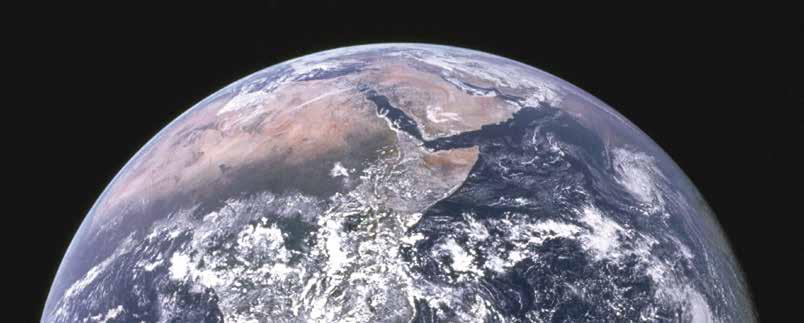
The Blue Planet. The Big Blue Marble. The Blue Sphere. Have you heard these nicknames for our planet? Why are they a good fit? Because the ocean covers roughly 70 percent of the planet! If you look at Earth from space, it looks like a bright blue dot among other, less colorful space objects, none of which have liquid water.
ESSENTIAL QUESTION
What role did the ocean play in the development of life on Earth?
The world’s ocean takes on many different forms. Some parts are shallow and clear, teeming with colorful fish. Other areas are deep and dark and mysterious. Still other parts of the ocean send waves pounding against sandy beaches or rocky shores. Sometimes, the ocean roils and twists with swells as tall as buildings. And then there are the days when the ocean is calm and quiet, lapping at our toes or slapping rhythmically against our boats.
THE OCEAN
WORDS TO KNOW
equator: an imaginary line around the earth, halfway between the North and South Poles.
tropical: the area around the equator.
plankton: tiny aquatic organisms that drift in tides and currents of water.
marine: having to do with the ocean.
food web: a complex set of feeding relationships between plants and animals.
tide: the daily rise and fall of the ocean’s water level near a shore.
current: the constant movement of water in one direction.
phytoplankton: tiny, aquatic, plant-like organisms that produce their own energy through photosynthesis.
zooplankton: tiny animals that drift freely in salt water and fresh water.
photosynthesis: the process a plant uses to make its own food. The plant uses water and carbon dioxide in the presence of sunlight to make oxygen and sugar.
carbon dioxide (CO2): a gas formed by the burning of fossil fuels, the rotting of plants and animals, and the breathing out of animals, including humans.
oxygen: a gas in the air that animals and humans need to breathe to stay alive.
The ocean is both mighty and fragile. It is full of mysteries yet to be discovered. And, most importantly, it is essential to all life on Earth.
Should you use the word ocean or sea ? Use the word sea to refer to a smaller body of water that is part of a larger ocean.
OCEANS OF THE WORLD
You may have heard that there are five oceans on Earth: Pacific, Atlantic, Indian, Southern, and Arctic. This is true. Yet the ocean is actually one enormous body of salt water. The five oceans are all connected with no boundaries between them, like a house with no walls on the inside.
The largest and deepest of Earth’s oceans is the Pacific.
Earth from space. Look at all that water! credit: NASA’s Earth Observatory
At its widest point, the Pacific extends almost halfway around the planet. The Atlantic Ocean is the second largest ocean. It sits between the Americas and Europe and Africa.
The Pacific and Atlantic Oceans both straddle the equator. The Indian Ocean lies south of the equator and Asia and has mostly tropical waters. The Southern Ocean surrounds Antarctica and is the iciest, windiest, and most dangerous of the five oceans. On the opposite side of the globe, the Arctic encircles the North Pole. Most of the year, the waters of this smallest ocean are covered in sea ice—some of it stays frozen year-round.
Of all the water on Earth, 97 percent is in the ocean.
SPECIES SPOTLIGHT
Plankton
Plankton are small. Most are less than an inch long and many cannot be seen without a microscope. But they are mighty! They form the base of the whole marine food web. Most plankton spend their entire life cycle drifting in the water, carried by tides and currents. Their very name comes from the Greek word planktos, which means “wanderer” or “drifter.”
There are two types of plankton: phytoplankton and zooplankton. Phytoplankton are tiny aquatic plants and zooplankton are tiny animals. Phytoplankton produce their own food through photosynthesis, just as plants on land do.
These tiny plants produce oxygen. In fact, 50 percent of our oxygen is produced by phytoplankton!
Zooplankton include sea snails, krill, and worms of the open ocean. Zooplankton and other small aquatic species eat phytoplankton. In turn, zooplankton are a key food source for larger species. In the ocean, giant whales including humpbacks and blue whales survive largely on krill!
Phytoplankton may be microscopic, yet they are essential to life on our planet. Learn more about them on this SciShow video. Why do we owe our lives to phytoplankton?
SciShow phytoplankton
THE OCEAN
WORDS TO KNOW
molten: made liquid by heat.
water vapor: the gas form of water in the air.
condense: the process by which a gas cools and becomes a liquid.
mineral: a naturally occurring solid found in rocks and in the ground, such as gold, salt, and copper.
erode: to wear away.
basin: a depression in Earth’s crust that holds water.
comet: a ball of ice and dust that orbits the sun.
continent: one of the earth’s large landmasses, including Africa, Antarctica, Australia, North America, South America, and Asia and Europe (called Eurasia).
geology: the study of the physical features of Earth, including its layers.
dense: packed tightly together.
inner core: the innermost layer of Earth, made of super-hot solid metal.
outer core: a spinning mix of liquid nickel and iron surrounding Earth’s inner core.
mantle: the middle layer of Earth.
crust: the earth’s outer layer.
basalt: a black, shiny volcanic rock.
granite: a type of rock that contains many crystals. It is formed underground during a long period of time with an enormous amount of pressure.
salinity: the measure of dissolved salts in water.
THE OCEAN’S BEGINNINGS
The way the ocean looks now is very different from how it used to look. In fact, when Earth formed more than 4.5 billion years ago, there was no ocean at all—the planet was way too hot. It was so hot that the rocks were molten , glowing liquid. As millions of years passed, though, the planet cooled enough for water vapor to condense. That allowed water to gather and oceans to form.
The ocean is salty because of dissolved minerals that originated on land. During millions of years, rain erodes rocks on land and washes the minerals out to sea, where they accumulate.
We are lucky to have that water on Earth—we wouldn’t be here without it! But scientists are still not completely certain where that first water vapor came from.
One theory is that the water was already here when Earth formed. According to that theory, as the molten rock cooled, it released water vapor, which condensed into rain and eventually filled basins that became our oceans. Another theory suggests that icy comets struck our planet when it was young, bringing us water. The reality is that our water may have come from multiple sources and scientists are still investigating.
No matter the source, water accumulated on Earth and the ocean formed about 3.8 billion years ago. Earth used to be one, huge shallow ocean covering the whole planet—there were no continents.
Here we must pause for a short geology lesson. Yes, this is a book about the ocean, not rocks. But in order to understand our ocean’s past and present, we need to understand what Earth is made of.
Let’s start with the four layers of Earth. As the planet formed, layers of lighter and heavier rock separated. The denser, heavier rock—made of iron and nickel—sunk deep toward the center of Earth to make up the solid inner core. The outer core is also made of iron and nickel but in liquid form. The next layer is the mantle , made of iron, magnesium, and silicon. This layer is also liquid but thicker than the outer core. Finally, the lighter rock formed the crust , the thinnest layer.
The crust is made of two kinds of rock, basalt and granite. Basalt is denser than granite. Gradually, these lighter and heavier rocks in the crust also separated into layers.
Learn more about ocean salinity from this Woods Hole Oceanographic Institution video. Where on Earth are the oceans the least salty?
Woods Hole salty
THE OCEAN
WORDS TO KNOW
oceanic crust: the section of Earth’s crust located on the floor of ocean basins.
continental crust: the part of the earth’s crust that forms the continents.
tectonic plates: the large solid pieces of Earth’s crust that float on the mantle.
microbes: tiny organisms too small to see without a microscope, including bacteria, viruses, and some algae.
environment: a natural area with animals, plants, rocks, soil, and water.
hydrothermal vents: undersea hot springs that spew mineral-rich water.
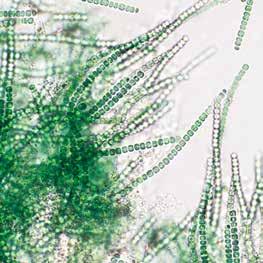
cyanobacteria: a blue-green type of aquatic bacteria that produces oxygen through photosynthesis.
atmosphere: the blanket of gases around the earth.
cataract: a type of waterfall with a large vertical drop.
sea level: the level of the surface of the sea.
topography: the physical features of the surface of the earth.
Basalt formed the oceanic crust , which pushed deep into the mantle. This created basins, where water accumulated and formed the ocean. The lighter granite rose and formed the continental crust . The first continents emerged from the ocean approximately 3 billion years ago.
Now, the Earth’s crust is not one solid shell around the planet like the shell of an egg. Instead, it’s in pieces—similar to a gigantic puzzle. Those pieces are called tectonic plates , and they float on Earth’s mantle of hot, partially molten rock. Continents sit on the tectonic plates. And even though we can’t see or feel it, those plates and continents are always moving! The moving plates change the size and shape of the ocean basins.
Okay, geology lesson complete. While Earth’s tectonic plates were busy drifting around and crashing into each other, something extraordinary was happening in the ocean. Life began.
LIFE ON EARTH
Learn more about tectonic plates on the American Museum of Natural History website. How have plate tectonics affected our planet?
When Earth was a hot, roiling, gassy mess, life could not exist. But, as you know, the planet cooled. That’s when the first single-celled organisms appeared in the ocean— roughly 3.5 billion years ago. They set the stage for all life on Earth.
AMNH Pangaea
Those microbes survived in a harsh environment lots of carbon dioxide (CO 2) and methane and almost no oxygen. Instead of using the sun, they got their energy from underwater hydrothermal vents that spewed mineral-rich water, allowing them to grow and reproduce. Millions of years later, microbes called cyanobacteria evolved.
World Records
Roughly half the oxygen in our atmosphere today is produced by plankton in the ocean.
While the ocean itself is incredible, it is also full of world-record features!
› Longest mountain range: You might guess that the longest mountain range is the Andes in South America (about 4,350 miles long). But the longest is actually under water—the mid-ocean ridge stretches more than 40,000 miles around the planet.
› Largest waterfall: A waterfall in the ocean might sound odd, but the Denmark Strait cataract between Iceland and Greenland is the world’s largest. Denser cold water from the Nordic Seas meets warmer waters in the strait and plunges nearly 2 miles over a huge underwater drop.
› Tallest mountain: Most mountains rise above the continent on which they sit. Mauna Kea, however, rises from the ocean floor. Approximately 13,780 feet of the mountain are above sea level. But, measured from its base beneath the ocean, the whole mountain is 33,500 feet tall.
› Deepest trench: Far below the surface of the ocean is the Mariana Trench in the Pacific Ocean. This curved trench is more than 1,500 miles long and 43 miles wide. Challenger Deep is its deepest point at a depth of 36,000 feet—that’s the deepest point in the ocean.
› Largest living structure: The world’s largest living structure can even be seen from space! It is the Great Barrier Reef off the coast of Queensland, Australia, which covers approximately 133,000 square miles and is nearly 1,500 miles long.
To better understand how an underwater waterfall works, visit the National Oceanic and Atmospheric Administration (NOAA) website. How does the topography of the seafloor help create this waterfall?
NOAA largest underwater waterfall
THE OCEAN
WORDS TO KNOW
evolution: the process of living things gradually changing to adapt to the world around them.
organism: a living thing, such as an animal or a plant.
Great Oxygenation Event: the introduction of oxygen into the earth’s atmosphere 2 billion years ago.
biodiversity: the variety of life on Earth.
multicellular: an organism with two or more cells.
species: a group of organisms that share common traits and can reproduce offspring of their own kind.
algae: plant-like organisms that turn light into energy but do not have leaves or roots.
primary producer: a plant that creates its own food for energy through photosynthesis, forming the base of the food chain.
primary consumer: a plant or animal that eats tiny plants and phytoplankton.
crustacean: an animal that has a hard shell and jointed legs, such as a lobster, crab, or shrimp. Most are aquatic.
baleen: the tough, flexible material hanging down in some whales’ mouths to help trap their food.
predator: an animal that hunts another animal for food.
conservation: protecting nature.
Cyanobacteria can convert sunlight into energy through photosynthesis. The evolution of this microbe changed the course of life on Earth. Here’s why: During photosynthesis, cyanobacteria expel oxygen as waste. Believe it or not, those microscopic photosynthetic organisms are responsible for the buildup of oxygen in our atmosphere! Their waste is the oxygen we breathe! This Great Oxygenation Event took place more than 2 billion years ago.
For a look at the origins of life on Earth, watch this TED-Ed video. How did scientists determine the most likely starting point for life on our planet?
Having oxygen in the atmosphere changed everything—thank you, cyanobacteria! More complex life forms evolved. Biodiversity increased. The first multicellular organisms appeared approximately 1.5 billion years ago. These were the beginnings of simple plants and animals.
Even as more complex life forms evolved, all life was in the ocean. Plant life gradually began moving onto land about 500 million years ago. That set the stage for the evolution of land animals. Both on land and in the ocean, life continued to evolve, becoming more diverse and more complex, leading to the plants and animals we know now.
TED-Ed life origins
Cyanobacteria
LIFE ZONES IN THE OCEAN
Today, there are thousands of species of plants and animals living in the ocean. These include some of Earth’s smallest life forms, such as microscopic algae called phytoplankton, and the largest animal ever to live on Earth, the blue whale.
The tiny phytoplankton are at the base of the marine food web. These primary producers use sunlight to make their own food. They are, in turn, eaten by primary consumers , including zooplankton, crustaceans , and small fish. Zooplankton are then eaten by larger consumers such as fish, crustaceans, sharks, and baleen whales. The ocean’s top predators include toothed whales, large sharks, marlin, dolphins, and leopard seals.
Explorer: Jacques Cousteau
Frenchman Jacques Cousteau (1910–1997) was a pioneer in ocean exploration and conservation. In 1943, he and Emile Gagnan (1900–1984) invented the aqualung. The aqualung allowed people to move about freely and breathe under water for long periods of time. It was called the Self-Contained Underwater Breathing Apparatus, known today as scuba.
Cousteau spent nearly seven decades conducting research and exploring the sea, studies made possible by the aqualung. Through his expeditions, he not only discovered the wonders of the ocean but also its fragility. Cousteau understood that the ocean needed protecting. To raise awareness, he brought the undersea world to the public through his films and books, believing that “people protect what they love.” Cousteau inspired millions of scientists, explorers, and conservationists to protect Earth’s oceans and its biodiversity.
Cousteau’s legacy lives on in the exploration and research of the Cousteau Society. Visit its website to learn more. Why is the work of the Cousteau Society important to the planet?
Cousteau Society
THE OCEAN
WORDS TO KNOW
ecosystem: an interdependent community of living and nonliving things and their environment.
adapt: to make a change to better survive in an environment.
water column: the vertical column in a body of water from the surface to the bottom, with different features at different depths.
sonar: the use of sound waves to measure depth and detect objects under water.
hull: the body or frame of a boat.
emit: to send or give out something, such as smoke, gas, heat, or light.
In today’s ocean, there are five different life zones. Each is its own unique ecosystem with organisms adapted to living there.
• Sunlit Zone: Can you guess how this zone got its name? This is the zone that is closest to the surface of the ocean, where sunlight reaches into the water to a depth of 660 feet. And, thanks to the sun, the water is warmer in this zone than in deeper water. This part of the water column is only about 2 to 3 percent of the whole ocean, but 90 percent of marine species live there.
• Twilight Zone: This zone is well-named, too. It is the layer of the ocean just below the sunlit zone, from 660 to 3,300 feet deep. The light is dim in this zone and because of that, there is no plant life.
Tech Talk: Mapping the Seafloor
The exploration of the ocean includes mapping the seafloor. Yet, as of 2024, just more than 25 percent had been mapped in high-resolution using multibeam sonar. The sonar is attached to the hull of a ship and sends out multiple sound waves in a fan shape. The technology measures how much time passes between the sound wave being emitted, hitting the seafloor, and returning. The pings, or return sounds, allow scientists to create an image of the seafloor and the nearby land areas. These images reveal the ocean depth and the terrain of the seafloor— including mountains, trenches, and volcanoes. It also reveals shipwrecks!
This information adds to our understanding of the ocean and helps with ocean navigation, laying cables and pipelines, and mining. With a map of the seafloor, we can make informed decisions about regulations and conservation.
• Midnight Zone: Below the twilight zone is the midnight zone, down to a depth of 13,100 feet. As the name suggests, there is no light here. Despite the lack of light, cold temperatures, and extreme water pressure, many species are adapted to life in this zone.
• Abyssal Zone: Deeper still is the abyssal zone, which extends to 21,325 feet deep. Most of the oceans bottom out in the midnight zone, yet there are trenches and canyons that extend deeper into this zone. Often called the abyss, the abyssal zone is deeper, darker, and under more pressure than the midnight zone.
This video, The Life Hydraulic, takes you on a deep dive through the layers of the oceans. How do conditions change as you dive deeper into the ocean?
• Hadal Zone: The deepest zone of the ocean was named after the Greek god of the underworld, Hades. This zone is found in deep ocean trenches that extend down to a depth of 36,000 feet. It is a world of extremes and low biodiversity.
The Scientific Method
A scientific method worksheet is a useful tool for keeping your ideas and observations organized. The scientific method is the process scientists use to ask and answer questions. Use your science notebook to make a scientific method worksheet for each experiment you do.
Question: What are we trying to find out? What problem are we trying to solve?
Research: What is already known about this topic?
Hypothesis: What do we think the answer will be?
Equipment: What supplies are we using?
Method: What procedure are we following?
Results: What happened and why?
TED-Ed Life Hydraulic
WORDS TO KNOW
oceanographer: a scientist who studies the ocean and the plants and animals that live there.
We know a lot about the ocean, yet much of it remains a mystery. It is the least explored ecosystem on the planet. While the ocean covers more than 71 percent of our planet, only 5 percent of it has been explored.
As you read this book, you will become an oceanographer, exploring many different aspects of the ocean, from the huge role it plays on the planet to the fascinating marine life found under the surface. You will also learn how we rely on the ocean for food, transportation, and recreation— and the impact humans have made on it. Plus, you will see how people around the world are working to protect our amazing oceans and how you can contribute, too.
If you’ve ever taken a deep dive in a pool, lake, or ocean and felt your ears pop, you know that the pressure increases the lower you go. Water pressure is one reason why the ocean depths have not been more fully explored.
Essential Questions
Each chapter of this book begins with an essential question to help guide your exploration of the world’s oceans. Keep this question in mind as you read the chapter. At the end of each chapter, use your science journal to record your thoughts and answers.
ESSENTIAL QUESTION
What role did the ocean play in the development of life on Earth?
THE OCEAN IS SALTY!
One of the ocean’s best-known characteristics is that it is salty. The ocean’s salinity affects both the water’s density as well as the temperature at which it freezes. See for yourself!
› Start by making salt water: In the measuring cup, dissolve 3 tablespoons of salt in 1 cup of water. Stir to combine. Pour the salt water into one of the plastic cups until the cup is about threequarters full. Fill a different plastic cup with the same amount of fresh water.
› Predict whether you think a plastic jewel will float in the fresh water (Note: if you don’t have plastic jewels, try using a small grape or a raw egg in its shell). Place it in the water.
› Do you think the object will float in the salt water? Place it in the salt water. Record your observations.
IDEAS FOR SUPPLIES
• measuring cup
• salt
• measuring spoons
• fresh water
• spoon
• 4 plastic cups the same size (6 oz or larger)
• small plastic jewels
• food coloring
Try This
Repeat the experiments using sugar in one cup (3 tablespoons dissolved in 1 cup water) and baking soda in another (3 tablespoons dissolved in 1 cup water). Predict what will happen. What do your results tell you about these substances?
› Remove the objects from the cups and put both in the freezer. For the first two to three hours, check the cups every half hour. Observe and record what you see. Did the salt water or the fresh water freeze first? What happened after 24 hours?
› Next, make a new batch of salt water, dissolving 3 tablespoons of salt in 1 cup of water in the measuring cup. Stir to combine. Pour the salt water into one of the plastic cups until the cup is about one-half full. Fill a second cup half full of fresh water. Add several drops of food coloring to the fresh water and stir to combine.
› Add the colored water to the salt water, pouring down the edge of the cup. What happens? Do the solutions mix? Which solution is denser?
WORDS TO KNOW
TEXT TO WORLD
Have you been near the ocean? What did it look like? Smell like? Feel like?
density: a measure of how closely packed items are.
What does the ocean do?
The mighty ocean covers 70 percent of the planet, supports well over 100,000 marine species, regulates climate, feeds billions of people, and plays a key role in the carbon cycle.
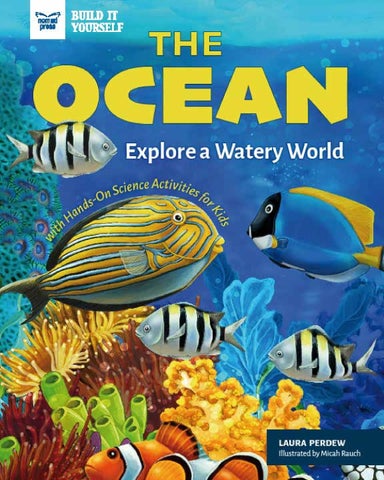
In The Ocean: Explore a Watery World with Hands-On Science Activities for Kids, young marine biologists learn the ocean’s history and the key roles it plays on Earth, including its part in the carbon cycle and in regulating weather and climate. Explore the polar oceans, intertidal zones, the shallow ocean, and the deep open ocean, and the incredible biodiversity adapted to living there. Find out how people use and rely on the ocean and how humans are making a giant impact on this massive body of water.
A compelling narrative style, fun facts, glossary words defined on the page, and links to primary source combine to take readers on an on an investigative journey of the ocean.
Try these hands-on STEM activities!
• Experiment with salinity
• Model ocean currents
• Test blubber gloves
• Conduct a fish count
• Host an ocean explorers podcast
Praise for Biodiversity by Laura Perdew
“Activities and accessible text bring the importance and complexity of biodiversity to upper-elementary and middleschool students.”
Booklist
Top 10 Books on the Environment & Sustainability for Youth: 2020
Distributed by Baker & Taylor Publisher Services
To order: orders@btpubservices.com, 888.814.0208
For more information, contact Nomad Press: info@nomadpress.net, 802.649.1995
JUVENILE NONFICTION
EDUCATION RESOURCE focus on science
Books from Nomad Press include the following educational components:
Timeline of important events
Hands-on, science-minded activities
Links to online media
Essential questions
Text-to-world connections
Primary sources, including maps, photographs, and letters
Extensive back matter, including glossary, index, and resources
Guided Reading Levels and Lexile measurements
PUB DATE: MAY 2026
PB: 9781647411510, $19.95
HC: 9781647411480, $24.95
eBook: all formats available, $12.99
Specs: 8 x 10, 128 pages, color interior with illustrations and photography