
We support policies that will unlock land, speed up permitting, and make housing projects pencil out in today’s market, because every Washingtonian needs an affordable place to call home.

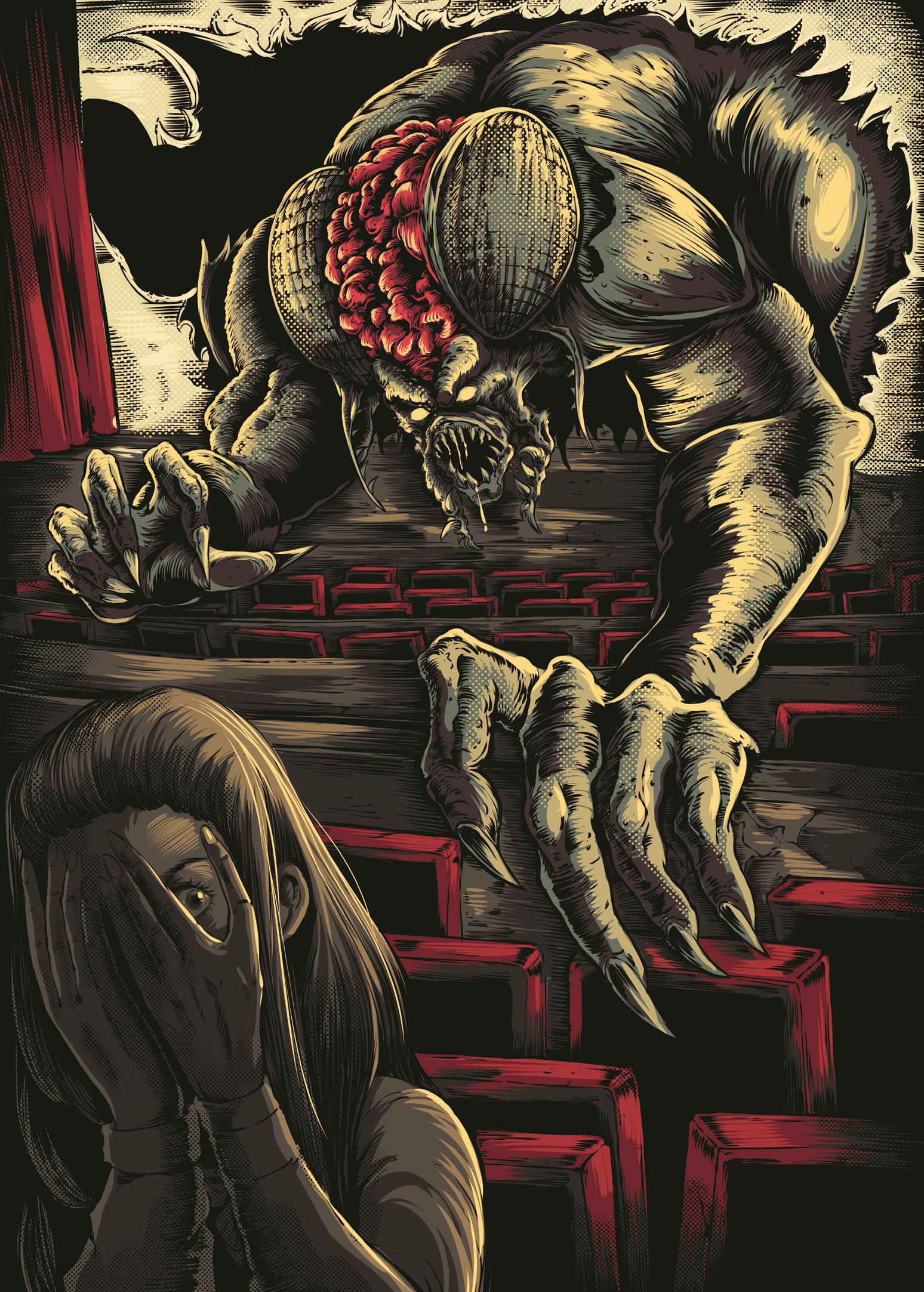
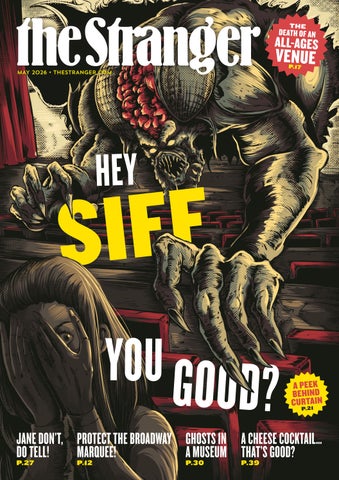
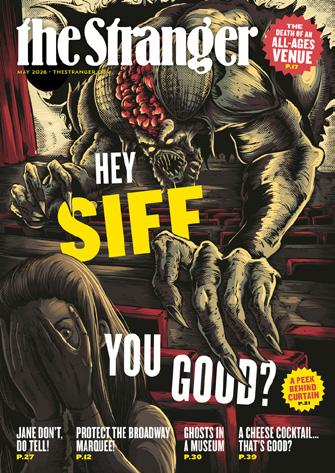
It’s that time of year again: The daffodils have bloomed, the trees have leaves again, and the Seattle International Film Festival is back on our doorstep.
The festival is a little smaller than it has been in the past, which is no surprise. SIFF has been through a hell of a year, from layoffs to ousted leadership to closing down the Egyptian. So before we dove into the film lineup, Stranger contributor Chase Hutchinson asked them the ques tion we all want to know the answer to: SIFF, you good? (They’re not, but staff say they’re feel ing optimistic. Read more on pg. 21).
And then there’s the lineup. It’s rich with locally made films this year, and we’re really excited about some of them (see pg. 24). Two titles we are still talking about include Valerie Veatch’s chilling film about the origins of AI and its connections to eugenics and Chezik Tsunoda’s stunning, nuanced documentary about Seattle’s homeless crisis.
But this issue isn’t all about SIFF. Remember in our March issue, when we found out that a McDonald’s might move into the old Broadway Theater/Rite Aid
space on Capitol Hill? Arts editor Emily Nokes begged the city to have a little more imagination—an arts space, or a skating rink, perhaps? But since we don’t have faith that whimsy will trump McDonald’s cold, hard cash, this month we tried a different angle. Make it whatever you want, but leave us the sign. On pg. 12, you’ll see our pitch to the Landmarks Preservation Board: We need density, we need progress, we need storefronts that aren’t empty. But we also should be able to see pieces of our city’s history.
In the spirit of preservation, we’re also honoring a space that wasn’t saved: the Old Fire House. The all-ages space in Redmond was a rare, essential space for teens in the Aughts, and Jas Keimig went to its goodbye party (pg. 17).
And as always, we have an arts section bursting at the seams: an interview with our homecoming queen Jane Don’t, after her incredible performance on RuPaul’s Drag Race (pg. 27), a haunted exhibit at the Tacoma Art Museum (pg. 30), a calendar with everything you could possibly want to do this month (pg. 40), and more.
See you in the SIFF lines, passholes.
Panic, but not pain
Lopsided DIY Breasts
Perfect breasts
Breasts that have had a long day
The Enya-coded interior design of the mammography wing
Learning in therapy that procrastination is a manifestation of never being taught you’re worthy of basic self-care as a child, and growing up believing you deserve that disruptive chaos.
Once again, Adderall
Iris Murdoch
Using a cold Strawberry Kiwi Capri-Sun as a post-cry eyemask
Mini Tug
Pumpkin head essay face
The 45-hour-long Sylvia Plath biography audiobook
Daiso musubi maker
Nearly 18,000 angry hockey fans chanting “Ref, you suck!” no fewer than seven times during the Torrent’s final game of the season because what the fuck, refs, that wasn’t hooking or tripping, and you absolutely missed a boarding call!
Pondering at the beach
Balls in Chicago
Kuck Patel
The Neglected Daughters of Twinks
The angry hornet that refused to leave the office, no matter how many windows we opened, until, finally, Hunter, who was the only person tall enough to reach the bee’s flight path, trapped it in a cup and released it outside against its will
$1k from 10 gentlemen
“Mushrooms only / ketamine weekends”
Hentai afternoons with a margarita in my hand
The two wolves inside of me that are going on strike
Winning Monopoly by eating all the money
Breaking all my toes playing “roly poly” with my cousins
The way Cole Escola says “eat ass” in Season 3, Episode 5 of Difficult People
Baking the Pastry Project’s recipe for Brown Butter Blondies twice in one weekend
A mother beagle who does not like her son very much




HEAD
HEAD OF HUMAN RESOURCES Alia Graham
CHIEF STRATEGY AND COMPLIANCE OFFICER Kendall Turner
HEAD OF PRODUCT Anthony Hecht
STRATEGIC ADVISOR Tim Keck
MEMBERSHIP DIRECTOR Caroline Dodge
DIRECTOR, STRATEGIC PROJECTS
EXECUTIVE
EXECUTIVE


ILLUSTRATIONS BY IRENE CHUNG
Did you recently share a ~*moment*~ with someone while riding the bus, dancing at the club, or standing in line at the supermarket? Do you want to try to reconnect? Submit your own I Saw U at thestranger.com/ isawu, and maybe we’ll include it in the next roundup! Look for a new batch of I Saw U messages every week on TheStranger.com.
Spring Edition Red Bull on the new 2 Line 4/16
You: fade, tan jacket, beverage. Me: Black cap with flowers. We snuck glances the whole ride. You got off at East Main - let’s get off somewhere else.
Goldie @ Mermaid Lounge
Figured you were apart of my friend’s birthday party, alas you were a stranger. First to catch my eye, You vanished into the night. Fremont?

Trader Joe’s cutie
To the girl with the most gorgeous, teal eyes I’ve ever seen! U told me I was pretty while bagging my groceries at Cap Hill. Can we be best friends?
Wearing sunglasses in the coffee shop I work at You got a drip coffee and I gave it to you on the house. You chatted me up about exploring Asia. I panicked when u asked me out. Coffee sometime?
Pierced cutie with blue bike helmet on the Capitol Hill light rail escalator Cursing the lingering left-laners and their poor escalator etiquette with me (pink hair, black beanie) on the way out of the station. Bike ride?
Rainy day before Easter in Moab In Moab on the 11th at the bookstore, your friend said to you, “It’s sunny in Seattle”, and
you gave me a double-take as I met your gaze and smiled.
Orca Sweater 04/10
You: NW 59th St, orca sweater & a smile that made my week.
Me: Dark hair, glasses, hoodie, & chucks. Wish I had your # to try the new orca emojis.
Baba Yaga April Dead Disko Long Dark Haired Guy
You: young, sheer black shirt, chest tattoo (real) and face tattoo (painted) Me: older woman in a leopard coat in a sea of black, I’d love to see more
Cute guy in scrubs @ West Seattle Thriftway Fri 4/10
You, in blue scrubs ~2:30-3p next to me in the checkout. Then in the parking lot you wished me luck on the store’s raffle. Coffee? Make our own luck?

Handsome Haiku Writer
You’re so totally beautiful. I’d like to write one hundred haikus. Or bike one hundred miles and only complain once. Kiss me, pretty please?
Saltwater Crush
At Alki with those orange tinted glasses right as the sun was setting. Something overtook me, was the tide pulling me or was it you?
Car going downhill by Analog Coffee Heard some commotion out my window. Took a look, saw you and your friend helping a strangers (?) car with broken brakes. Tell me what happened next?
Pacific Hardware queer cutie with a matching sweater 4/17, I was there with a friend and his dog, you were getting keys made and said you have the same LL Bean sweater as me. Coffee?
Is it a match? Follow The Stranger on Instagram and leave a comment on our weekly I Saw U posts to connect!




ILLUSTRATION BY STEVEN WEISSMAN
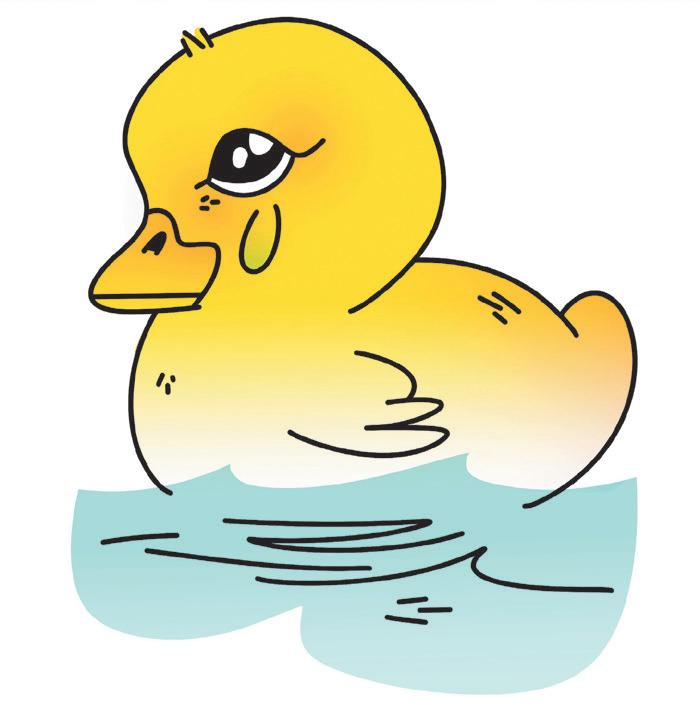
You cannot convince me Green Lake is a good date spot. It’s where nascent hopes of love and crushes go to die. Yes, there are cute ducks. Yes, there is a pretty view of the water. But in a city where dating is already a hellscape, somehow Green Lake makes it worse.
This is how I imagine the thought process of Green Lake daters: Are you emotionally unavailable? Take your date to Green Lake. Still getting over your ex? Take your date to Green Lake. Think your date’s Hinge pics are funny, but you don’t think they are cute? Green Lake.
All of my many dates there have ended in hopelessness.
The number of texts, both sent and received, from this cursed lake would put the number of sticks of gum on the gum wall to shame: “It was lovely to meet you, but there wasn’t a romantic connection. Though I really did enjoy our walk around Green Lake.”
Seattle singles, heed my warning. If you like someone, don’t take them to Green Lake.
Do you need to get something off your chest? Submit an I, Anonymous, and maybe we’ll illustrate it! Send your unsigned rant, love letter, confession, or accusation to ianonymous@thestranger.com. Please remember to change the names of the innocent and the guilty. Read more I, Anonymous letters every week at TheStranger.com.
All the Secret Bimbofication Fetishes and Kash Patel Lawsuits You May Have Missed in April
Bryon Noem, the husband of the former secretary of the Department of Homeland Security, Kristi Noem, allegedly has a “bimbofication fetish.” Meaning, he is into sharing pics of himself in a “hypersexual, exaggerated physical appearance” ( hot pants and huge fake boobs) with “fetish models.” Kristi’s representative claimed she and her family were blindsided by the images which were first posted by the Daily Mail, and they ask the public to give them privacy and prayers as they process and investigate the revelation.
***
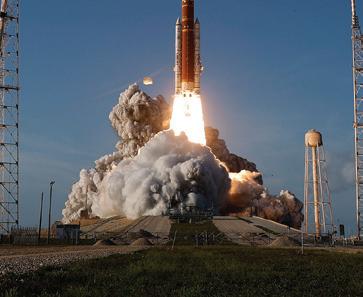
Four NASA astronauts headed to the moon on Artemis II in the first crewed lunar flyby mission in 50 years. The launch went off without a hitch. The whole journey took 10 days, and it was the second step toward a lunar surface mission. Artemis III which will test dock ing operations, and Artemis IV , which will carry a crew to the moon, are scheduled for 2027 and 2028, respec tively. NASA’s goal is to establish a permanent lunar base in the next decade or so.
their stories. The same goes for us, but we saw no reason for a press conference.
***
A toddler was hurt at the North American Wildlife Park in Pennsylvania after crawling under a fence and sticking his hand into the wolf enclosure. “A wolf approached and made contact with the child’s hand,” the zoo told USA Today. “This type of response is consistent with natural animal behavior, and was not a sign of aggression.” The zoo described the child’s injuries as minor. To be fair to the child—doggie. Doggie good.

***
Trump threatened to destroy Iran as a civilization over oil. He didn’t do it, but he still said it. We don’t know what the war’s status will be by press time, but we’re guessing “not over.”
***
Utah authorities tied the murder of Laura Ann Aime, a 17-year-old who disappeared on Halloween in 1974, to Seattle serial killer Ted Bundy. The Utah County Sheriff’s Office says a full DNA profile of Bundy has now been recovered and can be used to bring closure to cases of other long-suspected Bundy victims.
***
At least 20 canines, some skinned and missing their front paws , washed ashore on Guemes Island in Skagit County. Two had orange twine around their necks. This horrible story of possible dog murder our minds like an oil slick before we learned they were actually used for crabbing Who knew crabs had such erudite taste?
***
Out of nowhere, First Lady Melania Trump held a press confer ence to, she said, “ my good name.” In the six-minute statement, she announced that she had no relationship with Jeffrey Epstein, was not one of his victims, and didn’t know a single thing about his mis deeds, and that Congress should have a hearing where Epstein’s victims could share

BY STRANGER STAFF

*** The Pentagon interpreted Pope Leo’s State of the World speech at the top of the year (the one where he said that “war is back in vogue, and a zeal for war is spreading”) as a hostile message from the Vatican. Undersecretary of Defense Elbridge Colby summoned Cardinal Christophe Pierre, the Vatican’s US representative, to a closeddoor Pentagon meeting and told him the US military can do whatever it wants world. The Pope won’t be visiting us for a while.
***


Who’s gonna tell Doppler?
I don’t know if any of The readers are history buffs, but back in the 1930s and ’40s, the fascist Empire of Japan tried to conquer Asia and Oceania. So many millions of people died in an effort to stop them that when the US occupied Japan after the war, we forced them rewrite their constitution to make warring illegal. But we also kept the Japanese hard right in political power. That decision has come home to roost as the nation’s new prime minister, Sanae Takaichi, continues to tear up the country’s pacifist constitution so Japan can make money off the wars in Ukraine and Iran.
***
The expected lawsuit against Washington’s millionaire’s tax has been filed.
The Citizens Action Defense Fund, a conservative nonprofit partially hedge-fund millionaire Brian Heywood , is leading the anti-tax campaign. A bunch of rich weirdos have joined him. Former attorney general Rob McKenna is their lawyer. The courts will decide if they’re going to continue to uphold a 1933 ruling that’s made it impossible to establish a graduated income tax in the state.
***
US women gave birth to 710,000 fewer babies last year com pared to 2007, when the birthrate peaked. The Stranger news editor, Nathalie Gra ham, suggested Americans may not be fuckin’ and suckin’ enough. Fuckin’ we can understand. Suckin’ can’t get you preggers, Nathalie.
***
The City announced plans to contract with private security to patrol Golden Gardens and Magnuson Park overnight, from May 1 to September 30. Apparently, it’s to deter late-night “boom” parties at the parks, which have “loud music.” Okay, Mom.
***
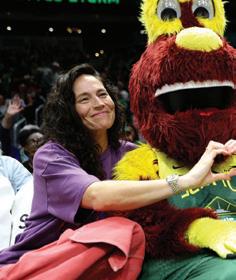
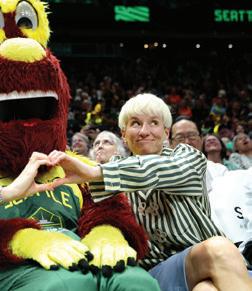
Sue Bird and Megan Rapinoe are splitting up after 10 years, the couple announced on their podcast A Touch More. Now, they’ll just do their own podcasts
***


The White House correspondents’ dinner, a bad idea with a fascist in the White House, proved to be an even worse one when a man armed with guns and knives plowed through security in a mad dash toward the subterranean ballroom containing President Donald Trump, his lackeys, and hundreds of journalists. Cole Tomas Allen, 31, was tackled to the ground. An officer was shot in the bullet-proof vest. New details suggest it may have been friendly fire. He’s facing at least two firearms charges, including a count for shooting that officer.




BY MEGAN SELING
May 6
Seattle Indivisible gathers at the Washington State Labor Council the first Wednesday of every month, and it’s a good place to start if you’re looking to learn more about the org’s efforts. Sure, you show up to all the big protests, but Indivisible also organizes smaller, consistent demonstrations and events including weekly sign waving on I-5 overpasses and lunchtime Zoom meetings with our representatives in the House and Senate. ( Washington State Labor Council, 6:30–8 pm)
May 9
SEIU 775 (Service Employees International Union 775) and La Resistencia will gather outside the Northwest Detention Center to show their support for detainees. La Resistencia regularly hosts vigils outside the detention center and monitors deportation flights out of the King County International Airport. So far this year, 12 NWDC detainees have participated in hunger strikes, and many of La Resistencia’s calls to action are posted the day that they’re happening. Follow them on Bluesky (@laresistencianw.bsky.social) and Instagram (@laresistencianw) to get their alerts. (Tacoma Northwest Detention Center, 1–3 pm)
‘Protest: Respect It Defend It Use It’ with Annie Leonard & André Carothers
May 11 and 12
On May 11, Annie Leonard (the former executive director of Greenpeace) and André Carothers (who worked for Greenpeace for more than a decade and served on the board of directors) will discuss their new book, Protest: Respect It Defend It Use It at Elliott Bay Book Company. The book features photos of and essays about more than 40 different historical protests and campaigns. The next day, they’ll host a free training session to get people inspired and offer tips for fighting authoritarianism. (RSVP is required to get the location.) Honestly, I’m interested in going if only for the free ice cream and Lush products they’re promising “because resistance is stronger when we take care of each other.” Amen. ( Elliott Bay Book Company, 7 pm )
May 14 and 26
For 10 years, the Washington Immigrant Solidarity Network has been organizing rapid response efforts throughout the state and supporting immigrants and refugees
through mutual aid and legal resources. If you’re wondering what to do if you think you spot ICE in your neighborhood, catch one of WAISN’s free and virtual rapid response training sessions on May 14 or 26. They know better than the rando in your Signal chat who just started paying attention. WAISN is also offering a Know Your Rights virtual workshop on May 13. RSVP is required to attend, and courses are offered in both English and Spanish. Learn more at waisn.org. (Virtual, 6–8 pm)
Various dates
Postcards4Democracy meets every Tuesday and every first Saturday of the month at C&P Coffee to send postcards and letters that encourage voters to participate in local elections. They provide supplies, addresses, and a script to make it easy, but you can also bring your own materials (or a little cash to help with the cost of stamps). Find more details and letter-writing resources at postcards4democracy.org. (C&P Coffee, 12:30–2:30 pm)
Every Friday
Every Friday morning, Southend Indivisible gathers in front of the Department of Homeland Security building at 12500 Tukwila International Boulevard to “demand an end to the kidnappings of our neighbors, separation of families, and terrorizing of our community.” Bring a sign, or make one on-site with provided materials. ( Department of Homeland Security, Tukwila, 9 am–10:30 am)
Every Saturday
Those sign-wavers you see every Saturday morning at the University Village when you go to pick up Hey Bagels? That’s the Defund Musk crew, and you can join them! They gather at the 45th Street entrance of the U Village parking lot from 10 am to noon to say “No bombs, no billionaires.” (University Village, 45th St entrance, 10 am–noon)
Every Sunday
Every Sunday, Seattle’s most punk-rock art shop, Push/Pull, hosts free Riff Raff League meetings, where folks can talk about political action and mutual aid while making zines, posters, buttons, and whistle kits for their neighbors. While you’re there, grab a free ABOLISH ICE poster and sign up for one of their monthly zine-making workshops. Masks are required. ( Push/ Pull, 7:15 pm–8:15 pm)
Want to tell us about an event? Email us at WheretoScream@TheStranger.com. Find more listings on our sister site, EverOut.com/Seattle.

So We Want to Send This Article to the Landmarks Preservation Board
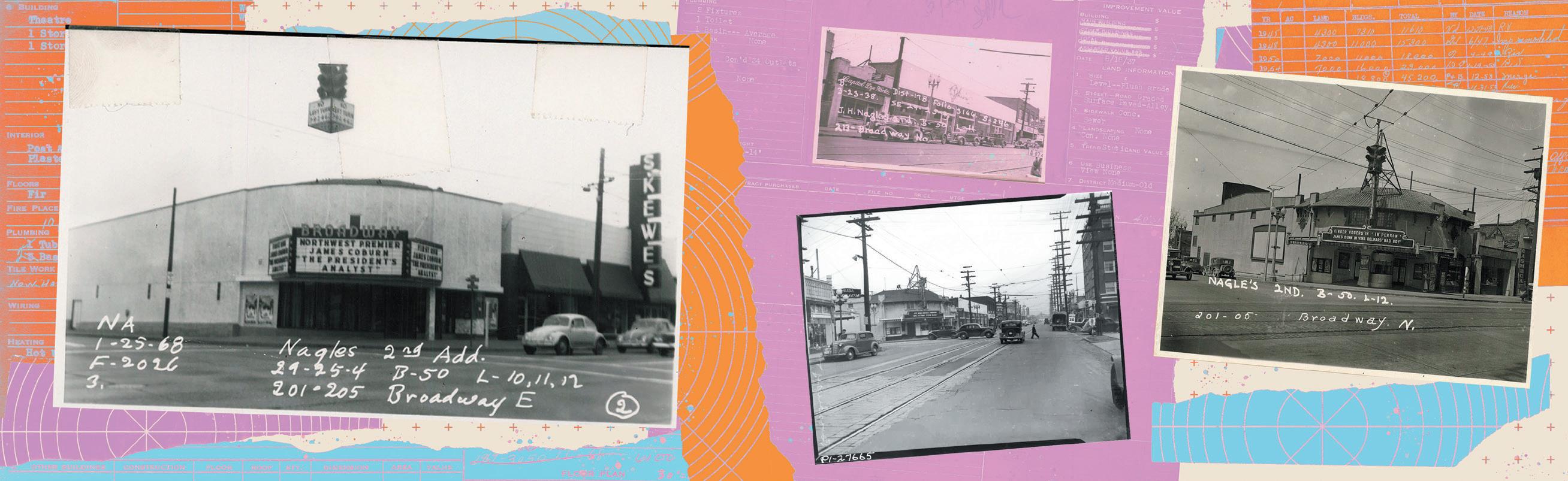
In February, news broke that McDonald’s had filed for a permit to spend $750,000 to turn the old Broadway Theater (once our most fashionable Rite Aid) into a fast food restaurant.
We groaned a collective groan. McDonald’s doesn’t just move in. They turn storefronts into a wash of grays and blacks, with ever-growing golden arches. In our March issue, Emily Nokes begged for a little more imagination: “‘Preservation’ is a loaded concept when we need max efficiency in this expensive-as-fuck city of ours,” she wrote. “But must every choice we make include no rizz whatsoever? If we need a neighborhood sacrifice, why not tear down the US Bank across the street?” It could be a venue, a skating rink, an indoor sculpture park, a magic show emporium.
Or, imagine it’s a McDonald’s, she wrote. But we take inspiration from the residents of New Hyde Park, NY, who rallied to save a historic mansion
in 1985 that was facing the same fate. The home earned historic status in 1988, and McDonald’s had to restore the façade to its 1926 beauty before it reopened as a McDonald’s in 1991.
In The Stranger ’s newsroom, we all agreed: In a 7000 square-foot space on a main thoroughfare, our chances of getting something other than a national chain might be slim. But maybe we could make sure, no matter who the tenant in the building is, that the neigh-
“It’s noteworthy that whoever first converted the building cared enough to preserve it.”
borhood always gets to see the iconic Broadway Theater marquee.
Our main option for preserving the structures in this city that we love is through the Landmarks Preservation Board—a part of Seattle’s Department of Neighborhoods that has long been a frustrating force for urbanists in the city. Since its founding in 1973, the board has designated more than 400 Seattle sites, buildings, boats, cars, and street clocks as landmarks. And with that designation comes protection: from demolition, major alterations, or capitalism in general.
According to our municipal code, something can become a landmark for a handful of reasons: (1) if it’s associated with a significant historical event, (2) if it’s tied to an important person, (3) if it’s significant to the heritage of a specific community, (4) if it captures a specific architectural style, architect, or builder, or (5) because it’s an “identifiable visual

feature of its neighborhood… and contributes to the distinctive quality or identity of such neighborhood or the City.”
The theater’s architecture is ordinary. Aside from an unfortunate string of deaths associated with the Theater, we can’t tie it to any historical events. And the most important person to speak there was a candidate for coroner. But we think the marquee fits right into number five: an identifiable feature of a neighborhood. And that’s what we’re going to use to try to protect it.
That marquee is the welcome sign for Capitol Hill. It’s the first thing you see when you crest the hill on Olive Way, or come out of the light rail station. In a neighborhood that’s rapidly developing, it’s a reminder of the neighborhood’s history, and our choice to preserve that for decades. Because it’s fun. Because it’s whimsical. Because it’s rare to get to see anyone’s name in lights. And it’s certainly an “identifiable visual feature” of
Capitol Hill that contributes to “the distinctive quality” of the neighborhood.
We here in The Stranger offices might all agree, at least, but that case is harder to make to the Landmarks Preservation Board. Eugenia Woo, the director of preservation services at Historic Seattle, says the building’s exterior has likely been through too many alterations to qualify as a whole.
The marquee is a different story, though. The “Broadway” sign looks as it did when it became the Broadway Theater in the late 1940s, Woo says. It’s the marquee it had in 1977 when the theater hosted the opening of the first feature film to be financed and produced entirely by people in the Pacific Northwest. And it was functional when the Rite Aid closed down in 2023.
But the board has “a high bar for designation, as it should,” says Jeff Murdock, the preservation advocacy manager of Historic Seattle. He was on the Board in 2016, when the Guild 45th was under consideration for landmark status. “I felt that the building (even though it had
been altered from its original early Mediterranean revival style) was significant even with (and because of) its art moderne remodel,” he told The Stranger in an email. But it was voted down. “It still stings when I think about it,” he says.
He expects the old Broadway Theater would meet a similar fate. “It’s meaningful that we can all still look at this community landmark on that prominent corner and remember how important neighborhood theaters once were to Seattleites,” he says. But “there isn’t much left to designate.”
He wasn’t all doom, though. “It’s noteworthy that whoever first converted the building to a pharmacy cared enough to preserve the marquee,” he says. Which brings us to the next question: the ownership.
The building is owned by Limantzakis Properties No 2, LLC, which is run by a collection of Limantzakises: John, Johnette, and John II. If you’ve been in Seattle for a few decades, you might recognize the name. For more than 20 years, John and his wife Polette owned
The building itself, a wood-frame of average quality, is not special.
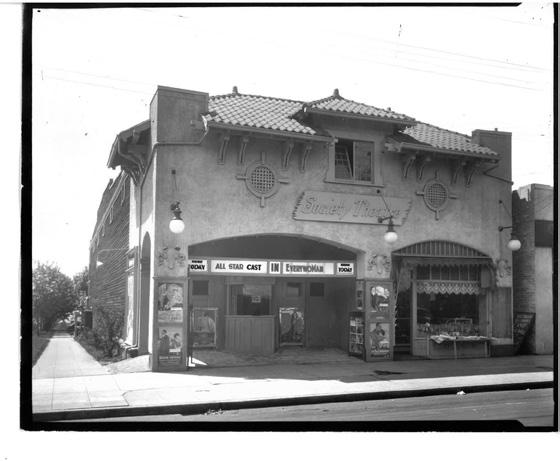
But its green and cream interiors trimmed with silver must have seemed so to a Seattle Daily Times reporter in 1911, when 201 Broadway Avenue East was taking its first infant gasp as the Society Theatre.
and operated Latitude 47, a waterfront steakhouse on Lake Union. (Rock Salt Steak House now lives at that same address.) But with the restaurant closed, they’re largely property owners now.
Until last year, ownership wouldn’t have mattered much in the question of landmarking a 100-year-old building. But in the 2025 legislative session, the state changed our landmarking rules, requiring that the owner of a building or other property provide written support for a landmark before it’s approved.
“Unless the owner of the property gives written consent for designation, I do not suggest preparing a nomination and submitting it to the landmarks board staff because they may not accept your application,” Woo of Historic Seattle told The Stranger
The good news is, John Limantzakis and his family have chosen to be stewards of the marquee for almost 40 years already, and we don’t think they’re changing course now. But by landmarking the sign, they can ensure that any future owners steward the sign as well
as they have. We were able to share the landmarking information with one of the owners shortly before press time, and will update this story when they respond. If we submit an application and get rejected, we won’t be able to apply for another five years. But if the owners are on board, we’re ready to go. We’ve already combed through our local newspaper archives to cobble together a comprehensive history of the space (below), from its early days as the Society Theatre, to its transformation to a pharmacy with a flashy marquee. In between, it witnessed some PNW firsts, a string of very unlucky managers, and earned the superlative as the most comfortable small theater in the city (it had air conditioning).
Seattle is growing, and with growth comes change and development. But that doesn’t mean we have to lose the evidence of our history in our built environment. Preserving this sign is a rare opportunity to allow for both. We’ve chosen to save it for decades: Let’s make it official. HANNAH MURPHY WINTER
A fitting name, the 500-seat “smart little playhouse” was the height of technological sophistication with its efficient ventilation system and two Powers No. 6 moving picture machines, which allowed the projectionist to play films back-toback without intermission. (Enough to brag about. More than half a century later, they’d advertise another technological marvel—“Now: For Your Enjoyment Completely Air Conditioned.”)
The manager, George W. Ring, a Portlander with “a large, expansive smile” later appointed to Seattle’s censor board by Mayor Hugh M. Caldwell, prophesied it’d be as much of a gold -

mine as the theater a block south, where it was common to see 20 automobiles outside the doors before showtime. Ring, an oilman and race horse breeder, would die in 1957.
In his stewardship, the Society Theatre tried its best to stay on the cutting edge. One ad from 1918 touted the 8-reel Tarzan of the Apes as “the photoplay that’s different.” In 1919, it screened the feminist allegory Everywoman , a now lost silent film, before women had the right to vote. More than movies graced the stage in those early years. There was an amateur play about a college freshman (“the romance has the usual happy ending”), a military academy slide deck and movie projecting a rosy life for Seattle’s wayward boys, and Republican speeches skewering Democrats for their anti-imperialist, low-tariff stance. In 1916, a candidate for coroner told a crowd at the Society he supported women on coroner’s juries both because it was their right and because they were better at it than men. That same year, the magazine Motography wrote about
The 500-seat “smart little playhouse” was the height of technological sophistication.

Ring’s “ingenious scheme” for a restroom in the theater where mothers could take their crying children and still see and hear the film. “There is no doubt that the mothers will all patronize this theater.” According to a 1961 obituary, the theatre’s former pianist for silent films, Florence Lillian Carr, was later known as the “dahlia lady,” because she sold dahlias in the Broadway district.
George W. Ring ran the theater with his wife, Frankie Ring. She took over when he was called to Camp Lewis to “ring in” the Kaiser during World War I. He survived the war, but if you consider the draft a misfortune, it was the first to befall a manager of this theater.
The second was Frankie Ring herself, who was robbed of the day’s receipts on March 23, 1921, for an amount totalling $106, more than $1,800 today, adjusted for inflation.
The third was manager P.J. DeClercq. In 1928, he (or a man by the same name) watched his father die from heart failure while reeling in a king salmon. He was on shore when his father keeled over. By the time he’d rowed frantically to him, Ralph de Vasseur was “stone dead across a seat.” Dangling at the end of the slack fishing line was the great king salmon, “also dead.” DeClercq was also sued by the “well-known Pacific Coast theatre man,” Harold Horne. According to the Seattle Post-Intelligencer , Horne accused DeClercq of luring him away from “a lucrative connection” to invest $10,000 into a corporation that would lease the Society for 99 years and buy the two adjoining lots. Horne charged that the lease cost $18,000 and the lots were taken out in DeClercq’s name, which Horne took as an attempt to defraud him. He wanted a receiver to take control of the theatre.
In 1932, 30-year-old Jack Hallett, another Society manager, was struck by an automobile on North Broadway and Olive Way. The driver, F.J. Nist, said Hallett was “walking against the traffic light.” Nist, president of the Seattle Box Company, booked the largest single order of egg cases on the Pacific Coast in 1923 and was a prolific breeder of Chesapeake dogs. It’s hard to say if he was much of a driver. Some sources say the Society was renamed the Broadway in 1921, but newspaper clippings refer to a Society Theatre at the same address through at least 1932. The name had definitely changed by the 1940s, when the mission-style building was remodeled and given the distinctive marquee.
The new name did nothing for the beleaguered, accident-prone managers. In 1965, Leslie W. Roe was also in a car accident that bruised an ankle. But of all the managers, Robert Johnson was unluckiest. In 1973, the assistant manager of Broadway Theater was murdered in his apartment at 211

11th Ave East, his body discovered in his bedroom after he failed to show up for work. Clad only in underwear, he’d been struck on the head with his own barbell. The impact had splattered the walls with blood. Neighbors had heard loud noises from the apartment at about 2 a.m. or 3 a.m. The suspected killer, Dean Mason, was found behind the wheel of Johnson’s 1971 Corvette in Orange County, California the next day, dead by a self-inflicted gunshot to the mouth. The papers didn’t print a motive or an explanation of how the men knew each other.
The only other detail I could find about Johnson is that, in 1972, the Rev. Robert Sirico wanted the Broadway Theater to be the first home of a “church ministering primarily to homosexuals.” It never happened—Rev. Sirico jumped the gun on the announcement before the details had been worked out.
In the last year Johnson was at the Broadway, the theater started midnight screenings of underground, experimental, and rock-oriented films like Frank Zappa’s 200 Motels
“The series is still a very mixed bag, featuring some quality films and plenty of pretentious junk,” wrote The Seattle Times’ brainy movie critic John Hartl in 1972. “But most of it is fresh and unfamiliar and offbeat.”
In 1977, a series of mystery movie midnight screenings were screened to benefit the ACLU of Washington. The next year, Doubles , the first feature film to be financed and produced entirely by Northwest people, opened at the Broadway.
There’s not much mention of the Broadway in the papers before its imminent closure—just ads, a story about a month-long samurai movie festival after the end of the original Shōgun TV miniseries, a short item about a crowd applauding someone for heckling a crying infant (the spirit of the rest room had died), and an unflattering description in The Seattle Times of a cramped little theater that made up for the stuffiness with strong commercial and art-house fare, which indicated the air-conditioning had ceased to impress.
In 1989, the owner, John Limantzakis, applied for a master-use permit to convert it to retail space. “If the venerable, well-patronized theater is to be closed, the Seven Gables Corp., which operates it, will not stand in the way,” the Times wrote.
Allied Arts’ historic-preservation committee discussed the closure, and so did the Capitol Hill Community Council’s landuse committee. Broadway’s last screening was 1989’s We’re No Angels starring Sean Penn and Robert De Niro.
The closure got 88 words in the Seattle Times, and the Pay ’n Save next door soon moved in. In 1990, it ran an ad inviting people to meet pharmacist Jay Cabiao and store manager Jody Meehan. The Pay ’n Save became a Rite Aid, which finally closed in 2023, after years limping along with seldom-stocked shelves. The marquee is still there. For now.
VIVIAN McCALL
Additional research by Brigid Kennedy. Documentation of George W. Ring’s conscription provided by Tom Heuser.



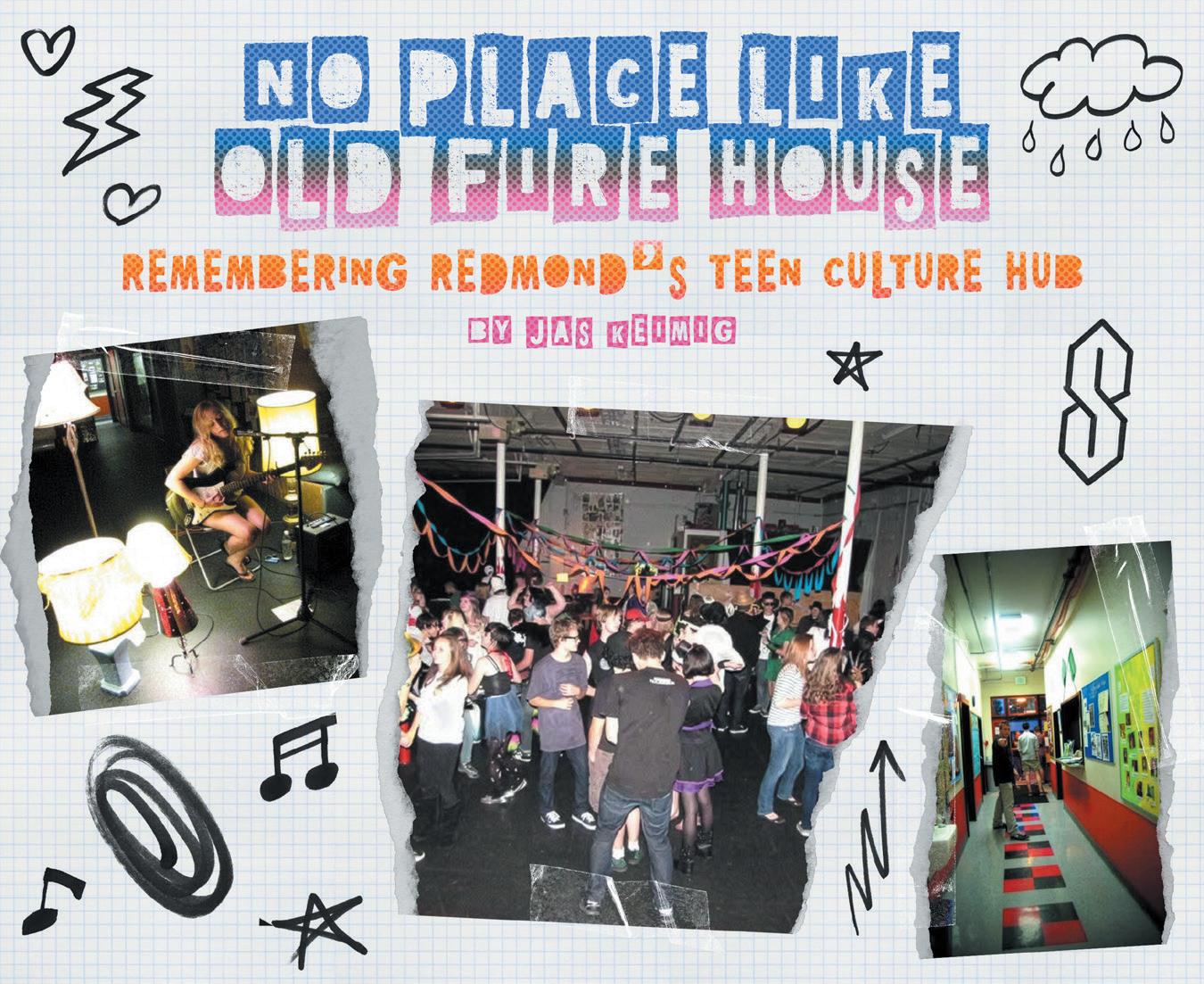
On a Saturday in early April, the sounds of indie rock wafted through the sunny streets of downtown Redmond. Aging hipsters like me, teens, and other community members had gathered outside the Old Fire House Teen Center to commemorate the building that had served as an all-ages venue and teen center since 1992. It was a safe haven for alternative and queer tweens and teens looking to hang out anywhere but at home or school.
After ordering its closure last March due to the presence of asbestos, lead paint, and other structural issues, in November the Redmond City Council voted 6-0 to demolish the building sometime this spring and erect a new one on its grave. The party and outdoor show was one last hurrah for a building that embodied so much of what made Redmond unique from any other Eastside suburb, a severing of an essential connection to its past. The vibe was funereal. People snapped selfies, chatted with long-lost OFH alum comrades, listened to local bands like Fight Milk play onstage, and watched a huge screen cycle through photos from the teen center over the years. Some teens from Save OFH, an organization fighting
for greater teen involvement in the new building process, protested at parts of the event. The sleek condos built on all sides of the building seemed to loom over the scene, a physical reminder of what Redmond has turned into.
As I watched the sun set on the building that I spent ungodly amounts of time in while growing up in Redmond, I thought about the Jas who first stepped foot into the OFH in 2008: 14 years old, insecure, rock-
Kids need something that feels designed by and for them, not what an adult thought was best.
ing bangs. With its terrible lighting, open hours after school, and calendar chock-full of music and art events, the Fire House made life in drab, suburban Redmond feel so much more bearable for teen me. While the city is promising a renewed vision for the OFH Teen Center, it still felt nauseating to know that 33-1/3 years of youth culture
history will be razed into dust. That building felt like the Teen Center’s whole soul.
Trying to explain what the Fire House was and what it meant to my adult friends is like trying to desperately explain the emotional ramifications of a dream.
I learned about Juggalos from my friend Kyle, who gave a presentation on Insane Clown Posse culture in the OFH showroom.
During the teen center’s summer concert series, 4 Alarm, I watched Perfume Genius play on the world’s worst piano while I ate a hot dog. Any time my fellow OFH teens or I wanted to do something silly and/or serious—like host a formal debate on whether Avatar (2009) was pro- or anti-colonialism—OFH staff supported us, helping it be the best version it could be.
Key to that trust in our creative vision was a trust in us as people, not just as teens. The OFH was a space I could try on who I wanted to be in this world without the pressures of school or family or sports confining me. I felt in control of my interests, my body, myself. The building felt crucial to that trust. It wasn’t built with teens in mind and thus was not optimized for the usual surveillance that typically comes
with youth-oriented spaces. When teens entered the quirky OFH building, staff treated them in good faith, allowing us to cook in the kitchen, hang out and annoy them in the office, play four square outside, and do homework in the showroom.
“Because it was a fire house, those are built [for people who] work 24-hour shifts, right? It has to have everything, and I think that made it feel like my house, or like hanging out at a trusted friend’s house,” said Max Ruhlman, a former OFH teen who also worked on the Teen Center staff in 2024.
“You felt safe.”
In particular, the building represented a physical throughline to the past that feels ever more tenuous in our increasingly digital days. Walls of show posters were artifacts of a DIY past I remember yearning to be part of—OFH history was storied even 18 years ago.
“The Fire House felt like a pile of clay that you could mold into whatever you wanted it to be,” said Chester Anderson, a former OFH teen and member of Save OFH. “Whenever you came into the Fire House, you were joining its long history. You were leaving your fingerprints on the clay. No matter who else, you know, shaped it, it would still be part of it.”
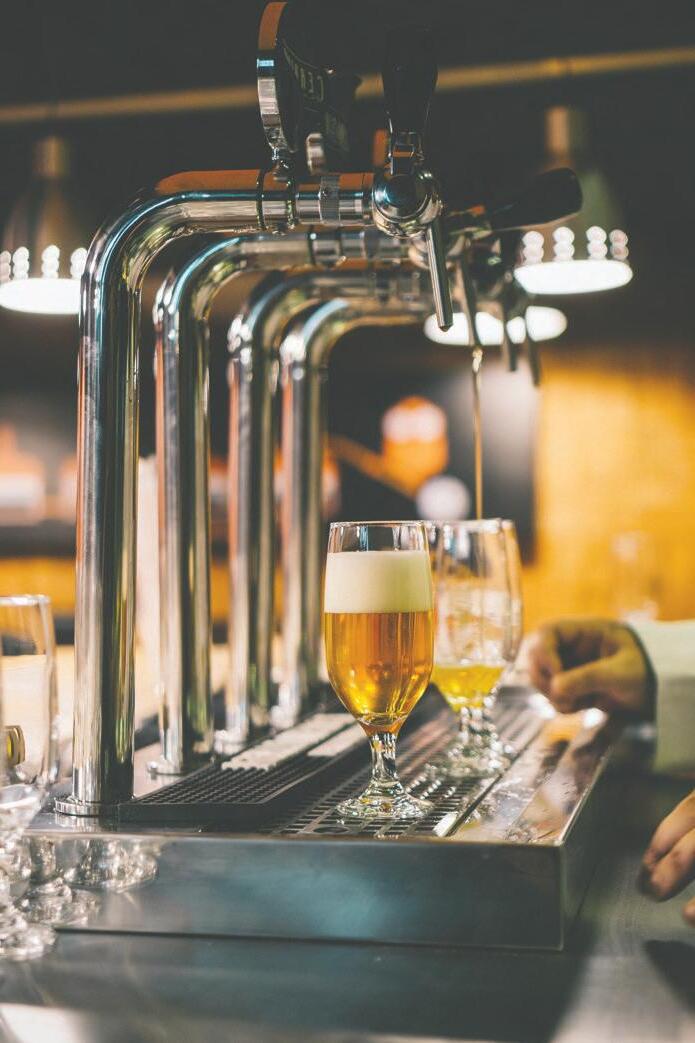
21+ | JUNE 6 | 7–10 p.m.
Explore the art of craft brewing with tastings & talks from local breweries, cideries, and wineries.
•Tastings & Souvenir Tasting Glass included
• Brewing Talks
• Flair Taco Truck
• Kombucha
Get tickets at pacsci.org.


Above all, the Old Fire House simply had an identity that distinguished itself from a lot of new swagless buildings and condos being thrown up across Redmond. It didn’t look like a mall or a luxury apartment building that could be in any wealthy suburb in any part of the country. The original OFH reflected its humble origins as a one-stop shop for the administrative needs of a mid-century logging town. The grubbiness was a feature, not a bug.
“Growing up in Redmond, just seeing everything genuine be stripped away and turned into more corporate blandness,” said
“I started going around to places where young people hung out, to say, What is it that you want from your community? ”
Anderson, “the Fire House felt like the one place left that was still completely standing as something so unabashedly self-defined.”
The same can’t be said for the City of Redmond’s offering of an interim OFH: a single room inside the Redmond Community Center at Marymoor Village (RCCMV). The former OFH teens describe the vibes at the Imposter OFH as “corporate” and “bad,” leaving kids without access to the music studio and other programming. And because it’s in a shared building with other communities, it’s not a space solely dedicated to teenagers. It disturbs the fragile ecosystem that would make the space more inclusive to teens whose experiences may not mesh well with random adults hanging around.
“[The original OFH] has been hacked and transformed, so people that are hacking and transforming themselves are showing up there because it’s kind of junky and this assemblage of things. It feels safe and lived in,” said Seb Choe, a former OFH kid from my era who volunteered there a few years ago. “I think if a space is totally clinical and perfect and everything’s been thought out, you’re gonna get those types of people to show up. Not the people that really need it.”
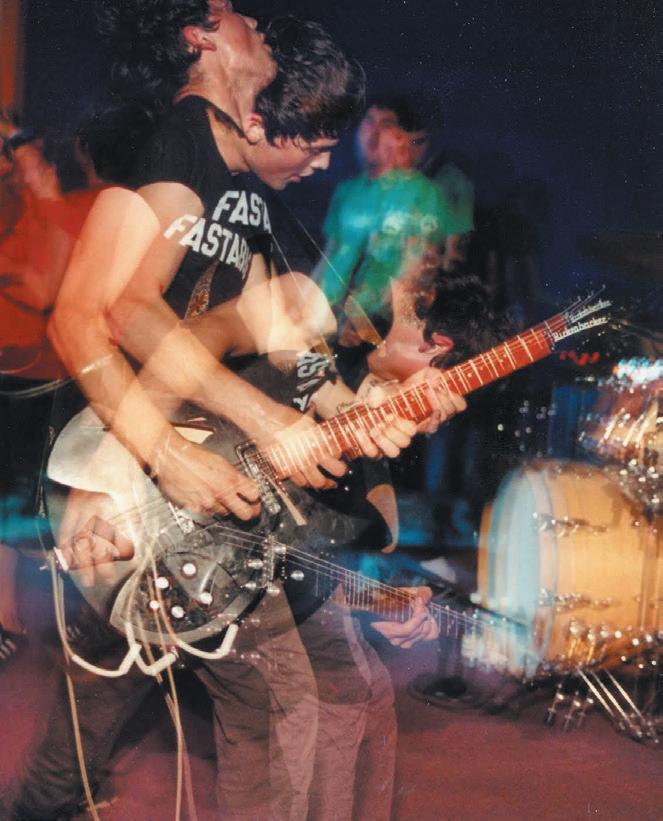
Built in 1952, the Old Fire House first served as a combination city hall, fire station, and police station back when Redmond was a one-stoplight town in lumber country. After a brief stint as a YMCA, the building became the Old Fire House Teen Center in 1992 thanks to the efforts of founder Kate Becker, former Redmond mayor Rosemarie Ives, and dozens of cool Eastside teens. During the dark years of the Teen Dance Ordinance, when kids under 21 were basically banned from music venues from 1985 to 2002, the OFH hosted shows by the likes of Elliott Smith and Modest Mouse, fostering a scene for underage musicians and artists to play, dance, and make art, and a studio to record music. The kids wanted a creative outlet.
“I started going around to parking lots and
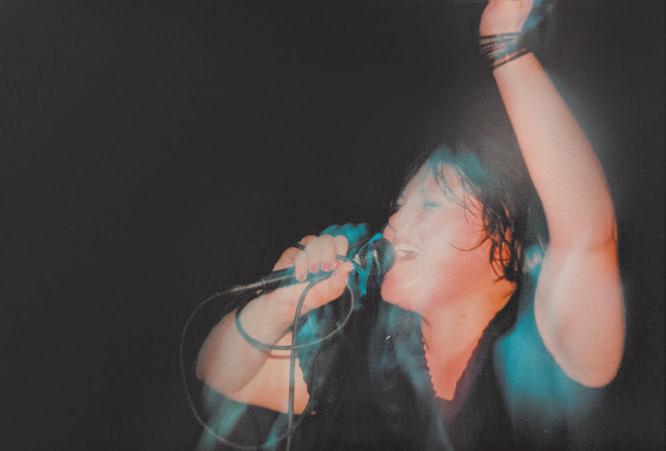
7-Elevens and parks, places where young people hung out, to say, What is it that you want from your community?” said Becker, who also cofounded Vera Project. “And they said, We just want to play shows. So we got busy making a show hall happen. [The youth] were very much a part of it from the very beginning. We figured it out together.”
The “together” part was essential. Crucial to making it all work wasn’t adults doing the top-down decision making, but rather, working with teens and actually listening to what they wanted. “The standard adult reaction to teens is to basically try to tell them what to do and think that they’ll fall in line,” said Chris Cullen, former OFH director, who was part of the Teen Center’s founding team. “That is not gonna happen.”
So when the City of Redmond swiftly shut down the OFH last year with just a
hope is that we can prove that through the work that we do, knowing that we’re a city with processes to follow, and a lot of that is guided by both city code, but also state law.”
But others involved with the OFH are hesitant, citing the city’s lack of communication about the initial closure and the teen center more generally. Some are concerned that the OFH might suffer a similar fate to the Redmond Senior & Community Center, which was demolished, and then rebuilt as a community center for everyone—not just seniors. Others were worried that the city isn’t properly archiving the space itself, though Starlyn Nackos of Life Theater Media is collecting stories for an independent documentary on the OFH.
Still, some of the OFH advocates remain hopeful about what the future may hold for the new building. Becker, who was part of a stakeholder group working with the City of Redmond, said that rebuilding the teen center gives them a chance to make the space more accessible, get LEED-certified, and have a 50-year lifespan. But key to its success is replicating the dynamics that made the OFH possible in the first place—adults purposefully collaborating with teens to shape the future building. Kids need something that feels designed by and for them, not what an adult thought was best.
“I think that is something that Redmond is going to struggle to embrace as they build a brand-new, clean, expensive teen center. The young people are going to want to own it. They are going to want to make it theirs, and they will have to navigate that together—city officials and the young people who are wanting to come through the door,” said Becker. “We’ll have to figure out how to make that work.” A similar feeling is reflected in the youth who had to experience the city’s clunky handling of the situation—frustration, but optimism about the future. “I have faith in the competence and determination of all the people that are involved,” said Ruhlman. “As important as a building, especially this building, is, at the end of the day, it’s the people that make the community. It’s just a matter of whether or not the city is going to allow us to have a seat at the table and build the community that Redmond needs.”
two-week warning, teens were understandably upset that they had been blindsided by the city, and many felt cut out from the initial decision-making process. “It didn’t feel like we had any real power or say in anything,” said Wolfe Adriatico, who started going to the OFH in 2024 and programs music events at Soul Food. “It was mostly performative in the way that they dealt with everything. Which sucked.”
Redmond Parks and Recreation director Loreen Hamilton acknowledged the frustration. “I validate that, and I hope that we can move forward,” she said. But she added that the city is keen and committed to including teen voices in the design process for the new building. “Our real hope and desire is to be able to continue to be that safe space for teens that it has been for so many years,” said Hamilton. “And my
For nearly 40 years, teens on the Eastside were lucky to have the Fire House. It’s only with time and distance that I have been able to see how important the teen center was to my psyche and creativity. As an adult, I still subconsciously look for third spaces like the OFH. When I was a kid, I just didn’t know how good I had it. That’s what makes the upcoming demolition of the OFH’s original building so distressing. With its destruction, the city loses an essential connection to its rich history of youth culture. Current teens, OFH advocates, and the city will need to foment the special conditions that birthed the original Fire House into the world in order to construct a building that reflects the needs of the youth. This new generation of teens needs more unique, creative, trusting, and safe IRL spaces to work out their own sense of self when the future is looking bleak and on-screen as hell—the stakes are huge. Weird kids deserve weird places to hang, too.

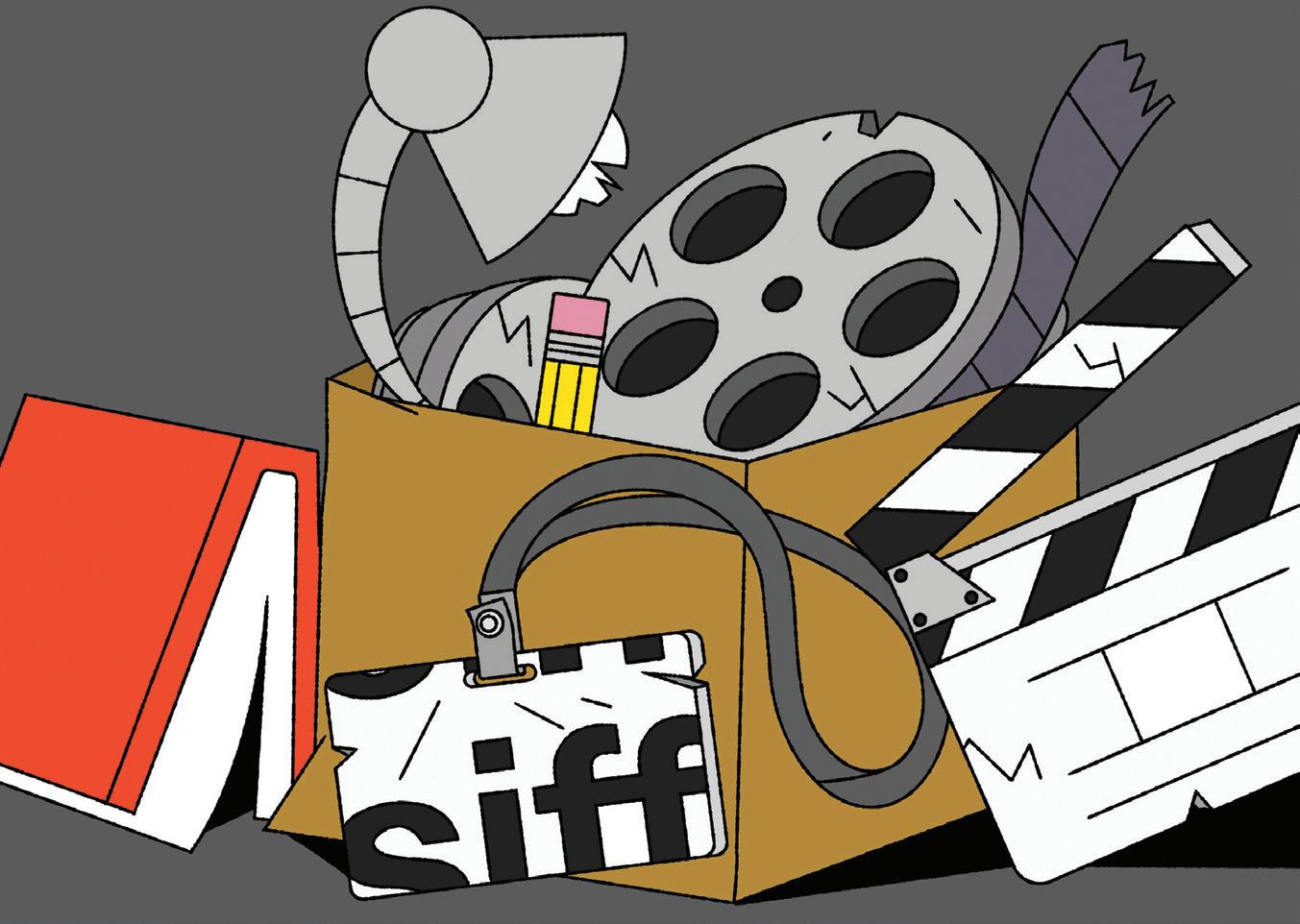
The festival has been through its worst year in recent memory, and they have a smaller festival to show for it. But looking forward, staff are cautiously optimistic.
BY CHASE HUTCHINSON ILLUSTRATION BY BRIAN SCAGNELLI
It’s been a tough year for SIFF.
The nonprofit, which runs the annual Seattle International Film Festival each May, as well as three year-round cinemas, has been hit hard by the last 12 months. The multiple rounds of layoffs, the sudden exit of their former executive director, and the fall of the beloved SIFF Egyptian, which the nonprofit stopped renting after a pipe burst. (Repairs to the sodden theater were completed, but the organization’s leadership at the time bailed anyway. Now, the Egyptian sits mostly unused.)
In the tumult, some staff left for other jobs, or simply stepped away from the organization, just as preparations for this year’s festival began. SIFF, even to those who have attended it over the years and seen it shrink, has always been considered
a smaller festival. At the same time, while not on the level of Sundance or SXSW, it is by no means a podunk little festival.
According to tax filings from 2024, the
“People are noticing that the lineup is smaller, the guests are smaller, the films are smaller.”
nonprofit’s operating budget is $10 million a year. One half of that comes from grants and donations, the other half is revenue.
But as a result of cuts, this year’s festival is comparatively threadbare, and it’s not gone
unnoticed, says one staff member.
“People are noticing that the program is smaller, the lineup is smaller, the guests are smaller, the films are smaller,” they said.
After all SIFF’s upheaval and downsizing, more than a dozen past and present staff who spoke to The Stranger expressed a cautious sense of optimism. But it’s a bit like laughing through the pain. What option do they have? A positive outlook is the only way to keep things moving, they say, though there have been promising signs that, after a year of derailment, the organization is getting back on the right path.
Staff have managed to make it all work with less resources and fewer people to run the festival, even as the organization delayed the starting date of some key seasonal roles in order to cut costs.
“It’s good that everything seems to be
moving full-steam ahead on having a film festival,” one staff member said. “I do think, just in general, it always sets kind of a bad precedent to prove that you can get away with doing more with less. Because then there’s the expectation that you can always get away with that. That’s my fear, is for festivals moving into the future, three, four, or five years, that it will always have these cost-cutting measures.”
It’s been a long and bumpy road for staff. At this time last year, SIFF cut hours and nine full-time employees, or 21 percent of its administrative staff. SIFF leadership spoke of the state of the organization in dire terms, warning of a potential closure if these steps were not taken. Morale was at an all-time low just as those remaining had to continue working to keep things moving. It came as a shock. They would receive

information in bits and pieces, though nothing to indicate that things were this serious until they learned they or their colleagues were being laid off. It was a painful way for staff to learn the financial picture was less stable than they were being told. Several staff said that, while they were occasionally given updates during all-staff meetings, they weren’t being told critical information about finances until it reached this breaking point.
The acquisition of SIFF Cinema Downtown, formerly the Cinerama, was an example of what one called “obfuscation,” as some staff didn’t know that the “giant operational change” was coming until they heard the news in May 2023 from then–executive director Tom Mara at the same time as the general public. Soon after the Cinerama’s reopening that December, it became clear to staff it would be a harder lift than many in leadership understood.
The big challenge of programming the space—a single screen that had already been dark for several years—was working with bigger studios. To get bigger blockbuster films that will perform well, you also have to shovel their crap that will likely underperform for weeks on end. A multiplex with multiple screens can take a hit. One screen? Not all the chocolate popcorn in the world can lure audiences to Joker: Folie à Deux
The theater wasn’t always able to get around this, and, even as they’ve been able to bring in more creative programming in recent months, many staff saw it as a false start.
SIFF leadership later acknowledged that their projections for Cinerama attendance in 2025 were way off, and had to readjust their “targets and finances accordingly.” Since then, there have been more repertory screenings at the Downtown, including series for acclaimed auteurs like Akira Kurosawa, Paul Thomas Anderson, and Martin Scorsese, as well as the more recent anime series “Ani-Marathon” in partnership with Sea Slug Animation.
Then came the Egyptian, which has still been a bitter pill for many based on how its historic run ended. According to staff, they were concerned about reopening the space because they were already working with less staff and with the Downtown added to their plate. They wanted to make sure reopening and relaunching the Egyptian was done strategically. Staff said that former executive director Mara misinterpreted their worries, reaching out to some of them to tell them their concerns helped motivate the organization to not renew the lease. This rankled many of these staff, as they felt like they were being misrepresented and blamed for the closure.
Mara himself closed out in November of last year, with Diana Knauf, then SIFF board president, saying in an email that “SIFF Board of Directors and Tom have mutually decided not to renew his contract as Executive Director.” However, in a personal message to staff, Knauf acknowledged those who raised concerns about the organization under Mara’s leadership, saying, “I understand that your feedback comes from
a place of deep concern for the health and future of SIFF and that for many of you, it took courage to speak up. I am so grateful that you did.”
But now? Things are feeling a little brighter.
The current leadership team—which, according to SIFF’s website, includes director of administration Michael Clark, human resources manager Kyle Bradford, and director of advancement Jeanne Nickelsburg—serves as a collective operating in lieu of an executive director. Staff say they’ve “been much more communicative about policies and why they’re doing things this way” and “have taken the extra time and steps to talk to staff” about the current challenges that exist as well as where they can grow. A search for an executive director remains underway.
Staff say leadership’s straightforward approach to their concerns rather than just “managing people’s reception of information” has eased tension. Before, the strategy of leadership seemed to be about keeping the organization’s problems close
To get bigger blockbuster films that will perform well, you also have to shovel the studios’ crap. All the chocolate popcorn in the world can’t lure audiences to Joker: Folie à Deux.
to the chest. Now, staff feel like they’re in the loop, and are engaging in good-faith conversations with superiors who want to keep them from being caught off guard by any financial troubles.
“For them to actually break down numbers and be like, ‘Hey, this is actually how little money we have and this is how much we made this month.’ That’s been really nice,” says one staffer. “For a period of time there, every all-staff meeting came with some insane thing that none of us knew was coming, and I feel like that hasn’t happened in a while.”
Multiple staff say that in previous meetings they had been told by leadership at that time that they couldn’t be given financial information out of concern that it would be shared with the press. Several staff say reticence and secrecy kept them in the dark in regards to this critical information.
“People were asking questions that they probably should have already had answers to quite a while before, or people were hearing things for the first time in these all-staff meetings,” one staff member said. “I think that’s changed a lot for the better. People are hearing more from management in terms of ‘this is why we’re doing this.’”
Staff also said that the festival itself is being better managed from the top. Specifically, those who have come aboard into higher-level leadership positions have been better at communicating with the remaining staff about both the day-to-day operations and preparations for the festi -
val. There’s a feeling that the organization has risen to meet its financial challenges as one, several staff say.
This has included conversations about taking steps to resurrect the 70mm Film Festival at SIFF Downtown with hopes that, given the proper resources, it could soon make a return. Staff also said that they’ve been able to more successfully make the Downtown work. They also benefited from a strong run of the film Project Hail Mary (which has proven to be a box office juggernaut) and the fact that the next best place to see it in the city, the Boeing IMAX Theater, has been shuttered since February 1 while being sold to the Space Needle corporation. It’s an open question whether the theater, now apparently being called the awkward mouthful of a title “IMAX ‘at the Center’ (Space Needle)” according to the IMAX website, will return to showing theatrical movies at all.
Staff said in the run-up to the festival that those attending should expect things to be smaller this year, and people are already noticing now that the lineup is out. Some of this surrounds programming, with there being fewer films than previous years as well as fewer venues to show them at. Namely, while the Egyptian did recently briefly reopen for a smaller Latin American punk film festival put on by those working at Seattle Central College, it won’t be part of SIFF.
The festival will be making use of the PACCAR Theater, the smaller IMAX theater adjacent to the Boeing at the Pacific Science Center.
As for the final big change this year audiences will see, there will be no closing night party, a longtime tradition of the festival. As veteran SIFF artistic director Beth Barrett told the Seattle Times back in April following the announcement of the closing night film, The Invite, “budgetary concerns really didn’t allow us to invest in a closing night party this year.” There will still be an opening night party following the Seattle premiere of the upcoming Boots Riley fashion-heist satire I Love Boosters, a maximalist, anti-capitalist, pro-union romp starring Keke Palmer, at the Paramount.
The Stranger asked SIFF if someone in leadership could speak more about the state of their finances, but they told us they wouldn’t talk about it until after the festival in June.
Multiple sources said this raised the greatest unknown in SIFF’s future: What will happen with ongoing contract negotiations with the SIFF Cinema Workers Union? Will the organization, showing an unabashedly pro-union film as its opener, do right by its own union? Will the current floor staff workers, essential to the ongoing operations of the organization, be given a fair contract? That remains to be seen—and, just a few years back, some staff walked out at the conclusion of the 2022 fest. Thus, just as the lights again go down on the opening night film as another, albeit smaller, year of the festival takes place, this big question remains for the workers. As one said, there will never be “an absence of issues” to tackle next.
Did you know that, for some headscratching reason, SIFF prohibits accredited media from reviewing or even blurbing about many of its films? This is confusing because film festivals are, to some degree, promotional, and the internet exists. Word will get out.
SIFF’s media guide threatens “legal action” against daredevil press who step over the line, but a spokesperson for the organization downplayed its seriousness, saying “that language applies to the guidelines as a whole.” They told The Stranger that revoking credentials over reviews is “not how we approach working with accredited press.” So why’s it there? The SIFF spokesperson said that the holds are set by the filmmakers or their distributors, not SIFF, and that it’s usually timed with the film’s theatrical release. They argued “this is a common practice across many film festivals.” (We asked, but they didn’t give us any specific examples.)
But talking with a dozen filmmakers and industry experts, both those who have attended SIFF and those who have not, several said this was, at best, “strange” and “baffling,” and, at worst, restrictive and “appalling.” None of them wanted to speak on the record. While they said festivals often strike agreements with studios that would prefer journalists hold coverage until the film’s wide release, a prohibition on any review coverage, even months after a film made the rounds at other film festivals, was uniquely strict.
Strict enough to dissuade press from showing up, and smaller directors from submitting their films for SIFF, some filmmakers told us. (If a film isn’t covered, how can they draw the attention from distribution houses they need to bring their film to the world?) And it could be a deterrent to apply to the already-struggling film festival. Without us writers buzzing around like flies, one filmmaker told us they wouldn’t bother.
CHASE HUTCHINSON
BY STRANGER STAFF
There are more than 100 films screening during this year’s Seattle International Film Festival, May 7–17, and some of them are amazing. Or, at least, that’s what internet hype and mainstream film critics say. Olivia Wilde’s The Invite incited a bidding war after premiering at Sundance, and Boots Riley’s I Love Boosters, currently has a 94 percent critic score on Rotten Tomatoes. But we didn’t get to screen those films. (Read more about that insider bureaucracy on page 21.) Instead, we looked at the titles you likely won’t read about in the mainstream magazines, the below-the-fold films made here in the Pacific Northwest or inspired by themes we find interesting (like human composting and besties fighting a supernatural monster while planning their quinceañera). Turns out, several of them were fascinating, and if not great, then at least a movie we wouldn’t stop talking about around the editorial table for weeks after we’d seen it.
Ghost in the Machine USA, 2026 (110 min), Dir. Valerie Veatch
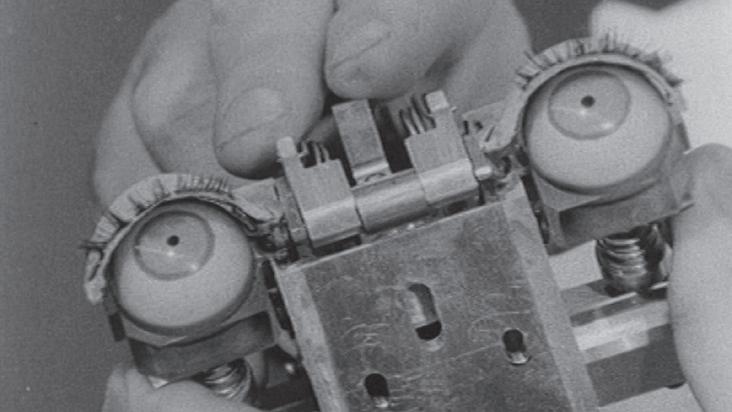
Not exactly a joyful watch, but required viewing by Seattle-born director Valerie Veatch, who traces a chilling throughline from AI to techno-fascism and eugenics. The film opens in Seattle, 2016, when Microsoft unveiled its doe-eyed Twitter bot, Tay, who turned neoNazi Holocaust denier in 16 hours flat (and was summarily yanked from the internet). Veatch shows just why and how these ghosts are tangled up in AI, taking us back to 19th-century statisticians who sought to quantify intelligence to justify racial hierarchy. From there, the film moves through Nazi ideology, Stanford’s eugenics legacy, early Silicon Valley, and the small cadre now steering AI development with military backing in pursuit of AGI. Veatch argues that AI is both an overhyped venture capital engine and a dangerous tool for power-hungry techno-fascists who believe in a superhuman intelligence designed in their own image. The film does end on a (brief) high note: an admonition to resist the fuck out of AI. AI domination is not a foregone conclusion. JUST SAY NO TO AI. (PACCAR IMAX Theater at Pacific Science Center May 10, SIFF Cinema Uptown May 11) AMANDA MANITACH
Powwow People

singer, Freddie Cozad, shared sweet stories about learning to sing and drum with his grandparents, and picking up where they left off. Powwow People is a lovely snapshot and worth seeing, but I was left wishing I could take a deeper look into those pockets of humanity. (SIFF Cinema Downtown May 16, SIFF Cinema Uptown May 17) MEGAN SELING
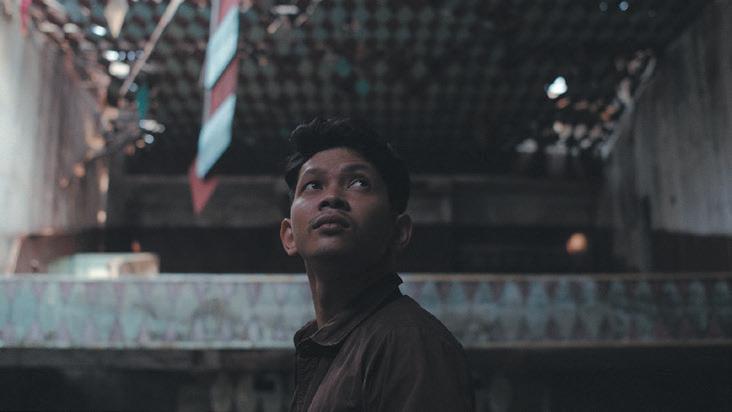
Becoming Human Cambodia, 2025 (99 min), Dir. Polen Ly One can think of the Cambodian film Becoming Human as having its back to (and heading in the opposite direction of) the famous German film Wings of Desire (1987). The former, directed by Polen Ly, has spirits who guard places (both natural and cultural); the latter, directed by Wim Wenders, has angels who watch the inhabitants of Berlin. A spirit in the former falls in love with a human; an angel in the latter also falls in love with a human. But the Cambodian spirit, Thida (Serak Savorn), who guards the ruins of a cinema house, must leave the world, and as a consequence lose connection with (her moments with) the human who has claimed her phantom heart. The Berlin angel must, instead, enter the human world to connect with his flesh/ meat/bones obsession. Both films are political. But the politics in Becoming Human—a film that is, true, slow, but doesn’t contain a moment that’s not powerfully felt—has greater gravity. Though the Cambodian spirit is in appearance a teenager, she is 50 years old. Meaning, she lost her life during the last year (1975) of the Cambodian Civil War. Becoming Human is reflective, melancholy, and must not be missed. (PACCAR IMAX Theater at Pacific Science Center May 13, SIFF Film Center May 14) CHARLES MUDEDE
The Seoul Guardians South Korea, 2026 (71 min), Dir. Kim Jong-woo, Kim Shin-wan, Cho Chul-young
USA, 2025 (88 min), Dir. Sky Hopinka Sky Hopinka’s Powwow People is a beautiful
documentary that captures a full day, from preparation to performances, at a Native powwow at Seattle’s Daybreak Star Indian Cultural Center. While it was interesting to get a sense of the production that goes into such an event, I do wish Hopinka had taken the camera even further behind the scenes. Much of the film is from the sidelines, but the most touching moments came when the
dancers and singers spoke over footage of their performances, telling their own stories about the music, about the people who taught them their skills, and about how they see the crafts changing and growing to accommodate gender diversity. One jingle dress dancer, Jamie John, spoke candidly about having to reestablish their place in the tradition after coming out as nonbinary. A
The amazing thing about this documentary, which concerns the night, December 3, 2024, the inhabitants of Seoul surged into the streets of their city to defy the martial law declared by their corrupt president, Yoon Suk Yeol, is that it’s less than 80 minutes long. There’s so much going on in this film. It’s packed wall-towall with the events of the night, the passions of the people, and the history of that
country. The documentary is a beautiful mess, which, in a sense, is all a true democracy could be. Also, that night’s resistance eventually resulted in Yoon Suk Yeol’s life imprisonment for attempting a coup. Yes, he didn’t have black/brown people to keep him politically viable. Trump, who attempted to overthrow our government in 2021, is now president. Yoon Suk Yeol is in prison. Let that sink in. (SIFF Cinema Uptown May 9–10) CHARLES MUDEDE
The Life We Leave
USA, 2026 (87 min), Dir. JJ Gerber
At the start of this documentary, you’ll wonder if you’re watching a decently disguised advertisement for Micah Truman’s company, Return Home. And I’ll admit, it never quite stops feeling that way. But even so, it will also genuinely move you, and I dare you not to cry by the end. The film opens in a place you probably didn’t know existed: a funereal convention. In the first scenes, Truman is building the second-ever human composting facility in Washington state, and he needs customers. And initially, the business hinges on an environmental pitch: Human composting means less carbon in the atmosphere, fewer trees felled for caskets. But over time, it becomes a complete reimagining of deathcare. It’s not just cremation, but with compost. Their two funeral directors chose to re-ask every question about how they guide loved ones through loss. What does decor look like in a terramatorium? Plants, mostly. How do you hand over 500 pounds of compost to a grieving family? They give the family a small “huggable bag.” How do you visit your loved one while they’re composting? Some families choose to sit against the box, so you can feel the heat that they’re generating. The emotional moments, buried inside the business pitch, surprise you, but they’re worth the watch. (PACCAR IMAX Theater at Pacific Science Center May 13, SIFF Film Center May 14) HANNAH MURPHY WINTER
RADIOHEART:
The Drive and Times of DJ Kevin Cole USA, 2026 (83 min), Dir. Peter Hilgendorf and Andrew Franks
rent state of streaming, its negative impacts on radio, and the fact that he helped form an evil machine (Amazon, obviously) that is seemingly opposed to everything he believes in. (SIFF Cinema Uptown, May 12, 15, and 17)
AUDREY VANN
USA, 2026 (99 min), Dir. Mia Moore, Heather Ballish Agatha (or Aggie, played by the compelling Mia Moore Marchant, the film’s writer and co-director) is a young trans woman who has been stuck in a 10-year
Marchant’s hometown of Aberdeen, WA (guess who else is from there!), with an executive producer credit belonging to Lilly Wachowski, the genre is sci-fi classic, but make it alt-’90s and deeply queer. Again Again stays with the characters’ emotional experiences and doesn’t get hung up on how the loop works, exactly, but I’ll say there’s a twist that I enjoyed. Moody and endearing, this debut film works within a well-worn genre but absolutely carves out an identity of its own. ( SIFF Cinema Uptown, May 11, 12, and 15 ) EMILY NOKES
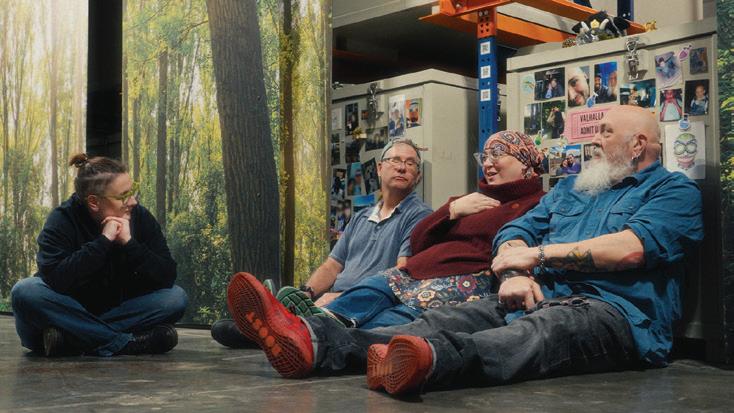
activities to be works of art, from cleaning the toilet to dusting the baffles. We follow Ukeles as she grapples with juggling art and motherhood, ultimately pursuing a practice enmeshed with New York’s 1970s performance art scene. But rather than flash her naked body at the male gaze, Ukeles’s performances were rooted in a feminist examination of invisible labor, a path that eventually led to the NYC Sanitation Department. I won’t give it all away, but she ends up shaking the hands of 8,500 sanitation workers as part of an ambitious art piece that turned her into a New York City hero. Is it maintenance work or maintenance art? You’ll leave the theater inspired to spring clean— but make it art. ( PACCAR IMAX Theater at Pacific Science Center May 9, SIFF Cinema Uptown May 10) AMANDA MANITACH
Fifteen Mexico, 2026 (99 min), Dir. Jack Zagha, Yossy Zagha
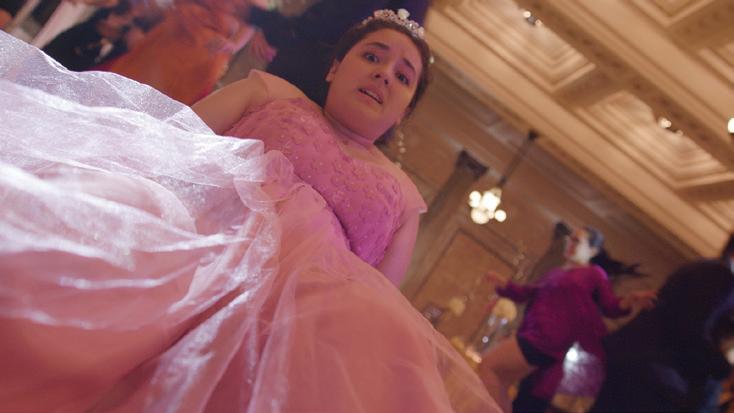
Two best friends, Mayte and Ligia, already have to deal with enough shit while planning their co-quinceañera. But throw in a teen pregnancy, a botched backroom abortion, and a supernatural mystery, and you’ve got yourself a brilliant and bloody high school tale that strikes the same campy chord as all the greats— Heathers, Carrie, Jawbreaker, and The Craft—with an entertaining conclusion worth its weight in fake blood. ( SIFF Cinema Downtown May 15, SIFF Cinema Uptown May 16) MEGAN SELING
Here in Seattle, we tend to take KEXP DJ Kevin Cole for granted. Even though I’ve heard his voice on the air since I was a child, I only really knew two things about him: He has long, wavy hair and a distinctive voice so ever-present in my life that I could detect it anywhere. Cole has done almost too good a job at championing artists and public radio, because I knew nothing about his own legacy.
RADIOHEART: The Drive & Times of Kevin Cole takes you on his journey from an underqualified disco DJ in 1970s Minneapolis to a beloved fixture of the Seattle music scene, with several surprises along the way, like run-ins with then-up-and-coming musician Prince, and a stint at the then-little-known online bookseller, Amazon, where he helped shape digital streaming as we know it. While I can appreciate Cole’s original vision for streaming as a way to make music more accessible, there was a missed opportunity in the documentary to ask Cole about the cur-
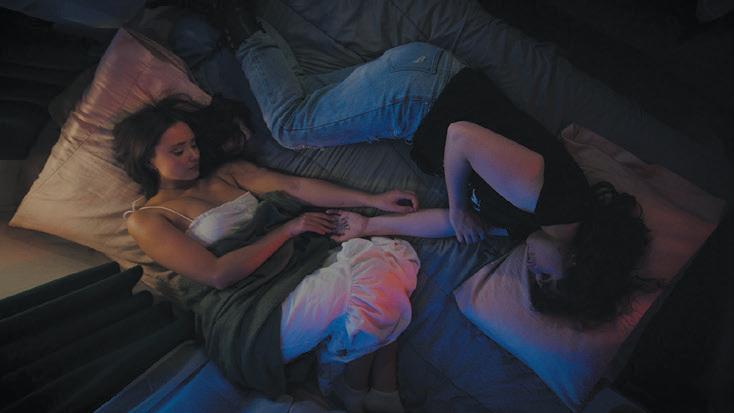
time loop, reliving the same day over and over, waking up next to her childhood best friend, Tessa, who is also the love of her life. Or is she? Again Again begins where most time-loop stories end: with the next day finally arriving. But sometimes figuring out how to move forward once you’ve “broken free” can be more difficult than being stuck in the first place. Filmed in
Maintenance Artist USA, 2025 (95 min), Dir. Toby Perl Freilich In her 1969 Manifesto for Maintenance Art, Mierle Laderman Ukeles declared, “Maintenance is a drag; it takes all the fucking time (literally).” A fascinating portrait of New York City’s first Sanitation Department artist-in-residence—the Marcel Duchamp of trash—who declared everyday
Under a Million Stars USA, 2026 (77 min), Dir. Chezik Tsunoda I know what you’re thinking: You don’t want to go into a documentary about Seattle’s homeless epidemic blindly. What side of the debate will the narrative fall on? Will it feel like the directors are taking advantage of a vulnerable population? Is it a platform for Bruce Harrell to praise his sweeps? I am pleased to report that Under a Million Stars is a thoughtful, beautifully done film that everyone should watch. Within the first 10 minutes, the film turns the current narrative on its head. Seattle mutual aid organizer Tye Reed points out all the ways in which shelters, which are often pushed on people as the best option, can be unsafe, while author Gregg Colburn reminds people that “homelessness isn’t prevalent in our poorest cities, it’s prevalent in our richest cities.” Read: It’s the billionaires, stupid! From there, Under a Million Stars keeps its foot on the accountability pedal, connecting the current-day crisis back to the state of emergency declared in 2015, back to the redlining in the 1970s, back to the pioneer days when white people came to claim land that was already owned by someone else. And though it was a bit of a jump scare to see We Love Seattle founder Andrea Suarez pop up on the screen, rest assured, she hangs herself with her own rope. ( SIFF Cinema Uptown May 9–10) MEGAN SELING
BY NICO SWENSON
PHOTOS
BY
BILLIE WINTER
Jane Don’t is Seattle’s latest star to compete on RuPaul’s Drag Race. If you’ve seen her locally, you already know she was poised to do well. Her drag style uses vintage aesthetics in contemporary ways, combining her knowledge of queer history, fashion references, and her own innovative sewing skills. With a fully glamorous mug, she delivers high-camp performances full of witty pop-culture and classic diva references. Her talents especially come out when she’s handed a microphone to show off her seemingly effortless grasp on comedy. On the show, that skill in particular led her to high praise from comedy giants such as special guest judges Sarah Sherman and Atsuko Okatsuka. If you haven’t gathered yet, she absolutely crushed it, right up until a shocking elimination in the top 5 of Season 18. She made a record-smashing run of high placements, and claimed the title of Miss Congeniality during the finale. Jane Don’t truly made Seattle proud, and proved to the world she is one of the best in the business.
I sat down with her to chat through her origin story, her experience on the show, and to hear about what’s coming next in her continuing success—including her onewoman show, Don’t Does America , which kicks off in Seattle on September 1.
For anyone who has never seen your drag, how would you describe yourself and what you do?
I’m 33. I’m a Pisces with a Capricorn moon and Capricorn rising. I’m a drag artist and a loud woman living in Seattle. My drag is informed by comedy, glamour, and subculture. Those three elements are always present. I’m very inspired by vintage comedians and funny women. Joan Rivers, Goldie Hawn, Bette Midler, obviously. I’m also super interested and informed by the history of drag and the history of the underground. I try to combine a comedic sensibility with a subversive approach to fashion and the work that I make.
Where did you get your start in drag? What was the origin story?
I was really interested in drag for a long time. In high school, I used to go to this 24-hour diner in Spokane called the Satellite. It was right next to one of the two gay clubs in town that had a drag show. We would go around midnight and have dinner and then all the girls after the show would shuffle in and sit at the bar. I think from that point on I was just very intrigued by drag. I also started watching Drag Race in high
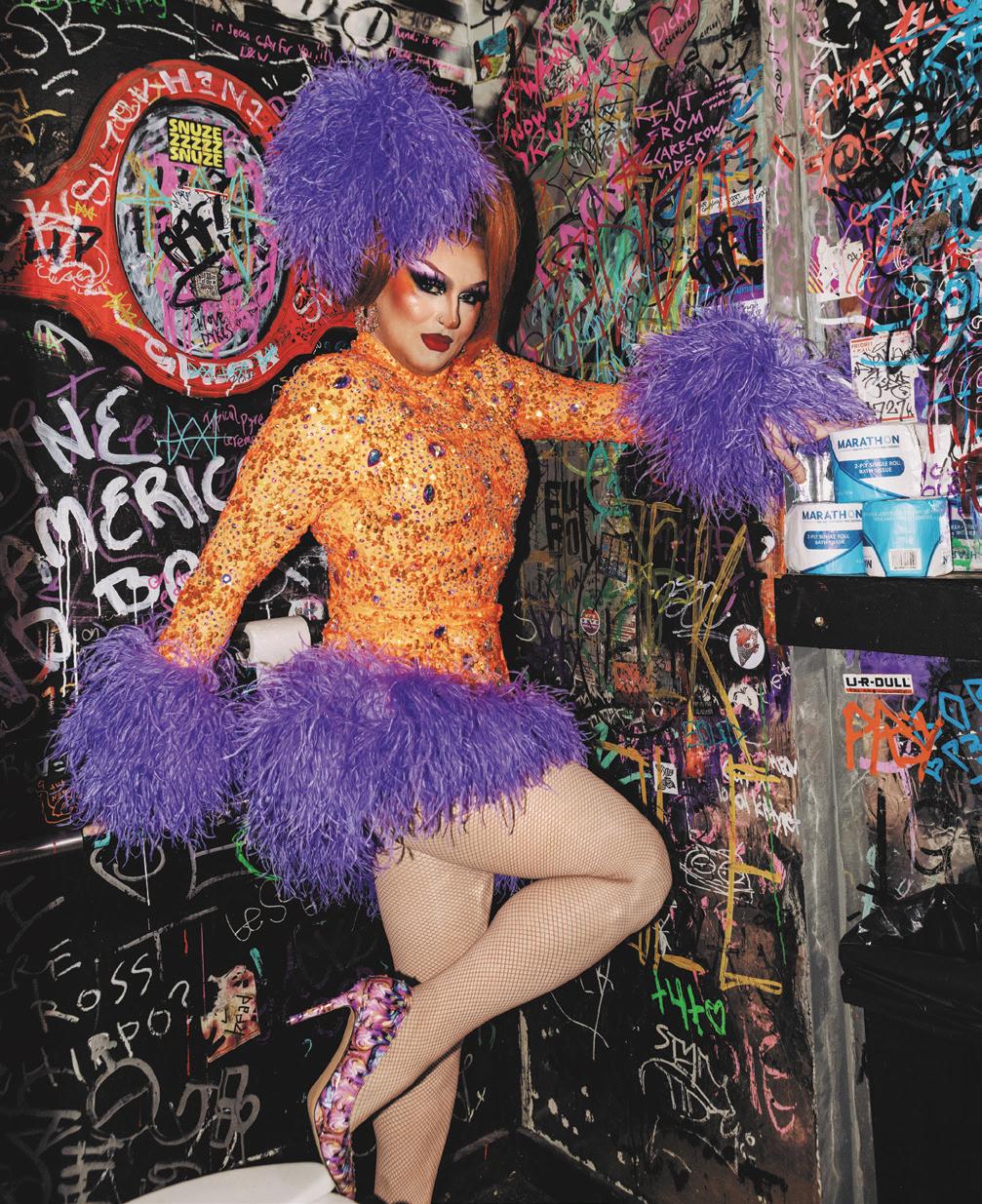
Jane Don’t at Pony in Seattle: “I’m very much a drag queen’s drag queen.”
school. Then I organized my college’s drag show and would go to shows in Tacoma.
When I moved to Seattle I didn’t really have a lot of friends. I would go to shows at Kremwerk all the time. The first Seattle drag show I ever saw was at Chop Suey. It was 2015, right when I had moved to the
Hill. All the gals were there. I remember seeing Cucci and Natalie Portal perform, and the drag that I’d been familiar with up to that point had been sort of traditional. I remember being blown away by what they were doing. I think that sort of broke my brain open a little bit.
I started going to shows, and then after a while I wanted to hang out with the drag queens, and you can’t go in the dressing room unless you have a wig on. I would see stuff and be like “I could do that.” So after a couple years, I started doing my makeup secretly in my bathroom.

What was your first real gig like?
My very first number was at Kremwerk with Cookie Couture. I played backup on a fake piano behind her to Gilda Radner’s “Let’s Talk Dirty to the Animals.” Then my first real gig was Queen for Queen at Pony for Pride of 2019. I did an Amanda Lepore song, “Turn Me Over,” dressed as bacon, and Monday Mourning was the sexy chef who was slapping me with the spatula. An auspicious beginning.
What were some of the struggles you faced?
When I started drag, I kind of had to do my own thing. One of the reasons I started hosting so quickly was because it didn’t really feel like people were booking me. It didn’t feel like people were sort of crazy about me, but I knew how to walk into a bar and ask to put on a drag show. So there’s been an ongoing struggle of trying to balance my love, allegiance, and gratitude to the Seattle scene for raising me with my own ambition. Honestly, I don’t think that Seattle is overly fond of people who are outwardly ambitious.
Also, there were just the difficulties of being a broke person trying to make art in this city that’s so hostile to broke people. I’ve lost count of the amount of times that I thought about getting a day job or going back to school or going to hair school. There were moments where I felt very alone or I
“People can say you shouldn’t need external validation, but I’m not medicated enough to feel like that, babe.”
felt like the scene didn’t necessarily see it for me, but I’m still profoundly grateful to it. So many of the people here are a huge part of the reason that I got to the point where I could get on Drag Race. So much of my time on Drag Race, I thought, “thank god I’m from Seattle, and thank god I have the references and the experiences that I have, and that I come from the sort of place artistically that I do.” I just think there’s something singular about drag here. I think it’s why Seattle girls always seem to do really well on the show.
Was there anyone specifically who inspired you or kept you going?
I’m very much a drag queen’s drag queen. The sisters and the family that I’ve found here are always one of the biggest motivating factors to me. Shout out to Rowan Ruthless, who was there the first night that I performed in drag, and Natalie Portal has always like been a huge part of it. Irene the Alien and Bosco, obviously. I think when the three of us kind of became friends, it gave me a sense that I was on the right path.
Once you got the call for RuPaul’s Drag Race, how did it feel?
Well, the funny thing is, in the interest of transparency, there was never a point in getting the call and getting to the show where I was overly surprised that I was there. I sent my tape in and my brain went,
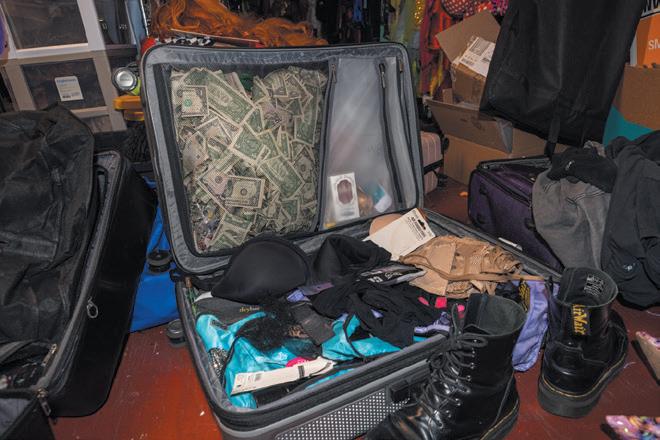
“okay, you’re on Drag Race.” I had started preparing even before I got a phone call. I started commissioning things, getting hair, planning, writing jokes, and mentally preparing as though I’m going to be there. The thing that was hard to compute was how well I was doing.
That confidence and preparation served you well! It was clear you were so prepared for this moment. What were you most proud of during your time on the show?
I’m really proud of the whole body of work that I presented. I had been thinking about it for a long time, I knew my shit, and I had done the work. One of the big lessons Drag Race teaches you is to do what you know. It’s a great showbiz lesson, right? I think that’s something I figured out really early on and that worked to my benefit. I went into everything with the mindset of I’m a comedian, so every challenge is a comedy
response because people didn’t understand why I was boisterous in drag and then out of drag I’m kind of dry and sardonic. I’m not a person who’s a character out of drag. I spent a lot of time using drag in a way that’s positive for my mental health and well-being by funneling those attributes into it, but then you get on Drag Race and you’re on TV more out of drag than you are in drag. So that was a struggle at points. I think it’s also okay that we don’t expect performers to be “on” all the time.
Can you tell me a little bit more about what the process of filming was like?
I just always try to impress on everybody how fucking hard the show is. People have said it before, but when they say “ Drag Race ,” it’s really a race! It’s long days of filming. There’s so many times on camera where I’m looking at all of our skin just being like “oh my god, we look like angry little preemies.” We just looked like sad, underbaked breads. Drag is so impactful on your body and to be doing it over and over again in such quick succession is so tiring. Then on top of that you have the stress of eliminations and constantly having to generate. I have the utmost respect for anybody who’s gone through it because it really is an endurance test as much as it is a test of skill.
It’s also incredibly fun. I wouldn’t trade it for anything. The relationships that you form with people—you’re there for a week with these girls and all of a sudden you’re best friends.
You said in episode one you wanted America to know you’re one of the best in the business. Do you feel you achieved that?
I knew I was going to do well. I didn’t know that I was going to do as well as I did. I didn’t think it was an option. I mean, nobody, with all due respect, has ever been in the top for 10 straight weeks. I didn’t know that was a thing that they would let happen.
challenge. It doesn’t matter what the challenge is. Like for the girl group, I’m not a dancer, so rather than try to be that, I was a comedian.
That sense of humor carried through in your out-of-drag moments. How did it feel to be your out-of-drag self on TV?
That was honestly the most nerve-wracking thing. There’s a lot of pieces of myself that go into Jane that are parts of myself that I don’t love. How talkative I am, how loud I am, you know, I can be sort of obnoxious. I don’t love those things about myself, but those are things that are real assets in drag. I think that’s psychologically good and helpful.
But Drag Race asks you to do something that you’re never really asked to do as a performer in any other context, which is being “on” both in character and out of character. It was funny to watch the fan
I really really really wanted to win very badly, but more than that, I wanted to show people—and I wanted to show myself— that I really am very good at this; that I’m as good as I think I am. People can say you shouldn’t need external validation, but I’m not medicated enough to feel like that, babe. I need external validation. So I feel a level of peace in my elimination because I ultimately did what I set out to do. The money would have been lovely, but as far as that goal, I did show people that I am.
What is next for you? How can people support you?
I’m doing a one-woman show tour, Don’t Does America. It’s basically like the whole country. That’ll be in September. Come out and see that. That’s the work that’s closest to my heart, so please come see that. I would love to meet people. I have a lot of work that’s coming out that will exist long past the show. The reality is like I’m a lifer. I have no other skills. It’s cross-dressing or the soup kitchen.
Anything else you want to say, any parting words?
I guess I would say I hope Donald Trump dies soon. And you can put that in writing.
BY AMANDA MANITACH
Have you heard of Lee-Roth Fog?
It’s described as an atmospheric phenomenon first discovered in 1972, “known for the bizarre sounds it seemingly makes as it rolls and blankets the West Hollywood landscape.” Engineers helped artist Ryan Betschart isolate the sound and capture footage of the phenomenon, which you can experience at Tacoma Art Museum’s Haunted. The fog cascades in waves across a massive screen, gradually engulfing the wall. Then comes the sound: high-pitched, a touch mellifluous, and then as bloodcurdling as a banshee. Every half hour the fog rolls in for two minutes and 55 seconds before the screen cuts to black and a silent countdown begins.
An Example of Lee-Roth Fog, Isolated Under Laboratory Conditions is one of many pieces in Haunted that will linger after you leave. Which is fitting, since it’s an exhibit about memory. Specifically, Haunted explores hauntology, a term coined by Jacques Derrida in 1993 and later popularized by Mark Fisher to describe a nostalgia for “lost futures.” It’s a distinctly postmodern, post-analog feeling that the present is terminally haunted by the past—aesthetics and ideologies endlessly recycled until our ability to imagine radically new futures has eroded altogether.
Philosophically, it’s a somewhat slippery concept, but its core is a feeling of loss, longing, and nostalgia for intangible and ineffable things. Another common thread is the technology in which these apparitions
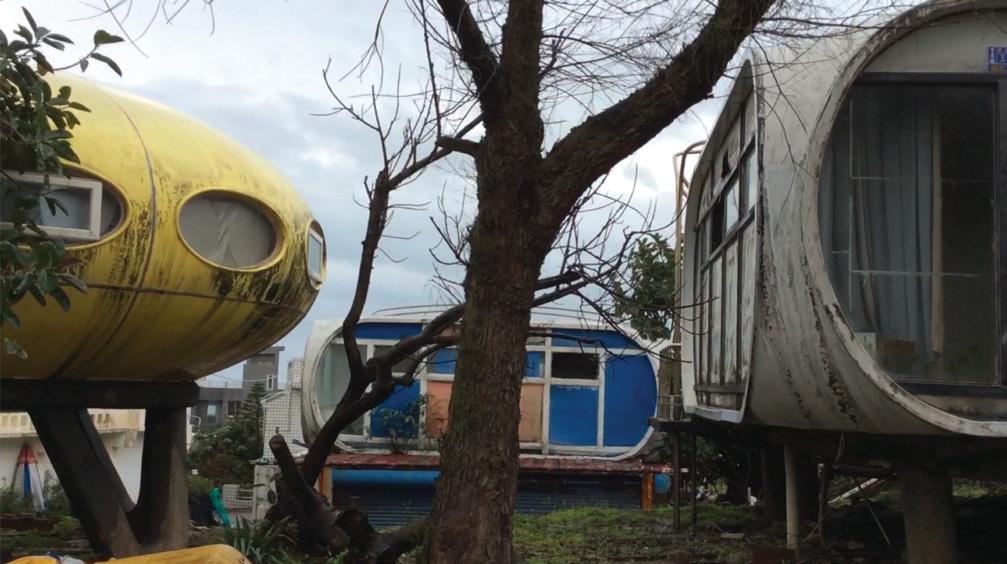
appear—particularly the moving image— where data is as unstable and protean as the memory of the mind, and ghosts are legible in digital and analog decay. In Haunted, these specters of memory come into focus through objects and video works by 13 local and international artists.
One feels it immediately upon entering: a nearly tangible barometric pressure drop while passing from the non-haunted, light-saturated museum halls into a very
non-museum-like voracious darkness. The entrance is lined with a wall of venetian blinds next to a flickering cathode-ray tube television looping the opening credits—a succession of artist names glitching across the screen. Above, the exhibition title is spelled out in big neon letters, as though to welcome viewers to the ride.
The gallery beyond opens into a cavernous space with 30-foot-high ceilings. Almost all the lights are out. Two large neon doors by Kelsey Fernkopf rinse the room in violet blue.
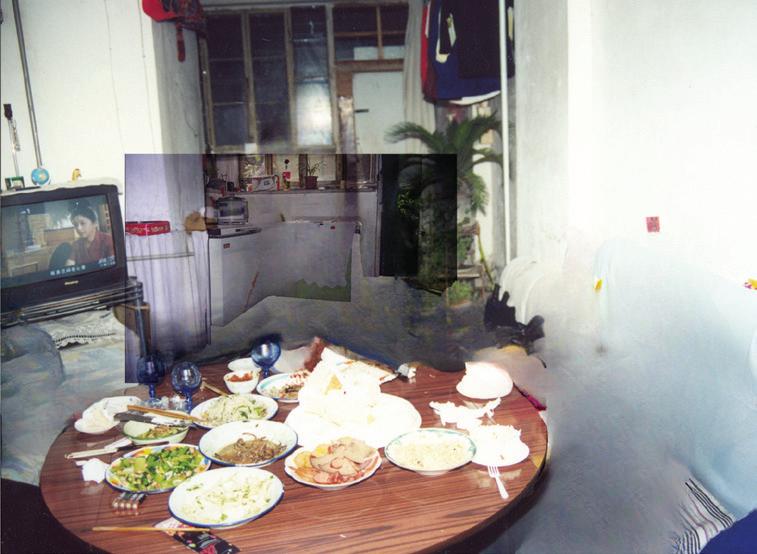
“I’m kind of a spooky person,” curator Ellen Ito admits. “Anything eerie, I’ll run toward, feckless and delighted.” Ito has worked at the museum for over 15 years. She knows the space intimately, and she knows how to set the mood, which, despite the gravitas of the subject matter, is anything but morose. (If you suspected Betschart’s “fog” is a fabrication, and that the sound is actually the isolated vocals of an ecstatic David Lee Roth piercing the fog-machineflooded void, you’re right. In Betschart’s work, the ghost of Dad Rock looms, as well as the failure to achieve collective enlightenment promised in the 1960s and 1970s.)
Like the fog, nothing here is quite solid. As the viewer’s eyes
adjust to the darkness, Maryam Dehbozorgi’s Digital Garden Carpet materializes underfoot: a Persian carpet spun from light. Leaves, birds, and fragments of personal photographs from her childhood in Iran drift, converge, and dissolve into geometrical patterns sourced from images of Persian carpets in the Metropolitan Museum of Art’s archive. The labyrinthine waltz is a masterpiece of a work. As visitors enter the exhibit, Ito waves them over. “You can walk on it,” she tells them.
“For me, cinema and video hold memory perfectly because they’re ephemeral,” says Ito. “Turn on the lights and the work vanishes. Like a ghost.” There are eight videos playing simultaneously in the show, most
Like the fog, nothing here is quite solid.
with sound, none using headphones—a feat in itself. Making viewers want to actually linger with time-based work presented another challenge. “We were trying to figure out how to signal that it’s okay to engage with video in a museum the same way they do on their phones or in their living rooms,” she explains. Instead of benches, there are vintage theater seats and pews. Screens made with layers of theatrical scrim wrapped around wood frames become porous light-catchers. Hung from the ceil-
ing, projected images float throughout the space, their diffused glow pouring through.
The constant murmur of video and audio in the periphery creates a baseline spine-tingling ambience, while fragmented pieces of a (haunted) house are scattered throughout: doors, carpets, windows. Crystal Z Campbell’s Go-Rilla Means War is projected onto a second wall of venetian blinds. Made with found footage discovered on the floor of the abandoned Slave Theater in Brooklyn, the unusual imagery of the film serves as a backdrop for poetic ruminations on gentrification, narrated by Campbell.
A pocket theater with a single pew houses Martí Madaula Esquirol’s Tramuntana, a portrait of the wind, traceable only in the shadows cast by smoke and clouds rolling across the land. In another small room, Lynne Siefert’s ARK follows a cruise ship to the end of the world, where footage of late-capitalist decadence is interspersed with musings of passengers lost at sea.
Migration, loss, and memory are intertwined in Chantal Peñalosa Fong’s video, Fong , which traces her search for family members and culture that have been lost in the process of moving across borders and continents. Architectural ruin is a site of haunting in Beatriz Santiago Muñoz’s Post-Military Cinema , where a former cinema located at the Roosevelt Roads US Naval Station in Puerto Rico has fallen into disrepair—the only image projected into the space is the sunlight filtering through overgrown forest, the only sound the droning from beehives nearby. In Joan Bennàssar’s ¡Futuro! A Dream from Before History (Wan Li, Taiwan), the camera drifts through the retrofuturistic wasteland of the Wanli UFO Village, an abandoned seaside resort on the north coast of Taiwan.
dreamlike, just out of memory’s reach.
Tivon Rice’s Ghosts of Sewoon Sangga are photographs of decommissioned CCTV monitors found in Korean markets. A closer look at these seemingly unremarkable objects reveals a burned-in image barely visible on each of the screens, caused by years of surveilling the same place: a stairwell, a doorway, an alley.
Mounted onto lightboxes, Rice’s glowing images read as neither photograph nor screen, but something in-between.
Doppelgängers are another kind of ghost in Haunted . Like Fernkopf’s twin neon doors—one in the center of the room, the other pressed against a wall. Dehbozorgi’s carpet is mirrored in Mary Ann Peters’s impossible monument (on my eyes and my head) , a 9-by-12-foot rectangle on the floor filled with 300 pounds of pressed all-purpose flour. The only place in the exhibit where white light pools, the delicate, powdery surface has been imprinted with found objects to create lacy patterns that radiate from the center. Fragile as neon, Peters’s piece is a meditation on the uncelebrated commonplace, but also on the ritual of breaking bread, and ephemerality and precarity itself. Blow on it and it could scatter.
Tucked toward the end of the exhibit, Cam Smith’s Traces functions as both camera and screen, recording visitors without their knowledge—at first. The screen flashes with a procession of strangers who have passed by earlier in the day. After a short delay, your own image flashes by, added to the parade of ever-shifting, slowly decaying specters. As if to say: Our ghosts are everywhere, all at once; we unwittingly leave a digital trace wherever we go.
Hauntology feels more relevant today than when it was first named—the world
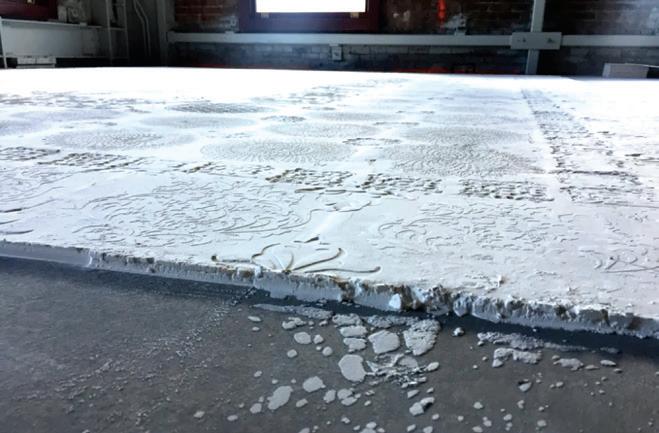
Throughout the work, memory, fiction, and reality blur. Yihan Shi’s Unphotographed Past departs from the moving image, but approaches the same disfiguration of memory by attempting to recreate scenes of childhood bedrooms and domestic spaces. Each portrait of a room is stitched together from multiple photos containing fragments of furniture and personal items—a keyboard on the couch, a clock, journals cluttering a bedside table. In another series by Shi, Water Moon, blackand-white photos of family gatherings are so out of focus that the image dissolves,
stuck in a late-capitalist cul-de-sac of horror, where AI has replaced imagination and the future feels anything but bright. But Haunted isn’t a horror show. Rather, it offers a series of entry points to better understand memory as a very human tool, capable of shaping our relationship to past, present, and future. After all, for Fisher, hauntology was always political. The feeling of helpless stagnation is a trap. In exploring these ideas, Haunted suggests a counterpoint to mourning: There are still new futures to be remembered.

THU 5/7: DUSTY 45s w/guest openers! 6-9 PM
FRI 5/8: FOOD BANK BENEFIT w/ THE PAZIFIC // THE KINGS // ROXBURY SAINTS, 7 PM
SAT 5/9: THE HIGH LIFE BAND (White Center block PARTY) 2 PM
SAT 5/9: SKA ISLAND 5:30 PM
SUN 5/10: RETURN OF DEADGRASS acoustic MATINEE, 2-5:30 PM
Mon 5/11: Crafty Night, 6-9 PM
TUE 5/12: ALL-AGES open mic w/mode, 6 PM
FRI 5/15: Star Matriarch // hihihi //ACTRESS // KUWAISIANA 9 PM
SAT 5/16: SPIDERS FROM URANUS and GUESTS 8 PM
SUN 5/17: ROYAL BLUNDER // BRALY SANGSTER // ABSERDIA 2 PM
TUE 5/19: OPEN MIC W/ LEVI SAID., 7 PM
THU 5/21: DUSTY 45s w/guest openers! 6-9 PM
SAT 5/23: SAINT NAMELESS // THE BELLY CATS // MARIO DI SANDRO 8 PM
SUN 5/24: BOB DYLAN NIGHT W/ JOE ROSS & THE BIRDWATCHERS + FRIENDS 7 PM
Mon 5/25: Crafty Night, 6-9 PM
TUE 5/26: OPEN MIC W/ LEVI SAID., 7 PM
THU 5/28: DUSTY 45s w/guest openers! 6-9 PM
FRI 5/29: JOHNNY & THE MOLES // HOW NOW BROWN COW // CONTRABAND COUNTRYBAND 8 PM
SUN 5/31: DAVID GRAHAM & THE ESKIMO BROTHERS 7 PM + MORE SHOWS ADDED WEEKLY!




BY KATIE LEE ELLISON
Due to loud construction noises in my home, I had to have this conversation with Tamiko Nimura, author of the new memoir A Place for What We Lose: A Daughter’s Return to Tule Lake, in my bathroom with the door closed. The effect was a very private and personal conversation with a writer unafraid of earnestness.
As an activist as well as a poet and essayist, Nimura explores, in this inven
tive memoir, how rejection from academia helped launch her into ancestral research, and ultimately a visit to Tule Lake, the site of one of the worst Japanese American internment camps at the time, where her father, who died when she was 10, was imprisoned. She pulls pieces of his unpublished memoir—which recounts his four years living as a child in what Nimura more accurately calls concentration camps—to illuminate her own story. A Place for What We Lose explores history, both personal and cultural, showing how inextricably woven they are, not just for her family, but for all of us.
I wondered about the recurring echoes of major historical events with your familial ones, like your father’s presence at the most notorious camp at Tule Lake for example. What does it feel like to have such a strong lineage behind you?
Over the 15 years I’ve been writing [this book], so much has felt so powerfully resonant and relevant. For example, when Mahmoud Khalil, the Columbia grad student, was arrested—taken away from his family and whisked away for exercising free speech—I was looking at my grandfather’s file, [and] this is pretty much what happened to him. Then there are the [present-day] impacts of child detention, family separation, and the attacks on birthright citizenship. Someone asked me recently about how it felt to have this book be so relevant to the news, and I said, devastating. Our community elders went to their graves vowing that this would not happen again. They broke the silence of decades to share their stories [for that very purpose], and it is so painful to have it echoing so powerfully right now.
You grew up in California, but also have a long history in the Pacific Northwest. What is your relationship now to Seattle, the West Coast in general, and to the Pacific Northwest, given your family’s roots and painful experiences here?
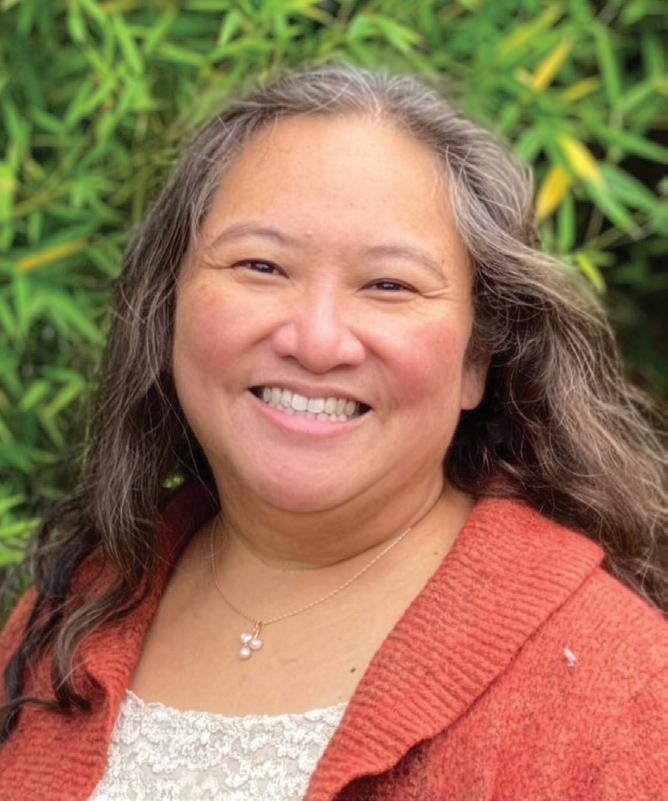
started when I was on community pilgrimage at Tule Lake, where my family was incarcerated. I had been through these couple of days of really intense experiences, processing and connecting. I’d been trying so hard not to feel for so long that it all just kind of bubbled up and burst out into this ridiculously ugly cry. I had to write this book to understand where that came from. I broke it down into several strands: the loss of my academic career, which really upended my life; the loss of my dad; and the collective losses that my community had experienced.
During the editing process, a friend asked me, “How does your book want to be structured?” and I realized: It wants to be a library. I imagined walking through reference, archives, travel, history—and my dad working in circulation. This became the organizing structure for the book.
What’s your relationship to grief now, and to Japanese and Filipino cultural elements in your life?
“Our community elders went to their graves vowing that this would not happen again.”
In this particular historical moment, it’s really easy to feel disillusionment, and even surprise, a certain kind of anger about the historical amnesia that we seem to be experiencing right now. People are coming new and fresh to incarceration history, or there are people who maybe got the paragraph summary of incarceration
I’ve lived in California and Washington, and I feel like both are part of me. I moved to Seattle in the late ’90s, and I’ve always felt a bit like an outsider in Seattle, but I’ve written my way into the community through journalism and relationships. Now I feel allegiance to Washington, too, especially Tacoma.

history in high school or college and just glossed it over. I’ve been so inspired and moved by activists in my community who have been trying to resist and connect the dots for people more powerfully. A group that I talk about in the book, called Tsuru for Solidarity, works regularly on trying to shut down detention centers. There’s one here in Tacoma. A lot of us have been telling the camp story for a while now, and have been committed to this not happening again. Feeling the enormity and the awfulness of, oh no, it is happening again, with multiple groups targeted, the work is to gather our energies for a broader solidarity, and that’s really inspiring.
Can you speak to the structure of the book a bit?
I tend to work backwards, so the book
My grief about my dad feels different now. I avoided his memory for a long time because it was tied to pain, but writing the book—and therapy—helped me reframe it. I realized as a storyteller I needed to write the relationship first so the loss would land. That turned into a gift: I can now talk about him with love and memory, not just pain.
With Japanese elements, I have a Daruma doll that I filled in one eye [of] when I started as a professor. I didn’t get tenure, so I didn’t fill in the second eye, but I think I will when my book comes out. That will feel meaningful. I had associated my Filipino side with difficult family history, but I’m reconnecting with it. My kid is engaging with it in college, and I cowrite weekly with a Filipina American writer who’s been exploring Tagalog in pottery. She gave me a bowl she made with kapwa , a term which means interconnectedness and care, carved into its center.
I also have a little altar with my father’s manuscript, a photo of him, and a book locket made by a friend that holds images of me with my parents. There’s been a whole village of people supporting this book. It isn’t solitary work.



WED 5/6: VINTAGE MOTORCYCLE ENTHUSIASTS MEETUP 7 PM
SAT 5/9: SKATES! // SWEET PIECE // STRAIGHT TO VIDEO 9 PM
SUN 5/10: Tyler Berd // A Strange Bird // KJ West 4pm
Mon 5/11: OPEN MIC w/ Levi said. 6-9 PM
TUE 5/12: LIVE BAND KARAOKE w/ DYLAN LOST 6 PM
FRI 5/15: PETER CASE & CHRISTY MCWILSON 8 PM
MON 5/18: OPEN MIC w/ Levi said. 6-9 PM
TUE 5/19: LIVE BAND KARAOKE w/ DYLAN LOST 6 PM
SAT 5/23: Loudmotor // The Proffits // Jaguar Paw // Penny Blackbelt 7 PM
SUN 5/24: Dust Mice // House Of B // Trotting Roux // Guests 4 PM
Mon 5/25: OPEN MIC w/ Levi said. 6-9 PM
FRI 5/29: MIRACO // THE PINES // GUESTS 8 PM
SAT 5/30: The Mistons // The Bug Nasties // The Loose Grips 8 PM

OPEN MIC w/ Levi said. 6-9 PM
ENJOY OUR OUTDOOR PATIO // ICE COLD BEER // 4 VARIETIES of CHILI + MORE 21+
YER SELF!
5606 1st Ave S, Seattle WA 98108 tix/menus/info: slimslastchance.com



Ican’t be the only person with a family member who is a liability with customer service—be it checking in to a hotel or sending a dish back at a restaurant. For me, that person happens to be my beloved mom.
My Filipino mother Shellani is a self-described picky lady: choosy about what she wears and whom she spends time with, opinionated about the service she receives (in real time), and also very particular about where she eats and what she eats when she’s there. When eating out, my mom’s picky eating has created its fair share of consternation for me. I often find myself overcompensating with the waiters at a restaurant to prove that there are indeed sane people in this bloodline. Conversely, I’ve also been moved (unexpectedly) by the lessons I’d learn from my mom’s choices, just by trying to see things her way. And I’ll admit, she often has a point, especially when it comes to her preferences with Chinese BBQ.
In honor of Mother’s Day this month, I’m going to share with you a slice of those lessons via my mom’s (somewhat chaotic) list of favorite places to eat in Seattle, plus her go-to orders and pro tips as a picky mom. Because there’s Asian Verified, and then there’s Asian Mom Verified.
Kau Kau
Generations of Seattle-area Asians and Asian-adjacents have patronized Kau Kau, mostly for its fluorescent red BBQ pork. But my mom has a different take. Because of her Filipino roots, when she thinks of Chinese BBQ, she goes for roast side pork belly—the poster child of crispy pork—similar in style to lechon kawali or moo krob, but certainly in a league of its own. And somehow slept on by the mainstream at spots like this. If your picky mom is turned off by the bright color of BBQ pork, Shellani invites her to the magic (and gout) of roast side pork.
BY MICHAEL WONG
ILLUSTRATION BY YOKO BAUM

My mom’s pro-tip is to take her roast pork home so she can eat it with her Mang Tomas
All-Purpose sauce, an IYKYK for Pinoys (she sometimes brings some in her purse if we’re gonna be driving around). Like mine, I’m sure your picky mom would also enjoy roast pork, and the no-brainer that is their garlic green beans, or their addictive pork fried rice—the color of which makes me know the chefs are going to heaven one day.
Shellani is particular about how thick the pork is cut (she likes a clean bite), which is an issue for the experienced cleaver-wielder in charge of apportioning orders.
Mom’s Go-To Order: Half pound of roast side pork (the crispy shit, not the red joints), no sauces, eat rice at home.
“Too thin is bad for the skin,” the chef told us once, which at first sounded like an SPF hack more than the heeding he intended it to be. And yet, in pure Shellani style, she insists on the width she desires. (And she gets it!)
When Lee and Nancy opened the first MOTO Pizza in the “Up” house in the West Seattle Junction, my mom’s primary care doctor’s ears started burning. This is because MOTO and their refreshing, in-your-face approach to Detroit-style pizza would enamor this lady to no end. Because let’s be clear, I’ve only seen my mom willingly wait in two types of lines: outside the Chanel store, and outside the MOTO Pizza.
Lee, who is also Filipino, has brought a brand of pizza to Seattle that at times makes Seattleites feel unworthy. These rectangle pies are seriously that good, and moreover, they transport your tastebuds to places and experiences that could only be summed up by knowing Lee himself. My mom’s proud to, at one time, have been on a first-name basis with Lee and Nancy in the era prior to MOTO’s pre-Mariner fame.
Go-To Order:
Surprisingly, it wasn’t the Filipino-inspired lechon kawali pie that hooked my mom, it was, in true picky fashion, the humble pepperoni, which for MOTO is beyond the standard of most pizza shops: piled on with the curly, cup type of pepperoni that pizza purists crave, dressed with thick lines of their red sauce, all atop the triumph that is their sourdough crust.
It doesn’t take a serious foodie to figure it out, your picky mom will love it, too.
I’m a good son, so periodically I take my mom to Pike Place Market to take pictures. On these pictorial journeys, a non-negotiable for Shellani is lumpia from O-Mart.
Oriental Mart is hidden in the B-side of Pike Place Market (that is, across the way from the building with the fish being thrown around). It’s a reverse Disneyland situation, where the gift shop is at the front of the store, with the real business in the back.
When you walk up, you’ll be confronted by a cacophony of printed-out photos of celebs posing with Auntie Lei, the honcho at O-Mart. There are dozens of colorful, handwritten paper signs that shape the personality of who’s cooking for and serving you, including quips like “We do not accept difficult customers, so know your role!” and “You can’t be making up your own price!”
place was also a favorite of Anthony Bourdain and Andrew Zimmern. And for Pinoys, even Martin Nievera has written a personal note on the wall. This fact alone was enough to help my mom throw away the #PinoyPrejudice that comes with Filipinos sizing up their own culture’s food being sold to them.
It’s hard to fail with this tried-and-true menu, including favorites like salmon head sinigang (a sour soup often eaten over rice). But the best move for anyone, especially picky eaters, is to go for the lumpia litmus test. Because if you can impress anyone with anything, even a picky Pinay, it’s a good lumpia.
And O-Mart’s lumpia is like no other in a city with many variations. They take some time to cook, which is a good sign that the eggrolls are fried to order. By the time they finally arrive in your hands, encased in an oil-stained white paper sleeve for to-go orders, you’ll know it was worth the wait. The lumpias at O-Mart are long as fuck. Where many Filipinos cut down their lumpias to bite sized portions, O-Mart lets that thang fly. One order gets you three lightsaber sized lumpias that are as juicy as they are crisp.
Mom’s Go-To Order: Lumpia Shanghai, hold the chili sauce, and if she has it her way, a small bit of rice, too.
For my mom, O-Mart lumpia is more important to secure at Pike Place than flower bouquets.
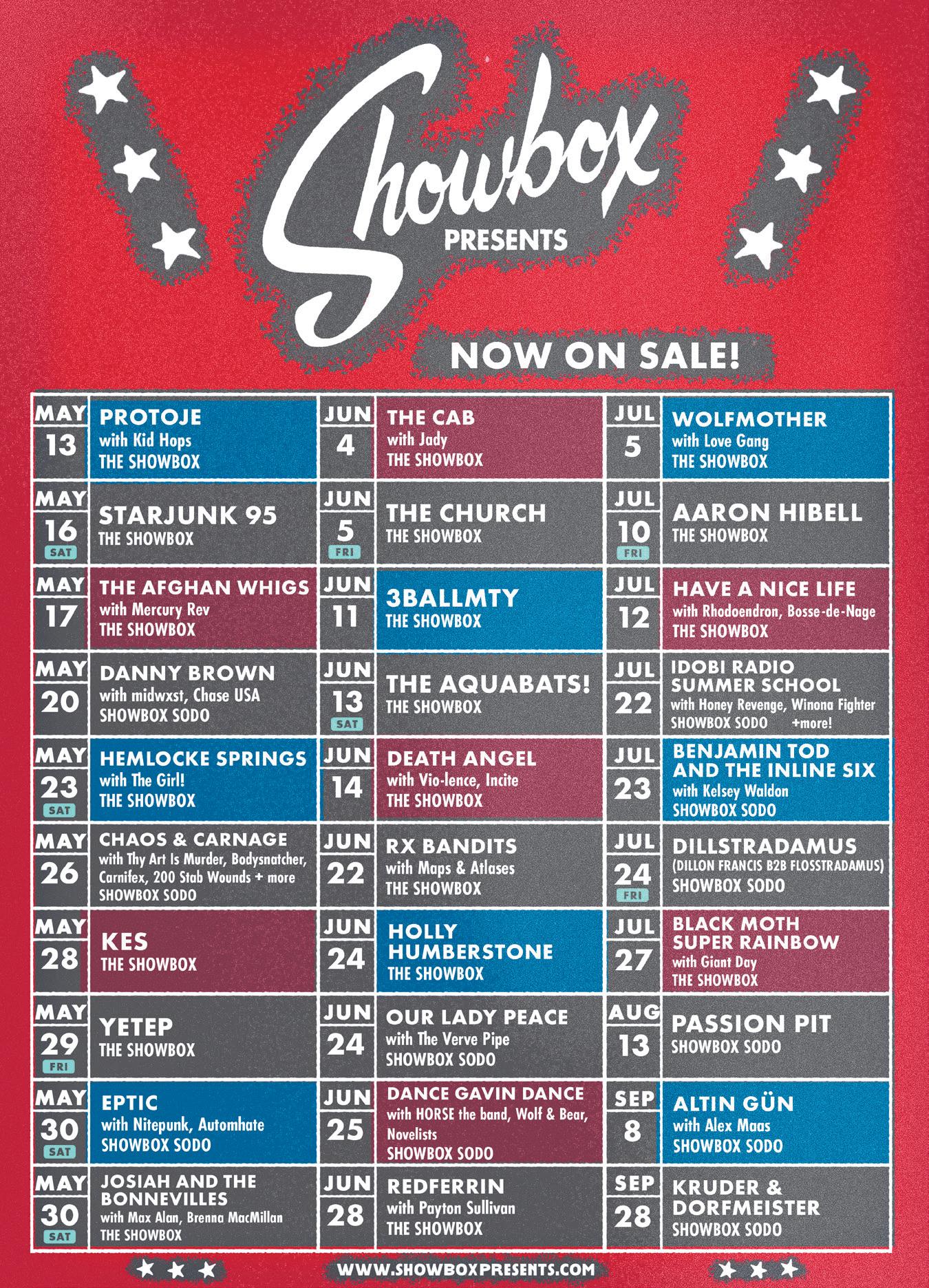
BY DAVE SEGAL
Telehealth Green World Image (Sub Pop)
With anxiety levels spiking to all-time highs because of you-know-who and -what in the USA, Seattle quintet Telehealth sound especially built for this awful moment. Their lyrics suggest struggles with working in the tech biz, and the music serves as an escape valve for the stresses they’ve endured in the airconditioned nightmare. Certainly, there’s
a winking cleverness about Telehealth’s persona, and whether it strikes you as too clever or refreshing probably depends on how immersed in and/or aware of corporate culture you are. The spoken-word intro “[user onboarding sequence]” gives away the game: “What if there was a model for living that connected people, finances, nature, and technology into one seamless experience? What if we told you the future is already here? Welcome to Telehealth.”
The follow-up to 2023’s Content Oscillator, Green World Image represents a great leap forward into punchier dance-induction (Trevor Spencer produces). “The Telehealth Shuffle” is a springfooted dance rocker that sproings like a more salubrious LCD Soundsystem while John O’Connor’s bulbous bass line powers “Kokomo 2,” as Kendra Cox and Alexander Attitude’s synths swell and snake with the ominous grandeur that Gary Numan took to the banque. Seemingly fueled by a vat of coffee, the zany new wave banger “Cool Job” proves that you can never go wrong with wonkily tuned, angular guitar riffs and zapping, video-arcade synths. “Donor Country (A gOoD cAuSe)” rides a tense, terse riff that recalls that of Wire’s “Another the Letter.” The song illustrates that triggering widespread panic and starting parties are startlingly similar. Raising cortisol
levels to get folks on the dance floor?
That’s a boss move. If Telehealth don’t become Seattle’s next medium-sized thing, I will slowly shake my head in disbelief. (See Telehealth May 14 at Neumos.)
Domenica Diavoleria
Flicker Statue Eyes (Eiderdown)
Over the last four years, Olympia-based producer/KAOS DJ Domenica Diavoleria (aka Domenica Clark) has built an impressive catalog of hauntological ambient music, culminating in Flicker Statue Eyes , her most varied and evocative album yet. It evolved out of a live score she recorded for Neil Jordan’s 1984 gothic fantasy horror movie The Company of Wolves , based on an Angela Carter story. Even if you’ve not seen the film or read the story, you can enjoy Diavoleria’s compositions, which subtly merge beautiful melodies with undercurrents of unease.
From the opening seconds of “The Corridor of Toys,” Diavoleria gently

submerges you in a mysterious atmospheric zone where drones of unknown origin whirl. “My Sister Sleeps” increases the scare factor with foreboding screeches and turbulence, resulting in her noisiest, most chaotic track; it’s as unsettling as an AI CEO talking about the future. Another deviation occurs on “Tender Maid,” an eerie strain of subliminal techno whose beats sound like those in an update of Edgar Allan Poe’s “The Tell-Tale Heart.”
“The Erl King” conjures an air of wonder and majesty—a misty mountain bop to tie up a movie’s post-climactic scene. Fans of Mica Levi and Robert A.A. Lowe’s unnerving soundtracks will find much to admire in Flicker Statue Eyes
Seattle-area musicians can send music to NewSeattleMusic@TheStranger.com for possible coverage. SUPER SEATTLE
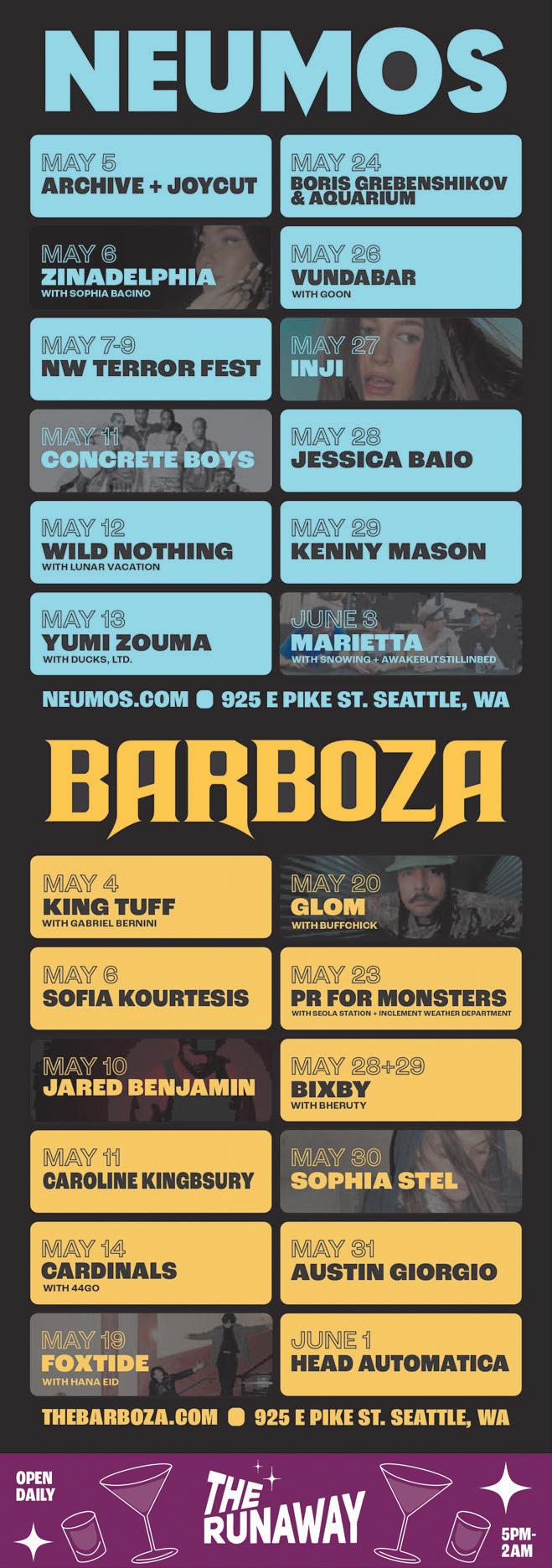

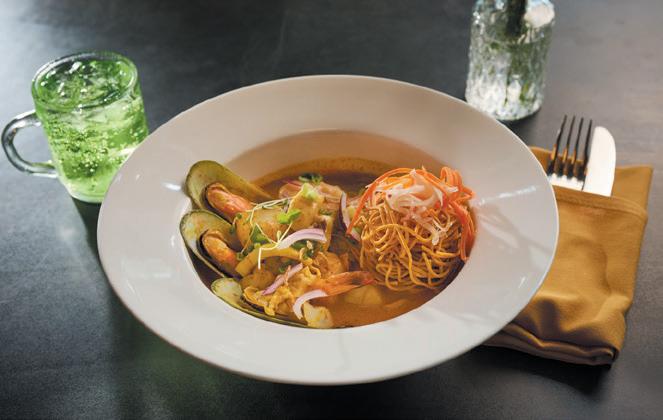


BY MEG VAN HUYGEN
ILLUSTRATION BY JAYA NICELY
Bad news, guys. I wasted three years of my life not going to Bar Bayonne when I could’ve been. I can never get them back. I can only start compensating today for the deleterious loss.
At 14th and Jefferson, L’Oursin has been the kissy darling of Seattle’s food writers since opening in 2016, and I’d assumed that if you’ve seen it, you’ve seen its sister, Bar Bayonne. But they are sisters, not twins. While L’Oursin is bright and blonde with lemony walls and wooden accents, looking like a sunflower in bloom, sultry Bayonne is all scarlet and turquoise and chrome, with metal band posters and neon trim. Still French, it imparts a moody Iberian flavor to L’Oursin’s Breton sailor-shirt vibe.
I finally make it to Bar Bayonne on a sunny Thursday afternoon. There are fresh flowers on the bar and jazz on the aux. It’s hard to choose from the impeccable cocktail list, so bartender Lana helpfully steers me toward her fave. “It’s a really unique drink,” she says, “made with Roquefort-flavored liqueur.”
Wait. As in the cheese?
The Cheesy Marty arrives in a snifter, whisper-light and screamingly cold, garnished with a fat piparra-and-bluecheese-stuffed olive. The drink is placid and clear, if slightly clouded from the chill. A few polka dots of olive oil quiver on the surface. It tastes powerfully of blue cheese. There’s a briny seashell thing happening between the fino sherry and the smoky mezcal, and a whiff of honeysuckle sweetness, too, all locking together flawlessly. It’s very weird to drink cold clear cheese juice, but I want another one the second it’s gone. As the French say about delicious things: “C’est le petit Jesus en culotte de velours” (This is little [baby] Jesus in his velvet underwear).
It’s a simple recipe using extraordinary ingredients. G. E. Massenez is an Alsatian distillery that specializes in eaux-de-vie, and their Liqueur de Roquefort is straight-up just Roquefort cheese macerated in neutral alcohol. The fino sherry
is from Gutiérrez Colosía in Spain, with notes of pear and chamomile, and the mezcal’s a caramelly Oaxaca joven (aged) espadin made by Rayu. Polish distillery Gruven made the crisp, smooth, smallbatch potato vodka.
L’Oursin/Bayonne co-owner Zac Overman says the drink wrote itself once he discovered that Roquefort liqueur. “We brought a bottle of that in,” he says, “just to try it—it is intensely cheesy—and realized we had to [use it to] do a martini with a blue cheese olive. And then we wanted to make it as savory and dirty as possible without actually using any olive brine, which is where the sherry and mezcal came in.”
How hedonistically sensible. Why make a hamburger when you could make a cheeseburger.
I realize I’m mortifyingly late, but Bar Bayonne’s spectacular, and there’s no excuse for never having been. I knew this when I drank this cocktail, and again hours later, wolfing down the magnificent jambon-beurre I’d taken to go. This is an essential—no, a crucial Seattle bar. I can’t wait to make up for lost time.



We do our best for accuracy, but please check venue websites for updates and more information, as event details may have changed since press time!
May 9, The Swedish Club
Housekeeping note: We have ceased to include pricing information, unless the event is free or sliding scale. (This is mostly due to third-party ticket vendors, like Ticketmaster, who have a monopoly on pricing that is not only unfair, but also confusing, due to varying fee structures. We hate them, and so should you.)
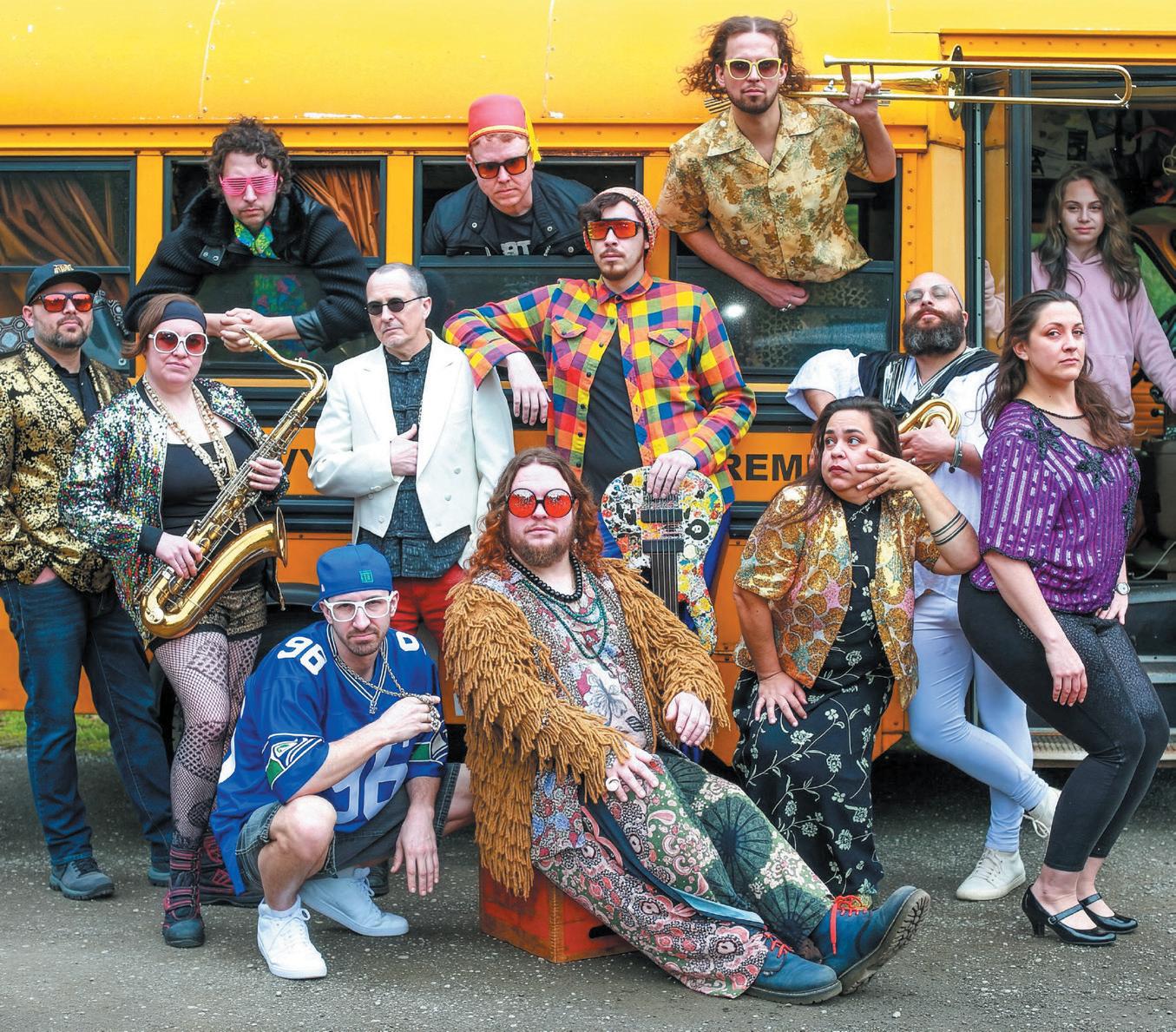
MAY 8
I am a long-time lover of Gustav Holst’s The Planets a symphonic journey through space written between 1914 and 1918. My personal favorite is the euphorically triumphant “Jupiter, the Bringer of Jollity.” My brother, a marching band mainstay, introduced it to me when we were in high school. I found it again when I listened to the sci-fi audio drama Wolf 359 a few years back. “Jupiter” played when—spoiler alert—the crew of this research mission discovered alien life. I shed real tears. Now, the Harmonia Orchestra and Chorus are bringing The Planets in its entirety to Benaroya Hall. They’ll also play two pieces by French composer Lili Boulanger, made at the same time. This performance
is guaranteed to be out of this world. (Benaroya Hall, 8 pm, all ages) NATHALIE GRAHAM
MAY 9
On albums such as 2007’s LP and 2010’s Latin Toronto’s Holy Fuck were an unholy fusion of !!!’s dance-floor bonhomie and Can’s overdriven motorik rhythms. At their best, Holy Fuck lived up to their name, with relentlessly propulsive, metronomic rock that could accelerate to fierce krautrock motion: check “Silva & Grimes” and “Stilettos” for proof. The band’s new album, Event Beat, sounds like a return to their peak form: uncompromising dance-rock pummel, like LCD Soundsystem sans James Murphy’s charisma/ annoyingness. Get to the Tractor early for Memorials, a fab newish UK group featuring Electrelane keyboardist/saxophonist Verity Susman and Wire guitarist Matthew Simms. Their tuneful, smart rock packs some prog-rock gravitas and often shifts into motorik groove action in the manner of Electrelane. They also possess acute, cinematic mood-conjuring
abilities, as their soundtrack work attests. (Tractor Tavern, 8:30 pm, 21+) DAVE SEGAL
MAY 9
For the last two decades, Seattle’s 12-member funk ensemble Eldridge Gravy & the Court Supreme have never wavered from their benevolent aim to move bodies and raise spirits. With the panache of a PNW Parliament-Funkadelic, boisterously soulful lead singer Eldridge Gravy and his highly adept mates—extra credit to longtime drummer Chris Pollina for the deepin-the-pocket beats that drive this motherfuckership— conjure an unstoppable energy. They’ve also proven themselves adept at Northern soul (“Into the Sun,” “Exceptional”), Dr. John’s swampy voodoo musique (“Pick You Up”), and a cover of Betty Harris’s New Orleans fonque classic “There’s a Break in the Road.”
At the Swedish Club, Eldridge Gravy & the Court Supreme will celebrate 20 years of party-igniting
with two sets featuring special guests and cameos by ex-members, go-go dancers, and an opening slot by former KEXP/KNDD DJ Marco Collins. At 11 p.m., an after-party happens at the Emerald City Soul Club’s monthly at Black Lodge. (The Swedish Club, 8 pm, 21+) DAVE SEGAL
MAY 15
On her new single “Keepsake,” experimental ambient artist Ana Roxanne delivers a dreamy piano ballad that showcases her vocals with angelic clarity. (She’s kind of like a modern-day Sarah McLachlan, without the tearjerking association with ASPCA commercials.) She is coming to Seattle to support her first album in six years, Poem 1, which is a big deal for people like me who have been hooked on her music since her debut EP, (pronounced Tilde Tilde Tilde). I hope she plays a few songs from the EP, like “I’m Every Sparkly Woman,” an unrecognizable, meditative cover of the
Chaka Khan hit. She will be joined by Portland-based nature-inspired electronic composer Patricia Wolf, whose upcoming album Yarrow chronicles the life cycle of the titular flowering fern-like plant. (Triple Door, 7:30 pm, all ages) AUDREY VANN
MAY 16
In 1980, Brian Eno spotted a man playing a zither in Washington Square Park and invited him into the studio. The man was Laraaji, and the result was Ambient 3: Day of Radiance—a shining collection of hypnotic and intense soundscapes (think lengthy, chiming patterns that emerge and dissolve; a bit of an outlier in Eno’s otherwise subtle Ambient series). It’s hard to describe the sound of a zither (a small, harp-like instrument) without using the word “shimmering” over and over, but that’s exactly what it’s doing. Shimmering like sun, shimmering like water, slow-motion shimmering; when amplified, it sounds at once devotional and playful, like Laraaji himself (check out his Laughter Meditation workshops). The celestial-minded visionary revisits the record, alongside selections from his vast and luminous catalog, joined by longtime collaborator and sound healer Arji OceAnanda. Saint Mark’s Cathedral will be filled with immersive, architecturally mapped projections to enhance what will no doubt be a very New Age (complimentary) experience. (Saint Mark’s Episcopal Cathedral, 8 pm, all ages) EMILY NOKES
MAY 21
On Sleater-Kinney’s 1996 album Call the Doctor, Corin Tucker shouts, “I wanna be your Joey Ramone!” and now, 30 years later, she has fulfilled the prophecy. Also featuring Carrie Brownstein and Fred Armisen, the trio will revive their Ramones cover band, which was originally formed as a one-off gig for the season wrap party for Everybody’s Live with John Mulaney (for the record, this is the only thing Mulaney has spearheaded that I don’t hate). The Return of Jackie and Judy couldn’t be coming at a better time, given that I am currently going through a Ramones phase. While I’m still sad that I’ll never be serenaded by the real Joey Ramone (à la Riff Randell in Rock ‘N’ Roll High School), I’ll happily settle for the next best thing. (Neumos, 7 pm, 21+) AUDREY VANN
MAY 22–23
London’s buzzy, baroque all-femme band the Last Dinner Party are back in town at Showbox SoDo. Touring their sophomore album, From the Pyre, the Last Dinner Party promise banger after banger. It’s like if we handed the mic to the women at the Salem witch trials as they burned at the stake. Except, more orchestral arrangements mixed with 1980s-inspired ballad rock and Florence Welch–style dreamy vocals. These ladies are a must-see. Clearly, Seattle gets it, because they’re here for two nights! (Showbox SoDo, 8 pm, all ages) NATHALIE GRAHAM
MAY 23
French guitarist/vocalist Melody Prochet’s career received a turbo boost when Tame Impala’s Kevin Parker produced her 2012 self-titled debut album. It bears some hallmarks of Parker’s extravagantly psychedelic sensibilities and propensity for robust drums, but Prochet’s lovely tunesmithing was already advanced at this stage. Ensuing albums Bon Voyage (2018) and Emotional Eternal (2022) found her recording with members of Swedish psych-prog group Dungen, who helped Prochet to realize her airy, pretty, and sophisticated psych-pop gems, topped by dulcet, Jane Birkin–esque vocals. For MEC’s latest album, last year’s Unclouded, Prochet tapped

MAY 28
By flashy celebrity standards, Curren$y has flown under the radar for most of his run, but the Pilot Talk rapper has nonetheless worked with (and routinely outshined) some of the biggest names in the biz. The New Orleans rapper and intrepid builder of model cars has stayed high, putting out dozens of albums, mixtapes, and collaborative projects since 2006—a seemingly endless flow of butter-smooth stoner musings shot through with laser-sight punchlines. What this all amounts to for Seattle fans, then, is that we have an opportunity to catch one of the most talented rap artists in the game play a (delightfully) grungy venue under I-5 on a weeknight for a modest price. ( El Corazon, 8:30 pm, 21+ ) TODD HAMM
another great Swede, Sven Wunder, to produce sublime orchestrations à la David Axelrod and JeanClaude Vannier, and enlisted Heliocentrics’ drummer Malcolm Catto to add slyly funky rhythms. Her voice seems more liberated and breezier than before, reaching a sweet zenith of ethereality that’s utterly calming. There’s a symphonic richness that I hope can be replicated in a live setting. Whatever the case, MEC’s songs pack enough melodic grace and textural sparkle to win hearts and minds. (Crocodile, 6 pm, 21+) DAVE SEGAL
MAY 25
Chapterhouse aren’t shoegaze GOATs, but they’re in the convo, flying high enough to sniff the exhaust of My Bloody Valentine, Ride, Lush, and Slowdive.
MAY 26
Vundabar is as fun to see as it is to say. When taken live, the exuberant Boston three-piece slathers the stage with aura in the form of punchy surf guitar, impromptu asides, and chummy informalities. Such sunny presentation is only a handshake introduction to all that is Vunder-ous, though. At their best, the band rides a frenetic pacing, highlighted by Drew McDonald’s skittering hi-hat and tumbling tom rolls that brace Brandon Hagen’s distorted guitar lines and wailing Brit-poppy melodies. Hagen’s cryptic hooks about death and societal ills also add a depth to the mix seldom heard on this shimmering side of indie. This tour finds the band taking on all 10 tracks of their exquisite 2015 cult classic Gawk front-to-back to celebrate its 10th(ish) birthday, along with a range of favorites from across their catalog that should amount to a rollicking good time. (Neumos, 7 pm, all ages) TODD HAMM
JUNE 6–7
Dylan/Bobby/Blind Boy Grunt/Zimbo/Zimmy is returning on his ever-expanding Rough and Rowdy Ways tour, which is now going on its fifth year. However, the real heads know that he has been nonstop touring since 1988 (except for canceled dates in 2020), which can only mean one thing: He genuinely loves performing. I’ve seen Dylan play three times in the last four years, and each time I was dazzled by his spontaneity and unpredictable setlists—no two shows are the same. While this freewheeling authenticity blows my mind each time, the man is as divisive as ever (I’ve overheard fans complain that he sounds “terrible” and “old”). So, if you want to attend this show and actually have a good time, I have some tips for you. (1) He does not play to please, so don’t expect any hits, at least not in their classic form. (2) He feeds off the energy of the crowd, so be nice! (3) He will be 85 years old this month, and he sounds it—how lucky we are to age! Arrive in time to see the opening set from punk legend John Doe (of X) and national treasure Lucinda Williams, who will be supporting her 16th album, World’s Gone Wrong. (Chateau Ste. Michelle Amphitheatre, 6:30 pm, all ages) AUDREY VANN
The Reading, England, quintet burned brilliantly but briefly, releasing but two albums and a handful of EPs from 1990 to 1993. Their best songs carry a beautiful wistfulness at their core, even as they deliver a burning groove and ferocious riffs—see “Falling Down,” “Sixteen Years,” and “Something More.” Chapterhouse’s 1991 debut LP, Whirlpool, flaunts a dense, swirling production that highlights the power of three guitars tuned to the key of AAAHHH, with Stephen Patman and Andrew Sherriff singing in that doleful, sensitive-guy style common during shoegaze’s first wave. By the time of 1993’s Blood Music, Chapterhouse were changing into a more trip-hop/ambient-house proposition, even working with Global Communication on a “retranslation” of said album titled BloodMusic (Pentamerous Metamorphosis). But this show’s all about getting lost in Whirlpool’s distortion-heavy nostalgia vortex with some of the planet’s most mesmerizing ‘gaze OGs. (Crocodile, 8 pm, 21+) DAVE SEGAL
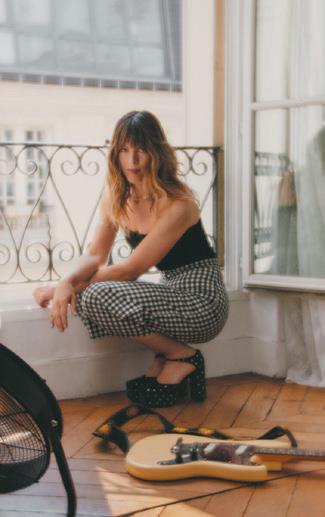

Boredom isn’t an option.


Rose City Band, Serafima & the Shakedowns May 7–8, Clock-Out Lounge, 8:30 pm, 21+
Northwest Terror Fest VIII May 7–9, Neumos and Barboza, 21+
Spyro Gyra May 7–10, Jazz Alley, times vary, all ages
Soulectro: Sho Nuph, WD4D May 8 (every second Friday), Vermillion, 10 pm, 21+
Snail Mail, Sharp Pins, Armlock May 8, Moore Theatre, 7:30 pm, all ages
The New Pornographers, Will Sheff May 8, Showbox, 8 pm, 21+
Teen Suicide, Cloud Nothings, Anthers May 8, Crocodile, 6 pm, all ages
Just Mustard, Miss Grit May 8, Tractor Tavern, 8:30 pm, 21+
The Wood Brothers, Olive Klug May 8, Neptune Theatre, 8 pm, all ages
Soul Nite: All Vinyl Dance Party May 9 (every second Saturday), Black Lodge, 9 pm, 21+
Seattle Rock Orchestra Performs the Beatles: Number 1s May 9, Moore Theatre, 7:30 pm, all ages
Chromeo (DJ set) May 9, Q Nightclub, 10 pm, 21+
The Darts, Dish Pit May 9, Clock-Out Lounge, 8:30 pm, 21+
Northwest Abortion Access Fund Fundraiser: Beautiful Freaks, Fleamale & Bazaar, DJ SofiiaK, DJ
Ghost Girl May 9, Baba Yaga, 6 pm, all ages
Texas Is the Reason May 10, Neumos, 7 pm, all ages
Blu & Exile, AJ Suede, Wizdumb May 10, Substation, 7 pm, 21+
Souled American May 11, Tractor Tavern, 8 pm, 21+
Florence + the Machine May 12, Climate Pledge Arena, 7:30 pm, all ages
Echo & the Bunnymen May 12, Showbox SoDo, 8 pm, 21+
Sports, Ally Evenson May 12, Tractor Tavern, 8 pm, 21+
Joyce Manor, Militarie Gun, Teen Mortgage, Combat May 12, Showbox, 8:30 pm, all ages
Demi Lovato May 13, Climate Pledge Arena, 8 pm, all ages
Goldi Locke, Xandra from Louisiana, Jon Marie May 13, Chop Suey, 8 pm, 21+
Allie X May 13, Crocodile, 8 pm, all ages
Faetooth, Iress, Nightosphere May 13, Substation, 7 pm, 18+
GZA, Phunky Nomads, Greg Cypher, DJ Indica Jones May 13, Nectar, 8 pm, 21+
Alex G May 13–14, Showbox, 8 pm, all ages
Exiter, Sun~Over Static, Athazagora May 14, Black Lodge, 7 pm, all ages
Telehealth, Coral Grief, Buddy Wynkopp Neumos, 7 pm, 21+ (See album review, pg. 37 Eli Moore (LAKE), Swirlhood, Nathaniel Talbot May 14, Rabbit Box Theatre, 8 pm, all ages
The Music of Jane Austen with the Seattle Symphony May 15, Benaroya Hall, 8 pm, all ages
Tripping Daisy, Jumprope May 15, Crocodile, 6 pm, 21+
Robert Lester Folsom, Kassi Valazza May 15, Tractor Tavern, 8:30 pm, 21+
Heavy Bloom, Hot Bodies, Joyla Red May 15, Baba Yaga, 8 pm, 21+
Anjimile May 16, Ballard Home stead, 8 pm, all ages
Elias Rønnenfelt & Evanora Unlimited May 16, Substation, 5:30 pm, 18+
Fruitless Worship, Laser Beam, Astra Mori, PTSD May 16, Chop Suey, 5 pm, 21+
The Afghan Whigs, Mercury Rev May 17, Showbox SoDo, 7:30 pm, 21+
Die Spitz May 17, Neptune Theatre, 8 pm, all ages
The Last Dinner Party
May 22–23, Showbox SoDo
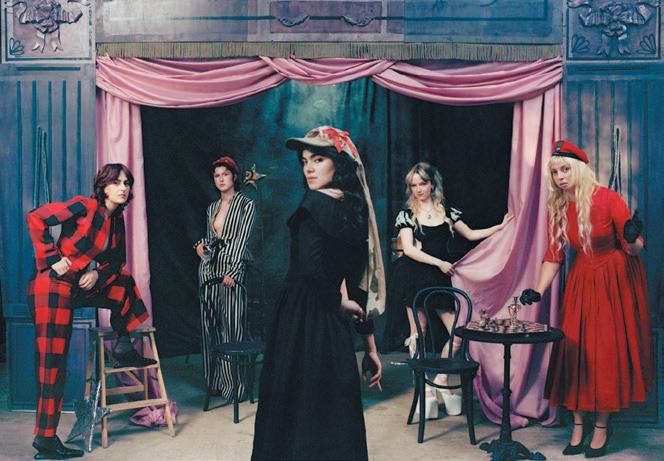
Gatecreeper, Eternal, Dying Remains, Denial of Life May 17, Substation, 7 pm, 21+
Dry Cleaning, Hotline TNT May 18, Showbox, 8 pm, all ages
Kevin Morby May 18, Neptune Theatre, 8 pm, all ages
St. Lucia May 19, Showbox, 8 pm, all ages
American Football May 19, Moore Theatre, 8 pm, all ages
Ora Cogan, somesurprises May 19, Substation, 8 pm, Danny Brown, midwxst, Chase USA May 20, Showbox, 8 pm, all ages
Prince Daddy & the Hyena, Remo Drive, Restraining Order May 21, Vera Project, 7 pm, all ages
Sleaford Mods May 21, Crocodile, 8 pm, 21+
Scott Yoder, Alicia Amiri, Chris Costalupes May 22, Add-a-Ball, 8 pm, 21+
Marisa Anderson May 22, Rabbit Box Theatre, 7:30 pm, all ages
Generifus, St. Yuma, Where’s Beth May 23, Rabbit Box Theatre, 8 pm, all ages
Massive Monkees Day May 24, Neptune Theatre, 6 pm, all ages
Yellowcard, New Found Glory, Plain White T’s May 24, Chateau Ste. Michelle Amphitheatre, 6 pm, all ages
Dethklok, Thrown into Exile, Witch Ripper May 25, Moore Theatre, 7 pm, all ages
Bob Log III May 27, Clock-Out Lounge, 8 pm, 21+
Trey Anastasio May 27, Paramount Theatre, 7:30 pm, all ages
THC XLR, the OC34N, DJ Having Sex May 27, Baba
An Evening with Joe Jackson May 28, Moore Theatre, 7:30 pm, all ages
Polt, Masha, Waxing Moon Band May 28, Vermillion, 7 pm, 21+
Peacocks & Pearls Gala Fundraiser: William C. White Performs La Bonne Chose May 29, South Seattle College, 6 pm, all ages
The Black Keys, Fai Laci May 29–30, Remlinger Farms, 6:30 pm, all ages
Medieval Women’s Choir Presents Hidden and Forbidden: The World of the Medieval Cantrix May 30, St. James Cathedral, 8 pm, all ages
Sleepytime Gorilla Museum, Geist and the Sacred Ensemble, Gumby’s Junk May 30, Substation, 7 pm, 21+
Ladytron, Danz CM May 31, Neptune Theatre, 8 pm, all ages
Supersuckers, Scott H. Biram May 31, Tractor Tavern, 8 pm, 21+
Louis Tomlinson, the Aces June 4, Climate Pledge Arena, 7 pm, all ages
Jeff Rosenstock, Star 99 June 4–5, Neumos, 8 pm, all ages
Hyper: Hyperpoppers, Rowan Ruthless, Viper Fengz, Aquarium Drinker June 5, Cherry Nightclub, 10 pm, 21+
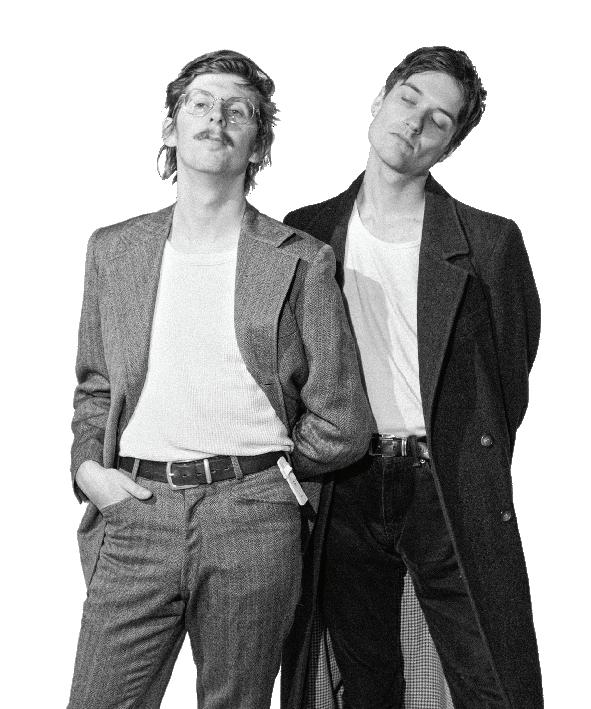
Blitzen Trapper June 5–6, Tractor Tavern, 8:30 pm,
Coffin Break, the Scoffs, Sinister Six, Cheliceral June 6, Chop Suey, 5 pm, 21+
Hunx and His Punx, Slippers, DJ Mister Sister June 10, Clock-Out Lounge, 8 pm, 21+
Beverly Crusher, Cosmic Kitten, Killbuzz June 13, Add-a-Ball, 8 pm, 21+
Helms Alee, Anthers, Czar June 13, Tractor Tavern, 8 pm, 21+
Belle and Sebastian, Quasi June 14, Woodland Park Zoo, 4:30 pm, all ages
Paul Oakenfold June 19, Q Nightclub, 10 pm,
Metric, Broken Social Scene, Stars June 25, Chateau Ste. Michelle Amphitheatre, 6 pm, all ages
Rhiannon Giddens, Mary Chapin Carpenter, Hurray for the Riff Raff June 26, Chateau Ste. Michelle Amphitheatre, 6 pm, all ages
Jimmy Eat World, Motion City Soundtrack, Illuminati Hotties Jul 18, WAMU Theater, 7 pm, all ages
Fitz and the Tantrums Jul 26, Chateau Ste. Michelle Amphitheatre, 7 pm, all ages
Capitol Hill Block Party Aug 7–9, Capitol Hill
Bumbershoot Sep 5–6, Seattle Center, times vary, all ages
Iron & Wine, Ken Pomeroy Oct 13, 5th Avenue Theatre, 8 pm, all ages
MAY 9–10
Lovers of art books (and art that comes in the form of books): Arrive rested and ready to immerse in work by more than 85 artists spread across all three floors of Washington Hall. Seattle Art Book Fair, now in its fourth year, was founded by superstar book designers Jayme Yen and Tom Eykemans, and features every flavor of art-book-object you can imagine—hardcovers, softcovers, indie magazines, photocopied zines, risograph ephemera—from local, national, and international makers. And the whole thing is free! In addition to vendors, the fair offers tutorials and author presentations, an art exhibition component, and on-site screen printing and letterpress printing. Last year, I regretted not budgeting enough time for a leisurely perusal, but that didn’t stop me from making out with a huge haul—racing Super Toy Run–style—through the labyrinth of book-lover’s delight. (Washington Hall, times vary) AMANDA MANITACH
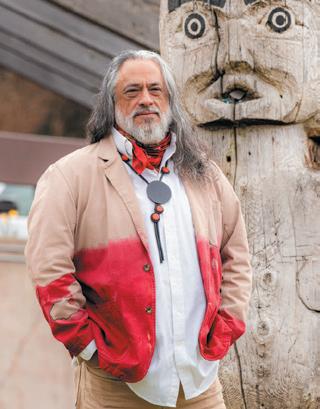
MAY 9–JUNE 21
Timothy White Eagle is an icon. Grounded in theater, his work is both an embrace of and a revolt against the forces that shaped him—a queer, mixed-race Indigenous child adopted into a white Mormon family, raised in rural Washington. He’s known for his visual storytelling and visionary theatrical rituals (including performances at On the Boards), but also for founding the community/cabaret space Coffee Messiah and touring with Taylor Mac. Last year, White Eagle was named the inaugural artist for the Green-Duwamish Urban Waters Federal Partnership Artist-in-Residence program, a year-long residency piloted by the EPA. This exhibit marks its culmination, featuring work by collaborators working with White Eagle to read the river, addressing its problematic history and present healing. Participating artists include Adrain Chesser, Laura Wright, Epiphany Couch, Crystal Cortez, and Sarah Kavage. (Mini Mart City Park) AMANDA MANITACH
MAY 13–JAN 17, 2027
Tara Donovan is a renowned artist who works a special kind of alchemy: transforming mundane junk objects into the jaw-dropping sublime. Each of her sculptural installations is made from (roughly) hundreds of thousands of individual, tiny things— Styrofoam cups, drinking straws, toothpicks, Slinkys, Mylar, and hot glue—to create masses that undulate like oceans or resemble mountainous biological and geological formations. Donovan’s work at SAM is






MAY 21–JUNE 27
The veil is thin in Drie Chapek’s work—the surreal and mystical breaking through the oil paint, where landscapes are ground for bodies to grow. At least, that’s one way to read her explosive depictions of limbs and land bursting with analog glitch and the churn of frothy, murky, incandescent white, cobalt, rust, and PNW-coded greens. Chapek is the kind of artist for whom legibility becomes a game of hide-and-seeking the sublime, leading us down a path where obfuscating the thing is as meaningful as the thing itself. In her latest solo show at Greg Kucera, this impulse intensifies, as the narrative element in her work continues to be subsumed by abstraction and love of the mark for its own sake. And what love! The body of the paint is as much a character as the demi-bodies emerging from it. (Greg Kucera Gallery) AMANDA MANITACH
part of an ongoing series inviting artists to respond to pieces in the museum’s recently acquired Alexander Calder collection. Donovan—ever the monochromist—chose Calder’s use of the color black as her touchpoint, specifically responding to Mountains (1:5 Intermediate Maquette), a hulking geometric landscape made of overlapping black sheet metal plates pierced with holes. Come be blown away by delicacy and scale. (Seattle Art Museum) AMANDA MANITACH
OPENS MAY 15
You know Janette Beckman’s work even if you don’t know you know Janette Beckman’s work. Her photographs of musicians, athletes, artists, and pop culture icons have traveled through time and become just as vital to the history books as the subjects within. There’s Keith Haring in his New York studio with his cartoon-sized paint brushes in 1985. There’s Salt-N-Pepa grabbing snacks at an East Coast bodega in 1986. There will be hundreds of her treasures to see when, starting May 15, the Museum of Pop Culture (MoPOP), displays the largest ever collection of her images. And the opening party promises to be just as memorable as the exhibit itself. Not only will Beckman be on hand to talk about her work and sign books, but stick around afterward for a dance party featuring none other than DJ Mix Master Mike. (MoPOP, 7 pm, 21+) MEGAN SELING
Sharon Shapiro: Tender Wild Opening May 7 with artist reception May 14, Spectrum Fine Art
Ed Archie NoiseCat: Trickster’s Feast May 7–30, Stonington Gallery
Clare Johnson: A Life in Sticky Notes May 7–June 18, Gallery 4Culture
Ann Gardner: The Color of Light May 7–June 20 with artist reception May 9, Winston Wächter
Prepress: Seattle Art Book Fair Launch Party May 8, Actualize AiR, 6–9 pm
The Prehistoric Group Show May 8–June 6, Roq la Rue
Meet Me at the Henry May 16, Henry Art Gallery, 11 am–4 pm
2026 University of Washington MFA + MDes Thesis Exhibition May 16–June 14, Henry Art Gallery
Tom Lloyd May 16–Sept 20, Frye Art Museum
Sarah Winkler: Folded Earth, Open Sky June 4–20, Foster/White Gallery
Eirik Johnson: Pine June 4–July 25, Foster/White Gallery
Norman Lundin: Landscapes, Mostly, Other Things Too Through May 16, Greg Kucera Gallery
Project NW: Ralph Pugay Through May 17, Tacoma Art Museum
Wallflowers Through May 17, Frye Art Museum
Ad-Lib Through May 17, AMcE Creative Arts
Donald Cole: Throughlines Through May 23, ArtX
Contemporary
Eva Isaksen: Drawn to Line Through May 23, with opening reception May 7, Foster/White
Sue Danielson: Relic, and Kim Van Someren: Holding the Line Through May 29, J. Rinehart Gallery
Hana Hillerová: Flow: The Shape of Process; Marita Dingus: Ancient Ones; and Joe Shlichta and Matt Sellars: Northern Light Through May 30, with opening reception May 2, Traver Gallery
Christine Gedye: Water’s Edge Through May 30, Fountainhead Gallery
Mya Kerner & Zak Helenske: While the Garden Overgrew Through May 31, Dirkse/Prim Gallery
In Circulation: An Exhibit on Artist Publishing in Seattle and Miwa Gardner and Ramona Lee: A Maternal Gaze Through May 31, Columbia City Gallery
Haunted Through June 7, Tacoma Art Museum (See preview, pg. 30.)
You’ve Had It in You All Along Through June 7, Avery Barnes Gallery
In Practice: Work by PCNW Faculty Through June 7, Photographic Center Northwest
Modern American Masculinity Through June 12, Base Camp Studios 2
River Coello: HAMPI Through June 13, Jack Straw New Media Gallery
Claire Partington: The Small Things Through June 13 with artist reception May 9, Winston Wächter
Crafting Futures: Emerging Artists Invitational Through June 13, Bainbridge Island Museum of Art
Aimee Lee: Tethered Through June 14, Bainbridge Island Museum of Art
TADAIMA: I’m Home Through July 12, Museum of History & Industry
Beyond Mysticism: The Modern Northwest Through Aug 2, Seattle Art Museum
Woven in Wool: Resilience in Coast Salish Weaving Through Aug 30, Burke Museum
Chloë Bass: Soft Services Through Aug 2026, Volunteer Park
Moomins’ Sea Adventures & Tove and the Sea Through Sept 6, National Nordic Museum
Lost & Found: Searching for Home Through Sept 14, Wing Luke Museum
Let There Be Light Through Sept 30, Cannonball Arts
Samantha Yun Wall: What We Leave Behind Through Oct 4, Seattle Art Museum
Jonathan Lasker: Drawings and Studies Through Oct 11, Frye Art Museum, free
Boren Banner Series: Chloe King Through Oct 11, Frye Art Museum, free
Natalie Porter
May 14, Central Library
Eric-Paul Riege: ojo|-|ól Through Oct 25, Henry Art Museum
A Room for Animal Intelligence Through Jan 2027, Seattle Art Museum
Ten Thousand Things Through May 2, 2027, Wing Luke Museum
Pioneer Square Art Walk Every first Thursday
Capitol Hill Art Walk Every second Thursday
Georgetown Art Attack! Every second Saturday
Chris Kallmyer: Song Cycle Ongoing, Seattle Art Museum
Gossip: Between Us Ongoing, Tacoma Art Museum
Legacy: Highlights from the Permanent Collection Ongoing, Tacoma Art Museum
Qiu Zhijie: Map of the History of Science and Technology Ongoing, Olympic Sculpture Park, free Ash-Glazed Ceramics from Korea and Japan Ongoing, Seattle Art Museum
MAY 13
Called “Pure genius” by Paul Reubens, “One of the last great people” by Miranda July, and “Insane” by Dick Van Dyke, Dynasty Handbag (aka Jibz Cameron) is a legend among legends. The queer performance artist created her persona, Dynasty Handbag, back in 2001, as a music project after she graduated from art school. Little by little, her costumes, makeup, facial expressions, and onstage banter became bigger and more theatrical, until it was a full-on multidisciplinary performance. Supporting her debut memoir, Hell in a Handbag Cameron will grace Seattle with a unique reading that incorporates performance and film, telling the story of her journey from the child of hippy clowns, to a teenage punk, to an avant-garde theater star. (Town Hall Seattle, 7:30 pm) AUDREY VANN
MAY 14

If you look back at the plethora of skateboard videos, books, and magazines that have captured the rise of
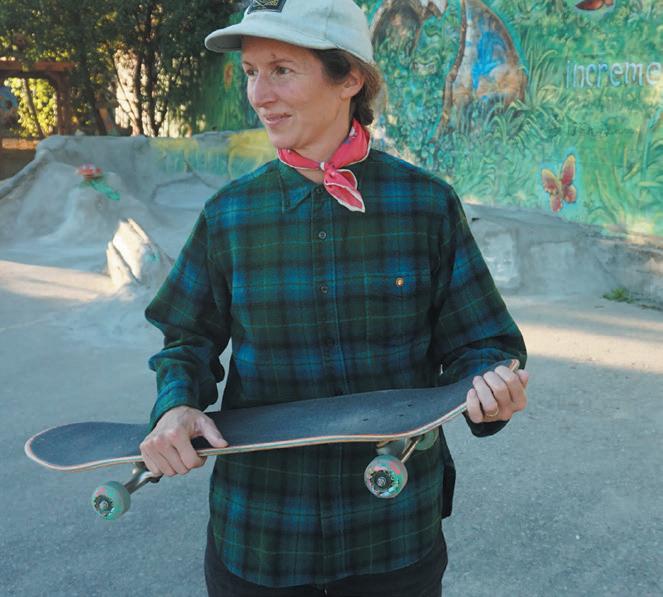
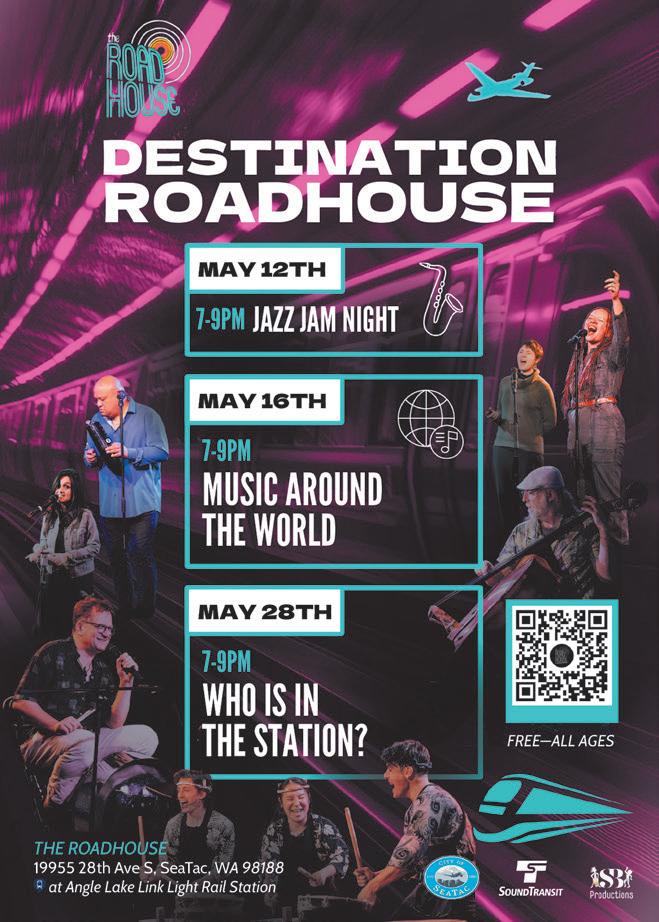
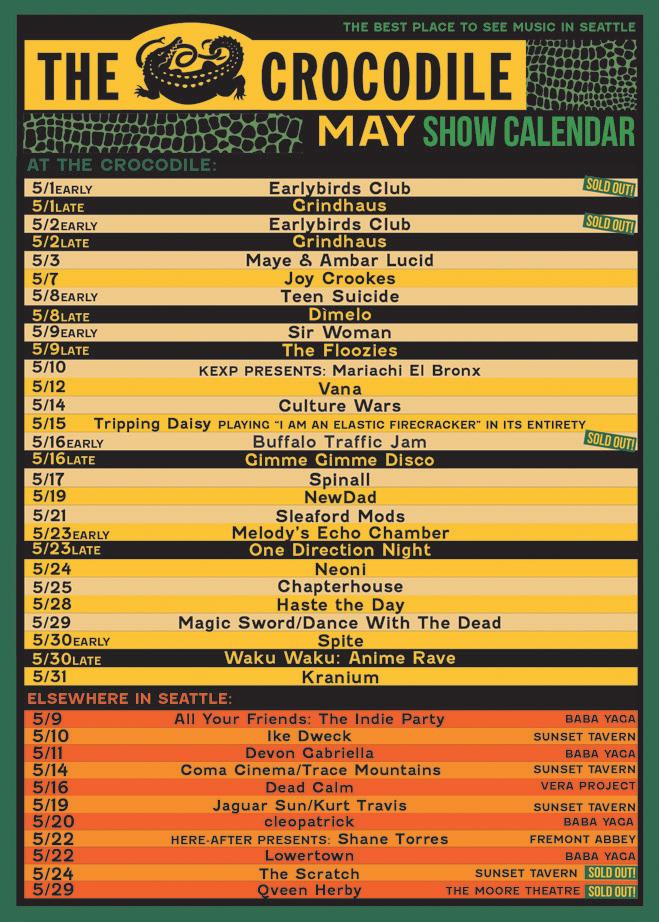

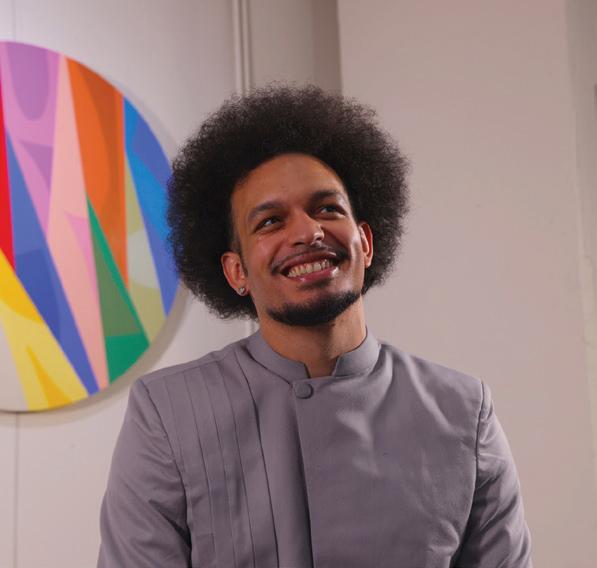

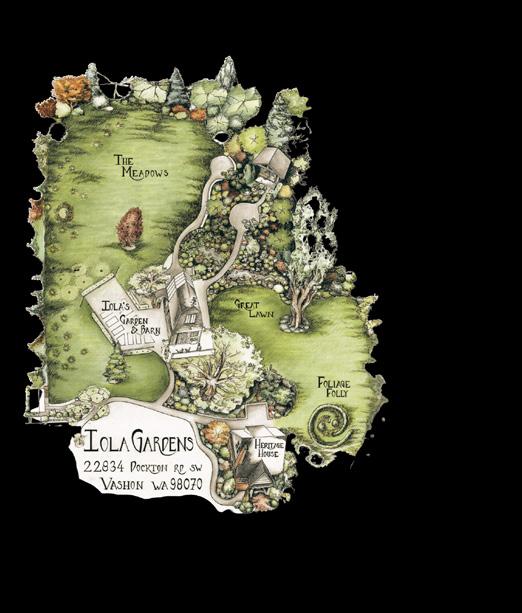



skateboarding culture through the ’70s, ’80s, and ’90s, you will see boys. So many boys. Tony Hawk, Jay Adams, Tony Alva, Steve Caballero, Stacy Peralta, Eric Koston. Women were skating, too, of course—Peggy Oki was a member of the Zephyr Competition Team featured in Dogtown and Z-Boys—but h istory wasn’t focused on their stories. Natalie Porter is here to begin to set the record straight. After establishing the online WomxnSkateHistory archive, she has compiled stories, zines, and photos into her book Girl Gangs, Zines, and Powerslides: A History of Badass Women Skateboarders, to celebrate the women and nonbinary athletes who contributed to the culture from the 1960s through today—Stephanie Massey, Cara-Beth Burnside, Georgina Matthews, and so many more. (Seattle Public Library Central Branch, 4 pm, free) MEGAN SELING
More
Willy Vlautin May 6, Elliott Bay Book Company, 7 pm, free
Brandon Bye May 7, Third Place Books Seward Park, 7 pm, free
Scott Kurashige with Karam Dana and Linh Thủy Nguyễn May 8, Third Place Books Ravenna, 7 pm, free Elissa Favero, Alejandro Pérez-Cortés, Kevin Dean, and Diane Nguyen May 8, Jack Straw Cultural Center, 7 pm
Jake Skeets May 10, Elliott Bay Book Company, 7 pm, free
Annie Leonard & André Carothers May 11, Elliott Bay Book Company, 7 pm
Emily Lynn Paulson with Andrea Dunlop May 12, Third Place Books Seward Park, 7 pm
Hillary Behrman with Rod Driver May 12, Elliott Bay Book Company, 7 pm, free
Karen Tei Yamashita with Karen Maeda Allman May 15, Elliott Bay Book Company, 7 pm, free Sayantani Roy, BeeLyn Naihiwet, Natalie Pascale Boisseau, and Jean Ferruzola May 15, Jack Straw Cultural Center, 7 pm
Cascadia Day Poetry Explosion May 18, Vermillion, 7 pm, free
Sonora Jha with Katie Campbell May 21, Seattle Public Library Central Branch, 6:30 pm, free Alex Garland with Marcus Harrison Green May 24, Elliott Bay Book Company, 7 pm, free Matt Dinniman with Bookborn May 25, Third Place Books Lake Forest Park, 7 pm
The Moth GrandSLAM: Seattle GrandSLAM Championship May 29, Town Hall Seattle, 8 pm, all ages Caro Claire Burke May 31, Elliott Bay Book Company, 7 pm, free
Brooke Averick June 9, Third Place Books Lake Forest Park, 7 pm
Chuck Tingle presents ‘Fabulous Bodies’ July 7, Third Place Books Lake Forest Park, 7 pm
THROUGH MAY 17
Theater can be a hard sell in a failing economy, so how does director Bill Berry lure people through the door when presenting such a well-worn production like Jesus Christ Superstar? He fills the cast with rock stars. In the 5th Avenue Theatre’s take on Andrew Lloyd Webber’s classic, King Youngblood guitarist Cameron Lavi-Jones will play Judas, and Thunderpussy vocalist Molly Sides portrays Mary Magdalene. In their respective bands, Lavi-Jones and Sides command the audience with the kind of confidence that can only come from knowing they are very good at what they’re doing. Sides writhes around the stage, singing big, classic-rock songs in fringe and feathers; Lavi-Jones shreds through guitar-driven alt-rock with
such fervor you expect to see blood pouring from his fingers. I can’t speak to their acting chops, but I’m intrigued enough to find out, recession be damned. (5th Avenue Theatre, times vary) MEGAN SELING
MAY 23
I’ll cop to getting misty when I encounter music or art that moves me, which luckily is not infrequently, but watching Alysa Liu’s Olympic gold-medal free-skate routine in Milan earlier this year had me outright sobbing. And apparently everyone else, too. And no wonder—her joy-filled performance (skating to Donna fucking Summers) is the most genuinely inspiring displays of talent I’ve ever seen; there is nothing like watching someone do what they are so obviously meant to do. The Olympics can seem like a freaky discipline factory where all their rigor-maxxing sounds pretty life-minning, but Liu’s story is uncompromising in the right way—she reserved the right to have a life
outside of the grind. See our halo-haired champion take to the ice with other greats like Ilia Malinin (the “Quad God”) and Amber Glenn, who also won my heart during the Winter Games by stating “I am on my period right now.” (Climate Pledge Arena, 7 pm, all ages) EMILY NOKES
Las Alucines May 7, Moore Theatre, 8:30 pm, all ages Shenaniganza May 8–10, Theater Puget Sound, times vary
Seattle Rep Presents: Appropriate Through May 10, Bagley Wright Theater, times vary, all ages Scrambling the Goose II Through May 10, 12th Avenue Arts, times vary
Seattle Opera Presents: Carmen Through May 17, McCaw Hall, times vary
Can Can’s Carnival of Curiosities Through June 7, Can Can, times vary, 21+
Neil deGrasse Tyson May 5–6, Paramount Theatre, 7:30 pm, all ages
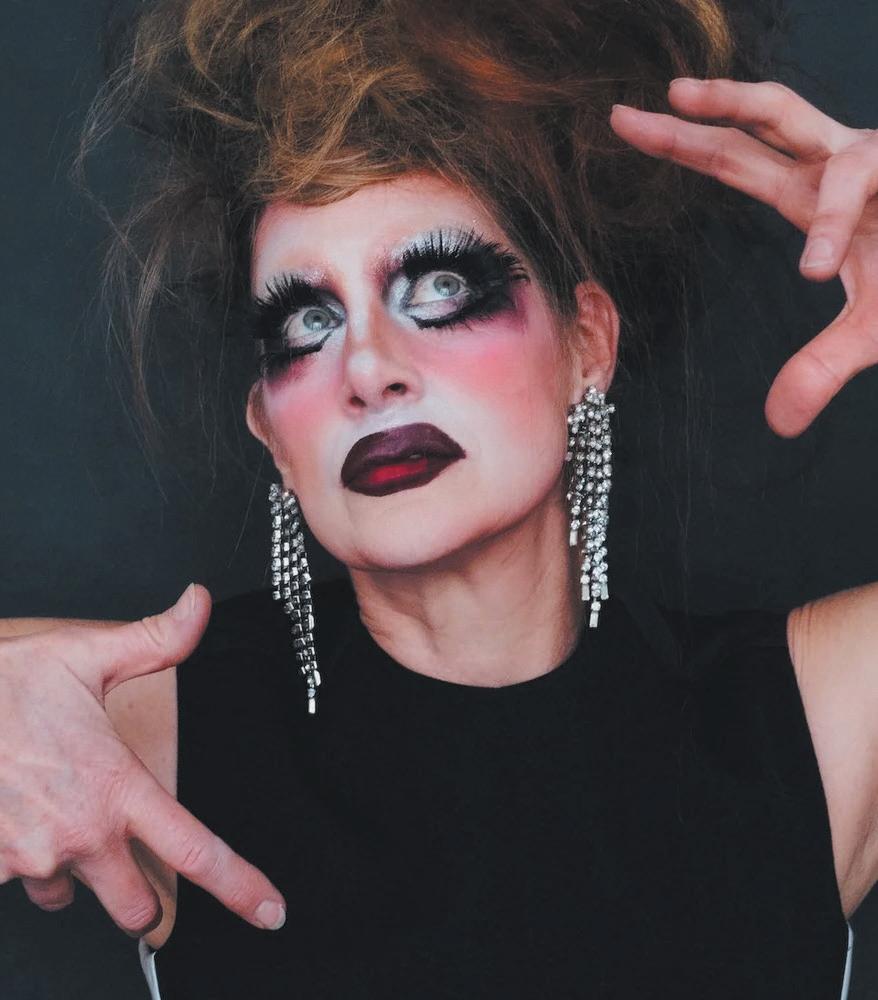
MAY 7–9
How Do I Look? is the latest stage show of performance artist Fauxnique (aka Monique Jenkinson), who made waves in 2003 when she was the first cisgender woman to win a drag pageant. With her unique physical language that combines Marina Abramović–style performance art with drag, ballet, feminist philosophy, and stand-up, her work will make you laugh just as much as it’ll make you question your mortality. Fauxnique will tackle the seemingly vain, yet philosophical question “How do I look?” by asking what it means to see and be seen. If you’ve never been to the Lower Queen Anne theater, don’t let its cutting-edge acts scare you away. The theater is incredibly welcoming and suited with comfy seats and a great drink/snack bar, and they have fancy Aesop hand soap in the bathroom (IYKYK). (On the Boards, 8 pm) AUDREY VANN
Feat: Velocity Bash 2026 May 6, Washington Hall, 6 pm
The Boulet Brothers’ Dragula: Titans 2 May 7, Neptune Theatre, 8 pm, all ages
Bess Wohl’s Continuity May 7–23, 12th Avenue Arts, times vary
Not Another Isekai May 7–30, West of Lenin, times vary
Seattle Rep Presents: Alex Edelman: What Are You Going to Do May 8–10, Leo K. Theater times vary, 13+ Whim W’Him Spring ‘26 May 8–16, Cornish Playhouse at Seattle Center, 8 pm
Zakir Khan May 9, Climate Pledge Arena, 7 pm
Adam Ray as Dr. Phil with Marshawn Lynch May 12, Neptune Theatre, 8 pm, all ages
Joketellers Union May 13, Clock-Out Lounge, 8 pm, 21+
Gus Constantellis May 13, Laughs Comedy Club, 7 pm, 21+
Barefoot in the Park May 13–June 20, Taproot Theatre, times vary
The Phantom of the Opera May 13–24, Paramount Theatre, times vary
Tush: Amora Namor, Angel Baby Kill Kill Kill, Betty Wetter, Pussy Willow, and more May 14, Clock-Out Lounge, 8 pm, 21+
Fussy Cloud Puppet Slam: Monster of the Week— Resurrection May 15–16, Theatre Off Jackson, 7:30 pm, 18+
Aviatrix May 15–June 7, Seattle Public Theater, times vary
Monét X Change: High Heels, Bad Knees May 16, Neptune Theatre, 7:30 pm, 18+
Corey O’Brien May 18, Emerald City Comedy Club, 7:30 pm, 21+
The Vanishing Seattle Variety Show: Cookie Couture, Martin Douglas, Dusty Henry, Shannon Koyano May 20, Clock-Out Lounge, 8 pm, 21+
The Insidious Trilogy May 20–24, On the Boards, times vary
Strange Fruit May 20–24, On the Boards, times vary Kitty Kat Ball: Nini Coco, Darlene Mitchell, Myki Meeks, Juicy Love Dion May 21, Showbox, 8:15 pm, 18+
Mortem—The After Death May 21–23, Freehold Theatre, 7: 3pm, 16+
Chicken Tinders May 22–31, Taproot Theatre, times vary, 16+
Pacific Northwest Ballet Presents: All Lang May 29–June 7, McCaw Hall, times vary My Straight Friends May 27, Emerald City Comedy Club, 7:30 pm, 21+
The Circus of Second Chances May 29–June 14, 12th Avenue Arts, times vary
Yoni Ki Baat June 4, Tasveer Film Center, 7:30 pm NW New Works 2026 June 4–6, On the Boards, 7 pm
Disappearance at the Rocky Mountain Leatherdyke Snowpicnic June 5–20, Annex Theatre, times vary

Robby Hoffman June 6, Neptune Theatre, 7 pm and 9:35 pm, all ages
Frida... A Self-Portrait June 6–28, Union Arts Center, times vary
Seattle Rep Presents: The Play That Goes Wrong June 11–28, Bagley Wright Theater, times vary Leslie Jones July 10–12 Emerald City Comedy Club, times vary, 21+
Jack Bensinger Aug 16, Rabbit Box Theatre, 8 pm, 21+
MAY 11
Last year, when I interviewed Heart for our November issue, I asked Ann Wilson what it was like revisiting old footage for the then-forthcoming documentary In My Voice. “Very surreal!” she said. “Recently … I was looking at some slides from my teenage years. It’s so wonderful to see all of those faces again. There were people I could barely recognize now.” Now, the film is making its worldwide debut in Seattle, followed by a Q&A with the queen herself. Directed by multi-hyphenate filmmaker, TV producer, writer, and musician Barbara Hall (who directed Milk and created the CBS drama Madam Secretary), the documentary brings together video, photos, and interviews that chronicle the Wilsons’ beginnings, the formation of Heart, their rise to icon status, and Ann’s life beyond the band. (Neptune Theatre, 8 pm, all ages) AUDREY VANN
MAY 30–31
What better to watch in late spring than Late Spring? Yasujirō Ozu, one of the great directors, shot intimate family dramas that were always thoughtful of the social forces that constrained women. Late Spring the story of a widower marrying off his cherished only daughter in the tumult of post-war Japan, is considered one of his best. It was actually shot in post-war Japan and subject to censorship from the occupying Allied powers. The film is the first of Ozu’s Noriko trilogy, in which actress Setsuko Hara plays three different young single women named Noriko. (So if you like what you see, check out the next two installments, Early Summer and Tokyo Story.) What set Ozu’s stories of ordinary life apart was his eye. The director kept the camera low to the ground and the shots tight, so the viewer feels as if they are sitting in the room with the characters. (Northwest Film Forum, times vary) VIVIAN McCALL
Once Upon a Time in Beirut: The Cinema of Jocelyne Saab Through May 7, Beacon, times vary
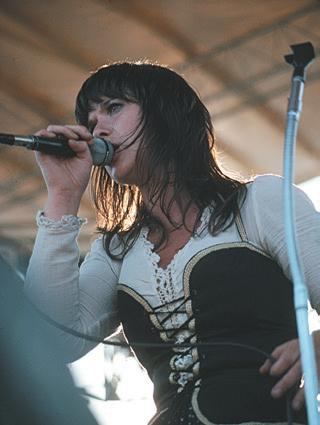
Here’s Your List of Friends in the Order They Died: Teen Anarchy Japan Through May 22, Beacon, times vary
An Evening of Film with Usman Ally and Mouzam Makkar May 8, Kerry Hall, 7:30 pm, all ages
Erupcja May 8–17, Northwest Film Forum, times vary
Symphony of Sight and Sound: A Jon Behrens
Retrospective May 9, Northwest Film Forum, 7 pm
Seattle International Film Festival May 7–17, multiple locations (See preview, pg. 24.)
The Room May 7, Central Cinema, 8 pm
District 9 May 8–12, Central Cinema, times vary
Millennium Actress May 8–13, Central Cinema, times vary
9th Annual Tasveer Gala 2026 May 9, Seattle Convention Center, 5:30 pm
Mamma Mia! May 10, Central Cinema, 4 pm
Mermaids May 10, Central Cinema, 7 pm
How Green Was My Valley May 10–11, Beacon, times vary
In the Midst of the End of the World: António Reis and Margarida Cordeiro May 10–17, Beacon, times vary
Two Seasons, Two Strangers May 13–17, Northwest Film Forum, times vary
An Evening with Sky Hopinka May 15, Northwest Film Forum, 6:30 pm
The Girl Who Leapt Through Time May 15–19, Central Cinema, times vary Arco May 15–20, Central Cinema, times vary
Let the Bullets Fly 让子弹飞 May 17, Tasveer Film Center, 1 pm
The Grapes of Wrath May 17–18, Beacon, times vary
Cher’s 80th Birthday: Moonstruck May 20, Central Cinema, 7 pm
Baron Von Terror Presents: Demons May 21, Central Cinema, 8 pm
Altered States (4K Restoration) May 22–24, Northwest Film Forum, times vary
Wagon Master May 24–25, Beacon, times vary
Secret Cinema May 28, Beacon, 7:30 pm
Stalker May 31, Beacon, 5 pm
The Man Who Shot Liberty Valance May 31–June 1, Beacon, times vary
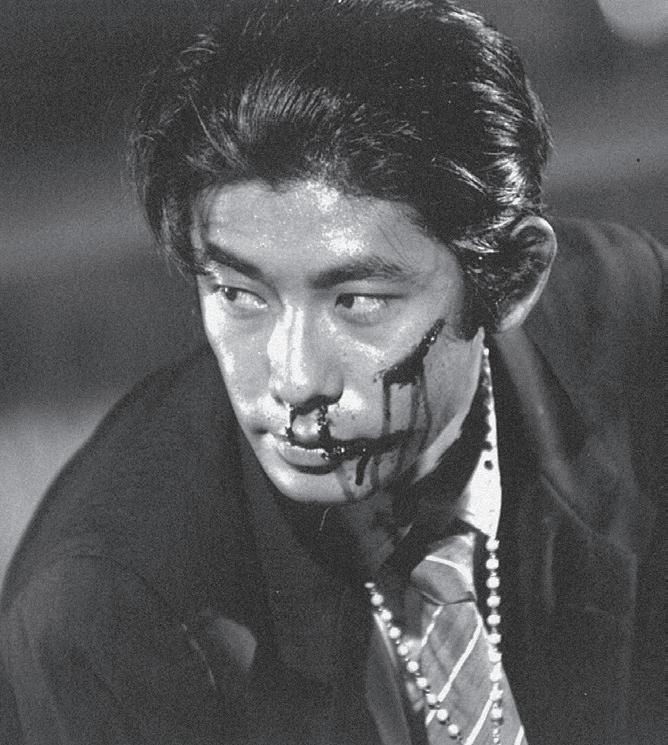
MAY 8–10
Here are three, no four, things I love about The Most Terrible Time in My Life: (1) It’s a detective/gangster flick, (2) it’s shot in black-and-white, (3) it’s the first in a trilogy, and (4) it’s about a terrible time in someone’s life. What can I say, I’m a glutton for misery and pain. Directed by Kaizo Hayashi, the film begins with private eye Maiku Hama saving a Taiwanese immigrant waiter after a fight breaks out in a mahjong parlor. Turns out that the immigrant, Yang, is searching for his missing brother, and Maiku agrees to help. But, whoops, he’s stumbled into a gang war/revenge plot. To paraphrase one of the top Letterboxd reviews, making smoking look sublime is the mark of a good film. (Northwest Film Forum, times vary) VIVIAN McCALL
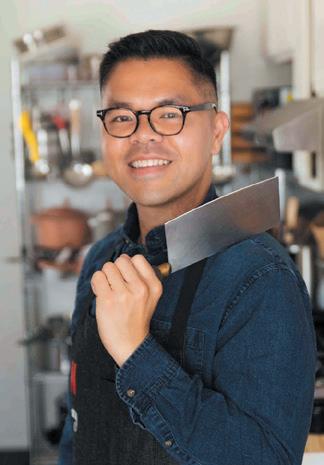
MAY 17
Seattle has a thriving food-and-drink pop-up scene, so much so that I often feel overwhelmed by all the options while trying to track who’s appearing where. And it doesn’t help that once I follow a spot on Instagram, the goddamn algorithm still buries their posts. I know I’m not alone, because the Block exists. On May 17, the Fairview Market Hall will fill with more than a dozen vendors. My Favorite Ice Cream makes all your chunky ice cream dreams come true with scoops and pints loaded with surprising toppings like brown butter and fennel sourdough croutons, matcha rose gooey butter cake “chonks,” and fish sauce caramel swirl (not all in the same flavor). Yoks Cafe makes Hawaiian-inspired coffee drinks, and the pineapple float cold brew and a haupia cream hot chocolate with toasted-to-order mallow look especially tasty. And look at these cookie flavors from Anh Ơi Bake Shop, a Vietnamese bakery: Fried Banana Cookie (ChuƠi Chiên), Pandan Coconut Bean Cookie (Chè Ba Màu), Coconut Mung Bean Cookie (ĐƠu Xanh DƠa), and Thai Tea Persimmon Cookie (Trà Thái Trái HƠng). I’ll take two of everything, Anh Ơi, and I’m not kidding. (Fairview Market Hall, 11 am–3 pm) MEGAN SELING
JUNE 1
No Call No Show’s tagline is “Boozy popups for unpretentious foodies,” and when it comes to ridiculous concepts—and completely committing to the bit—this gang of veteran chefs and bartenders are not playing. On June 1, NCNS’s theme is erotica, and the party will be at Kilig, sister restaurant to Musang. Chef-owner and serial JBA semifinalist Melissa Miranda is on deck to provide bespoke bites, while cocktail weirdos TN Trang (Itsumono) and Matt Pachmayr (Le Coin, Streamline) will be shaking up bawdy, gaudy craft drinks. Source material will include steamy romance Get in My Swamp: An Ogre Love Story as well as Triceratops and Bottoms, a dinosaur erotica novella. The menus are still under wraps, but the team will be costumed absurdly (as ever) and soliciting amateur erotica from guests. If you’re no novelist, that’s okay—Trang says there’ll be smutty books on tables from which folks can share their favorite quotes via mic, plus a live erotica reading. Pachmayr adds, “It’s going to be so fucking dumb, lol.” (Kilig, 5 pm, 21+) MEG VAN HUYGEN
Seattle Beer Week 2026 May 7–16, various locations
Mother’s Day Weekend Cookbook Sale May 9, the Garden at Volunteer Park, 10 am–2 pm
Good Voyage x No Call No Show Present: Welcome to New Orleans Night May 11, Good Voyage, 5 pm
London Fog and Florals Demo Class May 11, Deep Sea Sugar and Salt, 5:30 pm
Author Talk: Saeng Douangdara May 13, Book Larder, 6:30 pm
Author Talk and Demo: Nancy Singleton Hachisu May 14, Book Larder, 6:30 pm Situ Tacos Anniversary Party May 15, Situ Tacos, 11 am–midnight
Pâte Brisée: Sweet and Savory Galettes Workshop May 16, Pastry Project, 3 pm
Tigers Eye x No Call No Show Present: Nightshade Elixirs May 18, Dark Room, 5 pm
Author Talk: Alana Kysar May 18, Book Larder, 6:30 pm
Author Talk and Tasting: Cha McCoy May 19, Book Larder, 6:30 pm
Author Talk and Demo: Nichole Accettola May 21, Book Larder, 6:30 pm
3rd Annual OysterFest May 21, RailSpur, 6 pm Paris Brest: Master the Art of Choux Pastry and Cremieux May 24, Pastry Project, 3 pm
Genoise & Mirror Glaze Workshop May 31, Pastry Project, 3 pm
MAY 8
The Seattle SuperSonics left Seattle for Oklahoma City in 2008, and longtime Seattleites are still pissed about it. Rightfully so, if you ask me—it was a dirty, sneaky deal! But real basketball fans know Seattle is still a basketball city. The WNBA founded the Seattle Storm in 2000, and the team has qualified for the playoffs 19 times in its 25 seasons. They’ve won four WNBA championships, the most recent being in 2020. When Storm star Sue Bird retired in 2023, they retired her number (10) and hung her jersey in the rafters of Climate Pledge. And now, these players are finally getting paid their worth. In March, the WNBA and the league’s Players Association avoided a 2026 season strike by agreeing to an impressive new contract. Not only did they increase each team’s salary cap from $1.5 million to $7 million, but the average player’s salary will now be around $600,000, compared to last year’s $120,000. ( Pledge Arena, 7 pm, all ages
MEGAN SELING

MAY 16
Calling all weed heads! If you’ve ever wondered which of those weeds in your yard, in the park, or on the trails could be cooked and eaten, have I got the event for you. The University of Washington Botanic Gardens is putting on a one-day urban foraging workshop. Meet up at Discovery Park with your guide, Melany Vorass Herrera, an ethnobiology expert and author of The Front Yard Forager. For three hours, you’ll walk through Discovery Park and learn the ins and outs of edible weeds and wild foods, plus a few ways to prepare them. It’s the ultimate way to take your crunchy granola-ness to the next level. (Discovery Park, 1 pm, all ages) NATHALIE GRAHAM
Salmon Bay FC is one of 27 brand-new teams playing in USL W, a burgeoning preprofessional women’s soccer league now featuring 93 clubs spanning the continental US. Partially owned by Rough & Tumble’s Jen Barnes, as well as Seattle Reign players Lu Barnes, Jess Fishlock, and Olivia Van Der Jagt, Salmon Bay is the sibling team to Ballard FC, the men’s club that’s enjoyed a die-hard following since its kickoff in 2022. Both teams are buoyed by fierce neighborhood-level pride, top-tier talent, and silly rituals. The spirits are high and flowing: There’s a tequila zone. You can order a hot dog with lingonberry jam on it. How Svensk. Witness the next generation of hometown stars in wholesome environs before they enter the Lumen Field limelight in a few years. (Interbay Stadium, 7 pm, all ages) ADAM WILLEMS
MAY 23
Nothing says summer is around the corner like a big-ass group kayak paddle. Join NW Kayaking for their seventh annual Seattle Ballard Locks Paddle to Un Bien. The group—pod? Flotilla? What’s a group of kayaks even called?—will meet on Lake Union, paddle through the Ballard Locks, and then stop at Shilshole Pocket Beach for a bite of Caribbean cuisine at Un Bien. Last year, 71 kayaks showed up. I bet they’ll blow that number out of the water this year. (1117 NE Boat St, 10 am) NATHALIE GRAHAM
Eco-Blockbusters: Environmentalism in Cinema
Through March 31, 2027, times vary
Seattle World’s Vintage Fair May 9, Seattle Center Exhibition Hall, 10 am–7 pm
World Collage Day Meetup May 9, Push/Pull, 1–4 pm
BonsaiFEST! May 9–10, Pacific Bonsai Museum, 10 am–4 pm
18th Annual Flower Festival May 9–10, Pike Place Market, 11 am–4 pm
Is My Partner My Partner???? May 14, Cal Anderson Park, 6:30 pm
2026 Seattle Mom Prom May 16, Fremont Abbey Arts Center, 8 pm–midnight
The Seattle Super Saunter May 16, various locations, 8 am
Blue Poppy Day May 16, Rhododendron Species Botanical Garden, 10 am–4 pm
MAY 16
I’m still undecided on whether or not I’ll watch the Eurovision song contest this year. I hate that they’ve continued to allow Israel to perform despite the country’s continued attacks on Gaza and Lebanon, and several participants are boycotting this year because of

it, including Ireland, Spain, the Netherlands, Slovenia, and Iceland. To Eurovision or not to Eurovision is a personal choice. Because we also deserve joy! But also, war crimes. If you do decide to partake, I recommend doing so in a room full of fellow fanatics. There are a few different watch parties around town. If you’re rooting for the Swedes, head to the Swedish Club. Their party starts at 11 a.m., and the following day is Syttende Mai, so you know people will be ready to rage. The Admiral Pub is opening early at 11 a.m., too, and they’ll be showing the broadcast on two projectors and all their TVs. My personal recommendation is Lariat Bar in White Center, where they’re not just
watching Eurovision, they’re also handing out awards for best dressed. So throw on your puffy neon green vinyl sleeves and allow yourself to have a little fun.
MEGAN SELING
MAY 16
There are few things I love more than antique clothing, specifically opulent dresses from the 1920s, which are tediously crafted with beaded embellishments and delicate gauzy fabric. Sadly, it’s becoming more and more rare to come in contact with these pieces at thrift and antique shops, but luckily for us, the MOHAI is letting patrons see the cream of the crop of vintage dresses from their archives. Treat yourself to a close-up view of the pieces with curator of collections Clara Berg, who will answer your burning questions like “How the hell do you wash this?”
(Museum of History & Industry, 11 am) AUDREY VANN
MAY 22
You already know about the Seattle Reign (or at least their now-retired star player, Megan Rapinoe), but that’s not the only soccer happening in Seattle.
University District Street Fair May 16–17, University District
Seattle Seawolves vs. Anthem RC May 17, Starfire Stadium, 1 pm
Make Your Own Cursed Lafufu May 17, Push/Pull, 3 pm
Northwest Folklife May 22–25, Seattle Center, times vary
Spring Fling Market May 30, Beguiled Books, 1–5 pm
Seattle Seawolves vs. New England Free Jacks May 31, Starfire Stadium, 5 pm
Find all these listings and more on our sister site, EverOut Seattle! EverOut.com/Seattle

1. Get steamy, like a bathroom mirror 6. Minecraft or Catan resource 9. Stuck-up types
14. Pioneer Square Art Walk or Capitol Hill Block Party, on a calendar 15. Prohibit
16. Player’s joyful display after a goal, like at a Kraken game, slangily
17. Help out
19. Hazardous household gas
20. Western hemlock, for one
21. Where movie lovers go “to laugh, to cry, to care,” per Nicole Kidman
22. Bothered persistently
23. Classic Hollywood actress featured on an iconic poster in “The Shawshank Redemption”
27. Prepare fish, in a way
30. Texter’s chuckle
31. Brainstorming results
32. Picked up the tab
34. “The Tell-Tale Heart” poet
37. Lumen Field team
41. Utmost degree
42. “SportsCenter” channel
43. “The Little Mermaid” mermaid
44. Toward the back of a ship
45. Excessively adorable
46. Gradually slow down and stop working
52. Video’s counterpart
53. Ctrl-Alt-___
54. 401(k) alternatives
58. Advertising handout
59. Satisfying instance of the light bulb turning on ... and a hint to what each of the long across entries features
61. Barrier between some yards
62. Automated social media account
63. Airline with a Sea/Tac hub
64. Double-___ sword
65. Includes on an email
66. Clothesline alternative
1. Pool table fabric
2. “Your turn,” on a walkie-talkie
3. Heredity unit
4. Sworn to tell the truth, like in court
5. School support org.
6. “Don’t boo. Vote!” President
7. Dressing that can be used as dip for pizza or chicken tenders
8. Conclusion
9. Write illegibly
10. “Cool beans!”
11. Born earlier
12. Cause to swell
13. ___-pop: electronic music genre
18. Abhor
24. The I in MIT
25. Rocky in the 2026 film “Project Hail Mary,” for one
26. “Do or do not. There is no try.” speaker
27. Put down, slangily
28. Biblical garden
29. What a rap producer provides
32. Basil-and-pine-nuts sauce
33. Nile reptile
34. One not working a full 40-hours a week
35. Baby’s boo-boo
36. ___ out a victory (barely wins)
38. “L,” on an earbud
39. Schlep
40. Sneakily cunning, like a fox
44. Thought the world of
45. Tranquil
46. Social blunder
47. Ran the queendom
48. Bouncer’s job
49. Sibling’s daughter
50. Like committees made for a specific purpose
51. Preliminary qualifying races
55. Depend (on)
56. Pay to play (in poker)
57. One of five bright objects in Cassiopeia’s W shape
59. As easy as ___
60. Not even
Answers on pg. 49
something you think would make a great cover? SEND IT.
a comic strip you’d like to see published? SEND IT. Think you’ve got the chops to join our editorial illustration team?