TABLE OF CONTENTS
THIS ISSUE:
4 Sta Note | Caporale
A vengeful ghost’s guide to who gets to enjoy Pride this year
FOOD
& DRINK
5 Reader Bites | Tallud Gamjatang at To Soc Chon CITY LIFE
6 Social Fabric The archive that leather built
8 Going the Distance | Barnes Pidgeon and Sarah-Ji’s 16-year friendship embodies the expansiveness of queer chosen family.
10 Feature | Patterson Queer community boogies on the contra dance floor.
12 Feature | Hugueley and Williamson Chicago drag shows up and shows out.
14 Feature | Prout
Inside Chicago’s intake homeless shelter, a queer Chicagoan rebuilds a life of romance, art, and fashion.
16 Feature | Brown Chicago’s T-boys are finding each other.
18 Inside Voices | Comi
A Jamaica-born writer finds his greatgrandma’s voice in a 32-year sentence.
NEWS & POLITICS
19 Feature | Brown LGBTQ+ hockey players push back on discriminatory rules.
ARTS & CULTURE
21 Review | daCunha
“Martin Wong: Chinatown USA” showcases the late artist’s connection to Chinese culture.
THEATER
24 Feature | Reid Youth theater companies have quietly made space for queer and gender-diverse kids.
FILM
29 Feature | Kolodziej
Steven Toushin owned the Bijou Theater, the country’s longest-running adult gay cinema and an institution that helped shape Chicago’s queer underground.
MUSIC
32 Feature | Caporale
In bed with Chicago’s queer Cosmic Country crooner, Andrew Sa
38 The Secret History of Chicago Music | Krakow
Studio guitarist Ron Steele had his hand in thousands of records and kept the gears inside Chicago music turning.
READER RADAR
43 Calendar
A curated monthly guide to what’s actually worth leaving your house for
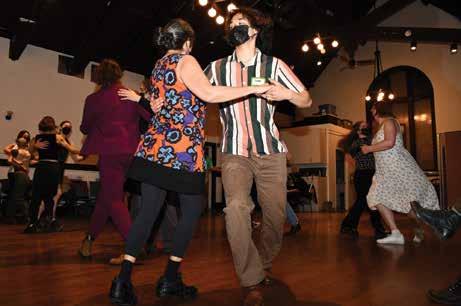
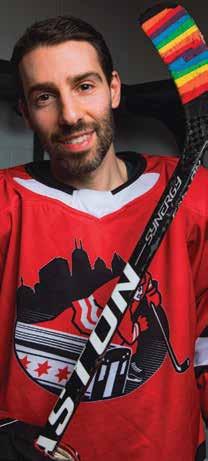
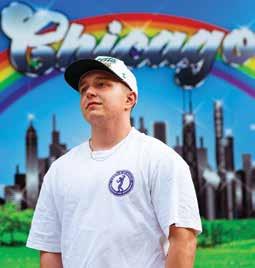
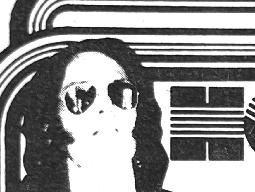
CLOCKWISE FROM TOP Queer Contra Chicago on Saturday, April 18, photo by Kirk Williamson; Troy Taylor, founder and president of Transmasc Society of Chicago, photo by Ash Lane for Chicago Reader ; Detail from Bijou ad which ran in Chicago Gay Life, Sept. 17, 1975, courtesy of Gerber/ Hart Library and Archives; Max Herzfeld of the Chicago Pride Hockey League, photo by Michael Izquierdo for Chicago Reader
PUBLISHER
Malik Jackson
CHIEF OF STAFF/SALES DIRECTOR
Ellen Kaulig
EDITOR IN CHIEF
Sarah Conway
CREATIVE DIRECTOR
Corianton Hale
ASSISTANT MANAGING EDITOR
Savannah Ray Hugueley
FEATURES AND COPY EDITOR
Kerry Cardoza
PRODUCTION MANAGER AND STAFF PHOTOGRAPHER
Kirk Williamson
SENIOR GRAPHIC DESIGNER
Amber Huff
GRAPHIC DESIGNER & PHOTO RESEARCHER
Shira Friedman-Parks
THEATER & DANCE EDITOR
Kerry Reid
MUSIC EDITOR
Philip Montoro
CULTURE EDITOR: FILM AND MEDIA
Taryn McFadden
NEWS EDITOR
Shawn Mulcahy
FOOD AND DRINK EDITOR Mike Sula
PROJECTS EDITOR Jamie Ludwig
STRATEGIC CONTENT EDITOR
Tyra Nicole Triche
SENIOR WRITER Leor Galil FEATURES WRITER


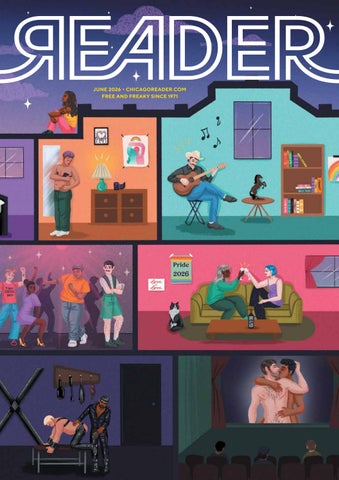
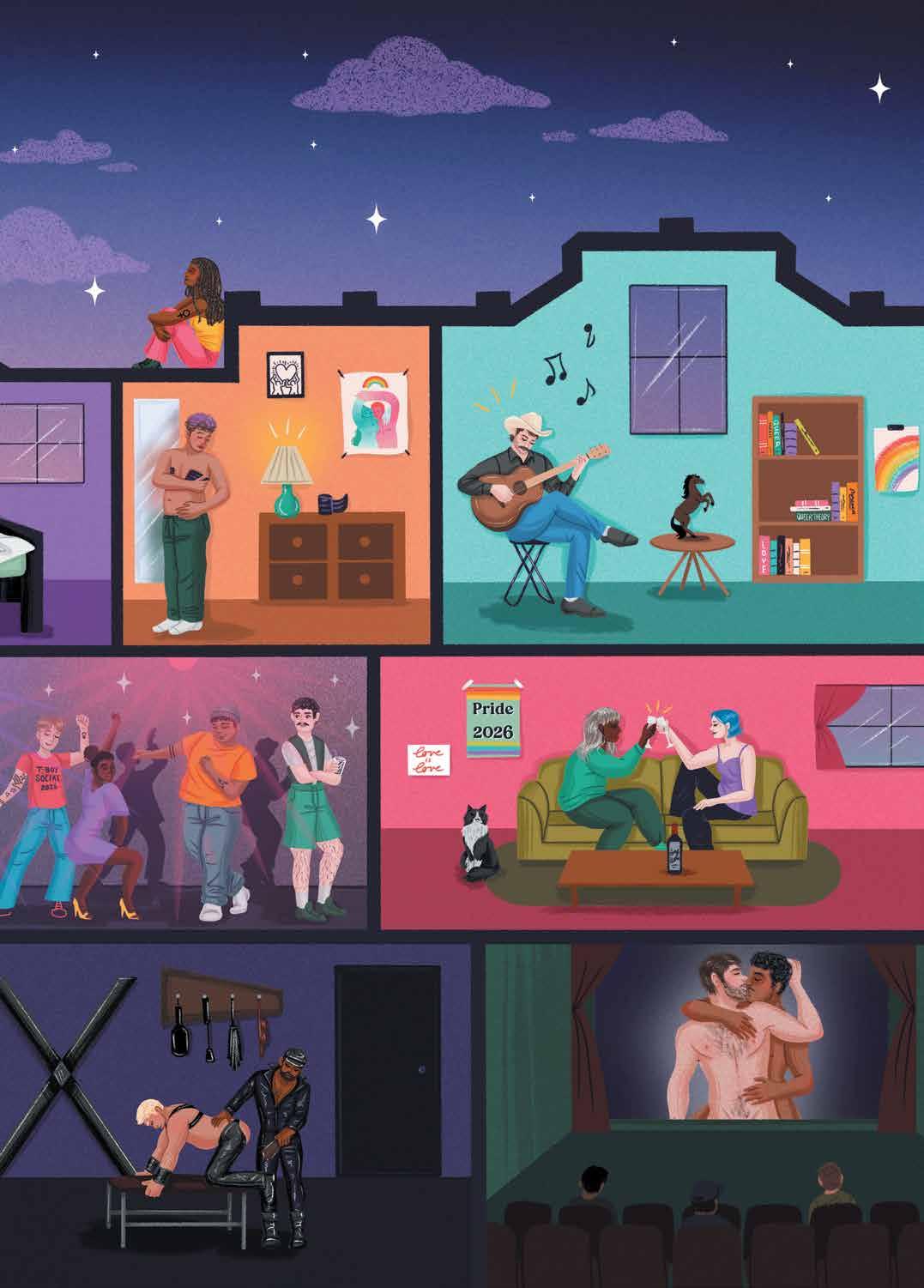
Illustration by Jess Vosseteig jessvossart.com Creative direction by Corianton Hale
ads@chicagoreader.com, 312-392-2970 Create a classified ad listing at classifieds.chicagoreader.com
CONCERNS distributionissues@chicagoreader.com
MARKETING MANAGER Maja Stachnik
MARKETING ASSOCIATE Michael Thompson
SALES REPRESENTATIVES Will Rogers, Kelly Braun, Vanessa Fleming
STAFF NOTE
Recently, I saw Derry Queen start her headlining set for a comedy variety show at the Hideout by announcing a fake Snapple sponsorship. “The brand paid me $500 to say this,” she said, as she unfolded a piece of paper, then composed herself for the audience. “Throw this down your throat, faggots!” That’s kind of how writing this letter makes me feel: like I’m supposed to say something poignant about “the LGBTQ+ experience” (you know, the one, singular LGBTQ+ experience everyone in the alphabet mafia has) that speaks to everyone, but especially people who aren’t LGBTQ+ who have more money than me and my faggot friends. Maybe, just maybe, if I represent “us” “right” (representation matters), we’ll all get more opportunities to shill for people who view us somewhere between a marketing opportunity and something exotic to tolerate. That’s what we’re supposed to want, right?
I don’t mean to be glib or cynical. I can point to material signs of progress for LGBTQ+ people relative to when I was a child, like legalizing gay marriage or increasing access to trans healthcare. But it’s been a pretty terrible year for LGBTQ+ people in general, and increasingly, so much of how queerness is assessed and discussed makes me very depressed. Who is Pride for, and how should it be celebrated? I want this to be my month to go full sicko mode. Every June, I should be legally permitted to end conversations with anyone who has no idea how to find a sex party—not be forced to behold entire aisles in Target turn into rainbows while dozens of store cameras collect footage of me for a database ICE can access. Why is Bank of America—an Epstein-enabling institution that’s long funded ultraconservative lobbies and discriminated against same-sex couples seeking mortgages—allowed

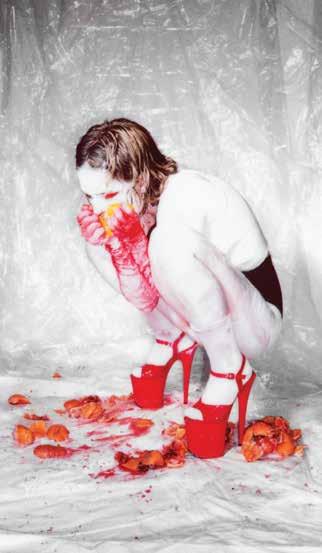

at Pride, yet there’s some debate about whether kinksters belong there seemingly every year? We used to be a proper community. . . .
When the Reader’s art department asked me what this letter would be about, I said, “Gay wrath,” except I accidentally spelled it “wraith” so they assumed I meant vengeful ghosts. Yes, this year, I am a vengeful ghost— the spirit of a once vibrant homo summoned just as the clock strikes midnight on June 1. After hiding beneath the floorboards for everyone else’s comfort eleven months of the year, I am finally free to provoke!
No one is allowed to experience happiness or pleasure during Pride this year except:
Black trans women; people who fuck in clubs; anyone who identifies as a faggot, dyke, or both; every queerdo who needed a GoFundMe this year; piss players; throuples; polycules; folks whose natal families won’t support them because of their so-called “lifestyle”; anyone left on read after showing hole; people whose partners dumped them for starting to transition; dudes on the sex registry for masturbating in porno theaters; armpit sniffers; gay union organizers; anyone who’s been transvestigated, especially trying to access a lesbian party; furries; people who cruise; parents of queer and trans kids who fight tooth and nail for them; and those whose lives were touched by Juniper Blessing.
There might be some other exceptions, but everyone else? Relief comes in July. Pour that down your throat, breeders.
—Micco Caporale, staff writer, official ethereal terror of Homosexual Month
mcaporale@chicagoreader.com





READER BITES
Gamjatang at To Soc Chon
BY YUMI TALLUD
Apopular saying in Korea, “Fight fire with fire,” argues that the best way to cool down during the sweltering summer months is to sip on a hot bowl of soup. The method may seem counterintuitive, but it’s actually scientifically proven. Raising your internal temperature triggers your body’s thermoregulation response; in other words, it makes you sweat.
At this unassuming shack, the gamjatang—a spicy, hearty potato and pork neck stew that arrives at the table boiling— is my favorite way to beat the heat.
Simmering under a mound of smoky black pepper and fresh green onions are chunky, braised, meaty morsels that taste best gnawed directly off the bone. (Use your hands—don’t be shy.) But I like to
remove the biggest pieces with my chopsticks, add them back to the soup, and scoop them up with a tender, broth-logged radish leaf over a spoonful of rice. The longer you eat, the thicker the stew becomes. As it boils down in its ceramic bowl, gochugaru flakes swell, milky collagen seeps from the neckbones, and starch from the rice adds heft to the broth. At this point, I’ll mix in what’s left of my rice, unlocking a hidden second course: a porridge with all the scraped-up bits. It’s surprisingly refreshing, especially when chased by the complimentary
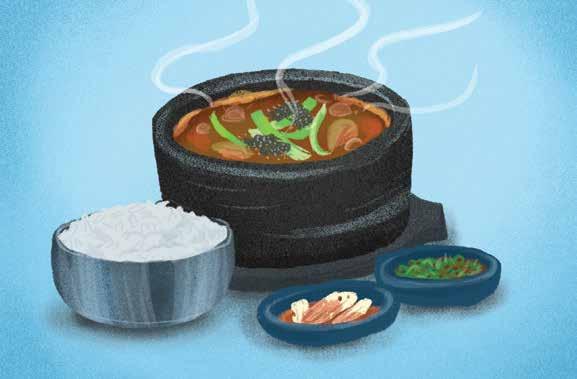
assortment of pickled banchan, which are perfect palate cleansers for the deeply savory soup.
Once you reach the bottom, you’ll understand why a piping hot glazed dolsot of gamjatang is the ultimate cure-all. The pepper drains your sinuses, the steam clears your skin—and the heat makes the blazing summer sun a little more bearable.
To Soc Chon, 6032 Dempster St., Morton Grove, 847-410-7650, $17.99 v
Reader Bites celebrates dishes, drinks, and atmospheres from the Chicagoland food scene. Have you had a recent food or drink experience that you can’t stop thinking about?
fooddrink@chicagoreader.com
CORI NAKAMURA LIN | ONIBABA STUDIO FOR CHICAGO READER
SOCIAL FABRIC
Where Chicago’s leather history lives
The
There is a former synagogue on North Greenview Avenue in Rogers Park that holds the memory of a world most people don’t know exists. The Leather Archives & Museum is one of the only institutions of its kind—a nonprofit dedicated to preserving the history, art, and culture of leather, kink, BDSM, and fetish communities. It is a library, a museum, and a growing historic archive all at once. And it would not exist without Chicago.
To understand why Chicago became the spiritual capital of leather culture in America, you have to start with Chuck Renslow. A photographer, politician, entrepreneur, and community builder, Renslow cofounded the Gold Coast bar in 1960 at
1130 N. Clark. This spot replaced the Gold Coast Show Lounge, which had become the gathering spot for Chicago’s growing gay leather scene in the late 50s. The Gold Coast was not simply a bar. It was a place where men in leather could exist openly, unapologetically, and with a sense of brotherhood that the outside world had no interest in offering. In an era when homosexuality was criminalized and police raids were a fact of life, the Gold Coast was an act of defiance as much as hospitality.
What made the Gold Coast singular was its atmosphere of uncompromising authenticity. Renslow cultivated a space where the codes and rituals of leather culture—the hanky code, leather protocol, the particular pride of a community that
had created its identity in the shadows— were not just tolerated but celebrated. The bar drew men from across the country, becoming a destination that put Chicago on the map of a hidden world. Men from all backgrounds rubbed shoulders there; relationships formed, traditions were passed down, and a subculture deepened its roots. The Gold Coast endured for three decades before closing in 1988, but its influence radiated far beyond its last call.
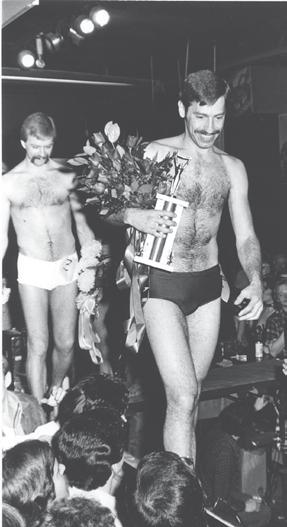
Renslow’s ambitions for communitybuilding didn’t stop at the bar’s walls. In 1972, he launched the Mr. Gold Coast contest, one of the earliest leather title competitions in the world. The contest gave the community something it had rarely been offered: a public ritual of recognition, a way of honoring the values and embodiment that leather culture held dear. In 1979, Renslow expanded the concept into International Mr. Leather, a competition that would grow into the largest leather event in the world. What began as a contest in a bar on Clark Street became a global institution that continues each year over Memorial Day weekend.
In 1991, at the height of the AIDS crisis, when marginalized histories were being actively destroyed, Renslow cofounded the Leather Archives & Museum. Today, the museum holds over 35,000 archival items—photographs, films, correspon -
dence, artwork, organizational records, and ephemera—from clubs, bars, and individuals around the world. Among its holdings are records from the Gold Coast itself, ensuring that Renslow’s work lives.
What the museum offers is not nostalgia. It is accountability—a refusal to let history be written only by those who wish the leather community didn’t exist. Its galleries have featured boundarypushing artists; its library has supported scholars, filmmakers, and journalists; its education programs have reached students and researchers who might otherwise never encounter this corner of queer history.
Chicago gave the leather world the Gold Coast. It gave the world International Mr. Leather. And through the Leather Archives & Museum, it continues to give what may matter most of all: a place where that history is held, honored, and kept alive for the generations who come next. v
—Gary Wasdin, executive director, Leather Archives & Museum
Social Fabric is a glimpse into the vibrant lives, objects, and spaces that shape our city, cocurated with community archives and local photographers.
themail@chicagoreader.com
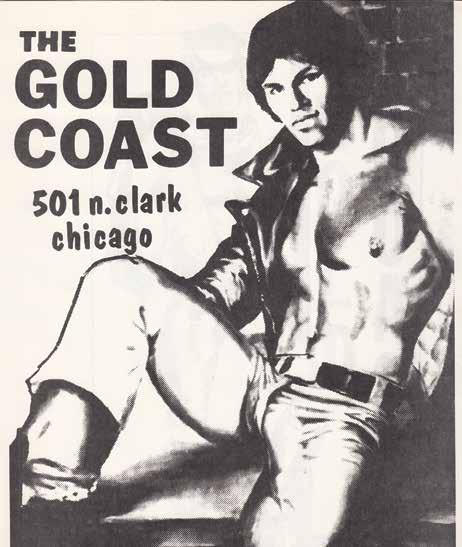
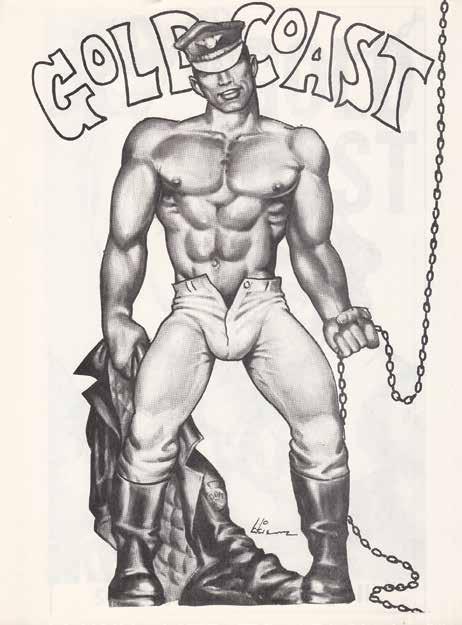
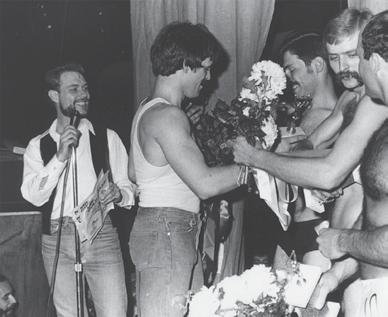
Ads for the Gold Coast bar, featuring the work of Dom “Etienne” Orejudos, partner of Chuck Renslow COURTESY LEATHER ARCHIVES & MUSEUM
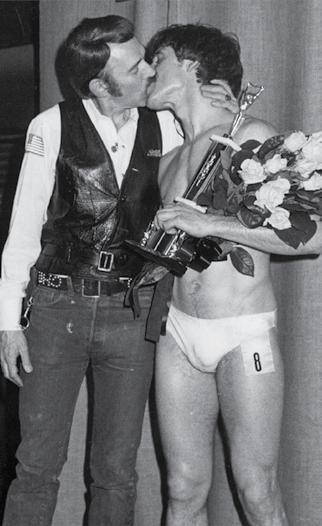
Winners
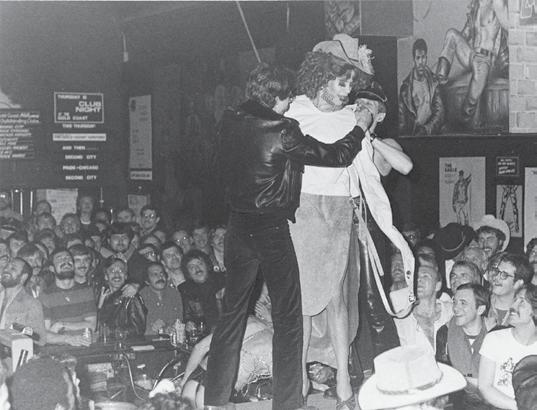
Next two photos: Performers at the Mr. Gold Coast contest. Late 1970s.
Winners of the Mr. Gold Coast Contest. Late 1970s.
Wanda Lust (center), a drag queen, sexual health activist, and emcee of the Mr. Gold Coast contest. Wanda hosted events at the Gold Coast and Man’s Country and worked with the Chicago Gay Health Project as Nurse
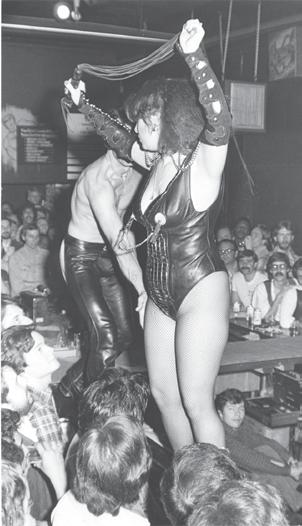
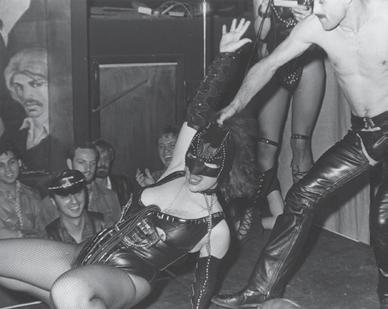
Clockwise from top left:
of the Mr. Gold Coast Contest. Late 1970s. Chuck Renslow (left), owner of the Gold Coast, and a winner of the Mr. Gold Coast contest. Late 1970s. TOM COUGHLIN
Wanda. Nurse Wanda toured with the VD Van around Chicago, offering testing outside of gay bars and bathhouses. Late 1970s.
GOING THE DISTANCE
Sarah-Ji and Pidgeon: Queer chosen family
These devoted friends, organizers, and artists dream of growing old together.
BY JASMINE BARNES
Despite the structural barriers to traveling between Chicago’s 77 community areas, many friends are willing to face the city’s geographic hurdles and sustain relationships that transcend race, gender, age, and class. In an effort to chronicle human connection and love in spite of these challenges, the Going the Distance series examines the enduring friendships between people living in distant neighborhoods.
S“he’s truly an angel,” said Pidgeon Pagonis, 40, about their longtime friend Sarah-Ji, 54, as the sun set over Humboldt Park. “If she loves you, she’s gonna love you for life.”
Pidgeon sensed something special about Sarah-Ji the day they met. Back in 2010, they attended a mutual friend’s potluck—aptly called a “Love Feast”—in Little Village. As the event approached its end, Sarah-Ji offered Pidgeon a ride back to Rogers Park, where they both lived.
“Sarah [had] a golden aura around her, and I could hear the angels singing,” Pidgeon said. On the long drive north in Sarah-Ji’s red Subaru station wagon, affectionately named Stella, they discovered their shared love for photography and began planting the seeds of what would become an enduring relationship.
“I really feel like our friendship started out in my car,” Sarah-Ji said. “A big impetus for our friendship forming was that I was able to provide transportation.”
The transportation barriers in their relationship have evolved over the years: In the first decade of their friendship, only Sarah-Ji drove. After four years as neighbors in Rogers Park, Pidgeon moved to Pilsen, then moved again to North Lawndale, and bought a car. In those early years, it was Sarah-Ji’s generosity with hers that really made their friendship possible.
She was “shuffling [me] around this giant-ass city and never complaining,” Pidgeon said with deep gratitude.
Around the time Sarah-Ji met Pidgeon, she’d started deepening her political engagement as an abolitionist organizer and photographer, documenting freedom struggles in Chicago. She began building community with young, twentysomething organizers and, as someone older with access to a car, driving folks around felt like an obvious way she could support her community. Often, Sarah-Ji would drive Pidgeon home to Pilsen after events and then head home to Rogers Park.
Today, Sarah-Ji and Pidgeon chose to
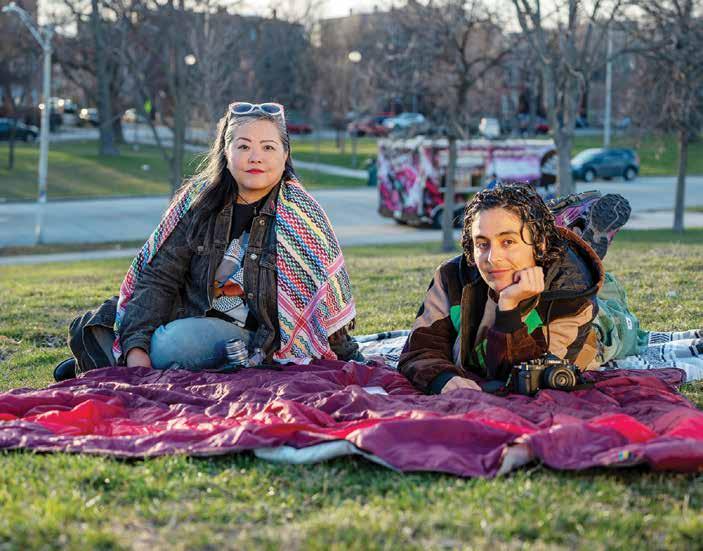
Park. The location holds many memories for the two of them: people watching and taking photos together, attending fun summer events, even grieving a breakup.
“I went through a breakup in 2014, and Pidgeon and a few of our other close friends, we met on this hill, and I basically cried it out,” Sarah-Ji said. “I remember the morning of the breakup, Pidgeon was the first person I called.”
That breakup sparked Sarah-Ji’s decision to prioritize friendships and never become absorbed in romantic relationships again.
“I was politicized late in life,” Sarah-Ji said. “My frustration was how oppressive the nuclear family model was—how isolating it is.”
Her friendship with Pidgeon provided the opportunity to explore more expansive ways of building family. Sarah-Ji became a dog “coparent” to Pidgeon’s Rottweiler, Callie, and Pidgeon became a parent figure to Sarah-Ji’s daughter, Cadence, who was six years old when she first met Pidgeon.
“My daughter really bonded with Pidgeon and sees Pidgeon as a parent.
She used to call them Mommy-Daddy,” Sarah-Ji said.
While the proximity to Sarah-Ji was a major benefit to living in Rogers Park, much of Pidgeon’s time there was a frustrating series of less-than-ideal rental setups with fickle landlords and transient roommates. With their strong conviction to maintain low rent, by living with roommates and avoiding corporate management companies, renting was precarious. At one point in their thirties, Pidgeon realised they’d moved 28 times: nearly once each year of their adult life. Endless rent increases and the mercurial nature of landlords left them constantly seeking more stable, affordable housing.
In 2014, when Pidgeon’s landlord decided not to renew their lease, it felt like an undeniable sign that it was time for a change. When Sarah-Ji learned that Pidgeon was moving to a new apartment in Pilsen, she was heartbroken. Sarah-Ji knew she wouldn’t be leaving her condo anytime soon, with a mortgage to pay and an increasingly expensive housing market.
“I just remember crying. I thought our friendship was gonna be over,” Sarah-Ji said. To both of their surprise, the friend-
ship became even stronger with distance.
They quickly fell into a routine of spending the weekend at Pidgeon’s apartment. Sarah-Ji would bring over groceries, and the two would sit side by side editing photos, quietly watching a movie, or doing chores.
As their friendship evolves and they both grow older, the rituals that sustain their friendship are second nature. Birthdays are a consistent opportunity to spend extended time together in celebration. They take their cameras to document protests and demonstrations. They frequent Haymarket House, Pilsen Community Books, and other third spaces in the city for their communities. For years, they drove together to the Allied Media Conference in Detroit, a city that carries a special meaning in their friendship. Rituals like these are what have sustained their relationship, their shared passions and interests working like magnets, drawing them to the same community spaces. There’s an ineffable tether that keeps their friendship growing deeper.
“Sarah is one of the only people in my
meet at their favorite hill in Humboldt
Sarah-Ji (left) and Pidgeon Pagonis TONAL SIMMONS FOR CHICAGO READER
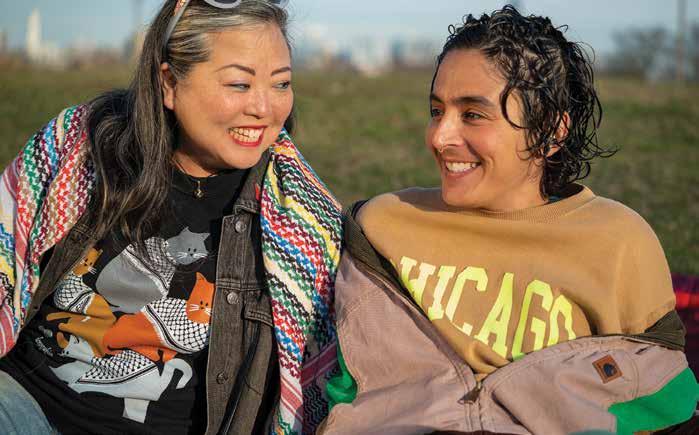
life, probably the most in my life, who I know will unconditionally love me no matter what,” Pidgeon said. “And I think that’s a huge part of what made the friendship [last], no matter the distance.”
The longevity of their friendship remains rare, even in the queer, creative, and political communities they’re a part of.
“I think a lot of people these days lose friends over real petty shit because we kind
of grew up in this hypervigilant, hyperaware state,” Pidgeon said. “Callouts and all this stuff—it can bleed into relationships, where people can become disposable or easily cut off.”
If their relationship with Sarah-Ji has taught them anything, it’s the power of commitment, grace, generosity, and unconditional love. Reflecting on their experience growing up as an intersex person, Pidgeon recalls being told by doctors and other adults that they had to undergo procedures if they ever wanted to have a family—that secrets, hormones, and surgery were the only way to have a happy, loving future. Their relationship with Sarah-Ji is living proof that those doctors and their beliefs were fundamentally wrong.
“The beauty of queer chosen family and queer community is it’s the complete opposite of what they claim is out there— that there’s only one way to happiness and family. We, queer people, are always a testament that that’s not true,” Pidgeon said.
When Sarah-Ji thinks about approaching retirement age in the next few years, she imagines spending the latter part of her life with Pidgeon.
“Part of that planning for me is not just [my partner] Jeff and my daughter. It’s making sure that Pidgeon is taken care of,” Sarah-Ji said. “I want to grow old with you, too.”
“We’re not just friends, we’re family,” Pidgeon adds. v themail@chicagoreader.com
“I want to grow old with you, too.” TONAL SIMMONS FOR CHICAGO READER
Together on the contra dance floor
Queer Contra’s monthly dances are a crash course in community feeling.
BY J. PATRICK PATTERSON
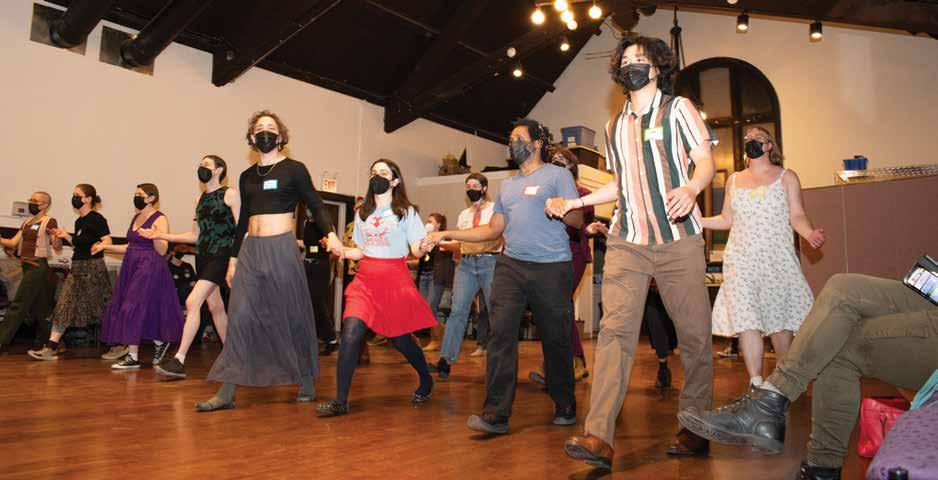
Iam, at heart, a partner dancer. I primarily do two-step and lindy hop. I’ll line dance if the song is right, but it has never moved me the way two people dancing hand in hand does.
This past winter, a friend invited me to go out dancing on a snowy Chicago evening. We entered a side door and climbed up some stairs to a room with wooden floors, chairs along the edges, and a vaulted, barnlike ceiling. Someone sat at a check-in table by the door, collecting donations and handing out name tags. At one end of the room, a band was setting up.
Every month, dancers gather here, at Lakeview’s Second Unitarian Church for Queer Contra Chicago. There’s a lesson at 6:30 PM, dancing begins at 7, and the whole thing wraps up around 9:30, after which a group of dancers walks over to Bamboo Garden on Clark for dinner. The event is explicitly a sober space, an intentional choice in a queer social scene where bars are a dominant meeting spot.
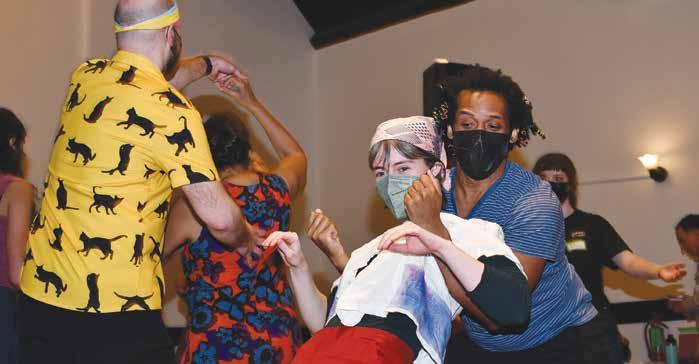
Unlike other forms of partner dancing, where two people are linked for three minutes and then find someone else, contra organizes everyone in long lines of couples, where you share your partner with the whole room. A caller teaches the whole sequence to the group before the music starts. Then everyone dances it—with a partner, with the couple
across from them, up the line, down the line—and by the end of the song, they’ve touched a dozen people and moved 20 feet in either direction. Then they find a new partner and do it again.
In a social moment defined by practiced isolation—exacerbated by the algorithmic amplification of outrage, the disappearance of shared physical space, and the atrophying of the old muscles of civic life—learning to be a community member is, it turns out, a skill. A skill that can be lost and, with effort, regained.
Georges Augustin, a longtime contra dancer and an organizer of a Monday night dance at the Irish American Heritage Center, describes the pull simply:
“You’re dancing with the whole line. That encourages the line to take care of everyone, because if you help other people in the line, it ultimately comes back around for you—we’re all connected.” He calls the feeling “mob mentality, but in a good way.” There is a moment, he says, when the sequence settles into your body, your mind stops directing your feet, and you just feel in sync with the music and everyone else in the room.
Alfred Adler, the Viennese psychiatrist who broke with Freud in the early 20th century, called this “mob mentality” gemeinschaftsgefühl—community feeling, or social interest. For Adler, it
wasn’t just sentiment but a capacity that had to be practiced and trained into the body the way a musician practices scales. Adler considered community feeling absolutely essential to psychological health, and he defined it as an innate sense of connectedness to humanity—a feeling of belonging, contribution, and solidarity with others. He thought most of our suffering came from its absence. He also thought it could be learned.
While Adler wasn’t explicitly writing about dancing, he was interested in “movement.” In What Life Could Mean to You (1931), he argues that behind every partial movement toward a partial goal, there is “one single inclusive movement”—where all our striving is oriented toward a position of security and connection in relation, as he puts it, to “the whole situation around.” A person who moves only toward themself, who cannot foresee that their movement affects others, is, according to Adler, psychologically lost. The goal of community feeling, then, is to expand that foresight: to feel in your body that you are moving with people, not just among them.
Contra dancing, it turns out, is one hell of a crash course in community feeling: a habit you build in your body through repeated contact with other people. It is praxis in the oldest sense. Not just a
theory of togetherness but the enactment of it. It’s also old. The form descends from English country dancing, refracted through French court culture; it crossed the Atlantic to North America, and, over time, diverged into the two forms we now call square dancing and contra.
As a partner dancer primarily, I was wary of contra, thinking that it would dilute the improvised conversation and magic between two dancers: the way two people connect to the music in real time, surprise each other, and have an unscripted conversation. From the outside, I thought that contra replaced all of that with a caller’s instructions. But I learned it just happens inside a shared structure rather than in place of one.
Inigo Santiago, who became an organizer with Queer Contra in early 2026 after falling in love with the form less than two years ago, described these moments as “flourishes.” Beyond the called sequence, experienced dancers layer in extra spins, arches, and other little surprises they offer their partners mid-dance. “I was dancing with someone I’d never met, and they said they wanted to do flourishes,” Santiago recalls. “So I thought: I have someone who’s never danced with me before, and they’re open. How can I surprise them, every single time we go through the choreography, with something new?”
Queer Contra Chicago, third Saturday of every month at Second Unitarian Church >> The lesson is at 6:30 PM, and dancing begins at 7 PM. No experience necessary. You will mess up, and someone will kindly redirect you; that is, more or less, the point.
Queer Contra Chicago on Saturday, April 18 KIRK WILLIAMSON
Emma Sanborn, a neurologist who attended Queer Contra in its early days before she moved away from Chicago, returned for the first time in eight years this spring while visiting. “I was just blown away,” she says, comparing it to the swing scene she’d come from, where followers often wait five songs for a dance and the social dynamics can curdle into quiet competition. “I don’t think I’ve ever sat out a contra dance when I wanted to be dancing. People have apologized to me, ‘I’m so sorry, I promised the next one to somebody else.’ That kind of thing just doesn’t exist in most dance scenes.”
For Sanborn, the queer framing of the event matters beyond the absence of gendered roles—though Queer Contra was among the first Chicago-area dances to drop “ladies and gents” for the now-common “larks and robins,” a change that has since spread to the broader local scene. What Sanborn values is something closer to her definition of queering itself: “To queer something is to question. It is to turn it on its head and say, ‘I don’t think things actually have to be that way.’ This is one small space where that is normal for an evening. People can just be who they are.”
Moose Flores attended his first Queer Contra in 2017, when the group relaunched after an earlier incarnation. A few months later, the outgoing organizer announced
he was stepping down—and that the band wouldn’t play a single note until two volunteers stepped up. Flores and another person raised their hands that night. He’s been an organizer ever since.
When I asked Flores what makes contra dancing stand out from other dance scenes, he answered without hesitation. “Because of the way we teach every dance to the whole floor before the music
starts. Because of the way we are all going up and down the line, dancing with all of our neighbors,” he said. “The form of the dance is teaching us ways to be welcoming, ways to interact with and accommodate all different kinds of people, physically, in the line of dance. Our brains are learning that we can do this outside of dancing, too. We can be welcoming to new people. We can find ways to get along.”
SOUTHEAST SPOTLIGHT
PODS School + Developmental Center
At PODS School + Developmental Center, children get to be kids. Safely, joyfully, on field trips to museums and trampoline parks, in inclusive classrooms built around curiosity, in a building on East 79th Street where every child knows they belong.
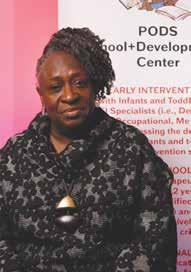
That feeling is not accidental. It is the life’s work of Romonia Brown-Bell, CEO, founder, and the kind of person who does not see a gap in her community and look away. A pediatric developmental therapist with over 26 years of experience in early intervention, Romonia spent years in architecture, engineering, and construction management before she moved from building structures to building minds. A brief time with Chicago Public Schools became her turning point. When she saw children with disabilities isolated in classroom corners, separated from their peers rather than learning alongside them, she knew she had to act. “I knew that I had to do something,” she says. “So therefore, I created PODS.”
She started with playgroup services, earned her licensing, and expanded into an inclusive school. The philosophy she built it around remains the same today. At PODS, children of all abilities share the same classrooms, the same playground, and the same daily experience. No separation, no isolation, just children learning from and with each other, naturally building empathy and friendships that can last a lifetime. Every child also has a fully individualized
plan built around their specific needs, goals, and strengths. Inclusion here is not a compromise. It is the whole design. Decades of research confirm that inclusive classrooms produce better outcomes for all children, and Romonia has seen it firsthand. “When a child needs to learn something,” she says, “they learn better from another child than they could ever learn from us.”
PODS o ers comprehensive care for children six weeks through age 13: inclusive programming, Applied Behavior Analysis therapy, speech and language, occupational, physical, and developmental therapy. For South and Southeast Side families, that means an exceptional developmental center right in their own neighborhood, no long commutes, no impossible logistics, no choosing between work and the care your child deserves and, in some cases, urgently needs. PODS draws families from 22nd Street to 103rd Street and from Western Avenue to the lakefront, and Romonia has made accessibility a non-negotiable. She estimates that 80 to nearly 90 percent of the children they serve lack adequate insurance or are covered by Medicaid plans that many specialized o ces turn away. PODS does not. “That’s no reason why a child should not be able
Sanborn articulated another lesson built into the form: “You’ve flubbed up a couple things, so you catch up at the next easy thing. Usually, somebody will drag you into where you’re supposed to be—lovingly.”
Mistakes aren’t a big deal. In the end, we’re all just larks and robins, learning to be good neighbors—one do-si-do at a time. v
themail@chicagoreader.com

to get served and be treated the same way as any family that has money,” she says. “That’s a right to every human being.”
The sta reflects that same commitment. Jon Barnes, Executive Director of Operations and a 13-year member of the PODS family, wants every child to feel genuinely happy and safe. More importantly, he wants families to walk in and know they actually belong. Operations Manager Lorraine Cornish sees it extending even further. For her, PODS is a beacon, a shining example of what a school, a community, and a neighborhood can build together when the focus stays on the children.
When children get the care they deserve, right in their own community, bright futures take root. “I continue to be in this neighborhood,” she says, “wanting to give back that in which I had received.” That is not a sentiment. It is a daily practice.
PODS is currently enrolling children for summer camp and welcoming new families seeking care year-round. Tours are available Monday through Friday. Contact PODS at hello@projectorg.com or (773) 221-7171 to learn more and take the first step.
PODS School + Developmental Center Address: 1401 East 79th Street, Chicago, IL 60619
Website: projectorg.com
Instagram: @podspreschooldevcenter
Phone: (773) 221-7171


Hours: Mon–Fri, 8am–5pm Read the series
KIRK WILLIAMSON
Romonia Brown-Bell PODS
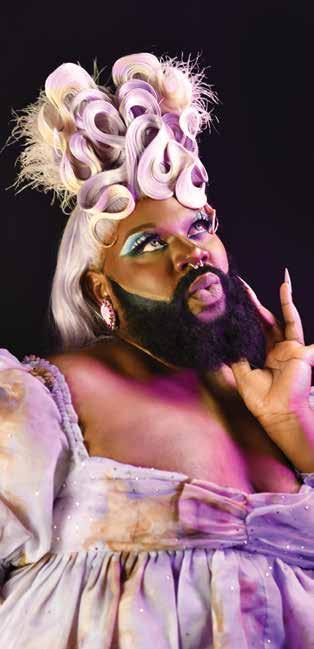
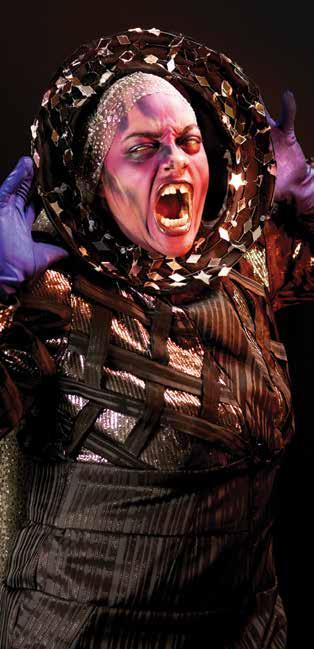
Chicago drag shows up and shows out
Five performers talk community outreach, fundraising, and making space for more artists.
STORY BY SAVANNAH RAY HUGUELEY
PHOTOGRAPHY BY KIRK WILLIAMSON
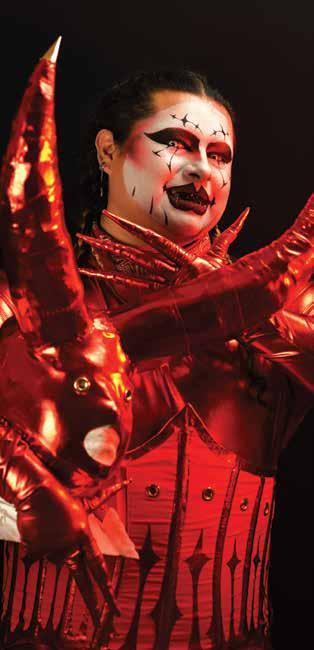
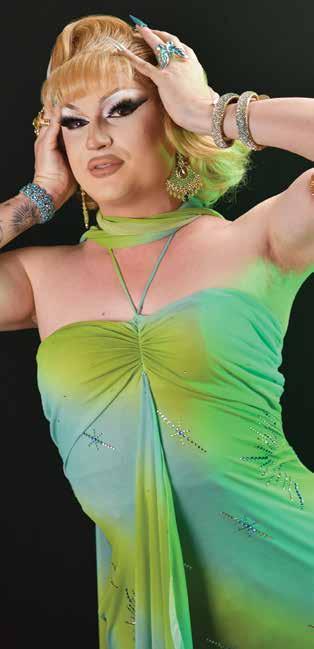
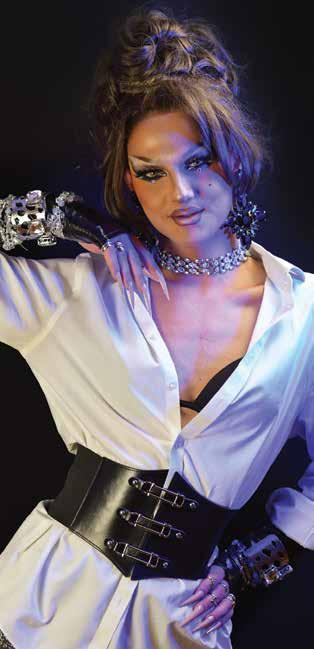
CITY LIFE
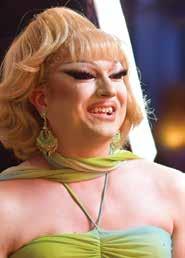
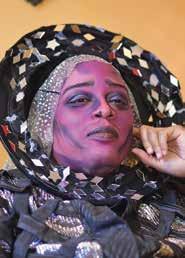
D“rag performers fill a lot of roles in the community, and one that we’ve always filled from the beginning is—not only the jester or the town crier—but the community organizer, the person that brings people together,” says legendary drag performer Lucy Stoole.
Lucy learned early on that organizing and community support were just part of the gig. Drag is an “ephemeral, fleeting art,” as she says, that’s formed with other people. “If you weren’t doing benefits, then you did outreach to community members, and you show them how to build their own community and teach and raise each other,” says Lucy, whose first official performance was a benefit show.
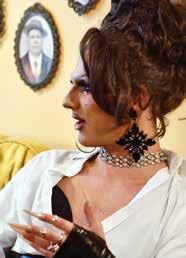
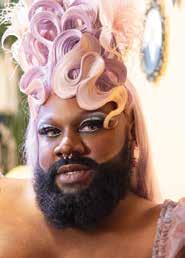
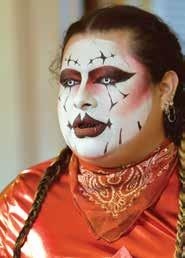
Commercialization of the art form, bar closures, social media pressures, higher costs of living—they’ve changed the landscape a lot. But many local drag artists have preserved community as central to their art. Lucy, Lúc Ami, Neutral Gena, Bae Root, and Amor Kerida are just some of those who have carved out space—in legacy bars on the Boystown strip, new venues, DIY and underground spots—for drag performers to show up in all their expansiveness and to bring what matters to them onto the stage.
For Lucy, that grounding came more clearly into focus with the creation of the Chicago Black Drag Council in 2020, which held restorative justice conversations and town halls, curated community and resource-sharing events, and fundraised for organizations and Black communities worldwide. “I saw how much we can actually bring in and make this movement. Let’s keep this going,” she recalls thinking at the time. She decided to incorporate a fundraising aspect into all of her monthly Flipphone Chicago brunches, which have raised a total of $91,130 for local organizations like Brave Space Alliance and the Chicago Therapy Collective over the past five years Lucy knew she could grow that model, and taking inspiration from NYC drag performer Julie J, she started producing and booking huge shows featuring 40 drag performers at Metro. Between acts, a representative from an organization or community speaks on the show’s theme, sharing how everyone can get involved or offer support beyond the event. So far, four annual events have raised over $60,000 through ticket sales and donations. In 2024’s Chicago Drag Loves the World, they raised money for people impacted by war, displacement, and genocide in Palestine, Congo, and Sudan. The show this March, Chicago Drag Melts Ice, raised $17,000 for Illinois Coalition for Immigrant and Refugee Rights (ICIRR), Midwest Immigration Bond Fund, Stand With Minnesota, and the National Immigrant Justice Center. “I feel like I’m a grand drag queen, so I want to be able to make big news for my people and my community, and be able to show them that if we work together, we can make really huge positive change, and we can take care of each other, and that’s what we have to be doing from here on out,” Lucy says. The performers she works with show
out because it matters just the same to them.
“People love to bring their best numbers out; people are like, ‘Oh, I’m gonna have to do my big one,’” says Lúc Ami, an iconic alien drag deity who produces shows and events that uplift fellow artists. Lúc sees every large stage as an opportunity to build the movement and activate people who may not otherwise engage: She shares information and resources, encouraging people to donate and get more involved. “I have had people say, ‘Because I see you fundraising and speaking about this, I feel more comfortable speaking out about that,’ and that is so big,” Lúc says.
“It goes beyond just the performance, and it’s what you do after,” says Neutral Gena, a comedy queen who’s worked all over the city, from the strip to DIY spaces to helping create Drag ’N Drop Chicago, a beach drag show that helped support artists through the pandemic. She’s a comedic staple of local drag benefit shows, but she sees that as only a small fraction of the overall work.
The follow-through and the persistence— that’s where the fundamental change emerges from, Gena says. “How do you get more involved? Can I donate more of my own money? Can I find educational resources to share at my own shows? Can I stick around with people and introduce them to each other afterwards to get them more involved in things?” At her regular Splash show, Pretty Funny, she brings broader issues into the room, like making the trivia portion all about ICIRR and anti-ICE knowledge one night.
“My impression of the Chicago drag scene is one that is ready to help and one that is ready to mobilize, regardless of what the cost is,” says queen Bae Root. She created her persona in response to the lack of Arab, particularly Lebanese, representation in drag. “I noticed that something was missing, and I created it. I’m going to make sure people know Lebanon for so much more than just wars, but for the beauty of it, and for the art that comes with it, for the music, for the costumes, for the history,” she says.
In April, Bae and Fantasy Banks, another Lebanese drag artist, organized Habibi! A Night for Lebanon, an evening of “beauty, resistance, and community” at Roscoe’s in response to U.S.-Israel attacks on the country that began just a month earlier. They raised over $7,000 for the Red Cross and the Nation Station, a community group in Beirut.
It wasn’t just a night to raise money, but to both celebrate and mourn, featuring performances from ten artists, including Abhijeet, Squeaky C. Banks, Squeaky Banks, and Kara Mel D’Ville. “I think it’s so important, in addition to doing these benefits and these fundraisers, to be showcasing the beauty of those cultures and those identities . . . to be showing trans joy when trans people are getting attacked, to humanize immigrants when immigrants are being reduced to numbers as opposed to humans, and the way you do that is through art.”
“With the spaces that are popping up more, it’s less about creating a fantasy or watching something that distracts you from the world that you’re living in,” says Amor Kerida. “It’s
more about creating the opportunity to scream into the void and release all of that energy.”
Amor Kerida built their drag through the punk and hardcore scene starting in 2024, founding the Ruidosa Art Collective and organizing regular DIY shows like RUN X HYDE with live music and alternative drag. All of their shows raise funds for organizations like the Midwest Immigration Bond Fund or for trans-affirming care items. “Mobilizing through the underground was something that was already present, because all of the DIY scene is very much impacted by the things that are going on, so to fundraise was just absolutely a no-brainer,” Amor says. They wanted space “that was alternative in nature, for kids that are grimy and real, mischievous, degenerate,” and to create somewhere for a new range of drag performers to belong.
New artists, especially those with less money and access, can feel they have to be polished when they first step out, but the “spirit of drag is creating,” Lucy says. “Y’all literally could be so crunchy—it is OK. I actually would rather you just throw yourself out there and try something,” Lúc says. They have long curated spaces for people to find their footing, like the open-stage drag show Queeriod at Charlie’s they run with Julez Osco. Performers can try new things and actually get paid. “It looks like a small thing, but that’s a high effort, and that’s just one more thing to make it more accessible to allow spaces to cultivate new talent and new art,” Gena says.
Lúc also hosts Drag Swaps, continuing the legacy of a similar event another queen hosted at the dearly departed Berlin. Lúc got a beloved double-stacked pink wig from Lucy at one of the swaps. “It was at a point where I was never gonna be able to afford my own. . . . It was such an affordable way for me to elevate my drag,” Lúc says. “That is really the spirit of drag—it has always been a reduce, reuse, recycle sort of thing,” Lucy adds.
“I find that those swaps are also great for resource sharing, because people will talk to each other, and then we’ll ask questions about how to make things, and where to get items and props,” Lúc says. Those connections are what help people keep going.
“I definitely think the scene is moving into a good direction with alternative drag, and fundraisers and burlesque and just so many different styles of performers coming into the scene and creating better and better shows, like we’re genuinely on the up right now,” Bae says. The work is ever going, but the infrastructure is there: benefit shows, swaps, open stages, alternative and DIY spaces, and support for artists to bring their full selves to the stage.
“We’re all a big family,” says Amor, “and to expand that family, to have more opportunities, to take more risks, where it’s more raw, and to have that tied to causes that actually matter—it’s a beautiful thing and where I see the scene is going. It’s really something to be prideful about, and really amazing to be a part of.” v
shugueley@chicagoreader.com
CITY LIFE
‘Let’s
find out who you are’
Matthew Keller is rebuilding a life of romance, art, and fashion at Chicago’s intake homeless shelter.
AS TOLD TO KATIE PROUT
Matthew Keller, 47, is from all over, but he grew up in northwest Ohio. “I went to college and got my bachelor’s degree and lived my life,” he told me. “And then I decided at fortysomething, I was going to move back to Ohio and buy a Victorian house. And I did that, and I accomplished that, and then my relationship fell apart.” After the dissolution of his relationship in December 2025, Matthew hitchhiked and bused to Chicago, where he has lived at the Shelter Placement and Resource Center (SPARC), the city’s 24/7 intake shelter for single individuals, ever since.
If you are queer in Chicago and you find yourself homeless, you’ve got to mentally prepare yourself to be flexible. I see the people that can’t flex with aggression [from others]. They can’t flex with even affection. If you’re going to open up your life to liter-
ally the open outdoors, you have to do that mentally as well. You have to embrace this openness and be adaptable.
When I first got [to the shelter], I didn’t really know what to do. I found that it was just easier to eat lunch and then take off, because dinner wasn’t until 6:30. [SPARC will] give you a bus card. You find these resources, like Chicago Lights. They have a free lunch. It’s much more sophisticated than anywhere else. I was there almost every day. And then after lunch, they do a living room where they serve fresh coffee for like three hours, as much as you can drink. It’s a warming center. They’ve got cots, so if you need to take a nap, you can take a nap. A lot of other places don’t let you sleep.
At Chicago Lights, they have these bins of clothes you could dig through. I found a lot of comfort in that, because it was giving me that consumer shopping
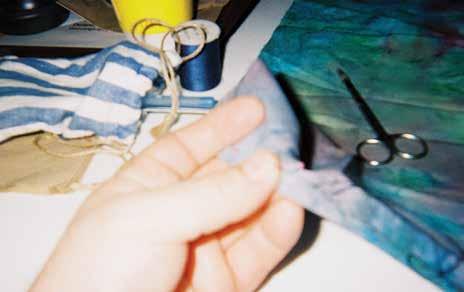
dopamine, and it was this free medium. So I started sewing. I just finished a vest; I lined it and everything. I made it out of a clergyman’s robe. I found a lot of comfort going to the library in Chinatown and just sitting down and sewing in that quiet environment. I sew everything by hand. A lot of my day was focused on that, and then trying to run around and meet people, trying to date people.
At first, before I came here, I was trying to sell myself. I thought, “I’m just gonna try to be a domestic. If I wore some leather harness and clean the toilet, they might give me a corner to sleep.” I could bank on their fetish, I thought, but [it] didn’t work. I got a lot of chat. People were really interested in the story, and the fantasy, but not the logistics.
I started just trying to date people, but I didn’t say anything about the homeless shelter. And then I had this really bad
experience. [This guy] got really mad that he was on a date with a homeless person. He drove me around for like three hours yelling at me. So I was like, “All right, that’s not gonna work anymore. Let’s update these dating profiles.” And I just started being honest.
That’s when I met Travis, who lives in Pilsen, and he’s been a once-a-week for me since January. He’ll have me over, and he’ll be like, “Come bring your laundry!” I’ll go buy groceries with my EBT, and I’ll take it over there, and I’ll make what I feel like eating. It’s a luxury to choose what kind of cheese you want in your mac and cheese. For Easter, I made us these shank steaks. We had a really great time, and he’s super cool. We’re gonna go out tomorrow. On my first paycheck, I’m gonna take him to Velvet Taco on the west side, because we both love it. I’m hoping they have the deep-fried chicken
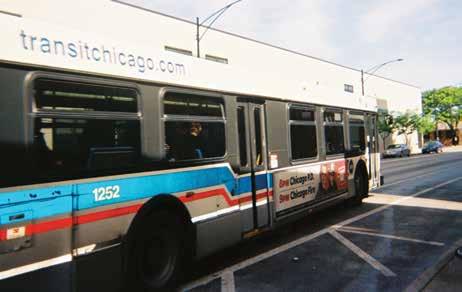
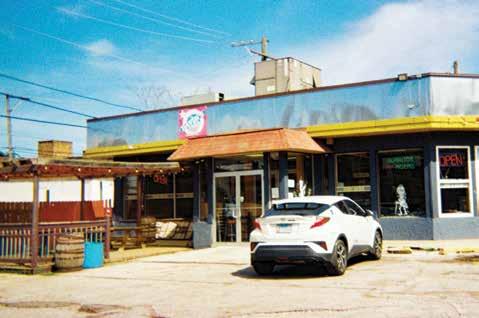
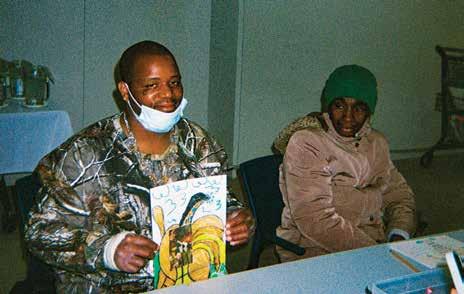
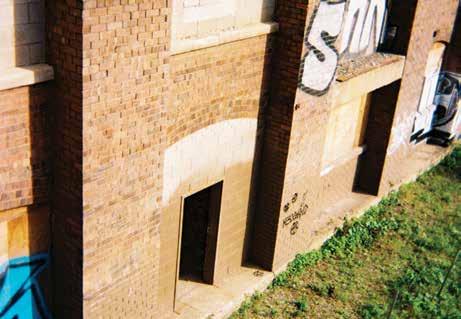
Clockwise from top left: Matthew spends hours hand-sewing outfits in the Chinatown public library; David's Grill, on the corner of Halsted and Cermak, is just north of SPARC, and it's one of Matthew's favorite restaurants; two participants in Matthew's Visual Fundamentals class at City Lights hold up their art; since arriving in Chicago in last December, Matthew has used the CTA almost every day to explore the city. MATTHEW KELLER
waffle taco. That’s our favorite.
There was a huge group of us [queer people] at the shelter, but they’ve all moved on to different shelters. In the shelter, the men and the women are separate. There’s husbands and wives there, there’s boyfriends and girlfriends there, and then there’ll be bromances. Some of the bromances are consistent, and the bromances have fights, and as a group of men collectively, we’ll witness the fight. There might be a tiny breakup for a couple weeks, and then the bromance, they get back together, just like a normal couple. We eat these eggs for breakfast that are powdered eggs. Last week, somebody told me, “They put the opposite of Viagra in them.” He was like, “When’s the last time you’ve had morning wood?” And I was like, “Wait a minute!” [Laughs.] He said, “Yeah! They give us a thing to just sedate us so that the bromance stays platonic.”
[ Note: The Department of Family and Support Services shared the following statement on behalf of Franciscan Outreach, the delegate agency operating the shelter: “Franciscan Outreach does not sedate individuals and does not add any additives or medication to its meals.”]
I’m really super hypersensitive to self-sabotage right now, because I’m kind of getting to the point where it’d be really easy for me to self-sabotage. But I feel good. I really love Chicago. I’m obsessed with Chinatown. They’ve got the most beautiful park, Ping Tom Park. I see art everywhere I go in Chicago; someone’s hand-painted something. I don’t think I made a bad decision coming here. I’m really hopeful that Chicago Lights will at least get me down a social service road, which I never saw myself going down.
It’d be a lot easier [being homeless] if I was straight. The people that are running the shelters are like 50-, 60-year-old ethnic people. They’re Latin or they’re Black, and Latins are a little bit easier. But the Black men that are 50 or 60, if I was Black and gay, that’d be OK, and if I was white and homeless, that would be OK. But being white, gay, and homeless, it disgusts them. I get pushed around a lot.
I think Black men look at me and they’re like, “You have the opportunity [for power], and then you chose femininity, which made you weaker.” And I think it makes them mad, because they’re like, “If I was in your shoes, I would be the CEO at the top of the penthouse.” You know what I mean? And then, I think the fact that they’re taking care of me, they’re keeping me safe. They’re making, you know, the facility that keeps me warm and fed. It’s a huge slap in the face to them. If I was straight, I’d be more relatable to them. I could walk around confidently if I wasn’t so gay. But I can’t hide my queerness anymore. I never could, really. I tried in high school, but it just broke people’s hearts. My voice is something that’s always been a problem, and I always think about, maybe I should go and try to alter it. Sometimes I think that I’d have more
opportunity if I talked in a different way. It was in the bins of clothes [at Chicago Lights] that I began to feel most like myself [again], because I would be digging, and then somebody beside me would be digging, and I’d be like, “Wait a minute, this is your size.” And then once you hold it up, they’re like, “Oh, I do want that.” But when it’s all wadded up in a bin, it’s hard to see. For a while, my friends were joking with me about, like, “Queer Eye for the Homeless Guy.” I would love to do that. I see a lot of the “IQA” part [of LGBTQIA+], the questioning. It’s great to see how
CITY LIFE
young people are embracing this genderless attire. That’s why I love fashion. It should be new and fun and fresh. You get that when you break down gender norms. I think you [Chicago] are more of a sanctuary than you guys really know.
That’s what I wanted to do with the art. [ Note: Matthew recently started working for Chicago Lights as a part-time social service associate, where he runs art programming.] I wanted to do something proper, not popsicle sticks and glue guns. As the months go on, I’ll curate some pieces, and I’ll just take it upon myself to frame them. Then I want to have an open house, and we’re gonna invite some top donors and let them come in and decide who gets Best of Show. We’re gonna give out one award, like the best piece of art that’s presented, and we’ll give that person a ribbon, and the public will be there for it, for the applause, and I’m hoping they’re gonna give me a budget so we can do like wine and cheese. I’m hoping that it’s somebody that you wouldn’t even expect to get Best of Show, maybe somebody who has outbursts all the time, somebody who really needs the positive vibes.
Of course, I’m doing something for Pride! I don’t know what it is. Somehow, I’ve acquired, for free, a pair of Harley boots, black with the O ring, and I might have a thong in my Amazon cart right now. All the guys I’ve noticed in Chicago—and I’ve been trying to do it too—we’re cutting our shirts off so that there’s like three inches of this disgusting, hairy belly, which is still gross to me. I’m doing that, but I’m trying to wrap my head around it. We’ve always fetishized fat, especially men, but I think it’s starting to become a little bit more acceptable now. Before I came here, I talked to a guy on Grindr, and he was from Chicago, and I said, “I’m thinking about moving there. What’s it like?” And he was like, “This is the most body-affirming city you could live in.” I really do feel that. So yes, for Pride, I’m definitely getting an outfit together, bare minimum. I’m gonna just go to the parade dressed in the best thing that I can dig up. [Over the last year,] I made a lot of mistakes. I should have chosen to leave my relationship years ago. I was starting to fear for my soul. Even though it might have been fight-or-flight, I’m so proud of that because not everybody can just pick up and rebuild. I’ve rebuilt so many times. It’s actually a really fun process, because you get to step back and be like, “Who am I now? And what am I going to do? What am I going to wear? What am I eating?” I think it was really important for me, at 47, and being in a relationship for 17 years that wasn’t really working out, to say to myself, “Just stop. This is real. You’ve only got so much time left. You’ve only got 20 more years to work, maybe only 20 more years to live, honestly. Let’s make this one count. Let’s do it for real. Let’s find out who you are. Stop dragging your feet.” v
kprout@chicagoreader.com
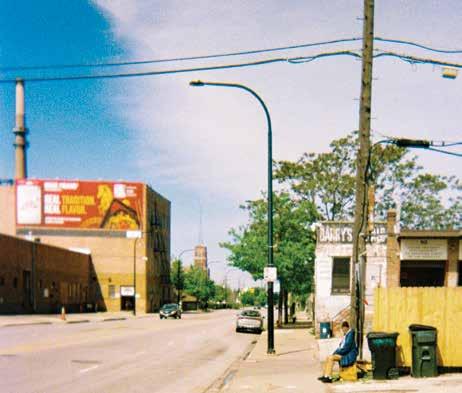
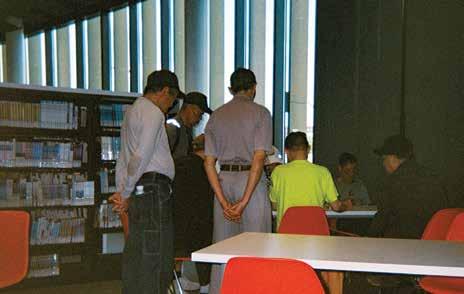
From top: A shot down South Halsted toward SPARC; patrons at the Chinatown library play Chinese checkers while Matthew sews; some unhoused Chicagoans used an old warehouse near SPARC as living space. MATTHEW KELLER
Chicago’s transmasc tipping point
More transmasculine social groups are popping up, offering much-needed places to ask questions and connect.
BY DEVYN-MARSHALL BROWN
My introduction to the nascent group that would eventually mature into Transmasc Society of Chicago was my homie posting a photo of himself and 20 trans guys in someone’s living room—I swiped up immediately. “What’s this?” “A friend invited me to a big group dinner, and it’s turning into something regular,” he says. “I added you to the chat. Come to the next one if you’re free.” Say less; I dove in headfirst.
The first informal gathering I went to was a Halloween party, where I dressed as a Hooters girl, my top surgery scars on display under a hastily cut tank top. It was the first time I’d ever been in a room of so many transmascs. Only half a year on masculinizing hormone therapy and a little impatient with my body’s leisurely pace in the transition, I marvelled at the years of transition around me and peppered the strangers with anxious questions like, “When did your facial hair start growing in? Who in your family is hairy?” Keinan Carpenter, founder of the Trans Masculine Alliance Sports Club Inc., was seated on the ottoman across from me, wearing a full-body Miles Morales Spider-Man suit. “You’ve got a long journey ahead of you. Let it cook.” I spent the rest of the night playing Mario Kart and feeling less dysphoric than when I walked in.
My questions only continued in the
Instagram group chat, which would grow to 150 members.
Hatcher Chapman was 18 and in relative isolation when he started transitioning in 2016. He was a college freshman. In nearly every space he was in, it was he who had been on testosterone the longest or who’d had top surgery before anyone else. People asked him questions. “I didn’t have anyone to talk to, to be like, ‘Oh, is this normal, or is that normal?’ I remember being very stressed about my shot and things like that.”
But now, walking into a bar with 30 transmasculine people or going on an impromptu ski trip with a handful of them, he’s meeting people who have been transitioning for 15 or 20 years. “What I get out of the group is not feeling like an elder for the first time.”
Transmasc social groups seem to be sprouting like beanstalks in Chicago and other cities. Similar groups have popped up in places such as Kansas City, Portland, Indianapolis, the Bay Area, Houston, Ottawa, Montréal, Seattle, and Cincinnati. The groups forming seem to align with the now-inactive national social experiment of T-Boy Wrestling, started by Trans Dudes of LA, where transmascs competed in athleticism and homoerotic performance in wrestling matches for hundreds to see.
Chicago’s groups all have similar names with varying offerings. There’s
“CALLING ALL T-BOYS, COME TO OUR FIRST PARK MEETUP IN HUMBOLDT. DO YOU WANT TO MEET OTHER T-BOY FRIENDS? DO YOU IDENTIFY AS TRANSMASC? IF SO, COME OUT.”
the aforementioned Transmasc Society of Chicago, Trans Masculine Alliance Sports Club Inc., T-Boys of Chicago, and the long-running Transmasculine Alliance Chicago, which preceded them all. Most have a front-facing digital presence on Instagram sharing monthly events and operate with the same basic premise: fielding group ideas from their members while operating a parallel Discord or Instagram chat that boasts hundreds of members, many of whom actively seek information and advice about transition, with a palpable hunger for transmasc community connection.
Gay cis men have laid claim to Northalsted, and a variety of lesbian bars and sapphic parties have sprung up to accommodate femmes of all genders looking to connect. Cishets live in a social
world largely built for them, and so this transmasc social group insurgence might finally be the fourth leg to the social table.
“I think that looking at where we are right now, LGBTQ+ communities in a post-COVID world are in a moment of rebuilding social infrastructure,” says T.J. Billard, executive director of the Center for Applied Transgender Studies in Chicago and a Northwestern professor researching transgender rights and media in the U.S. “A lot of people became very socially siloed and struggled to rebuild community ties after the peak of the pandemic.” Billard says a lot of people found online communities that acted as a bridge to building offline relationships. “People have been starved for it. So I think when it presents itself, people realize what they’ve been missing and get the bug for it.”
When J. Urban was a young adult in early 2000s Chicago, bands and entertainers like Actor Slash Model, Coyote Grace, the Sissy Butch Brothers, and Mickey Ray Mahoney gave them the trans representation they didn’t realize they craved. Urban was in a queercore band called Scott Free that performed regularly at the likes of PrideFest Milwaukee and Midsommarfest. “I was not out as trans, so being able to see folks living their authentic lives [while] questioning who I was really gave me permission to dig a little deeper. Representation does that.”
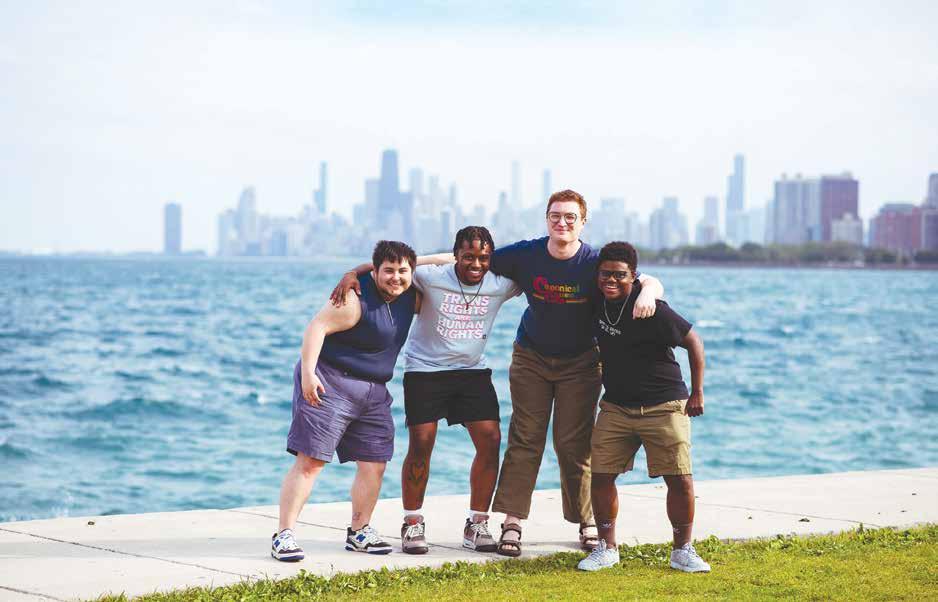
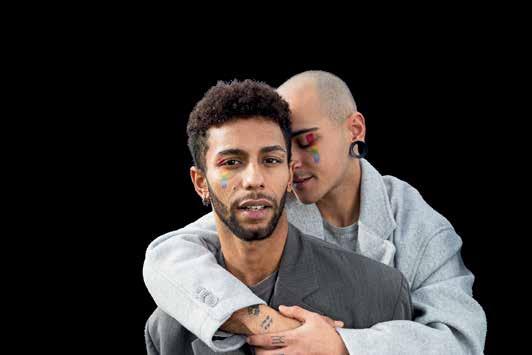
Some of the leaders of Chicago’s transmasc social groups: (left to right) Mik Connolly, Keinan Carpenter, Elliot Besmann, Spencer Washington ASH LANE FOR CHICAGO READER
Urban says the transmasc social groups reflect modern-day technological advancements that let queers stay connected in ways that weren’t imaginable before cell phones were commonplace. “That wasn’t possible in 2002. You were walking around looking for flyers hanging from bulletin boards and coffee shops.”
Mik Connolly is the founder of T-Boys of Chicago, a year-old collective for anyone who identifies along the transmasc spectrum. The collective’s membership lives in their Discord community of two hundredplus people. “[They] are talking every day, most hours of the day,” Connolly says.
Connolly was new to the city and experiencing gender dysphoria while working at a Lincoln Park grocery store when he pondered how to meet new people. He made a flyer with a QR code for a group chat that read, “CALLING ALL T-BOYS, COME TO OUR FIRST PARK MEETUP IN HUMBOLDT. DO YOU WANT TO MEET OTHER T-BOY FRIENDS? DO YOU IDENTIFY AS TRANSMASC? IF SO, COME OUT.” He posted them around town, and people came out like flies to honey.
T-Boys of Chicago’s Instagram page posts monthly events, like nights in Northalsted, game nights, and virtual hangouts for writing or watching sports or reruns of Queer as Folk. The group just keeps growing as friends bring more friends and their Instagram following balloons.
Connolly supposes that Donald Trump’s second election and Project 2025 lit a fire for trans people to come together in the quantities we’re seeing. “That’s something that really motivated me to find my people because I felt really alone in grappling with dread and hopelessness,” he says. “It made sense to be more visible, almost like a smoke signal, like ‘Is anybody else out there?’”
Troy Taylor is development manager of Brave Space Alliance by day and founder and president of the Transmasc Society of Chicago by night, which officially launched in December 2025.
“When I moved here, I’m like, ‘Where the hell do trans guys meet up?’” Taylor says. One of his friends told him he might catch a few out and about at parties, and there’s an FTM night at Steamworks, a men-only bathhouse and hookup locale. “I realized that I didn’t really see as much visibility for trans men that I saw for trans women, for lesbians, and for gay men,” Taylor says.
Since launching, Transmasc Society of Chicago has held multiple T-boy bar takeovers and a dance class, cooking class, ski trip, and drag watch party. Transmasc Society has partnered with Brave Space Alliance, Gender Fucked Productions, Chicago Therapy Collective, and the North American Trans Rugby Match. Their biggest event to date was their Sons of Olympus benefit at Center on Halsted, a celebration of transmasculinity in regal Greek and Roman mythology fashion that raised funds for Transmasc Society to
incorporate and build a mutual aid fund.
In Taylor’s opinion, the reason for the lag in transmasc social spaces may be traced to many trans guys’ ability to pass early on in medical transition, enabling them to quietly assimilate into cishet culture, especially when invisibility can equate to safety. He postulates that the desire to go stealth spreads like hay fever. Even when that desire is not there, the daily online discourse of “Can trans men be lesbians?” isolates trans men from the sapphic communities that they might still identify with. Transmasc Society is on the front line of the trans man loneliness epidemic.
“I’ll be damned if I move to one of the
including aging while trans, top and bottom surgery, coming out at work, trans people in history, and picking your new name in relation to your culture.
“We watched Scooby-Doo 2: Monsters Unleashed for one of our meetings,” says Spencer Washington, who leads the BIPOC Transmasculine Alliance Chicago group. “And we talked about ‘how does your gender relate to the movie?’”
Interested newcomers have to introduce themselves in person to get access to their 100+ member Discord, functionally baptizing interested members in conversation and connection before handing over the keys to their online space where informal events and
CITY LIFE
therapists who have encouraged their clients to seek out the group.
Lastly, the Trans Masculine Alliance Sports Club Inc., established in Atlanta in 2023, espouses fitness and sport for Black, Indigenous, and transmasc folks of color and leaves the door open for their allies in pursuit of healthy healing through exercise.
When Keinan Carpenter originated the club, it was strictly for trans guys. “I was like, ‘If they’re not going to give us a space to compete, then let’s just make our own space,’” Carpenter says. “But over time, my vision changed.” He thought of Fred Hampton’s Rainbow Coalition, a diverse, working-class, multiethnic coalition of people fighting police brutality
largest cities in the world and I have only one trans friend. That ain’t gonna fly,” he says. “If you build it, people will come.”
Up next is the Transmasculine Alliance Chicago, which resides at the Center on Halsted. It’s the older brother of the groups, with a history that goes back so far members are not certain when it started. One person joined in 2016, another says it goes back to 2008. If you Google “transmasc group chicago,” their link pops up first.
The formal group meets for two and a half hours three Fridays of the month, without fail, for either a formal presentation or a group discussion on topics
mutual aid happen. “For a lot of people, it’s the first point of entry,” says Elliot Besmann, a Transmasculine Alliance Chicago board member. “Once you introduce yourself, you don’t have to speak again the rest of the meeting. They can come into the community as fit to their comfort level.”
The group is not on social media, and they know that makes them the odd one out. But discretion is an important part of their relative absence in the digital space, and it has not affected their steadily increasing recruitment. Their name is spread well through word of mouth, by Center on Halsted, and even by some
and substandard housing. The idea was radical when the Black Panther Party Chicago chapter leader introduced it, but it was effective. “His mission was we’re stronger together than we are separated,” Carpenter says.
The Sports Club’s most recent event was a Trans Day of Visibility three-versus-three basketball tournament with WNBGay, Chicago Metropolitan Sports Association, and the Center on Halsted. Trans and cis people, and their trans kids, were all represented on the court. “Everybody in the queer community competing together, and our allies.”
The next steps for the Sports Club are creating a league with organized seasons and pursuing nonprofit status, Carpenter says. “If you want something for your people, then make it happen for your people.” If you make it selfishly for yourself, that’s fine, too, he says, “but it will eventually be bigger than you.”
Four new groups down, a hundred to go. The more options we have to connect, the better.
“Our social worlds do feel very small sometimes within [LGBTQ+] community,” Billard says. “We underestimate how many people there are, and how many different types of community spaces can be created for us.” v
dmbrown@chicagoreader.com
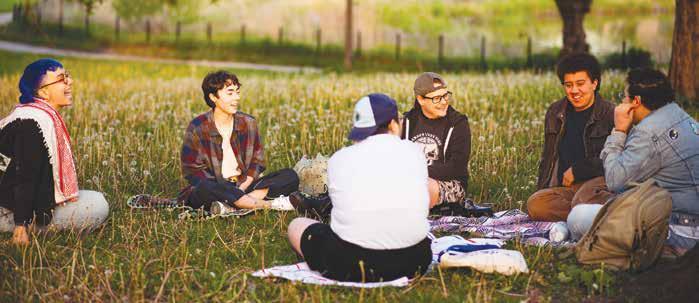
T-Boys of Chicago’s May meetup in Humboldt Park ASH LANE FOR CHICAGO READER
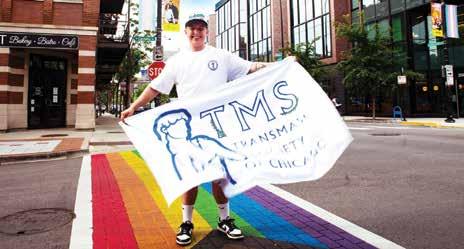
Troy Taylor, founder and president of the Transmasc Society of Chicago. ASH LANE FOR CHICAGO READER
‘The word not for rushing’
In thirty-two years of incarceration, my greatgrandmother’s voice and her Bible have kept me from disappearing into the system.
BY PATRICK COMI
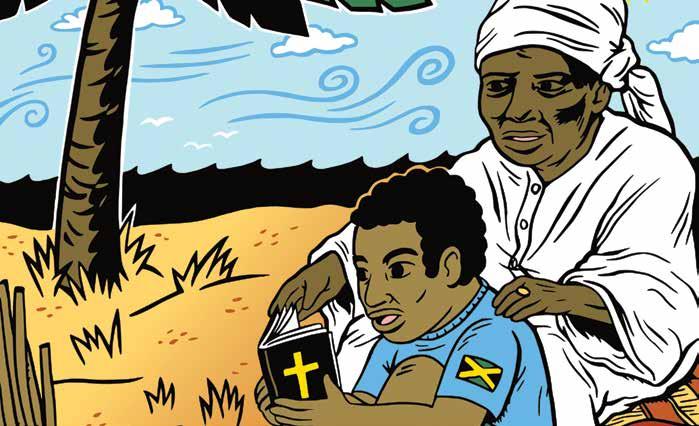
Ikeep the picture pressed between thin, worn pages. It’s creased at the edges, softened by time, like my childhood memories. Every time I open my Bible, it falls to the same page where it sits, as if guided by some

afsp.org/LGBTQ | illinois@afsp.org


thing greater than habit. And there is Ruth: my great-grandmother, my anchor, my first teacher of faith. Thirty-two years is a long time in prison: Long enough for seasons to lose their meaning. For birthdays to blur into routine counts. For the outside world to feel like a story told by someone else. But when I see Granny Ruth’s face, none of that matters. I am no longer a prisoner in America; I am a boy again, barefoot on the warm Jamaican soil, sunlight stretching across the yard, the smell of cooking drifting through the air. She would sit on her stump, steady and dignified, her Bible always within reach, her voice carrying both gentleness and authority, the kind that didn’t demand attention but always received it. “Come here, baby, read dhi
In a place where
can shrink down to a number, her memory reminds me that I was once called something else: Baby.
I didn’t always understand the words I was reading, but she would listen, nodding slowly to every word. Sometimes she would ask me to stop and read it again. Not because I was wrong, but because she wanted me to feel it. “Take your time,” she would say. “The word not for rushing.” Now, decades later, those same words echo in this distant place. The walls around me are cold, unyielding. The sounds are harsh—metal, voices, footsteps that never quite fade. But when I open my aged Bible, the noise quiets. The space
expands for me. I read the same verses she once asked for—Psalms, most of the time, which she said is where you go when your heart doesn’t know how to speak.
Now I understand those words. There were nights too heavy to count when the silence in solitary confinement pressed in on me, when regret sat beside me like an uninvited cellmate. Nights when I searched for something to hold onto, something that reminded me that I was more than my worst decision. That’s when I didn’t always have the words in me. I wonder sometimes if she knew. If, back then, when she asked me to read, she saw something I didn’t yet see. If she understood that those moments weren’t just about teaching a boy the scripture, but about planting something deeper. Something that would survive distance, time, even carceral spaces.
Because it did: Her voice lives in my memory. Not just in the words she spoke, with her heavy accent, but in how she made me feel—seen, guided, loved without condition. In a place where identity can shrink down to a number, her memory reminds me that I was once called something else: Baby. Not an inmate, not B69649, not a statistic or a mistake, not an alien or boy. Baby. I close my eyes and hold her picture in the palm of my hand, and I can almost hear the breeze from back home in Trelawny. v
Patrick “Biyah” Comi, 55, is a writer, poet, and painter from Trelawny and Kingston, Jamaica. He’s currently a Northwestern Prison Education Program student and is a proud grandfather to four.
Inside Voices is a series of first-person essays and reported pieces by writers impacted by the Illinois carceral system.
themail@chicagoreader.com
ATLAN ARCEO-WITZL FOR CHICAGO READER
A heated rivalry between sports and politics
Chicago LGBTQ+ hockey players push back on discriminatory rules.
BY DEVYN-MARSHALL BROWN (DMB)
Seven months ago, Loyola grad student Nathan Perl first fed his curiosity for amateur adult hockey at the Warren Park ice rink, armed with no hockey experience and a used pair of skates. But his passion for the ice germinated inside his shared studio apartment as he beheld his Samsung TV.
Born in Colorado, Perl grew up watching the Avalanche, a National Hockey League team. Naturally, he and his boyfriend were tuned in as the Avalanche finished the 2025–26 season ranked first in the league. Then came HBO’s premiere of Heated
Rivalry and the rest was history. “I was watching the Avalanche win a bunch of games and I was watching Heated Rivalry It was just all hockey,” Perl says. “And I was like, ‘Wait, I could play that.’” Perl is one of more than one hundred new members who joined the Chicago Pride Hockey league this year, twice the number of new members the nonprofit LGBTQ+ recreational hockey league typically anticipates around pride month. Cis gay men dominated the league from its founding in 2008 until 2024. But since then, the group’s membership has grown more genderqueer with each season. Zack
Dessent, a Chicago Pride Hockey board member, tells the Reader many of their new members are people that, growing up, might not have felt welcome or included in sports. “Heated Rivalry expanded that audience so much. It’s amazing that a show could do that,” Dessent says.
The explosion in interest among queer and trans Chicagoans comes as USA Hockey, the sport’s nationwide governing body, has moved to ban trans people from participating in non-coed leagues at every level, from recreational to elite. In doing so, USA Hockey has joined the bodies governing every major sports league in the
country in narrowing access to play.
Athletes with Chicago Pride Hockey will largely be spared from the immediate repercussions of this change because they play in a coed league, but the federal government’s efforts to target trans athletes have still sent reverberations of fear among its members, many of whom play in multiple leagues.
Ash Stephens is an assistant professor in criminology, law, and justice at the University of Illinois Chicago, as well as an affiliated faculty member in the university’s Black studies and gender and women’s studies programs. Stephens says
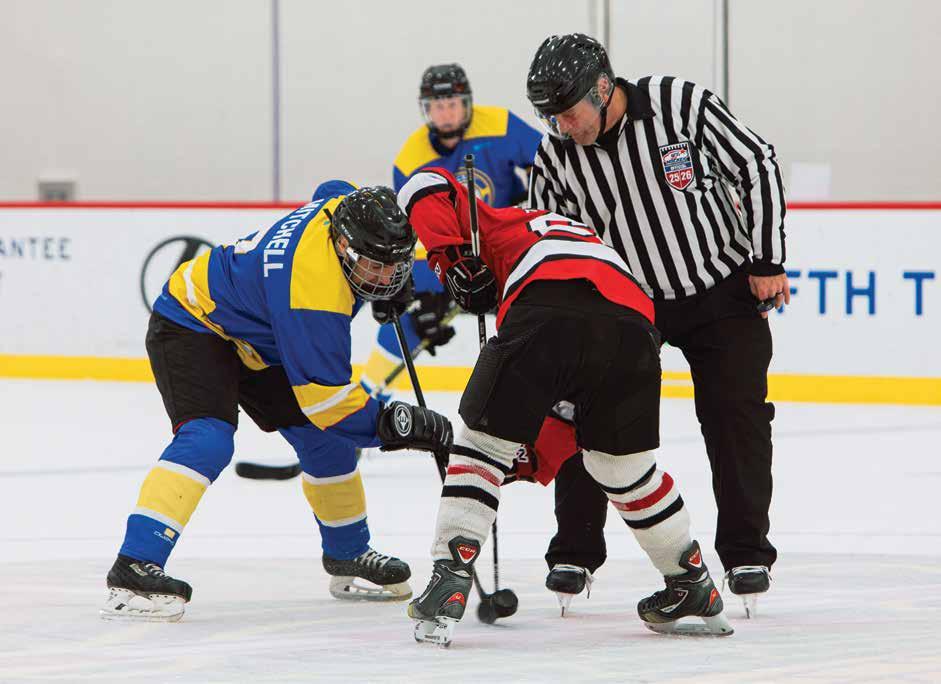
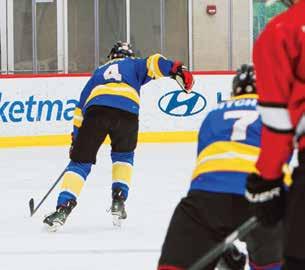
Chicago Pride Hockey is a nonprofit LGBTQ+ recreational hockey league. MICHAEL IZQUIERDO FOR CHICAGO READER
NEWS & POLITICS
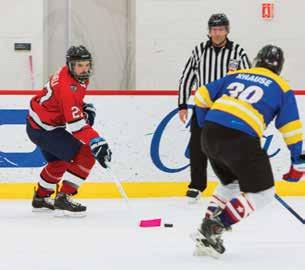
trans athletes disrupt an environment built on false common-sense notions, like men are stronger than women or that everybody has the same access to sports. “It’s not just a fear,” Stephens says. “It’s a concerted effort to remove particular people from all forms of social, economic, and political life.”
In mid-November, USA Hockey quietly rolled out new rules mandating that athletes in sex-segregated leagues can only play in programs that match their sex at birth, so trans masculine people who have undergone male hormone therapy and trans women are barred from “female” category events. The organization said it adopted the new rules to align with directives from the United States Olympic and Paralympic Committee, which oversees leagues in sports ranging from archery to artistic swimming to boxing.
In recent years, conservatives have sought to erase trans and queer people from public life. After taking office in 2025, President Donald Trump issued executive orders denouncing the rising visibility of transgender people in the name of “restoring biological truth to the federal government.” Twenty-seven states had already already banned trans student athletes from participating in school sports that align with their gender identity.
In 2016, BBC News dubbed Chris Mosier the “Transgender Man Who Changed The Olympics” after he made the USA duathlon team but was deemed ineligible to compete in the World Cham-
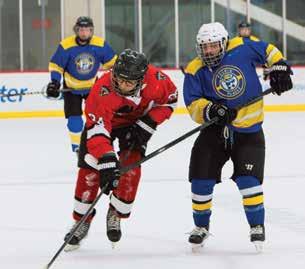
pionship. An antiquated International Olympic Committee policy required transgender athletes to have two years of hormone replacement therapy and complete lower body surgeries (both internal and external genital modifications) to compete. Mosier, flanked by a team of pro bono lawyers, brought the International Olympic Committee his concerns about eligibility. The IOC ultimately obliged; it removed the surgery requirement and reduced the hormone requirement to one year for trans women and no time for trans men.
Mosier, who has since founded the blog transathlete.com to fight for gender equity and inclusion in sports, says the recent decision by USA Hockey to restrict participation from trans athletes impacts recreational sports of all ages and abilities because the athletic systems for youth and recreational athletes are tied to the national governing bodies. USA Hockey provides insurance for most hockey rinks, continuity in rules and regulations, training for coaches, and safe sport obligations. “I think that’s the most damaging thing about these policies,” Mosier says. “Because the truth is 99.9 percent of people who play this sport will never become professional athletes or Olympians or Paralympians.”
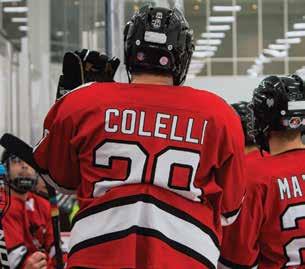
Some trans members of Chicago Pride Hockey say they’ve felt intimidated at the thought of playing with more aggressive cis white men on the ice. It is well-documented that coed teams often retain gendered hier-
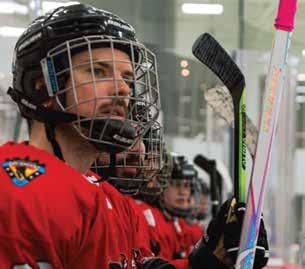
archies, with cis men in dominant team positions. Women’s leagues often felt like more accessible and safer options.
“Queer people love sports too and, for too long, we haven’t seen ourselves represented in sports storytelling,” Mosier says about the Heated Rivalry-to-amateur hockey pipeline. “Having leagues, like Chicago Pride Hockey, create these spaces where we can embrace all of the parts of our identities in the future of sports, particularly in this moment.”
Jana Parker was a latecomer to hockey when, at the age of 49, she signed up for her first hockey class a couple years ago. She’s since been playing in Johnny’s Adult League, the largest adult hockey league in Chicago, when she realized she wanted to transition. Parker discovered Chicago Pride Hockey when the group was featured on a TV time-out at a Blackhawks hockey game.
Now four months on estrogen, Parker has continued to play in both leagues. But playing in an adult hockey league while transitioning has been a challenge, she says, and she struggled to let her team know about it. “I don’t think anybody was gonna say anything really negative, but you could just tell there were mixed reactions,” she says. “People aren’t always as accepting, and that’s something that I don’t experience with the pride group. . . . I don’t feel like an outsider.”
Observing the U.S. Olympic and Paralympic Committee rule changes from the outside, one might gather that
there is an issue with trans sports players across leagues that needs to be solved. But Mosier says it’s more a result of conservative leaders, who have spent the last decade “message testing” topics that play on voters’ emotions and can energize the political right.
“This has been an intentional, coordinated effort—not because of any new information, not because of new science or data, and not because trans people have been a problem in sports. It’s because they found that the messaging is incredibly effective and it works, and that is largely because sport is so emotional,” Mosier says.
Mosier says men’s professional sports are still deeply homophobic. Being openly gay can jeopardize players’ contracts or sponsorship opportunities. That environment, Mosier says, creates a space where any “out” queer person becomes a distraction.
The call to “Make America Great Again” is a window into unfolding anti-trans policies. In targeting immigrants, stripping social services, and banning trans people from social life, the conservative right is trying to craft an idealized American citizen by erasing and criminalizing the people who don’t fit into it.
“[People] can’t get past the fact that sports are made-up shit,” says Stephens, the UIC professor, “so we can make up ways to be more inclusive.” v
dmbrown@chicagoreader.com
In 2025, USA Hockey quietly enacted rules seeking to bar transgender atheletes from many teams and programs. MICHAEL IZQUIERDO FOR CHICAGO READER
“Martin Wong: Chinatown USA” >> Through 7/18: Fri noon–7 PM, Sat 10 AM–5 PM, Wrightwood 659, 659 W. Wrightwood
Flowers in the mirror, moon in the water Artist
Martin Wong was always “wandering the edges.”
BY XIAO DACUNHA
Asmiling Chinese woman in an elegant, gold-lined blue qi pao stands in the foreground. A group of men and snickering children stare at her well-ironed curls and pronounced form—the men eyeing her curves with blatant interest. In the background, pagodas dotted with neon signs tower in front of a red sky.
Grant Avenue, San Francisco is just one of many highly detailed paintings on display at Wrightwood 659’s “Martin Wong: Chinatown USA,” in which the artist recreated his lived experience as a queer man growing up in San Francisco’s Chinatown. It has many of Wong’s most identifiable motifs: pagodas, dragon-donned lampposts, gilded borders and contours, dutifully recreated signage, and voluptuous main characters. These paintings contain an impressive level of detail, turning brushstrokes into a sculptor’s knife, carving out layers of texture and subtle shifts in color.
Wong’s brushstroke carried a scrutinizing quality. It reminded me of my first visit to the Shanghai History Museum in elementary school. Bewildered by the artifacts, I leaned as close as possible toward a display case holding a jade cup, squinting my eyes to look at the tiny carvings of animals. That must be how Wong painted his Chinatown: with a burning sense of curiosity and nostalgia for something imminently close to who he was yet never directly touchable. So he masked over reality and lived experience, crafting a wonderland out of everything he was and could have been.
Born in Portland, Oregon, Wong identified as Chino-Latino, raised as he was by his Chinese American mother and Chinese Mexican American stepfather. However, he did not speak Chinese. Nor did he ever visit China or Hong Kong. His parents even discouraged him from openly embracing his Chinese heritage, concerned that the Chinatown paintings would jail his image with stereotypes. For Wong, speculation was his primary way of learning about a significant part of his identity.
In a sense, Wong’s use of Chinese references was inherently American. His architecture captured the most memorable elements: flying ridges, temple tops, jade roof tiles, patterned windows, and various uses of gold foil. His cultural references were also predictable in many ways: astrology and zodiacs, Buddhas, dragons, and Bruce Lee, the iconic American-born, Hong Kong–based martial arts phenomenon. Even the way he recreated the Chinese characters in his paintings suggested he could not actu-
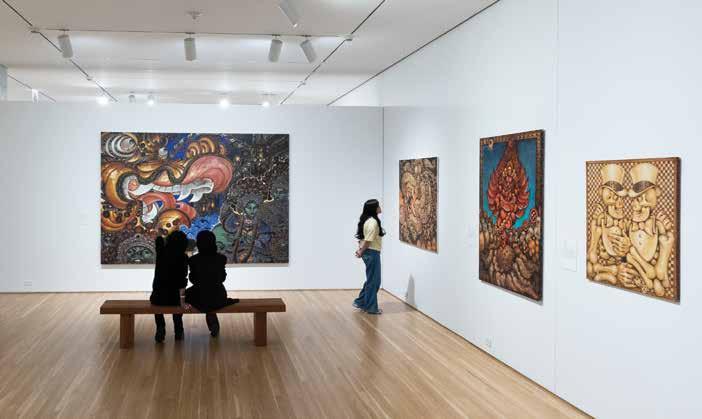
ally write the language. He traced shapes instead of following stroke orders. He drew, not wrote. Distance and detachment were constant in Wong’s paintings, even when he depicted familiar streets where he lived, played, and roamed. Wong might have shown images, but he didn’t fully invite the audience in. Instead, he was the telling narrator, and we were the listeners getting glimpses of his experience and his Chinese American identity from the outside.
At the same time, his work was extremely personal, offering up private memories and lived experience unconditionally, if we knew where to look.
The characters in his paintings were his family, friends, and versions of himself. They were painted in such an interconnected way that you know there was a piece of Martin Wong in each of them. In Grant Avenue and Ms. Chinatown, we see a young man discovering his own queerness from the sidelines, admiring femininity but also becoming aware of the male gaze. In Clones of Bruce Lee and other works that pay tribute to the kung fu star, we feel Wong’s alignment with the love, peace, harmony, and protection Lee’s heroes stood for. These core subjects were further manifested in pieces like Polaris, where eight children belonging to different ethnicities play on a constellation chart, and Sweet ‘Enuff, where two firemen shared a passionate kiss before the burnt remains of a tenement building in New York.
Looking at Wong’s paintings, the audience should sense the contradictory coexistence of intimacy and detachment, rational observation and sentimental participation. Had it been Wong’s intention to largely remove direct emotional impacts in his paintings by adopting an illustration-like technique that focused more on accuracy and intricacy? I couldn’t necessarily determine that. Nonetheless, his intent to communicate, whether with himself or the audience, through his own uncertainty was undeniable.
For example, Wong used American Sign Language in many of his paintings, depicting hand symbols in a style resembling kung fu gestures and Buddhist mudras. Most of these either annotate paintings as smaller accompanying works or are embedded into signs or backgrounds. “If you know, you know,” they suggest, hovering on the edge of one’s consciousness, their presence quiet yet dominant.
If the stylized ASL functioned as a private code reflecting the artist’s thoughts, the Magic 8 Ball was a more direct reference to Wong’s internal conversations. A childish attempt at fortune-telling and solving life’s unsolvable dilemmas, the Magic 8 Ball is the epitome of wishful thinking. The charm of the toy is that you could ask it any yes or no question, and you get an answer, no matter how ridiculous or difficult the inquiry. Therefore, the frequent appearance of
the Magic 8 Ball was an indicator in itself, pointing at the uncertainties the artist might have felt as one of the first openly gay Chinese American artists in the U.S. I wondered what questions the artist asked his fortune-telling toy on quiet nights. Did he ask about his Asian-ness? Or were his inquisitions as mundane as whether to get chop suey for dinner?
The Chinese idiom “镜花水月 ” means “flowers in the mirror, moon in the water.” Perhaps that was how China, and the Chinese portion of himself, felt for Wong. His pagodas were tall and impressive, yet wrapped in a hazy mist of ambiguity and detachment. Wong considered himself a perpetual outsider, writing to a friend that he was always “wandering the edges.” His China stands just beyond our fingertips, perfectly attainable until we actually try to reach for it.
But can you truly define queerness? What about Chinese-ness , when you had never set foot in your ancestral homeland? You’d just have to make do, making sense through speculation, observation, and communication. That is how Wong constructed an ethereal home that existed between Chinatown and China thousands of miles away, derived from distant documentations and artifacts and laced with the closest personal experience. This medial space existed for Wong and Wong alone, and it held and loved him so. v
themail@chicagoreader.com
Installation view, “Martin Wong: Chinatown USA,” at Wrightwood 659 SHANTI KNIGHT
Spend your summer immersed in art and performance at Chicago’s Museum of Contemporary Art
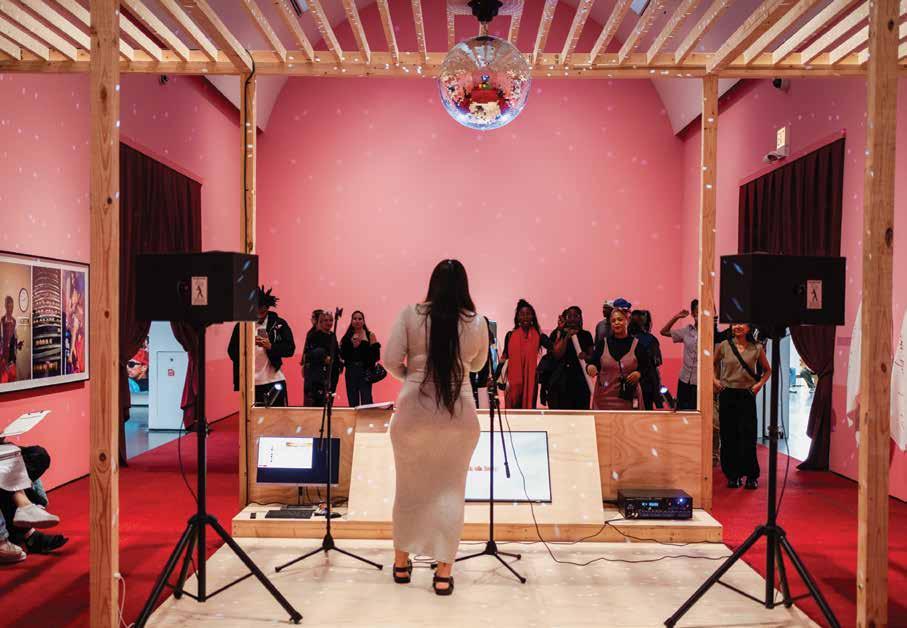
For nearly 60 years, the Museum of Contemporary Art Chicago (MCA) has sought to nurture and showcase some of the world’s most-renowned interdisciplinary contemporary artists. Nestled into the heart of the city, just off Michigan Ave near the Water Tower and John Hancock building, the MCA has grown to become home to a collection of over 2,000 works. The 220,00-square-foot building features three levels of galleries that host
View exclusive exhibitions
Dancing the Revolution: From Dancehall to Reggaetón
Dancing the Revolution brings together over 40 artists to explore how dancehall and reggaetón— two genres born from the Caribbean’s struggle and spirit—became global forces of cultural and political liberation. Through painting, sculpture, sound, and video, the exhibition traces these movements from Kingston to San Juan to New York and beyond, revealing how rhythm, body, and sound become revolutionary tools for joy and resistance.
a robust slate of exhibits year round, an education center, performance theater, and more.
This summer at the MCA will be filled with new exhibitions, interactive performances, and artists talks. The MCA invites Chicagoans and out-oftowners alike to add visiting to explore some of the most experimental and intriguing contemporary art to their summer itinerary.
Programming includes karaoke nights, a talk with Petra R. Rivera-Rideau and Vanessa Díaz, and more. Plus, don’t miss Tuesdays on the Terrace, where the whole month of July will be dedicated to music of the Caribbean.
City in a Garden: Queer Art and Activism in Chicago
You’ll have until August 16 to experience City in a Garden: Queer Art and Activism in Chicago, which explores the city’s vital yet underrecognized role in LGBTQ+ history through the work of over 30 artists and collectives from the 1980s to today. Highlighting the intersection of art and activism, the exhibition showcases photography, sculpture, painting, and
This content is sponsored by the MCA
archival materials that document radical resistance, queer intimacy, and the ongoing fight for liberation.
Chicago Works | Mike Cloud: Worldless Obstruction
Chicago-based artist Mike Cloud often uses recognizable symbols, objects, and materials to draw attention to how symbols are interpreted and their connection to systems of power and history. This exhibition features a new body of work that features hinges and can be configured in many variations, sometimes literally getting in the way of expectations about what a painting should be and. Through his titles, Cloud rejects vague themes in favor of using details from the news cycle.
Installation view, Dancing the Revolution: From Dancehall to Reggaetón, MCA Chicago, April 14–September 20, 2026. Photo by Ricardo Adame
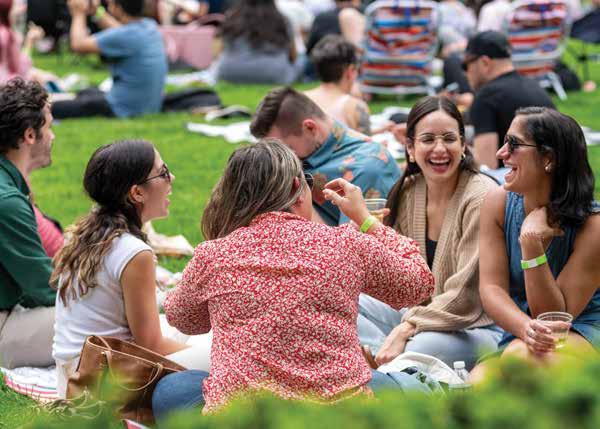
Spend your summer immersed in culture
Tuesdays on the Terrace
Relax on the MCA’s terrace and lawn every week when Tuesdays on the Terrace returns on June 16. Now in its 27th year, this season’s lineup features alt-rock, pop, jazz, reggaetón, and more—but always rooted in Chicago’s music community. For the full schedule and more information about attending, visit: mcachicago.org/tot
Prime Time: Dancing the Revolution
Get ready to shake it in celebration of Dancing the Revolution with Prime Time on July 25! Kicking off at 7 PM, this all-museum, late-night, 21+ party will feature dance workshops with dancehall diva Latonya Style, an electric sound and movement performance by Awilda Rodríguez Lora, and
music curated in collaboration with Chicago’s own Beatdown Soundsystem.
Artist Talks
Kenzi Shiokava Roundtable
Saturday, June 27, 2–3:30 pm
In celebration of the opening of the exhibition, enjoy a roundtable conversation between curators and art historians Aram Mosheyedi, Michiko Okano, and Hamza Walker. Moderated by MCA Assistant Curator and organizer of Kenzi Shiokava, Nolan Jimbo.
Petra R. Rivera-Rideau and Vanessa Díaz with Bad Bunny Collaborators
Saturday, August 8, 2–3:30 pm
What is it like to collaborate creatively with Bad Bunny, and how has his global superstardom influenced political activism around Puerto Rico? At this
talk, the authors of new the book P FKN R: How Bad Bunny Became the Global Voice of Puerto Rican Resistance will explore his impact with the star’s collaborators, including music video director Kacho López Mari. Bilingual event (English/Spanish).
Grab a souvenir and bite to eat
MCA Store
Described by Conde Nast Traveller as “one of the best gift shops (ever)” the MCA Store is great for browsing before, after, or during your visit. With a focus on independent artists—including some of Chicago’s finest—its impeccable selection of merchandise celebrates fun, beauty, and curiosity, with jewelry, home goods, wearables, art books, games, prints, and much more. Like the museum itself, the store has something for every budget and age group. Along with its mix of chic, playful, and thought-provoking items for grown-ups, it features hundreds of colorful, imaginative toys, art kits, and interactive books to inspire and nurture young creative minds.
The MCA Store is open Tuesday from 10 AM to 9 PM, Wednesday through Sunday from 10 AM to 5:30 PM, or visit online anytime at mcachicagostore.org.
Marisol
Enjoy long summer evenings of dinner, drinks, and conversation at Marisol Restaurant & Bar, the MCA’s on-site dining establishment, featuring seasonal dishes in an art-filled, relaxing setting.
Stop in on Tuesdays through Sundays for lunch, dinner, and weekend brunch—or come to happy hour from 5 to 6:30 PM. Be sure to try the current dish from our ongoing Chef Collaboration Series, which aims to uplift local culinary talent by showcasing their signature dishes.
Visit marisolchicago.com/menus to view our latest menus.
In addition to table service at Marisol, the Counter is a perfect stop before, after, or during your visit for light bites, snacks, coffee, tea, and other refreshments. Order online or stop in from 10 AM to 7 PM on Tuesdays, and 10 AM to 4 PM Wednesday through Sunday.
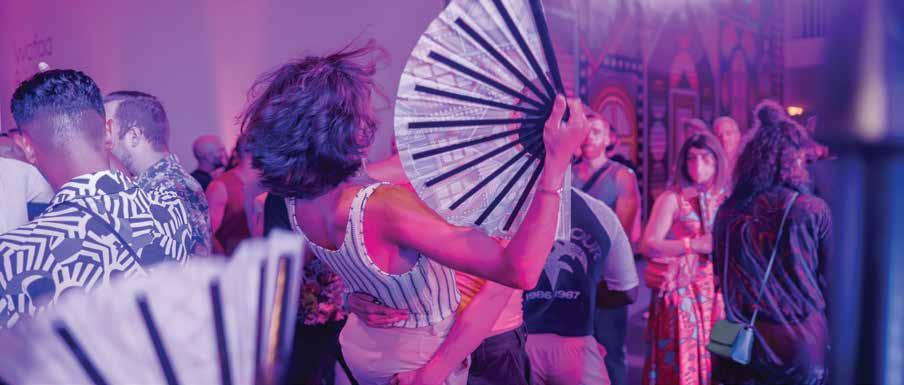
This content is sponsored by the MCA
Prime Time: City in a Garden (2025). Photo by Alexis Ellers
Tuesdays on the Terrace: The Jazz Hoofing Quartet, MCA Chicago, August 8, 2023. Photo by Shelby Ragsdale
‘We really try to be a place where they can be themselves’
Youth theater companies have quietly figured out how to make space for queer and gender-diverse kids.
BY KERRY REID
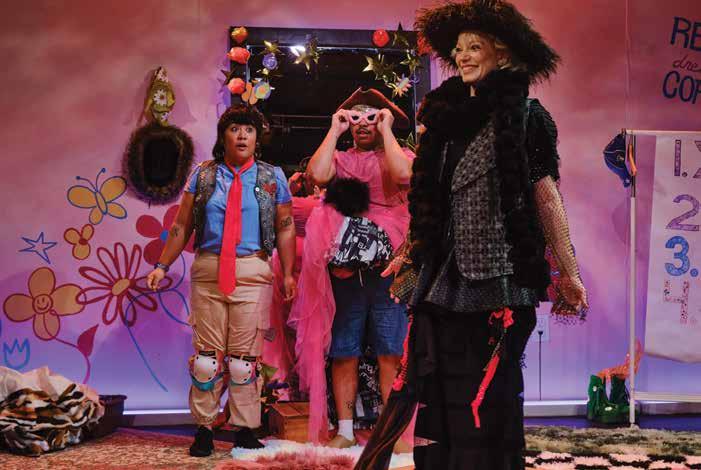
Back in March, Jackalope Theatre Company produced the first show for young audiences in their history. The Dress-Up Play, written by Juliet Kang Huneke and directed by Karina Patel, showed four kids (played by adults) in a play session where they tried on clothes and took on characters, all while sharing aspects of their own gender expressions.
At a time when children are being weaponized in attacks on LGBTQ+ rights (protests at drag storytime events come to mind immediately), the show got me wondering about how Chicago theaters that provide programming and training for young audiences and young adults are creating spaces for queer families and kids, or at least fostering conversations about gender diversity.
The stereotype of the gay theater kid has been around forever. But the artists I talked to emphasized that focusing on LGBTQ+ individuals is part of a broader mission for building empathy, confidence, and the ability to work collaboratively with others, onstage and off. Even if the work onstage doesn’t always directly reflect
queer experiences or use youth actors, the adult artists also represent a range of experiences and identities that can lead to fruitful discussions for kids and families in the audience.
Patel is the new work manager at Jackalope and had directed Huneke’s play, Hannah and Halmoni Save the World, last year at the young-audiences company Filament Theatre in Portage Park. Since Jackalope is housed in the Broadway Armory and provides programming for the Chicago Park District in the space, Patel thought a show for young audiences made sense, and pushed Jackalope to commission Huneke to create a new piece for them.
Huneke had worked with Filament on their long-running piece Forts! Build Your Own Adventure, which encourages kids to work together in creative play.
That gave her the idea for The Dress-Up Play, along with her own experience as a teaching artist. “When I’m teaching kids theater, the number one thing they’re always asking me to do is put on costumes, which is so funny because it’s not actually something we can usually do. Like, ‘We don’t have costumes for you,’” notes
down their name and their pronouns. And the parent or guardian sees these pronouns, and maybe it’s ones that they haven’t seen their kid use before.”
Watson also says that the diverse casting Filament practices also creates “a lot of great moments of conversation around pronouns and gender identity.” Their current show, Farewell Opportunity, features Osiris Gabriel Mundo, a disabled actor who uses the neopronouns ke/kin for English and “elle” for Spanish. Watson also notes that their 2023 show, Think Fast, Jordan Chase!, which dealt directly with social inclusion and exclusion, brought up conversations “that were so beautiful, and I’m hoping in the future we can tell more and more stories like that, especially for even younger audiences.”
Randy White, the founder and artistic director for Young People’s Theatre of Chicago (YPT), which began producing in 2021, candidly opens our conversation about YPT’s programming. “The subject is a little bit scary to talk about for a cisgender white male,” he notes. But he also says, “The first thing that I think about is that the question of representation onstage for transgender people or of gender fluidity is part of a larger question of representation onstage. So whether it’s race, or whether it’s disability, or sizeism, it’s a big thing in my world that I care about.”
YPT produces several shows a year at the Greenhouse Theater Center (including field trip performances for schools) and also runs summer camps. “We’re not a theater company that says, ‘Our mission is to bring X or Y issue to the fore and explore it and investigate it,’” White says, adding, “I think that every choice we make is a message. And so we have to be careful in all choices and make sure that all voices have a chance to speak to those choices that we’re making.”
Huneke. She also says that she sees a lot of gender-diverse kids in her teaching artist role and really wanted to create a show that combined make-believe and could still “speak to something directly that’s in the real world.”
Patel notes that the show also introduced political activism, but in an organic way.
Aiden, a young boy who a teacher has told that he shouldn’t bring a purse to school, hears from his friends in the play group about petitions and protests. “I don’t think you can make [theater] for the community or for any community without really talking about politics, protesting, petitioning, or social justice in some way,” Patel says.
Empowering kids is a big part of Filament’s mission as well. Founded in 2007, the company offers public programming for kids and families as well as a variety of camps and other programs. Caroline M. Watson, Filament’s associate director of engagement, notes that inclusivity and empowerment start from the moment kids and their adults enter the space. “Every single thing we do has name tags— our shows, our classes, our camps. Countless times, I’ve seen a young person write
For their 2023 production of Junie B. Jones, directed by White, he notes that the company used cross-gender casting for some of the roles, including Gladys, “the queen of the cafeteria,” as he called her in an email to the company he shared with me, and the twins Chenille and Camille, who join up with Junie’s friend Lucille to form their own clique. In that same email, White notes, “The fierceness and glamour of classic drag are used in this case to represent a pre-teen sophistication that Junie lacks.”
When we discussed the casting in Junie B. Jones, White says that there were people in YPT who initially opposed it, viewing the use of drag as “a discriminatory comment on gender.” He adds, “What I wrote to the casting person was that I felt that the drag performance in this was being misunderstood, and that in fact drag in this play worked in a bunch of different ways, and that our job was to uncover that. And what was interesting about it is that once we sort of made that argument, it went away. Once we started the work, it never came back up.”
White does note that the school groups who bring their students to YPT often
Jett Parr (left), Keimon Shook, and Casey Whisler in The Dress-Up Play at Jackalope Theatre JOEL MAISONET PHOTOGRAPHY































In bed with andrew sa



























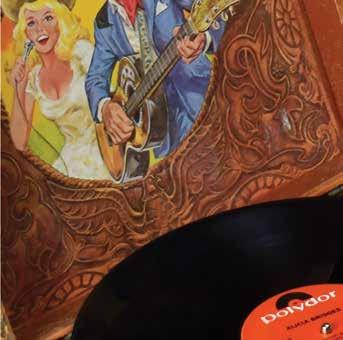













































































































Be you at the Bijou
Steven Toushin owned the Bijou Theater, the country’s longest-running adult gay cinema and an institution that helped shape Chicago’s queer underground.
BY CHARLIE KOLODZIEJ
When I meet Steven Toushin at a coffee shop in Irving Park, he’s just come from selling his longtime motorcycle, a 1963 BMW with a chrome frame and decals of Adam and Eve on the front and rear fenders. “It’s really a work of art,” he says in a thick Brooklyn accent as he excitedly shows me photos of the bike. In a collared shirt, round tortoiseshell glasses, and a gray fedora, he looks charming and avuncular. Dapper, even. His dog, a white and honey-spotted former racing greyhound he calls “Ms. Checkers,” sits cheerfully next to him. He talks in a no-nonsense sort of way and, I quickly learn, swears like a sailor stung by a jellyfish. At 79, he looks like a cool grandpa. I wouldn’t have guessed the federal government tried to bury him in the 1980s for producing and distributing gay porn.
Toushin was the longtime owner of the Bijou Theater, which, when it closed its doors at 1349 N. Wells in 2015, was the longest-running adult gay video theater in the country. He says he’s been arrested 35 times; survived 21 obscenity trials, two of which went to federal court; and weathered at least two hundred raids on his businesses. He is an author, an early trailblazer in the BDSM community, and the owner of Bijou Video, which was once one of the largest gay porn distributors in the country and still operates as one of the only companies that restores vintage gay films and erotica. Did I mention he’s also straight?
The history of the Bijou Theater, he tells me, includes the murder of a porn impresario, an attempted bombing, and an FBI plot to frame a member of the Chicago Mafia. But this story, really, is about none of those things. Rather, it’s about the history of gay Chicago and the choices we are all forced to make under fascism.
“I know you want to talk about the Bijou, but you got me going,” Toushin says. “Because if I just dealt with the Bijou, it would just be a simple little read. It’s not a simple little story.”
Toushin came of age in a Jewish community in 1960s Brooklyn. His father died young, and his grandfather helped resettle Holocaust survivors in the United States. After wheeling around New York City in his adolescence (which included
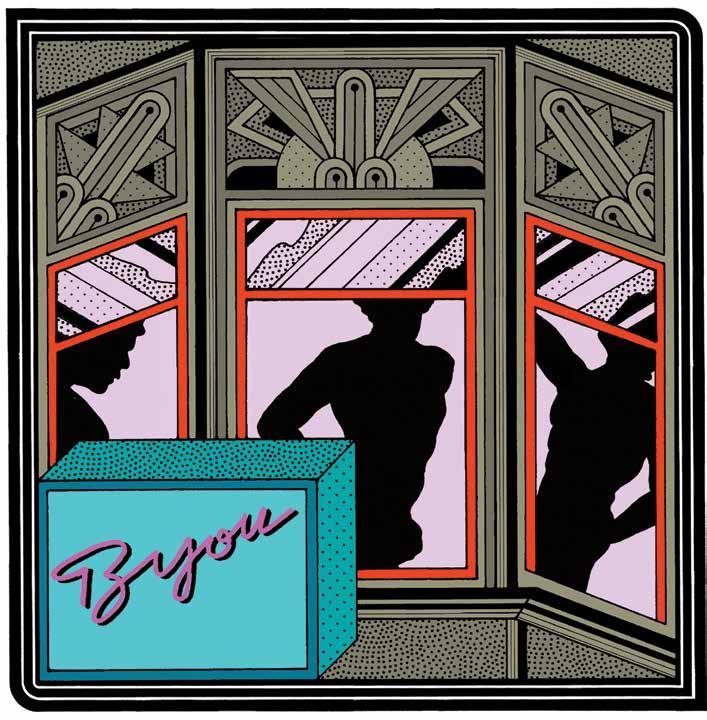
a brief stint setting up sound equipment for Andy Warhol), he decided to leave in 1966, peddling his ten-speed bicycle north to Vermont, then Maine, working odd jobs along the way. He raked leaves, jerked sodas, and cut logs at a sawmill.
In 1968, he landed in Chicago’s Old Town neighborhood while hitchhiking his way to Arizona.
In the 60s, Old Town was not the swanky, upwardly mobile neighborhood
The theater was “a jewel in the crown of the sexual liberation of Chicago.”
it is today. “It was the hippie-dippie place of Chicago at the time,” Toushin says. “Chicago’s Greenwich Village.” It was also a crash pad for the Chicago Outfit, the infamous crime syndicate that spawned mafiosos like Salvatore “Mooney” Giancana and Al Capone.
Toushin found work at Aardvark Cinematheque on 1608 N. Wells, the kind of small indie storefront theater for which Chicago would later become famous. It showed experimental films like Frederick Wiseman’s Titicut Follies (1967), D.A. Pennebaker’s Bob Dylan: Dont Look Back (1967), and some of Warhol’s work, of course. There he met business partners Paul Gonsky and Jeffrey Begun, and in
January 1970, the trio began discussing plans to open up another theater, one that would show “gay films”: the Bijou.
“But we just couldn’t go in and say, ‘I want to open up a gay theater,’” Toushin says.
Gay people gathering in public was still de facto illegal, even if it wasn’t de jure. To open the Bijou, they needed a Public Place of Amusement license, the same permit still required to open any entertainment venue in the city.
“I’m a stranger in a strange land. I don’t know anybody,” Toushin recalls. “So everything that I did, I had to meet people and make my own connections.” It was these connections, “plus a hundred dollars in a matchbook,” that got the permit past
EDIE FAKE FOR CHICAGO READER
the head inspector’s desk. In 1971, they opened the Bijou in a small three-floor walk-up, filling a hole in the market in what was then a very gay part of town.
Still, Toushin and his partners were worried the morality police might come knocking. The first film they showed at the Bijou was Richard Nixon’s infamous 1952 “Checkers speech”—perhaps the opposite of a gay film. It was a half-hour television address-cum-tirade in which then candidate Nixon railed against his political opponents. (The speech was later named after Nixon’s black-and-white cocker spaniel. Toushin’s greyhound has the same namesake.)
Showing the Checkers speech was plausible deniability. “It gave us at least six weeks of looking legitimate,” Toushin says. “Then, from there on, we brought in gay films.”
On January 1, 1962, Illinois became the first state in the U.S. to remove its sodomy laws. Just a few years later, in 1966, the Chicago Daily News released an op-ed with the headline “Is Illinois a Mecca?”, warning that “homosexuals in other states regard Illinois as Valhalla.”
And they weren’t totally wrong, says Daniel Williams, LGBTQ+ historian and adjunct professor of political science at Loyola University and Columbia College. Throughout the 60s, gay people flocked to urban centers like Chicago, seeking an emerald city at the end of their yellow brick road. A thriving, though underground, queer infrastructure began developing. Then the Stonewall riots snapped the LGBTQ+ floodgates in 1969, just two years before the Bijou opened.
“Stonewall becomes the moment that all of those institutions that had previously been focused on anonymity and maintaining the invisibility to the broader dominant culture start to shift,” Williams says. “There’s actually a conflict within Chicago’s gay community between an old guard that is still focused on anonymity and this new guard of young queer radical people who want to change the dominant institutions.”
Despite the Checkers speech smoke screen, Toushin belonged to this new guard, one eager to change the status quo.
“Bijou” is French for jewel, and the theater was “a jewel in the crown of the sexual liberation of Chicago,” says LGBTQ+ Chicago historian Owen Keehnen.
“I kind of love a seedy, sex-in-the-air, anything-can-happen feel, and the Bijou delivered that,” says Keehnen, who interviewed many past patrons for his 2025 book, Gay Chicago Memories: 1300 N. Wells . He began visiting the Bijou in the mid-80s, around the same time the theater opened its famous second floor, a sexual playground filled with slings, benches, and a sign that read “blowjob alley.” Toushin also owned gay bathhouses. “The Bijou wasn’t a bathhouse where you
spent five hours. Bijou was a place that you went for a quick lunch.”
Sex clubs and porn theaters like the Bijou, says Keehnen, were landscapes so displaced from everyday reality that they became “in a way, sort of magical.”
But porn theaters were not just places to get off. To borrow a term from sociologist Jay Orne, they were places to build “sexy community.” Yes, there were glory holes in the corner. Still, there were also interstitial places in between that allowed queer men the opportunity to meet, chat, and form social networks, networks that would later be invaluable during the onset of the HIV/AIDS pandemic and the larger push for gay rights that followed.
“The Bijou [was] one of those places of freedom at a time when people were closeted,” Keehnen says. “A lot of them couldn’t be out. Those places where you were actually able to be free just had this incredible importance in people’s lives.”
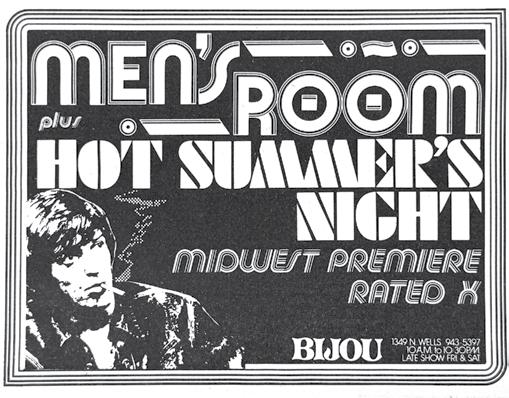
But this freedom wasn’t without a cost. Throughout the 1970s, the Bijou was raided countless times.
“I can’t give you all the details, but we
had numerous raids for numerous reasons,” Toushin says. One reason the cops might’ve raided the theater was because people were having sex, aka on “suspicion of prostitution,” he says. If you were caught in a raid, you might pay a fine and spend a night in
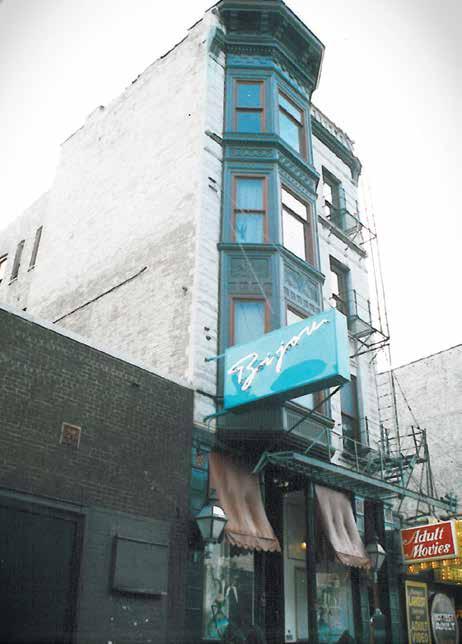
jail, but law enforcement would usually go no further. Still, it was common practice for local papers to splash the names, addresses, and occupations of arrestees in print, and those apprehended would face the major social and economic consequences of being publicly outed.
The other grounds for getting busted might have had to do with the films being screened: an obscenity arrest. This charge was more serious and would usually result in a jury trial. “I’ve had about 12 jury trials,” Toushin says. “That’s why I have no more hair left.”
Were the films screened at the Bijou offensive, dangerous, or merely gauche? The U.S. has a long history of wrestling with what “obscene” actually means.
In 1873, Congress passed the Comstock Act, which prohibited the use of the U.S. mail to transport obscene materials—though what qualifies as “obscene” remained in the eye of the beholder.
Starting in the 1950s, court cases began popping up that challenged anti-obscenity laws, all part of a broader movement to reconsider individuals’ rights to free speech and association.
In 1957, the Supreme Court ruled in Roth v. United States that the First Amendment did not protect obscene material. It wasn’t until 1973, in Miller v. California, that the court set the first real standard for obscenity, says Williams. “Obscene” material could be banned, the court ruled, but they significantly raised the bar for what types of content fit this brief.
“This does kind of open the floodgates for erotica, pornography, spicy materials,” Williams says.
Toushin was busted under both Roth and Miller . “I probably can go into The Guinness Book of Records. . . . No one [else] is alive today that’s been busted under Roth,” he claims.
The exterior of the Bijou Theater COURTESY BIJOU VIDEO
Archival print ads for screenings at the Bijou from 1976 issues of Chicago Gay Life COURTESY GERBER/HART LIBRARY AND ARCHIVES
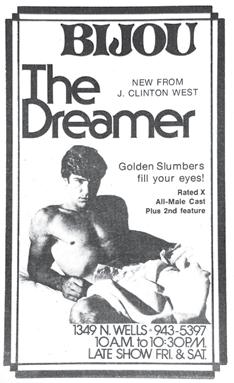
Toushin’s first federal trial came in 1972 after the Bijou was busted for showing a film Toushin remembers called Ranch Slave that contained depictions of BDSM. First, the case went to state court, then federal court, followed by a two-week appellate trial that ended in the case being thrown out on a technicality. The bust was part of a larger sting operation led by U.S. Attorney Jim Thompson, says Toushin. Thompson, who would later serve as the governor of Illinois for 14 years, busted at least 12 other city theaters around that time in an effort to crack down on Chicago’s porn industry.
But this was only a taste of the shitstorm to follow.
In 1985, President Ronald Reagan appointed Edwin Meese III to the position of attorney general. One of his first tasks was to investigate the pornography industry as part of Reagan’s push to iron out the moral fabric of America. His first big set of busts would come to be called “Operation PostPorn.”
They needed a face for Reagan’s moral crusade, and who better than a Jewish pornographer and gay sex club owner with an arrest record longer than a Jewel receipt?
In November 1987, “The Meese Commission,” as it would later be known, sent dozens of federal agents and Chicago police officers to the Bijou to arrest Toushin. He had been arrested many times but never with such spectacle, writes Toushin in his 2006 book about his second federal trial, The Destruction of the Moral Fabric of America. “They must have rehearsed and choreographed the scene with drag queens,” Toushin writes. “What drama! What flair! What panache!!!”
Just a few months later, the first grand jury subpoenas rolled in. Toushin and his Bijou Video associates were indicted in Tennessee, Utah, and Nebraska for distributing across state lines films that
contained depictions of BDSM.
This second case went to court in 1989, during which time Toushin was already serving two years in prison for falsifying tax records. Miraculously, the case resulted in a hung jury, a slap in the face for Mr. Meese, Toushin says.
It’s hard to know exactly how Toushin’s trials impacted the social and legal landscape. In 1989, during his second trial, Toushin received the Reuben Sturman Award “For Legal Battles on Behalf of the Adult Industry” at the Adult Video Awards show in Las Vegas. And in 2007, he received a “Lifetime Achievement Award” at the GayVN Awards.
But drawing a neat line between points A and B misses what’s important. In the years since he fought the feds, freedom to publicly express “alternative” sexualities has grown exponentially, and the movies Toushin once screened in secret are now shown in fancy film schools. We can debate whether this is actually a good thing, but our ability to have this debate at all is due to people like Toushin standing up at a time when it was not easy to do so. The government is again attempting to turn our bodies into battlegrounds in a war for America’s moral future. Soon, we may all be forced to choose sides.
Starting in the late 90s, the Bijou began hosting Miss Tiger’s Cabaret, a two-hour variety show created by Chicago performer Miss Tiger featuring skits, erotic dancers, and musical numbers. It was one of the first of a series of shows that would change the public image of the Bijou from a venue focused on gay men to one that catered to a queerer, more diverse crowd. Until it closed its doors in 2015, it remained a venue dedicated to pushing forward the norms of queer Chicago.
When I ask Toushin what kept him going through the raids, the arrests, and the trials, he looks at me like he’s sizing me up for a fight. “Stupidity,” he says.
“I mean, it couldn’t have just been stupidity,” I challenge.
I’m fishing here. I expect Toushin to say something about the wear all this took on his family, his two marriages, or at least his bank account. (He estimates he’s spent more than $10 million across all his trials combined.) Instead, he comes out swinging.
“There are things I don’t understand in this world,” he says. “I don’t understand how people want to control other people to such a degree. I don’t understand how you can tell someone what to read or not read. I cannot fathom that. I cannot understand the fact that they were talking about my sex is good and yours [is bad]. Tell me, why do you care what somebody else does? Shouldn’t you care about your own life?” v
themail@chicagoreader.com
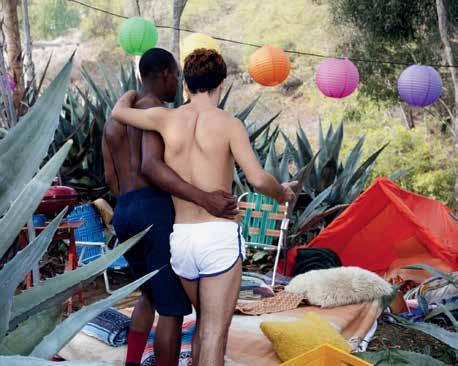

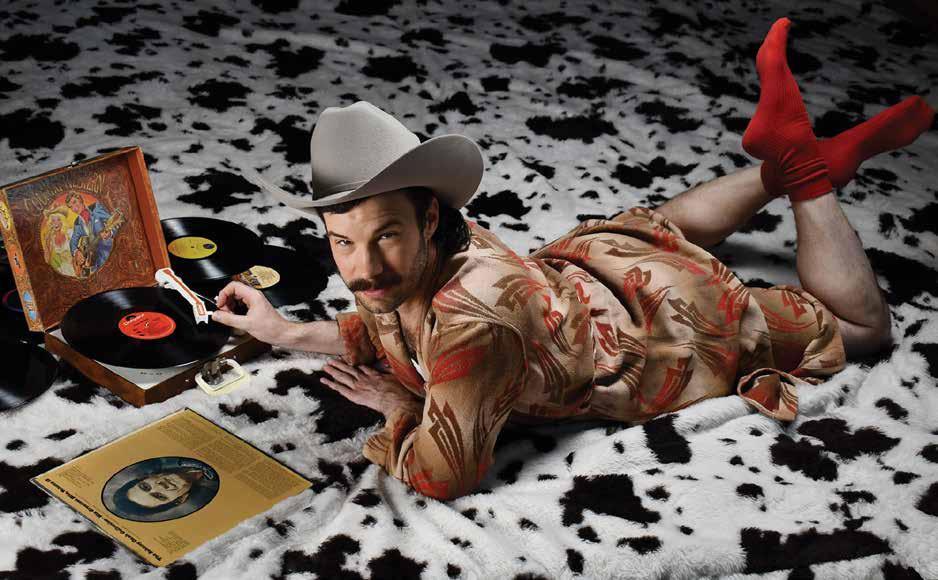
In bed with In bed with
andrew sa
Chicago’s queer Cosmic Country crooner releases a solo debut where he’s anything but solitary.
BY MICCO CAPORALE
It’s hard to imagine Andrew Sa as lonely. Since 2019, he’s been performing as Lonesome Andrew in the Cosmic Country Showcase, a tripped-out roving variety show where he’s often flanked by comedians, drag queens, extraterrestrials, and more. In 2020, he began hosting Andrew Sa’s Lonesome Holiday, a campy, music-driven annual revue whose ragtag camaraderie and openheartedness is reminiscent of the 1988 TV production Pee-wee’s Playhouse Christmas Special. The 2021 film Andrew in Anotherland , a 67-minute anthology that Sa cowrote and coproduced, shows him hitting a joint only to be transported into a colorful netherworld populated by Chicago nightlife characters such as Lucy Stoole, Finom, and Alex Grelle (aka
Grelley Duvall). No matter where the spotlight shines, Sa is never in it alone.
But you can hear the loneliness when he sings: a sadness that tarnishes the wistful polish of his voice. Sa channels the “high lonesome” sound, a melancholy Appalachian style especially prevalent in bluegrass, though he calls himself a crooner. The word “crooning” evokes a nostalgic history of men singing in a fireside manner (usually about swooning), à la Bing Crosby or Dean Martin, but Sa’s debut album is a collection of torch songs more evocative of Patsy Cline or Nina Simone. On June 26, he releases American Rough (Bloodshot), ten tracks more than ten years in the making that map out his sense of fantasy, desire, and heartbreak with tortured elegance. On the album
cover, his chin is held by a hand reaching from beyond the frame that inspires a smile so large Sa’s cheeks become apples ready to ripen in his beholder’s rays. Yet the record’s songs remind you: Many sweet things foretell souring.
Sa is not a bitter person. His speech is gentle and measured, and when I arrive to interview him at the Old Town School of Folk Music, he meets even baristas’ gazes with an inviting warmth. When he describes pain or disappointment, such as releasing his debut much later in life than he’d hoped, his eyes whisper with an optimistic glimmer. Whatever angers or regrets he has, he holds close. They’re an emotional envelope he opens slowly onstage, his lilting voice an invitation for an audience to love him, already crum -
pled by all the people and institutions that didn’t know how.
At the end of the fourth and final night of his 2025 holiday shows, Sa said, “Christmastime . . . it’s about family, isn’t it?” The words fell from his mouth with polite uncertainty. “It’s about people that we love, and being close with them, and family sometimes fits into that category.” As the audience laughed, he carefully chose his next words.
“This song is a song that my dad showed me,” he continued. Then, in an almost singsong voice: “My dad . . . he’s a hard one.” Pause for laughter. “It’s hard to have a relationship with your dad . . . as a gay man—as a man. . . . As a man, it is hard to have a relationship with your dad.” He looked down at his feet, and his voice got quieter.
Andrew Sa’s American Rough comes out June 26. KIRK WILLIAMSON
“But we still try. And while that’s not the message of this particular song”—his eyes shot up to the audience, and his mouth briefly puckered with frustration before he smiled and gave a casual shrug—“it also is!” Then he closed the night with a cover of the Eagles’ “Desperado.”
Sa’s story has a lot of almosts-but-notquites. Sa didn’t grow up in San Francisco or any of the other better known parts of the Bay Area. He’s from Fremont, a mountainous, industrial town 40 miles southeast of San Francisco and 20 miles northwest of San Jose. His parents were musical, in that his father was a former touring musician and his mother ran a karaoke company. Before taking up songwriting in the early 2010s, Sa had never been in a band, save for a short-lived sixthgrade attempt at a boy band with friends. Called 100 Degrees Below Zero, they molded themselves in the image not of 90s boy-band standard-bearers the Backstreet Boys or NSYNC but rather their less popular contemporaries 98 Degrees. Even before Sa came out in high school, a lot in his life was queer as a two-dollar bill. Many musicians start by doing other people’s songs, whether to develop their craft or round out sets. It’s a rite of passage to try on an idol’s sound to see what fits, and really good artists learn to realize something in their version that’s not in the original. Great drag performers do something similar. They know that the right combination of elements—costumes, expressions, gestures—can reinvent a lip-synched song without changing a note. Bad drag peaks at amusing imitation or homage; good drag transcends reference completely.
Sa has never fancied himself a drag performer, and he most certainly wasn’t thinking in those terms as a child, whether he was humming along to Reba McEntire in his father’s Ford F-150 or warming up his mother’s karaoke crowds with Patsy Cline. Why a ten-year-old enjoyed belting out some of the sassiest or saddest songs women had contributed to the country canon remained an open question for years. As Sa’s sense of self grew, so did the pull of torch songs and country. He gradually transformed into a cowboy all his own: tender, earnest, gay.
Sa grew up swimming in a pop-cultural soup flavored by icons such as Elton John and Freddie Mercury, so he knew there was a place for gay men in pop music— maybe not a large place, but a place. It wasn’t until he fell in love with the Broadway- infused folk of Rufus Wainwright as a teenager that he really began to believe that he could fit into a wider musical landscape. When Sa was 18, a friend drove them to a show at the Hollywood Bowl. Wainwright was opening for someone Sa had never heard of.
“I said to my friend, ‘I don’t know who that is, but do you want to stick around for k.d. lang?’” he recalls. “[Watching her set], my jaw hit the ground. I was mesmerized. She was barefoot and bounding
about. She sang ‘Crying’ by Roy Orbison. I was in heaven.”
To Sa, lang’s stage presence seemed both theatrical and effortless. She didn’t have to offer much to get the arena-size audience gratefully nibbling from her palm. Whereas Wainwright would sit
Loneliness has been a favorite motif for Sa, but he’s long outgrown the notion of going it alone. The credits of American Rough are packed with familiar names from Chicago’s indie scene.
behind a piano and deliver his lyrics in a booming, stylized voice, lang simply stood with a microphone and sang with a provocative clarity. Watching her reminded Sa of singing karaoke and learning from his mom how to command a stage, but he also saw a model of soft masculinity where glamor and simplicity coexisted. It’d take years for him to get onstage as a country singer himself, but that night the seed was planted.
In the interim, Sa went on a series of side quests, including a short-lived theater career and a brief stint in Portland, Oregon. There, he met the partner he’d follow to Chicago in 2009, where they both had theater friends. Sa had been researching the Old Town School of Folk Music and fantasizing about taking classes there. It’d be a few years before he took the plunge, though: While working at Pingpong in Lakeview, he connected with Dylan Wright (who now lives in Brooklyn and performs as Matracia), and together they agreed to take a folk songwriting class. Wright had been raised on Bob Dylan, John Prine, and other 70s folkies, so he schooled Sa on that canon. (Sa felt most connected to Joni Mitchell.) Soon his flirtation with the genre grew into a full-on love affair.
“It was the storytelling,” Sa explains. “I thought theater and musical theater were why I liked folk music, but reaching even further back, I realized storytelling is a huge part of country—not just classic country but especially the 90s country I grew up with. Suddenly it all clicked.”
Sa started performing folk music, sometimes including his own tunes, at open mikes. Then he teamed up with Wright to start a folk-oriented singer-songwriter night at Lakeview cocktail lounge Wang’s, which lasted two and a half years. With that series, called Second Date with Dylan and Andrew, the duo tried to create some-
thing that contrasted what Sa calls the “thumpa-thumpa dance music” that still dominates Northalsted.
“We wanted something a little more tender and thoughtful,” he says.
In 2013, Sa began working for the Old Town School, and he started getting booked around town as a folk singer. By 2018, Sullivan “Sully” Davis was talent buyer for the Hideout, and the Cosmic Country Showcase—an acid-laced tribute to the Grand Ole Opry launched by Davis and Showcase bandleader Dorian Gehring—was in its infancy.
a larger version of myself—not so timid, shy, sensitive, moody. . . . The Showcase allowed me to explore beyond what I saw as my limitations.”
While Sa started to feel confident in the guise of Lonesome Andrew, another queer cowboy exploded onto the scene singing anguished songs from behind a literal mask. In March 2019, Orville Peck had dropped his debut album, Pony, and by that summer it had galloped into the hearts and daydreams of a public hungry for manly characters with sensuality, vulnerability, and mystique. Arriving
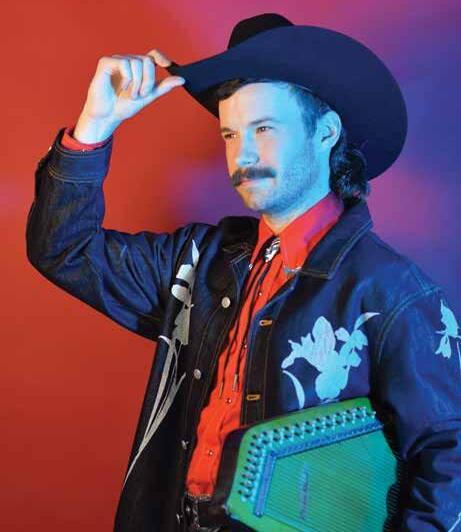
“I said, ‘Hey Sully, I know we don’t know each other very much, but I just started getting back into country,’” Sa explains. “‘I’d love to be a part of the Cosmic Country Showcase if you need another singer.’ That set it off. Just lit the match. Because immediately, I started dreaming of this rhinestone vision of myself that was closer to who I’d wanted to be as a child.”
In April 2019, Patrick Haggerty made his first Lavender Country appearance at the Cosmic Country Showcase, and Davis invited Sa to open for him. After that night, Sa decided to commit himself completely to country. He joined the Cosmic Country cast, where he began cultivating a stage persona as Lonesome Andrew.
“I was obsessed,” Sa says. “Putting on a costume—with rhinestones, especially—and color and patches . . . exhibitionism is a drug. But it was like putting on a character, to a certain degree, or putting on a mask that allowed me to be
on the heels of Lil Nas X’s chart-topping “Old Town Road,” the album was a critical and commercial success, and it helped create such a boom for country in pop that even Beyoncé eventually hitched her wagon to the genre.
Peck wasn’t the first openly gay country singer—that honor is usually bestowed upon Haggerty. Nor was he the only one with a hit album at that time—Trixie Mattel had records in the top 20 of the Billboard folk chart in 2017 and 2018. But Pony went so wild, setting such a bold new standard and opening up such a sense of possibility, that you have to wonder if Peck influenced Lil Nas X’s decision to come out in June 2019.
Peck is a former ballet dancer in cowboy drag. Born in South Africa, the ex–theater kid and onetime punk drummer pivoted his career by throwing his full weight into the American cowboy archetype. He donned hats and spurs while pulling his speaking voice deep into his chest,
KIRK WILLIAMSON
MUSIC
lowering its pitch and pinching it with a twang. The persona of Orville Peck underlines everything about cowboys that make them not just an emblem of American masculinity but also a definitive part of gay male semiotics: strong, adventurous, free. He’s a Tom of Finland drawing come to life, shoulders broadening further beneath leather vests with each passing year. It’s an exciting image—and one completely constructed to cater to a very specific fantasy.
“People want to put us in the same basket,” Sa says, his voice hinting only mildly at his annoyance. Peck’s success
middle- or upper-class standards of how one should live and move through the world. But who can do that and how has always been vast and varied.
When Peck sings opposite Margo Price on the 2024 track “You’re an Asshole, I Can’t Stand You (and I Want a Divorce),” it works even though everyone knows he’s gay. Peck embodies a level of masculinity that makes him believable as a woman’s no-good man, like Rock Hudson playing opposite Jane Wyman in the 1954 film Magnificent Obsession. Sa doesn’t practice that kind of manliness, nor does he aspire to. He’s small and soft-spoken—a flower
country career suddenly got a second act. Sa didn’t just connect with Haggerty as a gay granddaddy figure, though. After opening for him at Lavender Country’s Cosmic Country debut, Sa approached Haggerty at his merch table. “He grabbed my arm and said, ‘I’d kill to have your voice,’” Sa recalls. In that moment, he felt himself pulled from a vantage point of distant admiration to an open seat sideby-side with greatness. That exchange gave him permission to consider that he could be great too.
The pair kept in touch, even bandying about the possibility of teaming up for a
American Rough, he embraces the role of male contralto, singing about being on the receiving end of men’s affection and bruteness in a similar register as many of his female inspirations in country and jazz. Yet he never abandons his own manhood.
In gay male culture, “roughs” are usually hypermasculine men, either working-class or seeming like it, and Sa adores them even when they let him down. American Rough opens with its title track, a gospel-tinged elegy for a man who’s “eating the heart out of this room” with spiteful, punishing beauty. In “Under You,” written by longtime collaborator Liam Kazar, Sa begs, “Let me stay a nickel in your fountain.”
He’s small and soft-spoken— a flower that’s blossomed unmistakably lavender.
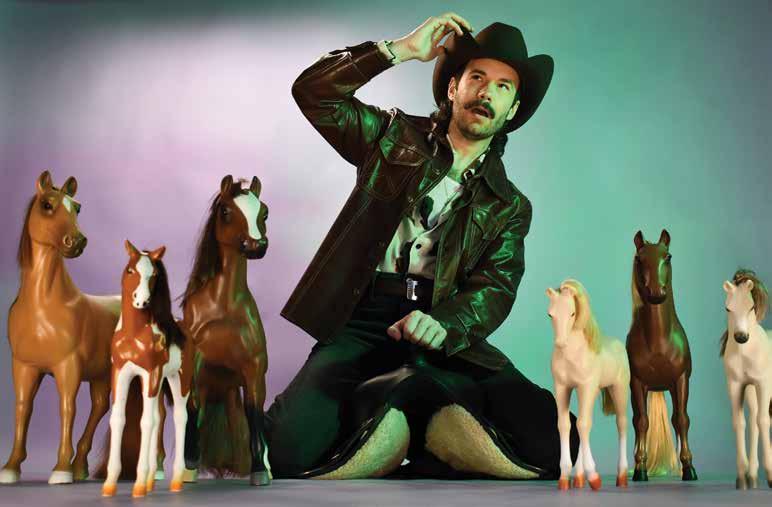
forced him to consider who he was artistically in contrast to Peck, as well as who Lonesome Andrew was relative to Andrew Sa. “I don’t see them as two separate people now,” he says. “The only difference is that Lonesome Andrew really, really wants to make you laugh. And he has an accent. When I’m Andrew Sa, I’m more authentic.”
Authenticity is difficult to define in pop music—especially in country, which places a premium on what a star’s pedigree should be to perform in this style. In her 2022 book Queer Country, music scholar Shana Goldin-Perschbacher points out that country has always detailed the stories and concerns of everyday people— servers, labor organizers, alcoholics, truck drivers, sex workers. Songwriter Harlan Howard used to describe country as “three chords and the truth”—decades before punks started relating to their music in similar terms. In both country and punk, there’s an expectation that songs express something in opposition to normative
that’s blossomed unmistakably lavender.
As Sa came into bloom as a country artist, he looked to Haggerty and his music. In 1973, Haggerty released just a thousand copies of his self-titled debut, Lavender Country, through a grassroots group called Gay Community Social Services of Seattle. After being kicked out of the Peace Corps at 21 for being gay and later institutionalized (doctors blamed his homosexuality on his working-class upbringing), the self-described “queen slut of the bathhouse” wanted to give an unvarnished account of living as a homosexual and a Marxist through the music that meant the most to him. In its day, the record achieved a minor cult following via promotion in gay magazines and bookstores, but it was otherwise lost to obscurity for decades. Then someone uploaded the single “Cryin’ These Cocksucking Tears” to YouTube. In 2014, North Carolina indie label Paradise of Bachelors came calling with a record deal, and Haggerty’s
tribute show to Loretta Lynn and Patsy Cline. When Haggerty returned to the Cosmic Country Showcase in 2021, he stayed with his entire band on the floor of Sa’s cramped Andersonville apartment. Sa describes him as a close friend and mentor whose influence helped him be brave, strong, and vulnerable in his own unique ways. Haggerty passed on Halloween in 2022, and every year since, Sa has honored him with a tradition started by Haggerty’s daughter: having a Halloween fatty for Patty. (By “fatty,” she means a sweet treat.)
“He had such a presence and was able to captivate an audience on so many different levels,” Sa says. “That, mixed with his everlasting kindness . . . ”
After trying on and learning from so many different voices, Sa has settled into himself as a creative. These days, he’s wearing more neckties than bolos, and most of his button-downs don’t have any embellishments—it’s like he no longer needs a costume to put on a show. On
“You Turned Me On,” written with coproducer H.C. McEntire, shows Sa wandering Halsted in search of someone— anyone—who looks like his ex. He’s desperate to re-create the blood-boiling sensation he got when his former lover called him “daddy’s little angel.” (An extremely hot asshole I had similar postbreakup feelings about used to call experiencing this visceral, hungry thrall “being dickmotized.”) The record closes with “Fightin’ to Be Fightin’,” a meditation on choosing to walk away from the drama so often flattened into the term “toxic masculinity.” The final lines are: “You said, ‘Ties only bind us’ / Didn’t daddy fight the same way?”
Loneliness has been a favorite motif for Sa, but he’s long outgrown the notion of going it alone.
The credits of American Rough are packed with familiar names from Chicago’s indie scene, including Macie Stewart, Hunter Diamond, and Spencer Tweedy. While Sa was recording the breakup ballad “Love Songs,” he says he spent a day crying in the studio with McEntire and coproducer and engineer Missy Thangs. The single “Lavender Cowboy” is a send-off to Haggerty, and the video prominently features local legend Charles Joseph Smith dancing.
It takes a village to make an icon—a phenomenon Brian Eno dubbed “scenius.” For all the cowpokes who carry an emptiness in their hearts, Andrew Sa and his many collaborators will keep sending songs from Chicago, with love. v
The Chicago Reader hosts a pop-up at Andrew Sa's release show at the Hideout (1354 W. Wabansia) on Friday, June 26.
mcaporale@chicagoreader.com
KIRK WILLIAMSON
PROUD TO BE QUEER ALL YEAR PROUD TO BE QUEER ALL YEAR

SOUTHEAST SPOTLIGHT
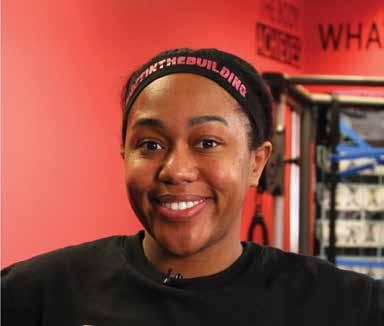

Summertime Chicago is o cially here, and so is your summer body. Yes really, because at The Bodi Shop, fitness meets fun. It’s not about becoming an influencer on social media for this crew, it’s about influencing those around you to lead their best lives.
Almost one year ago, Ariel Kinnard went to a fitness class in Indiana, and loved the low-impact, intensity-where-you’re-at of a trampoline workout. After telling her friends and family about how impactful, engaging and just plain fun this could be in Chicago, they lovingly nudged her to open a studio. Born and raised in Bronzeville, she knew that it needed to be on the South Side. Especially after working in Riverdale, Calumet City and Beverly, Ariel knew that the only trampoline gym in Chicago was a fit for the communities she knew best. Low-impact for the seniors, fun for the friend groups, and an intensity level that can scale up for the athletes. Thinking it through, it all sounded great, the only similar gym in Chicagoland is out in the suburbs. With the love, support and belief of her family, she chose to locate near
her parents in Calumet Heights.
The family a air begins with her father, Eddie Kinnard, the chief vibes o cer, who you might meet when you come in. Ariel chose Calumet Heights not just for the proximity to her family but out of a desire to put down roots in the community. This isn’t just a gym or some classes, it’s personalized coaching that treats your head, your heart and your body. An integrated approach to wellness means that it’s about more than increasing endurance, the workouts are designed to increase lymphatic flow, the playlist is set to get you smiling and Ari is proud of the friendships and support that she sees with Bodi Shop members.
And like people, her business is never done growing, evolving and working to meet the needs of the community. It’s why in under a year she’s added classes (yoga, step aerobics, personal training) and pushed to treat the mental, emotional and physical to produce a lifestyle change. And what is the lifestyle that the Kennard family wants you bouncing out of the gym with? Joy; in what you do, in who you are and in how you show up in the world.
The Bodi Shop Address: 8754 S Stony Island Ave, Chicago, IL 60617
Hours: By class & appointment
Website: calendly.com/arithebodi
Phone: (773) 930-9022
Instagram: @arithebody


The Bodi Shop
Ariel Kinnard The Bodi Shop
Support Illinois’ fight to end the HIV/AIDS epidemic by purchasing a 7X Bingo Multiplier ticket
The Illinois Lottery has a long-standing history of launching specialty tickets that spread awareness and support worthy causes impacting our local communities. In 2008, the state of Illinois launched the Quality of Life Illinois Lottery game, the nation’s first lottery ticket that would designate funds to support HIV/AIDS education, prevention programs, and services. So far over $13.8 million has been raised. This Pride month, you can help the state continue to support Illinois residents living with HIV/ AIDS by purchasing a 7X Bingo Multiplier ticket. The 7X Bingo Multiplier ticket costs $5 and is available for purchase at more than 7,000 Illinois Lottery retailers throughout the state. With its rich purple background and vibrant, eye-catching design, the 7X Bingo Multiplier makes a great present for friends, family members, neighbors, and colleagues 18 and over—or play it yourself for a chance to win up to $200,000. A portion of every dollar you spend positively impacts the life of an Illinois resident living with HIV/AIDS. Visit the Illinois Lottery website for more information about 7X Bingo Multiplier and the many good causes it supports each year. Read on to learn more about WPT Cares, a nonprofit based in southwest Illinois’ St. Clair County (which encompasses East Saint Louis) that supports the underserved and vulnerable local population at risk of and living with HIV and AIDS. Your purchase of a 7X Bingo Multiplier ticket can help WPT Cares and other community organizations empower Illinois residents and work toward the statewide Getting to Zero Illinois
initiative, which has the goal of ending the HIV/AIDS epidemic within the state by 2030.
While infection rates for HIV/AIDS fluctuate year to year, surveillance data from the Illinois Department of Public Health consistently show that St. Clair County has one of the highest HIV prevalence burdens in the state, ranking second only to Cook County. As of the 2020 census, St. Clair County’s population was only 250,708 residents, while Cook County’s population
was 5,194,625. HIV diagnosis rates in St. Clair County remain significantly higher than the Illinois state average, reflecting a sustained and disproportionate impact on this region.
WPT Cares is a community-based health agency that’s been in business for over 23 years. The organization’s mission is to advocate, educate, and serve as a resource for African Americans in St. Clair, Illinois, and specifically St. Clair County . Tremayne Coleman, the executive director of WPT Cares, cofounded the nonprofit alongside Dr. Wilbur Campbell and Harold Lawary, both of whom have since passed away. During his time leading the organization, Coleman has seen the ways in which the St. Clair County population has been disproportionately impacted by health disparities. Due to social detriments of health like poverty, limited access to healthcare, transportation barriers, housing instability, food insecurity, and gaps in health education and prevention services, many individuals in this community find themselves most at risk for acquiring HIV/AIDS.
WPT Cares offers individual and group-level interventions that are approved by the Centers for Disease Control and Prevention (CDC) and have been designed to meet clients where they are while addressing the unique needs of their community. Coleman shares that “Our goal is to create lasting change by equipping community members with the knowledge, support, and resources
This content is sponsored by the Illinois Lottery
The WPT Cares outreach bus. Courtesy WPT Cares
Tremayne Coleman, executive director of WPT Cares. Courtesy WPT Cares
needed to improve outcomes, strengthen families, and build a healthier, more informed East Saint Louis community.” They also provide confidential mobile testing services as well as facilitate programs that are focused on reducing the stigma surrounding HIV/AIDS.
“Over the years, we have built trust within the community by meeting people where they are and providing culturally responsive, nonjudgmental care,” he says. “This has allowed us to reach underserved populations, improve health literacy, and strengthen engagement in prevention and care services. Many individuals and families have been able to access education, counseling, and support that have helped them make informed decisions and improve their overall health outcomes.”
He adds that while health disparities continue to exist, WPT Cares’s work has helped to reduce gaps in awareness and access, and the organization remains committed to expanding its impact and supporting a healthier, more informed East Saint Louis community.
For several years, WPT Cares has received funding from the Illinois Lottery through their Quality of Life Endowment Fund, which is distributed by the Illi-
nois Department of Public Health (IDPH). Coleman explains that these funds have allowed the organization to continue providing prevention services, education, supportive care, and linkage to resources for vulnerable populations.
“The importance of this funding became even more evident during the COVID-19 pandemic, when many community organizations were faced with unprecedented challenges in maintaining services while addressing increased community needs,” he says. “During that time, the support connected to the Illinois Lottery’s Quality of Life initiative helped agencies like WPT Cares remain responsive and continue reaching clients who depended on us for care, information, and support. The funding has not only strengthened our agency’s ability to operate effectively, but it has also had a direct impact on the lives of the clients we serve every day.”
He adds that the Quality of Life funds have also helped support HIV testing initiatives and the implementation of their CDC-approved group-level interventions designed to engage hard-to-reach populations within the community.
“These efforts have included targeted outreach and prevention services for Black men who have sex with
men (BMSM) and high-risk heterosexual men, as defined by Illinois Department of Public Health (IDPH) risk criteria,” Coleman says. “The programs have also focused on serving African American and Hispanic populations, which continue to be disproportionately impacted by HIV. “
Along with your purchase of a 7x Bingo Multiplier Illinois Lottery ticket, you can support WPT by getting involved in person. They have a number of events planned for Pride month, including a summer wellness kickoff on June 6. They’ll be participating in the local 618 Day parade and block party in East Saint Louis on June 18, as well as partnering with Walgreens in Belleville for National HIV Testing Day on June 27.
“Our doors are open throughout the week for individuals who would like to participate in services, receive support, or learn more about how to get involved,” Coleman says.” Whether someone is seeking services, interested in volunteering, or looking to participate in our health education and prevention programs, WPT Cares welcomes all community members and encourages active engagement in our mission.”
For more information about WPT Cares, visit wptcares.org

This content is sponsored by the Illinois Lottery
“We have built trust within the community by meeting people where they are and providing culturally responsive, nonjudgmental care,” Tremayne Coleman says. Courtesy WPT Cares
A WPT Cares holiday celebration. Courtesy WPT Cares
MUSIC
THE SECRET HISTORY OF CHICAGO MUSIC
Ron Steele has kept the gears inside Chicago music turning
As a studio guitarist, recording engineer, producer, and more, he’s had a hand in thousands of records without ever becoming a marquee name in his own right.
BY STEVE KRAKOW
Since 2005 Plastic Crimewave (aka Steve Krakow) has used the Secret History of Chicago Music to shine a light on worthy artists with Chicago ties who’ve been forgotten, underrated, or never noticed in the first place.
I’ve been writing the Secret History of Chicago Music for more than two decades, and some artists have taken me years to track down. But for all that time, my white whale has been Ron Steele, whose name I’ve been seeing on loads of local recordings since I started paying attention in the 1990s. This overlooked genius has shaped the music biz behind the scenes since the 50s, but he doesn’t even have a Wikipedia page.
When I learned that Chicago singer Liska, aka Annelise Steele, is Steele’s granddaughter, I thought I might finally have a lead. Thanks to her for sharing contact info for her 90-year-old grandfather—that led to one of the most highly anticipated interviews I’ve ever conducted.
Ron Steele’s career began with the big bands of the 1940s, and after traversing jazz, folk, country, blues, R&B, soul, rock, hip-hop, techno, and more, it’s still going today. He’s been a musician, engineer, studio designer, producer, arranger, and teacher. He’s worked with several generations of recording formats, including wire recorders, magnetic tape, eight-tracks, CDs, and digital surround sound. He’s had a hand in thousands of records and raised six talented children with his late wife and creative partner, Vernyle.
Steele was born in Chicago on May 15, 1936. His German immigrant father, John Bigalski, had changed his last name to avoid prejudice at Saint Patrick High School, where much of the student body was Irish. His father survived the disastrous capsizing of the Eastland in the Chicago River in 1915, but one of his six sisters was among the 844 dead.
Steele’s mother, Esther Souminen, was born in Duluth, Minnesota, in 1911. She met Steele’s father at a roller rink, and after they married, they moved to an 85-acre farm in Chippewa Falls, Wisconsin. They heated their home with a single stove, and Steele walked a mile to school. “It was like being in The Adventures of Tom Sawyer. I guess there
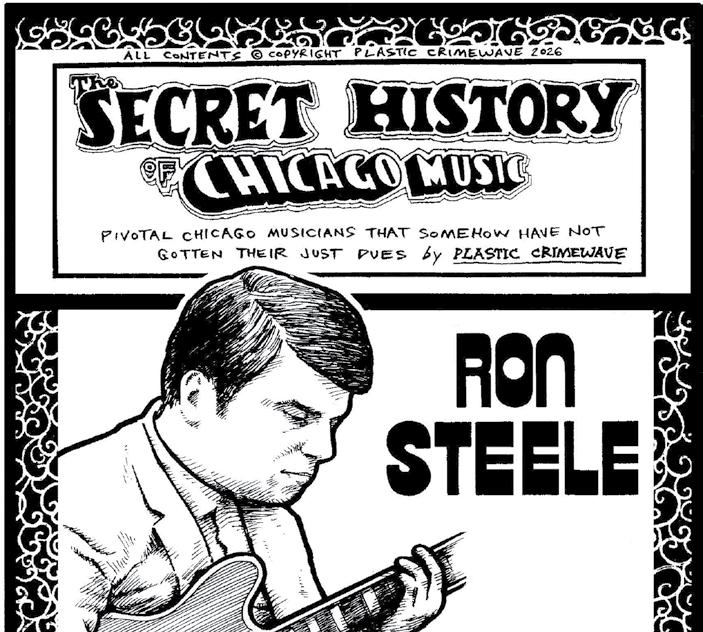
were about 20 kids there,” Steele writes in his unpublished autobiography, Poker With Michael & Guitar With the Boston Symphony: An Autobiography of a Life Making Music
The family gave up on farm life before Steele finished elementary school, and they moved back to Chicago. Steele’s father got a job maintaining machinery for Heick Die Casting, and his mother made TVs at Zenith Radio for 25 years. When Steele was 11 or 12, he says, his mom bought him his first guitar, but he didn’t take to it right away. “I couldn’t stand it,” he says.
“My dad took me to lessons at the Volpe School of Music on Irving Park,” Steele writes in his autobiography. “I really hated these lessons, but we went
for ice cream afterward, so that made it palatable. I did not do well and after about six months I quit. A little later, a school (Montclair Music) opened near us on Grand Avenue and offered a great price for lessons that included being in an orchestra. . . . It was God awful, but for some reason I enjoyed it.”
In an interview for this story, Steele says playing in a big group made all the difference. “It’s the interplay between other players, and the challenge—I’m gonna play this thing perfect,” he explains. “You don’t wanna embarrass yourself for the rest of the team.”
Steele went on to study guitar at a music school run by trumpeter Rocky Casiello. At Lane Tech, he and his friends took
classes in drafting, foundry, forge, electric, and wood shop. He told a teacher he played guitar and ended up steered toward upright bass in the school’s orchestra, where he scrambled to keep up with the classical repertoire.
Steele furthered his private studies with George Allen, a man he calls “the top guitar teacher in Chicago” in his autobiography. Allen had a studio in the Lyon & Healy building. “George used to teach me using clarinet books,” Steele writes. “The clarinet has about the same written range as the guitar, so this material was perfect for learning reading and position studies on guitar.”
While at Lane, Steele went professional when drummer Eddie Berg, a neighbor-
STEVE KRAKOW FOR CHICAGO READER



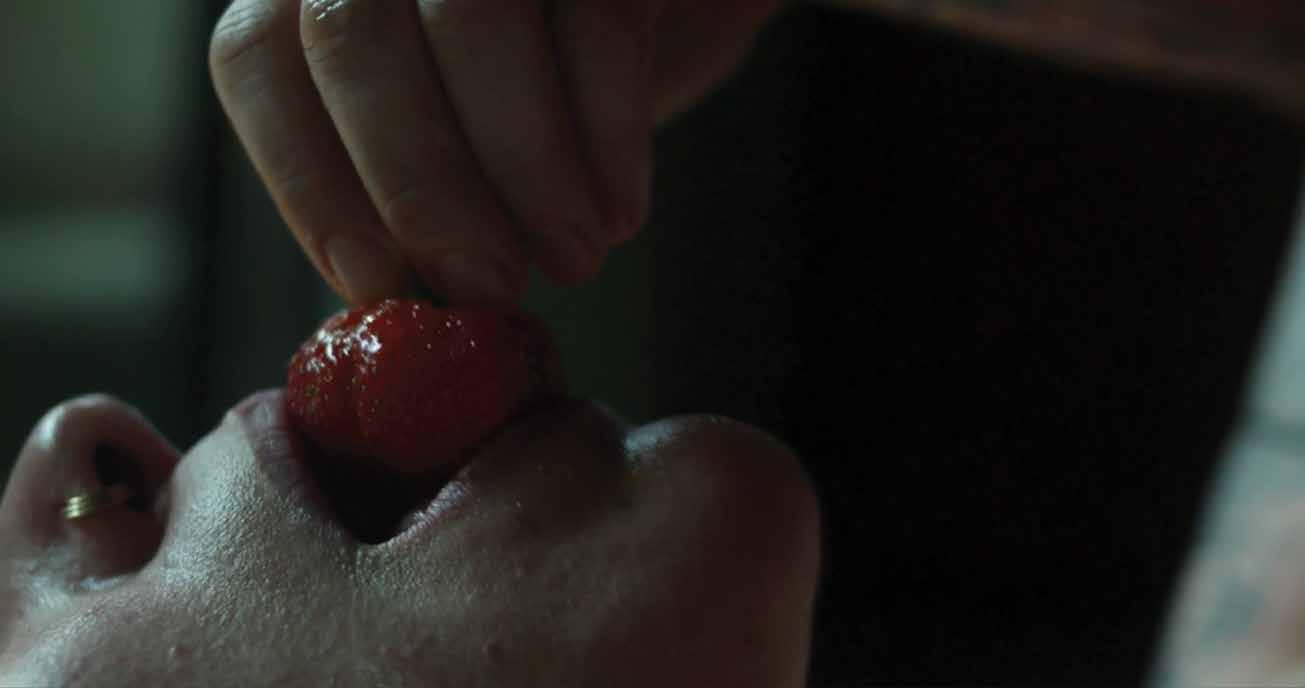

MUSIC
hood friend, invited him to join a working band with accordionist Kenny Mjeon and clarinetist-saxophonist Andy Anderson. They called themselves the Star Tones and rehearsed in Berg’s basement. Berg got them a gig at a tavern on Grand. “We worked from 9:00 p.m. to 4:00 a.m. every Friday and Saturday,” Steele writes. “This was a lot of playing for me as a 14-year-old and it was an incredible experience.” Most important, the job required Steele to learn to read music quickly.
Steele also started the trio the Deadbeats, with fellow Lane Tech guitarists Chuck Marquardt and Art Ormaniec. They made a few appearances on the Morris B. Sachs Amateur Hour, winning once. Around this time, Steele bought a Heathkit hi-fi. “They sold all the parts and then you assembled the amplifier,” he writes. “I had to learn to read circuits and to solder all the parts. I even built my own speaker from a kit by Karlson. This wasn’t any run-of-the-mill hi-fi system. The speaker was the size of a refrigerator and when I cranked it up, it rattled the house. The skills I obtained doing this would prove valuable later in my career.”
Steele enrolled at the Illinois Institute of Technology (IIT) in January 1954 and began studying electrical engineering. At the same time, he began his own teaching career.
Steele had eight students at Casiello’s school, and soon after he also taught 20 at a music school in Elmhurst. Fate intervened when Casiello referred Steele to Bobby Christian, an older percussionist who led a jazz big band that needed a guitarist. Steele auditioned by sitting in with the group at the Green Mill Ballroom. He also took notice of the singer, Christian’s daughter Vernyle—Steele’s future wife.
Soon Steele would be playing all over the midwest. “I ended up driving Bobby’s Cadillac, while his sons, Norman and Brian, drove a station wagon with all of the band equipment,” he writes. “It was a grueling life, but fun. We would drive all day to some college, set up, play for four hours, tear down and then drive straight through the night to get home.”
The band endured bus breakdowns and 20-hour treks through blizzards, and at least once they ended up hitchhiking the last leg of the trip to a gig. But Steele loved the life. “I made a map and put pins in all of the places we played,” he writes. “It soon became full of colored pins. It was an exciting time playing live to audiences and still is probably the most satisfying part of being a musician.”
The gig with Christian also kicked off Steele’s long career as a studio musician. Christian started using Steele on recording sessions, and the gigs earned him enough money that he dropped out of IIT. After Steele proposed to Vernyle in 1958, he knew he’d have to get a steady job, so when he heard that RCA needed a new studio engineer, he applied. He was hired three weeks before his wedding at Saint
Giles in Oak Park. The young couple would soon move to the western suburb, and Vernyle went to work at Loretto Hospital.
“I started working in the third-floor tape file room, which was a filthy, rat-infested area in the North Pier Terminal next to Navy Pier,” Steele writes of his early days at RCA. “I then started to do shipping duties and assisting on recording sessions.”
Steele was soon promoted to mastering engineer, and he started landing important assignments at RCA. He was part of a team led by Lew Layton that recorded the Chicago Symphony Orchestra (CSO) with pianist Van Cliburn at Orchestra Hall for RCA Red Seal, the label’s prestige classical imprint. This large-ensemble experience—and his access to the Red Seal recording equipment—enabled Steele to produce Christian’s next album, 1959’s Percussion in Velvet , in the recently completed One Prudential Plaza.
was no re-mixing or over-dubbing.”
That session with Elvis yielded three songs, including the B sides “Ask Me” and “It Hurts Me,” both of which cracked the Top 40 on the Billboard singles chart. Steele stayed on in Nashville for about a month, but he turned down a permanent position there—he had too much going on in Chicago, and he didn’t like country music enough.
Steele made the tough call to leave RCA in 1966, because he thought he could make more money as a musician. The new vogue for rock arrangements with two guitars made for extra session work, and Steele could also play electric bass and sitar.
Steele began gigging at Chess, where he appeared on the Soulful Strings records, a project of arranger Richard Evans. “The idea was to surround a string quartet with an R&B rhythm section and play pop tunes,” Steele writes. “The group had Phil Upchurch on guitar, Lennie Druss on flute,
“If you want to be a professional and make a living at it, you have to adapt to literally anything.”
Percussionist Dick Schory had released a popular record in 1957 called Re-Percussion , and Steele worked with him on several similar space-age easylistening albums. Steele was nominated for Grammys for two Schory LPs released in 1963, Supercussion and Politely Percussive. He’d recorded both in Orchestra Hall.
Steele helped RCA rebuild and modernize their main studio, and his familiarity with the new equipment made him a go-to engineer. Motown outsourced mastering to RCA, and in 1962, RCA tapped Steele to record a big Motown revue at Chicago’s famed Regal Theater. The bill included Marvin Gaye, Martha & the Vandellas, Smokey Robinson’s group the Miracles, and a 12-year-old Stevie Wonder. Wonder’s set included “Fingertips,” which would become his first hit single when Steele’s recording was released in 1963. (Steele would also record B.B. King’s 1965 LP Live at the Regal , which had a huge impact on the blues-obsessed British Invasion.)
In 1964 Steele was flown to RCA’s Nashville studio for an afternoon session, because the lead engineer there had quit. It was a nerve-racking gig, because Steele was working with Elvis Presley. The band showed up late, and Elvis even later.
“Around 7:00 p.m. Elvis drove up on his white motorcycle in a white leather jumpsuit. He came in and said, ‘Let’s eat!’ So we all hung out and ordered takeout,” Steele writes. “Around 8:30 p.m. Elvis played a cassette demo of a song for everyone, and they did a verbal arrangement using the Nashville numbering system for chords. They then settled in and ran it down. After two rundowns Elvis looked at me in the booth and said, ‘Let’s record it.’ . . . I was recording directly to stereo tape so there
Shield Productions with Jim Dolan. Shield landed such big jobs that they decided to build their own recording studio. Steele was enlisted as a consultant and found a space at 161 E. Grand. The biggest step he took was to become a co-owner.
“I was able to squeeze three studios into a very tight area. I did the basic design of the complex and the actual electrical drawings for the whole place. Finally, my engineering degree came into play,” Steele writes. “Meanwhile, we decided to make the facility independent from Shield so that we could get more studio work. Marty’s dad suggested Streeterville as a name, since the area used to be called that.”
In my interview with Steele, he calls 1969 his “big year.” Streeterville Studios opened to instant success, and his sixth child, David, was born. He and Vernyle moved to River Forest, where Steele still lives today. He also had a hand in the founding of Ovation Records, which released its first LP that year.
While Streeterville Studios was under construction in ’68, Schory had come to Steele with a proposition: He wanted to start his own label, and he offered Steele a 25 percent ownership stake to help get it off the ground.
Cleveland Eaton on bass, me on guitar and electric sitar, Bobby Christian on percussion and vibes, Morris Jennings on drums, and a harp and a string quartet led by Dave Chausaw. [Editor’s note: ‘Chausow’ is the correct spelling.] This was eclectic music and really fun to play.”
Upchurch, then in his mid-20s, hadn’t yet learned to read music, and Steele remembers helping his friend locate a written note on his instrument. Upchurch in turn taught Steele a lot about how to groove.
Members of the Soulful Strings became a sort of “wrecking crew” of in-demand studio musicians, playing uncredited on classic soul recordings for the Brunswick label and with genius arranger Charles Stepney. “Stepney was classically trained, but he was funky too,” Steele says. “He knew how to convert funky rock, R&B, and jazz to paper, and he hired good musicians to play it.”
In our interview, Steele recounts a session with Curtis Mayfield, who was running late, and arranger Johnny Pate, who’d handed out staff paper and pencils to the roughly 25 musicians on the gig, expecting Mayfield to tweak the tunes when he arrived. Mayfield did more than that. He made a circuit of the room, humming or singing every part—strings, horns, and all—to every musician. “He was this big star, and he treated us like we were his relatives,” Steele says. “What a wonderful guy.”
Steele’s career took another turn after he met pianists Larry Novak and Marty Rubenstein at a gig at Rush Street club Mister Kelly’s. He started doing more music for advertisements, especially once Rubenstein founded
With Streeterville and Ovation at his disposal, Steele recorded albums by Schory’s Percussion Pops Orchestra (of which he was also a member). One LP captured a live concert at Carnegie Hall, and Steele took an ambitious approach to the job. He had a 16-track tape machine shipped to the venue—already an extravagance—and then took the extraordinary step of recording 20 carefully placed microphones directly to tape, with no intervening electronics and no attending engineer.
Ovation became a player in the market for quadraphonic recordings, a fourchannel technique that sparked a trend among 1970s hi-fi nerds but didn’t catch on widely. (It’s the ancestor of 5.1 surround sound and other similar systems.) Ovation also manufactured and distributed progressive California-based label Black Jazz, which released highly collectible platters by the likes of keyboardist Doug Carn, bassist Henry Franklin, and Afrocentric Chicago soul-jazz band the Awakening.
Another part of Steele’s “big year” was the release of his first LP under his own name, recorded at Streeterville and released by Ovation. Chicago Guitar is so thoroughly Chicago that its cover features a Cubs logo, Buckingham Fountain, and the Hancock building! It’s mostly cover songs, but “Lament” (one of two originals) shows off Steele’s distinct guitar sound, sent into cosmic mode by a Ludwig effects pedal whose name he can’t recall. (Steele briefly consulted on electronics for Ludwig, until the owner decided to focus on drums and pulled the plug.)
Steele would play guitar on or engineer many other fine LPs for Ovation, including by folkies Hollins and Starr,





Heaven & Earth, and Bonnie Koloc. In 1976, he released his second album under his own name, Everybody’s Baby . This time he ventured into psychedelic funk territory, not unlike guitarist Dennis Coffey, a similarly situated session guitarist in Detroit. (Steele knew him, of course.)
By mid-1977, Ovation was on the ropes financially, and Steele told Schory he thought the label should declare bankruptcy. But then a tax attorney contacted them offering to buy master recordings. “There was a loophole in the tax code that allowed an investor to write off five times the production cost of a phonograph record. The only hook was that it had to be released into the market by December 31,” Steele writes.



By that deadline, Ovation rushed out more than 60 albums, including lots of repackaged tracks and “best of” collections. One of those LPs, by fatherdaughter country duo the Kendalls, even produced an unexpected hit—the Kendalls had hand-delivered their promo copies to radio stations, and once Schory realized that “Heaven’s Just a Sin Away” was generating sales, he issued it as a single. It topped the Billboard country singles chart and won a Grammy.

This windfall kept Ovation alive, and the label even attracted investors—which allowed Steele to sell his share and focus on Streeterville, now a three-studio operation. Eventually, Steele clashed with Streeterville’s manager (Dolan’s son) and sold his part of that business as well.
In the decades to follow, Steele moved away from session work and picked up more jobs as a consultant. For one gig, he traveled to the Bay Area to evaluate an early digital audio system that Lucasfilm was using. He’s returned to orchestral playing too, and has been hired for gigs at Ravinia and with the CSO and Lyric Opera. He’s sometimes appeared in Broadway shows, and played 1920s-style jazz banjo in the musical Chicago

Steele also taught studio techniques and digital audio for Columbia College, using as his classroom the Midilab studio where he worked with his sons Ron Jr. and John. He later opened a small studio called Eko Media Design, and John and Ron Jr. followed him there; they recorded library music, jingles, educational materials, pop tunes, and even blues artists such as pianist Pinetop Perkins.
Eko continues to this day, but Steele has retired—though he hasn’t stopped making music or adapting to new technology. He’s made 19 albums by running his recordings through AI tools to create what he calls “healing frequency” music.
Steele’s career is so vast that I couldn’t possibly cover it all. He added guitar and bass to the 1975 novelty hit “Convoy,” for instance. And he says he played guitar for the Jacksons (formerly the Jackson Five) at the Mill Run Playhouse in Niles in the 1980s—Jermaine held an instrument onstage, but Steele was playing the part offstage. You’ll just have to hope he publishes his autobiography.
Steele now has a second unpublished book, which he wrote while recuperating from an April back surgery. The Recording Revolution: From My Seat in the Room describes the evolution of studio technology and the journey he took through all those changes. Steele says he felt Vernyle’s spirit guiding him to finish it. She passed away in March.
Steele’s whole career has been about learning the skills to do what needed doing. “I always maintained a low profile,” he writes in his autobiography. “Play the music and don’t create any problems for the producer.”
“I was trying to be a jazz player, but you can’t make a living playing jazz,” he tells me. “If you want to be a professional and make a living at it, you have to adapt to literally anything.” Steele definitely figured out how to adapt, and no matter where he ended up, he could scratch his artistic itch. He’s a living piece of Chicago music history, with a story bigger than I could’ve imagined. v
The radio version of the Secret History of Chicago Music airs on Outside the Loop on WGN Radio 720 AM, Saturdays at 5 AM with host Mike Stephen. Past shows are archived at outsidetheloopradio.com/ tag/secret-history-of-chicago-music. themail@chicagoreader.com
STEVE KRAKOW FOR CHICAGO READER



READER RADAR
Lil’ Ed & the Blues Imperials play as part of the Chicago Blues Festival.
Fri 6/5 at Millennium Park
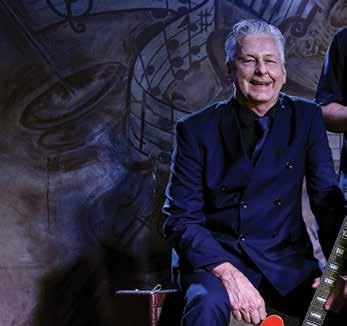
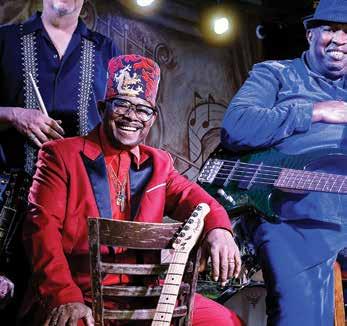
MUSIC Chicago Blues Festival
THU 6/4: Willie Clayton headlines; John Primer opens.
FRI 6/5: The day’s final set is a showcase called 55 Years of Alligator Records, featuring Lil’ Ed & the Blues Imperials, Ronnie Baker Brooks, Toronzo Cannon, Nick Moss, and Tinsley Ellis.
SAT 6/6: Billy Branch (with Kenny Neal and Ronnie Baker Brooks) headlines.
SUN 6/7: Taj Mahal & the Phantom Blues Band headline. Full lineups for all days and stages are on the City of Chicago website.
The 2026 Chicago Blues Festival has an impressive array of talent on tap. The free weekend-long event features four stages of live music across Millennium Park, with bright up-and-comers alongside grizzled veterans.
On Thursday, an opening-night concert at Bridgeport’s Ramova Theatre features two Chicago blues greats. Guitarist John Primer paid his dues behind Muddy Waters and Magic Slim before venturing out on his own in the 1990s to begin a prolific solo career. Headliner Willie Clayton (born in 1955) is one of his generation’s last active soul belters; at this show he’ll pair his melismatic singing with insistent grooves perfected on the southern circuit.
Friday’s lineup at Jay Pritzker Pavilion is especially strong. The party begins at 3:45 PM with 35-year-old Saint Louis guitarist Marquise Knox, whose crisp, B.B. King–influenced licks and
powerhouse vocals recall the glory years of the electric blues in the 60s and 70s and provide an encouraging sign for its future. Few zydeco acts bring it hotter than C.J. Chenier & the Red Hot Louisiana Band, with excellent reason—Chenier’s father, Clifton Chenier, pretty much invented the genre. Guitarist Elvin Bishop and harmonica wizard Charlie Musselwhite were once promising Chicago blues youngbloods; now they’re revered elders. The evening culminates with a program called 55 Years of Alligator Records, starring a cross-section of the Chicago blues label’s current top names, including Lil’ Ed & the Blues Imperials, Ronnie Baker Brooks, and Nick Moss. Another young Saint Louis standout opens the Pritzker Pavilion at 4 PM on Saturday: singer Dylan Triplett, who has racked up considerable acclaim for his captivating blues-soul hybrid. He’s followed by Shakura S’Aida, a Canadian vocalist and film actor whose genre-bending blues mixes in jazz and world music. Texasborn singer and guitarist Ruthie Foster (whose 2024 release Mileage won a Grammy for best contemporary blues album) summons seemingly bottomless depth with her earthy vocals, whether accompanied by a horn-loaded orchestra or in a stripped-down-to-the-studs setting. Billy Branch has been Chicago’s preeminent blues harpist for decades, and there’s no better place to celebrate his 75th year on the planet than his headlining set, where he’ll be joined by Brooks and guitarist Kenny Neal.
Also on Saturday, Moss brings his own hard-hitting guitar to a full-band set at the nearby Rosa’s Lounge stage. Later in the day, commanding vocalist Oscar Wilson, known for fronting the popular 40s- and 50s-blues-
Events actually worth leaving your house for
do our best to be accurate, but please check venue websites for updates and more information, as event details may have changed since press time.

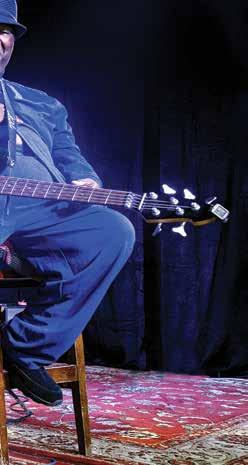

inspired Cash Box Kings, will close out the stage with his band.
The best Sunday side-stage bet is bassist Bob Stroger, who’ll play the Rosa’s Lounge stage at 3:30 PM. The former sideman for Otis Rush emerged as a singer in the 90s, and his smooth, deep voice hasn’t aged a bit.
Sunday at Pritzker begins with a tribute to Estelle “Mama” Yancey and Big Mama Thornton—they’ve been gone for decades, but their influence remains profound. Seven standout Chicago blueswomen, led by stillpotent nonagenarian Mary Lane and the saucy Katherine Davis, pay loving homage to the legendary singers. Next up is Canadian guitarist Sue Foley, who plays with a slicing Texas bent, followed by classy Bay Area fretsman Chris Cain—another B.B. disciple who plays with a jazzy tinge and sings with uncommon soul. No roots-music form is off-limits to blues-fusion singer-songwriter Taj Mahal, who closes out the festival at 7:45 PM. The guitarist will be backed by his Phantom Blues Band, so expect a rollicking good time.
Also worth checking out is the talent on the Mississippi Crossroads stage, dedicated to the Delta roots of the blues, and on the Wrigley Square stage, which showcases what it calls the “Next Generation of Blues.” And you can start your Sunday morning on Maxwell south of Halsted, where a series of live performances and DJ sets (running from 10 AM till 3 PM) celebrates the blues legacy of the historic Maxwell Street market. The 2026 Chicago Blues Festival offers something for everyone all weekend long. (Thu 6/4, 7:15 PM, Ramova Theatre, 18+; Fri 6/5–Sun 6/7, Millennium Park, free, all ages) BILL DAHL
Widemouth
FRI 6/5: Free Range and Sleeper’s Bell open.
In summer 2023, guitarists and vocalists Mak Carnahan and Jamie Eder started playing folk and indie covers in the basement of their Northwestern University dorm. Among their go-tos was Big Thief, easily the most popular band threading together folk and big-tent indie rock that’s emerged in the past decade. Carnahan and Eder now play together in Widemouth, a four-piece that also includes drummer Lily Mitchell and bassist Pat Pilch, and their brand-new self-released debut album, No Gasoline, has Big Thief’s fingerprints all over it. Fortunately, the young group avoid imitating their heroes—they’re instead taking suggestions from Big Thief. No Gasoline foregrounds the interplay between Eder and Carnahan’s vocals. Eder sometimes pushes his drawling tenor till it quavers, and Carnahan gives her mezzosoprano such a breathy delicacy that her upper register sounds like it could dissolve. They trade off verses, harmonize, and occasionally sing in counterpoint. The group’s relaxed arrangements leave lots of room for subtle details—say, the soft pulse of a tambourine on the title track— that make them more memorable. Recording engineers Sam Genualdi and Jack Henry Lickerman (who’s worked with like-minded artists Hemlock and Free Range) tracked No Gasoline at Fallow Studio, built into a barn south of Indianapolis. They worked with a lineup that included original bassist Levi Saltzman, replaced in December 2025 by Pilch (who coedits music site Post-Trash and manages Hemlock, Red PK,
PAUL NATKIN
and Lickerman). Genualdi and Lickerman have preserved the feeling that you’re in the room with Widemouth, and the band’s understated performances make you want to be in the room with them—no matter how big those rooms get. (Schubas, 8 PM, 18+) LEOR GALIL
Marcal
SAT 6/13: Brenda, Jaq Attaque, and Josh Tong open.
Inspired by his Brazilian heritage, science fiction, and the futurism of early techno, Goiânia-born DJ and producer Marcal colors his heady tracks with psychedelic, cybernetic atmospheres and powers them with combustible rhythms from bossa nova, samba, and other traditional forms of Brazilian dance music. That eclectic sonic foundation provides a springboard for his omnivorous imagination, which has made him a rising force in the global techno scene. On “Bionic Jungle,” from 2023’s Cyber Dystopia EP, Marcal plays with the distinction between nature and technology, peppering its dark groove with mechanical blips and processed vocals that simultaneously sound like wild animals and aliens in a far-off galaxy. The following year, Marcal moved from Brazil to Porto, Portugal, and gigging steadily on Europe’s vibrant club circuit has broadened his style even more. As he told 6 AM Group in 2024, “It’s like adding a unique color to my sound palette that continues to evolve.” “Swindle,” from 2025’s Enchant & Deceive, dives straight into the abyss with tensionbuilding grooves and unrelenting quasi-tribal beats. Marcal’s latest release, May’s Khaos Theory EP, consists of four minimalist tracks that pull you in from the jump with retrofuturistic industrial textures and raw, pulsating grooves. His Smart Bar set promises to immerse you in an enthralling sonic world. (Smart Bar, 10 PM, 21+) JAMIE LUDWIG
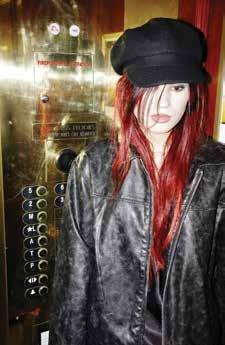
Underscores
FRI 6/19: Umru opens. Bay Area producer and songwriter April Grey, aka Underscores, became one of the brightest stars in hyperpop thanks to her 2021 selfreleased album, Fishmonger. The cheeky, everevolving, Internet-native subgenre relentlessly plumbs stylistic experimentation (to the point that it’s sometimes off-putting) while embracing pop’s single-minded focus on frothy, euphoric hooks. In this attempt to wed the underground and the mainstream, hyperpop acts can seem to be trying to have their cake and eat it too, and the attention drawn to the subgenre by the crossover success of 100 Gecs in 2019 has intensified that contradiction. But Grey has always sounded like an artist following her own creative impulses. Underscores’ 2023 album, Wallsocket, uses lots of blown-out bass and percussion, which makes its sparsest moments
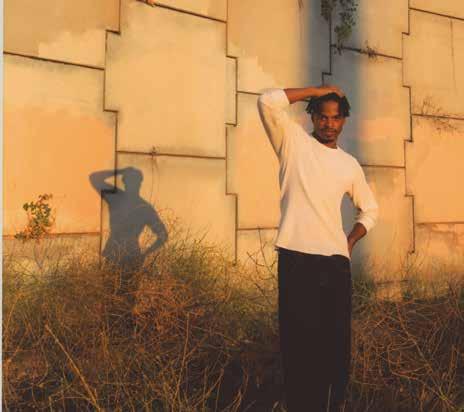
Elujay
SUN 6/28
Elujay is done wearing a mask. The singer, rapper, and producer’s newest album, January’s A Constant Charade, confronts the way we behave differently around different people or in different contexts and how we never allow a glimpse of who we really are to escape. Elujay has been making music since he was a teenager growing up in Oakland, and he’s developed an exploratory style informed by a broad swath of genres, including alt-hiphop, jazz, yacht rock, and neosoul. His experimental 2022 release Circumvnt embraced the spirit of reggae and dancehall, in a nod to his Trinidadian roots, and A Constant Charade builds on that by adding a new list of stylistic influences. Opener “Rogue Heart” percolates with electronic beats worthy of an underground dance club, and the soulful “Hyundai” roots itself in 90s alt-rock guitar. Brooklyn imprint Drink Sum Wtr reissues the album this month in a deluxe version with six additional tracks. A Constant Charade invites us to consider the good that could come if we dropped the performative behavior and embraced our true flawed hearts. As Elujay told Clash in November, “I just wanna give people the confidence to be themselves and be vulnerable.” (Empty Bottle, 9 PM, 21+) JAMIE
LUDWIG
feel more dramatic (“Horror Movie Soundtrack” is practically ambient). To my ears, it’s more stylistically outlandish than Fishmonger. For the March release U (Mom + Pop / Corporate Rockmusic), Grey took inspiration from hotels, malls, and airports, and the refreshing new polish of its songs feels analogous to the frictionlessness built into those liminal spaces. But while Grey has oriented her wide-ranging, unpredictable tastes toward accessibility, she also makes sure to preserve the discord, tension, and noise that helped make her music compelling in the first place. On “Wish U Well” and “Innuendo (I Get U),” the crisp percussion
of a man pursued by government agents. “‘Be quiet or be killed’ / They said they’d come for me / Whose voice do they obey? / Who sent the dogs for me?” Rather than surrender or be silenced, though, the five-piece opt for an unrelenting, bludgeoning sound that melds the angular whine and blare of noise rock with the assaultive rush of hardcore. Later in the song, Kazra, who is Lebanese American, plays a grotesque caricature of a violent zealot to express the frustrations of growing up amid anti-Arab sentiment in post-9/11 America. “Let a fool rush in, any and all I’d devour / I’m the motherfucker who took down the towers,” he screams, before the barrage drops out and a mizmar wails briefly alone.
The members of the band—Kazra, guitarists Ross Babinski and Bret Wall, drummer Andrew Kaster, and bassist Dylan Zaranski—grew up in Dearborn, Michigan, a Detroit suburb with the country’s highest per capita concentrations of Arab American and Muslim residents. They use their music to broadcast truths, indict xenophobia and Islamophobia, and shed light on decades of the sociopolitical history of the Arab world and diasporic communities. “You want to know where I’ve been? / I’ve been driven out / To deserts untraversed,” Kazra laments in “Body Meat,” conveying a sense of loss and exile that resonates with experiences of imperial dispossession and migration.
Prostitute’s defiance and rage sit alongside community and hometown pride, as they make clear in “Joumana Kayrouz,” an unhinged but heartfelt tribute to a fashionable Lebanese personal-injury attorney, famous for her hundreds of billboard ads across the Detroit metro area. Prostitute turns punk’s wit and confrontational fury into a brutally sophisticated, avant-garde maelstrom that calls for personal and global liberation. (Empty Bottle, 9 PM, 21+) NOAH BERLATSKY
MORE
The Alice Bag Band, Clickbait, Sweetie Fri 6/5, 7 PM, Cobra Lounge, 17+
Bleachers, Momo Boyd Fri 6/5 and Sun 6/7, 6:30 PM, Salt Shed (fairgrounds), all ages, Fri 6/5 sold out
Griffin Maxwell Brooks, Ariel Zetina, Miss Toto Fri 6/5, 10 PM, Smart Bar, 21+
Cabeza de Chivo, Vatos Tristes, Eva Maria (DJ set) Fri 6/5, 8 PM, Thalia Hall, 17+
Vow, Warforged, Barren Heir Sat 6/6, 9 PM, Empty Bottle, 21+
Penelope Trappes Sun 6/7, 9 PM, Sleeping Village, 21+
Witch Club Satan, Patriarchy Sun 6/7, 8 PM, Reggies Rock Club, 17+
Covet, Lite, Hikes Tue 6/9, 7:30 PM, Thalia Hall, 17+
The Wallflowers, Early James Thu 6/11, 8 PM, the Vic, 18+
Lyrical Lemonade Summer Smash with Lil Uzi Vert, Chief Keef, Skrillex, Playboi Carti, and more Fri 6/12, 3 PM, Sat 6/13 and Sun 6/14, 1 PM, Seatgeek Stadium, all ages
Babe Haven, Bev Rage & the Drinks, No Men Sat 6/13, 8 PM, Beat Kitchen, 17+
The Hold Steady, Built to Spill, Bully, Titus Andronicus Sat 6/13, 4 PM, Salt Shed (fairgrounds), all ages
Derya Yıldırım & Grup Şimşek Sat 6/13, 8:30 PM, Constellation, 18+
hits with the sleek cool of Timbaland’s best work, but Grey’s biggest pop swings, such as the fractured funk ballad “Bodyfeeling,” sound like something nobody else could’ve made. (Radius, 7 PM, all ages) LEOR GALIL
Prostitute
SAT 6/27
Listening to Prostitute’s debut album, 2024’s Attempted Martyr, is like sticking your head into the blades of a pissed-off outboard motor. On “All Hail,” vocalist, guitarist, and keyboardist Moe Kazra channels the paranoia and anguish
Amyl & the Sniffers, Party Dozen Sun 6/14, 7 PM, Salt Shed (fairgrounds), all ages
Otherlands Trio Sun 6/14, 7:30 PM, Constellation, 18+
Arrested Development, Linda Sol, DJ Ca$h Era Mon 6/15, 6:30 PM, Jay Pritzker Pavilion, free, all ages
DJ Pierre, Shaun J. Wright, Blackclub Fri 6/19, 10 PM, Smart Bar, 21+
Kim Gordon, Fiery Furnaces Tue 6/23, 8 PM, Metro, 18+
Julie Doiron, Carson McHone, Fran Wed 6/24, 9 PM, Empty Bottle, 21+
April Grey of Underscores
BAILEY KRAWCZYK
NORI RASMUSSEN-MARTINEZ
Jesca Hoop Wed 6/24, 8 PM, Schubas, 18+
Michelada Fest with Latin Mafia, Jhayco, Sean Paul, and more Fri 6/26–Sun 6/28, Union Park, 5 PM, all ages, VIP 18+
Kurt Vile & the Violators, the Sadies Fri 6/26, 8 PM, Salt Shed, 17+
Distress Fest with Bongripper, Deaf Club, Slowhole, and more Sat 6/27 and Sun 6/28, 6 PM, Subterranean, 17+
“Weird Al” Yankovic, Puddles Pity Party Sat 6/27, 8 PM, United Center, all ages
Widowspeak, Neu Blume Sun 6/28, 8 PM, Schubas, 18+
Kahil El’Zabar & David Murray Tue 6/30, 7:30 PM, SPACE, Evanston, all ages
EARLY WARNINGS
La Texana, Blood Club, Future Nobodies Fri 7/3, 8 PM, Bottom Lounge, 17+
Sonido Gallo Negro, Rudy De Anda Fri 7/3, 9 PM, Chop Shop, 18+
Chosen Few Picnic & Music Festival Sat 7/11, 7 AM–10 PM, Jackson Park, all ages
Conan, Acid Fog, Plinian Mon 7/13, 8 PM, Reggies Rock Club, 17+
Hunx & His Punx Thu 7/16, 11 PM, Empty Bottle, 21+
Kylesa, Yakuza, Cloud Rat Fri 7/24, 8 PM, Thalia Hall,17+
Cheer-Accident, In Masks Sat 7/25, 7 PM, Martyrs’, 21+
Emmylou Harris & Graham Nash Sun 7/26, 7 PM, Ravinia, Highland Park, all ages
Sleepytime Gorilla Museum, Wendy Eisenberg, Matt Espy Sun 7/26, 7 PM, Chop Shop, all ages
Big Thief Thu 8/13, 6:15 PM, Salt Shed, all ages
Sound & Gravity with Grouper, Son Lux, Marc Ribot, Hailu Mergia, Lucrecia Dalt, Tyondai Braxton, Patrick Shiroishi, and more Thu 9/3 and Fri 9/4, 6:30 PM, Sat 9/5 and Sun 9/6, 6 PM, various venues, 21+
ARC Music Festival with Carl Craig, Beltran, Joy Orbison, DJ Lady D, Green Velvet, Honey Dijon, and more Fri 9/4–Mon 9/7, 2 PM, Union Park, 18+
Altın Gün, Alex Maas Wed 9/16, 7:30 PM, the Vic, 18+
Iron Maiden, Megadeth Tue 9/22, 7:15 PM, Credit Union 1 Amphitheatre, all ages Acid Mothers Temple, Magick Potion, Spiral Galaxy Wed 10/14, 8 PM, Reggies Rock Club, 17+
L7 Sun 11/1, 7:30 PM, the Vic, all ages
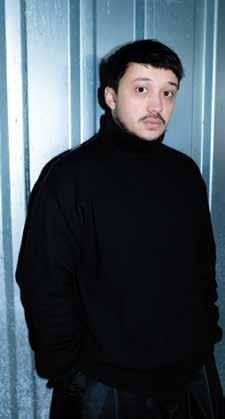
VISUAL ART
“Syllabus of Effects”
OPENS 6/5
The reality that art is not a solo sport has only gained mainstream acceptance relatively recently, but for artist, academic, and Reader contributor Chris Reeves, it’s part of his practice. Consequently, this “solo” exhibition actually includes the work and input of a slew of Reeves’s fellow travelers, from former Chicago sculptor Tamara Valdez to writer Livy Onalee Snyder. The format and title of the show stem from a series of six artists’ books Reeves made in 2024 based on his “love of syllabus creation,” resulting in exhibitions within the exhibition on themes including repetition and noisiness. Based on some of Reeves’s past artistic happenings, this monthlong show is sure to be an experience. (Ignition Project Space, free, all ages) KERRY CARDOZA
Dignidad
SAT 6/13
The Floating Museum, a collective of artists who create site-specific installations, will debut their latest project at this year’s Puerto Rican
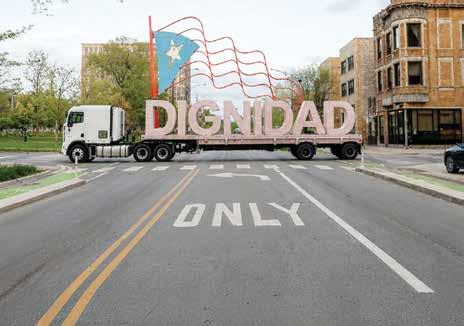
People’s Day parade in Humboldt Park. The mobile work, made in collaboration with Colombian artist Iván Argote and curated by Carla Acevedo-Yates, consists of the word “dignidad” in oversize, all-caps letters. The day following the parade, the work will move through the city, stopping at different sites for to-be-announced activations. The project is the result of two years of engagement with the Humboldt Park community. As Acevedo-Yates said in a press release, “Dignidad affirms a core community value: that dignity is an inalienable human right.” (Humboldt Park, free, all ages) KERRY CARDOZA
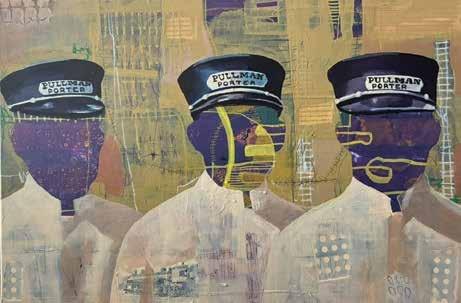
“Pullman Porters & Maids: Invisible Labor, Visible Legacies”
OPENS FRI 6/5
The Newberry holds a vast archive related to the Pullman Company: articles from the employee magazine, photographs, financial records, training manuals, blueprints, employment records. It is from this material that Morris-based artist Shane-Jahi Jackson drew for this solo exhibition. Jackson, a descendant of a Pullman porter, creates collagelike paintings dense with information. Combining figures of Pullman employees and other historical imagery with loose abstractions, he hints at gaps in the archive—the missing pieces that made Pullman workers not just workers but people. PullmanArts’ Block House Gallery is the perfect venue for this show, curated by Juelle Daley, offering visitors the chance to further immerse themselves in the neighborhood’s history just by stepping outside the doors. (Block House Gallery, free, all ages) KERRY CARDOZA
“Wild Thing”
THROUGH 7/10
Perhaps no one has the pulse on contemporary art in Chicago quite like curator (and Reader contributor) Pia Singh, who organized this freewheeling group show at Arts of Life’s West Town gallery. Featuring a who’s who of local artists, both inside and outside of AoL’s roster, the show homes in on the recent proliferation of “interspecies empathy” on social media, asking what really sets humans apart from our animal brethren. From Jacqueline Surdell’s riotous fiber sculptures to the mini ceramic creatures by Cecilia Beaven to the illustrated interspecies scroll by Alex Scott to Erin Hayden’s orca altar—”Wild Thing” is an explosion of color, a celebration of life, a worthy harbinger of summer. (Circle Contemporary, free, all ages) KERRY CARDOZA
“Dispossessions in the Americas”
THROUGH SAT 7/18
The artworks in “Dispossessions in the Americas” are stories within a larger story—each playful, violent, responsive, imaginative, and often blurred along its borders. Despite the diversity of the more than 40 works on view, they all share a common concern: How do Afro-descendant, Latino, Indigenous, queer, and trans communities from different cultural sites maintain their sense of subjectivity, tradition, history, and relationship to the land?
This exhibition is not a historical survey of colonialism across the Americas; rather, it is an assemblage of diverse perspectives and lived experiences shaped by the social, political, and physical forces of colonial violence. Many of the artists’ works contend with their relationship to the land and water. Carlos Martiel’s short film Lazos de sangre (Bloodline) allows the artist’s blood to flow into the ocean through two catheters inserted into his forearms, creating a visceral and direct link between his flesh and the water. Joiri Minaya’s photographs of cloaked monuments challenge the authority of public sculptures that celebrate racist and genocidal figures—monuments that often fail to appropriately convey the brutal truths of their histories. It is through these artists’ perspectives that we begin to see not only destruction but also the generative possibilities that emerge from histories of violence. [A longer version of this review can be found on our website.] (Wrightwood 659) ISAAC
Shane-Jahi Jackson, Summoning George II (2026)
Marcal
COURTESY THE ARTIST
COURTESY IVÁN ARGOTE STUDIO
COURTESY BLOCK HOUSE GALLERY
“My Future Heritage”
THROUGH TUE 8/4
For its 50th anniversary, Andersonville’s Swedish American Museum is in full bloom. One inflorescence in this organizational flowering is the Nordic artist Sofia Hagström Møller, whose solo display, “My Future Heritage,” offers an exemplary demonstration of how exchanges between memories and traditions occur and then come to life across generations.
For the Copenhagen-based textile artist, heritage serves not only as a professional but a personal tether. Indeed, the show is a combination of rivulets of time, things newer and things older that have found a place to meet. There are hung fibrous creations from a stint at the University of Wisconsin-Madison, as well as a four-part woven series, made just for the show, inspired by the seasons. Here, one unique symbol repeats, a pattern interchanged and marked by a selection of differing chromatic wools.
Lineages—material, familial, graphic—are in constant evolution. As with anything that’s in constant flux, change leaves room for experimentation. Hagström Møller, unperturbed by this challenge, is a case of how subtleties and variations can (re)appear throughout time. [A longer version of this review can be found on our website.] (Swedish American Museum, all ages)
LUCAS GÓMEZ-DOYLE
MORE
“Conference of the Winds” Through Fri 6/5, Hook Space, free, all ages
“Jeff Carter: The Singer Pavilion Project” Opens Sat 6/6, Hyde Park Art Center, free, all ages
“The Horizon Keeps Moving” Opens Sat 6/6, Mariane Ibrahim, free, all ages
“Sorri fi maaga dawg, cuz maaga dawg will ton roun bite yu” Opens Fri 6/12, Andrew Rafacz, free, all ages
“Between Us” Through Sat 6/27, Project Onward, free, all ages
“Mike Cloud & Nyeema Morgan: Story Structure, Pt. 2” Through Sun 6/28, Neubauer Collegium, free, all ages
“Shadow” Through Sat 7/11, tête-à-tête-à-tête, free, all ages
“Dancing the Revolution: From Dancehall to Reggaetón” Through Sun 9/20, MCA, all ages
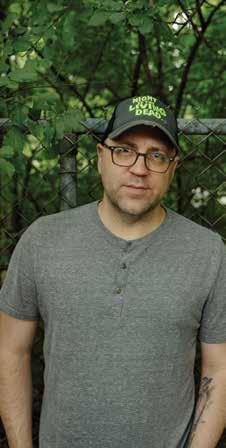
LITERATURE
Summer at CPL
STARTS SAT 6/6
The Chicago Public Library welcomes the start of summer with its Summer at CPL kickoff, launching at branches around the city on Saturday, June 6. Summer at CPL encourages reading all summer long, through reading challenges, family activities, and more. Each branch will be hosting different activities around the theme of Chapters of Chicago. Sulzer Regional will host the children’s music duo Little Parade, Near North will hold a workshop on origami, and Austin-Irving will offer a plant and seed swap, while the Edgebrook branch will have a meet and greet with Bluey. (Times vary by location, free, all ages) KERRY CARDOZA
It Is Not Enough to Survive book launch
THU 6/11
Join Jesse Montgomery, a visiting assistant professor of English at Berea College who specializes in Appalachian outmigration and radical culture, who will be in conversation with local organizer William Harris to discuss Montgomery’s new book on the Young Patriots. It Is Not Enough to Survive: The Young Patriots Story tells the history of this radical Uptown group, which fought against police brutality and displacement, among other injustices, alongside the Black Panthers and the Young Lords in Chicago in the 60s. (Pilsen Community Books, 7–8 PM, free, all ages) KERRY CARDOZA
American Writers Festival
SAT 6/6–SUN 6/7
The American Writers Museum’s third annual festival, presented in partnership with the Chicago Public Library, returns this weekend in a newly expanded edition. Over 90 writers will participate in events at both the museum and the Harold Washington Library Center, including 2026 Pulitzer prize winner and local author Daniel Kraus (who will be in conversation with the New Yorker’s Susan Orlean), Eve L. Ewing, and Reza Aslan. On Sunday, the Triibe confounder Tiffany Walden will moderate a panel on hip-hop journalism, and James Kennedy will provide highlights from his longrunning 90-Second Newbery Film Festival. (free, all ages) KERRY CARDOZA
Soccer Island
FRI 6/12–SAT 6/13
A chicken bounces on a sunflower-laced soccer field. It’s an island (you imagine), and it’s held up by a pole. Three stranded, disintegrating characters and a narrator, played by Amari Amai, Rosé Hernandez, Zachary Nicol, and Fionn Casper-Strauss, wander, reminiscing over walkie-talkies. There are no landmarks, nothing to demarcate a passage of time. Their grip on reality loosens. Soccer Island is the newest project by artist Gabriel Chalfin-Piney-González, founder of the Jewish Museum of Chicago, puppeteer, tattoo artist, and all-around crafter. It’s a liminal transfuturist staged reading, programmed as part of Movement Studies, Roman Susan’s series investigating social and environmental transition, alongside the documentary Two Summers on Hayes Avenue. And, like ChalfinPiney-González’s entire body of work, it’s a world that covers many bases, bouncing from Y2K to dead deer to scrap metal. (Berger Park Cultural Center Theater, 7 PM and 2 PM, free, adult content) SHIRA FRIEDMAN-PARKS
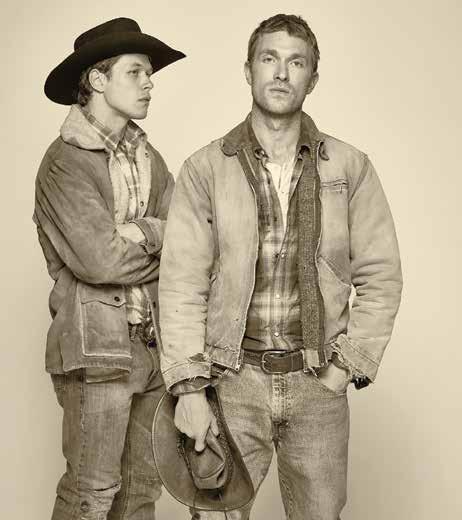
Brokeback Mountain
THROUGH SUN 6/28
Originally published as a short story in the New Yorker in 1997, Annie Proulx’s tale follows the 20-year secret affair of two shepherds who fall in love in the summer of 1963 while guarding a flock on the titular Wyoming peak. Brokeback Mountain was turned into an acclaimed 2005 film by Ang Lee starring Jake Gyllenhaal and the late Heath Ledger—it lost the best picture Oscar to Crash (causing Proulx to pen a scathing piece in the Guardian in response). An opera version with a libretto by Proulx premiered in 2014. Now Chicago Shakespeare Theater presents the North American premiere of Ashley Robinson’s 2023 stage play, featuring original songs by Dan Gillespie Sells (performed by a live countryand-western band onstage) and directed by Jonathan Butterell. A show about closeted cowboys may feel like a bit of a throwback for Pride month, but Proulx’s spare and affecting portrait of the growing attraction and connection between the stoic Ennis Del Mar (played at Chicago Shakes by former New York City Ballet principal dancer Harrison Ball) and the more emotionally expressive Jack Twist (played by Jack Cameron Kay) also, as the film proved, offers great dramatic possibilities, with songs standing in for the things the men can’t say to each other. The show won warm reviews in its 2023 London premiere, also directed by Butterell; with attacks on LGBTQ+ rights on the upswing, it feels sadly timely to revisit this story. (Chicago Shakespeare Theater) KERRY REID
JEFF SCIORTINO
Author Daniel Kraus Sun 6/7, at the American Writers Festival at Harold Washington Library
PERFORMANCE
Le Bal
THROUGH SAT 6/20
At a moment in American history when words chronically fail, Trap Door has chosen to update Ettore Scola’s wordless 1983 film, Le Bal, which dealt with 50 years in the history of France. Covering nine decades of American history asynchronously, starting with the 1980s, the house music soundtrack puts us clearly in Chicago, but after that, the decades and locales fly by in a cascading medley of costumes and movement in director Stephen Buescher’s adaptation. Removing words causes attention to shift to motion, props, and setting. The stage is bare but the back walls are covered with chairs, clothes, signs, luggage, and bric-abrac. The scenes depicted will all be familiar to anyone with even a cursory grasp of the country’s history but the cumulative effect is elegiac rather than critical or celebratory. The feeling I was left with was of something coming to an end, which is a feeling many are stuck on these days in this place. As a tribute to a moment in history, few words would have been as apt. [A longer version of this review can be found on our website.] (Trap Door Theatre)
David et Jonathas
SUN 6/21
Haymarket Opera Company presents the Chicago premiere of Marc-Antoine Charpentier’s 1688 opera (libretto by Father François Bretonneau). Charpentier drew inspiration from the Old Testament story of King Saul; his son, Jonathan; and David, a favorite of Saul until Jonathan develops a strong attachment to the younger man. David then becomes the target of the king’s anger and jealousy, culminating in (spoiler alert!) suicide and heartbreak. Haymarket’s production is a semi-staged concert, directed by Haymarket general director Chase Hopkins, and Jory Vinikour conducts an orchestra featuring Haymarket’s usual array of early-music musicians, with lead performances by tenor Scott J. Brunscheen as David, soprano Kaitlin Foley as Jonathan (the piece was originally written for a boy soprano), and David Govertsen as Saul. (Gannon Concert Hall, DePaul University) KERRY REID
keerah
THROUGH SUN 6/28
Chicago actor Netta Walker, perhaps best known for playing Keisha McCalla in the sports drama series All American, is adding “playwright” to her résumé this year, with two world premieres at local theaters. First up is keerah at Definition, directed by McKenzie Chinn. Walker’s play about two writers who bond over their love of “language, literature and the art of cruelty” grew out of Definition Theatre’s Amplify new works program—it won the 2024 series. Ciara, a Black American poet, meets Irish writer Cormac when he’s in the states on a J-1 visa. What starts out as a fun summer romance takes a darker turn. Seven years later, Ciara, now a successful television writer, draws on that former affair for her show. Keerah also uses the myth of Orpheus and Eurydice as part of its own inspiration, and Walker herself plays Ciara, joining fellow castmates Beck Nolan, Jacob Coggshall, and Cat Christmas. In October, Walker’s play Hayward gets its world premiere with Gift Theatre. (Definition Theatre) KERRY REID
Andy Warhol Presents: The Cocaine Play
THROUGH MON 7/6
Terry Guest has been making his mark as one of the most interesting playwrights in town for a few years now, working in a variety of genres and subject matters. In last fall’s Oak at Raven Theatre, Guest explored the disappearance of
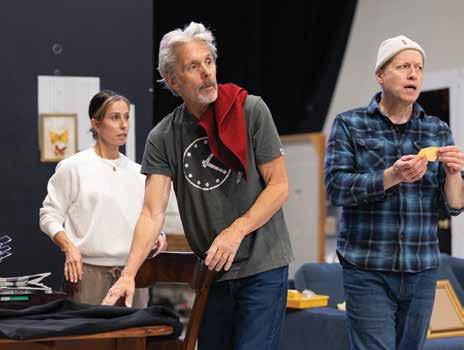
Catch as Catch Can
THU 6/4-SUN 7/12
This has been the season for long-absent ensemble members to return to the Steppenwolf stage. Kathryn Erbe showed up to stellar effect in The Dance of Death in February after nearly 30 years away from Halsted Street. Now Gary Cole, who has notched many television credits over the past few decades (fans of HBO’s political satire Veep know him as Kent Davidson, aka “the Pol Pot of pie charts”) makes his way back onstage in Mia Chung’s Catch as Catch Can, directed by Amy Morton. Appropriately enough, the precipitating dramatic event in Chung’s play involves the return of a prodigal son to his blue-collar New England family, whose lives are intertwined with another blue-collar clan. Over the course of the intricately woven story, just three actors take on six different roles as Chung questions gender and generational identity, as well as the underlying trappings (or traps) of the classic kitchen-sink drama. (In her review of the 2022 Playwrights Horizons’ production for the New Yorker, Helen Shaw noted, “Catch as Catch Can is terrifying because it makes everything seem like a negotiable reality.”) Cole is joined by fellow ensemble members Audrey Francis and Tim Hopper in what promises to be an intriguing tour-de-force for these old Steppenwolf hands. (Steppenwolf Theatre Company)
KERRY
REID
Black children through a Southern Gothic lens. In 2022’s Marie Antoinette and the Magical Negroes, produced through Guest’s own Story Theatre, the doomed French queen got a narrative makeover that also encompassed the Haitian Revolution of 1804 and the 1992 LA rebellion. Historical figures (sort of) come into focus in Guest’s latest, produced at Jackalope Theatre under the playwright’s direction. Andy Warhol (“no, not that Andy Warhol,” according to the press release) is a painter who’s been creatively stuck for years. When an actress named Marilyn Monroe (“no, not that Marilyn Monroe”) stumbles into his path in 1962, the pursuit of fame, sex, and beauty (stretched
clowning, and improv—all under the loving and discerning curation of cofounders Marc Frost and Alice da Cunha. (Most performances take place at Theater Wit and the Dance Center of Columbia College Chicago.) When I talked to them about last year’s festival, da Cunha said, “We define [physical theater] as a theater that has a strong visual language, and that the body in the space is the primary source of storytelling. Another way to say it is that if you close your eyes, you will miss at least 50 percent of the story.” There’s a lot you won’t want to miss this year, including Sora Baek’s Sell Me: I am From North Korea (through 6/6 at Theater Wit), a solo about a North Korean girl selling herself to an older man to buy medicine for her mother; I Think It Could Work, a circus show by Chicago’s Full Out Formula mixing philosophy with acrobatics and juggling (through 6/7 at Theater Wit); and Apocalipsync, a solo show by Argentinian actor Luciano Rosso in which the performer embodies 40 different characters, all conjured by a bored and lonely man in his apartment (through 6/6 at Theater Wit). (physicalfestival.com) KERRY REID
Leopoldstadt
THU 6/4–SUN 7/19
Writers Theatre ends their season with the largest production in their 34-year history with the late Tom Stoppard’s last play, and possibly his most personal. Leopoldstadt traces the fortunes of a family of Viennese Jews (the title refers to a district in Vienna) over 50 years and five acts, beginning in 1899 and ending in 1955. Carey Perloff, former artistic director for San Francisco’s American Conservatory Theater, directs this piece, which she earlier staged for Boston’s Huntington Theatre. The play, first produced in 2020, has won accolades for being one of the most heartfelt pieces that Stoppard ever created. (Personally, I think there are rich emotional resonances in many of his earlier plays that people just overlook because of the dazzling wordcraft he could so effortlessly summon forth.) Stoppard was born Tomas Straussler-Tomik in what was then Czechoslovakia and left as a child during World War II for Singapore, where his father died. (The name Stoppard came from his mother’s second husband, a major in the British army.) In a 1999 piece for Talk magazine entitled “On Turning Out to Be Jewish,” Stoppard reflected on only finding out about his deep Jewish roots during the 1990s—all four of his Jewish grandparents, along with several other family members, died in Nazi concentration camps. The 29-member ensemble of Perloff’s new production at Writers brings the complicated roots and dark fates of the Merz-Jakobovicz family in Leopoldstadt (Stoppard said he set it in Vienna to gain some distance from his own family’s history) to what artistic director Braden Abraham says is the most intimate venue so far for Stoppard’s work. It’s an astounding collection of local talent, including longtime leading lights such as Barbara Robertson, Sean Fortunato, Kate Fry, Erik Hellman, and Jessie Fisher. (Writers Theatre) KERRY REID
Slut Sat 6/20-Sun 6/21
over three decades) begins to accumulate a body count. The cast for Guest’s tale of ambition and superstardom includes William Anthony Sebastian Rose II as Warhol and Alexis Ward as Marilyn. (Jackalope Theatre Company) KERRY REID
Physical Theater Festival
THROUGH SUN 6/7
This homegrown celebration of storytelling through movement turns lucky 13 this year, with a lineup encompassing international artists as well local favorites celebrating a variety of genres, including dance, mime, puppetry,
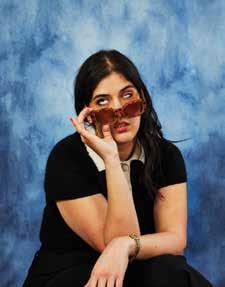
Rehearsal photo of Catch as Catch Can
JOEL MOORMAN
Funny
at the Steppenwolf 1700 Theater
Two Out of Three Falls
THU 6/4–SUN 7/18
Factory Theater’s latest, written by Bill Daniel, draws on the real-life story of Frank Donald Goodish, better known to pro wrestling fans through a variety of stage names, including Bruiser Brody and King Kong Brody. He was stabbed to death in 1988 in Puerto Rico backstage during a wrestling event, and the accused killer, fellow wrestler José González, was acquitted on grounds of self-defense. In Daniel’s play, directed by Ashley Yates, Johanna Goodish, daughter of the Bruiser, decides in 2019 to seek justice by challenging her father’s killer to a pay-per-view match, where she plans to kill him. The cast includes Brittany Ellis as Johanna and the set in the cozy Factory space includes a real, sure-enough wrestling ring. (Factory Theater) KERRY REID
Saturn Returns
THU 6/11–SUN 6/14
If you’re lucky, you get to grow old. In our relentlessly youth-centric culture, this is a truth that is too often overlooked. Chicago Tap Theatre’s season closer takes its title from the astrological transit that happens when Saturn returns to the place in the sky it occupied at your birth—typically, this event happens every 29 years. Directed by Molly Smith, CTT’s director of operations and community engagement, this program of 11 pieces inspired by the theme of getting older, takes over the Edge Theater for four performances. As Smith explains in press materials for the show, “Tap dance is a natural vessel to portray the rhythm of life, how we grow and change as individuals and as a community, and how we celebrate our wins.” Among the choreographers joining Smith’s work in this program are CTT founder and artistic director Mark Yonally with a piece called Approach the Threshold; company member Sara Anderson’s Accountability/Responsibility; and Anderson and company member Greta Sorensen’s Slow & Steady. Chicago tap legend Martin “Tre” Dumas III created the curtain-raiser, entitled Hope College Piece. (Chicago Tap Theatre at Edge Theater) KERRY REID
Funny Slut
SAT 6/20–SUN 6/21
Comedian Deanna Ortiz was voted best stand-up in the Reader Best of Chicago readers’ poll three years in a row—2022, 2023, and 2024. But that’s not the kind of thing that pays the bills. In her new solo show, presented as part of Steppenwolf Theatre’s summer LookOut series, Ortiz talks about the day job she had for five years as a social media maven for the adult entertainment industry. “It was the only job I ever had with insurance,” she notes in a clip on Instagram, adding that “If you guys are at work and there’s a dick on your screen, your first instinct is to hide the screen. And at my work, my first instinct was I was bringing dicks onto the screen, just in case my boss was behind me. I was like ‘I’m working! Look at all the dicks!’” But Ortiz also maintains in an interview online that working in the porn industry “made me a better person.” You can hear all the ins and outs about how she learned to “embrace chaos, confidence, and her inner hot girl.” (Steppenwolf 1700 Theater) KERRY REID
MORE
Smiley Fri 6/5–Sun 6/21, Open Space Arts Footholds Vol. 7 Thu 6/4–Sat 6/13, Impostors Theatre Co. at the Den Theatre
Southern Rapture Thu 6/11–Sun 6/28, Tin Drum Theatre at Theater Wit Water for Elephants Tue 6/23–Sun 7/5, Broadway in Chicago at James M. Nederlander Theatre Festival of Unfinished Work 2026 Thu 6/25–Sun 6/28, Bramble Theatre Company

Bleak Week: Cinema of Despair
FRI 6/12-THU 6/18
The LA-based nonprofit American Cinematheque will partner with two local theaters to present this celebration of despair. The weeklong fest will include 12 onetime screenings at the Music Box Theatre—described as “a harrowing, yet powerful lineup defined by stark imagery, unimaginable tragedy, existential fear, nihilism, and shocking brutality”—plus a slate of six animated features at the Siskel Film Center. A new 4K restoration of Mysterious Skin (2004) kicks things off at the Music Box, while the Miyazaki masterpiece Princess Mononoke (1997) plays the same night at the Film Center. Well-known classics including Night of the Living Dead (1968) and Watership Down (1978) will screen in conversation with a range of other exercises in catharsis. (Music Box Theatre, Siskel Film Center, all ages) TARYN MCFADDEN
As You Like It Fri 6/26–Sun 8/2, Midsommer Flight, various locations
EARLY WARNINGS
Hair Thu 7/2–Sun 9/13, Kokandy Productions at Chopin Theatre
Suffs Tue 7/7–Sun 7/19, Broadway in Chicago at CIBC Theatre
yo ho. Sun 7/19–Sat 8/29, Babes With Blades at Edge Off Broadway
Chicago Trans Movement Festival and Queer Pride Cabaret Fri 7/17–Sun 7/19, Aloft Circus
Arts
Dance for Life 35th Anniversary Sat 8/22 at Auditorium Theatre
FILM
The African Diaspora International Film Festival
FRI 6/5–SUN 6/7
This traveling fest will find a home at Facets in early June, bringing a slate of 14 films to Chicago. Since 1993, ADIFF has remained dedicated to sharing the perspectives of African and Indigenous people of color with curated films that span genres and eras, and this year is no different. Opening night and closing night will both screen local premieres of feature films, plus receptions with food and drink: Can You Stand the Rain (2025) launches the weekend, preceded by the 13-minute narrative short
Daughters (2023), and Sugar Island (2024) closes the fest with director Johanné Gómez Terrero in attendance. The program spotlights visionaries such as Audre Lorde and Teddy Pendergrass (1995’s Audre Lorde: A Litany for Survival and 2018’s Teddy Pendergrass: If You Don’t Know Me) alongside humble Haitian cooks (2024’s The Last Meal), a 12-year-old homeless boy (2025’s Outdoor School), and beyond. (Facets, all ages) TARYN MCFADDEN
Art of Pride 2026 film fest
SUN 6/7
As a celebration of art, music, performance, community, and queer joy, the Hyde Park Art Center will soon host the fifth iteration of Art of Pride. This year, the Chicago Underground Film Festival joins as an event collaborator to present a film component: Chicago Underground in Motion. Seven locally made short films, “narrative, experimental, performance, and archival practices, with a focus on bodies, identity, and the textures of Chicago’s underground,” make up the 48-minute program, which will play on loop throughout Art of Pride. Titles include Chew This!, 90 Degrees, Glass in Motion, Ask a Punk A Heart of Real Flesh American Alternative: Kurt Heyl, and Patron Saint Buffalo Bill (Hyde Park Art Center, 12–4 PM, free, all ages) TARYN MCFADDEN
MORE
The 37th Festival of Films from Iran Fri 6/5–Thu 6/11, Siskel Film Center, all ages Parker Callahan’s Soda Pop world premiere screening with postfilm Q&A Mon 6/8, 7 PM, the Davis Theater, all ages
Stand By Me: The Film and Its Stars 40 Years Later Sun 6/14, 7 PM, the Chicago Theatre, all ages
Facets and the Found Footage Festival present A Life on the Farm (2022) with postscreening discussion Wed 6/24, 7 PM, Facets, all ages
The Pride projection at Art on the Mart Thu–Sun through 6/28, 9–9:30 PM, Merchandise Mart, all ages
The Siskel Film Center’s 25 for 25 film series Through Wed 7/1, Siskel Film Center, all ages On the Road Again: Cinema/Chicago’s free Summer Screenings series Through Sat 8/22, Chicago Cultural Center, Chicago History Museum, all ages
INDIGEHOUSE: House of Smoke & Ash
TUES 6/16
As part of James Beard Awards weekend, this ancillary event is headlined by a $175 multicourse dinner featuring seven Indigenous chefs. But the daylong market featuring chefs, foragers, artisans, and food producers from across North America is accessible to all. A PechaKucha-style series of presentations exploring “the intersections of food sovereignty, regenerative infrastructure, and the future of Indigenous culinary economics,” starting at 3 PM, requires an RSVP. (Venue West, 12–10 PM, free) MIKE SULA
Princess Mononoke (1997)
COURTESY CINÉMA MODERNE
Global Issues, Local Responses
Book Club: The Last Sweet Bite
THU 6/18
This meeting focuses on human rights investigator Michael Shaikh’s memoir/cookbook about “how humanity’s appetite for violence shapes what’s on our plate,” and features a chapter on the Rohingya, a group very much present in Chicago. Moderated by Laurell Sims of Evanston Grows, it features guest speaker Haley LeRand of Albany Park’s Global Gardens and Ana Croegaert, author of Bosnian Refugees in Chicago. (Bookends & Beginnings, Evanston, 6 PM)
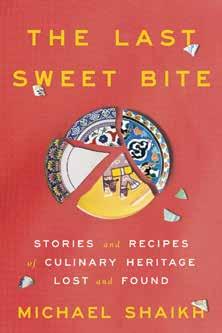
Chicago’s Taste of the Nation
FRI 6/26
The annual curated tasting event benefiting the No Kid Hungry campaign features bites from more than 50 Chicago restaurants, from Akahoshi Ramen to Giant to Mirra to Obelix to Thattu. (Rockwell on the River, 6 PM) MIKE SULA
MORE
Flavors of Albany Park Wed 6/24, 5 PM, 3043 W. Lawrence, all ages
Monday Night Foodball, the Reader’s guest chef pop-up series Mondays through June 29, 5 PM, Thattu, all ages
THIS &THAT
Bat walks in Kilbourn Park
THU 6/13 AND 6/20
Spend summer evenings armed with radar and a microphone to study the elusive bats of Chicago. Organizers call it a holy union of community science and community building, where you’ll record bat behavior during dusk on soft summer evenings in Irving Park’s nearly 12-acre Kilbourne Park. Bats are a species about which little is known, partly because they’re difficult to attach a tracker to. But recording their sounds can help scientists decipher what environments they prefer and what they’re up to, like how they hunt prey in the city, and ultimately to build cities in a more wildlife-friendly way. “You can look up and see the bats flitting around, and you can hear them, and it amplifies it, and it’s just a really neat way to kind of meet your urban animal neighbors,” says Becca Bowlin, volunteer coordinator with the Kilbourn
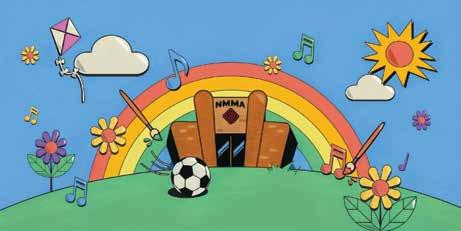
Festival del Niño
SAT 6/6
The National Museum of Mexican Art annual daylong Festival del Niño is back this June in Harrison Park! The celebration is in the spirit of Día del Niño, a worldwide holiday celebrated in the spring in Mexico, that honors childrens’ happiness and wellbeing. It’s a kid-centric day of play and joy, featuring activities like kite-flying and soccer, resource booths, games, open galleries, and more. There’s also a varied lineup of performances for the day, including Cumbia Sin Fronteras, the Jesse White Tumblers, multi-generational indie Latin trio A Flor del Piel, and All-Star Lucha Libre Wrestling. (National Museum of Mexican Art in Harrison Park, 11 AM–3 PM, free, all ages) SAVANNAH RAY HUGUELEY
Park Advisory Council. The group has partnered with the Lincoln Park Zoo again this summer for evening bat walks to track local bat activity, starting at the Kilbourn Park Fieldhouse. You’ll help solve mysteries, too. “We’re seeing if there’s more green spaces and more native gardens, does that increase bat population in certain areas?” says Caroline Kuby, president of the Kilbourn Park Advisory Council. There’s no guarantee you’ll see bats, but that only adds to the mystery and to the thrill of the crowd when you do. “Everybody gathers around and watches. It’s really exciting,” says Bowlin. (Kilbourn Park Fieldhouse, 15 minutes before sunset, free, all ages) SARAH CONWAY
Return of the Chicago Dyke March and Rally
SAT 6/27
Chicago Dyke March Collective has been protesting the corporate commercialization of pride in Chicago since the 90s, and after a multiyear hiatus, they’re returning for their 30th anniversary. The march has been held throughout the city, and this year, they’re mobilizing in Pilsen with the march leading to a rally in Dvorak Park.
The collective plans to continue to function as a bridge for Chicago dykes through regular
mutual aid, political education and action, and cultural events. Inspired by NYC direct-action group Lesbian Avengers, Chicago Dyke March Collective works to reclaim dyke as a radical politic, “fight[ing] against an oppressive world to build abundant connection,” their organizers write. (Dvorak Park, march kickoff at 1 PM, free, all ages) SAVANNAH RAY HUGUELEY
MORE
Drop-in Bike Repair & Neighborhood Ride Sun 6/7, 12–5 PM, Walls Turned Sideways, free Art of Pride Sun 6/7, noon-4 PM, Hyde Park Art Center, free, all ages
Quilt-a-Thon Sun 6/7, 12–7 PM, Old Irving address shared week of Neutral Gena’s Perfect Pride Party Sun 6/7, 6 PM, Color Club
Inside Audio: Vinyl Records Recorded in Midwest Jails and Prisons Fri 6/12, 6:30–8:30 PM, Walls Turned Sideways, free Radical Caregivers Abolitionist Playdate Sat 6/13, 10 AM–12 PM, Welles Park Nature play space, free, all ages
Summer Soundwalks in the Parks, Listening to Useful Radio, Jeff Kolar Sat 6/13, 3 PM, Ping Tom Park, free, all ages
It’s On Us: A Day of Art and Action, including concert featuring Jamila Woods, Taína Asili, & Damon Williams Sat 6/13, 4–8 PM, DuSable Black History Museum and Education Center, free, all ages
South Side Family Pride Sun 6/14, Beverly Unitarian Church, 1 PM, free, all ages
Disco Kitchen volume 3: reading and dance party Sun 6/14, 7 PM, The Whistler
Transcendence: A Black Trans Variety Show! Fri 6/19, 9:30 PM, the Newport Theater
Juneteenth 2026: Black Joy & Wellness hosted by Brown People Foundation Fri 6/19, 2–6 PM, Promontory Point, free, all ages Black to the Future: An Afrofuturistic Juneteenth day party Fri 6/19, 2–7 PM, Co-prosperity Embodied, a Juneteenth x Pride variety show Sat 6/20, 7:30 PM, Thalia Hall
Black JoyRide Sat 6/20, location and time TBA Summer Soundwalks in the Parks, Passing Sound: Exploring the 606 Lia Kohl Sat 6/20, 12 PM, Julia de Burgos Park
Stud4Life’s 4th Annual Southside Pride Sat 6/20, 4 PM, 9030 S. Hermitage, free Red Line Jazz Project Thu 6/25, 6–8 PM, Mahalia Court near 79th, free, all ages
Pride South Side: Love in Action Festival Sun 7/5, 11 AM–9 PM, DuSable Black History Museum and Education Center, free
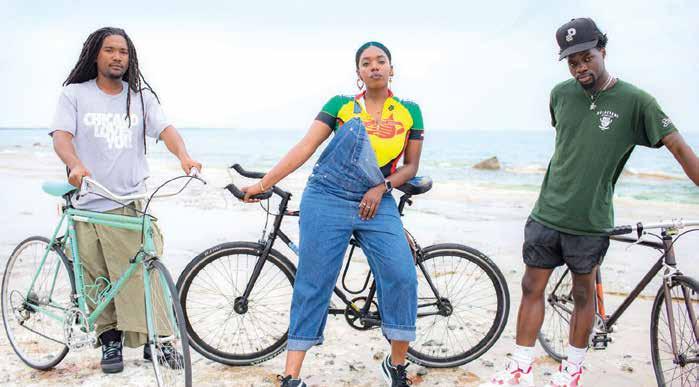
Black JoyRide Sat 6/20, location and time TBA
COURTESY NMMA
COURTESY PENGUIN RANDOM HOUSE
COURTESY BLACK JOYRIDE
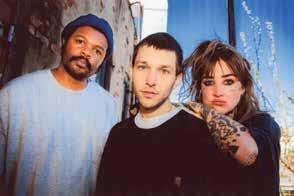
CLASSIFIEDS
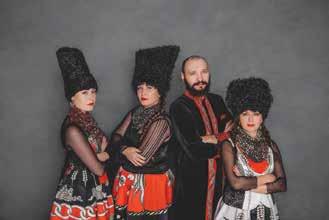
FRI JUNE 5 • SAT JUNE 6 • SUN JUNE 7
The Working Songwriter Forum
Joe Pug, John Moreland, David Ramirez, Rachel Baiman, and Jonas Friddle
A weekend of concerts, workshops, podcasts & more
WED JUNE 10 • 7PM
Dave Eggers: Contrapposto
The Pulitizer Prize finalist on his latest novel
THU JUNE 11 • 8PM Kelly Willis & Radney Foster
FRI JUNE 12 • 7PM Billy Eichner
The Billy On The Street icon on his audio memoir Billy on Billy
FRI JUNE 12 • 8PM Darrell Scott
SAT JUNE 13 • 8PM
Michael J. Miles and Jill Kaeding
FRI JUNE 19 • 7:30PM Juneteenth Celebration feat. Freddie Dixon Blues Band
SUN JUNE 21 • 6PM
National Tap Day with Reggio “The Hoofer” McLaughlin
FRI JUNE 26 • 8PM The Sullivan Sisters
FRI JUNE 26 • 8PM Tracy Bonham
SAT JUNE 27 • 7PM
Joel Styzens: Relax Your Ears
THU JULY 9 • 8PM Dehd
FRI JULY 25 • 8PM DakhaBrakha
CONCERTS
JULY 10 • 11• 12 IN

AUDITIONS
DM/EDM Artists Wanted. Thank you. idm-edm.com
Looking for female singer(s),25-35 yrs.Dance Music Creator on Northside.Just music business. ChicagoRilla ittakesasaint@gmail.com

JOBS
Associate Therapist in Chicago, IL. Must have Master Degree in Marriage & Family Therapy 1 yr of exp. as MFT. Multiple Openings. Wage $51334. Provide individual, couple & family psychotherapy to clients. Maintain confidence under Illinois laws & Fed HIPAA guidelines. Complete administrative documentation w/ clients & discuss details of documentation & therapeutic relationship, including limits of confidentiality, Complete clinical paperwork including: treatment plans w/ goals, objectives & desired outcomes; notes for each session that include objective & subjective assessment, interventions used, response to interventions, movement toward desired goals, & time for next session; Releases of Information for outside professionals. Comply w/ guidelines set up in Policies & Procedures manual Attend regular supervision if unlicensed, in accordance w/ policies and procedures & ethics and regulations of their profession. Send resume to: Northside Center for Relationship Counseling, P.C. DBA Chicago Center for Relationship Counseling, 5100 N Ravenswood Ave, Suite 208, Chicago, IL 60640.
Cheetah Express, Inc. seeks a Logistics Analyst. Mail resume to 835 Greenleaf Ave, Elk Grove Village, IL 60007
Cost Estimator, F/T, 24 months of experience as Cost Estimator, Cost Engineer, Cost Analyst, or Related. Mail resume: Kevin Walsh Excavating Inc, 31006 N IL Rte 83, Grayslake, IL 60030
Oracle PL/SQL Software Developers, Oak Brook, IL: Investigate & analyze data anomalies / issues report by business. Work w/ ETL, Replication & DBA teams to determine data transformations, movement & derivations & document accordingly. Operationalize next generation analytics solution suite using Oracle PL/SQL, Cloud (AWS) & Big Data technologies. Travel to various unanticipated US locs as reqd. Salary: $136,885 - $138,000/yr. Std. co benefits. Send res to: Maxil Technology Solutions, Inc., info@ maxiltechnology.com.
Oracle PL/SQL Software Developers, Oak Brook, IL: Investigate & analyze data anomalies / issues report by business. Work w/ ETL, Replication & DBA teams to determine data transformations, movement & derivations & document accordingly. Operationalize next generation analytics solution suite using Oracle PL/SQL, Cloud (AWS) & Big Data technologies. Travel to various unanticipated US locs as reqd. Salary: $136,885 - $138,000/yr. Std. co benefits. Send res to: Maxil Technology Solutions, Inc., info@ maxiltechnology.com.
Senior Accountant in Chicago, IL. Must have Master Degree in Accounting; 6 mos of accounting related exp. Prepare fed, state &local income tax returns for individuals & small businesses, ensuring compliance w/ govt tax reqs. Review taxpayer returns & finances & provide tax advisory to help clients achieve their long-term financial goals. Perform in-depth tax research & analysis to support tax preparation. Maintain up-to-date knowledge of fed, state, & local tax regs. Represent clients before taxing authorities. Review & verify tax info provided by clients for completeness & consistency. Comply w/ internal work procedures & work closely w/ other associates on various accounting related projs. Wage: 76544. Send resume to: Jun Zhou CPA Ltd 625 N Michigan Ave, Ste 1705, Chicago, IL 60611.
Senior Software Engineer, Chicago, IL, for Team TAG Services, LLC. Design, develop, & implement company’s web & mobile applications. Req’d: Bach. or higher degree (or foreign equiv.) in Comp. Sci., Comp. Eng., IT, or a related field & 4 yrs’ exp. in front-end development using React, Angular & TypeScript. Salary/Benefits: $172,613.58/yr & a generous benefits pkg. that includes paid time off, health, dental, vision, & 401(k) savings plan w/ match. May work remotely once/week. Resumes to Code AN-SSE, J. Ximenes, TAG, 800 W Fulton Market, Chicago, IL 60607 (juliana. ximenescoutinhodias@teamtag. com).
Senior Software Engineer, Chicago, IL, for Team TAG Services, LLC. Build & modernize company’s websites, with a focus on quality, leveraging tools such as Javascript, Typescript, Cypress & Playwright. Req’d: Bach. or higher degree (or foreign equiv.) in IT or closely related field & 2 years of experience in software eng. or development. May work remote up to 1 day/wk. Salary/Benefits: $162,052.50/ yr & a generous benefits pkg. that includes PTO, health, dental, vision, & 401(k) savings plan w/ match. Resumes to Code SG-SSE, c/o Juliana Ximenes, TAG, 800 W Fulton Market, Chicago, IL 60607 (juliana. ximenescoutin hodias@teamtag. com).
Sinai Medical Group seeks Hospitalists (Multiple Openings) in Chicago, IL: Provide primary medical care to hospitalized patients. Reqs. medical degree or equiv., IL physician lic. & completion of internal medicine or family medicine residency. Commute daily to at least one of Sinai’s facilities in Chicago’s West & SW Side: Mount Sinai Hospital Med. Ctr. of Chicago, Holy Cross Hospital & Schwab Rehabilitation Hospital. Salary range: $240,000 - $285,000. Benefits: https://email. eoiservice.com/sinai-benefitshome. Send CV to M. Liboy at Marina.Liboy@sinai.org.
Moroz Financial Group PLCC in Chicago, IL seeks Exec. Accounting Assistant w/BA in Acct, Fin or rltd & 1 yr exp in acct. Knwl of acct. software & transportation & logistics industry practices req’d. Send resume: dmitrymoroz@morozfinancial. com
The Dept of Communication at the Univ of IL Chicago, located in a large metro area, is seeking fulltime Assistant Professor to: Teach undergraduate & graduate courses in AI & representation & advise/ mentor students. Conduct research on platform politics; generative AI and bias; interfaces of the future. Conduct University service & other duties, as assigned. The salary range for this position is $80,000 to $94,000. This position minimally requires a PhD or its foreign equivalent in Communication or a related field. For fullest consideration, please submit CV, cover letter, and 3 professional references by 06/20/2026 to Princy Daniel, University of IL Chicago, 1007 W. Harrison St, Ste 1140C, Chicago, IL 60607 or via email to pdanie7@uic.edu
This position is intended to be eligible for benefits. This includes Health, Dental, Vision, Life, Insurance, a Retirement Plan, Paid time Off, and Tuition waivers for employees and dependents. For a complete list of Employee Benefits: https:// tinyurl.com/4hfa7fky. The University of IL System is an equal opportunity employer, including but not limited to disability and/or veteran status, and complies with all applicable state and federal employment mandates. Please visit https://tinyurl. com/mrzy3 e to view our non-discrimination statement and find additional information about required background checks, sexual harassment/misconduct disclosures, and employment eligibility review through E-Verify. The university provides accommodations to applicants and employees. Request an Accommodation here https://tinyurl. com/mudpdk7d. Artificial Intelligence (AI) tools may be used in some portions of the candidate review process for this position; however, all employment decisions will be made by a person.
Aviation Consultant. Aviation ops, analysis, modeling. Bach. deg (Aviation Management or related) req’d. Completion of coursework in aviation biz, aviation finance, aviation economics, aviation ops man’g’mt, & financial modeling req’d. Proficiency w/ a) R programming lang. in analysis of air travel demand &/or other elements of airports & aviation industry; b) applying ArcGIS to identify landside access to airports &/or perform airport catchment area study & c) aviation databases, such as TSA Checkpoint Travel Numbers, to collect, sort, & analyze related data to aircraft/airline/ airport operations req’d. The base pay range for this role is $87,450/ year to $118,000/year. The base salary range/hourly rate established for a job offer is dependent on job-related, non-discriminatory factors such as experience, education, & skills. EOE. Benefits
incl. ESOP Participation & 401(k) w/ match, 100% employer paid health, dental & vision, PTO & holidays, tuition reimbursement, disability & life insurance, & flex spending accounts. Resumes to: Recruiting, Ricondo & Associates, Inc., 200 N LaSalle Street, Suite 2900, Chicago, IL 60601 or via email to scjobs@ricondo.com
Sinai Medical Group seeks Psychiatrist in Chicago, IL: Diagnose & treat patients with psychiatric & mental health conditions. Reqs. medical degree or equiv., IL physician lic. & completed psychiatry residency. Commute daily to at least one of Sinai’s facilities in Chicago’s West & SW Side: Mount Sinai Hospital Med. Ctr. of Chicago & Holy Cross Hospital. Salary: $340,000/yr. Benefits: https:// email.eoiservice.com/sinai-benefits-home. Send CV to M. Liboy at Marina.Liboy@sinai.org. Supply Chain Planners, Lisle, IL: Order, review & place PO based upon minimum stock level & SO qty w/ vendor. Send weekly raw materials reqt to overseas sister companies. Communicate w/ CSR. Routine inventory analysis. 5%-10% domestic travel reqd. Some job duties can be performed from home. Salary $70,000$90,000/yr. Std company benefits. Send res to: HuberGroup USA Inc., selina.surface@ hubergroup.com

SERVICES WE CUT UP IN THE UPPER ROOM BARBERSHOP! PHONE: 773-289-8240 EMAIL: THEUPPERROOMBARBERSHOP0@ GMAIL.COM
MATCHES
EXCEPTIONAL Divorced SJM 78, SEEKING EXCEPTIONAL WOMAN 69 TO 76. WILL SEND PROFILE IF YOU’RE INTERESTED. THIS IS HOW I MET MY WIFE 33 YEARS AGO. Curious? au2gold@aol.com au2gold@aol.com
Handsome Christian Mixed blk/ french male 55+ fairly fit musician looking for an attr Christian woman 37-77 all races welcome for marriage.Lets becomeacquaintances.NorthsideChgo Michael 8727776265 txt ittakesasaint@ gmail.com
Hot n spicy in chicagoland n N.W.I. (MIMI MUNROE) 219-244-7476
Mature handsome passionate christian sbm over 50 seeking Asian/Latina over 25 for relationship and possibly marriage,Northside Chgo {Gemini Rising}.Michael txt/talk 872 7776265 ittakesasaint@gmail.com
ADULT SERVICES
Meet local Singles By Phone! U.S.Chat is the oldest chat line and is back! Spring fling? Record your own




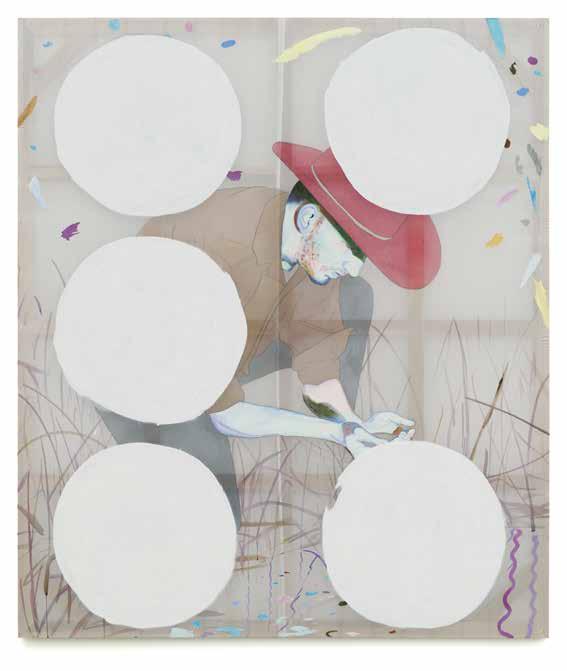
ON VIEW THROUGH AUG 16, 2026
City in a Garden: Queer Art and Activism in Chicago celebrates the history and future of the city’s LGBTQ+ community by bringing together work from over 30 artists and collectives working in Chicago from the 1980s to the present.
@mcachicago mcachicago.org
Paul Heyer, Drinking Water (Cowboy), 2017. Oil, acrylic, and glitter on metallic silk; 84 × 72 1/16 in. (213.4 × 183 cm). Collection Museum of Contemporary Art Chicago, Gift of Katherine S. Schamberg by exchange, 2018.9. © 2017 Paul Heyer. Photo: Nathan Keay, © MCA Chicago.