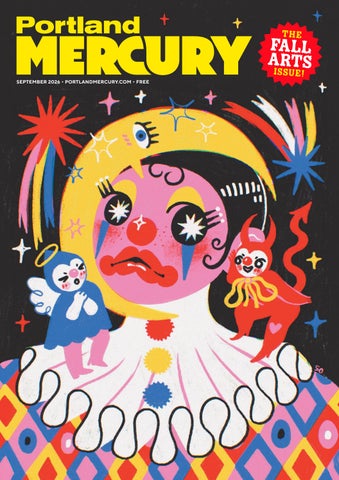
T HE
SEPTEMBER 2026 • PORTLANDMERCURY.COM • FREE
FALL AI RTS SSUE!
SEPTEMBER 2026
Publisher
ADVERTISING & MARKETING COORDINATOR
Olivia Hunt
James Deeley
Marketing
Editorial
HEAD OF MARKETING
Rachel Milbauer
EDITOR-IN-CHIEF
Wm. Steven Humphrey
EMAIL MARKETING LEAD
Andi Carmichael
MANAGING EDITOR/FOOD EDITOR
Katherine Chew Hamilton
EMAIL PRODUCTION
Tonya Ray Tyra Triche
NEWS EDITOR
Courtney Vaughn
Art & Production
NEWS REPORTERS
Taylor Griggs Jeremiah Hayden
CREATIVE DIRECTOR
Corianton Hale
ARTS & CULTURE EDITOR
Suzette Smith
ART DIRECTOR
Anthony Keo
MUSIC SECTION EDITOR
Starly Lou Riggs
PRODUCTION MANAGER
Char Harris
STAFF WRITER
Lindsay Costello
PRODUCTION DESIGNER
Shira Friedman-Parks
CONTRIBUTING WRITER
Janey Wong
Technology & Development
Social Media
LEAD DEVELOPERS
Michael Crowl Nick Nelson Jay Jansheski
SOCIAL MEDIA EDITOR
Andrew Harlan
Advertising
DEVELOPER
Chaytan Inman
SENIOR ACCOUNT EXECUTIVES
Katie Peifer Anna Nelson
IT MANAGER
Grant Lewicki-Hendrix
Business
HEAD OF PRODUCTION
FOUNDER/CHAIRMAN
MARKETING & PRODUCTION COORDINATOR
PRESIDENT/CFO
Rob Crocker
Noisy Creek Podcasts
CRO
EXECUTIVE DIRECTOR
HEAD OF FINANCE & OPERATIONS
EXECUTIVE PRODUCER
Lindsay Powers Lauren Taylor
Brady Walkinshaw
Dan Brown
Patrick Kearney
Katie Lake
Nancy Hartunian
HEAD OF HUMAN RESOURCES
SENIOR PRODUCER
Alia Graham
Celene Ramadan
CHIEF STRATEGY AND COMPLIANCE OFFICER
Kendall Turner HEAD OF PRODUCT
EverOut EVEROUT MANAGER
Anthony Hecht
Katya Schexnaydre
STRATEGIC ADVISOR
CONTENT LEAD
Tim Keck
Janey Wong
MEMBERSHIP DIRECTOR
DATA MANAGER/STAFF WRITER
Caroline Dodge
Shannon Lubetich
DIRECTOR, STRATEGIC PROJECTS
STAFF WRITERS
Luke Lamb
Bri Brey Langston Thomas
ASSISTANT TO BRADY WALKINSHAW
Taylor McCormick
Bold Type Tickets
AP/AR COORDINATOR
Surprise Paradiso
DIRECTOR OF BOLD TYPE TICKETS
Kevin Shurtluff
Noisy Creek Productions
CLIENT SOLUTIONS MANAGER
Diana Schwartz
DIRECTOR OF EVENTS
Tim Neill
HEAD OF MARKETING & CREATIVE
PROJECT MANAGEMENT/ CLIENT SOLUTIONS REPRESENTATIVE
HEAD OF CONTENT & COMMUNITY
CUSTOMER SOLUTIONS REPRESENTATIVE
FEATURE PACKAGE EDITOR
Lindsay Costello, Katherine Chew Hamilton, and Wm. Steven Humphrey
Campy Draper
Rou Leonard Allie Huska
Anita Chao
ASSISTANT EDITORS
Suzette Smith
THE
FALL AR TS ISSUE SEPTEMBER 2026 • PORTLANDMERCURY.COM • FREE
!
COVER ILLUSTRATION Sonia Lazo so-lazo.com
THE PORTLAND MERCURY PO Box 86208 Portland, OR 97286 VOICE (503) 294-0840 Mon–Fri, 9 am–5:30 pm; editor@portlandmercury.com
3
4 THE MERCURY’S FALL ARTS ISSUE
Spend time on the Oregon Coast exploring art, live music, local makers, cultural celebrations, and the creative spirit that flows through Newport. ARTWORK BY KRIS BUENGER
FEATURED EVENTS
Newport Oregon Pride • Sept. 18-20 Newport Symphony Orchestra • Sept. 26-27 Oregon Coast Jazz Party • Oct. 2-4 What’s New in Newport • Oct. 10 Arcoíris Cultural Día de Muertos • Nov. 1 Oregon Coast Art Show • Nov. 13-14
SEPT 15 - NOV 15 PLAN YOUR CREATIVE COASTAL GETAWAY
Explore the full festival lineup and book your fall escape to Newport. DISCOVERNEWPORT.COM
SEPTEMBER 2026
The Mercury’s 2026 Fall Arts Issue Reality is chaos. The theme is clowns.
T
his spring I took my partner to the hospital, and then essentially lived there at his bedside for the next two months, sucking up to doctors and sleeping in recliner chairs. He lost. I lost. We lost. I am a person who communicates for a living, but I doubt I’ll ever be able to understand everything that happened there, let alone describe it. So instead I’ll tell you about a particular tapestry that hangs in one of the busier hallways of Oregon Health and Science University. I walked past it most days, and in the moments when my eyes paused upon its moiré of tightly woven colors, I knew I was having a conversation with it that would also be hard to put into words. In “Precipitation,” by Judith Poxson Fawkes threads of blues and greens and yellows and the occasional pink lock tightly in tartan-like rows. The overall motion is down, but there’s another loud pattern slanting to the side. Anyone who’s lived in the Pacific Northwest long enough has met rain in its sideways form. It doesn’t like to be sideways, but it must be for a time. Whenever I passed “Precipitation,” I felt the work thundering in sheets, pungent with nature, and in a constant state of falling from the sky. The conversation between us had to do with rain in Portland, which I love, and the thought that if I lost everything, I would still have that. After my partner died, I didn’t care if the pain ever stopped because it was very diffuse, like the Portland rain that is merely mist and makes itself known through condensation. I remember these conversations with a tapestry because pro-
cessing is a real pain in the ass. But one of the more magical things that can happen in this life is when a piece of art transforms in the mind of its observer. Art can simply go places that meaning cannot. Here in a midterm election year, as we look to art to reflect or parse the world, it makes complete sense that artists would be drawn to chaos. And that some artists would turn to clowning. The influence of clowning on Portland’s theater scene is undeniable, and, in this issue, the Mercury is here to respect their particular form of chaos. You’ll find a profile of writer and performer Anthony Hudso n , w h o h a s retired his longstanding persona of Portland’s premier drag clown Carla Rossi, but is about to release a collection of plays where Carla is the star. You’ll also find a story about the Cuomo Theatre Fund, which builds on the legacy of CoHo Clown Cohort leader Phillip Cuomo to create stability and synergy in the local theater scene. There’s even an “experimental clown artist” at this year’s Time-Based Art Festival—Alex Tatarsky, whose work “ushers audiences through an absurdist hellscape of the mind.” And, because you need some business as usual to throw your clowns into relief, we’re also looking ahead to gallery shows, soon-to-open movies, and the 15-year anniversary of local makerspace ADX. Right now, to me, everything is chaos. When I realized the theme would be clowns, I thought: Yeah, that tracks. Thank goodness for themes, but also, the fact that not everyone follows the theme. Suzette Smith Arts & Culture Editor
3901 N Mississippi Ave 503-281-0453 •sunlanlighting.com
All your bulbs for office and home Find our cartoons on Instagram, Twitter and Facebook
5
6 THE MERCURY’S FALL ARTS ISSUE
SEPTEMBER 2026
TABLE OF CONTENTS The Trash Report . . . . . . . . . . . . . . . . . . . . . . . . . . . . . . . . . . . . . . . . . . . . . . . 9 Middle-aged women rarely make history, and more of the latest hot gossip.
Test of Faith . . . . . . . . . . . . . . . . . . . . . . . . . . . . . . . . . . . . . . . . . . . . . . . . . . 10 A family navigates their son’s arrest and incarceration for assaulting an ICE officer.
The Black Byline . . . . . . . . . . . . . . . . . . . . . . . . . . . . . . . . . . . . . . . . . . . . . . .14 A Q&A with Amazon labor union organizer Chris Smalls on the next working class revolution.
Put Down the Clown! . . . . . . . . . . . . . . . . . . . . . . . . . . . . . . . . . . . . . . . . . . 18 Lamp Back is Anthony Hudson’s farewell to his clown persona, Carla Rossi.
Clowning for the Culture . . . . . . . . . . . . . . . . . . . . . . . . . . . . . . . . . . . . . . . .21 Philip Cuomo’s legacy inspires fundraising for arts security, community, and clowning.
Wildwood’s Portland Roots . . . . . . . . . . . . . . . . . . . . . . . . . . . . . . . . . . . . 23 Laika’s most ambitious stop-motion film includes 136 recognizable local locations.
Twelve Movies To Put on Your Calendar This Fall . . . . . . . . . . . . . . . . . 25 Video game adaptations, vanity biopics, and vore are back on the menu!
Creative Xchange . . . . . . . . . . . . . . . . . . . . . . . . . . . . . . . . . . . . . . . . . . . . . 27 ADX Fest will put Portland’s indie art scene on display for a full month.
Strange, Dark Magic . . . . . . . . . . . . . . . . . . . . . . . . . . . . . . . . . . . . . . . . . . 29 Shaking the Tree adapts a quartet of Caryl Churchill’s one-act plays.
Time-Based Art as a Wild Weekend . . . . . . . . . . . . . . . . . . . . . . . . . . . . .31 Everything familiar, strange, and incorporeal smushed into PICA’s five-day fest.
Fall Art Goes Back to School . . . . . . . . . . . . . . . . . . . . . . . . . . . . . . . . . . . 34 A peek at fall’s exciting new gallery shows, all of which get an A+.
Fake It ’Til You Make It . . . . . . . . . . . . . . . . . . . . . . . . . . . . . . . . . . . . . . . . . 37 Olivia Vavroch can teach you to make everything from medieval appetizers to creepy charcuterie.
Lloyd Center Elegy . . . . . . . . . . . . . . . . . . . . . . . . . . . . . . . . . . . . . . . . . . . . 39 On its last day, the soon-to-be-demolished Portland mall brimmed with energy and crowds.
The History We’ve Built . . . . . . . . . . . . . . . . . . . . . . . . . . . . . . . . . . . . . . . . .41 In Search of Portland reveals an evolving, ever-changing city—one building at a time.
A New Look at Elliott Smith . . . . . . . . . . . . . . . . . . . . . . . . . . . . . . . . . . . . 43 Nobody Broke Your Heart explores the beloved singer-songwriter with new depth.
Press Play . . . . . . . . . . . . . . . . . . . . . . . . . . . . . . . . . . . . . . . . . . . . . . . . . . . . 45 Making Music is a collection of interviews from Tape Op magazine.
One of Everything, Please . . . . . . . . . . . . . . . . . . . . . . . . . . . . . . . . . . . . . . 47 Alma serves up an all-you-can-eat feast of small plates for $55.
Do This, Do That: Our Fall Entertainment Calendar . . . . . . . . . . . . . . . 49 Jam-packed with the best shows, readings, music, and more!
How to Talk About Art . . . . . . . . . . . . . . . . . . . . . . . . . . . . . . . . . . . . . . . . . 57 Riley McCarthy on how to discuss art (when you know literally nothing about it.)
The Faults In Our Stars . . . . . . . . . . . . . . . . . . . . . . . . . . . . . . . . . . . . . . . . 59 The only horoscopes column in the universe, for September 2026.
Savage Love . . . . . . . . . . . . . . . . . . . . . . . . . . . . . . . . . . . . . . . . . . . . . . . . . . .61 Get your love and sex questions answered lickety-split in this edition of “Quickies”!
Fun Page . . . . . . . . . . . . . . . . . . . . . . . . . . . . . . . . . . . . . . . . . . . . . . . . . . . . . 63 Who wrote that morose prose: Edgar Allan Poe or Death Cab for Cutie’s Ben Gibbard?
Family Style Customer Service
Delivery Service • Custom Cutting • Special Orders 7609 S.E. Stark Street Portland, OR 97215 Phone: 503.254.7387
www.mrplywoodinc.com
7
8 THE MERCURY’S FALL ARTS ISSUE
SEPTEMBER 2026
THE TRASH REPORT
BY ELINOR JONES
Middle-Aged Women Rarely Make History
.M CC
O
GE
TT
YI
MA
GE
S
Leave Women Alone. (Some Women.)
Republicans have recently put themselves into dueling tizzies because of the existence of two women in their mid-30s. First off: Jon Osoff called out Trump for spending all his time with his “human printer” Natalie Harp. Harp is a 35-yearold conservative blonde woman who catapulted out of background status to become the leading blonde in Trump’s orbit. Most people are lolling at what a stalker freak she is, while the MAGA crowd is rushing to defend her youthful virtue. (But like, at 39, Osoff isn’t so much mocking a younger person as he is roasting a peer. They were both in middle school for 9/11.) You know somebody has gotten under Trump’s skin when he presents them with a nickname, and he has started calling Osoff Pee-Wee Herman. Pee-Wee Herman? Because he’s white with dark brown hair? Pathetic. Besides, Osoff has a good chin, whereas Pee-Wee Herman did not. And neither does Trump, which means Osoff has a legit, true opportunity to hit him back with “I know
you are, but what am I?” (The only thing that could stop Osoff from such a comment is because, at 39, he might be too young to have been a fan of Pee-Wee. Ouch.)
Karaoke Kringe
Hillary Clinton, Lin-Manuel Miranda, and Paul Rudd are hosting a karaoke fundraiser to defend democracy. What in the 2015 kind of move is this? Who are the other special guests, Louis CK and Left Shark? Who in the world is going to Pokémon GO to this? I’m not sure if this is defending democracy as much as it is promoting bullying of whoever wants to go. (In all honesty, I would go, but I’m embarrassing. You can bully me.)
Trends in Clean Eating
The latest food horror news: Some frozen blueberries and mixed berries are being recalled due to E. coli contamination and what the FDA has warned is a “reasonable probability of serious harm or death.” Also, some soft cheeses may contain listeria, and we’re coming off months
Rose City
I recently attended my first Portland Fire game at the Moda Center, and much to all of our elation, the team debuted a new mascot, a glittery pink dragon named Rose. I love her despite not catching any of the shirts she T-shirt-cannoned into the crowd. It was a really magical event, and I am so glad this state boasts not one, but two professional basketball teams, as well as the occasional old amusement park that provides a charming sense of TT GE danger. R/ HE C IS D Thank you for reading and RA ALI G for being my best friends. ES
NM
K/
AG
ON AC
CelebriDeez Nuts
Our fragile nation came together to mourn the death of beloved human Dolly Parton. We are so lucky to have had her. The rest of the world mourned as well; I saw a video on Instagram of the British royal guard performing “9 to 5.” And then I got mad. She was an American. She was ours. So I was still stewing about that when I saw the news that British character actor Tim Curry died, and despite my being American, I cared. In the blink of an eye I learned an important lesson about the egalitarianism of art and artists. (Although I still hate the monarchy!) Margaret Qualley attended a recent movie premiere wearing Chanel shoes that can only be described as “not shoes.” They are basically a little thingy under the heel with string wrapped around the ankle, but the front half of the foot and toes are completely loose. It’s gross, but I will give her some grace: She is allegedly getting divorced, and nothing says “I’m going home alone and IDGAF” like having dirty-ass feet. Also, if she’s living alone now, she’s got to have way more bills. Pics of those nasty dogs could yield a very tidy sum. Speaking of celebrity relationships, Ariana Grande is fully openly dating Ricky Alvarez again, which has made them a paparazzi target. My concern about the latest round of pap pics is not her body—I’ll remain the single gossip columnist not to have an opinion there— but rather, her clothes. First Ariana was pictured wearing an oversized white cardigan over jeans, and later on, she was pictured carrying that large cardigan, revealing that the shirt beneath it was… another white cardigan?! That is a crazy outfit. Why not just wear one medium-warm cardigan? I am constantly in my head defending this woman’s choices about her relationships and body, but I draw the line at defending her sweaters.
Fringe Comedy
Amanda Knox, who was tried for her roommate’s murder in Italy just over 15 years ago, is continuing to process her trauma from the ordeal, this time through a comedy performance at the Edinburgh Fringe Festival called Cartwheel. This is a nod to allegations that she was doing cartwheels at the police station after the death. I think it’s a great way to pay some bills and try to change how she might be known. Like, she wasn’t a murderous American college student, she was a whimsical American college student! Who could ever be afraid of a woman who is upside-down? Let the lady get paid. Speaking of upside-down, two of the teenagers who were trapped hanging upside-down on the AtmosFear at Oaks Park were each awarded $275,000 for the ordeal. Which begs the question: Would you dangle upside-down at Oaks Park for a half hour for $275,000? I certainly wouldn’t. But then it begs another question, which is: How much would it take? Everybody’s got a price. At some point, we’d all dangle for a fat payday. For me, it would take an amount I could retire off of. I’d need to be cush enough financially that I wouldn’t have to eventually repurpose the trauma into a standup show.
IM
EAM RM
of fearing lettuce. Let’s look at the bright side: Nobody can be embarrassed to have explosive diarrhea when everybody has explosive diarrhea. RFK Jr’s office of Health and Human Services has put out a single comment on the matter: “Yum!”
Y
H
i, Trash Pandas! Welcome to the Trash Report. I am Elinor Jones, and this is a very special Trash Report because it’s for our very special ARTS ISSUE! Hey, did you know that if you rearrange the letters in TRASH, it spells ARTS, with only the H leftover? I think that says a lot about my place in this issue. To prove it to you, let’s gossip. :)
9
Artfully,
10 THE MERCURY’S FALL ARTS ISSUE
Jacob Hoopes at home.
Test of Faith
A family navigates their son’s arrest and incarceration for assaulting an ICE officer. PHOTOS AND WORDS BY TAYLOR GRIGGS
O
n a Monday afternoon last July, Jacob Hoopes appeared in court for the first time. The Friday morning prior, armed FBI agents had shown up to his Portland home. They handcuffed Hoopes and two others who were at the house, raided the home, and took him to jail, where he stayed for three nights. In court, prosecutors accused Hoopes of engaging in criminal activity during a protest outside Portland’s ICE facility more than a month prior. He was charged for throwing a rock at an ICE officer inside the building, leaving the officer with a gash on his face that required medical treatment. Hoopes was also charged with damaging federal property in excess of $1,000. While Hoopes was in jail, largely in the dark about his legal situation and wor-
rying about what the future might hold, people began mobilizing on his behalf. His father, Tom, who lived in Pennsylvania, flew to Portland almost immediately after hearing about his son’s arrest. Before Hoopes’ first court hearing, Tom Hoopes
“If anyone’s going to be doing this, I’m glad it’s me.” led a rally outside the federal courthouse in downtown Portland. Several dozen people showed up to demonstrate their support, many of whom were members of Portland’s Quaker community—a religion the Hoopes family is deeply connected to. On July 23, 2026, almost exactly a year
after he was arrested, Hoopes, now 25 years old, surrendered himself to authorities and began a 30-month prison sentence. He’s now a little more than a month into his sentence at Sheridan Federal Correctional Institution, located about 50 miles southwest of Portland. He was assigned to the facility’s minimum-security satellite camp, meant to house people deemed low-risk. While Hoopes isn’t the only person arrested for their actions at a Portland ICE protest in the last year and a half, he is one of the few to face prison time. Hoopes’ story is unique in other ways, too, including because of the strong network of support he has to help him through the next two and a half years, and beyond. “If anyone’s going to be doing this, I’m glad it’s me,” Hoopes said, referring to his prison sentence. “I’ve got a lot of folks [rooting] for me.”
In several conversations with the Mercury before Hoopes went to prison, he and his father reflected on the past year of their lives. In the year between his arrest and the start of his prison sentence, Hoopes remained active in public life, attending City Council meetings and taking urban planning classes at Portland State University. But Hoopes’ and his family’s lives changed significantly, too. His arrest forced his parents to reexamine their role in their adult child’s life, and ultimately, they uprooted their lives to be closer to their son. The case has also sparked significant conversation about the family’s Quaker faith, which informed their response to Hoopes’ arrest. Earlier this summer, Hoopes’ parents— along with a small army of pets—moved from their home state of Pennsylvania to Portland. For his father, this meant leaving
SEPTEMBER 2026
a longtime job at a Quaker boarding school outside Philadelphia. Tom Hoopes was an educator in Pennsylvania for nearly 30 years. Hoopes’ mother, Beth, is an artist. “Fom a certain point of view, what we’re doing is crazy,” Tom Hoopes said. “But... there’s been tremendous affirmation and support for the choice that we’ve made. Because I think there’s a recognition that the universe has called our bluff, and we’re showing up.”
The protest and arrest
On June 14, 2025, tens of thousands of Portlanders gathered downtown for a “No Kings” anti-Trump march. As the demonstration winded down, a few hundred people split from the larger group and headed for the ICE facility in Portland’s South Waterfront. Small groups of protesters had been gathering regularly at the ICE building for several weeks at that point, in response to Trump’s increasingly frequent and aggressive deportations of immigrants and asylum seekers around the country. Just days earlier, the Trump administration authorized sending thousands of National Guard and Marines members into Los Angeles to quell the large, mostly-peaceful protests that broke out in response to a major deportation campaign there. In the weeks before the protest, several asylum seekers were detained in Portland after attending mandated immigration court hearings. Hoopes was in the crowd that made its way from the No Kings march to the ICE facility. The group arrived just before 5 pm to an already-heated scene, and tensions quickly escalated further as the crowd of protesters grew. Hoopes said when he arrived, federal agents had already begun deploying tear gas, and someone gave him a gas mask. Federal officers at the ICE building were also shooting less-lethal munitions like pepperballs into the crowd, sometimes hitting protesters. Hoopes made his way toward the front of the crowd, near the ICE facility’s door. In his sentencing statement, he described the scene that followed. “I didn’t want myself or others to be shot more, nor did I feel it was right or moral for the armed agents to be shooting people in general, so I tried to help wedge the door shut,” Hoopes wrote. “To ward the armored people back, with adrenaline narrowing my focus and pepperballs and tear gas burning my eyes and skin, I threw a rock at the guards through one of the partially opened doors of the facility.” In the sentencing statement, Hoopes said though he knew there were people on the other side of the door, he didn’t, at that moment, think he was capable of hurting them. “At that point in time, I was under the impression that these agents were invulnerable,” Hoopes wrote. “That impression was wrong.” Prosecutors also accused Hoopes of damaging the ICE facility by accompanying a group of people in striking the door with an upended stop sign. The property damage charge was dropped in Hoopes’ plea agreement, but makes up the bulk of the roughly $8,000 restitution payment he is expected to make. Federal prosecutors
sought only $350 for the ICE officer’s medical bills. Hoopes said he was shaken by the events of June 14. But it wasn’t top of mind six weeks later, when he looked out his bedroom window and saw several large, black SUVs pulling up on his street. As he described it, more than a dozen federal agents emerged from the vehicles, armed and wearing bulletproof vests, and headed toward his front door. Hoopes said his first reaction was confusion, believing the officers had the wrong house. Through the door, he asked the officers to see an arrest warrant, but said his request was ignored. (Court records show officers did receive a warrant the day before Hoopes was arrested.) It didn’t take long for Hoopes to open the door, fearing for his life if he didn’t. Hoopes, his partner, and his roommate were all taken outside, handcuffed, and made to wait while officers searched their home. Eventually, Hoopes’ partner and roommate were dismissed, and he was taken to jail. In February, Hoopes pleaded guilty to the assault charge, setting him up for a shorter prison sentence than the possible 20-year sentence prosecutors initially threatened. At his June sentencing hearing, Assistant US Attorney Leah Bolstad urged the judge to issue a 46-month sentence, arguing it was necessary he get a sentence reflective of what they felt was “perhaps the most aggravated assaultive conduct that has happened at the ICE building this year.” Hoopes’ attorney asked for two years, highlighting his client’s “complete lack of criminal history, his perfect compliance during his pretrial supervision, his deep engagement in his education and his volunteer work, and the vast community support system he has here to keep him grounded.” US District Judge Adrienne Nelson issued a sentence that fell in between those recommendations. The court also required Hoopes to pay roughly $8,000 in restitution, most of which was intended to cover damage to the ICE building.
“I was under the impression [the] agents were invulnerable.” Many people were alarmed by the circumstances surrounding Hoopes’ arrest. In court, the prosecuting attorney said the ICE officer who was hit by the rock was unable to arrest Hoopes at the time of the incident. Instead, court records show the FBI was able to find Hoopes using a combination of surveillance cameras and facial recognition technology. Surveillance video from the June 14 protests captured a person throwing a rock at the ICE facility. The person’s face wasn’t identifiable from the footage alone, but the video depicted certain specific physical characteristics, including a tattoo on his forearm and bracelet on his wrist. FBI agents identified similar characteristics in a person depicted in an Oregonian photo Continued on page 12
11
12 THE MERCURY’S FALL ARTS ISSUE
Fish Market & Restaurant Fish & Chips, Oysters and More 3004 E Burnside Flyingfishpdx.com
Hoopes, his parents, and their puppy at home. Continued from page 11 taken the same day. The photo shows Hoopes, a gas mask pushed up above his face, helping a man who had been injured at the protest. Hoopes was not named in the Oregonian article. But federal agents ran the photo through a facial recognition software tool and found more photos of Hoopes. Their best lead came from a photo posted by Reed College, Hoopes’ alma mater, which identified him by name. Reed’s then-director of community safety provided Hoopes’ address to the FBI. The incident incited outrage among Reed staff, students, and alumni, and the employee was later fired for disclosing information to law enforcement without a warrant.
A culture of violence
While protesters like Hoopes have faced criminal punishments for their actions, there appear to be few consequences for members of federal law enforcement who have hurt or killed people over the last year and a half. In January, two people—Renee Good and Alex Pretti—were killed by federal agents in Minneapolis, during separate anti-ICE protests. ICE agents have killed at
It’s unclear how protesters can effectively respond to this level of state violence. least 10 people during immigration crackdowns since Trump’s second term began. While some of these cases are under criminal investigation, no one has been charged for the deaths. The Department of Homeland Security (DHS) agent who shot Renee Good was placed on three days of administrative leave before he was transferred to a new job in the same agency. Here in Portland, federal agents have repeatedly used chemical munitions on
protesters outside the ICE facility. In January, a nonviolent, daytime protest outside the ICE building ended when protesters were hit with a thick cloud of tear gas. During the June 14 protest last year, several people were injured after being hit with pepper balls. Hoopes says he was hit in the leg with a less-lethal munition that day. One man was hit in the face, nearly blinding him in one eye. The federal government has justified its aggressive response to anti-ICE protests, claiming protesters in Portland have regularly posed significant threats to ICE and DHS officers. (This was the basis behind the Trump administration’s failed effort to send the National Guard to quell Portland protests, as well as its argument in favor of continued tear gas use outside the Portland ICE facility.) During Hoopes’ sentencing hearing this June, prosecutors argued that, in fact, federal agents have shown restraint in their response to protests outside Portland’s ICE facility. Bolstad, the prosecuting attorney, said the ICE officer who was struck by the rock described Hoopes’ act as “being one that posed a deadly risk. His actions created a deadly force scenario.” “And I have to applaud law enforcement for their actions that day and the restraint they showed in not using deadly force against someone who made a series of such bad decisions,” Bolstad said. Legally, it’s unclear how protesters can effectively respond to the level of state violence that the Trump administration has shown over the last year and a half, particularly in the wake of a 2022 Supreme Court decision that makes it extremely difficult to bring legal action against federal agents. But Hoopes said he recognizes his approach wasn’t the right one. In his sentencing statement, he reflected on the nonviolent values instilled in him through his Quaker upbringing. “Quakers, myself included, aim to resolve disagreements peacefully, remaining conscious of the fact that there is something holy in every person. Peace cannot be a temporary goal,” he wrote. “Violence begets violence begets violence, in a cycle that is very difficult to break. In order to
SEPTEMBER 2026
build ourselves a peaceful society, our methods must reflect the values of the world we’re trying to make.” Hoopes’ Quaker background has played a big role in the media attention given to his case. Some news outlets, including Fox News and the New York Post, fixated on the supposed hypocrisy of a devoted, peaceful Quaker being accused of assaulting a federal officer. Hoopes himself said in his sentencing statement that his actions were hypocritical, noting that he “betrayed [his] Quaker values by violently disregarding the safety of another human being.” “My actions were not justified, nor were they effective, and I did something that cannot be forgotten or undone,” he wrote. “In all my lifelong, vocal affirmation of the power of nonviolence, I tried to solve a problem in a way that contradicted that belief.” At the same time, Hoopes said his Quaker background has informed his activism. The Religious Society of Friends, as Quakerism is formally known, has a long history of social justice advocacy. It was among the first major religious bodies to condemn slavery in both England and the United States, with American Quakers taking an abolitionist stance long before the Declaration of Independence was signed. Today, many Quakers have spoken out against ICE and deportations, advocating for the US to be “a society marked by welcome and not one that dehumanizes migrants,” per the Friends Committee on National Legislation. “The whole reason I was at [the June 14 protest] is because I had a sense that I had to go and be present for people who have been deeply hurt by the Trump administration and its policies, and the individuals who continue to support the administration,” he told the Mercury. “It’s important, as Quakers, to be leaders in the push against that. [But] I made mistakes.” Tom Hoopes said even though his son’s story isn’t the tidiest for many Quakers to embrace, their family hasn’t been abandoned by the community. “We were really worried that the Quaker community was going to turn on Jacob and say, ‘He’s not one of us, what he did was beyond the pale,’” Tom Hoopes said. “I’m happy to say that that did not happen.”
“We must keep this from breaking our child”
Spending time in the United States prison system, even for a relatively short period of time, has a deep impact on people’s lives— often for the worse. Data suggests that more than two-thirds of people who have spent time in prison are rearrested within three years of their release, and half are reincarcerated. Before beginning his sentence, Hoopes said he was afraid of what he would experience in prison and afterwards. But he also recognized he has certain advantages that are likely to improve his outcomes. Perhaps the most remarkable of those advantages is the level of support he has found from those around him, especially his parents. Hoopes’ extensive support network was mentioned often during his legal proceedings, including by prosecutors at the sentencing hearing. Bolstad, the prosecuting attorney,
appeared to argue the judge shouldn’t give too much weight to Hoopes’ community of friends and family when deciding his sentence. She said giving him a lesser sentence due to his support structure may send the wrong message to a defendant “from an impoverished background and childhood abuse, who has no one show up at sentencing.” Later in the hearing, when Hoopes had a chance to speak, he acknowledged his advantages, saying he wished everyone had the same level of support that has provided him significant comfort during such a stressful time.
“Turns out the Prime Directive isn’t over.” “I can’t imagine being in that position and not having the level of support [I do],” he said. “It is going to be part of the rest of my life to make sure that others who go through similar situations have the support that I’ve had.” Tom Hoopes said he and his wife have oriented their lives around the guiding principle of caring for their children. (He called it a “Prime Directive,” as the Starfleet’s guiding rule is called in Star Trek.) “When our kids were young, our Prime Directive was to do everything in our power to see to it that they had a happy childhood. Every decision we made was tested against the Prime Directive,” he said. “We thought, when our kids graduated from college, that we had succeeded. Well, turns out the Prime Directive is not over.” Tom Hoopes said since he received the call that his son was in jail last year, his life has been oriented around a goal: “We must keep this from breaking our child.” The day Hoopes’ sentence started, his father began a countdown on the website he’d created, called “900 Days of Light.” Tom Hoopes calculated his son would be in prison for 900 days, and he hoped to recruit people to “adopt” one of those days in honor of Jacob. Through the website, he encourages people to choose a day between now and January 2029, take a concrete (and nonviolent) action that day, in alignment with their own values, and share it with their family. “Jacob will be wandering in the proverbial desert for 900 days. We have 900 opportunities to honor his commitment to building a better world,” the website says. Tom Hoopes has been sharing updates about his son on the website, too. A post on August 15 says Hoopes has been handling his situation well, all things considered. “Jacob is keenly sensitive to others around him, all of whom are also there against their will, for reasons he is not permitted to elaborate. He recognizes that most of them do not have many people closely paying attention to their incarceration as he does,” the blog post continued. “He is finding ways to share the Light, through the kinds of acts of quiet friendship and consideration that those of you who know him personally would instantly recognize as a hallmark of his character. For this and so many other reasons, Jacob is my hero.”
The Attic Institute of Arts and Letters The Birthplace of Portland’s Literary Renaissance In-Person + Online Workshops
Workshops • Master Program CNF Studio • Fiction Studio • Poets Studio
Located Downtown. Next Door to Central Library 1033 SW Yamhill Street, Suite 405, Portland 503.236.0615 • info@atticinstitute.com
13
14 THE MERCURY’S FALL ARTS ISSUE
THE BLACK BYLINE
Q&A: Union Organizer Chris Smalls On forming the first Amazon union and visualizing the next working class revolution. BY DONOVAN SCRIBES PHOTO ILLUSTRATION BY ANTHONY KEO
H
ANDREW LICHTENSTEIN/CORBIS-GETTY
Author and workers’ rights activist Chris Smalls.
e didn’t know it then—but the moment Chris Smalls walked out of his job, he was on the path to sparking a revolution. S m a l l s h a d s p e nt s i x years working at JFK8, a massive Amazon fulfillment center in New York City. But at the outset of the pandemic, after witnessing scores of warehouse colleagues working without protective gear, and what he felt was a lack of urgency to support fellow frontline employees, he leapt into action.
In heist-like fashion, Smalls began talking to his colleagues anywhere—from breakrooms to bathrooms—about the possibility of unionizing. However, on March 30, he decided he could not risk his own health and wellness anymore, and walked out of JFK8 mid-shift. He was fired the next day. But the fight to unionize was only just beginning, and Smalls’ redemption was on the horizon. On April 6, 2022, thousands of JFK8 workers voted to form the company’s first ever
SEPTEMBER 2026
Amazon Labor Union, and installed none other than Smalls as its inaugural president. This summer, Smalls released a new book titled When the Revolution Comes, where he explores the details behind the historic David and Goliath fight he mounted against the biggest company in the world, as well as candid details about his life inside and outside the workplace which inspired his drive to fight. I caught up with the staunch union advocate to get his reflections on building
“It’s inevitable: If you don’t know your rights, the employer is going to take advantage.” a workers’ movement across race and class, his connections with a pre-fame A$AP Rocky, and if he thinks that the Portland Clean Energy Fund should be used for hiring more cops.
MERCURY: Before working at Amazon, at a different warehouse, you wrote about some of the conditions there, which you described as similar to “working in a prison.” When did you first make those connections? CHRIS SMALLS: It was definitely in retrospect. That’s why I thought it was important to put this observation in my book, because it reminded me of what prison can be like. Working at that warehouse definitely mirrors the way the military and prison industrial complex uses exploited labor. Pitting people against each other—by demographics, wages, and creating an environment where it could get dangerous real quick. In the book you talk about people not having a whole lot of options when it comes to turning down a job. But in the midst of it, you also wrote about chasing your dreams in music. How many times did you see people’s talents get stifled, being in that grind more than 40 hours a week? I’ve seen it pretty often. Amazon hires thousands of people. Everybody that worked there always said, “I’m here [momentarily].” Even during the pandemic, it was very common to keep seeing people coming in from other industries, because other industries were not working. I remember I ran into one guy and he was a top model for all of these luxury companies… Gucci, Louis Vuitton… but he’s here at Amazon, because there’s no work. A lot of people had these same situations where they want to be musicians, rappers, singers, dancers, models, etc., and had to take an odds-and-ends job just to get to where they want to be—but sometimes it doesn’t go the way [they want]. You’ve crossed paths with people ranging from A$AP Rocky to Meek Mill. A$AP Rocky used to hang out with one of my cousin’s best friends, almost every other day. There were times where he came and hung out with us—it was cool to see him before he blew up. We just called him Rocky. Ironically, Drake co-signed
him, he dropped his first single, and then we never really heard from him again, he blew up so big. I was still an independent rapper at this time. I was doing really big shows over here in New Jersey. I had an opportunity to host Meek Mill and Machine Gun Kelly, and yeah, I was blessed with the opportunity.
What relationship do you see between workers’ and tenants’ rights? It definitely goes hand-in-hand. As somebody who’s been evicted, somebody who’s been living out of a car, I understand the importance of being organized, even in those situations. Because your rights can get violated—because you may not know your rights. And the same thing when it comes to workers’ rights. So a large portion of our campaigns are about education on what our rights are. It’s inevitable: If you don’t know your rights, the employer or the [property] management company is going to take advantage. Because they know you don’t know these things, and they’re gonna use their money and power to crush you every time if you’re not organized. So I try to make that relationship in the book, to amplify tenant unions and tenant organizations. You’ve been advocating for Palestine. Was it when you started the Amazon Labor Union that you began connecting these class and race struggles across the globe to what’s happening for Black folks in America? If you told me I was going to be doing all these things just before the pandemic in 2020, I would’ve looked at you like you were crazy. That said, I’ve always been a fast learner. I’ve never turned down learning new information. So when Amazon fired me, put me into the spotlight, I galvanized energy from that and embraced the moment. When it came to Palestine—Amazon is investing billions of dollars into this genocide, with their technology. Amazon Web Services is being used by the military. You start to learn the history, how history repeats, and how Malcolm X visited Gaza in 1964… and how the Black Panther Party worked hand-in-hand with the Palestinian movement. These things are not taught to us in our classrooms. I’ve been blessed to meet some of the Black Panthers who are still alive, talk to Angela Davis, and meet different people around the world. It definitely helped me shape how I want to organize and where the focus should be. What’s been the biggest victory that’s come from the work of the Amazon Labor Union? This victory resonated with millions of people around the world: I just got my passport the year we [started the union] and since then, I’ve been to 45 countries around the world. And everywhere I go, the Amazon Labor Union has touched workers in all these countries. And other countries are organizing because of what we did. Last year, for example, Canada accomplished their first [Amazon union certification] victory in the country’s history, and I was actually there for that launch. Same thing in London. Continued on page 17
15
16 THE MERCURY’S FALL ARTS ISSUE
SEPTEMBER 2026
Continued from page 15
What’s your reaction to Amazon’s controversial approach to health insurance? Amazon is diabolical. Especially when it comes to the fact that this company, which allegedly started out of a garage 30 years ago, has now been able to buy over 150 companies. Now, they’ve bought a medical company. So the fact that Jeff Bezos and his corporate buddies are suddenly allowed to look at people’s medical records… I don’t condone it. So much so that, alongside our unions, we created a
We deserve reparations for Black people. America has never repaid the debt for what it’s done to us. When it comes to slavery… slavery never ended. It was reformed. Amazon is the new-school flavor of productivity—even being called the “picker,” which is the role I was in [for my department ]. Same thing when it came to slavery for our ancestors—calculate them by how many pounds of cotton [they pick ] per week or per day. Now they have technology, machinery, AI… all of the above, to help support how we bring productivity into these billion dollar companies like Amazon.
PENGUIN RANDOM HOUSE
Smalls’ book is intended to show our mutual connection, and inspire hope. workers’ comp program outside of the Amazon plan, which provides better medical leave options, better medical support, legal teams… you know, all the things Amazon doesn’t provide. And that’s why we need unions.
Here’s something local: The Portland Clean Energy Fund is a one percent tax on big businesses to fund clean energy projects for communities of color and low income people. This year there have been two attempts by the police union to get 25 percent of that money in order to hire 400 more police officers. What’s your reaction to that? That’s a no-brainer—absolutely not. The police unions, they pay union dues–tell them to go into their own little piggy bank instead of taxpayer dollars. We’re dealing with enough as it is: surveillance, Ring cameras, ICE, DHS… all these technologies they already have… I don’t think we need to beef them up anymore. I support clean energy, I support putting money back into the community and putting community first. That doesn’t include police unions, because I don’t believe that police unions are part of the working class. Recently, New York City mayor Zohran Mamdani was talking about reparations as being something that’s more logical than anything– not philosophical. What are your thoughts on reparations in this greater struggle?
When it comes to reparations, I’m glad to see political figures talking about it. We need it legislated—make some codified laws. And unfortunately, even though Zohran might be the best progressive at the moment for the Democratic party, he’s still part of a Democratic system that doesn’t work. The oligarchs within the party will try to silence him. So when it comes to reparations, I’m always going to stand for it. But will I be naive enough to think that they’re giving it to us? Absolutely not. Nothing’s ever given to us. We always had to fight for it.
Anything else you’d like to say about your work or book? I hope people use this book as a tool. I hope people can see a piece of their lives in my journey. So people can say, “Oh, yeah, that was me at one point,” or “I wanted to be a rapper,” or “I got evicted, too.” The purpose of the book is for people to see we’re all connected and we all struggle… but also to give people motivation to hope. I say this all the time: The victory I had with the Amazon Labor Union was the greatest moment in my life, next to the birth of my children. I want everybody to experience that, to celebrate with your comrades, with the people, your brothers and sisters—because you did something historical, monumental. I think everybody deserves that feeling.
17
18 THE MERCURY’S FALL ARTS ISSUE
Put Down the Clown!
Anthony Hudson retired Portland’s premier drag clown, Carla Rossi, but she’s in every part of his debut book, Lamp Back: Plays and Other Grievances. BY SUZETTE SMITH
L
SAM GEHRKE
JILL WEINREICH
Left: Anthony Hudson as Carla Rossi. Right: Anthony Hudson as himself.
ike many great epiphanies, Anthony Hudson realized it in the shower—shortly after he fell off Jeffery Gibson’s massive sculpture of red pedestals, the space in which to place me. Hudson had been invited to perform in the US pavilion at the 2024 Venice Biennale where Gibson, a queer Choctaw and Cherokee artist, had created an installation addressing the forced displacement of Indigenous communities by colonialist settlers. And Hudson, a queer Grand Ronde / Siletz artist, decided to get right up on that pedestal in a Lara Croft costume, as Hudson’s
drag clown persona Carla Rossi. “Falling off the sculpture in front of a bazillion people felt appropriate for Carla. But later I realized I was feeling that Carla’s ongoing story was over. You know, she’s a soap opera; she’s a mythology. I had done everything I wanted to do as her.” It took him two years to actually retire Carla, and when he did, Hudson says he timed the announcement to coincide with a lunar eclipse, Lunar New Year, and the Year of the Fire Horse—hoping all that energy would help Carla stay dead. Full disclosure: Hudson is also the Mercury’s horoscopes columnist. One reason Hudson retired his trickster
persona was to cut down on his performing schedule. Already a full-time film programmer at the Hollywood Theatre—managing series like Isn’t She Great, Vault of Horror, and Thank God It’s Queer—Hudson was also hosting a regular advice night at Tomorrow Theater as Carla. What Hudson really wanted to be doing was writing—especially finishing his first book Lamp Back: Plays and Other Grievances, which Northwestern University Press will publish on October 15. Though Lamp Back is a book of plays, it’s also clearly a work of memoir. “Nobody’s Going to Fund This” is arguably an essay you could read, and aside from the title
work, the collection’s six pieces are presented in chronological order. The collection’s earliest piece, Hudson’s breakout identity work, “Looking for Tiger Lily,” was once adapted for multiple roles and slated to be staged at Artists Repertory Theatre in the spring of 2020. The Mercury actually put Carla on the cover for that particular Spring Arts Issue, but pandemic shutdowns canceled both Mercury print issues and the rest of Artists Rep’s spring season. For Lamp Back, Hudson returned “Tiger Lily” to its original monologue-with-Keynote format; it feels appropriate because the Keynote aspect was inspired by Hudson’s memo-
SEPTEMBER 2026
SAM GEHRKE
This was meant to be the Mercury’s 2020 Spring Arts Issue cover. ries of presentations his father made as a Grand Ronde Tribe social worker. The pandemic is present for much of Lamp Back, as it would be for any memoir of the past 10 years. “Nobody’s Going to Fund
“Carla’s ongoing story was over. You know, she’s a soap opera; she’s a mythology. I had done everthing I wanted to do as her.” This” directly responds to the shutdown. “The Carlalogues” is an audio play, and the title work, “Lamp Back,” is actually a video script. Hudson says the last piece, “A Tale as Old as Time, or: If You Can’t Beat ’Em, Plunge ’Em,” is a transcription of an improvised piece he performed onstage with an audience. It’s a fascinating finale because it recounts a particular 2018 drag queen storytime in Portland that became the focus of national conservative media outlets. “It took years for me to comprehend the psychological impact of what happened,” Hudson writes in the work’s stage directions, “how children were wrongly sexualized and exploited by rabid strangers on the Internet in the name of destroying me and people like me.” Much like putting down Carla, explaining the drag queen storytime from hell and recording a response to it does not ensure that it stays dead. “Let’s be real,”
Hudson writes, “the current ‘war on drag’ is a coded war on trans people,” and that is very much alive. Hudson later reached out over email to explain another reason he had to step away from performing: navigating burnout and nervous system distress. He received a level 1 autism diagnosis this year and wants to be more open about it. “It has explained a lot to me about myself, my work, and the 10 million footnotes and references in Lamp Back,” Hudson writes. “And [it also helps to explain] my lack of endurance as a performer. It’s something I want to open up about publicly because I just don’t think most people know much about it.” Chatting with Hudson about writing possibilities and future projects gets complicated quickly. He has a lot of plans and most of them are in a state of flux. It’s like herding cats—if the cats were sparkly and hilarious. Right now, he says he’s been adapting a version of Carlo Collodi’s Pinocchio, joking, “I’ve always wanted to do a show about Italian identity.” He lowkey worries people will think he only responds to Disney movies—then wonders if he should write a land acknowledgment-style disclaimer for the play’s opening to let the audience know he never saw that version. He’s also been writing a historical romance centered around Moby Dick. Hudson hopes to perform “Girl with a Cigarette” from Lamp Back at Portland Book Festival in November because the actual Moses Soyer painting of the same name hangs there—the piece was commissioned by Portland Art Museum. He says he’ll read it as himself.
19
20 THE MERCURY’S FALL ARTS ISSUE
SEPTEMBER 2026
21
Clowning for the Culture The legacy of Philip Cuomo continues to inspire fundraising for arts security, community, and clowning. BY TJ ACENA
P
The Cuomo Theatre Fund builds on the legacy of Philip Cuomo to create stability for local theaters.
hysical space is integral to making theater. Not only do you need space for the performance, you need space to brainstorm, rehearse, make posters, and take care of the administration of making art. In the last decade, Portland has seen arts organizations struggle to hold on to existing buildings, and in some cases, lose them completely. “Artists will fill up space in semi-neglected buildings and then that all comes to an end with the next level of city development,” said Jacob Coleman, artistic director of Portland Experimental Theatre Ensemble (PETE), “I’ve experienced that several times.” Because of the insecurity theater companies faced, Philip Cuomo, the former artistic director of CoHo Productions, began laying the groundwork to acquire the building on NW Raleigh that CoHo has called home since 2000, negotiating directly with the family who owned the property. However, that work came to an end in 2021 when Cuomo passed from an aggressive medical condition. In the wake of his death, family and friends set out to finish his work, creating the Cuomo Theatre Fund: an organization dedicated to securing a permanent home not only for CoHo, but also PETE and Third Rail Repertory Theatre, companies Cuomo also had deep ties with. Since then, the fund has raised over $2 million towards the goal of fully acquiring the property and refurbishing the
theater. “I feel very confident about our ability to get there,” said Maureen Porter, artistic director of Third Rail, wife of Cuomo, and board member for the organization. “We’re here for many reasons, certainly, Philip’s vision is at the base of it, but also the huge swell of community support from artists, makers, companies, funders, and longtime supporters. We want to reflect that generosity back to the community.” The expansion has already created two studio spaces, which became permanent homes for PETE and Third Rail. They’re also available to the Portland arts community on a sliding scale. “This is the first time in 21 years that Third Rail has had an actual rehearsal space for a theater that’s
“It’s the opposite of being on your phone or watching Netflix.” right next door,” said Porter. “To be itinerant, without collaborators and collective thinking, is such a drain on your human resources, your financial resources, and your creative resources.” The new space has also allowed PETE to grow its Institute for Contemporary Performance (ICP)—a year-long training center for artists—and provide studio space to program graduates to keep making work. “Fostering that community after they’ve
graduated has been a big emphasis for us lately,” said Coleman. “They have a home, a place that they are already familiar with, because they spent a year in it.” The Cuomo Theatre Fund also created the resource center, a space where independent artists have access to a shared coworking space, business center, meeting rooms, and a recording studio. Emily Newton, a local performer who teaches for ICP, used the resource center to help produce her latest show, Big Baby—showing September 26-27 as part of CoHo’s Clownfest. “I’m not specifically tied to these companies,” said Newton. “I make my own work, and to have access to a facility like this is pretty unique. Finding venues, finding affordable rehearsal spaces, being among other people who are making work, who are interested in your work, is very hard.” “That was Philip’s vision, knowing that there’s this cumulative effect of being near each other,” said Coleman. “We have people ask if they can drop into a class or workshop because they have a rehearsal right after. Or sometimes someone will have a show, and they’ll ask if you can watch a quick run-through when you’re done. These little moments feel like a nice coincidence, but this building fosters that kind of coincidence on a consistent basis, and the net effect of that over time is huge.” Cuomo’s legacy included a love of physical humor and clowning which also carries on to this day. Since 2022,
GARY NORMAN
CoHo has hosted a clownfest every fall, a monthlong festival of physical comedy performances. PETE often incorporates clowning into productions; Cuomo taught the subject as part of the Institute for Contemporary Performance. “My feeling was that clowning isn’t any different from other physical trainings for performers,” said Coleman. “It asks us to trust things other than text as our primary source. Opening your body up to allow for creative choices to be made before you can self-censor them, especially at the level of early generation.” “Clowning invites the audience to be in an actual, real-time relationship with a performer,” said Newton, who also studied under Cuomo. “It’s an electric form of performance, because it’s asking the audience to be present with us. It’s the opposite of being on your phone or watching Netflix.” Being in that physical space with a performer is an essential element that makes the art form of theater what it is. The Cuomo Theatre Fund is working to ensure that CoHo—and the challenging work it fosters—continues to exist, so future generations of performers and audience members are able to keep coming together. CoHo Productions Clown Festival is at CoHo Theater, 2257 NW Raleigh, through Oct 4, tickets are sliding scale, more info at cohoproductions.org/clownfest-lineup-2026, age recommendations vary by show.
22 THE MERCURY’S FALL ARTS ISSUE
SEPTEMBER 2026
23
Wildwood’s Portland Roots
Laika’s most ambitious stop-motion film includes 136 locations, many of which you’ll recognize.
W
ildwood couldn’t be a more local endeavor. Set in Portland, the film is based on the 2011 novel written and illustrated by Portlanders Colin Meloy and Carson Ellis and adapted by Hillsboro-based stop-motion studio Laika. Director Travis Knight has long felt an affinity for the work, while production designer Nelson Lowry found a connection close to home: He lives in Linnton, on the hillside below Forest Park, where Meloy and Ellis lived when they envisioned the book. Meloy’s Wildwood may have been marketed to children, but its appeal extends beyond that audience. The story follows Portland teenager Prue McKeel’s quest to find her brother after he’s carried off in a crow’s talons as a whole flock follows. She explores a mysterious wood just beyond city limits, encountering anthropomorphized creatures, folk magic, and a villain as traumatized as she is vengeful. For Laika, bringing Wildwood to the screen didn’t just mean adapting a local story. The film became the studio’s most ambitious production to date. The studio acquired film rights 16 years ago—before the novel was published—recognizing quickly that the adaptation would be an enormous undertaking. As production designer, Lowry was responsible for interpreting the script to develop Wildwood’s visuals and overall feel. According to Lowry, Kubo and the Two Strings (2016) was Laika’s largest project prior to Wildwood. “When I say ‘largest,’ I mean size of sets and number of locations—we had 80 unique locations for that film,” Lowry said. “When I read the script and broke it down for Wildwood, it had about 136.” By the time Wildwood was finally greenlit in 2020, Lowry had worked on several Laika films and before that, Fantastic Mr. Fox (2009), but this was the first time he’d taken on a production set so close to his home. “There was never a time I was riding my bike, hiking, or driving around Portland when I wasn’t recording in my mind or taking pictures,” he said. Unlike a live-action movie, all 136 of Wildwood’s locations had to be constructed by hand. “You begin with a big outline and reference mood boards. Then you start sketching,” Lowry explained. Production kicked off at the onset of the COVID-19 pandemic, but a six-person design team kept the project moving remotely. Ellis’ folkloric illustrations gave Meloy’s novel a compelling visual identity. While Lowry’s team expanded on theWil-
BY LINDSAY COSTELLO
Wildwood’s Prue McKeel and Curtis Mehlberg venture into the Impassable Wilderness, inspired by Forest Park. dwood world in original directions, they paid homage to Ellis’ work through the film’s aesthetic language. “I found Ellis’ drawings to be so lyrical, elegant, and just beautiful, so I wanted to make sure that the film reflected some of those sensibilities,” he said. Devotees of the book should keep an eye out for Ellis Easter eggs: Her illustrations appear in murals, wallpaper, and crests on buildings. Lowry envisioned Wildwood’s Portland as “weird, but not cloying.” He wanted the landscape to look magical to locals while also paying homage to the city for viewers worldwide.
“I found the woods to be challenging, but I’m probably most proud of them.” “When I first flew into Portland a long time ago, it already felt pre-stylized by its size. The river coming in, the ports, Forest Park, downtown, the neighborhoods—Portland reminded me of a train model,” said Lowry. “I wanted to represent that, but also ensure it felt a little like Anytown, USA. I tried to focus on the things that made the city unique, yet relatable. I noticed public art, styles of dress, businesses.” Knight also asked Lowry’s team to depict a vast world beyond the city limits. Wild-
wood’s flying sequences are populated with naturalistic backgrounds—the Painted Hills, the Columbia Gorge, and the Oregon Coast all appear. But nature is notoriously difficult to represent in stop motion. Replicating its dense textures gets messy. “We found ways to code nature by clustering materials—patches of wildflowers, species of trees. The viewer is thrust into this world and has to accept it as real. I found the woods to be challenging, but I’m probably most proud of them,” Lowry said. “The woods are a history of their life and death,” he continued. “You’ll see a bumpy landscape, and there’s basalt or granite under there, but there are also fallen trees. Detritus decays. Dirt builds up. There’s architecture under everything. It’s the history of what was once there, so we actually did that—we took shapes of trees and rocks, put material over it, and built a forest on top. Everything on screen grows here [in the Pacific Northwest]. There’s a realism to it. We want to make it feel like our locations were there before the film, and that they’ll be there afterward.” As a stop-motion studio, Laika places painstaking emphasis on rendering sets and characters physically, but also incorporates digital tools. “With LiDAR [which stands for Light Detection and Ranging], you can scan a 3D object to a pretty high resolution and replicate it,” Lowry explained. Using LiDAR, Laika’s visual effects department expanded the physical sets.
LAIKA STUDIOS
“Let’s say we’re filming an area that we built,” said Lowry. “We’ve made around 15 buildings for it, but the camera lifts up, and we see that there are about 150 buildings in view. We couldn’t build that; it would be the size of the entire studio. So we take our scanned physical assets and dress the set outside of our physical build. It is digital, but everything is imbued with that handmade physical quality.” Lowry feels that Wildwood blends physical and digital techniques seamlessly. “My hope when I’m designing a world is that it’s rich, immersive, and not distracting—that there’s a sense of place and history in every location. We really never cheat. Everything is fully rendered.” Wildwood pays special homage to St. Johns, where Prue lives with her family. “I went to the St. Johns Theater recently, which is featured in the film. I went to see Obsession, a horror movie—I wasn’t expecting to catch the Wildwood trailer. You could feel the audience’s shock. The first thing on screen was St. Johns Bridge. At the end, everybody broke into applause.” That moment made the years of work feel worthwhile. “It felt so good,” Lowry said. “How special for that audience—their neighborhood, now represented in this extraordinarily vivid, beautiful, handmade world. That’s kind of Portland in itself, right? The maker mentality.” Wildwood opens Fri Oct 23.
24 THE MERCURY’S FALL ARTS ISSUE
SEPTEMBER 2026
25
Twelve Movies To Put on Your Calendar This Fall
Video game adaptations, vanity biopics, and vore’s back on the menu! BY DOM SINACOLA COLLAGE BY ANTHONY KEO
SEPTEMBER Practical Magic 2 (Sept 11): Celebrate the 25th anniversary of the World Trade Center attacks with this legacy sequel to 1998’s Practical Magic. It’s a painful reminder that as Americans, in 2026, we must still contend with grave sins committed decades ago. Resident Evil (Sept 18): Zach Creggar pitches in to add one more Resident Evil adaptation to the pile of Resident Evil adaptations. Still, Creggar’s previous films—Barbarian (2022) and Weapons (2025)—are about deep-rooted familial violence breaking containment, so expect his take on the horror video game series to be as much a clever creepshow as a trauma-fueled extermination of a whole mess of monsters, both inner and in the flesh. Your Mother Your Mother Your Mother (Sept 25): The Marvel Cinematic Universe first announced Blade, their take on the half-vampire hero, in July 2019, starring Mahershala Ali and to be directed by Bassem Tariq. More than seven years, three directors, four scripts, and countless creative differences later, Ali has left the project, and the studio’s pretty much moved on. The consolation? Your Mother x3, starring Ali and written and directed by Tariq, proves that somehow, in 2026, it is easier to get a Muslim hitman movie made than one about an awesome guy in sunglasses who kills vampires with a sword. Primetime (Sept 25): In Lance Oppenheim’s fiction feature debut, Robert Pattinson gets to do his most favorite thing in the world: talk in a weird voice. This time, he’s Chris Hansen, infamous catcher of predators, and the weird voice is in service to what could be an exorcism of the exploitive demon in each of us, conveyed with skeezy ebullience. OCTOBER Digger (Oct 2): Tom Cruise leaves his comfort zone to play a megalomaniac in this post-capitalist fairy tale from Alejandro González Iñárritu. But rather than force his A-lister to eat raw bison liver (see: Leo DiCaprio scarfing it down in The Revenant [2015]), Iñárritu’s got Cruise under an exoskeleton of prosthetic—lest we forget that good acting only happens when you’re physically uncomfortable and covered in shit.
Street Fighter (Oct 16): A bloated cast of comedians, martial artists, models, and character actors punches up this thirdish endeavor at filming the fighting game franchise. Also featuring: ICE-loving podcaster dipshit Andrew Schulz and rapping celebrity 50 Cent, who’s settled more than one assault allegation out of court. I think we know the only street on which these guys won’t fight—Accountability Avenue. Whalefall (Oct 16): In this high-concept adventure thriller based on the high-concept book of the same high-concept name, a deep-sea diver (Austin Abrams) swallowed by a whale must use his instincts, as well as the instructional memory of his father (Josh Brolin), to stay undigested. Vore fetishists, this one’s for you! Wildwood (Oct 23): Beloved Portland stop-motion animation studio adapts beloved Portland artist’s beloved Portland-based book about how Forest Park is actually a magical world full of talking animals and several secret societies. Like
Arthur C. Clarke under Kubrick’s influence while writing the 2001 novel, one imagines author (and Decemberists frontman) Colin Meloy in cahoots with Laika from Wildwood’s earliest conception. The synergy is almost upsetting. NOVEMBER Wild Horse Nine (Nov 6): Martin McDonagh’s follow-up to 2024’s The Banshees of Inishirin returns to the sardonic moral gray of In Bruges (2008) with another tale of professional bad guys in repose. We join Sam Rockwell and John Malkovich as CIA officers in 1973—sent from Santiago to Easter Island to distance them from the impending Chilean coup they helped foment. Sources tell me that despite the CIA’s sinister history in South America, this movie will be “humorous.” Ebenezer (Nov 13): Anthropomorphic decanter Johnny Depp applies elaborate old man makeup to look decades younger in Ti West’s take on Charles Dickens’ A Christmas Carol. If it’s not the Scrooge
story we want, it’s definitely the Scrooge story we deserve. I Play Rocky (Nov 20): A young, struggling Sylvester Stallone (Anthony Ippolito) proves he is not a numbskull by writing the script to Rocky—which the trailer shows by having the holistically beefy Italian American scribble “Rocky” on a yellow legal notepad—and then, through sheer punching perseverance, he stars in his own creation, despite everyone telling him he looks and sounds like a dumbass. Focker-in-Law (Nov 25): In 2004, Meet the Parents reached the apex of comedy by introducing Ben Stiller as a guy named Gaylord “Greg” Focker. More than 20 years later, the fourth entry in the Stiller/Robert De Niro cinematic FU (Focker Universe)— in which Greg ’s son (Skyler Gisondo) brings his fiance to meet the rest of the Fockers—continues the series’ tradition of poorly employing the titular pun. Anyway, Ariana Grande’s in this. Lap it up this November, Fock-heads.
26 THE MERCURY’S FALL ARTS ISSUE
SEPTEMBER 2026
27
Creative Xchange
ADX Fest will put Portland’s indie art scene on display for a full month. BY TAYLOR GRIGGS ILLUSTRATION BY HUGO HERRERA
P
ortland’s Art Design Xchange (ADX) is a lot of different things. The organization combines art studios, co-working space, and an event venue in its Southeast Portland building, all with the goal of facilitating creative collaboration. Artist Kelley Roy founded ADX in 2011, amid a “swirl of energy” in Portland’s creative community. With the 2008 financial crisis still fresh, and a growing anti-establishment sentiment in the air, Roy says she noticed people wanted a change. “People wanted to unplug from the soul-sucking corporate world and do something themselves,” Roy told the Mercury. “They really wanted a hub, a place to come together, a community to find likeminded people.” A decade and a half later, much has changed—in Portland and beyond. The last 15 years have seen the beginning and end of Portlandia, the rise of Instagram and TikTok, a pandemic, and two Trump presidencies. Portland has been declared “over” and “back” countless times. Throughout it all, Roy said, creative-minded folks in Portland have remained scrappy, resourceful, and willing to share. “It’s definitely a darker time now. The larger political and economic situation is really chaotic and disheartening,” Roy said. “But people really want to come together, create and play together, and try to create moments of joy.” This fall, in honor of its 15-year anniversary, ADX will host a month-long festival to highlight Portland’s unique, community-oriented creative scene. The fest runs the entire month of October, featuring dozens of events at ADX’s Buckman headquarters and other locations around the city. ADX Fest’s event lineup varies widely from day-to-day. The agenda currently includes several panel discussions exploring topics like “selling out,” spooky dance performances, and hands-on workshops dedicated to collage, needle felting, and cyanotype printing. “The festival is just a way to say, ‘Hey, look at us!’” Roy explained. “There’s lots of different creative mediums we all work in. Let’s discover each other, and maybe there are new collaborations that come out of it.”
ADX has evolved from its origins as a more traditional “makerspace,” and now features more semi-private studios, where artists focus on sign-making, stop-motion animation, screenprinting, and much more. The building also features a co-op woodshop and a music rehearsal space and recording studio. One immediate benefit of having so many different types of artists on-site is that it’s easy to get certain logistical needs met. For example, a painter can walk into the woodshop and ask one of the woodworkers to build a custom frame for their piece. But there are other, less tangible benefits, too. ADX takes collaboration seriously, as may be evident from its name. The word “exchange” is key—ADX is focused on art and design, yes, but also on sharing ideas and learning from others. (Its website defines “Xchange” as “the networking, swapping and sharing of all things creative,” including tools, resources, knowledge, time, and even vibes.) Syd Spencer, ADX’s community manager and head curator, told the Mercury the organization started as a way to explore the
question: “What happens when you bring all kinds of creatives and makers together under one roof ? How can it support and uplift across all mediums?” “We found when artists are working in proximity to each other, it invites a lot of inspiration and motivation for people to invest in their art, and to create deeper and more meaningful projects,” Spencer said. To Roy, ADX encapsulates a generous mindset she sees across Portland’s art scene. “We’re very resourceful and collaborative, and we love to support our other creative friends,” she said. “A lot of people from other cities come here, and they’re like, ‘Wow, you guys all really like to help each other, and it’s not competitive.’” When Roy was planning ADX’s 15-year anniversary, she wanted to restate and celebrate the organization’s core values, specifically community and inclusivity. “ADX Fest is really meant to celebrate the mentality that I think is really special about Portland,” Roy said. “It’s meant to be a way to celebrate all the incredible things that are going on locally, and give people an opportunity to explore and discover, and
maybe participate in something they don’t normally participate in.” Some of the events on the ADX Fest calendar, like the PNW Miniature Show and Makerspace Sellwood’s sip and clay night, already occur regularly and weren’t planned with the festival in mind. But the hope, Roy said, is that putting everything on one calendar will expose people to new things they wouldn’t have otherwise heard about. Music Craft Northwest, a showcase for locally-made instruments and gear, is likely to be one of ADX Fest’s biggest attractions. The October 24 event will show off Portland’s notable but largely unsung music manufacturers, who build everything from microphones to synthesizers to string instruments, all widely exported around the world. Other noteworthy events on the ADX Fest calendar include Volumes Design Library’s Portland designers showcase, featuring a century’s worth of work from Oregon designers (October 7), a Museum of Stop Motion Animation/Crow Collective pop-up exhibit and market (October 17), and a punk battle-vest contest (October 29). More events are likely to appear on the calendar as the fest grows near. The only stipulation for a business or organization to get involved, Spencer said, is that they must be locally-operated and independently-owned. “We want Portland to remain indie. ADX Fest is our way of standing in that,” Spencer said. Roy said she sees Portland as a “constantly creative place where you could be ‘festing’ every month.” But she hopes ADX Fest could become an annual way to dedicate one month to “celebrating and supporting each other and bringing new people into the fold.” “This is a festival by the people, for the people, to say, ‘Hey, we’re all here to support each other,’” Roy said. “No matter what’s happening in our city government or the federal government or wherever, we’ve got each other, and we’ll be there for each other. That’s the spirit of it.” ADX Fest will be at ADX, 417 SE 11th, and various other locations around the city, Oct 1-31, events at ADX are FREE, other ticket prices vary, more info at adxfest.com.
28 THE MERCURY’S FALL ARTS ISSUE
Then. Now. Next. CELEBR ATING 20 YEARS AT THE ARMORY
PCS .ORG
SEPTEMBER 2026
29
Strange, Dark Magic
To read Caryl Churchill is to wonder how she can see the future. This fall, Shaking the Tree adapts a quartet of her one-act plays. BY ROBERT HAM ILLUSTRATIONS BY CHANGYU ZOU
S
haking the Tree and Caryl Churchill are a match made in theater heaven. The former is the production company that has, since 2003, presented some of the boldest, strangest, and most unforgettable stage work that Portland has ever seen. The latter is one of our greatest living playwrights whose audacious creations fuse the surreal and the everyday, the personal and the political, the sacred and the profane. “I think she’s very into spectacle, and I’m very into spectacle,” says Samantha Van Der Merwe, Shaking the Tree’s artistic director. “I think she’s also prophetic because sometimes you’ll do a piece, and you’re like, ‘How did she know this about the future?’ I think she just allows herself to imagine and sometimes imagines a very dystopian future, which we’re all grappling with right now. So I think that’s why she’s so compelling. She has an understanding of human nature that we’re not willing to look at directly in the eye, and she is.” Van Der Merwe’s love of Churchill’s work led Shaking the Tree to stage two of her plays in previous seasons: Escaped Alone, a short, shattering one-act featuring five women enjoying tea in a backyard garden while the outside world is collapsing around them, and Far Away, which takes place in a world where every part of nature, from humans to patches of grass, is engaged in an all-out war. Shaking the Tree is taking perhaps their biggest swing yet with their upcoming production of Glass. Kill. Bluebeard. Imp., a quartet of one-acts from Churchill that are loosely connected by threads of magical realism and a simmering undercurrent of potential violence. The four plays premiered together in 2019 and, soon thereafter, Van Der Merwe chose them for a play reading club she started at the Shaking the Tree Theatre on SE Grant. “I thought it was perfect because they were short, and there were quite a few different characters for people to read,” Van Der Merwe says. “When I presented it to the group, I was like, ‘I’ll probably never [produce] this, but it’s so fun.’ The reason
why I thought ‘no’ is because the final one Imp, which is about a genie in a bottle, I didn’t really get. I didn’t think it was that powerful of a piece. Then when we read it out loud, it was the one that everyone in the group loved the best. I think it needs to work its magic out loud.” There is a strange, dark magic in all parts of this quadriptych. Glass concerns a young woman made of glass sitting on a mantelpiece whose fragility and trans-
parency is a source of both wonder and danger. (In that way, it serves as a perfect follow-up to Shaking the Tree’s masterful production of The Glass Menagerie.) Van Der Merwe’s favorite Imp concerns two cousins who are co-habitating and slowly rotting away in a small apartment. One claims to have the titular demon in a bottle by their chair and is considering unleashing it because their niece has taken up with a homeless man who sleeps
in a nearby cemetery. Kill is an extended monologue by a character taking on the voice of various Greek and Roman deities and recounting the bloody acts that humans have committed in the name of these gods. The other play in this quartet, Bluebeard (full title: Bluebeard’s Friends) is the one that most easily mirrors our recent history. In it, a group of people sit around a table and try to make sense of the reality that their friend is a monster who has married and then killed multiple women. As the short work goes on, their own potential complicity in those heinous acts or indifference to them feels akin to the many, many people who kept powerful figures like Harvey Weinstein and Jeffrey Epstein from facing any real repercussions for decades. As Van Der Merwe prepares Churchill’s plays for the stage, there’s a lot to fret over. The playwright is notoriously unwilling to talk about her work and the printed versions leave much open to interpretation. “I think the thing I love about her most, and the thing I’m most terrified about, is that she doesn’t give a lot of stage directions,” Van Der Merwe says. “She’s like, ‘You could do this, or you could do this, or you could do nothing,’ and you’re like, ‘Oh God, what shall I do?’” Van Der Merwe said the plan was to start working with the cast and Shaking the Tree’s technical director Nate Raphael to devise the perfect way to both present these four separate works and to transition between. “I realized that we could play a lot in between the pieces,” she says. “Because we’re a small theater company, we don’t have millions of dollars. We have to be a little more smart about how we reveal these worlds to our audiences. What I would love to do is almost have it be like an onion where we peel back the layers, and you see an element of the next piece in the piece before. And each layer is revealed to you as the pieces unfold.” Glass. Kill. Bluebeard. Imp. opens at Shaking the Tree Theatre, 823 SE Grant, Oct 10-Nov 7, $39 w/ several pay tiers, tickets and showtimes at shaking-the-tree.com, 16+
30 THE MERCURY’S FALL ARTS ISSUE
SEPTEMBER 2026
31
TimeBased Art as a Wild Weekend
PICA’s 2026 TBA Festival makes Portland a destination for weird art. BY SUZETTE SMITH
I
yuniya edi kwon (left) and Holland Andrews (right) will perform How Does It Feel to Look at Nothing at TBA 2026.
f you’ve been keeping up with the Portland Institute of Contemporary Art (PICA) and their long-running fall festival of time-based works, it will not shock you to hear that they changed the format again. PICA staff are always quick to point out that the 10-day fest, which we had last year and which we might think of as standard, was never the norm. The whole point is to play with time. On a purely anecdotal level, I’ve noticed an uptick in interest from out-of-town acquaintances who see a single-weekend schedule as an excuse to visit Portland, and five days of weird art and performance as the perfect amount. The 2026 Time-Based Art Festival (TBA) slams the work of 52 artists into September 9-13—five wild days of appguided supermarket dances, experimental movement super groups, and presentations o n s e x y e x- b o y f r i e n d l o o k- a l i ke s. Okay, those are all three pretty specific examples—there will also be artist chats and pancakes. Here are a few more things that might catch your eye:
The Familiar
It’s been years since Holland Andrews left Portland for Brooklyn and dropped their Like a Villain moniker, but we’ve been fortunate enough to enjoy their semi-regular, collaborative returns—those who saw Will Rawls’ [siccer] in 2023 will recall Andrews’ tremendous, yet perfectly placed, vocal contributions. Everything I’ve ever heard them make has been worth my time. This year, TBA hosts the world premiere of How Does It Feel to Look at Nothing (Winningstad
Theatre, Sept 11-13), which Andrews co-created with yuniya edi kwon. The entwined work of ritual and otherworldly song seeks to express their experiences as married queer trans people of color, considering love and potential parenthood at a time of rising American fascism. The program calls it a “pre-origin story of a Deity of Nothingness,” and I would like to join that cult.
Harpy Land (Greenwood Theatre, Sept 11-13) is a clown act with the antagonism turned inward and a script so reference-heavy that the show is co-presented and hosted by Reed College’s departments of theater and Russian. Tatarsky is a Reed alumnus and they’ll also get down in the dramaturgy at an artist chat (PICA, Sept 12) with local theater historian Kate Bredeson.
“Please come prepared to be surprised. Don’t bring anybody who’s a prude.” In last year’s Queer Issue we profiled Allie Hankins’ By My Own Hand: Melody, the fourth part in her series on “methods of manipulation”—in this case, by Hankins upon the audience. Originally, she described her five methods as ghosting, transparency, the ache, melody, and saxophones. “But we’re not calling part five saxophones,” she told the Mercury in that interview. For By My Own Hand, Part 5: Invisible Touch (PICA Annex, Sept 10-13) Hankins has handed the actual performance of the piece to essentially an experimental dance super group of trusted colleagues: Linda Austin, claire barrera, keyon gaskin, Takahiro Yamamoto, and Lu Yim. I can almost guarantee this will be funny, as humor is a staple of Hankins’ work.
The Strange
Described by the New York Times as “a thrilling and frenetic mental breakdown of a show,” Alex Tatarsky’s Sad Boys in
Finally, some art for balding white guys! The Goldberg Variations (PICA, Sept 11-12) is a confessional style monologue wherein performance artist Clayton Lee unpacks his longstanding fascination with professional wrestler Bill Goldberg across an oral history of his past boyfriends, who all happen to look like Goldberg. This presentation is the work’s West Coast premiere, but it’s already been very well received in other cities. The one negative review we found just made it sound funny, sexy, and unmissable. “Please come prepared to be surprised,” said PICA’s artistic director & curator of visual art Kristan Kennedy of the work. “Don’t bring anybody who’s a prude.” Also, this baddie is the only show in the fest that’s for 18+ audiences!
The Incorporeal
At the risk of being a snitch, you can download Rimini Protokoll’s The Walks (your phone, Sept 9-13) right now for $4 instead of
DANE DuPUIS
$8. It’s a total pandemic baby and was originally released in 2021. But if you’re attending the whole fest, there’s a good chance this will just be included with your pass, and it’s easy to imagine going on one of the app’s narrated walks between shows—perhaps with a new acquaintance. “Supermarket,” in particular, comes with two audio tracks and is meant to be listened to “in twos.” There are 10 walks total, loosely set in places like a park, a pedestrian crossing, a cemetery, etc…. While PICA arbitrarily assigned a particular time (Sept 13, 5 pm) so it could sell tickets, this was always intended to be a piece audiences could enjoy at their leisure. Slightly more IRL is Elbow Room’s Dialtones (PICA, Sept 9-13). Delivered via a repurposed telephone booth—called “Telbow”—on PICA’s first floor, the piece consists of an assortment of recordings that play whenever a listener picks up the booth’s handset: music, poems, secrets. “One time it was just screaming,” Kennedy said. In past years, PICA has closed out TBA with a bingo night fundraiser for Elbow Room, a local nonprofit that supports artists with disabilities in furthering their art practices. This year the fundraiser is a day-one affair. “They’re a big part of [PICA’s] family,” Kennedy explained. Good Dang Weeknight (PICA, Sept 9), will be hosted again by Kye Alive (of Club Alive) with bingo and a live set by Magic Luscious Spirit Sounds. The Time-Based Art Festival is held at PICA, 15 NE Hancock and a number of other locations around Portland—including on your phone—Sept 9-13, more info at pica.org.
SEPT. 09–13
32 THE MERCURY’S FALL ARTS ISSUE
pica.org/tba PICA
2026
PICA
2026
PICA
Sept.
Sept.
Sept.
6:00 PM PICA | Free dance party after 8:00 PM
PICA | Resource Room
3:00 PM Dekum Street Theater
09
Elbow Room
GOOD DANG WEEKNIGHT!
Join us as we kick off TBA:26 with bingo, music, and dancing at GOOD DANG WEEKNIGHT! This opening night celebration and fundraiser benefits the nonprofit community art studio and gallery space, Elbow Room, which focuses on providing opportunities for artists with intellectual and developmental disabilities in Portland, OR. GOOD DANG WEEKNIGHT! is fueled by amazing prizes, lucky numbers, and a community built out of real, resilient materials: inclusivity, creative practice, adaptability, improvisation, and collaboration. After Bingo— hosted by Kye Alive—we’ll have free live music by the band Magic Luscious Spirit Sounds.
Sept.
09–13 Anywhere
09–13
Elbow Room Dialtones
If telecommunications defined the 20th century, the phone booth was its most iconic structure. Which brings us to the hole at hand: TELBOW. How did it arrive, and where does it lead?
Sept.
10
6:00 PM The Lantern
Michelle Ellsworth
The Walks is an app with a collection of audio walks by Rimini Protokoll. Each walk is a short audio experience that covers specific locations in your city and invites you to rediscover and interact with your environment.
Sept.
09–13 PICA
TBA Bar Garden Our Bar Garden is back— and this time, it’s a block party! We are closing down Hancock Street and bringing back your favorite hangout spot. Join us every day and night of the festival in the TBA:26 Bar Garden for shared beverages and meals that bring artists, crew, and community together.
Memento Mori in the Dreamatorium is a 55-minute demonstration of Michelle Ellsworth’s best thinking on how to prepare for death, including one’s own and one’s dear ones.
09–13
PICA | Resource Room
.Compost Cooperative The Alembic Hotel
An unknown cataclysm has caused all manner of surplus data and unassigned variables to leak into The Alembic Hotel. Explore the dilapidated brutalist monolith and meet the denizens as they gather packets, create cults, and invent a language to talk to God.
From the Archive: an artist talk + screening with Zoe Scofield and Bebe Miller Join us for a screening and conversation with Bebe Miller and Zoe Scofield. See work from their archives, hear about their processes, how their work was made, and what they think about it now. This is an opportunity to experience their pieces not otherwise available!
Sept.
11 6:00 PM 12 4:00 PM & 6:00 PM 13 4:00 PM New Expressive Works
Ant Hampton / Time Based Editions
Sept.
10 6:00 PM 11 6:00 PM 12 6:00 PM 13 4:00 PM
PICA | Annex
Allie Hankins
By My Own Hand, Part 5: INVISIBLE TOUCH This final installment in Allie Hankins’ performance series, By My Own Hand, queers autobiography through examinations of manipulation, featuring dancers Linda Austin, claire barrera, keyon gaskin, Takahiro Yamamoto, and Lu Yim. INVISIBLE TOUCH invites audiences into an architecture of alteration—a shifting field of entanglement and transformation—to confront notions of finality, authorship, and perception of self.
Sept.
10
Sept.
Zoe Scofield and Bebe Miller
Memento Mori in the Dreamatorium
Rimini Protokoll The Walks
11
8:00 PM PICA
Symara Sarai Untitled
This is a work in progress of an interdisciplinary performance project that examines Sarai’s experiences of love as they are formed through risk, trust, memory, and cultural inheritance. Drawing from lived encounters and personal histories, this piece considers how intimacy can manifest in unconventional, high-stakes, and spiritually resonant forms.
Borderline Visible
Created by the artist Ant Hampton, who is also codirector of the Time Based Editions series. Shifting back and forth along a line between Lausanne, Switzerland and Izmir, Turkey, this 77-minute experience pieces together value and meaning from the very human ruins of aspiration, history, and language.
Sept.
11 8:00 PM 12 8:00 PM
PICA
Clayton Lee
Co-presented with Boom Arts
The Goldberg Variations
In The Goldberg Variations, Canadian performance artist Clayton Lee freely references and entangles queer diasporic sexuality and aesthetics with classical music by Johann Sebastian Bach and with references to professional wrestler Bill Goldberg. Using deadpan humor, generosity, and a lowvibrating mischievousness to facilitate and indulge the “what-ifs” of the live encounter, The Goldberg Variations is an unhinged and reckless deep dive into power dynamics, identity, and the tensions that exist within—including a surprise twist we can’t yet disclose, but you won’t want to miss!
202
Portland Institute for Contemporary Art’s annual Time-Based Art Festival (TBA) is here! Join us for five days of performance, music, film, artist talks, installations, food, community, and more! TBA is a human experience. And at a time when we can get lost in
26
PICA Sept.
11 8:00 PM 12 8:00 PM 13 2:00 PM
Winningstad Theatre
Holland Andrews + yuniya edi kwon How does it feel to look at nothing
Using an improvised language of disintegration, How does it feel to look at nothing is an opera of the elemental, of pre-deities, of illusions of containment, and of transitional states. Visionary composer-performers, multiinstrumentalists, vocalists, and life partners Holland Andrews and yuniya edi kwon co-create this work of composition, improvisation, dance, ritual, and stunning sculptural and visual imagery to explore the forces and conditions that compel life’s emergence, and the spiritual act of meaning-making during epochs of decay.
Sept.
11 8:00 PM 12 8:00 PM 13 6:00 PM
Greenwood Theatre, Reed College
2026
PICA
Sad Boys in Harpy Land
PICA
3:00 PM PICA
Sept. 10 12:00 PM
12
Allie Hankins
By My Own Hand, Part 4: MELODY Join us on Sept. 12 for the screening of By My Own Hand, Part 4: MELODY, a solo work that engages the biomechanics of voice and an interweaving of movement, sound, and specter. As if intoning an elegy to her past selves, Allie conjures a space alive with poltergeist activity— dancing and singing within an intricate tapestry of wails, laughter, overtones, and unplaceable sounds.
PICA | Bar Garden
Creative Exchange Lab Artist Talk Sahar al-Sawaf, Melanie Flood, Kole Galbraith, Lalo Perez, Jess Perlitz, and Isabella Saavedra Sept. 11, 12:00 PM PICA | Bar Garden
Symara Sarai in conversation with keyon gaskin Sept. 12, 10:00 AM
Dekum Street Theater
Zoe Scofield FORM/S: make what you want, bring it all in the room workshop
Sept.
Sept. 12, 12:00 PM
PICA
Alex Tatarsky in conversation with Kate Bredeson
13 10:00 AM Pancake Breakfast RSVP Recommended
Reward yourself with the breakfast of champions at our Pancake Breakfast. This beloved and time-honored tradition is back and will be served up with hot coffee and a heaping stack of community togetherness.
Sept.
13
2:00 PM PICA
Subsisting on car-toasted Pop-Tarts, Michelle Ellsworth and Brian Rogers will drive all day, and edit all night, while weeping their way from Boulder, CO to Queens, NY to PICA, and back again.
Sept.
Sept.
1:00 PM Dekum Street Theater
6:00 PM PICA
Michelle Ellsworth and Brian Rogers Death Trips 1–3
13
Small Songs
Kole Galbraith with Lori Goldston and Noel Kennon
Small Songs is a 39-minute experimental short film accompanied by an album, also titled Small Songs. The film is an abstract auto-fictional travelogue—and a love letter to the late visual artist Nancy Holt— made from footage captured during several cross-country road trips. The companion record includes short-form synthesizer recordings that received a limitededition vinyl release in 2023.
Seattle-based artist Kole Galbraith (Sinixt/ Peoria) presents Q’әssápiˀ kәsˁác’әc’ snk’әl’íp. Foraging sounds and textures in the Okanagan and Columbia Basin, Galbraith uncovers latent sonic capabilities and hidden histories. Additionally, Galbraith will be joined by musicians Lori Goldston on the cello and Noel Kennon on viola.
Brian Rogers
2026
INSTITUTE
Sad Boys in Harpy Land is a falling apart comingof-age tale, a decaying bildungsroman, a semi-autobiographical tour-de-farce. Equal parts sad clown show, demented cabaret, and extended crisis of meaning, Tatarsky collages narratives of art making and despair into an unhinged solo performance in the hellscape of the mind.
12
SEPTEMBER 2026
Sept.
Alex Tatarsky
Co-presented with the Departments of Theatre and Russian at Reed College
33 TICKETS AND PASSES HERE
technology, critical global issues, and the mess of the day-to-day, taking a moment for you—for art—is a radical act. Share a communal movement. Experience the art of our time. Scan the QR code to learn more and get your tickets and passes now!
Q’әssápiˀ kәsˁác’әc’ snk’әl’íp’
PICA | Bar Garden
Sept. 12, 1:30 PM PICA | Bar Garden
Kate Bredeson and Jasmine Mahmoud Reading and conversation, The Diaries of Judith Malina Sept. 13, 12:00 PM PICA | Bar Garden
Clayton Lee in conversation with Jason N. Le
FUNDERS AND SPONSORS SARAH MILLER MEIGS JOHN C. ROBINSON
34 THE MERCURY’S FALL ARTS ISSUE
Fall Art Goes Back to School Portland’s fall art shows get an A+. BY MARTHA DAGHLIAN
A
fter the hazy heat of Portland summer, fall always seems to signal a kind of return to reality. The days no longer stretch past 9 pm, summer vacation is over for the kiddos, and a packed lineup of fall art shows aim to lure viewers back into the galleries. The “backto-school” energy of this time of year still resonates, even for those of us who haven’t set foot in a classroom in ages. Perhaps not coincidentally, many of the season’s most exciting exhibitions are going up at colleges, universities, and libraries around town. Relive (or rewrite) your scholastic past with these exhibitions, which promise to bring mystery, subversion, beauty, and fun to even the stuffiest academic settings.
Black Pool Party, Meech Boakye
Slime yourself clean at the Paragon Gallery with Meech Boakye’s Black Pool Party. Boakye incorporates plants and fungi into cast soap and bioplastic forms that prioritize tactility and care. A video distilling the various meanings infused into our relationships with materials— including a “continuous slime pour” for all the ASMR lovers out there—rounds out this elegantly viscous presentation. (Paragon Gallery at PCC Cascade, 705 N Killingsworth, through Oct 31, gallery hours: Wed-Fri noon-7 pm, Sat noon-5 pm, FREE, pcc.edu/galleries/cascade, all ages)
Caseworks, Stephanie Simek; Afterlife in Public, Rose Salane
Surely you already know about Reed College’s inimitable Cooley Gallery. But did you know there is a second, mini exhibition space at Reed? In the library, you’ll find a glass vitrine dubbed Caseworks, which hosts Portland artist Stephanie Simek this fall. Simek makes sculptural objects that are high concept, even scientific, but never sacrifice beauty (or humor). For this show, Simek continues her experiments with kinetic sand, pushing the humble material to its structural limits. Back in Cooley’s main gallery space, New York-based Rose Salane presents a documentary film about a pair of shoes once worn by Princess Diana, which the artist brought to Portland in early 2026 as the centerpiece of a show at Lloyd Center’s All American Magic Shop (RIP). (Caseworks, Reed College Library and the Douglas F. Cooley Memorial Art Gallery, 3203 SE Woodstock Blvd, through Dec 10, gallery hours: Thurs-Sun, noon5 pm, FREE, reed.edu/cooley, all ages.)
“How simple” COURTESY OF ARTIST
Gutted: The Mystery of the Old Art Building, various
Fill up on work in a rainbow of media by multiple artists at PSU’s newly completed Schnitzer School of Art, where artist Jacqueline Kiyomi Gork presents an inflatable Japanese lantern atop the building. Inside, Patricia Vázquez Gómez continues
her ongoing work with Portland’s Mayan youth, a previous iteration of which was shown in an exquisite video installation last year at PICA. You’ll also find Tannaz Farsi’s collage-like sculptures, combining quotidian elements, like water storage tanks, with delicate flowers. While you’re admiring the shiny new art building, be
sure to check out Gutted: The Mystery of the Old Art Building, a student exhibition in the neighboring MK Gallery, for a quasi-factual investigation into the shadowy history of the old PSU Art Building. (PSU Schnitzer School of Art, 1981 SW Broadway, through Dec 5, various hours, FREE , pdx.edu/art-design/galleries, all ages)
SEPTEMBER 2026
Dear Evergreen, Mariana Mora, Kaya Noteboom, and Chase Travis
Best Friends, Shelley Turley
Scoot over to Smith Student Union to see the group show Dear Evergreen at PSU’s Littman Gallery, described as an “honest exploration of self-love, identity, and the bonds that shape us within Portland’s BIPOC and queer communities.” College is a place to figure out who you are, or who you want to be, so it’s a fitting theme for this excellent student-run campus gallery. Dear Evergreen features photography, found object sculptures, and interactive writing exercises in a collection of diaristic fragments installed with a meditative sensibility, balancing the inner journey with outward expression. (Littman Gallery, Smith Memorial Student Union, Rm 250, 1825 SW Broadway, through Oct 9, gallery hours Mon-Thurs, noon-4 pm, FREE, littmanandwhite.com, all ages)
For all you rebels itching to cut class and play hooky with the cool kids, sneak away to bask in the party garage / backyard clubhouse vibes at Helen’s Costume in Montavilla. There, you’ll find Best Friends, a groovy solo exhibition by painter Shelley Turley. Turley says her work emanates from childhood memories of “the void of the ’70s”—haunted hippies peer out from craggy landscapes and gauzy interiors, beckoning the viewer to drop out of reality and join them. A chapbook, Pocket Joy, will be released in conjunction with the show. (Helen’s Costume, 7706 SE Yamhill, through Sept 26, gallery hours: Sat 10 am-4 pm and by appointment, FREE, costumeintl.com, all ages)
Dear Evergreen COURTESY OF LITTMAN-WHITE GALLERY
“Untitled”
“Untitled,” Emily Counts; “Remember Paper?,” Britt Howard
MULTNOMAH COUNTY LIBRARY / BOB KERNS
Phool, Srijon Chowdhury
Lewis & Clark’s Southwest Portland campus hosts Srijon Chowdhury’s tarot-inspired show, Phool, which features a new iteration of the wrought steel “sigil gates” the artist previously displayed in the Artists’ Biennial at Oregon Contemporary, plus a fresh crop of paintings. The title references not only the iconic tarot card (which tarot.com tells me is representative of “a fresh start, with no baggage allowed”), it is also a phonetic nod to the Bengali word for flower. (Hoffman Gallery at Lewis & Clark College, 615 SW Palatine Hill, through Dec 10, gallery open daily 11 am-4 pm, FREE, lclark.edu/ hoffman_gallery, all ages)
Continue your studies at the newly reopened Belmont Library, which has been upgraded with additional square footage and two whimsical new art installations:. Local fave Emily Counts created a 70-foot long mural incorporating more than 200 handmade ceramic, plexiglass, and wood objects inspired by the community. Britt Howard, the visionary behind Portland Garment Factory’s wild soft sculptures, displays giant fabric renditions of a nostalgic paper airplane and a cootie catcher that hang from the ceiling. (Belmont Library, 1038 SE César E. Chávez Blvd, permanent installations on view during library hours, FREE, multcolib.org, all ages)
35
36 THE MERCURY’S FALL ARTS ISSUE
Guitar Repair $89.99 Set Ups
OPEN 11–6 EVERY DAY 4701 SE DIVISION • 1834 NE ALBERTA • tradeupmusic.com
SEPTEMBER 2026
37
Fake It ‘Til You Make It
Prop maker Olivia Vavroch can teach you to make everything from medieval appetizers to creepy charcuterie. BY KATHERINE CHEW HAMILTON
W
hat do dead yellow jackets, dryer lint, Model Magic clay, and cardboard coffee sleeves have in common? They’re all materials set dresser and prop designer Olivia Vavroch uses to make fake food, a medium that has become a particular niche of hers. Vavroch’s food props have appeared in over a dozen plays, including shows by Artists Repertory Theatre and Third Rail Repertory Theatre; this fall, she’s making props for Artists Rep’s Marsha Blovotnik and the Marvelous Magical Chicken Soup, opening October 31. She also teaches students how to make their own fake food through the Portland Community College (PCC) community education program. Vavroch’s route to fake food was anything but direct. An elementary and special education teacher by training, Vavroch has also worked as a stained glass artist, teacher, and restorer, breathing life back into works from the historic Portland-based Povey Brothers Studio, the artists who created the stained glass for Pittock Mansion and dozens of other grand buildings in Portland. But after contracting long COVID in 2022, she suffered from fatigue and was no longer able to do the heavy lifting that stained glass restoration required. Looking for work that would also exercise her creativity, she started learning puppetry at Imago Theatre in Southeast Portland. When a show’s set design called for a fake lasagna prop, Vavroch immediately volunteered to make one. “I took it in, and they were like, ‘What the hell is this? This is incredible!’” Vavroch says. That lasagna, like the rest of Vavroch’s fake food, was created with simple materials: styrofoam, recycled cardboard, hot glue, air dry clay, and acrylic paint. In her classes at PCC, Vavroch encourages her students to explore what kind of textures they can create with found materials. She uses the bubbly edges of coarse styrofoam to resemble berries peeking out of a slice of pie, studded with dots of hot glue— painted translucent purple for added effect. A little puddle of hot glue, also painted with clear purple, acts as the pie’s juice oozing out. Soft foam can be torn to look like a piece of cheese. She balls up wads of tissue paper and wraps them in masking tape to create strawberries, with bits of paper at the top cut to look like leaves. Many items are also repurposed: old spray-painted checkers become bonbons in a box of chocolates.
PHOTOS BY SUZETTE SMITH
L: Olivia Vavroch in her studio with her first food prop, a fake lasagna. R: Faux macarons. Time is a key element in making food props. With Model Magic air dry clay, she makes things like chocolate chip cookies with realistic crackly tops, letting the clay dry partway before adding texture with a rough wire brush and Brillo pad. Acrylic paint brings her creations to life, and
Vavroch’s food props have appeared in over a dozen plays. she’ll often paint multiple layers of different colors of paint, allowing one layer to dry before painting another on, pushing watered-down paint into the ridges of the fake cookie and wiping it away from the higher surfaces. One of Vavroch’s biggest pieces, entitled Suspended Comfort, was displayed at Base Camp Studios in Seattle. The tornado-like amalgamation contained dozens of her favorite comfort foods from her youth: sandwich cookies, McDonald’s cheeseburgers, candy orange slices, frosted sugar cookies and ginger cookies, slices of cake, and cherry and apricot kolaches, all attached to a copper structure that she created using her soldering skills from stained glass. The
sculpture is meant to hang over viewers’ heads, spinning tantalizingly. For Vavroch, it’s an ode to the foods she can no longer eat due to health issues. “It’s helped me to express a lot of grief, especially since a lot of it is food that I can’t eat anymore,” she says. Her fake food was a focal point in Profile Theatre’s 2025 staging of Witch, where a half-eaten feast repeatedly appeared between scenes. The play was based in 1600s England, so Vavroch dove into research—what was in season, what foods existed in the region at the time, what cooking methods would have been used? She also leaned into the challenge of making a partially devoured feast, with the filling of a half-eaten pot pie seeping onto its metal serving dish and the tines of forks coated in a gravy-like sheen. “I love doing storytelling with the work that I do, and so it was interesting to build what’s left over at the end of a feast, instead of a beautiful feast that’s perfectly set out at the beginning of a meal,” Vavroch says. But fake food doesn’t always have to look appetizing. One Halloween, for a massive haunted house that took over the basement of the Veterans Memorial Coliseum, Vavroch created fake food props to match the macabre vibe: fake figs with dead yellow jackets collected from a trap in her back-
yard, foam cheese covered with mold made of dryer lint, and a gravy boat with a fake hoof and teeth in it. These work experiences can’t help but influence her PCC classes. She’s taught a course on sweets for Valentine’s Day, as well as one on medieval appetizers based on her work for Witch. This fall, along with several stained glass classes, she’s teaching a four-week class at PCC called Haunted Charcuterie, drawing from her experience making haunted house props. “There’s something almost subversive about making anything that would normally look perfect and pretty, and then making it just disgusting,” Vavroch says. “People would walk around and look at other people’s work and be like, ‘That looks disgusting,’ and it’s such a compliment in that class.” In the theater world, the audience never thinks about Vavroch’s set pieces. Good prop work, she says, should go unnoticed—a sign that the props are blending seamlessly into their environment. But she’s received plenty of positive feedback from the shows’ casts. “Actors repeatedly come up and tell me that the detail and the textures of their props, whether it’s food props or otherwise, have helped enhance their storytelling,” she says.
38 THE MERCURY’S FALL ARTS ISSUE
SEPTEMBER 2026
39
Lloyd Center Elegy
On its last day, the soon-to-be-demolished Portland mall brimmed with energy and crowds.
O
n August 1, 1960, Lloyd Center—a new, massive shopping center in Northeast Portland—opened its doors to the public. This midcentury modern cathedral to American consumer culture housed more than 70 stores, with larger department names at its cardinal anchors and smaller shops mixed in along the “malls,” all connecting at a then-outdoor ice skating rink. An urban manifestation of what would come to be a symbol of suburban sprawl, Lloyd Center hailed itself as “the largest shopping center in the world,” and the city met it with fanfare worthy of such a feat. Thousands attended a ceremony where then-Mayor Terry Schrunk cut a 100-foot length of ribbon, simultaneously opening the mall’s entrance and dropping the door of a cage that held 700 homing pigeons—intended messengers carrying news of the center to cities across the Pacific Northwest. Oregonian writer Julie Courteol strapped on a pedometer to measure a tour of the shopping area: over eight miles. In the same Sunday issue, an article titled “Big Window In Cafeteria” devoted four paragraphs to a luncheonette in the new Woolworth’s that had a nice view. On Lloyd Center Mall’s last day, August 8, 2026, a raucous crowd of thousands again filled its halls to pay final tribute to a space that contained countless memories of teenhood flirtations, first jobs, afternoons spent whiling away the hours, and adventures in accessorizing (even shoplifting). Its ending demanded an outpouring akin to the destruction of a high school or a childhood home. Marching band members tromped through the crowded concourses, a boundless art and craft market that laid claim to any available surface, and around the densely populated skating rink. Food Court 5000’s mall walkers strode purposefully to a headphone-delivered DJ set only they could hear. Buskers performed in various corners—one accompanied by a drum machine and a King Crimson-style guitar pedal setup, another costumed as Link from The Legend of Zelda and tooting a lonely ocarina in an abandoned storefront. Club Alive host Kye Grant Kauffman gave a final tour, wearing a portable speaker and headset. They alternated between historical facts and interviews with attendees who shared memories of Lloyd. Marin, an artist tabling at the final edition of local pop-up art market Mallrats, explained their bumper sticker that read “I used to hide lemons all over Lloyd Center Mall,” saying, “My friends and I would spend eight hours a day here in middle
PHOTOS AND WORDS BY CORBIN SMITH
Skaters, mall walkers, and a marching band took to the Lloyd Center to celebrate the mall’s last day.
school, just doing literally nothing. The Hot Dog on a Stick had a bin of lemons because it’s Hot Dog on a Stick and they made lemonade. And it was easy to take them and leave them places. The ice rink used to have a big wall around everything with all these nooks and crannies, and my friend left one up in there and it atrophied, turned black. It was there for years. We did stuff like that all the time. Because you’re in middle school, and what else are you gonna do but hang out at the mall?” Lloyd Center’s last day also had moments when it felt like an ordinary day for a crowded mall: families eating at the food court, people wandering around and chatting. Shoppers browsed at the few stores that had managed to stay open until the building’s demise, hunting for clearance items at Hot Topic or browsing zines at Floating World Comics. For most of the day, the ice rink brimmed with skaters—save for a handful of scheduled, practiced routines delivered by rink regulars. If there’s one element of Lloyd closing that everyone can agree is a minor tragedy, it’s the closure of Portland’s only year-round ice rink, an affordable and accessible feature where many people learned the sport. Meg Krugel, a local skate mom sporting a vintage Lloyd Center Ice Skating sweater, tried to stay positive. “My daughter Georgia started skating here when she was 5,” Krugel said. “She’s 12 now. We’ve seen Lloyd Center through so many ups and downs, but it’s her community, her home. It’s a hard day, but I think seeing everyone here is so joyful, and you can tell how meaningful this place is to so many families.” Georgia will keep skating at Mountain View rink in Vancouver, WA. Krugel continued: “I’m glad we have a place to go, but I’m so sad for the community that’s dispersing. It will never be the same.” As the day’s skating came to an end, a group of young locals formed a circle on the ice and took turns getting in a few final twirls and spins, while a large crowd on the balconies overlooking the rink offered cheers. A local couple who had been skating at Lloyd together since 1967, Jerry and Tally Leonard, took to the ice for one last glide. At the routine’s finish, Tally hit an elegant twist, and the crowd roared. When Lloyd Center Mall closed its doors at 7 pm on August 8, 2026, its walls were coated in emotional tributes to ice skating coaches, political tirades, and pleas for preservation among the many messages written in spontaneous tribute to the building—a place, a time. On one large, black glossy column, a simple clown drawing was paired with a message underneath: “I was here.”
40 THE MERCURY’S FALL ARTS ISSUE
SEPTEMBER 2026
41
The History We’ve Built
In Search of Portland reveals an evolving, ever-changing city— one building at a time.
P
ortland is a young city. It was incorporated in 1851, which makes it far younger than most urban areas on the East Coast, much less Europe or Asia—but it still has history. Even over the course of a mere 175 years, the city has reshaped itself again and again, and almost every city block has a story behind it. In Search of Portland, the new book by local journalist and architecture writer Brian Libby, explores those stories and locations, revealing layers of history buried under present-day architecture. Libby structures the book as a series of walks through Portland’s west side, and his narration reads like a knowledgeable tour guide sharing anecdotes, trivia, and fun stories associated with places of note. This includes marquee sites like the Portland Building and City Hall, but also Libby’s very first apartment building, an unassuming brick structure downtown. Each profile is long enough to feel like it goes deep, but short enough to be interesting. Locations also serve as springboards to explore other topics related to Portland’s history. A description of an apartment complex turns into two different digressions: One about departed local author Ursula K. Le Guin and the other about the 1977 Portland Trail Blazers. Stories, sometimes unrelated, jump out of locations. But Libby makes this occasionally disjointed structure work. His first-person narrative feels like you’re taking a walk with a friend who knows a ton of Portland trivia, and is compelled to tell you everything he knows about a given building, block, or landmark. Like strolling along with a good tour guide, the anecdotes within In Search of Portland are short, full of detail, and make you want to read the next one. That’s by design. “When you’re on a real walking tour you have to limit yourself,” says Libby. “As a tour guide, you might have an hour’s worth of material, but as soon as you get to about three minutes, people start to get antsy and want to move on.” In Search of Portland does have one big, glaring issue. It only talks about the west side. While downtown and Old Town certainly have a lot of history, most of Portland’s neighborhoods are on the opposite side of the Willamette River. However, if the book did go into detail on all six of Portland’s quadrants, it would be enormous. “Early on, I wrote a whole chapter that took place in Southeast. It wasn’t intuitive that I was only going to walk through the downtown corridor, Old Town, and the
BY JOE STRECKERT
ANDIPANTZ/GETTY IMAGES
Libby’s tours lead readers past downtown landmarks like Central Library (left) and Pioneer Courthouse Square (right). Pearl,” says Libby. “There was an early draft of the book that was way, way too long.” Still, the absence of the east side is palpable. In Search of Portland is about a changing, built environment. Each entry tells of construction, demolition, renovation, repurposing, new owners, businesses opening and closing, and how nothing ever really stays
Like strolling along with a good tour guide, the anecdotes are short and full of detail. the same. Almost fittingly, Portland’s history has already lapped the book, making one of its entries out-of-date even before it hit the shelves. Centennial Mills features prom-
inently in Libby’s second chapter and has been mostly demolished as of this writing. “It seemed obvious that the rest of Centennial Mills was going to go at some point,” says Libby. “The city of Portland has been engaging in what I call ‘demolition by neglect’…. They never had the gumption to tear it down, because they know people love it. But they have continually declined to give it any kind of funding, either to renovate it as a building, or stabilize it as a ruin and build a park around it. I was really sad when Centennial Mills caught fire, but it seemed inevitable.” Despite the fate of Centennial Mills, Libby maintains that Portland has a “decent record with historic preservation.” Portland, he says, is much more likely to renovate or improve existing structures than build wholly new projects. For Libby, though, the book is about the passage of time, and he acknowledges that buildings falling into disrepair or meet-
ing their ends, whether because of fires or wrecking balls, is par for the course when you write about historic architecture. This is especially true, he says, with the possibility of a large earthquake in the future. The prospect of potentially losing several buildings throughout the city, especially old brick structures, was a big motivator for Libby to document what’s still standing. Every building dies eventually. Some get reborn via renovation or rebuilding. When that happens, they leave behind a new layer of history. Brian Libby discusses In Search of Portland with art critic Richard Speer at Powell’s City of Books, 1005 W Burnside, Tues Sept 15, 7 pm, FREE, powells.com, all ages. Libby also hosts In Search of Portland: Short Films From the 1930s at PAM Cut’s Tomorrow Theater, 3530 SE Division , 7 pm , $15, more info at tomorrowtheater.org.
42 THE MERCURY’S FALL ARTS ISSUE
SEPTEMBER 2026
43
An New Look at Elliott Smith
Nobody Broke Your Heart draws on over 140 interviews to explore the beloved singer-songwriter with new depth. BY MELISSA LOCKER
I
“
’m n e v e r g o n n a know you now, but I’m gonna love you a ny h ow,” E l l i o tt Smith sings on “Waltz #2,” the first single from his ’98 album XO. The poignant lines could also describe the attitude of biographer Jamie Fisher, as she fell in love with Smith’s timeless music and then set out to get to know the singer-songwriter years after his passing. Fisher’s Nobody Broke Your Heart presents a comprehensive look at the life of the Portland music icon, following Smith from his early days playing at the X-Ray Cafe and Pine Street Theater in Portland through his moves to New York and Los Angeles, where he died by suicide at the age of 34. Several biographies have been written about Smith in the past. However, Fisher’s work reveals a willingness from her subjects to discuss Smith with new depth. “The first biography of Elliott came out on the first anniversary of his death,” Fisher told the Mercury from her home in Portland, where she’s lived for two years. “That book was completed really quickly and people were just not ready. I was talking to most people, like 20 years later, and they were barely ready.” Fisher, a researcher for The New York Times Magazine, reached out to members of Smith’s family and his community at large to gently ask if they would be willing to talk. The gamble paid off— Smith’s family were willing to publicly share their thoughts and memories, offering readers new insight into his childhood in Texas and the experiences that shaped him. Friends and collaborators in Portland, including his former Heatmiser bandmates, solo band members, and Jackpot! Recording Studio’s Larry Crane, shared their reflections on Smith, too. Nobody Broke Your Heart also draws from a remarkable archive of previously unseen material, including unheard
also shows Smith as a man with a quick smile and good humor. “People really don’t know how silly he was. They just don’t know that about him, because they just listen to his music and think he was just nothing but a sad, sad guy,” says Fisher. “I picked out all the photos that you see in the book… and there’s just a lot of photos of him smiling and being silly.” That complicated balance between levity and the burden of genius makes Nobody Broke Your JJ GONSON Heart feel like a worthy addition to the musician’s legacy, even though Fisher didn’t discover Smith’s music until the COVID-19 pandemic. Smith’s discography became a jumping-off point for her. “I had been listening to the unreleased music and the bootlegs. There’s a lot of his personality that you can hear both in the songs and in his stage performances—very witty, very warm, dry sense of humor, very kind—and I realized that I knew those things without knowing anything about his life,” she says. Fisher’s deep dive into Smith’s life and lore became a five-yearlong mission, the result being her debut book. As she spoke to those closest to him, she often unearthed new facets of the songwriter’s life and personality. “I was just constantly surprised,” Fisher says. “Everyone who knew him had a slightly different Elliott, so every time I was able to talk to someone new, I knew I was going to get a perspective that I hadn’t heard before.” Fans may feel exactly the same while reading Nobody Broke Your Heart.
JOANNA BOLME
“Everyone who knew him had a slightly different Elliott.” recordings, drafted lyrics, and letters and photographs collected from friends and family. Taken together, the book crafts a well-rounded portrait of Smith, giving glimpses of who he was long before he became one of indie rock’s most revered songwriters and, eventually, a stand-in for the tortured genius trope. While the book doesn’t shy away from addressing Smith’s battles with addiction and struggles with mental health, it
COURTESY OF SMITH FAMILY
Top to bottom: Brandt Peterson, Elliott Smith, Tony Lash, and Neil Gust in Heatmiser promo photo, Smith and Sam Coomes at Abbey Road in 1998, and a young Smith playing guitar.
Jamie Fisher will moderate an onstage panel of musicians at Nobody Broke Your Heart: An Elliott Smith Benefit Concert at Tomorrow Theater, 3530 SE Division, Wed Dec 16, 7 pm, $30, tomorrowtheater.org, all ages. Proceeds benefit SIMS Foundation and Outside In.
44 THE MERCURY’S FALL ARTS ISSUE
SEPTEMBER 2026
45
Press Play
New book Making Music is a collection of interviews about recording music from Portland-based Tape Op magazine. BY RYAN J. PRADO
W
COURTESY OF LARRY CRANE
hen people think “I was getting different things from them about what goes even though I had, I’m sure, read all of these i n t o r e c o r d i n g before,” says Baccigaluppi, who came on as a n a l b u m , s o m e Tape Op publisher a couple of years into imagine cavernous the operation. Crane and Baccigaluppi met recording studios with large recording after the latter recorded and signed Crane’s consoles, the hunched silhouette of an legendary 1980s punk band Vomit Launch. engineer fiddling with dozens of knobs and Choosing the final list of interviews faders, and a pacing producer overseeing was a difficult task for the duo, who as of the operation. For others, modern home recording through a Macbook with a few microphones and a pair of decent headphones is more realistic and approachable. There’s an entire spectrum of scenarios in between those poles, and that’s just what Tape Op magazine has been working to unravel over the last 30 years by interviewing producers about their approaches to recording. Helmed by founder and editor Larry Crane of Jackpot! Recording Studio in Portland and publisher/sound engineer John Baccigaluppi, the recording arts magazine’s impressive influence is celebrated in a new book, Making Music: Conversations with Record Producers, available from Akashic Books September 1. The book whittles down an enormous list of interviews from the magazine’s decades of publications to 24 examples. Over the course of these, a semi-chronological arc emerges, running the gamut from the ultra E COURTESY OF LARRY CRAN legendary—like Tony Visconti, Brian Eno, Glyn Johns, or Daniel Lanois— Clockwise from top: a whose budgets permitted them to vintage photo of Larry Crane in the studio, John spend time in enormous studios with seminal artists of the 20th century, to Baccigaluppi in the studio those recording on their laptops in a back in the day, Crane today. bedroom and still generating hits, like this writing were working on issue 175 of Finneas O’Connell. “It’s sort of amazing that we’re still doing Tape Op. Important to both was inclusivalmost exactly what we set out to do,” says ity among the interviews featured, with the recording industry historically being Baccigaluppi. For Crane and Baccigaluppi, revisiting a white male dominated affair. Interinterviews that either they or a Tape Op views with producers like Susan Rogers, writer had scribed over the preceding 30 RZA, Linda Perry, Jennifer Decilveo, and years yielded opportunities to discern them SASAMI round out a who’s-who of revealthrough a new lens, revealing more nuance ing, and often very funny, interviews. and wisdom than perhaps when they were “Brian Eno’s gotta be in it. Glyn Johns has to be in it,” explains Crane. “I really initially published.
fought for Susan Rogers to be in it ’cause I thought her conversations about Prince were really cool.” Both the book and the magazine shy away from prying into the rigid technical specifications of gear, an approach that Crane and Baccigaluppi understood would separate their magazine from others in the market. Tape Op has published very few list-style articles covering the minutiae of mic choices for recording sessions. “I can’t stand a list of ‘What do you use on the kick drum? What do you use on the snare drum?’” says Crane. “Especially when it’s people who work in
ers, was for a few select people and gaining access to this world was hard. Tape Op helped bridge that gap. It helped me become who I am.” Portland musician and engineer Cameron Spies (Night Heron, Radiation City) was featured in issue 172 of Tape Op and concurs on its continued influence in the industry.
“Tape Op made me feel empowered to make high quality records.”
“Tape Op is one of the few magazines that I’ve genuinely read cover to cover,” says Spies. “Something about the style of interviewing made this career feel accessible, even if the fancy big studio environment felt unattainable. It definitely made me feel empowered to make high quality records without having access to floorto-ceiling racks of outboard gear and $100,000 mic lockers.” Crane and Baccigaluppi hope that musicians get hold of the book and understand that they could have a voice in the process of recording their music. “That’s what I really want people to take from it, to empower them in a way,” says Crane. “I hope that it reaches a wider audience that would be more than just music fans, too. Not everybody gets to come into a stuCOURTESY OF JOHN BACC dio. Even some musicians IGALUPPI fancier studios than Jackpot. And don’t; they’ll just record you’re like, I don’t have $80,000 for mics themselves at home. It’s not something that happens to people all that often, and they for the drums.” The magazine has become something of wonder what’s going on in there, what’s it like. a revered mentor to a whole slew of artists, We can tell those stories, and make it look a engineers, and producers, either of the bud- little more inviting and less scary.” ding variety or the seasoned. “[Tape Op] answered so many ques- Making Music: Conversations with Record tions I didn’t even know I didn’t know,” Producers is available through Akashic Books says Portland audio engineer Nalin Silva. September 1. Powell’s City of Books hosts a “It was a time where the info and secrets of conversation about the book between Larry the trade did not seem to be shared openly Crane and John McEntire of Tortoise on with everyone—that this trade, like oth- Friday, October 9 at 7 pm, 1005 W Burnside.
46 THE MERCURY’S FALL ARTS ISSUE
SEPTEMBER 2026
47
One of Everything, Please
Alma serves up an all-you-can-eat feast of small plates for $55. BY ANDREA DAMEWOOD PHOTOS BY TRANG NGUYEN
A
lma seemed like it was doing just fine. But chefowner Vedran Jordan shut his Northeast Portland restaurant down this spring after less than a year in business. But it was all part of Jordan’s plan to bring his love letter to Balkan cuisine and culture back even better. Alma reopened in June, transitioning from a somewhat generic dining room to one adorned with trinkets, brass lamps, and photos of his family, who hail from Bosnia. It also moved to a hard-to-beat new format: Two hours of all-you-can eat Balkan bliss, no rules, no limits. For $55 a person (there’s also a $65 premium option launching soon), you’ll encounter as much silky baba ganoush, olives and feta, lamb kabab, and calamari as you care to eat. Alma is absolutely where I would bring a birthday party. Or my gluten-free friends, or a vegetarian, or someone I just wanted to get uncomfortably full with. With the transition, eating at Alma now feels like you’re settling into a cafe in Sarajevo, down to pours of rakija brandy, sipped solo or in a cocktail with tequila and raspberry shrub. Even on busy nights, the room’s excellent sound design means you can still hear your tablemates as you pass around grilled flatbread, best swooped into garlic-heavy toum yogurt and spiced mousaka. The plates are small, but that means that a hungry three-top could probably work through one of everything—and there is nothing better than ordering one of everything. There’s also no rule against ordering a dish more than once. As our waiter gamely informed me, if I wanted to get 10 plates of the Vegeta wings—named for the Croatian all-purpose seasoning—I could. Next time, I just might, because I keep
You can order a dish more than once—but don’t miss all the other good stuff. thinking about these deep-fried chicken wings marinated in kefir and served with house-made hot sauce, juicy on the inside and crackling on the outside. The problem with that strategy, though, is that you’d miss out on too much other good stuff. A shepherd’s salata, a simple blend of gamy feta cheese with hunks of tomato and cucumbers
Clockwise from top: Alma’s team, with chef Jordan at right; a spread of flatbread, salata, mackerel, wings, tomato dolma, clams, and squid; a pair of cocktails. with good olive oil, is an ode to peak summer. A small portion of mackerel arrives atop a cabbage slaw that pairs with the oily grilled fish, both the skin and the slaw providing nice crispness. One dish that you should just plan to order at least two of is the occe, a fritter that I would feed to someone who could not see as a way to describe the color green. Verdant herbs are mixed with peas, creating a lightly fried ball, brightened by dollops of yogurt mint sauce, and dusted with olive-hued za’atar. Kermit wishes it was this easy being green.
You can add a few extra add-ons, including Manila clams for $5 (go for it, if you’re a clam fan), or larger platters for $15. We sprung for the whole charcoal-grilled squid, which landed Cthulhu-like in a sea of vivid lemon parsley sauce. Unfortunately, the squid was terribly chewy, and was the only true low point of the visit. Alcohol is not included in the all-youcan-eat price, but make sure to pick something from the wine list, with bottles harkening from Croatia and Slovenia. I wound up grabbing two glasses of a crisp white
grown on an island off the coast of Croatia, the minerality playing with the garlic in the ground beef cevapi sausages. Jordan took a gamble by pulling the plug on Alma’s original iteration, but this is definitely an argument for breaking something down in order to make it better. Get a reservation, bring a crowd with serious appetites, and prepare to feast like family. Alma, 5237 NE Martin Luther King Jr, Thurs-Sun 4:30 pm-9 pm, almapdx.com, @alma.pdx
48 THE MERCURY’S FALL ARTS ISSUE
SEPTEMBER 2026
DO THIS, DO THAT
FALL
2026
49
A Selection of the City’s Coolest Fall Arts Events. EDITED BY LINDSAY COSTELLO
White Bird Presents Circa
October 14, Arlene Schnitzer Concert Hall
ANDY PHILLIPSON
The Stars We Do Not See: Australian Indigenous Art
most brilliant artists, including Emily Kam Kngwarray,
and Betty Muffler. The exhibition offers an unusual opportunity to view multimedia works with both historical and contemporary weight, including ochre bark paintings, textural weavings, and audio and video art. Our eyes are glued to Pitjantjatjara artist Wingu Tingima’s synthetic polymer paintings and Alec Mingelmanganu’s earthy pigments. (Portland Art Museum, 1219 SW Park, Tues-Sun 10 am-5 pm, $27.50, discounts for seniors and students, FREE for members and children under 17, portlandartmuseum.org, all ages)
Gulumbu Yunupiŋu, Brook Andrew, Destiny Deacon,
LINDSAY COSTELLO
THROUGH JANUARY 3, 2027 (VISUAL ART) Pulled from the collections of Melbourne’s National Gallery of Victoria, The Stars We Do Not See: Australian Indigenous Art’s 200+ works include pieces by some of Indigenous Australia’s
Stitchfest SEPTEMBER 11 (COMMUNITY) Sewing is sew hot right now. Mingle with other sewists (or sewers, but that looks weird spelled out) at Wildcraft Studio School, show off your work, and take home some new skills at this annual event, now in its fourth year. Attendees will get to try out textile marbling, block printing, and leather tag monogramming, and check out chainstitch and embroidery demos. Beer and wine are provided with the purchase of a ticket, and there’s even a fashion show to show off your own creations. (Wildcraft Studio School, 1439 NW Marshall, 5-8 pm, $59-$69, wildcraftstudio.com, all ages (under 18 with guardian)) KATHERINE CHEW HAMILTON
a National Book Award-winning author, and overall national treasure. And despite her status as an American icon, I am constantly in awe of her down-to-earth personality and approachability. Back in 2015, during the release of her second memoir M Train, I caught Smith at a now-demolished Seattle cathedral for a reading. To my surprise, the evening was incredibly (and delightfully) unstructured, with acoustic songs, stories, and an unmoderated Q&A. Having now seen her on three different occasions, I’ve found that she brings that authentic, inviting energy to every show she plays. She’ll share a live performance and speak about her intimate 2025 memoir, Bread of Angels, for this one. (Arlene Schnitzer Concert Hall, 1037 SW Broadway, 7:30 pm, $30-$75, literary-arts.org, all ages) AUDREY VANN
El Grito SEPTEMBER 15-16
AUTUMN ANDEL
Patti Smith SEPTEMBER 15
COURTESY PORTLAND ART MUSEUM
(READINGS & TALKS) What is there to say? Patti Smith is the punk poet laureate, godmother of punk,
(COMMUNITY) Portland’s Mexican consulate hosts this massive two-day celebration of El Grito—the shout, in English—marking the day in 1810 when a priest called on his fellow Mexicans to fight for independence from Spain. It’s also a celebration of Mexico’s Independence Day, as well as Hispanic Heritage Month. The event is totally free and features entertainment like live mariachi music and folkloric dancing. There’s also a market with handmade artisan goods for sale, as well as community resource booths. (Moda Center, 1 Rose Center Court, 11 am-10 pm, FREE, elgritoportland.com, all ages) KCH
50 THE MERCURY’S FALL ARTS ISSUE
GORDON NICHOLAS
Orville Peck SEPTEMBER 23
(MUSIC) Masked cowboy Orville Peck continues his trend of naming projects with equine terms; his forthcoming album is called Mule. Peck calls it a “chronological account of the year I lost my way,” so I’m hoping to hear tracks of a similar vibe to “Curse of the Blackened Eye.” A teaser released in July offered a glimpse of Peck’s Mule era, featuring Americana legend Emmylou Harris, frequent collaborator Noah Cyrus (yes, as in Miley’s sister), and Canadian folk singer Allison Russell lookin’ like some country goth version of the Fates. Peck stops in Portland early on in his Man Turned Mule Tour, so soon we’ll see what new tricks he has up his fringed sleeve. (Edgefield, 2126 SW Halsey, Troutdale, 6:30 pm, $63-$75, edgefieldconcerts.com, all ages) JANEY WONG
HUMP! Fall Film Festival SEPTEMBER 17-19 (FILM) Calling all sexpots! The most exciting film festival in the world—HUMP!—is back with a brand new lineup of absolutely filthy short films this fall, directed by and starring your very own sexy friends and neighbors across the Pacific Northwest and beyond. As expected, this edition of HUMP! refuses to play it safe. Featuring something for every sexual taste and body type, HUMP! comes in hot with tiny dirty flicks featuring thoughtful explorations of desire, eye-popping experimentation, and hilarious depictions of Noah’s Ark, LEGOs, dim sum, Frankenstein, food that’s not food, doctor role play, and haunted glory holes. HUMP! is the film festival that never disappoints. (Cinema 21, 616 NW 21st, 6:30 pm and 9 pm, $25, humpfilmfest.com, 18+) WM. STEVEN HUMPHREY
Josh Thomas
COURTESY OF ARTIST
SEPTEMBER 18 (COMEDY) Comedy and TV fans (as well as the gays) are likely familiar with the bright, shining talent of Josh Thomas—the Australian comedian whose career skyrocketed in his teens, and who now at 39 years old has produced and starred in two fantastic television shows, Please Like Me and Everything’s Gonna Be Okay. The winner of multiple comedy awards and festivals, Thomas is also an accomplished actor and is known for his bubbly, awkward, and smart stand-up, where he talks about his neurodivergence and massive dating fails. He’ll take you on a rollercoaster
SEPTEMBER 2026
ride of enthusiasm paired with emotional depth. Oh, and he’ll make you laugh… so there’s that, too. (Newmark Theatre, 1111 SW Broadway, 7:30 pm, $51.50, portland5.com, all ages) WSH
Circle V SEPTEMBER 20 (FOOD) One of Portland’s biggest food and drink festivals is also completely vegan. Twenty restaurants/pop-ups are participating in Circle V, from staple vegan restaurants like Jade Rabbit and Boxcar Pizza to rare pop-ups like Mama Dút and Alley Mezza. They’ll pair up to create 10 event-exclusive collaborative dishes, all of which are included in the ticket price. Your entry fee also includes small bites from vegan food producers, as well as wine, cider, beer, sake, and non-alcoholic bevvies. And for the line-averse, don’t worry—tastings are split up into two sessions to reduce crowds. (Castaway Portland, 1900 NW 18th, noon-2:30 pm and 3-5:30 pm, $110$125, circlevportland.com, 18+) KCH
Hasan Hates Ronny | Ronny Hates Hasan SEPTEMBER 25 (COMEDY) Finally, a cage match I want to watch— except that comedians Hasan Minhaj and Ronny Chieng won’t be in a physical cage. They’ll be sweating and straining, hurling insults at one another from the respective prisons of their onstage personas. Casual comedy fans will recognize both from their Daily Show days as political satirists. Minhaj also hosted the award-winning Patriot Act Netflix show. Chieng and Minhaj have deftly played inside the prejudice of Asian stereotypes before, engaging in tongue-in-cheek arguments with one another about whether Indian and Chinese people can equally share Asian diaspora. This tour promises to touch on politics, economics, and family values, among other hot button issues. However, reviewers have called the show “heartwarming,” so it’s fair to anticipate moments of unmasked shared humanity. Natch. (Keller Auditorium, 222 SW Clay, 7 pm, $50.90+, portland5.com, 13+) SUZETTE SMITH
COURTESY OF ARTIST
Poison Girl Friend, Rip Swirl SEPTEMBER 27
(MUSIC) Onetime Tokyo DJ Noriko Sekiguchi has released albums sporadically under the solo moniker Poison Girl Friend (stylized as POiSON GiRL FRiEND) for 35 years, but she still flies slightly under the radar, populating NTS Radio mixes with leftfield dance music and embarking on her firstever US tour in 2024. She’ll scoot back to Star Theater with groovebox in tow, delivering dreamy ambient techno that sounds a little like Cocteau Twins, Cibo Matto, and French yé-yé converging at a ’90s nightclub. German DJ/producer Rip Swirl opens. (Star Theater, 13 NW 6th, 7 pm, $37.57, startheaterportland.com, all ages) LC
51
52 THE MERCURY’S FALL ARTS ISSUE
Pride and Prejudice OCTOBER 2-25 (THEATER & PERFORMANCE) The only thing that comes close to the delight of reading Jane Austen’s 1813 novel is watching all of its different remakes, from the 1995 BBC miniseries with Colin Firth, to the 2005 edition with Keira Knightley, to barely similar reimaginings like Bridget Jones’s Diary. Despite the fact that Pride and Prejudice’s plot has probably led one woman too many to give an arrogant man another chance in the hopes that he could secretly be a Mr. Darcy, we can’t bring ourselves to look away. This stage version by Kate Hamill premiered in 2017, and Portland Center Stage promises that their rendition will employ playful theatrics, humorous double casting, and a “modern comedic spark.” (Portland Center Stage, 128 NW 11th, Wed-Sun 7:30 pm, weekend matinees 2 pm, $25-$100, pcs.org, all ages) KCH
Portland Poetry Confluence OCTOBER 2-4 (READINGS & TALKS) How lucky is Portland to have a free poetry festival, thoughtfully organized by local literary types like multidisciplinary writer Dao Strom and Passages Bookshop’s David Abel?! The second edition of the lyrical event will flow with more words and wisdom from stacked talent, including poet and Suquamish Nation member Cedar Sigo, Inupiaq poet Joan Naviyuk Kane, and poet-psychotherapist Emily Kendal Frey, among many others. Portland Poetry Confluence’s curated book fair is worth browsing throughout the weekend for your new favorite experimental verse, too. (Atrium Movement and Events, 2305 SE 50th, FREE, portlandpoetryconfluence.org, all ages) LC
Portland Craft Chocolate Festival OCTOBER 2-4 (FOOD) Hot chocolate season is upon us, as is chocolate chip cookie baking season—so the Portland Craft Chocolate Festival, a three-day celebration of all things chocolate, just makes sense. Exhibitors include artisan chocolate makers like the Meadow, Missionary Chocolates, Ranger Chocolate, Wildwood Chocolate, and Woodblock Chocolate, plus artisans creatively using chocolate in their products, like distillers and hot sauce makers. On October 3, there’s a chocolate chip cookie baking competition with a judging panel that includes professional bakers, a former Love Island star, and Mayor Keith Wilson. Competitors also get a free ticket for that day’s festival—sign up to enter by September 15. (Olympic Mills, 107 SE Washington, Oct 2 5-7 pm (VIP party), Oct 3-4 11 am-5 pm, $35+ (kids 8 and under FREE), pdxccf.com, all ages) KCH
Table 17 OCTOBER 3-NOVEMBER 1 (THEATER & PERFORMANCE) Portland Playhouse kicks off cuffing season with Douglas Lyons’ Table 17, a succinct, scintillating play about exes and love, history and honesty. It’s an immersive work, so audience members choose seats from tables and barstools surrounding the action. Take a date, and you’ll be able to suss out your prospective honey’s views as Jada (Tyharra Cozier) and Dallas (Marcus Lattimore) try to find closure… or just get in one last jab. (Portland Playhouse, 602 NE Prescott, Wed-Sun, $61.95-$71.95 w/ sliding scale options that include $5 Arts for All, portlandplayhouse.org, 12+) SS
In a Landscape: Classical Music in the Wild
But In a Landscape asks an interesting question: Why not? The concert series, which brings classical music to natural settings across the West Coast, will be set up in an easy to access, yet still scenic spot—Lewis & Clark College’s estate gardens, in front of the Frank Manor House—for a soothing recital by pianist (and In a Landscape founder) Hunter Noack on October 4. Wandering is encouraged; attendees can listen through wireless headphones as they explore the grounds. (Lewis & Clark College, 615 S Palatine Hill, 3 pm, $60-$80, lclark.edu, all ages) LC
COURTESY OF ARTIST
Min Jin Lee in Conversation with Mitchell S. Jackson OCTOBER 9 (READINGS & TALKS) If you read Min Jin Lee’s lauded multi-generational family tragedy Pachinko and thought it could use more characters and heavier exposition, then I have good news for you. That’s what we’re hearing in previews about Lee’s latest epic American Hagwon. It sounds like I’m poking fun, but I’m very interested to view Asia’s 1997-98 financial crisis through the eyes of the Koh family as they try to find financial security, moving from Seoul to Sydney and finally California. Migration is beautiful; so is Lee’s style of unpacking history via complex yet sympathetic characters. Lee will be joined in conversation by Mitchell S. Jackson (Survival Math)—pushing this talk from yes, please into must see. (The Reser, 12625 SW Crescent, Beaverton, 7:30 pm, $47-$61 w/ Arts for All tickets available, thereser.org, all ages) SS
Holst’s The Planets OCTOBER 8-11 (MUSIC) Everybody loves to get baked and listen to Gustov Holst’s The Planets—no? Well, you should try it. But even if you don’t partake, Holst’s seven-part orchestral suite can put you into space through sound alone. The Oregon Symphony presents the entire series at these shows with the added treat of composer Kaija Saariaho’s four-minute Asteroid 4179: Toutatis and the West Coast premiere of Gabriela Lena Frank’s Picaflor: A future myth, which won the composer a Pulitzer Prize in 2024. Oregon Symphony, Philadelphia Orchestra, and Bravo! Vail Music Festival co-commissioned the 32-minute work, and now we enjoy. (Arlene Schnitzer Concert Hall, 1037 SW Broadway, $40+, orsymphony.org, all ages) SS
White Bird Presents Circa OCTOBER 14 (THEATER & PERFORMANCE) Blink and you’ll miss productions put on by White Bird, but they’re your best chance to see monumental figures of world dance here in Portland. For instance, Brisbane, Australia’s Circa—the name is a cool, classy shortening of circus—makes work with thrilling acrobatics and modern choreography. Their performance Wolf, in particular, has been called feral, physical, snarling, and sexy. If you think you would like to see a sensual human pyramid within the context of an artsy evening, do not miss ordering White Bird from your fall menu. (Arlene Schnitzer Concert Hall, 1037 SW Broadway, 7:30 pm, $5-$130, whitebird.org, all ages) SS
Demon Pond
OCTOBER 4
OCTOBER 15
(MUSIC) Sure, you don’t typically hear the velvety twinklings of a Steinway concert grand piano from a mountaintop, an old-growth forest, or a meadow.
(FILM) It’s simple. A film blends Japanese folk horror and psychedelia with Kabuki theater and fantasy elements and, well, I’m desperate to see it. I suspect
SEPTEMBER 2026
Portland Book Festival
COURTESY OF LITERARY ARTS
NOVEMBER 2-8
(READINGS & TALKS) Last year, Portland Book Festival sold out for the first time since it began limiting ticket sales in 2016. This year, Literary Arts has expanded the festival from one day to six with bookish dinners, art shows, and concerts planned. Much of the schedule will be revealed mid-September with the author lineup, but a few things are already on sale: Among them, singer-rapper Dessa performs with Oregon Symphony on November 7. Mississippi Studios helped program two nights of well-written tunes at First Congregational. We predict the fest’s main day will sell out again, so folks should grab a general admission pass; it’s lovely that author talks are what the people want. Who knew a literature festival could turn into such a page turner? (South Park Blocks around Portland Art Museum, 1219 SW Park, $20 general passes for November 7 main event w/ $5 Arts for All tickets available, ticketing info for associated events found at literary-arts.org, all ages unless otherwise noted) SS many of us will feel the same level of intrigue about Japanese New Wave innovator Masahiro Shinoda’s Demon Pond (1979), in which a wandering schoolteacher meets a witchy woman whose job it is to appease the local dragon god, thus preventing catastrophic floods. She’s got it under control–until a drought complicates matters. (Clinton Street Theater, 2522 SE Clinton, 7 pm, $10, cstpdx.com, not rated) LC
Deep Listening: The Story of Pauline Oliveros OCTOBER 15 (FILM) If you’re not familiar with the pioneering work of composer, philosopher, and electronic musician Pauline Oliveros, it’s past time to remedy that. When Oliveros died in 2016, her late-’60s sonic meditations still felt prescient, even futuristic. Hundreds flocked to social media to share excerpts of her work. (“Take a walk at night. Walk so silently that the bottoms of your feet become ears.”) Oliveros was an innovator in all senses, creating everything from musical tools and software to the Deep Listening modality for which she would become best known. Dip your toes into her oeuvre with Deep Listening: The Story Of Pauline Oliveros. Co-presented by the Portland Synth Library, this screening of the documentary will be followed by an audiovisual performance
by local experimenters !mindparade, and offers attendees an opportunity to tinker with a modular synth. (Tomorrow Theater, 3530 SE Division, 7 pm, $15, not rated, all ages who listen deeply) LC
Portland Zine Symposium OCTOBER 17-18 (COMMUNITY) Zinesters from all over the world descend on Portland for this two-day zine symposium, which has been going strong since 2001. Around 150 DIY artists and self-publishers will peddle their wares, so bring a tote bag to carry your haul. In true zinester spirit, the event is all ages and totally free to attend, and though the schedule hasn’t been released as of this writing, expect plenty of workshops, panels, and discussions throughout the weekend. (Portland State University Smith Ballroom, 1825 SW Broadway, 11 am-5 pm, FREE, portlandzinesymposium.org, all ages) KCH
Quince Fest OCTOBER 18 (FOOD) If your quince-eating experience has been limited to that pinkish fruit pâte you occasionally get on a nice cheese plate, get ready to expand your horizons at this festival. The celebration of the hard, yellow, pear-like fruit, now in its third year, invites guests to sample various quince varieties, try quince
53
54 THE MERCURY’S FALL ARTS ISSUE
SEPTEMBER 2026
Powaqqatsi: Live with the Philip Glass Ensemble
November 4, Arlene Schnitzer Concert Hall
COURTESY CRITERION COLLECTION
ciders and small bites made with quince, and partake in activities like screen printing. Tickets are only available via presale and include a commemorative glass, plus tastings—bonus points for dressing up in quince colors. (Bauman’s on Oak, 930 SE Oak, 1-5 pm, $22, kids 12 and under $11, @sauvette.pdx, all ages) KCH
Spain OCTOBER 24-NOVEMBER 8 (THEATER & PERFORMANCE) Profile Theatre has a gimmick—and a mission. The longstanding local theater company picks one or two playwrights to produce each season, digging deep into a single view or vision. This idea can be tricky to promote—come see this popular work and her lovely, lesser-known stepsisters—but if audiences commit to the whole arc, the practice pays brainy dividends. Last season, the company produced works by both Jen Silverman and Mike Lew, and this season they’re actually doing that again! Jen Silverman’s Spain opens the 2026-27 season as a piece pulling in partnerships with both Portland Opera and 45th Parallel. Expect singing and sweeping visions of the Spanish Civil War. (Ellyn Bye Studio, 128 NW 11th, Thurs-Sun, $55 w/ $5 Arts for All tickets available, profiletheatre.org, all ages) SS
Marsha Blovotnik and the Marvelous Magical Chicken Soup NOVEMBER 1-22 (THEATER & PERFORMANCE) Artists Repertory Theatre has labeled its 44th season “Comedies for a World on Fire,” and this spitfire of a script by Daniel Kitrosser starts out agitated. Lefty Jewish lesbian Marsha Blovotnik (Maria Porter) is furious at her freeloading sister Janice (Robin McAlpine), and that’s barely the beginning. (I bet you $10 it’s family trauma.) We all love a Jewish comedy about biting families gathering around a meal to beat around the bush. If you like shouting and soup, grab a seat. (Artists Repertory Theatre, 1511 SW Morrison, Wed-Sun, $65 w/ Arts for All tickets and age tiers available, artistsrep.org, all ages) SS
Powaqqatsi: Live with the Philip Glass Ensemble NOVEMBER 4 (MUSIC) If time is a flat circle, Godfrey Reggio’s Koyaanisqatsi is a set of interlinked rings in a magician’s grab bag. The rollercoaster tone poem collages the cyclical nature of humanity with straight-up soul-stirring time-lapse photography. It was a quick (and surprising) sensation upon its 1983 release, so the cosmic film, whose title is drawn from a Hopi word meaning “life out of balance,” became the first entry in the Qatsi trilogy. Powaqqatsi (1988) is the second installment, deepening Reggio’s nonnarrative, dialogue-free approach with reflections on industrialization and global labor. Philip
Glass’ hypnotic score is crucial to the experience of the trilogy, so get stoked to witness the Phillip Glass Ensemble perform it live for this concert-slashscreening. (Arlene Schnitzer Concert Hall, 1037 SW Broadway, 7:30 pm, $29+, portland5.com, all ages) LC
An Iliad NOVEMBER 6-NOVEMBER 22 (THEATER & PERFORMANCE) Here at the close of Hot Greek War Epic Summer, Third Rail Theatre will stage Lisa Peterson and Denis O’Hare’s An Iliad. The well-respected reimagining pulls from Robert Fagles’ lauded ’90s translation of Homer’s Trojan War poem, using that to dig down deeper into ancient war, contemporary war, and the immeasurable cost of violence. Conveyed through just a bard and a musician, An Iliad is exactly as good as its central poet protagonist—and in this case he’s played by Isaac Lamb, so we have high hopes. (CoHo Theater, 2257 NW Raleigh, Wed-Sun, $59.50 w/ a variety of pay tiers, thirdrailrep.org, all ages) SS
La Traviata NOVEMBER 6-8 (THEATER & PERFORMANCE) There are now only a handful of times a year when we can hear opera in Portland. Many performing arts institutions have made deep cuts to their budgets and programs, especially following last year’s devastating National Endowment for the Arts (NEA) and National Endowment for the Humanities (NEH) cuts. In the midst of their “Keep Portland Operatic” campaign, Portland Opera will present La Traviata “in concert” without sets and costumes. If you didn’t tell Portland Opera you love her before now, this would be the time to show up and support. If you just want to hear one of the major inspirations for Moulin Rouge, don’t sleep on this rare opportunity to hear a Giuseppe Verdi composition onstage. (Keller Auditorium, 222 SW Clay, $31-$195, portlandopera.org, all ages) SS
Little Shop of Horrors NOVEMBER 20-DECEMBER 24 (THEATER & PERFORMANCE) The classic 1982 musical Little Shop of Horrors is often staged around Halloween, due to the “horrors” alluded to in its title. But Portland Center Stage apparently understands Alan Menken and Howard Ashman’s musical about a flesh-hungry venus fly trap is the perfect show to watch with your family during the holiday season. Yes, Little Shop is filled with death, destruction, literal sadism, blood, guts, and interpersonal violence. But it’s also very funny and warm-hearted (at times). At least, there’s definitely some catharsis involved. Most importantly, its score is filled with bangers. Plus, there’s a big plant. What more could you want? Nothing, in my opinion. (Portland Center Stage at the Armory, 128 NW 11th, Wed-Sun 7:30 pm, weekend matinees 2 pm, $25-$100, pcs.org, may not be suitable for young children) TAYLOR GRIGGS
55
56 THE MERCURY’S FALL ARTS ISSUE
20 26
INVITATIONAL
October 16-18, 2026 Friday, Saturday and Sunday 11am to 5pm Oregon Contemporary 8371 N Interstate Ave. Portland, Oregon
sitkacenter.org
SEPTEMBER 2026
57
How To Talk About Art
(When you know literally nothing about it.) BY RILEY McCARTHY ILLUSTRATION BY HANNAH LI
D
on’t believe anyone who claims to “know” about art. Like the bottom of the Mariana Trench or the contents of your boyfriend’s BAGGU crescent, art is unknowable. Art is meant to be felt in your gut, your balls, and in the hairs on the back of your neck. It should be processed through your spleen like a blood toxin, not through your brain like a problem to be solved. And while art is something that is universally enjoyed, it’s not something that everyone feels comfortable talking about. Art spaces—galleries, record stores, dance studios—are intimidating places for most. And much of that intimidation stems from the impenetrable vernacular and obscure social signaling used within these spaces. In short, no one wants to sound stupid. I’m here to tell you it’s okay. When it comes to art, it’s all stupid—some people are just better at making their particular brand of stupid sound smart. Art discourse is smoke and mirrors, a dog and pony show grift run by undersexed grad students and the most heinous of article writers. As an efficacious purveyor of said grift, and as someone who has cultivated a meager name for themself swimming in the miasma of online art discourse, I am here to show you the way. Following these simple tricks will have you successfully rubbing elbows at even the snootiest of art galleries. 1. When describing a piece of art, use only emotional words. It’s easy to get bogged down in words like “composition” and “graphic density.” Any attempt to use actual art terms is testing your luck, as those are objective and someone could call you out for being incorrect. If you only describe how a piece makes you feel, you can never be wrong. “This piece harbors a deep sadness to it;” “this one’s really pissing me off;” “it reminds me of my awful bitch of a mother;” all great options and completely irrefutable. Everyone in every art scene is afraid of coming off as shallow, so I guarantee no one will challenge you for fear of being exposed as “not getting it.” 2. Pretend you’re 8 years old. What would you say about the work then? Have you ever been in an art museum at the same time as a group of kids? They don’t overthink their opinions on art, and neither should you. Art spaces are filled with elitelevel around-the-bush beaters. Rise above the over-intellectualized nonsense. All you really need to do to confidently talk about art is say EXACTLY what you’re thinking—
no filter. “It has pretty colors,” “it looks like a bird,” “it reminds me of a song in Roblox.” All valid art criticism.
Rise above the over-intellectualized nonsense. 3. Disagree with literally everything the person you’re talking to says. If they say it’s a lovely use of negative space, say it’s a cramped mess. If they say it’s a derivative bore, say it’s the most fascinating and unique piece you’ve ever seen in your life. These conversations are a contest. Win. The goal is to make an impression at these fancy art events, not make friends. Many self-professed “connoisseurs” you engage with will be operating under the pompous assumption that they are the smartest person in the room. Become the monster. The best defense is a good offense. You have to “out pretentious” the pretentious elite. 4. Make up words and concepts. The art world is full of deeply insecure people, and no one will call you out on this for fear of exposing their own ignorance. Call a piece “umbaculan in form,” or say that a particu-
lar body of work is “Jeremy Renner-esque.” The bigger the swing, the harder the impact. Absolutely dare those snobs to call you on your bullshit and if they do, laugh in their face as hard as you can, or turn to the rest of the group and say something vague and cutting, like “looks like SOMEONE hasn’t seen the Renner collection at the MOMA.” 5. Swipe your finger across the surface of a painting before sticking it in your mouth and declaring, “Yup, this one’s real.” 6. When in doubt, silently cry. There is a chance that you do everything listed above and still a handful of shrewd prigs may be unconvinced of your expertise. This is when you hit them with the waterworks. Surreptitiously rub some Vicks under your eyes, or show up to the event with a slice of onion tucked into your eyelid like an ocular ZYN. This option is great because it requires no actual talking. It’s a conversational hydrogen bomb. You are simply overcome with the emotional impact of the work, and if they aren’t, it’s because THEY don’t get it. Some may still press you to explain yourself. When they do, bust out the line, “This piece just brings up a lot of stuff from childhood for me”—absolutely lethal 100 percent of the time.
By now it should be no secret what I think of most art critics. The overeducated and insecure bourgeois who insist on making every interaction transactional. It’s no coincidence that the type of people who dominate popular discussions around art are rarely the type of people who create meaningful art themselves. The rich commodify expressions of joy and then tell you you’re too stupid to understand it anyway. At the end of the day, the inaccessibility of art discourse boils down to classism. Just like the stock market and the rules for that sport where they make horses dance, art has been intentionally obfuscated by the elite in order to keep poors like you and me away. It’s our right… nay, our duty as class rebels to pry back our godly bequest from the avaricious hands of the ruling class. Remember this as you stride willfully into the perilous halls of the art world. You are not an uneducated outsider scrambling to fit in, but a valorized crusader on the righteous quest to disrupt their aristocratic pedantry. Go forth, and show no mercy. Riley McCarthy is a stand up comic, and artist currently based in Portland. Their full schedule of stand up gigs can be found every month on Instagram @Rileycandunk.
58 THE MERCURY’S FALL ARTS ISSUE
SEPTEMBER 2026
59
The Faults in Our Stars
The only horoscope column in the universe, for September 2026.
Aries (March 21–April 19) You’re a pillar of your community, and hopefully it’ll take a while until they realize you’re defrauding them. Do you really need a GoFundMe to take your fingerpainting to the next level? Is your rare electricity allergy really only treatable with a crowdfunded trip to Tahiti? And no, we know that money isn’t going toward your “art” supplies, actual needs, or cost of living. It’s going to more amateur wrestling VHS tapes on eBay and an extensive stockpile of Albolene—now there’s the rub.
Taurus (April 20–May 20) I’ve been hard on you, Taurus, but I don’t want any bad blood between us; no, all I want between us is this restraining order, citing 18 pieces of advice ignored over the last year. You countered each with why it can’t or won’t work, and that Claire’s was closed, so you just had to pierce your ear with a safety pin! Well, who’s the one with a frivolous restraining order plus an ear infection and keloid problem now, huh? (Spoiler alert: Also me. Apparently you’re not supposed to pierce your ears with piercing guns at Claire’s. This is all your fault.)
Gemini (May 21–June 20) After years of violently spreading disinformation working hard to repair my relationship with the Twins, I’m ready to see your good side, so consider this my personal ad: Shy, easily manipulated “astrologer” with poor interpersonal skills and trust issues seeks outgoing, smooth-talking Germini with secure attachment style. Preference for someone not pretending to be
NE W TO N
Astrologically, we’re facing a wake up call (much like those villains in DEI faced) when an overpowering full moon in Aries takes the cosmic stage on September 26. This lunar event represents a culmination around themes of independence versus compromise—which I take to mean that Tom Dundon, owner of the Blazers, will continue fisting Portland elbowdeep for Moda renovation funds he could easily provide himself. Can anyone blame him? He’s a classic spendthrift Virgo, and also a white billionaire hellbent on running both climate and class (and this city) into the ground, so happy belated birthday, Tom! Here’s hoping the eclipse on September 7th didn’t make you shit yourself in front of your loved ones paid staff. But more importantly than that, let’s gaze at what the stars have in store for the rest of you, personally:
AT TY
h, September—is there a more exciting time to be alive than late summer, when we don’t know whether our homes will burn down in the latest brush fire or if torrential rains will put out the flames, only to wash said houses away? The lingering liminality of Indian Summer—or Native American Summer, as it was once more ethically (or ethnically?) known, at least until President Trump declared war on DEI over to its distinctly un-American activities. It’s a powerful, transformative time, as is any moment of seasonal change named after a racialized minority, and particularly after passing from the calming influence of Madonna in Leo to anxious nitpicker Virgo— and later into harmonious Libra on September 23.
M
A
BY ANTHONY HUDSON
a Nigerian prince (perhaps actual Nigerian prince?). Wait—what? You wanted a forecast instead of a winsome plea to save me from my loneliness? God, you’re so full of yourself, Gemini!
need to overthink this one, just keep pressing the gas and turning that wheel. Ack! I swear you Virgos are slowing down all the traffic in this godforsaken city. Just make the damn turn!
not a shart. Because, at the end of the night, all that knowledge simply has to go somewhere. And you can’t help but leave a piece of yourself everywhere you go.
Cancer (June 21–July 22)
Libra (September 23–October 22)
Capricorn (December 22–January 19)
Cancer, Cancer, Cancer. Are you tired of constantly hearing your name repeated three ominous, judging times in a row, like Candyman, Bloody Mary, or a particularly disobedient, disappointing child? At least when I repeat Candyman or Bloody Mary’s names, they’ll eventually emerge to put me out of my misery—hey, wait a second! You don’t happen to have a haunted mirror you could go live inside, do you?
You’re a lover, not a fighter. You love harmony and loathe conflict, to the point that you’ve made indecision your permanent address. But if you stopped sitting on the fence and tried sitting on (um) something else for a change, you might walk away a lot happier—if not with an incriminating new gait.
Leo (July 23–August 22) You’re the total package: Glamorous, compelling, confident, and decked out with delusion. Remember when you grabbed the mic a n d re g a l e d u s w i t h a 27-minute story about your new Kegel regimen when you were supposed to be toasting the newlyweds? It’s clear you’re putting on a oneperson show for a one-person audience, and neither could be more pleased.
Virgo (August 23–September 22) You rely on an exceptionally structured regimen: You know your routine, recipes, and enjoy reliable repetition, but do you have to take so damn long to make a right turn? You don’t need to stop and calculate the aerodynamics. This could be like every turn you’ve ever made before. You don’t
Scorpio (October 23–November 21) Ever the Casanova, you’ve got a date coming up! And since we’ve got such a devoted film culture in town, why don’t you take them out to an old favorite? A beloved movie can be a fun and easy way to share something you enjoy and help someone get to know you better, and you’ve got a bevy of options: Fatal Attraction, Basic Instinct, Black Magic Woman, Single White Female, Devil in the Flesh, The Human Centipede, Gigli—the possibilities really are endless!
Sagittarius (November 22–December 21) As the “woo girl” of the signs, you’re famous for your joyful spirit, boundless energy, and a deep thirst for knowledge— yes, knowledge. And definitely not whiskey. Or bourbon. Or Jägerbombs. Or Rumple Minze. Or a dimebag, an eightball, a spliff, a sniff, and most certainly
You’ve accomplished a lot this year, and you should be proud. Look at everything your hard work and determination has transformed: You’ve streamlined productivity and seen a huge increase in workplace morale and profitability thanks to your hard-won efforts. Remember when those naysayers called you an inhuman robot? You really showed them what’s up! Now it’s time to go visit your basement family and celebrate.
Aquarius (January 20–February 18) You’re a disruptor, Aquarius, and you’re always keeping us guessing where that independent spirit will take you next. Employee of the Month? Congress? The Nobel Prize? Maybe—but after your latest arrogant infodump that you mistook for a gift to humanity, it’s looking a lot like zip-tied to a seat at the back of an airplane.
Pisces (February 19–March 20) Let’s address this month’s issues all at once, shall we? No, Pisces, that wasn’t a divine sign, it was just a license plate you saw; water doesn’t have consciousness, and those are just called ripples; that’s not your other half, it’s a dating cult; your kombucha isn’t sentient, but you might have OCD; that wasn’t a prophetic dream, it was acid indigestion; and no, those aren’t stigmata, but I’m pretty sure it’s syphilis.
Anthony Hudson is a Grand Ronde and Siletz artist, writer, and former clown. His first book, Lamp Back: Plays and Other Grievances—collecting nearly a decade of Carla Rossi performances and more—is being published on October 15 by Northwestern University Press.
60 THE MERCURY’S FALL ARTS ISSUE
SEPTEMBER 2026
61
Savage Love BY DAN SAVAGE ILLUSTRATIONS BY JOE NEWTON
Gay man here who enjoys rimming. Is it safe to move from a clean asshole to other areas and back again? All gay men this month? Look, so long as your tongue doesn’t touch a blueberry as you move from asshole to other areas and back again… you should be fine. Let’s not overthink this. Is it normal to enjoy the smell of your own ball sweat? Oh, good—a question from a straight guy. With apologies to Alexander Pope: “To enjoy the smell of your ball sweat is human, to enjoy the smell of another man’s ball sweat, divine.” My wife loves to get creampied during gangbangs by guys who’ve had vasectomies. Tips for preventing BV better?
Will I ever get over my ex who’s packing? If you mean packing in the “putting things in bags” sense of the term, then your ex hasn’t even moved out yet. Give it a minute. If you mean packing in the “my ex has a massive cock” sense of the term, you may never get over your ex fully. (Here’s hoping you have some pics and/or a Clone-A-Willy dildo to remember him by.) Look, I don’t know whether or not you’re gay—there’s not much info to go on in your letter—but I’ve seen two gay men go from fuckbuddies to boyfriends/ husbands and back to fuckbuddies again when the relationship didn’t work out. So, if you can manage to stick the dismount here… if you can keep this breakup amicable… periodic remounts could be in your future. P.S. Being friends with our exes—something to look forward to if you’re gay, something to aspire to if you’re straight. Can I catch pin worms from eating ass? You can, but it’s rare; hand-to-mouth transmission is more efficient and more common. And seeing as how you can catch worse right now, eating blueberries and bagged salad and guacamole and ground beef, you might as well order the ass. Suggestions for gay dudes having random quickies? I can’t exactly carry lube everywhere or quickly douche in a public restroom. Be prepared! If you’re going out cruising and you wanna get fucked, douche before leaving the house and carry a few “single use” lube packets in your pocket. If opportunity presents itself and you’re not prepared to get fucked, remember that oral and JO are not sad consolation prizes, they’re great sex.
So, bad news from the Mayo Clinic: if your wife suffers from recurrent bacterial vaginosis—if her natural bacteria levels are easily thrown out of whack—she is advised to use condoms during PIV and to limit the number of sex partners she has (advice that kind of rules out nice, wholesome, completely heterosexual gangbang creampies). P.S. We had some good news recently for straight women who suffer from recurring BV infections: If a woman’s male partner is treated with oral and topical antibiotics, her chances of coming down with BV again are cut by more than half. Another thing that reduces BV risk: male circumcision. While asking the men who fuck your wife to get cut (if they’re not already) is a lot, asking them to slather their cocks with topical antibiotics isn’t too much to ask. What’s one thing you tried and bailed from almost immediately? For me it was a finger up my butt.
Cunnilingus—and I’m defining “tried” broadly. Let’s just say, I was heading south and bailed just before making it to the border. I did porn (just five videos) before I met the man I’m going to marry. I have never told him about this as I did them before I knew him. Do I need to tell him? I think you should tell him for your own sake. Otherwise, you’ll be living with the Sword of Pornocles hanging over your head. Do you really need the low-level, constant worry about when or whether he’s going finding out? And from whom? But if you choose to gamble on him not finding out… or choose to wait until it’s harder for him to leave you (after you marry, after you buy a place, after you have kids) in the hopes that he would think twice before leaving you… there’s a good chance he’ll see it as an additional betrayal. P.S. All men have watched porn and a man who wouldn’t marry someone who’s appeared in porn is a hypocrite. You deserve better than that—and you may in fact already have better than that. There’s only one way to find out. My gay boyfriend’s straight roommate flirts with me aggressively. (I am also a gay man. Duh.) It would be easier to ignore if my boyfriend’s roommate wasn’t so fucking hot. He’s flashed his dick at me and likes to say (in front of my boyfriend and other people) that he could have me with a snap of his fingers, which is probably true. My boyfriend doesn’t seem to be bothered. We’ve only been dating for three months (he’s my first boyfriend!), whereas he’s lived with his roommate for two years. What is going on here? I have no idea, but I would watch the live stream. P.S. Your boyfriend’s roommate wants you—whether he actually wants to fuck you or just wants to fuck with you and/or your boyfriend’s head/ heads remains to be seen. P.P.S. Your question reads like the opening chapter of a gay cuckold erotic novella. If your question is real, I hope you stick around long enough to find out how this story ends. My girlfriend still lives with her wife. They split up over a year ago. My girlfriend says she will find a new place to live just as soon as she feels financially stable enough to move, but it’s costing me an enormous amount emotionally to stay in the situation. I am surrounded by their rela-
tionship, and her ex isn’t over her and keeps trying to win her back. When I get upset about it, which is now every time I am in that house, my girlfriend sends me away and says I am being unreasonable, and I am not allowed to be in the house if I am going to get upset about the situation. What should I do, Dan? Maybe take “go” for an answer? My husband doesn’t want to have sex anymore. Then your husband doesn’t have to have sex anymore—but he can’t stop you from having sex, if sex is something you still wanna have. If you wanna do this right, you need to have a conversation with your husband about whether your marriage, which I presume was monogamous up to now, is going to be some form of ENM (open,
poly, toly, DADT, etc.) going forward. If you can’t bring yourself to have that conversation—if it feels too risky—then do what you need to do to stay married and stay sane… which could mean cheating or could mean going without. My wife says she doesn’t care if I watch porn, but whenever she catches me watching it, she gets furious. So, she clearly cares, right? She clearly cares—she might wish she didn’t care, but she does. And if you’re having this fight more than once every few years, you need to do a better job at hiding your porn use.
GOT PROBLEMS? YES, YOU DO! Email your question for the column to mailbox@savage.love! Or record your question for the Savage Lovecast at savage.love/askdan! Podcasts, columns, and more at Savage.Love
62 THE MERCURY’S FALL ARTS ISSUE
A Billboard Reface 25’ - 0”
Reface 25’ - 0”
12’ - 0”
Get A Shampoo & Blow-dry in Get A Shampoo Only 3 Minutes
& Blow-dry in Only 3 Minutes
Scale: 1/2" = 1'
Material Digitally printed vinyl as standard Installed inplace of existing washman billboard
GINA
Scale: 1/2" = 1'
Client
9160 SE 74th Avenue Portland, OR 97206 Material 503.777.4555 - 800.613.4555 Fax 503.777.0220 Digitally printed vinyl as standard ramsaysigns.com
Washman I 84 - 12' x 25' Billboard
Installed inplace of existing washman billboard
Client 9160 SE 74th Avenue Portland, OR 97206 503.777.4555 - 800.613.4555
Washman I 84 - 12' x 25' Billboard
Date: 3.11.15
Client Approval + Date
Revisions 1) revise text / logo 3.18.15
Project Manager: Erv Knight
Copyright 2015, Ramsay Signs, Inc. These plans are the exclusive property of Ramsay Signs, Inc. and the original artwork of it’s design team. They are submitted to your company for the sole purpose of your consideration of whether to purchase these plans or to purchase from Ramsay Signs, Inc. a sign manufactured according to these plans.
Landlord Approval + Date
Distribution or exhibition of these plans to anyone other than employees of your company or use of these plans to construct a sign similar to the one embodied herein is expressly forbidden. In the event that such exhibitions occurs, Ramsay Signs Inc. expects to be reimbursed 15% of total project value in compensation for time & effort entailed in creating these plans.
Designer: Gina Warthen
Date: 3.11.15
Client Approval + Date
Revisions 1) revise text / logo 3.18.15
Project Manager: Erv Knight
Landlord Approval + Date
Copyright 2015, Ramsay Signs, Inc. These plans are the exclusive property of Ramsay Signs, Inc. and the original artwork of it’s design team. They are submitted to your company for the sole purpose of your consideration of whether to purchase these plans or to purchase from Ramsay Signs, Inc. a sign manufactured according to these plans.
The signage indicated in this design is fabricated to meet UL requirements & will be labeled according to all UL guidelines. This sign is intended to be installed in the accordance witht he requirements of Article 600 of the National Electrical Code and/or other applicable local codes.
GINA
The signage indicated in this design is fabricated to meet UL requirements & will be labeled according to all UL guidelines. This sign is intended to be installed in the accordance witht he requirements of Article 600 of the National Electrical Code and/or other applicable local codes.
3.24.15
Page 1
3.24.15
15-293r1-P
Page 1
SEPTEMBER 2026
Who Said It? Edga r Allan Poe vs. Ben Gibba rd By Megan Seling
I 1
“Deep into that g, darkness peerin ere th d oo st I ng lo ing / wondering, fear ng dreams mi ea dr , ng ti ub Do red to da er ev no mortal .” re fo be m drea RD GIB B A POE
4
“And we watched the plumes paint the sky gray / As she laughed and danced through the field of graves / There, I knew it would be alright / That everything would be alright.”
— I have “I have spoken ve registered ha spoken / They ough my faith be the vow / And th gh my heart be ou broken / And th n / the golden toke ld ho Be / en ok br ” w! no happy That proves me GIBBARD PO E
5
“Thank Heaven! The crisis 3 / The danger is past / And the lingering illness / Is over at last / And the fever called “Living” / Is conquered at last.” PO E
GIB B A R D
“Something about 6 Satan’s dart / Something
about angel wings / Much about a broken heart / All about unhappy things.” POE
GIBBAR D
GIBBAR D
“We buried our love 7 wintry grave / A lu in a mp in the sn
ow was all that Though we stayed by remained / its side as the days turned to weeks / As the ice kept getting th in every word that we’d ner with speak.”
8
“And it ain’t easy living above / And I can’t help but keep falling in love with bones and ashes / With bones and ashes.” POE
GIB BAR D
9
“And neither the angels in Heaven above / Nor the demons down under the sea / Can ever dissever my soul from the soul / Of the beautiful Annabel Lee.” PO E
GIB B A R D
GIBBARD
10
PO E
GIBB ARD
12
3 Edgar Allen Poe, “For Annie”
d “As they drowne em th ar he we could ic ag tr a at wh h, screaming / ‘O ” .’ ys da final way to see our GIBB AR D PO E
s to gates of white / Just our ha clasped so tight, nds waiting for the hi nt of a spark.”
e “I stand amid th rf su a Of / roar hold I d An / e or sh tormented / Grains of within my hand / How few! yet nd sa the golden / Through my how they creep deep.” e th fingers to GIBBARD PO E
1. Edgar Allen Poe, “The Raven”
“No blinding 1 1 light or tunnel
4. Death Cab for Cutie, “Grapevine Fires”
PO E
to the hearse / And there are days when I wish you just become / An acquaintance ’d or a time-to-time someone.” GIBB AR D PO E
JI
NT FO Y MM
2. Death Cab for Cutie, “I Built You a Tower (a)”
PO E
“Oh, how this penchant is 2 a curse / All the way from the cradle
AI NE
t’s a fact: “artists” are depressing and morose. So let’s see if you can guess who penned each of the following examples hic of morbid, gloomy prose—19th-Century got ie writer Edgar Allan Poe or Death Cab for Cut lyricist/singer/heartthrob Ben Gibbard!
63
10. Death Cab for Cutie, “20th Century Towers”
8. Death Cab for Cutie, “Here to Forever”
6. Edgar Allen Poe, “The Valley of Unrest”
9. Edgar Allen Poe, “Annabel Lee”
7. Death Cab for Cutie, “The Ice Is Getting Thinner”
5. Edgar Allen Poe, “Bridal Ballad”
12. Edgar Allen Poe, “A Dream Within a Dream” 11. Death Cab for Cutie, “I Will Follow You Into the Dark”