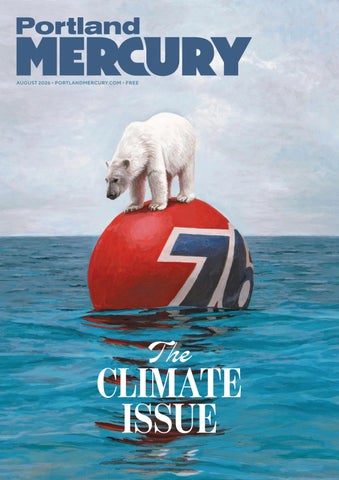
AUGUST 2026 • PORTLANDMERCURY.COM • FREE
T he
CLIMATE ISSUE
AUGUST 2026
Publisher
Marketing
James Deeley
MARKETING MANAGER
Editorial
EMAIL MARKETING LEAD
EDITOR-IN-CHIEF
Wm. Steven Humphrey MANAGING EDITOR/FOOD EDITOR
Katherine Chew Hamilton
Rachel Milbauer
Andi Carmichael EMAIL PRODUCTION
Courtney Vaughn
Art & Production
NEWS REPORTERS
ART DIRECTOR/CREATIVE DIRECTOR
ARTS & CULTURE EDITOR
Suzette Smith
Corianton Hale
ASSISTANT ART DIRECTOR
Anthony Keo
PRODUCTION MANAGER
STAFF WRITER
Char Harris
CONTRIBUTING WRITER
David Caplan, Feedback Graphics
Social Media
Shira Friedman-Parks
Lindsay Costello Janey Wong
SOCIAL MEDIA EDITOR
Andrew Harlan
Advertising SENIOR ACCOUNT EXECUTIVES
All your bulbs for office and home
Tonya Ray Tyra Triche
NEWS EDITOR
Taylor Griggs Jeremiah Hayden
3901 N Mississippi Ave 503-281-0453 •sunlanlighting.com
Find our cartoons on Instagram, Twitter and Facebook
PRODUCTION DESIGNER
Technology & Development LEAD DEVELOPERS
Michael Crowl Nick Nelson Jay Jansheski
Katie Peifer Anna Nelson
Chaytan Inman
ADVERTISING COORDINATOR
IT MANAGER
DEVELOPER
Always buying • Consignment options available.
Olivia Hunt
Grant Lewicki-Hendrix
Business
HEAD OF PRODUCTION
FOUNDER/CHAIRMAN
MARKETING & PRODUCTION COORDINATOR
Rob Crocker
PRESIDENT/CFO
Noisy Creek Podcasts
CRO
EXECUTIVE DIRECTOR
PNW POTTERY • ORIGINAL ART • HOME DECOR • LOCAL GIFTS
HEAD OF FINANCE & OPERATIONS
EXECUTIVE PRODUCER
902 SW Morrison St. Downtown Portland
Brady Walkinshaw
Dan Brown Katie Lake
HEAD OF HUMAN RESOURCES
Alia Graham
CHIEF STRATEGY AND COMPLIANCE OFFICER
Kendall Turner HEAD OF PRODUCT
Anthony Hecht STRATEGIC ADVISOR
Tim Keck
MEMBERSHIP DIRECTOR
Caroline Dodge
DIRECTOR, STRATEGIC PROJECTS
Luke Lamb
ASSISTANT TO BRADY WALKINSHAW
Taylor McCormick AP/AR COORDINATOR
Surprise Paradiso
Noisy Creek Productions DIRECTOR OF EVENTS
Tim Neill
Lindsay Powers Lauren Taylor
Patrick Kearney
Nancy Hartunian
EverOut EVEROUT MANAGER
Katya Schexnaydre CONTENT LEAD
Janey Wong DATA MANAGER/STAFF WRITER
Shannon Lubetich STAFF WRITERS
WE BUY & SELL NEW & USED CDS, DVDS & VINYL
Bri Brey Langston Thomas
Bold Type Tickets DIRECTOR OF BOLD TYPE TICKETS
Kevin Shurtluff
CLIENT SOLUTIONS MANAGER
Diana Schwartz
HEAD OF CONTENT & COMMUNITY
CUSTOMER SOLUTIONS REPRESENTATIVE
FEATURE PACKAGE EDITOR
Katherine Chew Hamilton and Wm. Steven Humphrey
Taylor Griggs
Seven Days A Week Sun-Thu 11-6 • Fri-Sat 11-7
SENIOR PRODUCER
HEAD OF MARKETING & CREATIVE
Allie Huska
@TinyBrambleShop TinyBrambles.com
Celene Ramadan
PROJECT MANAGEMENT/ CLIENT SOLUTIONS REPRESENTATIVE
Rou Leonard
NEW ANNEX OPEN SOON AT 606 SW 9TH AVE!
Campy Draper Anita Chao
ASSISTANT EDITORS
COVER ILLUSTRATION Josh Keyes CREATIVE DIRECTION Corianton Hale
THE PORTLAND MERCURY PO Box 86208 Portland, OR 97286 VOICE (503) 294-0840 Mon–Fri, 9 am–5:30 pm; editor@portlandmercury.com
1313 W BURNSIDE • OPEN 11-8 EVERY DAY 503-274-0961 • EVERYDAYMUSIC.COM
3
4 THE MERCURY’S CLIMATE ISSUE
AUGUST 2026
THE TRASH REPORT Like Weather, Gossip Can Be Hot and Cool
H
ello, and welcome to the Trash Report! I’m Elinor Jones. This is a very special Trash Report, because I have written it for the Portland Mercury’s very special CLIMATE ISSUE. “But Elinor,” you say. “The Trash Report is famously a gossip column. What does gossip have to do with the climate?” Aw. You are so lucky you are gorgeous, because that is such a dumb question. What do you think makes “hot gossip” hot? That’s right: WEATHER. So gather ‘round, my sweet idiots, and let’s talk trash.
DAN MULLAN - GETTY IMAGES
White House American Summer
Sunlight is the greatest disinfectant, but it can also make some things that are gross infinitely grosser. Case in point: the aging meatsack currently living in the White House. Instead of using summertime to do anything cool to bring up his historically dogshit popularity, Trump is instead visiting sports arenas filled with people that are cheering for something else and pretending it’s for him. He even walked onto the field for the photo op when Spain won the World Cup and refused to move when the FIFA guy tried to shove him off. You know, I had wondered why a man as famously vain as Trump wouldn’t have hit the Ozempic needle by now, and I think I’ve figured out why: he needs that solid trunk so as to never be ushered aside by a European dude in a suit. Trump has also been whining about trying to get his voter suppression bill, known as the SAVE act, passed. His cronies, desperate to connect with the middle America they so loathe, recently went so far as to cite the Olive Garden as a reason to tighten security. They argued
that since the Olive Garden requires photo ID for guests to access the new Never-Ending Pasta Month Pass, it only makes sense for voters to show ID to vote. But it doesn’t actually make sense at all. Pasta eaters have to show ID to prove that multiple people are not Garfielding the lasagne on one pass; voting works the opposite way. If six people show up somewhere insisting that they are me and they want to vote, the result is not a shared benefit. The only way the analogy could work is if polling places started giving out free breadsticks so the liars could carboload while waiting for a lie to be found out, which poses the question: Would you sacrifice wider voting access if it meant free snacks while you wait? No, of course, but you had to think about it, didn’t you?
Movies Are Hot
Christopher Nolan’s new Odyssey adaptation has been dominating the summer box office so far, and its not-allwhite casting has gotten some people very mad. World’s richest crybaby Elon Musk said that he is going to remake the
film with an “historically accurate” cast. But don’t you think that if this guy is so horny for “the way nature intended,” we’d be able to see what the Gods had in store for his natural hairline? Odyssey star Matt Damon, when questioned about the physique he had to pull off for the film’s grueling shoot, fully fessed up to the fact that he had a stunt double for a lot of it, and that stunt double was— gasp!—a woman. Is that too woke for Elon, too? Is he going to edit her out of the film as well? Just like, take out all of the parts where Odysseus is doing something epic and replace it with Matt Damon doing something clumsy? In other movie news, the long-awaited sequel to Practical Magic is coming out in a few short months, and new stars Maisie Williams and Joey King have started the press circuit in lace and black lipstick, holding hands like two young women who know that goth lesbians are about to pay for their second homes. I like that Maisie Williams hasn’t taken anything high profile since Game of Thrones and now she’s coming back on the scene hard as a witch. She’s got a vibe, and clearly wants the world to associate her with sorcery and mystic powers, just like how I want all of you to associate me with gossip and wine with ice in it. We all have our brands.
Weathering Heights
5
BY ELINOR JONES
So the East Coast is trapped in heat domes, the Midwest is making up previously unimagined lyrics to the diarrhea baseball song (when you’re at a Cleveland Taco Bell / and your pants begin to swell / diarrhea, fart, fart, etc.), so how are we in Portland spending our summer so far? Wearing light sweaters! This season has, for the most part, been so mild compared to recent years and I am not mad at all. Fingers crossed it keeps up this way. (Or legs, if you’re been through Ohio recently.)
Gossip Girls
Word on the internet is that both Nicole Kidman and Olivia Rodrigo are currently dating finance bros, which is sending a terrible message to other finance bros out there, who now think they might have a shot with goddesses like Nicole Kidman and Olivia Rodrigo. Do we think that maybe Olivia Rodrigo is seeking something new after three perfect albums inspired by douchey actors? Makes sense, but what about Nicole? What’s her excuse? And all I can come up with is that she needs to date someone who is rich, but not famous, because she needs to have the best hair in the relationship. Unrelated—or was it?—Kelly Clarkson said at a recent show that she loved being single, because she sees the kind of relationships that some people are in and she’d rat h e r go h o m e alone. This woman released “Since U Been Gone” 22 years ago, and she said what she said. ES
Hellish weather has hit the East Coast this MO AG NIC Y IM summer and according to A SCH I P P E R - G ET T New York Magazine, influencers are cooling off with soft-serve margaritas. My first thought: yum! My second Speaking of iconic kings, a deformed through fourth thoughts: 2) ouch the ice Seattle racoon named Jimothy has cream headache, 3) imagine the heart- become the newest internet star, stealing burn, U would need Tums, and 4) I would hearts quicker than he steals garbage. only like that cocktail if it were very, very (Is this fast? I can’t actually tell from the small. This coming from a woman who internet videos if he is fast or not.) Bless used to party!!!!!! this iconic round boi. Speaking of summer dining trends, In closing, my loves, this is all that I can Taco Bell lettuce is definitely not on say today. Thank you for reading and for the menu anymore for our friends in the being hot. I love you the same amount as I Midwest, many of whom are currently love Jimothy and that is a LOT. experiencing “explosive diarrhea.” Hey, does anyone else think “explosive” is kind Warmly, of an unnecessary word to tack on there? It seems excessive, like, needlessly descriptive, and almost mean. Just say diarrhea. That’s already very gross!
Regional Trash
6 THE MERCURY’S CLIMATE ISSUE
Street View
Climate despair? Riding a bike might help. BY TAYLOR GRIGGS
T
he climate crisis is here, and it sucks. It’s probably the biggest disaster humanity has ever faced, and despite decades of increasingly dire warnings, those in power have largely declined to address the problem in a meaningful way. Extreme heat, floods, and wildfires are worse and deadlier than ever. Animal species are constantly disappearing. Old growth forests are up in flames. It’s very difficult to know how to live in this reality. As someone inclined toward pessimism and general existential dread, I have often reacted to the climate crisis—and my inability to do much about it—with despair. Knowing my individual actions were inconsequential drops in the bucket compared to the scale of the problem, I have tended toward the status quo. In the past, that meant driving my gas-powered car short distances without giving much thought to the alternative ways I could get around. Transportation is one of the largest contributors to the climate crisis, at least in the United States. Some of those transportation emissions come from billionaires flying around in their private planes, burning jet fuel like it’s a renewable resource. (Ban private jets, BTW.) But a much larger chunk of greenhouse gas emissions come from normal Americans driving normal, gas-powered cars. Still, I found it hard to see myself as part of the problem, considering the larger systemic factors at play. I mean, why should I bother doing anything differently? I thought of individual climate action mostly as a way to alleviate one’s guilt for existing on a warming planet. That’s how BP sold the idea of a “carbon footprint” to the public in the early aughts, hoping to shift blame for the crisis away from fossil fuel companies and onto regular people. But it did not bring me peace to accept the notion that there was nothing I could do. D u r i n g t h e Pa c i f i c No r t hwe s t ’s record-smashing 2021 heat dome, my hopelessness peaked. A 116 degree day in Portland seemed like the end of the world, or at least the start of it. There was nothing I could do that would mean anything. What was there to do but wait? My despondent reaction was not the most helpful response to a crisis that killed more than 100 Oregonians. As the extreme heat subsided, and the world kept turning, I realized I needed to pull myself together. I decided to ride my bike, and I haven’t really stopped since. Conversations about climate change, even when led by well-informed and thoughtful people, often end up presenting
ILLUSTRATION BY HUGO HERRERA
a more climate-conscious future as one that also kind of sucks. People are always talking about “giving stuff up” and “making sacrifices.” But as I began traveling around town by bike more often, I didn’t feel like I was sacrificing anything. The more I pedaled, the more powerful (and less helpless) I felt.
The more I pedaled, the more powerful (and less helpless) I felt. On my bike, I quickly developed a stronger connection to the world around me, and started to identify as part of a larger ecosystem. I also started to understand that for all my anxiety and despair about the issue, I had actually been avoiding dealing with the climate crisis and its real-world impacts on my life. I literally sat inside on days when the forecast looked depressingly hot—not because I didn’t want to overheat, but because I didn’t want to confront the world I was living in. That was easy enough to do when I could limit my time outside to walking to and from my air-conditioned car, but on a bike, you have to contend with the elements. I thought grappling with the weather head-on (or helmet-on) would make me more depressed,
but it did the opposite, helping me realize my own capacity for resilience on a warming planet. I saw resiliency in others, too. I listened to birds chirping while riding down quiet side streets and spotted beautiful flowers, still blooming despite everything. My avoidance made me think of the world as a scarier and more hostile place than it really is. Once I started riding my bike more, I didn’t necessarily become an optimist, but my thoughts became a little calmer. Now, five years after I dedicated myself to getting around by bike, it feels funny to make a big deal out of my initial foray into car skepticism. I don’t have a car anymore—riding my bike everywhere is just a mundane part of my life. But at the time, choosing a different way to get around felt exciting, even transgressive. It made me realize I was capable of change, and maybe others were, too. To be clear, I’ve never believed my personal actions make a big impact on global carbon emissions. Still, my decisions matter. Looking back, I realize my mentality— which allowed me to hide behind my supposed powerlessness—effectively put me in agreement with the fossil fuel companies and climate change denialists, who said change was too hard and a better world wasn’t possible. I yielded to their depressing worldview, even though I deeply desired a new reality where people were taking real action to
stop the climate crisis. I knew in my ideal world, people would be doing things differently, including driving less. But I wasn’t doing much to show I wanted this, even—or especially—to myself. The cognitive dissonance weighed me down. The gap between my beliefs and actions subconsciously led me to two conflicting thought patterns. My lack of urgent action had to mean either the climate crisis wasn’t actually that big of a deal, or else it was so bad I should just give up. If I was dealing with an immediate emergency, like a house fire, I’d probably try to do something about it—unless I was rendered incapacitated by the flames, in which case why bother? It’s no wonder I was constantly spiraling. I still struggle with climate despair and anxiety, especially during the summer. I know there’s more I could be doing to help, and I occasionally grapple with intense guilt over everything I’m doing wrong. But given how much time we spend getting from one place to another, our transportation choices are a big part of our lives. It helped my sense of cognitive dissonance to make a significant tweak like that, allowing me to more genuinely accept the climate crisis as the emergency it is, and feel slightly more empowered about my role in addressing it. And, of course, it’s also brought me joy— riding a bike is fun, for one thing. Even if the world is ending, it’s not a bad way to spend your time.
AUGUST 2026
7
Heat Advisory
Oregon’s deadly heat dome was a wake-up call. Have we adapted? BY COURTNEY VAUGHN
F
ive years ago, Multnomah County got a tragic wakeup call. A prolonged spell of extremely hot days claimed the lives of 69 people. The 2021 heat dome was, for many, the first major heat event that drove home an uncomfortable reality: Oregon’s summers might no longer be bearable without air conditioning. “I think, fundamentally, we’re seeing a shift here in summers,” says Chris Voss, Multnomah County’s director of emergency management, referring to the impacts of climate change. “Multnomah County was once a county where air conditioning was a ‘nice to have,’ and I think we’re seeing, especially for some vulnerable communities, that it’s a ‘need to have’ now.” In all, 72 people died that summer due to extreme temperatures, during two heat waves. The Portland area has seen excessive heat warnings each summer since then. This year, the region saw the first dangerous heat hit in mid-June, before the official start of summer. Summers with spates of excessively hot days are the new norm in the Portland area. Since the deadly 2021 heat wave, 14 people have died from heat-related illness in Multnomah County: five people in 2022; three people in 2023; four the following year, and two last summer. Over the past five years, government leaders have responded with a mix of emergency resources, proposed legislative fixes, and in the county’s case, a major lawsuit. In 2023, Multnomah County took an unconventional route by suing major fossil fuel companies for their role in contributing to climate change that caused the 2021 excessive heat wave. The lawsuit is still active. “When it got up to 116 degrees, that was a huge impetus to [evaluate] how we think about heat,” says Dr. Richard Bruno, Multnomah County’s health officer.
Who’s most at risk?
Data from 2021 shows the majority of people who died due to heat that summer lacked functional air conditioning in their homes. The county’s mortality investigations noted about 10 people who died had AC, but most of their units weren’t working properly or had been left unplugged. Others reported being afraid to use their air conditioning units due to electricity costs. Most of the people who died lived alone in an apartment. “I think there’s a misconception that it’s people who are unhoused who are most susceptible, and that’s not true,” says Sarah Dean, a communications coordinator with
libraries, which can draw thousands of visitors during a heat wave, are often the most effective public locations for cooling off.
State lawmakers look to legislative fixes
COURTNEY VAUGHN
Nonprofit workers doing outreach during a 2023 heat wave. Multnomah County’s health department. Dr. Bruno said he noticed something else in the retrospective of the 2021 deadly heat dome fatalities. “We noticed that men over 50 who live alone tend to be overrepresented in that
“Fundamentally, we’re seeing a shift here in summers.” data,” he noted. “Part of our messaging, too, is check on your neighbor, check on your uncle, bring them some water, bring them some electrolytes….” At the local level, Multnomah County has opened emergency cooling centers during excessive heat waves. The centers—sometimes empty church buildings or community centers—offer an air-conditioned, pet-friendly space to rest, get a snack, and get respite from the heat, particularly for those without air conditioning who are most at-risk of suffering from heat-related illness. They’ve proven helpful. The county reported 611 people visited three cooling centers during a July heat wave in 2024. The following year, two separate heat
waves in August drew a total of 532 people to four sites. The county relies on a heat risk index developed by the National Weather Service to determine whether the threat is high enough to open emergency cooling shelters, which often take several resources to coordinate and sometimes require pulling county staff from their primary jobs to help staff the centers. Currently, unless the threat is extreme, it’s unlikely the county will activate them. “There’s 60 locations open before we ever get to cooling centers, so it’s one of the last things we do with the highest threshold,” Voss, the emergency management director, explains. County officials note cooling centers, which are typically limited to a few sites, are in addition to traditional places like community centers, shopping malls, museums, and movie theaters, which are more readily available. Those sites, however, don’t always accommodate unhoused people, who are at a higher risk of illness from extreme heat. The county’s list of cooling sites also includes misting stations, fountains, pools, and parks with splash pads, though public health officials advise against spending prolonged periods of time outdoors during excessive heat waves. County officials say
While the nation was still recovering from the effects of the global COVID-19 pandemic in 2021, county and state government agencies got some relief in the form of a $1.9 trillion economic stimulus package called the American Rescue Plan Act (ARPA). Local government agencies were able to use ARPA funding for a variety of things, including housing and homelessness solutions, and climate resilience measures like installing cooling systems in homes without air conditioning. “There was a lot of ARPA money we used to buy heat pumps out in East Portland,” says Dean, the health department spokesperson. Heat pumps are highly efficient electric units that provide both heating and cooling. But ARPA only provided one-time, limited funding, and funds have since dried up. Oregon State Senator Khanh Pham, who represents Senate District 23 covering outer Southeast and Northeast Portland, sought a more permanent solution with Senate Bill 54. The bill would’ve required landlords of multi-family properties with 10 or more units to provide air conditioning in all units by 2036. “ With the increasing frequency of extreme heat events due to climate change, the necessity for cooling solutions in residential housing has never been more critical,” Carolina Gomez wrote to the Senate Committee on Housing and Development on behalf of Home Forward, in support of the bill. “Cooling should not be a privilege, but a right, particularly for vulnerable populations such as seniors, individuals with disabilities, and families living in affordable housing.” Despite support from tenants rights groups, supportive housing organizations, and others, it ultimately died in committee. Still, other legislative efforts are underway to shield Oregonians from rising electric utility costs and equip more housing units with air conditioning. Ultimately, experts say the best defense against future fatalities is getting people to treat extreme heat events the same way they would other weather emergencies, and make a plan for their own safety. “You saw this during Hurricane Katrina, where a lot of people just stayed in their homes and thought, ‘Well, I’ve been through three hurricanes,’” Voss recalls. “Each of those, what it taught them was, ‘I can stay and be safe’ until the one you can’t.”
8 THE MERCURY’S CLIMATE ISSUE
THE BLACK BYLINE
Q & A: Tiffany Cross on How Black Women’s Blood, Labor Made America a Superpower The former MSNBC host and analyst has a message for the country and her sisters. BY DONOVAN SCRIBES
T
iffany Cross has no fairytale notions about love. Instead, she embraces what’s real: her sister circle, wisdom from the ancestors, and an undying commitment to Black people, from the stoop to the boardroom. Her second book, Love, Me: A Letter to Black Women Navigating a Toxic Country, Career, and Relationship demonstrates that love over the course of 17 chapters, where the former top-ranking MSNBC host and Harvard Institute of Politics fellow shares all but her Social Security number on the page. The book is not window dressing for a future campaign, nor does it run cover for a political party; it’s an impressively vulnerable testament that weaves both the personal and philosophical into an insightful love letter to Black women in America—one that, above all, values their humanity. From sharing details of ugly text exchanges with old flames that put your favorite battle rappers to shame, to relating the bloody details of an unnecessarily career-threatening surgery, to questioning if America’s democracy can withstand the backwinds of its own history—this book lives up to its title in holding up a mirror to the Black woman and depicting something not many can say so authentically: I see you. I caught up with the veteran mediamaker to talk about the inspiration behind Love, Me, where she shares everything from her thoughts on what tools are needed to build today’s Black press, to the flaws of the founding fathers, to the extended sister tribe she’s found through her book tour.
MERCURY: I don’t know if you purposely released this book around America’s 250th anniversary, but it makes it all the more timely—the conversations you’re having are equal parts contemporary and about the past. TIFFANY CROSS: I wanted to write a story that was a snapshot of this moment in time, independent of any 250th anniversary of the founding of America, as they call it. It was really just a reflection to Black women, that we are not alone in the multiple ways
we’re being crushed right now. I know I felt personally, professionally, and patriotically crushed all at the same time, and I really didn’t know what to do with myself, how to peel myself off the floor. I tried on my own, but it was really other Black women around me who were extending their hands, who were also being crushed—maybe crushed in different ways—and so we lifted each other up as we climbed, as has always been the case with Black women. Our labor, our bodies, our blood made this country a superpower, and [the current administration’s] stupidity is eroding that power on the global stage. I don’t know that that’s necessarily a bad thing, because the United States is the empire, and we have been soul crushing to a lot of entities, including its own people. So perhaps it’s a time for us to reflect on who we are as a people as this empire falls.
KARL FERGUSON JR.
What has been surprising to learn as you’ve been talking to people across the country since publishing this piece? I think the most pleasant surprise is the way the book has resonated with so many people. I briefly got caught up in commercial success, and was looking for these very plastic accolades. But every tour stop has welcomed hundreds of people who speak very intimately with me. I found open arms and people saying “Yes, I’ve been there too,” and “Yes, I sent hate texts like that,” and “Yes, I remember crying over somebody I shouldn’t
have been messing with,” and “Yes, I would have cursed people out at my office, too.” So that’s why I say it’s not a memoir, because everything that I was navigating while in a newsroom, so many other Black women are contending with the same things.
What do you feel is the biggest challenge for Black folks right now in navigating the media landscape? The media landscape has shuffled Black women in front and behind the camera. When you look at newsrooms across the country, pre-Donald Trump, only 6 percent of journalists were Black. Now those numbers have, for sure, gone down. I think we’re going to have to acknowledge the importance of the Black press. When you think about the role the Chicago Defender played during key points in the last century, you think about the role that Ida B. Wells played during massive lynchings in America. And so we have to start finding those [contemporary] sources and supporting them. Michael Harriot, the amazing author of Black AF History, runs a site called Contraband Camp. It’s kind of like the Black Atlantic— a lot of think pieces from the most amazing writers of our time. Joy Reid is getting better ratings on her YouTube show than a lot of the cable news outlets are. Roland Martin has over two million subscribers. We’re asking our community to help us serve you: show up, support, subscribe, and share. You talk about going into surgery for fibroids while you were auditioning for a full time position at MSNBC—how does centering your story shift conversation? I wanted people to know that this is what I was going through, and why I had to get surgery, and I share very personal details of things that women will understand—of being in a newsroom makeup chair and having to get new clothes. I mean, just awful things. And I also understood that my story was not so unique, and what I had to juggle from my hospital bed. I named that chapter “They Make Me Sick,” because it was an attack on my physical being and
AUGUST 2026
dealing with things at MSNBC. The stress of that process literally impacted my health. It kept me in the hospital days longer than I should have. So it was a little purple piece of vibranium that I could offer my sisters out there who are struggling with the same thing.
There’s a part in the book where you’re talking about ancestry and imagination, and this kind of debate between (former Florida gubernatorial candidate) Andrew Gillum and LaTosha Brown (Black Voters Matter). What do you imagine for Black people in this country? I try not to read that passage on the tour, because it always makes me choke up. All of us are, in some parts, the dream and the hope of the enslaved—although I question that in the book as well. Perhaps the dream and the hope of the enslaved was to go home to their h o m e — t o We s t Africa. I hope collectively we as Black people are all asking, “What are we sowing into our lineage that is going to be our dream and hope for future generations of Black people?” I don’t equate B l a c k l i b e rat i o n w i t h A m e r i ca — I think Black liberation is achievable anywhere. I’ve been having conversations with LaTosha, where she talks about liberation. Perhaps we can consider liberation a state of being, a state of mind. The example she gave was Harriet went to the plantation, liberated. So I’ve been contending with myself on what that looks like. Okay, “speed round” time. I’m going to ask you questions and you tell me which you prefer, and why. Gina or Pam? Pam. I just thought it was ridiculous that Pa m wa s o n t h e receiving end of so many insults when s h e wa s so fi n e , gorgeous, and beautiful—and it seemed to highlight a level of colorism in the community. It was just nonsensical. And she was like a manless friend, and I was like, “She’s so dope! She can sing, and is so talented.” I love the friendship between Pam and Gina. I just always felt like, “Why are we making fun of Pam?”
Origin or 13th? 13th. I don’t have a big connection to the incarcerated, other than I just give a fuck. It is so god-awful how punishing the criminal justice system is, particularly when it comes to us. I thought Ava DuVernay did an amazing job on 13th, and I think we need to pay more attention to how we treat our prisoners here. If it were up to me, I would kick open those bars and free probably 99 percent of those people, and at this point, in this moment in time where you have a president who is convicted of 34 felonies, and you have at least 500,000 Black men in prison who are fathers, and then millions of Black COURTESY LEGACY LIT people in prison everywhere, I have to ask America, “What is a law? Who decides what is a law, and who decides when and how it’s enforced?” So, fuck your prisons. ’90s hip-hop or ’90s R&B? I will say ’90s R&B, because I feel like that was the last iteration of love songs and ballads where we’re singing about falling in love, making love, having crushes, heartache, heartbreak. Like, men were just fine singing and begging on a record. Women were fine saying how heartbroken they were, how much they love their man. It was also the last iteration of life where parties have s l ow s o n g s — yo u knew at the end of the night it was going to be Jodeci, Forever My Lady and who you were going to dance with. Couples were made at these parties and dances—not to diss the hip-hop that was coming out of the ’90s, because that gave us Biggie, Pac, Nas.
We lifted each other up as we climbed, as has always been the case with Black women.
Ebony or Jet? I’m going with Jet, but this is a shallow reason. I think Ebony documented so many amazing moments in history for Black people, so they matter. Jet was a little more pop culture, you know? It may have been controversial, but there was that “Jet Beauty
Looking for a therapist who fits your needs?
of the Week.” I feel like there’s something to be said about celebrating Black women on their terms and our beauty—because we were so overly sexualized. You even see politicians like Kamala Harris… gorgeous, a naturally beautiful woman… but she will swallow it sometimes in her attire and her suits. I dare say that we can be taken seriously—as fine, talented, educated, informed, sexy, and all the things.
If you had to write a headline for Black women in America today, what would it be? “This Is Crazy, But We Will Survive.” Love, Me is available in all places where books are sold, but we encourage you to buy from Third Eye Books. This interview has been edited for clarity and brevity.
Our licensed clinicians are specially trained to provide unparalleled, inclusive, and informed psychotherapy and AASECT certified sex therapy services. Delivered privately and confidentially via telehealth, we can meet both your individual and relationship needs.
the Northwest Institute for Psychotherapy & Sexuality
In-network with multiple insurances, and also able to bill out of network benefits. Reach out for a free consultation today.
www.nwips.com
9
10 THE MERCURY’S CLIMATE ISSUE
How to Have Fun and Beat the Heat! Surviving and thriving in Armageddon’s wake. BY BEN HARKINS ILLUSTRATION BY WILL JEWKES
A
liens are real. Actually real. Life travels the stars. They know about us and we know about them. What does that say about our place in the universe? What do they want? And who cares? It’s hot as balls, getting way hotter than balls, and gas is expensive. Desperate for a cool breeze, I walk outside in booty shorts and a classic sleeveless rebranded as a “wife-pleaser.” I wave to my shirtless neighbor and he waves back. Dazed in the heat, we have forgotten each other’s names. The surveillance camera on my neighbor’s doorbell knows my name, though. It tracks my face. My neighbor’s doorbell knows my fucking birthday. I ask my neighbor if he saw the new UFO footage. He doesn’t believe in aliens. He does believe in angels. It’s too hot to talk about the news. A super heat dome rakes over the Earth’s face like God’s big-ass magnifying glass. Lord, let me find some wholesome summer shenanigans before I’m roasted beneath this killing sky. Data centers, layoffs, genocide, Epstein, unregulated lettuce that makes your insides explode, blah blah blah. It all feels connected, but it’s far enough away when the weather is nice. The smoke from the crawling wildfires reaches out for us. Though mostly, there’s not a cloud in the sky. There’s a war on, or is there? We face the shifting sands of truth and the lack of it each day. I embrace my hypercompart-
mentalized denial. Because Bono was right about a beautiful day—don’t let it get away. It’s time to “beat the heat” and get the most out of summer without breaking the bank.
Tip #1: Destroy Your Phone
Karl Marx once called religion “an opiate of the masses.” Your smartphone is the experimental bath salts of the masses. Nothing breaks the immersion of a lovely walk through the park like dropping into a livestream of your cousin’s AI-driven psychotic crash out. Doom comes for us all, so why spoil a beach day with up-to-the-minute notifications? The infinite scroll can reduce you to a Skinner box gerbil sifting through slop until you can’t even remember the faces of the friends who turned you on to these platforms in the first place. Social media sucks now. It’s all ads and it feels bad. Turn the phone off and watch a butterfly while you still can.
Tip #2: DIY Climate Control
Okay, I invented this when my electric bill doubled months before I even installed my girlfriend’s air conditioner. Thanks, data centers! Beat the heat and save on power with my amazing invention, The Limitless Frozen Gatorade Bottle Swamp Cooler. All you need is two spent Gatorade Bottles refilled with Tap Water, A Fan (any size), A Bowl, and a Ka-Bar Knife. Place your frozen Gatorade bottles filled with tap water in the freezer. Wait
an hour. Plop one frozen Gatorade bottle in the bowl and arrange it in front of your fan. Sit in front of the fan and hold your knife while soaking up that sort-of cool air! Think about the blade in your hand, its weight, its shape. Truly, all a man needs in a dying empire is a stale, cool-
All a man needs in a dying empire is a stale breeze and a trusty handful of steel. ish breeze and trusty handful of steel to make the voices stop. When the ice melts, simply swap with the other bottle in the freezer (hence limitless). Black out your windows and turn off the lights for maximum effect. Repeat this process until nightfall and on until sunrise.
Tip #3: Ice Skating at Lloyd Center
RIP. Never mind.
Real Tip #3: Da Movies
Surge pricing algorithms have ruined everything from live entertainment to basic housing, but the mid-afternoon movie is still half-off, for now. An afternoon matinee provides a cool and thrilling jaunt through worlds beyond your imagination! Our sun is most deadly in the
early afternoon, so why not take refuge in ancient Greece with Matt Damon (The Odyssey)! Stave off heat stroke with a big cup of diet soda and a Woody-n-Buzz (Toy Story 5) popcorn bucket! The sun is a terminal beam weapon and we’re running out of water, but the Rock has a wig (Moana LIVE). I recommend familiarizing yourself with all of the conversation starting summer blockbusters. Love ’em or hate ’em, the latest hit movie is something to talk about besides the spiking cost of groceries. The trusted footpaths of the past corral us to the sloop-troughs of the future. We are the Flintstones AND the Jetsons, outlived consumer archetypes. Our history and future are reduced to appliances and wardrobes while consumer power means increasingly less. There’s a fire sale on democracy. Capitalism is late-staging itself into some kind of crypto-carnie casino. Customer service hotlines are being phased out by robots that hang up on you. Maybe the aliens will descend from the clouds and share their secrets for same-day shipping from orbit. Maybe God’s angels will descend from the clouds and lock us in camps. Maybe AI will blow up the whole damn thing. No matter which humiliating apocalypse you like/subscribe to, the cognitive dissonance of Trump 2 can’t hold forever, especially with the oceans rising. It’s summertime, and the living is easy. It’s time to stay cool and watch the skies. Maybe build a raft.
AUGUST 2026
11
Fixing a Hole
The Ross Island lagoon is a major culprit for the Willamette River’s cyanobacteria blooms.
W
BY ABE ASHER
hen Willie Levenson advocates and scientists familiar with the the entire river turning green. My fear, big- for Portland Harbor, which would involve moved to Portland river, the fact that the bloom originated in ger picture, is that people will start to turn shipping contaminated sediment to landthree decades ago, he the Ross Island lagoon came as no surprise. their back on the river again.” fills in Central Oregon, has been previously very quickly learned Algae blooms thrive in stagnant water, The Human Access Project has gotten estimated to cost as much as $4 billion. how locals related which is exactly what the Ross Island behind a proposed solution of engineering The proposal to instead use some of the to the river flowing through the middle of lagoon is. It was built by the Army Corps a channel in the lagoon to allow fresh water sediment to fill the hole at the bottom of of Engineers in the early 1920s in order to flow in. the lagoon could significantly reduce the their town. “I was indoctrinated with, ‘Welcome to to block water flow and allow Ross Island Part of the problem? Opening up the cost of cleaning up the Superfund site. The Portland: it rains a lot, and never put your Sand & Gravel to mine gravel from the Wil- lagoon won’t be cheap. It’s estimated to cost savings could potentially be used to ecologtoe in the Willamette because your skin will lamette, which it did until 2001. The lagoon $14 million to open up a single channel in ically restore Ross Island and even place it flake off, you’ll grow horns, your skin will currently has no fresh water flow. the lagoon for fresh water. A second chan- in public ownership. turn neon green,’” said Environmental advoLevenson, who formerly cates have urged Gov. Tina Kotek to consider led the river advocacy group Human Access the Superfund proposal Project. in a “robust, transparent public process” Back then, swimw i t h “ r i go r o u s s c i ming in the Willamette was unthinkable. The ence-based analysis led river had been closed by neutral parties.” to the public for swimTullos, however, says ming since 1924 due to the Superfund proposal sewage pollution, and would require delaying poking fun at the river’s channel construction, degraded state was not and that in the meanmerely acceptable, but time, it could actually exacerbate the algae almost a “point of pride,” Levenson said. bloom issue. She pointed But beginning in 2011, out that during the time when the city comit would take to dredge pleted work on its $1.4 and place the Superbillion Big Pipe sewage fund materials at Ross overflow project, things Island, it’s important to restrict water flow began to change. Slowly but surely, thanks in in and out of the lagoon large part to the work in order to prevent the of Levenson’s Human sediment from conAccess Project, people taminating the rest of EAGLE EYE DRONOGRAPHY AND HUMAN ACCESS PROJECT started to view their The Ross Island lagoon during a 2025 harmful algae bloom. the river. This, however, relationship with the would keep the water in river differently. Harmful algae blooms also become more nel raises the cost estimate to $26 million. the lagoon stagnant—ideal conditions for The early driver of that change was, for frequent as the weather gets hotter, and the Perhaps more significantly, Tullos said, is harmful algae formation. many, the Big Float—a summer festival on combination of warmer summers due to the reality that no single party bears all of “Filling the lagoon with sediment is not the river in downtown Portland that Lev- climate change and stagnant water threat- the responsibility for the algae bloom issue. proposed as a means to address the bloom.... enson organized, which he described as a ens to keep people out of the river during It’s the result not just of the creation of the The reason it is being proposed is because “movement disguised as a party.” The Big the months most want to use it. lagoon, but also of climate change and the they need a place to put the Superfund Float ceased operations four years ago, The issue is serious enough that, at this concentration of nutrients in the watershed. materials,” Tullos said. “There’s some conleaving in its wake a network of beaches point, the fate of the Ross Island lagoon Progress towards funding the construc- versation about this being an elegant soluand piers that hum with activity through- has become Human Access Project’s pri- tion of channels into the lagoon has been tion, and I don’t think it’s quite as elegant as out the summer. mary focus. slow. A bill proposing to allocate $1 million people are saying.” These days, Portlanders are eager to “With our mission to transform Port- to project planning died in the state legisThere’s plenty on the line, not just from swim in the Willamette. The biggest obsta- land’s relationship with the Willamette lature last year. an ecological perspective, but also from an cle to river health and access now is not River, if there’s consistently a harmful In the meantime, another proposal for economic one. According to a recent study sewage or outdated public perception, algae bloom in the lagoon that impacts all Ross Island has gained traction. A group of from consulting firm ECONorthwest, the but something else: algae blooms. The of Portland, then everything we’re doing is private interests involved in the Portland river is responsible for hundreds of millions blooms, which are caused by increases in frivolous,” Levenson said. Harbor Superfund site proposed purchas- of dollars of economic activity in the region the amount of cyanobacteria in water, can Desirée Tullos, a professor at Oregon ing Ross Island from Robert Pamplin Jr., annually. More and more, people are seeing cause rashes, indigestion, and even neuro- State University who has spent years work- who also owns Ross Island Sand & Gravel, a healthy Willamette River as integral to logical issues. ing on Ross Island, said that in the push to and filling the lagoon with materials from Portland’s culture—which was Levenson’s Last August, as often occurs in late sum- contain the harmful algae blooms, time is the Superfund site. goal from the start. mer, the Oregon Health Authority issued an of the essence. The alternative plan has a clear financial “I didn’t just do the Big Float to throw advisory for an algae bloom that emerged in “If we don’t address it, the problem upside. State taxpayers are responsible for a party,” Levenson said. “The whole point the Ross Island lagoon and spread to other is going to continue and it’s going to get a significant portion of the cost to clean was to develop a culture around caring for parts of the river. To Levenson and other worse,” Tullos said. “We’ll continue to see up the Superfund site. The original plan the river and viewing it as an asset.”
12 THE MERCURY’S CLIMATE ISSUE
AUGUST 2026
13
14 THE MERCURY’S CLIMATE ISSUE
PCEF’s Community Benefits
Meet the people who benefit from Portland’s Clean Energy Fund. WORDS AND PHOTOS BY TAYLOR GRIGGS
J
A volunteer with the Portland Fruit Project gathers plums. ust after President Trump took office for the first time, environmental activists in Portland decided they couldn’t wait for the federal government to address the ever-worsening climate crisis. It was time to equip the city with the tools to respond and adapt to climate change at the local level. Thus, the Portland Clean Energy Fund (PCEF) ballot measure was born, and approved by voters in 2018. Supporters said the program, which would be funded through a 1 percent tax on local sales at big businesses, was a “story about [Portland] creating our own clean energy future.” It was intended to specifically benefit low-income communities and communities of color, who are often left out of climate investments and tend to experience more significant impacts during extreme weather events. In the run-up to the 2018 election, the PCEF campaign projected the initiative would raise at least $30 million a year for
local climate projects. PCEF’s funding mechanism turned out to be much more lucrative—the program has raised about $200 million a year since tax collection began in 2019. The program’s Climate Investment Plan has allocated $1.6 billion in spending through 2029. The money is intended for specific goals, such as transportation decarbonization, energy efficiency in residential and commercial buildings, and regenerative agriculture. Some funds are allocated to projects managed by local nonprofit organizations, while other PCEF-funded projects are led by city bureaus or through partnerships with community organizations and government agencies. PCEF’s financial success has been a double-edged sword for the program. As the city has struggled with significant budget crises in recent years, many bureaus have turned to PCEF for a bailout. City officials have also proposed tapping PCEF to pay for a significant chunk of the potential Moda
Center renovations. The clean energy fund was also targeted by an initiative hoping to permanently divert 25 percent of its revenue to hire police. Clean energy fund defenders say voters adopted PCEF for a specific purpose—to mitigate carbon emissions and help those most impacted by climate change. Yes, the
“PCEF is a rare and incredible opportunity for Portland to uphold its ideals.” program has raked in more money than expected, but program leaders say its budget is still just a drop in the bucket of what would truly be required to meet the city’s climate goals.
PCEF estimates its projects have resulted in nearly 35,000 metric tons of greenhouse gas emissions reductions so far—the equivalent of getting more than 8,000 gas-powered cars off the road. Other benefits are less quantitative. The Mercury talked to a sample of the many organizations and individuals who have received PCEF funding, to find out the impact the program had for them.
Black Futures Farm
Black Futures Farm is located on 1.15 acres of land in Southeast Portland’s Brentwood-Darlington neighborhood, near the Brentwood Community Garden and Portland State University ’s Learning Gardens Laboratory. The farm, co-founded by Mirabai Collins and Malcolm Hoover, opened in 2020 as part of the Black Food Sovereignty Coalition. In 2021, Black Futures Farm received a $1.7 million PCEF award to aid their regenerative agriculture work. The funding sup-
AUGUST 2026
15
ported the construction of solar panels and A little more than half of the funding was quick or easy task, and it was apparent incentives through 2029, with randomized a water catchment system to power the allocated to general operations, helping the how an abundance of fruit could burden draws taking place multiple times a year. farm, and helped expand their capacity to organization expand its workforce train- homeowners and result in unhealthy Rebates are limited to those with houseing, harvest more fruit from local trees, trees. The arrangement is a win-win- hold incomes at or below 60 percent the host workshops and training sessions. Collins told the Mercury that PCEF’s and keep those trees healthy. The other win—in addition to the benefits to the area media income. So far, the program has benefits can’t be easily summarized in grant was used to purchase two electric tree’s owners and those who receive the handed out more than 1,092 rebates. data-driven reports. What’s missing in the cars and an electric bike to replace their donated fruit, it’s also clear the volunteers Daniel Eisner is one of the people who quantitative data, she said, is “the invisible old, gas-powered trucks. enjoy the harvesting job. received an e-bike rebate this summer. work that PCEF funds.” Collins said the Keisler Fornes said fruit trees often go “Things are pretty dire right now. This Eisner told the Mercury that since purgrant Black Futures Farm received allowed ignored in efforts to maintain and increase is a very tangible way you can get outside, chasing the electric cargo bike earlier the organization to get creative with their urban canopy coverage. The trees don’t which is already going to make you happier, this summer, he’s barely used his car. The workshops at the site, and collabocargo bike Eisner rides has capacrate with other experts in the regenity for two people, so his partner Hana Francis often comes along, erative agriculture field. “There’s all of this place-makriding on the back. ing and community work and the “It’s changing the way I see transportation,” Eisner said. “The exchange of skills related to climate resilience. Networks are being creelectric assist makes a 20 mile bike ated [to get through] whatever this ride feel like less than five miles. It’s climate shift entails,” Collins said. fast, it’s reliable, I can commute to “That’s a super important part of and from work with ease.” what PCEF does—it helps comFrancis also heralded the bike’s munities teach and learn and build benefits. relationships.” “The second day we were riding Black Futures Farm was born this, I was like, ‘Dan, I think this is out of a desire to build commuthe answer.’” Francis said. “It seems nity—particularly among Black like e-bikes are the answer to so Portlanders—and to “heal the conmany problems.” nection between Black people and Rebate recipient Sabrina Taylor the land.” said before she got her new e-bike, “We’ve encountered that there’s her relationship with biking was a lot about agriculture that, historlimited to her childhood. In recent ically and even presently, has been years, Taylor has primarily used her car to get around, but was violent and brutal and difficult for intrigued by the e-bike incentive Black people,” Collins said. “We program—partially because of started being together on the land, the spiking price of gas. Once she and it was so nurturing. When we got her bike, she began riding it so cultivate joyous and loving experiences on the land, we’re certainly much that others noticed. not doing that to erase our histo“ With gas prices getting so ries and experiences, but really just expensive, I thought why not apply to reconcile and balance and heal to get an e-bike and hope it cuts down the gas bill for my car,” Tayas much as we can.” lor told the Mercury. “When I first Collins thinks PCEF is “a got this bike, I got a welfare check rare and incredible opportunity from one of my neighbors, who for Portland to uphold its ideals,” noticed I hadn’t moved my car for which has become all the more over a week. She wanted to make important as federal funding for climate and equity work sure I was okay.” disappears. Throughout the Mercury’s con“In the midst of everything, the versations with several people who city has an opportunity to stay received e-bike rebates, a comthe course, and to say, ‘No, this is mon theme emerged. Many people important work,’” she said. “It gives noticed their bike helped them feel residents some autonomy and promore connected to the community, tection against tyranny. You know, something they lacked when getwe can still build these things. We ting around in a car. can still grow food for each other.” Rebate recipient Brandon Clark said when he first moved to PortAbove: Black Futures Farm exists to “heal the connection between Black people and the land.” land in 2022, he didn’t have a car, Portland Fruit Tree Project Below: Daniel Eisner and Hana Francis on their e-bike, partially funded by PCEF. Portland is home to thousands of relying on buses and electric scootfruit-bearing trees, vines, and shrubs. But always provide the most shade—though to do something with other people who also ers to get around. Eventually, he got a car, much of the delicious fruit available in the they can offer some—but they offer carbon want to make things better,” Keisler Fornes but said it presented some downsides. Parkcity’s “urban orchard” is wasted. The Portland sequestration, benefit pollinator species, said. “There’s something inherently joyful ing at certain events can be a challenge, and Fruit Tree Project was created to address this and, of course, are a source of food. But they about picking food for people.” Clark also noticed driving the car made him problem, and to spread the good word about can be a little high-maintenance. feel less connected to the city. fruit trees more generally. “Putting in resources for tree care helps E-bike rebates “One thing I love is just riding and smelling The organization harvests residential to make the fruit and tree healthier,” Keis- In April, PCEF launched its $20 million the flowers and the trees as they’re bloomfruit trees (upon request) and redistrib- ler Fornes said. “If you have less fruit waste, electric bike rebate program, offering ing,” Clark said. “Portland’s a beautiful city. utes the yield. It also offers community people are less likely to cut the tree down. incentives starting at $1,600 to help peo- I’m stopping all the time and taking pictures education, tree care services, and work- So it’s all part of tree retention.” ple purchase standard, cargo, and adap- of plants. When I’m in a car, I don’t do that.” force training for young people of color Eisner had a similar takeaway. At a residential harvest in Southwest tive e-bikes. Studies and anecdotal evithrough the Connecting Canopies program. Portland earlier this summer, Fruit Tree dence have proven that electric bikes are “I definitely feel immersed in the world The Fruit Tree Project has also developed Project staff and volunteers picked plums very effective car replacement tools, but around me. You can hear the sounds and an index of local fruit trees, scoring their from a tree with branches overflowing many people can’t afford the up-front cost. smell the smells,” Eisner said. “Cars are with the fruit. They stood atop ladders PCEF’s rebate program aimed to help peo- isolating. When you remove the walls and health and harvestability over time. In 2023, the nonprofit received two and even climbed into the tree to reach ple bridge the gap. get back into the world, you slow down, you PCEF grants totaling roughly $570,000. the highest-hanging plums. It wasn’t a The program is set to continue doling out can explore a little more.”
16 THE MERCURY’S CLIMATE ISSUE
Fish Market & Restaurant Fish & Chips, Oysters and More 3004 E Burnside Flyingfishpdx.com
AUGUST 2026
17
Working for the Planet
Programs like Connecting Canopies and Climate Jobs Oregon strive to make jobs in sustainability sustainable for workers. BY ANNA DEL SAVIO
C
reating a greener future requires work—and workers. Climate and labor advocates have long championed efforts to simultaneously address climate change and create well-paying jobs. Their efforts gained some traction during the Biden years, but the gains were shortlived. President Trump has rolled back much of the funding allocated to clean energy infrastructure and job creation, instead attempting a coal industry revival. A proposed New Deal-style mobilization for the environment is a non-starter, at least for the time being. But here in Oregon, the effort to create good, green jobs is alive and well—even if it’s not fully reflected in the job market. The Portland Clean Energy Fund (PCEF) is one major program dedicated to ensuring there are workers trained to carry out the city’s climate goals—and that those workers can stay in those jobs. “Part of addressing climate change and mitigating its impacts is providing jobs to those who are most impacted by climate change, and ensuring that those jobs pay well, treat folks well, and have avenues for individuals to grow,” said Abby Bandurraga, PCEF workforce policy coordinator. PCEF’s dashboard, outlining the program’s spending, says the clean energy fund has granted more than $46 million to programs offering workforce training and contractor development for green jobs. As of December 2025, more than 1,500 people have gone through one of those training programs. Connecting Canopies is a paid training program that introduces BIPOC young adults to green sector jobs. The program aims to help young people build skills in landscaping, habitat restoration, urban forestry, and environmental monitoring, in hopes of preparing them for long-term careers in the climate sector. PCEF funding has allowed Connecting Canopies to pay participants, removing a barrier for young adults who can’t afford to spend months in an unpaid internship. The program also provides all the tools, materials, and transportation to remote job sites. For students, that funding means “you don’t have to work a non-technical job to get by.” “You can just fully dedicate yourself to something that really will sustain you in the long term,” said Mason Martinez, development and communications director at the Blueprint Foundation, one of three local nonprofits partnered to run Connecting Canopies. PCEF dollars also pay for gardening classes in Oregon prisons, construction pre-apprenticeships, and programs to teach janitors how to reduce energy, water, and car-
ILLUSTRATION BY YIFAN WU
bon emissions in commercial office buildings. But all the training in the world won’t do much without long-term, well-paying green jobs. PCEF is creating those job openings and guiding graduates of green workforce development programs into the jobs. Contractors participating in PCEF’s Energy Friendly Homes program, for example, are required to fill job openings with workers who graduated from PCEFfunded training programs. Bandurraga described PCEF’s goal as trying to build a “circular model” where the program’s investments “double their value, because we’re investing in people,
“We don’t want to just create jobs...We want our workers to [stay] in those jobs.” and then we’re investing in contractors to bring those folks onto the work that we are doing in our communities.” PCEF-funded programs are required to pay workers nearly double the minimum wage, with a floor of more than $30 per hour. “We don’t want to just create jobs, move people in, and tick a box,” Bandurraga said. “We want our workers to [stay] in those jobs.” Climate Jobs Oregon is another program working to make good-paying jobs a key part of Oregon’s energy transition. Trade unions, the state union building trades
council, and the Oregon Labor Federation launched Climate Jobs Oregon in January, with the mission to ensure that the shift to clean energy is centered around workers. The program launched in January 2026 with the publication of a report from Cornell University’s Climate Jobs Institute detailing “a bold vision for climate jobs in Oregon” and setting out recommendations for the state. The recommendations aren’t small policy tweaks, but major infrastructure programs and funding commitments. Climate Jobs Oregon intends to advocate for its priorities in the state legislature and in public campaigns. The labor movement’s “just transition” framework—which aims to ensure workers aren’t left behind in the switch to clean energy—often includes retraining laid-off workers so they can move into new green jobs. But that’s not the biggest concern for the union construction trades right now, said Scott Strickland, special projects counsel for Sheet Metal Local 16, one of the unions involved in Climate Jobs Oregon. The chief concern is having enough jobs for apprentices to take. If Oregon undertook enough infrastructure projects to meet growing energy demands and transition to clean energy by 2040, it would create more than 200,000 jobs through 2030, the Cornell report said. The report says the state should support green infrastructure projects with high labor standards. It also recommends Oregon streamline clean energy permitting and development; start an electricity pro-
curement program to invest public funds in emerging energy projects (and raise labor standards on those projects); and build publicly-owned solar power and storage on private rooftops. Labor groups and environmentalists aren’t always in agreement. Recently, they’ve been at odds over data centers, which have proliferated across the state. Data centers offer jobs during construction, but their operation requires heavy energy and water consumption while creating relatively few permanent jobs. The Cornell report identifies data centers as critical infrastructure in Oregon, but says the state should create policies to make sure their rapid growth doesn’t raise electricity costs or hinder the state’s clean energy goals. The report suggests offering grants to pilot sustainability projects at data centers. It also recommends requiring data centers meet certain efficiency and labor standards in order to qualify for tax breaks. Strickland said environmental and labor groups “have let a couple of short-term disagreements taint the fact that we are much more aligned than we are not.” He said building trades have failed to effectively communicate their investment in environmental and racial justice, and environmental activists haven’t always acknowledged the importance of infrastructure for climate action. “We can decarbonize our economy in an empowering way to local communities, and that includes the building trades,” Strickland said.
18 THE MERCURY’S CLIMATE ISSUE
Sacrifice Zone
A small industrial hub on the Willamette River is a disaster waiting to happen. BY JEREMIAH HAYDEN COLLAGES BY ANTHONY KEO
A
n industrial sacrifice zone rests in a remarkable place on the west banks of the Willamette River, a mile north of downtown Portland. Its backyard is the Tualatin Mountain Range, where hundreds of bird species and other wildlife inhabit the forest, stretching from a quaint neighborhood to the Pacific Ocean. “It’s beautiful here,” said Nancy Hiser, an area resident. “We’ve got four mountain views. You’re on the river. You’re 15 minutes from downtown.” The industrial area known as the Critical Energy Infrastructure (CEI) Hub sits across Highway 30 from Hiser’s house. The location offers marine, rail, and interstate access to import and export liquid fuels across the region. Along the six-mile stretch, 11 bulk fuel terminals hold 90 percent of Oregon’s liquid fuels—including gasoline, diesel, jet fuel, and other products—in 630 tanks. That’s 396 million gallons of fuel capacity. Many Portlanders
PHOTO CREDIT JEREMIAH HAYDEN
fear it could blow up, spill into the river, or release harmful vapors in a disaster. Hiser is a founding member of Tank the Tanks, an advocacy group for CEI Hub safety. After buying a house on the hills overlooking the tanks in 2014, she and
Many Portlanders fear the CEI Hub could blow up, spill into the river, or release harmful vapors in a disaster. other Portlanders started learning about the dangers earthquakes pose to the tanks. Hiser and others remain concerned about an inevitable “Big One” earthquake, particularly due to its projected impacts on the industrial area. The Cascadia Subduction Zone is a tectonic plate bound-
ary in the Pacific Ocean that stretches from Vancouver, B.C. to Northern California, roughly 100 miles from land. And it is overdue for a seismic shift, which experts say could generate a magnitude 9.0 megathrust earthquake. That could wreak havoc on the Oregon Coast and potentially reach the CEI Hub. An earthquake isn’t the only safety concern. The hills of Forest Park, directly above the hub, are vulnerable to landslides or heavy rains. And wildfires threaten safety from both directions. A fire starting at the CEI Hub could ignite Forest Park and the homes inside, or conversely, a park fire could set the Hub aflame. What to do with the CEI Hub over the next decade is complicated, and a host of competing interests are trying to figure it out. Hiser is one of a growing number of activists, along with groups including Columbia and Willamette Riverkeeper, 350PDX, Braided River Campaign, and many others, demanding governments prioritize public safety at the CEI Hub, includ-
ing by reducing the tanks’ capacity. The CEI Hub is also central to conversations about Oregon’s overall fossil fuel consumption, and the adoption of renewable fuels. Industry proponents say companies need to expand infrastructure to meet demand for lower-carbon fuels, including aviation fuels, saying any regulations the local government considers should make an exception for “renewable” fuels. But those fuels pose similar safety and environmental risks in the event of a spill or a tank failure at the CEI Hub, according to city documents. Tribes that historically lived on these lands have ideas too, but city planners appear to have engaged them only in cursory discussions. This fall, a major Bureau of Planning and Sustainability (BPS) policy package will come before City Council to address three interrelated issues at the CEI Hub. One piece would amend the city’s zoning code to limit the expansion of bulk fuel storage capacity at the CEI Hub. That would limit renewable and aviation fuel
AUGUST 2026
capacity as well, rather than just fossil fuels as they are currently defined in city code. The second tweak is more conceptual: an update to the city’s 2035 comprehensive plan that outlines how city policy should regulate land use and fuel storage. Lastly, a major piece of the project is a drawdown timeline, requiring the 11 companies at the CEI Hub to reduce fuel storage capacity by 20 percent by 2036.
A node in the global web
The BPS draft plan says the primary purpose of the project is to “support safety and risk reduction for existing bulk fuel facilities within the CEI Hub.” While its footprint is relatively small, the CEI Hub is one node in an international web of fossil fuel import and export facilities. The Olympic pipeline is the main source for Oregon, importing hundreds of millions of dollars worth of Russian and other oil through Anacortes, Washington to Portland. It feeds a line that passes through the Hub, operated by Kinder Morgan, which delivers jet fuel to the Portland International Airport. The company’s pipelines also run to Eugene, Oregon to distribute fuel in and out of state.
precautions and third-party enforcement included in the transfer deal. Zenith sued the city in July, saying that the public process is unreasonably delaying the approval. Advocates are skeptical of industry narratives in favor of expanded infrastructure, even for “renewable fuels.” In the 1970s, oil companies like Shell, ExxonMobil, and BP downplayed scientists’ warnings about greenhouse gas emissions, engaging in a decades-long campaign to deceive the public, expand infrastructure worldwide, and increase profits. Amid global threats from climate change, local leaders are also tasked with solving an acute threat posed by natural disasters in Oregon. A 2022 Multnomah County report showed that many CEI Hub tanks were built in the 1950s prior to seismic safety codes, on land that is vulnerable to liquefaction. In other words, the loosely-packed soil beneath the storage tanks, holding millions of gallons of liquid fuels, could fracture or slide, causing piping, pumps, and the tanks themselves to fail. Because of these risks, an essential piece of the BPS package—a drawdown program—would require CEI Hub terminals to reduce their total capacity. It would require
PHOTO CREDIT JEREMIAH HAYDEN
After it took over a former asphalt terminal at the CEI Hub in 2014, Houston-based Zenith Energy began transporting Bakken crude oil from Canada and other fuels by train across the West, including through Portland on their way to and from the Hub. Advocates are concerned that trains transporting flammable fuels through residential neighborhoods put residents at risk of an explosion in the event of a derailment. Meanwhile, Zenith has promised the city it will remove 30 of its storage tanks by 2028, and transition entirely to renewable fuels by 2027—part of a relentless effort to expand its storage and rail operations and achieve its vision of Portland as a preeminent “renewable fuels hub” for the West Coast. That could see liquid fuels and fuel stocks transported between Portland, California, and Singapore. A Miami-based investment firm agreed to purchase Zenith’s operations, but a major piece of the deal hinges on the city transferring a controversial contract to the new company—another Hub-related action this fall. Advocates want safety
companies to report existing tank inventory and capacity in 2027, to then calculate a hub-wide 20 percent reduction by 2036. That piece of the plan sees opposition from all sides, for different reasons. BPS spokesperson Aster Bloem said the three aspects of the proposed plan are expected to be presented to Council at the same time, as two separate ordinances— one for the zoning and comprehensive plan, and another for the drawdown program. But City Council has the discretion to decide how it amends and adopts the ordinances. Industry-aligned companies and their government partners have pushed back on the drawdown proposal. Port of Portland spokesperson Melanni Rosales said the Port—which oversees Portland’s airport—maintains a goal of reaching net zero emissions by 2050 through aviation, marine, and other facilities within its purview. It is also supporting airline companies’ efforts to do the same, including by scaling up the use of sustainable aviation fuel (SAF) at the airport. SAF is a blend of CONT'D ON PG. 20
19
20 THE MERCURY’S CLIMATE ISSUE CONT’D FROM PG. 19
traditional jet fuel and biofuels that can cut emissions on a given flight by 25 percent, and up to 40 percent for some particulates. However, the airport’s annual jet fuel demand is expected to increase by 52 percent by 2035, and 72 percent—to 305 million gallons—by 2045. The Port argues the drawdown plan should exempt aviation fuel, arguing the reduced capacity may “artificially constrain” supply of SAF and slow airlines’ efforts to adopt it. The Port has said additional infrastructure is necessary at the CEI Hub to achieve their aims, noting that the Intergovernmental Panel on Climate Change identified SAF as a leading emissions reduction strategy for the aviation sector. Those economic and supply concerns mirror other industry testimony, among them Phillips 66, Working Waterfront Coalition, and the Western States Petroleum Association. BPS says the drawdown regulations were informed by modeling that projects a decline in fuel demand over time. Bloem said the model projected fuel demand will be less than what the CEI Hub can currently store, “indicating that a portion of existing capacity could be removed while continuing to meet Oregon’s projected fuel needs.” As written, advocates don’t love the drawdown plan either. They want the
“We’ve been at this a decade. How much more time do we have?” Council to take on that aspect separately, after it handles the other changes. That’s because the plan in its current form changes the capacity of the tanks—not necessarily the amount of fuels flowing through the pipes. Tanks aren’t always full, and companies may be allowed to transfer from one tank to another. So, it’s unclear how much the plan would materially reduce the amount of fuel stored there. Advocates also say the timeline is too slow if the city wants to avoid a disaster. “We’ve been at this a decade,” Hiser said. “How much more time do we have?”
Tribal Consultation
The city’s comprehensive plan acknowledges that the CEI Hub has not always existed where the riverbanks meet the forest. The plan is a guide for how the city should approach land use planning through 2035, including its approach to environmental justice. “Environmental justice is borne from the recognition that communities of color, low-income communities, Limited English Proficient (LEP) communities, and Sovereign tribes have been disproportionately impacted from public and private decision-making, including planning, development, monitoring and enforcement, while often being excluded from those decisions themselves,” the comprehensive plan reads. Human settlement began along Portland’s rivers because the land offered food,
natural resources, trade, and transportation for Native Tribes. But white settlers expelled Indigenous people to reservations in the 1800s, keeping the land now called Portland. By its own rules, the city is broadly expected to coordinate with other governments to ensure its plans support the longstanding cultural practices of Tribal Nations—sovereign people who maintain rights to the water, as outlined in various federal treaties. What that can or should look like depends on who you ask. Asked to describe what consultation looked like throughout its CEI Hub efforts, Bloem said BPS consulted most closely with the Confederated Tribes of the Grande Ronde. In their testimony on the proposal,the Grande Ronde Tribe noted the importance of consultation, and urged the city to protect humans, water, and wildlife. “Water is sacred to the Tribe and must be treated with utmost care and respect,” the testimony reads. “Water gives life to many of the Tribe’s First Foods including endangered and threatened salmon who make their journey south past the CEI Hub, over Willamette Falls and to the upper reaches of the Willamette River Basin to spawn.” Candice Jimenez, a citizen of Confederated Tribes of Warm Springs and board chair of the Portland Harbor Community Coalition (PHCC), told the Mercury that true Tribal consultation provides a venue to discuss and address issues affecting Tribal communities. She added that while she doesn’t speak for all Tribes in Oregon, decision-making should ideally involve all sovereign Tribal governments—including Oregon’s nine federally recognized Tribes and those with ancestral homelands from Washington to California—as equal government-to-government partners in policy development. In March 2025, PHCC developed a framework for how the city could fully engage in Tribal consultation, recommending Council establish a binding policy across city bureaus. The organization recommended establishing ongoing training on Tribal history and intergovernmental relations, and regular evaluation of policies to ensure transparency with Tribal governments. That means Tribal consultation would be activated in any space across the city, county, and state when the policy impacts the land, water, air, and culturally significant resources. Jimenez said if just one Tribe responds to initial city communications, it should automatically trigger Tribal consultation with every other Tribe. City staff could travel to the Tribal community for meetings, placing the two governments on equal footing. “Who is building the system?” Jimenez said. “This is the system that has been built, but it also can be shifted. And especially when it comes to Tribal consultation, there’s creativity in how that even occurs.” City Council will consider multiple CEI Hub-related policy items from August to the end of the year. Specific dates are to be determined, but environmental advocates are likely to show up, armed with the annals of a world forever transformed by fossil fuels. They always do.
AUGUST 2026
21
Safety NET
Inside Portland’s community disaster relief corps. BY CAMERON CROWELL ILLUSTRATION BY JOE ANDERSON
W
hen shit hits the fan, the first responders will most likely be your neighbors. That’s the idea behind the Portland Bureau of Emergency Management’s (PBEM) efforts to organize and train everyday Portlanders to respond in emergency situations. “First responders and [government] aid are extremely important, but in the direct aftermath of a disaster, 99% of people are rescued by their neighbors,” Jeremy Van Keuren, PBEM’s community preparedness manager, told the Mercury. If professional fire fighters, law enforcement, and FEMA can’t get to you right away, someone on your street just might help stop the bleeding, offer food and water, or make a safety plan until the professionals arrive. Van Keuren works in the city’s Emergency Operations Center, a small fortress in a sleepy community just east of I-205, in the shadow of Kelly Butte. Inside is a massive open office, with an unlit jumbotron in the middle of the room. Things are quiet most of the time, but in the case of a major disaster, the building would transform into a communication hub between essential government services. Back in the 1980s, cities across the United States began formally bolstering volunteer corps on the neighborhood level through programs called Community Emergency Response Teams (CERTs). The movement to organize community volunteers came in the aftermath of a devastating 1985 earthquake in Mexico City, which killed tens of thousands of people. Portland’s Neighborhood Emergency Team (NET) program came in 1994. With more than 1,500 active volunteers, Portland’s program is one of the largest of its kind in the country. After NET volunteers sign up for the program, they take a 28-hour training course, offered through PBEM and local first responders in multiple languages, including Spanish—culminating in a mock disaster scenario. The program also offers a litany of free training sessions to expand volunteers’ skills, including using private radio systems, medical responses, deescalation, using a fire extinguisher, and responding to heat exhaustion. Van Keuren attributes Portland’s large CERT membership to several factors. The city boasts a high level of civil engagement, well-organized neighborhood associations, and an outdoorsy, adventurous populace. There’s also the fear of “The Big One,” the mega-earthquake in the Cascadia Subduc-
tion Zone that could hit the Pacific Northwest sometime in the next 50 years, causing serious destruction. “After a Cascadia Subduction Zone earthquake, we are not expecting [federal] help for two weeks,” Van Keuren said. “We train [our volunteers] to anticipate that kind of scenario. One of the benefits of training in that way is that if we’re prepared for an earthquake of that magnitude, we’re ready for all sorts of other disasters.”
“People want to help. Not just themselves, but their neighbors.” These disasters are often related to climate change. It’s been five years since the unprecedented 2021 Pacific Northwest heat dome killed more than 60 people in Portland, and more than 100 across Oregon. Most of the people who died were living alone, without air conditioning, in low income/multifamily housing, and in areas of the city lacking shade. The heat dome was an especially dire example of the kinds
of climate emergencies Portland now has to grapple with, with increasing frequency. To survive crises of that magnitude, it’s important to know your neighbors. “The most important thing you can do is just knowing who your neighbors are. Number two is to store food and water,“ Van Keuren said. Carolyn Manke, 51, a member of the Cully and Concordia NET, told the Mercury most people she talks to aren’t scared of The Big One—their fears are about more mundane emergencies. “They’re scared of losing power, AC, and heating. Just regular power losses can mean their front doors don’t work or wheelchair users can’t use the elevator,” Manke said. Shows like Doomsday Preppers and pieces of post-apocalypse pop culture have taught people that disasters trigger the worst of human behavior. Many have the belief that when things go wrong in the world, the strangers around you will resort to violence and looting. If the volunteers in NET are any indication, the opposite seems to be more accurate. “Everybody’s afraid of looters and there’s this impression that when a disaster occurs it’s going to be like Mad Max,” Van Keuren
said. “But generally speaking, we found that communities really come together to start helping each other when things go wrong.… We want to be better prepared, and have more skills, because people want to help. Not just themselves, but their neighbors.” And NET volunteers aren’t waiting for The Big One to spring into action, either. In 2025, NETs were deployed for over 3,000 hours of volunteer labor in the field. They assisted at cooling stations during heat waves, maintained perimeters of downed power lines during outages in extreme winter storms, and helped people evacuate during fires. It can be difficult to avoid feeling dispirited when it comes to human-caused climate change, with dangerous weather now touching all of our lives. NET volunteers say it helps to be prepared. “It’s easy to get caught up reading so much bad news and feel powerless,” Manke says. “But I do think people are more resilient than we often think. Programs like this can give us skills, but also introduces us to people we can rely on and work together with. When we build that community resiliency, it makes me feel like we can make it.”
22 THE MERCURY’S CLIMATE ISSUE
AUGUST 2026
23
On Climate Grief
The wildfires aren’t going anywhere, and neither are these feelings.
W
BY LINDSAY COSTELLO
ith a loud crack, a Doherty’s book describes two models like Superfund sites, that Molnar describes do we fix this? That train of thought is necslab of ice fractured for approaching climate grief: One draws as damaged beyond repair. essary, but there’s also a receptivity we’ve and fell, the sound from environmental activist Joanna Molnar traces her earliest understanding forgotten. There’s a sense of being held— e c h o i n g a c r o s s Macy’s despair and empowerment frame- of loss to the memories of her grandpar- reciprocal love that’s available.” Iceland’s Jökulsárlón work, in which people gather to speak ents—all four of whom, she says, survived Although making art is one pathway lake. Every tourist’s phone rose to capture a deeply about the emotional experience concentration camps. Years later, while she toward feeling that receptivity, an embodfew seconds of the frozen chunk as it sank of environmental loss. The other borrows was founding the Pacific Northwest College ied approach to working with climate grief and waves rushed against the blue shore. from positive psychology to cultivate of Art’s (PNCA) Art and Ecology program can begin with simply paying attention. “A It was thrilling. Then, another sensation joy, creativity, and growth. He sees these and navigating personal losses, Molnar 10-minute daily walk is a creative act,” Molimmersed herself in climate science. “I nar says. “What appears or doesn’t appear? washed over me: sadness. approaches as complementary. A month later, back in the Pacific North“Grief toggles between dealing with loss was digging into the worst of those facts,” It’s a way to notice loss, but it’s also a way to west, I couldn’t stop wondering what we’re and disorganization and the rebuilding of she said. “At the same time, I became more notice regeneration. Try not to talk yourself supposed to do with moments like that. life,” he said. sensitized to the loss I’d inherited. Then, out of the painfulness of it, but note that The crack itself wasn’t adaptation is inherent to that unusual. Icebergs how life works.” split and shift constantly. Synthesizing Doherty But it was difficult to sepand Molnar ’s ideas, it arate a lagoon filled with occurred to me that I was ice from one of the planet’s less interested in how to overcome climate grief fastest-retreating glaciers and more interested in from the story floating how to live in relationaround it. Was the sadness I felt ship with it. Climate grief a kind of grief for the isn’t simply an emotion planet? If so, what does to manage. It’s evidence that we still feel deeply that grief ask of us? Climate grief is real and connected to place. Grief goes by many names. In is a sign of love. Surviving Climate Anxiety: Shaken loose by the Breiðamerkurjökull glaA Guide to Coping, Healcier, these emotions were ing, and Thriving, Portnot entirely new to me. land ecopsychologist Dr. And while some framings Thomas Doherty defines of climate grief portray it eco-distress as “troubled as a relatively new phefeelings of anxiety, sorrow, nomenon, that portrait or pain related to problems deemphasizes those who or threats in our human have been experiencing relationship to nature.” the sorrow for much lon“The saying in therger. In the 2018 Yes! Magapy is ‘we hurt where we azine essay “White Allies, care,’” Doherty explained Let’s Be Honest About via phone interview. Eco-distress, or climate Decolonialization,” IndigDANIELA NAOMI MOLNAR grief, overlaps with disenDaniela Naomi Molnar’s Colors of the Johnson Creek Watershed (2023). enous scholar Kyle Powys franchised grief—when we Whyte writes: “For many “lose something, but can’t mourn it because The book also emphasized that art can something went boom. I was like, ‘Okay, I’m Indigenous people in North America, we are already living in what our ancestors it’s not recognized by the community”—and help articulate grief. Portland artist and experiencing really intense grief.’” anticipatory grief. “We’re asked to build writer Daniela Molnar’s creative practice Molnar’s practice of making natural pig- would have understood as dystopian or capacity to carry the knowledge of future exemplifies that idea. ments evolved as a way of working with that post-apocalyptic times.” losses,” said Doherty. Molnar has spent years exploring the grief. “But I’m not just shifting rock or flower Standing at the edge of Jökulsárlón, I In Surviving Climate Anxiety, Doherty relationships between ecology, memory, to pigment,” she noted. “I’m also shifting witnessed just one moment inside a much has already accepted the science of cli- and grief. Her poetry collection Chorus won emotions in myself, which feels cathartic. older story. The ice cracked and, eventually, mate change. His work is focused on how the 2024 Oregon Book Award for Poetry, [My] poetry has a similar alchemy. I start the lagoon quieted again. Grief remained, and her forthcoming collection, Memory with this medium—language—that we use but my attention held. I kept looking. we can live with it. “I start with the emotions themselves,” of a Larger Mind, is an elegiac selection of to order a coffee, and it turns into something Doherty explained. “Validate the emo- glacier-inspired poems. crystalline and precise.” Dr. Thomas Doherty’s Surviving Climate tion, elevate it, and get creative about it. In Molnar’s studio, tucked along the “I think a lot of climate denialism is actu- Anxiety: A Guide to Coping, Healing, and Feelings often process themselves if you southeastern edge of Forest Park, silk ally a form of grief,” Molnar explained. “It’s Thriving was published in 2025 by Little, talk about them. When climate grief feels cocoons, glass bottles, and bones become not wanting to engage with a reality that we Brown Spark and is available in bookstores new to people, it’s the most challenging— art supplies. She grinds plants, rocks, and can all feel in our bodies… We have irrevo- now. Daniela Molnar’s Memory of a Larger the grief is easily transformed into guilt, animal remains into pigments. The materi- cably changed the entire planet. We tend Mind will be released in October by Omnishame, and self-criticism.” als are gathered from sacrifice zones: areas, as a culture to be action-oriented; like, how dawn Publishing.
24 THE MERCURY’S CLIMATE ISSUE
AUGUST 2026
25
How To Tell Your Situationship That You Don’t Want To Go Camping
Trying to keep your booty calls constrained within city limits? Portland comedian Riley McCarthy is here to help! BY RILEY McCARTHY
I
’ve done a lot of things I’m not proud of in order to have sex. I’ve gone to concerts for bands I abhor. I’ve feigned interest in sports I’ve barely heard of. I’ve taken a bus to Hillsboro. But I’m proud to say that I’ve never gone camping. As the long winter months of cuffing season have given way to the liberation of summer, many Portlanders may be finding themselves engaged in a casual relationship with someone they have little in common with. While a friend with benefits comes with many, well, benefits, it is laden with an equal measure of pitfalls. Two people with electric physical chemistry can go months without realizing how different they are until the first time one asks the other to participate in a hobby or passion. And with the preponderance of campers in our fair city, many may now be staring down the barrel of a proposed journey to the woods with their favorite nighttime friend. If you’re looking for ways to get out of a compulsory camping trip, look no further. I detest camping. Any amount of tan is terrible for my ephemeral and diaphanous non-binary mystique, so I make a practice of avoiding that giant orange bastard we call the sun. Unfortunately in Portland, being camping-averse can make you somewhat of a social pariah. It’s borderline discrimination to assign some sort of moral superiority around the desire to sit in the smoke and eat beans from a can. People assume that if you prefer to spend your days inside that you must be some sort of antisocial creep or socially maladroit loner. I’ve been dealing with this discrimination since I was 12 years old at summer camp. A propensity for staying at the crafting or music cabins when the rest of my troop wanted to go canoeing or shoot archery earned me the cruel, if somewhat prophetic, nickname of “Girl’s Camp Nancy.” If you are a fellow indoor kid, hello, welcome. Not only are you valid, but in my eyes, superior. The woods aren’t for us. What happens there is none of our business. Human beings spent the last 30,000 years focusing the efforts of our highly developed parietal lobes and opposable thumbs on the task of getting OUT of the woods. Returning to the dwelling place of our Australopithecan past would be downright disrespectful to our ancestors. Not everyone shares this reverence for our foremothers. For those looking to dodge a potential weekend in the woods, here are a few techniques you might want to try. The direct and honest route is always
ILLUSTRATION BY HAYLEY WATSON
the best place to start. You’re both adults, you’ve had each other’s genitals in your mouths. Surely a frank conversation about camping and relationship labels can’t be any more intimate than that? If there’s no pressure to be anything more than fuck buddies and you’re both on board, then there should be no harm in a flat out refusal. Now, what if you’re racked with social anxiety about the prospect of saying no
The woods aren’t for us. What happens there is none of our business. and have toxic conflict avoidant tendencies? Well, maybe we take a critical look at those another day. For now, let’s weigh some other options. Lying is always a solid tactic. And the great thing about lying is, the sky’s the limit. A paralyzing fear of wolves, a traumatic childhood experience with a falcon, a fraught sexual relationship with Sasquatch, all valid reasons to opt out of camping. I generally don’t encourage lying to loved ones, so if you plan to use this strategy I’d recommend being fairly
certain of the transient nature of this particular relationship. There’s nothing worse than catching feelings and then five years later, the night before your wedding, having to fess up that you aren’t actually deathly allergic to bug spray. Perhaps it’s not even the camping they’re looking forward to. As their preferred slam piece, you may just be the best available fit for some down and dirty screwing on a dusty hiking trail. If it’s simply the thrill of sexual congress in the dirt or in proximity to squirrels that they’re after, then there’s a plethora of locales within the city limits that could scratch that same itch. A hookup in a public park has a romantic and risky Central Park in the ’70s vibe to it. A quick suck and touch in a bar restroom can be as grimy as backpacking in the Everglades (finish the night off with a s’more roasted over a lit Camel Blue). Hell, if the weather’s too hot for your indoor kid sensibilities, try propositioning your partner for some old-fashioned over the pants stuff in an air conditioned TriMet bus (if you board the 72 after midnight, you could probably get away with a full bacchanal complete with multiple partners and a sacrificial goat). Finally, this may be an opportune time to try out some structured polyamory. Now, as a pathologically lazy person myself, I don’t see how anyone has the time or energy to
sustain relationships with multiple partners. But despite my perhaps meretricious views on polyamory, I have to admit that this is an area where polyamorous people have an edge. Having access to a deep roster of talent comes in handy when needing to make mid-game substitutions during critical moments like this. Even if you yourself aren’t interested in having multiple partners, you might suggest your mate diversify their holdings, so to speak. Spread the love (and by transitive property, the responsibility) around a little. Maybe you can be the “going to the movies-going dancing-getting omakase” partner and they can look elsewhere to find a “going camping-going hiking-getting mosquito bites” partner. The changing climate means many things for our civilization. For younger people it means there will likely come a time when our relationship with natural resources we’ve taken for granted will change forever. And for indoor kids like myself it will mean putting up with an increasingly long period every year of people pressuring us to enjoy nature. But there is a light on the horizon for us. Eventually climate catastrophe will be so severe that the outdoors will be explicitly hostile to our species. At which point maybe we can successfully convince that one night stand to just stay in and enjoy the AC for the day.
26 THE MERCURY’S CLIMATE ISSUE
OK Chicken Rules Pok Pok’s Old Roost The latest Earl Ninsom restaurant has Pok Pok-sized shoes to fill. Luckily, it did OK. BY ANDREA DAMEWOOD PHOTOS BY TRANG NGUYEN
Left photo: Clockwise from center, OK Chicken’s khao soi, nam prik noom, moo sam chan yang, and chicken wings. Top right, OK Chicken’s exterior (and former home of Pok Pok), and below, one of the restaurant’s several dining areas.
I
f Portland’s restaurant scene was a game of Monopoly, Earl Ninsom clearly has control of the board. The Bangkok-born Ninsom has a sprawling empire of Thai restaurants across most quadrants, each offering specialties perfected. No one can touch the roti at Hat Yai, nor the brisket curry at Eem or the sumptuous prix fixe experience at Langbaan. Earlier this year, Ninsom, along with collaborator Eric Nelson, set up a new game piece on one of the city’s most storied properties: the former Pok Pok on Southeast Division. It’s a bold move to open a Northern Thai restaurant in the same converted old house where chef Andy Ricker taught Pacific Northwesterners to not fear the burn of a hot chile-doused wild boar. It’s fucking hilarious to name it OK Chicken and Khao Soi. The name belies a far more than OK menu of deep cuts out of Chiang Mai. But let’s start with the marquee dishes, like khao soi. For the uninitiated, this is a coconut-curry broth, complex and velvety, laced with turmeric, lemongrass, and a creeping Thai chile warmth at the end. Traditionally
served with chicken, the braised chicken leg on top is so tender that a gentle nudge with a spoon coaxes the meat right off the bone. Throw in the sharp raw red onion slices, lime slice, and mustard kimchi greens for necessary textural and acidic contrast, and munch the crown of crispy noodles on top for
The ghost of Pok Pok is present in two big ways: the space itself, and the use of mouth-melting spice. texture. If you’re eating with a group, go with the tofu or beef options, which are easier to split than a whole leg. In the chicken department, OK Chicken and Khao Soi makes use of Pok Pok’s old charcoal grill to great effect. The gai yang, a fish sauce and makwan pepper-marinated half bird, comes out so very juicy and flavorful, with spicy tamarind and sweet
chile sauces for dipping gratification. It’s noted as Nelson’s favorite on the menu, and I get why. One dish is a little so-so—OK, one might say. The dry-rubbed turmeric fried wings are a bit scrawny and dry, even with an herbaceous green chile sauce to assist. Interestingly, some of my favorites were neither chicken nor khao soi, but pork. We swooned over the moo sam, pork belly that was grilled and slightly sweet from the oyster sauce in the marinade. Dipped in a spicy tamarind sauce, layered with a little basil leaf and cucumber, it hits all the right spots. Similarly, a recent special, hang moo yang, involved a whole pork tail charcoal-grilled and then deep fried then served with a Thai chile dipping sauce. It’s like the bone-in pork nugget of your dreams, and a dish I haven’t personally seen outside of Northern Thailand. The ghost of Pok Pok, which closed in 2020, is present in two big ways: the space itself, and the unabashed use of mouth-melting spice. The dining room and outdoor patio are still there, and so is the hand-built bar. The drinks menu starts with a non-alcoholic base like a slushy or agua fresca, with options to add infused
booze. The herbal tea slushy, with or without chamomile-scented scotch, is the hands down winner, a decidedly not-too-sweet iced bev made of chrysanthemum tea with the soothing snap of pandan in the mix. A slushy also pairs excellently with the slew of spicy AF plates you will come across. The traditional papaya salad has some kick, but its sister menu item, the som tum lao, ups the ante. It’s far more complex, and burns your taste buds with hot Thai chiles, dried shrimp, eggplant, tomatoes, and fermented shrimp paste. The menu says to “eat with sticky rice.” You learn that’s because you’ll be begging to tamp down the heat, but in a good way. In taking over the house that Pok Pok built, Ninsom and his team didn’t just land on Park Place—they bought it, renovated it, and served it up with extra chile sauce. Do not pass Go; head straight to Division Street and tell them Damewood sent ya. OK Chicken and Khao Soi, 3226 SE Division, open Sun-Thur 5-9 pm, Fri and Sat 5-10 pm, okchickenandkhaosoi.com. Reservations available online.
AUGUST 2026
27
Pinot Noir Is So Hot Right Now
Willamette Valley winemakers are adapting to climate change in the historically cool winegrowing region. BY KATHERINE CHEW HAMILTON
T
he Willamette Valley is nearly synonymous with pinot noir, but that wasn’t always the case. In 1965, 24-year-old David Lett came to Oregon with 3,000 grape cuttings. Dissatisfied with pinot noir from sunny California, he bet on the cooler Willamette Valley, whose climate was similar to pinot noir’s native Burgundy. He planted the very first wine grapes in the Willamette Valley and founded The Eyrie Vineyards in the Dundee Hills. In 1979, a 1975 Eyrie Vineyards pinot noir ranked third in a blind tasting, beating many Burgundian pinot noirs—proving that the Willamette Valley could compete with the Old World. Climate is one of the biggest factors in a wine’s outcome. Too little ripening, and grapes taste herbaceous with harsh tannins, and the wine’s alcohol level will be too low. Too much ripening and the wine will have excess sugar levels (read: high alcohol content) and develop cooked fruit flavors. Heat also makes vines take up more potassium, which makes grapes lose their acidity and taste “flabby.” In the early years of Willamette Valley pinot when the climate was much cooler, end-of-season ripening wasn’t guaranteed. But now, winemakers are having the opposite problem. With warmer temperatures, grapes are reaching high sugar levels early in the season—often before it’s had enough time on the vine to develop full flavor. Pinot noir is still in good shape right now. According to a 2022 Chemeketa Community College study, around 85-95 percent of the Willamette Valley currently has ideal growing conditions for pinot noir. But harvest dates are moving about three days earlier each decade, and the study estimates that by the 2070s, only sites at high elevations or in the western portion of the Van Duzer corridor, a windy area in the Willamette Valley, will be ideal for pinot noir. With climate change, winemakers in the Willamette Valley are figuring out ways to stay resilient and plan for the future.
Send in the Clones
In the ’80s, David Adelsheim of Adelsheim Vineyard imported pinot noir clones from the Dijon region of France that ripened earlier, and thus more consistently, than the Wädenswil clones that Lett originally planted. Those Dijon clones, known by names like 113, 114, 115, 667, and 777, became popular throughout the valley. “Now we’re kind of looking the other way—we need different clonal selection to deal with that heat,” explains Dan
ILLUSTRATION BY ADAM SNEED
Diephouse, who co-owns all-sparkling winery Corollary Wines with his wife, Jeanne Feldkamp. Now, many winemakers are going back to later-ripening clones like Wädenswil, as well as Pommard.
Change Where You Plant
In 1986, wine hobbyist Howard Mozeico planted a couple rows of pinot noir at his home in the Chehalem Mountains, 1000 feet in elevation. The vineyard was a justfor-fun experiment; back then, grapes wouldn’t ripen at that elevation. In 2003, Howard and his daughter, Jessica, founded and ran Et Fille Wines, French for “and daughter,” together until Howard’s death in 2017. In 2022, Jessica decided to expand their home vineyard significantly—part of a trend of planting at cool-temp, high elevation sites. “Given the changing climate, 1000 feet is going to position us ideally,” she says. Wine growers can also choose to plant in one of two major soil types in the Valley: marine sedimentary soil or volcanic soil. “Marine sedimentary soils shed excess water,” explains Grant Coulter, who co-owns Hundred Suns with wife Renée Saint-Amour. “Thirty or 40 years ago, we were getting a lot of rain, and they tended to ripen faster, so it was advantageous.” “In some of these older volcanic sites, their acids were quite high. The wines were delicious, but they needed a decade of age
before they were really palatable. I’m seeing that that dichotomy upended, where a lot of these vineyards that were marginal in years past—volcanic soils, higher elevations—are singing right now.”
Switch Up Your Rootstock
Due to phylloxera, a vineyard pest, European wine grapes (vinis vinifera), which are highly susceptible to phylloxera, are usually grafted onto phylloxera-resistant rootstock from American grapes. Rootstock varieties like riparia gloire became popular in the Willamette Valley in the late ’90s and 2000s for their quick-ripening qualities. “It’s a shallow-rooting rootstock, and it actually can accelerate the ripening of your fruit by up to 5-7 days,” says Coulter. “That was a bonus a few years back, but now I would recommend people plant on more drought-tolerant rootstocks.”
Stay Hydrated
To help grapes stay resilient during heat domes, Feldkamp and Diephouse dug a 750,000 gallon pond in their vineyard at the base of several small hills, allowing groundwater to flow into the pond. Rainwater from the tasting room’s roof also feeds the pond, along with underground springs. “It’s not because we believe irrigating your vines all year round is a great idea— that definitely does not lead to high quality vine,” says Diephouse. “But when you get a
110 degree day, if you irrigate, that’s going to prevent you losing all that acidity because the vines don’t get stressed.”
Adjust How You Prune
In cooler years, vineyard managers would prune away the canopy of leaves shading the grapes to help the fruit get enough sunlight to ripen; it also reduced the risk of mildew. But now, keeping more leaves shades the grapes from excess sun. Pruning—or not pruning—clusters of fruit can also be effective. In the olden days, many employed cluster-thinning: cutting down clusters of grapes so that the vines had more energy and nutrients to ripen the remaining clusters. With warmer temps today, leaving more fruit on the vines means that not only is ripening slowed, but the vineyards also yield more fruit.
Diversify Your Varietals
Some of these winemakers increasingly dabble in other varietals—Hundred Suns and Et Fille both make excellent gamay, and Hundred Suns also makes a syrah, both varietals that wouldn’t have ripened well a couple decades ago. Still, pinot noir is having a golden age in the valley right now. “We’re finding ways to adapt. I know I’m afraid,” says Coulter. “But we are still in an amazing position now. Go grab a bottle of Willamette Valley, and you know nine out of 10 of them are going to be phenomenal.”
28 THE MERCURY’S CLIMATE ISSUE
AUGUST 2026
29
Ten Bumbershoot Acts Worth the Trip to Seattle
We run down the best and brightest playing at this year’s festival. BY HOLLY HAZELWOOD
G
ood ol’ Bumbershoot. The long-running, constantly morphing music festival that takes place Labor Day weekend at Seattle Center is just a few weeks away, capping off the unofficial end of summer with a bang. Sadly, Portland doesn’t have our own end-ofsummer blowout (we did; it was MusicFest Northwest, and I miss it like some dead relatives and long-defunct bars), but our northern sister has our backs—if we’re willing to make the three-hour trek. I know what you’re thinking: “Six hours round-trip? In this economy?” Yeah, we get it: gas during a pointless war is pretty expensive (yet another reason you should consider Amtrak). Somehow, though, this year’s Bumbershoot lineup is so good, the Portland Mercury saw fit to bring you a taste of the acts playing in the shadow of the Space Needle this year. If these don’t convince you to mosey up north, we don’t know what will.
need to see how she performs it live, think again: you need to watch a proudly horny post-menopause art-punk in a Sasquatch costume made of foam tits, singing “Fuck the Pain Away” while crowdwalking and/ or spraying champagne on people with her backup dancers. Her recent Crystal Ballroom show was 90 minutes of filthy chaos we won’t soon forget. Come get a taste of this cream on Saturday!
Sudan Archives
One day, the moral arc of the universe that trends towards justice will give violinist/ songwriter/producer Sudan Archives the pop ascension she richly deserves—make sure to join the rest of us in our chorus of “We told ya so!” when it happens. If you’ve missed Brittney Parks’ incredible onewoman show at the Crystal (opening for pop queen Caroline Polachek), Revolution Hall, or Mississippi Studios, DO NOT skip out on the chance to see her wowing a crowd on Sunday with her commanding voice, arrow quiver of violin bows, and whatever batshit outfit she’s chosen.
Bikini Kill
How sad are you that Bikini Kill’s return to the Crystal Ballroom sold out months ago? Don’t let that crowd think they’re the real queens of the neighborhood! Portland riot grrrl royalty Kathleen Hanna’s legendary band will be playing on Saturday evening, and In Accordance to Natural Law, we have to Double Dare Ya to come join the girls and theys in the front (or the boys in the back) as the pride of Olympia tears it up for a rabid Seattle crowd. This Is Not a Test, but if you don’t think this alone is worth the trip, well… you can Suck Our Left One.
Blood Orange
Dev Hynes is one of our greatest vibesmiths, and though Blood Orange will be at Edgefield Amphitheater one day before his Bumbershoot set, it’ll probably be easier to drive to Seattle than it will be to find parking over at Edgefield. Fate offers us too few chances to enjoy Blood Orange while basking in the exact “cool party in the heart of the city in late summer” atmosphere that Blood Orange’s elegantly crafted music feels tailor-made for. Take the chance.
Chase & Status
Unfortunately, proper UK dubstep artists never made it big in the US beyond Burial’s untouchable sophomore album Untrue. Long-running British drum ‘n’ bass kingpins Chase & Status are too wide-ranging to be pigeonholed as a pure dubstep act, but Port-
Turnstile
HOLLY HAZELWOOD
Turnstile is one of the bands we’re most excited to see at Bumbershoot. landers desperate to hear some classic, killer 140-style wobble-beats can’t miss their Saturday blowout. Their kaleidoscopic outlook on dance music will be the best late-summer dance party the Pacific Northwest has to offer. Don’t sleep on these wubsters.
De La Soul
Three is still the magic number, even though one of the founding members of De La Soul, Trugoy the Dove, passed away in 2023. But even with the loss of Dave, De La Soul continues on. The group’s first visit to Seattle since their slot opening for Wu-Tang Clan (which took place mere months after Dave’s passing) should prove that, especially now that their 2025 record Cabin in the Sky showed you can lose your comrade without losing your spirit. If you make the drive up for anything, make it De La Soul.
Die Spitz
Portlanders have had the opportunity to see Die Spitz plenty of times lately—why travel to Seattle for them? It’s easy: seeing bands like Die Spitz at a music festival means experiencing the joy of others discovering
one of the most exciting live acts of the last few years. It doesn’t hurt that Eleanor Livingston is one of the coolest young performers right now, and the songs of last year’s Something to Consume were practically designed to be heard while crowdsurfing on a Saturday afternoon.
Joey Valence & Brae
You’re unlikely to find a more fun performance at Bumbershoot than a Joey Valence & Brae show. The hyperactive, all-caps throwback rap duo put on an impressive (and sold out!) show at the Roseland last year in support of their newest album, Hyperyouth, and the energy in the crowd wasn’t just infectious, it was massive. Just listen to “THE BADDEST” from their 2024 breakthrough NO HANDS and try to stay still. If you can’t hang with Chase & Status’s dance party, we’re begging you to make sure you’re there for JVB’s Saturday blowout.
Peaches
Calling all perverts and weirdos! This is the debauchery you CRAVE! If you’ve heard the music of Peaches and don’t think you
Turnstile is a band you need to see live to understand. The genre-defying excellence of GLOW ON and NEVER ENOUGH is dynamite, but the Baltimore hardcore punks are proof that music is a living, breathing beast. Their ascension from being a band who plays Analog Café (now High Limit Room) to being a band who inspires mega-moshpits at Edgefield Amphitheater was quick and well deserved, and if you need the catharsis of thrashing around to “NEVER ENOUGH,” “BIRDS,” and “HOLIDAY,” their Saturday headliner set welcomes you with open arms. Just wear closed-toed shoes, please.
W.I.T.C.H.
Many of the acts on this year’s Bumbershoot lineup feel obvious, like Death Cab for Cutie, Turnstile, and Julien Baker. Buried in the lineup is a beautiful surprise: Zambian rock lifers W.I.T.C.H., still spreading the gospel of Zamrock, 54 years after their garage-psych debut, Introduction. Tragically, singer Emanyeo “Jagari” Chanda is the only living original member of W.I.T.C.H., but this historic act still sounds incredible today, a ship of Theseus carrying the history of Zamrock into the future. Honor that ship’s voyage on Sunday and check out their raw power, while they’re still sailing the seas of rock.
30 THE MERCURY’S CLIMATE ISSUE
DO THIS, DO THAT
SUMMER
2026
A Selection of the City’s Coolest Upcoming Summer Events. EDITED BY LINDSAY COSTELLO
Rockstar Energy Open
August 14–16, Tom McCall Waterfront Park
ROCKSTAR ENERGY OPEN
The Bird Days of Summer
Homie Fest VII
THROUGH AUGUST 26
AUGUST 14-16
(COMMUNITY) The Bird Alliance of Oregon’s summerlong flock of events flits into August with birding hikes, art workshops, and other “super beginner-friendly” birding experiences planned. Several excursions are already full, but for the adventurous, the August 15 star safari beneath Malheur’s dark skies will no doubt be magnificent. Homebodies can still grab a spot in the August 25 evening birding paddle at Whitaker Ponds, too—no experience required. (Various locations and times, FREE, birdallianceoregon.org, all ages)
(MUSIC) Helmed by Portland’s busiest artist, Papi Fimbres, Homie Fest takes to the forests of Camp Colton—about 45 minutes southeast of Portland. Explicitly curated by and for BIPOC and LGBTQIA2+ PNW artists, Homie Fest hosts Karma Rivera, Kusikia, Mnemonic Pulse, Nick Normal, Obedient, Queen Rodeo, Vueltas, Yawa, and many more. As is tradition, Papi’s band Orquestra Pacífico Tropical plays the final slot, shutting it down the only way they know how: with a massive cumbia-fueled dance party not likely to be forgotten soon. (Camp Colton, 30000 S Camp Colton, Colton, SOLD OUT, @homiefestpdx, all ages)
LINDSAY COSTELLO
Queer Screams AUGUST 14-16
(FILM) The 2026 Queer Screams festival (stylized as Queer Scre4ms, we see you) pinned both a prom theme and some major names to its fourth year. Not only is OG Carrie (1976) mean girl Nancy Allen a special guest at a 50th anniversary celebration of the queer horror prom classic, but beloved TV writer Bryan Fuller hosts a showing of his directorial debut Dust Bunny (2025). Come for the big names, stay for the shorts—that’s where you’ll find the next auteur that just gets you. (Clinton Street Theater, 2522 SE Clinton, various showtimes, $15-$25, $75 weekend pass, queerscreams.com) SUZETTE SMITH
NOLAN PARKER
Rockstar Energy Open AUGUST 14-16
(SPORTS) I think skateboarding is about as close to wizardry as it gets. How do they make it look like the board is sticking to their feet when they jump in the air? How do they make the board flip around in like three different directions and land back on it without breaking an ankle? Fundamentally, how do they stand
on the board without it rolling out from under them? (That’s the part I’ve never figured out myself.) Now in its third year, this free waterfront festival includes men’s and women’s street and park competitions, live music, art, and skate gear for sale. I imagine there’ll be plenty of Rockstar available to drink, too. (Tom McCall Waterfront Park, 98 SW Naito, FREE, theplatfrm.com, all ages) KATHERINE CHEW HAMILTON
of butter. You can see the racers prepare at the top of Tabor at what’s called the Pits, or set up your picnic blanket and watch the cars hit their top speeds of up to 50 miles per hour on the big downhill, known as the Alley of Blood. (Don’t sit too close, or else.) Food vendors and a drum corps performance really bring the festivities to life. (Mt. Tabor Park, SE 60th and Salmon, 10 am-4 pm, soapboxracer.org, FREE, all ages) KCH
PDX Adult Soapbox Derby AUGUST 15
(COMMUNITY) Equal parts DIY art show, action-packed race, and neighborhood party, the soapbox derby is an occasion every Portlander needs to experience at least once. The cars are a sight to behold—last year, there was a Popemobile, a giant hot dog, a massive Narcan syringe, and an ear of corn with the rider wearing a helmet resembling a pat
La Luz
GINGER FIERSTEIN
AUGUST 21
ANNA
MEG N
(MUSIC) All-femme band La Luz hit the scene in Seattle in 2013, playing a bendy, moody mashup of surf, grunge, and a little doo-wop often described as surf noir. Today, the band calls Los Angeles home, and only frontwoman Shana Cleveland remains
AUGUST 2026
The Ballad of Narayama
Hanabi Film Festival
TOEI COMPANY, LTD
AUGUST 17-29
(FILM) In its fourth year, Clinton Street Theater’s Hanabi Film Fest says it’s getting weird at night; though, their idea of late-night seems to be 9 pm. The two-week spree of Japanese cinema boasts an eye-opening assortment of restored cult classics—for instance, the 1983 Palme D’Or winner The Ballad of Narayama—then trots out more obscure offerings, like Studio 4°C’s All You Need Is Kill, an Aeon Flux-esque anime based on the same light novel as Edge of Tomorrow. Taking its name from summer fireworks festivals, the primary pop at Hanabi is the programming: Nearly every film is dynamite, but the opening weekend screening of Poca Pon represents the movie’s North American premiere and everything wraps with a six-episode screening of ’90s cyberpunk series Iria: Zeiram the Animation. (Clinton Street Theater, 2522 SE Clinton, various showtimes and ratings, $10 per film, $75 festival pass, $50 late night pass, cstpdx.com) SS from La Luz’s original lineup. Retaining some of their garage-y sensibilities while incorporating psychedelic guitar flair and synths, the band sounds like they’re from outer space. We’ve changed a lot since 2013, and so has La Luz—go hear their shifting sound. (Mississippi Studios, 3939 N Mississippi, 9 pm, mississippistudios.com, SOLD OUT, 21+) KCH
as a fluffy sheep or your favorite farm animal, all while led by a bonnet-donning Little Bo Peep. The herd started off small for the inaugural ride last year, but let’s get a big flock going for this year’s ride, yeah? Adding ears to your helmet is very much encouraged, BTW. (Poet’s Beach, 1816 SW River, 3 pm, shift2bikes.org, FREE, all ages) KCH
Made Bike Show
Steve Law
AUGUST 21-23
AUGUST 26
(COMMUNITY) While Portland’s major greenways like SE Clinton and NE Going are always prime spots for ogling beautiful bikes, real bike nerds shouldn’t miss out on Made, where frame builders, components makers, bag sewists, and accessory peddlers show off their craftsmanship and artistry. Check out Paladin’s mountain bike prototype—made in Portland out of aircraft aluminum—and a 3D-printed titanium frame from No. 22 Bicycle Company in upstate New York. Pick up a crisp-sounding bell from Osaka’s Crane Bell Co. or snag the perfect titanium water bottle holder from King Cages. It’s never too early to start adding bike gear to your Christmas list. (Zidell Yards, 3121 S Moody, made.bike, $25 single day or $35 multi-day, all ages) KCH
(READINGS & TALKS) You’ve probably heard that the Ku Klux Klan once considered Oregon a stronghold, especially during the 1920s when the violent terrorist group experienced a resurgence in membership. With his new book Peddlers of Hate, Oregon journalist Steve Law digs into published accounts from the era, along with new research and records, to illuminate the Klan’s path into local politics and power. As harrowing as the promises of burning crosses in Tabor Park and “escaped nuns” sound, Law’s look into how the Klan fell apart may prove to be actual news readers can use. (Powell’s City of Books, 1005 W Burnside, 7 pm, FREE, powells.com, all ages) SS
Sheepapalooza Bike Ride AUGUST 22
(COMMUNITY) Calling all nursery rhyme lovers, farm animal enthusiasts, and Sheep Detectives fans—this is your chance to ride your bike dressed
Converge 45: Here, To you, Now OPENING WEEKEND AUGUST 27-30
(VISUAL ART) If you don’t consider yourself an “art person,” Converge 45 might be the best way to
31
32 THE MERCURY’S CLIMATE ISSUE become one. Curated by Frieze New York’s Lumi Tan and inspired by Ursula K. Le Guin’s writing this time around, the triennial slides Portland contemporary art onto the national map with a packed three-day weekend of arts programming that extends into fall. Among the participating artists are many of our favorites for their intrepid material experimentation, like Meech Boakye, Morgan Ritter, and Ricky Bearghost, among dozens of others. Organizations like Barn Radio, Elbow Room, Movie Madness, Native Arts and Cultures Foundation, and Open Signal Community Access Network are involved, too, so expect cross-medium works that engage with virtually every arts niche the city has to offer. (Various locations through fall, FREE, converge45.org, all ages) LC
by the Division Clinton Business District, the street
Bikini Kill
Contemporary Art’s (PICA) shiniest experimental perfor-
SEPTEMBER 6
(MUSIC) The band that launched a thousand riot grrrl projects, Bikini Kill may not have been the first feminist punk band (far from it), but their frontwoman Kathleen Hanna will go down in history for demanding girls in the audience stand at the front and asking boys in the pit to “be cool for once in your lives.” This band doesn’t actually need to mean anything, though, because their songs still slap and probably always will. Tracks like “Carnival” and “Rebel Girl” legitimately list as some of the best songs ever penned. (Crystal Ballroom, 1332 W Burnside, 8 pm, SOLD OUT, crystalballroompdx.com, all ages) SS
Clinton Street Fair SEPTEMBER 12
(COMMUNITY) One of Southeast Portland’s most walkable, quirky neighborhoods will be abuzz with live music, vendors, art, a kids zone, and other family-friendly festivities during the annual Clinton Street Fair. Neighborhoods throughout the city host their own summer street fairs each year, and Clinton is among the last to close out the season. Organized
fair offers attendees a good excuse to stroll the bike boulevard that is Clinton Street and check out a plethora of shops, vendors, food carts, and if you’re feeling up to it, pop into the iconic Clinton Street Theater. (SE 26th and Clinton to Piccolo Park, 10 am-5 pm, divisionclintonpdx.com/clinton-street-fair, FREE, all ages) COURTNEY VAUGHN
Time-Based Art Festival SEPTEMBER 9-13
(VISUAL ART) Reader, take heed: You’re busy during the second week of September. Portland Institute for
Maddie’s Secret
MAGNOLIA PICTURES
SEPTEMBER 19
(FILM) I’ll be honest: I’ve absorbed most of my knowledge of John Early’s work through osmosis due to my fixation on his longtime creative collaborator, Kate Berlant. But if you’re anything like me (deeply invested in a certain crowd of kewl comedians like Berlant, Jacqueline Novak, Conner O’Malley, etc.) then Early will be to your taste, too. The comic with a glittery, desperate gleam in his eyes has done something wholly original: written, directed, and starred in a semiserious, genuinely profound eating disorder drama inspired by the melodramatic morality and earnestness of ’90s-era made-for-TV storytelling. If Maddie’s Secret sounds insane, that’s because it is. (PAM CUT’s Tomorrow Theater, 3530 SE Division, 2:30 pm, $15, tomorrowtheater.org, not rated) LC
mance jewel returns, kicking off with Elbow Room’s fundraiser bingo party on opening night and packed with performances by Allie Hankins, Holland Andrews, Alex Tatarsky, and other must-sees. The organization has pivoted to a five-day marathon of programming after last year’s experiment with stretching the lineup across two weekends—feast your eyeballs on something weird, and don’t forget to hydrate. (Various locations, times, and prices, pica.org) LC
Rose City Comic Con SEPTEMBER 11-13
(READINGS & TALKS) It’s not horribly uncommon to see Portlanders trouncing around the city in full nerdy cosplay, but you should expect the scene to hit max capacity this weekend as Rose City Comic Con takes over the Convention Center. This year’s big name guests include Vincent D’Onofrio, Danny Trejo, and Lena Headey, plus a lengthy list of comic book authors and genre novelists. (Oregon Convention Center, 777 NE Martin Luther King Jr, badge pricing varies, rosecitycomiccon.com, all ages) BRI BREY
AUGUST 2026
Guitar Repair $89.99 Set Ups
OPEN 11–6 EVERY DAY 4701 SE DIVISION • 1834 NE ALBERTA • tradeupmusic.com
JEFF MILLER
Mount Eerie SEPTEMBER 10
(MUSIC) Mount Eerie is always a treat to see live. Because Phil Elverum’s experimental indie rock project is entirely his own, each setlist includes freedom and variation. When I saw him at Fisherman’s Village Music Fest in 2021, Elverum asked the audience, “Is there anything you’d like to hear?” and proceeded to play decades-old rarities entirely from memory. Still, Elverum will likely share songs from his 11th album, Night Palace, for this performance. He’ll be joined by experimental poet Tom Blood. (Revolution Hall, 1300 SE Stark, 8 pm, $40.31, revolutionhall.com, all ages) AUDREY VANN
Romancing Portland SEPTEMBER 11-13
(BOOKS) Wait, what? The Rose City’s brand new baby romance festival, debuting this fall, actually contracted swoopy-haired princes to attend? Fans of fantasy romance lit will probably care more about the presence of best-selling authors like Jasmine Guillory and Katee Robert, who’ll be signing books and speaking on panels throughout the weekend, but LeftField Media (who also run Rose City Comic Con) planned quite a party, complete with a loreheavy masquerade ball on Saturday. They’ve hired two actors to fulfill the roles of rival princes—Prince Caedros (Jonah Scott) and Prince Reyvion (Nick Meyer) of the kingdom of Hallowshade. This sounds like such sweet, goofy fun for fans, and I know Portland loves to put on a corset. (Sentinel Hotel, 614 SW 11th, $31.10-$355.10, romancingportland.com, all ages, but the ball is 18+) SS
Portland Weird Fest SEPTEMBER 19
(COMMUNITY) The Unipiper is undoubtedly the Portland ambassador most responsible for Keeping Portland Weird, as the bumper stickers urge. But did you know that the Unipiper AKA Bryan Terry actually founded a nonprofit, Weird Portland United, dedicated to weirdness? That nonprofit also now has a yearly festival at Oaks Park, promising a chicken beauty contest, an interpretive dance competition, a vendor market full of weird wares, and a rave for kids—oh yeah, and a beer garden. We recommend dressing your weirdest for the occasion. (Oaks Amusement Park, 7805 SE Oaks Park, 10:30 am-5 pm, $15-$16, weirdportlandunited.org, all ages) KCH
Mary Oliver: Saved by the Beauty of the World SEPTEMBER 20
(FILM) “The little hawk leaned sideways and, tilted, / rode the wind. Its eye at this distance looked / like green glass; its feet were the color / of butter. Speed, obviously, was joy. But / then, so was the sudden, slow circle it carved / into the slightly silvery air, and the / squaring of its shoulders, and the pulling into / itself the sharp-edged wings, and the / falling into the grass where it tussled a moment, / like a bundle of brown leaves, and then, again, / lifted itself into the air, that butter-color / clenched in order to hold a small, still / body, and it flew off as my mind sang out oh / all that loose, blue rink of sky, where does / it go to, and why?”—Mary Oliver, “Real Prayers Are Not the Words, But the Attention that Comes First.” Seek not the answer to Mary’s question, but the source of that inquisitiveness, in this documentary on the poet’s life. (PAM CUT’s Tomorrow Theater, 3530 SE Division, 7 pm, $15, tomorrowtheater.org, not rated) LC
Carry Shit Olympics V SEPTEMBER 25-27
(COMMUNITY) Is the most fun Pedalpalooza event held after Bike Summer technically ends? Yes. Carry Shit Olympics is a weekend of bike events structured around “the joys of hauling things by bike.” The fifth year (!) of CSO opens with a takeover of the Friday night Ladds ride. Concurrently, a 24-hour citywide scavenger hunt kicks off on SE Division. Come Sunday, there’s cargo bike polo, a circuit race (with obstacles), and more! It’s well known that you don’t need to have a cargo bike to participate in most of the CSO rides, but it’s better if you do . (Various times
and starting points, shift2bikes.org, all ages) SS
33
34 THE MERCURY’S CLIMATE ISSUE
The Faults in Our Stars
The only horoscope column in the universe, for August 2026.
Aries (March 21–April 19) In the coming climate war, you’re a one-person Master Blaster: Sometimes you’re a big, gruff, fearless combatant, but more often than not, you’re just a tiny little helpless guy, hiding and hoping for the best. You tend to bite off more than you can chew, leaving you cowering and shaking like a small, purse-bound dog rather than a victor in the Thunderdome. Luckily, you’re always only one bout of road rage (or a misunderstanding, or mental break) away from going all Bane and ripping your opponent’s spine from their body—and then crying when you stub your toe on their corpse.
Taurus (April 20–May 20) Move over, Aunty Entity and Immortan Joe—lest they be bucked into the air by their new ruler, Bitchy Bull. Taurus is the true apocalyptic tyrant, and given the Taurean tendency for all things ornate and dramatic, you’re going to look hot, glammed out, and scary as hell as Lord of the Oil Barrels. You’ve got a cutting-edge approach to ruling structures: It mostly consists of cutting off the heads of any and all naysayers, nonbelievers, invaders, infidels, and well-meaning friends and family who feel brash enough to offer a whisper of constructive criticism. To the tar pits with them! To the tar pits with all!
Gemini (May 21–June 20) Finally, a job Gemini was born for: Sitting alone in a dark room, all by your lonesome, and playing the ultimate mix tape when not pontificating to your heart’s content. That’s right—you’re the wasteland DJ, offering vault dwellers and aboveground wanderers company via Radio Free Radiation. Curating playlists for the apocalypse is a crucial task for maintaining collective wellbeing, but, most important of all, it spares the rest of us from having to talk to you—and listening to your Andy Rooney-like ravings is, finally, entirely optional.
Cancer (June 21–July 22) Cancers are loyal, empathetic, and—thanks to the coziness of that shell—a bit of a homebody. But in the apocalypse, your love of nurturing and home-cooked meals ironically means you’ll be eaten first. If you’re really the caretaker of the Zodiac, you’d want the rest of us to eat, wouldn’t you? It’s not our fault that you drew the shortest straw, and we 100 percent didn’t design it that way after your passive aggressive meltdown the other night—we swear! It’s all for the greater good, but goodbyes are still hard, especially when I can barely hear over my stomach growling. So. Um. This is awkward.
Leo (July 23–August 22) There’s gotta be entertainment during the Nestlé Water Wars, and baby, you’re a one-person USO show. You might not feel much creative freedom in your new endeavor—blindfolded and bound to an 18-wheeler as you wail hard on a flamethrower guitar—but what other sign has the stage presence to announce Tyrant Taurus’s incoming war caravan across the Bloody Dunes? (And if you don’t play the guitar or flamethrower, but DO bear radiation-induced mutations, there’s always room for more three-breasted dancers in the Kill-Plex!)
Virgo (August 23–September 22) You tried your hand as a paint-huffing War Boy during the Great Gasoline Famine of 2037, but the Virgin proved far too fussy, fickle, and finicky for the gig. That said, your anal-retentiveness didn’t go unnoticed when you were up for review, and thanks to it, you’ve been promoted to camp gimp. We agree that it’s a bit hot out for the rubber suit, but remember—community morale is important, and we each have an important role to play in the End Times. Yours just happens to suck, and mostly on a ball gag. But if it really matters, I’m sure Cancer would trade jobs with you in a heartbeat.
NE W TO N
crisis will look like years from now: What role will each of the signs play in the coming cannibalistic battle for water, shelter, and a generator, or some kind of electricity source so I can charge my phone and look at Dirty Twitter? Obviously we’ve nothing to worry about just yet, and I’m sure the hardworking folks at the EPA are doing everything in their power to prevent outright calamity—because individuals and government organizations can and do enact effective change, at least of the catastrophic climate variety. But more importantly than that, let’s gaze at what the stars will have in store for you, personally:
AT TY
ongratulations on surviving 2026 thus far! We’ve made it to Leo season—a time also known as Madonna’s birthday (all hail Confessions II)—and to late summer, when questions like “Do you want another beer?” and “What’s the water level at Rooster?” tend to be replaced by “Do you smell smoke?” or “Is that my house burning down?” As the scorching summer wears on and I wonder whether I have some kind of genetic resistance to ever purchasing a box fan before they sell out at Fred Meyer, I can’t help but also ask what the climate
M
C
BY ANTHONY HUDSON
Libra (September 23–October 22)
Capricorn (December 22–January 19)
As the embodiment of the Scales, Libra is the Justiciar of the Wastes: You’re judge, jury, and executioner, dispensing justice wherever you roam. Just don’t let on that you’re hopelessly devoted to harmony and hampered by indecision, meaning you may have let one, or two, or 20 (!!) subterranean mutants go free because you didn’t want to hurt anyone’s feelings in the process of executing them. But nobody back home in Shanty Town needs to know—and judging by the mutant screams and mushroom clouds coming from that way, it’s probably time to try settling somewhere new.
You, Sea Goat, have sea legs— just like Greta Thunberg, who fearlessly sailed for justice with the Gaza Freedom Flotilla. L i k e G re t a , y o u ’ re a l s o extremely practical, impossibly disciplined, and undeniably autistic, girlbossing your way across the globe and the spectrum. In our future Waterworld, you’ll captain a brig across the high seas with a fierce commitment to routines and avoiding eye contact freedom, just like the climate activist wunderkind. (And like Greta, you also have a popstar sister with a kaiju-sized bust—no, seriously, look up Beata MonaLisa. What the hell does Sweden put in its breakfast cereals?)
Scorpio (October 23–November 21) We’ll have to start repopulating the heat-scorched earth eventually, and everyone’s looking at you, Scorpio. Yeah, you’re scary and domineering, and we’ve rightfully kept you in a cage ever since you showed up to the encampment singing sea shanties and picking parts of your last camp’s Cancer out of your teeth. But we’re gonna need more babies to subject to an unliveable world (or at the least, another food source), and you look like you’ve got the best genes out of all of us. Hey, being a murderer isn’t genetic, right?
Sagittarius (November 22–December 21) Sagittarius, I wish you had it better, because you bring joy, energy, and fearless spirit wherever you go. You run ahead without thinking and quite literally pave the way forward… with your blood and viscera. Because of this, you’re all too often the canary in our collective coal mine. Or the Wile E. Coyote under an ACME anvil. Or, more accurately, the vastly exploded Sagittarius in that field of landmines over there. Thanks for looking out—er, or not.
Aquarius (January 20–February 18) As the inventive, logic-minded humanitarian of the signs, you feel destined to be a rare and much-needed doctor serving the greater wasteland; unfortunately, your tendency for emotional detachment and unpredictability makes you more of a mad scientist. After all, you tend to prize facts over feelings, and what kind of wasteland survivor wouldn’t want the gift of grafted, giant irradiated crab legs anyway? An ingrate, that’s what! Sidebar: Where’d you come by all that unsanctioned, non-Nestlé water?
Pisces (February 19–March 20)
What climate-ravaged quest would be complete without the acid visions of a Blind Oracle? While the Oracles of classical antiquity inhaled underground vapors to attain their prophecies and declarations, you, Pisces, get along just fine with some battery acid and adrenachrome. And it was likely the very same mixture—or poppers, or snake venom, or those baked banana peels your friends used to smoke in seventh grade—that made you go blind, and surely not a wasteland wanderer who quickly tired of hearing about lucid dreams and the benefits of homebrewed kombucha.
Anthony Hudson is a Grand Ronde and Siletz artist, writer, and former clown. His first book, Lamp Back: Plays and Other Grievances—collecting nearly a decade of Carla Rossi performances and more—is being published this fall by Northwestern University Press.
AUGUST 2026
35