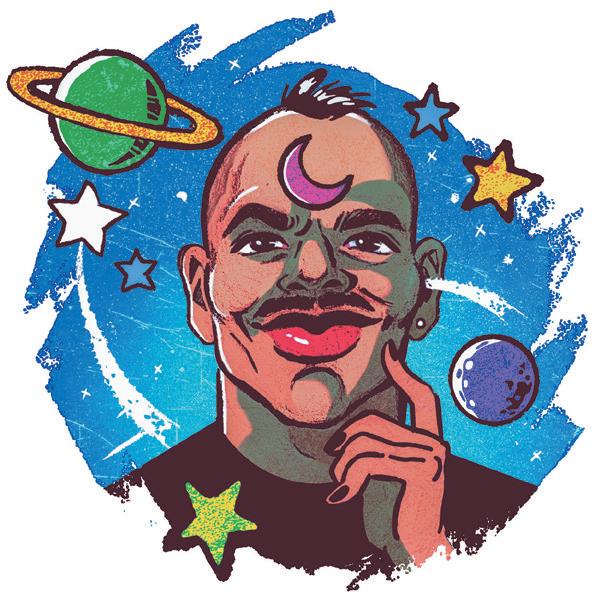
Hello Trash Pandas, and welcome to another Trash Report ! I’m Elinor Jones . I’ve gotta make this part short because there’s a lot of shit going down and if I don’t make you giggle about all of it I will simply fade away, Tinkerbell-style. Let’s go.
The People’s Columns
In his ongoing rampage to remake the country in his own image (i.e. ugly, tacky, nobody likes it, etc.) Trump has been on one about the columns that adorn the front of the White House. I don’t consider myself a completely uncultured person, but it had literally never occurred to me that there were different kinds of columns until now, but there are, and obviously the Corinthian kind that Trump wants are needlessly gaudy. I looked up Corinthian columns to try to be able to make a joke about them, but column lore runs deep, and I was not about to read all that. More like bore-inthian, amirite?
Speaking of Republi cans with bad taste, FBI Director (and guy who always makes me want to blink a bunch of times) Kash Patel is getting dragged for his extremely lame custom Nike Jordan 1s. It’s not that it’s lame to have custom shoes, but what is on them: it’s the Punisher skull (of course), the number 9 (Patel is the 9th FBI director), and the FBI’s motto “Fidelity, Bravery, Integrity.” Imagine loving your job so much that you made your shoes say work stuff on them. Vance and Rubio may be debasing themselves with the too-big Trump tap shoes, but at least they can say they didn’t color them on their iPad.
Stars Are Blind
My favorite season—awards—finally wrapped up with the Academy Awards We know that the Oscars peaked when Will Smith slapped Chris Rock and all the rest will pale in comparison, so this is the shadow in which we live, yada yada. Anyway, the best part about this year’s
event was actually what happened afterward: the Vanity Fair Oscar Party has historically been THE place to get photographed, but this year their red carpet had really shitty lighting, so all the celebrities who lined up to have their picture taken looked like actual humans they are PISSED . I should clarify—it wasn’t a red carpet. It was a gray carpet, with a gray backdrop. Despite genetics, money, makeup, and hours of glam, our hottest humans had no chance in what was func tionally an over-lit parking garage.
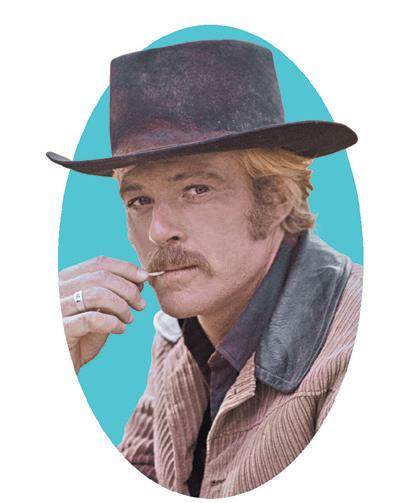
In the ceremony itself, there was a sweet “ riam” where Barbra Strei sand shared that Redford is the one who gave her the nickname Babs said to Robert, “’Bob, do I look like a Babs?” To which I said: hold the phone. Who in their right goddamned mind is calling Robert Redford “BOB”? The indignity! Not to put shade on the name Bob— my father was a Bob—but you call him Bob Redford, which is far too similar to
Bob’s Red Mill, and what? Suddenly we’re confusing him with the oats guy? An iconic sex symbol does not deserve to have their in memoriam clouded by this confusing, cereal-forward nickname reveal.
Unrelated to the Oscars, but you know something else super upsetting? Adrien Grenier, who played Andie’s boyfriend Nate in The Devil Wears Prada , is in some feelings that he was not asked back for the sequel, and has gone so far as to suggest that Nate should get his own spinoff . Like... for what? After Humpty Dumpty falls off the wall, it doesn’t really matter what the wall is up to. That part of the story is done.
Other Celebrity Deaths
Chuck Norris passed away at the age of 86 I’d like to use this opportunity to talk about Jessica Simpson ’s incredible memoir Open Book , wherein we learn that, as a child, she was sent by the Mickey Mouse Club producers to the Chuck Norris School of Acting to hone her craft, and Chuck Norris would tape down her eyebrows to try to get her to act with her eyes. So if you enjoyed Jessica Simp son’s work in The Dukes of Hazzard film, you have Mr. Norris to thank for that.
Love Is in the Air
Anora actress Wolk went on a podcast and said that Courtney Love fleeced her out of $45, and I think she is one lucky lady. Plenty of people would pay ten times that much for a fun Courtney Love story. She could honestly make a whole new career out of some thing like this. Some stars sell pictures of their feet for extra cash, she could commit mild bespoke
cost them millions, not to mention all the other brands that already have their tie-ins on the shelves. Cinnabon, apparently, even had to terminate their partnership with The Bachelorette and The Secret Lives of Mormon Wives franchises for not aligning with the “Cinnabon values.” It’s an awful lot of terminating for a gal who got famous for being in an anti-abortion cult.
And finally, Scrubs actor Zach Braff has insisted that he is not dating an AI chatbot Sure. Did your AI chatbot girlfriend tell you to say that?
Live Long and Oyster
For years, a restaurant in Alabama had a sign on its wall stating that it would give out free oysters to any 80-year-old man who showed up with his father, and so a man went there on his 80th birthday with his 99-year-old father and said “bitch, pay me.” People sometimes say that if there’s any reason to live a long life, do it for spite, but I think one could also do it for the free oysters. Happy birthday, oyster man. I hope you’re not allergic to shellfish.
In other love news, this season of The Bachelorette is a freaking MESS. ABC had to cancel it after video leaked of this season’s star, Taylor Frankie Paul , throwing a chair at her thenpartner in 2023 which led to her being arrested on domestic violence charges. This is a shocking last-minute move for ABC that will likely
Local Transportation Trash
The sickening allegations against activist Cesar Chavez have many places scrambling to rename all the stuff they named after him, including within Portland and the street FKA 39th Avenue. This is 1) the right thing to do; 2) pretty interesting it can be done so fast considering we still have whole-ass sets of streets named for slavers. My idea—which has yet to take off—is to leave the Cesar and replace Chavez with “Salad.” Hear me out! Cesar Salad (yes, I know the common spelling is “Caesar,” but be quiet, I’m on a roll) was actually invented in Mexico, and it was popularized by businesspeople and migrants traveling back and forth across the border. Cesar Salad Boulevard would honor the cultural impact of Mexican American immigrants while also honoring a top-notch salad. Thank you for reading and being hot. And you know what else? If this column was a column I’d call it Elinorinthian Okay, bye!
Transportationally,
ANNA MONEYMAKER-GETTY
PROPUBLICA
MONICASCHIPPER/GETTY
Street View: Lightning Round Transportation news and hot takes... from the streets.
STORY AND PHOTOS BY TAYLOR GRIGGS
Welcome to Street View, the Mercury’s column on all things local transportation. Here’s this month’s roundup of the news you should know.
Portland seeks new funding for transportation bureau, might actually get it this time
The Portland Bureau of Transportation (PBOT)’s budget has been circling the drain for a long time. The bureau is highly reliant on gas tax and parking revenue for its basic maintenance and operations budget, but neither of those income streams are keeping up with the bureau’s needs. The revenue model also means PBOT is dependent on fossil fuel consumption and driving, which goes against the city’s climate and safety goals.
Without enough money for basic maintenance and operations, it’s been impossible for
the city to make a dent in its deferred street maintenance backlog, which gets slightly more unmanageable literally every time a street is used. But every attempt to significantly update the bureau’s funding model has failed miserably. Nearly two decades have passed since then-Commissioner Sam Adams proposed a $464 million package to address Portland’s transportation maintenance and safety needs, with some of the money coming from a new utility fee tacked onto residents’ water bills. That plan failed, in part because oil lobbyists intervened.
In 2014, when Steve Novick was in charge of PBOT, he tried again. His efforts largely failed as well, although Novick did manage to convince voters to support a 10-cent-per-gallon gas tax for street maintenance, just before he was voted out of City Hall for the crime of being a realist about Portland’s transportation funding situation. (Clearly, voters didn’t hold much
of a grudge, because he’s back now.)
Meanwhile, the condition of Portland’s streets has gone from bad, to worse, to completely dismal. If we were to actually
The condition of Portland’s streets has gone from bad, to worse, to completely dismal.
address the city’s street maintenance backlog, it would cost upwards of $6.6 billion.
And it’s at this dire point when Portland might finally go for the street fee.
The Portland City Council, with Vice President Olivia Clark leading the charge, appears poised to adopt a transportation
utility fee (also known as a “street fee”), which would be added to residents’ water and sewer bills. It’s a similar proposal to what Adams and Novick suggested all those years ago. Many other cities in Oregon, including Milwaukie, Tigard, and Hillsboro, charge these fees, which are intended to treat street upkeep like a utility everyone benefits from. (The city report points out that “even a person who never leaves their residence benefits from the goods and services that travel on the transportation system.”) Portland leaders are considering charging $12 monthly per house, $8.40 per apartment, and $61 per business, which they expect would generate almost $47 million annually.
The city has considered a few other new fees, too, but the utility add-on would generate the most revenue. While the new tax could be a lifeline for PBOT during a time of financial hardship, it’s not com -
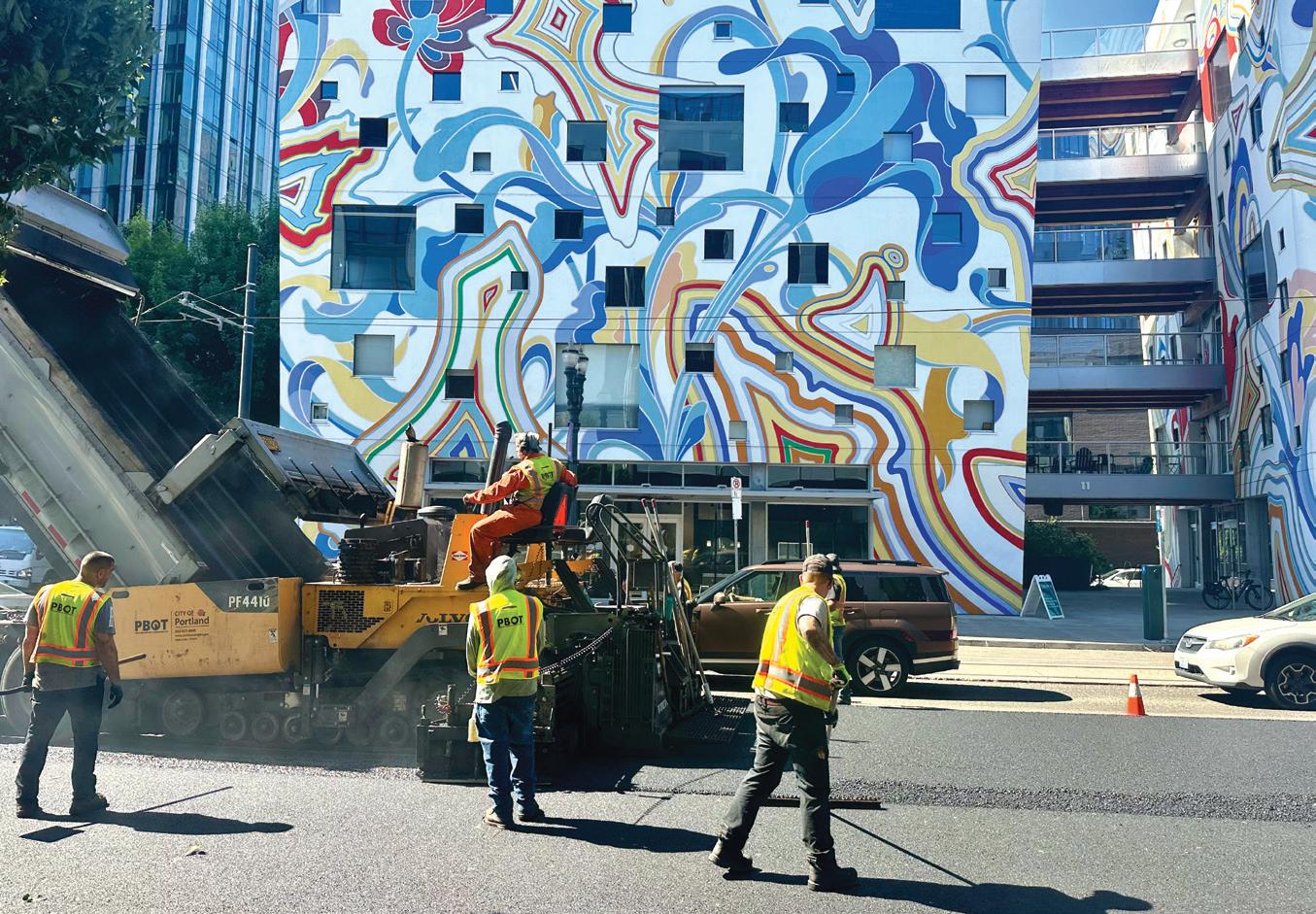
PBOT needs more money for fresh repaving jobs, like this one on NE MLK Blvd.
forting to know it would barely make a dent in the deferred maintenance crisis. In order to make a real impact, one would need to build a time machine, travel back to the 1990s, and beg then-Mayor Vera Katz to get a handle on the pothole problem before it spirals out of control. Also, it would help if people drove a little less, or at least, drove smaller cars. You may look like a total badass in your 8,000 pound Ford F-450, and yes, of course driving it boosts your sex appeal, but those heavy trucks do some serious damage!
The City Council is set to vote on the new PBOT fees this spring.
Building bike culture
They say “if you build it, they will come.” But what happens if they don’t? PBOT bicycle coordinator Roger Geller has been grappling with this question for the last few years, as he’s watched Portland’s bike ridership decline even as the city’s infrastructure improves. Earlier this year, Geller revealed his “Bikeable Portland” plan, which set out to get more Portlanders on bikes through a large-scale social campaign.
Part of the plan would enlist bike coaches who would each lead regularly scheduled rides in a certain target area, hoping to help people familiarize themselves with their neighborhood bike routes in a comfortable setting. Geller also proposed emphasizing pavement markings on neighborhood greenways to increase the visibility of the bike network, and suggested the city host and support events designed to celebrate Portland’s bike culture.
The plan found support from Councilor Steve Novick, who proposed the city allocate some money from the Portland Clean Energy Community Benefits Fund (PCEF) to get it off the ground. It was ultimately not chosen for funding, but the idea ignited both conversation and controversy among local bike advocates.
One piece of skeptical public testimony came from Portland resident and urban planner Sean Edging, who said he primarily gets around Portland on bike or public transit. Edging said he thought the proposal “misunderstands the incentives of Portlanders in making transportation decisions.” He thinks people choose to drive instead of bike, not because they don’t enjoy bicycling, but because driving is faster, more convenient, and safer. No amount of social campaigning will change that, he thinks, at least not without measurable infrastructure improvements happening at the same time.
people like Geller rightfully prop up the infrastructure improvements we’ve seen in recent years, it’s worth pointing out that Portland’s bike network is still rather disjointed. The bike lanes on Naito Parkway and Southwest 4th Avenue are world-class, but you can only get so far on them before you have to turn onto a sketchier street. But it’s clear some people don’t find these conditions prohibitive—after all, there are still thousands of people who do ride their bikes on a regular basis, and even more who did in the past. Clearly, some non-infrastructure concerns are at play.
A campaign like the one Geller has proposed probably wouldn’t hurt, and may provide the nudge some people need to get on their bikes. But Portland already has a great community of bike enthusiasts who host social bike rides regularly throughout the year, and several times a day during the summer. It’s unclear how the Bikeable Portland plan would significantly differ from what people in the community are already doing for free.
If city leaders want to use social tactics to get would-be cyclists out of their cars, it would likely be far more effective to make
incentives of up to $1,600 for standard e-bikes, $2,350 for cargo bikes, and $8,500 for adaptive e-bikes, plus up to $300 for accessories.
The rebates are means-tested, and qualified applicants must be 18 or older, live in Portland, and have a household income at or below 60 percent of the area median
If city leaders want to use social tactics to get would-be cyclists out of their cars, it would likely be far more effective to make parking more expensive.
income, or 80 percent for adaptive e-bikes. Those who wish to receive an adaptive bike rebate must prove they have a disability that prevents them from comfortably riding a standard bike.
PCEF Transportation Decarbonization Program Manager Seetha Ream-Rao said the program is intended to build on Portland’s “deeply rooted bike culture.”
“This new e-bike rebate program will make commuting more affordable for low-income households, support healthier communities, improve transportation access, and help the city reduce greenhouse gas emissions,” Ream-Rao said.
The rebates could give a nice boost to the local economy, too, with recipients being required to purchase their bike from a Portland cycle shop.
Applications for the first round of rebates are live from April 6 to April 27, when recipients will be randomly selected and notified. A second round will open immediately after. While the program is expected to offer 6,000 e-bike rebates between now and 2029, it’s unclear how many will be given out in these initial rounds, depending on demand and what retailers can keep up with. Find out more at portlandebikerebate.com.
Oregon Legislature snubs street safety
parking more expensive, or to implement congestion tolls in the central city. The revenue generated from those programs could fund a network of protected bike lanes, boost the public transit system, help pay for road maintenance, and more.
(Excuse me while I run from this mob of pitchfork and torch-carrying drivers.)
While I think it’s disingenuous to give too much weight to the social factors that encourage or discourage people from riding a bike, it’s also naive to do the opposite. Obviously, there are people in Portland— perhaps a majority—who would truly like to get around by bike, but can’t do so because of the points Edging raises. There are certainly big parts of Portland where it’s genuinely frightening or seriously inconvenient to ride a bike for transportation. And while
The e-bike revolution is coming! Portland just launched its electric bike rebate program, giving people the chance to get a brand-new, speedy bike on the cheap (or for free). It also could be an answer to Geller’s prayers, advancing mass bike ridership faster than any social campaign could do.
The initiative, which is funded through a $20 million PCEF investment, has been highly anticipated since it was announced several years ago. The rebate program, dubbed “Portland Rides,” will provide
Why electric bikes? Well, as anyone who owns one will gladly share, e-bikes can be game-changers. They make commuting easy and fun, and for much of the year, sweat-free. But the most exciting potential outcomes of the e-bike incentive program are the collective benefits that will come with getting more Portlanders on bikes.
Once you start riding a bike, you start noticing things about the city and the kind of vehicles streets are designed for. You might even be inspired to speak up about what you experience. This is a phenomenon that has been observed in other cities with e-bike incentives. As someone involved in Denver’s rebate program put it to Bloomberg CityLab a few years ago: “We’re creating new constituents who are going to advocate for better, safer bike infrastructure.” In other words, if you give a person an e-bike, they might support building bike lanes. It’s a slippery (and attractive) slope, folks.
Near the end of the Oregon Legislature’s short session, which wrapped up in early March, legislators voted to approve a transportation budget adjustment that stripped money from safety programs, passenger rail, bike paths, and more. The budget choices were necessary, legislators said, because the transportation funding package Democrats passed last year is on hold thanks to a Republican-led effort to overturn the bill via ballot referendum. The bill, which contains a suite of fee increases to pay for road maintenance, public transit, and more, is expected to fail when voters weigh in during the May election. Either way, there were immediate budget gaps to fill at the Oregon Department of Transportation.
In the end, legislators opted to redirect $17 million from Oregon’s Safe Routes to School program, $8 million from Oregon Community Paths, and tens of millions more from programs that fund rail service, electric car chargers, and more. The response was overwhelmingly negative.
“Oregon should not patch a budget hole by cutting the programs that keep people safe and lower costs and pollution—especially for schoolkids, disabled Oregonians, and rural communities,” Brett Morgan, transportation policy director at Climate Solutions, wrote in public testimony to the Legislature. “You save a little now, and you pay more later—in crashes, pollution, and higher household transportation costs.” Transportation safety and climate advocates, who have been deeply engaged in the state funding conversation for many years, called the decision a “betrayal of public trust.” They expect lawmakers to pass legislation in the 2027 session that meets key state priorities like climate justice, pollution reduction, and street safety.
Hey, are the three ghosts from A Christmas Carol available to do a little lobbying anytime soon?
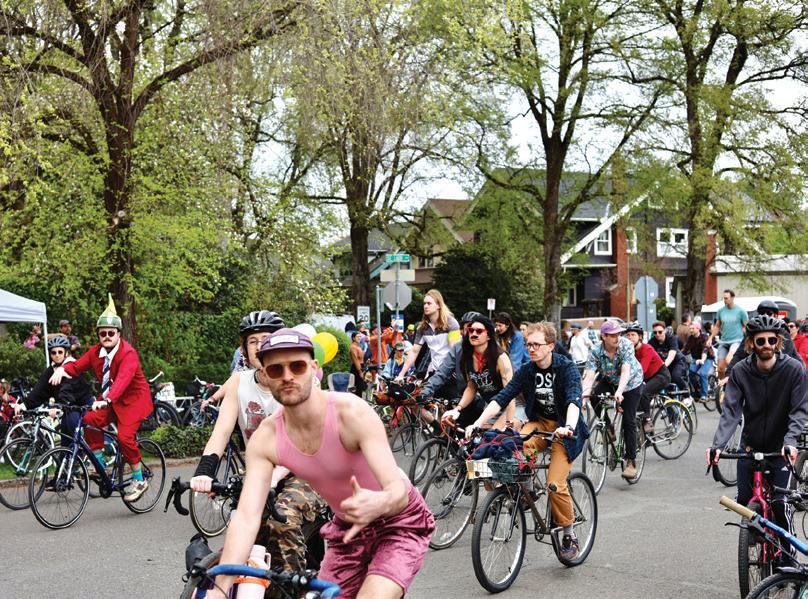
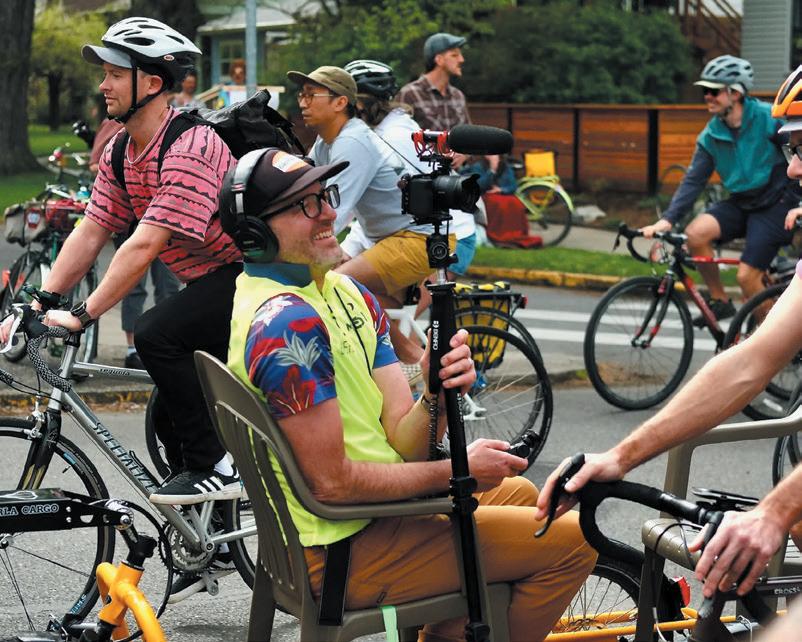
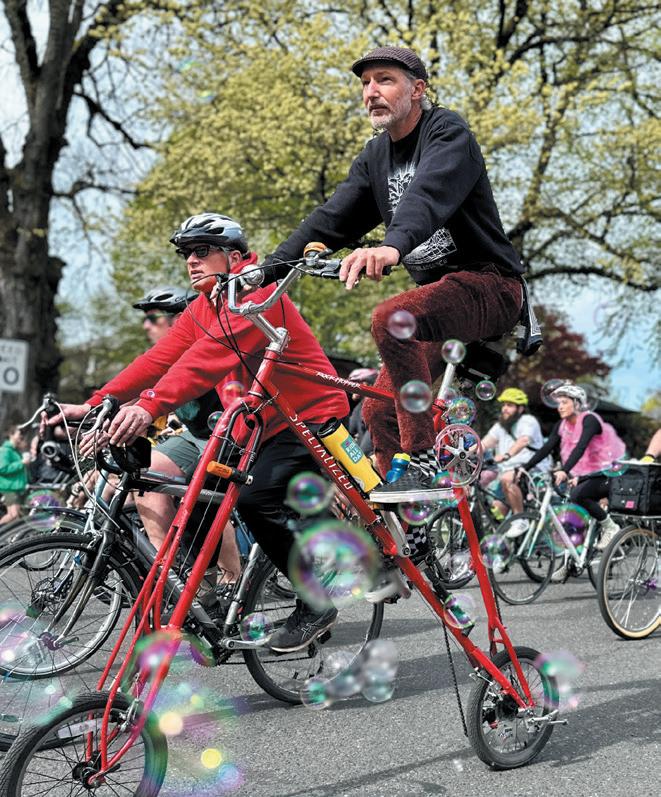
The Ladds 500 is a good example of Portland’s existing bike culture.
The Road to Improvement Can the city fix East Portland’s transportation woes?
BY JEREMIAH HAYDEN
If you ever venture out of Portland’s central city to the eastern edge of town, you’re likely to witness some remarkable traffic sins. It isn’t rare to see people speeding down the median to pass cars daring to drive 30 in a 30. You’ll see pedestrians and people using mobility devices stranded in crosswalks, leaving to chance whether they’ll be hit by the big truck turning right on red without looking. And you can hardly find a driver who isn’t focused on their phone, despite the inevitability that someone on foot will soon dart into five lanes of traffic. Biking is only for the bravest.
The chaos didn’t materialize on its own. East Portlanders say they’ve long been ignored by local government, which promised sewers and sidewalks but mostly just delivered the sewers. Like many cities in the United States—where roughly 40,000 people are killed in traffic crashes each year—transportation infrastructure leaves East Portland as a highly car-dependent, individualistic, and wildly unsafe area of the city. But recent changes in local government could make it possible for elected leaders to change the paradigm.
Traffic fatalities in Portland are down in 2026, compared with this time last year. Of the five fatalities thus far, two have been in East Portland. The data from the 2025 Vision Zero Deadly Traffic Crash Report suggests things are improving in that edge of the city. In 2025, the city recorded 39 fatalities, including 11 in East Portland. On one fateful night in October 2025, three people died in separate East Portland traffic crashes.
But for the first time since 2018, East Portland recorded fewer than 20 traffic deaths, representing a 56 percent drop from the 2021-2024 average—greater than the city’s 38 percent decrease that year. Still, East Portland has a higher rate of traffic fatalities, at 6.4 per 100,000 residents, compared to six per 100,000 in the rest of the city, according to the Vision Zero report.
City Council President Jamie Dunphy— one of three representatives of East Portland’s Council District 1—has been particularly outspoken about the visible inequities on his district’s streets. He told the Mercury local residents’ top transportation complaints are the lack of neighborhood sidewalks, the number of unmaintained gravel roads, and of course, potholes. People also remain concerned about traffic safety.
Dunphy said the lack of access to Interstate 84, particularly for those traveling west from outer East Portland, means people drive like a “bat out of hell” on city streets.
“The fact there are no on-ramps to I-84
west in the entire length of District 1, is contributing to all of our main arterials becoming de facto freeways,” Dunphy said.
With residential streets that don’t connect, gravel roads, and inadequate TriMet service, main roads like Foster, Glisan, Halsey, Holgate, Powell, Stark, Burnside, Sandy, Fremont, and others lend themselves to reckless driving.
Of the top 30 intersections in the city with the highest number of reported col -
“Our main arterials [are] becoming de facto freeways.”
lisions, 26 are on or east of 82nd Avenue, according to 2019-2023 city data.
Public transit in East Portland poses issues of its own. East of the Gateway Transit Center at the intersection of I-84 and I-205, MAX stops are few and far between.
Buses are unreliable, and route circuitously around the neighborhoods to funnel people to the transit center where they can transfer to main routes, rather than having direct lines to more central areas in the city.
“That doesn’t really help anybody, so no one’s ever come to rely on it,” Dunphy said. The inconvenience of public transit means more people stay in the habit of driving, meaning more traffic and crashes. Still, the city is working on a handful of projects in East Portland, including repaving, striping, and hardening bike and pedestrian infrastructure on 122nd Avenue; new bus lanes on 82nd; adding a traffic island and lighting near a bottle exchange; and other targeted safety projects.
Led by District 3 Councilor Tiffany Koyama Lane and Mayor Keith Wilson, the city doubled down on its commitment to Vision Zero goals in September 2025. The resolution called for further collaboration between the city’s bureaus to eliminate traffic deaths, implement infrastructure changes to reduce driving speeds and shift how Portlanders travel, and examine the overrepresentation of homeless residents in traffic fatality statistics.
In 2024, 19 homeless Portlanders died from traffic-related crashes, according to the most recent Multnomah County Domicile Unknown report, which tracks the causes of deaths for people experiencing homelessness countywide. The report said homeless residents died from transporta-
tion-related crashes at 23 times the rate of the general population of Multnomah County, and 54 times when limited to only pedestrians or cyclists. It’s an ongoing issue in East Portland, as homeless Portlanders are increasingly pushed out of public spaces in the central city. Wide roads with four car lanes and drivers prone to speeding make the area especially dangerous.
“That means that drivers have an even higher responsibility, but they’re not taking that responsibility,” Dunphy said. “They have to be more on the lookout for that.”
Dunphy said the bar is low for what East Portlanders have come to expect from their elected officials, compared to the rest of the city. But that won’t keep him from trying.
“When [City Councilor] Mitch Green shows up to the Downtown Neighborhood Association, there’s 200 people there,” Dunphy said. “They’ve all been coming for 10 years, and they’re ready to yell. When I show up to the Wilkes Neighborhood Association, there are five people there, and they just applaud the fact that I walked through the door. That’s how low the bar is.”
“I’m going to just make sure that, at the very least, I keep showing up and walking through the door as often as possible,” Dunphy said.
PHOTO ILLUSTRATION BY CHAR HARRIS
Bridge Over Troubled Water
The plan to replace the I-5 bridge over the Columbia River is expensive and ever-changing.
BY TAYLOR GRIGGS
ILLUSTRATION BY HARRISON FREEMAN
In March, Oregon Governor Tina Kotek and Washington Governor Bob Ferguson jointly told their constituents they aren’t giving up on the effort to replace the I-5 bridge between Portland and Vancouver, Washington.
“We need a new bridge and it’s time to start building it,” Kotek said in a March 17 press release. “At my direction, [the Oregon Department of Transportation] will focus on protecting Oregon taxpayers by making sure this critical project is delivered as efficiently as possible.”
The announcement came a little more than two months after the Oregon Journalism Project revealed the Interstate Bridge Replacement (IBR) project is now expected to cost more than $13 billion in total. In the same press release that included the governors’ statements, IBR officials confirmed the full project is now expected to total between $13.5 and $15.2 billion, pegging the “most likely cost” at $14.4 billion. That estimate includes construction not directly related to the bridge replacement itself, with the full project area stretching well beyond the Columbia River, across five miles of I-5 between Portland and Vancouver.
The new price tag was alarming. Prior to the March announcement, IBR project leaders hadn’t released a cost estimate since December 2022, when they said the full plan would cost roughly half as much as currently projected. At a time when Oregon’s transportation department is struggling with bare bones maintenance funding, how would the state contribute billions of dollars to the I-5 bridge project?
the IBR, leaving them short by more than $2 billion for just the core projects. (Project leaders are pursuing a $1 billion grant from the Federal Transit Administration to fund the MAX light rail extension to Vancouver.)
In comparison to the $14.4 billion number, the scaled-down plan and its $7.65 billion price tag appears somewhat manageable. It’s unclear, however, if the phased approach truly means a more efficient project.
The primary component of the plan is the bridge replacement itself, which will
Officials now say this part of the project will be completed later, as part of a phased approach to construction.
The construction plans for the sections of I-5 adjacent to the Columbia River have been the main target of ire from anti-freeway advocates, who have accused the IBR team of using the bridge replacement project as a way to unnecessarily widen a five-mile stretch of I-5.
Critics take issue with the project’s environmental effects as well as its major financial impact, and have called on Ore -
project in which the agencies acknowledge the financial realities of our state budgets and the imperative to curb excessive megaproject spending to preserve funding for core functions of our transportation system.”
Portland economist and ODOT watchdog Joe Cortright has a less optimistic view. To Cortright, the decision to phase the project is just a way to sugarcoat the major cost increase. He pointed out that the new, 116-foot-tall bridge will require elevated freeways and interchanges on either side of the river, meaning that once bridge construction is underway, it won’t be possible for Oregon and Washington leaders to put a stop to most of the other parts of the project. With construction expected to extend until 2045, the state transportation departments are now in it for the long haul, Cortright says.
But project leaders assured Oregon and Washington residents the massive price tag is a problem for another date. For now, the IBR construction plan has been pared down to include just a “core set of projects,” expected to cost $7.65 billion. The rest will come in a later phase, IBR leaders say. Oregon and Washington’s transportation departments have currently secured about $5.5 billion in committed funds for
consist of two new earthquake-resilient fixed-span structures over the Columbia River to accommodate northbound and southbound traffic. The new bridge is expected to be 116 feet tall to accommodate river traffic without a lift span—a significant height difference compared to the current bridge, which, when lowered, is only about 40 feet above the river. The core project also includes light rail infrastructure connecting Portland and Vancouver, a shared-use path for people walking and biking across the bridge, and express bus accommodations.
The other half of the project would entail considerable work on I-5 in Portland and Vancouver, with planners aiming to reconstruct stretches of I-5 and expand several freeway interchanges in the project area.
gon and Washington leaders to “right size” the project—that is, focus on the basics. So when officials announced their plan to work only on the core components of the bridge replacement, some longtime critics took it as a good sign.
Oregon Senator Khanh Pham, who has long called for IBR planners to reduce the scope of the project, said she was encouraged by Kotek and Ferguson’s apparent decision to “prioritize replacing the existing bridge and investing in transit.”
“Oregon is already struggling to invest in the most basic maintenance and preservation of our statewide coastal bridges, mountain passes, and local streets,” Pham said in a March 17 statement responding to the IBR’s press release. “I hope today’s decision marks a turning point in the IBR
“The plan here is to take whatever money they’ve got, get the project started, and then come back later and ask for the rest of the money,” Cortright told the Mercury IBR officials also expect tolls—which public records suggest could be implemented as soon as 2027—will help pay for the project. These road fees are likely to be priced depending on demand, ranging from $1.55 to $4.70 per trip, and more for trucks. Project leaders anticipate the toll program to generate roughly $1.25 billion for construction.
According to the project’s latest timeline, IBR design work will be completed in 2027, with construction beginning in 2028. Considering how much the estimated project cost has increased over the years, leaders say time is of the essence.
In the March 17 press release, Washington Secretary of Transportation Julie Meredith said the new cost increase does not remove the need to replace the current I-5 bridge, which is old and expected to collapse during an earthquake.
“Without action, transportation challenges, safety risks, and maintenance costs will continue to increase,” Meredith said.
BikePortland at 21
After more than two decades, what’s next for BikePortland’s Jonathan Maus?
BY TAYLOR GRIGGS
PHOTO BY AARON KUEHN
In 2005, Portland’s bike scene was weird and thriving. Pedalpalooza, the summertime bike festival, was new and exciting, and featured events like a bike “kiss-in” in the middle of a busy thoroughfare. Critical Mass, the global bike protest that hasn’t been held in Portland in almost 20 years, was alive and well (and heavily monitored by the Portland Police Bureau). The Sprockettes, the nationally-known, all-female bike dance troupe, were just getting off the ground.
Jonathan Maus, a starry-eyed, enthusiastic new Portland transplant at the time, was captivated by it all. So much so, he decided to start BikePortland , a blog dedicated to chronicling the local bike scene. While many parts of Portland’s early-aughts bike culture have long faded away, BikePortland is still here 21 years later.
I worked as BikePortland ’s staff writer for a year and a half starting in 2021, just a few months after I moved to Portland. My time at BikePortland served as a Portland crash course and writing boot camp. (I also got schooled, via the site’s famous comments section, in learning to deal with harsh backlash.)
The job was supposed to be parttime, but it was immediately clear I would need to put in more than 25 hours a week to do the work well. I spent my days reading archival planning PDFs and biking around the city, figuring out Portland’s neighborhood greenways, bike lanes, and shared-use paths. I put in a lot of hours and thousands of miles on my bike.
self a journalist. His early posts were short dispatches from the streets and quick updates to help readers connect to the local bike community. More than two decades later, Maus still occupies a unique position straddling the worlds of journalism and advocacy. But BikePortland is indisputably a key source of information for Portland transportation news, big and small.
When someone biking or walking is hit and injured or killed, for example, Maus is often the first reporter on the scene, and sometimes the only one. The
BikePortland’s sometimes-fiery coverage can be divisive. Since starting the site, Maus has become somewhat of a polarizing figure in Portland. Some view him as the essence of a perceived entitlement among Portland cyclists, perhaps best parodied in Portlandia’s “cyclist rights” sketch. But Maus gets plenty of flack from people within the bike community, too. (A look at the BikePortland comments section will quickly make it clear that transportation advocates and cyclists are definitely not a monolithic group.)
“I’ve always allowed people with very
Michael Andersen was BikePortland ’s news editor from 2013 to 2016—one of only a few other people who have held a BikePortland staff job. Andersen, who came from a newspaper background, told the Mercury that while Maus made some journalistic decisions he found surprising, his approach has served him and the broader public well.
“[Maus] has an incredibly nuanced and intuitive understanding of his audience, both the loyalists and the potential newcomers,” Andersen said. “Jonathan is a civic hero and Portland is lucky as hell to have him at work all these years. Healthy cities desperately need media, especially aggressively independent media. Yes, Jonathan throws elbows, and yes, he is a grump, but those qualities are why he had the gumption to start this crazy thing and will it into existence every day for the last 20 years.”
I had a great and highly educational time at BikePortland, but my short time in the position wore me out. That’s why I wanted to check in with Maus, 21 years into BikePortland, to see how he’s feeling about the past, and what the future might hold.
Going back to 2005: Maus first launched what became BikePortland as a web column for the Oregonian. A few months later, he jumped ship to start his own site. The site’s early posts reflect an earnest enthusiasm for the sheer weirdness of local bike culture.
“We were at the start of this really meteoric rise as America’s best bicycling city in 2005, and we’d have several more years of that,” Maus told the Mercury in a recent interview. “It was fun, and BikePortland plugged right in.”
At the start, Maus didn’t consider him-
site has also pushed transportation news into the local mainstream, showing other news organizations that Portlanders care about these issues.
“Over the last 20 years, BikePortland has demonstrated there is a big audience for this stuff,” Maus said. “It’s helped the local media realize that not only is biking information important, but there’s a huge demand and market for it.”
Maus also isn’t afraid of holding other reporters’ feet to the fire when it comes to their transportation coverage. From the beginning, part of his beat has been media criticism, pointing out coverage he sees as victim-blaming or ignorant of transportation issues. (This criticism extends to police press releases, which have historically informed many news reporters’ angles.)
different opinions to leave comments, and I’ve gotten in trouble for that in some regards,” Maus said. “Some people feel some people’s voices don’t belong in the bike community. And I’m sitting there going, you don’t get to define what the community is, right? None of us do.”
Sometimes, the backlash is warranted. Maus has made mistakes, and without an editor’s guidance, the fallout is all on him. He says he’s been able to weather the truly bad moments by lowering his guard and talking to people directly.
“I have an open door. I really do talk to everybody. I pick my phone up when it rings,” Maus said. “The community is my boss. If I don’t make decisions that are the right ones for the community, then I won’t have a business, really.”
Maus says over the past few years, things have changed for him. He’s no longer able to dedicate the time and energy to go to and cover every big bike ride or newsworthy transportation event. He’s thinking about the future of BikePortland, and isn’t sure what it’s going to look like.
“I’ve pretty much confirmed in my own head that I don’t want to keep devoting my entire life to this one thing,” Maus said. “I think, five years from now, BikePortland will be a lot different.”
For now, the motivation ebbs and flows. Three years ago, Maus launched a weekly bike happy hour, which he sees as a big success in bringing people together on a regular basis. For the last year and a half, the happy hour has rotated between Migration Brewing on North Williams and Gorges Beer Co. on Southeast Ankeny.
“I’m there every Wednesday at 3 pm if people want to talk. I try to introduce everybody, get everybody connected,” Maus said. “That’s what it’s all about, building community strength one person at a time. People who are informed and connected can’t be messed with and taken advantage of. That makes them powerful, and able to do cool things.”
BikePortland ’s belated 20th anniversary party will be on Wednesday, May 6 at Migration Brewing, 3947 N Williams, 3-6 pm, free, all ages.
Maus on the job, covering the Ladds 500.
The Highway That Never Was How Portland killed the Mount Hood Freeway.
BY JOE STRECKERT
ILLUSTRATION BY YIFAN WU
Over fifty years ago, a freeway almost destroyed a large swath of Southeast Portland. Portland said no.
The modern American freeway system is largely a product of development following World War II, and in the early postwar years, highways were popular. Or at least, the idea of them was.
“The initial wave of roadway building was primarily a rural phenomenon,” says Sy Adler, professor of Urban Studies and Planning and Interim Dean, College of Urban Affairs at Portland State University. According to Adler, state legislatures were dominated by rural and small-town interests, and gas taxes were often restricted to building highways. Highway construction, he says, was a way to connect dispersed rural communities to urban centers.
“Getting the interstate highway system going was an urban response to how, at the state level, highways were often a rural phenomenon,” Adler says. He says that in the late 1940s and early 1950s, city governments were generally eager to have highways make inroads (literally) into urban environments.
However, the practical realities of building a highway system soon kicked up resistance.
“The minute freeways started impacting where people lived—either through displacement or because of what its presence did to a neighborhood—that stirred up controversy,” says Val Ballestrem, a public historian whose master’s thesis In the Shadow of a Concrete Fores t focuses on the Mount Hood Freeway.
Bridge to I-205, cutting through Southeast near Powell Boulevard, along where Clinton Street is now. Ballestrem estimates construction would have demolished over 1,700 homes, about 1 percent of Portland’s available housing at the time.
Notably, the Mount Hood Freeway would not have gone to Mount Hood. It would have gone to Gresham.
“The intent wasn’t to destroy cities,” says Ballestrem, “but the reality on the ground was that you had to acquire land.”
In the late 1960s and early 1970s, opposing freeway construction and supporting mass transit was a winning issue for a new
in his thirties.)
Ron Buell, who helped run Goldschmidt’s campaigns and went on to found Willamette Week, emphasizes that defeating or firing entrenched political figures who’d been responsible for the initial waves of freeways went a long way to making change possible.
“Neil replaced the whole damn Planning Commission,” he says.
Unlike early opposition to I-5 and I-205, efforts to stop the Mount Hood Freeway succeeded. According to Ballestrem, Adler, and Buell, there was no one single reason for the freeway’s defeat. Popular movements, a new generation of elected officials,
a decade or two before. Public input and assessments of environmental impact statements became part of the process.
“Suddenly there was this nexus of things that made future freeways hard to get done,” says Ballestrem. “In some ways they were lucky to get I-205 finished.” Ballestrem notes that the Mount Hood Freeway didn’t satisfy the new regulatory requirements that freeway projects had to abide by in the ’70s.
Buell also credits Goldschmidt for mobilizing local business and labor leaders against the freeway. Historically, he says, those interests had been in favor of large infrastructure projects. That’s because Portland didn’t just give highway funding back to the feds. Recent federal legislation at the time allowed local governments to repurpose highway money to other transportation projects. According to Ballestrem, this was crucial for killing the freeway. Saying “no” meant saying “yes” to a lot of other projects.
generation of Portland elected officials.
Ballestrem cites I-5 construction as an example. Construction on that highway in more rural areas was, he says, largely uncontroversial. But once it hit the Portland metro area, he says, “There were definitely people opposed to that from the beginning…. There was a lot of letter writing and things like that, but for the longest time it didn’t have any real impact. Until there was a shift on who was in office.”
“For Portland you had two main roads: I-5 and what became I-205.” This, he says, was typical. Cities usually had one highway going through the city center, and another further out on the periphery. The Mount Hood Freeway would have connected these two main roads, connecting the Marquam
“Goldschmidt was especially big on prioritizing transit that would serve the Portland Central Business District,” says Adler, who characterizes this era as a major shift in Portland politics. Adler was referring to Neil Goldschmidt, the Portland city com-
“We did a canvas down the route of the Mount Hood Freeway, through Portland and all the way down to I-205.”
missioner and mayor who would go on to become the U.S. Secretary of Transportation. (In 2004, Goldschmidt admitted to sexually abusing a 13-year-old when he was
new regulations for infrastructure projects, and federal legislation allowing for reallocation of transportation funds contributed to the highway’s demise.
Adler says that freeway resistance in the later part of the midcentury has to be viewed in the context of other popular campaigns, like the civil rights and environmental movements. Those, he says, shared overlapping concerns about displacement, safety, and air pollution, and mobilization for one cause compounded others.
Buell recalls popular resistance to highways during the 1970s: “We had protests on ramps to where they were going to extend the freeway,” he says. “We did a canvas down the route of the Mount Hood Freeway, through Portland and all the way down to I-205,” he says, recounting a door-knocking campaign that included hundreds of homes and businesses.
In the early 1970s, building a highway also entailed much more than it had just
The $75 million for the Mount Hood Freeway was repurposed for other uses. One of the most high-profile was a light rail system.
“A MAX line to Gresham was still going in the same direction the freeway would have gone,” says Ballestrem.
Adler emphasizes that the funding didn’t just go to the MAX. It also got spread around the region, including about 140 smaller roadway projects, which was politically useful for city, state, and county leaders.
“That Mount Hood Freeway money ended up in projects all over the place for the next two decades,” says Ballestrem. “It speaks to the political power that people can have when they get together and get people in office.”
Adler and Ballestrem are both hesitant to speculate on what Portland would look like had the freeway been built.
“The state land use program might have moderated the effect of building that freeway,” says Adler. “One can imagine a lot of Washington County-type development: lower density and sprawling patterns out east. It would have also transformed agriculture on the east side.”
After a few moments of hesitation, Ballestrem does say one definitive thing about what the freeway would have looked like.
“It would have been an eyesore.”
Taking the Fast Lane on 82nd Avenue
Inside the ambitious plan for Portland’s busiest transit corridor.
STORY AND PHOTO BY TAYLOR GRIGGS
In February, after years of planning and sometimes-contentious community conversations, TriMet leaders announced the agency intended to build bus-priority lanes along most of 82nd Avenue in Portland. The news was met with relief from transit and safety advocates who have long made it clear that the ongoing effort to transform 82nd must include major public transit improvements.
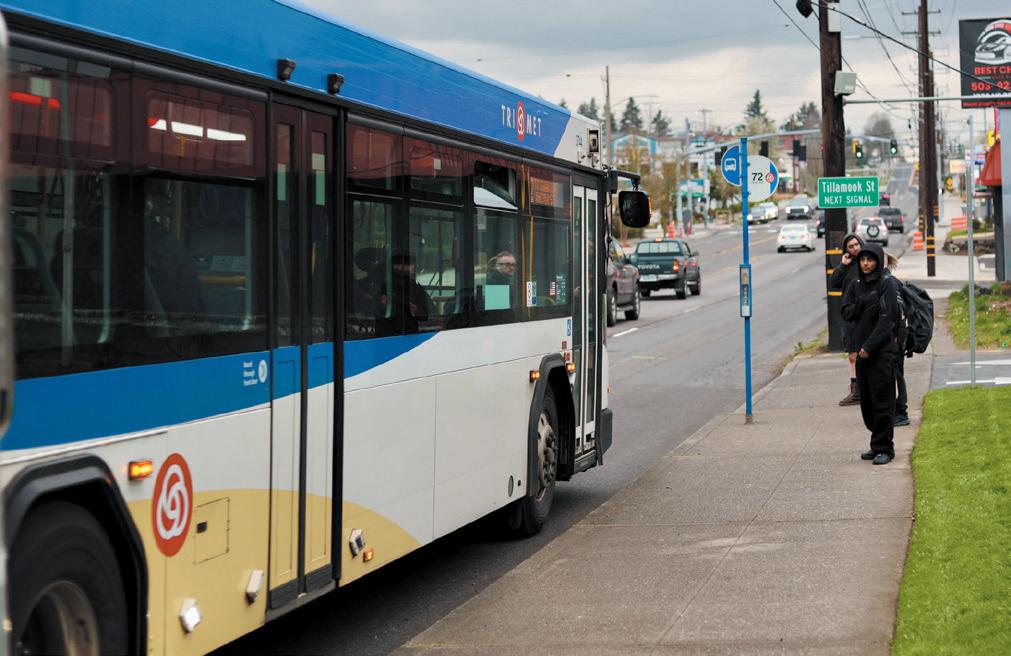
Currently, 82nd Avenue is served by TriMet’s Line 72, which has the highest ridership of any bus line in Oregon. Many people who live along the corridor and in surrounding neighborhoods are reliant on the bus, but it is often delayed due to traffic congestion on the busy thoroughfare.
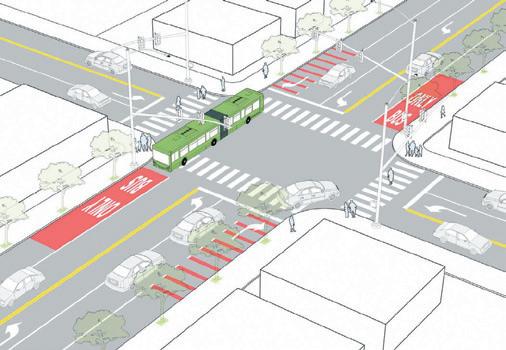
Under the plan approved in February, TriMet would implement what’s known as business access and transit (BAT) lanes on 82nd Avenue. These bus lanes, designed to prioritize transit capacity while still enabling car traffic to use them to turn, would ideally speed up bus service and make TriMet a more reliable transportation option for people traveling on 82nd. If all goes according to plan, the project could be completed as soon as 2029.
But TriMet’s February announcement came with a caveat. The agency will need to secure at least $8 million more in funding to move ahead with the full project, estimated to cost $350 million in total. Project leaders are under a tight timeline to close the budget gap, with $150 million in federal funding on the line. TriMet anticipates the Federal Transit Administration (FTA) will come through with the money this fall, but that’s contingent on pulling together sufficient local matching funds within the next few months.
So far, the project has received $55 million in funding from the Portland Clean Energy Community Benefits Fund (PCEF), though only $48 million of that is currently dedicated to the transit elements of the plan. Most of the remaining local funding will come from TriMet’s general fund and Regional Flexible Funds allocated by Metro.
In a February statement, TriMet General Manager Sam Desue Jr. said he is committed to maximizing bus-priority lanes on 82nd Avenue “wherever feasible, while addressing community concerns, managing risks and positioning TriMet to secure federal funding” for the project. But, Desue said, the conversation “is not over until
we determine a solution for the funding.”
The 82nd Avenue Transit Project has been in the works for several years as a major part of the regional plan to make significant changes to the corridor. The larger project began in earnest in 2022, when the city of Portland took ownership of 82nd Avenue from the Oregon Department of Transportation (ODOT).
Over the last three years, the Portland Bureau of Transportation (PBOT) has placed some much-needed crosswalks, including several new signalized crossings, along 82nd, which has long been one of the city’s most dangerous streets. PBOT
also installed several new median islands, upgraded street lighting, and planted trees. Transit advocates are hopeful the upcoming transit project will be the cherry on top of 82nd’s transformation.
“We really want to make sure transit on 82nd Avenue can be as fast and frequent and reliable as possible,” Indi Namkoong, transportation justice coordinator at the nonprofit Verde, told the Mercury . “That’s what makes it feels safe, attractive, and effective for folks in our community, and that’s what really maximizes the potential of this project to contribute to making the whole corridor a better, happier, and healthier place to live and work.”
The plan TriMet approved in February would implement seven miles of BAT lanes in each direction of 82nd Avenue, encompassing the majority of the thoroughfare from Southeast Clatsop to Northeast Lombard Streets. One exemption would be at the intersection of SE 82nd and Powell Boulevard. ODOT still owns and maintains Powell, and the state agency has been wary of approving dedicated bus lanes along its roadways.
82nd Avenue transit advocates saw TriMet’s decision as a win. But there’s still the question of funding. So far, efforts to scrape together the last of the funds have been inconclusive or unsuccessful. But proponents of BAT lanes on 82nd aren’t giving up.
Acting Metro Council President Duncan Hwang, whose district includes 82nd Avenue south of I-84, has long been a strong supporter of improved transit service on the corridor. Hwang, who serves on the 82nd Avenue Transit Project’s Policy & Budget Committee, told the Mercury his team is working on a few different possibilities for filling the budget gap, some of which may be more immediately feasible than others. But with federal funding on the line, it’s important to act quickly, Hwang said.
In addition to the benefits Hwang expects the project will bring to 82nd, he pointed out that as the most ambitious transit plan currently in the works in the Portland area, the success of this project will set the stage for the next decade or more of local transportation planning.
“We really want to get this right to set a good example and learn things to bring onto the next project,” he said. “[The project] is moving forward. The question is time, and how bumpy it’s going to be.”
TriMet’s Line 72 bus, which runs the length of 82nd Ave, is the busiest line in Oregon. A BAT lane design concept.
COURTESY TRIMET
Le Tour de Portland
A guide to Portland’s exciting and inviting bike racing scene.
BY CAMERON CROWELL
PHOTO BY TAYLOR GRIGGS
Even the most casual cyclist has, at some point, felt the passing desire to race.
Fortunately for these speedsters, Portland and the surrounding area host a variety of different racing events for every type of cyclist—from beginner-focused and inclusive, to fast and competitive, to offbeat and quirky. Your first race is a short ride away.
While Portland cycling breathes with the city’s DIY spirit, official races are governed by the Oregon Bicycle Racing Association (OBRA). OBRA is a member organization, with each bicycle racer contributing either yearly dues or a per-race fee. In exchange, the organization provides a robust calendar of events and resources to help ensure safety and fairness during the races.
OBRA Executive Director Chuck Kenlan told the Mercury the organization works “really hard to make [their] races a place that anybody could feel welcome,” working with promoters and racers to create an inclusive environment.
“It’s good, fair competition, but at the end of the day our races are grassroots,” Kenlan said. “In the end, this is a recreational outlet for folks to have fun and train, to stay fit, and improve their lives.”
Portland is home to a host of OBRA competitions throughout the racing season, which generally kicks into high gear in April and winds down in October. OBRA’s races include lengthy high speed road races, mountain biking, gravel biking, and cyclocross. The Mt. Tabor Series Bike Race is a weekly road racing circuit that runs through Portland’s iconic volcanic park every Wednesday in June and July. Another hotspot in the summer is the Portland International Raceway (PIR), whose track is available for road races, cyclocross, and even adaptive cycling races (overseen by Adaptive Sports Northwest). One late summer-early fall classic at PIR is the Portland Trophy Cup, a six week cyclocross racing series that takes place every Tuesday in September and October.
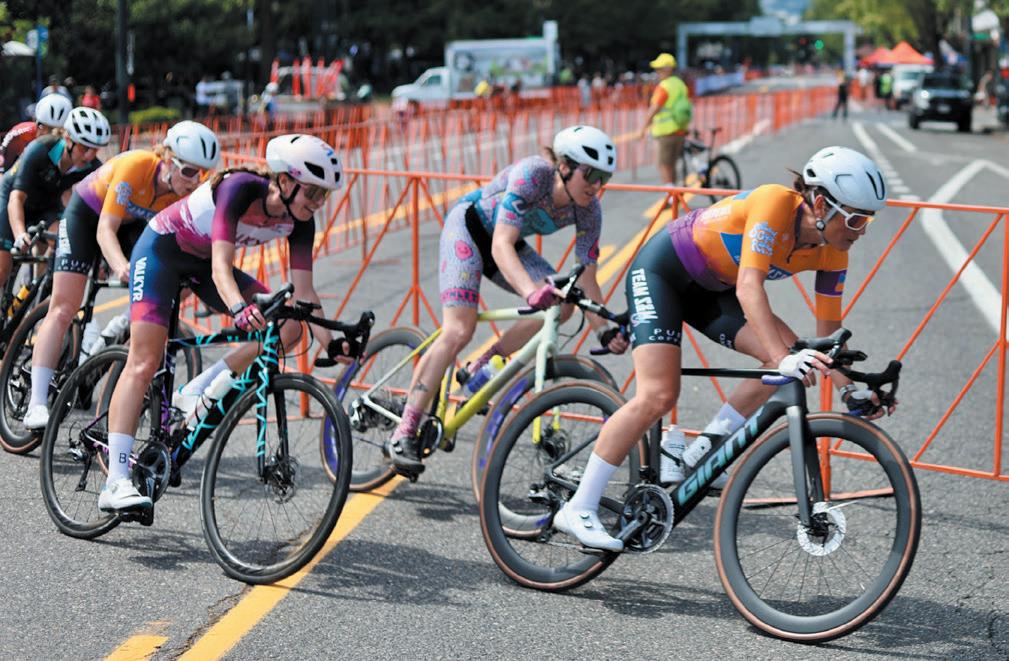
Cyclists turn a tight corner during the Portland Criterium in August 2025.
“We want it to feel fun and inviting,” Ryan said.
The Portland Trophy Cup organizers clearly take efforts to include young, diverse, and first-time racers, with youth cyclists and first-time women racers (trans-inclusive) participating for free.
“I love the elite open finishes… going fullspeed, full-gas at every corner in complete darkness at the end of the night. [But] the most chills I feel are during the finishes in
Whatever your vibe, there’s a bicycle race for you here.
the beginner women category races,” Ryan said. “When somebody new to the sport is finishing [the race], the enthusiasm is electric. It’s like we’re doing this thing that’s kind of scary, but we’re all doing it together. That’s how you grow the sport.”
Then there’s the Portland Criterium, which embraces competition and intensity. After several years without any cri -
Ira Ryan, Portland Trophy Cup promoter and course designer, described the Portland Trophy Cup as “part party, part community art project, and part [cyclecross] bike race.” The unconventional ethos of the event extends to the terrain cyclists ride on— “a little bit on grass, a little bit on pavement, a little bit on gravel, it can be dirt, [or] mud if it’s raining,” Ryan said. Ryan said some people bring their expensive racing bikes to the Portland Trophy Cup. But others show up on commuters or even beach cruisers. The range of riders—and the race’s short circuit format—make the events especially fun for spectators.
terium (or “crit”) events in the city, the Portland Criterium brought high-octane races back to downtown Portland in 2022. The crit returned last year, with events at the Northwest Portland Park Blocks and the Lloyd Center, where the races will be held again this August. During criterium races, elite racers zip through city streets at speeds upward of 40 miles per hour. The intensity and short tracks make crits very appealing to spectators, who showed up in droves to watch the races last year.
From the sidelines, the Portland Crit is a blur of racing jerseys and a collective buzz of bike chains whizzing past. Inside the peloton, it’s white knuckle competition with no racer wanting to hit the brakes even for a half-second. Adding to the intensity is the near-guarantee of high-speed crashes and road rash. Crits are a type of race a mountain bike-racing friend of mine once called “completely psycho” (complimentary). After the success of the past few years of the Portland Criterium, OBRA announced that the 2026 race at the Lloyd Center will double as the Oregon State Criterium Championship.
“Think of the Criterium like the bicycle equivalent of Formula 1,” Portland Criterium race director Steven Beardsley said. “[Racers] ride on real city streets, they come around [the short track] about every
minute, and ride at full speed for the entire race.”
Beyond the bicycle race itself, Beardsley also pointed to the Criterium’s effect on the city streets it takes place on.
“Coming out of the pandemic, the Criterium was a way to help activate parts of Portland that maybe haven’t gotten as much excitement,” Beardsley said. “But it also can transform our auto-centric streets into something cool for a weekend, a fun event with bike racing, DJs, and just tons of community spirit. Bike culture can feel a bit siloed at times, but this is a real event for the public.”
Portland’s bike racing scene goes into some more niche and chaotic areas, too— from the Sandy Smash bicycle drag race on the city’s most infamous diagonal throughway, to the fixed-gear alleycats that take place throughout the year. You could also stumble upon summer sprints on North Williams. And does the Ladds 500 count as a race? (No, it’s a relay.) Whatever your vibe, there’s a bicycle race for you here. Get out and find your peloton.
Find out more about OBRA at obra.org. The Shift calendar at shift2bikes.org is a good general resource for Portland’s bike events. For the more indie races, you’ll have to turn to Instagram—check out @pdx__fxd to start.
Feasting to the MAX
Eating like transit royalty at the end of the light rail system.
BY KATHERINE CHEW HAMILTON ILLUSTRATIONS BY HANNA CARTER
Is it just me, or does riding the MAX make you hungry, too? Maybe it has something to do with traveling across town at high speed (up to 55 mph). Maybe the rumbling of the tracks stimulates grumbling of the stomach. Either way, “it’s too far” shouldn’t be an excuse when it comes to eating in Portland and the surrounding suburbs. Even if you find yourself at the end of a MAX line, there are still stellar places to eat. We rounded up our favorite far-out eats at the very end (or, in some cases, the second-to-last stop) of every MAX line.
Hillsboro Central/ SE 3rd Transit Center
The penultimate stop of the westbound Blue Line takes you into Hillsboro’s historic downtown, where you’ll find La Mixteca Oaxaca. This is their second location; the original is attached to a Mexican supermarket one stop further east. Oaxacan specialties are scattered throughout the menu, including picaditas, memelitas, and even chapulines (grasshoppers). But the show-stoppers are the tlayudas: massive thin, crispy tortillas built to share. They’re topped with refried black beans, lard, stringy Oaxacan cheese, cabbage, radishes, and beautifully charred charcoal-grilled meats like cecina, chorizo, and carne enchilada. 230 E Main St Suite E, Hillsboro, hours vary, lamixtecaoaxaca.com
Portland Airport
Concealing things at the airport is usually a bad idea. Thankfully, Aurora, the speakeasy bar inside the airport location of beer hall Loyal Legion, is located pre-secu rity—and you can easily reach it on the eastbound MAX Red Line. The vibe is rainbow-meets-retro-futurism, with swooping velveteen banquettes and stools perched in front of an iridescent glowing bar. Look for a lemon drop with coconut cream, a salted honey Bee’s Knees inspired by Lauretta Jean’s pie, and an old-fashioned with chocolate, cherry, and fig. Our pick is the Milky Way Punch, a rotating milk punch that on our visit was made with smoky pineapple liqueur, mango, and orange juice—think eating a Creamsicle at a summer BBQ. To get in, you’ll need to know four little digits having to do with the Trail Blazers’ championship win. 7000 NE Airport Way, 4 pm-8 pm Mon-Fri, @drinkataurora
Delta Park/Vanport
The second-to-last stop of the northbound Yellow Line, located right near the Portland International Raceway, is mostly devoid of restaurants—bad news if you’ve got plans to vroom-vroom later that day. Thankfully, a food cart pod awaits like an oasis in the desert, and the star is Ta Bueno Ne, offering a menu full of Yucatecan specialties. Get the panuchos—handmade corn tortillas stuffed with black beans and fried, then topped with cabbage, pink pickled onions, and juicy, slowcooked cochinita pibil. Don’t miss the fiery, vinegary orange habanero salsa. 1223 N Hayden Meadows, 11 am-7:30 pm daily, @tabuenone.pdx
Clackamas Town Center Transit Center
At the southeast end of the Green Line, skip over the mall’s food court classics like Auntie Anne’s, Cinnabon, and Sbarro and head to spacious shopping center restaurant Sizzling Indian Kitchen , where curries galore, Indian pizza, and—you guessed it— sizzling tandoori chicken await. The tandoori chicken comes out on a sputtering triangular iron platter, complete with a trio of chutneys. It’s juicy and nicely charred, and the portions are generous—we counted three thighs and three drumsticks. But if you’re in a hurry to get back to shopping, you can also grab tandoori chicken and your choice of ready-made curries off the steam table, complete with naan or rice. 12130 SE 82nd, Happy Valley, 11 am-9 pm daily, sizzlingindiankitchen.com
Gresham Central Transit Center
Just before the eastbound Blue Line’s final stop, the Gresham Central station gets you right to Gresham’s downtown (which is also located along the Springwater Trail, for all you bikers, walkers, and runners). Here, you’ll find Birrias Tamazula , one of the best spots in town for goat birria. Our personal favorite way to eat it is in a bowl of brothy goat consomé, but you can also get your birria roasted crispy with a bowl of broth on the side, get it tucked into gooey quesabirria tacos, or pair birria with chilaquiles for breakfast. Ceviches, aguachiles, and camarones zarandeados are also on offer for seafood lovers. 184 NE 2nd, Gresham, Wed-Fri 10 am-9 pm, Sat 9 am-9 pm, Sun 9 am-6 pm, birriastamazula.com
Milwaukie/Main
It’s not every day you get to sip a latte and eat pancakes in a historic former city hall. Enter Keeper Coffee’s Milwaukie location, a few blocks from the second-to-last stop of the Orange Line. The Farmer’s Breakfast arrives looking like an illustration out of a children’s picture book: three golden pancakes, a couple strips of super-crisp bacon, and a little ramekin of creamy, cheesy, soft scrambled eggs. Lattes are silky-smooth and made with Coava beans; try the not-too-sweet house syrups, from seasonal strawberry to cardamom condensed milk. The light-filled second floor of the café feels like you’re sitting among the treetops. On sunny days, park yourself on the spacious front patio. 10722 SE Main, Milwaukie, 7 am-5 pm daily (brunch and lunch 8 am-3 pm), keepercoffee.com
A Place To Skate and Belong
How DIYers made Portland a haven for skateboard culture and growth.
STORY AND PHOTOS BY CORBIN SMITH
Skating Southeast Portland’s Dream Plaza
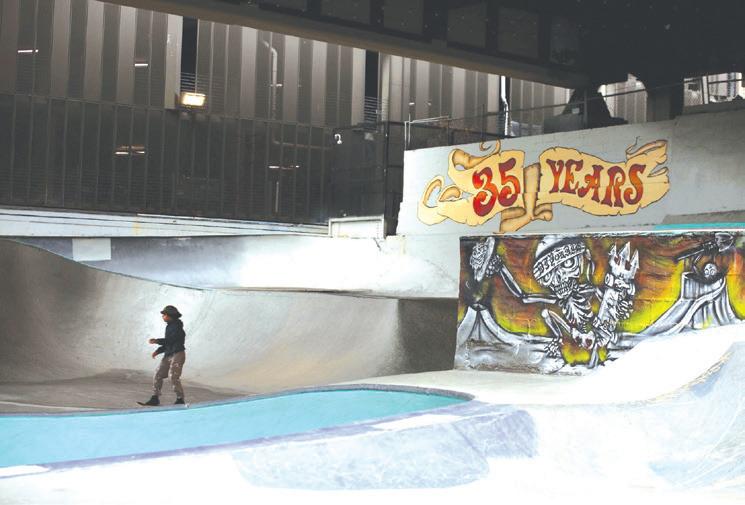
It is the crown jewel of Portland DIY tales. In 1990, a group of skateboarders living in Portland were looking for a skatepark to call their own. Seeking shelter from the violent rains of the city, they settled on the undercarriage of the east side of the Burnside Bridge and, lacking permits, capital, or anything except collective will and a vision of glorious skateboarding fun, set to cleaning up the various needles and piles of garbage that had collected there, acquired unused concrete from workers building the I-84 onramp under construction nearby, and built the core features of what’s now known as the Burnside Skatepark.
The city of Portland would’ve been well within their rights if they wanted to send in backhoes and toss the new skatepark into a series of dumpsters. But the city government took a different tactic and signed over the space to the DIYers, who formed a nonprofit to operate and continually improve the park for the benefit of the local skateboarding community.
Burnside became a sensation not only with local skaters, but among an emerging group of skateboarders, video producers, and skating equipment entrepreneurs who were coalescing into what we now recog -
nize as the global skateboarding industry. In 1998, the park appeared in Tony Hawk’s Pro Skater, a blockbuster video game that marked the emergence of skateboarding into the broader consciousness. DIY skatepark projects all over the world have taken inspiration from the Burnside story.
Burnside, and the city’s relative acceptance of skateboarding and skateboarders (not everywhere was so generous), helped to make Portland one of the world’s premier skateboarding cities. The sport, riding the internet and the wave of construction that followed in the decades following Burnside’s emergence on the scene, is bigger than ever.
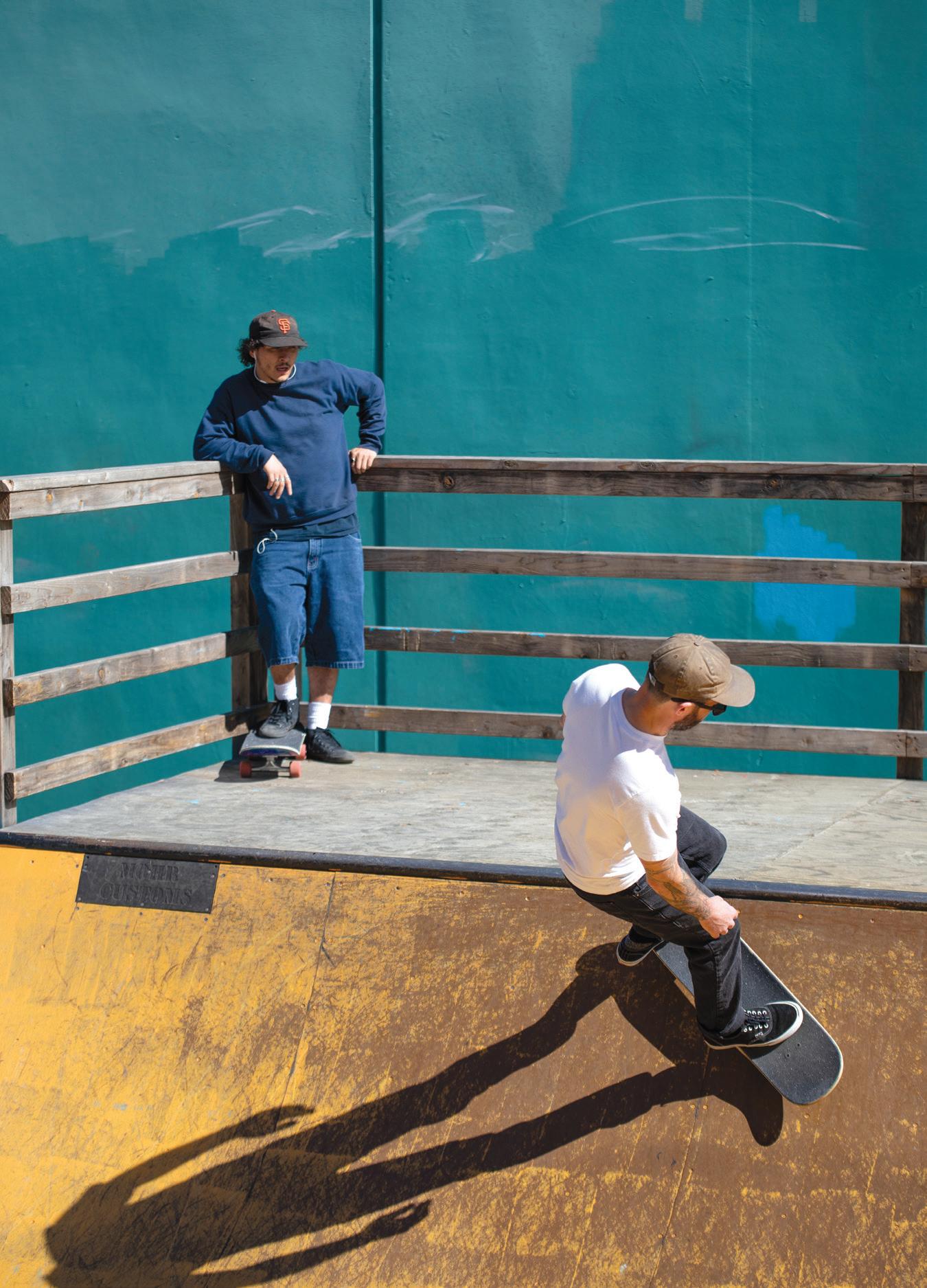
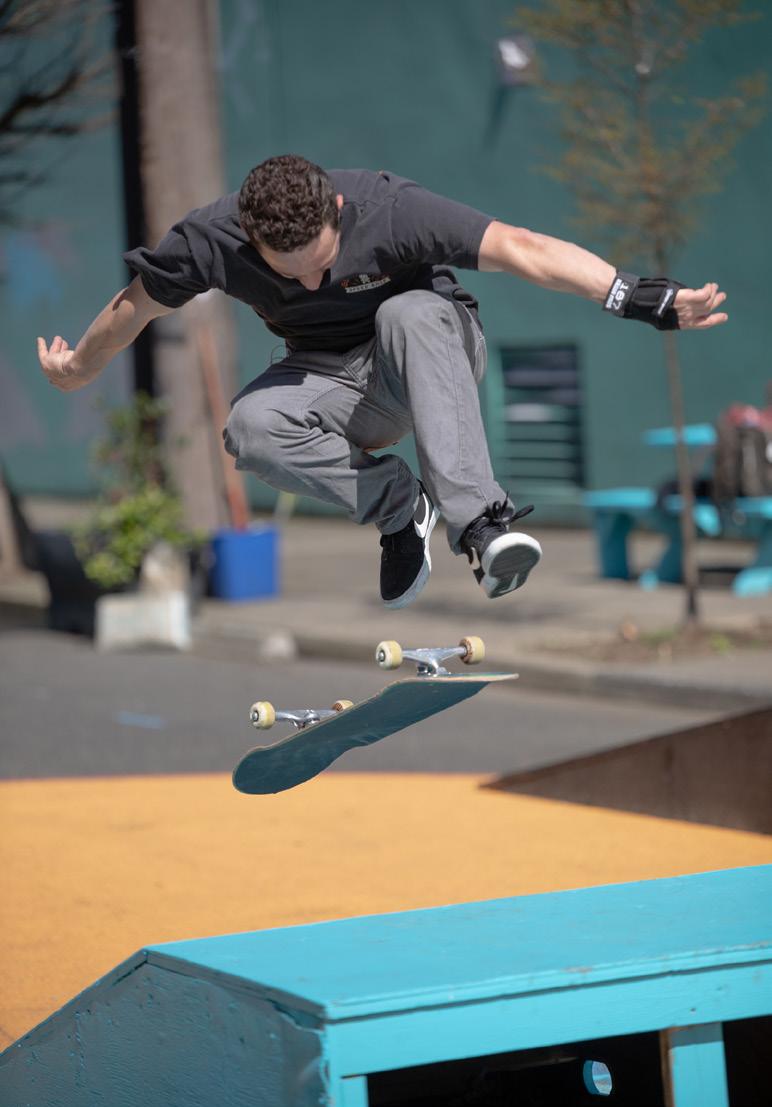
A trip to your local skatepark on a nice day will expose you to skaters of all ages and inclinations: kids in helmets taking instruction from their parents, 30-somethings getting in a workout, real old heads practicing the intricacies of kickflips, and social media types hunting for juicy content, among others.
In the last few years, the people of Portland, be they city government types, DIYers operating from the ask-for-forgiveness-not-permission spirit of Burnside, nonprofit activists, or others, have sought to make the city into a veritable buffet of skatepark options. The platonic ideal of a park has shifted a little, away from the concrete vision of Burnside and towards a more transportable, less-permanent infrastructure of smaller, gentler ramps, made from laminated wood located in different outposts around the city.
“We use a mix of plywood, steel, and 2x4s. It’s built to be durable, adaptable, and able to evolve with the community over time,” said Alex Murrell, the Executive Director at Dream Big City, a nonprofit that currently maintains a large skate plaza at SE 9th and Taylor. “What used to feel overlooked now feels active and shared.”
The goal of Dream Big City is to create inclusive environments “where people can show up, connect, and be part of something without pressure.”
“Growing up, we didn’t have a safe place to go,” Murrell remembered.
“Many people still don’t have a place that feels like it’s for them. This is about creating places people actually want to be—safe, alcohol- and drug-free environments.”
These less-than-permanent parks have appeared all around the city, from the south side of Laurelhurst Park, to the Dream Plaza in Southeast Portland, to a DIY installation at SE 7th and Sandy, located
in a pop-up plaza in the middle of a historically sketchy intersection.
Katherine Rose, a longtime DIY skatepark advocate, formerly worked with the organization Depave to develop the pop-up installation at the 7th and Sandy intersection as part of a larger project in the area.
“It felt very organic and natural to me to infuse skating into the way I was activating the space. We got tons of positive feedback—not just from skateboarders, but from people on bikes and scooters, and pretty diverse groups of people would be there,” Rose said. “Even non-skaters would sit and watch people use the space.”
Rose said she sees the act of skating as a “vulnerable and playful act of resistance in urban landscapes.”
“Even if there isn’t a DIY space, people skating in the street are carving through a landscape that’s not built for them,” Rose said. “By creating skateable spaces, we’re pushing up against the built landscape to find ways to rethink space, and remind people that play and non-utilitarian use
The goal of Dream Big City is to create inclusive environments “where people can show up, connect, and be part of something without pressure.”
[of space] are also valid and important ways to exist. Skaters have the ability to see a landscape and [imagine] something different for it. I think that act is hopeful and creative.”
Murrell also emphasized how the pop-up skate areas can transform parts of the city.
“It’s DIY, creative, and community-driven. People build their own spots, mix in art and music, and make something out of what’s already there,” he said. “They skate it, make it their own, and it becomes a meeting spot. That kind of presence can shift how a place feels.”
The Dream Plaza offers skaters a place to work on their kickflips and more. The world-famous Burnside Skatepark.
The (Somewhat) Amazing Race
Who will win in a battle of the transportation modes? Another completely scientific Mercury experiment!
BY TAYLOR GRIGGS AND MERCURY STAFF ILLUSTRATIONS BY ALYSSA ALARCÓN SANTO
How do you decide what mode of transportation to use on a daily basis? If you’re like most people, that decision is primarily based on habit and perceived convenience—not necessarily because you considered all possible options and made your choice based on thoughtful, evidence-based analysis.
Luckily, your friends at the Mercury took on this daunting task in the most scientific way possible: a race. On a rainy Friday afternoon in March, six Mercury staffers set out to determine which mode of transportation is the fastest way to get around Portland—or, at least, a certain part of Portland.
The stakes were high. The winner would take home a lifetime of fame, glory, and unending respect from their colleagues and the world at large. But it was bigger than that: We would decide once and for all which is the fastest mode of urban transportation in the land (that land being Portland). The extremely scientific nature of this experiment meant the results would undoubtedly be taken very seriously by the city’s transportation experts and power players, and could possibly even determine future funding opportunities for roads, public transit, and bike lanes. In short? This shit was important
The race included the following participants, listed here along with their Mercury job titles and vehicle of choice:
Wm.
CITY HALL 1
The race starts at City Hall: the “people’s building,” or whatever they say. There’s a light drizzle, but nothing too serious. The mood is upbeat, with everyone confident about the race ahead. Steve, who pulls an embarrassingly small child’s Razor scooter out of his backpack, seems especially—perhaps suspiciously—certain about his chances of winning. Suzette, who had been unshaken in her insistence that “the bus is best,” says she grew slightly alarmed upon finding out participants would be required to make stops along the way. “I wonder if I’ve completely lost the competition just with that,” Suzette says. “Buses in Portland are too infrequent to facilitate easy stops.” At roughly 4:20 pm, after a verbal countdown (reimbursement requests for a starter pistol were unfairly denied), everyone leapt from the starting line, scrambling their way north.
En route to the next stop, and not even two blocks away from the starting line, Steve is spotted
2
PIONEER COURTHOUSE SQUARE
0.3 miles from City Hall
Pioneer Courthouse Square, AKA “Portland’s living room,” is a mere 0.3 miles north from City Hall. Steve rolls up on his suddenly electric scooter, which no one seems to notice. It’s especially easy for those on bikes and scooters to make the selfie pit stop and continue on their way. Suzette manages to make it to the square relatively quickly, but the brief pause causes her to miss the first available MAX train to the Hollywood Transit Center. The racers who arrive first also have to duke it out with each other, and some sightseers, for space next to the umbrella man. Jeremiah and Lindsay look for parking. They find a spot a couple blocks away, pause to pay $1.35 for parking, walk to the statue, and return to the car. These inconveniences put them squarely in last place.
Andrew Harlan
Social media manager, electric bike
Katherine Chew Hamilton
Managing editor, regular boring bike
Jeremiah Hayden News reporter, car (boooo)
Lindsay Costello Staff writer, passenger in Jeremiah’s car (also boooo, but less boooo)
Suzette Smith
Culture editor/champion of the people, TriMet bus
Steven Humphrey Editor-in-chief/bon vivant, a child’s Razor scooter
THE RULES OF THE RACE
as described to participants beforehand:
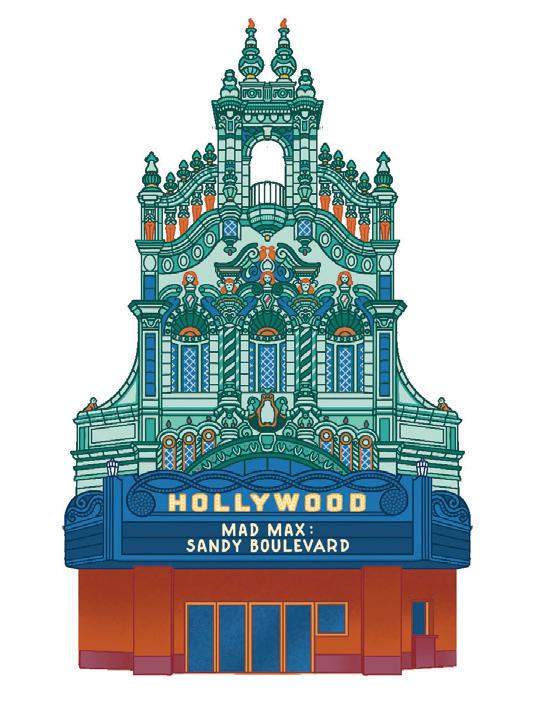
Meet at Portland City Hall at 4 pm—rush hour. Hop on your preferred mode of transportation to cross the river and finish at the Hollywood Theatre. Right before starting, racers learned they would also be required to make two stops along the way: first, at Pioneer Courthouse Square, where they’d need to take a selfie with the sculpture entitled Allow Me,
AKA the well-dressed guy with an umbrella. Then, they’d need to stop at Trader Joe’s and purchase a snack, ostensibly to sneak into the Hollywood Theatre, the final stop of the race. (This was a purely fictional scenario. The Mercury doesn’t condone sneaking snacks into independent cinemas. Much.) But unexpected things—events one might even
describe as “hijinks”—can happen when you’re zipping across town. You might need to make some “sudden, unfair changes” to your route. There might even be “sudden, unfair changes” to the rules which might throw your entire, carefully planned route out of whack. This is what our racers had to contend with. And THIS is how you do “science.”
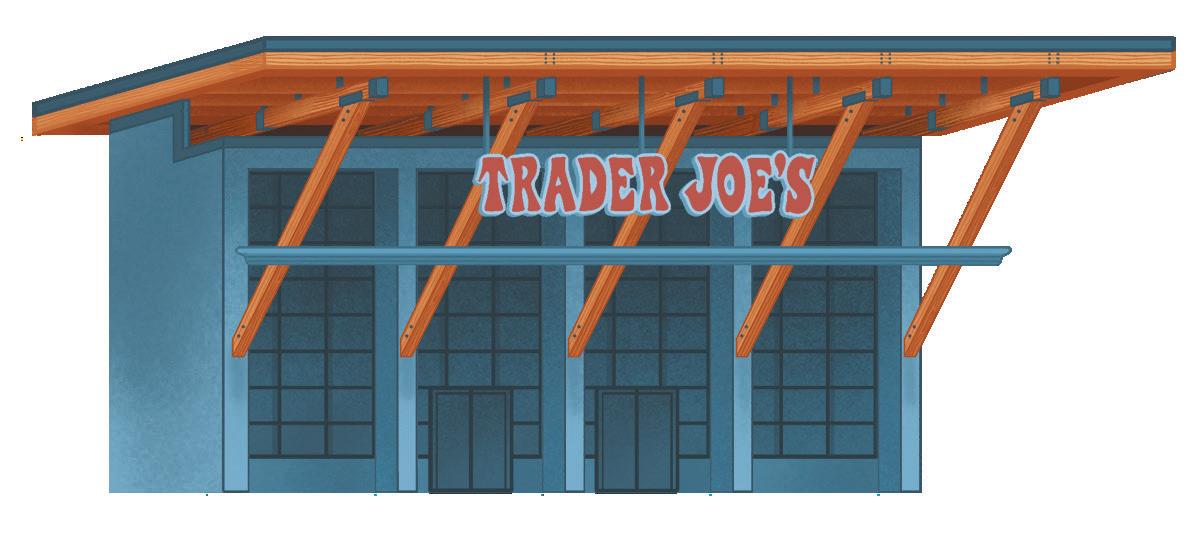
Technically, racers can stop at any Trader Joe’s for their “pre-movie” purchase, but they will certainly lose if they choose any location other than the one right by the Hollywood Theatre. Besides, the next closest Trader Joe’s location closed earlier that week due to asbestos contamination. Steve zips toward the Broadway Bridge, while Katherine, Andrew, and Suzette (by way of the MAX), cross the river via the Steel Bridge, and Jeremiah and Lindsay battle the traffic while driving over the Morrison. Andrew and Steve arrive at Trader Joe’s at almost exactly the same time. But once again, Steve has a trick up his sleeve, having sneakily pre-purchased his snack the night before. The fact that he was privy to the Trader Joe’s stop represents a failure on the part of the race
Suzette arrives next, and gets overcharged for her purchase. Jeremiah and Lindsay lackadaisically stroll in while Katherine is still locking up her bike. Interestingly, Katherine exits
the store seven full minutes before the drivers emerge. Jeremiah and Lindsay appear to circle the aisles multiple times in search of the ideal snack. They look for drinks. They talk to an employee near the cheese section. They chat casually with the cashier. When they’re finally done, they’re shocked to discover they’re in dead last place.
“I’m reflecting on my own assumptions—chiefly, that we had time and would be ahead in this race. Joke’s on me!!” Lindsay bemoaned. Well, at least she recognizes it.
HOLLYWOOD THEATRE
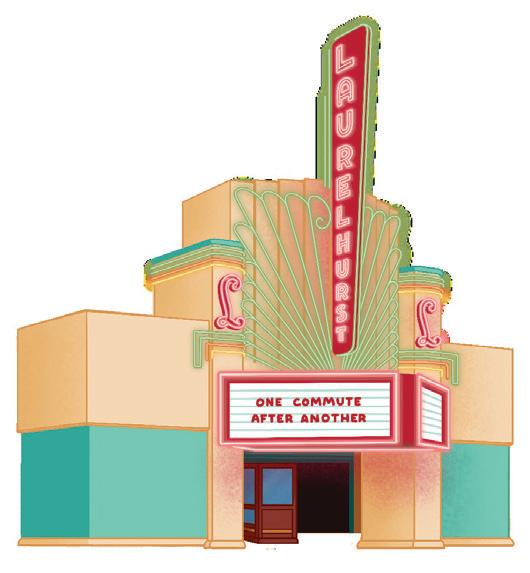
At this point, it’s raining pretty hard. So it’s understandable that many did not react well to the news that (plot twist!) the finish line is actually supposed to be at the Laurelhurst Theater. Many do not believe the announcement, which is delivered to the racers by Mercury publisher James Deeley, who some say heartlessly giggles while shar ing the surprise. The new ending location is easier for some to accommodate than others. Again, the bikers and scooter-riders discover the flexibility of their modes, even though they’re also the most exposed to the elements. Suzette is also tired of the rain,
LAURELHURST THEATER
Steve booked it through the Laurelhurst neighborhood (which he calls “a haven for white-collar criminals”) before switching back to his Razor scooter on the final block and crossing the finish line first at the Laurelhurst Theater. He officially (and loudly) declares himself the winner, despite the fact he fooled no one with his child’s toy/Lime scooter switcheroo. Andrew screeches up 30 seconds behind him. Katherine arrives minutes later in third place, followed by Jeremiah (who took forever), followed by Suzette (longer than for-
ever). The fact that it took roughly 45 minutes for Suzette to get to the new, surprise finish line has understandably irritated her, particularly because it involved walking to a new bus stop, waiting for the bus to arrive, and walking from another bus stop, all in increasingly intense rain. It’s almost 6 pm now and everyone wants to go home. The racers disperse in various states of mind—mostly irritated and angry at the race organizer, whose only goal was to advance science.
and tired of the bus transfers, describing the “prank” change of plans as “incredibly cringe.” Unsurprisingly, Jeremiah and Lindsay find out about the new finish line last. Lindsay already made plans to get picked up from the Hollywood Theatre, and decides this race is “stupid” and
Roughly 1.5 miles from Hollywood Theatre
Guitar Repair
The Mercury’s Totally Scientific, Final, and Undeniably CONCLUSIVE ANALYSIS
The idea that cars are the best method of transportation has undeniably shaped American cities, including Portland, at the expense of all other modes. Call me annoying—whatever— but you know I’m right. We have way more freeways and big thoroughfares for cars than bike or bus-priority lanes. Car parking is everywhere, even if it seems like you can’t ever find a good spot. But what if cars aren’t actually the best way to get around?
There’s some pretty good evidence that cars cause or contribute to major problems, like the destruction of the planet we all live on, for example, and around a million deaths every year. Counterpoint: They go fast. Counter-counterpoint: Do they, though? And at what cost? If our little experiment is to be believed, there are at least SOME scenarios where cars aren’t king.
Consider the unfortunate fact of parking. As Jeremiah and Lindsay’s experience demonstrates, it’s one thing to get from one place to the next, but once you have to get out of the car, things can get weird. You might have to circle Pioneer Courthouse Square over and over again to find a spot. You might run into chaos in the Trader Joe’s parking lot, which is notoriously awful (Andrew called it a “slow-moving Fury Road ”), but really only for those in cars. This can add significant time to one’s trip, particularly if you’re as relaxed about the whole thing as our two car people were. Also, when you’re driving, you’ve gotta deal with traffic, and gas is really expensive— especially now. In summary, bikes/scooters are solid enough contenders in the battle of modes that we should have protected bike lanes on all of East Burnside Street and Sandy Boulevard. (Fight me!)
It took all the participants roughly the same amount of time (between 31 and 38 minutes, give or take) to get from City Hall to Trader Joe’s. Here’s what the experience was like for everyone: Suzette, who took the MAX, did some light editing work while she sat on the train. Katherine noted some pleasant surprises as she biked: the first magnolia blooms of the season, a tiny dog in a yellow coat, a big dog with a white mustache, a person running barefoot while wearing a raincoat. Andrew rode on the top deck of the Steel Bridge, which wasn’t fun, but had nothing but positive things to report otherwise. Steve complained that electric scooters are capped at riding 15 miles per hour and wasn’t pleased with the experience of riding through Irvington, which he called “the most blighted, ugly-ass neighborhood in all of Portland,” but it’s clear he actually had fun.
Jeremiah and Lindsay both said the traffic wasn’t all that bad (they took surface streets, not I-84), but when individually reflecting on the overall experience of driving a car, neither had very positive things to say. Lindsay reported that, while she appreciates some of the benefits of the car (it’s warm, relatively quiet, and can fit stuff), she isn’t keen on the expensive maintenance
and would like to be able to read on the bus.
“Plus, driving is just sort of scary,” Lindsay said. “The truth is, I often use my car because my mental landscape tells me that anything other than the path of least resistance is insurmountable.”
Jeremiah said he used to bike more for transportation, but has been driving more lately, since moving to East Portland last summer.
“Bikes bring so much joy to transit. I found myself in a better mood, both from the exercise and the general lack of road rage,” he said. “But East Portland is built for big fossil fuel machines and the idea of biking on these main thoroughfares gives me more anxiety than I’m willing to take on, so I drive, which gives me even more anxiety… but I guess I’m not sweaty when I get to work? Is that the main tradeoff? I think it is.”
Steve very much enjoyed zipping through town on his Lime scooter… until he noticed the charge for riding from downtown into Southeast. “ TWENTY-FOUR DOLLARS?? ARE YOU FAWKING KIDDING MEEEEEEE?!?”
Now, before you accuse us of being biased against cars, remember that Suzette is the contender who ended up placing last. She would have beaten three people if the race had actually ended at the Hollywood Theatre, but the last-minute switch did her in. The point of that switch-up was not to infuriate my colleagues, but to represent the unexpected changes that can occur during real-world commutes. I think you should be able to stay at your destination a little longer than planned, or run an impromptu errand, without triggering a domino effect that ruins your whole day. Unfortunately, we would need more robust public transit for that to be the case for Portland bus and MAX riders. Still, Suzette looks on the bright side, pointing out that “if you’re not taking the bus, you’re missing a lot of weird sights.” Plus, there’s the opportunity to form camaraderie with the bus driver, which always feels great. Claims of scientific rigor aside, it would clearly require more than one Mercury staff race to truly determine the best mode of transportation to get around Portland. (And a reprise would probably rip our team apart, so don’t count on it.) We’d need to experiment with longer routes, as well as those outside of the central city. In those cases, cars very well might win, and the other participants might have a worse time navigating very scary traffic. All I’m saying is that sometimes, even in our car-centered world, the underdog comes out ahead—so imagine what could happen if we invested more in other modes of transportation? Also, if you put a kid’s scooter in your backpack and huff and puff whenever you arrive somewhere, you can trick some people.
Thanks to Cameron Crowell and James Deeley for lending their videography skills to the experiment.
Spin Cycle
Recent album releases for your world-weary ears.
BY RYAN J. PRADO
Anjimile—You’re Free to Go
A poignant sense of liberation echoes throughout Anjimile’s fourth full-length, You’re Free to Go. You can hear it as his voice opens the album on the title track, singing “There is something like a new being growing on me,” sensing it deep inside the muted 1990s alt-pop that jackets the entire LP.
There’s an airy resolve floating in the periphery of tunes like “Rust & Wire,” propelling the folky edges of Anjimile’s emotive contemplations toward stoic confession. Elements of grunge-y roots lay solid bedrock for pastoral harmonies and deconstructed melodies on songs like “Point of View,” adding a skewed symphonic flourish, scoring an explicit breakup cycle and merely hints at redemption despite the song’s eerie fringes. Anjimile, based in North Carolina, sings “I don’t care how you feel / You fucked up everything” through a haunted harmonic refrain.
Elsewhere, the anthemic “Like You Really Mean It” is driven by taut percussion and an optimistic, easy vocal emerging as eminently hummable, sharing sonic real estate with the likes of Juliana Hatfield or Jay Som. There is hope heard in the valleys of Anjimile’s songs that speaks to his own senses of rediscovery, stemming partly from new vocal approaches due to ongoing hormone therapy. You can hear the confidence in his voice on the intricate finger-picked composition “Exquisite Skeleton” as he sings “I don’t wanna be a sonofabitch to you / I’m taking off my dress / I’m shaking off my skin.”
By the time you get to “Destroying You”—the penultimate track on You’re Free to Go, featuring guest vocals from Sam Beam—it’s with a sense of having weathered an intimacy and a renewal that feels reinvigorating at just the right time.
You’re Free To Go released on the seminal 4AD label March 13. The album is available on Anjimile’s Bandcamp in vinyl, compact disc, and digital download formats.
The Delines—The Set Up
Portland’s The Delines have made a side-hustle out of cinematic Americana for more than a decade, anchoring the profound, athletic lyricisms of acclaimed novelist/musician Willy Vlautin. The band’s symbiotic relationship with the literary is part and parcel for a group with someone as widely known as Vlautin, but on The Set Up, the musical performances give his downand-out missives a run for their money.
On the heels of 2025’s equally gritty LP Mr. Luck and Ms. Doom, The Set Up is billed as a kind of road movie, executing in atmospherics, with vocalist Amy Boone’s arresting voiceovers and vocals paving the way for snapshots of addiction, grifters, and life in the margins of society. Replete with lush instrumentation from Cory Gray on keys and trumpet, the album oozes soulful cool even while it’s essentially detailing everyday hardships, broken dreams, and the minutiae of unfulfilled wishes. As the sordid tale unfolds, the instrumental track “Jumping Off in Madras” arrives warm, almost inviting, with a hushed embrace that lulls you into a sense of security before the devastating “Dilaudid Diane” ushers in a slab of heartbreak around the story of an addict with “a maxed out credit card and 63 bucks.”
Later, “Walking With His Sleeves Down” shows Vlautin’s character development at peak powers, finding rhythmic legs over a quaint piano progression, where a man confronts his life in vignettes of memory, lamenting missing the St. Johns Parade, musing on bands in basements playing Judas Priest songs, and looking “Like a breeze could just take him away / Disappearing his way through town.” You can almost see the slow coil of Plymouth exhaust and cigarette smoke binding together on the sepia streets of songs like “The Set Up Part 2,” dripping with 1970s cop drama soundtrack sheen.
These stories are the unflinching truth of a lot of the seedier sides of America. Through The Delines’ prism, the inherent bummers of those realities are granted civility.
The Set Up released on Portland’s Jealous Butcher Records March 6. The album is available on The Delines’ Bandcamp in vinyl, compact disc, and digital download formats.
Ora Cogan—Hard Hearted Woman
The last gasps of winter moodiness need not linger forever, but we can wheeze a little while longer on the kind of mystical instrumentation Ora Cogan freezes her dazzling goth-folk tunes with. The Nanaimo, BC artist’s new effort, Hard Hearted Woman , is sprinkled with the kind of eldritch Americana that’s heavy enough on dark undertones that even the brightness of pedal steel is unable to pierce its shadowed realm.
Opening with the hazy “Honey,” from which the “hard hearted woman” line is culled for the records’s centerpiece theme, the album seems to soften and harden like a faulty camera lens, focusing and blurring its way through a charnel wormhole of spellcasting, summoning, and possessed folk that reads a bit scarier than it comes across. Cogan’s gorgeous voice is lithe enough to embody both angel and devil, particularly on standout tracks like “Division,” a darkwave epic trawling the depths with synth-pop aplomb, warbling like B-movie vinyl before making room for the gothic underbelly of “Bury Me.” It’s on this track that Cogan’s conjurings coax the nightmares to the surface, with spooky reverb guitars and dissonant arrangements making for a ghostly panorama of orchestral folk.
On “Love You Better,” Cogan turns the page to a still-moody but steadier sensibility, singing “Something’s wrong with my mind / I’m drinking river water like wine.” If that doesn’t sound exactly lyrically stable, the song’s rhythmic pocket, clean acoustic guitar, and pedal steel help buoy Cogan’s dreamy resonance.
Hard Hearted Woman’s outsider goth leanings, curious chordal left turns, and fearlessness to get way way down into runic dark pop make it one of the best albums these big dumb ears have heard thus far this year.
Hard Hearted Woman released on the Sacred Bones label March 13. The album is available on Ora Cogan’s Bandcamp in vinyl, compact disc, and digital download formats.
Portland Panorama Is Worth the Watch
In its second year, the film festival has plenty to brag about.
BY SUZETTE SMITH
COLLAGE BY ANTHONY KEO
Portland Panorama’s schedule of movies, showcases, and virtual reality immersions feels like falling down a wiki rabbit hole. You came to see who’s playing live at the screening of music videos from the Pacific Northwest (Mississippi Studios, Tues April 14, 7 pm ), and now you’re getting excited about a bunch of shorts by Black animators (Cinema 21, Sun April 12, 1 pm).
There’s exciting variety to the 11 days of events—loosely structured as international films for the first week and local focus for the last weekend—that seems rooted in authentic knowledge of new movies worth watching. Curation is a recognized art form, but it’s not always as obvious as we see in Panorama’s planning. The film categories spill over and weave into one another beautifully.
There’s a chance to see If I Go Will They Miss Me ( Cinema 21, Sun April 12, 7 pm), which the fest’s executive director Stephanie Hough highlighted as “one of the few films that sold at Sundance this year—for a six figure deal.” The director, Walter Thompson-Hernández, is a University of Portland alumnus and will join the fest for a post-film Q&A. “It’s a really beautiful film,” said Hough. “It was originally a short, and he went through the Sundance lab, so it’s a Sundance success story.”
Attending film festivals like Sundance, Tribeca, South by Southwest, and Palm Springs International Film Festival is one of several ways Hough and Melina Kiyomi Coumas, the fest’s director of programming, find works to include in Portland’s Panorama. The main route is through an open submission process. “We doubled the mass submissions from last year to this year,” Hough says with pride. “So that’s great. Word is getting out.”
Both Hough and Coumas have built careers in the film festival circuit, but they first worked together at the Northwest Film Center, where Hough was an educator and Coumas an intern. That formerly film-focused program of Portland Art Museum (PAM) has since rebranded into PAM’s Center for an Untold Tomorrow (PAM CUT) and widened its scope into polymath practice, which it explores now via recurring series and year-round programming at Tomorrow Theater and the recently reopened Whitsell.
The Panorama team points to the absence of the Portland International Film Festival, which was last held remotely in 2021, as a major inspiration for their fest. Hough also highlighted the defunct Northwest Filmmakers Festival. Panorama is try-
ing to reinvigorate what both of those fests used to provide for the movie-making/moviegoing community in the city.
For instance, the fest’s Pavilion area will show VR and immersive works in an area of Zidell Yards called the Old Moody, hosting a 90-minute program (April 11, 12, 18, and 19 at 10 am, noon, 2 pm, and 4 pm) of shorts that attendees can explore. As with any VR
The program’s description rings true: “These are works that cannot exist on a traditional screen.”
collection, an underwater submersion scene is on the bill, but so is a strange 35-minute work about Egon Schiele where the Viennese expressionist “paints your portrait,” and you can see the purported sketch— supplied by AI—at the end. The program’s description rings true: “These are works that cannot exist on a traditional screen.”
Thai supernatural comedy A Useful Ghost (Cinema 21, Mon April 13, 7 pm) is a film you’d read about and want to see, but miss during its short run at a multiplex on the other side of town. That’s just the sort
of year you and debut director Ratchapoom Boonbunchachoke are having. After all, A Useful Ghost gained plenty of buzz by winning the Cannes Film Festival 2025 Critics’ Week Grand Prize, but was then disqualified from Oscar competition due to a mistake in submitting materials. It’s wonderful to be able to see this film before it shows up on the Movie Madness (MM) international shelf in a year and a half (no shade to the MM international shelf).
Another quality sleeper Barbara Forever (Cinema 21, Fri April 10, 7 pm) puts— according to our critic HR Smith—“the body-ody-ody in ‘body of work.’” Brydie O’Connor’s documentary provides a delightful survey of Barbara Hammer’s experimental films that even someone with a finite attention span for such things can enjoy. The cool gay doc is co-presented with Oregon Media Lab (OML), so filmgoers can learn about OML’s Doc Camp, too. It’s a good example of Panorama’s layered and locally linked programming. Perhaps the documentary-interested could learn about this supportive organization and end up working on documentaries themselves? That’s certainly the idea.
Collaborative screenings are one of Hough’s self-professed “big goals,” especially right now as funding is direly scarce. Rather than try to grow the festival in its second year, the team focused on maintain-
ing what they built and linking up events, like the music videos showcase at Mississippi Studios and a showcase of series episodes by Northwest filmmakers at Open Signal (Sun April 19, 2 pm).
Similarly, a screening of 2017’s James Beard: America’s First Foodie ( Cinema 21, Sat April 11, 7 pm ) is supported by the nonprofit behind James Beard Public Market. And a collection of short films made by various hand-process methods, Hand/Eye: Manual Processes ( Portland Arts Collective, Wed April 15, 7 pm ) is co-presented with Portland-based group Spectrum Between.
This is a precarious time to try to grow a film festival. Arts funding isn’t just on the struggle bus; it’s fixing a struggle bus flat. So it’s refreshing to see the Panorama team measure second-year successes in more new submissions, links with other local organizations, and in actually bringing movie makers to town.
Hough seemed particularly proud that hotel sponsorships meant it could host over 100 filmmakers in Portland. “We’re gonna have tons of visiting filmmakers buzzing all around,” she said. “So that’s really lovely.”
Portland Panorama posts up at various locations, April 9-19, $15 per screening, passes $150-$350, schedule and tickets at portlandpanorama.org.
Keep Your Frenemy’s Brain Closer
In Ling Ling Huang’s Immaculate Conception, a new technology brings darker meaning to competition.
BY LINDSAY COSTELLO
“For me… the main thing is just how deep a love can be, and how much everything else can complicate it,” explained violinist and author Ling Ling Huang. She was excavating the layered themes in her novel Immaculate Conception , a nominee for the 2026 Oregon Book Award’s Ken Kesey Award for Fiction. The book circles the lives of two young artists, tracking the jealousy-driven decisions of its main character with sharp specificity. Add a suspiciously decent billionaire, a low-lit laboratory staffed by ghostly workers, and a cutthroat contemporary art scene, and the novel becomes as exploratory as it is incisive.
Huang’s debut novel, 2023’s Natural Beauty, crafted biting horror within an elite beauty company. Immaculate Conception expands on her penchant for caustic commentary and emotional precision. It’s an ambitious book: literary with a sci-fi bent, concerned with technological ethics, loss of faith, and the competitive undercurrent that can destroy loving friendships, particularly between women artists. You might recognize the contours of rivalrous friendships, but none of us have taken our resentment as far as Enka,
“I think the biggest thing that happened during and after the writing was that I forgave myself for forgiving her… for loving her,” Huang said.
Immaculate Conception’s central character. She’s a “fringe” artist in a stratified world where sculptural barriers, called “buffers,” divide her lower-class kind from privileged “enclave” folks. Enka ekes out a scholarship to art school and meets Mathilde, an “enclave” who’s already an art star halfway through undergrad. They bond, but Enka’s class status fuels her envy—understandably, at first—while Mathilde, poised for international renown, carries her own constellation of traumas.
Enka spirals and self-sabotages, and Mathilde evolves as a feminist mystic and artistic genius—but if history tells us anything, those types rarely escape unscathed.
An oligarch family claims Mathilde’s trauma could be eased by SCAFFOLD, a novel brain-linking technology that would allow Enka to inhabit her mind— although there is some fine print. The novel’s fortress society is tangled with dystopian technology like this; AI art appears, even cloning. It’s a lot to navigate. Then again, many of us practice a similar balancing act, holding our technological anxieties in one hand and everyday survival in the other.
At a recent author talk, Huang played a Janáček violin sonata. Its “obsessive rhythmic motif and uglier sounds” are “part of the DNA” of Immaculate Conception , she explained. A substitute violinist with the Oregon Symphony, Huang’s novel draws inspiration from her own jealousy-fraught relationship with a fellow violinist in college, an experience she first explored in her 2025 Vogue essay “My Boyfriend’s Secret Girlfriend Was My Best Friend.” Immaculate Conception continues to pluck at the strings of that friendship.
“I think the biggest thing that happened during and after the writing was that I forgave myself for forgiving her… for loving her,” Huang said.
Like scaffolding, jealousy is a shield, a temporary structure designed to protect us from deeper pain. But it can harden into something more dangerous. In Immaculate Conception, we learn that what matters is how tightly you hold on.
The 2026 Oregon Book Awards Ceremony will be held at Portland Center Stage, 128 NW 11th, Mon April 20, 7:30 pm, $5-$65, literary-arts.org.
KYLE JOHNSON
Comeback Kitchen, Portland Edition
How the chefs of LoRell’s and Mama Chow’s returned—and thrived—after suffering serious injuries.
BY ANDREA DAMEWOOD
Coming back from life-threatening injuries is never part of anyone’s plans, but for two Portland chefs, that became their reality.
A few years after both Darell Preston of LoRell’s Chicken Shack and Jeff Chow of Mama Chow’s Kitchen suffered major trauma, they not only lived to tell the tale, but are thriving. LoRell’s is back and doing more business than ever at the Lloyd Center Mall—a location not exactly known for its bustling commerce. Chow is serving up some of the city’s best wonton soup at his long-running cart, and getting into the collab scene with other chefs.
“Making food for people is what I think I was put on this earth to do,” says Chow. “Everyone just wanted me to come back and keep making food for them.”
Here’s an update on how Chow, who nearly died after tumbling down a cliff while hiking, and Preston, who suffered a hate crime right outside his cart, are making big moves after their tragedies.
LoRell’s Chicken Shack
Since opening in 2021, Preston’s LoRell’s Chicken Shack was a favorite at Carts on Foster. Preston had carved out a name for his chicken, especially his wings: big boys served up juicy on the inside, crispy and coated with his signature hot honey sauce on the outside.
Then, one evening in June 2023, he was standing outside of his food truck when a white man attacked him without warning, kicking and beating him while yelling racist slurs against Preston, who is Black. Preston suffered severe facial injuries, including bone fractures and lacerations on his left side. The attacker pleaded guilty to third-degree assault and no contest to first-degree bias crime.
The attack left Preston unable to work, and the community rallied around him, raising funds and begging for the return of their chicken fix. Then, Carts on Foster closed, and after a short stint at the Rose City Food Park in Northeast, Preston was looking for a new home for LoRell’s.
That’s when the Lloyd Center came in. Preston, a Chicago native, says when he first moved to Portland in 2008, he had his eye on the Northeast Portland mall. After the attack, moving turned out to be a change he needed.
“I never questioned myself getting back into it,” Preston says. “But in the food cart I had bad memories; it left a sour taste in my
mouth.” Moving to the Lloyd, he says, “was a way to leave it behind.”
As the Lloyd Center faces a likely demolition, tenants have dwindled in the mall’s once thriving food court. Without a doubt, LoRell’s is now the anchor, his bright signs advertising chicken and fries among the shells of former McDonald’s and Japanese fast food. Some customers visit the mall just to score a dozen wings
“I didn’t let that incident stop me from who I am and what I want to do.”
and fries. Preston has added party wings to the menu along with the classic full wings and tenders, but other than that, not too much changed when he went indoors, he says.
“I didn’t let (the attack) deter me or stop me from what I want to go at in life; I just kept going,” Preston says. “That’s where LoRell’s comes from. My mother’s name is Lorraine and mine is Darell. I always dedicated that to her. My momma was like ‘Get your ass up, don’t feel sorry for yourself, and let’s go to work.’ I didn’t let that incident stop me from
who I am and what I want to do.”
And now that the future of the Lloyd Center itself is unknown, with developers saying they plan to tear the historic mall down, Preston is already planning a third act, saying, “You just gotta stay tuned.”
Mama Chow’s Kitchen
Mama Chow’s Kitchen opened in downtown Portland in 2014, and owner Jeff Chow immediately drew attention for his Chinese-style lollipop chicken wings served over garlic noodles and savory wonton soup, packed with fat shrimp and pork dumplings. (I wrote a glowing review for the Mercury, which Chow keeps at his cart to this day.) The wonton soup is still my favorite in town.
Ten years after launching his cart, in October 2024, Chow was hiking to Wahclella Falls when he fell over 10 feet, head-first, onto a rock outcropping. He was knocked unconscious and fractured his ribs, skull, and left shoulder blade. He was airlifted and hospitalized at OHSU, where he fretted about his sauté arm despite having 16 staples in his head. Friends, both local and from back home in the Bay Area, raised thousands for his recovery.
“I cried. I cried a lot,” says Chow, whose cart is also named after his mother. “It’s
amazing how the community comes out. It brought out the kindness in people who I would never expect to remember me.”
After months of rehab, he reopened in February 2024 at Steeplejack Brewing Co. at Southeast 30th and Hawthorne. He joins a handful of carts that anchor the popular brewery’s taproom, and foot traffic from the city’s busiest shopping corridor is lively. Chow says: “I’m pretty busy every single day. I’m lucky.”
Mama Chow’s has flourished in that time, and Chow has crafted specials that beg to be added to the regular menu, like curry chicken wontons floating in turmeric bonito bone broth with daikon radish and bok choy. February marked Chow’s 12th year running the cart, and he celebrated, like he does every year, with traditional lion dancing for the Lunar New Year.
Stay tuned for potential pop-ups or collaborations between Mama Chow’s and other local favs. He’s teamed up several times with Southeast Portland’s Lawless BBQ to create dream blends of smoke and wok, like barbecue brisket noodles with bok choy.
“If I can share love with what I do, it’s my little rock into the pond of love, and hopefully those ripples continue,” Chow says.
LEFT: CHAR HARRIS; ABOVE: TRANG NGUYEN
Jeff Chow of Mama Chow’s Kitchen at left; Darell Preston of LoRell’s Chicken Shack at right.
DO THIS, DO THAT
APRIL
The City’s Coolest Art and Cultural Events This Spring
BY BRI BREY, LINDSAY COSTELLO, TAYLOR GRIGGS, KATHERINE CHEW HAMILTON, ANDREW HARLAN, NOLAN PARKER, AND SUZETTE SMITH
Satpreet Kahlon: animagined place(hereandnow)
THROUGH MAY 23
(VISUAL ART) I’ve been following Satpreet Kahlon’s career since 2023, when the Panjabi-born artist’s Bellevue Art Museum exhibition the inscrutable shape of longing explored displacement and colonization’s aftermath through a web-like installation of folk ritual and splintered, mirrored acrylic. An imagined place
(here and now) builds on the artist’s propensity for multimedia installations, transforming the Portland Institute for Contemporary Art (PICA) warehouse into an “immersive exploration of fugitivity, deep space time, geologic memory, and possibility.” In more straightforward, but no less exciting terms, expect a recycled, full-scale replica of near-Earth asteroid/quasi-moon 2025 PN7, plus immersive audiovisual elements referencing Punjab Boliyan couplets. (PICA, 15 NE Hancock, FREE, pica.org, all ages) LINDSAY COSTELLO
2026 Oregon Contemporary Artists’ Biennial: The Price of the Ticket
THROUGH JULY 5
(VISUAL ART) Titled after a James Baldwin anthology this time around, Oregon Contemporary’s biennial surveys artists who are “defining and advancing Oregon’s contemporary art landscape,” as curated by scholar-historian TK Smith. The biennial also acts in response to the 250-year anniversary of the Declaration of Independence signing, and will present Todd McGrain’s newly created bronze bust of York alongside the original, which was toppled from its Mount Tabor plinth in 2021. Artists Jaleesa Johnston, DeepTime Collective, and Joe Kye will offer seances and immersive performances on First Saturdays through July; partner venues Ori Gallery and Multnomah County
Central Library, among others, will host additional programs. (Oregon Contemporary, 8371 N Interstate, FREE, oregoncontemporary.org, all ages ) LC
Fertile Ground Festival
APRIL 10-26
(THEATER & PERFORMANCE) The 17th Fertile Ground Festival of New Works achieves lift off on April 10 and soars for 17 days of imaginative readings and plays—some infusing the form with interactive or multimedia elements, others searching boldly for identity through wit and writing. We’ve got picks from the nearly 100 projects pitched: the return of Jonathan Hernandez’s sellout show The Mask I Wear , a play that sounds sort of like the Sandra Bullock movie Gravity , and the deepening hilarity of Love, Shakespeare’s improvised riffs. Dive into the schedule with your own shrewd eye for talent; see some things! (Various locations, showtimes and tickets at fertilegroundpdx.ludus.com) SUZETTE
SMITH
TAG! Queer Shorts Festival
APRIL 11-12
(FILM) You’re it! TAG! Queer Shorts Festival highlights work from exclusively queer and trans directors. The inspiration behind the film fest borrows from the street art community, with the motivational phrase “Get Up!” encouraging folks to make their art aggressively visible. Themed screenings include The
Shapes of Queer Space, exploring how LGBTQIA2S+ folks show up for their communities, Sex is Back with a romantic and kinky bent, a Tagging Cascadia category for films from Oregon, Washington, and British Columbia, and Queer Kaleidoscope, which is a catch-all for the rest of the multigenre films. (Clinton Street Theater, 2522 SE Clinton, 4 pm, $15-$45, cstpdx.com) BRI BREY
DOA Wrestling: Portslamdia
APRIL 12
(SPORTS) Portland is a true pro wrestling city, and DOA remains a hot spot for diehard fans eager to escape reality with a few high-octane hours of larger-than-life characters, jaw-dropping acrobatics, and pure passion for the sport. Their promotion just announced the return of Portslamdia on April 12 at Morrison Market. Join the chants, feel the energy as the action spills into the crowd, and soak up the magnetic presence of performers from around the world. While the match card is still TBA, organizers have confirmed the return of the undead bride, Su Yung. (Morrison Market Stage 722, 722 SE 10th, bell at 5 pm, $20-$40, doaprowrestling.com, all ages) ANDREW HARLAN
PlanetMoney Live
APRIL 14
(READINGS & TALKS) NPR economics podcast Planet Money launched in 2008—as the world reeled from
JOSHUA CHANG
KRISTAN KENNEDY
the housing bubble/subprime mortgage crisis—with a mission to explain the economy. The show’s first-ever book Planet Money: A Guide to the Economic Forces That Shape Your Life remains devoted to that goal, even as the show’s hosts are up front that the idea came from a literary agent trying to brainstorm books based on NPR content. The timing here isn’t a coincidence either, as public radio seeks out new revenue streams to compensate for the Republican-controlled Congress rescinding public media funds and the subsequent dissolution of the Corporation for Public Broadcasting. The book’s main author, Alex Mayyasi, isn’t just a Planet Money contributor—he was also the founding editor of Gastro Obscura. So there’s a good chance he’s written something pretty readable and fun. At this special event, Mayyasi appears with show host Kenny Malone and the owners of Hollywood District restaurant Xiao Ye for what sounds like a fascinating explainer of small business/intimate relationship economics. (The Reser, 12625 SW Crescent, Beaverton, 7:30 pm, $44.50$94.50, literary-arts.org all ages) SS
Films from Earth: A 16mm Showcase from Making Earth Cool and the Nyback Archive
APRIL 17
(FILM) Since his death in 2022, Portland’s “P.T. Barnum of cinema” Dennis Nyback has been seriously missed. Nyback’s screenings were rightfully storied over the course of his career; he screened crate-dug film programs worldwide and owned the Clinton Street Theater back in the ’90s. We were lucky to have him, and now, we’re lucky to have the reigning nature-lovers at Making Earth Cool inhabiting our little corner of the planet. Ahead of their puppet-laden Earth Day celebration on April 25, they’ll pull from Nyback’s world-famous 16mm film archive, curating a screening of “rare nature films.” (Tomorrow Theater, 3530 SE Division, 7 pm, $15, tomorrowtheater.org) LC
Playtime
APRIL 19
(FILM) Sometimes a metaphor hits you just so; the story of Tativille, created by director Jacques Tati for his 1967 magnum opus Playtime, is one such metaphor. In order to make the film the way he wanted, Tati built a small city in a wasteland to the southeast of Paris. The 15,000 square meter set contained full-scale buildings and infrastructure; the process became so extravagant that the elevators actually worked! Tati said he would leave Tativille to be used by future French filmmaking generations, but it was torn down just months after Playtime’s release. To this day, Playtime is a movie best viewed on the cinema screen so you can appreciate the grandeur, spectacle, and pantomime of Tati himself as bumbling businessman Monsieur Hulot. (Whitsell Auditorium, 1219 SW Park, 2 pm, $15, portlandartmuseum.org, all ages) SS
Animation April
THROUGH APRIL 19
(FILM) Unsurprisingly, Clinton Street Theater’s recurring Animation April series offers an embarrassment of cinema history riches. The lineup includes the phantasmagoric ’82 musical The Last Unicorn FernGully: The Last Rain Forest (take heed, millennials), and one that piqued my interest: The Bloody Lady (1981). Screening on April 13, the gothic Slovak folktale interprets the story of Countess Elizabeth Báthory, AKA that Hungarian noblewoman who allegedly moonlit as a serial killer and bathed in blood. Restored by the Slovak Film Institute, The Bloody Lady harkens back to an era when children’s films were still reliably scary, and therefore cooler. Indie experimenter claire rousay scored the new edition. (Clinton Street Theater, 2522 SE Clinton, dates and times vary, $5-$10, cstpdx.com) LC
Laura Burke: So Be It
OPENS APRIL 10
(VISUAL ART) Brooklyn-based artist Laura Burke’s last two solo shows at Chefas Projects played with the artist’s interest in fairy tales and spirits, imagined through scenes of household objects, liminal realms, and natural elements imbued with delicate magic. (One show’s title, Bright Blue His Jacket Is, and His Boots Are Yellow, was a quote from The Fellowship of the Ring.) Burke is one of my favorite contemporary artists, due in no small part to her devotion to folkloric figures and curious, yet somehow perfectly balanced compositions, evoking a modern Mary Fedden. Expect more where that came from in So Be It, which includes paintings of a vase giving side eye and a moth stroked with gold light. (Chefas Projects, 134 SE Taylor, Ste 203, Wed-Sat 1-6 pm, FREE, stephaniechefas.com, all ages) LC
2026 Oregon Book Awards Ceremony
APRIL 20
(READINGS & TALKS) Credit due to Literary Arts’ annual awards: The winners are always worth your time, and more than a few of the nominees too. This year’s creative nonfiction category sees Lidia Yuknavitch’s Reading the Waves crash up against A Field Guide to the Subterranean: Reclaiming the Deep Earth and Our Deepest Selves by Justin Hocking, while Horse Girl Fever by Kevin Maloney and Immaculate Conception by Ling Ling Huang face off in fiction. The other categories are similarly stacked—this is a graphic novel year, and judges must somehow decide between Breena Bard’s Wildfire, Speechless by past Oregon Book Award winner Aron Nels Steinke,
it’s huge. Opening are half-Portland, half-Florida hardcore huns Gouge Away. The feigned innocence of GA’s new “Figurine” track and music video is something to behold; fingers and toes crossed they’ve got a new album in the works. (Revolution Hall, 1300 SE Stark, 8 pm, SOLD OUT, revolutionhall.com, all ages) NOLAN PARKER
DJ Assault / DJ PayPal
APRIL 23
(MUSIC) Massive shouts to Kris Goodin of Helsinki’s OK Sound for introducing me to DJ Assault years ago when we worked at one of Berlin’s worst cafes— specifically the booty bass and ghetto house pioneer’s “Asses Jigglin’” track. Other fabulously named Assault tracks include “Love The Pussy,” “Nympho,” “Gay Guy,” and “Dick Ride.” A sweaty, minimally clothed celebration of sluts, freaks, and their handlers is what the Detroit master is bringing; all you gotta bring is ass. Be ready to throw it. (Swan Dive, 727 SE Grand, 9 pm, $26.84, swandivepdx.com, 21+) NP
Breakfast on the Bridges
APRIL 24
(COMMUNITY) Breakfast on the Bridges, or BonB, has been serving up coffee and breakfast goodies to those biking/walking/rolling across Portland’s bridges for more than 20 years. Those commuting across the Blumenauer Bridge, Steel Bridge, and Tilikum Crossing (sometimes even Flanders Crossing) can expect their morning treats on the last Friday of every month. Come for the caffeine and pastries, stay (until you’re late for work) for the lovely company! The early bird may not always get the worm, but on BonB day, the bicyclist birds certainly do. (Various locations, 7 am-9 am, FREE, shifttobikes.org, all ages) TAYLOR GRIGGS
Tough Shit with Oregon Humanities
APRIL 24
(READINGS & TALKS) My favorite events at Tomorrow Theater never actually involve watching a movie. Tough Shit, for example: Three “very different” people get onstage to “talk through some shit” in the economical space of 90 minutes. Surely we can all stay civil for 90 minutes! At this show, one guest is journalist and author Leah Sottile. Oregon Humanities executive director Adam Davis moderates. Is it a deep cut to hope this panel could also include Oregon Public Broadcasting president and CEO Rachel Smolkin? Release the other two guests, you cowards! [Chomps popcorn loudly.] (Tomorrow Theater, 3530 SE Division, 7 pm, $15, tomorrowtheater.org, all ages) SS
William Basinski
APRIL 28
and the highly lauded Big Jim and the White Boy by David F. Walker. It would be great to see any of them win, and you can actually attend the ceremony, see the evening unfold, and fawn over your favs. (Portland Center Stage, 128 NW 11th, 7:30 pm, $15-$65, Arts for All tickets available, literary-arts.org, all ages) SS
Wednesday / Gouge Away
APRIL 21-22
(MUSIC) As they were gearing up for the September 2025 release of their crushing album Bleed, Wednesday played a perfect, reenergizing set on the second day of Project Pabst, endearing themselves to Portland to the extent of landing two nights at Revolution Hall. Bleed has one feature, the mid-album alt-country dazer “Phish Pepsi” with Advance Base. AB may not strike a chord with everyone, but trust,
(MUSIC) Back in 2022, avant-ambient composer William Basinski played with the best of ’em at Holocene: Portland’s own Methods Body and the Garbage Man, AKA Liz Harris/Grouper’s DJ alias. Then, in 2024, the light-bringers on the Reflections crew set the stage for an oozy Basinski set at the First Congregational Church of Portland. Whether you’ve been on his level this whole time or Basinski’s brand new to you, your assignment is to full-body experience this set by the man responsible for The Disintegration Loops (2002-2003). (It’s a four-volume album based on deteriorating tape loops of his own music.) Kelly Moran—a genre-stretcher signed with Warp Records–will set the tone. (Star Theater, 13 NW 6th, 8 pm, $37.57, startheaterportland.com, 21+) LC
AAPI Food & Wine Fest
MAY 2-3
(FOOD & DRINK) May is both Oregon Wine Month and AAPI Heritage Month, so why not celebrate both at the same time? Now in its sixth year, the festival was founded by Dave and Lois Cho of CHO Wines, the first Korean American winery owners in Oregon. Your ticket gets you seven wine pours and five bites
CHEFAS PROJECTS
The Ladds 500
APRIL 11
(COMMUNITY) Bike racing isn’t just for folks kitted out in spandex. The tagline of the Ladds 500 is “let’s do something stupid,” and what could be more stupid than riding around Ladd Circle 500 times in a row? Ride the whole thing yourself, or bring friends for a relay—counting is lax, and hardly anyone finishes the whole thing. “Nothing matters and life is finite,” the rules read. The circle crowds with people (many of them costumed) on roller skates, tall bikes, twelve-passenger party bikes, and skateboards. Everyone else picnics in the circle’s center, handing riders freshly grilled hot dogs and warm pancakes. Join the party. (Ladd Circle Park & Rose Gardens, 1988 SE Mulberry, 10 am-5 pm, FREE, ladds500.com, all ages) KCH
from different chefs and winemakers, with a different lineup each day. Saturday highlights include bites from Rangoon Bistro and Pasar and sips from Post Familiar and Et Fille, while Sunday includes Pamana and Cozy Congee, plus wine from Junichi Fujita and Hundred Suns. (Stillwater Event Space, 455 NE Irvine, McMinnville, 11 am-1 pm, $95-$150, aapifoodandwine.com, 21+) KATHERINE CHEW HAMILTON
Cabaret Voltaire / I Speak Machine
MAY 8
(MUSIC) Picture it, Barcelona 2016. You’re still deeply hungover from the night before, seeing Air, John Carpenter, Vince Staples, Todd Terje, Peaches, and Kamasi Washington, and all you need is air conditioning so you don’t throw up or worse. You’re contemplating skipping the legendary British industrial-techno band Cabaret Voltaire’s show because if you try to dance, you legitimately might pass out. But hark! The one indoor, seated, air conditioned venue in
all of Primavera Sound is exactly the venue Cabaret Voltaire is playing. Let’s hope we know how to take care of ourselves better than 10 years ago and that Roseland has their A/C cranked for this one. (Roseland Theater, 8 NW 6th, 8 pm, $52.75+, roselandpdx.com, 21+) NP
TAYLOR GRIGGS
Don’t peek! Puzzle on p. 39
The Faults in Our Stars
The only horoscope column in the universe.
BY ANTHONY HUDSON
Great news, everyone! The breakout success of my humble astrology column has inspired a film adaptation starring Justin Baldoni and AI actress Tilly Norwood—because she’s a computer, they don’t anticipate any HR issues. A fiery New Moon in Aries on April 17 means mega-monopoly Paramount will oversee the production, to be helmed by one-time-pariah and up-and-comingagain filmmaker Brett Ratner—director of X-Men: The Last Stand (“I’m the Juggernaut, bitch!”) and Melania (“I’m the Juggernaut, bitch!”)—the Trump administration’s very own Leni Riefenstahl. Bari Weiss, chief propagandist at CBS News, is personally programming the publicity campaign into the Pentagon’s AI servers, to be launched in tandem with the next missile strike. Clearly, this is a momentous occasion.
I’m especially ecstatic to announce—
Aries (March 21-April 19)
Happy New Year, Aries—the astrological calendar reset leaves you invigorated, motivated, and lights a fire under your hooves. But sticking the landing after springing into action isn’t your strong suit—so why not try my new 12-month forecasting course? It’s all on Zoom, so when you forget or don’t feel like it, you can just blame the computer. Justin Baldoni is about to do the same thing at Paramount HR, and, best of all, I only accept payment directly from your bank account, so I’ll still get your money’s worth.
Taurus (April 20-May 20)
You’ve had a rough time, dear Bull, but as the Sun enters your natal sign, you’ll quickly grab life back by the horns. Let loose! Dream big. Seek community. Change the world. Invest in something bigger than yourself, like my Asstro-Cleanse™ Hole Soul Retreat. And if Ascended Master Shasta Saint Germain asks you to open up during Hole Truth Talk Therapy and you won’t because you’re too stubborn, try our newest proprietary herbal remedy, Inhibit-Ease®. It’s designed to counter even the most difficult behavioral blockages.
Stupid Ex Larry Gemini (May 21-June 20)
Some thought Larry Twotime was a lost cause. That he was duplicitous, conniving, fickle, and farted too soon in the relationship. But thanks to Inhibit-Ease®, the reformed Mr. Twotime is better than ever, proving that even a Gemini can be a hard-working drone contributor to any Hole Soul Retreat. Note: Inhibit-Ease® may cause side effects of varying severity including headache, irritability, low blood sugar, loss of smell, loss of self, and loss of proprioception. Tell your health care provider if you feel you no longer have control over your words and actions.
in anticipation of the Sun entering bullheaded, horny Taurus on April 19—that I’m harnessing this time of personal career growth to debut an astrology-themed wellness brand-slash-movement built around a gay men’s fiber gummy supplement, Asstro-Cleanse™. And for discerning subscribers over 18, I’m launching my premium content fan site, The Faults in Uranus (save your DMs—it’s tilted on its axis and supposed to look like that), along with a line of star sign companion cock rings exclusive to Temu. It is my mission as a healer-slash-content ambassador to bring both astrological forecasting and Fat Cock Friday (#fcf) posts to your feed weekly. I have dreamt of this moment ever since my own mentor, Ascended Master Shasta Saint Germain, channeling a prehistoric entity named Brandon, divined that I was destined for greatness and could I fork over another $20 grand? But almost as important as that—let’s gaze at what the skies have in store for you, personally.
Cancer
(June 21-July 22)
Oh, sweet little soft-shelled crab: you need to protect yourself. Your shell is the only home you’ve known, but it’s edible with delicious umami flavor, and no one likes you. That’s why Ascended Master Shasta Saint Germain locked you in our Ashland compound’s coat closet for two years. To keep you safe. Not because you tried to contact your family and Dr. Phil from the compound’s 5G-resistant Windows 98 PC—but because no one likes you. Not like we do. Mmmmm, umami.
Leo
(July 23-August 22)
Leo, you’re the mane attraction! Your locks are lush with charisma, talent, and “It Factor.” And you did so well leading our Asstro-Cleanse™ All-In Auction Livestream (the amount of colloidal silver you sold in two hours made me far from blue!) that I’m hereby promoting you to Bishop of [REDACTED], our secret brotherhood operating within Asstro-Cleanse™. In your case, it’s a good thing to be vain: something tells me you know your way around a branding iron, don’t you?
Virgo
(August 23-September 22)
You’re a nervous little muffin, Virgo, and it’s unsettling our other Hole Soul Seekers. I’m sure your constant stomachaches aren’t helping. What’s got your insides so anxious?
You didn’t take Inhibit-Ease® on an empty stomach, did you? Note: When administering any dose of Inhibit-Ease®, drink clear or ice cold liquids. Avoid lying down after eating. Avoid taking Inhibit-Ease® with any fried, greasy, or sweet foods, or with any foods or liquids containing water.
Libra (September 23-October 22)
The Scales are the embodiment of balance and justice—but justice is blind, just like the pepper-sprayed informant who tried infiltrating our Ashland compound under the pretense of pizza delivery. The joke’s on you, Mr. “Delivery Boy,” and on you too, Ms. “District Attorney,” who couldn’t be a more stereotypical do-gooder Libra. You thought you could take down Asstro-Cleanse™ with a Meat Lovers Trojan Horse, but not one of us bears the digestive agency (or access to a telephone line) to eat— let alone order—greasy foods!
Scorpio (October 23-November 21)
As the Megan Fox of the Zodiac (pay no mind to the fact that Megan Fox is a Taurus), everyone wants what you’re selling. And that just happens to be Inhibit-Ease®, lobbying it through Capitol Hill and finally winning us sweet, legitimizing FDA approval. Your ambition left its mark—I’m sure RFK’s brain worms will recruit you to the Department of Health in no time, especially if you employ those signature sultry charms (and remain unvaccinated).
Sagittarius (November 22-December 21)
Ever the skilled archer, you mark and hit your targets with aplomb and aplenty. And you’re so infectious at what you do that no one will ever suspect you of poisoning that salad bar. What’re a few newfound pathogens (thanks, Virgo, for your sacrifices to rigorous quality testing) compared to changing the world forever? If we can get one or two AsstroCleanse™ Assbassadors on City Council, we’ll be unstoppable, just like the Sagittarius spirit.
Capricorn (December 22-January 19)
You can be a bit of a perfectionist, and a workaholic to boot, but that’s exactly what I’m looking for in a defense attorney. Ever since Ascended Master Manipulator Shasta Saint Germain skipped town to Svalbard with all my money, I’ve been looking for a responsible, goat-eyed, and patient party to help me parse through the Inhibit-Ease® fog as well as the facts: the good ones, the bad ones, and the ones that might get me off with a technicality.
Aquarius (January 20-February 18)
You never followed the crowd, so why go along with a “jury” of so-called “peers?” Those aren’t your peers! They went to public school. Some of them are—shiver—water signs. And I’m pretty sure the one with the bag of props is Carrot Top. But if everyone wanted to go and jump off a bridge while convicting an innocent columnist-turned-influencer on multiple counts of fraud, embezzlement, racketeering, forced labor, mind control, biological warfare, and multi-level marketing, would you too? No! Because you’re a free thinker, Juror #3. Have you ever tried herbal supplements?
Pisces (February 19-March 20)
I always thought you were a little weird, Pisces, but you know what? I have to admit it: you’re a good listener, empathic, and I was wrong and need to apologize—this toilet moonshine is delicious. Did you see Justin Baldoni in the next cell?
Anthony Hudson is a Grand Ronde and Siletz artist, writer, and former clown. His first book, Lamp Back: Plays and Other Grievances—collecting nearly a decade of Carla Rossi performances and more—is being published this fall by Northwestern University Press.
MATTYNEWTON
Savage Love
BY DAN SAVAGE
Quickies
1. Which brand makes the best glass dildos? Asking for a friend!
“Glass toys are not only gorgeous, but also provide an amazing experience thanks to their weight, smooth surface, temperature-play options, and compatibility with any kind of lubricant,” said Jeneen Doumitt, the owner of SheBop, a Portland sex toy shop. “One of our favorite brands is Crystal Delights, a small glass toy maker based in Washington that offers a wide array of products at various price points. Best known for their butt plugs, they also have dildo options such as the Galaxy Curve. For more options and reasons why glass is a fantastic choice, check out our online post: She Bop’s Guide to Glass Toys!”
P.S. The existence of safefor-use quality glass dildos is not a green light to put fluorescent light bulbs in your pussies (it could shatter) or shot glasses up your asses (they will get lost in there). Don’t be dumb.
You can follow SheBop on Instagram @SheBopTheShop and shop for toys on their website or at one of their two silicone-dick-and-mortar locations in Portland.
doing something wrong? Are you doing everything wrong? Are you neglecting your personal hygiene? Are you doing your fair share of the household labor? And when you do have sex—which isn’t as often or as varied as you would like—is your wife getting off? (You only mention one sex act—pegging—and while many women enjoy pegging their male partners, none of your wife’s nerve endings are located in a dildo.) If you’re doing everything right and the sex is infrequent and unfulfilling, you have four options: ask for permission to
ty of Oxford. “I wish there was more research into this—just as I wish there was more research into the female orgasm. (People just throw their hands up and look the other way because, hey, if it’s not a penis, who gives a shit!?!) I’m no expert in this, but my answer would probably be that the prostate is densely packed with nerves because it’s crucial for ejaculation, which requires surprisingly precise motor control. For obvious reasons, ejaculating is pretty important for reproduction! So, given that the prostate is a control center
9. I helped a chick I’m dating move and discovered they have a large Nazi flag in their closet. Run?
Yes—but Captain Von Trapp that thing first.
10. Best pegging position for a newbie?
Missionary, doggie, cowgirl: one or all of the usuals should work. Go slow, use lots of lube, and let the person being penetrated— let the peggee—control the pace and depth of penetration at first.
2. My on again/off again ex of many years was recently widowed. We had our difficulties, but we also had some great sex. I was thinking of making one more run at her. What would be a considerate time to wait before approaching her?
Judging from a recent question from a widowed caller and some helpful feedback from two women who lost their husbands, widows’ fire—“a disorienting, intense, and unwelcome surge of sexual desire occurring after partner loss,” according to the Association for Death Education and Counseling—kicks in at about six months. I would suggest sending your condolences at least three months before sending a “Hey, you up?” text. (And, yes, there’s a dating app specifically for widows and widowers experiencing widow’s fire.)
3. My wife of 16 years has begun to lose interest in sex in a BIG way. We are on completely different wavelengths regarding the frequency of sex and the variety of sex. (Particularly pegging.) How do I remain in this marriage when I feel that a HUGE part of me is being neglected?
Before the commenters jump in: Are you
get it elsewhere, get it elsewhere without permission, leave in the hopes of getting it elsewhere, or stay and suck it up.
4. How do you find a third for a threesome?
If you’re a gay couple, you can go to a bar or bathhouse or create a joint couples account on Threads or Instagram and wait for one of the “normalize monogamy in the gay community” boys to slide into your DMs. If you’re a straight couple, you can get on a hookup app like Feeld or 3Fun or #Open. Good luck!
5. Forty-year age gaps?
I will not tolerate any hate being directed at Dick Van Dyke—that man is a national treasure. Yes, his wife is 46 years younger than he is, but they seem very happy together and love is love is love. P.S. Age gaps are good actually.
6. Is there an evolutionary reason for prostate pleasure/orgasms?
“Great question,” said Dr. Matilda Brindle, an evolutionary biologist at the Universi -
for ejaculation, prostate pleasure is probably closely linked to the same neural circuitry that makes penile orgasms feel good. It’s possible that prostate-only orgasms could be a way of reinforcing prostate massage, which might help relieve conditions like prostatitis, but there’s no solid evidence for this—scientists need to get researching!”
Follow Dr. Brindle on BlueSky @matildabrindle and on Instagram @DrMatildaBrindle.
7. How old is too old for a sex club?
It depends on the club, it depends on the night (some have nights for under 30s), and it depends on your tolerance for shitty techno music and rejection—but the latter is true for everybody, regardless of age.
8. Is anal fisting just not possible for some people given their physiology?
Where there’s a will, there’s a way—except when it comes to fisting, which simply isn’t possible for some people. Which is fine! Not everything has to be for and/or get shoved into everybody.
11. Am I the only person creeped out by heterosexual couples who look exactly alike?
The people behind the popular Siblings Or Dating? account on Instagram, which has more than a million followers, seem pretty creeped out by couples who look alike—so, you’re not alone.
12. Everyone on Feeld seems to be shaved or waxed. I rock a trimmed bush. Do I need to put a disclaimer on my profile?
You do not.
13. I went through my partner’s phone and found nothing. I feel guilty about it and don’t know if I should confess.
You should not.
14. Is it normal for a man’s orgasms to be stronger in his fifties than they were in his twenties?
It is not.
15. Is it a red flag if someone describes all their exes as “crazy”?
Definitely a red flag. And while some people have had the misfortune of dating three or four crazy motherfuckers in a row— stranger things have happened—someone who doesn’t realize that describing all their exes as crazy even if all their exes were crazy is waving a different red flag: they’re telling you they have no common sense. Because saying “all my exes were crazy” even if all your exes were crazy makes you look like the crazy one.
GOT PROBLEMS? YES, YOU DO!
Email your question for the column to mailbox@savage.love!
Or record your question for the Savage Lovecast at savage.love/askdan! Podcasts, columns, and more at Savage.Love
JOE NEWTON
Oh, no! You’ve accidentally wandered into…
Yes, Ladd’s Addition—where many enter, but few escape!
See if you can escape Ladd’s devilish maze… but be careful! Don’t get eaten by the witch!
Cycle Path BY NATE CARDIN
ACROSS
1. Number of T’s on the Portland 4T
Frosts, like a cake at Helen Bernhard Bakery or Papa Haydn
“Wrecking Ball” singer Cyrus
Help desk offering
South Asian wrapped garment
“Rolling in the Deep” singer
“Move so I can sit, too!
Eucalyptus-eating marsupial 20. “___ Just Not That Into You”
“Float like a butterfly” boxer
Bookcase sections
Indian flatbread, like at Dwaraka
Give the nod 27. Portland Electric ___ Company (watercraft rental business) 31. The T you can hike along Portland’s 4T
Main course at dinner
Accepted defeat, in modern slang
Darjeeling alternative
42. Compete in the Columbia Gorge Marathon
43. Pleasant smell
44. “Nor I,” informally
46. Slanted type
47. Spider-Man creator Lee
48. Put into law
50. “G’day, ___!”
51. The T you can ride through downtown along Portland’s 4T
53. Exhibition with roadsters and hot rods, like at the Oregon Convention Center
57. Draft choice, like from Breakside Brewery
58. Six-pack muscles
61. Deliver a speech
62. Place for a mani-pedi
65. Ravi Shankar’s instrument
66. TV award for “Portlandia”
67. Madonna’s “La ___ Bonita”
68. Sense of style
69. South Indian savory crepe
70. Closed circuit like Portland’s 4T, as represented in this puzzle’s circled squares
DOWN
1. Drop a line in the Willamette River?
2. A single time
3. Sci-fi saucers
4. Aussie hopper
5. Set apart and keep away from others
6. Fancy, expensive roe
7. Before, poetically
8. Knights’ titles
9. “Practice ___ perfect”
10. “Survivor” immunity granters
11. Depart
12. “Grey’s Anatomy” actress Pompeo
13. Rising need for brewers and bakers
18. Light brown hue
23. Angelic ring
25. Organic-like indication, at the grocery store
27. Grins from ear to ear
28. Start of something
29. On the Pacific, say
30. The T you can ride on the MAX along Portland’s 4T
Pizza ___ (PDX eatery with a feline-inspired logo)
The T that’ll glide you through the air along Portland’s 4T