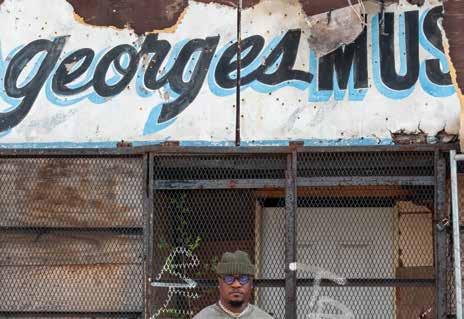
A social media trend targets houseless Chicagoans.
CITY LIFE
6 Going the Distance | Barnes
Two besties refuse to let a challenging commute between Lincoln Park and Brighton Park keep them apart.
8 Inside Voices | Salahat
I spent a year and a half working in Pickneyville’s solitary unit as a porter, and what I saw was a warehouse for people with untreated mental illness.
NEWS & POLITICS
10 Social Fabric
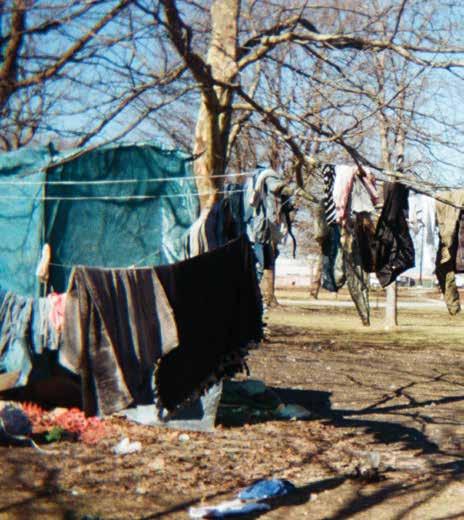
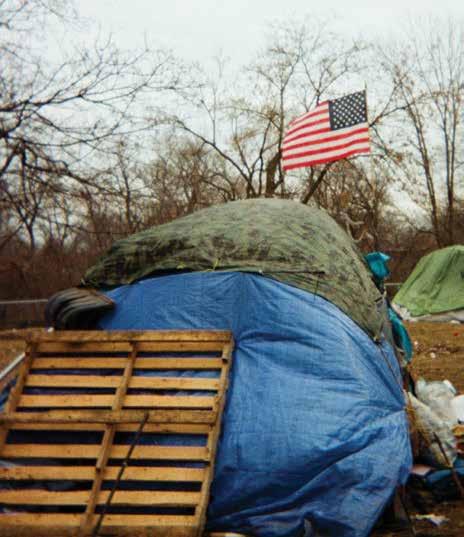
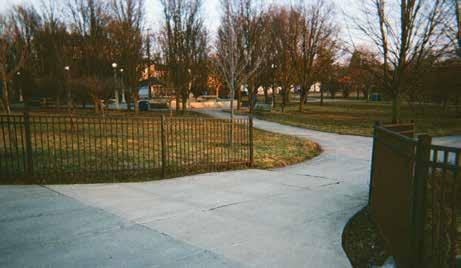
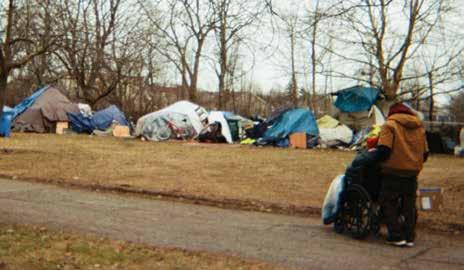
Encampment residents photograph the last days of life and community in Legion Park before their eviction.
13 Just Neighbors | Prout
A community of unhoused people fought the city to stop the closure of their Legion Park encampment and created a blueprint for resistance.
20 Investigation | Byrnes Cook County’s top prosecutor, Eileen O’Neill Burke, has a complicated relationship with the Pretrial Fairness Act.
24 Feature | Brown
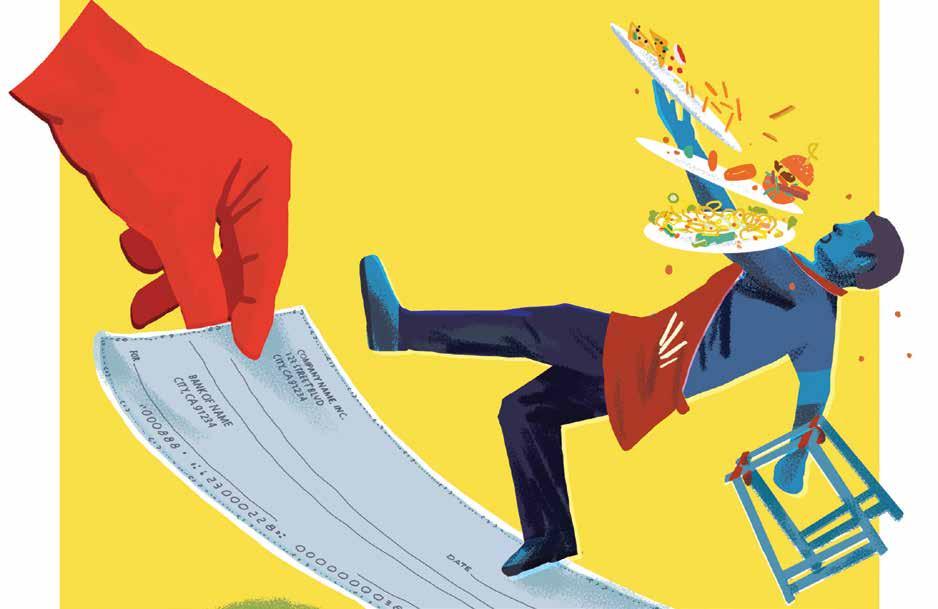
An effort to phase out the subminimum wage for tipped workers in Chicago was a done deal—until it wasn’t.
FOOD & DRINK
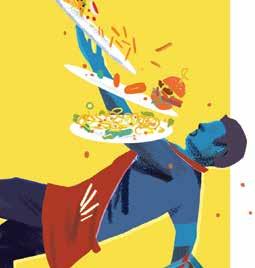
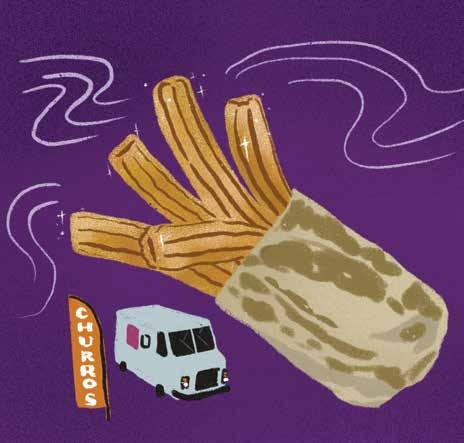
27 Reader Bites | Sula Fresh, deep-fried churros at a Little Village stoplight
ARTS & CULTURE
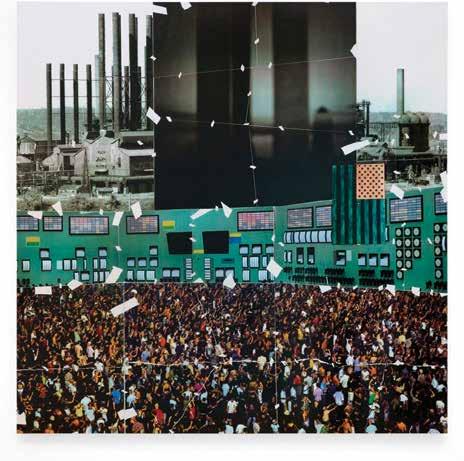
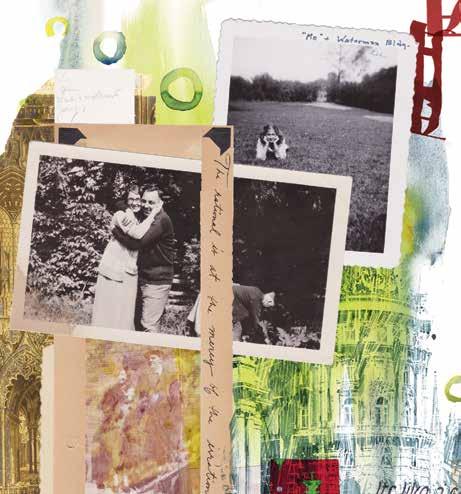
30 Review | Mulcahy Will Quam’s new book depicts Chicago as a city forever in love with its brick.
THEATER
32 Feature | Reid Theatermakers and advocates are reckoning with AI’s place onstage.
FILM
36 Feature | McFadden Johnny Jones tells North Lawndale’s stories.
MUSIC
42 Feature | Galil
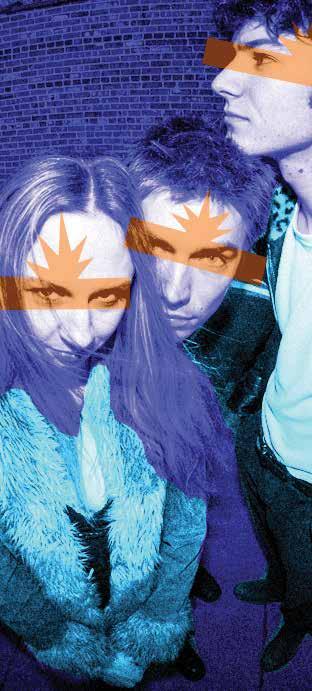
As shoegaze surges in popularity, young midwestern artists are helping drive its evolution.
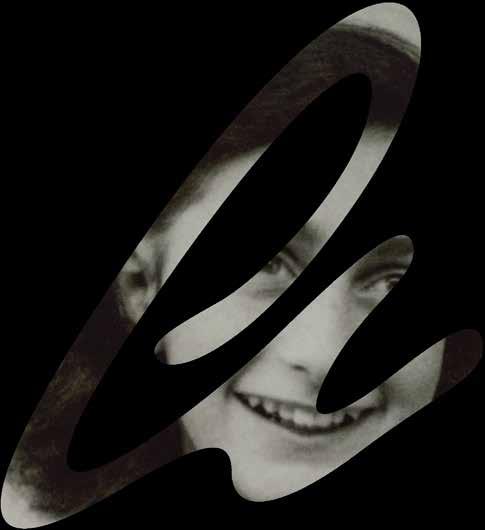
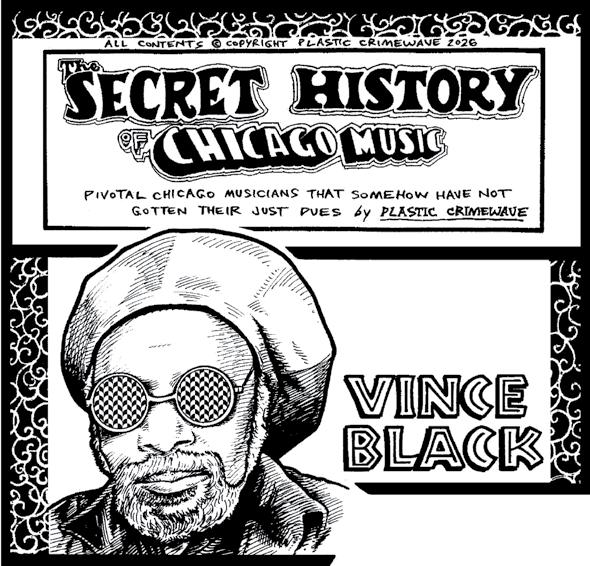
46 The Secret History of Chicago Music | Krakow Guitarist Vince Black has crossed oceans and genres.
READER RADAR
49 Calendar A curated monthly guide to what’s actually worth leaving your house for
INTERIM PUBLISHER
Rob Crocker
CHIEF OF STAFF/SALES DIRECTOR Ellen Kaulig
EDITOR IN CHIEF
Sarah Conway
CREATIVE DIRECTOR
Corianton Hale
ASSOCIATE MANAGING EDITOR
Savannah Ray Hugueley
FEATURES AND COPY
Kerry Cardoza
Huff
Shira Friedman-Parks
Reid
Montoro CULTURE
Taryn McFadden
Mulcahy PROJECTS
Jamie Ludwig
STRATEGIC CONTENT EDITOR Tyra Nicole Triche
SENIOR WRITERS
Leor Galil, Mike Sula FEATURES WRITER Katie Prout
SOCIAL JUSTICE REPORTER Devyn-Marshall Brown (DMB)
STAFF WRITER Micco Caporale
DEVELOPMENT MANAGER Joey Mandeville
DATA ASSOCIATE Tatiana Perez
MARKETING MANAGER Maja Stachnik
MARKETING ASSOCIATE Michael Thompson
SALES REPRESENTATIVES
Will Rogers, Kelly Braun, Vanessa Fleming
EDITOR’S NOTE
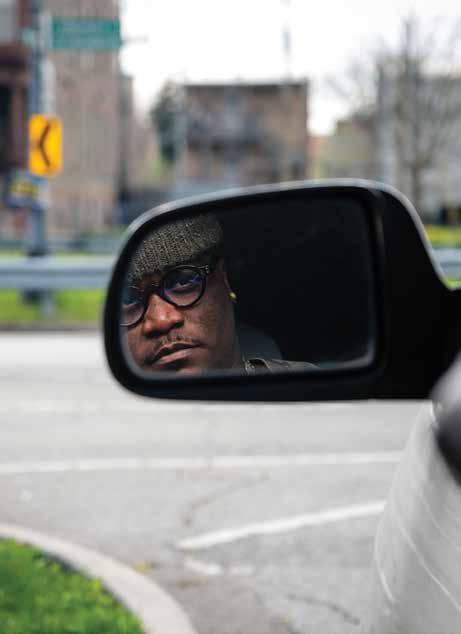
Idon’t remember the exact day that Simmy and I met on the quiet street where I’d recently put down roots. When he asked to clean my car, as he does for all the cars on the block, I brushed past him.
Eighteen months later, Simmy and I are close friends: two mercurial Gemini companions. He’s the street historian, A1 security, story keeper, and confidant, with nearly 40 years spent on one single southside block.
He’s also the first unhoused person I’ve ever come to know. Like many people reading this, I had invisibilized homeless people for much of my life. Through this friendship, I’ve seen the ups and downs of living in Chicago, whether outside or in cars, and what it means to reach for personal freedom in the very same public space that housed people take more or less for granted.
It’s that right to self-determination and agency that is the defining crossroads of features writer Katie Prout’s latest installment of Just Neighbors, a series that examines the city’s homeless encampment sweeps, focusing on the human impact of this fragmented, interdepartmental process. This issue, Prout is your psychopomp through the final days of Legion Park—from the eviction notices that started appearing around the 51-acre
park that spans West Ridge, Lincoln Square, and North Park, to the removal of residents’ tents on March 17, when dozens
of city workers pulled up at dawn to evict 20 or so people from their tent homes.
“They lost,” Prout wrote, “but the prec-
edent they set, and the networks they’ve built, are a blueprint for how other encampments across Chicago can fight the city and ask for what they really need.”
We did what service journalism does best, distributing disposable cameras and asking interested park residents to take photos of the people, belongings, and spaces that made their encampment home, all of which were ultimately destroyed. You can see their photographs in our latest Social Fabric column, ‘All of us go together,’ in this month’s issue.
I turned the story over to Simmy. What does a story like this mean to someone who’s experienced the gamut of homelessness, from shelter living to tent living to car living? “The only way you can write that is if you’ve been through it, or gone there,” he explained. “She really talked to people in the streets.”
That’s the power of community journalism at the Reader. We’re bringing you fearless reporting worthy of this publication’s legacy and perspectives that deserve to be heard as we reinvest in the long-form features and investigative work that reflect Chicago’s communities—especially those unseen. v
—Sarah Conway, editor in chief sconway@chicagoreader.com
Marshall Brown, Union Hall (2026), on view at Western Exhibitions through May 30 COURTESY WESTERN EXHIBITIONS
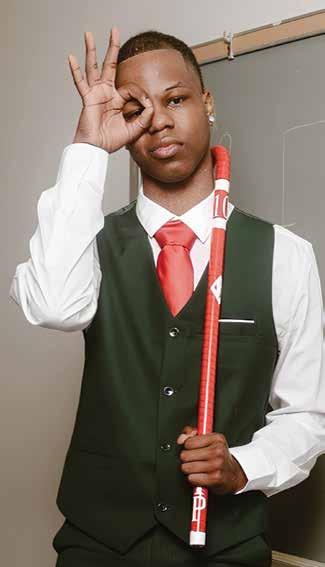
As a Chicago high school student, I volunteer with local nonprofit Chi-Care, which provides water and basic necessities to unhoused individuals downtown. I have recently watched with growing concern as social media influencers—many not much older than myself—film themselves distributing cigarettes, alcohol, or weapons to the homeless for viral attention.
What is demonstrated online is a compelling modern social phenomenon: People are hesitant to criticize popular influencers simply because holding the camera grants automatic credibility. Rather than challenging stereotypes, this trend reinforces them; the influencer mantra “keep the homeless, homeless” evolves into an inside, heartless joke. When public exhibition replaces ethical responsibility, “compassion” becomes a performance.
People experiencing homelessness face persistent social stigmas and are often reduced to their mental health issues and substance use disorders, or are referred to as being “beyond help.” A phrase like “never give a homeless person a dollar” has become ingrained within broader U.S. culture because they are viewed as a hopeless cause and a public nuisance. Too frequently, poverty is viewed as individual failure and not a systemic issue in
a capitalistic society, an assumption that prevents examination of the status quo.
In the world of social media, views and likes are money. On camera, content creators effectively exploit the struggles of homeless people in exchange for monetization. These carefully preplanned events are staged as a spectacle, turning human vulnerability into popular entertainment while pocketing profits from viewer consumption. Online viewers may
also play an unintentional role, amplifying posts through likes, shares, and views, causing the trend to spread and draw even more attention. In this scenario, mocking suffering replaces accountability, and viral content overrides ethics.
While social media infl uencers claim good intentions, real-world public health has standards. In medical ethics, nonma-
leficence, or “do no harm,” is a principle of particular importance because vulnerable populations face greater risk. The duty of care establishes a responsibility upon the provider to weigh all logistical outcomes, not to ignore them. Public health outreach must also be traumainformed for delivering care, as understanding the social, psychological, and systemic factors behind homelessness is crucial to supplying the solution. Ethical outreach needs to be informed and structured in response, and not an impulsive action designed for viral content.
Under these standards, the actions of these influencers, as showcased online, are ethically indefensible. Willful ignorance of the unsafe conditions of the unhoused population while providing weapons to people creates obvious risks of violence, replacing any claims of “good intent.” Offering alcohol to a population sensitive to substance abuse gives rise to more reliance on harmful intoxicants, while the lack of follow-up care demonstrates major abandonment. Drug and alcohol overdose is a leading cause of death among people experiencing homelessness in the U.S. When influencers hand out free cigarettes (even if the recipient wants them), do they know that one-third of all cancers in the unhoused population are attributed to smoking, with bronchus and lung cancer as the leading
cancer deaths? Furthermore, putting on this spectacle of human vulnerability and suffering contradicts any claims of “charitable compassion” as hungry people are being “consumed” for dark entertainment. Chicago already has better models. Across the city, outreach systems like Chi-Care responsibly provide needsbased care, including access to food, water, and hygiene resources. Empowering and supporting these organizations means emphasizing dignity over spectacle and shifting attention from performative “charity” to real care, a crucial step in reshaping the harm caused by social media and stereotypes.
These models work humbly and quietly to deliberately preserve the dignity of the people we serve. Real compassion stems from real outcomes, not likes and views. Homeless outreach should be guided by ethical responsibility rather than profit. When this responsibility is replaced by viral visibility, “charity” is harmful. v
—Suleiman Mohiuddin, Glenview, Glenbrook South High School
Send letters about our stories or happenings in Chicago to themail@chicagoreader.com and include your postal address. Letters may be edited for length and clarity.
themail@chicagoreader.com
LAN TRUONG FOR CHICAGO READER
CITY LIFE
GOING THE DISTANCE
Spencer & Melanie: Public transit baddies
These besties don’t let the challenging commute between Lincoln Park and Brighton Park keep them from slaying the day away together.
BY JASMINE BARNES
Despite the structural barriers to traveling between Chicago’s 77 community areas, many friends are willing to face the city’s geographic hurdles and sustain relationships that transcend race, gender, age, and class. In an effort to chronicle human connection and love despite systemic and structural barriers, the Reader’s new Going the Distance series examines the enduring friendships between people living in distant neighborhoods.
Afriend who’ll pick up your prescription at the pharmacy is a great friend. A friend who’ll spend over an hour on buses and trains to pick up your prescription at the pharmacy is a Spencer.
“They have come from Lincoln Park all the way to Brighton Park just to go into the pharmacy and get my medication, and then they’ll go back home,” said Melanie Diaz, 26, about her long-distance Chicago bestie, Spencer Harrigan, 22. “You can’t let that go once you have someone like that. It’s really special.”
Spencer and Melanie’s friendship started in 2022 in the dorms of DePaul University, where they were randomly paired as roommates. Spencer, a costume design and history major, and Melanie, a political science major, couldn’t have been more different on paper. After sharing a dorm (what Melanie calls “a little tiny shoebox room”), they discovered a shared sense of humor, a love of art, and a commitment to uplifting each other.
In 2023, they moved out of their shared dorm room, with Melanie returning to her childhood neighborhood of Brighton Park to live with her grandmother and Spencer signing a lease in Lincoln Park to finish out their time at DePaul.
On a rainy day in March, they traversed trains, buses, and the slick streets of Chicago from their different corners of the city to attend a community art night at Pilsen Arts & Community House and reflect on their friendship.
There’s a playfulness and humor to their connection. In the bustling art space, their laughs bounce around the walls—one person completing the other’s sentences. They are, as Spencer likes to say, “down to clown” and often unfazed by the structural barriers that make their friendship more challenging. The litmus test for many Chicago friendships built on shared interests instead of shared proximity is a willingness to navigate the city despite the lack of accessible, reliable public transportation.
“You just have to have no expectation for it, and that’s when you hit peak flow state,” Spencer said. They both lamented many experiences with egregious bus wait times and the infamous ghost buses that leave them stranded. If there were a true villain in their friendship, it would be the 62 Archer Bus and its regular 30-minute wait times between bus transfers.
“You just gotta put your headphones in and be like, you know what . . I’ll get there,” Melanie said. They agreed that something as simple as designated bus lanes would radically change the experience of commuting on public transportation, especially in parts of the city where el trains aren’t accessible. Though bus rides comprise over 50 percent
of CTA system-wide ridership, Chicago lags behind similar major cities with its lack of permanent bus lane infrastructure.
“On the south side, there’s a lot less access to transportation, especially by my house,” Melanie said. “It’s crazy how on the north side you see, every couple of blocks there’s a station.”
Because they both know the struggles of
Spencer (top left) and Melanie at Pilsen Arts & Community House TONAL SIMMONS FOR CHICAGO READER
navigating the city, they’ll often commit to an hour-long meeting window in case they encounter a major delay while in transit. There’s an honesty and realness about their capacity that makes the friendship feel sustainable. It’s this combination of flexibility and commitment that they attribute to the success of their relationship.
Spencer noticed friends drifting away after college because of their unwillingness to commute, but Melanie is the exception—always willing to overcome the city’s barriers to enjoy its benefits.
For Spencer and Melanie, Pilsen represents a part of the city that’s overflowing with accessible, creative spaces like Pilsen Arts & Community House. Earlier this year, Melanie contributed to a group gallery show that was on display there. Her days are filled with volunteer grant writing and program work at Healthy Hood Chicago and Pilsen Defense & Access and other creative projects as she navigates her self-defined “side gig era.” It was Spencer’s acumen with spreadsheets and numbers that helped her apply for (and receive) a grant to lead intergenerational programming at Healthy Hood this summer.
“Spencer’s someone who I find to be very supportive with my art. I kind of stopped doing art because it got expensive,” Melanie said. “When I met Spencer, they ignited that joy of art again.”
Free time together is often spent at art markets, community workshops, and Chicago Park District events. They emphasized the importance of third spaces and art venues for sustaining their friendship.
“Because we have to put the work into our friendship, it’s forced me to get to know our city more, to have a bigger appreciation of Chicago,” Spencer said.
Spencer, a transplant from Louisville, Kentucky, was intentionally seeking out a city with public transportation when they moved to Chicago. Still the city’s flaws remain apparent: Disparities in public transportation access and lack of affordable housing are two major challenges.
Now a DePaul graduate, Spencer is
committed to moving out of Lincoln Park as soon as their lease ends. As one of the top three most expensive neighborhoods in Chicago, Lincoln Park’s abundant access to public transit doesn’t overshadow its steep rent prices.
To make rent, Spencer has an hour-long commute to their job at the Old Orchard mall in Skokie and still manages to find time to volunteer at the Art Institute of Chicago. Their hope is to be accepted into a PhD program in art history, and they’re currently wait-listed for a program in New York. In this season of uncertainty, they seek out opportunities to engage with friends in artistic ways, like combining their volunteer shift at the museum with a friend date, perusing the galleries.
Melanie and Spencer will occasionally commute and just go grocery shopping or run errands together. Finding ways to make the small things an opportunity to hang out has made their friendship possible as they navigate mental health challenges, the stress of paying rent, and the struggle to find purposeful work in your twenties. In the times they’re not physically together, they’re often on FaceTime or bantering in a group text. This constant web of connection is a supportive and energizing force in their lives.
“I’m very sentimental, and my emotions are really strong. When I’m in that mindset, it’s really hard for me to get out of that emotional state,” Melanie said. “When my mind is racing [Spencer] knows what to say, and it’ll instantly ground me.”
Before dashing to the Pink Line to head back home, Spencer points out the word “SLAY” splashed across their phone case and bag tag.
“My motto is ‘Slay the day away!’” Spencer said.
It’s a motto that also summarizes the unrelenting energy and optimism at the core of their friendship with Melanie— anchored in their shared dreams of being “employed baddies” and “flourishing creatively.” v
themail@chicagoreader.com
“When I met Spencer, they ignited that joy of art again.” TONAL SIMMONS FOR CHICAGO READER
CITY LIFE
Insight into solitary
I spent a year and a half working in Pinckneyville’s solitary unit as a porter. What I witnessed was a warehouse for people with untreated mental illness.
BY MOHAMMAD SALAHAT
Ibegan work that day as I did any other, sweeping the floor in solitary confinement at Pinckneyville Correctional Center in my $0.04-per-hour job. The cacophony of dozens of men roaring over one another, competing to be heard from behind the steel confining them, never allowed for silence during my eight-hour work shifts. As I swept, a pungent smell of burning paper and plastic filled the air. Suddenly, a shrill shriek cut through the noise. “Mohammad! Mo-ham-mad!” I looked around for the panicked voice. Then I saw black smoke, like a backfiring muffler, raging from a cell-door window. I rushed off the unit to get help while the man trapped in the burning cell continued to scream. Solitary confinement or “restrictive housing” (a prettier name the Illinois Department of Corrections, or IDOC, prefers) isolates individuals in custody who violate prison rules. From fighting to stabbing to refusing to follow orders, I’ve seen people sentenced to anywhere from seven days to almost one year in solitary.
Before working in a solitary unit, I looked down on the people housed there. They were the reason I’d be caged in my cell for 24 hours, for days on end, because some antics they had pulled caused the prison to go on lockdown. They were the reason our yards and commissary were canceled, and I’d starve, having to depend on the three meager meals the prison provides. They were the reason my family wasted 12 hours of driving—six hours each way—only to be informed at the front gate that the prison was on lockdown and all visits were canceled. What I later learned was that many of these men’s “transgressions” were not acts of defiance, but rather pleas for help. Repeated requests to speak to mental health providers or receive medication could turn into stints in solitary. Ignorantly, I assumed they were all troublemakers, but my year and a half working there taught me otherwise.
That morning of the fire, by the time I made it back to the unit, accompanied by a corrections officer, the screams had stopped. I don’t know exactly what happened next—all I know is that we workers were gathered up and locked in our cells. Later, the other guys in solitary told me guards opened the man’s cell, emptied a fire extinguisher inside, and dragged him out covered in black soot and grime.
The next day, a corrections officer told me the man had survived. He only
ATLAN ARCEO-WITZL
started the fire for “attention,” the guard said. The corrections officer didn’t know I frequently talked to the man: He had recently confided that the mother of his children had broken up with him, and he feared he’d lose access to his kids. A couple of days earlier, I relayed a message to staff on his behalf, letting them know he needed a crisis team. Mockingly, a corrections officer told me to tell him they didn’t “serve ice cream.”
The United Nations has stated prolonged solitary confinement is equivalent to torture, and decades of empirical research proves isolation wreaks havoc on the human mind. In June 2006, the Commission on Safety and Abuse in America’s Prisons, a bipartisan national task force staffed and funded by the Vera Institute of Justice, published a report on restrictive housing, writing that mental harm can occur after as few as ten days in solitary. As the name suggests, solitary
is a lonely, despondent place. Men who commit infractions warranting segregation status enter the unit and are placed in an empty cell. During the summer, as the temperature rose, so too did the number of individuals who came to solitary in 2023 and 2024. As a result, guys were forced to share cells.
The only items permitted in solitary are clothing, hygiene products, medication, and reading material. Part of the punishment is taking away things that make prison less miserable: food from the commissary and, in most cases, electronics. Depending on their level of restriction, people may also be unable to call or email family and friends, or receive in-person or video visits. The main form of communication they have is putting their mouths to their cell-door windows and yelling at the top of their lungs to one another.
To help them relieve the boredom, I kept a small collection of books I’d circu-
late on the unit. Books have ensured my sanity and survival for 14 years of incarceration, and I hoped they would do the same for these men. The Harry Potter series offered them the opportunity to escape to Hogwarts and learn magic alongside Harry. I remember when one of the men read Harry Potter for the first time. He yelled out, “Harry Potter is the shit!” Other guys yelled back, “Man, you late. Mohammad been put us on Harry Potter.” I’d also scrounge up whatever hygiene products—toothpaste, toothbrushes, soap—I could and pass them out. Oftentimes, I’d buy extra with them in mind.
For the most part, guys spent all day locked in their cells. According to IDOC policies, people in restrictive housing are only guaranteed a minimum of ten “unstructured” hours outside of their cells each week. Included in this is time in the yard or “group therapy.”
A lot of men would refuse to attend these
group sessions, hating the dehumanizing process they had to undergo to attend: A guard would extract them from their cell, place them in a shower, and strip them naked. Once stripped and searched, they’d dress and be forced to wear a waist chain, which their hands would be cuffed to, gluing them to their sides. Upon leaving, they’d be strip-searched again before being placed back into their cell.
Those who did attend would be chained to benches in the group room, holding them down for one to two hours. The mental health worker would often put on the TV and leave, but the men would still find respite in those few hours of watching TV and talking to one another.
Due to the lack of mobility and visibility of those in solitary, I became their go-between, relaying any messages they had for corrections and mental health staff. Seeing how hard it could be to access mental health support in particular, I tried to bypass the guards to report directly to mental health staff when guys asked for them. Unfortunately, many of the messages went ignored; “I don’t need you to tell me who needs help or anything,” one staff member said to me.
Once, the corrections officer and I were passing out lunch trays when a man told the guard he needed to be let out of his cell; he was “scared of the voices.” He asked if he could speak to a mental health provider and receive his medication. The corrections officer slammed his chuckhole, and we kept moving.
Hours later, the guard found the man lying in bed, blood everywhere. I crouched in the man’s cell on my hands and knees, scrubbing his blood off the floor. I had to ask for a mask: The smell of the metal in his blood was too strong for me to stomach. They moved him to the crisis unit for a couple of days, then returned him to the same cell. The day he returned, he tied his sheet around his neck and hooked it on the light fixture, trying to hang himself. I tried to untie the knot, but it was too tight to undo. I never saw the man again, and when I inquired about him, an officer said he was another prison’s problem. What was abundantly clear is he wasn’t receiving the psychiatric care he desperately needed.
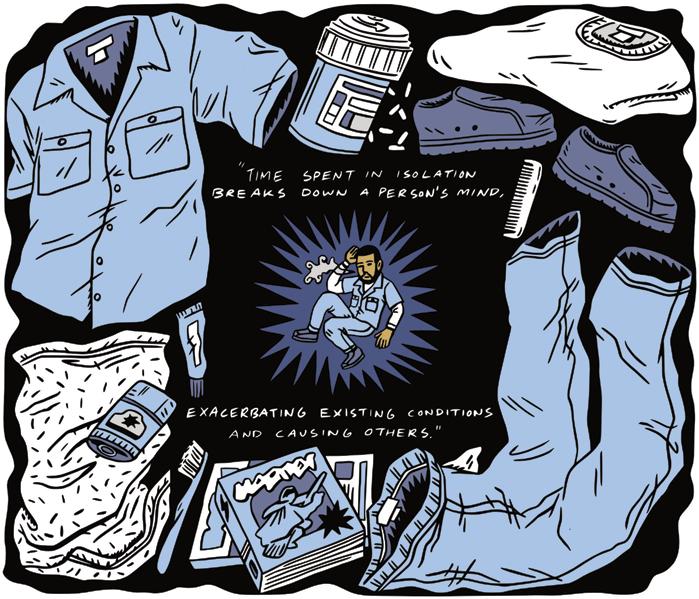
I began to lose count of the number of self-harm episodes that occurred: Men swallowed batteries, jammed staples in their eyes, smeared themselves and their cells with feces, and went on hunger strikes. These and similar instances became weekly occurrences. Not all men in solitary have mental illnesses; however, time spent in isolation breaks down a person’s mind, exacerbating existing conditions and causing others. In a 2016 op-ed, former president Barack Obama discussed the suicide of Kalief Browder after he was forced to spend three years on Rikers Island awaiting trial. “How can we subject prisoners to unnecessary solitary confinement, knowing its effects, and then expect them to return to our commu-
CITY LIFE
nities as whole people?” Obama asked. Everybody who comes to solitary receives a “psychiatric evaluation” by a mental health worker before being placed in a cell. They provide two options: comply with officers or get stripped and dragged to the crisis unit. In a 2015 New York Times article, Erica Goode cites findings showing that suicides among prisoners in solitary confinement, who make up 3 to 8 percent of the nation’s prison population, account for about half of suicides in prison. Cutting and other forms of self-harm are also more common in isolation units than in less restrictive settings. IDOC released a report on its use of solitary confinement last July, which states that, in April and May 2025, more than 2,420 people were placed in solitary confinement each month. There were nearly five hundred instances of people being classified as being “Severely Mentally Ill” each of those months.
Solitary confinement shouldn’t be the solution to behavior caused by mental health issues. Prison staff need to be properly trained on how to deal with and decipher between interactions caused by mental illness or defiance. Mental health staff need to actually care for the people they purport to help. Maybe then we can change solitary from being a warehouse that hides and houses untreated mental illness. As for me, I quit being a porter in solitary confinement and switched to laundry. Although I wasn’t the one trapped in a cell all day, I no less felt the stress these men were suffering.
My heart and mind raced every time a plea for help went unanswered. I didn’t want to be around if “seeking attention” was the last thing a man ever did. Sometimes I feel I abandoned them, and I regret quitting. I always think about the day the man trapped in a burning cell screamed my name. Not the officer’s name—my name. He depended on me to save him. v
Mohammad Salahat is a Northwestern Prison Education Program student pursuing a bachelor’s degree in social science. He is committed to using his education to pursue a path in social work and community organizing to support others, strengthen communities, and make systemic change.
SOCIAL FABRIC
I‘All
of us go together’
Residents document in photographs the last days of life and community in Legion Park before their eviction.
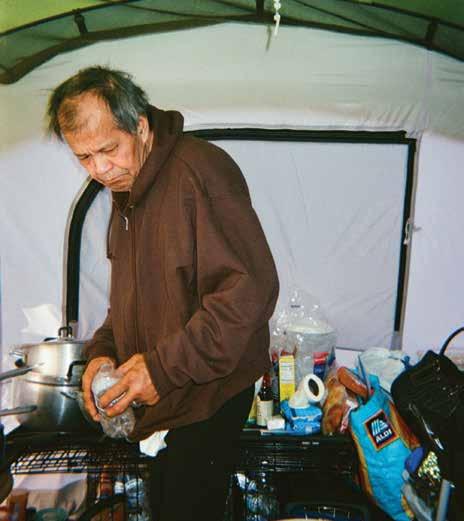
spoke often with Tita Carmen, a 73-year-old unhoused grandmother and community leader, in the weeks leading up to the planned Legion Park eviction on the city’s northwest side. On March 17, 20 unhoused Chicagoans living in the park were forcibly displaced by the city, part of a pattern of evictions that residents of the city’s encampments have faced in recent years. “Why don’t you put your shoes on our shoes?” she said, repeatedly. “Find out, even just 24 hours, the fear that we have when the weather is so bad, when the wind is so strong. Come firsthand, interview us, talk to us, because each of us has different needs.”
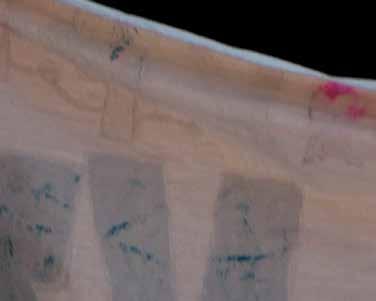
Journalists tell parts of other people’s stories, as I did for “‘How the hell can they decide what my needs are?’” on page 13. We get credit for it, but the people we interview are more than capable of speaking for themselves. Four weeks before the camp was scheduled to close, I distributed disposable cameras and asked interested park residents to take photos of the people, belongings, and spaces that made their encampment home, all of which were at risk of destruction if the city’s eviction went through. Those who completed the project were paid for their work.
In all, six people participated in docu -
menting the last days of their community: Serena*, Carmen, Oscar, Leo, Nick*, and Ross.
The last time I saw Ross was on March 12, five days before the sweep. If it happened, he didn’t know where he’d go.
“Somebody is asking me to go to Salvation [Army],” he told me. “I don’t know if it’s job or apartment, because I asked for both.” The day prior, Ross and other residents rallied in front of the Chicago Park District headquarters to stop the sweep. Within a week, he would be evicted, but still, Ross hadn’t given up. “Are you coming Saturday?” he asked. “We will have a meeting. A lot of people coming to help. I hope we can stay.” v
—Katie Prout, features writer
Editor’s note: Nick and Serena’s names have been changed for this story by request. They are marked with an asterisk on first mention.
Social Fabric is a glimpse into the vibrant lives, objects, and spaces that shape our city, cocurated with community archives and local photographers.
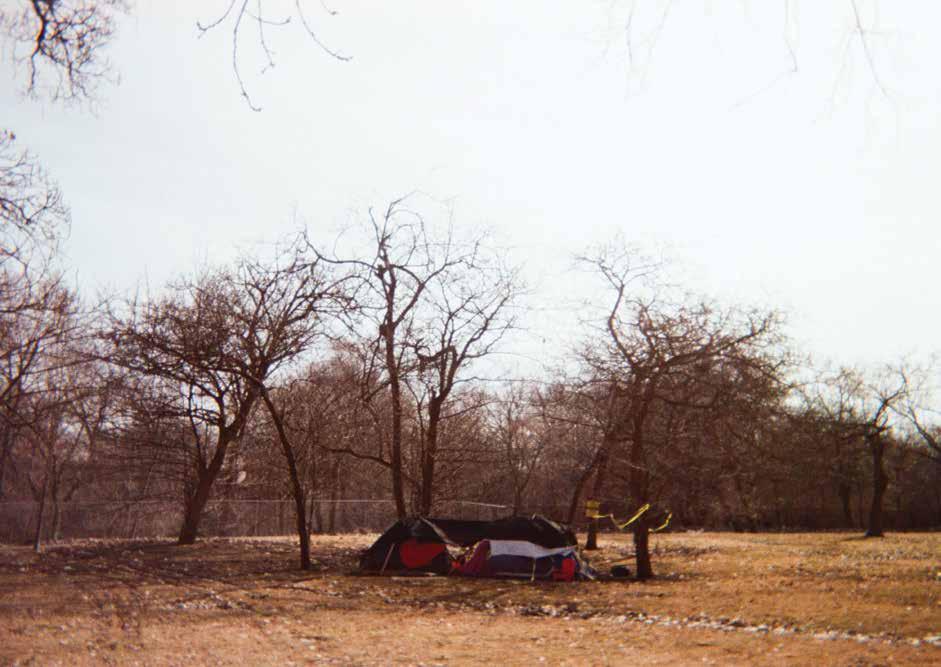
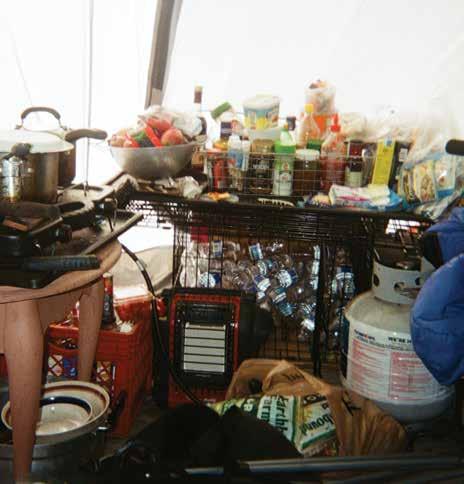
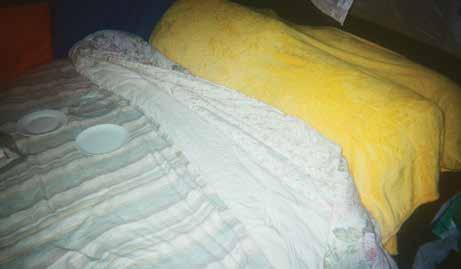
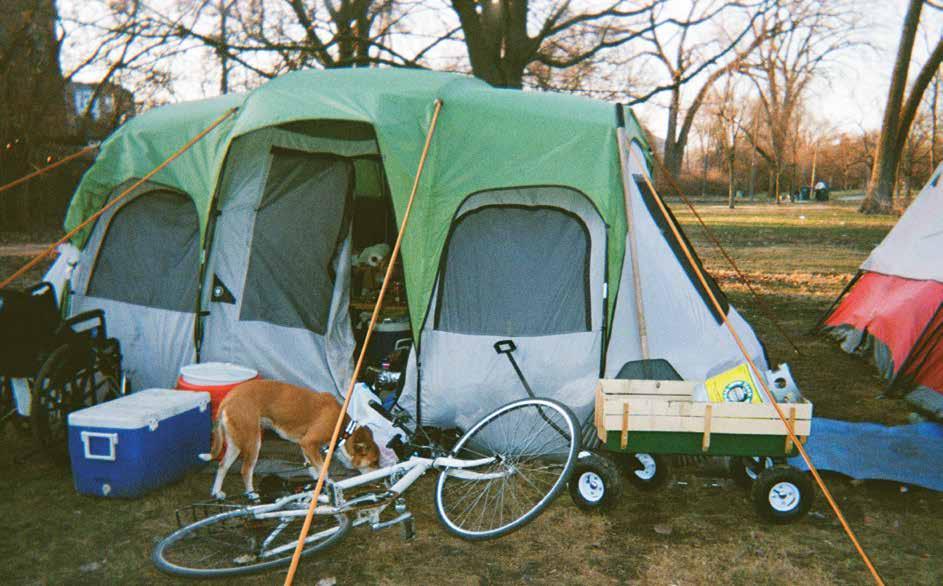
Carmen and Oscar’s tent in Legion Park was a distribution point for the rest of the residents: Here, housed neighbors and mutual aid groups regularly dropped off food, water, and other necessities. OSCAR
CARMEN, OSCAR
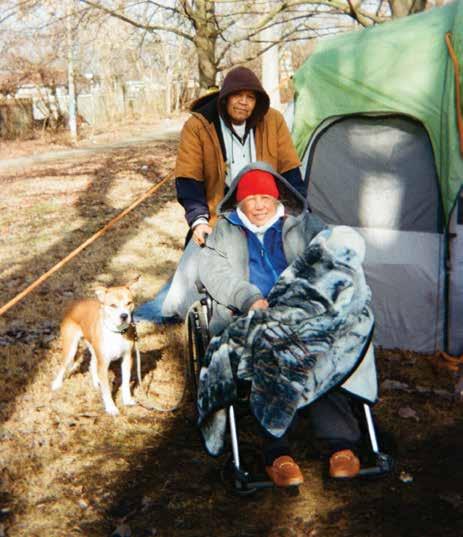
In part because Oscar and Carmen are not legally married, Carmen has been offered housing—for her only. She has refused to go anywhere they can’t move together. “You don’t leave because you’re poor, you don’t leave because you’re sick, you don’t leave because of anything else,” she said. “You stay where you are gonna be happy. It’s with Oscar that I’m happy. And I’m not leaving [my dog] Princess.”
KATIE PROUT, CARMEN
“We
The camp did not have access to running water, but sometimes, there was enough bottled water for residents to rinse their clothes. OSCAR
Multiple residents have lost bikes during city sweeps, but they need them to get to jobs, doctor’s appointments, and family. LEO
took this picture, with the flag and this [the tents] in the background, because I’m proud to be an American,” said Carmen. “But what has happened to America?” OSCAR
CITY LIFE
Like many others, Ross is a day laborer. When I spoke to him last, the most recent apartment he’d been offered through the city was on the south side, too far from his northwest work site. ROSS
listens to audiobooks to fall asleep. “I got my werewolf novels. Moonlit, those type of things. Romance. They’re very interesting, especially when someone reads to you. Then it’s like you’re in the damn thing.”
“First thing I see when I wake up is my cat in my face,” said
Ross lived in this camp and others along the river channel for two years. “We will all go together,” he told me. “Wherever one of us is going, all of us go together.”
Carmen, Oscar, and Princess took a walk to the north camp. The day after this photo was taken, multiple tents pictured here burned down. KATIE PROUT, CARMEN
“Oscar should have been a culinary [worker] instead of a constructor,” Carmen said. From their tent, Oscar cooked meals for the whole camp; from their bed, Carmen watched. CARMEN
Serena. SERENA
ROSS
Serena
SERENA
‘How the hell can they decide what my needs are?’
On Chicago’s northwest side, a community of unhoused people fought the city to stop the closure of their Legion Park encampment. Despite the loss, their story serves as a blueprint for resistance.
BY KATIE PROUT
NEWS & POLITICS
We know how this story ends— kind of. On March 17, dozens of city workers pulled up to Legion Park in the predawn light, their tires and boots crunching through a layer of glittering snow. They were housing workers and cops, security officers and dump truck operators, and they were there for an encampment closure, an eviction of 20 or so people from their tent homes. To do this, the workers brought offers of temporary shelter, personal protective equipment, and guns.
In January, eviction notices started appearing on trees, fences, benches, and light poles around the 51-acre, oblong park that straddles West Ridge, Lincoln Square, and North Park. At the camp’s height, two dozen tents were scattered loosely along the river channel into a two-part community. One group was clustered off of Ardmore and Jersey, a bit north of a playground, while another was nestled a hundred yards farther, behind the McDonald’s on Peterson. To the east of the park was the river; to the west were the backs of private homes.
According to the flyers, what was coming was a “closure.” The residents didn’t care about the newest euphemism. They knew, like virtually every unhoused Chicagoan who lives in an encampment knows, what was coming. It happens throughout the city, but the result is always the same. To clear an encampment, the mayor’s office, the Department
of Family and Support Services (DFSS), the Chicago Park District, the Department of Streets and Sanitation, and the Chicago Police Department often spend thousands of dollars forcing mostly elderly, disabled, queer Chicagoans of color to leave their tent homes. Every unhoused Chicagoan I’ve spoken to calls “closures” sweeps, because the city treats them like garbage to clear away. And at the end of it all, they are, more often than not, still homeless.
The residents of Legion Park were a diverse community. They were born in Malaysia and the Philippines, in Lincoln Park and Humboldt Park. At 73, Carmen, who was also called Mother by some of the residents, was the oldest person in the camp. The youngest was a newborn, living only briefly at the park before officials took him away from his mother. Like many of their housed neighbors, some Legion Park residents were employed, while others were looking for work. Some had arrest records or substance use disorders, and some struggled with their mental health. They had families and pets, and many had known each other since high school. In short, they were a community like any other—they just happened to live outside. And while a few of them had only recently become homeless, everyone I spoke to had lived through at least one camp closure before. In fact, the majority had been pushed by the city from encampment to encampment for years along this section
of the North Shore Channel on Chicago’s northwest side.
The afternoon before the closure, friends arrived to help residents pack. The friends brought trucks to transport wheelchairs and bikes and offered to store anything they could. Some Legion Park residents went to sleep in a nearby church gymnasium, which could house them for a few nights, until, per state law, they had to leave, since the church was not legally a shelter. Others set up tents at a different park along the channel, a couple of miles south. Most people left on March 16, but a few remained the next morning to watch their tents get destroyed.
According to DFSS’s own numbers, none of the 20 people who called Legion Park home had keys to an apartment in hand when the police and dump trucks arrived that morning. Zero people had accepted offers to temporary city shelters, for various reasons. None of that seemed to matter. The signs had gone up; the offers had been made.
From a distance, it looks like this story ends where it started: unhoused Chicagoans still homeless, still living in city parks. But what happened in Legion Park is different from any other encampment I know. In the days and weeks before the sweep, residents, with the support of housed allies, organized collectively to fight City Hall. They went before the City Council, interrupted a Chicago Park
District board meeting with megaphones, and decided together where they would compromise and where they would hold firm. Above all, they demanded what everyone, housed or not, wants: the right to self-determination and agency over their own lives. They lost, but the precedent they set, and the networks they’ve built, are a blueprint for how other encampments across Chicago can fight the city and ask for what they really need.
“Ican’t forget the first sweep,” said Tita Carmen in late February, 18 days before the closure of Legion Park. “Everything was destroyed: my wheelchair, my commode, my walker, my cane.” After a September 2025 sweep farther south in Legion Park, Carmen’s husband, Oscar, could no longer find his Social Security card—crucial for obtaining housing—because Streets and Sanitation workers had thrown away an important suitcase.
Carmen, a Filipina grandmother, former patient analyst specialist, and recent cancer survivor, spent much of her time in Legion Park holding a rosary while perched on her bed inside the tent she shared with Oscar and their dog, a loyal pit mix named Princess. As the mom and pop of the camp, Carmen often shared donated water and clothes, while Oscar regularly cooked big meals over a propane fire for the rest of the residents. Both
On March 17, 2026, city workers dismantled and disposed of the belongings left behind by former residents of Legion Park. SHIRA FRIEDMAN-PARKS
distributed advice, de-escalated fights, and shared their tent with others who needed a place to rest.
Outside their tent, Carmen and Oscar kept a cooler and a bike. A mattress against the tent’s back served as a buttress against the wind. A purple Know Your Rights sign from the Illinois Coalition for Immigrant and Refugee Rights was also staked nearby. In 2025, U.S. Immigration and Customs Enforcement (ICE) agents kidnapped unhoused immigrants near Gompers Park, a couple of miles west of Legion. Oscar, a day laborer who works in construction, was fearful of being caught without papers and had stopped looking for jobs. Instead, he stuck to doing random tasks for housed friends. Sometimes he played darts for money and used his winnings to purchase Carmen’s various medications: Depending on her health, she takes up to 20 pills a day. The food Oscar cooked for the camp, like the food he fed Princess, was mostly donated by others: mutual aid groups, nearby housed neighbors, and religious visitors. They brought sanitary pads and disposable diapers, first aid kits and tents, hand warmers and propane tanks, and a sweater for Princess.
Some of the visitors were part of Parks for All, a mutual aid group of Chicagoans who live throughout the city, including near Legion Park. They support their unhoused neighbors’ access to public space however they need to stay alive. For
months, Parks for All arrived at Legion Park every Saturday with soup and bread, conversation and jokes. Residents began to talk about what they needed to survive (porta-potties, water, heat) and how to get it (group consensus among the residents and negotiation with the city, like a tenants’ union with their landlord). Other organizations, like the Chicago Coalition to End Homelessness, an organizing, advocacy, legal, and educational nonprofi t, joined the conversation, but it was the camp residents who led it. Carmen, who speaks both English and Tagalog, interpreted for others in the camp; Oscar made them breakfast. What had been slow-going group discussions, interrupted by sickness and bad weather, changed once the closure notices went up in January. What good were porta-potties and access to water fountains if the city kicked them out of their tents? They needed to stay in their homes at least until they had keys to the apartments the city had been promising them for years. Sixteen residents attended an accelerated moving event hosted by DFSS on February 25, where they were connected to potential housing. But as the days passed, none of them had leases. To move into a temporary shelter, they’d have to throw away most of their belongings and abandon their pets. Even if they were willing to do that, there is no shelter for individuals on the northwest side near the park. And the other shelters
the city was offering to connect them to were hours away on the CTA from their jobs and their doctors.
Unlike many of the others, this was Carmen’s first experience with homelessness. “Now, I know how it is to be homeless, all the fears, all the doubts,” she said. The politicians making these decisions, Carmen believed, had no idea, nor did they understand that each individual at the camp had different needs. All they knew, she said, was money and—through the police officers and park security who enforced their decisions—intimidation.
“It’s like we’re a bother, not even humans. We’re like dogs or something,” she said. “Even Princess—I was told when they were doing cleanup, [a police officer] came to me and said, ‘If you don’t do anything about that dog, we’re gonna call animal control, have her put down.’ But you can’t intimidate me.” (When asked for comment, a CPD spokesperson said they had no police report of the incident.)
At the time, Princess was barking but leashed, Carmen said. Meanwhile, when housed neighbors with dogs let them roam the park off-leash, nobody calls the police.
The residents talked with each other about their options. They were united: The closure must be stopped.
The neighbors who lived around Legion Park felt conflicted. They were a community used to working together to resolve neighborhood disputes, they told me.
Some had advocated for encampment residents to be allowed to stay where they were until the city moved them into permanent housing. These housed neighbors pointed out that there was precedent for using public parks to help people survive, such as when park district land was used as victory gardens in the 1940s. Many others disagreed. Allowing some people to continue to live on public land turned it into private-only use, they argued.
Justin and his family moved to the neighborhood around Legion Park in 2020, when there were five or six tents behind the McDonald’s on Peterson. He and his wife regularly shared food, water, ladders, advice, and sometimes money with their unhoused neighbors, just like they did with their housed ones. “My wife and I wouldn’t want to live in a world where our children would see us walk by people who were familiar and close and not care about them,” he explained.
In July 2024, he heard a large boom. Another encampment in Legion Park, near Bryn Mawr, about a half mile south of the current camp, had grown large. There was a fire and explosions, and accusations among unhoused residents about how the fire started.
In conversations with housed neighbors, fire was the number one reason folks wanted the city to step in. From their homes, they’d seen explosions from propane tanks residents used to cook their food and heat their tents. If their homes
burned down, housed residents said, they themselves would be that much closer to homelessness. Some suspected the city would move faster to evict the encampment if the surrounding homes were owned by people more wealthy and more white.
Between February 5, 2023, and March 26, 2026, Legion Park generated more than 250 calls to Chicago’s 911 emergency dispatch system, drawing responses from police, fire, and emergency medical services. Park checks (when an officer looks in on unhoused people living in the park) accounted for the largest share of calls: 94, or roughly one-third of the total. Fire-related calls ranked second, with 16 logged over the period, representing 6 percent of all dispatches. Disturbance calls (a general term that includes noise complaints or concerns about groups of people) followed closely, totaling 12, about 4 percent of all calls.
“It got really complicated for us,” Justin said of living near the encampment. “We heard things from [encampment] residents that may or may not be true, and I don’t know how to evaluate them.” Shortly after the July 2024 fire, the city swept that encampment, pushing the residents elsewhere within Legion Park or to nearby parks. But there were other fires. They occurred often enough that Justin’s children would see one out the window and say, “Mom, Dad, there’s a fire again.”
“Why do only some children have to face this danger?” Justin wondered. He saw it as an issue of race and class, where housed neighbors and encampment residents felt pitted against one another. It had been years since the park district put any major resources into Legion Park. The block he lives on is the second-lowestincome precinct area in the ward. “All but one house [on his block] has a person of color living in it, and the majority of the houses are owned by somebody who was born in another country,” he continued. “As a Filipino person myself, I see myself in [Carmen and her family]. I think about it all the time. These encampments, it’s always around people who are just on the other side of the margin. They’re just not in wealthy places, and that’s not an accident.”
Every unhoused Chicagoan I’ve spoken to calls “closures” sweeps, because the city treats them like garbage to clear away.
“If there are not great choices, who gets to make the choices amid these constraints?” asked Andrew Johnson, chair of the Hollywood-North Park Community Association (HNPCA), two weeks after the sweep. In fall 2025, the
NEWS & POLITICS
organization started emailing Alderperson Samantha Nugent and parks superintendent Carlos Ramirez-Rosa.
“We need an immediate guarantee of safety in Legion Park. Presumably, the Chicago Fire Department can advise what that requires. Then we must insist that the Chicago Park District implement immediate fire safety measures,” an email sent by the HNPCA on November 19, 2025, read. While the association later released a statement supporting the encampment’s closure, emails reviewed by the Reader requested that a minimum distance between tents and homes be enforced, that propane tanks be removed, and that any camp residents who wanted to leave for a shelter be provided with a bed.
Meanwhile, there were questions about the motivations behind Parks for All and the Chicago Coalition to End Homelessness in supporting unhoused residents who wanted to continue living in Legion Park. Not everyone accepted the groups’ presence. Housed neighbors along Jersey Avenue, many of whom were homeowners of color, questioned whether the groups shared a stake in resolving disagreements about what was the right thing to do. They didn’t see each other at the park; their kids weren’t in the same classes. There were arguments, in person and online, over who is and isn’t actually a member of the community, suspicions about funding sources, and allegations of verbal
altercations between advocates and homeowners, sometimes but not always across racial lines.
“If you’re a parent with a child who lives 75 feet away from a propane tank, you want people to live where they want,” Johnson said, “but you [also want] to be safe.” Unhoused people say the use of propane tanks—not to mention halting encampment sweeps—is not a matter of living where they want; it’s about living where they can survive.
In January 2026, 16 Chicagoans died from incidents involving cold exposure.
According to the most recent public data from the Cook County Medical Examiner’s Office, there have been 266 cold-related deaths since April 2021. During that same six-year period, one man suffered severe burns and died from a fire in his Little Village encampment. And in 2022, Joseph Kromelis, a local enigma known as “the Walking Man,” died months after he was set on fire while sleeping unhoused on Lower Wabash Avenue. His death was ruled a homicide. Neither of these deaths were connected to propane tanks.
For years, multiple unhoused Chicagoans have told me that fuel tanks save their lives. As the affordable housing crisis worsens across the U.S., nonprofits provide propane tanks to unhoused people so they can cook food and stay warm. Chicago Park District rules permit the use of propane for grilling in specified
areas but “forbid gas, propane, or other flammable substances” in encampments, according to their homelessness policy.
On March 7, ten days before the sweep, Alderperson Nugent sent out a quiz to her constituents. “Alderman Nugent is considering legislation to hold accountable those who distribute propane tanks at homeless encampments. Would you support or oppose this legislation?”
On March 5, 12 days before the closure, Serena, a 47-year-old grandmother, Humboldt Park native, and former Latin Queen with beautiful penmanship, sat in Carmen’s tent and wept over her cat Stormy, who had suffered serious burns in a fire that ripped through multiple tents in the northern camp a few nights before.
A rosary looped to the tent’s ceiling hung above our heads. Serena’s tent had been destroyed, and in the stress and confusion of the aftermath, her boyfriend, also a camp resident, had dumped her. Serena’s other cat, Chi-Chi, had escaped unscathed, and Stormy was now recuperating with a Chicago Fire Department chief, a friend of Serena’s, who also took care of her three other cats.
Serena had gotten to know many of her neighbors, housed and unhoused, during her six years living in encampments up and down the channel, and had been through six other sweeps. I asked her whether the sweeps have helped solve her
homelessness. “Not yet!” she replied. (The park district’s homelessness policies and protocols acknowledge this: “Encampment Closures alone are not a long-term solution to homelessness.”)
Recently, Serena was approved for housing, but she’s having trouble finding an available unit. “I gotta find the place with that Section 8 housing for Rogers Park or Albany Park,” she explained. Anything farther south, and Serena, who survived years of physical and sexual violence in Humboldt Park, risks further danger. “I don’t gangbang no more, but I’m still known,” she explained. “I don’t need my problems to get to my kids.”
Besides cats, thoughts of her adult children consumed Serena. It’s why she wouldn’t ask to crash on any of their couches. “I don’t want my kids doing nothing about where I’m at, because I want them to focus on their self, not me,” she said. “I don’t want them feeling pity and come try and take care of me. They need to take care of their own self and get their own life and pride together.”
“No man is an island,” Carmen reminded her. “You have us.”
“So, a sweep is when people come in, and there’s no housing or [other] supports being made. The park district doesn’t engage in sweeps,” said Chicago Park District superintendent Ramirez-Rosa. It was March 11, six days
Items left outside of tents—such as those pictured outside Oscar and Carmen’s Legion Park residence—are often targeted by the city for removal, regardless of how essential they are. ROSS
before the closure of Legion Park, and park residents, Parks for All members, and other supporters were outside of the Brighton Park Field House—where a park district board meeting had just wrapped up—demanding Ramirez-Rosa speak with them about their alternative proposal “Closing encampments does not solve anything; it just pushes people into other outdoor locations,” the proposal said. “Every closure requires people to start over, making it even harder for people to get connected to housing because they become disconnected from their case workers, community, and support systems.”
After interrupting the meeting, the protesters were kicked out by park security and cops, but regrouped in the cold, where they rang bells and sang, “Carlos come and meet us, we shall not be moved,” for nearly an hour. Carmen, in her wheelchair with the hood of her sweatshirt up, held a sign that read “Where will we go?” above an illustration of a breaking red heart. She frowned as the voices around her rose again.
Like the others, Carmen was here to demand that the park district sign on to the alternative proposal and stop the sweep. Among other points, the proposal allowed for residents to cook at their campsites. In exchange, camp residents would take fire safety classes and agree to “live no closer than 75 feet from private residences or 50
feet from property lines of residences or businesses.” This was a change from the one-hundred-foot minimum distance from residential and business properties specified in the homelessness policies shared by the park district in January, several months after the HNPCA asked for distance limits between encampments and their members’ homes. Guided by the input of people living in Legion Park, “the consensus was that 100 feet was unnecessarily far,” wrote Claire Sloss, director of strategic and policy communications for the Chicago Coalition to End Homelessness. Twenty-eight other organizations had signed on in support of the proposal, including the Illinois Union of the Homeless and the Orange Tent Project, which partners with the city to provide homelessness support services.
The Chicago Coalition to End Homelessness asked the HNPCA to consider signing on. After lengthy discussions with members, the majority of the association voted no.
Ramirez-Rosa is a recent appointee to this position; he was previously the Democratic Socialist alder of the 35th ward, which included an encampment at Fireman’s Park in Avondale. “Give us a home or leave us alone,” he had chanted in 2021 as an alder alongside Fireman’s Park residents and their supporters. Under his leadership, as the closure notices went up in January, the park district also released its policies and protocols for homeless
encampments. The document defined the difference between the terms “sweep” and “closure” as mainly a matter of notice. Sweeps, it read, happened without advance notice, but closures came with a heads-up and the City of Chicago’s version of a “housing-first” approach, which can include connections for the unhoused to temporary shelters, help applying for apartments they may or may not get, or support applying for the documents they needed to get housing, the kind of documents Oscar lost during the last sweep. Now, in March 2026, his response— correcting the use of the word “sweep” used by desperate constituents—only made the crowd angrier.
“‘The park district doesn’t participate in sweeps.’ Right,” Leo scoffed. Like RamirezRosa, Leo is a born-and-raised Chicagoan in his late 30s with an immigrant mom: Tita Carmen. Back in Legion Park, his tent was next to hers. Leo had known some of his other Legion Park neighbors since high school. As they lost jobs, went through breakups, were crushed by health bills, or had run-ins with the law, newly homeless residents had done what migrating humans all over the world have done throughout history: moved to a community where they already had family or friends.
In the last several months, the park district managed to frustrate everyone. Homeowners, men sleeping in their tents with their dogs, nonprofit social workers
who partner with the city, mutual aid advocates—during interviews, they all expressed confusion and frustration with the city’s approach to encampments in general, and with the park district in particular. The Chicago Coalition to End Homelessness provided me with a flyer from the September sweep that read, in part, “Tent Camping for Unhoused Residents in Chicago Parks, including Legion Park, will Continue to be Allowed in Areas not Identified as Restricted.” The emblems for the park district and DFSS were at the top of the flyer. Legion Park residents had only moved north after the September sweep because the city told them they could.
The alternative proposal was submitted to the City Council by residents and their supporters on Wednesday, February 18, four weeks before the sweep. Alderperson Nugent, whose ward contains Legion Park, declined multiple requests from the Reader for comment on the proposal. Parks for All sent the proposal to Ramirez-Rosa via email on February 24, three weeks before the sweep. Six days before the sweep, his face whipped by a bitter wind, Ramirez-Rosa, who also declined interview requests from the Reader , responded. “We can’t call it off. That’s a collective decision,” he told residents and their supporters. “[DFSS] is coming out here to give people homes. I don’t want to lose sight of that.” If the
Leo’s tent, blanketed in snow, just before the city swept Legion Park SHIRA FRIEDMAN-PARKS
sweep was postponed or halted altogether, he said residents might lose access to resources DFSS had set aside specifically for them.
Ramirez-Rosa promised to continue to talk to the mayor’s office, to then chief homelessness officer Sendy Soto, and to DFSS, and to set up a Saturday meeting with the residents, three days before the camp would be swept. “I want to make sure that if there are questions, that DFSS is answering them,” he said, “because what they have provided to me is a lot of really positive.”
“Too late!” Carmen said, her voice carrying over the crowd. Her wrinkled face was set. “We need you to see us now.” A few days before, Carmen learned that she had been matched with housing: an apartment in Evanston, with room for her, Oscar, and Princess. Still, she was out there, shoulder to shoulder with the neighbors in her camp who didn’t have the same fortune that she did.
Ramirez-Rosa left the crowd, promising to be in touch soon. Some lightly heckled him, but most seemed in good spirits, energized by their unity and action. The skin of a yurt, brought along as a symbol of displacement and resilience, was unfurled and refolded: Leo, cigarette between his lips, whooped as he helped pack it away.
The next day was March 12, five days before the sweep. Multiple tents, including Carmen’s, had flooded the night before. Outside one, a guy walked around kicking a bottle. Carmen called hers a swimming pool.
“I got bad news yesterday,” she said. “I don’t think I have that housing. They’re gonna separate us.” Instead of the apartment of her own, Carmen was offered triage housing: a room on one floor of a building, Oscar a room on another floor. Princess was not allowed.
Despite protests and petitions, alternative proposals and pleas, within a few hours, the last tents were destroyed, and the residents of Legion Park were gone.
“How the hell can they decide what my needs are?” Carmen asked. “I’ve had Oscar for ten years, caring for me. How can they decide my medical condition? They saw me. They interviewed me. They know I cannot walk. Don’t tell me they’re gonna separate us after ten years. Two rooms separate, no Princess? How can they decide that?”
In the end, Ramirez-Rosa did meet with the residents at Legion Park on
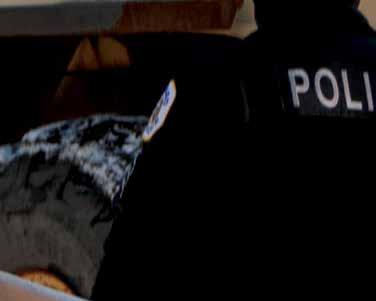
On the
the
were also armed. SHIRA FRIEDMAN-PARKS
Saturday, three days before the sweep. Soto and DFSS commissioner Angela Green did not attend. The alternate proposal was not accepted. March 17 would be yet another sweep for Tita, Oscar, Leo, and the 17 others.
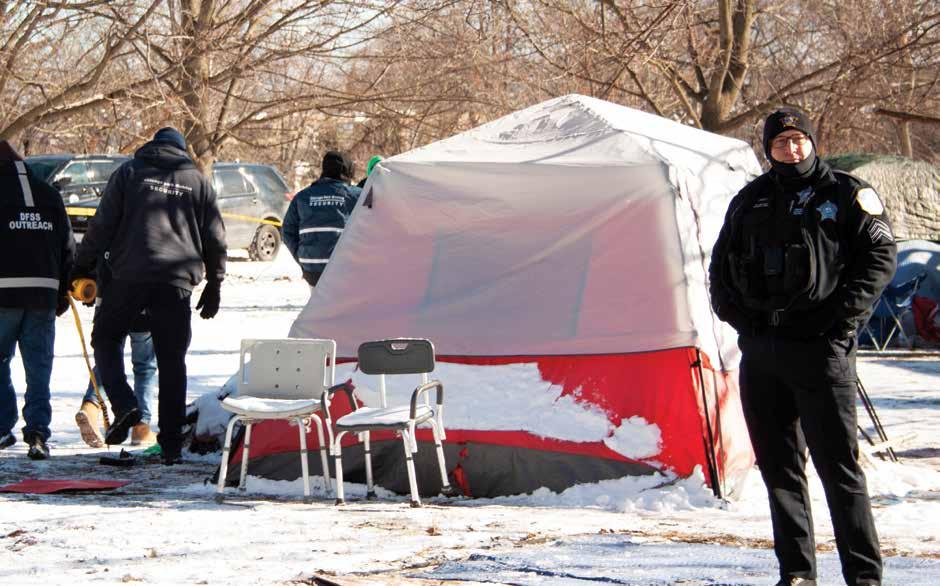
As the morning of March 17—closure day—wore on, journalists arrived, took notes, and flashed their cameras. A TV helicopter flew overhead. It was also an election day; none of the big players were there. Mayor Brandon Johnson was visiting a polling place in Austin. Green and Soto were in meetings. Meanwhile, park superintendent Ramirez-Rosa and Alderperson Nugent were nowhere to be found. Across Nugent’s ward, residents now formerly of Legion Park put stakes in the ground on other public land. In addition to the usual armed police, at least one park district security officer was seen carrying a gun. The Reader asked the park district how armed security officers fit within the “compassionate, trauma-informed approach” outlined in the park policies for encampment closures. The answer we received did not specifi cally answer this question.
Streets and Sanitation workers slashed any remaining tents with knives to confirm no one was in there, then cranes lifted them away. Despite protests and petitions, alternative proposals and pleas, within a few hours, the last tents were destroyed, and the residents of Legion Park were gone.
The closure was a “little better option among bad options,” Alli, another housed neighbor and member of the HNPCA, said. “Was it an amazing outcome? Absolutely
not. Does it make people who live along Legion Park safer [from fire]? Yeah. Does it maintain risks to our unhoused neighbors?” Yes, she answered herself. She used to work in medical care for the unhoused. She knew her former Legion Park neighbors weren’t safer elsewhere, if it meant they were still homeless. It all just felt bad.
On April 3, 18 days after the closure of Legion Park, Tita Carmen and Oscar teased and joked with other residents of their new encampment while Princess thumped her tail. Like many others, Carmen and Oscar had moved to Ronan Park, about a mile and a half south of Legion, after leaving the church gym’s temporary shelter.
Parks for All had been by that Saturday, offering their usual food and friendship. “We were all playing cards like kids,” Carmen said. She’d heard a rumor that housed neighbors were accusing Parks for All of wanting people to be homeless indefinitely, and adamantly dismissed it. Parks for All transported unhoused residents to shelter when it was cold. They knew the residents’ names, languages, birthdays, and favorite foods. And they helped the residents understand their options and rights in the face of the sweep. “Not the city. It’s them,” she said. “They were giving us info and hope. It may not go through, but at least we try.”
A few weeks later, she had a new apartment offer: a one-bedroom on the north side with a dining room and a building elevator. All that she was waiting for now was the inspection. While she waited, Carmen attended a meeting with Parks for All, the Chicago Coalition to End Homelessness, and two dozen other unhoused residents—not
just from Legion Park, but from public parks all over Chicago. They discussed fire safety, park surveillance cameras, and tent size. There, for the first time, Carmen saw the park district’s homelessness policies and proposals.
“They decided this without knowing what it is to be here,” she said, disgusted. “How the hell—excuse me—the people in power could make that decision when it comes to our life? It’s not their life, it’s our life.” With low wages, high rent, few jobs, and the continued terror of immigration raids, homelessness in Chicago is going to continue to rise, Carmen pointed out. Under this reality, she wondered, “Why did they spend all that money and all that energy moving people?” v
Note: As of April 29, 43 days after the closure, 12 of the 16 residents who attended the February accelerated moving event had moved into their apartments, according to a DFSS spokesperson. The remaining four “are in various stages of the housing process.” Four residents who were not included in the accelerated moving event “moved on to unknown locations.”
This story is the second installment in a Reader accountability series, Just Neighbors, examining the city’s homeless encampment sweeps and focusing on the human impact of a fragmented, interdepartmental process.
At their request, all unhoused and undocumented people and some housed people who spoke to the Reader for this story are identified by their first names only.
kprout@chicagoreader.com
day of
sweep, police officers arrived to enforce the removal of the encampment. Some park district security officers
SOUTHEAST SPOTLIGHT
The Retro Grill
“Everything made fresh” is the infamous motto of the Southeast Side institution, The Retro Grill. If you’re craving a nostalgic diner vibe, walking into The Retro Grill is like being transported back in time, but with a menu that is modern, fresh, and full of flavor!
Founded by Clint Payne and Ebony Crump-Payne in 2018, The Retro Grill is a family business. From customers to sta , everyone under The Retro Grill’s roof is treated with a high level of care. Freeland Payne, Clint’s brother, is also a key contributor to the restaurant’s success. Daughter Teryn Payne, who serves as Chief of Marketing, has continued to keep The Retro Grill innovative through influencer partnerships, events, and customer engagement opportunities like a special rewards program.
Long-time business owners and operators, Clint and Freeland, made the pivot to the food industry as a way of literally and figuratively feeding the community. All menu items are made to order, and while the wait is never long, it is always worth it. The Retro Grill prides itself on providing excellent service and food, and this ethos is what keeps regulars coming back and converts new guests into regulars.
As proud Southeast Siders for many, many years, the Payne family is eager to see the continued revitalization of the area. By participating in key cultural events, like Black Restaurant Week, and collaborating with other missiondriven organizations, like Chance the Rapper’s SocialWorks, The Retro Grill demonstrates their commitment to nourishing the community in a holistic way.
Visit The Retro Grill Monday through Thursday from 11am-3pm for their $6/$12 meal deal, or dine in for dinner and grab the delicious Oreo shake for dessert! The Retro Grill also o ers catering for all your big parties and corporate meeting needs. Don’t forget to request their special boss sauce and follow along on social media for their next event!
The Retro Grill Address: 8126 S Stony Island Ave, Chicago, IL 60617
Hours: Sat-Sun 12–10 PM, Mon-Fri 11 AM–10 PM
Website: theretrogrills.com
Email: legacyetcllc@gmail.com
Phone: (773) 902-2800
Instagram: @theretrogrillonstony Read the series
This content is sponsored by the Southeast Chicago Chamber of Commerce
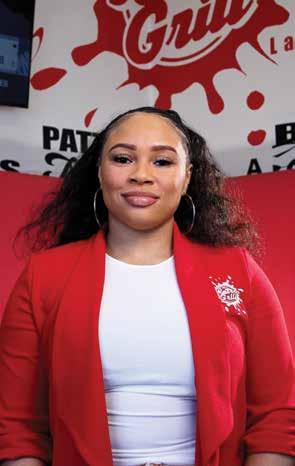
Teryn Payne The Retro Grill
‘She did what she said she’d do’
Illinois abolished cash bail and drove down the population of the Cook County jail. Under the county’s top prosecutor, it’s rising again.
BY DAVE BYRNES
On a Wednesday in mid-March, Janica Barnes sat in the gallery of room 102 at the Leighton Criminal Courthouse and waited for a judge to decide what would happen to her son, 22-year-old James Jones. He was accused of illegally possessing firearms while on parole for a prior firearm possession case, and a prosecutor with the Cook County State’s Attorney’s Office argued he should be imprisoned ahead of trial. Jones’s public defender argued he was not a dangerous person; in fact, she told Cook County judge Deidre Dyer that he was a young father trying to break into the trades. Dyer was unmoved. “You have not done well, from what I have heard,” she told Jones, commenting on his parole status amid this latest charge. She ordered him to pretrial detention following a hearing that lasted about 20 minutes, and though he had not yet been convicted, off he went to the Cook County jail.
Afterward, Barnes stood in the corridor outside and tried to express what it was like to see county sheriffs taking her son away. “They’re always rushed because they have so many people to get through,” she said of the court. Barnes had hoped that the court would have made an effort to get to know her son or consider the benefit of keeping him in the community, as his case was pending. “He’s a good father. He’s trying to work. He’s trying to get into school,” she said.
Barnes was not the only person that day—that week, that month, this year— to watch an unconvicted loved one led away by sheriffs to pretrial detention at the Cook County jail. Since taking office in December 2024, Cook County state’s attorney Eileen O’Neill Burke has pushed aggressively to increase the number of people held in pretrial detention in the name of public safety.
“We seek pretrial detention in the most serious violent offenses where the
offender poses a clear and present danger to the community,” Burke’s office told the Reader in a statement. “When defendants who exhibit dangerous and reckless behavior are held in pretrial custody, they are not released into the community where they pose the risk of committing additional crimes and threatening others.”
Her critics say Burke’s heightened pursuit of pretrial detention violates the spirit of the landmark Pretrial Fairness Act, which abolished cash bail in Illinois in September 2023 and sought to reduce the number of people incarcerated before trial.
Opponents argue the people facing the sharp end of her policies, such as Barnes and her son Jones, experience a community harm from pretrial detention for which the system rarely accounts—in lost time, lost wages, and lost loved ones. Jones’s case is among many that legal scholars and advocates believe reflect a larger pattern: Burke has directed prosecutors to seek pretrial detention so aggres-
sively, and in so many cases, that she is effectively re-creating through policy what the law aimed to curtail through reform. The impact is evident in numbers. As of April 16, the Cook County jail population—a share of which includes those detained while awaiting trial—stood at more than 5,700, over 240 people more than when the Pretrial Fairness Act took effect. The jail population had been trending down for a decade before the act’s implementation. While it began slowly rising during former Cook County state’s attorney Kim Foxx’s last year in office, the pace of the increase rose dramatically after Burke took over.
Researchers at Loyola University, in a study on the rising Cook County jail population released in October, attributed much of the increase in the jail population over 2024 and the first half of 2025 to a rise in jail admissions. They linked a significant portion of the new admissions to an increase in detention petitions filed by the
State’s Attorney’s Office and subsequently approved by county judges.
“Since [Burke]’s taken office, the number of petitions to detain that she has had her prosecutors file has jumped significantly. And that has led to an increase in the number of people who are held in the Cook County jail,” said Jessica Wang, a legal fellow with the progressive public interest law firm the MacArthur Justice Center. “She has been directly going against the spirit of the law.”
The Pretrial Fairness Act, enacted as part of the larger SAFE-T Act in January 2021, was the culmination of years of organizing by groups such as the Illinois Network for Pretrial Justice (INPJ) and Chicago Appleseed Center for Fair Courts. It made Illinois the first state to fully abolish money bail, replacing a wealth-based detention system with one that focuses on risk assessment, under which prosecutors must prove to judges
that pretrial detention is warranted.
Before the act took full effect on September 18, 2023, Illinois ran a cash bail system that advocates argued disproportionately impacted Black and Brown communities, operating as “wealth extraction” from people often already struggling with poverty. Illinois residents collectively spent on average $140 million each year on money bonds, and the majority of people paying money bonds were low-income Black women, according to a report from the Chicago Community Bond Fund.
Under the new system, prosecutors must petition judges to order defendants detained before trial, and judges must consider those petitions under a threeprong test. First, the judge must find that the state has shown the “proof is evident or the presumption great” that the defendant committed a detention-qualifying offense. Detainable charges include aggravated sexual assault, aggravated
domestic battery, and unlawful possession of a firearm by a person convicted of a felony. Second, the judge must find that the accused person would pose “a real and present threat” to the safety of the community or would be a flight risk if released. Third, the judge must conclude that “no condition or combination of conditions,” such as electronic
“If judges didn’t agree with [Burke], they would grant detention less often.”
monitoring, can mitigate that threat or risk. The law also requires judges to base their decisions on the “specific articulable facts” of each case, but it’s this insistence on specificity that critics argue Burke’s
policies have undermined.
Burke is a former prosecutor, assistant state’s attorney, and a retired Illinois appellate court justice. Her predecessor, Foxx, had served in the role since December 2016 and was Cook County’s first Black state’s attorney. Foxx announced in 2023 that she would not seek reelection. On Burke’s first day in office, she announced she would direct her office to seek pretrial detention for “the highest classes of violent offenses, all violent offenses that occur on public transit, any offense that involves the possession or use of an assault weapon, as well as numerous domestic violence/sex offenses and crimes against children.”
The State’s Attorney’s Office, in its official December 2 pretrial detention policy, further stated pretrial detention “shall be sought” in every case involving a detainable felony offense where an “offender” is charged with murder or another crime in the most severe felony classification, or
Cook County State's Attorney Eileen O'Neill Burke has sought to keep a greater number of people behind bars while awaiting trial than her predecessor. GABY FEBLAND FOR CHICAGO READER
NEWS & POLITICS
has another pending gun or violent crime case, or is currently on probation for a gun or violent crime case, or is on parole, or is alleged to have committed a violent crime while on pretrial electronic monitoring.
“Taking an across-the-board position like that subverts the goal of judges making individual determinations,” said Craig Futterman, a clinical professor of law and a director of the Civil Rights and Police Accountability Project at the University of Chicago’s Mandel Legal Aid Clinic. He focused particularly on the firearm policies, noting what he said were illegal firearm possession charges’ “powerful correlations to wealth and race.”
In the 16 months since Burke took office, prosecutors have requested pretrial detention in nearly 12,800 cases. That includes almost 2,700 cases involving alleged unlawful weapon use, and 835 felony cases involving automatic weapons. Of those for whom prosecutors have requested pretrial detention, more than 8,200—over 64 percent—have been Black. More than 2,800, another 22 percent, have been Latine.
County prosecutors, in the 16 months before Burke took office, requested detention in about 7,600 cases, including about 2,300 unlawful weapon-use cases and about 520 felony cases involving automatic weapons. The proportion of Black and Latine individuals among those for whom prosecutors requested pretrial detention was about the same under Foxx as under Burke.
About two-thirds of Black people and nearly 60 percent of Latine people in Illinois live in Cook County. And while Burke’s office has sought to crack down on crimes involving assault weapons here, in other Illinois counties, including whiter parts of the state, there is little of the same zeal. Multiple Illinois sheriffs in counties outside Cook have even refused to enforce the state’s ban on assault weapon possession.
Sharlyn Grace, deputy public defender for policy at the Law Office of the Cook County Public Defender and a leader in the movement to abolish cash bail, framed the issue not as Burke rejecting the Pretrial Fairness Act outright, “but a leaning into oversimplified ideas of what makes us safe, what creates safer communities, and when pretrial detention should be requested.” Grace worked with groups that advocated for the abolition of cash bail, including the Chicago Community Bond Fund, the Chicago Appleseed Center for Fair Courts, and the Coalition to End Money Bond. “The Pretrial Fairness Act’s structure depends in part on focusing court resources on the most serious cases, including an allegation of violence, or risk of violence, of harm to someone else,” she said.
In a separate study published in September 2024, Loyola University researchers found the length of pretrial detention hearings increased significantly after the Pretrial Fairness Act took
effect. Before the act, hearings in Illinois were “almost uniformly short,” with a median length in Cook County of about four minutes. In the Pretrial Fairness Act’s first year, the median length of a Cook County detention hearing jumped up to 16.5 minutes and sometimes lasted almost an hour.
Burke’s office said it supported the Pretrial Fairness Act, asserting its pretrial detention policies do not conflict with it. But seeking blanket pretrial detention for an array of offenses, Grace warned, evokes the previous era of detention hearings. “Treating every case the same is what we used to do under the money bond system, and that’s why we spent 30 seconds to two minutes per case for the vast majority of people,” Grace said.
Concerns about Burke’s blanket detention-seeking policies extend beyond Illinois. Heather Pinckney, director of the Public Defender Service for Washington, D.C., was among multiple public defender officials from across the country who attended Cook County pretrial detention hearings on April 9. Washington, D.C., also has a local law in place that limits the use of money bond, though the law stops short of completely abolishing it.
Pinckney said she admired the lawyers operating in the courtroom, particularly the “very succinct” arguments made by Cook County public defenders, but like Futterman, raised concerns about Burke’s commitment to pushing for pretrial detention in all instances of certain offenses. “It cannot just be the nature of the charge,” Pinckney said. She also expressed doubt that increasing pretrial detention necessarily led to safer communities. “The idea, right, is we have concerns about the safety of the community if this person is released,” Pinckney said. “Just trying to hold people for the sake of holding people doesn’t address that.”
No matter how many pretrial detention petitions prosecutors file, judges still have to approve them.
In the 16 months since Burke took office, county judges granted detention in about 73 percent of unlawful weapon use cases and 65 percent of felony cases involving automatic weapons, granting detention overall in about 67 percent of cases.
These figures mark an increase over Foxx’s last 16 months, during which judges granted detention in 66 and 68 percent of unlawful weapon use and felony automatic weapon cases, respectively, for an overall detention rate of 63 percent. Prior to Burke taking office, judges also granted detention in about 65 percent of the requested cases involving Black people and 61 percent of cases involving Latine people. Since Burke became state’s attorney, judges have granted detention for 68 percent of requested cases with Black people and 67 percent of cases with Latine people.
“If judges didn’t agree with [Burke], they would grant detention less often,”
said David Olson, a criminologist at Loyola University, codirector of Loyola University Chicago’s Center for Criminal Justice, and a coauthor of the October 2025 study on the rising Cook County jail population. “It’s not just her controlling who goes to jail.”
But critics have pointed to other policies Burke has enacted, and to courtroom tactics prosecutors have employed, that they say pressure judges to grant pretrial detention. Matthew McLoughlin, an organizer with the INPJ, described several “cookie-cutter” arguments he said prosecutors have deployed while pushing for pretrial detention, such as claiming the time of day a person was arrested suggested they were especially dangerous. “If police arrest somebody with a gun in their car in the day, the argument will be, ‘This is extremely dangerous because it’s during the day and people are out, going to school, going to their jobs,’” he said. “If they get pulled over at night and they have a gun in the car, now the argument has been flipped, ‘This is extremely dangerous because it’s nighttime and there’s not a lot of people around.’”
“I wish they would get to know the character of the person, or at least let the family members talk.”
The Reader witnessed McLoughlin’s claims firsthand while observing multiple cases, spread over pretrial detention hearings on March 17 and 18 and again on April 9, with prosecutors repeating similar arguments to judges in separate cases involving separate incidents. One repeat tactic, as McLoughlin noted, was to cite the time of day of an alleged incident to argue an accused person posed a danger to the community.
In one hearing on March 17, the Reader observed a 21-year-old Black man, allegedly found with an illegally modified firearm on a weekend afternoon, who was said to pose a danger to the community because it was daytime and people were out. In another March 17 case, a 37-year-old Latina woman allegedly involved in a drunk-driving crash at 7 AM on a Sunday was said to pose a threat to public safety because the incident occurred early in the morning. In yet another case on April 9, a county prosecutor argued a 20-year-old Latino man was dangerous because he told police he had a gun on him following a car search that occurred after 10 PM.
In the two cases observed on March 17, the judge released the defendants to electronic monitoring over the State’s Attorney’s Office’s objection. That objection is itself another pressure tactic, critics argued. Last April, Burke instructed her
prosecutors to object when judges opt to place accused individuals under electronic monitoring rather than pretrial detention. The news came about a week after the Cook County Chief Judge’s Office began taking over the county’s electronic monitoring program from the Cook County Sheriff’s Office, amid what then–chief judge Timothy Evans said were staffing concerns.
“On December 2, 2024, I issued a policy requiring that you seek detention in specific circumstances,” Burke wrote in her April 2025 memo to prosecutors, as reported by the TRiiBE. “I am now directing you to object on the record whenever you have sought detention, and the Judge has chosen to place the defendant on electronic monitoring/home confinement.”
Burke’s stated concern was public safety, specifically the alleged inability of staff in the chief judge’s office to act as law enforcement officers. “I believe this is a serious threat to public safety, and we must make that clear on the record, given that we have approved 57 escape charges since December 2, 2024,” the memo stated.
But the INPJ argued that objecting when judges release people to electronic monitoring is another way in which Burke’s office has pushed judges to grant more pretrial detention petitions. The Chicago Tribune editorial board ostensibly agreed, cheering in an April 9, 2025, column that said Burke’s decision “put judges on the spot to keep Cook County residents safe.” The INPJ, meanwhile, called the new policy “nothing more than fearmongering.”
McLoughlin also pointed to a Cook County Justice Advisory Council study, published with assistance from the Chicago Appleseed for Fair Courts in September 2022, which found that only about 17 percent of those on electronic monitoring were rearrested while released, including for misdemeanors and missed court dates. Fewer than 1 percent of those on pretrial release, both on and off electronic monitoring, were rearrested for violent crimes.
The Reader reported in February 2025 on how researchers in a November 2021 study found that up to 96 percent of alerts for people stepping outside their approved electronic monitoring zones “are resolved as non-violations.” Cook County chief judge Charles Beach II announced heightened scrutiny for people on electronic monitoring late this past January.
A separate Chicago Appleseed for Fair Courts study published in August 2025 argued that electronic monitoring “has evolved into a punitive system that disproportionately harms Black and Brown communities, reinforces carceral control, and perpetuates socioeconomic and racial inequities.” The organization called on Burke’s office to request pretrial electronic monitoring “only in cases where it will truly benefit public safety.”
“If we expect any criminal justice reform to be 99.9 percent effective, we’re never going to get out of this cycle of incarceration that is ultimately exacerbating the harms in our communities,” McLoughlin said.
The population of the Cook County jail began rising shortly after Burke took office, with a sharp increase in early 2025. After the Pretrial Fairness Act took effect on September 18, 2023, the jail population dropped quickly from a little under 5,500 people to about 4,650 on New Year’s Day 2024. That winter marked a low ebb for the jail population, the continuation of a yearslong decline from a peak of more than 11,400 jailed people in September 2013, according to April 2025 data the Tribune obtained from the Cook County Sheriff’s Office. The only time in the prior decade the jail population dipped lower was in the spring of 2020 amid the COVID-19 pandemic.
Data analyzed by Cook County agencies in collaboration with Loyola University shows that, by the end of 2025, the average daily population in the Cook County jail had jumped to more than 5,840 people—an increase of more than seven hundred people compared to the end of the prior year and more than one thousand additional people on average since the start of 2024.
The same dataset shows that, in the first quarter of 2025, which included Burke’s first months in office, the average daily jail population was almost four hundred people higher than in the last quarter of 2024.
In raw numbers, the jail population peaked at more than 6,100 people in September and again at more than six thousand in January. As of April 16, the Loyola researchers found the average daily jail population was up 5.5 percent since the implementation of the Pretrial Fairness Act.
Olson noted that the county jail population rose during Kim Foxx’s last months in office. But he told the Reader he believed the slow rise in the jail population under Foxx was due in part to some people likely spending longer in jail than before the passage of the Pretrial Fairness Act, which abolished one’s ability to pay their way out. As a likely result, he said, “the jail population started to creep back up due to the longer lengths of stay.”
The October 2025 Loyola study found that “almost all” the increase in the Cook County jail population from the start of 2024 through mid-2025 had been due to increased jail admissions and that roughly 41 percent of those increased admissions were attributable to the Cook County State’s Attorney’s Office filing more pretrial detention petitions and judges increasingly granting them.
“The state’s attorney’s new policies are indeed resulting in an increased number of people who are presumed innocent but held in jail,” Futterman said.
According to Olson, prosecutors under Foxx sought detention in about 30 percent of eligible cases from January through October 2024, rising to 35 percent in her final month in office. Olson said there “appeared to be a slight increase in detention being sought by Foxx toward the end of her term.” When Burke took over in December 2024, that figure jumped to 49 percent, an unmistakable shift. Over the first quarter of 2025, prosecutors under Burke sought detention in 46 percent of cases overall.
Burke’s office also launched a pilot program with the Chicago Police Department in January 2025 that allows Chicago police to directly file certain nonviolent
lations fell in other Illinois counties between September 2023 and July 2025. They fell by 17 percent in rural Illinois counties and 11 percent in urban counties outside of Cook.
“In Cook County, when the new state’s attorney was elected, there clearly was a shift in pursuit of pretrial detention, and she said that on the campaign trail,” Olson said of Burke. “So she did what she said she’d do.”
Even as the jail population rose in 2024 and 2025, overall violent crime rates in Chicago were falling. The city ended 2025 with fewer violent crime incidents than in any year in the prior
felony gun-possession charges without waiting for prosecutorial review. It began in the Englewood neighborhood, expanded to the Calumet neighborhood last April, and went citywide last November. Chicago police directly filed 161 cases in 2025 under the program, according to data acquired by the Reader from a public records request to the Cook County State’s Attorney’s Office. Prosecutors sought pretrial detention for more than half the defendants in those cases, and county judges granted the petitions in 38 of them.
Olson and other Loyola researchers found in a separate study, also released in October 2025, that pretrial jail popu -
NEWS & POLITICS
overall has continued to fall through 2026. However, despite Burke’s stance on pretrial detention for gun crimes, there were more homicides and shooting victimizations as of mid-April 2026 than over the same period in 2025.
“Even the detention of far less people did not result in a correlating increase in violence or crime,” Futterman said.
Besides the crime rate, Sharlyn Grace and Jessica Wang both stressed that jailing someone in Cook County ahead of trial carries knock-on effects for both the accused individuals and the communities they’re a part of. The compounding impact includes individuals missing work, children losing a parent, and families facing a loss of income.
“It can jeopardize their access to housing, their access to employment, their custody of their children, access to government benefits, just a whole host of collateral consequences that come when someone is jailed pretrial,” Wang said.
Being placed in the Cook County jail carries risk in and of itself. The jail has a documented history of abuse, and 55 people died in custody between 2020 and 2023 alone.
“When we’re talking about the pursuit of pretrial detention, almost everyone who is criminally charged in Cook County will come back to Cook County in the future,” Grace said. “And most people will come back relatively quickly. Very few people are going away to never come back. So then the question is, are they coming back in a position where they’re better able to succeed? Or are they coming back in a position where they have more disadvantages, more handicaps, more trauma, less time working, less access to mental health care?”
decade. The city recorded 420 homicides, 168 fewer than were recorded in 2024. The Cook County State’s Attorney’s Office said it believed the drop in crime was partially due to its policies. “We believe our pretrial detention policy played a role by ensuring that individuals who posed a threat to the community were detained, rather than released to reoffend,” the office said in a statement to the Reader
But Futterman pointed out, and city data shows, that overall violent crime rates, including homicides and all shooting victimizations, were already falling between 2023 and 2024, before Burke took office and instituted the new pretrial detention policies. Violent crime
Barnes, whose son remained in custody as of press time, gave her own frustration with the pretrial detention process. Whatever benefits to public safety the State’s Attorney’s Office claimed came from detaining Jones before he was convicted of the charge against him didn’t change the fact that her son was now gone. As sheriffs led him away, she had been expected to watch on in courtly, respectful silence. “I wish they would get to know the character of the person, or at least let the family members talk,” Barnes said. “Instead, we’ve got to just sit there and take it.”
In another courtroom in the Leighton courthouse that same morning in March, a different judge sent a 28-year-old woman to pretrial detention over charges that she had fought and injured someone. As sheriffs led her away, another young woman stood at the glass doors separating the gallery from the court officials and cracked them just an inch. “Call me,” the second woman called after her loved one. “I love you.” She declined to speak with the Reader. She said she had to tell her mother what had just happened. v
themail@chicagoreader.com
Cook County judges approved a greater number of detention petitions under Burke than under Foxx. GABY FEBLAND FOR CHICAGO READER
NEWS & POLITICS
Doing the bare minimum
An effort to phase out the subminimum wage in Chicago was a done deal—until it wasn’t.
BY DEVYN-MARSHALL BROWN (DMB)
After the chicken caesar wrap at the bar Little Victories went “super mega viral” on TikTok last year, bartender Eddy Gordillo says he’s making the most he’s ever made in his 15 years as a tipped worker across 60 bars and restaurants. The spike in customers has brought his hourly wage with tips up to $40.
As one of the bar’s few full-time employees, Gordillo knows he’s lucky; he negotiated a base wage of $17 an hour plus tips. But many of his coworkers— like most service workers in Chicago— are paid a so-called subminimum wage. This lower hourly rate supposes tips from customers will supplement workers’ base wages. Chicago’s current subminimum hourly wage for tipped workers is $12.62, compared to the $16.60 hourly minimum for most other employees.
Gordillo says he knows coworkers
who have to work second and sometimes third jobs to make ends meet. Above all, he says the tipped wage just isn’t consistent, and he doesn’t know how long his $40-per-hour checks will last. “The inconsistency doesn’t let me really plan ahead that far,” he says. “I’ve had to suffer a little bit with the lower minimum wage.”
“You’re not entitled to run a business based off of exploitation.”
In 2023, tipped workers and advocates successfully fought to eliminate the subminimum wage in Chicago, part of a compromise between the proworker One Fair Wage campaign and the proindustry Illinois Restaurant Association.
That debate reentered the zeitgeist this winter as restaurant owners, represented by the IRA, sought to undo the compromise just two and a half years into the fiveyear phase-out of the subminimum wage. They argue that new tariffs, economic instability caused by the U.S. and Israel’s war on Iran, and significant inflation that followed the onset of the COVID-19 crisis make the city’s demand to increase workers’ pay untenable.
It came to a head as the restaurant association tried and failed to overturn a scheduled increase to the subminimum hourly wage, which will eventually rise to meet the Chicago minimum wage. Despite winning the support of 30 alderpeople, opponents of the One Fair Wage ordinance failed to win over enough of the City Council to overturn a decisive veto issued by Mayor Brandon Johnson. An end run to the statehouse that sought
to preempt Chicago’s ability to eliminate the minimum wage appears equally dead.
Sam Toia, president and CEO of the IRA, told the Reader in a statement that eliminating the tip credit does not result in a guaranteed raise for workers. “In fact, it often leads to reduced hours and takehome pay, job loss, and increased costs for consumers,” he says. “At a time when restaurants are already navigating rising costs and economic pressure, eliminating the tip credit will only increase the strain and make it more difficult to sustain jobs and keep doors open.”
Critics of the unequal wage system, including labor experts who spoke with the Reader, say such reasoning is rooted in antiworker mythology. Worker wages are the easiest to target but are not to blame for rising costs. Robert Bruno, director of the labor education department at the University of Illinois Urbana-Champaign’s School
The City of Chicago voted in 2023 to begin phasing out the subminimum wage over a five-year period. NGUYEN TRAN FOR CHICAGO READER
NEWS & POLITICS
of Labor and Employment Relations, says tariffs, the rate of inflation, the cost of materials, and the cost of transportation are much greater burdens on restaurants than the cost of labor.
“Let’s be clear: We’re talking [about] a wage that isn’t a Cadillac wage, right? It’s not at the level that most economists would consider livable in terms of being able to pay for rent or to buy a home,” Bruno says. “If you’re saying there are employers who, in order for them to profit, have to pay less than a livable wage, then it really raises the question whether or not they should be in business.” He suggests the state could subsidize workers’ wages or expand public job training options instead.
Being a tipped worker in certain contexts can be incredibly lucrative. At Michelin-starred restaurants in the Gold Coast, big spenders leave big tips. But these servers don’t represent the vast majority of the 80,000 tipped workers in Chicago, many of whom struggle to make ends meet.
If an employee doesn’t make enough tips to bring their hourly wage to the minimum, their employer is supposed to supplement their pay. Technically, either way, every employee must receive minimum wage. But many workers argue that bars and restaurants routinely flout the law and that merely earning minimum wage doesn’t leave them with enough to survive.
Not all restaurant owners oppose scrapping the tipped wage. Eyad Zeid, who opened Uptown’s Nabala Cafe two years ago, says he understands the challenges faced by small businesses. Last year, he made the controversial decision to cut his tipped workers’ hourly wages from $20 to $13 an hour to keep his business afloat. Yet the beloved Palestinian cafe and third space announced in an April 11 Instagram post that it was nonetheless in full support of the scheduled minimum wage increase. “Any effort to raise the floor for working class people is a worthwhile effort, and we are on board,” the post reads.
“Shame on the Illinois Restaurant Association for taking advantage of concerned small business owners,” Zeid tells the Reader. He says rising costs for business owners are an issue, but they’re not ones to be solved by cutting workers’ pay. “It’s just an irresponsible way to have this conversation, because the fears are legitimate, the anxieties are valid, but the way that we address them is really important.”
Zeid sees the root causes of the industry’s financial precarity as monopolistic businesses from companies such as Sysco, the country’s largest food service distributor, which supplies the majority of bulk food for restaurants and uses its influence to inflate prices. Sysco solidified its choke hold on independent food businesses earlier this year when it bought out Jetro Restaurant Depot, a national wholesale warehouse-style supplier of low-cost food. Zeid says restaurant owners should build toward a self-sustaining ecosystem where they grow their own food or buy
directly from local growers. Tax breaks and grants should go to small businesses, not megacorporations. And lawmakers should instead address the rising prices of rent, property taxes, insurance, utilities, and more for eating away at businesses’ bottom lines. “At some point we just have to acknowledge how predatory so much of what around us is and just disengage with it, however that looks.”
Chicago was about halfway through phasing out the subminimum wage when the restaurant lobby urged local legislators to hit pause. On March 18, the City Council voted 30–18 to freeze the subminimum wage at $12.62. Mayor Johnson quickly vetoed the measure, and alderpeople failed to secure the 34 votes needed to override his decision during a meeting on April 15.
Striking out at the city level, the Illinois Restaurant Association took its fight to the statehouse. Democratic state representative Curtis Tarver introduced House Bill 4263, which would prevent local governments from creating laws that regulate the tipped wage. The proposed state legislation would nullify Johnson’s veto and make the entire scheme illegal. After first voting to advance the bill out of committee, the Illinois House declined to take it up on the floor and, in mid-April, sent the bill back to the Rules Committee, ostensibly killing it for now.
In 2023, as the City Council considered the One Fair Wage ordinance, the Illinois Restaurant Association launched an advertising campaign called “Protect Chicago’s Tips” that claimed eliminating the subminimum wage would cause customers to tip less and, therefore, workers to earn less. But research from the national One Fair Wage campaign, which is supporting similar efforts nationwide, shows tipping has stayed the same or increased in the seven states where a subminimum wage was abolished. “Zero of them have a restaurant industry that has collapsed,” says Richard Rodriguez, the One Fair Wage campaign’s national policy director. “None of the servers in any of those states are going to suggest that they should make a lower base wage because their tips haven’t gone away.”
Rodriguez points out the last decade of restaurant industry business license renewals from Chicago’s Department of Business Affairs and Consumer Protection agency tell a different story. In 2025, city data shows about 83 percent of food businesses renewed their licenses, compared with roughly 82 percent in 2023 and 81 percent in 2022. “How low do wages need to be for it to be a sustainable number for you?” Rodriguez asks. “Would [Toia] suggest that, if we go back to the federal minimum wage of $2.45, restaurants are going to be able to survive and be better?”
The reality is that opening a restaurant is a risky venture. Bruno says it’s an industry that inherently goes through transition and turnover. “People grow weary of certain kinds of restaurants,
and they’re looking for something new, and then it’s a fad for a while,” he says. “Depending on the state of the economy and people’s household income, there’s a greater [or lesser] capacity to go out for dinner.”
Other small businesses, such as bookstores, clothing stores, and thrift stores, face similar obstacles and have managed to pay their workers the standard minimum wage. Even small restaurants, such as Lula Cafe in Logan Square, have voluntarily dropped the subminimum wage. “You would not expect a parent to tip a kindergarten teacher,” Bruno says. “You wouldn’t expect [to tip] a firefighter. When my UPS driver comes, and he drops off my package, he’s not expecting me to tip him.”
“At some point, there’s going to be nothing left to squeeze out of workers.”
One of the main critiques from tipped workers is that the subminimum wage is unstable over time. The amount they make during peak season in the summertime varies greatly from their pay in the dead of winter. “I can look back at my budgets over the past several years and see that what I was making was, like, halved if you look at February versus early August,” says Molly Pachay, a tipped worker of more than a decade and the director of strategic partnerships at the Chicago Hospitality Accountability and Advocacy Database (CHAAD) project. CHAAD began as a spreadsheet to help restaurant workers track labor abuses, discrimination, and wage theft; now it’s blossomed into an organization that advocates for and organizes with local hourly restaurant employees. “At some point, there’s going to be nothing left to squeeze out of workers,” Pachay says.
Raeghn Draper, CHAAD’s executive director, tells the Reader that inequities within the tipping system are baked in because of people’s biases. Draper is a Black woman who sometimes wears braids or an afro, and they say customers have complained that her appearance is untidy. Draper has worked the same shifts alongside people of different races and genders, and they’ve seen stark differences in how much each person is tipped. “I’ve worked in the same restaurant, working the same hours as other servers, and they’re making six figures . . . but I’m not. Those can be really frustrating to experience in isolation, because you’re often not given support from management. It’s a part of the job.”
Whether intentional or not, the tipped wage system inherently contributes to structural sexism and racism, Bruno says. This is especially important to consider in
a field where women make up two-thirds of all workers. Immigrant, Latine American, Asian American, and Black and Brown women, many of whom are single mothers and rely on the flexibility offered by the service industry, are overrepresented in the tipped workforce. At the same time, they face high turnover because of low wages and unpredictable hours.
Tipped workers are also susceptible to violence while doing their jobs. A 2024 report from the Economic Policy Institute found that sexual harassment was more likely to occur in states that pay a subminium wage. “The more dependent workers are on customers to pay their wages, the more they are forced to tolerate abusive behavior from customers,” writes economic analyst Nina Mast in the report. The report found almost three-quarters of women restaurant workers have experienced sexual harassment, more than any other industry, and women workers reliant on tips were harassed 20 percent more than nontipped women workers. Much of the conversation around tipped workers also focuses on servers and bartenders, who are often the highest hourly earners in the restaurant industry. But tipped workers also include bussers, barbacks, valet drivers, and workers in nail salons, car washes, and airports whose labor may not be perceived as worthy of tips.
Tipping became a standard practice in some industries after the civil war, when large numbers of African American men and women began to enter the workforce. Bruno says tips were seen as a way to justify not paying African Americans the same wages paid to white workers. Shifting the burden of compensation from employers to customers and tying the wages of African Americans to their subservience entrenched systemic racism. Such a system kept people of color “in a dependent relationship on having to please and satisfy what would largely be white, middle-class recipients of their labor,” Bruno says. “Policy accommodated this practice, and it still does.”
Draper says, instead of cutting workers’ wages, Chicago officials should explore solutions that don’t ask the most vulnerable to take the hit. Service workers are more vulnerable than those in other industries, such as education or nursing, because they don’t have a large union or lobby group looking out for them.
“I think reaching into the pockets of workers is easy,” Draper says. “It’s a lot easier to undermine workers when they’re not organized or have the power to make their voices heard like other industry groups might have.” They concede that eliminating the subminimum wage may force some businesses to close. “I think those places shouldn’t have been open in the first place,” Draper says. “You’re not entitled to run a business based off of exploitation.” v
dmbrown@chicagoreader.com
READER BITES
Fresh churros at a Li le Village stoplight
BY MIKE SULA
If you’re the sort of lead foot who believes a yellow signal just means there’s room for one more, you’re prioritizing risk over reward at this traffic light. Blow the red, and on the odd chance you cross paths with a CPD patrol car, there’s an only slightly odder chance you’ll get a ticket.
But pump the brakes, and take a beat. There’s a hustler on the corner beckoning you with a golden, deep-fried bouquet in a paper bag. Wave him over and swap cheddar for churros through your window, and your car will be engulfed in the warm, cinnamon-lined cloud of freshly fried
dough scent. You’ll move along in this narcotic haze, driving only more distractedly after your inevitable first bite: sugary crystals still caramelizing over the hot, star-shaped tube, ridged for your pleasure;
a crunch yielding over a tender, cakey, almost creamy interior. Even a green light means stop at this intersection. Pull over along a seemingly superfluous Richard M. Daley–style orna-
& DRINK
mental fence protecting a desolate vacant lot. Superfluous and desolate, that is, but for the food truck parked flush against the black posts, a darkened window within arm’s reach over the top. Inside is where the magic is extruded, fried, and piped, if you like, with a choice of strawberry, vanilla, Nutella, cajeta, or lechera fillings. Fresh “artesanales” fritters of this order have a short life span. Let’s say it’s no longer than it takes to find the nearest park bench. Drive-by service notwithstanding, eat these as fast as possible, al trunko, for best results. You owe it to yourself, as well as to the safety of your fellow motorists, cyclists, and pedestrians. Little Village churro truck, southwest corner of 31st and Central Park Avenue, $1–2.50 v
Reader Bites celebrates dishes, drinks, and atmospheres from the Chicagoland food scene.
msula@chicagoreader.com
CORI NAKAMURA LIN | ONIBABA STUDIO FOR CHICAGO READER
Help the United Negro College Fund make higher
education
possible for Illinois students by purchasing a 7X Bingo Multiplier ticket
Courtesy UNCF
For more than 80 years, the United Negro College Fund (UNCF) has been providing educational scholarships and opportunities to students in Illinois. In 2024, the Illinois Lottery launched a joint specialty ticket that contributes directly to ten different admirable causes, including UNCF. With its vibrant design and rich purple background, the 7X Bingo Multiplier ticket makes a great present for friends, family members, neighbors, and colleagues 18 and over—or play it yourself for a chance to win up to $200,000. The ticket costs $5 and is available for purchase at more than seven thousand Illinois Lottery retailers. A portion of every ticket purchased helps an Illinois student pursue their dream of a college education. Visit the Illinois Lottery website for more information about 7X Bingo Multiplier and the many good causes it supports each year. Read on to learn more about the United Negro College Fund and Derrick Brooks, a Chicago native and UNCF scholarship recipient who’s making strides in Jackson, Mississippi, at Tougaloo College. Supporting the Illinois Lottery’s joint specialty ticket helps make stories like Derrick’s possible.
A few years ago Illinois Senate Bill 1508 became law, making the United Nego College Fund (UNCF) one of ten worthy causes to become a part of the Illinois Lottery’s joint specialty $5 ticket that’s sold at local retailers across the state. Founded in 1944 by former Tuskegee Institute president Frederick D. Patterson alongside civil rights activists Mary McLeod Bethune and William J. Trent, UNCF’s mission has always been to make college and higher education more accessible for minority students. Today, more than ten thousand scholarships are distributed nationwide by UNCF annually by over four hundred different programs.
Lisa Rollins, UNCF’s Chicago regional development director, shares that “African American UNCF scholarship recipients have about a 70 percent six-year graduation rate, which is more than one and a half times the 42 percent graduation rate for African American students nationwide, and higher than the 62 percent graduation rate for all students.” This is evidence that students receiving these UNCF scholarships have very high success rates. UNCF has also found that 52 percent of students who attend
This content is sponsored by the Illinois Lottery
52% of HBCU students are the first in their families to go to college
Courtesy UNCF
a historically black college or university (HBCU) are the first in their families to go to college. Scholarship funds like those donated by the Illinois Lottery are crucial for many students in the state.
Rollins says that so far the collaboration between the Illinois Lottery and UNCF has exceeded expectations, having raised about $2.6 million since 2023. “I just want to thank everybody for continuing to support this ticket,” she says. “The Lottery esti-
mated but couldn’t guarantee that we would probably receive $1 million dollars per year from this, and that’s what it has been doing.”
The Illinois Lottery–sponsored scholarships will have a great positive impact for the students who receive them. Based on UNCF research, Rollins adds that in order for a scholarship to truly help a college student, “the magic number that the scholarship amount has to be is $5,000.” UNCF is nearly doubling that, as “the average scholarship amount for a student coming out of the Chicagoland area is about $8,900.”
The application to apply for the Illinois Lottery-sponsored scholarship will become available this summer, and awards are expected to be distributed in the fall. The $10,000 undergraduate scholarship will require that you have graduated from high school in the state of Illinois and maintained at least a 2.5 grade point average. “These scholarships will not be limited to just incoming freshmen,” Rollins adds. “They’ll be available for students who are currently in school and people who are going to school for
a college education, but he also knew he needed an affordable option. He says that he learned about UNCF during his sophomore year of high school, and saw their scholarships as a doorway to attending a historically black college or university. The mass communications major says that receiving a UNCF scholarship helped him pay for school, which in turn helped keep him motivated to make his family proud and continue pushing toward his goal of working in journalism and media.
Tougaloo is one of UNCF’s 37 member colleges, which are all exclusively HBCUs, although attending an HBCU is not a requirement for receiving UNCF scholarships. Rollins says that she has noticed a shift in recent years, as the top ten most popular schools for Illinois UNCF students to attend have become exclusively HBCUs.
As an inner-city kid, Brooks wanted to go to college outside of Chicago to try something new. He says that having the opportunity to go to school in Jackson, Mississippi, has “shown me that there is much more in the world than what you see where you are from. . . . I couldn’t ask for a better experience.”
During 2024-2025, UNCF awarded 394 scholarships to 296 students, which included 228 scholarships to 168 students based in Chicago. Brooks’s advice to students who may be wondering how they can make college happen for themself is “don’t be afraid to ask for help. [UNCF is] always there to help you.”
Rollins says UNCF does the work that they do to see students propel themselves and their families into middle and upper-middle-class circumstances. “It’s such a disproportionate need for [HBCU] students,” she says. “Seventy-three percent of all UNCF HBCU undergraduate students come from families who meet the Pell grant guidelines compared to 36 percent of the non-HBCU [undergraduate students].” She says UNCF also supports HBCUs so fervently because they want to see these institutions strengthen their resources and infrastructure. Having such high graduation rates for UNCF students and being able to help students like Derrick excel academically “makes all of us feel good about the work that we’re doing,” Rollins says.
You should feel good, too, knowing that the 7X Bingo Multiplier that you purchase is helping to make this work possible.
the first time.” For students pursuing postsecondary education and graduate degrees, a $20,000 scholarship will be available.
Chicago native and Tougaloo College sophomore Derrick Brooks always knew he wanted to pursue
This content is sponsored by the Illinois Lottery
Data prepared by Dwayne Harris, Senior Data Analyst | FDPRI
Data prepared by Dwayne Harris, Senior Data Analyst | FDPRI
ARTS & CULTURE
A city made of brick
Will Quam’s new book shows that the story of brick and the story of Chicago are forever intertwined.
BY SHAWN MULCAHY
When I moved to Chicago in 2019, my dad wanted to make sure I was prepared for life in the big city. Whereas he had come of age in public housing in postwar New York City, I spent the first 22 years of my life in the suburban hellscape of Clearwater, Florida. He peppered me with advice for weeks before I left. “Carry your wallet in your front pocket.” “Always be aware of your surroundings.” “Don’t stare up at tall buildings—you’ll look like a tourist.” OK, Dad.
It didn’t take long for me to break his last rule. I remember standing at the entrance to my first apartment in the city, transfixed by 22 stories of impressive red brick. At each floor, the red was interrupted by bands of creamy white terra-cotta, intricately detailed with fleurs-de-lis, dragons, jesters, and geometric tiles. Thin spindles of yet more terra-cotta climbed up the facade, as if daring my eyes to follow.
Then came COVID a few months later, and the world shut down. Suddenly, with abundant free time in a place I hardly knew, I took to long walks that crisscrossed Chicago, breaking my dad’s rule often along the way. I gawked at the commanding, stately brick mansions that lined Gold Coast’s historic Astor Street. I weaved through tree-lined Hyde Park and Logan Square streets, where I quickly fell in love with the quintessential brick two- and three-flats. And I paused along deserted downtown streets to admire the opulence of the Carbide and Carbon Building’s black granite and greenand-gold terra-cotta or the quiet resilience of the Monadnock Building’s thick, unadorned brown brick walls.
use today as an almost entirely decorative element. Along the way, Quam transports readers from building to building—some famous but most remarkably ordinary— to illustrate the constant push and pull of form and function that gives Chicago its distinctive feel.
“Chicago really is the perfect place to see what brick is and what it has been and can be,” Quam tells me. You don’t have to look hard to see it. Brick is everywhere. The clay blocks literally and figuratively built
Yet local brickmakers churned out many millions of them, and bricklayers stacked them into the scaffolding that still holds up much of our city today.
None of it would be possible if not for the dedicated and creative people who, over the decades, perfected bricklaying as an art form as much as a construction technique. As Quam describes, workers first banded together around the turn of the 20th century to fight for better wages and job protections. The Chicago
any less talented than their forebears. In many ways, I think the Chicago common is a fitting metaphor for what I’ve come to deeply admire about this city, or at least the parts that remain. Our bricks weren’t manicured. They were raw, pragmatic—the skeleton and guts upon which an architect hung a face. They’re remnants of a city, however cloaked in nostalgia, that’s slowly being replaced by boxy condos and luxury high-rises, Hattie B’s Hot Chicken joints and Whole Foods supermarkets.
Yet, all around us, the legacy of Chicago commons lingers, if you know where to look. Lane Tech and Horner Park were once clay pits. The Brickyard mall was once (you guessed it) a brickyard. Even now, Chicago commons have found new life in a thriving secondhand market of discerning buyers (including, apparently, the late Jimmy Buffett—a childhood favorite of this Florida man). Though tastes and trends continue to change, brick remains a central design feature in new buildings cropping up across the city.
Quam writes in the book’s final paragraphs that his work on the project over the past decade destroyed “any cynical idea I had that ‘they don’t make ’em like they used to.’” He concludes instead that “they make ’em different than they used to. Worse, sometimes, but not always.” I found myself on a similar journey. For a long time, I thought new construction builds were cheap knockoffs or just ugly brick boxes. I still think some of them are. But in Fire and Clay, Quam situates architectural trends within their larger historical context. As he explains, the grandiosity of the extravagant terra-cotta-clad buildings of the 1920s and the utilitarianism of the dull grey skyscrapers of the 50s and 60s were not incidental decisions but rather direct responses to the time periods in which they were conceived and built.
Around that time, I stumbled upon @brickofchicago, an Instagram account run by community historian Will Quam. I thought I knew brick: red, made of clay, pretty to look at. Quam’s page opened my eyes to a new world of possibilities. I lapped up his beautiful photos of bricks in different colors, shapes, and combinations, each accompanied by some fact about the building or architect or material. Even then, I didn’t think much about why the city had so many bricks. For that, I have to thank Quam’s debut book, Fire and Clay: How Bricks Reveal the Hidden History of Chicago (University of Chicago Press).
Fire and Clay is part history, part architectural study, part bricklaying for dummies. It begins with brick’s early years as a mostly utilitarian material that turned a booming frontier town into a permanent city, and it concludes with brick’s
Chicago, beginning when the city put itself back together after the Great Fire in 1871.
At the center of it all is the humble Chicago common brick. To understand why it matters, it’s important to understand the difference between face and common bricks. Face bricks, as the name implies, are used on a building’s exterior, usually only on the side facing the street. They’re carefully constructed into neat rectangles in a seemingly infinite combination of colors, textures, and finishes. They’re also expensive, which is why architects historically turned to common bricks for the actual task of holding up a building. Commons exchange looks for price and practicality, and Chicago commons were regarded among the ugliest of them all.
bricklayers union eventually became a formidable labor force and a center of innovation. A bad bricklayer might take 18 moves to lay a single brick, but a good one could do it in four. Bricklayers had to be mathematicians, too. They turned twodimensional plans into three-dimensional objects and were often required to make adjustments on the fly.
For generations, the trade offered opportunity to a largely immigrant workforce—a point that feels worth mentioning under a regime seeking to erase the historical contributions of immigrants. Bricklayers nowadays look different from their predecessors; they’re older, for starters, and are generally people looking to change careers. Quam stresses that doesn’t mean they’re
The story of brick and the story of Chicago are forever intertwined. At its most basic, brick is ubiquitous in workers’ cottages and towering skyscrapers scattered across every block of the city. But the building block influences our city in more subtle ways, too. It promised prosperity for the early developers who saw the city rise from the ashes and offered opportunity to a largely immigrant workforce. Each building is a time capsule, a reference point for what came before and what would come after. “Researching these buildings and looking into the intent of the design, and especially the way that the design is reacting to what came before, there is so much intention there,” Quam tells me. “Every design, every building is trying to be different from its own recent past.” v
[A longer version of this story appears on our website.]
smulcahy@chicagoreader.com
Will Quam ELLA PENNINGTON
AMADEUS
COVENANT
Expect one devilish twist after another in Covenant , a mythic and suspenseful new play hailed as “blackout-and-bloodcurdling-scream deliciousness” ( New York Magazine ), “undeniably spooky (and) absolutely enjoyable” ( TheaterMania ). This “striking Southern gothic work” ( New York Times ) explores the power of belief and the thin line between rumor and truth. MAY 2 – MAY 31
BY YORK WALKER
DIRECTED BY MALKIA STAMPLEY
Written
Tool or threat?
Theatermakers and advocates are reckoning with AI’s place in a handmade and ephemeral art form.
BY KERRY REID
Artificial intelligence as a narrative subject is popping up a lot onstage right now. In Ryan Stevens’s Static-Head which recently received a local premiere with the Impostors—an AI-enabled social media app at a tech college begins consuming the students’ minds and lives. Earlier this year, Shattered Globe Theatre produced Kirsten Greenidge’s Morning, Noon, and Night , in which an AI-created avatar comes to life. Jordan Harrison’s The Antiquities (presented last spring in its local premiere at the Goodman) envisioned a posthuman world where our virtual creations have taken over the planet. It’s nothing new: Theater has been interrogating the role of technology ever since Karel Čapek popularized the word “robot” in 1921’s R.U.R
But while dramatists like it as a plot element, there’s a lot of fear around what generative AI in particular is doing to humans, whether it’s the environmental impact or the loss of jobs. The fear is, of course, well-grounded: According to a recent study by Brookings, “A typical data center uses 300,000 gallons of water each day (equivalent to the demands of about 1,000 households), but large data centers can use an estimated 5 million gallons of water each day, equivalent to the needs of a town of up to 50,000 residents.”
Recently, I’ve noticed writers putting directives about the use of AI in their scripts. For Static-Head, Stevens wrote, “Absolutely zero AI generated images, music, audio, design elements or promotional material is allowed to be used in any production of this show. Doing so is entirely against the spirit of the script, and even using generative AI ‘ironically’ is not just morally bankrupt but environmentally disastrous and irresponsible.” In Dante Flores’s script for Odessa, recently produced by Subtext Studio Theatre Company, he wrote, “No part of this script may be used to train generative AI software; nor may the same software be used in any part of its production.”
I checked in recently with several artists, activists, and advocates for theatermakers to see how the push for AI is affecting their work, on- and offstage. The picture is far from clear, with many of the people I spoke to believing that stopping AI entirely is unlikely. But it’s obvious that in addition to environmental concerns, there is a critical need for guardrails and organizing around protecting creative work and the people who make it.
THE WORKER ADVOCATES
Ralph Sevush is the longtime executive director of business aff airs and general counsel for the Dramatists Guild (DG), the nation’s only trade association for theater writers. (Full disclosure: I am a member.) Though not a union, DG is dedicated to helping playwrights protect their intellectual property. That’s become harder with the explosion of AI and large language models.
Sevush notes a dissonance in how producers talk about AI. Several theaters, he says, are requiring playwrights to attest in their submissions that “They have not used AI in any way to write their scripts. Now, what does that even mean? Can you use Grammarly? Can you use spell-check? Can you use AI to do historical research for you? Can you use AI to come up with character names that are authentic to a particular time or place? If not, why not?”
However, he adds, “The theaters are also taking the position that they can feed our members’ plays into AI to generate summaries of the plays and promotional material for the plays.”
“Most of our members don’t want [large language models] trained on their plays without their permission,” Sevush says. “We view it as a copyright infringement. It is yet to be determined by case law.”
Currently, DG has a task force on AI. “There are legal issues here. There are ethical issues here. There are creative issues here. It’s a very thorny nut,” Sevush says. “And the worst part is that when it’s used, when you take a writer’s work to create work that then competes with the writer’s own career, you’re in an Orwellian nightmare.”
Matt Walters is the central region business representative for United Scenic Artists, a union that covers designers and artists in theater, opera, and ballet, as well as in television, commercials, and industrial shows. I asked him how the union is handling the influx of AI, and if members are under increasing pressure to cut corners and save money by using it in their designs.
“The main position that the union has is that AI is a tool that can be used in design, but very cautiously and with a lot of guardrails,” says Walters. “We’re in a great position in being protected from the standpoint that a human being must be engaged for the design, and that there are some copyright intellectual property issues around AI that prevent a lot
of the designers from being able to use it in ways that would be, in my opinion, dangerous or haphazard.”
Walters also notes that the local has a sustainability committee that is looking at the issues of AI use. “We’re very well aware of the impact on the environment as far as AI usage goes and the egregious footprint that it places on power grids and other things,” says Walters. “I think that it’s a tremendous waste of resources. This is speaking personally.”
Andrea Hoeschen, the central regional director and assistant executive director for Actors’ Equity Association, says the national union for actors and stage managers is particularly concerned about how AI will affect stage managers. (My dystopic imagination runs toward a nightmare scenario where, for example, an AI program is developed that runs lighting and sound cues during a performance, replacing a human being in the tech booth.)
“We are in the process of forming an internal working group that really takes a harder look at the threat to stage managers because that is an area where our contracts probably have not anticipated the threat of AI,” Hoeschen says. “We work very closely with SAG-AFTRA
“There are legal issues here. There are ethical issues here. There are creative issues here. It’s a very thorny nut.”
to see how they are dealing with the imminent threats they’re facing. We expect that we’ll be working with the scenic designers and the stagehands in figuring out, ‘What are the issues that you’ve spotted? What’s the troubleshooting you are doing?’”
As for protecting actors’ images (Equity is the reason that you’re not allowed to take photographs or videos during performances at theaters using their contracts), “We’ve only had one instance in the Chicago area, and that is where one of our theaters hired a thirdparty marketing fi rm for a production,” Hoeschen says. “That marketing firm, without clearing it with the employer, captured people’s images and then used AI generation to create marketing mate-
rials. The employer immediately directed the marketing fi rm to cease doing that. The employer agreed that that was not allowed under our contracts.”
Erica Lauren Ortiz heads up advocacy and governance programs for Theatre Communications Group (TCG), the national theater services organization representing around 750 organizations and three thousand individuals. TCG has been responding to the problems posed by AI by working in partnership with other arts advocacy groups, including “music and dance and museums and libraries and people that lobby for the Grammys,” Ortiz says. Since TCG members include administrators as well as artists, Ortiz notes that there can be a split in how members view its use. “A lot of our theater artists, I will say, are probably in the abolitionist category. They don’t really want this thing to happen. But some of them use it for their work. Some of them use it for all sorts of other arts administration work as well. And so we’ve been trying to figure out ways to prepare the field through programming, training, and then also looking at the [legislative] bills as they’re coming down.”
For the latter, Ortiz points to the NO FAKES (Nurture Originals, Foster Art, and Keep Entertainment Safe) Act of 2025, which has not yet been passed in Congress. “That would establish the right to protect people from unauthorized replication of their image,” Ortiz says. But that act itself has come under fire from, among others, the Electronic Frontier Foundation for granting overly broad powers to take down content based on unproven allegations of unauthorized use.
“There’s a frontier where, let’s say that actors are able to triple their income on a particular project because they do consent to use [their image] in AI,” Ortiz says. “But XYZ Theater Company has used their image already in a marketing piece, uploaded it into a large learning model, and then that model has access to that image to create all sorts of things, taking the piece of compensation or credit away from that actor, potentially, or diluting their products. I think as a service organization, we’re really focused on the administrators a lot in our work, and just helping them to create systems that make it equitable and fair.”
TCG isn’t alone in trying to figure out how AI figures into arts administration. SMU DataArts recently released a study
on the role of AI in grantmaking. Koven Smith, an arts strategist who participated in the study, wrote a piece reflecting on his experiences as a moderator of a discussion on the topic. Smith wrote, “Funders could reasonably oppose generative AI on moral/ ethical grounds rather than technical ones. LLMs are environmentally destructive and catastrophic for creative labor, and a funder might declare ‘no generative AI in funded projects’ as a response to that.
“While I am sympathetic to this argument, the problem again is enforcement. How will a grantmaker definitively know whether AI was used? Without this certainty, the policy is unenforceable. Unenforceable policies privilege applicants willing to use AI and stay quiet, which results in the opposite of what a valuesbased prohibition intends to achieve. The practical reality is that funders can’t police creative process, which means the decision about whether to use AI ultimately rests with artists themselves.”
ARTISTS, ACADEMICS, AND ACTIVISTS
Performer, Neo-Futurists ensemble member, and Lake Forest College associate professor of theater Chloe Johnston knows firsthand what it’s like to find her performances used by AI programs.
Way back in 2003, Johnston and fellow Neo-Futurist Andy Bayiates were hired to do the voices for Façade , an interactive storytelling video game loosely based on Edward Albee’s theater classic Who’s Afraid of Virginia Woolf? Johnston and Bayiates played Grace and Trip—characters who, like Martha and George in Albee’s play, are facing conflicts in their relationship that are witnessed by another couple, who are the players in the game. Façade used natural language processing to influence the conversation, “which is basically what Siri is,” Johnston explains. “You can say anything, and Siri will say something back to you,
but this is very, very basic. It was kind of like an academic exercise. There was a write-up on it in Atlantic magazine and the New York Times, but it’s not like you’re playing Grand Theft Auto.” In a video on her website, Johnston describes it as “a first-person shooter with no guns—just passive-aggressive stares.”
Years later, around 2011 or 2012, says Johnston, “I started to notice that anytime there’s a YouTube video of me posted, somebody would post like, ‘Oh my God, it’s Grace.’ Or ‘ I love you, Grace.’ Or they would just post ‘melon,’ which is actually a little secret code in Façade, but I didn’t know that.” A deeper dive into the game’s afterlife showed Johnston that her voice from Façade had been sampled in albums with the artist listed as “Grace,” and that there were millions of views on websites with Façade-inspired fan art.
Prior to 2020, Johnston had already been workshopping an earlier version of a show that is now known as Grace (directed
by Coya Paz), but the COVID pandemic transformed how she approached it. “I could really feel this kind of seismic change around our relationship with technology, which I think we all felt. So that kind of pushed the project in a different way. The project is about my experience, but it spins out in a lot of directions too. I interviewed the woman who was the original voice of Siri. I did research on various other people that have helped build AI and sort of the history of video games.”
But also, as an academic, Johnston says that she is constantly in conversations with students and colleagues about the role AI is playing for the next generation of theater artists. Lake Forest College offers a minor in AI—not about how to build it, but on the ethics of it. For her own classes, Johnston says, “If you get assigned a scene [to perform in class], they have to do that. That’s still an AI-proof assignment.” She notes that she’s shifted back to old-fashioned blue book final exams,
Theatermakers wrestle with the implications of using AI onstage and off. JOI FULTON FOR CHICAGO READER
written during the exam period, and is considering doing more oral exams to counteract the possibility of students using AI—something that’s easier to do at a school with smaller class sizes like Lake Forest.
Morgan Crump is a double major in theater arts and cybersecurity at DePaul University and has brought that dual perspective to examining AI in theater contexts. Crump is currently putting together an exhibition on “tools that use AI in an ethical way, at least what I define personally as ethical—meaning it’s not using more water than, for example, a Google search would use or something like that.”
One of the apps Crump is looking at developing is a line learner, which, as the name implies, helps actors memorize their lines. There are existing apps for that purpose, but as an actor herself, Crump found them clunky. So she’s using an AI tool called Apertus to develop her own version. She describes Apertus as far more ethical and transparent than other AI tools. “It has this retroactive system where if, for some reason, your work was included in the data used, you can say, ‘Actually, I don’t want that,’ and it will take all of your stuff out.”
As for environmental impact, Crump says, “I’ve found specifically there’s a lot of misunderstandings around that. All technology uses water. But to clarify, there has been an increase in water use because of AI, because places like OpenAI and Meta are using these huge data centers that has greatly increased our use of water.” But, Crump says, “Most of the water use comes from training the application. I picked Apertus because it doesn’t do constant training, so it’s not using nearly as much water because it’s not constantly updating the information.”
“For the stuff like my specific tools,”
Crump says, “I’m running all of those locally on my computer through what is called an API key. It’s kind of technical, but it just is basically putting the AI application into the back end of it, so you’re running it locally on your computer—it’s not taking from data centers or anything, so it’s not using more water than a Google search.”
Chicago actor Sam Nachison started the Instagram page AI Free Chicago in response to what he saw as a disturbing trend of theaters using AI in creating their posters and other marketing materials,
mental cost. It’s destroying marginalized communities, already at-risk communities. It’s turning their water into undrinkable sludge.”
Nachison points out that the Instagram account also highlights companies doing cool poster designs without AI. And they scored at least one partial victory recently: After being called out for using AI in April, Chicago Fringe Opera posted a public commitment to not use it in their designs going forward.
Longtime Chicago theater artist Tonika Todorova (founder and artistic director of
“Even if you have a real artist who’s just using it for inspiration for themselves, you still have the environmental cost.”
rather than providing work for graphic designers. In addition to acting, Nachison says he’s also created a lot of posters for shows, particularly musicals, over the years. One of the shows Nachison’s page called out— Cats at Music Theater Works—is actually a show he performed in. ( Reader contributor Rob Silverman Ascher also called out that show’s use of AI in the scenic design in his review of it earlier this year.)
“I think technology has a place in theater,” Nachison says. “If there was no environmental impact, if it was not stealing artwork to create itself, if it was not using people’s likenesses without their permission—if all of these things were not an issue, I think everyone would be in support of AI.
“At this point, there’s no way to justify it. Because even if you have a real artist who’s just using it for inspiration for themselves, you still have the environ -
Silent Theatre Company) has created a two-person clown show, The Missing Piece, with Gillian Hastings, which she describes as being about “hyperbolic versions of ourselves who are facing the end of the world. That’s kind of the premise. And then there’s a third character in the show that’s this AI type of character that feels more like Alexa at your house, or maybe like the voice on the holodeck on Star Trek. For the most part, we ourselves scripted what the AI is saying, and then we experimented with different types of quality of voice that we want the character to represent. So, therefore, we had to experiment with ChatGPT, with Grok, with Claude, with Gemini.”
But using AI as a creative element in her show doesn’t mean that Todorova is a full-on AI acolyte. “For artists, the bigger question is why do we create, and if it’s for the joy of creating, if it’s about the message, then using AI simply is a
tool. If you are using AI to monetize and commodify, then the art becomes artifice. And there is nothing more unappealing to me as an artist than to see someone who has completely unloaded their creativity and innovation into a machine which can only recycle the ideas that have already been in preexistence by other creatives.”
Those of us who love theater precisely for its handmade ephemerality and immediacy may have a hard time imagining a world where AI runs the show. But as Sevush observes, technology once unleashed is never put back in the bottle. “We proved that with atomic weapons, you know. The most horrific technology you could think of has been used by us.”
In a Q&A with playwright Brendan Conheady published by DG in December 2023, Sevush pointed out that there are currently disincentives for producers to use AI, ranging from their love of live performance itself to legal ramifications. Sevush also noted that theater, unlike most mass media, is “a niche art form, consumed at a relatively high price for educated and discerning audiences who are attending in person. The technology isn’t yet capable of producing commercially viable dramatic work that can create anything that would interest such an audience in spending what it currently costs to attend theater.” But in the same interview, Sevush also cautioned, “No one ever went broke underestimating the tastes of the American public, so this, too, may not be an impediment over time if audiences are willing to buy tickets to it anyway.”
Without greater transparency from theaters about how AI figures into their operations, it may not be easy for audiences to decide where they want to spend their time and money. v
kreid@chicagoreader.com
Chloe Johnston performs Grace, an interactive piece looking at AI and identity. JUSTIN BARBIN
Johnny Jones is telling North Lawndale stories
The local filmmaker’s short documentary series captures the history, culture, and artistic power of his neighborhood.
AS TOLD TO TARYN MCFADDEN
Johnny Jones, aka MrLingoHimself, is a Chicago-based filmmaker, entrepreneur, and community builder. He spent his early years at the west-side public housing project Rockwell Gardens before moving to North Lawndale at age eight following the death of his mother. He was primarily raised by his grandmother alongside his two sisters and grew to be an adventurous city kid, playing Little League and independently navigating Chicago. Jones attended high school at Crane Tech Prep (now Richard T. Crane Medical Prep) and hoped to enroll at a historically Black college in Texas with his friends, but he had a backup plan to attend Malone College (now Malone University) in Ohio, “just in case these dudes flake on me— and of course they did.” After graduating from Malone, Jones promptly returned to North Lawndale and started putting down roots in the music and events scenes, creating his production company, the Lingo
Chicago, in 2015.
Now, at 37, his main focus is film. In 2025, he was granted a residency at the School of the Art Institute of Chicago (SAIC), which provided him with resources to create his short documentary Our Lawndale Stories. It’s the first in a planned trio of shorts combining archival and contemporary film, meant to preserve the history and culture of North Lawndale while simultaneously serving the neighborhood’s current community of artists, musicians, and creatives.
Part one has screened locally and played on CAN TV, but the 12-minute film is also free to watch on YouTube @MrLingoHimself.
This interview has been edited for length and clarity.
I’ve always been a creative. I’ve always been sort of the connector of people.
I’ve always had a love for music, too, so I started DJing in 2015, and then gradually, that turned into podcast stuff and videography. Before I got into film and before the pandemic, I used to host these house concerts. I had a pretty decent-size space where I used to live in North Lawndale, and really, the focus of it was to bring some attention to up-andcoming artists, or people who just kinda
wanted to showcase their artistry. Then once that started getting bigger, we started renting out different venues. And I wanted to be creative about it, so, for an example: The first one we did outside of my place was in West Garfield, and I wanted to make sure that whoever the headliner was [was] from West Garfield, whatever food we were gonna have there was from West Garfield, whatever vendors we were gonna bring in was from West Garfield. And we did a couple pop-ups like that.
I always had a love for film as well; I used to watch a lot of movies growing up. That was the one thing that my grandfather and I had in common. He used to
Our Lawndale Stories (Part One) (2025) >> 12 min. Streaming on YouTube @MrLingoHimself
Johnny “MrLingoHimself” Jones stands outside what remains of George’s Music Room, a site closely tied to North Lawndale’s neighborhood culture. KENN COOK JR. FOR CHICAGO READER
watch, sometimes, the same movies days in a row, and I used to always feel like, “We just watched Tears of the Sun [2003] yesterday, like, why is he watching this?” But it allowed me to begin sort of analyzing the movie. “Why did they shoot this this way?” Or, “Why did they put this scene right here?” So I was appreciative of that, even though I used to be mad sometimes.
I love storytelling. I like to think that I’m a pretty good storyteller, and I’ve always kinda wanted to capture things in that way, enticing audiences and really just bringing stories to life. When I was younger, I always felt like, “Oh, I could make a movie.” You know? “I can do this or do that.” That passion and that desire to create visuals has always been there.
“A lot of old heads from North Lawndale talked about what it used to look like back in the 50s and 60s. And I never got that vision outta my head, ’cause obviously it doesn’t look like that now.”
I started this production company called the Lingo Chicago. Everybody has a lingo, right? Everybody has something that makes up who they are, where they come from, and my motto has always been “Talk more. Be social.” I’ll never get to know who you are until I begin to have a conversation with you, and that can just take us beyond our imagination.
How I came up with the name? One day I was coming out of the house, going to work, and 12—we call ’em “dickboys”—but 12 police roll up on me, guns blazing, and I’m like “Whoa!” I had a durag on. I had waves at the time, so, you know, you gotta have the durag on to make sure it’s wavy. They ran up on me, they’re like, “Oh, you fit this description,” whatever, blah, blah, blah. I’m like, “Bro, I live right here, I literally just walked out the house. I’m ’bout to get on the train, go to work.” Show ’em my ID. He was like, “You got this durag on . . .” and I was like, “Man, it’s wavy under here! I gotta hadda durag, you on’t even know— you feel me?” And he was like, “What?” And in that moment, I was like, “See, you don’t even understand our lingo. You can’t be in this neighborhood policing if you don’t understand our lingo.”
Right away—it was so funny because everything else they were saying, it was irrelevant. In my mind, I was like, “That’s the name! That’s the name of the business.” So that’s how the Lingo really was born, from an abrupt dickboy stop. That
kinda stuck, and from then I’ve been Mr. Lingo Himself.
A couple months ago, I completed the first part of Our Lawndale Stories, which is a three-part series, and essentially the project was about bringing more awareness around the lack of physical spaces for creatives and musicians and just artsy people on the west side. I wanted to tell it from three different perspectives, so from the older generation, my millennial generation, and then the newer generation, Gen Z.
We did this thing a long time ago— it was, like, [2016]—where a lot of old heads from North Lawndale talked about what it used to look like back in the 50s and 60s. And I never got that vision outta my head, ’cause obviously it doesn’t look like that now. They just was going on and on about how vibrant it used to look, how certain places was just lit up with businesses, and there wasn’t nearly as many empty lots and vacant apartments and things like that. So I’ve always wanted to visually show that in some way. So I was like, a good start would be to just compile these stories of different musicians and artists and neighbors to talk about what it used to look like.
The School of the Art Institute of Chicago, they have a campus in North Lawndale at the original Sears Tower, and they do this in-house artist residency every year. You get a opportunity if you’re from North Lawndale to submit a proposal on what project you’re trying to do, and if their committee likes it, you get selected, right? So a few creative friends of mine, maybe two or three years in a row, each of them got it. And I was like, “Oh, maybe I should submit one. Y’all keep gettin’ ’em.” And so I proposed Our Lawndale Stories . They loved it, and I got selected, and it was a six-month residency. It really kinda brought the vision to life, because, you know, with anything, sometimes you gotta have funding to be able to even begin the process of doing something. So I was super grateful for that. It was a fun project to do. I’m really looking forward to the other two parts.
We had access to the downtown campus too: They do the whole ordeal, you get an ID, you get to scan in, you get to go to the Art Institute for free. I kinda felt like I was back at school again. So that was really cool. But now it’s like, where do we go from here? They did another grant to try to help me finish part two and part three, so I know that that’s in the universe. I don’t know if that’ll get selected, but it was cool that they loved it so much that they wanted to use it to try to get another grant. Honestly, I don’t think I’ll hear back from SAIC. Jaclyn Jacunski, who was instrumental in developing SAIC in the North Lawndale community, was laid off with all of the arts cuts, so I have no idea what direction they are going anymore. So I’ve been back to the drawing board, applying for my own grants and writing proposals for individual donors.
Originally, there was another organization that I had pitched [the film] to, but it was called something completely different. It was called Before the Fire When you think about the Great Chicago Fire, people always think about what took place downtown, but my mind always goes to the ’68 riots after MLK was assassinated and how it impacted North Lawndale, because all of the old heads, they all talked about that. I remember leaving that night, googling pictures of what North Lawndale used to look like, you know, and it was so hard to find things.
For most of my archive work, I had to go to Newberry Library up north. Super cool place, by the way. You can’t check anything out; you literally have to reserve whatever you’re trying to look for, and you gotta sit there, and they kinda bring it out in this really neat napkin-looking thing, and it’s just like, “Oh, this is cool, I feel super special.” A lot of my Thursdays during that six-month residency I spent at Newberry Library just sitting there taking notes, taking pictures of articles, all these different things that I’ll be able to use in part two and part three.
I kinda created these call-to-action flyers: one for musicians, and then one for people from North Lawndale who had an interest in just telling the story of Lawndale. Believe it or not, some people were
kind of afraid to even talk about it, you know? Because they’ve been exhausted with expressing how they feel about certain things and feeling like nothing ever changes or nothing will change. The musicians was easy to find and easy to bring in because I been doing that work for a long time, so that one was kind of a breeze. There’s this guy, Paul Norrington, just this amazing guy from North Lawndale, and his father was a filmmaker, so he captured some of that older footage, and Paul let me use that. It was public, but I wanted to make sure he knew I was using that. [Paul was one of] the numerous resident interviews that I did, and he
“Everybody has a lingo, right? Everybody has something that makes up who they are, where they come from.”
KENN COOK JR. FOR CHICAGO READER
was the main one who talked about the parades that used to happen on the west side, and I’m like, “Parades? I can’t even imagine a parade being over here.” So he’s like, “I’m gonna find that footage for you,” and so he did.
It was cool to interview some people who were part of the Black Panther Party and that sort of thing. [There are] things you don’t necessarily see or learn about until you actually go fishing for it. There was one thing that I found out at the Newberry Library: The Conservative Vice Lords used to have a art gallery. They used to have this art gallery [Art & Soul] that used to be on 16th, and you wouldn’t have never imagined that that existed in the place that it did. Because when you think about the Conservative Vice Lords, there’s a negative connotation about it because they’re a gang—it was just these thugs, and these weren’t the things they were doing at all. Maybe at one point there was a lot of violence or gang stuff, but at another point, the guy who sort of started it, he was one of the top dogs of the Conservative Vice
Lords, but he wanted to give back to the community. He shifted his whole mindset and started this art gallery, and they did some amazing things. So it was really cool to learn these things that I didn’t necessarily know about my neighborhood.
[Our Lawndale Stories is for] musicians and people who are in that nightlife field and who are always looking for places close to home, opposed to always having to leave the neighborhood. And then, mainly for new people who are coming into the neighborhood, people who have already been there—[I’m] really just not allowing that history to die. So many developmental things are happening in North Lawndale, and I think they’re great, from home ownership to health centers, fitness centers, all these things like that. I think it’s all awesome, you know, but whenever art and creativity is brought up, it’s almost like it’s nonexistent. But it’s like, no, we used to be kinda thriving in that area, you know? I don’t want those things to die. v
tmcfadden@chicagoreader.com
SAT MAY 2 • 8PM The Claudettes
SAT MAY 9 • 5PM & 8PM Steep Canyon Rangers
SAT MAY 9 • 8PM Garnet Rogers
SUN MAY 10 • 7PM Hannah Frances
WED MAY 13 • 8PM Joe Pernice
SUN MAY 17 • 7PM Sons Of The Never Wrong
SAT MAY 30 • 8PM
FRI MAY 29 • 8PM Andy Hull of Manchester Orchestra SOLD OUT
SAT MAY 30 • 8PM
Peter Mulvey & Jenna Nicholls
FRI JUNE 5
SAT JUNE 6
SUN JUNE 7
The Working Songwriter Forum
Joe Pug, John Moreland, David Ramirez, Rachel Baiman, and Jonas Friddle A weekend of concerts, workshops, podcasts & more
WED JUNE 10 • 7PM Dave Eggers: Contrapposto
THU JUNE 11 • 8PM Kelly Willis & Radney Foster
FRI JUNE 12 • 7PM Billy Eichner
FRI JUNE 12 • 8PM Darrell Scott
HANNAH FRANCES
BILLY EICHNER
Our Lawndale Stories is Jones’s first in a trio of short documentary films about North Lawndale. KENN COOK JR. FOR CHICAGO READER
Jones poses for a portrait in his office. KENN COOK JR. FOR CHICAGO READER
Strength in Fragility: The Material Truths of Jenn Hassin
There is something Jenn Hassin knows about paper and clay. Not just how it forms, tears or holds pigment, but what it remembers. Across the twenty-nine works gathered in Strength in Fragility, she returns again and again to the idea that surfaces carry histories, and that histories, pulped and pressed, reformed and fired, can become something new without forgetting what they were.
Each year the National Veterans Art Museum (NVAM) selects one exceptional artist to receive a stipend and a showcase for their work. Over the past year, this cultural venue has presented the NVAM 2025 Artist Fellow Jenn Hassin’s work at the museum in Chicago. The Austin, Texas–based social practice artist has spent the past decade embedding trauma,
Scorpion (2023) , a screenprint layered with henna on handmade paper. The paper itself is the fi rst statement: it is made from pulped Afghan and U.S. military uniforms, two nations pressed together into a single sheet. Over this ground, Hassin prints the symbol of Camp Scorpion and overlays it with henna,
memory, and history into her materials, then transforming those materials to remake what they mean. She calls this exhibition “a mini retrospective,” as it is a vast collection of her many works and a visual representation of her growth as an artist.
Hassin is an Assistant Professor of Ceramics and Sculpture at Saint Edward’s University in Austin, Texas. In 2012, she earned her degree in Studio Art from Saint Edward’s University after serving in the United States Air Force. She received her Master of Fine Arts from Columbia University in 2021, with a focus on social practice. She often says NVAM was on her short list of places she hoped to one day show her work.
a language of celebration and ceremony, of women marking skin for weddings and beginnings. At the center sits a rose. The image holds opposites without reconciling them, and that refusal is where the work lives. Henna does not apologize for being beautiful in a hard place. Neither does the rose.
Orders Unknown (2025) expands Hassin’s vocabulary into sculpture and scale. Porcelain koi, handformed and glazed to a high shine, spiral inward across a four-foot field of pulped textile. The pulp holds military uniforms alongside civilian clothing, recycled fibers, and a hijab, materials that cross borders and blur
Photos courtesy of Shawn M. Pridgen
the lines between the domestic and the martial. The frame is formed from a pulped ceremonial dress. Pressed into the edge: lace from the artist’s grandmother. Hassin is interested in what softness witnesses. The koi are luminous, their surfaces almost deceptive in their beauty, and their spiral is both choreography and
compulsion. She gives us the grace of collective movement and asks us to sit with its ambiguity.
A Battle Lost (2015) comprises 8,030 hand-rolled paper spirals created in collaboration with over 100 veterans and community volunteers. The spirals are embedded with abstract maps
of global war zones, and threading through all of it is gold, applied in the tradition of Kintsugi, the Japanese practice of repairing broken ceramics by filling the cracks with precious metal. The break is not hidden. The gold makes it visible, even beautiful, not as decoration but as a reminder: each piece commemorating a life lost.
Terrible News (2017) started as a test for her technique. It is made up of rolled newspaper pages, dense with the weight of headlines which converge outward from a center point into the shape of a blast crater. No uniforms here, no gold, just the daily accumulation of language about harm. The form does the thinking: all of this, pressed together, takes a shape we recognize. Hassin does not editorialize. The crater speaks for itself.
This month, Hassin will be hosting three final papermaking workshops at the NVAM before the show closes in June. Those workshops will be held on May 14, May 15, and May 16.
The exhibition closing reception will be held on June 13 from 2 to 4 pm. All are invited to spend time with the exhibition on Memorial Day, where NVAM will host a reading program from 11 to 3 pm on Monday, May 25, featuring veteran contributors to I Remember: Chicago Veterans of War (2015) published by Big Shoulders Books.
Founded in Chicago in 1996, the National Veterans Art Museum (NVAM) works at the unique intersection of art, history, and veteran advocacy. It is the only museum in the country dedicated to the work of artists who have served in the United States military.
This year, NVAM marks 30 years of presenting that work, amplifying the voices of our veterans, and building connections through the stories told by their art.
Learn more at nvam.org
Scorpion (2023, screenprint with ink & henna. 18 x 11 in)
Orders Unknown (2025, porcelain in pulp. 48 x 48 in)
Terrible News (2017, rolled newspaper. 36 x 36 x 4 in)
A Battle Lost (2015, rolled handmade paper. 101 x 52 x 6 in)
How does our shoegaze grow?
As this noisy rock subgenre has surged in popularity, young midwestern artists—Sunshy, Griefeater, Interlay—have played a key role in its evolution.
BY LEOR GALIL
On September 29, a newish music festival called Slide Away announced its first Chicago event, to be held at the Aragon Ballroom in late May. Champaign space-rock band Hum, whose highest- charting Billboard single came out more than 30 years ago, will headline. The other midwestern projects on the bill at that point—Sunshy, Cloakroom, and Loveslies crushing—tend to play small clubs when they aren’t opening for bigger acts. That’s when they perform live at all, of course—heavy ambient duo Lovesliescrushing, formed in Michigan in 1991, had played fewer than ten gigs prior to regrouping a couple years ago.
The Aragon can hold close to 5,000 people. Trying to fill that space can be daunting even for popular performers, never mind a lineup heavy on cult favorites. The initial Slide Away announcement listed a single Chicago date, but demand was so great that the fest added a second show three days later.
Slide Away launched two years ago in Philadelphia, the hometown of festival founder Domenic Palermo. He fronts
Nothing, who’ve played almost every Slide Away concert; they’ll perform their second album, 2016’s Tired of Tomorrow, in the penultimate slot of both Chicago shows. Palermo’s band is not only a critical part of Slide Away but also an important avatar of the noisy rock subgenre that defines the festival: shoegaze.
For the past couple decades, shoegaze existed largely on the margins of indie rock, but a new generation of underground acts and Billboard-charting teens have helped bring it to unforeseen levels of popularity. Slide Away isn’t even the only shoegaze-heavy festival in Chicago this month: On Saturday, May 2, the organizers of Cold Waves presented Space Echo, whose bill combined alt-rock, metal, and shoegazers such as Ringo Deathstarr, Spotlights, and Bleary Eyed.
“It’s just become such a part of the fabric of guitar music—you can’t even really say ‘indie music’ anymore. I think that’s primarily where it lives, but it’s super ingrained in hardcore and punk music at this point,” says music critic Eli Enis. “It’s super ingrained in mainstream rock listeners, with Deftones being the
huge example.”
During the current shoegaze resurgence, Enis has become the music’s most important chronicler. Next year Macmillan will publish his book When the Sun Hits: The High-Volume History of Shoegaze . Much of his work in this area appears in his newsletter, Chasing Sundays, named after a lyric from Nothing’s “Guilty of Everything.” After years of covering Palermo, Enis has very recently become friends with him, and Chasing Sundays is partnering with Slide Away on a series of promotional interviews around this year’s festival dates.
Enis first saw Nothing in a small club in Rochester, New York, in 2016, and he credits the band with drawing him to shoegaze. “They were so loud—the loudest show I’ve ever seen, to this day,” he says.
“I was so smitten by everything. The sheer power, but also the prettiness—the way people generically describe shoegaze being so overwhelming but also so sweet.”
In the decade since, Philadelphia has become one of the biggest hubs in shoegaze, thanks to Nothing and the younger artists coming up in their wake.
Chief among them are They Are Gutting a Body of Water, an outre project fronted by Douglas Dulgarian. He also runs the indie label Julia’s War, which has released a lot of inventive shoegaze and throws a relatively modest fest of its own. The Julia’s War Festival punches above its weight, though: In 2022, it included a headlining set by Astrobrite, a noise-pop project founded in 1993 by Lovesliescrushing guitarist Scott Cortez.
“I owe those guys a lot—I owe that Philly scene,” Cortez says. “Those kids gave Astrobrite so much love, and they helped revive us a bit. Even though they regard us as legendary, they kind of brought life back into us.”
Cortez moved to Chicago in 1998, and over the years he’s enlisted lots of different musicians to flesh out Astrobrite’s live show—including Andrew Marrah, who plays guitar and synth in one of Chicago’s most notable shoegaze bands, Airiel. These days Astrobrite consists of Cortez, bassist Kelly Coffey, and drummer Ryan Davis, who also fronts grungy shoegaze trio Sleepwalk. The many other great shoegaze acts emerging from Chicago include Sunshy, whose dreamy, romantic 2024 debut, I Don’t Care What Comes Next , carries a torch for genre lodestar My Bloody Valentine. And northwest Indiana band Cloakroom are one of the touchstones of contemporary shoegaze. Both groups play the second day of Slide Away.
Chicago shoegaze band Sunshy released their debut album, I Don’t Care What Comes Next, in 2024. AYETHAW TUN
Does all the shoegaze talent in these parts add up to an identity, though? Is there such a thing as “midwest shoegaze”? I posed this question to almost every musician I talked to for this piece. All of them have lived in the midwest, and most of them still do.
“I think ‘midwest shoegaze’ inherently has some kind of emo/postrock association that we’re not a part of,” says Dim bassist Bill Connors. “Aside from the
from Cortez’s. He likens the first wave of UK shoegazers to 19th-century impressionist artists. “Those guys, they look at color as experience, as texture, which is what shoegaze is doing,” Cortez says. “Shoegaze is like, ‘We’re gonna pull from the ambient aesthetic,’ which is, ‘Let’s really look at the sound of things, every aspect of it.’ That philosophy doesn’t die. Musical trends? Stuff like that [does]. But a philosophy? Since shoegaze is now being
MBV influence, I don’t really think there’s much there to categorize us as shoegaze in 2026.”
I’ve thought of Dim as a shoegaze band—and a quintessentially Chicagoan shoegaze band— since I first heard their self-titled 2015 album. They’re crushingly loud and all-consuming, their electronic percussion swings like house music but maintains an industrial sting, and they smuggle a little sweetness into their pop hooks. Dim’s self-titled 2023 EP sounds like it could only have been made by a Chicago shoegaze band. If they’re not shoegaze, what are they?
Records released Southeast of Saturn , a compilation of 90s Michigan bands that demonstrates the breadth of that scene: It includes the soaring postpunk of Majesty Crush, the echoing postrock of Windy & Carl, and the textured drone of Children’s Ice Cream. Many of the acts on Southeast of Saturn played out together and maintained close ties. Lovesliescrushing and Astrobrite are the outliers, having operated in those years mostly in their own bubble. Prior to forming Lovesliescrushing with vocalist Melissa Arpin Duimstra in 1991, Cortez jammed with another Michigander. Kirk Marrison, who in ’94 would form the trio Kiln, shared Cortez’s love for ambient music and the 4AD catalog. But Cortez says he found kinship with other shoegaze musicians only after he and Arpin Duimstra moved to Arizona in 1992. Brandon Capps, who fronted shoegaze group Half String, booked Loveslies crushing for the Beautiful Noise shoegaze festival in Phoenix in 1993.
Sam Rosenthal,
“I think more generally of what we make as amplifier sound system music,” says Dim singer-guitarist George Joseph Miller IV. “I know the term ‘shoegaze’ was originally meant as a dig, but it’s ironic how it speaks to the way the music is performed versus the way it sounds, which completely misses the point for us. Our focus is the immersive physicality of the sound and losing ourselves in that, whatever you want to call it.”
Dim’s approach isn’t radically different
distilled as a philosophy, you can put it into hip-hop, metal, any genre.”
Adistinct midwest shoegaze sound has probably evolved several times, but the earliest instance I could find happened roughly 30 years ago and a few hundred miles east of Chicago. I didn’t have to look hard to learn about early-90s Detroit band Majesty Crush, who took cues from the 4AD catalog and helped inspire a space-rock scene that radiated out of the Motor City. In 2020, Third Man
For the past couple decades, shoegaze existed largely on the margins of indie rock, but a new generation of underground acts and Billboard-charting teens have helped bring it to unforeseen levels of popularity.
owner of Oregon label Projekt Records, attended that show, and that same year Projekt reissued Lovesliescrushing’s 1992 self-released debut, Bloweyelashwish, on cassette. (The Numero Group, for which I’ve written a few liner notes, reissued it on vinyl last year.) Cortez and Arpin Duimstra recorded the album in a Tucson motel room without air-conditioning, with a big box pushed against the front door to keep crickets from getting inside through the crack underneath. Cortez describes the album’s A-side as feeling like the first
time he encountered Arizona heat after a lifetime in Michigan. “The first half is just getting hit in the face with a wave: ‘Here’s one chord,’” he says, imitating the sound of a crunching, distorted guitar. “Brutal. Just brutal.”
Lovesliescrushing recorded without amps, plugging instruments into effects pedals and plugging the pedals directly into a four-track recorder. “There’s no air—it’s straight electricity,” Cortez says. “It’s like making movies without ever having the camera pointing at anything outside. It’s all done in-camera.”
In February 2026, Chicago label Harlem & Irving digitally reissued Sunrise Experimental, the 1995 debut full-length from Chicagoland shoegaze band Star Phase 23. They’d formed from the remains of the short-lived Shift, who blended emo and space rock—their lineup on 1994’s Aquifer E.P. included bassist Cory Osborne, who’d go on to play with local shoegazers Airiel and Lightfoils.
Star Phase 23 arose in the midst of a vital northwest suburban punk scene, but they sought out musicians who wanted to play traditional rock instruments in unorthodox ways. Founding member Brian Kelly (who runs Harlem & Irving with Star Phase 23 bandmate Bob Davies) found those musicians at raves.
“It very quickly became clear that there were three major hubs of this growing culture and this intersection between punk, rave, chill, ambient, shoegaze, experimental,” Kelly says. “There was Chicago, there was Madison, and there was Milwaukee.” At a gig in Madison, Kelly encountered Milwaukee shoegaze band Ignore the Ground, who drew from the danceable, psychedelic vibe of the late-80s and early-90s Madchester scene that included the Stone Roses and Happy Mondays.
“They had their own Bez who hung out onstage with them, danced, and played percussion. And they had a very early
Midwest shoegaze owes its recent resurgence in part to young Chicago-based bands such as Interlay (top) and Griefeater. CHLOE DUTTON; ERIC TAN
MUSIC
Verve [vibe]—like, A Storm in Heaven , early EPs,” Kelly says. “Cool, groovy kind of shoegaze stuff.” Ignore the Ground connected Kelly and his collaborators with like-minded Minneapolis group February.
The overlap between midwestern shoegaze and dance music became vividly legible at Even Furthur, a massive 1996 Wisconsin rave famous as the site of the first U.S. performance by Daft Punk. The rave’s Alive Stage featured ambientleaning rock bands such as February, Windy & Carl, and Low.
Because these bands often lived hours apart, they couldn’t always play with groups on their wavelength. Ignore the Ground front man Brian Foote recalls sharing bills with ska bands in Milwaukee, because so few people played the kind of textural rock his band liked.
“Brian Kelly is the one who put Labradford’s A Stable Reference on a tape for me,” Foote says. “And I was just, ‘Wait, there’s people who aren’t our five homies doing this kind of music in the United States?’” Labradford issued almost all of their droning postrock through Kranky, a Chicago-born label that in the 2000s would hire Foote as general manager. After Ignore the Ground dissolved in the mid-90s, Foote and some of his bandmates drifted deeper into electronic music. Bassist Joel Kriske and guitarist Marc Hellner formed Pulseprogramming, a Chicago IDM act that performed at Play, an experimental dance series at Danny’s that Kelly and Davies founded in 1998.
Foote went on to combine the sound of Ignore the Ground and the downtempo dance music of Milwaukee label Wobblyhead. “I had a band later called Nudge that would try to merge those two things,” he says, “or try to be, like, an electronic version of a shoegaze band or a live-band version of a downtempo thing—you know, smear that line.”
Kelly also moved further into ambient and dance, becoming smitten with the catalog of German label Kompakt. He credits his DIY punk background with informing his approach to shoegaze.
“If you were to go through the archives of all of the seven-inches that were created at that time, you would definitely hear gradations of how much people were paying attention to audio quality,” he says. “Some people were just recording direct on a four-track, redlining everything, and putting it on a seven-inch that was also redlined to the max, so it’s just a treble machine coming at you. Some folks would pay more attention, sculpting their sound and trying to be more thoughtful about it. But the through line for that is a real dedication to playing with sound in ways that might not be traditional. Trying to kind of deconstruct what music really was.”
Midwest punk musicians outside of Kelly’s circle were also hearing new possibilities through shoegaze. Facs front man Brian Case (whose previous
band, Disappears, worked with Kranky), got there eventually, but in the 90s his head was elsewhere. “The thing that I really started responding to at that time was Dischord,” Case says, “so I was ‘no effects.’ That changed over time, of course, as I wanted to be a little less literal and more abstract.”
Ambient music and punk both continue to play a role in midwest shoegaze. “I’m obsessed with ambient music,” says Cloakroom bassist Bobby Markos. “That’s primarily what I’m composing, listening to, and going to see outside of Cloakroom nowadays.” He and Cloakroom front man Doyle Martin met as teenagers in northwest Indiana’s punk scene. In the early 2010s, after Martin’s emo project Grown Ups fizzled out, he invited Markos to jam. Markos was still playing in posthardcore group Native, but he made the time.
“He came into a coffee shop I was working at,” Markos says, “and was like, ‘I got this new thing going, sounds like Tom Petty. You should come play bass on it.’” Cloakroom developed their signature style—lush and contemplative, with huge, molasses-thick riffs—after Martin and Markos saw slowcore pioneers Codeine play Lincoln Hall in 2012. The show blew Markos’s mind.
“Right after that, we came back to my parents’ house,” Markos says. “We were jamming in my parents’ basement—we were playing these riffs, and I’m like, ‘Let’s play ’em Codeine slow.’ Those riffs that we had that felt more classic rock–y, kinda like 90s rock–y in their initial feel, once we were playing them at that tempo, then the delay took over, the reverb took over, and all the etherealness came in.”
Markos didn’t think of Cloakroom as a shoegaze band till the music press began writing about them. “With the shoegaze thing, it was like, setting out to make one dish and not totally following the recipe, and then you realized you ended up making another dish,” he says. “Like, ‘I set out to make this soup, and now I’ve got curry.’ That was how we arrived at it.”
In 2013, Cloakroom signed to Boston indie label Run for Cover. The label was known for posthardcore and emo, so some of its fans probably got their first taste of shoegaze through Cloakroom. “I aggressively kept up with Run for Cover’s roster. It was probably 2014 to 2019—[I] was listening to everything and anything they put out,” says Sunshy bassist Gwen Giedeman. “Cloakroom was one of those bands that I got really into from that. I didn’t really think about genres that much, and I realize that a lot of what I liked was shoegaze.”
“In 2015, when Further Out by Cloakroom came out, that was a really, really big record for me and just totally re defined the way I listened to music,” says singerbassist Lukas Skucas of local shoegazers Griefeater. “I was a pop-punk kid, and that exposed me to a whole new world.”
Clockwise from top: Northwest Indiana band Cloakroom, who play the second night of Slide Away; Brian Kelly of Chicago label Harlem & Irving; Melissa Arpin Duimstra and Scott Cortez of Loveliescrushing; engineer and solo shoegaze artist Seth Beck, who runs West Town Magnetics VIN ROMERO; KIRK WILLIAMSON; JULIAN ARPIN-CORTEZ; COURTESY SETH BECK
Sunshy synth player Jordan Zamansky has a theory for the new popularity of shoegaze. “I think that there were more and more people listening to shoegaze during COVID, because it is a very solo experience,” he says. “There’s a lot of stuff in the textures that lend it to a real headphone-listening experience.”
The story of Griefeater fits into this theory. The band formed after Skucas and guitarist Ethan Rader started sharing music they liked in the early days of the pandemic. “We had a collaborative playlist, just shoegaze songs we liked,” Skucas says. “We were like, ‘We should totally do a band once we can play and see people.’” Their debut album, December’s Worn, has a chilly, blustery bite that reminds me of walking around Palmer Square in January, and Skucas sings about the park throughout the record.
Worn feels like part of a local scene— specifically, a midwestern shoegaze scene. Skucas credits engineer Seth Beck with helping shape the album’s sound. Griefeater worked with him at the suggestion of Jake Morse, who drums in Chicago shoegaze group Brady and helps run indie label Flesh & Bone. Last year the label released Beck’s poppy solo shoegaze album, Soft Heaven
Beck grew up in Allendale, Michigan. His early musical influences include his older brother, Eric, and his friend Jim Versluis, who both play in one of the other
great midwest shoegaze bands of the past decade: Greet Death. “They always had an attitude of, like, ‘We can do it if we want to,’” Seth Beck says. “That was really inspiring.” He joined Greet Death in 2024, after moving to Chicago.
Beck now runs a Humboldt Park studio called West Town Magnetics with four other engineers (including Morse). His job has let him hear how other artists play around with shoegaze. “Shoegaze is so popular and everywhere. Everyone’s pulling on it a little bit in some ways,” he says. “I was recording a band the other day—it was kind of a reggae song, and then the chorus comes and it’s fuzz pedals.”
“
I’m not really a music-theory person at all—a lot of the writing is guided by tones, because of how much it can change a sound,” says Alexandria Ortgiesen, who fronts Chicago- viaMadison band Interlay. “I like the mix of reverb and distortion, ’cause it gives a sense of darkness that you don’t really get if you just play clean. I think that’s a pretty shoegaze ethos.”
Ortgiesen doesn’t think of her band as shoegaze; she came up in punk, and she moved to Chicago for its bustling DIY scene. But everyone has a slightly different definition of shoegaze, some more expansive than others. When Cortez addresses the genre’s current local landscape, he speaks of many
newer acts fondly—including Interlay.
His list includes some bands I hadn’t thought of as shoegaze either, among them cheeky indie experimentalists This House Is Creaking, whose use of guitar effects dovetails with Cortez’s sound-first philosophy of shoegaze. Most of the artists I interviewed don’t sound alike, but they share aspects of their approach to making art. Many of them found a new creative direction with the help of effects pedals associated with shoegaze: distortion, delay, reverb, chorus, etc. They discovered they could begin not with a structure but with an immersive atmosphere.
“It allowed me to not think about writing a song as ‘Here’s four chords and a bridge and all this,’” Case says. “I could get the sound in my head out. That became a starting point for so many things, and it still is today. I can create a texture or a mood, which I’m much better at than writing a song.”
Does all the shoegaze talent in these parts add up to an identity, though? Is there such a thing as “midwest shoegaze”?
SOUTHEAST SPOTLIGHT
BuenGro
As I talked to more musicians, the aesthetic territory that shoegaze could potentially claim seemed to get larger, with more flexible borders. “I think shoegaze has just become a blanket term for bands who like to get a little noisy and like to get a little heavy without, like, a clear distinction on form,” says Sunshy guitarist and singer Wesley Park. “Genres can change and mold over time, it’s perfectly fine. But that’s what I’ve observed being the big shift in what is known as shoegaze in the past ten years.”
Among the artists I interviewed, Sunshy comes closest to capturing the classic UK shoegaze sound—even the strictest purists would acknowledge that I Don’t Care What Comes Next belongs in the genre. “When I was 12, my dad took me to see Slowdive—it changed my life,” says singer and guitarist Sascha Deng. “It was just so overwhelming, because I’d never experienced anything like that before as a wee tween.”
But for the next Sunshy album, the band are taking a different approach. “I fear we’re straying from the shoegaze path daily, and that’s totally OK,” Deng says. “What’s important to me isn’t necessarily following that specific genre but to create an atmosphere that draws people in.”
“I feel like I’m always writing pop songs that are incredible bangers,” Park says. “That’s what excites me.” v
lgalil@chicagoreader.com
Looking for those May flowers that Spring always promises? BuenGro is buzzin’ with all of your plant and floral needs to make your space beautiful and picturesque, just in time for Chicago’s best seasons.
In late 2022, owners Veronica Sanchez Buenrostro and Dave Buenrostro opened BuenGro on Chicago’s Southeast Side in hopes of beautifying the area in a way that reflects the people who live there. The duo shares a love for nature and recognized a lack of thoughtful landscape design in their community. With the belief that outdoor green spaces are a right for all, the Buenrostros are committed to creating that while teaching others to contribute, too. Since then, their service and o erings have been focused on remaining sustainable and a ordable.
As a former CPS teacher, Veronica is passionate about providing educational services and workshops to Buengro. They are focused on ensuring their customers are equipped with both the plants and the knowledge to keep the environment thriving. BuenGro also o ers workshops that focus on specific caretaking processes, and notably, Veronica and Dave can communicate with clientele in English and Spanish, allowing them to serve a diverse population of Chicagoans. Through game-oriented activities like Plant Bingo, which happens once per month, people can learn and have fun all at once.
Buengro also o ers design consultation for those looking to fill bigger spaces. Their work has been contracted by the City of Chicago and can be seen alongside the revi-
talized
ner with other organizations to reinvest in the
Side as much as possible. When community members are given access to these possibilities, it plants something that sprouts into an overall better lived experience.
This hyper-local alternative to big stores like Lowe’s or Home Depot is perfect for those looking for an ongoing, personalized partnership with plant experts. Anyone in need of fresh flora for their porch, patio, or even o ce space, BuenGro is the place that teaches you how to water, while watering you in return.
BuenGro Address: 3016 E 92nd Street 60617
Hours: Sun and Mon Closed, Tue-Thu 11 AM–6 PM, Fri 1–6 PM, Sat 1–4 PM
Menu: buengro.com
Phone: (773) 824-5131
Instagram: @buengro_llc Read the series
Commercial Avenue. The Buenrostros also steward clean-up days at People’s Park, and they continue to part-
Southeast
Veronica Sanchez Buenrostro and Dave Buenrostro BuenGro
MUSIC
THE SECRET HISTORY OF
Guitarist Vince Black has crossed oceans and genres
His long and colorful career has taken him through hippie collective Yama & the Karma Dusters, London’s late-70s punk scene, and gigs with Jamaican stars Black Uhuru and Soul Syndicate.
BY STEVE KRAKOW
Since 2005 Plastic Crimewave (aka Steve Krakow) has used the Secret History of Chicago Music to shine a light on worthy artists with Chicago ties who’ve been forgotten, underrated, or never noticed in the first place.
In 2024, the Secret History of Chicago Music covered hippie counterculture band
Yama & the Karma Dusters. An outgrowth of an early-70s rock sound company called Euphoria Blimp Works, this musical collective had several names and tons of members during its few years in existence. When I wrote about the Karma Dusters, I couldn’t reach their bassist Vince Blakey—I didn’t know he’d changed his name to Vince Black. Thankfully, he contacted me after that installment ran, and I soon realized he has an amazing untold story.
I conducted a lengthy online interview with Black as he packed up and moved from Chicago back to his previous home in the Bay Area. He’s first and foremost a guitarist, and he’s had a long musical career since his days with Yama & the Karma Dusters, playing punk, blues, and especially reggae—including gigs with stars such as Black Uhuru and Soul Syndicate.
important early support to the Chicago chapter of the Southern Christian Leadership Conference’s economic development program, Operation Breadbasket, which launched that year under the leadership of Jesse Jackson.)
Black was born in 1951 in Louisville, Kentucky. “My parents were part of the second emigration of Black people from the south to the north,” he says. “During the school year, until 1963, I lived with my grandfather in Kentucky, and the rest of the year I lived in Chicago with my parents.” Black settled in Chicago full-time in ’63, living in Englewood and singing in the junior choir at New Friendship Missionary Baptist Church on 71st Street. (In 1966, the church provided
Black’s mother bought him his first guitar when he was 14. “I restrung it for left-handed and learned the basic chords in one day,” he says. “The first song I learned was ‘Little Girl’ by the Syndicate of Sound,” a garage-rock classic. “I used to go down to Maxwell Street and hear the blues guitarists play, and of course, from the time I was seven, my transistor radio was always on, next to my ear. I listened to R&B, country, and jazz, and on every Sunday we watched the ballet and classical music on TV.”
For Black as for so many young American musicians, a certain band from Liverpool lit a fire. “When the Beatles hit, everything changed. I was swept up into the whole British invasion and also the folk music scene. Around 1966 I was a flower child, and I started hanging around in Old Town,” Black recalls. “It was a groovy time.”
Black left Englewood for the Old Town neighborhood in 1968, living at Sedgwick and Eugenie with his friend Fred Jordan, who mentored him in martial arts and philosophy. “We kept the knuckleheads from harassing the kids on Wells Street,” Black says.
Later that year, Yippie cofounder Jerry Rubin approached Black and Jordan to work security for protests of the 1968
Democratic convention. At a rally on August 23, the Yippies nominated a 145-pound pig named Pigasus for president. “The MC5 and other bands were invited to come play in Lincoln Park, but the only other band that showed up was Conqueror Worm, a great Chicago band. I was with MC5 when they arrived early that Sunday morning. They put on a great show!” Black says. “The police started harassing the crowd into the evening, beating people, breaking into the houses on Clark Street when frightened people were knocking on doors seeking shelter. The cops were riding their three-wheeled motorcycles on the sidewalks, running people down and being sadistic brutes.”
Black got caught up in the cops’ indiscriminate spree or arrests and ended up in jail. “After we were in the paddy wagon, Phil [Ochs] split a hash cake with me— so there we were, behind bars, stoned out of our gourds!” he recalls. “I had to go to court and face the infamous Judge [Julius] Hoffman a year before [Yippie cofounder] Abbie [Hoffman] and Jerry and the rest did [at the Chicago Seven trial]. I had a great lawyer that saved me from a year in prison.”
After that turbulent summer, Black refocused on music. “I really started to improve my skills,” he says. “I was playing harmonica in blues groups and honing my guitar playing. In 1970, I went to see Leo Kottke—I was enthralled! I learned open-tuning slide guitar and started going to coffeehouses, playing for tips. I did a bit of busking as well. I moved to Berkeley, but I found myself back in Chicago working at a head shop on North Sheridan Road [called 4 Heads] owned by a really cool, sweet, nice guy named Matt
STEVE KRAKOW AND SARA GOSSETT FOR CHICAGO READER
Berman. I met Minnie Riperton there— she was a customer.”
At around that time, Black fell in with the Euphoria Blimp Works crew and joined Yama & the Karma Dusters. “I had started playing bass as well as guitar, and I heard that the Euphoria Blimp Works band needed a bassist—their bassist was going to play for Bonnie Koloc. I auditioned and got the gig,” he says. “They had a midwest tour lined up, and I was overjoyed. After a warm-up gig in Madison, the first show was the Sound Storm festival. At least 25,000 people showed up! Jim Schwall from the Siegel-Schwall Band played with us. It was a big day for me. After the tour was over, we played three shows in one day—at Cook County Jail, a party in Hyde Park, and a show at Alice’s [Revisited] with Harvey Mandel!”
Black stayed with the Karma Dusters until 1971. He suspects he got the ax because bandleader Howard Berkman didn’t get along with him. “I moved back to California,” he says. “Frank Biner from the Little Boy Blues, a good Chicago band, had moved to Berkeley as well, and he was making a bit of a name for himself there. He lived down the street from me.”
Black started jamming with west-coast bluesmen such as J.J. Malone, Sonny Rhodes, Charles Brown, and L.C. “Good Rockin’” Robinson. In 1974, he started the band Peak with vocalist Greg Correa. Peak opened for acts as diverse as Elvin Bishop, Stoneground, Y&T (originally Yesterday and Today), and Eddie Money (who was yet to release his debut album). Then, in 1976, Black got a lucky break.
“My best friend, Del-Rickie Carter (RIP), got a call from the Mississippi Delta Blues Band for a European tour. He told me that he didn’t feel ready to do it, so he recommended me. That was my first European tour. We were well received, playing Denmark, Sweden, Romania, France, Spain, and Portugal.” At the time, the Mississippi Delta Blues band included Lee Crisp on vocals and harmonica, Eddie Lang on guitar, Richard Milton on drums, and Jesse Alexander on bass.
On that tour, in April 1977, the band recorded an excellent live album in Stockholm for TJ Records. But Black remembers more about the Romanian dates—they were particularly harrowing. “It was like a wild adventure spy film,” he says. “We were behind the Iron Curtain, and the Securitate, their version of the Gestapo, were everywhere, with their machine guns and bullying.”
While the band waited for a ride back to their hotel, they nearly ran afoul of those secret police. “The crowd saw us and wanted autographs,” Black recalls. “Me, being a revolutionary troublemaker, asked our interpreter how to say ‘freedom’ in Romanian. We proceeded to write ‘freedom’ instead of our names. When the
Securitate road manager came out and saw what was happening, he browbeat the driver with a look that said, ‘After the tour you will be sent to the sulfur mines,’ which was a punishment for criminals there. After that there were soldiers at all of our shows, to keep the people away from us.”
In 1977, Black moved to London while its punk scene was in full bloom, living in Kilburn, Ladbroke Grove, and Fulham. He hung out with lots of bands, and to hear him tell it, he had frequent brushes with greatness. “I auditioned for the Damned, as I was friends with the drummer, Chris, known as Rat Scabies,” Black says. “Dave Vanian, Brian James, and Scabies wanted me in the band, but the bassist didn’t.”
Black also says he chatted with Stewart Copeland about joining the Police when guitarist Henry Padovani was playing his last show with them. He also met a young Chrissie Hynde, who introduced him to Mick Jones of the Clash. Hynde was dating Jones at the time, and she and Black talked about starting a band but never did anything about it.
Black started his own group, Killah Hz (pronounced “Killah Hurts”), which
Mouse, Ras Michael & the Sons of Negus. I was playing guitar for them.”
In 1979, Black started the band Wild Remain with drummer Søren Berlev, formerly of hard-rocking Danish hitmakers Gasolin’, and bassist Eric McCann. He’d met Berlev on that European tour with the Mississippi Delta Blues Band, and Berlev had since moved to Berkeley with his wife. The band spent the first eight months of 1980 in Europe, and that same year they released their only single, “Brand New Dream” b/w “I Wanna Make It Down,” through a Danish subsidiary of CBS. Black wrote the A-side, Berlev the B-side.
The restless Black returned to Copenhagen in 1981 on what he calls a “soul-searching trip.” While there, he recorded his first solo release (playing all instruments) at the Karma Music studios founded by Danish polymath Tømrerclaus. The 12-inch single, “I-Step” b/w “Backoff,” came out in May ’82, and Black says the reggae groover went to number 13 on a local chart.
Back in California, Black continued to play with Jamaican artists throughout the 80s. In 1988, he joined legendary session
“I was part of bringing reggae to the west coast full-time in the autumn of 1978. We brought a lot of acts, like Hugh Mundell, Eek-a-Mouse, Ras Michael & the Sons of Negus.”
played notorious London venues such as Music Machine, the Speakeasy Club, and the Marquee. “We were supposed to make a record, but it didn’t happen,” Black says. “Our manager was the granddaughter of former prime minister Harold Macmillan. Her name was Rachel, a cool chick. She got into drugs.”
Black split for Berkeley again in 1978, where he joined another punky band called the Liars (no relation to the 2000s New York outfit). They changed their name to Sudden Fun and released a selftitled EP in 1979. He’s not credited, but he says he’s all over the record. “I played guitar on the whole Sudden Fun EP. After I left the band, the original guitarist, Jon Hundt, came back and added some more guitar,” Black explains. This rare record has sold for as much as $800 on Discogs.
Black’s career took another turn as he transitioned to reggae. “My band, Vince Black & Crucial, backed many of the singers and bands that came over [from Jamaica],” he says. “I worked with the late Warren Smith of Epiphany Records, who brought Toots & the Maytals and Soul Syndicate from Jamaica in the mid-70s. . . . I was part of bringing reggae to the west coast fulltime in the autumn of 1978. We brought a lot of acts, like Hugh Mundell, Eek-a-
band Soul Syndicate as lead guitarist, who were on tour backing Andrew Tosh, the oldest son of Peter Tosh (who’d been murdered the year before). The crew toured for more than two years, including a date in Berlin a few days before the wall came down in 1989. The bassist and founder of Soul Syndicate, George “Fully” Fullwood, helped line up a record deal for Tosh and the band. This resulted in the 1989 album Make Place for the Youth, released by American label Tomato.
Black’s work with Andrew Tosh brought him into contact with Black Uhuru, whose cofounder and front man, Derrick “Duckie” Simpson, would become a friend. “I was in Brazil to play on the MTV tour with Dennis Brown and Andrew Tosh—I had been playing with them for years—and Black Uhuru was on the tour. Their guitarist didn’t come, so I offered my services,” Black says. “The manager gave me a tape the night before the tour started, and I learned all of the songs. After the first show, Duckie complimented me by announcing to the band, ‘Vince played the songs better than the band did.’”
Before the end of that tour, Black had become a member of Black Uhuru. “We were traveling by tour bus, but when the [other] bands were offered plane tickets to fly to [the reggae festival in] Curitiba, I chose to go on the bus with Black
MUSIC
Uhuru,” he says. “When Duckie heard that, he made me part of the band. That was in early ’91. After the summer gigs and autumn tour, I moved to Jamaica and lived at Duckie’s house in Golden Spring.”
Black appeared on Black Uhuru’s 1994 LP, Strongg. He’d go on to work with the band on and off till 2011. After he returned to the States in 1995, he took a break and got married. His wife brought him into the Seventh Day Adventist church, and his new faith guided him away from certain dangerous indulgences of a working musician’s life. But his next job, in 1996, would surprise him with new hazards.
“My phone rang and so I was off to Brazil with Black Uhuru for a tour,” he says. “People that I was with drove up to a favela, a slum area, to look for cocaine, which I wasn’t into. Out of nowhere, about 15 guys blocked the street, all armed! They were going to kill us and take the car. The woman with us started talking fast, saying, ‘Look, we have the guitarist from Black Uhuru.’ We had just done a TV show in Rio a couple of days before and a big show with Jimmy Cliff. They looked at me, talked about it, and decided to let us go. The next day my Brazilian friends laughed and said that I shouldn’t have gone there! I was in prayer, giving thanks!”
About a month after returning from Brazil, Black got another call. “I was offered to do a Europe tour with Dub Syndicate, the greatest live dub band, led by the late Style Scott of Roots Radics,” he says. “I was sent a tape of the show, learned it, and was off to London. We had shows in England and on the European continent.” Black recorded on several Dub Syndicate albums in the late 1990s and 2000s, and he was still part of the group when Scott was found dead, apparently murdered, in 2014.
In 2017, Black was sidelined for a few years while he battled cancer, but he came out the other side and moved back to Chicago in 2023. “Since I got over cancer, I have played with blues artists Joanna Connor and Buddy Guy, Junior Toots (son of Toots Hibbert), Chris Makonnen,” he says. “Also, did some albums with reggae artist Blaak Lung.”
For the past 12 years—and as recently as three months ago—Black has been posting his music on Soundcloud, including reggae and heavy psychedelic rock. (In our early conversations, he and I bonded over heady rockers such as Captain Beyond and Love.) Here’s hoping Black plays in Chicago soon, in any of the many genres where he effortlessly excels. v
The radio version of the Secret History of Chicago Music airs on Outside the Loop on WGN Radio 720 AM, Saturdays at 5 AM with host Mike Stephen. Past shows are archived at outsidetheloopradio.com/tag/ secret-history-of-chicago-music.
themail@chicagoreader.com
generating $784 million for the Illinois Common School Fund.
READER RADAR
We do our best to be accurate, but please check venue websites for updates and more information, as event details may have changed since press time. Events actually
MUSIC
Colleen
WED 5/6
If you conquer a deep-seated fear, you can experience increased confidence, higher self-esteem, and feelings of liberation. For Cécile Schott, who makes minimalist ambient music under the name Colleen, beating a fear sparked a burst of creativity. The French composer and musician, who’s been based in Barcelona since 2019, wrote her latest album, Libre Antes del Final (Thrill Jockey), as she learned to swim again after 30 years of water phobia. In the press materials for the record, she says it took her longer to leave the shallows where she could stand than it did for her to swim 250 meters out from the shore. That lesson—that the first baby steps turned out to be the most difficult—struck her as a “powerful metaphor” for navigating everyday life.
Written and recorded on a Moog Matriarch and reamped in a Barcelona venue, Libre Antes
del Final allows you to feel the hard work of such a journey and the universe of emotions it might produce—the anticipatory dread of a fearsome challenge, for instance, or the profound satisfaction of meeting it. Opener “Mis Armas Se Habían Caído al Suelo” (“My Weapons Had Fallen to the Floor”) beckons you into a gentle tide of oceanic static where there’s plenty of space to unwind and reflect. “Puertas de Mi Cuerpo” (“Gates of My Body”) moves between tense, apprehensive staccato notes and determined waves of sound. The ebbs and flows of the album’s longest piece, the 13-minute “Aguas Abiertas” (“Open Waters”), prepare the ground for the mesmerizing title track, which evolves from a dense fabric of pulsating textures into a gripping collage of electronic swirls and drones. (Constellation, 8:30 PM, 18+) JAMIE LUDWIG
Mehrnam Rastegari
SAT 5/16
Mehrnam Rastegari’s self-released 2025 debut album, Dislocated Pulse, is a delightfully fiery extension of an eclectic tradition. The New York–based Persian violinist fuses Eastern
elements with funk, jazz, and rock in the vein of Lebanese composer Rabih Abou-Khalil and 70s artists such as the Mahavishnu Orchestra. The result is a mix of microtonal traditional music and psychedelic rock whose jagged edges come together with staggering seamlessness. On opener “Naz,” she plays the kamancheh (a Persian spike fiddle) to deliver a ferociously badass blast of off-kilter virtuosic shredding that would make Sonny Sharrock proud.
Rastegari is joined by a fearsome band that includes guitarist Amit Peled, bassist Panagiotis Andreou, and drummer Dani Danor, but what really sets Dislocated Pulse apart is her not-so-secret weapon: her stunning vocals, which channel the honeyed ululations of Arab legends such as Fairuz or Umm Kulthum. On “Naz,” her yodels push the music toward a transcendent conflagration; on the fevered traditional Kurdish dance “Kabouki,” her staccato phrasing whirls and swings around driving rhythms; and on the sultry ballad “I’m Longing,” a perfect gem of seductive schmaltz complete with echo effects, her emotive singing recalls Adele. Debut albums are rarely as accomplished or original as Dislocated Pulse, and this live
show offers a chance to see how Rastegari and her ensemble drag, flay, and coax this mindbending music into existence. (Gary and Laura Maurer Concert Hall, Old Town School of Folk Music, 7:30 PM, all ages) NOAH BERLATSKY
Temple of Void
SAT 5/16: Ossuary headline; Dead Void, Temple of Void, and Diabolic Oath open. Michigan’s Temple of Void roared out of the Detroit metal and hardcore community in 2013 with an ambitious take on heavy music steeped in death metal and doom. Following their fourth album, 2022’s stunning Summoning the Slayer (also their debut for Relapse Records), the group pared down from five members to four: vocalist and guitarist Michael Erdody, guitarist Alexander Awn, drummer Jason Pearce, and new bassist Justin Malek. The more compact lineup has sharpened Temple of Void’s attack, and their new album, The Crawl, widens their experimental streak—they’ve broadened their sound, even as they sweep out some of their forlorn atmospheres for something more focused and ferocious.
YULIA SHUR
Recorded by Converge guitarist Kurt Ballou at his GodCity Studio in Salem, Massachusetts, with assistance from Zach Weeks (Deafheaven, Gatecreeper), the new album charges out of the gate with “Poison Icon,” which ignites its thunderheads of metal and hard rock with a searing guitar solo. The title track is more traditional death-doom, with a satisfying, lumbering groove that opens up into a serene instrumental passage that flickers with melodic sunbeams.
“A Dead Issue” opens with an ominous barrage of synths, shifts to a swaggering trudge of a riff with growling vocals that drip venom, then sets off on a proggy cosmic adventure. I’ve been so enamored with the stomping “Soulburn,” which marries death-metal growls with gothic atmospheres and postpunk rhythms, that I almost forget there’s one more track on the album— that’s not a knock on the crushing closer, “The Twin Stranger,” but just a way of saying I’ve repeated “Soulburn” a lot! In a year that’s already yielded an incredible bounty of underground metal, The Crawl can go head-to-head with the best of it. At this show, Temple of Void will share the bill with Madison death-metal unit Ossuary (the night’s headliners), Copenhagen extreme-metal group Dead Void, and Portland blackened-death outfit Diabolic Oath. If you like your metal filthy, you’ll want to come early and stay till the last riff. (Reggies Music Joint, 8 PM, 21+) JAMIE LUDWIG
Warm Love Cool Dreams Music & Arts Festival
SAT 5/23: The Jesus and Mary Chain, Tortoise, Pixel Grip, Smerz, Kumo 99, YHWH Nailgun, and Mark William Lewis
SUN 5/24: Courtney Barnett, Toro y Moi, Whitney, Nourished by Time, Moin, Being Dead, Lauren Auder, and Tobacco City
The Salt Shed’s fairground, which can hold about 4,000 people, has become a hub for the kind of summertime music programming that’s typically the bread and butter of big street festivals and the kind of midsize fests that gate off public parks. The Shed’s summer schedule is still filling out, but news recently broke that in July the venue will host the return of the Silver Room Block Party, which at its peak drew 40,000 to the streets of Hyde Park (and which used to ask fans only for voluntary donations). Warm Love Cool Dreams, a minifest that made its debut at the Salt Shed in fall 2024, is kicking off this summer’s jammed concert calendar with a two-day blowout on Memorial Day weekend. It’s got foundational acts from postrock (Tortoise) and shoegaze (the Jesus and Mary Chain), veteran indie rockers (Courtney Barnett, Toro y Moi), hard-charging electro acts (Kumo 99, Pixel Grip), hot-shit stylists (pop by Nourished by Time and Smerz, glimmering art-punk by YHWH Nailgun), and charming upstarts playing twee pop (Being Dead) and
alt-country (Tobacco City). Plus Warm Love Cool Dreams has four local acts on a roster of 15—a much better ratio than Lollapalooza. (Salt Shed, both shows 2 PM, all ages) LEOR GALIL
Marisa Anderson
SAT 5/30
In 1952, Folkways Records released the Anthology of American Folk Music, a threevolume set of double LPs that has remained profoundly influential for generations of folk enthusiasts and countercultural types. It was compiled by folklorist Harry Smith, who assembled the collection from his personal trove of 78 rpm recordings of American blues, country, and religious music. When Oregon guitarist Marisa Anderson visited his archive in 2023, she made a point to check out the releases he’d owned when he died in 1991— and she was surprised to find that many were ethnographic recordings from around the world. That discovery instigated a lengthy process of listening to Smith’s records, tracking down information about them, and ultimately learning some of the material. Anderson’s brand-new album, The Anthology of UnAmerican Folk Music (Thrill Jockey), features nine of those pieces, including music from Afghanistan, Vietnam, and other countries that have encountered the business end of the U.S. military. She adapted the pieces for instruments in her personal collection and performed them unaccompanied, except for some violin and viola contributed by Gisela Rodríguez Fernández. “Zar” transforms a tune originally played on a Yemeni tanbura into an intricate, ever-changing dance of viola and requinto (a small nylon-stringed Mexican guitar). And on “Whistle Song,” Anderson turns a fragment of Vietnamese flute music into an entrancing sequence of repeating patterns played on electric piano. American musicians have a long history of lifting ideas from other parts of the globe, but Anderson’s treatments feel more like an attempt to reconcile the overlapping of transcendent music and state-on-state violence that’s occurred during her lifetime. (Constellation, 8:30 PM, 18+) BILL MEYER
MORE
Blvck Hippie Wed 5/6, Sleeping Village, 21+
Boogarins Wed 5/6, 8 PM, Reggies Rock Club, 17+
Silkworm Wed 5/6, 8:30, FitzGerald’s, 21+
Whitney Johnson, Lia Kohl, and Macie
Stewart Thu 5/7, 8:30, Constellation, 18+
Chicago Jazz String Summit Fri 5/8 and Sat 5/9, both shows 8 PM, Constellation, 18+; Sun 5/10, 8 PM, Hungry Brain, 21+
Anjimile
WED 5/20
Singer-songwriter Anjimile Chithambo makes indie folk so expressive that it feels like he’s looking straight into your heart. His lyrics often touch on his own experiences—Black queer life, substance abuse, gender dysphoria, healing—and his warm, soulful voice can make every syllable speak volumes. Raised in the suburbs of Dallas and based in Boston, Anjimile (who performs under his first name) came into the spotlight with the 2020 album Giver Taker, whose thoughtful blends of indie rock, spiritual folk, and chamber pop he created while undergoing treatment for alcoholism. Anjimile wrote his next full-length, 2023’s The King, in the aftermath of the 2020 murder of George Floyd, and he uses its intense, somber atmospheres to grapple with his private history with familial estrangement, addiction, and race-based violence.
That all makes Anjimile’s latest album, You’re Free to Go (4AD), feel especially hard-won. It’s a celebration of liberation, transformation, and queer love, and he peels back the cloudy textures he used on some earlier recordings to embrace a more straightforward folk-pop sound. “Waits for Me” reflects on a childhood spent trying to conform to a gender assigned at birth and expresses newfound contentment in living his true self with a sweet melody, chiming percussion, and gently strummed guitar. It’s easy to imagine songs from You’re Free to Go becoming favorites among open-mike musicians and friends who pass around an acoustic guitar during laid-back get-togethers, but the album also makes use of more expansive instrumentation for some of its mood-enhancing flourishes. In the outro of “Like You Really Mean It,” as Anjimile sweetly encourages his partner to smooch him, a feisty electric guitar solo conjures the butterflies-in-the-stomach feeling of a budding romance. (Hideout, 8 PM, 21+) JAMIE LUDWIG
Temple of Void Opening for Ossuary on Sat 5/16 at Reggies Music Joint
Disclosure Fri 5/8 though Sun 5/10, all shows 6:30 PM, Salt Shed, all ages
Matte Blvck Fri 5/8, 9 PM, Sleeping Village, 21+
Jack Riedy & the Dealbreakers Fri 5/8, 9 PM, Cole’s Bar, 21+
Shoot the Moon Fest with Negative Approach, 1876, and more Fri 5/8 and Sat 5/9, all shows 6 PM, Reggies Rock Club and Reggies Music Joint, 17+
Afghan Whigs, Mercury Rev Sat 5/9, 8 PM, Metro, 18+
Alexander Paños Sat 5/9, 8 PM, Burlington, 21+
Twista with the Cabrini Kings Sat 5/9, 6 PM and 9:30 PM, City Winery, all ages
With Jet Packs Sun 5/10, 8 PM, Burlington, 21+
Radhika Das Tue 5/12, 7:30, Park West, all ages
Maye & Ambar Lucid Wed 5/13, 7:00, Thalia Hall, all ages
Elastic Arts benefit with the AACM Percussion Ensemble and more Sat 5/16, 7 PM, Elastic Arts, all ages
Ragbagalia Fest with ESG and more Sat 5/16, 2 PM, Sleeping Village, 21+
Sessa, Kolumbo Sat 5/16, 9 PM, Empty Bottle, 21+
Oranssi Pazuzu, Wayfarer Sun 5/17, 8:30 PM, Reggies Rock Club, 21+
Kurt Vile & the Violators Fri 6/26, 8 PM, Salt Shed, all ages
Chosen Few Picnic & Music Festival Sat 7/11, 7 AM–10 PM, Jackson Park, all ages
Big Thief Thu 8/13, 6:15 PM, Salt Shed, all ages
American Football, Afternoon Bike Ride Fri 8/14, 8 PM, Salt Shed, 17+ Monolord, Khemmis Thu 8/27, 7:30 PM, Thalia Hall, 17+
Sound & Gravity with Grouper, Son Lux, Marc Ribot, Hailu Mergia, Lucrecia Dalt, Tyondai Braxton, Patrick Shiroishi, and more Thu 9/3 and Fri 9/4, 6:30 PM, Sat 9/5 and Sun 9/6, 6 PM, various venues, 21+
ARC Music Festival with Carl Craig, Beltran, Joy Orbison, DJ Lady D, Green Velvet, Honey Dijon, and more Fri 9/4 through Mon 9/7, all days 2 PM, Union Park, 18+ Altın Gün, Alex Maas Wed 9/16, 7;30 PM, the Vic, 18+
Marlon Magnée Wed 9/16, 9 PM, Empty Bottle, 21+
Iron Maiden, Megadeth Tue 9/22, 7:15 PM, Credit Union 1 Amphitheatre, all ages Culture Wars Thu 9/24, 8 PM, Metro, 18+ Lambrini Girls Tue 9/29, 8 PM, the Vic, 18+ Arlo Parks Tue 9/29, 8 PM, Thalia Hall, 17+
VISUAL ART
“Castle”
THROUGH SUN 5/17
“Castle” asks its viewers to think about what a painting is and who, truly, is its painter. It is a semiotic puzzle accomplished through both a formal experimentation of line and space and the artist’s own idiosyncratic visual vocabulary, built upon nostalgia and the more fabulistic side of Jungian archetypes.
The image and the idea of a castle reappear throughout. Take the paintings Kingdom after Rain (2026), First Mansion (2025), Second Self (2026), or even the multimedia sculpture also titled Castle (2026). All contain the hints of a castle’s structure, both reference and referent: craggy walls, pointed turrets, and leaping arrow slits are rendered abstract, sharpened into their most base geometric elements against psychedelic storms of color. Yet, Pearl Lang told me that “castle” is also a metaphor for the self, similar to the ancient Greek memory palace; it’s
a floating space, the set of circumstances that makes you you, the exact elements that make a painter a painter.
Pearl Lang is indeed a painter’s painter, and “Castle” is a collection of winding hallways, dead ends, dungeons, and miraculous views that must be seen to be believed. Go then and see for yourself. [A longer version of this review can be found on our website.] (Reggies Music Joint, 8 PM, 21+) ANNETTE LEPIQUE
“I Used to Live in Chicago”
THROUGH SAT 5/24
At Blanc gallery, Anefertiti Bowman curates a group exhibition that explores “memory, displacement, and cultural resilience” across the city’s Black neighborhoods. Featuring work by Norman Teague, Max Sansing, Steve Bravo, Sura Dupart, and Tyrue “Slang” Jones, the show will include furniture, large-scale painting, sculpture, and graphic storytelling. Be sure to check out the gallery’s Instagram for a peek at their robust accompanying programming, such as a somatics session led by artist BSA Gold. (Blanc, free, all ages) KERRY CARDOZA
“Countersealed”
THROUGH SAT 5/23
Mindy Rose Schwartz’s work is born from the heady era when second-wave feminism was metamorphosing into the third-wave. The artist, who teaches at the School of the Art Institute of Chicago, is known for reworking domestic materials and reclaiming craft, both frequently tied to the work of women and thus devalued. For this solo exhibition, the artist’s first in Chicago in more than a decade, sculptures from various bodies of work alternately pay homage to the women in her family, reimagine ancient spiritual traditions, and investigate “the commodification of healing.” Schwartz’s exhibition, equally whimsical and divine, seeks to sow a seed of hope. (M. LeBlanc, free, all ages) KERRY CARDOZA
Martha Osornio Ruiz, Bordando Deconsideration, part of "homeward (un)bound" Through 6/18, Chicago Artists Coalition
“Nocturne”
THROUGH SAT 6/6
During a moment when the wind has maintained a bite, Dabin Ahn has lit up Document’s exhibition space with a tender warmth. “Nocturne” balances Ahn’s technical acumen with representative images with his equally deft faculty in crafting objects. Together, seven painted works on linen over panels and one sculpture harmoniously intertwine.
Common to almost every piece is the depiction of nighttime. The vignettes featured are docile yet powerfully evocative, gentle interpretations that welcome in the evening hours. In one eye-catching instance, The Four Seasons Ahn has painted a small wooden desk, a pair of reading glasses, the faint beginnings of what appears to be a porcelain vase, and the outline of a media player that contains an embedded functional display. The screen cycles between quick segments, videos recorded by Ahn over three years. This flicker and flare, an afterglow of nostalgia, mirrors the illustrated candles found elsewhere in the gallery. It’s a technological battle against the harsh glare of the present. Amid the bucolic backdrop of navy–filled skies, the celestial bodies of stars call out a path upward and out. Where to? It’s not clear, but Ahn has illuminated the general direction. [A longer version of this review can be found on our website.] (Document, free, all ages) LUCAS GÓMEZ-DOYLE
“Roger
Brown: Weathervane”
THROUGH SAT 6/13
Gray’s retrospective of Chicago Imagist Roger Brown’s vivid fascination with cityscapes, ecological destruction, and absurdity comes just months after the School of the Art Institute’s (SAIC) controversial decision to sell the artist’s former home and collection. Brown left his unsold paintings, his house, and the two thousand art pieces within it to SAIC upon his death in 1997. In September 2025, SAIC relinquished Brown’s paintings and sold his home collection to the Kohler Foundation in Sheboygan, Wisconsin. The house was listed on Zillow as “a rare opportunity to completely renovate or to demolish the existing structure to make the land vacant and ready for development” (though this was later edited after community backlash). Gray announced their exclusive representation of Brown’s body of work shortly after. The neverending bureaucracy plaguing dead artists continues, and the irony, considering the thematic ties in Brown’s work, is hard to miss. What more can you do but return to consider the art, the cornerstone of the chaos? (Gray, free, all ages) SHIRA FRIEDMAN-PARKS
Mindy Rose Schwartz, Hard Scarf - Square (2026)
COURTESY CHICAGO ARTISTS COALITION
COURTESY M. LEBLANC
“homeward (un)bound”
THROUGH THU 6/18
Three artists, born elsewhere but making work in Chicago, explore the concept of home in this exhibition, curated by Gordon Dic-Lun Fung—all residents at the Chicago Artists Coalition. What does home mean, when you can no longer return to it, or when the government of the country you’re living in is actively destroying it? Through installation and photography, Maryam Faridani, Jairo Granados-Cardenas, and Martha Osornio Ruiz try to disentangle these questions, which have taken on an existential weight in this moment of reprehensible ICE raids and an unfathomable amount of devastation in the Middle East. (Chicago Artists Coalition, free, all ages) KERRY CARDOZA
“Sightlines, Ghosts, and Other Stories of the Impossible“
THROUGH SAT 7/25
This solo exhibition by Jess Atieno expands on the Chicago-based artist’s long-held interest in African modernisms—this time through the lens of architecture. Black brutalist architectural models sit on low plinths in the center of the gallery, while 2D works, such as reworked historical photographs, line the walls. A sound piece, made from 60s-era political speeches, plays throughout the space. (Arts + Public Life, free, all ages) KERRY CARDOZA
MORE
“Song” Through Sat 5/16, Regards, free, all ages
“Wading” Through Sat 5/16, Artruss, free, all ages
“All There Is” Through Sat 5/16, Monique Meloche, free, all ages
“Pochtecayotl” Through Sat 5/23, Shanghai Seminary, free, all ages
“Chicago Primitives” Through Wed 6/17, Firecat Projects, free, all ages
“Lateral Entrant” Through Fri 7/31, Goethe-Institut Chicago, free, all ages, registration required
“The Ways We Remember” Through Sat 8/15, Black Metropolis Research Consortium, free, all ages
“I just really want to tell you this one thing” Through Sun 8/23, Chicago Cultural Center, free, all ages
LITERATURE
Shaam
Ka Nashta |
Mother’s Day with chai, poetry, and postcards
SUN 5/10
In honor of Mother’s Day, Nabala Cafe hosts an intimate gathering of poetry readings, snacks, and more. (According to the event page, Shaam ka Nashta translates to “our evening tea.”)
Local poets Darshita Jain, Shivani Kumar, Ola Faleti, Joy Young, and Nina Sudhakar will read from their work, followed by a postcard writing session, where participants are encouraged to write to someone who helped raise them. The evening will conclude with a reading by Shivani Gupta from her recently published debut chapbook, My Mother Is a Mixed Metaphor, which the Reader spoke to Gupta about last month. (Nabala Cafe, free, all ages) KERRY CARDOZA
The Young Lords Speak book event
MON 5/11
This groundbreaking book, edited by DePaul professor Jacqueline Lazú, a preeminent scholar of the Young Lords Organization, seeks to recontextualize the organization through their own words. This event features historians and members of the Young Lords, including Democracy Now! cohost Juan González, who will touch on the importance of Chicago in Young Lords’ story and what their work means for activists today. (Pilsen Community Books, free, all ages) KERRY CARDOZA
Planting Seeds: 2026 Indigenous Zine Fest
SAT 5/16
Planting Seeds, made possible by the Newberry Library and ZINEmercado, is back for a second year. The fest will feature zines and prints from an international lineup of Indigenous and First Nations zinesters and artists. In addition to shopping, you can try a hands-on, artist-led activity or browse a curated selection of the Newberry’s own zines and comics by Indigenous artists. (Newberry Library, 11 AM–3 PM, free) SHAWN MULCAHY
MORE
Les Portes book release party and conversation with Meredith Nnoka Sat 5/16, 6–8 PM, Walls Turned Sideways
New Expressions Art Exhibition presents a series of comic readings Sat 5/16 and Fri 5/29, Chicago Comics
PERFORMANCE
Do Something Pretty
THROUGH SAT 6/6
Playwright Melissa Ross’s work has mostly been seen locally through Raven Theatre, who produced Nice Girl in 2018 and The Luckiest in 2022. Rivendell Theatre Ensemble artistic director Tara Mallen was in the latter, and now her company stages the world premiere of Ross’s Do Something Pretty, featuring Mallen’s daughter, Katherine Mallen Kupferer, in her Rivendell debut. Kupferer starred with her mom and dad, Keith Kupferer, in the acclaimed 2024 film, Ghostlight, and has also won high praise for her performance in the 2026 coming-of-age drama Mouse, created by Ghostlight’s husbandand-wife team Alex Thompson and Kelly O’Sul-
livan. Ross’s play is also a coming-of-age story, set in 1992 in a small Massachusetts town. (Nice Girl was set in the 1980s in a Boston suburb, though its chief protagonist was a woman in her 30s.) Kupferer plays Phoebe, one of two sisters yearning to grow beyond their circumscribed world during the last days of August before they have to return to high school. Jasper Johnson, Reilly Oh, and Jocelyn Zamudio round out the cast, directed by Jessica Fisch. (Rivendell Theatre Ensemble) KERRY REID
Maybe Tomorrow
THROUGH SUN 5/24
In 2008, a woman in Ness City, Kansas, was found literally stuck to her boyfriend’s toilet seat, where she had been living for the past
two years. She wasn’t imprisoned: It was apparently a choice she made that was enabled by her boyfriend, who brought her food and water every day while asking her if she would come out. Her daily response? “Maybe tomorrow.” That strange and sad story provided the impetus for Max Mondi’s one-act, Maybe Tomorrow, now in a local premiere with Wild Door Theater under Andrew Gallant’s direction. . . . Mondi’s play does raise potent questions about gendered assumptions around breadwinning and caregiving. But though there are moments where the story becomes a bit self-conscious, it’s largely an interesting and well-acted snapshot of how easily extreme choices can become normalized by the ones who love us. [A longer version of this review can be found on our website.] (Athenaeum Center for Thought and Culture) KERRY REID
Chicago Repertory Ballet Spring Series
FRI 5/29-SUN 5/31
What better way to celebrate spring than with The Rite of Spring? For their seasonal outing, Chicago Repertory Ballet (CRB) revives founder and artistic director Wade Schaaf’s 2013 piece, based on the same iconic Igor Stravinsky score that inspired Vaslav Nijinky’s 1913 ballet for Paris’s Ballets Russes—a legendary production that allegedly sparked a near-riot at its premiere. Schaaf’s ballet takes what the company describes as a “futuristic” look at the original, imagining a time after the fall of civilization. That vision also seems to be woven into the two world premieres on the CRB program. Yanis Eric Pikieris’s Beyond the Blue Line invites audiences to contemplate the horizon where the sea meets the sky, and imagine what worlds might lie beyond it. (Pikieris, a native of Miami, is an artist in residence with that city’s Dimensions Dance Theatre.) By contrast, Schaaf also choreographs a world premiere, Pulse: ILTJ1101, which he describes as “high-voltage fusion of neo-classical ballet and relentless techno soundscapes” inspired by stellar radio pulses—mysterious signals that apparently arise from a white dwarf, or a tiny burnt-out star, in the Milky Way. (Ruth Page Center for the Arts) KERRY REID
ASHLEY DERAN
JOSEPH RAJINI ASIR
The Rite of Spring
Author Shivani Gupta
Goodnight Moon
THROUGH SUN 6/7
The greatest reviews that a piece of children’s theater can get are the proclamations of its young audience, and by that metric, Chicago Children’s Theatre’s new production of Goodnight Moon is a huge achievement. (The company first staged this show over a decade ago.) While this adult critic has plenty of good things to say about this staging of Margaret Wise Brown’s beloved book directed by Mikael Burke, it’s also important to fold in some of the reactions I overheard. As the iconic Bunny, Diego Vazquez Gomez got the highest praise a performer could possibly get when a young audience member shouted, “He’s so silly!” Chad Henry’s book and music are a delight, covering a variety of genres from country to show tunes and more. Kids deserve well-made, heartfelt theater, and Goodnight Moon is as engrossing as any high-minded play for big kids. Take the little ones’ word for it. [A longer version of this review can be found on our website.] (Chicago Children’s Theatre) ROB SILVERMAN ASCHER
Octet
THROUGH SUN 6/7
You may have heard about the upcoming film version of Dave Malloy’s Octet, directed by Lin-Manuel Miranda and with a cast filled with names like Amanda Seyfried, Jonathan Groff, and Sheryl Lee Ralph. But you don’t have to wait until that release to enjoy Malloy’s musical about technology addiction—live and up close, not on a screen. Raven Theatre has selected Octet as the first official musical in the company’s history. (They did produce the play with music, Direct From Death Row: The Scottsboro Boys—not to be confused with the Kander and Ebb musical The Scottsboro Boys—in 2015.) Malloy is one of the most intriguing musical creators working today, drawing inspiration from a wide array of sources. For the Tony-nominated Natasha, Pierre & the Great Comet of 1812, Malloy adapted a small section of War and Peace, and 2014’s Ghost Quartet uses the conceit of four “sides” of an album to build an exhilarating tangle of stories and songs touching on seemingly unrelated topics, like Thelonius Monk and astronomy, which adds up to a haunting whole. For Octet (directed for Raven by Keira Fromm), Malloy sets the action at a support group for eight people addicted to the Internet who gather to sing a cappella, again using an array of unexpected sources (comment boards, scientific debates, Sufism) to anatomize the technology-driven nihilism of the times and our resistance to it. (Raven Theatre) KERRY REID
An Enemy of the People
THROUGH SUN 6/7
TimeLine Theatre inaugurates their new shiny Uptown venue with Amy Herzog’s 2024 pareddown adaptation of Henrik Ibsen’s 1882 morality
play. A physician, Dr. Thomas Stockmann, raises alarms about water pollution in his resort town’s purportedly salubrious hot springs. The town (including mayor Peter Stockmann, the doctor’s brother) turns on the whistleblower as a threat to the tourism dollars upon which their livelihoods depend. Herzog’s Broadway production had a star-filled cast, including Jeremy Strong and Michael Imperioli as the battling brothers. But as we know, Chicago theaters have their own stars, and TimeLine’s production bubbles over with them, starting with director Ron OJ Parson (whose 2013 revival of Lorraine Hansberry’s A Raisin in the Sun at TimeLine remains one of the most memorable versions of that Chicago classic I’ve ever seen). Company members Will Allan and Behzad Dabu star as Thomas and Peter, respectively, with other longtime TimeLine vets like Anish Jethmalani and David Parkes joining them on the company’s expansive new stage. (Timeline Theatre) KERRY REID
Job
THROUGH SUN 6/14
The patient-therapist relationship is always ripe as a source of dramatic inspiration, but Max Wolf Friedlich’s two-character one-act, now in a taut local premiere at Writers Theatre, ups the ante considerably by beginning the show with Jane, the patient, holding a gun on Loyd, the therapist. Loyd talks Jane down off the metaphorical ledge and begins to probe why she’s there—gun and all. Jane works as a “user care” manager at a major tech company (apparently Google, though she cuts Loyd off when he tries to say it). What that euphemistic job title covers is a waking nightmare for Jane: She is tasked with
going through content and flagging the worst of the worst. Snuff videos, war crimes, child pornography, necrophilia. Friedlich packs a lot into his play, including white liberal guilt (it’s set in San Francisco in 2020) and generational conflict. Loyd is a boomer, Jane a millennial, and much of the occasional humor in this very dark tale comes from the ways they try and fail to connect. It’s also a disquisition on technology and the way it can too often dehumanize—or at least give widespread digital availability to the kinds of horrors humans have always inflicted on each other. [A longer version of this review can be found on our website.] (Writers Theatre)
KERRY REID
Unfinished Island Songs
FRI 5/8–SUN 5/10
In 2022, multidisciplinary artist and choreographer Chih-Jou Cheng and Dawn Theatre Project (founded by Cheng, who also serves as artistic director) presented Above the Water a piece that used puppetry, movement, and text to explore grief and isolation. Now Cheng and Dawn Theatre Project return with a new devised dance work that explores similar themes in the context of migration and identity. In Unfinished Island Songs, which began as a short work in 2023, interviews with Taiwanese immigrants are interwoven with movement, poetry, and what the creators call “participatory elements.” The team of artists, most of whom are Taiwanese, also focus on reciprocity and the gifts that immigrants provide their new communities, sometimes in the face of systemic racism. And though there are stories of the struggles required to find a sense of home in a new country, the creators promise that there are also moments of joy and belonging. A video of an earlier performance at the 2023 Bridge Dance Fest shows performers carrying a long wooden rod that becomes a simple but potent symbol of collaboration and communal work, even as clothing hung over their heads might remind them of the people who have been left behind—or moved to a new place. (Wirtz Center Chicago, Abbott Hall) KERRY REID
Chicago Cabaret Week
FRI 5/8–SUN 5/17
As Liza (do you need a last name?) crooned decades ago: “What good is sitting alone in your room? Come hear the music play. Life is a cabaret, old chum.” If you’re ready to put down “the knitting, the book, and the broom,” this annual extravaganza celebrating the best in Chicago’s cabaret and variety artists, spread over ten days and 15 venues, provides an embarrassment of entertainment riches. It kicks off on May 8 with “Different Drum,” a tribute to Linda Ronstadt performed by Francesca Amari
at the CheckOut on North Clark, and continues with tributes on May 11 to Tony Bennett at 100 (performed as part of Chicago Cabaret Professionals’ ongoing Musical Mondays series at Rogers Park’s Rhapsody Theater) and Hilary Ann Feldman’s comedic tribute, “The Life & Laughs of Carol Burnett” at Borelli’s Pizza on May 13. In addition to tributes to the greats in music and comedy, there’s also a dive into “The Great Filipino Songbook” with Lou Ella Rose and Friends at Epiphany Center for the Arts (Rose and her husband, Baron Lloyd Cabalona, are cofounders of the SamaSama Project, a Filipino folk fusion band), and several other promising performances. (Various venues, chicagocabaretweek.org) KERRY REID
Ryan Oliver
SAT
5/16 AND SAT 5/30
Ryan Oliver’s first comedy special, entitled (sensibly enough!) A Special Show With Ryan Oliver, debuted on YouTube in June 2025. Now the comedian/busker/iron mill worker returns to film his second special, The Barrel Floats Too, at Lincoln Lodge over two performances in May. Reader contributor Jonah Nink profiled Oliver in March, where the comedian told him what it’s like balancing all his occupations. “Normally what I try to do on an average night is I try to go busking for an hour. Then I tell jokes. I try to go up [to perform] as many times as possible before I got to go to work. I got to work until about 6:30 AM at the mill. I try to go to bed after that. Sleep is good.” Nink noted, “Oliver found comedy early as a way to help manage his ADHD. When performing comedy shows, Oliver is known for his eclectic stories and slow, offbeat delivery.” One YouTube commenter described Oliver’s style as “[blurring] the lines between great hilarious special and avant garde film.” But Oliver himself seems to tamp down expectations, telling Nink that his first show was “just sort of a long set. It’s a bunch of jokes, and I figured I go up and tell some jokes for a while. That’s about it.” Oliver (who also released his first album, Hard Songs, in January) seems poised for a bigger breakthrough pretty soon, which means catching him now is probably a great idea. (Lincoln Lodge) KERRY REID
MORE
Covenant Through Sun 5/31, Goodman Theatre Crime and Punishment Thu 5/7–Sun 6/28, TUTA Theatre
work hard have fun make history Thu 5/7–Sat 6/6, First Floor Theater at Raven Theatre
The Golden Girls: The Cheese Pyramid Fri 5/8–Sun 6/21, Hell in a Handbag
Beauty and the Beat: A Warrior Reborn Sat 5/9, Ayodele Drum and Dance at Benito Juarez Community Academy
inicios: Chicago Latine Playwright Festival Fri 5/15–Sun 5/17, Chicago Latino Theatre Alliance at Collaboraction
keerah Fri 5/29–Sun 6/28, Definition
EARLY WARNINGS
Eugene Onegin Thu 6/4–Sun 6/14, Joffrey Ballet
Leopoldstadt Thu 6/4–Sun 7/19, Writers Theatre
Untitled Vampire Play Thu 6/4–Sun 6/12, Lookingglass Theatre
Comedy Is Dead With Marcella Arguello Thu 6/4, Den Theatre
Muddy Waters: The Hoochie Coochie Man Sat 6/20–Sun 7/26, Black Ensemble Theater
An Enemy of the People Timeline Theatre through Sun 6/7
JOE MAZZA/BRAVELUX
The Golden Girls: The Cheese Pyramid Hell In a Handbag, Fri 5/8-Sun 6/21
RICK AGUILAR STUDIOS
LEOPOLDSTADT
Written By Tom Stoppard
Ground Rules movie night and discussion: Saving Face (2004)
THU 5/7
This screening of Alice Wu’s seminal film will fall perfectly near the intersection of Asian American and Pacific Islander Heritage Month and Pride Month. Saving Face follows a Chinese American closeted lesbian (Michelle Krusiec) and her unmarried, suddenly pregnant mother (a shining Joan Chen) as they navigate familial, cultural, and societal expectations. Common Threads and Experimental Station will cohost the screening and discussion as part of Ground Rules, the latter organization’s yearlong series intended to build community on the south side through connection and conversation. The event is free with RSVPs recommended. (Experimental Station, 7 PM, all ages) TARYN MCFADDEN
Rapturous: Tatsu Aoki, a Chicago Asian American avant-garde
FRI 5/8
Though he hails from Tokyo, Tatsu Aoki has deep roots in Chicago’s instrumental jazz and experimental film scenes. The avant-garde filmmaker started studying at the School of the Art Institute of Chicago in the late 1970s and went on to create a body of work reflecting the city and Asian American life. The University of Chicago will host Aoki in-person for this momentous, free screening event, presented as this season’s graduate student curatorial selection by Tien-Tien Jong and Carson Wang. The Film Studies Center describes, “This selection of 16 mm shorts from 1980–2009 depict locations in Chicago with an emphasis on Asian American themes and references, highlighting Aoki’s interests in urban space and immigrant identity.” Seven shorts will fill the program, including two new restorations from the Chicago Film Society and a preview of Aoki’s latest film. (U. Chicago Film Studies Center, 7 PM, all ages) TARYN MCFADDEN
from Sátántangó (1994) Sun 5/24 at
Highlanders Wedding (1961) screening
FRI 5/15
This important ethnographic film depicts a reenactment of a traditional
The 29th Annual Asian American Showcase
THU 5/7-TUE 5/12
Presented by the Foundation for Asian American Independent Media, this film event celebrates emerging talent and promotes visibility in Asian American, Native Hawaiian, and Pacific Islander (AANHPI) communities. The showcase, hosted at the Siskel Film Center, includes a range of features, with Forge (2025) opening and Hoop Like This (2025) closing. Plus, six shorts programs celebrate different facets of AANHPI life, many with filmmakers in attendance for postscreening Q&As. (Siskel Film Center, all ages) TARYN MCFADDEN
occasionally in the 60s, but the original reels were recently discovered, digitized, and turned into a new 16 mm print with subtitles. The May 15 screening is free, with an introduction by Agata Zborowska of the Not-So-Ordinary project and a reception to follow. Don’t miss what is, according to the Film Studies Center, “the first, and possibly only, opportunity to see this film in English!” (U. Chicago Film Studies Center, 7 PM, all ages) TARYN MCFADDEN
Facets Essentials: Sátántangó (1994)
SUN 5/24
After the initial release of Béla Tarr’s Sátántangó (1994), an adaptation of a 1985 novel chronicling the collapse of a village in Hungary, Facets was the first to distribute it to U.S. audiences. To celebrate this legacy and the life of the Hungarian filmmaker, who died in January 2026, Facets will screen Sátántangó in its entirety as part of the theater’s Essentials series. The film clocks in at 439 minutes—that’s more than seven hours—and thus will play from 1 PM to about 9:30 PM, including scheduled breaks and snacks. (Facets, 1 PM, all ages) TARYN MCFADDEN
Phantom of the Paradise (1974) screening and drag show
FRI 5/29
The Logan Square microcinema Tough Luck Cinema Club presents Brian De Palma’s cult classic for one night only. Phantom of the Paradise is a horror musical largely inspired by The Phantom of the Opera, The Picture of Dorian Gray, and the legend of Faust, so it’s only fitting
FOOD&DRINK
Ohana Style with Chef Sheldon Simeon
FRI 5/15 AND SAT 5/16
Maui-based, two-time Top Chef–testant
Sheldon Simeon is in town this weekend promoting the new cookbook Ohana Style: Food From Hawai’i, for Your Family. With one hundred recipes including caramelized kimchi loco moco, seared snapper with fruit curry, pineapple slaw, and furikake animal crackers, it’s focused on family-style eating, incorporating the Islands’ Native, Japanese, Filipino, Korean, Chinese, and Portuguese influences. (Kanin, 3 PM; City Lit Books, 3 PM) MIKE SULA
Piñatta Tasting Menu: Fermentation and Maize
TUE 5/19
Last month, Indigenous-inspired fermentation freaks Emilio and Santiago Guerrero came out of a very brief retirement from the pop-up circuit to launch a monthly degustation focusing on Native cooking techniques, heirloom corn, pre-Columbian proteins, and of course their own ferments. Some of the products employed, such as amino pastes, garums, and vinegars, have taken years to develop, and can only be experienced on this eight-course menu, paired with cocktails by bartender Breezy Flood. (Pearl Club, 6:30 PM, 21+) MIKE SULA
Azadi Folk School fermented cabbage cooking class
SAT 5/23
that the film is prefaced by drag performers Delta Badhand and Ricky Ruff. Doors open at 6:30 PM. (Tough Luck Cinema Club, 7:30 PM, all ages) TARYN MCFADDEN
MORE
Steal This Story, Please! (2025) screening with postfilm Q&As and independent media partners Fri 5/8–Sat 5/9, Music Box Theatre, all ages
Sapphopalooza sapphic film series Sat 5/9–Sun 5/31, Music Box Theatre, all ages
CPL’s cine en español: Cantinflas (2014) Tue 5/12, 5 PM, Chicago Public Library’s North Pulaski branch, age 13+ recommended African Cinema From Independence to Now presents Dahomey (2024) Wed 5/13, 6 PM, Sun 5/17, noon Siskel Film Center, all ages
Moto Continuo Film Showcase: Disco Ruin (2021) Thu 5/14, 6 PM, Italian Cultural Institute of Chicago, all ages
Oscarbate presents Revelations of Divine Love (2025) with director in attendance Sat 5/16, 7 PM, Davis Theater, all ages
Chicago Public Library’s classic film screening for Mental Health Awareness
Month: The Snake Pit (1948) Wed 5/20, 6 PM, Chicago Public Library’s Rogers Park branch, all ages
Iran Through the Lens of Childhood presents Waiting (1974) and Experience (1973) Wed 5/20, 8:30 PM, Doc Films, all ages
The Poem of Hayachine Valley (1982) unabridged 16 mm screening Sat 5/23, 3 PM, Doc Films, all ages
Ages of Agnès film series Through Wed 5/27, Siskel Film Center, all ages
Teaching traditional DIY skills, plant and food medicine, and sustainable craft is the mission behind the itinerant, multicultural Azadi’s programming. Azadi food sovereignty and climate resilience fellow Samyuktha Iyer teaches a hands-on class in the lacto-fermentation of one of the world’s oldest cultivated vegetables, preserved and stored for hard times all over the globe. Students will sample prepared cabbage ferments, while learning to make Korean kimchi, Haitian pikliz, and Central European sauerkraut, and will leave with a jar of each to continue the process at home. (Pearl Club, 6:30 PM, 21+) MIKE SULA
Tampopo (1985) screening
TUE 5/26
Juzo Itami’s culinary comedy is one of the greatest examples of food on film. Promoted as a “ramen western,” Tampopo chronicles a widowed restaurateur’s quest to make the best ramen, complete with various vignettes that accompany the central narrative. The Davis Theater, which will screen a digital restoration of the Japanese classic for one night only, calls it “sweet, sexy, surreal, and mouthwatering.” Plan to enjoy some pre-film ramen in the neighborhood, screen Tampopo, and then . . . maybe grab ramen again. (Davis Theater, 7 PM, all ages) TARYN MCFADDEN
MORE
Monday Night Foodball: the Reader’s guest chef pop-up series Mondays through May 25, 5 PM, Thattu, all ages
Kilbourn Park Greenhouse Annual Plant Sale Sat 5/9–Sun 5/10, 9 AM, free, all ages
After Hours Anju: Korean Imbibing Meets Izakaya Bites Thu 5/28, 8 PM, TenGoku Aburiya, all ages
Still from the short film Prematho (2024)
COURTESY FACETS
Still
Facets
COURTESY GENE SISKEL FILM
Kimski's 10-year anniversary celebration
SAT 5/16
Chef Won Kim says he wanted to quit every single year since he and Ed and Mike Marszewski opened Bridgeport’s KoPo HQ and pop-up incubator. Ten years later, it’s more Korean than Polish, it’s beaten the odds most restaurants face, and it’s outlasted Kim’s burnout, achieving institutional status. To celebrate, Kim’s enlisted some 17 allied restaurants to sling bites on the patio, including Omarcito’s, Avec, Oriole, Mi Tocaya, Perilla Fare, and visitors from New Orleans, Indianapolis, and Saint Louis. Soothsayer Hot Sauce will be brewing a special potion, DJs will spin throughout the 12-hour marathon, and a limited-edition T-shirt will commemorate the bacchanal. (Kimski, noon) MIKE SULA
THIS &THAT
Vintage Prom: A Lost Girls
car crash fundraiser
SAT 5/9
It’s time to let fashion relics from bygone eras be your best friend at prom. This May, Empty Bottle is playing angel for Lost Girl Vintage after an SUV lost control and crashed into the Logan Square storefront in March, destroying a portion of the vintage clothing and housewares store. The prom-themed fundraiser, featuring 80s and 90s music, a photo booth, and a prom
Fashion seems to forever loop on a 20-yearcycle, and Azzouzi predicts more of the Y2K zeitgeist at this year’s prom, but don’t sleep on the kitsch gems. The Reader is forecasting ballet flats and party-ready, midriff-baring glamor with some quiet luxury not usually associated with the burgeoning internet era, where fast fashion tightened its grip. “It was a time when fashion started being manufactured poorly, but Lost Girls has some pieces that are made from the Y2K era that are 100 percent silk and made with the quality that we expect traditional vintage to be in.” Don’t miss your second chance at prom whimsy. (Empty Bottle, 9 PM, 18+) SARAH CONWAY
Wright Plus Architectural Housewalk
TUE 5/26
This annual, all-day house walk, organized by the Frank Lloyd Wright trust in Oak Park, includes a tour of eight private residences designed by Wright and fellow Prairie School architects. The renowned architect spent the first two decades of his career in the Chicago suburb, which is where the Frank Lloyd Wright Home and Studio is still located. Guides will be on hand to provide details about the structures. (Oak Park, all ages)
Is southeast Chicago at the quantum crossroads?
SAT 5/16
Join the Reader and local coffee shop the Brew for coffee, pastries, and a community-centered conversation about the proposed quantum computing megadevelopment being built at the former U.S. Steel South Works site in South Chicago. Reader contributor Grey Lucas will lead a moderated discussion between community groups, local business owners, and politicians, followed by an audience Q&A. What do you want to know about the multibillion-dollar Illinois Quantum and Microelectronics Park? Come ask us! (The Brew, 10 AM–noon, free, coffee and pastries provided) SHAWN MULCAHY
Shared Earth Flowing Water: Seed
SAT 5/16
This celebration of the long-awaited spring unfolds over two hours at the Set in Stone Gathering Space in the Burnham Wildlife Corridor, one of the Chicago Park District’s largest natural areas. Conceived by artists Irene Hsiao, Antonius-Tìn Bui, Hunter Diamond, Amanda Maraist, Kedgrick Pullums, Jr., and Darling “Shear” Squire, the event will feature performances and a native prairie planting. Participants are encouraged to dress comfortably for the outdoors, planting equipment will be provided. (Burnham Wildlife Corridor, free, all ages) KERRY CARDOZA
Bridging the Gap: Amplifying Incarcerated Voices
FRI 5/29 AND SAT 5/30
court, is all in an effort to raise funds for the beloved shop.
“I’m not surprised that Chicago is always there for its community, but like, it’s incredible when it’s firsthand happening to you, you’re kind of in awe,” said Lost Girl Vintage co-owner Sarah Azzouzi.
What to wear? Bring in your prom ticket to Lost Girl Vintage for 10 percent off, plus prom dresses and accessories spanning the decades to sort through. Azzouzi hopes Chicagoans see prom as a second chance—a fun, carefree night to dress up, then dance with friends, in whatever you damn please. “As adults, we have the ability to truly make our own choices in our wardrobe, as opposed to having to appease family or social pressures.”
national conference bringing together anyone in media who wants to understand and expand prison journalism. During this two-day conference—which is free to attend with a sliding scale donation option—attendees will gain concrete tools for working with incarcerated journalists and writers and make connections to help develop and sustain their work. (Chicago Teachers Union, 9:30 AM–4 PM, free) SAVANNAH RAY HUGUELEY
MORE
Escándalo! In Pilsen Fridays in May, 7:30 PM, PACH 21
Lost & Found Storytelling presents: short stories open mic Thu 5/14, 7 PM, Nabala Cafe Acts of Visibility: zine making and block printing workshop by ChaiTown Addas Sat 5/16, noon–4 PM, Heaven Gallery, all ages
Mehal House and Zaiwar Sat 5/16, 4–7 PM, 4100 W. Grand, Suite 204, free
Save Our SNAP Block Party Sat 5/16, noon–5 PM, Inner-City Muslim Action Network, free, all ages
ABC Bike Maintenance with Bicycle Wizard Jamil Nelson Sun 5/17 & 5/31, 5-8 PM, West Town Bikes
Chicago for Abortion Rights annual yard sale Sat 5/23, 11 AM–4 PM, Haymarket House
Tatreez: Palestinian Embroidery Workshop Sat 5/23, 2:30–4:30 PM, Yollocalli Fire Station
Foto Mercado: An All Photography Zine,
Information about the prison system is opaque, and people on the outside constantly make decisions that shape the lives of people who are incarcerated—without their input. There is a perennial and pressing need for more journalism from writers impacted by the carceral system, but discrimination, censorship, and restrictive communication systems have kept many media organizations from hiring writers inside. Incarcerated storytellers, from journalists to documentarians to fiction writers, have become experts in navigating these systems in order to get more creators’ work out there. Organizations like Look2Justice, Empowerment Avenue, Institute to End Mass Incarceration, Inquest, and Haymarket Books have long been part of this work and are now hosting a
KERRY CARDOZA
Drawing of Kimski chef Won Kim
CLASSIFIEDS
AUDITIONS
IDM/EDM Artists Wanted. Thank you. idm-edm.com
Looking for female singer(s), 25-35 yrs. Dance Music Creator on Northside. Just music business. ChicagoRillaittakesasaint@ gmail.com
JOBS
fairlife, LLC, a dairy manufacturer headquartered in Chicago, IL, seeks Director of Brand Marketing. Requires Masters in Marketing, Marketing Communications, Consumer Behavior or related and 1 yr. exp. as Sr. Brand Mgr. in the non-alcoholic beverage industry. Must have at least 1 yr. exp. with digital marketing, consumer analytics, marketing mix modeling and managing direct reports. Requires 15% domestic and international travel. Salary: $161,990/year. Standard company benefits. Resumes to Amy McDuffee, amym@ fairlife.com.
Assistant Professor-Philosophy, Chicago. Teach courses in humanities dept. Conduct research, attend conferences, mentor students. Occasional local travel required. PhD in philosophy, ethics. Start at $92000 w/ health/ dental/ vision/ life, 403(b), tuition remission, PTO. Send CV & cover letter to Saran Ghatak, Illinois Institute of Technology, 3301 S. Dearborn St., Chicago, IL 60616.
Kuvare Corporate Management, LLC in Rosemont, IL is seek’g a Sr Actuarial Associate to dvlp mngmnt reprtng for existing biz. No trvl. No WFH benefits. Slry: $71,698/yr. Standard company benefits. Apply at: https:// kuvare.com/careers and ref REQ-IT-014
Scholarship Solutions, LLC in Chicago, IL seeks Product Manager. BS in Econ, Bus. Adm., Engr. or rltd & 3 yrs exp in product mgmt. or bus. analytics. Cert in Scrum, exp in UX design & Figma &/or Balsamiq, exp or cert in SQL, Python, Excel. Send res: kreilly@awardspring.com
Senior Data Analyst (Elk Grove Village, IL) sought to perform advanced analytics to support logistics, last-mile delivery, and express shipping operations. Analyze large shipment and delivery datasets; develop statistical models and forecasts to improve route efficiency and on-time performance. Create dashboards and KPI reports; conduct rootcause and predictive analyses using SQL, Python, R, and big-data tools. Evaluate carrier performance and support routing optimization and operational testing initiatives. Req: Masters’ Deg in Biz Analytics,
Sr. Vice President needed to understand customer requirements & promote the sale of company IT Services & products & also provide sales support. All duties will be performed using Calypso, MS Project and MS Office. Offered wage is $225,000 per yr. Work loc will include Chicago, IL & also at various unanticipated locs in the U.S., as assigned, which may require relocation. The resume must specifically list all post- secondary educ, trng, or exp. Mail resumes to Quinnox, Inc., Attn: EVP & Head - Immigrations, 1 South Wacker Drive, Ste # 3150, Chicago, IL 60606.
Staff Therapist: Provide clinical services to children, adolescents, adults: therapy, counseling, crisis intervention, case management. Record sessions. treatment plans. Create IMCANS (IATP) Assessment. Participate in Accreditation & Certification processes, Committee Work, Strategic Planning, and Community Related Services. Master’s in counseling, psychology or closely related field + 1 year experience in counseling, social work or closely related field. $44,824 per year. Res: The Josselyn Center NFP, 1135 Skokie Blvd, Northbrook IL 60062
Accountant: Chicago IL. Prep month-end general ledger entries, schedules, account reconciliations. Ensure entries comply w/GAAP. Comp expenses to prior months, budget, investigate variances. Run reports. Bank reconciliations. Enter ACH payments. Research
tax questions, corresp w/CPA firm on complex issues. Enter fixed assets & leases into appropriate software programs, create monthly journal entries. Process payroll. Audit internal paperwork to ensure authorization. Check emails, respond to staff or vendors inquiries. Verify invoices, follow up w/payees, posting in QuickBooks. Pay bills. Bachelor’s degree in accounting or business admin. $61,152. Res: M.B.B. Enterprises of Chicago, Inc. jenny@mbbcorp.com
Senior Cost Manager (Chicago, IL): Manage financial aspects of construction projects. Oversee jr. QS team. Provide estimates to gain funding. Review drawings to ensure Change Orders match current design. Salary: $140,000yr. Reqs: Master’s Degree in Quantity Surveying/ Construction Mgmt/foreign equiv + 12 mths exp in position/ Proj. Exec. Mail CV to VVA Drees & Sommer LLC, 117 E. 31st St, New York, NY 10016. Attn: A. Kavanagh, Managing Dir. CDL Truck Drivers Wanted! Competitive pay, excellent benefits, home time varies. SAP friendly companies hiring immediately. Apply now-drive your future! Call/ text James 872-769-6721
Commercial Sales Manager: Niles IL. Manage team of sale agents of new vehicles at dealership to incr gross profit, volume, customer satisfaction. Keep abreast of tech changes. 2 yrs’ exp in managerial position + bachelor’s degree in any field. $89,981/year. Res: Golf Mill Motor Sales, Inc, akunda@hawkauto.com
Encyclopaedia Britannica Inc in Chicago, IL seeks Software Engineer II for planning & development of new content management system (CMS) tools for our internal editorial staff. Must have Master’s in Info Systems, Computer Eng, Elec Eng or Computer Science + 2 yrs exp in job offered or related role. Must have exp: 1) Designing, developing & test user applications with React 2) Designing, developing & testing user applications with Python3 3) Developing & implementing programming with ES2016+ & JavaScript 4) Developing & implementing programming with Bootstrap/CSS styling applications 5) Utilizing XML technologies specifically RNG Schema, XSLT, XPath, & Schematron 6) Meeting with product stakeholders & effectively gathering requirements & generating documentation of requirements. Telecommuting/working from home allowed. Salary range $110,000-$118,000 per year. Send resumes to staffing@ eb.com Attn Carmen Pagan. Hydraulic System Engineer(s) Hydac Technology Corp. seeks Hydraulic System Engineer(s) in Glendale Heights, IL to determine and document hydraulic system architectures needs and requirements; develop and propose hydraulic solutions/ circuits. Up to 20% travel in North America. Rate of pay $106870-$112000 per year. Email CV to John.Simon@ hydacusa.com; reference job code D2415-00038. E.O.E.
Mirage Software dba: Bourntec Solutions in Schaumburg, IL is seek’g Data Analysts to dsgn strategies for enterprise DB, manage datasets & anlyz data. No trvl. Job duties proj-based @ unanticipated sites w/in U.S. Relo may be req’d @ proj end. Slry: $96,928/yr. Benefits: Health insurance, PTO/ Sick, federal holidays & 401K. Send resumes to: Mirage Software, Inc. d.b.a. Bourntec Solutions, ATTN: HR 1701 E. Woodfield Rd., Ste. 200, Schaumburg, IL 60173. MORNING AND AFTERNOON SHIFTS FRONT OF HOUSE. FULLTIME AND WEEKENDS. COMPETIVE PAY BASED ON EXPIERENCE.DEPENDABLE AND FRIENDLY A MUST DAMATO BAKERY, 1124 W GRAND AVE. SEND REUME TO DAMATOSBAKERY@YAHOO.COM
purchasing. Estimate cost. Monitor catering of Polish cuisine prep acc to trad. receipts: pierogi, golabki, kluski, rosol, bigos, barszcz. Maintain safety & food quality standards. Maintain food safety & sanitation standards. HS. 3 months exp. in any supervisory position. $51,854 per year. Res: Krystyna’s Deli, Inc. dba KD Market, 1046 S Elmhurst Rd, Mount Prospect IL 60056
Network Administrator: Manage networking architectures, improvements using Firewalls, Access Points, VPN’s on site & on cloud. Remediation efforts for gaps in security & networking, ensuring compl w/standards. Prioritization of business-critical IT projects, daily system admin. Ensure dependable IT infrastructure & networking at a 24/7 operation. Track/maintain hardware, software inventory, licensing. Troubleshoot networks, systems, workstations, applications to identify/ correct malfunctions. Server admin tasks. Maintain & configure internal infrastructure. Bachelor’s degree in IT related field. 2 yrs exp in IT related field. $69,638 per year. Res: Go To Logistics, Inc. 2233 N West St, River Grove IL 60171
Platinum Consulting Services, Inc. seeks: .NET Dev in Chicago, IL. Design, dev, test & maintain apps using Agile. Build features w/ Python, .NET, SQL Server; create/maintain stored procs, funcs, indexes, views, tables. Use AWS, CI/CD (Jenkins, GitLab), POSTMAN, REST APIs; code, unit/integration test; work w/ stakeholders on enhancements/support. Use JIRA for sprints/tasks. MS in CS, IT, or related (or foreign equiv.) req’d. Frequent domestic travel/relocation (3-4x/yr+). 40 hrs/wk. Wage $130,707-$175,000/yr. Azure Synapse Pipeline Dev in Chicago, IL. Analyze reporting needs; build/maintain Azure Synapse pipelines; create analytics with serverless SQL & Spark; work with data warehouses; transform data; design/ test Power BI dashboards; use Oracle, ETL & relational DBs; write PL/SQL; use Business Objects; develop apps with Salesforce & MS Dynamics. MS in CS, IT, or related (or foreign equiv.) required. Frequent domestic travel/relocation (3-4x/yr+). 40 hrs/wk. Wage $153,317-$190,000/yr. Send resume: HR Dir, Platinum Consulting Services, 2425 W. Lawrence Ave., Chicago, IL 60625. EOE.
PLM Teamcenter Software Developers, Oak Brook, IL: Conduct workshops & in-person interviews w/ SMEs & IT Managers for reqt gathering/ clarifications. Iterative design of PLM system features on Siemens Teamcenter app. Design & deploy data model using Teamcenter BMIDE. Data migration to Teamcenter PLM system. Some job duties can be performed from home. Travel/relocate to various unanticipated US locs as reqd. Salary: $108,077 - $110,000. Std company benefits. Send res to: Maxil Technology Solutions, Inc; info@maxiltechnology.com
Quantitative Trader (Job # ID: 00080674) (Chicago, IL): Design, implement, & deploy trading algorithms. Bachelor’s deg or foreign equivalent in Math, Stats, Comp Sci, Engg (any specialty field w/ in Engg is considered relevant) or a rltd quantitative field, plus 1 yr of exp in the position offered or rltd occupation. Must have exp w/ the following: Math & stats; Back-testing, simulation, & statistical techniques incl auto-regression, auto-correlation & Principal Component Analysis; Data-mining & analysis skills, including experience dealing w/ a large amount of data or tick data; Signal generation & statistical models; & Python or C++. Parttime work from home benefits. Salary: $150,000 - $250,000/ yr. For full benefits visit: https:// tower-research.com/careers/. Apply online at https://tower-research.com/open-positions/ or send resume to Tower HR at us-ta@tower-research.com & indicate job # ID 00080674.
Seasoned Bookkeeper- PartTime, 3 days/ week, one day must include Saturday. Retail environment - business attire. Proficient in Quick Books Pro5-10 years. Enter sales receipts, create monthly reports, sorting and modifying customer lists. Downtown Chicago location close to all public transportation. Salary plus commission, paid vacation. Email resume -hhco@ flash.net
United Tires LLC seeks a Warehouse Supervisor. Mail resume to 2710 W Grand Ave, Chicago, IL, 60612.
Head of Sales (Ethnic Food & Liquor), Lea Foods, Inc.: Lead & mnge Food & Liquor team, devlp stratgc purchse sales inti \atvs & driv sales rvnue grwth fr ethnc spirt & food imprtr/