
4 Editor’s Note | Conway Get out of town.
5 Inside Voices | Garnica Mail scanning in Illinois prisons disconnects us further from the outside world.
6 Inside Voices | Gordon With IDOC’s new policy, I can no longer hold the original letters my daughter wrote.
7 Feature | Caporale
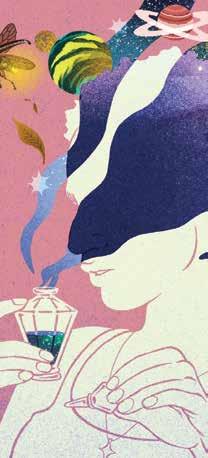
Scent is a vehicle into the exciting unknown.
8 Social Fabric
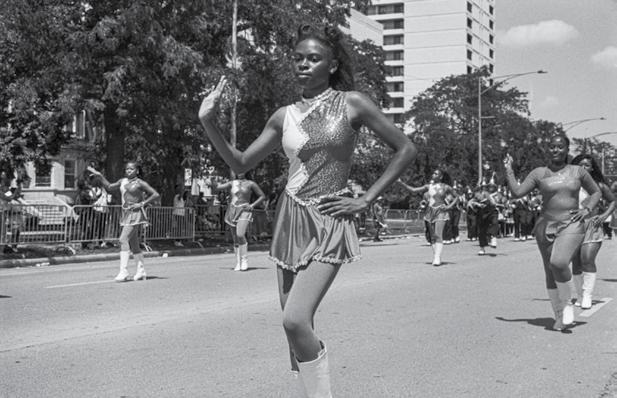
Photographer W.D. Floyd’s archive of summertime Chicago
10 Going the Distance | Barnes Kate and Stacy are raising their sons with the same values that have sustained their connection for two decades.
12 Explainer | Lee & Cicero Independiente
Planning a trip when the airport isn’t an option
14 Feature | Musick
Last year was exceptionally tough for Palestinian olive farmers and the importers who bring their oil to Chicago.
16 Reader Bites | Thompson Floor-cushion comfort of Kopi Cafe
17 Feature | Lucas Inside the Pritzkers’ “Quantum Prairie”
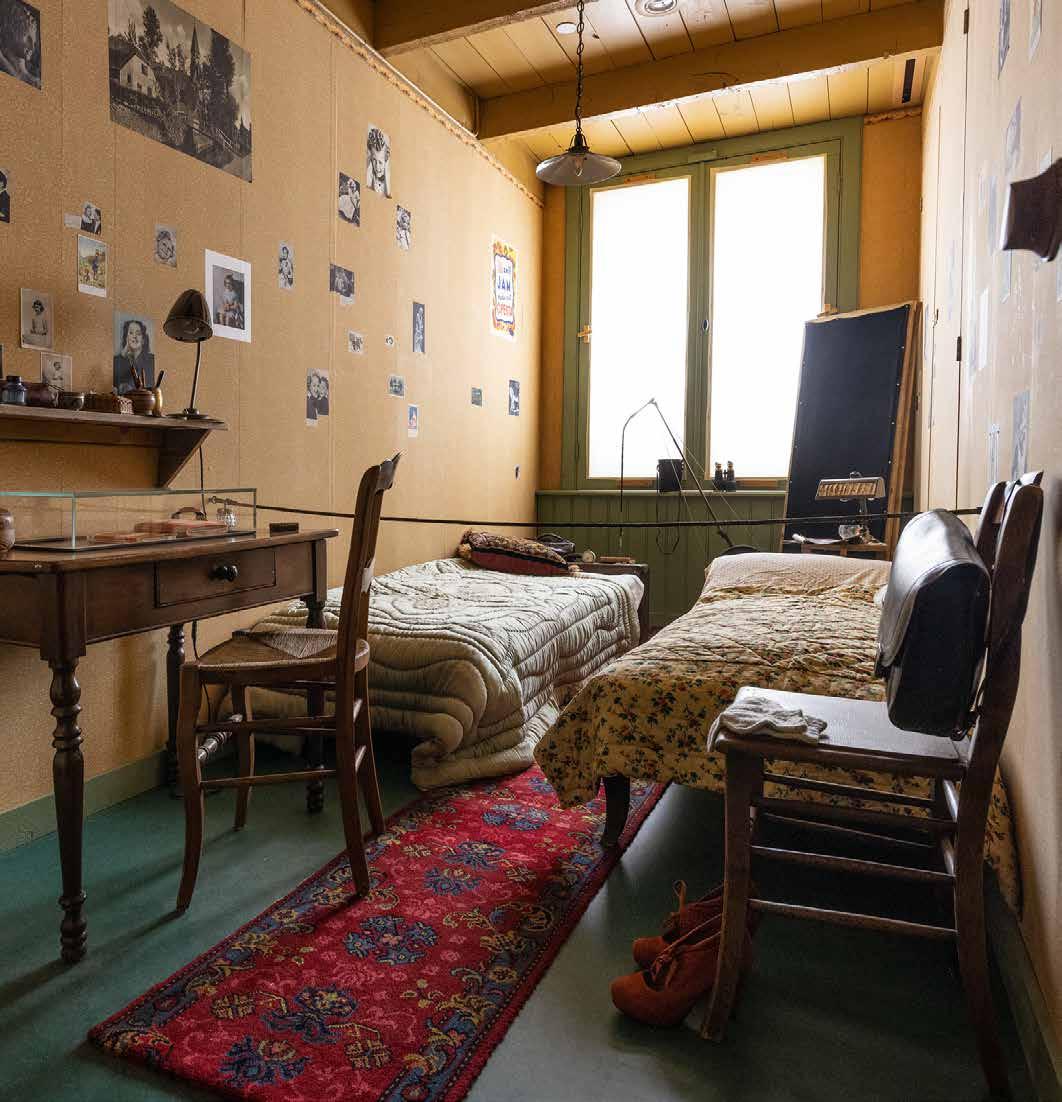
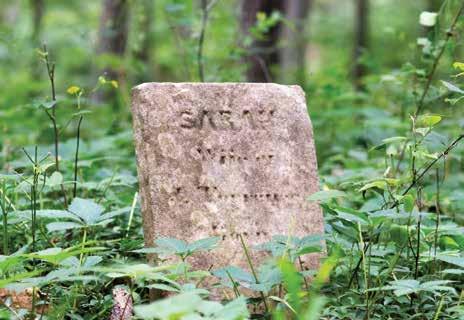
24 Nineteen cheap, weird, and wonderful day trips worth taking
34 Feature | Toale Discover the mystical wonders of Wisconsin’s artist-made grottoes.
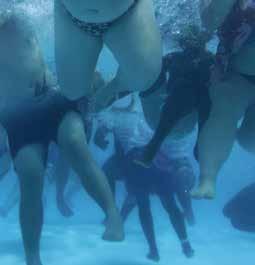
36 Essay | Caporale Water park paradise, powered by immigrants
37 Moviegoer | Sachs Film (s)trips
MUSIC
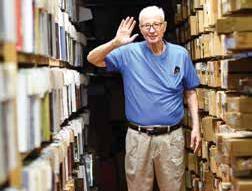
40 Feature | Galil Horizons Music has more vinyl for sale than you’ve ever seen in one place.
43 Calendar A curated monthly guide to what’s actually worth leaving your house for
PUBLISHER Malik Jackson
CHIEF OF STAFF/SALES DIRECTOR Ellen Kaulig
EDITOR IN CHIEF Sarah Conway
CREATIVE DIRECTOR Corianton Hale
ASSOCIATE MANAGING EDITOR
Savannah Ray Hugueley
(DMB)
Caporale
SOCIAL
MARKETING
MARKETING
July in Chicago, our city’s vibrant summer of sweltering liberation, park hangs, festival folly, and beachside lovin’, is finally here. Though we’ve waited patiently for Chicago’s sweet summertime, this month’s issue is taking you elsewhere—whether just a trip in your mind, or an actual voyage beyond city limits.
This issue is your de facto guide to mythic and cheap adventures in the city and beyond. Armed with a few bucks, a day to burn, and an itch to get out in the world, the Reader brings you 19 weird and wonderful day trips that you can take without emptying your pockets. From Cahokia Mounds, the largest ancient city north of Mexico, in Collinsville, Illinois, to the largest scrap-metal sculpture on the planet, at Dr. Evermor’s Sculpture Park, in Sumpter, Wisconsin, there’s something for everyone, big or small.
everyone that we are not to be on our phones this summer, got it? She’s whipped up your next road trip to see the “architectural wonders” of midwestern grottoes peppered across Wisconsin which “frequently depict cultural, popular, or religious figures, and ultimately reflect the creator’s personal mythology.” This issue is also here to help you plan the ideal staycation and remind you why we live in the greatest city in the world. It’s the time of year we’ve all been waiting for. “To say Chicagoans look forward to summer is an understatement,” writes photographer W.D. Floyd in this month’s Social Fabric. “We live for it! It’s an opportunity to hit the skate park, pick flowers from a garden, or pull out that box Chevy or motorcycle that has been getting worked on all winter.”
Senior staff writer Leor Galil puts you in his pocket for a ride to Horizons Music in Mendota, Illinois, which has more vinyl
for sale in its 20,000-square-foot space than you’ve probably seen in your whole life. “Horizons [Music] claims its inventory tops one million items—but how did that many records all end up in a tiny town

an hour away from Rockford and even further from Peoria and Chicago?” writes Galil. Time to see it for yourself, preferably with a friend.
Contributor Erin Toale reminds
Summer is about living, dreaming, and daring to want so much more. v
—Sarah Conway, editor in chief sconway@chicagoreader.com
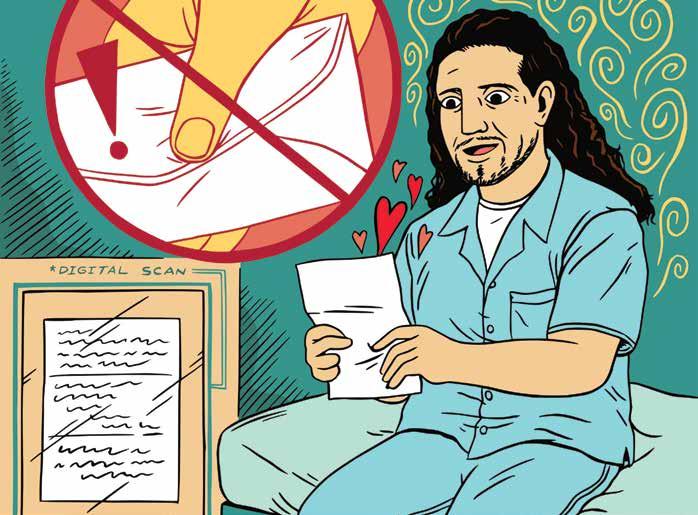
Mail scanning in Sheridan Correctional has faded the letters I receive from my daughter—my only direct communication with her.
BY THOMAS GORDON
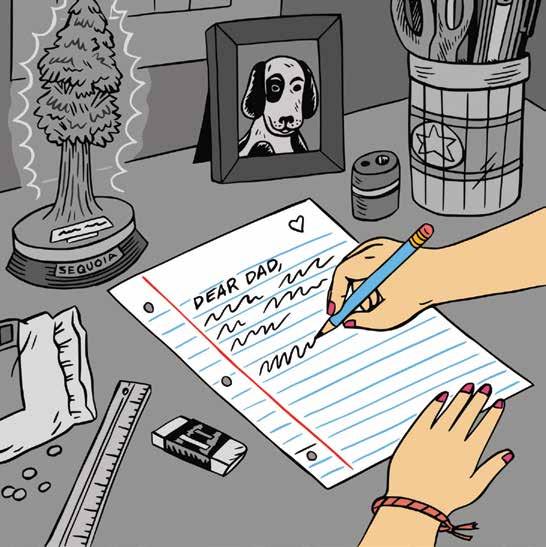
Encased in protective plastic sleeves is a quartet of letters from my daughter. On the back of each I’ve written the date I received it and my guess for when she wrote it. I reread them often, and they’re separated from the rest of my possessions like fine jewels that I carefully hold
The first couple letters are filled with detail: eraser marks, smudged wisps of graphite, the streamlined flow of a proper no. 2 pencil. In one letter, she wrote in pen, giving it a different feel altogether. Each has spectral alphabet images, a palimpsest of her apparent desire to craft the perfect letter. Sometimes small pieces of the margin are torn away, the perforation not cooperating.
But the most recent letter I received is a copy, lacking the same physical nuances that bring me a little closer to her. In September of last year, the Illinois Department of Corrections (IDOC) updated their mailing policies to only allow us to receive digital or printed copies of most original letters and documents. The policy, which became permanent at the beginning of this year, effectively states that at no point can we ever see or touch an original document that our loved ones have touched.
See, I was incarcerated before my daughter could speak, and now she’s 15 and headed into her sophomore year of high school. She learned about me just two and a half years ago, and since then l’ve been fortunate to receive her letters—the only words she’s ever spoken directly to me. Receiving these letters is like striking gold (or graphite, if you will), and through them I see the hopeful beginnings of a relationship and a child grown in an instant.
I received her first letter less than a month after she learned of me. It was filled with her character: She carefully detailed her hobbies, the things she loves, like math and singing, her favorite colors. She told me about her experience with making and losing friends; I see the love and loss of an intuitive child who understands this is part of life.
grace in ways that I was not at her age. Included with that letter were two poems, including a daddy-daughter poem that not only shades my heart with sadness for all I missed but also sets the tone for her standard of fatherhood: “I know I will always be / the luckiest, to have the / best Dad any girl could / have had.”
my 40th birthday this February, I was blessed with another jewel. It was also in graphite, but this time, it was scanned due to the new IDOC regulations. At that time, under a policy that ended in March, IDOC was destroying original documents after six months, unless it was requested that they be returned to home. To
themail@chicagoreader.com Do
istics of her are no longer discernible: I can’t relate to how she made mistakes writing in pen, her attempted erasure of things she didn’t like, or even the crinkled texture of the paper where she couldn’t decide on how to fold it. I feel as though a piece of my relationship with my daughter is now missing.
I have looked for places to teach her throughout these letters. I want to hug her and say that it will be OK. Instead, I write her in the composition notebook I keep for her. I talk to her about the giant sequoia—an historic, old-growth tree on the California coast I’ve been fascinated by since my youth. I want to impress upon her that, like the sequoia, she is resilient—big, bold, full of life.
I also see in her a child beyond her years in how she thinks about relationships, the world, and life. She wrote, “I have heard so many stories of people’s dads doing something bad in life and them hating him and not want anything to do with him, but that won’t be me. l could never hate you, I can just be upset with your actions.”
A few months later, her second letter arrived. It’s also full of her life: She doesn’t really like spicy food, but she’s trying to get used to it. Much like myself, she appreciates a variety of music. She intimates some of her innermost thoughts, which tells me she is self-aware and filled with
My next treasure from her is no different. She was visiting my mother and didn’t have her usual supplies, so she wrote in pen this time. It was the summer, so she was soaking up the outdoors while visiting her oma. My mother’s dog, Maddie, enjoys playing fetch with her. She tells me about school supply shopping and her new lunch bag. I hear about the snacks she likes and other details of her daily life.
I anxiously awaited her next letter for a year and a half. I remained patient, but it can be hard to lose more time with my daughter. And then, just after
safeguard the original, I asked my mother to send me a copy. Then, to read something other than a digitized version of my daughter’s letter, which would be deleted from the tablet after six months, I had to request a physical copy—a copy of a copy. Graphite, when copied, appears lighter than normal, so some of her words were hardly visible. I traced over them with my own pencil, cherishing every word, and for a moment, I felt as if I were teaching her to write. As I carefully darkened the letters, I thought back to her earlier original letters. The physical character-
I think of my crime; I atrociously harmed another human being. I often wonder if I can truly receive redemption. My daughter’s letters, her graphite love, feel like a little slice of deliverance. I find myself weeping from her love and acceptance. Here she is, through her written words, teaching me about compassion, understanding, forgiveness, and critical thinking. While I am learning how to be a father, she is expressing what that looks like to her. I’m still learning about my daughter—who she is, her personality, her joys and discontents—and these letters are my only means to do so. In her earlier letters, I could see a little more of her and how she thinks through her erased words and scribbles. They were a part of our conversation that I’ve now lost. But no matter what, her letters remain close, cherished, permanent in the archive of my life, carrying me through the seasons. v
Thomas Gordon is aspiring to be a better writer and poet, and is currently working toward his bachelor’s of sciences in general studies with a major in social sciences.
Inside Voices is a series of first-person essays and reported pieces by writers impacted by the Illinois carceral system.
Mail scanning has become a permanent policy in Illinois prisons, and it hinders real rehabilitation.
BY JUAN GARNICA
In 2013 I faced a life sentence. As I went through pretrial in Kane County’s jail, I received a heartfelt letter from my dad that reminded me I still had a lot to live for despite my incarceration. That letter became the most important piece of paper that I own, and under Illinois’s new mail policy, I never would have received it.
My pops is one of my strongest supporters for reentry. Raised in the 60s, he’s as old-school as cassette tapes and bubble TVs. He gave out handshakes, not hugs, to us kids. He never got past the first grade, but as an adult he taught himself how to read and write in Spanish as best he could. The back of the piece of paper he wrote me on has my sister’s unfinished sixth-grade history homework, with heart-to-heart scribbles; it’s my prized possession.
In January 2026, the Illinois Department of Corrections adopted a policy banning physical mail in all its facilities, contracting telecommunications company ICSolutions to instead scan and copy all mail sent to Illinois’s prisons. This rule was implemented under the pretense of combating an influx of drugs, but evidence has shown it hasn’t reduced drug exposures; it does, however, sever the human connections that make rehabilitation possible, opposing IDOC’s mission of restoring individuals to their community.
After serving half of a 30-year sentence, I’ve experienced firsthand how a modern spin on drug trafficking has swept through prisons in Illinois. The most popular question in the six prisons I’ve been in is: “Where the paper at?” Paper is a moniker for drugs sprayed or soaked onto pieces of paper, which makes detection by prison
administrators difficult and facilitates trafficking, as it can be cut into thumbnail-size strips for distribution. Synthetic cannabis, fentanyl, and even ant or roach spray are used to make paper. There is a drug problem in Illinois prisons, and over the past few years, I’ve seen a rise in drug overdoses when guys have a bad trip from smoking paper.
Hearing a code three, a medical emergency, go off on the officer’s radio became a regular occurrence throughout 2024. At first, I felt personally affected by watching men I lived alongside get rushed out on stretchers. But I quickly became desen-
Menard and Pinckneyville Correctional Centers located in her district: anyone caught misusing the mail system to smuggle drugs would receive only scanned copies going forward. By mid-2025, after a broader legislative bill failed in the General Assembly due to a lack of evidentiary support for the efficacy of mail scanning, IDOC imposed a temporary emergency ban on physical mail statewide.
This past January, a Springfield administrative rules committee made it permanent with one key difference from Bryant’s original version: Under the new policy, every person incarcerated in Illinois loses
through. The only things he ever seemed to care about were work and money because they gave him a sense of security for our lives. In many ways, I learned how to grow up on my own. But the heart-toheart words he wrote in his letter are the only memory I have of him being vulnerable with me; I’ve never felt closer to him than when I read his words.
Healing broken relationships contributes to incarcerated people’s rehabilitative journey because community eases isolation and fosters social values. Without the relationships I’ve built in my life, I could just as easily be looking for the escape that
sitized as a way to protect myself; by the time I saw some guys overdose a second time, they were just another cluck, a drug addict, to me.
Indifference to individuals in custody is pervasive and corrosive to rehabilitation, and even those of us on the inside are not immune. It was easier for me to separate myself from people who got high than to try to understand why they felt the need to do it. That same indifference toward incarcerated people’s inner lives drives policies like the ban on paper mail.
In 2024, AFSCME Council 31, which represents around 10,000 Illinois correctional workers, began reporting drug exposure from handling mail, claiming that secondhand contact with dangerous substances had caused adverse reactions and hospitalizations. The union launched a campaign to get rid of physical mail in all facilities. Republican state senator Terri Bryant, who was an IDOC employee for 20 years, took up the cause. In late 2024, she piloted a punitive mail-scanning policy at
physical mail, regardless of their behavior.
But evidence doesn’t necessarily support this policy. Pennsylvania banned physical mail in its corrections system in 2018, but has seen no reduction in drug use or overdoses in prisons, according to a press release from the Restorative Justice Foundation. Medical and toxicology experts have debunked the exposure claims made by correctional staff, stating that casual contact with paper cannot deliver a dangerous dose of synthetic drugs—even fentanyl.
WTTW News reported that after six months of Illinois’s own emergency ban, drug seizures and overdoses inside IDOC facilities remained essentially unchanged. In fact, there was an increase in drug discoveries between the six months prior to digitization and the six months after, according to the numbers IDOC presented in April of this year.
Growing up, I had a fractured relationship with my dad primarily because he didn’t understand what I was going
countless others do when facing the challenges of incarceration.
Banning physical mail in prison provides a false sense of security to those in power, and they’ve sold this idea to the public. The price that incarcerated people bear feels overlooked. IDOC ought to nurture relationships between incarcerated people and the rest of society instead of banning printed mail. Until then, punitive policies like mail scanning continue to hinder real rehabilitation. v
Juan Garnica is an undergrad in the Northwestern Prison Education Program. With a prolific mindset and good oldfashioned hustle, he continues to find ways to contribute to the community through sharing his art and his experience.
Inside Voices is a series of first-person essays and reported pieces by writers impacted by the Illinois carceral system.
themail@chicagoreader.com
can transport you through place, time, and memory.
BY MICCO CAPORALE
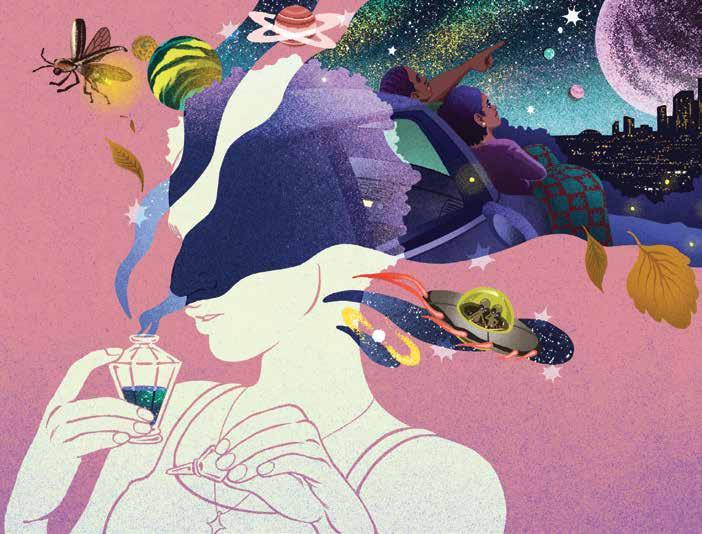
Ididn’t buy my first perfume until the lockdown era of the pandemic. At the time, I was thinking a lot more about my sense of smell because so many were losing theirs to COVID. A fragrance allergy had long deterred me from attempting to accessorize through scent, but I was ravenous for new stimuli. Risking a migraine felt minor if it led to a portal out of my day-to-day banality. I ordered three perfume samples from a discount website; each one proved very gross. Still, I wore them constantly over the next few months because they brought my mind to some place more interesting. No aesthetic journey has felt more provocative and esoteric to me than venturing into perfume. I don’t travel much because it usually requires a disposable supply of time and money I seldom have simultaneously, so I place a premium on expanding my horizons without leaving the city. Committing to a quality fragrance gets expensive quickly, but simply trying perfumes costs little. Sampling them at a brick-and-mortar—say, Merz Apothecary or Field & Florist—is completely free. Scent has long been associated with memory, more so than other senses. Researchers believe our brains evolved to link smell and recall closely because scent was a key part of our ancestors’ mapping skills. In her memoir, Helen Keller described scent as the fallen angel of the senses. “I doubt if there is any sensation . . . more delightful than the odors which filter through sun-warmed, wind-tossed branches,” she wrote, “or the tide of scents which swells, subsides, rises again wave on wave, filling the wide world with invisible sweetness. A whiff of the universe makes us dream of worlds we have never seen, recalls in a flash entire epochs of our dearest experience.”
The idea that scent could anchor people in specific places and feelings has inspired perfumers for eons. One afternoon at Merz, I noticed all the shelves lined with perfumes (and candles) designed to evoke locations: Saint-Tropez, Montauk, Kyoto, Istanbul, Berlin. The London-based brand Gallivant even takes wanderlust as its raison d’etre; its flagship discovery set, Nomad, features 12 perfumes named after cities. Distilling a location into a scent often starts with material essences from the area, like native foliage or botanicals, but it can quickly get abstract as perfumers attempt to capture a place’s unique energy or atmosphere.
One of my favorite perfumes to offer a sense of place is Morel Map by Chicago brand Clue. It smells like the thrill of
foraging beneath the darkness of a woodland canopy gently pierced by glowing beams of light. Some of Morel Map’s ingredients come from Wisconsin, but smelling midwestern doesn’t seem like the point. The fragrance has just enough of a spicy, mercurial quality that its wet earth scent hits like it could come from a place of faeries and goblins as much as a forest further north.
Using my senses to guide my curiosity makes my life and my emotional connection to those around me feel boundless.
Just as fragrance can act like a vehicle to a destination, so can it behave as a time machine. My favorite all-around brand is a Swedish outfit called Stora Skuggan, and its fragrance Silphium attempts to re-create the essence of the herb (also
known as silphion) that was so popular in seasonings, medicines, and perfumes of antiquity that it was harvested into extinction. Florentine brand Officina ProfumoFarmaceutica di Santa Maria Novella’s perfume Acqua della Regina uses a recipe devised in 1533, when it was created as the signature scent for Caterina de’ Medici to mark her wedding to the King of France. When I asked one of Merz’s perfume assistants what fragrance most immediately and viscerally transports her, she didn’t hesitate: Rita’s Car, by the Los Angeles brand Saint Rita Parlor, takes her to being a child in her father’s garage admiring his classic, antique cars. The fragrance is leathery and metallic with just a hint of smoky sweetness; it has a gritty mechanical quality that also feels elegant and safe. I like that following my curiosity about perfumes often leads me to windows into others’ lives or imaginations.
Hunting for perfume also lets me travel with loved ones in spirit. A friend tells me she is going to Europe soon, and I ask where; there is a small-batch Polish fragrance I want (Martyr, by Profundum), and I am trying to avoid a $70 import fee
ordering it from the brand or Scentorium, a Romanian fragrance website that caters to people who want to smell like haunted funeral parlors. Sadly, she’s not going to a country that carries it, but she’ll be going to New York soon. Should she pick it up from Stéle, the one domestic brick-andmortar that carries it? No, I want her to get me a bottle of Meadow of Love, a floral absinthe developed by a Buddhist woman who grew all the ingredients on her farm in the Catskills.
That friends willingly take detours to bring me back little oddities makes me feel held in their memories. They are on tiny pilgrimages of devotion for me. When they return, we make a plan to meet so I can pick up my treat, where I hear all the details of their adventures that would never go on social media. Seldom leaving town, it is easy to think of my world as very small, but using my senses to guide my curiosity makes my life and my emotional connection to those around me feel boundless. Of all my sense organs, my nose leads me the furthest into the exciting unknown. v
mcaporale@chicagoreader.com
Photographer W.D. Floyd builds an archive of Chicago’s summer hopes and dreams
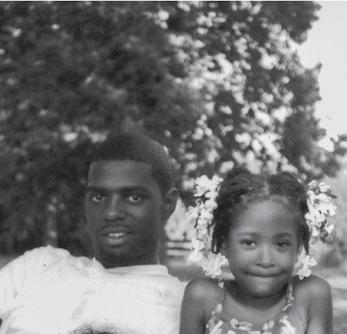
On a hot summer night last July, I had the urge to go out and document. The sky was clear, I had a new flash for my camera I wanted to test out, and I knew people would be outside. As I headed west on Madison Street through Garfield Park, I noticed it was—surprisingly—fairly empty. I began to think, maybe folks decided to beat the heat and stay inside under a fan or air conditioner. But as I continued walking, I could hear music coming from Hamlin Avenue. When I arrived at my destination, I laid my eyes on a gentleman sitting in a lawn chair, enjoying a drink. I asked: “Taking it all in, brother?” “Indeed.” I quickly realized why the park was so quiet and empty— everyone was on Hamlin. People filled the sidewalks from Madison to I-290. There were food vendors, people dancing, and family and friends congregating; the street
served as a runway for car, motorcycle, and dirt bike clubs. I sat back and watched how through just living their lives, community members turned six blocks of a major city street into a “strip.” A guy approached me and said, “Make sure you take some good pictures. It’s a movie out here.”
The everyday, the mundane—or if you want to fl ex your vocabulary chops, the quotidian—are the elements of existence I’ve documented on the south and west sides of Chicago for the last ten years. In a time where political dissent is warranted and even feels natural, resistance is understood as a foundational component of a community’s identity. But when reactions to oppressive systems and structures become the centralized narrative of a group of people, it suppresses the recognition of their full humanity. We must be mindful of perceptions that solely view humans as mere reactors to
their circumstances. We are more than our condition. With that in mind, how do we think about a group of people and ourselves beyond resistance? We must value the everyday: the extraordinary examples of human existence that reside in ordinary moments. Documenting the run-of-the-mill of the communities that cultivated me and that I belong to is both a political and a personal act of stewardship, preservation, and reflection.
The images from my archive are the manifestation of the hopes, dreams, and desires individuals and communities have for the summer. To say Chicagoans look forward to summer is an understatement. We live for it! It’s an opportunity to hit the skate park, pick flowers from a garden, or pull out that box Chevy or motorcycle that has been getting worked on all winter. Our head-down, grind mentality is forged from our harsh winters, but it’s matched
by our immense display of generosity and gratitude for the summer. Whether it’s attending the many free summer events and festivals the city has to offer, or taking advantage of our beautiful parks and lakefront, the months between June and September are when Chicago truly comes alive. So if on a hot day in July, you find yourself without plans but in need of something to do, grab a lawn chair, go outside, find a spot with a nice view, and take in the three-dimensional movie that is summertime Chi. v
—W.D. Floyd, photographer
Social Fabric is a glimpse into the vibrant lives, objects, and spaces that shape our city, cocurated with community archives and local photographers.
themail@chicagoreader.com
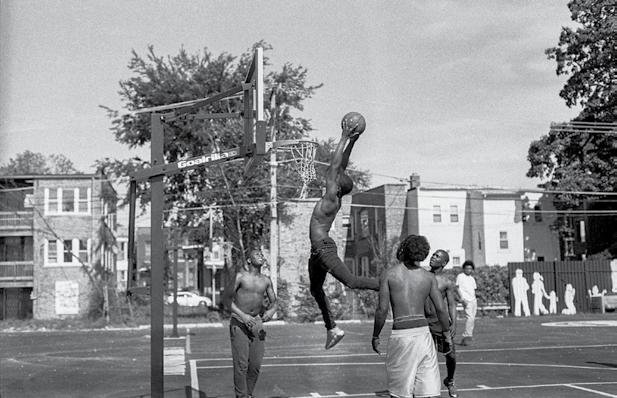
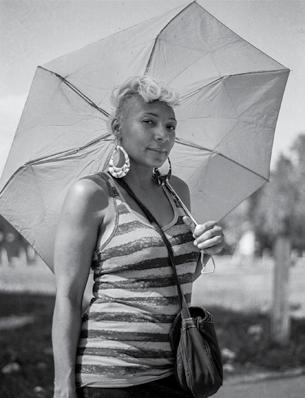
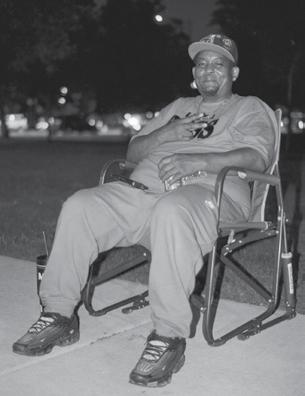
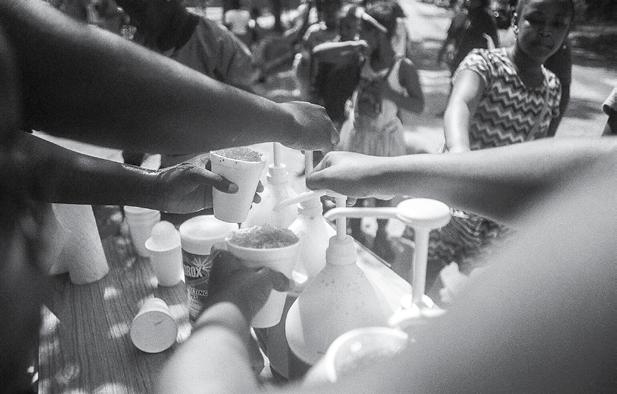

A Little Miracle, West Garfield Park, 2017
West Garfield Park, 2019
Bud Billiken Parade, 2025
Taking It All In, Garfield Park, 2025
W.D.
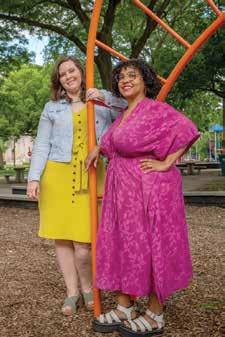
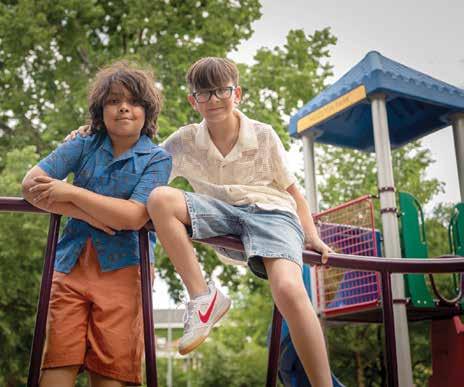
In a courtyard in Bronzeville, two women in their early twenties conversed passionately, laughing for hours. A distant onlooker might have thought they were long-lost friends finally reconnecting, but they were strangers meeting for the very first time.
“We were laughing, we were joking. We were talking about super intense political shit,” said Kate Koval, 44, of her first conversation with Stacy Rene Erenberg, 43. “It was an instant connection.”
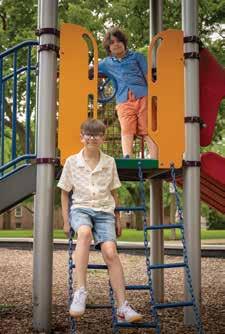
A decade later, in 2016, they watched as their sons had a similar moment. Stacy recalls her infant son, Xio, meeting Kate’s toddler, Rudy, for the first time: “Rudy was trying to make Xio laugh,” Stacy said. Rudy’s theatrical physical comedy at just under a year old resonated with her newborn. “Xio was cracking up!”
The timing of their firstborns being eight months apart was a happy accident. Now preteens, the boys have developed a playful, relaxed, genuine friendship.
Back in 2006, neither Kate nor Stacy knew they were at the start of a lifelong friendship, nor that their kids would one day be friends. Kate was completing a nonprofit internship and attended an event at the Rainbow Push Coalition, where she first heard about a feminist organizing group: Females United For Action (FUFA). That led her to an email exchange with Stacy, an active member of FUFA, and their kismet meeting in the courtyard of Kate’s internship site in Bronzeville.
Stacy grew up between her current home of Rogers Park and Evanston, and spent nearly a decade living in Humboldt Park. Kate grew up in northwest Indiana and now resides right over the Illinois border in the East Side neighborhood, where she’s lived on and off for over two decades.
The distance never felt like a deterrent to their friendship. Their political beliefs, passion for justice, and sense of humor magnetized them, despite living over 20 miles apart.
Stacy was politicized in college and
These lifelong friends see the legacy of their love extend to their preteen sons.
BY JASMINE BARNES
started her career as a political activist and organizer focused on abolition, reproductive justice, and supporting young women who were in the sex trade and the street economy. Kate’s activism has often been neighborhood-focused, including her protest of the hazardous dust from a petroleum coke storage facility in 2015 and her participation in a hunger strike to prevent an environmentally hazardous industrial center from opening in 2021.
This deep commitment to fighting injustice has influenced their personal and professional lives, as has their willingness to take risks and seek out new experiences together.
“I’m an improviser vocally, and also in life,” Stacy said. “I think my love language is adventure.”
Their friendship has been highlighted by what Kate calls “classic Kate and Stacy moments”: almost being trapped under the crossing gates at the Burnham Avenue train tracks; Kate driving to Wisconsin after Stacy’s Toyota Corolla (aptly named Dolores, the Spanish word for “suffering”) broke down; turning a failed moms’ getaway weekend into a spontaneous day trip including a long hike, mushroom trip, and thrift shopping in Indiana.
Underpinning these moments is their sustained willingness to care and sacrifice for each other.
“I’m going to cry and fuck up my makeup,” Kate said halfway through our conversation, laughing through tears. “I feel like we’ve lived three lifetimes in the last ten years.”
As eldest daughters, the responsibilities and expectations of caring for children and aging or ill parents arrived with a swiftness and intensity neither of them
could have anticipated.
In 2014, Kate unexpectedly became her father’s caregiver after he sustained a traumatic brain injury. Stacy was a practicing massage therapist at the time and once drove far south to Kate’s father’s nursing home to give him a massage to help his muscle spasticity.
In the years that followed, Stacy also experienced the devastating death of her mother and adopted her teenage niece right before the start of the pandemic.
“I just really respect that [Kate] keeps it real; I don’t think I could be this close with someone who couldn’t have moments of ‘This is really fucked up.’ I appreciate that. It forces me not to gloss things over,” Stacy said. “We can laugh about having to be in this capitalist bullshit, but also try to make it and do what we have to do to survive and thrive.”
Recently, Kate was isolated at home due to a depressive episode and a lack of reli-
able transportation. Stacy refused to be kept from her, and she and Xio regularly drove to visit Kate.
When Stacy was pregnant with Xio and commuting to Chicago State, where she was pursuing a degree in music education, she would stop by Kate’s house before heading home. Kate, recently postpartum, would offer her food and advice for navigating the intensity of pregnancy.
“I would feed [Stacy] and [she’d] ask me questions about breastfeeding and I would really cherish that time,” Kate said. This intentional stacking of trips and willingness to be in vulnerable, intimate space with each other has allowed their friendship to deepen.
Having infants and toddlers was both a deeply bonding experience and a challenging one as their time and attention was largely consumed in the very domestic labor of mothering young children. A
spontaneous hour drive to one tip of the city or the other was often out of reach. Still, they resisted the isolation that often befalls new mothers.
For them, successful friendship strategies as busy moms include long phone calls while driving, and coupling playdates with their own hangouts. The friendship their sons share makes attending kids’ events more bearable knowing they have someone to get a beer and burger with after.
“We can have our time, and then our kids have their time,” Kate said.
While parking up north “always sucks,” Kate is grateful her mental health is in a better place and that she has a reliable car to make her way up DuSable Lake Shore Drive to her friend. Kate’s considered moving further north many times over the years, but the support system and caregiving responsibilities she has in East Side and Indiana make it hard to move.
“I’m always torn with, do I move to a neighborhood on the north side that has a better school and cultural diversity and just better resources, or do I stay here and continue to have access to resources in the form of people?” Kate said.
Stacy is similarly anchored in Rogers Park, where she returned in 2020 to be closer to family.
Nest—a center for vocal improvisation. She sees this season of her work as a way to heal from the burnout she experienced as a young activist. Kate, inspired by her journey supporting her father’s rehabilitation, made a career transition to become a speech-language pathologist. They both marvel at the fact that their winding and weaving careers led them to a similar place: working with the healing power that comes from tending to the vocal mechanism.
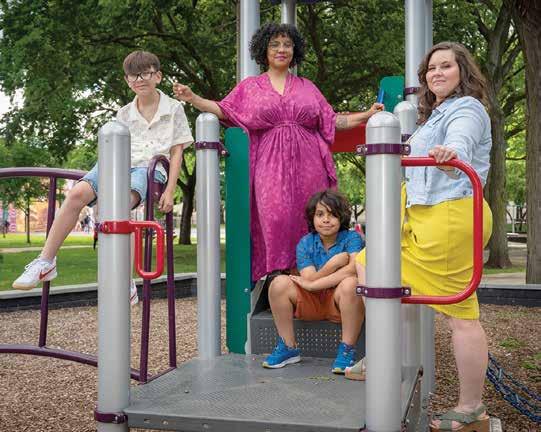
As they sat side by side on a perfect summer day, grasping each other to steady themselves as fits of laughter emerged with each story shared, it seemed like no time had passed between now and that first meeting years ago— their voices a beautiful duet melding with the sounds of their sons playing together in the distance. v
Both Kate and Stacy know that their sons’ transition into high school in about four years will provide a window where larger changes, like a move, might be possible.
“We’re rooted because my kid has a great school and we have built community, but it was hard. It’s still hard.” Many of her “chosen fam” live on the south or west sides and she misses being with them regularly.
“If [Xio] goes to somewhere south or even a little bit further south, we would try to move again, depending on [our] financial situation, just to be closer to our people so that we can support each other,” Stacy said.
Stacy teaches contemporary voice at Columbia College Chicago and runs the
Despite the structural barriers to traveling between Chicago’s 77 community areas, many friends are willing to face the city’s geographic hurdles and sustain relationships that transcend race, gender, age, and class. In an effort to chronicle human connection and love in spite of these challenges, the Going the Distance series examines the enduring friendships between people living in distant neighborhoods.
themail@chicagoreader.com

®

With increased ICE presence in airports and along other routes, traveling requires extra planning.
BY NOMA LEE
This story was coproduced with Cicero Independiente.
Traveling is a fulfilling activity that everyone should get a chance to enjoy.
With that in mind, my partner and I started planning a trip to San Francisco a few months ago. We were going to go wine tasting in Napa, see the redwoods, and cross the Golden Gate Bridge. Almost everything was planned out until, in late March, immigration agents started showing up at some of the country’s major airports.
For many immigrants, this made the idea of navigating an airport feel even harder than it already was. Starting May 7, 2025, the REAL ID Act went into effect at TSA checkpoints nationwide, meaning travelers need a REAL ID–compliant license, passport, or other federally approved document to board a domestic flight.
Those without a compliant ID can pay
a $45 fee through TSA ConfirmID—but the process can take up to 30 minutes and doesn’t guarantee boarding. For undocumented immigrants, who are not eligible to obtain a REAL ID, this added yet another reason to think twice about flying.
I eventually decided it wasn’t a good idea to play the “who gets detained” lottery at the airport, and our flight to the Bay Area became a train journey to New Orleans.
For those who have decided to avoid airports, the most common transportation options are on the ground: bus, train, or car. Each offers something different in terms of cost, time, and the very nature of traveling across the country.
Traveling by land can alleviate some of the stress many immigrants feel in airports, but none of these options is entirely free from encountering authorities.
On the road, there are checkpoints and inspection stations operated by U.S. Customs and Border Protection (CBP). Some are permanent, located on key highways in the south and along the west coast.
However, there are also tactical checkpoints—temporary and unannounced— that can appear on any route within an area the federal government designates as the “100-mile border zone.” This encompasses any location within one hundred miles (160 kilometers) of the Canada and Mexico borders and the coasts.
Ultimately, the best trip is the one you can take with peace of mind.
Many people are unaware of just how much territory this zone covers: Chicago, New York, Los Angeles, Houston, and Miami all fall within this range. According to the ACLU, that means two-thirds of the U.S. population lives within it.
On buses and trains, the dynamic differs, yet the risk remains: These routes may not have a regular Immigra-
tion and Customs Enforcement (ICE) or CBP presence—but that does not mean an encounter cannot happen, especially in regions within that zone. It’s best to be informed about the immigration enforcement policies of each city and state before you travel, according to Immigrants Rising, a nonprofit that provides resources, legal support, and career guidance to undocumented young people.
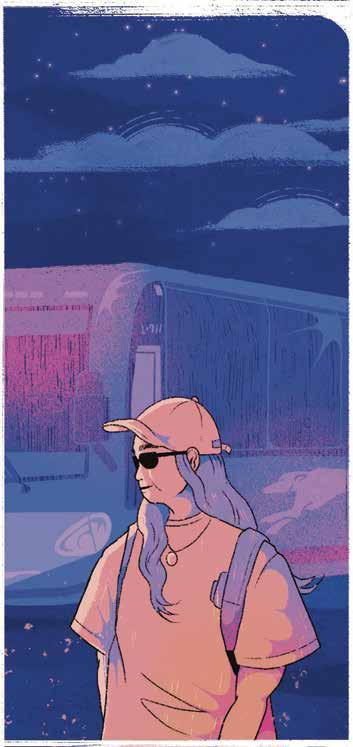
The presence of immigration authorities on land routes is nothing new. In fact, in 2020, Greyhound announced that immigration enforcement agencies needed a warrant to board its buses. This came after the ACLU documented systematic cases of warrantless searches on Greyhound routes in several states.
This policy remains in effect and is currently posted on their website: Greyhound does not consent to Department of Homeland Security, CBP, or ICE agents boarding its buses without a written warrant. Furthermore, any verbal request
for access must be documented.
While these scenarios do not happen on every trip or route, they are factors many immigrant families weigh when deciding how to travel within the United States. Here are some of the things to keep in mind, from comfort to practicality, when planning your trip.
Companies like Greyhound and FlixBus connect Illinois with cities across the country—and even offer routes to Canada and Mexico—making bus travel one of the most accessible options for ground transportation. Fares vary based on distance, season, and how far in advance you book.
One-way regional trips within the midwest can range from $15 to $100; routes to the south or the east coast can range from $120 to $350; longer trips to the west coast and international routes can range from $150 to $400.
While this option tends to feel less
intimidating than an airport in terms of security checks, it also involves long periods of sitting and total reliance on specific routes, layovers, and terminals.
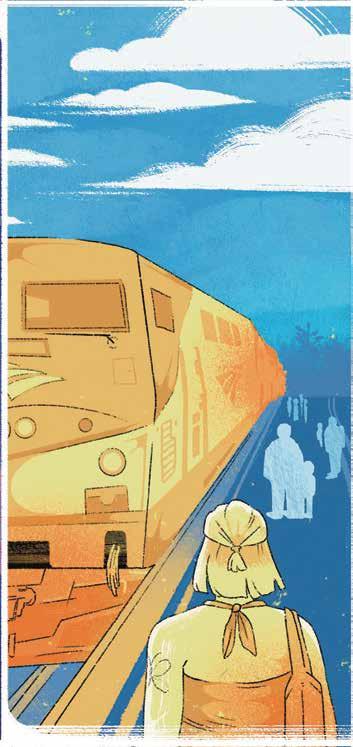
Although it resembles the bus in some ways, the train offers a very different experience. Amtrak routes connect Illinois with cities in the midwest, east coast, south, and parts of the west coast.
Some long-distance routes can span several days, cross multiple states, and reach cities in Canada.
Tickets tend to be more expensive than bus fares, especially for long trips or when booked on short notice. One-way midwest regional trips can cost between $40 and $240; routes to the south or east coast typically range from $150 to $350; longdistance trips to the west coast can exceed $400. Private rooms or sleeper cars can range from $900 to $1,700, depending on the route and season.
and state, and are on the rise.
Hotels and motels also make up a significant part of the budget, and prices vary considerably depending on the city, the season, and how far in advance you book. Sites like Booking.com or Expedia can give you a real-time estimate for your specific route.
For some, driving offers a greater sense of privacy and control. However, long hours behind the wheel, lack of sleep, and the need for constant attention make the road trip a completely different experience—and that, too, is part of budgeting.
It is important to note that the transportation companies mentioned in this article do not require immigration documents to purchase tickets. However, if you are traveling outside city limits, you do need a valid photo ID—either to board or to confirm that your name matches the one on the ticket.
For those without legal immigration status, other forms of identification are valid in these situations, such as a consular ID card (matrícula consular), a current foreign passport, or a state driver’s license—in Illinois, for example, it is possible to obtain one without a Social Security number or legal immigration status. It’s important to know that if an immigration agent boards a train or bus, passengers have rights worth being aware of.
Yes, my trip ended up being a revelation. New Orleans was worth all 20 hours on the train. Honestly, I had completely underestimated it but left completely won over, already wanting to go back. The food was out of this world, art and music wrap around every corner, and the people are incredible.
The cost is reflected in the amenities:
The seats are more spacious, and some cabins include convertible beds as well as food and beverage service. On long routes, Amtrak offers showers in certain private compartments.
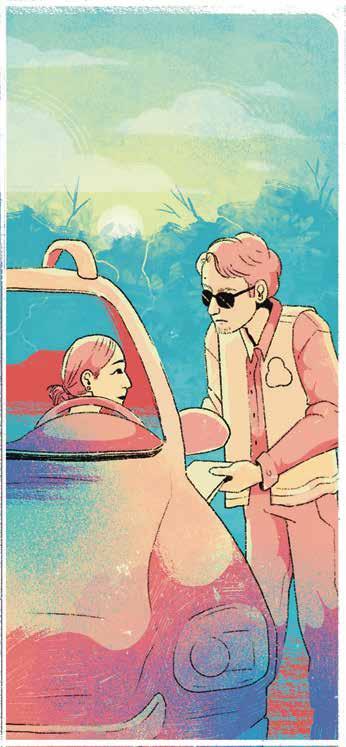
For many people, traveling by car offers something that buses and trains cannot: route flexibility. Not being tied to schedules, stations, or fixed routes allows you to decide when to leave, where to stop, and how much time to spend on the road. It is an option that can be more economical for families or large groups who want to split the costs.
However, that flexibility also changes the nature of the journey. On long trips, driving involves spending several consecutive hours on the move, planning rest stops, and calculating additional expenses such as gas, tolls, food, and lodging. Regarding costs, it is important to note that regular gasoline prices vary by region
If I learned anything, it’s that long-distance train travel is a world of its own; it pays to be prepared for those moments when your body simply can’t stand the seat for another minute, or when you’re struggling not to fall over in a bathroom that’s constantly in motion.
Before making any decision, it’s worth taking a moment to reflect and crunch the real cost—not just the ticket price, but the total travel time, what it entails to spend hours on the road or in a terminal, what the potential risks are, and how prepared you are for that. Each option depends on where you’re going, who you’re traveling with, and how much time you have. What works for a regional trip doesn’t necessarily work for crossing several states.
This article isn’t meant to tell you how to travel, but rather to offer options so you can make informed decisions. Ultimately, the best trip is the one you can take with peace of mind. v
Translated by Jacqueline Serrato
But 2025 was an exceptionally bad year for West Bank farmers and the traders who bring it here.
BY MORLEY MUSICK
Kerry Shadid busied himself taping small Palestinian flags and a keffiyeh to the door of his Chicago Ridge warehouse. He wanted a picturesque backdrop for the products he imports from Palestine under the Tulkarm label—za’atar, mint, sage, makdous, and his 16-liter tin jerrycans of oil pressed from olives on his family’s estate in the West Bank city of the same name. While his colleague, a woman named Samia, ran back and forth from the kitchen, plying me with ka’ak bread, tea, and Nabulsi cheese, Shadid shared the plight of Chicago’s Palestinian olive oil importers.
“Restaurants used to buy Palestinian oil from me for $250 [per jerrycan],” he said. “Now, they don’t buy it anymore. I’ll just try to sell as much as I can, but I cannot go below my cost. I mean, who’s going to buy this for $400?”
Since October 7, 2023, a combination of drought, tariffs, and increasing Israeli settler and military violence has created a perfect storm of environmental and political challenges to producing Palestinian olive oil and importing it into Chicago, home to the largest Palestinian diaspora in America. Purchasing West Bank olive oil enables Palestinian Americans to financially support friends and relatives in their home country, and also to maintain intangible connections to a crop celebrated in Palestinian songs, poetry, and seasonal traditions. Particular Palestinian olive trees have been cultivated for hundreds and in some cases thousands of years.
A jerrycan (or “tank”) of Palestinian olive oil is the standard unit for family purchase. Many families will go through four tanks a year, so that $150 increase makes choosing between Palestinian oil and a cheaper Syrian or Turkish substitute unavoidable. It is harder than before to lend financial support to the Palestinian economy through these purchases. Increasingly, the Palestinian oil sits on local store shelves and warehouses for months at a time.
Sami Dana, whose Bridgeview bakery, Nablus Sweets, also sells Palestinian olive oil, said that he has struggled to sell last year’s harvest. “I have two sons with autism,” Dana said. “[My family] goes through one tank per month—more than one tank. Last year we could afford it.
Now we cannot afford to just use oil from Palestine.” Dana pointed to difficulties in his birth country, saying, “Farmers have lost ten thousand trees—more. Often, you don’t even have a chance to collect the olives. They just fall on the ground.”
Shadid said that he would aim to continue buying Palestinian olive oil as long as he could, reflecting a broader sentiment among Palestinian Americans, for whom the purchase of olive oil from home
wake of Israel’s genocide, he said young, unemployed men in his West Bank village have grown idle and turned to drink and drugs. “The idea of someone drinking in our village is insane,” he said. “You’re just seeing societal breakdown—it’s putting a lot of despair in people’s hearts.
“The tragedy of the diaspora is that you have this huge Palestinian community that cares a lot about their homes and everything. But the reality is that with
it must be harvested by hand from trees, largely in the hilly terrain surrounding West Bank towns. From there, it’s shipped to local presses—some small and rudimentary, others large and mechanized— that separate oil and water from olive flesh, which pours into steel tanks. The oil is graded depending on quality, trucked to the port of Haifa, through various checkpoints in Israel, and then to Port Newark-Elizabeth Marine Terminal in

has a more-than-material importance.
Indeed, for some importers and consumers, olive cultivation serves as a fragile link to life in the West Bank.
One local olive oil importer, who asked to remain anonymous for fear of repercussions from the Israeli government, said that he gave all the money from his business, which he runs on top of an unrelated day job, to farmers in Palestine.
The importer said his business enabled him to offer a $30,000 salary to a cousin living in a village near Nablus. Money and work have become increasingly important in the wake of Israel’s war on Gaza since October 7, 2023. Prevented from working in Israel and earning higher wages in the
my generation, none of us are going to be connected in the future. We all spent our summers in Palestine, but none of our kids are gonna spend their summers there. This village that should have a population of 100,000 stays at 10,000, and then less, and then less.
“For me, the core of the import business is: Can I stay connected to Palestine, even as someone who is going to be in Chicago? This is the only connection I have back there in a real way.”
In the face of extraordinary challenges, the oil trade carries on between olive farmers in the West Bank and Chicagoland’s Palestinian community. In order for the product to reach grocery store shelves,
New Jersey. From there, it travels by truck hundreds of miles into the Chicago homes of Palestinian families and to consumers throughout the U.S. Olive trees alternate between years of high and low yields, but even accounting for this variation, 2025 was an exceptionally bad one for Palestinian olive oil. Nasser Abufarha, an anthropologist and founder of Canaan Palestine—an exporter of fair trade olive oil, based in Wisconsin and Jenin—said his nonprofit company exported 50,000 kilograms of Palestinian olive oil into the U.S. in 2023, the last low-yield year for olive trees. In 2025, on the other hand, the firm exported just 22,000 kilograms of olive
oil, a 56 percent decrease.
Like other importers, he attributed the decrease in yields principally to drought.
The Trump administration’s 15 percent tariff on goods exported from Israel, amounting to $8,000 on company shipping containers, made matters worse. Settler violence was a third contributing factor to decreases in yields. Abufarha also said that about one-third of the land owned by Canaan’s estimated two thousand farmer families has been seized by Israeli settlers.
The Applied Research Institute in Jerusalem (ARIJ) found that total expected Palestinian olive oil production last year plummeted to just seven thousand tons, down from 23,600 in 2024. That represents the lowest yield over the past 13 years. According to ARIJ, between 80,000 and 100,000 families in the Palestinian territories rely on olives and their oil as primary or secondary sources of income, with the industry accounting for about 70 percent of local fruit production. Land confiscation, the separation wall, and settler violence resulted in the uprooting of an estimated 10,000 olive trees.
Yesh Din, an Israeli human rights organization, documented 178 harvest-related settler attacks between October and November 2025, an average of three incidents per day, spread across 88 Palestinian towns and villages, four times the number affected in 2020.
October 2025 was the most violent month since the United Nations Office for the Coordination of Humanitarian Affairs (OCHA) began collecting data in 2006. According to OCHA, more than one million olive trees have been destroyed since October 7, 2023.
While Canaan Palestine farmers recently planted about 70,000 trees to make up for losses, doubts about the longterm viability of the export business plague exporters and importers alike. Threats to Chicagoland olive oil imports exist on both the production and consumption sides.
Problems exist at every stage of the production side, persisting even if the product has been successfully harvested. At one checkpoint on the way to Haifa, Canaan’s Nasser said, an Israeli guard demanded that his team remove the opaque plastic wrap from their pallets of oil and replace it with transparent plastic—even though the contents would all be opened and inspected anyway.
The Israeli government’s challenges to Palestinian livelihoods also extend to quotidian bureaucratic matters. According to the anonymous Chicagoland olive oil importer, the Israeli government changed the location associated with its Data Universal Numbering System number—a unique nine-digit identifier used by import and export businesses— from “West Bank” to “Judea and Samaria,” a term widely used by the Israeli government and media to refer to the region encompassing the West Bank.
In Chicago, Tulkarm importer Shadid

“On my father’s land, the trees were cut several times by the Israelis. Every time, my father still cultivated the seedlings . . . until the trees actually started to produce something. Then the Israelis would come in and cut the trees down. My father would cultivate again.”
speculated that second- and third-generation Palestinian Americans won’t feel the same kind of connection to Palestinian olive oil that older generations who grew up in Palestine eating the product do. The anonymous importer added that shrinking family sizes among those generations could also lead to reduced demand for olive oil. “My dad’s generation had three generations under the roof, and people had five, six, seven kids. That’s a lot of mouths to feed. Now it’s just me and my wife,” the importer said.
None of these problems are likely to stop the cultivation of olive trees in the coming years, and the shipping of their products to the U.S. Palestinian community.
Trees in the hills of the West Bank are uniquely resilient to the conditions of scarcity imposed by Israel. Though Israel has significantly restricted water sources in Palestine, rainfall provides trees in elevated parts of the West Bank with the water they require, obviating the need for irrigation. With comparatively minimal intervention, olive trees can also be safely left alone for longer periods than other crops.
Shadid’s family has already contended with extensive losses of land over multiple generations of conflict, but still continues to cultivate olives. “In 1948 we had a parcel that was taken when Israel was established,” he said. “My grandfather used to tell me about it. We lost more land in 1967 [during the Six Day War], but we still kept the majority. We have land on the Green Line [the border drawn in the wake of the Six Day War separating Israel from the Occupied Palestinian Territories], but have stopped using it since October 7, because we are afraid.” He added that beginning in 2002 his family also lost extensive domestic business in Palestine following Israel’s construction of a network of walls separating it from the West Bank.
“We had a market for the Palestinians who lived as Israeli citizens,” he said. “They used to be our customers. Since we are close to the Green Line, a lot of them came to our farm. So we used to have a lot of business with them. That ended after the wall.”
Still, he has some optimism for the future.
“Palestinian oil is some of the very best in the world,” Shadid said. “It has a very high level of nutrition.” A 2013 study in Food Research International showed that Palestinian olive oil contains very high levels of polyphenols, which serve as natural antioxidants.
Palestinians’ commitment to growing olives extends well beyond their desirable traits, however. In besieged Gaza, where olive trees must be irrigated and thus haven’t been commercially viable for years, farmers still grow the trees.
Ahmed Abu Shaban, associate professor of agriculture and dean of faculty of agriculture and veterinary medicine at Al-Azhar University-Gaza (destroyed by Israeli bombs in November 2023), said that Palestinians cultivate olive trees even if they don’t last long enough to bear fruit.
“On my father’s land, the trees were cut several times by the Israelis. Every time, my father still cultivated the seedlings, investing in the trees for three years, for five years, until the trees actually started to produce something. Then the Israelis would come in and cut the trees down. My father would cultivate again. He’d wait another two or three years, then they’d come again and cut it again. My father cultivated again.”
Shaban continued, “My background is in agricultural economics, and once I told my father, ‘This doesn’t make any sense.’ But my father said they can cut our trees one hundred times, and we will cultivate them 101 times. My father passed away in 2021. I still remember the last thing he said in the hospital while he was dying. He asked us to take care of the olive trees.”
themail@chicagoreader.com
BY ANDREA THOMPSON
There’s no WiFi at this 35-year-old cafe, which tends to take you off screens and on to more analog interactions. And wherever that leads you, whether it’s talking to people, or keeping to your thoughts or reading material, the place forms strong associations.
Not enough? Listen in on neighboring conversations, particularly those near the front window, because chances are eavesdropping will be interesting and easy. The low wooden tables are made for casually lounging on the floor, with larger square ones for group hangs or the smaller variety meant for solo excursions. There’s plenty of comfort from soft cushions of various sizes and colors that are in plentiful supply. Sit back and absorb
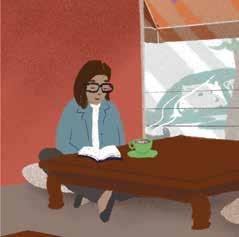

the chatter about topics ranging from trips abroad, identities diverging from the straight and narrow, new projects, or the latest artistic kicks.
Artistic kicks are big at Kopi, which

presents itself as “A Traveler’s Cafe” with bohemian vibes. Said vibes are appropriately chill, and customers of all ages are too—most are dressed with casually hip scruffiness.
The menu is also designed for a diversity of tastes, with its meaty, vegan, caffeinated, and boozy options. You can picture hippies wandering in from any era, but for those with disposable income, there’s a boutique in the back, with colorful clothing options sidelined for a more grannycore look. The staff is the sort that remembers your name if you stop in enough, and they may even adjust a light or two for an easier reading experience if you keep their names in your mind. So if you appreciate sincere, scrappy charm there’s a good chance Kopi will have something for you. Kopi Cafe, 5317 N. Clark, Andersonville, 773-989-5674 v
Reader Bites celebrates dishes, drinks, and atmospheres from the Chicagoland food scene. Have you had a recent food or drink experience that you can’t stop thinking about?
fooddrink@chicagoreader.com

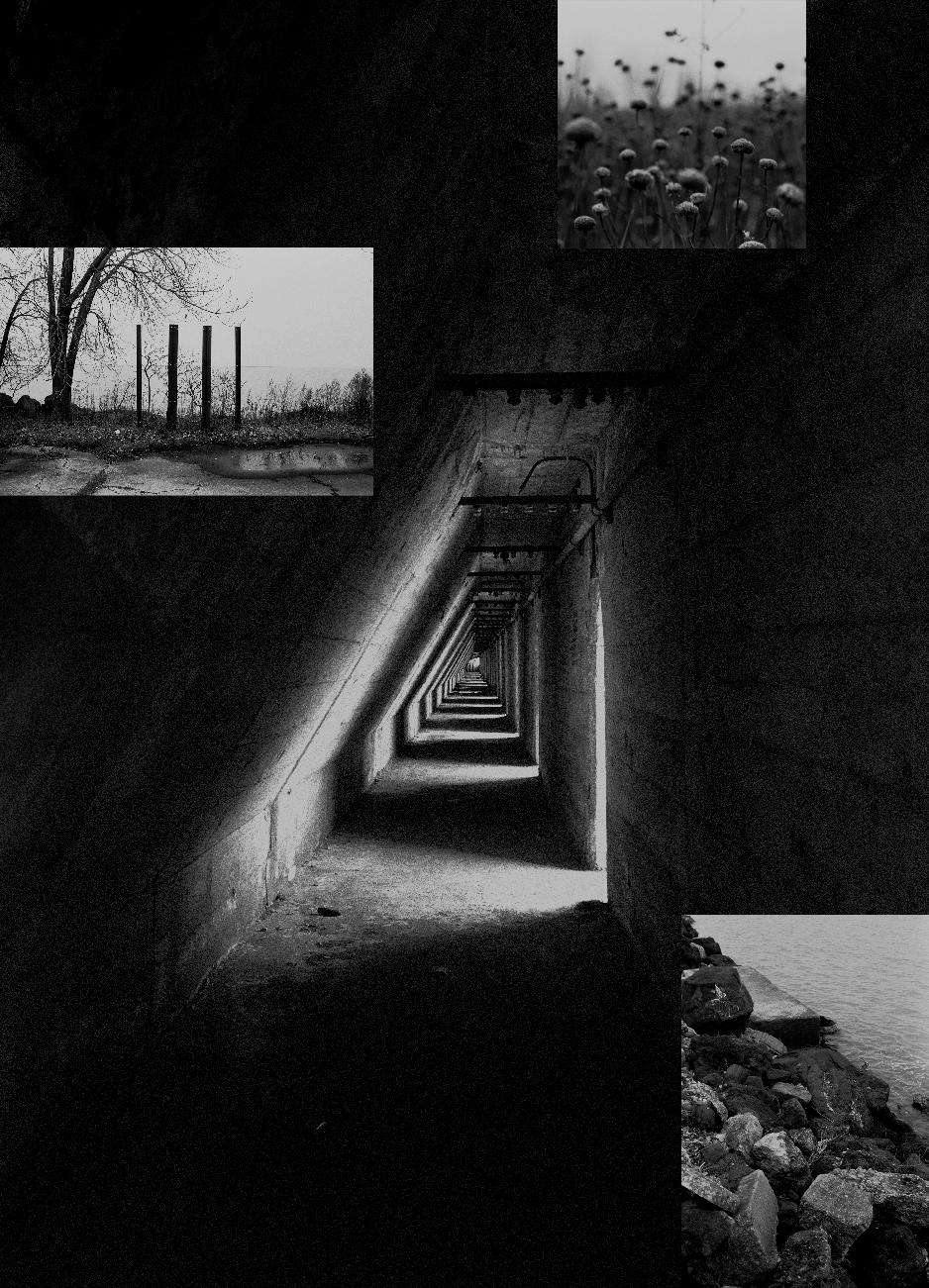
How Governor J.B. and Penny Pritzker worked with universities, tech companies, and powerful business groups to transform Chicago into a global hub for quantum, and the massive data center that comes with it.
BY GREY LUCAS

In an April press conference, Governor J.B. Pritzker was asked about some southeast-side residents’ concerns that a large quantum computing development he has championed may negatively impact the local environment, leave them out of jobs and the wealth it creates, or displace them from the neighborhood altogether.
This lakefront property, some 440 acres stretching from South Shore to East Side, “sat dormant” for three decades because no one wanted to spend the money to clean up environmental contamination on the land, Governor Pritzker said in response. The tech companies he and his sister, fellow billionaire heir to the Hyatt empire, Penny Pritzker, spent years trying to lure to Chicago will clean up the site and bring dollars into the community, he continued.
“I’m really a little bit bewildered sometimes at complaints that people are lodging,” Pritzker said. “If something’s going to happen in the neighborhood, everybody would like something to come
from it. I can tell you this, nothing was there before. Nothing was happening before.”
What he didn’t say at the time was that he and his sister had planted seeds years ago to try to radically change the future of Chicago and the lives of southeast-side residents through quantum technology.
“We shouldn’t have to make that trade-off.”
The three decades since the steel mills closed have been hard on the southeast side, South Shore resident Andrew Torrence said. Working-class communities of color like his go through cycles of being exploited by industry, then abandoned, and this cycle has left some people feeling like they have to take whatever they can get. In some ways, he said, the calculus is the same as it was when the steel mills were king: How can you regain power and autonomy when the future
boom, Governor Pritzker told the Wall Street Journal that he did not want Illinois to miss out on an opportunity like that again in the experimental field of quantum computing. Beginning in 2018, the Pritzkers worked with the Commercial Club of Chicago, one of the city’s oldest and most elite business groups, which reported more than $18 million in assets last year, on a comprehensive plan to turn Chicago into a leading tech city capable of competing with places like Silicon Valley. They called it a “Burnham Plan for Tech,” referencing the famed 1909 plan by architects Daniel Burnham and Edward H. Bennett to beautify and transform Chicago. For her part, Penny cofounded a nonprofit called P33, dedicated to turning Chicago into a tech leader by 2033, in collaboration with tech entrepreneur Chris Gladwin and the Commercial Club of Chicago’s Civic Committee. The 1909 plan and P33’s plan both received financial backing from the Commercial Club, where business leaders go to rub elbows with elected officials, taking a top-down approach to planning the future of Chicago.
Eventually, the Pritzkers and their partners built out an ecosystem to advance investment in quantum, which stretches from the University of Illinois UrbanaChampaign through Chicago and up to the University of Wisconsin–Madison, an area known as “Quantum Prairie,” a play on Silicon Valley.
of your community has been decided by those who stand to profit from that which may harm you?
“There’s this trade-off of harm that folks have to just bite their teeth through in order to have a piece of what can feel like power,” Torrence said. “And we shouldn’t have to make that trade-off.”
Many residents, like Torrence, oppose the development. Others support it, wholeheartedly or begrudgingly, and are pushing to make sure community members have a seat at the table as it unfolds.
The quantum development centers on the Illinois Quantum and Microelectronics Park (IQMP), the foundation for which was laid years ago by the Pritzkers, leaders of Fortune 500 companies, universities, and the tech industry, in service of a much larger goal.
Frustrated that Illinois lost tech professionals and their ventures to Silicon Valley during the Internet
At the same time, militaries across the globe had begun to view investment in quantum computers as a matter of national security due to their potential to break encryption and expose private data. The Pritzkers spent years positioning Chicago to stand out as a global hub for the U.S.’s quantum computing research and development. This work was recognized in the summer of 2024 when Governor Pritzker announced that the Palo Alto–based quantum computing company PsiQuantum, working with a U.S. Department of Defense (DoD) agency, had chosen the long-vacant U.S. Steel South Works site on the southeast side for its sprawling quantum computing research and development park.
Quantum computers harness the power of quantum mechanics—the unique and unpredictable ways that the universe’s smallest particles, such as tiny particles of light, behave—to perform automatic calculations in ways traditional computers cannot. This science could have revolutionary implications for things like developing new pharmaceuticals or batteries for electric vehicles. Because these subatomic particles behave so unpredictably, quantum computers are very prone to errors, and no one in the world has been able to build a large-scale quantum computer that is capable of running without errors while still being able to do much more. The tech companies and researchers coming into the quantum computing
campus in South Chicago will try to be the first to reach this goal.
Critics of quantum computing, including some southeast-side residents and organizers, point to the fact that the technology requires an immense amount of energy—the South Chicago campus’s estimated energy needs are enough to power about 280,000 homes continuously—and is being funded, in large part, by the DoD.
“They’re not putting it in J.B. Pritzker’s backyard, but they’re putting it in our backyard. They assume that we can’t and won’t speak up about it, and they assume that we’re grateful for scraps,” Torrence said. “I don’t feel comfortable with being picked in this quantum facility race. I care about my neighbors. I care about how these things affect us.”
Efforts by the site’s developer, Related Midwest, to meet with residents in South Shore and South Chicago came after the governor’s announcement. These efforts have been focused on winning the battle for public opinion rather than responding to what residents want to see in their neighborhoods, said Torrence, who volunteers with the community group Southside Together which opposes the facility. In these meetings, Related Midwest employees, standing alongside development leaders, have shared information about the quantum computing campus, planned housing, workforce opportunities, educational programming in schools, and an Advocate Health hospital set for construction as part of a broader megadevelopment known as Quantum Shore.
There is one part of Quantum Shore, though, that Related Midwest has not shared information about in community meetings: a massive 1+ gigawatt data center planned for the north side of the 440-acre site.
Related Midwest did announce the data center in a March 2025 press release, and it is featured on the website of its company, Related Digital, which will lead that portion of the development. It also appears on multiple maps of nationwide data centers compiled by the market research companies Baxtel and Data Center Map. The data center will require 1 gigawatt of energy, which is enough to continuously power about 800,000 homes, according to the U.S. Energy Information Administration.
When asked about this part of the development, a Related Midwest spokesperson told the Reader that “Our team is very focused on delivering the first phase of the development, the IQMP, and a data center is not part of that development.” When asked if Related Digital would build a data center in future phases of the development, the spokesperson declined to answer.
An IQMP spokesperson told the Reader in an interview that they are not aware of Related Midwest’s plans for the site outside of the 128 acres that make up the quantum computing campus.
Governor Pritzker has been a tech investor since the 90s, founding Pritzker Group Venture Capital in 1996. He told the Wall Street Journal last summer that he saw how Illinois missed out on capitalizing on the Internet boom and on distinguishing itself as a leader in tech. It was students at the University of Illinois UrbanaChampaign who developed the first graphical web browser, largely credited with spurring the widespread adoption of the Internet.
“But all those companies got up and left, and the leadership of the state really didn’t take seriously the responsibility to put your arms around them,” Pritzker told the Wall Street Journal.
Many early Internet companies left for places like Silicon Valley, where the dot-com boom lured waves of tech professionals with higher-paying wages, raising the cost of living and pricing out long-time renters and homeowners. This reshaped whole neighborhoods as predominantly
ignored quantum technologies in favor of riding the AI boom, federal and local jurisdictions in the U.S. have allocated tens of billions in taxpayer dollars to developing quantum technologies to stay ahead and outspend China—whose government has invested potentially upwards of $15 billion—in a new space race, according to reports by the Wall Street Journal and Harvard’s Belfer Center for Science and International Affairs.
The quantum industry saw $12.7 billion in new government funding commitments in 2025, up 310 percent from the previous year, according to a 2026 report from the Stanford Research Institute’s Quantum Economic Development Consortium. Taxpayers are still footing most of the bill, with new private investment totaling $4.9 billion in 2025.
Why? The first company or country to build a large-scale quantum computer capable of running without errors would have the power to break modern-day encryption methods, rendering classic data protection obsolete and potentially
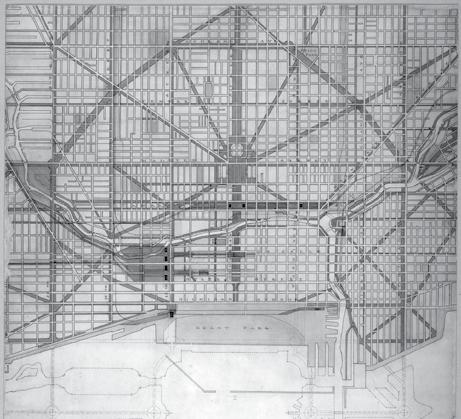
center of the city in Burnham’s 1909 Plan of Chicago
Black and Latino residents and nondegree holders were displaced at unprecedented rates, according to studies by the Urban Displacement Project and the University of California–Berkley.
By the time he became governor, Pritzker knew quantum was “on the verge,” and he wasn’t going to let the opportunity slip by again, he told the Wall Street Journal
“Governor Pritzker recognized early that quantum computing is a once-in-ageneration technology with the potential to reshape the global economy and everyday life,” a spokesperson for the governor’s office told the Reader, calling quantum “a technology that will define the next century.”
While private investors have largely
research and launching a decade - long program to coordinate spending across the Department of Energy and U.S. defense agencies. The “Quantum Prairie” region was a clear choice as one of the leading recipients of this funding,
Governor Pritzker and his sister brought the money and power needed to build on preexisting tech ecosystems.
receiving $280 million, according to the Chicago Quantum Exchange.
In January, Illinois senator Dick Durbin joined a bipartisan group of senators in introducing the National Quantum Initiative Reauthorization Act, which would extend the program for another five years, through 2034.
In speaking with WTTW in 2018, P33’s Gladwin argued that the main reason Chicago, which is home to multiple worldclass research universities and more than 30 Fortune 500 companies, isn’t already a global tech hub is its reputation problem among emerging tech professionals and start-ups. To change this, P33 and its partners would make three “big bets”: invest heavily in quantum, figure out how to satisfy the energy needs of quantum and AI, and garner funding for tech start-ups and workforce development initiatives, according to the company’s website.
The original Burnham Plan is credited with establishing lakefront parks and building Union Station, but it was criticized for inadequately addressing the living conditions of the poor. Chicago Federation of Labor president John J. Fitzpatrick refused to work with the city on the plan, saying it was created to serve the same commercial interests that forced employees to work “long hours at starvation wages,” according to an article by the National Endowment for the Humanities.
exposing the private data of people, businesses, and governments worldwide. Some government systems and businesses have already switched to using new postquantum encryption methods.
Governor Pritzker and his sister brought the money and power needed to build on preexisting tech ecosystems, shaping what the next 15 years would look like for Chicago and Illinois. J.B. and Penny Pritzker’s net worths are estimated at $4.3 billion and $4.6 billion, respectively, according to Crain’s Chicago Business.
Their timing couldn’t have been better. Congress passed the National Quantum Initiative Act in 2018, authorizing $1.275 billion in federal funding for quantum
When asked about how their Burnham Plan for Tech will avoid critiques of the original plan, a P33 spokesperson highlighted the nonprofit’s support for a job training program called Xchange Chicago, tech grants for local entrepreneurs, STEM programming, and efforts to reopen an indoor pool in the Salud Center operated by South Chicago nonprofit Claretian Associates.
A spokesperson for Penny Pritzker’s investment firm, PSP Partners, did not respond to questions about her work with P33 or her role in turning Chicago into a global hub for quantum computing.
After being elected governor, Pritzker put $200 million of taxpayer dollars into the Chicago Quantum Exchange, established at the University of Chicago in 2017, which brings together regional
universities, national laboratories, tech companies, powerful business groups, economic development organizations like World Business Chicago—P33, of course—and government officials to create a Silicon Valley-esque ecosystem
On the global stage, the DoD quickly framed the quantum race as a national security issue.
dedicated to advancing quantum technologies. The Chicago Quantum Exchange is housed within the University of Chicago’s Institute for Molecular Engineering, which was founded as the Pritzker School for Molecular Engineering in 2019 after a $100 million gift from the Pritzker Foundation—the university’s first new school in 30 years, according to a University of Chicago blog post.
On the global stage, the DoD quickly framed the quantum race as a national security issue, akin to earlier programs like the Manhattan Project and the space race—a talking point echoed by researchers and politicians across the country. Leading the charge is the DoD’s Defense Advanced Research Projects Agency (DARPA), which the U.S. government formed to make highrisk investments in technologies that could prove useful to the military. Many technological advancements, including the Internet, GPS, and Apple’s Siri, got early investment based on their ability to prove to DARPA that their tech could one day aid the military.
DARPA has been funding and evaluating the approaches of quantum computing companies like PsiQuantum over the last few years through a multistage program called the Quantum Benchmarking Initiative to see whether it’s possible to build an “industrially useful” quantum computer. The next stage of this operation will take place at the DARPAIllinois Quantum Proving Ground, a key part of the quantum computing campus being developed in South Chicago.
When PsiQuantum and DARPA began looking at sites for a quantum research and development park, Pritzker worked with the county and Mayor Brandon Johnson to lure the company to South Chicago through a $200 million package of property tax breaks, capital grants, a low-interest loan, and other incentives, according to a 2024 press release. They offered tax breaks to other tenants that signed on to the park, ultimately bringing five other tech companies to the site. As the project moves forward, it has become a key part of Pritzker’s 2026 reelection campaign, according to his campaign website.
The City of Chicago provided the development with $5 million in housing and economic development bonds, and
Cook County invested $5 million in direct funding. The county also approved a new property tax incentive for manufacturers of semiconductors and other technology needed for quantum computing, awarding it to the quantum computing campus and lowering its property tax rate to 10 percent from the typical 25 percent.
Public money was needed to help the developers, Related Midwest and CRG, shoulder the cost of cleaning up the site and building out infrastructure, Johnson’s deputy press secretary, Griffin Krueger, said in a statement to the Reader . The site previously lacked access to basic amenities such as water and broadband.
“Without major up-front infrastructure and site preparation invest -
than the typical timeline for similar developments in the city.
Johnson told the Chicago Sun-Times in July 2024 that the development timeline would be “aggressive,” as speed to market is one of the reasons PsiQuantum picked the site in South Chicago.
This kind of “cooperation” from public officials makes it easier to attract investors, Related Midwest president Curt Bailey said at a Chicago Plan Commission meeting in fall 2024. At that time, the project, which had $600 million worth of construction planned, was not yet fully funded, Block Club Chicago reported. Related Midwest bought the U.S. Steel South Works site from its partner, venture capital firm Blue Owl Capital, for $58 million shortly before breaking ground last September,
NietoGomez, executive director of local nonprofit Alliance of the Southeast. By the time they found out, tax breaks had been given, and structures to bolster public and private investment in quantum in their area were already years in the making. About $1 billion in public funding and tax breaks has been committed to support the IQMP project, according to data compiled from press releases and budget documents issued by the county, state, and IQMP leadership.
Local organizers attended every public meeting they could, urging public officials to slow down and give residents time to consider the plans, said Anne Holcomb, a South Shore resident and founder of the community group ETHOS (Environment, Transportation, Health, and Open Space). Holcomb and NietoGomez are part
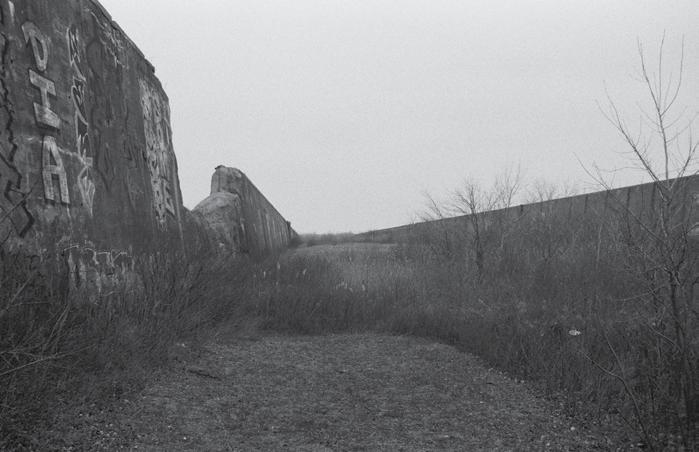
ment, the site would likely remain underutilized for years,” Krueger said in the statement. “The goal of the city’s participation is to catalyze billions in private investment, new jobs, and a dramatically expanded tax base that will ultimately benefit the southeast side and the entire city.”
The Cook County Board of Commissioners invested another $20 million in the park in October to cover costs associated with the cryogenic facility required to maintain temperatures near absolute zero, which are necessary for quantum computing. This came after the park’s board of managers discussed the need to get financing for the cryoplant in late 2024.
Related Midwest got the site rezoned before even purchasing it, and in just six months, the project went from announcement to final approval from the City Council in December 2024—much faster
according to a report from the Real Deal
Related Midwest struck a deal, known as a ground lease, with Blue Owl in which Related Midwest owns the real estate built on the site while Blue Owl still owns the land it sits on, the Real Deal reported. Ground leases allow developers to get started on projects sooner without having to raise the money needed to purchase a site outright.
A Related Midwest spokesperson declined to respond to questions from the Reader about whether the company has been able to raise the remaining funds needed to complete the project.
Community organizers on the southeast side said they didn’t learn about the plans for their community until the IQMP was announced in 2024.
“No one had come out to the community to say, ‘Hey, we’re considering a proposal for the site,’” said Amalia
of the South Works Community Benefits Agreement (CBA), a group of nonprofits, churches, businesses, and schools that are demanding developers sign a legally binding agreement that would require them to prioritize local residents for jobs and take steps to protect residents from environmental harm and displacement, among other things.
In an interview with the Reader , 10th Ward alderperson Peter Chico dismissed concerns, saying that the various community groups raising them were asking for different things, calling it “mixed messaging.”
According to Sanya Bhartiya, an organizer at Southside Together, Johnson said he would meet with the group to hear their concerns earlier this year. Johnson’s press secretary, Krueger, did not answer a question from the Reader about whether this meeting ever took place.
When developer Related Midwest and other IQMP leadership came into the community to talk about the project, residents often expressed concerns that they would bring a data center to the neighborhood, community advisor Shaunna SimsDavis said at an April IQMP board meeting. A data center, in its most basic sense, is a physical facility that contains the equipment needed to store, process, and disseminate digital information. These physical facilities have existed since the advent of the Internet, but the boom in AI and supercomputing has necessitated larger data centers, often known as hyperscalers, that have long-lasting impacts on air and water quality, and energy bills in the communities where they are built. Data centers popping up across Illinois
to the Chicago Planning Commission in the fall of 2024, meaning the developer is authorized by the city to use the land for this purpose. But Related Midwest has otherwise avoided publicly mentioning the project and did not directly answer questions from the Reader about it.
Not communicating at all, or only sharing certain information or presenting it in a certain light, are tactics often used to push data center proposals forward before community members can oppose them, said Kerri Hickenbottom, an associate professor of chemical and environmental engineering at the University of Arizona who studies data centers.
“Data centers are kind of looked at as a black box; we know some of what goes into them, but not everything,” Hickenbottom said.
structure needed to meet the maximum amount of energy currently required of its systems. In December, state regulators warned of power outages and further increases in energy prices if legislators cannot effectively curb the impact data centers are having on the electrical grid.
When asked about this, the spokesperson for the governor’s office said he has called to pause new tax breaks for data centers for two years (after previously championing them), beginning July 1. The pause would not apply to tax breaks already promised to developers, according to a Capitol News Illinois report. Pritzker recently signed the Clean and Reliable Grid Affordability Act, which seeks to “strengthen the grid and meet future demand,” the spokesperson said.
Beyond Related Midwest’s plans for a
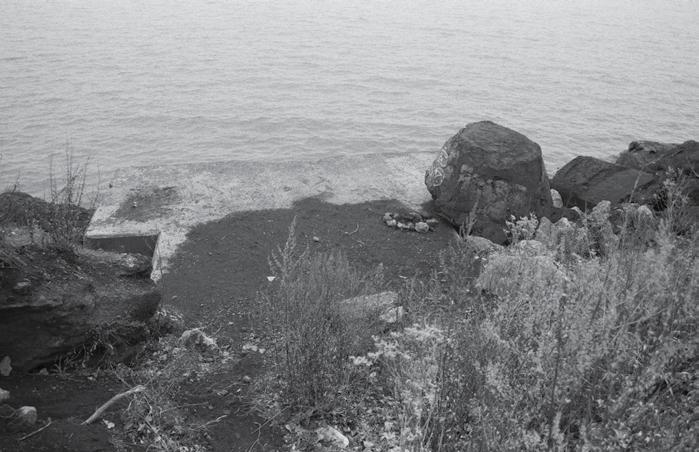
have faced strong, bipartisan opposition, and recently, legislation has been introduced to curb their impact on residents.
Project leadership repeatedly assured residents that the quantum computing campus planned for the southern portion of the South Works site is not a data center. But developers declined to mention that a Related Midwest subsidiary, Related Digital, has announced plans to build a massive data center at the northern end of the site.
Related Digital was founded by Related Midwest last year and already lists six data center projects on its website, including its Chicago project, which was announced in a March 2025 press release. The data center proposed for South Chicago is set to have a capacity of at least 1 gigawatt, equivalent to 1,000 megawatts. Data centers were listed as a permitted use of the site in Related Midwest’s application submitted
The impact of hyperscale data centers goes beyond just water and energy use, Hickenbottom said. The noise from fans used to cool the equipment has a negative impact on nearby residents and wildlife, and heat exhausted from the facilities makes the temperature near data centers about two degrees warmer than average temperatures elsewhere. Data centers often need diesel-powered backup generators to keep data protected in the event of a power outage, Hickenbottom said. These fail-safe systems have to be tested once a month, which causes air pollution, and are sometimes used to power data centers when utilities are delayed in coming online.
The ComEd territory in northern Illinois has enough high-energy-demand projects awaiting service that energy demand could more than double by 2040, according to an April report from Capitol News Illinois. It took ComEd 120 years to build the infra-
the Israeli Quantum Computing Center in Tel Aviv, Israel, served as a blueprint for how to build such “a quantum data center, or a data center set up for quantum,” Sivan said. The computing center Quantum Machines will build at the IQMP will follow this blueprint, he said.
Since the first announcement of the IQMP, project leadership has avoided mentioning any language related to a data center. “The IQMP is not a data center nor does it function like one, and it will not have a data center on campus,” a spokesperson said in a written statement to the Reader
“The IQMP’s projected energy and water demands will be a fraction of those associated with hyperscaler data centers,” the spokesperson said. Data centers are typically considered “hyperscale” when they require more than one hundred megawatts of power to operate, though modern hyperscalers can draw up to one thousand megawatts, according to a February panel discussion of leading scientists. ComEd is making infrastructure improvements around the South Works site to provide the IQMP with up to 350 megawatts of energy to power PsiQuantum’s building and the cryogenic cooling facility that will be shared by various tenants, according to a blog post by the utility provider. ComEd worked to rapidly deliver one hundred megawatts to PsiQuantum so that the company can build a prototype quantum computer once the first phase of construction is done.
hyperscale data center on the site, there is also the quantum computing campus itself. How does the infrastructure of the quantum computing campus compare to that of a conventional data center?
Wherever a quantum computer is being built, a data center is needed nearby to house this hardware, as with any other kind of computer, said Danyel Cavazos, quantum instructor at the University of Chicago.
Quantum computers often use “quantum data centers” to house quantum computing equipment alongside classic computing equipment so that the two can work together efficiently as a single hybrid machine, said Itamar Sivan, cofounder and CEO of IQMP tenant Quantum Machines. These quantum data centers have specialized architectural needs, such as cryogenic cooling to keep quantum computing resources at absolute zero. Quantum Machines’s facility at
The cryogenic infrastructure at the IQMP campus will rely on helium for cooling and will be contained within a “closed-loop system,” requiring only a “small fraction” of the water used by a hyperscaler data center, the spokesperson said. The IQMP spokesperson compared the quantum computing campus’s water use to that of your average hospital, which is about 85,500 gallons of water per day for a 150-bed hospital, according to Healthcare Design Magazine. Hickenbottom said that even “closed-loop” cooling systems, where the same volume of water mixed with a coolant is continuously recycled to save water, need to be flushed on occasion.
“Also, every bit of energy that we use has some sort of water footprint,” said Hickenbottom, whose home state of Arizona has long felt the scarcity of water resources.
“No one had come out to the community to say, ‘Hey, we’re considering a proposal for the site.’”
When choosing where to develop a data center, developers often look at “how easy it is for them to get resources and what’s the level of community opposition on the
political side,” said Xiaofan Liang, assistant professor of urban and regional planning at the University of Michigan.
The importance of community sentiment has grown over time as data centers are no longer the “mythical industry no one paid attention to” that they were a decade ago, Liang said.
Torrence said that while communities like South Shore and South Chicago may have been primed to accept less by decades of disinvestment, that doesn’t mean they have to. “We’ve seen how this happens across the country in different cities, especially a lot of majority Black cities, where they’re building these data centers, and folks don’t want them,” he said.
A report by research firm Data Center Watch found that at least 75 data center projects worth approximately $130 billion were blocked or delayed in the first quarter of 2026 alone. Opposition extends beyond diverse cities like Chicago, as residents in predominantly white rural areas and suburbs, such as Chesterton, Indiana, have also beaten back data center proposals in recent years.
Maintaining positive community sentiment hasn’t exactly been smooth sailing in South Chicago, where the history of the steel mills and the pains of deindustrialization built a strong legacy of labor organizing and community resistance.
Related Midwest worked with United Metro Way of Chicago and LISC Chicago to fund a revamp of South Chicago nonprofit Clareitan Associates’ 2007 Quality of Life plan, a spokesperson for the Governor’s Office said in a written statement.
“We try not to get all wound up in who those supporters are because that shouldn’t control what the plan says, does, or how it acts, how it plays out, or any of that. It is what it is, and the plan will be what it is, because the community has to drive the plan,” said Angela Hurlock, executive director of Claretian Associates. “It is a community-driven plan, not a funder-driven plan.”
The Quality of Life planning process brought community members together through a series of meetings held across
“Data centers are kind of looked at as a black box; we know some of what goes into them, but not everything.”
2024 and 2025 to identify seven key priorities for the community’s development: arts and culture, economic development, education, environment, infrastructure, health, housing, and safety.
Claretian Associates is also a founding member of the Coalition for a South Works CBA, which came together in 2013 to push prospective developers of the site to sign a legally binding agreement with the
community. Hurlock said the new Quality of Life plan shares many of the same priorities as the proposed community benefits agreement but is not legally binding.
Withholding support for the project until developers sign a legally binding CBA is a crucial bargaining tool to make sure the community gets the protections needed in the face of such a sudden and massive influx of cash into their long disinvested community, said NietoGomez, another founding member of the CBA Coalition who also served on the steering committee of the Quality of Life plan. CBA leaders recently began meeting with the Illinois Environmental Protection Agency and Related Midwest to provide oversight
disinvestment and economic stagnation.
A new group called Southeast Neighbors for Quantum, made up of representatives from local businesses, schools, and churches, held a press conference in March to declare their support for the incoming development and encourage others to get on board. The group is led by CEO and principal of St. Francis de Sales High School Roni Facen and Jorge Perez, owner of local spot Chico’s Oven and president of Lake Effect Community Development, a southeast-side economic development organization. Also leading the group are Erika Galan, program manager for the Calumet Area Industrial Commission’s Special Service Area

Hardware
into the plan to clean up the site, she said. Their next step is to try to meet with the developer about their demands for jobs and housing protections.
Members of the grassroots community organization Southside Together, who pushed for a CBA during the development of the Obama Center in South Shore, have said that even this approach will not protect the community in this case because the development would immediately harm the community’s environment and infrastructure.
“It’s air pollution, water pollution, sound pollution, higher electricity costs,” said Kashawna Brantley, a South Shore resident who works in tech. “It would strain our electrical grid, our sewage system. With how much destruction it would cause to the community, a CBA is not feasible.”
The three groups disagree on method, but representatives from all camps expressed similar concerns for how the development might impact their neighborhood and a desire to have their voices heard. All three camps also emphasized the need for new investment in the community after more than 30 years of
about 40 units of infill housing near the quantum computing campus, former alderperson Susan Sadlowski Garza (10th ward) said. Perez did not respond to the Reader’s questions about his involvement in developing housing with Related Midwest. Also in attendance at the March press conference was local landlord and 7th Ward Republican committeeman David Lottich. In December, Southside Together petitioned to put a question on the March ballot asking southeast-side voters if they want to stop the quantum development in favor of using taxpayer dollars to clean up the site and develop “resident-focused, resident-controlled” developments like “grocery stores, truly accessible housing, and youth centers that create job opportunities for residents with community oversight.”
Lottich was one of three southeast-side residents who objected to the ballot question. City election officials ruled that the referendum contained more than one question in violation of state law and tossed it from the ballot.
Lottich said he would not necessarily have objected to the question of his own accord, but when he and two others were asked to be local “stand-in objectors,” he felt “called by conscience” to agree. When asked who asked him to be an objector, he said, “Well, you see a lot of them around you today.”
IQMP leadership initially met with the community through a series of large-group meetings held in person and then posted online. Various meetings, such as those held in October 2024 and March 2025, ended in tense confrontations between residents and project leadership.
(SSA) 5, which uses property taxes in South Chicago to fund local services and improvements, as well as former Illinois House candidate and fourth-generation South Chicago resident Sharon Latiker.
Perez said he formed the group after becoming frustrated with criticism of the project coming from “the opposition,” groups like the CBA Coalition and Southside Together. “It was me kind of just fed up with basically the entire kind of public perception of the project, perception of what was going on, and just the frustration, because everything that we’ve been seeing has been contrary to all of that,” Perez said in an interview with the Reader “I was thrilled to see that the development was coming to the southeast side, and I knew that I would not let this generational opportunity pass us by, which is why I’m standing here today,” Perez said during the press conference. “This development has the potential to make the community the thriving economic center that it once was—the reinvestment, jobs, educational opportunities, and more directly to our residents, the hope for the future.”
Perez’s development company is partnering with Related Midwest to develop
More recently, IQMP staff has pivoted to doing more small-group or even one-on-one meetings with “businesses, faith-based organizations,” and residents, community advisor Sims-Davis said in an April board meeting. Video and materials from these meetings have not been posted on the IQMP website.
“[Residents] want them to be bigger than what they are. We like to continue to have them to be smaller, because we realize that that works,” Sims-Davis said in the board meeting.
They held more than 30 such meetings between January and April in addition to weekly virtual meetings, according to a presentation shown at the board meeting. In response to questions about this change in tactic, an IQMP spokesperson said staff have participated in “dozens and dozens” of community meetings of various sizes, adding that they “continue to meet with residents every week and don’t plan on slowing down.”
“It’s getting the word out, and people are talking more, and the narrative has started to change about who IQMP is because everyone wants to believe that we’re a data center, and we know better,” Sims-Davis said. v
themail@chicagoreader.com
By Bri Palmer
A trip to the dentist should never feel like a clinical chore, but rather like a warm welcome home. At Watson and Watson Dental Association, exceptional patient care is rooted in deep intention, turning what many people find daunting into a comforting and predictable routine. Every individual who walks through the front door is welcomed like kin, and the team prides itself on equipping people with the practical wisdom needed to preserve healthy,

glowing smiles far beyond the clinic walls. It is this dedicated ethos that keeps regulars coming back generation after generation.
The story began in 1962, when a young Dr. Cheryl Watson-Lowry watched her father build a practice from the ground up, fueled by compassion and a drive to serve. Inspired to follow in his footsteps, Cheryl stepped into the energy of the o ce at just eleven years old alongside her sister, Carla. Today, Dr. Watson-Lowry guides the practice with a steady hand while Carla manages the daily rhythm and operations with exceptional care. Together, the sisters have nurtured deep relationships across decades, proudly welcoming patients of all stages of life, from six month old infants taking their very first peek at the dentist’s chair to a 107 year old living vibrantly on her own terms!
Dr. Watson-Lowry’s dedication to dental health extends well beyond the chair. In 2019, she became the first woman and first African American to serve as president of the Chicago Dental Society in its history, a milestone that reflects decades of leadership across the Illinois State Dental Society, the National Dental Association, and the American Dental Association, where she currently serves on the Council on Governmental A airs. Her advocacy has carried her well beyond Chicago too. She has testified before Congress on the Action for Dental Health Act, helping secure essential care for underserved communities before it was signed into law in 2018, and she has




even traveled to present toothbrushes to the Pope. Her honors include the Chicago Defender’s Women of Distinction Award and recognition as one of Most Distinguished Women of Illinois, among many others.
Her father modeled the importance of lifting up the neighborhood, and it is a legacy the sisters keep very much alive. The practice consistently hires local youth from the surrounding area, o ering many of them the milestone of their very first job.
At Watson and Watson, the team looks past a quick fix. When a patient faces recurring cavities, Dr. WatsonLowry works to uncover the root cause, empowering people to shift their daily habits and protect their natural smiles for life. The practice o ers a full range of restorative and cosmetic services, from comprehensive exams and cleanings to veneers, whitening, implant restoration, and everything in between. Give Watson and Watson Dental Association a call today and step into a legacy of care that was built to last. They are open Monday, Tuesday, Wednesday, and Friday from 10 AM to 6 PM, and one Saturday a month from 8:30 AM to 1 PM!
Watson and Watson Dental Association
Address: 8325 S. Stony Island Ave. Chicago IL
Hours: Mon, Tue, Wed, and Fri, 10 AM–6 PM, Thu closed, Sat 8:30 AM–1 PM once per month
Website: watsonandwatsondental.com
Phone: 773-768-3100
Instagram: @watsonandwatsondental


Read the series

If you have a few bucks, a day to burn, and an itch to get out in the world, here are 19 cheap, weird, and wonderful day trips worth taking, ideally with some friends. From the shore of Lake Michigan in Gary to the crust of an Italian beef eggroll in Berwyn, the Reader brings you thrifty escapes sprinkled across the midwest— close enough to pull off on a whim, but far enough to feel like somewhere new. Here’s where to go and what to see without emptying your pockets this summer.
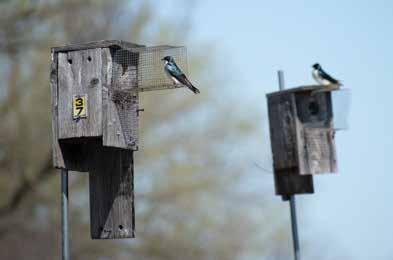
MILLER BEACH GARY, INDIANA
Gary, Indiana, often gets a bad rap, but the Miller Beach neighborhood is a favorite summer day excursion for my partner and me. About an hour away by car, and accessible by the South Shore train line, Miller Beach is located at the southernmost point of Lake Michigan.
The beach itself is clean, uncrowded, and easy to park at, with no fees, making it a welcome relief from Chicago’s congested shorelines. It’s a slightly surreal lakefront view, with both the Chicago skyline and Gary’s furiously billowing industrial smokestacks visible in the distance. There’s a sprawling, paved beach walk that leads to Marquette Park , named after flight pioneer Father Marquette. Large-scale models of Marquette’s early planes, the Tuskegee Airmen, and Octave Chanute grace the walkway by the Marquette Park Pavilion.
The Miller Beach neighborhood has charming small-town vibes but is also a sort of liberal, arty oasis, especially for Indiana. There are creatively decorated midcentury houses and small shops galore.
For bargain hunting, though, we always swing by the neighboring burg of Chesterton. Their antique mall, Yesterday’s Treasures, is pure ramshackle fire! Every stall is an adventure in digging, whether it’s organized shelves of VHS tapes or a grimy floor explosion of vinyl record detritus. For more secondhand shopping, Hobart, Indiana, is nearby, with the Green Door used bookstore, where almost every volume in the store is a dollar. (There are loads of old sci-fi paperbacks, making this nerd especially happy.)
If you need a refreshing break from your beach and shop crawl, Vibrations Health, Wellness & Juice Bar in Gary has nutritious drinks galore, and most sandwiches are under $12.
If you crave some gorgeous nature trekking, Indiana Dunes National Park is close by and features a pleasant boardwalk stroll, and Indiana Dunes State Park is but a short drive away. If you feel ambitious, the latter has a “Three Dune Challenge” hiking endurance test. I’m usually much too tired for such an endeavor after all the fun at Miller Beach and ready to head back to Chicago. STEVE KRAKOW (AKA GARY/ MB BOARD OF TOURISM)
Fiberglass isn’t forever, but the apparent corpses in this potter’s field of pop culture detritus will outlast us all. Beginning in 1978 with the 145-foot musky that greets visitors to Hayward, Wisconsin’s Freshwater Fishing Hall of Fame, the antecedents of the FAST corporation (Fiberglass Animals, Shapes, and Trademarks) built a reputation as a go-to manufacturer of oversize, brightly colored mascots, waterslides, and roadside attractions. You can spot them all over the world, but they’re particularly prevalent in Wisconsin (try to find a cheese shop without a humungous rodent beckoning you to pull over). Notably, hometown Sparta, the self-styled Bicycling Capital of America, supported its case by commissioning the FAST-fabricated World’s Tallest Bicyclist; the 32-foot Ben Bikin’ sits astride his old-timey penny farthing at the terminus of the nearby Elroy-Sparta bike trail. Along the way,
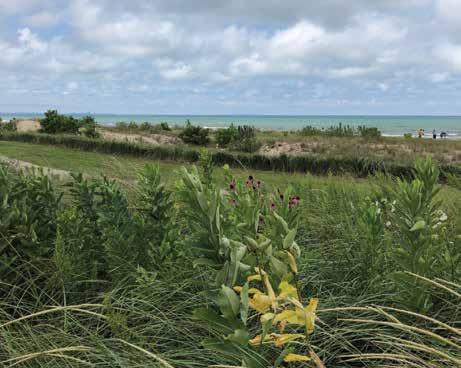
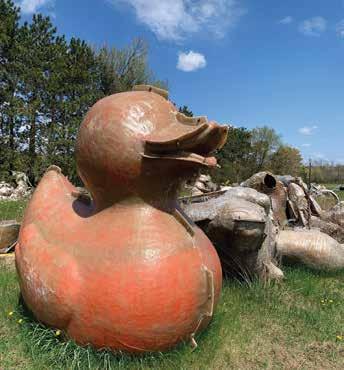
a fiberglass mouse sits in the lot of Carr Valley Cheese.
Here, at its rural HQ, it looks like FAST haphazardly laid its unfinished rejects to rest in the neighboring grassy sprawl. Poking up among the weeds, you’ll find giant bats, bears, bunnies, bulls, cows, cocks, frogs, fish, dragons, demons, dogs, donkeys, ducklings, dinosaurs, elephants, turtles, sharks, balls, gloves, guitars, locomotives, pirates, skulls, Vikings, giants in repose, and giants on the march. Think of a darker, more absurd memorial to lastgasp capitalist kitsch than a moldering, blank-eyed Bob’s Big Boy drunkenly tottering in the shrubbery.
Exposed to the elements, they’re gray, stained, stonelike, and though a sign welcomes you to wander among them, it also warns of wasp nests and jagged edges. In your nightmares it’s a boneyard where the undead menagerie animates after dark in a Bosch-like orgy ushering in the End Times. But it’s actually an outdoor inventory of reusable molds. By
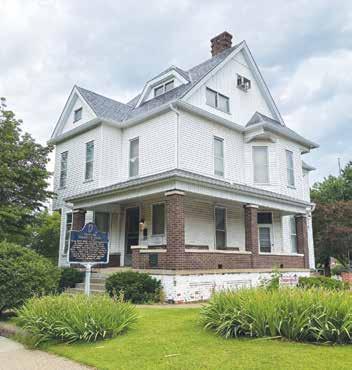
the industrial miracle of pultrusion (“pull” plus “extrusion”), glass fiber–reinforced plastic can endure a half century or more, even in the unforgiving Driftless winters. So anytime FAST takes another order for Bucky Badger, it simply drags him from the field, into the workshop, and back from the dead.
MIKE SULA
EUGENE V. DEBS MUSEUM TERRE HAUTE, INDIANA
The crisp, early May air tickles my nose through open car windows as I veer off I-94 toward 111th for a quick pit stop. I pass the Walmart Supercenter and the municipallandfill-turned-private-golf-club before easing to a stop in front of a towering
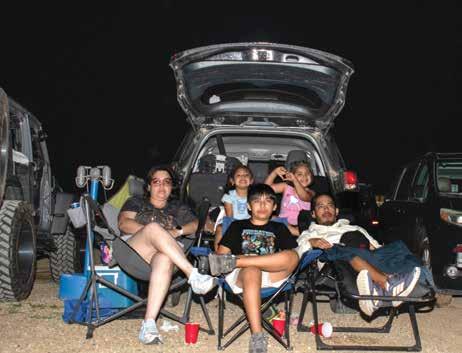
of the earth. I said then, and I say now, that while there is a lower class, I am in it; while there is a criminal element, I am of it; while there is a soul in prison, I am not free.”
SHAWN MULCAHY
MCHENRY OUTDOOR THEATER
MCHENRY, ILLINOIS
It’s easy to be a cinephile in a city like Chicago. Here, movie-lovers are spoiled with an embarrassment of filmhouse riches like the historic Music Box Theatre, the Siskel Film Center, the beloved Davis Theater, back-to-back Dolby cinemas, multiple dine-in venues, and even a (truly bizarre) seat-rattling, face-spritzing, amusement park ride-like 4DX.
building of glass and bright red brick. I look up at the Pullman National Historic Park visitor center and imagine what it must’ve been like more than a century ago as a company town under the thumb of industrialist and railroad baron George Pullman. I think about how the famed labor organizer, anti-war activist, and Socialist Eugene V. Debs walked these same grounds as he rallied workers for the American Railway Union (ARU), the nation’s first industrial labor union.
Debs’s former house in Terre Haute, Indiana, three hours south, is my final destination. These days, the charming, white, two-story clapboard building is open to the public five days a week as a free museum. Guides offer guests 30–90 minute tours of Debs’s writings, personal effects, and other ephemera.
Debs’s politics were informed by his own working-class roots. He dropped out of school at 14 for a job in the railyard. As Terre Haute city clerk, he refused to collect fines against sex workers. Yet, it wasn’t until a six-month stint in the McHenry County jail—the price of his leadership in the ARU’s historic strike against the Pullman Company—that his politics shifted from reformist to radical.
A 1926 obituary in Time claims Debs was visited in jail by the socialist Milwaukee journalist Victor L. Berger, who left a copy of Karl Marx’s Capital. “Debs read it slowly, eagerly, ravenously.”
From then on, Debs advocated for a more militant form of class struggle. He helped found the U.S. Socialist Party and ran as its presidential nominee five times between 1900 and 1920. Debs ran his final campaign as a prisoner inside an Atlanta jail, where he was incarcerated for sedition after denouncing the U.S.’s involvement in World War I.
At his sentencing, Debs delivered perhaps his most famous line: “Years ago I recognized my kinship with all living beings, and I made up my mind that I was not one bit better than the meanest
But when it comes to movies under the stars, the suburbs have us beat by a country mile. Located a little over an hour outside the city, the McHenry Outdoor Theater is worth a pilgrimage.
Even during the day when it’s not screening anything, the drive-in is a thing of beauty—its massive, monolithic seven-story brick-screen building and ivycovered marquee are rarities even among the three hundred or so surviving drive-ins in the U.S. Ask anyone who grew up in the Chicago suburbs about it, and you’ll hear stories about high school date nights and core family memories, pet dogs included.
And at only $15 for adults and $10 for kids for double-feature standard tickets, they’re affordable memories to make. Tuesdays and Thursdays are even cheaper, with a $15 flat rate per vehicle, and concessions are reasonably priced—$2 hot dogs on Sundays, for instance. Just two minutes down the road is the pint-size historic landmark Riverside Chocolate Factory, a good stop for preshow treats.
One of my favorite rare drive-in aesthetics is the quiet midscreening walk from the car to the concession stand, where the sound of gravel underfoot mixes with everyone’s car radio audio and, in years past, all the vintage junction box speakers. It’s truly the only time I look forward to getting up during a movie.
DAN JAKES
CARBON HILL SCHOOL MUSEUM GRUNDY COUNTY, ILLINOIS
Many of my hot summer days as a child were spent in the coal mines of Grundy County, floating in the water-filled caverns that bloom into a series of local lakes. Feeling the cold, dark depths beneath your kicking legs felt like a rite
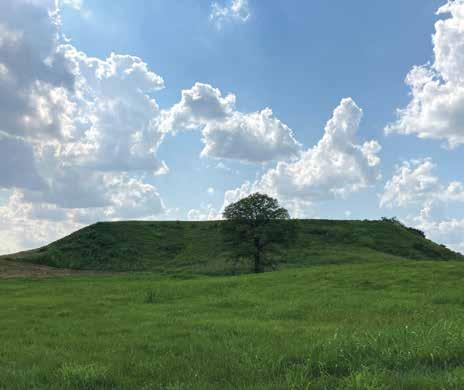
of passage, hovering above the infinite nothingness of those long-abandoned mines. As a descendant of coal miners in Illinois, I’ve always been drawn to these landscapes: the lush rural swaths that mark what coal country once was. It’s impossible not to imagine the lives once lived—and lost—underground.
Carbon Hill School Museum is quietly keeping that history alive. This glowing pearl of an 1893 schoolhouse is packed with antiques, educational memorabilia, soccer trophies and bocce balls, coal-mining tools, old mine maps, photographs of miners and their children, and fossils, as reminders that coal is simply ancient trees, ferns, and mosses. Here, I came across old photographs of Italian immigrants and Black miners who followed the coal to rural Illinois in search of economic opportunity.
Life then was often marked by strikes and shutouts because, as local historian
Michele Enrietta Micetich explains, coal companies owned everything from housing to railroads and shipping lines. “Everything in your life revolved around the mine,” she says.
Converted into a museum in 2000, the simple three-room museum continues to honor the people who toiled, organized, and built lives in the Industrialists’ coal mines.
Just down the road stands the Diamond Mine Disaster memorial , commemorating one of Illinois’s worst mining tragedies. In 1883, floodwaters overtook the Wilmington Coal Mining and Manufacturing Company mine, killing 80 men and boys and helping spur formal mining safety regulations in Illinois.
Micetich is the resident docent who also serves as a local genealogist and family historian for people with personal connections to the area’s mines. She’ll sit with you for hours poring through photographs of miners’ children to attempt to identify
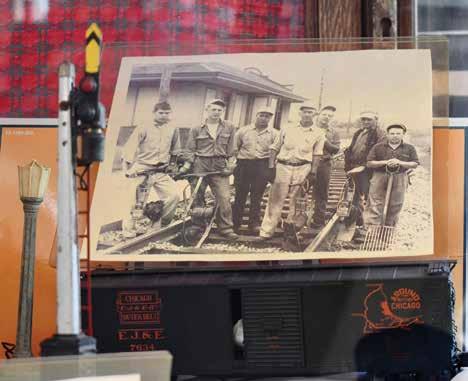
your ancestors, some of whom may be buried not far from the museum in a plot known humbly as the Italian cemetery.
The mines may be flooded and silent now, but in the old schoolhouse at Carbon Hill, their echoes still rise to the surface.
SARAH CONWAY
CAHOKIA MOUNDS COLLINSVILLE, ILLINOIS
About three hundred miles southwest of Chicago lies the largest pre-Columbian site north of Mexico: Cahokia Mounds
From around 1050 to 1350 A.D., Cahokia was the largest city in North America, with a population of between 15,000 and 20,000. The 2,200-acre site, located in what’s now Collinsville, Illinois, has 80 of the original 120 earthen mounds, which served as public buildings and burial mounds. The largest of these is Monks Mound, which rises one hundred feet and overlooks the Mississippi River. Visitors can climb a stairway to the top, where signage provides historical information. The view is phenomenal, though I wouldn’t recommend making the trek at the hottest part of the day, as I did. (An Augmented Reality app is also available for download, which serves as a tour of the site and helps you experience the area as it existed a thousand years ago.)
Another notable feature is “ Woodhenge ,” a reconstructed circle of posts that aligns with the sun’s movement. Each year, Cahokia holds a free summer solstice event for observation. The UNESCO World Heritage site also includes trails of varying lengths and difficulty levels (a one-mile concrete trail is wheelchair
accessible), restrooms, and a gift shop. Unfortunately, a small onsite museum is currently closed for renovations, though Cahokia is still well worth the visit. And Saint Louis is just another 15 minutes away by car, offering a bevy of options for further exploration, as well as great food and affordable lodging. For the former, I’d recommend Contemporary Art Museum St. Louis, the Pulitzer Arts Foundation, and the Laumeier Sculpture Park, all of which are free. For the latter, try Coffeestamp for a caffeine boost and Royale for food—including lots of veg-friendly options—and drinks.
KERRY CARDOZA
Time travel with one of the largest scrapmetal sculptures on the planet
About 35 miles from Madison, Wisconsin, along U.S. Highway 12 between Baraboo and Sauk City, the membrane between parallel universes thins to nothing. Pull off the road at the big steel sphere, and you can walk into a world powered by “level seven love energy” and populated by extraterrestrials, colossal bugs, and an orchestra of birds. The Dr. Evermor Sculpture Park most famously hosts the Forevertron , an interdimensional time-travel machine that’s also one of the largest scrap-metal sculptures on the planet—65 feet high, more than one hundred feet long, and weighing an estimated three hundred tons.
Dr. Evermor, also known as Tom Every, worked for decades in demolition and salvage, and in the 1980s he began using scrap to build monumental artworks. He
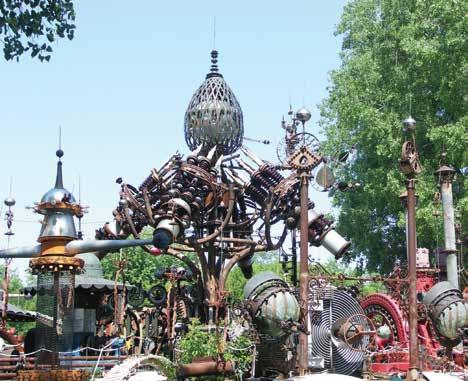
and a team of collaborators, including his son Thayer, completed the Forevertron in 1986. Its components include batteries from the nearby Badger Army Ammunition Plant, Edison bipolar dynamos from the 1880s sold by the Henry Ford Museum in Michigan, and a NASA isolation chamber for returning Apollo astronauts that had belonged to the University of Wisconsin–Madison. Every incorporated these objects into an exuberantly intricate cosmic engine, crowned by an elegant egglike travel chamber. “He can propel himself back into the heavens on a magnetic lightning force beam inside that glass ball, inside this copper egg,” says his daughter Tya Kottler.
Every and his son Troy both passed away in 2020. (They’re now “on other missions,” says Kottler.) Kottler and her sister, Treasure Hoffmann, run the park with Thayer Every and their 80-year-old mother, Lady Eleanor Every.
The park is open from April to November, weather permitting, from 11 AM till 5 PM every Thursday through Monday (except Sundays, when it opens at noon). Events tend to get announced at the last minute on the World of Dr. Evermor Facebook page, but since 2021 the park has hosted a daylong festival and fundraiser in October.
“There was so much love from the people that came,” says Kottler of last year’s Forever Fest. “My dad says the Forevertron runs on level seven love energy, the purest energy out there—not to be confused with romantic energy, but just pure love. It’s like there’s something synergistic with the people that are drawn to this park. . . . That keeps us motivated.”
PHILIP MONTORO
A dessert trail that’s more a dare than a recommendation
WEST SUBURBS FROM NORTH RIVERSIDE TO SAINT CHARLES, ILLINOIS
I didn’t consult a medical professional when I set about visiting every westsuburban dessert destination on this trail. In full disclosure, I didn’t visit all these shops in a single day, so consider eating your way through this path all at once as more of a dare than a recommendation. In any case, I do think you should visit these ice cream spots (and check the hours in advance). Polar Bear in North Riverside is an old-school roadside joint that sells fast food and a variety of frozen treats. I ordered the vanilla and chocolate twist soft-serve dipped in matcha, though the extra topping overwhelmed the ice cream’s subtle sweetness. Tates Old Fashioned Ice Cream Shop in La Grange has the cluttered interior design of an antique shop and a multitude of home -
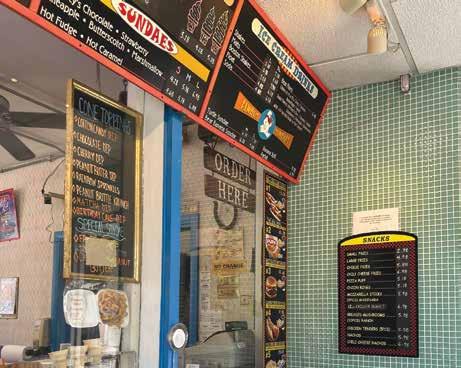
made frozen treats. I had a small cup of raspberry jalapeño pepper, which had a serious spicy kick. Roughly a mile north is a location for Andy’s Frozen Custard This Andy’s doesn’t appear any different than the Missouri-born chain’s other Chicagoland locations, but maybe a nice walk between Tates and a small vanilla custard is in order. Sugar Dose sells extravagant bubble-waffle sundaes out of a Lombard strip mall, but I found a single scoop of the thick and rich Nutella gelato hits the spot. West Chicago shop Jorge’s Paleteria y Neveria overwhelmed me with the variety of options; I went with a small cup of generously portioned Gansito ice cream, which had huge chunks of the Mexican snack-cake made of strawberry, creme, and chocolate. If for some reason you remain unsatiated by these five dessert slingers, the Saint Charles location of Colonial Cafe, a 125-year-old institution, should more than suffice. I avoided the monstrosity that is the World Famous Kitchen Sink (too much ice cream, even for me) in favor of the E.T., aka Extra Terrific, which is only five scoops of vanilla ice cream smothered in hot fudge, peanut butter, and whipped cream (oh yeah, also M&Ms and a cherry). The E.T. arrived in a goblet that made the dessert feel heavy and made me a little self-conscious . . . till I started eating it. LEOR GALIL
The living, quaking bog an hour from Chicago
VOLO BOG STATE NATURAL AREA
INGLESIDE, ILLINOIS
Drive about 55 miles northwest of Chicago to find the arcadian Volo Bog State Natural Area , home to what’s called the only open-water quaking bog in Illinois. That means plants,
drive to the sprawling multidealer Volo Antique Malls, and perhaps the adjacent set of kid-friendly roadside attractions, including a museum of antique cars, the Jurassic Gardens filled with animatronic dinosaurs, and even a Titanic exhibit. Like the state natural area, the antique malls are free to enter, but the other attractions charge admission.
If you’re hungry, check out Volo Quality Meats for a startlingly overstuffed sandwich, or at least a Caprese salad. For something less extravagantly carnivorous, stop at the nearby Woodman’s market, a branch of a mildly eccentric, Wisconsin-based grocery chain. Hungry or not, you’ll likely notice the low prices at the multiple Woodman’s-branded gas stations in the supermarket’s immediate orbit, a good final stop before heading home.
STEVEN MELENDEZ
including tamarack trees, actually float (and quiver) atop a mat of moss on the bog. A short boardwalk, itself afloat on the water, explains it all through entertaining signage. Longer trails offer an opportunity to spy a range of flora and fauna, and wooden viewing blinds give you room to watch and photograph sandhill cranes and other park residents without disturbing the serene aquatic scene. The visitor center, housed in a onetime dairy barn, offers exhibits including an herbarium of blooming plant life and frequent showings of bog-inspired art.
Visit the whimsical gift shop for additional creations by local artists, bog merch like magnets and bumper stickers, and even CDs by the Volo Bogtrotters, an old-time string band. Volo Bog also hosts regular events, from guided tours to nocturnal stargazing, with festivities and kids’ events naturally planned for International Bog Day on July 26.
After hiking the bog, take a short
Committing to the 20-mile drive to Little Palestine offered the perfect amount of yap time with my mom on the phone. She loved the idea of a “broke day trip,” as we weren’t really a vacation family. But it was only on my way to Bridgeview’s Al Bawadi Grill that I realized she had never had Palestinian food, despite growing up in Chicago, the U.S. city with the largest Palestinian population. I also intended to visit the Nut House across the street, a shop with sprawling cases of sweets. I learned Al Bawadi is family-owned, and I appreciated the staff’s warmth toward kids, which genuinely made the place feel more at ease despite the busyness. In an accidental twist, I made the trip






a first date spot, as a south-side OkCupid hottie was down to trek and meet me there. The first dish to hit the table was a welcome surprise of fried za’atar pita and a tomato-forward baba ganoush. I people-watched happy families in moody light and was torn between ordering lamb or seafood. Once joined by my date, she thankfully was down to share and put in an appetizer. Makdous rendered an electric bite, a crunch into crushed walnuts stuffed in oil-cured eggplant. Then a cloud of toum, whipped garlic dip, appeared in unreal proportion, accompanied by the fluffiest oversize fresh pita. Time passed and the restaurant emptied as we made our way through plates small and big.
Paired with the bill was a complimentary slice of knafeh. We locked eyes, and without a word, I knew to request Turkish coffees, which came with an additional slice that, despite being so very full, we managed to finish. In a blur I lost the fight for the bill, making my trip only the price of gas. (Otherwise $80 for two people.) With the sun fully set, we emerged from Al Bawadi upon its 10 PM closing, promising to venture back for the shops we missed in the magnetism of the food and each other.
If we had stolen a little more golden hour, we could have treated the shopping strip across the street as a picnic scavenger hunt. With greenspaces like Muehe Memorial Park not too far off, it’d be perfect for summer snack lounging.
YASMIN ZACARIA MIKHAIEL
PALOS PRESERVES
PALOS PARK, ILLINOIS
Humankind has been looking to the skies for guidance and reflection for the entirety of its existence. However, in the course of technological advancement, we’ve sacrificed the stars—in heavily urbanized areas anyway. A night of camping at Palos Preserves goes a long way toward reestablishing that connection to our pre-Anthropocene selves. Established as an official Urban Night Sky Place by DarkSky International, this spot is just deceptive enough to convince your brain that you have abandoned the hustle-bustle for a grounding, elemental lifestyle. And there are clean bathrooms with showers, so it’s giving best-of-both-worlds energy. A friend joined me for a moonlight escape in mid-May. While I gleaned the fields for fuel, he set about chopping and flouring. Once the campfire was raging, he created a surprisingly hearty beef bourguignon, which we devoured before a charming stroll around the lake and into the darker parts of the park. My goal was to pull off some astrophotography. Though Palos Preserves is nestled in a more remote part of the county, the
Bortle rating for night-sky viewing is still a bit high (maybe a 5, compared to 9 out of 9 downtown). So don’t expect to be transported by the incomprehensible complexity of the Milky Way, but you’re definitely going to see more stars than you would in any given Chicago neighborhood, even if the street lights are out. KIRK WILLIAMSON
Of all the cities along the south shore of Lake Michigan, Michigan City has the funkiest vibe, lacking the overt swankiness of New Buffalo or the gritty industrial landscape of East Chicago or Gary.
But what gives Michigan City its character are the strange, historic, architec-
tural marvels that dot the harbor and downtown. That includes what I’m calling the “secret hobbit dungeon”: the one-time Zorn Brewery Complex (they made “Zoro soda pop” during Prohibition), whose abandoned campus includes a bizarre mixture of rounded doors (like the Shire) and bubble windows, as well as catwalks connecting buildings and a round staircase that looks like a castle turret. With all the lush greenery in summer—all the better for the evil hobbits to hide the bodies—it’s downright precious.
Less ominous is the new Zorn Brewery next door, which makes great beer and mac and cheese (also made with beer).
The Michigan City brewery trifecta of Zorn, Shoreline, and Burn ’Em is, ironically, an extremely family-friendly experience, with great food and outdoor patios.
The sculpture park that lines downtown Franklin Street is a must-see. A free, self-guided tour lets visitors listen to the artists explain their work. A personal favorite is Song of the Dutchman, which ties into the city’s midwest maritime themes.

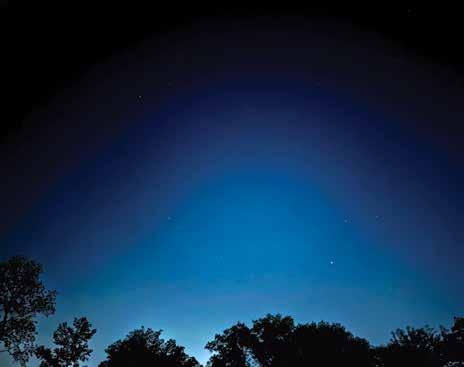
Don’t miss the Lighthouse Museum and the Barker Mansion , both kid-friendly and walkable from downtown. The Michigan City lakefront is gorgeous and features a number of fun food stops, including Basecamp Marina for ice cream and A Slice of Heaven, an Amish roadside stand.
The daily South Shore Line takes approximately 90 minutes to go from Millennium Park Station to Michigan City. It takes roughly the same amount of time to get there by car via I-94, maybe a little faster using the Chicago Skyway, but for a budget day trip, best to skip the exorbitant toll ($15 one way!).
Along the way to Michigan City is Mount Baldy, the tallest peak in Duneland. It’s just over one hundred feet tall, but worry not: The peak is off-limits. It’s unstable. However, the walk down to the nearby beach is surprisingly steep and sandy, which is half the fun. AARON DORMAN
HARLEM AVENUE
CHICAGO, ILLINOIS
Where the city flirts at the borders of Niles and Park Ridge, Juju’s Vintage greets you with a kitschy window display that resembles an animated short brought to life. Inside, bejeweled tiaras, jumbo seashell necklaces, and elaborate fur hats gather in color-coded pockets.
I first visited the shop, run by the fabulous Jules “Juju” Breen and her husband, in February, and the 19-minute trip to Harlem Avenue felt like a small adventure. At the time, I was experiencing an identity change, and Juju’s felt like the kind of place where I could molt a little under rhinestones and fluorescent light. When Juju later told me she is an Aquarius, it made too much sense.
Open since 1990, Juju’s Vintage hosts a curated mix of bright accessories, vintage finds, and contemporary pieces, and it’s full of odd little flourishes: giant Russian doll fixtures, mannequin heads in monochromatic hats, and window displays that change with the season. Because the shop sits near O’Hare, some people stop by before or after a trip. Others drive in from outside the city to visit it. “When people come to Juju’s, they’re coming for an experience,” Juju says.
While you’re on Harlem Avenue, grab gyros or spinach pie next door at Nick’s Drive-In or Superdawg Drive-In for their superdawg hot dog, then keep the vintage mood going with S.M.A.S.H Toys, Retro Dimension, or head farther west on Touhy to Avenues Thrift Shoppe, which supports programs for adults with developmental disabilities.
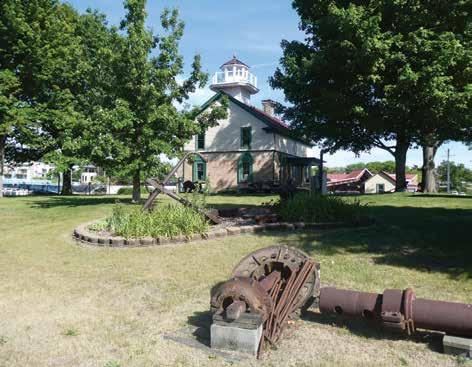
Juju’s is the heart of it, so start there. Jitterbug, the shop’s 13-year-old poodle and occasional customer service diplomat, may be nearby while you browse the endless jewelry cases. LESLIE HURTADO
If “all” you do is stroll to the Skokie River Nature Preserve and meander 3.6 miles of trails through prairie, woodlands, sedge meadows, and savanna, Metra fare (or gas—parking is available at all destinations mentioned here) could be
the only expense of your broke day trip. When stepping off the train, you might first power up with a pastry at Gerhard’s (also a good option for lunch). I savored a delectable Italian lobster tail—no shellfish, just a flaky choux pastry filled with luscious custard—while I was a resident at Ragdale , the storied artist residency in town.
On July 11 from 10 AM to 1 PM, Unplug Illinois, a free, family-friendly, statewide event happening locally at Deer Path Community Park , offers games, kickball, an inflatable obstacle course, and resources for disconnecting from digital devices. What better way to disconnect from technology than immersing yourself in our region’s unique ecosystem?
With advance planning and a $15 ticket, layer intriguing architecture and history into your day: Ragdale offers
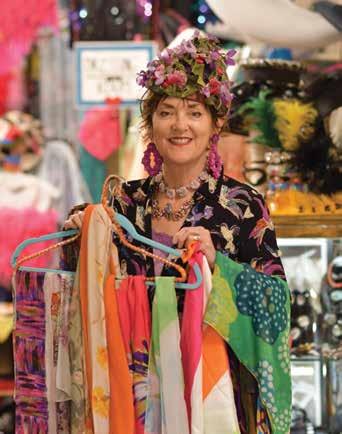
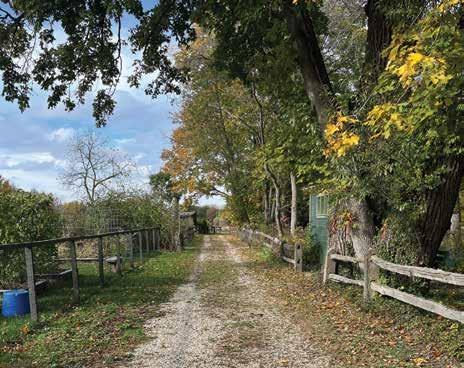
90-minute public tours on July 11 and August 8, beginning at 10 AM. Tours may be less suitable for small children, but the grounds, which neighbor the Skokie River Nature Preserve, feature enchanting garden grotesques and mysterious structures fit for a hundred gothic novels.
After a day contemplating mountain mint, milkweed, and Arts and Crafts architecture, you may wish to recharge with a meal before the ride home. The Lantern is a budget- and family-friendly pub with a $9 kids menu (my child approves of the hot dog with fries), a cup of chili for $7, and easy proximity to the Metra station. Books make great souvenirs; stop at Lake Forest Books before you go so you can stay unplugged and entertained for your train ride home.
ANCA L. SZILÁGYI

SOCK
I was barely ten minutes into my trip to Long Grove, the quaint village located about 50 minutes outside of Chicago, and I was already being inundated with monkeys. “Illinois’s first historic district” may be well-known as the home of the Robert Parker Coffin Bridge (a site well worth checking out in its own right), but the arrival of the Sock Monkey Museum in 2019 has seemingly infected all areas of Long Grove, to the point that the lovable sock monkey might as well be the village’s unofficial mascot.
I found one monkey sitting atop the counter at Joanie’s Pizzeria , while waiting for some delicious Detroit-style pizza. The handcrafted Sock Monkey Snack Co. popcorn was all over the walls at the Covered Bridge Creamery (rightfully voted Illinois’s number one ice cream shop).
The Sock Monkey Museum itself home to a collection of more than 2,400(!!!) sock monkeys contains many of the key elements one may find in a kitsch museum; a lavish gift shop (including official Nelson Knitting Company socks to make your own monkey at home), various historical blurbs (you’ll discover the history of sock monkeys, and also socks in general), and of course, a charming short film about the subject at hand (titled, you guessed it, Sockumentary).
Alongside just being a genuine visual wonder, the massive collection, declared a Guinness World Record for largest collection of handmade sock monkeys in 2023, is an overwhelming testament to the power of handcrafted art, each monkey
stitched together with care and detail and tactility. For anyone looking to find a place far removed from our current age of digital slop, this charming attraction is a reminder that even something as simple as a pair of socks can ignite our shared capacity for creativity.
BEN KAYE
DEPOT DISTRICT
BERWYN, ILLINOIS
Just west of Chicago, Berwyn makes for an easy, low-cost afternoon built around public art, neighborhood eats, and historic bungalows.
Starting at the Berwyn Metra station, yellow banners hanging from light poles and lining nearby streets will signal your arrival in the Depot District , Berwyn’s historic downtown corridor. Established in the 1890s, the Depot District served as Berwyn’s original downtown and commercial center.
Head west toward Harlem Avenue, where murals like Green Cleaners at Obrien the Cleaner, Pillar Community Health’s 100th Anniversary, and Transition at Karasak Park begin appearing along the route. Back near East Avenue, Lavergne’s Tavern serves an inventive twist on a Chicago classic: Italian beef egg rolls. Stuffed with giardiniera, Monterey Jack cheese, and tender beef, the fourpiece order comes with au jus for dipping and is substantial enough to share.
After lunch, take a selfie with Cranio’s World beside the entrance of Lavergne’s, created by São Paulo artist Cranio.
Many of the Depot District’s murals, including Cranio’s World, were commis-
sioned through the Berwyn Public Arts Initiative, a volunteer-led organization that has helped transform Berwyn’s Depot District into an outdoor gallery. Interested in seeing more? Head a few minutes north to the Art Park at 34th Street and Oak Park Avenue, where works from BPAI’s 2019 “Art on Track” installation were relocated in 2022.
A map of public art installations is available online for visitors who want to continue exploring.
If you’ve still got room for dessert, head to Tastee Freez , the signless, seasonal walk-up stand known for classic soft-serve cones, banana splits, sundaes, and shakes.
I recommend a banana Oreo milkshake.
NABEELA WASHINGTON
The forest is creepy enough on its own: eerie silence punctuated by sounds of skittering creatures, millennia of demonic legends, the constant threat of twisting your ankle and being left to rot among the mushrooms. But Sangchris Lake State Park in Rochester (just southeast of Springfield) holds a grisly secret with a connection to American pioneer infamy that outcreeps them all.
I first stumbled upon Taylor Cemetery about ten years ago while hiking through Sangchris, enticed by a rotting sign at the bottom of a hill. I discovered a shaded burial ground with about 40 graves, marked by crude stones in varying levels of deterioration. The most recent death date I could find was from the very early 20th century. Most names were eroded on the few intact stones. I shivered with the
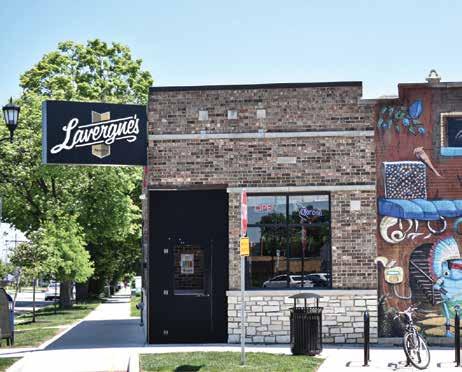
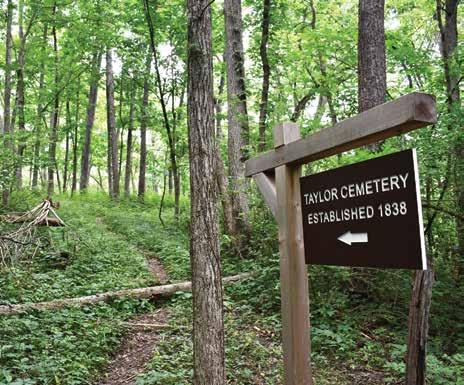
faint suspicion that these forgotten bodies languished namelessly deep in the woods, with nobody to remember them. Then, about two hundred yards past the cemetery, I learned the real story.
Many are familiar with the ill fate of the Donner Party, who fell to ruin and cannibalism in 1846. But few realize that these intrepid ghosts set out from the Springfield area. George Donner, his third wife, Tamsen, and their three daughters led his group to doom on the expedition to California. His daughter from his first marriage, Sarah Donner Torrence (1815–1849), did not join the party and now lies still on this central Illinois hilltop, along with others who perhaps wisely chose to stay put. Though their ultimate fate was the same—as it is for all of us—Sarah and the others in Taylor Cemetery rest peacefully and relatively undisturbed while those who loved them faced a grim end, serving as a cautionary tale in the history of American expansion. Bloom where you’re planted, as the old church song goes, I suppose. KIRK WILLIAMSON
Being a tourist in your own city offers a chance to look at your world anew. Artist JeeYeun Lee’s Shore Land project takes that premise a step further by delving deep into the contested history of the city’s lakefront. Shore Land looks at six sites along Lake Michigan through audio walks that mix historical documents, contemporaneous interviews, field recordings, and more to show how the “public” land along the lake came to be.
You may know Jackson Park as the jewel of the south side. The 551-acre park
boasts a Japanese garden, Yoko Ono’s first permanent U.S. installation, a beach, a golf course, park buildings, and much more. Designed by the renowned landscape architect Frederick Law Olmsted, and built for the 1893 World’s Columbian Exposition, the land that makes up Jackson Park—like the rest of the city— was once homeland for the Potawatomi. Hosting the exposition may have been a win for the settlers of the midwest, but it was devastating to others. At the time, Ida B. Wells lambasted the city for not highlighting the progress of African Americans, and Potawatomi chief Simon Pokagon wrote movingly about the takeover of the land, noting “that this success has been at the sacrifice of our homes and a once happy race.”
Lee occasionally leads walks around the Shore Land sites, but you can also do the tours at your leisure by listening to the audio on her website while visiting the locations. The site is, of course, home to a new controversy, with the recent opening of the Obama Presidential Center—which has reconfigured traffic, privatized public land, and destroyed hundreds of mature trees. Shore Land asks us to consider how land transfers hands and for whose benefit. As Potawatomi citizen Justin Neely says, “The dirt and the dust that people stand on on the shores of Lake Michigan is the bones of our people.”
CARDOZA
KERRY
AMERICAN GIANTS MUSEUM
It’s the 100th anniversary of Route 66, and in Chicago, you’re at the start of the Mother Road. A two-hour-and-change drive takes you to a colorful collection of
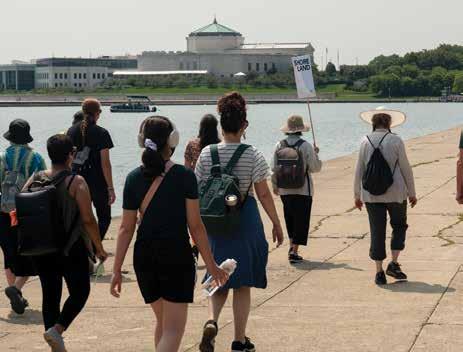
statues illustrating their place in advertising history.
Take I-55 south to Atlanta, Illinois, get off at exit 140, and see “Lumi,” a large fiberglass lady, greeting you with a warm, bespectacled smile and an enormous fresh pie, letting you know the American Giants Museum is nearby.
Opened in 2024 on Route 66, the museum showcases the colossal human-
shaped billboards produced by the International Fiberglass company in the 1960s, and which dotted the country—advertising gas stations, restaurants, muffler shops, and anything else you’d need on a road trip. Here, you’ll see six, each towering over 20 feet tall. Atlanta, Illinois, is home to the largest collection of giant fiberglass statues along Route 66, from Chicago to Los Angeles. “We have eight in
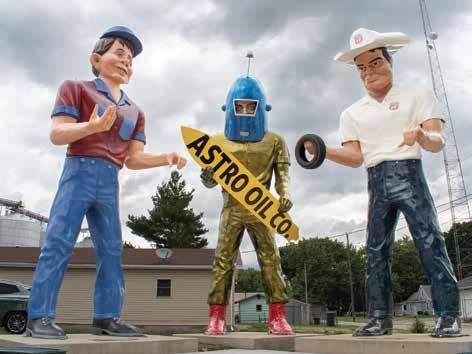
one location. One town. Nobody has that many,” museum curator Bill Thomas said. Across the street is the first “giant” to call Atlanta home: the Paul Bunyon Hot Dog Statue, which stood in front of a hot dog stand in Cicero decades ago. After getting pictures, head back to Lumi, the waitress in the butter-yellow uniform at the Country-Aire Restaurant , for a Horseshoe sandwich, but make room
for pie because they have around ten to choose from. To gas up before the ride home, hit Wally’s, the country’s fourthlargest rest stop, for an endless supply of snacks and merch.
But there’s one last “giant” to meet before heading back north, the most famous in Illinois: the Gemini Giant , located at the Landing Pad in Wilmington. YOLANDA PERDOMO v

BY ERIN TOALE
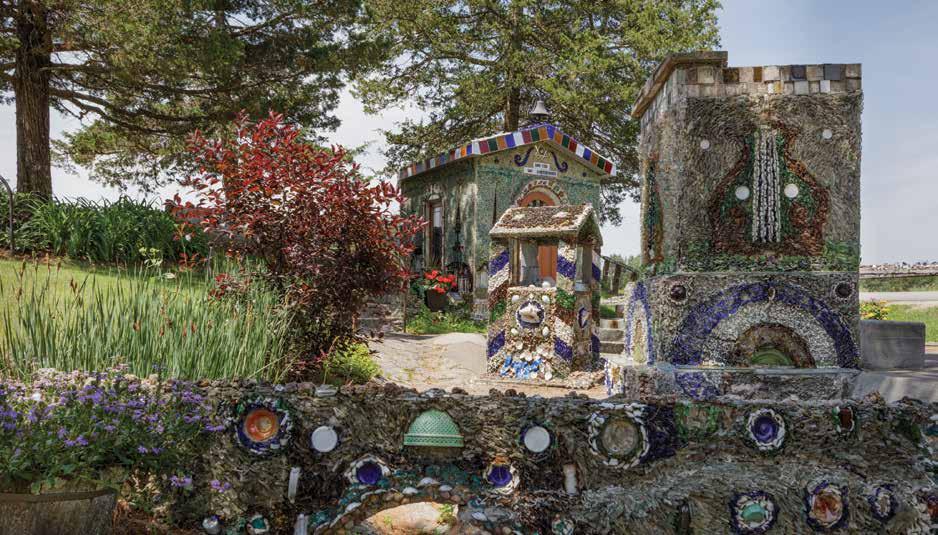
Y’all, we are NOT spending this summer on our phones. Consider this a call to put down the device and pick up a map (or take the route suggested herein) for a Wisconsin getaway that combines nostalgia, vernacular art, and budget travel. Pack some snacks, make a playlist of road-trip bangers, and assemble your adventure crew to drive four ways around Wisconsin. You’ll head north from Chicago, pass through Milwaukee, spend time in Sheboygan, and then return via Madison and Kenosha with some recommended way stations along the drive. This July, look away from the screen and toward the open road to get motivated by the midwest’s otherworldly immersive art environments.
This art-inerary was inspired by the (now closed) exhibition “A Beautiful Experience: The Midwest Grotto Tradition” at the John Michael Kohler Arts Center (JMKAC) in Sheboygan, Wisconsin. JMKAC defines grottoes as “outdoor sculptural environments imbued with elements of culture, religion, geology, and patriotism, often made by immigrants.” These built milieus are often made of embel -
lished concrete, rocks, and bricks and studded or mosaiced with objects including “shells, marbles, colored glass, toys, figurines, fossils, and geodes.” The architectural wonders frequently depict cultural, popular, or religious figures, and ultimately reflect the creator’s personal mythology. The exhibition text also situates these sites
Grottoes are an iteration of vernacular art—a genre of visual art made by artists with little to no formal or institutional training— especially prevalent in the midwest.
as historical records, noting: “Materially, midwestern grottoes often reflect local industries, decorative trends, and an area’s geological makeup. . . . This accumulation,
as well as the objects incorporated, creates a documentation of the maker’s life, faith, and home.”
Grottoes are an iteration of vernacular art—a genre of visual art made by artists with little to no formal or institutional training—especially prevalent in the midwest. Wisconsin enthusiast, Sheboygan native, and Art Institute of Chicago curator Mel Becker Solomon loves all of the “weird and inspiring” vernacular art environments Wisconsin has to offer along Lake Michigan and “tucked in small cities along most of the major highways in the midwest.” She tells me that what makes the many grottoes scattered throughout the midwest and their self-taught makers so special is that they make work outside of the art market “in private, for their own pleasure, often in retirement in their homes as a hobby or via a compulsion to create. . . . They are works truly born from the desire to create that also add to their local communities through these massive and awe-inspiring forms.” These artisans often come to their craft later in life and, as hobbyists, create bodies of work that are singular and secluded.
Solomon specializes in the Chicago
Imagists and explains the influence of the midwestern vernacular on this seminal art historical movement. She writes: “The Chicago Imagist artists were interested in the everyday objects that surrounded them, as they were encouraged by their mentors, like Ray Yoshida, to look in the windows of shops, in the alley, and in local flea markets for inspiration. For both Whitney Halstead and Yoshida [School of the Art Institute of Chicago professors], art was beyond the walls of a museum, and they would take students like Barbara Rossi on day trips to places like the Dickeyville Grotto in Wisconsin. So, self-taught artists and these built environments and grottoes became visual fodder for the Imagists that inspired their work and their own collections.”
The Reader ’s route was culled from this and other interviews with ’Sconies— fittingly, as oral history plays such a role in tracking the overlooked and alternative art histories of vernacular artists—as well as the following resources. If you’d like to pave your own Wisconsin way or supplement our suggestions, check out: Wandering Wisconsin, a database of the “grandest, most astonishing, and original visions in American art”; Atlas Obscura,
boasting “190 Cool, Hidden, and Unusual Things to Do in Wisconsin”; SPACES, another JMKAC project “dedicated to the study, documentation, and preservation of art environments and self-taught artistic activity”; and lastly, JMKAC’s map of midwest grottoes and related sites (a robust list of 19 destinations that accompanied the exhibition). Be sure to plan ahead, as many sites are private, remote, seasonal, and/or by appointment only.
Drive first toward Milwaukee to explore the Sisters of St. Francis convent grounds, which feature a grotto built by a groundskeeper known only as “Jake” in 1933. Saint Francis of Assisi was an Italian Catholic mystic and the patron saint of the poor, ecology, and animals. Every year, the convent hosts a pet blessing in front of the grotto on his October feast day. The cavelike structure was inspired by cavernous European grottoes designed for prayer and reflection.
Then, wet your whistle, catch a show, and admire accessibility aesthetics at the venue and community space Cactus Club. They launched an accessibility initiative last year and also successfully advocated for an ordinance change in 2022 that waives permitting fees “to support accessibility improvements for old buildings.” Cactus Club’s artist-in-residence Kate Klingbeil, who recently exhibited here in Chicago with Junior. gallery, designed a 29-foot concrete wheelchair ramp replete with a colorful mosaic and dynamic resin beading on the railing. The artwork references the subterranean and features material salvaged from the beach of Lake Michigan, Klingbeil tells Milwaukee Magazine. Midwestern Medici Jack White aided community fundraising for the project, the first in a series of accessibility improvements the venue is hoping to make. The stairs leading into the building echo their ethos of inclusion and transformation, reading: “another world is possible.”
a hospitalization, he began sculpting allegorical figures at the age of 62. It is rumoured that many of his abandoned works, namely cement heads, are buried in the yard of the cottage—an enthralling experience for fans of supernatural coastal towns. (Widow’s Bay, anyone?)
Give yourself plenty of time to explore both of JMKAC’s distinctive hubs: the John Michael Kohler Arts Center (est. 1967), which presents work by contemporary and self-taught artists through exhibitions and community programs, and the John Michael Kohler Art Preserve (est. 2021), where the focus is on immersive artist-built environments. Solomon loves these “obsessive collections that are often overlooked by encyclopedic institutions,” including Yoshida’s aforementioned cabinets of eccentricities as well as works by and collections of his students—including
observing: “You can get a sense of the place through the materials used, which are those that are at hand.” The resulting constellation of geography, material, personal narrative, and historical, timebased contexts informs the creation of multifaceted environments. He writes: “You get to know the artist, but you also get to know their broader world through what they work with.”
Gartelmann has a special connection with Emery Blagdon’s The Healing Machine, currently on view in JMKAC’s “Guadalupe Maravilla with Emery Blagdon: The star exploding in the body.” Maravilla and Blagdon are two artists “convinced of the healing potential of the unseen forces of the earth,” and this exhibition explores their attempts to harness “magnetism, electricity, and other energies to surround visitors with positive forces” using materials like
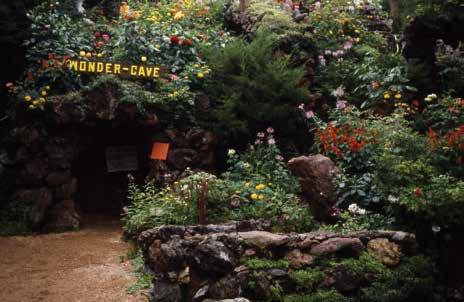
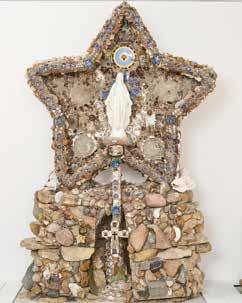
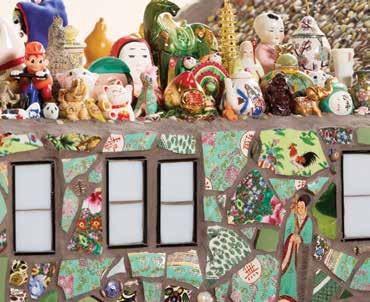
In addition to superlatives like “Malibu of the midwest” (as the premier inland freshwater surfing destination) and the “bratwurst capital of the world” (self-explanatory), our next destination is also the heart of the midwestern vernacular art movement. Thanks to JMKAC’s ongoing legacy conservation and preservation work, Sheboygan is a rising tourist destination with German roots. Solomon recommends starting with the (maybe haunted) Tellen Woodland Sculpture Garden, home to lifelike tableaux of figures cast out of concrete. The 30 historic, religious, and mythic figures populate the area around the late James A. Tellen’s summer log cabin in the Black River woods. A devout Catholic, Tellen worked as an artisan embellishing furniture at a local factory until, following
Midsummer Festival of the Arts (July 18–19, 2026) and the weekly Levitt AMP Sheboygan Music Series.
Onward to Madison to catch the new exhibition by artist and SAIC lecturer
The architectural wonders frequently depict cultural, popular, or religious figures, and ultimately reflect the creator’s personal mythology.
David Harper, who celebrates vernacular art environments as zones where “materiality meets architecture, architecture meets nature, nature meets surrealism.” His show of new large-scale embroideries, stuffed and adorned animals, shelves of cicada vases, and ceramic flower bouquets, “Good Morning Sweetheart,” is on view at the Madison Museum of Contemporary Art through August 30. The authenticity and vulnerability permeating the exhibition stem from his fascination with the organic, memory-infused aspects of vernacular art, a genre he finds “as honest as it gets, even when the work is inspired by complete fantasy.” He also brings up another, less tangible facet of these works: mythical somatic healing properties, noting that many vernacular makers, like Maravilla and Blagdon, “build to help heal themselves or give to others in some way.”

the recently relocated Roger Brown Study Collection. The museums feature world-famous artist-designed bathrooms (certainly the most selfied washrooms in the region), and the center operates the country’s first arts-based preschool onsite. Lovers of DIY, punk, and folksy aesthetics have long taken pilgrimages to JMKAC and their various stewarded satellite sites for inspiration and healing. JMKAC program director and site steward of the Mary Nohl art environment, Alex Gartelmann, is an artist interested in materiality who loves “a good wander.” He celebrates the prevalence of found objects in the midwestern vernacular vocabulary,
tinfoil, masking tape, Christmas decorations, and wire. Gartelmann looks to these makers to awaken and align his artistic impulses and priorities, telling me: “The Healing Machine itself has long been the most important and influential artwork for my own practice. . . . There’s no better north star for me to look to when it comes to making decisions in my own work. It forces me to really ask what my stake is in making art.” During your Sheboygan stay, Gartelmann suggests JMKAC’s
Further afield of Madison, we recommend any combination of the following: the Bart Simpson Tree in Mount Horeb (have a cow, man); Dr. Evermor’s Forevertron (purportedly the largest scrap metal sculpture in the world) in Sumpter; and the Dickeyville Grotto and Shrines, visited by Yoshida and his Imagist proteges. The Rudolph Grotto Gardens, which feature five acres of gardens and shrines, and the Paul and Matilda Wegner grotto are north of this itinerary, but are well worth the trek if you have the time. Finally, it wouldn’t be a midwest road trip without a stop at the peerless Mars Cheese Castle in Kenosha. With landmark vintage signage visible from I-94, the sprawling compound features Wisconsin-exclusive products with an emphasis on fromage. Pack a cooler for perishable treasures, and a sketchbook to reflect on the spiritual and sublime possibilities you’ll surely encounter. v
themail@chicagoreader.com
The Wisconsin Dells remains a popular midwest vacation destination, but Nellie Kluz’s 2024 documentary explores its murky foundation of labor exploitation.
BY MICCO CAPORALE
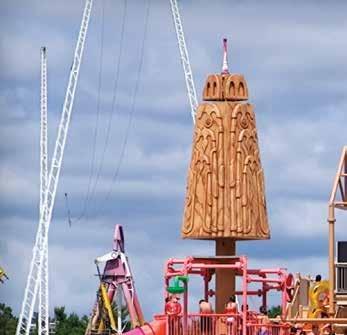
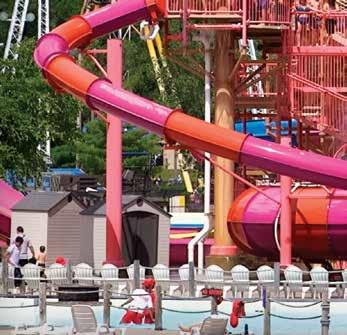
Nellie Kluz’s The Dells takes a headfirst dive into the frothy, aquamarine currents of American capitalism by showing that tourist economies are built on immigrant labor. Set in the Wisconsin Dells, the self-proclaimed “Water Park Capital of the World,” Kluz’s 2024 documentary creates a gestalt portrait of the city via atmospheric vignettes of the international workers powering it. Using an artful subtlety, the film reveals as much about how people from other countries are baited with the myth of American upward mobility as it does the deeply human ways
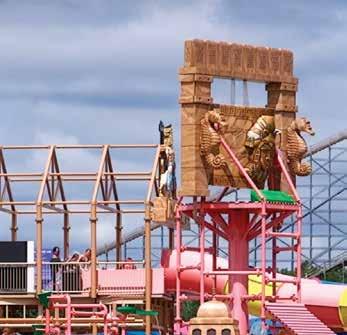

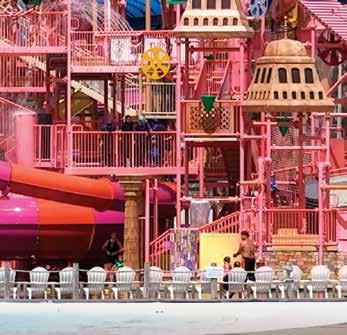
they make meaning and enjoy themselves anyway. Amid rising criminalization and violence against immigrants, The Dells serves as an elegant, timely reminder of immigrants’ myriad vulnerabilities and their humanity.
The Dells started attracting tourists in the 1850s with its undulating gorges and scenic river views, but today it’s better known for its Vegas-like flair for eccentric, often globally inspired attractions unmoored by any sense of history or culture. Subsequently, it’s got a lot of waterslides. In 2024, more than five million people flocked to the Dells to
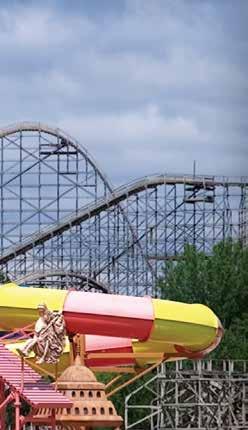
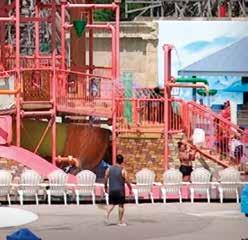
behold the overwhelming artifice built atop its natural majesty, with 42 percent visiting during the summer months alone. Roughly three thousand people live in the city year-round, so there isn’t enough local labor to service the groundswell of travelers that arrive with the warmer months. Like a lot of small towns with robust summer tourism, many Dells businesses rely on foreign labor provided through the J-1, or exchange visitor, visa program.
Kluz didn’t know this when she decided to embed herself in the city in the summer of 2021. Some years before, while studying film in Chicago, class-
mates had tipped her off because they knew she appreciates tourist camp and human idiosyncrasy. (She’s also worked on nonfiction projects such as HBO’s How to With John Wilson.) With an abundance of water parks, inspired by themes such as Greek mythology, Noah’s ark, and African exoticism, Kluz arrived planning to aim her lens at the city’s quirk. But almost immediately, she encountered a pattern: college-age kids, usually from Eastern Europe or the Global South, who’d come to work in the U.S. expecting one kind of summer and getting something very different.
The students’ experiences emerge between hazy, romantic interludes of common Dells sights—bubbles blossoming in a pool after the perfect plunge, an arm being airbrushed with a pop-culture reference in exciting colors. At a cookout, a woman says, “I don’t think I like America that much.” The food is bad, she explains, and she’s the manager of a T-shirt shop where she works 85 hours a week for $9 an hour. Also, she’s ineligible for overtime because all international workers are. (That’s not actually true, but you can understand why she thinks it is. Why would a first-time immigrant only here for the summer know her labor rights?)
“They’re not paying me more [to be manager],” she explains. “They’re just giving me more responsibilities.”
On a taxi ride, the driver asks a passenger riding with a companion if she would rather stay in the U.S. or return home. “There are more opportunities here, so I would choose to be here,” she replies. “Healthcare is better.” When asked what defines better healthcare, she continues, “I’m from . . . a third world country. You know how you guys would get free healthcare or doctors and nurses who actually care? It’s not the same back home.” When the driver responds that the U.S. is the only industrialized country that doesn’t provide healthcare, her companion’s eyes double with surprise.
The longest and most compelling vignette centers on three Turkish men whose water park has shut down earlier in the summer. Without jobs or homes, they pool their money to buy an old black party van with no airconditioning off Facebook Marketplace; they begin sleeping in it together on an air mattress. Every night they struggle to find a place to park the van, and no one has a license nor has driven in the U.S. Then the van breaks down. Junking it would only get them about $50.
“Those guys really embodied everything,” Kluz explained in a 2025 interview with Dwell magazine. “They have this optimism about what you can accomplish in the U.S., even as the evidence was mounting that maybe the experience was actually really difficult. . . . I set out to make a slightly more fun movie than it ended up being. Because you do see a lot of the labor exploitation that’s going on, and also being young is this sort of natural resource that we’re importing from these hopeful people. It’s kind of infectious, but also as a person who’s slightly older and not a college student, who’s native to the U.S., I was like, ‘Oh my gosh, you guys!’ It feels sometimes like there is no experiential joy without exploitation.”
Shortly after Kluz’s interview, the J-1 visa program was the subject of two New York Times articles following a lengthy investigation that revealed it’s a hotbed for exploitation, profiteering, and conflicts of interest. J-1 visa holders regularly go into debt taking jobs under
false pretenses. They find opportunities through brokers called “sponsors,” many of whom charge steep fees or strike deals with employers to forego visiting job sites or documenting abuses and unsafe conditions. Some sponsors make employment conditional on jobseekers buying into their side businesses, such as exorbitant healthcare programs.
TheDells serves as an elegant, timely reminder of immigrants’ myriad vulnerabilities and their humanity.
“While the Trump administration has sought to end protections that allowed hundreds of thousands of immigrants to work in the United States,” the Times wrote last fall, “it has left the visa program largely untouched.”
In fact, it’s only been growing. Established in 1961, the J-1 visa program umbrellas several visas under the guise of promoting “cultural exchange,” including the J-1 Summer Work Travel visa described in The Dells. Only people ages 18–29 are eligible for Summer Work Travel visas, though in practice, the average recipient is 21. Holders are required to work up to four months before being permitted 30 days of travel. In its December story, the Times indicated nearly 300,000 people come to the U.S. on J-1 visas each year—up from 65,000 in the 1980s.
Since the 2000s, there have been numerous attempts to overhaul the J-1 visa program, but sponsors have blocked them, instead lobbying to expand and regulate it. A 2019 report by Migration that Works (then known as the International Labor Recruitment Working Group) indicated that the top employers of Summer Travel Visa holders were Disney, Cedar Fair, McDonald’s, Six Flags, and Xanterra Parks & Resorts, and its data from 2015–2018 lists Wisconsin as a top-five state employing J-1 visa holders. The Dells captures everything critics of the program have been decrying for more than two decades. However, the documentary’s greatest strength is refusing to dwell on its subjects’ systemic victimization by meditating on moments of beauty.
At the film’s close, one worker says, “Working, working, washing dishes, you don’t have time for do other things. I’m really thankful to God for the Dominicans. They are so friendly, so familiar, they give all to you. I take the good things, and also the bad things, and with the bad things, I make the good things.” v
mcaporale@chicagoreader.com
BY KAT SACHS
It’s ironic that, on the occasion of the Reader’s Broke Day Trips package, I’ll be writing about attending the Temenos—the previously ongoing screenings of Gregory Markopoulos’s Eniaios—in Lyssarea, Greece. The only thing relevant about the trip to this theme is that I went for broke by going, committing to an unusual, once-in-alifetime cinematic experience that, per Markopoulos, “is the sustaining spirit of motion pictures.”
Markopoulos helped establish the School of the Art Institute of Chicago’s filmmaking program in 1965. The American-born filmmaker, whose family
22-part Eniaios—conceived by the filmmaker as a “complete order” of his work— have been presented in stages since 2004. It is an absolutely singular vision and a similarly singular viewing experience. Though neither inexpensive nor confined to a single day, it felt beyond price. This year’s edition comprised four nights of screenings, from Thursday through Sunday, spanning Cycles XV–XVII and ranging in length, reel changes included, from three hours to more than four on the final night.
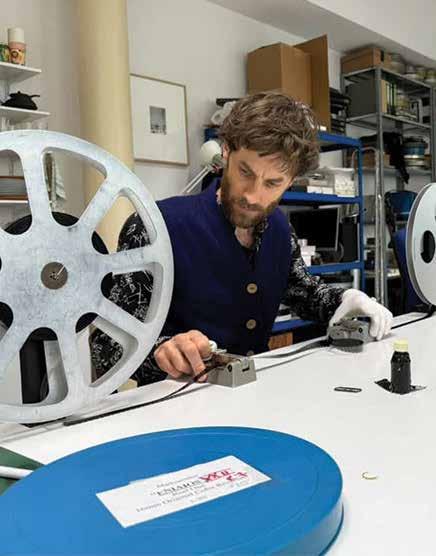
emigrated from the Peloponnese and who spoke Greek until he was six years old, left the U.S. for Europe in 1967 and withdrew his films from circulation. There was also a small Chicago contingent at the Temenos; among those I knew were Nicky Ni, coprogrammer of the Onion City Experimental Film Festival, and Hannah Yang, formerly of the University of Chicago’s Doc Films.
I can hardly begin to proselytize on the Temenos in the space allotted, so let’s start with the name. In Greek, “temenos” means something akin to a “sacred precinct.” The screenings take place in a field accessible via a roughly 30-minute hike from the center of Lyssarea, where a screen rises from the landscape and red beanbag chairs dot the perimeter. It is here that the cycles of Markopoulos’s
Before departing from Athens to Lyssarea, I experienced a more conventional moviegoing pastime in the city, an open-air cinema, where I saw Steven Spielberg’s latest, Disclosure Day (2026). This was a little more than 48 hours after I’d seen it for the first time back in Chicago, at the AMC River East, where it was being screened on 70 millimeter, making it only one of 19 theaters in the U.S. doing so. It’s proven to be divisive, shoring up admirers and detractors in equal measure. I rather like Disclosure Day , though the whole of this year’s Temenos experience now separates me from even the sublime act of seeing the film under the stars in Greece. Perhaps this necessitates a third viewing, so I can better articulate my appreciation of Spielberg’s late-period exhortation.
Ultimately, my favorite broke day trip is going to the movies. Theaters more often than not have memberships and discount days that can make it rather affordable, and films can take you anywhere you’d want to go, and even some places you wouldn’t think to dream of. There’s also what comes out of it: Between recent viewings of the new Spielberg and the final cycles of Eniaios, as well as all the amazing insight gleaned from my friends, colleagues, and even strangers contemplating either, I’ve much to think about, and that’s often the best trip of all.
Until next time, moviegoers. v
The Moviegoer is the diary of a local film buff, collecting the best of what Chicago’s independent and underground film scene has to offer.
themail@chicagoreader.com
support Illinois residents experiencing
insecurity and homelessness regain their independence with your purchase of a 7X Bingo
The Illinois Lottery has been nationally recognized for its trailblazing work with specialty tickets dedicated to raising awareness and funds for worthy causes a ecting our local communities. In collaboration with the Illinois Department of Human Services (IDHS), a portion of every dollar raised by the 7X Bingo Multiplier ticket directly contributes to organizations that support Illinois residents experiencing homelessness or housing insecurity. The ticket costs $5 and is available at more than 7,000 Illinois Lottery retailers statewide. With its lively, vibrant design featuring a purple background and multicolored bingo board, the 7X Bingo Multiplier instant ticket makes a great gift for those 18 and up. Visit the Illinois Lottery website for more information about the 7X Bingo Multiplier and the many good causes it supports each year. Read on to learn more about Fifth Street Renaissance, an organization that helps Illinois residents find stable housing and regain their independence.
Having safe and stable housing is one of the most basic and universal human rights. Unfortunately, a number of circumstances, including systemic injustice and astronomical housing costs, leave many without a place to rest their head at night. “You can go on just about any block and find somebody who’s hungry,” says Penny Powell, the executive director of nonprofit Fifth Street Renaissance. “Find somebody
who has to make choices between paying their rent, having food for their family, or keeping their medication available.”
According to the IDHS, an estimated 14,576 people in Illinois experienced homelessness on any given night in 2025. There were also tens of thousands of families throughout the state who lived doubled-up with their family and friends.
There are many organizations throughout the state that are working to find solutions and provide a safety net for those facing housing insecurity. In 1986, Fifth Street Renaissance evolved from being a home weatherization program for seniors to Springfield’s first transitional housing shelter. Twenty years later, in 2006, Fifth Street Renaissance merged with the Springfield AIDS Resource Association (SARA), whose mission is to provide inclusive care, housing, and advocacy for those living with HIV. Now, 40 years into the fight against homelessness in Illinois, Fifth Street Renaissance and SARA work together to provide both housing assistance and public health services for the Springfield area and across the state.
Fifth Street Renaissance currently operates 23 housing programs in Springfield that are dependent upon grant funding to operate each year. The proceeds
This content is sponsored by the Illinois Lottery
from your Illinois Lottery 7X Bingo Multiplier instant ticket purchase contribute to the IDHS grants that help to make these housing programs possible. There are varying requirements for each program to meet the needs of individuals, families, youth, veterans, those living with disabilities, and more. From May 2023 to May 2024, Fifth Street Renaissance provided 37,587 bed nights of housing across its various programs. The organization is currently expanding and in the process of developing its first housing program outside of the state’s capital, in Jacksonville, Illinois.
On the health side of operations, Fifth Street Renaissance has two “wellness on wheels” mobiles that travel around the state providing HIV, Hepatitis C, STIs, and blood pressure testing. They also distribute condoms, o er risk reduction counseling, distribute Narcan, and do opioid overdose training
“We’re not a Band-Aid, we’re not just looking to get [people] rehoused,” Powell explains. “We want to heal them so that they can be successful when they become rehoused.”
Fifth Street helps their clients to work through any barriers to independent living that they may be facing, whether that be related to mental health, physical health, substance use, literacy issues, employability
issues, childhood trauma, and more. There is a focus on harm and risk reduction at Fifth Street Renaissance, and the team encourages residents to be as productive as possible. According to Fifth Street Renaissance, in 2024, their outreach sta and case managers provided 3,181 documented instances of in-person transportation and 1,264 bus passes/token packs for medical and mental health appointments, employment search, substance abuse treatment, housing searches, and other needs.
With 31 years of experience working in social services under her belt, Powell shares that the past few years have been some of the most traumatic that she’s witnessed. Although the hardship of experiencing homelessness has long been a problem in Illinois, Powell says the COVID-19 pandemic exacerbated the issue in a way that was unexpected for many. The pandemic not only magnified the barriers to stable housing, but it also brought to light several social issues that local communities may not have been
addressing head-on beforehand. Ultimately, this mix of factors brought an onslaught of people who previously had not needed social services.
IDHS grants that are supported by the Illinois Lottery’s specialty ticket have helped Fifth Street Renaissance to continue providing critical resources to some of the state’s most vulnerable and underserved populations during this di cult time. Di erent from grant funds, which usually have specific stipulations for use, Powell shares that donations from the public allow Fifth Street Renaissance to provide their clients quality of life beyond the bare necessities.
“Imagine coming from a shelter where you’ve spent the last year, 18 months, and walking into a house that is empty,” Powell says. “No furniture, no dishes, no broom to sweep the floor, no bedding, no bed, no anything. Even just being able to provide a radio for someone, so that there’s noise sometimes, means everything. So donations are extremely important.”

A portion of every dollar you spend positively impacts homelessness prevention and assistance programs in Illinois.



She encourages those in Springfield and the surrounding area to come check out Fifth Street Renaissance in person and let their team educate you about the work that they do. “Let me come speak at your event, at your church, at your sta meeting, at your business, so that we can get the word out about who we are and what we’re doing,” she says.
Along with your purchase of a 7X Bingo Multiplier Illinois Lottery instant ticket, you can support Fifth Street Renaissance at their first Harvest for Homes celebration on September 11 at Pole Barn Chic in Springfield. This fundraiser will feature entertainment, food, and a silent auction. Tickets are available for $50 per person if purchased before July 15, and they’ll be $60 per person after that date.
To learn more about Fifth Street Renaissance’s programs, services, and upcoming events, visit their site at fsr-sara.org.
3,181 Lives Touched
In FY2024, Fifth Street Renaissance Outreach sta and Case Managers provided 3,181 documented instances of in-person transportation and 1,264 bus passes/token packs for medical and mental health appointments, employment search, substance abuse treatment, housing search, etc.
99%





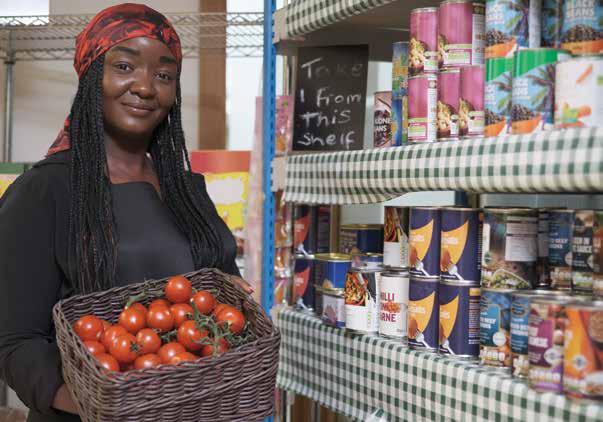
For FY2024, in just one program of 20, Fifth Street Renaissance (as recommended by Heartland Housed/Heartland Continuum of Care) distributed $186,150 in Springfield/ Sangamon County to prevent individuals and families from becoming homeless with a 99% success rate. For FY2025 we will distribute $320,000 in rent, security deposit, mortgage, and utility assistance to prevent homelessness along with case management, inspection, and advocacy to ensure safe, decent, and a ordable housing.
37,587
From May 2023 to May 2024, Fifth Street Renaissance provided 37,587 bed nights of housing across our various programs with case management and various other supportive services provided.
Courtesy Fifth Street Renaissance
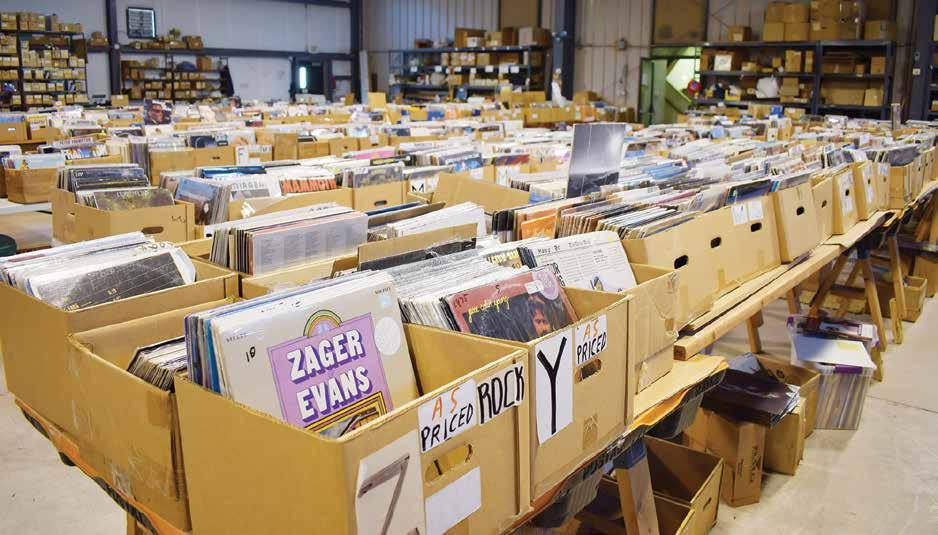
Horizons Music in Mendota, Illinois, has more vinyl for sale than you’ve ever seen in one place.
BY LEOR GALIL
Ihadn’t heard of Mendota before March, when I discovered a reason to visit. The town is about 90 miles southwest of Chicago and maybe a 30-minute drive north of Starved Rock State Park. The U.S. Census Bureau estimates Mendota’s population at 6,894 as of 2025, a 2.3 percent decrease since 2020. Mendota hosts a few museums, including one dedicated to prairie settler life that’s built to look like a barn. Every August, the Sweet Corn Festival gives away 50 tons of buttered corn to roughly 40,000 visitors, who can also enjoy carnival rides, a parade, and live music. But none of that is why I went to Mendota. I came for Horizons Music, a warehouse stuffed with more records, CDs, and cassettes than I’ve ever seen in a record shop.
I found Horizons Music while trawling Google Maps for record stores that were outside Chicago’s ring of suburbs but still within a manageable drive. Horizons popped up in the middle of Mendota, and Mendota was in the middle of nowhere—a little gray blot in a sea of light green. I had trouble believing Horizons really
existed, in part because I found so little corroborating evidence on social media.
A year-old post in a Peoria subreddit praised its bargain-basement prices on sealed vinyl from decades past, but that seemed too good to be true. It sounded like something a fairy-tale witch would say to lure middle-aged record collectors into a trap. Horizons claims its inventory tops one million items—but how did that many records all end up in a tiny town an hour away from Rockford and even further from Peoria and Chicago?
Fortuitously, in February 2026 a video-production collective called the Catacomb Club had uploaded a documentary short about Horizons owner Ron Sinkuler to YouTube. Sinkuler came to Mendota in the late 90s in search of an affordable place big enough to store his vast stock of music. He’d started buying records in bulk in the 1980s, and he sold them at flea markets, fairs, and festivals before expanding into wholesale. After a couple decades in the business, he’d outgrown a 2,000-square-foot warehouse in Lyons, and his home couldn’t contain
the overflow. Horizons now occupies more than 20,000 square feet near the 14th Street cul-de-sac at Milwaukee Avenue in Mendota.
Sinkuler built the gargantuan Horizons warehouse as an addition to a building he bought in the late 90s. The original structure, which serves as the public entrance to Horizons, also houses shelves of stock, the company’s offices, and Sinkuler’s living quarters.
Sinkuler’s business model has changed a lot since he set up shop in Mendota. At first, he only sold records wholesale, often to clients abroad. But he relied heavily on cheap shipping via sea freight, and after 2007, when the U.S. Postal Service discontinued that service, his international business atrophied. These days, Horizons sells records through its website and via Discogs, a digital marketplace where people and businesses can buy and sell music media. Horizons’ Discogs profile encourages people to visit the warehouse in person by offering discounts only available on its sales floor: Records priced $14 and under are half off
the sticker price, and records priced $15 and above are 20 percent off.
Before my visit, I called Sinkuler to make sure Horizons would be open when I arrived. He reiterated these deals in his scratchy, weathered voice and acquainted me with a key detail missing from Horizons’ Discogs page: You can only get the in-person markdowns if you pay with cash. I set my budget at $60—roughly the cost of two new LPs but enough to cover an armload of cheap vinyl. I made sure to stop at an ATM before I set off for Mendota.
Chicago has no shortage of great record stores. Plenty of them also sell dirt-cheap music: Dusty Groove, for example, keeps its bargain-basement records in a literal basement. When I swing through any local shop, it has almost always added enough new stock since my previous visit to make combing through the bins feel different. Many record stores populate their social media pages with up-to-date photos of their most recent arrivals. Signal Records frequently shares Instagram stories
showing truckloads of used vinyl from record-buying excursions. In March, Signal posted about acquiring 25,000 records and cassettes from shuttered Logan Square brick-and-mortar shop Disco City. I could be content doing all my music shopping in Chicagoland.
But what kind of collector would I be if I didn’t look for records everywhere? I suppose I’d be a collector with more shelf space and more disposable income. I’ve collected vinyl, cassettes, CDs, MP3s, and even formats I have no ability to play. I have some 78 rpm shellacs tucked away in a closet, and I think I own a lone eighttrack tape, though I may have lost it. (I’ve yet to pick up a phonograph cylinder, but there’s always tomorrow.) I regularly shop online, at Bandcamp, Discogs, and eBay, and I look for physical media practically any place I go. Seven years ago, for example, I brought home a stash of bizarre seven-inches that had been unceremoniously dropped in the discard corner at Harold Washington Library.
I like what collecting music does to my way of viewing the world: It heightens my curiosity and encourages me to seek out the unfamiliar. Plus I’m always looking for an excuse to see more of the midwest. A warehouse jammed with vinyl, CDs, cassettes, VHS tapes, and DVDs? In a part of Illinois I’d never been to? I wasn’t going to pass up the chance to experience that. And I’ve never seen anything quite like Horizons.
The day before I set off for Mendota, I called the shop. The warehouse’s posted hours are 11 AM to 4 PM, Monday through Saturday, but when I spoke to Sinkuler he told me he’d planned to close up a little early to do some shopping. I arrived around 10:30 AM and walked right in without any issues. As Sinkuler led me through the labyrinthine pathway to the “liquidation floor,” whose 5,000 square feet make up much of Horizons’ warehouse space, he gave me his spiel about pricing and where to find records, CDs, and DVDs and VHS tapes.
Once we walked onto the floor, though, that information fell out of my head. I had trouble focusing on the overwhelming mass of media in front of me. Twelve-inch records filled a sprawl of cardboard boxes, arranged on long rows of tables (and boards laid across sawhorses to pass as tables). Tables holding a particular genre are clustered together, in configurations like Tetris blocks, and within each block records are arranged alphabetically.
Prices get lower the further you walk from the middle of the room, and at the outer edge, boxes of sealed records sell for $5, $3, or $2 per disc. Jammed-full shelving units more than three times my height surround the rows of tables, lined up against the walls of the warehouse, but I didn’t even bother exploring them. In the couple hours I spent on the liquidation floor, I’d estimate I went through less than a quarter of the boxes.
More than any record store I’ve ever
visited, Horizons is like a flea market. But though the stock on the main floor looks like it could be packed up and carried away at the end of the day, that’s not the main reason why—it has more to do with what makes up that stock.
A lot of record stores reflect the tastes of their staff or specialize in specific styles of music. I know I can go to, say, Gramaphone and 606 Records for great dance tracks, and Hyde Park Records has
came across Flick of the Switch, AC/DC’s ninth album, but it’s no Back in Black or Highway to Hell (and I didn’t see either of those). The threadbare punk section had multiple copies of a live album recorded at CBGB by barely documented 1980s New York punk group Ed Gein’s Car.
The Catacomb Club video calls Horizons “one of America’s largest private vinyl collections,” which is a bit like calling Barnes & Noble a library. Sure,
my tastes, to expand my knowledge. I got more interested in collecting fringe recordings when I read the 2013 coffeetable book Enjoy the Experience , which lovingly surveys decades of self-funded and self-released albums, often known as private-press or vanity records. I’m interested in independent music partially because the rock canon exhausts me, and in that book I saw a universe of fringe musicians I could enjoy without being
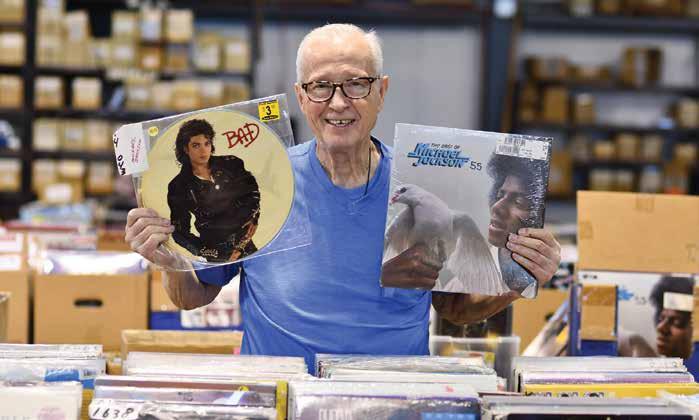
Sinkuler tends to know what he’s got, so Horizons isn’t for a collector looking to find an obscure and valuable record for a couple bucks. But it is for a collector like me.
a remarkable selection of soul, hip-hop, and R&B. All of these spots stock plenty of records by local artists, which is what I like to see. The best shops act as vectors of regional culture and demonstrate something distinctive about where they are. Horizons, however, doesn’t appear curated in any meaningful way. Its inventory looks like leftovers from shuttered record stores, private collections, estate sales, thrift stores, yard sales, and defunct labels, all of them tossed together. Most record shops stock canonized classics that will appeal to casual shoppers and new collectors, but I was hard-pressed to find anything like that. I saw a few Beach Boys compilations, but no Pet Sounds . I
Sinkuler bought all these albums, but collectors tend to be more selective about what they keep.
Horizons isn’t a shop for people who can fit their entire record collection into a single square of an IKEA Kallax shelf. It’s not a place for people looking for a specific record either. Shopping via Discogs probably makes it easier to tell whether Horizons has something— its searchable online store lists nearly 29,000 items.
The air in the Horizons warehouse has a faint stale aroma, as if no one has been through in weeks, but the space isn’t neglected. Sinkuler clearly updates his inventory frequently, and his prices are comparable to the higher-tier market rates established by Discogs sellers. I blushed at the $70 price tag on Amnesty, the 1985 debut LP by severely overlooked Chicago speed-metal band Zoetrope, but that number is within the range of the current offerings on Discogs.
Sinkuler tends to know what he’s got, so Horizons isn’t for a collector looking to find an obscure and valuable record for a couple bucks. But it is for a collector like me.
I like to take a chance on a record I’ve never seen before, particularly if it’s cheap, because who knows if I’ll come across it again. Every album is an opportunity to hear something new, to test
required to deal with the cultural hegemonies that have turned so much classic rock into a museum piece.
Of course, in recent decades, many private-press recordings have been canonized in their own way. The message board for obscure-obsessed music site Waxidermy (now defunct) produced a ranked list of the best albums from the private-press pantheon, and many of them have been reissued in the past decade and a half. Light in the Attic owner Matt Sullivan credits Waxidermy with introducing him to U.F.O. , a 1969 folk album by Jim Sullivan that his label rereleased in 2010. It’s number four on the Waxidermy list.
One big reason I find vanity-press releases more compelling than acknowledged classics is that the world of tiny, obscure records feels boundless. It’s impossible to learn about everyone who had the gumption and the cash to press a recording to wax. I know that every trip to a record shop has the potential to expose me to a piece of music from this theoretically infinite pool that exists outside the music industry. The chance to hear a record I didn’t know existed before glancing at its cover in a shop, made by someone who cared enough to leave that document behind, keeps me seeking out places like Horizons.

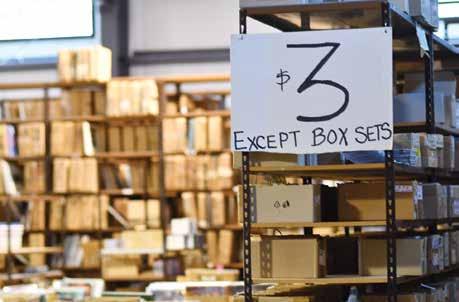
Earlier this year, boutique Toronto movie label Canadian International Pictures reissued Alan Zweig’s Vinyl on Blu-ray. In his feature-length documentary debut, originally released in 2000, Zweig interviews record fanatics who have robust collections and unhealthy obsessions. Between these interviews, Zweig includes his own ruminations about buying and owning records and his regrets about dedicating so much of his life to collecting vinyl. He delivers these unvarnished monologues in front of a mirror with his camcorder’s lens pointed directly ahead, which gives them a bracing intimacy.
I can see myself in some of Zweig’s confessions. I’ve likewise bought records because I wanted to “save them,” as though we’re in Toy Story and they just need a good home—which, of course, is my record shelf. But Zweig also shows how collecting can become so extreme that it crowds out relationships and other parts of life, and I have no interest in even finding that line, never mind crossing it. I like to think my approach to collecting is relatively healthy: It’s expanded my worldview, allowed me opportunities to meet new people, and given me the tools to entertain friends and introduce them to music I love. At least, that’s a nice thing I
can tell myself when I leave a record shop with as many LPs as I did in Mendota.
Sinkuler sold me 13 12-inches and a CD for a grand total of $35. Nearly everything was still sealed. He ended up not charging me for the CD—a copy of M.C. Boo & the Crew’s Back to the Bass-ics—in part because it still had three different price tags on it from whatever shops it had passed through.
Out of all the records I picked up that day, I hadn’t heard of a single artist. Some I bought because the cover piqued my curiosity, such as the ransomnote typography on If You’re Gonna Do Something Wrong Do It Right! , a 1982 new-wave LP by Da Pliars. I was drawn to No Guts . . . No Glory! , a 1978 blue-eyed soul album by George Deffet of Columbus, Ohio, because he shares a surname with Ryan Deffet, an Ohio native who led Chicago band Space Gators till his death in 2023.
All the records remain untouched, propped up against a shelf in my home office. I’ve been otherwise occupied— family, work, hobbies—and haven’t listened to them yet. But yes, I’ve also bought more records since my trip to Horizons. v
lgalil@chicagoreader.com
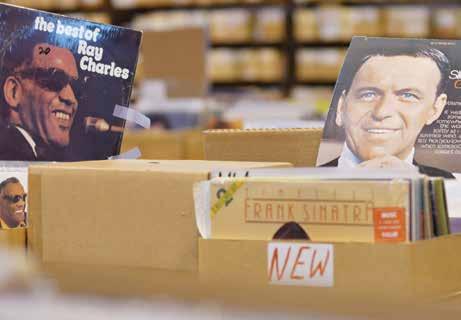

Events actually worth leaving your house for




We do our best to be accurate, but please check venue websites for updates and more information, as event details may have changed since press time.
THU 7/2 Cursed Awakening, Blunt Force Karma, and Contra Astrum open.
Genre-hopping Chicago technical death metal duo Become Death are Erik Tomlinson (vocals, guitar, drum machine, synth) and Mena Menont (bass and saxophone). They’ve already released two galvanizing and powerful EPs, 2018’s Crossing the Dunes of Ruin and 2024’s It Comes in Waves, and their forthcoming debut full-length, Vorara (due July 3), is one of the most anticipated local metal releases of the summer.
SAT 7/18
In an ideal matriarchal society, Junglepussy would have queen status. Born Shayna McHayle, the East New York rapper, actress, and professor is an all-around superstar—a talent who flaunts her artistry alongside her hypnotic sex appeal and stunning intellect.
JP has been an overqualified rap femme fatale since her first mixtape, 2014’s Satisfaction Guaranteed. Her most recent album, 2020’s Jp4, is a genre-bending, spiritually spicy romp loaded with bold, assured anthems. On “Main Attraction” she proclaims, “Pussy berserk / I made him pay for all my merch / Put ’em in a hearse.” How could you not love her unapologetic self-confidence?
Junglepussy has been vehemently independent throughout her career, self-releasing her music to consistent critical acclaim and championing creative autonomy on social media. Her ever-present buzz helped land her on a 2022 tour opening for psych-rock giants Tame Impala, a gig that, as fate would have it, also brought her the acting role of a lifetime. Director Paul Thomas Anderson was so impressed by JP’s live show that he wrote a character named “Junglepussy” based on her stage persona and lyrics for the 2025 comedy thriller One Battle After Another. She basically played herself—albeit a machine-gun-wielding, far-leftvigilante version of herself who can give a helluva “Throw your hands up and do what I say” speech.
Thankfully, JP is still rapping and touring, even as she has Hollywood in a cobra clutch. Along with her upcoming festival appearances in Philadelphia and Seattle, she’s bringing her liberating bangers to the Empty Bottle. The show is sold out, so I hope you already have your tickets to what’s sure to be a sweaty, delightfully cunt celebration. (Empty Bottle, 11 PM, 21+) CRISTALLE BOWEN
Vorara is a beautiful monster of an album that pulls together the best parts of those early releases. You’ll sometimes wonder how so much delirious noise can be produced by just two people. These days, the essence of Become Death’s energy is rage. Though Vorara has its share of instrumental elegance—the gorgeous build and shift of the title track, for instance, or the lush guitar intro and hedonistic riffing of the instrumental “Vertigo Integration”—the mood of this album comes out in its eruptions of raw hardcore ferocity. The rewritten lyrics in their cover of Cannibal Corpse’s “I Cum Blood” make clear where they stand politically: “One month in the grave / Twisted and half decayed / His hair a putrid yellow / I pissed on this MAGApilled asshole,” Tomlinson growls. Menont’s saxophone spurt at the end really drives the message home. On “Incanted Into Obsequium,” a mesmerizing, shuffling riff guides the listener through several planes of existence, while the clangs and samples at the end of “Fan Fiction” raise goose bumps. (The Burlington, 8 PM, 21+) MONICA KENDRICK
SAT 7/11 Featuring the Chosen Few DJs (Wayne Williams, Jesse Saunders, Tony Hatchett, Alan King, Andre Hatchett, Terry Hunter, and Mike Dunn); special guests DJ Jazzy Jeff, DJ Boolu Master, and DJ Slugo; and live performances by Barbara Tucker, Curtis “Move Your Body” McClain, and Christine Wiltshire
Chicago is dense with music festivals, and while in the past I’ve danced around saying this outright, the Chosen Few Picnic is the best of them all. Part of this has to do with increasing financial pressures on the festival circuit generally. In early June, for example, Windy City Events canceled Michelada Fest three weeks before it was set to hit Union Park (and the week after the company debuted R&B-focused festival Forever Mine in the same park). The company cited rising production costs for midsize fests as a factor.
The Chosen Few Picnic, meanwhile, has maintained more or less the same vibe since its 1990 debut, and it continues to thrive.
The Chosen Few, a crew of veteran house DJs, have gathered every year on a date near the Fourth of July to spin at a reunion picnic organized by the Hatchett family—brothers Tony and Andre have been members of the crew since 1978 and 1981, respectively. The gathering quickly grew beyond the extended Hatchett family, and by the late 2000s the picnic was attracting around 20,000 people. Admission was free till 2010, but even after the Chosen Few Picnic started looking more like other large-scale festivals in its layout, with the stage fenced off from the rest of Jackson Park, it held onto its carefree spirit.
Every summertime gathering would be improved if folks could bring lawn furniture, tents, food, coolers, and grills, the way they can here. And house music playing at a volume you can feel in your bones certainly helps keep everyone’s spirits up! Considering that the Chosen Few helped shape house-music culture, every Chicagoan ought to experience the picnic at least once. As in previous years, the collective have booked a handful of guests to keep the party going all day, including New York vocalist Barbara Tucker and ghetto-house hero DJ Slugo. (Jackson Park, 7 AM–10 PM, all ages) LEOR GALIL
THU 7/16 Daniel Villarreal and DJ Clark Quente open.
My birthday in 2024 was one of my worst—a fever forced me to miss what I thought would be my only chance to see Brazilian singer-songwriter Marcos Valle. The bossa nova keyboardist and vocalist was touring to celebrate his 80th revolution around the sun, and I didn’t feel safe assuming he’d make it back here. Luckily, life sometimes grants second chances, and the legendary hitmaker will return to Chicago this summer—this time to perform a free concert in Millennium Park.
In June, Valle performed a career-spanning set in Copenhagen, and I’d be thrilled if he played even half of the same tunes here. Highlights included his 1964 standard “Summer Samba” (also known as “So Nice”), a breezy anthem that’s been a hit more than once; it’s been recorded dozens of times, including by Bebel Gilberto and Emma Bunton (aka Baby Spice). There’s no song I’d rather hear on a sweltering July day—except maybe the drifty “Wanda Vidal,” from 1971’s Garra, where Valle’s supple, silky voice meshes with textural psychedelia. The Copenhagen set leaned heavily on my favorite Valle LP, 1973’s brilliantly heady Previsão do Tempo, a dreamy song cycle that features wah-wah guitars, warbly electric organ, and blissful pop melodies. “Nem Paletó, Nem Gravata” gets stuck in my head as often as Os Mutantes’ trippiest tunes.
Valle excelled in the early 80s too: “Estrelar” was influenced by pioneering hip-hop, and the classic banger “Bicicleta” is a campy Rio boogie, a sort of synth-heavy Brazilian jazz-funk. By the aughts, he’d adopted a sleeker, more club-ready sound, but his most recent album, 2024’s Túnel Acústico, takes a wider view, combining many of the aesthetics he’s evolved through. Valle started his June concert with a tune from that record, the breezy “Life Is What It Is,” and I’m praying he plays it here too. He wrote the song with Brazilian percussionist Laudir de Oliveira, best known as a member of Chicago, and the band recorded the original funky fusion version for the 1979 platter Chicago 13. No matter what Valle decides to play at Millennium Park, I’ll be there, joyfully baking in the sun—and hoping for a bossa nova cover of “25 or 6 to 4.” (6:30 PM, Jay Pritzker Pavilion, free, all ages) STEVE KRAKOW
SUN 7/26 Wretched Blessing and Sarin open.
A half century ago, you might’ve expected a Bay Area band called World Peace to be an acid-fried hippie collective singing about their optimistic vision for the future and radiating goodwill toward all humankind. But this isn’t the Summer of Love, and this World Peace don’t buy into anybody’s illusions about our species. The powerviolence group have made unrelenting, ultraheavy noise for about a decade, wielding grotty bass guitars (two of ‘em), jackhammering drums, and hollered vocals like a hundred-pound blackjack. The band’s 2021 album, Come and See, excoriates humanity for its reliance on religion across 20 furiously precise tracks totaling roughly ten minutes. Their latest, the May release For No Man Shall See Me and Live (whose title paraphrases something God allegedly said to Moses in the Book of Exodus), is similarly bleak and singleminded. Its ten tracks last a little more than six and a half minutes, so you’ll come back for seconds if not thirds. World Peace’s live shows are not for the faint of heart—the crowd can get a tad rambunctious—but if you can stand the heat at this headlining Empty Bottle set, you’ll be well rewarded. (Empty Bottle, 9 PM, 21+)
JAMIE LUDWIG
MON 8/3 Zeshan B and Radius open. The Budos Band make their own zeitgeist. In the mid-2000s, the New York group’s early records created rich blends of Ethiopian jazz, Afrobeat, funk, and vintage soul. Those styles remain part of their sound, providing a launchpad for musical explorations that have ranged further and further over the past two decades. Today the Budos Band are more psychedelic, more cinematic, more metal, and more outernational than ever—and they have yet to drop the groove. The Budos Band are one of those rare groups that practically anyone can enjoy—if you can’t find something in their dense instrumental music that resonates with you, then you may just be no fun.
The Budos Band are in fine form on their latest album, last year’s Budos VII, their first full-length for Diamond West after leaving longtime label Daptone. The album unfolds like a map in an old adventure movie, and its twists and turns into Anatolian psych, spaghetti western scores, dub, and other sounds hold lots of hidden treasures. “Overlander” opens with a swaggering guitar riff that reminds me of Mötley Crüe’s “Shout at the Devil,” but when the rest of the band drop in, it’s with a brassy, burbling simmer instead of Sunset Strip sleaze. “Kudzu Vine” sounds like a 70s spy caper set in a sweltering jungle, while “The Strigoi” combines slinking bass and cosmic sci-fi effects. The dusky “Behind the Black Curtain” suggests a chance encounter between rivals, and as the tune saunters though eerie echo effects, lurching guitars,
WED 7/22
The titles of Magic Tuber Stringband’s records typically invoke the time or place in which they were made. The avant-folk trio wrote the 2023 album Tarantism under COVID restrictions in spring 2020, and they named it for a historic condition legendarily thought to be caused by a spider bite and cured by frenzied dancing. Their 2024 cassette, The Crozet Tunnel, is titled for the reverberant railroad tunnel where they recorded it.
Heavy Water, the band’s new LP for Thrill Jockey, takes you somewhere you can’t go: the Savannah River Site (SRS), a 310-square-mile industrial complex in South Carolina whose population was removed in the 1950s to make way for nuclear weapon production facilities. The trio, whose members live in Durham, North Carolina, and Blacksburg, Virginia, combines the old-time sounds you’d expect a string band to play with free-form cacophony, tape manipulation, and field recordings. The SRS is still restricted today, but fiddler Courtney Werner collected recordings there after gaining clearance to visit while doing ecological research meant to determine whether birds living in the area had become radioactive. The sounds she captured contribute immeasurably to the album’s evocations of lost communities and enduring wildlife. On “The Death of Ellenton,” a distorted recording of the Johnson Family Singers’ 1951 protest song about the area’s original clearing unspools into seething strings and droning pump organ. And on “Woodpeckers,” spectral string harmonics wreathe a recording of birds that seem to respond to the sounds of paramilitary guards engaged in target practice with bursts of their own. In concert, Magic Tuber Stringband bring their collective gifts as performers to the fore: Evan Morgan weaves gamboling guitar and banjo melodies around Michael DeVito’s swinging bass, while Werner slips imitations of wildlife sounds into her jubilant fiddling. (Constellation, 8:30 PM, 18+) BILL MEYER
and determined horns, you get the feeling that things could turn out well or end up really dark—until a ferocious baritone sax takes center stage for a solo that forecloses the question. The Budos Band bring the goods onstage just as reliably as they do on their records, so this free Millennium Park show ought to be one of the grooviest nights of the summer. (Jay Pritzker Pavilion, 6:30 PM, free, all ages) JAMIE LUDWIG
Don Trip, Tha Landlord Thu 7/2, 8 PM, Lincoln Hall, 18+
Hot Chip (DJ set), Madeline, Duke Shin Fri 7/3, 10 PM, Smart Bar, 21+
La Texana, Blood Club, Future Nobodies Fri 7/3, 8 PM, Bottom Lounge, 17+
Sonido Gallo Negro, Rudy De Anda Fri 7/3, 9 PM, Chop Shop, 18+
FaceEater, Godly the Ruler, Victor Internet (DJ set), Dreamer Isioma (DJ set) Wed 7/8, 8 PM, Schubas, 21+
108, Racetraitor, Snuffed, Burning Fight, Left of Heaven Thu 7/9, 7 PM, Cobra Lounge, 17+ Corto.Alto, Wave Cage Thu 7/9, 8 PM, Schubas, 18+
Novulent, Baby Teeth Thu 7/9, 7 PM, Reggies Rock Club, all ages
The Bug Club, Golomb Fri 7/10, 8 PM, Lincoln Hall, 18+
Rebirth Brass Band Fri 7/10 and Sat 7/11, 8 PM, Martyrs’, all ages
Rachael Sage, Rachel Drew Fri 7/10, 8 PM, Uncommon Ground, all ages
Square Roots Fest with Dehd, Deeper, Margo Price, Hurray for the Riff Raff, Robbie Fulks, Nick Lowe & Los Straitjackets, JD McPherson, the Tossers, and more Fri 7/10, 5 PM, Sat 7/11 and Sun 7/12, noon, Lincoln between Montrose and Wilson, all ages
Fabiano do Nascimento, DJ Muku Sat 7/11, 8:30 PM, Constellation, 18+
Conan, Acid Fog, Plinian Mon 7/13, 8 PM, Reggies Rock Club, 17+
Hunx & His Punx Thu 7/16, 11 PM, Empty Bottle, 21+
Pearl & the Oysters Thu 7/16, 9 PM, Sleeping Village, 21+
Avreeayl Ra’s Dream Stuff Thu 7/16, 8:30 PM, Elastic Arts, all ages
The Rumble with Hatebreed, Turmoil, Grid Iron, Hold My Own, 100 Demons, Missing Link, No Cure, and more Fri 7/17 and Sat 7/18, 1 PM, Cobra Lounge parking lot, 17+ Josh Caterer Sat 7/18, Uncommon Ground, all ages
Lucy Dacus with the Chicago Philharmonic, Ratboys Sun 7/19, 7 PM, Jay Pritzker Pavilion, all ages
TV Star, Nathan Ma Band, Head, Golden Rulers Sun 7/19, 8 PM, the Hideout, 21+
Steven G Tue 7/21, 8 PM, Subterranean, 17+
Femcels Tue 7/21, 8 PM, Schubas, 18+
Kylesa, Yakuza, Cloud Rat Fri 7/24, 8 PM, Thalia Hall, 17+
Lesley Mok Fri 7/24, 8 PM, Elastic Arts, all ages
Poppy, Landmvrks, Thousand Below Fri 7/24, 7:30 PM, Riviera Theatre, all ages
Cheer-Accident, In Masks, Jae Cross Sat 7/25, 7 PM, Martyrs’, 21+
Dakhabrakha Sat 7/25, 8 PM, Maurer Hall, Old Town School of Folk Music, all ages
Shannon Shaw Band, Georgia Maq Sat 7/25, 7 PM, Subterranean, all ages
Emmylou Harris & Graham Nash Sun 7/26, 7 PM, Hunter Pavilion, Ravinia Festival, all ages
Sleepytime Gorilla Museum, Wendy Eisenberg, Matt Espy Sun 7/26, 7 PM, Chop Shop, all ages
Blood Orange Wed 7/29, 9 PM, House of Blues, 17+
54 Ultra, Paloma Morphy Thu 7/30, 11 PM, Schubas, 18+
Freddie Gibbs, Kaicrewsade Sat 8/1, 11 PM, Ramova Theatre, 18+
Amber Mark, Ric Wilson Sat 8/1, 11 PM, Thalia Hall, 17+
Los Retros, Simon Grossman Sat 8/1, 11 PM, Cobra Lounge, 17+
Tomahawk, Melvins Tue 8/4, 7:30 PM, Riviera Theatre, 18+
Bossman Dlow, Yung Miami, Bally Baby Fri 8/7, 8 PM, Riviera Theatre, 18+
Holy Wave Thu 8/13, 9 PM, Empty Bottle, 21+
TLC, Salt-N-Pepa, En Vogue Tue 9/8, 7:30 PM, Huntington Bank Pavillion, all ages
Noname Thu 9/10, 8 PM, Park West, 17+
Ceremony, Poison Ruïn, World Peace Sat 9/12, 7 PM, Metro, all ages
Bettye LaVette Sun 9/13, 7 PM, Maurer Hall, Old Town School of Folk Music, all ages
Liz Phair, Sleater-Kinney Thu 9/17, 6:30 PM, Salt Shed, all ages
Dua Saleh Wed 9/23, 7 PM, Chop Shop, all ages
Sun Ra Arkestra Fri 9/25, 7 and 9:30 PM, Constellation, 18+
Múm Mon 9/28 and Tue 9/29, 8:30 PM, Constellation, 18+
Laurie Anderson, Sexmob Tue 9/29, 7:30 PM, Riviera Theatre, all ages
W.I.T.C.H. Fri 10/2, 9 PM, Sleeping Village, 21+
Castle Rat, Wraith Knight, Unto Others
Thu 10/15, 6:30 PM, Concord Music Hall, 17+
Whitney Thu 10/22, 7:30 PM, Metro, all ages
The Damned, Flamin’ Groovies, Courettes
Sat 10/31, 7 PM, 17+
Jalen Ngonda, Brooke Combe Tue 11/10, 8 PM, Thalia Hall, 17+

THROUGH SAT 7/11
I fear this piece may not function well as a review of “Shadow,” up at Shannon Rae Stratton’s new gallery tête-à-tête-à-tête. For the space cannot rightfully be called a gallery but rather exists within the lineage of the salon: sites
where intimacy, attention, and conversation are the order of the day.
Works by Holly Murkerson, Robin Arseneault, and Cristina Umaña Durán explore the psychoanalytic, physical, and surreal implications of, well, shadow. The interplay of shadow and light is made manifest in Durán’s When the Shadow Comes Out (Golden Hour) (2026), a translucent textile piece installed upon the window, with a pocket made for a copy of architect Jun’ichirō Tanizaki’s 1933 essay In Praise of Shadows. Arseneault and Murkeson’s enigmatic works present shadows
THROUGH SUN 9/20
He called himself a “slipping glimpser” and, indeed, to take in one of Willem de Kooning’s paintings is always a series of momentary glances—nothing waits long enough to be apprehended. No artist I know has conveyed the frenzy of animality in quite this way. This show is billed as the first to focus on the artist’s drawings, but it also features many exceptional paintings and mixed media pieces. Taken as a whole, I doubt there will be an exhibition to match it this year.
It’s a treat to see a selection of his early work from the 1920s. Though adhering to the Deco illustration style of that decade, you can see a stored energy just waiting to explode into the looser, improvisational forms found in his work in the decades to come. His 1940 pencil portrait of his wife, Elaine, is among the more tranquil on view, and yet the sharpened angles in the creases of her sweater are a kind of tell. They’re like a skittish animal waiting to pounce.
No de Kooning picture sits still. His coiled, angular marks whip around whatever support they’re aimed at, be it paper, canvas, or wood. The energy of his gesture is barely contained within the bounds of each rectangle. [A longer version of this review can be found on our website.] (Art Institute of Chicago, all ages)
DMITRY SAMAROV
created by way of unconscious drives and surreal dreamscapes. I see the severed limbs of Arseneault’s drawing Spectral Maneuver (2022) and the gaping holes of the rocky outcrops in Murkeson’s print recto/verso (2023/2026), in subtle conversation with the reading room’s books, like Georges Bataille’s The Accursed Share and Carl Jung’s The Red Book, for shadow here is not a simple thing but a tangle of traits and memories marked by excess and exuberance, the animation that powers the body’s machine. [A longer version of this review can be found on our website.]. (tête-à-tête-àtête, free, all ages) ANNETTE LEPIQUE
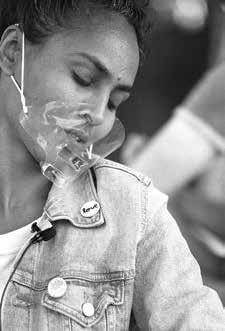
SAT 7/11 AND 7/18
Justin Jones has long been after the ephemeral.
“I’m looking for people in a moment—moving, or lost in something. . . . I’m looking for a touch of the mystical,” he told me last year, when we spoke about his work for the Reader, when this first solo exhibition was still a twinkle in his eye.
“A Moment of Pause” selects 20 black-andwhite fiber prints from a collection of hundreds taken on the west side over the past several years. Ranging from small darkwave shows to the goth/industrial music festival Sanctum, and spanning music, theater, and dance, these photographs chart a through line of intensity in Chicago’s performance scene. It is sure to be a treat. (4th Shift Gallery, 2–7 PM, all ages)
SHIRA FRIEDMAN-PARKS
“Sorri fi maaga dawg, cuz maaga dawg will ton roun bite yu”
THROUGH SAT 8/1
Krystle Lemonias’s second solo show at Andrew Rafacz delivers an unimpeachable account of the artist’s interdisciplinary talent, sealed by a prowess for stitchwork. The product of a residency at the Casa Santa Ana Foundation in Panama City, this new body of mixed-media work draws as much inspiration from a general engagement with Panama’s history as from a more personal source, Lemonias’s great-grandfather, who once lived in the country. This familial connection has led the artist to deepen her engagement with themes of movement, labor, and identity.
Labor comes in and out of focus throughout the room, appearing in smaller and more sprawling compositions. Lemonias’s larger works are where her capabilities truly settle. Composed of selections of patterned upholstery fabric, donations of clothes from her paternal family, and carefully selected portions of food packaging, the scenic landscapes and depictions of bodies at work are exquisitely detailed. The differences between these material choices provide a tantalizing contrast, a flirtation with depth that gives the appearance of something
like watercolors on textile. The best in show: A patchwork image of two figures in a steady procession, marching a minecart down a railway to an unknown destination. [A longer version of this review can be found on our website.]
(Andrew Rafacz, free, all ages) LUCAS GÓMEZ-DOYLE
THROUGH SAT 8/1
Collaborators Anna Martine Whitehead and A.J. McClenon build on the Black tradition of bricolage, of call and response, for this two-person exhibition. Using found media, from magazines and children’s toys to viral videos, the Chicagobased artists are remixing their materials to inspire a new way of thinking. This should come as no surprise—both artists’ practices are rooted in abolition. Stay tuned for info on a closing reception, which will feature live performance.
(Roots & Culture, free, all ages) KERRY CARDOZA
THROUGH SUN 8/2
The number 13 contains multiple meanings; it’s elastic and flexible, a container for fear, hope, and faith. It is no surprise then that the artist Leonardo Kaplan, an ardent investigator of the image—specifically in how images work to order, reinforce, and build belief, acting as ballast for the many systems and mechanics of our world— named his show at Mickey “thirteen.”
The exhibition is comprised of nine paintings, toner transfer works of marker, pen, dye, and pencil, on cotton and canvas, featuring subjects as varied and obtuse as: chain-link fences, broken wine glasses, bees, keys, charger cords, pill bottles, outlines of hands, keychains, peace signs, letters of the alphabet, fish, glass water bottles, and dandelion puffs. At first glance, the sheer abundance of materials and subjects divorced from context, like the fish that materialize from the oil-slicked puddles of an abandoned parking lot in Suspended Animation (2025) or the pastel water explosion haloing the broken wine glass in Thirst Trapped (2026), feel like a nod to the cracks, fissures, and cacophony of modern life. One would be forgiven for thinking that the work remarks on a cultural moment where language has been rendered into something unstable, letters like shots fired into the sky. [A longer version of this review can be found on our website.] (Mickey, free, all ages)
ANNETTE LEPIQUE
THROUGH SUN 4/11/2027
Dinosaurs and Pokémon might just be the most popular cultural entities that children obsess over. Now, the two are colliding at Chicago’s very own Field Museum with its Pokémon Fossil Museum exhibition. This is the first time the exhibition is appearing outside of Japan, and features large models of fossil Pokémon from the video game series installed beside realworld fossils.
Each faux fossil from the multimedia franchise has a genuine fossil, cast, or model of a corresponding species alongside it. Tyrantrum and Tyrunt stand next to a cast of Sue the T. Rex’s skull, while the birdlike Archen and Archeops are appropriately partnered with archaeopteryx. Omanyte and Omastar are joined by actual ammonite fossils. Real skulls of pachycephalosaurus, protoceratops, and camarasaurus complement the Rampardos, Bastiodon, and Aurorus model skeletons, respectively.
The exhibition is relatively small with a full walk-through taking no more than 40 minutes to complete. The project is certain to leave both Nintendo superfans as well as families accompanying their children wide-eyed. It is a cute and pleasant experience all around, combining whimsy with a spark of scientific curiosity. [A longer version of this review can be found on our website.] (Field Museum, all ages)
FAROUK KANNOUT
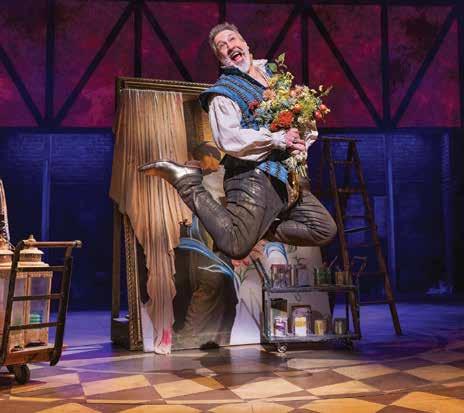
WED 7/22-SUN 8/2
What if Juliet survived that massive clusterfuck at the end of Shakespeare’s tragedy? That’s the premise behind this 2022 musical, created by book writer David West Read (the Emmy-winning screenwriter for Schitt’s Creek) and composer and lyricist Max Martin. The show combines Martin’s original songs with a lineup of pop hits from the late 90s to the 2010s, including Britney Spears’s “Oops! . . . I Did It Again” and NSYNC’s “It’s Gonna Be Me” to flesh out the story of Juliet reclaiming her own identity and future. When & Juliet came through on tour in 2024, Reader contributor Layla Brown-Clark described it as “a coming-of-age story that will transcend generationally through song and meaning.” The NSYNC connection continues in this current touring version at the Auditorium: Joey Fatone plays Lance, the demanding father of François du Bois, who is befriended by Juliet and her pals when they take a road trip to Paris. (Broadway in Chicago) KERRY REID
“It’s About Time: Counterproductive Conceptualisms in Chicago”
OPENS FRI 7/10
Curatorial heavy hitters Dieter Roelstraete and Abigail Winograd are swinging for the bleachers with this group exhibition, meant to establish a new strand of Chicago-specific conceptual art. The curators view these artists as working in “counterproductive conceptualisms,” meaning they’re unconcerned with the demands of the market and are instead staying true to their contrarian ambitions. The assembled group of workhorse artists is smart (Alex Chitty, Miao Wang, Pope.L, Shir Ende, among others), their mediums broad (installation, choreography, video, painting, performance, and more); it’s
sure to be an exciting, and excitingly bold, effort. (Gray, free, all ages) KERRY CARDOZA
“Longer Than the Sky: Art of the Obama Years” Opens Fri 7/10, Logan Center Exhibitions, free, all ages
“Palomar (Part 2)” Through Sun 7/12, Renaissance Society, free, all ages
“Josué Esaú: The Caracol” Through Sat 8/1, Boundary, free, all ages
“nánwàng de yī tiān” Through Sat 8/1, Shanghai Seminary, free, all ages
“A quilt is a window, a window is a quilt, too” Through Sat 8/8, ACRE Projects, free, all ages
“The Soccer Show: A Celebration Of The World Cup” Through Sat 8/22, Elise Seigenthaler Gallery, free, all ages
“Cutting and Pasting a World: The Paper Craft of Henry Darger” Through Sun 1/31/2027, Intuit Art Museum, all ages
THROUGH SUN 7/12
The moniker may feel anemic, but Kevin Douglas’s Untitled Vampire Play at Lookingglass Theatre is a bloody good thrill ride of a show that blends familiar undead lore with the lineaments of opposites-attract rom-coms. Nimbly directed by Devon de Mayo, Douglas crafts a tale of a young Chicago man, Dom (Jordan Anthony Arredondo), who brings his new love interest, Valencia (Courtney Rikki Green), home to meet the parents. There’s just one teensy thing they need to know first: she’s a vampire. . . . Despite the obvious vampire-tale antecedents for Douglas’s story, nothing here feels obviously derivative except perhaps as intentional homage. For me, what Untitled Vampire Play does so well is to blend the essential tragedy of immortality (every mortal you love will die before you) as explicated by Anne Rice and so many others, but with an everyday humor and straightforward vernacular that undercuts the genre’s tendency for selfconscious philosophizing. . . . Douglas and de Mayo establish both comic tension and poignant yearning. And they do it with an understanding of essential relationship dynamics—codependence, fear of loneliness, and the need to maintain control over loved ones. [A longer version of this review can be found on our website.] (Lookingglass Theatre) KERRY REID
Speaking of vampires: Black Button Eyes Productions gets into the bloodletting with a revival of Irish playwright Conor McPherson’s 1997 one-man play about a theater critic who falls in with a band of the undead. (Insert all your “But how can they tell the difference?” jokes here.) Kevin Webb, whose 2022 performance in the title role in Kokandy Productions’ Sweeney Todd earned a non-Equity Jeff Award, is no stranger to dark and twisty characters. Now he steps into a role originated by Brian Cox that has since been performed by many others (including Brendan Coyle, perhaps best known as Bates from Downton Abbey, in a production at the Goodman in 2019). McPherson’s story focuses more on what it’s like to be a man long dead to the beauty of the world and of art. The unnamed protagonist in St. Nicholas realizes that he has to start living his own story, instead of feeding off the lives of others. It’s a good choice for Black Button Eyes Productions, founded in 2014 and dedicated to helping “magic invade reality.” Founder and artistic director Ed Rutherford directs Webb. (Black Button Eyes Productions) KERRY REID
THU 7/2–SUN 9/13
The Age of Aquarius seems like eons ago now—49 years, to be exact. That’s how long it’s been since the “American Tribal Love-Rock Musical” created by composer Galt McDermot and book writers and lyricists Gerome Ragni and James Rado opened off-Broadway at New York’s Public Theater, becoming the first production in that storied institution’s history. (Chicago-based producer Michael Butler saw the Public production and was instrumental in moving the show to Broadway.) Whether you’re looking for 60s nostalgia or seeking some peace, love, and understanding for our current hellscape, Kokandy Productions’s revival may be the way to let the sunshine in. Brennan Urbi, a former Chicago artist now based in New York, directs and choreographs the show, which, like Kokandy’s production of Frank Wildhorn’s Jekyll & Hyde last year, finds the company moving up from the Chopin Theatre basement to the mainstage. (Jekyll & Hyde is also returning with Kokandy in a coproduction with Broadway in Chicago at the Broadway Playhouse opening in September.) Gavin Rhys stars as Claude, a
young man of pacifist principles trying to decide if he’s going to honor his draft notice, and Zac Richey plays his freewheeling friend, Berger. (Kokandy Productions) KERRY REID
TUE 7/7–FRI 7/24
For 18 years, Dance in the Parks has brought free dance performances to communities throughout the city, in partnership with Night Out in the Parks. This is their last season, but they’re going out in style. Each outdoor performance features the Dance in the Parks professional company alongside youth performance partners such as the West Pullman Park Lady Wolfpack Dance Team and Extensions Dance Center. It’s a fine reason to either amble over to your local park, or check out a park in a part of the city you’ve never been to before, while also enjoying the beauty and joy of human bodies in motion. Pack a folding chair or a blanket and any snacks and beverages you like, and say goodbye to this summer tradition. The full schedule is on the company website. (Dance in the Parks) KERRY REID
THU 7/9–THU 7/16
Earlier this year, Theatre Y presented Charges (The Supplicants), an update of Aeschylus’s The Supplicants by Nobel Prize-winner Elfriede Jelinek, which placed audience members in small “pillboxes” with slits for windows around the perimeter of the stage, through which they viewed the stories of refugees pleading for asylum in an unnamed country. In The School of Memory, Theatre Y continues to explore themes of displacement and fascism. Created by director-performer Héctor Alvarez, the show draws on Alvarez’s family and their own experiences with Spanish fascism under Francisco Franco: Alvarez’s great-grandfather was murdered by Franco’s troops during the Spanish Civil War, which marks its 90th anniversary this year. Central to the show is the live video and soundscape provided by Attilio Rigotti, in which archival images and documents dissolve and morph into present-day “living memories.”
As we confront the reality of our own fascist government, Alvarez’s piece asks us to consider the past not as a historical abstraction, but as a way of understanding what’s happening right now. As always with Theatre Y, performances are free, though donations will be accepted. (Theatre Y) KERRY REID
SAT 7/11–SAT 8/1
Longtime Chicago storefront vets Michaela Petro and John Henry Roberts, founders of the new company the Dark Room District, present their first theatrical offering in a bar popular with theater folks: Fritzy’s on North Clark, across the street from Raven Theatre. DIVE, written by Roberts, is set in 2010 and follows “16 beautifully broken characters” drawn from inspirations as diverse as classic noir and Anton Chekhov. Maura Kidwell directs the piece in the close confines of Fritzy’s, where the audience and the characters will be practically side by side—all the better to build the sense of “empathy without conditions” that Dark Room District hopes to focus on in all their work going forward. There’s a long tradition of barroom dramas, from Eugene O’Neill’s The Iceman Cometh (which features in a goofy way in Goodman’s current world premiere musical Iceboy! Or, The Completely Untrue Story of How Eugene OʼNeill Came to Write “The Iceman Cometh”) to William Saroyan’s The Time of Your Life Setting the stories in an actual bar is both a bold and sensible way for Dark Room District to introduce themselves. And you won’t have to leave to find a place to drink after the show. Win-win. (Dark Room District) KERRY REID
Midsommer Flight has been offering free Shakespeare in Chicago parks for 13 seasons, and they’re delving into perhaps the most bucolic of all Shakespeare’s comedies this year with As You Like It. Sure, it starts with a death threat and banishment, as Rosalind and Celia escape the court of authoritarian Duke Frederick (Rosalind’s uncle and Celia’s dad). But once they enter the Forest of Arden (with Rosalind in disguise as a man), romance abounds, even in the midst of comically mistaken identities. Artistic director Beth Wolf stages the production, which features Stephanie Mattos as Rosalind, Ebby Offord as Celia, Chase WheatonWerle as Touchstone, the saucy jester (is there any other kind?), and Jack Morsovillo as Jaques, an emo lord who finds sustenance in the woods. The show plays at a different public park each weekend during the run; see the website for the complete schedule.
(Midsommer Flight)
SUN 7/12
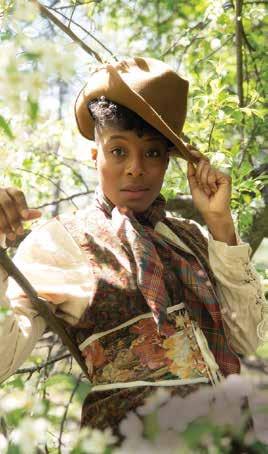
BoyGirlBoyGirl, a solo performance collective comprised of Rachel Claff, Stephanie Shaw, Diana Slickman, David Kodeski, and Edward Thomas-Herrera, has been around for decades, offering the kind of personal storytelling that Live Bait Theater specialized in when they started the Fillet of Solo Festival. The festival moved over to Lifeline Theatre for several years, and then at the beginning of this year, Fillet of Solo became a Sunday-afternoon regular feature at the Bughouse Theater. BoyGirlBoyGirl don’t perform together that often, so this is a rare opportunity to experience some of the best monologists in town in an intimate setting. (Bughouse Theater, 2 PM) KERRY REID
SAT 7/18–SAT 8/8
Albany Park Theater Project has long focused on creating devised work by its youth ensemble, focusing on the diverse stories from the neighborhood that gives the company its home. In 2023, APTP and Brooklyn-based immersive theater company Third Rail Projects unveiled Port of Entry in a former storage facility on West Montrose in which they constructed a facsimile
of a courtyard apartment building. Audiences were led in various configurations into rooms filled with immigrant families representing many generations and ethnicities, and were invited to play lotería with a Mexican family and sample lumpia with a Filipino family as part of the show. Now APTP returns to their home base at Eugene Field Park with The American Project, created once again from interviews conducted by the youth ensemble, alongside their own stories and experiences. The company describes the piece as one that “moves between intimate spaces and public confrontations, tracing how individuals and communities respond when the ground beneath them shifts.” Given how much Albany Park has been under siege by Immigration and Customs Enforcement agents over the past year, it couldn’t be timelier. But the company also promises that while there are stories of confrontation, there are also stories of hope and resistance. A middle-school teacher turns her classroom into a sanctuary. Three teens—from Somalia, Japan, and Sudan—set about working together to create their own version of the American dream they haven’t found. The show is codirected by company associate director Maggie Popadiak and Miguel Angel Rodriguez; the latter has served as co-executive director with David Feiner for several years, and will become sole executive director later this summer as Feiner transitions to a new role as director of innovation and advancement. (Albany Park Theater Project) KERRY REID
Improv Supernova Open run at Second City e.t.c.
Men of Soul Through Sun 8/9, Black Ensemble Theater
A Little Night Music Through Sun 8/9, Marriott Theatre, Lincolnshire
Hamlet Through Sat 8/15, Oak Park Festival Theatre, Oak Park
The Importance of Being Earnest Through Fri 8/14, Oak Park Festival Theatre, Oak Park Good People Fri 7/17–Sun 8/23, 4 Chairs Theatre at Theater Wit
Laura Benanti: Nobody Cares Thu 8/6–Sun 8/9, Steppenwolf Theatre
Alex Edelman: What Are You Going To Do? Wed 8/12–Sun 8/16, Steppenwolf Theatre
FRI 7/10-SUN 7/12
Sisters Thu 8/13–Sun 11/8, Writers Theatre, Glencoe
Play On! Fri 9/11–Sun 10/18, Chicago Shakespeare Theater
Liliom Thu 9/17–Sun 9/27, Joffrey Ballet at Lyric Opera House
THU 7/9–SUN 7/26
Throughout July, Facets will screen ten Japanese films as Anime Club Presents returns for its fifth annual iteration. The screening of All Cats, All Night Pt. II on Thursday, July 9, is just for Facets members and series passholders, but opening night on the subsequent Saturday
will feature Summer Wars (2009) followed by Wolf Children (2012). The series will close with the Studio Ghibli classic Ponyo (2008). Beyond the regular lineup, highlights will include film poster raffles, a complimentary cup noodle bar, and crossover screenings with other Facets programs including Cold Sweat and Family Sundays. Buy single or double-feature tickets (available at member and nonmember rates), or go all in on the $60 series pass. (Facets, all ages) TARYN MCFADDEN
SAT 7/18
This Logan Square microcinema and film club has cut its teeth with monthly feature programming and events, but for the first time ever, Tough Luck Cinema will host a shorts showcase. There are six genre-spanning films on the docket, all “centered around subconscious unveilings and unravelings.” The lineup
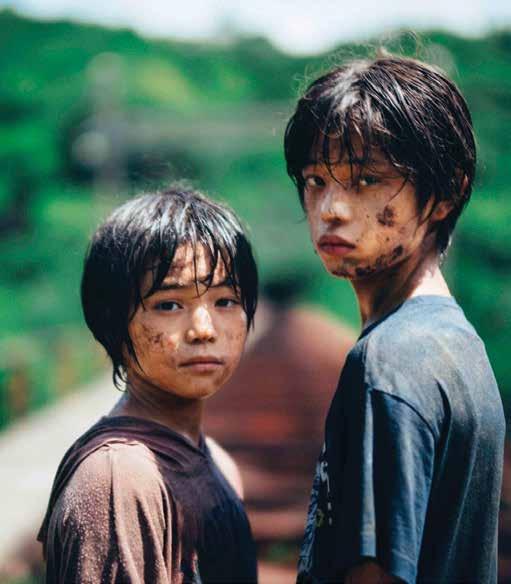
Mubi Fest returns to Chicago for its third year and, for the first time, is expanding to a third venue. Throughout the weekend, Mubi will host screenings at the Music Box Theatre, the Salt Shed, and the Siskel Film Center. As the distributor-platform’s only North American installment of their touring mini-festival, this 2026 Mubi Fest will also incorporate new styles of programming, expanding how it reaches all kinds of audiences and movie lovers. Compared to years prior, Mubi is showcasing more titles from their filmography, such as Monster (2023), The Substance (2024), Lurker (2025), and My Father’s Shadow (2025), plus the highly anticipated new Jane Schoenbrun movie, Teenage Sex and Death at Camp Miasma (2026). Most excitingly, there will be a special Sunday screening of The Mastermind (2025) featuring a live score performed with the film’s composer, Chicago’s own Rob Mazurek; it’s the perfect film for art and jazz lovers. Mubi Fest will also exhibit several anniversary screenings across different decades, including The Fly (1986), Ocean’s Eleven (2001), and Popstar: Never Stop Never Stopping (2016). While most events are ticketed, Mubi is bringing back the free Mubi Market at the Salt Shed fairgrounds, featuring local physical media vendors, games, bites and beverages, and more. (Music Box Theatre, the Salt Shed, Siskel Film Center, all ages) CORTLYN KELLY

includes Jerry Gonzalez’s Hamster In My Head, Gibson Almgren’s Afterwards, Benjamin Capps’s Terminal Emulator, Lara Unnerstall’s Short Leash, Aaron Salazar’s Still Life, and Jeff Hadick’s St. Linda. It’s a one-night-only special, with a happy hour and postscreening Q&A. The venue is indeed micro—capacity will be limited to 30 people—so reserve your $8 tickets ASAP. (Tough Luck Cinema, all ages) TARYN MCFADDEN
SAT 7/18
The Davis Theater will host this special Spotlight on Women double feature, presented by the Oscarbate Film Collective. Wildwood, NJ documents the women of the Jersey carnival town— including goths, go-go dancers, and more—on Super 8 film. Its companion is more of a midwestern home movie, an unedited piece not created for mass consumption. But together, the films craft a compelling time capsule of women in the 90s. Wildwood director Ruth Leitman and Girls archivist Derek Erdman will attend for a postfilm discussion. (Davis Theater, 7 PM, all ages) TARYN MCFADDEN
THU 7/30
Art House Convergence presents the seventh annual Art House Theater Day, which celebrates theaters across North America. What began as a shared screening day to celebrate independent cinema is now a full slate of films available for programming at participating arthouse institutions, of which Chicago has four. The six features this year include Sorry to Bother You (2018), Network (1976), Orfeo (2025), Sugar Island (2024), Car Wash (1976), and Once Upon a Time in a Cinema (2026). The Davis will screen a new 4K restoration of Network at 7 PM on AHTD, but other local programming has yet to be announced at the time of print. If you somehow needed another reason to support Chicago’s independent theaters, this is it. (Davis Theater, Facets, Siskel Film Center, Music Box Theatre, all ages) TARYN MCFADDEN
THROUGH FRI 8/14
Summer quarter at the University of Chicago’s Doc Films brings a slightly pared-back schedule but no dip in quality programming. From now through mid August, enjoy the following series: Howard Hawks’ Pre-War Years, programmed by Avivit Ashman and Aaryan Kumar to highlight the underscreened American director; L.A. Neo-Noir, programmed by Lena Bolotin and bringing in David Lynch, Christopher Nolan, and other heavy hitters; Four by Angela Schanelec, surveying the sun-kissed work of the German filmmaker; and Disco Nostalgia, which explores 70s and 80s discotheque culture, ending the quarter with Boogie Nights (1997). Purchase individual tickets or grab a summer pass. (Doc Films, all ages) TARYN MCFADDEN
Optical Noise presents Jawbreaker (2025) Thu 7/2, 7 PM, Facets, all ages
Eyewash Station presents Tsai Ming-liang’s Days (2020) Tue 7/7, 7 PM, Eyewash Station, all ages
The Chicago Film Society presents two films by Germaine Dulac with live musical accompaniment Thu 7/23, 8 PM, Constellation, all ages
Community Cinema presents Chicago Stories: “House Music: A Cultural Revolution” Sun 7/26, 2–3 PM, Chicago Public Library Humboldt Park branch, age 13+ recommended On the Road Again: Cinema/Chicago’s free Summer Screenings series Through Sat 8/22, Chicago Cultural Center, Chicago History Museum, all ages
The Siskel Film Center’s 25 for 25 film series Through Thu 9/3, Siskel Film Center, all ages
The Chicago Park District’s Movies in the Parks Through Fri 9/11, various city parks, all ages
TUE 7/14
The first in a series presented by the South Asia Institute titled Spices and Stories: Migration, Memory & Meals Culture features a tasting menu by Basant Chef Jeet Singh and conversation exploring South Asian culture and identity through a culinary lens, moderated by food historian Colleen Taylor Sen. (Basant Modern Indian, 6 PM) MIKE SULA
Monday Night Foodball: the Reader’s guest chef pop-up series Mondays through 9/28, 5 PM, Thattu, all ages
TUE 7/7
Multihyphenate phenom Fatimah Asghar returns to Chicago to celebrate the launch of their second poetry collection, Daughter of the Mountains. Here Asghar, who first broke out with their much-lauded Chicago-set web series Brown Girls, searches for connection and meaning as someone distanced from both their homeland and their kin. Asghar will be joined by Jamila Woods and Eve L. Ewing. (Xoco House Gallery) KERRY CARDOZA
SAT 7/11
This participatory series (there are monthly dates planned through October) is geared toward activating We Still Here, a public artwork made by Sadie Woods and Sonja Henderson. The artwork, a part of the Chicago Park District’s Monument Response Project, is installed at the statue of General Philip Sheridan on the corner of DuSable Lake Shore Drive and Belmont Avenue. It’s meant to recontextualize Chicago’s monuments; this work honors the history of Indigenous peoples, in particular the important role that bison played in the midwest. In this series, led by conservationist Zibby Foos, participants will help care for the native plants
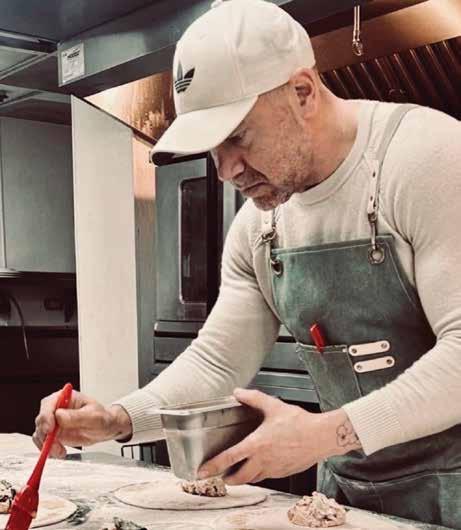
THURSDAY-SATURDAY THROUGH 8/29
The veteran chef who’s helmed kitchens such as the Four Season, the Pump Room, and Gemini Bistro has been weirdly quiet for the past few years. For decades his loud, salty, outspoken rips were as memorable as signature dishes like the Blanchard’s caviar-crowned, vodkaspiked oeuf Outhier. Now he’s back on the pass and in the dining room with an eight-week pop-up residency; a seven-course tasting menu punctuated by stories from his decades-long career told in unmistakable Queensian. (154 W. Illinois, 7 PM) MIKE SULA
at the site and support habitat restoration. Dress comfortably, bring water, and be prepared to work in the soil. (General Philip Henry Sheridan Monument, free, all ages) KERRY CARDOZA
SAT 7/11
The Reader is teaming up with artist Miguel Limón to create a collective artwork titled Un Umbral Entrelazado commemorating the legacy of the U.S. Steel South Works plant at Steelworkers Park.
Bring an object from home—such as a dish, textile, or houseware item—that represents your experience of migration, labor, or displacement. These objects will be laid on light-sensitive paper alongside archival photos from southeastside Mexican steelworking communities and natural materials from the surrounding park to print a collective record of the migrant experience at the historic South Works site.
Limón’s art has accompanied the Reader’s Quantum Crossroads series, which examines
SUN 7/12
Chicago’s newest hyperlocal zine fest also hopes to be its trashiest. Created by “leopard print everywhere” illustrator Rachel Adler, attendees will find the Empty Bottle transformed into a multimedia dumpster dive into the city’s best. Expect temporary tattoos designed by vendors themselves, orchestrated by Crybaby Tattoo; button-making with Busy Beaver; library card sign-up with the Chicago Public Library; animation screenings by Malt Adult; and free stickers made by Adler. And of course, the meat of the event: zines for purchase by the likes of Milwaukee-based Moody, Reader contributor Arianna Unabia Aquino, and Coodos, whose “Best glitz-barf comic about gas station hot dogs” I wrote about in February. In preparation, Adler recommends “being a little gross, being a little messy” (though I beg not in the deodorant sector, in the July heat). Seeing as how decomposers are key to all habitats’ flourishing, it’s sure to be a remarkable addition to Chicago’s zine fest ecosystem. (Empty Bottle, 11 AM–4 PM, 21+)
SHIRA FRIEDMAN-PARKS
SUN 7/12
Imagine you, cozied up by Lake Michigan, a tender photograph in hand, mindfully listening to the shore, while embellishing an image with colorful embroidery. Maybe you even make a new friend after the group shares personal stories and memories connected to photographs while you meditatively stitch. For the curious, artist Yasmeen Khayr will serve as your guide as you explore communal art-making and embellish photographs in this two-hour, hands-on BIYA BIYA Productions workshop. (Loyola Beach, 12 PM–2 PM, free, all ages) SARAH CONWAY
The People’s Fourth Sat 7/4 and Sun 7/5, noon–6 PM, Nabala Cafe, free Pride South Side Sun 7/5, DuSable Museum Community Kitchen Dinners: Recipes for Survivance Mon 7/6, 5:30 and 7:30 PM, Co-Prosperity
Tarot Through the Elements: A Guided Reflection and Sound Experience Sat 7/11, Driehaus Museum
Confronting Scholasticide in Palestine: Repression and Resistance in Academic Associations Sat 7/11, Pilsen Community Books, free Walking Plays 7/11, 12, 18, 19, 25, and 26, Morton Arboretum, all ages
the impact of the Quantum Shore Chicago computing megadevelopment on the southeast side. We’ll be handing out copies of a special zine that compiles some of the stories in the series. This event is part of Conta Corriente, an art festival by the Chicago Art Department. (Steelworkers Park, 87th & Lake Michigan, 2–4 PM) SHAWN MULCAHY
BIYA BIYA Persian Calligraphy Workshop Sun 7/19, noon–2:30 PM, Solidarity Studios History Belongs to All of Us: Bicentennial Ephemera with Buttons of the Left Sun 7/19, 2–4 PM, Chicago Public Library Little Village Branch
Self defense class for Black and Indigenous women from Ramy Daoud Sat 7/25, 10 AM–noon, Foss Park Beach

Wanted IDM/EDM Artists. idm-edm.com

WOMAN ISO ROOMMATE ~ Man, woman, or couple. JULY
1 Preferred Move In - Have a bigger place? Let’s split it. Need a well-located apartment you cannot afford alone? Let me be your stable, respectful housemate. Let’s talk! [LT]3 (904) 795-3081

AdamStir Insurance is hiring a CSR Rep Remote work from home. We are looking for someone who is bi-lingual in English Part time available. Please send your resume to adamsstrike9389@gmail.com if interested.
Data Analyst: (Multiple Openings):
Design & develop ETL jobs using Talend using K2 view Fabric Studio for data integration. Responsible for data mapping for feature enhancement using PL/ SQL under the agile methodology using the knowledge of Oracle
SQL Developer(SQL), Cassandra(NoSQL), Java, K2view Fabric Studio, Talend, Jira, Grafana, New Relic, ServiceNow, Advanced Excel, Linux, Postman. Reqs MS in Comp Sci, Sci, Engg or rel. Salary-$ 160555. Must be willing to travel & relocate to unanticipated client locations throughout the U.S. Mail resumes to Cyberbridge International, Inc. d/b/a Creospan, Inc.,1515 E Woodfield Rd Ste 370, Schaumburg, IL 60173.
Jaslin Hotel LLC seeks a
Marketing Specialist. Mail resume to 261 W Cermak Rd, Chicago, IL 60616
Luxury Nails Studio Inc. seeks a Marketing Manager. Mail resume to 181 S Route 83, Elmhurst, IL, 60126
Mechanical Engineering
Technician
Assemble or disassemble complex mechanical systems, interpret engineering sketches, specifications, or drawings, calculate required capacities for equipment of proposed system to obtain specified performance and submit data to engineering personnel for approval; Draft detail drawing or sketch for drafting room completion or to request parts fabrication by machine, sheet or wood shops, analyze test results in relation to design; Assist engineers to design, develop, test, or manufacture industrial machinery, consumer products; Conduct statistical studies to analyze or compare production costs for sustainable and non-sustainable designs, analyze or estimate production costs; Discuss changes in design, method of manufacture and assembly, or drafting techniques and procedures with staff and coordinate corrections, monitor, inspect, or test mechanical equipment, and among others.
Mail resume to Aigul Muratkhan,
BM Trans Inc, 710 E. Ogden Ave, Suite 150 Naperville, IL 60563
Operations Manager: Direct & coord activities of transp comp to obtain optimum efficiency to max profits. Coord marketing, sales.
Comm w/clients, employees.
Plan & manage business budget. Analyze financials. Prep docs for accountant. HS. 2 yrs exp. West
Wind Express, Inc. 7050 S Archer Rd, Bedford Park IL 60458
Product Development ManagerAPQP, Hydro Extrusion USA, LLC (Chicago, IL) Manage, coordinate, & oversee APQP processes to determine CPK analysis, process trials/verification through all manufacturing areas. 25% domestic/international travel.
Bachelor or foreign equivalent in related engineering field & 5 yrs progressively responsible, post baccalaureate industrial/ manufacturing exp. 2 yrs of this experience must involve executing launch processes & working w/ EV customers. Opportunity to telecommute from any location in the U.S. $121k - $150k. Apply/benefits: https://tinyurl. com/24ba4fwm.
Regional Marketing Manager, North America (Nouryon Surface Chemistry LLC) (Chicago, IL): Dvlp & implemnt mrktg plan w/ sales teams to drive grwth & mrkt presence. Anlyz mrkt trends & contribute insghts to global mrkt intelligence d/b to infrm decisions. Estblsh & maintn pricing stratgs. Ensure compliance w/ reg reqs & spprt prodct stewardshp. Lead regional prodct launch activities, contribute to prodct dvlpmt, & coordinate customer communicatn. Utlz expertise in spply & demand planning to anticipate customer needs & optmz prodct portfolio positioning. Mng & mentor Mrktg Anlyst. Oversee prep, accurcy, & relevance of mrkt intelligence data to aid planning. Participate in indstry events, tradeshows, & customer visits to strengthn relationshps & idntfy mrkt opportunities. Foster collaboratn b/w teams to improve CRM data accurcy & track customer opportunities & risks. Reqs exp w/: pricing skills, incl use of pricing tools & competitive mrkt assessmnts; mrktg planning & executn in B2B agricultural & crop protectn sectors; Cross-functnl exp in spply/demnd planning & commrcl executn; CRM, SAP & mrktg intelligence tools; bldg relatnships & mnging stakehlders across lvls; leadg prodct launches & coordinate cross-functnl teams; global & regional accnt mgmt, spply/demnd planning, & prodct positioning. Reqs: Bachelor’s
degree or frgn equiv in Business, Mrktg, Chemistry, or rltd fld, & 1 yr exp as Mrktg Anlyst or rltd B2B mrktg position wrkg w/ agricultural mrkts. Hybrid optn to WFH availbl. Travel reqd 30% of time regionally. Slry: $120,000 - $140,000/yr. Send C.V. to recruiting.us @nouryon.com w/ subject line Regional Marketing Manager, NA.
Software Developer-Design, develop, test & implement application software utilizing JAVA 8, Spring Framework,SPRING BOOT, RESTFUL MICROSERVICES, HIBERNATE JENKINS, DOCKER, GRADLE, GIT, MYSQL, ORACLE, CASSANDRA & CUCUMBER, Angular, ReactJS, ELK, Splunk, AzureMQ, Must be willing to travel & relocate to unanticipated client locations throughout the U.S. Reqs BS in Comp Sci, Sci, Engg, bus or rel w/5 yrs exp. Salary-$ 153317. Benefits: Medical, dental, vision, 401(k), and PTO. Mail resumes to Cyberbridge International, Inc. d/b/a Creospan Inc, 1515 East Woodfield Road, Suite 370, Schaumburg, Illinois 60173.
Software Engineer (SS&C Technologies Inc; Chicago, IL): Design/maintain database queries & procedures for financial market data solutions. Min req’s: Bach in CS or rel + 2 yrs. rel exp + add’l skills. Salary: $102,700-$120,000/yr; benefits incl med, dental, 401k, tuition & prof dvlpmt reimb, PTO, holidays, emp assist prog, parent leave. Apply online at https://www. ssctech.com/about-us/careers or send resume to: David Schoene TA, dschoene@sscinc.com. Ref: 00071984. An EOE. Technical Account Manager - INFI USA INC (Chicago, IL). Install, support & maintain network infrastructure for kiosk/POS systems. Req. Bachelor’s in Electrical & Computer Eng’g or rltd.; exp. w/ networking protocols, troubleshooting & system scripting/ automation. Salary: $63,898/yr. Send resume to: 125 S Clark St, Ste 660, Chicago, IL 60603.
The Office of Preparedness and Response, at the Univ of IL Chicago, located in a large metro area, is seeking full-time Associate Director, Brand Marketing & Digital
Services to assist the department with the following responsibilities: Under direction and supervision, provide strategic and creative leadership to design, develop, and advance the overall brand vision and execution of the university’s preparedness and resilience missions and prevention through digital services. Ensure content quality, consistency, impact, and relevance in the messages transmitted across the campus while addressing the different audiences: students, faculty, and staff. Build a robust modern marketing plan with traditional and digital channel integration, and generate content that is compelling, timely and of great importance within the public safety ecosystem. Other duties as assigned. This position minimally requires a Bachelor’s degree or its foreign equivalent in Arts, Design, Museum & Exhibition Studies, Marketing or a related field and, 2 years of experience in graphic and marketing design or related experience. The salary range for this position is $95,000 to $100,000. For fullest consideration, applicants are required to submit CV, cover letter, 3 professional references and samples or a link to previous design work and marketing portfolio by 7/20/2026. Additionally, please include details of your social media expertise, such as the successful management of marketing campaigns or growth in follower engagement. Links to your professional social media or Linkedin handles or profiles where these skills are demonstrated should also be provided to showcase your digital fluency and creativity in real-time platforms. Please send your compete application package to the Office of Preparedness and Response, University of IL Chicago, 1140 S Paulina St, Suite 109, Chicago, IL 60612 or via email to dibrah1@ uic.edu. The University of Illinois System is an Equal Opportunity employer, including but not limited to disability and/or veteran status, and complies with all applicable state and federal employment mandates. Please visit https://tinyurl.com/mrzy3fje to view our non-discrimination statement and find additional information about required
background checks, sexual harassment/misconduct disclosures, and employment eligibility review through E-Verify. This position is intended to be eligible for benefits. This includes Health, Dental, Vision, Life Insurance, a Retirement Plan, Paid time Off, and Tuition waivers for employees and dependents: https://tinyurl. com/3udab4ud
Global Programs Servicing Leader, HDI Global Insurance Co., Chicago, IL: Review & monitor upcoming renewals for our Controlled Master Program (Pgrm) locals (foreign policies). Renew Master Pgrm in Network Portal or create new pgrms for new business. Fill our RoC’s (request of coverage) per Master binder from Underwriting, upload into Network Portal along w/premium bookings & GDV’s (German Insurance Assoc.). Monitor producing office completion dates to meet global service standards. Manage a Global Services Assoc. Create new pgrms in Network Portal for new customers by filling out initial policy details, requesting a new system Client ID, & then filling out the pgrm, the master, & ea. local policy incl. insurance premium booking. Ensure compliance w/foreign gov. regs when creating client, pgrm, & master at a global policy lvl, the local policy & premium booking are specific to ea. foreign country. These are specific terms within Global Network Portal system. Within HDI’s workflow, the role is positioned on the front end of the insurance underwriting lifecycle to support marketing opportunities by communicating the capabilities of HDI’s global network in close collab w/Underwriters (UW). Work w/underwriting teams to plan & support marketing opportunities. The primary involvement begins at binding, at which point initiating & managing communication w/global network & servicing offices starts w/preparing & uploading RoCs & entering local policy & premium info into the Global Network Portal. This work is prioritized based on policy inception dates & compliance w/ Home Office service standards. Coordinate w/Underwriting & team members, to ensure post binding info is executed accurately & policies are properly booked into
internal systems w/a strong focus on data quality & consistency. Responsible for supporting Global Pgrms within producing Underwriting Depts. Collab closely w/UWs, Assoc. UWs, & global servicing offices to eval. business needs, confirm operational reqmts, & ensure foreign policies are issued in alignment w/ underwriting intent & Home Office service standards. Set priorities based on policy inception dates & established service lvl expectations & contribute to dvlpmt of new concepts as dept. grows. Support product related business initiatives. Must have 5 yrs providing admin. support for servicing global portfolio accounts on behalf of Global Commercial insurance carrier. Of exp. req’d, must have: (i) 3 yrs

MATCHES
Handsome Christian Mixed blk/ french male 55+ fairly fit musician looking for an attr Christian woman 37-77 all races welcome for marriage.Lets become acquaintances. Northside Chgo Michael 872-777-6265 txt ittakesasaint@gmail.com
Hot n spicy in chicagoland n N.W.I. (MIMI

AdamStir Insurance is hiring a CSR Rep. We are looking for someone who is good in English. Part time available only. Please send your resume to adamsstrike9389@gmail. com if interested.







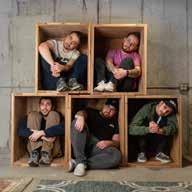
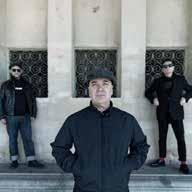

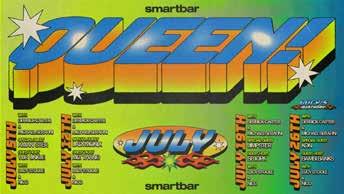
SATURDAY 2026 SEPT 12
THE LAKEFRONT AT DAWES PAR K
SATURDAY 2026 SEPT 12
SIERRA HULL • VALERIE JUNE • MDOU MOCTAR
THE BRUDI BROTHERS • ANJIMILE • EDNA VAZQUEZ
HAYDEN PEDIGO • THE FRETLINERS
HENHOUSE PROWLERS FEAT. DON STIERNBERG · BILL MACKAY
TOBACCO CITY · SHE RETURNS FROM WAR · WILD HORSES
JOE DEVITO · ABBIE MCALLISTER
SUNDAY 2026 SEPT 13 SUNDAY 2026 SEPT 13
JOSH RITTER • JAMES MCMURTRY • MARGARET GLASPY
KATHLEEN EDWARDS • TIFT MERRITT • FOLK BITCH TRIO BEBE STOCKWELL • DEAN JOHNSON
ANGELA AUTUMN · LUCY WAINWRIGHT ROCHE · ESTHER ROSE
CLAYTON NILE YOUNG · TRAY WELLINGTON · JORDAN SMART
ROSES FOR THE ROCHES FEAT. NORA O’CONNOR, SIMA CUNNINGHAM, & KELLY HOGAN ANNA VOGELZANG
FEST KICK-OFF SHOW · SEPT 11 AT CAHN AUDITORIUM PUNCH BROTHERS
EVANSTONFOLKFESTIVAL.COM 11:30AM-8:30PM | KIDS UNDER 12 FREE! EVANSTON • ILLINOIS • USA