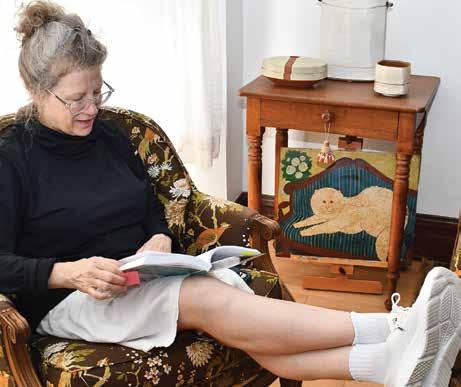
SOCIAL JUSTICE REPORTER Devyn-Marshall Brown (DMB) STAFF WRITER Micco Caporale
DEVELOPMENT MANAGER Joey Mandeville
DATA ASSOCIATE Tatiana Perez
SOCIAL MEDIA MANAGER Katrina Pham
MARKETING MANAGER Maja Stachnik
MARKETING ASSOCIATE Michael Thompson
SALES REPRESENTATIVES
Will Rogers, Kelly Braun, Vanessa Fleming
i ght now, as you read this, someone is watching you. From AI-powered cameras and automated license plate readers to drones and GPS monitors, police at every level have access to a truly impressive arsenal of tools collecting information, whether you’re on the bus, at a coffee shop, or within the confines of your own home. Beyond law enforcement, companies like Amazon and Meta have grown into multibillion-dollar enterprises thanks in no small part to the exploitation of personal data we’ve offered up—willingly or otherwise.
That probably isn’t much of a surprise. For many years, the Reader’s pages have chronicled the rise of mass surveillance and, with it, the erosion of any expectation of privacy.
When we first tossed around the idea for an issue devoted to surveillance, we envisioned more of the same: reporting on secretive police tools or the failed promises of the latest “solution” to gun violence. In the months since, our world has continued down a particularly dark path—a livestreamed genocide, a fascist occupation, a vociferous crackdown on dissent. What resulted instead was a collection of stories exploring the more mundane, but no less insidious, ways
a culture of surveillance has enabled the horrors unfolding around us.
Katie Prout shares the perspective of a formerly unhoused neighbor living in Chicago’s public parks, spaces where residents are expected to relinquish their
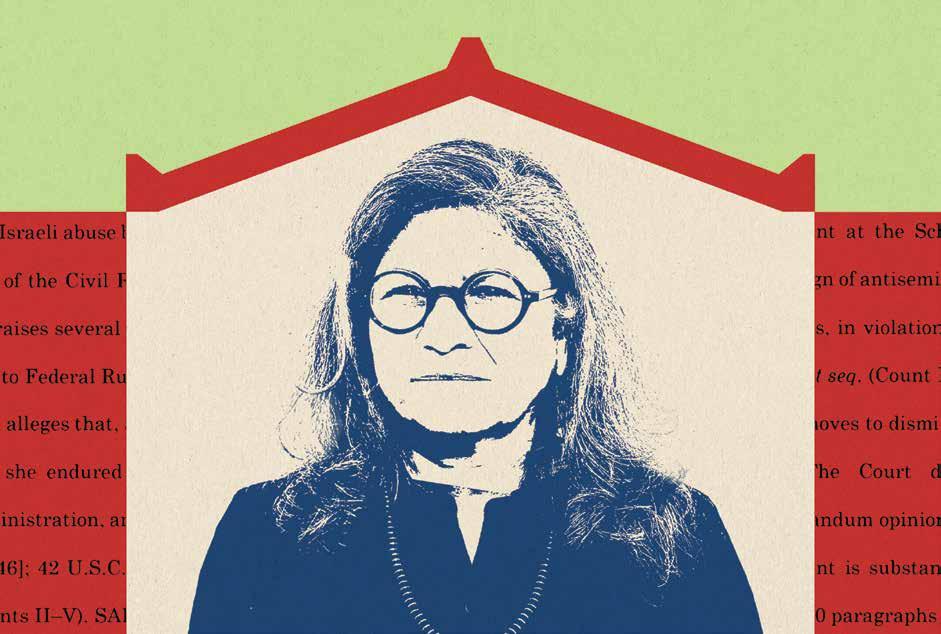
privacy—and often their agency—amid constant scrutiny from police, city workers, and fellow community members. Kerry Cardoza reports on continued turmoil at the School of the Art Institute of Chicago, where the administration is disciplining
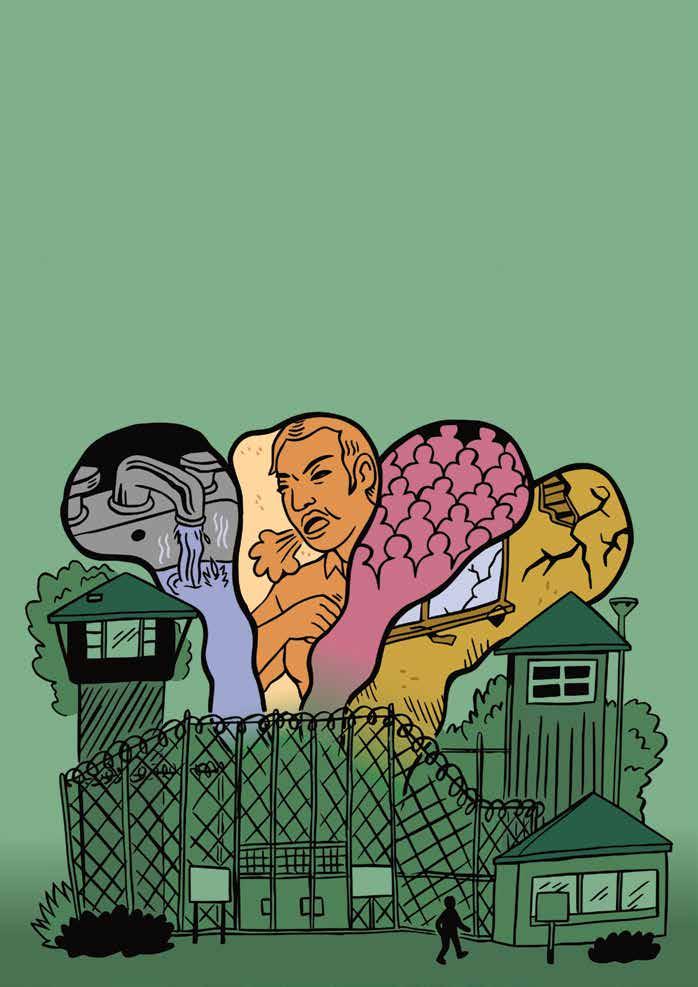
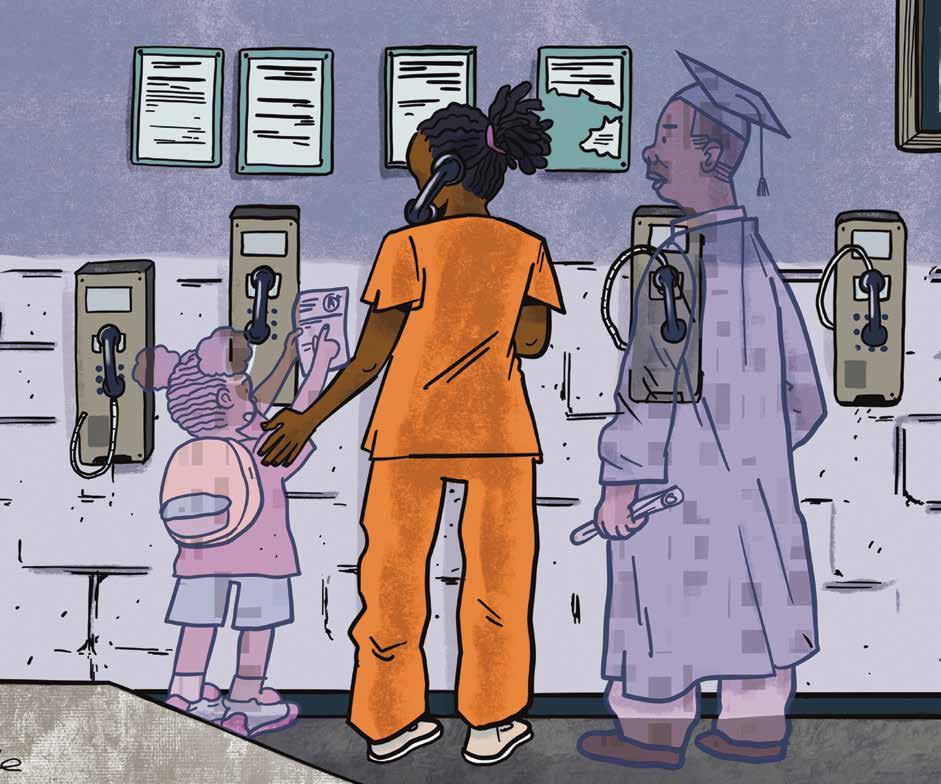
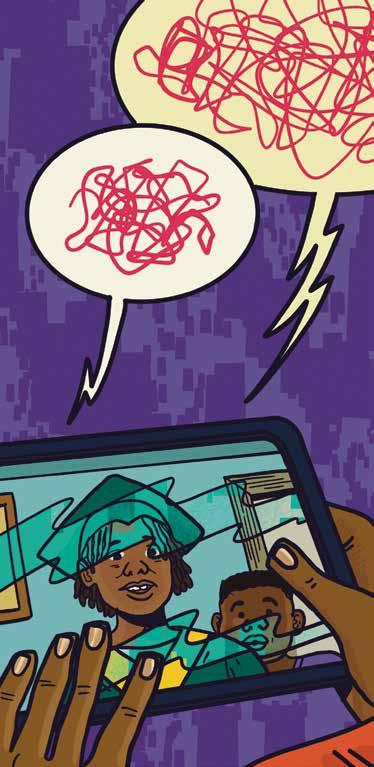
faculty over pro-Palestinian speech while sidestepping its own due-process and academicfreedom policies. Shira FriedmanParks highlights the promise of underground publishing as a way to counter state censorship, even as the federal government criminalizes zinemakers, as it did recently in Alvarado, Texas. Leor Galil traces how algorithm-driven social media sites and streaming services have changed who gets picked to play shows and where they get booked. And my own story uncovers an effort to reframe part of the notoriously grim Cook County jail as a trauma-informed community space.
The rise of mass surveillance is intrinsically linked to the rise of fascism, the silencing of dissent, and the criminalization of public spaces. Without the former, it would be much harder for the government to do the latter. By focusing on the less visible aspects of surveillance culture, we hope to foster a deeper understanding of our current predicament—and how you can challenge it. v
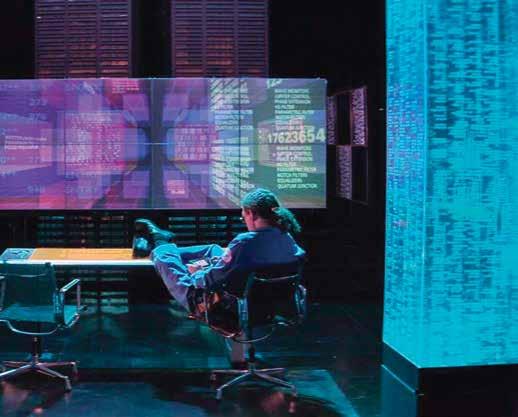
Still from Hackers (1995) COURTESY METRO-GOLDWYN-MAYER
COMMENTARY
When I read the Illinois Department of Corrections (IDOC) announcement that the new Logan Correctional Center will be built in Crest Hill, next to the new Stateville prison, I felt deep worry for all those still behind bars at the current prison. As a woman previously incarcerated there, I know firsthand that conditions at Logan are inhumane. In 2023, the IDOC Facility Master Plan even described the prison as “unsuitable for any population.”
As I experienced with the closure of Dwight Correctional Center in 2013, the process of closing a prison and transferring people is always challenging. It affects everyone involved—incarcerated people, guards, staff, and even our families. Nerves are frayed to the breaking point. Uncertainty causes more chaos, and tempers flare. There’s been no transfer plan presented by IDOC, and we need one now: to provide stability in what could be a chaotic experience, possibly erupting into violence.
IDOC representatives say they plan to maintain Logan until the new prison is built. This does not seem feasible given the deteriorating conditions at the prison. The 2026 monitoring report on Logan, produced by the Illinois watchdog organization the John Howard Association, provides a glimpse into these conditions: unsafe water, extreme temperatures, rodent and bug infestations, plumbing issues, and crumbling infrastructure create an unsafe living environment. Persistent understaffing interrupts programming and time spent outside housing units. Abysmal mental health services prevent even people housed in the mental health unit from receiving proper care. A lack of medical care exacerbates treatable health issues. Inconsistent access to the commissary, as well as the prohibitive cost of available items, contributes to hunger and a lack of basic hygiene items. Ongoing sexual coercion and abuse create a culture of exploitation and violence.
Buried in IDOC’s recent announcement is the plan to move people currently incarcerated at Logan, who meet the security classifications, to Decatur Correctional Center, the state’s other women’s prison, where about 400 people are held. What is the transfer plan for this group? When will these transfers occur? Is IDOC prepared to facilitate safe transfers if Logan is forced to close prematurely? How many people are a part of this group, and have they been notified?
Although IDOC has claimed that it will conduct transfers safely and gather input from multiple stakeholders in developing their transition plan, people incarcerated at Logan are living with the uncertainty of when and where they will be transferred, and how they and their loved ones will be notified. This anticipation, fear, and daily threat of violence mirror the dynamics of domestic violence relation-
I lived in the women’s prison slated for closure
Illinois should come up with a humane transfer plan.
BY DR. JANET JACKSON
“I know firsthand that conditions at Logan are inhumane. In 2023, the IDOC Facility Master Plan even described the prison as ‘unsuitable for any population.’” ATLAN ARCEO-WITZL FOR CHICAGO READER
ships—dynamics that are all too familiar for the more than 90 percent of people incarcerated at Logan who are survivors of gender-based violence. Inflicting further trauma on people is another form of abuse. Many of those who were transferred out of Dwight, which was closed in 2013, have PTSD from the experience. I know because I was there.
When Dwight closed, we were moved with little notice during a cold, snowy
day in March and were not allowed to wear coats, hats, or blankets for warmth. When we arrived at Logan, it was filthy. We spent hours cleaning the prison and washing away feces and urine from our cells. Medline, the process through which we lined up to receive approved medications, was not available until the middle of the night. Many of us lost precious belongings in the move. Our property boxes took several days to arrive, and the
laundry facilities were not yet set up, so we wore dirty clothes for days. The guards at Logan made it clear they did not want to deal with women and hurled insults like “bitch” and “ho” at us, instilling anxiety and fear about the challenges we would face there. On top of all this, we were separated from our incarcerated friends with whom we had built important support communities.
I am part of No New Prisons Illinois,
a campaign opposing the state’s billiondollar plan to rebuild two prisons and imploring IDOC and Governor J.B. Pritzker’s office to adopt the Logan Transfer Rapid Response Plan. The plan, devised by advocates and endorsed by over 50 statewide organizations, provides a comprehensive list of measures the state should implement to mitigate harm from any future transfers from Logan.
It reflects the lived experience of currently and formerly incarcerated people who have endured prison closures and know the pitfalls that can come when a solid, well-thought-out plan is not in place. Our proposed plan demands clear, transparent communication from IDOC about the closure and transfer process; the ability for people incarcerated at Logan to maintain relationships and communication with one another following any transfers; uninterrupted continuation of programming, jobs, visits, and access to a law library and legal teams; independent monitoring of transfers by the John Howard Association; and assurance of prompt arrival of all personal belongings, with an efficient process to replace or compensate people for any lost items. We also demand the centering of dignity throughout the transfer process by ensuring access to clothing, outerwear, food, and menstrual products, as well as
limited use of restraints and prohibition of strip searches; prompt availability of commissary, laundry facilities, approved medications, healthcare services, and mental health services; assurance the receiving prison is fully cleaned before transfers occur; and provision of basic hygiene and bedding items for all people who are transferred.
IDOC officials met with members of No New Prisons Illinois in January 2026 to discuss our proposed transfer plan. During the meeting, IDOC praised the plan, admitted they did not do a good job with the 2013 Dwight transfers, and said they would not repeat those mistakes. They made no specific commitments, however, and have since ended communication.
If the state is actually committed to the safety and well-being of people incarcerated at Logan, then at least let these transfers be conducted humanely and safely for all. Consider what every person—incarcerated people, guards, staff, and families—is going through and what they need for a humane transfer. Have a definite plan in place and follow through. Tell people what to expect before the move and make sure everyone understands the process. It is my sincerest prayer that people at Logan will not have to suffer the trauma of a transfer. Logan should be closed.
But instead of building new prisons, I ask that the $900 million slated for prison construction be redirected toward reducing the current prison population and improving conditions in the prisons that already exist.
They are investing in building a new prison rather than investing in our communities, effectively condemning future generations to incarceration.
The new women’s prison is not expected to be finished until 2030. By this time, 66 percent of people currently incarcerated at Logan will have served their sentences and been released. This means Illinois will be building a new prison for just 33 percent of the people currently incarcerated there. This also means the state anticipates enough new convictions to fill the new prison. They are investing in building a new prison rather than investing in our communities, effectively condemning
future generations to incarceration.
Why is Illinois doubling down on incarceration when there are less expensive alternatives, such as adopting earned release, passing the Credit for Change bill, and reinstating parole? Governor Pritzker could follow the lead of Wisconsin governor Tony Evers and use his clemency power to repair the decades of harm caused by sentencing policy.
These are the reforms incarcerated people, their loved ones, and community groups have been demanding for years. I see no gain for the state in building another prison when there are alternatives that are more cost effective and better for public safety. v
Dr. Janet Jackson is a criminalized survivor who was incarcerated in Illinois women’s prisons for 37 years, where she experienced firsthand the inhumane conditions throughout the system. Throughout her incarceration, she earned two PhDs, became an ordained minister, and mentored countless women. Since her release in 2024, she has been a dedicated advocate for currently and formerly incarcerated people. Dr. Jackson is a fellow with the Women’s Justice Institute and a community ambassador with the Illinois Prison Project.
themail@chicagoreader.com
CITY LIFE
Do you want to contribute to Social Fabric? >> Please send your pitch to sfriedman-parks@chicagoreader.com
SOCIAL FABRIC
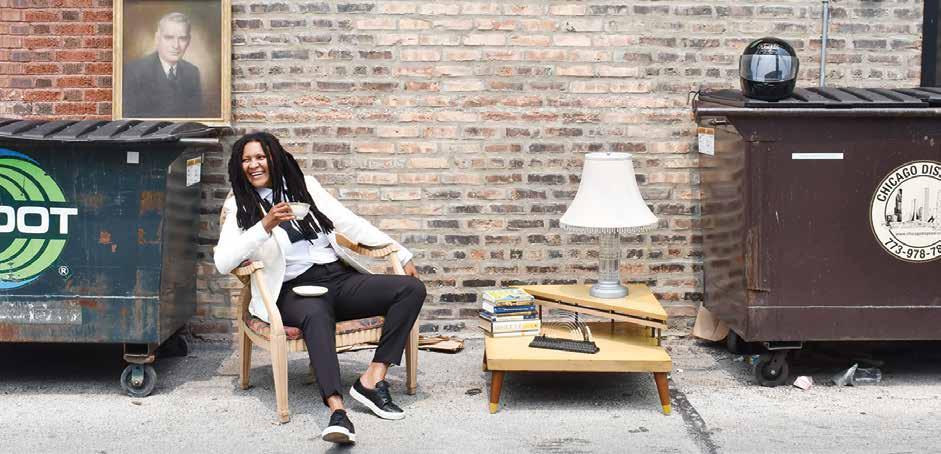
I‘I found it in the alley!’ For some, repurposing found items is a way of life.
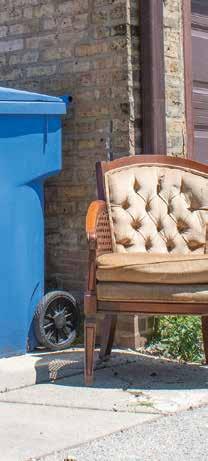
t can be the most mundane day: gloomy, overcast, and, somehow, both chilly and muggy, when a walk through a Chicago alley brings about an entirely new trajectory. Maybe you spotted a coffee table or an abandoned art piece or a pedal boat. Plenty of us walk on by, wondering what will come of these items. Some of us left those very items at the height of moving-related delirium, arriving hours later to find the nightstand that once held all our secrets long gone. More than 90 percent of residential areas in Chicago are home to alleys, back areas to keep the city clean that somewhere along the way became a furniture exchange. Anyone can go to Ikea and spend the better part of a day fighting their roommates over increasingly unintelligible instructions. But that mysterious, maybe haunted chair you found in the alley, lugged back to your apartment, and scrubbed clean? That’s one of a kind.
We spoke with several Chicagoans who have made a hobby—or sometimes a fulltime job—out of resuscitating alley finds. For these residents, scouring the alley at the end of any given month beats a day trip to Schaumburg, even (and especially) for the simple fact that “I found it in the alley!” is a great icebreaker. These finds are pieces that travel apartment to apartment, sometimes generation to generation. They represent personality as well as anything can.
In a world where our domestic spaces are increasingly run by Instagram interior trends and monotonous, massmanufactured styles, the things we find in alleys are far from cookie-cutter, serving as a badge of honor—a free one, at that. v
—Alec Karam
themail@chicagoreader.com
When the assignment to photograph people and their sweet alley finds came across my desk, my hand shot up like I was the only kid in class who knew the capital of Montana. I decided early on in life that I would devote myself to a “re-” lifestyle: resale, reuse, repurpose. I once amassed a collection of about 50 graphic polyester shirts, back when ordinary thrift shops were flooded with them. My bedside table is an old steamer trunk I found on the curb during high school in tree-lined Wheaton. I’ve been walking this walk for decades.
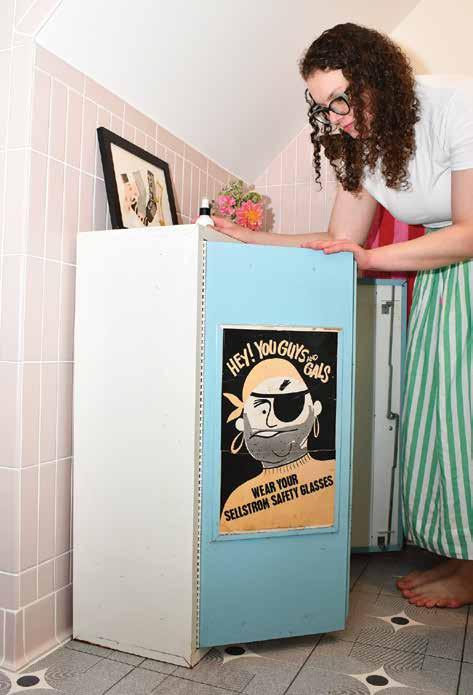
Deanna Lesht walks the very same walk, and is gleefully reminded of its fruits each time she reaches into her robin’s egg blue pirate cabinet for toiletries. Jesse Schaffer walks the walk to the Chicago River, where he enjoys free shows along the Salt Shed shore by pedal
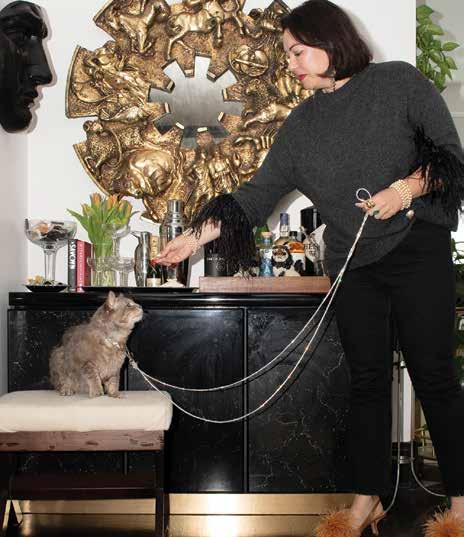
boat. And Victoria Kent would walk the walk with her alley find, Leo the longhaired tabby, though cats are not themselves inclined to go for walks, despite the fact that she has outfitted him with a jewel-studded leash. I hope he knows how good he’s got it.
I found I was a kindred spirit with the seven subjects of this piece. They have all found solace and pleasure in the “re-” lifestyle. It’s part eye for style, part sense of adventure, and a sizable part luck. There are untold miles of alleys in which to find one’s treasure. v
—Kirk Williamson, staff photographer
Social Fabric is a glimpse into the vibrant lives, objects, and spaces that shape our city, cocurated with community archives and local photographers.
kwilliamson@chicagoreader.com
Jesse Schaffer (left) salvaged the five-seater pedal boat with his friend Brendan (right) from the alley behind his apartment. “Once the pedal boat entered our lives, the Chicago River changed from being a dirty afterthought into a whole new world to explore. It expanded my community and drastically increased the amount of live music in my life. (We see a lot of Salt Shed shows from the river.)” Rogers Park
KIRK WILLIAMSON
Annette Nowacki’s Squier II Stratocaster was an alley find from her grandfather. “My grandfather with dementia would bring in things from the alley all the time that all made it back to the garbage; this was not one of them. I was grateful when I thought it was just the hard guitar case. I was floored to see such a beautiful guitar inside.” McKinley Park KIRK WILLIAMSON
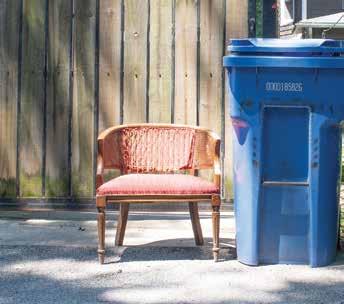
Christa Johnson’s little chair Jerald (pronounced chair-ald) Winters, named for the engraved initials J.W., sits proudly in her dining room: “He is the manifestation of moving from an apartment to the first home I’ve ever owned. I love knowing my house has history and everything has a story, including little Jerald Winters.” Belmont Cragin KIRK WILLIAMSON
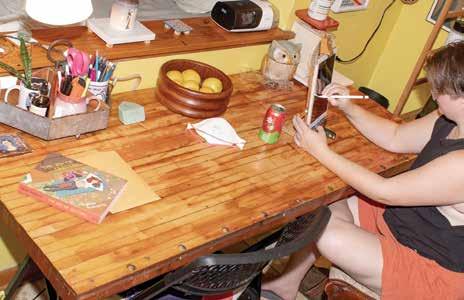
Whitney Wasson built a table from a plank of bowling alley lane. “My husband and I barely managed to lug it back to our apartment. I spent a few weeks cleaning, sanding, staining, and sealing it, to better preserve its unique and worn surface. We use the bowling table daily as both our kitchen(ette) table and a workspace for art.” Portage Park KIRK WILLIAMSON
Victoria Kent found Leo, a long-haired silver tabby cat, now ten years old, in a nearby alley. “Leo is proof that the best treasures can be found in Chicago's alleys. Finding him changed my life. I can't imagine it without him.” Irving Park KIRK WILLIAMSON
Deanna Lesht spotted this cabinet behind Senn High School while interning there. “The cabinet makes me smile whenever I see it. I love to imagine the students who used it over the decades and wonder what they thought about the pirate's message.” Evanston KIRK WILLIAMSON
Anne Karsten found painted Ginny next to a garbage can 16 years ago. “Since I'm allergic to cats, Ginny was the perfect alley stray to adopt. She’s been content to sit nearby ever since.” Logan Square KIRK WILLIAMSON
Tim Carwinski
August 11, 1982 – June 19, 2026
Every day, in the autumn of 2004 Tim Carwinski (nee Carraher) lost himself among the cypresses, cedars, and sequoias in the Jardin des Prébendes d’Oé.
Advocacy for the underdog would ultimately define the rest of Tim’s life, but first he needed to find peace on the pathways of the garden, a 19th-century English-style oasis in the center of Tours, France.
His senior year at Boston College bruised him. As a director of a gay and lesbian support group, Tim was a staunch advocate for his community, making him a target for students and administrators who opposed its presence at the Jesuit university. The animus played out in competing student newspapers, and more uncivilly with slurs and vandalism.
Before his time at Boston College, Tim was a beloved friend and student at St. Giles School and Fenwick High School in Oak Park, Illinois, where he would begin collecting life-long friends. At Fenwick, he was a treasured member of the Blackfriars Guild, the club that fostered his lifelong love of musicals. Tim excelled academically, leading him to becoming a Presidential Scholar at BC.
After graduating from college, Tim spent a year teaching English in the small city on the Loire River in western France. Once there, he found another community among students and teachers, and a love of good wine and food.
And then there was the jardin, located steps from his apartment, a quiet refuge for self-reflection, where he built trust in his own tastes and instincts.
He took that confidence to Northwestern Pritzker School of Law, and then to the Sorbonne in Paris, where he earned a master’s degree in global business law. His studio apartment in the Marais District became a test kitchen for his budding culinary ambitions, and a gathering place for friends to eat his first attempts at boeuf bourguignon and pot-au-feu, while drinking wine into the wee hours of the morning. Among the visitors was Tim’s future husband Patryk Piwinski, whom he met the year before at Sidetracks, one of Chicago’s oldest LGBTQ+ bars.
Tim returned to Chicago and the young couple moved in together. While Tim accepted a job offer from a law firm, it was hit hard by the 2008-2009 recession, and he was furloughed. This led him to volunteer with the civil rights organization Lambda Legal where he worked on a seminal Ohio case that established the right of LGBTQ+ parents to seek legal custody of their children. Through Lambda, he also defended the right of the state of Wisconsin to provide LGBTQ+ couples with domestic partnership protections even though the state had previously enacted a constitutional amendment prohibiting same-sex couples from marrying.
In 2011, Tim accepted a position at the global law firm Reed Smith, specializing in commercial litigation, while also pursuing a pro bono advocacy representing asylum seekers, for which he was lauded by the National Immigrant Justice Center, and the American Civil Liberties Union of Southern California.
Over time, Tim would also lend his brilliant writing skills to the team at Lambda that
In his final days, Tim was surrounded by the people he brought together in life, including his heroic husband, Patryk Carwinski (nee Piwinski); his adoring mother, Carol Carraher (nee Pink); devoted sister, Samantha Carraher; stoic brother-in-law, Christopher Jasculca; cherished niece and nephew, Addison and Brady Jasculca (of Samantha and Christopher); and Tim’s legion of friends, who walked beside him in life. Tim was a loving son to Carol Carraher and the late Robert “Bob” Carraher; a caring stepson to JoAnn Carraher (nee Kahnke); stepbrother to Shawn, Mitchell (Danielle) and Brett (Lindsey) Hesley; an endeared son-in-law to Mietek Piwinski and Janina Piwinski (nee Syta); treasured brother-in-law to Dawid Piwinski; and prized grandson to his adoring grandmother Elizabeth “Grandma Betty”Hortsman and late grandparents John “Jack” Pink, and William “Bill” and Mary Carraher.
Tim was nephew and cousin to many, including Uncle Don McKay; the late Uncle
helped legalize same-sex marriage in Illinois, a victory he anticipated when proposing to Patryk a year earlier.
Throughout his career Tim continued to support Lambda with nearly 2000 hours of pro-bono work, and with Patryk as financial contributors. Overall, the work he did for the organization contributed to the legal building blocks that were put in place across the country to argue Obergefell v. Hodges, the landmark United States Supreme Court case that guaranteed same-sex couples the right to marry in all 50 states.
This paved the way for his marriage to Patryk. At their September 2015 ceremony in the verdant flower garden of Humboldt Park in Chicago, they each adopted the portmanteau Carwinski as surnames.
Much like that studio apartment in the Marais, the Carwinski home was the center of a galaxy of friends, family, and chosen family—including their two cats Lillet Blanc and Cointreau Jr. Countless evenings were highlighted by karaoke parties, backyard movie nights, and elaborate dinners soundtracked by Tim’s earnest turns at the piano. These domestic celebrations were only interrupted by his tireless pursuit of live theater, international travel, Cubs games at Wrigley Field, and trips to the National Figure Skating Championships, where the shimmering sequined outfits he sported with his sister Sam became a reliable feature on television broadcasts.
Tim exercised his mind like a muscle, capturing a mastery of world history, French wine, Broadway musicals, and the Harry Potter universe, which he deployed as an online trivia master among dozens of friends from all over the world. With his gift for language he added to his French and Latin fluency by attempting to learn Polish to communicate with Patryk’s family–one of the few things he ever failed at.
The strength of these passions was only matched by his righteous outrage at bigotry and intolerance, the current sitting Supreme Court, direct sunlight, boats, eating with his fingers, and ground black pepper.
The communities Tim built and nurtured circled him tightly when he was diagnosed with stage four colon cancer at the age of 42. At home and during farewell trips to France, Spain, Poland, New York, and Germany the strands of connection he threaded throughout his life grew stronger. Those connections are the legacy he leaves.
Timothy Robert Carwinski passed away on June 19, 2026, Juneteenth. He would want us to remember that on this day of great significance, the emancipation of the enslaved was the root cause of the Civil War.
Tim strongly believed in organ donation and as his last act of advocacy donated his corneas through the Gift of Hope Organ & Tissue Donor Network.
The Tim Carwinski Performing Arts Foundation will further honor his memory by working to expand access to performing arts education and programming for young people, ensuring that the music, theater, and stagecraft he loved are within reach for the next generation.
A portion of his ashes will be spread in the Jardin des Prébendes d’Oé in Tours.
Bill and Aunt Donna Carraher and their children Katie (Jon) Harris (nee Carraher) and Brian (Amanda) Carraher; Aunt Maryelizabeth Kula (nee Carraher) and Uncle Jim Kula and their children Taylor Kula (Pedro Rodriguez) and McKenzie Mason (Jeff); Uncle John Carraher and his children Colleen Carraher (Mark Chesser), Danny Carraher, Kevin Carraher, and their mother Sheila Montroy, and John’s life partner Shari Samson, and her children Taylor Acree (Chad) and Hunter Samson; late Uncle Tom Carraher and his children Alison (Erin) Power and Megan Carraher, and their mother Eileen Carraher; Uncle Jim Carraher and Aunt Susan Carraher and their children Christopher Schauer (Alex), Lindsey (Jon) Ladner, and Amanda (Christopher) Loya.
–Mike Sula
CITY LIFE
‘It’s a little world’
Chicago’s alleys are the city’s best furniture store.
BY ALEC KARAM
In a bustling city where every nook and cranny is packed with bars, coffee shops, and corner stores, alleys exist as a place of calm, one where people can find far more than a parking spot. Sometimes, that’s a painting.
Madisyn Mettenburg was roaming aimlessly through the alley near her Ravenswood apartment after a rough day, having locked herself out of her new apartment. On a walk to clear her head, she noticed a blur in the distance, a painting of a forest path that became the centerpiece of her apartment walls.
“It’s just really peaceful,” Mettenburg says. “It feeds into [the idea] as a kid being really into books of falling into a painting. It’s kind of magical.”
Chicago’s alley system dates back to the city’s birth, separating the midwest mecca from a lot of its big-city peers. More than 90 percent of residential areas are accompanied by alleys, dating back to the 1830s, according to the Encyclopedia of Chicago, creating a haven for garages, afternoon play, smoke breaks, and inadvertently, misfit items, from coffee tables to couches and even X-rated magazines.
“I think collecting things is a lot more meaningful than going out and buying things. When you find something cool in an alley, it’s like it’s choosing you,” Mettenburg says.
Stepping into a back alley at the end of any month—especially during summer move-out season—brings about a plethora of lost treasures, trinkets whose owners have moved to new homes. The alley swallows items whole, releasing them into an ecosystem of
unassuming participants who grab a new piece of furniture as spontaneously as the previous owner dropped it off.
Chicago alley exchanges have a unique set of rules, whether the past owner tossed out a message in a Buy Nothing Facebook group or left it up to fate. Don’t put your items out in the rain, be wary of certain fabrics, and, most importantly, “you’ve got to give to the alley, too,” says Stacy Gerard, an Albany Park resident.
“It’s almost like karma, like I feel about parking,” says Gerard. “You’re not gonna find a good parking spot unless
“We have a really transient culture,” says Ashlee Piper, a sustainability expert and the Chicago-based author of No New Things . “A lot of folks come from just different backgrounds and different socioeconomic experiences, which is what makes Chicago so wonderful.”
As modern society turns to selfpreserved isolation, the alley acts as a silent connector, offering longtime residents and new neighbors a way to share history. An heirloom can end up the centerpiece of a neighbor’s porch or disappear into the night, passed on so many
“It’s just the creative and artistic practice of reimagining something, recognizing its beauty.”
you move your car every once in a while and offer yours up.”
Gerard grew up in Arkansas, where her mother sold secondhand items in antique malls. Surrounded by vintage finds her whole life, Gerard found herself right at home in Chicago’s many alleys, scoring plants, dining room sets, and more.
Her most beloved item is the midcentury modern dresser that appeared just across the street from her new apartment in Wrigleyville a decade ago, and has followed her to every apartment since.
“Chicago just has such a cool alley ecosystem, between the scrapper folks, and then people like me just looking for cool random stuff, and the people who set it out knowing that someone will probably take it. We’re all kind of working together,” Gerard says.
times its home becomes as unknown as its origins.
And, with “fast furniture” growing in prominence, the practice of passing down furniture for generations has dissipated in favor of Wayfair tables and couches with a five-year lifespan, often dumped into the alley as callously as they were built. It’s “planned obsolescence,” Piper says.
“It’s the practice of making something intentionally shabby so that it needs to be repaired or replaced sooner that has completely overtaken manufacturing in the last 25 years,” she adds. “It’s why furniture now, even from really premier places, feels really shoddy.”
We’re in a cycle of instant gratification, as people turn to mass-manufactured goods of compressed wood and polypropylene over lived-in pieces with scratched-up
tops or torn upholstery, especially as dire economic conditions push people toward the fastest, easiest finds.
All the same, the prospect of finding a lost gem for free in a world where affordability dwindles by the day, and furniture grows more monotonous, can be the most exciting aspect of all. Morgan Murphy, an Uptown artist, often finds herself rehabilitating alley finds, whether restoring or giving them an entirely new look.
“It’s just the creative and artistic practice of reimagining something, recognizing its beauty, maybe that’s overlooked—and then putting in the time and attention to help it live another life or move forward in a new form,” she says. “It’s not always worth the money or time from a financial standpoint, but that’s okay. I love to upcycle things because the greenest piece of furniture, in a lot of ways, already exists.”
Rogers Park resident Janelle Walker once made a business out of it, having sold refurbished items at the Maxwell Street Market during the summers of 2021 and 2022, while she wrote her dissertation on the historic area. She grew up in a small town downstate, digging through dumpsters to her parents’ bemusement. That curiosity spurred a lifelong love of scavenging through the alleys, one that continued to blossom as she moved to Chicago after college.
Now, Walker devotes herself to a project closer to home: the six-unit Rogers Park building she rehabilitated right before the COVID pandemic. Every inch of her apartment is covered, stocked full of pieces she found in alleys. So, she decided to use her
KIRK WILLIAMSON
skills to furnish the short-term units in the building with buffed-up alley finds.
“I don’t like to go to stores,” Walker says. “If I could find everything in the alley, I’d be happier.”
“It feels like you’re saving something that was going to go into the landfill, and it’s amazing the stuff people will throw out,” she says. “All of these items had some sort of life that you can only imagine what it is.”
That’s part of the fun of the alley to some, endlessly questioning “How did this get here?” on a giggle-filled walk. For
Uptown artist Murphy, that’s the name of the game with her Instagram devoted to chairs found in the alley.
She moved to Chicago in January 2020, living in a cramped studio in Uptown, one that felt smaller as the pandemic took hold. So, she took to walking the back alleys, snapping photos of fun chairs she saw along the way. Some made their way into her home. Others were immortalized on Instagram as they continued on into the unknown.
That’s the thing about the alley: Sometimes, the most fascinating finds come at
inopportune times, and all voyeurs can do is admire its beauty for a simple moment.
Sometimes, it’s the serendipity of stumbling upon a lovely lamp that would bring much-needed warmth during 4 PM sunset days. Maybe it’s not the exact piece one envisioned. Maybe it’s something so random it informs everything to come. But it’s forever an alley find.
“Your stuff has a story,” Piper says. “That’s something that you can’t get from a new item, and a lot of times you also just might meet people through it. You go with
friends to check the alleys out, or maybe you meet someone who’s getting rid of stuff, and that creates a little connection, and it’s something that you cannot get from going to fricking HomeGoods.”
“I’m always telling people, like, ‘Oh, you want to move to New York? Well, they don’t have alleys,’” Mettenburg quipped. “I love the alley system. It’s like a little world. You can go in the alley and look down it for miles.” v
themail@chicagoreader.com
KIRK WILLIAMSON
CITY LIFE
Who watches the watchmen?
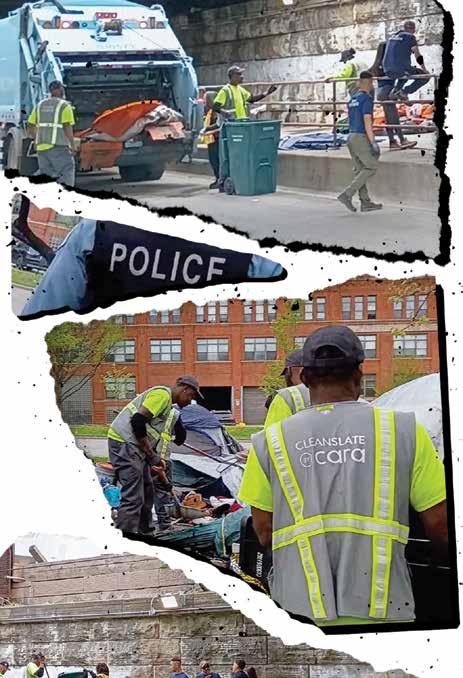
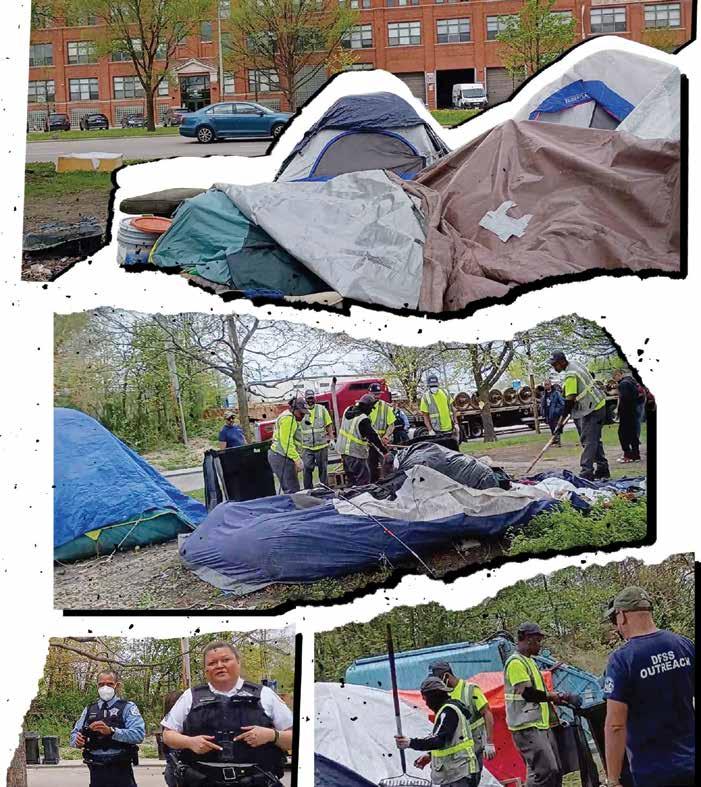
After witnessing the devastation sometimes caused by homeless encampment cleanings, a previously unhoused Chicagoan turns his camera on the city workers responsible. AS TOLD TO KATIE PROUT
Judah Venturi, 40, is an independent researcher, writer, teacher, and philosopher. He’s lived all across the eastern half of the United States, including Pittsburgh, Nashville, Miami, and Louisville. After moving to Chicago in 2023, Judah rented an attic room in Bucktown until, he said, a job abruptly shut down without paying him weeks of owed wages. Over the next month, Judah applied to 356 jobs but didn’t receive any serious replies. Meanwhile, the vaulted ceiling of his room caved in from water damage, ruining his desk and books, and rats moved into the building. Feeling demoralized and unsure why he was torturing himself to come up with rent for a landlord who treated this home like a dumpster, Judah left. But it wasn’t just the increasingly miserable circumstances of the previous months that pushed him into homelessness, he explained over email. “It was from 20 years of working and having nothing to show for it, and having watched both of my parents work themselves to death within the last eight years.”
Until receiving housing earlier this spring, Judah was unhoused from spring 2025 to spring 2026. For some of that time, he lived in the Humboldt Park neighborhood at an encampment, which, according to April 2026 internal documents from the Department of Family and Support Services (DFSS), was one of approximately 120 encampments active across Chicago. These camps are cleaned by the city on a scheduled basis, usually by Streets and Sanitation workers, with DFSS workers also present to offer food, water, connections to available shelters, information on housing programs, and other types of support.
By definition, the efficacy of the cleanings relies on surveillance—workers can only get rid of what they see. Sometimes the workers remove hazardous garbage, leaving residents appreciative of their work; other times, the cleanings are devastating. Before the March cleaning of the Humboldt Park camp, Judah hid his stuff and left to go teach. When he came back later that day, multiple tents were gone. Everyone was upset. “They threw a wheelchair away,”
Judah recalled. The person whose wheelchair it was had been picked up by an ambulance from the camp the day before. “The wheelchair was still in use,” Judah said. “He was just in the hospital.”
As Judah remembers it, in the aftermath of the March cleaning, Nyla, one of the residents, wept. Her tent was one of those thrown away by the city, along with all the belongings she stored inside it, including clothes, shoes, documents, and medication. “They can really throw someone’s entire life in the back of a dump truck,” he said. Seeing Nyla in tears changed Judah. “That’s when I decided to film and be present.” The next time workers arrived for a cleaning, he would be there, even if he had housing, to remind his former neighbors of their rights and to hold city workers accountable on camera.
This interview, which includes additional comments sent via email, was edited for length and clarity.
My main focus is writing, but I experienced homelessness myself and saw some of the abuses firsthand. I have the means to advocate, and I have some experience in those situations, so it feels like a responsibility. It’s not that hard, really, to just be there and witness, and the difference is noticeable, to say the least.
On April 24, [the city] came back to the camp [in Humboldt Park]. I was there several hours before anyone from the city showed up. I’d printed out the relevant city ordinances and the procedures that they are supposed to follow. I had time to walk around, talk to the residents, tell them why I was there, and tell them to stay around their things if they could, because it would be a lot harder for me to prevent the city from throwing that stuff away if the residents were not there. Then, the city workers started to arrive.
Since then, they’ve started to tape off [a perimeter around the encampment], but they hadn’t started that the first time I was there, so I was able to walk freely
really sticks with me is: Chris and Kim [a couple in the camp] have cats. One of their cats had kittens in the tent that Chris was using just for storage. When the workers started messing around with that tent, we were like, “Hey, be careful, there’s kittens in here.” One of the workers said, “Homeless people have cats?” Like she couldn’t comprehend that they would have pets, like they’re not like you and me.
“I would like people to know that they have a lot more power than they think they do.”
I heard quite a bit of that [type of comment]. I got a lot of reactions. None of them were friendly—a lot of passive-aggressive comments, a few middle fingers from the city workers. It didn’t bother me, because unless I’m preventing you from doing something that you’re not able to do because there’s a witness . . . it’s kind of telling. Of course, that’s speculation, but why are you upset that I’m filming [on public property]? One police officer, I think her exact words were, “Our bodycams are running, so you
don’t have to worry about that.” I said, “I’m gonna film anyway.”
I had reached out [to other advocacy groups that support unhoused Chicagoans] before the first time I filmed. Some of the groups that I contacted were defunct, so I ended up just showing up myself with the documents and the phone. I’ve had other experiences where filming makes a huge difference, like encounters with police, like protesting for Breonna Taylor in Louisville. That was a big thing: “Always have your phones recording.” I wasn’t protesting; I was trying to make my presence as minimal as possible and not impede what was going on.
There’s a guy that stays there in a smaller tent. He was one of the ones I was talking to in the morning. He was like, “I’ve got to leave for a little while, but I’m going to be back.” He had an appointment or something. I was like, “OK, I’ll watch your stuff, just try to come back as soon as you can.” Later, I saw city workers go over and start circling the tent and looking inside. I walked over and said, “Hey, someone lives here.” I got this kind of belittling response from them, like, “Yeah, OK, we got it under control.” I had to be like, “What I’m saying is, you can’t throw this tent away—someone lives here. He’s gone at the moment, but he’ll be back. His name is Daniel.” Then they walked away
and made a phone call.
I don’t know if Daniel hadn’t come back whether I would have been able to prevent them from throwing the tent away, but I at least delayed them. He came back and said, “I live here.” I was like, “Sit inside the tent.” And so he did.
That day [in April], the cleaning was particularly long, maybe two and a half to three hours, but the police were only there for the first 45 minutes to an hour. The one in June was very different. The workers themselves had a completely different demeanor. It also wasn’t the same people. If it was the same group, then that would be more of an indication that maybe they had a conversation with them, like, “Hey, you can’t say these things about them. You have to treat them with respect.” But this time, [on June 2,] DFSS was going around and talking to the residents, presumably about getting them housing and stuff. This
time, there were a lot more DFSS workers. They were actually sitting down with the residents. There was more respect from the city workers to the residents. There were also a lot more residents present that day—I don’t know if that makes a difference. And more police officers.
It was a much different environment, just from witnessing. The disturbing thing to me is the difference between the first and the second time, because while it’s not a direct indication, it gives me a pretty good idea of what it’s like when there are no witnesses.
From my side of the fence, it’s about knowing your rights and standing your ground, but from [other residents’ perspectives, especially older or Black residents] who have probably had terrible experiences with the police, it’s about survival. [Not speaking up is] a survival mechanism for them, and for that reason,
encampment cleaning] is not an insurmountable natural disaster. They are human beings working mundane jobs for the city who have become apathetic and dispassionate over time, and who need to be reminded that carelessness, neglect, and shortcuts in their line of work are a material act of violence on the residents of encampments. I know [the workers] were annoyed and inconvenienced by my presence. I only hope that later they asked themselves why someone who isn’t being paid would choose to spend their day at a homeless encampment filming the city doing a routine encampment sweep. I tell the residents—and this is advice for anyone—even if you have a phone that won’t turn on, nobody knows that. Point the lens when you’re in situations like that, and it will change the entire demeanor of the situation. If they think that there are no witnesses, and you don’t have a way to record what’s going on, the power balance is out of whack. A phone, even if it doesn’t turn on, is an equalizer, a very powerful one. You don’t want to go into a situation where you’re at a disadvantage. That’s when you get your belongings thrown away. That’s when you get your rights abused. v
I have to respect it, but I would like people to know that they have a lot more power than they think they do.
[In the aftermath of the March cleaning,] people were upset, but no one was surprised. The demeanor of the residents as they anticipated the event was as if the municipal apparatus of the city responsible for conducting these “off-street cleaning” events was as inevitable as nature itself. As I was going around speaking to residents, encouraging them to film, and asking them what they think could be done about it, they responded to me as if there was a tornado approaching and I was inciting them to fight it while they pragmatically boarded up their windows.
I didn’t press them and try to convince them that I was going to make some profound difference. I wasn’t sure myself. I only hope that it was made clear that [an
Editor’s note: When asked to comment on Judah’s experiences, DFSS spokesperson Linsey Maughan replied via email, “DFSS workers do not handle the physical portions of encampment cleanings, and our workers would never discard a functioning wheelchair.” She explained that multiple agencies coordinate on cleanings, “and all parties involved are expected to adhere to a code of conduct.” Maughan wrote that DFSS workers follow an established cleaning policy, including stickering tents with a minimum seven-day notice prior to being removed, adding, “A tent would only be stickered if it was suspected to have been abandoned, unoccupied, or the individual was housed.” Maughan continued: “The characterization of our team as careless, neglectful, or taking shortcuts is simply inaccurate. Our staff are committed professionals who work tirelessly to build trust with individuals experiencing homelessness—often over the course of months or even years. They consistently meet people where they are, respect their choices, and provide ongoing engagement while balancing the health and safety needs of the broader community.” Streets and Sanitation spokesperson Ryan Gage declined to comment and directed the Reader back to DFSS.
Excluding Judah, the names of all unhoused people in this story have been changed to protect their identities.
Just Neighbors examines the city’s homeless encampment sweeps, focusing on the human impact of a fragmented, interdepartmental process.
kprout@chicagoreader.com
Stills from Judah’s video footage documenting the April 24, 2026, cleaning of a homeless encampment near 700 N. Sacramento in Humboldt Park JUDAH VENTURI, PHOTO ILLUSTRATION BY AMBER HUFF
FOOD & DRINK
Detention is the mother of invention
Cooking in Maximum Security reveals the ingenuity of incarcerated Italians’ efforts to cook on the inside.
BY MIKE SULA
The moka pot is such a fundamental part of Italian culture that even prisoners in maximum security are allowed to keep them in their cells.
Set atop gas-powered camp stoves available for purchase in Italian prison commissaries, the iconic, two-chambered, aluminum coffee maker can produce an espresso just as satisfying and civilized as one brewed on the outside.
Italian prisoners can also iron their uniforms with it, tenderize meat, or crush walnuts, tomatoes, potatoes, or pine nuts, if they have a taste for pesto. They can use it to drive nails through gas canister bottoms to make cheese graters. They can also buy beer, wine, and Parmigiano-Reggiano in the commissary, so long as they have loved ones to send them the euro. In many cases these are the mothers and wives of the men, who passed along their cooking knowledge, along with 20-kilogram parcels of groceries, toiletries, and other personal effects each month.
The moka pot also lent its name to the MoCa Collective, a group of prisoners who coauthored Cooking in Maximum Securit y in collaboration with visual artist Matteo Guidi.
First published in 2014, the cookbook’s first English translation was released late last year by Chicago’s Half Letter Press, the publishing imprint of local art collective Temporary Services.
It’s a satisfying companion to Half Letter’s earlier Prisoners’ Inventions (2020), which includes a chapter on recipes and cooking techniques from people in California prisons, but also exhibits the same spirit of subversive ingenuity in opposition to high-control environments. Both books are illustrated with fine line drawings by prisoners.
In the case of Cooking in Maximum Security , you might suppose Italian prisoners have it easy. That’s until the appendix: a “Letter from isolation,” written by a man in solitary confinement. It’s a 15-day diary of the miserable rations he subsisted on without his usual cooking tools or ingredients.
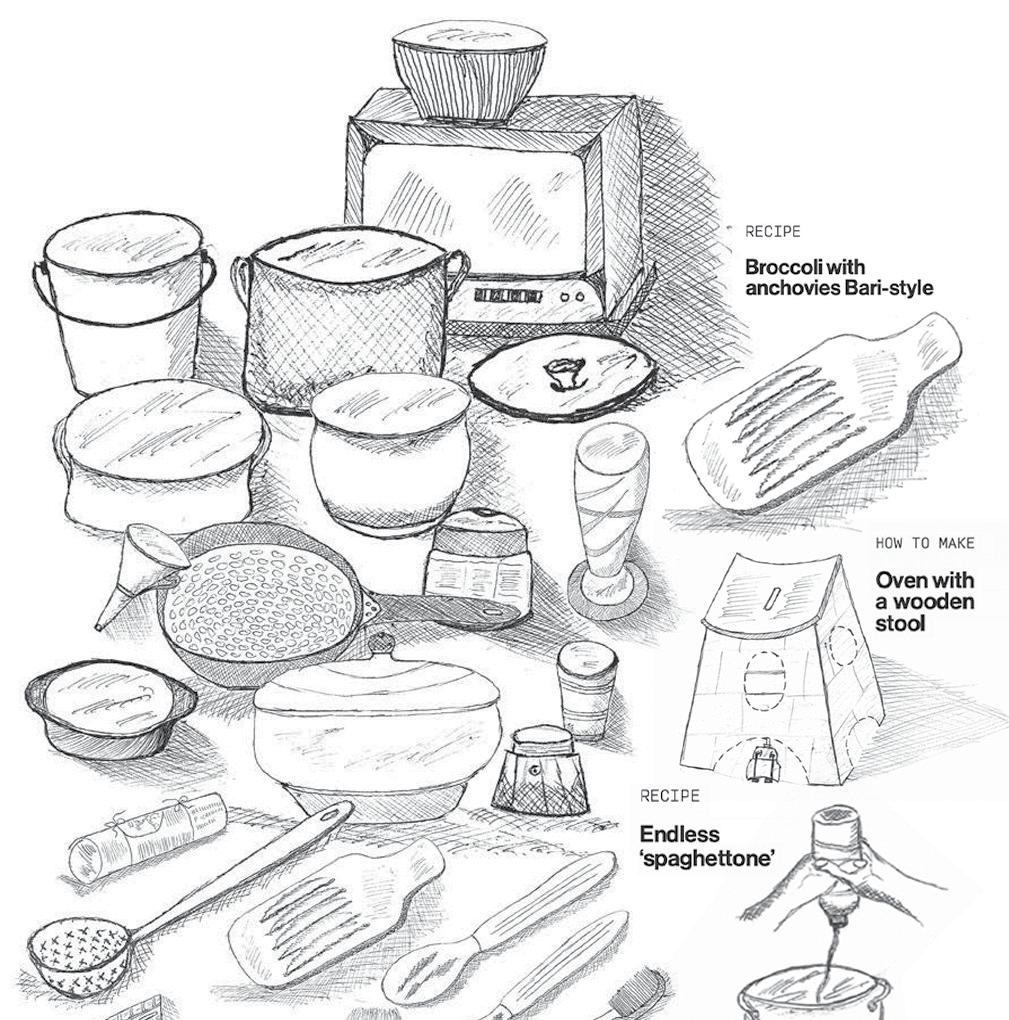
That man, Mario Trudu, who served 40 years before dying in prison in 2019, contributed drawings of the recipes and the tools fashioned to execute them: a rolling pin from a broken broomstick; a refrigerator from a polystyrene mozzarella package; an oven from a wooden stool wrapped in newspaper.
There’s a knife/peeler repurposed from a tomato can lid, and a finer one from a pencil-sharpener blade melted into a toothbrush handle. But there’s seemingly no expectation that these utensils will be used for violence or escape (though Trudu did break out and spend ten months on the lam during his sentence). Prisoners use these tools with the knowledge of their captors: Pasta noodles are extruded through holes in plastic bottles. Pizza is baked in bi-level cupboards lined with silver paper from cigarette packages. Cannoli are formed and cooked in empty beer cans.
The project began in 2009 when Guidi led a workshop on visual communication
with a group of men at a prison in central Italy. One mentioned that he baked bread in his cell and used the heat from his television to proof the rising dough. This inspired an almost three-year correspondence between Guidi and his coauthors at several prisons across Italy, culminating in the book’s publication. Since then, a second phase of the project began, focusing on a women’s prison in Spain.
Meanwhile, the book’s translator, who was familiar with Half Letter’s Prisoners’ Inventions, approached cofounders Marc Fischer and Brett Bloom. “It felt like the most obvious and natural book for us to publish in an English edition,” says Fischer.
The recipes in Cooking in Maximum
Security are sophisticated and appealing: turnip-top orecchiette “Salernitana-style;” stuffed guinea fowl, apple strudel, plum liqueur. The prisoners who contributed to them are “heroic,” as Guidi points out, in their efforts to achieve some sense of basic human pleasure.
In his introduction, he observes that without photography it’s difficult to picture the physical circumstances of the authors of these recipes. But for intrepid home cooks, the idea of taking up the challenge of fashioning their own prison cooking tools and giving some of these recipes a try isn’t difficult to imagine. v
msula@chicagoreader.com
Illustrations from Cooking in Maximum Security COURTESY HALF LETTER PRESS
READER BITES
Helados con queso at Nube’s Ice Cream & Coffee Shop
BY MIKE SULA
The city of Ibarra in northern Ecuador sits at the foot of the occasionally snow-capped Imbabura Volcano. Its crater is believed to be the original freezer relied upon to make helados de paila, intensely fruity ice creams or sorbets, made by whipping tropical fruits with sugar in a bronze basin set over salt and volcanic ice.
Ibarra is also known as La Ciudad Blanca, or the White City, for its whitewashed colonial houses, but it might as well be called that for a modern variant of the local ice cream.
In the mid-1990s, as if inspired by the
surrounding Andean peaks, a helados shop owner named Rosalía Suárez began grating fresh queso blanco over her confections, and the idea slowly snowballed its way to Uptown.
But this little shop didn’t bravely swing open its doors in the autumn of 2023 just for you to shower your chocolate, strawberry, or Oreo dairy with more dairy. The tropical flavors come from their equatorial origin, and their bright acidity pierces the luxurious full-fat jackets and cheesy blankets above with special clarity—with a drizzle of blackberry syrup to underscore the exclama-
tion points. Meanwhile, the salt in the queso intensifies the flavors of guava, passion fruit, tamarillo, soursop, and lulo, and keeps the blizzards of cold custard and grated cheese in check.
Nube’s Ice Cream & Coffee Shop, 4442 N. Broadway, 773-358-0857, $8.99-$14.99 v
Reader Bites celebrates dishes, drinks, and atmospheres from the Chicagoland food scene. Have you had a recent food or drink experience that you can’t stop thinking about?
msula@chicagoreader.com
CORI NAKAMURA LIN | ONIBABA STUDIO FOR CHICAGO READER
An oasis at the Cook County jail?
Cook County’s new $7 million nature-themed jail visitation center is the latest in a decades-long pattern of redesigns that promise humanity without addressing the harm of incarceration itself.
BY SHAWN MULCAHY
NEWS & POLITICS
In mid-February, a team from DLR Group, an international architectural firm, met with a coterie of local government officials to unveil plans for an open, airy 22,000-square-foot building it had been contracted to design in southwest Chicago.
DLR’s proposal was heavily influenced by nature—both in the building’s physical design and the larger ethos underlying it. One slide in a presentation that accompanied the team’s pitch featured a dense ring of trees that encircled a still, blue-green lake set amid a barren sea of dunes. “An oasis,” the presentation read, “functions as a moment of renewal within a larger, often stressful environment.”
Next to the photo of the oasis was an image of a winding trail that weaved through a clearing of mossy undergrowth, past lush ferns, and deep into an old-growth forest. “While Oasis established the idea of relief and restoration,” the slide explained, “Groves evolved that concept into one of belonging— transforming a momentary refuge into a layered, living environment where people feel held, protected, and connected.”
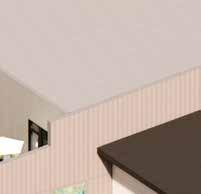
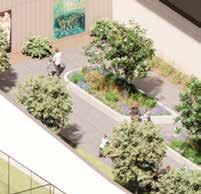
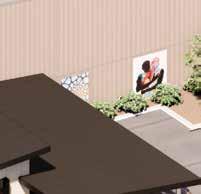
While the building wouldn’t have real oases or groves, the team promised to bring those healing, soothing properties indoors. But DLR wasn’t enlisted to design a hospital, a behavioral health center, or any other site you might typically consider restorative. Rather, the studio had been hired by Cook County officials to design a $7.1 million “enhanced visitation center” at the notoriously dangerous—and sometimes deadly—county jail. It is expected to include small and large meeting rooms, an open atrium that could be converted into a community event space, a spot for wraparound social services, a kids’ play area, and an outdoor patio. Site preparation is already underway, and the county is planning to break ground later this fall.
The enhanced visitation center is one of a handful of projects in the works at the 96-acre Cook County jail complex. County budget records show officials have set aside at least $400 million for design, construction, and maintenance through 2035. That number could grow, although few details about potential renovations are publicly available.
The offices of both Cook County sheriff Tom Dart and board president Toni Preckwinkle refused to share a copy of a master plan for the jail campus that has been in progress for nearly a decade, invoking an exemption in state law that shields preliminary drafts from public view. (The Reader has appealed that determination to the Illinois Attorney General’s Office.) The records the sheriff ’s office did provide are heavily redacted, offering little information beyond basic design ideas and renderings of the visitation center’s lobby.
While county officials have largely kept mum about plans for the jail, the presentation on its visitation center, which the Reader obtained through a public records request, offers clues as
to how the county may approach future projects. In its pitch, DLR invoked the 11 principles of trauma-informed design, a framework published by the TraumaInformed Design Society in 2024 to guide architects and designers in creating spaces that foster safety, resilience, and healing.
A slide from the team’s presentation
“There’s no such thing as a trauma-informed cage.”
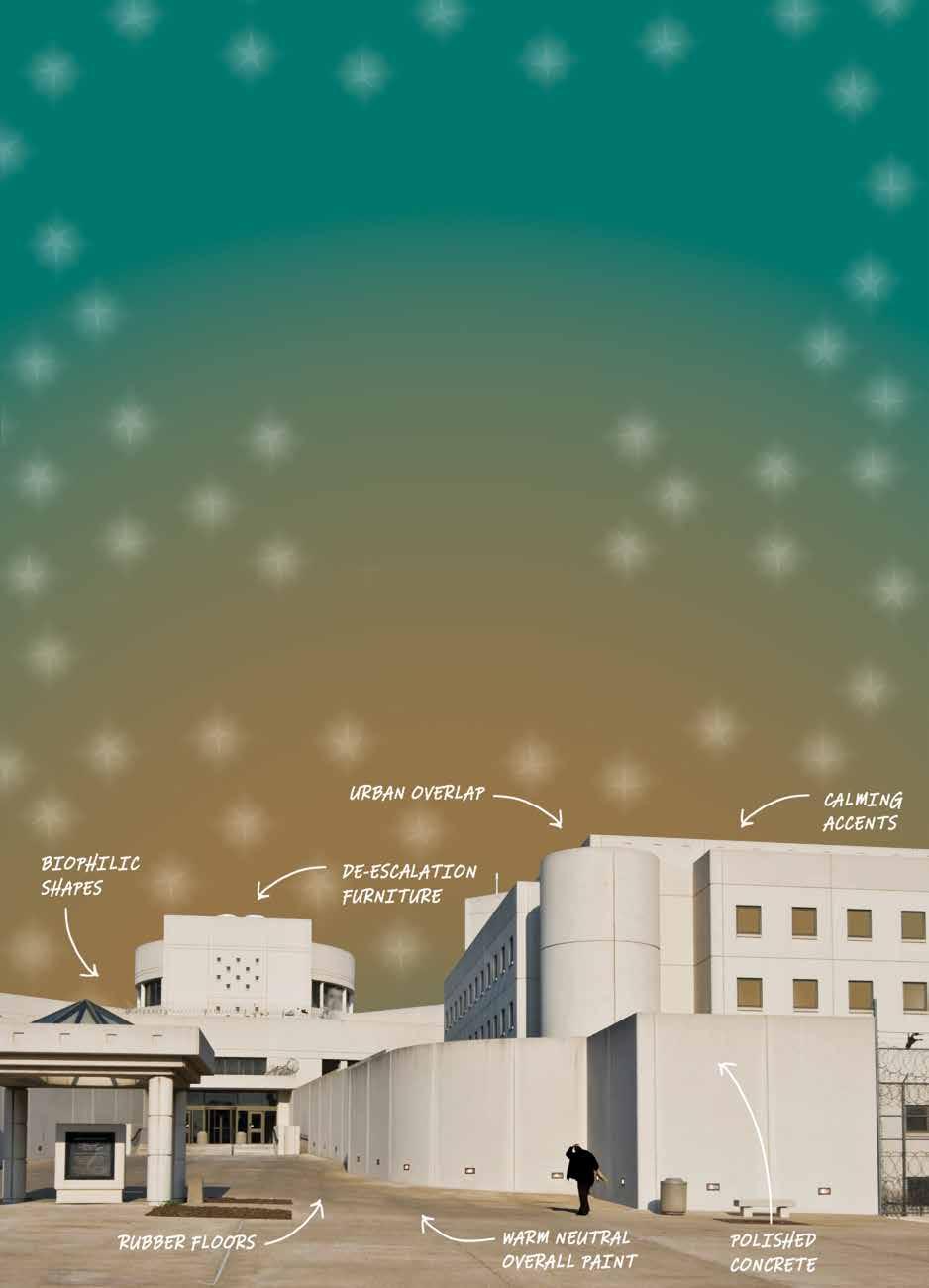
titled “Oasis + Groves | Materiality” suggested ways the team would translate those principles into the final product: rubber floors with wood and polished concrete detailing; warm, neutral paint colors foregrounded by “calming accents” of greens, browns, and golds; and “biophilic shapes” paired with “deescalation furniture” and “urban overlap.”
DLR Group spokesperson Marguerite
Munoz declined to comment and referred the Reader to Cook County. Jamie Meyers, deputy chief of the Bureau of Asset Management, which oversees the county’s facilities, said in an interview that officials aimed “to provide some respect and humanity to those that are currently at the [jail] when family comes to visit.” The new visitation center “still creates a very secure space for the detainees, visitors, and employees,” he said. “It’s just looking at it in a different way, with a different light, focused on trauma- informed design.”
Avik Das, executive director of the county’s Justice Advisory Council, said visitors are currently “experiencing the jail and that environment. In this future state, the community is being brought to the resident, and both are staying in community as they interact.”
The sheriff’s office refused to make anyone available for an interview. In a statement, spokesperson Matthew Walberg wrote that the visitation center, which he called the Family Resource Center, “is the latest expression of
Sheriff Dart’s long-standing belief that maintaining close family relationships is a crucial part of rehabilitation and re-entry.” Despite improvements to the visitation process, such as a policy that allows incarcerated people to hug loved ones during so-called contact visits, Walberg wrote, “only so much can be done to transform what is inherently a corrections housing unit.” The new building, he wrote, “will provide a welcoming, familycentered experience.”
Yet community organizers, advocates, and experts who spoke with the Reader argued that jails and prisons exist primarily to separate people from their communities and strip them of their autonomy and agency. As they saw it, no such site could be trauma-informed when incarceration itself is inherently traumatic. And while some recognized the intention behind improving conditions for visitors and incarcerated people, they argued that investment in the jail ultimately reflects the county’s long-term commitment to incarceration. They called instead for
Renderings of the Cook County jail’s new visitation center COOK COUNTY SHERIFF’S OFFICE
increased funding for community-based services, like housing and food assistance, that address many of the reasons people are later criminalized.
“There’s no such thing as a traumainformed cage,” said jasmine Sankofa, executive director of the national advocacy group Movement for Family Power. “And while the [county] plans to spend millions to pretty up its visitation center, communities are left with very little investment.” Cook County is projecting a $550 million budget shortfall in 2027, the largest in 16 years. Preckwinkle said in June that the county board is considering “a variety of belt-tightening measures” to close the gap.
Organizing director Holly Krig of Moms United Against Violence and Incarceration, a group that advocates for incarcerated caregivers and criminalized survivors of abuse, put it another way. “There’s this adage: You can’t shine a turd. But repeatedly, the people involved in making this decision have decided that that is not rhetorical and have responded with, ‘Yes, you can.’”
Overall, many of the advocates who spoke with the Reader said the visitation center would do little to improve the current living conditions of incarcerated people, who for years have sounded the alarm about brutality, neglect, and inedible food. It comes as the Cook County jail’s population has continued to tick upward since State’s Attorney Eileen O’Neill Burke took office, despite fewer reported violent crimes in Chicago. “The idea of creating a space where people could have greater contact with their loved ones is an idea that, I think, everyone in the advocacy community would support,” said Matt McLoughlin, an organizer with the Illinois Network for Pretrial Justice. “But it seems like there are better ways [Sheriff Dart] could be allocating the resources available to him to meet the goals of this site without having to increase spending.”
The Cook County jail’s notorious Division 1 opened in 1929. Its long, sterile hallways were lined with rows of steel bars and two-person cells roughly the size of a parking spot. Once home to mobster Al Capone, before he was transferred to federal prison on tax evasion charges, and the state’s first electric chair, which the staff morbidly called “Old Sparky,” it also held the stage where blues legend B.B. King performed his famous Live in Cook County Jail set. By 2021, as it neared its hundredth birthday, Division 1 had sat vacant and crumbling for nearly a decade.
Some five years earlier, Board President Toni Preckwinkle and Sheriff Tom Dart outlined a plan to raze the building, along with the smaller Divisions 3 and 17. The demolition projects were part of a concerted effort to “reduce the jail population and right-size facilities,” declared a county press release in November 2016. The same day, Preckwinkle stood in front of a partially destroyed wall, flanked by
county officials in hard hats, as an excavator sat poised to continue work. “We know that holding people in jail destroys lives,” she told reporters. “Every effort needs to be made to be sure that the people keep working, attending school, and caring for their families as they await their trials.”
County budget records show officials have set aside at least $400 million for design, construction, and maintenance through 2035.
Around the same time, the county’s Bureau of Asset Management hired a team of architects and planners to create a ten-year master plan for the Cook County Department of Corrections (CCDOC). Many of the buildings on the jail campus had suffered from years of
multinational construction companies that was well-versed in the design of jails and prisons. Planner David Ziskind, for example, had previously worked on projects for nearly 50 correctional and mental health facilities across Massachusetts. Project manager R. Price Jepsen counted among his accomplishments a $60 million master plan at the infamous Rikers Island jail complex in New York City. And planner Fred Moyer, a former University of Illinois architecture professor, had at one point been tapped to work on a $2.5 billion project building prisons across Saudi Arabia, a country human rights organizations have long criticized for abuses and that has one of the highest execution rates in the world, according to Amnesty International.
The team toured each of the jail’s buildings, interviewed staff and incarcerated people, and met repeatedly with key government stakeholders over the next two years to hone their vision for a reimagined CCDOC. The resulting product “quantified the long-term capital and operating costs of renovations and additions to the existing DOC Campus, as compared with its replacement with
county said the former Division 1 would ultimately be converted into a 5.5-acre outdoor recreational area. Neither the Adult Detention Center nor the recreation area appears to have panned out yet.
Budget records are some of the only public documents to reference a reimagined jail. Preckwinkle notes in the county’s 2021 spending plan that the demolition of Division 1 and the “continued evaluation of redevelopment and restructuring opportunities” at the jail “will further reduce the County’s footprint while starting to clear the way for the proposed new Adult Detention Center, the long-term replacement for the Jail.” The following year, the sole mention is a single line item that’s buried more than 200 pages into the report.
Meanwhile, the master planning team continued to work with the county on an overhaul of the CCDOC campus. Payment records indicate the county repeatedly extended its agreement with STV/Heery from the time it started work in November 2016 until its apparent end in April 2022. In all, the consultants took in more than $21.5 million. But, in response to a public records request, Preckwinkle’s office told
deferred maintenance, and the work aligned with a countywide initiative to cut costs by closing or offloading real estate the government no longer needed. The jail had more than 65 buildings totaling roughly 3.9 million square feet, and officials sought a plan that outlined “clear redevelopment . . . that supports the strategic direction of the Sheriff’s Office and the Department of Corrections while strengthening, modernizing and enhancing the functional efficiency” of the jail, according to county procurement records.
For the job, the county selected STV/ Heery, a joint partnership between two
new facilities,” Preckwinkle wrote in her annual 2020 budget recommendation. “The next step in this historic, transformative process is the demolition of [Division 1],” she wrote, adding that community stakeholders would be involved in the development of a “new Adult Detention Center.” This direction offered the county “the opportunity to re-orient the pre-trial detention function” toward “goals of access to family and counsel, full access for the disabled, greater efficacy of healthcare and mental health services and a dramatic reduction in operating costs.” In community forums and email bulletins throughout 2021 and 2022, however, the
the Reader, “There is a draft master plan but it has not yet been finalized.”
Meyers, with the Bureau of Asset Management, told the Reader, “That plan started, and then things have changed.” He said the jail’s population has dropped since 2017. That, plus evolving county policies, led officials to realize they “needed to change the direction.” The visitation center’s trauma-informed design, he said, “will be one of the key elements as we begin to move forward and look at what this smaller space looks like for detention.” The sheriff ’s office declined to answer questions about the master plan or the Adult Detention Center.
Cook County jail’s Division 11 STEVEGEER/GETTY
NEWS & POLITICS
The $400 million or more that the county has forecast spending on the jail campus through 2035 includes the $7.1 million visitation center, $123.5 million for accessibility upgrades across the CCDOC, an $18.6 million renovation of the current Cermak hospital, and at least $2.6 million for a new healthcare facility. Another line item, simply titled “DOC Replacement Facility,” does not include a budgeted amount. In 2025, the county released a request for supplier qualifications—a process used to short-list contractors before soliciting bids for a final agreement—that sought design and engineering services for the new healthcare facility. And in 2023, officials signed a one-year, $101,000 deal with architecture firm Globetrotters to plan accessibility improvements at the existing Cermak hospital.
McLoughlin, with the Illinois Network for Pretrial Justice, raised concern about the amount of money targeted for jail renovation. “We regularly hear complaints from incarcerated people on the quality of food that people are given in the jail, the amount of mold that’s in the facility,” he said. “It does not seem like the sheriff is actually listening to people in his custody, and these are oftentimes vanity projects rather than projects that actually benefit incarcerated people.
“I’m sure that this will look good as a WGN news story,” he added of the visitation center, “but it seems like that is oftentimes the goal here and it’s not actually about the health and safety of people in his custody.”
In recent years, local governments across the country have sought to rehabilitate the image of dilapidated, dangerous, and deadly jails and prisons. Proposals, such as the Gloria Steinem–backed Women’s Center for Justice in New York City or Illinois governor J.B. Pritzker’s plan to transform the state’s youth prisons into “residential centers,” seek to make carceral facilities appear more humane in response to widespread violence behind bars and growing public pressure to reform or outright dismantle the criminal legal system.
Melanie Newport, historian and author of This Is My Jail: Local Politics and the Rise of Mass Incarceration, said this cycle of reform is one that’s been playing out for generations. In the 1950s, she said, the Cook County jail lacked an outside phone line for incarcerated people to receive calls. During the civil rights movement, some people were lost within the jail system, their families entirely unaware of their whereabouts. During a wave of feminist movement activism during the 1970s, as more women were locked up for drugs and sex work, incarcerated mothers and advocates on the outside challenged a prohibition on children visiting the jail by coordinating visits with their parents’ court dates. “The notion that the jail is obligated to people’s families is a relatively new invention of the jail’s role in the last
50 years,” Newport said. “And the public has really had to demand that. That’s not something that’s necessarily been freely given by the jail.”
For virtually the entire history of the Cook County jail, incarcerated people have complained of squalid, undignified conditions. Construction began in the 1920s to ease overcrowding at the neighboring Chicago House of Correction, which at the time imprisoned more than double the number of people it had been built to hold. However, incarcerated people were left wanting from the day the jail opened in 1929; it lacked adequate heating and had no separate facility to incarcerate women.
For virtually the entire history of the Cook County jail, incarcerated people have complained of squalid, undignified conditions.
The House of Correction and the jail existed in tandem, one operated by the City of Chicago and the other by the Cook County sheriff, until the state legislature unified the two under the Cook County Department of Corrections in 1969. In the infancy of the CCDOC, the House of Correction and the Cook County jail remained largely separate entities. But over the ensuing years, Winston Moore, the jail’s first Black warden, would consolidate power and lead the department on
a path of ambitious transformation— and not for the better. Rather than alleviate the jail’s many issues, the CCDOC came into being at the dawn of the massincarceration era. The number of people confined to the nation’s prisons and jails exploded starting in the 1970s and continuing through the ’80s and ’90s. In direct response to the carceral system’s racist policies, rampant violence, and abysmal living conditions, these decades also saw the rise of the prisoner rights movement, which demanded dignity for incarcerated people through passive resistance and overt force.
A profile in Ebony lauded Moore as “the warden who reformed ‘the world’s worst jail.’” He did so through a flurry of jail construction and a culture of intimidation in an effort to delegitimize demands for improvement by Black radicals. In 1971, Moore commissioned the CCDOC Building Program and Master Plan , an ambitious proposal that intimated the county’s long-term commitment to pretrial jailing and deradicalization. Moore drew on a windfall of local, state, and federal grants—earmarked specifically for carceral construction that balanced control and rehabilitation—to realize his plans. He once told Chicago Today, “Environment is key to the success of this plan. Steel bars lend to an atmosphere of punishment and vengeance. This doesn’t aid rehabilitation, which, after all, is supposed to be the purpose of the jail.” He razed infamous buildings at the House of Correction, added a women’s dormitory and two men’s dormitories that collectively totaled more than 429,000 square feet by 1973, and called for the addition of 5,600 new jail beds by 1995.
Yet replacement buildings constructed in the 1970s were plagued with issues from the start, including inoperable airconditioning and sustained overcrowding. Prisoners filed a stream of lawsuits that challenged, among other things, the practice of “double-bunking,” in which two or more people were forced to share single-capacity cells. Monitors with the John Howard Association, an independent watchdog, found people sleeping on the floor in dirty, roach-infested buildings without mattresses or blankets. This culminated in a consent decree in 1982, the beginning of more than three decades of federal oversight at the jail that sought to ease overcrowding and improve the poor treatment of incarcerated people. The decree mandated the renovation and modernization of jail buildings, additional staffing, and improvements to food offerings.
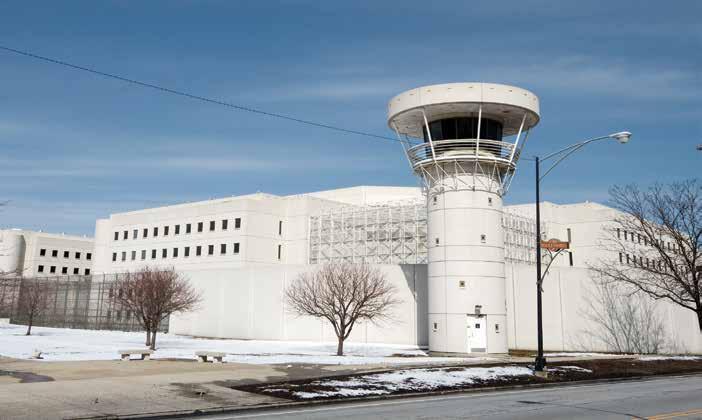
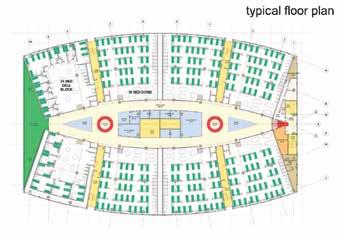
Facing potential fines of up to $1,000 for every day the sheriff’s office failed to reduce the jail’s population, the county turned to a new wave of construction in the 1990s. The current Division 11, designed by architect Roula Alakiotou, sought to soften the jail’s image. It traded long, dank cellblocks for more open, precast concrete pods that radiated out from a central tower. Alakiotou originally intended the building to house women, but the jail’s persistent lack of space meant it was fashioned instead as a maximum security wing for some 1,600 men. Nevertheless, the architect and jail officials heralded it as a correctional facility of the future. “Alakiotou created what she hopes is a more humane jail,” read a 1995 article in Glamour about the building. In a statement that reflected a similar attitude about the built environ-
The Cook County jail’s RTU-RCDC opened in 2013.
COURTESY ROUL ARCHITECTS
ment’s impact on incarceration as Moore had expressed some 20 years earlier, she told the magazine, “In designing a pretrial facility, you have to think about the taxpayers’ dollars, but you also have to consider the dignity of the inmate who is, after all, presumed innocent.”
New construction failed to solve the problem, however, and conditions at the jail remained as dire as ever. An investigation by the U.S. Department of Justice between 2007 and 2008 found that the sheriff’s office consistently violated incarcerated people’s constitutional rights through “the use of excessive force by staff, the failure to protect inmates from harm by fellow inmates, inadequate medical and mental health care, and a lack of adequate fire safety and sanitation.”
The sheriff ’s office found itself under yet another consent decree in 2010.
Amid continued scrutiny, the county again turned to Alakiotou to design a joint Residential Treatment Unit and Reception Classification Diagnostic Center—essentially a comprehensive intake and screening center. The massive, 280,000-square-foot facility could process as many as 500 new people per day, in addition to those served by its 1,000-bed medical center. It also featured the jail’s first video visitation center, at the time presented as a more efficient and accessible alternative to its current meeting facilities. “Video visitation is becoming an increasingly popular trend for correctional facilities around the country,” recounted a 2013 feature on the building in the trade magazine Correctional News, “as it limits inmate movement, reduces the number of man hours required by correctional officers escorting inmates to-and-from traditional non-contact visitation areas and gives loved ones who live far away the opportunity to see inmates without traveling to the jail.”
The jail’s population crested at more than 10,500 people in 2013, before it began to slowly slip back down. In 2017, federal oversight finally came to an end. “Prior to the [Department of Justice] report,” wrote Sheriff Tom Dart in a news release at the time, “I began a systematic overhaul of the jail, working with the federal court and others to address the many issues identified. Today, we have systems and structures that are looked at as a beacon for correctional facilities around the country.”
Despite Dart’s declarations, however, many people imprisoned at the jail found themselves confined in incommodious conditions. Bunk areas were crowded and lacked sufficient space to store personal items. Toilets and showers lacked privacy. Day rooms, where incarcerated people spent most of their time, were dank and small, and virtually every building lacked outdoor recreation space. Entire wings, and in some cases entire buildings, sat vacant after years of neglect and disrepair. At the same time, national attitudes about policing and incarceration were
undergoing another seismic shift. The police killings of Michael Brown in Ferguson, Missouri, Eric Garner in New York City, and Laquan McDonald in Chicago roiled cities across the country, as protesters proclaimed that “Black lives matter” and demanded an end to state violence. Incarcerated people and advocates drew a direct line between the overt violence of police and the lessvisible violence behind bars, pushing for bail reform, expanded programming, and the repeal of “tough on crime” policies, such as mandatory minimum sentences and so-called three-strikes laws, that had fueled the wave of jail and prison construction in the 1970s and ’80s.
It was against this backdrop that, in late 2016, the county enlisted STV/Heery to develop a new ten-year master plan for the CCDOC campus. In the years since, buildings have come down, but none have gone up to take their place. The visitation center, then, offers the first glimpse at how a new phase of jail construction might take shape. Its large, open windows and soft pendant lights are a radical departure from the cold, gray concrete interiors and imposing fortifications of jails past. It trades an atmosphere of control for one rooted in the framework of trauma-informed design.
“What we’re building towards is a more community-centered approach, where individuals who might be under pretrial jurisdiction get reentry support at the earliest point of contact,” said Das, with the county’s Justice Advisory Council. “That
future next division, if there ever is one, is going to have to reflect something that’s far more consistent and builds upon the learnings of the enhanced visitation center and is not just an amalgam of generations of buildings of different divisions from one era of prison building to another.”
“The problem is that prisons and jails aren’t about actually responding to social problems.”
The idea that the built environment influences healing is not novel; it can be traced as far back as the ancient Greek city of Epidaurus and tea rituals in 12th- century Japan. But its application in carceral spaces is a relatively new phenomenon, albeit one that has quickly gained traction over the past decade.
The architectural and engineering fi rm SMRT, for example, notes in a case study of its $149 million redesign of the Maine Correctional Center in 2022 that it incorporated natural light, bright pops of colors, and “normalized furniture” to “create a welcoming, human-scale environment to reduce anxiety and promote calmness and connection.” DLR Group, the firm behind the Cook County jail’s visitation center, employs an entire team
NEWS & POLITICS
devoted to the design of prisons, jails, courts, and police stations.
In 2015, Studio Gang, the firm of renowned architect Jeanne Gang, developed the conceptual Polis Station to reframe police stations as “sites of social connection and services.” The framework, based on the Tenth District station in North Lawndale, proposes equipping police stations with computer labs, nutritionists, and meditation gardens alongside traditional police infrastructure. As part of its work, Studio Gang converted a portion of the Tenth District’s parking lot into a basketball court. “By providing safe, shared outdoor recreational space on police property, this simple intervention has also built productive relationships between residents, officers, local officials, and donors that are leading to future investments in the neighborhood,” the studio writes in a case study.
Architect Paul Alt has spent his career contemplating the design of spaces that facilitate healing. In 2016, he led a team of consultants to create the Healing Environment design guidelines for hospitals and community clinics run by the U.S. Department of Veterans Aff airs. One of the core elements of spaces that are truly restorative, according to the guidelines, is partnership. “Healing never occurs in isolation—it can only occur in community,” the guidelines read. Alt’s work stands in contrast to more performative design trends in prisons and jails, which, after all, exist to separate people from their communities.
Newport, the historian, sees the tendency toward “friendly” carceral spaces as a way to market them for the modern day. “The point of the jail is to reinforce trauma. It’s about banishment from the community,” she said. “An inviting jail spa, with earth tones and natural colors and soothing elements— it’s very much part of the story that the jail wants to tell about itself, but it’s not one that’s up-front or honest about the kind of violence the institution perpetuates.”
Responses to violence that are truly trauma-informed should take place outside jail walls, said Krig, with Moms United Against Violence and Incarceration. “We should be thinking, ‘What are the things that actually need to be met upstream of criminalization?’’’ she said. “How can we think about risk assessment in terms of how people experience poverty and abuse and addiction? How do we support people in community settings?
“I think about prison reform as a kind of coercion itself—that there’s no world outside of this, and the best we can do is make it a little nicer,” Krig continued. “The problem is that prisons and jails aren’t about actually responding to social problems. They’re about maintaining this legacy of white supremacist patriarchy, and in that way, they’re absolutely doing what they set out to do.” v
smulcahy@chicagoreader.com
Winston Moore oversaw an extensive building program at the CCDOC that began in the 1970s. COURTESY RONALD REAGAN PRESIDENTIAL LIBRARY
Illinois prisons expand free phone calls
The
Voices of Connection program gives incarcerated people 775 minutes worth of free phone calls per month.
BY TATIANA WALK-MORRIS
Phone calls are a lifeline for incarcerated people.
The Illinois Department of Corrections (IDOC) is extending a pilot program that provides incarcerated people with 775 minutes of free phone calls per month.
Naomi Puzzello, public information officer for the IDOC, confirmed in an email to the Chicago Reader that the department decided to extend the program after seeing “a significant
increase in minute usage as individuals gained greater access to phones.”
The IDOC launched the Voices of Connection program in November. During the pilot, incarcerated people could make 20-minute phone calls from their tablets or the wall phones in their facilities. The department will continue the program and offer the same number of free minutes per month, Puzzello wrote.
“Since the Voices of Connection program launched in November 2025, the free minutes have made the increased phone access calls more affordable and sustainable for individuals and their families,” Puzzello wrote. “Based on these results, the Department determined that extending the program would continue to support meaningful connection between individuals in custody and
their loved ones.”
While offering free minutes to incarcerated people eases the financial burden of keeping in touch with their loved ones, advocates urge the agency to not only keep the program but improve the quality of the free phone calls.
Other states, including Rhode Island, New Jersey, Pennsylvania, Washington, Hawaiʻi, Oregon, and Maryland, have
MIKE CENTENO FOR CHICAGO READER
considered adopting similar policies, said Bianca Tylek, founder and executive director of Worth Rises, a New York–based advocacy nonprofit that aims to dismantle the prison industry.
While Illinois prisons have among the lowest phone call rates in the country, free phone call programs have reduced infractions and violence that plagued the once-scarce resource, Tylek said, citing the findings from Worth Rises’s national
Poor phone call quality can complicate matters for incarcerated people who, for example, are trying to talk with or schedule appointments with their lawyers.
analysis of free prison phone calls. “What we’ve heard time and time again, not just from people who are incarcerated and their families, but also from correctional administrators and staff, is that having access to free communications, particularly over tablets, has remarkably reduced tensions within facilities,” Tylek said. “That . . . just makes the environment safer for everybody.”
Though the transition to free phone calls via tablets and wall phones may pay dividends for incarcerated people and prison staff, prisoner advocacy groups told the Reader that the poor quality of phone calls often negates the savings offered by the program.
With the rapidly rising cost of living, some people—especially older adults on a fixed income—are forced make difficult choices about whether to pay their bills in full or fund communications with their incarcerated loved ones, said Regina Russell, member and leader of the Mothers of the Kidnapped Group, a Chicago-based group for loved ones caring for police torture survivors, a part of Mamas Activating Movements for Abolition and Solidarity (MAMAS). While free phone calls can ease that financial burden, ICSolutions, which provides the phone call services to Illinois prisoners, needs to get the phone call quality under control and increase the number of free minutes per person, Russell said.
These days, the phone calls she receives from her son, Tamon Russell, sound as if he’s in a bubble or underwater, Russell said. One of them will often hang up on the other because it’s so hard to hear. Then, they have to wait ten minutes before calling back again, she said.
According to a September 2025 memo from IDOC director Latoya Hughes, both tablet and wall phone calls have a ten-minute lockout period between calls, but Puzzello didn’t respond to the Reader’s
questions about whether that lockout was a company or IDOC policy.
“We’re grateful because that takes a little bit of money off our pockets, but it doesn’t help when you can’t hear them,” Russell said. “The misconception that they give the public is that they’re spending taxpayers’ money on people that are incarcerated and they’re getting all of these glorious perks—and those perks are not glorious the way they are saying it.”
Neither Puzzello nor ICSolutions responded to the Reader’s follow-up questions regarding how the free phone call program has affected revenue for the company. Though the free prison phone call program has trimmed the cost of phone calls, other expenses, such as messaging and additional phone calls beyond the free 775 minutes, remain, Russell noted. Furthermore, the poor phone call quality can complicate matters for incarcerated people who, for example, are trying to talk with or schedule appointments with their lawyers, said Erica Bentley, codirector of MAMAS.
Bentley attributes the poor phone call quality, in part, to the WiFi being inconsistent in people’s cells. Prisons generally are concrete structures that make transmitting WiFi a challenge, though prison phone calls are never on par with the quality we would accept outside of prison, Tylek said. “It’s not an insurmountable challenge, but it’s a challenge,” Tylek said. “I think that the companies that are responsible for all of this are not necessarily looking to invest a ton of money.”
In a statement to the Reader , Puzzello said the department “is not aware of any continued systemic call quality complaints stemming from ICSolutions’ services. ICSolutions continues to monitor the system and make ongoing improvements to call quality. The Department remains in regular communication with ICSolutions to ensure these issues are resolved.”
Mariah, after their mother went to prison. Shortly after they lost their mother, they experienced bullying in school and depression, recalled Williams Gregory, now 42.
Today, the two talk to their mom on the phone to update her on milestones in their lives or ask her for advice, Williams Gregory said. “Even though they still have their moments . . . I can still see the change,” Williams Gregory said.
released, she added.
Williams Gregory and her incarcerated fiancé, Bobby Wright Jr., have started a nonprofit called Children of Incarcerated Parents, which aims to provide mentorship and educational resources to children with incarcerated parents. Williams Gregory is searching for a building to house the charity in the Austin or Garfield Park neighborhoods, because she and Wright Jr. grew up on the west side of Chicago and they want to provide a safe haven for children in the community.
“They might see the prison phone number come across their screen [and say], ‘Let me talk to my mom. Let me see how she doing.’”
While the call system remains imperfect, being able to talk to incarcerated loved ones benefits both the imprisoned and their families, particularly children of incarcerated parents. Timika Williams Gregory has seen that impact firsthand.
In her twenties, Williams Gregory took in her niece and nephew, Lashawn and
Conversations between children and their incarcerated parents can impact their mental health by helping them to feel less isolated and maintain their bonds with their children, Williams Gregory said. Sustained communication can also help incarcerated people remain connected with their community and find housing and employment once they’re
Lately, Williams Gregory hasn’t added additional money for phone calls, but she used to spend more than $100 per month on phone calls alone before the pilot. Still, in a given month, messages run her about $75 to $100, she said.
Like Russell, Williams Gregory raised concerns about the poor phone call quality issues, including dropped calls and echoing. Whether the IDOC or ICSolutions is to blame, ultimately, these problems affect incarcerated people and their loved ones on the outside, she said.
Still, she thinks it’s important for incarcerated people to continue receiving free phone calls to ease the financial burden and help incarcerated people maintain bonds with their children. She even hears from Wright Jr. that having calls with loved ones regularly can relieve stress and give incarcerated people a much-needed reprieve from isolation.
In response to the Reader’s question regarding whether the IDOC plans to reduce the cost of messaging or other services, Puzzello said, “The rates for ICSolutions’ messaging services and other communicationsrelated fees are established through a NASPO (National Association of State Procurement Officials) cooperative purchasing contract. Because these rates are set through that cooperative contract, the department does not independently set or adjust these rates.”
Reflecting on the importance of the program, Russell said, “They need to keep it going, because a lot of people in there don’t have family members, and that’s a good way for them to stay in contact. But the quality is piss-poor, and I have to pay for it.” v
themail@chicagoreader.com
MIKE CENTENO FOR CHICAGO READER
SAIC’s Palestine problem
The art school built its art therapy program around social justice, then claims of anti-Semitism devastated the department.
BY KERRY CARDOZA
Savneet Talwar is a well-respected art therapist, a subject she has taught at the School of the Art Institute of Chicago for nearly 20 years. Talwar’s approach to art therapy is rooted in anti-colonial frameworks, social justice, and intersectional feminism. One former student told the Reader she chose SAIC’s art therapy program to study with Talwar, who is known as a leading scholar in her field.
SAIC’s own marketing materials for its master of arts in art therapy and counseling focus on social justice, claiming that students will “develop a self-reflexive practice to examine their positionality in systems of inequality” and “interrogate modes of knowledge construction that unsettle the mainstream discourses and perspectives that promote prejudice and discrimination.”
Talwar’s removal occurred outside the academic standards set by the American Association of University Professors (AAUP), which SAIC adheres to, and is just the latest controversy stemming from allegations of discrimination and anti-Semitism at the school over the past few years—including several in the art therapy department. Other SAIC community members have faced repercussions for their support of Palestine—from the firing of professor Kelly Xi to the censorship of artwork and the changing of school policies around
Talwar’s removal is just the latest controversy stemming from allegations of antiSemitism at the school.
protests. A 2023 lawsuit against SAIC and art therapy professor Sandie Yi from Jewish Israeli student Shiran Canel, alleging discrimination and emotional
So it came as a shock when Talwar was abruptly removed from her classroom this spring for assigning a case study that mentioned Palestine. A letter from the school stated that the decision to remove her stemmed from a complaint about the case study by a Jewish Israeli student. The school expressed concern that the circumstances of the assignment might violate the school’s discrimination, harassment, and retaliation policy. Within 24 hours, the school forbade Talwar from speaking with her students or colleagues and placed her on paid administrative leave.
distress, was twice thrown out by a judge. The student who complained about Talwar, who we’ll call Tamar, alleged discrimination by three of their fellow students in the prior school year—a claim that the school ultimately dismissed after a taxing, monthslong investigation.
According to SAIC community members who spoke with the Reader , this series of complaints and the school’s reactive response to them have created an atmosphere of fear, with students afraid to speak up in class and faculty feeling the need to censor themselves.
Colleges across the country have seen an increase in allegations of antiSemitism since the start of the Gaza genocide, but sources at SAIC balk at the way the school has handled complaints. Several current and former students, staff, and faculty told the Reader that SAIC has seemed to kowtow to each complaint, instead of following its own policies on due process, academic freedom, and discrimination—even though the school can dismiss complaints that don’t rise to the level of a policy violation.
As Talwar put it to the Reader , concerning her dismissal, “How is it that we have prioritized the complaints of one student over the learning of all our other students?”
On April 15, Talwar had a Zoom meeting with Tamar, a graduate student conducting an independent study in the professor’s Cultural Dimensions in Art Therapy class. The class was nearing its conclusion for the semester, and one of the final assignments was for students to submit an analysis of a case study “demonstrating their understanding of intersectionality as a method of analysis and how it informs the development of a thoughtful and ethical treatment plan.” The case revolved around a hypothetical patient named Bela, identified as a queer, Muslim Arab woman from the Middle East who is in a doctoral program in the U.S. Two sentences of the two-page case study mention Palestine, noting that Bela was impacted by “the violence against Palestinian civilians” and feared for her own safety in the U.S.
“I’m the most open person when it comes to somebody coming in and saying, ‘This is difficult for me, I can’t do it,’” Talwar said. “It wasn’t like I was asked, ‘Can you give me another case study?’ I had already offered, saying, ‘Hey, if this is hard for you. Let me know, I’m happy to give you another one.’ And so I wasn’t approached for an alternative assignment.”
But the day after she met with Tamar,
Talwar received a call from Delinda Collier, the dean of graduate studies, asking whether she’d given an assignment with the word “Palestine” in it. Talwar said she had, and soon forwarded the case study to the dean. About an hour later, Talwar received an email from Martin Berger, SAIC’s provost and senior vice president of academic affairs. Berger has faced much criticism since coming to the school in 2018. That year, he used the N-word when quoting a statement made by someone else during a presentation on his research on photography and the civil rights movement. A change.org petition called for his resignation. In the past several years, students, faculty, and staff have described to the Reader a pattern in which Berger, who is one of the most senior leaders at the school, individualizes systemic problems and increases surveillance. In his email to Talwar, he demanded that she attend a mandatory meeting the following morning, at 8:30 AM, and stated that she was forbidden from speaking with her students. Her Friday class was canceled. Collier declined to comment on personnel matters or on issues involving specific faculty members’ classes in an email to the Reader Upon retaining counsel, Talwar managed to push the meeting to the
following Monday. In a follow-up email summarizing that meeting, Berger reiterated that Talwar was being put on paid administrative leave “because of concerns that your alleged actions threaten immediate harm to the student or to others within our community” and that the school would be investigating whether she violated their discrimination, harassment, and retaliation policy regarding “the circumstances” around assigning the case study. Berger insinuated that Talwar’s assignment—which was given to the entire class—may have been retaliatory toward Tamar, who had previously filed a Title IX complaint against a fellow student “for allegedly revealing privileged information in a piece of artwork,” because Talwar had served as that student’s advisor. Berger again forbade Talwar from speaking with her students or her art therapy colleagues—which the school later rescinded, as no policy precludes faculty from discussing such issues. When asked about this, a representative from SAIC responded: “When a matter is being investigated, it is the School’s practice to ask those involved to refrain from discussing the case with colleagues or others. This protects the privacy of those involved in order to ensure they are treated fairly in the investigative process
and after. It also protects both the person making the complaint and the subject of the complaint from potential harassment and retaliation.”
“In their zeal to suppress speech about Palestine, university administrations are destroying academia.”
SAIC’s policy language around discrimination, harassment, and retaliation is boilerplate: It prohibits discrimination or harassment based on any status protected by federal, state, or local law—race, gender, religion, national origin, and so on. Discrimination is defined as unequal, adverse treatment, while harassment is defined as “unwelcome, hostile, or inappropriate conduct.”
The professor’s counsel, Rima Kapitan, believes that Talwar’s actions—making an assignment that mentions Palestine— seem to fall short of such charges. She drafted a message to the provost saying so. “Rima had looked at the complaint and sent him a letter, and she said, ‘This does
not even rise to the definition of discrimination in the policy of SAIC. Are we to just ethnically cleanse Palestinians from our course material? Can they not be subjects of case studies?’” Talwar said.
In addition to Talwar’s concern about the validity of Tamar’s complaint, she is deeply concerned with the administration’s contradiction of its own policies. “My school has just not followed procedure.”
If a discrimination, harassment, and retaliation complaint is made against a faculty member, the process is supposed to be overseen by the director of Title IX—who is responsible for ensuring the school complies with its Title IX obligations, which prohibit sex discrimination—in consultation with the faculty liaison, who supports the faculty member in such instances. However, neither of the school’s two Title IX employees was included on the emails to Talwar laying out why she was under investigation— and neither was the faculty liaison. In fact, when Talwar asked Berger to include her liaison on the emails, she was told she could share them herself.
SAIC also seems to be skirting its own policies around due process and academic freedom. Its faculty handbook includes widely accepted language written by the AAUP. The guidelines clearly state that a
“My school has just not followed procedure,” said professor Savneet Talwar. SHIRA FRIEDMAN-PARKS
ARTS & CULTURE
faculty member can only be suspended “if immediate harm to the faculty member or others is threatened by continuance”—a claim that Berger waged against Talwar, without specifying what that harm was.
The Illinois conference of the AAUP noted this policy violation in a June 24 letter to SAIC’s president, Jiseon Lee Isbara, calling on the school to rescind Talwar’s suspension. Citing its report on the use and abuse of faculty suspensions, the letter states that “harm” means physical harm. “There is no allegation of any physical harm or threat of physical harm that could justify Prof. Talwar’s suspension, nor is there any explanation provided by SAIC for what the immediate harm is in this case.”
By invoking this threat of harm, Berger may be justifying the school’s denial of due process, as noted by the AAUP. The SAIC handbook says that a grievance can be filed for an “allegation of a violation of an existing policy by the School that has resulted in or will result in suspension, with or without pay, of the faculty member.” But after Talwar spent hours compiling materials for a grievance she submitted in early May, the chair of the grievance committee told her that her claim could not move forward because she wasn’t technically “suspended” but was instead on administrative leave, “a personnel action.” Talwar has since filed an Illinois Department of Human Rights
complaint against the school, alleging retaliation based on her age, national origin, and association with Arabs and Palestinians. It is one of eight pending IDHR complaints against SAIC.
As the AAUP letter notes, SAIC may also be disregarding academic freedom.
A supplement to the faculty handbook expounds at length on the school’s “institutional and cultural framework of academic freedom, freedom of expression, and equality.” It states that the framework
is really for me to assess students’ . . . cultural competence, and also seeing how they apply intersectionality.”
Talwar stressed the importance of teaching students the ethical principles for art therapists, which include not discriminating against or refusing professional services to anyone based on protected statuses like race, ethnicity, national origin, or religion. “We have to find a way to have these critical conversations with our students,” Talwar said.
Four current and former students bemoaned the state of the department. One called it “toxic,” while another described the “profound academic trauma” recent cohorts have experienced.
“helps us differentiate between the language of conflict or offense, on the one hand, and that of discrimination, harassment, retaliation, or other forms of unprofessional conduct, on the other,” noting that “learning cannot, and often should not, be comfortable at all times for everyone simultaneously.”
The complaint against Talwar, though, seems to be exactly that: A student felt uncomfortable with an assignment. “The assignment clearly meets the requirements for my class,” Talwar said. “It
“It’s important that our students engage with this, even if it’s from their own place of discomfort. And if they are going to reject it, then there has to be a conversation of why they’re rejecting it. Utilizing anti-Semitism as a way to promote this kind of intolerance—that really undermines what we do in higher education.”
Kapitan, Talwar’s lawyer, wrote in a statement, “In their zeal to suppress speech about Palestine, university administrations are destroying academia. We invite the SAIC administration to instead
protect academia as a space for exploration and learning, not only when it is convenient for the state of Israel and its apologists, but always.”
In a statement, an SAIC representative wrote that while the school cannot comment on “confidential personnel and investigative matters,” it “has a steadfast commitment to academic freedom.” “We do not discipline faculty for protected classroom discussion of national, religious, racial, or cultural topics,” they wrote. When asked about these claims, Berger wrote to the Reader , “I emphatically state that the investigation has nothing to do with academic freedom. We have many dozens of faculty who regularly teach about Palestinians, Palestine, and the destruction of Gaza. None has faced investigations or sanction. When complaints are made, we follow our longstanding policies and processes and that’s exactly what we have done in this case.”
After the Guardian published an article on Talwar’s case in early June, the school sent Talwar yet another complaint, alleging that she had “violated the privacy of the student who complained” about the assignment by making her “recognizable within her academic cohort and within the SAIC community,” according to a letter of support from the Middle East Studies Association.
Talwar’s abrupt removal from her class also impacted the rest of her students. On
Talwar’s case study assignment (left), detail from SAIC’s Master of Arts in Art Therapy and Counseling catalog by 2023 graduate Sumin 수민 Kim (top right) SHIRA FRIEDMAN-PARKS
ARTS & CULTURE
April 16, students were notified via email by Collier, the graduate studies dean, that their class the following day was canceled. Talwar wasn’t included on the email; one student, who asked not to be named for fear of retaliation, found that strange. Over the course of her two years in the art therapy program, the student had grown close with the professor, who she considered a mentor. When she texted Talwar and didn’t receive a response, she grew concerned.
The following week, the class learned another professor would be taking over. The student was incredulous: “This is insane. There’s only less than a month left of school. Why would you replace her?”
Though the replacement teacher did their best, the remainder of the class was disorganized, this student said. “We couldn’t even concentrate on anything; we were so upset. The first week was canceled, then the following week was also canceled.”
The students weren’t provided a reason for Talwar’s removal. “I felt very talked down to, like, ‘No, you don’t get to know what this is about.’ It was this hushhush, and you’re expected to just kind of continue doing what you’re doing. I’m like, ‘No, this is a rupture that I need you to acknowledge,’” the student said. It wasn’t until the Guardian article about Talwar’s suspension came out that Talwar’s students learned the truth. “I understand that things may be complex, but for everything to just shut down and again be hidden behind this legal wall was just, I think, really unfair for us, and it made us feel like our voices didn’t matter.”
The lack of clarity surrounding Talwar’s return to campus has left this student bereft over what her final year in the program will look like. She was planning on taking two classes with Talwar in the fall. “I had so much anxiety about my last year, just because the way I envisioned it, I was like, ‘Oh gosh, I’m gonna be with Savneet. I’ll be able to work with her and be able to explore this, and I cannot wait to just present everything I’ve done in research class to her.’ And I just don’t have that now. And it is very hard for me,” she said. “I am literally in limbo; I don’t know. This is not the way I would have wanted to end my final year.”
In its support letter for Talwar, the Illinois AAUP also took issue with the way SAIC’s administration “allowed inappropriate factors to influence their actions in this case.” It cites Berger’s summary email to Talwar, which read, “one of the reasons this issue raises such serious concerns is that there have been multiple, prior complaints alleging the creation of a hostile environment within your department.” He’s referring in part to the formal complaint and lawsuit filed by former art therapy student Canel in late 2023.
In her initial lawsuit, Canel alleged, among other claims, that SAIC violated Title VI of the Civil Rights Act as well as
the Illinois Human Rights Act due to her status as a Jewish Israeli student. It played out in U.S. District Court for the Northern District of Illinois for more than two years before the judge finally threw out the case in a 42-page opinion. The judge thoroughly lays waste to Canel’s broad claims of a “hostile educational environ-
committing a genocide, and that antisemitism was meaningfully distinguishable from anti-Zionism.”
The dissension in the department compounded from there, with one professor placed on leave following Canel’s discrimination complaint. Four current and former students whom the Reader
ment,” “on-campus ‘violence,’” “‘violent’ students,” and “a campaign of antisemitic and anti-Israeli abuse by SAIC’s faculty, administration, and students.” “The Court declined to conflate criticisms of Israel’s government or promotion of the Palestinian cause with antisemitism,” Judge Georgia N. Alexakis wrote. “In the university setting, the Supreme Court has stressed that First Amendment protections are especially ‘[v]ital.’”
“It was Friday, I was in class, I was wearing a Palestine baby tee, and then Monday I had a Title IX email.”
Canel began her studies at SAIC in the fall of 2023, right before the Hamas attack that spurred Israel’s assault on Gaza. Shortly after, some current and former students in the art therapy department wrote a letter denouncing SAIC’s ties to the Crown family—who have donated millions to the school and who are a partial owner of the weapons contractor General Dynamics. The letter also delineated the difference between antiSemitism and anti-Zionism and called for space to discuss Palestine and support Palestinian liberation. Canel wrote a response to that letter, according to her lawsuit, rebutting “the claims that Israel was a settler colonial state, that Israel was
to have no contact with Tamar. The email was followed a few days later by a notice that she was being formally investigated for discrimination and harassment. The email alleged that the former student called Tamar “derogatory names” based on her national origin and religion, encouraged other students to disparage them, and refused to work with them, among other claims.
The school also opened an investigation into two other students in the cohort, who two sources told the Reader had no meaningful prior contact with Tamar. All three were Black women. “We were like, this is actually clear discrimination on our part, because you’re targeting three Black students, two of whom have never spoken to you and have no communication with you,” this former student said. “The school just really turned a blind eye to it.”
“The student that was filing the complaints, I don’t talk to her, don’t know her,” said Queen Hibbler, another of the three accused students. “Basically, what happened was it was Friday, I was in class, and I was wearing a Palestine baby tee, and then Monday I had a Title IX email.”
spoke with for this article bemoaned the state of the department. One called it “toxic,” while another described the “profound academic trauma” recent cohorts have experienced. “What’s happening at SAIC is an example of silencing and institutional violence that’s occurring everywhere, and Savneet is one of many examples,” one former student said. This former student called it “incredibly disappointing” to see how the art therapy department changed in order to accommodate one student’s requests. “That derailed a lot of the education.”
The year after Canel filed her lawsuit, in the fall semester of 2024, Tamar started in the art therapy department. (Tamar did not respond to email requests for comment.)
“There was existing tension in the program from the previous year when the first Israeli student sued the school,” said another former student, who started the program in 2024 and asked to remain anonymous for privacy concerns. Still, this former student said, the cohort was mostly getting along until October 7, when several students posted about the first anniversary of the Gaza war. Tamar reacted harshly, telling this former student that she didn’t know what she was talking about and questioning her fitness to be a therapist.
The former student then told her professor that she no longer felt comfortable working on a group project with Tamar. After the professor conferred with Tamar, the former student received a notice from the school that stated she was
The investigation stretched on for a harrowing six months. “It didn’t matter how many times we went to [the administration], how much proof we showed them that this wasn’t happening,” the former student said. “They never believed us. Teachers never took us seriously.”
The accused students had to hire their own counsel to support them throughout the process; they had to meet countless times with school staff, while still attending class with their accuser. “It was so bad, the environment of the classroom, because we could no longer say anything,” the former student said. According to this source, Tamar continued to file reports to the SAIC administration, claiming new instances of harassment or discrimination. The former student stopped speaking in class. She asked for an accommodation to be able to take breaks without getting penalized.
“It has been extremely stressful,” Hibbler said. “It’s been very draining. It’s also like an insult to my intelligence being gaslit all the time by people that are higher in the administration, basically telling me that it’s not as serious as I’m telling them that it is, which is very irritating. It really is infuriating. I don’t really have any other way to describe it, because it’s just like I’m literally telling you that this specific student is causing me this harm in class.”
The former student had to seek out crisis counseling. “I had to get on medication; I couldn’t sleep, I was gaining weight, it was horrible,” she said. She decided to leave the program, believing there was no way she could receive the education she was paying for—currently $2,066 per credit hour, with 60 credit hours required for the degree. “There was also very obviously an assumption that if you continue to talk about this, you will continue to be punished for it.”
Text from a 2023-24 MAATC program brochure SHIRA FRIEDMAN-PARKS
According to the two accused students the Reader spoke to, the school did not take seriously their concerns that they were being targeted because of their race. “They’re like, well, we can’t do anything that’s disciplinary, and we can’t do anything that can make the student feel isolated, and I’m like, what about the Black students that feel isolated?” Hibbler said. “Oh, right, you don’t care.”
In the spring, the school closed the investigation, finding that the three students did not violate any school policy. The finding letter noted that the investigator “could not substantiate” the claim that the accused Black students were unfairly targeted based on their race.
“It’s just very annoying because a whole year and some change has passed [since we were investigated], and now that Savneet has been affected, now everyone is like, ‘Oh my god, you guys were right. We should have believed,’” Hibbler said. “And I’m like, ‘No shit, I was telling you this for months and months and months. And yet here we are.’”
Art therapy has historically been a profitable department, according to Talwar; around 80 to 90 students typically apply each year. But, after Canel filed her first lawsuit in 2023, SAIC stopped admitting students to the department. It’s an interesting move. SAIC—like
many other schools feeling the effects of the Trump administration’s irrational actions against higher education—needs the money. The school has slashed positions and programs over the past few years, gutting the beloved Video Data Bank and selling the historic Roger Brown home, among other controversial moves.
“It’s been a very difficult and challenging few years in our program,” Talwar said. This coming school year will only
social justice means, so we’ve had to redo our entire curriculum, take out key parts of what our department was really well known for.”
The school’s actions in recent years— the austerity measures, the censorship, the failure to follow school policy—have not escaped faculty. The school’s AAUP leaders laid out their concerns in a statement to the Reader . “Since 2023, one faculty member was fired, one faculty
“They have created such an attitude of surveillance around ourselves—around faculty—that people are really scared of this institution.”
have eight students in the department, she said—those in their third and final year. Art therapy currently has four full-time faculty. Two are tenured, including Talwar, and must be contractually retained. “We don’t know whether our program will exist or not,” Talwar said. This spring, her department submitted an updated curriculum to the administration, at their request. (The school did not respond to questions about the art therapy curriculum.) “We cannot eliminate concepts of social justice, even though the school may want that,” Talwar said. “But I think there’s such misinformation about what
member was permanently banned from the school, and two faculty members were placed on involuntary administrative leave. In every one of these cases, the administration violated procedures on the suspension or termination of faculty, as outlined in the SAIC Faculty Handbook and AAUP guidelines. These faculty who have been dismissed have been left without recourse to channels that ensure fair process or which provide an opportunity to respond to allegations of misconduct or policy violations,” they wrote. “The denial of due process has created an atmosphere of fear and silencing, fomenting
ARTS & CULTURE
anxiety amongst faculty at the School.”
In June, after Talwar filed her complaint with IDHR, the provost canceled her fully enrolled summer class. “The manner in which the provost has been very unilaterally making decisions, without consultation with our representatives, without consultation with our senate—those are all really big issues,” Talwar said. (The school declined to comment on Talwar’s summer class.)
Faculty are in a situation where it’s unclear what is permissible. “They have created such an attitude of surveillance around ourselves—around faculty—that people are really scared of this institution, about what could happen. I am not the first casualty at the school when it comes to Palestine,” she said.
Students and faculty interviewed for this piece described an expectation that the school community will censor itself, which, they said, isn’t fair to students who want their thinking challenged. As Hibbler said, “A lot of people’s educational experience has been wasted, and has been tainted by all of this.”
“This is really a way of silencing faculty, and it’s intimidating us,” Talwar said. “It’s really hard to teach in an environment where you’re constantly under surveillance.” v
kcardoza@chicagoreader.com
By Bri Palmer
Some businesses are built on ambition; Jordans Beauty Supply was built on belief. When the company where Ike Jordan had spent years building his career suddenly closed in 1977, his maternal grandparents o ered a simple but powerful piece of wisdom: if you can do it for someone else, you can do it for yourself. That conviction became the foundation of something that has now stood on Chicago’s Southeast Side for 48 years; it is carried forward today by his daughters Bernita Jordan and Larraine J. Bryant. Before the doors ever opened, the family was already preparing. A cash register was set up, and a wooden crate was built so a young Bernita, then in fourth grade, could reach it. Her father’s rule was clear: if you can count and you can say “may I help you,” you are ready to work. From that very first day, Jordans Beauty Supply was never just a store. It was a family, a school, and a community institution all at once, and that has never changed.
That philosophy of knowledge first has shaped everything about how Jordans operates. Ike Jordan lived by one belief above all others: you can’t sell what you don’t know. Long before product knowledge became an industry
buzzword, the Jordan family was sitting in clinics alongside cosmetologists, absorbing everything the beauty industry had to o er. That commitment to education is still very much alive. Jordans regularly hosts classes and brings in manufacturers to help professional beauticians maintain their licenses and stay sharp in their craft, because at Jordans, knowledge and customer care are always part of the package. What makes Jordans truly irreplaceable is not just what is on the shelves. It is the living, breathing legacy that greets you when you walk through the door. At 90 years old, Ike Jordan himself still shows up, and when he does, the gems of wisdom he shares with customers are the same ones he passed down to his daughters decades ago. That inheritance of care shows up in every interaction. When a customer comes in to get clipper blades replaced, someone in the Jordan family knows exactly what to do. When a husband walks in armed with nothing but a vague description of what his wife sent him to find, Bernita decodes it instantly and sends him home with exactly
the right product. This is not just customer service. It is two generations of knowledge showing up for the community every single day.
Staying open for 48 years on 79th Street has not been easy. Bernita speaks candidly about how much the corridor has changed and how much she hopes to see it come alive again. She remembers a stretch that was once buzzing with a cleaners, a boutique, a record store, a sit-down restaurant, and a community that took care of itself. “Our kids can’t be what they can’t see,” she says, with the kind of conviction that has kept Jordans doors open decade after decade.
What keeps her grounded through all of it is faith, family, and an unshakeable sense of purpose. She speaks about the growing movement toward intentional Black spending with genuine gratitude, knowing that every dollar that stays in the community is a dollar invested in its future.
Jordans Beauty Supply is located at 1911 E. 79th St. and is open Tuesday and Saturday from 10 AM to 3 PM, and Wednesday through Friday from 10 AM to 5 PM. They are closed Sunday and Monday. Give them a call at 773-734-6268 or visit jbseducational.com to explore their full selection and place an order. Stop in and experience nearly five decades of expertise, community, and care that you simply cannot find anywhere else!
Jordans Beauty Supply
Address: 1911 E. 79th Street, Chicago, IL
Hours: 10:00 AM to 5:00 PM on Wednesdays, Thursdays, and Fridays; 10:00 AM to 3:00 PM on Tuesdays and Saturdays; closed on Sundays and Mondays.
Website: jbseducational.com
Phone: 773-734-6268
Instagram: @jordansbeautysupply Read the series
This content is sponsored by the Southeast Chicago Chamber of Commerce
Bernita Jordan Jordans Beauty Supply
Jordans Beauty Supply
ARTS & CULTURE
Can zines help us resist the slop overtaking the Internet?
Artists and organizers see analog media as a way to sidestep the eye of the state.
BY SHIRA FRIEDMAN-PARKS
Icame into writing this piece several months ago—wide-eyed, Gen Z, hopeful that gripping on to analog methods for dear life might just help us resist the slop and the shit overtaking our media landscape. It’s not news that everything posted online is surveilled by federal agencies and regurgitated by bots, then collected as personal data to be sold to corporations. Within the Department of Homeland Security, arms such as Customs and Border Protection and Immigration and Customs Enforcement maintain an active social media presence to monitor users’ photos and geolocation in addition to keywords like “cops,” “El Paso,” and “jihad.” As for social media accounts run anonymously, DHS has turned to administrative subpoenas to retrieve users’ data from tech
companies like Meta and Google. When the digital regurgitating whirlpool isn’t selling your data to third-party entities, it’s engagement-baiting bots against each other.
Zines appeal to organizers because they sidestep digital surveillance and reach people in real life (though I would be remiss to ignore that their appeal is also artful; the Venn diagram of artists, DIY enthusiasts, and leftist organizers comes close to a circle). Zines are “a really important aspect of non-self-censorship,” artist and ZINEmercado co-organizer CHema Skandal! said. “The freedom you get in how you publish and where you publish.”
But nothing is surveillance-proof. On June 23, eight members of a northern Texas activist group dubbed the
Prairieland Defendants were handed 30to 100-year sentences each, found guilty of “providing material support to terrorists” in the form of zines, among other
“The fact that the state is looking to censor zines means it’s important enough to be censored.”
charges. Twenty-two defendants in total face sentences after a July 4, 2025, demonstration involving fireworks set off at the Prairieland Detention Center. No one
was killed, and the Prairieland Detention Center continues to operate unfazed. After their arrests, the case ballooned from the group’s detention center protest to their zinemaking as a whole. Indictment evidence of “material support to terrorists” included Elizabeth and Ines Soto’s printer used to make zines, their presence at zine fairs, and participation in a leftist book club. Daniel Sanchez-Estrada, who was not even present at the July 4 protest, was convicted of “corruptly concealing a document or record,” for transporting a box of zines in his car after the initial arrests (“numerous Antifa materials . . . anti-law enforcement, anti-government, and anti-immigration enforcement,” the indictment reads). The severity of these sentences built on flimsy pretext intends
Excerpt from Leila Abdelrazaq’s 2013 zine BDS: What It Is, Why It Matters (left); detail from Darya Foroohar’s 2024 book My Eyes, Your Gaze (right) PHOTO ILLUSTRATION BY SHIRA FRIEDMAN-PARKS
ARTS & CULTURE
to serve as a means to intimidate protesters. I can only hope this doesn’t work.
For Cheryl Rivera, who reflected on the case in a July 2 newsletter for Lux , this is a sign to strengthen our organized movements. “Solidarity in practice looks like agitating around defendants who are hemmed up,” she wrote. “Turn to your neighbor now and get organized. Find an elder now and learn what they know.” Rivera pointed to organizing defense funds for affected families, letterwriting, and court support, as next steps.
“The fact that the state is looking to censor zines means it’s important enough to be censored,” Chicago zinemaker Darya Foroohar told me. “I do think that is a deterrent, but I hope people, in the face of that, will continue to make alternative forms of media. From what I’ve seen, people are.”
In Chicago-born artist and author Leila Abdelrazaq’s March workshop, “Clandestine Zines, or How to Share Secrets Under Surveillance,” she talked through methods of maintaining privacy through selfpublishing. “Ideas can move in analog ways that might not be possible in digital ways,” she said. She recommended the following tactics:
* By-us, for-us storytelling reimagines who the work is for by leaning into personal and community experience. This can contain encoded messages, readable for particular audiences only. Zines’ informality can resist mainstream media’s incessant catering to a dominant audience.
* Person-to-person exchange allows for anonymity and can avoid distribution on the Internet entirely, if desired.
* Collective authorship intentionally obscures the individual. Some examples Abdelrazaq referenced are Beirut-based art collective Jamaa Al-Yad, French anarchist literature nom de plume comité invisible, and international publishing group Bilna’es.
* Independent production of zines offers autonomy over how information is portrayed, formatted, and distributed.
“Print solves a lot of the problems that we’re worried about,” Abdelrazaq said, when we spoke later. “Print is one of many
technologies we have at our disposal to circumvent and resist these other technologies that want to eat us alive.”
Abdelrazaq came into zinemaking through organizing. “I was starting to think about how I could take the illustrated narratives that I was working on and use that,” she said. Zines’ history within political movements excited her, and since she was already hypersensitive to surveillance on campus from groups like the Committee for Accuracy in Middle East Reporting and Analysis (CAMERA) and Canary Mission, the two immediately became intertwined. “There’s always been this vigilance around being watched,” she said. “Not to say that [print] doesn’t come with its own problems, but it offers some ways around the repression happening on these [digital] platforms. That got me thinking more about zines as this strategic tool.”
Artist-publisher-educator Marc Fischer comanages Temporary Services (and its imprint Half Letter Press) and organizes the project Public Collectors. “Make a zine if you can’t make a book,” his recently released postcard set reads. “Make a flyer if you can’t make a zine. Make a postcard if you can’t make a flyer. Leave a record.” The sentiment embodies Fischer’s work as
a whole, which dedicates itself to the art of small press, building a DIY publication archive, and contemplating what problems DIY publishing can solve. “I want to make publications about the world we live in now,” he said.
Part of the appeal of the print product is that it “forces you to be in the world,” Abdelrazaq said. “You can leave a stack of zines somewhere. You can make a bunch of stickers and stick them to things, or go to a protest and give the stickers to other people so that they can stick them on things. People love getting handed art.”
Physical media reminds us to be intentional in the information we consume.
For Abdelrazaq, the performance of posting work on social media began to overtake her focus on the printed object itself. “In the back of my mind, even if I wasn’t intending to, there was always this question: How is it going to do? How do I make it shareable? How do I format it for this specific platform? Am
I making an image that’s clickbaity?” Abdelrazaq felt like she was yelling into a void, an ever-regurgitating echo chamber. She got off social media in 2021. “It got me thinking about the way these platforms give you the illusion of reach because it quantifies it. But there’s other ways to reach people that are not quantifiable. There’s other ways to speak when you’re being repressed that are not controlled by an algorithm.”
Even for zinemakers active on social media, meeting in person is the ultimate way to reach people and engage with the print product. “I interact with a lot of people I don’t know at [zine] fairs, people that I never would have found otherwise,” Foroohar said. “I know we see the Internet as this anonymous place where anyone can find anything, but in my experience, real life has been like that as well. You just have to put your stuff out there. When people buy the books, they get a little piece of me to take home with them.”
Zinemaking is incredibly relational. Artists share printing equipment, space, and labor. “Zine culture is mutual aid culture,” Abdelrazaq said. Fischer recently started a zine fest sales transparency document for people to share their financial experiences and evaluate whether the cost of participating in various zine fests is worth the benefit.
In addition, or perhaps in reaction to, Chicago’s largest independent publishing events—Chicago Zine Fest, Chicago Alternative Comics Expo (CAKE)—smaller zine fests are booming. Trashland Zine Fest hosted its first Chicago iteration in July. Foroohar’s Super Exclusive eXpo celebrated its second edition in April, and Planting Seeds: An Indigenous Zine Fest its second in May. ZINEmercado hit a decade this year. “Zinesters always swap zines with others,” Skandal! said. “That’s part of the magic.”
Can zines alone save us from the incessant slop propaganda? Will they prevent the decline of the next generation’s critical thinking abilities? No, I guess not. But physical media reminds us to be intentional in the information we consume, to turn away from the constant stream of doomful content, and to be present in our communities.
“There’s nothing like print,” Foroohar said. “Even if all the data in the world was deleted, I would still have this book.” v sfriedman-parks@chicagoreader.com
Selected works by Marc Fischer MARC FISCHER
FILM
Odd to see Takes on Christopher Nolan’s The Odyssey
BY KAT SACHS
I’m continuously seeking transcendent moviegoing experiences, ones in which I’m moved—sometimes almost physically, the merging of image and body and then form and soul—by the sublimity of cinema. I’m lucky to have had many of them, yet lately I’ve felt myself generally underwhelmed when at the altar of this medium. Time will tell if it’s me or the movies that are in a slump, and I’m certain things will recalibrate, but if anyone is going to bring me out of such a spell, it certainly won’t be Christopher Nolan. I think a lot about moviegoing as both an activity and a philosophy, so naturally I’ve been pondering the subject quite a bit as it pertains to Nolan’s latest film, The Odyssey , which is not so much a new release as it is, apparently, the vanguard of cinema itself. It’s been accompanied by endless considerations on how best to view the film, from the memeified assertions that it’s best watched on a plane or a smartphone—the CTA made a joke post with the film appearing on the screen of a Ventra vending machine—to the discussions of how Nolan’s vision is most fully realized only on IMAX 70 mm (it’s the first film to be shot entirely using 70 mm IMAX cameras), which is available at just 25 theaters in the United States and 41 in the world, the closest to Chicago proper being in Woodridge. (The film is showing on 70 mm at the Music Box Theatre, AMC River East 21, and AMC Roosevelt Collection 16. Since the closing of the AMC Navy Pier IMAX, there are no true IMAX screens in the city.)
who would I be to allege such a thing? Conversely, I’m reading a lot of political interpretations of the film and finding myself annoyed even when I might technically agree with something. Is Nolan making a profound statement on the treatment of women, or is he seriously shortchanging them? Etcetera, etcetera. After having seen it (on 70 mm), I don’t care about any of these potential viewpoints.
What I felt while watching was mild diversion but, ultimately, apathy. And reading the takes before and after has left me even more bereft, as if the revelations pointed to nothing beyond themselves.
Concurrent with the release of the film has been the inundation of people’s takes on it, by which I’m already exhausted. One such take is that the emphasis on IMAX 70 mm as the ideal viewing format is elitist. As someone who doesn’t especially like Nolan’s films, part of me wants to agree with that “take,” an opinion that, if I’m honest, would be motivated by my underwhelm with the film itself. But considering that just this June I went all the way to Greece to attend the Temenos and watch films in the very specific way that the filmmaker, Gregory Markopoulos, intended,
I enjoyed Nicholas Hytner’s 2000 dance movie Center Stage as a teenager (bear with me here), and something that’s stayed with me since first seeing it is a scene wherein a young dancer, auditioning for a prestigious dance school, is being critiqued from afar on her technique. After one judge makes a negative comment, another says something along the lines of, “But . . . look at her,” indicating the je ne sais quoi that can separate technical skill from meaningful realization. On a technical level, in terms of how Nolan mounts his vision, the prowess is not to be denied, nor is his devotion to cinema. But, looking at him through his films, all I see is quixotic vision and generally soulless pursuit of it. The film was expectedly disappointing but nevertheless apt for my attitude of late.
Until next time, moviegoers. v
The Moviegoer is the diary of a local film buff, collecting the best of what Chicago’s independent and underground film scene has to offer.
themail@chicagoreader.com
Still from The Odyssey (2026) MELINDA SUE GORDON/UNIVERSAL STUDIOS
Is the Internet panopticon going to ruin live music too?
Social media and streaming have changed who can book shows and how. Those new incentives might even convince a local band to play a hot-dog joint.
BY LEOR GALIL
On May 14, Chicago indie band
Fleshed Out played Flub a Dub Chub’s in Lakeview. It’s a hot-dog joint, and it doesn’t usually host shows.
Fleshed Out have released only a handful of songs, in part because founder and front man Chris Dunn is a bit of a
perfectionist. They formed just before the pandemic and have played at several local clubs, including the Burlington, Schubas, and the Hideout. But Dunn says Fleshed Out hasn’t managed much of a draw at conventional venues. “I don’t know how to convince the normies to come to the club all the time,” he says.
So earlier this year, Dunn decided to book Fleshed Out at spaces that aren’t music venues by any stretch. He started with Flub a Dub Chub’s, where the band packed the small restaurant with about 30 people. Dunn says that’s about as well as they’ve done at a club date. Over the next week, Dunn shared videos
from Flub a Dub Chub’s show on Instagram and teased the band’s gig at Ms. Egg Roll on May 21. Dunn filmed himself delivering his spiels in front of the Uptown Chinese restaurant in what’s become his signature outfit. He wears a blue puffer jacket over a white T-shirt printed with a photo of himself mise en abyme—in the
Bands can exploit social-media algorithms to create real-life experiences beyond the reach of those algorithms. BIANCA XUNISE FOR CHICAGO READER
photo, he’s dressed in the same clothes and sticking out his tongue. “That’s sort of in line with the kind of bit I would do with my friends,” he says.
Even when he’s not shooting a promo video, Dunn often wears the shirt around town. He likes that strangers ask him about it. “Now I have five of them,” he says, “because I don’t do laundry enough.”
I hadn’t listened to Fleshed Out before seeing one of the Ms. Egg Roll promotional videos, though I definitely would’ve been interested if I’d known who was involved. Their live band includes Samuel Aaron, who’d caught my ear with the 2025 indiefolk album Rambler , and Hunter Borowick, who plays guitar for indie-pop experimentalists This House Is Creaking.
Now that I’ve heard them, I like Fleshed Out’s stylistically slippery songs, which use drowsy slacker-rock riffs (“Mirage”) and retro pop-funk synths (“The Gun”). But what drew me to the band were Dunn’s goofy, off-the-cuff promotional videos and the charming hubris of his “tour” of local restaurants. I can’t be alone in that: Judging by the video from Ms. Egg Roll, this campaign has helped Fleshed Out grow its audience.
I don’t like to admit it, but I learned about Fleshed Out because of a social media company’s algorithm. My job gives me the time to seek out unfamiliar music, and I enjoy finding new-to-me artists. I don’t want to be fed music by an algorithm, not when my curiosity is enough to keep me busy. This is part of why I’ve developed a knee-jerk aversion to streaming platforms’ autoplay functions. When I discover an artist on Instagram, it’s usually because I went looking for them there. Maybe I found their account because they left a comment on a post from a band I follow, or maybe they were tagged on a flyer for a show that caught my eye. But every so often, as I did with Fleshed Out, I open myself up to what the algorithm shows me.
One thing I like about Fleshed Out’s restaurant sets is that they have so little in common with the experience of social media. They’re oriented toward real life and being out in the world. Dunn wants to play his music for people, and booking shows at Chinese restaurants and hot-dog joints makes that fun for him by default. But Dunn also knows exactly how enticing these shows can look in an Instagram reel to folks who weren’t there. He’s drawn inspiration from bigger musicians with successful operations on social media—most notably Adamn Killa—to learn how to make those platforms work for him. Dunn has enlisted director Robert Salazar, who made the video for Fleshed Out’s “The Gun,” to film the band’s performances. Clips from his footage end up on the band’s Instagram page, and they average a few hundred likes. That likely means they’re reaching more people than have heard the band’s music—the video for “The Gun,” for example, has fewer than 700 YouTube views since June 2025.
“Every stream I’ve gotten has been from a person looking at my song ’cause they’re interested in it, even though the numbers low-key aren’t that high,” Dunn says. “They’re real people, and they found it not through an algorithm. But I’m trying to figure out, ‘Hey, algorithm, can you give me a little bit of help? I’m fuckin’ making a fool of myself out here.’ It’s working on Instagram.”
Our experience of culture is shaped by social media, streaming services, and other Web-based platforms that mine our data (and may eventually send us $35 checks after settling a class-action lawsuit). But how do those platforms influence how we experience live music? Spotify famously collects vast troves of data, only some of which it ever shares with users or artists—
almost absentmindedly. If you’re listening to a playlist for its vibe, you could easily fail to learn who’s on it—which means an artist can get a huge boost in listens for a single song that appears on such a playlist while not seeing much of a bump across the rest of their catalog. Pelly’s reporting in Mood Machine , along with Spotify’s infamously low payouts per stream, encouraged Cowgill to stop using the platform for anything, even casual listening.
Empty Bottle talent buyer Molly Mobley keeps all this in mind when setting up a show for an act that’s had a big hit on Spotify. “The higher the streams, the more willing I am to come up on a ticket price— that’s probably where I see it impacting my offers the most,” Mobley says. That said, she looks at averages, not the huge
One thing I like about Fleshed Out’s restaurant sets is that they have so little in common with the experience of social media.
what effect does that have on the concerts we might see in person? As near as anyone can tell, very little.
“Spotify streams don’t equal ticket sales,” says Jerry Cowgill, who works as a talent buyer for Gman and Metro. “Those are kind of dangerous numbers, if you start to look at streaming numbers. A lot of times, people with these massive, massive streaming numbers, the ticket sales are really low, comparatively. So it can be a starting-off point, but there’s so much more than that.”
Streaming as a whole has had an impact on live music, of course.
“With the impact of streaming on album sales, there’s more of a financial reliance than ever on tour income versus record income,” says veteran musicians’ agent Mahmood Shaikh, who works for Concerted Efforts. “And I think that it ebbed and flowed within decades of touring—where, like, tours [were] promoting the album, and now it could be construed as the album is promoting the tour.”
Shaikh doesn’t make much use of Spotify data on specific artists’ play counts. His clients tend to play venues whose capacity maxes out at 1,500, and he’s observed that their streaming numbers don’t correlate very closely with their ability to sell tickets. “To an extent, I do use the data to see, like, ‘What are the cities [where] people are listening to [that artist]? What is the age breakdown of the listenership?’” he says. “That’s a useful tool, but your streaming numbers do not always equate your sales numbers.”
As Liz Pelly has documented at length in her 2025 book, Mood Machine, the kind of listening that Spotify encourages makes its data risky for industry professionals to trust. The platform has trained its huge user base to listen to music passively,
mentions a 2023 gig by Kinshasa-based electro project Kokoko! that had only 50 tickets sold before the Bottle posted a video of the band on Instagram. “We were, like, ‘Guys, you’d be fucking nuts if you didn’t come to this show,’” she says, “and it almost sold out.”
The Reader previewed Kokoko! concerts in 2019, 2023, and 2025, and bookers consider local press coverage too. Shaikh counts it among the variables he uses when setting up shows for his clients. “I’m not routing a tour based on strong streaming markets,” he says. “It’s still a traditional approach—looking at the strongest population bases and where there’s potential for there to be any sort of, like, media coverage. Those are the key factors.”
When I began my reporting for this piece, I didn’t expect to learn that traditional methods of booking and promoting shows can benefit so much from employing Instagram as a tool. But it should’ve been obvious, considering how often I use Instagram for work—and how steeply other social media platforms have declined in usefulness to my professional life.
outliers. “If an artist has one 20-millionstreamed song and the rest of them are, like, 500,000, I’m like, ‘Let’s go with a $20 ticket there.’”
Mobley cares more about data that isn’t from Spotify. “What I’m looking at the most is Instagram followers,” she says. This has less to do with how many followers an artist has and more to do with who those followers are. She’s especially interested in whether agents, bookers, and other musicians are paying attention.
“If [guitarist] Tom Dowse from Dry Cleaning is listening to this band in London that has two thousand followers—I believe that Tom has great taste, so I probably think that that band will be good,” Mobley says. “So I do that a lot more to guide my offers and how I think a band will do.”
Cowgill similarly turns to Instagram for insight, particularly for bookings at Gman, which focuses on local artists. “I’m looking at the communities in which these bands exist, the shows they’ve played in the past, what venues they’ve played, who they’re playing the shows with,” he says. “On that level too, it’s a lot of, ‘How many mutuals do we have on Instagram?’ If, like, 75 of my friends know this band, there’s probably something there.”
Gman and the Bottle have pretty limited capacities—the former holds 125 to 150, the latter 400—and that means they don’t often try to land a band with outsize streaming numbers. These smaller venues can take chances on lesser-known acts backed by the tastes of the staff. They’ve staked their reputations on that, and they take pride in it.
“There are shows that we’ve had where there’ll be no streams and people in the office will be like, ‘This band fuckin’ rips,’” Mobley says. For those dates, Mobley and her Bottle colleagues lean on traditional means of drumming up interest. Mobley
Talent buyers also pay attention to how musicians present themselves on Instagram. “What’s their visual presence online? Do they have high quality photographer shots on their instagram feed?” Cowgill asks. “Or is it just some kind of AI Canva-designed flyer that they just throw up willy-nilly?”
When I ask myself these questions about what Dunn is doing to promote Fleshed Out on Instagram, I’m further endeared to his efforts. Even though it looks like he’s taken an in-joke among friends well past its logical endpoint, he’s putting a lot of thought into how he and his band will come across online. He reminds me of the whole reason I started using Instagram in the first place: to share goofy photos with friends.
Dunn has poured quite a bit of money into Fleshed Out’s string of nontraditional shows. He’s paid the restaurants where they’ve performed, and he’s hired an audio-engineer friend to run a rented PA. He covers the cost of the PA too, of course, as well as promotional expenses such as printing stickers and T-shirts.
So far, these exploits haven’t landed Dunn a gig at a traditional venue, but hip-hop multimedia outlet Real Ones sponsored Fleshed Out’s performance beneath Navy Pier’s Ferris wheel on July 24. Dunn has mixed feelings about spending this much of his creative energy on something that isn’t making music (he’s chipping away on Fleshed Out’s debut album), but he seems to be having fun.
“Imagine a fictional storybook where the world is taken over by tech oligarchs and they control our means of communication,” Dunn says. “Finding the artful way to exist in those passages of communication—there’s kinda something epic about that, I think.” v
lgalil@chicagoreader.com
Chicago experimental jazz gets a downtown shrine you can touch
“Tangible Sound” brings animated photos, interactive visuals, and live music to the Chicago Cultural Center.
BY HANNAH EDGAR
When tenor saxophonist Fred Anderson died in 2010, the Velvet Lounge died with him. Since the 1980s, his Near South Side club—just “the Velvet” to regulars—had been Chicago’s most reliable showcase for underground and experimental jazz artists, especially those in the storied Association for the Advancement of Creative Musicians (AACM). The venue’s closure left a gaping hole in Chicago’s avant-garde scene, and even after drummer Mike Reed filled it by opening Constellation in 2013, the Velvet’s absence remained acutely felt. To this day, a framed portrait of Anderson watches over the bar at Constellation like a patron saint. This year, the club Anderson founded and owned has risen again—albeit in a setting quite unlike its grungy, unassuming old facade. The Chicago Cultural
Center, which welcomes hundreds of thousands of tourists each year, hosts a partial re-creation of the Velvet Lounge as part of “Tangible Sound: Arrival to a Higher Ground,” a three-gallery tribute to Chicago’s creative music scene.
The Velvet’s groovy flowered wallpaper? A re-creation plasters the gallery walls. The painted wine bottles that used to adorn the Velvet’s bar, by artist and bartender Donna Joy Wolfe? They’re on display too. So is a table from the club and one of Anderson’s saxophones, both loaned by bassist and longtime Anderson collaborator Tatsu Aoki. All three galleries host live jazz and artist talks for the duration of the exhibit.
The tribute is the brainchild of Lauren Deutsch, a familiar force in Chicago’s jazz scene. From 1996 till 2018, she served as executive director of the Jazz Institute of
Chicago, and she’s been a photographer for even longer. These days, her signature style involves digital composites of two elements: She overlays a crisp, focused portrait of performing musicians with streaks and blurs that she creates by moving along to the music during longexposure shots.
Those streaks, which Deutsch calls “sound palettes,” are her attempt to capture some of the spontaneity of free improvisation. In a 2023 portrait of flutist Nicole Mitchell—“probably my longest and biggest muse,” Deutsch says—blurs fl are from the keys of Mitchell’s instrument like spread wings.
“Over the course of the last nearly 50 years, I have been searching for ways to photograph the music itself,” she says. “To me, they really look like what the music sounds like.”
Deutsch’s photography and cultural advocacy meet in the Cultural Center show, which will be up till September 27 in the three Michigan Avenue Galleries on the eastern flank of the building’s first floor. The south gallery contains the project’s calling card: Deutsch’s photography, projected and animated by filmmaker and AACM member Jonathan Woods in an immersive setting.
The center gallery houses the so-called Ancestral Forest, a tribute to departed Chicago musicians that was designed and built by Josue Esau with assistance from Jesse Cryderman. Eight artists are singled out as “trees” on hanging cylindrical displays: Anderson; interplanetary pianist, composer, and bandleader Sun Ra; AACM icons Muhal Richard Abrams, Malachi Favors, and Ann E. Ward; tenor giant Von Freeman; singer-songwriter
“Tangible
Lauren Deutsch and Jonathan Woods in front of a 60-foot panel of Deutsch’s photos, animated by Woods, that covers three gallery walls.
ASHLEY CHAPPELL FOR CHICAGO READER
and activist Oscar Brown Jr.; and pianist Willie Pickens. On the wall behind them are 50 more names, painted by Chicago graffiti artist Tyrue “Slang” Jones. The name of trumpeter and singer Louis Armstrong stands out, primus inter pares.
The north gallery, which contains the Velvet Lounge re-creation, is adjoined by an interactive wall called Touching Sound, developed by artists Kristen Youngman and Mitch Stomner. On it are projected performances by Velvet alums such as Aoki and saxophonist Edward Wilkerson Jr. Indefatigable alto saxophonist Mai Sugimoto, though too young to have played at the club, is included in the video as an honorary Velveteer. “She learned from all these people,” Deutsch says.
If you stand in the right spot in the gallery and flail, your movements will create their own Deutschian streaks of light on the wall, which fizzle away like the wake of a ship. During a recent walkthrough, Deutsch watched a man with a child on his shoulders cavort in front of Touching Sound as glowing tendrils danced around the musicians.
“In terms of the balance of the whole exhibition,” Deutsch says, “there’s joy here, there’s wonder [in the south gallery], and there’s reverence in the Ancestral Forest.”
Prior to the Cultural Center show, Deutsch and Woods have twice presented their collaboration—essentially the contents of the south gallery—under the “Tangible Sound” banner. Assisted by projection artist George Berlin, Woods devised a way to animate Deutsch’s photography using Resolume, a piece of video-DJ software associated with EDM stadium shows. Then, in the spirit of Deutsch’s “sound palette” approach, he manipulated those photos into moving sequences while listening to the subjects’ music.
In other words, the collaborators explain, if Deutsch is the “composer” of
the visuals, Woods is the “conductor.”
“Why should the EDM people have all the fun?” Woods says. “Our music and art is very surreal too.”
The “Tangible Sound” project was unveiled on May 9 and 10, 2024, at the Asian Improv Arts Midwest dojo in North Mayfair. Deutsch and Woods staged it again on September 27 and 28 at the 2025 Hyde Park Jazz Festival. At both shows,
live duos added yet another layer of interactivity by freely improvising in dialogue with the moving projections. The iteration in the Cultural Center’s south gallery, which uses a screen 60 feet wide and eight feet tall, is accompanied by an audio collage from those earlier events.
Deutsch says she was able to expand “Tangible Sound” to all three galleries thanks to a $12,000 grant from the Illi-
nois Arts Council, which supplemented her initial commissioning fee from the Cultural Center. She’d applied for the grant to support the iteration at the Hyde Park Jazz Festival, but she didn’t get the money until after that show. It came with a note that the funds could be used to further advance the project.
The grant has also allowed “Tangible Sound” to host a free live jazz series over its duration—one with a lineup even deeper than that of its only plausible downtown rival, the MCA’s Tuesdays on the Terrace. The exhibition opened in late April, and since then the “Tangible Sound” galleries have welcomed more than a dozen musicians from the same scenes it celebrates. Artists at recent shows have included branches of the trees in the Ancestral Forest: Oscar Brown Jr.’s daughters, singers Maggie and Africa Brown; Ward’s sister, singer and percussionist Susan E. Ward; and Pickens’s daughter, pianist Bethany Pickens. Forthcoming performances feature stalwart veterans such as Arkestra hornist Vincent Chancey (Sat 9/5) as well as prolific torchbearers such as cornetist Ben LaMar Gay (Fri 9/11). The final act is a high-profile artist whose identity is still under lock and key (Fri 9/25).
Every once in a while, Deutsch will make her way to the Ancestral Forest gallery, where a collection box prompts visitors to either share their favorite jazz memories or jot down names of other departed ancestors. She’ll fish out the responses and read a few.
Most people, she says, leave heartfelt recollections. But her favorite so far is a response written in a grade-school scrawl.
“It said, ‘I love school because I love going on feel trips.’ F-E-E-L,” Deutsch recalls, grinning. “I’ve adopted that.” v themail@chicagoreader.com
Cellist Tomeka Reid and reedist Roscoe Mitchell in “Tangible Sound” LAUREN DEUTSCH
Jonathan Woods and Lauren Deutsch ASHLEY CHAPPELL FOR CHICAGO READER
THE SECRET HISTORY OF CHICAGO MUSIC
The Huns exemplify Chicago’s joyful 1960s garage-rock explosion
These grade-school friends, who released one sought-after single six decades ago, play their first headlining show in 57 years.
BY STEVE KRAKOW
Since 2005 Plastic Crimewave (aka Steve Krakow) has used the Secret History of Chicago Music to shine a light on worthy artists with Chicago ties who’ve been forgotten, underrated, or never noticed in the first place.
Last year I walked into the Laurie’s Planet of Sound in Lincoln Square, and owner John Laurie handed me a copy of a new compilation called A Blast From the Cellar! Lost Gems From the ’60s Chicago Garage Rock Explosion . Released by Cheap Kiss Records in Villa Park, the album collects tracks from many killer basement bands who played regularly at legendary Arlington Heights rock club the Cellar, which operated from 1964 till 1970.
A Blast From the Cellar! pays tribute to the venue, where the Who, the Yardbirds, and Cream all played early U.S. shows— and where locals such as the Shadows of Knight, the Ides of March, and the Buckinghams held down the fort. It’s also a love letter to the extraordinarily vital and busy scene the Cellar helped support.
Laurie wasn’t wrong that this comp would be right up my alley! It includes previously unreleased songs by combos I’ve covered in the Secret History of Chicago Music, among them girl group the Same and Fab Four fans Saturday’s Children. And the Huns song “Destination
Lonely” made me fall out of my chair. Fueled by feral fuzz guitar and sourced from an uberrare 45, “Destination Lonely” had already been reissued at least twice: in 1986 on the LP compilation Garage Punk Unknowns Vol. 5 (I own several volumes, but not that one) and in 2008 on the Australian CD Destination Frantic Vol. 3 Somehow this ferocious slab of teen angst
managed to elude me till 2025.
The Huns disbanded in 1969, and “Destination Lonely” is the A side of their only release. I was fortunate enough to reach three of the four surviving members. They played their first reunion show last year, and the next is Saturday, August 1, at Hey Nonny in their old stomping grounds of Arlington Heights.
I interviewed bassist Bill McCaffrey and rhythm guitarist Mark Abate to get the story of the Huns, much of which has never been told.
McCaffrey was born in Harrisburg, Pennsylvania, on January 1, 1951, and his family moved to suburban Palatine when he was ten. He got into folk as a teen—his favorite group was the Chad
STEVE KRAKOW FOR CHICAGO READER
THU AUG 20 • 8PM
Jake Xerxes Fussell
FRI AUG 21 • 8PM
Deep Sea Diver (solo) Hand Habits
FRI AUG 28 • 8PM Josh Rouse
SUN AUG 30 • 7PM
Asleep At The Wheel
SAT SEPT 12 • 8PM Madeline Peyroux
SUN SEPT 13 • 7PM Bettye LaVette
MON SEPT 14 • 8PM Susanna Hoffs
SAT SEPT 19 • 8PM anaiis
SUN SEPT 20 • 7PM
Alejandro Escovedo with special guest Clem Snide
Deep Sea Diver
Jake Xerxes Fussell
Bob Taylor
Chris Martin IV
Mitchell Trio—but when the Beatles sparked a nationwide pop fever in ’64, McCaffrey caught it.
Abate is a Chicago native, born on July 4, 1951. He started guitar lessons in Arlington Heights at age ten, playing an instrument his parents had rented.
and took the Huns under his wing.
McCaffrey remembers that Nugent pushed the band to rehearse more diligently for an audition at the Cellar. “Teddy pulls up and we’re outside playing basketball,” he told the Daily Herald in June. “Teddy gets out of the car, walks up the
“Our last gig would have been in mid-1969, probably at a high school sock hop, or a fraternity party, or at a venue like the Cellar.” —Huns guitarist Mark Abate
“They weren’t sure how long I would play!” he says.
Abate met McCaffrey while they were students at St. Colette in Rolling Meadows. “Bill and I lived a few blocks apart and were on swim teams together,” Abate recalls. “He loved to be a troublemaker in grade school, giving the nuns trouble and driving me crazy.”
Abate and McCaffrey also knew Bob Dempsey, another budding guitarist at their school. “We were in the same class from fifth grade on, when the school first opened. Just grade school buddies,” McCaffrey says. “About sixth or seventh grade, we realized we all had guitars.”
“The real breakthrough came when Bill, Bob, and I took group lessons, starting in about 1962,” Abate says.
Abate and McCaffrey started an instrumental group called the Coast Watchers with drummer Tom Schoenfeld. “I think our first ‘job’ as the Coast Watchers was for the Melrose Park Kiwanis Club lunch in about 1964, arranged by my grandfather,” Abate remembers. The band specialized in surf hits such as “Wipe Out” by the Surfaris and “Pipeline” by the Chantays, and they also played their eighth grade talent show. “When the Coast Watchers got up to play, the kids in the audience stood on their metal folding chairs and went crazy.”
At St. Viator High School in Arlington Heights, Abate, McCaffrey, and Dempsey met singer Dave Grundhoefer and drummer Herb Klein. The five students decided to form a band called the Huns, a name that came to them in their freshman history class. McCaffrey played bass, and Abate and Dempsey played guitars. The Huns’ first live show was in October 1965 at the Plum Grove Club, a recreation center in the subdivision Plum Grove Estates in unincorporated Cook County.
The Huns quickly attracted the attention of an older player on the scene. “I’m on the bus for St. Viator, and this kid gets on the bus with a guitar,” Dempsey told the Chicago Tribune in June. That kid turned out to be Ted Nugent. Nugent lived in Palatine at the time, and he’d already started an early incarnation of his famous group the Amboy Dukes. Nugent started giving Dempsey guitar lessons in his bedroom
driveway and says, ‘What are you guys doing?! You can’t be playing basketball, you gotta be in there practicing! You gotta play guitar all the time!’”
Within a couple weeks, the Huns played that tryout, and the Nuge was there to boost them. He helped convince Cellar owner Paul Sampson that these teenagers were worthy, despite their braces and Catholic schoolboy haircuts. As the Tribune tells it, when Sampson heard Grundhoefer’s raw pipes, he was sold.
The Huns opened for the Amboy Dukes at the Cellar a few weeks later, and their other big warm up spots at the club included dates with Baby Huey & the Babysitters (“They were fantastic,” says Abate) and Buffalo Springfield. At the New Place in Algonquin, the Huns played with the likes of the Cryan’ Shames and the Strawberry Alarm Clock.
The Huns’ most consequential gig was in August 1966 in Des Plaines, at a battle of the bands hosted by the Oasis Drive In Theatre. The battle was sponsored by Arlington Heights radio station WNWC and hosted by WNWC deejay Ray Smithers. The Huns topped the field of 67 applicants and won a recording contract. “Our original music I believe set us apart,” McCaffrey says.
“Dave Grundhoefer is a great songwriter,” Abate adds. “He wrote all of our original songs. I remember the Huns playing about five or six original songs at our gigs.”
The 1966 single that resulted combined “Destination Lonely” with another Huns original, “Winning Ticket.” I found some detail about the record on the excellent site Garage Hangover, which I frequently consult for Secret History. The band cut the single “at Sheldon Recording Studios in Old Town,” according to a Roselle Register story from 1967. “Distributed under the Rock n’ Jazz label, the record gained popularity here and in Milwaukee but could not be played on either WCFL or WLS, due to lack of a copyright.”
The Tribune piece from June doesn’t agree with the Register , though. In that story, Abate remembers the Huns’ classmates calling WCFL so often to request their songs that the band sometimes ended up in a nightly top three alongside the Beatles and the Rolling Stones.
“Recording the songs was an incredible and humbling experience,” Abate says. “The studio acoustics were fantastic, with microphones capturing every sound we made. Dave’s great singing talent carried the rest of us.” I reached out to Grundhoefer—in fact, I contacted him first—but we weren’t able to conduct an interview.
Rock n’ Jazz pressed at least 2,000 copies of “Destination Lonely” b/w “Winning Ticket,” and most if not all of them sold. The label was probably owned by Smithers—its thin catalog also includes a record by Ray Smithers & the Perpetual Motion, and most of the bands it released were part of the Ray Smithers Revue.
Garage Hangover describes two different pressings of the Huns single, the first with a blue center label and the second with a red one. The red label version uses more reverb and has a slightly different intro on the Aside. Its version of the jangling, Merseybeatstyle Bside, “Winning Ticket,” adds jetplane whooshing sound effects.
The blue label edition most recently sold on Discogs in 2018, when one went for $700. The redlabel edition sells for an average of $900, though Garage Hangover says it’s less rare.
“Our parents had to sign the contract,” McCaffrey told the Daily Herald . “The stipulation was that there was no commitment and no strings after high school, cause all of these boys are going to college.”
The gang split up to attend different schools in different cities, ending the Huns. “Our last gig would have been in mid1969, probably at a high school sock hop, or a fraternity party, or at a venue like the Cellar,” says Abate.
“Destination Lonely” by the Huns made me fall out of my chair.
Abate went to the University of Illinois Urbana Champaign for accounting and became a banker, retiring just outside Greenville, South Carolina. Bob Dempsey went to Robert Morris College, Southern Illinois University, and the University of Nevada, Las Vegas. He’s still in Vegas, where he runs a graphic design firm. McCaffrey studied at Ohio State and UIUC and settled in Seattle, and today he works as an architect. Klein went to Stanford for premed (he’d been high school valedictorian). Sadly, he died in a car accident in the 70s.
Grundhoefer is the only Hun who stayed in music. He joined an early lineup of the Greenwood County Farm, who’d formed in 1969. Guitarist Len Fogerty from Greenwood would later join the Jamestown Massacre (covered by Secret History in 2021), who then
became Mariah. Grundhoefer also played in bands such as Prism and Tokyo, and he now lives in Algonquin, Illinois.
Over the decades, the occasional garage rock compilation kept “Destination Lonely” in people’s ears. In 1991, influential Ohio trash rockers Cheater Slicks (then based in Boston) covered the Huns’ titanic tune as the title track of their second album.
In July 2024, having barely seen each other since graduating high school, the four remaining Huns—Dempsey, Abate, McCaffrey, and Grundhoefer—convened in Seattle. McCaffrey had to relearn the bass for the occasion, but the group borrowed a studio space in Tacoma and rediscovered the music they’d loved more than half a century before. They had a great time jamming but didn’t play a show.
“We were all so busy,” McCaffrey told the Herald . “But after 55 years, we got together. Just had a riot. Was just amazed at how much we could still play and how decent it sounded.”
The Huns began considering a Chicagoland reunion show when Grundhoefer got a call from Bill St. John, bassist of 60s suburban band the High Numbers, who also appear on A Blast From the Cellar! At that point, St. John was still putting together the compilation, with help from Sean Hoffman of Arlington Heights. He wanted to include the Huns on the album, and he was planning a live show in tribute to the Cellar.
That show took place on October 15, 2025, and the Huns played four songs with Grundhoefer’s friend Jeff Kmiec on drums. Many of their old classmates from St. Viator came out. “It was thrilling,” Abate told the Tribune . “They were so receptive to our music.”
“My whole mindset was being back in the day,” Grundhoefer added. “I could look right at all those old people. I still saw the young faces.”
“It ended up being a bucket list item that I didn’t know I had,” McCaffrey said.
When the Huns return to Hey Nonny to play a full length headlining set on August 1, they’ll be aided by beloved guitarist Phil Angotti (the Beatle Brothers, the Phil Angotti Band, Material ReIssue).
“The Hey Nonny show will be uptempo, harddriving songs that were popular in the mid 1960s. We played them in high school,” Abate says. “We love Chicagoarea audiences—they are our people!”
The Huns aren’t as warlike as the longgone nomads who gave them their name. But now that the band have reunited, I hope they turn out to be just as unstoppable as Attila and his crew. They’re all in their mid70s, but that leaves them plenty of time to keep on rocking. I’d love to see the Huns record some of the killer original tunes that they never committed to wax back in the day—they’re long overdue! v
themail@chicagoreader.com
READER RADAR
Events actually worth leaving your house for
We do our best to be accurate, but please check venue websites for updates and more information, as event details may have changed since press time.
MUSIC
Ktwheels
FRI 8/7: Sun Queen and Tiffy open. Katie Wheeler breathes fresh air into familiar rock styles. The California-raised singer and guitarist played in bands as a student at Indiana University before moving to Chicago in 2023. Since then, she’s gotten involved in several local projects, most notably singing and playing guitar in indie-rock outfit Junior Miss (who announced a hiatus in June). In 2024, Wheeler launched her solo vehicle Ktwheels (usually styled “ktwheels”), and last year she dropped her debut EP, Junk Drawer where she’s backed by guitarist Alvin John Santner, drummer Tommy Sagins, bassist Aval Stanley Zaucha, and multi-instrumentalist Max DiFrisco (who also produced the EP). The record’s five songs merge straightforward 1990s alt-rock and poppy early-2000s emo, sometimes adding hints of introspective indie folk. The laid-back, twangy “Slate, Clean” would sound just as good on the soundtrack of a coming-of-age flick as it would though the PA system in a dive bar, and “Midwestern Deprestern” enhances its forlorn mood with mandolin, double bass, and viola. Wheeler’s latest single, the March release “Does She Know,” pairs melancholy guitar à la Smashing Pumpkins with lyrics about a broken relationship that hasn’t quite ended, even though her
partner is already seeing someone else. (Girl, run!) But in true 90s alt-rock fashion, Wheeler follows the heart-on-sleeve confessions with a swift hit of guitar rage—it sounds like she’ll bounce back strong and never play second fiddle again. At this Cole’s show, Wheeler will be joined by the same trio that accompanied her on a short east-coast tour this spring— Santner, Sagins, and bassist Matt McCarthy. (Cole’s Bar, 9 PM, 21+) JAMIE LUDWIG
Fiddlehead
FRI 8/14: Narrow Head, Knumears, and the Sissy Boys open.
Death bookends Baby I’ll Change (Run for Cover), a righteous EP released in June by Boston posthardcore veterans Fiddlehead. They wrote its slow-burn opener, “The Dogs,” after vocalist Pat Flynn lost his mother in November 2024. Flynn’s wife and kids were away on a cruise, and guitarist Alex Henery and bassist Nick Hinsch flew from California and Texas, respectively, to check in on their grieving friend in Boston. Flynn hadn’t been sure he wanted to write any more Fiddlehead material, but they started working on music during that visit. The EP’s raw and soaring title track honors another passing: It’s partly an homage to Jimmy Flynn, a longtime show promoter and linchpin of the Boston hardcore scene who died at age 40 on Christmas 2023. Jimmy was notorious for drunkenly shouting “Baby, I’ll change!” when out on the scene, and Pat Flynn’s quavering, yearning vocals transform that line into a koan.
“Baby I’ll Change” begins with hovering, atmospheric guitars and dramatic isolated impacts, then explodes into a wide-screen ballad elevated by rocket-powered riffs—at which point Flynn’s voice transcends the tragedy in his lyrics to reach for something like peace. The whole band play with newfound vitality, which helps make this one of the best songs in Fiddlehead’s decade-plus career. (Thalia Hall, 7 PM, 17+) LEOR GALIL
Racetraitor
FRI 8/14: Snuffed, Hell Is Real, and Worst open.
Chicago band Racetraitor stirred up controversy in the late 90s by calling out people who generally didn’t appreciate being called out— mostly young white men in their underground hardcore scene. The group disbanded in 1999, but in their absence, many of their dire prophecies about unjust power structures, U.S. imperialism, and white supremacy began to look searingly accurate.
Racetraitor re-formed in 2016, in response to the toxicity and hate of that year’s presidential campaign cycle. They’ve since gifted us with several excellent recordings, and in 2020, they organized an epic compilation album for the Black Lives Matter movement that helped establish them as elder statesmen to a diverse scene of rising artists rallying together for a common cause.
As Racetraitor’s reach expanded, so did their artistic vision. Their ambitious 2023
Racetraitor Fri 8/14 at the Hideout
album, Creation and the Timeless Order of Things, uses instrumentation from around the world (including oud and setar) to create a global celebration of ancestry and an expression of visceral rage at the destruction of those ancient connections by oppression, colonialism, and genocide. The adventurous, atmospheric music is informed by Sufi music and poetry as well as philosophical essays on Islamic mysticism, and even when it erupts in explosive fury, it never loses sight of its spiritual dimensions.
This show is a release party for Racetraitor’s latest EP, Nobody, Son of Nobody (out August 14 on Another City), a full-on assault that also plays with space, melody, light, and shadow. The mesmerizing “A Mirror Watching” provides a moment of respite to breathe before Racetraitor unleash a metallic storm with the slamming, sharp-cornered “Red Summer” and “Policy of Hell.” Closer “Unity of Being” revisits the mystical yearning of Creation, with momentum provided by a haunting, droning pulse. The rest of this Hideout bill consists of São Paulo heavyweights Worst and two more Chicago groups—death-metal-flavored crustcore band Hell Is Real, who dropped the EP Survivor’s Guilt in May, and hardcore punks Snuffed. Come early and stay till the last ferocious notes. Proceeds from Nobody, Son of Nobody will benefit the Middle East Children’s Alliance (to provide humanitarian support in Gaza) and the Miaan Group (to provide digital security assistance to human-rights defenders in Iran). (Hideout, 8:30 PM, 21+) MONICA KENDRICK
Jill Scott
THU 8/20, SAT 8/22, AND SUN 8/23: Wyatt Waddell opens.
Women in the music business aren’t always given the space to run their careers on their terms, but Jill Scott defies industry conventions. In February, the singer-songwriter released her sixth full-length, To Whom This May Concern, her first since 2015’s Woman Eleven years between albums could kill many careers, but “Jilly from Philly” has survived the pigeonholing term “neosoul,” flash-in-the-pan trends, and unforgiving algorithms—and she’s always stayed relevant.
Scott began performing spoken word around Philadelphia in the late 90s, where she met Roots bandleader and producer Ahmir “Questlove” Thompson. That connection led to her cowriting the Roots’ 1999 single, “You Got Me,” which landed the legendary group their first Grammy. In 2000, Scott made her album debut with Who Is Jill Scott?: Words and Sounds Vol. 1, which peaked at 17 on the Billboard 200 and cemented her reputation as a powerhouse soul singer who infused her art with jazz, R&B, poetry, and hip-hop. In addition to her musical endeavors, she’s found success as a television and film actress, notably starring as Lady Eve in the DC Comics superhero series Black Lightning
To Whom This May Concern is a joyous gumbo of Black music that features guest appearances from artists dedicated to pushing the culture forward, including Trombone Shorty, Tierra Whack, and JID. Chicago-based visual artist Marcellous Lovelace created its cover art. In a recent interview with Elle, Scott describes the collaboration process as “spirit-driven and organic.” That sentiment seeps into her massive world tour, which features dates with a variety of support acts who’ve mostly flown under the mainstream’s radar, including soulful south-side hip-hop artist J Bambii. For Scott’s three performances at the Chicago Theatre, the opener will be fantastic homegrown guitarist, pianist, and vocalist Wyatt Waddell. Come out for an unforgettable experience that feels like a warm hug. (Chicago Theatre, 7:30 PM, all ages) CRISTALLE BOWEN
Book of Wyrms
SAT 8/22: Dead Feathers, Groovy Love Vibes, and Black Sunrise open.
Book of Wyrms are the ultimate soundtrack for rolling a jay in a swank 70s custom van with Frank Frazetta artwork on the side. This heavy psychedelic band from Richmond, Virginia, have leaned into vintage stoner vibes since their 2017 debut album, Sci Fi/Fantasy, but their musical sorcery has reached a castle-tower apex on their
latest single, “Slime Fever,” off the upcoming full-length Megacelestial (Argonauta).
“Lately Book of Wyrms lands somewhere between 80s Judas Priest and Lemmy-era Hawkwind with melodic, driving heavy metal that’s still weird and spacey,” bassist Jay “Jake” Lindsey tells me via email. The cosmic aspect comes in part from eerie synths whose sound the band likens to “flying saucers,” though Lindsey also counts the Cars, Thin Lizzy, Scorpions, and ZZ Top (specifically the electroniccharged 80s era that produced Eliminator and Afterburner) among their influences. Perhaps the most distinctive aspect of Book of Wyrms’ sound is vocalist Sarah Moore Lindsey, who’s married to Jake. Her powerful, icy-cool singing elevates the band’s music to epic proportions, whether she’s unleashing a psychedelic wail that would make Grace Slick proud or soaring over complex melodies like great 70s prog singers Sonja Kristina (of UK band Curved Air) or Inga Rumpf (of German group Frumpy).
This show at Reggies Music Joint is the first Chicago appearance for Book of Wyrms in several years. It’s also the local debut of their lineup with drummer Brian Wiltz, who joined in 2024. They’re still debating the setlist, Lindsey says, but it might include crushing wizard rock from monumental platters such as 2021’s Occult New Age and 2019’s Remythologizer (whose cover features a Pegasus in flight). I hope Book of Wyrms will have some of their back catalog on sale, but unfortunately you can’t buy a hard copy of the 2023 single “Storm Warning,” whose artwork I created—it’s digital only. I’ll bring more than my wallet—I’ll break out my studded wristband so I can pump my fist like a warlock during their set. Come early for smoldering ChicagoMilwaukee desert-rock outfit Dead Feathers, Elgin rockers Groovy Love Vibes, and Indiana psych-blues four-piece Black Sunrise. (Reggies Music Joint, 8 PM, 21+) STEVE KRAKOW
Stephen Wilson Jr.
TUE 8/25: Part of the Outlaw Music Festival tour. Willie Nelson headlines; the Avett Brothers, Stephen Wilson Jr., and Lukas Nelson open.
Most fans will head to the Outlaw Music Festival for its blockbuster headliners: Americana heroes the Avett Brothers and country legend Willie Nelson, who established the tour in 2016 and released his 79th album, Dream Chaser, in May. I’m certainly thrilled about catching both their sets—and I’m bummed that Don Was’s nine-piece Detroit jazz and funk outfit, the PanDetroit Ensemble, won’t appear on the Chicago date. But the artist I’m most looking forward to seeing live is a relative newcomer, Stephen Wilson Jr.
Wilson previously played guitar in indie-rock outfit AutoVaughn, but he’d spent the bulk of
Kayo
THU 8/27
In May, Chicago rapper Kayo released Diamond Hands via his label and streetwear company, Southside Blue Hearts, and throughout the album he approaches the mike with a keen sensitivity—he dials in to what each track needs the most. Often he’ll relax into the pocket and deliver verses with an unfussy flair, which makes it sound like rapping comes as naturally to him as taking an afternoon stroll. His casual demeanor sometimes conceals the effort he’s putting in on the mike. Kayo’s constantly shifting flow on the verses for “Flutes” provides the rhythmic punch missing from the instrumental, which is built from limber upright bass and a slowed-down flute sample, with barely audible percussion. On the chorus, Kayo switches to a half-sung delivery, his honeyed touch matching the flavor of the wafting, melodic sample. He’s at his best on Diamond Hands when his performances feel perfectly enmeshed with the vibe of the arrangements. The glistening keys and metronomic hi-hats on “You Cut” seem to conspire with Kayo’s suave, slippery flow to radiate an effortless chill. (Subterranean, 8 PM, 17+) LEOR GALIL
his career as a food scientist before turning to music full-time in 2016. His guitar playing and singing are jagged wonders that recall the bleak blues of artists such as Son House and Chris Whitley. On his 2023 debut full-length, Son of Dad, he nods to Kurt Cobain on tracks such as the lovely “Year to Be Young 1994.” The 2025 deluxe version of the record also includes an impressive live rendition of Ben E. King’s 1961 soul classic “Stand by Me,” where Wilson’s sparse arrangement highlights the desperation at the song’s core and turns its declaration of transcendence into something dark and intense. Wilson is a powerful performer, and he may be even more gifted as a songwriter. The centerpiece of Son of Dad, “Father’s Son,” is a painful chronicle of grief and reconciliation upon his father’s death. Its mirror image is a devastatingly tender love song to his stepson, “Henry.” Wilson says the boy can call him by whatever name he wants, as long as he doesn’t mind if Wilson “accidentally” introduces him as his son. The dialog between the two songs suggests that who you are is partly a function of who you love and who loves you. (Huntington Bank Pavilion, 3:20 PM, all ages) NOAH BERLATSKY
MORE
Freddie Gibbs, Kaicrewsade Sat 8/1, 11 PM, Ramova Theatre, 18+
Los Retros, Simon Grossman Sat 8/1, 11 PM, Cobra Lounge, 17+
Watchhouse Sun 8/2, 8 PM, Cahn Auditorium, Evanston, all ages
Tomahawk, Melvins Tue 8/4, 7:30 PM, Riviera, 18+
All, Snodgrass & Stevenson, All My Senses Wed 8/5, 7 PM, Thalia Hall, all ages
Morgan Garrett, Gloorp, Z. Soniat, Rikki G. Godd, and Cult Mgmt (DJ set) Wed 8/5, 8 PM, Elastic Arts, all ages
Lila Iké, Matt B, DJ Blair Elise Thu 8/6, 6:30 PM, Jay Pritzker Pavilion, all ages
Chance the Rapper Sat 8/8, 7:30 PM, Ravinia, all ages
Herr God, Widemouth, Indent, Hearthands Sun 8/9, 8 PM, Cole’s Bar, 21+
NightFreak, Dilator, Background Character, King Sans Sun 8/9, 8 PM, Beat Kitchen, 17+
CHRISTOPHER FINN
Book of Wyrms Sat 8/22 at Reggies Music Joint
JOHN LINDBLAD
Steel Pulse, DJ Slacky J Sat 8/9, 8 PM, Thalia Hall, 17+
Akenya Tue 8/11, 5:30 PM, Museum of Contemporary Art, all ages
Visible Cloaks, Colloboh Sat 8/29, 8 PM, Wicker Park Lutheran Church, all ages
GoodWaves Festival featuring Killer Mike, Snow Tha Product, DJ Premiere, Rhapsody, and more Sun 8/30, 11:30 AM, Salt Shed, all ages
EARLY WARNINGS
Chicago Jazz Festival with Robert Glasper, Paquito D’Rivera, Bethany Pickens Soulful Coalition, Dee Dee Bridgewater & Bill Charlap, M.E.B. (Miles Electric Band), and more Thu 9/3, 11 AM, Millennium Park and Chicago Cultural Center; Fri 9/4, 11:30 AM, Sat 9/5 and Sun 9/6, 11 AM, Millennium Park, free, all ages
Sound & Gravity with Grouper, Son Lux, Marc Ribot, Hailu Mergia, Lucrecia Dalt, Tyondai Braxton, Patrick Shiroishi, and more Thu 9/3 and Fri 9/4, 6:30 PM, Sat 9/5 and Sun 9/6, 6 PM, various venues, 21+
Black Marble Sat 9/5, 8 PM, Thalia Hall, 17+
ARC Music Festival with Carl Craig, Beltran, Joy Orbison, DJ Lady D, Green Velvet, Honey Dijon, and more Fri 9/4 through Mon 9/7, all days 2 PM, Union Park, 18+
Noname Thu 9/10 and Fri 9/11, 8 PM, Park West, 17+
Altın Gün, Alex Maas Wed 9/16, 7:30 PM, the Vic, 18+
Marlon Magnée Wed 9/16, 9 PM, Empty Bottle, 21+
Riot Fest with Twenty One Pilots, Tool, Pierce the Veil, Iggy Pop, Pixies, Alanis Morissette, Patti Smith, and more Fri 9/18 through Sun 9/20, all days 11 AM, Douglass Park, all ages
Iron Maiden, Megadeth Tue 9/22, 7:15 PM, Credit Union 1 Amphitheatre, all ages
Culture Wars Thu 9/24, 8 PM, Metro, 18+
World Music Festival Chicago Fri 9/25 through Sun 10/4, various times and venues, free, all ages
Russian Circles, Pelican Sat 9/26, 6 PM, Bohemian National Cemetery, all ages
Chelsea Wolfe, Jonathan Hultén Mon 9/28, 7:30 PM, Riviera Theatre, all ages
Arlo Parks Tue 9/29, 8 PM, Thalia Hall, 17+ Automatic, Accessory Thu 10/1, 9 PM, Empty Bottle, 21+
W.I.T.C.H. Fri 10/2, 9 PM, Sleeping Village, 21+
Kelela Tue 10/6, 8 PM, the Vic, 17+
VISUAL ART
“Picture(s)”
THROUGH
SAT 8/15
The works in Kazuhito Tanaka’s solo show, “Picture(s),” seem straightforward on first glance. Installed in a row ringing the gallery are small works on canvas encased in clear acrylic frames. Each consists of a 3D collaged assemblage of colorful photographs paired with an acrylic painting depicting a flattened version of the collage.
The conceit may sound simple, but the works are captivating. The size, 14-by-10 inches, invites the viewer to get close. There, you may notice the white base of the paintings, which lends a depth to the colors that seems intended to mimic the way the prints are suspended— somehow—over the canvas. You’ll see the way some of the edges and depressions of the glossy collages reflect the gallery lighting.
In the gallery, I snapped photo after photo of the individual works, marveling at the way they made me appreciate color—from the fiery orange contrasted with a deep purple in Picture(s) #82 to the cool greens in Picture(s) #131. One can’t help but compare and contrast the painted and the collaged works, perhaps thinking about why we’re so drawn to depictions of the material world. Like so much of the best art, Tanaka’s works are an exercise in, and a reward for, looking. [A longer version of this review can be found on our website.] (Document, free, all ages) KERRY
CARDOZA
“The shroud the slip the surface the stain”
THROUGH SUN 8/16
It’s no secret we live in a world full of simulations—a teeming ecosystem of Disneylands, AI influencers, and Kylie Jenner x Meta glasses content. In such a jungle, it feels impossible to experience art in a way that isn’t an endless rehearsal of its own disappearance. Blessedly, there are artists valiantly working to preserve the seductive power of art in the face of a total lack of truth, including Chicago-based painter Kate Hefferan and Milwaukee-based sculptor Brit Krohmer.
Hefferan’s paintings are immensely compelling. The just-over-A4-size How to leave (2026) presents a bundle of loose notes, the top sheet reading “Put some of my mom’s ashes in with me.” Its crop and cloudiness intimate that we’re glancing down at the scattered contents of a console just after rubbing our eyes, and its tragic scrawled directive is so specific and tender a wish it seems essential.
Meanwhile, Krohmer’s metallic Thrushplate (2026), a flat wall-mounted fiberglass sculpture perforated by eight circular holes, could be an enlarged paleolithic adze or a discarded part of some industrial production apparatus.
The pair’s duo show at LVL3 points directly at what Hefferan and Krohmer’s art does so potently: heighten our appreciation of the strange power of appearances. [A longer version of this review can be found on our website.] (LVL3, free, all ages) NATALIE JENKINS
“Let’s
Go Exploring!”
THROUGH SAT 8/22
There are plenty of ways to look at “Let’s Go Exploring!,” a show featuring works by Tony Lewis and Gregory Bae. It’s an exploration of the artists’ overlapping interests in language, material, and process; an excavation of how friendship impacts one’s work; a behind-thescenes look at their artistic practices.
Lewis and Bae—who died in 2021—met at the School of the Art Institute of Chicago. They became friends and collaborators. As this exhibition makes clear, the pair were two of a kind, fellow travelers on the road of artmaking.
While exhibitions like this keep Bae’s work in motion, a certain level of heaviness, and tenderness, hangs over the show. It’s especially present
“Nathaniel
Mary Quinn: A Love Letter to My Mother”
THROUGH SUN 8/23
It’s fitting that the National Public Housing Museum— located in Chicago, home to the second-largest public housing authority in the nation—hosts Nathaniel Mary Quinn’s deconstructed paintings. Their piecemeal portraiture assembles into the leviathan of the self within the larger works; individual references pair to complicate Quinn’s discombobulated subjects. In “A Love Letter to My Mother,” Quinn’s paintings physically encapsulate a replica of his childhood living room in the Robert Taylor Homes. The exhibition mirrors the surrealism within Quinn’s paintings that centers on the transformative power of housing.
The minutia of old scratch-off cards and magazines awakens the ghost of Quinn’s late mother in the exhibition, and like a seance, she is suddenly visible in each painting. After suffering strokes, her disability reads, in Quinn’s style, as cobbled-together paintings that replace and remake the whole picture. Beyond aesthetics, her care and patience can be seen through Quinn’s honest depictions that prioritize the complexity of individuals.
Like a love letter, the exhibition is a meditation on finding beauty. From small but memorable items of his childhood to sometimes grotesque exaggerations in his paintings, he imbues his work with a romantic aura. His precise care makes for generous portraits that offer a home for all: viewer, subject, and Quinn. [A longer version of this review can be found on our website.] ( National Public Housing Museum, all ages ) TEDDY SANDLER
Nathaniel Mary Quinn, Junebug (2015)
RCH/COURTESY THE ARTIST AND GAGOSIAN
in the archival materials on view: the photos, the show flyers, the whiskey container labeled “Korean blood.” The artists shared an affinity for Calvin and Hobbes; it tracks—the absurdist humor, the reverence for the imagination, the foregrounding of friendship. The comic appears frequently here, often in gorgeous abstracted excerpts made by Lewis. Many such works could serve as a thematic underpinning of the show, but I’ll leave you with this, an utterance to a true head: “I ask you to come over and be weird.” [A longer version of this review can be found on our website.] (Patron, free, all ages) KERRY CARDOZA
“I just really want to tell you this one thing”
THROUGH SUN 8/23
A “solo show” of Alberto Aguilar’s work in the People’s Palace makes perfect sense. If you’re familiar with Aguilar, then you know he seldom
works alone; he’s more likely to invite others into his shows and to create work out of his daily interactions. “I just really want to tell you this one thing” stays true to this ethos. In the first gallery, Aguilar asked 11 artists to remake one of his early paintings, from when he was working in the tradition of masters like Picasso and Cézanne. The resulting works, which often deviate far from the source material, are installed beside the originals. Elsewhere are some of the artist’s deceptively simple ongoing series: a row of Eames chairs with their legs tied together; a grid of photos of Aguilar’s hand embellished with light and shadow and everyday objects; doodles on legal paper; portraits left behind by his students. A row of three “color field” paintings, riffs on Mark Rothkos in the Art Institute’s collection, is so stunning my breath caught. They’re made by the local company Southwest Signs, whom Aguilar has long worked with. And while Aguilar isn’t an overtly political artist, a cheeky set of similar signage welcomes visitors in with the
Grit
SUN 8/23-MON 8/31
Choreographer/performer Maggie Vannucci, in collaboration with four femme artists—Laura Baumeister, Rahila Coats, Kate Laughlin, and Hannah Marcus—brings back a piece that premiered in last year’s LookOut series at Steppenwolf. In Grit, the performers confront the isolating nature of competition (or “frenetic frenemies”) through the tools of collective authorship and group process. According to the creators, Grit “resists polish in favor of immediacy, presence, and lived decision-making,” using repetition, cycles of movement and tension, and ultimately revealing “relational dependencies that arise in moments of exhaustion.” The piece is designed to be ever-evolving, using various material objects (tape, clothes, towels, microphones) as structures that define the space between people and are repeatedly constructed and dismantled throughout the work. Additionally, “Fluidity becomes both a physical and conceptual throughline. The performers’ relationships to fluids—their own spit, sweat, and large amounts of water squirted/dripped from bottles—texturize the arc of the piece, transitioning from charged, confrontational exchanges toward pliability.” (Chicago Athletic Association) KERRY REID
words: Subvert, Deface, Unsettle, Topple. [A longer version of this review can be found on our website.] (Chicago Cultural Center, free, all ages) KERRY CARDOZA
“Organgrinder”
THROUGH SAT 8/29
[The] idea of rupture, spiritual penetration, functions as an apt descriptor of “Organgrinder,”
Ryan M. Pfeiffer’s show at M. LeBlanc—an exhibition of transgressive art built upon the truth that the shared vocabulary of ecstasy is articulated within the body and its expenditures: the grammar of blood, piss, vomit, shit, and cum.
Featuring work by Robert Mapplethorpe, Fakir Musafar, Breyer P-Orridge, Richard Hawkins, Hermann Nitsch, Pierre Molinier, Paul McCarthy, and Ron Athey, the show contains a mix of prints, collages, moving image pieces, and sculpture. Much of the Mapplethorpe work—alongside prints of McCarthy’s performance of Death Ship (1981)—is being shown for the first time.
Within this artistic coterie of Pfeiffer’s “sacred monsters,” both the hole and the phallus are present, mingling together like the scent of church incense. The idea of a church [is] ultimately what Pfeiffer aimed to evoke—you approach the work like an altar and something unspeakable enters.
This notion of the sacred is why I thought of Britney Spears’s 1999 debut single “ . . . Baby One More Time” for the title of this review. When the singer croons “When I’m not with you, I lose my mind, Give me a sign, Hit me, baby, one more time,” I think of God and violence, the annihilation of the self, the precariousness of faith, and the necessity of longing. In other words, I think of the stuff of “Organgrinder.” [A longer version of this review can be found on our website.] (M. LeBlanc, free) ANNETTE LEPIQUE
Doyle Chappell retrospective
THROUGH TUE 9/15
The 88-year-old artist Doyle Chappell has spent 65 years creating portraits, found-object sculptures, and collages. Now the artist is putting them on display for the public to behold at First Free Church Chicago in Andersonville, where they’ll hang until September 15. “A lot of my new stuff [I created with] stuff that I just found on the street, trash that’s transformed into artwork,” Chappell says. Common denominators in his portraits are their sensuality, colorfulness, and painterly style. Some of his works contain the DNA of the person he painted. A portrait of his mother has some of her hair in it, her clothing, and a foreboding package of cigarettes—cigarettes were her fatal blow. In another 63-year-old avant-garde painting, he used the flooring from the first house he ever purchased, at 25, as a canvas. Chappell says the art show is a testament to the decades he spent searching for connection in the universe, using his brush as compass. Viewers can witness Chappell grow up through his collection. “When I was 16 years old, I did a little watercolor drawing of my little brother as a little child, and then I did another one of him in a watercolor after his death [72 years later].” (First Free Church Chicago, free, all ages) DEVYN-MARSHALL BROWN (DMB)
“Longer Than the Sky: Art of the Obama Years”
THROUGH SUN 10/11
Timed to coincide with the opening of the Obama Presidential Center, “Longer Than the Sky” features nearly 40 artworks that chart “a provisional history of art during the span of the Obama presidency.” Compared to the uplifting spirit of artworks on the OPC campus, this exhibition is decidedly more down-to-earth. There appears to be little motivation to idealize or romanticize the years between 2009 and 2016. A current of antimonumentality emerges, felt through a reliance on quotidian materials where lack of worth and
expendability become the central focus, as seen via a piece of cardboard on which the American flag is stenciled in gold leaf (Danh Vo’s Pao Soft), the flimsy advertising insert paper on which an oil painting is made (Pope.L’s Gray People Gas Flick), or a cluster of generic, laminate-top desks that once belonged to a government agency that downsized (Cameron Rowland’s Payroll). The works evoke widening class inequality, systemic racial injustice, and inevitably compromised stances on domestic and foreign policy—a panoply of American problems that existed before, during, and after the 44th president’s tenure. One could borrow James Baldwin’s prose from “Sonny’s Blues” (the story that inspired the exhibition’s title) to describe the more compelling works: the blues “were not about anything very new,” but [artists] “were keeping it new, at the risk of ruin, destruction, madness, and death, in order to find new ways to make us listen.” [A longer version of this review can be found on our website.] (Logan Center, free, all ages) DAWN WU
The newest exhibition from the art and community space Walls Turned Sideways explores the ways prison newspapers facilitate exchange and solidarity across walls. Critical in organizing for freedom and liberation, prison papers and media were abundant in the 1970s, nearly disappeared in the ’90s, and are now experiencing a resurgence.
Inspired by incarcerated artist Carlos Ayala’s speculative newspaper covers, the show includes currently and formerly incarcerated artists’ and writers’ works, as well as archival prison newspapers loaned from Interference Archive, Fugitive Materials, Sandra Brown, and more. (Walls Turned Sideways, free, all ages) SAVANNAH RAY HUGUELEY
MORE
“On Wonder, Mind, & Magic” Through Sun 8/23, Elmhurst Art Museum, all ages
“Ink & Outrage: 18th-Century Satirical Prints in London & Dublin” Through Sun 9/13, Driehaus Museum, all ages
“The Jade” Through Sun 9/20, Epiphany Center for the Arts, free, all ages
“Glass Castles” Through Sun 9/20, Evanston Art Center, free, all ages
“Camas de Ceniza/ Ash Beds” Through Thu 10/1, Pueblo Unido Gallery, free, all ages
“Between Memory and Becoming: Manifestations of Black Motherhood” Opens Fri 8/14, Co-Prosperity, free, all ages
Doyle Chappell, detail from Portrait of Artist’s Mother
KIRK WILLIAMSON
GABRIEL CHAVEZ
PERFORMANCE
Good People
THROUGH SUN 8/23
David Lindsay-Abaire’s play about a working-class single mother in South Boston was first produced in 2011 (Frances McDormand won a Tony Award for her performance in the Broadway production). 4 Chairs Theatre’s revival at Theater Wit, directed by Lauren Berman, resonates beyond Dorchester Bay. Lindsay-Abaire’s story offers keen insights into how a lifetime on an economic and emotional knife-edge leaves soul-deep scars. Margie, the mother of an adult daughter with profound disabilities, struggles to find employment, leading her back to her old high school sweetheart, Mike, who has escaped the old neighborhood and become a successful doctor. Good People came out of the economic collapse of 2008. Sadly, the circumstances for women like Margie haven’t gotten any better in 2026. Yet the poignant thing about the play is how much Margie still tries to hang onto her own sense of decency and her own rules for conduct even as everything is collapsing around her. Jodi Kingsley anchors the production with her sensitive and multifaceted embodiment of Margie, but the ensemble is excellent throughout. [A longer version of this review can be found on our website.] (4 Chairs Theatre)
Fluid Expressions Artist Festival
SAT 8/8–SUN 8/9
Bodies of Water, founded in 2023 by artistic director Esther Pauline Farley (formerly a member of Cerqua Rivera Dance Theatre), fosters new work by dance and interdisciplinary artists, with a particular focus on supporting “women-led work and changing industry stigmas.” The company’s annual Fluid Expressions Artist Festival showcases 17 pieces (including one by Farley) over two days at the Den Theatre. Other participants include the Silk Collective, founded by Seniyah Tribble; Valerie Lowder, a vet of the Chicago Movement Collective; Ryan Dick of Alluvion Dance Chicago; Hattie Haggard Gobble, founder of Stashi Tanz Dance Company; and Bodies of Water ensemble artists Madison Wagaman and Bennett Cullen. The lobby features art by CPR Dance: Inhale Movement, graphic designer and comics artist Lock Hegarty, and graphic artist and illustrator Marcello Mata. It’s a good way to dip your toes into the creative streams that feed Chicago’s vibrant dance community. (Den Theatre) KERRY REID
Sunday in the Park With George
THU 8/13–SUN 11/1
Kokandy Productions follows their summer production of the 1960s musical Hair with a revival of a show set during an earlier cultural revolution that also meditates on art, love, and challenging societal norms. Stephen Sondheim and James Lapine’s Sunday in the Park With George, first produced in 1984, draws inspiration from pointillist Georges Seurat’s A Sunday Afternoon on the Island of La Grande Jatte, one of the best-known paintings in the Art Institute’s Impressionist collection. (Thanks, Ferris Bueller!) Seurat’s creation of the painting in the first act is followed in the second by the (fictional) story of his great-grandson, also George and also an artist, whose great-grandmother is Dot (yes, a reference to pointillism), the original George’s model. The musical won a Pulitzer and several Tony Awards and has had two Broadway revivals, but Kokandy’s staging (directed and choreographed by artistic director Derek Van Barham, with music direction by Nick Sula) marks the first storefront production in Chicago in 15 years. Kevin Webb, who starred in Kokandy’s revival of Sondheim’s
Sweeney Todd in 2022 and Into the Woods in 2024, plays Seurat and Missy Wise Vanderzee plays Dot. (Kokandy Productions) KERRY REID
James Austin Johnson
FRI 8/14–SUN 8/15
SNL cast member Johnson, famous for his impersonation of Donald Trump and Joe Biden along with several other famous folks, brings his stand-up to the Den for two nights. Raised in Nashville, Johnson got his start as a child performer with Lifeway Christian Resources, a media production company aimed at the Southern Baptist Convention. He was working in LA when a viral video he did as Trump caught the eye of SNL producers, who were looking for someone to take over Trump duty from Alec Baldwin. Johnson tends to favor free-form riffs that jump between politics and pop culture. Earlier this year, at a screening of Josh Greenbaum’s documentary Playing POTUS, Johnson explained his approach to the Orange Menace. “I’m trying to think of a guy who’s been working in retail for like five decades, in a corner, in an uncomfortable chair somewhere, and he’s just doing that to whatever new worker is walking past . . . I want to play it like it’s a man talking alone in a room, and he’d just be saying all that stuff.” (Den Theatre) KERRY REID
Adolescent Salvation
FRI 8/14–SAT 10/3
Euphoria has ended its run, but for those hooked on stories of teens dancing on the edge of disaster, Theater Wit has you covered. The company presents the Chicago premiere of LA-based playwright Tim Venable’s drama about a trio of adolescents who push each other’s buttons during one tequila-infused sleepover where a game of Truth or Dare has high-stakes consequences. The show, which premiered last year at LA’s Rogue Machine Theatre, features two Taylors: mean girl Taylor (F) and her gay best friend, Taylor (M), who turn up at shy Natasha’s house when the latter’s mom urges her to host some friends so mom can have a night on the town. Venable, who was raised in Iowa and studied theater at Illinois State University before moving to LA, has authored several plays, including 2023’s Baby Foot, set at a rehab facility (in an interview last year with Shoutout LA, Venable noted he’s been sober 21 years) and 2022’s The Beautiful People, about two adolescent boys in a basement steeped in what we’ve come to think of as toxic masculinity and incel culture. Guillermo Cienfuegos (the directing pseudonym of LA actor Alex Fernandez) stages Theater Wit’s production, with a cast featuring Brandon Joseph Acosta as Taylor (M), Piper Jean Bailey as Natasha, Jordan Levene as Taylor (F) and Maura Kidwell (who recently directed Dive the world premiere and inaugural production for Dark Room District at Fritzy’s Tavern) as Victoria, Natasha’s mom. (Theater Wit) KERRY REID
Shane
FRI 8/21–SUN 10/4
Chicago playwright Mark Pracht, whose “FourColor Plays” trilogy (The Mark of Kane The Innocence of Seduction, and The House of Ideas) explored the history of the comic book industry at City Lit, returns to the company with a world premiere adaptation (directed by Pracht) of Jack Schaefer’s classic 1949 Western novel, considered one of the best in the genre, and perhaps best known for the 1953 film version starring Alan Ladd as Shane and young Brandon deWilde (memorably heartbreaking in the final scene). The title character is a mysterious loner who rides into the lives of the Starrett family in the Wyoming Territory of 1889, just as the Johnson County War, waged by “open range” cattle barons against smaller ranchers and farmers like the Starretts, was heating up. Joe Starrett’s refusal to sell to open-ranger Luke Fletcher puts him in the crosshairs, and Shane, who refuses to even carry a gun despite having the reputation of being “a dangerous man,” steps up to defend the family. Schaefer
That’s Weird, Grandma’s 25th Birthday
SUN 8/23-SUN 9/6
PlayMakers Laboratory (formerly known as Barrel of Monkeys) celebrates its silver anniversary with this special edition of their long-running show That’s Weird, Grandma, which takes stories written by students in Chicago elementary schools in PlayMakers workshops and transforms them into comedy sketches performed by the adult ensemble. As former Reader critic Jenn Goddu wrote of That’s Weird, Grandma back in 2003, the show “may be one of the more ingenious and pure-hearted hours of entertainment in the city: the grown-ups have great fun with, but never make fun of, their sources.” And as freelancer Kayla Pulley noted in her 2023 Best of Chicago pick, “In a world where many young people spend a significant amount of time alone in front of screens, PML provides opportunities for social-emotional learning and confidence building, as well as creative expression and collaboration.” Program director Brandon Cloyd brings together current and former PML ensemble members for this late August harvest of sketches, songs, and movement pieces. Appropriately enough, PML has been using the Neo-Futurist Theater (itself a haven for short-form plays that range from the absurd to the poignant) as its venue for many years. As the company puts it, the show is “written by kids, performed by grown-ups and enjoyed by humans.” (PlayMakers Laboratory) KERRY REID
never lived in the American West—at the time he wrote Shane, he’d never been further west than Cleveland, Ohio. By contrast, Pracht was born and raised in Colorado Springs and studied at the University of Nebraska at Kearney before moving to Chicago. He’s been a notable presence onstage and as a writer for several years. Michael B. Woods plays the title role, with Josh Odor, Whitney Minarik, and Bruce Holtman as the Starretts. (City Lit Theater Company) KERRY REID
Sunday in the Park With Lyric
SUN 8/23
More Sunday in the park: Lyric offers a sneak peek of the 2026/27 season (opening October 10 with Mozart’s Don Giovanni, directed by former longtime Goodman Theatre artistic director Robert Falls) alongside other favorite pieces in the canon with this annual concert
in Millennium Park. Lyric music director Enrique Mazzola and new Ryan Opera Center conductor Luke Poeppel, along with the entire Ryan Opera Center ensemble, perform at this al fresco extravaganza. Since it’s free (all seating is first come, first served with no reservations required), it’s a low-cost way for opera buffs and newbies alike to savor some soaring voices under the sky before the fall chill sets in. (Millennium Park, 7 PM) KERRY REID
Brett Neveu X 2
SAT 8/29
Facets celebrates Chicago playwright Brett Neveu through screenings of two films based on his plays—The Earl (2007), directed by Chicago filmmaker Jim Sikora, and Eric LaRue the 2023 feature film directorial debut by Michael Shannon, Neveu’s longtime friend and creative collaborator (and fellow ensemble member of A Red Orchid Theatre). The Earl (first produced at A Red Orchid in 2006) traces the violent antics of three brothers during their ritualistic backyard battles. Eric LaRue (produced in 2002 at A Red Orchid) follows the aftermath of a school shooting through the experiences of the shooter’s mother, Janice (played onstage by Chicago legend Kate Buddeke and in the film by Judy Greer). Neveu’s genial demeanor has always been at odds with his tendency to write about the dark violence and tragedy at the heart of life in the United States. (Though he can also do lighter, as 2023’s delightful slice-of-life Revolution, set in the parking lot of a strip mall where a group of women bond during an ad hoc birthday celebration, amply demonstrated.) I’ve always maintained that Neveu’s real obsession is our collective inability to find language for grief and loss. When I talked to him before Eric LaRue hit the screens, he mentioned “the culture of psychology around people wanting to fix things. ‘I’ll fix things for you. Everything’s gonna be OK. As long as we can get through this, it’s gonna be OK.’ We can’t necessarily fix things for people, especially something as big as murder. Or being ostracized.” Former Chicago Tribune film critic Michael Phillips moderates a discussion with Neveu, Shannon, and Sikora after the screenings. (Facets, 2 PM) KERRY REID
MORE
The New CNN Thu 8/6–Sat 8/29, Hate/Lab at Facility Theatre
Windows Fri 8/7–Sun 8/23, PrideArts at Hoover-Leppen Theatre at Center on Halsted West Side Story, Thu 8/13–Sun 8/20, Music Theater Works at North Shore Center for the Performing Arts, Skokie
Henry IV: Part 1 Fri 8/14–Sun 8/30, Sandbox Theatre Collective at Mrs. Murphy and Sons Irish Bistro
Joan Crawford Goes to Hell Sat 8/21–Sun 9/27, Hell in a Handbag Productions at the Clutch
J’Uncle Thu 8/27–Sun 9/13, Simple Theatre at Jarvis Square Theater
EARLY WARNINGS
The Birth of the Pill Wed 9/2–Sun 10/4, TimeLine Theatre
Black Girl From a White Suburb Fri 9/4–Sun 10/4, American Blues Theater
The Front Page Sun 9/9–Sun 10/18, Northlight Theatre, Evanston
A Wrinkle in Time Fri 9/11–Sun 10/18, Lifeline Theatre
Bonnie’s Last Flight Sat 9/12–Sun 10/18, Rivendell Theatre Ensemble
Carmela Full of Wishes Sun 10/25–Sun 11/15, Chicago Children’s Theatre
It’s Nation Time: An Evening of Black Cinema
FRI 8/7
From August 7 through August 22, Court Theatre will present its tenth annual Spotlight Reading Series. This program of culture and conversation will take place at venues across Chicago and celebrate the theme “A Century of Black Progress.” Night one of the series is entirely film focused, with Court and the University of Chicago’s Film Studies Center copresenting a triple feature of Black liberation cinema: Nationtime (1972), William Greaves’s account of the 1972 National Black Political Convention; Cultural Nationalism (1968), Skip Norman’s experimental short on the Black Panther Party; and Conspiracy (2022), Simone Leigh and Madeleine Hunt-Ehrlich’s tributary short to Black women artists. Plus, stay for a lecture from Northwestern University professor Dr. Aymar Jèan “AJ” Escoffery. Like all events in the Spotlight Reading Series, It’s Nation Time is free and open to all, with registration required. (Reva and David Logan Center for the Arts, Room 201, 7 PM, all ages) TARYN McFADDEN
FILM
FAAIM presents First Thursdays AAPI Film Night
THU 8/6
The Foundation for Asian American Independent Media recently announced this ongoing celebration of Asian American and Pacific Islander cinema. Every first Thursday of the month, starting in August, Uptown’s Haibayo Cafe will host a curated feature and/or shorts screening. Hong-Anh Nguyen and Huu T. Ly programmed the first event, titled Second Helpings, which will include six culinary short films: A Slice of Home (2026), I Pie (A Love Story) (2007), Benkyodo: The Last Manju Shop in J-Town (2023), MSG: Mysterious Savory Grains (2023), Sameer and the Giant Samosa (2016), and What I Am Today: Maa Maa Dei (2025). Pop-up chef Maa Maa Dei will sell treats, and select filmmakers will attend for postfilm Q&As. Future programming is TBA; all screenings are free with advance RSVP. (Haibayo Cafe, 6 PM, all ages) TARYN McFADDEN
The Chicago Film Society presents Technicolor Weekend
FRI 8/7–SUN 8/9
The Chicago Film Society will celebrate a beloved and bygone era of filmmaking with the fourth annual Technicolor Weekend, a seven-film screening series hosted at the Siskel Film Center. Series films include Singin’ in the Rain (1952), Horror of Dracula (1958), Meet Me at the Fair (1953), The Busy Body (1967), The Godfather Part II (1974), That Darn Cat! (1965), and Hatari! (1962). This is a can’tmiss occasion for film lovers—each of the extraordinarily rich prints is an irreplaceable relic saved by private collectors. According to the CFS, “These unlikely survivors offer us a view of what these films looked like before digital color correction and other modern restoration techniques, and are stunning examples of an incredibly complex industrial process that delighted millions.” (Siskel Film Center, all ages) TARYN McFADDEN
Optical Noise presents Revisiting Desire: A Beth B Retrospective
FRI 8/14
Following their Richard Kern retrospective in May, Facets’s Optical Noise program sets its sights on another key figure of the No Wave Cinema movement of late 70s Lower East Side New York. Beth B’s work, often made with her husband Scott B early in her career, features many of the same collaborators as Kern’s, including the incomparable Lydia Lunch, who stars in four of the ten films that will be screened. Spanning 18 years, the retrospective has been split into two programs, each including several shorts and a feature. Viewers will be treated to a music video, a psychologically and sonically taxing kidnapping/torture film, a noir riff, and several films that blur the lines of traditional documentary and performance art to directly confront audiences with uncomfortable political realities. The first feature, Vortex (1981), follows Lunch as a private eye who discovers a corporate corruption conspiracy; it’s the closest to a typical narrative film the night will offer. Visiting Desire (1996), the second program’s feature, documents complete strangers who have been instructed to express and act out their most specific desires in private rooms. Definitively of the No Wave scene and still completely distinct, Beth B’s work remains as politically potent and psychologically incisive
COURTESY KINO LORBER
Amiri Baraka in a still from Nationtime (1972)
Still from A Slice of Home (2026), part of FAAIM’s First Thursdays AAPI Film Night
COURTESY FAAIM
The Oyster Social
SUN 8/9
Oyster Papi Rickie Pérez’s fourth annual summer bivalve bacchanal scales back to a limited 100 tickets to avoid the increasing scrum of previous years. Guests get a taste from chefs repping some 15 restaurants, including Santa Masa Tamaleria, Mi Tocaya, Omarcito’s Mirra, and Noriko; all creating original oyster dishes in competition for the Peoples Champion crown. (Leavitt Street Inn, 5 PM, 21+) MIKE SULA
today as it was decades ago. (Facets, 6:30 PM, 18+) KYLE LOGAN
Nymphomaniac Vol I & II (director’s cut)
FRI 8/21
Facets’s Cold Sweat program is dedicated to provocative films, and Nymphomaniac director Lars von Trier has always been honest about being a provocateur. But his work endures because of the curiosity about how and why people behave in the ways they do. Nymphomaniac almost cleanly places the provocations and curiosity in parallel when self-described nymphomaniac Joe (Charlotte Gainsbourg) tells her life story to the self-described asexual Seligman (Stellan Skarsgård) as he helps her recover from an assault. As he listens to Joe’s often salacious story, Seligman intellectualizes, sometimes in absurd and funny ways, sometimes in incisive ways. The mix delivers a movie that’s often more academically challenging than the usual “challenging” film. Make no mistake, though—the film is hard to sit through as a visceral experience as well. Initially released in two two-hour volumes, Nymphomaniac will be presented by Facets in its director’s cut, which includes nearly 90 minutes of footage excised from the original theatrical release; most dauntingly, there’s a self-performed abortion sequence that reportedly caused three men to faint at the Danish premiere. It’s a brilliant and difficult masterwork from a singular filmmaker that’s rarely screened, which makes this a must for any film fans seeking provocation. (Facets, 6:30 PM, 17+) KYLE LOGAN
MORE
CatVideoFest 2026 Sat 8/8–Sun 8/17, various theaters, all ages
Community Cinema presents Chicago Stories: “Iconic Foods” Sun 8/9, 2 PM, Chicago Public Library Humboldt Park branch, age 18+ recommended
Music Box of Horrors Presents Touch Me (2025) Fri 8/14–Sat 8/15, 11:59 PM, Music Box Theatre, all ages
Fucktoys (2025) special advance screening with filmmaker Q&A Sat 8/15, 6:30 PM and 9:30 PM, Facets, all ages
Animation Adventures presents Allegro non troppo (1976) Sat 8/15–Sun 8/16, 11 AM, Music Box Theatre, all ages
The Anger Project: Performance Event No. 2 Fri 8/21, 7:30 PM, bim bom studios, all ages On the Road Again: Cinema/Chicago’s free Summer Screenings series Through Sat 8/22, Chicago Cultural Center, Chicago History Museum, all ages
The Anger Project: Film Screening & Collective Reflection Sun 8/23, 4 PM, bim bom studios, all ages
Super-Horror-Rama! presents Woodchipper Massacre (1988) and Cannibal Campout (1988) Fri 8/28–Sat 8/29, 11:59 PM, Music Box Theatre, all ages
Indoor Kids: Family-Friendly Matinees Through Sun 8/30, Music Box Theatre, all ages
The Chicago Park District’s Movies in the Parks Through Sat 9/12, various city parks, all ages
The Siskel Film Center’s 25 for 25 film series Ongoing, Siskel Film Center, all ages
FOOD&DRINK
Copitas de Sol: A Spirited Mixer
SUN 8/9
This year’s annual tasting of agave spirits is divided into two sessions, with some 17 brand ambassadors pouring tastes of mezcal, tequila, raicilla, and more; food and mini cocktails pairings from the likes of Mother Prepper, Mirra, Milo’s Market, Xicago Cevicheria, Estrella del Mar, Manchamanteles, and the Street Vendors Association of Chicago. Each session includes a guided tour of the exhibition “Nuestras Historias: Stories of Mexican Identity from the Permanent Collection or Images of Faith: 3000 Years of Spiritual Expressions in Mexico.” Proceeds benefit the Museum. (National Museum of Mexican Art, 1 PM and 4:30 PM, 21+) MIKE SULA
Panda Fest
FRI 8/28–SAT 8/30
No vendors have been announced yet for this touring outdoor Asian food festival which claims to be the largest of its kind. Organizers are promising over two hundred Asian street food dishes, merch, and craft vendors, cultural performances, and a 15-foot giant inflatable panda. (Upper Hutchinson Field, Grant Park, all ages) MIKE SULA
MORE
Monday Night Foodball: the Reader’s guest chef pop-up series Mondays through September 28, 5 PM, Thattu, all ages Argyle Night Market: the Uptown Chamber of Commerce’s long-running summer street food festival Thursdays through August 27, 5 PM, all ages, free
THIS &THAT
Silk-dyeing workshop and lecture
SAT 8/8
Kinda nuts that we can make fabric from worm spit, right? Silkworms’ saliva contains a protein fiber that, early in worms’ lifecycles, can be spun into threads that shoot out from their heads. Creating fabric from those strands was a process first developed in ancient China, where it remained a closely guarded secret well into the medieval era. While China continues to be a strong silk producer, today the material is much more widely made and distributed; and whereas earlier generations more commonly sought it as a symbol of luxury and elegance, today it’s also prized for its durability, biodegradability, and breathability.
Harsh Readers Circle: Gwendolyn Brooks’s A Street in Bronzeville
SAT 8/15
The Harsh Readers Circle literary book club meets on the third Saturday of every month to analyze and discuss exceptional works of Black fiction and nonfiction. For 40 years, they’ve convened at the midwest’s largest Black history and literature archive, Woodson Regional Library’s Vivian G. Harsh Research Collection. This special August gathering will center around Chicago native Gwendolyn Brooks’s 1945 debut poetry collection A Street in Bronzeville Written when Brooks was just 28, this collection is described by the Court Theatre as “an empathetic, unblinking portrait of daily life on Chicago’s South Side. . . . captures the vibrant humanity, persistent dreams, and quiet resilience of ordinary neighborhood figures, from workers and preachers to residents navigating the cramped confines of ‘kitchenette’ buildings.” Free lunch will be provided. (Vivian G. Harsh Research Collection at Woodson Regional Library, 1 PM, free) SAVANNAH RAY HUGUELEY
Flora and fauna linocut carving
TUE 8/25
Yollocalli Arts Reach is hosting their second free, multigenerational community linocut workshop. New learners and practiced artists alike will draw, transfer, and carve their own linocut stamp of your favorite animal or plant. (Jardín Malinalli, noon–3 PM, free, all ages) SAVANNAH RAY HUGUELEY
Free Healthy Cooking Classes
EVERY THURSDAY
We’re three quarters into 2026. How are those New Year’s resolutions going? If healthier eating has been on your mind—then or now—it’s time to align intention with action. Every Thursday in August, Community Health Plate is hosting free cooking classes led by a professional chef. One of the biggest misconceptions about healthy eating is that it has to be complicated or expensive, or that it can’t taste great. Not only will participants learn tasty new recipes (and receive free ingredients for making them at home), but they’ll also receive nutrition guidance from a physician on adjusting one’s diet to manage conditions such as high blood pressure and diabetes. Registration is encouraged but not required. (SankofaVillage Wellness Center, 5–7 PM, free, all ages) MICCO CAPORALE
MORE
El Paseo Community Market and Harvest Days Sundays, 10 AM–2 PM, El Paseo Community Garden, free, all ages Kuumba Theatre Archive Unfurling Sun 8/9, 2 PM, Harold Washington Library Center Reading Room, free, reservations required
BIYA BIYA Mending Party with Adeeba Arastu Loyola Beach Sun 8/9, noon–2 PM
One thing remains consistent across time: Rich people love worm-spit rags! Feel decadent for a day by dyeing your own worm-spit rag at the Hinterlands, where the Azadi Folk School will be teaching about how colonialism and capitalism shaped silk production, silk’s ethical dilemmas, and why silk is a premium textile in the slow-fashion movement. After all that learning, participants will make custom mulberry silk scarves (cotton scarves are also available) using fresh-flower dyes and eco-printing techniques. Did I mention silk is perfect for hot weather? (The Hinterlands, 4:30–7:30 PM, all ages) MICCO CAPORALE
Game night at Nabala Cafe Sat 8/8 and 8/22, 7–10 PM, Nabala Cafe, free
Inventory of Lost Books presented by NON:op Arts & Humanities Thu 8/6–Sun 8/23, Theatre Y gallery, free
Zine night with Maco Soto Sun 8/16, 4–6 PM, Pilsen Arts & Community House
Kevin King Regime x Solidarity Studio Jam Session Tue 8/18, 3323 N. Pulaski, free, all ages and levels welcome, just bring your instrument Community Reads Book Club Wed 8/19, 5:30 PM, Blackstone Branch of the Chicago Public Library, free
COURTESY RICKIE PEREZ
TAKIS MILONAS/GETTY
CLASSIFIEDS
HOUSING
Public Announcement
Webster House Apartments, located at 2150 North Lincoln Park West, Chicago, IL, is currently accepting applications for its federally subsidized Section 8 waiting list for individuals seeking studio, 1-, 2-, or 3-bedroom apartments. All interested parties must be at least 18 years of age and bring a valid government-issued photo ID to Webster House Apartments on Tuesdays and Thursdays between 10:00 a.m. and 1:00 p.m. to apply. 773-348-6800
JOBS
AMAFHA Enterprise Inc. seeks an IT Analyst (Information Technology Analyst). Mail resume to 13900 S Van Dyke Rd, Unit 110, Plainfield, IL 60544
Attorney (Chicago, IL) - Analyze legal issues, advise & represent clients, and draft legal docs.
Reqs: JD or foreign equiv + 2 yrs progressively resp exp in occupations related to an Attorney; foreign lawyer exp[HEX:a0] acceptable; 2 yrs exp in legal research, analysis & drafting, court/govt filings, representing clients, case mgmt system & digital legal research database. Must be admitted to IL Bar & in good standing. $95,000/yr. No travel required. Send resume to Crestview Legal LLC at xiaoc@ crestviewlegal.com.
Sovereign International Holdings LLC, LLC seeks a Market Research Analyst. Wage: $49,754. Mail resume to 1300 Old Skokie Valley Rd, Highland Park, IL 60035.
BDO USA, P.C. seeks Managing Director, Forensics in Chicago, IL, to provide forensic analytics services to a variety of clients and lead forensic assignments related to fraud, anti-money laundering, insurance risks, FCPA, disputes and other matters. Requires Bach degree in Analytics, Comp Sci, Accounting, Statistics, Info Sys or rltd field of study plus 4 yrs of exp. Telecommuting allowed for this position. Position requires 5% domestic travel. Salary: $183,310. For benefits info, see https:// www.bdo.com/careers#benefits. Send resume & cover letter to: BDOJobApplications@bdo.com using Reference # 398655
I’m looking for motivated individuals who want to grow professionally, help families, and build a brighter future in financial services.
Flexible Schedule Training & Mentorship Growth Opportunities
Competitive Income No Experience Necessary Call or Text: (847) 858-0844
International Precision Components Corporation (IPCC) seeks f/t Security Systems Specialist in Lake Forest, IL (Chicago area), to design, implement, & maintain company’s physical security systems, including video surveillance & motion detection system and to program company’s computerized security systems. Bachelor’s deg. in comp. science, related or equiv. plus 24 months work exp. in electrical engineering or as computer systems engineer req’d. Work at 2 worksites in the same neighborhood req’d.
$75608/yr, paid PTO & holidays, health, dental, vision & life insurance. Send CV & references to IPCC at 28468 N Ballard Dr, Lake Forest, IL 60045.
Reqmts: Master’s Degree w/ a major in Business Admin from a U.S. business school; 3 yrs of Investment Banking exp; exceptional skills in MS Word, Excel, & PowerPoint. Salary: $150,000. Send resume & cover letter to info@ growthcatalystpartners.com
KGZ Transport Corp seeks a Logistics Management Analyst. Please mail resume to 885 Central Park Ave, University Park, IL 60484.
Macon Construction Group, Inc. seeks Project Engineer (Chicago, IL) to plan & execute construction projects. Requires bachelor’s in civil engg., architecture, project mgt., related or equiv.; 6 months work exp. including managing project documentation, preparing schedules, managing deadlines, assisting w/ estimation & bidding, communicating progress; IL driver’s lic. Travel to worksites throughout the Chicagoland area, as needed. $74,672 per year & health ins., 401(k) w/ matching, PTO, paid holidays. Email CV to recruiting@macongroup.com.
MAGIC NAILS-HN, INC. seeks a Marketing Specialist. Mail resume to 6514 S HALSTED, Chicago, IL 60621
Management Analysts / Itasca, IL: Configure, implement & support SAP S/4HANA Production Planning & Detailed Scheduling (PPDS) processes to meet automotive OEM reqs. Manage & maintain master data including BOMs, Work Centers, Routings, Production Versions, PDS & iPPE to ensure accurate & efficient planning. Travel/relocate to various unanticipated U.S. locs as reqd. Some job duties can be performed from home. Salary: $99,840 - $120,000 Standard company benefits. Send res to: Prorsum Technologies, Inc. 650 E Devon Ave. Ste. 175 Itasca, IL 60143
Operations Research Analyst (Chicago, IL) - Analyze marketing, competitive & operational data to support business development strategy. Reqs: Master’s in Biz Analytics, CS, Info Sys, or rltd; 1yr exp in statistical data modeling & analysis; working with: SQL or equiv db querying tools such as Microsoft SQL Server or SAP HANA; Biz intelligence platforms for creating dashboards, visualizations & reports; & Statistical analysis & predictive modeling tools for data forecasting & optimization. $86,000/yr. No travel req’d. Send resume to Crestview Legal LLC at xiaoc@ crestviewlegal.com.
Regional Marketing Manager, North America (Nouryon Surface Chemistry LLC) (Chicago, IL): Dvlp & implemnt mrktg plan w/ sales teams to drive grwth & mrkt presence. Anlyz mrkt trends & contribute insghts to global mrkt intelligence d/b to infrm decisions. Estblsh & maintn pricing stratgs. Ensure compliance w/ reg reqs & spprt prodct stewardshp. Lead regional prodct launch activities, contribute to prodct dvlpmt, & coordinate customer communicatn. Utlz expertise in spply & demand
planning to anticipate customer needs & optmz prodct portfolio positioning. Mng & mentor Mrktg Anlyst. Oversee prep, accurcy, & relevance of mrkt intelligence data to aid planning. Participate in indstry events, tradeshows, & customer visits to strengthn relationshps & idntfy mrkt opportunities. Foster collaboratn b/w teams to improve CRM data accurcy & track customer opportunities & risks. Reqs exp w/: pricing skills, incl use of pricing tools & competitive mrkt assessmnts; mrktg planning & executn in B2B agricultural & crop protectn sectors; Cross-functnl exp in spply/demnd planning & commrcl executn; CRM, SAP & mrktg intelligence tools; bldg relatnships & mnging stakehlders across lvls; leadg prodct launches & coordinate cross-functnl teams; global & regional accnt mgmt, spply/demnd planning, & prodct positioning. Reqs: Bachelor’s degree or frgn equiv in Business, Mrktg, Chemistry, or rltd fld, & 1 yr exp as Mrktg Anlyst or rltd B2B mrktg position wrkg w/ agricultural mrkts. Hybrid optn to WFH availbl. Travel reqd 30% of time regionally. Slry: $120,000 - $140,000/yr. Stndrd company bnfts. Send C.V. to recruiting.us@ nouryon.com w/ subject line Regional Marketing Manager, NA. Senior Account Manager: Manage accounts. Coord & ensure on time delivery of freights. Liaison for top clients. Negotiating rates, identifying carriers, procuring right eqpt. Direct work w/dispatchers. 2 yrs exp as operations manager or business dvlmpt specialist. $124,322 per yr. BA in any field. The Custom Companies Inc. 135 N Railroad Ave, Northlake IL 60164
The Dept of Surgery, at the Univ of IL Chicago, located in a large metropolitan area, is seeking full-time Assistant Professor of Clinical Surgery/Physician Surgeon to assist the dept w/ the following responsibilities: Under direction & supervision, teach, train, & advise medical students, residents, & fellows in the field of surgery & robotic surgery; Conduct curriculum development; Provide clinical care to underserved patient population, using new technologies in diagnosis & treatment of lung cancer; Execute interventional robotic bronchoscopies & conduct robotic surgery in the chest & upper GI (esophagus, stomach); Conduct research in field & participate in committee assignments & administration as needed; Other duties & University service as assigned. No travel is required for this position. This
position minimally requires MD degree or foreign equivalent, 6 yrs general surgery residency training, & a valid State of Illinois medical license or eligibility for an IL med license. The previously determined salary range for this position is $200,000 to $275,000; This position is intended to be eligible for benefits (https://www.hr.uillinois.edu / cms/ One.aspx? portalId=4292 &pageId= 2461262). This includes Health, Dental, Vision, Life Insurance, a Retirement Plan, Paid time Off, and Tuition waivers for employees and dependents. For fullest consideration, please submit CV, cover letter, & 3 professional references by 9/4/2026 to Arlin Aldaba, Univ of IL Chicago, 840 S Wood St, Ste 402, Chicago IL 60612 or via email to aaldab1@uic.edu. The University of Illinois System is an equal opportunity employer, including but not limited to
disability and/or veteran status, and complies with all applicable state and federal employment mandates. Please visit Required Employment Notices and Posters (https://www.hr.uillinois.edu / policy/state_ federal_mandates/ required _employment _notices_and __posters) to view our non-discrimination statement and find additional information about required background checks, sexual harassment/ misconduct disclosures, and employment eligibility review through E-Verify. Artificial Intelligence (AI) tools may be used in some portions of the candidate review process for this position; however, all employment decisions will be made by a person. The university provides accommodations to applicants and employees. Request an Accommodation (https://jobs. uic.edu/request-and- accomodation/).
MONDAY NIGHT
FOODBALL
MARKETPLACE
Brand new Fendi bag. I purchased this on eBay and it is authenticated by eBay. It’s real. The reason I’m selling it is it’s way too big for me. It has the Dust bags. Authenticated serial number which is matching on the inside. It’s only one month old. Greg Keefer 773-807-3742 MATCHES
Looking for someone who can make me laugh, isn’t afraid of spontaneous road trips, and knows the difference between “fine” and fine. jennifermorris209@gmail.com
The Reader’s weekly chef popup series, now at Thattu, 2601 W. Fletcher
Follow the chefs, @chicago_reader, and @mikesula on Instagram for weekly menu drops, ordering info, updates, and the stories behind Chicago’s most exciting foodlums.
July 13 Parilla party with Hija de Maria @hija_de_maria
July 20 Raging out of retirement with Piñatta @pinattachicago
July 27 돌아온다 of K-Tex BBQ @ktexbbq
Aug. 3 The delicious, low and slow smoked unicorn known as Slow Motion for Meat @slowmotionformeat
Aug. 10 Live and on fire with De Las Cenizas @delascenizaschicago
Aug. 17 Not just for brunch anymore with A Taste of the Philippines @tasteofthephilippines
Aug. 24 Five years of Foodball at Bad Johnny’s Wood-Fired Pizza’s 4th! @badjohnnysgoodtimes
Aug. 31 Pizza coma recovery bye week
Sept. 7 Solidarity! It’s a Labor Day bye week.
Sept. 14 The return of the all-seeing Eyekhanic Eats @eyekhanic.eats
Sept. 21 Trash! Go eat it up with FatCap (feat. the Coffee Fairy) @fatcapchicago @the_coffeefairy
Sept. 28 Nigerian Yam Festival with Dozzy’s Grill @dozzysgrill @chitownjollof