Saying things that need to be said.
Under Contract
BY LEE PITTS
If you’re still in the cattle business to enjoy this market CONGRATULATIONS! You deserve a pat on the back and a few good years for having survived drouths, low cattle prices and meatpacker shenanigans. The sad fact is the good prices you’re now receiving for the product of your toil came about because for every one of you who has survived, a fellow rancher went out of business. According to R CALF, “Over half – 52 percent – of all cattle farmers and ranchers have been purged from the industry since 1980 and they took with them over a quarter – 26 percent – of America’s mother cow herd.”
percent of the boxed beef market, creating a tight oligopoly that far exceeds levels known to elicit poor economic performance and anticompetitive behavior,” according to Bill Bullard, CEO of R CALF. But if you think you’ve had it rough
It required a lot of gumption, optimism and patience to keep ranching during a time when, according to R CALF, “The global packers’ and retailers’ share of the consumer beef dollar increased 70 percent, while the cattle farmers’ and ranchers’ share decreased 41 percent.”
While you were struggling to make ends meet the four global beef packers, “Captured 85 percent of the fed cattle market and about 80
our mother cows were disappearing,” said Bullard.
Chickening
Out
When we do wake up from this dream of a market, you’ll be challenged like never before because a good chunk of our industry has signed on the dotted line to become contract producers endangering the future for all ranchers and cattle feeders.
Lettin’ the cat outta the bag is a whole lot easier than puttin’ it back in.
consider our customers. “The markup they paid for beef above the price of the cow increased 420 percent!”
We may be living the dream now but it won’t last forever. We now have the smallest cow herd in 75 years because, “We’ve waited too long to address the reasons that over half our cattle producers and over a quarter of
Says R CALF, “The cattle industry’s vigilance in preserving competitive and transparent markets for their feeder cattle was not carried forward to what is arguably the most important market for the entire cattle industry – the fed cattle cash market. That market has changed radically over the past century, and even more so during the past two decades.”
Every week for years I’ve checked on the number of formula or contract cattle and they
BLM Revokes American Prairie Bison Grazing Permit
The Bureau of Land Management has issued its final decision to rescind grazing permits for seven allotments in Phillips County, Montana, held by American Prairie, following a remand from the Secretary of the Interior directing the bureau to reevaluate permits issued in 2022.
Under the Taylor Grazing Act, the BLM may authorize grazing only for domestic livestock managed primarily for production-oriented purposes. After reviewing the administrative record, applicable law, and American Prairie’s own materials and public statements, the BLM concluded that American Prairie manages its bison as wildlife used primarily for conservation and ecological restoration rather than as a production-oriented domestic livestock operation.
Notwithstanding claims that American Prairie treats bison “like cattle,” including because it tags, vaccinates, and donates meat from its bison, American Prairie has consistently been clear that its primary management focus is conservation and an effort to restore wild populations and reestablish natural ecological processes. Under federal law, only production-oriented livestock operations qualify for BLM grazing permits, and the BLM lacks statutory authority to authorize the bison grazing previously permitted on these allotments.
“Public lands are central to the strength and success of America’s ranching and livestock communities,” said Acting BLM Director Bill Groffy. “Consistent with the principles of the Taylor Grazing Act of 1934, the Department of the Interior is committed to responsible stewardship that keeps these lands productive for grazing, supports rural economies, helps feed communities at home and abroad, and preserves the ranching traditions that have defined the American West for generations.”
The final decision rescinds bison grazing authorizations, issues cattle-only permits where appropriate, and provides for an orderly transition period for the removal of bison from public lands by Sept. 30, 2026. The decision applies only to these seven allotments and does not affect other permit holders, treaty rights,
by LEE PITTS
Smarty Cows
now fall somewhere between forty and fifty thousand head per week, while the number of cattle sold on the Fed Cattle Exchange auctions is often zero. You may recall that The Fed Cattle Exchange was NCBA’s and academia’s answer a few years ago to getting packers to buy more cattle on a live basis. This came at a time when there was much hullabaloo in the industry as to how to rein in the meatpackers by forcing them to buy more live cattle and fewer contract or captured cattle. You see how well that has worked out.
Even astute cattlemen who have survived thus far should be worried that they won’t survive the future. And that includes those who have signed on the dotted line to become contract producers. If you think you’ll be protected somehow by your contract with the packers just look at what has happened to the sheep, poultry or the hog businesses. The swine industry lost 90 percent of their producers and many of them were con-
continued on page 2
New BLM Regs Out for Review / New Director Confirmed
The U.S. Bureau of Land Management (BLM) issued new grazing regulations for review. The new regulations were published in the Federal Register on May 12. Comments are due before July 16, 2026.
The Trump Administration has been working on these regs for almost a year. It is hoped that the new regs will provide more flexibility for ranchers to care for the land and their livestock.
The regs can be reviewed at 2026-09387.pdf . At the same time the Final Conservation Rule was rescinded. It was feared that this rule would all but eliminate grazing on federal lands.
On May 11, the US Senate confirmed the appointment of Steve Pearce, former New Mexico congressman as the new Director of the BLM.
Idon’t think any dimwits or peabrains read this column. But if I wanted to separate the mentally challenged from the brainiacs I could merely type the letters IQ EPD and ask you what it might mean. Smart cattlemen would know that I was referring to expected progeny difference (EPD), and intelligence (IQ). The dumbest of you will just think I’m a bad speller and can’t spell “equipped.” Either that or they think I’m so far behind technologically that my typewriter doesn’t have a spell checker.
Breed associations have developed EPD’s to make it easier for ranchers to breed better cattle. We have EPD’s for birth weight, weaning weight, yearling weight, milk, ribeye area, marbling, blah, blah, blah. But there is one trait that I don’t think any breed association has an EPD for yet, and that’s for intelligence. As a result, we still have far too many dimwitted cows. Just how stupid are today’s cows? I am reminded of Gary Larson’s Far Side cartoon that shows a cow fighting for a better position in line at the slaughterhouse.
Just think, if we had smarter cows there’d be more motivation to conceive and bring a big strapping calf to the branding fire every year. If cows were smarter they’d look around at all their sisters who failed to conceive and before you know it, they were being sent down the road to the BIG HOUSE. And I’m not talking about the White House, I’m talking the slaughterhouse. If we had smarter cows, instead of just standing in freezing snow bawling and waiting for some charitable person to bring them some hay, they’d paw the ground like a bison to get at the grass below the snow. I suppose we could use gene editing and splicing and take a little snippet from the bison and graft it on to the cow’s chromosome but it’s not that easy. It would be easier to select for cows who already forage by pawing the ground to get at feed. If we had a whole herd of such cows it could extend the grazing capacity of a ranch and wifey wouldn’t have to be in such a big hurry to get out in a blizzard to feed the poor darlings. By breeding for smart-
News with a View...

tract producers. Read a 24-page poultry contract to get a glimpse of your future. The actions of the meatpackers have become so blatant they even caught the attention of the President. Last November President Trump said that he would order the Justice Department to investigate the meatpacking industry for alleged collusion and price fixing. “I am asking the DOJ to act expeditiously,” said Trump, “Action must be taken immediately to protect consumers, combat illegal monopolies, and ensure these corporations are not criminally profiting at the expense of the American people.” He accused the “majority foreign owned meatpackers” of distorting prices paid to ranchers while driving up costs for consumers.
According to Bloomberg News, “The DOJ lawyers investigating National Beef Inc., Cargill Inc., Tyson Foods Inc. and JBS NV are looking to determine whether the companies reached illegal agreements over how they purchase cattle from ranchers.”
According to Bloomberg, “Criminal cases typically involve price-fixing or bid-rigging. The criminal aspect of the probe raises the stakes considerably for the companies and their executives, who face the prospect of steep fines and prison time.”
The meatpackers and their execs should be worried, as Trump has a track record of going after the meat cartels. In his first administration, the Justice Department filed charges alleging a criminal conspiracy to fix prices for broiler chickens after Tyson, the biggest U.S. chicken producer, agreed to cooperate in exchange for not being prosecuted.
Talk about chickening out! In Historical Perspective
shared 63 cents while the cattle farmer and rancher received only 37 cents!” Says Bullard, “What was once a competitive allocation of each consumer beef dollar had now been flipped on its head. For consumers, the spread between the farm–gate price of cattle and consumer beef prices jumped from 88 cents per pound only a generation ago to $4.58 per pound in 2021.”
Weaponizing Cattle Purchasing
So now the rancher and feeder who owned the cattle for two years and paid for virtually all the input costs like feed, medicine and labor, gets 26 cents less per pound than the packer and the retailer who own the cattle for only a few weeks.
How did the meatpackers pull this off?
“A century ago,” says Bullard, “Fed cattle were sold at stockyards, but over time stockyards became irrelevant as beef packers began purchasing fed cattle directly from feedlots. When there were many feedlots and many packers, this new system was still considered competitive. But beginning a bit over a generation ago, the many packers soon became only a few, which increased their market power and their ability to create a new marketing system that circumvented competition.”
“The handful of packers soon became market gatekeepers, deciding who did and who did not have timely access to the market. This created a new risk for fed cattle sellers, known as market access risk. The packers who subjected cattle sellers to this new market access risk then leveraged that risk to entice more and more cattle sellers to enter agreements to market their cattle without establishing a competition-based price in return for guaranteed, timely access to the market when their fed cattle were ready to sell.”
Livestock Market Digest (1SSN 0024-5208) (USPS NO. 712320) is published monthly except semi-monthly in September in Albuquerque, N.M. 87104 by Livestock Market Digest, Inc. Periodicals Postage Paid at Albuquerque, N.M. POSTMASTER-Send change of address to: Livestock Market Digest, P.O. Box 7458, Albuquerque, N.M. 87194
For advertising, subscription and editorial inquiries write or call:
Livestock Market Digest P.O. Box 7458 Albuquerque, N.M. 87194 Telephone: 505-243-9515 www.aaalivestock.com
EDITORIAL and ADVERTISING STAFF
CAREN COWAN Publisher
LEE PITTS Executive Editor
CHUCK STOCKS Publisher Emeritus
RANDY SUMMERS Sales
FALL MARKETING EDITION AD SALES
RANDY SUMMERS, 505-850-8544 email: rjsauctioneer@aol.com
FIELD EDITOR
DELVIN HELDERMON, 580/622-5754 1094 Koller Rd, Sulpher, OK
ADMINISTRATIVE and PRODUCTION STAFF
One Year: $40 Two Years: $50 Single copy: $10
Clip & mail to: Livestock Market Digest, P.O. Box 7458, Albuquerque, N.M. 87194
KRISTY HINDS Graphic Designer All subscriptions non-refundable.
“Let’s go back to just over a generation ago, to 1980,” said R CALF’s Bill Bullard. “Back then, the beef-packing industry was widely dispersed, and the four-firm concentration level was 36 percent, meaning the four largest beef packers controlled 36 percent of the fed cattle market. At that time, the U.S. had 1.3 million cattle farmers and ranchers who maintained 37 million mother cows. And back then, competitive market forces allocated each dollar consumers spent on beef to all the participants in the supply chain. Under the competitive market’s allocation, cattle farmers and ranchers received 63 cents of each consumer beef dollar, and packers and retailers together received 37 cents. For consumers, the spread between the farm–gate price of cattle and the consumer price of beef was about 88 cents per pound.
“Now fast-forward through a generation to 2021. The fourfirm concentration jumped to 85 percent, meaning the four largest beef packers that dominated the fed cattle market were now a tight oligopoly.” (A tight oligopoly occurs when a handful of companies controls the lion’s share of the market).
“The allocation of the consumer beef dollar had also changed by 2021. Whereas a generation ago the cattle farmer and rancher was allocated 63 cents and the packer and retailer shared 37 cents, now it was the packer and retailer who
Bullard continued, “2005 was the last year that over half of all fed cattle were sold in the competitive cash market. Ten years later, in 2015 when the cattle market inexplicably collapsed, the competitive cash market had shrunk to a historical low – fewer than 23 percent of fed cattle were sold in the competitive cash market. Most of the cattle were sold under commitment agreements that did not contain a negotiated price.”
If you’re a cow-calf operator you might be thinking, what do you care about contract or captive cattle and the price of fat cattle? You should be concerned because it’s the price of fat cattle that determines the price of all other classes of cattle.
“And here’s the anticompetitive part,” says Bullard. “Using their leverage to entice cattle sellers to forego the competitive cash market in return for timely market access, the packers shifted large volumes of cattle out of the competitive cash market and into formula pricing arrangements. But under those arrangements, the packers pegged the base price of cattle to the average cash market price determined within a particular marketing region. This shrank the cash market to an ultra-thin level, too thin to establish a competitive price for the cattle that remained. Yet, it is the average price discovered in the ultra-thin cash market that becomes the base price for the majority of cattle committed under
the formula pricing scheme.
“This means the packer-contrived formula pricing scheme incentivizes the packers to lower the average price of cattle sold in the cash market, because doing so lowers the price of all the cattle they purchase.” Said Bullard, “They can simply avoid the cash market for a week or more to reduce competition, which would lower the average cash market price; they can purchase only the lowest quality cash cattle, which would lower the average cash price; or they can purchase cattle in a different marketing region to avoid running up prices in the cash market to which their formula cattle are tied. And now you know how the packers have weaponized cattle purchasing.”
What Went Wrong?
Enter globalism. In 2005 when Thomas Friedman introduced most Americans to globalism in his bestselling book, The World Is Flat, he extolled the wonders of outsourcing and offshoring. It was his theory that outsourcing labor and other costs to the world’s cheapest supplier was the future of the 21st century. The meatpackers must have read his book because, according to R CALF, “The three largest beef packers formed oligopolies with unlimited access to imports from around the world. So now they
can stay off the market for American cash cattle by substituting American cattle and beef with foreign cattle and beef in whatever profit-maximizing ratio it so chooses.”
“Our government took a hands-off approach to overseeing the activities of the global beef packers,” said Bullard. “There was minimal, if not nonexistent, enforcement of U.S. antitrust laws; the USDA refused to promulgate rules to implement and enforce the more than 100-year-old Packers and Stockyards Act that Congress passed to protect independent livestock producers from the abusive market power emanating from the highly concentrated beef-packing sector; the government neglected to align trade policies with America’s food security needs; and the global beef packers were not required to disclose the origins of their imported beef to consumers,” says Bullard.
“For the past four decades, global beef packers have systematically imported larger
and larger quantities of foreign beef and cattle from around the world, increasing America’s dependency on foreign beef and cattle and relegating what was the largest beef-producing country in the world to a net beef and cattle importer. Much of this imported beef came from countries with weaker currencies, weaker livestock production and food safety standards, weaker oversight over veterinary biologics, and lower wage rates,” said Bullard.
“Because the imported beef carried no label of origin it was not differentiated from domestic beef. As a result, lower-cost beef imports were a perfect substitute for domestic beef, and these imports began displacing domestic cattle farmers and ranchers, their cattle, and their production,” concludes R CALF.
Move!
Globalism, it seems, did not turn out to usher in a dreamy renaissance for American business that Friedman said it would. In
fact, it turned out to be more like a nightmare. “America’s cattle farmers and ranchers had no means of mitigating this subterfuge because U.S. import quotas were too high and tariff rates were too low,” says Bullard. “And there were no labels to distinguish domestic beef from foreign beef in the marketplace.”
And here’s where your future survival comes in. “Free from restraints to limit import volumes and requirements to disclose the origins of beef,” wrote Bullard, “global beef packers used undifferentiated imports to reduce demand for domestic cattle, opportunities to expand the U.S. cow herd, and opportunities to attract new entrants. And this triggered a long-term downward trend in the number of cattle farmers and ranchers and their cattle.”
Right now, some of the meatpacker’s power has been diluted because we have the lowest number of cattle in this country in 75 years and the fact
that American consumption of beef is up over 8 percent in the past couple years. But don’t think for one moment that the global meatpackers will let the current price situation stand. Even as we speak Tyson is closing a beef facility in Nebraska and reduced operations at a plant in Texas as it deals with the contraction in beef supply. The other globalized firms are doing the same. When the current euphoria dies down and America has lost its capacity to process American beef the packers will just import cheaper imports which will reduce the number of American ranchers even further.
That’s why when a recent college animal science graduate asked me how was the best way he could get into the cattle business I replied, “Move to Brazil.” ▫



tribal grazing authorizations or tribal bison herds.
American Prairie, along with any other adversely affected party, may appeal the decision to the Department of the Interior’s Office of Hearings and Appeals, as outlined in the decision’s right of appeal.
To be clear, the BLM is not evicting hundreds of bison from Montana. The BLM is simply rescinding grazing authority for American Prairie’s bison under these permits and does not preclude American Prairie’s herd from occupying their private land.
The Department of the Interior continues to support bison conservation and management efforts across federally managed lands, in partnership with
tribes and state governments, regardless of the status of any individual grazing permit. Yellowstone National Park maintains the nation’s only continuously wild bison herd, and the longstanding Interagency Bison Management Plan continues to guide conservation, migration management and disease prevention in coordination with the State of Montana, tribal nations and federal agencies.
Tribal conservation programs, including the Fort Peck Assiniboine and Sioux Tribes’ quarantine and restoration efforts and the Confederated Salish and Kootenai Tribes’ management of the National Bison Range, also remain active and ongoing. The BLM continues to permit 8,831 bison as domestic livestock on federally managed grazing allotments. ▫

ADVERTISING REPRESENTATIVE
Office: 505/243-9515 Cell: 505/850-8544 rjsauctioneer@aol.com


er cows we could teach them NOT to calve at night when everyone is trying to get some shuteye. Instead, they’d calve about two in the afternoon when all the other chores are done and the vet might be available. Imagine how nice it would be if you had an entire herd of cows smart enough to only calve during daylight! If there was a daylight EPD it would soon become the rancher’s number one criteria and high daylight EPD range bulls would fetch $20,000 apiece!
I’m sure some college could develop an EPD for intelligence or propensity to calve during daylight hours if given a big enough grant but I’m not waiting. Currently some folks are testing how calmly their cattle stand in a chute, scoring them and then developing an EPD for docility. But that doesn’t show how smart they are, just how calm they are. BIG difference. We need a different, far more specific test on which to base cattle IQ EPD’s if we’re going to separate the dullards from the Einsteins of the cow community.
And I think I’ve found a way to do it.
We all know how well cows like molasses supplement, or “cow candy” as it’s known around our house. In my test I’d put out half barrels painted black that were plumb full of the cow candy and after the cows all got used to eating it I’d collect all the black barrels and put out white barrels that were empty, totally devoid of even the smell of cow candy. Next, I’d corral the cows and keep them off feed for 24 hours while I put out black barrels containing supplement alongside empty white barrels. When I turned the cows loose I’d record which cows went to the black barrels and which ones were stupid enough to go to the white barrels. After testing a few generations in such a manner I think I could develop an entire herd of smarty cows.
My brainiac wife says there should be a third option. We should select for the cows who look upon the barrels with disdain and immediately go looking for grass ▫
Vet And Medicine Costs on a Cattle Operation: Prevention or Expense?
BY CANFAX RESEARCH SERVICES
An ounce of prevention is worth a pound of cure. The purpose of proactive investment in veterinary and medicine (vet and med) costs is to achieve better health outcomes, avoid costly treatments and reduce death losses. However, there comes a point where more dollars spent do not necessarily provide better outcomes.
WHY IT MATTERS
Vet and med spending is one of the few cost-of-production lines a cow-calf producer can shape directly through management decisions — and the spread between the highest and lowest spenders in the COP Network was nearly tenfold.
Weighing preventive programs versus treatment costs
Preventive programs (vaccines, parasite control, mineral supplementation) may look expensive upfront, but usually lowers total health costs over time. Treatment costs (antibiotics, emergency calls, death losses) are often higher in both dollars and lost performance. The goal is to implement a preventative herd health program that reduces the need for high treatment costs.
What the benchmarks show
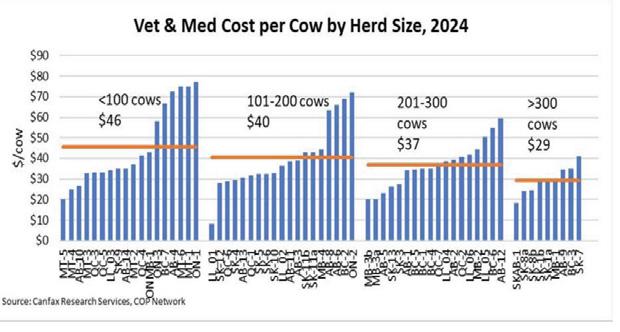
Vet and med costs in the Canadian Cow-Calf Cost of Production Network averaged $39 per cow in 2024, with a range from $8 per cow to $77 per cow. However, two-thirds of the benchmark farms reported vet and med costs between $20 per cow and $40 per cow, giving a median (most common) cost of $35 per cow.
These costs accounted for four per cent of total cash costs, with a range from one to seven per cent. Some of the benchmarks with higher costs were purebred or commercial operations using artificial insemination, heat synchronization or embryo transfer.
Economies of scale
Smaller herds with fewer than 100 cows saw the highest average costs at $46 per cow. As herd size increases, the cost per cow generally decreases, with herds of 101-200 cows averaging $40, 201-300 cows at $37, and those with more than 300 cows having the lowest average cost at $29 per cow.
This trend suggests economies of scale, where larger herds benefit from lower per-cow vet and med expenses. Vet/med typically makes up three to six per cent of total cow-calf cash costs in Western Canada/U.S. benchmarks. A sudden jump outside this range may signal:
■ over-medication (spending too much per head)
■ underlying herd health or nutrition problems
■ under-investment if low costs correlate with poor performance (open cows, dead calves, etc.)
Don’t just track what you spend — track the outcomes
If you are asking, “Am I spending too much, or not enough,” the key is that these costs should be evaluated relative to animal performance (weaning rate, reproductive efficiency), herd health outcomes (calf death loss, treatment rates) and profitability, not just as a dollar figure per head.
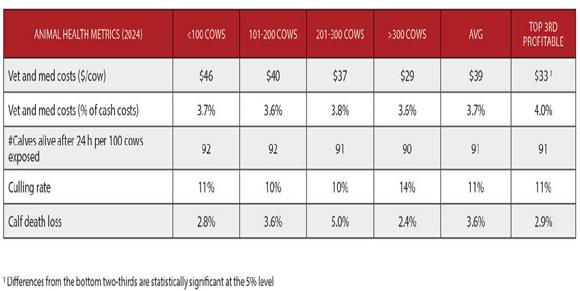
For the COP Network, the number of calves alive after 24 hours per 100 cows exposed is used instead of conception rate, as that information is unavailable on many operations. While this includes losses within the first 24 hours, it gets at fertility, which is key for cow-calf profitability. While the averages are similar across herd sizes, there was more consistency in the larger herds, even if it was at a slightly lower level than the smaller operations.
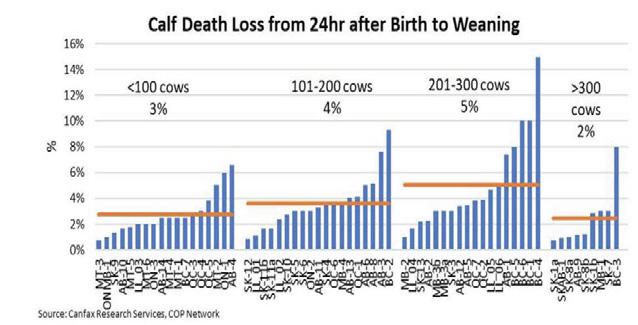
Calf death loss is calculated for calves from 24 hours old to weaning. Calf death loss averaged four per cent and ranged from one per cent to 15 per cent. The higher death loss is predator-related, illustrating the influence geographic region may have on this metric. In comparison, calf death loss from 24 hours old to weaning was reported at 2.5 per cent for calves born to cows and 2.9 per cent for calves born to heifers in the 2023 Canadian Cow-Calf Survey.
Weaning rate is calculated as the number of calves weaned at a percentage of the females exposed the previous year. These metrics combined conception rate and calf death loss. Weaning rates averaged 88 per cent overall (89 per cent median or most common) with a range of 74 to 96 per cent.
Calculating return on investment
When evaluating return on investment (ROI), questions to ask include, “Does spending X amount of dollars lead to enough extra calves weaned, extra pounds, or fewer losses to cover the cost?” or, “What is the cost of under-investing?”
For example:
■ A $4 vaccine that prevents one per cent death loss in 500-lb calves (worth $2,500-3,000 each) = very high ROI.
■ Pour-ons for parasites that improve average daily gain by 0.1 lb/day may or may not pay depending on forage conditions.
■ Skipping vaccines may save $5/calf, but there is a risk of losing an animal valued at $2,500 to bovine respiratory disease.
■ Not preg-checking may “save” $6/head, but those open cows eat $700 worth of feed through your winter-feeding program.
When high costs signal something else
Consider that high vet/med costs may indicate problems elsewhere:
■ genetics (poor mothering ability, calving difficulty, low immunity)
■ nutrition (mineral deficiencies, body condition score too low at calving)
■ management (contaminated calving areas, overcrowding, inconsistent grazing rotations)
■ Sometimes, the cheapest way to reduce vet/med costs is to change management or cull problem cows rather than treating symptoms.
Key takeaways
Considering how vet and med costs can vary and the effect they can have on your operation, taking them into consideration is important. Here are the key takeaways to remember when thinking about vet and med costs.
Preventive measures are often better and more effective than reactive measures. Shifting to prevention and herd level strategies reduces treatment costs.
Evaluating health outcomes, such as weaning percentages, death loss and reproductive rates, helps improve outcomes relative to input costs.
Focusing on return on investment can make a big difference, especially when measuring the value of pounds/weaned calves saved versus dollars spent.
Management integration, such as aligning genetics, nutrition and animal handling practices, helps to lower health costs naturally. Benchmarking helps you aim for vet/med costs that are in line with your peers while meeting or exceeding herd performance goals. No matter where your operation is today, the most important thing is making progress. ▫
Governor Abbott Appoints Commissioners to TAHC
In March, Governor Greg Abbott appointed Benedict L. “Ben” Scholz and reappointed Jimmie Ruth Evans, Barret J. Klein, Joe L. Leathers, and Thomas E. “Tommy” Oates to the Texas Animal Health Commission (TAHC), for a term ending September 6, 2031. The commissioners will participate in their first commission meeting since the appointments, next week.
Jimmie Ruth Evans of San Antonio is a rancher and partner of Wittenburg Ranch. She is a member and past president of the San Antonio Livestock and Rodeo, and the honorary chair of the Young Women’s Leadership Academy. Evans is also a member and past president of the Texas Sheep and Goat Raisers Association. Evans received a Bachelor of Science in Elementary Education from Texas Tech University. Commissioner Evans represents
the sheep and goat industry. Barret J. Klein of Boerne is owner of Klein Farms and Klein Smoked Meats, LLC. He is a member and former president of the Texas Pork Producers Association, National Spotted Swine Association, Texas Association of Meat Processors, and the Kendall County Economic Development Corporation. He is also a volunteer with Kendall County 4-H, Kendall County FFA, and the San Angelo Stock Show and Rodeo. Klein received a Bachelor of Science in Animal Science from Texas A&M University. Commissioner Klein represents the swine industry.
Joe L. Leathers of Clarendon is on the board of directors of the 6666 Ranch, the Texas Southwest Cattle Raisers Association, U.S. CattleTrace, Inc., and is a member of the National Ranching Heritage Association. Leathers attended Clarendon College. Commissioner Leath-
Hunt Limousin to Be Inducted into the North American Limousin Foundation’s Hall of Fame
The Charles Hunt Family operation began in the 1960s after Charlie attended the University of Nebraska. What started as 350 black baldy cows currently exists as a 6,500-acre diversified operation consisting of dryland and irrigated corn, soybeans, alfalfa, wheat, and grassland supporting 300 cows, private-treaty bulls, and replacement females.
The goal at Hunt Limousin Ranch is to “Conserve the land for the future generations, keep current and knowledgeable on the leading cattle issues, provide high-quality cattle for a fair price, and treat people with honesty and integrity.” The three foundations at the core of the breeding program are calving ease, growth, and docility.
Hunt Limousin cattle consistently rank in the top percentiles of the Limousin breed.
Collecting and utilizing performance records form the backbone of their business.
When they started in the purebred Limousin business, the family developed the “Hunt Herd Manager” computer program to track breeding data, calf data, cow and sire data, mailing lists, customer purchases, and files where they can enter and track expected progeny differences (EPDs). The Hunt family believes strongly in total herd reporting and does this through the North American Limousin Foundation’s Limousin Inventory Management System (LIMS) program.
“The North American Limousin Foundation is extremely proud to induct Charlie Hunt in the NALF
ers represents the equine industry.
Thomas E. “Tommy” Oates of Huntsville is a rancher and former owner of Huntsville Livestock. He is a past president of the Exotic Wildlife Association. Oates attended Sam Houston State University. Commissioner Oates represents the exotic livestock and fowl industry.
Benedict L. “Ben” Scholz of Lavon is the owner and operator of B. Scholz Farms. He is a board member and past chairman for the Texas Wheat Producers Board and is the secretary and treasurer of the National Wheat Foundation. He is also the president of the Collin County Farm Bureau, chairman of the Collin County Soil and Water Conservation District, president of the Cereal Crops Research Institute, and member of the East Texas A&M University Alumni Ag Advisory Board. Scholz received a Bachelor of Science in Agri-Business from East Texas A&M University. Commissioner Scholz will represent the general public. ▫
symposium in Athens, Georgia. This national award is presented annually to a producer to recognize their dedication to improving the beef industry at the seedstock level.
Hall of Fame,” said Mark Anderson, NALF Executive Director. “As a longtime and devoted Limousin breeder, Charlie and his family have been very progressive and proactive in their approach to producing high-quality Limousin genetics. They were one of the first to utilize complete phenotype data capture on their herd to enhance EPD accuracy and one of the first breeders to genomically enhance their cattle when that technology became available as well. They have been in NALF’s whole herd reporting system (LIMS) since its inception.”
In 2017, the Beef Improvement Federation (BIF) presented Hunt Limousin Ranch with the BIF Seedstock Producer of the Year Award during the group’s annual meeting and
Through the years, the Hunt family has implemented programs to stay on the cutting edge of seedstock production. In 1995, they started a customer buy-back program. In 2000, when their son Daniel graduated from the University of Nebraska and returned home to the ranch, they expanded their heifer development program, bull sales, embryo transfer work, and row-crop farming ventures.
Hunt genetics have been used all over the globe, including Canada, Mexico, Australia and New Zealand. Bulls have been exhibited at the National Western Stock Show for 32 years. Bulls are available for private treaty as well as through their online sale that happens each January.
Charlie and his wife, Nancy, have four children, David, Susan, Sally, and Daniel, nine grandchildren, and seven great-grandchildren. ▫
Artist Spotlight
John Henry Kittelson
John Henry Kittelson
(July 5, 1930 – October 15, 2018) was a talented, self-taught Western artist known for his work as a sculptor, leather carver and painter, often signing his work with the “Teepee Bar” brand. He was born on a farm near Arlington, South Dakota, where his earliest exposure to wood carving came from playing with handmade toys made by his father. The family relocated to California during WWII where John’s father took work as a welder.
In his youth and early adulthood, Kittelson lived the life he would later depict in art. He traveled widely throughout the West, growing up in South Dakota and California (as mentioned), but also working as a
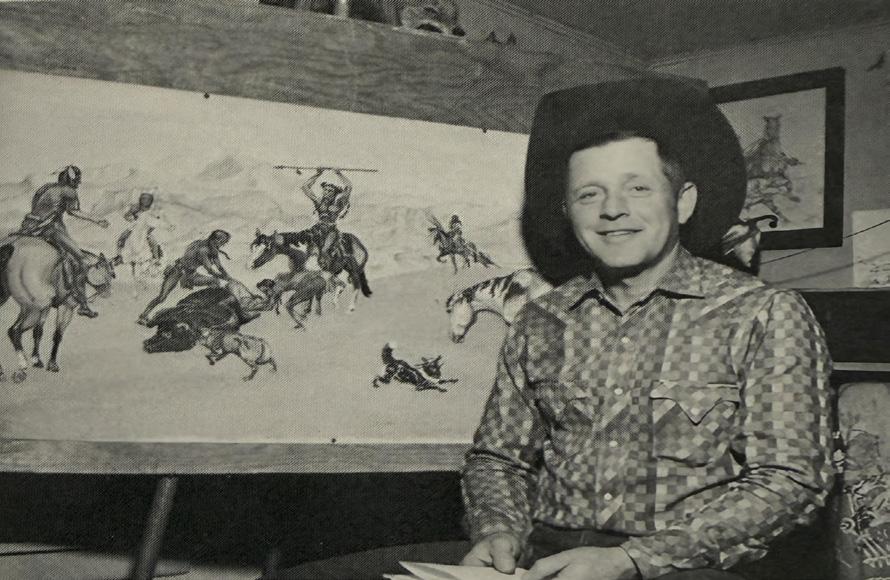
cowboy in places like Nebraska, Montana, Colorado and Wyoming. He learned the skills

Y RANCH BULLS

of a cowboy, horse trainer, rodeo bronc rider, saddle maker / leather carver and also finetuned his carpentry skills.
After settling in Colorado, he turned seriously to wood sculpture and leather work. He was known for his meticulous process. He preferred to use Basswood, sometimes purchasing entire trees and letting the wood cure before kiln-drying it to ensure stability. The quality of his carvings led to his election into the Cowboy Artists of America in 1966 (along with such artist as Gordon Snidow
Cash vs. Managerial Accounting
BY CARSON KING –KING RANCH INSTITUTE FOR RANCH MANAGEMENT
Most cow–calf operations use cash accounting because it’s simple and often better for tax purposes. Under cash accounting, when you buy hay, the entire purchase becomes an expense the moment you write the check. Even if that hay sits in the barn for multiple months/ years, it still shows up this year. With cash accounting that can make a perfectly healthy year look unprofitable just because you stocked up on feed.
Managerial (or accrual based) accounting works differently and gives a more accurate picture of how the ranch is performing.
and Grant Speed), placing him among the first 15 members of the association. 1966 was just a year after the organization was founded, and John was the only non-traditional artist (someone who did not work primarily as a painter or bronze artist) at the time.
In 1957 he was commissioned to do a major project for the Cheyenne Frontier Days, doing carved leather plaques (pictures) for the winners of the events. He would go on to win many awards and recognitions throughout the years, but in
Cash Accounting: Expense Immediately
■ You buy hay
■ Cash goes out
■ The total cost is recorded as an expense immediately
■ Profit appears lower this year, even if the hay has not yet been fed
■ Managerial/Accrual Accounting: Expense When Used
■ You buy hay
■ Cash goes out — that part doesn’t change
■ However, the hay becomes an asset on the balance sheet because it’s inventory
■ You only record an expense as the hay is actually fed to the cows on the income statement
■ This means:
■ The cash flow statement shows the “flows” of cash leaving and coming
the early days, he fed his family by cranking out small furniture type pieces such as carved cowboy boot lamps and handmade TeePee lamps, trunks covered in tooled leather, belts and other oddities which he would often finish in a day or less.
By about 1970, responding to growing demand, Kittelson began having his sculptures cast in bronze, but he eventually stayed with wood, telling family and close friends, that wood was more unique because each was a one-of-a-kind original, as opposed to one original with several castings made from it.
He later settled in Cody, Wyoming, where he worked as a full-time sculptor in wood (and less often bronze) and made fancy leather goods, for the rest of his life. He is said to have been the first to make a “Saddle Purse.” Today they are cranked out by the dozens for tourists, but back in John’s day, he was the main man to get them from. His Western art carvings and leather continues to appear in major art galleries and auctions to this day.
Kittelson died on October 15, 2018, at the age of 88. He is remembered for the authenticity of his subject matter, the fine craftsmanship of his carving, and his role as one of the early members of the Cowboy Artists of America.
Jim Olson ©2026 WesternTradingPost.com
■ The balance sheet shows the value of hay inventory
■ The income statement only shows the cost of the hay that was fed during the period Accrual and managerial accounting separates “I spent cash” from “I incurred a cost to produce calves.” That difference is essential for understanding true costs and profitability of an operation.
The key difference is that cash accounting will eventually tell you whether you were profitable or losing money — but often not until years later. Because expenses are recorded when the check is written, not when the inputs are actually used, cash accounting can delay the true picture of operational performance.
Accrual/managerial accounting, on the other hand, shows profitability in the year the costs are actually incurred and matched to production, giving you a timely and accurate understanding of whether the operation is truly ▫
■ Austin government relations internship – A semester-long position focused on supporting TSCRA’s advocacy and government affairs initiatives at the state and federal levels.
Texas & Southwestern Cattle Raisers Association (TSCRA), the largest and oldest livestock association in the Southwest, today announced applications for the fall 2026 Gilly Riojas Memorial Internship Program are now open.
The program, supported by the TSCRA Leadership Development Foundation, provides students with hands-on experience and exposure to career
opportunities across the beef industry and agricultural advocacy.
Internship opportunities include:
■ Fort Worth headquarters internship – A semester-long opportunity to work alongside TSCRA staff and leadership in administration, communications, education, events, and membership.
■ Internship placement program – A new opportunity connecting qualified applicants with participating TSCRA member ranches and Business Partner Members for experiences across all facets of the cattle industry.
Applications for the 2026 fall TSCRA Gilly Riojas Memorial Internship Program are due June 1, and are available online at tscra.org/leadership-development-foundation.

SOME OF OUR OFFERINGS
• Custom Home on 36+ acre estate in Dragoon Mountain Ranch
• 36+ acre homesites in St David, AZ
• 80 Acre Farm land with 16” Irrigation Well in Willcox, AZ
• Custom Home on 4+ acres in Cochise, AZ
• 40 acre off grid land in Portal, AZ


O’NEILL LAND, llc

P.O. Box 145, Cimarron, NM 87714 • 575-376-2341 • Fax: 575-376-2347 land@swranches.com • www.swranches.com
MIAMI 80+/- ACRES, 3 bedroom, 2 bathroom home with water shares, roping arena, steel barn with shop. Other historic barns, Pipe corrals. Far enough off road to be private. Includes 80 shares of irrigation 2350 SHW 21, Miami NM 87729. $569,999
MIAMI PRIVATE 80, Located ¼ mile off blacktop with dedicated easement, 80 +/deeded acres, large barn, small sleep out, buried utilities, domestic water meter, 80 shares of irrigation and septic able to handle a 3 bedroom home. Some of the best views in Miami. 2050 HWY 21, Miami NM 87729.$559,000
BAR LAZY 7 RANCH, Colfax County, Moreno Valley 594.38 +/- deeded acres, accessed off blacktop between Eagle Nest and Angel Fire. Historic headquarters. Currently used as summer grazing, pond and trees accessed off county road on rear of property as well. Presented “ASIS” New Survey, $3,629,000 $3,564,500
REAL ESTATE GUIDE





Wolves in Farmers’ Clothing
BY HANNAH THOMPSONWEEMAN
If you’ve spent any time watching the policy and advocacy landscape lately, you’ve likely noticed a growing trend: organizations presenting themselves as champions of farmers and ranchers while advancing agendas that tell a very different story.
At first glance, the messaging is compelling. These groups use language centered around “protecting family farms,” “fair markets,” and “farmer choice.” But take a closer look, and a more complicated and concerning picture emerges.
Some of these organizations have limited or unclear ties to actual livestock producers, yet they are actively working to influence policy decisions that directly impact animal agriculture. In certain cases, leadership and funding connections trace back to established animal rights activist networks.
When policymakers hear from these voices on social media or on Capitol Hill, they may assume they are hearing from the broader farming community. In reality, these perspectives often do not reflect the majority of U.S. farmers and ranchers, or the practical realities of raising animals and producing food at scale.
Part of what makes this trend effective is how it taps into broader narratives that resonate with the public, especially around size and structure in agriculture. But here’s the reality: Big does not mean bad.
I know I am preaching to the choir here. Modern farms, meat processing facilities, and companies take many forms, including family-owned operations, contract growers, multi-generational businesses that have adapted and grown over time, or brand-new start-ups. Scale is often what allows these farms and companies to stay viable, invest in new technology, and continuously improve how they care for animals and the environment.
Animal welfare, sustainability, and food affordability don’t happen by accident. They rely on practical, science-based systems developed through collaboration between farmers, veterinarians, researchers, and industry partners. These systems are constantly evolving to reflect new research and real-world experience, not ideological preferences.
That’s why the increasingly common anti-corporate framing we’re seeing deserves a second look. While it may be presented as standing up for farmers, it is often used as a back door to challenge and dismantle modern animal agriculture more broadly.
And that messaging isn’t happening in isolation. It’s being amplified in ways that can blur the line between authentic producer perspectives and those
BLM Launches New Web Tool to Expand Grazing Opportunities & Support Healthier Public Lands
The Bureau of Land Management has announced the launch of a new web-based map tool designed to connect ranchers with information on vacant grazing allotments on public lands available for targeted prescribed grazing. The tool sup-
ports the agency’s broader effort to improve rangeland health, reduce invasive weeds, and lower the risk of wildland fire across the West.
“Recent wildfires have hit farmers and ranchers in western Nebraska especially hard, threatening their communities
shaped by outside agendas, creating confusion for consumers and policymakers alike.
It’s not hard to see why this tactic is being employed. The Carver Center for Agriculture and Nutrition recently compiled years of Gallup polling and pointed out that farming and agriculture has been America’s most trusted sector for more than 25 years. That level of trust is highly valuable. This new wave of organizations and tactics appears to be an attempt to tap into that trust, using farmer-centered messaging to gain credibility while advancing policies that don’t necessarily reflect the priorities of those actually producing our food.
In the process, it risks drowning out the voices of longstanding, grassroots organizations that truly represent the people responsible for putting meat, poultry, dairy, eggs, and seafood on American plates.
The bottom line is this: it’s imperative that we look beyond the facades these groups present to understand their true intent. That second look at who is speaking, who they represent, and what they are ultimately advocating for can have real implications for policy decisions that shape the future of our food system.
So don’t take the bait. Ask questions. Look deeper. And most importantly, make sure the voices shaping the conversation are the ones grounded in real-world experience, science, and a shared commitment to feeding a growing world.
and livelihoods. The BLM is stepping up to support affected producers as they confront the devastating impacts of these historic fires,” said Acting BLM Director Bill Groffy. “Through this new web tool, we are connecting displaced producers with grazing options on public lands, offering urgently needed opportunities to keep their operations moving forward while also protecting our nation’s food supply and reducing future wildfire risk.”
The web-based map allows ranchers to efficiently locate va-
Nearly All PlantBased Meat Alternatives Contain Mycotoxins, Study Finds
BY PETER VOSKAMP / MEATINGPLACE.COM
Anew study of plantbased meat alternatives and beverages has found a high occurrence of mycotoxins, naturally occurring, fungi-produced poisonous compounds, in more than 200 vegetarian and vegan products in the UK.
The study, “Mycotoxin contamination in plant-based beverages and meat alternatives: A survey of the UK market,” a joint effort by the University of Parma in Italy and UK-based Cranfield University, tested a total of 212 plant-based products including burgers, veggie chicken products, vegan sausages as well as oat-, almond- and soy-based milks.
Per the study, “all of them contained at least one of 19 mycotoxins, with multiple products containing more than one.”
Mycotoxin incidence in plant-based foods is due primarily to source ingredients —such as grains, legumes and seeds— being vulnerable to mold during cultivation and storage.
The study says that previous research has demonstrated that even at low levels, if consumed
cant allotments on public lands suitable for targeted prescribed grazing and provides easy instructions to apply for a permit. Prescribed grazing can strategically lower wildfire fuel loads, suppress invasive weeds, and promote healthier, more resilient public lands.
The BLM is coordinating with federal partners to identify more vacant areas that may be suitable for grazing, expanding the options available to pro-
often, mycotoxin can build up exposure and lead to potential health concerns.
While occasional consumption should not pose a danger, a “a diet solely based on plantbased foods could lead to a cumulative build-up of mycotoxins, potentially resulting in health problems if not managed properly.”
In extreme cases, per the study, mycotoxin exposure can lead to liver and kidney damage, immune system suppression, and cancer.
The researchers advise that monitoring of raw materials be extended.
“Mycotoxins occur naturally in foods and cannot be completely avoided. As consumers, we should not be frightened or deterred from enjoying a variety of products,” Andrea Patriarca, Senior Lecturer in Mycology at Cranfield University, said.
“However, a significant concern arises when new foods enter the market, as there are currently no established regulations to monitor mycotoxins.”
The study did find that mycotoxin levels in the tested UK plant-based foods were lower than recommended EU guideline levels, which it says reflected the high-quality standards of the UK food industry.
Patriarca went on to say the group collaborates with the food industry — from farmers to food companies — to integrate effective mycotoxin management within food safety standards.
Their “aim is to advise policymakers and raise awareness among vulnerable consumers.”
ducers over time. The public is encouraged to check back soon for additional opportunities. All lands identified in the new tool have been evaluated for forage, land health conditions, and suitability for sustainable grazing.
The BLM manages 155 million acres of public lands for livestock grazing, supporting local economies, helping feed the nation, and contributing to healthier rangelands.