Marie Santora-Lent Advertising Coordinator (516) 409-4444, ext. 301 Marie@usptennis.com
Emilie Katz Assistant Marketing Coordinator
Contributing Writers:
Ricky Becker
Eldad Campbell Dr. Tom Ferraro
Steve Kaplan Chris Lewit
HIGHLIGHTS
Table Of Contents American Muscle
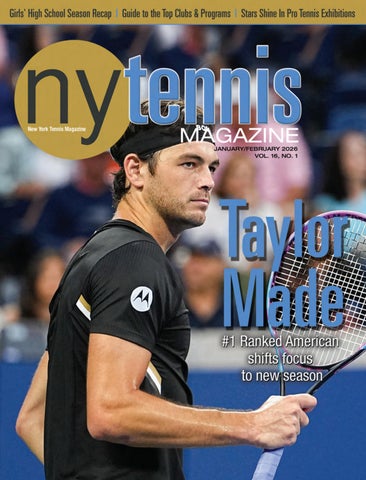
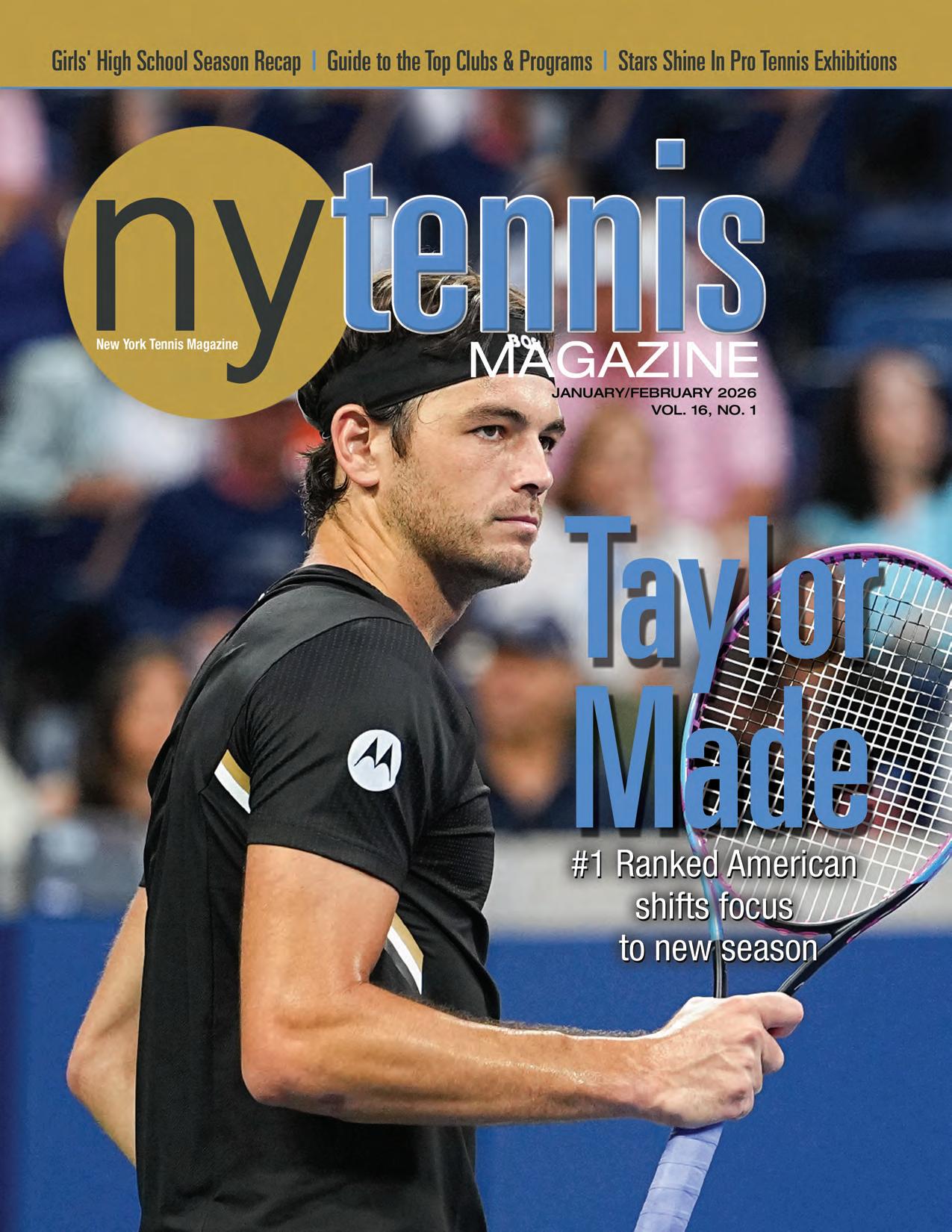
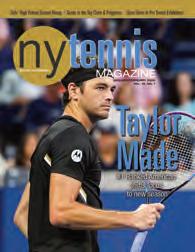
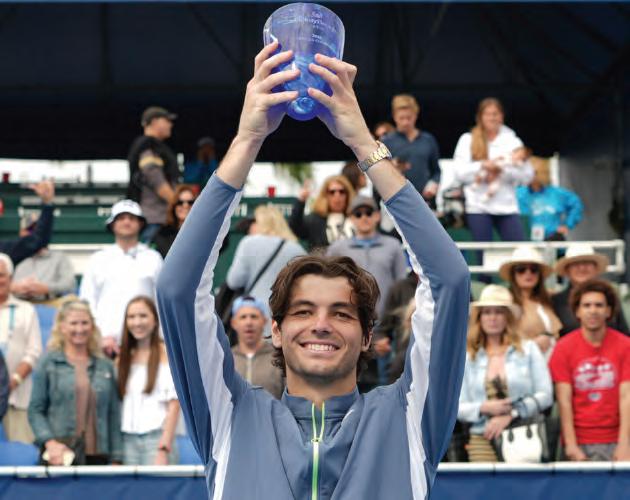
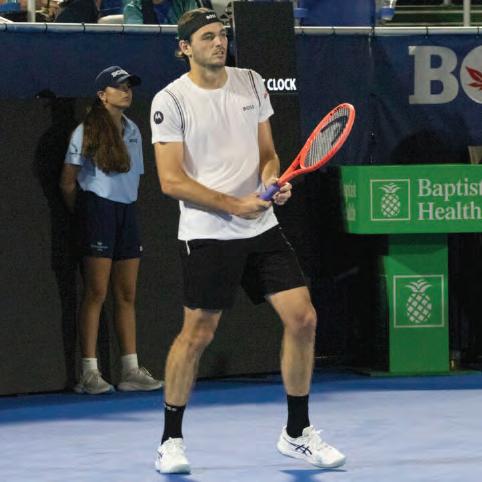
Taylor Fritz prepared to lead American charge in 2026 See page 15
Advertising
To receive any information regarding advertising rates, deadlines, and requirements, call (516) 409-4444 or e-mail info@usptennis.com.
Article Submissions/Press Releases
To submit any material, including articles and press releases, please call (516) 409-4444 or e-mail info@usptennis.com. The deadline for submissions is the first of the month preceding the target issue.
Subscriptions
To receive subscription information, contact (516) 409-4444 or e-mail info@usptennis.com or check out our Web site: www.nytennismag.com. Fax subscription changes to (516) 409-1600.
Statements of fact and opinion in New York Tennis Magazine are the responsibility of the authors alone and do not imply an opinion on the part of United Sports Publications Ltd. New York Tennis Magazine reserves the right to edit, reject and/or postpone the publication of any articles, information or data.
3Prudential Center Hosts First Ever Tennis Event With A Racquet at the Rock
4At the Net w/ Amber Marino, USTA Eastern’s Executive Director By Brian Coleman
6For Second Straight Year, The Garden Cup Brings Star-Studded Tennis the World’s Most Famous Arena
8Beyond the Baseline: Steve Kaplan, Bethpage Park Tennis Center
12Champions Crowned at the Long Island Tennis Magazine Thanksgiving Challenge
20Coaching Spotlight: Gabe Slotnick, Manhattan Plaza Racquet Club
282025 High School Girls’ Tennis Season Recap
42New York Tennis Magazine’s Guide to The Top Tennis Clubs & Programs
62Junior Player Spotlight: Joshua Dolinsky, John McEnroe Tennis Academy
66LITM and UJA Partner For Sushi and Sake-Themed Version of Courts & Cocktails
FEATURES
11Parsa’s Picks: The Real Estate Market with Parsa Samii
14Carefree Racquet Club Introduces Holiday-Themed Tournaments As Part of Programming
18Saturday Night Courts & Cocktails Helps Spread Joy of Tennis to Benefit A Great Cause With Two Winter Events
22USTA Eastern Metro Region Update
25Why Most Tennis Warm-Ups Are A Waste of Time By Filip Maric
26Lluis Bruguera’s Revolutionary Racquet Speed Training: A Velocity-Based Approach Decades Ahead Of It’s Time By Chris Lewit
36USTA Eastern Long Island Region Update
38Long Island Region Adult League Wrap-Up By Milly Keighery
602026 Australian Open Preview: What To Watch For
64Fear and Loathing On The Tennis Court By Dr. Tom Ferraro
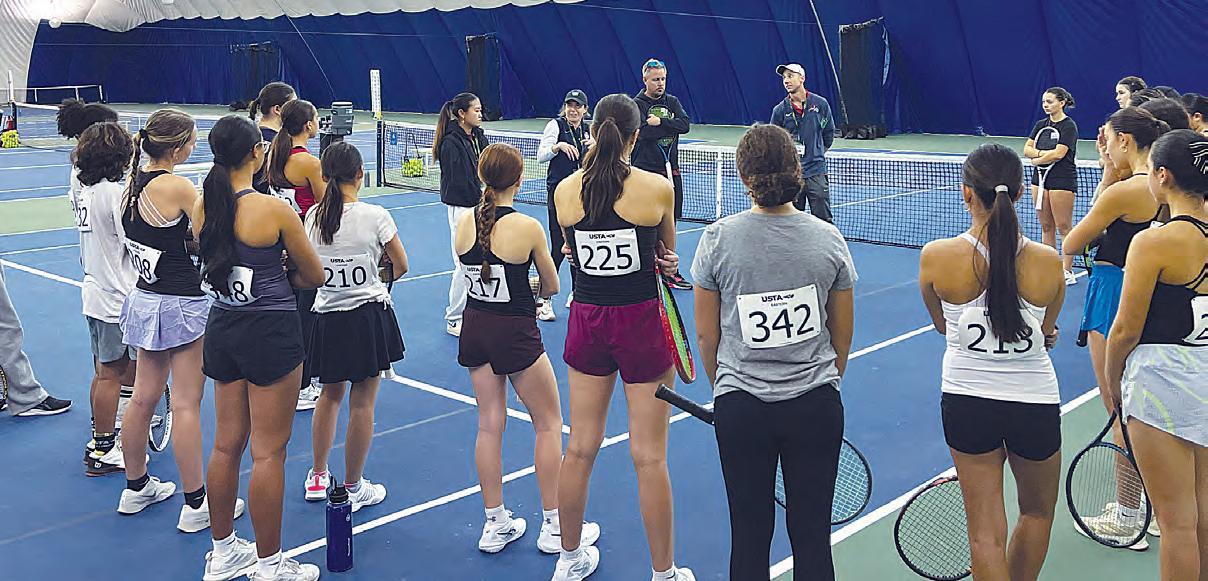
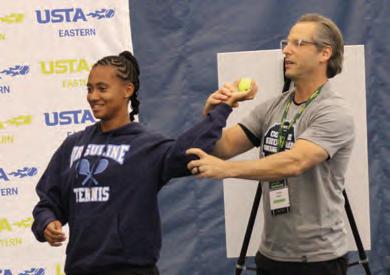
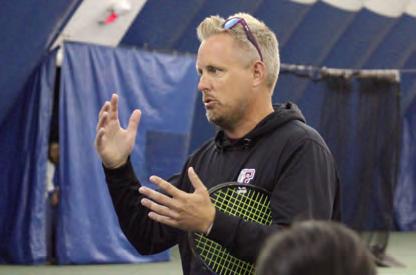
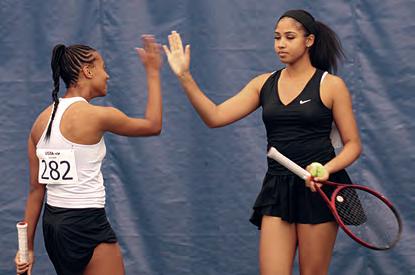
68USTA Eastern Welcomes In Coaches, Parents and Players For Annual College Showcase Day
70Metro Region Adult League Wrap-Up By Ainslie Ellis
71Advice for Parents of First-Time Tournament Players By Chris DeStefano and Baloo Turcsik
72On The Line
74My Talk With Stanford Head Coach Paul Goldstein: Part Three By Ricky Becker
75Why Junior Tennis Players Should Master Safe Patterns Before Taking Risks By Ray Josephs
76The Dialogue of Performance By Eldad Campbell
78Is Simplicity, Simple? By Steve Kaplan
80Mental Toughness For Juniors By Zack Ray
Photo credit: Garrett Ellwood/USTA
Prudential Center Hosts First Ever Tennis Event
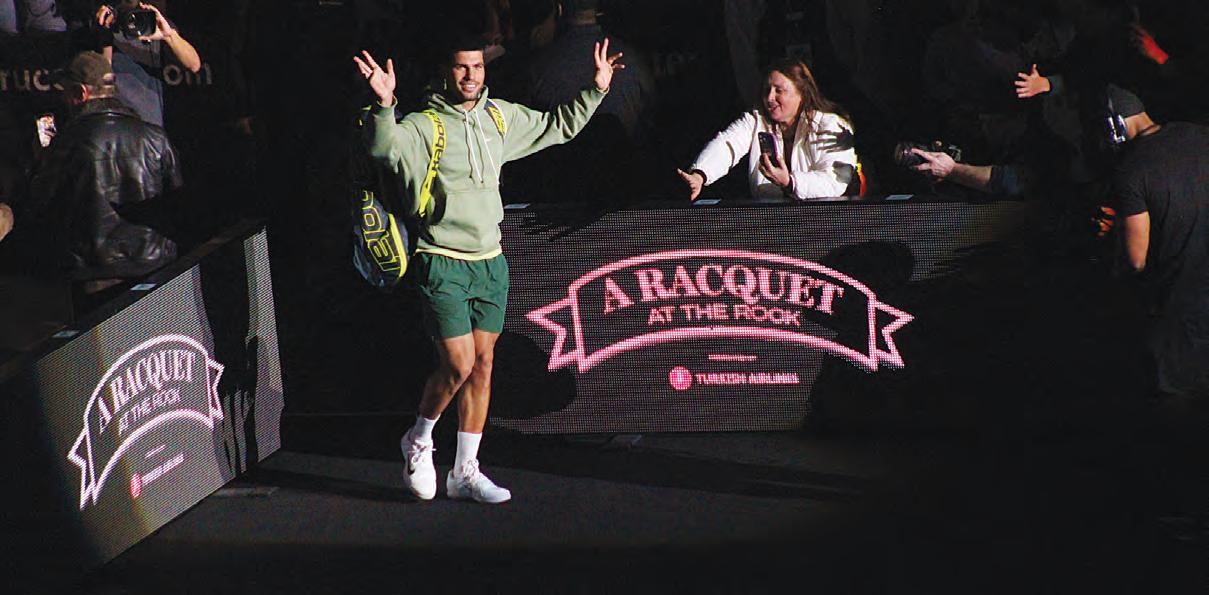
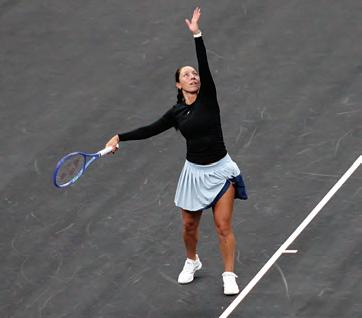
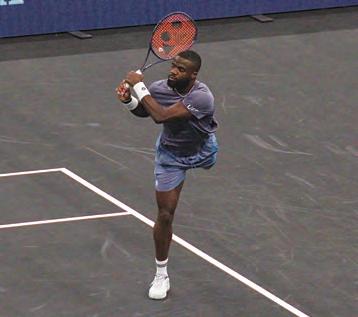
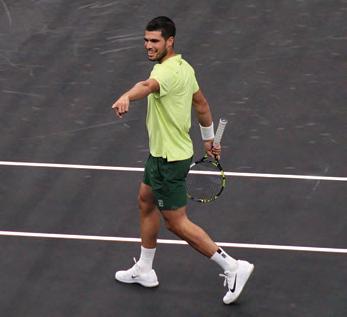
Historywas made this winter at the Prudential Center as the Newark, New Jersey arena hosted a Racquet At the Rock, the first professional tennis event in building history. World number one Carlos Alcaraz competed in a December exhibition in the Northeast for the second straight year as he took on American Frances Tiafoe, while two of the top American women, Jessica Pegula and Amanda Anisimova, joined the men for a thrilling evening of tennis entertainment.
“In the 18-plus years that Prudential Center has been open, there hasn’t been a professional tennis event held, so we were very excited to connect with our promotional partner, Unified Events, to make this happen,” said Dylan Wanagiel Vice President of Sports Properties & Special Events for Harris Blitzer Sports & Entertainment, who operates events at the
Prudential Center. “It was the exact type of marquee event we’re always looking to bring here to Newark, and I have to give credit to IMG, who represents most of the players and handles tennis operations for the event. These are big names, and global stars.”
The Prudential Center prides itself on being a venue for marquee events, and on this night, that was exactly what was delivered. The night began with an exciting junior match between Long Island’s Jack Kennedy and New Jersey’s Ronit Karki, before the women took the court.
Anisimova and Pegula delivered an exciting match that featured an array of long rallies. After splitting the first two sets, Pegula outlasted Anisimova in a third-set match tiebreak. They then paired up with the men for a quick mixed doubles tiebreak, with
Pegula teaming with Alcaraz to beat Anisimova who paired up with Tiafoe.
Alcaraz and Tiafoe faced off against one another in the headliner. Alcaraz and Tiafoe also went the distance, with Tiafoe claiming the opening set before Alcaraz responded to force a deciding match tiebreak. In front of his home fans, Tiafoe defeated his friend 10-7 in the tiebreak to claim the win in the first-ever A Racquet at the Rock.
In all, all four players enjoyed themselves and delivered a one-of-a-kind show for the New Jersey crowd.
“The energy and the love from the fans, it’s always a warm welcome,” said Alcaraz. “I’m always grateful for that.”
On Instagram, Tiafoe wrote:
“Big S/O to Prudential Center for the amazing night in NJ. Appreciate the love from the fans hope ya’ll enjoyed the show.”
netatthe with Amber Marino, USTA Eastern
By Brian Coleman
Thisyear will mark a changing of the guard for the USTA Eastern Section, as after more than a decade of serving as the Section’s Executive Director, Jenny Schnitzer announced her retirement at the end of 2025.
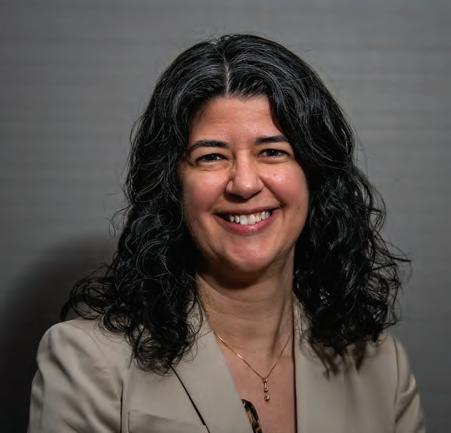
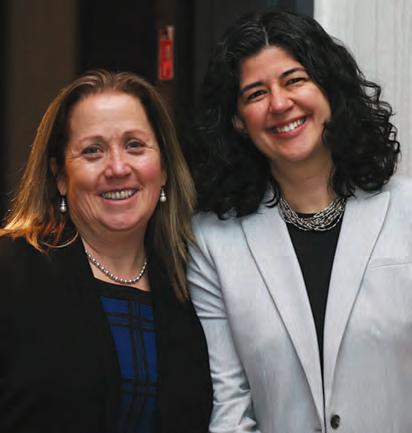
Schnitzer led the Section since 2015, and now passes the baton to Amber Marino, who officially took over as the new Executive Director on January 1st.
Marino is no stranger to a leadership post at Eastern. She became the first female since 1997 to serve a term as President of the USTA Eastern’s Board of Directors back in 2019, and since June 2025 has been the Associate Executive Director, working right alongside Schnitzer in preparation of taking over the position in 2026.
“Jenny is a remarkable leader and person, and I have learned so much from her over the years,” said Marino. “I worked particularly closely with her when I served as President of the Section. Part of my tenure fell during the early days of the COVID-19 pandemic, and we had to dig deep and make a lot of decisions together in support of the Eastern tennis community.
She has been an incredible friend and mentor, and I can’t thank her enough for her guidance and openness with me, especially as I step into this new role. She has involved me in every decision,
every issue and every project that has crossed her desk since I joined the staff earlier this year. I’ve been really grateful to absorb so much information from her and to see firsthand how she operates in this role.”
Marino and Schnitzer’s relationship actually goes back way before the two worked together at Eastern, but began when Marino was an instructor at 15LOVE, an NJTL that introduces the sport of tennis to kids all across the greater Albany area.
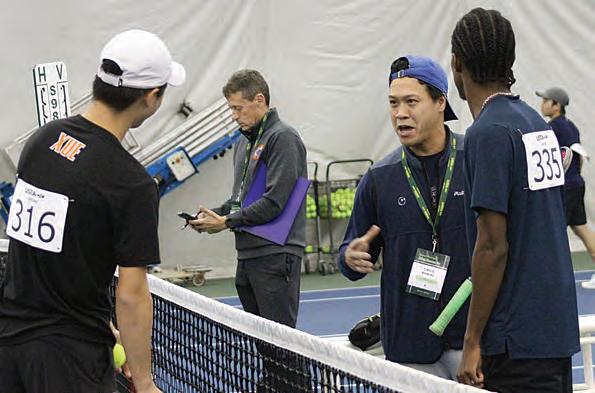
After playing high school tennis in her small upstate town of Carthage, she attended the College of St. Rose in Albany where she would walk on to the women’s tennis team, which is when she was introduced to 15-LOVE. She began
working there in the summer of 1996, and continued there through her graduation, and even after, while also working as a middle school math teacher. Then in 2001, Marino was named the Executive Director of the organization, a position she held for nearly 25 years. Through that, she first met Schnitzer, as the latter would drive up to Albany for various events that the organization held, and as Marino recalls:“She was just as passionate about the sport and the section back then as she is today.” Marino always made sure her plate was full. In addition to being Executive Director of 15-LOVE, she volunteered with the Section, serving on several committees, sat on the board as a member-at-large, as well as being the Regional Director of the Northern Region, then Vice President and President of the Eastern Section.
“Through all of my experiences, I’ve witnessed firsthand the incredible power of this sport and how it can change lives for the better, how it can really make a positive impact on an entire community,” Marino explains. “That’s what has always motivated me and what will continue to motivate me moving forward.”
With that motivation, and a multitude of past leadership experiences, Marino is excited for this next chapter of her life and this new challenge. And the work has already begun. The Eastern Section is perhaps the most complicated of all the
Sections that compromise the USTA: The needs of those in each region of the section differ significantly, and Marino and her team need to be able to adapt to all the varying logistics.
It’s precisely that aspect, and the challenge of it, that makes Mariono a perfect fit to navigate these waters:
“I think this is the one of the most interesting features of our Section and a challenge I embrace coming from Western and Northern. What has made Eastern so strong in this regard is its organizational structure: We have dedicated regional councils made up of enthusiastic volunteers who advocate on behalf of their communities, and we also employ staff members from each region who work to specifically address those local needs.”
To that end, towards the end of 2025, Eastern surveyed club owners and managers about their businesses, and what they might need for growth and stability. By listening to those needs, Eastern put together four areas they think they can assist:
“Now we are working with staff on a plan to execute and be most useful in those areas. This is what I love, and the model I see for growth. We can all come together, listen, strategize and act,” said Marino. “We can’t solve every problem, but when staff and volunteers work together, bringing different perspectives and different skill sets, we can create meaningful growth.”
Growth is the name of the game, and while transitioning to a new leader can sometimes create issues, Marino is more than prepared to continue the amazing work done by previous Eastern Section leadership. She is someone who has made using the sport of tennis and benefitting those in her community her life’s work.
Like any good leader, she is quick to say that she doesn’t consider herself at the top of the Section, but instead wants to listen to and work with all facets that make up the tennis landscape.
“I’m continually inspired by the Eastern
tennis community. You’ll never find a more passionate group of people, from our facility managers to our coaches and instructors, to staff members and volunteers,” she said. “It’s a testament to all of their hard work, creativity and dedication that the sport has really flourished in this area. Yes, I am here to lead, but also to listen, strategize, to walk beside, to support and encourage. In my former role we were in the office every day, and my door was literally always open. I always want to make listening and learning a priority.”
When Marino isn’t helping grow the
sport of tennis in the Eastern Section, she is spending time with her husband and two sons, the older of whom just went off to college this past fall. In similar fashion to her work life, though, she enjoys giving back to her community. During the winter months, her family volunteers running a CYO basketball program through their church, hosting a league for about 200 kids, doing everything from scheduling down to mopping the floors. She also recently spent some time volunteering with 15-LOVE again, and it was a family affair as she spent time on court along with her two sons, teaching tennis to kids.
It’s just another example of Marino’s passion for all things tennis, which is what makes her an ideal successor to Schnitzer for the role of Executive Director.
“Eastern is a strong organization with amazing people. The first thing I want to do is spend time with each staff member and board member to understand how they see the organization, and where they see opportunities. I love getting a sense of people’s strengths and passions, which are not always the same as their job descriptions,” she said. “Combining passion and work is what motivates people, and that is what will ultimately propel us forward.”
For Second Straight Year, The Garden Cup Brings Star-Studded Tennis to the World’s Most Famous Arena
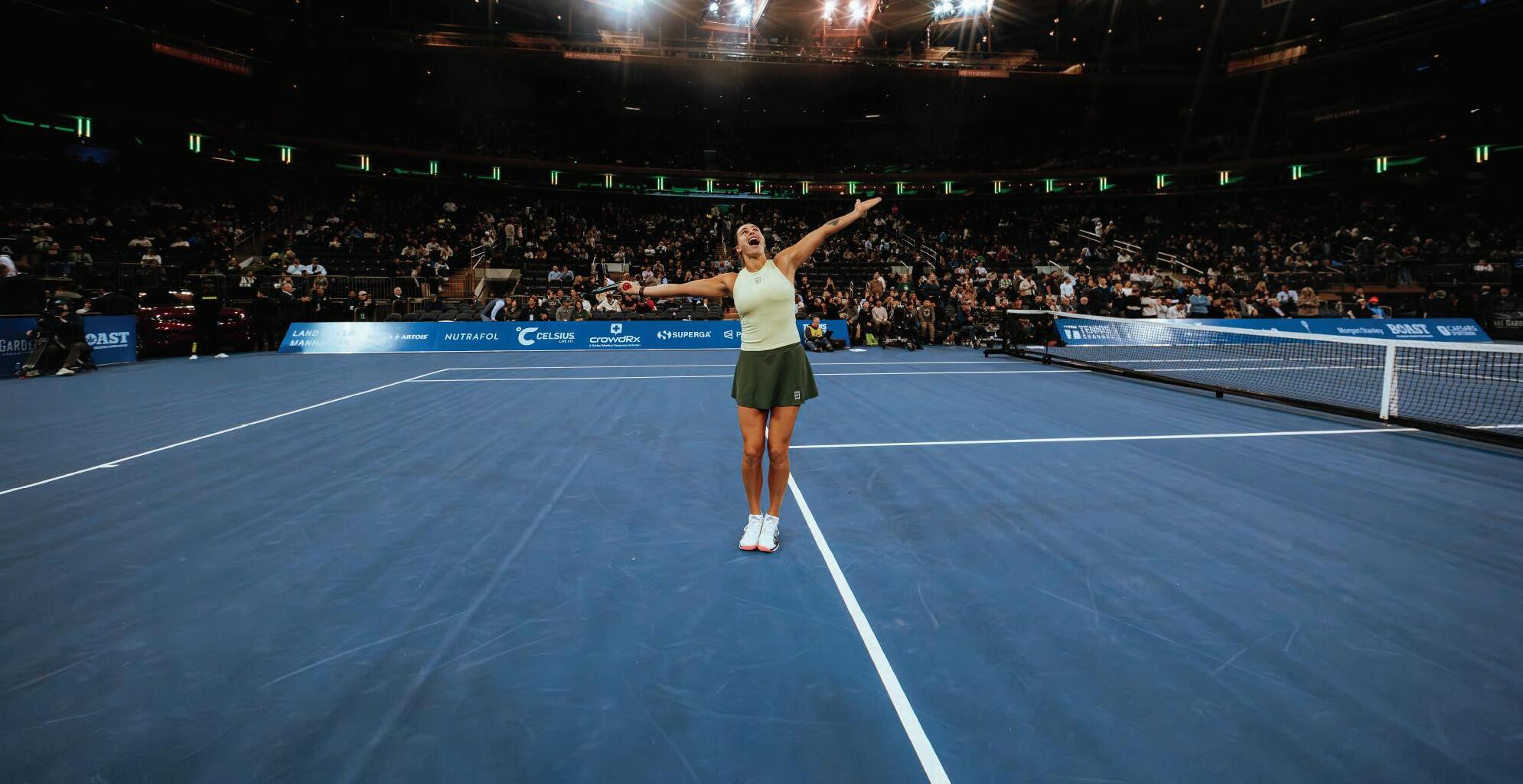
Forthe second year in a row, the World’s Most Famous Arena swapped out the basketball hardwood and the hockey ice for a tennis court, as the The Garden Cup brought professional tennis to Madison Square Garden.
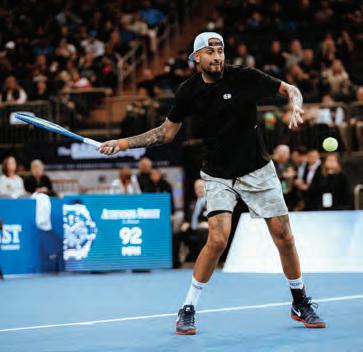
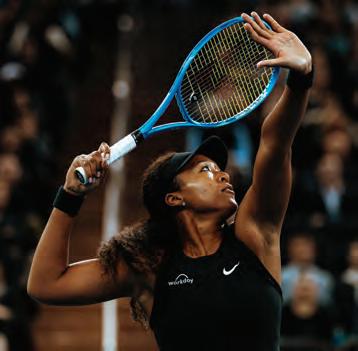
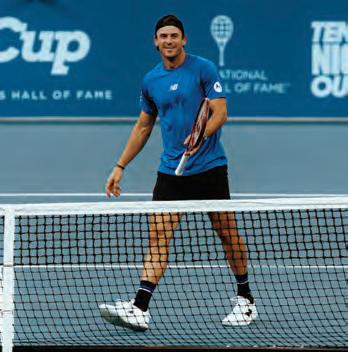
More than 17,000 fans poured into the Garden to watch four of the world’s best tennis players compete on one of the most iconic stages in all of sports and entertainment. Tommy Paul, Nick Kyrgios, Aryna Sabalenka and Naomi Osaka delighted the NYC crowd throughout the night, first with a men’s singles match between Paul and Kyrgios, followed by a women’s singles match between the world number one Sabalenka and two-time U.S. Open
champion Osaka.
Kyrgios outlasted Paul 10-5 in a thirdset, match tiebreaker, while Sabalenka defeated Osaka 6-4, 7-5.
The night concluded with all four on the court at the same time for a mixed doubles showdown.
“To share the court with icons like Aryna, Naomi and Tommy in front of fans in the world’s most famous arena..it’s special,” said Kyrgios. “The last couple of years have been rocky, injury-wise. I’m not taking it for granted.”
Kyrgios showed he still had some good tennis left in the tank, and made some signature Kyrgios shots, including slamming an overhead winner, leaping high in the air to hit a ball that was well on its way behind the baseline.
During the Sabalenka-Osaka showdown, the players brought a fan to play points for them towards the end of their second set. Unfortunately, he was unable to win the point, and Osaka even made him do pushups after he failed to come up clutch for her.
“It’s pressure,” the fan said. “I don’t know what’s going on. I lost the match for her. I’m sorry Aryna. I still love her. You’re still my queen.”
All of it combined to be a thrilling winter evening in New York City, and continued the rich tennis history inside Madison Square Garden. It was the latest top-tier entertainment event at The Garden, and leaves fans excited for what’s to come at The Garden Cup in 2027.
•We offer a full-range of junior and adult programs for recreational and tournament players in partnership with Gotham Tennis Academy, a leader in developing and operating tennis programs in New York City and the Hamptons.
•Our professional tennis staff has some of the most talented, personable and engaging tennis professionals in NYC. For more information about our pros, please visit www.stadiumtennisnyc.com
•Sign up now for our popular Junior Programs, Adult Clinics, Private Lessons, and Seasonal Courts.
•Sixteen US Open style deco turf tennis courts with spacious backcourts. Twelve courts are indoors from October through April.
•For the convenience of our regular players and their families, the Tennis Center offers complimentary on-site parking and Transportation referrals.
•An adjacent clubhouse features a pro shop, light snacks and beverages, complimentary Wi-Fi, and workspaces for schoolwork.
•Please see our Safe Play Procedures summarized at www.stadiumtennisnyc.com
Just Minutes from Manhattan Near Yankee Stadium
beyond the baseline
By Brian Coleman
Steve Kaplan, Bethpage Park Tennis Center
By Brian Coleman
The definition of a coach is very broad, but Dictionary.com describes it as “someone whose job is to provide training for people, or help them prepare for something.” Now, while this definition may be technically accurate, it doesn’t begin to scratch the surface of the importance of a coach in one’s life, and doesn’t come close to properly encapsulating a coach like Steve Kaplan.
For more than five decades, Kaplan has spent his days on the tennis court, whether that was on the campus of St. John’s University, what was formerly Syosset Racquet Club, on the public New York City courts with the City Parks Foundation or currently at Bethpage Park Tennis Center where he is the owner and managing director, guiding his students not only through tennis technique and fundamentals, but instilling important, foundational life lessons and skills.
“There’s a concept that I learned early in my career that impacted me, and that was to “synergize because the whole is greater than the sum of its parts” Kaplan says. “And when I looked at tennis, what occurred to me was what you learn
on the tennis court, you can take into the classroom and you can take into all facets of life. And what you learn in the classroom or in life, you can take onto the tennis court. They are all connected. So my goal when I started was to improve people’s tennis, but also use tennis as a vehicle to help people ascend in anything they choose to do.”
And it’s precisely that outlook that Kaplan has used to teach his students all these years, and has
been at the heart of his dedication that makes him stand out in a sea of talented, dedicated coaches on Long Island and beyond.
Kaplan’s tennis journey began like a lot of youngsters, tagging along with his father every weekend. He’d watch him and his friends play and took a liking to the sport, but it wasn’t until he turned 15 that he took tennis seriously.
“Like a lot of kids who grew up in my generation, in the late 60s and early 70s, you played a lot of different sports. You played football in football season, basketball in basketball season, etc.”
Kaplan recalls. “But when I turned 15, I began taking formal tennis lessons with George Seewagen at what was then Syosset Racquet Club, and became a very avid player. I didn’t have a lot of money, so I would work at the club a little bit to make some extra money, and that’s really what got me into enjoying tennis a lot.”
He earned a scholarship to St. John’s, where Seewagen was also the head coach, which was extremely beneficial because he was able to receive a free education from the school.
After he graduated, Kaplan worked with a number of high-ranked players, and began to fall in love with coaching and teaching while continuing his formal education and passion for learning.
“What I recognize now that I didn’t really recognize at the time is that I loved tennis as much as I loved teaching and mentoring,” said Kaplan. “If you would have asked me in my 20s, I would have said it’s about loving the sport, but with over 45 years of experience I now recognize that I love teaching, coaching and mentoring.”
culture that he learned from Seewagen.
The aforementioned Seewagen provided a significant influence on Kaplan, which made it fitting that the latter was honored with USTA Eastern’s George Seewagen Man of the Year award in 2024.
“George was definitely a very strong influence on me, and what was the defining characteristic about him was that he was a true role model,” said Kaplan. “One quality he had was temperance. He was such a leveling, calming influence on his students, he never raised his voice. He was definitely
more of a teacher than a technical tennis coach, and I learned from him firsthand just how much influence a coach can have on the young people they work with. He built a tremendous culture of excellence, which helped in creating an incredible amount of top players, but not only that, most of his players would go on to have tremendous success in their posttennis careers, which is a testament to that culture they grew up in.”
And for the last quarter century, Kaplan has used that philosophy to mold each and every player that has walked through the doors of Bethpage Park Tennis Center, helping to build on the type of
The opportunity to build the Bethpage Park tennis facility in Farmingdale arose at the turn of the century, when New York State made the state park available for concessions, where private businesses can operate on public parks. Kaplan was experienced with this sort of arrangement having been involved with City Parks Foundation in New York City, and thus found the prospect of developing the tennis facility at Bethpage Park intriguing.
“It was just an outdoor facility at the time, and we enclosed eight of those to transform it into an outdoor facility,” Kaplan recalls. “We officially opened in 2000.”
Kaplan’s technical and tactical expertise makes him one of the top coaches in the nation, but what he has provided the tennis community is more than coaching. He has used his influence, and the post-tennis success of many of his students, to give back. More than a decade ago, he launched Serve & Return, a
continued on page 10
501c3 charity that has provided numerous free programs for Special Olympics, military veterans, young adults with autism, under-resourced children and many more in excess of seven figures. Prior to launching the charity, Kaplan funded their classes and programs free of charge on his own dime, but thanks to his charity and the help of generous former players who have gone on to be successful in finance and other fields, he was able to expand on that.
Beyond that, just this year, Kaplan has formed another charity down in Lake Nona called “On The Rise.”
“We’re going to provide tennis mentorship through UCF athletics on the USTA National Campus courts and STEM education, teaming with some very successful people in the medical field that I’ve mentored,” said Kaplan. “ In addition, to help educate we will provide nutrition, food enhancement and security, as well as other resources for children with cancer in the greater Orlando area.”
He added:
“When you have more, you have more to give.”
Kaplan practices what he preaches. He advocates strongly for
proper fitness and nutrition for his athletes, but it’s not just talk, he remains an active athlete himself. He is an avid cyclist, frequently going on 500 mile bike packing trips to appease his love of being on the bike, and maintains a healthy lifestyle that allows him to do it at the highest level he can.
Even after all of these years, Kaplan says he is still learning himself. He believes strongly that just like players, there is always something that a coach can improve on, get better at, or even learn for the first time.
“If I’m telling my students to continue to learn, then I have to be someone who’s open to learning and growing myself,” he explains. “Which is why I continued with my education and received my doctorate. It’s much more powerful to demonstrate that mindset to your students, if you are actually doing it yourself.”
The amount of players he has helped over the years is a seemingly never ending list of young people he has guided to remarkable accomplishments both on and off the tennis court. One of those players since the age of 5, Paige Wygodzki, a top-ranked player in the country who has
committed to play her tennis at the University of North Carolina, summed it up perfectly:
“If Steve is your coach, he isn’t only that, he’s also your mentor. He’ll be there for you whenever you need, and he has such a deep care for his players.”
As Kaplan prepares to embark on a new year, he is proud of the legacy he has built as a tennis coach and teacher over nearly 50 years. But not because it has garnered a reputation for himself, but because of the impact it has had on those under his wing.
“I think you spend a good part of your career focused on proving yourself to the world, but as you get older, you stop trying to do that, and instead focus on having a positive reach in the world,” Kaplan said. “It’s not just the relationships you form with your players that binds you, but it also binds the players to each other. I have a lot of former players who stay in touch with each other, and help out with the different programs we do, and that’s something upon reflection that I have really grown to appreciate. Forming that positive culture of excellence is one of the important things you can do as a coach.”
PARSA’s picks
The State of the Real Estate Market with Parsa Samii
Thereal estate market on Long Island is some of the most sought after in the country, and the ever-changing and complicated nature of it requires having an expert in your corner to guide you through the process. With the help of Parsa Samii of Compass Real Estate, we’re showcasing one of these beautiful homes for sale. Parsa is a former professional tennis player and coach who has transitioned into real estate, with a strong understanding of both the tennis aficionado and the home buyer.
As Compass puts it, “Parsa is the ideal professional to navigate the ever-competitive real estate market.”
For more information, photos or to see more listings, email parsa@compass.com or call 516.965.7445.
15 Gatsby Lane Great Neck, N.Y. 11024 5 beds 7 bathrooms
6,357 square feet
ASKING PRICE: $9,800,000
A Luxe Waterfront Estate of Privacy & Prestige
At the end of a discreet cul-de-sac in Kings Point sits a residence of rare distinction. 15 Gatsby Lane is more than a waterfront home—it's a private luxury estate, elevated
high above the Long Island Sound and wrapped in seclusion, grandeur, and breathtaking panoramic views.
Set on over an acre of prime Gold Coast land, the property commands attention from the moment of arrival. Mature landscaping, generous setbacks, and its elevated positioning ensure total privacy, while the residence opens dramatically toward the water with sweeping walls of glass, soaring ceilings, and a collection of balconies and terraces designed for life lived above the shoreline.
Inside, 6,300+ square feet unfold with quiet sophistication. Every space feels intentional—layered with natural light, volume, and curated sightlines that celebrate the Sound at every turn. Formal rooms flow with elegance; casual spaces offer relaxed luxury; and each transition reveals another shimmering water view.
The primary suite is a sanctuary of true indulgence— privately set, with dual spa baths, a serene lounge, and direct access to outdoor terraces, including a spectacular rooftop deck that elevates sunrise, sunset, and starlit evenings into unforgettable moments.
With five bedrooms, seven baths (6 full, 1 half), and flexible living spaces for hosting, working, or unwinding, the home supports both intimate daily living and elevated entertaining. The expansive grounds offer endless potential to create a resort-level outdoor environment—pool, gardens, lounge terraces—all enhanced by the estate’s commanding waterfront perch.
In a community defined by exclusivity, 15 Gatsby Lane stands apart—a rare offering where privacy, luxury, and an exceptional waterfront setting converge into one extraordinary Kings Point estate.
Champions Crowned at the Long Island Tennis Magazine Winter Challenge
The4th Annual Long Island Tennis Magazine Winter Challenge presented by Orlin & Cohen Orthopedic Group brought together tennis players of all levels for a great day of Men’s and Women’s Doubles Tournaments.
A sold-out draw of players came out to Sportime Syosset to compete and work off those big holiday meals. Featuring good competition on the court and a festive, social atmosphere off it, the Winter Challenge was the ideal way to wrap up the 2025 Long Island Tennis Magazine Event Series and bring the tennis community
together during the holiday season.
All players received complimentary gift items from Orlin & Cohen Orthopedic Group and a pizza lunch. In addition, there were great prizes and a media session for the winners.
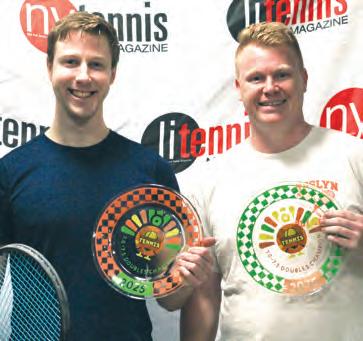
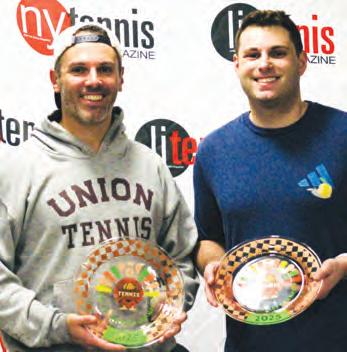
Ryan Casserly & Kevin Stanis have competed in many Long Island Tennis Magazine Challenge events in the past, and can now call themselves Challenge Champions. The duo teamed up to win the Men’s Doubles
7.0 – 7.5 championship, hanging on to win 7-6(6) over Andrew Kupfer & Thomas Montanaro in the finals.
“The level of this tournament was
really good, we had a lot of competitive matches which prepared us for a tight final like that,” said Stanis.
In the back-and-forth final, Casserly & Stanis were up 5-1 in the deciding tiebreaker only to see that lead evaporate as the tiebreaker evened at 5-5. But a few points later, they were able to close it out to win their first title together.
“We talked out our strategy on a lot of the points, and just tried to execute,” said Casserly. “He was able to finish at the net today, and I couldn’t, so I played mainly at the baseline and we worked well together doing that.”
Men’s Doubles 7.0 – 7.5 Champions: Ryan Casserly & Kevin Stanis
Men’s Doubles 8.0 – 8.5 Champions: Danny Axelrod & Sean Tuthill
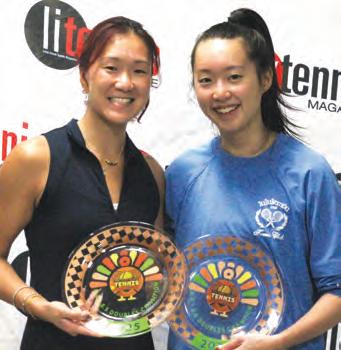
Communication and teamwork were also key factors for Lavinia Barrientos & Laila Mahran, who came through to win the Women’s Doubles 7.0 – 7.5 division. The pairing defeated Kathy Rzonca & Aki Bowman 6-3 to win the championship. “Playing with her (Laila) and winning,” Barrientos said of her favorite part of the tournament. “We practice and play doubles a lot together, but we don’t normally play tournaments together.”
Mahran added:
“Our teamwork was such a big factor. We communicated well, and we’ll have to come back and defend our title.”
In the Men’s Doubles 8.0 – 8.5 division, Danny Axelrod & Sean Tuthill had a simple yet effective strategy: hold serve, and make less errors than their opponents.
That proved vital as the pairing defeated Neil Hyman & Chris Kolesnik 6-2, the defending champions of this division from the September Tennis Challenge, to claim the title.
“In short formats like this, holding serve is key because you don’t have a lot of games to work with in the roundrobin stages,” Axelrod said. “We just tried to make fewer errors and remain consistent, the longer we played and deeper we went, we were able to feel it more and got aggressive.”
Axelrod & Tuthill complement each other on the court, as Tuthill explained:
“He has a bigger forehand, and my backhand is good, so we work well together. We don’t get to play together too often, so it was great to be able to team up for this, and even better to win it.”
Trinity Chow & Amanda Foo hadn’t played a tournament together in a long time, but the cousins quickly rekindled their on-court chemistry and captured the title in the Women’s Doubles 8.0 – 8.5 division. They defeated Lisa Rudloff & Josie Rudloff 6-2 in the finals.
“It was a lot of fun getting to play with my cousin. We haven’t played together in awhile so it was great,” said Chow. “We met some new people and reconnected with some older friends.”
Foo added:
“We just took it one shot at a time, and tried to stay positive the whole time. Even if we made a mistake or missed a shot, we just laughed it off and moved on to the next point.”
The Thanksgiving Tennis Challenge was the final installment of the 2025 Long Island Tennis Magazine Event
Series, putting a bow on another successful year as we prepare to continue to grow our events in the New Year.
“To get a sold-out draw into this tournament on a holiday weekend was a real success. I believe this is an indication that players see the professionalism and quality we bring to the events we host, and that they have a great time on and off the court,” said David Sickmen, cotournament director of the Long Island Tennis Magazine Challenge. “I certainly want to thank our host facility, Sportime Syosset, for being such gracious hosts and Mike Kossoff for helping us put on this special event, as well as my co-director Michelle Stoerback, whose passion and energy for adult tennis is second to none. We also want to thank our Presenting Sponsor, Orlin & Cohen Orthopedic Group, for their support of this event. We look forward to more community involvement moving into the New Year, and are excited to see everyone on the courts at our events in 2026. We will host four LI Tennis Magazine Challenge Events in addition to the rest of our event series staples.”
Atthe end of 2025, Carefree Tennis began hosting holiday-themed tournaments for its customers, both as a way to provide new playing opportunities for its members, but also bring together some players from its clinics, leagues and programs that don’t always play together.
The first was held days after Thanksgiving after a Carefree member spoke to General Manager Kristen Cassidy about playing more following that big holiday meal.
“She asked if we were running a tournament in addition to our clinics, and we thought it was a great idea,” Cassidy recalls.
The Thanksgivingthemed tournament featured both men and women in the 6.0 and 7.0 levels proved to be a success. As a result of the turnout and great feedback from the players, the Carefree team was inspired to keep them going.
Carefree Introduces Holiday-Themed Tournaments As
Part of Programming
“We had a great turn out for Thanksgiving, so we decided to move forward trying to run them more often over holiday breaks,” added Cassidy. “It’s a great way to get players
together who wouldn’t normally cross paths here.”
With that, Carefree hosted Men’s Doubles and Women’s Doubles tournaments during the winter holidays. Kimiyo Collings & Irina
Zimberbort won the Women’s Doubles championship, while Sam Ibrahim & Howie Hutchinson took home the Men’s Doubles title.
Collings, who competes in three leagues at Carefree, and Zimberbort, who plays in two Carefree leagues, were thrilled to be able to take part in these new tournaments.
“We really enjoyed playing in the tournament and I feel it did a great job to prepare us for USTA league matches,” said Zimberbort. “It also gives us a chance to meet new players that we have never played with before. Kimiyo and I are not doubles partners in the leagues at Carefree, but we do play sometimes in friendly games, so it was great to play together, and we are looking forward to doing that again.”
The success of these tournaments and the feedback from the competitors will lead Carefree to hosting more of these, and continue to provide more offerings to its customers.
“The response has been really positive!” Cassidy said. “It definitely motivates us to do more in the future. Our regular programming, leagues and clinics are great but this is a really inclusive and fun addition to our offerings.”
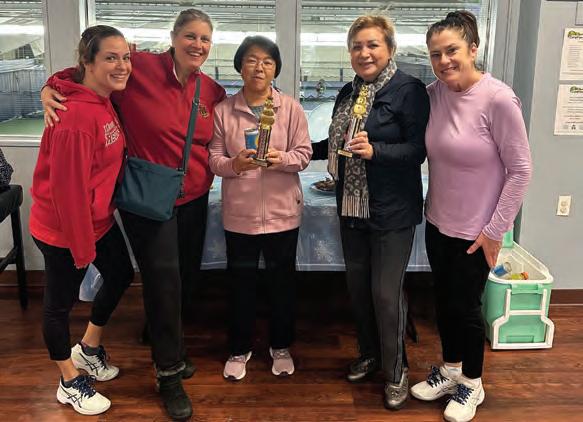
Kimyo Collings & Irina Zimberbort (pictured middle) were the winners of Carefree’s Holiday Women’s Doubles Tournament
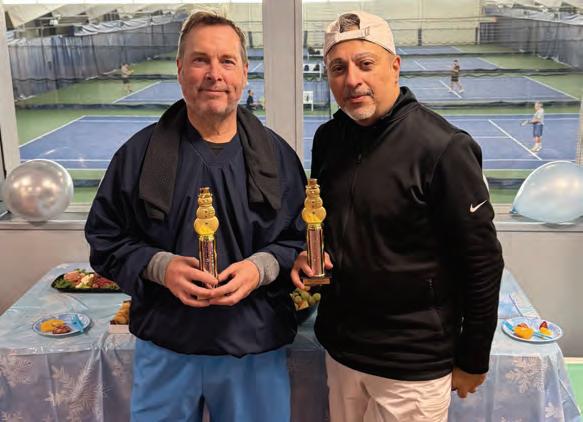
Sam Ibrahim & Howie Hutchinson won the Men’s Doubles event at Carefree’s Holiday Tournament
American Muscle
Taylor Fritz prepared to lead American charge in 2026
By Brian Coleman
Everynew tennis season comes in like the tide, washing away the previous year’s results, storylines and narratives, and ushering in new ones. It’s a time of the year where players set new goals, and establish their expectations for what they want to accomplish in the next year.
For Taylor Fritz, this new season can’t come soon enough, as the American, who finished 2025 as the sixth-ranked player in the world, wasn’t too pleased with how the final months of the year went for him. A knee injury he suffered at the Cincinnati Open hampered his play from that point forward, and his competitive year officially ended with two consecutive losses at the ATP Finals in Turin, Italy, leaving a bad taste in his mouth.
“I’ve already been trying to do the proper rehab things you do for it for awhile now, but like I said, it’s tough when I’m still playing and pounding it,” Fritz said when asked how his knee
continued on page 16
american muscle
continued from page 15
affected his play.
And so, Fritz finally gave himself a couple of months to rehab from his injury, the longest offseason he has had in years, to create the proper foundation to have the best year of his career in 2026.
“I’m going to have a little bit of time off. I’m really excited,” he said. “This is the first off-season I’m going to have, in probably three or four years, that’s more than three weeks. I’m hoping that instead of kind of playing catch-up with injuries in my body this time around, I can actually get healthy and be happy to train.”
While the tennis calendar has stretched further and further, providing players little breathing room from one season into the next,
Fritz was able to take a couple of months to reset his mind and his body. That included a vacation to Japan with girlfriend Morgan Riddle, a different destination that most tennis players choose to go to in the off months. But the trip provided a necessary getaway to decompress from a long, grueling season, and his relationship with Riddle, a popular social media influencer, has helped ground him. The relationship has also helped a lot of people who may not have known much about him or who even follow tennis, learn about Fritz, thus opening him up to more of the public, as her social media reach has brought him into the mainstream.
“Tennis WAGs (Wives and
Girlfriends) in the past were relatively private,” said Riddle. “Not only WAGs, but players too–the travel, the hotels, the players’ lounges, it was very walled off to everyone. All those private spaces were really private, and I started blasting them on TikTok. People were interested in it.”
Fritz is a mild-mannered man, and his Type B personality matches perfectly with Riddle’s Type A, especially as creating a brand for one’s self is growing ever important for the modern athlete.
“The social media part is something that causes me a good amount of stress, because I’m pretty lazy,” he says. “I feel bad about not doing as well as I can
on TikTok or posting stories, stuff like that. It’s tough because in order to have really good content, you have to be thinking about it a lot, and putting a good amount of time into that.”
Fritz prefers to let his game on the court do the talking and promoting for him. He remains the highest-ranked American man in the world, and leads the best crop of American men on the ATP Tour in decades. We all know about the drought of major titles that dates back to 2003, but Fritz and his compatriots have inched closer to snapping that in the last couple of years, which creates optimism heading into this new season.
Of course, the era of the Big Three is over, but as Fritz explains, a new era has emerged:
“Now we’re in the ‘Big Two.’ I think the difference is back when we had the ‘Big Three,’ I’m a lot better of a player now. So, I think if I play well, I can play a close match with Carlos like we saw,” Fritz said. “And yeah, I need to continue to improve, and that’s just what my focus is on. Those two are ahead of everyone. I
wouldn’t say things are super open. If you want to win a big title, more than likely you’re going to have to beat one of them, maybe both of them. That’s kind of just what my focus is on, trying to get healthy so then I can put in the time on the court to practice and improve and try to get better and work on the things I need to work on and to continue to try and close the gap. That’s how I see it.”
That’s precisely the predicament that Fritz and many others face in this new era of tennis. The time of Djokovic (although he is still playing, Federer and Nadal has passed, but it only gave way to the era of Carlos Alcaraz and Jannik Sinner. Fritz lost to the former in his opening round-robin match at the ATP Finals at the end of 2025, and the latter defeated him handily at the 2024 U.S. Open, a straight-sets victory in Fritz’s Grand Slam final debut. They are the hurdle now that lies in front of Fritz and the other top players.
Fritz will begin his season in Perth before the Australian Open, a place where he has only reached the quarterfinals once. But with a refreshed mindset, and rested body, this could be the year that Fritz takes the next step in his tennis evolution, and the prospect of the first major title for an American man since 2003 continues to seem more and more within reach.
At Gotham Tennis Academy, we're passionate about teaching tennis. From beginners to rising stars, Gotham's PTR certified pros are experienced in teaching the fundamentals while stressing sportsmanship, hard work, and fun. With our prime location at Stadium Tennis Center - NYC's newest and largest indoor/outdoor tennis center, we're only a short trip away from you. It's more convenient than ever to get your kids into the game
To enroll now and learn more, please visit www.stadiumtennisnyc.com or call 718-665-4684
Gotham Tennis Academy is a leading operator of
and Montauk
Saturday Night Courts & Cocktails Helps Spread Joy of Tennis To Benefit A Great Cause With Two Winter Events
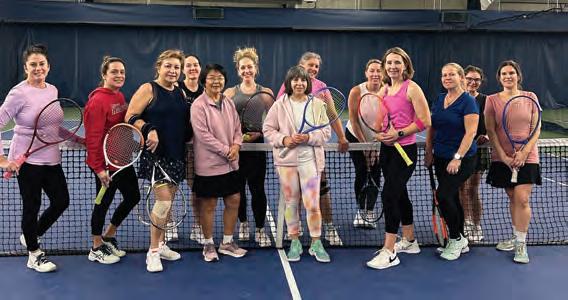
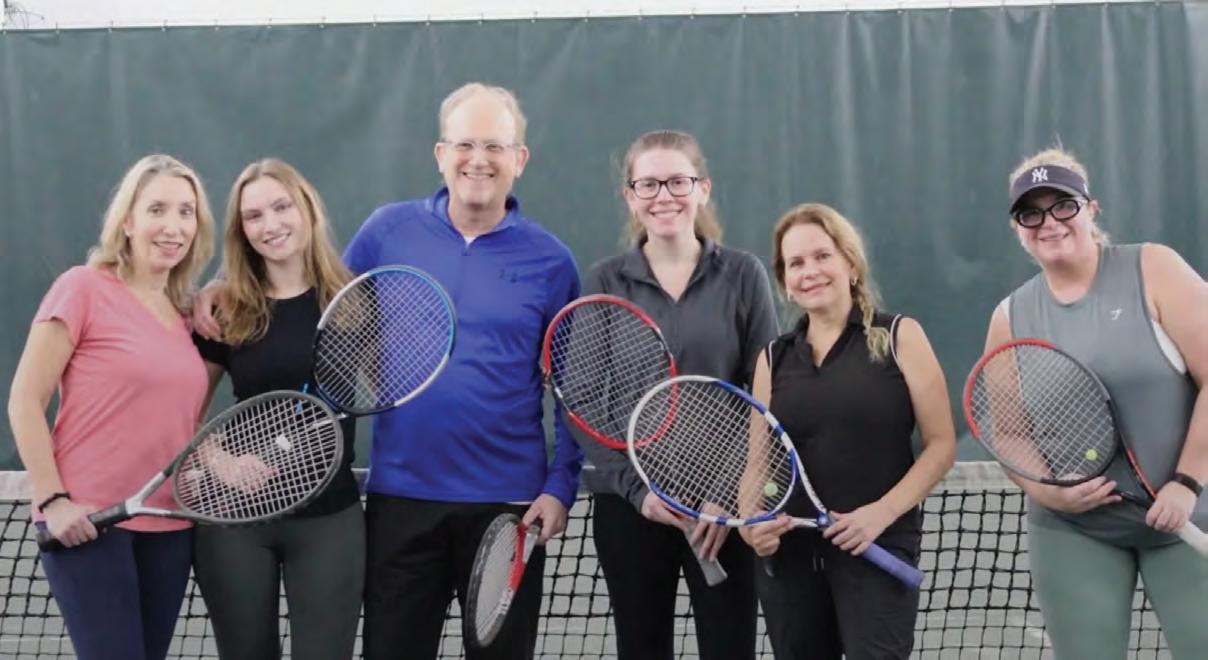
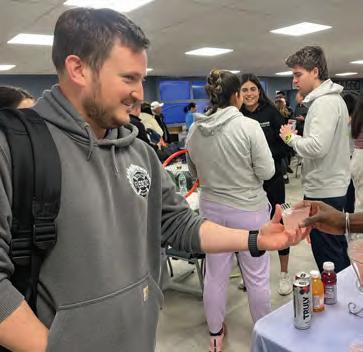
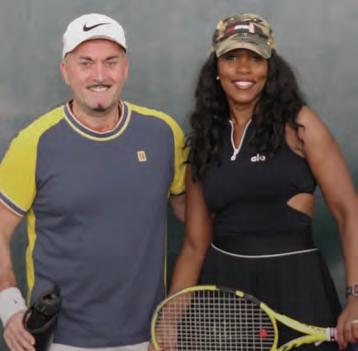
As the weather turns colder, indoor tennis events become even more popular, and what better way to enjoy a fun night playing tennis, hanging out with friends and having a few drinks than at one of Long Island Tennis Magazine’s signature events, Courts & Cocktails. That was the case this winter as we hosted two separate Courts & Cocktails fundraisers to benefit Grow Tennis New York, both held at SPORTIME Roslyn and presented by Orlin & Cohen Orthopedic Group.
"The turnout and feedback from our Courts & Cocktails events
all different levels together. The events have been very popular with adults looking to get away from the monotony of typical Saturday night plans and have a more active weekend evening where they can meet new people or spend time with friends.”
continue to reinforce the need for social tennis options and professionally-run events in this area,” said David Sickmen, Publisher of Long Island Tennis Magazine. “We love being in the community and bringing players of
The players are broken up into multiple courts, all of which are run by a different teaching professional. All the while, music is playing, and drinks are being served, as we create a fun and lively atmosphere combining tennis action with a social feel.
The tennis play is level-based,
and is designed to make all players feel comfortable, while sharing a good time with their spouses or friends, and also provide a great opportunity to meet new players as well.
The events serve as a way to benefit all aspects of the tennis community, from providing more work opportunities for the teaching pros, to helping fill vacant court time at the host clubs, and reinforcing the players’ passion for tennis, which leads to them playing more outside of Courts & Cocktails events.
“Courts and cocktails is an all around fun night!” said Steffi Hochhauser. “I’ve met many new people who I would not have otherwise met. It also gives me another type of excuse to play tennis! And after all, who doesn’t want that!”
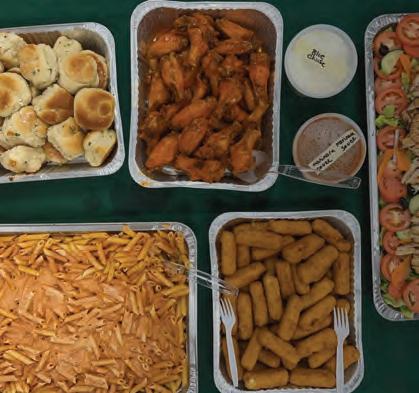
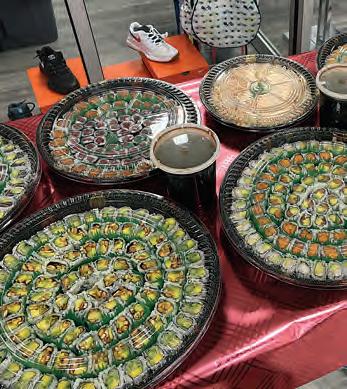
At the end of the tennis portion of the nights, an expansive catered dinner spread is put out for the players to enjoy, wrapping up the event with great food, drinks and people.
“Our events are well run and showcase all we love about tennis,
from the competitiveness to the social side and the fun both on and off the court with like-minded people,” Sickmen added. “And we embrace using these events as a way to fundraise and partner with multiple charitable organizations.”
Manhattan Plaza Raquet Club CoachingSpotlight
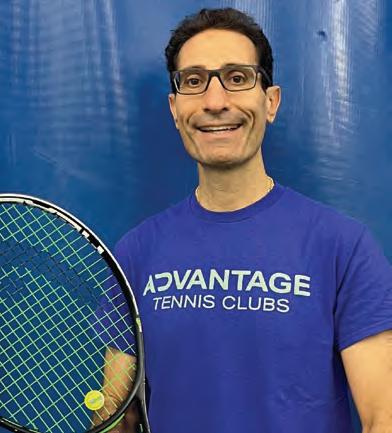
GABE SLOTNICK
Morethan a decade ago, Gabe Slotnick was sitting in the office of his accounting job at NYU Medical Center, pondering the next step in his life. While he was successful in the corporate world, he longed for something that would provide him more fulfillment.
A former Division III tennis player at Yeshiva University in Manhattan, Slotnick still played recreationally and competed on a USTA Adult League team. One of his teammates was working in the IT industry and decided to leave to become a tennis teaching professional, which was a lightbulb sort of moment for Slotnick.
and where I’m currently at.”
“I was working in the accounting audit division at NYU Medical Center, and I just wasn’t happy,” he recalls. “I didn’t like what I was doing, I didn't like who I was working with. At this point, I was in my mid-thirties and wasn’t married, and I said if I’m going to take a chance and do something different, now is the time. I got inspiration from one of my USTA teammates, and said ‘if he can do it, so can I’.”
Slotnick went about entering the tennis teaching field, going for his USPTA and PTR certifications, and has not looked back since. He currently serves as Assistant General Manager and Junior Development Program Director at Manhattan Plaza Racquet, one of the longest-standing tennis facilities in New York City.
“It’s been a real blessing to be able to immerse myself and make that transformation into tennis full-time,” Slotnick says. “Skip [Hartman] gave me the opportunity to come here and to grow here, and I owe him a lot for that. I’m so happy with the decision I made
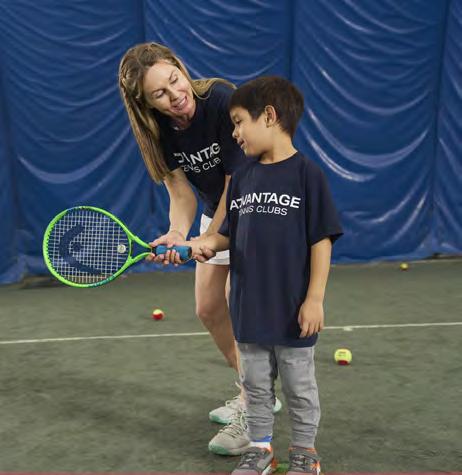
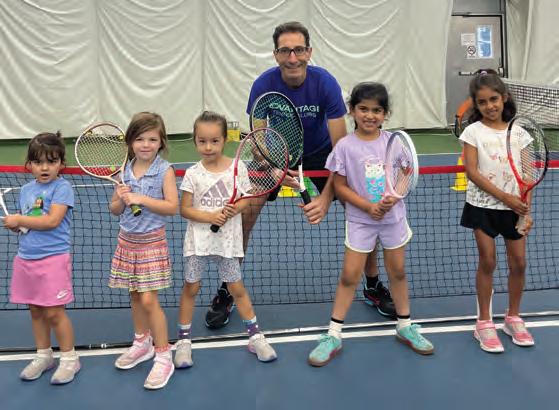
At Manhattan Plaza, Slotnick has his hands in a lot of different areas which makes him a key member of their team. He does many administrative tasks as the Assistant General Manager, but he also operates their Junior Development Program, which includes teaching red ball tennis to young players from the ages of four to eight, but he also teaches adults. His passion is working with the kids and seeing the smiles on their faces when they begin to pick up the sport, and watching their progress grow from not being able to hold a racquet properly to being able to rally.
It’s an important stage in tennis development to ensure that young players do not become discouraged, and allows them to find their love for the sport.
“I really enjoy working with that age group, and being able to see them start from zero and all of a sudden after 18 weeks, they are able to rally back and forth,” Slotnick said. “It’s amazing to see that progress and how quickly they are able to pick it up.
I bring that same philosophy to the
beginner adults we work with. We recently started doing QuickStart classes for adults, and we don’t overcomplicate things. It’s a threelevel progression over six weeks, and we let them learn the basics of fundamentals. The technique will come, but getting them to rally back and forth, being able to control their bodies, remain balanced and control the ball first. Then from there we can add technique. The key is to keep it simple.”
These programs have been extremely successful and have taken off tremendously, with many of the young junior players and adult players advancing beyond taking classes or participating in groups, but are also now taking private lessons. Manhattan Plaza has had to extend its hours of operation to midnight during the week to accommodate the ever growing demand for court time.
spends a lot of his time cycling. He was once an avid runner, completing many marathons before he transitioned into cycling. And outside of his athletic endeavors, he enjoys spending time with his wife and his six-year-old son. In fact, Slotnick’s son has begun his own tennis journey, which has given Slotnick a lot of pride as he watches his son find his own love for tennis.
Part of the charm of Manhattan Plaza is its rich tradition in the neighborhood in which it stands, which means it holds a special place in the hearts of the members and players who walk through their doors. It’s a big reason why Slotnick and his team take a lot of pride in providing an unmatched environment not just for its customers, but for the staff as well.
“It’s an amazing place to work, and being here at Manhattan Plaza with all of its history and its connection to the neighborhood makes it special,” he said. “We’re on the smaller side, we have just five courts, but that makes it like a family. We pride ourselves on retaining staff, we have very little turnover and we’ve been able to create this atmosphere where everyone works together as a team, and we’re close with one another. The members can see that, and they appreciate that, and it all combines to create an amazing environment for everyone.”
When Slotnick isn’t on court, he
“He plays at some of Advantage’s satellite locations, and does a red ball program one night a week at Roosevelt Island,” Slotnick says. “It’s been great, and even late at night we’ll hit the ball against a door in our apartment, when my wife leaves the room, and it’s a great bonding time for us. He’s learning how to control the ball better and is even able to rally with his coach, and it’s really fun to see that progression for him.”
As we enter 2026, Slotnick is excited to continue the growth of the programs at Manhattan Plaza and all Advantage Tennis Clubs locations. That includes running more junior tournaments, and preparing for this year’s summer camps. “Just to continue building with the team we have here, all the way from four-yearolds through 18-year-olds in our junior development program,” he said. “Keep the kids engaged, and keep going strong.”
USTA Eastern Metro Region
Longtime USTA Eastern Executive Director Jenny Schnitzer retires
After33 years with the organization and more than a decade leading it, longtime USTA Eastern Executive Director Jenny Schnitzer will officially retire at the end of 2025.
Schnitzer joined the USTA Eastern staff right out of college to help grow the section’s school and community programming. A prodigious Eastern junior who grew up playing in New York City parks, Schnitzer thought the gig was as close to kismet as you could get.
“I think [the work] means so much to me because I was that kid, right?” she explained. “I grew up playing in the parks. I went out and played with my family. I knew nothing about the USTA. But then one day one person came up to me while I was playing and said ‘Hey, you’re pretty good! Do you know about USTA tournaments?’ She just talked to me about it, and then I signed up, and I got hooked. It takes one person to make a difference. I was a blue collar kid. Because of [this person], I learned about USTA tournaments and started playing in them. I got better the more tournaments I played. And because I got better, I got a scholarship to St. John’s University. That was my first lesson in how important it is to build a pathway in your local community.”
Of course, even though the role seemed like a perfect fit, she didn’t get much—or any—time to acclimate.
“My first week on the job, I had a volunteer call me,” she recalled. “And he just yelled at me for 20 minutes about how
upset he was. I finally said, ‘Give me one thing I can do right. Let’s work on one project together.’ From that conversation, we became best friends.”
Schnitzer headed down to the volunteer’s little town of White Meadow Lake, New Jersey, and together they grew a community park program from 20 to 100 participants.
“To watch somebody take a small program, reach out to the entire area and build it up like that...I just saw the big picture,” she said. “We could do this across the section, and that really became the goal.”
That experience shaped Schnitzer’s entire tenure with USTA Eastern. As she rose up the ranks, she combined that bigpicture vision and compassionate can-do work ethic to great effect—and continually emphasized the importance of building community pathways, or as she would call it, “connecting the dots”. Once she successfully convinced a school district to integrate tennis into its P.E. curriculum, for instance, she immediately turned her attention to keeping kids engaged in the sport beyond the classroom.
“We were about making sure kids from those schools would have after school programs and local programs to go to [once their P.E. tennis unit ended],” she explained.
Over the years, she collaborated closely with community tennis associations and recruited a large number of volunteers to help provide additional programming. Some of those volunteers would go on to do so much for the section in the
Schnitzer grew up playing tennis in NYC parks
Schnitzer's first job at Eastern was bringing tennis to schools
USTA Eastern Metro Region
ensuing years that they later won national awards for their endeavors; some were even inducted into the Eastern Tennis Hall of Fame. One, club owner Ari Roberts, is currently serving as USTA Eastern’s president.
“My club MatchPoint Tennis opened in December 2010 in Goshen, and about a year later Jenny visited to sell me on everything USTA had to offer,” he said of their first meeting. “She asked how USTA Eastern could help me and I started throwing out ideas, and Jenny’s attitude of ‘try and see what happens’ is a big reason why MatchPoint is successful today. I’ve come to realize my story is very similar to many others. You go to a conference with Jenny and it’s like walking around with the mayor! She genuinely cares, and she has the attitude that it’s okay to take risks and that we shouldn’t be afraid to fail. Her ‘let’s figure it out together’ mindset is the reason so many great tennis organizations are flourishing across the section.”
Indeed, Roberts’ story is very similar to many others. But it’s not just tennis organizations that have flourished under Schnitzer’s vision.
“I met Jenny very early into her time at Eastern, and she’s always been terrific,” said Sandy Hoffman, who organized local tennis programming throughout the 1980s and 1990s before joining USTA Eastern as a staffer herself until her retirement in 2019. “What made my job so wonderful was Jenny, because I would go in for a meeting and she would say ‘Sure, we can do that. Yeah, we can do that.’ She would just
let me fly, and that was great.”
Many past and present USTA Eastern staffers over the years would echo that sentiment. When Schnitzer ascended to the role of executive director in 2015, she modeled her own leadership style off of the legendary Doris Herrick, who led the section from 1978 until 1997.
“I learned so much from her,” Schnitzer said. “She validated for me the importance of relationships, and also remaining calm when dealing with any situation. She knew when to listen and when to be compassionate. On the other end, when she had a direction, there was no stopping her. So I think I learned from the best.”
Even though she is stepping down from the role, Schnitzer’s own approach to growing the game will no doubt loom large and influence the organization and the greater Eastern tennis community into 2026 and beyond. After all, many members of this community can also claim that they too have “learned from the best”.
“It’s about relationships,” Schnitzer said. “We can’t do it alone from the section office. It’s the relationships we form locally that make a big difference. The local volunteers, the local club owner, the local park person. Without them, we couldn’t do what we do to grow tennis. It’s about their work. They are the boots on the ground. We’re here to support them—with training, with guidance, with grants. And friendship.”
USTA Eastern staff and volunteers celebrated Schnitzer’s 33 years with the organization at a surprise party during the US Open in August
USTA Eastern Metro Region
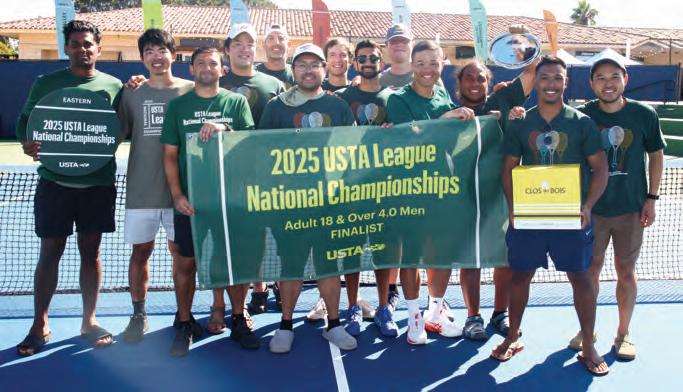
NYC-based League team reaches final at USTA League National Championships
AfterJon Ciangiulli's New York, N.Y.-based 18 & Over 4.0 men’s team lost 1-4 to USTA Florida in their second round robin match at the 2025 USTA National League Championships— held October 10-12 in San Diego—he went to bed and had a nightmare. In the dream, Ciangiulli was floating aimlessly down a toxic river in a canoe. To save himself from a deadly outcome, he needed to reach over and ‘grab the chin’ of a sumo wrestler who was also drifting down the river.
The NYC-based 18 & Over Men’s 4.0 League team celebrates after reaching the final of the national event
noted, played every single match over the course of the event.)
The final duel with USTA Intermountain over who would capture the championship title “wasn’t just about tennis, it was a battle of endurance,” Amin said. “Everyone had played a lot of matches by then, so it came down to which team had the most left in the tank. [Our opponents] were just a little bit too strong in the end.”
“The dream made absolutely no sense,” said Ahmad Amin, the team’s captain. “But for the rest of the weekend, any time someone was in trouble [in a match], the rallying cry became ‘Grab 'em by the chin!’”
As far as rallying cries go, this one was pretty effective. PostFlorida defeat, the Eastern squad put on a clinic, claiming nine of their next ten courts to notch match wins over contingents from USTA Northern and USTA Southwest (the 18 & Over 4.0 division plays two singles courts and three doubles courts per match). The only court they subsequently surrendered extended to a third-set match tiebreak.
“Florida was a tough match, just as we expected, and their players were amazing,” Amin said, explaining how he and his teammates were able to regroup. “But we felt like a few key points could've changed the outcome. Because of the draw, we also knew the loss to Florida didn't mean we were out. So we focused on taking as many courts as possible in our remaining matches. That helped us process the loss and refocus quickly.”
The nearly unblemished run-of-form earned Eastern a spot in the semifinals, where they again dug deep to advance past a formidable USTA Texas crew. Amin credited Eric Bomgardner and Lenny Li for claiming a win over a slightly favored Lone Star State duo to keep Eastern in the mix, as well as Julian Yarmouth and Claudio Contreras Garcia for ultimately clinching the victory, in what he described as the “most dramatic moment” of the entire weekend. (Contreras Garcia, Amin
Still, Eastern fought hard. After digesting a first-set bagel, Patrick Tsai came back to win his singles court in a third-set tiebreaker while Amin and Ciangiulli teamed up to claim one doubles court. They ultimately lost 2-3.
Despite ultimately missing out on the championship hardware, Amin said that just making it to the final was an incredible achievement, considering their team's season as a whole.
“The USTA Eastern Metro Region is incredibly competitive at the 4.0 level, and there were several teams that could've made Nationals and done just as well,” he said. “The craziest moment of our season had to be our regional championship match against Brooklyn. We had five match tiebreakers! In one of our doubles courts, we were down a set and 2-5 before coming back to win. Those [tiebreaks] took us to Nationals. They could've easily gone the other way, and honestly, maybe they should have.”
It was perhaps that intensity of competition at the local level that helped them eventually lift the finalist trophy on the national stage. They were well-prepared in moments of adversity to, one might say, grab ‘em by the chin.
“It all feels unreal,” Amin said. “Coming in, I believed we had a great chance to make it to Sunday because I know how hard these guys have worked to get here and how good they are. I wasn't surprised by the result as much as I was impressed by how well everyone performed. Everyone showed up and raised their level. Now that we're home, we're proud of how far we made it.”
It'stime to talk about what a tennis warm-up must accomplish to truly serve its purpose, whether you are getting ready to play a Grand Slam match, USTA level 4 tournament or J100.
Stimulate the Central Nervous System (CNS)
Tennis is a reaction sport. The CNS needs to be awake and firing for quick decisions and explosive movement. That's why we need short bursts of intensity, including sprints.
Mobilize the Right Joints
Tennis requires a high range of motion at the hips, ankles, thoracic spine, and shoulders. Instead of passive stretching, players need dynamic mobility that opens up the joints they'll actually use. Again, this is not the most important part because the range of motion varies a lot, even during the match itself, but it can help the player feel better.
Overcoming Isometrics
Overcoming isometrics are one of the most efficient tools to "switch on" the nervous system and increase tendon stiffness. Unlike passive stretching or low-level mobility, overcoming isometrics create high intramuscular tension without joint movement, which is ideal before explosive tasks. What I also love about isometrics is the possibility for positional specificity—you can target the exact angles used in strokes or athletic movements. For example, shoulder and elbow flexion.
Overcoming isometrics helps activate without fatigue. They're a bridge between activation and explosive readiness. Just a few reps
Why Most Tennis WarmUps Are a Waste of Time (And What To Do Instead)
By Filip Maric
with a few seconds of hold and max intent are usually enough.
Maximal Intent: What Drives Top Performance
I just mentioned max intent, which is equally important during isometrics and all other warm-up exercises; and not only for warming up, but in general.
If there's one variable that changes everything in warm-up effectiveness, it's intent. Maximal intent is the main driver of rate coding, motor unit synchronization, and neural priming.
In simple terms: if the brain doesn't “believe” the movement is serious or fast, it won't recruit the high-threshold motor units needed for real performance.
I can't say that the load is irrelevant, but it's certainly not important to be close to one RPM max. Load takes a back seat to speed and intent. Our tennis players must be cued to go with maximum effort in these drills, or the entire neural benefit is lost. You can lift heavy with no intent and get nothing. Or move light loads explosively with full intent and wake up the entire nervous system.
As coaches, it's our job to set that intent, not just prescribe exercises.
Activate Key Muscles
All muscles are important, but we must definitely focus on the glutes, core stabilizers and scapular muscles, plus any muscle or body part we've had problems with lately.
Shift Mental Focus
This is where circus-like exercises become essential. Juggling with tennis balls is a way to raise mental focus and get into a competitive mindset. It's not all about muscles. That's often the missing piece and it's why players can look physically ready but still start slow.
Final Thoughts: Warm-Up in Modern Tennis
Warm-ups in tennis are often undervalued and misused, not because coaches or players lack good intentions, but because many routines are based on outdated ideas or generic movement patterns that don't serve the realities of the sport.
But here's where it gets even more important.
Tennis is a year-round sport with few true off-seasons. Between tournaments, travel, and match loads, players often have limited time for dedicated strength, power, and neuromuscular development sessions. That's why the warm-up becomes even more valuable. It's one of the only consistent windows in the training week where we can:
• Maintain neural preparedness
• Stimulate strength and power
• Integrate key exercises players often miss in regular sessions
• Do all this without accumulating too much extra fatigue
Just as important as the warm-up is the cool-down phase. After a match or intense session, tendon stiffness typically decreases due to fatigue and repetitive loading. This is the perfect time to reintroduce overcoming isometrics.
Lluis Bruguera’s Revolutionary Racquet Speed Training: A Velocity-Based Approach Decades Ahead of Its Time
By Chris Lewit
Inmodern strength and conditioning, velocity-based training (VBT) has surged in popularity as coaches and athletes look for methods to enhance speed, power, and neuromuscular efficiency. However, long before VBT became a buzzword in the strength and conditioning world, legendary Spanish coach Lluis Bruguera had already implemented velocity-based principles in his on-court training methods. His famous racquet speed drills, which emphasized maximal swing velocity with little rest between repetitions, were widely adopted in Spain and became a cornerstone of the country’s elite player development.
Bruguera’s drills weren’t just an accidental byproduct of Spanish tennis philosophy—they were an intentional way to overload the neuromuscular system, forcing the body to adapt by increasing swing speed, improving motor unit recruitment, and enhancing racquet acceleration. In hindsight, it’s clear that Spain was decades ahead of the curve in applying velocity-based training to a sport-specific context. Today, as VBT systems using linear position transducers, accelerometers, and radar guns are revolutionizing how athletes train for speed and power, it’s worth recognizing that the foundations of such training existed long ago on the red clay courts of Spain.
The Science of Velocity-Based Training
Velocity-based training (VBT) is rooted in force-velocity principles, which state that power output depends on both force production and movement velocity. In traditional strength training, power is often developed by lifting heavy loads at moderate speeds. However, research has shown that training with light-tomoderate resistance at maximum velocity can be just as effective—if not more so—for increasing rate of force
development (RFD).
Key neuromuscular adaptations that occur with velocity-based training include:
• Improved Motor Unit Recruitment – By training at high speeds, the nervous system is forced to activate high-threshold motor units, which are essential for generating rapid force.
• Enhanced Rate of Force Development (RFD) – The ability to generate force quickly is crucial in tennis, where split-second reactions and high-speed racquet acceleration determine success.
• Optimized Intermuscular and Intramuscular Coordination –The muscles learn to fire in the most efficient sequence, improving overall movement efficiency and reducing wasted energy.
• Increased Fast-Twitch Muscle Fiber Utilization – Max-velocity training preferentially recruits Type II muscle fibers, which are responsible for explosive movements like serving, forehand acceleration, and recovery steps.
While VBT in the weight room often involves monitoring bar speed during exercises like squats and bench presses, Lluis Bruguera’s on-court velocity training applied the same principles directly to racquet sports, allowing athletes to develop explosiveness in their sportspecific movement patterns.
The Rise of Velocity-Based Training in Strength and Conditioning
While Spain was integrating VBT into on-court training decades ago, the strength and conditioning world only recently embraced velocity-based training as a formal methodology. In the 1990s and early 2000s, pioneering research on bar velocity tracking led to
the development of tools like Tendo Units, GymAware, and Push Bands, which allowed coaches to monitor bar speed in real-time.
VBT has since gained traction across sports like Olympic weightlifting, track and field, and football, where power production is critical. By focusing on movement velocity instead of just load, athletes can train for maximal explosiveness without unnecessary fatigue. This method has revolutionized how strength and conditioning coaches program power training, and today, it is widely used at the highest levels of sport. However, what sets Bruguera’s methods apart is that he was applying these same velocity principles without the use of modern technology. His approach was entirely practical, intuitive, and repeatable, using on-court drills to achieve the same neuromuscular overload and power adaptations that VBT practitioners now seek in the gym.
Speed-Endurance vs. Power Development
One of the most valuable aspects of Bruguera’s approach is that his drills didn’t just build pure velocity—they also developed speed-endurance.
• Power development involves maximizing force production in the shortest possible time. In tennis, this translates to higher racquet head speed and more explosive shot production.
• Speed-endurance, on the other hand, is the ability to maintain high-velocity efforts over time. Tennis players don’t just need to swing fast once; they must sustain high-intensity movements for hours.
Bruguera’s racquet speed drills were designed to train both qualities simultaneously. By performing repeated maximal swings with minimal rest, the neuromuscular system was overloaded in a way that both increased peak racquet
head speed and improved the ability to sustain high-output efforts late in matches.
This is a major advantage over conventional power training, which often involves long rest intervals to maximize peak output but fails to address the repeated-effort demands of match play.
The Famous Spanish Racquet Speed Drill
One of the most well-known velocitybased training drills in Spain, created and popularized by Lluis Bruguera, is a simple but highly effective method to develop racquet acceleration.
Drill Setup and Execution:
• The coach stands in front of the player, softly hand-tossing 8-10 balls in rapid succession.
• The player swings at maximum velocity on every shot, focusing on pure racquet head speed.
• There is minimal rest between repetitions, forcing the athlete to sustain high-speed swings even under
slight fatigue.
• This overloads the neuromuscular system, forcing adaptations in motor unit recruitment, rate of force development, and swing mechanics. This drill can also be simulated with a ball machine, set to deliver balls rapidly at a consistent height and location, allowing for repeated maximal swings without external variability.
Bruguera’s drill, along with many other Spanish training methods, is detailed in my new book, Secrets of Spanish Tennis 2.0, which explores the training philosophies that have made Spain one of the most successful tennis nations in the world.
Conclusion
The Spanish tennis system, spearheaded
by visionaries like Lluis Bruguera, was implementing velocity-based training principles long before modern strength and conditioning embraced them. His racquet speed drills were designed to maximize swing velocity, improve neuromuscular efficiency, and enhance speed-endurance, making them one of the most effective methods for developing explosive ball-striking.
As VBT continues to gain prominence in high-performance training, it’s worth acknowledging that the Spanish were already ahead of the curve, applying these principles on the court decades before the rest of the sports world caught on. The legacy of Bruguera’s training methods lives on in the success of Spanish tennis and in the continued evolution of high-performance athletic development.
Chris Lewit is one of America’s leading high-performance tennis coaches and a global authority on Spanish training methods. Known as The Prodigy Maker, he has developed numerous elite juniors, including many #1 players in the nation. A former #1 at Cornell and pro tour competitor, Chris is the author of The Secrets of Spanish Tennis and Winning Pretty. He studied literature at Cornell, Harvard, and Columbia and is pursuing a PhD in kinesiology.
Chris hosts The Prodigy Maker Tennis Show, runs a Vermont academy and online school, and is recognized worldwide for his technical expertise and inspiring coaching. Read more at substack.com/@chrislewit
CHRIS LEWIT TENNIS
CUSTOM FULL-TIME COACHING FOR HOMESCHOOL PLAYERS
PRIVATE COACHING, HIGH PERFORMANCE CAMPS, AND GROUPS FOR ALL LEVELS
HIGH PERFORMANCE SUMMER CAMP IN VERMONT
TRAIN WITH THE BEST— CHRIS HAS RECENTLY COACHED SEVERAL #1 PLAYERS IN THE US!
CHRISLEWIT.COM
914.462.2912
CHRIS@CHRISLEWIT.COM
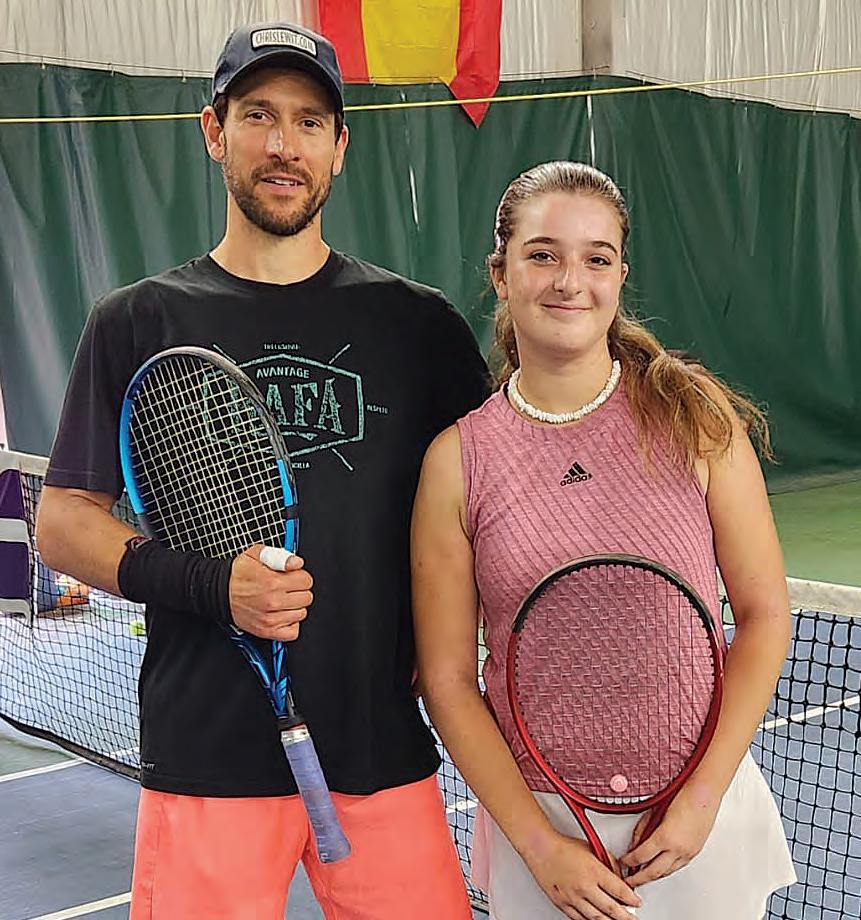
Chris with Elana Zaretsky, Top 10 USTA National Rank
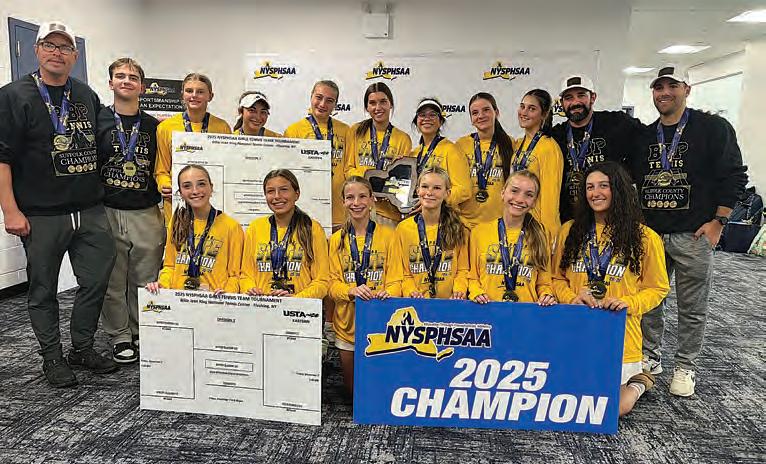
2025 high school girls’ tennis season RECAP
Bayport-Blue Point Claims First New York State Division II Title
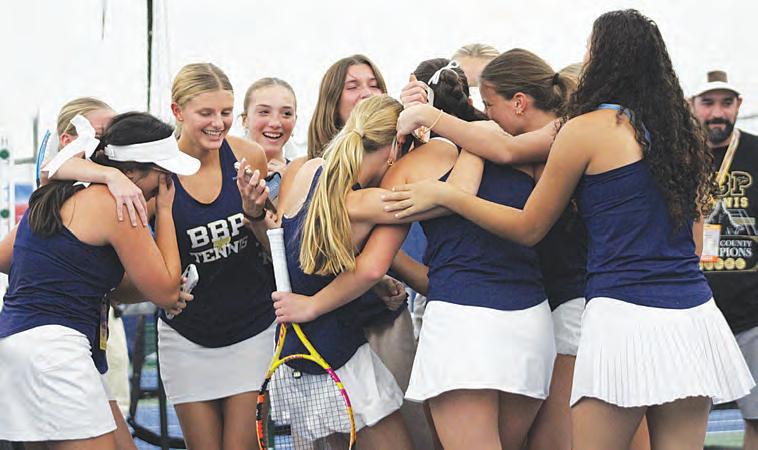
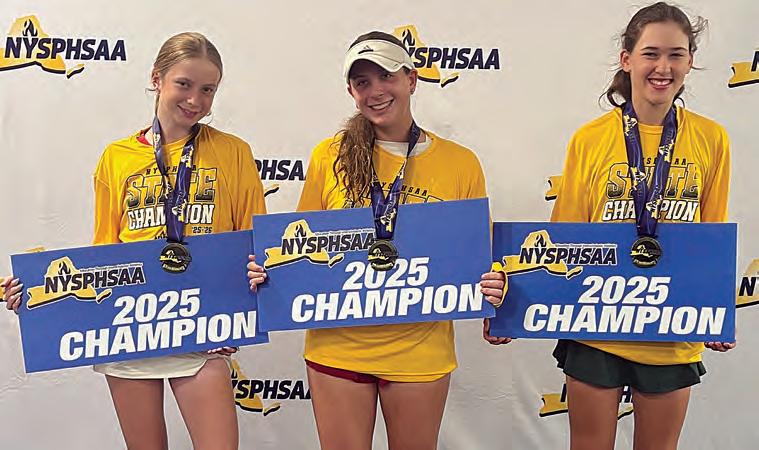
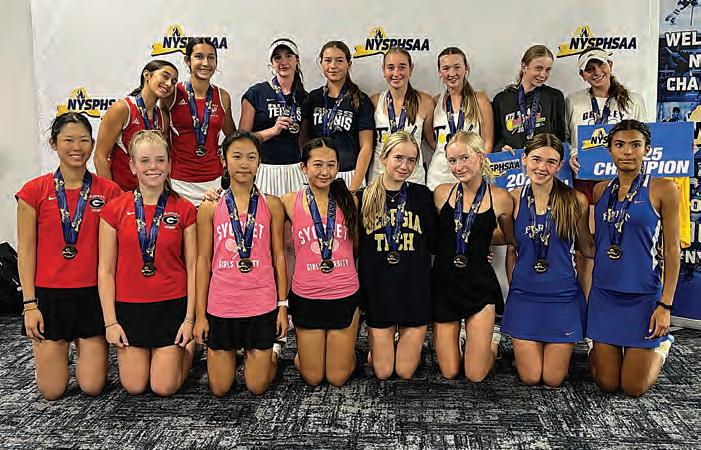
The BayportBlue Point Phantoms captured its first ever New York State Public High School Athletic Association (NYSPHSAA) Division 2 (Small School) Girls Tennis Championship with a 4-1 victory over Edgemont at the USTA Billie Jean King National Tennis Center.
“We knew it wasn’t going to be given to us, and that we had to go take it,” said Lily Castka. “If we weren’t focused, it wasn’t going to happen. We knew we had to go out there and play our best.”
With that mindset, the Phantoms dispatched of Honeoye Falls-Lima 5-0 in the semifinals to reach the NYSPHSAA Championship for the second straight season and face off against Edgemont.
Eden Romano, who clinched the
Long Island title for her team, won 6-1, 6-1 at second singles to kick off the scoring in the final for Bayport-Blue Point.
“I’m super impressed by Eden. She was a big doubles player all season for us and joined our singles lineup late,” said BayportBlue Point head coach John Selvaggio. “That decision paid off.”
Evie Romano & Leila Rogers then won 6-2, 6-4 at first doubles to bring the Phantoms within one win of the state title.
In fitting fashion, that win would come on the first singles court from Lily Castka, the Suffolk County singles champion. Castka carried her team across the finish line, winning 6-1, 6-3 to win the third point for Bayport-Blue Point, and clinch the state title.
“I was definitely a bit nervous towards the end of my match, but I just told myself to keep breathing and get through it,” Castka said. “It feels amazing. I don’t think it’s something our school has ever done, so it’s cool to be a part of that, especially the clinching match.”
At third doubles, Jordana Heller & Julie Wellems won 6-4, 6-2 to round out the scoring for BayportBlue Point. The lone point for
Edgemont came from the second doubles duo of Isabella Jee & Seren Fowler who won 2-6, 6-2, 7-5.
“I’ve been proud of this team from the start, and they did a phenomenal job today,”
Selvaggio added. “They stayed calm, cool and collected; got fired up when they needed to, but stayed in check when they needed to. It’s a testament to the hard work they put in during the season and during the offseason. We had a
grueling schedule towards the end of the season that got us ready for these moments. And every week, someone new steps up. They all depend on each other, and we’re like a family. No family is perfect,
there are things we work through as a group, but at the end of the day, they love and respect each other and that’s all that matters. They all did their part today.”
Castka added:
“Everyone on this team does what they are supposed to do and it pays off. It’s definitely something we are proud of, and we wouldn’t be able to accomplish this without everyone on the team.”
Syosset Defeats Horace Greeley To Win First Girls Tennis State Title In Program History
Forthe fourth time in the last five years, the Syosset Braves found itself in the finals of the New York State Public High School Athletic Association (NYSPHSAA) Girls Tennis’ Division I (Large School) Championship.
But unlike those three previous attempts, Syosset would not be denied this time around. The Braves defeated Horace Greeley 5-2 in a rematch of the 2024 final, claiming the program’s first girls tennis’ state title.
and illnesses; just a lot of different things. I’m very proud of all the girls for they handled it all season, and for the way they came out and played today.”
“I’m just super excited for all of the girls, their parents and the community as a whole,” said Syosset head coach Shai Fisher. “It’s been an interesting season, a fun season. We dealt with a lot of stuff, from injuries
For the past several seasons, Syosset has been anchored by the strength and depth of its doubles teams. And while that still exists, a key reason the team got over the hump this year was its formidable singles trio.
That trio was led by Nassau County singles champion and senior cocaptain Stephanie Marcheret who won 6-1, 6-2 at first singles. At third singles, Hannah Wang won 61, 6-0.
A key victory came from eighth-grader Skyler Lin who posted a 6-2, 6-4 victory at second singles to complete the singles sweep for Syosset.
“Not just today, but if you look at some of the biggest matches throughout the year, Skyler pulls through. The better competition, the better she plays,” said Fisher. “She plays a great game and gets to every ball. There’s times where she just sacrifices her body and does splits on the court or runs into the curtains. But she’s a tremendous money player for us; when the pressure’s on, she plays even better.”
With three court victories on its ledger, the clinching match for Syosset would come from the third doubles team of senior co-captain Julia Isham and junior Kayla Lo. After winning the first set in a tiebreaker, the pairing completed a 7-6(5), 6-4 victory to seal the state title for their team.
“It was a lot of pressure, but we do it for this team,” said Lo, who served the match out at 5-4 in the second set. “I love this team, and I’m hoping there is more to come for us.”
Isham, who closes out her career with a state title and the clinching
win, added:
“It’s my senior year and I really couldn’t ask for anything better. We did it as a team.”
Speaking specifically about the singles play, Isham said:
“They’re incredible. They all work so hard, and during practices they will be off in their own world getting ready for their matches. In previous years we always relied on our doubles, and I’m really happy with how our singles play keeps getting better. I’m proud of this entire team, we finally did it.”
At fourth doubles, Syosset’s Kayla Kim & Siya Mehta came back from a set down to win 3-6, 6-4, 6-3 to round out the scoring for the Braves.
Syosset now sets its sights on defending its title a year from now. And while it will have to do so without seniors Isham and Marcheret, these experiences continue to prove to be invaluable.
“I’m super happy for them because they’ve poured so much time and effort into this. I think being here and knowing what it takes to be committed throughout the whole season is huge. Our program has really changed to where our girls are playing six days a week, four to five hours a day,” said Fisher.
Horace Greeley would win the matches at first doubles and second
doubles. Daniella Rosenblit & Scarlett Mcfadzen won 6-2, 6-3 at first doubles, while Lia Yedid & Sophia Wang came back from a set down to win 4-6, 6-2, 6-1 on the second doubles court.
“It really starts with Steph and Julia, and filters down to the other girls. I know our team will enjoy this, but then I expect that they will be back on the court tomorrow. That’s just how they are, and it’s a testament to them and their commitment.”
The 2025 New York State Public High School Athletic Association (NYSPHSAA)
Individual Championships took place at the USTA Billie Jean King National Tennis Center.
Shenendehowa’s Jolie Chichak defeated Gabrielle Villegas of Great Neck South to win the Singles Title, while Horace Greeleys’ Michelle Rosenblit & Daniella Rosenblit captured the doubles title.
Below are the Top 8 finishers in both singles and doubles:
From left to right: Daniella Rosenblit, Michelle Rosenblit and Jolie Chichak. The Rosenblits of Horace Greeley captured the doubles title, while Chichak won the singles championship
Formost of the season, Townsend Harris was on cruise control. The Hawks had been dominant in the Queens 2A division throughout the season, including in the first two rounds of the playoffs where it defeated Beacon and Brooklyn Tech, both by the score of 5-0.
Sabaev Clinches Townsend Harris’ PSAL 2A Championship
But in the semifinals, Townsend Harris received its biggest test of the season up to that point, edging Bronx Science 3-2 to book its place in the final. That experience proved invaluable as it would be tested once again in the final against defending champions James Madison.
The Hawks defeated James Madison 3-2 to win the PSAL 2A Championship at Queens College Tennis Center, earning the program’s first city title in girls’ tennis.
“We didn’t have a lot of competition until the semifinals and here in the finals, so they hadn’t had a lot of practice playing in tough matches,” said Townsend Harris head coach Stephen Mazza. “It’s amazing how they were able to do it, and I’m really honored to be their coach.”
Micaela Galicia got her team started with a 10-4 victory at second singles which put the Hawks in front, but the defending champions responded. Irma Gaidukova & Sofia Vinnik posted a 10-4 victory at second doubles, and soon after, Milana Markov won 10-6 at third singles which moved the Lady Knights in front. But the first doubles tandem of Morgan Ma & Tiffany Huang held on to win 10-7 to even the championship at 2-2, and left the city
title to be determined on the first singles court between Elizabeth Sabaev of Townsend Harris and Mariia Vainshtein of James Madison.
With the eyes of both teams and all spectators on their court, Sabaev and Vainshtein went back-and-forth and delivered clutch shots to force a tiebreaker when the match became tied at 10-10.
“She’s an amazing player, and last
year she lost both playoff matches so I think she has improved her mental fortitude a lot, and you saw that today,” Mazza added. “That was a tough match, and she could have given up a bunch of times in that match but didn’t. In her match in the semifinals, she was up 7-0 and 8-1 before winning 10-8, so she did a great job of staying mentally strong for us, and it showed.”
In the tiebreaker, Sabaev would use that experience of being in close, pressure-packed matches to win 8-6, sealing her first singles win and clinching her team’s city championship.“It feels surreal, I’m so happy to do it with my friends on this team,” said Sabaev. “It was a crazy match with a lot of close points, and I’m really happy to clinch it for my team. It was a big thing to have all of my teammates there giving me a lot of energy.”
Ayear ago, the High School for Environmental Studies came up one victory short of winning New York City’s PSAL 1A Division championship, losing a heartbreaking 3-2 match to Abraham Lincoln.
Environmental Studies Wins PSAL 1A Championship
While it was a difficult loss, it only hardened the team’s resolve and deepened their desire to get back to that point in 2025, and set out goals for itself.
“Last year’s disappointment in the finals was the motivation that we needed,” said Environmental Studies’ head coach Daryl Warfield. “The next day in school, the girls were already planning to train and be ready for this season. With the
addition we had on this year’s team, we knew we had a chance to succeed this time around. Our first goal was to be the number one seed, which we were, then our goal was to get to the finals and win it.”
And in a thrilling 3-2 victory over the High School for American Studies inside the Queens College Tennis Center, the Eagles accomplished their goal and became this season’s PSAL 1A Champions. Led by Grace Mahabir and Lian Wachspress at first and second singles, respectively, the Eagles took two of the three singles flights. Mahabir won 10-8 in the first spot, while Wachspress won a crucial 11-10 match at second singles.
Myla Choi won 10-5 at third singles for American Studies.
In the two doubles flights, Alisa Terauchi & Valentina Narvaez-Smith won 11-10 at first doubles for Environmental Studies, while Kareena Mehta & Lucille Poots were 10-7 winners at second doubles.
The win marked not only an undefeated 10-0 season for the Eagles, but also redemption for the past couple of seasons.
“I’m extremely proud of this team because of the past couple of years of disappointments, and our seniors being anxious about winning,” Warfield added. “We’ve been lucky with staying healthy, and building a chemistry to the point of being a team that genuinely enjoys being around each other. After 23 years of coaching, this is my all-time best team. Not a lot of tennis teams or coaches get the chance to be called Champions, and I’m extremely proud that we’re a part of PSAL history.”
• Print distribution across New York at 600+ locations, and a print readership of over
• Digital distribution across our websites and social media pages
• The E-edition will be distributed to our full
USTA Eastern Long Island Region
Celebrating the Tennis Community
Thank you to everyone who attended the USTA Eastern Long Island Regional Council’s 35th Annual Awards Reception in October. Special thanks to all the volunteer Council members whose hard work made the event a huge success. We
celebrating celebrating with you and offering much-deserved recognition to the evening’s honorees. A full list of all winners along with photos from the event is available at www.longisland.usta.com.
New York State Tournament
Each year, the USTA LI Regional Council provides sweatshirts to all the Nassau and Suffolk Girls participating in the NY State Tournament. The Council also supplied plaques for the winners and runners-up in the Long Island Championships.
USTA Eastern Long Island Region
Supporting High School Tennis Sportsmanship
The LI Regional Council is proud to support high school tennis sportsmanship each year. The Council offers each coach who wants one a plaque to recognize one of his or her players for excellent sportsmanship and by also works with Jay Harris of Sportime/John McEnroe Tennis Academy (JMTA) to honor one singles player and one doubles team with a plaque and a scholarship to the JMTA in recognition of superior sportsmanship at the
Nassau County Individuals Tournament.
This year’s recipients of the USTA LI Sportsmanship & JMTA Scholarship awards were:
• Doubles: Shoriya Baht-Bhandarka & Christiana Kent (Port Washington)
• Singles: Stephanie Marcheret (Syosset)
A list of all individual school honorees and some photos are available at www.longisland.usta.com.
Recognizing Sectional Achievements
Each year USTA Eastern honors members of the tennis community from across the Section with awards at its Eastern Tennis Conference. This year’s event will take place on January 30 and 31, 2026 at Genesis Health Clubs - Saw Mill Club in Mount Kisco, NY. Long Island is proud to congratulate these special players and organizations who
will be honored in January:
• Junior Team Tennis Award: Sam Siegel
• Long Island Regional Volunteer of the Year: Dunja Froman
• 10 and Under Award: Advantage All Tennis Foundation
• Family of the Year Award: Perez Family
• Louise Cilla Award: Dorothy Wiggins
Long Island Regional Council Executive Committee
Mike Pavlides, Regional Director
Jonathan Klee, Past Regional Director
Sunny Fishkind
Tito Perez
Jason Wass
Randi Wilkins
Neil Thakur, Manager, Schools Tennis and Long Island CTC (thakur@eastern.usta.com)
Milly Keighery, Adult League Coordinator Long Island Region (Keighery@eastern.usta.com) Facebook: Play Tennis Long Island • Instagram: USTA Eastern
ADULT LEAGUE wrap-up ADULT LEAGUE wrap-up
By Milly Keighery
Ithas been a banner year for the USTA Long Island Adult League, which capped off an already successful season with an impressive showing at Nationals. Since June, the program has seen remarkable growth, spirited competition, and strong community engagement—hallmarks of a tennis region that continues to distinguish itself within the Eastern Section.
Following a robust Sectional season, nine (!) Long Island teams qualified for Nationals this year, a significant accomplishment that underscores the depth of talent across the region. While the competition at
the national level was fierce, Long Island’s teams delivered gritty performances and produced memorable moments that resonated well beyond the courts.
Long Island Teams at Nationals
• 40 & Over Women 3.0 – Donna Healy
• 55 & Over Men 6.0 – Adam Moramarco
• 55 & Over Women 7.0 – Jacqueline Mazzarone
• 55 & Over Men 8.0 – Matt Crowley & Sam Lamba
• 55 & Over Men 9.0 – Lionel Goldberg & Robert Chesney
The 55+ 9.0 Men’s team captained by Lionel Goldberg & Robert Chesney finished in fourth place at Nationals
The 40 & Over Mixed 6.0 captained by David Ng finished in third place at Nationals
The 18 & Over Mixed 6.0 captained by Donna Healy were fifth place finishers at Nationals
• 18 & Over Mixed 6.0 – Donna Healy
• 40 & Over Mixed 6.0 – David Ng
• 40 & Over Mixed 8.0 – Terry Kossegi & Patricia Siler
Among the notable achievements was the performance of the 55 & Over Men’s 9.0 team, which secured a fourth-place national finish following a string of hardfought matches. Doubles partners Adrian Chirci and Rob Dwek posted a standout 4–1 record, earning wins against teams representing Texas, Mid-Atlantic, Middle States, and Southwest.
Co-captain Rob Chesney recounted one of the weekend’s most dramatic moments: a match against Southwest that featured a full-extension volley lob, a professional-level tweener from the opponents, and ultimately, a decisive put-away volley that saved match point and propelled the team forward.
“I would not believe it if I weren’t next to him,” Chesney said. “It was really incredible—more than you could ever hope to see at Nationals.”
David Ng’s 40 & Over Mixed 6.0 team also drew attention, marking its second consecutive year at Nationals despite rebuilding with new players.
“I love how we can bring new people and old friends into tennis together and have so much fun doing it,” Ng
said. “Everyone on the team played hard and I’m really proud of them.”
Upcoming Events and Continuing Competition
Long Island will next be represented at the upcoming Invitationals by two 65 & Over Women’s teams:
• 65 & Over Women 6.0 – Mary Alice Ruppert
• 65 & Over Women 8.0 – Lydia Eitel (Sportime Syosset), marking the team’s third straight year representing Eastern
Locally, the 2025 18+ Mixed Doubles Leagues are in progress and will run through the winter, while the 2025 4.5 Tri-Level leagues for both men and women are nearing their finales. Regional champions will be determined.
Looking ahead, captain registration is now open for the 2026 4.0 and 5.0 Men’s and Women’s Tri-Level Leagues. Additional teams are being sought in the 5.0 divisions to ensure full representation across the region.
Registration is also open for the 2026 40+ and 55+ Mixed Leagues, with openings at the 6.0, 7.0, 8.0, and 9.0 levels. These leagues are set to begin in February and March.
TOP TENNIS PROGRAMS CLUBS
Bethpage Park Tennis Center
99 Quaker Meeting House Road, Building #4 Farmingdale, N.Y.
BethpageParkTennis.com (516) 777-1358
Bethpage Park Tennis Center is located just a few hundred feet from the Black Course at beautiful Bethpage State Park. Four indoor hard courts and four indoor red clay courts are air-conditioned for year-round play, along with two outdoor Har-Tru courts. Bethpage Park Tennis Center offers an array of adult seasonal court opportunities, Men’s and Women’s leagues, Lesson and Junior Development Programs, Quickstart, Zone tennis and walk-on court opportunities. New this year is the addition of Pickleball and Saturday night tennis/pickleball parties. It’s free and low-cost program for special populations and veterans is perhaps the largest of its kind in New York State.
The Center is best known for its renowned junior development program, led by top coach Steve Kaplan who has developed more top players than anyone else in the East. Steve is the owner of Bethpage Park Tennis Center, director emeritus of City Parks Foundation Lacoste Academy and Executive Director of Serve and Return Inc. Steve has been the long-time coach of more than 1,100 nationally-ranked junior players, 16 state high school singles champions, two NCAA Division I Singles Champions, and numerous touring professionals, prominent coaches and many prominent members of the New York financial. Steve’s students have been awarded in excess of $11 million in college scholarship money.
In the summer, the finest players in the East join Bethpage Park Tennis Center for summer camp on four indoor hard courts, four indoor red clay courts that are air-conditioned, along with two outdoor Har-Tru courts and six nearby outdoor hard courts. Lunch is included and transportation is available. Bethpage Park Tennis Center charges no membership fee and values all of its beginners equally with its nationally-ranked players.
Carefree Racquet Club
Carefree Racquet Club is Long Island’s premier indoor tennis club, offering seven indoor tennis courts, four pickleball courts, and two half-court basketball courts. Carefree is managed by Kristen Cassidy, who previously served as the club’s Assistant Manager, League Director, and U10 Summer Camp Director. She strives to maintain Carefree’s longstanding efforts to successfully organize quality programming for adults and juniors, making tennis accessible to all members of the community at any age or skill level. Carefree prides itselfon being an accessible, inclusive place who has never charged membership fees, and continues not to.
Carefree offers extensive league opportunities from players at a 2.5 level up to 5.0! They offer singles,
rotational doubles as well as team doubles that are filled and maintained to be on level in accordance with USTA ratings. We want to ensure you have a good game every time you play! Carefree has many USTA teams that participate in the 18 & Over, 40 & Over, 55 & Over divisions in Men’s, Women’s, and Mixed doubles leagues along with Tri-Level Leagues.
For those new to the game or just want to improve their game, Carefree offers two, 14-week sessions of Adult Development programming, coordinated by Alina Volman. Students are placed in a group of 4 players at their level for a 1 hour lesson per week. There are options for a 1.5 hour lesson, private and semi-private lessons available as well! Learn and Play students are also eligible to come to a free 90 minute practice time each week on either Friday afternoons or Sunday evenings. In the summer, Carefree offers two, 6 week Adult Learn and Play sessions that include a free, 60 minute practice time on a weekday evening.
For junior players, Ben Marks, Carefree’s Director of Tennis, coordinates the Junior Development Program with two, 14-week sessions. Students can start at 3 years old in our Tots Program, going up to 18 years old. The Junior Program offers group, private and semi-private lessons as well as a Saturday afternoon ladder match play program. Junior students are also eligible for a free 60 minute practice time on Sundays afternoons! Ben also runs a high school tennis prep program and an Elite/Tournament Training program for our most advanced junior Players.
Carefree also offers Summer Camp for Juniors from the last week in June until Mid-August. Our Junior Camp offers two programs: A 10 & Under Camp for red and orange ball players, on Mondays, Wednesdays and Fridays from 9am-12pm, and our longstanding Junior Camp that welcomes players from ages 5-18, offered Monday-Friday from 1-5pm. Both programs include instructional drill sessions as well as match/point play. We also utilize our pickleball and basketball courts for multisport fun! Check out our website (carefreetennis.com) or call us at (516) 489-9005 for more details.
Cary Leeds Center for Tennis & Learning
1720 Crotona Avenue
Bronx, N.Y.
(718) 247-7420
caryleedstennis.org caryleedsinfo@nyjtl.org
The Cary Leeds Center for Tennis & Learning houses a two-story, 12,000square foot clubhouse, educational spaces, and access to 20 courts (10 bubbled for winter/indoor use) and two stadium courts that seat up to 800 spectators. Led by a world-class team of tennis professionals offering programs and private lessons for juniors and adults of all skill levels, the Center also hosts summer camps, tournaments and community-based events
The Cary Leeds Center for Tennis & Learning is the flagship home of New York Junior Tennis & Learning (NYJTL), the largest youth tennis and education non-profit in the nation. In serving its larger mission, the Cary Leeds Center provides 6,000 hours of free tennis court time to the community.
Centercourt® Tennis Academy Overview
Chatham, Florham Park, Gillette, Marlboro – New Jersey
Centercourtacademy.com (973) 855-3111
Conrad@CentercourtClub.com
Centercourt® Tennis Academy
Centercourt® Racquet Sports Clubs
Centercourt Tennis Academy boasts the toughest playground in the Northeast and has created a true culture of excellence as proven by results: with countless players competing at the highest Collegiate Levels and several Full-Time Alumni playing at the Professional Level, including ATP Rising stars Michael Zheng, Samir Banerjee, Nick Kotzen, and WTA’s Alexa Noel.
The quality and intensity of programs and the personalized competitive scheduling, as well as hosting a full calendar of USTA / UTR / ITA tournaments, makes Centercourt Tennis Academy the top choice.
Established in 1974, Centercourt® Club & Sports has become a leader in sports programming in the Northeast. Our portfolio consists of 8 sports training facilities focused on delivering top-level, year-round training. Centercourt’s Performance Tennis home base is located in Chatham, N.J., just 45 minutes from New York City with transportation and boarding options available.
Our world-class coaches have walked the pathway and take pride in delivering only the best cutting-edge Player Development Programs, personalized to the needs of each athlete. Centercourt’s methodology is well-proven with the number of graduates finishing in the Top 10 ITF Juniors, including 3 Wimbledon Finalists. Our specialized approach, teamwork, and world-class facilities make Centercourt a great place to call home. Our staff of globally respected coaches boast decades of experience at the highest levels
continued on page 46
Academics + Strength & Conditioning
Our Strength & Conditioning Programs are a true point of difference at Centercourt. With global leaders training players daily, our athletes are physically and mentally at their peak thanks to regular fitness testing, reporting and program adjustments and prioritization of individual developmental needs.
Centercourt promotes a culture of excellence and strong emphasis on academics and work ethic. Our scholarathletes have committed to Ivy League and other top Division I programs. Centercourt offers schooling through ICL Academy, Laurel Springs and the Dwight School.
Communication
We firmly believe in holistic development and strong communication between players, parents, and coaches. Parents are welcome to contact us anytime for meetings outside of planned Face-to-Face Development Meetings annually.
Competition
Competition is the backbone of development. Players compete locally, nationally and at the ITF level regularly. Full-time athletes become proficient technically through SMAP Video Analysis, and undertake regular seminars on Mental Toughness, Match Analytics using 135 Tennis IQ Analytics and Swing Vision Data, Nutrition, Additional key developmental areas and guest speakers and experts.
We use cutting-edge technology for Match Play Charting, Feedback and Analytics. We pride ourselves on Program Innovations.
Environment
We strive daily to ensure that our environment always feels like home to our players. Our core priorities are challenged, growth-oriented and being tough in every situation. Our unique facilities are the best in the region—clay, hard, indoor, outdoor—ensuring players get everything they need. Our Fitness Centers are world-class, and we maintain the highest standards of coaching through mandatory ongoing Coach Education.
Centercourt® Pathway
The pathway starts early with our specialist NEW! Red Ball Development Center. We have a dedicated area for young players to become athletes under specialist coaching.
Elite foundations are formed through technical skill development, tactical development, key footwork patterns, cutting-edge teaching methods and established and proven curriculum.
Visit Centercourtacademy.com for more information on After-school programs, specialized weekend training and full-time academy.
Adult Camps at the USTA National Campus
OCTOBER 2025 - MAY 2026
Plan
Chris Lewit Tennis Academy
3997 VT-100
Londonderry, VT (914) 462-2912
ChrisLewit.com and YouTube.com/ChrisLewit
Chrislewit@gmail.com
Chris Lewit Tennis Academy (CLTA) is a serious highperformance training center set in the natural paradise of Vermont. Our academy features European-style red clay courts, indoor hard courts, a full gym, and a comfortable clubhouse—allowing players to train year-round, regardless of weather. Families love visiting nearby Manchester, an internationally known mountain destination filled with charming shops and restaurants. We welcome both visiting players and families interested in relocating to train with Chris daily.
CLTA offers full-time, part-time, and short-term training options, including our world-renowned boarding summer camp. We also run holiday and school-break programs throughout fall, winter, and spring. Every athlete works directly with Chris—he is fully on court with students each day, which sets CLTA apart and attracts families from around the world.
Chris Lewit is widely regarded as one of the top junior development coaches in the United States. He is the author of The Secrets of Spanish Tennis 2.0 and Winning Pretty, and has spent over 20 years studying with many of the most influential coaches in Spain and Europe. His training blends deep technical and biomechanical expertise with the most cutting-edge European development methods.
In addition to his coaching accomplishments, Chris has a strong academic background, having studied literature at Cornell, Harvard, and Columbia University. He is currently pursuing a PhD in kinesiology and biomechanics, integrating advanced sports science into his coaching methodology and continually pushing the evolution of high-performance tennis training.
Chris has recently coached No. 1 American junior and Gold Ball winner Maggie Sohns, Ukrainian phenom Vlada Hranchar, numerous top-10 nationally ranked juniors, Little Mo National Champion Elana Zaretsky, national finalist Henry Holtz, and several elite players progressing toward the pro tour. He is also recognized for his exceptional ability to develop the foundations of young prodigies.
CLTA’s method is rooted in the Bruguera System, the Toni Nadal Approach, and the William “Pato” Alvarez model. Chris is one of the few coaches worldwide certified in all three systems, offering students authentic and world-class Spanish training.
The academy integrates advanced sports science, including athletic testing, technical and biomechanical assessment, strength training, talent identification, injury-prevention programs, and high-speed video analysis.
Come experience the highest level of Spanish-style training and elite technical development year-round at CLTA—where every player is treated like family.
continued on page 48
CourtSense Tennis Training Centers at Tenafly and Bogota Racquet Club
195 County Road, Tenafly, N.J., (201) 366-2317
156 W Main St, Bogota, N.J., (201) 366-2898
CourtSense.com
CourtSense offers the most up to date tennis facilities in Northern New Jersey and provides a comprehensive program of tennis instruction delivered by professional full-time coaches, using the finest techniques and technologies. With CourtSense, you’ll achieve your personal best, because our training is of the highest professional caliber—and easily tailored to suit your age and skill level. Children under 10 years of age benefit immensely from a proper training foundation—eliminating poor techniques that could limit their game later in life. We love helping juniors and adults achieve their goals on and off the tennis courts, and our ultimate goal is for everyone that steps into our facilities to learn something new while leaving with a smile on their face.
CourtSense Tennis Training Centers have a whole range of activities to support junior and adult tennis lovers. From red-ball tennis and afterschool clinics to high-performance full-day program including a partnership with the Dwight School and ICL Academy, Hit to Fit tennis, internal and USTA leagues, and private and group sessions, we have something to suit everyone. CourtSense students have access to 15 indoor tennis courts with new LED lighting, world-class strength and conditioning centers and luxury players’ lounges. The indoor facilities have also been updated with state-of-the-art UVGI systems that are constantly sanitizing the air inside the facilities and making sure that air is of the highest quality.
CourtSense’s club in Bogota, N.J. primarily specializes on the high-performance and tournament players. We have worked with players who have become ATP- and WTA-ranked players, U.S. Olympians, as well as many college scholarship athletes, and currently work with a few pro players that are improving their ATP and WTA ranking, and some of the top juniors in the Eastern Section. CourtSense’s high-performance coaches, in collaboration with its fitness staff, have developed a program that maximizes athletes’ strengths, both on and off the court. The goal is to use tennis as a vehicle to teach life lessons by tapping into the spirit of every player, with passion, expertise and character. We want our juniors to be the best tennis players they can possibly be, but at the same time, be prepared to be successful in anything they want to be once their tennis careers are over. We also have a partnership with the Dwight School and ICL Academy that all our highperformance players can take advantage of.
Another unique aspect to the CourtSense’s facilities is the fitness programming provided in partnership with Magnus – Sports Performance. Magnus’ team has the ability to assess, correct, enhance and reassess an athlete–giving you everything you need to compete at the best of one’s abilities. The Magnus Team has a long experience working with top tennis athletes. CourtSense members have access to cutting-edge strength and conditioning technology, private sessions, nutritional counseling and mental toughness training.
Eastern Athletic Clubs
EAC in Blue Point: 9A Montauk Highway, Blue Point, N.Y. (631) 363-2882
EAC in Dix Hills: 854 East Jericho Turnpike, Dix Hills, N.Y. (631) 773-6293
EACTennis@yahoo.com
Eastern Athletic is family-owned and is one of the New York’s original and finest tennis and fitness facilities, offering a wide variety of programs for the tennis enthusiast and fitness buffs. Offering two locations in Suffolk County to accommodate the ever changing needs of our clientele, Eastern Athletic has 12 Nova Ultra cushion indoor tennis courts, pickleball, racquetball, fitness and much more. To find out about all we have to offer, visit us at EasternAthleticClubs.com or call 631-363-2882, 631-271-6616.
Eastern Athletic Tennis offers season and open court rentals, private and group instruction for the pee-wee through the seasoned octogenarian. All programs, lessons, drills, clinics, zones, leagues, performance training, ladders, parties and camps are offered year-round in climate-controlled facilities. Our Blue Point location has a USTA 10 and under program with over 120 students and room for more! We host one of the largest Men’s Singles Flex Ladder/Leagues on Long Island, as well as highly competitive men’s and women’s leagues, ladders and host more than 15 USTA teams. Many of our teams have competed in regional, sectional and national competition.
In addition, Eastern Athletic has one of the best performance training programs, integrating tennis with athletic performance programs. Eastern Athletic has produced some of the top tennis players on Long Island under the direction and supervision of Gary Guadio at our Blue Point location, Laurie Tenney Fehrs and Michael Fehrs at our Dix Hills Location with their renowned tennis staff. Eastern Athletic has programs for Juniors and Adults of all ages and level of play, and is confident there is something for you.
For more information and to join our growing family, e-mail EACTennis@yahoo.com or visit:
Evert Tennis
Academy 10334 Diego Drive South Boca Raton, Florida https://www.evertacademy.com/ (561) 488- 2001 mateo.garces@EvertAcademy.com
The Evert Tennis Academy (ETA) is located in the Mission Bay area of Boca Raton, Fla. With 23 courts, pristine grounds, state-of-the-artequipment, a caring staff and family atmosphere combine to make ETA a beautiful and unique training environment.
As the proud home to more than 15 Grand Slam participants and over 100 Division I college athletes, the Evert Tennis Academy has a proven record of success in developing champions at the highest levels. Chris Evert,
continued on page 50
tennis legend and winner of 18 Grand Slam titles, and John Evert, world-renowned developmental coach and academy director, believe in designing personalized programs that consist of a strategic balance between technical, tactical, mental and physical training. They pride themselves on handpicking some of the finest developmental coaches working in the sport who are dedicated to the instruction, development and success of each athlete
Academy and Developmental Programs
The Academy Program at Evert systematically addresses every aspect of a player’s game through a daily regimen of technical, tactical, mental and physical training. The Morning Training Session is composed of drilling, and strength and conditioning. The program is continued in the afternoon with a focus towards competition and tactics. The Developmental Program at Evert Tennis Academy is designed to take players to the next level by providing a very exclusive, individualized program and the difference between it and the Academy Program lies within the daily 1:1 lesson. Boarding students ages 12 to 17 enrolled in the Full-Time, Weekly or Camp programs, stay in our on-campus three-story dormitory. Each dorm room houses up to two students during the school year and up to four students during Camp and Summer Sessions with boys and girls being housed in separate buildings.
Evert Tennis Academy conveniently provides one-on-one airport transportation for its boarding students, for a fee (subject to change), to all three area international airports: (PBI) West Palm Beach (35 minutes), (FLL) Fort Lauderdale (35 minutes), (MIA) Miami International (55 minutes). All transportation coordination is handled directly through the Academy, making it stress-free and easy for you.
Please contact Evert Tennis Academy at (561) 488- 2001 for more information or e-mail mateo.garces@EvertAcademy.com.
Gotham/Stadium NYC
725 Exterior Street at East 152nd Street and the Harlem River Bronx, N.Y. (718) 665-4684 StadiumTennisNYC.com
Gotham Stadium NYC is located just minutes from Manhattan, several blocks south of Yankee Stadium at East 152nd Street and the Harlem River. This popular facility is quickly shaking its label as “the best-kept secret in New York City tennis,” featuring 16 cushioned, US Open-style Deco-Turf hard courts, including 12 indoor courts, which are open for indoor play from October through April.
The “Gotham Stadium Bubble” continues to reign as one of the largest tennis bubbles or tennis domes of this type in the world, covering an area of more than four million cubic feet and a footprint of more than 75,000square feet. The “Bubble” features high 65 ft indoor ceilings and spacious backcourts. These offerings please the playing public and aspiring junior players from throughout the metropolitan NYC region including beginners and advanced beginners, intermediate and advanced tournament level, interscholastic and collegiate players who train and compete at and call Stadium Tennis Center their “home court.”
Stadium Tennis Center also offers complimentary on-site parking to the north of the facility. The on-site Clubhouse will welcome you to host special events, birthday parties, and tennis gatherings for all of your family and friends, and the updated Pro Shop offers all your tennis necessities. The Clubhouse also features clean, secure locker rooms and lounge areas, Wi-Fi computer access, a workspace where children can do schoolwork and read.
This highly-touted facility offers a full complement of tennis programs for juniors and adults of all skill levels and ages. In partnership with Gotham Tennis Academy, a leader in developing and operating tennis programs in New York City and the Hamptons, Stadium Tennis Center employs high level, experienced tennis
professionals from all over the world who have established a strong sense of ownership in the success of the total Stadium Team. Stadium’s Elite High Performance and Junior Development Programs including the Gotham Stadium NYC Summer Camp and the 10 & Under Junior Program are proven programs that get results in a fun, supportive atmosphere. For adult players, fast-paced group clinics, liveball and cardio tennis workouts are offered daily, in addition to indoor seasonal court rentals, private lessons, game-arranging, and leagues
For more information about Stadium Tennis Center at Mill Pond Park, visit StadiumTennisNYC.com or call (718) 665-4684.
Manhattan Plaza Racquet Club
Advantage Tennis Clubs
450 West 43rd Street, New York, NY
Between 9th & 10th Avenues
Open Daily: 5:30am–Midnight (212) 594-0554
AdvantageTennisClubs.com
Advantage Tennis Clubs (HCK Recreation, Inc.) is one of New York City’s oldest and most respected indoor tennis and racquet organizations. With more than 50 years of history, three premier locations, and a robust network of programs and camps, Advantage has long shaped the city’s tennis landscape. We proudly serve players from age four to ninety, always striving not to be the biggest provider in New York—but the best.
Manhattan Plaza Racquet Club offers year-round, temperature-controlled indoor tennis on five beautifully surfaced hard courts, all conveniently located in the heart of Midtown.
Features & Programs
• Five Indoor Hard Courts
• Private & Group Lessons for All Ages and Levels
• Game-Arranging
• Leagues
• Kids Tennis Camps
• Singles & Doubles Match Play
• Stringing Services
• Locker Rooms
• Discounted Indoor Parking on Premises
Membership Benefits
Manhattan Plaza Racquet Club membership includes full access to the Manhattan Plaza Health Club, featuring: Fitness Classes, Climbing Gym, Full Fitness Center, Glass-Enclosed Swimming Pool, Sauna & Steam Room
Advantage offers several membership options, including the Advantage Passport Multi-Club Membership, granting access to Roosevelt Island Racquet Club, Sports Park, and New York Tennis Club. Call (212) 594-0554 to learn more or explore Passport Membership opportunities.
continued on page 52
MatchPoint NYC
2781 Shell Road / Brooklyn, N.Y. / (718) 769-0001
2350 East 69th Street / Brooklyn, N.Y. / (718) 444-3600 9000 Bay Parkway / Brooklyn, N.Y. / (718) 372-9000 findyourgame@matchpointnyc.us info@matchpointnyc.com MatchPoint.NYC
MatchPoint NYC is the sports and fitness destination for the entire family, located in Brooklyn, N.Y. only 20 minutes away from downtown Manhattan. Spread across 120,000square-feet, MatchPoint’s premier health and fitness complex features a cutting-edge tennis facility that includes nine indoor tennis courts.
MatchPoint’s Tennis Coaching Team is led by Numrud Nino Muhatasov, cofounder and director of MatchPoint NYC (a former coach of top WTA and ATP players, former captain and number one singles and doubles player for the St. John’s University Tennis Team, Big East Conference Finalist and two-time Most Valuable Player), together with featured Coach Alona Bondarenko (Australian Open Doubles Champion in 2008, ranked in the top 20 in the world in singles and top five in the world in doubles) and Head Pro Alexander Demidenko (Davis Cup Team Member, head coach of the former USSR Girls National Team).
MatchPoint NYC’s world-class junior tournament training programs (by invitation only) are comprised of highly-ranked players on national and international levels. The club offers personalized coaching for each player, plus private lessons, intensive drills, match play, tennis-specific fitness conditioning and mental conditioning. MatchPoint has a wide range of programs for all levels, including adult leagues, QuickStart, Junior Development (beginner, intermediate, and advanced) and private lessons taught by accredited USPTAcertified coaches.
MatchPoint NYC’s WiFi-enabled Café is open for breakfast, lunch and dinner. Relax and unwind after a game, grab a bite to eat or relax while you watch your child on the court. Enjoy a healthy snack or get refreshed with a smoothie at the juice bar. Stop by the Pro Shop if you forgot something or if you need your racquet restrung. Free parking is also offered on premises.
Additional club features include a luxury full-sized gym, three group fitness studios, a Junior Olympic pool, a basketball court and a variety of youth and adult recreational and competitive training programs.
MatchPoint NYC-certified instructors and personal trainers are friendly, approachable and ready to assist in your individual fitness objectives. The group swimming and exercise classes in Matchpoint’s specialized studios or outdoor field, health metrics assessments, and one-on-one training will get you the desired results in your quest for a healthier lifestyle.
New York Tennis Club Advantage Tennis Clubs
3081 Harding Avenue, Throgs Neck (Bronx), NY
Open Daily: 7am–11pm (718) 239-7919
AdvantageTennisClubs.com
Features & Programs
• Free Parking
• Adult Beginner Learning Programs
• Game Arranging & Clinics
• USTA-Sanctioned Tournaments
Founded in 1886, the New York Tennis Club is the oldest active tennis club in New York. Tucked away in a quiet corner of the Bronx, NYTC offers six HarTru courts and a serene escape just 30 minutes from both the Upper East and Upper West Sides. It’s a haven for tennis lovers seeking a peaceful, community-focused club experience.
• Advanced Junior Development Program
• Updated Clubhouse & Lounge
• Locker Rooms
• Stringing Services
Passpor t Membership includes free summer court time on reserved courts at Roosevelt Island Racquet Club and New York Tennis Club, plus membership privileges at Manhattan Plaza Racquet Club. Call (718) 239-7919 to reserve court time and explore our programs.
Point Set Indoor Racquet Club
3065 New Street
Oceanside, N.Y.
PointSetTennis.com
Lori@PointSetTennis.com (516) 536-2323
More than a decade ago, Point Set underwent a state-of-the-art, spare no expense renovation out of respect to our customers, and that philosophy remains the same today. With 350-plus juniors in developmental programs, 60-plus QuickStart PeeWees, 500-plus adult players in leagues/contracts/drills, Point Set Racquet Club is working towards fulfilling its mission statement: Point Set aspires to be the most vibrant tennis club on the South Shore by integrating heart with sport in the community. The dedicated dream team staff of tennis professionals administers a top tier Tournament Training Program (TTP) for three levels of junior competitors.
continued on page 54
It addresses all aspects of competition: drills, match play, fitness and mental toughness. See what a difference the Point Set staff delivers as the facility has added air-conditioning for a controlled climate for play year-round!
Point Set now offers pickleball! With eight, newly-lined pickleball courts, Point Set is proud to offer clinics, lessons and tournaments, as well as court rentals on Fridays through Sundays.
Point Set Indoor Racquet Club recognizes that customers are its most important asset. The collegial relationship of the staff, on- and off-the-court, translates into a friendly environment for its customers.
Point Set is a full-service club and your gateway to challenging yourself to explore, enjoy and improve yourself through the great sport of tennis. Experience the difference a supportive environment makes!
Come play at Point Set, where fun meets fitness.
Robbie Wagner’s Tournament Training Center
60 Sea Cliff Ave
Glen Cove NY 11542 (516) 759-0505
rwtennis@hotmail.com www.rwtt.com
Robbie Wagner’s is a premier tennis training center located in Long Island, New York features 13 Har-Tru indoor courts and 4 indoor hard courts. We not only teach the game of tennis…we live it.
Robbie Wagner’s stellar reputation speaks for itself within the tennis industry. We are totally committed to helping make your child be the best player that he or she can be and strive to help them reach their full potential. Our motivation for success and dedication to helping your children achieve their goals is unrivaled in the industry. The personal relationships that we form with parents help us guide you and your children in the right direction. Whether it’s their first Level II tournament or a national event, we have the ability, experience and professional staff to help your child achieve success.
Our staff of world-renowned tennis professionals has the knowledge and capability to give you and your child the proper guidance toward a career in college tennis. Visit our Glen Cove location and see our “Wall of Fame” which lists the players we have helped place in top level Colleges and Universities around the country. Come visit our Glenwood Landing facility where we proudly hang all the banners of our winners of National and Sectional Level I & II tournaments from the rafters and on the walls. (We ran out of room on the rafters!) They speak for themselves.
If you are interested in being the best you can call Robbie Wagner’s for a complimentary private evaluation from Robbie or one of our head tennis professionals or even try one of our tournament training groups. Give us a call on 516-759-0505 so you can see why we are the only place to train.
Roosevelt Island Racquet Club
Advantage Tennis Clubs
281 Main Street, Roosevelt Island, NY
Accessible via the F Train or the Roosevelt Island Tram from 60th St. & 2nd Ave. Open Daily: 7am–11pm (212) 935-0250
AdvantageTennisClubs.com
Features & Programs
• Beginner Tennis Lessons
• Intermediate Group Lessons
• Advanced Match Play
• Cardio Tennis
• Social Events
• Junior Development for Ages 4–17, All Levels
Roosevelt Island Racquet Club is New York City’s hidden gem offering temperaturecontrolled indoor tennis year-round. Just minutes from Manhattan and Long Island City, the Club features 12 well-maintained HarTru courts and a spacious, comfortable clubhouse.
• Summer Tennis Camps
• Comfortable Lounge
• Locker Rooms
• Gym & Fitness Area
• Stringing Services
• Free Parking
A Roosevelt Island Racquet Club membership includes free summer cour t time on reserved courts at RIRC and New York Tennis Club, complimentary game arranging, and a variety of social perks throughout the year. Call (212) 935-0250 to learn more about membership and all our offerings.
Ross School Tennis Center
20 Goodfriend Drive East Hampton, N.Y. Ross.org/Tennis TennisCenter@Ross.org (631) 907-5162
Ross School Tennis Center (RSTC) is the premiere training center in the Hamptons, boasting a beautiful tennis facility that is open to the public and located on the Ross Upper School Campus in East Hampton, N.Y. The Tennis Center features six HarTru courts that are enclosed by a bubble from mid-fall through mid-spring, allowing for year-round play. The Tennis Center features state-of-theart amenities such as spacious locker rooms,
continued on page 56
lower level lounge, convenient snack bar, and ping-pong tables, and the staff provides a fun and supportive atmosphere that allows for the greatest amount of success.
After-school programming, a dynamic program for junior players, and specialized summer programs are offered to make Ross Tennis Center the place to play tennis in the Hamptons.
After-school Programs (Pre-K–Grade 12)
• Nursery–Grade 4: Specialized one-hour training program where players build a strong foundation through a variety of game-based and cooperative activities using 10U age-appropriate (Red, Orange, or Green) balls and nets that will prepare them for eventual full-cour t play.
• Grade 5–Grade 12: Players build off their 10U foundation to fur ther develop fundamental skills and techniques as they transition into yellow balls and prepare for full-court tournament competition. Ball control, strategy, and work ethic are all emphasized in this 90-minute session of drills and point play. Players in kindergarten and higher are required to play twice per week in this program.
• RSTC Yellow+ is for players over 12 years old who play either on a JV or Varsity school team. There will be practice every day for two hours after school. Tryouts can also be evaluated by an RSTA coach if you are not yet a team member. Participation at both UTR and USTA tournaments is encouraged but not a requirement.
• Lessons and Court Rentals: Ross Tennis Center also offers adult clinics, court rentals, and private and group instruction for all ages and levels. The Tennis Center is also used for a variety of special events and is available for private parties.
SPORTIME Tennis & Pickleball Clubs–Home of the John McEnroe Tennis Academy
18 locations across Long Island, Manhattan, Westchester and the Capital Region, and in Northern New Jersey. SportimeNY.com Info@SportimeNY.com (888) 698-3664
SPORTIME’s facilities, programs and coaches have set the racket sports standard of excellence in New York since 1994. Featuring 192 indoor and outdoor tennis courts and 111 dedicated and hybrid pickleball courts, we offer exceptional facilities at which our members and guests can rent courts, participate in cutting-edge programs, including summer and school break tennis training camps for players of all ages and abilities, and the John McEnroe Tennis Academy at five locations, in NYC, on Long Island at Amagansett, Syosset and now at Port Washington, and in Westchester.
Programs for everyone include: Juniors: From Bounce for preschoolers, to the SPORTIME U10 tennis pathway for red and orange level players, to SPORTIME EXCEL for green and yellow level juniors, to the ultimate opportunity to train with tennis icon Johnny Mac and the John McEnroe Tennis Academy (JMTA) team, SPORTIME offers a complete menu of tennis programming for every level of junior development and play. Our curricula also include world-class, age and level appropriate athletic training, mental
toughness training, and more, reflecting our commitment to developing complete players. SPORTIME/JMTA’s approach gets kids playing fast and blends technical and tactical coaching from the very first lesson. Students benefit from a full competitive pathway, starting with our World Tour events, designed to create the perfect first competitive experience, through Junior Team Tennis and Team Cup, plus an extensive calendar of UTR and USTA events.
• Adults: SPORTIME’s Adult Tennis Kinetics is the largest adult group tennis lesson program in New York. Other Adult Programs include League Tennis, Cardio Tennis and SPORTIME’s signature “Zone” high-intensity, competitive games program. All provide great workouts combined with skills development and lots of fun!
• SPORTIME Pickleball: With 111 courts at 13 SPORTIME locations, SPORTIME Pickleball offers players of all ages and skill levels diverse opportunities to learn, compete or just play for fun with friends. So join a clinic, take a lesson, play in a tournament or rent a court, and get in on the fastest growing sport in the nation!
• SPORTIME Summer and School Break Camps and JMTA Tennis Training Camps: SPORTIME offers the best tennis and sports camps anywhere, and there is a camp location near you! SPORTIME summer and school-break camps, including U10, EXCEL and JMTA player development camps, utilize fun and fast-paced training methods, including competitive games, technical instruction and tactical training for match play, as well as off-court athletic and mental toughness training. Multi-Sport, Preschool, Volleyball and Hockey camps are also offered.
SPORTIME Randall’s Island
Home of the John McEnroe Tennis Academy and the Johnny Mac Tennis Project 1 Randall’s Island New York, N.Y. SportimeNY.com/NYC NYC@sportimeny.com (212) 427-6150
SPORTIME Randall’s Island is the largest and best indoor tennis club and training facility in the world, featuring 29 climate-controlled, hard and soft-surface courts, housed in buildings and bubbles. The club now also offers 6 dedicated pickleball courts. Located on Randall’s Island in Manhattan, the club is the flagship location of the John McEnroe Tennis Academy (JMTA), named one of the top five academies in the Country.
SPORTIME Randall’s Island features more than 250,000 square feet of tennis courts and amenities, including 10 indoor and five indoor/outdoor Laykold tennis courts, 7 indoor HarTru soft-surface clay tennis courts, and 7 indoor/outdoor HarTru clay tennis courts that feature HiQ sub-irrigation technology. All indoor/outdoor courts, including a stadium court, are lighted at night when outdoors. This extraordinary club also features: a functional training and fitness center; comfortable lounge areas with excellent viewing; a pro shop featuring top brands and 24-hour stringing; spacious locker rooms; a café serving healthy food, snacks and beverages; and classrooms, flexible event spaces and meeting facilities.
In addition to tennis, SPORTIME Randall’s Island offers 6 beautiful, new dedicated Pickleball courts on which players of all ages and skill levels can learn, compete or just play for fun with friends. Program offerings include group instructional clinics, private instruction, social open play sessions and competitive tournaments throughout the year. Our NYC pickleball facility is also the ideal venue for pickleball events such as birthday parties, corporate outings and professional
continued on page 58
competitions. SPORTIME Randall’s Island is the best indoor pickleball facility in NYC. Plus, transportation is available!
In 2010, SPORTIME and New York tennis legend John McEnroe launched JMTA at SPORTIME Randall’s Island. The Academy is led by New York tennis legend Patrick McEnroe, assisted by SPORTIME’s Executive Director of Tennis, Mike Barrell, and joined by many other world-class directors. The athletic development and tennis coaching staff includes more than 60 experienced professionals from around the world.
SPORTIME/JMTA is proud to have developed hundreds of players who have received scholarships or favored admission to top colleges and universities through their tennis. Some of these programs include Wake Forest University, University of North Carolina, Harvard, Stanford, Princeton, MIT, Brown, Louisiana State University, Auburn, William and Mary, Tufts and Vanderbilt, to name just a few.
In addition to world-class green and yellow ball group training for top juniors, and juniors of all levels who want to reach their tennis potential, SPORTIME/JMTA offers a wide variety of programming for our younger, developing players, including SPORTIME Bounce for preschoolers, JMTA’s trademarked Mac Red Ball and Mac Orange Ball programs and more.
Also based at SPORTIME Randall’s Island is the Johnny Mac Tennis Project (JMTP), a 501(c)(3) organization, which, in partnership with SPORTIME, provides scholarships to motivated and deserving young players and introduces the sport of tennis as a lifelong health, fitness and social activity to thousands of under-resourced New York City area kids. JMTP’s mission is to change young lives by removing the economic and social barriers to success through tennis.
USTA Billie Jean King National Tennis Center
Flushing Meadows Corona Park
Flushing, N.Y.
NTC.USTA.com
(718) 760-6200
The USTA Billie Jean King National Tennis Center, home of the US Open Tennis Championships, is the largest public tennis facility in the world. It is, most certainly, a “Tennis Welcome Center.” The Tennis Center is open to the public year-round for court rentals and offers exciting programming, as well as numerous events throughout the year.
Programs are offered for all ages and levels, as well as clinics, private lessons, leagues, tours, field trips, summer camps, corporate events, birthday parties, and tournaments. The NTC also supports all USTA Community Tennis and Player Development initiatives.
The professional staff of the USTA Billie Jean King National Tennis Center also conducts community tennis programs, including 11 & Under Tennis for children 11 years of age and under to learn tennis in a fun and dynamic way; USTA Junior Team Tennis for youth match play; USTA League Tennis for competitive, level-of-play competition, and an official Cardio Tennis site for on-court heart-pumping fitness.
There is an extensive summer camp program which provides basic tennis instruction starting as young as 11 and under up through and including Academy level players. Camps include instruction and fitness programs; the encouragement of good sportsmanship leading to general character building for the children of all ages and levels. These services are provided at a nominal cost, making it affordable for youngsters who would not otherwise get the chance to attend camp or receive tennis instruction. Lastly, the Project ACES (Alternative Classroom Environment for Students), implemented at the NTC in 2009, is geared towards children from schools from the New York City Metropolitan Area. This program provides students the opportunity to visit the NTC and learn about the history and the game of tennis. The kids are given a tour of the entire site, including Center Court in Ashe, a video presentation on the history of tennis and the great players of the sport, followed by an hour of on-court tennis instruction.
T2026 Australian Open: What To Watch For
he first major of the 2026 tennis season begins as the world of professional tennis turns its attention Down Under at the Australian Open. The Happy Slam, as it was affectionately called by Roger Federer, arrives in Melbourne, Australia runs through the middle of January and is one of the sport’s two majors played on hard courts. Here is to what to watch for at this year’s installment of the Aussie Open:
Can Jannik Sinner Complete The Three-Peat?
Jannik Sinner hoisted the first major trophy of his career at the beginning of 2024 when he came back from two-sets-to love down to defeat Daniil Medvedev. That kicked off a dominant two-year run for Sinner as he would go on to win the U.S. Open later that year, before defending his Aussie Open title at the start of 2025, as well as winning Wimbledon. Now, he embarks on winning Down Under for a third consecutive time, something last done by Novak Djokovic between 2019-2021.
Sabalenka Goes For Three Titles in Four Years
Much like Sinner, Sabalenka had her professional breakthrough in Australia. In 2023, she won the first major of her career as she beat Elena Rybakina in three sets to claim the crown. Since then, Sabalenka has become the world number one and added three more majors to her resume. That includes the 2024 Australian Open to win back-to-back, but she was denied a three-pet by American Madison Keys a year ago. Sabalenka enters this season as a significant title favorite.
LEARN TO PLAY TENNIS OR JUST IMPROVE YOUR GAME
Adults: 14 Week Learn & Play Session
• Beginning January 18th
• 4 students in a group with pro for 1 hour each week
• 1.5 hour group, private and semi-private lesson options available
• Plus 1.5 hour FREE practice time on Friday or Sundays
• Day, Night & Weekend times available, Groups being fromed now!
Juniors: 14 Week Session
• Beginning January 18th
• Group, Semi Private & Private Lessons Available
• Ladder Match Program
• FREE Sunday Afternoon Practice Time
Will Alcaraz Have Best Australian Open Showing?
There is not much that Carlos Alcaraz hasn’t accomplished in his young tennis career. A two-time U.S. Open champion, two-time French Open and twotime Wimbledon champion, Alcaraz enters this season as the world number one. But for one reason or another, Alcaraz’s normal dominance has been muted at the Australian Open. He reached the quarterfinals the last two seasons, but that’s the most success he has had there, and by his standards, those are not the results he is looking for.
American Men Enter Season With High Expectations
Stop us if you’ve heard this before: an American man hasn’t won a major title since 2003. It’s a drought now old enough to be legally allowed to drink alcohol, and has been a major topic for the last decade. But there is reason for hope as there are many top men from the United States capable of doing that, and the Australian Open may be the best place for it to happen. It’s on hard courts, and away from the pressure of playing at the U.S. Open.
Taylor Fritz, Ben Shelton, Tommy Paul and Frances Tiafoe are players who have all been to major semifinals before, and have the games to win it all. The “Big Two” do stand in the way, but the Americans should have a good showing at the Australian Open.
spotlight Junior Player
By Brian Coleman
Joshua Dolinsky
John McEnroe Tennis Academy
Earninga Gold Ball at the USTA Championships is a milestone that any junior tennis player from the United States aims to reach. And last summer, Brooklyn native Joshua Dolinsky headed down to Alabama in search of just that at the USTA Clay Court Championships. But instead of coming home with just one Gold Ball, Dolinsky won two, capturing the titles in the Boys 14s singles and pairing with Kensho Ford of California to win the Boys 14s doubles title.
“I felt pretty good heading into the tournament. My initial goal was to reach the quarterfinals or semifinals, and then just give it my all and see what I could do from there,” Dolinsky said.
Dolinsky did indeed give it his all, and as the fourth-seed in a singles draw that began with more than 250 players, he won three consecutive three-set matches in the Round of 16, quarterfinals and semifinals en route to the final. He came back from a set down in the semifinals before rolling 6-3, 6-1 in the championship match to win the Gold Ball. As a result, he moved into the top spot nationally in the Boys 14s division.
To battle through three straight matches that went the distance is a difficult task, especially in the summer heat, and that fight is what Dolinsky was most proud of in his performance.
“I liked how I persevered, and I was just proud of myself both mentally and physically,” he said.
“One of my main focuses is to give it my all every match. My game plan for the whole tournament was not giving up any free points, and fighting for everything. And I never gave up.”
Dolinsky’s mentality has been that way ever since he began taking tennis seriously. He was born into a tennis-playing family, as his aunt helped lead Louisiana State University to a NCAA Championship when she was a collegiate player. She was part of his inspiration to get into the sport, and while he played soccer like a lot of young kids growing up, tennis was always his passion.
“I started practicing a little bit, and it just stuck with me,” he recalls. “I just enjoyed it a lot, and wanted to keep working on my game. I played soccer a little bit, but just for fun. Tennis was always my main priority.”
With his focus squarely on tennis, Dolinsky began training at the John McEnroe Tennis Academy (JMTA) at SPORTIME Randall’s Island when he was 10-years-old. It’s there, through the club’s training, that Dolinsky’s game began to really take off. He works primarily with Ion Efrim, JMTA’s Senior Associate Director, and together the two have forged a successful coachstudent partnership.
And his winning ways have continued, as he has racked up
Dolinsky with his primary coach at JMTA Ion Efrim
titles at an L4 in Matawan, New Jersey and an L3 title in South Bend, Indiana, all culminating in a fantastic 2025 season for Dolinsky.
“JMTA has helped me a lot. The training there is really good, and Ion pushes me very well,” Dolinsky explains. “He is great at identifying specific things to work on after watching my matches, and then we are able to fine tune those things when we get back on the practice court. For example, at the moment I am trying to improve on making my game more offensive, taking time away from my opponent and putting more pressure on them.”
And JMTA provides the perfect environment for him to continue to work on that, as he trains with many other top juniors, and oftentimes with players older than him. As someone who often competes in older age divisions, this setting allows him to become used to battling against players who may currently be physically bigger and stronger than he is.
legend like John McEnroe has inspired me,” he said. “The coaching staff, including my coach, Ion, Coach Richard Mensing Jr., and many other coaches, have put in a lot of effort to help me. I’m very grateful and excited to keep working hard. The work doesn’t stop here because there is so much more that we can accomplish together.”
And while climbing up the rankings and winning tournaments is obviously a goal of his, Dolinsky has changed his outlook to not focus solely on results or where he finds himself on any given ranking list. It’s about putting in the work, and continuing to improve.
“I think I have been focusing more on the process, whereas before I was focused a bit too much on my ranking and all that,” said Dolinsky. “But now I understand much more that it’s all about the process. I’m just motivated to do even more, and get better.”
He is a player with an extremely high tennis IQ, and as he continues to grow into his body, Dolinsky’s tennis game will only round out even more.
“I can still get stronger so I can compete with older players. Basically everyone I play with at JMTA is older than me, which helps me play freer sometimes because there’s not much for me to lose so I can try to put my best game out there,” he admits. “But I move the ball around really well, and have really good court vision. I can anticipate and see what my opponent wants to do before it comes to me.”
Efrim added:
“Josh is a very interesting tennis player. His way of seeing the game and understanding our sport is very unique and special. His tennis IQ is off the charts and that sets him apart from the rest of his peers. I enjoy watching him compete as he knows how to win a match even when he is not playing his best. He is a great competitor.”
Dolinsky is in his third year attending online schooling, which has allowed him to spend more time on the tennis court and traveling to tournaments. All of this work has culminated in Dolinsky being one of the best players his age, not just in the Eastern Section, but in the country. According to TennisRecruiting, Dolinsky is the second-ranked player in New York, and sixth-nationally, with a UTR of 11.
“Getting to play at John McEnroe Tennis Academy and being able to practice with and be around a
That process will help Dolinsky achieve his main goals, which are to go to a top Division I school and eventually play professionally. In the interim, when he isn’t collecting trophies, he enjoys collecting sports cards, as well as playing sports with his friends, similar to many teenagers.
As he looks back on the Gold Balls he won back in July, Dolinsky remains proud of that accomplishment, but remains steadfast on his desire to continue building upon that success. With Efrim and the entire JMTA team in his corner, the future is bright for the Brooklyn native.
“Josh has tremendous potential, especially since his body is nowhere near developed yet,” Efrim said. “The goal is to get him physically stronger, so that he can compete against older and better players. That will enhance his tennis abilities, and will really help him maximize his immense potential.”
Josh Dolinsky in action during the USTA Clay Court Championships where he won the Gold Ball in both singles and doubles. Photo Credit: YourGameFace
Whyis it that so many tennis players are often tight, tense, depressed, burnt out and/or ready to quit the game they once loved? Long gone are those feelings that tennis is fun. Instead, many elite high school and college players consider tennis a job to be endured rather than a game to be enjoyed. This was not always so.
In the 1960’s, I played Division I golf and the atmosphere was free and easy. All this has changed and now we see nothing but highly driven, tense athletes who scream, pout and cheat their way to victory.
How did all this happen?
The Changing Zeitgeist
The American zeitgeist has dramatically changed over the last fifty years. Families are now aware that if they don’t live in a golden zip code, if they don’t send their kids to the best high schools and colleges, if they don’t receive elite coaching and if they are not members of good country clubs, their kids will be left behind. All that adds up to pressure, and both parents and kids feel this acutely even if they are not aware of why it occurs.
The culture has changed outside the world of competitive sports as well. The term social acceleration has been coined to describe the way people now feel they will be left behind if they don’t do more and have more. It’s like the old term “keeping up with the Jones’”, except now it's keeping up with everybody. The commonly used
Fear and Loathing On The Tennis Court
By Dr. Tom Ferraro
term FOMO (fear of missing out) is related to the term social acceleration. In addition we’ve all become more silo-ed and absorbed by the world of social media and this has created anomie, isolation and loneliness. Add to this the tsunami of information we face, the embrace of materialism and consumerism, and the growth of narcissism, and you have arrived at this brave new world of the 21st century. A rather grim head spinning picture indeed. But this is the world we have inherited and we have no choice but to adapt. How do we do that? The following section provides a road map back to sanity through the embrace of simplicity.
The Way Out of the Madness
There are a few things the tennis player must do to manage his or her anxiety, tension, stress and burnout. In order to bring back fun and joy to the game:
1. Meditation movement: There is a movement imported from the East which includes yoga, meditation and various forms of asceticism. These practices are trending in America as a response to the overload of information and stimulation we face on a daily basis. Yoga classes or formal meditation classes are growing in popularity and are recommended. The general
concept of doing less rather than doing more is what every serious tennis player needs to facilitate rest and recovery.
2. The re-emergence of religion: Our culture has been involved with secularization and materialism for a very long time, but people are slowly realizing that buying things in order to establish self worth and social standing brings a quick fix, but also a bill and an ever expanding credit card balance. In the end the human is left empty. A good example of secularism is seen in the Mercedes Benz slogan which repeats the phrase, “The best or nothing at all.” It ought to say, “the best and nothing at all.”
Secularism started with Nietzsche announcing “God is Dead” in 1882, and its been going strong ever since. But I have noticed many athletes showing renewed interest in the religion they were raised in. Religion urges one to find peace and joy within and not outside. There was a well-known prophet who lived 2,000 years ago who kept saying to his followers: “The kingdom of heaven is within you.” Some of my patients are world famous and rich, but need to learn how to value what lies within them. In one of my books, I describe a MLB baseball player who won an MVP Award and when I spoke to him later that night to congratulate
him he was very depressed and remarked to me: “So I get an award and a nice dinner for all my efforts. Is that all there is?” Trophies, awards and money mean almost nothing if the athlete does not know how to appreciate who they are. Another patient of mine won a $240,000 paycheck for placing third in a PGA event and when we spoke about it he told me: “I don’t care about the check. If I don’t win it means nothing to me. I care about my legacy.” I think that being embedded in religion, no matter which one it is, urges the player to be more introspective and more self-loving.
3. The emergence of sports psychology: Many athletes need a place to ventilate, gain some solace, problem solve issues, learn to resolve past losses, and be heard without being judged. And a third of them are alexythymic or unable to understand their own feelings. As sport psychology continues to grow
it has learned to embrace a concern for the mental health of the athlete just as much as trying to enhance their performance by teaching coping skills.
4. The new interest in philosophy: Another way athletes and others are seeking wisdom is through a newfound interest in philosophy. It may have started with Jerry Seinfeld confessing that he is obsessed with stoicism and many tennis players and golfers are reading philosophy for support and guidance. I take this as a good sign and hope that it continues. The American philosophy of transcendentalism represented by Ralph Waldo Emerson and Henry
David Thoreau can serve as a good antidote to today’s rushed and frantic way of life. Thoreau stayed in that cabin in the woods for two years to find peace. One does not expect the athlete to shelter in the woods for two years, but taking walks and hiking in the woods and being with nature restores the soul, costs nothing and lets one slow down.
There is far too little joy on the courts and this is caused by an accelerating culture that gets faster every day. Thankfully, man is an adaptive, problem-solving creature, so if you find you are a player who is overwhelmed, tense, stressed, irritated or depressed, take advantage of some of the processes I mentioned in this article..
For consultations, treatment or on-site visits, contact Dr. Tom Ferraro Ph.D., Sport Psychologist, by phone at (516) 248-7189, e-mail DrTFerraro@aol.com or visit DrTomFerraro.com.
LITM and UJA Partner For Sushi and Sake-Themed Version of Courts & Cocktails
Our Courts & Cocktails event series has provided a changeof-pace to the typical Saturday night dinner plans. The events enable adults to play tennis and socialize with old friends and also meet new ones, while helping to raise money for worthy causes.
For the latest Courts & Cocktails night, Long Island Tennis Magazine partnered with UJA Federation of New York to host a Sushi & Sakethemed version of the event at SPORTIME Roslyn which raised money for the organization’s mission. UJA is the world’s largest local philanthropy, caring for Jews
UOC
everywhere and New Yorkers of all backgrounds, responding to antisemitism and global crises, and strengthening Jewish life.
This event was hosted by UJA’s Long Island Rising Leaders, a dedicated group of individuals in their 30’s and
40’s who connect through the shared values of philanthropy and social action. The Rising Leaders take part in volunteer projects with their family, attend programs with inspirational and influential speakers, and more, all with the intention of making a positive impact in our community.
“This year’s tennis event was so much fun. The turnout was great; we were at capacity, and we even had a waitlist of people wanting to join,” said Rebecca Levy, a co-chair of UJA’s Rising Leaders committee.
“Events like these have two goals: to support UJA’s vital work here in New York, in Israel, and around the
world—and to bring our Long Island community together around the Jewish value of tikkun olam, which means repairing the world. Attendees donated sports equipment, connected with likeminded people, and had a blast doing it. Tennis is the perfect activity to get busy adults together to build community while making a real difference.”
Tennis professionals led the players through a variety of drills and games across the six courts, while bartenders served up an array of drinks including our version of the Honey Deuce, the famed drink of the U.S. Open.
Following the on-court time, there was an expansive catered sushi dinner which featured a plethora of different kinds of sushi, plus edamame, salads and more.
“We were proud to partner with
UJA and its Long Island Rising Leaders group for this version of our Courts & Cocktails event series,” said David Sickmen, Publisher of Long Island Tennis Magazine. “We target young adults for a fun way to meet people, exercise, play tennis and give back, so partnering with
the Long Island Rising Leaders of UJA was a perfect fit. Being able to bring this group together for an exciting night of tennis, food and drinks, while also raising money for UJA was the best of both worlds, and we’re looking forward to continuing this partnership in 2026.”
USTA Eastern Welcomes In Coaches, Parents and Players for Annual College Showcase Day
Fornearly four decades, USTA Eastern has been at the forefront of providing junior tennis players with the necessary resources to navigate the college recruiting process. It’s something that has only become more complicated over time, which makes the annual USTA Eastern Showcase Day even more valuable.
Earlier this winter, the annual Showcase Day was once again held at the Genesis Health Club at Saw Mill in Mt. Kisco, N.Y., bringing together high-school aged tennis players and collegiate coaches for a one-of-a-kind event that benefits parents, players and coaches.
“The Showcase is such an incredible opportunity for tennis players to connect directly with college coaches. You don’t necessarily get to do that at local Section events or high school matches, and personally interacting with a coach and getting a sense of his or her personality is an experience that only recruiting videos can’t easily replicate,” said Julie Bliss-Beal, the Managing Director of Strategy & Competition for USTA Eastern and who is the Showcase’s Director. “High school players also get the chance to show off their skills and hear from experts who really understand the admissions process, all without having
to travel that far. We want every single attendee to walk away from the event feeling that playing tennis in college is completely attainable.”
The Showcase runs all morning and afternoon includes an array of different activities for both players and coaches to take part in. For the second straight year, college coaches ran clinics for high school freshmen and sophomores, guiding them through a variety of singles and doubles drills aimed to mimic a typical college practice.
Spread out across the 13 courts at the Saw Mill Club, players took part in match play, both singles and doubles,
as coaches rotated around the courts and observed. This allowed players to demonstrate how they play against different types of competition, while coaches were able to see how these players handle pressure moments and match scenarios.
Some of the indoor courts are converted into an expo hall where coaches set up tables, and players and parents can walk around to talk with coaches or program representatives about their schools.
“Every year, I look forward to seeing the connections that form at this event. You’ll see players talking with coaches from schools and programs they might never have considered…maybe they’d never even
heard of some of these colleges before,” Bliss-Beal added. “That’s exactly what the Showcase is about, and it’s why I’m so happy that we’ve continued to host it year after year.”
In addition to the on-court workshops and match play, there are seminars and discussions from industry experts throughout the day. Scott Treibly from USTA National was onhand to talk about the importance of collegiate tennis and gave advice to parents and players on how to communicate with college coaches and the best way to get recruited.
This year, Jay Harris, the Director of Tennis at SPORTIME Port Washington who has coached at Brown and Princeton, spoke to coaches and
players about his new book as well as personal anecdotes from his experience as a top college coach.
“We consistently hear from families afterward that the Showcase really helps make the whole college search and admissions process feel a little less overwhelming. That’s always our goal,” said Bliss-Beal. “Each year, we also make a point to keep things fresh by bringing in new speakers who have really immersed themselves in the admissions/recruitment world. This year we had a great college coach Q&A panel, as well as experts who can speak not just about the intricacies of recruitment and admissions, but also about what’s changing for 2026 and beyond.”
ADULT LEAGUE wrap-up ADULT LEAGUE wrap-up
By Ainslie Ellis
Aswe move into 2026, we want to thank all of our captains, players and facility partners for a wonderful season. The year was marked by significant growth in all our leagues as we welcomed new teams and players. Our Metro teams saw success across the board, performing exceptionally well at Sectionals and Nationals. We look forward to the year ahead and wish all league participants the best of luck on and off the courts!
The 2025 National tournaments wrapped up in November. Congratulations to our Metro Men’s 3.0 team captained by Erli Perez and Day Yundan, which finished in 6th place and narrowly missed the semi-finals.
The local fall season is also coming to an end.
Congratulations to the following 3.5/4.0/4.5 tri-level teams that will advance to the Sectional tournament in Binghamton in January.
• Metro 3.5/4.0/4.5 Women captained by Melissa Brod and Drea Montail
• Metro 3.5/4.0/4.5 Men captained by Egor Zhogov and Lenny Li
Our winter leagues will kick off in January including our 40 & Over adult leagues, Queens Mixed Doubles and 3.0/3.5/4.0 tri-level. Again, we have significantly more teams this year, and we are excited to welcome many new captains and players.
Look out for our Spring/Summer call for captains in late January. It is hard to believe that outdoor tennis is on the horizon! As always, if you have any questions about USTA League Play in Metro, please reach out to Metro League Coordinator, Ainslie Ellis, at ellis@eastern.usta.com.
CHRIS LEWIT TENNIS
CUSTOM FULL-TIME COACHING FOR HOMESCHOOL PLAYERS
PRIVATE COACHING, HIGH PERFORMANCE CAMPS, AND GROUPS FOR ALL LEVELS
HIGH PERFORMANCE SUMMER CAMP IN VERMONT
TRAIN WITH THE BEST— CHRIS HAS RECENTLY COACHED SEVERAL #1 PLAYERS IN THE US! CHRISLEWIT.COM 914.462.2912
CHRIS@CHRISLEWIT.COM
Chris with Elana Zaretsky, Top 10 USTA National Rank
Advice for Parents of First-Time Tournament Players
By Chris DeStefano and Baloo Turcsik
AsJunior Program Directors of Gotham Stadium Tennis, we often hear the same question: "Is my child ready for their first tennis tournament?"
We understand that the idea of competing can feel scary and nervewracking for young players. However, we also know that this step is a crucial and exciting part of a player's development. To help make this experience successful and positive, there are several key areas parents can focus on.
Importance of Match Play
Ensure your child is playing enough matches in practice. Although practice can’t completely mimic a tournament environment, it does ensure your child will be familiar with scorekeeping, when to change sides, and how to play a match. At Gotham Tennis, our academy players have opportunities to participate in Friday Match Play. This is a great step that provides valuable familiarity with match situations.
Choosing the Correct Tournament
It is generally best for a beginner to play a round-robin tournament (depending on the child’s age). This format will give your child the opportunity to play many matches and, therefore, gain more experience.
Be Prepared for Your Child to Have Ups and Downs
It is important to manage your expectations as well as your child’s. All competitors develop at their own pace. Some thrive instantly in tournaments, while others take longer to get acclimated.
Be Positive and Supportive
It is important for parents to be positive and supportive and help their child develop “a long game” orientation. The long game is about long-term development. Every player develops at a different rate—your child will progress at their own pace. For more information about parenting an elite athlete, there’s an excellent book, “Playing
the Long Game” by
Maureen Breeze and Suzanne Schimmel PhD.
Encourage Good Sportsmanship
Parents should encourage and applaud good behavior on the court and afterwards. This means promoting good line calls, proper celebration and occasional applause of an opponent’s shots or other aspects of their play.
Preparation on Match Day
As your child prepares for their first tournament, you can help in many ways. You should keep in mind that there is often a lot of waiting involved, so plan on bringing food, snacks, and plenty of hydration.
Delays are very common, and although frustrating, they are often unavoidable. This is a part of tournament life-- one can never know or predict how
long a match will take or how long it will take for your child to get called on to the court. To ensure your child is comfortable, plan on arriving early to get adjusted to the environment.
Equipment is also important. Your child should bring at least two racquets, a change of clothes, extra grips, and a water bottle.
Although playing one's first tournament can be intimidating, taking some of the above measures can help relieve some natural anxiety. Parents should be especially supportive and realize that there can be many outcomes. We always advocate for our players to compete in a healthy way, and expect the same support from the players' families. First tournaments can be stressful and a supportive coach and family can help alleviate a lot of these jitters. Most importantly, ENJOY THE JOURNEY!
Chris DeStefano and Baloo Turcsik are Co-Directors of the Gotham Stadium Tennis NYC Junior Program. Chris was born and raised in NYC and was a topranked junior and college player at Penn State University. Baloo is from Budapest, Hungary where he was a top-ranked junior and then became a national coach. They have coached many top national and sectional players and can be reached by email at chris@gothamtennis.comand baloo@gothamtennis.com or by visiting www.stadiumtennisnyc.com.
OntheLine
News and notes from across the Long Island and Metro Tennis Communities
Roosevelt Island Racquet Club Named Outstanding Tournament Facility
Roosevelt Island Racquet Club (RIRC) has been named USTA Eastern’s Outstanding Tournament Facility for 2025. RIRC, part of Advantage Tennis Clubs in New York City, hosted an array of junior tournaments this past year, thanks in part to the vision of its Junior Program Director Magnus Gunnarsson, which included restoring the facility to a premium tournament site for junior tennis players.
Suhanitski Wins USTA National Indoors
Alexander Suhanitski captured the title at the USTA National Indoor Championships in Overland, Kansas. The New Rochelle native who trains at the John McEnroe Tennis Academy at SPORTIME Randall’s Island came back from a set down in his opening round match as part of a run where he won four three-set matches to win the Boys 18s title.
Yogumyan Earns Bronze Ball in Memphis
Daniella Yogumyan earned the Bronze Ball at the USTA LI National Indoor Championships in Memphis, Tennessee. Yogumyan, who trains at SPORTIME Lynbrook, finished in third place in the Girls 12s singles event. She reached the semifinals and then won the third-place match to bring the Bronze Ball home. Yogumyan also partnered with Summer Yang to finish in fourth place in the doubles draw.
Opici Claims L6 Title
Luca Opici was the winner of the Boys 12s title at the L6 event at the Arrowhead Tennis Club in New Jersey. Opici, who trains at CourtSense at Bogota Racquet Club, was the event’s top seed and won all of his matches in straight sets en route to the title.
Lee Brings Home Boys 16s Championship
Hudson Lee was the winner of the Boys 16s title at the L6 tournament at Robbie Wagner’s Tournament Training Center (RWTTC). Lee, who trains at RWTTC, won four consecutive matches to win the championship on his home courts.
Centercourt Players Make College Commitments
A couple of Centercourt Tennis Academy alumni have announced their college commitments. Andrew Lee has committed to Amherst College, while Drew Gilbert will be headed to Bowdoin College, and both will continue their tennis careers at the respective schools.
My Talk With Stanford Head Coach Paul Goldstein: Part Three
By Ricky Becker
Thelandscape of college tennis is always changing, especially with the advent of NIL, the transfer portal and the influx of international players. As someone who competed in college tennis at the highest levels, I think examining the dynamics is important, and so I spoke with my former Stanford teammate Paul Goldstein who is currently the head coach of the Cardinal.
Goldstein is the only person to ever win Kalamazoo three times, and is the last person to defeat Novak Djokovic in the opening round of a Grand Slam. Here is Part Three of my interview with Goldstein where we discuss his playing career, both as a high level junior, and then a collegiate player before he played professionally.
Becker: Do you have any secrets on what it took to win Kalamazoo three times in a row?
Goldstein: I was talking about this with a parent the other day, not necessarily in the context of Kalamazoo, but in general. I don't ever remember setting goals for myself, particularly performance goals like, “I want to go out and be number five or, I want to go out and win this tournament”. I was focused on my development, and focused on getting better.
I think we were really fortunate to grow up in a time where we didn't have access to information the way that kids do now. I didn't know what the next step was until I got there. I didn't know what a Sectional tournament was until I won a State Tournament; and didn’t know a National Tournament until I won a Sectional, etc. So my point is, I really tried to limit the information I took in to not over think things.
Becker: People saw you as a
top junior, but maybe not necessarily somebody who would break out at the next level, certainly not Top 60 in the world. Maybe because of your game style or your height. But you kept proving people wrong. Do you have any advice for those types of players? Was there anything that motivated you that they can lean on?
Goldstein: Embrace the Rudy. 5 foot nothing, and 100 pounds. I always had this mindset that, and it goes back to what my dad said, of don’t beat yourself. Make your opponent beat you. I was always going to be a tough out. You’re going to have to play really good tennis, and you are going to have to do it not just for one point, but four points a game, and six of those games in a set. And again, I'd limit information. I remember when I first got on tour. We finished NCAAs in May, my brother got married at the end of June, and we had our own graduation in June. So I didn’t play much for a couple of weeks and I remember my first or second tournament on tour, I overhead a coach saying he didn’t see me going anywhere as a pro player. I didn’t care, I was just going to focus on the things that I could control and, to a certain extent, that was motivating to hear that.
Becker: That’s interesting, because you don’t strike me as somebody who would use something like that as inspiration?
Goldstein: I really didn’t. If you had told me, I'd get to 58 in the world, I'd say, you're crazy. I didn't know that I
could. I didn't think that I could or couldn't. But once I got to 58, I'm pissed I didn't get to 50. Because once you're that close, there were things I could have done differently. So big picture, I never would have guessed I'd have gotten to 58, but once there I realize I should have gotten to Top 50. I'm sure Novak feels like he should have gotten 25 Slams by now. That's just competitive nature. But you're right, it's not like I would take that quote from a coach, throw it on my wall and look at it every morning. That wasn't it. But I'm also not going to sit here and tell you that when I first started, I knew I could get to the point I did.
Becker: Moving on to your pro career, did you have any idea at the time that Novak Djokovic would possibly be the best player in tennis history?
Goldstein: No. I played Djokovic three times over the course of 12 months, and I do remember being really struck by how much he improved from that first meeting to our third over that 12-month period. Granted, he went from 19-years-old to 20, so he was still pretty young, but still, it was really significant improvement. I was impressed after our first meeting (Editor’s note: When Goldstein beat Djokovic in the first round at The Australian Open) and I came off the court thinking, “That guy’s going to be tough.” I thought for sure he could reach Top 20, which in my mind was a compliment. He wasn't even 20 years-old at the time. But then, a year later, I got off the court after playing him and I was like, “That guy is winning Slams.” Now, did I think he would win 24, no. But did I think he was capable of winning Slams? Yes.
Ricky Becker is The Director of Tennis at Glen Oaks Club. Ricky also coaches highperformance juniors throughout the year and has been the Director of Tennis at three of Long Island’s biggest junior programs. As a player, Becker was the Most Valuable Player for the 1996 NCAA Championship Stanford Tennis team and ranked in the top-five nationally as a junior. He can be reached at rbecker06@yahoo.com.
Whenyou watch professional tennis on TV, it's easy to be amazed by the fast-paced rallies, down-the-line winners, and risky drop shots that seem to land perfectly. But what you don’t always see is the strategy and discipline behind those exciting plays. For junior tennis players, the best way to improve and win more matches isn't by copying the flashiest shots; it's by learning to play smart, consistent tennis through safe patterns of play.
A "pattern of play" is simply a repeatable strategy you use during a rally. For example, hitting deep cross-court groundstrokes multiple times before looking to change directions or challenge your opponent is a common safe pattern. Keeping the ball in play allows you to push your opponent back, and gives you time to stay in control of the point. These types of patterns focus on high-percentage shots, meaning they are easier to make and have a lower risk of error.
So why should you focus on safe patterns before going for big, risky shots?
First, it helps you build confidence. When you hit consistent shots and keep rallies going, you start to feel more comfortable on the court. You’re not just guessing or hoping your shot lands, you know what to do and where to hit it. Confidence is a huge part of tennis, and it grows when you see your
Why Junior Tennis Players Should Master Safe Patterns Before Taking Risks
By Ray Josephs
game plan working.
Second, safe patterns help you make fewer unforced errors. In junior matches, a majority of points are lost not because one player hits a winning shot, but because someone makes an unforced error. By playing smart and choosing safer targets, you force your opponent to play more balls and take more risks. This puts pressure on them and often leads to mistakes on their side instead of yours. Third, sticking to consistent patterns gives you a chance to learn more about your opponent. When you keep the ball in play and don’t rush points, you can start to notice which shots your opponent struggles with. Maybe they don’t like low balls, or they get uncomfortable when you hit to their backhand. Once you can find a weakness, that’s when you can start mixing in more aggressive shots to take control.
This doesn’t mean you should never go for a winner or try something bold, but the timing matters. Risky shots work best when they’re set up by smart, safe play. If you go for a big shot too early in the rally, you might miss or give away the point. But if you first build the point with consistent patterns, your riskier shots will have a much better chance of being successful and winning the point.
In short, mastering safe patterns of play is one of the smartest things a junior tennis player can do. It helps you stay in control, learn the game, and prepare for more advanced tactics as you improve. Think of safe patterns as the constant and the risky shots are the variable. Once you have played that more basic pattern consistently, you’ll be much more prepared to use the exciting variations when the time is right.
Ray Josephs is the Director of Coaching and Player Development for CourtSense at Tenafly Racquet Club. Josephs was a nationally-ranked junior player, compiling impressive high school and collegiate records. He previously spent time training numerous highly-ranked national and international juniors at the Rick Macci Tennis Academy in South Florida. Before that he was the primary coach for many top 20 juniors, as well as players on the WTA tour.
The Dialogue of Performance Why Post-Match Analysis So Often Misses The Point
By Eldad Campbell
Whatif you could read a transcript of your own postmatch conversation with your player—the words you chose, the advice you gave, the critiques you offered? Would you see that your analysis actually guided the player toward meaningful growth, or did it simply catalog mistakes and incidental points? What did you emphasize, and what did you leave out? Most importantly, did it illuminate how the match truly unfolded, or did it obscure the complex system behind the performance?
Now imagine you have that transcript in front of you. Not the video of the match—just your words. What do they reveal about how you interpret performance? Below are four fragments — short excerpts from typical post-match conversations— each illustrating a common cognitive tendency that distorts understanding, rather than clarifying it.
Fragment
One: Early-Game
Fixation (Flawed Analysis –Coach/Parent Voice)
“Okay, the first couple of games weren’t smooth. You were trailing 0–2, and I noticed three forehands down the line that went long. You can’t be giving your opponent that many easy points so early, especially against someone at this level. And those two double faults on your serve?
Were you nervous? That was five points your opponent didn’t even have to earn. It was almost like charity.”
Cognitive Flaw: Retrospective OverIndexing—the tendency to assign outsized meaning to early mistakes and treat them as determinative.
Fragment Two: Misattributed
Mastery (Flawed Analysis –Coach/Parent Voice)
“Later, you were up 5–2. Your
backhands landed deep, and that forehand finished the long rally, well done. That one good rally was promising, but you needed to play more points like that. It seems like you wanted to play how you played earlier in the match—the points that caused those mistakes for you to go down in the beginning.”
Cognitive Flaw: False Causality— drawing conclusions about what “worked” without understanding the mechanics that produced it.
Fragment Three: Stability and Tension (Flawed Analysis –Coach/Parent Voice)
“At 2–3 in the second set on your return games, you maintained patience, and your opponent misfired on the fourth ball of rallies, giving you fleeting control. Then at 3–3, when you served, you tried to hit too close to the lines, and two errors slipped in. After those two misses, your opponent executed a sharp play to your backhand on break point, winning the game. When you get to 3–3 in a second set, you should not get broken—at that moment it’s crunch time. You cannot give your opponent free points.”
Cognitive Flaw: Outcome Moralizing—treating certain scorelines as moral thresholds where errors become “unacceptable,” rather than examinng the underlying patterns.
Fragment Four: Narrative Inflation (Flawed Analysis –Coach/Parent Voice)
“Finally, 3–5. You were late on most of the deep shots and you gave your opponents too many short balls that they were able to attack aggressively, hit winners, and seize the momentum entirely. In the third set at 0–1, you started getting too defensive on the returns. Two forehands floated long,
and a slice landed too short. That gave your opponent confidence. You got tigh after that, and instead of hitting through the ball, you started playing safely— and the errors just kept increasing.”
Cognitive Flaw: Catastrophic
Narrativizing—turning late-match errors into a sweeping emotional storyline rather than analyzing the system that produced them.
What the Fragmented Match Reveals
The fragmented match highlights a common misunderstanding: players, parents, and coaches often misread performance by focusing on isolated errors or points perceived as pivotal in the match, while overlooking broader dynamics. They fragment the match and examine missed forehands, poorly executed shots, or fleeting opportunities as if they exist independently. This approach obscures the underlying system: the continuous interplay of decisions, momentum, positioning, and psychological factors that shape outcomes. Fixating on isolated moments creates a cognitive trap, leading to post-match analysis that emphasizes error identification over comprehension.
From this recognition, three truths emerge—principles that reshape how players, parents, and coaches should approach reflection and skill development.
I. A Match Is an Interdependent System
Tennis unfolds cumulatively: each point shapes the next.
A mis-hit forehand at 0–2 changes rhythm and confidence at 0–3. A bold winner at 3–3 shifts your opponent’s mindset for subsequent points. Fatigue, belief, rhythm, and momentum circulate and compound. Change one moment,
and you do not revise that moment alone; you rewrite the conditions under which the next thirty points occur. Post-match regrets or feedback from parents and coaches—like “that missed volley was costly”—offer the illusion of control. The match that occurred is the only one that could have happened under those exact conditions.
II. A Match Is Co-Authored—
Your Opponent
Has Agency
Your opponent is not a passive backdrop. They adapt constantly:
• Missed forehands early? They widen crosscourt margins.
• Attacking their backhand? They disguise preparation or shift to aggressive net play.
• Defending successfully? They adjust patterns and pace.
Imagining a match “with better decisions” erases their agency. You control only half the authorship; the match is an interactive dialogue between two minds.
III. No Two Matches
Are Ever
the Same
Players, parents, and coaches often hold post-match discussions, identifying how certain points could have unfolded differently and
practicing specific errors, patterns, or tendencies they believe might influence future outcomes. The goal is to prepare the player for the same opponent or players with a similar style. These notes feel precise, actionable, and forward-looking, as if they provide a blueprint for the rematch.
Yet even with this knowledge, execution happens in real time:
• Opponents adapt dynamically; their choices are never static.
• Game plans serve only as guides; strategy must be enacted in the moment, responsive to the unfolding match.
Thus, past match notes are contextdependent; even the most detailed pre-match insights cannot unfold exactly as anticipated. They provide context and highlight patterns—but true decision- making occurs only in the present, within the unique ecosystem of each match.
A Better Framework for Reflection
Shift focus from isolating errors to identifying underlying skills. Analyze performance to uncover the technical
causes of mistakes, not just what went wrong during a particular point. Missed forehands? Examine spacing, preparation, and timing—not only where and when you missed the shot. With this approach, reflection becomes a curriculum, not an autopsy. Once the technical or strategic skills that need refinement are identified, reflection should end. The match itself is concluded; dwelling on it beyond skill development adds little.
The Lesson of the Match
A match is not a ledger of isolated moments. Focusing only on obvious successes and failures misses the deeper structures that actually shape performance: decision-making patterns, positioning, timing, anticipation, and psychological context. Without examining these layers, analysis remains surfacelevel—accurate in detail, but incomplete in meaning. The deeper aim of reflection is to equip the player with clarity about how they play, not merely what happened, but why it happened. Understanding the technical, tactical, and psychological systems at work allows the player to meet future matches with adaptability, presence, and mastery. In the end, the match can only be met in the present, where understanding becomes action.
Developingtennis players, limited by poor running technique, often struggle with elbows that fly across their body. This is especially prevalent among females with large “Q” angles, or the angle between the quadriceps tendon and the patellar tendon in the knee. When seeking help, technical advice can come in different forms:
If they visit a poorly technicallytrained coach who mistakes observational inference for problem solving, you might hear something nonspecific like, “Just stop doing that crazy thing with your elbows.”
A technically inexperienced coach might give more actionable solutions, but all too often their advice is a series of disorganized and impossibly complex instructions or even worse: incorrect or misleading advice.
If you are fortunate, you will get a technically proficient coach who instructs primarily with effective and simple corrective cues such as, “Alternate, reaching your hands down to your pockets and then raise them give a thumbs up to your ears.” The logic here is that this cue helps to pull your arms to a functionally sound, economical and powerful position upward thereby exerting arm velocity vertically by irradiating the shoulders to the back muscles to promote effective quadruped coordination with the legs.
Such a skillful coach understands
Is Simplicity, Simple?
Just how technical should tennis professionals’ teach technique?
By Steve Kaplan
the underlying mechanics of why a cue works but they also recognize that their student just needs to have the ability to perform the movement. Therefore technically skilled coaches are always learning, developing and refining to better convey clear and appropriate advice that is rooted in a deep understanding of how to integrate and simplify complex topics accurately and suitably to the unique preferences and abilities of each student.
This example illustrates that most effective instruction is often the simplest, but simplicity is not always simple or intuitive. It takes specific knowledge and practical understanding because as Leonardo Da Vinci notes: “Simplicity is the ultimate sophistication.”
Some teachers with a technical background may be too rigid in imposing techniques that might be fundamentally sound ideas but not suitable for every student. Teachers with solid educational backgrounds, combined with field experience however can be astute information filters with the ability to adapt a message to the specific learning style of each student. Thus, the need for ongoing education is the foundation of progress.
I've heard supporters of what is often referred to as “traditional or old school instruction” point out that physics and court dimensions have not changed, so why progress and reinvent the wheel? What this
insular, and convoluted, logic does not factor is that physics has been static since time immemorial as has the specification of the playing field or court in many sports and yet, advancements in technology, human performance techniques, medicine, bio-mechanics, physiology and our understanding of the world has evolved us and our ability to perform. The shape and physics of a wheel have not changed over time too, but we don't transport using stone or wooden wheels as generations before did. Wheels have evolved, and to be anti-progress is to be anti-science and anti-evolution.
Years ago, in front of hundreds of people at the New York Tennis Expo, famed coach Nick Bollettieri, after witnessing the technical focus of my presentation, said:
“This was an incredible talk, but I just tell my students to just hit the damn ball.”
Nick confided after that he was just entertaining the crowd but he brought up a great point that even the most experienced coaches can be skeptical of educational explanations that are misunderstood as models for coaching on the tennis court. Indeed, while simplified directions given at just the right time to the right student might inspire them to great performance heights, we should recognize the situation of the instruction.
Specifically, are we looking primarily to promote learning with self-consciousness or performance with motivational unconscious competency? Each of these attributes are valuable and different. The diversity of learning styles is also worth addressing. For example, visual learners like to see the stroke, auditory learners like verbal instructions while kinesthetic learners like to feel the stroke. Clearly, simplicity in instruction is not quite as simple as “just hit the damn ball.”
The need for education to gain wisdom Education promotes the effective and appropriate understanding of complex ideas, and ultimately, knowledge and wisdom are complimentary values. The goal is to gain wisdom through education so that we can reduce complex ideas to simpler ones. We shouldn't confuse “simple” with “brief” and
compromise the integrity of what we teach just because dumbing it down is easier or more convenient.
Now, getting back to the question asked at the beginning of this discussion … just how technical should tennis professionals' teach technique? I would argue that the greater our mastery of understanding technique, the
greater are ability to give the simplest instruction that is valuable, correct and optimal for the uniqueness of each student, at the right time in the right way.
I think the quote attributed to Albert Einstein said it best, “Everything should be made as simple as possible, but not simpler as to be inaccurate or incomplete.”
Steve Kaplan is the owner and managing director of Bethpage Park Tennis Center, as well as director emeritus of Lacoste Academy for New York City Parks Foundation, executive director and founder of Serve & Return Inc, and co-director of The City Classic Junior Tennis Academy. Steve has coached more than 1,100 nationally- ranked junior players, 16 New York State high school champions, two NCAA Division 1 Singles Champions, and numerous highly-ranked touring professionals. In 2017, Steve was awarded the Hy Zausner Lifetime Achievement Award by the USTA. He may be reached by e-mail at StevenJKaplan@aol.com
Asa former national junior and now a USTA BJK National Tennis Center Staff Pro, I’ve both learned and coached juniors in the biggest battle on the tennis court and it’s not your opponent — it’s between your ears. Talent and technique are important, but the ability to stay composed, present, and resilient can make the difference between winning and losing.
We all know there are countless factors that can influence a tennis match. There’s the audience—whether it’s a crowd of 23,000 in Ashe Stadium or just your parents—the sunlight, the wind,the score, expectations, and more. The truth is, none of that matters because either it already happened or it’s out of your control. Here at the National Tennis Center, we focus on producing junior results by guiding players in all aspects of the game and focusing on what matters most. What matters is the next point and whatever is within your control, e.g., your temper, your body language, your footwork, your effort, and your ability to forget the previous point.
The strategies to build your mental performance edge begin with preparation and routines. An app like APeak Tennis guides players through mental performance with
Mental Toughness for Juniors
By Zack Ray
graduated lesson plans. On the court, one of the age-old routines that every tennis player should implement is the 16-second cure by Dr. Jim Loehr. In my experience as a player and coach, these simple fixtures can elevate and reset the focus for you as a junior player at every level of the game.
“When you're playing a point, it has to be the most important thing in the world. But when it's behind you, it's behind you... This mindset is really crucial, because it frees you to fully commit to the next point with intensity, clarity, and focus.” – Roger Federer
The ability to forget about the previous point is crucial to staying focused — especially if you lost that point. You don’t want one mistake to snowball into two or three.
You know the feeling: you lose a point and it’s 0–15, you get upset for a moment, and suddenly it’s 0–40. Those points flew by because mentally, you were still stuck on the
first one. Forgetting and refocusing quickly can be tough, but the quicker you reset, the quicker you can focus and win the next point.
“That’s tennis. You play a great point, you win with a fine shot... but that has no more value in the final score than the gift of a point I gave him here. That’s where the mental strength comes in... You put that failure immediately behind you, clean out your mind. You do not allow your mind to dwell on it.” –Rafael Nadal
It’s okay to show emotion on the tennis court — in fact, it’s healthy to let it out and something we always encourage here in Queens. Holding in the frustration and carrying it into the next point will affect your play more than less. How can you give all your attention to what’s ahead if part of you is stuck in the past? You can’t. So release it in a positive manner, reset, and move on to winning the next point!
Zack Ray is a teaching professional at the USTA Billie Jean National Tennis Center in Queens. He played collegiately at Xavier University of Louisiana, before beginning his teaching career in the Bay Area. He completed a coaching development program at USTA National Campus, and has served as a hitting partner for many top ITF players.