LITennisMag.com • September/October 2026 • Long Island Tennis Magazine
83
Rank ke ed #1 ffo or a R Re ea ason. Dedica atted to Yo Yourss. Real estate success isn’t ab about luck. It’s ab about strategy y,, pre ecision, and relentless dedica attion. Ha av ving built a multiy ye ear track record as a top producer on Lo L ng Island, my m y passion remains tth he same: helping y yo ou achiev ve ey yo our real estate goals seamlessly y.. From local mark ke et mastery to the exclusiv iv ve e reach of the Compasss Sports & Entertainment Diiv vision, I bring a winning stra attegy to e ev ve v ery deal Read dy y to make yo your next big mov ve e? Let’’ss talk.
PA R S A S A M I I
nt Long Island Founding Agen Compass Sports & Entertainment Division The Traci Conway Clinton Te Team Licensed Real Estate Salesp person M 516.965.7445 | O 516.517.4 4751 parsa@compass.com
84
Long Island Tennis Magazine • September/October 2026 • LITennisMag.com
PA P ARSA SAMII IS A REAL ESTA AT TE SALESPE ERSON AFFILIA AT TED WITH COMP PA ASS. COMP PA ASS IS A LICENSED D REAL ESTA AT TE BROKER AND ABIDES BY EQUAL HOUSING OPPORTUNIT Y L A AW WS.
Back k to yo your i ning winn i se erve. We W e’v ve Gott Spec cia i li lists s For That T
TO P
NEW YORK
6
NATIONALL T LY Y
MOST TOP DOCTORS IN ORTHOPEDIC CARE
MO OST TOP DOC CTORS IN ORTHOPEDIC CARE
2026
2 0 26
2 years in a row!
®
Their experience an nd expertise can help you feel better, faster. Over 80 in-network o or thopedist s, featuring fellowship trained specialist s in spor t s medicine, knee, shoulder, hip, joint repl acemen nt, foot and ankle, spine, and hand In-house MRI and digital X-ray, weight-bearing CT scan, pain management, and physical therapy
ntments available. Immediate appoin Most insurance acc cepted.
23 locations across Lon ng Island, Queens, and Staten e Island. LITennisMag.com • September/October 2026 • Long Island Tennis Magazine <#> | 631.706.2800 | orlinco 516.536.2800 8 ohen.com
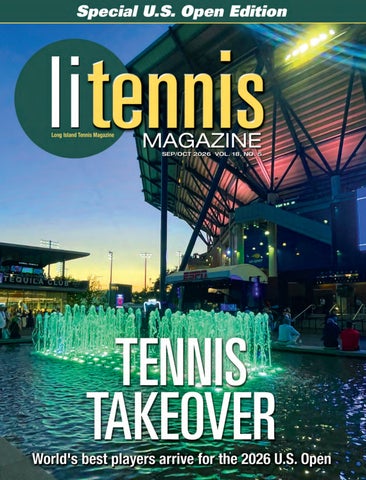
September/October 2026 • Volume 18, Number 5
Table Of Contents 2026 U.S. Open Preview Highlights
Long Island Tennis Magazine 1228 Wantagh Avenue, Suite 203 Wantagh, NY 11793-2202 Phone: (516) 409-4444 • Fax: (516) 409-4600 Web site: www.litennismag.com
Staff David Sickmen Publisher (516) 409-4444, ext. 309 david@usptennis.com Brian Coleman Senior Editor (516) 409-4444, ext. 326 brianc@usptennis.com Joey Arendt Art Director Marie Santora-Lent Advertising Coordinator (516) 409-4444, ext. 301 Marie@usptennis.com
See page 42
HIGHLIGHTS
Photo credit: David Sickmen/LI Tennis Magazine
4 USTA Long Island’s Kids Day Events Provide A Pathway To A Lifetime Of Tennis Fun 8 The Team Behind “Little Mo”: Making Memories On And Off The Court By Brian Coleman 12 New Night, New Venue: Courts & Cocktails Raises Money For A Good Cause 14 Junior Player Spotlight: Vivienne Anton, Ross School Tennis Center By Brian Coleman 16 2026 Long Island Girls’ High School Preview 24 How Tennis Helped Elevate Parsa Samii To The Top Of His Industry By Brian Coleman 26 2026 New York City Girls’ High School Preview 36 Beyond the Baseline: Andrea and Ed Krass By Brian Coleman 52 Coaching Spotlight: Mike Barrell, SPORTIME/John McEnroe Tennis Academy 56 At The Net w/ Neil Thakur, USTA Eastern By Brian Coleman
Emilie Katz Assistant Marketing Coordinator
Contributing Writers: Ricky Becker Eldad Campbell Dr. Tom Ferraro Steve Kaplan Chris Lewit
Advertising To receive any information regarding advertising rates, deadlines, and requirements, call (516) 409-4444 or e-mail info@usptennis.com. Article Submissions/Press Releases To submit any material, including articles and press releases, please call (516) 409-4444 or e-mail info@usptennis.com. The deadline for submissions is the first of the month preceding the target issue. Subscriptions To receive subscription information, contact (516) 409-4444 or e-mail info@usptennis.com or check out our Web site: www.litennismag.com. Fax subscription changes to (516) 409-1600. Statements of fact and opinion in Long Island Tennis Magazine are the responsibility of the authors alone and do not imply an opinion on the part of United Sports Publications Ltd. Long Island Tennis Magazine reserves the right to edit, reject and/or postpone the publication of any articles, information or data.
PG 8
PG 16
PG 36
PG 52
FEATURES
3 Dwight Global Online: The Right Fit For Scholar-Athletes 6 Comparing Injuries: Tennis vs. Pickleball By Dr. Eric Price 20 USTA Eastern Long Island Region Update 22 EPIC Long Island Raises Money At Family Golf, Tennis & Pickleball Tournament 27 Centercourt Hosts GPTCA Mega Course 28 What Can A Tennis Player Learn From An Artist? By Dr. Tom Ferraro 32 USTA Eastern Metro Region Update 35 inPhorm: Where The Court Meets The Coastline 39 Be A Better Loser! By Tonny van de Pieterman 50 The 45-Year Evolution Of The U.S. Open By Ricky Becker 55 More Than 30 Years In, High Country Still Going Strong 59 On The Line 60 Inside A Winning Junior Tennis Program: A Conversation With Magnus Gunnarsson, Advantage Tennis Junior Program Director 62 The Wrong Question About American College Tennis By Chris Lewit 64 SPORTIME Port Washington Hosts 10th Annual JMTA College Recruiting Combine 66 Keeping Injured Performance Players On Court By Cinto Casanova 68 Metro Region Adult League Wrap-Up By Ainslie Ellis 70 Long Island Region Adult League Wrap-Up By Milly Keighery 72 Hard Work By Eldad Campbell 74 Developing Serving And Volley For Junior Players By Leo Correa 76 Tennis For Dummies…And Those That Want To Be? By Steve Kaplan 78 Who They Become: The Long-Term Approach To Player Development By Alex Davis Long Island Tennis Magazine is published bi-monthly by United Sports Publications Ltd. • Copyright © 2026 United Sports Publications Ltd.
Dwight Global Online The Right Fit for Scholar-Athletes
H
as your child ever felt pulled between tennis and school? Having time to dedicate to tennis makes all the difference in maintaining a competitive edge, but the traditional, inperson school day can limit a player’s options. Dwight Global Online School, the online program of Dwight School on New York’s Upper West Side, offers a solution. Dwight Global’s flexible scheduling allows players to maintain rigorous practice, travel and competition schedules, while pursuing academic excellence and joining an energetic, exciting school community. Blended and flexible online learning At Dwight Global, students can attend Dwight online classes from home, their tennis center or on the—road safely, effectively, and flexibly. And because enrollment in Dwight Global gives students access to the thriving, friendly Dwight School community around the world, students are also able to visit Dwight School’s physical campuses— in New York, London, Shanghai, Seoul, and Dubai for in-person experiences, whenever and wherever it’s safe to do so. Dwight Global focuses on the whole student, incorporating their interests and needs into their curriculum. Whether your student is interested in Advanced Placement courses, the
International Baccalaureate Curriculum, or their own personalized course of study, they’ll be participating in a rigorous curriculum, with classes that are NCAA-approved (so they pass all the required standards for entry into Division I and II schools). Teachers that understand Dwight’s expert faculty encourage Dwight’s students to believe in their own talents, follow their hearts and take intellectual risks. They understand every student has unique challenges when it comes to balancing their academic and professional —careersand they’re passionate about supporting students in achieving their goals! Specialized college guidance Starting in Grade 9, Dwight college counselors work closely with players to prepare them for the college admissions process. While some athletes head straight to the pros, Dwight has a long tradition of placing graduates in leadership roles at top college athletic programs. Admissions officers recognize the difference
between a prestigious Dwight Diploma and other online-only programs. The Dwight Global difference for scholarathletes • Students can pursue tennis without compromising their academics. • Dwight’s faculty are experts in their fields and dedicated to personalizing the Dwight Global experience for every student. • Students and teachers achieve deeper learning through small class sizes and college-style seminars. • We are laser-focused on collegereadiness and building lifelong skills. • We have a 145-plus year track record of admissions to top universities. Long-term leadership in academics and athletics Dwight’s Chancellor Stephen Spahn has 50 years of visionary leadership in global education and was himself an All-American basketball player at Dartmouth College. Dwight’s vice chancellor, Blake Spahn, was captain of the undefeated 1994 Ivy League Champion Columbia University Men’s Tennis team, and knows first-hand the demands on today’s scholar-athletes. We invite you to contact Admissions@Dwight.Global, call (212) 724-2420 or visit our website at www.Dwight.Global to start crafting a personalized academic path for your child today.
LITennisMag.com • September/October 2026 • Long Island Tennis Magazine
3
D S DAY R E CA P
K I D S DAY R E CA P
K I D S DAY R E C A P
K I D S DAY R E C A P
K I D S DAY
USTA Long Island’s Kids Day Events Provide A Pathway To A Lifetime Of Tennis Fun
STA Eastern Long Island teamed up with Long Island Tennis Magazine to host two separate Kids’ Day events this summer, bringing free days of tennis to hundreds of kids on Long Island. With each event consisting of multiple diverse, underprivileged and special needs organizations, these events allowed everyone to have a meaningful and fun Tennis experience, with one event in Nassau County and one in Suffolk County. The first Kids Day was held at LuHi Summer Programs in July, and the second at Island Quest Day Camp in August. The events welcome outside groups
U
4
and organizations to offer an experience they normally would not be able to have. On court, the kids took part in tennis instruction that focused on the fundamentals and helped teach the kids the basics of the sport. While the event is built around tennis,
Long Island Tennis Magazine • September/October 2026 • LITennisMag.com
they also provide additional fun off the court to help create a special experience that these individuals wouldn’t normally have. Activities included a dunk tank, water slides, bounce houses, relay races, face painting, and prizes. “Thank you so much to everyone with the USTA Eastern Long Island and Long Island Tennis Magazine for a fun and engaging morning,” said Shaina Fischer, Program Director at Island Quest Day Camps. “The kids had a blast as always and everyone was helpful and accommodating! We look forward to this event each and every year!”
Y RECAP
K I D S DAY R E CA P
The events are the perfect representation of the goals of both USTA Eastern Long Island and Long Island Tennis Magazine, and go a long way in helping to forge a pathway for kids to get introduced into the sport. In all, 400 kids attended the Kids’ Day events, and the goal is that they will continue with this great sport. “It’s our goal to continue bringing tennis fun to so many deserving kids, and it’s always fun to watch their faces light up during our Kids’ Day events,” said David Sickmen, Publisher of Long Island Tennis Magazine. “We’re proud to continue our partnership with USTA Eastern Long Island and help provide these sorts of experiences for young people. At these events, we supply kids with information as well as an unforgettable experience to create a pathway to more tennis opportunities for them in the future to help ensure that they continue playing the great sport of tennis.” Mike Pavlides, the USTA Eastern Long Island Region Council
K I D S DAY R E C A P
K I D S DAY R E C A P
Director, added: “The USTA Eastern Long Island Region was pleased to continue offering its yearly summer Kids’ Days, which is a core staple of our mission (introducing tennis to kids that have never had the opportunity to try the
K I D S DAY R E CA
game, and to see how much fun it is). Our hope is that they continue to seek out opportunities to play with their friends, siblings, and parents, and eventually consider going on to play in middle/high school and beyond as tennis is a ‘sport of a lifetime’”.
LITennisMag.com • September/October 2026 • Long Island Tennis Magazine
5
Comparing Injuries: Tennis vs. Pickleball By Dr. Eric Price
ne of the more interesting trends I've seen in my orthopedic practice over the last several years is the dramatic rise in pickleballrelated injuries. As someone who has treated tennis players for many years, the differences between tennis and pickleball athletes are becoming increasingly apparent—not only in the types of injuries they sustain, but also in why those injuries occur. Tennis players, particularly experienced players, often develop injuries related to repetitive high-level mechanics and overuse. The classic examples are tennis elbow, rotator cuff tendinitis, shoulder impingement, wrist tendinitis, and knee problems resulting from years of lateral movement and repetitive serving. Tennis requires larger court coverage, explosive sprinting, overhead serving mechanics, and significant rotational forces through the shoulder, trunk, hips, and knees. Because of these demands, tennis injuries frequently develop gradually over time as a result of chronic stress and repetitive motion. Pickleball, on the other hand, has introduced a very different injury
O
pattern. The sport appears deceptively easy because the court is smaller and the game is highly accessible, but it still requires quick reactions, sudden directional changes, balance, and hand-eye coordination. As a result, I see many more acute injuries in pickleball players, including calf strains, Achilles tendon injuries, hamstring pulls, wrist fractures, and injuries related to falls. An important distinction is court movement. Tennis involves more continuous movement across a larger court, whereas pickleball involves frequent short bursts, quick lunges, and rapid deceleration near the non-volley zone, commonly known as “the kitchen.” These abrupt movements contribute to many lower-extremity injuries. I also see more balance-related injuries in pickleball, particularly falls resulting in wrist, shoulder, and occasionally hip fractures. Another factor is the population participating in each sport. Tennis players often have years of sportspecific conditioning, footwork training, and athletic development behind them. Pickleball has attracted many adults
Tennis Court Equipment & Material Now Available:Graco SaniSpray HP Airless Disinfectant Sprayers
Tennis Posts & Nets • Court Accessories Windscreen • Netting & Hardware (631) 427-5904 velvetop.com
1455 New York Ave Huntington Station, NY 6
Long Island Tennis Magazine • September/October 2026 • LITennisMag.com
back into athletics after long periods of relative inactivity. This is one of the sport's greatest strengths, encouraging people to become active again, but it can also increase injury risk when activity levels rise faster than the body's muscles, tendons, and joints can adapt. Shoulder injuries differ somewhat as well. Tennis serves generate tremendous overhead velocity and repetitive stress, making chronic shoulder pathology common among competitive players. Pickleball players can certainly develop shoulder and elbow problems, but the motions are generally less extreme. Instead, many injuries result from awkward reaches, falls, or overuse associated with playing too frequently without adequate recovery. One thing both sports have in common is that preparation matters. Proper footwear, flexibility, strength training, balance work, and gradual progression in activity level can significantly reduce injury risk. Warm-up routines are often overlooked, particularly among recreational athletes. Many of the injuries I see could potentially be avoided with better conditioning and realistic pacing. Whether you're a lifelong tennis player or a newcomer to pickleball, the goal is the same: stay healthy enough to keep playing. The athletes who remain on the court longest are often not the most talented, but the ones who respect recovery, maintain their conditioning, and address injuries before they become chronic problems. Eric Price is an orthopedic surgeon with 20 years of experience treating athletes. He is passionate about making sure you can get back to the sports you love. He has extensive training and sports medicine in particular focuses on making sure that athletes have proper mechanics when they're playing so they can avoid and overcome injury. For appointments, visit www.northwell.edu/find-care/find-a-doctor/dr-ericmitchell-price-md-1861491045 or call (516) 536-2800.
#
# #
#
#
#
# #
#
#
#
#
#
# #
#
# #
# #
# #
#
#
#
#
#
#
# #
# # # #
#
#
#
# # # # #
#
#
# #
# #
# #
#
LITennisMag.com • September/October 2026 • Long Island Tennis Magazine
7
Tiffany Hollebeck has become an integral part of the “Little Mo” Tournament Series over the last few years
The Team Behind “Little Mo” Making Memories On and Off the Court “Little Mo” tournaments so n early September, some of successful and so memorable. the top junior tennis players Everyone sees the postfrom around the country will tournament photos on social arrive in New Jersey for the media, or reads about the long annual “Little Mo” North list of champions who have gone Regionals, one of the many on to accomplish amazing things tournaments that make up the on the pro tours, but without the iconic and historic “Little Mo” men and women of the event series. foundation, none of it would be For decades, the “Little Mo” possible. tournaments have provided One of those key members is tennis players from around the Tiffany Hollebeck, who serves as world with a combination of the event’s Tournament competition and sportsmanship Operations Manager. A native of that have shaped the method of Texas, Hollebeck was a top junior not just the tournaments tennis player growing up and themselves, but the MCB Tennis would go on to have a decorated Foundation, named for Maureen collegiate career, first at SMU Connolly Brinker, the legendary professional tennis player from From left to right: Carol Weyman, MCB Executive Vice President and playing Division I tennis before the 1950s who was nicknamed Founder of the Road to the “Little Mo” Nationals and Internationals; finishing at Midwestern State University where she would earn “Little Mo”. In that spirit, the staff Tiffany Hollebeck - “Little Mo” Tournament Operations Manager; at the MCB Tennis Foundation Cindy Brinker Simmons- MCB President and daughter of Maureen her master’s degree. Her arrival at the MCB Tennis Foundation who run the tournament series “Little Mo” Connolly Brinker initially came as a surprise, when continue to make lifelong she received a phone call from the memories for players and their And it’s those staff members who organization’s Executive Vice families a top priority. are at the heart of what makes the
I
8
Long Island Tennis Magazine • September/October 2026 • LITennisMag.com
President, Carol Weyman. “I remember it was 2022, and ‘Little Mo’ needed a site director at the last minute,” recalls Hollebeck. “I was referred to Carol, and she called me to see if I could manage the desk at the tournament. Running a tournament desk was something I had done before so I knew what the job required. It was a wonderful experience and it was great meeting the team there.” They were looking to hire full-time, and while Hollebeck declined because she had already accepted another job offer elsewhere, she remained in touch with Carol. “She played it very smart,” Hollebeck says jokingly. “We would continue to talk, and she would send me a text once a month or so asking how I was doing, how everything was going. So when I realized working in an office full-time, which was what I was doing at my other job, wasn’t for me, I reached back
out to Carol.” It turned out to be a perfect match. Hollebeck joined the MCB Tennis Foundation full-time, and little by little would assume more responsibilities as her role expanded. She handles all the details and logistics that it takes to get ready for the tournament, and once it is done, the work begins on planning next year’s event. And that work is extensive. “She handles all these different aspects not just at our tournaments, but year-round, and does it so well. It’s important to be organized and manage your time well, and she does it with such ease. Everyone on the team respects her, as do I, and she’s always eager to learn more,” said Weyman.“If you’ve ever seen the Ed Sullivan Show where they had the guy on who had all the plates spinning, or someone who is juggling, that’s what Tiffany does.” With a smile, Weyman added: “Tiffany can actually juggle also,
so it’s perfect.” Hollebeck and the team prepare all the materials needed for the tournament and ship them to the host site ahead of time so that they are ready for their arrival. About two days before the tournament is scheduled to begin, the staff gets to the location and is presented with a blank canvas. “We get to the club and it’s just the tennis courts, but we make it very presentable and very fun, in the spirit of ‘Little Mo’,” explains Hollebeck. “We set up all of our desks, and our booths. The day before, it’s quiet at the club, it’s usually just the members, but it’s the calm before the storm. The day of the tournament, all of a sudden there’s hundreds of kids with their tennis bags scattered around. There’s an energy that comes over the place, mixed with a little nerves. But it’s a fun vibe there and it sets the continued on page 10
Get Your Game On ROSS SCHOOL TENNIS CENTER EAST HAMPTON, NY • Junior Development Program • After school programs for beginner to intermediate • Adult tennis • Summer Tennis and Sports Camp Programs • Private lessons and group clinics
See details on seasonal programs at ross.org/tennis 631-907-5162 TENNISCENTER@ROSS.ORG
LITennisMag.com • September/October 2026 • Long Island Tennis Magazine
9
the team behind “little mo” continued from page 9
stage for a fun week.” junior tennis players, and the But if you have ever been to appeal of them goes much a junior tennis tournament, you further than wins and losses on know that that fun vibe can the court. They are a chance to oftentimes change to an appreciate the power that adversarial one. Between the tennis can have in bringing emotions of the players, the people together, and it’s demands of the parents, and because of all the work done even unpredictable weather, by the staff, and their caring Hollebeck and her team have personalities that can be felt to handle an array of issues when you attend one of them. that will inevitably arise. The work for the next It’s in those moments where tournament begins as soon as Hollebeck’s leadership and the previous one ends, and experience plays a vital role. Hollebeck and her team are in “There’s a lot of things we the thick of it now preparing can control, and also things for the North Regionals at the that we can’t,” she says. “We West Orange Tennis Club in always make sure to listen to New Jersey. After that, it parents, because at the end of moves to Austin for the “Little the day they just want to and Mo” Nationals, before closing deserve to be heard. We don’t out the year with the “Little take anything personally, we Mo” Internationals event in know we have done all the Palm Beach Gardens, the third preparations in order for the and final leg of the “Little Mo” Hollebeck with “Little Mo” Palm Beach Gardens Host Site Tournament tournament to run how it Slam. should run. But things do come Director Jake Bryan “We’re so excited to get up and we make sure we hear back up to the Metropolitan and families as well. from everyone if they want to talk to area, especially with it being around “It’s funny because when they’re us, and do the best we can in order the time of the U.S. Open,” said young, eight or nine years old, and to handle any complaints.” Hollebeck. “The energy up there is it’s their first time playing our events, unlike anything else, and it’s great to Thankfully, those moments prove to the second time they play an event be the outlier as the atmosphere be reunited with the players and all they say, ‘Oh, it’s you guys again’, around the “Little Mo” tournaments is of our staff.” extremely positive, and reinforced by and we develop a friendship of Tennis has been a huge part of sorts,” Hollebeck says. “We remain the booth where players can Hollebeck’s life since she was a little professional, of course, but it’s exchange their “Mo” Coins, which girl, and she feels honored to work important that we see the same they earn for sportsmanship and fair for such a prestigious organization players, and the same families, and play, for prizes. This is a key factor that embodies the best of what tennis watch them grow from eight-yearsin maintaining the spirit the can be. old to 12-years-old. A lot of kids are tournaments are supposed to be “It’s been an honor to work for the nervous when they first come, but by played in. Foundation, and learn all about the end of the circuit, they have And it’s because of that spirit that Maureen Connolly as well. Her story made a whole group of friends, and Hollebeck, Weyman and the entire isn’t shared enough, and I think the sometimes friends from across the MCB Tennis staff develop such a tournaments and the foundation do a rapport with the players and parents, world. These relationships get built great job of making sure we and it’s so cool to see. We can see many of whom they see multiple remember her the way she deserves we are providing a great tournament to be. Between all of the history, and times throughout the year at different experience, but it goes beyond that.” all the work we do, it’s an honor to tournaments, and also year-afterThe “Little Mo” tournaments are a year, and watch unlikely friendships work here and keep that legacy unique stop on the calendar for top get developed amongst the players going.” 10
Long Island Tennis Magazine • September/October 2026 • LITennisMag.com
LITennisMag.com • September/October 2026 • Long Island Tennis Magazine
11
New Night, New Venue Courts & Cocktails raises money for a good cause while providing unmatched tennis fun
he Courts & Cocktails event series was launched to provide unique Saturday night tennis experiences for adults while raising money for worthy causes. That continued this summer, but for the first time, the event was held on a new night, and in a different setting. While the events are typically held on Saturday nights at indoor facilities, the latest Courts & Cocktails was held on a Tuesday night on the outdoor courts of Engineers Country Club to benefit Grow Tennis New York, the non-profit arm of Long Island Tennis Magazine whose mission is to promote the sport of tennis and educate on the importance of fitness
T
12
and health for adults and children, bringing the sport to those in the community that cannot afford to play. Spread across the har-tru courts at Engineers, players were broken up by level as teaching professionals guided the groups through fast paced, high energy games. Players switched courts regularly which allowed everyone a chance to play with and meet a multitude of players throughout the night. The on court portion of the event concluded with a group competition with everyone playing together and the winner earning a prize. Throughout the event there was an open bar, and LITM’s event staff served
Long Island Tennis Magazine • September/October 2026 • LITennisMag.com
drinks on the courts to the players, while music played to keep the event lively and fun. After two hours on-court , the players enjoyed a dinner spread which was catered by Engineers CC. As sunset time came, everyone socialized and enjoyed themselves on a perfect summer evening. “Courts and Cocktails was extremely well-run,” said Miguel Cobbs, Director of Tennis at Engineers Country Club. “My members that attended had a fabulous time, and are looking forward to having it again!” The events serve as a way to benefit all aspects of the tennis community, from providing more work opportunities for the
OURTS
OURTS
OURTS
OURTS
C
C
OURTS
& COC KTAILS
Sickmen added. “And we embrace using these events as a way to fundraise, and continue growing all aspects of tennis in our community. We want to continue to expand and grow them and the sport of tennis, so being able to bring this unique event to a new club, and one as beautiful as Engineers, and run it outdoors was important to us.
& COC KTAILS
C
OURTS
& COC KTAILS
KTAILS
KTAILS
KTAILS
C
teaching pros, to helping fill vacant court time at the host clubs, and reinforcing the players’ passion for tennis, while giving them a social environment to further enjoy the sport they love. “Our events showcase all we love about tennis, from the competitiveness to the social side and the fun both on and off the court with like-minded people,”
& COC
C
& COC
C
& COC
Miguel Cobbs was invaluable in helping us and his generosity is appreciated. We had new players participate in this event and they met people and are already connecting for additional opportunities to play outside of our events. And that’s part of what I love about these events. This was a success and we look forward to bringing it back next summer!”
LITennisMag.com • September/October 2026 • Long Island Tennis Magazine
13
junior player spotlight junior player spotlight junior player spotlight junior player spotlight junior player spotlight junior player s
Junior Player
spotlight By Brian Coleman
Vivienne Anton Ross School Tennis Center ennis is a complex, difficult sport that requires an array of skills and technique in order to be successful. It’s also a sport that involves many variables that one can not control; your opponent, the weather, injuries and more, are just some of the complications that arise that a player must overcome. The one aspect that is and always will be in the player’s control is their effort and dedication. It’s a character trait that Vivienne Anton has always possessed and is at the core of who she is as a tennis player. A 12-year-old junior player at the Ross School Tennis Center who is preparing to enter the eighth grade this fall, Anton is a shining example of the potency of the RSTC programming. “It’s the effort she puts in, and her commitment to her tennis,” said RSTC Director Richele LeSaldo when asked what makes Anton a special player to work with. “When you get on court with her, you know you are going to get everything she has that day. She is someone who is always thinking about the game, eager to break it down. She knows it’s like a chess match, and adding more tools to her bag will make her a complete player.” Anton has been training at RSTC since her family moved to East Hampton during COVID when Vivienne was six-yearsold. Originally from Williamsburg, Brooklyn, Anton began playing tennis with her father when she was four-years-old,
T
14
and her first real tennis lesson took place in Italy during a family vacation. But tennis was something she could share with her father and an activity they could do together, and it was during those times that her passion for tennis was formed. “I really enjoyed connecting with my dad through tennis, and it was a great way to spend time with him,” Anton recalls. She was also a swimmer and did ice skating, but it was tennis that would stand out most to her in those formative years, and was the sport she wanted to pursue further. She began attending the Ross School when she was in fourth grade, and joined the RSTC to continue her tennis career. “I started in the Yellow Ball + program, and I remember being the youngest one in it,” said Anton. “The older players were such great mentors though and I really enjoyed that, and it created this really welcoming community to grow up in.” For the last six years, Anton, who says her favorite players on tour are Jannik Sinner and Elena Rybakina, has been honing her talents in the RSTC pathway and now trains in the highperformance program. “The coaches here believe in me, and I believe in them,” she said. “I trust them, especially when I see improvement when implementing the things they teach. That trust is very important and I really listen to their coaching.” As a result Anton has begun to see success in tournaments,
Long Island Tennis Magazine • September/October 2026 • LITennisMag.com
spotlight junior player spotlight junior player spotlight junior player spotlight junior player spotlight junior player spotlight juni
even when competing against girls in higher age divisions. Earlier this summer, she captured the title at the L5 Providence Summer Splash in Rhode Island in the Girls 12s division, and recently competed in the Girls 16s division at an L5 event in Amagansett. And while she would fall in a hard-fought third-set tiebreaker in that tournament, it was the kind of performance that validates the work her and the coaches at RSTC are putting in. “The process is good, and we have no doubt the results will come,” said LeSaldo. “She is on the right path, and she’s committed.” Anton is a player that considers herself to be a baseliner, anchored by an effective serve that helps her dictate points. In order to bolster her all-around game, she is currently working on getting more comfortable coming to the net and improving things such as her volleys and overheads. Playing against older girls will prepare her for where she wants to go as a tennis player. As a seventh grader a year ago, she competed on Ross School’s junior varsity team, but has her sights set on being promoted to the varsity team this season. “I definitely want to make varsity this
year, I think I’m ready,” she said. “I would love to be involved with the team, and learn from a lot of the older girls, and then become a mentor to the younger players as I get older. I think the
Ross community here is great for that.” Anton continues to thrive under the Ross School umbrella, and for the last six years she has been growing as a person and a player. She is fully aware of how fortunate she is to attend a school that prides itself in academics and cultural enrichment, while also offering her an opportunity to train with top tennis coaches at a top tennis facility. “Ross is such a special school, and I feel that every time I walk to class through this beautiful campus,” Anton explained. “There is so much nature to enjoy, the teachers are incredible and supportive, and it’s such a welcoming and helpful community.” Anton self-describes as an artsy teenager who enjoys musical theatre and reading when she isn’t studying or training for tennis, and she loves spending time with her parents. It is on the tennis court where she feels most comfortable though, which is why she has become a proud representative of what the Ross School is all about. “One of the goals of our program is to develop champions,” said LeSaldo. “We challenge our student-athletes to be their best and to give of their best every day. As Vivi said, Ross is a special place, full of extremely ambitious and talented students.”
LITennisMag.com • September/October 2026 • Long Island Tennis Magazine
15
2026 LONG ISLAND HIGH SCHOOL GIRLS’ TENNIS PREVIEW 2026 LONG ISLAND HIGH SCH
2026
LONG ISLAND
high school girls’ tennis PREVIEW Nassau County Teams to Watch Syosset
he end of summer doesn’t only mean the start of the U.S. Open, but also that a new year of girls’ high school tennis is almost here on Long Island. Last year, Long Island was home to both New York State Public High School Athletic Association (NYSPHSAA) Champions, with Bayport-Blue Point capturing the Division 2 title, and Syosset bringing home the Division 1 crown. Now it’s time to look ahead to the 2026 season. Long Island Tennis Magazine has broken down some of the players and teams to watch, and also included is the key scheduling dates this fall as we prepare for another great season.
T
Last year, Syosset captured the program’s first girls tennis state title, and will be out to defend that championship as we head into the fall. The Braves are the three-time defending Long Island Large School (Division 1) champions and three-time defending Nassau County Champions, and have the roster built to continue that dominance. It will have to do so without graduating senior Stephanie Marcheret, the Nassau singles champion, last year’s co-captain Julia Isham as well as Skyler Lin who played second singles a year ago. Hannah Wang, who played primarily in the third singles spot last fall, will play a large role in the singles lineup, as will seventh grader Juliette Prince who will be making her varsity debut this season. Syosset always possesses immense depth including Tiffany Cai, Diya Varma, Selena Wang, Shubu Pradhan, Kayla Kim, Kayla Lo and more to compile one of the deepest and talented rosters on all of Long Island. Port Washington
*All players and dates are subject to change. Check NYTennisMag.com for the most up-to-date information. 16
Long Island Tennis Magazine • September/October 2026 • LITennisMag.com
Port Washington returns all but one starter from last year’s Nassau County runners-up team which leaves the Vikings with high expectations this fall. Sophomore Briana Lewis is back to anchor the singles lineup, as is senior
OOL GIRLS’ TENNIS PREVIEW 2026 LONG ISLAND HIGH SCHOOL GIRLS’ TENNIS PREVIEW
Evie Loewy. Together, the two won the Nassau County doubles title and finished fifth in the state tournament, and will lead the way in singles play for Port Washington. Seniors Christiana Kent & Shoriya Bhat-Bhandarkar were the third place finishers in the Nassau County doubles tournament and return alongside fellow seniors Ruby Siskind, Peri Cooper and Siena McGuffin, and junior twins Jamesy and Lila Hershman. Eighth-grader Vanessa Wang will lead a talented group of young players that will help bolster a Port Washington lineup with its sights set on a county title. Herricks If Herricks is to make a deep playoff run this fall, it will rely on its talented group of young players. Sophomores Cassidy Chu and Samantha Liu anchor the lineup, and will be helped out by freshman Sharini Nigam as well as returning starters such as Catherine Zhang, Emma Wong, and Grace Kang as Herricks looks to build off of a successful 2025 season and have high aspirations for this season. . Manhasset Manhasset advanced to the quarterfinals in the Nassau County playoffs a year ago and has plans on making a deeper run this fall. If it is to do so, Manhasset will lean on its talented youth to carry them. Leading the way will be Kristen Maurischat who will anchor the singles lineup, as well as eighth-grader Maya Rajpal. The two girls played second and third singles, respectively, in 2025 and will each move up a spot with outgoing senior Diane Durante vacating first singles. In addition, Audrey Wu, Ellen Zhao, Lucy Kauftheil and Naya Shah will be back to help form a lineup that can compete with anyone in the County. Garden City The Garden City Trojans are a team that is poised to play deep into the season this fall, and build on a successful 2025 campaign that saw it reach the quarterfinals. Junior Chelsea Ching will top the lineup and use her immense varsity experience to lead a team that has experienced depth pieces, as well as talented freshmen Maya Wiese and Ava Bravo helping to formulate an impressive singles trio. If Garden City can get good play from its doubles teams, the Trojans will be a threat late in the season.
Nassau County Additional Players to Watch
• Lilliana Chou, Division • Chloe Gross, Roslyn • Daisy Lichtenstein, Roslyn • Sarika Prabhakar, Wheatley • Dhriti Reddy Pylla, Jericho
Nassau County Key Dates (these dates are tentative. Check LITennisMag.com/Events for up-to-date information) • Regular Season Begins - Thursday, September 3 • Regular Season Ends - Monday, October 5 • County Individual Tournament - Saturday-Sunday, October 10-11 • Team Playoffs Begin - Tuesday, October 6 • Small School Championship - Tuesday, October 20 • Large School Championship - Wednesday, October 21 • LI Small School Championship - Friday, October 23 • LI Large School Championship - Saturday, October 24 • NYS Individual Championships - Monday, October 26 Wednesday, October 28 • NYS Team Championships - Friday, November 6
Suffolk County Teams to Watch Bayport-Blue Point Over the last couple of seasons, the Phantoms of BayportBlue Point have established itself as a tennis powerhouse on Long Island. Winners of the last two Long Island Small School (Division 2) titles, Bayport-Blue Point completed its dream season last year by claiming the New York State Public High School Athletic Association
LITennisMag.com • September/October 2026 • Long Island Tennis Magazine
17
2026 LONG ISLAND HIGH SCHOOL GIRLS’ TENNIS PREVIEW
(NYSPHSAA) Division 2 title. Now, with essentially the same roster back this fall, the expectations are to defend those titles. Leading the way will be Suffolk singles champion Lily Castka who is out to finish her high school career on top. Evie Romano, a two-time all-state doubles player also returns to anchor a lineup that boasts an array of championship experience including Jordana Heller, Leila Rogers, Julie Wellems, Eden Romano and Maddie Castka. Ross School The biggest competition for the Phantoms in the last couple of years have been the Ravens of the Ross School. Returning to guide them back to a deep run in the Suffolk County Small School playoffs is last year’s Suffolk doubles champions, Lillie Weiss & Lola Dangin, two of the county’s top players. Brooke Saracco and Olivia Caruso will also return and bring their varsity experience to the table, and Luma Teixeira will be back this year to anchor the singles lineup while the Ravens hope to get key contributions from young and upcoming talent such as Vivienne Anton. Hills East The label of three-time defending Suffolk County Large School Champions belongs to Hills East, and the Red Hawks will be in full pursuit of its fourth straight. Hills East has been the top team in the county and has established itself as the benchmark of success so its players are used to competing in high-leverage situations. That includes Myrah Galhotra, Zoey Grochow, Kayla Grochow and Avery Sherman, among others, and are prepared to make another deep run in the Large School playoffs to finally reach the state championships this season. Westhampton Beach Westhampton Beach came up just short of representing Suffolk County in the Long Island Large School Championship last fall, and Hurricanes are excited for the 18
opportunity to try and get there this season. A determining factor in their success will be the play of eighth-grader Riley Magner, who enters this season with the highest UTR on her team, and is slated to play first singles. Gabriela Arango & Zoe GrelletAlmont were all-state doubles players last season and will provide valuable experience, as will Madeline Montgomery, as the Hurricanes hope to get back to the state playoffs. William Floyd A top four finisher in the Suffolk County Large School playoffs in 2025, the Colonials have made the playoffs in 23 straight seasons, and have their sights set on a 24th straight postseason berth this fall. A senior-led lineup will be at the helm of that push, including the county doubles runners-up, Anabel Van Cott & Lydia Van Cott, who earned all-state honors, as well as Gianna Martin, who earned all-county honors. Seniors Tatiana Sanchez and Rylie Wiegand, as well as junior Khloe Dimaio, were all-division honorees in 2025, and bolster a lineup capable of making a deep run in the Suffolk large school playoffs.
Suffolk County Players to Watch • Aya Deckman, Harborfields • Ava Hagerdorn, Northport • Ema Villacreses, Sachem • Sofia Matos, Longwood • Sofia Perez, Mt. Sinai • Sara Zaniel, Kings Park
Suffolk County Key Dates (these dates are tentative. Check LITennisMag.com/Events for up-to-date information) • Regular Season Begins - Wednesday, September 2 • Regular Season Ends - Wednesday, October 7 • Divisional Individual Tournament - Saturday-Wednesday, October 10 - October 14 • County Individual Tournament - Saturday-Tuesday, October 17-20 • Team Playoffs Begin - Thursday, October 8 • Small School Championship - Thursday, October 15 • Large School Championship - Friday, October 23 • LI Small School Championship - Friday, October 23 • LI Large School Championship - Saturday, October 24 • NYS Individual Championships - Monday, October 26 Wednesday, October 28 • NYS Team Championships - Friday, November 6
Long Island Tennis Magazine • September/October 2026 • LITennisMag.com
LITennisMag.com • September/October 2026 • Long Island Tennis Magazine
19
USTA Eastern Long Island Region Coming Soon: USTA Long Island Region Awards
USTA Eastern's Long Island Region is thrilled to announce the return of its Annual Awards Event. The 36th celebration of Long Island’s tennis community will be held on Wednesday, October 14, 2026 at Sea Cliff Manor in Sea Cliff, NY. The reception --including hors d’oeuvres, pasta, chicken, wine and beer – will start at 6pm and will be followed by the awards ceremony at 7pm. The cost to attend is $65 for adults and $45 for children under age 14. The Long Island Regional Council looks forward to
recognizing the achievements of individuals, facilities and organizations that have gone above and beyond, both on the court and off. Some awardees will be honored for their tennis play and/or rankings, while our Prestigious and Excellence award recipients are nominated by the Long Island tennis community. Want to attend the event and cheer on the honorees? Visit our website (www.longisland.usta.com) for the link to register as well as a complete list of those being recognized.
Kids on the Court
USTA Long Island Regional Council volunteers bring tennis fun to kids One of the USTA Long Island Regional Council’s favorite events is Kids’ Day every summer. This year saw two great kids’ day events, held with the support of regional volunteers and Long Island Tennis Magazine. Special 20
thanks to everyone who helped make kids’ days a success, to host sites LuHi and Island Quest, and to all the community groups that brought their kids for fun tennis programming and more.
Long Island Tennis Magazine • September/October 2026 • LITennisMag.com
USTA Eastern Long Island Region On the Ball: News from LI Looking for more news about local tennis happenings in Nassau and Suffolk? Want to keep up with what your Long Island volunteers are doing to bring tennis programming and events to communities across the Island? Check out “On the Ball: News from LI,” the quarterly electronic newsletter
published by the USTA Long Island Regional Council. You can read past issues of the newsletter at www.longisland.usta.com; if you want to make sure to see the news as it happens, subscribe by emailing ustaonlongisland@gmail.com with the subject line “Newsletter.”
Celebrating Sportsmanship
The boys’ high school tennis season this past spring saw many examples of outstanding sportsmanship at the school and county levels. The LI Regional Council is proud to provide a plaque to each coach who requests
one to recognize exemplary sportsmanship. To see a list of those recognized in Nassau and Suffolk Counties, please visit www.longisland.usta.com
Sign-up for a USTA Flex League - Receive a Free Tote Sign-up for USTA Flex Leagues now offered at select SPORTIME locations (no membership required) and receive a branded tote bag. Work on your game with similarly
skilled players and play fair, competitive matches at a time that works for you. Download the USTA Flex app here and search for "SPORTIME" to find a league near you.
Long Island Regional Council Executive Committee Mike Pavlides, Regional Director Jonathan Klee, Past Regional Director Sunny Fishkind Tito Perez Jason Wass Randi Wilkins Neil Thakur, Manager, Schools Tennis and Long Island CTC (thakur@eastern.usta.com) Milly Keighery, Adult League Coordinator Long Island Region (Keighery@eastern.usta.com) Facebook: Play Tennis Long Island • Instagram: USTA Eastern LITennisMag.com • September/October 2026 • Long Island Tennis Magazine
21
IC LONG ISLAND
EPIC LONG ISLAND
EPIC LONG ISLAND
EPIC LONG ISLAND
EPIC Long Island Raises Money at Family Golf, Tennis, & Pickleball Tournament
undreds came out to take part in and support the EPIC Family Golf, Tennis, & Pickleball Tournament at The Mill River Club in Upper Brookville The annual event is one of the key fundraising endeavors for the EPIC Long Island Family of Agencies, which has been serving communities across Nassau and Suffolk counties with a variety of programs that enrich the lives of individuals affected by epilepsy, developmental disabilities and emotional challenges. The event featured three sports, with the golf portion consisting of multiple contests for putting, best ball, longest
H
22
ball, as well as normal stroke play. The tennis portion featured a dedicated group of individuals who took part in a multitude of tennis drills and clinics led by tennis professionals from The Mill River Club, and a pickleball tournament for advanced players, and a beginners clinic followed in the afternoon. “This outing is an opportunity to honor someone who has made a significant impact on our organization as well as those we serve, but it is also a fun day to be outdoors and enjoy time with colleagues, network and relax a bit,” said Lisa Burch, CEO & President of the EPIC Family of
Long Island Tennis Magazine • September/October 2026 • LITennisMag.com
Human Service Agencies. “I hope that particpants who are new to EPIC come away learning more about who we are and what we do and feel inspired to continue their involvement. For folks who have been connected to the EPIC Family, I hope they come away feeling proud and reenergized.” This year’s honoree was Peter Armstrong Egan, known by most as Pete, a nationally recognized healthcare lawyer at Nixon Peabody LLP whose work centers on helping hospitals, behavioral health providers, and healthcare organizations navigate regulatory,
EPIC LONG ISLAND
EPIC LONG ISLAND
transactional, and compliance challenges. As legal counsel and a trusted advisor to the EPIC Family of Human Service Agencies, Pete has guided the organization through periods of remarkable growth and transformation. With his unwavering commitment and exceptional expertise, Pete has supported complex mergers, incorporations, and strategic partnerships that have enabled the EPIC Family to evolve from a single agency into a dynamic set of agencies serving diverse community needs. Off the court, the players enjoyed brunch and lunch throughout the day, and it concluded with cocktails and an awards dinner at the end. There were raffle tickets up for sale which coincided with an array of wonderful auction items including sports memorabilia, clothing accessories, U.S. Open tickets, experiences, jewelry and much more. EPIC Long Island has been serving the local community for more than 60 years, and continues to provide an invaluable service for so many Long Islanders. This year’s event once again helped raise money for the organization so it can maintain its
EPIC LONG ISLAND
for,” Burch added. “Without fundraised dollars, we would not be able to provide, for example, employee appreciation events, marketing materials and PR to let people know about our services. We are grateful to the many participants and sponsors for their ongoing support.” People can learn more about the EPIC Family, the services it provides, how to become involved, support or donate by visiting www.epicli.org The next event is the Walk for Epilepsy which is set for Saturday, October 17 at Eisenhower Park. More info can be found on its website.
level of service and continue to offer a wide-range of quality in-home, community, and site-based services. It is events like this, and those who come out to support the events such as this, that allow EPIC Long Island to continue providing all the services it does. “This event is one of four fundraisers that we do every year. The others are our annual gala, our spring fling walk for mental health and our Epilepsy Walk. These events are important to the mission of EPIC because they allow us to raise unrestricted funds which can be used for things that government funds cannot be used
EPIC LONG ISLA
LITennisMag.com • September/October 2026 • Long Island Tennis Magazine
23
How Tennis Helped Elevate Parsa Samii To The Top Of His Industry By Brian Coleman omething taught to every young student and athlete is that the skills and lessons learned on the court, field or track are things that can be carried into all walks of life and used long after someone hangs up their competitive athletic career. This is an accurate sentiment across all sports, but especially in tennis. When you are a competitive tennis player, everything from training to matches carries with it life lessons that once instilled in you, remain a part of who you
S
24
are forever. So when Real Estate Salesperson Parsa Samii of Compass was ranked as the #1 Individual Agent by Sales Volume by U.S., Real Trends for 2025, he instinctively went back to his tennis playing days when asked about what it meant to achieve the accomplishment. “It’s a validation of the work I do on a daily basis. It shows that I am doing the right work, and taking the proper steps in order to be successful and best serve my clients,” Samii said. “But truthfully, it’s just
Long Island Tennis Magazine • September/October 2026 • LITennisMag.com
a ranking from last year, and I’m very much an ‘in the moment’ type of person. I play it point-by-point, or day-by-day, in this case. This honor tells me that six months ago I did a good job, but it doesn’t mean anything if I don’t do a good job today. It’s great that the process is garnering results, but it’s about maintaining that process.” It’s the same attitude he developed as a competitive tennis player. Whether you win or lose in a match or at a tournament, there isn’t time to dwell on what happened, there is another match to play. Or, in this case, another client that needs to be assisted. “I think there’s a relentlessness you have to have the same way I had as a player,” he explained. “You play a tournament and lose; okay, there is a match tomorrow. You won a tournament? Great. But there’s another tournament next week. And just like in tennis, there are roadblocks and you have to find your way around it. If someone is playing to my weakness, I have to figure out a way to get to my strengths. It’s similar in real estate. I ask myself what my strengths are, and how I can use those to benefit my client. If that doesn’t work, let’s move on to the next one. It’s a never ending grind, and you have to have a never give up attitude.” Parsa developed that mindset and that skill set from a lifetime of high-performance tennis, both as a player and a coach. A native of the North Shore of Long Island, Samii grew up as a competitive tennis player and played collegiately at the University of Massachusetts Amherst. He briefly gave it a go on the professional tour before leaning into coaching, using his natural leadership instincts to help develop high-performance tennis players, coaching primarily at the Robbie Wagner’s Tournament Training Center in Sea Cliff. Parsa relished the ability to develop individuals, both as tennis players and as people. He worked with elite junior players as well as professional players, many here on Long Island but also some internationally. And while he loved what he did, eventually, the physical toll began to make Parsa wonder if he should transition into a different career. And so using the same vigor and dedication that made him thrive on the tennis court, he
entered the Real Estate industry. While it isn’t “coaching”, he is still tasked with improving the lives of his clients, which is what gives him the most pride and keeps him motivated day-in-and-day-out. “What keeps me going is the desire to best serve my clients,” he said. “I get to share an expertise with people that I care about, and it’s really awesome to be able to share my knowledge to help others. Just like when I was a tennis coach, I have that same feeling now as I am in my eighth year doing this. There’s very little that I feel like I can’t work through, or help work through. Ultimately, that has really been a gift, and I’ve enjoyed that process here in my eighth year.” One of the biggest challenges he has faced is finding the proper work-life balance in a field whose hours always stretch beyond the typical 9-5 profession. And as Parsa tells it, the idea of a work-
life balance is somewhat oxymoronic. He isn’t home a lot as he is frequently out to homes and properties dealing with either buyers or sellers, sometimes both. When he is home, he spends a lot of
time in his home office. “I work from 8 a.m. to 8 p.m. every single day, almost 365 days a week. This past July 4 was actually the first time in about five months that I did not do any real estate related activity,” he said. “It’s a lifestyle I’ve chosen. It’s funny because my kids can hear me on the phone negotiating deals, and they ask me a lot of questions about different houses. I consider it a great opportunity for them to learn a little bit about what their dad does for a living. I try to teach them the best that I can. And if I am not working, I am 100 percent with them.” Parsa says he always makes sure he is home for dinner, and as you’d expect, one major bonding experience they share comes on the tennis court. He is on court with them several times a week, and plays a major role in their family dynamic. Parsa can recall coaching for years with continued on page 26
4
4
4
4
4
4 4 4 4 4 4
4
4
4
4
4
4 4 4
4 4
4 4
4
4 4
4
4
4 4
4 4 4 4
4
4 4
4
4 4
4
4
4
4
4
4 4
4
4 4 4
4
4
4
4
4 4
4
4
4
4
4 4
4
4
4
4
4
4
4
4
4 4
4
4
4
4
4 4
4
4
4 4
4
4
4
4 4
4
4
4
4
4 4
4
4 4
4
4 4 4
4 4
4
4
4 4
4
4
4 4
4
4
4
4 4 4
4
4
4
4
4
LITennisMag.com • September/October 2026 • Long Island Tennis Magazine
25
how tennis helped elevate parsa samii to the top of his industry continued from page 25
his son in the ball cart with him as he fed balls, as his kids quite literally grew up in between those white lines. “Tennis has always been a part of our life, it’s something that has provided me with some of my best successes and my biggest failures, and helped make me who I am today,” he said. “Without those experiences, I wouldn’t be where I am. So to watch my kids have the opportunity to have similar experiences, and play a sport that challenges you mentally, physically and emotionally, one that creates discipline and helps develop a relentless nature. I’m very proud of them to be involved in the sport.” Parsa learned a lesson early on with being a tennis parent as opposed to being a tennis coach. He initially pushed his son, Cameron, into tennis, which had the reverse effect. When he took a step back and let him find his own love for tennis, Cameron began taking the sport much more seriously, and the two now spend a lot of time on court together. “We literally just hit for fun now, and
26
he’s getting more and more serious about it. It’s happening on its own though, at his own timing and his own pace, which has been great.” Parsa has taken what he learned and developed through his decades as a tennis player and tennis coach to succeed in an industry that is as competitive as any sport: real estate. The relentless nature and ability to move past challenges has helped him not only thrive in the real estate business, but reach the top. The tennis connection is not just
Long Island Tennis Magazine • September/October 2026 • LITennisMag.com
metaphorical. This summer, Parsa is being shadowed by Natalie Phillips, a former player at Plainview High School who trained at Robbie Wagner’s Tournament Training Center when Parsa was a coach there. Phillips, who recently graduated from the University of North Carolina, is looking to move into the real estate industry, and Parsa has taken her under his wing. “I’ve definitely learned a lot,” said Phillips. “I’m getting to see different types of experiences, and how every day presents different challenges and opportunities. It’s been great. I feel really lucky to be able to learn from someone like him. It speaks to the connections that can be made through tennis too. It’s been a great experience so far, and I’m looking forward to learning more.” The real estate market on Long Island is a lucrative yet complicated one, and just like he did in his tennis career, Parsa Samii relishes everything that comes with it. As a result of his dedication, he has climbed to the top of his industry, but recognizes that the work never stops. Despite the difficulties, he has found the sweet spot between making sure he works as much as he can while still being the best father and husband he can be, and remains the personification of what tennis can teach us about life. “The struggle of what it was, the failures in the pursuit of my dream are literally the foundation to all of my successes now,” he said. “This is real and with resolute confidence I can say that without those very failures as a professional tennis player I would never have the ability to have that drive I have to this day to be successful in real estate. I will never forget that you’re only as good as your last effort.”
Centercourt Hosts GPTCA Mega Course Event featured legendary coaches Toni Nadal, Fernando Segal and more he Centercourt Tennis Academy hosted the Annual Global Professional Tennis Coaches Association (GPTCA) Mega Course. The event has become an annual tradition ahead of the U.S. Open at Centercourt, and this year’s installment included Toni Nadal. Fernando Segal, Alberto Castellani, Jack Broudy, Liam Smith and Greg Prudhomme, as well as Centercourt’s own Conrad Singh and Cinto Casanova. The Course provides a unique opportunity for the attendees to obtain the GPTCA International Certification, ATP Certification and Racquet Sports Professional Association (RSPA) credits,
T
as well as a participation diploma. The GPTCA hosts courses throughout the globe, and has plans to make stops in Atlanta, Las Vegas and Dallas in the near future. Its presence at Centercourt over the last two years represents a commitment by the Centercourt team to providing world-class education for both its coaches and players with the goal in mind of continuing to raise the level of the sport in the greater
Metropolitan area. “We discussed having tangible, clear outlines and plans that we want our players to follow and we also spent a great deal of time on how to Profile players and create development plans for those players to follow. Centercourt Tennis Academy is the North American Headquarters of GPTCA Coach Development. We are very proud to continue to shine the light on Coaching Excellence and to provide the platform for Education and ongoing development for our team and for our friends that choose to continue to invest in themselves,” said Singh, Centercout’s CEO of tennis.
CHRIS LEWIT TENNIS
CUSTOM FULL-TIME COACHING FOR HOMESCHOOL PLAYERS PRIVATE COACHING, HIGH PERFORMANCE CAMPS, AND GROUPS FOR ALL LEVELS HIGH PERFORMANCE SUMMER CAMP IN VERMONT TRAIN WITH THE BEST— CHRIS HAS RECENTLY COACHED SEVERAL #1 PLAYERS IN THE US!
CHRISLEWIT.COM
914.462.2912 CHRIS@CHRISLEWIT.COM
Vlada Hranchar, “Little Mo National Champion,” trained with Chris from a young age LITennisMag.com • September/October 2026 • Long Island Tennis Magazine
27
What Can A Tennis Player Learn From An Artist? By Dr.Tom Ferraro
once did an article about was famous for his drip what tennis players can paintings. These three learn from football artistic giants put players. I interviewed an American art on the NFL lineman who told me map. What the tennis that the first three plays athlete can learn from determine the outcome of them is how they led the game. It only takes three their lives. Before the plays to see will dominate Hamptons were The on the line. The weaker Hamptons, these three player gets the message moved there to enjoy quickly and gives up after their life. The great that. artists always That also applies to the surrounded themselves first three points in a tennis with beauty and gave match. Whoever dominates themselves the time to the first few points sends a enjoy it. Many athletes You don’t have to be perfect to be a success. Pictured is Jasper Johns famous American flag find themselves on a clear message to the opponent that the outcome painting (Photo courtesy of MoMA) treadmill, chasing fame is a foregone conclusion. and fortune but become This puts the opponent on their heels overworked, angry and exhausted. characteristics of his canvases is that and establishes dominance. Fame and competition are fun but can they are never neat but instead rather I wonder what tennis players can become addictive. Study the great sloppy. He is the opposite of a learn from great artists. After all, both artists and you will see that they often perfectionist. He has a loose casual art and tennis require creativity. The look relaxed and at ease. They know style in the way he applies paint to artist must be creative in their studio how to rest, take it slow, and take time canvas. The tennis player can learn while facing the canvas, and the tennis something from him by mimicking his to smell the roses. player must be creative on the court attitude. He does not paint in a rigid while facing their opponent. 3. Julian Schnabel on fashion. He never paints within the Maybe we can learn something in confidence: Schnabel broke into the lines. One gets the impression that he art that can help us deal with problems feel his efforts are good enough; not art world with his oversized ‘Plate’ like perfectionism, burnout, paintings which were large canvases perfect, but good enough. Since many performance anxiety, loss of covered with broken ceramic plates athletes tend to be perfectionistic you confidence and the inability to have over which he painted crude figures. It can learn something from Jasper fun. Let us turn choose world famous has been said that his canvases have a Johns. Good enough is good enough. artists and see what we can learn from No need to be perfect. His net worth is strange and powerful presence despite them. over $300 million so he must be doing the fact that he shows little artistic talent. I can still vividly recall seeing something right, don’t you think? 1. Jasper Johns on not being the first of his paintings titled “Flight To perfect: Jasper Johns is a central Egypt” at the Pace Gallery in the early 2. Roy Lichtenstein, Willem de figure in abstract expressionism, and is 70s. The painting was yellowish and Kooning and Jackson Pollack: considered a maker of masterpieces. tan, crude and ugly but somehow Lichtenstein was a leader of Pop art He is the guy that paints images of the unforgettable. and painted those huge canvases of American flag, targets and numbers. And Julian Schnabel’s creativity cartoon images. Willem de Kooning His first painting of the American flag could not be contained within the was another leader in abstract sold for $110 million. The most notable expressionism and Jackson Pollack borders of the art world. Despite
I
28
Long Island Tennis Magazine • September/October 2026 • LITennisMag.com
having no training in film making he soon became a world renowned director of award winning films like “Basquiat”, “Before Night Falls” and “The Diving Bell and the Butterfly.” So the question that must be asked is how does a man with no apparent technical skill manage to transcend his limits and achieve world fame? Julian has high levels of self-belief, aggression, and boldness. This gives him freedom from fear and enormous confidence. Julian Schnabel has what Nietzsche called “the will to power’ and it gives him superman like abilities to leap tall buildings in a single bound. He has no fear. He has no doubt. He possesses what every athlete wants. He has confidence. So if you want to find confidence start to study the life and the work of Julian Schnabel and use him as a role model. As I said about Jasper Johns, Julian is far from perfect but that never enters his mind.
4. Jeff Koons and the art of having fun: Jeff Koons is always smiling. He’s the American artist who sculpts everyday objects like balloon animals produced in stainless steel. He does objects like Popeye, The Hulk and 7 foot tall balloon dogs all made in stainless steel. Maybe he smiles so much because he sold his stainless steel inflatable toy bunny for over $91 million. That would make me smile for sure. Koons has the naivete of Andy Warhol, the cleverness of Warren Buffet and the cuteness of a Pee Wee Herman. It is hard to know for sure who he really is but one thing is for certain. Jeff Koons has fun by embracing his childhood memories of Popeye the sailor man and all those playful balloon animals. Perhaps the reason
that his “Balloon Dog” sold for over $58 million is because it serves as a reminder that it’s still possible to have fun, be playful and remain childlike. Many athletes ask me to help them have fun once again. I recommend you study the work of Jeff Koons. It is designed to put a smile on your face and to serve as a reminder that children, parents, and athletes are allowed to have fun and enjoy their life. If we’re not having fun, what on earth are we here for? So if you are a perfectionist, feel burnt out, have lost confidence or are no longer having fun on the courts, try turning to the world of the artist to learn some new tricks. And believe me, it’s a whole lot cheaper to go to a museum then to a Taylor Swift concert.
Dr. Tom Ferraro is a pioneer in the field of depth sport psychology and his work has been featured in The New York Times, The Wall Street Journal and The London Times. He has appeared on all the major television networks and his books, are published by Routledge and can be found through Amazon and a variety of other major book distributors. He can be reached at drtferraro@aol.com.
LITennisMag.com • September/October 2026 • Long Island Tennis Magazine
29
2026 NEW YORK HIGH SCHOOL GIRLS’ TENNIS PREVIEW 2026 NEW YORK HIGH SCHO
2026
NEW YORK
high school girls’ tennis PREVIEW New York City Teams to Watch Townsend Harris
he City is abuzz with the U.S. Open in town, bringing the eyes of the tennis world to the city that never sleeps. Tennis is at the forefront of everyone’s mind. The end of summer and beginning of fall also represents the start of another Girl’s High School tennis season in New York City. A year ago, Townsend Harris captured its first ever PSAL Championship in girls tennis with a thrilling victory over defending champions James Madison. The victory capped off an undefeated season for the Hawks and they will enter this season as the defending “2A” title holders. In PSAL’s “1A” division, the High School for Environmental Studies appeared in the finals for the second straight year. This time, Eagles would claim the city title, defeating the High School for American Studies 3-2 to bring home the championship. That sets the stage for a brand new season in 2026. New York Tennis Magazine has broken down some of the teams and players to watch for heading into the fall.
T
*All players are subject to change. Check NYTennisMag.com for the most up-to-date information.
30
The Hawks are the reigning champions in “2A”, and are poised to defend their city title. Townsend Harris will return all of its starters from its 2025 championship team, making them a strong candidate to do so. Leading the way will be Elizabeth Sabaev who played first singles in her sophomore season, and won the clinching match in the championship. Rounding out the singles lineup will be junior Micaela Galicia and sophomore Rayna Diao, who played second and third singles, respectively, a year ago. All four doubles starters, seniors Morgan Ma and Tiffany Huang, first doubles, and junior Sophia Peng and senior Aleah TerceroCardona, at second doubles, are back, forming one of the best starting lineups in all of NYC. Beacon Three years ago, Beacon were the queens of the city as it hoisted the PSAL “2A” title in 2023. The Blue Demons have their sights set on getting back on top, and have a talented group of girls capable of doing so. All three of last season’s singles players are back, including senior Dora Maecker in the first position, and senior Mabel Byrne in the second spot. Beatrice Starke played third singles as a sophomore and with another year of experience under her belt will round out a potent singles trio. The first doubles tandem of Vivienne Cummings and Abigail Caceres are back to lead the doubles play, and despite losing the second doubles duo of Grace Sarner and Elene Maisuradze to graduation, Beacon has an experienced and deep roster that wants to redeem itself after a second round exit a year ago.
Long Island Tennis Magazine • September/October 2026 • LITennisMag.com
OOL GIRLS’ TENNIS PREVIEW 2026 NEW YORK HIGH SCHOOL GIRLS’ TENNIS PREVIEW
McKee/Staten Island Tech A quarterfinalist a year ago, the Seagulls hope to make a deeper run this season. It will have to do so without a few starters from that team including outgoing seniors Nicole Soltsov and Katherine Kobichev, who played second and third singles, respectively, as well as Alina Pokhylko Dominika Schutz from the doubles teams. Priyanka Shah was one of the top singles players in all of New York City a season ago, and will return for her senior season to lead her team. Two key starters Nia Turashvili and Irina Lai, will return to lead the doubles tandems and new players will step into a bigger role to create a strong lineup capable of challenging the top teams in New York City’s “2A” division. James Madison The last two seasons, James Madison has reached the finals of the PSAL “2A” championship, and are seeking a third straight trip this year. A key factor in those runs were the 1-2 singles punch of Mariia Vainshtein and Nicoletta Draganchyuk, who gave them two near certain wins match in and match out. Both have since graduated which will create a void in their lineup, but Madison has the depth to fill their shoes. Milana Markov has played third singles in the last two seasons, and will step into the top spot, something she is more than capable of doing so. The first doubles pairing were both freshmen last season, Hailey Goodman and Emily Eminov, and will return and perhaps step into one of those vacant singles positions. Sofia Vinnik is another returning starter, and Madison will lean on its championship experience and pedigree. Brooklyn Tech As the 10th seed a year ago, Brooklyn Tech surprised many people by reaching the quarterfinals, but they will not sneak up on anybody this season. Both top singles players return as Tara Laun played first singles as a freshman last season, while Emma Kusakabe, who played second singles last season, will look to close out her senior year with a successful season on the court. Brooklyn Tech will have to make up for the loss of three starters, Eva Yevdayev at third singles and the first doubles duo of Mia Peng and Soraya Kamath, which are big losses, but the Engineers have a talented team to replace them. Brooklyn Tech was in the final eight in 2025, and should have what it takes to go further in 2026. Grover Cleveland As the second-seed in the “1A” playoffs, Grover Cleveland was
unexpectedly bounced early in the playoffs, which only adds motivation for the Tigers heading into this season. The second doubles pairing of Gabrielle Alhabsi and Vianka Galarza Tirado have graduated, but the remaining starters will all be back. That includes its singles trio of Karolina Banasiak, Anna Shkurupii and Dania Salem, who played first, second and third singles, respectively, last season and are poised to be even better this fall. The first doubles tandem of Susan Mazura and Kayla Li will be back for their senior seasons and will provide leadership that should help carry Grover Cleveland deep into the “1A” playoffs. Stuyvesant Mia Laks will lead the way for the Lady Lobsters this season as she will return for her senior season after a fantastic junior campaign at first singles. She will be joined by Amalie Bay and Ia Sofocleous, who played second and third singles, respectively, a year ago. That singles trio will ensure that Stuyvesant is competitive in all matches, as will the return of three of the four doubles starters from last season’s team, Isabell Huang, Emily Harsono and Sydney Ma, which creates a deep lineup. Stuyvesant was a quarterfinalist last season, and is poised to make another deep run in the “2A” tournament. Leon Goldstein Leon Goldstein will have to replace Seher Samuel at first singles, but returns the rest of its starting lineup from last season. That includes sophomore Sonia Feratovic who played second singles, and senior Brianna Nudelman who played third singles, and will likely move up one spot each. In doubles, all four starters are back, Elene Khvadagiani, Sophie Brovina, Sarah Chan and Sarah Jimeno, creating a deep and experienced lineup that has its sights set on getting deep in the “1A” playoffs.
Additional New York City Players to Watch • Madison Arez, Midwood • Taylor Donadelle, Medgar Evers • Ana Goyle, Hunter • Julianne Ji-Soo Lee, Cardozo • Riley Knoop, Tottenville • Grace Mahibir, High School Environmental Studies • Leila Patel, Bronx Science
LITennisMag.com • September/October 2026 • Long Island Tennis Magazine
31
USTA Eastern Metro Region Celebrating 50 years of Wheelchair tennis with legendary NYC wheelchair tennis coach Aki Wolfson
Wolfson was one of the recipients of the Champions of Equality Award at the 2025 US Open. The Wolfson coached Max Wong, who competed in the 2025 US award recognizes leaders and trailblazers who have advanced inclusion, equal opportunity, and Open Junior Wheelchair Championships equality in sports and society. In 1976, Brad Parks and Jeff Minnebraker developed the idea for wheelchair tennis; Parks had been paralyzed in a freeskiing accident and dreamed up the concept while recovering in the hospital. What started as a game Parks and Minnebraker devised on local courts across the street from a medical facility has now become one of the biggest sports for people with disabilities in the world. Wheelchair tennis debuted at the Paralympic Games in Seoul in 1988, has its own professional tour and today is a part of all four Grand Slam tournaments. To commemorate 50 years of the game, we spoke with Aki Wolfson, one of the most prominent wheelchair tennis coaches in New York. Wolfson—who serves as the director of tennis and programming at the Commonpoint Tennis & Athletic Center in Queens—talks to us about first getting involved in the sport and how it has ultimately transformed her life and worldview. You've been coaching wheelchair tennis for over 20 years. What inspired you to start coaching in the discipline? WOLFSON: My late mentor, Jana Hunsaker, is the reason I became involved in wheelchair tennis. Jana wasn’t just my boss and the USTA Tennis Director, she was like a second mother to me. She was passionate about expanding 32
opportunities in tennis, especially by creating wheelchair classes. Through working alongside Jana and her incredible students, I found myself becoming more and more involved in wheelchair tennis and adaptive sports. She sent me to several wheelchair tennis camps and eventually helped me earn my certification to teach. From there, I began giving private lessons, traveling locally with players as their tournament coach, and assisting with weekly classes while Jana led the way. What started as supporting her vision became a lifelong commitment of my own. You probably have had so many transformative experiences working with athletes in this discipline. Is there one you can share that really affirmed your commitment to continue coaching? WOLFSON: One story that has stayed with me forever is that of a young college tennis player who had a promising career ahead of him. A freak accident left him quadriplegic, and he fell into a profound depression. I think he believed his life as an athlete was over. His coach at the time heard about wheelchair tennis and reached out to me for an introduction. We met at the US Open, but I could tell immediately that he wasn’t ready to hear anything I had to say. Before leaving, I told him, “Whenever you’re ready, come out to one of our clinics. I can guarantee you will play tennis again.” Two
Long Island Tennis Magazine • September/October 2026 • LITennisMag.com
USTA Eastern Metro Region years later, he showed junior wheelchair up to my class in a tournament? motorized chair. He WOLFSON: One thing explained that he was that had always been right-handed but could missing in our coachno longer hold the student relationship was racquet, and that he the chance to actually would have to relearn travel with him to his everything as a lefty. I tournaments. For most told him we could do of his events, I relied on even better. We taped real-time play-by-play the racquet to his right updates from his hand and got him into a parents or I watched his manual chair. With just matches on my phone. a few adjustments, he I’d be sitting there, realized he could play throwing my arms up or again. The look on his yelling at the screen, face said everything. “Max! We talk about That same year, he this all the time in our entered our tournament lessons! Why aren’t you and played incredibly doing this or that?” well. His parents were Getting the opportunity in tears because it was to coach him in person the first time they had at the US Open was Wolfson takes a photo with two athletes at the 2026 Jana Hunsaker Memorial Wheelchair seen him smile since the something entirely Tennis Tournament. Photo Credit: Michael Clubine/Wheelchair Sports Federation accident. He eventually different. It was an went on to earn a high amazing feeling. ranking in the Quad division and built an entire new chapter Honestly, I was nervous for him not because I doubted his of his life through the sport. Watching him transform from ability, but because I knew how big the moment was. I hopeless to hopeful and then to successful was one of the could sense his nerves, but I didn’t want to add to them. So most rewarding moments of my career. It reaffirmed I kept it simple. I told him, “Enjoy yourself. Be proud of everything I believe about tennis, about adaptive sports and everything you’ve accomplished to get here. Whatever about the resilience of the human spirit. happens, happens. Just have fun.” My role wasn’t to coach every point. It was to keep him relaxed, grounded, and One of your more recent prominent students was excited to compete. Max Wong, who was part of the US contingent that won the junior world cup title in 2024. How Since 2001, you have also served as the would you characterize your coaching journey tournament director for the Jana Hunsaker with Max? Memorial Wheelchair Tennis Tournament, which WOLFSON: Coaching Max has been one of the most is based here in New York. What do you enjoy meaningful experiences of my career. I remember him about wearing the tournament director hat for a starting tennis around ten years old, and he never let being wheelchair tennis competition? in a wheelchair stop him from being a kid. In fact, he was WOLFSON: What I enjoy most about that is how deeply just like any other energetic ten-year-old picking up a connected the event is to its history, its players, and the racquet for the first time. He would blast the ball as hard as community it brings together. When Jana was running the he could and laugh his way through it! Watching him grow tournament, I watched it grow from a sectional event to a from a young beginner into a world-class junior athlete and regional competition that drew players from all over the now a college player has been an incredible privilege. United States. The year she passed away, the tournament was scheduled to become an ITF event, which meant it What was it like getting to coach him at the would welcome athletes from around the world. As time 2025 US Open as part of the newly-created went on, the event grew from 45 players to a record 86 LITennisMag.com • September/October 2026 • Long Island Tennis Magazine
33
USTA Eastern Metro Region competitors, with athletes traveling from places as far as Australia, Japan and Hawaii. Seeing that growth was incredibly rewarding. It’s become more than a tournament. It’s a reunion, a celebration of wheelchair tennis, and a way to carry forward Jana’s legacy year after year. It’s a privilege to help keep that tradition alive. How has a career in wheelchair tennis changed you and your view of the world? WOLFSON: It’s truly shaped my character. When I first started, I’ll never forget a moment during a tournament match when one of the players fell out of his chair. My instinct was to run over and help him back in so he could continue playing. But Jana grabbed my arm and said, “He
knows how to get back on.” Sure enough, he pulled himself back into his chair and continued the match without hesitation. In that moment, I began to understand the tremendous independence these athletes have developed. People often assume that someone who uses a wheelchair needs constant assistance, but that assumption is so often wrong. I was amazed by how independent, resilient and determined the players were. This experience also made me reflect on my own life. Teaching wheelchair tennis taught me not only about the sport, but also about perseverance, self-reliance and the importance of seeing people for their abilities rather than their limitations. It opened my eyes to the deeper meaning of adaptive sports and the power of true inclusivity.
Nominate Someone For An Eastern Annual Award
Simone Spigner (center), the program director at the Harlem Junior Tennis & Education Program (HJTEP), was named USTA Eastern’s Tennis Woman of the Year at a ceremony this past January o you know an individual or organization who's made a huge impact in the community through tennis? With its annual awards, USTA Eastern honors those who have made remarkable contributions toward growing and promoting the sport at the grassroots level. Recipients will be recognized at a special event in January. Individuals and organizations may be nominated for
D 34
more than 20 awards, including Tennis Woman of the Year, Tennis Man of the Year and Organization of the Year. All members of NYC’s tennis community are encouraged to submit nominations. Learn more about various categories and nominate a worthy candidate today by visiting USTA.com/easternawards. The nomination window for the 2027 ceremony closes October 19, 2026.
Long Island Tennis Magazine • September/October 2026 • LITennisMag.com
Where the Court Meets the Coastline inPhorm Reimagines What Sustainable Tennis Style Looks Like specific kind of day: a match at 9, lunch at the club at noon, a walk along the water after. Not three outfits — one. And this is the part of the day the clothes are really for — courtside, iced tea in hand, laughing under the pergola while the match behind you finishes without you. Three friends, three colorways, one conversation that's been going for an hour.
here's a particular kind of light that hits Long Island's clubs in late summer — golden, unhurried, the kind that turns a warm-up rally into a photograph. It's the light inPhorm designs for. Founded by Creative Director Saad Hajidin, inPhorm has spent years arguing a simple but stubborn point: that performance wear and responsible production aren't opposing forces — they're the same design problem, solved well. "There was a real gap," Hajidin says. "Clothing that looked as good as it played, and was made in a way you didn't have to look away from." She's mid-pause between sets, racket still raised, net and open water behind her — the kind of shot that makes the case for the collection before a single word does.
T
A Brand That Practices What It Preaches
Built for the Rally, Designed for the Room After The proof is in the details most players never think about until they notice them: quick-dry recycled-poly blends with true four-way stretch, UPF 50+ woven in rather than sprayed on. The pleated silhouette — soft, fluid, unmistakably tennisclub — is the Elle Dress - Sweet sophistication meets performance
best: it moves like nothing and photographs like everything. It's clothing built for a very
Behind the fabric is a manufacturing standard inPhorm doesn't treat as a footnote — solar-powered facilities, wastewater recycling, fair wage and human rights auditing built into every partner relationship. And behind the brand itself: a team that's 98% women. "Empowering women isn't a marketing line for us," Hajidin says. "It's who makes the decisions." The Takeaway inPhorm's bet is that the modern player doesn't want to choose between how something performs, how it looks, and how it was made. This season's collection is the answer to all three at once — from baseline to clubroom, from the net to the ocean view behind it. Discover the collection at www.inphormnyc.com — Where Performance Meets Purpose.
LITennisMag.com • September/October 2026 • Long Island Tennis Magazine
35
BEYOND THE BASELINE ANDREA & ED KREISS
BEYOND THE BASELINE
beyond the
baseline By Brian Coleman
Andrea and Ed Krass By Brian Coleman hey say if you love what you do, you’ll never work a day in your life. And that has a lot of truth to it. So what if you not only love what you do for a living, but you also love who you do it with? Well, for more than four decades, that has been the case for Andrea and Ed Krass, the powerhouse couple behind the College Tennis Exposure Camps, and the unrivaled One-On-One Doubles tournaments. The two have forged both a work and personal relationship which has allowed them to have not only a successful business operation, but also a thriving and loving marriage. “I think it takes guts, and the belief in yourself as a partnership,” says Ed. “A lot of couples, for whatever reason, can’t work together; they can never imagine working together. So it’s not the norm, or everyone’s cup of tea, but for us it has always come naturally. We have the same mindset, the same goals, and the desire to roll up your sleeves and work together.” Andrea added: “It just clicked from the very start. There are of course challenges that we
T
36
faced, ones that every entrepreneur and self-employed faces, but we learned how things work just by doing them. Ed had some great mentors in the tennis world, but we learned how to run this business on the fly.” That start began back in the late 80s while Ed was the head coach of the women’s tennis team at Harvard University. At a local bar & restaurant in Quincy, a Boston suburb, Ed was there
Long Island Tennis Magazine • September/October 2026 • LITennisMag.com
to enjoy some live music when a girl across the room caught his eye. “I saw her sitting there, and asked if she wanted to have a dance,” he recalls. “We then went across the street to a different place so we could have a meal and talk more.” Andrea was a New England native who had a successful marketing career, and can remember being intrigued by Ed’s southern accent as he had just come up to Harvard after spending time coaching at both Clemson University and the University of Central Florida. “But at times, a New York accent would come out of his mouth,” Andrea said. “It was just interesting talking and listening to him.” And from that point forward, the two have become inseparable. Andrea was integral from the very beginning. Ed launched the Harvard Tennis Academy, a summer camp that would become the precursor to what is now the College Tennis Exposure Camps, while Andrea was working her marketing job at a Fortune 500 company. Andrea would work her full-time job during the day,
E ANDREA & ED KREISS
and then take the train to Cambridge and assist Ed in answering phone calls, organizing the accounting, creating promotional materials and more. It established a working relationship that sustains to this day, with Ed being the enthusiastic and energetic face of the operation, while Andrea was the anchor behind the scenes. The Krass’ continued to be pioneers in the college tennis landscape by launching the College Tennis Scoreline Service, the nation’s only scoreline service at the time. “Coaches would call us and submit their scores, and we would input it into the computer program at night,” said
BEYOND THE BASELINE ANDREA & ED KREISS
Ed. “I was essentially a National Sports Information Director. We would get maybe 60-70 scores a night, and submit them into our program that would get sent to the wire for the
Associated Press and USA Today who would then print them in the next day’s newspaper.” The couple would spend hours taking phone calls, even ones from the west coast where scores would not be reported to them until close to midnight on the east coast. While it was a lot of work, the two were spending time together and creating something special. “It was exciting,” Ed recalls. Ed’s infectious personality turned Andrea, who had never played or followed tennis, into a fan of the sport, continued on page 38
NYTennisMag.com LITennisMag.com •• November/December September/October 2026 2025••Long NewIsland York Tennis Magazine
37
BEYOND THE BASELINE ANDREA & ED KREISS
and together the two were creating something that would help grow college tennis. The two were growing their own relationship while expanding the business, and while that could have an adverse affect on many couples, it only strengthened their bond. The Harvard Tennis Academy would be rebranded to the College Tennis Exposure Camps when they expanded it nationally, and the Krass’ moved down to Florida, where the couple still calls home today. Together they have grown the College Tennis Exposure Camps to become the standard for similar types of college recruiting events, bridging the gap between college tennis coaches and aspiring players. It remains the only camp of its kind run entirely by head college coaches which is what makes it stand out to this day. In addition, together the couple launched the One-On-One Doubles tournament series, which was started in
2004, the crosscourt serve-and-volley singles game including the doubles alley. Players are required to serve-andvolley on both first and second serves or there is a loss of point. Krass learned the drill at Clemson, during his stint as an Assistant Men’s Coach, and adopted it during his college coaching career. What Krass did, almost two decades later, was make the drill into an official tournament that was first sanctioned by the USTA, and recently by UTR. In doing so, they were able to combine their passions: live music and tennis. The One-On-One Doubles tournaments feature intense competition between former collegiate and professional players with live music being played to create a one-ofa-kind tennis experience. And for the last 20 years, that is exactly what they have been doing, and the next event will be held this September in New Jersey. It’s been more than 40 years since
the most consequential night of Andrea and Ed Krass’ life. The two have come a long way over that time, but their bond remains the same. Like every relationship, there have been ebbs and flows along the way, but their foundation has never shaken. And in the business sense, their two skill sets and strengths align perfectly. Ed’s unwavering passion for tennis and dedication to those in the tennis community is only matched by Andrea’s expertise and brilliance behind the scenes taking care of all things on the business end. As they continue this journey together, Andrea and Ed look back and realize how lucky and blessed they are to have found each other, and celebrate all their accomplishments along the way. From staying up all hours of the night to input college tennis scores, to traveling the country running the College Tennis Exposure Camps, the Krass’ have truly carved out their own unique love story.
Your o r Dreams Have No Limits... Why Should Yoour School? MICHAEL ZHENG
Dwight Global Online School Offeers: FLEXIBILITY Y TO PURSUE TENNIS A ATT THE HIGHEST LEVEL
A WORLD-CL ASS S PRIVA VA ATTE SCHOOL EDUCA ATION AT
• Join online classes from anyw where • Study at Dwight campuses inn New Yo York, London, Shanghai, Seoul, Dubai, u Hanoi, and Cairo • Summer courses offered
• Ranked the #1 best private online high school by Niche.com m • Online seminars andd small class sizes • IB and AP coursewoork • Top college acceptannces and recruitment
Photo byy EJ Eckles c s
admissions@dwight.global | 212.724.2420 | www.dwighht.global
38
Long Island Tennis Magazine • September/October 2026 • LITennisMag.com
Be A Better Loser!
By Tonny van de Pieterman
I help players become better losers. “But I don’t wanna lose!” I understand, but it is part of playing the game. If you dig a little deeper, you can see that you DO want there to be the possibility of losing, right? Can we agree on that? If there was no chance of losing the game wouldn’t be much of a challenge. You might think you only want to win, but you really want there to be a challenge to overcome, before you hopefully win. So, you want to win AND you want the possibility of not winning. It is important to come to this realization. If you close your eyes to the second part of the equation, if you keep it a secret to yourself, that doesn’t mean it is going away. Secrets are known to fester under the radar, they stick around and grow havoc in the darkness of your mind. You can be in denial for only so long before reality surprises you with a slap in the face. Meanwhile, this fear of losing will be sabotaging your potential the whole time! Let’s attempt to make the unconscious conscious by entertaining the following question: How would you like to lose? “But I don’t wanna lose!” I know. I get it. But if you had to somehow lose this next match, if it was written in the stars. Is there a
way in which you can see yourself losing but still be okay? A way of losing that would not shatter your confidence, that would not make you feel less than a heroic gladiator? Deciding on the only way in which losing would be acceptable to you opens the door to the freedom you seek to play your best. If you can learn to be okay with the possible outcomes of the match, there is nothing to fear, Decide on your principles for “heroic” behavior, and don’t waver on them during the match. These principles are likely in the realm of courage, patience and discipline. I suggest you throw some
compassion into the mix as well. For self AND opponent. Remember, he/she is also just a gladiator in the arena, doing the best he/she can. Write down some micro goals that are totally in your control. These might be rituals before your serve, or specific plans on second serve returns at specific scores. Just one or two simple, but vital tasks that are under your control and that are empowering. Keep it simple but give yourself no choice but to adhere to them. No choice means no fear! Remember, you are not afraid to lose, you are afraid to feel like a loser. That is in your control!
Tonny van de Pieterman is a tennis professional at Point Set Indoor Racquet Club in Oceanside, N.Y. He was previously named USTA Tennis Professional of the Year for the USTA/Eastern-Long Island Region. He may be reached by phone at (516) 536-2323 or email ahvdp14@hotmail.com. LITennisMag.com • September/October 2026 • Long Island Tennis Magazine
39
40
Long Island Tennis Magazine • September/October 2026 • LITennisMag.com
'&%$#+"! % # # &%" #. % % # " " #0 !#( $ &%# % #3 # " # - %% "#) &$ " #' ""&%"# % #)! # & # !!# $ "# #' !"# , % #0! #/ %$"# % # % " & %#. ,% & #- %% "# #- % %$# & # % & " ) ! !!#/ %#)! #0! % "# % #' ""&%"# & # % & "# % ! " ) !#3& #/ %# #*)/(-+.,#( % !! "#+"! % # #. & * 0& " # %& " # #0 ! %$ #, #- % %$# & % & "# % # ! "
3210/.
-,33+* 10/.
*)/(-+., 10/.
*)/(-+., 10/.
LITennisMag.com • September/October 2026 • Long Island Tennis Magazine
41
26 U.S. Open Preview 2026 U.S. Open Preview 2026 U.S. Open Preview 2026 U.S. Open Preview
2026 U.S. Open Preview t’s the time of the year where the eyes of the tennis world turn their attention to New York as the U.S. Open arrives at the USTA Billie Jean King National Tennis Center in Queens. From the thrilling action on the court, and the array of activities and events that happen all across our communities, it is one of the most exciting times to be a tennis fan. A year ago, Aryna Sabalenka repeated as the women’s singles champion as she defeated an American in the finals for the second straight season, this time Amanda Anisimova, in straight sets. It was Sabalenka’s fourth and most
I 42
recent major title. On the men’s side, it was a battle of the world’s top two players at the time, with defending champion Jannik Sinner taking on former champion Carlos Alcaraz. It was the third straight major final contested between the two and this time it was Alcaraz who got the better of Sinner, winning in a four set match. Last year’s Open also gave us the introduction of the new Mixed Doubles format featuring a starstudded roster of doubles pairings that took place in the week prior to the main draw commencing. That inaugural format was won by the
Long Island Tennis Magazine • September/October 2026 • LITennisMag.com
Italian pairing of Sara Errani & Andrea Vavassori who defeated two former U.S. Open singles champions in Iga Swiatek and Casper Ruud in the final. That Mixed Doubles format will return this year and includes an incredible lineup of teams which adds more excitement to the opening Fan Week of the event. The 2026 U.S. Open begins with Arthur Ashe Kids’ Day on Sunday, August 23, and runs through Sunday, September 13 with the Men’s Singles final. New York Tennis Magazine has broken down all you need to know ahead of this year’s U.S. Open.
w 2026 U.S. Open Preview 2026 U.S. Open Preview 2026 U.S. Open Preview 2026 U.S. Open P What To Watch For
Eala-Mania
Sabalenka Seeks Three-Peat Aryna Sabalenka has reached three straight U.S. Open finals, and won back-toback titles, so the Belarusian is the clear favorite heading into this year’s tournament. She has played a different American all three of those years (Coco Gauff, Jessica Pegula and Amanada Anisimova) and scored wins over Aryna Sabalenka the latter two. She has yet to win a major in 2026, and failed to reach the finals at the last two, so she hopes the familiar hard-courts of Queens will be a sight for sore eyes. She is one of the biggest hitters on the women’s tour and thrives on hard courts and is aiming to win her third straight U.S. Open crown, something that has not been done since Serena Williams in 2012-2014. Is Alcaraz Healthy? The absence of Carlos Alcaraz from the tour has been felt for several months now, as the last time we saw the Spaniard play a competitive match was back in April in Barcelona. A wrist injury has sidelined him since then, and other than some social media videos of him practicing (and an appearance at the World Cup final), there has not been much in the way of news on his status. He is the U.S. Open’s defending champion and a two-time winner in New York, but it is still unknown if he will compete this year. He withdrew from Cincinnati, one of the biggest lead-in tournaments of the North American hard-court swing, and even if he is ready to go for the U.S. Open, rust surely will be a factor. Alcaraz is a beloved player, and if he returns for the U.S. Open it will be a huge lift for the fans and the tournament as a whole. Carlos Alcaraz
If you are a casual tennis fan, there is perhaps a chance you have not yet heard of Alexander Eala, but that will Alexander Eala quickly change. Eala has burst onto the scene this year, reaching the fourthround of Wimbledon, taking out defending champion Iga Swiatek, and parlaying that into a title at the DC Open, the first WTA title of her career. She is the first player from the Philippines to win a tour-level title, and the amount of fanfare that has followed her is nothing short of remarkable. Her matches have been packed with her compatriots waving flags and cheering vigorously, making all of her matches seem like “home” contests. Eala will be heavily featured during Fan Week, both in Stars of the Open and the Mixed Doubles Championships, and she will bring her newfound stardom to the Big Apple.
American Men, Is This The Time? Another major, another time to reinforce that the last time an American man won a major was Andy Roddick at the 2003 U.S. Open. It’s been 23 years since an American lifted a major trophy on the men’s side, but there is reason to believe the drought can end this summer. American men’s tennis is in the healthiest place it's been in a long time with two players (Taylor Fritz and Ben Shelton) in the Top 10 and five inside the Top 20. Fritz was a U.S. Open semifinalist in 2024, and Shelton has reached multiple major semifinals, so there is precedent for deep runs. The crowds will get behind the Americans, and it will be interesting to see if they can ride that support to a historic result. Ben Shelton
LITennisMag.com • September/October 2026 • Long Island Tennis Magazine
43
26 U.S. Open Preview 2026 U.S. Open Preview 2026 U.S. Open Preview 2026 U.S. Open Preview Sinner’s Hard Court Dominance Jannik Sinner captured his second-straight Wimbledon title earlier this summer which proved his prowess on grass, but it is the hard courts where he truly reveals his dominance. The 2024 U.S. Open champion has won Jannik Sinner an incredible 19 of 21 matches on hard courts in 2026 which includes a triumph at the Australian Open, as well as titles in Indian Wells and Miami, not dropping a set in either of the latter two events. Sinner has been the best player in the world on hard courts this season and at this year’s U.S. Open he can tighten his grip on that label.
Legendary Players Saying Goodbye The U.S. Open not only marks the final major of the 2026 season, but also the final major for some of the greatest players of their era. Gael Monfils, the enigmatic Frenchman, has received a wild card via the reciprocal agreement between the USTA and the French Tennis Federation, into the main draw. It will Gael Monfils mark the 18th and final U.S. Open for Monfils, who reached the semifinals in 2016. That same year, Stan Wawrinka captured the U.S. Open title, the third major of his career. Wawrinka will also be retiring at the end of 2026, and is set to be included in the main draw as well. There is perhaps no better place for these two pillars of this era in tennis to say goodbye to the sport, and New York fans will give them a proper send off.
Reasons to Love the U.S. Open Fan Week: US Open Fan Week will return in style, providing a week of amazing tennis, star-studded events and activities for all—with most free to the public—in the lead-up to the final Grand Slam of the year. Whether it's your first time or your 10th time visiting the USTA Billie Jean King National Tennis Center, the slate of events scheduled begin on Sunday, August 23. Tennis under the stars: There is something special about summer nights in New York City, and that only gets amplified during the U.S. Open’s fortnight. Late-night tennis featuring star-studded matchups have become synonymous with the U.S. Open. The tennis stars always deliver big performances under the stars late into the early morning hours in the city that never sleeps, which provides unmatched energy not found anywhere else in the tennis world. Practice court access: A two-story practice gallery which allows fans unprecedented access to see their favorite players as they prepare for their matches. In 44
addition to the viewing area of the practice courts, the gallery is also adjacent to Courts 4, 5 and 6 where matches are taking place, giving fans 360 degrees of tennis. Fans can also see the players practice inside Louis Armstrong Stadium and Grandstand. New York, New York: Tennis is an international sport with fans and players from all over the globe. But for a three-week period in the late summer, tennis’ home is located right here in our backyard. New York City becomes the sport’s host site and welcomes the best players and millions of fans to come celebrate the sport, and the city’s energy always brings out the best in the players. Star Power: The U.S. Open is the best way to witness some of the greatest athletes in the world, right here in our backyard in New York. The intimate access to the practice courts are always packed when the top players are training, and walking around the vast USTA Billie Jean King National Center grounds, you can stumble on tons of great matches, especially in the early rounds.
Long Island Tennis Magazine • September/October 2026 • LITennisMag.com
w 2026 U.S. Open Preview 2026 U.S. Open Preview 2026 U.S. Open Preview 2026 U.S. Open P Star-Studded Teams Officially Entered Into 2026 U.S. Open Mixed Doubles Championship
National Tennis Center, with both Monday and Tuesday xpanded Competition Including Qualifying, featuring free-to-attend matches in Grandstand and Combined with Global Broadcast Distribution and Louis Armstrong Stadium, Primetime ESPN Coverage, Brings Mixed "It's been really fun. It's been an honor and respectively. USTA CEO Craig Tiley Doubles Excitement to More really fun to share the court with Iga Fans for the Second said, “Anytime you can [Swiatek] and other players. It's the first bring women and men Consecutive Year The second year of the time they're doing this. I know it's created a together on the same team, reimagined and elevated you showcase tennis at its lot of reaction, it was somewhat bold to do best. This is exactly what the championship is set to build upon its record-breaking and it," Casper Ruud said of the event last year. Mixed Doubles award-winning 2025 with a does. We are "You can't argue that it's not great for fans Championship bigger-than-ever field of proud to again bring the because you have full packed Arthur Ashe at world’s top players together stars, an expanded competition featuring midnight on a Wednesday of the qualifying in a format that will provide Qualifying and global exciting entertainment for week. How often do you get that?" broadcast distribution and our fans. The Mixed Doubles primetime placement on Championship is an ESPN. The 2026 US Open Mixed Doubles innovation that will engage new audiences and give our fans another opportunity to see the biggest stars Championship will be played Monday, August 24, to compete.” Wednesday, August 26, at the USTA Billie Jean King
E
LITennisMag.com • September/October 2026 • Long Island Tennis Magazine
45
26 U.S. Open Preview 2026 U.S. Open Preview 2026 U.S. Open Preview 2026 U.S. Open Preview Federer to Headline Legendary Exhibition Night Inside Arthur Ashe Stadium Featuring Generations of Champions, including Andy Roddick, Andre Agassi and John McEnroe he USTA today announced that 20-time Grand Slam champion, five-time US Open champion, 2026 International Tennis Hall of Fame Inductee and legendary global icon Roger Federer will be returning to the court at the US Open this year to compete in a once-in-a-lifetime exhibition event – ‘Roger Federer: An Icon Returns to New York’ – the night of Tuesday, August 25, inside Arthur Ashe Stadium. Federer last competed at the US Open in 2019 after famously captivating New York by becoming the only man or woman to win five consecutive US Open singles championships (2004-08). He’ll make his return to Arthur Ashe Stadium this year by playing in an exhibition event alongside 2003 US Open champion and longtime rival Andy Roddick, as well as fellow tennis icons and US Open champions Andre Agassi and John McEnroe. “The US Open has always been one of the most special
T
tournaments for me,” Federer said. “So many unforgettable moments of my career happened in New York, and Arthur Ashe Stadium is a place that means a great deal to me. I’ve missed being part of that atmosphere and feeling the incredible energy that the fans bring every year. To return to Arthur Ashe and share the evening with Andy, Andre and John makes it even more meaningful. I’m looking forward to celebrating those memories, seeing the fans again, and enjoying a very special night together.” “It goes without saying that Roger Federer is one of the greatest champions to ever step onto a tennis court, and his legacy at the US Open will carry on for generations,” said Brian Vahaly, Chairman of the Board, President and Interim Co-CEO, USTA. “We're thrilled to welcome him back for this unique and special event, giving fans an opportunity to celebrate Roger's legacy and thank him for all he has meant to our sport."
Stars of the Open To Put Young Talent on Display he USTA today announced that four of the most exciting young stars in tennis – Alex Eala, Joao Fonseca, Iva Jovic and Learner Tien – will headline the marquee lineup of talent taking to the court for the fanfavorite ‘Stars of the Open presented by Chase’ exhibition event, held Thursday, August 27, at 6 p.m. inside Arthur Ashe Stadium. The must-see Stars of the Open exhibition returns for a fourth consecutive year as a signature event of the first week of the US Open, US Open Fan Week. This year’s ‘Stars’ features a captivating and decorated field of young champions and fan favorites competing alongside and
T
46
against one another in a night of entertaining exhibition matches, with further surprises to come. All four players have captivated crowds around the world while achieving alreadygreat heights despite all being age 21 and younger. Eala, 21, became a global phenomenon last year with a breakout season that saw her become the highest-ranked Filipino player in WTA history while breaking into the Top 30. Fonseca, 19, rose to stardom last year while becoming the youngest Brazilian champion on the ATP Tour in the Open Era. Jovic, at 18, is the youngest player ranked in the WTA Top 20 after a lightning-fast rise that has seen her already
Long Island Tennis Magazine • September/October 2026 • LITennisMag.com
w 2026 U.S. Open Preview 2026 U.S. Open Preview 2026 U.S. Open Preview 2026 U.S. Open P become the fourth-ranked American woman, behind Jessica Pegula, Coco Gauff and Amanda Ansimova. Tien, 20, is ranked a career-high No. 18 and has already built a collection of ‘youngest-since’ achievements on tour, including becoming the youngest man to defeat a
Top-5 player (Medvedev) at the Australian Open in ATP Rankings history in 2025. Stars of the Open presented by Chase will be featured on ESPN+ in the U.S., and distributed by US Open international broadcasters (channels to be announced).
U.S. Open Unveils Star-Studded Culinary Lineup ew York City favorites Salt Hank’s, Cosme and Miznon Make US Open Debut while returning Celebrity Chefs and Restaurateurs Include Alex Guarnaschelli, David Burke, Robbie Felice, Masaharu Morimoto, Pat LaFrieda and Simon Kim The USTA and hospitality partner Levy unveiled the culinary lineup available to fans visiting the USTA Billie Jean King National Tennis Center during the 2026 US Open. Featuring a star-studded cast of global icons and fresh new concepts, this year’s offerings celebrate the diverse flavors and world-class dining experiences that only New York City can deliver. This year marks the US Open debut of the popular NYC sandwich shop, Salt Hank’s. Founded by chef, content creator and best-selling author Henry “Salt Hank” Laporte and located in Manhattan’s West Village, the shop is best known for its signature French Dip sandwiches. Originally gaining a large following through social media, Salt Hank’s has become one of NYC’s most talked-about sandwich destinations. Available to fans in the US Open’s Food Village, Salt Hank’s will feature its French Dip sandwich, made with thinly sliced prime rib, piled onto a rustic baguette with caramelized onions, horseradish aioli and provolone cheese, served with a side of jus for dunking. Also joining this year’s lineup is a Flatiron District favorite, Cosme. With a menu curated by world-renowned Chef Enrique Olvera and his team, Cosme’s dishes are rooted in Mexican flavors and traditions that celebrate local and seasonal ingredients from New York and the surrounding region. Located in the former Mojito space, guests can enjoy Cosme’s Mexicaninspired cuisine, including its hallmark Duck Carnitas. Also new in 2026, Miznon brings Mediterranean street food to the US Open with their pita concept from Chef Eyal Shani. Enjoy a fresh, ingredient-forward menu featuring the Rib-Eye Roast Beef Pita, Chicken Schnitzel Pita, Hummus with Falafel, Pita Chips Salad with Schnitzel, and Miznon’s signature green beans. Restaurateur Simon Kim returns for a third consecutive year, bringing his acclaimed COQODAQ and CQDQ concepts back to the US Open grounds, serving Kim’s signature Koreaninspired “Better Fried Chicken,” including the fan-favorite “Golden Nuggets,” and “Gangnam Style” Chicken Sandwich. New this year, fans can also visit KIMBOP, a dedicated stall offering a variety of fresh gimbaps. The team will also be
N
debuting Jambon Beurre, “Steph’s Cookie,” and new beverage offerings including “Finesse” and “Dropshot,” a lineup designed to keep fans fueled and refreshed throughout the tournament. Iron Chef Alex Guarnaschelli returns for her sixth year with the sun-drenched flavors of her Mediterranean bistro, Fare, and Iron Chef Masaharu Morimoto will continue to serve players while also bringing a new handroll and nigiri concept to the club level of Arthur Ashe Stadium. Fans in the Heineken Red Star Patio Café can explore a diverse menu of upscale favorites by Chef David Burke, while guests in the US Open’s premium hospitality spaces will enjoy a curated culinary experience featuring signature dishes created by Michelin-starred Chef Ed Brown. Dobel® Tequila and Oyamel by José Andrés Group are teaming up again for the second year to bring authentic Mexican hospitality to the Dobel Tequila Club. Rooted in a shared passion for the creativity, craftsmanship and the regional diversity of Mexican cuisine, this collaboration delivers a premium food and cocktail experience for tennis fans. This year’s menu features Oyamel’s Tacos Cochinita and Nachos Chilorio. This year’s tournament also includes new dishes and returning favorites from Pat LaFrieda Meat Purveyors, Champions by Benjamin Steakhouse, pastaRAMEN, Carnegie Deli, San Matteo NYC, Dos Toros Taqueria, Red Hook Lobster Pound, Fuku, Korilla BBQ and Poke Yachty, King Souvlaki, The Migrant Kitchen, The Nourish Spot, Van Leeuwen Ice Cream and more. Fans looking to indulge in a refreshing beverage while watching the world’s top tennis players can enjoy an impressive selection of drinks, led by the US Open’s signature cocktail, the Grey Goose® Honey Deuce®. A delicious variety of alcoholic and non-alcoholic beverages will also be available from official US Open partners, including Dobel® Tequila’s Ace Paloma, Moët & Chandon’s new cocktail, the Moët Serve, and Clos du Bois wine at the newly opened Club du Bois Wine Lounge. Other featured partners include evian® Natural Spring Water, Heineken®, and Lavazza Coffee. Food and drink options will be available for fans onsite during all 22 days of the US Open Aug. 23– Sept. 13. For more information about this year’s US Open culinary experiences, visit usopen.org.
LITennisMag.com • September/October 2026 • Long Island Tennis Magazine
47
26 U.S. Open Preview 2026 U.S. Open Preview 2026 U.S. Open Preview 2026 U.S. Open Preview
2026 U.S. Open Schedule subject to change
Session
Day
Date
FW1
Sunday
08/23
Session Time
Matches Scheduled
10:00 a.m.
U.S. Open Qualifying Wildcard Challenge Qualifying
FW2
Monday
08/24
11:00 a.m.
FW3
Tuesday
08/25
10:00 a.m.
Qualifying/Mixed Doubles 1st & 2nd Rounds
FW4
Wednesday
08/26
12:00 a.m.
Men’s & Women’s Singles Qualifying/
FW5
Thursday
08/27
11:00 a.m.
Men’s & Women’s Singles Qualifying
1
Sunday
08/30
11:00 a.m.
Men’s & Women’s Singles First Round
2
Sunday
08/30
7:00 p.m.
Men’s & Women’s Singles First Round
3
Monday
08/31
11:00 a.m.
Men’s & Women’s Singles First Round
4
Monday
08/31
7:00 p.m.
Men’s & Women’s Singles First Round
5
Tuesday
09/01
11:00 a.m.
Men’s & Women’s Singles First Round
6
Tuesday
09/01
7:00 p.m.
Men’s & Women’s Singles First Round
7
Wednesday
09/02
11:00 a.m.
Men’s & Women’s Singles Second Round
8
Wednesday
09/02
7:00 p.m.
Men’s & Women’s Singles Second Round
9
Thursday
09/03
11:00 a.m.
Mixed Doubles Semifinals & Final
Men’s & Women’s Singles Second Round/Women’s Doubles First Round/Boys’ & Girls’ Junior Qualifying
10
Thursday
09/03
7:00 p.m.
Men’s & Women’s Singles Second Round
11
Friday
09/04
11:00 a.m.
Men’s & Women’s Singles Third Round/Men’s & Women’s Doubles First Round/Boys’ & Girls’ Junior Qualifying
12
Friday
09/04
7:00 p.m.
Men’s & Women’s Singles Third Round
13
Saturday
09/05
11:00 a.m.
Men’s & Women’s Singles Third Round/Men’s Doubles First Round/Women’s Doubles Second Round
14
Saturday
09/05
7:00 p.m.
Men’s & Women’s Singles Third Round
15
Sunday
09/06
11:00 a.m.
Men’s & Women’s Singles Round of 16/Men’s & Women’s Doubles Second Round/Boys’ & Girls’ Junior Singles First Round
16
Sunday
09/06
7:00 p.m.
Men’s & Women’s Singles Round of 16
17
Monday
09/07
11:00 a.m.
Men’s & Women’s Singles Round of 16/Men’s Doubles Second Round/Women’s Doubles Third Round/Boys & Girls Junior Singles & Doubles
18
Monday
09/07
7:00 p.m.
Men’s & Women’s Singles Round of 16
19
Tuesday
09/08
11:00 a.m.
Men’s & Women’s Singles Quarterfinals/Men’s Doubles Third Round/Women’s Doubles Quarterfinals/Boys’ & Girls’ Juniors Singles & Doubles
20
Tuesday
09/08
7:00 p.m.
Men’s & Women’s Singles Quarterfinals
21
Wednesday
09/09
11:00 a.m.
Men’s & Women’s Singles Quarterfinals/Men’s Doubles Quarterfinals/Women’s Doubles Semifinals
22
Wednesday
09/09
7:30 p.m.
Men’s Singles Quarterfinals
23
Thursday
09/10
12:00 p.m.
Women’s Singles Semifinals/Men’s Doubles Semifinals
24
Friday
09/11
12:00 p.m.
Men’s Singles Semifinal/Women’s Doubles Final
25
Friday
09/11
7:00 p.m.
Men’s Singles Semifinals
26
Saturday
09/12
12:00 p.m.
Women’s Singles Final/Men’s Doubles Final
27
Sunday
09/13
2:00 p.m.
Men’s Singles
COMING IN NOVEMBER 2026
litennis nytennis Long Island Tennis Magazine
MAGAZINE
New York Tennis Magazine
MAGAZINE
The Ultimate Guides for New York Tennis
DISTRIBUTION SCHEDULED FOR 11/02/26
THIS EDITION WILL FEATURE 4 Coaches Roundtable 4 Holiday Gift Guide 4 Tennis Travel Destinations 4 U.S. Open Recap 4 And Much More! • Print distribution across New York at 600+ locations, and a print readership of over 100,000 • Digital distribution across our websites and social media pages • The E-edition will be distributed to our full digital database Facebook www.Facebook.com/NewYorkTennis www.Facebook.com/LongIslandTennis Instagram @NYTennisMag Twitter @NYTennisMag @LITennisMag
Don’t miss the advertising opportunities in the November/December 2026 edition Submissions for both advertising and editorial are due2026 by October 2026 LITennisMag.com • September/October • Long Island 5, Tennis Magazine
49
For more information, please call 516-409-4444 or e-mail Advertise@NYTennisMag.com
The 45-Year Evolution Of The U.S. Open By Ricky Becker
have attended the U.S. Open every year for the last 45 years, and during that time, my relationship with the tournament has come full circle. I started as a fan. Then I became someone who knew some of the players. I played twice on the Grandstand at the Junior U.S. Open— and wasn't ready for the moment either time. Later, as a struggling professional player, I sat in Arthur Ashe Stadium feeling jealous as I watched players I had competed against, and sometimes beaten, while sitting in their players’ boxes. Then I became a retired player rooting for the guys I knew. And for the last 20 years, I've been back where I started: as a fan They say each Grand Slam reflects its country, and the U.S. Open has increasingly become a reflection of America itself. It has gotten bigger, more commercial, more innovative, more patriotic, more diverse, more consumerist, more crowded and, in some ways, less authentic. But it is also more vibrant than ever. The U.S. Open is now 15 days long. More days mean more tennis, more fans and, of course, more revenue. But it also dilutes the quality of each individual session. The expansion from 16 seeds to 32—something that applies to all four Grand Slams—fairly rewards players for earning a high ranking, but it has also taken away some of the intrigue of the early rounds. A top player can no longer draw the 17th-ranked player in the world in the first round. The commercialism is impossible to miss. Years ago, a grounds pass got you into virtually everything on a first-come, first-served basis. You could pay your dues by sitting through a boring match knowing that a great one was coming next—and earn yourself a front-row seat. Today, the lower sections of the showcase courts require separate tickets.
I
50
And then there is Arthur Ashe Stadium. Whenever ESPN or the USTA brags that it is the largest tennis stadium in the world, or that another attendance record has been broken, my reaction is less, “What a great accomplishment,” and more, “Congratulations. You figured out how to fit more paying customers inside.” That doesn't necessarily make for a better fan experience. Unless you're in the lower bowl, Ashe simply isn't a great place to watch tennis. The luxury boxes separating the lower and upper bowls have helped make a night session feel more like a fun night out than an intense tennis-watching experience. Those boxes also generate enormous revenue, perfectly illustrating the money-making incentives bursting at the seams of the modern U.S. Open. But the Open has also been extraordinarily innovative. It was the first Grand Slam to adopt electronic line calling. I know it's necessary and more accurate, but I miss watching players' personalities come out while disputing line calls. The once-stoic entrance of players onto the court has been transformed into an awesome spectacle, particularly during night sessions. Fans can now get earpieces—sponsored by American Express, naturally—to listen to television commentary while watching the match live. The behind-the-scenes player areas and warm-up facilities are reportedly worlds apart from what players experienced decades ago. There are also technology-enhanced games and challenges throughout the grounds for fans of all ages. Back in the day, our entertainment consisted of watching matches, catching players practice and eating hamburgers, pizza and ice cream. The Open has also become more overtly patriotic. Military appreciation
Long Island Tennis Magazine • September/October 2026 • LITennisMag.com
acknowledgments are more common, giant American flags seem to multiply during trophy ceremonies, and fans are increasingly decked out in USA gear. American fans have always rooted for American players, but today the patriotism is much more visibly part of the show. The crowds themselves have changed dramatically. There's no way around it: decades ago, the U.S. Open crowd was much more heavily made up of wealthy, white Americans. Today, walking around the grounds, I see far more ethnic diversity than I would at a typical baseball or hockey game. It's not even close and to me that’s one of the most wonderful changes of all. Walk through the plaza and you'll hear countless languages being spoken. It used to feel like I was watching tennis with a bunch of New Yorkers. Now I sometimes feel like a lame local watching with people from all over the world. The Open has also become more consumerist. Years ago, when I saw a long line, I assumed it was for food. Now, more often than not, it's for a retail store or branded booth. I have to sift through the clothing stores—yuck—to find the food booths—let’s go! Brands aren't just selling products. They're handing out samples and creating experiences. Having a presence at the U.S. Open is clearly a major brand strategy. Heineken, American Express and Chase have become almost inseparable from the tournament experience. The Open is also now a place to see and be seen, particularly on social media. People don't just go to watch tennis. They go to feel high-end, dress high-end and buy high-end clothing. Another thing: it is more crowded. Years ago, there were really only two times when you expected massive crowds. One was when a day session
ran long and the night-session ticket holders had to wait outside. The other was when the old Grandstand had the better match than Louis Armstrong Stadium and word spread that the Grandstand was filling up. Signs everywhere warned, “Readmittance is not guaranteed.” You could leave, but there might not be room when you returned. I remember waiting in long lines underneath the top of the Grandstand that felt like waiting in a dungeon, not knowing if you were going to get closed out. Today's waits may be more comfortable, but they're everywhere. Security. The plaza. Food lines. Feature courts. Almost any decent match. Unless you go to an area or a match that truly nobody cares about, it is crowded. And yet, despite everything I miss about the old U.S. Open, the modern tournament has something undeniable. The U.S. Open has always been vibrant. It has always had that feeling that if you're not there on a particular day, you're missing something. But today, that vibrancy is off the charts. Years ago, you really had to be a tennis fan to want to go. Today, I would recommend the U.S. Open experience to almost anyone. It has a beautiful parklike atmosphere. There is music, entertainment, people on stilts and constant activity. It is literally a carnival with tennis courts.
There aren't many scenes anywhere in the world quite like it. When I'm at the Open, I don't feel like I'm missing anything happening in the outside world. The organized chaos somehow comes together to create an incredible energy that, after 45 years of attending, is at the highest level I can ever remember. I miss some of the intimacy and
authenticity of the old U.S. Open. I miss when the tennis itself seemed to be more clearly the main attraction. But I also recognize what the tournament has become: bigger, louder, more diverse, more innovative and more alive. And after 45 years, through every stage of my own life, I still wouldn't want to miss it.
Ricky Becker is The Director of Racquets at Glen Oaks Club. Ricky also coaches highperformance juniors throughout the year and has been the Director of Tennis at three of Long Island’s biggest junior programs. As a player, Becker was the Most Valuable Player for the 1996 NCAA Championship Stanford Tennis team, four-time MVP for Roslyn High School and reached the quarterfinals of the U.S. Open Junior Doubles. He can be reached at rbecker06@yahoo.com or 516-359-4843.
LITennisMag.com • September/October 2026 • Long Island Tennis Magazine
51
COACHING SPOTLIGHT MIKE BARRELL
COACHING SPOTLI
Coaching Spotlight MIKE BARRELL SPORTIME/John McEnroe Tennis Academy or nearly four decades, Mike Barrell has been one of the most sought after speakers and advisors in the tennis industry. As a keynote speaker at three ITF Worldwide Conferences, as well as the author of the ITF Tennis10s manual and also the official 10U program used by many countries across the world, Barrell had a rolodex of clients seeking out his services and expertise. One of those was SPORTIME and the John McEnroe Tennis Academy (JMTA), and specifically Mike Kossoff and Lawrence Kleger. It was about 10 years ago, when Kossoff, the Director of Tennis at SPORTIME, and Kleger, who at the time was the Director of Tennis at SPORTIME Randall’s Island, were in
F
52
Mexico representing the JMTA at the ITF Conference, that they were introduced to Barrell. “We were actively looking for world-
Long Island Tennis Magazine • September/October 2026 • LITennisMag.com
class coaches to strengthen our program,” Kossoff recalls. “On the second day of the conference, Mike Barrell delivered a presentation. Within the first thirty seconds, Lawrence and I turned to each other at the exact moment and said, ‘This is our guy’”. Barrell’s reputation preceded him, but was well-earned. In addition to his speaking roles, Barrell had immense experience running clubs in his native England, including being the Director of Tennis at club, and helping Federations build programs on every continent. It was his unique understanding of junior tennis programming from a worldly perspective that inspired Kossoff and Kleger to bring him in to work with the JMTA, as Kossoff
GHT MIKE BARRELL
says, “in any capacity possible”. As a result, Barrell was brought in on an advisory role to start. “They had asked me to come in and help with their kids programs, and so I would come in and do that,” said Barrell. “We developed a really good relationship. Ben Schlansky [SPORTIME’s Executive VP, COO, SMD, and General Counsel] was asking when I was going to come work for them full-time, it became sort of a running joke, but at the time I wasn’t ready for that.” But that would change as the COVID pandemic progressed. Barrell, used to travelling around the world for conferences and events, felt as trapped as everyone else due to the restrictions imposed. This led him to consider other
COACHING SPOTLIGHT MIKE BARRELL
options, and at the top of the list was joining the SPORTIME family full-time. “It seemed like the perfect time to begin working with SPORTIME and the JMTA on a bigger scale, and we agreed on a contract for me to come in,” Barrell recalls.
In 2022, Barrell joined the team full-time, and his initial role was to help align all the programming harmoniously across all of SPORTIME clubs. Now, Barrell is the Executive Director of SPORTIME Clubs, an allencompassing position that requires different objectives day-to-day. “We have over 230 coaches, who are at varying stages of their careers, so a big part of my role and the Global Tennis Department is trying to help support them in the industry. Part of this is training and as a result the company has a training structure for our coaches. At the start our newer coaches need some parameters and continued on page 54
T ENNIS OP PP POR RTTUNITIEES FOR R A DULLLTTS TS IN NYC!! IMPAC T METRO
in the
Corporate Tennis League A night of fun, networking, and tennis with a happy hour vibe!
Co-Ed, No-Ad, and all fun!
A fun, co-ed team tennis experience for you and your co-workers!
A new w,, young & social tennis club. Not your parents tennis league!
Something For Everryone! www.metrotennis.com or call: 2 212.244.2845
LITennisMag.com • September/October 2026 • Long Island Tennis Magazine
53
coaching spotlight continued from page 53
structure so they feel safe to grow, but as they evolve it’s trying to identify what they need to stay motivated,” Barrell explained. “My role is to try to ensure our coaches are doing the right things on a big picture scale. The unique challenge at SPORTIME is size, with over 200 coaches it is a mammoth task, so some of this is direct but the biggest way we achieve this is through working with all members of our team to stay connected.”” Even though he is still coaching players, Barrell brings almost unequally expertise in coaching education, but a major point of emphasis is building a more robust system and training coaches in a way they are able to climb the ladder within the company. So last year he started a new development to train some key coaches to become coach educators, and create a team that is actively involved in investing in people and growing their collective skills. “Since joining SPORTIME full-time, Mike has completely transformed and elevated our entire tennis brand across the company,” explained Kossoff. “Drawing on insights gained from consulting with and working at
54
numerousf academies around the world, he has brought the absolute best practices and innovative ideas into our organization. As a result, we are implementing programs and approaches that simply are not being done anywhere else.” One major initiative is sending coaches along with their players to all L1 National tournaments that a JMTA player is competing at. For the last two years, coaches have accompanied their players to these high-level events, at no cost to the family. This has a two-pronged effect; first, the player has a traveling coach with them to help out before, during and after matches, and second, it provides a validation for the coach to be able to see their players put what they work on in practice into action. “It’s an investment into both our players and our coaches,” Barrell says. “Our players are able to work with our coaches while away, and it gives our coaches a chance to get out of the proverbial hamster wheel that coaching can become. Coaching is hard work, so letting them travel and spend a week in Alabama or Florida at a National tournament is an
Long Island Tennis Magazine • September/October 2026 • LITennisMag.com
important thing we do. We also make sure our coaches are available for local tournaments on Friday nights, and Saturday and Sunday afternoons, and we are providing feedback and reports. I think those are some things that people don’t even realize we do, but that is really important to deliver for our players but also for the growth of our coaches.” SPORTIME and the JMTA have always been at the forefront of tennis offerings, providing the best resources and expertise to not only its players, but its staff. That was reinforced further four years ago by bringing Barrell into the fold. He has brought his extensive knowledge and experience across the SPORTIME clubs, and further helped foster a culture that will continue to grow the game. “Mike serves as the clear driver and leader of SPORTIME tennis at every level,” Kossoff added. “His guidance, vision and day-to-day support have been unmatched by anything we have experienced before–and the positive impact is felt not only in Syosset, but across every one of our clubs on Long Island, in New York City and beyond.”
More Than 30 Years In, High Country Still Going Strong n 1988, Bill Silverman, along with a college buddy, bought what was then called Racquet & Ski Shop in an old banking building in Livingston, N.J. A few years later, they would move to a bigger location and rebrand the store to High Country Ski & Sports, and for the last 30-plus years, have been providing New Jersey with topof-the-line equipment and apparel with unparalleled customer service. “In the beginning, we brought in golf, hiking, biking, swimming and more. We wanted to be everything to everybody,” Silverman recalls. “And we did that, up until 2000, when a golf store moved in across the street, and a hiking chain store moved in down the road. So we began taking out some sports, and we are now a just a ski & tennis shop. We have a featured sport for each season, but we’re year-round with both sports.” Silverman and his team continue to place a major focus on meeting the needs of its clients, and that includes expanding its pickleball offerings as the sport continues to grow. High Country features the latest in pickleball equipment and apparel, with products from all the top brands. They make a point to talk with their customers to make sure they are giving them the best individual experience possible, which goes a long way for its customer base. “Customer service is our top priority,” he said. “You can go down
I
the road and get ignored by the big chain places, but when you come in here, we tailor our work to ensure you get the product you need. It’s absolutely what we are all about. We try to make sure we have what our customer wants, and if there's something we don't have, we do our best to get it in store quickly so that they can enjoy it.” High Country Ski & Sports is open seven days a week, and in addition to the array of equipment and apparel, also offers stringing services, grip replacements, as well as repair work and more for skiers and snowboarders. “When I started in 1988, there must have been 40 tennis shops in New Jersey, and there are very few now,” said Silverman. “We’ve become sort of the kids of tennis in the state.” With an established brand and success that only continues to climb over the last couple of years, the next
step for High Country is to expand farther. “We’re hoping to open some other stores in the future,” said Silverman. “There are a lot of areas that seem to be ripe for tennis, and our goal is to continue expanding and growing into those areas.” Ahead of the U.S. Open, High Country features an array of sales on top tennis and pickleball products, and if you drive down the New Jersey Turnpike, you will pass many of their billboards they have on display. Tennis brands like Yonex, Babolat, Wilson and Head, and pickleball brands like Selkirk will be prominently displayed at High Country, as U.S. Open fever hits the New York and New Jersey areas. High Country Ski & Tennis is located at 465 West Mountain Pleasant Avenue in Livingston, N.J.
LITennisMag.com • September/October 2026 • Long Island Tennis Magazine
55
A T
T H E
N E T
net W I T H
N E I L
T H A K U R
A T
T H E
N E T
atthe
with Neil Thakur, USTA Eastern By Brian Coleman
s the summer progresses, it always brings with it a special time for the tennis community here in New York. With the U.S. Open taking place in our backyard, there is no shortage of tennis buzz around the entire Northeast, and an abundance of events and activities for even a casual fan of tennis can enjoy. Leading the charge in that regard is the team at USTA Eastern, who are busy preparing for the flood of things to do as the eyes of the tennis world turn to our community before and during the three-week long U.S. Open. “This is the most exciting time of the year for us,” said Neil Thakur. “From Arthur Ashe Kids’ Day which kicks off Fan Week this year, all the way to the finals, we have planned many community events. As always, Fan Week offers free admission to the grounds allowing fans to enjoy the qualifier matches, and lots of fun on-site activities.” Thakur is USTA Eastern’s Manager of Schools and Community Tennis Coordinator for the Long Island Region, and has been with the Section for nearly 10 years, with 2027 marking a full decade of his tenure. In that role, Thakur has helped
A
56
increase the amount of tennis participants, and has been at the forefront of elevating the game at the grassroots level. That includes the breadth of offerings around the U.S. Open, which only increases year-afteryear. “Our schedule includes AAPI Community Day, Net Gen On Court with 25 participating Eastern organizations, a Youth Team League where 40 organizations will compete in a red ball round-robin tournament during the Finals weekend,” said
Long Island Tennis Magazine • September/October 2026 • LITennisMag.com
Thakur. “We also have an Intro to Coaching Workshop for up to 100 participants on the final day.” This time of the year also presents a wonderful opportunity for the Eastern team to self-evaluate. They can look back on what the objectives were heading into the year, and see how well they have done in achieving those goals. “As a section, we’re committed to working with USTA National and the other 16 sections nationwide to achieve our goal of 35 million tennis players by the year 2035, which is no small feat!,” said USTA Eastern Executive Director & CEO Amber Marino. “We’re focused on developing junior tennis programs, social and Red Ball Tennis play and creating a larger pipeline of diverse coaches in all areas of our section. We recognize that this can’t be done in a vacuum. This work requires an incredible amount of collaboration with all our industry partners. We continue to think creatively and strategically in order to get racquets in as many hands as possible, and we remain incredibly focused on upgrading and enhancing local infrastructure. Those improvements will
W I T
T H
N E I L
T H A K U R
ultimately connect players to a myriad of tennis opportunities in the long term.” One aspect that Thakur and his colleagues at Eastern are especially excited about when they look back at the year so far was the emphasis placed on coaching, specifically through the launching of USTA Coaching. The goal was to increase the number of available and qualified coaches which is imperative to the growth of the sport. In order to achieve this objective, more workshops were held for both entry-level and established coaches. Continuing to stress the importance of tennis in schools and in the parks remains an important task for Thakur. Referring back to USTA Coaching, Eastern has incorporated its school program into the USTA Coaching manual to offer resources and opportunities for schools and physical
A T
T H E
N E T
W I T H
education teachers. In addition, providing resources through grants to many parks and other projects remains at the forefront of what Eastern does. “We have supported numerous parks and other projects through our facility grant program,” Thakur explained. “We awarded a record number of grants this year to encourage more organizations and providers to offer tennis programming across the Section.” Making tennis a more accessible sport to all is a driving force of what
N E I L
T H A K U R
Eastern does, and it goes well beyond simply providing money to schools, local municipalities and communitybased organizations to help the sport reach people who had never picked up a racquet before. In that spirit, the embracing of diversity & inclusion in the Eastern community is imperative, as tennis is a sport that can unite us all. It’s important to find common ground with our fellow human beings, and being able to share a love of tennis is a unifier. “The USTA and USTA Eastern remain deeply committed to diversity and inclusion from the top down. We take this responsibility seriously and continuously work to celebrate all cultures and demographics,” Thakur explained. “To help expand our reach, continued on page 58
LITennisMag.com • September/October 2026 • Long Island Tennis Magazine
57
at the net continued from page 57
we offer grants for providers to host various cultural calendar events. We also organize major events to celebrate Black History Month, AAPI Month, Juneteenth, Pride Month and Hispanic Heritage Month, among others. Tennis is truly an inclusive sport, and we are dedicated to ensuring it is accessible to people of all abilities and backgrounds.” It’s also important to make sure people who are already playing tennis continue to do so. With this in mind, the introduction and expansion of Flex Leagues has been a major success. These leagues are designed with the player’s busy lifestyle in mind, allowing them to schedule and play matches when it is convenient for them. “While our league participation
continues to grow year-over-year, we recognize that many players cannot or do not want to commit to a traditional league team, yet still want to play on their own schedule,” said Thakur. “Flex Leagues offer that flexibility. Ultimately, our goal is to get more people playing tennis without restricting their opportunities to participate.” It has been an incredible year for tennis in the Eastern Section, and will only continue to get better as the U.S. Open arrives to close out the summer in grand fashion. Following the Open, the USTA Eastern Long Island Region will host its Annual Awards Event which honors those who have made an impact on the Region. It’s a unique evening that celebrates the community.
Thakur is one of those who has had a significant impact on the growth of tennis on Long Island and beyond. He is excited to continue to do so, and is as motivated as the day he first took the job. Thakur is grateful for the life he has been able to carve out working for the sport he loves. “As I look ahead to completing 10 years at Eastern in 2027, I often reflect on what this journey has been like for me. It truly has been lifechanging,” he said. “Although I have always loved the game of tennis, I never imagined working here and having all the incredible experiences that I’ve had, and all the connections that I’ve made. I am deeply grateful for this opportunity and never take it for granted.”
100% CLAY AY, 0% HASSLE The genuine slide, the authentic bounce, the real clay court game you crave — all with dramatically reduced maintenance. ClayTech can install over existing hard court, masking cracks and delivering a stunning, durable surface. Players rave, owners relax.
58
Available in HAR-TRU G reen or European Red . G et in touch to find a cer tified installer near you.
877- 4 - HAR-TRU (877-4 42-7878)
Long Island Tennis Magazine • September/October 2026 • LITennisMag.com
hartru.com
ON THE LINE
ON THE LINE
ON THE LINE
ON THE LINE
ON THE LINE
OntheLine
News and notes from across the Long Island and Metro Tennis Communities Nikolovski Commits To Amherst College
Singh Carvajal Wins Boys 14s Title on East End
Filip Nikolovski will be heading to Amherst College next fall. The rising senior, who trains at CourtSense in New Jersey, made his verbal commitment to play for the Mammoths in 2027 as he continues his tennis career in Massachusetts.
Emiliano Singh Carvajal was the winner of the L5 Open August event in East Hampton. Singh Carvajal is a Centercourt Tennis Academy player, and he won all of his matches in straight sets to claim the Boys 14s singles title.
Cragg Brings Home ITF Title Kathryn Cragg captured the title at the ITF J100 title in Medellin, Colombia. The New York City native who trained at Cary Leeds Center for Tennis & Learning and New York Junior Tennis & Learning won 6-3, 3-6, 64 in the championship to claim the title.
Queens’ Stratton Wins Clay Court Title
Tulumba Wins L6 Title Two Robbie Wagner Tournament Training Center players battled it out in the finals of the L6 August tournament in Roslyn. Isadora Tulumba defeated Sarina Prabhakar in the finals to earn the championship in the Girls 12s singles title.
Queens native and John McEnroe Tennis Academy (JMTA) student Tristan Stratton captured the Boys 18s singles title at the USTA Clay Court Championships in Delray Beach, Florida. Stratton, the 10th seed, came back from a set down to win 4-6, 6-3, 7-6(1) in the finals to win the title.
LITennisMag.com • September/October 2026 • Long Island Tennis Magazine
59
INSIDE A WINNING JUNIOR TENNIS PROGRAM
A Conversation with Magnus Gunnarsson, Advantage Tennis Junior Program Director What Should Parents Look for in a Junior Tennis Program? Gunnarsson: Tennis is a unique sport because players are alone on the court facing some of the most challenging situations in sports. They have to manage physical demands, execute their technique, make tactical decisions, control their emotions, and solve problems in real time. A strong junior tennis program should prepare players for those moments by teaching them not only how to hit the ball, but also how to think, compete, adapt, and become independent. A successful program should have a clear curriculum that develops every area of the game: technical skills, 60
tactical awareness, physical development, mental strength, and competitive experience. The goal isn't just to perform well in practice, but to take what is learned on the practice court and apply it in match play. How do parents recognize a strong program that will set up their child for success? Gunnarsson: In my opinion, every great program starts with structure. Parents should look for a program with a clear player development pathway, from beginner levels through High Performance and tournament training. The best programs aren't just a collection of
Long Island Tennis Magazine • September/October 2026 • LITennisMag.com
classes; they have a long-term vision for every player. Coaches should know where a player is in their development, what they need to improve next, and how to help them get there. The coaching staff also makes a huge difference. Great coaches pay attention to details, understand each player's individual needs, and create an environment where players feel supported while still being challenged. A junior program should feel like a player's second home, somewhere they're excited to come, improve, and enjoy the process. Parents should also look for coaches and directors who are accessible. Open communication
helps families understand the development process, training expectations, tournament opportunities, and the next steps for their child.
problem solver? • Are they improving their attitude and resilience? • Are they becoming more confident and independent?
How can a child become competitive at a high level and pursue future college opportunities? Gunnarsson: Becoming a highlevel player requires talent, but talent alone isn't enough. It also takes commitment, consistency, discipline, and a genuine desire to improve. I often tell my players they need to "win the day." That means making the most of every practice, every workout, every match, and every decision away from the court. Longterm improvement comes from consistently putting together good days over months and years. Competition through USTA and UTR events becomes an important part of development because tournaments teach lessons that practice simply can't. Players learn how to manage pressure, solve problems, compete against different opponents, and adapt throughout a match. Competition shouldn't be rushed. Every player develops differently, and tournaments should be introduced when the player is emotionally, technically, and physically ready. The goal isn't just to win matches, it's to learn from them and continue improving.
Those qualities often predict longterm success far better than early results. One of the biggest mistakes I see is parents trying to solve every problem for their children. Instead of telling your child what they should have done after a match, ask questions like, “What did you notice?” or “What would you try differently next time?” Tennis is built on problem-solving. If players are constantly being told what to do, they never fully develop one of the most important skills they'll need during competition. Learning to think independently doesn't just make better tennis players, it builds confidence that carries into everyday life.
What should parents look for beyond wins and rankings? Gunnarsson: This is one of the biggest things I talk to parents about. Wins and rankings matter, but they don't tell the whole story. I encourage parents to ask different questions: • Is my child giving their best effort? • Are they becoming a better
Why is a clear player development pathway important? Gunnarsson: A clear pathway gives players and families a roadmap. It helps them understand where they are, what they're working toward, and what comes next. Whether a player starts at four years old or joins later, they should always know what skills they need to develop before moving to the next level. That structure keeps players motivated while helping families understand that tennis development is a long-term process. Players don't become advanced overnight. They improve one step at a time, and a strong pathway provides direction throughout that journey. When should junior players begin competing in USTA tournaments? Gunnarsson: There isn't one
perfect age because every child develops differently. Modified competitions like Red Ball and Orange Ball tournaments are great ways to introduce younger players to competition in an ageappropriate environment. For many players, somewhere around ages 7 to 9 is a good time to begin competing, but the right time depends more on the individual than on their age. The most important thing is that tournaments are introduced in a positive, supportive way. Early competition should build confidence, encourage learning, and help players develop a love for competing, not create unnecessary pressure. How do good coaches balance fun with long-term improvement? Gunnarsson: Fun looks different for every player. Some kids enjoy being active with friends, while others love competing and pushing themselves to improve. A great program understands both. Not every player wants to compete in high school, college or professionally. The responsibility of a coach is to create the right environment for every player to grow, regardless of their goals. That means providing the right level of challenge, maintaining a positive culture, and helping players build a lifelong relationship with the sport. At the end of the day, I believe the best junior programs do much more than produce better tennis players. They help young people become confident, resilient, disciplined, and independent, qualities that will benefit them long after they leave the tennis court.”
LITennisMag.com • September/October 2026 • Long Island Tennis Magazine
61
The Wrong Question About American College Tennis By Chris Lewit he debate over “where all the Americans are” in college tennis is loud, emotional—and pointed in the wrong direction. When Patrick McEnroe asks why fewer Americans are showing up in top NCAA lineups, he is pointing to a real trend, but the conclusion many people draw is flawed. If international players are taking roster spots, the answer is not to protect those spots for Americans; it’s for American players to get better and earn them. College tennis should be competitive. Coaches are paid to win. They should recruit the best players available—regardless of passport. That said, there is one place where the concern is valid: fairness. If there are loopholes that allow older or more professionally seasoned international players to enter college tennis with a built-in advantage, those should be addressed. Eligibility rules should be clear, consistent, and enforced equally. An 18-year-old American freshman should not be competing against a 22year-old international “freshman” with years of high-level experience under his belt. Level the playing field. Close the loopholes. But after that, American players should have to earn their keep. This is where Andy Roddick has taken a more grounded approach on his podcast. He acknowledges the same reality—that college tennis is now a global marketplace—but does not frame it as a problem to be solved by limiting international players. Roddick's instinct is right: international competition does not hurt American players; it reveals where the American system has fallen short. And development is where this conversation needs to go. I have spent the last 20 years studying tennis in Europe, especially Spain. That has given me a fairly unique vantage point
T
62
on the differences between player development in Europe and the United States. The issue is not that European or international players are magically better, it’s that many of them come through systems that are more coherent, competitive and accessible, and better designed for long-term development. The variables are not mysterious, and they all matter: training, access, cost, hard work, participation rates, competition structures, the drain of athletic talent into other American sports, coaching quality, the number of serious players in the system, the density and variety of clubs, coaches, practice partners, tournaments, and playing styles. Europe has advantages we cannot perfectly copy, especially the diversity of styles and the healthy mix of cultures, surfaces, and competition that players encounter at a young age. But we can absolutely build a better American competitive pathway than the one we have now. The question is not why there are so many international players in U.S. college tennis. The question is why the American system is not consistently producing enough players who can beat them for those spots. Junior tennis in the United States is expensive, fragmented, and often inaccessible. Families pour enormous resources into coaching, travel, academies, rankings, and tournaments. The system often rewards money and geography as much as talent. Too many players are priced out before they have a real chance. Others burn out. And in much of the country, it is genuinely hard to find an elite developer. There are excellent coaches in the United States, but they are clustered in certain areas. If you are outside those hubs, the pathway becomes much harder. The USTA competition structure deserves its own essay, but the short
Long Island Tennis Magazine • September/October 2026 • LITennisMag.com
version is that I believe it is one of the most broken parts of the American development pathway. The structure changes constantly. Travel is expensive. Cheating is rampant enough that it turns off good families. Competitive junior participation is low compared with the popularity of high school tennis. And we have not properly leveraged the national club infrastructure or the built-in popularity of high school tennis to create a more attractive, affordable, and meaningful competitive system. These are the problems I see hurting kids who are trying to reach the 11, 12, or 13 UTR level needed to compete for college roster spots. We also have to be honest about who the USTA system is really serving. Many of the truly elite American juniors who are tracking toward the professional tour do not spend their developmental years grinding through the traditional USTA pathway. They often play ITF events, and sometimes spend significant time competing in Europe. So when we talk about college-level American players, we are often talking about the kids below— the players who need a strong domestic competition structure to keep improving. Meanwhile, international players often arrive more prepared. Not because they are inherently better, but because many have come through environments that are more efficient, more affordable, more competitive, and more focused on development. In Spain, France, Italy, Argentina, Germany, Serbia, and other tennis cultures, players often grow up in a denser competitive ecosystem. They see more styles. They play more meaningful matches. They train in environments where development is not always tied to endless travel, rankings pressure, and family spending. International players are not the problem; they are exposing the problem. And here is the part that gets lost in the noise: American tennis at the highest
level is not in decline. On the professional tours, the US is doing remarkably well. Italy dominates the conversation because Sinner sits at the top of the world, but when you count the players rather than the points, the United States has more than double Italy's seven in the ATP top 100, and more than any other nation. The U.S. has 16 men in the ATP top 100 and 14 women in the WTA top 100, which is an extraordinary level of depth across both tours. In fact, I think the USTA deserves more credit at the professional level than it often receives. The foundation laid during the Patrick McEnroe and José Higueras years helped produce many of the results we are seeing now. When you look at the current depth of American tennis on both the men’s and women’s tours, it is hard to argue that nothing worked. So this is not a decline story at the highest echelon; it is a misdiagnosis. The real concern is not whether America can produce elite professionals. Clearly, it can. The concern is whether the broader American junior system is developing enough players below that top professional tier—players who can become strong college players, late bloomers, high-level Division I contributors, and serious competitors in the 11-to-13 UTR range. That is where the cracks are obvious. That dichotomy—elite success at the top, weakness in the broader developmental layer beneath it—is where the rubber meets the road. This is where access, cost, coaching, competition structure, participation, and retention matter most. Growing the game is probably the most important lever we have. More players mean more talent and more chances. More talent in the pipeline means better practice and competition clusters. Better competition raises both coaching and playing standards. Participation is not a soft, recreational issue. It is a high-performance issue. If the base of the pyramid is too narrow, the top eventually suffers. We also need to improve the level
and reach of high-performance coaching. Again, there are great coaches in the United States. But there are not enough of them, and they are not evenly distributed. In large parts of the country, a motivated family can find courts, teams, and tournaments, but not the kind of daily developmental environment that turns a good athlete into a college tennis player. That gap matters. NIL adds another layer to this conversation. College sports have become even more of a business. We can bemoan that, and for those of us who want college tennis to remain a healthy developmental and educational environment free from commercial pressures, there is something sad about it. If Division I college tennis is becoming more professionalized, then we should not be surprised when coaches recruit globally, and roster decisions look more like marketplace decisions. For players and families who do not want that kind of environment, Division III still offers what I believe is often the college experience framed correctly: academics, team tennis,
development, and competition without the same commercial drivers. We need to be honest about what competition is. If a qualified American player loses a lineup spot to a better international player under fair rules, that is not an injustice. That is the system working. Close the loopholes. Enforce fair eligibility. Make sure everyone is playing by the same rules. And then let the best players play. American players should not be handed opportunities because of where they were born. They should be developed well enough to earn them. The issue is not whether a foreign player exists on a roster. The issue is whether a player can spend post-high-school years accumulating high-level experience, ATP/WTA/ITF points, or professionalstyle competition, then enter college as a “freshman” with a meaningful eligibility advantage. If that is happening, close the loophole. If that is not happening, stop blaming international players and focus on why American juniors are not winning those spots. That is much stronger than saying there are “too many foreigners.”
Chris Lewit is one of America’s leading high-performance tennis coaches and a global authority on Spanish training methods. Known as The Prodigy Maker, he has developed numerous elite juniors, including many #1 players in the nation. A former #1 at Cornell and pro tour competitor, Chris is the author of The Secrets of Spanish Tennis and Winning Pretty. He studied literature at Cornell, Harvard, and Columbia and is pursuing a PhD in kinesiology. Chris hosts The Prodigy Maker Tennis Show, runs a Vermont academy and online school, and is recognized worldwide for his technical expertise and inspiring coaching. Read more at substack.com/@chrislewit
LITennisMag.com • September/October 2026 • Long Island Tennis Magazine
63
SPORTIME PORT WASHINGTON
SPORTIME PORT WASHINGTON
SPORTIME Port Washington Hosts 10th A
or the last decade, the John McEnroe Tennis Academy (JMTA)’s College Recruiting Combine has been helping bridge the gap between college coaches and high school-aged tennis players and their parents. The 10th annual version of the event was held at SPORTIME Port Washington this summer to continue its support of young athletes in pursuit of their collegiate dreams, while also helping college coaches from across the country get an up close look at many talented players from the Northeast. “The Combine not only creates an environment of intense match play with college coaches watching, which is similar to other exposure events, but what sets ours apart is the OTHER aspects that are very important for the overall college search process to the players who participate in the Combine,” said Jay Harris, the Director of the JMTA Combine. Harris helped launch the Combine a decade ago, and has used his extensive experience as a head tennis coach at Bowling Green and Brown as well as his connections within the college tennis world to create a unique showcase that stands out among the others. Harris and his team continue to evaluate each year in order to improve upon it to provide the best
F
64
possible showcase experience for all involved. “One of the biggest efforts we have made in between Combines has been to reach out and cultivate relationships with more and more College Coaches,” Harris explained. “We actually hired a special intern this past year whose main job was to do exactly this leading up to the 2026 Combine, and the result was a 25 percent increase in coach involvement as we had over 150 college coaches involved either in person, or virtually over the weekend.” One of those coaches was Bobby Pennington, who has been the head men’s tennis coach at Colgate University since 2006. Pennington is a regular attendee of the Combine, and is a speaker on the Coaches Panels that takes place during the weekend. “Jay does a great job of finetuning it every year,” Pennington said. “The fitness component, the fast serve challenge, and more; there are just so many cool things that set this Combine apart from other showcases I have been to.” The Fast Serve Contest was one of the new additions to the Combine in 2026, with Lilliana Chou winning the Girls’ contest and Chris Winters winning the Boys’ contest, and was added to an event that already consisted of match play (which
Long Island Tennis Magazine • September/October 2026 • LITennisMag.com
SPORTIME PORT WASHINGTON
SPORTIME PORT WASHINGTON
nnual JMTA College Recruiting Combine
count towards UTR), fitness testing, sports vision testing, and numerous informational seminars for both players and parents, including topics like life on campus and financial planning, among others. The Combine remains an event that Harris and the entire JMTA team take great pride in. They are already back to the drawing board and planning the 2027
version with the hopes of expanding its reach even further. “Our Combine continues to grow with players and coaches,” said Harris. “As the Combine brand gains more exposure nation-wide we will have more players attending next year from outside of New York and beyond.”
LITennisMag.com • September/October 2026 • Long Island Tennis Magazine
65
Keeping Injured Performance Players on Court A Smarter Approach to Tennis Development By Cinto Casanova
n every performance tennis academy, injuries are an unavoidable reality. Players suffer ankle sprains, knee pain, wrist injuries and a variety of overuse conditions that can force them away from practice. Traditionally, the response has been simple: rest, rehabilitation and a temporary withdrawal from tennis activities. While medical recovery must always remain the priority, this traditional approach often creates additional problems. Development stops, technical skills regress, confidence declines and players can become disconnected from the training environment. For academies, extended absences can also lead to reduced player retention and lower program continuity. The question coaches should ask is not, “how long will this player be unable to train?” but rather, “what aspects of development can continue during recovery?”
I
Injury Does Not Mean Development Stops One of the most damaging misconceptions in coaching is the belief that injury automatically requires a complete pause in tennis development. In reality, injury should be viewed as a redirection of development rather than a suspension of it. Every coach should have a clear framework that identifies the major areas of player development and understands the individual goals of each athlete. When an injury occurs, the objective becomes adapting training rather than abandoning it. A player’s progress is built on four interconnected performance areas: 66
Technical, Tactical, Physical and Mental development. Most injuries only affect certain areas while leaving others available for improvement. For example, a knee injury may limit movement but still allow significant technical work. A wrist injury may prevent hitting but leave tactical learning, movement training and mental development completely accessible. This shift in perspective changes the role of the coach from managing limitations to identifying opportunities. Coaching What Is Available Too often, coaches focus on what injured players cannot do. It is more productive if we focus instead on what remains available. For example, a player with a nondominant wrist injury may still perform extensive forehand training. A player recovering from a shoulder problem can continue working on footwork patterns and movement technique. Even athletes with lowerbody injuries may continue to develop stroke mechanics through modified exercises. The key is to analyze each injury individually and determine which activities fall into three categories: • Fully trainable • Modifiable • Avoid This framework allows coaches to maintain purposeful training while respecting medical restrictions and recovery protocols. Becoming More Technical During Injury One surprising benefit of injury periods is the opportunity to become extremely technical. When movement demands are
Long Island Tennis Magazine • September/October 2026 • LITennisMag.com
reduced, players can focus on stroke quality, coordination, sequencing, and body awareness. Coaches can isolate specific segments of the kinetic chain and help players understand movements in greater detail than would normally be possible during fullspeed training. Technical progressions performed from seated or kneeling positions can eliminate unnecessary variables and create a stronger focus on execution. Players often develop a deeper understanding of their strokes because they are forced to rely on coordination rather than athleticism. In many cases, technical improvements achieved during rehabilitation carry over positively once the athlete returns to full competition. Practical Modifications for Injured Players Adaptation is the foundation of successful injury management. Simple modifications can create productive training environments while minimizing physical stress. Examples include: • Seated hitting drills • Kneeling stroke exercises • Left-handed or non-dominant hand practice • Softer balls (softens the weight your wrist handles at contact) • Lighter rackets • Reduced court dimensions These adjustments allow players to continue developing timing, coordination, tactical awareness, and technical precision. For lower-body injuries such as ankle or knee problems, seated and kneeling drills can be especially
effective. Forehands, backhands, slices, volleys and even portions of the serve can be trained without placing excessive stress on the injured area. Similarly, players recovering from wrist injuries may continue movement training, footwork exercises and tactical drills while reducing or eliminating racket impact. Maintaining Physical and Mental Intensity One common mistake during rehabilitation is reducing overall training demands too dramatically. Injured athletes still need to feel that they are training. Sessions should remain purposeful, challenging and engaging. Players should leave the court feeling they have invested effort and made progress. They should finish tired. This often requires creativity from the coach. Medicine balls, balance
equipment, hurdles, steps, stability tools and coordination exercises can provide valuable training stimuli while respecting injury limitations. Just as importantly, maintaining regular involvement in the academy environment helps preserve motivation, confidence, and competitive identity. Athletes who remain connected to the training process are often psychologically better prepared for their return to competition. A New Mindset for Coaches The ultimate goal is not merely to help players recover from injury. It is to help them continue evolving
throughout the recovery process. Rather than accepting long periods of inactivity, coaches should ask how development can continue safely and effectively. Every injury presents restrictions, but it also presents opportunities. By focusing on adaptation, technical refinement, tactical learning, and continued engagement, coaches can transform rehabilitation periods from lost time into productive developmental phases. Injury does not have to stop progress. With the right approach, it can become another stage of the player development journey.
Cinto Casanova is the Director of Coaching and Junior Development Program at Centercourt Tennis Academy. As an Elite Coach, he has held leading positions in Junior Player Development for over two decades in Spain, USA, Japan and China. He has helped to develop top junior programs that produced successful national and international junior players. He may be reached at cinto@centercourtclub.com
LITennisMag.com • September/October 2026 • Long Island Tennis Magazine
67
USTA EASTERN METRO REGION
ADULT LEAGUE
wrap-up
By Ainslie Ellis
The 18 & Over 4.0 Bronx Men captained Scott Rader and Jehan Bhagwager
The 18 & Over 3.0 Manhattan Women captained by Lena Wu and Jennifer Anh Misner
he Spring/Summer Metro Adult Leagues are coming to an end. As always, a big thanks to our dedicated captains and our facility partners for another successful season. We continue to see tremendous growth and are grateful for our community's contributions to growing tennis. Congratulations to the following teams for winning the Metro leagues and advancing to the Sectional tournaments later this month.
• 18 & Over 3.0 Manhattan Men: Captains Susan Wu and JJ Mignon • 18 & Over 3.5 Manhattan Men: Captains Day Yundan and Erli Perez • 18 & Over 4.0 Bronx Men: Captains Scott Rader and Jehan Bhagwager • 18 & Over 4.5 Manhattan Men: Captain Nihar Damarasingu
T
CENTURY TENNIS INC. Specializing In Sports Court Construction "Expanding the game of tennis one court at a time."
• Tennis • Pickleball • Basketball • Volleyball • Bocce ball Clay, Asphalt and Concrete 56 Brook Avenue l Deer Park, NY 11729 l 1-800-660-PLAY l www.centurytennis.com 68
Long Island Tennis Magazine • September/October 2026 • LITennisMag.com
The 18 & Over 3.5 Manhattan Women captained by Lina Lekser
The 18 & Over 4.0 Queens Women captained by Tanya Kotov and Lavinia Barrientos
• 18 & Over 5.0 Manhattan Men: Captain Eric Tomasini • 18 & Over 3.0 Manhattan Women: Captains Lena Wu and Jennifer Anh Misner • 18 & Over 3.5 Manhattan Women: Captain Lina Lekser • 18 & Over 4.0 Queens Women: Captains Tanya Kotov and Lavinia Barrientos • 18 & Over 4.5 Manhattan Women: Captains Parul Sangwan and Courtney Sokol • 18 & Over 5.0 Manhattan Women: Captains Issa Kintanar and Daria Sekerina The Metro Men’s 3.0/3.5/4.0 tri-level team captained by Day Yudan and Elir And congratulations to our Metro Men’s 3.0/3.5/4.0 Perez tri-level team captained by Day Yudan and Elir Perez for always, if you have any questions about USTA league winning the Sectional tournament this June and play in Metro, please contact me! advancing to Nationals next March. Our fall league registration is underway and we look forward to continued growth this fall, including the Ainslie Ellis is the Metro Region Adult League Coordinator for USTA introduction of Mixed Doubles leagues in Brooklyn. As Eastern. She may be reached at ellis@eastern.usta.com.
LITennisMag.com • September/October 2026 • Long Island Tennis Magazine
69
USTA LONG ISLAND REGION
ADULT LEAGUE
wrap-up
By Milly Keighery
18+ 3.5 Women team out of SPORTIME Lynbrook captained by Brahmbhatt
18+ 4.0 Women’s team from HIT/Roslyn, captained by Kleinberg/Imberman
40+ 3.0 Women’s team from Christopher Morley Tennis captained by Kwon/Yang
40+ 3.5 Women’s team from Eastern Athletic Club Blue Point captained by Mazzarone
hat an incredible Spring and Summer Adult League season it has been on Long Island! Over the past several months, our players, and captains have come together to make this another memorable season of USTA League tennis. From the opening matches to the final playoff points, the level of competition has been outstanding. We witnessed countless hard-fought matches, thrilling tiebreaks (including an epic 24-22 super tie breaker in a Regional playoff match!), and inspiring displays of teamwork,
W
70
determination, and resilience. Just as impressive as the tennis itself was the sportsmanship shown throughout the season. Whether celebrating victories, supporting teammates, or competing with respect and integrity, our Long Island league community continued to embody the true spirit of the game. Congratulations to all of our league champions who earned the opportunity to compete at the Regional Championships. Regionals showcased the very best of Long Island tennis, with our teams representing the region with
Long Island Tennis Magazine • September/October 2026 • LITennisMag.com
exceptional skill, passion, and sportsmanship. We are now excited to congratulate our 17 Long Island teams that have advanced to the USTA Eastern Sectional Championships in the 18+ and 40+ Adult Leagues. Qualifying for Sectionals is a tremendous accomplishment and reflects the dedication, commitment, and teamwork demonstrated throughout the season. • 18+ 2.5 Women: Bethpage, Kellner • 18+ 3.0 Women: Deer Park, Taylor/Dikman
• 18+ 3.5 Women: Lynbrook, Brahmbhatt • 18+ 4.0 Women: HIT/Roslyn, Kleinberg/Imberman • 18+ 4.5 Women: Huntington, Newell • 40+ 3.0 Women: Morley, Kwon/Yang • 40+ 3.5 Women: Blue Point, Mazzarone • 40+ 4.0 Women: Point Set, Thomas/Simpson • 40+ 4.5 Women: Dix Hills, Capilets • 18+ 3.0 Men: Lynbrook, Norris/Brahmbhatt • 18+ 3.5 Men: Kings Park, Jackson/Nogales • 18+ 4.0 Men: Syosset, Hyman • 18+ 4.5 Men: Long Beach, Low/Siddiqui • 18+ 5.0 Men: Long Beach, Mckenzie/Malik • 40+ 3.5 Men: Morley, Moramarco • 40+ 4.0 Men: Port Washington, Gold • 40+ 4.5 Men: Carefree, Perri/Kolenberg
On behalf of USTA Eastern Long Island, thank you to every player, captain, and host facility who helped make this season such a success. Your enthusiasm and commitment continue to strengthen our league community and make Long Island one of the most vibrant tennis regions in the section. While many of our 40+ 4.0 Women’s team from Point Set captained by Thomas/Simpson spring leagues have wrapped up, the and unwavering competitive spirit excitement is far from over. Our 55+ are truly inspiring. They are and 65+ Adult League players are wonderful ambassadors for our sport still battling it out in local league and a reminder that tennis is a game competition, with league champions for life. set to be crowned later this month We wish all of our Sectional-bound before advancing to the USTA Eastern teams the very best of luck. We look Sectional Championships in forward to cheering you on as you September. These athletes continue to represent Long Island and compete demonstrate that competitive tennis for the opportunity to advance even has no age limit. Their passion for the further to Nationals. Go Long Island! game, commitment to staying active,
LITennisMag.com • September/October 2026 • Long Island Tennis Magazine
71
HARD WORK By Eldad Campbell
here should the priorities of a parent or coach begin: with the internal harmony of the player, or the optimization of their labor? Consider a standard fifteensecond exchange on the sidelines between a parent, a player, and a coach that maps the invisible landscape of an entire development model:
W
Parent: “You need to work harder in practice. You’ve been fooling around too much and you need to get back on track.” Player: “What?” (with a perplexed look on their face). Coach: "I agree. We need to lock in. You don’t want to be easily distracted. If you want to become a top player, you have to approach the game like one.” Player: "I thought I was working hard. But if you say I wasn't, I guess I need to change.” On the surface, the interaction is efficient. The parent notes a deficit in effort, the coach provides professional validation, and the player, collapsing their own perception to preserve harmony, submits to the diagnosis. Here we can definitively see the parent and coach placing greater emphasis on the optimization of labor than on the internal harmony of the player. But what are the implications when labor is optimized without first understanding the player's internal harmony? Peeling back the surface of this exchange exposes the subtle friction that quietly compromises a player's 72
potential. Imagine a scenario where a player is consistently being told that they don't work hard enough because their temperament and demeanor on court resembles an elevated level of playfulness and humor. While the intention behind the remark is good, when a phrase is repeated often enough, it becomes a self-fulfilling prophecy. The player stops viewing hard work as a choice and starts viewing themselves as inherently flawed. This happens beneath the surface, unbeknownst to the parent, the coach, and the player. If we look at work ethic as a physiological response to a design rather than a moral trait, the outcome changes and the interpretation of events shifts. Consider the same player, whose operational temperament runs entirely on playfulness and humor. To a parent or coach viewing the player's behavior through a lens focused solely on the optimization of labor, this lightheartedness looks like distraction and is often labeled as fooling around. However, the player's playfulness could be the very fuel that allows them to tolerate hours of physical labor without psychological collapse. Removing that joy to enforce a standard model of discipline and hard work could result in a stall in development. Without accounting for the player's internal harmony and what drives their behavior, the parent and coach misread the underlying engine of the player's endurance. To see the power of this internal engine, we must follow this same
Long Island Tennis Magazine • September/October 2026 • LITennisMag.com
player into the training environment. Under this lens, two identical setups yield completely opposite assessments of character. First, place this player on the court for an hour of dead-ball drills from a basket. Under these conditions, the player checks out after twenty-five minutes; their eyes start to drift, movement slows, and the label of "fooling around" resurfaces. The coach tries to push the player to focus and work hard for the remaining thirty minutes without success. To the parent and coach, this looks like a character flaw, and they conclude that the player lacks grit. Now consider the same situation, but at the twenty-five-minute mark. When the coach realizes that the player is checking out, instead of labeling the behavior within a rigid template of expectation, the coach changes the drill and pacing of the lesson to accommodate the player's current mental state. With this adaptive approach, the player completes the full hour and leaves fired up, looking forward to the next lesson. After observing these two distinct outcomes, it's fair to conclude that the player is not inherently lazy. Rather, the coach in one situation is blind to the fact that their own training methods lack the creativity required to extract the work ethic they demand from the player. Instead of relying on a lazy label, our definition of high performance needs to be rewritten. We must shift away from demanding the total erasure of the player's native disposition and move toward a model that values the internal harmony driving their behavior. This is not to suggest that genuine lapses in effort never exist. They
certainly do. But too often, effort is diagnosed before the conditions that produce it are understood, causing coaches and parents to mistake a symptom for the cause. A junior player's development is a complex accumulation of previous voices and experiences. Their internal definition of hard work is shaped by their foundational coaches and early environmental factors that are usually invisible to the current coach, and sometimes even the parent. To expect a player to easily override years of embedded behavioral wiring simply because you've told them they are not working hard enough is a fundamental misreading of human psychology. Forcing them to adopt a universal standard of focus, one that favors a traditional, serious training demeanor simply because a coach champions hard work, will often produce fracture rather than growth. An effective strategy avoids
fighting the player's natural wiring and instead focuses on the integration of the player's current wiring with the coach's training philosophy. A coach should not demand that the player fit into a rigid, predetermined model. Instead, they should look for ways to weave their training goals into the player's natural personality. This method preserves the identity of the player while introducing a new approach. Over time, the player naturally filters what is effective and discards what is misaligned,
formulating a unique mode of training that belongs entirely to them. We must understand the underlying drivers before we demand the output. As Plato observed in his educational philosophy, music must be taught before gymnastics. Plato understood that education begins by ordering the inner life before strengthening the body. The internal harmony of the child must always precede the optimization of their labor.
Eldad Campbell is the High Performance Talent Development Specialist at Robbie Wagner Tournament and Training Center. He is a four-time representative of the Jamaican Men’s Davis Cup, Junior Davis Cup, World Youth Cup, and Pan American Games teams, and a former No. 1 junior tennis player in Jamaica. He provides counsel to high-performance tennis players, parents, and coaches, offering strategic guidance through the multifaceted landscape of the tennis industry. He can be reached via email at connect@eldadcampbell.com.
LITennisMag.com • September/October 2026 • Long Island Tennis Magazine
73
Developing Serving And Volley For Junior Players By Leo Correa
eveloping a serving and volley strategy is crucial for junior tennis players aiming to enhance their competitive edge on the court. As these young athletes progress in their skills, mastering the art of serving and volleying becomes essential not only for winning points but also for building confidence and strategic thinking. As evidenced by the 2025 U.S. Open Mixed Doubles Championships at the National Tennis Center, serving and volleying is still very much a part of the game. This article explores the fundamental techniques, drills, and mental approaches that will enable junior players to effectively implement a serving and volley strategy, setting them up for success in both practice and match situations.
D
Understanding the Basics of Serving and Volleying Definition and Importance of Serving Serving is like the opening act of a magic show: it sets the tone for what’s to come. It's the first shot in tennis, where players initiate a point with a powerful thrust of the racket. A strong serve can earn free points and put pressure on opponents, making it a critical weapon in a player’s arsenal. So, whether you’re serving an ace or a double fault, it’s 74
important to understand that your serve can dictate the match's rhythm. Definition and Importance of Volleying Volleying is the art of hitting the ball before it bounces on your side of the court, usually executed when players approach the net. This strategic shot keeps opponents guessing and allows for quick points. Mastering the volley can transform a player from a baseliner into a net-rushing maestro, adding an exciting dimension to their game. The Role of Serving and Volleying in Match Play Serving and volleying are the dynamic duo of the tennis world. They work hand in hand to create opportunities and pressure opponents. A well-placed serve can set up a perfect volley, allowing players to finish points decisively. Neglecting either can leave players vulnerable, making it vital to develop both skills for a wellrounded game plan that keeps opponents on their toes.
Key Skills for Effective Serving Grip and Stance Fundamentals The first step in serving like a pro begins with grip and stance. Within our National Tennis Center Junior
Long Island Tennis Magazine • September/October 2026 • LITennisMag.com
Program, we prioritize the serving grip being Continental. Think of your grip as the handshake of your serve, firm and confident, but not too tight. The continental grip is often favored for its versatility. As for your stance, a strong base is crucial. Position your feet shoulderwidth apart, with your non-dominant foot slightly forward. This gives you better balance and power. Ball Toss Techniques The toss is crucial ; it’s where the magic begins! A consistent ball toss can mean the difference between a killer serve and an embarrassing flub. Aim to toss the ball slightly in front of you and high enough to allow for a full swing. Practice this like it’s your new favorite dance move, smooth and repetitive. The goal is to make it so automatic you can do it without hesitation. Types of Serves: Flat, Slice, and Kick Just like a chef has a variety of recipes, a player should have a toolkit of serves! The flat serve is your straightforward powerhouse— the ace machine. The slice serve adds some sneaky spin, pulling opponents wide off the court, while the kick serve is like a surprise party for your opponent—it bounces high and keeps them guessing. Each serve has its moment to shine and can be mixed
and matched to keep opponents on their toes.
Techniques for Successful Volleying Grip and Stance for Volleying Just as with serving, grip and stance are key for a successful volley. A continental grip is again your friend here, offering versatility and control. Stand with your feet slightly apart and knees bent, think of it as being ready to pounce, like a cat eyeing its next target. Staying low helps you react better and adds power to your shots. Footwork Essentials Good footwork means better positioning, which translates to sharper volleys. Always be on the balls of your feet. Use small, quick steps to get in position and maintain balance. Think of it as a dance shuffling left and right while keeping an eye on the ball. A quick and nimble player can turn an average volley into a winning shot in the blink of an eye. Approaching the Net Approaching the net is like a bold leap into the unknown. Confidence is key! As you move in, keep your racket ready, eyes on the ball, and be prepared to react. Use the element of surprise to your advantage—don’t be predictable! A well-timed approach can draw your opponent into a defensive position, allowing you to finish points with a strong volley.
Developing a Strategic Mindset Reading the Opponent’s Game Watch for patterns in their play. Does that forehand always land in the same spot? Are they hesitant at the net? Use these observations to plot your next move like a chess
grandmaster. The better you can read your opponent, the more strategic your serving and volleying can become.
pretend they’re serving for Wimbledon!
Placement vs. Power: Finding the Balance In tennis, finding the sweet spot between placement and power is like walking a tightrope—it takes practice and balance. While a powerful serve can get you immediate results, a well-placed shot can put your opponent in a world of trouble. Experiment in practice to find your comfort zone; sometimes a soft whisper can be more effective than a loud shout.
Partner Drills for Volleying Techniques Volleying with a partner is where the real fun begins! Set up a “volley rally” drill where players stand close to the net and exchange volleys back and forth. This enhances reflexes while fostering a solid technique. For a challenge, introduce a “volley and move” drill after each volley, players must shuffle sideways or backward to simulate real match scenarios. Plus, it’s a great way to show off those fancy footwork moves!
Adapting Strategy During Matches Flexibility is crucial!, being adaptable can help you thrive on the court. If your initial strategy isn’t working, don’t be afraid to switch gears. The best players can adjust their serves and volleys based on how the match is playing out. Keep your mind open and ready to change, and you’ll undoubtedly improve your chances of success.
Game-like Scenarios to Reinforce Skills Nothing beats the thrill of a match, so why not recreate it during practice? Set up mini-games where players need to serve and then rush the net to volley on the next shot. Incorporate points for successful serves followed by a clean volley, like a mini Wimbledon final! This not only reinforces serving and volleying skills but also adds excitement and competition to their training.
Drills to Enhance Serving and Volleying Skills Solo Drills for Serving Practice To master the serve, kids should embrace the power of solo drills! Start with the classic "serve and retrieve" routine, where players serve the ball into a target area, then sprint to collect it. This encourages both accuracy and speed. For a twist, pair this with “target practice” using cones or hula hoops to hone in on different service spots. Bonus point: they can
In conclusion, developing a serving and volley strategy is a vital aspect of a junior player's tennis journey. By focusing on the fundamental skills, practicing targeted drills, and fostering a strategic mindset, young athletes can significantly improve their game. Encouraging perseverance and adaptability will help them navigate the challenges of competition, ultimately leading to greater success and enjoyment in the sport. With dedication and the right guidance, junior players can become proficient in serving and volleying, setting the foundation for a bright future in tennis.
Leo Correa is a High-Performance Specialist at the USTA Billie Jean King National Tennis Center, a role he has held since 2017. He possesses ITF, PTR, USPTA and Emilio Sanchez Certifications. As a tour coach, he experienced traveling with ITF junior players to Europe and Africa. He can be reached at ntcpros@usta.com. LITennisMag.com • September/October 2026 • Long Island Tennis Magazine
75
Tennis For Dummies… And Those That Want To Be? Why playing ability is not proof of wisdom and observation inference is not a substitute for deep understanding By Steve Kaplan
here are some immutable truths about the value of information in tennis and life that are inescapable. What you have done is proof of performance achievement, and depending on your potential, perhaps a lack of performance achievement. Some try to imply it gives you extraordinary insight into teaching others how to achieve extraordinary performance. Yet does a promotion of being ranked highly, many years ago, elevate information with a strategic advantage that allows students to anticipate trends, solve complex problems, and transform static knowledge into real-world impact? Playing skill and coaching skill is the bait and switch sales tactic of sagacity by inference, and being on the court with great players does not make you great by inference or osmosis. And of course, so many were better players, the older they get. The use of observational inference to solve tennis problems is both ordinary and flawed. This is because seeing a fault does not demand that correcting it is as easy as saying “do this and not that”, or “I've learned this after many years of intensive study and unparalleled experience and this is how the ATP pro's do it.” “Now go out and build memory and don't forget to take those extra steps.” Let's examine the common issue of spacing in tennis which is often addressed with the superficial instruction that if your elbow is moderately flexed you must be too close to the ball, so just use your arms and legs to create space. The underlying assumption here is that
T
76
spacing mistakes are primarily a spatial-relation driven issue that is best addressed with spatial cues telling a player how to position. Yet, if you are a former player, you should be aware that spacing is not practiced as a closed loop pattern with a pre-planned action with pre-programmed motor actions but rather a closed loop movement pattern in which your nervous system constantly measures the actual outcome against your intended goal. So cookie cutter movement corrections usually fail. Regretfully, that's how the cookie crumbles. Those who think this is high level instruction honed from years of study and experience might not know the children's game of “Not It” as well as the development metric that most healthy children develop a fairly high degree of spatial awareness and proprioceptive awareness by the age of three. Spacing is rarely the result of just not knowing how close is too close. So we as coaches should not ignore development standards unless we intend to measure once and cut twice. Why wait for an inevitable spacing issue to happen to then explain how to correct this issue after the mistake? And then, blame the student for not listening and not practicing because WE fixed it but THEY just didn't listen? Instead we can recognize that understanding why players get too close to the ball is a necessary first step to finding the best solution for how to teach optimal spacing. The “why” of an action is the connector to both the underlying reason for an action and the solution to how to teach it. If a
Long Island Tennis Magazine • September/October 2026 • LITennisMag.com
student learns why they are too close, they now have a greater understanding of how to avoid being too close in the first place. This is a more sustainable, higher resolution of understanding that empowers students with a greater ability to solve their own problems, now and in the future. Some have said that most students are not interested in a lecture on THE WHY. I wouldn't want a lecture either from someone who thinks this is the best way to teach this essential concept. Still, should we be the coach that gives a player what they want, or what they need? Maybe successful coaching is about motivating and educating players to want what they need and to do so, we need to go beyond the superficial understanding of how a movement is done and what it feels like. Let's start with the idea that bending the elbow excessively to get closer to the ball is not the cause of the position flaw. It's an effect of what led to an inability to position optimally and closer in the first place. Specifically, it's a lack of understanding of the technical skills it takes to make the kinds of steps which create dynamic balance and stable posture. Learning movement quality helps more than practicing movement quantity because it prevents spacing issues before they need to be corrected. Using your arm to create spacing is like “perfuming the skunk”. It doesn't correct the issue it just camouflages it, because it doesn't address the underlying cause. Taking more poor steps doesn't solve problems. It only furthers the idea that two wrongs make a right. So what are the specific and likely
reasons for why we get too close that are often not addressed: 1. Insufficient Energy Supply Moving the racket with force requires energy. If we don't create sufficient energy to swing away from our body, we will get closer to the ball. If I’m playing catch and I can't throw far enough to reach the other person would I suggest they move further away? 2. Insufficient Energy Retention We can create energy, but if we leak it with poor body posture or poor movement efficiency it's not useful. So we will do what all players do when they can't transmit enough energy to extend, position so that they don't need to extend. 3. Poor Deceleration To The Ball Perhaps the most common issue that causes players to get too close to the
ball is the familiar practice of players lifting their torsos and pushing their hips forward to create drag friction with their feet to slow or stop. From this more upright and unstable position, players are now fully unloaded, with a high center of gravity. So from this mechanically-disadvantaged position, of course we’ll need to move closer in order to hit the ball and not catastrophically lose our balance. 4. Inadequate Functional Movement Perhaps we lack shoulder or core stability from a lack of strength or maybe it's even as simple as we neglected to activate these areas with a proper warm up? As we bring the weight of the racket
further from our bodies it becomes functionally heavier. Even a child without an ATP ranking knows that such objects will be easier to manage when they are positioned closer. If we replace simple observation with a systematic problem solving process that identifies the underlying fundamental cause of an issue, we help students to solve this spacing issue and most others issues by helping them to better self-monitor and self-correct. We can apply this ability to all our students, and we don't need a high ranking to do it. Just some specific knowledge, a questioning mind, and an appreciation of connecting our mind to our bodies and the world.
Steve Kaplan is the owner and managing director of Bethpage Park Tennis Center, as well as director emeritus of Lacoste Academy for New York City Parks Foundation, executive director and founder of Serve & Return Inc, and co-director of The City Classic Junior Tennis Academy. Steve has coached more than 1,100 nationally- ranked junior players, 16 New York State high school champions, two NCAA Division 1 Singles Champions, and numerous highly-ranked touring professionals. In 2017, Steve was awarded the Hy Zausner Lifetime Achievement Award by the USTA. He may be reached by e-mail at StevenJKaplan@aol.com
LITennisMag.com • September/October 2026 • Long Island Tennis Magazine
77
Who They Become: The Long-Term Approach to Player Development By Alex Davis
hen coaches first start working with new junior tennis students, what do they notice or look for? Raw talent? Technique? Speed and agility? Different coaches may have different feelings about what makes a young athlete a good prospect, but that is not really how we think at the John McEnroe Tennis Academy (JMTA). At JMTA, when we meet new students, at any age or stage of development, we ask ourselves what impact we can make on them/who they will become on and off the court. Tennis is a sport in which players are uniquely exposed and on their own. There are no teammates to hide behind, and no replacements to sub in when they are in trouble. Every mistake is visible, immediate, and players must own them. That is precisely why coaches who take the long view see a tennis court as a low-stakes place to practice highstakes skills. In other words, tennis is a sport through which players can learn to handle frustration, to stay composed under pressure, to compete with integrity, and to quickly recover from failure. These skills generalize far beyond tennis and are essential for success in life as in sport. As with academic challenges and successes, students do not arrive with the skills they need to compete or to win; those skills are developed through discussion, practice, exploration, success, failure,
W
78
courage, and positive feedback. Development is a process, and the results we see today are not necessarily indicative of what can be achieved tomorrow. To me, tennis coaching is far less about building perfect technique today, than about mentoring young tennis players to embrace the values, behaviors, and mindset that will lead to their longterm improvement and success. Those same qualities naturally benefit those young people off the court, just as much as on the court. An orange ball player I coached started her competitive journey with a record of 1 win and 13 losses. It would have been easy for her to be disheartened, but instead we just kept asking key questions: • “Did you have fun?” • “What do you want to learn next?” • “How was your attitude during your match?”
• “Are you excited to play your next tournament?” Focusing on those questions helped to keep her early results in perspective. Competing should not be about trophies accumulated, but about pushing ourselves to grow. Over time, that same player started making finals; then winning tournaments. That is why we do not let today's scores determine tomorrow's expectations. We focus instead on developing the habits and mindset that will serve players throughout their tennis journeys and beyond. It is perfectly fine for tennis families to dream about how far tennis might take their children, but the sport’s greatest value is what young players learn along the way and how that learning can be applied, in many facets of their lives, on and off-court. This is why tennis is such a gift for so many young athletes.
Alex Davis is the Director of the JMTA MAC Red, MAC Orange, and JMTA Green Ball Tennis at the John McEnroe Tennis Academy. He is USPTA and PTR certified and has over a decade of experience coaching players from beginner through competitive levels. Alex joined the SPORTIME/JMTA team in 2017.
Long Island Tennis Magazine • September/October 2026 • LITennisMag.com
jensenzone The Fall Preparations By Luke Jensen
ennis fans! The summer was great with so much tennis, but as we move into fall it’s a great time to regroup and lock into some league fun before the weather gets cold again. I see a ton of mixed doubles leagues going on this fall and it’s a great way to expand your tennis level. Singles is pretty straight forward. The ball leaves your opponent’s racquet over the next and YOU must hit it. All the options are in your control. In gender doubles, if the leaves are somewhat level the key is communication and finding a balance of who takes lead role for strategy. Who is going to be the player they once maker to win points and who will play the critical Robin to Batman role of supporting character on the team that is the reliable steady one that keeps the team solid. This allows Batman the playmaker to be more aggressive and make some mistakes but when hot can dominate a match. There are times when both players are similar but that can cause trouble in certain situations. If you have two steady and consistent players on a team. They rely on the opponents to make the errors to win the match. That is a tough team to play but with no offense it’s hard to close out close games, end of sets and matches without a knockout punch to your strategy. If you have two offensive players and the team is hot as a pistol that is great, but the match can go off the rails quickly because if the team gets cold and begins missing there is no one on the team to steady the ship before it hits the rocks. Balance is the key word in finding the perfect combination for any complete doubles team. That is why I absolutely LOVE mixed doubles. When I played on the ATP Tour (when dinosaurs roamed the earth) I played mixed doubles every chance I could. There were always
T
mixed doubles exhibitions and in World Team Tennis mixed doubles was a very important set in that team format if you wanted to win. Mainly the mixed doubles was played at the four major championships with some really good money to the winners. My brother Murphy and I are known for winning the 1993 French Open Doubles Championship but I had more consistent success in my pro career in mixed doubles. I reached the finals of the mixed doubles at the Aussie Open and French Open in 1996, and at the US Open reached the semis a couple of time with a quarter final appearance at Wimbledon. I really looked forward to the mixed. Finding a partner is always the key. First you have to make sure you have a combined ranking with your potential WTA partner to get in the draw. The money was pretty good and a ton of the players wanted to play for the extra cash besides the normal singles and doubles competition. The top players especially on the WTA side played because singles was only two out of three sets. Legends like Martina Navratilova played all the time. She loved playing tennis any chance she could and singles, doubles and mixed was at every major for her. She was ALWAYS the one you wanted to partner with! Martina won 59 singles, doubles and mixed grand slam titles. Her first was a mixed doubles in the 70’s and the last was a mixed doubles with Bob Bryan in the 2000s at 49-years-old! The guys had best of five set singles matches so guys like Agassi and Sampras didn’t play. Mixed is so much fun in so many ways but for me it’s the strategy that makes it thrilling. At the recreational level you have to be able to evaluate the other team quickly. The guy may be
able to hit the ball hard but if it never goes in and hits cars in the parking lot that opponent is your pigeon. Just because for the most part the girls don’t hit hard doesn’t mean they are not the best player. I lost that 1996 French mixed title because my ego was NOT my amigo and I kept playing Argentine human back board Patricia Tarabini who lobbed and drop shotted me into the red clay at Roland Garros. I was convinced that I could over power her and to this day she still laughs at me how I fell right into her TRAP! The winning formula to a really good mixed team is to find a partner that really supports your game style. If you are an offensive player make sure they are ok with you going for shots. Pressure from a partner is NEVER good if you’re looking to win. The players that play the blame game miss also and need to stop worrying about your misses and concentrate on their side of the court. Of you are a steady player look for someone explosive to win some big matches against players you may not do well against. Communicate constantly from change overs to between points to make sure you are identifying how you are winning and losing points as a team. DEFINITELY communicate in the biggest moments to be on the same page for the tactics for that specific point or time in the match. Martina Navratilova was so TOUGH in mixed doubles because she was an extraordinarily good teammate first and foremost. Team came first and complementing her partner all the time and verbally or tactically gave her enormous tennis talent a defining edge. So next time you play. Tap into your inner Martina Navratilova. WIN MORE in mixed because your game style and positive approach supports team chemistry!
LITennisMag.com • September/October 2026 • Long Island Tennis Magazine
79
80
Long Island Tennis Magazine • September/October 2026 • LITennisMag.com
LITennisMag.com • September/October 2026 • Long Island Tennis Magazine
85
High School oof Michael Zheng 2024 & 2025 NCAA Men’ss Sinngles Champion
Dwight Global Offers:: FLEXIBILIT Y TO PURSUE TENNIS AT THE E HIGHEST LEVEL
• Join online classes from anywhere • Study at Dwightt campuses in New York, oork London, Shanghhai, Seoul, Dubai, Hanoi, and Cairo • Summer coursess offered
A WORLD-CL ASS A PRIVA ATE T SCHOOL EDUC CATION T • Rankkedd #1 iin Best e t Private i t Online li High i h School in Ameriica by Niche.com • Online seminarss and small class sizes • IB and AP courssework • Toop college acceeptances and recruitmentt
@dwight.global admissions@ 212.72 7 4.2420 www.dw wight.global 86
Long Island Tennis Magazine • September/October 2026 • LITennisMag.com
pphoto by E Eckles EJ